
Sustainable Building Guidelines (Formerly Sustainable Design Project Manual*)
|
|
|
- Randolf Bishop
- 9 years ago
- Views:
Transcription
1 Sustainable Design Guidelines Part 1: Sustainable Building Guidelines Part 2: Sustainable Infrastructure Guidelines Sustainable Building Guidelines (Formerly Sustainable Design Project Manual*) Engineering Department August 15, 2007 *This title was changed as of 9/2/11 to reflect the introduction of the Sustainable Infrastructure Guidelines. All content of this guideline remains the same as the Sustainable Design Project Manual dated 8/15/07
2 Intentionally Left Blank

3 Table of Contents Introduction... 1 Project List Categorization Checklist for New Construction... 3 Checklist for Substantial Renovation & Reconstruction Projects... 4 Checklist Definitions... 5 PANYNJ Sustainable Design Guidelines Checklist New Construction greater than 20,000 Gr. SF... 7 New Construction between 5,000 and 19,999 Gr. SF... 8 Substantial Renovation greater than 20,000 Gr. SF... 9 Substantial Renovation between 5,000 and 19,999 Gr. SF Reconstruction Project greater than 20,000 Gr. SF Reconstruction Project between 5,000 and 20,000 Gr. SF Sustainable Design Guidelines Templates Site Environmental Qualities (SEQ) Water Environmental Qualities (WEQ) Material Environmental Qualities (MEQ) Energy Environmental Qualities (EEQ) Construction Environmental Qualities (CEQ) Indoor Environmental Qualities (IEQ) Maintenance & Operation Environmental Qualities (MOEQ) Appendix Appendix A Appendix B Appendix C Appendix D Sustainable Design Guidelines

4 Sustainable Design Guidelines Intentionally Left Blank

5 Introduction On July 13, 2006, The Port Authority of New York and New Jersey (PANYNJ) issued Administrative Instruction 45-2 (AI 45-2) to reduce adverse environmental impacts of the design, construction, operation and maintenance and occupancy or leasing of new or substantially renovated buildings and facilities, reconstruction projects, and programs. AI 45-2 referenced creation of sustainable design guidelines and an accompanying compliance framework, which were incorporated into the Sustainable Design Guidelines (formerly the Sustainable Design Project Manual, August 2007). As part of a regular update process, the Sustainable Design Guidelines have been revised in an Authority wide collaboration with representatives from each Line Department, led by the Engineering Department. As part of this update, a new section, the Sustainable Infrastructure Guidelines, has been developed to complement the Sustainable Building Guidelines section. Each project will be determined as a Building or Infrastructure project at the time of the Project Definition Statement development. The project types listed below will use the associated section of the Sustainable Design Guidelines. The Sustainable Building Guidelines are required for both Port Authority and tenant capital projects. The Sustainable Infrastructure Guidelines are required only for Port Authority capital projects and are not required for tenant capital projects. Building Project Types (Uses Sustainable Building Guidelines) Foundation Indoor Signage Mechanical/Electrical or Fire Suppression System Replacement/Upgrade Office Facility Parking Garage Roof Substation Storage Facility Terminal (Airport, Rail, Port, Bus, etc.) Toll Plaza Ventilation Building Associated Building Scopes Building Demolition Electronics Systems Communication Systems Indoor Lighting Security Systems Infrastructure Project Types (Uses Sustainable Infrastructure Guidelines) Airfield New Construction/Reconstruction Airfield Rehabilitation Bridges New Construction Bridge and Tunnel Rehabilitation Intelligent Transportation Systems Marine Structures (Docks, Wharves, Bulkheads, etc.) Roadway New Construction/Reconstruction Roadway Pavement Rehabilitation Parking Lot New Construction and Rehabilitation Parking Lot Rehabilitation Port Site Work Utility New Construction Utility Rehabilitation Trackwork Associated Infrastructure Scopes Exterior Lighting Landscaping Mechanical/Electrical/Fire Suppression Systems The Sustainable Building Guidelines take into account the US Green Building Council s LEED TM 2.1 Rating System, New York State Executive Order 111 and the New York State Green Building Tax Credit. The Port Authority does not require that new buildings be LEED TM certified. By adhering to the guidelines, however, new buildings could obtain certification. Sustainable Building Guidelines 1

6 Introduction Policy requirements vary according to project type (i.e. new construction, substantial renovations, reconstruction projects) and project size. The policy requires the most extensive application of sustainable design in new building projects that are 20,000 gr. sq. ft. or more. At the other end of the spectrum, the policy exempts all building projects that are smaller than 5,000 gr. sq. ft. A Categorization Checklist helps you determine the type and size of your project and identify the corresponding policy requirements. The manual also provides Sustainable Building Guideline checklists that provide a quick overview of all the strategies that apply to your project type and size. Each strategy is then presented in detail along with its corresponding template. The templates indicate the actions and documentation that are required to demonstrate adherence with the guidelines. Tenants who undertake capital projects must submit the completed templates for review as part of their Tenant Alteration Application. Below is a summary of how this manual guides policy compliance: Use the Categorization Checklist to determine project type, size and policy requirements. Turn to the Sustainable Building Guidelines checklist for an overview of the guidelines that apply to your project type and size. Prepare a project description. Submit a completed template, as part of the Tenant Alteration Application, for each of the guidelines you incorporate in your project (tenants only). The field of sustainable design is evolving quickly, and the Port Authority will seek to reflect this evolution by updating the guidelines as necessary and by seeking ways to facilitate policy compliance. Sustainable Building Guidelines 2

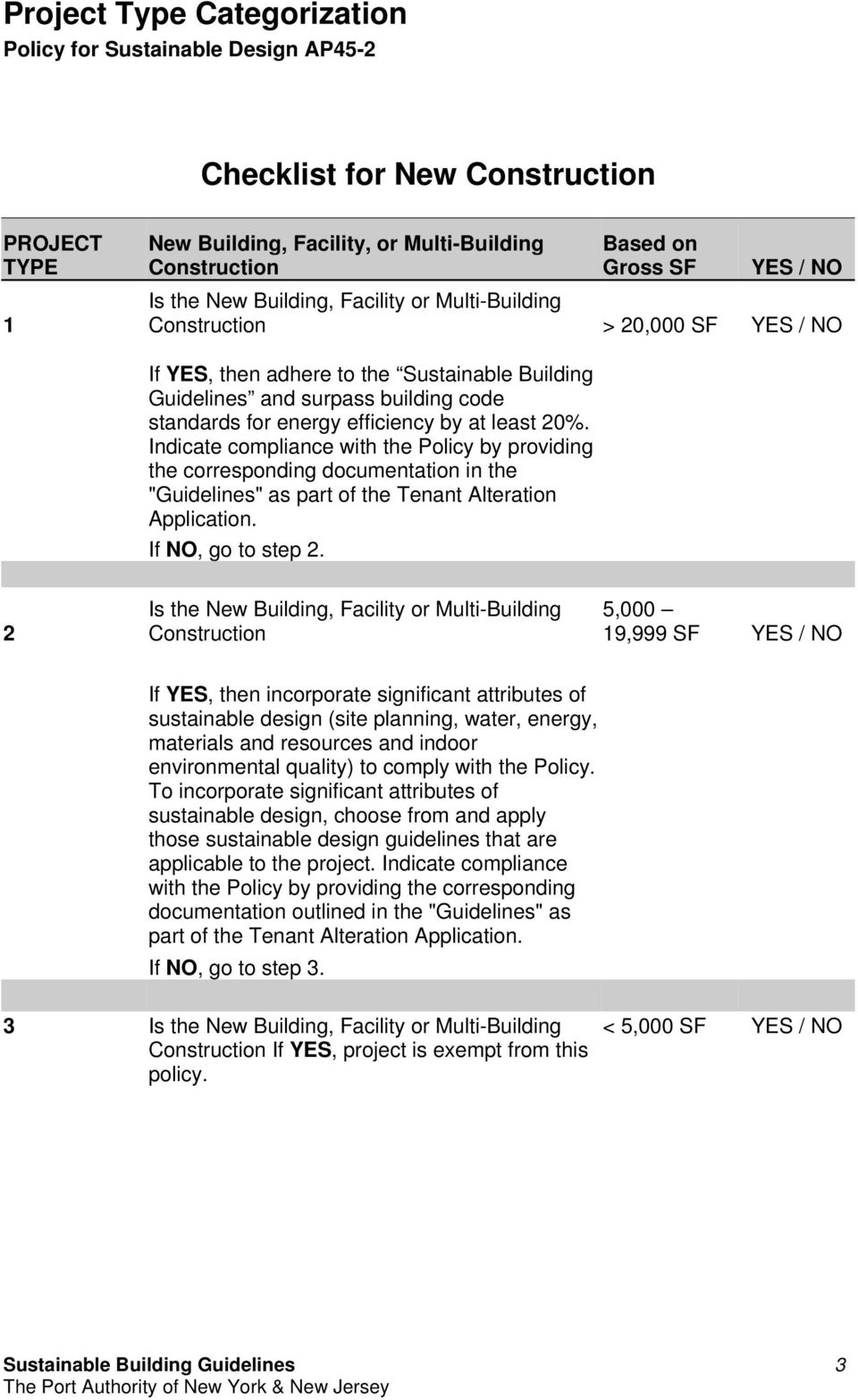
7 Project Type Categorization Policy for Sustainable Design AP45-2 Checklist for New Construction PROJECT TYPE 1 New Building, Facility, or Multi-Building Construction Based on Gross SF YES / NO Is the New Building, Facility or Multi-Building Construction > 20,000 SF YES / NO If YES, then adhere to the Sustainable Building Guidelines and surpass building code standards for energy efficiency by at least 20%. Indicate compliance with the Policy by providing the corresponding documentation in the "Guidelines" as part of the Tenant Alteration Application. If NO, go to step 2. 2 Is the New Building, Facility or Multi-Building Construction 5,000 19,999 SF YES / NO If YES, then incorporate significant attributes of sustainable design (site planning, water, energy, materials and resources and indoor environmental quality) to comply with the Policy. To incorporate significant attributes of sustainable design, choose from and apply those sustainable design guidelines that are applicable to the project. Indicate compliance with the Policy by providing the corresponding documentation outlined in the "Guidelines" as part of the Tenant Alteration Application. If NO, go to step 3. 3 Is the New Building, Facility or Multi-Building Construction If YES, project is exempt from this policy. < 5,000 SF YES / NO Sustainable Building Guidelines 3
8 Project Type Categorization Policy for Sustainable Design AP45-2 Checklist for Substantial Renovation & Reconstruction Projects PROJECT TYPE 4 Substantial Renovation & Reconstruction Projects Based on Gross SF YES / NO Is the substantial renovation or reconstruction project in a building or facility that is >20,000 SF YES / NO If YES, then apply best efforts to adhere to the Sustainable Building Guidelines and surpass building code standards for energy efficiency by at least 10%. Indicate best efforts to adhere to the "Guidelines" by following those guidelines that are applicable to the project. Provide the corresponding documentation outlined in the "Guidelines" as part of the Tenant Alteration Application. If NO, go to step 5. 5 Is the substantial renovation reconstruction 5,000 project in a building or facility that is 19,999 SF YES / NO If YES, then incorporate significant attributes of sustainable design (site planning, water, energy, materials and resources, and indoor environmental quality) to comply with the Policy. To incorporate significant attributes of sustainable design, choose from and apply those Sustainable Design Guidelines that are applicable to the project. Indicate compliance with the Policy by providing the corresponding documentation outlined in the "Guidelines" as part of the Tenant Alteration Application. If NO, go to step 6. 6 Is the substantial renovation or reconstruction project in a building or facility that is < 5,000 SF YES / NO If YES, project is exempt from this policy. Sustainable Building Guidelines 4

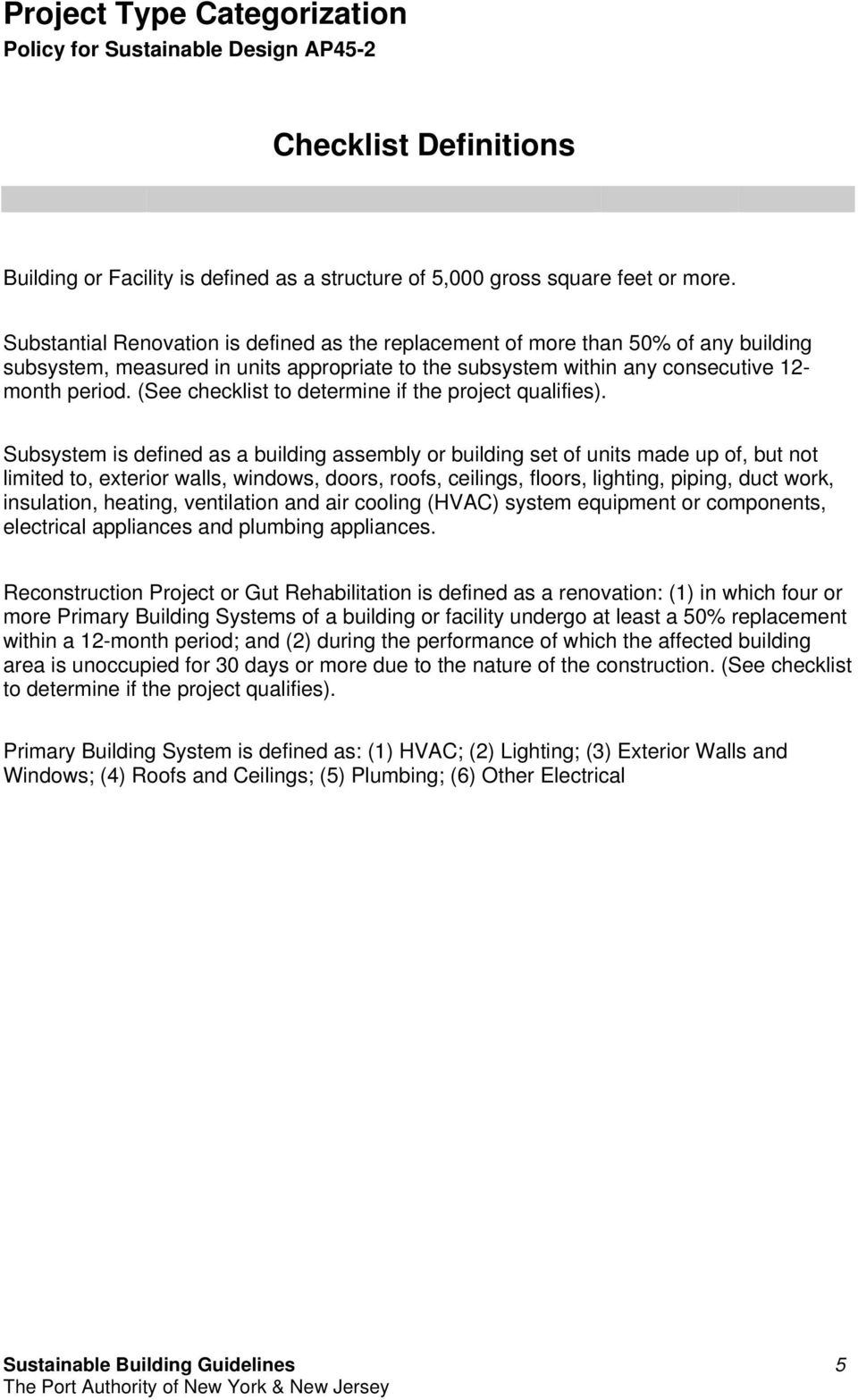
9 Project Type Categorization Policy for Sustainable Design AP45-2 Checklist Definitions Building or Facility is defined as a structure of 5,000 gross square feet or more. Substantial Renovation is defined as the replacement of more than 50% of any building subsystem, measured in units appropriate to the subsystem within any consecutive 12- month period. (See checklist to determine if the project qualifies). Subsystem is defined as a building assembly or building set of units made up of, but not limited to, exterior walls, windows, doors, roofs, ceilings, floors, lighting, piping, duct work, insulation, heating, ventilation and air cooling (HVAC) system equipment or components, electrical appliances and plumbing appliances. Reconstruction Project or Gut Rehabilitation is defined as a renovation: (1) in which four or more Primary Building Systems of a building or facility undergo at least a 50% replacement within a 12-month period; and (2) during the performance of which the affected building area is unoccupied for 30 days or more due to the nature of the construction. (See checklist to determine if the project qualifies). Primary Building System is defined as: (1) HVAC; (2) Lighting; (3) Exterior Walls and Windows; (4) Roofs and Ceilings; (5) Plumbing; (6) Other Electrical Sustainable Building Guidelines 5
10 Intentionally Left Blank Sustainable Building Guidelines 6
11 REQUIRED RECOMMENDED PANYNJ Sustainable Building Guidelines Checklist New Construction greater than 20,000 Gr. SF SITE ENVIRONMENTAL QUALITIES SEQ-1 Site Selection SEQ-2 Support Urban Development SEQ-3 Brownfield Redevelopment SEQ-4 Expanded Public Transit SEQ-5 Bicycle Access SEQ-6 Alternative Fuel Vehicles SEQ-7 Reduced Parking Disturbance SEQ-8 Reduced Site Disturbance SEQ-9 Reduced Development Footprint SEQ-10 Storm Water Use SEQ-11 Heat Island Effect Mitigation Site SEQ-12 Heat Island Effect Mitigation Roof SEQ-13 Light Pollution Reduction WATER ENVIRONMENTAL QUALITIES WEQ-1 Water Management Plan WEQ-2 Wastewater Reuse WEQ-3 Water Use Efficiency WEQ-4 Landscape Hydrology MATERIAL ENVIRONMENTAL QUALITIES MEQ-1 Material Management Plan and Recycling MEQ-2 Building Re-Use MEQ-3 Resource Reuse MEQ-4 Materials with Recycled Content MEQ-5 Material Proximity MEQ-6 Agricultural Materials MEQ-7 Wood Certification MEQ-8 Maintenance and Durability MEQ-9 Wood Preservatives MEQ-10 Design Flexibility ENERGY ENVIRONMENTAL QUALITIES EEQ-1 Comprehensive Energy Management Plan EEQ-2 Building Systems Commissioning EEQ-3 Optimize Energy Performance EEQ-4 Ozone Layer Protection/Greenhouse Gas Reduction EEQ-5 Renewable Energy Transition EEQ-6 Energy Systems Control and Maintenance EEQ-7 End User Metering EEQ-8 Additional Commissioning CONSTRUCTION ENVIRONMENTAL QUALITIES CEQ-1 Construction Environment CEQ-2 Construction Storm Water Runoff/Pollution Prevention CEQ-3 Construction Waste Management CEQ-4 Construction IAQ Management Plan INDOOR ENVIRONMENTAL QUALITIES IEQ-1 IAQ Performance IEQ-2 Daylight & Views IEQ-3 Air Quality Monitoring IEQ-4 Ventilation Effectiveness IEQ-5 Reduce Contaminants from Materials IEQ-6 Chemical & Particulate Control IEQ-7 Thermal Comfort IEQ-8 Pest Control IEQ-9 Personal Control IEQ-10 Acoustics IEQ-11 Lighting Quality MAINTENANCE & OPERATION ENVIRONMENTAL QUALITIES MOEQ-1 Maintenance & Operations Program MOEQ-2 Recycling Program MOEQ-3 Training Program Sustainable Building Guidelines 7

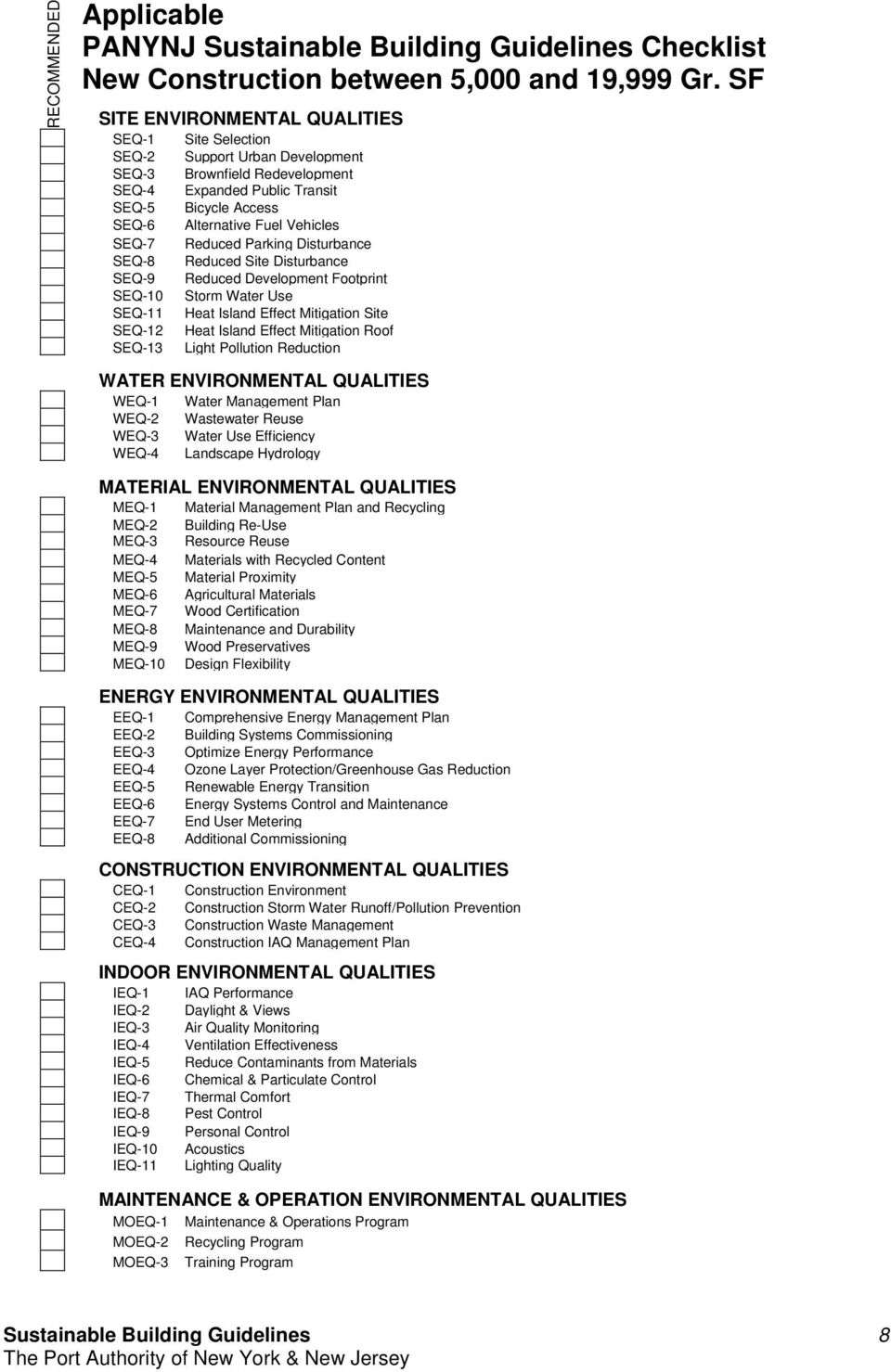
12 RECOMMENDED Applicable PANYNJ Sustainable Building Guidelines Checklist New Construction between 5,000 and 19,999 Gr. SF SITE ENVIRONMENTAL QUALITIES SEQ-1 Site Selection SEQ-2 Support Urban Development SEQ-3 Brownfield Redevelopment SEQ-4 Expanded Public Transit SEQ-5 Bicycle Access SEQ-6 Alternative Fuel Vehicles SEQ-7 Reduced Parking Disturbance SEQ-8 Reduced Site Disturbance SEQ-9 Reduced Development Footprint SEQ-10 Storm Water Use SEQ-11 Heat Island Effect Mitigation Site SEQ-12 Heat Island Effect Mitigation Roof SEQ-13 Light Pollution Reduction WATER ENVIRONMENTAL QUALITIES WEQ-1 Water Management Plan WEQ-2 Wastewater Reuse WEQ-3 Water Use Efficiency WEQ-4 Landscape Hydrology MATERIAL ENVIRONMENTAL QUALITIES MEQ-1 Material Management Plan and Recycling MEQ-2 Building Re-Use MEQ-3 Resource Reuse MEQ-4 Materials with Recycled Content MEQ-5 Material Proximity MEQ-6 Agricultural Materials MEQ-7 Wood Certification MEQ-8 Maintenance and Durability MEQ-9 Wood Preservatives MEQ-10 Design Flexibility ENERGY ENVIRONMENTAL QUALITIES EEQ-1 Comprehensive Energy Management Plan EEQ-2 Building Systems Commissioning EEQ-3 Optimize Energy Performance EEQ-4 Ozone Layer Protection/Greenhouse Gas Reduction EEQ-5 Renewable Energy Transition EEQ-6 Energy Systems Control and Maintenance EEQ-7 End User Metering EEQ-8 Additional Commissioning CONSTRUCTION ENVIRONMENTAL QUALITIES CEQ-1 Construction Environment CEQ-2 Construction Storm Water Runoff/Pollution Prevention CEQ-3 Construction Waste Management CEQ-4 Construction IAQ Management Plan INDOOR ENVIRONMENTAL QUALITIES IEQ-1 IAQ Performance IEQ-2 Daylight & Views IEQ-3 Air Quality Monitoring IEQ-4 Ventilation Effectiveness IEQ-5 Reduce Contaminants from Materials IEQ-6 Chemical & Particulate Control IEQ-7 Thermal Comfort IEQ-8 Pest Control IEQ-9 Personal Control IEQ-10 Acoustics IEQ-11 Lighting Quality MAINTENANCE & OPERATION ENVIRONMENTAL QUALITIES MOEQ-1 Maintenance & Operations Program MOEQ-2 Recycling Program MOEQ-3 Training Program Sustainable Building Guidelines 8
13 RECOMMENDED PANYNJ Sustainable Building Guidelines Checklist Substantial Renovation greater than 20,000 Gr. SF SITE ENVIRONMENTAL QUALITIES N/A SEQ-1 Site Selection SEQ-2 Support Urban Development N/A SEQ-3 Brownfield Redevelopment SEQ-4 Expanded Public Transit SEQ-5 Bicycle Access N/A SEQ-6 Alternative Fuel Vehicles N/A SEQ-7 Reduced Parking Disturbance N/A SEQ-8 Reduced Site Disturbance N/A SEQ-9 Reduced Development Footprint N/A SEQ-10 Storm Water Use N/A SEQ-11 Heat Island Effect Mitigation Site SEQ-12 Heat Island Effect Mitigation Roof SEQ-13 Light Pollution Reduction WATER ENVIRONMENTAL QUALITIES WEQ-1 Water Management Plan WEQ-2 Wastewater Reuse WEQ-3 Water Use Efficiency N/A WEQ-4 Landscape Hydrology MATERIAL ENVIRONMENTAL QUALITIES MEQ-1 Material Management Plan and Recycling MEQ-2 Building Re-Use MEQ-3 Resource Reuse MEQ-4 Materials with Recycled Content MEQ-5 Material Proximity MEQ-6 Agricultural Materials MEQ-7 Wood Certification MEQ-8 Maintenance and Durability MEQ-9 Wood Preservatives MEQ-10 Design Flexibility ENERGY ENVIRONMENTAL QUALITIES EEQ-1 Comprehensive Energy Management Plan EEQ-2 Building Systems Commissioning EEQ-3 Optimize Energy Performance EEQ-4 Ozone Layer Protection/Greenhouse Gas Reduction EEQ-5 Renewable Energy Transition EEQ-6 Energy Systems Control and Maintenance EEQ-7 End User Metering EEQ-8 Additional Commissioning CONSTRUCTION ENVIRONMENTAL QUALITIES CEQ-1 Construction Environment N/A CEQ-2 Construction Storm Water Runoff/Pollution Prevention CEQ-3 Construction Waste Management CEQ-4 Construction IAQ Management Plan INDOOR ENVIRONMENTAL QUALITIES IEQ-1 IAQ Performance IEQ-2 Daylight & Views IEQ-3 Air Quality Monitoring IEQ-4 Ventilation Effectiveness IEQ-5 Reduce Contaminants from Materials IEQ-6 Chemical & Particulate Control IEQ-7 Thermal Comfort IEQ-8 Pest Control IEQ-9 Personal Control IEQ-10 Acoustics IEQ-11 Lighting Quality MAINTENANCE & OPERATION ENVIRONMENTAL QUALITIES MOEQ-1 Maintenance & Operations Program MOEQ-2 Recycling Program MOEQ-3 Training Program Sustainable Building Guidelines 9

14 RECOMMENDED Applicable PANYNJ Sustainable Building Guidelines Checklist Substantial Renovation between 5,000 and 19,999 Gr. SF SITE ENVIRONMENTAL QUALITIES N/A SEQ-1 Site Selection SEQ-2 Support Urban Development N/A SEQ-3 Brownfield Redevelopment SEQ-4 Expanded Public Transit SEQ-5 Bicycle Access N/A SEQ-6 Alternative Fuel Vehicles N/A SEQ-7 Reduced Parking Disturbance N/A SEQ-8 Reduced Site Disturbance N/A SEQ-9 Reduced Development Footprint N/A SEQ-10 Storm Water Use N/A SEQ-11 Heat Island Effect Mitigation Site SEQ-12 Heat Island Effect Mitigation Roof SEQ-13 Light Pollution Reduction WATER ENVIRONMENTAL QUALITIES WEQ-1 Water Management Plan WEQ-2 Wastewater Reuse WEQ-3 Water Use Efficiency N/A WEQ-4 Landscape Hydrology MATERIAL ENVIRONMENTAL QUALITIES MEQ-1 Material Management Plan and Recycling MEQ-2 Building Re-Use MEQ-3 Resource Reuse MEQ-4 Materials with Recycled Content MEQ-5 Material Proximity MEQ-6 Agricultural Materials MEQ-7 Wood Certification MEQ-8 Maintenance and Durability MEQ-9 Wood Preservatives MEQ-10 Design Flexibility ENERGY ENVIRONMENTAL QUALITIES EEQ-1 Comprehensive Energy Management Plan EEQ-2 Building Systems Commissioning EEQ-3 Optimize Energy Performance EEQ-4 Ozone Layer Protection/Greenhouse Gas Reduction EEQ-5 Renewable Energy Transition EEQ-6 Energy Systems Control and Maintenance EEQ-7 End User Metering EEQ-8 Additional Commissioning CONSTRUCTION ENVIRONMENTAL QUALITIES CEQ-1 Construction Environment N/A CEQ-2 Construction Storm Water Runoff/Pollution Prevention CEQ-3 Construction Waste Management CEQ-4 Construction IAQ Management Plan INDOOR ENVIRONMENTAL QUALITIES IEQ-1 IAQ Performance IEQ-2 Daylight & Views IEQ-3 Air Quality Monitoring IEQ-4 Ventilation Effectiveness IEQ-5 Reduce Contaminants from Materials IEQ-6 Chemical & Particulate Control IEQ-7 Thermal Comfort IEQ-8 Pest Control IEQ-9 Personal Control IEQ-10 Acoustics IEQ-11 Lighting Quality MAINTENANCE & OPERATION ENVIRONMENTAL QUALITIES MOEQ-1 Maintenance & Operations Program MOEQ-2 Recycling Program MOEQ-3 Training Program Sustainable Building Guidelines 10

15 RECOMMENDED PANYNJ Sustainable Building Guidelines Checklist Reconstruction Project greater than 20,000 Gr. SF SITE ENVIRONMENTAL QUALITIES SEQ-1 Site Selection SEQ-2 Support Urban Development SEQ-3 Brownfield Redevelopment SEQ-4 Expanded Public Transit SEQ-5 Bicycle Access SEQ-6 Alternative Fuel Vehicles SEQ-7 Reduced Parking Disturbance SEQ-8 Reduced Site Disturbance SEQ-9 Reduced Development Footprint SEQ-10 Storm Water Use SEQ-11 Heat Island Effect Mitigation Site SEQ-12 Heat Island Effect Mitigation Roof SEQ-13 Light Pollution Reduction WATER ENVIRONMENTAL QUALITIES WEQ-1 Water Management Plan WEQ-2 Wastewater Reuse WEQ-3 Water Use Efficiency WEQ-4 Landscape Hydrology MATERIAL ENVIRONMENTAL QUALITIES MEQ-1 Material Management Plan and Recycling MEQ-2 Building Re-Use MEQ-3 Resource Reuse MEQ-4 Materials with Recycled Content MEQ-5 Material Proximity MEQ-6 Agricultural Materials MEQ-7 Wood Certification MEQ-8 Maintenance and Durability MEQ-9 Wood Preservatives MEQ-10 Design Flexibility ENERGY ENVIRONMENTAL QUALITIES EEQ-1 Comprehensive Energy Management Plan EEQ-2 Building Systems Commissioning EEQ-3 Optimize Energy Performance EEQ-4 Ozone Layer Protection/Greenhouse Gas Reduction EEQ-5 Renewable Energy Transition EEQ-6 Energy Systems Control and Maintenance EEQ-7 End User Metering EEQ-8 Additional Commissioning CONSTRUCTION ENVIRONMENTAL QUALITIES CEQ-1 Construction Environment CEQ-2 Construction Storm Water Runoff/Pollution Prevention CEQ-3 Construction Waste Management CEQ-4 Construction IAQ Management Plan INDOOR ENVIRONMENTAL QUALITIES IEQ-1 IAQ Performance IEQ-2 Daylight & Views IEQ-3 Air Quality Monitoring IEQ-4 Ventilation Effectiveness IEQ-5 Reduce Contaminants from Materials IEQ-6 Chemical & Particulate Control IEQ-7 Thermal Comfort IEQ-8 Pest Control IEQ-9 Personal Control IEQ-10 Acoustics IEQ-11 Lighting Quality MAINTENANCE & OPERATION ENVIRONMENTAL QUALITIES MOEQ-1 Maintenance & Operations Program MOEQ-2 Recycling Program MOEQ-3 Training Program Sustainable Building Guidelines 11

16 RECOMMENDED PANYNJ Sustainable Building Guidelines Checklist Reconstruction Project between 5,000 and 20,000 Gr. SF SITE ENVIRONMENTAL QUALITIES SEQ-1 Site Selection SEQ-2 Support Urban Development SEQ-3 Brownfield Redevelopment SEQ-4 Expanded Public Transit SEQ-5 Bicycle Access SEQ-6 Alternative Fuel Vehicles SEQ-7 Reduced Parking Disturbance SEQ-8 Reduced Site Disturbance SEQ-9 Reduced Development Footprint SEQ-10 Storm Water Use SEQ-11 Heat Island Effect Mitigation Site SEQ-12 Heat Island Effect Mitigation Roof SEQ-13 Light Pollution Reduction WATER ENVIRONMENTAL QUALITIES WEQ-1 Water Management Plan WEQ-2 Wastewater Reuse WEQ-3 Water Use Efficiency WEQ-4 Landscape Hydrology MATERIAL ENVIRONMENTAL QUALITIES MEQ-1 Material Management Plan and Recycling MEQ-2 Building Re-Use MEQ-3 Resource Reuse MEQ-4 Materials with Recycled Content MEQ-5 Material Proximity MEQ-6 Agricultural Materials MEQ-7 Wood Certification MEQ-8 Maintenance and Durability MEQ-9 Wood Preservatives MEQ-10 Design Flexibility ENERGY ENVIRONMENTAL QUALITIES EEQ-1 Comprehensive Energy Management Plan EEQ-2 Building Systems Commissioning EEQ-3 Optimize Energy Performance EEQ-4 Ozone Layer Protection/Greenhouse Gas Reduction EEQ-5 Renewable Energy Transition EEQ-6 Energy Systems Control and Maintenance EEQ-7 End User Metering EEQ-8 Additional Commissioning CONSTRUCTION ENVIRONMENTAL QUALITIES CEQ-1 Construction Environment CEQ-2 Construction Storm Water Runoff/Pollution Prevention CEQ-3 Construction Waste Management CEQ-4 Construction IAQ Management Plan INDOOR ENVIRONMENTAL QUALITIES IEQ-1 IAQ Performance IEQ-2 Daylight & Views IEQ-3 Air Quality Monitoring IEQ-4 Ventilation Effectiveness IEQ-5 Reduce Contaminants from Materials IEQ-6 Chemical & Particulate Control IEQ-7 Thermal Comfort IEQ-8 Pest Control IEQ-9 Personal Control IEQ-10 Acoustics IEQ-11 Lighting Quality MAINTENANCE & OPERATION ENVIRONMENTAL QUALITIES MOEQ-1 Maintenance & Operations Program MOEQ-2 Recycling Program MOEQ-3 Training Program Sustainable Building Guidelines 12

17 Project Submission Project Description Templates Sustainable Building Guidelines 13
18 Sustainable Building Guidelines 14

19 Project Description Form Facility: Project Title: Tenant Alteration Application (TAA) Number: Project Identification (PID) Number: Location: Building Type: Building Square Footage: Number of Building Stories: Estimated Construction Cost: Description of Work: Lead Discipline/Consultant Firm: Lead Engineer/Architect: Consultant/Applicant Name: Sustainable Building Guidelines 15
20 Sustainable Building Guidelines 16

21 Site Selection SEQ-1 Intent: Action: To avoid development of inappropriate sites. Avoid development in all sites, which meet any one of the following criteria: Less than 5 feet above the FEMA defined 100-year flood plain. Provide habitat for threatened or endangered species, public parkland. Within 100 feet of any water or wetlands in New Jersey or within 150 feet of any water or wetlands in New York. For definitions of wetland and threatened or endangered species refer to US Army Corps of Engineers (USACE) and New Jersey Department of Environmental Protection (NJDEP)/New York State Department of Environmental Conservation (NYSDEC) regulations. Sustainable Building Guidelines 17
22 Site Selection Template SEQ-1 Project Title TAA/PID Number Phase Stage I Stage II Stage III Stage IV Intent Avoid development of inappropriate sites. Referenced Standards 1. LEED 2.1 Sustainable Sites Credit 1: Site Selection Submittals Provide a Site Plan with documentation signed by the civil engineer or responsible party, declaring that the project site meets the credit requirement. Applicant Company Signature Date Role in Project Sustainable Building Guidelines 18
23 Support Urban Development SEQ-2 Intent: Action: To support development of existing urban areas and fully utilize and support existing infrastructure. LEED SS 2: Channel development to urban areas. Ensure existing minimum development density of 60,000 SF/acre within a several block radius around site. Ensure a minimum new development density of 60,000 SF/acre on site. Sustainable Building Guidelines 19
24 Support Urban Development Template SEQ-2 Project Title TAA/PID Number Phase Stage I Stage II Stage III Stage IV Intent Support development in existing urban areas and fully utilize and support existing infrastructure. Referenced Standards 1. LEED 2.1 Sustainable Sites Credit 2: Development Density Submittals Provide documentation declaring that measures were taken to achieve the required development densities. Provide an area plan with the project location highlighted and the density for the project and the surrounding area. Applicant Company Signature Date Role in Project Sustainable Building Guidelines 20
25 Brownfield Redevelopment SEQ-3 Intent: Action: To rehabilitate damaged sites. Give preference to development of disturbed and damaged sites over less disturbed sites. Seek to improve the ecological health of disturbed sites through site remediation strategies, including engineering and institutional controls that are protective of human health and safety and the environment. Sustainable Building Guidelines 21
26 Brownfield Redevelopment Template SEQ-3 Project Title TAA/PID Number Phase Stage I Stage II Stage III Stage IV Intent Rehabilitate damaged sites. Referenced Standards 1. LEED 2.1 Sustainable Sites Credit 3: Brownfield Redevelopment 2. ASTM E Phase II Environmental Site Assessment 3. EPA Sustainable Redevelopment of Brownfields Program, Submittals Provide a copy of the pertinent sections of the ASTM E Phase II Environmental Site Assessment documenting the site contamination OR provide a letter from a local, state or federal regulatory agency confirming that the site is classified as a Brownfield by that agency. Provide a letter, signed by a Civil Engineer, declaring the type of damage that existed on the site and describe the remediation performed. Applicant Company Signature Date Role in Project Sustainable Building Guidelines 22
27 Expanded Public Transit SEQ-4 Intent: Action: To encourage the development of public transportation. Locate project close to commuter rail, light rail, subway, bus or ferry to encourage use of public transportation by building users. Sustainable Building Guidelines 23
28 Expanded Public Transit Template SEQ-4 Project Title TAA/PID Number Phase Stage I Stage II Stage III Stage IV Intent Encourage the use of public transportation. Referenced Standards 1. LEED 2.1 Sustainable Sites Credit 4.1: Alternative Transportation Public Transportation Access Submittals Provide a Transportation Plan indicating proximity of commuter rail, light rail, subway, bus or ferry to building and building users. Applicant Company Signature Date Role in Project Sustainable Building Guidelines 24
29 Bicycle Access SEQ-5 Intent: Action: To increase bicycle access for building users and occupants. Support bicycle use by providing secure bicycle racks and/or convenient bicycle storage in buildings and changing/shower facilities for building users. Sustainable Building Guidelines 25
30 Bicycle Access Template SEQ-5 Project Title TAA/PID Number Phase Stage I Stage II Stage III Stage IV Intent Increase bicycle access for building users and occupants. Referenced Standards 1. LEED 2.1 Sustainable Sites Credit 4.2 Alternative Transportation Bicycle Storage and Changing Rooms Submittals Provide a Location Plan indicating secure bicycle racks and/or bicycle storage and changing/shower facilities in building for building users. Provide documentation and calculations indicating percentage of building users using bicycle transportation on a daily basis. Applicant Company Signature Date Role in Project Sustainable Building Guidelines 26
31 Alternative Fuel Vehicles SEQ-6 Intent: Action: To minimize pollution and conserve energy by promoting use of low polluting, non-gasoline and hybrid fuel based vehicles. Create preferred parking areas for Alternative Fuel Vehicles (AFV s) and hybrid vehicles and consider provision of alternative fuel refueling stations when applicable. An AFV is defined as a vehicle, which utilizes electricity, hydrogen, propane, compressed natural gas, liquid natural gas, methanol or ethanol. Sustainable Building Guidelines 27
32 Alternative Fuel Vehicles Template SEQ-6 Project Title TAA/PID Number Phase Stage I Stage II Stage III Stage IV Intent Minimize pollution and conserve energy by promoting use of low-polluting, nongasoline and hybrid fuel based vehicles. Referenced Standards 1. LEED 2.1 Sustainable Sites Credit 4.3 Alternative Transportation Alternative Fuel Vehicles Submittals Provide site drawings or parking plan highlighting preferred parking for alternative fuel vehicles and alternative-fuel refueling stations. Provide calculations indicating percentage of building occupants that utilize preferred parking and alternative-fuel refueling stations Applicant Company Signature Date Role in Project Sustainable Building Guidelines 28
33 Reduced Parking Disturbance SEQ-7 Intent: Action: To minimize land development impacts from single occupancy vehicle use. LEED SS 4.4: Size parking capacity to meet but not exceed, minimum local zoning requirements AND provide preferred parking for carpools or van pools capable of serving 5% of the building occupants; OR add no new parking for rehabilitation projects AND provide preferred parking for carpools or van pools capable of serving 5% of the building occupants. Sustainable Building Guidelines 29
34 Reduced Parking Disturbance Template SEQ-7 Project Title TAA/PID Number Phase Stage I Stage II Stage III Stage IV Intent Minimize land development impacts from single occupancy vehicle use. Referenced Standards 1. LEED 2.1 Sustainable Sites Credit 4.4: Alternative Transportation Parking Capacity Submittals Provide documentation indicating the following: OR Size parking capacity meets but does not exceed, minimum local zoning requirements AND preferred parking for carpools or vans pools capable of serving 5% of the building occupants has been implemented. No new parking for rehabilitation projects has been added AND preferred parking for carpools or vanpools capable of serving 5% of the building occupants has been implemented. Applicant Company Signature Date Role in Project Sustainable Building Guidelines 30
35 Reduced Site Disturbance SEQ-8 Intent: Action: To conserve existing natural areas and restore damaged areas to provide habitat and promote biodiversity through reduced site disturbances. LEED SS 5.1: On previously developed sites restore a minimum of 50% of the site area by replacing impervious surfaces with native or adaptive vegetation. On Greenfield sites, limit site disturbance including earthwork and clearing of vegetation to 40 feet beyond the building perimeter, 5 feet beyond primary roadway curbs, walkways and main utility trenches, and 25 feet beyond constructed areas with permeable surfaces that require additional staging areas in order to limit compaction in the constructed area. Sustainable Building Guidelines 31
36 Reduced Site Disturbance Template SEQ-8 Project Title TAA/PID Number Phase Stage I Stage II Stage III Stage IV Intent Conserve existing natural areas and restore damaged areas to provide habitat and promote biodiversity through reduced site disturbance. Referenced Standards 1. LEED 2.1 Sustainable Sites Credit 5.1 Reduced Site Disturbance Protect or Restore Open Space Submittals For greenfield sites: provide documentation demonstrating and declaring that site disturbance, including earthwork and clearing of vegetation, does not exceed: 40 feet beyond the building perimeter, 5 feet beyond primary roadway curbs, walkways and main utility trenches, and 25 feet beyond constructed areas with permeable surfaces that require additional staging areas in order to limit compaction in the constructed area with permeable surfaces. OR Provide site drawings and specifications highlighting limits of construction disturbance. For previously developed sites: provide documentation demonstrating and declaring restoration of degraded habitat areas. Include highlighted site drawing with area calculations demonstrating that 50% of the site area that does not fall within the building footprint has been restored. Applicant Company Signature Date Role in Project Sustainable Building Guidelines 32
37 Reduced Development Footprint SEQ-9 Intent: Action: To minimize the development footprint and maximize open space. Reduce the development footprint (including building, access roads and parking) to exceed the local zoning's open space requirement or for areas with no local zoning requirements, designate open space area adjacent to the building that is equal to or greater than the development footprint. Sustainable Building Guidelines 33
38 Reduced Development Footprint Template SEQ-9 Project Title TAA/PID Number Phase Stage I Stage II Stage III Stage IV Intent Minimize the development footprint and maximize open space. Referenced Standards 1. LEED 2.1 Sustainable Sites Credit 5.2 Reduced Site Disturbance Development Footprint Submittals Provide an area plan with the project location highlighted. OR Provide a copy of the local zoning requirements highlighting the criteria for open space, demonstrating and declaring that the open space exceeds the local zoning open space requirement. For areas with no zoning requirements, designate open space area adjacent to the building that is equal to the development footprint. Provide a letter from the facility stating that the open space will be conserved for the life of the building. Applicant Company Signature Date Role in Project Sustainable Building Guidelines 34
39 Storm Water Use SEQ-10 Intent: Action: To manage site storm water flows through capture, treatment and on-site utilization. Implement a plan for storm water management as part of the Water Management Plan. Reduce the post-development flow of storm water and use captured water as appropriate. LEED SS 6.1: If existing imperviousness is less than or equal to 50%, implement a storm water management plan that prevents the postdevelopment 1.5 year, 24 hour peak discharge rate from exceeding the predevelopment 1.5 year, 24 hour peak discharge rate. LEED SS 6.2: Construct treatment systems to remove 80% of the average annual post-development total suspended solids (TSS) and 40% of the average annual post-development total phosphorous (TP) per EPA Document 840-B c Guidance Specifying Management Measures for Sources of Nonpoint Pollution in Coastal Waters (based on the average annual loadings from all storms less than or equal to the 2 year/24 hour storm). Sustainable Building Guidelines 35
40 Storm Water Use Template SEQ-10 Project Title TAA/PID Number Phase Stage I Stage II Stage III Stage IV Intent Manage site storm water flows through capture, treatment and on-site utilization. Referenced Standards 1. PANYNJ Sustainable Design Guidelines WEQ-1: Water Management Plan 2. LEED 2.1 Sustainable Sites Credit 6.1: Storm water Management Rate and Quantity 3. LEED 2.1 Sustainable Sites Credit 6.2: Storm water Management Treatment 4. EPA s Guidance Specifying Management Measures for Sources of Nonpoint Pollution in Coastal Waters, January 1993, (EPA 840-B93-001c in LEED 2.1) a. Internet location: b. Hardcopy or microfiche (entire document, 836 pages): National Technical Information Service (order # PB ), (800) c. U.S. Environmental Protection Agency Office of Water, Submittals A storm water management plan is attached and outlines how post-development flow of storm water will be captured on the site and subsequently used to reduce potable water dependence. Applicant Company Signature Date Role in Project Sustainable Building Guidelines 36
41 Heat Island Effect Mitigation Site SEQ-11 Intent: Action: To reduce site development contributions to heat island effects at paved areas. Seek to maximize areas of landscape planting (green infrastructure) coupled with high albedo surfaces at other areas to mitigate thermal loading of site surfaces. Provide green infrastructure coupled with high albedo surfaces to mitigate thermal loading of site surfaces. Utilize shade and/or light-colored/highalbedo materials (solar reflectance of at least.3 utilizing ASTM E903-96) or open reinforced grid pavement for the site s walkways, plazas and open spaces. Sustainable Building Guidelines 37
42 Heat Island Effect Mitigation Site Template SEQ-11 Project Title TAA/PID Number Phase Stage I Stage II Stage III Stage IV Intent Reduce site development contributions to heat island effects at paved areas by maximizing areas of landscape planting (green infrastructure) coupled with high albedo surfaces at other areas to mitigate thermal loading of site surfaces. Referenced Standards 1. LEED 2.1 Sustainable Sites Credit 7.1: Heat Island Effect Non-Roof 2. ASTM E Standard Test Method for Solar Absorptance, Reflectance, and Transmittance of Materials Using Integrating Spheres, (610) Submittals Provide supporting calculations indicating that green infrastructure coupled with high albedo surfaces has been used to mitigate thermal loading of site surfaces. Provide catalog cuts and materials board indicating that shade and/or lightcolored/high-albedo materials (solar reflectance of at least.3 utilizing ASTM E903-96) or open reinforced grid pavement for the site s walkways, plazas and open spaces have been utilized. Applicant Company Signature Date Role in Project Sustainable Building Guidelines 38
43 Heat Island Effect Mitigation Roof SEQ-12 Intent: Action: To reduce building contributions to heat island effects at building roofs. Seek to maximize areas of landscape planting (green infrastructure) coupled with high albedo surfaces at other areas to mitigate thermal loading of building roofs. LEED SS 7.2: Use ENERGY STAR compliant AND "high emissivity", (emissivity of at least.9 when tested in accordance with ASTM E408-71) roofing for a minimum of 75% of the roof surface; OR install a green (vegetated) roof for at least 50% of the roof area. Combinations of high albedo and vegetated roof can be used providing they collectively cover 75% of the roof area. Sustainable Building Guidelines 39
44 Heat Island Effect Mitigation Roof Template SEQ-12 Project Title TAA/PID Number Phase Stage I Stage II Stage III Stage IV Intent Reduce building contributions to heat island effects at building roofs by maximizing areas of landscape planting (green infrastructure) coupled with high albedo surfaces at other areas to mitigate thermal loading of building roofs. Referenced Standards 1. LEED 2.1 Sustainable Sites Credit 7.2: Heat Island Effect Roof 2. ASTM E (1996) e1 Standard Test Methods for Total Normal Emittance of Surfaces Using Inspection-Meter Techniques (610) EPA Energy Star Roofing Guidelines US Environmental Protection Agency ENERGY STAR Program, (888) Submittals Provide supporting documentation and calculations indicating either one of the following provisions: OR ENERGY STAR compliant AND high emissivity (emissivity of at least.9 when tested in accordance with ASTM E408-71) roofing for a minimum of 75% of the roof surface; Install a green (vegetated) roof for at least 50% of the roof area. Combinations of high albedo and vegetated roof can be used providing they collectively cover 75% of the roof area. Applicant Company Signature Date Role in Project Sustainable Building Guidelines 40
45 Light Pollution Reduction SEQ-13 Intent: Action: To reduce light pollution to surrounding sites and night sky. LEED SS 8: Satisfy Illuminating Engineering Society of North America (IESNA) recommended practice per manual (RP-33-99) for exterior illumination. Design exterior lighting such that all exterior luminaires with more than 1000 initial lamp lumens are shielded and all luminaires with more than 3500 initial lamp lumens meet the Full Cutoff IESNA Classification. The maximum candela value of all interior lighting shall fall within the building (not out through windows) and the maximum candela value of all exterior lighting shall fall within the property. Any luminaire within a distance of 2.5 times its mounting height from the property boundary shall have shielding such that no light from that luminaire crosses the property boundary. Sustainable Building Guidelines 41
46 Light Pollution Reduction Template SEQ-13 Project Title TAA/PID Number Phase Stage I Stage II Stage III Stage IV Intent Reduce light pollution to surrounding sites and night sky. Referenced Standards 1. LEED 2.1 Sustainable Sites Credit 8 Light Pollution Reduction. 2. Illuminating Engineering Society of North America (IESNA) Recommended Practice Manual: Lighting for Exterior Environments (RP-33-99). Submittals Provide supporting documentation including calculations, design drawings and catalog cuts indicating the elimination of light trespass from the building and site, improving night sky access and reducing development impact on nocturnal environments. Applicant Company Signature Date Role in Project Sustainable Building Guidelines 42
47 Water Management Plan WEQ-1 Intent: Action: To optimize utilization of site water resources. Implement a Water Management Plan to evaluate use of storm water, wastewater and potable water resources, study potentials for onsite reclamation of wastewater and develop a coordinated management plan for full site water resources. Use EPA recommendations per EO (Section 207) (June 1999) and Federal Energy Management Program (FEMP) Best Management Practices to develop Plan. Include at minimum information on operation & maintenance, utility information, facility information, emergency response information and planning considerations. Sustainable Building Guidelines 43
48 Water Management Plan Template WEQ-1 Project Title TAA/PID Number Phase Stage I Stage II Stage III Stage IV Intent Optimize utilization of site water resources. Referenced Standards 1. EPA recommendations as per EO (Section 207) (June 1999) 2. Federal Energy Management Program (FEMP) Best Management Practices Submittals Provide a Water Management Plan that includes comprehensive strategies for optimizing storm water, wastewater, and potable water resources. It shall also include details regarding operation and Maintenance, utility information, facility information, emergency response information, and planning considerations. Applicant Company Signature Date Role in Project Sustainable Building Guidelines 44
49 Water Reuse WEQ-2 Intent: Action: To minimize site wastewater outflows. Implement wastewater strategies as required by Water Management Plan. Use reclaimed storm water and/or site water for toilet flushing, cooling tower makeup, vehicle maintenance or irrigation needs. Study additional opportunities to reduce the amount of potable water used in the building for conveying sewage through wastewater treatment. Sustainable Building Guidelines 45
50 Wastewater Reuse Template WEQ-2 Project Title TAA/PID Number Phase Stage I Stage II Stage III Stage IV Intent Minimize site wastewater outflows. Referenced Standards 1. EO (Section 207) (June 1999) 2. Federal Energy Management Program (FEMP) Best Management Practices 3. LEED 2.1 Water Efficiency Credit 2: Innovative Wastewater Technologies Submittals Provide an outline describing the following: Strategies used to reduce wastewater production as part of the Water Management Plan. Strategies used to capture and use storm water as part of the Water Management Plan. Provide calculations that demonstrate the target reduction of building potable water use that is expected to result from the strategies outlined above. Provide a calculation matrix to show the difference between best practice and adopted sustainable strategies. Applicant Company Signature Date Role in Project Sustainable Building Guidelines 46
51 Water Use Efficiency WEQ-3 Intent: Action: To maximize water use efficiency within buildings and reduce potable water requirements. LEED WE 3.1 and 3.2: Reduce consumption of potable water as required by Water Management Plan. Use 30% less potable water than a baseline building (utilize 1992 Energy Policy Act fixture requirements to determine baseline) would by utilizing efficient water fixtures, automatic controls and/or waterless urinals. Sustainable Building Guidelines 47
52 Water Use Efficiency Template WEQ-3 Project Title TAA/PID Number Phase Stage I Stage II Stage III Stage IV Intent Maximize water use efficiency within buildings and reduce potable water requirements. Referenced Standards 1. Port Authority Sustainable Guidelines WEQ-1: Water Management Plan 2. LEED 2.1 Water Efficiency Credit 3.2: Water Use Reduction 30% Energy Policy Act Submittals Provide documentation declaring that the project uses 30% less than the baseline fixture performance requirements of the 1992 Energy Policy Act. Applicant Company Signature Date Role in Project Sustainable Building Guidelines 48
53 Landscape Hydrology WEQ-4 Intent: Action: To maximize utilization of site water for landscape requirements. Use storm water for landscape irrigation requirements in conjunction with Water Management Plan. Specify plantings requiring low amounts of watering. Use indigenous or acclimatized plants suitable for the current nature of the site. Employ high-efficiency irrigation systems with slow-drip, sub-soil irrigation and computer operation with linkages to meteorological data to optimize water resources. LEED WE 1.1: Reduce potable water use for irrigation by 50% over conventional means. Sustainable Building Guidelines 49
54 Landscape Hydrology Template WEQ-4 Project Title TAA/PID Number Phase Stage I Stage II Stage III Stage IV Intent Maximize utilization of site water for landscape requirements. Referenced Standards 1. Port Authority Sustainable Design Guidelines WEQ-1: Water Management Plan 2. LEED 2.1 Water Efficiency Credit 1.1: Water Efficient Landscaping 50% Reduction Submittals Provide a site plan, schedule, and anticipated water requirements with calculations estimating the percentage of irrigation requirements to be achieved through water harvesting. Provide a narrative description outlining the high efficiency irrigation technologies that have been specified. Provide documentation and a brief narrative declaring that the project reduces potable water use for irrigation by 50% over conventional means. Include equipment used and/or the use of drought-tolerant or native plants. Applicant Company Signature Date Role in Project Sustainable Building Guidelines 50
55 Material Management Plan and Recycling MEQ-1 Intent: Action: To optimize utilization of site material resources, reduce the waste generated by building occupants and encourage recycling. Provide a Material Management Plan, which coordinates and implements material guideline requirements within the Sustainable Design Guidelines. Describe materials to be utilized, including but not limited to; recycled content, location of manufacture/harvest, agricultural content, sustainable harvest certification, expected lifetime, maintenance requirements and recyclable/reuse potential at end of useful life. LEED MR Prerequisite 1: Provide an easily accessible area that serves the entire building and is dedicated to the separation, collection and storage of materials for recycling including (at a minimum) paper, corrugated cardboard, glass, plastics and metals. Coordinate with MOEQ-2 Recycling Program. Sustainable Building Guidelines 51
56 Material Management Plan and Recycling Template MEQ-1 Project Title TAA/PID Number Phase Stage I Stage II Stage III Stage IV Intent Optimize utilization of material resources, reduce the waste generated by building occupants and encourage recycling. Referenced Standards 1. LEED 2.1 Materials & Resources Prerequisite 1: Storage & Collection of Recyclables Submittals Provide documentation declaring that a Material Management Plan is utilized, which coordinates and implements material guideline requirements within the Sustainable Design Guidelines. Describe materials to be utilized, including but not limited to: Recycled content Location of manufacture/harvest Agricultural content Sustainable harvest certification Expected lifetime Maintenance requirements Recyclable/reuse potential at end of useful life Provide a plan showing the area(s) dedicated to recycled material collection and storage. Indicate that recycling areas are easily accessible and accommodate the building s recycling needs. Applicant Company Signature Date Role in Project Sustainable Building Guidelines 52
57 Building Reuse MEQ-2 Intent: Action: To extend the life cycle of existing buildings and site infrastructure. Reuse existing building stock and site infrastructure to accommodate client s program and project requirements wherever possible. Sustainable Building Guidelines 53
58 Building Reuse Template MEQ-2 Project Title TAA/PID Number Phase Stage I Stage II Stage III Stage IV Intent Extend the lifecycle of existing buildings and site infrastructure. Referenced Standards 1. LEED 2.1 Materials & Resources Credit 1.1: Building Reuse Maintain 75% of Existing Shell 2. LEED 2.1 Materials & Resources Credit 1.2: Building Reuse Maintain 100% of Existing Shell 3. LEED 2.1 Materials & Resources Credit 1.3: Building Reuse Maintain 100% of Existing Shell & 50% of Non-Shell Submittals Provide documentation listing the retained elements and declaring that the credit requirements have been met. Applicant Company Signature Date Role in Project Sustainable Building Guidelines 54
59 Resource Reuse MEQ-3 Intent: Action: To incorporate previously used building materials and products into new construction. In coordination with the Materials Management Plan consider the use of salvaged, refurbished or reused materials and products in the building. Materials for reuse typically include reclaimed lumber and wood such as salvaged wood flooring and wood doors and cabinets, structural metal work such as beams, and miscellaneous metal such as doors, door hardware, etc. Decorative and specialized items such as salvaged wood and glass panels, banquettes, front and back bars and decorative or period lighting fixtures may be used in special public locations such as cafeterias or restaurants, and can contribute to this credit. Sustainable Building Guidelines 55
60 Resource Reuse Template MEQ-3 Project Title TAA/PID Number Phase Stage I Stage II Stage III Stage IV Intent Incorporate previously used building materials and products into new construction. Referenced Standards 1. LEED 2.1 Materials & Resources Credit 3.1: Resource Reuse Specify 5% 2. LEED 2.1 Materials & Resources Credit 3.2: Resource Reuse Specify 10% Submittals Provide documentation declaring that the credit requirements have been met and listing each material or product used to meet the credit. Include details demonstrating that the project incorporates reused materials and products, showing their costs and the total cost of material for the project. Applicant Company Signature Date Role in Project Sustainable Building Guidelines 56
61 Materials with Recycled Content MEQ-4 Intent: Action: To incorporate materials with recycled content and increase market demand for building materials and products that incorporate recycled content. Specify materials with recycled-content in conjunction with the Materials Management Plan. LEED MR 4.1: Use materials with recycled content such that the sum of post-consumer recycled content plus one-half of the post-industrial content constitutes at least 5% of the total value of the materials in the project. LEED MR 4.2: Use materials with recycled content such that the sum f post-consumer recycled content plus one-half of the post-industrial content constitutes at least 10% of the total value of the materials in the project. Sustainable Building Guidelines 57
62 Materials with Recycled Content Template MEQ-4 Project Title TAA/PID Number Phase Stage I Stage II Stage III Stage IV Intent Incorporate materials with recycled content and increase market demand for building materials and products that incorporate recycled content Referenced Standards 1. LEED 2.1 Materials & Resources Credit 4.2: Recycled Content Specify 10% (post-consumer + ½ post-industrial) Submittals Provide documentation declaring that the credit requirements have been met and listing of recycled content products used to meet the credit. Include details demonstrating that the project incorporates the required percentage of recycled content materials and products and showing their costs and percentage(s) of postconsumer and/or post-industrial content, and the total cost of all materials for the project. Applicant Company Signature Date Role in Project Sustainable Building Guidelines 58
63 Material Proximity MEQ-5 Intent: Action: To reduce environmental degradation resulting from transportation impacts by increasing the demand for building materials and products that are extracted and/or manufactured in close proximity to the building site. Utilize local/regional materials in conjunction with the Materials Management Plan. LEED MR 5.1: Use a minimum of 20% of all building materials (based on cost) that are manufactured regionally within a 500-mile radius of the site. Manufactured in this context means the location where final assembly takes place. LEED MR 5.2: Of the regionally manufactured building materials documented in LEED MR 5.1 uses a minimum of 50% (based on cost) that are extracted, harvested or recovered, as well as manufactured, within a 500-mile radius of the site. Manufactured in this context means the location where final assembly takes place. Sustainable Building Guidelines 59
64 Material Proximity Template MEQ-5 Project Title TAA/PID Number Phase Stage I Stage II Stage III Stage IV Intent Reduce environmental degradation resulting from transportation impacts by increasing the demand for building materials and products that are extracted and/or manufactured in close proximity to the building site. Referenced Standards 1. LEED 2.1 Materials & Resources Credit 5.1: Regional Materials 20% Manufactured Regionally 2. LEED 2.1 Materials & Resources Credit 5.2: Regional Materials 50% Extracted Regionally Submittals Provide documentation declaring that the credit requirements have been met. Include calculations demonstrating that the project incorporates the following: Percentage of regional materials/products and their cost Percentage of regional components Distance from project to manufacturer Total cost of all materials for the project. Applicant Company Signature Date Role in Project Sustainable Building Guidelines 60
65 Agricultural Materials MEQ-6 Intent: Action: To encourage the specification of materials which are renewable and that grow in such a way as to support biological diversity and the health of the ecosystem. In coordination with the Materials Management Plan use renewable and rapidly renewable building materials and products when practicable. Materials with annual growing cycles or which regenerate naturally within a 10-year-cycle are considered to be rapidly renewable materials. These materials include bamboo, poplar, cork, wool, cotton, jute, sisal, and soybased products. Agricultural waste materials such as wheatgrass, sunflower seed husks, and straw also qualify under this category. Release agents for concrete forms, which are made from plant oils such as corn oil are included. Sustainable Building Guidelines 61
66 Agricultural Materials Templates MEQ-6 Project Title TAA/PID Number Phase Stage I Stage II Stage III Stage IV Intent Encourage the specification of materials which are renewable and that grow in such a way as to support biological diversity and the health of the ecosystem. Referenced Standards 1. Port Authority Sustainable Design Guidelines MEQ-1: Material Management Plan and Recycling 2. LEED 2.1 Materials & Resources Credit 6: Rapidly Renewable Materials Submittals Provide documentation declaring that the credit requirements have been met. Include calculations demonstrating that the project incorporates a percentage of rapidly renewable products. Show their cost and percentage of rapidly renewable components, and the total cost of all materials for the project. Applicant Company Signature Date Role in Project Sustainable Building Guidelines 62
67 Wood Certification MEQ-7 Intent: Action: To specify wood which has been harvested according to sustainable forest management principles. Utilize wood materials certified under the Forest Stewardship Council s Principles and Criteria (FSC) in conjunction with the Materials Management Plan. These materials may include dimensional framing components, flooring, doors, paneling, millwork and furnishings, handrails and trim, etc., as well as, temporary lumber and wood construction materials provided they are not rented. The vendor s FSC chain-of-custody certificate number is required to verify certification. Sustainable Building Guidelines 63
68 Wood Certification Template MEQ-7 Project Title TAA/PID Number Phase Stage I Stage II Stage III Stage IV Intent Specify wood materials that have been harvested according to sustainable forest management principles. Referenced Standards 1. LEED 2.1 Materials & Resources Credit 7: Certified Wood 2. Forest Stewardship Council s Principles and Criteria, (877) Submittals Provide documentation declaring that the credit requirements have been met: List the FSC-certified materials and products used. Include calculations demonstrating that the project incorporates a percentage of FSC-certified materials/products and their cost together with the total cost of all materials for the project. For each material/product used to meet these requirements, provide the vendor s of manufacturer s Forest Stewardship Council chain-of-custody certificate number. Applicant Company Signature Date Role in Project Sustainable Building Guidelines 64
69 Maintenance and Durability MEQ-8 Intent: Action: To extend the life cycle of buildings and finishes and reduce maintenance requirements. Evaluate potential of more durable, longer lasting materials and finishes to extend building life and reduce maintenance requirements. Include consideration of building or material reuse and recycling in material assemblies and finish applications. Sustainable Building Guidelines 65
70 Maintenance and Durability Template MEQ-8 Project Title TAA/PID Number Phase Stage I Stage II Stage III Stage IV Intent Extend the life cycle of buildings and finishes and reduce maintenance requirements. Referenced Standards There is no standard referenced for this credit. Submittals Provide documentation declaring that the credit requirements have been met: Evaluation of proposed materials Maintenance and building life. Applicant Company Signature Date Role in Project Sustainable Building Guidelines 66
71 Wood Preservatives MEQ-9 Intent: Action: To reduce toxicity of specified preservatives for treated wood. Reduce requirements for preservative treated wood. Utilize Ammoniacal Copper Quaternary Compound (AQC) for wet conditions when preservative treated lumber is required and use lumber that is treated with less toxic, borate-based chemicals in dry conditions. Sustainable Building Guidelines 67
72 Wood Preservatives Template MEQ-9 Project Title TAA/PID Number Phase Stage I Stage II Stage III Stage IV Intent Reduce toxicity of specified preservatives for treated wood. Referenced Standards There is no standard referenced for this credit. Submittals Provide documentation declaring that the credit requirements have been met: Specify low-toxicity wood preservatives. Applicant Company Signature Date Role in Project Sustainable Building Guidelines 68
73 Design Flexibility MEQ-10 Intent: Action: To facilitate future building modification, adaptive reuse, expansion and/or disassembly. Consider design strategies, which will facilitate future building modification, adaptive, reuse, expansion and/or disassembly. Require design program to include anticipated changes in use and occupancy for 10 years beyond initial occupancy. Provide design, which allows for building expansion to be accommodated with minimal renovation requirements. Extend this flexibility to the site to ensure site developments and utilities are coordinated with building expansion plans. Design building systems when possible to accommodate future disassembly and material reuse. To optimize building disassembly design building components which are easily separated into reusable or recyclable components, utilize materials with high reuse potential (i.e. steel vs. concrete) and reduce applied finishes. Sustainable Building Guidelines 69
74 Design Flexibility Template MEQ-10 Project Title TAA/PID Number Phase Stage I Stage II Stage III Stage IV Intent Facilitate future building modification, adaptive reuse, expansion and/or disassembly. Referenced Standards There is no standard referenced for this credit. Submittals Provide documentation declaring that the credit requirements have been met. Submit design drawings and specifications indicating compliance to credit. Applicant Company Signature Date Role in Project Sustainable Building Guidelines 70
75 Comprehensive Energy Management Plan EEQ-1 Intent: Action: To conserve and optimize building energy use. Prepare an Energy Management Plan to maximize the utilization of all site generated energy resources and to minimize off-site, non-sustainable generated energy resources. The Plan shall include an energy use budget for the project for the first year of full occupancy, broken down by major energy consumption category (i.e., heating, cooling, lighting, fan energy, pump energy, etc.). After each year of operation, the actual utilization of energy shall be recorded and compared to the original energy use budget. Significant deviations shall be evaluated and a detailed explanation for the probable cause of the deviation recorded in the updated plant. Strategies for reducing energy consumption below the first year of occupancy shall be identified and described. The Energy Management Plan shall include a similar itemization of all site generated energy resources, including a budget for each component, and annual updates of actual performance. The Plan shall identify measures and strategies for increasing on-site utilization of energy above the first year of full occupancy performance. The Energy Management Plan is an important tool in meeting the goals and reporting requirements of EO-111. Sustainable Building Guidelines 71
76 Intentionally Left Blank Sustainable Building Guidelines 72
77 Comprehensive Energy Management Template EEQ-1 Project Title TAA/PID Number Phase Stage I Stage II Stage III Stage IV Intent Conserve and optimize building energy use. Referenced Standards There is no standard referenced for this credit. Submittals Prepare and provide an Energy Management Plan that includes Pre-construction and Post-construction initiatives Pre-Construction Initiatives: Maximum utilization of all site generated resources. Minimum utilization of off-site, non-sustainable generated energy resources. Energy use budget for the project for the first year of full occupancy, broken down by major energy consumption category (i.e., heating, cooling, lighting, fan energy, pump energy, etc.) Identification of measures and strategies for increasing on-site utilization of energy above the first year of full occupancy performance. Post-Construction Initiatives: A record and comparison of actual energy utilization after first year of operation vs. original energy use budget. Evaluation of significant deviations and a detailed explanation. Identification and description of strategic energy consumption below the first year of occupancy. Itemization of all site generated energy resources, including a budget for each component, and annual updates of actual performance. Form continued on other side. Sustainable Building Guidelines 73
78 Comprehensive Energy Management Template EEQ-1 Applicant Company Signature Date Role in Project Sustainable Building Guidelines 74
79 Building Systems Commissioning EEQ-2 Intent: Action: To implement a Building Commissioning Plan. Implement fundamental, building systems commissioning through the use of a commissioning team consisting of Engineering Department and Facility staff not involved with the project. This team will prepare a commissioning plan and perform reviews for: design intent and design criteria, commissioning requirements in the contract documents, submittal review, verification of system performance, training, documentation, and post occupancy adherence to the established plan. Upon completion of each stage of the project a report shall be prepared and submitted by the commissioning team documenting the results and certifying that the commissioning plan has been successfully executed. The Commissioning Plan will be drafted by the commissioning team with input from all Engineering Department Divisions and in conjunction with Facility management, operations and maintenance staff. Reviews will be performed by the appropriate Engineering Division parties in accordance with the commissioning plan and current Quality Control Procedures as follows: Phase Commissioning Task Commissioning Team E/A Design Division PMD Contract Division Const. Division Materials Division Q/A Division Maintenanc e/ Operations Stage I/II/III Design Stage IV Const. Post Occupancy Design Intent X X Design Criteria X X X X X X System Performance Benchmarks Submittal Requirements X X X X Project Staging X X X X Construction Environmental Qualities Requirements X X X Submittal Review X X X X X Operations and X X X X Maintenance Manuals Materials and Equipment Testing X X X X Final Inspection X X X X X Performance Benchmark Confirmation X X X X X Sustainable Building Guidelines 75
80 Building Systems Commissioning Template EEQ-2 Project Title TAA/PID Number Phase Stage I Stage II Stage III Stage IV Intent To implement a Building Commissioning Plan. Referenced Standards 1. LEED 2.1 Energy and Atmosphere Prerequisite 1: Fundamental Building Systems Commissioning Submittals A Commissioning Plan is attached and incorporates the requirements of the PANYNJ SDG EEQ-2. Applicant Company Signature Date Role in Project Sustainable Building Guidelines 76
81 Optimize Energy Performance EEQ-3 Intent: Action: To optimize the performance of building energy systems. Optimize the performance of building energy systems through the utilization of a full DOE-2.1E (or equivalent) building energy model to compare and evaluate alternative strategies for energy efficiency (kwh) and peak load reduction (kw). Integrate with Energy Management Plan. This is to include the full analysis of architectural and mechanical decisions in relationship to building energy expenditures. Achieve a minimum of 30% decrease in energy cost above ASHRAE 90.1/1999 (The use of a central chilling plant may require an adjustment for this goal. An adjustment must recognize that a decrease in overall savings will require the addition of comparable LEED points in other areas). Provide daylight dimming and occupancy sensors on light fixtures where appropriate (i.e. in public areas). All light fixtures to use high efficiency electronic ballasts and low mercury/low lead, long life lamps. Specify recyclable lamps to extent practicable. Utilize energy efficient equipment, which meets or exceeds the following; NEMA premium efficiency motors, variable speed systems for all fans, pumps and motors and ENERGY STAR products. Comply with FEMP levels for commercial products not rated by ENERGY STAR. Provide a high performance building envelope, including minimized thermal bridging, superior insulation, air infiltration barrier and insulated wavelength selective glazing (i.e.: Low-E). Use airside and waterside economizers, as appropriate. Sustainable Building Guidelines 77
82 Optimize Energy Performance Template EEQ-3 Project Title TAA/PID Number Phase Stage I Stage II Stage III Stage IV Intent Optimize the performance of building energy systems. Referenced Standards 1. LEED 2.1 Energy and Atmosphere Credit 1: Optimize Energy Performance 2. ASHRAE/IESNA : Energy Standard for Buildings Except Low-Rise Residential [American Society of Heating, Refrigerating and Air-Conditioning Engineers, (800) Submittals A quantitative summary table showing the energy saving strategies incorporated in the building design is attached. Demonstrative via summary printout from energy simulation software that the design energy cost is less than the energy cost budget as defined in ASHRAE/IESNA , Section 11. Optional - A certification stating that the project will achieve a minimum of a 30% decrease in energy cost above ASHRAE and is expected to qualify for additional points (above and beyond the points awarded for a 30% decrease). Applicant Company Signature Date Role in Project Sustainable Building Guidelines 78
83 Ozone Layer Protection and Green House Gas Reduction EEQ-4 Intent: Action: To reduce emission of ozone depleting chemicals. LEED EA Prerequisite 3: Install base building level HVAC and refrigeration equipment and fire suppression systems that do not contain CFC s, HCFC s or Halon. Avoid insulation materials that utilize chlorinebased gases. LEED EA 4: Install base building level HVAC and refrigeration equipment and fire suppression systems that do not contain CFC s, HCFC s or Halon. Avoid insulation materials that utilize chlorine-based gases. Sustainable Building Guidelines 79
84 Ozone Layer Protection and Green House Gas Reduction Template EEQ-4 Project Title TAA/PID Number Phase Stage I Stage II Stage III Stage IV Intent Reduce emission of ozone depleting chemicals. Referenced Standards 1. LEED 2.1 Energy and Atmosphere Prerequisite 3: CFC Reduction in HVAC&R Equipment 2. LEED 2.1 Energy and Atmosphere Credit 4: Ozone Protection Submittals This certifies that building HVAC, refrigeration equipment, and fire suppression systems specified do not contain levels of CFC s, HCFC s and Halon. The use of insulation materials that contain chlorine-based gases has been avoided. Applicant Company Signature Date Role in Project Sustainable Building Guidelines 80
85 Renewable Energy Transition Plan EEQ-5 Intent: Action: To meet a portion of site energy requirements with renewable energy sources and institute a plan for full transition as renewables become more cost-effective. Utilize site generated and renewable energy for a percentage of total building energy use, based on future development. Provide renewable energy transition plan for full future conversion to 100% renewables. Supply 20% of overall annual electric energy requirements with renewables by 2010 consistent with the objectives of EO-111. Provide infrastructure to integrate technology into building systems. Sustainable Building Guidelines 81
86 Renewable Energy Transition Plan Template EEQ-5 Project Title TAA/PID Number Phase Stage I Stage II Stage III Stage IV Intent Meet a portion of site energy requirements with renewable energy sources and institute a plan for full transition as renewables become more cost-effective. Referenced Standards 1. LEED 2.1 Energy and Atmosphere Credit 2.1: Renewable Energy 5% 2. LEED 2.1 Energy and Atmosphere Credit 2.2: Renewable Energy 10% 3. LEED 2.1 Energy and Atmosphere Credit 2.3: Renewable Energy 20% 4. ASHRAE/IESNA : Energy Standard For Buildings Except Low-Rose Residential [American Society of Heating, Refrigeration and Air-Conditioning Engineers, (800) Submittals Provide renewable energy transition plan for full future conversion to 100% renewables. Provide documentation declaring that at least 20% of the building s energy is provided by on-site renewable energy by Include a narrative describing onsite renewable energy systems installed in the building and calculations demonstrating that a percentage of total energy costs respectively are supplied by the renewable energy system(s). Applicant Company Signature Date Role in Project Sustainable Building Guidelines 82
87 Energy Systems Control and Maintenance EEQ-6 Intent: Action: To provide for ongoing verification of optimal operation and energy utilization of building energy systems. Provide a computerized Building Management System (BMS) with continuous measurement capabilities for all controlled components. Provide means of monitoring water consumption for indoor domestic water and outdoor irrigation systems. Establish baseline performance benchmarks for each measured system in accordance with original building energy simulation and the Building Commissioning Plan. Develop and implement a maintenance program with ongoing measurement and verification of performance benchmarks via permanent monitoring systems configured consistent with original building energy simulation subsystems. Integrate performance benchmarks and maintenance programs into the Building Commissioning Plan. Sustainable Building Guidelines 83
88 Energy Systems Control and Maintenance Template EEQ-6 Project Title TAA/PID Number Phase Stage I Stage II Stage III Stage IV Intent Provide for the ongoing verification of optimal operation and energy utilization of building energy systems. Referenced Standards 1. LEED 2.1 Energy and Atmosphere Credit 5: Measurement & Verification 2. International Performance Measurement and Verification Protocol Volume 1, 2001 Version, Submittals Provide documentation indicating that metering equipment has been installed for each end-use and declaring the option to be followed under IMPV version Provide a copy of the M&V plan following IPMVP, 2001 version, including an executive summary. Applicant Company Signature Date Role in Project Sustainable Building Guidelines 84
89 End User Metering & Tenant Energy Conservation Model EEQ-7 Intent: Action: Maximize tenant incentives to conserve energy. Include electrical distribution infrastructure required to allow end-user metering of tenant spaces. Provide tenants with handbook on energy conservation strategies and benefits. Sustainable Building Guidelines 85
90 End User Metering & Tenant Energy Conservation Model Template EEQ-7 Project Title TAA/PID Number Phase Stage I Stage II Stage III Stage IV Intent Maximize tenant incentives to conserve energy. Referenced Standards There is no standard referenced for this credit. Submittals Provide documentation indicating that requirements for this credit have been met: List energy conservation strategies to be implemented by tenant. Documentation of electrical distribution for the tenant/end user space. Applicant Company Signature Date Role in Project Sustainable Building Guidelines 86
91 Additional Building Systems Commissioning EEQ-8 Intent: Action: To implement a Building Commissioning Plan. Engage an independent commissioning authority to prepare and execute a commissioning plan. Include design phase reviews Stage 1 thru 4, contractor submittal reviews, pre-functional and functional testing, training, O&M manuals and post occupancy review. Coordinate additional commissioning tasks with requirements for Fundamental Commissioning under EEQ-2. Sustainable Building Guidelines 87
92 Additional Building Systems Commissioning Template EEQ-8 Project Title TAA/PID Number Phase Stage I Stage II Stage III Stage IV Intent Implement a Building Commissioning Plan. Referenced Standards 1. LEED 2.1 Energy and Atmosphere Credit 3: Additional Commissioning Submittals Provide documentation signed by an independent commissioning agent confirming that the required additional commissioning tasks have been successfully executed or will be provided under the existing contract. Applicant Company Signature Date Role in Project Sustainable Building Guidelines 88
93 Construction Environment CEQ-1 Intent: Action: To reduce pollution, noise and vibration from construction activities and vehicles. Implement a Construction Environment Plan, which reduces pollution, noise and vibration from construction activities and vehicles to adjoining neighborhoods. Develop a materials staging and construction access plan prior to start of construction. Truck staging zones are to be placed for minimum disruption and impact. Limit unnecessary idling times on diesel powered engines to 3 minutes. Consider bio-diesel fuel as an alternative to pure diesel. Non-road construction equipment to include diesel retrofit technology where practicable according to EPA diesel retrofit recommendations. Non-road diesel equipment of 60hp or greater to utilize ultra low sulfur diesel fuel (limit sulfur levels to 15ppm). Consider implementation of proposed EPA Tier 4 emission standards for non-road diesel equipment. Locate fixed diesel powered exhausts away from fresh air intakes. Reduce noise and vibration impacts through scheduling and coordination with adjacent construction activities. Consider noise barriers where practicable. Consider condition of surrounding buildings, structures, infrastructure and utilities where appropriate. Coordinate construction activities in adjacent and nearby locations to avoid or minimize impacts. Sustainable Building Guidelines 89
94 Construction Environment Template CEQ-1 Project Title TAA/PID Number Phase Stage I Stage II Stage III Stage IV Intent Reduce pollution, noise and vibration from construction activities and vehicles. Referenced Standards There is no standard referenced for this credit Submittals Submit and implement a Construction Environment Plan to meet the requirements for this credit: Materials staging and Construction Access Plan Truck staging zone plan Submit vehicle/equipment compliant to EPA recommendations Implementation of emissions standards Applicant Company Signature Date Role in Project Sustainable Building Guidelines 90
95 Construction Storm Water Runoff and Pollution Prevention CEQ-2 Intent: Action: Control site erosion and reduce negative impacts on hydrological and atmospheric systems produced by construction activities. Prevent air pollution from dust and particulate matter during the course of construction. Utilize sprayed suppressing agents (non-hazardous, biodegradable) for containment of fugitive dust and adjust strategies per meteorological conditions. LEED SS Prerequisite: Provide Construction Storm Water Pollution Prevention Plan conforming to US EPA document 832/R Chapter 3. Sustainable Building Guidelines 91
96 Construction Storm Water Runoff and Pollution Prevention Template CEQ-2 Project Title TAA/PID Number Phase Stage I Stage II Stage III Stage IV Intent Control site erosion and reduce negative impacts on hydrological and atmospheric systems produced by construction activities. Referenced Standards 1. LEED 2.1 Sustainable Sites Prerequisite1: Erosion and Sedimentation Control 2. Storm Water Management for Construction Activities (USEPA Document No. EPA 832R92005), Chapter 3 [U.S. Environmental Protection Agency Office of Water, Submittals Provide documentation confirming that project meets local erosion and sedimentation control standards of the referenced EPA standard. Provide a list of the measures implemented. If local standards and codes are followed, describe how they meet or exceed the reference EPA standard. Applicant Company Signature Date Role in Project Sustainable Building Guidelines 92
97 Construction Waste Management CEQ-3 Intent: Action: To reduce the amount of construction and demolition (C&D) waste going to landfills and/or incinerators and to conserve resources through salvage, reuse and recycling. Implement a Construction Waste Management Plan to divert construction, demolition and land clearing debris from landfill disposal to redirect recyclable and/or recovered resources back to the manufacturing process and to redirect salvageable materials to appropriate sites. Draft plan in accordance with Waste Spec: Model Specifications for Construction Waste Reduction, Reuse and Recycling, Triangle J Council of Governments, July LEED MR 2.1: Recycle and/or salvage a minimum of 50% of construction, demolition and land clearing waste, calculated by weight. Divert a minimum of 50% of construction waste by weight from landfill. Sustainable Building Guidelines 93
98 Construction Waste Management Template CEQ-3 Project Title TAA/PID Number Phase Stage I Stage II Stage III Stage IV Intent Reduce amount of construction and demolition (C&D) waste going to landfills and/or incinerators and conserve resources through salvage, reuse and recycling. Referenced Standards 1. LEED 2.1 Materials & Resources: Construction Waste Management Divert 50% from Landfill Submittals Provide documentation tabulating the total waste management, quantities diverted and the means by which diverted, and declaring that the credit requirements have been met. Applicant Company Signature Date Role in Project Sustainable Building Guidelines 94
99 Construction IAQ Management Plan CEQ-4 Intent: Action: To provide minimum standards for the air quality of building areas during construction and prior to occupancy. Prepare and implement a Construction Indoor Air Quality Management Plan in conformance with New York State Executive Order 111, Article (d)(2) and LEED EQ 3.1. LEED EQ 3.1: During construction, meet or exceed the recommended Design Approach of the Sheet Metal and Air Conditioning National Contractors Association (SMACNA) IAQ Guideline for Occupied Buildings under Construction, Chapter 3. Use high efficiency filtration media at all HVAC return air grilles during construction and replace all base building mechanical system filtration media with Minimum Efficiency Reporting Value of 13 (MERV 13) filters in accordance with ASHRAE immediately prior to occupancy. On completion of construction and prior to occupancy, conduct a oneweek flush out with new filtration media using 100% outside air. Test indoor air quality to achieve an air quality profile at time of occupancy, which satisfies the specific minimums for carbon dioxide, carbon monoxide, formaldehyde, volatile organic compounds, particulates and radon as per New York State Executive Order 111 reference to Article (d)(2). Where concentration levels of contaminants exceed the established parameters in any specific area, flush out area with 100% outside air for a minimum of two weeks and retest until a satisfactory result is achieved. Sustainable Building Guidelines 95
100 Construction IAQ Management Plan Template CEQ-4 Project Title TAA/PID Number Phase Stage I Stage II Stage III Stage IV Intent Provide minimum standards air quality for the building areas during construction and prior to occupancy. Referenced Standards 1. LEED 2.1 Indoor Environmental Quality Credit 3.1: Construction IAQ Management Plan Submittals Prepare and implement a Construction Indoor Air Quality Plan in conformance with New York State Executive Order 111 and LEED EQ Credit 3.1. Applicant Company Signature Date Role in Project Sustainable Building Guidelines 96
101 IAQ Performance Review IEQ-1 Intent: Action: Establish high indoor air quality (IAQ) for the comfort and well being of the building's occupants by minimizing the potential for poor air quality, and by establishing minimum IAQ performance and standards. Implement an Indoor Air Quality Management Plan which employs architectural and HVAC design strategies to establish minimum outdoor air quantities, chemical, biological and particulate source control and on-going air quality monitoring to achieve a positive impact on the overall indoor environment and well being of the occupants. Prepare plan in accordance with the requirements of NYSGBTC Section 638.7(d)(3). Draft the plan in accordance with the EPA Building Air Quality: A Guide for Building Owners and Facility Managers, 1991 and EPA and National Institute for Occupational Safety and Health, Building Air Quality Action Plan, LEED EQ Prerequisite 1: Meet the requirements of ASHRAE Standard and Approved Addenda: Ventilation for Acceptable Indoor Air Quality, utilizing the Ventilation Rate Procedure. LEED EQ Prerequisite 2: Prohibit smoking in the building. Sustainable Building Guidelines 97
102 Intentionally Left Blank Sustainable Building Guidelines 98
103 IAQ Performance Review Template IEQ-1 Project Title TAA/PID Number Phase Stage I Stage II Stage III Stage IV Intent Establish high indoor air quality (IAQ) for the comfort and well being of the building s occupants by minimizing the potential for poor air quality, and by establishing minimum IAQ performance and standards. Referenced Standards 1. LEED 2.1 Indoor Environmental Quality Prerequisite 1: Minimum IAQ Performance 2. LEED 2.1 Indoor Environmental Quality Prerequisite 2: Environmental Tobacco Smoke (ETS) Control 3. ASHRAE Standard : Ventilation for Acceptable Indoor Air Quality [ASHRAE, (800) ] 4. ASHRAE : Measuring Air-Change Effectiveness [ASHRAE, (800) ] 5. NYSGBTC Section 638.7(d)(1, 2 & 3) 6. EPA Building Air Quality: A Guide for Building Owners and Facility Managers, EPA and National Institute for Occupational Safety and Health, Building Air Quality Action Plan, 1998 Submittals Implement an Indoor Air Quality Management Plan. Provide documentation declaring that the project is fully compliant with ASHRAE and all published Addenda and describing the procedure employed in the IAQ analysis (Ventilation Rate Procedure). Provide documentation signed by the facility, building owner or responsible party, declaring that the building will be operated under a policy prohibiting smoking OR with designated smoking rooms with outdoor exhaust allowing no recirculation of ETS-containing air to the building s non-smoking areas. Form continues on other side. Sustainable Building Guidelines 99
104 IAQ Performance Review Template IEQ-1 Applicant Company Signature Date Role in Project Sustainable Building Guidelines 100
105 Daylight & Views IEQ-2 Intent: Action: Provide building occupants with connections to the outdoors through the introduction of daylight into habitually occupied areas of the building. Provide building occupants with views via direct line of sight to the outdoors from regularly occupied spaces. LEED EQ 8.1: Provide a 2% minimum daylighting factor in 75% of all space occupied for critical visual tasks. LEED EQ 8.2: Achieve direct line of site to vision glazing for building occupants in 90% of all regularly occupied spaces. Sustainable Building Guidelines 101
106 Daylight & Views Template IEQ-2 Project Title TAA/PID Number Phase Stage I Stage II Stage III Stage IV Intent Provide building occupants with connections to the outdoors through the introduction of daylight into habitually occupied areas of the building. Provide building occupants with views via direct line of sight to the outdoors from regularly occupied spaces. Referenced Standards 1. LEED 2.1 Indoor Environmental Quality Credit 8.1: Daylight and Views Daylight 75% of Spaces 2. LEED 2.1 Indoor Environmental Quality Credit 8.2: Daylight and Views Views for 90% of spaces Submittals Provide area calculations that define the daylight zone and provide calculations or daylight simulation. Provide calculations describing, demonstrating and declaring that the building occupants in 90% of regularly occupied spaces will have direct lines of site to perimeter glazing. Provide drawings highlighting the direct line of sight zones. Applicant Company Signature Date Role in Project Sustainable Building Guidelines 102
107 Air Quality Monitoring IEQ-3 Intent: Action: To retain high indoor air quality standards by establishing monitoring protocols to assist in maintaining appropriate ventilation rates for the comfort and well-being of building occupants. Indoor air quality must be tested annually and must meet minimum criteria for five years in accordance with minimum requirements of NYS Executive Order 111, NYS Green Building Tax Credit Section 638.7(d)(1). Once radon measurements are found to be satisfactory, subsequent testing for this contaminant is not required. Where concentration levels of noted contaminants exceed the established parameters in any specific area during this 5 year period, seek to locate and remediate/eliminate contaminants, then flush out area with 100% outside air for a minimum of one week and retest until a satisfactory result is achieved. Sustainable Building Guidelines 103
108 Air Quality Monitoring Template IEQ-3 Project Title TAA/PID Number Phase Stage I Stage II Stage III Stage IV Intent To retain high indoor air quality standards by establishing monitoring protocols to assist in maintaining appropriate ventilation rates for the comfort and well being of building occupants. Referenced Standards 1. LEED 2.1 Indoor Environmental Quality Credit 1: Carbon Dioxide (CO 2 ) Monitoring 2. NYS Executive Order 111, NYS Green Building Tax Credit Section 638.7(d)(1) Submittals Provide mechanical documentation declaring and summarizing the installation, operational design and controls/zones for the carbon dioxide monitoring system. For mix-use buildings, calculate CO 2 levels for each separate activity level and use. Compliance with NYS Executive Order 111, Article (d)(1). Submit test results. Applicant Company Signature Date Role in Project Sustainable Building Guidelines 104
109 Ventilation Effectiveness IEQ-4 Intent: Action: To provide high ratios of outside air and its effective delivery to all occupied spaces in the building to support the comfort and well-being of building occupants. LEED EQ 2: For mechanically ventilated buildings, design ventilation systems that result in an air change effectiveness (E) greater than or equal to 0.9 as determined by ASHRAE For naturally ventilated spaces demonstrate a distribution and laminar flow pattern that involves not less than 90% of the room or zone area in the direction of air flow for at least 95% of hours of occupancy. Sustainable Building Guidelines 105
110 Ventilation Effectiveness Template IEQ-4 Project Title TAA/PID Number Phase Stage I Stage II Stage III Stage IV Intent Provide high ratios of outside air and its effective delivery to all occupied spaces in the building to support the comfort and well-being of building occupants. Referenced Standards 1. LEED 2.1 Indoor Environmental Quality Credit 2: Ventilation Effectiveness 2. ASHRAE : Measuring Air-Change Effectiveness, ASHRAE, (800) Submittals Provide mechanical documentation declaring that the credit has been met for both mechanically and naturally ventilated spaces as per ASHRAE Applicant Company Signature Date Role in Project Sustainable Building Guidelines 106
111 Reduce Contaminants from Materials IEQ-5 Intent: Action: To reduce the density of contaminants that are emitted by common building materials and which affect the comfort and well-being of building occupants. As part of the Materials Management Plan minimize utilization of materials with high levels of volatile organic compounds (VOC's) and other toxic characteristics which adversely affect Indoor Air Quality (IAQ). LEED EQ 4.1: Adhesives and sealants are to meet or exceed the requirements of South Coast Air Quality Management District Rule #1168. LEED EQ 4.2: Paints and coatings are to meet or exceed the requirements of Green Seal Standard GS-11. LEED EQ 4.3: Carpet and carpet adhesives coatings are to meet or exceed the requirements of Carpet and Rug Institute Green Label Indoor Air Quality Test Program: Where possible use non-urea-formaldehyde-based bonding agents in composite wood and typical millwork applications such as veneer and plastic laminate applications, etc. Sustainable Building Guidelines 107
112 Reduce Contaminants from Materials Template IEQ-5 Project Title TAA/PID Number Phase Stage I Stage II Stage III Stage IV Intent Reduce the density of contaminants that are emitted by common building materials and which affect the comfort and well being of building occupants. Referenced Standards 1. LEED 2.1 Indoor Environmental Quality Credit 4.1: Low-Emitting Materials Adhesives and Sealants 2. LEED 2.1 Indoor Environmental Quality Credit 4.2: Low-Emitting Materials Paints and Coatings 3. LEED 2.1 Indoor Environmental Quality Credit 4.3: Low-Emitting Materials Carpet 4. South Coast Rule #1168 by the South Coast Air Quality Management District, (909) Regulation 8, Rule 51 of the Bay Area Air Quality Management District (January 7, 1998). (415) Carpet and Rug Institute Green Label Testing Program, (800) Submittals Provide documentation declaring that the credit has been met for each material as per its appropriate referenced standard. Use of non-urea-formaldehyde-based bonding agents. Applicant Company Signature Date Role in Project Sustainable Building Guidelines 108
113 Chemical & Particulate Control IEQ-6 Intent: Action: To minimize sources of chemical and particulate air contamination. LEED EQ 5: Design all major entrances with permanent walk-off grilles to minimize particulate transfer. Provide MERV 13 or better air filters for removal of 85% or more of particulates at air supply systems and provide building owner with a maintenance schedule for filter replacement. Build slab-to-slab partitions and provide negative air pressure of at least.7pa with isolated exhaust systems of at least.5cfm/sf at workrooms with printing and copying equipment, janitorial closets and all chemical use areas. Locate exhausts to ensure that there is no potential for re-entrainment of exhaust air to other supply in-takes. Provide drains for appropriate disposal of liquid waste in spaces where water and chemical concentrate mixing occurs. Sustainable Building Guidelines 109
114 Chemical & Particulate Control Template IEQ-6 Project Title TAA/PID Number Phase Stage I Stage II Stage III Stage IV Intent Minimize sources of chemical and particulate air contamination. Referenced Standards 1. LEED 2.1 Indoor Environmental Quality Credit 5: Indoor Chemical & Pollutant Source Control Submittals Provide documentation, drawings and details declaring that the credit has been met. Applicant Company Signature Date Role in Project Sustainable Building Guidelines 110
115 Thermal Comfort IEQ-7 Intent: To provide building users with a high level of thermal comfort to promote comfort, well-being and enhanced productivity. Action: Design the building envelope in accordance with ASHRAE Standard (with the exception of winter humidification requirements) to manage the flow of air, moisture and thermal energy in the building. Include capability for adjustments to thermal conditions to address seasonal changes and associated modifications in typical levels of clothing. Design an integrated system (thermal shell and HVAC) that allows building operators to monitor and control air temperature in each room. To avoid condensation problems, mechanical systems must be designed to deal with part-load cooling conditions so that they are able to maintain appropriate dehumidification levels. Sustainable Building Guidelines 111
116 Thermal Comfort Template IEQ-7 Project Title TAA/PID Number Phase Stage I Stage II Stage III Stage IV Intent Provide building users with a high level of thermal comfort to promote comfort, well-being and enhanced productivity. Referenced Standards 1. LEED 2.1 Indoor Environmental Quality Credit 7.1: Thermal Comfort Compliance with ASHRAE LEED 2.1 Indoor Environmental Quality Credit 7.2: Thermal Comfort Permanent Monitoring System 3. ASHRAE : Thermal Environmental Conditions for Human Occupancy, (800) The Collaborative for High Performance Schools (CHPS) Best Practices Manual, Appendix C-A Field Based Thermal Comfort Standard for Naturally Ventilated Buildings, Figure 2, Submittals Provide pertinent documentation for both mechanically and naturally ventilated buildings declaring that the credit has been met. Applicant Company Signature Date Role in Project Sustainable Building Guidelines 112
117 Pest Control IEQ-8 Intent: Action: To mitigate health concerns caused by any unwanted pests, their excrement and the chemicals used to control them. Develop an Integrated Pest Management Plan to include. Best efforts to seal building. Seal ventilation grilles and sidewalk cracks between the building and the pavement. Promptly repair any damaged and/or broken drainpipes. Attach stiff 'sweeps' to the undersides of doors. Patch any vertical cracks at ground floor openings, doors and windows frames. When necessary, use boric acid or other nontoxic alternatives in lieu of more toxic chemicals to control and eliminate rodent populations from building. Maintenance protocols to maintain clean recycling and garbage storage rooms and removal of waste materials from floor level. Sustainable Building Guidelines 113
118 Pest Control Template IEQ-8 Project Title TAA/PID Number Phase Stage I Stage II Stage III Stage IV Intent Mitigate health concerns caused by any unwanted pests, their excrement and the chemicals used to control them. Referenced Standards There is no standard referenced for this credit. Submittals Develop an Integrated Pest Management Plan. Provide drawings and documentation declaring that the credit has been met. Applicant Company Signature Date Role in Project Sustainable Building Guidelines 114
119 Personal Control IEQ-9 Intent: Action: To provide occupants of regularly occupied building areas with a high level of thermal, ventilation and lighting system control to promote productivity, comfort and well-being. Provide building occupants with individual controls over airflow, temperature and lighting systems where practical. Provide operable windows where feasible. This guideline is required for regularly occupied office, administrative, maintenance and operations areas. It is not intended to address transient or temporarily occupied areas, for example airport, train and bus station terminal areas. Sustainable Building Guidelines 115
120 Personal Control Template IEQ-9 Project Title TAA/PID Number Phase Stage I Stage II Stage III Stage IV Intent Provide occupants of regularly occupied building areas with a high level of thermal, ventilation and lighting systems control to promote productivity, comfort and wellbeing. Referenced Standards 1. LEED 2.1 Indoor Environmental Quality Credit 6.1: Controllability of Systems Perimeter 2. LEED 2.1 Indoor Environmental Quality Credit 6.2: Controllability of Systems Non-Perimeter Submittals Provide drawings and documentation declaring that the credit has been met. Provide documentation demonstrating building occupants with individual controls over airflow and lighting. Operable windows if feasible. Applicant Company Signature Date Role in Project Sustainable Building Guidelines 116
121 Acoustics IEQ-10 Intent: Action: Design ambient noise levels for building users to appropriate levels to support human well-being and productivity. Minimize vibration and noise levels in indoor spaces and at exterior environments to achieve appropriate physical comfort and sound isolation for tasks and speech intelligibility. Program locations of mechanical equipment and other sources of noise away from areas of building and exterior spaces designed for use by building tenants and the public as practical. Design separations to minimize transfer of noise. Design interior separations in regularly occupied office areas to reflect a Sound Transmission Class (STC) level of 50 or better. Consider strategies to reduce the transmission of exterior ambient noise. Sustainable Building Guidelines 117
122 Acoustics Template IEQ-10 Project Title TAA/PID Number Phase Stage I Stage II Stage III Stage IV Intent Design ambient noise levels for building users to appropriate levels to support human well-being and productivity. Referenced Standards There is no standard referenced for this credit. Submittals Provide drawings and documentation declaring that the credit has been met. Separation of mechanical equipment rooms from areas used by occupants and the public. Design separations to minimize transfer of noise. Indicate STC levels of 50 or better. Reduce transmission of exterior noise. Applicant Company Signature Date Role in Project Sustainable Building Guidelines 118
123 Lighting Quality IEQ-11 Intent: Action: Optimize building lighting design to maximize comfort and productivity of building occupants and the efficiency of electric lighting. Design lighting systems to accommodate the following strategies. Coordinate ambient electrical lighting system with daylighting strategies to provide flexible illumination and maximize lighting energy contribution from daylight. Supplement ambient lighting system with multi-level task lighting to maintain a minimum of 35-foot candles (in typical office area) at desk level throughout hours of occupancy. Meet the recommendations of the Illuminating Engineering Society of North America s (IESNA) 9 th Edition Handbook, Chapter 10 Quality of the Visual Environment, and the Lighting Design Guide. Provide high frequency electronic ballasts and low mercury/low lead lamps as defined by the US Environmental Protection Agency s Toxicity Characteristic Leaching Procedure (TCLP) testing procedure. Specify recyclable lamps. Sustainable Building Guidelines 119
124 Lighting Quality Template IEQ-11 Project Title TAA/PID Number Phase Stage I Stage II Stage III Stage IV Intent Optimize building lighting design to maximize comfort and productivity of building occupants and the efficiency of electric lighting. Referenced Standards There is no standard referenced for this credit. Submittals Provide drawings and documentation declaring that the credit has been met: Coordination of day lighting with electrical lighting systems. Demonstrate that the project meets the recommendations of the Illuminating Engineering Society of North America s (IESNA) 9 th Edition Handbook, Chapter 10 Quality of the Visual Environment, and the Lighting Design Guide. Specify recyclable lamps. Applicant Company Signature Date Role in Project Sustainable Building Guidelines 120
125 Maintenance & Operations Programs MOEQ-1 Intent: Action: To integrate facility maintenance and operational programs with sustainable design goals and environmental criteria. Develop and implement Maintenance and Operations programs to support the environmental/sustainable operation and maintenance of buildings consistent with the Sustainable Design Guidelines. Include Operations and Maintenance personnel in ongoing project design reviews. Schedule the coordination of maintenance tasks with operations schedules. Establish program for post occupancy reviews to occur after 1 st and 5 th year of building operation. Reviews are to include Operations and Maintenance personnel and mechanism to feed evaluations and lessons learned back into ongoing and new project design efforts. Develop a Maintenance Manual for each individual building that clearly delineates required maintenance schedules and procedures, such at date and type for filter replacement, recalibration of building monitors, vacuuming of entryway traps, IPM procedures, etc. Sustainable Building Guidelines 121
126 Maintenance & Operations Programs Template MOEQ-1 Project Title TAA/PID Number Phase Stage I Stage II Stage III Stage IV Intent Integrate facility maintenance and operational programs with sustainable design goals and environmental criteria. Referenced Standards There is no standard referenced for this credit. Submittals Provide documentation declaring that the credit has been met. Develop a Maintenance & Operation Program for each individual building or facility. Applicant Company Signature Date Role in Project Sustainable Building Guidelines 122
127 Recycling Program MOEQ-2 Intent: Action: To integrate recycling program goals into maintenance and operations programs. Provide programs for collection, separation, storage and highest best use of recyclables. Evaluate recycling programs based on vendor reporting of quantities of materials/products actually recycled, proximity of recycling/remanufacturing centers and highest best end use potentials for recycled materials. Highest best end uses are typically determined by the ability of the new product process to maximize material reuse in both the new product and future recycling of this new product. Verify space as designated in MEQ-1 is adequate for recycling program requirements.. Sustainable Building Guidelines 123
128 Recycling Program Template MOEQ-2 Project Title TAA/PID Number Phase Stage I Stage II Stage III Stage IV Intent Integrate recycling program goals into maintenance and operations programs. Referenced Standards There is no standard referenced for this credit. Submittals Provide documentation declaring that the credit has been met. Applicant Company Signature Date Role in Project Sustainable Building Guidelines 124
129 Maintenance & Operations Training MOEQ-3 Intent: Action: To develop and implement maintenance and operations training programs, which include environmental goals. Develop and implement Maintenance and Operations training programs for building personnel to support the environmental/sustainable operation and maintenance of buildings consistent with the Sustainable Design Guidelines. Training programs are to include. Protocols for monitoring of building management systems and controls and identification of variances from projected performance. Procedures for reviewing and incorporating Building Commissioning recommendations and equipment/building operations and maintenance manual requirements. Identification of environmentally preferable cleaning and maintenance products and related procedures. Sustainable Building Guidelines 125
130 Maintenance & Operations Training Template MOEQ-3 Project Title TAA/PID Number Phase Stage I Stage II Stage III Stage IV Intent Develop and implement maintenance and operations training programs that include environmental goals. Referenced Standards There is no standard referenced for this credit. Submittals Provide documentation declaring that the credit has been met. Applicant Company Signature Date Role in Project Sustainable Building Guidelines 126
131 Sustainable Design Guidelines Appendix Appendix A Appendix B Appendix C Appendix D Sustainable Building Guidelines 127
132 Sustainable Building Guidelines 128
133 Appendix A Sustainable Design Guidelines 129
134 Appendix A Sustainable Design Guidelines 130
135 Appendix A Sustainable Design Guidelines 131
136 Appendix A Sustainable Design Guidelines 132
137 Appendix B Reference Standards General New York State. Executive Order 111 Green and Clean State Buildings and Vehicles Guidelines. Albany: New York State Energy Research and Development Authority (NYSERDA), New York State. Executive Order 111. Albany: NYS, New York State. Green Building Tax Credit, Article 19, Sections and Albany: NYS, United States Green Building Council. USGBC LEED Green Building Rating System: Version 2.1. Washington: USGBC, United States Green Building Council. USGBC LEED Reference Guide for New Construction and Major Renovations: Version nd Edition. Washington: USGBC, Site Environmental Qualities ASTM International. E408-71(1996)e1 Standard Test Methods for Total Normal Emittance of Surfaces Using Inspection-Meter Techniques. West Conshohocken, Pennsylvania: ASTM International, ASTM International. E Standard Test Method for Solar Absorptance, Reflectance, and Transmittance of Materials Using Integrating Spheres. West Conshohocken, Pennsylvania: ASTM International. ASTM International. E Standard Guide for Environmental Site Assessments: Phase II Environmental Site Assessment Process. West Conshohocken, Pennsylvania: ASTM International, Federal Emergency Management Agency. 100-Year Flood Definition. July 2004 < Illuminating Engineering Society of North America (IESNA). Recommended Practice Manual: Lighting for Exterior Environments (IESNA RP-33-99). New York: IESNA. New Jersey Department of Environmental Protection. Land Use Regulations. June July 2004 < New Jersey Department of Environmental Protection. List of Threatened and Endangered Species. June July 2004 < Sustainable Design Guidelines 133
138 Appendix B Reference Standards New York State Department of Environmental Conservation. Freshwater and Tidal Wetlands Regulations. July, < < New York State Department of Environmental Conservation. List of Endangered, Threatened and Special Concern Fish and Wildlife Species. Oct States Environmental Protection Agency. Guidance Specifying Management Measures for Sources of Nonpoint Pollution in Coastal Waters (EPA Document 840-B Washington: EPA, 1993). United States Government. Code of Federal Regulations 40 CFR, Parts and Part 22. Washington: GPO, EPA Sustainable Redevelopment of Brownfields Program. < EPA Energy Star Roofing Guidelines, < Water Environmental Qualities The Energy Policy Act. Pub. L Oct Material Environmental Qualities Forest Stewardship Council. Principles and Criteria July < U.S. Environmental Protection Agency. Comprehensive Guideline for Procurement of Products Containing Recovered Materials; Recovered Materials Advisory Notice III; Final Rule CFR Part 247. Washington: EPA, U.S. Federal Trade Commission. Guide for the Use of Environmental Marketing Claims, 16 CFR (e). Washington: USFTC, Energy Environmental Qualities ASHRAE/IESNA. ASHRAE/IESNA : Energy Standard for Buildings Except Low-Rise Residential. Atlanta: ASHRAE/IESNA, Sustainable Design Guidelines 134
139 Appendix B Reference Standards ASHRAE. ASHRAE Guideline : The HVAC Commissioning Process. Atlanta: ASHRAE, 1996 ASHRAE. Guideline : Preparation of Operations and maintenance documentation for Building Systems. Atlanta: ASHRAE, Institute of Electrical and Electronics Engineers, Inc. Recommended Practice for Energy Management in Industrial and Commercial Facilities. IEEE, New York State Department of State. Energy Conservation Construction Code of New York State. Albany: NYS, Portland Energy Conservation Inc. Model Building Commissioning Plan and Guide Specifications. Portland, PECI, U.S. Department of Energy. Federal Energy Management Program Building Commissioning Guide. Mar July 2004 < Center for Resource Solutions. Green-e Products Certification Requirements EPA, Energy Star Program July 2004 < International Performance Measurement and Verification Protocol. Concepts and Options for Determining Energy and Water Saving. Volume 1. Washington: IPMVP, < Construction Environmental Qualities Sheet Metal and Air Conditioning National Contractors Association. IAQ Guideline for Occupied Buildings under Construction. Chapter 3. Chantilly, VA: SMACNA, Triangle J Council of Governments. Waste Spec: Model Specifications for Construction Waste Reduction, Reuse and Recycling. Research Triangle Park, NC: TJCG, U.S. Environmental Protection Agency. Storm Water Management for Construction Activities. Chapter 3. (Document 832/R-92005) Washington: EPA, Indoor Environmental Qualities ASHRAE. ASHRAE : Measuring Air Change Effectiveness. Atlanta: ASHRAE, Sustainable Design Guidelines 135
140 Appendix B Reference Standards ASHRAE. ANSI/ASHRAE : Method of Testing General Ventilation Air- Cleaning Devices for Removal Efficiency by Particle Size. Atlanta: ASHRAE, ASHRAE. ASHRAE Standard (and Approved Addenda of 1995): Thermal Environmental Conditions for Human Occupancy. Atlanta: ASHRAE, ASHRAE. ASHRAE , Ventilation for Acceptable Indoor Air Quality and Approved Addenda. Atlanta: ASHRAE, Bay Area Air Quality Management District. Regulation 8, Rule 51. BAAQMD. Carpet and Rug Institute. Green Label Indoor Air Quality Test Program Requirements July 2004 < Green Seal. Standard GC-03 for anti-corrosive paints. Washington: Green Seal, Green Seal. Standard GS-11 for interior quality paints. Washington: Green Seal, International Performance Measurement and Verification Protocol. Concepts and Practices for Improved Indoor Environmental Quality. Volume II. IPMVP, New York State. Green Building Tax Credit, Article (d)(1, 2 & 3) < Sheet Metal and Air Conditioning National Contractors Association. IAQ Guideline for Occupied Buildings under Construction. Chapter 3. Chantilly, VA: SMACNA, South Coast Air Quality Management District. Rule #1168. Diamond Bar, CA: SCAQMD, United States Environmental Protection Agency. Building Air Quality: A Guide for Building Owners and Facility Managers. Washington: EPA, United States Environmental Protection Agency and National Institute for Occupational Safety and Health. Building Air Quality Action Plan. Washington: EPA, Sustainable Design Guidelines 136
141 Appendix C LEED Rating System Cross Reference PANYNJ Guideline LEED Guideline Reference LEED Pts. (Required) SEQ-1 Site Selection SEQ-2 Support Urban Development SS 2 Development Density 1 SEQ-3 Brownfield Redevelopment SEQ-4 Expanded Public Transit SEQ-5 Bicycle Access SEQ-6 Alternative Fuel Vehicles SEQ-7 Reduced Parking Disturbance SS 4.4 Alternative Transportation Parking Capacity 1 SEQ-8 Reduced Site Disturbance SS 5.1 Protect or Restore Open Space 1 SEQ-9 Reduced Development Footprint SEQ-10 Storm Water Use SS 6.1/6.2 Stormwater Management 2 SEQ-11 Heat Island Effect Mitigation Site SEQ-12 Heat Island Effect Mitigation Roof SS 7.2 Heat Island Effect Roof 1 SEQ-13 Light Pollution Reduction SS 8 Light Pollution Reduction 1 WEQ-1 Water Management Plan WEQ-2 Wastewater Reuse WEQ-3 Water Use Efficiency WE 3.1/3.2 Water Use Reduction 2 WEQ-4 Landscape Hydrology WE 1.1 Water Efficient Landscaping 1 MEQ-1 Material Management Plan and Recycling MR Prerequisite 1 Storage & Collection of Recyclables MEQ-2 Building Re-Use MEQ-3 Resource Reuse MEQ-4 Materials with Recycled Content MR 4.1/4.2 Recycled Content 2 MEQ-5 Material Proximity MR 5.1/5.2 Regional Materials 2 MEQ-6 Agricultural Materials MEQ-7 Wood Certification MEQ-8 Maintenance and Durability MEQ-9 Wood Preservatives MEQ-10 Design Flexibility EEQ-1 Comprehensive Energy Management Plan EEQ-2 Building Systems Commissioning EA Prerequisite 1 Fundamental Building Systems EEQ-3 Optimize Energy Performance EA Prerequisite 2 Minimum Energy Performance & EA 1 4 EEQ-4 Ozone Layer Protection/Greenhouse Gas EA Prerequisite 3 CFC Reduction in HVAC & R & EA 4 1 EEQ-5 Renewable Energy Transition EEQ-6 Energy Systems Control and Maintenance EEQ-7 End User Metering EEQ-8 Additional Commissioning CEQ-1 Construction Environment CEQ-2 Construction Storm Water Runoff/Pollution SS Prerequisite 1 Erosion & Sedimentation Control CEQ-3 Construction Waste Management MR 2.1 Construction Waste Management 1 CEQ-4 Construction IAQ Management Plan EQ 3.1 Construction IAQ Management Plan 1 IEQ-1 IAQ Performance EQ Prerequisite 1 Minimum IAQ Performance EQ Prerequisite 2 Environmental Tobacco Smoke Control IEQ-2 Daylight & Views EQ 8.1/8.2 Daylight and Views 2 IEQ-3 Air Quality Monitoring IEQ-4 Ventilation Effectiveness EQ 2 Ventilation Effectiveness 1 IEQ-5 Reduce Contaminants from Materials EQ 4.1/4.2/4.3 Low Emitting Materials 3 IEQ-6 Chemical & Particulate Control EQ 5 Chemical & Particulate Control 1 IEQ-7 Thermal Comfort IEQ-8 Pest Control IEQ-9 Personal Control IEQ-10 Acoustics IEQ-11 Lighting Quality MOEQ-1 MOEQ-2 MOEQ-3 Maintenance & Operations Program Recycling Program Training Program LEED Professional 1 LEED Points 29 Sustainable Design Guidelines 137
142 Sustainable Design Guidelines 138
143 Appendix D Definitions albedo solar reflectance, ratio of reflected solar energy to incoming solar energy over wavelengths of micrometers. brownfield former industrial land which has been polluted and abandoned. development footprint area of project site impacted by development, this includes roadways, parking areas, support structures, hardscape and walkways. emmissivity (thermal) ability of a material to shed infrared radiation (generally in the range of 3-40 micrometers) expressed as a number between 0 and 1 with 1 equivalent to 100% reradiation. greenfield undeveloped land. heat Island phenomenon of urban landscapes to create microclimates which are significantly warmer than regional patterns. The microclimate results from a combination of factors including waste heat from buildings and vehicles, reduced evaporative cooling and the trapping of solar insolation. post-consumer recycled content material component which was once a consumer waste product and is now incorporated into a new material. post-industrial recycled content material component which was once an industrial waste product and is now incorporated into a new material. potable water water that is suitable for drinking. renewable energy energy which has been captured from the sun, wind or biomass. Sustainable Design Guidelines 139
Sika Sarnafil World Class Roofing and Waterproofing
 The following is a brief summary of the Leadership in Energy and Environmental Design program (LEED, Version 3) and the sections Sika Sarnafil s roofing systems can help contribute to obtaining LEED points.
Los Angeles Mission College Facilities Master Plan Draft Program Environmental Impact Report 3.5 ENERGY CONSERVATION AND SUSTAINABILITY.
 3.5 ENERGY CONSERVATION AND SUSTAINABILITY As a result of the analysis undertaken in the Initial Study 1 for the Los Angeles Mission College Facilities Master Plan, the LACCD determined that the proposed
POMONA COLLEGE Sustainability Integration Office Facilities and Campus Services
 POMONA COLLEGE Sustainability Integration Office Facilities and Campus Services May 200 Table of Contents NEW CONSTRUCTION/MAJOR RENOVATION Process... Design... 3 MINOR RENOVATIONS/PROJECTS Process...
How To Calculate Cost Of An Eco-Friendly Building
 THE ECONOMICS OF LEED FOR EXISTING BUILDINGS FOR INDIVIDUAL BUILDINGS 2008 EDITION A WHITE PAPER BY LEONARDO ACADEMY INC. Revised February 2, 2009 APRIL 21, 2008 THIS WHITE PAPER SPONSORED BY JOHNSON CONTROLS
LEED for Existing Buildings: Operations & Maintenance
 LEED for Existing Buildings: Operations & Maintenance For Public Use and Display September 2008 Disclaimer and Notices The U.S. Green Building Council authorizes you to view the LEED for Existing Buildings:
Los Angeles Union Station, CA Sustainable Neighborhood Assessment. April 22-23, 2014
 Los Angeles Union Station, CA Sustainable Neighborhood Assessment April 22-23, 2014 Sustainable Neighborhood Assessment Through the Sustainable Neighborhood Assessment Tool developed by Global future development
LEED Green Building Rating System For Core & Shell Development Version 2.0
 LEED Green Building Rating System For Core & Shell Development Version 2.0 July 2006* For Public Use and Display *Revised EA section for projects registered after June 26, 2007. Disclaimer and Notices
Sustainable Features. High-performance HVAC. High-performance Envelope Green Roof Day-Lighting Bicycle Infrastructure
 Sustainable Features High-performance HVAC High-performance Envelope Green Roof Day-Lighting Bicycle Infrastructure Sustainable Landscaping Recycled and Regional Materials Storm-water Management District
Millennium Hall, Philadelphia, Pennsylvania is a Residence Hall/Dormitory building of approximately 102,680 ft². The client is Drexel University.
 Page 1 of 6 INTRODUCTION Millennium Hall, Philadelphia, Pennsylvania is a Residence Hall/Dormitory building of approximately 102,680 ft². The client is Drexel University. Millennium Hall is described as
LEED for New Construction & Major Renovations
 LEED for New Construction & Major Renovations Version 2.2 For Public Use and Display October 2005 Table of Contents Introduction 4 Sustainable Sites 8 SS Prerequisite 1: Construction Activity Pollution
Step 2: Define Project Objectives
 Why GREEN Small-scale renovations to large-scale new construction and master planning, owners are embracing sustainable practices in order to lessen their environmental impact and to reduce their operating
LEED GOLD CERTIFIED OFFICE DESIGN AND CONSTRUCTION
 LEED GOLD CERTIFIED OFFICE DESIGN AND CONSTRUCTION Setting a Precedent for Sustainable Interior Commercial Design FLEXIBLE INNOVATIVE CREATIVE R E S P O N S I B L E We transformed our lower Manhattan office
Green Codes & IGCC Update
 City of Houston Code Enforcement Green Codes & IGCC Update CATEE Conference Dallas, TX November 9, 2011 Sheila Blake MBA, CBO, LEED AP Assistant Director, PWE Planning and Development Services 1 Houston
FEDERAL LEADERSHIP IN HIGH PERFORMANCE and SUSTAINABLE BUILDINGS MEMORANDUM OF UNDERSTANDING
 FEDERAL LEADERSHIP IN HIGH PERFORMANCE and SUSTAINABLE BUILDINGS MEMORANDUM OF UNDERSTANDING PURPOSE: With this Memorandum of Understanding (MOU), signatory agencies commit to federal leadership in the
CITY OF FERNDALE EAGLE Checklist
 CITY OF FERNDALE EAGLE Checklist Purpose of the Checklist: The City of Ferndale has adopted EAGLE, an indicator-based program intended to provide the citizens of Ferndale, the applicant, and the City with
BOMA BESt Assessment Overview
 BOMA BESt Assessment Overview BOMA Building Environmental Standards OFFICE Module August 2013 The Voice of the Commercial Real Estate Industry in Canada The Building Owners and Managers Association of
Green House, Hungary
 Further information Skanska AB www.skanska.com Contact Noel Morrin, SVP Sustainability & Green Support [email protected] Green House, Hungary Case Study 109 Aspects of Sustainability This project
Green Globes for New Construction Pre-Assessment Checklist for Project Managers
 1 Green Globes for New Construction Pre-Assessment Checklist for Project Managers What is Stage I assessment? As the design phase draws to a close, and your Green Globes questionnaire is completed through
Using Compost BMPs for LEED Green Building Credits
 Using Compost BMPs for LEED Green Building Credits by Britt Faucette, Ph.D., CPESC, LEED AP COMPOST based best management practices (BMPs) are a natural fit for green buildings and have been increasingly
Sustainable Construction An Education and Research Perspective
 Sustainable Construction An Education and Research Perspective Amit Bandyopadhyay, Ph.D.,PE, Orla LoPiccolo, RA, AIA, Bahar Zoghi, Ph.D., PE State University of New York College of Technology at Farmingdale
Whistler Green: Project Checklist
 Whistler Green: Project Checklist (Detached and duplex dwellings) Whistler Green is our community standard for healthy homes that use energy and resources efficiently in a mountain setting. Considered
LEED CANADA FOR NEW CONSTRUCTION AND MAJOR RENOVATIONS 2009 LEED CANADA FOR CORE AND SHELL DEVELOPMENT 2009 RATING SYSTEM
 LEED CANADA FOR NEW CONSTRUCTION AND MAJOR RENOVATIONS 2009 LEED CANADA FOR CORE AND SHELL DEVELOPMENT 2009 RATING SYSTEM PREFACE FROM THE CAGBC The built environment has a profound impact on our natural
Operating Sustainable Facilities
 Operating Sustainable Facilities Introduction... 1 Chapter 1: Energy Topic 1: Energy and Sustainable Facilities... 8 Topic 2: Energy Metrics... 11 Topic 3: Sustainable Facility Energy Initiatives... 20
GREEN DEVELOPMENT PLAN Developer Name: Project Name: Address (Street/City/State) Description of Process. Goals. Design & Development Team Members Name
 GREEN DEVELOPMENT PLAN Developer Name: Project Name: Address (Street/City/State) Description of Process A description of the process that was used to select the green building strategies, systems and materials
How To Make A Green Building Plan
 LEED v4 User Guide JUNE 2013 Table of Contents Welcome to LEED v4... 3 LEED v4 is global... 3 LEED v4: market sector improvements... 3 LEED v4: improved environmental outcomes... 4 LEED Certification Process...
LEED Canada EB:O&M existing building operations & maintenance
 LEED Canada EB:O&M existing building operations & maintenance Joe Stano Partner, Kane Consulting Partnership [email protected] 604-924-0094 ext. 2 #psf11 Agenda Introduction LEED Canada EB:O&M overview
Massport Sustainability Design Standards and Guidelines (SDG)
 Massport Sustainability Design Standards and Guidelines (SDG) Jacquelyn Wilkins, Massport June 15, 2011 Agenda Introduction Background Overview of SDG Q&A Introduction Why are we here? Get up to speed
Za abeel Energy City Master Plan. Dubai, United Arab Emirates
 Dubai, United Arab Emirates Dubai, United Arab Emirates The Energy Master Plan is uniquely positioned as a center for both commerce and residential development. The project will embody modern, sustainable
Siemens Gebze Location FIRST GREEN BUILDING IN TURKEY CERTIFICIED AS LEED GOLD
 FIRST GREEN BUILDING IN TURKEY CERTIFICIED AS LEED GOLD Slide 1 Energy Efficiency Workshop with KFW & TSKB Sep 28th, 2010 The LEED Green Building Rating System is a voluntary standard that defines high
HIGH PERFORMANCE and SUSTAINABLE BUILDINGS GUIDANCE Final (12/1/08)
 HIGH PERFORMANCE and SUSTAINABLE BUILDINGS GUIDANCE Final (12/1/08) PURPOSE The Interagency Sustainability Working Group (ISWG), as a subcommittee of the Steering Committee established by Executive Order
Visit Us Online. On the road to green design. NEW PRODUCT! basalite.com. all Paver Prod. are now avail paver. in all Basalite products.
 Visit Us Online For more information about Basalite paving stones, retaining walls, accessories, patterns or installation instructions visit us online at basalite.com. Don't forget to try Basalite 's interactive
Queen Lane Addition, Philadelphia, Pennsylvania is a building of approximately 25,000 ft². The client is Drexel University.
 Page 1 of 5 INTRODUCTION Queen Lane Addition, Philadelphia, Pennsylvania is a building of approximately 25,000 ft². The client is Drexel University. Queen Lane Addition is described as follows: Medical
Sustainable Strategies for Rehabilitation Projects: 9th Street Office Building Adaptive Reuse Case Study
 Sustainable Strategies for Rehabilitation Projects: 9th Street Office Building Adaptive Reuse Case Study Robert C. Burns, AIA, LEED AP Principal Director of Historic Architecture 804. 648. 5040, ext. 1107
LEED for Schools. for New Construction and Major Renovations
 LEED for Schools for New Construction and Major Renovations First Edition Updated November 2007 Table of Contents Introduction 4 Sustainable Sites 6 SS Prerequisite 1: Construction Activity Pollution Prevention
Electronic Signature and Fee Payment Confirmation
 Jeff Levine, AICP, Director Planning & Urban Development Department Electronic Signature and Fee Payment Confirmation Notice: Your electronic signature is considered a legal signature per state law. By
Introduction. I. Why Make Your Building Green? III. Overview and Process. II. LEED Green Building Rating System
 Introduction I. Why Make Your Building Green? The environmental impact of the building design, construction, and operations industry is enormous. Buildings annually consume more than 30 percent of the
FEDERAL LEADERSHIP IN HIGH PERFORMANCE and SUSTAINABLE BUILDINGS MEMORANDUM OF UNDERSTANDING
 FEDERAL LEADERSHIP IN HIGH PERFORMANCE and SUSTAINABLE BUILDINGS MEMORANDUM OF UNDERSTANDING PURPOSE: With this Memorandum of Understanding (MOU), signatory agencies commit to federal leadership in the
GREEN SCHOOLS CASE STUDY. West Wing Elementary
 GREEN SCHOOLS CASE STUDY School School name: School Deer Valley Union School District Address: 26716 N. High Desert Drive, Peoria, Arizona Contact: Jerry Cipriano Phone number: 602-467-5131 General location:
CWSRF Project Descriptions and Examples for Green Project Reserve
 CWSRF Project Descriptions and Examples for Green Project Reserve I. Water Efficiency a. Water efficiency is the use of improved technologies and practices to deliver equal or better services with less
The Raleigh Convention Center Raleigh, North Carolina Green Building Education A Self Guided Walking Tour
 The Raleigh Convention Center Raleigh, North Carolina Green Building Education A Self Guided Walking Tour Building Dedication Ceremony September 05, 2008 An evening view of the west facing Shimmer Wall
MSHDA Affordable Green Enterprise Green Communities USGBC LEED
 TAB M The ("QAP") is designed to further the Authority's mission by providing a process to allocate Low Income Housing Tax Credits ("LIHTC") to developments promoting safe, decent, affordable housing.
LEED PRESENTATION OUTLINE
 16902 BOLSA CHICA STREET, SUITE 101 HUNTINGTON BEACH, CA 92649 TELEPHONE (714) 840-8230 FACSIMILE (714) 840-2490 LEED PRESENTATION OUTLINE I. Overview of Green Building and Risks Involved with Sustainability
Sustainable Landscaping RFP Language City of Long Beach, CA
 Sustainable Landscaping RFP Language City of Long Beach, CA I. PROJECT DESCRIPTION Design and landscaping techniques for [PROJECT NAME] shall conform to the intent of the City of Long Beach s Green Building
34% 81% 84% 19% GOLD PROJECT HIGHLIGHTS. LEED Facts. Stubbs Laboratory
 HARVARD UNIVERSITY FACULTY OF ARTS AND SCIENCES LEED-CI V3.0 STUBBS LABORATORY GORDON MCKAY LABS BUILDING Gordon McKay Building, 9 Oxford Street, Cambridge, MA 02138 GOLD The Stubbs Laboratory is a 2,035
125 Mount Auburn Second Floor Office Renovation LEED-CI Silver, September 2008
 125 Mount Auburn Second Floor Office Renovation LEED-CI Silver, September 2008 The Harvard Law School s 125 Mount Auburn office renovation project team was committed to sustainable design and construction,
Stormwater Design Guidelines Frequently Asked Questions:
 525 Golden Gate, 11th Floor San Francisco, CA 94102 T 415.551.4694 F 415.934.5728 TTY 415.554.3488 Stormwater Design Guidelines Frequently Asked Questions: A. GENERAL INQUIRIES... 2 1. What projects are
The Integrated Design Process
 The Integrated Design Process The Integrated Design Process (IDP) has been developed on the basis of experience gained from a small Canadian demonstration program for high-performance buildings, the C2000
ENERGY STAR Data Verification Checklist
 ENERGY STAR Data Verification Checklist 86 ENERGY STAR Score 1 Sample Property Primary Function: Office Gross Floor Area (ft²): 200,000 Built: 1980 For Year Ending: 04/30/2013 Date Generated: 06/28/2013
Bureau Veritas Contact Information
 Bureau Veritas Contact Information Permit Submittal The permit documents and fees will be submitted to the city. Submittal documents should be complete to expedite plan review and permit issuance. Please
100% 50% 92% 99% LEED Facts PROJECT HIGHLIGHTS. Multi-occupant spaces have adjustable thermostats and lighting. Reduced water usage for landscaping
 UNIVERSITY OF RICHMOND CAROLE WEINSTEIN INTERNATIONAL CENTER 28 Westhampton Way, Richmond VA 23173 LEED NC v2.2 GOLD 2015 Completed in 2010, the Carole Weinstein International Center showcases the University
GOALS, OBJECTIVES AND POLICIES
 GOALS, OBJECTIVES AND POLICIES The following goal, objective and policy statements have been developed for the use of local policy makers in guiding and directing the decision making process as it relates
TTU Green Standards. TTU Green Standards
 For our rapidly expanding on-campus student residence halls, Texas Tech University felt strongly that LEED guidelines and practices would be employed. This new 457 bed, 234,500 square foot residence hall
BOMA BESt AND LEED EBOM COMPARISON
 BOMA BESt AND LEED EBOM COMPARISON INTERNATIONAL FACILITY MANAGEMENT ASSOCIATION James Furlong, CET, LEED AP - Senior Associate, Stantec Consulting Ltd. BOMA BESt BOMA - Building Owners and Managers Association
COMMUNITY CERTIFICATIONS
 National Flood Insurance Program Community Rating System COMMUNITY CERTIFICATIONS Public reporting burden for this form is estimated to average 4 hours for annual recertification, per response. The burden
Policy GRN-1.1.2. The City will adopt a Go Green Initiative to implement strategies to reduce greenhouse gas emissions within the City s borders.
 Vision Statement: Provide goals, objectives, and policies that preserve, improve, and promote responsible use and protect the City s natural and built environment. Goals, Objectives and Policies: Goal
Interlocking Concrete Pavement Institute (ICPI) Model Stormwater Ordinance for Permeable Interlocking Concrete Pavements August 2010
 Interlocking Concrete Pavement Institute (ICPI) Model Stormwater Ordinance for Permeable Interlocking Concrete Pavements August 2010 Background What are permeable interlocking concrete pavements (PICP)?
Permeable Pavers. calstone.com. Permeable Interlocking Concrete Pavements (PICP s)
 Permeable Pavers Permeable Interlocking Concrete Pavements (PICP s) CBC Title 24/ADA Compliant LEED Functional Optimum balance of surface infiltration and joint interlock Available in a 6 x 9 Quarry Stone
NYCIDA PROJECT COST/BENEFIT ANALYSIS June 5, 2014
 NYCIDA PROJECT COST/BENEFIT ANALYSIS June 5, 2014 APPLICANT Skyline Restoration Inc. CGI Northeast, Inc. Spring Scaffolding LLC Metropolitan Northeast LLC 11-20 37 th Avenue Long Island City, NY 11101
Civil Engineering and Architecture (CEA) Detailed Outline
 Civil Engineering and Architecture (CEA) Detailed Outline Unit 1: Overview of Civil Engineering and Architecture (23 days) Lesson 1.1: History of Civil Engineering and Architecture 1. Many features of
SouthShore HILLSBOROUGH COMMUNITY COLLEGE
 SouthShore HILLSBOROUGH COMMUNITY COLLEGE The opening of Hillsborough Community College s fifth campus, the SouthShore Center, marks an exciting milestone for the college and will open an exciting new
CAMPUS LANDSCAPING. Tulane. Ecological Design. February 2000 Prepared by: The Office of Campus Planning Tulane Page 1
 CAMPUS LANDSCAPING Tulane Ecological Design February 2000 Prepared by: The Office of Campus Planning Tulane Page 1 CAMPUS LANDSCAPING Page 2 The continued deterioration of our natural environment poses
Fiberglass Storage Tanks for Green Building Applications
 Fiberglass Storage Tanks for Green Building Applications www.zcl.com www.xerxes.com Fiberglass Tanks for Green Building Applications Water Storage Tanks and Green Building When people think of green building,
Industrial Green Building Retrofit 101 Opportunities and Challenges. Light Industrial Green Building Retrofits. Why Green Retrofit?
 Industrial Green Building 101 Opportunities and Challenges Joanne Sawatzky Senior Project Manager, Light House Sustainability at Work Re-visioning a Sustainable False Creek Flats Light Industrial Green
In 2012 the commercial sector natural gas demand was 201 billion cubic feet (bcf) or 2.01e + 23 thousand British thermal units (kbtu).
 ENVIRONMENTAL SETTING The Southern California Gas Company (SoCalGas) provides natural gas to the City of Malibu. The City lies within the boundaries of the South Coastal distribution division. SoCalGas
HVAC Costs. Reducing Building. Building owners are caught between two powerful forces the need to lower energy costs. By Stephen J.
 Reducing Building HVAC Costs of site rec By Stephen J. Pargeter Building owners are caught between two powerful forces the need to lower energy costs and the need to meet or exceed outdoor air ventilation
Permeable Interlocking Concrete Pavements
 Permeable Interlocking Concrete Pavements Program 000003 Revised 1-29-08 Permeable Interlocking Concrete Pavements This program is registered with the AIA/CES and ASLA CPE for continuing education professional
How To Amend A Stormwater Ordinance
 Regulatory Alternatives to Address Stormwater Management and Flooding in the Marlboro Street Study Area Alternative 1: Amend Existing Local Regulations This proposed alternative provides an incremental
Fiberglass Tanks for Green Building Applications. a subsidiary of ZCL Composites Inc.
 Fiberglass Tanks for Green Building Applications a subsidiary of ZCL Composites Inc. Xerxes Fiberglass Tanks for Green Building When people think of green building, they often think of the more obvious
LEED for Homes Rating System
 LEED for Homes Rating System market rate affordable multi-family TARGET MARKET REGULATIONS typical building practices 70% The top 25% of new homes based on performance and environmental responsibility
Building Permit Application
 Building Permit Application Administrative Use Only PARENT PERMIT NUMBER (Required if part of another project) PERMITTEE: PERMITTEE ADDRESS: E-MAIL ADDRESS: ARCHITECT/ENGINEER: PHONE: PHONE: ARCHITECT/ENGINEER
Green Buildings Tax Credit Eligibility Application
 Green Buildings Tax Credit Eligibility Application Please submit the completed Application Form, Fee, and all Supporting Documents to: CENTRAL PERMIT PROCESSING UNIT DEPARTMENT OF ENERGY AND ENVIRONMENTAL
Robert D. Trimborn Airport Director Santa Monica Airport
 Robert D. Trimborn Airport Director Santa Monica Airport Association of California Airports Conference - September 18, 2009 Noise Air Emissions Ground Support Equipment Alternative Fuels and Green
Designing Cabling Systems and Data Centers for Green Building Compliance. Dr. Paulo Marin, EE, MSc. Paulo Marin IT Expert www.paulomarin.
 Designing Cabling Systems and Data Centers for Green Building Compliance Dr. Paulo Marin, EE, MSc. Paulo Marin IT Expert www.paulomarin.com Objective This seminar will introduce the Green Building concept
COMPASS bos I-A DATA CENTER
 COMPASS bos I-A DATA CENTER northborough, ma Green Building Education: Case Study Prepared for Compass Datacenters by Callison LLC COMPASS bos I-A DATA CENTER GREEN BUILDING EDUCATION Compass Mission develop
The Future of Airport Design.. Sara Beardsley, AIA, LEED AP Senior Architect
 The Future of Airport Design.. Sara Beardsley, AIA, LEED AP Senior Architect Form follows PerFormance FKI Headquarters Tower Exterior Wall FKI Headquarters Tower Exterior Wall Energy Collection FKI Headquarters
ATTACHMENT 7. CWSRF Project Descriptions and Examples for Green Project Reserve
 Attachments 7 and 8 are from the American Recovery and Reinvestment Act Guidance, produced March 2, 2009 by the U.S. EPA Office of Water. Attachments 7 and 8 specifically address the 20% Green Project
Energy and Water Conservation Design Guide (for Sustainment, Restoration and Modernization [SRM] Projects and MILCON Construction)
![Energy and Water Conservation Design Guide (for Sustainment, Restoration and Modernization [SRM] Projects and MILCON Construction)](/thumbs/29/13383040.jpg "Energy and Water Conservation Design Guide (for Sustainment, Restoration and Modernization [SRM] Projects and MILCON Construction)") Energy and Water Conservation Design Guide (for Sustainment, Restoration and Modernization [SRM] Projects and MILCON Construction) Prepared for Installation Management Command (IMCOM) 2511 Jefferson Davis
Energy and Water Conservation Design Guide (for Sustainment, Restoration and Modernization [SRM] Projects and MILCON Construction) Prepared for Installation Management Command (IMCOM) 2511 Jefferson Davis
6 Schedule quarterly communications to keep employees involved in environmental improvements. WASTE REDUCTION REQUIRED MEASURES
 GREEN BUSINESS CERTIFICATION (GBC) Business Name: Business Address: Plano, TX ZIP: Commercial Recycling 4200 W. Plano Parkway Plano, TX 75093 972-769-4393 OFFICE/RETAIL CHECKLIST General Education Waste
SOM. Data Needs to Achieve High-Performance Buildings. Teresa Rainey, PE, LEED AP BD+C Sustainable Engineering Studio, Washington, DC
 Data Needs to Achieve High-Performance Buildings Skidmore Owings & Merrill Teresa Rainey, PE, LEED AP BD+C Sustainable Engineering Studio, Washington, DC Design Requirements Building Codes, Energy ICC:
Los Angeles Community College District
 Los Angeles Community College District BLUE AND GREEN TOGETHER Developing Sustainable Integrated Approaches to Green Technologies and Water Usage Green California Schools and Community Colleges October
Environmental Guidelines for Preparation of an Environmental Management Plan
 2013 Environmental Guidelines for Preparation of an Environmental Management Plan Environmental Management Division Environmental Protection Agency 3/13/2013 ENVIRONMENTAL GUIDELINES FOR PREPARATION OF
SOLAR ENERGY FACILITIES ZONING AMENDMENTS
 SOLAR ENERGY FACILITIES ZONING AMENDMENTS 1. In Section 10, Special Regulations, of the Zoning Bylaw, insert a new Section 10.06, to be entitled Solar Energy Facilities and to read as follows: SECTION
Change is in the Air What Businesses Need to Know. Thomas M. Donnelly, San Francisco Brian L. Sedlak, Chicago Thomas V.
 Change is in the Air What Businesses Need to Know Thomas M. Donnelly, San Francisco Brian L. Sedlak, Chicago Thomas V. Skinner, Chicago California s Efforts to Reduce Greenhouse Gas Emissions Renewable
WHAT IS A GREEN BUILDING? Fundamental Principles of Green Building and Sustainable Site Design
 WHAT IS A GREEN BUILDING? Fundamental Principles of Green Building and Sustainable Site Design Defining Green There are many definitions of what a green building is or does. Definitions may range from
Industrial Suburban District Regulations City of St. Petersburg City Code Chapter 16, Land Development Regulations
 16.20.110 - Industrial Suburban District ( IS ) Figure REFERENCE Typical Buildings in the IS District Figure REFERENCE Site Plan of a typical development in the IS District Sections: 16.20.110.1 Composition
STATEMENT OF RON HUNTSINGER NATIONAL SCIENCE COORDINATOR BUREAU OF LAND MANAGEMENT U.S
 STATEMENT OF RON HUNTSINGER NATIONAL SCIENCE COORDINATOR BUREAU OF LAND MANAGEMENT U.S. DEPARTMENT OF THE INTERIOR BEFORE THE HOUSE APPROPRIATIONS SUBCOMMITTEE ON INTERIOR, ENVIRONMENT AND RELATED AGENCIES
Stormwater Credit Open House Q&A
 Stormwater Credit Open House Q&A Stormwater Charge Project GENERAL INFORMATION AND APPLICATION PROCESS FOR STORMWATER CREDITS Question: What is the response time for an application - 30 business days or
2013 BUILDING ENERGY EFFICIENCY STANDARDS
 2013 BUILDING ENERGY EFFICIENCY STANDARDS Title 24, Part 6, and Associated Administrative Regulations in Part 1 CALIFORNIA ENERGY COMMISSION Edmund G. Brown Jr., Governor MAY 2012 CEC 400 2012 004 CMF
Development proposals will require to demonstrate, according to scale, type and location, that they:-
 Appendix 2 : Relevant Development Plan Policies Angus Local Plan Review 2009 Policy S1 : Development Boundaries (a) Within development boundaries proposals for new development on sites not allocated on
Threshold Determination: California Case Law
 Threshold Determination: California Case Law Center for Biological Diversity v. County of San Bernardino (Super. Ct. San Bernardino County, filed Apr. 11, 2007, No. CIV SS 0700293). The California AG filed
Upper Southampton Township Department of Licenses and Inspections 939 Street Rd. Southampton, Pa. 18966 Phone: 215-322-9700 Fax: 215-322-5842
 Upper Southampton Township Department of Licenses and Inspections 939 Street Rd. Southampton, Pa. 18966 Phone: 215-322-9700 Fax: 215-322-5842 APPLICATION for ZONING and BUILDING PERMIT APPLICATION INSTRUCTIONS: