
Children, Families, & Schools
|
|
|
- Roberta Bates
- 9 years ago
- Views:
Transcription
1 Children, Families, 0 & Schools Practice Update from the National Association of Social Workers Volume 2, Number 5 July 2002 National Association of Social Workers 750 First Street NE Suite 700 Washington, DC Phone: TTD: Fax: Web: BULLYING AMONG SCHOOL-AGE YOUTHS (Part II): UNDERSTANDING YOUTHS WHO BULLY INTRODUCTION Contrary to media and public perception, schools are one of the safest places for youths. Nonetheless, bullying behaviors are still quite common in the daily lives and routines of school-age children and adolescents. In a recent study of the prevalence of bullying among youths in the United States, nearly 30 percent of students surveyed reported modest to frequent involvement in bullying, either as the bully, the bullied, or the bystander (Nansel et al., 2001). Parents, school administrators and other school personnel, and communities can no longer afford to accept or tolerate the sentiment that bullying is a normal part of youth development. To do so fosters the cycle of violence in schools where the occurrence of bullying among children and adolescents is most prevalent. The best way for schools and communities to begin safeguarding against bullying behaviors is to be informed of the problem, including the roles of the bully, the bullied, and the bystander; its short- and long-term consequences, and successful interventions. CHARACTERISTICS OF YOUTHS WHO BULLY Bullying is a form of harassment and victimization that involves an imbalance of power between the bully and the bullied (Ross, 1996). Youths who bully their peers often experience a need to dominate others, in part because they lack a sense of internal control and balance. These youths may also have underlying issues such as abuse, neglect, anger, low self-esteem, and depression that incite their bullying behaviors. Contrary to popular perceptions of bullying, youths who bully others are not necessarily more prevalent in lower socioeconomic groups or communities. Rather, they can also be found in families and communities of higher socioeconomic status. Children and adolescents who bully others are both male and female and represent all racial and ethnic groups. The Nansel et al. (2001) study had the following findings: Males were more likely than females to bully their peers. Males who bullied others tended to be physically weaker than males in general. For male youths, physical and verbal bullying were more common. For female youths, verbal bullying (taunting and teasing) and spreading rumors were more common. Bullying behaviors were highest among students in grades 6 through 8. Youths who bullied others demonstrated poorer psychosocial functioning than their noninvolved peers. Youths who bullied others demonstrated higher levels of conduct problems and dislike for school. Youths who bullied others were more likely to be involved in other problem behaviors such as drinking alcohol and smoking. It is essential that school social workers and social workers in community-based and other relevant practice settings evaluate and define their role in intervening with youths who bully, within the scope and context of their respective practice settings. The Power of Social Work NASW July 2002 La Voyce B. Reid, MSW, LCSW Senior Staff Associate for Children, Families, and Schools [email protected]

2 Children, Families, and Schools Page 2 Youths who bullied others demonstrated poorer school adjustment in terms of academic achievement and perceived school climate. Youths who bullied others reported greater ease of making friends, which may indicate that bullies are not necessarily socially isolated. Hispanic youths reported marginally higher involvement in moderate and frequent bullying of others than other racial or ethnic groups. In general, the following traits are common among all youths who bully their peers, irrespective of age, race, ethnicity, or socioeconomic status: They are concerned with their own pleasure rather than thinking about others. They want power. They are willing to use other people to get what they want. They feel hurt inside. They find it difficult to see things from others perspectives (National Crime Prevention Council, cited in National Parent Teacher Association, 2001). Types of Bullies The most prominent image of a bully is a child or adolescent of an aggressive nature or demeanor, whether verbal or physical. However, Olweus (1993), renowned for his research on bullying, distinguished among three separate types of bullies. He termed them the aggressive bully, the passive bully, and the bully-victim. The aggressive bully is the most typical. Ross (1996) summarized Olweus s typology as follows: The aggressive bully is characterized as belligerent, fearless, coercive, confident, tough, impulsive, and having a low tolerance for frustration with a stronger inclination toward using violence than that of children in general (Ross, 1996, p. 42). Olweus offered some distinction between the aggressive bully and the aggressive child. The aggressive child does not discriminate among targets, whereas the aggressive bully is more selective of the children he or she chooses to victimize. Olweus also found that aggressive bullies tend to be more popular in the elementary grades, but less popular in the upper grades (Ross), likely because the admiration from peers in the early school years diminishes as children mature and become more discriminate of the peers they select. Finally, aggressive bullies are less likely than the other types of bullies to feel remorse, and they have little empathy for their targets (Ross). Passive bullies seldom initiate the bullying, but rather instigate the aggressive bully once the bullying has begun and then join in (Ross, 1996). The passive bully demonstrates a sense of loyalty to the aggressive bully. He or she often receives the blame and will accept full punishment without implicating the aggressive bully (Ross). The passive bully is less popular than the aggressive bully, often has a low self-esteem, is more likely to have temper outbursts, and has been found to have greater difficulty concentrating at school (Ross). As the name suggests, bully victims target peers who are physically weaker than they are, but are also the target of bullying by stronger, more aggressive peers. The bully victim provokes others, is easily aroused, and is usually not well liked by his or her peers (Ross, 1996). The above typology is based primarily on a population of boys. Boys who bully their peers are actually more likely than girls to target acquaintances or strangers. They are generally motivated by power and dominance over weaker peers (Wachtel, 1973). Physical dominance and prestige are more important to boys who bully, and as such, their bullying tends to be more direct, physically aggressive, and intimidating (Ross, 1996).

3 Page 3 Girls Who Bully Girls who bully are less identified and represented in the research because they are traditionally viewed as being less aggressive than their male peers. However, girls who bully are more indirect and tend to be subtler with their aggressive behaviors. Their behaviors may be overlooked or not viewed as bullying by adults because they fall outside the traditional male image of bullying. Unlike boys, girls who bully are more likely to target other girls with whom they share or have shared a close affiliation. Girls bullying behaviors are typically more verbal in nature and often involve teasing and spreading rumors. Girls are less concerned with physical dominance and more concerned with developing peer relationships with other girls. Crick and Grotpeter (1996) coined the term relational aggression to describe the pattern of bullying behaviors demonstrated by girls wherein they fight with friendships and relationships. Girls who are friends one day and exchange secrets and other intimate details about each other may be rivals the following day and will use those same intimate details to spread rumors and destroy peer relationships with other girls. Girls are also more likely to bully other girls by way of social isolation and exclusion. Contributing Factors Bullying is a learned behavior and as such is reinforced over time by a myriad of causative factors. Understanding these factors is essential to prevention and intervention efforts. Ross (1996) identified three major factors associated with youths who bully: (1) child-rearing influences, (2) characteristics of the child, and (3) factors in the environment. Negative child-rearing influences such as power assertive disciplinary methods that are geared towards control and coercion (Ross, 1996, p. 62) are conducive to the development of bullying behaviors in children. This method of parenting may involve loud, emotional outbursts on the part of the parent and child; yelling; and the use of physical or corporal punishment by the parent. Ross maintained that power-assertive disciplinary methods are characterized by inconsistencies wherein the child does not receive regular and predictable (positive and negative) reinforcement. Ross denoted two additional child-rearing influences or characteristics identified by Olweus in his research, which is based primarily on his studies of boys who bully. The first is a pervasive negative attitude on the part of the parents, particularly the mother, toward parenting (Ross, p. 61). This attitude can be characterized by an inability to properly comfort and nurture the child with positive regard and attention. It can affect the manner in which the child bonds to his or her parents, as well as with other significant adults and peers. A second influence involves the failure of parents, particularly the mother, to set adequate limits for the child s behavior; an excessive tolerance is shown for inappropriate aggression toward siblings, other family members, and peers (Ross, p. 61). By failing to set adequate limits and demonstrating a tolerance for aggressive behaviors, parents, in essence, give permission for or justification to their child s bullying behaviors. Some parents may not only demonstrate a tolerance for aggressive behaviors, but also may, in fact, encourage their child, particularly a male child, to be aggressive and fight back when picked on by peers. Constitutional factors such as testosterone level, activity level, and temperament are all characteristics of the child that may contribute or predispose a child to aggressive behaviors (Ross, 1996), although the actual influence and role of testosterone is inconclusive. As Ross has noted, evidence suggests that boys, when grouped with other boys, are more overactive and hyperactive than girls, and that this may, in fact, influence bullying behaviors in boys. Finally, a child s temperament is believed to be determined in the early months of life, if not prior to birth itself. It represents the interaction between biologically anchored predispositions and environmental demands (Ross, p. 64). Ross found in her research that certain temperaments such as difficulty adjusting to new situations, irregular eating and sleep patterns, negative moods, and unpredictable behavior were associated with higher levels of aggressive behaviors.

4 Page 4 Crowded conditions in schools and poor supervision by adults are both factors in the environment that influence or facilitate bullying behaviors among school-age youths. Ross (1996) also identified bystanders who observe the bullying and later share in discussing the bully s exploits also contribute to an environment conducive to bullying. Finally, the popular sentiment that bullying is a normal part of growing up further perpetuates an environment favorable to bullying. INTERVENING WITH YOUTHS WHO BULLY Bullying represents the culmination of an array of variables associated with home, school, community, and even media and entertainment. Intervention efforts aimed at preventing, reducing, or eliminating bullying behaviors in and around the school setting should be comprehensive and target all variables. Efforts should involve all levels of school personnel, as well as target all students youths who bully, youths who are bullied, youths who observe the bullying, and others. Such efforts should also include of community and parent family partnerships and media influences. Although influenced by the earlier-mentioned variables, many youths who bully often experience a sense of disconnect with their surroundings, including home, school, and the community. Therefore, a primary goal or focus of prevention and intervention with these youths should be to aid in developing a sense of cohesion and connection to the school environment, and, when appropriate, to the home setting and community. Until recently, many school administrators and personnel failed to recognize the extent of the problem of bullying in their schools, consistent with the prevailing sentiment that bullying is a normal part of growing up. Traditionally, school administrators and personnel have been more focused or concerned with such issues as educational testing, truancy, and cheating, and less concerned with bullying failing to recognize or understand the impact of bullying on academic success. Nationally profiled incidents of (targeted) school violence and subsequent related reports and findings (U.S. Secret Service & U.S. Department of Education, 2000) have demonstrated a strong correlation between school violence and bullying, forcing many schools to develop anti-bullying programs, some more effective than others. Typical interventions targeted toward youths who bully have primarily maintained a psychological perspective and included such strategies as anger management, conflict resolution, and peer counseling (Ross, 1996). The traditional psychological perspective does not adequately recognize the social context or social dynamics surrounding youths who bully their peers, but rather is primarily focused on the cognitive aspects of why a particular student bullies others. Strategies such as anger management designed to target youths who bully are most effective when administered in a social context. Intervention with the Aggressive Bully The aggressive bully tends to view the world with uncertainty. Ambiguous actions by others, which most children would consider inconsequential, often are rapidly appraised by the bully as stressors that are threatening and controllable, a combination that within the bully s frame of reference merits direct aggressive action (Ross, 1996, p. 45). The bully s aggressive reaction to such ambiguous events is often rewarded by a sense of control over the targeted victim, as well as praise or positive reinforcement from peers and bystanders. Intervention efforts with the aggressive bully should focus primarily on two factors. The first of which is changing the bully s speed and content of the appraisal of ambiguous events (Ross), which involves some level of cognitive intervention, as well as negative reinforcement for the aggressive response, and positive reinforcement for nonaggressive responses. Such efforts aimed at aggressive youths who bully must consider both micro and macro levels of intervention. The second factor involves helping youths who bully develop an alternative perspective and response to ambiguous events, without the use of force (Ross). Ross

5 Page 5 added that helping aggressive youths who bully develop a sense of empathy (when possible) toward their target(s) can facilitate change by providing the bully with some logic or reason for altering their behavior. Intervention with the Passive Bully Intervention efforts with the passive bully may actually be more challenging given the passive bully s admiration for the aggressive bully. The passive bully tends to develop a strong affiliation with the aggressive bully and strives to imitate him or her (Ross, 1996). By affiliation with the aggressive bully, the passive bully may also come to view the world with uncertainty and may misinterpret events or situations as threatening. Efforts that facilitate self-acceptance and peer acceptance are key for intervening with the passive bully. Strategies may include building self-confidence and improving self-esteem, developing social skills, improving academic performance and athletic ability, and participating in assertiveness training (Ross). The probability of success increases with parental involvement and as the passive bully s admiration for the aggressive bully diminishes (Ross). Helping the passive bully develop positive role models and influences should also be considered. Intervention with the Bully Victim Intervention with the bully victim should begin with a thorough assessment of the home environment to determine whether there are bully victim patterns or etiological factors (Ross, 1996) that contribute to bullying behaviors demonstrated at school. An individual plan that focuses on helping the child or adolescent to eliminate their academic and cognitive shortcomings and to develop social skills (Ross, p. 79) may be a useful strategy. School social workers intervening with this type of bully may need to consider referring the student and family for community-based services, especially if the home assessment reveals bully victim etiological factors. Simultaneous intervention efforts with all types of bullies should target youths who are bullied, bystanders, and parents.

6 Page 6 References Crick, N. R., & Grotpeter, T. K. (1996). Relational aggression, gender, and social-psychological adjustment. Child Development, 66, Nansel, T. R., Overpeck, M., Pilla, R. S., Ruan, W. J., Simon-Morton, B., & Scheidt, P. (2001). Bullying behavior among U.S. youth: Prevalence and association with psychosocial adjustment. JAMA, 285, National Parent-Teacher Association. (2001). Safeguarding your child at school: Helping children deal with a school bully [Online]. Available: Olweus, D. (1993). Bullying in schools: What we know and can do. Cambridge, MA: Blackwells. Ross, D. M. (1996). Childhood bullying and teasing: What school personnel, other professionals, and parents can do. Alexandria, VA: American Counseling Association. U.S. Secret Service & U.S. Department of Education. (2000). U.S.S.S. safe school initiative: An interim report on the prevention of targeted violence in schools. Washington, DC: U.S. Secret Service, National Threat Assessment Center. Wachtel, P. L. (1973). Psychodynamics, behavior therapy and the implacable experimenter: An inquiry into the consistency of personality. Journal of Abnormal Psychology, 83, Resources Clark, S. (2001, July). What social workers should know about gender-based violence and the health of adolescent girls. Adolescent Health:, 2(3). Available: Reid, L. B. (2002, May). Bullying among school-age youths. Children, Families, and Schools: NASW Practice Update, 2(4). Available: Reid, L. B. (2002, January). The social context of creating safe schools for students. Children, Families, and Schools:, 2(3). Available: Doc #963
![National Parent-Teacher Association. (2001). Safeguarding your child at school: Helping children deal with a school bully [Online]. Available: www.pta.](/docs-images/44/23235238/images/page_6.jpg "org/parentinvolvement/healthsafety/hs_safeguarding_children_school.asp. Olweus, D. (1993). Bullying in schools: What we know and can do. Cambridge, MA: Blackwells. Ross, D. M. (1996).")
Bullying. Take Action Against. stealing money. switching seats in the classroom. spreading rumors. pushing & tripping
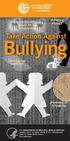 switching seats in the classroom stealing money Take Action Against Bullying spreading rumors pushing & tripping U.S. DEPARTMENT OF HEALTH & HUMAN SERVICES Substance Abuse and Mental Health Services Administration
What Is the Olweus Bullying Prevention Program?
 Dear Parent/Guardians, Your child s school will be using the Olweus Bullying Prevention Program. This research-based program reduces bullying in schools. It also helps to make school a safer, more positive
Infusion of School Bullying Prevention Into Guidance Curriculum. Significance of Bullying Prevention Program
 Infusion of School Bullying Prevention Into Guidance Curriculum October, 29, 2007 Charleston, SC Insoo Oh, Ph.D. Assistant Professor University of South Carolina Significance of Bullying Prevention Program
Bullying Prevention and Intervention:
 Bullying Prevention and Intervention: A Guide for the Individualized Education Program (IEP) Team Dr. Carol R. Johnson Superintendent Boston Public Schools 26 Court St. Boston, MA 02108-2528 www.bostonpublicschools.org
Bullying. Introduction
 Bullying 1 Introduction In recent years, bullying has become a topic of greater public concern. Research has shown the damaging long-term effects that bullying behavior can have on its victims. Approximately
Preventing Bullying and Harassment of Targeted Group Students. COSA August 2013 John Lenssen
 Preventing Bullying and Harassment of Targeted Group Students COSA August 2013 John Lenssen Definition Bullying is unfair and one-sided. It happens when someone keeps hurting, frightening, threatening,
Behavior-Management Techniques for Safe Schools
 Behavior-Management Techniques for Safe Schools Each new school year brings high hopes, great expectations and challenges for both new and seasoned educators. Th e American Federation of Teachers (AFT)
Toronto District School Board
 Toronto District School Board Title: GENDER-BASED VIOLENCE Policy P071 Adopted: April 14, 2010 Revised: Review: 1.0 OBJECTIVE To establish the Board s commitment to eliminating gender-based violence in
Bullying: A Systemic Approach to Bullying Prevention and Intervention
 Bullying: A Systemic Approach to Bullying Prevention and Intervention Session 3 Educators and Teachers icare.ebrschools.org An Alcohol, An Alcohol, Drug Abuse Drug Abuse and Violence and Violence Prevention
Cyber-bullying is covered by this policy: all members of the community need to be aware that
 DUKE OF KENT SCHOOL A8 ANTI-BULLYING POLICY Aims and Objectives: Duke of Kent School values every individual in the community and believes each deserves to be treated with respect. Sensitivity to the feelings
Learners with Emotional or Behavioral Disorders
 Learners with Emotional or Behavioral Disorders S H A N A M. H A T Z O P O U L O S G E O R G E W A S H I N G T O N U N I V E R S I T Y S P E D 2 0 1 S U M M E R 2 0 1 0 Overview of Emotional and Behavioral
Drug Abuse Prevention Training FTS 2011
 Drug Abuse Prevention Training FTS 2011 Principles of Prevention Prevention programs should enhance protective factors and reverse or reduce risk factors (Hawkins et al. 2002). The risk of becoming a drug
Young Men s Work Stopping Violence & Building Community A Multi-Session Curriculum for Young Men, Ages 14 19 From HAZELDEN
 Young Men s Work Stopping Violence & Building Community A Multi-Session Curriculum for Young Men, Ages 14 19 From HAZELDEN What is Young Men s Work? Young Men s Work: Stopping Violence and Building Community
FAQs: Bullying in schools
 FAQs: Bullying in schools FAQs: Bullying in schools answers frequently asked questions about bullying, provides useful advice to parents and students about dealing with bullying, and summarises contemporary
Bullying Prevention. When Your Child Is the Victim, the Bully, or the Bystander
 Bullying Prevention When Your Child Is the Victim, the Bully, or the Bystander What Is Bullying? Bullying is not a conflict or a fight. Bullying is physical, verbal, or emotional abuse that is deliberate,
Facts for Teens: Bullying
 P.O. Box 6003 Rockville, MD 20849-6003 [email protected] www.safeyouth.org Facts for Teens: Bullying Introduction In the United States, bullying among children and teenagers has often been dismissed
A Guide for Parents. of Elementary and Secondary School Students
 A Guide for Parents of Elementary and Secondary School Students The effects of bullying go beyond the school yard. As a parent, here s what to watch for, what you can do, and where you can go to get help.
Landmark School Bullying Prevention & Intervention Plan
 I. Introduction Landmark School Bullying Prevention & Intervention Plan Landmark School believes that a healthy environment depends upon every student's trust in the safety and integrity of the community.
Cyber Bullying: A Prevention Curriculum for Grades 6-12 Scope and Sequence
 Cyber Bullying: A Prevention Curriculum for Grades 6-12 Scope and Sequence Cyber Bullying: A Prevention Curriculum for Grades 6-12 What is Cyber Bullying: A Prevention Curriculum for Grades 6-12? Cyber
EFFECTIVENESS OF TREATMENT FOR VIOLENT JUVENILE DELINQUENTS
 EFFECTIVENESS OF TREATMENT FOR VIOLENT JUVENILE DELINQUENTS THE PROBLEM Traditionally, the philosophy of juvenile courts has emphasized treatment and rehabilitation of young offenders. In recent years,
Standards for the School Social Worker [23.140]
![Standards for the School Social Worker [23.140]](/thumbs/40/21507228.jpg "Standards for the School Social Worker [23.140]") Standards for the School Social Worker [23.140] STANDARD 1 - Content The competent school social worker understands the theories and skills needed to provide individual, group, and family counseling; crisis
Standards for the School Social Worker [23.140] STANDARD 1 - Content The competent school social worker understands the theories and skills needed to provide individual, group, and family counseling; crisis
Handout: Risk. Predisposing factors in children include: Genetic Influences
 Handout: Risk The more risk factors to which a child is exposed the greater their vulnerability to mental health problems. Risk does not cause mental health problems but it is cumulative and does predispose
Insecure Attachment and Reactive Attachment Disorder
 Attachment Disorders Insecure Attachment and Reactive Attachment Disorder When infants and young children have a loving caregiver consistently responding to their needs, they build a secure attachment.
Impacting the Brain of the Traumatized Child Dave Ziegler, PhD
 Impacting the Brain of the Traumatized Child Dave Ziegler, PhD There is now sufficient information available from research on brain development and brain functioning, as well as the effects of trauma,
THE EFFECTS OF FAMILY VIOLENCE ON CHILDREN. Where Does It Hurt?
 THE EFFECTS OF FAMILY VIOLENCE ON CHILDREN Where Does It Hurt? Child Abuse Hurts Us All Every child has the right to be nurtured and to be safe. According to: Family Violence in Canada: A Statistical Profile
POLICY 5111 ANTI-BULLYING/HARASSMENT/HATE
 POLICY 5111 Purpose/Introduction: The Kenosha Unified School District strives to provide a safe, secure and respectful learning environment for all students in school buildings, on school grounds, in school
Cyberbullying. How common is cyberbullying?
 Cyberbullying Bullying is aggressive behavior that is intentional and involves an imbalance of power or strength. Usually, it is repeated over time. Traditionally, bullying has involved actions such as:
LEVEL I SCREENING Step 1: Make Sure All Students / Staff Are Safe
 STUDENT THREAT ASSESSMENT AND MANAGEMENT SYSTEM Level I Screening Protocol This protocol is to be used by staff who have been trained through Level I Screening In-service. The results of this survey do
HIGH SCHOOL FOR RECORDING ARTS
 Adopted Revised High School for Recording Arts Bullying Prohibition Policy 1. Purpose Students have the right to be safe and free from threatening situations on school property and at school activities
Facts for Teens: Youth Violence
 P.O. Box 6003 Rockville, MD 20849-6003 [email protected] www.safeyouth.org Facts for Teens: Youth Violence Introduction Many teenagers are concerned about youth violence, and with good reason. Each
NEW PERSPECTIVES ON BULLYING PREVENTION: WHY ARE CURRENT PROGRAMS NOT WORKING?
 NEW PERSPECTIVES ON BULLYING PREVENTION: WHY ARE CURRENT PROGRAMS NOT WORKING? Dorothy L. Espelage, Ph.D. Professor, Child Development Division; Educational Psychology [email protected] This research
OPENING ACTIVITY BALL OF STRING FLING
 NWAC Youth Violence Prevention Workshop Bullying OPENING ACTIVITY BALL OF STRING FLING Acknowledgements Recognizing and Responding to Violence against Women in Aboriginal Communities created in conjunction
Analysis of Parenting Styles and Interpersonal Relationship among Adolescents
 International Journal of Scientific and Research Publications, Volume 2, Issue 8, August 2012 1 Analysis of Parenting Styles and Interpersonal Relationship among Adolescents Dr. A.H.M. Vijaya Laxmi, Dr.
THE TRUTH ABOUT BULLIES
 THE TRUTH ABOUT BULLIES OVERVIEW: The goal of this activity is to inform and educate students about bullying. The lesson plan asks students to consider a list of statements about bullies and to decide
ACTION. What if Your Child IS the One Showing Bullying Behavior? PACER CENTER. So who does it? What is bullying? Bully versus child who bullies
 PACER CENTER ACTION INFORMATION SHEETS What if Your Child IS the One Showing Bullying Behavior? The word bullying often conjures up an image of a schoolyard scene, with a big, intimidating student towering
Treatment Planning. The Key to Effective Client Documentation. Adapted from OFMQ s 2002 provider training.
 Treatment Planning The Key to Effective Client Documentation Adapted from OFMQ s 2002 provider training. 1 Models Medical Model Diagnosis Psych Eval Problems Symptoms Psycho/Social/Behavioral Model Diagnosis
Socialization From Infancy to Old Age A. Socialization and the Self self a. Self-identity Socialization
 I. Socialization From Infancy to Old Age A. Socialization and the Self 1. Over our lives, we develop a sense of self: a perception of being a distinct personality with a distinct identity. a. Self-identity:
Bullying Prevention: Steps to Address Bullying in Schools. Getting Started
 Bullying Prevention: Steps to Address Bullying in Schools Getting Started Bullying can threaten students physical and emotional safety at school and can negatively impact their ability to learn. The best
Children / Adolescents and Young Adults
 INFORMATION SHEET Age Group: Sheet Title: Children / Adolescents and Young Adults Bullying WHAT IS BULLYING? Bullying is not always easy to define. It can be Physical, Verbal, Emotional, Racist or Sexual.
This report provides the executive summary for Indicators of School Crime and Safety: 2014.
 1 Liability Report Number: LB-10-66 Release Date: August 6, 2015 Section Title: General Information Abstract School violence not only has a direct impact on students, but also on educators, parents, and
Bullying Prevention: Building a Positive School Climate
 1 Bullying Prevention: Building a Positive School Climate By Karen Straim Associate Director, Montclair Public Schools Health and Wellness Partnership Students learn best when they feel that they belong
TAKING CONTROL OF WORKPLACE VIOLENCE
 TAKING CONTROL OF WORKPLACE VIOLENCE Second Edition A Training Program for Supervisors and Managers Participant Manual TAKING CONTROL OF WORKPLACE VIOLENCE A Training Program for Supervisors and Managers
Updated Guidance for Schools and Districts on Addressing Teen Dating Violence (2013)
 Updated Guidance for Schools and Districts on Addressing Teen Dating Violence (2013) G.L. c. 71, as amended by sections 60 and 61 of Chapter 256 of the Acts of 2010, requires public schools to include
Chapter Five Socialization. Human Development: Biology and Society. Social Isolation
 Chapter Five Socialization Socialization is the lifelong process of social interaction through which individuals acquire a self-identify and the physical, mental, and social skills needed for survival
Suicide Assessment in the Elderly Geriatric Psychiatric for the Primary Care Provider 2008
 Suicide Assessment in the Elderly Geriatric Psychiatric for the Primary Care Provider 2008 Lisa M. Brown, Ph.D. Aging and Mental Health Louis de la Parte Florida Mental Health Institute University of South
GRANGE TECHNOLOGY COLLEGE ANTI-BULLYING POLICY
 GRANGE TECHNOLOGY COLLEGE ANTI-BULLYING POLICY Approved: 4 September 2014 Review Date: Page 1 of 7 GRANGE TECHNOLOGY COLLEGE ANTI-BULLYING POLICY Introduction Schools have a duty of care for pupils and
ACADEMIC DIRECTOR: Carla Marquez-Lewis Email Contact: THE PROGRAM Career and Advanced Study Prospects Program Requirements
 Psychology (BA) ACADEMIC DIRECTOR: Carla Marquez-Lewis CUNY School of Professional Studies 101 West 31 st Street, 7 th Floor New York, NY 10001 Email Contact: Carla Marquez-Lewis, [email protected]
Overview of School Counselling
 EDPY 442: INTRODUCTION TO COUNSELLING School Counselling Guest Lecture: Dr. Carley Christianson Overview of School Counselling School counsellors are unique to their practice as they provide a wide array
Edward W. Brooke Charter School Bullying Prevention and Intervention Plan 12.14.2010
 I. LEADERSHIP & PROCESS Priority Statement Edward W. Brooke Charter School has always been and will continue to be a place where students are held to the highest behavioral standards and where we work
STANDARDS FOR GUIDANCE COUNSELING PROGRAMS
 STANDARDS FOR GUIDANCE COUNSELING PROGRAMS These standards were approved January 2005 by the Kentucky Education Professional Standards Board. The Kentucky Standards for Guidance Counselor Programs are
Eyes on Aggressive behaviours. You can help to manage them
 Eyes on Aggressive behaviours You can help to manage them Aggressive behaviours What do we know? From pregnancy to 6 months old n Children are better able to control their aggressive behaviours if their
Introduction. DuPage Anti-Bullying Task Force
 Introduction Bullying is a serious problem in homes, schools and communities. Often dismissed as an adolescent rite of passage, research clearly indicates bullying is learned behavior and detrimental to
Bullying 101: Guide for Middle and High School Students
 Bullying 101: Guide for Middle and High School Students A guide to the basics of bullying, what it is and isn t, the role of students, and tips on what you can do. 952.838.9000 PACERTeensAgainstBullying.org
8 "Bullying" Lesson Plan. 4-H-1001 Volume 1 New 1/07
 8 "Bullying" Lesson Plan 4-H-1001 Volume 1 New 1/07 2 Learning Objectives 1. Define and give characteristics of bullying. 2. Identify warning signals of bullying behavior. 3. Recognize myths commonly associated
Godley Community Primary School. Anti-Bullying Policy
 Godley Community Primary School. Anti-Bullying Policy Delivering Excellence in a Happy and Nurturing Learning Environment Bullying is action taken by one or more children with the deliberate intention
Charles Williams Church in Wales Primary School. Bullying Prevention Policy. June 2014 Review date June 2016. A Definition Of Bullying
 Charles Williams Church in Wales Primary School Bullying Prevention Policy June 2014 Review date June 2016 This Bullying Prevention Policy acknowledges the Welsh Government s Respecting Others: Anti- Bullying
Psychology Works Fact Sheet: Bullying among Children and Youth
 Psychology Works Fact Sheet: Bullying among Children and Youth What is bullying? Bullying among children and youth is defined as repeated, unwanted aggressive behaviour(s) by a youth or group of youths.
Standards for the School Counselor [23.110]
![Standards for the School Counselor [23.110]](/thumbs/25/6617639.jpg "Standards for the School Counselor [23.110]") II. STANDARDS FOR THE SCHOOL SERVICE PERSONNEL CERTIFICATE Standards for the School Counselor [23.110] STANDARD 1 - Academic Development Domain The competent school counselor understands the learning process
II. STANDARDS FOR THE SCHOOL SERVICE PERSONNEL CERTIFICATE Standards for the School Counselor [23.110] STANDARD 1 - Academic Development Domain The competent school counselor understands the learning process
Crossing. the. L ne. Sexual Harassment at School
 Crossing the L ne Sexual Harassment at School Executive Summary Executive Summary A student is groped on the way to class. Kids call a student gay and faggot and just won t quit. A demeaning sexual rumor
Hip Habits Manners for Kids Wheel and Manners for Kids Teacher Guide
 Hip Habits Manners for Kids Wheel and Manners for Kids Teacher Guide Good manners are an important key to each child s social success. Parents and teachers often desire to go beyond the basics of Please
6864 NE 14th Street, Suite 5 Ankeny, IA 50023 800.277.8145 Toll free 515.289.4567 Dsm area www.ifapa.org Website ifapa@ifapa.
 About IFAPA The Iowa Foster and Adoptive Parents Association (IFAPA) is a non profit organization serving as a resource to foster, adoptive and kinship families in Iowa. Membership with IFAPA is free for
Bullying/Harassment Policy
 STATEMENT OF POLICY Bullying/harassment are forms of abuse. Bullying/Harassment Policy Bullying/harassment breaks down the positive and protective environment we seek to develop, and, at its worst, is
How To Prevent Bullying At The Beaconsfield School
 ANTI-BULLYING POLICY 2015 Approved by the Governing Body: 25 th November 2015 Approved by the Learning & Development Committee: 21 st October 2015 Approved by Leadership Team: 8 th October 2015 Review
2015-16. July 1 Dec. 31 for HIB Trainings and Programs Sept. 1 Dec. 31 for HIB Investigations and Incidents
 Harassment, Intimidation, and Bullying Investigations, Trainings and Programs (HIB-ITP) Data Collection 2015-16 Reporting Period 1 Reporting Period 2 July 1 Dec. 31 for HIB Trainings and Programs Sept.
Practicum Educational Contract Addendum for MSW Students Pursuing School Social Work Certification Academic Year:
 Practicum Educational Contract Addendum for MSW Students Pursuing School Social Work Certification Academic Year: Student: Student UW Email: Practicum Agency: Practicum Instructor: Practicum Instructor
Change#10-2008 Shared Parenting October 2008
 1201 CHILD PLACEMENT SERVICES CHANGE # 10-2008 October 2008 XI. SHARED PARENTING The implementation of shared parenting meetings in child placement cases is one of the Multiple Response System Strategies.
Girls & Cyber- bullying
 MARC Research Results First Report March, 2010 Girls & Cyber- bullying Elizabeth K. Englander, Ph.D. Director, Massachusetts Aggression Reduction Center Bridgewater State University Bridgewater, Massachusetts
Views on gender differences in bullying in relation to language and gender role socialisation
 18 Views on gender differences in bullying in relation to language and gender role socialisation Abstract SYLVIE WIMMER* The study sought to examine society s views on gender differences in bullying in
The Making Choices Program: Social Problem- Solving Skills for Children
 The Making Choices Program: Social Problem- Solving Skills for Children Mark W. Fraser James K. Nash Maeda J. Galinsky Kathleen M. Darwin University of North Carolina School of Social Work Chapel Hill,
Conduct Disorder: Treatment Recommendations. For Vermont Youth. From the. State Interagency Team
 Conduct Disorder: Treatment Recommendations For Vermont Youth From the State Interagency Team By Bill McMains, Medical Director, Vermont DDMHS Alice Maynard, Mental Health Quality Management Chief, Vermont
Violence in the Workplace Procedures Manual 417-A
 Violence in the Workplace Procedures Manual 417-A Category: Human Resources Administered by: Appropriate Senior Administrator First Adopted: Feb 2011 Revision History: Mar 2012, Sept 2012, Jan 2016 Next
Practicum Evaluation Addendum for MSW Students Pursuing School Social Work Certification
 Practicum Evaluation Addendum for MSW Students Pursuing School Social Work Certification Academic Year: NOTE: This evaluation should be completed only ONCE, at the end of the Practicum experience. Student:
In-service training available through Netflix
 In-service training available through Netflix Instructions: Request the video from Netflix, print out and complete the worksheet for that particular movie, and return the completed worksheet to your licensor.
Master of Arts, Counseling Psychology Course Descriptions
 Master of Arts, Counseling Psychology Course Descriptions Advanced Theories of Counseling & Intervention (3 credits) This course addresses the theoretical approaches used in counseling, therapy and intervention.
Grade 4. Unit #1: Bullying Prevention What is Bullying? Total Lesson Time: 30 minutes per day, 5 days
 Grade 4 Unit #1: Bullying Prevention What is Bullying? Unit #1 Total Lesson Time: 30 minutes per day, 5 days Skills: 1. Solve problems 2. Develop interpersonal skills 3. Think creatively 4. Communicate
School Bullying Survey
 School Bullying Survey This survey is not required for your class. If you choose not to complete this survey, your grade in the class will not be affected in any way. If this is your decision, just leave
National Clearinghouse on Family Violence Publication
 National Clearinghouse on Family Violence Publication Adult Survivors of Child Sexual Abuse - Overview Paper What is Child Sexual Abuse? Although there are many descriptions of childhood sexual abuse,
Psychology and Criminal Justice in the School of Natural & Social Sciences at Wayne State College in Wayne, Nebraska.
 Bullying Victims: The Effects Last Into College Authors Frank D. Adams, Ed.D., is a Professor for the Department of Counseling and Special Education in the School of Education and Counseling at Wayne State
Bullying and the. School Counselor's Role in Interventions. Kendra R. Pagel
 1 Bullying and the School Counselor's Role in Interventions by Kendra R. Pagel A Research Paper Submitted in Partial Fulfillment of the Requirements for the Master of Science egree III School Counseling
GENDER BASED VIOLENCE AT THE WORKPLACE
 GENDER BASED VIOLENCE AT THE WORKPLACE By MILIMO KAPOMBE UNIVERSITY OF ZAMBIA AND ALLIED WORKERS UNION (UNZAAWU) INTRODUCTION Greetings to everyone who have made it to AFRECON 2015 in Botswana. My names
Development Through the Lifespan. Psychosocial Stages During Infancy and Toddlerhood. First Appearance of Basic Emotions
 Development Through the Lifespan Chapter 6 Emotional and Social Development in Infancy and Toddlerhood This multimedia product and its contents are protected under copyright law. The following are prohibited
Key Points. SNAPSHOT The impact of domestic violence on children. www.benevolent.org.au. Domestic violence and children
 Social issues SNAPSHOT The impact of domestic violence on children Key Points Domestic violence and children Children, especially babies and young children, affected by domestic violence experience significant
Understanding 5 High Conflict Personality Disorders
 Understanding 5 High Conflict Personality Disorders Bill Eddy, LCSW, Esq. Attorney, Mediator, Therapist, Author Family Law Institute March 19, 2013 - Minneapolis Copyright 2013 High Conflict Institute
Burlington Public Schools. Bullying Prevention and Intervention Plan
 Burlington Public Schools Bullying Prevention and Intervention Plan The Burlington Public Schools adopted the Department of Elementary and Secondary Education s (Department) Model Bullying Prevention and
HEAD START PERFORMANCE STANDARDS W/ MENTAL HEALTH FOCUS
 HEAD START PERFORMANCE STANDARDS W/ MENTAL HEALTH FOCUS This list represents a variety of Head Start Performance Standards that include some aspect of mental health; however, it is not exhaustive of every
FAST FACTS. 100 TO 140 MILLION girls and women in the world have experienced female genital mutilation/ cutting.
 603 MILLION women live in countries where domestic violence is not yet considered a crime. Women and girls make up 80% of the estimated 800,000 people trafficked across national borders annually, with
Adolescent Pregnancy and Parenting
 1 2 3 4 5 6 7 8 9 10 11 12 13 14 15 Adolescent Pregnancy and Parenting Policy Hearing Panel Second Round Revision BACKGROUND The social work profession is in a distinctive position to respond to the issues
THE HALL SCHOOL Whole School Anti-Bullying Policy
 THE HALL SCHOOL Whole School Anti-Bullying Policy AUTHOR: Paul Chapman Policy ratified by: SLT Date of publication: September 2015 Date of next review: September 2016 Governor responsible for policy: Patrick
GROWTH AND DEVELOPMENT
 GROWTH AND DEVELOPMENT January 2008 Page 1 GROWTH AND DEVELOPMENT Having a positive and effective relationship with your players is necessary to ensure that they receive the most out of their hockey participation.
Mentoring Resource Center
 U.S. Department of Education Offi ce of Safe and Drug-Free Schools Mentoring Resource Center Case Studies in Youth Mentoring Bullying Prevention and Intervention TeamMates Mentoring Program Lincoln Public
THE ABSENT MOTHER. The Psychological and Emotional Consequences of Childhood Abandonment and Neglect. Dr. Judith Arndell Clinical Psychologist
 THE ABSENT MOTHER. The Psychological and Emotional Consequences of Childhood Abandonment and Neglect Dr. Judith Arndell Clinical Psychologist The Psychological Parent The object of the child s deepest
Anti-Bullying Policy. Page 1 of 6
 Anti-Bullying Policy Date of Last Review: May 2016 Reviewed by: Mr R Beattie Agreed by Governors: Frequency of Review: Annually Date of Next Review: May 2017 Page 1 of 6 Statement of Intent 1 We are committed