
Duty-Free Shop Operators Guide 2014
|
|
|
- Gertrude Ford
- 9 years ago
- Views:
Transcription
1 Duty-Free Shop Operators Guide 2014 May 2014
2 The Duty Free Operator s Guide is to assist Customs licensed Duty Free Shops. The Guide is correct and accurate as of the date of publication. Duty Free Shop Operator s should check the Customs and Border Protection website for any updates at If you have any suggestions, queries or requests for revisions, please send them via to [email protected]. 2

3 Contents 1. Introduction 5 2. Duty free shop permissions Application for a duty free permission Grant of a duty free permission 6 3. Relevant travellers What is a relevant traveller? Responsibility to inform relevant travellers Responsibility of relevant travellers Travellers intending to depart australia Cancelled off-airport duty free sales of non-export of goods Liquids, aerosols and gels (LAGs) 8 4. Duty free shop responsibilities and obligations Information for all types of duty free shops Activities allowed in duty free shops Recording systems Stocktakes Customs and Border Protection Compliance Assurance Activities Inwards duty free shops General information / obligations Inwards duty free allowance Airline crew duty free allowance Responsibility to inform travellers of concessions Goods that may be sold at an inwards duty free shop Signage at inwards duty free shops Pre-travel purchase of duty free goods from inwards duty free shops Sales to transit passengers Travel documents Inwards duty free sales invoices / dockets On-airport outwards duty free shops General information / obligations Travel documents On-airport outwards duty free sales invoices / dockets 17 3

4 4.4. On-airport inwards / outwards duty free shops Off-airport outwards duty free shops General information / obligations Proof of export Travel documents Sales to travellers departing on cargo ships and other non-cruise ships Sales to travellers departing on yachts and small craft Sales to coastal travellers Sales to travellers of journeys to nowhere Electronic sales Off-airport outwards duty free sales invoices Sealed bag system Missed docket returns Calculation of revenue, offsetting and remissions Calculation of customs duty, gst and wet Offsetting arrangements Remission of duty 30 Attachment 1 - Traveller statements 31 Attachment 2 - Message to be printed on sealed bags 33 Attachment 3 - Example of offsetting 34 Attachment 4 - Glossary of terms 35 Attachment 5 - Relevant legislation and regulations 38 Customs Act Customs Regulations

5 1. Introduction A warehouse licensed under Section 79 of the Customs Act 1901 (the Act) may obtain permission from the Australian Customs and Border Protection Service (Customs and Border Protection) to make duty free sales. A duty free permission allows duty free shops to store and display imported goods on which Customs duty has not been paid, and to operate at the retail level, selling goods free of Customs duty to relevant international travellers under special conditions. Relevant legislation also enables the selling of goods free of Goods and Services Tax (GST) and, where applicable, Wine Equalisation Tax (WET). There are four types of duty free shops, which are determined by reference to their location and whether they are selling to departing or arriving travellers. They are: on-airport inwards duty free stores on-airport outwards duty free stores on-airport inwards/outwards duty free stores, and off-airport outwards duty free stores. It is important to note that the Australian Taxation Office (ATO) grants an excise licence and permission to sell goods free of excise duty under the Excise Act Duty free shops that sell excisable goods are also required to register with the ATO as an excise client. Further information is available at This guide should be read in conjunction with the duty free shop s warehouse licence, duty free permission, the Act and the Customs Regulations 1926 (the Regulations). 2. Duty Free Shop Permissions 2.1. Application for a Duty Free Permission Subregulations 93(4) and 95(4) of the Regulations require a person to make an Application for Permission, under subsections 96A(2) and 96B(3) of the Act, in writing, for a single duty free shop and to specify: the name of the proprietor of the duty free shop the name of the duty free shop, and the physical address of the duty free shop. The person should lodge the application with the Licensing section of Customs Branch within Customs and Border Protection. Further information is available on Customs and Border Protection s website 5

6 2.2. Grant of a Duty Free Permission In accordance with subregulation 93(5) of the Regulations, when deciding whether an outwards duty free shop permission will be issued, Customs and Border Protection will take into account whether the applicant is likely to be able to comply with the conditions set out in paragraphs 93(7)(g), (h) and (j). In summary, this includes the following, that the proprietor shall: before the date of departure of the relevant traveller, provide Customs and Border Protection with information in relation to sale of duty free goods for export. the duty free goods to be examined and obtain evidence of the presentation of those goods. This is generally done by an agent of the duty free shop being situated at a designated export point at the place of departure. In accordance with subregulation 95(5) of the Regulations, when deciding whether an inwards duty free shop permission will be issued, Customs and Border Protection will take into account whether the applicant has been granted a lease to operate an inwards duty free shop on land within the airport. Customs and Border Protection is not limited to consideration of only the above few matters in the granting permission and may take into account any matter considered pertinent to the protection of the revenue or to ensure compliance with the Customs Acts or any other Commonwealth or State or Territory legislation prescribed by the Regulations. 3. Relevant Travellers 3.1. What is a Relevant Traveller? Under section 96A of the Act (outwards duty free) - relevant traveller means a person: (a) (b) who intends to make an international flight, whether as a passenger on, or as a pilot or member of the crew of, an aircraft, or who intends to make an international voyage, whether as a passenger on, or as the master or a member of the crew of, a ship. Under section 96B of the Act (inwards duty free) relevant traveller means a person who: (a) (b) has arrived in Australia on an international flight, whether as a passenger on, or as the pilot or a member of the crew of, an aircraft, and has not been questioned, for the purposes of the Act, by an officer of Customs in respect of goods carried on that flight. In simple terms, this means that an arriving person is a relevant traveller up until they have cleared through the Entry Control Point. Once a passenger or crew member has passed this point, they are no longer a relevant traveller. 6
7 3.2. Responsibility to Inform Relevant Travellers A duty free shop is responsible for ensuring that relevant travellers are aware of the conditions with which they must comply. At the time of buying duty free goods at an offairport duty free shop, a relevant traveller must sign a statement, on an approved form, confirming that they are aware of their obligations concerning the exportation of the goods (refer to section 4.5 Off-Airport Outwards Duty Free Shops and Attachment 1 for further information). It is the responsibility of an inwards duty free shop to ensure that relevant travellers are aware of their passenger concessions and the consequences of purchasing of goods in excess of this concession (refer to section 4.2 Inwards Duty Free Shops for further information) Responsibility of Relevant Travellers Travellers intending to depart Australia A relevant traveller cannot use goods purchased duty free at an off-airport duty free shop for any purpose in Australia until past the point of departure. With the exception of goods subject to Liquids, Aerosols and Gels restrictions (refer section 3.3.3), the only goods for export by a relevant traveller that can qualify for duty free are those that can be carried on-board the international flight or voyage with the relevant traveller. After signing a declaration at an off-airport duty free shop, the relevant traveller has a responsibility to take possession of the goods in the sealed bag, keep them safe, take the goods in their sealed bags with them to the port of departure and export the goods. Where a relevant traveller purchases goods at an on-airport outwards duty free shop the relevant traveller has a responsibility to export the goods. If the relevant traveller fails to export the goods or tampers with the sealed bag they may be liable for a penalty or prosecution under the Act and the store operator will be liable for the Customs duty and taxes because the goods were not exported or they were interfered with prior to export. The payment of the Customs duty and taxes is to be included in the lodgement of the store operator s next Missed Docket Return (refer section ) Cancelled Off-Airport Duty Free Sales of Non-Export of Goods Regardless of where the relevant traveller purchases the goods, all off-airport duty free goods require exportation out of Australia. If the relevant traveller does not export the goods on the intended scheduled flight or cruise, they are to notify the operator of the duty free shop and return the goods to the store no later than close of business on the second working day of the store after the scheduled departure time. The relevant traveller must return all copies of the sales invoice along with the goods to the store to obtain a refund and to enable cancellation of the sale. The returned goods are taken back up into the store records and the goods can then be re-sold to another relevant traveller. 7

8 If the relevant traveller fails to return the goods to the duty free shop within the specified period, the legislation deems them not exported, and the duty free store must include the payment of the Customs duty and taxes in their next Missed Docket Return (refer section ). The duty free shop is liable for the revenue on goods up until the time the goods are exported. NOTE: Failure to observe these rules may result in penalties of up to $85,000 for a natural personal and $425,000 for a body corporate under section 33 or prosecution under the Act Liquids, Aerosols, Gels, Creams and Pastes (LAGs) On 31 March 2007, the Australian Government announced enhanced security measures, which limited the amount of LAGs a person could take through an international screening point. Each container was limited to a capacity of no greater than 100 millilitres and all containers were to fit comfortably in a resealable plastic bag. The bag must have been transparent, resealable and no larger than one litre (20cm x 20cm) capacity. Where items exceeded these parameters, the relevant traveller was required to surrender them at the airport security screening point for destruction. A relevant traveller was compelled to carry restricted LAGs items (bottles of spirits, wines, etc) in their checked baggage / hold luggage. Failure to comply with these arrangements resulted in the traveller having to surrender the items at the security screening point. For duty free LAGs purchased at an off-airport outwards duty free shop, the traveller removed the sales invoice from the sealed bag before placing the items in their hold luggage. The traveller then presented the duty free LAGs sales invoice to the authorised collection agent at the point of departure (refer section 4.5.2). On 30 April 2014, the Australian Government introduced security screening of LAG items at certain international airports (Adelaide, Brisbane, Cairns, Darwin, Gold Coast, Melbourne, Perth and Sydney). Relevant travellers may be allowed to carry LAG items purchased at an off-airport outwards duty free shop in the aircraft cabin. Relevant travellers are able to submit their LAG items purchased at an off-airport duty free shop, including LAG items in a container that is greater than 100 millilitres, for screening by technology capable of detecting liquid explosives, provided the items are contained in the sealed bag provided at the time of purchase, with the sales invoice attached. Relevant travellers continue to have the option of packing their LAG items purchased at an off-airport duty free shop into their hold luggage, and giving the sales invoice to the authorised collection agent of the off-airport duty free shop, as per existing procedures. If a LAG item purchased at an off-airport duty free shop is cleared by the screening technology, the relevant traveller can carry the item on an international flight as cabin baggage. If a LAG item cannot be cleared by the technology, the relevant traveller will be asked to surrender it for disposal, and the sales invoice will be given to the authorised collection agent of the off-airport duty free shop. If a relevant traveller does not wish to submit their LAG items purchased at an off-airport duty free shop for screening, the items can be placed in their hold luggage, and the sales invoice given to the authorised collection agent of the off-airport duty free shop, as per existing procedures. 8

9 Off-airport duty free shop operators are still required to place LAG items in sealed bags with accompanying proof of purchase in order for the items to be eligible to undergo security screening and to comply with the legislative requirements for making duty-free sales. To assist with the screening process, LAG and non-lag items should be packed in separate sealed bags. Further information is available at the Department of Infrastructure and Regional Development s website 4. Duty Free Shop Responsibilities and Obligations 4.1. Information for all types of Duty Free Shops Activities allowed in Duty Free Shops The following duty free shop activities are permissible: display of goods (not consumables) demonstration of goods (not consumables) sales to diplomatic and consular personnel, and sales to relevant travellers Display and Demonstration of Goods Duty free shops can display goods provided such display is restricted to the area defined by the Customs warehouse licence. Any damage, deterioration or theft is at the risk of the duty free shop operator. Duty free shops can demonstrate certain goods in the licensed area provided Customs and Border Protection is satisfied that the demonstration will not create an administrative problem. Duty free shops can demonstrate non-consumables (electronics etc) in the licensed area at the request of the relevant traveller. The duty free shop cannot use underbond consumable products (alcohol, tobacco, cosmetics and perfumes) for demonstration or testing purposes. The duty free shop must use duty-paid stock for demonstration of consumables. The duty free shop operator and employees are the only persons who may demonstrate the goods. The relevant traveller must request the demonstration. Demonstration of non-consumables is at the commercial risk of the licence holder. Non-consumables taken from underbond stock holdings are at the risk of the duty free shop operator should damage, deterioration or theft of the goods occur. Where goods are taken from stock, the record is to be endorsed accordingly and stock counted in stock takes. At the end of the demonstration period, the goods are not available for remission or destruction. Quantities available for demonstration are subject to reasonable tests of products available. The decision for the sample range will take into account the size and nature of the individual duty free shop operation, number of different brands of similar like goods stocked and the need for customer demonstration of different models. 9

10 No alteration of goods is permissible. A try on facility for underbond clothing apparel, for example, is an allowable demonstration of underbond goods. However, this facility is subject to the condition that no alteration of any item of clothing occur within or away from the duty free shop while the goods remain under Customs control (that is, prior to the exportation of those goods from Australia) Sales to Diplomats and Consular Personnel Duty free shops are only allowed to sell underbond goods to Embassies and Consulates providing that they have applied for and been granted a separate permission to deliver goods for home consumption without entry to diplomatic and consular personnel. Diplomatic or consular representatives may purchase duty free goods with the presentation to the duty free shop of an approved Application for Release of Goods from Customs and Border Protection Control to Diplomatic and Consular Posts and privileged individuals (Form B615). Only a person in the Customs and Border Protection ACT District Office can approve the Form B615. Australian Customs and Border Protection Service ACT District Office 5 Constitution Avenue CANBERRA ACT 2601 Phone: (02) In order to purchase goods, diplomatic or consular personnel need to have the Form B615 endorsed by Customs and Border Protection, and then present this form to the duty free shop. The Form B615 should include the following important endorsements: Title Page - Date stamp, Australian Customs and Border Protection Service, ACT District Office, Canberra Part A Quantity and full description of goods (no amendments) Part B Official stamp of mission or post, and Part C Validity date and Australian Customs and Border Protection Service, Canberra port stamp. The personnel then purchase their entitlement of goods, and the duty free shop retains the Form B615. It is also necessary to complete a return in the form of a Nature 30 import declaration ex warehouse, in respect of the goods delivered for home consumption to diplomatic or consular representatives. Manual or electronic lodgement of the import declaration should occur on the first working day following the accounting week. The duty free shops can utilise the services of a licensed Customs broker to complete the Nature 30 import declaration or they can manually complete the Nature 30 form and forward it to the ACT District Office for input into the Integrated Cargo System (ICS). To do this, the duty free shop forwards the Form B615 to the ACT District Office in Canberra, who processes the Nature 30 import declaration in the ICS and then returns a copy of it to the duty free shop along with the original of Form B615 and the Authority to Deal (ATD) for their records. The duty free shop should keep a copy of the Nature 30 for their records. 10
11 Recording Systems All Customs licensed warehouses, including duty free stores, must have a recording system sufficiently detailed to show the interconnection between the receipting of goods into a warehouse, the location of the goods and their subsequent movement and final acquittal. As a minimum, duty free licence holders should: have a computerised bond register with the appropriate security features and back-up facilities to record the movement of all underbond goods into and out of the warehouse have a perpetual stock control system that is capable of providing a precise tally of all stock in the warehouse at any time keep records relating to the purchase, receipt and sale of any underbond goods moving into or out of the warehouse keep such records as are required and approved by Customs and Border Protection keep records current and ensure they are available to Customs and Border Protection when requested, and conduct a full stock take of underbond goods at least once per year (refer section 4.1.3). A duty free shop must retain all documents relating to the duty free shop or movement of goods into or out of the duty free shop for a period of five years Stocktakes Duty free shop operators must conduct a stock take at least once per financial year. A return for any stock shortages and payment of required revenue must be made and submitted to: Customs and Border Protection if the payment is for duty, GST and WET, and the ATO if payment is for excise. Refer to section 5.1 Calculation of Customs Duty, GST and WET and section 5.2 Offsetting Customs and Border Protection Compliance Assurance Activities Warehoused goods held in a duty free shop are subject to the control of Customs and Border Protection. The duty free shop must maintain physical and documentary control over such goods. Customs and Border Protection is responsible for ensuring that these controls are sufficient to protect the revenue. Taking a risk based approach, Customs and Border Protection fulfils this obligation by conducting analysis of returns, monitoring of purchases from suppliers, audits of operator records, reviews of self-assessed liability and other activities such as stock takes. 11

12 4.2. Inwards Duty Free Shops General Information / Obligations Customs and Border Protection permits inwards duty free shops to sell goods duty and GST/WET free to relevant travellers arriving in Australia on international flights. Relevant travellers arriving at international airports in Australia will only find inwards duty free shops between disembarkation and the Entry Control Point. Domestic travellers who travel between Australian ports on an international aircraft are not relevant travellers and cannot be sold duty free goods. Legislation does not require duty free goods sold at inwards duty free shops to be in sealed bags Inwards Duty Free Allowance Relevant travellers arriving in Australia are permitted AUD$900 worth of goods (or AUD$450 for persons under 18) duty free such as gifts, souvenirs, cameras, electronic equipment, leather goods, perfume concentrates, jewellery, watches and sporting equipment. Alcohol and tobacco products are not included in this allowance. These goods may be: obtained overseas purchased in Australia duty free and/or GST/ WET free prior to departure goods for which a GST/WET refund has been received/approved through the Tourist Refund Scheme, or purchased from an inwards duty free store on arrival. Family members may pool their duty free concessions if they are travelling together on the same ship or aircraft. Important information for tour groups: Tour leaders cannot purchase items on behalf of tour group members. Each traveller must present in person at the duty free store and make an individual purchase. Bulk group sales are prohibited. Alcoholic Beverages The duty free concession for relevant travellers aged 18 years or over is 2.25 litres of alcoholic beverages. Tobacco The duty free concession is 50 cigarettes or 50 grams of cigars or tobacco products for relevant travellers aged 18 years or over, all tobacco products in accompanied baggage are included in this category. 12

13 Airline and Sea Crew Duty Free Allowance Airline and sea crew members arriving in Australia permitted AUD$450 worth of goods duty free, such as: gifts, souvenirs, cameras, electronic equipment, leather goods, perfume concentrates, jewellery, watches and sporting equipment. Alcohol and tobacco products are not included in this allowance. These goods may be: obtained overseas purchased in Australia duty free and/or GST/ WET free prior to departure goods for which a GST/WET refund has been received/approved through the Tourist Refund Scheme, or purchased from an inwards duty free store on arrival litres of alcoholic beverage per person 18 years or older, and 50 cigarettes or 50 grams of cigars or tobacco products for each person aged 18 years or older Responsibility to inform travellers of concessions It is the responsibility of the inwards duty free shop operator to ensure that relevant travellers are aware of their passenger concessions and the consequences of purchasing goods in excess of this concession (refer section Signage). If a relevant traveller exceeds Australia s duty free limits and does not declare the excess goods to Customs and Border Protection, the relevant traveller will be liable for Customs duty and GST and indirect taxes as appropriate on all items of that type, not just the items that exceed those limits. The relevant traveller may also be subject to other sanctions including pecuniary penalties. If a relevant traveller exceeds Australia s duty free limits and does declare the excess goods to Customs and Border Protection, the relevant traveller will be able to keep the concession amount and forfeit the excess, or the relevant traveller can elect to pay the Customs duty, GST and indirect taxes to keep the goods Goods that may be sold at an inwards duty free shop Inwards duty free stores can sell the following range of products subject to Regulation 94: alcoholic beverages (in sealed containers) tobacco products, and goods that have all of the following characteristics no more than $900 in value no more than 7 kg in weight, and no more than 56 cm in length, 36 cm in height and 23 cm in depth. 13

14 However, the following products cannot be sold: alcoholic beverages that are not in sealed containers food and beverages which are capable of immediate consumption, other than commercially produced confectionery in sealed packaging and alcoholic beverages in sealed containers fresh or dried fruits fresh or dried vegetables live plants, and fresh or dried cut flowers Signage at Inwards Duty Free Shops At the time of each sale of confectionary, Inwards Duty Free Shops should provide the purchases with the information below. The Shops should also openly display the information at their premise for perusal by travellers: The confectionery you have purchased from this outlet has been approved for entry to Australia by Quarantine and does not need to be declared on your incoming passenger card. However, please remember you must declare any other items of food or anything else, which you can eat, which you have purchased before arriving in Australia. The store must display signs at all entrances and cash points that states: Attention International In-Bound Transit Passengers or Arriving International Passengers Passenger Allowances 1. AUD$900 worth of general goods that includes gifts, souvenirs, cameras, electronic equipment, leather goods, jewellery, watches, sporting goods and perfume concentrate litres of alcoholic beverages for adult travellers 18 years or over (fifty) grams of cigars or tobacco products or 50 (fifty) cigarettes for adult travellers 18 years or older. Children under 18 years of age are only entitled to AUD$450 of general goods. There are no provisions for alcohol or tobacco sales to minors. A family on return to Australia can combine their individual allowances. For example a family of 4 (two adults and two children under 18) are entitled to: AUD$2700 worth of general goods litres of Alcoholic beverages cigarettes or 100 grams of cigar or tobacco product. The minimum size of each sign is to be A4 or equivalent. 14

15 Pre-Travel Purchase of Duty Free Goods from Inwards Duty Free Shops Some on-airport inwards duty free shops offer relevant travellers the facility of entering into an agreement to sell goods to a relevant traveller prior to their departure from Australia and allows the collection of those goods upon their arrival into Australia prior to the Entry Control Point. Duty free legislation requires that the sale must take place in the store. The on-airport inwards duty free shop must include a condition in their pre-purchase order forms that states that transfer of ownership or title of the goods will only take place upon delivery of the goods to the relevant traveller in the store on their arrival in Australia. These sales may occur via the internet, by telephone or facsimile where the duty free shop offers these facilities, as long as the duty free shop and relevant traveller conform to the condition outlined above. The duty free shop must also inform the relevant travellers of concessional limits that apply to the entry of alcohol and tobacco products and any other conditions with which relevant travellers must comply. Travellers who pre-purchase goods from a duty free shop at their intended port of arrival and are not able to access those goods due to exceptional circumstances, can obtain their purchases at the Australian airport nominated in their order form after they have cleared the Entry Control Point. The exceptional circumstances that may lead to the traveller not being able to access their goods include the following: re-direction of an international flight resulting in the traveller clearing through an Entry Control Point at an alternate airport, and last minute traveller-initiated itinerary changes resulting in the traveller arriving at an alternate airport. When a traveller requests access to their pre-purchased goods once they have cleared through the Entry Control Point, it is the responsibility of the traveller to arrange for the collection of their goods from the relevant duty free shop. The traveller must also provide evidence to Customs and Border Protection that they would have been eligible to receive the goods had the exceptional circumstances not arisen. If Customs and Border Protection are satisfied that the traveller would have been eligible to receive the pre-purchased duty free goods, then the duty free shop can release the goods to the traveller. Limited possibilities for gaining access to pre-purchased duty free goods may exist in cases where travellers have forgotten to collect their duty free goods or where they were not able to locate the duty free pick-up point before clearing the Entry Control Point. It is the traveller s responsibility to inform Customs and Border Protection officers as soon as practicable. The Customs and Border Protection Duty Manager will assess each instance on its merit before making a decision regarding the release of duty free goods to the traveller. In all cases where Customs and Border Protection approves the release of duty free goods to the traveller after the Entry Control Point, an employee of the duty free shop will be required to release the goods to the traveller. Refer to section for further information. 15
16 Sales to Transit Passengers Subject to LAGs restrictions (refer section 3.3.3), on-airport inwards duty free shops may sell goods duty free to relevant travellers who are in transit and who will be proceeding through an outwards control point at an Australian airport other than the one in which the store is located. When making sales to transit passengers the duty free shop operator must prepare a sales docket specifying the following particulars: arriving flight number date and time of arrival quantity, type and value of goods, and an endorsement that the purchaser is a relevant traveller in transit. Any LAGs related duty free goods a transit passenger brings with them from their country of origin and/or last port, which may or may not have been purchased in a sterile area, must be surrendered at the security screening point. Additionally, any LAGs related duty free purchases made in a non-sterile area while transiting in Australia must be surrendered at the security screening point Travel Documents The Regulations state that goods shall not be sold unless the intending relevant traveller first produces a ticket, or other approved travel document, to the inwards duty free shop as evidence of travel. For this purpose, approved categories of travel documents are: Service Personnel Crew VIP Flights and Government Agencies. General public Travel or movement orders issued by the relevant service. Airline or shipping company identification and documentation to prove that they are travelling overseas (e.g. official rosters, itinerary or sailing orders). Evidence of travel issued by a government authority, e.g. letter of authority issued by Prime Minister s Department to members of the press. An overseas ticket or boarding pass and valid passport Inwards duty free sales invoices / dockets At the time of sale, the inwards duty free shop is required to prepare a sales invoice specifying: the flight or other designation of the proposed international trip the date and time of arrival, and a description of the goods including the sales value of each item. 16

17 4.3. On-Airport Outwards Duty Free Shops General Information / Obligations On-airport outwards duty free shops can sell goods duty and GST / WET free to relevant travellers leaving Australia. These stores are located airside at international airports. Domestic travellers who travel between Australian ports on an international aircraft are not relevant travellers and cannot be sold duty free goods. There is no requirement for duty free goods sold at on-airport duty free shops to be in sealed bags Travel Documents The Regulations state that goods shall not be sold unless the intending relevant traveller first produces a ticket, or other approved travel document, to the on-airport outwards duty free store as evidence of intending travel. For this purpose, approved categories of travel documents are: Service Personnel Crew VIP Flights and Government Agencies. General public Travel or movement orders issued by the relevant service. Airline or shipping company identification and documentation to prove that they are travelling overseas (e.g. official rosters, itinerary or sailing orders). Evidence of travel issued by a government authority, e.g. letter of authority issued by Prime Minister s Department to members of the press. An overseas ticket or boarding pass and valid passport On-airport outwards duty free sales invoices / dockets At the time of sale, the on-airport outwards duty free store is required to prepare a sales invoice. The invoice is to be prepared in duplicate, is to be one of a series of sequentially numbered invoices and is to specify: the flight or other designation of the proposed international trip the date of departure a precise description of the goods including the total sales value of those items and quantities of items the quantity, in figures, of each item, and the sale value, in figures, of each such item or quantity of items. The sales invoice is to be prepared in such a way as to make it impracticable to add other items to the description. Upon preparing the relevant sales invoice, one copy is to be with the goods that are to be delivered to the relevant traveller and the other copy retained as part of the on-airport outwards duty free shop s records. 17

18 4.4. On-Airport Inwards / Outwards Duty Free Shops On-airport inwards / outwards duty free shops can sell goods to relevant travellers both arriving in, and departing from Australia on international flights. Customs and Border Protection permits these types of duty free shops to operate where the layout of the international airport would allow such activities to take place without unduly interrupting passenger flow and the effective operation of border agencies Off-Airport Outwards Duty Free Shops General Information / Obligations Relevant travellers can purchase duty free goods from these shops no earlier than 60 days before departing Australia. The goods and a copy of the sales invoice are placed in tamperproof sealed bags and the retailer attaches a copy of the sales invoice to the outside of the bag. Relevant travellers must sign a declaration indicating their intention to take the goods overseas (refer Attachment 1). They must not tamper with the sealed bag and must present the goods for inspection by authorised collection agents when leaving Australia. For duty free LAGs, relevant travellers: departing from certain international airports (Adelaide, Brisbane, Cairns, Darwin, Gold Coast, Melbourne, Perth and Sydney), may be allowed to carry their LAGs in the aircraft cabin. The travellers are able to submit the LAGs for screening, provided the LAGs are contained in the sealed bag provided at the time of purchase, with the sales invoice attached. Alternatively, travellers have the option of packing their LAGs into their hold luggage. departing from other international airports are required to pack their LAGs into their hold luggage. Before packing duty free LAGs into hold luggage, relevant travellers must remove the sales invoice from the sealed bag. The traveller must present the LAGs sales invoice to the authorised collection agent. The collection agents are stationed near the Outward Control Point and check the sealed bag to ensure it contains the goods as stated on the sales invoice (with the exception of those LAGs which are placed in the traveller s hold luggage). The sales invoice is removed from the outside of the bag by the collection agent and later used to acquit the duty free store s records for that sale (refer Attachment 2 for wording that is required to be printed on the bag). It is important to note that these agents are not usually present at cruise ship terminals. The Act provides for severe penalties if a person interferes with sealed bags or does not export the goods. Where a duty free shop makes duty free sales to relevant travellers and crew on non-cruise ships or small craft, the duty free shop must deliver the goods to the traveller but to the vessel no earlier than 24 hours prior to the departure of the vessel (see below). 18

19 Proof of Export Travellers departing by air or by cruise ships Off-airport duty free shops are required to ensure that they retrieve sales invoices from the sealed bags near the Outwards Control Point. As stated in section 2.2, a duty free operator must provide Customs and Border Protection with evidence of arrangements for plucking dockets and maintaining electronic records of the retrieved dockets. Unless suitable arrangements are in place, Customs and Border Protection will not grant the licence and the duty free permission. The duty free shop must provide proof of export in the following manner: an electronic record must be made of the invoice numbers of all retrieved (plucked) invoices/sales dockets, and the electronic records must be created within 10 working days after the date of departure of the relevant traveller. Travellers departing by non-cruise ships and small craft In the case of duty free sales made to relevant travellers departing Australia by cargo ships and other types of non-cruise ships, the copy of a ship s manifest with the purchaser s name and invoice number and sales value must be stamped and signed by a ship s officer. In the case of yachts or other small vessels where there is no ship s officer, the relevant traveller may sign listing or manifest when the goods are delivered on board. Duty free shop operators may be liable for payment of duty and taxes on goods sold that are not included in invoices or manifest lists signed and stamped by a ship s officer. At the time of the sale and a minimum of two days prior to the vessels departure, all details are to be faxed to the Clearing Clerk or Compliance Assurance office in the region of departure by the operator so that Customs and Border Protection may take action to board and inspect the goods on the craft prior to departure. You can find contact information at Refer to sections and for further information. Records of Proof of Export Electronic records of retrieved invoice numbers created later than 10 working days after the date of departure of the relevant traveller do not constitute proof of export of the goods specified in the invoices and duty will be liable on such goods. Each month, duty free store operators are required to produce a computer generated listing of the invoice numbers of dockets retrieved during the month, that have a specified date of departure for the month, and for which electronic records were created within 10 days of the date of departure of the relevant traveller. The listing must be prepared within 21 working days after the end of the month in question. This listing is separate to, and should not be confused with, the return of missed dockets. 19

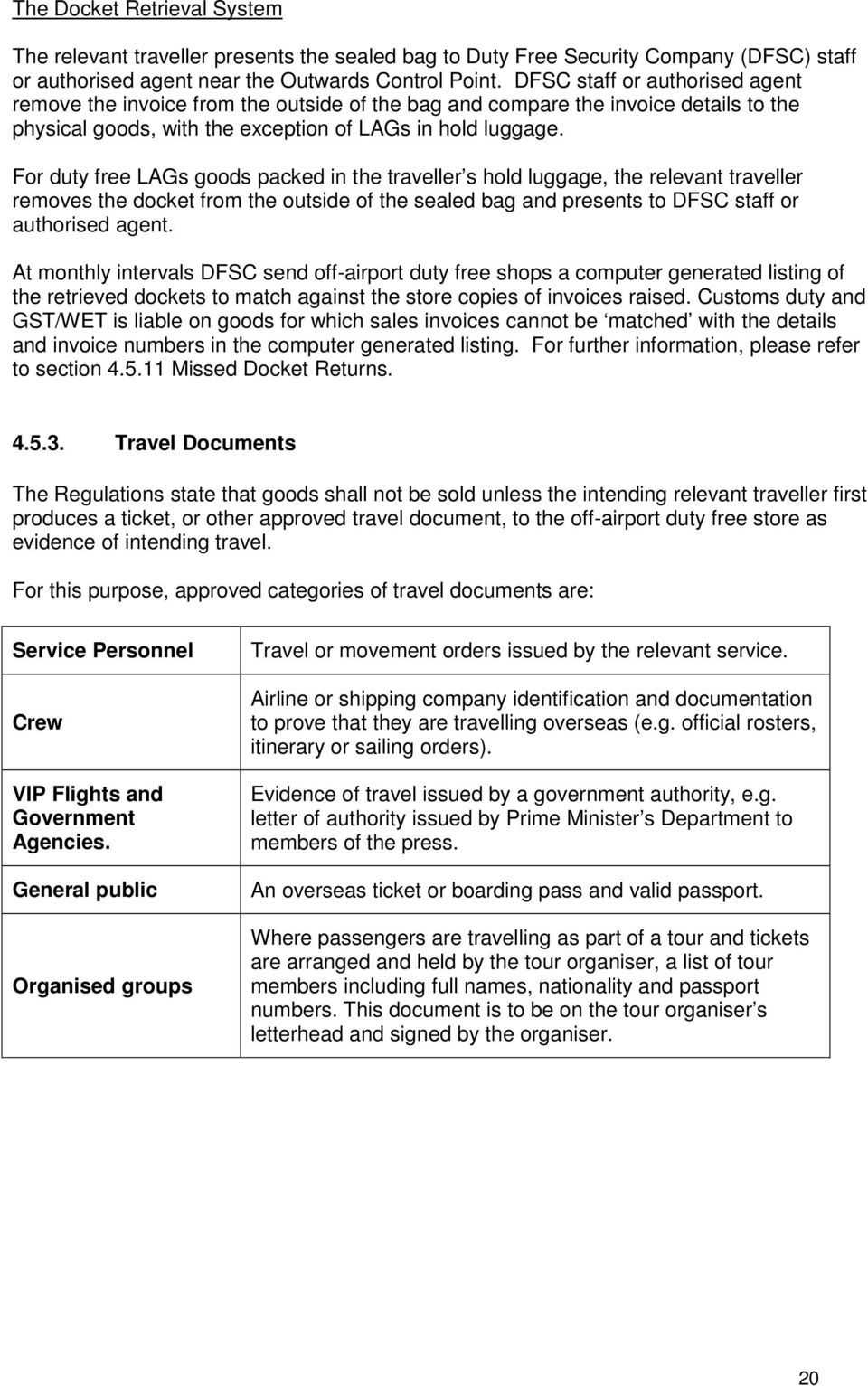
20 The Docket Retrieval System The relevant traveller presents the sealed bag to Duty Free Security Company (DFSC) staff or authorised agent near the Outwards Control Point. DFSC staff or authorised agent remove the invoice from the outside of the bag and compare the invoice details to the physical goods, with the exception of LAGs in hold luggage. For duty free LAGs goods packed in the traveller s hold luggage, the relevant traveller removes the docket from the outside of the sealed bag and presents to DFSC staff or authorised agent. At monthly intervals DFSC send off-airport duty free shops a computer generated listing of the retrieved dockets to match against the store copies of invoices raised. Customs duty and GST/WET is liable on goods for which sales invoices cannot be matched with the details and invoice numbers in the computer generated listing. For further information, please refer to section Missed Docket Returns Travel Documents The Regulations state that goods shall not be sold unless the intending relevant traveller first produces a ticket, or other approved travel document, to the off-airport duty free store as evidence of intending travel. For this purpose, approved categories of travel documents are: Service Personnel Crew VIP Flights and Government Agencies. General public Organised groups Travel or movement orders issued by the relevant service. Airline or shipping company identification and documentation to prove that they are travelling overseas (e.g. official rosters, itinerary or sailing orders). Evidence of travel issued by a government authority, e.g. letter of authority issued by Prime Minister s Department to members of the press. An overseas ticket or boarding pass and valid passport. Where passengers are travelling as part of a tour and tickets are arranged and held by the tour organiser, a list of tour members including full names, nationality and passport numbers. This document is to be on the tour organiser s letterhead and signed by the organiser. 20
21 Sales to travellers departing on cargo ships and other non-cruise ships Duty free stores can make sales to relevant travellers and crew departing on ships other than cruise ships. Relevant travellers have to produce approved documentation in support of their travel abroad. Sales to relevant travellers on cargo and other non-cruise ships must be invoiced and packaged in the same manner as sales to air and cruise ship relevant travellers. Duty free shops must not deliver goods to the relevant traveller at the time of sale. Instead, off-airport duty free store operators are required to deliver the purchases to the vessel, no earlier than 24 hours before the departure of the vessel. Refer to section for the requirements of proof of export Sales to travellers departing on yachts and small craft Duty free stores can make sales to relevant travellers that are the crew of yachts and small craft after sighting proof the customer is to depart Australia on board the particular vessel. Duty free stores should make contact with the Clearing Clerk at the regional Customs and Border Protection office to determine if the vessel is in port and has notified Customs and Border Protection of arrival and a departure date. Information required would be the relevant traveller s name, passport number, name of craft, registration number and call sign. The goods sold must be invoiced and packaged in transparent bags as is required for sales to cargo and other non-cruise ships. Similarly, the goods must not be handed to the customer but delivered by the duty free shop operator to the craft not more than 24 hours prior to departure. The goods are to be listed on a manifest and signed by the person in charge of the vessel. A copy of the signed manifest is to be retained with the store copy of the invoice as proof of export. At the time of the sale, all details are to be faxed to the Clearing Clerk or Compliance Assurance office in the region of departure by the operator so that Customs and Border Protection may take action to board and inspect the goods on the craft prior to departure. Refer to section for the requirements of proof of export Sales to coastal travellers Coastal (domestic) travellers are travellers who travel between Australian ports on an international cruise ship while it is still engaged on its international voyage. Legislation only permits sales to relevant travellers undertaking international journeys and therefore coastal travellers are not entitled to duty free benefits or concessions. 21
22 Sales to travellers of journeys to nowhere Journeys to nowhere are flights or voyages that depart from an Australian port and return to Australia without making landfall at an overseas port. Examples are flights to Antarctica (unless the relevant traveller is disembarking at the nominated destination), joy flights, fundraisers and dinner flights, and cruises that do not leave Australian waters or do not dock at an overseas port. Passengers on journeys to nowhere do not qualify for duty free purchases or duty free concessions Electronic Sales An agreement to sell duty free goods may be made to relevant travellers via the internet, facsimile, telephone or other technology. When stores advertise or offer duty free sales through use of the internet, facsimile, telephone or other technology, the advertisements should clearly stipulate that such offers are in fact agreements to sell. The agreement to sell must clearly stipulate that, where relevant travellers accept such offers through the placement of orders, the sale and transfer of title in the goods will only occur in the store. This is necessary to ensure that such sales comply with the requirements of the Act that sales must take place in the shop. The Regulations require that duty free shop operators must not enter into an agreement to sell unless it meets the following criteria: The purchaser must be a relevant traveller at the time the sale will take place. The purchaser must provide the duty free shop operator with the details required to complete the duty free sales invoice, a copy of which is attached to the goods. Details to be included on the invoice include flight or voyage details, date of departure, port of departure (for outwards duty free shops sales), flight number, name of ship or voyage number, ticket number or other authorised travel document details, etc. The details may be provided by telephone, in writing by , facsimile or other technology. For inwards duty free shop sales, the sale must take place in the shop on arrival in Australia and before the entry control point. As discussed above, this is to be achieved through conditioning the agreement to sell to reflect that the sale will be effected when the physical transfer of goods takes place in the shop. When sales occur using the internet, facsimile or telephone, the Regulations require that the duty free shop operator must not hand over the goods to the relevant traveller until the relevant traveller shows the operator his or her ticket or other travel documentation that confirms the details the relevant traveller previously provided. The store operator must also get the relevant traveller to sign the Traveller Declaration (see Attachment 1), which states the relevant traveller s obligations concerning export of the goods purchased duty free. Inwards and outwards duty free shops may enter into an agreement to sell goods through the internet, facsimile, telephone, or other technology. When operators of inwards duty free shops enter into an agreement using these mediums, they are required to inform relevant travellers of concessional limits that apply to the entry of alcohol and tobacco products and any other conditions with which relevant travellers must comply. 22
23 Off-Airport Outwards Duty Free Sales Invoices At the time of sale, the off-airport duty free shop is required to prepare a sales invoice. The invoice is to be prepared in triplicate, is to be one of a series of sequentially numbered invoices and is to specify: the name and residential address of the relevant traveller the flight or voyage number or other designation of the proposed international trip the date of departure the airport of departure precise description of the goods including the quantity in words and figures of each item of the goods, and the total number, in words, of items on the invoice and serial numbers if applicable the sale value, in figures, of each item or quantity of items the total sales values of those items and quantities of items, and passport number or crew identification. The sales invoice is to be prepared in such a way as to make it impracticable to add other items to the description. There should be no blank lines left between items on the invoice and the invoice should be ruled through immediately under the last item. Goods sold in an off-airport duty free shop are to be packed in tamper proof sealed packages (refer section ). Upon preparing the relevant sales invoice, one copy is to be placed with the goods inside the export pack, another copy is to be securely attached to the outside of the export pack in a waterproof envelope and the third copy is to be retained as part of the off-airport duty free store s record. The export package is to be transparent enough for easy identification of the goods and the sales invoice placed inside the package in a position that enables reading without opening the package Sealed Bag System The sealed bag system is a method designed for the transfer of underbond goods by a relevant traveller from an off-airport duty free shop to the departing vessel or aircraft in a tamper proof transparent bag. All sealed bags are required to have a message printed on the bag, which advises travellers of their obligations (see attachment 2). 23
24 A. Dotted line indicates where staples should be affixed. B. Non-removable seal to cover top opening. C. Non-removable seal to cover top opening. D. Non-removable seal to cover bag access at the handle slot. E. External waterproof plastic envelope stapled to carry bag containing copy of sales invoice. F. Copy of sales invoice inserted in outer plastic envelope to retrieved. G. Customer copy of sales invoice inserted inside the sealed bag so that the details of the invoice are visible (i.e. facing outwards and visible through the clear side of the bag). For sales of any Liquids, Aerosols and Gels (LAGs) greater than 100mls, these items are required to be packed in a separate sealed bag and documented on separate sales invoice if sold with a non-lags item Missed Docket Returns Not later than 21 working days after the end of each month, the duty free shop is required to lodge a Missed Docket return with the Licensing area of Compliance Assurance Branch in Customs and Border Protection setting out: the name of the duty free shop, and the invoice numbers prepared for goods that were delivered from the duty free shop, intended to be exported during that month, that were not retrieved from packages delivered from the store to relevant travellers. This information can be derived from the monthly reports provided by DFSC. In relation to each invoice shown, the return is to detail the particulars required in that invoice and the amount of Customs duty, WET and GST payable in respect of the goods covered by the invoice. Refer to section 5.1 for information on calculating duty, GST and WET. An example illustrating the headings required for monthly returns is shown below: Docket Quantity Description Customs Value Duty Rate Duty Payable T&I VoTI GST Payable Total Payable 24
25 The duty free shop is required to pay Customs and Border Protection an amount equal to the aggregate of the amounts specified in the return. The failure to export duty free sales means that the goods are deemed to have been entered and delivered into home consumption. There are two forms of liability under the Goods and Services Tax Act of 1999 (GST Act): 1. GST is payable as there is a taxable importation, or 2. GST is also payable as there is a taxable supply. More specifically, when a duty free docket is not plucked, the goods are considered entered and delivered into home consumption, if they were originally imported and held underbond by the duty free shop, under section 13-5 of the GST Act. The imported goods specified on the docket are then a taxable importation. GST and (where applicable) WET is also payable on taxable importations. If the goods on which a docket has not been plucked were originally manufactured in Australia and then supplied underbond to the duty free store in Australia, GST and WET becomes payable as there has been a taxable supply. Duty free shops should pay Customs and Border Protection any Customs duty, GST and WET (where applicable) for the taxable importations and taxable supplies stemming from non-plucked dockets. NOTE: For excise duty payments and where the invoices detailed in the return relate to goods sold under the GST sealed bag scheme, responsibility for the collection of that GST and excise duty rests with the ATO. Missed docket returns that relate to excise only should be sent by the duty free shop operator to the ATO. 25
26 5. Calculation of Revenue, Offsetting and Remissions 5.1. Calculation of Customs Duty, GST and WET All calculations for payment of Customs duty and GST on stock shortages and missed dockets are to be at two decimal places for each litre of spirits (including beer or wine). The final quantity for each generic type may be truncated to one decimal place for calculation of Customs duty amounts payable. NOTE: The duty rates specified in the example below are for illustrative purposes only and may not represent current rates. Duty rates change twice yearly (February and August) to reflect movements in the Consumer Price Index. Excise Equivalent Goods The duty free operator will need to determine the Value of the Taxable Importation (VoTI) for each imported good in the invoice and then apply the GST rate of 10% to the VoTI. The VoTI = (Customs Value + duty + T&I + any WET payable) EXAMPLE: Calculating Duty and GST (imports) 1 Product: litre of Brandy (40% alcohol per volume) Customs value = $40 Transport and insurance for this item = $1 Duty Rate: 5% and $64.96 per litre of alcohol (LAL) Total Duty: (Customs Value x Duty Rate) + ($64.96 x LAL) $40 x 5% = $ (1.125 x 40%) x $64.96 = 0.45 LAL x $64.96 = $29.23 $ $29.23 = $31.23 GST Calculation: (Customs value + transport and insurance + Customs duty) x 10% GST ( ) x 10% = $72.23 x 10% = $ Please note that the duty rates used in this guide are for example only. You should obtain actual duty rates from the Customs Tariff Act
27 The duty free operator would need to submit $31.23 duty and $7.22 GST making a total of $ The duty and GST/WET liability on the taxable importation is accounted for on the missed docket return to Customs and Border Protection, commonly provided by duty free shop operators using a spreadsheet format. Example: Calculating Customs Duty, GST and WET (imports) Product: One 750ml bottle of wine (8% alcohol per volume) Customs value = $10 Transport and insurance = $1. Duty rate: 5% Total Duty: CVAL x Duty 5% x $10 = $0.50 WET: GST: (Customs value + Transport and insurance + Customs duty) x 29% = ( ) x 29% = $3.33 (Customs value + Transport and insurance + Customs duty + WET) x 10% ( ) x 10% = $1.48 The duty free operator would need to submit $0.50 Customs duty and $3.33 WET and $1.48 GST making a total of $5.31 payable to Customs and Border Protection Offsetting Arrangements Applications for approval to conduct offsetting because of underbond stock shortages and surpluses found after stocktakes fall within the policy guidelines for section 79 warehouses. Offsetting allows the adjustment of shortages against surpluses of stock arising from legitimate accounting errors (e.g. miss-picks, miscoding etc). Customs and Border Protection policy does not allow for a bulk offsetting procedure, which amounts to offsetting all losses whether legitimate or not (e.g. theft, unexplained losses). Policy: Offsetting stock shortages against stock surpluses 27
28 The basics: each offsetting circumstance is to be assessed by Customs and Border Protection on its merits and be subject to approval being granted by Customs and Border Protection, and offsetting arrangements can only be applied on an individual premises basis offsetting of national operations, e.g. offsetting of a stock surplus evident in one premises against a stock shortage evident in another separate premises, is not permitted, and offsetting should not be used to overcome deficiencies in a licensee's record keeping, operating system or performance (e.g. where a Customs and Border Protection audit or other compliance activity has indicated that a licensee's systems and procedures or performance are unsatisfactory, offsetting should not be applied to overcome any deficiencies evident in the licensee's systems). Offsetting is not to be applied in terms of packages but must be applied to the products concerned on a $ (dollar) duty basis. Where the duty liability on book stock exceeds the duty liability of the actual stock concerned, the difference in duty is to be paid to Customs and Border Protection. The book stock is to be adjusted to the actual physical stock. Where the actual stock is in surplus to the book stock, the surplus stock is to be taken back into underbond storage and the book stock adjusted to the actual increased physical stock. NOTE: Excise duty cannot be offset against Customs duty or GST/WET. Offsetting Goods Imported Spirits: Spirits may be offset against other like imported spirits as long as the eight figure tariff classification is the same regardless of any variation in the strength of the spirit or size of package. For example, 1 litre whisky against litre whisky bottles. Imported Tobacco: Tobacco products may be offset against other like imported tobacco products within the same eight figure tariff classification. For example, a carton of 250 cigarettes against a carton of 200 cigarettes. Imported Beer: Beer may be offset against other like imported beer within the same eight figure tariff classification. For example, 1 carton of 24 x 375 ml cans can be offset against 1 carton of 24 x 330 ml bottles. Perfume: Perfumes may be offset against other like imported perfumery products within the same eight figure tariff classification. For example, 1 x 50 ml against 3 x 100 ml bottles of perfume. In order to offset, all goods must fall within the same eight figure tariff classification. For example, leather wallets can be offset against leather key containers because they both fall within Customs Tariff Item However, leather wallets could not be offset against leather pencil cases because the cases fall within Customs Tariff Item
29 Rules for offsetting Customs duty and excise duty may not be offset against each other. Offsetting between different "like goods" groups is not allowed. For example, spirits cannot be offset against tobacco. Duty cannot be offset against GST, or vice versa. Duty and GST are to be calculated within each "like goods" group. Separate calculations of duty and GST are required. Where the duty or GST on surplus goods exceeds the duty / GST on shortages within a "like goods" group, the amount payable is Nil. Surplus stocks are returned to bond and the bond records adjusted to reflect actual stock. Where the duty / GST on shortages exceeds surpluses, the differences (being the separate amounts of duty and GST) are payable. Surplus stocks are returned to bond and the bond records adjusted to reflect actual stock. Attachment 3 provides examples of offsetting. Granting of approval to permit offsetting Offsetting of stock shortages against stock surpluses may occur only where an application has been received from the licensee of a licensed warehouse. An application for offset should state the reasons for the discrepancies and be accompanied by a stock variation report. Continuing approvals to permit the offsetting of stock shortages against stock surpluses will not be granted. All applications for offsetting must contain reasoning why the application should be granted. Offset period Offsetting of stock shortages against stock surpluses is normally to be applied quarterly. If requested, a Manager may approve a shorter or different offset period where it can be demonstrated that a shorter or other period would fit in better with a company's accounting system or work practices. Licensees wishing to participate in offsetting arrangements are required to conduct stock takes at the end of each offset period. Stock take returns, together with an application to offset, are to be lodged with the relevant regional compliance officer within Customs and Border Protection within 30 days of the end of each offset period. There is no objection to licensees conducting more frequent stock takes if they desire. However, any stock shortages or stock surpluses are to be carried forward to the end of each offset period so that offsetting can be applied. Stock shortages and stock surpluses cannot be carried forward to the next offset period and must be dealt with within the relevant offset period. 29
30 Exclusions from offsetting Offsetting arrangements do not apply to: general or public bond operations except on those goods delivered under a weekly settlement/ deferred payment permission granted under section 69 of the Act warehouses dealing in single unit commodities such as motor vehicles or electrical goods specialty duty free stores dealing in specific commodities, e.g. specialty jewellery stores, and petroleum products Remission of Duty Remission of duty is applicable to underbond stock deemed unsaleable for reasons such as breakages, past the use by date, damaged, etc. An application for remission of duty must be lodged for the underbond goods on which a remission is sought. To determine the bona fides of the claim, a Customs and Border Protection officer will risk assess the application and may inspect the goods in question. If the application is approved, the goods may then be destroyed under Customs and Border Protection supervision and the licensee is released from the duty liability that applied to the goods. There is no GST liability as no taxing event has occurred. A copy of the Application for Remission form (B730) is available at the Customs and Border Protection website The ATO administers excise remission. Please contact the ATO for more information. 30
31 Attachment 1 - Traveller Statements 2 All Relevant Travellers I will take these goods with me when I depart from Australia on a journey to a foreign country. If I do not take the goods out of Australia on the flight / voyage, specified above, I will notify the operator of the store where the goods were purchased by noon the next working day that the goods were not exported, and If the goods are to be exported on a subsequent flight / voyage within 48 hours of the flight / voyage specified above, I will notify the operator of that intention and the new flight / voyage details; but If not so exported within 48 hours, I will return the sealed bag containing the unused goods to the store. I am aware that if I bring the goods back with me on my return to Australia I will declare the goods to Customs and Border Protection if the total value of the declarable goods in my possession exceeds the passenger concessional limits. If the goods are packed in a sealed bag for carriage as cabin luggage on an aircraft or cruise vessel: I will carry them in full view at the airport or wharf departure area and not pack them in my luggage; I will not remove or alter any invoice attached to the outside of the sealed bag, or other sealed package; I will surrender the sealed bag for examination and for invoice detachment to an authorised collection officer after passing through Customs; I will not interfere with or break the seals of the bag or other package until the invoices attached to the outside have been detached by authorised collection officers (or airline or shipping personnel); and I will not give a sealed bag or other sealed package to any other person to carry onto the aircraft or cruise vessel for me. If the goods are packed in a sealed bag and are delivered by the duty free store to a non-cruise vessel (including cargo ship), yacht and small craft: I will not remove or alter any invoice attached to the outside of the sealed bag, or other sealed package or break the seals of the bag or other package until departure from Australia; I am aware that the Taxation Administration Act 1953 may provide for penalties of up to $5000 and / or imprisonment for up to 12 months where a person makes a false or misleading statement in this declaration, and that the Customs Act 1901 and the Excise Act 1901 provide for severe penalties if sealed bags are interfered with or not exported; and I declare that the information given by me in this form is true and correct and I will undertake to comply with the conditions in the declaration. 2 Please note that this approved form will be updated in due course to reflect the increase in the value of a penalty unit. For further information, please see ACN 2012/70 Increase in the value of penalty units in Commonwealth legislation from $110 to $170 per unit. 31
32 WARNING You must ensure that all information in this statement is correct. The Taxation Administration Act 1953, the Customs Act 1901 and the Excise Act 1901 provide for severe penalties for persons who make statements to officers, which are false or misleading in a material way. Signature of Relevant Traveller:. Date: 32
33 Attachment 2 - Message to be printed on Sealed Bags 3 Warning Customs duty and GST has not been paid on the goods contained in this bag. You must observe the following rules: You must take this sealed bag with you when you leave Australia. It must not be left at home or given to any other person. You must carry this bag by hand in full view at the airport. The bag must not be packed in a suitcase or in hand luggage. You must ensure that the invoice attached to the bag is collected by an authorised collection officer after you have passed through Customs at the airport. This bag must not be tampered with or opened. It must remain sealed until the invoice has been collected. If you do not export the goods on the intended scheduled flight or cruise you must notify the operator of the duty free store and return the goods to the store no later than close of business on the second working day of the store after the scheduled departure time. NOTE: Failure to observe these rules may result in penalties of up to $50,000 under Section 33 of Customs Act and / or $5,000 and/or 12 months imprisonment under the Taxation Administration Act Please note that this approved form will be updated in due course to reflect the increase in the value of a penalty unit. For further information, please see ACN 2012/70 Increase in the value of penalty units in Commonwealth legislation from $110 to $170 per unit. 33
34 Attachment 3 - Example of Offsetting Example of Offsetting Stock Surplus Stock Shortage Scotch Whisky Scotch Whisky (15 x 750 ml bottles) (6 x litre bottles) Origin UK Origin UK Strength 40% Strength 40% Quantity 15x.75lx40% Quantity 6x1.125lx40% = 4.5LAL* = 2.7LAL Tariff Item Tariff Item Rate 5% + $70.61/LAL Rate 5% + $70.61/LAL Customs value (VFD)* $ Customs value (VFD) $60.00 Customs Duty 5%x$150+ Customs Duty 5%x$60+ $70.61x4.5 $70.61x 2.7 =($7.50+ $317.75) =($3.00+$190.65) = $ =$ Surplus ($325.25) minus shortage ($193.65) = $ offset The bond records are then adjusted to reflect the new stock balances *LAL = Litres of Alcohol = Volume (in litres) x Strength *VFD = Value For Duty (Customs Value) 34
35 Attachment 4 Glossary of Terms TERM Bond Bond Register Coastal Travellers Continuing Movement Permission Compliance Assurance Branch Commercial Quantities Cruise Ship Customs Duty Customable Customs Warehouse Duty free shop Docket Retrieval Entry Control Point DEFINITION Another name for a warehouse licensed under section 79 of the Customs Act A real time register of stock on hand, showing the movement of underbond goods received into, and released from the warehouse. Must be in an electronic format. Travellers who travel solely between Australian ports on an international cruise ship while it is still engaged on its international voyage. An approval given by Customs and Border Protection to allow for the frequently occurring movement of underbond goods from suppliers to warehouses (between licensed warehouses only). The Branch of Customs and Border Protection that conducts the evaluation of records and practices in duty free stores to assess the accuracy of information supplied under the self-assessment philosophy. Customs and Border Protection action may include store visits, spot check, stock takes and more complex transaction verification. A term to describe quantities of goods over and above what a relevant traveller would use. (Personal use is determined by type of goods, time to exhaust the stock and general norms). A vessel undertaking scheduled, deep water cruises of two days or more, with a passenger capacity of 100 or more. A levy imposed on goods imported into Australia. A description of imported goods on which Customs duty has not been paid (also known as underbond). Premises licensed under section 79 of the Customs Act to store underbond imported goods.. A permission granted to a warehouse licence approved by Customs and Border Protection which allows underbond goods to be sold to relevant travellers. A term used for the collection of dockets from relevant travellers as they enter the departure points of airports. The point at which a traveller is deemed to have entered Australia. 35
36 TERM Excise Duty Excisable DEFINITION A levy imposed on goods made in Australia (primarily tobacco and alcohol products) administered by the ATO. A term for Australian manufactured goods subject to excise duty that has not yet been paid. Exportation Exportation is regarded as having occurred when: (a) Goods situated within the Commonwealth of Australia are placed on board a ship or aircraft for consignment to a place beyond the Commonwealth; and (b) The voyage to that place actually commences. In this context the Commonwealth of Australia includes: I. Australia s States and mainland Territories II. Australia s coastal islands III. Australia s offshore islands (Lord Howe and Macquarie Islands) IV. offshore islands that are legally Internal Territories of Australia (Ashmore and Cartier Islands) V. offshore installations deemed part of Australia under the Sea Installations Act. In this context the Commonwealth of Australia does not include Australia s External Territories viz: I. Australian Antarctic Territory II. Christmas Island (Indian Ocean) III. Cocos (Keeling) Islands IV. Coral Sea Islands (including Willis Island) V. Heard Islands VI. McDonald Island VII. Norfolk Island. Arrangements for Docket Plucking is to be directed to Customs Office Lord Howe Island (phone ) In reference to External Territories listed in (2)(b) relevant travellers must disembark at the destination nominated as per travel documents. (See also - JOURNEYS TO NOWHERE) Licensed Area Missed Dockets Return That part of the premises that has been approved to store, display and sell goods to travellers. Outlined in red on the warehouse plan. A monthly reconciliation showing Customs and Border Protection which dockets or invoices have not been retrieved from relevant travellers at point of departure from Australia. 36
37 TERM Missed Docket Payment Movement Application - Single Transaction (STP) Permission Prescribed Warehouse Goods Relevant Traveller T & I Underbond VoTI WET WRN DEFINITION An amount calculated by the duty free store operator to be the excise and duty liable on underbond goods sold where no proof of export was obtained. An approval given by Customs and Border Protection to allow for the one-off movement of underbond goods from suppliers to warehouses (between licensed warehouses only). Underbond Alcohol and Tobacco products. Means a person: - Who intends to make an international flight, whether as a passenger on, or - As a pilot or member of the crew of, an aircraft; OR - Who intends to make an international voyage, whether as a passenger on, as the master or member of the crew of, a ship. OR A person: - Who has arrived in Australia on an international flight, whether as a passenger on, or as the pilot or a member of the crew of, an aircraft; and - has not been questioned, for the purposes of this Act, by an officer of Customs in respect of goods carried on that flight. Transport and Insurance. Goods that are subject to control of Customs that have not had Customs duty, Excise, WET or GST paid on them. Value of the Taxable Importation. Wine Equalisation Tax Warehouse Release Notice 37
38 Attachment 5 Relevant Legislation and Regulations Customs Act 1901 Definitions Section 4 Definitions of terms including: goods, documents, owner, warehouse and warehoused goods. Unauthorised movement, alteration, or interference with goods subject to Customs Control Section 33 Requirement to Keep Goods Safe Section 35A Right to Require Security Section 42 Like Customable Goods Section 69 Movement Permission Section 71E Interpretation Section 78 Warehouse Licences Section 79 Persons are not to move, alter or interfere with goods subject to Customs control without authority. States that where Customs and Border Protection does not believe a person has taken adequate steps to protect dutiable goods or has failed to keep dutiable goods safe, Customs and Border Protection may take steps to recover the money owed to the Commonwealth on those goods. This section also states that the licence holder must be able to account for the goods at all times. If unable to do so, the licence holder will be held accountable for the duty and GST owed. Under this section, Customs and Border Protection may require and take a security to ensure compliance with the Act or other associated regulations and protect the revenue. Where a person imports like customable goods, written permission must be sought from Customs and Border Protection to either enter these into home consumption or enter these for warehousing. Application must be made to Customs and Border Protection to seek permission to move goods subject to Customs control. Additional definitions relating to Part V Warehouses of the Customs Act. Provides for Customs and Border Protection to grant a warehouse licence. This licence can be for a place for warehousing goods generally, a specified class of goods. Customs and Border Protection may or authorise an activity to be carried out in a warehouse. 38
39 Applications for Warehouse Licences Section 80 Requirements for the Grant of a Warehouse Licence Section 81 Conditions of Warehouse Licences Section 82 Duration of the Warehouse Licence Section 83 Renewal of a Warehouse Licence Section 84 Fees for Warehouse Licences Section 85 Suspension of Warehouse Licences Section 86 Cancellation of Warehouse Licences Section 87 This section requires that an application for a warehouse licence be made in writing and the information requirements for the application. Stipulates requirements for the grant of a warehouse licence. For example, the applicant must be a fit and proper person and keep adequate records of the goods to be kept. A warehouse licence may stipulate certain conditions that the applicant must comply with. Customs and Border Protection must be informed if a change to the warehouse occurs, for example with respect to staff or specified goods. A warehouse licence comes into force on the day that it is issued or the date specified on the licence. The licence remains valid until the end of the financial year (30 June) at which time it may be renewed for a further year. A warehouse licence that has been renewed remains in force for 12 months and then may be subsequently renewed. Customs and Border Protection may refuse to renew a licence. Fees are payable for warehouse licences. Stipulates the circumstances under which Customs and Border Protection can suspend a warehouse licence. Customs and Border Protection may cancel a warehouse licence if any of the circumstances in section 86 are present, or if Customs and Border Protection believes that there is a significant risk to the revenue. 39
40 Service of Notices Section 88 Death of a Licence Holder Section 89 Obligations of Holders of Warehouse Licences Section 90 Access to Warehouses Section 91 Repacking in Warehouse Section 92 Goods not worth duty may be destroyed Section 94 Revaluation Section 95 Arrears of Warehouse Charges Section 96 Outwards Duty free stores Section 96A Documentation sent by post to the address of the warehouse, or the owner of the warehouse licence is deemed to have been served to that person. Stipulates that when a licence holder dies, the licence is transferred to that person s legal representative. Stipulates that holders of warehouse licences must provide ready access and assistance to Customs and Border Protection. Customs and Border Protection may have access to the warehouse at any time. Customs and Border Protection may allow goods to be repacked in the warehouse. Customs and Border Protection may allow the destruction of goods when the value of the warehoused goods is less than the amount of duty payable for those goods. Customs and Border Protection may review the value of goods where those goods have deteriorated due to accidental damage. Where rent or charges in respect of warehoused goods has or have been in arrears for a period of time, Customs and Border Protection may sell the goods. Provides definitions relating to this section of the legislation, including the terms international flight, international voyage, proprietor and relevant traveller. This section provides the legislative basis for the operation of duty free stores and authorises goods sold to relevant travellers in an outwards duty free store to be exported by the traveller without an entry. The goods must accompany the traveller on the relevant flight or voyage. This section also specifies the conditions and restrictions related to the sale of goods at outwards duty free stores. 40
41 Inwards Duty free stores Section 96B Provides definitions relating to this section of the legislation, including the terms international flight, inwards duty free store, proprietor and relevant traveller. This section provides the legislative basis for the operation of inwards duty free stores. It specifies that this type of warehouse licence must be issued to premises that is/are located at an airport somewhere between the aircraft and the Customs barrier. This section imposes conditions and restrictions in respect to the sale of goods at inwards duty free stores. Delivery of warehousing authority Section 101 Holder of licence to inform Collector of certain matters Section 102 Where Customs and Border Protection gives permission for goods to be delivered and stored at a warehouse, the owner of the goods must provide this written authority to the holder of the warehouse licence prior to the goods arriving there. Where goods delivered to a warehouse are not those specified in the documentation accompanying those goods, or where the documentation does not contain sufficient information to make a record, the licence holder must inform Customs and Border Protection that the goods were not delivered or that the documentation was incorrect. Where documents related to goods to be warehoused are delivered to the warehouse, but the goods are not delivered to the warehouse within 7 days after the delivery of the documents, the licence holder should inform Customs and Border Protection of the non-delivery as soon as possible. 41
42 Customs Regulations 1926 Like Customable Goods Definition Regulation 32 This regulation stipulates that like customable goods include tobacco, beverages and spirits specified in the listed tariff items. Security for Compliance with Act Regulation 49 Before a warehouse licence is granted, a security must be provided to Customs. Limitations of Certain Words Regulation 49A This regulation states that no person shall imply through any language that his business is a warehouse unless that person holds a warehouse licence. For example, words such as Bonded Warehouse, Bonded Store, Bond, Duty free store or Duty Free or any word that may deceive, cannot be used by businesses who do not operate a Customs warehouse. Warehouse Licence Fees Regulation 50 This regulation specifies that the warehouse licence year begins on 1 July. It also outlines the warehouse licence fee, the renewal fee and how to determine the appropriate fee if a licence comes into effect on a day other than 1 July. Surrender of Licences Regulation 51 This regulation states that if a licence is surrendered, then the licence holder is entitled to a refund of a proportion of the fee paid. Duty-paid or Free Goods in Warehouses Regulation 92 Goods on which the duty and tax have been paid may remain in the warehouse at the risk of the owner. Goods on which duty and tax have already been paid must not be placed into a warehouse without the permission of Customs. Outwards Duty free stores Regulation 93 This regulation outlines the information required for an application to conduct an outwards duty free store. It also outlines the conditions under which goods may be sold duty and tax-free in an outwards duty free store. These include but are not limited to: The requirements that these goods only be sold to relevant travellers; The goods not be sold more than 60 days prior to departure; and That the goods must be enclosed in a sealed package with the invoice. 42
43 Declaration of Airport Store Goods Regulation 94 This regulation specifies the certain classes of goods that must be declared as per section 96B of the Act. Inwards Duty free stores Regulation 95 This regulation outlines the information required for an application to conduct an inwards duty free store. It also outlines the conditions under which goods may be sold duty and tax-free in an inwards duty free store. These include but are not limited to: The requirements that these goods only be sold to relevant travellers; The requirement to inform travellers of the amounts of tobacco & alcohol that may be bought; That certain signage must be displayed. Customable Beverages Regulation 95A This regulation outlines which tariff items constitute a customable beverage. Volume for Containers of Whisky Regulation 96 This regulation specifies the volume of the containers of customable beverage that relate to section 105 of the Act 300 litres. For the purposes of paragraph 105(2)(a) of the Act, a volume of 300 litres is prescribed in respect of containers that contain whisky, described in the Schedule to the Excise Tariff Act
TRAVELLERS GUIDE. The following goods may be imported into South Africa without the payment of Customs duty and Value-Added Tax (VAT):
 TRAVELLERS GUIDE DUTY-FREE ALLOWANCES The following goods may be imported into South Africa without the payment of Customs duty and Value-Added Tax (VAT): Consumable goods in accompanied baggage Goods
ROYAL MALAYSIAN CUSTOMS GOODS AND SERVICES TAX GUIDE ON DUTY FREE SHOP
 ROYAL MALAYSIAN CUSTOMS GOODS AND SERVICES TAX GUIDE ON DUTY FREE SHOP Publication Date Published: 14 January 2016. The Guide on Duty Free Shop revised as at 28 April 2015 is withdrawn and replaced by
ROYAL MALAYSIAN CUSTOMS GOODS AND SERVICES TAX GUIDE
 ROYAL MALAYSIAN CUSTOMS GOODS AND SERVICES TAX GUIDE ON DUTY FREE SHOP TABLE OF CONTENTS INTRODUCTION... 1 Overview of Goods and Services Tax (GST)... 1 GENERAL OPERATIONS OF THE INDUSTRY... 1 TYPES OF
IRAS e-tax Guide. GST: Travel Industry (Sixth Edition)
 IRAS e-tax Guide GST: Travel Industry (Sixth Edition) Published by Inland Revenue Authority of Singapore Published on 01 Oct 2012 First edition on Jan 1994 Second edition on Apr 2003 Third edition on 01
Moving Back to Canada
 Moving Back to Canada The information provided was accurate when it was published; however, legislative provisions and requirements can change at any time. The Canada Border Services Agency (CBSA) makes
CUSTOMS CODE OF THE CUSTOMS UNION I. GENERAL PART. Section 1. FUNDAMENTALS. Chapter 1 General provisions
 CUSTOMS CODE OF THE CUSTOMS UNION I. GENERAL PART Section 1. FUNDAMENTALS Chapter 1 General provisions Unofficial translation Attention: this translation is incomplete and would be updated and revised
GUIDE FOR TRAVELLERS. know before you go
 GUIDE FOR TRAVELLERS know before you go Contents Introduction Heading overseas? 2 Before you go 3 Are you travelling for business? 3 Departing Australia 4 Aviation security 4 Departing by sea 5 Arriving
PST-5 Issued: June 1984 Revised: August 2015 GENERAL INFORMATION
 Information Bulletin PST-5 Issued: June 1984 Revised: August 2015 Was this bulletin useful? THE PROVINCIAL SALES TAX ACT GENERAL INFORMATION Click here to complete our short READER SURVEY This bulletin
HEATHROW VIP FREQUENTLY ASKED QUESTIONS
 HEATHROW VIP FREQUENTLY ASKED QUESTIONS Who can use the service? Heathrow VIP is available to book for those travelling on First or Business class flight tickets, with all airlines flying to/from Heathrow
Webjet Terms & Conditions
 Webjet Terms & Conditions FLIGHT INFORMATION Because we are reliant on the availability of seats, airfare rules and their associated pricing levels from either the airline directly or their distributing
ADVICE ON PRIVATE MOTOR VEHICLE IMPORTS
 ISSN 1175-396X 29 CUSTOMS FACT SHEET» IMPORTANT INFORMATION ADVICE ON PRIVATE MOTOR VEHICLE IMPORTS This fact sheet explains the customs and regulatory requirements for private importers, including immigrants,
EU Measures for Liquids
 EU Measures for Liquids New European Regulation for hand luggage Frequently Asked Questions FAQs regarding the new European Regulation 1. What changes for hand luggage due to the new European Regulation?
Table of Contents. 4 Requirement to comply with instructions and signage. 8 Abandoned, disabled and unattended vehicles
 RULES & REQUIREMENTS Relating to the operation of British Columbia Ferry Services Inc. ( the Carrier ) Table of Contents PREAMBLE 1 Definitions 2 Carrier s right to refuse passage 3 Carrier s right to
A Revenue Guide to Importing Goods through the Post
 A Revenue Guide to Importing Goods through the Post CONTENTS 1. WHAT IS THIS GUIDE ABOUT?... 3 2. DEFINITIONS... 3 3. DO ALL PACKAGES REQUIRE A CUSTOMS DECLARATION?... 3 4. GOODS VALUED IN EXCESS OF 1,000...
AGREEMENT ON HEALTH CARE INSURANCE BETWEEN AUSTRALIA AND THE KINGDOM OF BELGIUM
 AGREEMENT ON HEALTH CARE INSURANCE BETWEEN AUSTRALIA AND THE KINGDOM OF BELGIUM (Entering into force: 01.09.2009 M.B.: 31.08.2011) Australia and the Kingdom of Belgium, desirous of regulating reciprocal
Application Form and Lodgement Guide
 First Home Owner Grant Application Form and Lodgement Guide Please read the Terms used for explanations in completing the application 4 easy steps to claim your grant 01 02 03 04 Read lodgement guide Important
EXCHANGE CONTROL IN FIJI
 [A] EXCHANGE CONTROL IN FIJI INTRODUCTION Exchange Control encompasses Government s regulations with regard to the buying and selling of foreign currency and related transactions between Fiji and the rest
2. For cancellation or amendment of travel arrangements due to you or your relatives illness /death (Complete Sections A, C D and E)
 IMPORTANT: please read this before you start Use the check list below to help you complete your claims form, and identify you will need to attach. We don t want you to miss something. Delays can occur
LAN Airline Flight Schedule
 LAN Airline Flight Schedule Exclusively Prepared for World Spree Traveler The scheduled departures of World Spree Tour feature flights with LAN Airline (code LA). LAN operates non-stop flights from,, to.
For all claims the following documents must be sent to us along with this claim form:
 IMPORTANT: please read this before you start Use the check list below to help you complete your claims form, and identify documents you will need to attach. We don t want you to miss something. Delays
ROYAL MALAYSIAN CUSTOMS GOODS AND SERVICES TAX GUIDE ON TOURIST REFUND SCHEME
 ROYAL MALAYSIAN CUSTOMS GOODS AND SERVICES TAX GUIDE ON TOURIST REFUND SCHEME CONTENTS INTRODUCTION... 1 Overview of Goods and Services Tax (GST)... 1 GENERAL OPERATION OF THE INDUSTRY... 1 CONDITIONS
SRI LANKA Goods Documents required Customs Prescriptions Remarks
 Goods Documents required Customs Prescriptions Remarks Removal Goods ORIGINAL B/L - AWB. (should be received 3 Duty free importation provided: The owner must be present in Sri Lanka before working days
HOW TO APPLY FOR A CERTIFICATE OF ORIGIN FORM A
 HOW TO APPLY FOR A CERTIFICATE OF ORIGIN FORM A What is a Certificate of Origin Form A A Certificate of Origin Form A, also known as Generalised Preference Certificate or, simply, as a Form A, is used
Immigrant and foreign resident Guide (Not including an immigrant who received Customs Grant) 20/08/2014
 Immigrant and foreign resident Guide (Not including an immigrant who received Customs Grant) 20/08/2014 Personal import definitions... 1 Goods included in exemption... 2 Procedures and conditions for eligibility
Value-Added Tax (VAT)
 June 2015 MY SMALL BUSINESS Value-Added Tax (VAT) What you need to know www.sars.gov.za 0800 00 7277 Value-Added Tax Value-Added Tax (VAT) is an indirect tax based on consumption of goods and services
Reimbursement of Actual Expenses Policy. University-wide. Staff Only Students Only Staff and Students. Vice-Chancellor. Chief Operating Officer
 Name of Policy Description of Policy Reimbursement of Actual Expenses Policy This policy relates to the reimbursement to staff of expenses associated with carrying out University business. University-wide
Duty free importation provided: consist of goods for personal use and for the List of articles with nominal value.
 Goods Documents required Customs Prescriptions Remarks Removal Goods ORIGINAL B/L AWB. Duty free importation provided: Passports (Old/New) of all the family. The baggage is "bonafide", i.e., it should
Corporate Travel and Personal Accident Insurance Claim Form
 Claim : Corporate Travel and Personal Accident Insurance Claim Form Prepared 03 January 2012 Email: [email protected] Phone: 1800 761 173 Facsimile: (07) 3360 7854 Postal Address: Claims
General Terms and Conditions FRA Comfort Services and My Airport Guide Services Available from the Service Shop of Fraport AG
 General Terms and Conditions FRA Comfort Services and My Airport Guide Services Available from the Service Shop of Fraport AG 1 / Version 12.04.2016 Fraport AG Table of Contents 1. General Terms and Conditions
Grant Programme Guidelines Community Development Grants Programme
 Grant Programme Guidelines Community Development Grants Programme Community Development Grants Programme Guidelines Contents Process Flowchart... 3 1. Introduction... 4 1.1. Programme Background... 4 1.2.
ROYAL MALAYSIAN CUSTOMS GOODS AND SERVICES TAX GUIDE ON TRAVEL INDUSTRY
 ROYAL MALAYSIAN CUSTOMS GOODS AND SERVICES TAX GUIDE ON TRAVEL INDUSTRY CONTENTS INTRODUCTION... 1 Overview of Goods and Services Tax (GST)... 1 OVERVIEW OF THE TRAVEL INDUSTRY... 1 Supply of Goods and
Work Phone. Mobile / / Policy Number Date Issued Number of Travellers. Date of Booking Departure Date Return Date Total Days
 Travel Insurance Claim Form Cancellation You must register any claim within 30 days of completion of your travel. Please supply original documents of the evidence you intend to rely on for your claim,
CONDITIONS OF CONTRACT AND OTHER IMPORTANT NOTICES
 CONDITIONS OF CONTRACT AND OTHER IMPORTANT NOTICES PASSENGERS ON A JOURNEY INVOLVING AN ULTIMATE DESTINATION OR A STOP IN A COUNTRY OTHER THAN THE COUNTRY OF DEPARTURE ARE ADVISED THAT INTERNATIONAL TREATIES
U.S. Customs and Border Protection Security Seal/Hologram Program Procedures (Updated Sep 2010)
 U.S. Customs and Border Protection Security Seal/Hologram Program Procedures (Updated Sep 2010) Definition of CBP Security Area (19 CFR 122.181) The term CBP security area means the Federal Inspection
Specialty Services. Private Ordering. Program Guidelines
 Specialty Services Private Ordering Program Guidelines Page 1 of 10 Table of Contents Private Ordering 3 Customer Ordering How to Obtain A Product 3 Agency Ordering Setting Up An Agency with the LCBO 4
Economy Class: One bag 22x15x8 inches (55x38x20 cm) weighing not more than 15 lbs(7kg).
 CHECK-IN TIMES Emirates check-in counters worldwide open no less than 3 hours prior to departure. First and Business Class passengers should report to Emirates check-in desks not later than 1 hour prior
1. Introduction... 2. 2. Business profit tax... 3. Resident airlines... 3. Non-resident airlines... 3
 Contents 1. Introduction... 2 2. Business profit tax... 3 Resident airlines... 3 Non-resident airlines... 3 Tax computation and return filing requirements... 6 3. Withholding tax... 9 4. Goods and services
Duty and tax relief when you move to Sweden from a country outside the EU
 Duty and tax relief when you move to Sweden from a country outside the EU The rules on relief from customs duty and tax on personal belongings differ between people who immigrates to Sweden and people
Making a claim with TID
 Making a claim with TID Before you start In order for us to process your claim quickly it s important that you complete all the relevant sections of this form with as much detail as you can If you do not
BASICSCARD MERCHANT APPROVAL FRAMEWORK MERCHANT APPROVAL POLICY
 BASICSCARD MERCHANT APPROVAL FRAMEWORK MERCHANT APPROVAL POLICY JANUARY 2012-1 - INDEX i Definition of terms BasicsCard ii Purpose Section 1 Merchant Approval Policy 1.1 Income management 1.2 BasicsCard
TRAVEL INSURANCE - Claim Procedure
 TRAVEL INSURANCE - Claim Procedure Claim Procedure: 1) Claim Intimation to Insurance Company through us or Directly on toll free no. 2) Submission of Claim form and Required Documents. Claim payable for:
Customs End-Use GUIDELINES FOR TRADERS
 Customs End-Use GUIDELINES FOR TRADERS NOTE: It should be noted that these guidelines are intended for general information purposes only and do not purport to be a legal document March 2013 1. Introduction...
Please print clearly 1 Please complete your name, address and contact details below. Title Surname Full given name(s)
 Bank of Melbourne Home and Contents Insurance Claim Case no. About this form Only complete this form if your claim is in respect to loss of or damage to Buildings/Contents/Personal Valuables or Legal Liability.
ROYAL MALAYSIAN CUSTOMS GOODS AND SERVICES TAX GUIDE
 ROYAL MALAYSIAN CUSTOMS GOODS AND SERVICES TAX GUIDE ON PETROLEUM DOWNSTREAM TABLE OF CONTENTS INTRODUCTION... 1 Overview of Goods and Services Tax (GST)... 1 GENERAL OPERATIONS OF PETROLEUM DOWNSTREAM...
Taking care of people. Travel Care
 Taking care of people. Travel Care Air travel with babies & young children Seating and Baggage. 1 International Infants (0-23mths inclusive) who do not occupy a separate seat are charged 10% of the adult
AAMI INTERNATIONAL TRAVEL INSURANCE PREMIUM, EXCESS & CLAIMS GUIDE
 AAMI INTERNATIONAL TRAVEL INSURANCE PREMIUM, EXCESS & CLAIMS GUIDE This AAMI International Travel Insurance Premium, Excess & Claims Guide (Guide) is designed to provide you with additional information
By ordering any products listed on Emporium, you ("Customer") accept and agree to be bound by these Terms and Conditions.
 Terms & Conditions for Purchase with Emporium ( Terms and Conditions ) By ordering any products listed on Emporium, you ("Customer") accept and agree to be bound by these Terms and Conditions. 1. Introduction
Citibank Rewards and Citibank Qantas Rewards Program Terms and Conditions. Citibank Rewards Credit Card - Signature Citi Prestige Credit Card
 Citibank Rewards and Citibank Qantas Rewards Program Terms and Conditions Citibank Rewards Credit Card - Signature Citi Prestige Credit Card Contents Page 1. Definitions 2 Chapter One 2. Participation
Guideline to Export Formalities (for Exporters) Exchange Control Division
 Guideline to Export Formalities (for Exporters) Exchange Control Division August 2014 1 1. INTRODUCTION 1.1.1. As part of the current account liberalisation, most of the administrative controls which relate
Terms and Conditions. Suncorp Bank Rewards and Suncorp Bank Qantas Frequent Flyer Rewards for Suncorp Clear Options Personal Credit Cards
 Terms and Conditions Suncorp Bank Rewards and Suncorp Bank Qantas Frequent Flyer Rewards for Suncorp Clear Options Personal Credit Cards Effective Date: July 2014 Table of Contents 1. Meaning of Words...
Recreation and community activites: tips for older travellers
 Recreation and community activites: tips for older travellers This Sheet provides information for older travellers including: n planning your trip n some important tips n arranging travel documents and
GLOBAL INDIRECT TAX. Thailand. Country VAT/GST Essentials. kpmg.com TAX
 GLOBAL INDIRECT TAX Thailand Country VAT/GST Essentials kpmg.com TAX b Thailand: Country VAT/GST Essentials Thailand: Country VAT/GST Essentials Contents Scope and Rates 2 What supplies are liable to VAT?
Tallinn Airport Ltd. Conditions of infrastructure use for ground handling service providers. Valid since 01.11.2010. Lennart Meri Tallinn Airport
 Authorised with the 01 October 2010 Directive of the Chairman of the Management Board no 48 Tallinn Airport Ltd. Conditions of infrastructure use for ground handling service providers Valid since 01.11.2010
GST completing your activity statement
 Instructions for GST-registered businesses GST completing your activity statement Other activity statement instructions are available for pay as you go instalments, pay as you go withholding, fringe benefits
Saudi Arabian Airlines Customer Service Plan
 Saudi Arabian Airlines Customer Service Plan This Plan is adopted for all scheduled and public charter flights operated by Saudi Arabian Airlines. Our goal is to make every flight a safe and pleasant experience
Singapore Airlines Claim Form
 Singapore Airlines Claim Form IMPORTANT NOTE: Please answer all questions contained in this claim form as leaving items blank, using ticks, dashes and N/A may make it necessary for us to return your claim
Payment of unclaimed superannuation money
 Instructions and form for super fund members Payment of unclaimed superannuation money How to complete your Application for payment of unclaimed superannuation money individual. For information about unclaimed
1. Policy & General Conditions... 2. 2. Whom can I nominate to share my benefits?... 2. 3. How do I update my personal record?...
 CONTENTS Page 1. Policy & General Conditions... 2 2. Whom can I nominate to share my benefits?... 2 3. How do I update my personal record?... 2 4. My benefits...3 5. Other airline benefits Interline...3
Excise Taxation Customer Bulletin 6. Occasional Importation of Products Subject to Excise Duty. www.tulli.fi. Temporary registered consignee
 Excise Taxation Customer Bulletin 6 Occasional Importation of Products Subject to Excise Duty www.tulli.fi April 2014 Occasional Importation of Products Subject to Excise Duty Temporary registered consignee
(1) The following shall not be considered unlawful gifts, loans of money or property, or rebates:
 61A-1.010 Approved Advertising and Promotional Gifts. (1) The following shall not be considered unlawful gifts, loans of money or property, or rebates: DESCRIPTION SPECIAL CONDITIONS RESTRICTIONS Wine
CHAPTER III THE INCIDENCE, LEVY AND RATE OF TAX. 9. There shall be levied in accordance with the provisions of this Act,
 CHAPTER III THE INCIDENCE, LEVY AND RATE OF TAX Charge to tax and incidence. 9. There shall be levied in accordance with the provisions of this Act, (a) a Value Added Tax hereinafter called VAT on the
Importing Non- Commercial Goods by Mail
 Importing Non- Commercial Goods by Mail (BSF5092-2014-E) Her Majesty the Queen in Right of Canada, represented by the Minister of Public Safety and Emergency Preparedness, 2014 Catalogue No. PS38-40/2014E-PDF
Lottery and Gaming Regulations 2008
 Version: 1.7.2015 South Australia Lottery and Gaming Regulations 2008 under the Lottery and Gaming Act 1936 Contents Part 1 Preliminary 1 Short title 3 Interpretation 4 Prohibited goods and services 4A
The National Road Traffic Act 93 of 96
 The National Road Traffic Act 93 of 96 Chapter VIII of the Regulations: Transportation of Dangerous Goods and Substances by Road As published in Gov Gaz 20963 of 17 March 2000, enacted on 3 August 2001
WINERY RETAIL STORE INFORMATION GUIDE
 Alcohol and Gaming Commission of Ontario Licensing and Registration 90 SHEPPARD AVENUE EAST SUITE 200 TORONTO ON M2N 0A4 416 326-8700 or 1 800 522-2876 toll free in Ontario WINERY RETAIL STORE INFORMATION
Application for superannuation benefits temporary residents departing Australia permanently
 GPO Box 89 Melbourne Vic 3001 VicSuper Member Centre 1300 366 216 vicsuper.com.au Application for superannuation benefits temporary residents departing Australia permanently * Indicates that providing
PEST DESTROYERS ACT.
 PEST DESTROYERS ACT. Act No. 10, 1945. An Act to regulate the sale and prevent the adulteration of pest destroyers; to provide for the inspection and analysis and for the registration of pest destroyers;
AUTOMOTIVE UPDATE. Trust distribution. Division 7A loan and unpaid present entitlement. Partner, Brisbane Tel: +61 7 3237 5744 [email protected].
 AUTOMOTIVE UPDATE AUTOMOTIVE tax planning 2013 With another financial year end fast approaching, BDO s automotive team provides some guidance on practical measures to minimise your dealership s tax position
Contents. 1. Staff Members of Diplomatic Missions, Consular Posts and International Organizations and Their Households
 DIPLOMATIC PRIVILEGES AND IMMUNITIES IN THAILAND Diplomatic Privilege and Immunity Division, Department of Protocol, Ministry of Foreign Affairs, Sri Ayudhya Rd., BANGKOK. 10400 -----------------------------
QBE travel insurance claim form
 QBE travel insurance claim form QBE Insurance (Australia) Limited ABN 78 003 191 035 AFSL 239 545 Office use only Claim number Please answer all questions and tick boxes where appropriate Leaving a question
January 2004 is issued for information, guidance and compliance. OPERATIONS OF INCLUSIVE TOUR PACKAGE (ITP) CHARTER FLIGHTS TO AND FROM INDIA
 Telephone No. : 24622495 Telegraphic Address: Commercial : AIRCIVIL NEW DELHI Aeronautical : VIDDYAYX E Mail: dri @ dgca.delhi.nic.in Fax : 91 11 2469 2374 GOVERNMENT OF INDIA AERONAUTICAL INFORMATION
MIRSAL 2 FAQS. Creation Date: 30 July 2009 Last Updated: 30 July 2009 Version: 1.0
 MIRSAL 2 FAQS Creation Date: 30 July 2009 Last Updated: 30 July 2009 Version: 1.0 I. About Mirsal 2: 1. What types of Declarations can be made in Mirsal 2? The following table lists the types of declarations:
VIAMILANO SERVICE CONDITIONS. Baggage handling service regulation
 VIAMILANO SERVICE CONDITIONS The free ViaMilano service, offered by SEA Aeroporti di Milano, provides use of facilities during a stopover at Milan Malpensa Airport. In particular, with ViaMilano it is
Making a claim with Suresave
 Making a claim with Suresave Before you start In order for us to process your claim quickly it s important that you complete all the relevant sections of this form with as much detail as you can If you
CRUISE SHIPS (OVERNIGHTING INCENTIVES) CHAPTER 344 1 15 LRO 1/2010 PART I PRELIMINARY
 [CH.344 1 CHAPTER 344 LIST OF AUTHORISED PAGES 1 15 ARRANGEMENT OF SECTIONS SECTIONS 1. Short title. 2. Interpretation. PART I PRELIMINARY PART II AGREEMENTS WITH SHIPOWNERS AND LICENSING OF SHIPS 3. Application
DEPARTMENT OF TRANSPORT
 Page 1 of 11 DEPARTMENT OF TRANSPORT No. R. 432 GG 21136 / RG 6796 5 May 2000 MERCHANT SHIPPING ACT, 1951 (ACT No. 57 OF 1951) MERCHANT SHIPPING (SEAMEN'S DOCUMENTS) REGULATIONS, 2000 * The Minister of
Safar Flyer Corporate: even more generous with corporates!
 With the Corporate program, employees earn Miles for every travel for their own account and the account of their corporation. Please fill in this form and send it to the address: [email protected]
Appendix 1 ATTACHMENT A REVISED OPERATIONAL CERTIFICATION PROCEDURES (OCP) FOR THE RULES OF ORIGIN OF THE ASEAN-CHINA FREE TRADE AREA
 Appendix 1 ATTACHMENT A REVISED OPERATIONAL CERTIFICATION PROCEDURES (OCP) FOR THE RULES OF ORIGIN OF THE ASEAN-CHINA FREE TRADE AREA For the purpose of implementing the Rules of Origin for the ASEAN-China
IRAS e-tax Guide. GST Guide for e-commerce (Second edition)
 IRAS e-tax Guide GST Guide for e-commerce (Second edition) Published by Inland Revenue Authority of Singapore Published on 11 Mar 2015 First edition on 31 Mar 2014 Disclaimers: IRAS shall not be responsible
Energy Efficient Homes Package
 Energy Efficient Homes Package Solar Hot Water Rebate Applicant Information Booklet The Australian Government's $3.9 billion Energy Efficient Homes Package aims to improve the energy rating of Australian
APPLICATION FOR A LICENCE Security & Related Activities (Control) Act 1996
 WESTERN AUSTRALIA POLICE APPLICATION FOR A LICENCE Security & Related Activities (Control) Act 1996 Instructions to applicants follow all of these steps to complete your application You must carefully
January 2009. Q Rewards Terms and Conditions
 January 2009 Q Rewards Terms and Conditions 2 Contents Page 1. Definitions 4 2. Participation 4 3. Accumulation of Reward Points 4 4. Duration and Loss of Reward Points 5 5. Reward Redemption 6 6. Fast
REGULATION FOR THE PROMOTION AND DEVELOPMENT OF THE CRUISE SHIP INDUSTRY IN PUERTO RICO
 REGULATION FOR THE PROMOTION AND DEVELOPMENT OF THE CRUISE SHIP INDUSTRY IN PUERTO RICO 2012 C E R T I F I C A T I O N In compliance with the provisions of Section 2.13 of Act No. 170 of August 12, 1988,
2. What is the VAT Retail Export Scheme?
 1. Introduction This Notice tells you how to get a tax refund on goods bought in the UK from shops operating the VAT Retail Export Scheme. Full details on the operation of the Scheme can be found in VAT
1.3 When we use the term "ferry", we are referring to any ship operated by us to provide a ferry service.
 Terms and Conditions Terms & Conditions for the Carriage of Persons by Gosport Ferry Limited Gosport Ferry Limited (company number 02254382) South Street, Gosport, Hampshire PO12 1EP 1 Interpretation 1.1
A Guide to Aged Care and Retirement Villages in Australia FOR INVESTORS AND PROSPECTIVE OPERATORS PREPARED BY ARTHUR KOUMOUKELIS, PARTNER, GADENS
 A Guide to Aged Care and Retirement Villages in Australia FOR INVESTORS AND PROSPECTIVE OPERATORS PREPARED BY ARTHUR KOUMOUKELIS, PARTNER, GADENS 2014 Gadens providing straightforward, clear advice you
2.4 GST and Tax Invoices. 2.4.1 Introduction to the GST
 2.4 GST and Tax Invoices 2.4.1 Introduction to the GST The Goods and Services Tax (GST) commenced in Australia on 1 July 2000. The principle Act governing the operation of the GST is the Goods and Services
Altitude Rewards and Altitude Qantas
 Altitude Terms and Conditions Altitude Rewards and Altitude Qantas Effective 9 November 2014 Altitude Rewards 1 Contents Altitude Rewards terms and conditions...4 1. When do these terms and conditions
ROYAL MALAYSIAN CUSTOMS GOODS AND SERVICES TAX GUIDE
 ROYAL MALAYSIAN CUSTOMS GOODS AND SERVICES TAX GUIDE ON EXPORT TABLE OF CONTENTS INTRODUCTION... 1 Overview of Goods and Services Tax (GST)... 1 EXPORTATION OF GOODS AND SERVICES... 1 TERMINOLOGY... 2
CUSTOMS AND EXCISE ACT 91 OF 1964. (English text signed by the State President) as amended by
 CUSTOMS AND EXCISE ACT 91 OF 1964 [ASSENTED TO 27 JULY 1964] [DATE OF COMMENCEMENT: 1 JANUARY 1965] (English text signed by the State President) as amended by Customs and Excise Amendment Act 95 of 1965
AS TABLED IN THE HOUSE OF ASSEMBLY
 AS TABLED IN THE HOUSE OF ASSEMBLY A BILL entitled CRUISE SHIPS (CASINOS) ACT 2013 TABLE OF CONTENTS 1 2 3 4 5 6 7 8 9 10 11 12 13 14 15 16 17 18 19 20 21 22 Citation Interpretation Licensing of a Casino
CUSTOMS CONTROL BILL
 REPUBLIC OF SOUTH AFRICA CUSTOMS CONTROL BILL (As introduced in the National Assembly (proposed section 7); explanatory summary of Bill published in Government Gazette No. 3694 of 18 October 13) (The English
Casino Control Act 2006
 Australian Capital Territory A2006-2 Republication No 13 Effective: 14 October 2015 Republication date: 14 October 2015 Last amendment made by A2015-33 Authorised by the ACT Parliamentary Counsel About
BCPay. Alternative payment process when Online Banking is experiencing Operational Disruptions. Product Disclosure Statement
 BCPay Alternative payment process when Online Banking is experiencing Operational Disruptions Product Disclosure Statement Effective as at 18 September 2006 Page 1 of 6 Westpac Banking Corporation ABN
Public Trustee (Fees & Charges Notice) (No.1) 2015. Public Trustee Act 1978, section 17 PUBLIC TRUSTEE (FEES AND CHARGES NOTICE) (NO.
 Public Trustee (Fees & Charges Notice) (No.1) 2015 Section Public Trustee Act 1978, section 17 PUBLIC TRUSTEE (FEES AND CHARGES NOTICE) (NO.1) 2015 TABLE OF PROVISIONS Page PART 1 PRELIMINARY... 5 1. Short