
How To Ensure That All Patients Get Access To Care
|
|
|
- Dennis Webster
- 5 years ago
- Views:
Transcription
1 ELECTIVE TREATMENT ACCESS POLICY Policy Title Version: Version 2 Approved by: Elective Treatment Access Policy Trust Board or Committee of the Board Date of approval: 30th January 2014 Policy supersedes: Elective Treatment Access Policy v1, July 2012 Lead Board Director: Policy Lead (and author if different): Name of responsible committee/group: Date issued: February 2014 Dr Mark Smith, Chief Operating Officer Angie Craig, Acting Director For Planned Care Liz Wigley, Performance Manager To be confirmed (Performance Team as interim) Review date: 4 TH November 2014 Target audience: Leeds Teaching Hospitals NHS Trust (all staff) Leeds North CCG Leeds West CCG Leeds South and East CCG NHS England Independent Sector Providers Keywords RTT, referral to treatment, 18 weeks, clocks, pauses, waiting list, admitted, non-admitted, DNAs, cancellations, minimum data set, waiting times, cancer targets

2 Contents Staff Summary Purpose Background / Context Definitions Referrals into LTHT Patient entitlement to NHS treatment Patients requiring commissioner approval Referral Prioritisation Inappropriate referrals Fitness for referral Outpatient appointments Reasonable notice Appointment Non-Attendance / Did Not Attend (DNA) Patient Cancellations Clinical Review Hospital Cancellations Diagnostic appointments Reasonable notice Did Not Attend (DNA) Patient Cancellation Hospital Cancellation Pre-operative Assessment Appointments Did Not Attend (DNA) Patient cancellation Elective Admissions Pooled Operating Reasonable offer for admission Did Not Attend (DNA) Patient Cancellation Hospital cancellations Medically unfit patients Pausing RTT Clocks Patients requiring more than one listing for different conditions Bilateral procedures Planned procedures Tertiary referrals Military veterans Exceptional circumstances Departmental Standard Operating Procedures Roles and Responsibilities Equality Analysis Consultation and review process Standards and Key Performance Indicators Process for Monitoring Compliance and Effectiveness References Appendix A: Cancer & Rapid Access Chest Pain Wait Times Appendix B: Other Access Wait Times

3 Appendix C: Guidance for the Follow-Up of Vulnerable Children and Vulnerable Adults... Error! Bookmark not defined. Appendix D: Consultant to Consultant referrals Annex 1: Equality Analysis... Annex 2: Plans for Communication and Disemination... Annex 3: Checklist for Review and Approval... 3

4 Staff Summary The purpose of this policy is to ensure that all patients requiring access to outpatient appointments, diagnostic tests, and elective inpatient or day case treatment, are managed consistently, according to national and local frameworks and definitions. The Policy is designed to ensure fair and equitable access to hospital and community services and the appropriate allocation of resources (beds, theatres, clinics, etc.). The policy sets out the principles of managing patients through their pathways, including what to do with patient cancellations, patients who do not attend appointments, unfit patients and unavailable patients. Patients should be treated in order by clinical priority, and then in strict chronological order, with timely regard being paid to national targets for access and any other mandatory requirements. This policy supports the removal of waste in the system and an increase in the quality of experience for patients, through improving access, reducing waiting times, reducing the number of cancelled appointments and achieving patient access targets. It relates to all patients referred into Leeds Teaching Hospitals NHS Trust, regardless of the location of the actual appointment or treatment. Policy implementation applies to all staff managing patients under the care of Leeds Teaching Hospitals, regardless of the actual location of the appointment or treatment. 4
5 1. Purpose The purpose of this policy is to ensure that all patients requiring access to outpatient appointments, diagnostic tests, and elective inpatient or day case treatment, are managed consistently, according to national and local frameworks and definitions. The Policy is designed to ensure fair and equitable access to hospital and community services and the appropriate allocation of resources (beds, theatres, clinics, etc.). The policy sets out the principles of managing patients through their pathways, including what to do with patient cancellations, patients who do not attend appointments, unfit patients and unavailable patients. Failure to follow this policy could result in the instigation of disciplinary procedures. 2. Background / Context As set out in the NHS Constitution, patients have a right to access certain services commissioned by NHS bodies within maximum waiting times, or for the NHS to take all reasonable steps to offer patients a range of suitable alternative providers if this is not possible. Patients have the right to: start their consultant-led treatment within a maximum of 18 weeks from referral for non-urgent conditions; and be seen by a cancer specialist within a maximum of two weeks from GP referral for urgent referrals where cancer is suspected. As part of the national waiting times measures, 90% of admitted and 95% of non-admitted patients should start consultant-led treatment within 18 weeks of referral. In order to sustain delivery of these standards, 92% of patients who have not yet started treatment should have been waiting no more than 18 weeks ( incompletes ). In order to monitor whether or not this is happening, we start an RTT clock on the day of referral, and stop it at the start of consultant-led treatment. To make sure that all patients are measured consistently, we apply the rules in this policy about the clock starts and stops. 3. Definitions Non-admitted A pathway or a patient on a pathway that results in treatment that does not require an admission or results in non-treatment. Admitted A pathway or a patient on a pathway that ends in an admission to hospital (either day case or inpatient) for treatment. 5
6 Did Not Attend (DNA) A patient not attending an appointment which had previously been communicated to them, without cancelling prior to the appointment. Cancellation A patient contacts the department at any time prior to their appointment, to let the team know that they will not be attending the appointment. Clock starts A clock starts when we receive a referral into a consultant-led service. This might come from a GP, a community service, a different consultant, or sometimes the patient themselves. Once the patient s clock has been stopped, sometimes a new clock will be started. This will only be if: The patient is in active monitoring and there is a new decision to treat them The patient is re-referred in as a new referral or referred to another service within LTHT There is a decision that the patient s treatment should be significantly different to their existing care plan (e.g. if they are added to an inpatient waiting list) The patient did not attend (DNA) their first outpatient appointment, so the clock was nullified, but they then re-arranged the appointment. Clock pauses: Patients waiting time clocks may be paused only where a decision to admit has been made, and the patient has declined at least 2 reasonable appointment offers for admission for social reasons. The clock is paused at the date of the first reasonable appointment offer, and starts again from the date when patient says they are available again for admission. Clocks cannot be paused at any other stage of the pathway. Clock stops (the start of consultant-led treatment) For treatment: the clock is stopped if the patient is given treatment (for example therapy, advice, medication or an operation) or if the patient is added to a transplant waiting list. For non-treatment the clock is stopped if: The clinical decision is to start a period of active monitoring The clinical decision is to not treat the patient The patient declines treatment The patient DNAs their first appointment The patient DNAs any subsequent appointment, or cancels two consecutive appointments and is discharged back to their GP Incompletes All patients who have been referred into LTHT, and have not yet had a treatment or a decision not to treat (a clock stop). 6

7 4. Referrals into LTHT The Trust will provide access to services and treatment within the defined timeframes as detailed in the NHS Operating Framework. 4.1 Patient entitlement to NHS treatment The Trust has a legal obligation to identify patients who are not eligible for free NHS treatment. The National Health Service provides healthcare for people who live in the United Kingdom. People who do not normally live in this country are not automatically entitled to use the NHS free of charge regardless of their nationality or whether they hold a British Passport or have lived and paid National Insurance contributions and taxes in this country in the past. All NHS Trusts have legal obligation to: Ensure that patients who are not ordinarily resident in the UK are identified. Assess liability for charges in accordance with Department of Health Visitors Regulations. Charge those liable to pay in accordance with Department of Health Overseas Visitors Regulations. Consultants have a responsibility to inform the Private Patients Office (PPO) in advance of appointments / treatment for private and overseas patients. Contact can be made via the address: [email protected] It is the consultant s responsibility that the Undertaking to Pay form, signed by the patient, is sent to PPO. 4.2 Patients requiring commissioner approval No referral for an excluded procedure will be accepted without an exceptional treatment approval form. If the referral does not have the relevant approval, the referral should be rejected and returned to the GP for them to request exceptional treatment funding via the relevant commissioning panel. In some instances it will not be apparent until the outpatient consultation that the patient requires an excluded procedure. When this is identified at the outpatient consultation, the relevant clinician should discharge the patient back to the GP for them to progress the exceptional treatment panel approval. If this approval is received, the GP should refer the patient back to LTHT. 4.3 Referral Prioritisation All services should aim to prioritise referrals within 48 hours of receipt within CSU. After 4 days, referrals are auto-accepted on Choose and Book. If a referral is auto-accepted, this can lead to inappropriate outpatient appointments, potentially giving a poor patient experience and inefficient clinic utilisation. 7
8 4.4 Inappropriate referrals Where a Consultant deems that a patient has been inappropriately referred, the referral should be discharged back to the referrer, and the referrer should be advised as to the most appropriate management of the patient. If a referral has been inappropriately marked as a two week wait fast-track referral, but is an appropriate referral for the service, this should be discussed with the GP and the GP advised to withdraw the two week wait status. 4.5 Fitness for referral Anaesthesia and surgery may pose significant risks to patients health. If there are new untreated medical illnesses, or chronic illnesses which have deteriorated but not been investigated or treated, then surgery may have to be postponed for further medical management. This delay is inconvenient for patients, causes significant organisational difficulties and may delay lifesaving surgery. In order to reduce the chances of medical postponement, the primary care team should ensure that patients chronic illnesses are clinically being managed at the time of referral. Common chronic illnesses which need to be reviewed and optimised include ischaemic heart disease, diabetes, asthma, COPD and epilepsy. Hypertension should be controlled as much as possible. Anaesthetists will postpone patients for non-urgent surgery if their blood pressure exceeds 180/110 mmhg. Obese patients should be encouraged to lose weight prior to anaesthesia and surgery. Patients who smoke should be encouraged to stop smoking for at least 6 weeks prior to anaesthesia and surgery. 5. Outpatient appointments 5.1 Reasonable notice New and follow-up outpatient appointments: For an offer to be deemed reasonable, the patient must either agree to the appointment, or be given an appointment with a minimum of two calendar weeks notice. Earlier dates can be offered if available and acceptable. Where we in LTHT do not give patients reasonable notice, they should not be discharged back to their GP. If the patient refuses 2 reasonable offers of an appointment then they will be discharged back to their GP. Two week wait cancer referrals: A verbal offer will be deemed reasonable if the patient is offered a minimum of one appointment with a minimum of two days notice. For a written offer to be deemed reasonable, the patient must receive their written offer of appointment date with a minimum of four days notice. 8
9 5.2 Appointment Non-Attendance / Did Not Attend (DNA) Providing reasonable notice of the appointment was communicated to the patient/carer, patients who did not attend will be managed as follows: New patients Life, limb or sight threatening conditions - the patient should be telephoned to seek agreement from them to attend and be rebooked within 2 weeks. If the patient fails to attend then the patients will be discharged back to the care of the GP. Two week wait cancer patients will automatically be offered / sent a second appointment. If the patient subsequently does not attend this second appointment, the patient will be discharged back to the GP. Vulnerable patients (children and adults) The doctor must consider whether there is a safeguarding risk if the patient does not attend, and then act accordingly in following any concerns up. It is their responsibility to liaise with the referrer to assess this risk and consider further actions if appropriate. All other patients these should be returned to the referrer if they do not attend their first new outpatient appointment; a letter should be sent to both the referrer and the patient stating that a new referral will be required. Where indicated, this letter should clinically emphasise the importance of them attending any future appointment. Follow-up patients Two week wait cancer patients the case notes should be reviewed by the treating Clinician and a decision on further management will be made. Vulnerable patients (children and adults) The doctor must consider whether there is a safeguarding risk if the patient does not attend, and then act accordingly in following any concerns up. It is their responsibility to liaise with the referrer to assess this risk and consider further actions if appropriate. All other patients following clinical review, these should be returned to the referrer. A further appointment will only be made if the treating clinician has concerns which require the patient to be offered a further appointment. 5.3 Patient Cancellations New and Follow-up patients: If patients telephone to cancel and rearrange an appointment, a new appointment date should be agreed at the time where possible. Patients will be referred back to their GP if they are unable to accept a reasonable offer (within 2 weeks) of an alternative date. Patients who cancel two consecutive appointments, (having had reasonable notice of the appointment or previously agreeing the date), will usually be referred back to their GP unless the treating clinician has concerns which require the patient to be offered a further appointment. If a patient cancels their appointment twice (or is unable to accept a reasonable offer of an appointment) due to an unrelated long-term medical condition which is unlikely to resolve in less than two weeks, then 9

10 the patient should be discharged back to their GP. Likewise, if patients are unavailable for social reasons (i.e. are away for more than three weeks), then they should also be discharged back to their GP. Cancer pathway patients: May only be referred back to their GP in agreement with the patient. 5.4 Clinical Review All cancellations and patients who have not attended (DNAs) should be reviewed on or before the day of the missed appointment, with appropriate action taken (e.g. discharge letter sent to referrer and patient). 5.5 Hospital Cancellations Clinic cancellations: A minimum of 6 weeks notice is required for any planned cancellation or changes. Clinic cancellations or changes at less than 6 weeks notice will only be approved in an emergency or in exceptional circumstances. Cancelled appointments: Where cancellations are initiated by the Trust, we should re-book an alternative appointment to take place within two weeks. 6 Diagnostic appointments 6.1 Reasonable notice For an offer to be deemed reasonable, the patient must either agree to the appointment, or be given an appointment with a minimum of two calendar weeks notice. Earlier dates can be offered if available and acceptable. If we have not given patients reasonable notice, they should not be discharged back to their referrer. If the patient refuses two reasonable offers of an appointment then they should be discharged back to their referrer. Two week wait Cancer referrals: A verbal offer is reasonable if the patient is offered an appointment with a minimum of two days notice, or if the patient agrees to an appointment with less than two days notice. For a written offer to be reasonable, the patient must be offered an appointment date with a minimum of one weeks notice. 6.2 Did Not Attend (DNA) The referring clinician will be informed if the patient does not attend. No further appointment will be sent unless requested by the referrer following review of the medical notes. Two week wait cancer patients should be sent a second appointment. If the patient subsequently does not attend this second appointment, the patient will be discharged back to the referring clinician. 10

11 6.3 Patient Cancellation If the patient cancels two consecutive appointments, having had reasonable notice of the appointments or agreed the date, the referral will be returned to the referring clinician. No further appointment will be sent unless requested by the referrer following review of the medical notes. 6.4 Hospital Cancellation A minimum of 6 weeks notice is required for any planned list cancellation, or changes. Appointment cancellations at less than 6 weeks notice will only be approved in an emergency or in exceptional circumstances. Where cancellations are initiated by the Trust, patients should be contacted within 2 weeks with an offer of a future appointment. 7 Pre-operative Assessment Appointments 7.1 Did Not Attend (DNA) Patients who do not attend their pre-assessment appointment will be escalated to the referring clinician for a decision on future treatment, with the referring clinician re-referring to pre-operative assessment only in exceptional circumstances and the majority of patients being discharged back to their GP. 7.2 Patient cancellation Patients who cancel two consecutive appointments, having had reasonable notice of the appointment or agreed the date, will be escalated to their referring clinician for a decision on future treatment, with the referring clinician re-referring to pre-operative assessment only in exceptional circumstances and the majority of patients being discharged back to their GP. 7.3 Hospital cancellation Where cancellations are initiated by the Trust, patients should be contacted within one week with an offer of a future appointment. 8 Elective Admissions 8.1 Pooled Operating Where possible and clinically appropriate, surgical lists should be pooled. In these specialties, the patient should be informed at their outpatient appointment that they may be operated on by another surgeon. 8.2 Reasonable offer for admission A minimum of three weeks notice should be applied to constitute a reasonable offer for an elective admission. Earlier dates can be offered if available and acceptable. For two week wait cancer patients, any verbal offer for an admission to take place within the 31-day or 62-day target is considered reasonable. All admission dates should be agreed verbally with patients, where possible. 11

12 Where patients do not agree dates within a reasonable timescale (e.g. decline two dates which both have adequate notice), they should be discharged back to their referrer unless in exceptional circumstances. All offers of admission dates which have been given to a patient must be appropriately recorded to ensure there is a robust audit trail. 8.3 Did Not Attend (DNA) Patients will be returned to their referrer if they do not attend their admission unless exceptional circumstances dictate otherwise. 8.4 Patient Cancellation If a patient cancels two admission dates, they will be removed from the waiting list and returned to their GP, unless in exceptional circumstances. 8.5 Hospital cancellations All medical staff must give the agreed period of notice for all planned leave. This supports the Trust s aim to not cancel any theatre sessions with less than six weeks notice. It is the responsibility of the service concerned to ensure that all theatre lists are covered to avoid cancellations. If an agreed admission date is cancelled by the hospital at any stage up to the day of admission, the patient should be contacted within seven days to agree a new future admission date. If the operation is cancelled by the hospital on the actual day of admission, a new operation date will be agreed with the patient on the same day. This operation date must be within 28 days of the on-the-day cancellation. 8.6 Medically unfit patients If a patient is not fit for admission once listed, and will continue to be unfit for admission for a significant amount of time (i.e. more than three weeks), they should be removed from the waiting list and either discharged to their GP until they are fit for the procedure or actively monitored through follow-up outpatient waiting lists and re-listed for surgery once fit and able to attend. The only exception to this should be for patients who are on a 62-day cancer pathway. Patients who are medically unfit for their procedure for a period of less than three weeks remain on the waiting list with no adjustment; they cannot be paused. 8.7 Pausing RTT Clocks A pause can only be applied if a patient is on an admitted waiting list, is fit, and has been given two reasonable offers for admission, but cannot accept these offers as they are unavailable for less than three weeks due to social reasons. Where a patient declines the first reasonable offer, explaining that they are unavailable for admission for a set period of time, then this may mean that 12

13 offering a second reasonable offer within that period of time would be inappropriate (as we would be offering the patient dates that we already knew they couldn t make). In these circumstances, it should be explained to the patient that we could have offered them the second appointment, but we understand that they will also be unable to accept that offer due to their unavailability. Both offers should be recorded. If a pause is applied, the pause starts on the date of the first reasonable offer and finishes on the date from which the patient makes themselves available again for admission. Patients unavailable for social reasons for more than three weeks should be returned to their GP, unless in exceptional circumstances. 8.8 Patients requiring more than one listing for different conditions It is the Consultants responsibility to familiarise themselves with the patients medical condition and any other current listings that may affect the patients wait. For complex procedures, where it is a clinical decision that it is unlikely that multiple procedures can be performed within the required timeframe, the patient should be returned back to the GP for monitoring until deemed fit and ready for a subsequent procedure. 8.9 Bilateral procedures The first operation should be added to a waiting list and linked to a pathway in the normal way. The start date of the pathway for the second procedure will be the date the patient became fit and was ready for the second procedure. A new pathway will then commence Planned procedures Patients on planned waiting lists will normally have had previous treatment and are waiting to receive a further planned course of treatment. Patients should only be added to a planned list if clinically they need to wait for a period of time. Examples of procedures which should be on a planned list are: Check procedures such as cystoscopies, colonoscopies etc. Sterilisation following pregnancy, when the procedure cannot be undertaken until after the pregnancy This is usually not applicable to staged surgery, where the first stage should be treated as a normal 18-week pathway, and any follow-up appointments which result in the agreement to carry out a subsequent procedure should start a new 18-week pathway. For subsequent stages of the treatment to be treated as a planned procedure, an expected operation date would be in the treatment plan at the outset. 13

14 Patients on the planned waiting list will be managed in accordance with the clinically agreed timescales set by the Clinician Tertiary referrals Inter-provider transfer forms will be completed for any patient who is referred on to a tertiary provider. This is to ensure national compliance regarding provision of information for onward referrals. 9. Military veterans Military veterans should receive priority treatment if the condition is directly attributable to injuries sustained during the war periods and for which they receive their war pension, as stated in DOH Directive HSG(97)31NHS Executive. The referrer must ensure that all relevant information is clearly communicated within the referral letter. 10. Exceptional circumstances Patients should not be penalised where exceptional circumstances prevent them from attending an appointment, e.g. extreme weather conditions where public transport has stopped running. Staff should exercise discretion in such situations, seeking guidance from their line manager if required. However, certain circumstances may still arise whereby returning the patient back to the care of their GP would clinically be in their best interest and the safest course of action. These instances will be managed on an individual basis in discussion with relevant parties. 11. Departmental Standard Operating Procedures Standard workflows/ pathways should be developed in each department to enable staff to implement and comply with the access policy in their area of work. These workflow/ pathways should reflect national policy requirements and be updated as any change occurs 12. Roles and Responsibilities Chief Operating Officer and related corporate teams: To ensure policy implementation Clinical Directors, General Managers and Heads of Nursing: To ensure policy compliance within their areas of responsibility Clinicians / Nursing Teams: To effectively manage their waiting lists and patients waiting times in accordance with the maximum guaranteed waiting times. To ensure patients are not listed unless medically fit, ready and available for procedure. To provide timely clinical judgement on further management of patients following a DNA or multiple patient cancellations. 14
15 To follow good Safeguarding practice, either documenting and safeguarding concerns as appropriate, or delegating this to a member of their team, whilst retaining overall responsibility To ensure that outcome sheets are filled out accurately during the clinic. Business Managers / Patient Service Co-ordinators: To ensure all staff within their area of responsibility are aware of the access policy and how it should be implemented within their individual roles. To ensure the policy is enacted within their areas. Assistant Patient Service Co-ordinators, Secretaries, Booking teams and other admin staff: To manage patient pathways in accordance with the access policy. To escalate any situations where a member of staff is not acting in line with the access policy. Clinic receptionist The clinic receptionist has the responsibility of informing the consultant in charge of the clinic (or delegated named member of their team) of all patients that fail to attend and providing the patient s health care records for review. To ensure that all outcome sheets are filled in appropriately, and escalate any issues with compliance. Referrers To ensure that referrals are appropriate, clear and contain the minimum data set required to process the referral effectively and efficiently. To ensure that patients are aware of their responsibilities under the NHS constitution, and are ready and able to be treated in a timely way. 13. Equality Analysis This Policy has been assessed for its impact upon equality. The Equality Analysis can be seen in Annex 1. The Leeds Teaching Hospitals NHS Trust is committed to ensuring that the way that we provide services and the way we recruit and treat staff reflects individual needs, promotes equality and does not discriminate unfairly against any particular individual or group. 14. Consultation and review process The Access Policy has Leeds Health Community wide implications. Staff, including contractors, volunteers and employees of other organisations who are for the time being, subject to the direction and management control of the Trust, are the main stakeholders as they are bound by policy and required to comply with it. Stakeholders also include patients as they are required to understand the rules around access and their responsibilities. 15

16 The Policy has been circulated across the Healthcare Community for consultation including a range of Patient groups. The final draft of the Policy has been agreed by the pan-leeds Planned Care Board and endorsed by the Trust Board. The Policy will be reviewed on a 12 month rolling basis from the date of approval to ensure any new guidance and operational feedback is incorporated. 15. Standards and Key Performance Indicators Regular monitoring of services should be undertaken to ensure that this policy is being adhered to, particularly regarding the following: Patients are being seen in chronological order; Operating areas are being fully utilised (above the targets set for utilisation) Patients being offered two weeks notice of an appointment for outpatients and diagnostics Patient being offered three weeks notice for admission Did not attend (DNA) rates are below the targets set for each area Rates of re-appointing patients who do not attend Rates of re-appointing patients who cancel two consecutive appointments Patients are being treated within 18 weeks of the referral date Reasons for any breaches of the access targets 16

17 16. Process for Monitoring Compliance and Effectiveness Policy element to be monitored Patients are being seen in Chronological order Theatre Utilisation Patients being offered diagnostic and outpatients appointments with Standards/ Performance indicators All category C patients (who have waited more than 18 weeks) are booked ahead of category B2 patients (who have waited 9-18 weeks), unless documented reasons in place. % Late Starts % Early finishes No. cancelled operations No. lists cancelled with < 6 weeks notice % of routine appointments being booked with more than two weeks Process for monitoring Monitored at local level through review at weekly access meetings. Trust-wide monitoring carried out through agenda item to look at category C bookings and category B2 bookings at Weekly Performance Team meeting Trust-wide monitoring carried out through agenda item to look at theatre utilisation performance at Weekly Performance Team meeting Monitored at local level through review at weekly access meetings. Trust-wide monitoring carried Individual or group responsibl e for monitoring Performanc e Team Performanc e Team Performanc e Team Frequenc y of monitori ng Monthly Monthly Monthly Responsible individual or group for development of action plan Planned Care Performance Lead Planned Care Performance Lead Planned Care Performance Lead Responsible group for review of assurance reports and oversight of action plan COO Team COO Team COO Team 17

18 two weeks notice Patient being offered three weeks notice for admission Did Not Attend (DNA) rates Rates of reappointing patients who DNA notice (report in development) % of admissions being booked with more than three weeks notice (report in development) Current proxy = Numbers of routine admissions being booked at under three weeks notice Reduce patients who DNA as percentage of all appointments to local targets (below peer average) Reduce % DNAs for routine appointments reappointed as % of all DNAs for routine appointments out through agenda item to look at % appointments made with appropriate notice at Weekly Performance Team meeting Monitored at local level through review at weekly access meetings. Trust-wide monitoring carried out through agenda item to look at Numbers of routine admissions being booked at under three weeks notice, and then % admissions being booked with more than three weeks notice at Weekly Performance Team meeting Monitored at local level through weekly access meetings. Trust-wide monitoring carried out through agenda item on work plan of performance team meeting. Monitored at local level through weekly access meetings. Trust-wide monitoring carried out through agenda item on Performanc e Team Performanc e Team Performanc e Team Monthly Monthly Monthly Planned Care Performance Lead Planned Care Performance Lead Planned Care Performance Lead COO Team COO Team COO Team 18
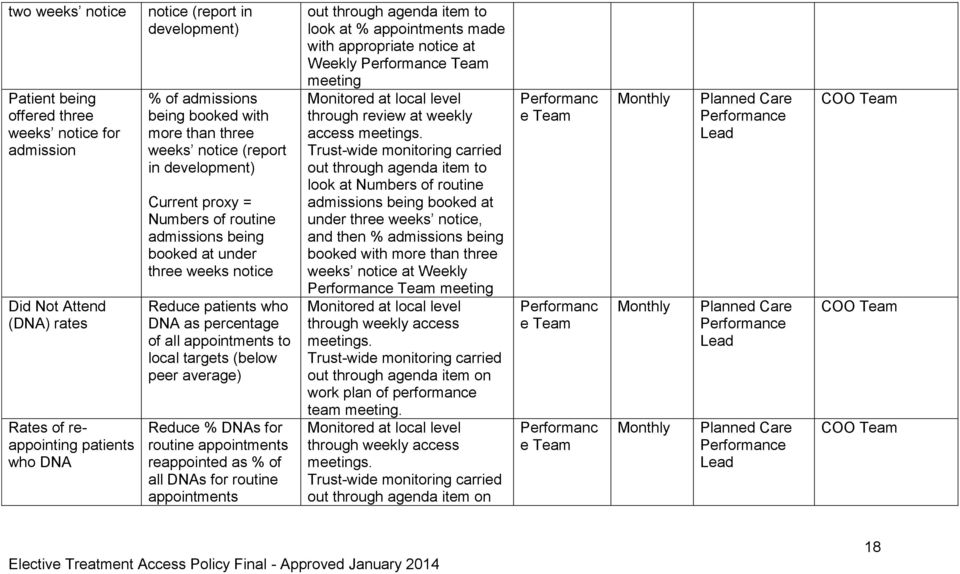
19 Rates of reappointing patients who cancel two consecutive appointments Patients are being treated within 18 weeks of the referral date Reasons for any breaches of the access targets Reduce the number of patients who have cancelled twice in a row, and are then reappointed for a third time. % Admitted clock stops in month < 18 weeks % non-admitted clock stops within month < 18 weeks % Incomplete patients waiting < 18 weeks Breach analysis reports carried out by each CSU monthly work plan of performance team meeting. Monitored at local level through weekly access meetings. Trust-wide monitoring carried out through agenda item on work plan of performance team meeting. Monitored at local level through weekly access meetings. Trust-wide monitoring carried out through agenda item on work plan of performance team meeting. Breach analysis reports sent to performance managers, then themes discussed at performance team meeting. Performanc e Team Performanc e Team Performanc e Team Monthly Monthly Monthly Planned Care Performance Lead Planned Care Performance Lead Planned Care Performance Lead COO Team COO Team COO Team 19

20 17. References Referral to Treatment Consultant-led Waiting Times: Rules Suite /RTT_Rules_Suite_April_2014.pdf Consultant-led Referral to Treatment Times Guidance Trust Patient Administration Handbook Cancer Waiting Times: A Guide d%20on%20cancer%20waits%20a%20guide%20version%208.0.pdf 20

21 Appendix A: Cancer & Rapid Access Chest Pain Wait Times Standard All referrals from GP/GDPs that are marked urgent suspicious of malignancy must be seen by a specialist within the target days All patients referred to the Rapid Access Chest Pain Service must be seen within the target days from receipt of referral All symptomatic breast referrals where cancer is not suspected must be seen by a specialist within the target days All referrals from GP/GDPs that are marked urgent suspicious of malignancy where the diagnosis of cancer is confirmed receive their first definitive treatment with the target days from the date the referral is received All symptomatic breast referrals where cancer is not suspected must receive their first definitive treatment with the target days from the date the referral is received All other patients with cancer who require treatment must receive that treatment within the target days from the decision to treat being made All patients will wait no more than target days from decision to treat to the start of treatment for second and subsequent treatment (surgery, radiotherapy, chemotherapy and other treatments) Rare Cancer Target (Paediatric, testicular and acute leukaemia) must be treated within the target days All patients with suspected cancer, detected through national screening programmes must not wait more than the target days from referral to treatment Any patients where cancer is suspected during their hospital care can be upgraded to a 62 day cancer pathway. They must not wait more than the target days for treatment from the date that is decided that cancer is a possible diagnosis National Target Local Target 14 days 7 days 14 days 7 days 14 days 7 days 62 days 54 days 62 days 54 days 31 days 31 days 31 days 31 days 31 days 31 days 62 days 54 days 62 days 54 days 21
22 Appendix B: Other Access Wait Times Standard All referrals from GPs must be prioritised First outpatient appointment arranged and communicated to patient First outpatient appointment takes place Any Radiology appointment takes place Treatment, or decision not to treat is given to patient Target 2 days from receipt of referral 4 weeks from receipt of referral 6 weeks from receipt of referral 6 weeks from referral to Radiology 18 weeks from initial referral National or Local Local Local Local National National 22
23 Appendix C: Guidance for the Follow-Up of Vulnerable Children and Vulnerable Adults 1. INTRODUCTION In the non-attendance of hospital appointments the final decision of whether to offer another appointment to vulnerable children and vulnerable adults is based on the professional judgement of the Consultant/senior doctor. It must be noted that children do not generally choose not to attend hospital appointments and where a parent or carer fails to ensure the child s access to appropriate medical care or treatment this, in itself, can be neglect. Equally some adults who may not have capacity to make that decision to attend hospital appointments may not choose not to attend hospital as they are reliant on carer/carers to facilitate hospital attendance. The reviewing doctor must document details of the record review and of the action to be taken in the patient s records. Referrals into the service from GPs or other professionals should clearly state if there are any Safeguarding issues within the family. This information should be considered by the Consultant when making decisions regarding offering a further appointment. The Paediatric service currently offers both letters inviting a child to an appointment but also a telephone reminder service. Consideration is given to ensuring that those with language or communication difficulties have adequate notice or appointments and support is available on the day. Professionals referring into the service should highlight any such issues to ensure the family are given the support they require to attend appointments. If clinicians have any concerns for a vulnerable adults at risk not attending an appointment they should contact the safeguarding team for adults on 0113 (20) for further advice. Patients who do not attend will be identified during the clinic session, and the notes reviewed by the consultant/senior doctor (middle grade or equivalent) at this time. Consideration must be given to the following: Urgency of the referral Significance of clinical information provided in the referral letter Any existing safeguarding concerns Any other mitigating circumstances Future appointments with the service The doctor must then consider whether there is a safeguarding risk in the nonattendance and then act accordingly in following any concerns up. It is their responsibility to liaise with the referrer to assess this risk and consider further actions if appropriate (see section below on non-engagement). 23
24 A letter detailing the DNA appointment details should be sent to the referring GP or Health Professional with a copy to the Health Visitor or School nurse (if applicable). This letter should clearly state what action the GP is expected to take in response. Certain people are particularly vulnerable and therefore need special consideration. These include; Children under 12 years old - because they are less likely to be deemed as mature enough to make decisions for themselves. Those known to social care/on a child protection plan Children on long-term medication People with mental health problems, substance misuse and/or experiencing Domestic Violence Children with long term conditions requiring hospital input, where close monitoring is vital to improved outcomes. E.g. Diabetes, Cystic Fibrosis, Cardiac conditions. Children with a disability Travelling families/those seeking asylum and the homeless. Adults with Dementia Adults with a Disability including learning disability and Asperger s Adults with mental health difficulties. With persistent DNAs and Cancelation of Appointments the practitioner should contact other professionals involved with the family or care home to establish whether the person is engaging elsewhere (e.g. School, Health visitors, GP etc.). This is especially relevant where the child, adult or family is particularly vulnerable and has a long term health condition. For follow up patient DNAs a clinical decision is made to either offer an alternative appointment or discharge back to the GP (refer to DNA flow chart). This is left to the discretion and expertise of the Consultant/senior doctor provided that: It can be demonstrated that the appointment was clearly communicated to the patient i.e. correct demographics, contact information. Discharging the patient is not contrary to their best clinical interests. There are no safeguarding concerns (see below). DNAs where the child/family is subject to a child protection plan or looked after children. For children who are subject to a child protection plan, any nonengagement should be reported as soon as possible to the family social worker. Staff should inform the Trust Safeguarding team of their concerns via a Cause for Concern stating the details of the referral to social care. All actions should be documented fully in the child s health/medical record. An alternative appointment should be offered within the shortest possible time and this communicated clearly to the family by letter and via a 24
25 telephone reminder. A copy of this should be sent to GP, HV/School Nurse and Social Care. DNAs where there are safeguarding concerns about an adult at risk who is subject to safeguarding investigation or protection plan. For adults who are subject to a safeguarding investigation or protection plan, any non-engagement should be reported as soon as possible to the allocated social worker. Staff should inform the Trust Safeguarding team of their concerns. All actions should be documented fully in the patient s health/medical record. An alternative appointment should be offered within the shortest possible time and this communicated to the GP. This guidance incorporates children aged 0 to 17 years up to their 18th birthday. As part of safeguarding and multi-agency working any vulnerable child or adult who fails to attend a designated appointment will have their health care records reviewed by the consultant in charge of the clinic (or delegated named member of their team) and they will be responsible for managing the required action. The clinic receptionist has the responsibility of informing the consultant in charge of the clinic (or delegated named member of their team) of all patients that fail to attend and providing the patient s health care records for review. 2. INDICATIONS There are KEY CONCERNS that would indicate greater cause for concern and require further attention and communication with allied professionals: Children and young people with complex medical needs Previous non-attendance at an outpatient clinic Parental substance or alcohol misuse Parental mental health issues Learning Disability and/or Autism Adult mental health issues Adults with substance or alcohol misuse Domestic abuse Parental learning difficulties Children in foster care or Looked after children Ongoing or previous child protection issues 3. RESPONSIBILITIES The nursing, medical and allied health professional staff are responsible for ensuring the pathway is followed. They are responsible for instructing clerical support staff. 25
26 All staff working in the outpatient clinic/department will have safeguarding training and supervision in line with trust guidance. This will be overseen by their line manager. 4. ACTION TO TAKE When a vulnerable person does not attend an appointment in an outpatient clinic/department a follow up phone call must be made to the parent/carer/individual on the day or the next working day to establish the reason for non-attendance. This can be made by a designated member of the consultant s clinical team but ultimately the consultant is responsible for ensuring the action is taken. The person that makes the contact should make a decision as to whether the patient will be discharged / reappointed and the timeframe for reappointing. Only where there is clinical need should a patient be reappointed. There should also be an agreement from the parent / carer that they will attend. 5. DOCUMENTATION Any child, young person who fails to attend an outpatient clinic appointment will have this clearly documented in their hospital notes (Trust Main Health Records) by the by delegated named member of the team and they will be responsible for managing the required action. The consultant in charge of the clinic will retain the clinical responsibility for children who have a clinical need but also take on the clinical responsibility for managing the non-attendance of children who need to be seen via safeguarding team and or social services. Any communication had as part of the pathway must be documented in the hospital notes. Any vulnerable adult at risk who fails to attend an outpatient clinic where there are safeguarding concerns should be clearly documented in their hospital notes (Trust Main Health Records) by the by delegated named member of the team and they will be responsible for managing the required action. Examples of required documentation: Reason for clinic appointment Previous clinic non attendance Child/young person known to Social Services Child/ young person known to have additional support in community Any Key Concerns Names and contact numbers for allied professionals who have been informed of non-attendance Content of conversations held with allied professionals A copy of the safeguarding adult alert (supporting information) SA1 26
27 6. HOW TO CONTACT ALLIED PROFESSIONALS Safeguarding Children s Advice can be sought from the people in the list below or on the Trusts Intranet Safeguarding site: Safeguarding Children Michelle Dickinson Named Nurse Jane Mayhew Nurse Advisor Emma Jones Nurse Advisor Sarah Hargrave Administrative Assistant Contact Details: Telephone (office) Nurse Advisor Named Nurse Fax Named Doctors for Safeguarding Children Dr George Fonfe Ext: Secretary: Dr Gerry O Hare Ext: Safeguarding Children s Advice can be sought from the people in the list below or on the Trusts Intranet Safeguarding site: Safeguarding Adults Caroline Ablett Tim Whaley Andrea Taylor Amanda Simpson Lead Professional Safeguarding Lead Professional MCA Nurse Advisor Team Secretary Contact Details: Telephone (office) Fax None Attendance for Children & Young People 27
28 1st DNA Review Clinical Notes No Reviewing Clinician to consider offering a further appointment or discharge back to GP Safeguarding Concerns identified Yes A letter detailing DNA appointment sent to GP/Health Professional to be sent. (Where applicable) Copy to Health Visitor/School Nurse) Offer alternative appointment via letter/telephone reminder to family Persistent DNAs/Cancelations of appointments No safeguarding concerns Reviewing clinician to contact other professionals involved with family/care home to establish if the person is engaging elsewhere No DNAs where child/family is subject to a child protection plan or children looked after Contact Named Social Worker Yes Inform Children s safeguarding team Offer alternative appointment via letter/telephone reminder to family A copy of appointment letter to be copied to GP, HV/School Nurse and Social Worker (where applicable) 28 All actions to be documented fully in Child s health/medical records
29 None Attendance for Vulnerable Adults at Risk 1st DNA Review Clinical Notes No Reviewing Clinician to consider offering a further appointment or discharge back to GP Safeguarding Concerns identified Yes Contact Safeguarding Adults Team Offer alternative appointment via letter/telephone reminder to family/carer (where applicable) Persistent DNAs/Cancelations of appointments No safeguarding concerns Reviewing clinician to contact other professionals involved with family/care home to establish if the person is engaging elsewhere No DNAs where adult is subject to safeguarding concerns/identified as a vulnerable adult at risk Contact allocated Social Worker Yes Inform Adult safeguarding team Offer alternative appointment via letter/telephone reminder to family/carer (as applicable) A copy of appointment letter to be copied to GP, Social Worker, other involved professionals (where applicable) All actions to be documented fully in patient s health/medical records 29
30 Appendix D: Consultant to Consultant referrals POLICY ON CONSULTANT TO CONSULTANT REFERRALS This policy sets out the approach which the Leeds Clinical Commissioning Groups expect to be adopted by hospital/secondary care services when considering whether a patient should be referred on to another service, or returned to the patient s GP. 1. If a GP refers into a hospital/secondary care provider (including a community provider), the consultant/gspi has authority to refer the patient on to another consultant team for the same presenting condition. This includes referral from Emergency Departments and following acute admissions. 2. Decisions to refer on to another service should only be made by a consultant (or GPSI in community services), not by more junior medical staff. The referral should be made to the service which is most convenient and clinically appropriate for the patient, which may be a service in a community setting rather than one provided by the same organization. 3. The patient and the GP should be informed that the onward referral is being made. The patient should wherever possible be given an indication of the likely wait until the next appointment. The patient should also be made aware that if they wish to consider continuing their care at another provider they are free to discuss this with their GP. 4. Where a consultant identifies a condition unrelated to the symptoms for which the patient was originally referred, they should only refer on if there could be an immediate threat to life or limb or a in relation to a possible cancer diagnosis where delay might impact on the patient s care. They should ensure the GP is made aware at the point of the onward referral. Where a new condition is identified, but it is not life threatening or urgent, the patient should be referred back to their GP for consideration of referral and management options. 5. Where a consultant can determine in advance from the referral letter that another consultant/service would be more suitable for the patient, they should try to redirect the patient so they are booked into the more suitable service, rather than requiring the patient to attend twice and the commissioner incurring two first appointment charges. CCG commissioners will monitor practice by regularly monitoring the numbers of patients referred internally and asking for explanations of any increases. Acute Provider Commissioning Group Leeds Clinical Commissioning Groups 28 August
PATIENT ACCESS POLICY V3
 PATIENT ACCESS POLICY V3 State whether the document is: x Trust wide Business Group Local State Document Type: x Policy Standard Operating Procedure Guideline Protocol APPROVAL & VALIDATION Assurance Risk
PATIENT ACCESS POLICY
 . PATIENT ACCESS POLICY TITLE Patient Access Policy APPLICABLE TO All administrative / clerical / managerial staff involved in the administration of patient pathway. All medical and clinic staff seeing
Patient Access. UCLH policy
 Patient Access UCLH policy Version 3.2 Version Date June 2014 Version Approved By EB Policy Approval Sub-Group Publication Date July 2013 Author Kevin Nicholson Review By Date June 2016 Responsible Director
Inpatient and Outpatient. Waiting Times & Patients Access Policy
 Inpatient and Outpatient Waiting Times & Patients Access Policy Authors Piers Young Author s Job Title Interim Planned Care Programme Lead Department Surgery Version number Version 14 Ratifying Committee
Patient Access Policy
 Patient Access Policy NON-CLINICAL POLICY ACE 522 Version Number: 2 Policy Owner: Lead Director: Assistant Director of Operations Director of Operations Date Approved: Approved By: Management Executive
Outpatient and Inpatient Waiting Times. & Patients Access Policy
 Outpatient and Inpatient Waiting Times & Patients Access Policy Date Approved by Version V2 Procedure/Policy Number Procedure/Policy type Date Equality impact assessment completed: Issue Date September
Patient Access User Manual
 Patient Access User Manual Table of Contents. 1 Summary 7 2 Key Principles 7 3 Corporate Roles and Responsibilities 9 4 National Access Targets and Standards 10 4.1 Referral to Treatment (RTT) Standard
Patient Access Policy (18 Week Referral to Treatment (RTT) and Cancer Waiting Times)
 Patient Access Policy (18 Week Referral to Treatment (RTT) and Cancer Waiting Times) To whom this document applies: All Administrative Staff, Clerical Staff, Clinicians, Clinical Nurse Specialists, Service
Patient Access Policy. Version 2.0
 Version 2.0 November 2013 Table of Contents 1. Introduction... 3 2. Purpose of this Policy/Procedure... 3 3. Scope... 3 4. Definitions / Glossary... 3 5. Ownership and Responsibilities... 4 5.1. Role of
Patient Access Referral To Treatment (RTT) Policy
 Patient Access Referral To Treatment (RTT) Policy Policy to be agreed by the Operational Implementation Group & 18 Weeks Project Board Last Review Date: December 2009 Next Review Date: December 2010 CONTENTS
REFERRAL TO HOSPITAL ACCESS POLICY INCLUDING DID NOT ATTEND (DNA) AND COULD NOT ATTEND (CNA)
 REFERRAL TO HOSPITAL ACCESS POLICY INCLUDING DID NOT ATTEND (DNA) AND COULD NOT ATTEND (CNA) Last Review Date September 2014 Approving Bodies NHS Doncaster Clinical Commissioning Group Doncaster & Bassetlaw
Patient Access, Booking and Choice Policy for Moorfields City Road and all Moorfields satellites
 Patient Access, Booking and Choice Policy for Moorfields City Road and all Moorfields satellites Policy Summary This policy is intended to provide guidance on the approved process for managing patients
PATIENT ACCESS POLICY
 PATIENT ACCESS POLICY Document Type Policy Document Number Version Number 1.0 Approved by NHS Borders Board on 18 October 2012 Issue date Nov 2012 Review date Nov 2013 Distribution Prepared by Developed
Patient Access Policy
 Patient Access Policy SECTION 1 - INTRODUCTION AND OVERVIEW 1.1. Introduction The principles and definitions of the 18 week target count the referral to treatment (RTT) waiting times in totality. Spire
PATIENT ACCESS POLICY
 PATIET ACCESS POLICY This policy can be made available in other formats and languages upon request to the PALS office on 01708 435454 Contents Include: Management of Patients with Suspected or Confirmed
Recording and reporting referral to treatment (RTT) waiting times for consultant-led elective care: Frequently Asked Questions
 Recording and reporting referral to treatment (RTT) waiting times for consultant-led elective care: Frequently Asked Questions Recording and reporting referral to treatment (RTT) waiting times for consultant-led
Report to the NHS Fife Board on 25 June 2013 NHS FIFE S PATIENT ACCESS POLICY
 9.2b Report to the NHS Fife Board on 25 June 2013 NHS FIFE S PATIENT ACCESS POLICY 1. PURPOSE OF REPORT 1.1 Following NHS Fife s performance against Treatment Time Guarantee (TTG) during the winter months,
PATIENT ACCESS POLICY VERSION 4.0
 Type of Document Code Policy Sponsor Lead Executive Recommended by PATIENT ACCESS POLICY VERSION 4.0 Trust Policy STHK0075 Donna McLaughlin Donna McLaughlin Operational Team Date Recommended January 2012
PATIENT ACCESS POLICY
 PATIENT ACCESS POLICY Page 1 of 44 Printed Copies may become out of date. Check online to ensure you have CONTENTS AND PAGE NUMBERS Patient Access Policy... 1 Contents And page numbers... 2 EXECUTIVE SUMMARY/
Elective Care Guide. Referral to Treatment Pathways: A Guide for Managing Efficient Elective Care. Second edition (January 2014)
 Elective Care Guide Referral to Treatment Pathways: A Guide for Managing Efficient Elective Care Second edition (January 2014) Contents page 1. Introduction 1.1. How the guide works and its intended audience
Everyone counts Ambitions for GCCG for 7 key outcome measures
 Everyone counts s for GCCG for 7 key outcome measures Outcome ambition Outcome framework measure Baseline 2014/15 Potential years of life lost to 1. Securing additional years of conditions amenable to
PATIENT ACCESS POLICY
 PATIENT ACCESS POLICY Completed Review Date: June 2015 Date for Review June 2016 1 NHS LANARKSHIRE PATIENT ACCESS POLICY 1. BACKGROUND NHS Lanarkshire is required by Scottish Government to deliver a consistent,
National Clinical Programmes
 National Clinical Programmes Section 3 Background information on the National Clinical Programmes Mission, Vision and Objectives July 2011 V0. 6_ 4 th July, 2011 1 National Clinical Programmes: Mission
MID STAFFORDSHIRE NHS FOUNDATION TRUST
 MID STAFFORDSHIRE NHS FOUNDATION TRUST Report to: Report of: Joint Health Scrutiny Accountability Session Antony Sumara Chief Executive Date: 20 April 2011 Subject: Mid Staffordshire NHS Foundation Trust
Accessing Outpatient, Inpatient and Day Case Services in Acute Hospitals in Ireland
 Accessing Outpatient, Inpatient and Day Case Services in Acute Hospitals in Ireland January 2014 an ciste náisiúnta um cheannach cóireála the national treatment purchase fund Contents Introduction 2 Accessing
Process for reporting and learning from serious incidents requiring investigation
 Process for reporting and learning from serious incidents requiring investigation Date: 9 March 2012 NHS South of England Process for reporting and learning from serious incidents requiring investigation
Frequently Asked Questions on the Referral to Treatment (RTT) data collection
 Frequently Asked Questions on the Referral to Treatment (RTT) data collection How to use this document This document contains answers to frequently asked questions on RTT measurement and the RTT data collection.
Managing and Minimising Appointment Slot Issues
 NHS e-referral Service Managing and Minimising Appointment Slot Issues What is an Appointment Slot Issue? When no clinic appointment is available for patients to book in the NHS e-referral Service, the
Cancer Services Operational Policy (Patient Access) Version number 2.1
 Cancer Services Operational Policy (Patient Access) V2.1 Cancer Services Operational Policy (Patient Access) Version number 2.1 Lead executive Name / title of author: Chief Operating Officer Karen Blackburn,
Private Patient Policy. Documentation Control
 Documentation Control Reference Date approved Approving Body Trust Board Implementation Date July 2009 NUH Private Patient and Supersedes Overseas Visitor Policy Private Patient Advisory Group, Consultation
NHS North Somerset Clinical Commissioning Group
 NHS North Somerset Clinical Commissioning Group HR Policies Managing Sickness Absence Approved by: Quality and Assurance Group Ratification date: September 2013 Review date: September 2016 Elaine Edwards
Chesterfield Royal Hospital NHS Foundation Trust THE ADVICE CENTRE AND COMPLAINTS POLICY
 Chesterfield Royal Hospital NHS Foundation Trust THE ADVICE CENTRE AND COMPLAINTS POLICY 1. INTRODUCTION 1.1 The aim of the Advice Centre is to support the Trust s Service Experience Strategy by providing
Appointment Non-Attendance (Did Not Attend) Procedure
 () Procedure 1. Purpose This Procedure outlines the procedural requirements to be observed by all West Coast District Health Board (WCDHB) staff (excluding Mental Health Service) to ensure all patient
Type of change. V02 Review Feb 13. V02.1 Update Jun 14 Section 6 NPSAS Alerts
 Document Title Reference Number Lead Officer Author(s) (name and designation) Ratified By Central Alerting System (CAS) Policy NTW(O)17 Medical Director Tony Gray Head of Safety and Patient Experience
Commissioning Policy (EMSCGP005V2) Defining the boundaries between NHS and Private Healthcare
 Commissioning Policy (EMSCGP005V2) Defining the boundaries between NHS and Private Healthcare Although Primary Care Trusts (PCTs) and East Midlands Specialised Commissioning Group (EMSCG) were abolished
Standard QH-IMP-300-1:2016
 Specialist outpatient services Standard QH-IMP-300-1:2016 1. Statement The Specialist Outpatient Services Implementation Standard outlines the suite of business rules and processes required to ensure that
Fife NHS Board Activity NHS FIFE. Report to the Board 24 February 2015 ACTIVITY REPORT
 1 AIM OF THE REPORT NHS FIFE Report to the Board 24 February 2015 ACTIVITY REPORT This report provides a snapshot of the range of activity that underpins the achievement of key National Targets and National
About public outpatient services
 About public outpatient services Frequently asked questions What are outpatient services? Victoria s public hospitals provide services to patients needing specialist medical, paediatric, obstetric or surgical
NOTTINGHAM UNIVERSITY HOSPITALS NHS TRUST POLICIES AND PROCEDURES MANAGEMENT OF ATTENDANCE AND SICKNESS ABSENCE POLICY. Documentation Control
 NOTTINGHAM UNIVERSITY HOSPITALS NHS TRUST POLICIES AND PROCEDURES MANAGEMENT OF ATTENDANCE AND SICKNESS ABSENCE POLICY Documentation Control Reference HR/P&C/003 Date approved 4 Approving Body Trust Board
The Newcastle upon Tyne Hospitals NHS Foundation Trust. National Early Warning Score (NEWS) Policy
 The Newcastle upon Tyne Hospitals NHS Foundation Trust National Early Warning Score (NEWS) Policy Version.: 1.0 Effective From: 3 December 2014 Expiry Date: 3 December 2016 Date Ratified: 1 September 2014
The CCG Assurance Framework: 2014/15 Operational Guidance. Delivery Dashboard Technical Appendix DRAFT
 The CCG Assurance Framework: 2014/15 Operational Guidance Delivery Dashboard Technical Appendix DRAFT 1 NHS England INFORMATION READER BOX Directorate Medical Operations Patients and Information Nursing
Connection with other policy areas and (How does it fit/support wider early years work and partnerships)
 Illness such as gastroenteritis and upper respiratory tract infections, along with injuries caused by accidents in the home, are the leading causes of attendances at Accident & Emergency and hospitalisation
Review of the involvement and action taken by health bodies in relation to the case of Baby P
 Review of the involvement and action taken by health bodies in relation to the case of Baby P May 2009 This report details the findings of an intervention that was carried out by the Healthcare Commission,
PROTOCOL THE MANAGEMENT OF OUTPATIENT SERVICES
 Outpatient Performance Improvement Programme, 2012-2015 PROTOCOL THE MANAGEMENT OF OUTPATIENT SERVICES JANUARY 2013 EDITION 1.0 Authors DOCUMENT CONTROL PROTOCOL FOR THE MANAGEMENT OF OUTPATIENT SERVICES
Associates Private Medical Trust Guide
 Associates Private Medical Trust Guide Effective from 1 April 2012 Welcome to the Honda Associates Private Medical Trust This guide provides an overview of the benefits available to you under your Private
Department of Health/ Royal College of General Practitioners. Implementing a scheme for General Practitioners with Special Interests
 Department of Health/ Royal College of General Practitioners Implementing a scheme for General Practitioners with Special Interests April 2002 Foreword Improved access and consistently high quality services
FRAMEWORK JOB DESCRIPTION. Band 6
 FRAMEWORK JOB DESCRIPTION Band 6 Framework is a registered charity, Company Limited by guarantee and Registered Social Landlord providing a variety of supported accommodation and tenancy support for homeless
Quality and Safety Programme Fractured neck of femur services
 Quality and Safety Programme Fractured neck of femur services London quality standards February 2013 1 Introduction The case for change for fractured neck of femur services in London demonstrates that
ATTENDANCE MANAGEMENT POLICY
 ATTENDANCE MANAGEMENT POLICY Co-ordinator: Director of HR Reviewer: Grampian Area Partnership Forum Approver: Grampian Area Partnership Forum Signature Signature Signature Identifier: NHSG/POL/39/HR Review
Patient Choice Strategy
 Patient Choice Strategy Page 1 of 14 Contents Page 1 Background 4 2 Putting Patients and the Public at the Heart of Health and 5 Healthcare in West Lancashire 3 Where are we now and where do we need to
Standard 5. Patient Identification and Procedure Matching. Safety and Quality Improvement Guide
 Standard 5 Patient Identification and Procedure Matching Safety and Quality Improvement Guide 5 5 5October 5 2012 ISBN: Print: 978-1-921983-35-1 Electronic: 978-1-921983-36-8 Suggested citation: Australian
Anaesthetics, Pain Relief & Critical Care Services Follow-Up Study REGIONAL REPORT. Performance Review Unit
 Anaesthetics, Pain Relief & Critical Care Services Follow-Up Study REGIONAL REPORT Performance Review Unit CONTENTS page I INTRODUCTION... 2 II PRE-OPERATIVEASSESSMENT... 4 III ANAESTHETIC STAFFING AND
Appendix D- Monoclonal Gammopathy of Undetermined Significance (MGUS)
 Local Enhanced Service: Primary care management of stable haematological patients Monoclonal Gammopathy of Undetermined Significance (MGUS) 1. Introduction Monoclonal Gammopathy of Undetermined Significance
Clinical Audit Procedure for NHS-LA and CNST Casenote Audit
 Clinical Audit Procedure for NHS-LA and CNST Casenote Audit NHS Litigation Authority (NHS-LA) Risk Management Standards for Acute Trusts Pilot Clinical Negligence Scheme for Trusts (CNST) Maternity Clinical
Big Chat 4. Strategy into action. NHS Southport and Formby CCG
 Big Chat 4 Strategy into action NHS Southport and Formby CCG Royal Clifton Hotel, Southport, 19 November 2014 Contents What is the Big Chat? 3 About Big Chat 4 4 How the event worked 4 Presentations 5
JOB DESCRIPTION. Specialist Hospitals, Women & Child Health Directorate. Royal Belfast Hospital for Sick Children
 JOB DESCRIPTION Title of Post: Patient Flow Coordinator Grade/ Band: Band 7 Directorate: Reports to: Accountable to: Location: Hours: Specialist Hospitals, Women & Child Health Directorate Assistant Service
Hip replacements: Getting it right first time
 Report by the Comptroller and Auditor General NHS Executive Hip replacements: Getting it right first time Ordered by the House of Commons to be printed 17 April 2000 LONDON: The Stationery Office 0.00
Progress on the System Sustainability Programme. Submitted to: NHS West Norfolk CCG Governing Body, 31 July 2014
 Agenda Item: 9.1 Subject: Presented by: Progress on the System Sustainability Programme Dr Sue Crossman, Chief Officer Submitted to: NHS West Norfolk CCG Governing Body, 31 July 2014 Purpose of Paper:
Rehabilitation Network Strategy 2014 2017. Final Version 30 th June 2014
 Rehabilitation Network Strategy 2014 2017 Final Version 30 th June 2014 Contents Foreword 3 Introduction Our Strategy 4 Overview of the Cheshire and Merseyside Rehabilitation Network 6 Analysis of our
Contents. Section/Paragraph Description Page Number
 - NON CLINICAL NON CLINICAL NON CLINICAL NON CLINICAL NON CLINICAL NON CLINICAL NON CLINICAL NON CLINICA CLINICAL NON CLINICAL - CLINICAL CLINICAL Complaints Policy Incorporating Compliments, Comments,
INVESTIGATION The care and treatment of Ms FG
 INVESTIGATION Our aim We aim to ensure that care, treatment and support are lawful and respect the rights and promote the welfare of individuals with mental illness, learning disability and related conditions.
Reconfiguration of Surgical, Accident and Emergency and Trauma Services in the UK
 Reconfiguration of Surgical, Accident and Emergency and Trauma Services in the UK K Reconfiguration of Surgical, Accident and Emergency and Trauma Services in the UK Summary Our aim is to provide an excellent
!!!!!!!!!!!! Liaison Psychiatry Services - Guidance
 Liaison Psychiatry Services - Guidance 1st edition, February 2014 Title: Edition: 1st edition Date: February 2014 URL: Liaison Psychiatry Services - Guidance http://mentalhealthpartnerships.com/resource/liaison-psychiatry-servicesguidance/
UK Medical Centre. Building 401, SHAPE, BFPO 26. Civilian Address. UK Medical Centre, Building 401, Ave d Oslo. 7010 SHAPE, Maisières
 UK Medical Centre Building 401, SHAPE, BFPO 26 Civilian Address UK Medical Centre, Building 401, Ave d Oslo 7010 SHAPE, Maisières Reception 0032 65 44 5824 On arrival at SHAPE please register with the
Defining the boundaries between NHS and Private Healthcare
 West Midlands Strategic Commissioning Group Commissioning Policy (WM/13) Defining the boundaries between NHS and Private Healthcare Version 1 April 2010 1. Definitions Private patients are patients who
Management Information. Chief Social Work Officer
 Management Information Lead Officer Name: Paul Woolrich Designation: Service Improvement Manager Tel: 58462 (0131 553 8462) Lead Service Area Support to Children & Young People Last Review Date December
National Clinical Programme in Surgery (NCPS) Care Pathway for the Management of Day Case Laparoscopic Cholecystectomy
 National Clinical Programme in Surgery (NCPS) Care Pathway for the Management of Day Case Consultant Surgeon DRAFT VERSION 0.5 090415 Table of Contents 1.0 Purpose... 3 2.0 Scope... 3 3.0 Responsibility...
Working Together to Safeguard Children
 Working Together to Safeguard Children A guide to inter-agency working to safeguard and promote the welfare of children March 2013 Contents Summary 5 About this guidance 5 What is the status of this guidance?
DEPARTMENT OF FAIR EMPLOYMENT AND HOUSING
 STATE OF CALIFORNIA DEPARTMENT OF FAIR EMPLOYMENT AND HOUSING FAIR EMPLOYMENT & HOUSING COUNCIL CERTIFICATION OF HEALTH CARE PROVIDER (California Family Rights Act (CFRA)) IMPORTANT NOTE: The California
Measuring quality along care pathways
 Measuring quality along care pathways Sarah Jonas, Clinical Fellow, The King s Fund Veena Raleigh, Senior Fellow, The King s Fund Catherine Foot, Senior Fellow, The King s Fund James Mountford, Director
Allscripts PAS is a part of our product family that covers all aspects of patient management and care ALLSCRIPTS PATIENT ADMINISTRATION SYSTEM (PAS)
 allscripts.com ALLSCRIPTS PATIENT ADMINISTRATION SYSTEM (PAS) Allscripts PAS is a part of our product family that covers all aspects of patient management and care PATIENT ADMINISTRATION SYSTEM (PAS) Allscripts
Integrated Performance Report
 Integrated Performance Report Southwark Social Services and Southwark Primary Care Trust 2003/04 Provisional Indicators Integrated Performance Report: 2003/04 Provisional Indicators 1. Recommendation 1.1
Plain Language. Guide
 Plain Language Guide Mental Health Act 2009 Disclaimer The information contained in this publication is intended to assist in the interpretation of the Mental Health Act 2009 and is not a substitute for
POLICY FOR ALCOHOL, DRUG AND OTHER SUBSTANCE ABUSE IN EMPLOYMENT
 POLICY FOR ALCOHOL, DRUG AND OTHER SUBSTANCE ABUSE IN EMPLOYMENT Approved By: Trust Executive Date Approved: 10 March 2004 Trust Reference: B6/2004 Version: V2 Supersedes: V1 (Approved by Trust Executive