
General Meeting of Shareholders
|
|
|
- Alaina Wilkinson
- 10 years ago
- Views:
Transcription
1 Annual report 2007

2 General Meeting of Shareholders The Annual General Meeting of Shareholders will be held on 22 April 2008 at 11 hours at the Bilderberg Garden Hotel Amsterdam Zuid, Dijsselhofplantsoen 7, 1077 BJ in Amsterdam. Agenda 1. Opening 2. Report from the Board of Directors concerning the 2007 financial year 3. Adoption and approval of the 2007 annual accounts including the appropriation of profit (decision) 4. Reservation and dividend policy (decision) 5. Proposal for dividend pay-out (decision) 6. Discharge of the Board of Directors for their management (decision) 7. Discharge of the Supervisory Board for their supervision (decision) 8. Waive aive the right to issue instructions in the sense of Article 2:146 of the Netherlands Civil Code (decision) 9. Appoint (reappoint) of Mazars Ma ars Paardekooper Paarde ooper Hoffman N.V. N.. as external auditor 10. Appoint the Board of Directors as competent body for issuing shares and issuing share subscription rights for a period of eighteen months (decision) 11. Appoint the Board of Directors as competent body with respect to limiting or excluding preferential rights for a period of eighteen months (decision) 12. Empower the Board of Directors to purchase shares for a period of eighteen months (decision) 13. Approve proposed remuneration policy for 2008 (decision) 14. Any other business 15. Closing Profile DPA Flex Group N.V. is a specialised organisation providing staffing solutions with a listing on NYSE Euronext. The operating companies trading under the names DPA flex professionals, DPA Supply Chain People, DPA Conink and GEOS IT Professionals, mainly fulfil the need within companies and institutions for temporary staff with knowledge and expertise in the areas of Finance & IT, Procurement, Logistics & Operations and ERP systems (Oracle, SAP, and Siebel). DPA Flex Group is an ambitious and leading expertise supplier of value-adding flex professionals. For more information see:

3 Annual report 2007

4 2007 Contents Letter to our stakeholders 4 Key data 6 Key figures 6 Statistics 7 Report from the Board of Directors 8 Highlights Financial Highlights, based on normalised pro forma figures 9 Assumptions 9 Margin generated by the combined organisation 10 Market developments 14 DPA flex professionals: Sharpened attention in case of exceptional market conditions 14 DPA Supply Chain People: Continuing growth in public and private sectors 16 GEOS IT Professionals: Good results in transitional year 17 Corporate Governance 18 Structure and policy 18 Implementation and deviations 18 Changes compared to Regulations 19 Risks and risk management 20 Risks arising from activities 20 Quality and quantity of projects 20 Recruiting and holding on to professionals 20 Management of costs 21 Financial risks 22 Market risks 22 Sensitivity to the economic cycle 22 Competition 22 Internal management system 22 Guidelines and consultation structures 22 Reporting and analysis 23 Internal control 23 Declaration concerning the performance of the internal control system 24 2

5 Shareholder information 25 Reservation and dividend policy 25 Proposal for the absorption of loss Shares issued 25 Important dates in Contact 25 Members of the Supervisory Board and Board of Directors 26 Supervisory Board 26 Board of Directors 26 Schedule for retirement by rotation 26 Report from the Supervisory Board 27 Remuneration policy 28 Financial Statements Consolidated income statement for Consolidated balance at 31 December 2007 before appropriation of profits 31 Consolidated statement of changes in equity 32 Consolidated cash flow statement Explanatory notes to the consolidated balance sheet 34 Explanatory notes to the consolidated profit and loss account 41 Explanatory notes to the consolidated balance sheet 45 Explanatory notes to the consolidated cash flow statement 54 Information per segment 55 Remuneration and share-related benefits 57 Company financial statements Company balance sheet at 31 December Explanatory notes to the company balance sheet and profit and loss account 60 Other information 67 Auditor s report 67 Provisions for the appropriation of profit 68 Proposal for the appropriation of profit 68 3 Annual Report 2007 DPA Flex Group N.V.

6 Letter to our stakeholders The year 2007 was a year of different faces. At the beginning of the year prospects were certainly good. The strongly improved economic circumstances, the considerable need for qualified professionals and the wish of many organisations for greater flexibility in fulfilling their staffing requirements were all good starting points for us. We set about our tasks energetically. Within all three operating companies resource management and recruitment worked hard to find qualified professionals who could subsequently be successfully deployed at our clients by the account management. Always working from our vision of professionalism and added-value. As a leading expertise supplier of flex professionals in the area of Finance & IT, Supply Chain and highly qualified ERP professionals specialising in Oracle, SAP and Siebel we want to provide added-value for our clients. This translates into subcontracting flex professionals who go a step further, who are adverse to standard solutions, who book results that make a difference and who don t shy away from a challenge. In addition, agreeing long-term master contracts with the large profit and notfor-profit organisations in the Netherlands made us less dependant on effects of the economic cycle. On the other hand, the effects of terminated or suspended master contracts can have a considerable impact on the organisation, as we experienced by the end of

7 In August 2007 we were able to announce that our turnover growth in the first six months of 2007 was in line with our expectations. Our turnover grew, and in the first six months of the past year even by more than the average organisation in our sector. We also saw encouraging development of our margin while costs were declining as a result of the reorganisation we completed in June That this was followed by the international credit crisis is common knowledge. The unrest this has caused within the financial institutions has also affected us as a service provider to banks and insurers. Not to forget the merger and acquisition processes currently underway in the banking sector that has drastically reduced the demand for external professionals in the financial sector. Projects have been stopped, ongoing contracts cancelled and for the time being new initiatives have been put on hold. Work dried up for a considerable number of our professionals who had to take their place on the reserve bench. All in all, the number of flex professionals reduced by 200 in 2007, which resulted in a correspondingly lower turnover. We finished the year with a good operational result for 2007 (normalised pro forma figures, so excluding Spain and various one-off expenses) and that certainly deserves a compliment. A compliment to our people who didn t throw in the towel and to our stakeholders who continued to express their confidence in us. The will to win and the passion for the profession are present at every level in our company. And together we beam this out, to each other and to the outside world, and that gives us a good feeling. Due to the turbulent developments within the financial and other markets, we currently have an insufficient base to make any forecast statements for And because of these developments in the financial markets and the effect this is having on financial institutions this applies particularly to our largest operating company, DPA flex professionals. However, prospects are favourable for our other two operating companies, DPA Supply Chain People (in combination with DPA Conink) and GEOS IT Professionals. Theoretically, further growth is possible in these markets where the DPA Flex Group has made a niche for itself, even though the availability of qualified professionals is a limiting factor. Hopefully there will soon be more clarity concerning the consequences of the credit crisis for the financial world. When the dust has settled the demand for qualified flex professionals will pick up again quickly. For example, to make a substantial contribution to building new inte - gra ted organisations that will arise from the mergers and acquisitions. In fact it is this specific unrest that means that secondment has become inseparably bound to a strategic approach to fulfilling staffing requirements. Just as in the past DPA seeks to grow through acquisition and organic growth. These efforts receive due care and attention. In the short-term I do not envisage large investments for which financing will be necessary. The current level in internal staffing is in proportion to the number of interim professionals we have on file and will be adjusted as and when required by developments in the company. The increase in the number of projects and the gross margin are key success factors for DPA. New times are dawning for DPA Flex Group as well as for me personally. The business has arrived in a new phase in its life cycle. It is also time for a new challenge for me personally which is why I have decided to step down as CEO on 1 July In the past eighteen years we have seen DPA grow into one of the leading providers of staffing solutions in our country and I am proud of this achievement. After stepping down as managing director, I will continue to be involved with DPA as consultant till the end of the year. I have confidence in the future for DPA. Peter Smit, CEO 5 Annual Report 2007 DPA Flex Group N.V.

8 Key data Key figures x 1,000, Net turnover Gross margin As % of the net turnover Operating result 4.6 (23.7) 1.0 (0.8) (4.7) Profit before tax (0.5) (24.0) 0.9 (0.7) (4.5) Net profit (0.2) (24.7) 0.6 (0.6) (3.1) Equity base Earnings per share (in euros) (0.05) (2.44) 0.13 (0.14) (0.54) Added value per employee Staff seconded at year end Indirect personnel at year end

9 Statistics Group result (x 1,000) (532) (24,816) 785 Equity base (x 1,000) 29,991 30,523 10,938 Solvency (in %) Group result based on shares issued (in euros) (0.05) (2.44) 0.13 Dividend pay-out (in %) n/a n/a n/a Number of shares issued x euro Highest listed price Lowest listed price Year-end listed price Annual Report 2007 DPA Flex Group N.V.

10 Report from the Board of Directors Highlights 2007 (pro forma normalised fi gures) Turnover, excluding brokerage, grew to 84.3 million (an increase of 6% compared to 2006). The gross margin (28.1%) showed a positive development throughout On an annual basis the gross margin was 23.7 million. The operating result (EBITDA) increased by 27% to 7.6 million. In June 2007 the Board of Directors announced its plans to divest the Spanish activities, at the time of writing this annual report an agreement in principle has been reached with the Spanish company Cibernos. Conink consultants B.V. was acquired in September The activities carried out under the brand name DPA Conink, are an addition to DPA Supply Chain People B.V. Eventful year In the past year the operational margin (EBITDA) of the organisation has improved significantly. The gross margin has also developed favourably in Traditionally we see increased turnover in the second half of the year compared to that achieved in the first six months, in 2007 we observed the reverse. All in all, the turnover declined by 1% in the second six months. Reticence on behalf of a number of large clients in the financial sector to take on external professionals meant that the turnover of DPA flex professionals even fell short of expectations for the last two months of Despite this a turnover growth of 6% for the whole of 2007 was realised. The net result for 2007 is calculated to be 700,000. This result includes a downward revaluation of the Spanish activities. Without this downward revaluation the result would have been 4.8 million. 8

11 Back to basics The foundations laid in 2006 for qualitative growth have made way for a more practical approach in The size of the commercial organisation has been brought more in line with the level of turnover, special activities have been terminated and at the time of publishing this annual report an agreement in principle had been reached for the sale of the activities in Spain. Since we manage our organisation functionally, our focus should be on our activities in the Netherlands. The policy implemented in 2007 has lead to an improved gross return, improved commercial ratios, reduced Days Sales Outstanding (DSO) and a more cost efficient organisation. As from 2008 all business activities will be conducted from our premises in Amsterdam. Based on these developments we can state that DPA has become the organisation that the board had envisaged by mid Financial Highlights, based on normalised pro forma figures Figures for 2007 compared to the combined organisation figures for 2006 In 1,000, % difference Turnover % Margin % Operating expenses % EBITDA % Operating result % Discontinued activities (4.1) (0.2) PM Net result 0.7 * (23.5) PM In euros Earnings per share 0.07 (2.31) PM * Downward revaluation of 26.5 million Assumptions: The figures for GEOS IT Professionals B.V. are included in the consolidation as per 1 January The figures for Conink consultants B.V. are included in the consolidation as per 1 September Normalisation 1: In 2006 an amount of 700,000 was corrected in the operating expenses because of a one-off benefit with regard to the Employee Insurance Administration Agency (UWV). Normalisation 2: In 2007 there was a reduction of 750,000 in the personnel expenses due to the reorganisation. Normalisation 3: In 2007 a correction of 500,000 was made related to moving business activities from The Hague and Rotterdam to the central location in Amsterdam. The turnover of 2006 and 2007 is shown excluding turnover from brokerage. The activities of the DPA Spanish subsidiary are shown under discontinued activities. 9 Annual Report 2007 DPA Flex Group N.V.

12 Report from the Board of Directors Specifi cation of the turnover Turnover of DPA Flex Group N.V increased during 2007 by 6% to 84.3 million (the increase including turnover from brokerage is 13%). Turnover of DPA Flex Nederland B.V. increased by 1% to 63.2 million. Turnover of DPA Supply Chain People B.V. increased by 81% to 7.7 million. Turnover of GEOS IT Professionals B.V. increased by 7% to 12.1 million. Turnover of Conink consultants B.V. was 1.3 million and remained stable at 2006 levels. The turnover growth for the whole year is 6%. In the first six months a growth of 7% was realised. Traditionally performance in the second six months of the year is better than in the first. However, in the second half year the turnover growth of DPA Flex Nederland fell short of expectations, particularly in the last two months. This development was caused by reduced demand for external personnel at the financial institutions in the Netherlands, and DPA Flex Nederland is very active in this sector. With respect to the development of turnover, the other operating companies have not suffered from the unrest in the financial markets. Specifi cation of gross margin DPA Flex Group N.V. s gross margin increased by 12% to 23.7 million. DPA Flex Nederland B.V. s gross margin increased by 7% to 16.5 million. DPA Supply Chain People B.V. s gross margin increased by 112% to 3.0 million. GEOS IT Professionals B.V. s gross margin increased slightly to 3.8 million. Conink consultants B.V. s gross margin is a little lower than in On an annual basis the gross margin increased from 26.5% to 28.1%. Looking at the six-monthly figures, the greatest increase was in the second six months when the margin increased from 27.9% in 2006 to 29.5% in Accordingly the margin showed a clear improvement throughout the year. In absolute terms the total gross margin improved due to increased turnover of the smaller operating companies and overall due to an increase in the average hourly rate. Other positive effects are a better margin on the deployment of third parties and the favourable effects of the diversification of the margin across the various turnover groups. The newly acquired Conink consultants and GEOS IT Professionals have had what we consider a transitional year. We expect to see the advantages of commercial synergy resulting from the integration during The more internal focus of both organisations in 2007 meant that the gross margin remained stable at 2006 levels. GEOS IT Professionals was able to maintain turnover growth through increased collaboration with third parties. In % Margin generated by the combined organisation First six months Second six months Average whole year Margin generated by DPA Flex Nederland per turnover group Own - secondment Third party - secondment brokerage Distribution of the margin generated by DPA Flex Nederland across the turnover groups Own - secondment Third party - secondment brokerage

13 Financial Highlights, based on the consolidated figures Figures for 2007 compared to DPA Flex Group N.V In millions euros % difference Turnover % Margin % Operating expenses % EBITDA % Operating result % Discontinued activities (4.1) (0.2) PM Net result (0.2) * (24.7) PM In euros Earnings per share (0.02) (2.44) PM * Including downward revaluation of 26.5 million Specifi cation of the operating expenses Operating expenses increased slightly from 20.7% to 21% in relation to turnover. A number of structural changes were initiated by mid 2007 which have already lead to efficiency improvements The measures taken in 2007 are expected to have a positive effect on the ratio of turnover to indirect costs in The comparison between the second six months of 2007 and 2006 shows a 5% drop in the operating expenses. Specifi cation of the operating result The operating result before depreciation (EBITDA) is 27% higher than in the previous year. The application of IFRS as valuation standard means that DPA Flex Group has valued its subsidiary in Spain at the lower market value (fair value) instead of at the book value. The operational result from Spain including the downward revaluation has lead to a result discontinued activities of 4.1 million. This single adjustment does not affect the DPA Flex Group s EBITDA, but does affect the net profit and the earnings per share. If the downward revaluation is not taken into consideration, then the net profit with respect to the combined organisation would have increased from 3.2 million in 2006 to 4.8 million in 2007, an increase of 50%. Based on the consolidated figures the earnings per share, including the dilution, would have increased from 0.31 to 0.46, which is an increase of 48%. Balance sheet The DPA Flex Group s receivables balance, at 19 million, has increased only slightly despite a considerable increase in turnover. This means that the group Days Sales Outstanding (DSO) has been reduced by 7 days to 54. The growth in EBITDA and the reduction in the DSO have resulted in an improved cash flow from operational activities. This cash flow has been deployed to repay loans and reduce the credit facilities required on the current account. The current credit facilities meet the financing requirements for the short and medium terms at current investment levels. Disposal of activities in Spain On 4 March 2008 an agreement in principle was reached with Cibernos Servicios S.A. about the acquisition of the activities of DPA Spain. The transaction was completed on 31 March The takeover may have a slightly positive effect on the results for Explanatory notes to the consolidated figures 20% of the turnover increase (of 26%) can be attributed to the acquired companies, GEOS IT Professionals B.V. and Conink consultants B.V., which means that the organic growth is 6%. The acquired companies contributed 4.2 million (25%) to the margin growth. This means that the organic margin growth amounts to 16%. The operating expenses increased by 35%, of which 12% can be attributed to the acquired companies. In 2007 DPA Nederland made a reorganisation provision of 750,000 as well as provision of 500,000 for closing down the office in Rotterdam. The operating result is 64% higher than in the previous year. The acquisitions created a 89% growth. The development of the organic results shows a reduction of 25%. 11 Annual Report 2007 DPA Flex Group N.V.
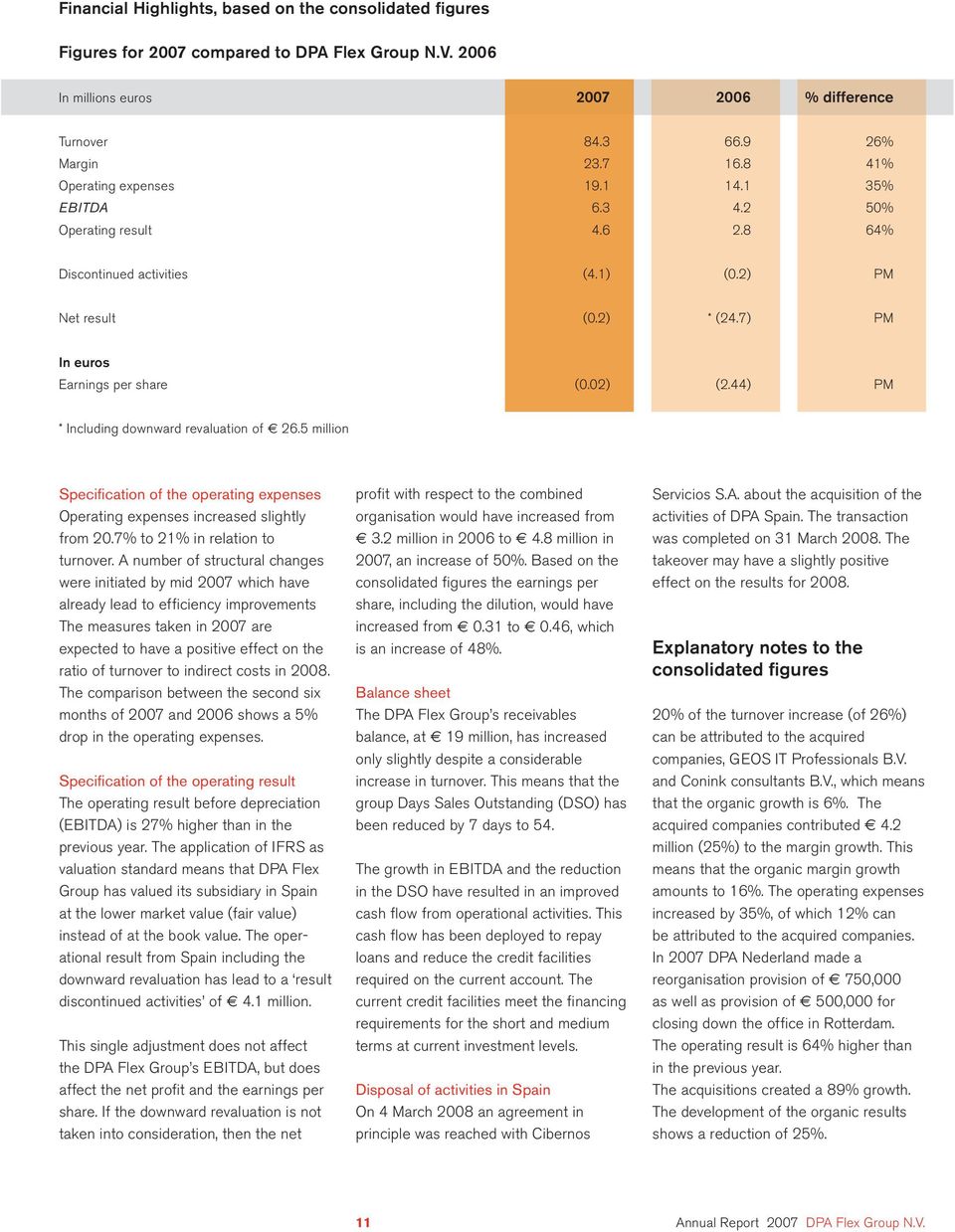
14 Report from the Board of Directors Expectations for 2008 The turbulent developments within the financial and other markets, currently give us an insufficient base to make any forecast statements for Long-term strategy The mission of our organisation, providing added-value for our clients to whom our interim professionals are seconded, remains unchanged. DPA has a leading position in the secondment of interim professionals in the expertise areas Finance, IT and Supply Chain. The longterm strategic objective remains to realise healthy financial results, so that DPA Flex Group can invest in sustainable growth and at the same time maintain a solid balance sheet. Growth will be achieved through both organic growth and acquisitions. Growth in existing and new markets and areas of expertise will be necessary to hold the leading position in the secondment market, but this must not be at the expense of the focus on the existing activities or the gross margin. Growth scenarios DPA believes in growth: for our professionals and for our organisation. And to encourage this we consciously invest a great deal of time and money in the development and quality of our people. This approach has enabled us to grow into a leading expertise supplier of flex professionals. Challenging assignments, interesting clients and continuous investment in training and professionalisation together form the cornerstones. This enables our professionals to provide added-value and through their hard work to make an important positive contribution to our client s operating results. DPA Flex Group Shared Service Center DPA Nederland GEOS IT Professionals DPA Conink DPA Supply Chain People 12
15 Our core values Transparent Clarity is very important to us. Our official quotation contributes to transparency management. Knowledgeable Our professionals determine the success. We endeavour to do ordinary things in an extraordinary way. Focus Speed Passion DPA is committed to results that last. In order to fulfil our clients need for interim expertise, DPA is continually searching for efficiency gains and new recruitment channels. Secondment is all about people and to distinguish ourselves DPA has created an inspiring working environment. DPA: transparent, knowledgeable, passionate 13 Annual Report 2007 DPA Flex Group N.V.
16 Market developments In this section we will refl ect on the market developments relevant to DPA Flex Group N.V. and consider their infl uence on the future for DPA. We have set out these developments per operating company (DPA fl ex professionals, DPA Supply Chain People and GEOS IT Professionals), and included the accompanying implications and the choices made. Safe harbour statement A number of future-oriented notifi cations and/or statements have been made in this annual report. These future-oriented notifi cations and/or statements are subject to risks, uncertainties and other factors as a consequence of which the actual results and/or their corresponding expectations may differ substantially from the information given in these future-oriented notifi cations and/or statements. Important causes and/or factors that may lead to such a situation are: (i) IT and/or Finance market conditions (ii) general economic circumstances (iii) the functioning of the fi nancial markets (iv) interest rates (v) competitive conditions on world national and/or regional level (vi) changing laws and regulations. The above-mentioned factors and/or causes are not exhaustive. Moreover, many factors and/or causes occur outside the direct area of infl uence of the Company. For this and other reasons, the Company recommends the reader to observe caution and reticence when interpreting future-oriented notifi cations and/or statements. DPA flex professionals Sharpened attention in case of exceptional market conditions The increasing demand for qualified flex professionals in all sectors in which DPA Flex Group N.V. is active provided an excellent position for further growth at the beginning of Therefore growth for DPA flex professionals too. It can be noted that the quality of the turnover compared to 2006 has improved. The results have developed largely according to our expectations. The turnover continued to grow in the first six months by 6%, the gross margin (28.1%) showed a positive development throughout the year and the operating result increased by 27%. After a favourable first six months the head wind in the financial sector that even increased in strength in the second half of 2007 stagnated growth. Developments at many large financial institutions also had an influence on our position as professional service provider and supplier of flex professionals to large Dutch banks and insurers. As a consequence of the caution and restraint in the financial world the demand for external professionals declined considerably in the last quarter of Nevertheless in the longer term prospects for DPA flex professionals remain favourable, because as the reorganisations are completed a new period of advancement will commence. In many cases assistance from external professionals will be required in this type of change projects. Besides the credit crisis, the effects of mergers and acquisitions as well as integrations in the financial sector are very noticeable. For example, in the past year work commenced on the integration of many back office and front office functions at a number of large banking institutions. All this has lead to a focus on commercial aspects in combination with the internal organisations to be formed for all parties involved. The reorganisations in the financial world will therefore offer new opportunities. Certainly when the shape and structure of the new organisations at the banks and insurers becomes clear, this will generate demand for new knowledge and expertise. At the same time restraint will still be exercised within these organisations concerning hiring in new personnel. In fact, it is exactly this type of change project that DPA flex professionals can make an effective contribution to the construction of new organisations within the merged financial institutions. And at DPA flex professionals we realise this to the full. We will be setting out with full conviction in order to grasp these new opportunities. At DPA interim professionals determine the success 14
17 Cost reductions As a result of the turbulent market developments in the financial sector in the second half of the year, a number of long-term master contracts have been terminated or suspended. Secondment contracts have been terminated for a large proportion of the more than three hundred professionals employed by DPA flex professionals who were active in the financial sector, as a consequence of the turbulent market conditions in the last quarter of For the whole group the number of interim professionals at the end of 2007 was 140 lower than the previous year. The reorganisation implemented in our internal organisation has ensured the desired cost reductions. It has also made sure that the commercial scale of the organisation is now more in line with turnover and that the organisation transformed from a matrix to a functional structure. In the past year we have also made a good start to increasing the attention for risk management. Efficiency in our own organisation and the background processes have improved management on costs. Diversification of interests Although the financial sector, with the banks and insurers as primary parties, is an important market for deploying DPA flex professionals, it is certainly not the only market. Diversification of interests has been a basic principle for our policy for many years, and this means that we as an organisation are less dependent on economic trends in a particular sector. Besides banking & insurance our key marketing areas include the public sector, transport trade & industry and professionals services & utilities. We are also delighted to announce that the number of one-to-one contracts (assignments not based on a master contract) agreed in 2007 with various parties has increased. In many cases contracts were agreed with medium-sized companies. In the past DPA flex professionals focused mainly on large companies and institutions and agreeing master contracts with these large organisations. In addition to this, DPA flex professionals is increasingly seeing opportunities for expansion in these medium-sized companies. Generating new business within this market segment already received higher priority in the past year. The first actions focussed on this were taken in the second half of 2007 and are expected to reap results in An important aspect here is that development in this segment must not in any way be at the expense of the quality of our services provided for existing clients. Prospects for 2008 For some time now the secondment market has been undergoing consolidation on the supply side, partly due to concentration on the demand side, the shortage of qualified professionals and current economic circumstances. This trend is expected to continue in This having been said, there is still ample opportunity for growth in specific niche markets. Generally speaking caution is advised for The unrest in the financial markets and the accompanying uncertainties for our largest operating company DPA flex professionals, make it difficult to make predictions. Almost every organisation continues to be affected by the shortage of qualified people in the labour market, which already existed in In addition it appears that the wish of many organisations to fulfil part of their staffing needs flexibly is structural, and this does not only apply to the larger organisations. Even within the SME sector it is becoming increasingly common to deploy highly qualified personnel, who are therefore expensive, as effectively as possible. This offers perspectives for organisations such as DPA flex professionals, where quality, professionalism and added-value are key elements in the services provided. In a tight labour market it remains an art to find the right people. Because cost awareness is an important driver for every organisation, many organisations seek to fulfil their staffing needs as flexibly as possible. Our specialism is offering comprehensive and flexible solutions to staffing problems. We do this by offering the flexibility required, but with the certainty of maximum quality and masses of added-value. Doing the ordinary things in an extraordinary way. That s what matters. 15 Annual Report 2007 DPA Flex Group N.V.

18 DPA Supply Chain People Continuing growth in public and private sectors In 2005 when DPA Flex Group N.V. established DPA Supply Chain People B.V. the objectives set were to capture a leading position in the Dutch market in the areas of procurement and other supply chain issues (logistics and operations). The organic growth achieved by DPA Supply Chain People B.V. in 2005 and 2006 continued in 2007, and again the forecast for 2008 is hopeful. In 2007 turnover grew organically to 7.7 million; once again a considerable increase compared to the turnover in 2006 ( 4.2 million). Besides the growth in turnover in all our lines of business (secondment, consulting and recruitment & selection) the average gross margin for these activities also showed healthy development. The primary focus of DPA Supply Chain People s activities lies in the secondment of procurement, logistics and operations specialists. In addition to secondment, recruitment & selection and consulting (projects to implement improvements and savings) are also part of our core business. In 2007 DPA Supply Chain People B.V. was active in both the private and public sectors. Notably many enquiries and new clients resulted from the growing requirements of the Dutch ministries, provinces, municipalities and other organisations where tendering is obligatory to conform to the European tendering regulations. In order to strengthen our position in the fast growing European tendering market, in September 2007 DPA Flex Group N.V. acquired Conink consultants B.V. In 2007 DPA Supply Chain People and Conink consultants were good for approximately 11.4 million euro turnover (pro forma) and together they form the leading party in the Netherlands for tackling procurement and other supply chain issues. The acquisition of Conink consultants and the subsequent integration went smoothly. New and existing clients and personnel reacted positively and within four months of the acquisition the integration of the back-office was a fact. Of course, even an acquisition of this size demands a great deal of management attention, but despite this Conink consultants turnover in 2007 remained at 2006 levels. The commercial portfolio is still very well filled. The integration of the activities of Conink consultants has brought the spread of turnover from the public and private sectors more into balance. In 2008 the combination of DPA Supply Chain People and Conink consultants will continue to pursue this strategy. The growth prospects are favourable, in both the public and private sectors. In the private sector the demand for supply chain specialists will continue to grow due to shortages of qualified people. Within the public sector we will continue to see substantial demand for procurement specialists; the number of European tendering procedures issued by the government is expected to continue increasing. On the market, the activities of Conink consultants are carried out under the name of DPA Conink. Key objectives for 2008 are the further expansion of the leading position, the strengthening of the synergy between our lines of business (secondment, consulting and recruitment & selection and training) and achieving increased commercial and operational efficiency. In addition lasting commercial collaboration will be sought with other parts of the DPA Flex Group. Finding and holding on to good qualified professionals is and remains a constant focal point. DPA Supply Chain People: grown to market leader in just three years 16

19 GEOS IT Professionals Good results in transitional year The acquisition of GEOS IT Professionals B.V. in 2007 enabled DPA Flex Group N.V. to significantly expand the range of services we offer in the IT sector. Within our organisation GEOS IT Professionals is an independent operating company with its own identity and its own lines of business. The activities concentrate entirely on the secondment of expe rienced IT professionals specialising in Oracle, SAP and Siebel. Clients include end users as well as the large software houses in the Netherlands, and almost all projects involve large, prestigious organisations. For GEOS IT Professionals 2007 was a transitional year. A period of change and integration dawned after the acquisition by DPA Flex Group. The time and attention claimed by these transitional activities could not be spent on commercial activities, but we were still able to realise the objectives set for A limiting factor in this niche market continues to be finding and holding on to experienced professionals. We expect collaboration with the other operating companies in the DPA Flex Group and more cross selling to contribute to the further growth of turnover and operational results in The foundations for this were already laid in In order to strengthen the cooperation GEOS IT Professionals moved from The Hague to the DPA offices in Amsterdam at the beginning of GEOS IT Professionals: interesting employer in a tight labour market Despite the period of integration GEOS IT Professionals succeeded in achieving 7% growth in turnover, bringing the turn over to 12.1 million. The departure of a number of consultants at the beginning of 2007 was compensated by the recruitment of new people. The number of consultants active for clients remained stable. In 2007 an average of 80 professionals were working for clients on projects to modify, expand and imple - ment ERP systems, and 80% of these are employed by GEOS IT Professionals. A key requisite for growth is finding and holding on to experienced consultants. The increased capacity now working on recruitment should make a considerable contribution to finding new people. In fact the combination of our own identity and a unique remuneration structure makes GEOS IT Professionals an interesting employer, even in a labour market with extreme shortages. These distinctive elements will certainly be emphasised in our recruitment campaign. GEOS IT Professionals aims to achieve a higher growth percentage in 2008, and to realise these aspirations we have expanded the sales team. For the time being we have doubled the management capacity; from one to two persons. 17 Annual Report 2007 DPA Flex Group N.V.

20 Corporate Governance Structure and policy DPA Flex Group N.V. is a limited company under Dutch law, with registered offices in Amsterdam, the Netherlands. The authorised capital consists of ordinary shares made out to bearer. No share certificates or cumulative preference shares have been issued. DPA is listed on the NYSE Euronext in Amsterdam. A large proportion of the shares are owned by private equity funds and institutional investors. The company focuses on the Dutch market, but in 2007 still had two subsidiaries in Spain. The management of DPA consists of a Board of Directors and a Supervisory Board. DPA considers this so-called twotier management structure the best way to implement the right checks and balances within the organisation. A Board of Directors with two members is responsible for the general management of the company and for the planning and realisation of the long-term strategy. The Supervisory Board is responsible for the supervision of the management and for advising the Board of Directors. Three people have a seat on the Supervisory Board. The Supervisory Board does not have separate committees and considering the expected size does not expect to do so in the future. Implementation and deviations DPA started to implement the Dutch Corporate Governance Code as from the moment of its introduction in DPA had already been working in accordance with the majority of the principles stated in the code. A more detailed application required adjusting the company s articles of association and drawing up or adjusting various regulations to ensure that the best practices from the Corporate Governance Code are embedded within the organisation. In situations where this is not yet the case steps are being taken to further implement the provisions of the code. The company reserves the right to deviate from best practice provisions for incidental circumstances yet retaining the basic principles as formulated in the code and motivating the reasons for deviation. DPA: doing ordinary things in an extraordinary way 18
21 Corporate Governance The organisation meets almost all best practice provisions stated in the Dutch Corporate Governance Code with the exception of the following provisions: (I) Best practice provision II.1.1 Appointment of the directors for a period of four years. This best practice provision is not applied because, considering the size of DPA, this would present too great a risk for the continuity of the organisation. DPA therefore has chosen to appoint the members of the Board of Directors for an indefinite period. (II) Best practice provision II.2.6 The periodic statement of changes in ownership of shares of companies listed on the Dutch stock exchange. The organisation does not adhere to the principle concerning the obligation of the Board of Directors and the Supervisory Board to inform the organisation about share transactions other than transactions in shares of competitors and similar enterprises. The organisation considers these share transactions as normal portfolio management and thereby as a personal matter for the members of the Board of Directors and the Supervisory Board. (III) Best practice provision II.2.7 The maximum remuneration in the event of involuntary dismissal amounts to one times the annual salary (the fixed part of the remuneration). Deviations from this best practice provision are permitted for the members of the DPA Board of Directors. The current settlement for CEO Peter Smit dates from 1999, when he took up the position. The remuneration depends on the number of years service and may be no more than four times the annual salary with an upper limit of 1 million. The same settlement applies for CFO Jan van Duijn, on the understanding, that for him a minimum of two times the annual salary will be applicable. (IV) Best practice provision IV.3.1 The opportunity to attend meetings with analysts, presentations and press conferences by means of webcasts, telephone connections or similar means. The size of the organisation is currently insufficient to be able to make these facilities available. Furthermore the company considers that only a very limited number of shareholders would make use of such facilities, which does not justify the cost of implementing such a system. DPA considers that the announcement of meetings as well as the provision of information via the company website in advance of and following the meeting is sufficient. Changes compared to 2006 In 2007 a change was made relating to best practice provision III The regulations of the Supervisory Board contain rules pertaining to dealing with (potential) conflicting interests for directors, supervisory directors and the external auditor with regard to the company, and concerning which transactions require the approval of the Super visory Board. Regulations for directors and the external auditor con cerning (potential) conflicting interests have been added to the regulations of the Supervisory Board. Regulations Currently there is still one set of regulations to be revised because the current regulations do not provide for the changed situation. This concerns the renewal of the regulations for the board of Directors. The relevant documentation, including the company s articles and the various regulations, is published on the website or is available on request from the company. 19 Annual Report 2007 DPA Flex Group N.V.
22 Risks and risk management Risks are an integral part of doing business. DPA endeavours to minimise the risks arising from normal business practice by striving to provide high quality service. And this is embedded in a strong and professional organisation. In order to guarantee the quality as well as the efficiency of the services provided, DPA invests in training its personnel. Continuous attention is paid to the administrative processes and we provide transparency in our costs and revenues. The communications and information systems support this. In addition DPA is ISO 9001:2000 certified. The six-monthly audits clearly demonstrate how DPA has anchored continuous quality improvement in the operating procedures. Risks arising from activities The risks associated with the business activities, market position and development of DPA are mainly determined by the quality and quantity of projects being carried out by our interim professionals for our clients. Factors for the success of DPA are determined by the ability to recruit and hold on to suitable professionals and the ability to manage the costs of our internal processes. Quality and quantity of projects During 2007 the average length of our projects increased and absence due to illness remained low. The average hourly rate increased compared to that in The number of projects carried out for clients in the first half of the year increased compared to In the second half of 2007 the number of assignments declined in comparison with The increase in productivity and the rise in the average hourly rate enabled total turnover in 2007 to grow. From a commercial point of view management attention is divided between gaining the position of preferred supplier at large clients and deploying interim professionals in small and medium-sized enter - prises. The large clients mainly ensure continuity in our assignments, while it is usually possible to realise a higher margin for assignments with small and medium-sized enterprises. As a result of this dual focus DPA is able to realise turnover from a wide client base. In addition a great deal of attention is paid to expanding and extending agreements with existing clients. Recruiting and holding on to professionals The changes to the organisation implemented during 2006 and 2007 have paved the way to better ensure the development, coaching and deployment of the interim professionals within the existing operating companies. The responsibility for the healthy growth in the numbers of interim professionals in tune with demand from the market lies with the operating companies themselves. Each operating company has its own profile enabling interim professionals to identify themselves with the operating company that best meets their own wishes and requirements. In this way DPA endeavours to optimise the recruitment of interim professionals and strengthen the bond between DPA and the professionals. 20
23 Nevertheless, increasing shortages in the labour market are forcing DPA to conduct more recruitment activities in order to continue to satisfy to the increasing demand for its services. Management of costs At the start of 2007 DPA transformed the structure of the organisation so that the structure of the holding company with its operating companies is more clearly expressed. The financial and administrative activities are now concentrated in a separate part of the organisation, which should lead to increased cost efficiency. This structure forms a solid basis to accommodate the expected growth, to be achieved either from acquisitions or organically. As is the case in most organisations, ICT plays a key supporting role in our processes. Our IT systems are stable and perform sufficiently well, however continual investment will always be required. In 2008 we are planning to outsource our server park. Partly because we are facing an investment for the replacement of equipment and partly to reduce the risk of production loss. In time, our IT applications will also need to be replaced, since capacity problems could be expected. We will take this opportunity to achieve finer tuning to the requirements of the organisation. DPA is also investigating further options to transform overhead costs to variable costs, so that costs remain in line with the size of the company. A key factor in these costs is when interim professionals are not productive. In 2007, taking the whole year into consideration, this factor diminished. This is due to the operating companies paying extra attention to limiting unproductive time and keeping costs under control. Unproductive time is due to the period between two assignments but may also be the result of a particular professional s qualifications no longer meeting demand. We aim to limit the first cause by signalling the end of an assignment well in advance and by maintaining the level knowledge and expertise of our personnel we endeavour to limit the latter cause. The two above measures are anchored within the operating companies by means of the procedures implemented. 21 Annual Report 2007 DPA Flex Group N.V.
24 Risks and risk management Financial risks The loan of 1 million which was part of the acquisition of FGN Beheer B.V. in 2006 was paid off at the beginning of The acquisition of GEOS IT Professionals: B.V. and Conink con sul t- ants B.V. in 2007 were financed by a working capital facility in the form of factoring. The maximum credit facility is 20 million. The interest is variable and is based on the EURIBOR. In the past year the company s liquidity and solvability was sufficient. DPA has been able to meet its payment obligations amply. The number of bad debts in 2007 in the Netherlands was negligible. All provisions have been made with regard to the risk of uncollectable old debts in Spain. DPA is only active within the euro zone and therefore bears no currency risks. Market risks Trends and changes within each operating company are monitored as part of our internal processes. Information on this subject will be given during management team consultations and commercial consultations. Competition The secondment market is very competitive. There are many different types of service provider. Because the cost of entering the market is low, is it also relatively simple. Pressure from competitors is not expected to decline. In the markets where DPA is active, there is stiff competition to win clients and to recruit experienced interim professionals and qualified personnel. With the acquisition of contracts as preferred Supplier DPA strives to secure market share. These contracts exclude non-contracted service providers for a specific period of time, but place margins under pressure. Sensitivity to the economic cycle The temporary staffing and secondment sector suffers considerably from the effects of the economic cycle. Any deterioration in the economy has a direct influence on our organisation. After all, the demand for temporary staff depends on the economic situation in the markets in which we operate. In order to move with our markets DPA has established a flexible layer which consists of some employees with a fixed contract and some with a temporary contract. This layer can be reduced without too many problems if the market would slow down. These flexible numbers of employees enable us to keep salary costs in line with the order portfolio, and means that our overheads are variable. Internal management system The DPA Board of Directors is responsible for the performance of the system of internal management and risk management. Our risk management focuses on recognising and managing the risks associated with the company s financial and operational objectives. At the same time risk management takes effective measures to manage these risks. DPA s internal management and risk management system consists of the following key elements: Guidelines and consultation structures; Reporting and analysis; Internal control. Guidelines and consultation structures Within DPA the following key control measures (directives and policy rules) have been established: Guidelines pertaining to financial reporting; 22
25 Corporate governance structure, documented in the articles of the company and the internal regulations; Guidelines pertaining to budgeting and annual plans; Periodic consultation with the Supervisory Board, when the most important risks and mitigating measures are discussed; Scheduled weekly consultation within the Board of Directors and scheduled monthly consultation with manage ment to discuss the progress of the operation and the various projects. Reporting and analysis Our reporting is designed to provide timely insight into the extent to which strategic and financial objectives are being realised. The communication about financial and management information takes place according to the guidelines documented within the reporting system. The main reports are: Annual budget, including the business plan; Report on the position of liquid assets; An extensive financial report detailing the expected realisation of the annual budget generated every six months; Detailed monthly information covering the financial results compared to the budget and the results from the previous year; Detailed qualitative information (development of projects in the pipeline, utilisation rates of our interim professionals and our order portfolio); Monthly (written) statements from the management concerning relevant issues such as the receivables position, personnel matters, claims, market expectations, competitive position, analysis of the monthly results and other risks. Internal control DPA operates a framework of internal control measures. This framework supports the underlying financial reporting and procedures. The internal control framework can be subdivided as follows: Basic principles of policy The strategic principles, as formulated in the section Long-term strategy, are evaluated periodically and revised if necessary. These principles are a reflection of DPA s ambitions and the manner in which these are to be achieved. The evaluation takes place during periodic consultation between the Board of Directors and the Supervisory Board. Strategic objectives Strategic plans have been drawn up for all operating companies. A presentation of these plans is included in the section Market developments. These have been translated into objectives and estimates. Each month the management and the Board of Directors checks these against the results achieved. Internal control These checks are in place to ensure that all reports contain reliable information and are drawn up on time and that the risk management policy and the control measures are executed effectively. At the same time, where necessary, measures are documented to further optimise the internal control system. 23 Annual Report 2007 DPA Flex Group N.V.
26 Risks and risk management Declaration concerning the performance of the internal control system In the past year the internal control system has been further optimised and embedded in the DPA organisation. Emphasis was placed on: Centralising documentation and information. Shifting control moments (less in arrears and more in prior to and during processes). Clarifying tasks and responsibilities. Increasing insight into and the identification of further improvements to the processes. The organisational changes within the company have delayed plans to embed the internal control system. Nevertheless we have been able to realise the goals we set. Even though we have taken great care in designing and implementing our risk management and internal control systems, these measures can never offer absolute certainty that the objectives concerning strategy, operational activities, financial and other reporting and compliance to legislation and regulations are always met in full. We know from experience that when taking decisions errors of judgement may occur, that all aspects must be continually taken into consideration when accepting risks and taking control measures, that agreements within the organisation may be ignored and that even simple errors or mistakes can have serious consequences. In 2007 the Board found no evidence indicating that the internal control system did not function properly in the Netherlands. Bearing in mind the abovementioned constraints which are inevitably associated with all risk management and internal control systems and taking into account the opportunities for improvement identified, the Board is of the opinion that risk management and internal control systems in place in our organisation offer a reasonable degree of certainty that the financial reporting does not contain any material misstatements. This also transpires from the audit for The actual effectiveness of our internal control system can only be assessed based on the results over a longer period and/or based on a specific review of the design, the existence and the performance of the internal control measures. In a quickly changing world with a con tinuous stream of new challenges, additional requirements are constantly being placed on the internal risk management processes and their related controls so that there are always aspects of these processes that can be improved. The policy remains focused on the continual review and improvement of the risk management system in order to optimise the reliability and effectiveness of these processes and their related controls and to adjust these processes where necessary. In this context, reasonable assurance refers to a degree of certainty that, under the given circumstances, would be acceptable to a prudent manager in the management of his/her affairs. Quality DPA stands for high-quality service. In order to guarantee the quality and the efficiency of the services we provide, we invest in permanent education and training for our professionals, we invest continually in our own organisation and we offer clients an overview of the transparent structure of our costs and income. We have anchored permanent quality improvements deep in our business operations. To emphasise this DPA is ISO 9001:2000 certified. 24
27 Shareholder information Reservation and dividend policy The DPA Flex Group N.V. dividend policy is based on: A dividend pay-out ratio of 30-40% of the net profit; Payment of dividend in cash. The company only pays a final dividend which is made payable after the General Meeting of Shareholders. Since the flotation of the company in 1999 and up to 2002 approximately 40% was paid each year. From 2003 no dividend has been paid. In 2003 and 2004 the negative results did not permit dividend being paid. In 2005 and 2006 dividend was not paid out to prevent further weakening of the company s capital position. In the future the Board of Directors may decide to pay an optional dividend to holders of ordinary shares in cash and/or partially in shares. Shares issued Based on the Major Holdings Disclosure Act (Wet Melding Zeggenschap) 8 major shareholders of the DPA Flex share are known, as per 4 April 2008: P.C. Smit 10.8% Kempen Capital Management N.V. 13.8% Gestion Deelnemingen II B.V. 12.3% Aviva plc 7.6% A. Strating 10.2% Janivo 6.7% Inter-him N.V. 7.6% M.O. de Ruiter 5.6% Number of shares issued at 31 December 2007: 10,524,262 Average number of outstanding shares: ,104, ,314, ,524,262 Important dates in March Publication of the annual figures for April General Meeting of Shareholders 22 August Publication interim figures 2008 Contact For further information concerning Investor Relations please contact the DPA secretariat, telephone number: +31 (0) You may also send an to investorrelations@dpafl ex.com. Proposal for the absorption of loss 2007 The loss incurred in 2007 of 0.2 million will be charged to the equity base. 25 Annual Report 2007 DPA Flex Group N.V.
28 Members of the Supervisory Board and Board of Directors Supervisory Board The Supervisory Board of DPA Flex Group N.V. consists of: A.G. de Roever (1948) Arend de Roever obtained his doctorate in history from the University of Leiden. He fulfilled various functions in the travel business, before he established his own company in 1984 which he subsequently sold in From that year he worked as an independent management consultant. Arend de Roever has a seat on the council of members of AFC Ajax, the Amsterdam football club, and is treasurer of the Reael Stichting in Leiden. He was appointed to the Supervisory Board of DPA Flex Group N.V. in 2004 and was elected chair on 21 December De Roever has not previously been a director of the DPA Flex Group N.V., he does not own any shares or options in the company, and he holds the Dutch nationality. E.J. Blaauboer (1946) Ellard Blaauboer graduated from the Erasmus University in Rotterdam in 1973, where he obtained his degree in business economics. Besides being director of the Bluefarmers Trust, Ellard Blaauboer is also chair of the Supervisory Board of DIM Vastgoed N.V. and OMNEXT.NET B.V. Between 1983 and 1997 he was managing director of the venture capital company NeSBIC Groep B.V. and also joint founder in 1984 and first chair of the Nederlandse Vereniging van Participatiemaatschappijen (NVP). From 1973 to 1983 he fulfilled various positions at Pakhoed Holding N.V., VNU N.V. and Deli- Universal N.V. Ellard Blaauboer was appointed supervisory director to DPA Flex Group N.V. in 2006 and he holds the Dutch nationality. He does not own any shares or options in the company. M.M.G. van Hemele (1956) Michel van Hemele graduated in 1979 cum laude from the Katholieke Universiteit Leuven where he studied commercial engineering. He continued his studies at EHSAL in Brussels when in 1983 he obtained his Master s magna cum laude in international business economics and management. Additionally he has com - pleted various Management Programmes at English and American universities. Michel van Hemele was one of the founders and managing partners of Essensys. From 2002 to 2005 he was chair of the Board of Directors of Carestel. Prior to that, from 1992 to 2002 he was chair of the Board of Directors of Solvus. From 1979 to 1992 he fulfilled various positions at Fortis N.V. In addition he is professor at the EHSAL Management School in Brussels. Michel van Hemele is also a member of several supervisory boards of other wellknown international companies. He was appointed supervisory director to DPA Flex Group N.V. in 2006 and he holds the Belgian nationality. He does not own any shares or options in the company. The members of the Supervisory Board satisfy the requirements stated by the Corporate Governance Code concerning the Independence of the company. Schedule for retirement by rotation Board of Directors P.C. Smit (1963), CEO Peter Smit is chair of the Board of Directors of DPA Flex Group N.V. and will hold this posi tion until 1 July He founded DPA Financial People in Prior to that he fulfilled various financial positions for various companies, including Deloitte & Touche, KPMG and VNU. J. van Duijn (1963), CFO Jan van Duijn is a member of the DPA Flex Group N.V. Board of Directors. Within the Board of Directors his responsibilities include the company s financial affairs. Jan van Duijn has previous expe ri - ence as finance director, as managing director of Shared Service Center and as director (Corporate Vice President F&A and ICT and Executive Committee member) of companies such as USG People, Unique International and Multi Services. Neither Peter Smit nor Jan van Duijn hold any positions as commissioner for listed companies. The supervisory directors were appointed for a period of three years. As from 2005 the appointment or reappointment of supervisory directors is for a period of four years. Name Year of Year of Eligible for appointment retirement reappointment A.G de Roever No E.J. Blaauboer Yes M.M.G. van Hemele Yes 26
29 Report from the Supervisory Board We are pleased to present the financial statements of DPA Flex Group N.V. for 2007, as drawn up by the Board of Directors. These financial statements were discussed in the meeting of the Supervisory Board on 3 March 2008 and are accompanied by an unqualified auditors report, dated 10 April 2008, from Mazars Paardekooper Hoffman N.V. We propose that the General Meeting adopt and approve the DPA Flex Group N.V. financial statements for 2007 and the proposal for the appropriation of profit. After the loss of 0.2 million the equity base remains at 30.4 million per 31 December We also request you to discharge the Board of Directors of any liability for their management and the Supervisory Board of any liability for their supervision. In 2007 the Supervisory Board met nine times with the Board of Directors. One strategy meeting was conducted in conjunction with the Board of Directors and the auditor has been present during two meetings. With minor exceptions all supervisory directors were present at the meetings. The supervisory directors met to discuss their own performance, the profile and competencies and draw conclusions. Once again 2007 was a turbulent year and was initially dominated by the proposed termination of business activities in Spain. With reference to the development of turnover and results, at the end of March the Supervisory Board requested the Board of Directors to draw up a strategic analysis of the activities in Spain. The various options and their consequences were identified and this resulted in the decision being made to dispose of the subsidiary. This decision was taken at the meeting on 27 June and was announced via a press release on 28 June On 4 March 2008 an agreement in principle was reached for the sale. All investments in the activities in Spain have been written off against profit. This meant that once again the Board of Directors could concentrate fully on activities in the Netherlands which we consider to be a positive development. 27 Annual Report 2007 DPA Flex Group N.V.
30 Report from the Supervisory Board Many issues were discussed during the meetings including the following items: Marketing strategy and market circumstances; forecast versus actuals, as well as the future of the secondment branch. The Corporate Governance Code and its implementation. Management and structure from a corporate governance environment perspective. Performance of the Board of Directors of the company as a whole and of the individual members of the board. Administrative organisation and internal control systems. Risk management and the associated assessment of the internal risk management and control system. IFRS rules. Budget and financial results versus the forecasts. The financial statements. The operational progress of the business in Spain and the decision to dispose of this. The desire to expand the capacity of DPA Supply Chain People B.V. The considerations to move to the acquisition of Conink consultants B.V. The actual acquisition by DPA Flex Group N.V. and the potential further integration in DPA Supply Chain People B.V., considering the shareholder ratios. The integration, in so far as this is desirable, of GEOS IT Professionals: B.V. in the organisation of DPA Flex Group N.V., particularly concerning accessibility and the integration of the back-office. The impact of the US credit crisis on the Dutch financial world and the implications for company policy. Remuneration policy The DPA Flex Group N.V. remuneration policy is reviewed annually with reference to the policy of comparable companies in the Netherlands. It transpired from the review in 2007 that the remuneration of the directors is at the lower end of the scale of what is considered competitive. In the past year the Board of Directors received a salary increase. A bonus system for the Board of Directors was also introduced in The targets we as Supervisory Board set for 2007 were not achieved. Accordingly the CEO did not receive a bonus. However a one-off bonus was pledged to the CFO. Considering that his term of employment commenced on 1 January 2007, he had no influence on the targets set and the approved budget. The Supervisory Board considers it has fulfilled the best-practice provision III.2.1 of the Corporate Governance Code independently. Amsterdam, 4 april 2008 Supervisory Board A.G. de Roever E.J. Blaauboer M.M.G. van Hemele 28
31 Financial Statements 2007
32 Consolidated income statement for 2007 x 1000 Explanatory notes ) Net revenue ,322 66,880 Cost of services 6. 60,636 50,044 Gross profit 23,686 16,836 Selling expenses 13. 9,588 9,015 General administrative expenses 13. 9,500 5,067 Impairment in respect of goodwill ,481 Total operating expenses ,088 40,563 Operating result 4,598 (23,727) Financial income Financial expenses 15. (930) - Result of continuing activities before tax 3,668 (23,675) Result of discontinued activities before tax 14. (4,127) (333) Income before tax (459) (24,008) Taxation on profit (713) Net result (192) (24,721) Attributable to: Shareholders of the company (532) (24,816) Minority interests (192) (24,721) Earnings per ordinary share for profit attributable to the ordinary shareholders of DPA Flex Group N.V. during the year (in euros per ordinary share): Basic net earnings per ordinary share 17. (0.05) (2.44) Diluted earnings per ordinary share 17. (0.05) (2.44) 1) Revised, see explanatory note
33 Consolidated balance at 31 December 2007 before appropriation of profits x 1000 Explanatory notes ASSETS Property, plant and equipment (tangible assets) 19. 1,161 1,423 Intangible assets ,823 22,641 Deferred tax assets Fixed assets 40,984 24,868 Trade and other receivables ,072 21,462 Receivable from taxation on profit 21. 1, Discontinued activities Cash and cash equivalents ,330 Current assets 24,529 23,212 Total assets 65,513 48,080 EQUITY AND LIABILITIES Issued capita 25. 1,052 1,052 Share premium ,173 49,186 Reserves 25. 3,298 5,101 Undistributed earnings (532) (24,816) Equity for own shareholders 29,991 30,523 Minority interests Total equity 30,407 30,599 Deferred tax liabilities 21. 1,571 1,477 Loans 26. 1,250 - Provisions ,158 Long-term liabilities 3,274 2,635 Creditors and other liabilities ,173 11,897 Short-term tax liabilities Bank borrowings ,499 1,000 Provisions 27. 1,681 1,712 Liabilities held for sale Short-term liabilities 31,832 14,846 Liabilities 35,106 17,481 Total equity and liabilities 65,513 48,080 N.B. The following explanatory notes form an integral part of these financial statements. 31 Financial Statements 2007 DPA Flex Group N.V.
34 Consolidated statement of changes in equity x 1000 Toelichting Issued Share Reserves Total equity Minority Total capital premium of own interests shareholders Ordinary General Net Total reserve result reserves Position at 1 January ,776 4, ,520 10,938-10,938 Appropriation of profit/loss for (785) Placement of shares , ,820-44,820 Placement costs - - (419) - (419) (419) - (419) Net profit (24,816) (24,816) (24,816) 76 (24,740) Position at 1 January ,052 49,186 5,101 (24,816) (19,715) 30, ,599 Appropriation of profit/loss for (23,013) (1,803) 24,816 23, Net profit (532) (532) (532) 340 (192) Position at 31 December ,052 26,173 3,298 (532) 2,766 29, ,407 32
35 Consolidated cash flow statement 2007 x 1000 Explanatory notes ) Net result (192) (24,721) Discontinued activities 14. 4, Corporate tax 16. (267) 713 Financial income and expenses (52) Operating result 4,598 (23,727) Adjustment for: Depreciation goodwill - 26,481 Depreciation of property, plant and equipment Amortisation intangible assets 20. 1, Provisions 33. (736) 676 Tax on profits received / (paid) 21. (1,763) (563) Operational cash flow before operational working capital 3,842 4,300 Trade and other receivables 33. (2,361) (4,663) Creditors and other liabilities 33. 1,063 1,809 Operational working capital (1,298) (2,854) Net cash flow from operations 2,544 1,446 Investments in property, plant and equipment 19. (278) (985) Acquisition of subsidiaries, corrected for acquired cash position 31. (18,353) 49 Divestments in property, plant and equipment Financial receivables Net cash flow from investment activities (18,551) (781) Free cash flow (16,007) 665 Minority interests Funding Moneys borrowed 26. 2,000 - Loans repaid 26. (750) - Financial income and similar earnings Financial expenses and similar expenses 15. (930) - Remuneration to providers of funds Net cash flow from financing activities Net increase (/decrease) in cash and cash equivalents and bank borrowings (15,347) 793 Cash and cash equivalents and current bank borrowings per 1 January 1, Net increase (/decrease) in cash and cash equivalents and bank borrowings (15,347) 793 Cash and cash equivalents and current bank borrowings per 31 December 33. (14,187) 1,160 2) Revised, see explanatory note Financial Statements 2007 DPA Flex Group N.V.
36 Explanatory notes to the consolidated balance sheet (amounts in 1000 unless otherwise stated) 1 General information DPA Flex Group N.V. is a public limited liability company incorporated and domiciled in the Netherlands and listed on the NYSE Euronext Amsterdam. The company was founded on 18 March The registered office of the company is in Amsterdam and the address is Thomas R. Malthusstraat 3-B. The name of the company was changed on 2 February 2006 in DPA Flex Group N.V. Activities The main activities of the Group are providing specialist staffing solutions for financial-administrative and IT specialist personnel (such as controllers, heads of finance and payroll accountants, system administrators and network managers) and interim management solutions. Authorisation date of the financial statements The financial statements were drawn up by the Board of Directors on 4 April The financial statements were signed and authorised for issue by the Board of Directors and the Supervisory Board on 4 April The adoption of the financial statements is reserved for the shareholders at the Annual General Meeting of Shareholders (AGM) to be held on 22 April Summary of the key reporting policies Compliance with IFRS The consolidated financial statements have been prepared in accordance with the International Financial Reporting Standards (IFRS) as adopted by the European Union. Amendments, interpretations of existing directives and new directives have come into force in IFRS 7 Financial instruments: Disclosures is a new directive that is relevant to the Group. IFRS 7 imposes new disclosure requirements for financial instruments but has no influence on the valuation of Group financial assets and liabilities. Subsidiaries The consolidated financial statements of DPA Flex Group N.V. comprise the company and its subsidiaries (together called the Group ). The consolidated financial statements include the financial data of DPA Flex Group N.V. and the following subsidiary companies: DPA Flex Beheer B.V., Amsterdam, the Netherlands, (100%) DPA Flex Nederland B.V., Amsterdam, the Netherlands, (100%) DPA Flex Finance Vast B.V., Amsterdam, the Netherlands, (100%) DPA Flex Finance Payroll B.V., Amsterdam, the Netherlands, (100%) DPA Flex Finance FIT B.V., Amsterdam, the Netherlands, (100%) DPA Flex ICT Vast B.V., Amsterdam, the Netherlands, (100%) DPA Flex ICT Payroll B.V., Amsterdam, the Netherlands, (100%) DPA Flex ICT FIT B.V., Amsterdam, the Netherlands, (100%) DPA Flex Specialities Vast B.V., Amsterdam, the Netherlands, (100%) DPA Flex Specialities Payroll B.V., Amsterdam, the Netherlands, (100%) DPA Flex Specialities Fit B.V., Amsterdam, the Netherlands, (100%) DPA Flex Young Professional B.V., Amsterdam, the Netherlands, (100%) DPA Flex Werving & Selectie B.V., Amsterdam, the Netherlands, (100%) DPA Flex Interim B.V., Amsterdam, the Netherlands, (100%) GEOS IT Professionals B.V., Amsterdam, the Netherlands, (100%) from 1 January 2007 Conink consultants B.V., Zwolle, the Netherlands, (100%) from 5 September 2007 Conink Participaties B.V., Zwolle, the Netherlands, (100%) from 5 September 2007 DPA Supply Chain People B.V., Amsterdam, the Netherlands, (51%) DPA Financial People GmbH, Cologne, Germany (100%) DPA Financial People ETT SL, Madrid, Spain (100%) DPA Financial People Consulting SL, Madrid, Spain (100%) 34
37 Similarly, other amendments, interpretations of existing directives and new directives have no influence on the valuation of the Group balance sheet items. The Group has not opted for early adoption of new directives, amendments to and interpretations of existing IFRS directives that are published but applicable to the reporting year commencing on 1 January 2008 or later. These are not expected to influence the valuation of Group balance sheet items. Policies for preparing the financial statements These financial statements are presented in euros; the functional currency of DPA Flex Group N.V. All amounts are stated in 1000 unless otherwise stated. The financial statements are prepared under the historical costs convention, with fair value adjustments where applicable. For both current (less than one year) and long-term (longer than one year) assets and liabilities the corresponding presentation is used on the face of the balance sheet. Current assets and liabilities are not discounted. In the preparation of the financial statements, estimates and assumptions are made that could affect the value of assets, liabilities, revenue and expenses. The estimates and underlying assumptions are based on historical experience and various other factors that are believed to be reasonable under the given circumstances. The actual outcome may differ from these estimates and assumptions. Judgements made by management that could have significant effect on the financial statements and estimates with a significant risk of material adjustments are further explained in explanatory note 3. All subsidiaries have applied the accounting policies consistently. The company applies the exceptional provisions as stated in Article 2:402 of the Netherlands Civil Code to the Company profit and loss account. Accounting policies for consolidation The consolidated financial statements comprise the financial data of DPA Flex Group N.V. and its subsidiaries. Subsidiaries are companies where DPA Flex Group N.V. has the power, directly or indirectly, to govern the financial and operational policies, based on a shareholding of more than 50% of the voting power or any other way controls the financial and operational activities. Potential voting power that is executable or convertible is taken into account. Subsidiaries are consolidated from the date that control commences until the date that control ceases. Intra-group balances and income and expenses arising from intra-group transactions are eliminated, as well as any unrealised gains from these transactions. Unrealised losses from intra-group transactions are also eliminated unless there is evidence of impairment of the assets transferred. Minority interests in the equity of a subsidiary are disclosed separately as part of the equity of the Group. The share of the result attributable to minority interests is added to / deducted from the minority interests in the equity of the Group. If the minority interests in the equity base of the Group becomes negative, the result that was attributed to minority shareholders will be attributed to the shareholders of the company so that the minority interests are zero, unless the minority shareholder has signed a net worth statement, in which case a receivable will be booked equivalent to the value of the negative minority interests. Impaired assets The book values of the Group s assets, with the exception of deferred tax assets, are reviewed on each balance sheet date to determine whether there are any indications of an asset which could be subject to impairment. If there are such indications the recoverable amount of the asset concerned is determined. If it is not possible to determine the recoverable amount of the individual asset, then this will be determined for the cash-generating unit to which this asset belongs. For purposes of impairment testing assets are grouped at the lowest level for which there are separately identifiable cash flows (cash-generating units). An asset is impaired if its book value is higher than its recoverable value; the recoverable value is the higher of an asset s net realisable value and its valuein-use. Impairments are immediately recognised as expenses in the income statement. Goodwill is attributed to cash-generating units for the purpose of impairment testing and is tested for impairment at least annually based on a discounted cash flow calculation. Goodwill is attributed from the moment of acquisition to cash-generating units that are expected to achieve synergy benefits. Goodwill is the positive difference between the acquisition price and the fair value of the acquired net assets attributable to the Group. Any negative difference is charged directly to the profit and loss account. Impairments recognised in respect of a cash-generating unit are first allocated to the book value of the goodwill of the related cash-generating unit and then deducted from book value of the other assets of that cash-generating unit on a pro rata basis. The recoverable value of the Group s held-to-maturity loans and receivables (financial assets) created by the legal entity is calculated as the present value of estimated future cash flows, dis- 35 Financial Statements 2007 DPA Flex Group N.V.
38 Explanatory notes to the consolidated balance sheet counted at the original effective interest rate (i.e. the effective interest rate computed at initial recognition of these financial assets). Impairment in respect of held-to-maturity loans and receivables (financial assets) created by the legal entity is reversed if the subsequent increase in recoverable amount can be related objectively to an event occurring after the impairment loss was recognised. Impairment in respect of goodwill is not reversed. Impairment in respect of other assets is reversed if there has been a change in the estimates used to determine the recoverable amount. Impairment is reversed only to the extent that the asset s book value does not exceed the book value that would have been determined, net of depreciation or amortisation, if the impairment had not been recognised. Foreign currency conversion The Group operates in a number of countries with only the euro as a functional currency. The presentation currency is the euro. Transactions in currencies other than the functional currency of the subsidiary concerned are converted at the foreign exchange rate valid for the date of the transaction. Monetary balance sheet items in currencies other than the functional currency of the group company are converted at year-end exchange rates. The Group has no non-monetary balance sheet items in currencies other than euros. Exchange differences on cash and cash equivalents and borrowings are included in net finance costs. Exchange differences on other balance sheet items are included in operating expenses. Segment reporting A segment is a distinguishable component of the Group that is engaged either in providing similar services (business segment), or in providing services within a particular economic environment (geographic segment) that are subject to risks and rewards different to those of other segments. The information per geographic segment (primary segment reporting basis) can be found in explanatory note 34. The Group has a secondary segment reporting basis per business segment. Net revenue The net revenue comprises the fair value of the sum received or receivable for services rendered in the year to third parties excluding tax and discounts. For transactions in which the Group only acts as intermediary only the appropriate provision amount is booked as net revenue. The net revenue from rendered services is recognised in the profit and loss account in proportion to the stage of completion of the contract as of the balance sheet date. No revenue is recognised if there are significant uncertainties regarding recovery of the amount. Operating expenses Operating expenses are classified based on the functional model. Gross profit is the balance of net revenue and the cost of services in relation to secondees. Selling expenses comprise personnel, labour agreement dependent expenses, and accommodation expenses in relation to operational activities, advertising and marketing and other selling expenses. General administrative expenses comprise personnel and accommodation expenses in relation to the procurement and sales activities, IT and other general management expenses. Operational expenses are recognised in the year to which they relate. Leasing Lease contracts in which the majority of risks and rewards inherent to ownership do not lie within the Group, are classified as operating leases. Expenses in respect of operating leases are included in the income statement based on linear redemption over the term of the lease. Lease contracts in which the majority of risks and rewar\ds inherent to ownership lie with the Group, are classified as finance leases. Upon initial recognition, the related assets are valued at the lower of fair value of the assets and the discounted value of the minimum lease payments. These assets are depreciated based on the same depreciation period for similar Group assets or the lease term, if shorter. The lease instalments to be paid are divided using the annuity method and a fixed interest percentage, into a repayment and an interest portion. The lease liabilities are recognised under long-term liabilities, excluding interest. The interest portion included in the periodic lease payments is included as interest expense in the income statement. Grants An unconditional grant is recognised in the income statement when the grant becomes receivable. Any other grant is recognised when there is reasonable assurance that it will be received and that the Group will comply with the conditions attached to it. Grants that compensate the Group for expenses incurred are credited to the income statement on a systematic basis in the same periods in which the expenses are incurred. Grants that compensate the Group for investment in an asset are deducted from the capitalised value of the related assets and recognised in the income statement as part of the depreciation and/or amortisation charges. 36
39 Financial income and expenses The financial expenses comprise interest expenses and the financial income comprise interest income, and exchange differences on cash and cash equivalents and borrowings. Interest expenses are recognised in the income statement using the effective interest method. Interest income is recognised on a time-proportional basis in the income statement using the effective interest method. Taxation on profit, deferred tax assets and liabilities Taxation on profit is the sum of tax levied on the results before tax, in the countries where those results were generated, based on local tax regulations and against tax rates enacted at year-end or against tax rates that are substantially enacted at year-end. Tax-exempt profit is taken into account when calculating taxation on profit. Taxation on profit or loss comprises current and deferred tax. Losses made by subsidiaries included in the consolidated income statement are taken into account when calculating taxation on profit in so far as the amounts are considered recoverable. Tax is recognised in the income statement with the exception of tax relating to items recognised directly in equity, in which case this tax is also directly recognised in equity. In such cases the corresponding tax is also directly recognised in equity. Deferred tax assets and liabilities are recognised to provide temporary differences between the value of the assets and liabilities for financial reporting purposes and for tax purposes. Deferred tax assets and liabilities are offset when there is a legally enforceable right to offset current tax assets against current tax liabilities and when the deferred taxation on profits relates to the same tax authority. Deferred tax assets, including those resulting from tax losses carryforward, are recognised as far as they are considered recoverable. Deferred tax assets on account of tax-deductible losses are recognised as far as it is probable that taxable profit will be available with which losses can be compensated and set-off opportunities can be used. Deferred tax assets and liabilities are valued against tax rates enacted at yearend or against tax rates for the next few years that are substantially enacted at year-end, and are based on the expected manner or realisation or settlement in the coming years. Deferred tax assets and liabilities are stated at nominal value. No deferred tax liability is created for the following temporary differences: goodwill not deductible for tax purposes, the initial recognition of assets and liabilities that affect neither accounting nor taxable profit, and differences in relation to investments in subsidiaries, to the extent that these will probably not reverse in the foreseeable future. Property, plant and equipment (tangible assets) Property, plant and equipment are stated at historical costs less accumulated depreciation and impairments of assets. Historical cost includes expenditures that are directly attributable to the acquisition of the assets. Subsequent expenditures (including repair and maintenance) are capitalised, only when it is probable that future economic benefits associated with the asset will flow to the Group and the costs of the asset can be measured reliably. All other expenditures are charged directly to the income statement. Interest expenses on borrowings to finance the procurement of property, plant and equipment are accounted for in the period in which they incurred. Land is not depreciated. Depreciation on other property, plant and equipment is charged to the income statement on a straight-line basis over their estimated useful lives. Property, plant and equipment is depreciated from the date the asset is available for use. The residual value and useful life of property, plant and equipment are reviewed at each balance sheet date and adjusted if appropriate. Gains and losses arising upon disposal are included in the income statement. Intangible assets Goodwill All business acquisitions are accounted for by applying the purchase method. The purchase price of an acquisition is determined as the fair value of the assets given and liabilities incurred or assumed at acquisition date (deferred tax liabilities are recognised at nominal value) including directly attributable acquisition costs. The assets and liabilities of an acquired business are measured at fair value at acquisition date, including the estimated fair value of identified intangibles and contingent liabilities. The excess of the purchase price of an acquisition over the fair value of the net assets acquired is recorded as goodwill. Goodwill is included as cost less accumulated impairment. Goodwill is recognised in the income statement at the time of disposal of the subsidiary. Negative goodwill arising at the time of acquisition is recognised directly in the income statement. Other intangible assets Other intangible assets (client relationships, brand names and flex worker databases) that are acquired by the Group and have finite useful lives are recognised at cost price less accumulated amortisation and impairment. When an intangible asset is acquired in a business combination, its cost is the fair value on an active market at the date of its acquisition. If no active market exists, the cost is determined on a basis that reflects the amount that the entity would 37 Financial Statements 2007 DPA Flex Group N.V.
40 Explanatory notes to the consolidated balance sheet have paid for the asset in an arm s length transaction between knowledgeable and willing parties, based on the best information available. Expenditures concerning internally generated client relationships, brand names and flex worker databases are recognised in the income statement as expenses. Amortisation of other intangible assets is charged to the income statement on a straight-line basis over their estimated useful lives. Other intangible assets are amortised from the date they are available for use. The residual value and useful life of other intangible assets are reviewed at each balance sheet date and adjusted if appropriate. Software Software (licenses) purchase and software developed are stated at cost less accumulated amortisation and impairment. Amortisation of software applications is charged to the income statement on a straight-line basis over the estimated useful lives. Software is amortised from the date it is available for use. The residual value and useful life of software applications are reviewed at each balance sheet data and adjusted if appropriate. Financial assets Financial assets are divided into various categories. Classification of these assets depends on the purposes for which the investments were acquired. Management determines the classification at the time of the purchase and re-evaluates such designation at each subsequent balance sheet data. Purchases and sales of all financial assets are recognised on the settlement date. Any additional transaction costs are included in the purchase price. Financial receivables Third-party loans and receivables (financial receivables) are non-derivative financial assets with fixed or determinable payments that are not quoted in an active market. These financial assets will be valued against amortised cost price, if necessary reduced by a value correction for irrecoverability. Trade and other receivables Trade and other receivables are initially stated at fair value which generally corresponds to the nominal value. Subsequent valuation is at amortised cost less a provision for impairment. A provision for impairments of trade and other receivables is established when it becomes conceivable that the Group will not be able to collect the amounts receivable. The amount of the provision is equal to the difference between the assets book value and the present value of estimated future cash flows. The impairment is charged to the income statement. Cash and cash equivalents Cash and cash equivalents comprise cash on hand and in banks as well as time deposits and short-term highly liquid investments with original maturities of 3 months or less. Equity Ordinary shares are classified as equity. The distribution of the dividend on ordinary shares is recognised as a liability in the period in which the dividend is adopted by the company s shareholders. On a transaction resulting from the issue of new ordinary shares, the proceeds less the directly attributable costs are recognised in shareholders equity within issued capital and, if applicable, within share premium. On the purchase of own ordinary shares that are included in shareholders equity in the balance sheet, the amount paid, including directly attributable costs, is recorded as a change in shareholders equity. Purchased ordinary shares are classified as treasury shares and presented as deduction from the total equity. At the sale (re-issue) of treasury shares, the proceeds less the directly attributable costs are recognised under treasury shares for the original sum paid; the remainder is recognised under the general reserve. Interest-bearing loans and borrowings Borrowings are recognised initially at fair value less attributable transaction costs. Subsequent to initial recognition, borrowings are stated at amortised cost with any difference between the proceeds and redemption value being recognised in the income statement over the period of the borrowings using the effective interest method. Provisions Provisions are recognised for legally enforceable or constructive obligations as a result of a past event and for which the settlement is likely to require an outflow of resources and the extent of which can be reliably estimated. If the effect is material, provisions are determined by discounting the expected future cash flows at an interest rate that reflects the current market assessments of the time value of money and, where appropriate, the risks specific to the obligation. Provisions for restructuring are recognised when the Group has approved a detailed and formal restructuring plan and the restructuring has either commenced or has been announced publicly. These restructuring provisions mainly comprise lease termination penalties and severance payments for personnel. There is no provision for future operating losses. Creditors and other liabilities Creditors and other liabilities are initially stated at fair value which generally corresponds to the nominal value. 38
41 Pensions and other employee benefits The Group has various pension schemes in accordance with local conditions and practices in the countries in which it operates. All of these pension schemes are defined contribution plans, which are funded through payments to entities independent of the Group. The Group has no legal or constructive obligations to pay further contributions if these separate entities do not hold sufficient assets to pay all employees the pension benefits relating to employee service in the current and prior periods. The regular contributions constitute net periodic cost for the year in which they are due and are included within personnel expenses and/or costs of services. 3 Critical accounting estimates and judgements The Group makes estimates and assumptions concerning the future. The resulting accounting amounts will, by definition, seldom equal the actual outcome. Estimates and judgements are continually evaluated and are based on historical experience and other factors, including expectations of future events that are believed to be reasonable under the circumstances. The following estimates and assumptions have an inherent significant risk of potentially causing material adjustments to the book values of assets and liabilities within the next financial year. Taxation on profit The Group is subject to taxation on profit in various jurisdictions. Significant judgment is required in determining the worldwide, deferred tax assets on elements such as tax losses carryforward and deferred tax liabilities. There are many uncertain factors that influence the amount of the tax losses carryforward. The Group recognises deferred tax assets on tax losses carry-forward based on their best estimates. When the actual results differ from the amounts initially estimated, such differences will impact the taxation on profit in the income statement and the deferred tax assets and/or deferred tax liabilities in the period in which these deviations occur. Fixed assets held for sale and discontinued business activities The valuation of assets is brought up to date immediately prior to classification as held for sale (and all balance sheet items of a group of discontinued assets) in accordance with IFRS directives. The fixed assets and groups of assets to be divested on initial designation as held for sale are valued at the lower of the book value and the fair value less selling expenses. Impairments on initial designation as held for sale are included in the income statement, even if there is a revaluation. The same applies to profits and losses for revaluation at a later stage. A discontinued business activity is part of the Group s activities representing a special business sector or a key geographical business area, or is a subsidiary that was acquired with the sole purpose of being sold on. Classification as discontinued business activity takes place on disposal or when the business activity meets the criteria for classification as held for sale, whichever is the earlier. A group of assets to be disposed may also meet this condition. Impairment of intangible assets The Group tests, at least annually and in the event of a trigger, whether intangibles have suffered any impairment. One of the means of calculating the recoverable amounts of cash-generating units are the value-in-use calculations. These calculations require the use of estimates. Based on these impairment tests, no impairments were detected. However, should the actual performance of these cash-generating units become materially worse, this could result in impairment. This impairment could have a material effect on the book values of the intangible assets. Provisions Due to the general nature of provisions, in the determination of provisions is largely based on estimates and/or judgements, including assumptions concerning the future. The actual outcome of these uncertain factors may be materially different from the estimates, causing differences with the estimated provisions. Hence, the differences between actual outcomes and the recorded provisions can impact results over the periods involved. 4 Consolidated cash flow statement The cash flow statement has been prepared according to the indirect method. Cash in the cash flow statement comprises the balance sheet items cash and cash equivalents and current borrowings, as current borrowings form an integral part of the Group s cash management. Cash flows in foreign currencies have been converted at average exchange rates. Exchange differences concerning cash items are shown separately in the cash flow statement. Taxation on profit paid/received is included in the cash flow from operating activities. Interest paid and received and dividends paid are included in the cash flow from financing activities. The purchase price paid for subsidiaries acquired, as well as the selling price of disposed subsidiaries received, is included in cash flow from investing activities. Changes in assets and liabilities, which are the result of acquisition and disposal of subsidiaries, are taken into account in the calculation of cash flows. 39 Financial Statements 2007 DPA Flex Group N.V.
42 Explanatory notes to the consolidated balance sheet 5. Financial risk management The Group s activities expose it to a variety of financial risks, including the effect of changes in market prices of debt (and equity) and interest rates. The Group s overall policy focuses on the unpredictability of the financial markets and on minimising potential adverse effects on the financial performance of the Group. Risk management procedures are carried out under policies approved by the board. Interest rate risk The Group s results and operating cash flows are largely independent of changes in interest rates. The Group has no significant interest-bearing assets. Interest on almost all borrowings is variable. Floating interest rates are considered a natural hedge against the development in operational results. Where necessary from a risk management perspective, the Group will consider fixed interest rates over longer periods or incorporating an interest ceiling. Interest coverage is the leading parameter in managing interest exposure. Credit risk The Group is exposed to limited concentrations of credit risk. There are policies in place to ensure that services are only provided to clients with an appropriate credit history. The Group s financial partners are high quality financial institutions with sound credit ratings. The Group has policies in place that limit the amount of credit exposure to any one financial institution. Liquidity risk DPA Flex Group N.V. maintains sufficient cash and cash equivalents and has the availability of funding through sufficient committed credit facilities, in order to minimise liquidity risk. The Group aims to maintain flexibility in funding by keeping committed credit lines available. Within the Group, derivative financial instruments are not used nor are hedging activities undertaken. DPA Flex took out new loans in order to finance the acquisition of GEOS and Conink. These consist of a roll-over loan of d 3 million with a running time of 3 years (GEOS) and a current account facility of d 3.8 million with a running time until January 1st 2012 (Conink) and a current account facility of d 20 million with an unlimited running time (GEOS). The interest on these facilities amounts to one month Euribor with a floating charge. If the interest rate had been one percentage point higher, and all other variables remained constant, then the net interest burden in the year under review would have been approximately 150,000 higher. 40
43 Explanatory notes to the consolidated profit and loss account (all amounts x 1000 unless otherwise stated) 6 Cost of services Cost of services includes the costs of secondees: Wages and salaries 32,154 24,916 Social security costs 3,516 2,935 Pension costs defined contribution plans ,126 28,195 Other cost of services 24,510 21,849 60,636 50,044 7 Personnel expenses Personnel expenses include the costs of corporate staff: Wages and salaries 8,492 6,570 Social security costs Pension costs defined contribution plans ,431 7,279 Other personnel expenses ,895 7,923 8 Wages and salaries, social security costs and pension costs Total amount of wages and salaries, social security costs and pension costs included in the operating profit: Wages and salaries 40,646 31,486 Social security costs 4,284 3,554 Pension costs defined contribution plans ,557 35,474 9 Number of employees (average) Secondees with permanent contracts (interim professionals) Secondees with temporary contracts Direct staff (internal) Depreciation of property, plant and equipment Furniture, fixtures and equipment Hardware Depreciation of property, plant and equipment is recognised as 613,000 (2006: 638,000) and is included in general administrative expenses. 41 Financial Statements 2007 DPA Flex Group N.V.
44 Explanatory notes to the consolidated profit and loss account 11 Amortisation of intangible assets Impairment in respect of goodwill - 26,481 Other intangible assets 1, ,130 27,276 Amortisation of intangible assets is included in general administrative expenses. 12 Operating lease expenses The operating profit/loss includes operating lease and rental expenses of 5,909,000 (2006: 4,386,000). 13 Operating expenses per category Personnel expenses 9,895 7,923 Depreciation of property, plant and equipment Amortisation of intangible assets 1,130 27,276 Advertising and marketing 1,893 1,592 Cost of premises 1, Travel and accommodation expenses 1,312 1,183 Other operating expenses 2,579 1,029 Total operating expenses 19,088 40, Assets held for sale and discontinued activities Result before tax from discontinued activities 4, Due to the proposed sale of the activities in Spain the result of this subsidiary is presented separately in accordance with the provisions of IFRS concerning assets held for sale and discontinued activities. During 2007 the board of DPA Flex Group N.V. decided to dispose of the Spanish subsidiary due to the lack of synergy advantages and the failure to achieve positive results. The disposal is expected to be effected at the beginning of 2008 and will enable management to increase focus on activities in the Netherlands. Valuation per 31 December 2007 was at the lower of the book value and fair value less cost of sales. 42
45 Results relating to assets held for sale in 2007 and 2006 are as follows Income from discontinued business activities 3,168 3,401 Costs attributable to discontinued business activities (5,811) (3,734) Loss before tax from discontinued business activities (2,643) (333) Tax over loss before tax from discontinued business activities Loss at valuation at fair value less cost of sales (1,484) - Tax over loss at loss at fair value less cost of sales - - Loss for the period (4,127) (216) Basic earnings per share from the discontinued business activity (0.39) (0.02) Diluted earnings per share from the discontinued business activity (0.39) (0.02) Cash flow from discontinued business activities Net cash flow from discontinued business activities (1,007) (655) Effect of the sales on the Group s financial position The sale of the Spanish subsidiary took place after 31 December 2007 and for the time being there are no other effects on the financial position than that described in explanatory note 32. The Spanish subsidiary is included as a group asset that is to be disposed of as a result of the management decision to sell the Spanish subsidiary due to lack of synergy advantages and the failure to achieve positive results. DPA has made a start on the disposal of these activities and expects to complete the transaction in the first half of An impairment of 40,000 as a result of the valuation at fair value less cost of sales has been accounted for under general overhead costs. Per 31 December 2007 the Group comprised the following assets and liabilities assets held for sale: Assets held for sale 2007 Property, plant and equipment (tangible assets) 63 Debtors 163 Cash and cash equivalents 172 Other current receivables Liabilities held for sale Trade payables 11 Tax and social security contributions 129 Other current liabilities Financial Statements 2007 DPA Flex Group N.V.
46 Explanatory notes to the consolidated profit and loss account 15 Financial income and expenses Interest and similar income - 52 Interest and similar expenses (930) - (930) Taxation on profit Current tax expense (218) (779) Deferred tax (liabilities)/assets (713) The effective tax rate on the 2007 income before taxes was 58.3 % (2006: 29.0%). The reconciliation between the tax rate applicable in the country where the company is registered, the average applicable tax rate (the weighted average of the applicable statutory tax rates on the result before tax earned by subsidiaries) and the effective tax rate is as follows: Tax rate in the country where the Company is registered 25.5% 29.6% Effect of temporary differences 13.2% - Effect of compensable losses 19.6% - Effect of tax rates in other (foreign) jurisdictions - (0.6%) Average effective tax rate 58.3% 29.0 % 17 Earnings per ordinary share (in euros) Net profit attributable to ordinary shareholders of DPA Flex Group N.V. (532,000) (24,816,000) Average number of outstanding ordinary shares 10,524,262 10,182,233 Basic earnings per ordinary share (0.05) (2.44) Average number of outstanding diluted ordinary shares 10,524,262 10,182,233 Diluted earnings per ordinary share (0.05) (2.44) The basic earnings per ordinary share are calculated by dividing the net profit attributable to the ordinary shareholders of DPA Flex Group N.V. by the weighted average number of ordinary shares outstanding during the year, i.e. the issued ordinary share capital less the ordinary shares repurchased by DPA Flex Group N.V. The diluted earnings per ordinary share are calculated by adjusting the weighted average number of ordinary shares using the as-if-converted method, i.e. as if all potential ordinary shares had been converted to ordinary shares. The Company does not have any categories of dilutive potential ordinary shares (share options). 18 Dividend per ordinary share The dividend paid on ordinary shares was 0 between 2003 up to and including and For 2007 the dividend per ordinary share that will be proposed for approval by the Annual General Meeting of Shareholders to be held on 22 April 2008 is 0. 44
47 Explanatory notes to the consolidated balance sheet (all amounts x 1000 unless otherwise stated) 19 Property, plant and equipment (tangible assets) Movements in property, plant and equipment in 2007 were as follows: Renovation, Computer Total furniture, hardware fixtures and equipment Purchase price 2,435 2,379 4,814 Accumulated depreciation (2,013) (1,912) (3,925) Book value at 1 January Assets acquired ,659 Accumulated depreciation assets acquired (798) (637) (1,435) Investments Purchase price of disposals (1,393) 88 (1,305) Depreciation of disposals 1,360 (73) 1,287 Depreciation (295) (362) (657) Book value at 31 December , ,423 Purchase price 2,822 3,332 6,154 Accumulated depreciation (1,747) (2,984) (4,731) Book value at 1 January , ,423 Assets acquired Accumulated depreciation assets acquired (84) (74) (158) Investments Assets discontinued activities - (41) (41) Accumulated depreciation assets discontinued activities Depreciation (432) (181) (613) Book value at 31 December ,161 Purchase price 3,239 3,415 6,654 Accumulated depreciation (2,263) (3,230) (5,493) Book value at 31 December ,161 No disinvestments were realised in The estimated useful life and the associated annual depreciation rate for each category of property, plant and equipment are as follows: Useful Depreciation life rate Renovation, furniture, fixtures and equipment 5 jaar 20% Computer hardware 3 jaar 33% 45 Financial Statements 2007 DPA Flex Group N.V.
48 Explanatory notes to the consolidated balance sheet 20 Intangible assets Movements in intangible assets in 2006 and 2007 were as follows: Goodwill Clients CV s Software Brand name Total Book value at 1 January , ,026 Acquisition of subsidiaries 40,627 3, ,982 45,891 Impairment (26,481) (26,481) Depreciation - (550) (14) (34) (198) (796) Book value at 31 December ,655 3, ,784 22,640 Purchase price 44,136 3, ,982 49,959 Accumulated depreciation and impairments (26,481) (589) (17) (34) (198) (27,319) Book value at 1 January ,655 3, ,784 22,640 Acquisition of subsidiaries 16,080 2, ,353 Discontinued activities (40) (40) Depreciation - (856) (42) (34) (198) (1,130) Book value at 31 December ,695 4, ,586 39,823 Purchase price 60,176 5, ,982 68,272 Accumulated depreciation and impairments (26,481) (1,445) (59) (68) (396) (28,499) Book value at 31 December ,695 4, ,586 39,823 The investment in goodwill to the sum of 16,080,000 in 2007 concerns the acquisitions of GEOS IT Professionals B.V. and Conink consultants B.V. Company Acquired % Date of Earn-out Book value Book value shareholding acquisition commitments GEOS IT Professionals B.V. 100% No 12,422 - Conink consultants B.V. 100% No 3,658 - FGN Beheer B.V. 100% No 17,615 17,615 DPA Finance People ETT SL 10% No - 20 DPA Finance People Consulting SL 10% No - 20 The average expected useful economic life and the associated depreciation rate for each category of intangible assets are as follows: Expected useful life Remaining useful life Depreciation rate Clients 5-8 years 1-6 years % CV s 3-5 years 1-4 years % Software 3 years 1 year 33.3% Brand name 10 years 8 years 10.0% 46
49 Impairment testing for cash-generating units The recoverable value of the various cash-generating units for which goodwill is activated is based on its value-in-use. When determining the value-in-use the future cash flows based on the current operating results and the expected future results are used; the latter are based on estimates and judgements of the management concerning turnover growth and developments in the operational margins over a five-year period. Cash flow after this period will be extrapolated using a growth percentage of 2%. The forecast cash flows are calculated at present values at a discount rate after tax of 9.9% The results of these calculations are such that for 2007 the calculated value-in-use of the various cash-generating units is greater than their book value. Therefore impairments in 2007 are not justified. The testing on impairments includes an assessment of whether or not changes considered reasonable in the primary judgements will cause the recoverable value to fall below the book value. A reduction in the operating margin by one percentage point or a one percentage point increase in the discount rate and all other things being equal, would result in a calculated value-in-use that would again indicate that in 2007 there is no indication of impairment. The cumulative impairments relate to the goodwill and amount to 26,481 at 31 December 2007 (2006: 26,481). 21 Deferred and current tax assets and liabilities Deferred tax assets The deferred tax assets are: Compensable losses Total deferred tax assets The amount of 804,000 relates to the concerns the compensable losses in Spain to and including the 2006 financial year. In 2007 this receivable has been devalued to zero in connection with the proposed sale of the activities in Spain. Deferred tax liabilities The deferred tax liabilities have arisen as a result of: Temporary differences 1,571 1,477 Total deferred tax liabilities 1,571 1,477 The deferred tax liabilities resulting from temporary differences comprise liabilities, calculated over the difference between the book value of intangible assets for financial reporting purposes and the book values of these items for tax purposes. These deferred tax liabilities are determined using the balance sheet method. The current portion of the deferred tax liabilities is estimated at approx. 280,000 (2006: 237,000). 47 Financial Statements 2007 DPA Flex Group N.V.
50 Explanatory notes to the consolidated balance sheet Movements in overall taxation on profit position Movements in the Group s overall income tax position in 2007 and 2006 were as follows: Position at 1 January Deferred tax assets Current tax assets 420 1,123 Deferred tax liabilities (1,477) (155) Current tax liabilities (237) - Total receivables/(liabilities) from taxation on profit (490) 1,942 Movements during the year Credited/(charged) to the income statement 267 (713) Net payments/(receipts) 1,763 (1,215) Acquisition of subsidiaries (641) (504) Discontinued activities (804) - Position at 31 December 95 (490) Deferred tax assets Current tax assets 1, Deferred tax liabilities (1,571) (1,477) Current tax liabilities - (237) Total receivables/(liabilities) from taxation on profit 95 (490) 22 Financial receivables Movements in financial receivables in 2007 were as follows: Position at 31 December of the previous year Position at 1 January Increase 4 6 Receipts (80) (137) Position at 31 December Non-current portion of financial receivables - - Current portion of financial receivables Total financial receivables The financial receivables have a fixed maturity date. The book value of the financial receivables is approximately equal to their fair value. An interest rate of 3.5% is charged on receivables. The amounts received in 2007 and 2006 include an amount of 80,000 and 137,000 respectively for the repayment of other financial receivables. 48
51 23 Trade and other receivables Trade debtors less provision for impairment 19,005 17,002 Other receivables 3,067 4,136 Prepaid amounts ,072 21,462 The book value of the current receivables is equal to their fair value. As the Group has a large number of clients in a wide range of business sectors the credit risk is not concentrated. Movements in the provision for trade debtors impairments are as follows: Position at 1 January Allocations 50 - Receivables written-off as irrecoverable (95) (38) Position at 31 December The allocations are included in the income statement under cost of sales. Generally speaking the amounts charged to the provision for impairments are written-off at the point in time when no additional incoming cash flow is expected. The trade debtors subject to impairment are stated excluding VAT. The age of the trade debtors is: Categories days 7,494 7, days 8,102 5, days 1,048 1, days or more 2,460 3,189 Not written-down 19,104 17,146 Written-down Position at 31 December 19,005 17,002 Trade debtors neither cancelled nor written-off amount to 11,545,000 (2006: 10,417,000); an amount of 7,559,000 (2006: 6,729,000) has been cancelled but not yet written-down. The receivables from trade debtors have been pledged in connection with the financing facilities for the acquisitions as described in explanatory note Cash and cash equivalents Cash at bank and in hand 312 1,330 Cash and cash equivalents are readily available and/or repayable on demand , Financial Statements 2007 DPA Flex Group N.V.
52 Explanatory notes to the consolidated balance sheet 25 Equity Additional information concerning the equity is provided in the consolidated statement of changes in equity. The authorised capital is d 3 million and consists of 30,000,050 ordinary shares with a nominal value of d 0.10 each. The number of issued and outstanding ordinary shares is 10,524,262. There were no changes to the issued share capital in The shares issued had the same voting rights as the other shares. This is: 1 vote per ordinary share. Capital management The Group seeks to achieve a financially healthy foundation which will guarantee the future of the company. To this end the credit facilities available are used to their full potential. The Group does not have an explicit return target in relationship to the capital deployed. The Group understands capital to be the equity. External capital adequacy requirements are imposed on the Group with respect to the financing as stated in explanatory note 5. These requirements consist of the following financial covenants: Total Debt/EBITDA (TD/EBITDA), Interest Coverage Ratio (ICR) and the Debt Service Capacity Ratio (DSCR). The Group endeavours to meet these covenants with its capital management policy. At 31 December 2007 the Group complied with these external capital adequacy requirements. Dividend policy The DPA Flex Group N.V. dividend policy is based on: A dividend pay-out ratio of 30-40% of the net profit; Payment of dividend in cash. The company only pays a final dividend which is made payable after the General Meeting of Shareholders. Since the flotation of the company in 1999 and up to 2002 approximately 40% was paid each year. From 2003 no dividend has been paid. In 2003 and 2004 the negative results did not permit dividend being paid. In 2005 and 2006 dividend was not paid out to prevent further weakening of the company s capital position. In the future the Board of Directors may decide to pay an optional dividend to holders of ordinary shares in cash and/or partially in shares. 50
53 26 Interest-bearing loans and borrowings Non-current Loan 1,250 - Current Subordinated loan - 1,000 Bank overdrafts including current part of the loan 14,499 - Total interest-bearing loans and borrowings 15,749 1,000 The loan and the bank overdrafts have been primarily deployed to realise acquisitions in The loan and the overdrafts are subject to an interest rate based on the average one-month Euribor with a floating charge. The fair value of the loan per 31 December 2007 is more or less equal to the book value. For clarity in the presentation of the cash flow overview, the short-term interest-bearing debts are classified as liquid assets. 27 Provisions Bonus provisions 1,634 2,678 Agreement incurring a loss Restructuring The bonus provisions under provisions relate to the accumulated bonus rights of secondees (interim professionals). 2,134 2,870 Movements in provisions in 2006 and 2007 were as follows: Non-current portion of provisions 1, Current portion of provisions 1, Position at 1 January , Acquisitions by group company - 1,929 Allocations Withdrawals (1,236) (157) Position at 31 December ,134 2,870 Non-current portion of provisions 453 1,158 Current portion of provisions 1,681 1,712 Position at 31 December ,134 2,870 A bonus provision is noted as short-term if it is due to be settled within twelve months. Both the long-term and short-term provisions are mainly related to the bonus provisions. 51 Financial Statements 2007 DPA Flex Group N.V.
54 Explanatory notes to the consolidated balance sheet 28 Creditors and other liabilities Trade payables 5,855 5,503 Other tax and social security costs 3,485 3,434 Pension contributions Wages, salaries and deferred remuneration components Other payables 5,609 2,106 15,173 11,897 The book value of the creditors and other payables is more or less equal to their fair value. 29 Guarantees and commitments not included in the balance sheet Liabilities falling due within one year 1,211 3,518 Liabilities falling due between one and five years 6,695 6,424 Liabilities falling due after five years ,020 10,849 Capital expenditure commitments - - Guarantees to third parties These liabilities relate almost entirely to business premises leases and car leases. No guarantees have been provided other than guarantees relating to lease commitments and guarantees relating to liabilities recognised in the balance sheet. Claims: There are various court cases pending to which DPA is party. The management anticipates a positive verdict in these cases and therefore considers it unnecessary to make a provision. 30 Related parties In 2007 there were no transactions with related parties. See also explanatory notes 36 and
55 31 Acquisition of GEOS IT Professionals B.V. and Conink consultants B.V. The Group made two acquisitions in 2007: GEOS IT Professionals B.V., a company providing specialist staffing solutions, particularly experts in ERP and CRM; Conink consultants B.V., a company providing specialist staffing solutions, particularly experts in logistics; The assets and liabilities acquired in 2007 are as follows: 2007 Fair value Fair value Book value adjustments acquiree Intangible assets (explanatory note 20) 2,273 2,273 - Current assets less current liabilities Deferred tax liabilities (580) (580) - Provisions Net assets acquired 2,452 1, Goodwill 16, Total acquisition price 18,532 1, Less: cash and cash equivalents and short-term borrowings in acquired subsidiaries (179) Net cash outflow concerning acquisitions (cash flow overview) 18,353 The acquired companies made an estimated contribution of 13,419,000 to the Group s turnover and a contribution of 2,488,000 to the Group s operating profit, excluding amortisation. The first balance after acquisition of Conink has not yet been finalised. However, a provisional balance has been included and a provisional allocation of the intangible assets has been made. The definitive allocation of the intangible assets of Conink consultants B.V. will be made sometime during Events after the balance sheet date On 4 March 2008 an agreement in principle was reached with Cibernos about the acquisition of the activities of DPA Spain. The take-over may have a modest positive effect on the results for In the meantime the definitive agreement of sale was signed on 31 March. The acquisition price is 175,000. At this stage it is not possible to state the exact financial effect of this transaction because the transaction has not yet been fully settled. On 5 March 2007 DPA announced that Peter Smit will step down as chair of the Board of Directors of DPA Flex Group N.V. per 1 July He will continue to be involved with DPA as consultant until 31 December An agreement has been made with the Supervisory Board that on his departure he will receive a remuneration of two gross annual salaries amounting to approximately 600,000 and a number of shares, the volume of which has yet to be agreed. 53 Financial Statements 2007 DPA Flex Group N.V.
56 Explanatory notes to the consolidated cash flow statement (all amounts x 1000 unless otherwise stated) 33 Explanatory notes to the consolidated cash flow statement Most of the information found in the consolidated cash flow statement is covered by the explanatory notes to the consolidated income statement and the consolidated balance sheet. With respect to the other material elements of the cash flow statement, the breakdown given below provides a reconciliation between the cash flow statement on the one hand and the income statement and balance sheet on the other. Cash and cash equivalents For the purpose of the cash flow statement, cash and cash equivalents comprise cash at bank and in hand and current bank borrowings: Cash and cash equivalents 312 1,330 Adjustment regarding Spanish activities - (170) Current bank borrowings (see explanatory note 26) (14,499) - (14,187) 1,160 Trade and other receivables Position at 1 January 21,462 9,130 Acquisition of subsidiaries 2,901 7,469 Other operating expenses Cash flow statement movements (2,361) 4,663 Position at 31 December 22,072 21,462 Creditors and other liabilities Position at 1 January 12,134 5,488 Acquisition of subsidiaries 1,970 4,353 Other operating expenses 6 - Cash flow statement movements 1,063 2,293 Position at 31 December 15,573 12,134 Provisions Position at 1 January 2, Acquisition of subsidiaries - 1,929 Cash flow statement movements (736) 676 Position at 31 December 2,134 2,870 54
57 Information per segment (all amounts x 1000 unless otherwise stated) 34 Primary segment reporting format information by geographical segment With the divestment of the activities in Spain the Group service concepts will only be offered in the Netherlands. For transactions in which the Group only acts as intermediary, from the 2007 financial year onwards, only the appropriate provision amount is booked as net revenue. This concerns a change in the presentation and has no consequences for the capital or the results. The comparative figures for 2006 have been revised accordingly. The turnover and commission amount concerned are as follows: Turnover 12,098 6,274 Commission In addition the turnover has been revised as a result of the presentation of the Spanish subsidiary as assets held for sale and discontinued activities (see explanatory note 14). 55 Financial Statements 2007 DPA Flex Group N.V.
58 Information per segment 35 Secondary segment reporting format information by business segment Although the Group s service concepts are coordinated centrally within the Group, they are marketed in different business segments. The Group primarily meets the need of clients for temporary staff with financial and IT expertise. Consultancy and specialist staffing services are also provided in the fields of Procurement and logistics. Accordingly, the following business segments can be distinguished: Financial specialist staffing IT specialist staffing Supply Chain management (Procurement & Logistics) Net revenue Financial specialist staffing 30,317 39,509 IT specialist staffing 44,988 23,110 Supply chain management 9,017 4,261 Group 84,322 66,880 Gross margin Financial specialist staffing 7,873 10,234 IT specialist staffing 12,325 4,980 Supply chain managementt 3,488 1,435 Groep 23,686 16,649 Personeel Financial specialist staffing IT specialist staffing Supply chain management Group As far as the depreciation of property, plant and equipment is concerned, it is not possible to give a breakdown of depreciation based on a secondary segmentation of the total assets and investments in intangible and tangible assets. 56
59 Remuneration and share-related benefits (all amounts x 1000 unless otherwise stated) 36 Remuneration paid to the Board Members The following amounts relating to the remuneration paid to the members of the Board of Directors are recognised in the income statements for 2007 and 2006 (x 1000): P.C. Smit J. van Duijn J.J.H. Leistra M.M. Broersma R.J. de Laat Total Basic salary Other costs Total Best practise II.2.7 concerning the maximum compensation in cases of involuntary redundancy of the Dutch Corporate Governance code was not subscribed to (see section 5: Corporate Governance). The other costs for Mr Leistra concern an ANW (dependant s benefit shortfall) pension. The other costs for Messrs. Smit and Van Duijn concern mainly pension costs. The Group has not provided any loans or guarantees to members of the Board of Directors. Mr J. van Duijn was appointed to the board on 16 January Mr J.J.H. Leistra resigned from the board on 2 February Mr M.M. Broersma resigned from the board on 1 June Mr R.J. de Laat resigned from the board on 13 November No departure arrangements were made that led to any additional remuneration. 37 Remuneration of the members of the Supervisory Board The following amounts, related to the remuneration paid to the members of the Supervisory Board have been included in the profit and loss accounts in 2007 and Remuneration paid to the individual members of the Supervisory Board E.J. Blaauboer M.M.G. van Hemele A.G. de Roever J.M. Schröder R.A. de Keijzer RA Total The Group has not provided any loans or guarantees to members of the Supervisory Board. The members of the Supervisory Board do not own shares or options in DPA Flex Group N.V. Mr Van Hemele was appointed to the Supervisory Board on 16 January Financial Statements 2007 DPA Flex Group N.V.
60 Company financial statements 2007 (all amounts x 1000 unless otherwise stated) Company profit and loss account 2007 x 1000 Explanatory notes Result of subsidiaries after tax 42. (85) 2,395 Other results after tax (447) (27,211) Result after tax (532) (24,816) 58
61 Company balance sheet at 31 December 2007 (all amounts x 1000 unless otherwise stated) (before proposed appropriation of profit) 31 December December 2006 Assets Explanatory notes Fixed assets Property, plant and equipment (tangible assets) Intangible assets ,823 17,655 Financial fixed assets ,709 19,646 63,535 37,313 Current assets Receivables ,073 Cash and cash equivalents ,293 64,406 48, December December 2006 Equity and liabilities Explanatory notes Equity Share capital 44. 1,052 1,052 Share premium ,173 49,186 Other reserves 44. 3,298 5,101 Net result for the year 44. (532) (24,816) 29,991 30,523 Subsidiaries ,976 Other provisions Long-term liabilities 1,250-1,250 3,168 Current loans and borrowings ,165 14,915 64,406 48, Financial Statements 2007 DPA Flex Group N.V.
62 Explanatory notes to the company balance sheet and profit and loss account 38 General Accounting policies for drawing up the company financial statements The financial statements of the company are drawn up in accordance with the statutory provisions of Part 9 of Book 2 of the Netherlands Civil Code. The provisions of Article 2:362 sub 8 of the Netherlands Civil Code are adopted whereby the accounting policies for valuation and determination of the results (including the accounting policies for presentation of financial instruments such as equity or external funds) applied to the company financial statements are also applied to the consolidated financial statements. The subsidiaries are valued at net asset value based on the valuation policies for balance sheet items as stated in the explanatory notes to the consolidated balance sheet. An outline of the valuation policies is included in paragraphs 2 and 3 of the explanatory notes to the consolidated balance sheet. Accounting policies for valuation and for determining results The company applies the same accounting policies for valuation and for determining results to the company s financial statements and the consolidated financial statements. If no further accounting policies are mentioned refer to the explanatory notes to the consolidated financial statements.. 39 Property, plant and equipment (tangible assets) Position at 31 December 2005 Purchase price 147 Accumulated depreciation (99) Book value 48 Investments 7 Purchase price of disposals (134) Depreciation (25) Depreciation of disposals Position at 31 December 2006 Purchase price 20 Accumulated depreciation (8) Book value 12 Investments (4) Purchase price of disposals - Depreciation (5) Depreciation of disposals - Book value 3 Position at 31 December 2007 Purchase price 16 Accumulated depreciation (13) Book value 3 60
63 40 Intangible assets Voor het verloop van de immateriële vaste activa in 2007 wordt verwezen naar toelichting 20 bij de geconsolideerde jaarrekening. 41 Financial fixed assets Participating interests in subsidiaries Participations in subsidiaries and other companies in which the company can exercise a controlling influence or over which it has the central management, are valued at net asset value. The net asset value is determined by valuing the assets, provisions and debts and by calculating the results according to the accounting policies which are followed for the consolidated financial statements. The transition to IFRS reporting has not resulted in an adjustment in the net asset value of the group companies. Subsidiaries; treatment of losses If the share of losses attributable to the company exceeds the book value of the subsidiary (including goodwill represented separately and other receivables not covered by assurances), further losses are not processed, unless the company has given assurances to the subsidiary, or has accepted the liability, or makes payments on behalf of the subsidiary; in which case the company will make a provision for such liabilities. Subsidiaries; treatment of unrealised results Results on transactions between the company and its group companies are eliminated proportionally to the size of the company participation in these subsidiaries in so far as these results are not realised through transactions with third parties. Losses are not eliminated if the transaction with a subsidiary proves that an asset is impaired. 61 Financial Statements 2007 DPA Flex Group N.V.
64 Explanatory notes to the company balance sheet and profit and loss account An outline of movements in 2006 and 2007 of the financial fixed assets consisting of participating interests in subsidiaries is summarised below: Book value at 1 January 19,646 15,854 Investments 4,148 1,397 Result from subsidiaries (85) 2,395 Book value at 31 December 23,709 19, December December 2006 Subsidiaries 23,709 19,646 Provisions for subsidiaries - 2,975 Book value 23,709 16,671 62
65 42 Participating interests in subsidiaries For information concerning the direct interests of DPA Flex Group N.V. in subsidiaries refer to explanatory note 1 to the consolidated financial statements. 43 Receivables x December December 2006 Receivables from subsidiaries - 10,045 Tax on profits Other receivables Prepayments and accrued income ,073 The receivables fall due within one year. The other receivables include receivables from shareholders amounting to 63,000 (2006: 0). 63 Financial Statements 2007 DPA Flex Group N.V.
66 Explanatory notes to the company balance sheet and profit and loss account 44 Equity Share capital The company s authorised capital at 31 December 2007 amounted to 3 million divided into 30,000,050 ordinary shares of 0.10 each. The issued and outstanding capital is 1,052, and comprises 10,524,262 ordinary shares with a nominal value of 0.10 each. There were no changes to the issued share capital in The shares issued had the same voting rights as the other shares. This is: 1 vote per ordinary share. Additional information concerning the equity is provided in the consolidated statement of changes in equity. Other reserves Appropriation of profit/loss for 2007 At the General Meeting of Shareholders held on 20 March 2007, the net result for 2006 was appropriated as follows: Charged to share premium account (23,013) Charged to the other reserves (1,803) Net result after tax (24,816) Dividend 2007 The proposed dividend per share is 0. Treasury shares With due regard for the statutory restrictions on capital reduction and the repurchase of shares, set out in Article 2:207 of the Netherlands Civil Code, the number of shares repurchased by the Company at year-end was 0 (previous year 0 shares), representing a nominal value of 0. 64
67 45 Current loans and borrowings 31 December December 2006 Amounts owed to credit institutions 2,046 - Trade payables Subsidiaries 29,109 12,596 Other taxes and social security contributions 1,578 2,287 Other payables ,165 14, Employees The average number of employees on the company payroll in 2007 was Work location: The Netherlands Financial Statements 2007 DPA Flex Group N.V.
68 Explanatory notes to the company balance sheet and profit and loss account 47 Guarantees and commitments not included in the balance sheet Notice of liability The Company has issued and filed a notice of liability in the sense of Article 2:403 of the Netherlands Civil Code concerning the subsidiaries DPA Nederland B.V., Amsterdam and DPA Projecten B.V., Amsterdam. Together with: DPA Flex Beheer B.V. DPA Flex Nederland B.V. DPA Flex Finance Vast B.V. DPA Flex Finance Payroll B.V. DPA Flex Finance FIT B.V. DPA Flex ICT Payroll B.V. DPA Flex ICT Vast B.V. DPA Flex ICT FIT B.V. DPA Flex Specialities Vast B.V. DPA Flex Specialities Payroll B.V. DPA Flex Specialities Fit B.V. DPA Flex Young Professional B.V. DPA Flex Werving & Selectie B.V. DPA Flex Interim B.V. GEOS IT Professionals B.V. the Company forms a tax group for corporate income tax. Based on the standard conditions the company and the subsidiaries added to the tax group are each jointly and severally liable for the tax levied on the combination. The Company together with DPA Flex Beheer B.V., DPA Flex Young Professional B.V. and DPA Flex Werving & Selectie B.V. have made themselves jointly and severally liable for meeting the liabilities arising from the factoring agreement (see explanatory note 23). Treatment of tax within the tax group In the financial statements of the subsidiaries a current tax expense is calculated based on the commercial results achieved. DPA Flex Group N.V. settles with the subsidiaries based on the commercial results of the subsidiary. 48 Transactions with related parties All companies in the Group are considered to be related parties. See explanatory notes 36 and 37 of the consolidated financial statements. Amsterdam, 4 April 2008 Board of Directors P.C. Smit J. van Duijn Supervisory Board A.G. de Roever E.J. Blaauboer M.M.G. van Hemele 66
69 Other information Auditor s Report To: the general meeting of shareholders of DPA Flex Group N.V. Report on the Financial Statements We have audited the accompanying financial statements 2007 of DPA Flex Group N.V., Amsterdam. The financial statements consist of the consolidated financial statements and the company financial statements. The consolidated financial statements comprise the consolidated balance sheet at 31 December 2007, the profit and loss account, statement of changes in equity and cash flow statement for the year then ended, and a summary of significant accounting policies and other explanatory notes. The company financial statements comprise the company balance sheet at 31 December 2007, Amsterdam, the company profit and loss account for the year then ended and the explanatory notes. Management s responsibility Management is responsible for the preparation and fair presentation of the financial statements in accordance with International Financial Reporting Standards as adopted by the European Union and with Article 9 of Book 2 of the Netherlands Civil Code, and for the preparation of the management board report in accordance with Article 9 Book 2 of the Netherlands Civil Code. This responsibility includes: designing, implementing and maintaining a system of internal control relevant to the preparation and fair presentation of the financial statements that are free from material misstatement, whether due to fraud or error; selecting and applying appropriate accounting policies; and making accounting estimates that are reasonable in the circumstances. Auditor s responsibility Our responsibility is to express an opinion on the financial statements based on our audit. We conducted our audit in accordance with Dutch law. This law requires that we comply with ethical requirements and plan and perform our audit to obtain reasonable assurance that the financial statements are free from material misstatement. An audit involves performing procedures to obtain audit evidence about the amounts and disclosures in the financial statements. The procedures selected depend on the auditor s judgment, including the assessment of the risks of material misstatement of the financial statements, whether due to fraud or error. In making those risk assessments, the auditor takes into account the system of internal control relevant to the entity s preparation and fair presentation of the financial statements in order to design audit procedures that are appropriate in the circumstances, but not for the purpose of expressing an opinion on the effectiveness of the company s internal control system. An audit also includes evaluating the appropriateness of accounting policies used and the reasonableness of accounting estimates made by management, as well as evaluating the overall presentation of the financial statements. We believe that the audit evidence we have obtained is sufficient and appropriate to provide a basis for our audit opinion. Opinion with respect to the Consolidated Financial Statements In our opinion, the consolidated financial statements give a true and fair view of the financial position of DPA Flex Group N.V. at 31 December 2007, and of its result and its cash flow for the year then ended in accordance with International Financial Reporting Standards as adopted by the European Union and with Article 9 Book 2 of the Netherlands Civil Code. Opinion with respect to the Company Financial Statements In our opinion, the company financial statements give a true and fair view of the financial position of DPA Flex Group N.V. at 31 December 2007, and of its result for the year then ended in accordance with Article 9 Book 2 of the Netherlands Civil Code. Report on other legal and regulatory requirements Pursuant to the legal requirement under Article 2:393 sub 5 part e of the Netherlands Civil Code, we report, to the extent of our competence, that the management board report is consistent with the financial statements as required by Article 2:391 sub 4 of the Netherlands Civil Code. Amsterdam, 10 April 2008 Mazars Paardekooper Hoffman Accountants N.V. P.J. Steman RA 67 Financial Statements 2007 DPA Flex Group N.V.
70 Provisions for the appropriation of profit Provisions in the Articles of Association on profit appropriation Under the Company s Articles of Association, the profit is at the disposal of the General Meeting of Shareholders, with the proviso that profit distributions by the Company are permitted only in so far as its equity exceeds the paid-up and called-up part of the capital plus the reserves that must be maintained by law or by virtue of the Articles of Association. Proposal for the appropriation of profit Appropriation of profits for the financial year A proposal will be submitted to the General Meeting of Shareholders to allocate the net result as follows: in accordance with Article 32 of the Articles of Association a motion will be submitted to the General Meeting of Shareholders to allocate the result for 2007, amounting d 532,000 to the reserves. 68
71
72 DPA Flex Group N.V. PO Box AJ Amsterdam The Netherlands Thomas R. Malthusstraat 3-B 1066 JR Amsterdam The Netherlands T +31(0) F +31(0) E [email protected]
Ordina does not have a one-tier board. In view of the above, a limited number of the Code s best practices do not apply.
 CORPORATE GOVERNANCE STATEMENT This is a statement regarding corporate governance as meant in article 2a of the decree on additional requirements for annual reports (Vaststellingsbesluit nadere voorschriften
Corporate Governance Guidelines
 Corporate Governance Guidelines 1. Introduction Entra ASA ( Entra ), and together with its subsidiaries, ( the group ) will be subject to the reporting requirements on corporate governance set out in 3
LSP Advisory B.V. Report on the first half of 2015
 LSP Advisory B.V. Report on the first half of 2015 LSP Advisory B.V. Financial statements for the period January until June 2015 Table of contents Financial report Directors report 2 Balance sheet as at
Press release first quarter figures 2010
 Press release first quarter figures 2010 VASTNED RETAIL REALISES DIRECT INVESTMENT RESULT OF 17.1 MILLION IN SPITE OF DIFFICULT LETTING MARKET; VALUE MOVEMENTS IN PROPERTY PORTFOLIO BACK INTO BLACK AFTER
mr. M.G.F.M.V. Janssen Secretary to the Managing Board T: +31 20 557 52 30 I: www.kasbank.com
 Date: 27 August 2015 For information: mr. M.G.F.M.V. Janssen Secretary to the Managing Board T: +31 20 557 52 30 I: www.kasbank.com Growth of 20% in net result, excluding non-recurring items, to EUR 8.3
NedSense enterprises n.v. Condensed consolidated Interim financial statements
 NED NEDSENSE enterprises n.v. NedSense enterprises n.v. Condensed consolidated Interim financial statements 30 June 2012 NedSense enterprises n.v. Half-year Report 2012 (unaudited) Report of the Board
Roto Smeets Group: Results for 2012 reveal a need for more entrepreneurship and flexibility
 Press Release Annual Results 2012 Roto Smeets Group: Results for 2012 reveal a need for more entrepreneurship and flexibility Added value has fallen slightly to EUR 161.6 million (EUR 165.8 million in
Chapter 7 GENERAL ACCOUNTANTS REPORTS AND PRO FORMA FINANCIAL INFORMATION. When required
 Chapter 7 GENERAL ACCOUNTANTS REPORTS AND PRO FORMA FINANCIAL INFORMATION When required 7.01 This Chapter sets out the detailed requirements for accountants reports on the profits and losses, assets and
Unaudited Nine Months Financial Report
 RECRUITING SERVICES Amadeus FiRe AG Unaudited Nine Months Financial Report January to September 2015 Temporary Staffing. Permanent Placement Interim Management. Training www.amadeus-fire.de Unaudited Nine
Results PostNL Q1 2015
 Results PostNL Q1 2015 On track to achieve full year 2015 outlook Financial highlights Q1 2015 Revenue at 1,058 million (Q1 2014: 1,033 million) Underlying cash operating income at 68 million (Q1 2014:
Press release. Qurius trading update Q3-2007
 Qurius trading update Q3-2007 (in EUR x 1,000) Q3-2007 Q3-2007 Ytd Q3-2006 Q3-2006 Ytd Net sales 27,291 78,499 8,603 30,781 EBIT -1,114 1,738 436 3,499 Net profit -854 657 292 2,391 25 October 2007 In
CONSOLIDATED RESULTS AS AT 30 JUNE 2012
 CONSOLIDATED RESULTS AS AT 30 JUNE 2012 THE IMPLEMENTATION OF THE PROJECT TO SIMPLIFY THE GROUP CORPORATE STRUCTURE CONTINUES, WITH POSITIVE EFFECTS ON CAPITAL AND SYNERGIES FURTHER IMPROVEMENT IN THE
Quarter Report 2014 ESSANELLE HAIR GROUP AG
 Quarter Report 2014 ESSANELLE HAIR GROUP AG Q1 2 Q1/2014 ESSANELLE HAIR GROUP KEY FIGURES for 1 January to 31 March 2014/2013 (IFRS) million 2014 2013 Change* Consolidated sales 32.3 30.8 +4.7% essanelle
PRESS RELEASE. Ana Botín: Santander is well positioned to face the challenges. We will lead change GENERAL SHAREHOLDERS MEETING
 PRESS RELEASE GENERAL SHAREHOLDERS MEETING Ana Botín: Santander is well positioned to face the challenges. We will lead change Banco Santander has room for growth within our customer base and in our ten
ICO GROUP LIMITED * (Incorporated in the Cayman Islands with limited liability) (Stock code: 8140)
 Hong Kong Exchanges and Clearing Limited and The Stock Exchange of Hong Kong Limited take no responsibility for the contents of this announcement, make no representation as to its accuracy or completeness
N Brown Group plc Interim Report 2013
 N Brown Group plc Interim Report 2013 2013 4CUSTOMER CENTRIC SEGMENTS FINANCIAL SUMMARY Financial Highlights 2013 2012 Revenue 409.6m 379.3m Operating profit 48.4m 45.7m Adjusted profit before taxation*
Overview of the key figures for the first half of the year
 Half-Year Report 2015 Q2 Revenues increase in the first half of the year by 23% EBIT increased by 1.5 million euros compared to the previous year Order book is growing Overall annual forecast remains unchanged
D.E MASTER BLENDERS 1753 N.V.
 UNAUDITED CONDENSED CONSOLIDATED INTERIM FINANCIAL STATEMENTS For the six months periods ended 31 December 2012 and 31 December 2011 TABLE OF CONTENTS UNAUDITED CONDENSED CONSOLIDATED INTERIM FINANCIAL
Imtech publishes first quarter 2013 results
 PRESS RELEASE, 18 June 2013 Imtech publishes first quarter 2013 results Imtech had a difficult first quarter 2013 Revenue at 1,211 million euro, stable versus Q1 2012 Operational EBITDA of -13.6 million
GrandVision reports 2.8 billion Revenue and 449 million EBITDA for 2014
 GrandVision reports 2.8 billion Revenue and 449 million EBITDA for 2014 Schiphol, the Netherlands 18 March 2015. GrandVision N.V. publishes Full Year and Quarter 2014 results. 2014 Highlights Revenue grew
WGZ BANK copes with fallout from sovereign debt crisis
 Press release WGZ BANK copes with fallout from sovereign debt crisis WGZ BANK's 2011 operating profit is second highest in its history Negative impact of European sovereign debt crisis is completely absorbed
Interim report April-June 2003
 Interim report April-June 2003 Pre-tax profit for the second quarter amounted to SEK -34m, which is a SEK 30m improvement compared to last year (SEK -64m). Software revenue grew by 5% during the second
GrandVision reports Revenue growth of 13.8% and EPS growth of 31.7%
 GrandVision reports Revenue of 13.8% and EPS of 31.7% Schiphol, the Netherlands 16 March 2015. GrandVision NV (EURONEXT: GVNV) publishes Full Year and Fourth Quarter 2015 results. 2015 Highlights Revenue
The ReThink Group plc ( ReThink Group or the Group ) Unaudited Interim Results. Profits double as strategy delivers continued improved performance
 The ReThink Group plc ( ReThink Group or the Group ) Unaudited Interim Results Profits double as strategy delivers continued improved performance The Group (AIM: RTG), one of the UK s leading recruitment
PRESS RELEASE KENDRION N.V.
 PRESS RELEASE KENDRION N.V. Important developments in 2004 - Financial restructuring completed successfully - Positive development of core activities has continued in fourth quarter - Organic growth in
2015 Results and Prospects
 PRESS RELEASE Paris, 23 March 2016 2015 Results and Prospects Revenues: 2,579.3 million, up 3.2% EBITDA: 342.0 million, an operating margin of 13.3% 2016 Objectives: revenues close to 3 billion and an
Rules for the CAC 40 index. January 2009
 Rules for the CAC 40 index January 2009 Effective from 2 January 2009 This English translation is for the convenience of English-speaking readers. However, only the French text has any legal value. Consequently,
RECOMMENDATIONS ON BUSINESS PLAN PREPARATION
 RECOMMENDATIONS ON BUSINESS PLAN PREPARATION 1. General provisions Business plan must contain: name of the investment project, as well description of its essence and feasibility; substantiation of the
Law No. 82/1991 on the accounting system, republished, as further amended and completed ( Law No. 82/1991 );
 96 Chapter 7 Accounting System 1. General The Romanian accounting system underwent continuous reform in the past years with the aim to improve, simplify and at the same time increase the accuracy and comprehensibility
Fundamentals Level Skills Module, Paper F9
 Answers Fundamentals Level Skills Module, Paper F9 Financial Management June 2008 Answers 1 (a) Calculation of weighted average cost of capital (WACC) Cost of equity Cost of equity using capital asset
THE GROUP S CODE OF CORPORATE GOVERNANCE
 THE GROUP S CODE OF CORPORATE GOVERNANCE REVISED SEPTEMBER 2012 CONTENTS INTRODUCTION..... p. 4 A) RULES OF OPERATION OF UNIPOL GRUPPO FINANZIARIO S.p.A. s MANAGEMENT BODIES....... p. 6 A.1 BOARD OF DIRECTORS....
Crimson Tide plc. Preliminary Announcement of Results to 31 December 2010
 12 May 2011 Crimson Tide plc Preliminary Announcement of Results to 2010 Crimson Tide plc ( Crimson Tide or the Company ), a leading service provider of mobile data and software solutions for business,
FLOW TRADERS COÖPERATIEF U.A.
 FLOW TRADERS COÖPERATIEF U.A. Condensed consolidated interim financial statements 30 June 2015 Content Report of Management Board 3 Condensed consolidated statement of financial position 4 Condensed consolidated
IMCD reports strong results for 2014
 IMCD reports strong results for 2014 Rotterdam, The Netherlands 11 March 2015 - IMCD N.V. ( IMCD or Company ), a leading international speciality chemicals-focused distributor, today announces the 2014
APPENDIX 4E ANNUAL REPORT THORN GROUP LIMITED ACN 072 507 147 YEAR ENDED 31 MARCH 2015. Page 1 of 7
 APPENDIX 4E ANNUAL REPORT THORN GROUP LIMITED ACN 072 507 147 YEAR ENDED 31 MARCH 2015 1 Details of the reporting period and the previous corresponding period Current period: 1 April 2014 to 31 March 2015
Charteris plc Interim Report 2007
 Charteris plc Interim Report 2007 Charteris plc, the business and IT consultancy, announces its interim results for the six months to 31 January 2007. HIGHLIGHTS Trading for the first half in line with
Results PostNL Q3 2014
 Results PostNL Q3 2014 The Hague, 3 November 2014 PostNL reports solid Q3 2014 results Financial highlights Q3 2014 Revenue increased to 988 million (Q3 2013: 969 million) Underlying cash operating income
The Warsaw Stock Exchange Rules
 (text consolidated at 20 June 2012)* * 1) The Rules adopted by the Supervisory Board by Resolution No. 1/1110/2006 dated 4 January 2006, as amended by the Exchange Supervisory Board: - by Resolution No.
The Scottish Investment Trust PLC
 The Scottish Investment Trust PLC INVESTOR DISCLOSURE DOCUMENT This document is issued by SIT Savings Limited (the Manager ) as alternative investment fund manager for The Scottish Investment Trust PLC
Addresses. Corporate Equity Partners AG. Subsidiaries. Company s Registered Head Office: Obmoos 4 CH 6301 Zug Switzerland. The Fantastic IP GmbH
 Corporate Equity Partners Group 9 Month Financial Statements 2009 Addresses Corporate Equity Partners AG Company s Registered Head Office: Obmoos 4 CH 6301 Zug Switzerland Subsidiaries The Fantastic IP
2013 results in line with objectives
 2013 results in line with objectives 53.2 million in operating profit; 6.1% operating margin 27.1 million in attributable net profit, Group share 22.3 million in free cash flow (Paris 12 March 2014 5:35
NN Group N.V. 30 June 2015 Condensed consolidated interim financial information
 Interim financial information 5 August NN Group N.V. Condensed consolidated interim financial information Condensed consolidated interim financial information contents Condensed consolidated interim
HALF YEAR REPORT AS OF JUNE 30
 2 0 1 4 HALF YEAR REPORT AS OF JUNE 30 T O O U R S H A R E H O L D E R S Dear shareholders, ladies and gentlemen, The Nemetschek Group continued its successful development in the second quarter of 2014
Insinger de Beaufort Equity Income Fund ("Fund D") (Share series Fund D) Supplementary prospectus June 2011
 Insinger de Beaufort Equity Income Fund ("Fund D") (Share series Fund D) Supplementary prospectus June 2011 This is an English translation of the official Dutch prospectus. Should there be any inconsistencies
Why Do Farmers / Clubs / Firms / Anyone Prepare Accounts? To calculate profit. To assess the effectiveness of different parts of the organisation.
 Accounting Theory. In recent years the amount of theory being asked on the Leaving Certificate paper has steadily increased. This is a trend that is likely to continue. Below is an outline of the likely
Vehicles on hire growth of 2,600 (8.1%) in Spain (2013 reduction of 1,900);
 25 June 2014 NORTHGATE PLC PRELIMINARY RESULTS FOR THE YEAR ENDED 30 APRIL 2014 Results in line with Board s expectations, return to growth in both countries, significant increase in dividend Northgate
Consolidated Financial Statements for the Third Quarter of the Fiscal Year Ending March 31, 2008
 February 5, 2008 Consolidated Financial Statements for the Third Quarter of the Fiscal Year Ending March 31, 2008 Corporate Name: Alfresa Holdings Corporation (Code: 2784, 1st sections of Tokyo Stock Exchange
TO OUR SHAREHOLDERS PROFITABLE GROWTH COURSE INTERNATIONALIZATION FURTHER EXTENDED US MARKET IN FOCUS
 QUARTERLY STATEMENT AS OF MARCH 31, 2015 TO OUR SHAREHOLDERS Patrik Heider, Spokesman of the Executive Board and CFOO The Nemetschek Group has made a dynamic start in the 2015 financial year and continues
Appendix 14 CORPORATE GOVERNANCE CODE AND CORPORATE GOVERNANCE REPORT
 Appendix 14 CORPORATE GOVERNANCE CODE AND CORPORATE GOVERNANCE REPORT The Code This Code sets out the principles of good corporate governance, and two levels of recommendations: code provisions; and recommended
Corporate Governance Principles
 2 Corporate Governance Principles Preamble Trust in the corporate policy of Bayerische Landesbank (BayernLB) is largely dependent on the degree to which there are responsible, transparent management and
FOR IMMEDIATE RELEASE 17 September 2013 BOND INTERNATIONAL SOFTWARE PLC UNAUDITED INTERIM RESULTS
 FOR IMMEDIATE RELEASE 17 September 2013 BOND INTERNATIONAL SOFTWARE PLC UNAUDITED INTERIM RESULTS Bond International Software Plc ( the Group ), the specialist provider of software for the international
UNAUDITED CONDENSED INTERIM CONSOLIDATED FINANCIAL STATEMENTS FOR THE SIX MONTHS ENDED JUNE 30, 2015
 BE SEMICONDUCTOR INDUSTRIES N.V. DUIVEN, THE NETHERLANDS UNAUDITED CONDENSED INTERIM CONSOLIDATED FINANCIAL STATEMENTS FOR THE SIX MONTHS ENDED JUNE 30, 2015 Contents Unaudited Condensed Interim Consolidated
Unaudited financial report for the. sixt-month period ended 30 June 2015. Deutsche Bahn Finance B.V. Amsterdam
 Unaudited financial report for the sixt-month period ended 30 June 2015 Deutsche Bahn Finance B.V. Table of contents Annual report of the directors 3 Balance sheet as at 30 June 2015 4 Profit and loss
Schroders Investment and Corporate Governance: Schroders Policy
 January 2013 Schroders Investment and Corporate Governance: Schroders Policy Contents Investment and Corporate Governance: Schroders Policy 2 Corporate Governance: The Role and Objectives of Schroders
2014/2015 The IndusTrIal Group
 Q1 2014/2015 Interim Report 1 April to 30 june 2014 The Industrial Group The essentials at a glance in the first quarter Big increase in incoming orders, sales on par with previous year, earnings considerably
TO OUR SHAREHOLDERS DYNAMIC FIRST HALF YEAR
 HALF YEAR REPORT AS OF JUNE 30, 2015 TO OUR SHAREHOLDERS Patrik Heider, Spokesman of the Executive Board and CFOO The Nemetschek Group maintained its dynamic development from the first quarter of 2015
Financial results for the six months ended 30 June 2007
 13 August 2007 Fleet Place House 2 Fleet Place, Holborn Viaduct London EC4M 7RF Tel: +44 (0)20 7710 5000 Fax: +44 (0)20 7710 5001 www.mcgplc.com Financial results for the six months 2007 Management Consulting
Rating Methodology for Domestic Life Insurance Companies
 Rating Methodology for Domestic Life Insurance Companies Introduction ICRA Lanka s Claim Paying Ability Ratings (CPRs) are opinions on the ability of life insurance companies to pay claims and policyholder
Ahlers AG, Herford. ISIN DE0005009708 and DE0005009732 INTERIM REPORT
 Ahlers AG, Herford ISIN DE0005009708 and DE0005009732 I N T E R I M R E P O R T for the first six months of the 2006/07 financial year (December 1, 2006 to May 31, 2007) BUSINESS DEVELOPMENT IN THE FIRST
BMW Group. Corporate Governance Code. Principles of Corporate Governance.
 BMW Group Corporate Governance Code. Principles of Corporate Governance. - 2 - Contents Page Introduction 3 1. Shareholders and Annual General Meeting of BMW AG 5 1.1 Shareholders of BMW AG 5 1.2 The Annual
BAM: solid results of net 126 million and good progress on strategic agenda
 Runnenburg 9, 3981 AZ Bunnik / P.O. Box 20, 3980 CA Bunnik, Netherlands Telephone +31 (0)30 659 89 88 Postbank 2903344 / ABN AMRO bank s-gravenhage 43.00.08.97 Date 8 March 2012 No. of pages 13 BAM: solid
Brookfield financial Review q2 2010
 Brookfield financial Review q2 2010 Overview Operating cash flow and gains totalled $327 million in the second quarter or $0.53 per share compared to $294 million in the prior year. This brings operating
CORPORATE GOVERNANCE. I. Enforcement and application of the Code. The Board of Management
 CORPORATE GOVERNANCE Rood Testhouse International N.V. (hereinafter referred to as RoodMicrotec) considers the application of the Dutch Code of Corporate governance (hereinafter referred to as the Code)
Roche Finance Europe B.V. - Financial Statements 2013
 Roche Finance Europe B.V. - Financial Statements 2013 0 Financial Statements 2011 Roche Finance Europe B.V. Management Report 1. Review of the year ended 31 December 2013 General Roche Finance Europe B.V.,
O KEY GROUP ANNOUNCES AUDITED FINANCIAL RESULTS FOR 2014
 Press Release 19 March 2015 O KEY GROUP ANNOUNCES AUDITED FINANCIAL RESULTS FOR 2014 O KEY Group S.A (LSE: OKEY), a leading food retailer in Russia, today released audited consolidated financial results
Unaudited Financial Report
 RECRUITING SERVICES Amadeus FiRe AG Unaudited Financial Report Quarter I - 2015 Temporary Staffing. Permanent Placement Interim Management. Training www.amadeus-fire.de Unaudited Amadeus FiRe Group Financial
Diluted net income per share. Six months ended Sep. 30, 2012 0.40 0.39 Six months ended Sep. 30, 2011 (1.09) -
 November 9, 2012 Summary of Consolidated Financial Results for the Second Quarter of Fiscal Year Ending March 31, 2013 (Six Months Ended September 30, 2012) [Japanese GAAP] Company name: Japan System Techniques
Report and Non-Statutory Accounts
 Report and Non-Statutory Accounts 31 December Registered No CR - 117363 Cayman Islands Registered office: PO Box 309 GT, Ugland House, South Church Street, George Town, Grand Cayman, Cayman Islands Report
Act on Undertakings for Collective Investment in Transferable Securities (UCITS), Investment Funds and Professional Investment funds
 This is an English translation. The original Icelandic text, as published in the Law Gazette (Stjórnartíðindi), is the authoritative text. Should there be discrepancy between this translation and the authoritative
Consolidated Nine-month Report of Baader Bank AG as of 30 September 2012
 Consolidated Nine-month Report of Baader Bank AG as of 30 September 2012 Overview of key figures EARNINGS 1 Jan. - 30 Sept. 2012 1 Jan. - 30 Sept. 2011 Change % Net interest income thou. 4.06 4.66-13.0
Consolidated Summary Report of Operating Results for the First Quarter of Fiscal 2011 (Year ending December 2011) [Japan GAAP]
![Consolidated Summary Report of Operating Results for the First Quarter of Fiscal 2011 (Year ending December 2011) [Japan GAAP]](/thumbs/37/17731010.jpg "Consolidated Summary Report of Operating Results for the First Quarter of Fiscal 2011 (Year ending December 2011) [Japan GAAP]") April 26, 2011 Consolidated Summary Report of Operating Results for the First Quarter of Fiscal 2011 (Year ending December 2011) [Japan GAAP] Company name: Future Architect, Inc. Shares listed on: First
April 26, 2011 Consolidated Summary Report of Operating Results for the First Quarter of Fiscal 2011 (Year ending December 2011) [Japan GAAP] Company name: Future Architect, Inc. Shares listed on: First
Financial information for the 9 days to 30 June 2007 and proforma financial information for the 6 months to 30 June 2007
 Financial information for the 9 days to 30 June 2007 and proforma financial information for the 6 months to 30 June 2007 Highlights Moneysupermarket.com Group PLC ( Moneysupermarket.com ), the UK s leading
per share diluted 44.40 Equity ratio millions of yen 188,789 Total
 Consolidated Financial Results for the First Half of the Fiscal Year Ending March h 31, 2016 (April 1, 2015 through September 30, 2015) ( Prepared pursuant to Japanese GAAP) All financial information has
Financial report 2014. Deutsche Bahn Finance B.V. Amsterdam
 Financial report 2014 Deutsche Bahn Finance B.V. Table of contents Annual report of the directors 3 Balance sheet as at 31 December 2014 4 Profit and loss account for the year ended 31 December 2014 6
Report of the Board of Directors
 Report of the Board of Directors First Half 2010 In the first half of 2010, NedSense enterprises n.v. (the Company ) has performed on par with expectations, with results strongly improved as compared to
Consolidated Financial Report for the Third Quarter of Fiscal Year Ending March 31, 2011 [Japan GAAP]
![Consolidated Financial Report for the Third Quarter of Fiscal Year Ending March 31, 2011 [Japan GAAP]](/thumbs/38/18043224.jpg "Consolidated Financial Report for the Third Quarter of Fiscal Year Ending March 31, 2011 [Japan GAAP]") Note) This translation is prepared and provided for readers' convenience only. In the event of any discrepancy between this translated document and the original Japanese document, the original document
Note) This translation is prepared and provided for readers' convenience only. In the event of any discrepancy between this translated document and the original Japanese document, the original document
3 M O N T H S R E P O R T 2 O O 3 / 2 O O 4
 3 M O N T H S R E P O R T 2 O O 3 / 2 O O 4 Content 03 Hönle at a glance 04 Letter to the Shareholders 06 Management Report 09 Consolidated financial statement 17 Shareholdings of the corporate bodies
CONSOLIDATED FINANCIAL REPORT FIRST QUARTER FISCAL 2009
 CONSOLIDATED FINANCIAL REPORT FIRST QUARTER FISCAL 2009 (March 1, 2009 to May 31, 2009) July 9, 2009 F&A Aqua Holdings, Inc. is listed on the First Section of the Tokyo Stock Exchange under the securities
2OO 6 9 MONTHS REPORT 2OO 7
 2OO 6 9 MONTHS REPORT 2OO 7 Hönle at a glance Hönle Group Figures 1) 2006/2007 2005/2006 Changes 9 months 9 months Income Statement T T in % Revenues 19,055 17,081 11.6 EBITDA 3,504 2,661 31.7 EBIT 3,005
Travel24.com AG. Quarterly Report Q1 2015
 Travel24.com AG Quarterly Report Q1 2015 2 Selected Key Group Data January 1 - March 31 Change In thousands of euro 2015 2014 % Revenue 4,494 7,810-42 % EBIT 806 1,231-35 % Net profit 66 518-87 % Earnings
CORPORATE GOVERNANCE PRINCIPLES ZEAL NETWORK SE. (as adopted by the Supervisory Board and Executive Board on 19 November 2014)
 CORPORATE GOVERNANCE PRINCIPLES OF ZEAL NETWORK SE (as adopted by the Supervisory Board and Executive Board on 19 November 2014) FOREWORD ZEAL Network SE ("Company") transferred its registered office from
SCANFIL GROUP S INTERIM REPORT 1 JANUARY 30 SEPTEMBER 2009
 SCANFIL PLC INTERIM REPORT 23 OCTOBER 2009 8.30 a.m. SCANFIL GROUP S INTERIM REPORT 1 JANUARY 30 SEPTEMBER 2009 January - September - Turnover for the first nine months of 2009 totalled EUR 149.2 million
STATEMENT OF COMPLIANCE WITH CORPORATE GOVERNANCE PRINCIPLES
 STATEMENT OF COMPLIANCE WITH CORPORATE GOVERNANCE PRINCIPLES The Board of Impexmetal S.A., pursuant to Article 91 Section 5 and 4 of the 19 February 2009 Regulation of the Minister of Finance Regarding
THE WAY TO MAKE IT. Results 2013 and Outlook 2014. Agenda. 26 March 2014. Results 2013. Focus and outlook 2014 Discussion
 Results 2013 and Outlook 2014 26 March 2014 26 March 2014 / Results 2013 and Outlook 2014 / 1 Agenda Results 2013 Operational performance Financial performance Focus and outlook 2014 Discussion 26 March