
Chicago Area Climate Change Quick Guide:
|
|
|
- Kathleen Stevens
- 10 years ago
- Views:
Transcription
1 Chicago Area Climate Change Quick Guide: Adapting to the Physical Impacts of Climate Change For Municipalities and Other Organizations Edited by Julia Parzen March 2008

2 Table of Contents 1 Introduction Global Lessons on Climate Change Adaptation Build Adaptive Capacity Embed Climate Change Considerations Into Planning Processes Look for Win-Win Actions Take Incremental Steps That Maximize Future Options Be Dynamic, Aware, Nimble, and Flexible Overview of Project Approach Risk assessment Introduction Methodology Scoring System Climate Predictions and Impacts Identification Results Risk Reduction Introduction Planning Tactic: Create an Adaptation Leadership Group Planning Tactic: Review Business Processes and Decisions with Reference to Climate Change Impacts Planning Tactic: Implement a Climate Sensitive Procurement Strategy Adaptation Tactics Introduction Identification of Adaptation Tactics Recommended Adaptation Strategy 1: Reduce Vulnerability to Extreme Heat Events Adaptation Tactic: Prepare for Extreme Heat Events Adaptation Tactic: Manage the Urban Heat Island Effect Adaptation Tactic: Increase Ozone Response Activities Recommended Adaptation Strategy 2: Reduce Vulnerability To Extreme Precipitation Events Adaptation Tactic. Include Climate Change Considerations in MWRD Combined Sewer Watershed Studies Adaptation Tactic: Conduct a Stormwater Management Study Adaptation Tactic: Pilot Distributed Solutions Adaptation Tactic: Piloting Stormwater Parks... 25
3 5.4 Recommended Adaptation Strategy 3: Reduce Vulnerability of Buildings, Infrastructure, and Equipment to Extreme Weather Conditions Adaptation Tactic: Manage Power Vulnerability Adaptation Tactic: Manage Fleet Vulnerability Adaptation Tactic. Include Climate Change Considerations in Plans for New Development and Renovation Recommended Adaptation Strategy 4: Reduce Vulnerability to Future Ecosystem Degradation Adaptation Tactic: Participate in Preserving Native Species Adaptation Tactic: Participate in Creating a New Recommended Plant List Adaptation Tactic: Enhance Chicagoland Urban Forest Management Adaptation Tactic: Enhance Chicago Urban Wetland Management Adaptation Tactic: Protect Agriculture Conclusion...30 Appendix I This document is a summary of a report prepared by MWH for the City of Chicago on preparing for climate change. It is one of a series of reports on climate change and Chicago commissioned by the Chicago Climate Task Force. The Task Force was created by the City of Chicago, with the mandate of assessing the potential impacts of climate change on Chicago and, based on these impacts, developing a plan for the future. The Task Force included representatives from local communities, universities, business and labor, and city and state government. Working together, the members of the Task Force developed the Chicago Climate Action Plan, based on the information provided by this report. In addition to informing the Plan, this summary report also shows the municipalities and businesses why taking action to prepare for climate change is important and how to do it. Other reports in this series project the impacts of climate change on the city and explore options to reduce emissions. The full set of Chicago climate reports is available online at
4 1. Introduction Publicity and urgency around global climate change are causing public and private decision-makers to consider vulnerability to climate-related risks. Municipalities, businesses, and other organizations cannot afford to ignore the impacts of climate change. Weather related catastrophes and insurance claims are rising. Investors and insurers are expressing concern. Protecting residents, shareholders, employees, and other stakeholders requires reducing greenhouse gas emissions and building resiliency, i.e. the capacity to adapt as climate changes. Cities have always been exposed to climate-related risks, such as fl ooding and extreme temperature. However, today, the climate change is increasing those risks and demanding greater attention to them. In late 2006 Mayor Daley asked the Chicago Department of Environment to launch a Climate Change Initiative. The Chicago Climate Change Task Force guided this effort. The Task Force included representatives from business, civil society, government, and labor, who were tasked with developing a climate action plan for Chicago. A variety of research teams and consultants provided input to the Task Force. Grants from the Lloyd A. Fry Foundation, Grand Victoria Foundation, and the Joyce Foundation paid for most of the research. The City of Chicago quantifi ed its greenhouse gas emissions baseline. It assessed the risks and opportunities that face Chicago related to climate change. (See Sidebar) It worked with hundreds of individuals and organizations to set a goal for reducing Chicago s greenhouse gas emissions, choose cost-effective actions to reduce its emissions (mitigation), prepare for climate change (adaptation), and take advantage of the opportunity to improve quality of life and create new jobs for Chicagoans. These choices are captured in the Chicago Climate Action Plan available at at Summary of Climate Risks and Opportunities Regulatory: Mandatory emissions-reduction legislation Supply chain: Suppliers passing their higher carbon-related costs Product and technology: Rival s developing climate-friendly offerings fi rst (or other towns getting a better reputation) Litigation: Lawsuits charging negligence, public nuisance, or trespass Reputation: Destructive consumer or shareholder (or voter) backlash Physical: Damage to assets through heat, drought, fl oods, and storms Source: Harvard Business Review print Jonathan Lash and Fred Wellington, Competitive Advantage on a Warming Planet (reprint R0703F). The most important step that Chicago has taken in response to global climate change is to commit to reduce greenhouse gas emissions. There still is time to avert the worst impacts of climate change if all cities, states, and nations take action. However, while global efforts to reduce greenhouse gas emissions can vastly reduce climate impacts, they cannot eliminate them. Cities and businesses need to build capacity to adapt to climate change. 4 Chicago Area Climate Change Quick Guide
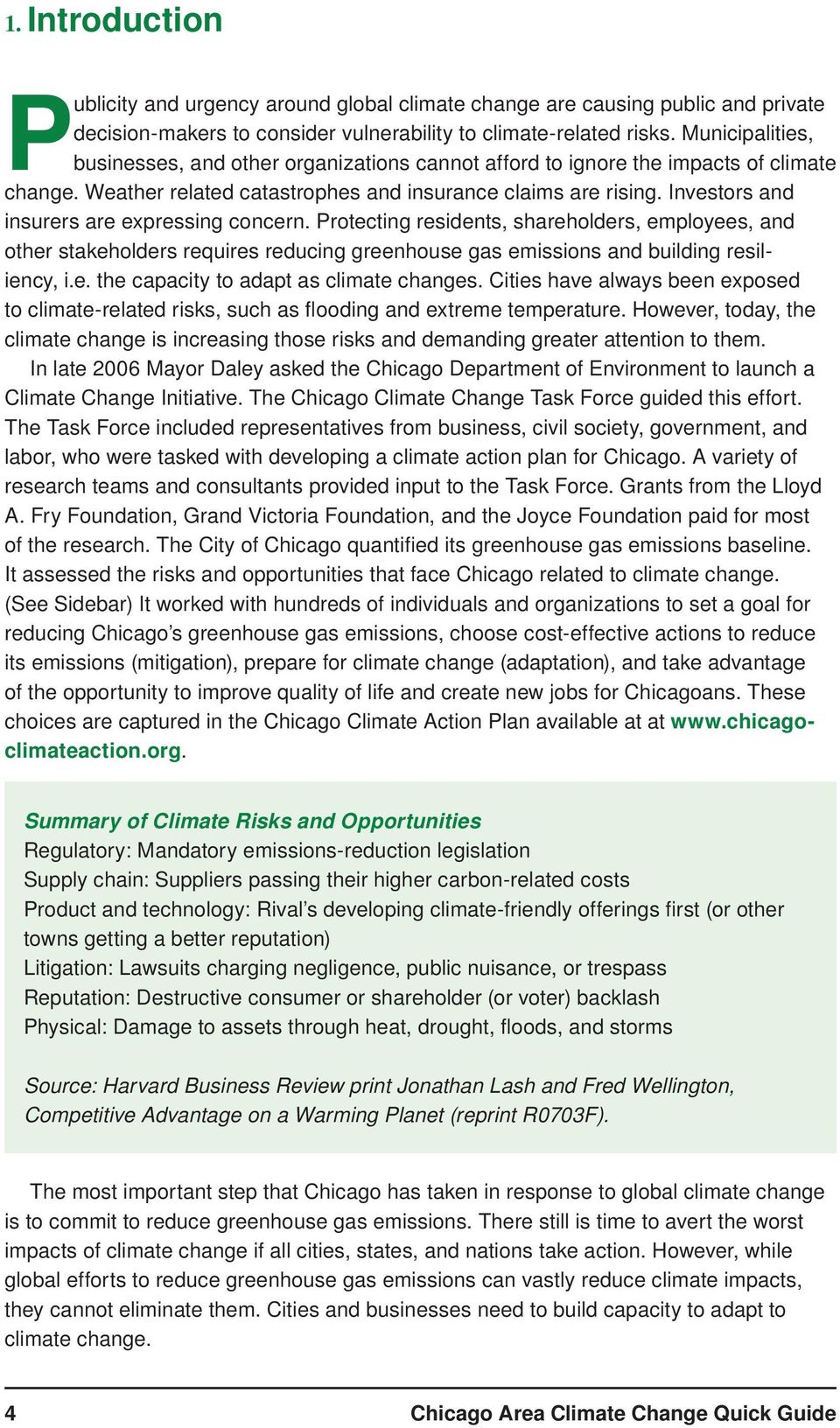
5 The City of Chicago commissioned leading climate scientists at the University of Illinois and Texas Tech University to analyze what climate change impacts on Chicago could be, and then hired MWH, an engineering consulting firm, to use this research to develop a methodology and recommended actions to help the City prepare for a changing climate. The City asked MWH to create a planning document to integrate adaptation actions into the City s routine business processes at both strategic and tactical levels. The research on climate impacts is summarized in Research Summary Report, Climate Change and Chicago: Projections and Potential Impacts, available online at This document summarizes the MWH fi ndings, which the City took under advisement for its adaptation work. The City of Chicago believes that adaptation and mitigation must be closely aligned. We need to fi nd the win-win approaches, i.e. adaptation steps that also reduce greenhouse gas emissions and save energy. These approaches are prominent in the Chicago Climate Action Plan. Vegetated roofs, for instance, cool the city as temperatures rise and retain water during storms (adaptation), while they also help increase the energy effi ciency of buildings (mitigation). Increasing the size of the Chicago urban forest canopy can provide shade to decrease the urban heat island effect (adaptation) and reduce energy demand to cool buildings (mitigation). Rain gardens and permeable pavement capture storm water on site (adaptation), reducing the amount of storm water that must be pumped and the energy required to pump it (mitigation). Chicago s Green Steering Committee of departments and sister agencies led by the Mayor s offi ce already has formed four multi-departmental working groups to consider the MWH report and other information to develop adaptation plans. The Offi ce of Emergency Management leads an extreme heat group. The Department of Water Management is leading an extreme precipitation group, while the Department of Planning and Development is leading an ecosystem group. The Departments of Transportation, Buildings and Aviation are co-leading a buildings, infrastructure, and equipment group. Finally, a leadership, planning, and communications group is led by the Department of Environment. Each group is developing action plans that include primary actors, timelines, and budget implications. This process is the fi rst step in making climate change adaptation part of business as usual in Chicago. As the City completes its adaptation implementation plans, it will provide progress reports on its climate Website. The City of Chicago takes seriously its role in providing credible information and education about climate change to every community in the Chicago region. The MWH methodology and the recommended action steps may be of value for consideration by other municipalities and, in some cases, by companies and organizations in the region, even though they only address local impacts to the City of Chicago. We hope that this summary of Chicago s approach to adaptation will help mayors, city managers, risk managers, sustainable development offi cers, presidents, and executive directors to also accept the challenge of taking climate change into account as they plan for the future and shape the behavior of their organizations. Vegetated roofs help keep the city cool as temperatures rise, retain water during storms and increase the energy effi cienciency of buildings. Adapting to the Physical Impacts of Climate Change 5
6 Planning for climate change adaptation implies changing the human system as well as changing the bricks and mortar infrastructure. 2. Global Lessons on Climate Change Adaptation Worldwide response to climate change differs based on the prevailing regulatory framework, and the urgency with which leaders and organizations have recognized the need for action. In many cases, countries outside the US are more advanced in their development and implementation of strategies related to climate change. There are many national government sponsored agencies (for example the UK s Climate Impacts Programme UKCIP, and New Zealand s Ministry of Environment) that are renowned resources for business and local communities across their respective countries. Several key lessons can be drawn from the efforts of these and other organizations Build Adaptive Capacity Planning for climate change adaptation implies changing the human system as well as changing the bricks and mortar infrastructure. According to the UKCIP, building adaptive capacity is the putting in place of all of the support systems, data collection, evaluation processes, awareness-raising, and policy framework(s) which will encourage, allow or require individual businesses and regions to undertake adaptation. Only when such work has been undertaken in a particular organization or sector can the work of delivering adaptation actions begin Embed Climate Change Considerations Into Planning Processes Planning processes identify future organizational operational, equipment, or infrastructure needs involving procuring new goods, services and/or products or building new infrastructure that must function under a new set of climate conditions. To manage risk, planning processes should be modifi ed to account for potential impacts of climate changes. For example, New Zealand has issued guidelines for local authorities that include specifi c questions to be asked when drawing up individual plans, including: Does the risk management analysis take into account changes due to climate change? Do the effects of climate change refl ect the current level of uncertainty in the region and should a cautious approach be adopted as a result? If not, is this explained? Does the plan include a specifi c commitment to keep up-to-date with changing understanding of climate change and its implications, including any relevant local monitoring or liaison? Look for Win-Win Actions Adaptation measures will almost always have multiple benefi ts, which may include reduced energy costs, improved aesthetics, reduced air and water pollution, and so on. These benefi ts can and should be considered and evaluated to convey the overall benefi t of these measures. The Scientifi c Expert Group Report on Climate Change and Sustainable Development, prepared for the 15th Session of the Commission on Sustainable Development in 6 Chicago Area Climate Change Quick Guide
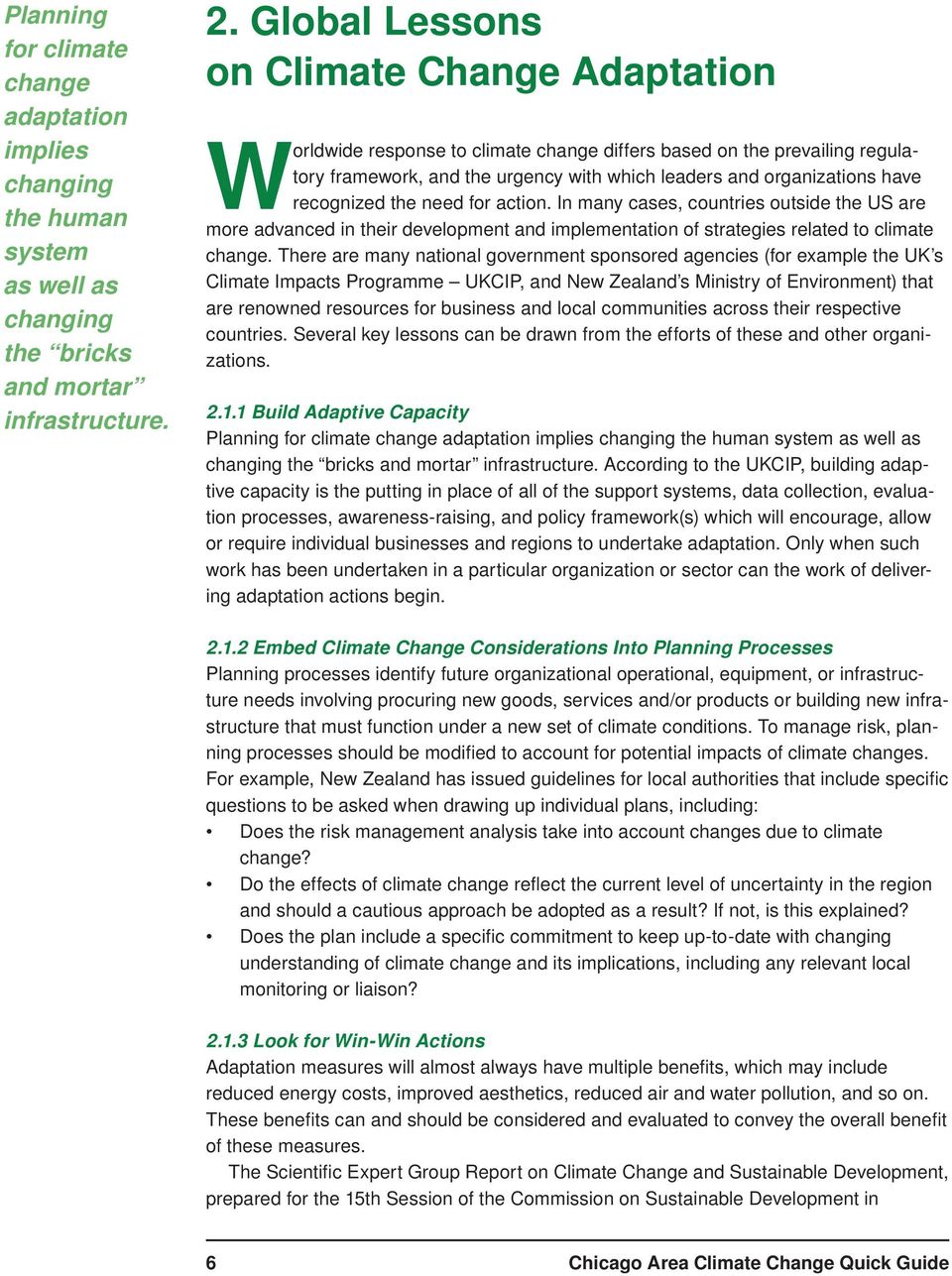
7 February 2007, asserts that the clear way forward is to promote much wider adoption of win-win approaches that reduce climate-change risks while saving money, or that produce immediate co-benefi ts outweighing the costs of the measures. These no regret options deliver benefi ts greater than their costs, regardless of the extent of climate change Take Incremental Steps That Maximize Future Options If possible, take incremental steps rather than large actions to keep options open to adapt in the future. Avoid making decisions that make it more difficult to manage future climate risks. Phased projects can help to avoid costly decisions. Also distributed infrastructure can be more flexible in responding to change than investment in large centralized systems Be Dynamic, Aware, Nimble, and Flexible The paradox of process planning is the intermixed integration of past, present, and future. We plan for the future, do so in the present, and use data from the past. Specifi cally, the urban planning process uses historical data to measure the capability of current projects to achieve future goals. To adapt to climate change, municipalities and businesses need to continually incorporate new data and reassess decisions. The successful adaptation to climate change requires a learning organization, one that adapts to changing environmental factors. 2.2 Overview of Project Approach To develop adaptation tools for the City of Chicago that also would be useful for other municipalities, businesses and organizations, MWH worked closely with City staff, sister agencies, and partner organizations to build on past and ongoing efforts. The City of Chicago took MWH s work under advisement and is evaluating it as part of its adaptation implementation. The process by which predicted climate impacts per the Chicago research informed the selection and development of adaptation strategies relevant for Chicago entities is illustrated in the Figure below: Identify Potential Impacts Conduct Climate Change Impact Risk Assessment Identify High Risk Impacts Identify High Level Adaptation Strategies Develop Strategy Implementation Tactics Use Feedback Loops Based on Implementation Experience and Actual Climate Conditions to Refine Strategies and Tactics Adapting to the Physical Impacts of Climate Change 7
8 3. Risk Assessment 3.1 Introduction To identify potential climate impacts for Chicago, the Chicago Climate Change Task Force commissioned leading researchers to produce: Climate Change and Chicago, Projections and Potential Impacts, Preliminary Draft principally authored by Katharine Hayhoe and Donald Wuebbles, referred to in this report as UIUC/TTU Economic Impact Analysis of Climate Change for the City of Chicago, Preliminary Draft authored by the Corporate Risk Consulting group of Oliver Wyman, referred to in this report as OW. The UIUC/TTU report contains a comprehensive regional analysis of climate change projections for the near term ( ), mid term ( ) and long term ( ). In addition, the report contains predictions of the impacts in climate-sensitive areas categorized under the chapters on Water, Health, Ecosystems and Infrastructure. The Infrastructure section is informed by a detailed assessment of potential economic impacts to various City of Chicago departments and sister agencies prepared by OW. The UIUC/TTU report, Research Summary Report, Climate Change and Chicago: Projections and Potential Impacts, describes projected climate impacts for Chicago and is available online at To proactively manage climate change impacts, the City of Chicago asked MWH to use this research to create a City of Chicago risk assessment. MWH s process began by addressing these questions: (1) what is the likelihood of the occurrence, (2) what are the local consequences of climate change, and (3) what is the related risk of the various climate change impacts. 3.2 Methodology The risk related to a Climate Change impact can be represented as a function of its likelihood and the magnitude of its consequence as refl ected by the equation and the graphic below: Risk = Likelihood x Consequences Magnitude of Consequence High Low Risk Lower Priority Low Low Likelihood High Risk Higher Priority High 8 Chicago Area Climate Change Quick Guide

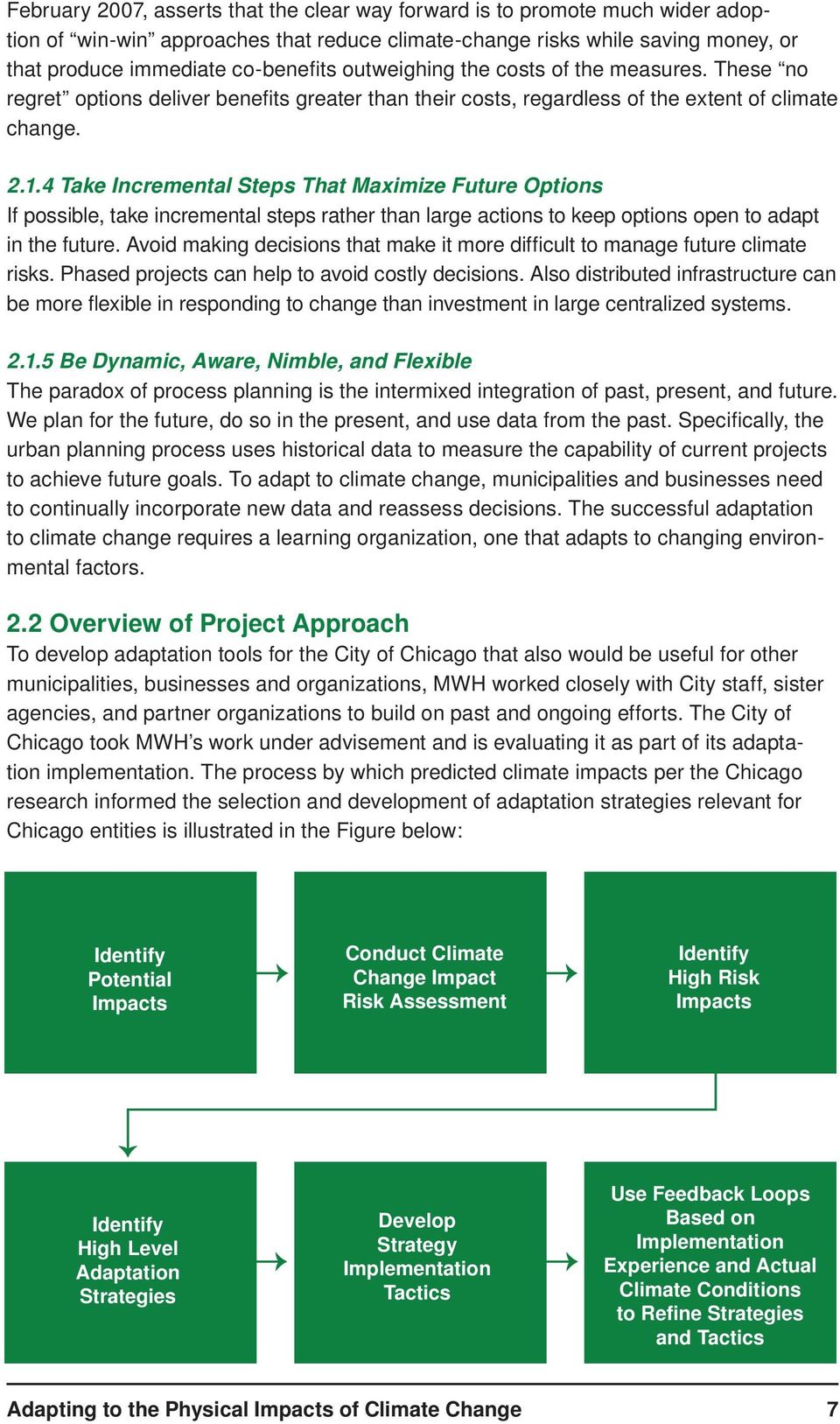
9 The approach adopted for MWH s risk assessment for the City of Chicago was to combine a measure of the probability or likelihood of a predicted climate change impact occurring with a measure of the probable severity or magnitude of the consequence associated with specifi c impacts resulting from that prediction Scoring System In order to apply a consistent evaluation of likelihood and consequence MWH used the simple scoring system shown in the tables below. For each of the climate-related predictions described in the City s climate research reports prepared by UIUC/TTU and Oliver Wyman, a scale of 1 to 5 for likelihood (5 being the most likely) was used. Similarly for each identifi ed impact a scale of 0 to 5 was used for consequence (5 being of greater consequence, and 0 representing an impact with a benefi cial outcome). Since Oliver Wyman generated specifi c data on potential costs of climate impacts on City of Chicago infrastructure, MWH created a parallel set of scores for these cost impacts. Score 5 Occurring now 4 Very Likely 3 Likely 2 Somewhat likely MWH Climate Risk Scoring System Likelihood E.g. UIUC/TTU report cites evidence of detectable trend. E.g Prediction is primarily driven by increased average temperatures, which in general are more reliable output from general circulation models (GCM) E.g. Prediction is driven by generally less reliable GCM output such as increased storminess E.g. Prediction is hypothesized based on a combination of simultaneous climate outcomes. 1 Unlikely E.g. Prediction is outside of range of likely scenarios presented by UIUC/TTU 0 Not used N/A Adapting to the Physical Impacts of Climate Change 9
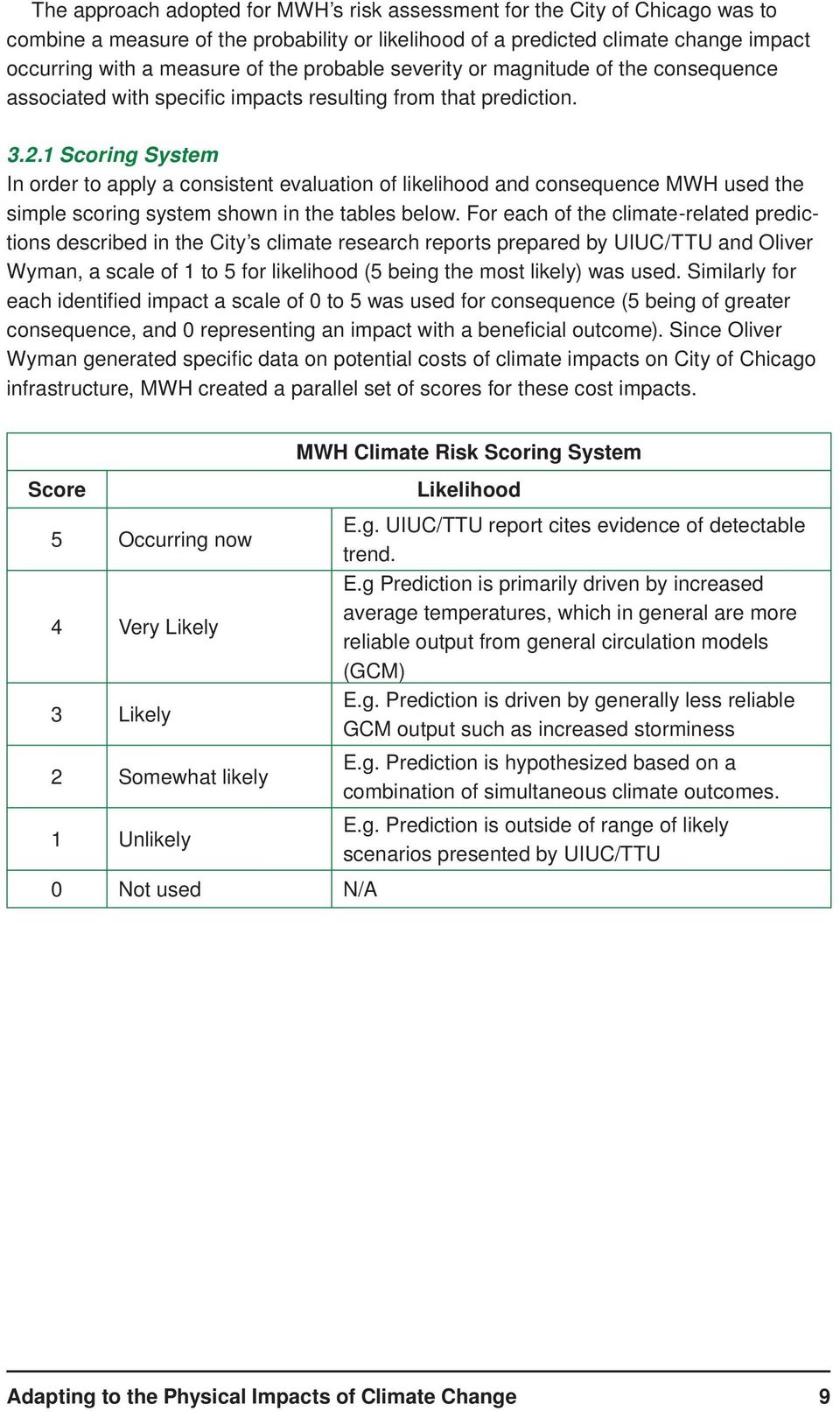
10 Score MWH Climate Risk Scoring System for Infrastructure Consequence (General) Catastrophic (e.g. major loss of life) Very High (signifi cant health effects, and/ or very high cost, approximately >$1B) High (high cost, approximately $10M - $1B) Moderate (moderate cost approximately < $10M and/or disruption) Low (primarily nuisance issue or relatively low cost) Benefi t (any magnitude) Consequence (Infrastructure Costs*) Loss of life doesn t apply to infrastructure costs > $4M $1M to $4M $0.25M to $1M < $0.25M Not Used * - Consequence determined for Infrastructure category using OW study data. Cost range based on Average Additional Annual Costs ( ) using average of High and Low emissions scenario aggregated across all responding City of Chicago departments Climate Predictions and Impacts Identification Over 70 different climate predictions were drawn from the UIUC/TTU report under the general themes of Water, Health, Ecosystems and Infrastructure and organized by the sub-themes shown in the following table: Sub-Themes Themes Water Health Ecosystems Infrastructure Precipitation River Flow Heat Air Quality Natural Vegetation Heating & Cooling Lake Michigan Vector-Borne Diseases Animals Invasive Species Agriculture Operation & Maintenance Labor Other Multiple specifi c impacts may arise from these climate predictions. A total of over 80 different potential impacts were identifi ed resulting from the climate predictions. Each prediction was individually scored, as was each separate impact. 10 Chicago Area Climate Change Quick Guide
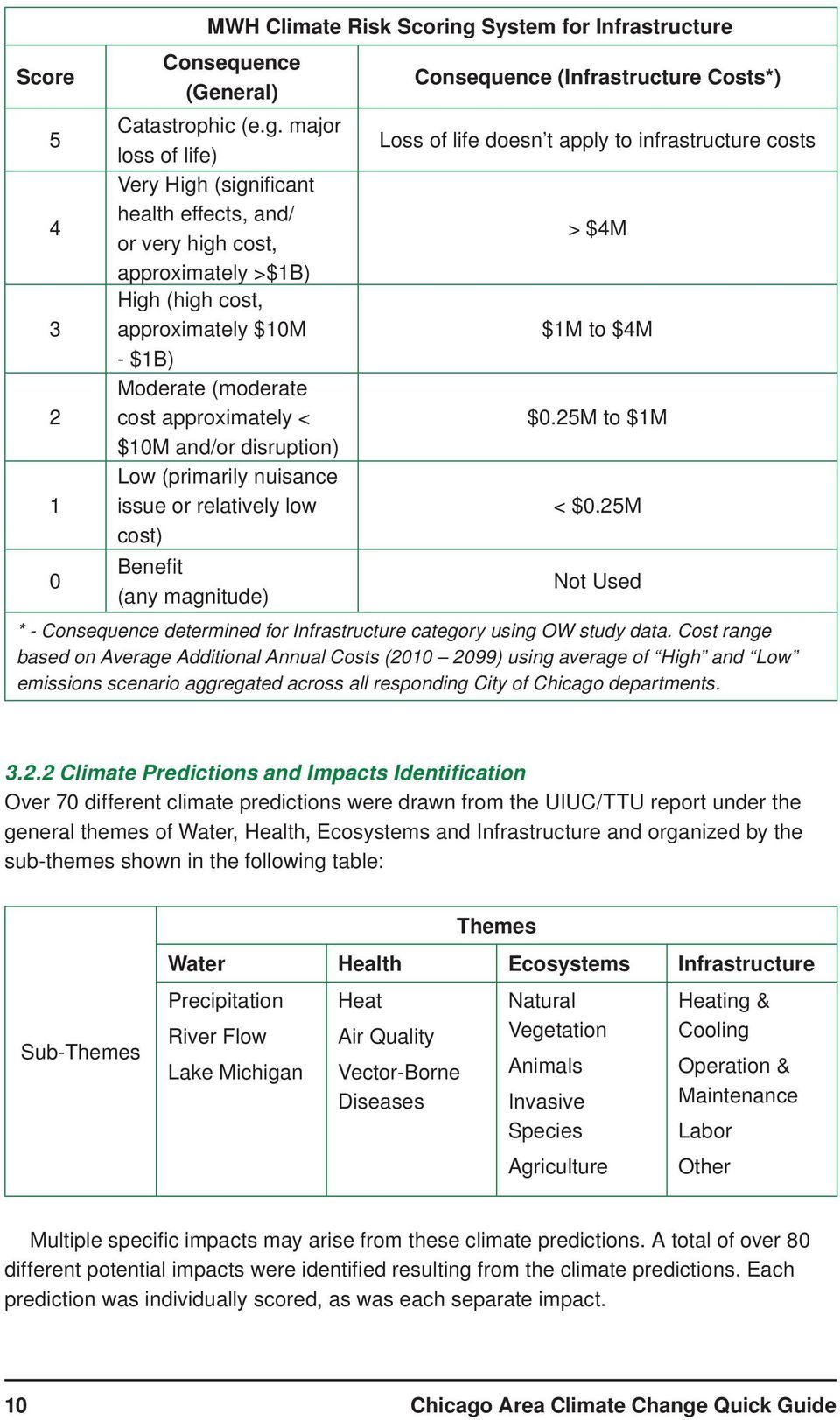
11 3.3 Results Overall risk scores for each identifi ed impact were obtained as the product of the consequence score and the associated likelihood score for the driving climate prediction. Impacts with risk score of 15 and greater were classifi ed as High, impacts with risk scores in the range 9 to 14 were classifi ed as Moderate, and impacts with risk scores lower than 8 were classifi ed as Low. Table 3.1 (see pages 12 and 13) contains a summary of all impacts ranked as Moderate or High, and illustrates the activities primarily affected by these risks and also provides a rough indication of the time frame during which Chicago municipalities, businesses and other organizations may realize the risk. It should be noted that the content of this table is specifi c to the organizational structure, impacts, and related adaptation strategies that are applicable to the City of Chicago. Other organizations are urged to carefully examine the table structure and methodology that resulted in development of this table as they plan their own unique approaches to climate change adaptation. For example, a commercial business enterprise employing large numbers of people under working conditions that do not include air conditioning cooling should develop and when needed, implement a plan for conducting business as usual under the extreme heat event conditions that are forecast. Heat-related health issues are rated as high-risk and requiring immediate attention. This map shows areas of the city subject to the heat-island effect. Magnitude of Consequence High Low Low Likelihood Figure 3.3. Classifi cation Scheme for Overall Climate Risks High Adapting to the Physical Impacts of Climate Change 11
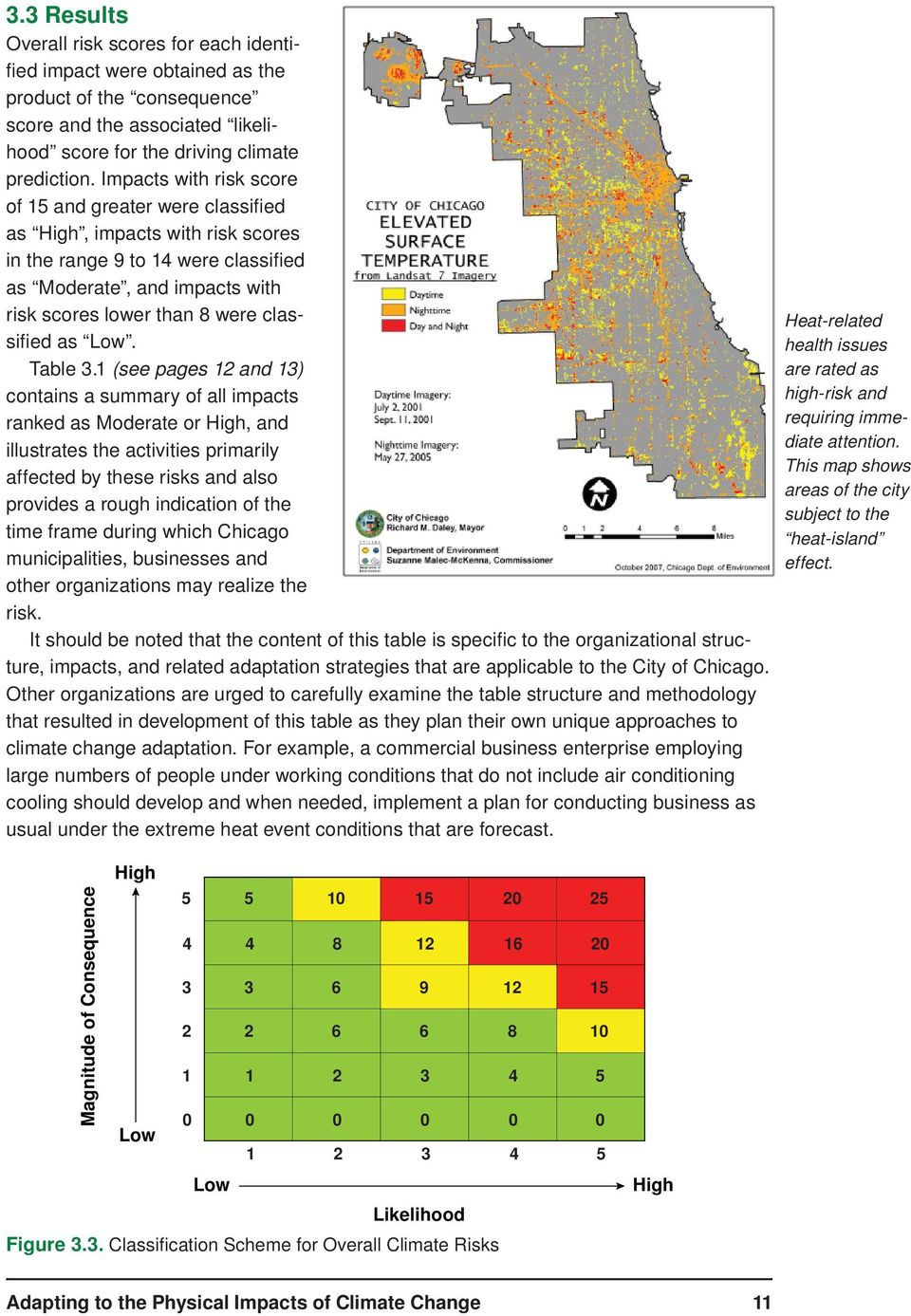
12 Table 3.1 Impact Risk Timing ** Construction, Buildings & Property Tourism Environment Fire Fleet Management Housing Human Services Emergency Management Police Public Health Streets and Sanitation Transportation Water Management Parks and Open Space Storm Water Management Need to get greater penetration of A/C to residential units (particularly high risk areas) Damage to property and increasing cost of insurance due to stormwater Higher costs associated with managing invasive species Increased potential for shoreline erosion/ storm damage Possibility of higher frequency/severity of storms Increase in Ozonerelated health impacts (hospitalization, illness) Reduction in services provided by urban forest Increase in replacement and maintenance costs for fl eets Moderate Near x x x Moderate Mid x x x x x x x Moderate Mid x x x Moderate Mid x x x Moderate Mid x x x x x Moderate Mid x x x Moderate Mid x x Moderate Mid x x x x x x x Lower revenue from summer events Moderate Mid x x NOTES ** Now = already happening, Near = , Mid = Chicago Area Climate Change Quick Guide
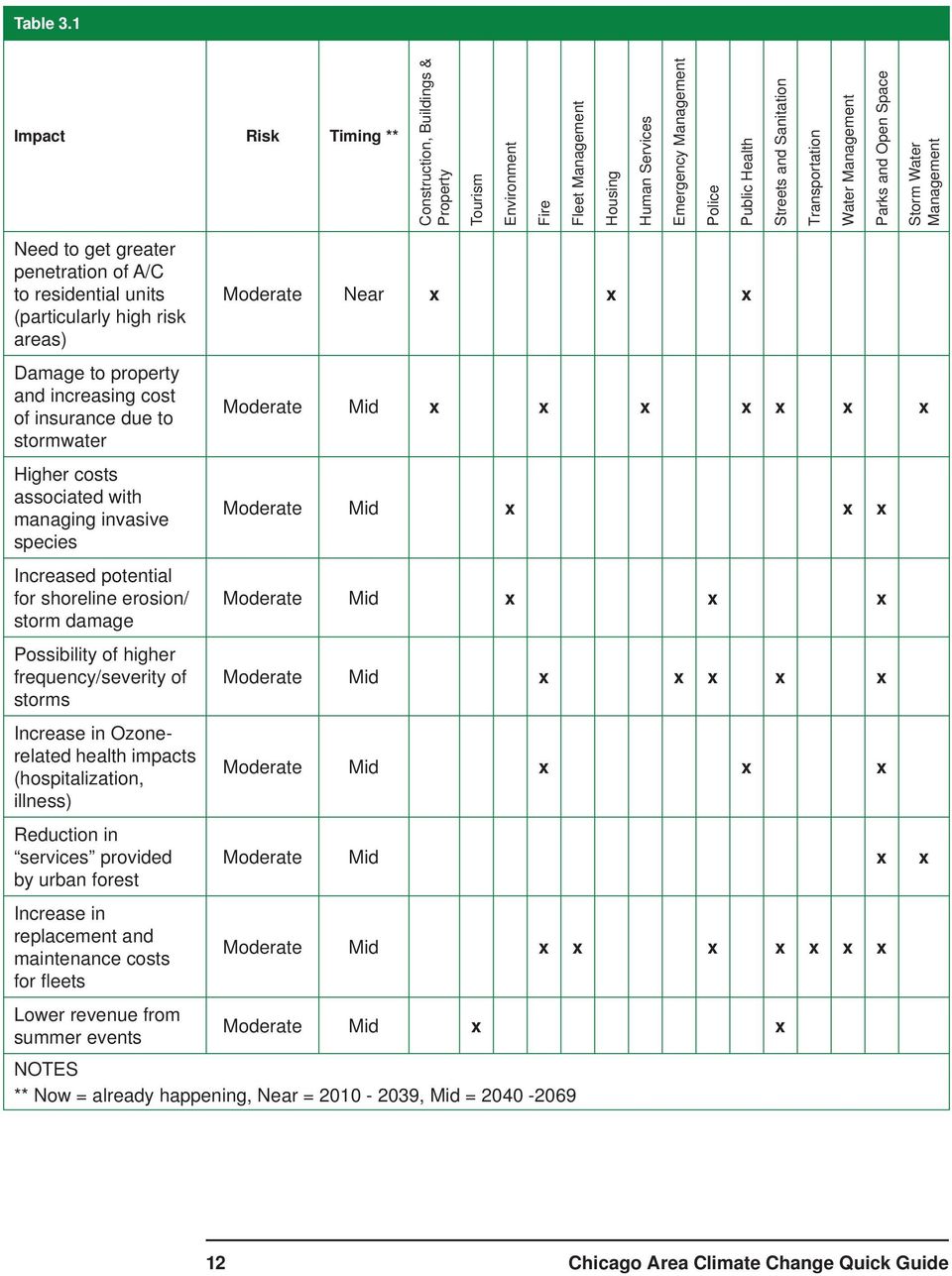
13 Table 3.1 (cont) Impact Risk Timing ** Construction, Buildings & Property Tourism Environment Fire Fleet Management Housing Human Services Emergency Management Police Public Health Streets and Sanitation Transportation Water Management Parks and Open Space Storm Water Management Increase in heat related deaths Increase in heat related hospitalization Increase in health impacts due to waterin-basement incidents High Now x x x x x x x x x x High Now x x x x x High Near x x x x x x Increased annual energy costs Increase in tree replacement costs and landscape maintenance activities Damage to key infrastructure (pump stations, electricity distribution equipment, etc.) Impact to local wetland restoration / mitigation efforts Increase in insurance premiums, deductibles, exclusions, and/or no. of underinsured properties Increased costs for response action and clean-up after heavy rain events High Near x x x x x x x x x x x x x x High Mid x x x x x High Mid x x x x x x x x Moderate Now x x Moderate Now x x Moderate Near x x x x x x x Damage to property and increasing cost of insurance due to Moderate Near x x x x x x x x x overbank flooding in area rivers NOTES ** Now = already happening, Near = , Mid = Adapting to the Physical Impacts of Climate Change 13

14 4. Risk Reduction 4.1 Introduction While we know that the climate already is changing, climate projections are uncertain. Decision-making based upon analysis of climate risk has to be repeatedly revisited to account for new data. Chicago area municipalities, businesses, and other organizations need an iterative process of continuous learning, monitoring, and improvement to effectively respond to the dynamics of climate change, as described in the fi gure below. Climate Risk Reduction Program ASSESS PLAN IMPLEMENT Assess and Benchmark Existing Conditions Gather and Downscale Climate Data Quantify Potential Impacts Evaluation Mitigation and Adaptation Measures Develop Risk Reduction Program Monitoring and Continuous Improvement While adaptation will occur as a set of discrete and incremental adaptation actions taken over a very long period of time, continuous learning is essential. Due to the long duration of the adaptation process and the incremental nature of the adaptation steps, on-going planning and communication, coupled with consistent leadership are key components of adaptation. Businesses and municipalities need to be able to continually evaluate current actions and identify and respond to new challenges Planning Tactic: Create an Adaptation Leadership Group It can be a struggle to integrate climate issues into daily work. Experience with major change and enhancement initiatives throughout the world has shown that successful implementation requires more than good technical ideas. Governments and businesses need to focus a portion of their energies and resources on enhancing capacity as an organization to successfully initiate and deliver climate change adaptation measures. An organizational planning framework for a climate change adaptation program might include the following steps: Embed climate change adaptation considerations into planning processes; Breakdown existing silo mentalities and foster cooperation; Be capable of responding to climate change knowledge that is incomplete and dynamic. A collaborative process may be most important, as climate-related risks touch many departments and cover many aspects of life. The approach that the City of Chicago has 14 Chicago Area Climate Change Quick Guide
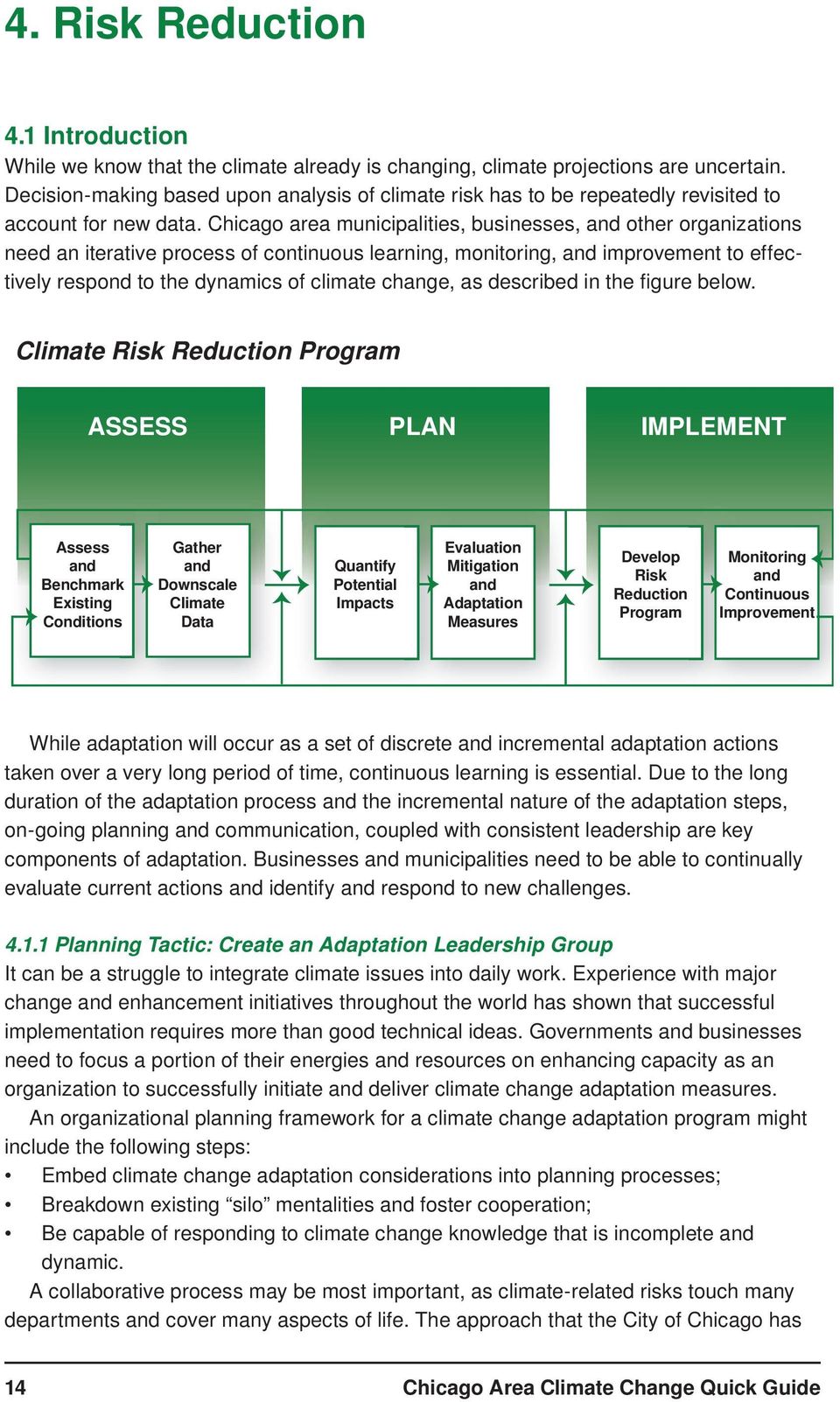
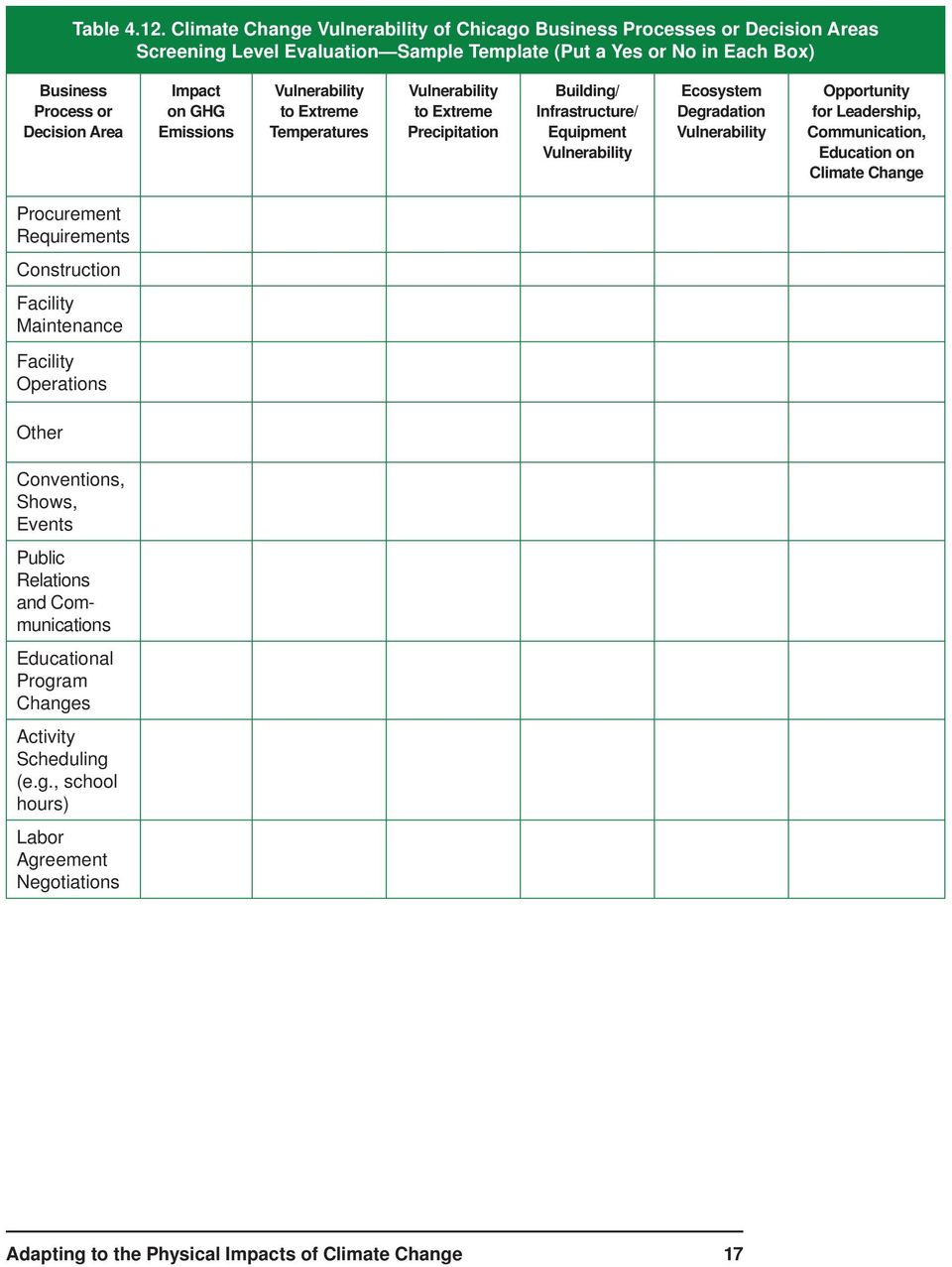
15 taken is to create a coordinating team of senior leadership, supported by interdepartmental or organizational working groups. Coordinating Team (i.e. Steering Committee) responsibilities could include the following: Developing a common knowledge base Assessing risks and timing Reviewing and setting priorities Benchmarking against other cities and organizations Funding Monitoring and sharing implementation progress The primary functions of the working groups could include: Conduct appropriate response planning and lead implementation activities Focus on implementation of identifi ed priority projects Identify and remove obstacles and barriers to success Facilitate cross-departmental data and knowledge sharing Report progress back to the Steering Committee Business decisions made every day can impact ability to adapt to climate change and the cost of adapting Planning Tactic: Review Business Processes and Decisions with Reference to Impact on Ability to Adapt to Climate Change Public and private organizations make literally hundreds of business decisions each day. These decisions can impact vulnerability to climate change. The costs can be high even for small decisions. Table 4.12 (see next page) includes a template for doing a quick analysis of climate change vulnerability of various types of routine business decisions. Decision makers can use this template as an initial guide to understanding on a rapid Yes/No basis, if decisions need to take into account climate change. Where decisions can have signifi cant impacts on vulnerability to climate change, these potential impacts should be part of the decision process. It should be noted that this simplifi ed climate change business decision support template is structured to refl ect the business practices of a municipality like the City of Chicago. Other organizations, including commercial business enterprises, can construct a similar template approach that is based on the routine set of decisions that are required to operate the business and serve its customers or other stakeholders Planning Tactic: Implement a Climate Sensitive Procurement Strategy Part of preparing is ensuring that the market offers products that will be effective in a different climate regime (and minimize greenhouse gas emissions). The City of Chicago is already expanding its program to encourage departments to specify more environmentally-friendly products. The goal is to buy products/services that will function as intended over their expected lifetime including the anticipated new climate conditions. Municipalities, businesses and organizations across Chicago could take the following steps: 1. Develop a simple checklist to ensure procurement is in general alignment with climate change adaptation objectives and train procurement specialists in its use. To maximize win-win procurement choices, the checklist need not be limited only to adaptation measures, but could also incorporate objectives for reducing greenhouse Adapting to the Physical Impacts of Climate Change 15
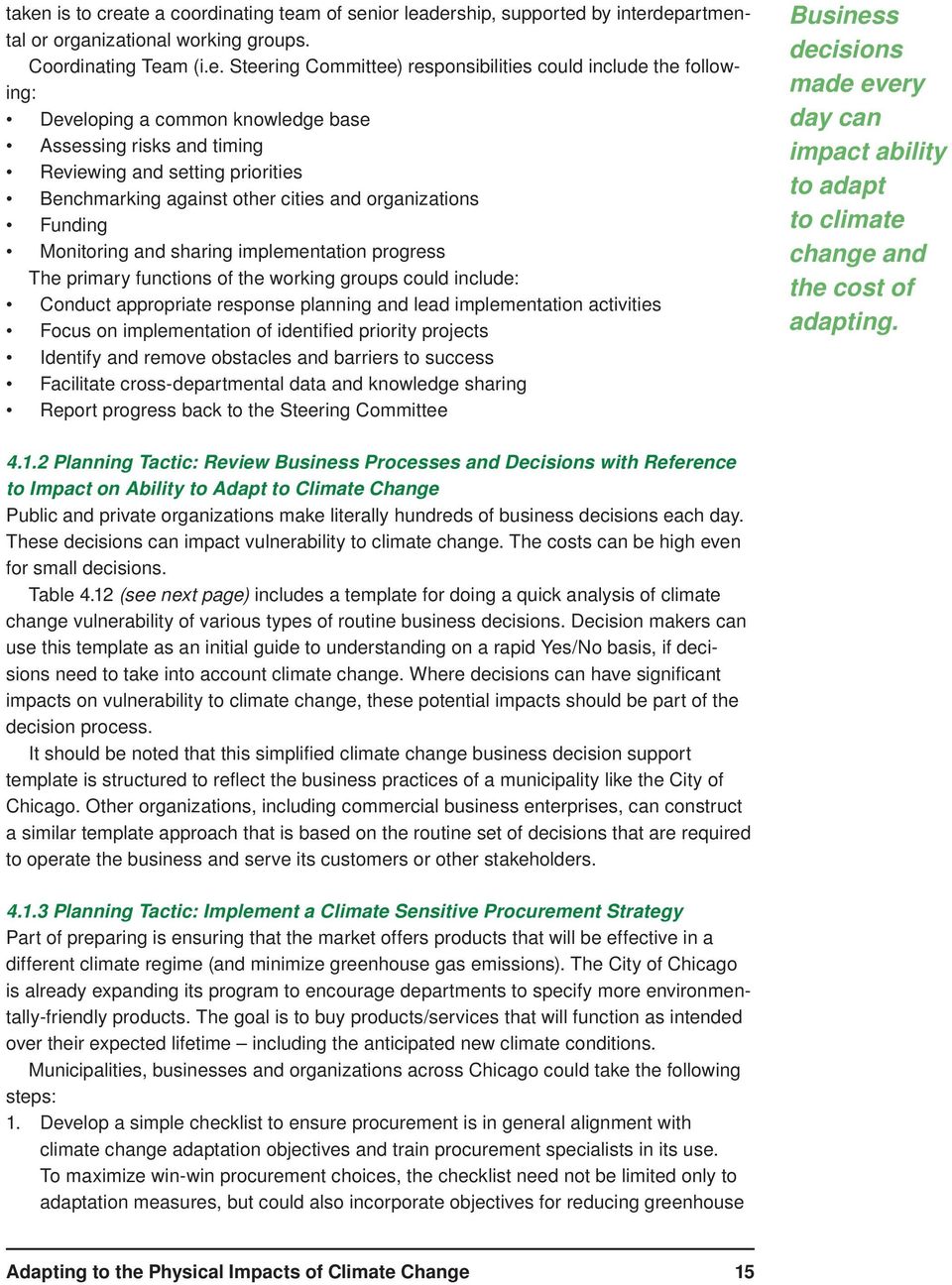
16 Table Climate Change Vulnerability of Chicago Business Processes or Decision Areas Screening Level Evaluation Sample Template (Put a Yes or No in Each Box) Business Process or Decision Area Impact on GHG Emissions Vulnerability to Extreme Temperatures Vulnerability to Extreme Precipitation Building/ Infrastructure/ Equipment Vulnerability Ecosystem Degradation Vulnerability Opportunity for Leadership, Communication, Education on Climate Change Planning for product or service purchase Planning for new infrastructure Planning for landscaping projects Planning for open space projects Planning for major capital equipment Planning for new buildings Vendor sourcing Selection or design criteria Engineering (if required) 16 Chicago Area Climate Change Quick Guide

17 Table Climate Change Vulnerability of Chicago Business Processes or Decision Areas Screening Level Evaluation Sample Template (Put a Yes or No in Each Box) Business Process or Decision Area Impact on GHG Emissions Vulnerability to Extreme Temperatures Vulnerability to Extreme Precipitation Building/ Infrastructure/ Equipment Vulnerability Ecosystem Degradation Vulnerability Opportunity for Leadership, Communication, Education on Climate Change Procurement Requirements Construction Facility Maintenance Facility Operations Other Conventions, Shows, Events Public Relations and Communications Educational Program Changes Activity Scheduling (e.g., school hours) Labor Agreement Negotiations Adapting to the Physical Impacts of Climate Change 17
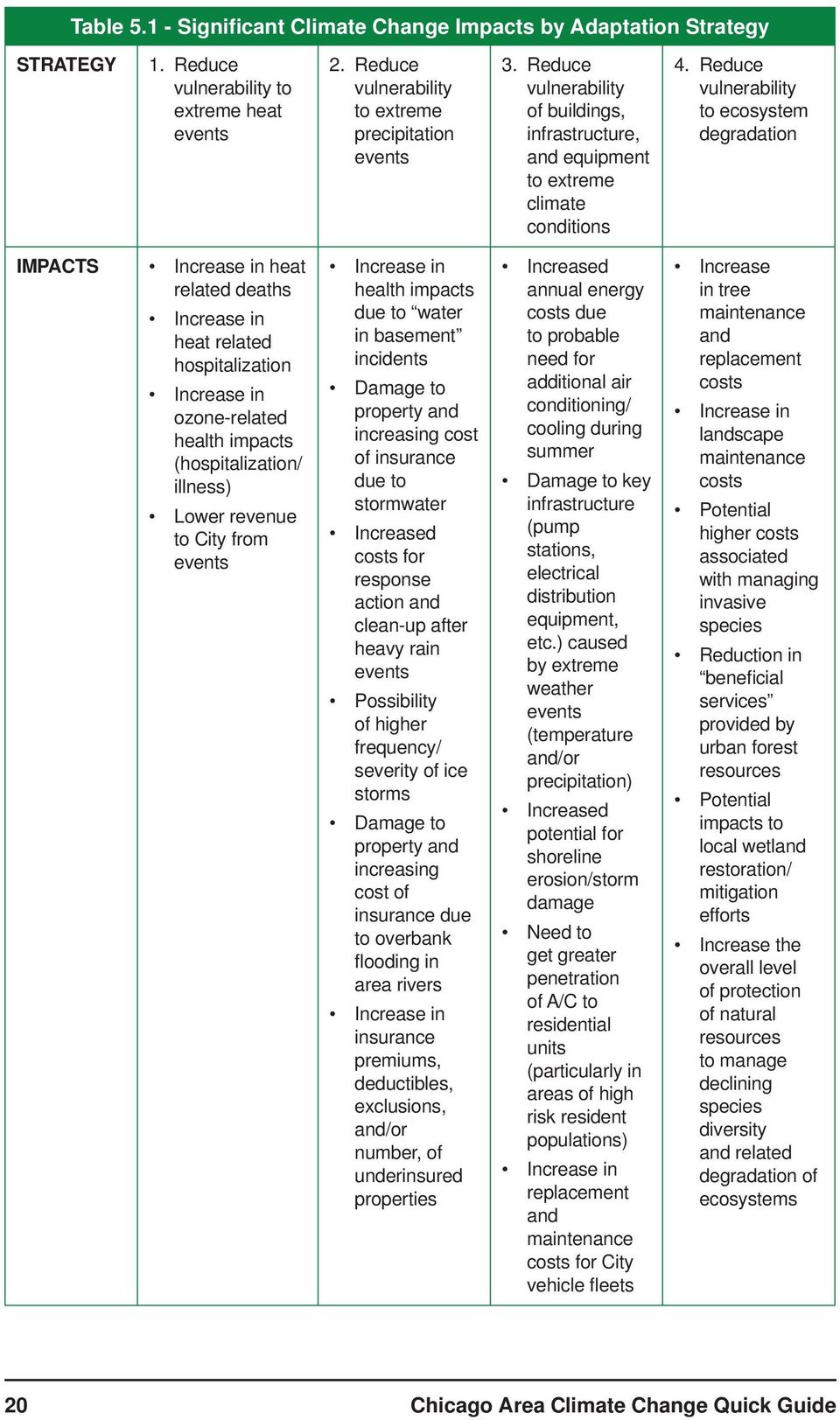
18 gas emissions (mitigation) as well. From an adaptation standpoint, procurement offi ces could require answers to a series of questions with every purchase request, including: a. Does the product or service have any climate-related component? (Y/N) b. Useful Life: i. Does the product or service have more than a 10-year life span? (Y/N) OR ii. If this is a replacement product or service, for how long has earlier version been in place? (if longer than 10 years then assume replacement will also have similar life) c. Predicted Operating Scenario: i. Do the relevant climate change predictions indicate a deteriorating or improving operating climate? (Y/N) ii. Has specifi cation been written to accommodate latest relevant predicted climate scenario? d. Cost Justifi cation: i. What is the estimated additional cost (saving) of purchasing climate sensitive product/service? ii. What is the estimated benefi t (better performance, more reliability, longer service life, less maintenance)? iii. Does benefi t outweigh cost? 2. Develop a list of defi nitely included or exempted products/services based on their use and related climate impacts. 3. Much of the initial work must be focused on awareness-building, training, development of contract clauses for standard bidding documents, and technical specifi cations or guidance on climate change concerns. Procurement policies can be catalytic as they not only embed climate impacts in business thinking and encourages/requires suppliers to consider climate change, but also build demand for climate-sensitive products and services that have potential to improve adaptation economics over time. 18 Chicago Area Climate Change Quick Guide
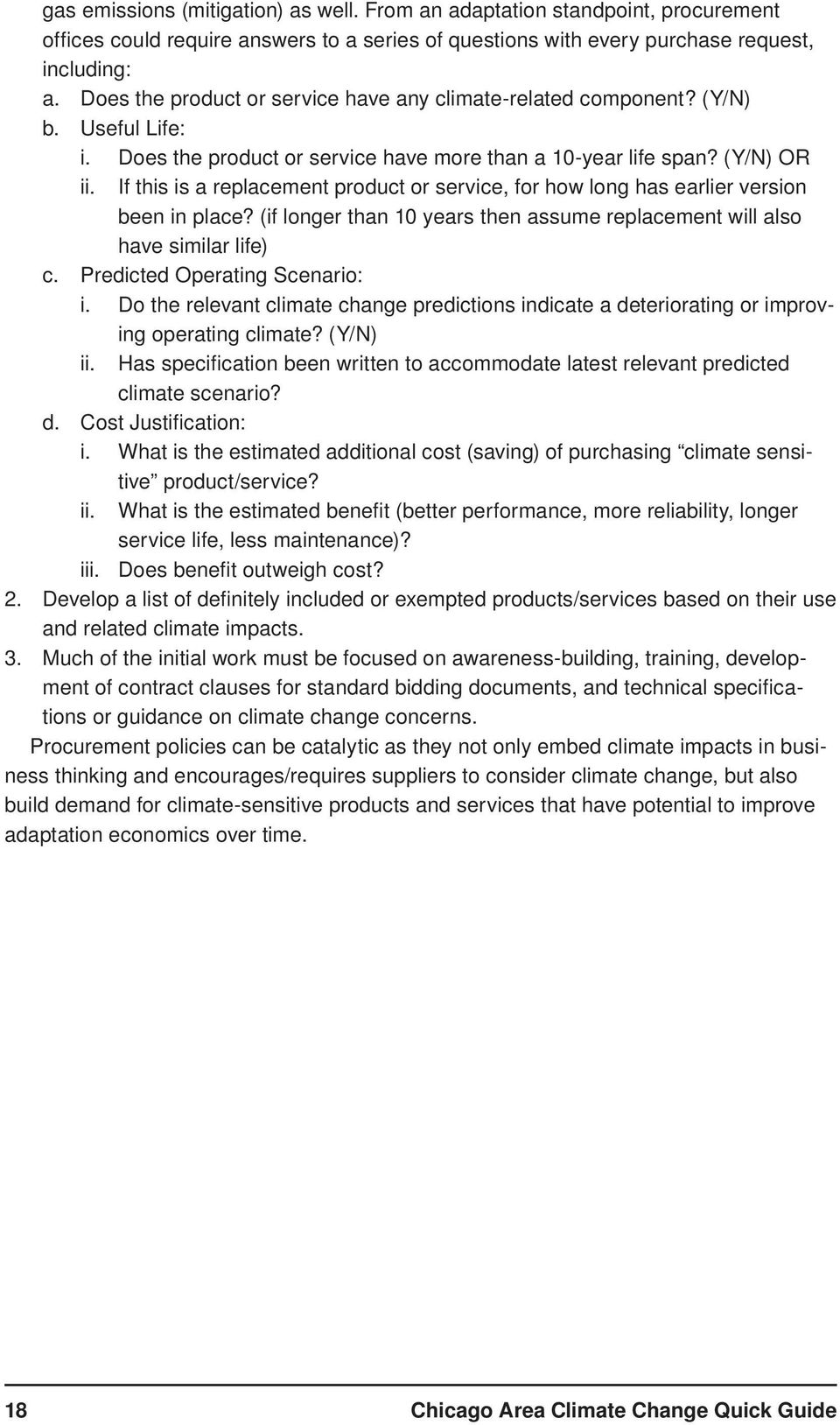
19 5. Adaptation Tactics 5.1 Introduction While each organization must fi nd its own win-win responses to climate change, the City of Chicago believes that the broad adaptation strategies that MWH recommended based on projected Chicago climate impacts and interviews with City departments and sister agencies provide useful guidance for other municipalities and businesses preparing for climate change. The City of Chicago is evaluating these and other strategies for its own adaptation implementation plan through a multi-departmental work group process that also includes other expert stakeholders. MWH followed a series of steps to recommend adaptation strategies and actions: Group the highest priority (risk) impacts and brainstorm adaptation strategies and actions to counter them. Evaluate the costs and benefi ts of each action. Choose a mix of actions that has the best benefi t-cost ratio. Evaluate the effectiveness (or effi cacy) of the plan and revise it. This section describes potential adaptation tactics that MWH recommended for the City of Chicago. Each strategy builds off of existing City programs and initiatives. Because these strategies are responses to projected climate changes for the Chicago metropolitan region, they may be of value for consideration by other municipalities, companies and organizations in Chicago and the Chicago Metropolitan Region, although some may be less relevant to individual businesses. The climate change impacts are grouped according to the primary themes identifi ed by UIUC/TTU in its Climate Change Impacts Report in Table 5.1. One of the main adaptation strategies in the Climate Change Impacts Report is to reduce vulnerability to extreme precipitation events. Adapting to the Physical Impacts of Climate Change 19
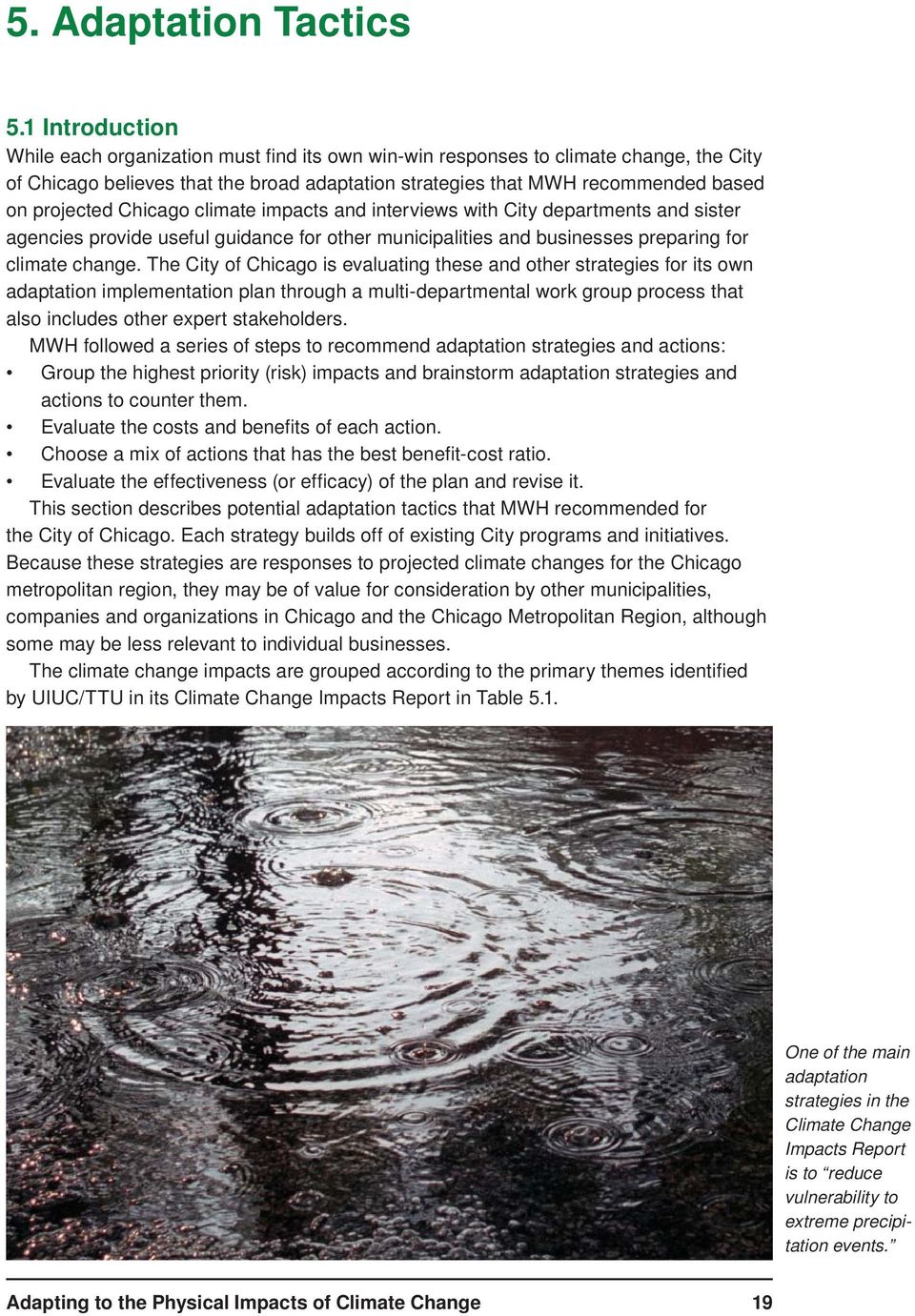
20 Table Significant Climate Change Impacts by Adaptation Strategy STRATEGY 1. Reduce vulnerability to extreme heat events 2. Reduce vulnerability to extreme precipitation events 3. Reduce vulnerability of buildings, infrastructure, and equipment to extreme climate conditions 4. Reduce vulnerability to ecosystem degradation IMPACTS Increase in heat related deaths Increase in heat related hospitalization Increase in ozone-related health impacts (hospitalization/ illness) Lower revenue to City from events Increase in health impacts due to water in basement incidents Damage to property and increasing cost of insurance due to stormwater Increased costs for response action and clean-up after heavy rain events Possibility of higher frequency/ severity of ice storms Damage to property and increasing cost of insurance due to overbank flooding in area rivers Increase in insurance premiums, deductibles, exclusions, and/or number, of underinsured properties Increased annual energy costs due to probable need for additional air conditioning/ cooling during summer Damage to key infrastructure (pump stations, electrical distribution equipment, etc.) caused by extreme weather events (temperature and/or precipitation) Increased potential for shoreline erosion/storm damage Need to get greater penetration of A/C to residential units (particularly in areas of high risk resident populations) Increase in replacement and maintenance costs for City vehicle fleets Increase in tree maintenance and replacement costs Increase in landscape maintenance costs Potential higher costs associated with managing invasive species Reduction in beneficial services provided by urban forest resources Potential impacts to local wetland restoration/ mitigation efforts Increase the overall level of protection of natural resources to manage declining species diversity and related degradation of ecosystems 20 Chicago Area Climate Change Quick Guide
21 5.1.1 Identification of Adaptation Tactics After identifying priority adaptation strategies through a risk assessment of the projected impacts, the next step MWH took was to isolate a series of specifi c actions or tactics that can be implemented to support those strategies. MWH identifi ed climate change adaptation tactics from a variety of sources as illustrated below. CITY OF CHICAGO Economic Impacts Climate Change Predictions MWH Expertise & Global Network Literature Review of Adaptation Best Practices INITIAL LIST OF ADAPTATION TACTICS MWH further refi ned the tactics based on interviews conducted with certain City Departments, which were used to obtain feedback on existing capabilities and obstacles to implementation. Individual tactics were analyzed using a systematic prioritization and ranking procedure that identifi es those tactics that appear to be most suitable for early implementation in response to the magnitude of the related risk (See Appendix I). The following sections describe the adaptation strategies and associated adaptation tactics. 5.2 Recommended Adaptation Strategy 1: Reduce Vulnerability to Extreme Heat Events According to the reports on climate change impacts prepared for the City of Chicago, temperature related drivers contribute the majority of the total net economic impact from anticipated climate changes. The objective of an adaptation strategy to reduce vulnerability to extreme heat events is to address the following climate change impacts: Increase in heat related deaths Increase in heat related hospitalization events Increase in ozone-related health impacts (hospitalization/illness) Lower revenue from decreased attendance at summer events/summer tourism Adaptation Tactic: Prepare for Extreme Heat Events As a highly developed, major metropolitan area, Chicago already has a sophisticated emergency response planning and coordination system in place and operational. The City of Chicago will drive continuous incremental improvement of emergency response plans, coordination, and response actions as climate change plays out in the future. Adapting to the Physical Impacts of Climate Change 21
22 Based upon the MWH analysis, potential adaptation actions for businesses and other organizations in Chicago and the Chicago Metropolitan area include: Neighbors are currently asked to check up on neighbors during heat events, but this could be expanded to outreach to employees, churches, neighborhood groups, and others to increase the reach of such well-being checks. Open up more cooling centers during heat waves. Support efforts to get greater penetration of effi cient A/C to residential units in areas of high-risk resident populations. Ensure that employees and tenants have adequate cooling and information during heat waves. Building owners and users have many easy steps they can take to promote cool tenants Adaptation Tactic: Manage the Urban Heat Island Effect Chicago has been a national leader in addressing the Urban Heat Island phenomenon, through green roof construction, and also through the Green Alley Initiative. The City of Chicago has for nearly a decade worked to reduce the Urban Heat Island effect, and (along with Baton Rouge, Houston, Sacramento and Salt Lake City) was selected in 1998 to be involved in the EPA s Urban Heat Island Pilot Project (UHIPP) as part of the Heat Island Reduction Initiative (HIRI). The City is in the process of taking additional steps to address the Urban Heat Island phenomenon. Based upon the MWH analysis, potential adaptation actions for businesses and other organizations in Chicago and the Chicago Metropolitan area include: Identify hotspots within the city that impact you, including buildings and parking lots, and inform and help drive decisions towards temperature reduction, energy savings, and air quality improvement. Optimize routine tree planting to take into account and offset the urban heat island effect. Participate in tree planting campaigns in priority planting areas. Develop and share best practices with other organizations Adaptation Tactic: Increase Ozone Response Activities Higher temperatures will exacerbate smog. Meeting the ozone standard is the fi rst step in addressing this challenge. The State of Illinois designated the Chicago metro counties (Cook, DuPage, Kane, Lake, McHenry, Will, Grundy (partial), and Kendall (partial)) as non-attainment areas for the 8-hour ozone standard. The State is preparing a State Implementation Plan (SIP) for attainment planning for the non-attainment counties. Based upon the MWH analysis, potential adaptation actions for municipalities, businesses and other organizations in Chicago and the Chicago Metropolitan area include the following steps to avoid worse air quality under a higher temperature regime: Support public transit discount days, especially during the Ozone season. Provide public transit, tax-free, fl exible, spending account benefi ts to employees. Share information with employees and residents about ways they can reduce ozone precursor emissions through energy conservation, lawn maintenance, and public transit. Encourage less engine idling for trucks, buses, locomotives, and marine vehicles. Use natural landscaping to reduce emissions from mowers and maintenance equipment. 22 Chicago Area Climate Change Quick Guide
23 Use low VOC building materials, including adhesives, caulks, manufactured wood products, paints, thinners, and primers below USEPA VOM limits. Participate in green programs that reduce energy use. Reducing automobile traffi c would help relieve smog. 5.3 Recommended Adaptation Strategy 2: Reduce Vulnerability To Extreme Precipitation Events The objective of an adaptation strategy to reduce vulnerability to extreme precipitation is to address the following climate change impacts: Increase in potential health impacts due to water in basement incidents Damage to property and increasing cost of insurance due to stormwater Possibility of higher frequency/severity of ice storms Damage to property and increasing cost of insurance due to over bank fl ooding in area rivers Increase in insurance premiums, deductibles, exclusions, and/or number, of underinsured properties The City of Chicago is served by a combined (sanitary and stormwater) sewer system, much of which was built over one hundred years ago. Historically, the system has suffered two major problems: (1) combined sewer overfl ows (CSOs), which is the term given to discharges of untreated sewer water to area waterways when the largest sewers (interceptors) are fl owing full, and (2) local basement fl ooding during intense rain events when the local collector sewer network is full. These two separate problems have separate solutions, which are currently being implemented. The Metropolitan Water Reclamation District (MWRD) with signifi cant Federal funding is addressing the CSO issue with the Tunnel and Reservoir Plan (TARP). Started in the 1970s, a generation of engineering and construction effort is reaching fruition, with the large diameter tunnels completed, and the 2 main reservoirs under design/construction. CSO frequency has already decreased (and water quality in the Chicago River has Adapting to the Physical Impacts of Climate Change 23
24 Properly designed and implemented downspout disconnections, rain barrels, permeable paving and green roofs can all help alleviate stormwater management problems. improved), and completion of the reservoirs is expected to bring about an order of magnitude decrease in future CSO events. Several measures have been implemented by the Chicago Department of Water Management to address basement fl ooding: Installation of Rain Blocker devices which detain stormwater in the street rather than overloading the sewer system, encouraging the disconnection of downspouts, where appropriate, which also slows the rate at which water enters the system, and recently adopting a new Stormwater Ordinance which requires large new developments to manage the fi rst 1/2 inch of rain entirely on site Adaptation Tactic. Include Climate Change Considerations in MWRD Combined Sewer Watershed Studies A viable fi rst step in incorporating climate projections into stormwater planning would be to incorporate projected conditions into MWRD watershed studies, which are part of a well-resourced program and offers a real opportunity to be a catalyst for a change in thinking. These studies build on the need for interagency cooperation while taking advantage of MWRD s scientifi c capability and resources. Inclusion of potential climate change scenarios in hydrological planning by a nationally recognized agency would be groundbreaking in the US, and therefore catalytic in nature Adaptation Tactic: Conduct a Stormwater Management Study The City of Chicago sewer infrastructure system can often handle only up to a two-year storm event. The Department of Water Management is making headway in analyzing and understanding the current system problems, which range from capacity issues and condition issues, to maintenance and staffi ng issues. Under climate change, it appears highly likely that the current problems and funding issues will be exacerbated. It is important for cities throughout the region to understand and factor in these impacts through stormwater management studies Adaptation Tactic: Pilot Distributed Solutions Distributed solutions (e.g., downspout disconnections, rain barrels, permeable paving, and green roofs) can play a role in reducing the looming vulnerability, particularly in dealing with high frequency/low intensity storms, but they must be properly designed/implemented/maintained to be effective, which all takes resources. An important fi rst step is to conduct adequate testing (pilot areas, performance monitoring, maintenance cost determination) of distributed solutions to prepare for future changes in climate, while conducting long-term modeling/planning studies such as that being contemplated by MWRD. The Green Urban Design (GUD) plan, the result of an 18-month collaboration among City of Chicago departments, sister agencies, nonprofi ts and private businesses, is a good example of the City s existing effort to use technology, design and process improvements to help to adapt to climate change. In 2008, the City plans to implement the highest priority steps in the GUD plan. GUD actions include capturing as much rain as possible where it falls using permeable pavement, rooftop gardens and green alleys. Current activities under the City of Chicago s Green Urban Design (GUD) program, which could be incorporated into distributed solutions for stormwater management, include the following: Paving permeability compatibility with stormwater ordinance allowing permeable paving solutions (current requirement of compacted base and asphaltic concrete 24 Chicago Area Climate Change Quick Guide
25 surfacing confl ict with Stormwater Management Ordinance implementation) Residential Rear Yard Permeability Requiring rear yard open space to remain permeable. Resolving confl ict between mandatory sewer connection and City Stormwater management regulations and policies Allowing use of perforated plastic pipes for underground drainage as part of sub-surface stormwater management Enhancing downspout disconnection campaign Developing incentives for exceeding Stormwater Management Ordinance retention requirements Educating City staff on fl exibility regarding stall dimensions (length can be reduced to 16 if overhang) Enforcing maintenance requirements (Stormwater Management Ordinance, Landscape Ordinance) Developing green roof specifi cations Improving/clarifying environmental requirements for paving materials Investigating use of impact fees/mitigation requirements based on parking excess (thresholds beyond current ratios that triggers a premium ) Researching feasibility of developing a stormwater plan for the City of Chicago public right-of-way in collaboration with MWRD Based on the Sustainable Street Design Standards, reducing impervious area whenever possible. Wherever possible, managing and cleaning the fi rst fl ush of stormwater on the public right of way and diverting it to water bodies. Creating and restoring wetlands (stormwater parks) to help manage Stormwater entering the river. Using spaces adjacent to the right-of-way to manage stormwater. Developing a system of landscapes that are designed, managed and monitored to be part of the City s stormwater management infrastructure. Based upon the MWH analysis, potential adaptation actions for businesses and other organizations in Chicago and the Chicago Metropolitan area include: Design and manage landscapes to be part of the City s stormwater management infrastructure. Use permeable paving solutions and reduce impervious area whenever possible. Keep yards of residences and property of businesses permeable. Participate in the downspout disconnection campaign. Exceed Stormwater Management Ordinance retention and Landscape Ordinance requirements. Install green roofs. Create and restore wetlands to help manage Stormwater entering the river. Create stormwater parks to reduce stormwater runoff and provide green spaces Adaptation Tactic: Piloting Stormwater Parks As already outlined in the City of Chicago s Green Urban Design report, city government could bring together municipal agencies that have a role in planning and managing stormwater with city agencies that acquire, hold or manage vacant land to determine Adapting to the Physical Impacts of Climate Change 25
26 the issues in using landscapes to manage stormwater in stormwater parks. This effort, which could be an ideal initial activity to launch development of a Stormwater management plan that addresses future climatic conditions, could be enhanced by also bringing other Cities and municipalities to the table to share best practicable approaches. Stormwater parks can have the following benefi ts: To reduce stormwater runoff at a City-block scale (parcels and streets); To provide urban green spaces; To bring some surface water features to watershed; For additional upland habitat; and, To provide a public demonstration of Stormwater BMPs. 5.4 Recommended Adaptation Strategy 3: Reduce Vulnerability of Buildings, Infrastructure, and Equipment to Extreme Weather Conditions Buildings, infrastructure and equipment will be subjected to more extreme climate conditions and events in the future. These conditions will place these facilities at increased risk of performance failure. If building owners are to continue to deliver the same level of service and responsiveness that people have become accustomed to, it will be necessary to implement adaptive responses to mitigate these risks and assure service levels do not decline due to extreme climate events. The objective of this adaptation strategy is to address the following climate change impacts: Stress on the power pool due to more summer heat waves Increased annual energy costs due to probable need for additional air conditioning/ cooling during summer Need to get greater penetration of A/C to residential units (particularly in areas of high risk resident populations) Increased vehicle-fl eet replacement and maintenance costs Damage to key infrastructure (pump stations, electrical distribution equipment, etc.) caused by extreme weather events (temperature and/or precipitation) Increased wear on buildings due to heat and weather extremes. Increased potential for shoreline erosion/storm damage Adaptation Tactic: Manage Power Vulnerability Hot summers and long heat waves could stress power delivery. Potential adaptation actions for municipalities, businesses and other organizations in Chicago and the Chicago Metropolitan area include: Undertake a power vulnerability study given climate change. Power vulnerability is particularly important for hospitals and other institutions on which Chicagoans rely. Use more fans and better ventilation to aid cooling. Reduce energy use. Switch to renewable energy sources to meet the need for cooling without increasing greenhouse gas emissions. Distribute current energy sources to improve resiliency of the existing system and assure critical facilities remain on line during extreme heat events. 26 Chicago Area Climate Change Quick Guide
27 5.4.2 Adaptation Tactic: Manage Fleet Vulnerability Fleets also may be stressed by changes in extreme heat. Potential adaptation actions for municipalities, businesses and other organizations in Chicago and the Chicago metropolitan area include: Change purchasing of vehicles to achieve necessary heat tolerances. Change maintenance schedules to take into account greater stress on fl eets Adaptation Tactic. Include Climate Change Considerations in Plans for New Development and Renovation Based upon the MWH analysis, potential adaptation actions for municipalities, businesses and other organizations in Chicago and the Chicago Metropolitan area include: Taking projected climate changes into account in new development through analysis of building tolerances to changes in weather and building placement in relation to potential for fl ooding. Do the same for building and property renovations. Climate change could disrupt ecosystems and precipitate regional shifts in vegetation and habitat. 5.5 Recommended Adaptation Strategy 4: Reduce Vulnerability to Future Ecosystem Degradation Long term temperature changes coupled with changes in precipitation patterns and storm severity are expected to have signifi cant impacts on natural ecosystems in the Chicago area. The overall objective of this adaptation strategy is to improve the resiliency of the current ecosystems within the City of Chicago as a means of assuring continued ecosystem diversity and to protect these natural resources from degradation as a result of climate change. It is recognized that climate change could disrupt ecosystems and precipitate regional shifts in vegetation and habitat. Predicting how specifi c species will adapt to climate change is diffi cult at best, but it is generally understood that in the Upper Midwest ecosystems will migrate northward. The objective of this adaptation strategy is to address the following potential climate change impacts to the City of Chicago: Increase in tree maintenance and replacement costs. Increase in landscape maintenance costs. Potential higher costs associated with managing invasive species. Reduction in benefi cial services provided by urban forest resources. Potential impacts to local wetland restoration/mitigation efforts. Increase in the overall level of protection of natural resources required due to declining species diversity and related degradation. The City of Chicago and its sister agencies have many programs already in progress that contribute toward reducing the vulnerability of future ecosystem degradation. Other entities also have taken action. The Chicago Wilderness consortium, an alliance of over 200 public and private organizations, published The State of Our Chicago Wilderness: A Report Card on the Ecological Health of the Region in 2006 and continues to work at protecting, restoring, studying, and managing the natural ecosystems of the Chicago region. Adapting to the Physical Impacts of Climate Change 27
28 Trees must be regarded as part of the urban infrastructure that is just as vital as roads, bridges, and utilities Adaptation Tactic: Participate in Preserving Native Species Climate change will further endanger vulnerable or threatened species in the region. As the climate warms, it will no longer be suitable for some species. Also, current insect and plant pests are likely to reproduce faster and cause more damage. Pests may move from the south into the Chicago region. Potential adaptation actions for businesses and other organizations in Chicago and the Chicago Metropolitan area that have signifi cant interaction with natural ecosystems include: To protect native species, regional businesses and property owners can support more intensive strategies of ecosystems management and greater efforts at conserving vulnerable species. As some mammals migrate north, their migration paths will pass directly through the Chicago region, and be blocked by urban and agricultural development. Property owners also can help by supporting investment in major green pathways through suburban areas to enable the migration Adaptation Tactic: Participate in Creating a New Recommended Plant List Plant hardiness zones are being altered due to climate change. An approved plant list could be created in partnership with City departments and public stakeholders. The fi rst action should be refi nement of a recommended plant list for landscaping (e.g., plants that enhance pollutant removal, reduce urban heat island effects through high rates of evapotranspiration, or have increased stormwater uptake capabilities). This is likely to include adapted canopy tree species, adapted/native drought tolerant species, and tall grasses. Potential adaptation actions for businesses and other organizations in Chicago and the Chicago Metropolitan area that routinely plant and maintain signifi cant areas of landscaping, including trees, include: With representatives from the landscape nursery industry and other stakeholders, disseminate new plant lists. The landscape nursery industry is critical to the longterm success of a new recommended plant list since nurseries will be the supply sources for new plants that are not now in common use in the Chicago area. Widespread stakeholder involvement will result in greater buy-in and engagement in use of recommended plants. Create a program to actively monitor the health of the new plant materials installed in select areas to help demonstrate success and provide feedback for periodically updating the landscaping plant list Adaptation Tactic: Enhance Chicagoland Urban Forest Management Urban trees are proven to provide a wide range of benefi ts to mitigation of climate change impacts, including carbon uptake, localized shading, and cooling, and improved stormwater management as well as improving the aesthetic appearance of the surrounding area. Climate change impacts will make trees an increasingly valuable resource, and potential extremes in weather patterns will demand increased management of this important resource to assure its diversity and long-term health. In fact, trees must be regarded as part of the urban infrastructure that is just as vital as roads, bridges, and utilities. The City of Chicago has plans for its urban forest management, but many urban trees are located on private property. It is important for private property owners also to under- 28 Chicago Area Climate Change Quick Guide
29 stand this resource and manage it in the face of climate change. Important lessons can be drawn from the publication Climate Change Adaptation Options for Toronto s Urban Forest. Toronto is located at approximately 43 degrees north latitude while Chicago is at approximately 41 degrees north latitude. The lessons include: Budgets often provide for planting new trees for urban forest canopy expansion, but comparable funding and resources are not usually available for watering and maintenance to ensure that new trees survive and grow to maturity. Storm damage to urban trees represents a signifi cant potential cost that must be planned and budgeted if the long-term benefi ts of the urban forest resource are to be maximized. Damaged trees must be quickly and effectively cared for if they are to recover from the damage and continue to benefi t the community as they mature Adaptation Tactic: Enhance Chicago Urban Wetland Management Wetlands are proven to provide a wide range of benefi ts to mitigation of human impacts on natural ecosystems, including nutrient uptake, improved stormwater and urban runoff management, and provision of habitat for an exceptionally diverse group of plants and animals. Climate change impacts will make wetlands an increasingly valuable resource to Chicago, and potential extremes in weather patterns will demand increased management of this important resource. Potential adaptation actions for businesses and other organizations in Chicago and the Chicago Metropolitan area include: Adapting current wetlands management practices to future impacts of climate change. Using the adaptive, natural treatment capacity of wetlands to mitigate impacts of climate change, such as increased stormwater runoff. The technical literature on the subject of wetlands management plans developed by the US Army Corps of Engineers and others is quite large, and there are a number of examples of Comprehensive Wetlands Management Plans (CWMPs) available on-line for use as go-bys to jump-start Chicago efforts Adaptation Tactic: Protect Agriculture Illinois farmers can adapt in a number of ways to the changing climate. Some options include: Adjusting planting and harvesting dates. Planting more heat tolerant or genetically-modifi ed varieties better suited to future climate conditions. Switching to warmer season crops. Investing more capital in irrigation, crop storage, or livestock facilities. Climate change can also provide opportunities for farmers. For example, farmers could increase their income by growing crops that benefi t from increased CO 2 levels. The agricultural industry needs more research to identify strategies and adaptations for Illinois farmers. Research could include studies of heat-tolerant or CO2-sensitive soybean crops; ongoing and future pest problems; and economic opportunities that benefi t both farmers and the environment. Adapting to the Physical Impacts of Climate Change 29
30 6. Conclusion The Chicago Climate Action Plan adopted in 2008 stresses the importance of both reducing greenhouse gas emissions in Chicago and preparing for climate changes that may be unavoidable. The City of Chicago has made a commitment to research, education, and action to support both mitigation of greenhouse gas emissions and adaptation to climate change in Chicago that will secure a high quality of life for Chicagoans far into the future. With the help of corporate, foundation, public interest, and government partners, Chicago is positioned to be resilient, competitive, and attractive over the next century. We hope you will stay in touch with our progress by checking in at org. 30 Chicago Area Climate Change Quick Guide
31 Appendix I Development and Demonstration of Prioritization Protocol for Adaptation Tactics MWH identifi ed adaptation tactics through interactive workshops with staff of City of Chicago departments and sister agencies, as well as from global best practices obtained from a library of source data, which were collected and reviewed for viable options. These tactics were evaluated against the expected impacts that have been identifi ed by the Climate Change Impacts Analysis (Hayhoe/Weubbles). An initial list of over 150 adaptation tactics was passed through a series of fi lters, as follows: Each tactic was consolidated to eliminate redundancies and adjacencies; then, Each tactic was assessed as to its feasibility; and, fi nally, Each tactic was assessed for its current applicability to the City of Chicago. The remaining tactics were then prioritized using the capabilities of the prioritization tool used for this project, mplanner. mplanner is an MWH-developed, Web-based tool that can be used for data management and features an interactive, menu-driven data entry capability, as well as user-defi ned prioritization protocols. The tool can also be used to rank and sort data and create color-coded reports. The entire data set developed by MWH in mplanner has been provided separately to the City of Chicago in MSExcel format. Prioritization Categories Each tactic was evaluated against a set of criteria shown in the table below: Adaptation Tactics Prioritization Criteria Expected Benefits Implementation Issues Benefi t Type Implementation Cost Benefi t Magnitude Current Ability to Implement Benefi t Timing Barriers to Implementation (Gaps) Mitigation Potential Project Type (Act, Study, Plan) Catalytic Potential Benefi t/cost Ratio Additional details of each criterion and the metrics used to score the tactics follow: Expected Benefits Benefit Type Assumptions: Benefi t of adaptation measure implementation, created as checkboxes so that multiple benefi ts could be selected. Benefi t is likely to be a reduction in expected impact associated with a business as usual approach. Metrics: Value assigned, 1 being most important; Life safety (1), human health (3), prevent signifi cant infrastructure damage (3), prevent major economic disruption (3), uninterrupted city services (4), prevent minor economic impact (7), maintain or increase revenue Adapting to the Physical Impacts of Climate Change 31
32 (7), reduce costs (7), maintain quality of life (5), ecosystem health (4) and tourism (7). Benefit Magnitude Assumptions: Assumes benefi t to the City of Chicago at this time over 100-year period. Metrics: Order-of-magnitude basis approximations, e.g., $10K - $100K, $100K - $1M, etc. Benefit Timing Assumptions: Qualitative measurement of when benefi ts would begin to be realized. Metrics: Immediate; Near Term - within 10 years; Mid Term - 10 to 30 years; and Long Term - greater than 30 years Mitigation Potential Assumptions: Qualitative measurement of how adaptation measure complements (positive) or hinders (negative) actions the City is proposing to lower overall carbon footprint. Metrics: Highly positive; Slightly positive; Neutral; Slightly negative; Highly negative Catalytic Potential Assumptions: Qualitative measurement of the level by which an adaptation measure may promote decisions and actions by others that will reduce the City s risks to climate change. Metrics: Low; Medium; High Implementation Issues Implementation Cost Assumptions: Assumes additional cost only to the City at this time. Other costs are qualitatively addressed under the topics of Ability to Respond and Gap Types. Costs aggregated over 100-year period. Metrics: Order-of-magnitude basis approximations, e.g., $10K - $100K, $100K - $1M, etc. Current Ability to Implement Assumptions: Qualitative measurement of how well City is poised to implement adaptive measure. Metrics: High - City is poised to implement adaptive measure; Medium (minor gaps exist); Low (signifi cant gaps exist) Gap Types Assumptions: Checklist of areas requiring focus to ensure success of implementation of adaptive measure. Metrics: Planning, staff positions, funding, high level support, business process, interdepartmental coordination, public support, research, and technology. Project Type Assumptions: Method to differentiate between types of recommended adaptation measures. Metrics: Study (to identify/support future plans and actions); Plan (With intent to perform future actions); Act (action related projects) 32 Chicago Area Climate Change Quick Guide
33 Other Data Other data captured within the database that can be used for further sorting and analysis purposes include: Climate Impact Data Assumptions: Place to indicate primary climate change prediction or impact that the tactic is designed to combat. Metrics: Specifi c climate impacts. Prioritization protocol MWH worked with the Department of Environment to develop a preliminary prioritization protocol, based on relative importance of the criteria. The decision tree below shows the criteria of life safety being the primary fi lter followed by the timing of impact, then followed by benefi t to cost ratio. Under this scenario, those adaptation tactics that address human life impacts with the nearest term impacts and greatest benefi ts and the least cost, would be considered as Must Do tactics. The titles of Must Do, Investigate Further and Watch are meant to identify the order of recommended implementation according to the ranking assumptions developed in cooperation with the City. Alternatively, titles such as Tier 1, Tier 2 and Tier 3 adap- BENEFIT TYPE TIME HORIZON OF IMPACT COSTS AND BENEFITS RANK Near Term Must Do Low Cost Must Do Benefit: Life Safety Long Term High B/C Must Do Low B/C Investigate Further Benefit: Not Life Safety Near Term High B/C Low B/C Must Do Investigate Further Low Cost Investigate Further Long Term High B/C Investigate Further Low B/C Watch Adapting to the Physical Impacts of Climate Change 33
34 tation tactics could be used. MWH undertook a secondary evaluation in order to identify Early Action Items (i.e., Quick Wins) from those tactics that were designated Must-Do. The secondary criteria derived from input from the City were, medium or high ability to respond, total cost less than $1M, and catalytic potential. 34 Chicago Area Climate Change Quick Guide
Climate Adaptation and Preparedness
 Climate Adaptation and Preparedness Aaron Durnbaugh, Adaptation Coordinator & Deputy Commissioner, City of Chicago Department of Environment Rahm Emanuel, Mayor Climate Impact: Lake Michigan Decreased
Climate Adaptation Overview. City of Chicago Rahm Emanuel, Mayor
 Climate Adaptation Overview City of Chicago Rahm Emanuel, Mayor Chicago Greenhouse Gas Emissions Reduction Goals: 25% reduction from 1990 levels by 2020 80% reduction from 1990 levels by 2050 1 FIVE STRATEGIES
City of Cambridge Climate Protection Action Committee. Recommendations for Adaptation to Climate Change. Purpose
 City of Cambridge Climate Protection Action Committee Recommendations for Adaptation to Climate Change Purpose The Climate Protection Action Committee (CPAC) is an advisory body to the City Manager on
CITY OF HIGHLAND PARK, ILLINOIS Stormwater Management Fact Sheet
 CITY OF HIGHLAND PARK, ILLINOIS Stormwater Management Fact Sheet WHAT IS STORMWATER MANAGEMENT? Stormwater management is the method for channeling rainfall through pipes and sewers away from property to
2013-2015. Milwaukee Metropolitan Sewerage District STRATEGIC PLAN
 Milwaukee Metropolitan Sewerage District STRATEGIC PLAN 2013-2015 The Strategic Plan identifies the District s strengths, weaknesses, opportunities, and threats, and provides direction and focus to help
Interlocking Concrete Pavement Institute (ICPI) Model Stormwater Ordinance for Permeable Interlocking Concrete Pavements August 2010
 Interlocking Concrete Pavement Institute (ICPI) Model Stormwater Ordinance for Permeable Interlocking Concrete Pavements August 2010 Background What are permeable interlocking concrete pavements (PICP)?
A Developer s Guide: Watershed-Wise Development
 A Developer s Guide: Watershed-Wise Development Environmental Protection What is a watershed? It does not matter how far away you build from a creek, lake, or the ocean, you are in a watershed. Another
Partnerships in Achieving Green Infrastructure Goals
 Partnerships in Achieving Green Infrastructure Goals Debra Mitchell, FASLA, LEED AP SmithGroupJJR Patrick Brawley, ASLA SmithGroupJJR Aaron Durnbaugh, Director of Sustainability Loyola University Chicago
City of Atlanta. Department of Watershed Management. Post-Development Stormwater Management Ordinance Summary of Revisions
 City of Atlanta Department of Watershed Management Post-Development Stormwater Management Ordinance Summary of Revisions Cory Rayburn, CPESC Environmental Program Manager [email protected] Stormwater
Los Angeles Regional Collaborative For Climate Action & Sustainability CHARTER PREAMBLE
 CHARTER PREAMBLE The United Nations World Council on the Environment and Development defines sustainability as the ability to meet the needs of the present without compromising the ability of future generations
How To Amend A Stormwater Ordinance
 Regulatory Alternatives to Address Stormwater Management and Flooding in the Marlboro Street Study Area Alternative 1: Amend Existing Local Regulations This proposed alternative provides an incremental
Make Global Recruiting a Winning Strategy
 Make Global Recruiting a Winning Strategy A ManpowerGroup TM Solutions White Paper Make Global Recruiting a Winning Strategy Today s global workforce is on the move like never before. Macro-economic forces,
BEYOND THE STORM: Toronto s Climate Change Adaptation Program. Its about Risk and Cost Management. David MacLeod Toronto Environment Office
 BEYOND THE STORM: Toronto s Climate Change Adaptation Program Its about Risk and Cost Management David MacLeod Toronto Environment Office June 16, 2011 Agenda Mitigation & Adaptation: Both are needed Impacts
Adapting to Climate Change Through Asset Management Planning. Tiffany Batac David Rose, PhD Parsons Brinckerhoff
 Adapting to Climate Change Through Asset Management Planning Tiffany Batac David Rose, PhD Parsons Brinckerhoff 1 2 Agenda FTA Transit Climate Change Adaptation Assessment Pilots: MARTA Study Framework
Oregon. Climate Change Adaptation Framework
 Oregon Climate Change Adaptation Framework Oregon Environmental Quality Commission Climate Change Adaptation Framework Presentation at a glance: Purposes of the framework Participating agencies Climate
2010 Salida Community Priorities Survey Summary Results
 SURVEY BACKGROUND The 2010 Salida Community Priorities Survey was distributed in September in an effort to obtain feedback about the level of support for various priorities identified in the draft Comprehensive
Chicago Climate Action Plan Update
 Chicago Climate Action Plan First Two Years ACCO Climate Change Leadership Summit November 9, 2010 City of Chicago Richard M. Daley, Mayor Chicago Climate Action Plan Update FIVE STRATEGIES Recognition
Comprehensive Climate Planning November 17, 2011 Julia Parzen, USDN
 Comprehensive Climate Planning November 17, 2011 Julia Parzen, USDN Current Context for Climate Action Planning: All About Benefits Lessons from the Chicago Climate Action Plan (CCAP) Making the Case By
City of Cambridge Climate Protection Action Committee. Recommendation to the City Manager on Urban Heat Island Mitigation
 City of Cambridge Climate Protection Action Committee Recommendation to the City Manager on Urban Heat Island Mitigation Recommendation to take actions that mitigate and increase awareness of the urban
The Metropolitan St. Louis Sewer District. Sewer Overflows In Our Community
 The Metropolitan St. Louis Sewer District Sewer Overflows In Our Community March 2012 About MSD Formed in 1954, the Metropolitan St. Louis Sewer District (MSD) is the governmental agency that provides
Stormwater management around the world Lessons from Novatech 2010 Dennis Corbett and Marion Urrutiaguer
 Stormwater management around the world Lessons from Novatech 2010 Dennis Corbett and Marion Urrutiaguer Novatech 2010, the 7th international conference on sustainable techniques and strategies in urban
ATTACHMENT 7. CWSRF Project Descriptions and Examples for Green Project Reserve
 Attachments 7 and 8 are from the American Recovery and Reinvestment Act Guidance, produced March 2, 2009 by the U.S. EPA Office of Water. Attachments 7 and 8 specifically address the 20% Green Project
SECTION 3.2 CLIMATE AND PRECIPITATION
 SECTION 3.2 CLIMATE AND PRECIPITATION Ulster County Climate Data A preliminary analysis of the Preserve s weather data shows that the average temperature has risen about two degrees over the past 114 years.
Understanding Your An Introduction to the Chicago Area s Combined Sewer Systems
 Understanding Your An Introduction to the Chicago Area s Combined Sewer Systems Metropolitan Water Reclamation District of Greater Chicago What is a combined sewer? In a combined sewer system, sanitary
Clean Water Services. Ecosystems Services Case Study: Tualatin River, Washington
 Viewed broadly, the concept of ecosystem services describes the many resources and services provided by nature. Typically, traditional planning and development practices do not adequately represent the
IMPLEMENTATION STRATEGIES The following sections list the implementation strategies for following chapters.
 CHAPTER 13: IMPLEMENTATION INTRODUCTION The purpose of the Implementation Chapter is to set forth the actions that the City will take to ensure that the plans, programs, and policies set forth in the plan
Belmont Forum Collaborative Research Action on Mountains as Sentinels of Change
 Belmont Forum Collaborative Research Action on Mountains as Sentinels of Change 1. Background and rationale Mountains exist in many regions of the world and are home to a significant fraction of the world
Green Growth Platform questionnaire Answers submitted by Rahm Emanuel. Chicago s Climate Change Solutions and Clean Energy Future
 Green Growth Platform questionnaire Answers submitted by Rahm Emanuel Chicago s Climate Change Solutions and Clean Energy Future 1. Fisk and Crawford Coal Plants -- Clean Up or Shut Down: Will you strongly
The built environment : a policy framework for climate adaptation
 The built environment : a policy framework for climate adaptation The Hon. Tom Roper President, Australian Sustainable Built Environment Council Board Member, Climate Institute Thriving Neighbourhoods
NAPA COUNTY WATERSHED SYMPOSIUM
 Planning, Building, and Environmental Services NAPA VALLEY GROWTH NAPA COUNTY WATERSHED SYMPOSIUM Plunging Forward May 15, 2015 1 YOU CAN T CROSS THE SEA MERELY BY STANDING AND STARING AT THE WATER. Rabindranath
Costs for Green Infrastructure and Stormwater Retention Practices
 Costs for Green Infrastructure and Stormwater Retention Practices Bob Newport U.S. EPA December 9, 2014 Topics to be Covered EPA data collection and cost analysis focused on postconstruction stormwater
Guidance on the use of sustainable drainage systems (SUDS) and an overview of the adoption policy introduced by
 Guidance on the use of sustainable drainage systems (SUDS) and an overview of the adoption policy introduced by Easy guide to Sustainable drainage systems 02 Contents Page Introduction 05 Purpose of this
North Branch Chicago River Watershed-Based Plan
 North Branch Chicago River Watershed-Based Plan EXECUTIVE SUMMARY In Lake County, the Lake County Stormwater Management Commission (SMC) is responsible for managing Lake County s water resources. The North
Waukesha County. Municipal Separate Storm Sewer System (MS4) Permit. 2008 Annual Report to the Land Use Parks & Environment Committee
 Waukesha County Municipal Separate Storm Sewer System (MS4) Permit 2008 Annual Report to the Land Use Parks & Environment Committee What is an MS4 permit? 1972 Clean Water Act (Water pollution control):
STAFF REPORT TO COMMITTEE OF THE WHOLE
 STAFF REPORT TO COMMITTEE OF THE WHOLE DATE: November 7 2012 TO: FROM: SUBJECT: ATTACHMENT(S): COMMITTEE OF THE WHOLE GINA LAYTE-LISTON, SUPERVISOR, WASTEWATER Stormwater Management Funding Strategy None
San Diego Integrated Regional Water Management Implementation Grant Proposal Economic Analysis Flood Damage Reduction Costs and Benefits
 Attachment 9 San Diego Integrated Regional Water Management Economic Analysis Flood Damage Reduction Costs and Benefits Attachment 9 consists of the following items: Flood Damage Reduction Costs and Benefits.
Green Infrastructure: Basic Principles and Techniques
 Green Infrastructure: Basic Principles and Techniques Simon Gruber Green Infrastructure Consultant, Hudson Valley Regional Council Fellow, City University of New York Institute for Sustainable Cities Green
APPENDIX F. RESIDENTIAL WATER QUALITY PLAN: ALLOWABLE BMP OPTIONS
 APPENDIX F. RESIDENTIAL WATER QUALITY PLAN: ALLOWABLE BMP OPTIONS The following section provides descriptions, advantages, limitations, and schematics of allowable best management practices (BMPs) for
Toward a Resilient Denver: Preparing for Climate Change. Celia VanDerLoop Denver Environmental Health 720-865-5458
 Toward a Resilient Denver: Preparing for Climate Change Celia VanDerLoop Denver Environmental Health 720-865-5458 GETTING STARTED Western Adaptation Alliance Semi-Arid Cities Facing similar issues Shared
Costs for Green Infrastructure and Stormwater Controls
 Costs for Green Infrastructure and Stormwater Controls August 5, 2015 Bob Newport U.S. EPA Region 5 (Chicago Office) Topics to be Covered EPA data collection and cost analysis focused on postconstruction
The Sustainable Sites Initiative: Future Business Opportunities? 2009 Sustainable Sites Initiative
 The Sustainable Sites Initiative: Future Business Opportunities? 2 Sustainable Sites Initiative Business Opportunities!! professionals become registered, then consult! collaboration with other firms! public
While these requirements are mandated only for communities of 50,000 or more, the Town has chosen to address them as optional elements.
 14 ENERGY STATEMENT Energy use is a component of all aspects of community well being. It has a direct impact on the Town s economic development interests, public health and safety, air quality, and environment.
Assessment of Vulnerability to the Health Impacts of Climate Change in Middlesex-London
 Assessment of Vulnerability to the Health Impacts of Climate Change in Middlesex-London Report Prepared for the Middlesex-London Health Unit Summary and Recommendations Summary and Recommendations Overview
Micromanagement of Stormwater in a Combined Sewer Community for Wet Weather Control The Skokie Experience
 Micromanagement of Stormwater in a Combined Sewer Community for Wet Weather Control The Skokie Experience Robert W. Carr 1 * and Stuart G. Walesh 2 1 Water Resources Modeling, LLC, 4144 S. Lipton Ave,
COMPREHENSIVE PLAN HOUSING ELEMENT
 COMPREHENSIVE PLAN HOUSING ELEMENT Policy Document CHAPTER 3: HOUSING ELEMENT TABLE OF CONTENTS Chapter 3: HOUSING ELEMENT... 1 INTRODUCTION... 2 GOALS, OBJECTIVES AND POLICIES... 3 Goal: Housing... 3
Components of a Basement Flooding Protection Plan: Sewer System Improvements. November 2000
 Components of a Basement Flooding Protection Plan: Sewer System Improvements November 2000 Components of a Basement Flooding Protection Plan: Sewer System Improvements November 2000 SEMCOG 2000 Prepared
Quantifying LID Triple Bottom Line Benefits Milwaukee Case Study Kimberly Brewer, A.I.C.P. Tetra Tech
 Quantifying LID Triple Bottom Line Benefits Milwaukee Case Study Kimberly Brewer, A.I.C.P. Tetra Tech Karen Sands, Manager of Sustainability, MMSD Heather Fisher, AICP, Tetra Tech 1 Background MMSD provides
Birmingham City University / Students Union Aspects and Impacts Register. Waste. Impacts description
 Birmingham City University / Students Union and Impacts Register Waste Production of non - hazardous waste Production of hazardous waste Storage of non - hazardous waste Potential for waste to be disposed
Adaptation to a Changing Climate
 Adaptation to a Changing Climate City Infrastructure Preparedness David MacLeod City of Toronto Environment Office March 3, 2011 WHAT IS CITY INFRASTRUCTURE? Physical (Hard) Infrastructure Buildings Municipal
chapter 9 conduct a climate change
 CONDUCT A CLIMATE RESILIENCY STUDY The following chapters recommend how to reach CRC Milestone Two, Conduct a Climate Resiliency Study. 2 MILESTONE Chapter 8: Conduct a Climate Change Vulnerability Assessment
EPA Trends for wastewater Treatment in California - 2011
 EPA S TECHNOLOGY NEEDS FOR THE WATER AND WASTEWATER INDUSTRY Nancy Stoner Acting Assistant Administrator U.S. EPA Office of Water International Emerging Technology Symposium Arlington, VA April 23rd, 2014
Toronto s Wet Weather Flow Master Plan
 Toronto s Wet Weather Flow Master Plan 1. The Master Plan 2. The Don And Waterfront Study 3. What the Individual Can Do Wet Weather Flow Management Master Plan 2000 Storm Presentation to Don Mouth Naturalization...
GREAT BARRIER REEF. Climate Change Action Plan
 GREAT BARRIER REEF Climate Change Action Plan 2007 2011 Climate change is now recognised as the greatest long-term threat to the Great Barrier Reef. The Great Barrier Reef is internationally renowned as
Climate Change Long Term Trends and their Implications for Emergency Management August 2011
 Climate Change Long Term Trends and their Implications for Emergency Management August 2011 Overview A significant amount of existing research indicates that the world s climate is changing. Emergency
JACKSON HOLE ENERGY EFFICIENCY ACTION PLAN FALL 2007. Page 1 of 9
 JACKSON HOLE ENERGY EFFICIENCY ACTION PLAN FALL 2007 Page 1 of 9 TABLE OF CONTENTS I. SUMMARY 1. Introduction 2. Purpose 3. Energy Use Snapshot 4. Strategies 5. Short-Term Recommendations 6. Long-Term
Downspout Disconnection Program FAQs
 Why is the Village making downspout disconnection mandatory? A mandatory downspout disconnection has been the law for several years in La Grange Park. All gutter downspouts must be disconnected from the
CWSRF Project Descriptions and Examples for Green Project Reserve
 CWSRF Project Descriptions and Examples for Green Project Reserve I. Water Efficiency a. Water efficiency is the use of improved technologies and practices to deliver equal or better services with less
Hanover Declaration Local Action Driving Transformation
 Hanover Declaration Local Action Driving Transformation 1 National Governments: Build upon local authority climate leadership! The International Conference on Climate Action 2015 (ICCA2015) showed that
COMPREHENSIVE PLAN SECTION B, ELEMENT 4 WATER RESOURCES. April 20, 2010 EXHIBIT 1
 COMPREHENSIVE PLAN SECTION B, ELEMENT 4 WATER RESOURCES April 20, 2010 EXHIBIT 1 ELEMENT 4 WATER RESOURCES TABLE OF CONTENTS 4.1 INTRODUCTION 4.2 GOALS AND POLICIES 4.2.A General Goals and Policies 1 4.2.B
Triple Bottom Line Discussion. Scott Struck, Ph.D. Senior Professional Geosyntec Consultants
 Triple Bottom Line Discussion Scott Struck, Ph.D. Senior Professional Geosyntec Consultants http://water.epa.gov/action/importanceofwater/upload /Importance-of-Water-Synthesis-Report.pdf EPA Report Says
Los Angeles Union Station, CA Sustainable Neighborhood Assessment. April 22-23, 2014
 Los Angeles Union Station, CA Sustainable Neighborhood Assessment April 22-23, 2014 Sustainable Neighborhood Assessment Through the Sustainable Neighborhood Assessment Tool developed by Global future development
Using Green Infrastructure to Manage Combined Sewer Overflows and Flooding
 New York State Water Resources Institute Using Green Infrastructure to Manage Combined Sewer Overflows and Flooding Emily Vail Hudson River Estuary Program NYS Department of Environmental Conservation
COMBINED SEWER OVERFLOW OPERATIONAL AND MAINTENANCE PLAN SUMMARY
 COMBINED SEWER OVERFLOW OPERATIONAL AND MAINTENANCE PLAN SUMMARY Revised: April 2014 Village of Wilmette, Illinois NPDES CSO Permit No. ILM580012 Chapter 1 Introduction This Operational and Maintenance
A Self Assessment to Address Climate Change Readiness in Your Community Midwest Region
 A Self Assessment to Address Climate Change Readiness in Your Community Midwest Region 0 Climate Change Readiness Index A Self Assessment to Address Climate Change Readiness in Your Community Communities
Settlements Must Be Integrated with Nature
 Settlements Must Be Integrated with Nature Why it Matters Besides reducing the impact of new development on land and vegetation, BC communities must also become more integrated with the natural world.
Green Roofs are the Way to Grow By Mark Gaulin
 The Green Building Advantage Green Roofs are the Way to Grow By Mark Gaulin Even if you ve never considered a green roof, once you examine the energy and environmental benefits they can provide, the green
COMBINED SEWER OVERFLOW LONG-TERM CONTROL PLAN Executive Summary
 CITY OF LAKEWOOD COMBINED SEWER OVERFLOW LONG-TERM CONTROL PLAN Executive Summary MAY 2006 storage conveyance treatment performance Prepared for: City of Lakewood, Ohio Prepared by: Metcalf & Eddy of Ohio,
NYCIDA PROJECT COST/BENEFIT ANALYSIS June 5, 2014
 NYCIDA PROJECT COST/BENEFIT ANALYSIS June 5, 2014 APPLICANT Skyline Restoration Inc. CGI Northeast, Inc. Spring Scaffolding LLC Metropolitan Northeast LLC 11-20 37 th Avenue Long Island City, NY 11101
FLOOD RISK RECENT TRENDS AND POLICY RESPONSES
 FLOOD RISK RECENT TRENDS AND POLICY RESPONSES DEVELOPING WESTMINSTER S LOCAL PLAN Booklet No. 2 LDF Consultation - CMP Revision November 2013 INTRODUCTION CLLR ROBERT DAVIS Westminster is at risk of flooding
Chapter 5 RISK MANAGEMENT ANALYSIS CHAPTER 5 RISK MANAGEMENT ANALYSIS PAGE 49
 Chapter 5 RISK MANAGEMENT ANALYSIS CHAPTER 5 RISK MANAGEMENT ANALYSIS PAGE 49 This page intentionally left blank. PAGE 50 MINNESOTA GO MNDOT TRANSPORTATION ASSET MANAGEMENT PLAN RISK MANAGEMENT ANALYSIS
Guideline for Stress Testing the Climate Resilience of Urban Areas
 Netherlands Ministry of Infrastructure and Environment Delta Programme Urban Development and Reconstruction Guideline for Stress Testing the Climate Resilience of Urban Areas Extended summary Version 1.0
Low Impact Development Checklist
 New Jersey Stormwater Best Management Practices Manual February 2004 A P P E N D I X A Low Impact Development Checklist A checklist for identifying nonstructural stormwater management strategies incorporated
Source Water Protection Practices Bulletin Managing Sanitary Sewer Overflows and Combined Sewer Overflows to Prevent Contamination of Drinking Water
 United States Office of Water EPA 916-F-01-032 Environmental Protection (4606) July 2001 Agency Source Water Protection Practices Bulletin Managing Sanitary Sewer Overflows and Combined Sewer Overflows
Green Infrastructure in Action: Examples, Lessons Learned & Strategies for the Future December 2014
 Green Infrastructure in Action: Examples, Lessons Learned & Strategies for the Future December 2014 New York City s Green Infrastructure Plan: Compliance Through Adaptive Management Presentation Overview
1.7.0 Floodplain Modification Criteria
 1.7.0 Floodplain Modification Criteria 1.7.1 Introduction These guidelines set out standards for evaluating and processing proposed modifications of the 100- year floodplain with the following objectives:
Managing Extreme Weather at Transport for London. ARCC Assembly - 12 June 2014 Helen Woolston, Transport for London Sustainability Coordinator
 Managing Extreme Weather at Transport for London ARCC Assembly - 12 June 2014 Helen Woolston, Transport for London Sustainability Coordinator Slide list (wont show) Long Term Climate Change 1. What TfL
Background research on the topic of urban forestry is intended to
 overview urban forestry Urban Forestry Background research on the topic of urban forestry is intended to help guide the task of integrating trees and urban forestry goals and aspirations into the Portland
Section 5: Conserve to Enhance Program Goals What is Conserve to Enhance All About?
 Section 5: Conserve to Enhance Program Goals What is Conserve to Enhance All About? Conserve to Enhance (C2E) was originally conceptualized as an approach to giving the environment a seat at the table
Ecosystem Services in the Greater Houston Region. A case study analysis and recommendations for policy initiatives
 Ecosystem Services in the Greater Houston Region A case study analysis and recommendations for policy initiatives Ecosystem Services Ecosystems provide services through their natural processes that we
Co-creation progress update and an invitation to respond. Overview of ideas from co-creation activities towards a Climate Ready UK...
 Department for Environment, Food and Rural Affairs Climate Ready Co-creation progress update and an invitation to respond July 2012 Contents Overview of ideas from co-creation activities towards a Climate
The California Environmental Protection Agency works to restore, protect,
 Environmental Protection The California Environmental Protection Agency works to restore, protect, and enhance environmental quality. The Agency coordinates the state s environmental regulatory programs
CLIMATE ACTION IN BRITISH COLUMBIA 2014 PROGRESS REPORT
 CLIMATE ACTION IN BRITISH COLUMBIA 2014 PROGRESS REPORT B.C. is continuing to work towards an economy that is prepared for climate change, and helping to reduce greenhouse gas emissions on a global scale.
Storm Water Runoff. Managing. A Self-Assessment Guide for Wisconsin Businesses. Storm water runoff is coming. This guide provides businesses
 Managing Storm Water Runoff A Self-Assessment Guide for Wisconsin Businesses Storm water runoff is coming under increasing scrutiny as both a source of pollutants to our lakes and streams, and as a cause
Climate Change and Infrastructure Planning Ahead
 Climate Change and Infrastructure Planning Ahead Climate Change and Infrastructure Planning Ahead Infrastructure the physical facilities that support our society, such as buildings, roads, railways, ports
CASE STUDY. City of Grand Rapids Stormwater Asset Management Program. City of Grand Rapids. By the Numbers
 United States Environmental Protection Agency CASE STUDY City of Grand Rapids Stormwater Asset Management Program Overview With increasing pressure to meet water quality targets, address population growth,
10/4/2012. 40 slide sample of Presentation. Key Principles to Current Stormwater Management
 40 slide sample of Presentation Please contact [email protected] if you would like the complete presentation Key Principles to Current Stormwater Management Distributed Control Measures Integrated
Argonne National Laboratory
 Argonne National Laboratory Using Climate Data to Inform Critical Infrastructure Resilience and Urban Sustainability Decisionmaking National Academy of Sciences Roundtable on Science and Technology for
Stormwater Credit Open House Q&A
 Stormwater Credit Open House Q&A Stormwater Charge Project GENERAL INFORMATION AND APPLICATION PROCESS FOR STORMWATER CREDITS Question: What is the response time for an application - 30 business days or