
Manual. Version 1.52 July 2000
|
|
|
- Elmer Pope
- 9 years ago
- Views:
Transcription
1 Manual Version 1.52 July 2000

2 2 CAM2 Automotive FARO Technologies, Inc. 125 Technology Park Lake Mary, Fl Phone: (++1) FAX: (++1) CATIA is a registered trademark of DASSAULT SYSTEMES FaroArm and CAM2 are registered trademarks of FARO Technologies Inc. Copyright 2000 FARO Technologies, Inc. All rights reserved. No part of this publication may be reproduced, stored in a retrieval system, or transmitted in any form or any means electronic or mechanical, including photocopying and recording for any purpose other than the purchaser s personal use without the written permission of FARO Technologies, Inc.
3 CAM2 Automotive 3 Table of Contents 1 Introduction What is CAM2 Automotive used for? The User Interface The Title Bar The Menu Bar The Toolbars The General Toolbar The Section Cut Commands The Layers and Filters Toolbar The Preferred View Settings The CME Tools Toolbar The Layers and Filters Toolbar The Control Bar The Alignment Elements The Geometrical Commands Geometrical Elements The Measurement Elements Toolbar The Surface Measurement Elements Toolbar The Contour Measurement Elements Toolbar The MDI-Measuring Toolbar The CNC-Measuring-Cycle Tool Bar The Tolerances Bar The Status Bar Importing VDA-FS and IGES Files Managing Files Creating Directories Moving Files Delete Viewing Vector Files Enlarging Section Cuts Rotating a View Moving a View Resetting the Rotational Center

4 4 CAM2 Automotive Resetting to Default Values Merging Files Comparing files Shading a View Creating Section Cuts The Filter and Layer Structure Summary Managing Windows Working with Document Windows Several Document Windows Split Views Printing Vector Files Changing Printer Settings Setting the Page Layout The Print Preview Printing the Current View Fixed Scale Printout Aligning Physically Aligning An Element Aligning An Element by Calculation in 2D mode Aligning An Element by Calculation in 3D mode Processing by using CAD Data Processing without using CAD Data Point Point Point - Alignment Plane Plane Plane - Alignment Point Plane Plane - Alignment Plane Plane Point - Alignment Plane Point Plane - Alignment Point Point Plane - Alignment Plane Point Point - Alignment RPS-Alignment Point Point Point Point - Alignment VariAlign-Alignment Measuring with CAM2 Automotive Defining Nominal Elements

5 CAM2 Automotive Creating Template Lists Viewing Elements Actual Value Recording Construct Probe Switch Measuring in 3D mode Basics Geometrical Elements Coordinate Systems Probing Points The File Menu The New Command The Open Command The Select File Dialog Box The Add Command The Add Files Dialog Box The Compare Command The Save Command The Save As Command The Save Assembly Command The Save Assembly Dialog Box The Close Command The Switch To Command The Import Command The Import Dialog Box The Import from Catia Command The New Directory Command The Create Directory Dialog Box The Rename Command The Move Command The Move Dialog Box The Delete Command The Info Command The Edit Info Command The File - Info Text Dialog Box

6 6 CAM2 Automotive 2.17 The Print Command The Page Setup Command The Page Layout Dialog Box The Edit Page Footer Command The Page Footer Dialog Box The Print Preview Command The Print Setup Command The Printout Settings Command The Printout Settings Dialog Box The 1,2,... Commands The Exit Command The Edit 2D Menu The Delete Last Point Command The Change Command The Edit Plane/Numerical Input Dialog Box The Edit Circle/Numerical Input Dialog Box The Edit Sphere/Numerical Input Dialog Box The Edit Slot/Numerical Input Dialog Box The Edit Line/Numerical Input Dialog Box The Edit Point/Numerical Input Dialog Box The Edit Rectangle/Numerical Input Dialog Box The Edit Cylinder/Numerical Input Dialog Box The Edit CNC Point Dialog Box The Delete Command The Undo Command The Invert Command The View Menu The Status Bar Command The Toolbars Command The Isometric Command The Front View Command The Side View Command The Top View Command The CME Command The Point List Command
7 CAM2 Automotive The Section Cut Command The View Section Cut Dialog Box The Rotate Command The Fixed Scale Command The View Scale Dialog Box The Zoom In Command The Zoom Out Command The Reset Zoom Command The Center View Command The Grid Command The Reset Command The Wire Frame Model Command The Solid Image Model Command The Part Colors Command The Part Colors Dialog Box The Setup Command The View Setup Dialog Box - CAD Data The View Setup Dialog Box - Comparison The View Setup - Nominal Data Dialog Box The View Setup - Actual Data Dialog Box The View Setup - Display Dialog Box The View Setup - Points Dialog Box The View Setup - Lines Dialog Box The View Setup - Point List Dialog Box The View Setup - Groups/Points Dialog Box The View Setup - Tolerances Dialog Box The View Setup - Names Dialog Box The View Setup - CNC Points Dialog Box The Layers and Filters Command The Manage Layers Dialog Box The Layers and Filters Submenu The Manage Filters Dialog Box The Preferred View Settings Menu The Save As Preview Command The Export as Image File Command
8 8 CAM2 Automotive 4.27 The Display Point Types in List Command The Display Points Command The CME Menu The New Command The Probe Library Command The Probe Library dialog box SlotThe Enable Probe Command The Probe Diameter Command The Probe Sphere Dialog Box The Use Retract Point Command The Retract Time Command The Retract Time Dialog Box The PH9/10 Probe Submenu The PH9/10 Probe Connected command The PH9/10 Probe Interface command The PH9 Probe Connection Settings dialog box The Move PH9/10 Probe command The Zero-measuring Command The Zero-Measuring in MCS Command The Set Origin Command Origin with sphere or circle center point - Determine Origin with sphere or circle center point - Defaults The Origin Dialog box The Reference Globe Command The References - Start Dialog Box The References - Calibrate Dialog Box The References - Calculation Mode Dialog Box The References - New Name Dialog Box The References Modify Libraries Dialog Box The Coordinate System Command The Axis System Dialog Box The Move Origin Command The Scaling Factor Command The Scaling Factor Dialog Box The Compensation Factor Command

9 CAM2 Automotive The Compensation Factor dialog box The Alignments Submenu The Alignment-Wizard Command Alignment Wizard Plane-Line-Point-Alignment Plane-Line-Circle-Alignment Plane-Circle-Circle-Alignment Plane-Line-Line-Alignment P Alignment Wizard Spheres-Alignment Cones-Alignment The Automatic Command The VariAlign Command The VariAlign Dialog Box The 6 Point Alignment Command The Best Fit Alignment Command The Best Fit Alignment Dialog Box The Load Alignment Command The Load Alignment dialog box The Import Alignment Command The Save Alignment Command The Save Alignments Dialog Box The Export Alignment Command The Select Alignment Command The Select Alignment Dialog Box The Manipulate Alignment Command Changing the Alignment Matrix - Rotate Changing the Alignment Matrix - Switch Changing the Alignment Matrix - Move The Automatic Trigger Command The Section Cut Trigger Dialog Box The View Submenu The Show Last Latched Command The High Precision Command The Color Command
10 10 CAM2 Automotive The Font Command The Save Display Settings Command The Setup Command The Set Up CME - Hardware Dialog Box The Set Up CME - External Box The Set Up CME - Resolution Dialog Box The Set Up CME - General Dialog Box The Set up CME - Acoustic Signals Dialog Box The Set Up CME - API Dialog Box The Set Up CME - Volume Compensation Dialog Box The 2D Elements Menu The Defaults Command The Detail Command The Detail Dialog Box The Create Submenu The From CAD Data Command The Numerical Input Command The Construct Command The Record Actual Value Command The Confirm Command The Finish Command The Move Plane Command The Preset CMM Origin Command The Preset CMM Origin Dialog The Move Labels Command The Shape and Position Tolerances Submenu The Linearity Command The Planarity Command The Roundness Command The Cylindricity Command The Parallelity Command The Orthogonality Command The Angularity Command The Position Command The Concentricity Command
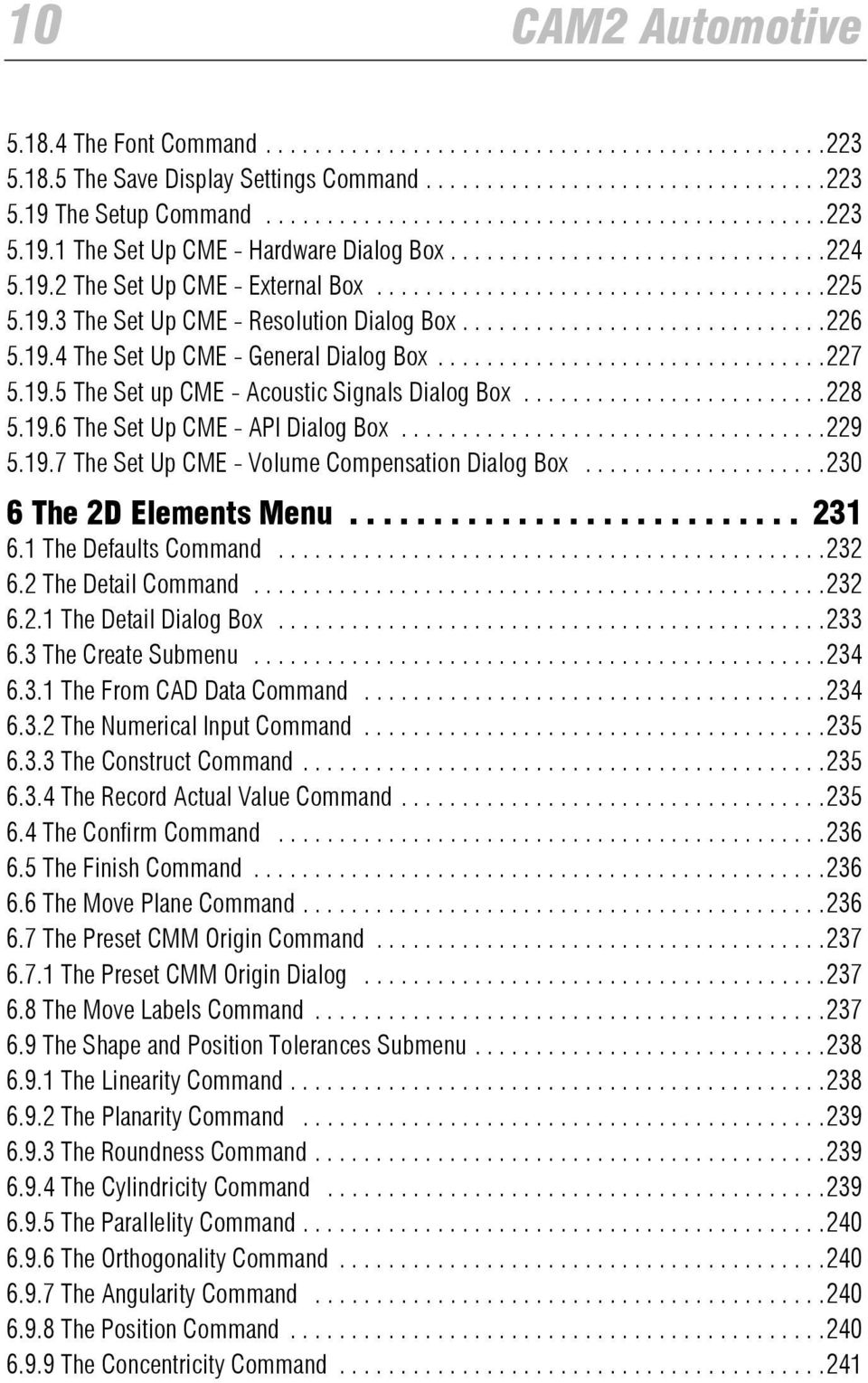
11 CAM2 Automotive The Symmetry Command The Define Reference Command The Point Command The Line Command The Planes Command The Circle Command The Slot Command The Rectangle Command The Cylinder Command The Cone Command The Sphere Command The Torus Command The Distances Command The Angle Command The Element Section Cuts Command The Circle Distance Command The 2D Measure Menu The Manage Templates Command The Template - General Dialog Box The Template - Templates Dialog Box The Template - Recordings Dialog Box The Create Templates Command The Process Template Command The Process Template Dialog Box The Import Template Submenu The From Geometrical File Command The Import Geometry Data Dialog The From External File Command The from CAM2 Execute Database Command The From CAM2 Control Database Command The From DMI File Command The Import Template from DMO File Command The Export Template Submenu The As CNC File Command The Create CNC Data Dialog Box
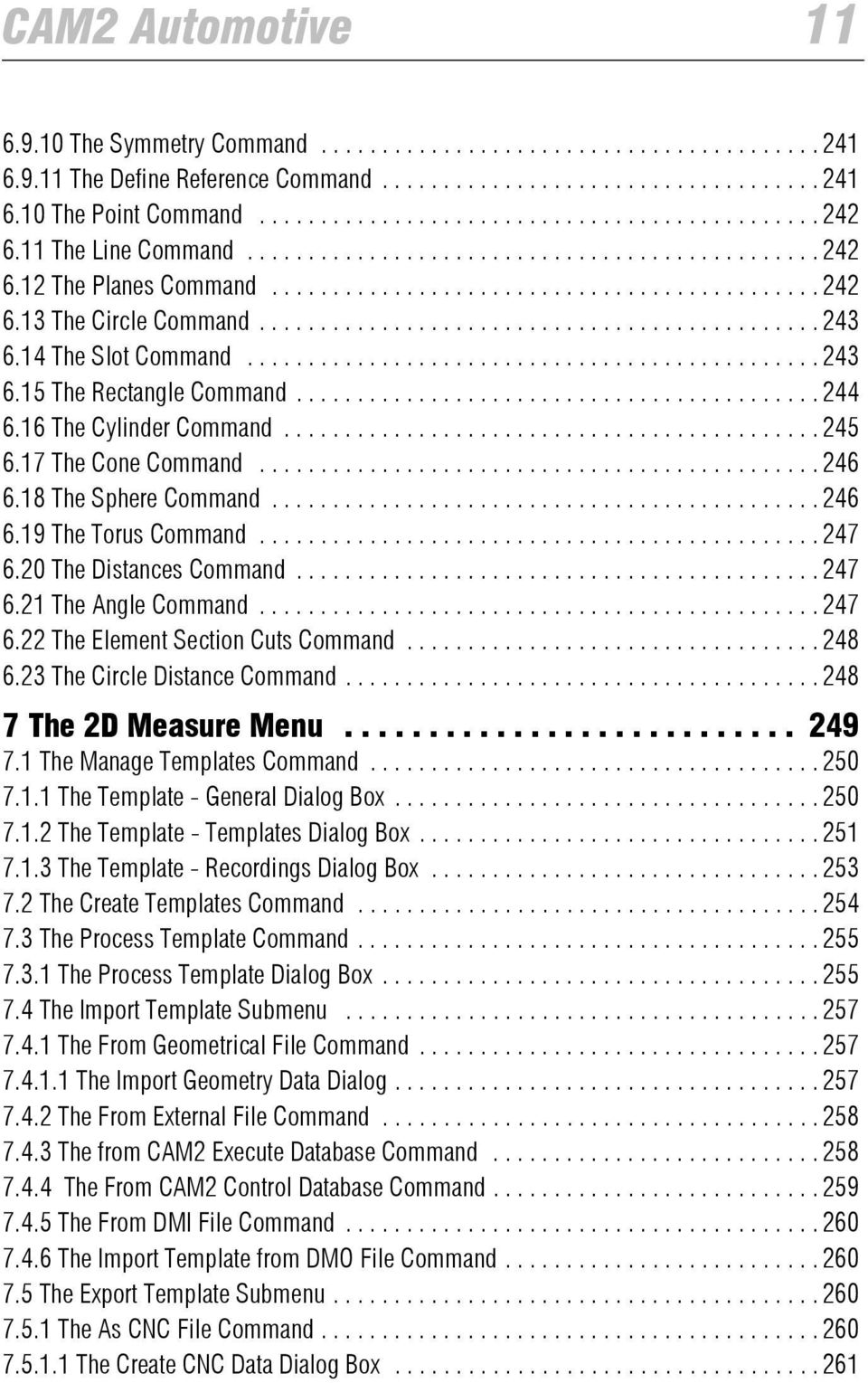
12 12 CAM2 Automotive The To CAM2 Execute Database Command The To CAM2 Control Database Command The Project Management Dialog Box The To DMI File Command The Import Data Command The Export Data Command The Export Measurement Data Dialog Box The Export Nominal Data Command The Print Protocol Command The Print Protocol Dialog Box The Tolerances Command The Tolerances Dialog Box The Material/Appliance Offset 2D Command The Thickness Dialog Box The Distance Range Command The Distance Range Dialog Box The 3D Measurement Menu The Surface Measuring Command The Contour Measuring Command The MDI-Measuring Command The CNC-Mode active Command The Surface Measurement Submenu The Move Points Command The Move Point Dialog Box The Manual Measured Point Command The Manual Measured Point Dialog Box The Weight of Surface Vector Command The Weight of Surface Vector Dialog Box The Measure Using Weight Command The Copy Group to MDIs Command The Contour Measuring Submenu The Axis to Ignore Command The Ignore Axis Dialog Box The 2 Axes Measuring Command The Deformed Contour Measuring Command

13 CAM2 Automotive The Select Contour Command The Add Points on Contour Command The MDI-Measuring Submenu The Get MDI by Mouse Command The Get MDI on Cut Command The MDI on Cut Intersection Command The Multiple MDIs on a Cut Command The Enter MDI by Keyboard Command The Get MDI on Contour Command The Enter Distance from Contour Command The Enter Distance from Contour Dialog Box The Define MDIs with Distance Command The Multiple MDIs from Grid Command The Options for Ref. Contour Points Command The Options for Ref. Contour Points Dialog Box The Get MDI for Ref. Contour Points Command The MDIs for CNC Command The MDIs for CNC Dialog Box The Get CNC touch points Command The Mirror MDIs Command The Mirror MDIs Dialog Box The Invert MDI vector Command The Copy Group to Surface Command The Point-Point Calculation Mode Command The Point to Surface Calculation Mode Command The Maximal Distance Command The Maximal Distance Dialog Box The CNC Mode Submenu The Assume Current NIV Group Command The Import MDIs to new Group Command The Edit Plane Command The Edit CNC Point Command The Insert CNC Point Command The Move CNC Point on Surface Command The Move CNC Point on Geometric Command

14 14 CAM2 Automotive The Mirror CNC points Command The Insert Message Point Command The Edit Message Point Command The Delete Message Point Command The Insert Probe Change Point Command The Edit Probe Change Point Command The Delete Probe Change Point Command The Start CNC-Measuring Command The Abort CNC-Measuring Command The Run Cycle without Measuring Command The Print Protocol Command The Print Protocol Dialog Box The Tolerances Command The Tolerances Dialog Box The Material/Appliance Offset Command The Material/Appliance Offset Dialog Box The Distance Range Command The Distance Range Dialog Box The 3D Groups Menu The New Groups Command The Edit Groups Command The Group Editor Dialog Box The Move Group Labels Command The Reset Group Labels Command The Previous Group Command The Next Group Command The Delete Group Command The Move Point Label Command The Reset Point Label Command The Previous Point Command The Next Point Command The Delete Point Command The Points visible/invisible Command The Make All Points visible Command The Rename Point Label Command

15 CAM2 Automotive The Change Name Dialog Box The Show Selected Points Command The Show all Points Command The Show no Points Command The Toggle visible/invisible Points Command The Undo Command The 3D Measurement Files Menu The Surface Points Submenu The Load Surface Points Command The Load Measuring-Points Dialog Box The Import Surface Points Command The Save Surface Points Command The Save Points Dialog Box The Export Surface Points Command The Surface Points -> VDA-FS Command The VDA Export Dialog Box The Surface Points -> MDIs Command The Surface Points to SPC Graph Command The Surface Points for SPC Graph Dialog Box The MDIs Submenu The Load MDI-Points Command The Load MDI-Points Dialog Box The Import MDIs Command The Save MDI Points Command The Save MDIs Dialog Box The Export MDIs Command The MDIs -> VDA-FS Command The MDIs -> BMW-Measuring Command The Save BMW-Measuring File Dialog Box The BMW-Measuring -> MDIs Command The VDA MDIs Command The CNC Points Submenu The Load CNC-Points Command The Load CNC-Points Dialog Box The Import CNC Points Command

16 16 CAM2 Automotive The Import from CAM2 Control DB Command The Save CNC-Points Command The Save CNC Points Dialog Box The Export CNC Points Command The Export to CAM2 Control DB Command The Measure by File Command The DMIS Submenu The Import DMI File Command The Import DMO File Command The Export DMI File Command The Section Cuts Menu The Create Command The Section Cuts - Axis Parallel Dialog Box The Section Cuts - Standard (2) Dialog Box The Section Cuts - Standard (3) Dialog Box The Section Cuts - Vector Point Dialog Box The Section Cuts - Angle/Points Dialog Box The Manage Command The Managing Section Cuts Dialog Box The Section Cut Display Dialog Box The Material Strength Command The Material Strength on Section Cuts Dialog Box The Delete Command The Save Command The Load Section Cuts Command The Save and Load Section Cuts Dialog Box The Point-Point-Distance Command The Section Cut on Screen Command The Section Cut on Contour Command The Move Labels Command The Dimensions Menu The Create Submenu The Point-Point Distance Command The Contour Arc Command The Cut-Cut Distance Command

17 CAM2 Automotive The Section Arc Cut Command The Delete Command The Move Label Command The Reset Label Command The Window Menu The New Window Command The Cascade Command The Tile Vertically Command The Tile Horizontally Command The Arrange Icons Command The Split Command The Default View Command The Next Section Command The Previous Section Command The Options Menu The General Command The General Options - Options Dialog Box The General Options - Acoustic Signals Dialog Box The Import Submenu The Import Command The Import Options Dialog Box The Import from Catia Command The Import Service Command The Import Service Dialog Box The New Conversion Command The Confirm Delete Command The Point Output Properties Command The Point Output Properties Dialog Box The Point Output Command The Units Command The VDA Roots Command The VDA ROOTS Options Dialog Box The Print Contents Submenu The Element Properties Command The Center Point Printing command
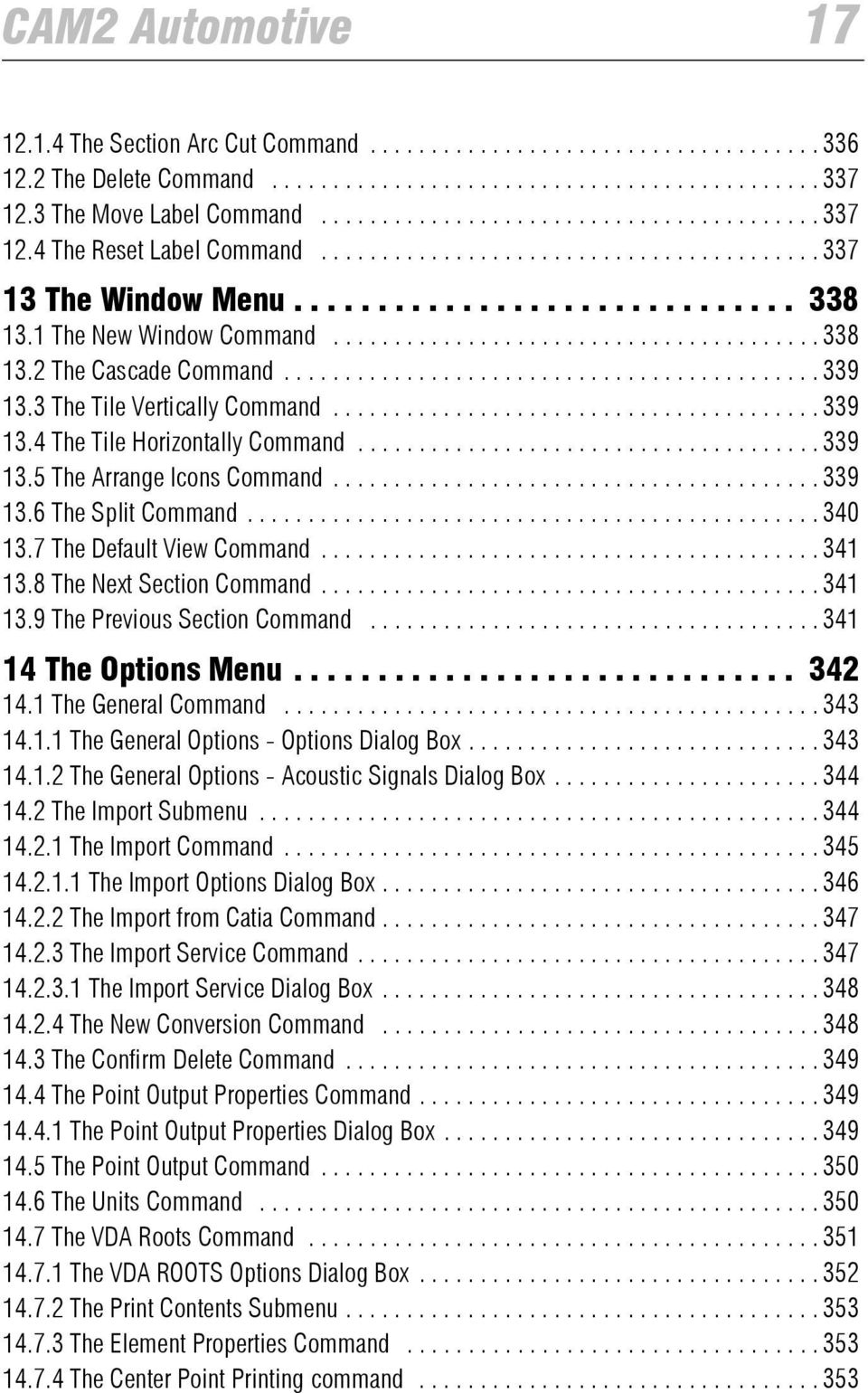
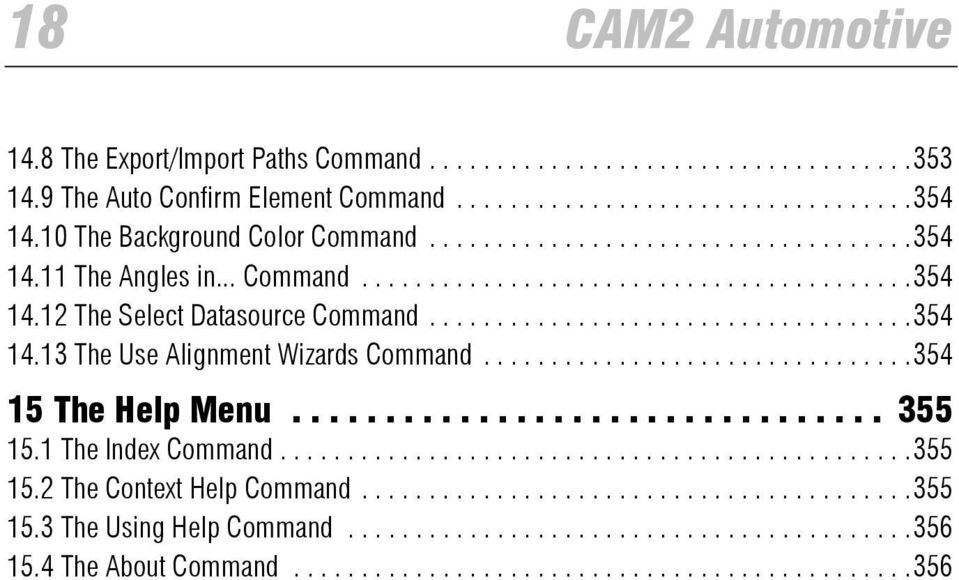
18 18 CAM2 Automotive 14.8 The Export/Import Paths Command The Auto Confirm Element Command The Background Color Command The Angles in... Command The Select Datasource Command The Use Alignment Wizards Command The Help Menu The Index Command The Context Help Command The Using Help Command The About Command
19 CAM2 Automotive 19 1 Introduction Welcome to the CAM2 Automotive introduction. In the following chapters, you will find out about CAM2 Automotive functions and how to use them. The introduction includes the following chapters: What is CAM2 Automotive used for? The User Interface Functions to view and manage files: Viewing vector files Importing VDA-FS and IGES files Working with Document Windows Managing vector files Printing Vector Files A few important basics: The coordinate systems Geometrical Elements Probing points Creating alignments: Aligning a part Physically Aligning An Element Aligning An Element by Calculation in 2D Aligning An Element by Calculation in 3D The functions for managing nominal elements and measurements: Measuring in 2D Mode Defining nominal elements Constructing

20 20 CAM2 Automotive Viewing elements Creating and processing templates Actual value recording Probe switch Measuring in 3D Mode 1.1 What is CAM2 Automotive used for? CAM2 Automotive offers wide-reaching options for the graphical display of a CAD object or geometrical elements, as well as options to define and measure them and create targetactual comparisons using these data. Of course, it is also possible to measure CAM2 Automotive parts without CAD data or create pure actual value recordings. Tolerance values can be got from different tolerance classes: default class, form and position classes or individually defined tolerance classes. CAM2 Automotive also has functions to measure surfaces and measure predefined target points (MDI points). Functions are available specifically to measure the contours of sheet metal parts. CNC programs can also be created offline. Of course, all CME functions such as the probe library, setting the origin, compensation factor and scaling factor are also included. All these data are displayed on the monitor and can be printed as a protocol. Many modern CAD systems use the VDA-FS or IGES file formats to exchange data. Because these formats are based on text files, CAD data in these formats can be processed by various computers and CAD systems. However, this same basic characteristic poses the most significant disadvantage of the system. Files in these formats require a huge amount of storage space, that is they take up a lot of space on mass storage media (like hard drives) and it takes a long time to load them in the computer' s working memory. If the work on a particular object is complete and is ready to archive, there is no longer reason to maintain the space and time consuming VDA-FS or IGES format. CAM2 Automotive converts these files without losing information into a more compact format. To keep things organized, CAM2 Automotive also provides a viewing and print function for compressed files. CAM2 Automotive also offers complete file management for these files that makes it possible to give a file or directory a description longer than the standard MS-DOS file name. Using CAM2 Automotive you can create a GEO file for this compressed vector file that contains the data from created or measured geometrical elements. In addition, in this file the
21 CAM2 Automotive 21 templates that are created and processed are saved so that you have access again anytime to completed measurements. There is also a CATIA direct interface. These data can be loaded and displayed in a wire frame model or as a 3D view. In addition, the layer and filter structures of the CAD systems are supported. 1.2 The User Interface The following control elements are available in the application window of your application: The Title Bar The Menu Bar The Toolbars The Status Bar
22 22 CAM2 Automotive In addition, the document window of the vector file currently open is displayed in the application window. The individual control elements of the toolbar and the control panel are described at a later time. If you have problems with the application windows or the Title barcontrol functions, read the chapter entitled Working with Document Windows The Title Bar The Title Bar stretches the length of the upper edge of the window. It contains the name of the application and, when applicable, the name of the vector file that is being displayed in the active window. To move the window, drag the title bar. Tip: Dialog boxes can also be moved by dragging them by their title bar. A title bar can contain the following elements: Buttons belonging to the system menu of the application Buttons belonging to the document system menu Buttons for maximizing the window Buttons for minimizing the window Buttons for restoring the window Name of the Application Name of the Document The Menu Bar There are various menus available in the menu bar. Using the left mouse button, click on one of these menu categories to get a list of commands.
23 CAM2 Automotive The Toolbars When you select the Toolbars command, another menu allows you to display or hide the individual toolbars. When a toolbar is displayed, a check mark appears next to the corresponding menu entry. Use the mouse to drag the toolbars anywhere within your application window. A toolbar can be docked on any of the four sides of the application window. A toolbar with more than one column can only be docked on the left or right edge. The following toolbars form the basis of CAM2 Automotive: General Control bar Section Cut Commands Layers and Filters Preferred Settings contains the most important commands in the File menu. Functions to control the view, such as Rotate, Move, Zoom or View as Solid Image Model. contains the most useful section cut functions. Functions to manage and change the layer and filter structure. To rename, delete or create a new current view. The General Toolbar The Control bar The Section Cut Commands Toolbar
24 24 CAM2 Automotive The Layers and Filters Toolbar The Preferred Settings Toolbar The following toolbars are available with a opened counter window or by changing into 2D or 3D mode: CME Tools Alignments and Probe Library Alignments contains the most useful CME functions. displays the current alignments and probe libraries. Commands for creating and managing alignments. The CME Tools The Alignments Toolbar The Alignments and Probe Libraries Bar You will also find the following buttons in 2D mode: Geometrical Commands Geometrical Elements Shape and Position Tolerances Managing Geometrical Elements, Alignments and Measurement Lists Creating, Constructing or Measuring Elements Entering Shape and Position Tolerances
25 CAM2 Automotive 25 The Geometrical Commands Toolbar The Geometrical Elements Toolbar The Shape and Position Tolerances Toolbar In Surface measuring mode (3D) the following buttons are also available: Measurement Elements Commands To Mange Measurement Points And Select The Measurement Mode Surface Measurement Elements * Commands for the Surface Measurement Mode Contour Measurement Elements * Commands for the Surface Measurement Mode MDI Elements * Commands for the Level Measurement Mode CNC Measurement Elements * Commands for the CNC Measurement Mode Tolerances Bar Shows deviations in relationship to the set tolerance values The buttons indicated with * are only available in each measurement mode.
26 26 CAM2 Automotive The Measurement Elements Toolbar The Surface Measurement Elements The Contour Measurement Elements The MDI Measurement Elements The CNC Measurement Elements
27 CAM2 Automotive 27 The Tolerances Bar You can find detailed help for using the individual toolbars by clicking on the icons on this page.
28 28 CAM2 Automotive The General Toolbar This toolbar in displayed horizontally at the top of the application window under the menu bar. The toolbar provides quick access to many CAM2 Automotive functions with your mouse. It can also be moved anywhere in the work area with the mouse. The toolbar can be docked on any of the four sides of the application window. To display or hide the toolbar, select the Toolbar General command from the View menu. Panel Effect Opens an existing vector file. Adds a vector file to another one and creates a list of compare files. Displays the specified files in the compare list and shows similarities and differences. Opens a CME window. Switches to Geometry mode. Switches to Surface mode. Creates a new folder. Imports files in VDA-FS and IGES format and converts them to an internal format. Changes the name of a vector file or folder. Moves a file or folder. Deletes a file or folder. Displays the file information for a vector file Adds a comment to the file information of a vector file. View Settings
29 CAM2 Automotive 29 Panel Effect defines/ changes the protocol settings Shows the print preview Prints the current view Shows the copyright information and the version number of your application. Describes individual control elements of your application. Undoes the last delete procedure.
30 30 CAM2 Automotive The Section Cut Commands The Section Cuts toolbar has the most important commands for calculating and managing section cuts. To display or hide the toolbar, select the Toolbars Section Cuts command from the View menu. Panel Command Effect Create Section Cut on Screen Section Cut on Contour Manage Section Cut View Point-Point Distance Load Calculates sections cuts either that are parallel or at an angle to the axis. Calculates section cuts perpendicular to the screen plane. Calculates section cuts perpendicular to a contour line. Manages section cuts. Rotates the view perpendicular to the section cut plane of a section cut. Calculates the distance between two points on section cuts Loads one of the available section cut files. Save Delete Move Label Material Strength aves the current section cut. Deletes section cuts when you double click. Moves the name of the section cut. View of the section cut with material strength
31 CAM2 Automotive The Layers and Filters Toolbar The Layers and Filters toolbar is available when you open a file that was converted using the new conversion program. You can select an available filter in the selection list or use the buttons to make changes to the layer and filter structure. To display or hide the toolbar, select the Toolbars Filters and Layers command from the View menu. Panel Command Effect Layers and Filters Element Info Manage Layers Move to Layer Allows you to select elements (surfaces, curves). Displays the name of the selected element when you double click. Displays a list of all layers with a preview of the elements they contain. Moves selected elements to another layer. Manage Filters Create Filter Changes existing filters or creates new ones. Creates a new filter The Preferred View Settings The Preferred View Settings toolbar has the most important commands for managing your preferred views. Use the control bar to call up the desired view. To open it, click on the small, black triangle to the right of the text field and select the desired view in the resulting list of names using the left mouse button. If there are several entries, scroll through the list until you reach the desired entry. To display or hide the toolbar, select the Toolbars Preferred Settings command from the View menu.
32 32 CAM2 Automotive Panel Command Effect New Adds the current view to the view list Rename Renames the active view Delete Deletes the active view The CME Tools Toolbar As soon as you switch to a measuring mode (2D or 3D) or have opened a CME window, the CME Tools toolbar will appear. Herein you will find the most useful commands for controlling the CME. By default, the CME tools are on the right side of the program window. However, you can drag them anywhere on your desktop using the mouse. To display or hide the CME Tools toolbar, select the Toolbar CMETools command from the View menu. Panel Command Effect Enable Probe Sphere diameter Retract point Set Origin Reference Globe Axis System Compensation Factor Scaling Factor Shows touchpoint Turns the 3D probe on or off. Sphere diameter input. Uses the retract point to determine the probe direction. Approaches or sets the origin. Probe switch, measures the reference globe Switches axes, changes the counting direction Input the compensation factor per axis. Enter the scaling factor. Shows the coordinate of the touchpoint in the CME display.
33 CAM2 Automotive The Layers and Filters Toolbar By clicking on these fields a list of available alignments and probes opens. Make your selection by clicking on it The Control Bar On the control bar, you can find the commands to rotate, move, enlarge (Zoom In) or reduce (Zoom Out) an object or to change the active view. The control bar is on the right side of the application window. You can, however, move it with the mouse anywhere within your work area. To display or hide the control bar, select the Toolbars Control elements command from the View menu. Panel Command Effect Panel F5 Isometric View from left top front F6 F7 F8 Front View Side View Top View View from the front (view along the Y-Z plane) View from the left (view along the X-Z plane) View from the top (view along the X-Y plane) R Reset Returns to the default view NUM 7 NUM 9 NUM 1 NUM 3 NUM 0 Rotate X counterclockwise Rotate X clockwise Rotate Y counterclockwise Rotate Y clockwise Rotate Z counterclockwise Object rotates counterclockwise around X- axis Object rotates clockwise around X-axis Object rotates counterclockwise around Y axis Object rotates clockwise around Y axis Object rotates counterclockwise around Z axis
34 34 CAM2 Automotive Panel Command Effect Panel NUM, Rotate Z clockwise Object rotates clockwise around Z axis CTRL + Y Center Resets the Rotational Centerpoint # Grid Displays a coordinate grid NUM 4 Move left Moves the image area to the left. NUM 6 Move right Moves the image area to the right. NUM 8 Move Up Moves the image area up. NUM Move Down Moves the image area down. NUM + Zoom In Enlarges the image area 20% NUM - Zoom Out Reduces the image area 20% Reset Zoom Fixed Scale Wire Frame Model Solid Image Model Resets the original image scale Fixed scale view of the part Displays or hides the wire frame model. Displays the object in the current view as a shaded three-dimensional model The commands used to rotate or move an object or to zoom in or zoom out, can be performed ten times more accurately if you press the buttons on the control panel with the right mouse button or enter the shortcut while pressing CTRL KEY. Here is another summary of the shortcuts that can be entered using the key pad (to the right of the arrow keys) for a partial overview:
35 CAM2 Automotive The Alignment Elements The following buttons are available in each of the two measurement modes. in the geometrical measurement mode (2D): Panel Command Effect Automatic... Aligns using selected elements. VariAlign Aligns using any number of elements. Choose Alignment Defines an existing alignment as default. Load alignment Loads an alignment matrix. Save alignment Saves the existing alignment(s). in the surface measurement mode (3D): Panel Command Effect 6 Points Alignment Calculates an alignment using 6 points. Bestfit Alignment Calculates a best fit alignment. Choose Alignment Defines an existing alignment as default. Load alignment Loads an alignment matrix Save alignment Saves the existing alignment(s).
36 36 CAM2 Automotive The Geometrical Commands As soon as you have switched to the Geometrical Measurement mode, you will see the Geometrical Commands toolbar. Here you will find the most useful commands for creating, measuring and managing geometrical elements. By default, the geometrical commands are on the right side of the program window. However, you can move them around your desktop using the mouse. To display or hide the Geometrical Commands toolbar, select the Toolbar Geometrical Commands command from the View menu. Panel Command Effect From CAD Data Records geometrical elements from the graphic. Numerical Input Construct Manage templates Create Template List Process Template Measure Detail Change Delete Invert Plane Move Reference Point Move Point Label Elements Intersect Move Planar Element Input of geometrical elements using the coordinates. Construct new elements from existing ones. Changes templates. Creates a new template Measures according to a template. Measures geometrical elements. Data for a selected element. Changes the data of a selected element. Deletes an element. Inverts the normal vector of a plane. Moves the reference point of a plane. Moves the labels of the elements Constructs the intersection of elements Moves a planar element on its plane. Some of these buttons can only be selected if another command was previously selected or the elements are selected.
37 CAM2 Automotive Geometrical Elements Point A point is the simplest geometrical element. It is described by its X, Y and Z coordinates. Line A line is defined by two points. The line is the shortest path between these two points and has a defined length. A line can also be calculated as a compensating level. In doing so, the line is calculated as a compensating line through any number of points. This procedure is useful to measure edges. a. with projection plane All points are projected in the reference plane. A compensating level will then be calculated from these points. b. without reference plane If the measurement is made with a probe, the probe must touch the line. The sphere center points cannot be in one plane. If a material thickness is set, this is added to the sphere' s radius. When using a probe, the length of the line should be at least ten times that of the probe radius.
38 38 CAM2 Automotive Plane Planes are shown as follows: The vertical arrow on the plane is the plane' s normal vector. A vector describes a direction in space. The position of the plane in space is determined by a reference point. A plane is positioned vertically to the normal vector and contains the reference point. These two elements uniquely define a plane. Three points on the plane are required to create or measure a plane. Of course, these points cannot be in a line. They should be sufficiently far apart and form a triangle. The normal vector must always point away from material during measurement with target data. CAM2 Automotive offers options to change the direction of the plane vector or move the reference point on the plane.
39 CAM2 Automotive 39 Circle A circle is defined by the coordinate of its center point and the radius. A plane in which the circle lies is also required. When measuring a circle, a plane upon which the circle is projected must also always be measured at the same time, because it is not possible to measure a circle exactly in the plane in which it lies in a hole, for example. To measure or create a circle requires three points on its circumference. A greater number of measurement points increases the precision and compensates for any measurement errors or imprecision. Circle arcs can also be measured. Slot A slot consists of two circles and their tangential connecting lines. The two circles are defined by their center points and radii, as well as their position in space. When measuring a slot, a projection plane must be measured at the same time. To measure or create it, three points on each of the two circles are required. The two circles do not have to have the same diameter. Rectangle A rectangle is defined by its four corner points. To create or measure eight points, eight
40 40 CAM2 Automotive points are generally required, because it is not possible to reach the corner points with the measuring probe. The eight points are two points on each of the four sides. When measuring a rectangle, a project plane must be measured because, in general, it is not possible to measure all points in one plane. Sphere A sphere is uniquely described by its center point and radius. To create or measure a sphere, four points on its surface are required. These points cannot lie in one plane to enable unique calculation. More points increase the precision and can compensate for any imprecision in measurement. Sphere arcs can also be measured. To attain the best results, measure the first four points as follows: The additional points can be distributed anywhere on the sphere' s surface. Cylinder A cylinder is seen as endless, that is, it is not limited in its length. In the graphical display, the cylinder is only shown in the area where it is measured or created, however. A cylinder is uniquely described by its axis and radius. When measuring or creating a cylinder, four points on the cylinder' s surface are required. If possible, the first three points should lie in one plane on the cut circle of the cylinder. The greatest precision is attained if the points are set apart by an angle of 90 degrees each, the fourth point is then also set apart by 90 degrees on the cylinder' s surface and as far as possible from the other points.
41 CAM2 Automotive 41 A cylinder can also be measured using six points. Two sets of three points should each lie on a cut circle of the cylinder. The cylinder can also be measured with six points in three surface lines. In this case, the surface lines are probed sequentially at three points. This option particularly makes sense if only a small section of the cylinder surface can be probed. More points can be used for any probe type, and the additional points can be anywhere on the cylinder' s surface. Cone Cones are assumed to be endless. To create or measure a cone requires five points. The first two points must lie on a surface line of the cone, and the next two on a different surface line. The fifth point can lie anywhere on the cone' s surface. Any number of additional points can be probed on the cone' s surface. Torus A torus requires six points. These must be probed as shown below on two cut circles of the torus.
42 42 CAM2 Automotive The Measurement Elements Toolbar The following buttons are available to control measuring as soon as you open a CME window or switch to Surface Measuring mode. Panel Command Effect Surface Measuring Turns the Surface Point Measuring mode on. DI-Measuring Turns the MDI Measuring mode on. Measure Contour Turns the Contour Measuring mode on. NC Mode Turns CNC mode on. Point List Opens a point list in the current view. New Group Creates a new group. Next Group Jumps to the first point of the next group. Previous Group Jumps to the first point of the previous group. Delete Group Deletes the current group and the points in it. Next Point Jumps to the next point. Previous Point Jumps to the previous point. Delete Point Deletes the current point. Move Point Label Moves the display of the point number or distance. Reset Point Label Reverses all moves of point numbers. Move Group Names Moves the display of group names. Initialize Group Names Reverses all moves of group names. Point visible/invisible Toggles the current point to be invisible or visible. All Visible Makes all points visible.
43 CAM2 Automotive 43 Panel Command Effect Toggle visible/invisible Toggles the display between visible and invisible points. Tolerances Change Name Sets the tolerance range. Changes the point name The Surface Measurement Elements Toolbar The following buttons are available as soon as you switch to the Surface Measuring mode. Panel Command Effect Move Points Manual Measured Point Enter Weight Measure Using Weight Load Measurement Points Measure From File Save Measurement Points Moves all measurement points in each direction. Measurement simulation by input of a measurement point using coordinates. Inputs the surface vector for measuring with weight. Checks the projection on the correct plane with the surface vector. Loads the saved measurement points for this part. Reads points from a file instead of directly from the measuring machine. Saves measurement points in the VDA_ROOT for this part.
44 44 CAM2 Automotive The Contour Measurement Elements Toolbar The following buttons are available as soon as you switch to the Contour Measuring mode. Panel Command Effect 2 Axes Measuring Contour measuring ignoring one axis. Select Axis to Ignore Deformed Contour Select Contour Add Contour Points Input one axis to ignore using 2 axes measuring. Measure a deformed contour. Selects a contour on which the next contour points are projected. Creates contour points by double clicking The MDI-Measuring Toolbar The following buttons are available as soon as you switch to the MDI Measuring mode. Panel Command Effect Define MDIs MDIs on Cut MDIs on Cut Intersection Auto Creates MDIs on Cuts Enter MDIs MDI on Contour Distance from Contour MDIs with Distance Creates MDIs with the mouse. Creates MDIs on Cuts Creates MDIs on cut intersection. Automatically creates MDIs on cuts according to your settings. Creates MDIs using coordinates. Creates MDIs on a contour. Enters a distance from contour. Creates MDIs with a distance to the contour.
45 CAM2 Automotive 45 Panel Command Effect MDIs from Grid Options for Ref. Contour Points Get MDI for Ref. Contour Points MDIs for CNC Take CNC Points to MDI Mirror MDIs Invert MDIs Load MDIs BMW-measuring -> NIV Save MDIs NIV -> BMW-measuring NIV -> VDA-FS Creates MDIs in a grid on a surface. Gives the reference point for a created contour point. Creates contour points using MDIs, recorded from a distance. Creates CNC program from MDIs. Takes CNC touch points to MDI mode. Mirrors the MDIs to Y=0. Changes the directional vector of MDIs. Loads MDIs from a file. Loads MDIs from the BMW-measuring format. Saves MDIs in the VDA_ROOT for this part. Saves MDI points in BMW-measuring format. Saves MDI points in VDA-FS format The CNC-Measuring-Cycle Tool Bar The following buttons are available as soon as you switch to the CNC mode. Panel Command Effect Assume Current NIV Group Assumes the current NIV point group as the CNC program. Edit Plane Edits the safety plane. EditCNC Point Edit the current point.
46 46 CAM2 Automotive Panel Command Effect Insert CNC Point Move Plane Point Move Geometrical Point Insert Message Point Edit Message Point Delete Message Point Insert Probe Change Edit Probe Change Delete Probe Change CNC Measuring Abort CNC Measuring Run Cycle with Measuring Mirror CNC Points Import CNC Points Export CNC Points Import CNC Points from Database Export CNC Points to Database Import DMI File Import DMO File Inserts a point after the current point. Moves the current plane point. Moves the current geometrical point. Inserts a message point. Changes the message point. Deletes the message point. Inserts a probe change point. Changes the probe change point. Deletes the probe change point. Starts the CNC measuring program. Aborts the CNC measuring program. Starts the CNC measuring program without measuring functions. Move or Copy CNC points from original to mirrored Data. Loads CNC points from a file to any directory. Saves CNC points to any file. Loads CNC points from a database. Saves CNC points to a database. Loads a DMI file. Loads a DMO file.
47 CAM2 Automotive The Tolerances Bar The tolerance bar shows the deviation fo the current point in relation to the tolerance. If the point is out of tolerance, either negative or positive, it is shown in a different color. You can set the colors using View Setup or the button on the Tolerances page. The deviation is also shown numerically. Here you can also see the number of the current point as well as the total number of points The Status Bar The Status Bar is displayed at the bottom edge of the application window. You can display or hide the status bar using the Status Bar command in the View menu. As you move through the menus either with the ARROW KEYS or the mouse, the left part of the status bar describes the function of the menu entries. In addition, descriptions about the functions of the buttons of the toolbar are displayed when you press and hold these down. If you do not want to perform the command for the toolbar button after you have read the description, release the mouse button after the mouse pointer is no longer on the button. The right part of the status bar shows which of the following buttons are defined: Display Description UF CAPS LOCK is on. NUM NUM LOCK is on. SCRL SCROLL LOCK is on.
48 48 CAM2 Automotive Besides, the status bar contains information about the probe diameter, the actual alignment and other CME settings. 1.3 Importing VDA-FS and IGES Files To manage CAD files, you have to first convert them to the internal file format. This function is located in the File menu under Import. You can also use the Import toolbar button. When you select this function, you can specify in a Select File dialog box one or more files that you want to convert to VDA-FS or IGES format. You can use the Options button, the Import command from the Options menu to enter the import filter (G1.exe), its parameters as well as the destination directory and name of the files that you are importing. The import options apply for the files you are currently converting when you call them up from the Import dialog box. If these options have been set in the Options menu, they apply for all other conversions as well. Conversion takes place in the background so that you can continue working in this or other applications. After the file has been successfully converted, the newly-created vector file resides now in the pre-determined import directory. This file can now be opened for viewing, renamed, moved to another directory or deleted again. You can also convert files using an automatic import service. You will find this service in the Options menu under Import Service. This automatic import service searches one or more import paths and their subdirectories for new VDA files. The directory structure of the CAD database (VDA_ROOT) is set up just like the import path structure. Files that have already been converted are not converted again. The file import runs in the background here as well. Files can also be imported through the optional CATIA direct interface.
49 CAM2 Automotive Managing Files One of the functions of the program is managing vector files. A variety of functions is available for managing vector files which are described in the following chapters. Creating Directories Renaming Moving Files Deleting Creating Directories You can, of course, collect the resulting CAD files in the root directory. However, it makes sense to arrange these files according to certain criteria such as client, project and version. An organized file structure allows you to find a certain file quickly, particularly when there is a lot of data. Use the New Directory command under the File menu of your program. When you select this menu or press the toolbar button, you can then select a directory where the new subdirectory should be placed. The open folder at the bottom of the selection list is where the new directory will later reside. Enter the desired name for the new directory in the "Name" entry field. This directory is called <<New Directory>> if you do not enter a name or if you delete the entry field. If you decide you don't want to create a new directory, or if you have selected this command by mistake, click Cancel.To create a directory, click OK. The program allows you to give names of up to 80 characters to files and subdirectories. These names can be changed any way you want and can contain any available special characters.
50 50 CAM2 Automotive From the File menu, select Rename or use the toolbar button to change the name of a file or directory. Use the Select File dialog box to select the file or directory that you want to rename. Caution: The VDA_ROOT root directory cannot be renamed Moving Files Select the Move command or the toolbar button to select both the file you want to move and the destination directory in the Select File dialog box. You can also move a directory and all of its files and subdirectories. You may not, however, move a directory into its own subdirectory.
51 CAM2 Automotive Delete Unnecessary files can be removed with the Delete command in the File menu.when you have selected this command or pressed the toolbar button, you can specify the file or directory you want to delete in the Delete dialog box. After you have made your selection and confirmed with OK, the program asks you to confirm the deletion once more. Because the files and directories that are deleted cannot be recovered, use this opportunity to make sure that you really want to delete the entries and not any others. After you confirm your selection, the entry is deleted. You can also deactivate confirmation of any deletions. To do this, select the Confirm Delete command in the Options menu.if there is a checkmark in front of this menu entry, you will have to confirm the deletion a second time as described above. If not, this is unnecessary.
52 52 CAM2 Automotive 1.5 Viewing Vector Files Using the file viewer, you can display the object described by a vector file from all sides and output any enlarged section cuts. The description of the file viewer is divided into the following topics: Opening a File Rotating a View Moving a View Enlarging Section Cuts Resetting the Rotational Center Resetting to Default Values Merging Files Comparing Files Shading a View Creating Section Cuts The Filter and Layer Structure Summary Several default view settings can also be found in the View menu under the Setup command or the button on the toolbar. To view or print out a file, you have to first open it.to do this, select the Open command in the File menu or the button on the control panel.. When you select this menu item, the Select File dialog box for vector files appears.
53 CAM2 Automotive 53 Use the ARROW KEYS or the mouse to move through the list to make your selection. When you have selected a folder double click on it to switch to this folder. Folders that are already open are displayed in order one under the other. If you want to close this subfolder, double click on the open folder above it to display all the folders and files contained within it. Another file icon is the icon for Assemblies, which contain several individual parts. In the Select File dialog box, both an image of the part as well as the header of the CAD file are displayed. If you are selecting a file for the first time, the image is recalculated. This process can take a few seconds during which time the mouse pointer is represented by an hourglass. The resulting calculated image is then saved. If you select this vector file at a later point, the image is shown almost immediately. This also happens when you close the application and restart it. There is no information available for folders. You can save the active window at any time as a preview. To do this, select the Save as Preview command from the View menu. Select a CAD file that can be identified by an document icon and confirm you selection with OK or a double click. A new document window opens in which the selected object is displayed. The name of the file is shown in the title bar of the application window. This new viewing window simultaneously becomes the active window. You see this because the name of the file you just opened appears in the title bar of the application Enlarging Section Cuts The original view of an object on the screen is selected so that the entire object is visible. To make smaller details visible, they usually have to be enlarged. It makes the most sense to rotate the object on the screen and then move it so that the desired detail is in the middle of the image area, if possible. In the View menu, you can find the commands to Zoom In and Zoom Out of the image area as well as the Reset Zoom to return to the standard size. These commands are accessible with shortcuts or the control panel. Panel Command Effect NUM + Enlarges the image area by 20% NUM - Reduces the image area by 20% Resets to the original image scale You can achieve ten times the accuracy by pressing the button on the control panel with the right mouse button or enter the shortcut when the CTRL button is pressed down.
54 54 CAM2 Automotive You can also enlarge an area of the view window by pressing and holding the left mouse button. After the left mouse button has been pressed, the mouse pointer turns into a magnifying glass. Now you can mark an area by moving the mouse. As soon as you release the mouse button, the selected area is enlarged. To cancel the selection process, briefly press the right mouse button while holding down the left mouse button. These commands do not work when you have set a fixed viewing scale Rotating a View The active view can be rotated around all three axes. The commands used to do this are found in the View menu under Rotate. Or, you can use the buttons on the control panel or the specified shortcuts. Do this with number pad to the right of the arrow keys. A table of these commands follows: Panel Command Effect NUM 7 Rotate counterclockwise around the X axis. NUM 9 Rotate clockwise around the X axis. NUM 1 Rotate counterclockwise around the Y axis. NUM 3 Rotate clockwise around the Y axis. NUM 0 Rotate counterclockwise around the Z axis. NUM, Rotate clockwise around the Z axis. Each command rotates the object 15. You can also rotate the object a tenth of this total (i.e. 1.5 ) if you operate the button on the control panel with the right mouse button or enter the shortcut when the CTRL button is pressed down.
55 CAM2 Automotive Moving a View You can move the visible image area left, right, up or down. The commands used to do this are found in the View menu under Move. You can also access these functions using the control bar buttons or the shortcuts on the numeric keypad. Panel Command Effect NUM 4 NUM 6 NUM 8 NUM 2 Moves the image area to the left. Moves the image area to the right. Moves the image area up. Moves the image area down. The distance of the move is one-fifth the height or width of the view, depending on which of the two values is smaller. You can achieve ten times the accuracy by operate the button on the control panel with the right mouse button or enter the shortcut when the CTRL KEY is pressed down. You can also move the object as far as you want with the mouse. Click and hold the right mouse button on the object. Now you can move the object within the application window. When you release the mouse button, the object has been moved to a new location Resetting the Rotational Center It is sometimes necessary to move the rotational center of the view. If you, for example, are viewing a detail on the edge of an significantly enlarged object and you change the viewing angle, this important detail will usually be rotated out of the visible image area. However, you can fix any point from the vector data as the rotational center. To fix this point, use the Center command in the View menu or the appropriate shortcut or button on the control panel. The program switches to Center mode. In Center mode, you have to click on one point of the object with the mouse pointer. If there is no usable point where you clicked, you will hear a warning sound. When a usable point is located, it is placed in the middle of the image area and Center mode is ended. Center mode is also ended when you use the Center command again.
56 56 CAM2 Automotive rotate the object, move the image area, change the zoom in factor, select another type of view or reset the view to the default settings. Shortcut Control panel: Resetting to Default Values The combination of several rotations and moves combined with changes to the zoom factor is difficult to reset. As a result, there is a function that allows you to return the rotation, move or enlargement for the currently selected view back to the values that applied when the application window was opened. This function rotates the object according to the selected view type, places the geometric center point of the object at its rotational center point, moves the geometric center point of the object to the middle of the image area and adjusts the zoom factor so that the entire object takes up as much of the display as possible. You can restore the view type to the default setting using the Reset Command in the View Menu. The same command can be accessed by using the control panel or the shortcuts. Shortcuts Control panel: Keyboard: R Merging Files The program provides you with an easy to use tool to merge and compare several files. If you want to add additional files to the object in the active window in order to get a merged drawing, use the Add command in the File menu or the corresponding button on the toolbar. The current type of view has no affect when adding files. It also does not matter if you have rotated, moved, enlarged or reduced the active window. After the new vector files have been
57 CAM2 Automotive 57 added, the objects are displayed in the standard, center isometric view. You will get a dialog box where you can create a list with the files that you want to add to the first object. These files appear as an object in the document window. You can add to this list or remove individual files later. In this dialog box, you can also create a list of files that should be compared to the original files. The compare files appear in color in the document window and can be displayed or hidden at any time with the Compare command from the File menu or the corresponding toolbar button. The selected files can be moved within the dialog box between the two lists using the Compare or the Original button. Use the Part Colors command in the View menu to assign colors to the individual parts. Assemblies can be saved with the Save Assembly command in the File menu. This saves a file that contains references to the individual records. This prevents unnecessary hard drive space from being used. Shortcut Toolbar: Comparing files Use the Compare Files command from the File menue or click on the icon in the toolbar to compare two or more CAD files and find out what they have in common or wherein they differ. This command is available only after having added further vector files by doing the Add Files command from the File menue which are to compare with the current view. The view will remain as it is. Selected comparison objects will be added; all objects will be displayed. The added objects will be colored green the other red. Common lines will be colored yellow, printed in black. You may change the comparison objects list respectively the original objects list by doing the Add Files command from the File menue any time. To hide the comparison objects, do the Compare Files command again. While showing the comparison objects, the toolbar button is pressed. Shortcut Toolbar:
58 58 CAM2 Automotive Shading a View The standard view of the CAD data is as a wire frame model on the screen. In this view, only the surface borders are shown as lines. The program gives you the option of displaying the part as a shaded view. The surfaces are filled in and the part appears in the active window as a three-dimensional model. This is possible both for individual parts as well as for assembled objects. The Solid Image Model command can be found in the View menu. Shortcut Control panel: The colors of the solid image model can be set in the View menu with the Setup command or with the following buttons: Creating Section Cuts Use the command to place section cuts through a part. To do this, select the Create command from the Section Cut menu or press the corresponding control bar button. The are several tabs available in the dialog box. In the tabs of this dialog box, you can enter either section cut planes parallel to the axis or angled section cut planes. You can also calculate several parallel section cuts in a fixed distance at the same time. The sections cuts are then represented as line on the screen and all surfaces contained in the CAD data are cut. Shortcut Control bar: You can also create sections cuts that are perpendicular to a contour. To do this, select the Contour Section Cut command in the Section Cuts menu. Then select a point on the contour by double clicking on it. The section cut is then created at this location perpendicular to the contour. You can place radial section cuts the same way. You can also create section cuts perpendicular to the screen plane. To do this, select the Screen Section Cut command in the Section Cuts menu. Then select two points by double-clicking on them. The section cut is calculated using these two points. The program allows you to hide or display the wire frame model, making it possible to view
59 CAM2 Automotive 59 the section cuts you created exactly on the screen. If you hide the wire frame model, the section cuts continue to be displayed on the screen and the wire frame model disappears. This command is located under Wire Frame Model in the View menu or under the following control bar button: The Section Cuts menu also contains the following functions to manage section cuts: In this way, individual section cuts can be deleted or saved. It is also possible to display the distance from points to sections cuts. Just activate the Point-Point Distance mode and double click the left mouse button on two points. The distance between the points is now displayed. The points must lie on section cuts. Use the Manage command to hide section cuts or to change the color and view. The Section Cut View command in the View menu rotates the view so that you are looking vertically at the section cut plane. All other section cuts and the wire frame model are now hidden. Use the Material Strength command to view a section cut with material strength. Use the Setup command in the View menu to turn the section cut name on or off. You can change the name under Manage. Section cuts for a part can be saved in a file and loaded at a later time. Here is another overview of the section cut commands and their corresponding buttons: Panel Command Effect Create Calculates sections cuts that are either parallel or at an angle to the axis. Screen Section Cut Calculates section cuts perpendicular to the screen plane. Contour Section Cut Calculates section cuts perpendicular to a contour line. Manage Section Cut View Point-Point Distance Load Manages section cuts. Rotates the view perpendicular to the section cut plane of a section cut. Calculates the distance between two points on section cuts Loads one of the section cut files available. Save Delete Saves the current section cut. Deletes section cuts when you double click.
60 60 CAM2 Automotive Panel Command Effect Move Label Material Strength Moves the name of the section cut. View of the section cut with material strength The Filter and Layer Structure The program supports the filter and layer structure of the CAD system. This structure can be altered any way you want. Use the Layers and Filters toolbar to select the desired filters. Then only the elements contained in this filter are displayed. Layers are support planes that contain elements (surfaces, curves). A part can lie completely on a single layer; however, several layers can contain elements. A filter can contain one or more layers. Which elements are displayed at the same time is defined using filters. The filter and layer structure can look approximately like this: You can only access the commands for managing layers and filters when the record has been converted using our new conversion program (G1.exe). Records converted with older conversion programs can still be used, but they do not support these functions. Use the Managing Layers command to get a preview of the elements that are on the individual layers. You can also move elements from one layer to another. Managing Filters allows you to change filters or create new ones. When the Layers and Filters command is activated, the individual elements (surfaces, curves) can be selected by double clicking. Use the Element Info command to display the name of each element. CTRL allows you to select more than one element. Use the Move to Layer command to move these elements to another layer. This allows you to display only specific elements or to hide unnecessary support surfaces. The buttons for these commands are contained in the following list:
61 CAM2 Automotive 61 Panel Command Filters and Layers Managing Layers Element Info Move to Layer New Filter Managing Filters When you exit CAM2 Automotive, you will be asked whether you want to save changes to the filters and layers. If you save theses changes, they will also be available for your next session. Use the Reset Layer command in the File menu to restore the original structure Summary You can rotate, move, enlarge or reduce the viewed object as well as move its rotational center. The commands to do this can be found in the View menu, on the control panel, on the keyboard as a shortcut. Panel Keyboard Command Effect F5 Isometric View from left top front F6 F7 F8 Front View Side View Top View View from the front (view along the Y-Z plane) View from the left (view along the Y-Z plane) View from the top (view along the X-Y plane) R Reset Returns to the default view
62 62 CAM2 Automotive Panel Keyboard Command Effect NUM 7 NUM 9 NUM 1 NUM 3 NUM 0 NUM, Rotate X counterclockwise Rotate X clockwise Rotate Y counterclockwise Rotate Y clockwise Rotate Z counterclockwise Rotate Z clockwise Center View Rotate around the X-axis 15 counterclockwise Rotate around the X-axis 15 clockwise Rotate around the Y-axis 15 counterclockwise Rotate around the Y axis 15 clockwise Rotate around the Z axis 15 counterclockwise Rotate around the Z axis 15 clockwise Resets the Rotational Centerpoint # Grid Displays a coordinate grid NUM 4 Move left Moves the image area to the left. NUM 6 Move right Moves the image area to the right. NUM 8 Move Up Moves the image area up. NUM Move Down Moves the image area down. NUM + Zoom In Enlarges the image area by 20% NUM - Zoom out Reduces the image area by 20% Reset Zoom Fixed Scale Wire Frame Model Solid Image Model Resets the original image scale Fixed scale view of the part Displays or hides the wire frame of the model Displays the object in the current view as a shaded three-dimensional model The commands used to rotate or move an object or to zoom in or zoom out, can be performed ten times more accurately if you
63 CAM2 Automotive 63 press the buttons on the control panel with the right mouse button or enter the shortcut when the CTRL KEY is pressed down. Here is another summary of the shortcuts that can be entered using the key pad (to the right of the arrow keys) for a partial overview:
64 64 CAM2 Automotive 1.6 Managing Windows The file viewer is very flexible in its options. A large part of this flexibility originates from the management of the document window inside the application window. This introductory chapter deals with the following topics: Working with Document Windows Several Document Windows Split Views Working with Document Windows A document window allows you to see the contents of a vector file. It appears as a standalone window inside the application, but cannot leave the application window. Any number of document windows can be open in an application window at any one time. You can enlarge a document window so that it takes up all the available space in the application window by selecting in the system menu of this document window the Maximize command or Maximize in the title bar of the document window or double click the title bar of the document window. Using the Restore command in the control menu of the document window or the Restore button to return the window to its original size and position. You can also reduce the document window to an icon when you select, in the control menu of the document window, Minimize or Minimize in the title bar of the document window. You can also use the Restore command in the Control menu of the icon (appears after clicking with the mouse) in this case to return the window to its original size and position. You can also double click on the icon. Buttons Maximize Minimize Restore Close
65 CAM2 Automotive Several Document Windows You can open several files one after the other, resulting in several document windows being viewed at the same time within your application window. You can, however, only work in the document window that is currently active. This document is positioned on top of all of the other document windows; the name of this document is also specified in the title bar of the application window. You can switch to another document window in several ways and then make this other window the active window. The easiest way is to click on the border or the title bar of the desired window. This option is not available to you when the active document window is displayed as a full screen or the desired document is covered by others. The second way is to work through the list of all document windows either forwards or backwards with CTRL+TAB and SHIFT+CTRL+TAB. The same function can be performed with the Next command in the Control menu of the active document window. The second method can take a long time if you have a lot of document windows open. If this is the case, you should open the Window menu. Here you find a list of all document windows. The active document is marked with a checkmark. This makes it easy to select the window that you are interested in. If you have more than nine document windows open, this list contains only the first nine document windows in the application list. The last entry in the Window menu is the More Windows... command which gives you a dialog box with a list of all windows. The Window menu gives you more options for managing document windows. The Tile Horizontal command displays all document windows not reduced to icons in their full width. The Tile Vertical command displays all document windows not reduced to icons in their full height. When you have too many windows open for them to be arranged horizontally or vertically, these commands do the same thing: all document windows are arranged so that the available space is optimally used. Both commands ensure that the document windows now reduced to icons remain visible. Use the Arrange Icons command to arrange the icons on the lower edge of the application window that represent reduced document windows.
66 66 CAM2 Automotive Split Views You can open two or more document windows for a file by selecting the New Window command from the Window menu. However, a document window needs enough room for its title bar and for the window borders. The program also offers you a comfortable option of managing several views of the same vector file. To do this, select Split command from the Window menu. The active window is now split into two or four parts all the same size. Each contains a complete view of the object. Using the mouse of the ARROW KEYS you can adjust the size of the parts. When you are happy with the arrangement of the document window, press ENTER or the left mouse button. Use the Default View command to divide the window into the four standard views (isometric, front, side and top). You can also split the window vertically by dragging the separating bar from the upper edge of the vertical scroll bar or from the left edge of the horizontal scroll bar from the document window. By double clicking on the separation bar with the left mouse button, it is placed exactly in the middle of the document window and any existing window arrangement is cleared.
67 CAM2 Automotive 67 The resulting windows are called Viewing Windows. You can adjust the arrangement any time by dragging the separation bar to another location with the mouse. If you drag the intersection of the separation bars, the size of all the viewing windows changes. If you want to clear an arrangement, just drag the corresponding separation bar to one edge of the document window or double click on it. Just as there is only one active window with all document windows, there is only one active viewing window in each document window. All commands that affect the view change only the active viewing window. You can change the active viewing window using the Next Pane and Previous Pane from the Window menu. You can also click on the desired pane with the left mouse button. The active pane is marked with a red dot. 1.7 Printing Vector Files The program allows you to print an object in any view. To print a file, first you have to open the file for viewing as described under Opening a File. The different options for adjusting printing are described in the following chapters: Changing the Printer Settings Setting the Print Layout Print Preview Printing the Active View Fixed Scale Printing Changing Printer Settings If you want to print a vector file, you first step should be to check the print settings. The Print Setup command in the File menu opens the Print Setup dialog box. You can set the following in this dialog box: to which printer the printout will be routed, which paper size will be used and whether the printout will be in portrait or landscape format. The settings usually just have to be made once. However, it doesn't hurt to do a quick check of the settings before each printout. This will save you expensive and annoying printing errors.
68 68 CAM2 Automotive Setting the Page Layout Normally the printout fills the entire printable area of the paper. However, this is not always desirable if you want to leave a binder margin, for example. The Page Setup command in the File menu allows you to set the page layout for the printout The Print Preview The area of the print output into which the active view should be printed is roughly square. This can result in the print out being different from the contents of the active viewing window if the width and height of the viewing window vary significantly from one another. You can, however, control how the printout should look by selecting the Print Preview function from the File menu or pressing the corresponding button on the toolbar with the left mouse button. In response to this command, the application window becomes a preview window where you can see how the printout of the currently active view would look. You can enlarge individual sections of the print preview. If the printout contains several pages, you can view the pages one after the other. You can also display two pages simultaneously in order to compare them. If you don't like the printout, select Cancel on the control bar. This will bring you back to the currently active view and you can still fix it. If necessary, repeat this process several times until the printout corresponds to your expectation of the printout. When you are happy with the printout, press the Print button on the control bar of the print preview window. This ends the print preview. You now see the Select Print window that you may be familiar with from other programs. Enter the desired number of copies and select OK to begin printing or Cancel to undo the print command.
69 CAM2 Automotive Printing the Current View To get a printout of a file, this file must already be open. If several files are open at the same time, or if you have split the active document window into several views, only the currently active view will be printed. The printout is a true as possible to the active view. The file information for a file is printed out as well. As a result, you must rotate, move or enlarge the current object until the visible image area is approximately what you want for the printout before beginning the printing process. The area of the print output into which the active view should be printed is rectangular. The result may be that the printout is not exactly the same as the contents of the application window. You can, however, control how the printout will look by selecting the Print Preview function from the File menu or pressing the corresponding button on the toolbar. Start printing in the File menu with the Print command or with the shortcuts or the icon in the toolbar. CTRL+P Starts printing You now see the Select Print window that you may be familiar with from other programs. Enter the desired number of copies and select OK to begin printing or Cancel to undo the print command Fixed Scale Printout The program allows for fixed scale printing. To do this, arrange the current view as it should appear on the printout. Use the Fixed Scale command in the View menu or the corresponding button to set the desired scale. Then select Print or Print Preview. The printout will correspond to the scale exactly. A printout can also be made on grids but the paper format will be totally used up. Shortcut Control panel:
70 70 CAM2 Automotive 1.8 Aligning CAM2 Automotive offers several easy options for aligning the coordinates of the measuring machine with the part to be measured. Manual alignment: If the part to be measured is parallel to the axis on the measuring table, you can use the Coordinate System command from the CME menu or the corresponding button in CME Tools to align the axis and the counting direction. Use the Origin command from the CME menu or the corresponding button to approach the axis or set a particular point. For parts parallel to the axis, a precise alignment of the coordinate systems can be achieved this way. Basic Alignments Alignments: Use the Alignments Creation Alignment Wizard command from the CME menue to create several caliber alignments like plane-line-point, plane-line-circle, plane-lineline, plane-circle-circle, 3 spheres, 3 cones. Automatic Alignment using CAD data or nominal elements: With this option the part to be measured can lie in any position on the measuring table. CAM2 Automotive can automatically align the machine coordinate system to the part using measured elements or points. There are several different sorts of alignment in the surface mode (3D) and the geometry mode (2D). 3D Alignment by Calculation 2D Alignment by Calculation Physically Aligning An Element Manually Aligning An Element: Opening a File Open the desired file with the Open command from the File menu or with the following button from the toolbar: Before doing so, the file must be converted from CAD format into CAM2 Automotive format using the Import command. Switching to Measurement Mode Use the Switch To Surface Data command from the File menu or the button switch from CADviewer mode to measurement mode. to
71 CAM2 Automotive 71 Matching the Coordinate Systems The part to be measured must be placed parallel to the axis on the measuring table. You have the option of using the Coordinate System command from the CME menu or the corresponding button in the control bar to adjust the axes and the counting direction. Use the Origin command from the CME menu or the corresponding button to approach the origins or set them at a fixed point. For parts parallel to the axis a precise alignment of the coordinate systems can be attained in this manner. Shortcuts Coordinate System: Origin: Now the element is aligned. You can now probe any number of points on the surface. Checking CME Settings Make certain that the CME settings are correct by turning on the 3D probe and the retract point and entering the diameter of the probe sphere. The commands to do so are in the CME menu or on the CME control bar. 3D Probe U se retract point Probe diameter Measure Activate the Surface Measuring On command in the Measure menu. You can now probe any number of points on the surface. Each time the next point on the surface will be used as a nominal point. The points will then be shown in the graphical display. You can modify this display using the Setup Points/Lines command in the View menu. You can draw nominal and measurement points, specify point numbers or distance and connect he points by lines. You can also set a factor to heighten the display of deviations. You can also use the Point List command in the View menu to position a list of the measurement points in a window pane. The format of the point list can be set using the Setup Point List command in the View menu. Buttons for these commands are on the CME Tools control bar: Surface Measurement View Setup Point List Aligning An Element by Calculation in 2D mode Aligning An Element by Calculation in 2D mode: Opening a File Open the desired file with the Open command from the File menu or with the following button from the toolbar: Before doing so, the file must be converted from CAD format into CAM2 Automotive format using the Import command. Switching to Measurement Mode
72 72 CAM2 Automotive Use the Switch To Surface Data command from the File menu or the button to switch from CADviewer mode to measurement mode. Select at least three geometry elements for alignment. Select an element with a left-button-dubbleclick on it in the graphical display mode. If you keep the SHIFT-Key pressed in addition, all elements of the same typ will be selected. To select several different elements, keep the CTRL-Key pressed. Nominal elements will be displayed in green actual elements in red selected elements in white. Do the Automatic command from the CME Alignments Creation menue or press the button. If nominal elenets are selected, CAM2 Automotive requests you to measure them. If actual elements are selected, CAM2 Automotive attempts an alignment immediatly. If an alignment is possible, you will be informed of the executed alignment type, otherwise you will receive a message stating why the alignment failed. Procedure for aligning with CAD data Procedure for aligning without CAD data The following types of automatic alignment are possible: Alignment using three points Alignment using three planes Alignment using one point and two planes Alignment over two points and a plane RPS alignment Alignment using four points Alignment using n elements whose weight can be freely defined You will get different results depending on the alignment method you use. The result of the alignment depends upon the order in which the elements were selected for alignment. For example, with the elements point and two planes, three alignments are possible: Point Plane Plane, Plane Point Plane and Plane Plane Point. The differences are in the mathematical calculation of the alignment. In each case, the first selected element is aligned exactly, that is the measured coordinates correspond to the nominal information. These different alignment options are described below in detail: Point Point Point - Alignment using three points Plane Plane Plane - Alignment using three planes Point Plane Plane - Alignment using one point and two planes
73 CAM2 Automotive 73 Plane Plane Point - Alignment using one point and two planes Plane Point Plane - Alignment using one point and two planes Point Point Plane - Alignment over two points and a plane Point Plane Point - Alignment over two points and a plane Plane Point Point - Alignment over two points and a plane RPS alignment Point Point Point Point - Alignment using four points VariAlign - Alignment using any number of elements with settings for the weight of each element CAM2 Automotive always tries to find the type of alignment suited to the selected elements. When selecting your elements, try to select the elements appropriate for an alignment. If current elements are used for alignment, the corresponding elements on the part must also be defined as nominal elements Aligning An Element by Calculation in 3D mode Aligning An Element by Calculation in 3D mode: Opening a File Open the desired file with the Open command from the File menu or with the following button from the toolbar: Before doing so, the file must be converted from CAD format into CAM2 Automotive format using the Import command. Switching to Measurement Mode Use the Switch To Surface Data command from the File menu or the button switch from CADviewer mode to measurement mode. Checking CME Settings Make certain that the CME settings are correct by turning on the 3D probe and the retract point and entering the diameter of the probe sphere. The commands to do so are in the CME menu or on the control bar. 3D Probe Use retract point Probe diameter Creating the Alignment You must create six alignment points for alignment using CAD data. The six points must be placed as follows: to
74 74 CAM2 Automotive The first three points are used to define the position in a direction, the next two determine the rotation and the sixth point anchors the part. Warning: The six-point alignment is not possible if the three planes are perpendicular to one another. In this is the case, you must either perform the alignment using CAM2 Automotive or perform the alignment physically. To create the points, activate the MDI Measuring command in the Measure menu. Then select the Define MDIs command. Now you can position the points anywhere in the graphical display by double clicking with the mouse. Use the right mouse button to rotate the point's vector. The vector must point away from the material. Double click with the left mouse button to confirm the point. An incorrect point can be deleted using the Delete Point command from the Groups menu. Position the six points as described above. Then use the Previous Point or Next Point command from the Groups menu to jump to Point 1. Now you can probe the points. After probing the points, press the Allignments Creation 6 Points Alignment command in the CME menu. The calculated alignment is then performed. The coordinate systems of the part and the measurement systems are in agreement. The six alignment points are now shown as measurement points on the part. If the points are roughly in the area where they were probed and the distance for all points is zero, the alignment is correct. If this is not the case, please select Default Alignment and start again.. For some of these commands you will find the commands on the toolbars: MDI Measuring Define MDIs MDIs on Cuts Previous Point
75 CAM2 Automotive 75 Next Point Delete Point 6 Points Alignment Measure After the alignment you will automatically go to the Surface Measurement mode. You can now probe any number of points on the surface. Each time the next point on the surface will be used as a nominal point. The points will then be shown in the graphical display. You can modify this display using the Setup command in the View menu. You can draw nominal and measurement points, specify point numbers or distance and connect the points by lines. You can also set a factor to heighten the display of deviations. You can also use the Point List command in the View menu to position a list of the measurement points in an area of the window. The format of the point list can be set using the Setup command in the View menu. Buttons for these commands are on the toolbars: Surface Measuring Point List Setup Alignment Then it can be improved using a best fit alignment. CME Menue Alignments Creation BestFit-Alignment Shortcut:
76 76 CAM2 Automotive Processing by using CAD Data Opening a File Open the desired file with the Open command from the File menu or with the following button from the toolbar: Before doing so, the file must be converted from CAD format into CAM2 Automotive format using the Import command. Switching to Measurement Mode Use the Create From CAD-Data command from the Elements menu and then select the element type that you want to record. Centers of circles, ellipses, slots, rectangles and spheres will be used as points. The following element types are available in the Elements menu or on the Geometrical Elements toolbar: Buttons: Create Points Lines Planes Circles Ellipses Slots Rectangles parallel shank truncated cones Spheres Cylinders Cones
77 CAM2 Automotive 77 The mouse pointer turns into an arrow with a banner. By double clicking on the desired point in the graphic, you can create individual points. CAM2 Automotive shows you how many points are still missing and as soon as enough points are defined, it also displays the most important data of the created element in the graphic. It is important that the points are created in the proper order, that is for the slot, for example, first the three points on the first semicircle and then three points on the second semicircle. If an element is completely created, select the Confirm command from the Elements menu or the button from the Geometrical Elements toolbar. You get a dialog box where you can enter any name for the element. By default, the element type with a consecutive number is suggested. If you do not want to confirm the element, select the Finish command from the Elements menu or the button from the Geometrical Elements toolbar. With the Detail command from the Elements menu or the button from the Elements Tool Bar, the coordinates of a selected element can be viewed. Select an element by double clicking with the left mouse button on it. If you hold down the SHIFT-Key, all elements of the selected type, will be selected. To select multiple different elements, hold down the CTRL- Key while selecting them. If those data are not quite correct edit these coordinates by using the Edit command from the Edit menu or pressing the button. For planes, make sure that the normal vector of the plane points away from the material. The normal vector of a plane can be rotated using the Invert Normal command from the Edit menu or the corresponding button from the Geometrical Commands toolbar: Checking CME Settings Make certain that the CME settings are correct by turning on the 3D probe and the retract point and entering the diameter of the probe sphere. Make sure that the counter counts right-handed. Put a new CME window in your document window and inspect the counting directions in relation to the Right-Hand-Rule. Use your right hand' s thumb, index and middle finger, each rectangular to the other. Thumb points in positive x-axis direction, index points in positive y-axis direction and middle finger points in positive z-axis direction. If this doesn' t fit with the coordinate system on the display, invert one or more axes until you see a Right-Handed-Coordinate-System on the display.
78 78 CAM2 Automotive The commands to do so are in the CME menu or on the CME control bar. 3D Probe Use retract point Probe diameter axis system CME View Measuring and Aligning If all elements, needed for the alignment are created, select these in the wanted sequence by bouble clicking with the left mouse button on the elements while holding the CTRL-Key down. Do the Automatic command from the CME Alignments Creation menue. CAM2 Automotive informs you, which sort of an alignment is possible and askes, wether the elements should be measured now. A measuring template will be created. Recording can be done. For that press the Start button in the Process Template dialog and start measuring elements in template order. After measure elements are placed somewhere in space. Get a dialog box by doing the Manage Template command from the Measure menue. Set the alignment in the list field Alignment of the register card Recordings in the Manage Templates dialog box. The measured elements - transformed - are now layed on the graphic display of the part. Out of this dialog box you can also print a measuring protocol. The detail view now shows nominal and actual coordinate values of the measured elements, including their divergences. Buttons: You also can create a template list, measure the elements and align the part upon the measured elements. Procedure for that is described elsewhere. Use the Choose Alignment command from the CME Alignments menue to set this alignment for general use. Button: Automatic Alignment Manage Templates Process Template
79 CAM2 Automotive 79 If you want to measure further elements, create them, as described in the upper section, then use the Manage Templates command to create a new template list for processing Processing without using CAD Data For Alignment without CAD data, element data must be given, for example by drawing. For comparing nominal with actual data coordinate values of elements have to be fed to the CAM2 Automotive. Proceed as written in the following chapter: Creating a new File Use the New command from the File menue to create a new document without any data. Define Nominal Elements Define the elements upon the alignment should be based. Create them. Centers of circles, ellipses, slots, rectangles and spheres will be used as points. Use the Create By Numerical Input command from the Elements menu and then select the element type that you want to record. Button: Create Points Lines Planes Circles Ellipses Slots Rectangles Spheres Cylinders
80 80 CAM2 Automotive A dialog box appears in CAM2 Automotive where you can put in the coordinate values of the wanted element. Select the Confirm command from the Elements menu to finish the creation. Button: Cones Confirm Creation complete With the Detail command from the Elements menu or the button from the Elements Tool Bar, the coordinates of a selected element can be viewed. Select an element by double clicking with the left mouse button on it. If you hold down the SHIFT-Key, all elements of the selected type, will be selected. To select multiple different elements, hold down the CTRL- Key while selecting them. If those data are not quite correct edit these coordinates by using the Edit command from the Edit menu or pressing the button. For planes, make sure that the normal vector of the plane points away from the material. The normal vector of a plane can be rotated using the Invert Normal command from the Edit menu or the corresponding button from the Geometrical Commands toolbar: Checking CME Settings Make certain that the CME settings are correct by turning on the 3D probe and the retract point and entering the diameter of the probe sphere. Make shure that the counter counts right-handed. Put a new CME window in your document window and inspect the counting directions in relation to the Right-Hand-Rule. Use your right hand' s thumb, index and middle finger, each rectangular to the other. Thumb points in positive x-axis direction, index points in positive y-axiy direction and middle finger points in positive z-axis direction. If this doesn' t fit with the coordinate system on the display, invert one or more axes until you see a Right-Handed-Coordinate-System on the display.
81 CAM2 Automotive 81 The commands to do so are in the CME menu or on the CME control bar. 3D Probe Use retract point Probe diameter axis system CME View Measuring and Aligning If all elements, needed for the alignment are created, select these in the wanted sequence by bouble clicking with the left mouse button on the elements while holding the CTRL-Key down. Do the Automatic command from the CME Alignments Creation menue. CAM2 Automotive informs you, which sort of an alignment is possible and askes, wether the elements should be measured now. A measuring template will be created. Recording can be done. For that press the Start button in the Process Template dialog and start measuring elements in template order. After measure elements are placed somewhere in space. Get a dialog box by doing the Manage Template command from the Measure menue. Set the alignment in the list field Alignment of the register card Recordings in the Manage Templates dialog box. The measured elements - transformed - are now layed on the graphic display of the part. Out of this dialog box you can also print a measuring protocol. The detail view now shows nominal and actual coordinate values of the measured elements, including their divergences. Buttons: You also can create a template list, measure the elements and align the part upon the measured elements. Procedure for that is described elsewhere. Use the Choose Alignment command from the CME Alignments menue to set this alignment for general use. Button: Automatic Alignment Manage Templates Process Template
82 82 CAM2 Automotive If you want to measure further elements, create them, as described in the upper section, then use the Manage Templates command to create a new template list for processing Point Point Point - Alignment Point Point Point - Alignment using three points Three points are neccessary, not to close, building a triangle. Situation after Alignment: P1-NOMINAL and transformed P1-ACTUAL, line through P1 and P2 and plane through P1, P2, P3 correspond to each other. Result is dependent from point sequence. Restrictions: Distance between the points must not be too small. Points must not belong to one line. Points must build a triangle form. Prohibited: This Alignment is prohibited. Distance between the points must not be too small. Points must not belong to one line.
83 CAM2 Automotive 83 This Alignment is prohibited. P2 and P3 are to close together. The triangle area should be larger. If possible, the minimum distance between the points should be 5 mm Plane Plane Plane - Alignment Plane Plane Plane - Alignment using three planes Three non parallel planes are neccessary. Situation after Alignment: E1-ACTUAL E1-NOMINAL, intersecting points of the three nominal and actual planes and intersecting lines E1E2-NOMINAL and E1E2-ACTUAL are corresponding. Restriction: None of the planes should be parallel. If possible, the planes should be placed right-angeled to each other. This guarantees the highest accuracy of the alignment. Note: The normal line vectors of the planes must point in opposite direction of the material. If not, do the Invert normal command from the Edit menue, to change the normal line vector' s direction.
84 84 CAM2 Automotive Point Plane Plane - Alignment Point Plane Plane - Alignment using one point and two planes Two non parallel planes and one point are neccessary. The point may be part of one of the planes, but that' s not neccessary. The element selection sequence is important for the alignment. The first selected plane will be E1. Situation after Alignment: P1-ACTUAL and P1-NOMINAL coincide exactly with each other, E1-ACTUAL and E1-NOMINAL are parallel and intersecting lines between E1-NOMINAL and E2-NOMINAL and between E1-ACTUAL and E2-ACTUAL are parallel. Restriction: Angle between planes must not be to small. If possible, the planes should be placed rightangeled to each other. This guarantees the highest accuracy of the alignment. Note: The normal line vectors of the planes must point in opposite direction of the material. If not, do the Invert normal command from the Edit menue, to change the normal line vector' s direction.
85 CAM2 Automotive Plane Plane Point - Alignment Plane Plane Point - Alignment using one point and two planes Two non parallel planes and one point are neccessary. The point may be part of one of the planes, but that' s not neccessary. The element selection sequence is important for the alignment. The first selected plane will be E1. Situation after Alignment: E1-ACTUAL and E1-NOMINAL coincide exactly with each other, intersecting line of E1 and E2, E1' and E2' and minimal distance between P and P'. Po and Po' connecting straight line intersects intersection line of planes in right angle. Restriction: Angle between planes must not be to small. If possible, the planes should be placed rightangeled to each other. This guarantees the highest accuracy of the alignment. Note: The normal line vectors of the planes must point in opposite direction of the material. If not, do the Invert normal command from the Edit menue, to change the normal line vector' s direction.
86 86 CAM2 Automotive Plane Point Plane - Alignment Plane Point Plane - Alignment using one point and two planes Two non parallel planes and one point are neccessary. The point may be part of one of the planes, but that' s not neccessary. The element selection sequence is important for the alignment. The first selected plane will be E1. Situation after Alignment: E1-ACTUAL and E1-NOMINAL coincide exactly with each other, also vertical line to E1 through P, and vertical line to E1' through P' E1 to E2 and E1' to E2' intersecting lines are parallel and angle between E2 and E2' is smaller than 90 degrees. Restriction: Angle between planes must not be to small. If possible, the planes should be placed rightangeled to each other. This guarantees the highest accuracy of the alignment. Note: The normal line vectors of the planes must point in opposite direction of the material. If not, do the Invert normal command from the Edit menue, to change the normal line vector' s direction.
87 CAM2 Automotive Point Point Plane - Alignment Point Point Plane - Alignment using one plane and two points One plane and two points are neccessary. The points may be part of the plane, but must not part of one common line normal to the plane. The element selection sequence is important for the alignment. The first selected point will be P1. Situation after Alignment: P1-NOMINAL and aligned P1-ACTUAL overlap exactly, line through P1-NOMINAL and P2-NOMINAL and line through P1-ACTUAL and P2-ACTUAL, plane through P1 and P2, which is normal to E-NOMINAL and E-ACTUAL correspond to each other. NOMINAL-plane and aligned ACTUAL plane may also be non parallel. Restriction: Distance between the points must not be too small. The farer the distance the more accurate the alignment. The line through the points must not approximately be normal to the plane. Both points may be part of the plane.
88 88 CAM2 Automotive Prohibited: The following alignment is prohibited, because Po1 and Po2 are part of one line normal to the plane. Note: The normal line vectors of the plane must point in opposite direction of the material. If not, do the Invert normal command from the Edit menue, to change the normal line vector' s direction. Point Plane Point - Alignment Point Plane Point - Alignment using two points and one plane One plane and two points are neccessary. The points may be part of the plane, but must not part of one common line normal to the plane. The element selection sequence is important for the alignment. The first selected point will be P 1. Situation after Alignment: P1-NOMINAL and aligned P1-ACTUAL overlap exactly, NOMINAL and ACTUAL planes are parallel, Minimal distance between points P2 and P2'.
89 CAM2 Automotive 89 Restriction: Distance between the points must not be too small. The farer the distance the more accurate the alignment. The line through the points must not approximately be normal to the plane. Both points may be part of the plane. Prohibited: The following alignment is prohibited, because P1 and P2 are part of one line normal to the plane. Note: The normal line vectors of the plane must point in opposite direction of the material. If not, do the Invert normal command from the Edit menue, to change the normal line vector' s direction.
90 90 CAM2 Automotive Plane Point Point - Alignment Plane Point Point - Alignment using one plane and two points One plane and two points are neccessary. The points may be part of the plane, but must not part of one common line normal to the plane. The element selection sequence is important for the alignment. The first selected point will be P1. Situation after Alignment: NOMINAL and ACTUAL planes overlap exactly, Points P1 and P1' are part of the same plane normal line. Minimal distance between points P2 and P2'. Restriction: Distance between the points must not be too small. The farer the distance the more accurate the alignment. The line through the points must not approximately be normal to the plane. Both points may be part of the plane. Prohibited: The following alignment is prohibited, because P1 and P2 are part of one line normal to the plane.
91 CAM2 Automotive 91 Note: The normal line vectors of the plane must point in opposite direction of the material. If not, do the Invert normal command from the Edit menue, to change the normal line vector' s direction RPS-Alignment Reference-Point-Systematy - RPS General: The RPS-Alignment-System uses 6 points. The coordinate values are not all preset. The sense of a RPS-Alignment is, to restrict the orientation of a part in space step by step. Six points are selected on the part. Three points are defined in one major axis (for example the z axis), two points are defined in a second major axis (for example the y axis), and one point is defined in the last major axis (for example the x axis). It is not necessary for the points defining major axis to be at the same level. For example, the three points defining the z axis do not have to all be at the same z height. The three laying-on points, for example RPS4 Fz, RPS5 Fz and RPS6 Fz, define the three z- values of their nominal coordinates, so that the part now can only be moved in the XY-plane; all these points must belong to planes, which are parallel to the XY-plane. If only one point belong to a plane, which is not parallel to the XY-plane, RPS-Alignment for this part does not work! To more points, for example RPS2 Hy and RPS3 Hy define the part' s turn around the Z-axis.
92 92 CAM2 Automotive Now it can only be moved in the XY-plane. The last point, RPS1 Hx, locates the part definitively. The nomination of the points: The main pick-up points get sequential numbers from RPS1 to RPS6. The next letter stands for the sort of point: pick-up hole/ pick-up pin: H planes/ edges: F Finally the positioning direction will be described, that means x, y, z. A point must not be positioned in more than two directions. Examples: RPS1 Hxy --> main pick-up, pick-up hole, Positioning in x- and y-direction RPS4 Fz --> main pick-up, plane, Positioning in z-direction View of an RPS-Alignment: The part is positioned in z-direction. It can only be moved parallel to the XY-plane, and turned around the Z-axis.
93 CAM2 Automotive 93 In addition the turning of the part is defined. Now it only can be moved in X-direction. With the last point the part will be positioned in the X-direction. Now the position of the part in space is definitly determined. Procedure: Usually the needed elements are prescribed, so you only have to set up them as nominal elements and measure them. If there is no prescription, use three parallel planes with two circles in them for the alignment. The three planes stand for the pick-up points, the circles work as orienting points for the position in space. Restrictions: The planes, wich contain the pick-up points, have to be parallel to the base plane (for example the XY-plane).
94 94 CAM2 Automotive Note: The normal line vectors of the plane must point in opposite direction of the material. If not, do the Invert normal command from the Edit menue, to change the normal line vector' s direction. Tip: To get an RPS-alignment with surfacepoints instead of planes, use the VariAlign-Alignment Point Point Point Point - Alignment Point Point Point Point - Alignment using four points This alignment is made for a special case. It uses four blocks or bolts, fixed on a seat. For each block three planes have to be measured. The common intersection point will be used for the alignment. For common use prefer the Point-Point-Point-Alignment. Four points are neccessary. The distance between the points should be wide enough. The points must be placed in a triagle or rectangle form. They don' t need to belong to one plane. Situation after Alignment: The gravity center of the nominal rectangle and the actual rectangle correspond exact to each other. (The gravity center is in the same distance to the center of the opposing sides, respectively the diagonal line) The planes with the gravity center are parallel to the diagonal lines P1P3-NOMINAL and P2P4-ACTUAL, respectively P1P3-NOMINAL and P2P4-ACTUAL. The median lines of the diagonal lines which are projected on this parallel plane correspond too. Restrictions: The points should be spread out. If two of the points are approximately the same then it will lead to a bad alignment. The points must not even approximatly belong to one line. Three points may belong to one line. One point may be placed within the triangle area, built by the other three.
95 CAM2 Automotive 95 Permitted: Prohibited: This Alignment is prohibited. Distance between the points must not be too small to get a rather precice alignment. This Alignment is prohibited, because all points belong approximatly to one line. Distance between the points must not be too small to get a rather precice alignment.
96 96 CAM2 Automotive VariAlign-Alignment VariAlign-Alignment using any number of elements To define any alignment, use the VariAlign-Alignment command. You can align using any number of elements and you can adapt existing alignments. The elements must be measured before using them for the alignment. Adaption of an existing alignment An existing alignment can be used as a prealignment. Select one or more nominal-actualpairs for the alignment. They do not necessarily belong to the same element type. For example, you can align a point onto a plane. The pairs can be assigned with a priority key in reference to the accuracy of the alignment. Also x- y- z-coordinate values can be attributes for the alignment; other specifications become unimportant then. CAM2 Automotive varies the existing alignment considering the priority of the set nominal-actual pairs. Creating an general Alignment Define any alignment using at least three nominal-actual-pairs. Specification and priority can be set for each pair. The highest priority is corresponding with the highest accuracy. A pair with priority zero will be ignored. On negative priority the distance between nominal and actual elements will be the largest possible. Same elements may appear in several pairs. Angles and distances between nominal and actual elements can be set. These settings will consider divergences of 1 degree, respectively 1 mm. Surface points for the VariAlign-Alignment It is possible to use surface points - in 3D mode stored as MDI points - for the VariAlign Alignment. Use the Import Data Load RPS base planes command from the Measure menu to import these points. Points are displayed as circles with a 15 mm diameter. Within this area the points have to be touched by the probe. After aligning will be shown, whether the touching points are within this area or not. If not, measure these points again. Use a switch (Recalculate RPS-points to Polyhedron model) to define, whether nominal points are based on the MDI' s or closer points should be found on the surface model. So you can align using a combination of geometrical elements and surface points. These functions correspond with the actual RPS-Alignment-Requirement of the Volkswagen trust. Practicable nominal-actual-combinations nominal-actual-pair situation before alignment after alignment
97 CAM2 Automotive 97 Point-Point Point-Line Point-Plane Line-Line Line-Plane Plane-Plane
98 98 CAM2 Automotive 1.9 Measuring with CAM2 Automotive CAM2 Automotive offers various options for taking measurements: Use the button from the toolbar or the New command from the CME menu to open a CME window, which you can use to measure an element for which you have no data. Once you have done this, it is not possible to create nominal elements or view geometrical elements on the screen. You will only see the current coordinates of the probe and the last touchpoint. In doing so, it is possible to modify the coordinates of the CME to an element placed parallel to an axis on the measuring table. Use the button from the toolbar or the New command from the File menu to create a new GEO file. Then you can create and measure nominal elements using coordinates or you can measure geometrical elements directly. To make nominal-actual comparisons, it is necessary to create nominal elements before measuring. These measurements are then displayed on the screen and protocolled. The element to be measured can be automatically aligned using a minimum of three geometrical elements. If you have opened a VDA file, the program will initially be in CADviewer mode. You can then perform file management functions or view the file. Using the Switch To command from the File menu, you can, if a document window with vector data is open and active, switch to one of the two measurement modes. In the geometrical measurement mode geometrical elements can be defined and measured using the graphical display. The element to be measured can be automatically aligned using a minimum of three geometrical elements. In the surface measurement mode physical or calculated alignments can be made. The measurement points and corresponding nominal points are shown in the graphic display. Nominal-actual comparisons can be made and protocolled using these data Defining Nominal Elements In do a Nominal-Actual comparison, you must define the nominal elements to be measured in advance. In the following, nominal elements are defined as geometrical elements that were created as defaults using CAD data. Actual elements are defined as geometrical elements measured on the object.
99 CAM2 Automotive 99 If a vector file is opened and you have switched from the File menu into the Geometrical Measurement mode using the Switch To command, you can define nominal elements as follows: From CAD Data Use the buttons from the Geometrical Commands toolbar or the Record From CAD Data command from the Elements menu and then select the element type that you want to record. The following element types are available in the Elements menu or on the Geometrical Elements toolbar: Buttons Point Line Plane Circle one point two end points three points on the plane three points on the radius Slot three points on each of the semi circles Rectangle four corner points or for rounded corners two points on each of the side lines Sphere four points on the radius Cylinder four points on the surface Cone three points on two circles The mouse pointer turns into an arrow with a banner. By double clicking on the desired point in the graphic, you can create individual points. CAM2 Automotive shows you how many points are still missing and as soon as enough points are defined, it also displays the most important data of the created element in the graphic. It is important that the points are created in the proper order, that is for the slot, for example, first the three points on the first semicircle and then three points on the second semicircle. If an element is completely cre-
100 100 CAM2 Automotive ated, select the Confirm command from the Elements menu or the button from the Geometrical Elements toolbar. You get a dialog box where you can enter any name for the element. By default, the element type with a consecutive number is suggested. If you do not want to confirm the element, select the Finish command from the Elements menu or the button from the Geometrical Elements toolbar. Points can only be created in the graphic on existing lines, for straight lines generally only on their end points. If you double click on a location where multiple lines run close together, the point is always created at the position closest to the end point of the banner. A misplaced point can be removed with another double click. With the Detail command from the Elements menu, the coordinates of a selected element can be viewed. To edit these coordinates use the Change command from the Elements menu. Geometrical Commands: Detail Change For planes, make sure that the normal vector of the plane points away from the material. The normal vector of a plane can be rotated using the Invert command from the Edit menu or the corresponding button from the Geometrical Commands toolbar: With the button or the Record Numeric command from the Elements menu, you can record elements using their coordinates. First select this command and then the desired element as above. You will then get a dialog box where you can enter the necessary data. This is a good choice if, for example, the part to be measured contains elements that are not contained in the CAD data, or if there is no CAD data for the part, but the measurements are known from part drawings. The created geometrical elements will be displayed on the screen. Nominal elements are shown in the graphic in green, actual elements in red. A template must be first created to measure the nominal elements you created. The procedure for doing this will be described in detail below.
101 CAM2 Automotive Creating Template Lists You have to define the elements you want to measure in advance to create a nominal-actual comparison of the measured elements Templates are created which are then processed in order. As a result, the measurement values can be assigned exactly to the defaults. The exact procedure is described in detail below: Defining the nominal elements If you are in the Geometrical Measurement Mode, you can define nominal elements. To go to this mode, use the Switch to command in the File menu. Creating nominal elements is defined in detail under Nominal Elements. Creating a Template You can now create templates from the nominal elements you already created. Select the Manage Templates command from the Measure menu. In the corresponding dialog box, you can create one or more templates on the Manage tab. On the Defaults tab all existing nominal elements are available and can now be added to a template. Each element can be in any number of templates, but it can only be in each one once. The order of the elements can be freely defined in the template. For circles, slots and rectangles, the plane in which the element lies must be measured at the same time. If more of these elements lie in the same plane, you can also define a plane as the reference plane for multiple elements. In the template list each element has an element icon next to the plane icon. This means that a plane has to be measured before the element. If you have multiple elements in a plane and this plane is defined as a reference plane, a dotted plane icon appears before the elements. Then only the first plane must be measured, and the following elements will be projected in this plane. For points, lines, spheres, cylinders and cones, no reference plane is required. A crossed-out plane icon is in the template in front of these elements Processing button to change the properties of the elements. When the templates are created, exit this dialog box by clicking on OK. Button: Manage Templates Checking the CME Settings. Use the Make sure that the CME settings are correct by turning on the 3D probe and Retract point, enter the diameter of the probe sphere and checking if the CME is counting to the right. To do so place the CME display in your document window and check the counting direction with the "right hand rule". Use the thumb, index and middle finger of your right hand and angle each by 90 degrees. The thumb should point in the direction of the positive x-axis, the index finder in the direction of the positive y-axis and the middle finger in the direction of the position z-axis. If this is not the case, the counting direction of one or more axis must be
102 102 CAM2 Automotive inverted until a right hand coordinate system is achieved. The commands to do so are in the CME menu or on the CME control bar. 3D probe Use retract point Probe sphere diameter Axis system CME display. Measuring With the Process Template command from the Measure menu, you get a dialog box where the template you want to measure can be selected. Use the New button to create a new measurement. Use the Start button to begin the measurement. The title bar is shown in the corresponding dialog box for the element currently being measured. In addition, it shows how many points remain to be measured for this element. As soon as the element is completely measured, its coordinates are displayed. Button: Selecting an alignment Process Template If no alignment is set, the measured elements will not be drawn in the coordinate system of the object, but in the machine coordinate system. In the Manage Template command, the mesaured elements can be assigned already created alignments on the Measurements tab. The elements will then be shown in the coordinate system of the object on the screen. A complete measurement protocol with nominal and actual coordinates, as well as deviations, can be printed from this tab page using the Protocol button Viewing Elements CAM2 Automotive allows you to display all of the important data for geometrical elements. To display this data, select an element by double clicking on it with the left mouse button. If you also hold down the SHIFT key, all elements of the selected type, for example all circles, will be selected. If you want to select multiple types of elements, hold down the CTRL key and the previously selected elements will remain selected. In general, nominal elements are shown in green, actual elements in red and selected elements in white. If you have selected one or more elements, press the button or the Detail command in the Elements menu. You will then get a dialog box for each of these elements with all relevant data for the element, such as coordinates, diameter, length,... Using the Next and Back buttons you can switch between the individual elements.
103 CAM2 Automotive Actual Value Recording It is not necessary to define the nominal elements in advance if you are using CAM2 Automotive to perform measurements. However is then not possible to create nominal-actual comparisons. The coordinates of the elements are known, however. The size of the geometrical elements as well as the distances and angles of the elements relative to each other can be checked. To conduct an actual value recording, proceed as follows: Measuring is only possible if you are in the Measure Geometry mode. The Switch To command is in the File menu. Checking the CME Settings Make sure that the CME settings are correct by turning on the 3D probe and the retract point, entering the diameter of the probe sphere and checking if the CME is counting to the right. To do so place the CME display in your document window and check the counting direction with the "right hand rule". Use the thumb, index and middle finger of your right hand and angle each by 90 degrees. The thumb should point in the direction of the positive x-axis, the index finger in the direction of the positive y-axis and the middle finger in the direction of the position z-axis. If this is not the case, the counting direction of one or more axis must be inverted until a right hand coordinate system is achieved. The commands to do so are in the CME menu or on the CME control bar. 3D probe Use retract point Probe sphere diameter Axis system CME display. If you want to measure in the grid, then place the object parallel to the axis on the measuring table and approach the known origin. Then use the Approach Origin command from the CME menu or the following button in CME Tools: If a previous alignment was calculated, use the Select Alignment command from the Measure menu and set up this alignment. Recording the Actual Values Use the Input Record Actual Values command from the Elements menu and then select the desired element type. Now the element can be measured. CAM2 Automotive will display the minimum number of points that remain to be measured for the desired element. As soon as enough points are measured and the element can be calculated, the coordinates are shown. Now press the Save button. Now you can measure another element of the same type or cancel the measurement. The selected elements will be displayed on the screen. With the Detail command from the Elements menu, all data from the selected element can be viewed. These commands are available in the Geometrical Commands and Geometrical
104 104 CAM2 Automotive Elements toolbars: Input Record Current Values Points Lines Planes Circles Slots Rectangles Spheres Cylinders Cones Detail Using actual value recording, the following elements can also be measured: Distance between two points Angle between four points (two lines) Intersection of two lines (four points) Distance of two circles Construct New elements can be constructed from already existing geometrical elements using CAM2 Automotive. CAM2 Automotive has a variety of different options for linking multiple elements together. This is useful if the measurements should, for example, contain a theoretical connection. To do so, two planes must be linked, which causes a theoretical connection. Select the Construct command from the Elements menu or the related button in the Geometrical Commands toolbar: The button will then appear to be pressed. Now you can select the elements from which new ones should be constructed. Select these elements by double clicking on them. The selected elements will be displayed on the monitor in white. To select multiple elements at the same time, hold down the CTRL key while you double click. Previously selected elements will be retained, the new one is added. If you hold down the SHIFT key, all elements of the same type will be selected (such as all nominal circles). If one or more elements is selected, you can now select the buttons or menu commands of the elements which will be constructed out of the selected elements. For example, if a circle is selected, then the Point and Plane buttons are active. If the Point button is
105 CAM2 Automotive 105 pressed, then the center point of the circle is created as a point and you can enter a name for it. With the Plane button, a plane is created where the circle is located. In the Element name dialog box, a name for the element can be entered. The element can also be defined as a measurement point in this dialog box. Only measurement points can be protocolled after successful measurement. Additionally, the element can be assigned any number here. The following construction options are currently available: Basic Element You can also create distances and angles between existing elements the same way. To do so, selected the desired elements and select the Distance or Angle command from the Elements menu or the corresponding buttons on the toolbar. Geometrical Elements Constructed Element Circle Center point Circle Plane Slot Center point Slot Center line Slot Plane Rectangle Center of Gravity Rectangle Plane Sphere Center point Cylinder Center line Point, Point Line Point, Line Plane Point, Line Lead line through the point on the line Plane, Plane Line Plane, Line Point Plane, Line on the plane projected line 3 points Plane, Circle 3 Circles Circle Point, Plane on the plane projected point Distance Angle
106 106 CAM2 Automotive Distances can be created, for example, between two points, two planes, two lines, point and plane or two circles. Angles can be created, for example, between two planes, two lines, three points or three circles. If you have created distances or angles as nominal elements, these will automatically be created as actual elements after the measurement. Distances or angles will also be changed if the elements that they are constructed with are edited Probe Switch If an edited part is to be measured on one or more sides, it is generally not possible to measure all points with one probe setting. For this reason, CAM2 Automotive allows you to change the probe without needing to realign the part. To do so, a reference globe must be measured for each probe setting; CAM2 Automotive then transforms the new probe position to the coordinate system of the old probe. Select the Reference Globe command from the CME menu or the button from the CME toolbar. You must probe at least four points with the reference globe. Then you can change the probe. The globe must be measured again with the new probe. If you use a reproducible probe, you can also save known positions. These probes can be taken from a probe library making it unnecessary to measure the reference globe each time. In the CME menu, you will also find functions to define the linear extension of the probe arm or measure a reference globe. If the probes were already calibrated, you can access the probe library directly in the CME menu. When calibrating the reference globe, you can also calculate the diameter of the reference globe and the probe. During the first calibration process, a reference globe must be calibrated initially Measuring in 3D mode Measuring Use the Surface Measuring command in the Measure menu. Now you can probe any point on the surface. Always the next point will be anominal point. The points will then be drawn in the graphical display. Change this display by using the Points card in the view setup dialog from the View menue. Nominal and measuring points can be drawn, point numbers or distance can be set; also you can connect points with lines. Also you can set up a factor which displays the difference graphically. It' s also possible, to to put a measuring points list in a window section. To do this, use the Point List command from the View
107 CAM2 Automotive 107 menu. The Point List Format can be set up by using the Pointlist card in the view setup dialog from the View menu. Buttons for these command are in the Measurement Elements Toolbar: Surface Measuring View Setup Point List 1.11 Basics Geometrical Elements Point A point is the simplest geometrical element. It is described by its X, Y and Z coordinates. Line A line is defined by two points. The line is the shortest path between these two points and has a defined length. A line can also be calculated as a compensating level. In doing so, the line is calculated as a compensating line through any number of points. This procedure is useful to measure edges.
108 108 CAM2 Automotive a. with projection plane All points are projected in the reference plane. A compensating level will then be calculated from these points. b. without reference plane If the measurement is made with a probe, the probe must touch the line. The sphere center points cannot be in one plane. If a material thickness is set, this is added to the sphere' s radius. When using a probe, the length of the line should be at least ten times that of the probe radius.
109 CAM2 Automotive 109 Plane Planes are shown as follows: The vertical arrow on the plane is the plane' s normal vector. A vector describes a direction in space. The position of the plane in space is determined by a reference point. A plane is positioned vertically to the normal vector and contains the reference point. These two elements uniquely define a plane. Three points on the plane are required to create or measure a plane. Of course, these points cannot be in a line. They should be sufficiently far apart and form a triangle. The normal vector must always point away from material during measurement with target data. CAM2 Automotive offers options to change the direction of the plane vector or move the reference point on the plane. Circle A circle is defined by the coordinate of its center point and the radius. A plane in which the circle lies is also required. When measuring a circle, a plane upon which the circle is projected must also always be measured at the same time, because it is not possible to measure a circle exactly in the plane in which it lies in a hole, for example. To measure or create a circle requires three points on its circumference. A greater number of measurement points increases the precision and compensates for any measurement errors or imprecision. Circle arcs can also be measured.
110 110 CAM2 Automotive Slot A slot consists of two circles and their tangential connecting lines. The two circles are defined by their center points and radii, as well as their position in space. When measuring a slot, a projection plane must be measured at the same time. To measure or create it, three points on each of the two circles are required. The two circles do not have to have the same diameter. Rectangle A rectangle is defined by its four corner points. To create or measure eight points, eight points are generally required, because it is not possible to reach the corner points with the measuring probe. The eight points are two points on each of the four sides. When measuring a rectangle, a project plane must be measured because, in general, it is not possible to measure all points in one plane. Sphere A sphere is uniquely described by its center point and radius. To create or measure a sphere, four points on its surface are required. These points cannot lie in one plane to enable unique calculation. More points increase the precision and can compensate for any imprecision in measurement. Sphere arcs can also be measured. To attain the best results, measure the first four points as follows: The additional points can be distributed anywhere on the sphere' s surface.
111 CAM2 Automotive 111 Cylinder A cylinder is seen as endless, that is, it is not limited in its length. In the graphical display, the cylinder is only shown in the area where it is measured or created, however. A cylinder is uniquely described by its axis and radius. When measuring or creating a cylinder, four points on the cylinder' s surface are required. If possible, the first three points should lie in one plane on the cut circle of the cylinder. The greatest precision is attained if the points are set apart by an angle of 90 degrees each, the fourth point is then also set apart by 90 degrees on the cylinder' s surface and as far as possible from the other points. A cylinder can also be measured using six points. Two sets of three points should each lie on a cut circle of the cylinder. The cylinder can also be measured with six points in three surface lines. In this case, the surface lines are probed sequentially at three points. This option particularly makes sense if only a small section of the cylinder surface can be probed. More points can be used for any probe type, and the additional points can be anywhere on the cylinder' s surface. Cone Cones are assumed to be endless. To create or measure a cone requires five points. The first two points must lie on a surface line of the cone, and the next two on a different surface line. The fifth point can lie anywhere on the cone' s surface. Any number of additional points can be probed on the cone' s surface.
112 112 CAM2 Automotive Torus A torus requires six points. These must be probed as shown below on two cut circles of the torus Coordinate Systems The spatial Cartesian coordinate system is formed by three perpendicular axes. The axes are called the X, Y and Z-axes. The intersection of all three axis is called the origin. The axes are measured in the counting direction starting at the origin. As a result, each point in the space can be uniquely described by its X, Y, Z coordinates. In general, each part has its own internal coordinate system. In car manufacture, for example each part s coordinates are determined by its position in the vehicle coordinate system of the assembled automobile. A coordinate measuring machine also has its own set coordinate system: When measuring, you will want to view the coordinates of the measured points directly in the internal coordinate system of the element. To do so, it is necessary to match the two
113 CAM2 Automotive 113 coordinate systems. Using CAM2 Automotive, you can perform a manual alignment, which is slightly more complicated. For a manual alignment, the part is positioned parallel to the axis on the measuring table and the coordinate position is determined. It is much easier to use auto align with CAM2 Automotive. The part can be positioned anywhere on the measuring table. A few geometrical elements are measured and a transformation is calculated. The various alignment options are described below in detail Probing Points The measuring machine's probe usually terminates in a sphere that is used to probe the object. In doing so, the transferred measurement point is the center point of the probe sphere. To obtain the coordinates of the sphere's point of contact, the values must be corrected by the distance of the sphere' s radius. However, to do so it is necessary to know the direction from which the probe came. For this reason, most coordinate measurement machines transfer briefly after probing a second point, the so-called retract point. The time between retracting from the object and the transfer of the retract point and the radius of the probe sphere can be set in CAM2 Automotive. A vector, which defines the direction of the probe, is formed from the measurement and retract point. To determine the sphere's point of contact, the measurement point is then automatically corrected by the amount of the sphere's radius. The directional vector is used in CAM2 Automotive when measuring geometrical elements to determine if they were probed from the inside or outside. For example, a circle is first calculated using the probe sphere' s center point and then corrected using the sphere' s radius. This assures that any imprecision that occurs because probing is done at an angle, does not lead to inaccurate measurements. The point element is only corrected in the retract direction. When approaching origins, it also makes sense to approach the surface as close to perpendicular as possible. Proper probing for directional recognition for a hole or a rod:
114 114 CAM2 Automotive Proper probing for directional recognition on an edge: Improper probing of an edge: The probe passes over the edge after probing, the retract point is not created properly, causing the probe to use the wrong approach direction, the correction is made in the wrong direction and the measurement point transferred is wrong. Note: In order to transfer the retract point during measuring, the Retract point command from the CME menu or the corresponding button of the control bar must be activated. There will be a check mark in front of the menu item or the button will appear to be pressed. If this function is not activated, the sphere' s radius will not be corrected, that is the measurement point is the center point of the sphere. Control bar:
115 CAM2 Automotive The File Menu The File menu contains the following commands: New Open Add Compare Save Save As... Close Save Assembly Creates a new Geo file that allows you to measure without vector data. Opens an existing vector file. Creates a list of vector files to be merged and a list of compare files. Displays or hides the compare files. Saves the created geometrical elements and measurement data to this file. Saves a modified GEO file under a new name. Closes an open vector file. Saves the current assembly which consists of several parts. Switch To Switches to one of the two measurement modes. Import Converts a file in VDA-FS format to CAM2 Automotive file format. Importing from Catia Direct import from CATIA using an additionally installed interface. New Directory Creates a new project directory. Rename Move Delete Info Edit Info Print Page Setup Edit Page Footer Changes the name of a file or directory. Moves a file to another directory. Deletes a file Displays the file information for a particular file Adds supplementary information to the file information. Prints the currently displayed view. Sets the page layout for printing. Fills out the text fields in the page footer for a protocol printout.
116 116 CAM2 Automotive Print Preview Print Setup Printout Settings Commands 1, 2,... Exit Displays the current view as the print view on the screen. Selects a printer and a printer connection. Filling out the text fields for printing. Opens the specified vector file. Exits CAM2 Automotive. 2.1 The New Command The New command opens a new window in Geometry Mode. With this command, you can measure a part for which there is no CAD data available. You can numerically input and measure geometrical elements or record an actual value without nominal information. The geometrical elements will be displayed on the screen. Shortcut Keyboard: CTRL+N 2.2 The Open Command Use the Open command to open an existing vector file and display it in a new window. Enter the name of the file in the Select File dialog box. Several windows can be open at the same time. Using the Window menu, you can toggle between several open vector files. Shortcut Toolbar: Keyboard: CTRL+O
117 CAM2 Automotive The Select File Dialog Box Whenever you call up one of the commands File Open, Save as..., Rename or Delete, the dialog box with the corresponding title bar appears. In this dialog box, select the desired file. Use the ARROW KEYS or the mouse to move through the list to make your selection. When you have selected a folder double click on it or use the OK button to switch to this folder. All folders opened up to this point are displayed in the correct order in the upper lines. If you want to close this subfolder, double click on the open folder above it to display all the folder and files contained within it. Assemblies are displayed with the symbol. For the commands Rename and Save as... enter the new filename in the Name field. Click the OK button to perform the desired action with the selected file. You can also click on any file with the left mouse button to select it. In the Display field, you see a preview of the selected file. This preview can be changed with the View Save Preview command.
118 118 CAM2 Automotive In the lower part of this dialog box, the file information for the currently selected vector file is displayed. Use the scroll bar to scroll through the display window in case the file information is too long to be displayed entirely. You can also move in the display window using the arrow keys, or use them to select areas and copy them to the clipboard. There is no information available for folders. 2.3 The Add Command Use the Add command to create a list of as many vector files as you want to appear together in the window of an assembled part. A change compare cannot be performed in this program. After selecting the Add command, you will get the following dialog box: The main file is always the file in the active window. Under "Merged Files" the assembly files are given and under "Compare with" the compare files are shown.
119 CAM2 Automotive 119 Use the Add button to specify more files. Then the dialog box for selecting files appears. The selected file is added when you click OK. To cancel, use the Cancel button. Use the Mirror Image button to mirror both the main file as well as files that have been selected and added. Use this button to toggle between the view of the original data, the view of the original data and the mirrored data, and the view of the only the mirrored data. Use the Remove button to delete the selected file from the compare or original list. Use Remove All to delete the entire list. The Compare and Original buttons move the selected file into the other list respectively. You can achieve this as well by double clicking on the desired file with the left mouse button. Use the Reset button to undo all of the changes made to the lists and return the lists to their original state. Click on the OK button when you have finished creating your list and are ready to return to the view window. You will then see the entire object in default, center isometric view in your view window so that each individual object is visible. You can then alter the view as desired.
120 120 CAM2 Automotive The Add Files Dialog Box In this dialog box, you can create a list of the files that you want to load into the object in the active window or to create a list of compare files. The files of the first list appear as an object in the document window. You can add to this list later or remove individual files. You can load files into the compare list that should be compared as a unit to the original files, e.g. to view minor changes to new parts. The compare files appear in color in the document window and can be displayed or hidden at any time with the Compare command from the File menu or the corresponding button on the toolbar. Within the dialog box, the selected files can be moved between the two lists using the Compare or the Original button The current view type has no effect when adding files. It also does not matter if you have rotated, moved, enlarged or reduced the active window. After the new vector files have been added, the objects are displayed in the standard, center isometric view. The active view is
121 CAM2 Automotive 121 not changed during compare. In this way, you can consider interesting details without having to zoom in or out with and without compare files. In compare mode, the original objects are shown in red and those to be compared in green. Shared lines are shown in yellow, but in the a printout they are black. The objects to be compared can be seen when you set the Visible option in this dialog box or when you select the Compare command from the File menu or select the following buttons from the toolbar: When the compare objects are active, a checkmark appears in front of the Compare command in the File menu and the corresponding button is active. To remove the compare objects, use the Compare command again from the File menu or the corresponding button. The main file is always the file in the active window. Under "Merged Files" the assembly files are given and under "Compare with" the compare files are shown. Use the Add button to specify more files. Then the dialog box for selecting files appears. The selected file is added when you click OK. To cancel the selection, use the Cancel button. If you press the SHIFT key or the CTRL key, you can make a multiple selection of any number of files. Use the Mirror Image button to mirror both the main file as well as files that have been selected and added. Use this button to toggle between the view of the original data view of the original data and the mirrored data data., the, and the view of the only the mirrored Use the Remove button to delete the selected file from the compare or original list. Use Remove All to delete the entire list. The Compare and Original buttons move the selected file into the other list respectively. You can achieve this as well by double clicking on the desired file with the left mouse button. Use the Reset button to undo all of the changes made to the lists and return the lists to their original state. Click on the OK button when you have finished creating your list and are ready to return to the view window. You will then see the entire object in default, center isometric view in your view window so that each individual object is visible. You can then alter the view as desired. If you have selected this command by mistake, or if you do not want the changes you made to the lists to be taken into account, select Cancel. Use the Help button to get this help page.
122 122 CAM2 Automotive The Compare Command Use this command to display or hide the compare list of specified vector files that was created with the Add command in the File menu. When the compare objects are displayed, the Compare button on the toolbar is activated. Here, the original object is red and the one to be compared green. Shared lines are yellow. These colors can be changed with the Setup View command. It is only possible to select this command after a compare list has been created. Shortcut Toolbar: 2.4 The Save Command Use the Save command to save current geometrical elements in a GEO file. Each time you load the file, you will see these elements on the screen. The Geo file is displayed by a geometrical icon ments. Shortcuts Keyboard: CTRL+S. You can also enter this file into the program and measure the defined ele- 2.5 The Save As Command Use the Save As command to save current geometrical elements by a new name in a GEO file. Each time you load the file, you will see these elements on the screen. When you select this command in the File menu you then get the Select File dialog box. Then enter the new file name in the Name field. 2.6 The Save Assembly Command Sometimes it is necessary to view complete units containing several components at the same time. So that you don't have to merge the data records of these units each time, use the Save Assembly command to save an assembly consisting of several parts in a single file.
123 CAM2 Automotive 123 When you call this file up in the future, the entire assembly is loaded. Information, such as mirrored parts or color settings for the lines of the individual parts, remains in place. The line color of each individual part can be changed with the Part Colors command in the View menu The Save Assembly Dialog Box In this dialog box, you can save assemblies consisting of more than one part in a single file. These are then shown in the preview window when re-loading Use the Part Colors command in the View menu to change the color of the individual parts.
124 124 CAM2 Automotive 2.7 The Close Command Use the Close command to close all windows that contain the current document. A document can also be closed either by clicking on the close icon displayed next to the document, selecting the Close command or by double clicking on the close icon. You can also close a document by clicking on the button document window. in the upper right-hand corner of the 2.8 The Switch To Command Use the Switch To command to switch to one of the two measurement modes. You can choose between two measurement types: switches to the geometrical measurement mode switches to the surface measurement mode 2.9 The Import Command Use the Import command to convert VDA-FS or IGES files to the correct program format. Use the Import command from the Options menu or the Options button in the Select File dialog box from the Import command to set an import filter as well as its parameters. If you have set import options in the Import dialog box, these settings apply for the current import. Import options settings in the Options menu are saved and applied for any future conversions. After it has been successfully converted, the newly-created vector file now resides in the predetermined import directory. You can now open this file for viewing, renaming, moving to another directory or deleting. You can also convert the files using an automatic import service. This feature can be found under Import Service in the Options menu. This automatic import service searches one or more import paths and their subdirectories for new VDA files. The directory structure of the CAM2 Automotive- database (VDA_ROOT) is set up just like the import path structure. Files
125 CAM2 Automotive 125 that have already been converted are not converted again. The file import runs in the background here as well. Shortcut Toolbar: The Import Dialog Box To move around inside the file selection dialog box, use the ARROW KEYS or the mouse. When you have selected a directory click on it or use the OK button to switch to this directory. All previously opened directories are displayed in order in the box to the right. If you want to close a subdirectory, double click on one of the open directories above it to display all the directories and files contained within it. You can accept a selected VDA-FS file by pressing the Add button in the selection list. Press the Add All button to accept all of the VDA-FS files in the selection list in the upper left-hand box. Use the Delete button to remove selected files from the selection list. To delete the entire list, click the Delete All button. To search for other file formats (e.g. IGES) or to search another drive, click on and select the desired format or drive. Under Network, you can search a connected network for files. Use Options to set the import parameters for the converter. After you have created an import list, press OK and the selected files are then converted
126 126 CAM2 Automotive from VDA-FS format to the internal format. This process can take awhile for large files and, as a result takes place in the background allowing you to continue using the application during this time The Import from Catia Command Use the Import from Catia command to select individual CATIA files and convert them to the CAM2 file format if you have Access to the import settings. CAM2 Automotive offers an additional interface to CATIA. However, you must have a network connection to a CATIA computer. The CATIA interface is not supplied with the program. If this is the case, this command will not function The New Directory Command Use the New Directory command to create a new project directory. In the dialog box that follows, you can specify the directory where the new project folder should be placed. The open folder at the bottom identifies the level where the new folder will reside after you click OK. The new directory is always called <<New Directory>>. Enter a name for the new directory in the Name entry field and confirm it with OK. The directory is now empty. Shortcut Toolbar:
127 CAM2 Automotive The Create Directory Dialog Box Of course, you can collect all VDA files in the root directory. However, it makes sense to sort these files according to certain criteria, such as client, project and version. An organized file structure allows you to find a particular file without spending a lot of time searching, even if you have a large collection of data. To do so, in the File menu use the command New directory. If you select this command or click on the button in the toolbar, you can select a directory where you want to create the new subdirectory. The first open folder in the selection list marks the place where the newly created directory will later be found. In the Name input field, enter the desired name for the new directory. By default, it is called <<New directory>>, if you do not enter a name or delete the input field. However, if you do not want to create a new directory, or have selected this command by mistake, click on Cancel. To create a directory, click on OK The Rename Command Use the Rename command to specify a new name for a vector file or a directory. After selecting this command, you get the Select File dialog box. Select the object that you want to change. In the "Name" entry field, enter the new name. The object is renamed after you press OK. Caution: The VDA_ROOT root directory cannot be renamed. Shortcut Toolbar:
128 128 CAM2 Automotive 2.13 The Move Command Use the Move command or the toolbar button to move a file from one directory to another. In the Select File dialog box, first select the file to be moved on the left and the destination directory on the right. The file is moved after you press OK. The file can now be found under the new path. You can also move a directory and all of its subdirectories and files the same way. You cannot move a directory into its own subdirectory The Move Dialog Box You may want to move a file from one directory to another. To do this, use the command in the File menu called Move. Use this command or the toolbar button to select the file you want to move and the destination directory in the Select File dialog box.
129 CAM2 Automotive 129 To move a file, you must first select it in the selection list to the left. Then, specify the destination directory on the right side and press OK to actually move the file. If the file already resides in the destination directory, nothing more happens. You can also move a directory and all of its files and subdirectories. You may not, however, move a directory into its own subdirectory The Delete Command Use the Delete command to delete a vector file or an empty directory. In the Select File dialog box select the files you want to delete and click OK. The program asks you to confirm the deletion because the deleted files cannot be recovered. Make sure that you really want to delete the selected file. Click OK to delete the file. If you really do not want to delete the file, click Cancel. You can also deactivate confirmation of the deletion in the Options menu. Shortcut Toolbar: 2.15 The Info Command Use the Info command to see information about the active vector file. This file information originates from the CAD system and is transmitted in standard VDA-FS file format. When the document window is open, use a dialog box for selecting the file whose file information you want to display. Shortcut Toolbar: Keyboard: CTRL+I
130 130 CAM2 Automotive 2.16 The Edit Info Command Use the Edit Info command or the to the file information of a vector file. button on the toolbar if you want to add something Using this command, a comment of any length can be entered. This comment is saved in the VDA header of the respective file. To print the comment, activate the "Show Comment Text" control box in the "Page Layout" dialog box The File - Info Text Dialog Box Use this dialog box to add comments to the information of a vector file. These comments can be any length. They are saved and printed out with the corresponding setting. Using this command, a comment of any length can be entered. The comment is saved. To print the comment, activate the "Show Comment Text" control box in the "Page Layout" dialog box.
131 CAM2 Automotive The Print Command Use this command to print the active view. When you select this command, the familiar print dialog box appears where you can enter the number of copies, the print destination and other printer settings. Use the Page Setup command to set the margins for printing. Use the Print Preview command to display how the printout will look without actually printing the view. Shortcut Toolbar: Keyboard: CTRL+P 2.18 The Page Setup Command Use the Page Setup command to set the page layout for printing. The Automotive program automatically adjusts the size and shape of the printout to the amount of space available and the paper orientation (portrait or landscape). The automatic adjustment is set to A4 size paper in portrait and landscape format. If you select a significantly smaller output format, it is possible that the file information will be illegible on the printout The Page Layout Dialog Box You can set the width of the page layout for your printout in this dialog box. Normally the printout fills the entire printable area of the paper. However, this is not always desirable if you want to leave a binder margin, for example. Click the left mouse button on the desired entry field or move through the entry fields with the TAB button and then enter the new value. The changed settings are accepted when you click on the OK button. If you want to keep the old settings or if you have selected this command by mistake, click on the Cancel button.use the Help button to get this help page.
132 132 CAM2 Automotive The Edit Page Footer Command In the measurement mode the Print command prints out the current view and a list with the measured elements. This printout provides various fields that can be filled out using the Edit Page Footer command. By using the View Setup command on the Info Text page, a longer text with any content can also be inserted The Page Footer Dialog Box When printing in the measurement mode, a page form is printed which contains information about the measurement points, the CME settings and tolerances. This form has 12 fields for free-form notes that you can complete in this dialogbox. Entries for the areas First line or Second line are saved to the element. The entries Company 1 and Company are saved globally.
133 CAM2 Automotive The Print Preview Command Use the Print Preview command to display the print view of the active document. When you select this command, the main application window is replaced by a print preview window that shows one or two pages in print format. The control bar of the print preview allows you to set whether you want to see one or two pages are the same time. In addition, you can also enlarge or reduce the page size without starting the actual print job. You can also set the page layout here. During printing, a list of the coordinates of the current elements is also printed. Shortcut Toolbar: 2.20 The Print Setup Command Use the Print Setup command to choose a printer and a printer connection. After selecting this command, the Print Setup dialog box appears where you can choose the printer and the print connection The Printout Settings Command Use the Printout Settings command to define which information your printout should have. Shortcut Toolbar:
134 134 CAM2 Automotive The Printout Settings Dialog Box With this dialog box, you can set the additional information for the printout. It is possible to print the VDA header and individual comments at the same time. To enter comments, use the Edit Info command in the "File" menu. If the setting "Print text on the first page" is not checked, the text information will only be printed after page 2. Only the graphic appears on the first page. On the Info Text tab, you can make detailed settings for the text printout.
135 CAM2 Automotive The 1,2,... Commands The program creates a list of the most recently loaded vector files in the File menu. Use the 1 <Name1>, 2 <Name2>,... menu options to open the file <Name> directly. By doing this, you bypass the File Open command and the select dialog box that follows. This allows you to open the last vector file you worked on quickly when starting the program without having to go through an inconvenient selection process The Exit Command Use the Exit command to end your session. Or, you can use the Close command in the application's system menu. Shortcut Mouse: Double click on the applications's system menu.
136 136 CAM2 Automotive 3 The Edit 2D Menu The Edit menu appears as soon as you switch from the File menu to Geometrical Measurement mode using the Switch to command. It contains the following commands: Delete last point Deletes the last point during the creation of an element. Change Delete Undo Invert Changes the coordinates of a geometrical element. Deletes the selected data. Restores deleted elements. Changes the vector of a plane. 3.1 The Delete Last Point Command When creating elements using CAD data, use the Delete Last Point command to delete the last point you created. Shortcut Geometrical elements: Keyboard: CTRL + DELETE
137 CAM2 Automotive The Change Command Use the Change command or the corresponding button to modify any incorrect dimensions of a nominal element. First, double click on the desired element. A dialog box will then open where you can change the name of the element as well as enter new coordinates and sizes depending upon the element type. Shortcut Geometrical commands:
138 138 CAM2 Automotive The Edit Plane/Numerical Input Dialog Box In this dialog box, you can enter or change a plane s data. Here you can enter the name of the plane, the coordinates of a refence point, as well as the position of the plane in space in the Plane input field. The input fields can be selected with the left mouse button or you can jump to the next one with the TAB key. Select the Measurement Point button if the element should be protocolled. You can assign the element any number to the element in the No. input field. The numbers can also be assigned multiple times. By default, consecutive numbers are assigned. Use the List button to see an overview of numbers already assigned.
139 CAM2 Automotive The Edit Circle/Numerical Input Dialog Box In this dialog box, you can input or change a circle' s data. Here you can enter the name of the element, the center point coordinates, the radius, as well as the position of the circle in space in the Plane input field. The input fields can be selected with the left mouse button or you can jump to the next one with the TAB key. Select the Measurement Point button if the element should be protocolled. You can assign the element any number to the element in the No. input field. The numbers can also be assigned multiple times. By default, consecutive numbers are assigned. Use the List button to see an overview of numbers already assigned.
140 140 CAM2 Automotive The Edit Sphere/Numerical Input Dialog Box In this dialog box, you can enter or change a sphere' s data. Here you can enter the name of the sphere, the center point coordinates and the radius of the sphere. The input fields can be selected with the left mouse button or you can jump to the next one with the TAB key. Select the Measurement Point button if the element should be protocolled. You can assign the element any number to the element in the No. input field. The numbers can also be assigned multiple times. By default, consecutive numbers are assigned. Use the List button to see an overview of numbers already assigned. In the Input Numeric mode, the Save and Close buttons are available. Use the Save button to confirm your entries and the element will be saved accordingly. The dialog box then opens again and you can now define an additional sphere. If you no longer want to create a sphere, click on the Close button. In the Edit Sphere mode, the OK and Cancel buttons are available. Click on OK to apply the changes you made and modify the element accordingly. Click on the Cancel button if you do not want to use the changes or have opened this command by mistake. Use the Help button to get this Help page.
141 CAM2 Automotive The Edit Slot/Numerical Input Dialog Box In this dialog box, you can enter or change a slot' s data. Here you can enter the name of the slot, the center point coordinates and the radii of the two semicircle. The input fields can be selected with the left mouse button or you can jump to the next one with the TAB key. Select the Measurement Point button if the element should be protocolled. You can assign the element any number to the element in the No. input field. The numbers can also be assigned multiple times. By default, consecutive numbers are assigned. Use the List button to see an overview of numbers already assigned.
142 142 CAM2 Automotive The Edit Line/Numerical Input Dialog Box In this dialog box, you can enter or change a line' s data. Here you can enter the name of the line and the coordinates of the two end points. The input fields can be selected with the left mouse button or you can jump to the next one with the TAB key. Select the Measurement Point button if the element should be protocolled. You can assign the element any number to the element in the No. input field. The numbers can also be assigned multiple times. By default, consecutive numbers are assigned. Use the List button to see an overview of numbers already assigned. In the Input Numeric mode, the Save and Close buttons are available. Use the Save button to confirm your entries, the element will be saved accordingly. The dialog box then opens again and you can now define an additional line. If you no longer want to create a line, click on the Close button.
143 CAM2 Automotive The Edit Point/Numerical Input Dialog Box In this dialog box, you can enter or change a point' s data. Here you can enter the name of the point and its coordinates. The input fields can be selected with the left mouse button or you can jump to the next one with the TAB key. Select the Measurement Point button if the element should be protocolled. You can assign the element any number to the element in the No. input field. The numbers can also be assigned multiple times. By default, consecutive numbers are assigned. Use the List button to see an overview of numbers already assigned. In the Input Numeric mode, the Save and Close buttons are available. Use the Save button to confirm your entries, the element will be saved accordingly. The dialog box then opens again and you can now define an additional point. If you no longer want to create a point, click on the Close button.
144 144 CAM2 Automotive The Edit Rectangle/Numerical Input Dialog Box In this dialog box, you can enter or change a rectangle' s data. Here you can enter the name of the rectangle and the coordinates of the four corner points. The input fields can be selected with the left mouse button or you can jump to the next one with the TAB key. Select the Measurement Point button if the element should be protocolled. You can assign the element any number to the element in the No. input field. The numbers can also be assigned multiple times. By default, consecutive numbers are assigned. Use the List button to see an overview of numbers already assigned.
145 CAM2 Automotive The Edit Cylinder/Numerical Input Dialog Box In this dialog box, you can enter or change a cylinder's data. Here you can input the name of the cylinder, the coordinates of a reference point and the radius of the cylinder. The input fields can be selected with the left mouse button or you can jump to the next one with the TAB key. Select the Measurement Point button if the element should be protocolled. You can assign the element any number to the element in the No. input field. The numbers can also be assigned multiple times. By default, consecutive numbers are assigned. Use the List button to see an overview of numbers already assigned.
146 146 CAM2 Automotive The Edit CNC Point Dialog Box Use this dialog box to move or insert a move point in a CNC program. The command you used to open this dialog box is shown in the title bar of this dialog box. You may enter this point with Absolute Position or only with a Move from the current point. Click on OK to move the point, or click on Cancel to exit this dialog box without inserting or moving a point. 3.3 The Delete Command Use the Delete command to delete selected elements. Select the Delete command or click on the corresponding button on the control bar after double clicking on the desired element. It will then be deleted from the graphic. If you delete an element by mistake, immediately select the Undo command. Shortcut Control bar: Keyboard: DELETE Caution: The button in the General toolbar is only used to delete files
147 CAM2 Automotive The Undo Command The Undo command reverses the last deletion. This allows you to restore all elements that were deleted during your current session with CAM2 Automotive using the Delete command. 3.5 The Invert Command Use the Invert command to invert a plane vector. First, select the desired plane by double clicking on it and then use this command or the corresponding button. The plane vector is perpendicular to the plane and should always point away from the material/element. Shortcut Control bar:
148 148 CAM2 Automotive 4 The View Menu The View menu contains the following commands: Status Bar Toolbars Displays or hides the status bar. Displays or hides the toolbars. When you display one or more objects, the View menu contains additional commands that you can use to change the currently active view: Isometric Front View Side View Top View CME Displays the object in isometric default view. Displays the object from the front (view of the Y-Z plane). Displays the object from the left (view of the X-Z plane). Displays the object from the top (view of the X-Y plane) Displays the CME. Point List Displays a list of the current measurement points. * Section Cut View Rotate Move Fixed Scale Zoom In Zoom out Reset Zoom Center View Grid Reset Wire Frame Model Rotates the cut to a section cut. (View perpendicular to the section plane). Rotates the object around one of the axes. Moves the image area. Defines an adjustable, fixed scale that allows printing to be done to scale. Enlarges the contents of the image area. Reduces the contents of the image area. Sets the zoom factor back to the default. Resets the rotation point of the object. Places a grid with coordinates over the object. Returns the current view to the default. Displays or hides the wire frame model.
149 CAM2 Automotive 149 Solid Image Model Part Colors Setup Layer and Filter Preferred Settings Save As Preview Export as Displays the current view as a solid three-dimensional object. Changes the color of the lines of the individual elements in the wire grid and solid image models. Sets up the view. Selection mode for multiple individual surfaces. Adds a current view to the view list. Saves the current view as a preview. Saves the current view as an image in any directory. Display Points Determines which points will be displayed. * Display Point Types in a List * These commands are only available in surface measurement (3D) mode. 4.1 The Status Bar Command Displays the names of CNC points in the list (only available in CNC mode). * Use the Status Bar command to display or hide the status bar. The status bar is displayed on the lower edge of the application window. In this case, a checkmark appears next to the menu entry of this command. As you move through the menus either with the ARROW KEYS or the mouse, the left part of the status bar describes the function of the menu entries. In addition, descriptions about the functions of the buttons of the toolbar are displayed when you press and hold these down. If you do not want to perform the command for the toolbar button after you have read the description, release the mouse button after the mouse pointer is no longer on the button. The right part of the status bar shows which of the following buttons are defined: Display Description UF The CAPS LOCK KEY is activated. NUM The NUM button is defined. SCR The SCROLL LOCK button is defined.
150 150 CAM2 Automotive 4.2 The Toolbars Command When you select the Toolbars command, another menu allows you to display or hide the individual toolbars. When a toolbar is displayed, a checkmark appears next to the corresponding menu entry. Use the mouse to drag the toolbars anywhere within your application window. A toolbar can be docked on any of the four sides of the application window. A toolbar with more than one column can only be docked on the left or right edge. The following toolbars form the basis of CAM2 Automotive: General contains the most important commands in the File menu. Control bar Functions to control the view, such as Rotate, Move, Zoom or View as Solid Image Model. Section Cut Commands contains the most useful section cut functions. Layers and Filters Functions to manage and change the layer and filter structure. Preferred Settings To rename, delete or create a new current view. The General Toolbar The Control bar The Section Cut Commands Toolbar The Layer and Filter Toolbar The Preferred Settings Toolbar
151 CAM2 Automotive 151 You will also find the following buttons in the Geometrie Measurement modus. CME Tools contains the most useful CME functions Alignments and Probe Library displays the current alignments and probe libraries. Geometrical Commands Managing Geometrical Elements, Alignments and Measurement Lists Geometrical Elements Creating, Constructing or Measuring Elements Alignments Commands to Create and Manage Alignments Shape and Position Tolerances Entering Shape and Position Tolerances The CME Tools The Alignments and Probe Libraries Bar The Geometrical Commands Toolbar The Geometrical Elements Toolbar The Alignments Toolbar The Shape and Position Tolerances Toolbar
152 152 CAM2 Automotive In the Surface Measurement modus the following buttons are also available: Measurement Elements Commands To Manage Measurement Points And Select The Measurement Mode Alignment Elements Commands to Create and Manage Alignments Surface Measurement Elements * Commands for the Surface Measurement Mode Contour Measurement Elements * Commands for the Surface Measurement Mode Level Measurement Elements * Commands for the Level Measurement Mode CNC Measurement Elements * Commands for the CNC Measurement Mode Tolerances Bar Shows deviations in relationship to the set tolerance values. The buttons indicated with * are only available in each measurement mode. The Measurement Elements Toolbar The Alignment Elements The Surface Measurement Elements
153 CAM2 Automotive 153 The Contour Measurement Elements The Level Measurement Elements The CNC Measurement Elements The Tolerances Bar You can find detailed help for using the individual toolbars by clicking on the icons on this page.
154 154 CAM2 Automotive 4.3 The Isometric Command The Isometric command displays the object in the active window in the isometric default view. When the isometric view is activated, the corresponding button appears to be pressed down. Shortcut Control panel: Keyboard: F5 4.4 The Front View Command Use this command to display the object in the active window in the Front View, i.e. with a view along the Y-Z plane. When the Side View is set, the corresponding button appears to be pressed down. If you use the right mouse button to click the button again, the object is rotated 180. Shortcut Control panel: Keyboard: F6 4.5 The Side View Command Use this command to display the object in the active window in the Side View, i.e. with a view along the X-Z plane. When this view is activated, the corresponding button appears to be pressed down. By clicking on the button again with the right mouse button, the object is rotated 180.
155 CAM2 Automotive 155 Shortcut Control panel: Keyboard: F7 4.6 The Top View Command Use this command to display the object in the active window in the Top View, i.e. with a view along the X-Y plane. When Top View is activated, the corresponding button appears to be pressed down. If you use the right mouse button to click the button again, the object is rotated 180. Shortcut Control panel: Keyboard: F8 4.7 The CME Command With the CME command, you can display the CME information in the currently active document window or the currently active pane of the split window. The CME always covers the element' s graphical display and fills the entire pane or window. A split window can only contain one pane and CME; if you try to display a CME in a second pane, the first CME information closes. This command can only be selected in one of the measurement modes. Shortcut Control bar: Keyboard: F9
156 156 CAM2 Automotive 4.8 The Point List Command Use the Point List command in the View menu to display a list with all measured points. This list will be shown in the current view window just as the CME window. Double click on an entry to see the data of a point in a dialog box window. Shortcut Measurement Elements: Entries in the point list can be set using the Set Up Point List command in the View menu. The point list is only available in the surface measurement modus. 4.9 The Section Cut Command Use the Section Cut command to rotate the view so that you are looking perpendicularly along the section cut plane. You get a list of all possible section cuts to select from. Once you have made the selection, only this section cut is displayed and all other section cuts and parts are hidden. The section cut view is only available if section cuts have already been created. Shortcut Section Cut Commands: The View Section Cut Dialog Box In this dialog box, you see a list of all available section cuts; select the desired section cut. CAM2 Automotive rotates the view so that you are looking directly at this section cut (vertical to the cut plane).
157 CAM2 Automotive The Rotate Command The active view can be rotated along all three axes. The commands used to do this are found in the View menu under Rotate. Or, you can use the buttons on the control panel or the specified shortcuts. Do this with number pad to the right of the arrow keys. A table of these commands follows: Panel Keyboard Command NUM 7 NUM 9 NUM 1 NUM 3 NUM 0 NUM, Rotate counterclockwise around the X axis. Rotate clockwise around the X axis. Rotate counterclockwise around the Y axis. Rotate clockwise around the Y axis. Rotate counterclockwise around the Z axis. Rotate clockwise around the Z axis. Each command rotates the object 15. You can also rotate the object a tenth of this total (i.e. 1.5 ) if you operate the button on the control panel with the right mouse button or enter the shortcut when the CTRL button is pressed down The Fixed Scale Command Use the Fixed Scale command to define a fixed scale for a component on the screen. The fixed scale on the screen is, of course, dependent on the preset screen resolution. The scale is reproduced exactly on a printout. When this command is activated, Zoom In, Zoom Out and Reset Zoom do not work. If you call up this command again, the fixed scale is turned off. Shortcut Control panel:
158 158 CAM2 Automotive The View Scale Dialog Box In this dialog box, you can specify a fixed viewing scale. This allows you to print to scale. If you have set the viewing scale, the Zoom functions and the Reset Zoom functions no longer work. To turn these functions on again, select the command a second time The Zoom In Command The Zoom In command enlarges the image area. You can choose between coarse (20% larger) and fine (2% larger). Use the Zoom Out or Reset Zoom command to undo or alter these changes. Shortcut Control panel: Keyboard: NUM + You can also access the zoom in function if you click on the button on the control panel with the right mouse button or enter the keyboard shortcut when the CTRL button is pressed down. You can also enlarge an area of the view window by pressing and holding the left mouse button and then moving the mouse. As soon as you release the mouse button, the selected area is enlarged 20%. To cancel the selection process, briefly press the right mouse button while holding down the left mouse button.
159 CAM2 Automotive The Zoom Out Command Use the Zoom Out command to reduce the image area. You can choose between coarse (20% smaller) and fine (2% smaller). Use the Zoom In or Reset Zoom command to undo or alter these view changes. Shortcut Control panel: Keyboard: NUM - You can also access the zoom out function if you click on the button on the control panel with the right mouse button or enter the keyboard shortcut when the CTRL button is pressed down The Reset Zoom Command The Reset Zoom command sets the current display back to the default view after changes have been made using Zoom In or Zoom Out. If the object already appears in the default view, this command is not available. Shortcut Control panel: 4.15 The Center View Command Use the Center View command to define a new rotational point for the active object. After selecting this command, click on the desired point on the edge of the object with the mouse. The program automatically places this point in the center of the active window. If the selected point does not lie on the edge of the object, you will hear a warning sound and can click on a new point right away. This selected point is now the rotational center point and all subsequent rotations or changes to the view refer back to this center point. Use the Reset Zoom command or the changes. button in the control panel to undo these
160 160 CAM2 Automotive Shortcut Keyboard: CTRL + Y 4.16 The Grid Command Use the Grid command to place a grid over the object in the active window. This is only possible in one of the default views (front, top or side view). The displayed grid remains in this view even when you rotate, move, enlarge or reduce the object... If you enlarge or reduce the object, the grid size adjusts automatically to size to allow for practical consideration. The grid also stays in place when you go to another view temporarily and then return. You can also select a dimmed grid instead of a full grid. The grid lines are then displayed only on the edges of the window. Use the Setup command in the View menu for this setting. To hide the grid again, repeat the Grid command. Shortcut Control panel: Keyboard: # 4.17 The Reset Command It is very difficult to reset a combination of several view changes such as rotate, move, zoom in and center. With the Reset function, you can put all of these settings back to their default values. This function rotates the object according to the selected view type, places the geometric center point of the object at its rotational center point, moves the geometric center point of the object to the middle of the image area and adjusts the zoom factor so that the entire object takes up as much of the display as possible. This command can be accessed using the control panel or the shortcuts. Shortcut Control panel: Keyboard: R
161 CAM2 Automotive The Wire Frame Model Command Use the Wire Frame Model command or the respective button on the control panel to display or hide the wire frame model. When this command is turned on, the button appears to be pressed down. Shortcut Control panel: 4.19 The Solid Image Model Command Use the Solid Image Model command or the corresponding button on the control panel to display the active object as a solid image model. The surfaces are filled in with colors. Shortcut Control panel: 4.20 The Part Colors Command Sometimes it is desirable to view the individual parts of an assembly in different colors. For this reason, you can set the line color for each component of a wire frame model as it appears on the screen as well on a printout using the Part Colors command. The surfaces are also shown in different colors in the shaded model. The settings defined here remain set when you save the component group with the Save Assembly command from the File menu. Section cuts are also shown in the color of the component. This allows you to determine which area belongs to which component for difficult to see component groups.
162 162 CAM2 Automotive The Part Colors Dialog Box For units, it can be useful to display the individual parts in different colors. This dialog box displays a list of the available parts. You can change the line color for the wire frame model of each individual part. Select the desired part by clicking the mouse and set the Userdefinable Colors switch. You will then see a preview of the screen view and for the printout. With the Change Line Color button, set the desired color. The colors set here are saved when you save the unit with the Save Assembly command from the File menu.
163 CAM2 Automotive The Setup Command With the Setup command or the corresponding button in the toolbar, you can define the view for the CAD data of the element and the compare files as well as the nominal data and actual data. You can also define the display of the element names and the element display. Also, certain templates, measurements or element types can be hidden and tolerances shown in different colors. Shortcut General toolbar: The View Setup Dialog Box - CAD Data In this dialog box, you can define the settings for the current View. The Solid Image Model switch turns the three-dimensional view on or off. CAD coordinate system is the display of a small coordinate system inside the document window that describes the position of the part in the space. The Section Cuts switch displays or hides available section cuts. The wire
164 164 CAM2 Automotive frame model can be turned off here, or displayed at partial brightness. Use the Hidden Line switch to hide all of the lines hidden by surfaces in the current view. Use the Accept Settings for all Views switch to make the changes for all views of a split window valid. The switches are on when the white fields contain a checkmark. In the Hidden Lines field you can change the color of the solid image model. To do this, use the slider for Red, Green and Blue to set the desired color. The current color is always displayed in the color field. On the Compare page, you can change the color for change default models The View Setup Dialog Box - Comparison Use this dialog box to define the color model of changes on the screen or in the printout. Use the color slider to set the colors for the original and compare components. The colors are displayed in the lower part of the preview. The color of the identical areas of the change compares on the display is always a combination of the original and compare component colors. On the CAD Data directory page, you can set the general display settings.
165 CAM2 Automotive The View Setup - Nominal Data Dialog Box In this dialog box, you can define the settings for the current view. In this dialog box, you can hide nominal elements entirely, or display the elements at partial brightness or only display the elements from a particular template. It is also possible to turn off the display of certain element types. With the Apply to all views button, you determine if these settings are applied for all views or only for the currently active ones.
166 166 CAM2 Automotive The View Setup - Actual Data Dialog Box In this dialog box, you can define the settings for the current view. In this dialog box, you can hide actual elements entirely, or display the elements at partial brightness or only display the elements from a particular template. It is also possible to turn off the display of certain element types. With the Apply to all views button, you determine if these settings are applied for all views or only for the currently active ones. You can make additional settings on other tabs.
167 CAM2 Automotive The View Setup - Display Dialog Box On this tab of the dialog box, you can determine the line color and thickness of the nominal elements as well as of the individual measurements in your template.
168 168 CAM2 Automotive The View Setup - Points Dialog Box Change the display for nominal and actual points in this dialog box. You can also specify if you want to display the Distance or the Point number or the Name. With the Global button, you deermine if the points of the different groups should be numbered consecutively. When this is not selected, each group begins with Point 1. With the Group names button, the display of the group names can be switched on or off. In the Point styles text box, the display of nominal and actual points is determined. Five different styles can be selected in the identification: 1. Measurement point number style, 2. Measurement point number and delta value style, 3. Measurement point number, delta value, nominal coordinates style, 4. Measurement point number, delta value, nominal coordinates, actual coordinates style, 5. Measurement point number, delta value, nominal coordinates, actual coordinates, delta values in all 3 axes style. This setting applies globally for the measurement points; point-specific settings are made with the right mouse button. On the measurement point label, just confirm with the right mouse button and select the desired setting. By clicking on one of the other tabs in this dialog box, you get a new page where you can make additional changes.
169 CAM2 Automotive The View Setup - Lines Dialog Box On this tab, you can determine if and how the connecting lines between the points are displayed. If you input and activate a Heighten factor, the deviations of the actual points are shown heightened by this factor. This can make it easier to view small deviations on section cuts. In the Colors and Styles text box, the line display can be changed. The color and style can be set for each line type selected above. The current display will be shown as a preview. The factor is the connecting line between the nominal and actual points if a heighten factor is active. With the Apply to all views button, you determine if these settings are applied to all views or only for the currently active ones. By clicking on one of the other tabs in this dialog box, you get a new page where you can make additional changes.
170 170 CAM2 Automotive The View Setup - Point List Dialog Box Use this tab to set the format of the point list. The data indicated with check marks will then be shown in the point list. You can also determine the number of lines required and the number of digits after the decimal point. By clicking on one of the other tabs in this dialog box, you get a new page where you can make additional changes.
171 CAM2 Automotive The View Setup - Groups/Points Dialog Box Use this tab to make settings for the visibility of groups and points. In the Groups or Points field, you can set the visibility of individual groups or points. All groups/points are listed here. A group/point is visible if a check mark is displayed in the field in front of that group/ point. The All Visible button makes all groups/points visible, Switch makes all invisible groups/points visible and all visible ones invisible, No Visible hides all groups/points. Use the Name button to change the name of the selected group/point. Use the Inactive Groups Dimmed button to highlight the display of only the currently active group. By clicking on one of the other tabs in this dialog box, you get a new page where you can make additional changes.
172 172 CAM2 Automotive The View Setup - Tolerances Dialog Box Use this tab to set the tolerance colors. These tolerance colors will be used when printing a quick protocol with the Print command. The current view and a list of the elements is printed. Use the percentage information in the Global Tolerances field to further subdivide the existing tolerance fields. Use the Tolerance Colors field to change these colors. Use the Max. deviation axis brightness button to set the axis with the greatest deviation for each element to be printed in a different brightness. This brightness can be changed with the corresponding slider. The input fields for the upper and lower values are not available in geometrical measurement mode.
173 CAM2 Automotive The View Setup - Names Dialog Box In this dialog box you can determine the view of the points or element names. Depending upon which label style you choose, the labeled elements will be shown only with their names or with additional information.
174 174 CAM2 Automotive The View Setup - CNC Points Dialog Box Use this dialog page to define settings for the display of different functions in the CNC mode. Use the CNC Movements field to select the individual functions of a CNC program. Use the Colors button to select a color. It will be shown in the field to the left. Below it you can determine how the lines will be shown. The Points in list as declaration button allows the point list to display their functions instead of the coordinates of the individual points. With the Apply to all views button, you determine if these settings are applied all views or only for the currently active ones.
175 CAM2 Automotive 175 Here you can determine if the touchpoints should be shown, the center points of the elements should be shown or if all points should be shown. By clicking on one of the other tabs in this dialog box, you open other pages where you can make changes The Layers and Filters Command Use the Layers and Filters command to activate the Edit mode for the Layer and Filter structure. The mouse pointer turns into an icon that corresponds to the command (a stack of paper) and you can select elements for continued editing by clicking the mouse. Shortcut Layers and Filters:
176 176 CAM2 Automotive The Manage Layers Dialog Box This dialog box displays all of the layers. There is a total of 256 layers available. In this list, layers that contain elements are identified in Column E by a *. The preview to the right displays the elements of the selected layer. Pressing the Move button moves all of the elements of the selected layer to another layer. You can then select the destination layer from the list. You can access the Move function by double-clicking on the corresponding layer. To move individual elements (surfaces, curves) to another layer, exit this dialog box. Select the desired elements by double clicking on them (multiple selections can be made by holding down CTRL) and then select the Move to Layer command from the View menu or one of the following buttons: If you only want to display individual layers, you have to create the corresponding filters using the Managing Filters command.
177 CAM2 Automotive The Layers and Filters Submenu The Layers and Filters command allows you to select surfaces and curves of the element by double clicking. By pressing the CTRL key, you can make a multiple selection. With the Move to Layer command, you can move the selected planes to another layer. With the Element Info command, you can view the names of the elements (planes/curves) selected. Panel Command Effect Layers and Filters Manage Layers Move To Layer Element Info Reset Layer New Filter Manage Filters Allows elements (planes, curves) to be selected Displays a list of all layers with a preview of the elements they contain Moves selected elements to another layer Displays the name when the selected element is doubled clicked Creates New Filters Changes existing filters
178 178 CAM2 Automotive The Manage Filters Dialog Box This dialog box contains the available filters. All filters are displayed on the left side and, on the right, all layers contained in the selected filters on the left. A filter can contain any number of layers. In the Filter field, you can Rename, Delete, and Create filters or, with Apply, make the selected filters into current filters. When you do this, the dialog box closes and only the filter elements are displayed. You can also select filters at any time using the selection list on the Layers and Filters toolbar. Use the Layers field to Add new layers to a filter or Delete to remove them. Use the Manage button to jump to the Managing Layers dialog box. When adding layers, you can also select several layers at the same time (while pressing CTRL or SHIFT)
179 CAM2 Automotive The Preferred View Settings Menu Preferred view settings are managed under Preferred View Settings. This menu allows you to save your own views using the default view as a starting point. Rotate the part in the graphical window to another spatial position and zoom in on the desired area. Use the Preferred View Settings toolbar to change these views. Use the control bar to call up the desired view. To call it up, click on the small, black triangle to the right of the text field and select the desired view in the resulting list of names with the left mouse button. If there are several entries, scroll through the list until you reach the desired entry. Panel Command Effect New Adding the current view to the view list Rename Renaming the Active View Delete Deleting the Active View 4.25 The Save As Preview Command With the Save As Preview command the current view is saved as a preview. This preview image can always be viewed in the file selection dialog box when loading or adding files. You can also set whether the preview should be in color or a solid image model.
180 180 CAM2 Automotive 4.26 The Export as Image File Command With the Export as Image File command, the current view can be saved in BMP, JPEG, HPGL or EMF format to any file and used by other applications. The name can be output without a file extension. In "File Type" you can set the format that you want to save the view in. Normal wire frame models can be saved as JPEG images, EMF files, bitmaps or in HPGL format for plotters. For a solid image, only JPEG and bitmap formats are available. In the "Resolution" text box, the resolution of the image can be specified (number of pixels per inch). You can also customize the number of colors in the "Color Depth" text box. You can determine the size of image using the zoom factor or the width and height specifications. These settings can only be changed in the JPEG and bitmap image formats.
181 CAM2 Automotive The Display Point Types in List Command Use the Display Point Types in List command to display the CNC points by name (point type). This command is only available in CNC Measuring mode. If this view is selected, a check mark appears next to the menu entry The Display Points Command Use the Display Points command to determine which points measured on the part should be shown in the view. All checked values will be displayed.
182 182 CAM2 Automotive 5 The CME Menu The CME menu contains the following commands to operate the probe and the CME: New Probe Libraries Probe Extension Enable Probe Probe diameter Use Retract Point Retract Time PH9/10 Probe Opens a new CME window. Selects a new probe from the library. Defines the extension of the measuring arm. Switches the 3D probe on. Sets the diameter of the probe. Allows a retract point to be transferred. Sets the time between probe and transferal of the retract point. Commands for the connection to a motorized probe. Zero-measuring Probing MDIs with a CME display approaching zero. * Zero-Measuring in MCS Set Origin Reference Globe Coordinate System Move origin Scaling Factor Compensation Factor Alignments Zero-measuring in machine coordinates system for calculated alignment. Opens the dialog box used to set the origin. Starts the reference globe and the probe switch. Switches the axes and sets the counting direction. Moves the origin of the coordinate system. Changes the scale. Enter the compensation factor. Select the alignments. Automatic Trigger Automatic trigger for measuring a cut with measurement arms. # Display Setup Select the display for the CME. Sets the transfer of the measurement points. * only possible in MDI measuring # only possible in surface measuring
183 CAM2 Automotive The New Command Use the New CME command to open an independent CME window. This is useful, for example, if during a comprehensive measurement a different part needs to be quickly measured without CAD data. All changes in the CME settings then apply only for this CME window. Shortcut Toolbar: 5.2 The Probe Library Command The Probe Library command opens a list box of all saved probes. Here you can select a known probe. You can then continue to measure with it immediately without probing the reference globe. You can also select a probe directly using the Alignments and Probes toolbar The Probe Library dialog box To activate another probe from the library, just double click on it. The current probe is indicated by the arrow.
184 184 CAM2 Automotive 5.3 The Enable Probe Command Use the 3D Probe command or the corresponding button on the control bar to turn the 3D probe on or off. If the 3D probe is turned on, the button appears to be pressed. Shortcut CME tools: 5.4 The Probe Diameter Command Use the Probe Diameter command or the corresponding button on the CME control bar to change the diameter of the probe sphere. You will then go to a dialog box where you can enter the diameter. If a probe is calibrated, the exact diameter of the probe sphere will be shown here. Shortcut CME tools: The Probe Sphere Dialog Box Enter the diameter of your probe sphere here. When you are finished with your entries click on the OK button. Click on the Cancel button if you chose this command accidentally or do not want to change the diameter. Use the Help button to open this help page.
185 CAM2 Automotive The Use Retract Point Command Most measuring machines transfer an additional point to define the probe direction shortly after probing the first point. To use this so-called retract point, select the Use Retract Point command or the corresponding button on the CME control bar. Then the true point of contact will be given in the CME as the touchpoint, instead of the sphere?s center point. If this function is turned on, the button appears pressed. If you click on this command a second time, the function is turned off again. Shortcut CME tools: 5.6 The Retract Time Command With the Retract Time command you can set the time that passes between the retraction from a touchpoint and the transfer of the retract point The Retract Time Dialog Box In this dialog box you can set the amount of time that the software waits between the retraction from the touchpoint and the transfer of the retract point. The time is entered in the input field in thousandths of seconds. The retract point is required to define the correction for the sphere's radius when measuring a probe sphere. Tip: To limit the chance of imprecise measurements, the retract time should never be less than 300 ms.
186 186 CAM2 Automotive 5.7 The PH9/10 Probe Submenu PH9/10 Probe Connected PH9/10 Probe Interface Move PH9/10 Probe Checks the connection to a motorized probe. Configuration of the connection to a PH10 probe. Turning the PH10 probe The PH9/10 Probe Connected command Use the PH9 Probe Connected command to create a connection to a motorized Renishaw PH9 probe. This connection is established using a serial interface that can be configured using the PH9 Probe Interface command The PH9/10 Probe Interface command Using the PH9 Probe Interface command, you can configure the connection to a motorized Renishaw PH9 probe using a serial interface. This connection must be established by using the PH9 Probe Connected command. This probe can be controlled using the Move PH9 Probe command The PH9 Probe Connection Settings dialog box In this dialog box you can configure the settings of the serial connection to a Renishaw PH9 probe.
187 CAM2 Automotive The Move PH9/10 Probe command With the Move PH9 Probe command, you can change the position of a motorized Renishaw PH-9 probe, which was previously connected to CAM2 Automotive using the PH9 Probe Connected command. 5.8 The Zero-measuring Command With the Zero-measuring command, the CME is switched so that in MDI Measuring mode, the closer you come to zero the closer you come to the given point. Zero measuring relates here to the part coordinate system. If you have aligned the part by calculation, it is not easy to truly hit the desired point. If you select MCS in addition to the Zero-measuring command, you can approach the points in the machine coordinate system. This is much easier with most measuring machines. If this command is active, a check mark appears in front of the corresponding menu entry. 5.9 The Zero-Measuring in MCS Command With the Zero-Measuring in MCS command, the function of zero measuring when processing a template (in geometry mode) or when measuring MDIs (in surface mode) is done in the machine coordinate system rather in the defined coordinate system. This makes it easier to touch the elements, respectivly the points The Set Origin Command Using the Set Origin command, you can approach the origins of the part, or set them at a fixed point to match up the coordinate systems of the measuring machine and the part to be measured. You will then be asked if you want to approach the origin with a sphere or circle middle point. Depending whether you select Yes or No a corresponding dialog box will open. Shortcut CME tools:
188 188 CAM2 Automotive Origin with sphere or circle center point - Determine The progress of the measurement procedure is shown in this part of the dialog box. Four measurement points are required for the sphere, if the origin is approached with the circle center point, the plane must first be determined by three points and then an addition three points define the circle. With Delete the last point is deleted. Use Probe to switch the probe while you are taking a measurement. Use the Next button to confirm the measurement.
189 CAM2 Automotive Origin with sphere or circle center point - Defaults If the element is aligned parallel to the axis, origins can be approached using the sphere or circle center point. To do so, enter the desired origin values and choose if the sphere or circle center point should be measured. Use the Next button to determine the origin element.
190 190 CAM2 Automotive The Origin Dialog box If you use the conventional method to set the origin you must align the part parallel to the axis on the machine to have the coordinate system of the machine match that of the part to be measured. With the Coordinate System command in the CME menu or the button you can still change the position and counting direction of the axes.. The 3D probe will automatically be switched on. You should, however, have entered the proper probe sphere radius. There are different options available to determine the origin: Enter the desired origins values, select All in sequence and click on the Approach button.you can now approach the origins you entered in the sequence X, Y, Z. You can also select one axis, enter the desired value, click on Sample and approach the selected origin. Exit this dialog box by clicking on OK to use the new origin. You can also move the probe to a known position, enter the coordinates and click on the Set button. The entered coordinates will then be used as the current probe position. You can do this for each axis alignment individually or for two or three at the same time. The list in the lower area makes it possible to save frequently used origin values. The Add
191 CAM2 Automotive 191 button puts the current values in the list. To use the values in this list, select the Values from list button. By double clicking on the desired origin in the list these values will be used. This origin list is not linked to a particular element The Reference Globe Command The Reference Globe command allows you to replace your probe' s reference globe while you are performing a measurement without having to remeasure the part. You can measure the reference globe here to calibrate a new probe as well as to use a previously calibrated probe from the library. This command can be used to calibrate the reference globe and the probe sphere. It is also possible to manage multiple reference globes. If a FARO arm is connected, the Caliper program is called up. Shortcut CME tools: The References - Start Dialog Box You will get the Mangaging References dialog box when you want to measure the diameter of the probe or calibrate a reference globe in order to change the probe.
192 192 CAM2 Automotive You can manage multiple reference globes in this dialog box. You can calibrate a probe to a known reference globe or a known probe. You can do so by making a selection in the Calibrate New Globe or Calibrate New Probe text box. If no reference globe has ever been calibrated, a probe cannot be calibrated. Use Recalibrate Probe or Recalibrate Globe to recalibrate a previously calibrated globe or probe position. The old position will be overwritten. Use Mangage probe libraries to save libraries in different files, load or manage them. Use Next to go to the Calculation Mode dialog box The References - Calibrate Dialog Box In this dialog box, you can measure the reference globe to calibrate a new reference globe or probe position. Four points are required to uniquely calculate a sphere. The number of points measured is shown in the lower field,; as soon as four points have been measured, the measured diameter of the sphere is provided in the top field. Additional points could possibly increase the precision, a maximum of 20 points is possible.
193 CAM2 Automotive 193 With Delete the last point is deleted. To complete the calibration, click on the Next button. This will take you to the New Name dialog box. There you can enter or change the name. It is very possible that different probe sphere diameters will be calculated for different probe positions. This is a result of the fact that the probe uses a different pressure when you extend the probe The References - Calculation Mode Dialog Box If you want to calibrate a probe, you must enter the diameter of the reference globe (and vice versa). If a library was already created, you can also take the required value from there. Select PH9 /10, if this probe is attached. Press Next to continue the calibration.
194 194 CAM2 Automotive The References - New Name Dialog Box Use this dialog box to give the freshly calibrated accessory a new name. Please note that the name cannot occur twice in any library. Use Modify libraries to go to the libraries to rename or delete a probe or sphere. Use Keep on calibrating to start the calibration again. Use Finish to end the calibration.
195 CAM2 Automotive The References Modify Libraries Dialog Box Here you can view the globe and probe library. Each contains a list of the calibrated positions with the name, diameter, as well as the position angles, if they are entered in the probe library. The current position is indicated by an arrow. To activate another probe or globe in the library, just double click on it. You can also load, rename or delete existing probes or globes. Use Finish to apply the changes you made The Coordinate System Command Using the Coordinate System command you can match the machine coordinate system to the part you want to measure. You can switch axis as well as the counting direction. You can also approch or set the origins using the Set Origin command from the CME menu. Shortcut CME tools:
196 196 CAM2 Automotive The Axis System Dialog Box To get the coordinate system of the measurement machines to work with the part to be measured, you may have to switch axes or change the counting direction, depending upon the length of the part. To do so, select the desired adjustment in the Switch text box. To change the counting direction on one or more axes, select them in the Invert text box. The program graphically displays the final position of the coordinate system for each change. Tip: To keep the measuring inaccuracy as low as possible set the retract time between 300 and 500 ms The Move Origin Command With the Move Origin command, you can move the coordinate system by determined values. The origin can be set a certain position or moved incrementally to the current origin The Scaling Factor Command Use the Scaling Factor command to change the scaling factor of one or more axes. This command allows you to measure, for example, true to scale models with original data. Shortcut CME tools:
197 CAM2 Automotive The Scaling Factor Dialog Box In this dialog box you can change the scaling factor. This is useful if you want, for example, to measure a true to scale model with original data or parts of a modular construction system with different sizes using just one data set. You can enter a scaling factor for each axis here. You can also use the Active button to turn the scaling factor on or off without losing the data you entered. This is useful if you want, for example, to measure a model and an original part. An origin to which the scaling factor will be related can be entered in the With an origin text box. To do so, this button must be activated and the desired origin entered. Otherwise, the original origin will be viewed as the origin The Compensation Factor Command The Compensation Factor command allows you to change the dimensions for each axis direction. This is useful if you want, for example, to measure cast parts with the data from the cast mold itself. Enter the compensation in percent, related to the size of the cast. for example: "-5.0" for 5% compensation. Shortcut CME tools:
198 198 CAM2 Automotive The Compensation Factor dialog box The compensation factor is used, for example, for molded plastic parts which are measured with the data from the mold and became smaller as they cooled. Here you enter the compensation as a percentage. for example:"-5.0" for 5% compensation. Choose whether you want 100% to correspond to the part or CAD data set. You can also use the Active button to turn the compensation factor on or off without losing the data you entered. This is useful if you want, for example, to measure an assembly consisting of different materials. Use the With Origin button to set a point to which the compensation will be related. To do so, you must activate this button and enter the desired point. Otherwise, the original origin will be viewed as the point of relation. For a calculated alignment you can also specify that a Translation of active alignment be done for this origin. Click on the OK button if you want to use the data entered. If you selected this command accidentally or do not want to use the changes, click on Cancel.
199 CAM2 Automotive The Alignments Submenu Creating Alignment Wizard Automatic VariAlign File operations: Creates one of the basic alignments. 2D: Creates an alignment from 3 geometrical elements. 2D: Performs an alignment using any number of elements or adjusts a completed alignment 6 Point Alignment 3D: Calculates an alignment with 6 measured Surface points Best fit Alignment 3D: Calculates a best fit alignment with any number of points. Load Alignment Import Alignment Save Alignment Export Alignment Select Alignment Manipulate Alignment Loads an alignment from a file to this vector file. Loads an alignment from any file. Saves an alignment from a file to this vector file. Saves an alignment to any file. Selects an alignment from the list of existing alignments. Modifies previously created alignments.
200 200 CAM2 Automotive The Alignment-Wizard Command Using the Alignment-Wizard Command, you get a dialog, in wich you may select one out of the basic alignments. An assistant guides you then along the measuring of the alignment elements. The 3 cones alignment is only available, if a Faro-Arm is connected to the interface. The touching sequence for line points, respectively for circlesdefines the direction of second axis. Counting direction from point 1 to point 2 is positive. Each alignment is created in a right-handed coordinate system Alignment Wizard CAM2 Automotive offers various basic alignments, which can also be executed without a CAD - reference. These alignments are based on the principle. An alignment can be created upon several elements defined by a mesurement template. CAM2 Automotive supports the creation of these alignments with a wizard. For this use the Alignment Wizard Command in the CME Menue. Select among the following alignments: Select the wanted alignment by mouseclick on the text. Confirm by pressing the Next button. The following chapters content descriptions of the alignments. For each of these alignments a right-handed coordinate system will be created.
201 CAM2 Automotive Plane-Line-Point-Alignment The Plane-Line-Point-Alignment is the classic Alignment. Define the coordinate value of the plane and the axis, which will be determined by the plane. Define the counting direction in relation to the touching direction with the normal direction Buttons. touching direction. Press this button to set the counting direction of the axis positive in relation to the Press this button to set the counting direction of the axis negative in relation to the touching direction. Based on the line and the coordinate value a plane will be created normal to the predefined plane. The counting direction of the third axis will be defined by the measuring sequence (positive direction: point 1 to point 2) of the to line points. The coordinate value of the third axis will be defined by the point. Start Measuring by pressing the Next button. Based on the line and it' s coordinate values a plane will be assumed right-angled to the first
202 202 CAM2 Automotive plane. The direction of the third axis will be set while measuring the line. It depends on the counting sequence of the two line points. The point defines the coordinate value of the third axis. Confirm by pressing the Next button. This dialog always shows the next remaining measurment point. If the Auto Confirm button is pressed, the program measures the line after having got 3 points for the plane. If not, the number of points for the plane is in your hand. Go further to measure the line by pressing the Next button. The counting direction is shown as defined before.
203 CAM2 Automotive 203 The symbol shows, that the counting direction of the axis will be defined by the touching sequence of the line' s points. The line will be projected into the plane, that was measured before. After measuring the point name the alignment and confirm.
204 204 CAM2 Automotive Plane-Line-Circle-Alignment The Plane-Line-Circle-Alignment is in accordance to the Plane-Line-Point-Alignment. Define the coordinate value of the plane and the axis, which will be determined by the plane. Define the counting direction in relation to the touching direction with the normal direction Buttons. Press this button to set the counting direction of the axis positive in relation to the touching direction. Press this button to set the counting direction of the axis negative in relation to the touching direction. Based on the line and the coordinate value a plane will be created normal to the predefined plane. Define a circle upon two coordinate values instead of a point. The third value is given by the plane.
205 CAM2 Automotive Plane-Circle-Circle-Alignment Define the coordinate value of the plane and the axis, which will be determined by the plane. Define the counting direction in relation to the touching direction with the normal direction Buttons. Press this button to set the counting direction of the axis positive in relation to the touching direction. Press this button to set the counting direction of the axis negative in relation to the touching direction. The direction of the second axis is given by the sequence of the two circles. Set the axis for the line in the parameter field for circle two. The circles' planes must be parallel to the selected plane.
206 206 CAM2 Automotive Plane-Line-Line-Alignment Define the coordinate value of the plane and the axis, which will be determined by the plane. Define the counting direction in relation to the touching direction with the normal direction Buttons. Press this button to set the counting direction of the axis positive in relation to the touching direction. Press this button to set the counting direction of the axis negative in relation to the touching direction. Based on the line 1 and the coordinate value a plane will be created normal to the predefined plane. Line two stands for the third axis. The touching sequence for line two has no relevance, because of the right-handed coordinate system.
207 CAM2 Automotive P Alignment Wizard Make your choice for an alignment by a mouse click on the alignment's name. Then press the <Next> button. The 3 cones alignment is only enabled, if a faro arm is connected to the interface. The 3 Cones Alignment is only available with a connected FARO-Arm.
208 208 CAM2 Automotive Spheres-Alignment For creation of an alignment upon 3 spheres with known coordinate values use the 3 Spheres-Alignment. The first sphere will be aligned exact, the others will be used for the alignment as well as possible. Set the coordinate values of the spheres. Confirm by pressing the Next button.
209 CAM2 Automotive Cones-Alignment The 3 Cones-Alignment is only available if a FARO-Arm is connected to the interface. This alignment is corresponding to the alingment upon 3 cone bores. 3 cone bores on a measurement template with known coordinate values are neccessary for this. Prompt the exactly probe diameter coordinate values you get each time, the probe is put in a cone hole. The values depend on the probe diameter, of course. Press the Next button.
210 210 CAM2 Automotive Put the probe in the first cone hole. Start the measurement by pressing the Front button of the FARO Arm. Move arm in circle without probe leaving the hole. Points will be triggered continuously. The standard deviation of all triggered points is shown while proceeding. Finish the triggering by pressing the Back button of the FARO Arm. Do the same procedure in Cone holes 2 and The Automatic Command The Automatic command can be selected if at least three geometrical elements are selected. The command handling is dependent of the Use Alignment Wizards switch in the Options menue. (Available only in geometric mode) The Use Alignment Wizards switch is turned off: The command is available, if at least three geometric elements are selected. Therefore select the wanted elements by a doubleclick and do the Align command. To select several elements keep the STRG-Key pressed while selecting. To select all elements of one type press the SHIFT-Key while clicking. If you selected nominal elements, you will be requested to measure them first. If you selected nominal elements, measure these before aligning. If you selected actual elements, CAM2 Automotive tries to align the measuring object using these. If an alignment is possible, a dialog box will open that tells you which type of align-
211 CAM2 Automotive 211 ment was performed. If an alignment is not possible with the selected elements, CAM2 Automotive tells you why. The Use Alignment Wizards switch is turned on: An assistant appears to guide you. If only nominal elements are available, select the wanted elements and measure them immediatly. The alignment will be built at once. If there are one or more template lists available, first select the list and then the wanted elements out of it. The alignment will be built at once. If yet there are recordings done, select the wanted elements out of these. The alignment will be built at once. Nevertheless you may only select nominal elements and measure them then. The wizard guides you securely through the building of an alignment. You only can go further, if a proper selection is done. For further types of alignment consult the VariAlign or the Alignment Wizard site in CAM2 Automotive help. Shortcut Geometrical commands: The VariAlign Command With the VariAlign command, you can select any number of elements to be used in the alignment. The elements you select must already be measured. For this alignment, a nominal element must be selected for each actual element. The elements cannot be of the same type. If actual elements are selected, and then this command is used, the related nominal elements will automatically be used for reference. The properties to be aligned, such as the X, Y, and Z coordinates, can be provided for each element. In addition, you can set weights for the precision of the alignment for each pair of elements. You can also use surface points for a VariAlign alignment. These must first be created as MDI points in the 3D mode. In the 2D mode you can load these points by using the Import Data/ Load RPS base planes command in the Measure menue. The considering axis of surface points gets the vector direction as default value. Please measure surface points again in the VariAlign dialog. So you can increase the precision of the alignment. Shortcut Geometrical commands:
212 212 CAM2 Automotive The VariAlign Dialog Box In this dialog box, you can create an alignment using any number of elements. The elements used in the alignment must have been measured previously. If you use an already existing alignment for a prealignment, this alignment will be recalculated and compared with the additionally selected nominal-actual pair corresponding to their weight. If no prealignment is provided, CAM2 Automotive automatically creates a prealignment using the first three elements. If nominal elements are selected when the VariAlign dialog box opens, these alignment elements will automatically be added. In this dialog box, you can create any pairs for an alignment, for example, here a circle can be aligned to a point on a plane. Use the Select button next to the Target field to select a nominal element. This dialog box will then close. You can select a nominal element from the graphic display. The mouse pointer turns green. Press the Insert button to confirm the selection. Now for each nominal element, a related actual element must be selected the same way. To do so, use the Select button in the Actual field. The mouse pointer turns red. The actual element does not have to be the same type as the nominal element. For each nominal-actual pair, the properties that you want to take into account can ge specified as X -,Y - and Z - coordinates. To do so, select the corresponding pair in the Used Pairs text box and use the button next to the Axes entry. If the corresponding fields are checked, these properties will be used. You can turn this button on or off by clicking the mouse. The check mark will be removed. The axes that will be included will also be dis-
213 CAM2 Automotive 213 played for each pair in the X -, Y - and Z - columns. In the Weight input field, you can set a weight for the priority of each nominal-actual pair. The weight is relative. Alignment will be the most precise for the pair with the highest weight. If a weight is set at 0, the properties of this pair are not used. A negative weight means that the nominal element is positioned as far as possible from the actual element. In the Nominal and Actual text boxes, you can view with detailed information on the currently selected elements by using the Detail button. In the Pair text box, the order of the alignment pairs can be changed. The Up and Down buttons move the selected pair within the list. The Remove button deletes the selected nominal-actual pair. As soon as enough target-actual pairs are created, the Create button in the Align text box is active. Then a calculated alignment is performed. For an alignment, at least three pairs are necessary, depending upon the number of properties you want to include. Then an alignment is created. The differences in X, Y and Z are shown in the list. In addition, a standard deviation is calculated. The alignment created can now be confirmed with the Save button or added to other VariAlign alignments using Prealignment for additional VariAlign alignments. If the differences are too great for one or more elements and the corresponding actual element should be measured again, select the pair and press the Measure button. Now the element can be measured. Then you can calculate a new alignment. It can then be confirmed with Save or improved by remeasuring individual elements. This procedure saves you from having to completely measure the alignment templates if some elements, such as points, could not be attained exactly The 6 Point Alignment Command This command is only available in the surface measuring mode.the 6 Point Alignment command calculates an alignment from the measured points. To do so, 6 points must be created and measured in advance in MDI Measuring mode. Shortcut Alignment Elements:
214 214 CAM2 Automotive The Best Fit Alignment Command Use the Best Fit Alignment command to calucate a best fit alignment using any number of measured points in Surface Measuring mode. The alignment will be matched to the measured points and a new, more exact alignment will be created. Before the best fit alignment is calculated, you can still set the axis direction in which the alignment can be moved and if rotation is allowed. The points used for the best fit alignment should, of course, be distributed evenly in all directions on the part in as much as possible. You can then continue to measure with this best fit alignment. Shortcut Alignment Elements: The Best Fit Alignment Dialog Box With a best fit alignment, the existing alignment can be modified with any number of measurement points. Use this dialog box to enter whether the alignment should be moved in all axes and if it can be rotated. A check mark in front of the corresponding entry allows you to make the change The Load Alignment Command With the Load Alignment command, you can load alignments created with CAM2 Automotive from a file located in the same directory in VDA_ROOT as the vector file. Shortcut Alignment Elements:
215 CAM2 Automotive The Load Alignment dialog box In this dialog box you can load an alignment that was created in CAM2 Automotive and saved in an alignment file The Import Alignment Command With the Import Alignment command, you can load alignment files from any directory using the standard Windows file list box The Save Alignment Command With the Save Alignment command, you can save a created alignment in a file. This alignment can then be used in CAM2 Automotive, for example. This file is automatically saved with the same path as the vector file. Shortcut Alignment Elements:
216 216 CAM2 Automotive The Save Alignments Dialog Box This dialog box is used to save existing alignments. Select the alignments to be saved by double clicking on them or using the > button. All alignments can be selected using the >> button. The alignments in the right text box will be saved. The name for the file is entered in the Name text box. You will see a graphical view of the rotation and the translation shown in coordinate values for each alignment The Export Alignment Command With the Export Alignment command, you can save the alignments in a file in any directory The Select Alignment Command With the Select Alignment command, you can select an existing alignment and make it the active alignment. This alignment then applies to all measurements made after this point in time, as well as for the CME inside this document window. You can also select an alignment directly using the Alignments and Probe toolbar. Shortcut Geometrical commands:
217 CAM2 Automotive The Select Alignment Dialog Box In this dialog box you select an alignment that you want to activate. The rotation is displayed graphically in the lower left field. The translation (origin move) is shown in axis values The Manipulate Alignment Command Using the Manipulate Alignment command, you can modify alignments by moving their origins, rotating them, or switching the axes or counting direction of the axes. You can set how many degrees should be used for the rotation around a specific axis.
218 218 CAM2 Automotive Changing the Alignment Matrix - Rotate In this dialog box you can change the current alignment. The alignment can be rotated on this page. Select Copy to create a new alignment or replace the current alignment. You can check both the initial position of the axes, as well as the effect this will have on your inputs in the two view windows. On the Switch and Move tab pages, the alignment can be moved and the axes switched.
219 CAM2 Automotive Changing the Alignment Matrix - Switch On this page of the dialog box the axes can be switched and individual axes inverted. Select Copy to create a new alignment or replace the current alignment. You can check you inputs using the two view windows. On the Rotate and Move tab pages, the alignment can be rotated or moved.
220 220 CAM2 Automotive Changing the Alignment Matrix - Move On this page of the dialog box the alignment of the individual axes can be moved. Select Copy to create a new alignment or replace the current alignment. You can check your inputs using the two view windows. On the Switch and Rotate tab you can rotate the alignment and switch the axes.
221 CAM2 Automotive The Automatic Trigger Command The Automatic Trigger command is available as soon as you measure with a measuring machine with a serial connection and corresponding coordinates (such as a Faro arm). Then you can enter a cut and probe this cut in a diagonal line pattern. As soon as the probe crosses the cut, a signal is generated and a point is transferred. This function is only available in surface mode with active surface measuring The Section Cut Trigger Dialog Box In this dialog box you can define settings for the automatic probe trigger. The probe then automatically triggers when moving on the surface of the element as soon as you pass the section cut you specified. This is useful if you are measuring, for example, with a measuring arm. Not only is this option not useful for standard 3D measuring machines with a trigger probes, it is not possible. In the input fields, you can enter data for a section cut parallel or not parallel to the axis. Catch is the distance from the section cut in which the trigger can be activated. This is necessary because the measuring arms only pass the position at certain time intervals.
222 222 CAM2 Automotive 5.18 The View Submenu The Display menu contains the following commands for setting the look of the CME: Show Last Latched High Precision Colors Font Save Display Settings Shows the last latched point on the screen. Expands the CME display to three digits after the decimal point Sets the colors of the CME window. Sets the font of the CME. Saves the changes made to the settings of the CME The Show Last Latched Command Using the Show Last Latched command you can toggle the additional display of the touchpoint on and off in the CME window. If the display of the touchpoint is on, the corresponding button appears to be pressed. The change to the setting only applies to the currently active CME window. If you want to make these your default settings, click on the Save Display Settings command from the CME menu. Shortcut CME tools: The High Precision Command Using the High Precision command you can switch the precision of the CME display between two and three digits after the decimal point. If three digits after the decimal point are selected, the High Precision menu entry is checked. The change to the setting only applies to the currently active CME window. If you want to make these your default settings, click on the Save Display Settings command from the CME menu.
223 CAM2 Automotive The Color Command The Color command allows you to set any color cominbation for the display in your CME window. Here you can select the background color as well as the font color using the familiar Windows palette. The settings only apply to the currently active CME window. If you want to make these your default settings, click on the Save Display Settings command from the CME menu The Font Command Use the Font command to change the font in your CME window. The familiar Font dialog box from Windows will then open and you can select from all the fonts available on your computer. These changed settings will only be applied to the current CME window. If you want to make these your default settings, click on the Save Display Settings command from the CME menu The Save Display Settings Command The Save Display Settings command makes the settings in the currrently active CME window the default settings. The Colors and Font settings are applied The Setup Command With the Setup command you get these two buttons appearing. Get the CME Setup Dialog Box by pressing one of the buttons.
224 224 CAM2 Automotive The Set Up CME - Hardware Dialog Box You can connect your computer to a measuring device in different ways. It is possible to transfer the coordinates of measured points over a serial interface, or if you have installed an interface card you can receive the current coordinates of the measuring probe as well as those of the measured points using this interface card. For serial measurement select External. In the Connection combination box select the interface used. To enter additional settings for the interface, switch to the External tab page. To measure with an interface card, select Internal. The internal address of the interface card can be entered in the Base address combination box. Select the card used under Interface card. Use the Validate button to check if the address and card you entered can be found. To make additional settings, such as the resolution of the scaling factors for the measuring machine, switch to the Resolution tab page. On the General, Sounds tab pages you can enter additional settings.
225 CAM2 Automotive The Set Up CME - External Box The format of the serial interface for a serial measurement can be set on this tab page. The settings must correspond to those of the output computer. For serial measurement point transfer External must be set on the Hardware tab. This page can have different input options, depending upon which data protocol was selected on the Hardware tab. Use the Default values button to set the typical values for all input fields for each data protocol.
226 226 CAM2 Automotive The Set Up CME - Resolution Dialog Box You can enter the measurement configurations with the interface card on this tab page. Depending upon the type of reading device on the measuring machine and the number of impulses per mm transferred, you might have to set a different resolution here. In the CME Equipment list box, you can select and set existing profiles. The current settings are shown in the Name text box. A new profile can be created using the New button. To do so, enter a new value and the name in the corresponding input fields and confirm them by clicking on the Save button. Use the Modify button to change an existing profile in the same manner. The current measuring device is removed with Delete. For measurements using the interface card, Internal must be selected on the Hardware tab page. The profile must also be entered correctly here for measurements with an external interface card.
227 CAM2 Automotive The Set Up CME - General Dialog Box If the machine is calibrated using a compensation table, the Compensate button must be selected and the Table must have the complete path entered If a measuring arm is attached, the retract point must be defined for it.
228 228 CAM2 Automotive The Set up CME - Acoustic Signals Dialog Box CAM2 Automotive creates acoustic signals when probing a point. These signals are used when a point is probed or when a retract point is transfered; there are other sounds for measuring with a measuring arm. These signals can be turned on or off in this box. These signals differ if the point is within the tolerance or outside the tolerance (plus or minus). If you choose to use the PC speaker, turn them on, if a soundcard is installed on your PC, select External speakers.
229 CAM2 Automotive The Set Up CME - API Dialog Box Here you can enter the general CME settings. In the Alignments text box, you can view the active alignments and determine if the last active alignment should be loaded automatically when an element is loaded.
230 230 CAM2 Automotive The Set Up CME - Volume Compensation Dialog Box This function is created for FIDIA control systems to compensate measuring inaccuracy not only linear to the axes of the machine coordinate system but in space. Turn on this function by making a check mark in the use field. Enter the distance between the center of probe mounting and the rotation center of the motorized probe in the upper field. Then let CAM2 Automotive find out the distance between the rotation center and the center of the probe shere or enter data manually in the lower field. Select the axis direction in which the probe is mounted on the machine in the Direction field.
231 CAM2 Automotive The 2D Elements Menu The Elements menu appears in your menu bar if you are in the Geometrical Measurement mode. It contains the following commands for processing geometrical elements: Defaults Sets tolerances and properties that you want to protocol Detail Shows the data of an element Create Creates or measures geometrical elements. Confirm Confirms a selected or measured geometrical element. Abort Cancels the recording process. Move Planar Moves or copies elements. Preset CMM Origin Assigns set coordinates to a measured element. Move Labels Moves the label of a selected element. Shape and Position Tolerances Records different tolerances Point Records or measures points. Line Records or measures lines Plane Records or measures planes. Circle Records or measures circles. Slot Records or measures slots. Rectangle Records or measures rectangles. Cylinder Records or measures cylinders. Cone Records or measures cones. Sphere Records or measures spheres. Torus Records or measures torus. Distance Gives the distance of defined elements.
232 232 CAM2 Automotive Angle Gives the angle between defined elements. Intersect Section cut of two lines using actual value recording. Circle Distance Distance of two circles using actual value recording. 6.1 The Defaults Command With the Defaults command you can enter default settings for each element type, such as which properties of the element should be protocolled by default. You can also set elementspecific tolerances here. And, you can set the number of points by which the program advances with automatic confirmation. 6.2 The Detail Command Use the Detail command if you want to see more information about one or more geometrical elements. To do so, double click on the desired elements and select the Detail command or the corresponding button. You will then see a dialog box for each element with the coordinates, length, radius, etc as well as a schematic drawing. If multiple elements are selected, you can view the data of the additional elements using Next and Back buttons in the dialog box. Select multiple elements by double clicking on the elements while holding down the CTRL KEY. If you want to select all elements of a type, such as circles, hold down the SHIFT KEY while you double click on one of these elements. Shortcut Geometrical commands:
233 CAM2 Automotive The Detail Dialog Box All the information about the element you selected is listed in this dialog box. In this dialog box, the nominal values are provided and, if the geometrical element was already measured, the actual value and the difference are also provided. You can also see a schematic drawing of the element on the left side. Use the scroll bars to view all data about this element. Use the Values and Tolerances buttons to switch between the display of the coordinate values and the tolerances of the element. In the left column of the list a check mark indicates whether each property in the list was protocolled or not. The grayed out boxes show the default settings for this element type and the boxes with a white background apply only for this element. The Template and Measurements combination boxes are empty if you have a nominal element displayed in this dialog box or have not yet performed measurements. If you have opened this dialog box for an actual element used in multiple measurements, by clicking on the button you can select a template or measurement in which this element is contained. If multiple elements are selected, you can view the data of the additional elements using Next and Back buttons.
234 234 CAM2 Automotive 6.3 The Create Submenu With the Record menu you can record geometrical elements in different ways. An additional menu opens where you can select between From CAD Data, Numerical Input, Construct and Record Actual Value. To record an element, select the corresponding command from the menu or from the Geometrical commands control bar and then the desired element. The element will then be shown on the screen. Shortcuts Geometrical Commands From CAD Data Numerical Input Construct Measure Actual Value The From CAD Data Command Use the From CAD Data command to select geometrical elements from the graphic display. When this funciton is activated, the corresponding button appears to be pressed down. Then you can select the elements to be recorded from the list of geometrical elements. Shortcut Geometrical Commands:
235 CAM2 Automotive The Numerical Input Command Use the Numeric Input command to set nominal elements using coordinates. If this function is turned on, the corresponding button appears to be pressed down. If you now select the desired element, you get the corresponding dialog box where you enter the necessary coordinates for recording. The element is then shown using these values in the graphic. Shortcut Geometrical elements: The Construct Command Use the Construct to specify new geometrical elements when there are already existing ones. The corresponding button appears to be pressed down. Now you can select the elements that these should be reconstructed out of. Select these elements by double-clicking. To select multiple elements at the same time, press CTRL while you are double clicking. If you press the SHIFT key, all elements of the same type are selected (e.g. all nominal circles). If one or more elements is selected, you can select the buttons or menu commands of the elements that should be constructed out of the selected ones. In the Element Name dialog box, you can give the resulting element a name. Shortcut Geometrical commands: The Record Actual Value Command Use the Record Actual Value command to measure geometrical elements with a measuring machine. The corresponding button appears to be pressed down. Once you have selected the element you want to record, the Record Actual Value dialog box will open where you can determine how you want the measurement to be performed. Shortcut Geometrical commands:
236 236 CAM2 Automotive 6.4 The Confirm Command Use the Confirm command or the corresponding button to confirm and name a geometrical element created by CAD data. The program suggests a name for each element but you can enter any name you want. Shortcut Geometrical elements: 6.5 The Finish Command The Finish command and the corresponding button is active during the recording of geometrical elements and cancels this step without accepting the current element. Shortcut Geometrical elements: 6.6 The Move Plane Command Select the element you want to move (double click and the element will be marked in white) and select the Move Plane function. Then enter the values for the move and select whether the element should be moved or copied. Shortcut Geometrical elements:
237 CAM2 Automotive The Preset CMM Origin Command With the Preset CMM Origin command, you can assign fixed coordinates to a measured element and thus change the alignment. Shortcut Geometrical elements: The Preset CMM Origin Dialog Assign different actual coordinates to the selected element through this dialog. The alignment, respectively the MCS will be changed. 6.8 The Move Labels Command Use the Move Labels Command to move labels of geometrie elements at an other position, if they are displaced. To move a label, press the left mouse button while the mouse points on the mark besides the label text, then move the mouse to the desired position while keeping the mouse button pressed and release the button.
238 238 CAM2 Automotive 6.9 The Shape and Position Tolerances Submenu With the following commands, you can determine the tolerance properties of measured or created elements. Panel Command Linearity Planarity Roundness Cylindricity Parallelity Orthogonality Angularity Position Concentricity Symmetry Define Reference The Linearity Command Use the Linearity command to assign the shape tolerance linearity to an element. Get the element of your choice highlighted, then do the command. The tolerance is considered as an element of it's own, but will be shown by doing the command detail for the original element. To take into account of this tolerance, it has to be picked up into the measuring list. Shortcut Shape and Position Tolerances:
239 CAM2 Automotive The Planarity Command Use the Planarity command to assign the shape tolerance planarity to an element. Get the element of your choice highlighted, then do the command. The tolerance is considered as an element of it's own, but will be shown by doing the command detail for the original element. To take into account of this tolerance, it has to be picked up into the measuring list. Shortcut Shape and Position Tolerances: The Roundness Command Use the Roundness command to assign the shape tolerance roundness to an element. Get the element of your choice highlighted, then do the command. The tolerance is considered as an element of it's own, but will be shown by doing the command detail for the original element. To take into account of this tolerance, it has to be picked up into the measuring list. Shortcut Shape and Position Tolerances: The Cylindricity Command Use the Cylindricity command to assign the shape tolerance cylindricity to an element. Get the element of your choice highlighted, then do the command. The tolerance is considered as an element of it's own, but will be shown by doing the command detail for the original element. To take into account of this tolerance, it has to be picked up into the measuring list. Shortcut Shape and Position Tolerances:
240 240 CAM2 Automotive The Parallelity Command Use the Parallelity command to assign the shape tolerance parallelity to an element. Therefore define a reference to another element. Get the element of your choice highlighted, then do the command Define Reference. Now get the second element highlighted and do the Parallelity Command. Shortcut Shape and Position Tolerances: The Orthogonality Command Use the Orthogonality command to assign the shape tolerance orthogonality to an element. Therefore define a reference to another element. Get the element of your choice highlighted, then do the command Define Reference. Now get the second element highlighted and do the Orthogonality Command. Shortcut Shape and Position Tolerances: The Angularity Command Shortcut Shape and Position Tolerances: The Position Command Use the Position command to assign the position tolerance to an element. Get the element of your choice highlighted, then do the command. The tolerance is considered as an element of it's own, but will be shown by doing the command detail for the original element. To take into account of this tolerance, it has to be picked up into the measuring list. Shortcut Shape and Position Tolerances:
241 CAM2 Automotive The Concentricity Command Use the Concentricity command to assign the shape tolerance concentricity to an element. Get the element of your choice highlighted, then do the command. The tolerance is considered as an element of it's own, but will be shown by doing the command detail for the original element. To take into account of this tolerance, it has to be picked up into the measuring list. Shortcut Shape and Position Tolerances: The Symmetry Command Use the Symmetry command to assign the shape tolerance symmetry to an element. Get the element of your choice highlighted, then do the command. The tolerance is considered as an element of it's own, but will be shown by doing the command detail for the original element. To take into account of this tolerance, it has to be picked up into the measuring list. Shortcut Shape and Position Tolerances: The Define Reference Command The calculation of position tolerances for angularity, orthogonality and parallelity requires a reference element. You can select it with the Define Reference command. Shortcut Shape and Position Tolerances:
242 242 CAM2 Automotive 6.10 The Point Command Use the Point command when you want to record points. The corresponding button appears to be pressed down. This command can only be selected after you have selected Record from the Elements menu. Shortcut Geometrical elements: 6.11 The Line Command Use the Line command, if you want to create lines. The appearance of the button in the toolbar and ahead of the menue entry is pressed.this command is available after selection of the Create command in the Elements menue. A line is defined by it's two end points. It also may be a compensating line through any number of points. Shortcut Geometrical elements: 6.12 The Planes Command Use the Planes command when you want to record planes. The corresponding button appears to be pressed down. This command can only be selected after you have selected Record from the Elements menu. This plane is defined by three points that should be placed in the shape of a triangle. Shortcut Geometrical elements:
243 CAM2 Automotive The Circle Command Use the Circle command when you want to record circles. The corresponding button appears to be pressed down. This command can only be selected after you have selected Record from the Elements menu. A circle is defined by a minimum of three points on its circumference. Shortcut Geometrical elements: 6.14 The Slot Command Use the Slot command when you want to record slots. The corresponding button appears to be pressed down. This command can only be selected after you have selected Record from the Elements menu. A slot is defined by three points on each of its two semi-circles. To record it, more points can be selected or measured. The number of points, however, must be divisible by two and the first half of the points must lie on one semi-circle and the second half on the other. Shortcut Geometrical elements:
244 244 CAM2 Automotive 6.15 The Rectangle Command Use the Rectangle command when you want to record rectangles. The corresponding button appears to be pressed down. This command can only be selected after you have selected Record from the Elements menu. A right angle is defined by its four corner points or, if the corners are rounded, by the eight endpoints on its side lines. When recording or measuring a rectangle using 8 points, after the fourth point, a square is calculated and then drawn. After the eighth point, the rectangle is recalculated. The rectangle is really a four-sided figure, which means it does not have to be rectangular. Shortcut Geometrical elements:
245 CAM2 Automotive The Cylinder Command Use the Cylinder command when you want to record cylinders. The corresponding button appears to be pressed down. This command can only be selected after you have selected Record from the Elements menu. A cylinder can be defined three different ways: 1. Cylinder with 4 points: In this case, the first three points should, if possible, lie in one plane on a section cut circle of the cylinder. The highest accuracy is achieved when the points each lie at a 90 degree angle and the fourth point also lies at a 90 degree angle on the cylinder' s surface as far away from the other points as possible. 2. Cylinder with six points: Each three of these points should lie in order on the section cut circle of the cylinder. 3. Cylinder with six points: The cylinder can also be measured using six points by three surface lines. These surface lines are then probed by three points one after the other. This method is particularly useful when only a small section of the cylinder surface can be probed. A cylinder can also be placed or measured using additional points. These points can be distributed on the cylinder' s surface any way you want. The cylinder then appears infinite. Shortcut Geometrical elements:
246 246 CAM2 Automotive 6.17 The Cone Command Use the Cone command when you want to record cones. The corresponding button appears to be pressed down. This command can only be selected after you have selected Record from the Elements menu. A cone is defined by five points. The first and second two points must lie on a surface line and the fifth point can lie anywhere on the cone surface. A cone can also be placed or measured using more than 5 points. The additional points can be distributed in any way across the cone surface. The cone then appears infinite. Shortcut Geometrical elements: 6.18 The Sphere Command Use the Sphere command when you want to record spheres. The corresponding button appears to be pressed down. This command can only be selected after you have selected Record from the Elements menu. A sphere is defined by a minimum of four points on its surface. The highest accuracy is achieved when the first four points are probed as follows: Shortcut Geometrical elements:
247 CAM2 Automotive The Torus Command Use the Torus command when you want to record torus shapes. The corresponding button appears to be pressed down. This command can only be selected after you have selected Record from the Elements menu. Shortcut Geometrical elements: 6.20 The Distances Command The Distances command and the corresponding toolbar button called Geometrical Elements give you the distance between two selected elements. While pressing CTRL, doubleclick on two different elements, one after the other. The program automatically places a line between the two elements that represents the shortest distance between them. You can give any name to the line. You can only use this command if exactly two elements have been selected. In the Record Actual Value mode, you can measure the distances directly via two points. Shortcut Geometrical elements: 6.21 The Angle Command Use the Angle command or the corresponding button from the Geometrical Elements toolbar to specify the angles of different elements in relation to each other. This command can only be selected when two planes or three plane elements, e.g. three circles, have been selected. For these elements, either the center point or the point of gravity is used as reference. The smallest angle between the elements is always specified. The angle is then displayed on the screen as follows:
248 248 CAM2 Automotive For three elements, the second point selected is used as the vertex. This element is always decisive for the position of the angle in space. In the Record Actual Value mode, angles can be measured using four points (two lines). Shortcut Geometrical elements: 6.22 The Element Section Cuts Command With the Element Section Cuts command in the Record Actual Value mode you can calculate the intersection using two elements. To do so, select two elements of the same type and select Section Cuts Elements in the Elements menu. Shortcut Geometrical Commands: 6.23 The Circle Distance Command The Circle Distance command is available in Current Value Input mode. Here you can calculate the distance of two circles directly using the measurements of two circles. The two circles are supporting elements, the result is the element distance. Shortcut Geometrical elements:
249 CAM2 Automotive The 2D Measure Menu The Measure menu appears in your menu bar as soon as you are in a Measure mode or a CME window is opened. In the Geometrical measurement mode, you have the following options available: Manage templates Create Templates Process Template Import Template Export Template Import Measurement Data Export Measurement Data Export Nominal Data Create Protocol File Edit Protocol File Print Protocol Tolerances Material/Appliance Offset Allows you to create and edit templates and measurements. Creates a template by selecting elements. Measures elements from a template. Imports lists with measurement information from other formats. Saves templates to any file. Loads MDIs as RPS base planes. Writes the measurement results to a file for creating a protocol. Saves nominal coordinates to any file. Protocols templates in a separate file. Changes the settings for existing protocol files. Prints a quick protocol. Manages tolerance classes. Allows the input of a material strength for sheet metal parts.
250 250 CAM2 Automotive 7.1 The Manage Templates Command With the Manage templates command, you get a dialog box where you can create and change templates to determine the order of the measurement tasks. This allows nominal elements to be assumed in templates. Here you can also view and manage completed measurements. To measure geometrical elements and do a nominal-actual comparison, the geometrical elements must first be created as nominal elements and a template must be created that contains these elements. Shortcut Geometrical commands: The Template - General Dialog Box The General dialog box page of this dialog box is used to manage your templates.
251 CAM2 Automotive 251 If you have already created templates for your current part, these are available in the combination box above the button. Use the New button to create a new template. Then you can change the suggested name in the Name input field. By default, the name "template" with consecutive numbering is suggested. Use the Delete button to delete the current template. If you do not want to accept the nominal elements in the current template, click on the Templates tab. Under the Recordings tab you can manage measured geometrical elements The Template - Templates Dialog Box The Templates dialog box page of this dialog box is used to manage the nominal elements in your templates.
252 252 CAM2 Automotive If you have already created templates for your current part, these are available in the combination box above the button. If no templates are listed here, use the tab to switch to the General page to create new templates. The list in the Template field is the current one where you can make changes. In the Contents list box, you can see a list of the nominal elements that are part of your template. Use the Remove button to remove a selected element from this list. An element selected in this field can be moved within the list by using the Move Up and Move Down buttons. Use the scroll bar to view the additional elements. You need a reference plane for circles, slots and rectangles, because these elements can generally not be measured in the plane where they actually lie. In the Contents list box a plane icon appears to the left next to the element icon if an individual plane must be measured as a reference plane. If multiple elements lie in the same plane, you can create a plane as a reference plane. This plane can also be defined as the reference plane for the following elements. To do so, they must be in the template above the related elements. The following plane icon appears next to these elements. If additional elements are supposed to lie in another plane, you must define an additional plane as a reference for it. With the Processing button, you can determine how the selected element should be processed. A plane is primarily defined as a reference plane for additional elements. Here you can also determine whether an element should contain a reference plane. To create constructions between nominal and actual elements, specify that the nominal values and actual values be copied in the measurement. This is necessary because constructions are only possible in Actual between the elements of a measurement. This element or constructed elements do not have to be measured. The following icons can also appear to the left of the element icon: No reference plane Constructed Element To the right next to each target element in the Contents list box there is a check box. If the element in this measurement list was already measured, it contains a check mark. For nominal elements that have been copied, there is an icon in place of the check box. The Nominal Elements text box displays all nominal elements that you created for the current part. These elements can be sorted in the order of creation, according to type or alphabetically by name. Select the element that you want to apply in this template. You can then apply it with the Add button as the last element in the template or use the Insert button to insert it in front of an element selected in the Contents list box. You can also double click on the desired nominal element with the left mouse button so that it is added to the list. With the Detail button you get an additional dialog box where the entire data for a selected ele-
253 CAM2 Automotive 253 ment are displayed. Each nominal element can exist in any number of templates, but it can only be in each one once. It can then be measured in each template as often as desired. Use the General tab or Recordings to switch to the corresponding pages of template management or completed measurements The Template - Recordings Dialog Box The Recordings dialog box page of this dialog box is used to manage the measured geometrical elements. If you have already created templates for your current part, you can use the button in the combination box to select from the list of templates. If no templates are listed here, use the
254 254 CAM2 Automotive tab to switch to the General page to create new templates. The list in the Template list is the current one where you can make changes. The Recordings list box shows you all completed measurements. A measurement selected in this field can be deleted by clicking on the Delete button. This also deletes all the current elements contained in it. Use the Move Up and Move Down buttons to move the selected measurement within this list. Use the scroll bar to view the additional measurements. If a measurement is selected in this field, its name appears in the Name input field. Here you can change this name. In the Actual Elements field you can see a list of the measured geometrical elements selected in the measurement above. Use the scroll bar to view all elements in this field. The Detail button opens an additional dialog box where all the data for an element selected in this list is displayed. An element can be measured in any number of measurements. Left click on one of the General or Templates tabs to switch to the corresonding tab page where you can create or delete templates or manage the nominal elements in a template. 7.2 The Create Templates Command With the Create Templates command, you can collect elements for a template. Activate the desired elements by double clicking and then select the command. Automatically, all selected elements will be added to a new template in the order in which they were activated. To process the template, select the "Measure" button and a new measurement will automatically be created for this template. Shortcut Geometrical commands:
255 CAM2 Automotive The Process Template Command With the Process template command, you get a dialog box where you can create new measurements and start the measurement. You can also repeat measurements or continue them. To start a measurement with this command, a template must exist that contains the elements to be measured. Any number of measurements can exist for a template. With the template, you can measure multiple elements that are the same, for example, without needing to re-define the nominal elements each time. Shortcut Geometrical commands: The Process Template Dialog Box This dialog box is used to prepare measurements.
256 256 CAM2 Automotive With the button of the Template and Recording combination boxes, you can select a template or a related measurement to process, repeat or continue. With the New button, you can create a new measurement. In the Name input field you can change the name of the current measurement. If you want to measure sheet metal parts with the cast data, for example, you can enter the thickness of the sheet metal in the Thickness field. This is only used if the Apply button has been turned on. If you have previously entered a material strength, it will be applied here. In the Elements field, the elements contained in the template are displayed. Use the scroll bar to view additional elements if the field is not large enough. Use the Start button to begin you measurement with the first element. The Start From button begins the measurement with the element you selected in the template. The Detail button opens an additional dialog box that displays all data for a selected geometrical element. An X after the elements means they have already been measured. The icon in the place of a check mark means that this element was copied in the measurement and does not need to be measured. If a plane icon is located to the left next to the element, then a reference plane must be measured for this element. For a dotted plane icon the plane above in the template will be used as the reference plane and the measured element will be projected on to it. The following icons can also appear to the left of the element icon: No reference plane Constructed Element
257 CAM2 Automotive The Import Template Submenu With the Import Template command you can import a template created in a different format. This includes GEO files, files created in PER format and BMW measurement files (*.sol) as well as files from the GMS database. This template will be converted into CAM2 Automotive format and can then be modified and processed. From Geometrical File From External File From CAM2 Execute Database. From CAM2 Control Database. From DMI File. From DMO File The From Geometrical File Command With the From Geometrical File command you open the File Selection dialog box and can thus load any measuring list contained in any GEO file in the VDA root. When you have selected a GEO file, the Import Geometry Data Dialog appears, where you can select not only the desired template, but also the template' s elements The Import Geometry Data Dialog Select the desired template by making a check mark before the template' s name in the Lists field. If you do not want to measure all elements, belonging to the selected template, delete the elements' check marks. Confirm your selection by pressing the OK button.
258 258 CAM2 Automotive The From External File Command With the From External File command you can open the Windows list box, where you can then load templates from any file The from CAM2 Execute Database Command With the from CAM2 Execute Database Command you can load a created template out of the database for CAM2 Execute. If you use this command for the first time in the current CAM2 Automotive session, the dialog below appears. Select the desired database or create a new one by pressing the New button; this will connect you to the ODBC database wizard. After selection or creation press the OK button. After you selected the CAM2 Execute database, you get the Import Template List dialog to select the desired template list.
259 CAM2 Automotive The From CAM2 Control Database Command Here you can load measurements for a CNC program with a data record. Select the desired project and then select the measurements on the Measurements tab. Then the nominal and actual elements will be shown on the data record and they can be put in the protocol. If no measurement is selected, then only the nominal elements will be loaded.
260 260 CAM2 Automotive The From DMI File Command The DMI file is a DMIS file that contains nominal elements and movements. With this command the nominal elements contained in the DMI file are loaded and imported in a new template. Choose the folder where your DMI file is located. Select it with a double click of the left mouse button and load it in CAM2 Automotive. Note: DMIS is a standard format for CNC measurement programs The Import Template from DMO File Command The DMO file is a DMIS file that contains the results of the measured elements. With this command nominal and actual elements are loaded from this file and converted into CAM2 format. Note: DMIS is a standard format for CNC measurement programs. 7.5 The Export Template Submenu With the Export Template command options, you can export templates as follows As CNC File. To CAM2 Execute Database To CAM2 Control Database As DMI file The As CNC File Command With this command, a CNC program is created from a previously created template using entries for the appropriate parameters. This CNC program can be loaded in 3D mode or CAM2 Control. The geometrical elements are reduced to logical touchpoints during this process.
261 CAM2 Automotive The Create CNC Data Dialog Box In this dialog box, you can select a template that will be saved in a file as a CNC program. The individual elements you select will automatically be broken down into logical touchpoints. To do so, select the desired template in the Template field. Probe Diameter: Probe diameter does not have to be entered. Position of the CAD Data: If a material strength has been entered, you can determine if it should be applied to the top or bottom side of the constructed object. Material Strength: Click on the check box in front of Material Strength and set it to use a material strength. The probing depth determines the probing depth of the probe for elements such as circles or rectangles beneath the material surface. In general, the probing depth is half of the material strength. In the Safety Plane, you set a plane to which the probe should return (movements) between measuring individual elements. The axis direction of your part determines the safety plane (X plane, Y plane, Z plane) to which the probe returns between elements. The value will automatically be assigned sufficient distance, because the program recognizes the top point of your object. However, this value can also be changed. It depends upon the approach, that is
262 262 CAM2 Automotive the distance between the current plane of the object and the approach point or security point. In the Reference Planes field, you enter the value where the approach points or safety points are located. Thus the reference plane is the base plane where the probe goes between individual touchpoints. Approach means the probe moves to this distance from the material at a higher speed The To CAM2 Execute Database Command With the To CAM2 Execute Database command you can store a created template in the database for CAM2 Execute. If you use this command for the first time in the current CAM2 Automotive session, the dialog below appears. Select the desired database or create a new one by pressing the New button; this will connect you to the ODBC database wizard. After selection or creation press the OK button. After you selected the CAM2 Execute database, you get the Export Template List dialog to select the desired template list.
263 CAM2 Automotive The To CAM2 Control Database Command This command allows you to save a template in the CAM2 Control database. The template is created according to the parameters you set. This project can be run directly in CAM2 Control and processed with the machine. The CAM2 Control database serves as the interface between the programs The Project Management Dialog Box In this dialog box you can import data from the CAM2 Control database or export data to the CAM2 Control database. This dialog box displays all the existing projects in the CAM2 Control database. With New you can create a New Project. In Properties you can define specific project data. With the...button you can create a new User.
264 264 CAM2 Automotive If Measurements (measurement results) are selected in this dialog box, then the application switches to the surface measurement mode and displays the results when OK is selected. If you do not select any measurements, only the movements are displayed The To DMI File Command With the To DMI File, you can save a template as a CNC program in a DMI file. First you will see the Create CNC data dialog box that is used to convert a template. Then the Windows file list box where you can choose the target directory for the new DMI file appears. 7.6 The Import Data Command If supporting points are defined on free-form surfaces for an RPS alignment, these must defined in advance in CAM2 Automotive as MDIs. With the Load RPS base planes command these are then loaded using the File Selection dialog box. These supporting points are displayed as circles. The diameter of the circles corresponds to the permissible movement of the RPS points on the surface. 7.7 The Export Data Command Use the Export Measurement Data command to save the data from measured geometrical elements to a file. You can export the data for the protocol module DokuCAD for BMW-measuring or for SPC Graph. You then see a dialog box where you can choose which elements and data from these elements should be transferred.
265 CAM2 Automotive The Export Measurement Data Dialog Box In this dialog box you can save the results of your measurement to any file. You can also determine here which elements and data are transferred to these elements. In the File Names field, you can enter the name of the file the data should be written to. With the button... you get a file selection dialog box where you can select a path or a file. (If you got that dialog to export to BMW-Mess data, the Enter BMWmess Header Data Dialog Box will appear after file name selection or creation.) In the Export From field you can select a template and a measurement. If you only want to export the nominal values, (Only Export Nominal Elements) must be set here. Use the Extended button to enlarge this dialog box downward. You still have two list boxes available where you can determine which elements and properties should be exported. 7.8 The Export Nominal Data Command With the Export Nominal Data command, you can save the data from nominal elements in an ASCII file. 7.9 The Print Protocol Command With the Print Protocol command you have access to the quick print functions of CAM2 Automotive. You can choose whether you want to print the currently active view with a list of the elements or you want to use a protocol template from dokucad.
266 266 CAM2 Automotive The Print Protocol Dialog Box With this dialog box, you can print the measurement results with a prepared dokucad protocol. To do so, select the measurement(s) to be used in the protocol The Tolerances Command With the Tolerances command you can set a tolerance class as a default class or define new tolerance classes.
267 CAM2 Automotive The Tolerances Dialog Box In this dialog box, you can select a tolerance class or change existing tolerance classes or define new ones. A default tolerance class is set for each program launch. The tolerance class set here applies for all elements. By using the Defaults command in the Elements menu, you can also set individual tolerances for each element The Material/Appliance Offset 2D Command With the Material/Appliance Offset 2D command you can set a material strength to use during measuring. This is necessary if you want to measure a part made of sheet metal using the data from the cast mold, for example. The measurement points are then automatically corrected by the amount of the material strength. If you measure on the data side, you have to return the material strength setting to zero. You can also set an appliance offset with this command. This is necessary, for example, to measure an offset with the data record of the corresponding part.
268 268 CAM2 Automotive The Thickness Dialog Box In this dialog box you can set the material strength. This is necessary for sheet metal parts, for example, if they were constructed from the inside but are to be measured from the outside. The measured surface data then differs from the standard values by the thickness of the material. CAM2 Automotive takes this material thickness into account for measurements. Enter the thickness of the material in the Material Strength input field and turn on the Use button. An appliance offset can also be defined to measure part offsets. This corresponds to a negative material strength. Click OK to confirm your entries. If you want to use this dialog box without accepting changes, click on the Cancel button. Use Help to get this Help page. In this dialog box you can set the material strength. This is necessary for sheet metal parts, for example, if they were constructed from the inside but are to be measured from the outside. The measured surface data then differs from the prescribed values by the thickness of the material. This material strength can be taken into account by CAM2 Automotive. To do this, enter the thickness of the material in the Material Strength input field. To take an appliance offset into consideration, enter the corresponding value in the Offset field.
269 CAM2 Automotive The Distance Range Command The Distance Range command prescribes the maximum allowed distance for surface points during measurements. Points that lie outside this range will not be measured. A message will appear "No Point on Contour Found! (Distance too big?)". If no alignment can be calculated, it is possible that an increase in the distance range will work. On the other hand, the distance range should not be too big, causing the calculation of a nominal point on the surface takes too long. The default distance range is set to 10 mm The Distance Range Dialog Box The distance range is useful if you work with newly converted data. (This is the case if you can use layer and filter functions.) Then this distance range is the maximum allowed distance. Greater deviations are then automatically not measured. Increasing the distance range can be useful for imprecise parts or for aligning. Limiting the distance range speeds up the calculation of the distance.
270 270 CAM2 Automotive 8 The 3D Measurement Menu The Measure menu opens in your menu bar as soon as you are in a measuring mode. It contains the following commands for surface measuring mode for aligning and measuring: Surface Measuring Contour Measuring MDI Measuring CNC-Mode active Surface Measuring Contour Measuring MDI-Measuring CNC-Mode Print Protocol Tolerances Material Strength/Rack Offset Distance Range Turns surface measuring on/ off. Turns contour measuring on/ off. Turns MDI measuring on/ off. Turns CNC mode on/ off. Commands for surface measuring. Commands for contour measuring. Commands for MDI measuring. Commands for CNC mode. Prints a protocol with a template from dokucad Definition of the tolerance fields. Inputs material strength and rack offset. Sets the search range for alignments. 8.1 The Surface Measuring Command With the Surface Measuring command, you can switch to the Surface Measuring mode. You can then measure points freely on the surface. When this measuring mode is activated, the corresponding button appears to be pressed down. The Surface Measuring Menu shown below will appear when this command is active. Moving Points
271 CAM2 Automotive 271 Manual Measured Point Enter Weight Measure Using Weight Load Measurement Points Measure From File Save Measurement Points Shortcut Measurement Elements: 8.2 The Contour Measuring Command With the Contour Measuring command, you can switch to the Contour Measuring mode. You can then probe the points on a contour. When this measuring mode is activated, the corresponding button appears to be pressed down. The Contour Measuring Menu shown below will appear when this command is active. 2 Axes Measuring Select Axis to Ignore Deformed Contour Select Contour Add Contour Points Shortcut Measurement Elements:
272 272 CAM2 Automotive 8.3 The MDI-Measuring Command With the MDI-Measuring command, you can switch to the MDI Measuring mode. Then you can set and measure MDIs. When this measuring mode is activated, the corresponding button appears to be pressed down. The MDI-Measuring Menu shown below will appear when this command is active. Get MDI by Mouse Get MDI on Cut Get MDI on Cut Intersection Multiple MDIs on Cuts Enter MDI by Keyboard Get MDI on Contour Enter Distance from Contour Get MDI with Distance Multiple MDIs from Grid Options for Ref. Outline Points Get MDI for Ref. Outline Points MDIs to CNC Get CNC touch points Mirror MDIs Invert MDI vector Load MDIs
273 CAM2 Automotive 273 Import BMW-Format File Save MDIs Export BMW-Format File MDIs -> VDA-FS Shortcut Measurement Elements: 8.4 The CNC-Mode active Command With the CNC-Mode active command, you can switch to the CNC Measuring mode. Then you can create CNC programs or change existing CNC programs. The CNC programs can be saved in DMIS format and run on a corresponding CNC machine. When this measuring mode is activated, the corresponding button appears to be pressed down. A new toolbar also opens to provide you with different options to edit CNC programs. Get actual MDIs Edit Plane EditCNC-Point Insert CNC-Point Move CNC-Point on Surface Move CNC-Point on Geometry Insert Message Point Edit Message Point
274 274 CAM2 Automotive Delete Message Point Insert Probe Change Point Edit Probe Change Point Delete Probe Change Point Start CNC Measuring Abort CNC Measuring Run Cycle without Measuring Mirror CNC Point Import CNC-Points Export CNC-Points Import CNC-Points from Database Export CNC-Points to Database Import DMI File Import DMO File Shortcut Measurement Elements:
275 CAM2 Automotive The Surface Measurement Submenu As soon as you move the mouse over this command, an additional menu pops up. It contains the following commands: Move points Manual measured point Weight of Surface Vector Measure using Weight Copy Group to MDIs Moves measurement points by any coordinate value. Inputs a measurement point using coordinates. Sets a default value for the surface vector. Measure by checking the surface vector. Saves current group of surface points as MDIs The Move Points Command With the Move Points command, you can move the measured surface points in one or more direction by keying in the values. Only the measurement points are moved, a new corresponding-nominal point is created for each point on the surface. Shortcut Surface Measurement Elements: The Move Point Dialog Box This dialog box allows you to move your measurement points in any axis directions. To do so, select the desired axis and enter a value for the movement. Only the measurement points are moved, a new next nominal point is calculated for these points on the surface as a nominal point.
276 276 CAM2 Automotive The Manual Measured Point Command With the Manual Measured Point command you can input the coordinates of the measurement point using the keyboard. This can be useful to check a data set, for example. Shortcut Surface Measurement Elements: The Manual Measured Point Dialog Box Use this dialog box to enter the coordinates of a measurement point to simulate its measurement. The program will search for the next surface point with these input coordinates and the distance is then calculated. To do so, enter the coordinates of the point and the desired retract direction of the probe. Please note that a probe radius correction will be performed The Weight of Surface Vector Command With the Weight of Surface Vector command in the Measure Using Weight mode, a minimum value for the surface vector can be given in one direction. If this minimum value is exceeded during measuring, a warning is issued. Shortcut Surface Measurement Elements:
277 CAM2 Automotive The Weight of Surface Vector Dialog Box Use this dialog box to determine a minimum value for the surface vector in the probe direction. This is necessary, for example, if when measuring an edge you want to make sure that the measurement point does not relate to the wrong surface. If the value of the surface vector during measuring is less than the given value, you will receive a warning message The Measure Using Weight Command The Measure Using Weight command toggles on and off the Weight of Surface command. Then you can set a value for the surface vector in the probe direction. If you have surfaces that lie close together and want to avoid having the measurement point projected on the wrong surface. If the surface vector is smaller than the given value, CAM2 Automotive issues a warning.shortcut Surface Measurement Elements: The Copy Group to MDIs Command With the Copy Group to MDIs command, the current group of surface points is converted to MDIs. You will automatically switch to MDI measuring. These MDIs created can be used, for example, for zero-measuring or to generate a CNC program.
278 278 CAM2 Automotive 8.6 The Contour Measuring Submenu As soon as you move the mouse over this command, an additional menu pops up. It contains the following commands: Select Axis to Ignore Sets which axis should be ignored in 2 axis measuring. 2 Axes Measuring Contour measuring with one axis ignored. Deformed Contour Measuring Measures a deformed contour or springback contour. Select Contour Selects a certain contour for the next measurement point. Add Points on Contour Creates contour points with a double click The Axis to Ignore Command With the Axis to Ignore command, you can select an axis to ignore during contour measuring. For example, if you are measuring a contour that lies in the XY plane (or almost in the XY plane) and you are only interested in the X and Y coordinates. If you ignore the Z axis, the measurement points are projected on the Z coordinate of the contour. That means that only information is gathered on the two-dimensional form of the contour, and not on any contours that vary in height or are springback contours. To measure while ignoring an axis, you must activate the 2 Axes Measuring Command. Shortcut Contour Measurement Elements:
279 CAM2 Automotive The Ignore Axis Dialog Box With 2 Axes Measuring you must determine which axis to ignore. To do so, click on the axes to be ignored. Use the Fix on button, you set a value to which the contour points to be projected. This makes it possible to measure a contour with two-dimensional AUTOysis The 2 Axes Measuring Command With the 2 Axes Measuring command the given axis to be ignored will not be taken into consideration. For example, if you are measuring a contour that lies in the XY plane (at least closely) and you are only interested in the X and Y coordinates. If you ignore the Z axis, the measurement points are projected on the Z coordinate of the contour. That means that only information is gathered on the two-dimensional form of the contour, and not on any contours that vary in height or are springback contours. When this mode is activated, the corresponding button appears to be pressed down. Shortcut Contour Measurement Elements: The Deformed Contour Measuring Command With the Deformed Contour Measuring command, you activate the mode to measure a springback contour. When manufacturing sheet metal parts sometimes the outside edge of the sheet metal part is at the wrong angle with respect to the part. That is why CAM2 3D provides a tool in this mode that allows for useful measurements of these kinds of contours. Two points on the plane of the contour must be probed before each contour point. The contour point is then projected on the resulting line. The three measurement points should lie as
280 280 CAM2 Automotive close as possible on one line. When this mode is activated, the corresponding button appears to be pressed down. A sketch of the measuring procedure is provided here to clarify the measuring of a deformed contour. Shortcut Contour Measurement Elements: The Select Contour Command With the Select Contour command, you can select a contour to which the probed contour points are to be related by double clicking on that contour with the mouse. This is useful if there are multiple contours in a small area of a part so that the correct contour is selected. All measurement points then relate to this contour until a new contour is selected. Shortcut Contour Measurement Elements: The Add Points on Contour Command With the Add Points on Contour command, you can create points on the contour by double clicking with the left mouse button. These points will be displayed on the monitor with a deviation of zero millimeters. This function is used to output the given points and use them for tracing, for example. Shortcut Contour Measurement Elements:
281 CAM2 Automotive The MDI-Measuring Submenu As soon as you move the mouse over this command, an additional menu pops up. It contains the following commands: Get MDI by Mouse Creates MDIs by double clicking. Get MDI on Cut Creates MDIs on cuts with the mouse. Get MDI on Cut Intersection Creates MDIs on the interface of two cuts. Multiple MDIs on a Cut Automatically creates MDIs on cuts according to your settings Enter MDI by Keyboard... Creates MDIs with coordinates. Get MDI on Contour Creates MDIs on a contour. Enter Distance from Contour... Inputs a distance from the MDIs to the contour. Define MDIs with Distance Creates MDIs with a set distance to the contour. Multiple MDIs from Grid Creates a grid on a surface. Options for Ref. Outline Points Get MDI for Ref. Outline Points Gives the reference point for a created contour point. Creates contour points using MDIs, recorded from a distance. MDIs to CNC Converts MDIs to CNC program data. Get CNC touch points Transferes touch points from a CNC program into MDIs. Mirror MDIs Mirrors the MDIs to Y=0. Invert MDI vector Changes the directional vector for the active MDI. Copy Group to Surface Converts current surface points to MDIs. Point to Point Calculation Calculates the distance to the given nominal point. Point to Surface Calculation Maximal Distance Calculates the distance to the surface of the given nominal point. Inputs the maximum distance allowed between nominal and actual point. MDIS are points on the part that have a directional vector perpendicular to the surface.
282 282 CAM2 Automotive The Get MDI by Mouse Command Use the Get MDI by Mouse command to place MDIs as defaults on the surface of the part. A point is created by double clicking with the left mouse button. The directional vector drawn can then be rotated with the right mouse button. The directional vector gives the direction from which the part will be probed. Another click with the left mouse button confirms the created point and directional vector. If a material strength is entered, the points will automatically be moved away from the material by this material thickness in the direction of the vector. When this command is activated, the corresponding button appears to be pressed down. Shortcut MDI Control Pad: The Get MDI on Cut Command Use the Get MDI on Cut command to create MDIs on cuts by default. A point is created by double clicking with the left mouse button. The directional vector drawn can then be rotated with the right mouse button. The directional vector gives the direction from which the part will be probed. Another click with the left mouse button confirms the created point and directional vector. The cuts must be created with the cut functions of the Cuts menu. If a material strength is entered, the points will automatically be moved away from the material by this material thickness in the direction of the vector. Shortcut MDI Control Pad: Tip: MDIs that are not located at a specific point on the cut can be moved after the fact to the desired coordinates. Procedure: Double click with the right mouse button to open the Move MDIs on Cuts dialog box.
283 CAM2 Automotive The MDI on Cut Intersection Command Use the MDI on Cut Intersection command to create MDIs on the intersections of cuts by default. A point is created when you double click on both cuts with the left mouse button. The directional vector drawn can then be rotated with the right mouse button. The directional vector provides the direction from which the part will be probed. Another click with the left mouse button confirms the created point and directional vector. The cuts must be created with the cut functions of the Cuts menu. If a material strength is entered, the points will automatically be moved away from the material by this material thickness in the direction of the vector. When this command is activated, the corresponding button appears to be pressed down. Shortcut MDI Control Pad: The Multiple MDIs on a Cut Command The Multiple MDIs on a Cut command automatically creates MDIs on cuts according to your settings. You can choose to create a certain number of points, points at a set distance or MDIs that depend on the chord distance. Enter the number or desired distance in the input field. When you exit this dialog box by clicking on OK, the mouse pointer changes. Next, double
284 284 CAM2 Automotive click on the desired cut and then hold the left mouse button down and drag a rectangle across the desired area of the cut. Shortcut MDI Control Pad: The Enter MDI by Keyboard Command The Enter MDI by Keyboard command allows you to create MDIs using coordinates. You then open the Manual niveau point dialog box where you can input the coordinates of the points. The directional vector drawn can then be rotated with the right mouse button. The directional vector gives the direction from which the part will be probed. Another click with the left mouse button confirms the created point and directional vector. If a material strength is entered, the points will automatically be moved away from the material by this material thickness in the direction of the vector. When this command is activated, the corresponding button appears to be pressed down. Shortcut MDI Control Pad:
285 CAM2 Automotive The Get MDI on Contour Command Use the Get MDI on Contour command to create MDIs on a contour. A point is created by double clicking with the left mouse button. The directional vector drawn can then be rotated with the right mouse button. The directional vector gives the direction from which the part will be probed. Another click with the left mouse button confirms the created point and directional vector. The MDIs are then automatically placed on the closest contour. The directional vector is perpendicular to the contour and lies in the plane of the bordering surface. If a material strength is entered, the points will automatically be moved away from the material by this material thickness in the direction of the vector. When this command is activated, the corresponding button appears to be pressed down. Shortcut MDI Control Pad: The Enter Distance from Contour Command You can enter a value with the Enter Distance from Contour command. With the Define MDIs with Distance command, you can create MDIs with this exact distance to the contour. When this command is activated, the corresponding button appears to be pressed down. Shortcut MDI Control Pad: The Enter Distance from Contour Dialog Box Enter the distance at which you want to click on MDIs from a contour. To do so, select the Create MDIs with Distance command from the Measure menu.
286 286 CAM2 Automotive The Define MDIs with Distance Command With the Define MDIs with Distance command, you can create MDIs with a set distance to the contour. The distance must be input in advance with the Enter Distance from Contour command. To create the points, first double click on the contour. A line will be created perpendicular to the contour. Double click again on one of the end points of this line to create the MDIs. Then the directional vector can be rotated using the right mouse button. Another click with the left mouse button confirms the MDI. When this command is activated, the corresponding button appears to be pressed down. Shortcut MDI Control Pad: The Multiple MDIs from Grid Command Use the Multiple MDIs from Grid command to create a grid on a surface. Enter the desired plane and grid size in mm. The view will first be rotated in the selected main plane. Now drag a rectangle across the desired area using your mouse. Now MDIs will be created in this area using the desired grid. Shortcut MDI Control Pad:
287 CAM2 Automotive The Options for Ref. Contour Points Command Referenced contour points are appropriate for the measurement of the trimming for springback sheet metal. Use the Options command for referenced contour points to determine if the trimming point should be referenced with a point in the vector direction or in a set axis direction. In general, the referencing of a point in the vector direction is recommended. You can make inputs in the Options dialog box for referenced contour points. Once the options for referenced contour points are set, you can work with Create MDI for ref. Contour Points and set the points. Also enter the desired distance of the reference point to the contour. Shortcut MDI Control Pad:
288 288 CAM2 Automotive The Options for Ref. Contour Points Dialog Box Enter here if the reference point is referenced by a point in the vector direction or by a point in the X, Y or Z direction The Get MDI for Ref. Contour Points Command Use the Get MDI for Ref. Contour Points command to define touchpoints on a contour referenced by a surface point. The vectors of the MDIs determine the side from which the CNC machine will approach the element. To be able to work with Get MDI for Ref. Contour Points, you must first set the options for referenced contour points. There you can determine if the trimming point should be referenced by a point in the vector direction or a fixed axis direction. Also enter the desired distance from the contour. Get MDI for Contour Reference Points Procedure: By double clicking with the left mouse button on a contour (line of the wire frame model) a line is drawn perpendicular to the contour using the length of the set distance. By double clicking on the end point of the line on the desired side, an MDI (the reference
289 CAM2 Automotive 289 point) is created. Its vector direction can be modified with the right mouse button. A point is then automatically created on the contour. Here the vector can also be rotated with the right mouse button. Then the contour point is automatically created. Shortcut MDI Control Pad: The MDIs for CNC Command Use the MDIs for CNC command to convert existing MDIs so that they can be transferred to a CNC machine. A dialog box opens where you can set the safety plane and approach to the element. That creates the move, approach and safety points. The movements are created so that the probe returns to the safety plane after each touchpoint. The movement of the probe is shown on the screen. These MDIs can then be saved to a file using the Save MDIs command from the Measurement Files menu. You can also define a material strength if you want to take one into consideration. Shortcut Level Measurement Elements:
290 290 CAM2 Automotive The MDIs for CNC Dialog Box To create MDIs from a CNC program, a safety plane must be defined. The approach is the distance that the probe approaches and retracts perpendicular to the part. The move points are then created from this data and a complete CNC program is created where you can later insert additional move points and probe change points. If it should be taken account into the material strength for the measuring, put the value into the field. You may also set the probe depth value for referenced outline points The Get CNC touch points Command With the Get CNC touch points command you convert the touch points out of the current CNC measuring program into MDIs. Shortcut MDI Control Pad: The Mirror MDIs Command With the Mirror MDIs command, existing MDIs are mirrored in the y=0 plane. You can determine if you want to keep the existing points or not. Shortcut MDI Control Pad:
291 CAM2 Automotive The Mirror MDIs Dialog Box Use this dialog box to mirror the existing MDIs to y=0. With the Move list box, you determine that the previous points no longer exist. Use Copy to keep the old points The Invert MDI vector Command Use the Invert MDI vector command to rotate the direction of the vector for the current MDI. Shortcut MDI Control Pad: The Copy Group to Surface Command With the Copy Group to Surface command you can convert a copy of MDIs into surface points. CAM2 Automotive switches then to the surface mode. The converted points will be displayed as surface points The Point-Point Calculation Mode Command Use the Point-Point Calculation Mode command to determine if the distance between the nominal and actual point should be calculated during measuring in MDI Measuring mode. Or you can select the Point-Plane Calculation Mode. Then the calculated distance is the distance between the actual point and the surface on which the nominal point lies.
292 292 CAM2 Automotive The Point to Surface Calculation Mode Command Use the Point to Surface Calculation Mode command to determine if the distance is only calculated in the direction of the vector during measuring in MDI Measuring mode. Deviations outside the vector direction are ignored in this case. This makes sense if you want to measure points of the same height on a convex surface (such as a roof drain). In this mode, only the points are assumed that lie within the permissible distance. You can set this using the Maximal Distance command. If the distance is greater than the maximal distance you will receive a warning and will have to measure the point again. Or you can select the Point-Point Calculation Mode. Then the distance between the given nominal and measured actual point will always be calculated The Maximal Distance Command The Maximal Distance command allows you to set the maximal distance allowed for MDI measuring in point-plane calcualtion mode. The maximum distance is, however, only calculated in the vector direction. If the measured distance is larger than the maximal, you get an error message and the point will not be assumed The Maximal Distance Dialog Box The maximum allowed distance entered here will be used for MDI measuring in point-surface calculation mode. In this mode, the distance is only calculated as the distance component in the direction of the normal vector of the surface. If the distance is greater than the distance entered here, you will get a message and you have to measure the point again.
293 CAM2 Automotive The CNC Mode Submenu As soon as you move the mouse over this command, an additional menu pops up. It contains the following commands: Get actual MDIs... Assumes the current MDI group as the new CNC group. Import MDIs to new Group... at the moment without effect... Edit Plane Edit CNC-Point Insert CNC-Point Move CNC-Point on Surface Move CNC Point on Geometry Mirror CNC points Insert Message Point Edit Message Point Delete Message Point Insert Probe Change Point Edit Probe Change Point Delete Probe Change Point Start CNC-Measuring Abort CNC-Measuring Run Cycle without Measuring Settings for the safety plane of a new CNC program. Moves the current CNC move point. Inserts a move point or a probe change after the current point. Moves the touchpoint for a plane. Moves the current touchpoint for a geometrical element. Mirrors the current CNC program. Inserts a message point after the selected point. Changes the current message point. Deletes the current message point. Inserts a probe change point after the selected point. Changes the current probe change point. Deletes the current probe change point. Starts the CNC program on a connected CNC control. Stops the measuring cycle. Starts CNC measuring without measuring functions.
294 294 CAM2 Automotive The Assume Current NIV Group Command Use the Assume Current NIV Group, command to assume the active level group in the Level Measurement mode into the CNC program. You then have to enter a safety plane and a retract distance. A CNC program is then created that automatically sets movement points, retract, approach and touchpoints. The MDIs are assumed as touchpoints; approach and retract points are created perpendicular to the surface for each set distance; the first and last points of the program lie on the safety plane. The movements of the probe are displayed on the screen. You can now assume additional groups for CNC or load a created geometrical program Use the Save CNC Points command from the MessFiles menu to save the file and convert it later in a DMIS-CNC program. Shortcut CNC Measuring Elements:
295 CAM2 Automotive The Import MDIs to new Group Command (Not available at this time) The Edit Plane Command Use the button to open a dialog box where you can change the settings for the safety plane of a CNC program The Edit CNC Point Command Use the button to move the current CNC move point The Insert CNC Point Command Use the button at the location after the current point to insert a move point The Move CNC Point on Surface Command Use the button to move the current touchpoint for a plane. To do so, double click at the desired location. You will then see a red directional vector that can be rotated with the right mouse button. By double clicking with the left mouse button you confirm the point The Move CNC Point on Geometric Command Use the button to move the current touchpoint for a geometrical element. To do so, double click at the desired position. By clicking again with the left mouse button you confirm the point.
296 296 CAM2 Automotive The Mirror CNC points Command With the Mirror CNC points command you can mirror the actual measuring program. All of the macro and message points will be taken over to the reflected side. The changing of the probe at object time will also be taken over. If necessary, change these. Shortcut CNC-Measuring: The Insert Message Point Command The inserts a message point after the selected point. If the current point is an approach or touchpoint, the message point will automatically be created after the retract point. Enter a message that CAM2 Control should output while the program is running. The machine will then stop and start again once the message is confirmed The Edit Message Point Command Use the button to edit the current message point The Delete Message Point Command Use the button to delete the message point The Insert Probe Change Point Command The button inserts a probe change point after the selected point. If the current point is an approach or touchpoint, the probe change point will automatically be created after the retract point. The probe change point automatically creates a move point. This point can be defined by its absolute position or by its movement from the current point.
297 CAM2 Automotive The Edit Probe Change Point Command Use the button to edit the current probe change point The Delete Probe Change Point Command Use the button to delete the current probe change point. At the same time the related move point is deleted The Start CNC-Measuring Command Use the Start CNC-Measuring command to process the current CNC program directly on a connected CNC control. CAM2 Automotive automatically switches to the Surface Measurement Mode. The probed points will be transferred to CAM2 online and the results will be displayed on the monitor. This is possible with a directly connected FIDIA control. Shortcut CNC Measurement Elements: The Abort CNC-Measuring Command Use the Abort CNC-Measuring command to stop the current CNC measuring program on FIDIA control. Shortcut CNC Measurement Elements:
298 298 CAM2 Automotive The Run Cycle without Measuring Command Use the Run Cycle without Measuring command to start the current CNC measuring program on FIDIA control. However, the functions to probe points are not available. This function is used to see if the machine moves correctly. It is necessary to set an offset on the machine in advance because the control does not calculate touchpoints in that case. If no offset is entered, the machine will likely damage the probe. Shortcut CNC Measurement Elements: 8.9 The Print Protocol Command With the Print Protocol command you can select a protocol template previously created with dokucad. A measurement protocol can then be printed with this template. It will contain the current measurement points The Print Protocol Dialog Box In the measuring mode, you can print a protocol directly in connection with CAM2 DokuCAD. To do this, select a protocol template that was previously created and saved in CAM2 DokuCAD. CAM2 Automotive then opens CAM2 DokuCAD and prints a protocol with the selected protocol form and current measurement values. The desired printer can be selected in the Printer list box.
299 CAM2 Automotive The Tolerances Command With the Tolerances command or the corresponding button on the control bar, you can set the tolerance fields for your measurement. These tolerances can be further broken down using the View Setup command on the Tolerances page. Shortcut Control bar: The Tolerances Dialog Box Use this dialog box to define a tolerance range for your measurement. In the Distance field, the upper and lower tolerane is given for the vector distance. Click with your mouse to go to the individual input fields. However, you can also jump from one input area to the other with the TAB key The Material/Appliance Offset Command With the Material/Appliance Offset command, you can enter the thickness of the material or the offset. This is required, for example, if you do not want to measure a sheet metal part from the construction side. The material strength will only be calculated for planes, but not for the radius of holes.
300 300 CAM2 Automotive 8.12 The Material/Appliance Offset Dialog Box In this dialog box you can set the material strength. This is necessary for sheet metal parts, for example, if they were constructed from the inside but are to be measured from the outside. The measured surface data then differs from the prescribed values by the thickness of the material. This material strength can be taken into account by CAM2 Automotive. To do this, enter the thickness of the material in the Material Strength input field. To take an appliance offset into consideration, enter the corresponding value in the Offset field The Distance Range Command The Distance Range command prescribes the maximum allowed distance for surface points during measurements. Points that lie outside this range will not be measured. A message will appear "No Point on Contour Found! (Distance too big?)". If no alignment can be calculated, it is possible that an increase in the distance range will work. On the other hand, the distance range should not be too big, causing the calculation of a nominal point on the surface takes too long. The default distance range is set to 10 mm.
301 CAM2 Automotive The Distance Range Dialog Box The distance range is useful if you work with newly converted data. (This is the case if you can use layer and filter functions.) Then this distance range is the maximum allowed distance. Greater deviations are then automatically not measured. Increasing the distance range can be useful for imprecise parts or for aligning. Limiting the distance range speeds up the calculation of the distance.
302 302 CAM2 Automotive 9 The 3D Groups Menu The Groups menu is available when you are in Surface Measuring mode. It provides commands to manage measurement points. New Group Edit Groups Move Group Label Reset Group Label Previous Group Next Group Delete Group Move Point Label Reset Point Label Previous Point Next Point Delete Point Make Point visible/invisible Make all Points visible Rename Point Label Show Selected Points Show all Points Show no Points Toggle visible/invisible Points Undo Create a new group. Renames and reorganizes groups. Moves the group names with the mouse. Resets all group names. Jumps to previous group. Jumps to next group. Deletes the current group. Moves the display of point labels with the mouse. Resets the display of all point labels. Jumps to previous point. Jumps to next point. Deletes the active point. Toggles the current point on or off. Makes all points visible. Changes point labels. Shows only selected points. Shows all points. Hides all points. Shows either the only the visible or invisible points. Undoes the last delete.
303 CAM2 Automotive The New Groups Command Measurement points can be divided into groups for organizational purposes. The New Groups command or the corresponding button on the control bar creates a new group of measurement points. In this dialog box you can then enter the name of the newly created group. Shortcut Measurement Elements: 9.2 The Edit Groups Command With the Edit Groups command, you open the Group Editor dialog box where you can rename, organize or delete existing measurement groups The Group Editor Dialog Box Use this dialog box to rename or reorganize existing measurement groups. To make changes, select the group to be edited and select Edit or Delete.
304 304 CAM2 Automotive If you delete a group or decrease the number of your measurement points, the remaining points are saved in the <empty> group. You must give it a name with the New button to confirm them. If you want to add points to a group, delete all groups with points you need and rename <empty> accordingly. 9.3 The Move Group Labels Command With the Move Group Labels command, you can move the display of group names. To do so, click on the desired group names. You can now move them freely. You can fix the group name at the desired new position with a click of the mouse. Double clicking on the group name returns the group name to its original position. Click on this command again to turn it off. Use the Move Group Labels command or the names. button to undo the move of all group Shortcut Measurement Elements: 9.4 The Reset Group Labels Command With the Reset Group Labels command, you can undo a move of the display of group names. All group names are then returned to their original position. To reset individual group names just double click with the left mouse button on the label you want to reset. Shortcut Measurement Elements:
305 CAM2 Automotive The Previous Group Command The Previous Group command sets the selection for the current group to the previous group. Shortcut Measurement Elements: 9.6 The Next Group Command The Next Group command sets the selection for the current group to the next group. Shortcut Measurement Elements: 9.7 The Delete Group Command With the Delete Group command, the current active group and all points contained in it are deleted. If you accidentally deleted a point, immediately select the Undo command. Shortcut Measurement Elements:
306 306 CAM2 Automotive 9.8 The Move Point Label Command With the Move Point Label command, you can move the display of point names/point numbers/distances. To do so, click on the desired point. You can now move it freely. You can fix the point name at the desired new position with a click of the mouse. The original and the new positions are joined by a line. Double clicking on the point name returns the label to its original position. Using this command again turns it off. Use the Move Point Label command or the names. button to undo the move of all point Shortcut Measurement Elements: 9.9 The Reset Point Label Command With the Reset Point Label command, you can undo a move of the display of point names/ point numbers/distances. All point names are then returned to their original position. To reset individual point names just double click with the left mouse button on the label you want to reset. Shortcut Measurement Elements: 9.10 The Previous Point Command The Previous Point command sets the selection for the current point to the previous point. Shortcut Measurement Elements:
307 CAM2 Automotive The Next Point Command The Next Point command sets the selection for the current point to the next point. Shortcut Measurement Elements: 9.12 The Delete Point Command The Delete Point command deletes the current point. If you accidentally deleted a point, immediately select the Undo command. Shortcut Measurement Elements: Keyboard: DELETE 9.13 The Points visible/invisible Command The Points visible/invisible command turns the display of the current point on or off. Shortcut Measurement Elements: 9.14 The Make All Points visible Command With the Make All Points visible command, all points defined as visible are displayed. Shortcut Measurement Elements:
308 308 CAM2 Automotive 9.15 The Rename Point Label Command With the Rename Point Label command, you can change the names of points. To do so, click on the desired point. The Change Name Dialog Box will then open where you can change the name of this point. You can repeat this command to turn it off again. Shortcut Measurement Elements: The Change Name Dialog Box Enter a new name for the current group or point in this dialog box The Show Selected Points Command With the Show Selected Points command, only the points selected as visible are displayed. If this command is active, a check mark appears in front of the corresponding menu entry. With the Show All Points command, the points selected as invisible are also displayed The Show all Points Command With the Show All Points command, all points are displayed. All hidden points maintain this status. If this command is active, a check mark appears in front of the corresponding menu entry. With the Show Selected Points command, only the points defined as visible are displayed.
309 CAM2 Automotive The Show no Points Command With the Show no Points command you can hide all points. All hidden points are in this status. If this command is active, a check mark appears in front of the corresponding menu entry. With the Show All Points or Show Selected Points command, you can turn the display of points back on The Toggle visible/invisible Points Command With the Toggle visible/invisible Points command, you can switch between the display of visible/invisible points. When invisible points are displayed, the corresponding button appears to be pressed down. Shortcut Measurement Elements: 9.20 The Undo Command With the Undo command, you can undo the previous deletion of a point or group. It allows you to recreate all deleted points since the last time the CAM2 Automotive program was started. Shortcut General Toolbar: Keyboard: BACKSPACE
310 310 CAM2 Automotive 10 The 3D Measurement Files Menu The Measurement Files menu is available when you are in Surface Measuring mode. It provides commands to manage measurement points and aligments in files. Surface Points MDIs CNC-Points Measuring by File DMIS Manage surface points Manage MDIs Manage CNC points Loads measurement points from a file rather than using a measuring device Loads and saves DMIS files 10.1 The Surface Points Submenu Under the Surface Points menu item, you will find the follow commands to manage and edit surface points: Load Surface Points Import Surface Points Save Surface Points Export Surface Points Surface Points -> VDA-FS Surface Points -> MDI Surface Points -> SPC Graph Loads surface points from a file to this vector file. Loads surface points from any file. Saves surface points in a file to this vector file. Saves surface points to any file. Saves surface points in VDA-FS format. Saves surface points as MDI points. Saves surface points in SPC Graph format.
311 CAM2 Automotive The Load Surface Points Command With the Load Surface Points command you can load surface points from the directory assigned to your part. Shortcut Surface Measurement Elements: The Load Measuring-Points Dialog Box Use this dialog box to select and load point files in the current measuring mode from the existing point files. This dialog box also opens when you load alignments The Import Surface Points Command With the Import Surface Points command, you can load surface points from a file from any directory using the standard Windows file list box.
312 312 CAM2 Automotive The Save Surface Points Command With the Save Surface Points command you can save surface points in a file. This file is automatically saved with the same path as the vector file. Shortcut Surface Measurement Elements: The Save Points Dialog Box Use this dialog box to save points in the current measuring mode. Enter a name for the file in the File Name field. You can choose if all points should be saved or only the visible ones The Export Surface Points Command With the Export Surface Points command, you can save the surface points in a file in any directory The Surface Points -> VDA-FS Command With the Surface Points -> VDA-FS command, you can save surface points in VDA-FS format as PSET in a file. You can then select if nominal, actual or nominal-actual points should be saved.
313 CAM2 Automotive The VDA Export Dialog Box This dialog box opens if you want to export surface points or MDIs as a VDA-FS file. Here you enter the data that will later be in the VDA header. To create the VDA file, you must complete this header entirely. Click with your mouse to go to the individual input fields. However, you can also jump from one input area to the other with the TAB key. The VDA file is saved under the name you enter in the Transmission File Name field. When saving surface points you also can choose if only nominal, only actual or nominal and actual points should be saved The Surface Points -> MDIs Command With the Surface Points -> MDIs commands the measurement points are saved as MDIs The Surface Points to SPC Graph Command With the Surface Points to SPC Graph command you may save surface points in the SPC Graph format The Surface Points for SPC Graph Dialog Box This dialog is shown, when you do the export command: surface points -> SPC Graph.
314 314 CAM2 Automotive Click at the fields for data input or hit the TAB- Key to step from one field to the next The MDIs Submenu In the MDIs menu, the following commands are available to manage and edit MDIs: Load MDIs Import MDIs Save MDIs Export MDIs MDIs -> VDA-FS MDIs -> BMW-measuring BMW-measuring > MDIs VDA -> MDIs Loads MDIs from a file to this vector file. Loads MDIs from any file. Saves an MDIs from a file to this vector file. Saves MDIs to any file. Saves MDIs in VDA-FS format Saves MDI points in BMW-measuring format. Loads MDI points in BMW-measuring format. Imports a VDA point file (MDI points).
315 CAM2 Automotive The Load MDI-Points Command With the Load MDI-Points command you can load MDIS from the directory assigned to your part. Shortcut MDI Measurement Elements: The Load MDI-Points Dialog Box Use this dialog box to select and load point files in the current measuring mode from the existing point files. This dialog box also opens when you load alignments The Import MDIs Command With the Import MDIs command, you can load MDIs from a file from any directory using the standard Windows file list box.
316 316 CAM2 Automotive The Save MDI Points Command With the Save MDI Points command you can save MDIs in a file under the corresponding vector file. At the same time, you can decide if you want to save all points or only the visible ones. Shortcut MDI Measurement Elements: The Save MDIs Dialog Box Use this dialog box to save points in the current measuring mode. Enter a name for the file in the Filename field. You can choose if all points should be saved or only the visible ones The Export MDIs Command With the Export MDIs command, you can save the MDIs in a file in any directory. At the same time, you can decide if you want to export all points or only the visible ones.
317 CAM2 Automotive The MDIs -> VDA-FS Command With the MDIs -> VDAFS command you can save MDIs in a VDA-FS format file as MDI (points with a vector). These points can then be assumed by a CAD system. Shortcut MDI Measurement Elements: The MDIs -> BMW-Measuring Command With the MDIs to BMW-Measuring command you can save MDIs in a file in BMW-Measuring format. These points can then be assumed by a other systems. Shortcut MDI Measurement Elements: The Save BMW-Measuring File Dialog Box Use this dialog box to save MDIs in BMW-measuring format. Enter the name of the nominal and actual file here. Use the Search button to view the file selection dialog box where you can select the desired file or a directory by clicking the mouse.
318 318 CAM2 Automotive The BMW-Measuring -> MDIs Command With the BMW-Measuring ->MDIs command you can load MDIs from a file in BMWmeasuring format. These points can now be used by CAM2 Automotive. Shortcut MDI Measurement Elements: The VDA MDIs Command With the VDA -> MDIs, command a VDA point file (MDI points) can be imported. This is useful, for example, if nominal points are to be read in from another system (CAD, measuring system) and then measured again in CAM2 Automotive The CNC Points Submenu In the CNC Points menu, you can use the following commands to manage and edit CNC points: Load CNC Points Import CNC Points Import from CAM2 Control DB Save CNC Points Export CNC Points Export CAM2 Control DB Loads CNC points from a file to this vector file. Loads CNC points from any file. Loads files from a CAM2 Control database Saves CNC points from a file to this vector file. Saves CNC points to any file. Saves files to a CAM2 Control database The Load CNC-Points Command With the Load CNC-Points command you can load CNC points from the directory assigned to your part.
319 CAM2 Automotive The Load CNC-Points Dialog Box Use this dialog box to select and load point files in the current measuring mode from the existing point files. This dialog box also opens when you load alignments The Import CNC Points Command With the Import CNC Points command, you can load CNC points from a file from any directory using the standard Windows file list box. Shortcut CNC Measurement Elements: The Import from CAM2 Control DB Command With the Import from CAM2 Control DB command you can load files from a CAM2 Control database. A Project Mangement dialog box will open to display existing projects and measurements. Here you can load an existing project and make changes. If you also select a measurement it will be loaded and CAM2 Automotive automatically switches to measuring mode to show the results. Shortcut CNC Measurement Elements:
320 320 CAM2 Automotive The Save CNC-Points Command With the Save CNC Points command you can save CNC points in a file. This file is automatically saved with the same path as the vector file The Save CNC Points Dialog Box Use this dialog box to save points in the current measuring mode. Enter a name for the file in the Filename field. You can choose if all points should be saved or only the visible ones The Export CNC Points Command With the Export CNC Points command, you can save the CNC points in a file in any directory. Shortcut CNC Measurement Elements: The Export to CAM2 Control DB Command With the Export to CAM2 Control DB command, you can save a current CNC measurement program in a CAM2 Control database. A Project Mangement dialog box will open to display existing projects and measurements. Here you can save the current CNC program. It can then also be used by CAM2 Control. Note: This function is only available in conjunction with CAM2 Control. Shortcut CNC Measurement Elements:
321 CAM2 Automotive The Measure by File Command With the Measure by File command, you can read measurement points from a file that were previously written to this file by a measuring machine. You can read *.PAB *.NC and *.VDA files. *.VDA files must contain MDI points. The points are treated as measurement points. For each point the next point on the surface is calculated, resulting in the deviation. Shortcut Surface Measurement Elements: 10.5 The DMIS Submenu DMIS is a language standard for CNC measurement programs. It is used to exchange CNC measurement programs between different systems. You can import and export DMIS files. The DMIS menu is only available in CNC mode. Import DMI file Import DMO file Export DMI file The Import DMI File Command With Import DMI File, you can import a DMI file with nominal values and movements. A dialog box will then open where you can select the file. Shortcut Icon:
322 322 CAM2 Automotive The Import DMO File Command With the Import DMO File, you can load a DMO file from any directory. A dialog box will then open where you can select the file. Shortcut Icon: The Export DMI File Command If the Export DMI file command is selected, you can save a CNC program as a DMI file.
323 CAM2 Automotive The Section Cuts Menu The Section Cuts menu contains the following commands: Create Manage Material Strength Delete Save Load Point-Point-Distance Section Cut on Screen Section Cut on Contour Move Label Calculates cuts. Manages the section cuts. Enters a material strength for section cuts. Deletes a single section cut with a double click Saves the current section cuts. Loads saved section cuts. Calculates the distance between two points on cuts. Calculates a cut perpendicular to the screen plane Section cut vertical to a contour line perpendicular to a contour line. Moves the section cut name The Create Command Use the Create command to calculate the section cut lines of a part with a surface. Section cuts can be placed parallel to each of the basic levels or freely in space. Use a dialog box to enter the desired section cuts. For angled section points it is possible to define the section cuts planes by a reference point and angle to the coordinate axis, the normal direction of the plane or by polar coordinates. You can save or delete section cuts; saved ones can be loaded again. If you add additional parts or if you mirror parts, the section cuts are automatically recalculated. Shortcut Section Cut Commands:
324 324 CAM2 Automotive The Section Cuts - Axis Parallel Dialog Box Using this tab of the dialog box, you can create section cuts parallel to the axis. To create more than one parallel section cuts, enter the desired number in the Number field. Other pages of this dialog box allow you to define angled section cut planes.
325 CAM2 Automotive The Section Cuts - Standard (2) Dialog Box Using this tab of the dialog box, you can create angled section cuts. To create more than one parallel section cuts, enter the desired number in the Number field. In this dialog box, you can create section cut planes that are at an angle to the axis. Other tabs of this dialog box allow you to define section cut planes at an angle or parallel to the axis.
326 326 CAM2 Automotive The Section Cuts - Standard (3) Dialog Box Using this tab of the dialog box, you can create angled section cuts. To create more than one parallel section cuts, enter the desired number in the Number field. In this dialog box, you can create section cut planes that are at an angle to two axes. Other tabs of this dialog box allow you to define section cut planes at an angle or parallel to the axis.
327 CAM2 Automotive The Section Cuts - Vector Point Dialog Box Using this tab of the dialog box, you can create angled section cuts. To create more than one parallel section cuts, enter the desired number in the Number field. In this dialog box, you can define angled section cut planes using the normal vector of the plane and a reference point. Other tabs of this dialog box allow you to define section cut planes at an angle or parallel to the axis.
328 328 CAM2 Automotive The Section Cuts - Angle/Points Dialog Box Using this tab of the dialog box, you can create angled section cuts. To create more than one parallel section cuts, enter the desired number in the Number field. In this dialog box, you can define section cut planes in polar coordinates. Other tabs of this dialog box allow you to define section cut planes at an angle or parallel to the axis The Manage Command The Manage command brings you to a dialog box where there is a list of all created section cuts and the parts in assemblies they touch. In this dialog box, you can delete or create new section cuts. You can also use this command to set the line width of the section cut for each part or the part color. You can also rotate the current view in the plane of a section cut so that you are looking at the section cut angle perpendicularly. Shortcut Section Cut Commands:
329 CAM2 Automotive The Managing Section Cuts Dialog Box In this dialog box, all sections cuts created are listed in the Section Cuts field. Use the Add button to create new section cuts. Use Delete to delete the selected section cut and Delete All to delete all section cuts. Use the Name button to enter a name for the selected section cut. This name is then displayed in the view. The box in front of the section cut shows how visible the section cuts are. This can be changed by clicking the mouse. An X in front of the section cut means that it is currently being displayed. Press Show All to make all section cuts visible. The View Now button rotates the active view so that you are looking vertically at the section cut plane. Use the Display button to get another dialog box where you can select another display color for the selected section cut in relation to the parts it touches, or to select another line thickness. The Extended button enlarges this dialog box and displays all of the parts that touch this section cut.
330 330 CAM2 Automotive 11.3 The Section Cut Display Dialog Box Use this dialog box to set a different line width or color for a section cut. These settings apply for the part selected in the list. The line width, expressed in mm, is dependent on the size of the part; this means that a 2 mm wide line is 2 mm wide with the view is displayed using a 1:1 scale. For assemblies, whose individual parts you want to display in different colors, you can also use these part colors. Use the Apply above to all Partial Section Cuts to apply these settings to all section cuts that touch this part The Material Strength Command Use the Material Strength command to enter a material strength. The section cuts are then displayed on the data record with this material strength. For assemblies, it is possible to set a different material strength for each part. Shortcut Section Cut Commands:
331 CAM2 Automotive The Material Strength on Section Cuts Dialog Box Use this dialog box to draw section cuts with a material strength. The section cut is then drawn both with and without the material strength. For the section cuts with material strength, you can define a different type of line (for example dashed) in order to differentiate between the two. Sections cuts are always drawn using the same color. For assemblies, it is possible to enter a different material strength for each part. To do this, select the desired part from the part list and enter the corresponding material strength The Delete Command The Delete command allows you to remove a section cut that you have created. When this command is activated, the corresponding button appears to be pressed down. To delete a section cut, just double click the left mouse button on the desired section cut. You can delete as many section cuts as you want, one after the other, using this method. Shortcut Section Cut Commands:
332 332 CAM2 Automotive 11.6 The Save Command Use the Save command to save section cuts that you have created so that you can load them again at a later time. Shortcut Section Cut Commands: 11.7 The Load Section Cuts Command Use the Load Section Cuts command to add saved section cuts to your part. Shortcut Section Cut Commands: The Save and Load Section Cuts Dialog Box In this dialog box, you can save or load section cuts. Enter the desired name in the Filename field or select one of the files specified in the list below the field. Press OK to save or load the specified file. Press Cancel to exit the dialog box without sav-
333 CAM2 Automotive 333 ing or loading any section cuts. Press Delete to delete the selected file. Press the Help button to open this Help page The Point-Point-Distance Command Use the Point-Point Distance command to display the distance between points on section cuts. Double click to select the points in the desired position. As soon as the points are created, the are connected by a line and the distance is displayed. When this option is activated, there is a check mark next to the menu entry and the corresponding button appears to be pressed down. Shortcut Section Cut Commands: 11.9 The Section Cut on Screen Command Use the Section Cut on Screen command to create a section cut perpendicular to the screen plane. Define a line by double clicking the left mouse button on two points. The section cut is then calculated perpendicular to the screen between these two points. The length of the section cut is limited by the two points. Shortcut Section Cut Commands: The Section Cut on Contour Command Use the Section Cut on Contour command to create a section cut perpendicular to a contour line. To do this, select a point on a contour line by double clicking on it with the left mouse button. The section cut is then calculated perpendicular to this contour line. You can also create radial section cuts the same way. Shortcut Section Cut Commands:
334 334 CAM2 Automotive The Move Labels Command Use the Move Labels command to move the name of a section cut. Click on the section cut name and drag it with the mouse to the desired position. To anchor the label, click the left mouse button again. Double clicking on the section cut name returns the label to its original position. Finally, switch this command off. Then continue working as usual. The view of the section cut name can be switched on or off with the Setup View command or one of the following buttons. Shortcut Section Cut Commands:
335 CAM2 Automotive The Dimensions Menu You can use this menu to create and manage dimensions on the contour lines or on the cuts. These dimensions will also be printed. Create Delete Move Label Reset Label Creates a dimension. Deletes a Dimension with a Double Click Moves Label to another Location Returns label to its original position when you double click The Create Submenu After selecting the Create command, a submenu appears with the following options for creating dimensions. Measures the distance between two points residing on Cut-Cut Distance section cuts. Point-Point Distance Places two points on one or two different contours. Contour Arc Section Arc Cut Dimensions of a contour arc Measures a section arc cut The Point-Point Distance Command Use the Point-Point Distance command to place two points on one or two different contours by double clicking the left mouse button. The spatial distance between the contour points is displayed.
336 336 CAM2 Automotive The Contour Arc Command Use the Contour Arc command to measure the arc of a contour. After selecting this command, double click the left mouse button on the contour you want to measure. The resulting points can be moved by clicking and holding them with the left mouse button and then moving them. If both of the points are already in the correct position, the dimension is determined by clicking the left mouse button again (anywhere in the active window) The Cut-Cut Distance Command Use the Cut-Cut Distance command to measure the distance between two cuts. You must place two points on two different points by double clicking on the left mouse button. The spatial distance between the points is displayed The Section Arc Cut Command Use the Section Arc Cut command to measure the arc of a section cut. After selecting this command, double lick with the left mouse button on the arc of the section cut you want to measure. The resulting points can be moved by clicking and holding down left mouse button and then moving them. If both of the points are already in the correct position, the dimension is determined by clicking the left mouse button again (anywhere in the active window).
337 CAM2 Automotive The Delete Command Use the Delete command to delete a dimension by double clicking the left mouse button in the destination circle of the dimension line (next to the name) The Move Label Command Use the Move Label command to move the label to another position if your view is not very advantageous. To move it, select this command. You can move the label by first clicking the left mouse button in the destination circle next to the label, holding the button down and then moving the label to the new position and releasing the mouse button The Reset Label Command Use the Reset Label command to return the dimension label to its original position by double-clicking the small destination circle next to the label.
338 338 CAM2 Automotive 13 The Window Menu The Window menu offers the following commands to allow you to set up multiple views of multiple documents in the application window: New Window Cascade Creates a new window that displays the same document. Organizes the windows in an overlapping manner. Tile Vertically Organizes the windows vertically. Tile Horizontally Arrange Icons Organizes the windows horizontally. Organizes the reduced windows as icons. Split Splits the active window into panes. Default View Splits the active window in four panes, each showing a standard view of the element. Next Pane Switches to the next pane of a split window. Previous Pane Switches to the previous pane of a split window. Window 1, 2,... Switches to the given window The New Window Command Use the New Window command to open a new view window that has the same contents as the active window. You can open several different view windows for a single object which allows you to display different parts or views of an object at the same time. If you change the content in one of the open windows (e.g. with the Add command from the File) menu), the changes are applied to all other windows that contain this object. When you open a new window, it becomes the active window and is displayed on top of the other open windows.
339 CAM2 Automotive The Cascade Command Use the Cascade command to arrange several open window so that they overlap. When this setting has been made, the active window is completely visible and the other windows are placed behind it so that just their title bars are visible; each window can be activated by clicking on it with the mouse The Tile Vertically Command Use the Tile Vertically command to arrange several open window so that they stretch down the full width of the screen, one on top of the other. If you have more than two windows open, sometimes the images are too small to be easily recognized. If this is the case, use the Cascade command from the Window menu or use the mouse to arrange the windows the way you want The Tile Horizontally Command Use the Tile Horizontally command to arrange several open window so that they stretch across the screen. If you have more than two windows open, sometimes the images are too small to be easily recognized. If this is the case, use the Cascade command in the Window menu or use the mouse to arrange the windows so that they look the way you want them to The Arrange Icons Command Use the Arrange Icons command to arrange the icons representing minimized windows in the lower part of the main window. If a view window is open, one or more of the icons may be hidden because it is behind the view window. You can minimize a view window by clicking on the button in the upper right-hand corner of the view window. This window is now displayed as an icon in the main window. By double clicking on this icon, you will return to your original view window. Icon representing a minimized window:
340 340 CAM2 Automotive 13.6 The Split Command Use the Split command to divide the active window into sections. To do this, use the mouse or the ARROW KEYS to move the window separator. As soon as you are finished, press the left mouse button or ENTER to leave the window separator in its new position. Press ESC to return the window separator to its original position. You can also use the mouse or the Split command to change the position of the window separator at a later time. You can divide the window into two or four sections. Each window section can now display a different view or the views can be rotated, enlarged or moved any way you want. Click the mouse to select a view. You can also split the window horizontally or vertically by dragging the separator bar to the upper end of the right scroll bar or to the lower left end of the horizontal scroll bar with the mouse. If you move the window separator to the window border as described above, the views that are no longer visible disappear.
341 CAM2 Automotive 341 By double clicking with the left mouse button, a window separator is placed exactly in the middle of the window and any existing window arrangement is cleared The Default View Command Use the Default View command to split your window automatically into 4 sections. The part is displayed in each of the four sections in a different default view (current, front, side and top view) The Next Section Command Use the Next Section command to make the next section active and change its view when are working with a split screen. The sections go in clockwise order. You can also click on the desired section with the left mouse button. Shortcut Keyboard: SHIFT+F The Previous Section Command Use the Previous Section command to make the previous section the active view and change its view when you are working with a split screen. The sections go in counter-clockwise order. You can also click on the desired section with the left mouse button. Shortcut Keyboard: SHIFT+F6
342 342 CAM2 Automotive 14 The Options Menu The Options menu contains the following commands to define certain settings permanently. Import Confirm Deletion Units VDA Roots Settings for file import. Settings for deleting files. Settings for metric/us units. Determines the location of the data directories. The following commands are also available in geometry mode (2D): Print Contents Export/Import Paths Auto Confirm Element Background Color Angle in : ': " Select Data Source Use Alignment Wizards Settings for the printout of elements Settings for file transfer Automatically confirms elements after measuring the minimum number of points. Sets the background color. Displays the angle information. Selects a database for CAM2 Control bzw. CAM2 Execute. Enables wizard for creating an automatic alignment. The following commands are available in the surface measurement mode (3D): General Settings point output Point output Background Color Select Datasource Settings for saving and acoustic signals. Settings for serial point output. Point output using a serial interface Sets the background color. Selects a database for CAM2 Control.
343 CAM2 Automotive The General Command Use the General command to make settings for the Auto Save and Acoustic Signals The General Options - Options Dialog Box In the Save / Load text box, by selecting Always Save New Points you determine that the points in the currently active measurement mode are always saved to the corresponding element in a file named "~file~.*". These points, if forgotten, can be loaded to save them the next time the program is run. Using the Always Load Last Points button, you can select to automatically load the points from this file the next time the file is accessed. In the Delete text box, you can determine if confirmation is required to confirm the delete process. With the Use default directories button, you can set the directories that should always be accessed during import and export. Generally, in CAM2 Automotive, the following applies: During saving or loading, the directory of the current data set is always accessed, but during importing or exporting the directory can be selected. On the Acoustic Signals tab of this dialog box, you can enter settings for these signals.
344 344 CAM2 Automotive The General Options - Acoustic Signals Dialog Box You can use this dialog box to enter settings for acoustic signals during measurement. In the Source text box, enter if the signals are to be output to the PC speaker or over a sound card to external speakers. In the Signals text box you can determine which signals are to be used. For example, with these signals it is possible to recognize acoustically if the measured point is within or outside (plus/minus) the tolerance. On the Options tab of this dialog box, you can enter settings to load/save files The Import Submenu Under the Import menu, the following commands for editing import settings are available. Import Settings for importing files. Import from CATIA Settings for importing from CATIA. Import Service Automatic conversion. New Convert Settings for file format conversion.
345 CAM2 Automotive The Import Command The Import command gives you a dialog box where you can specify the VDA root directory, the import filter as well as the filter parameters and the file format. The current import filter for conversion into polynome surfaces that supports the layer and filter structure is "G1.EXE". Press the "Setup" button in the upper part of the "Import Options" dialog box to get the "CATS Converter" dialog box shown below. The changes you make in this dialog box are saved and now apply as default settings. You get the same dialog box when using the Import dialog box but you can only specify settings for the current import.
346 346 CAM2 Automotive The Import Options Dialog Box In this dialog box, you can define the settings for importing VDA files. Press the Directory button to specify an import directory where the imported files should be placed. You will get a Select File dialog box where you can select a directory. When you click on Search, you get the Select File dialog box. Select the import filter that you want to use. The "G1.EXE" program is the current import filter. The parameters for the display options (wire frame model, shading) and the menu options (in which surfaces, curves to perform measurements) can be entered separately by pressing the Setup button. Before you set the parameters, select the desired options on the Parameter field. You will then get another dialog box where you can enter the settings you want. You can also set the elements you want to import in this dialog box. If you want to use all of the functions, you must shut off the Graphic, DRE after SRL and NEU after CRL switches. These files are only necessary if you use our rendercat module. If your settings are correct, click OK to confirm them. To close the dialog box without applying any of the changes, click Cancel. Use the Help button to get this Help page.
347 CAM2 Automotive The Import from Catia Command Use the Import from Catia command to determine settings to this interface. The CATIA interface is not usually shipped with the product. It must be installed separately. This command is not functional without the Catia interface The Import Service Command Use the Import Service command to enter one or more paths for importing files. When you launch the automatic import service, all of the directories are automatically searched for VDA files that have not yet been converted. These files are then converted in the background. Files that have already been converted in the import directories remain as they are. They are not converted a second time.
348 348 CAM2 Automotive The Import Service Dialog Box Use this dialog box to begin automatic conversion. In the Paths field, you can enter one or more import paths. The VDA files that you want to convert should reside in these paths. Use the Start Now button to start the automatic import service. The import service continually searches the import paths for new VDA files while it is running. These are converted immediately in the background. The service is canceled with Stop Now. If you cancel the service again, all of the current files in the import directories are converted. When the Automatic when the Application is Canceled option is chosen, the service ends on quitting CAM2 Automotive The New Conversion Command Use the New Conversion command to recalculate the shading of the current file. When shading is too inaccurate for this file, select a higher accuracy under "surface tolerance" in the Import dialog box beforehand. The new accuracy is used to recalculate shading.
349 CAM2 Automotive The Confirm Delete Command Use the Confirm Delete command to set whether selected items such as files, directories, geometrical elements, measurements or measuring lists should be deleted immediately or whether deletion should be confirmed again. If there is a checkmark in front of this menu entry, you will get a dialog box before you delete anything where you must confirm the deletion again. If there is no checkmark, the deletion is performed without confirmation The Point Output Properties Command With the Point Output Properties command you can select a serial interface to output the touchpoints and enter the parameters of this interface. To activate the point output, select the Point Output command in the Options menu The Point Output Properties Dialog Box Here you can select a serial interface for transferring the measured points to another system.
350 350 CAM2 Automotive 14.5 The Point Output Command Use the Point Output command to start the output of touchpoints using a serial interface. If this option is turned on, a check mark appears next to the menu entry. The serial interface and the parameters can be selected using the Point Output Properties command in the Options menu The Units Command Use the Units command to adjust the units for all coordinates, distance and diameter specifications. The selected unit is displayed in the graphical window under the green axis view.
351 CAM2 Automotive The VDA Roots Command Use the VDA Roots command to establish the location of the working directories. You can also separate data and user directories. Separating them makes sense if there are several networked workstations so that the original files are available in a central data directory and the self-created images, measurements, etc... are stored in local working directories. The directory where the converted part data is stored is specified under Data Root. Right click on the text box under Designation to open a pop-up menu. You can activate, create, delete and rename directories in this menu. To switch the active directory, just click on the directory name of the directory you want to activate with the right mouse button and switch it over to "active". To determine the path for the respective entry, click on the end of the corresponding line and use the resulting browse button to select the directory. You can determine the directories for the User Root the same way.
352 352 CAM2 Automotive The VDA ROOTS Options Dialog Box This dialog box allows you to determine the location of the data directories. You can also separate data and user directories. Separating them makes sense if there are several networked workstations so that the original files are available in a central data directory and the self-created images, measurements, etc... are stored in local working directories. The directory where the converted part data is saved is specified under Data Root. Use the right mouse button to create, delete or activate different entries. To switch the active directory, just click the right mouse button on the name of the directory you want to activate and switch it to "active". To determine the path for the respective entry, click on the end of the corresponding line and use the resulting browse button to select the directory. You can determine the directories for the User Root the same way.
353 CAM2 Automotive The Print Contents Submenu The following printout settings can be defined in this menu: Element Properties Center Point Printing The Element Properties Command With the Element Properties command you can print out element information defined in the Element/Defaults menu. If this option is selected, there is a check mark in front of the menu item The Center Point Printing command With the Center Point Printing command, you can specify that only the center points of the elements are to be printed. If this option is selected, a check mark proceeds the menu item The Export/Import Paths Command With the Export/Import Paths command, you can enter a specific path for the export or import of files.
354 354 CAM2 Automotive 14.9 The Auto Confirm Element Command With the Auto Confirm Element command, the attainment of a minimum number of points will automatically be confirmed during measurement of each element and the next element will be called up. This way you can process a measurement list in one pass without confirming the individual elements for each entry and calling up the next one. If this option is turned on, there is a check mark next to the menu command The Background Color Command Use the Background command (in 2D mode) or Background Color (in 3D mode) to define the background color of the document display window The Angles in... Command Use the Angles in : ': '', command to select whether you want the view of the angle specifications to be expressed in decimal form or in degrees, minutes, and seconds The Select Datasource Command Use the Select Datasource command to control a CAM2 Control database. This function can only be executed together with CAM2 Control. In the geometrical measurement (2D) mode there is also the option to select a CAM2 Execute database. This is done using the Select Windows dialog box for datasources The Use Alignment Wizards Command Turn on the Use Alignment Wizards command to create an automatic alignment guided by a wizard.
355 CAM2 Automotive The Help Menu The Help menu contains the following commands to assist the user with the application: Index Displays an index of available Help topics. Context Help Displays the Help topic for the selected command. Use Help Provides general tips on using Help. About Displays the version number for this application The Index Command Use the Index command to display the Help Index. From the screen, you can jump to other pages that show you how to use your CAM2 application or display different types of reference information. When the Help is open, it is always possible to click on the Contents button to return to the Contents screen. Shortcut Keyboard: F The Context Help Command Use the Context Help command or the toolbar button to access the hhelp topic for a specific function directly. The mouse pointer turns into an arrow with a question mark. Click the mouse on the menu commands, a button or a part of the window. The help topic for the element you clicked on is then displayed. Shortcut Toolbar: Keyboard: SHIFT+F1
356 356 CAM2 Automotive 15.3 The Using Help Command To obtain general information on using Help, use the Using Help command The About Command Use the About command to display the copyright information and the version number of your copy of this application. Shortcut Toolbar:
357 CAM2 Automotive 357 Index Numerics 3 Cones Alignment P Alignment Wizard Alignment Wizard D Display A Add Files Adding Files , 57, 118 Align Aligning Aligning An Element by Calculation in 2D mode Aligning An Element by Calculation in 3D mode Alignment Wizard Command Angle Arrange Icons Assembly Auto Confirm B Bitmap C Cascade Center View , 159 Circle Close (File Menu) CME , 200 CME Equipment CME Setup CME window CNC , 293, 294, 295, 297, 298 CNC Mode CNC Offline Programming CNC-Mode active Color Display Compare Files Comparing Files , 57, 122
358 358 CAM2 Automotive Cone Confirm Confirm Deletion Construct Contents Contour Control bar Control Elements , 33, 47 Converting create , 323 Creating Cuts Cut on Contour , 333 Cut surfaces Cuts , 58, 323, 328, 329, 330, 331, 332, 333, 334 Cylinder D Default View Define Reference Deformed Contour Delete Delete (File Menu) Der Befehl Ausrichtungs-Wizard Display Graphic , 161 Display Scale Distance , 333 dokucad E Edit Info Elements , 236, 242, 243, 244, 245, 246, 247 EMF Enter MDI by Keyboard Exit Export Measurement Data F FARO-Arm File Information , 130 File Management
359 CAM2 Automotive 359 Files 115, 116, 118, 122, 124, 125, 126, 127, 128, 129, 130, 135, 346 Filter , 60 Fixed Scale fixed Scale , 157 Front View G Get MDI by Mouse Get MDI on Cut Grid H Help , 356 Hide Graphic HPGL I Ignore axis Image Preview Import , 124, 345, 347 Import Options Import Service Index Info Introduction Introduction to CADmess in GEO Introduction to CADviewer Invert MDI vector Invert normal Isometric J JPEG L Layer , 60 Line
360 360 CAM2 Automotive M Make All Points visible Manage Managing Vector Files , 50 Manual Measuring Point Material Strength , 330 MDI-Measuring MDIs , 281, 282, 283, 284, 285, 286, 289, 290 Measure , 299 Measure Contour , 278, 279, 280 Measurement Point Input Measuring in 3D mode Mirror Move (File Menu) , 128 Moving a View Moving Points Multiple MDIs from Grid N New Directory , 126 New Window Next Pane O Open (File Menu) , 116 Options , 345, 349 P Page Layout Page Setup Parallelity Command Part Colors Physically Aligning An Element Plane , 242 Plane Plane Plane - Alignment Plane Plane Point - Alignment Plane Point Plane - Alignment Plane Point Point - Alignment plane-line-circle plane-line-point
361 CAM2 Automotive 361 Point , 242 Point Plane Plane - Alignment Point Plane Point - Alignment Point Point Plane - Alignment Point Point Point - Alignment Point Point Point Point - Alignment Point to Surface Calculation Pop-Up Help Preset CMM Origin Previous Pane Print , 298 Printing and Side View , 68, 69, 131, 133 Printout Settings Processing by using CAD Data Processing without using CAD Data Protocol R Radial Cut , 333 Recalculate Shading Rectangle Rename , 127 Rename Point Label Reset , 160 Reset Zoom Rotate RPS-Alignment S Save Save (Assembly) Scaling Factor Section Cut on Screen , 333 Section Cut Toolbar Select Contour Setup Setup View Shading Side View , 154 Slot
362 362 CAM2 Automotive Solid Image Model , 161 Sphere Split , 341 Split Window springback sheet metal standard deviation Status Bar , 149 surface measurement Surface Measuring , 275, 276, 277 Surface Points to SPC Graph Surface Vectors , 277 T The 3D Measure Menu The Abort CNC-Measuring Command The Edit CNC Point Command The Edit CNC Point Dialog Box The Enter MDI by Keyboard Command The Export Data Command The General Options - Acoustic Signals Dialog Box The General Options - Options Dialog Box The Get MDI by Mouse Command The Get MDI on Contour Command The Get MDI on Cut Command The Import Data Command The Import Geometry Data Dialog The Import MDIs to new Group Command The Invert MDI vector Command The Layers and Filters Submenu The Make All Points visible Command The Material Strength on Section Cuts Dialog Box The MDI on Cut Intersection Command The Move Command The Move Labels Command , 334 The Multiple MDIs from Grid from Grid Command The Multiple MDIs on a Cut Command The Options for Ref. Contour Points Dialog Box The Point to Surface Calculation Mode Command The Preset CMM Origin Dialog The Record Submenu
363 CAM2 Automotive 363 The Set Up CME - Resolution Dialog Box The Set Up CME - Volume Compensation Dialog Box The Surface Points for SPC Graph Dialog Box the Surface Points to SPC Graph command The Title Bar The Use Alignment Wizards Command The Weight of Surface Vector Command Tile Horizontally Tile Vertically To CAM2 Control Database To CAM2 Execute Database To CatControl Database Tolerances Toolbar Toolbars Top View Two-Dimensional Contour Measurement , 279 U Use Alignment Wizards Using , 125, 130, 346 V VariAlign-Alignment VDA_ROOT VDA-FS Files , 48 Vector Files , 52, 69 View , 149, 150, 154, 155, 158, 159, 160, 161, 163, 180 Viewing Files , 53, 54, 55, 56, 57 W Weight , 277 Weight of Surface What is CADviewer used for? Window , 339, 340, 341 Wireframe Z Zoom , 158, 159 Zoom In , 158
364 364 CAM2 Automotive Zoom out
365
366 125 Technology Park Lake Mary, FL (800)
Pro/ENGINEER Wildfire 4.0 Basic Design
 Introduction Datum features are non-solid features used during the construction of other features. The most common datum features include planes, axes, coordinate systems, and curves. Datum features do
CATIA Drafting TABLE OF CONTENTS
 TABLE OF CONTENTS Introduction...1 Drafting...2 Drawing Screen...3 Pull-down Menus...4 File...4 Edit...5 View...6 Insert...7 Tools...8 Drafting Workbench...9 Views and Sheets...9 Dimensions and Annotations...10
SpaceClaim Introduction Training Session. A SpaceClaim Support Document
 SpaceClaim Introduction Training Session A SpaceClaim Support Document In this class we will walk through the basic tools used to create and modify models in SpaceClaim. Introduction We will focus on:
Understand the Sketcher workbench of CATIA V5.
 Chapter 1 Drawing Sketches in Learning Objectives the Sketcher Workbench-I After completing this chapter you will be able to: Understand the Sketcher workbench of CATIA V5. Start a new file in the Part
Introduction to Autodesk Inventor for F1 in Schools
 Introduction to Autodesk Inventor for F1 in Schools F1 in Schools Race Car In this course you will be introduced to Autodesk Inventor, which is the centerpiece of Autodesk s digital prototyping strategy
Generative Drafting. Page 1 1997 2001 DASSAULT SYSTEMES. IBM Product Lifecycle Management Solutions / Dassault Systemes
 Generative Drafting Page 1 Tutorial Objectives Description This Tutorial is an introduction to Generative Drafting. Message To show how CATIA V5 allows the user to automatically generate associative drafting
WHAT S NEW IN WORD 2010 & HOW TO CUSTOMIZE IT
 WHAT S NEW IN WORD 2010 & HOW TO CUSTOMIZE IT The Ribbon... 2 Default Tabs... 2 Contextual Tabs... 2 Minimizing and Restoring the Ribbon... 3 Customizing the Ribbon... 3 A New Graphic Interface... 5 Live
Introduction to Autodesk Inventor for F1 in Schools
 F1 in Schools race car Introduction to Autodesk Inventor for F1 in Schools In this course you will be introduced to Autodesk Inventor, which is the centerpiece of Autodesk s Digital Prototyping strategy
Applying a circular load. Immediate and consolidation settlement. Deformed contours. Query points and query lines. Graph query.
 Quick Start Tutorial 1-1 Quick Start Tutorial This quick start tutorial will cover some of the basic features of Settle3D. A circular load is applied to a single soil layer and settlements are examined.
TABLE OF CONTENTS. INTRODUCTION... 5 Advance Concrete... 5 Where to find information?... 6 INSTALLATION... 7 STARTING ADVANCE CONCRETE...
 Starting Guide TABLE OF CONTENTS INTRODUCTION... 5 Advance Concrete... 5 Where to find information?... 6 INSTALLATION... 7 STARTING ADVANCE CONCRETE... 7 ADVANCE CONCRETE USER INTERFACE... 7 Other important
Introduction to CATIA V5
 Introduction to CATIA V5 Release 16 (A Hands-On Tutorial Approach) Kirstie Plantenberg University of Detroit Mercy SDC PUBLICATIONS Schroff Development Corporation www.schroff.com www.schroff-europe.com
CATIA: Navigating the CATIA V5 environment. D. CHABLAT / S. CARO [email protected]
 CATIA: Navigating the CATIA V5 environment D. CHABLAT / S. CARO [email protected] Standard Screen Layout 5 4 6 7 1 2 3 8 9 10 11 12 13 14 15 D. Chablat / S. Caro -- Institut de Recherche
Chapter 1. Creating Sketches in. the Sketch Mode-I. Evaluation chapter. Logon to www.cadcim.com for more details. Learning Objectives
 Chapter 1 Creating Sketches in Learning Objectives the Sketch Mode-I After completing this chapter you will be able to: Use various tools to create a geometry. Dimension a sketch. Apply constraints to
Welcome to CorelDRAW, a comprehensive vector-based drawing and graphic-design program for the graphics professional.
 Workspace tour Welcome to CorelDRAW, a comprehensive vector-based drawing and graphic-design program for the graphics professional. In this tutorial, you will become familiar with the terminology and workspace
Introduction to the TI-Nspire CX
 Introduction to the TI-Nspire CX Activity Overview: In this activity, you will become familiar with the layout of the TI-Nspire CX. Step 1: Locate the Touchpad. The Touchpad is used to navigate the cursor
Chapter 23: Drafting in Worksheet View
 Chapter 23: Drafting in Worksheet View Worksheet View is a powerful, 2D production drafting module. Here you can find all of the drawing and editing tools needed to create fast, accurate, detailed working
PLAY VIDEO. Close- Closes the file you are working on and takes you back to MicroStation V8i Open File dialog.
 Chapter Five Menus PLAY VIDEO INTRODUCTION To be able to utilize the many different menus and tools MicroStation V8i offers throughout the program and this guide, you must first be able to locate and understand
CATIA Functional Tolerancing & Annotation TABLE OF CONTENTS
 TABLE OF CONTENTS Introduction...1 Functional Tolerancing and Annotation...2 Pull-down Menus...3 Insert...3 Functional Tolerancing and Annotation Workbench...4 Bottom Toolbar Changes...5 3D Grid Toolbar...5
Fireworks CS4 Tutorial Part 1: Intro
 Fireworks CS4 Tutorial Part 1: Intro This Adobe Fireworks CS4 Tutorial will help you familiarize yourself with this image editing software and help you create a layout for a website. Fireworks CS4 is the
Chapter 9. Editing Features. Learning Objectives
 Chapter 9 Editing Features Learning Objectives After completing this chapter, you will be able to: Edit features. Edit sketches of the sketch based features. Edit the sketch plane of the sketch based features.
Navios Quick Reference
 Navios Quick Reference Purpose: The purpose of this Quick Reference is to provide a simple step by step outline of the information needed to perform various tasks on the system. We begin with basic tasks
FluidDraw 5 User s Guide
 FluidDraw 5 User s Guide 04/08 FluidDraw is an application for creating pneumatic circuit diagrams. Not only the standard circuit symbols are available but also all of the components contained in the Festo
SolidWorks Implementation Guides. Sketching Concepts
 SolidWorks Implementation Guides Sketching Concepts Sketching in SolidWorks is the basis for creating features. Features are the basis for creating parts, which can be put together into assemblies. Sketch
NIS-Elements Viewer. User's Guide
 NIS-Elements Viewer User's Guide Publication date 10.09.2013 v. 4.20.00 Laboratory Imaging, s. r. o., Za Drahou 171/17, CZ - 102 00 Praha 10 No part of this publication may be reproduced or transmitted
Serif PagePlusX4. Group Listing
 File Menu New Startup Wizard New Publication New Book Open File Open Browse Files Browse Revert Close File Save Save As Save As Package Export As Picture Properties Page Setup Layout Guides Print Print
SIMATIC. WinCC V7.0. Getting started. Getting started. Welcome 2. Icons 3. Creating a project 4. Configure communication 5
 SIMATIC WinCC V7.0 SIMATIC WinCC V7.0 Printout of the Online Help 1 Welcome 2 Icons 3 Creating a project 4 Configure communication 5 Configuring the Process Screens 6 Archiving and displaying values 7
Embroidery Fonts Plus ( EFP ) Tutorial Guide Version 1.0505
 Embroidery Fonts Plus ( EFP ) Tutorial Guide Version 1.0505 1 Contents Chapter 1 System Requirements.................. 3 Chapter 2 Quick Start Installation.................. 4 System Requirements................
Welcome to Corel DESIGNER, a comprehensive vector-based drawing application for creating technical graphics.
 Importing 3D models Welcome to Corel DESIGNER, a comprehensive vector-based drawing application for creating technical graphics. In this tutorial, you will modify a three-dimensional model of a transmission
Publisher 2010 Cheat Sheet
 April 20, 2012 Publisher 2010 Cheat Sheet Toolbar customize click on arrow and then check the ones you want a shortcut for File Tab (has new, open save, print, and shows recent documents, and has choices
AutoCAD 2009. New Icon Quick Reference
 AutoCAD 2009 New Quick Reference Contents Chapter 1 New Quick Reference..................... 1 Toolbars................................... 1 3D Navigation Toolbar........................ 1 CAD Standards
Excel 2007 Basic knowledge
 Ribbon menu The Ribbon menu system with tabs for various Excel commands. This Ribbon system replaces the traditional menus used with Excel 2003. Above the Ribbon in the upper-left corner is the Microsoft
PowerPoint 2007 Basics Website: http://etc.usf.edu/te/
 Website: http://etc.usf.edu/te/ PowerPoint is the presentation program included in the Microsoft Office suite. With PowerPoint, you can create engaging presentations that can be presented in person, online,
Getting Started with ANSYS ANSYS Workbench Environment
 Getting Started with ANSYS ANSYS Workbench Environment Overview The purpose of this tutorial is to get you started with the ANSYS Workbench environment. We will use a simple, static analysis of a single
Mastercam X6 Basic 3D Design
 Basic 3D Design mastercam x getting started tutorials Mastercam X6 Basic 3D Design December 2011 Be sure you have the latest information! Information might have been changed or added since this document
SMART Notebook 10 User s Guide. Linux Operating Systems
 SMART Notebook 10 User s Guide Linux Operating Systems Product Registration If you register your SMART product, we ll notify you of new features and software upgrades. Register online at www.smarttech.com/registration.
Avery DesignPro 2000 User Guide
 Avery DesignPro 2000 User Guide Creating labels and cards for your personal needs is easy with Avery DesignPro 2000 Avery DesignPro 2000 User Guide First edition of the condensed user manual for Avery
CATIA Basic Concepts TABLE OF CONTENTS
 TABLE OF CONTENTS Introduction...1 Manual Format...2 Log on/off procedures for Windows...3 To log on...3 To logoff...7 Assembly Design Screen...8 Part Design Screen...9 Pull-down Menus...10 Start...10
Plotting: Customizing the Graph
 Plotting: Customizing the Graph Data Plots: General Tips Making a Data Plot Active Within a graph layer, only one data plot can be active. A data plot must be set active before you can use the Data Selector
Basic Excel Handbook
 2 5 2 7 1 1 0 4 3 9 8 1 Basic Excel Handbook Version 3.6 May 6, 2008 Contents Contents... 1 Part I: Background Information...3 About This Handbook... 4 Excel Terminology... 5 Excel Terminology (cont.)...
The following is an overview of lessons included in the tutorial.
 Chapter 2 Tutorial Tutorial Introduction This tutorial is designed to introduce you to some of Surfer's basic features. After you have completed the tutorial, you should be able to begin creating your
Part Number: PMT1080-ENG Rev. 1
 2010 Dassault Systèmes, All Rights Reserved DraftSight and the DraftSight logos are trademarks of Dassault Systèmes or its subsidiaries in the US and/or other countries. Other brand or product names are
Asset Track Getting Started Guide. An Introduction to Asset Track
 Asset Track Getting Started Guide An Introduction to Asset Track Contents Introducing Asset Track... 3 Overview... 3 A Quick Start... 6 Quick Start Option 1... 6 Getting to Configuration... 7 Changing
Wireframe and Surface
 Wireframe and Surface Preface What's New Getting Started Basic Tasks Workbench Description Glossary Index Dassault Systèmes 1994-99. All rights reserved. Preface CATIA Version 5 Wireframe and Surface allows
Introduction to Measurement Tools
 Introduction to Measurement Tools Revu's built-in measurement tools make it easy to take length, area, perimeter, diameter, volume and radius measurements, count from PDFs and perform area cutouts. Compatibility
FastTrack Schedule 10. Tutorials Manual. Copyright 2010, AEC Software, Inc. All rights reserved.
 FastTrack Schedule 10 Tutorials Manual FastTrack Schedule Documentation Version 10.0.0 by Carol S. Williamson AEC Software, Inc. With FastTrack Schedule 10, the new version of the award-winning project
2013 Getting Started Guide
 2013 Getting Started Guide The contents of this guide and accompanying exercises were originally created by Nemetschek Vectorworks, Inc. Vectorworks Fundamentals Getting Started Guide Created using: Vectorworks
Contents. Overview...2. License manager Installation...2. Configure License Manager...3. Client Installation...8. FastLook Features...
 Technical Support All technical support must be done through the Report-a-Problem feature located under the Help menu. Please use this feature to access your Priority Maintenance subscription to update
House Design Tutorial
 Chapter 2: House Design Tutorial This House Design Tutorial shows you how to get started on a design project. The tutorials that follow continue with the same plan. When we are finished, we will have created
Tutorial: 3D Pipe Junction Using Hexa Meshing
 Tutorial: 3D Pipe Junction Using Hexa Meshing Introduction In this tutorial, you will generate a mesh for a three-dimensional pipe junction. After checking the quality of the first mesh, you will create
Basic 2D Design Be sure you have the latest information!
 Basic 2D Design mastercam x getting started tutorials Basic 2D Design December 2011 Be sure you have the latest information! Information might have been changed or added since this document was published.
ArcGIS. Tips and Shortcuts. for Desktop
 ArcGIS Tips and Shortcuts for Desktop Map Navigation Refresh and redraw the display. F5 Suspend the map s drawing. F9 Zoom in and out. Center map. Roll the mouse wheel backward and forward. Hold down Ctrl
CATIA Wireframe & Surfaces TABLE OF CONTENTS
 TABLE OF CONTENTS Introduction... 1 Wireframe & Surfaces... 2 Pull Down Menus... 3 Edit... 3 Insert... 4 Tools... 6 Generative Shape Design Workbench... 7 Bottom Toolbar... 9 Tools... 9 Analysis... 10
SMART NOTEBOOK 10. Instructional Technology Enhancing ACHievement
 SMART NOTEBOOK 10 Instructional Technology Enhancing ACHievement TABLE OF CONTENTS SMART Notebook 10 Themes... 3 Page Groups... 4 Magic Pen... 5 Shape Pen... 6 Tables... 7 Object Animation... 8 Aligning
Microsoft Office Excel 2007 Key Features. Office of Enterprise Development and Support Applications Support Group
 Microsoft Office Excel 2007 Key Features Office of Enterprise Development and Support Applications Support Group 2011 TABLE OF CONTENTS Office of Enterprise Development & Support Acknowledgment. 3 Introduction.
Table of Contents. Part I Welcome. Part II Introduction. Part III Getting Started. Part IV The User Interface. Part V Quick Start Tutorials
 Contents I Table of Contents Part I Welcome 5 Part II Introduction 5 1 Overview... 5 2 Product... Levels 5 3 Technical... Support 6 4 Copyright... 7 Part III Getting Started 7 1 Installation... 7 2 Register...
Speaker Drafting. Page 1 1997 2001 DASSAULT SYSTEMES
 Speaker Drafting Page 1 Tutorial Objectives Description This Tutorial is an introduction to Assembly Drafting. Message To show how CATIA V5 allows the user to automatically generate associative drafting
Sketcher. Preface What's New? Getting Started Basic Tasks Customizing Workbench Description Glossary Index
 Sketcher Preface What's New? Getting Started Basic Tasks Customizing Workbench Description Glossary Index Dassault Systèmes 1994-99. All rights reserved. Preface CATIA Version 5 Sketcher application makes
Intro to Excel spreadsheets
 Intro to Excel spreadsheets What are the objectives of this document? The objectives of document are: 1. Familiarize you with what a spreadsheet is, how it works, and what its capabilities are; 2. Using
Microsoft Excel Basics
 COMMUNITY TECHNICAL SUPPORT Microsoft Excel Basics Introduction to Excel Click on the program icon in Launcher or the Microsoft Office Shortcut Bar. A worksheet is a grid, made up of columns, which are
Microsoft Power Point 2007 Study Guide PowerPoint The Microsoft Office Button The Quick Access Toolbar The Title Bar
 Microsoft Power Point 2007 Study Guide PowerPoint is a presentation software package. With PowerPoint, you can easily create slide shows. Trainers and other presenters use slide shows to illustrate their
User Guide. Ahead Software AG
 User Guide Ahead Software AG Information on copyright and trade marks The Nero Cover Designer user manual and all its contents are protected by copyright and are the property of Ahead Software. All rights
testo EasyClimate Software Instruction manual
 testo EasyClimate Software Instruction manual 2 1 Contents 1 Contents 1 Contents... 3 1.1. About this document... 5 2 Specifications... 5 2.1. Use... 5 2.2. System requirements... 6 3 First steps... 6
Software User's Guide
 BROTHER QL-500/550/650TD/1050/1050N Software User's Guide QL-500 QL-650TD QL-550 QL-1050/1050N 1 Contents Contents....................................................................................2................................................................................4
ADMINISTRATORS GUIDE EPISUITE 6
 ADMINISTRATORS GUIDE EPISUITE 6 A quick tutorial on how to set up and implement Episuite Software created by IDentiphoto Specialists in IDentification 1810 Joseph Lloyd Pkwy. Willoughby, OH 44094 Phone:
Twelve. Figure 12.1: 3D Curved MPR Viewer Window
 Twelve The 3D Curved MPR Viewer This Chapter describes how to visualize and reformat a 3D dataset in a Curved MPR plane: Curved Planar Reformation (CPR). The 3D Curved MPR Viewer is a window opened from
DWGSee Professional User Guide
 DWGSee Professional User Guide DWGSee is comprehensive software for viewing, printing, marking and sharing DWG files. It is fast, powerful and easy-to-use for every expert and beginners. Starting DWGSee
Microsoft Access 2010 handout
 Microsoft Access 2010 handout Access 2010 is a relational database program you can use to create and manage large quantities of data. You can use Access to manage anything from a home inventory to a giant
Introduction to ANSYS ICEM CFD
 Workshop 8.2 3D Pipe Junction 14.5 Release Introduction to ANSYS ICEM CFD 2012 ANSYS, Inc. April 1, 2013 1 Release 14.5 3D Pipe Junction 3D Pipe Junction This is a simple 4-way pipe intersection with two
Ohio University Computer Services Center August, 2002 Crystal Reports Introduction Quick Reference Guide
 Open Crystal Reports From the Windows Start menu choose Programs and then Crystal Reports. Creating a Blank Report Ohio University Computer Services Center August, 2002 Crystal Reports Introduction Quick
GelAnalyzer 2010 User s manual. Contents
 GelAnalyzer 2010 User s manual Contents 1. Starting GelAnalyzer... 2 2. The main window... 2 3. Create a new analysis... 2 4. The image window... 3 5. Lanes... 3 5.1 Detect lanes automatically... 3 5.2
Adobe Illustrator CS5 Part 1: Introduction to Illustrator
 CALIFORNIA STATE UNIVERSITY, LOS ANGELES INFORMATION TECHNOLOGY SERVICES Adobe Illustrator CS5 Part 1: Introduction to Illustrator Summer 2011, Version 1.0 Table of Contents Introduction...2 Downloading
10.0-2. Finite Element Modeling
 What s New in FEMAP FEMAP 10.0 and 10.0.1 include enhancements and new features in: User Interface on page 3 Meshing on page 23 Mesh Associativity on page 33 Properties on page 33 Functions on page 35
Linkage 3.2. User s Guide
 Linkage 3.2 User s Guide David Rector Wednesday, April 06, 2016 Table of Contents Table of Contents... 2 Installation... 3 Running the Linkage Program... 3 Simple Mechanism Tutorial... 5 Mouse Operations...
Writer Guide. Chapter 15 Using Forms in Writer
 Writer Guide Chapter 15 Using Forms in Writer Copyright This document is Copyright 2005 2008 by its contributors as listed in the section titled Authors. You may distribute it and/or modify it under the
Epson Brightlink Interactive Board and Pen Training. Step One: Install the Brightlink Easy Interactive Driver
 California State University, Fullerton Campus Information Technology Division Documentation and Training Services Handout Epson Brightlink Interactive Board and Pen Training Downloading Brightlink Drivers
Creating Drawings in Pro/ENGINEER
 6 Creating Drawings in Pro/ENGINEER This chapter shows you how to bring the cell phone models and the assembly you ve created into the Pro/ENGINEER Drawing mode to create a drawing. A mechanical drawing
Custom Reporting System User Guide
 Citibank Custom Reporting System User Guide April 2012 Version 8.1.1 Transaction Services Citibank Custom Reporting System User Guide Table of Contents Table of Contents User Guide Overview...2 Subscribe
Menus and Toolbars: Using and customizing those common to all OpenOffice.org components
 Menus and Toolbars: Using and customizing those common to all OpenOffice.org components Title: Menus and Toolbars: Using and customizing those common to all OpenOffice.org components Version: 1.0 First
How To Run A Factory I/O On A Microsoft Gpu 2.5 (Sdk) On A Computer Or Microsoft Powerbook 2.3 (Powerpoint) On An Android Computer Or Macbook 2 (Powerstation) On
 User Guide November 19, 2014 Contents 3 Welcome 3 What Is FACTORY I/O 3 How Does It Work 4 I/O Drivers: Connecting To External Technologies 5 System Requirements 6 Run Mode And Edit Mode 7 Controls 8 Cameras
Part Design. Page 1 1997 2001 DASSAULT SYSTEMES. IBM Product Lifecycle Management Solutions / Dassault Systemes
 Part Design Page 1 Tutorial Objectives Description This tutorial is an introduction to Part Design. Message This tutorial illustrates how CATIA can Design precise 3D mechanical parts with an intuitive
Microsoft Word 2010 Prepared by Computing Services at the Eastman School of Music July 2010
 Microsoft Word 2010 Prepared by Computing Services at the Eastman School of Music July 2010 Contents Microsoft Office Interface... 4 File Ribbon Tab... 5 Microsoft Office Quick Access Toolbar... 6 Appearance
SW43W. Users Manual. FlukeView Power Quality Analyzer Software Version 3.20 onwards
 SW43W FlukeView Power Quality Analyzer Software Version 3.20 onwards Users Manual 4822 872 30778 December 2005, Rev.1, 04/06 2005 Fluke Corporation, All rights reserved. All product names are trademarks
Microsoft Excel 2010 Charts and Graphs
 Microsoft Excel 2010 Charts and Graphs Email: [email protected] Web Page: http://training.health.ufl.edu Microsoft Excel 2010: Charts and Graphs 2.0 hours Topics include data groupings; creating
Legal Notes. Regarding Trademarks. Model supported by the KX printer driver. 2010 KYOCERA MITA Corporation
 Legal Notes Unauthorized reproduction of all or part of this guide is prohibited. The information in this guide is subject to change for improvement without notice. We cannot be held liable for any problems
Creating 2D Drawings from 3D AutoCAD Models
 Creating 2D Drawings from 3D AutoCAD Models David Piggott CrWare, LP GD205-2P This class explores the various techniques in creating 2D part and assembly drawings from 3D AutoCAD models. As part of the
TurboCAD Architectural
 TurboCAD Architectural Version 15 Getting Started Guide IMSI/Design LLC, US 100 Rowland Blvd. Novato. CA 94945, USA Tel: +1-415-878-4000 Fax: +1-415-897-2544 Web Site www.imsisoft.com www.turbocad.com
Getting Started With DraftSight A Guide For AEC Users
 Getting Started With DraftSight A Guide For AEC Users DraftSight.com Facebook.com/DraftSight Welcome to DraftSight a valuable tool for any AEC professional! DraftSight is more than a free, professional-grade
Basic AutoSketch Manual
 Basic AutoSketch Manual Instruction for students Skf-Manual.doc of 3 Contents BASIC AUTOSKETCH MANUAL... INSTRUCTION FOR STUDENTS... BASIC AUTOSKETCH INSTRUCTION... 3 SCREEN LAYOUT... 3 MENU BAR... 3 FILE
AutoDWG DWGSee DWG Viewer. DWGSee User Guide
 DWGSee User Guide DWGSee is comprehensive software for viewing, printing, marking and sharing DWG files. It is fast, powerful and easy-to-use for every expert and beginners. Starting DWGSee After you install
Scientific Graphing in Excel 2010
 Scientific Graphing in Excel 2010 When you start Excel, you will see the screen below. Various parts of the display are labelled in red, with arrows, to define the terms used in the remainder of this overview.
Quick Start Guide. Microsoft Publisher 2013 looks different from previous versions, so we created this guide to help you minimize the learning curve.
 Quick Start Guide Microsoft Publisher 2013 looks different from previous versions, so we created this guide to help you minimize the learning curve. Quick Access Toolbar Add your favorite commands to the
Geomagic Design. Release Notes. Get to Market Faster with Better Products at a Lower Cost V17
 Geomagic Design Get to Market Faster with Better Products at a Lower Cost Release Notes V17 TABLE OF CONTENTS 1 INTRODUCTION 1 COPYRIGHT 1 2 INSTALLATION 2 SOFTWARE IDENTIFICATION 2 UPGRADING TO GEOMAGIC
Microsoft Word 2010. Quick Reference Guide. Union Institute & University
 Microsoft Word 2010 Quick Reference Guide Union Institute & University Contents Using Word Help (F1)... 4 Window Contents:... 4 File tab... 4 Quick Access Toolbar... 5 Backstage View... 5 The Ribbon...
Copyright 2006 TechSmith Corporation. All Rights Reserved.
 TechSmith Corporation provides this manual as is, makes no representations or warranties with respect to its contents or use, and specifically disclaims any expressed or implied warranties or merchantability
Guide to PDF Publishing
 Guide to PDF Publishing Alibre Design 9.2 Copyrights Information in this document is subject to change without notice. The software described in this document is furnished under a license agreement or
Micro Cam Software. User Manual V1.3
 Micro Cam Software User Manual V1.3 CONTENT CHAPTER 1: MICRO CAM SOFTWARE INSTALLATION AND CONNECTION... - 1-1.1 SOFTWARE MICRO CAM INSTALLATION... - 1-1.2 WIRED DEVICE CONNECTION... - 4-1.3 SOFTWARE OPERATION
Basic controls of Rhinoceros 3D software
 lecture 2 Basic controls of Rhinoceros 3D software After the start Rhinoceros 3D software shows basic working area compound by four viewports (show model in other positions), popup menu over, palette menu
easyjob 5 new functions 2012 by protonic software GmbH 1
 easyjob 5 new functions 2012 by protonic software GmbH 1 Contents Contents... 2 Introduction... 7 General... 8 Direct access from the Windows 7 start menu... 8 Improved auto refresh... 8 New roadmap...
Excel 2003 Tutorial I
 This tutorial was adapted from a tutorial by see its complete version at http://www.fgcu.edu/support/office2000/excel/index.html Excel 2003 Tutorial I Spreadsheet Basics Screen Layout Title bar Menu bar