
Research College of Nursing
|
|
|
- Cornelia Brown
- 10 years ago
- Views:
Transcription
1 Research College of Nursing Catalog
2 Table of Contents INFORMATION... 4 ACCREDITATION AND AFFILIATIONS... 5 NOTICES TO STUDENTS... 6 INTRODUCTION... 7 MISSION... 8 NURSING PROGRAMS... 9 TUITION AND FEES FINANCIAL AID ADMISSION TO RESEARCH COLLEGE OF NURSING ADMISSION TO THE UNDERGRADUATE PROGRAMS UNDERGRADUATE ACADEMIC POLICY UNDERGRADUATE PROGRAM REQUIREMENTS UNDERGRADUATE PROGRAM COURSE DESCRIPTIONS ADMISSION TO THE GRADUATE PROGRAM GRADUATE ACADEMIC POLICY GRADUATE PROGRAM REQUIREMENTS GRADUATE PROGRAM COURSE DESCRIPTIONS FACILITIES AND SERVICES COLLEGE LIFE ACADEMIC CALENDAR FACULTY AND ADMINISTRATION

3 Research College of Nursing 2525 East Meyer Boulevard Kansas City, Missouri The programs and degree requirements specified in this publication apply to students who commence their studies at Research College of Nursing/Rockhurst University during the academic year and who remain in continuous enrollment at the institution until they graduate. This publication does not, however, constitute a contract between the College and a student. The College reserves the right to make changes in degree requirements, course offerings, and procedures as educational and/or financial considerations require. Although academic requirements are subject to change without notice, as a general rule, and whenever possible, students may elect to comply with new academic requirements or to remain under the academic requirements in effect when they began their studies. Policies may be implemented during a student s academic experience that will be considered effective at the time of implementation. Students will be expected to comply with those policies. Students who withdraw and are subsequently readmitted will be bound by the program and degree requirements in force during the academic year in which they are readmitted. Information in this Catalog concerning academic programs, tuition, financial aid, academic rules and regulations, and faculty is current as of August 1, This information and any subsequent changes may also be found on the web site The Research College of Nursing pin (pictured below), adopted in 1984 and modeled after the Research School of Nursing pin, summarizes pictorially the history and inspiration of the College. The inscription of both Research College of Nursing and Rockhurst University denotes the partnership forming the B.S.N. program. The Latin phrase in the center translates ʺWe Serve Humankind,ʺ signifying the spirit of professional nursing. The pin has undergone several modifications since it was designed and awarded in 1906 to the first graduates of the School of Nursing. The current design reflects the tradition of nursing education at Research and the Baccalaureate program. 3
4 Information Research College of Nursing General Information (816) President/Dean (816) Associate Dean for Academic Programs (816) Director of Transfer & Graduate Recruitment (816) Director of Student Affairs (816) Director of Technological Resources and Data Management (816) Student Affairs Office (816) Director of Financial Aid (816) Learning Resource Center (816) Fax (816) Research Homepage Research Medical Center Operator researchcollege.edu (816) Information (Lobby) (816) Benefits (816) Employment (816) Safety and Security (816) Homepage researchmedicalcenter.com Rockhurst University General Information (816) Vice President for Academic Affairs (816) Alumni Office (816) Business Office (816) Career Center (816) College of Arts & Sciences (816) Student Development Office (816) Registrar (816) Office of Admission and Financial Aid (816) Toll Free Fax Rockhurst Homepage rockhurst.edu (816)

5 Accreditation and Affiliations Research College of Nursing is accredited by the Commission on Collegiate Nursing Education (CCNE), The Higher Learning Commission of the North Central Association of Colleges and Schools (NCA) and has full approval granted by the Missouri State Board of Nursing. Research College of Nursing holds membership in the Greater Kansas City Collegiate Nurse Educators, the American Association of Colleges of Nursing, the Missouri Association of Colleges of Nursing, the National League for Nursing, the Missouri League for Nursing, and the Jesuit Conference of Nursing Programs. Commission on Collegiate Nursing Education One Dupont Circle, NW, Suite 530 Washington, DC North Central Association of Colleges & Schools The Higher Learning Commission 30 North LaSalle Street, Suite 2400 Chicago, Illinois or Missouri State Board of Nursing 3605 Missouri Boulevard P.O. Box 656 Jefferson City, Missouri

6 Notices to Students Non discriminatory Policy Research College of Nursing admits qualified students of any race, religion, sex, age, or national origin to all the rights, privileges, programs and activities generally accorded or made available to students at the College. Research College of Nursing does not discriminate on the basis of race, color, sex, disability, national or ethnic origin, or age in administration of its admission policies, educational programs, activities or employment policies. Inquiries regarding this policy may be directed to the Dean of the College. Family Educational Rights and Privacy Act In compliance with Public Law No , Family Educational Rights and Privacy Act of 1974, Research College of Nursing defines directory information as studentʹs name, address, telephone number, date of birth, place of birth, parentʹs names, address and telephone number, class, major, dates of attendance, degrees and awards received, participation in officially recognized activities and sports and the previous educational institutions attended by the student. A student directory for internal college use is duplicated and distributed to faculty, administration and student organizations. Students who wish to restrict the release of directory information must notify the Student Affairs Office of Research College of Nursing and the Registrarʹs Office of Rockhurst University in writing during the first week of each academic term. Upon receipt of such request their directory information will be designated confidential and will not be released outside the institution(s) except to individuals, institutions, agencies and organizations authorized in the Act. Also in compliance with the Privacy Act, Research College of Nursing and Rockhurst University provide students access to their official educational records in the Registrarʹs Office and additional records in the Student Affairs Office by appointment and provide an opportunity to challenge such records on the grounds that they are inaccurate through the Registrar and the Dean, respectively. Students may file a complaint with the Office for Civil Rights in the Department of Education (OCR) to seek redress if the College fails to comply with the requirements of the Act. Educational records are maintained by the Office of Academic Programs and copies of records are provided to advisers. Official transcripts are maintained by the Registrarʹs Office at Rockhurst and are released upon the studentʹs written request only. For the graduate program official transcripts are maintained by the Office of Academic Programs and are released upon the student s written request only. Student Right to Know and Jeanne Clery Campus Security Act This Act defines the responsibilities of Research College of Nursing for collecting relevant crime statistics, establishing appropriate security policies and making this information available to current and prospective students through publication and distribution. Persons interested in this information may inquire at the Rockhurst Office of Admission and Financial Aid and the Research College of Nursing Student Affairs Office. Access In compliance with the Americans with Disabilities Act, Research College of Nursing provides a range of services to allow persons with disabilities to participate in educational programs. For support services, contact the Associate Dean for Academic Programs. 6

7 Introduction Undergraduate Programs Research College of Nursing was founded in 1979 and admitted its first class in Research College of Nursing, in partnership with Rockhurst University, offers a Bachelor of Science in Nursing program. The Bachelor of Science in Nursing degree is awarded jointly by the two colleges. Research College of Nursing is a private non sectarian institution of higher learning sponsored by Research Medical Center. The B.S.N. program is organized and available to qualified students in two undergraduate options: Traditional B.S.N. Option and the Accelerated B.S.N. Option. The Traditional B.S.N. Option is for first time in college students and transfer students. It is designed to be completed in four years on a full time basis. The Accelerated B.S.N. Option is for students who have completed a baccalaureate degree in a field other than nursing at an accredited institution. The clinical nursing component of the option is designed to be completed in one calendar year (twelve months). Students of the B.S.N. program are enrolled at both institutions. The B.S.N. degree consists of 66 credit hours in liberal arts and sciences and 62 credit hours in nursing courses for a total of 128 credit hours. The majority of the liberal arts and science courses are taken prior to nursing courses. The faculty and administration of both institutions have carefully designed the nursing program to provide a consistent, integrated educational experience. Information about Research College of Nursing, its mission, the curriculum and policies and procedures of the College are provided in this catalog. Students and other interested persons should also review the Rockhurst University Catalog for information about the mission, curriculum, and policies and procedures of Rockhurst University. Graduate Programs Research College of Nursing began offering a Master of Science in Nursing degree in Currently four tracks are offered in the graduate program. The Family Nurse Practitioner (FNP) and Adult Gero Nurse Practitioner (ANP) tracks prepare graduates for an advanced practice role as a health care provider in a variety of settings. The Executive Nurse Practice: Health Care Leadership (ENP) track is offered in collaboration with Helzberg School of Management at Rockhurst University, and provides nurses with the skill sets necessary to function in management roles in complex health care delivery systems. The Nurse Educator track prepares nurse educators with knowledge and strategies for teaching in both clinical and academic settings. Two post masterʹs certificate programs are offered: the Executive Nurse and the Nurse Educator. The certificate programs are designed for individuals prepared with a Bachelor of Science degree in nursing and a Masterʹs degree in nursing or a health related field who would like to develop specialty knowledge in these roles. 7

8 Mission The mission of Research College of Nursing is to educate students as professional nurses who provide safe, quality health care. Through a commitment to excellence in nursing education, this academic community promotes development of the individual as a scholar and leader dedicated to providing service to the greater society. Fulfilling this mission involves challenging students to use critical thinking and clinical reasoning to provide evidence based practice. Interprofessional collaboration and communication are emphasized to facilitate patient centered care. Competence is developed in using both information management and patient care technology. Ultimately, the College guides students to develop a global view of health that emphasizes ethical and culturally sensitive care. 8
9 Nursing Programs Student Learning Outcomes and Licensure Information on nursing licensure requirements and eligibility are provided followed by excerpts from the Missouri Nursing Practice Act. Students are expected to possess a copy of and be familiar with the entire Practice Act. Undergraduate Student Learning Outcomes: The RCN graduate will: 1. Engage in professional nursing practice characterized by the responsibility and accountability to assure safe, quality health care. 2. Utilize principles of health promotion and disease prevention to improve the health of individuals and populations across the lifespan. 3. Engage in interprofessional collaboration and communication to facilitate the delivery of safe, quality patient centered care. 4. Utilize critical thinking and clinical reasoning to make evidence based nursing care decisions. 5. Employ a global view of health to provide ethical and culturally sensitive nursing care to diverse populations. 6. Utilize information management and patient care technology to communicate, manage knowledge and support decision making. 7. Integrate principles of quality improvement and healthcare policy when planning care in a changing and complex healthcare environment. 8. Demonstrate a commitment to leadership, scholarship and service to others. Graduate Student Learning Outcomes: The RCN graduate will: 1. Integrate scientific findings for the continual improvement of nursing care across diverse settings. 2. Utilize organizational and systems leadership for the promotion of high quality, ethical, and safe patient care. 3. Apply the methods, tools, performance measures, and standards related to quality science and safety within an organization. 4. Apply research outcomes within the practice setting, resolves practice problems, works as a change agent, and disseminates results. 5. Utilize patient care and communication technologies to deliver, enhance, integrate, and coordinate care. 6. Intervene at the systems level through the policy development process to influence health and health care. 7. Manage care through communication, collaboration and consultation with other health professionals as a member and leader of inter professional teams. 8. Integrate broad organizational, client centered, and culturally appropriate concepts to provide clinical prevention and population care. 9. Influence health care outcomes for individuals, populations or systems that include both direct and indirect care components. 9
10 Nurse Practitioner Track Student Learning Outcomes: 1. The NP graduate establishes and manages client care using therapeutic regimens and health strategies to maximize health. 2. The NP graduate practices in a collaborative, supportive, and healing relationship with clients and in a collegial manner with other health professionals. 3. The NP graduate monitors and ensures quality health care services. Executive Nurse Practice: Health Care Leadership Track Student Learning Outcomes: 1. The Executive Nurse Practice graduate effectively manages organizations to enhance delivery of high quality health care. 2. The Executive Nurse Practice graduate appropriately applies legal, ethical and regulatory considerations in strategy formulation and business operations. 3. The Executive Nurse Practice graduate uses technology, information and resources in a manner that creates and maximizes the effectiveness of the organization. 4. The Executive Nurse Practice graduate establishes an environment that promotes effective communication through collaboration and teamwork to achieve a common purpose. Nurse Educator Track Student Learning Outcomes: 1. The Nurse Educator graduate functions as a scholar, teacher and researcher. 2. The Nurse Educator graduate possesses advanced knowledge in the science of nursing and nursing education. 3. The Nurse Educator graduate utilizes instructional strategies appropriate for various communities of learners and relevant evaluation strategies for assessment of learning outcomes. 4. The Nurse Educator graduate utilizes current evidence based teaching and evaluation practices that incorporate awareness of sociocultural factors influencing the educational environment. 5. The Nurse Educator graduate functions as a change agent and leader who utilizes knowledge of quality improvement and health care trends to guide innovative curricular designs that enhance the professional nursing role. Nursing Licensure Graduates earning the Bachelor of Science in Nursing degree are eligible to apply to write the NCLEX RN, National Comprehensive Licensure Examination Registered Nurse. However, graduation does not automatically ensure eligibility to write the licensure examination. Each graduate will be expected to schedule a date for the licensure examination. Upon passing the NCLEX RN, the nurse is able to practice in the state where they applied for licensure. Nurses practice under the provisions of each stateʹs nurse practice act. In Missouri, it is the Nursing Practice Act, Missouri Statutes Chapter 335. Missouri Nursing Practice Act Applicants who take the NCLEX RN examination in Missouri shall have completed the basic professional curriculum in an accredited school of nursing. Section of the Nursing Practice Act, which describes grounds for denial, revocation or suspension of license, states: A. The board may refuse to issue any certificate of registration or authority, permit or license required pursuant to this chapter for one or any combination of causes stated in subsection 2 of this section. The board shall notify the applicant in writing of the reasons for the refusal and shall advise the applicant of his right to file a complaint with the administrative hearing commission as provided by chapter 161, RSMo. B. The board may cause a complaint to be filed with the administrative hearing commission as provided by chapter 161, RSMo, against any holder of any certificate of registration or authority, permit or license required by this chapter or any person who has failed to renew or has surrendered his certificate of registration or authority, permit or license for any one or any combination of the following causes: 10

11 1. Use or unlawful possession of any controlled substance, as defined in chapter 195, RSMo, or alcoholic beverage to an extent that such use impairs a personʹs ability to perform the work of any profession licensed or regulated by this chapter; 2. The person has been finally adjudicated and found guilty, or entered a plea of guilty or nolo contendere, in a criminal prosecution under the laws of any state or of the United States, for any offense reasonably related to the qualifications, functions or duties of any profession licensed or regulated under this chapter, for any offense an essential element of which is fraud, dishonesty or an act of violence, or for any offense involving moral turpitude, whether or not sentence is imposed; 3. Use of fraud, deception, misrepresentation or bribery in securing any certificate of registration or authority, permit or license issued pursuant to this chapter or in obtaining permission to take any examination given or required pursuant to this chapter; 4. Obtaining or attempting to obtain any fee, charge, tuition or other compensation by fraud, deception or misrepresentation; 5. Incompetence, misconduct, gross negligence, fraud, misrepresentation or dishonesty in the performance of the functions or duties of any profession licensed or regulated by this chapter; 6. Violation of, or assisting or enabling any person to violate, any provision of this chapter, or of any lawful rule or regulation adopted pursuant to this chapter; 7. Impersonation of any person holding a certificate of registration or authority, permit or license or allowing any person to use his or her certificate of registration or authority, permit, license or diploma from any school; 8. Disciplinary action against the holder of a license or other right to practice any profession regulated by this chapter granted by another state, territory, federal agency or country upon grounds for which revocation or suspension is authorized in this state; 9. A person is finally adjudged insane or incompetent by a court of competent jurisdiction; 10. Assisting or enabling any person to practice or offer to practice any profession licensed or regulated by this chapter who is not registered and currently eligible to practice under this chapter; 11. Issuance of a certificate of registration or authority, permit or license based upon a material mistake of fact; 12. Violation of any professional trust or confidence; 13. Use of any advertisement or solicitation which is false, misleading or deceptive to the general public or persons to whom the advertisement or solicitation is primarily directed; 14. Violation of the drug laws or rules and regulations of this state, any other state or the federal government. 15. Placement on an employee disqualification list or other related restriction or finding pertaining to employment within a health related profession issued by any state or federal government or agency following final disposition by such state or federal government or agency. This section pertaining to refusal or revocation of licensure is also published in the Guide to Student Life. All nursing students should be familiar with this section of the Act. Advanced Practice Certification Graduates earning the Master of Science in Nursing with the NP track are eligible to apply to write the Nurse Practitioner Certification Exam through a nationally recognized credentialing organization. NP graduates are also eligible to apply for Advanced Practice Nurse recognition in Missouri and Kansas. Graduates who wish to apply for recognition in other states should contact the state board of nursing. Graduates of the Executive Nurse Practice track are eligible to sit for the American Nurses Credentialing Centers (ANCC) Nursing Administration certification examination. 11

12 Tuition and Fees Tuition and fees help cover the costs of providing educational programs for students. Definitions of charges, payment policy, refund policy and schedules are described here. Differences for undergraduate options and the graduate program are noted. Otherwise it is applicable to all students. Freshman and sophomore nursing students register and pay fees at Rockhurst University. Junior, senior and graduate students register and pay fees at Research College of Nursing. Accelerated option students register and pay fees at Rockhurst for prerequisites taken prior to enrolling in the one year of nursing. Subsequently, accelerated option students register and pay fees at Research College of Nursing. Definitions Tuition Deposit. After a student has been accepted and intends to enroll they must preregister for classes and submit a non refundable tuition deposit to reserve space in selected classes. Undergraduate Tuition. This is the cost of the actual courses taken. Full time tuition covers from 12 to 18 credit hours per semester. Part time students are charged tuition per credit hour (up to 11 hours). Full time students who enroll in more than 18 credit hours in any one semester are charged additional tuition per credit hour. Graduate Tuition. Graduate students are charged per credit hour each semester. Application Fee. Non refundable fee charged to all students that covers application for admission processing. Matriculation Fee. One time fee charged to all first time enrolling students. Undergraduate Activity Fee (Research & Rockhurst). Provides social and recreational activities planned each year by the Student Government Association (Research) and the Social Activities Board (Rockhurst). These activities include dances, film series, lectures, etc. These fees also support various clubs and organizations. Freshmen and first semester sophomore nursing students are not charged the Research Activity Fee. Second semester sophomore students are charged the activity fee for both institutions. Junior and senior students are also charged an activity fee for both institutions. Undergraduate Comprehensive Fee. Funds academic support services like the Greenlease Library, Learning Center and Career Services on the Rockhurst campus. Assessment Testing Fee. Provides software and related services on the Research campus for testing. Course and Program Fees. These fees are for Rockhurst courses that require additional materials, supplies or activities beyond what tuition covers, e.g. science laboratory fee. Clinical Fees. Nursing courses with a clinical component have an additional charge based on the number of credit hours allocated to clinical due to additional expense beyond what tuition covers. Computer Fee. Provides computer and other technology resources on the Research campus. Library Fee. Provides nursing and other health related resource materials for the Carl R. Ferris Library on the Research campus. Late Registration Fee. Charged to all students who register for classes after scheduled registration sessions have ended. Housing Fees. Charged to students who live on campus either at Rockhurst or Research. Rockhurst resident students must also participate in a board (meal) plan. NSNA Total School Enrollment Fee. Provides membership to National Student Nurses Association, Missouri Nursing Students Association and Research Student Nurses Association for one year. 12

13 Undergraduate Graduation Fee. Covers expenses associated with graduation including the Pinning Ceremony, Baccalaureate Mass, and Commencement. MSN Graduation Fee. Covers expenses associated with completion of the degree including such things as the diploma, and Hooding and Graduation ceremony. Payment Policy Full tuition and fees, including housing, are due at the time of registration. Alternative payment plans are available and may be exercised by eligible students. In order to qualify for any plan the student must have no history of account delinquency. No one who has an unpaid balance from a prior semester will be registered for a subsequent session. Transcripts of records and Certification of Education will not be issued for anyone delinquent in financial obligation to Research College of Nursing or Rockhurst University. Deferred Payment Plan. A Deferred Payment Plan is available for an additional fee. For students requesting the Deferred Payment Plan, the tuition, fees and housing charges (if applicable) are reduced by the amount of financial aid awarded, if any, then one third of the remaining balance plus the deferred payment fee is paid at the time of registration. The remaining two thirds is divided into two equal payments due on October 1 and November 1 (first semester) and March 1 and April 1 (second semester). Tuition Management Services (TMS) Plan. A ten payment plan is offered by Research and administered by TMS to assist students in paying tuition, fees, room and board. An annual enrollment fee for use of this plan is paid directly to TMS. Information and forms are available in the Research Financial Aid Office. Payment of Fees for Accelerated and Graduate Students. Tuition and fees for accelerated and graduate students are due at the beginning of each term. The deferred payment plan and TMS option are also available. Refunds Should a student withdraw from school or be dismissed from their program during the first week of the semester or term, the total amount of tuition and academic fees paid by the student will be refunded less a $ withdrawal fee. Traditional Undergraduate and Graduate Student Refund Schedule Students withdrawing or dismissed after the first week are eligible for refunds in accordance with the schedule as indicated on the Rockhurst University website Students receiving federal financial aid will also have a refund calculated based on Department of Education requirements. Students receiving financial aid which exceeds the cost of tuition, fees, room and board will be required to repay the appropriate fund as stipulated in federal regulations. Accelerated Program Refund Schedule The accelerated nursing program tuition refund schedule differs from the traditional semester refund schedule. For specific information refer to Tuition Refund Schedule for the Accelerated Nursing Program (distributed in orientation) regarding dates for refunds. These will be different for each term. This information is also available in the Research College of Nursing Office of Financial Aid. Note: No refunds, either for withdrawal from single classes or for entire withdrawal from the College, are made unless the student has withdrawn properly in writing through the appropriate office. Notification of the individual teacher does not constitute an official withdrawal. Until the Business Office is informed by an official withdrawal notice the student is billed as though he/she were still attending classes. 13

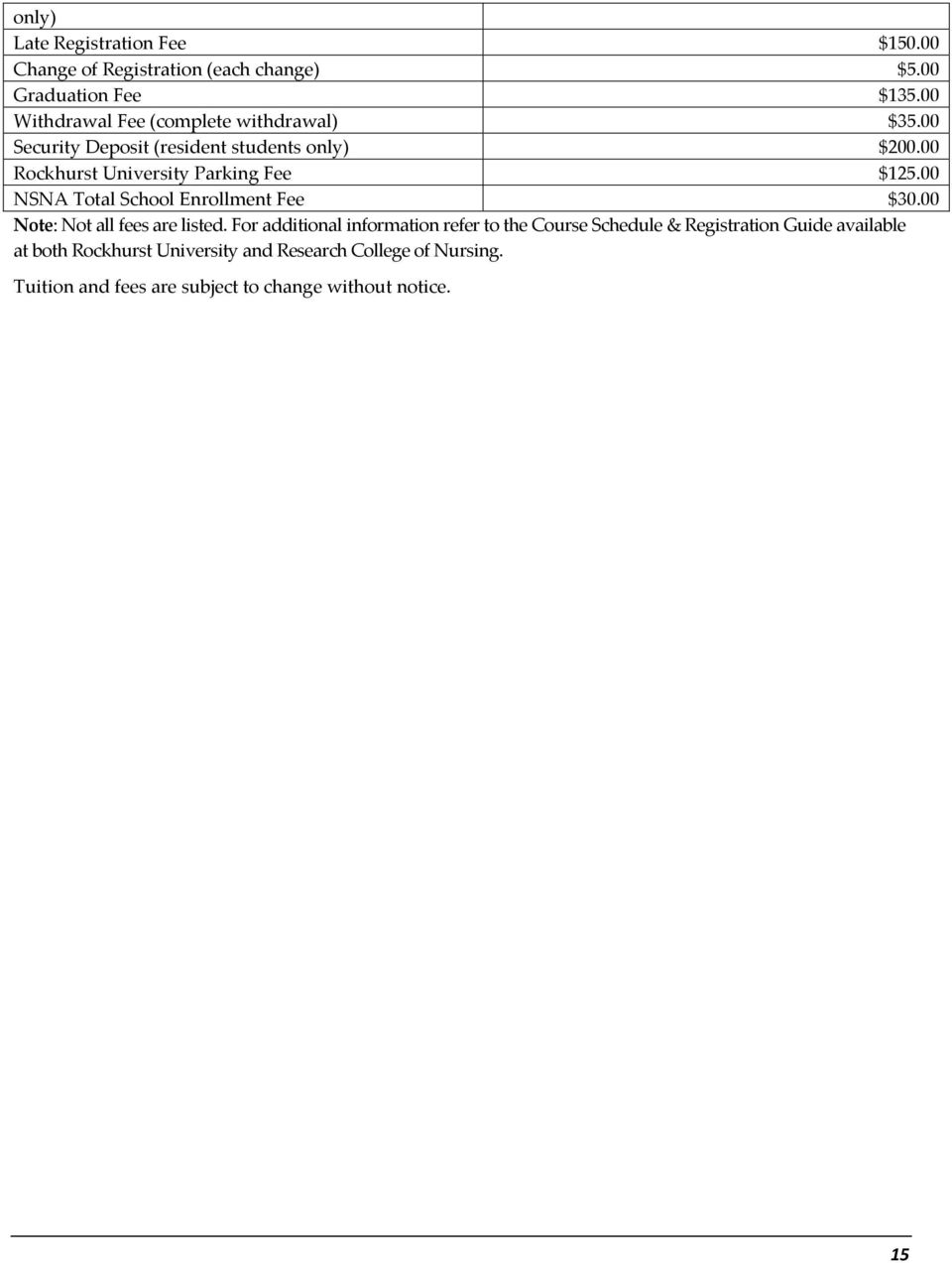
14 Students may appeal the calculated refund if exceptional circumstances exist. Students wishing to appeal should submit a written account and include the date notified of the refund. The appeal will be reviewed by the Loan and Scholarship Committee and a decision will be sent to the student within two weeks. Tuition and Fee Schedules Separate tuition and fee schedules are published for traditional option, accelerated option and graduate program. The undergraduate tuition and fee schedule is published each year in the Spring for the following year. A tuition and fee schedule for the current academic year is available from the Office of Admission and Financial Aid located on the Rockhurst University campus or from the Financial Aid Office at Research College of Nursing. The schedule also appears on the Rockhurst University website Tuition and Fee Schedules for the accelerated option and the graduate program are available in the Research College of Nursing Financial Aid Office. Tuition and fees are subject to change without notice. Tuition and Fees for Following is a list of tuition charges and fees applicable to undergraduate nursing students, accelerated option students, graduate students and students who wish to live on the Research campus. For more information about other fees refer to the current issue of the Schedule of Courses and Registration Guide. Tuition and Fees for Undergraduate Traditional Option Undergraduate tuition per semester (12 18 hrs. $13, inclusive) Tuition for day classes per credit hour (1 11) $ Tuition for evening classes per credit hour(1 11) $ Tuition per credit hour for undergraduate hours over $ Rockhurst University Fees per semester Rockhurst University estimated fees $ Research College of Nursing Fees per semester Research Activity Fee (Jr. & Sr. only) (2 nd semester So. $75.00 See Rockhurst Fee Schedule) Library Fee $50.00 Computer Fee $50.00 Rockhurst Activity Fee for Nursing $50.00 Assessment Testing Fee $75.00 Course Fees (if taken) Clinical Fee (per clinical credit hour) $25.00 Science Lab Fee (each course) $45.00 Special Fees Application Fee, non refundable undergraduate U.S. $25.00 students Matriculation Fee, non refundable first time enrolling $60.00 students Orientation Fee, non refundable Full time freshmen $ Full time transfer students $ Deferred Payment Plan (each semester Fall/Spring $

15 only) Late Registration Fee $ Change of Registration (each change) $5.00 Graduation Fee $ Withdrawal Fee (complete withdrawal) $35.00 Security Deposit (resident students only) $ Rockhurst University Parking Fee $ NSNA Total School Enrollment Fee $30.00 Note: Not all fees are listed. For additional information refer to the Course Schedule & Registration Guide available at both Rockhurst University and Research College of Nursing. Tuition and fees are subject to change without notice. 15
16 Tuition and Fees for Accelerated Option 2011 Fall Term Tuition $ Activity Fee $75.00 Library $50.00 Clinical Fee $ Computer $50.00 Assessment Testing Fee $ NSNA Total School Enrollment Fee $30.00 Total $ Spring Term Tuition $10, Activity Fee $75.00 Library $50.00 Clinical Fee $ Computer $50.00 Assessment Testing Fee $ Total $10, Summer Term Tuition $ Activity Fee $75.00 Library $50.00 Clinical Fee $ Computer $50.00 Assessment Testing Fee $ Graduation Fee $ Total $7, Grand Total $26, Tuition and fees are subject to change without notice. Tuition and Fees for Graduate Program Tuition per credit hour $ Clinical Fee (per clinical credit hour) $25.00 Library (Spring & Fall/Summer) $25.00/$12.50 Computer (Spring & Fall/Summer) $25.00/$12.50 Graduation Fee $ Housing Fees Per Contract Period for Research Student Village Fall 2011 & Spring 2012 Furnished Unfurnished # Residents per bedroom Townhouse 2BR $ $ $ $ Apartment 1BR $ $ Housing Fees Per Contract Period for Research Student Village Summer 2012 Townhouse 2BR $ $ $ $ Apartment 1BR $ $

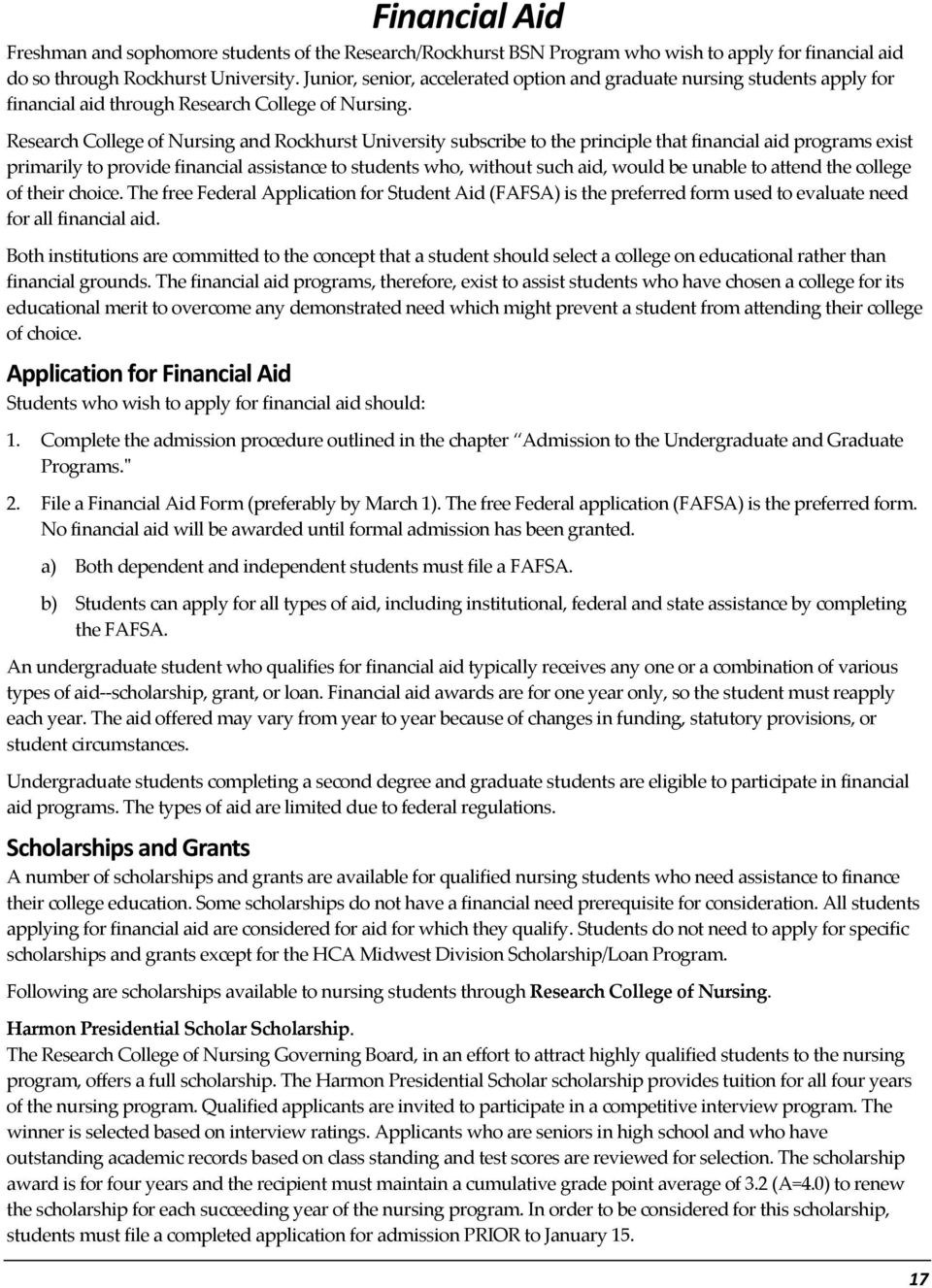
17 Financial Aid Freshman and sophomore students of the Research/Rockhurst BSN Program who wish to apply for financial aid do so through Rockhurst University. Junior, senior, accelerated option and graduate nursing students apply for financial aid through Research College of Nursing. Research College of Nursing and Rockhurst University subscribe to the principle that financial aid programs exist primarily to provide financial assistance to students who, without such aid, would be unable to attend the college of their choice. The free Federal Application for Student Aid (FAFSA) is the preferred form used to evaluate need for all financial aid. Both institutions are committed to the concept that a student should select a college on educational rather than financial grounds. The financial aid programs, therefore, exist to assist students who have chosen a college for its educational merit to overcome any demonstrated need which might prevent a student from attending their college of choice. Application for Financial Aid Students who wish to apply for financial aid should: 1. Complete the admission procedure outlined in the chapter Admission to the Undergraduate and Graduate Programs.ʺ 2. File a Financial Aid Form (preferably by March 1). The free Federal application (FAFSA) is the preferred form. No financial aid will be awarded until formal admission has been granted. a) Both dependent and independent students must file a FAFSA. b) Students can apply for all types of aid, including institutional, federal and state assistance by completing the FAFSA. An undergraduate student who qualifies for financial aid typically receives any one or a combination of various types of aid scholarship, grant, or loan. Financial aid awards are for one year only, so the student must reapply each year. The aid offered may vary from year to year because of changes in funding, statutory provisions, or student circumstances. Undergraduate students completing a second degree and graduate students are eligible to participate in financial aid programs. The types of aid are limited due to federal regulations. Scholarships and Grants A number of scholarships and grants are available for qualified nursing students who need assistance to finance their college education. Some scholarships do not have a financial need prerequisite for consideration. All students applying for financial aid are considered for aid for which they qualify. Students do not need to apply for specific scholarships and grants except for the HCA Midwest Division Scholarship/Loan Program. Following are scholarships available to nursing students through Research College of Nursing. Harmon Presidential Scholar Scholarship. The Research College of Nursing Governing Board, in an effort to attract highly qualified students to the nursing program, offers a full scholarship. The Harmon Presidential Scholar scholarship provides tuition for all four years of the nursing program. Qualified applicants are invited to participate in a competitive interview program. The winner is selected based on interview ratings. Applicants who are seniors in high school and who have outstanding academic records based on class standing and test scores are reviewed for selection. The scholarship award is for four years and the recipient must maintain a cumulative grade point average of 3.2 (A=4.0) to renew the scholarship for each succeeding year of the nursing program. In order to be considered for this scholarship, students must file a completed application for admission PRIOR to January
18 HCA Midwest Division Scholarship/Loan Program. This program offers a combination of scholarship and loan funding to qualified sophomore, junior and senior nursing students. Students agree to a work commitment following graduation based on the amount and number of years of participation in the program. Research College of Nursing Grant. Awarded based on need. The following scholarships are available to junior and senior nursing students with a grade point average of at least 2.5 (A=4.0) and are awarded based on financial need through The Research Foundation. The Foundation also awards scholarships to nursing students once a year. Students must submit applications to their office during the application period. The Foundation office will inform students when this period begins and provide applications. Alumni Award Scholarship. Each year the Research Nursing Alumni Association gives scholarships to senior nursing students in the name of the recipient of the Outstanding Alumnus Award. The scholarships are based on the criteria of excellence in clinical nursing skills and patient care. Cheryl A. Burchett Memorial Scholarship. Established in 2001 by her family and friends in memory of Cheri Burchett, former Team I Leader and faculty member, a scholarship is awarded to an outstanding student annually. Dr. Kay Sullivan Scholarship. Established in 1999 by her family in honor of Kay Sullivan, former Coordinator of the Accelerated BSN Option, a scholarship is awarded to an outstanding accelerated option student each year. Mary Lutz Memorial Scholarship. Provided in memory of Mary Lutz, M.N., R.N., a member of the faculty Sally S. Robinson Scholarship. Provided in memory of Sally Robinson, M.P.H.N., R.N., a member of the faculty Research Belton Scholarship. Provided by the Research Belton Hospital Foundation. Research Scholarship for MSN in Nursing Education. Scholarship program is funded by the Research Foundation. Compensation for each year will be up to $2,500 for a period not to exceed 5 years for a total amount of $5,000. The period of one year may be defined as beginning in the fall, continuing through spring and summer. For each $2,500 utilized, the individual is required to commit oneyear of employment as a faculty member in the Greater Kansas City community following the completion of the MSN. Applications are available on line at Following is a list of scholarships and grants available through Rockhurst University. These are for freshman and sophomore nursing students. These scholarships are funded through Research College of Nursing for upper division nursing students provided criteria are met. Achievement Scholarship. Renewable scholarships valued at $10,000 per academic year awarded to highly qualified entering freshmen students. Students are selected based on their academic credentials including grades, class rank, and standardized test scores. Recipients must maintain a cumulative grade point average of 3.0 (A=4.0) at the end of each academic year in order to renew the Achievement Scholarship. In order to be considered for this award, students must file a completed application for admission PRIOR to May 1. 18

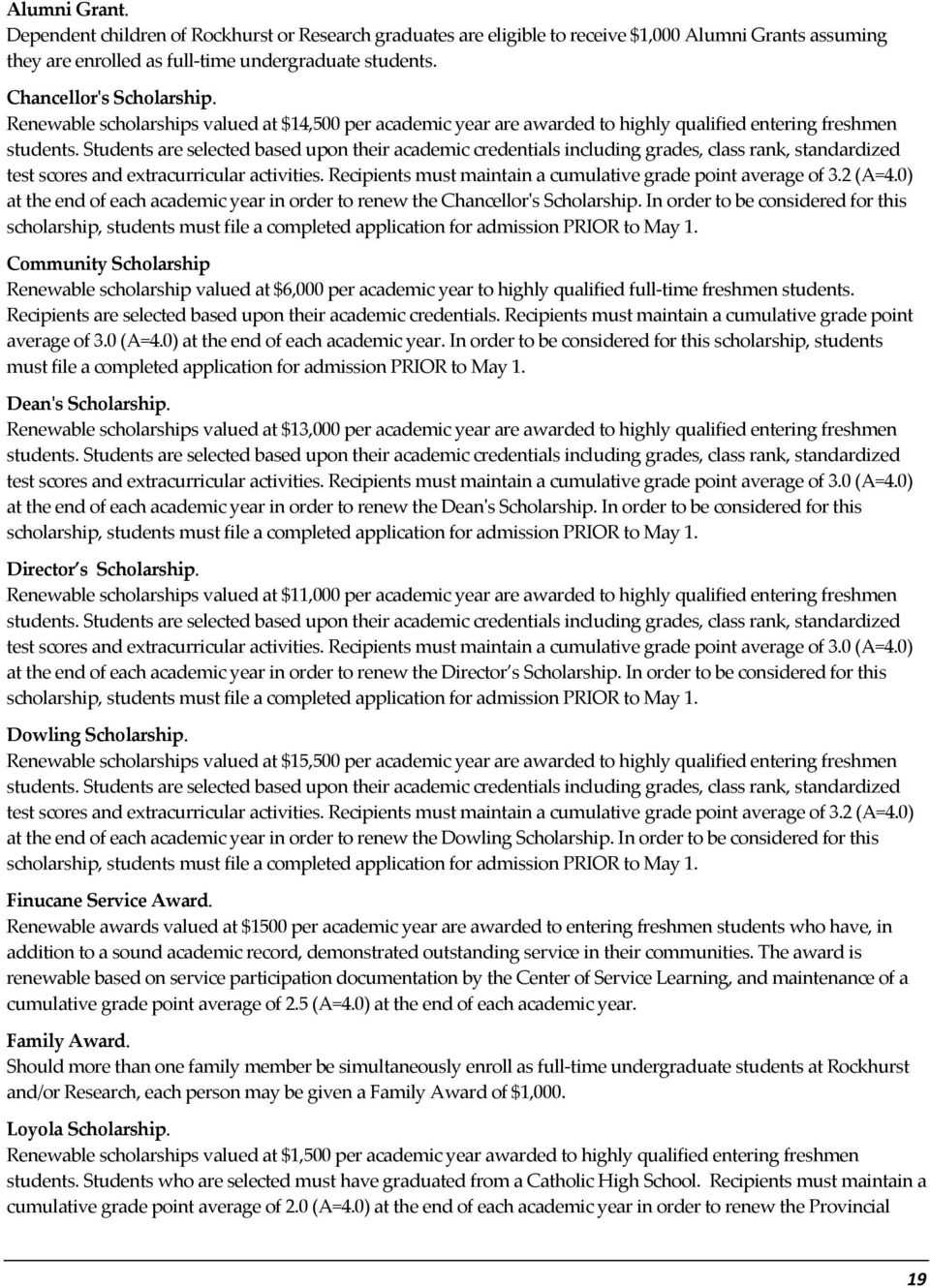
19 Alumni Grant. Dependent children of Rockhurst or Research graduates are eligible to receive $1,000 Alumni Grants assuming they are enrolled as full time undergraduate students. Chancellorʹs Scholarship. Renewable scholarships valued at $14,500 per academic year are awarded to highly qualified entering freshmen students. Students are selected based upon their academic credentials including grades, class rank, standardized test scores and extracurricular activities. Recipients must maintain a cumulative grade point average of 3.2 (A=4.0) at the end of each academic year in order to renew the Chancellorʹs Scholarship. In order to be considered for this scholarship, students must file a completed application for admission PRIOR to May 1. Community Scholarship Renewable scholarship valued at $6,000 per academic year to highly qualified full time freshmen students. Recipients are selected based upon their academic credentials. Recipients must maintain a cumulative grade point average of 3.0 (A=4.0) at the end of each academic year. In order to be considered for this scholarship, students must file a completed application for admission PRIOR to May 1. Deanʹs Scholarship. Renewable scholarships valued at $13,000 per academic year are awarded to highly qualified entering freshmen students. Students are selected based upon their academic credentials including grades, class rank, standardized test scores and extracurricular activities. Recipients must maintain a cumulative grade point average of 3.0 (A=4.0) at the end of each academic year in order to renew the Deanʹs Scholarship. In order to be considered for this scholarship, students must file a completed application for admission PRIOR to May 1. Director s Scholarship. Renewable scholarships valued at $11,000 per academic year are awarded to highly qualified entering freshmen students. Students are selected based upon their academic credentials including grades, class rank, standardized test scores and extracurricular activities. Recipients must maintain a cumulative grade point average of 3.0 (A=4.0) at the end of each academic year in order to renew the Director s Scholarship. In order to be considered for this scholarship, students must file a completed application for admission PRIOR to May 1. Dowling Scholarship. Renewable scholarships valued at $15,500 per academic year are awarded to highly qualified entering freshmen students. Students are selected based upon their academic credentials including grades, class rank, standardized test scores and extracurricular activities. Recipients must maintain a cumulative grade point average of 3.2 (A=4.0) at the end of each academic year in order to renew the Dowling Scholarship. In order to be considered for this scholarship, students must file a completed application for admission PRIOR to May 1. Finucane Service Award. Renewable awards valued at $1500 per academic year are awarded to entering freshmen students who have, in addition to a sound academic record, demonstrated outstanding service in their communities. The award is renewable based on service participation documentation by the Center of Service Learning, and maintenance of a cumulative grade point average of 2.5 (A=4.0) at the end of each academic year. Family Award. Should more than one family member be simultaneously enroll as full time undergraduate students at Rockhurst and/or Research, each person may be given a Family Award of $1,000. Loyola Scholarship. Renewable scholarships valued at $1,500 per academic year awarded to highly qualified entering freshmen students. Students who are selected must have graduated from a Catholic High School. Recipients must maintain a cumulative grade point average of 2.0 (A=4.0) at the end of each academic year in order to renew the Provincial 19
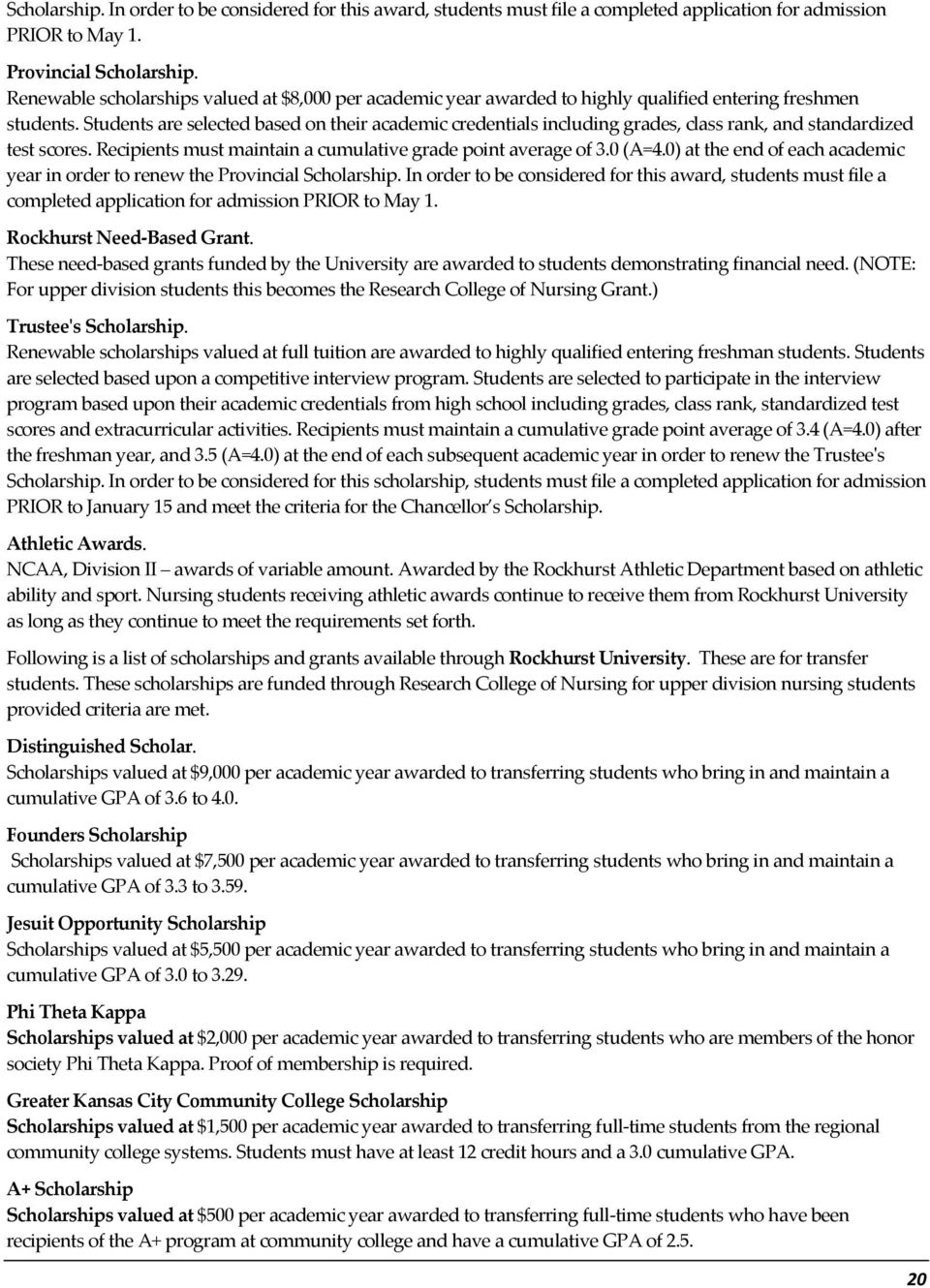
20 Scholarship. In order to be considered for this award, students must file a completed application for admission PRIOR to May 1. Provincial Scholarship. Renewable scholarships valued at $8,000 per academic year awarded to highly qualified entering freshmen students. Students are selected based on their academic credentials including grades, class rank, and standardized test scores. Recipients must maintain a cumulative grade point average of 3.0 (A=4.0) at the end of each academic year in order to renew the Provincial Scholarship. In order to be considered for this award, students must file a completed application for admission PRIOR to May 1. Rockhurst Need Based Grant. These need based grants funded by the University are awarded to students demonstrating financial need. (NOTE: For upper division students this becomes the Research College of Nursing Grant.) Trusteeʹs Scholarship. Renewable scholarships valued at full tuition are awarded to highly qualified entering freshman students. Students are selected based upon a competitive interview program. Students are selected to participate in the interview program based upon their academic credentials from high school including grades, class rank, standardized test scores and extracurricular activities. Recipients must maintain a cumulative grade point average of 3.4 (A=4.0) after the freshman year, and 3.5 (A=4.0) at the end of each subsequent academic year in order to renew the Trusteeʹs Scholarship. In order to be considered for this scholarship, students must file a completed application for admission PRIOR to January 15 and meet the criteria for the Chancellor s Scholarship. Athletic Awards. NCAA, Division II awards of variable amount. Awarded by the Rockhurst Athletic Department based on athletic ability and sport. Nursing students receiving athletic awards continue to receive them from Rockhurst University as long as they continue to meet the requirements set forth. Following is a list of scholarships and grants available through Rockhurst University. These are for transfer students. These scholarships are funded through Research College of Nursing for upper division nursing students provided criteria are met. Distinguished Scholar. Scholarships valued at $9,000 per academic year awarded to transferring students who bring in and maintain a cumulative GPA of 3.6 to 4.0. Founders Scholarship Scholarships valued at $7,500 per academic year awarded to transferring students who bring in and maintain a cumulative GPA of 3.3 to Jesuit Opportunity Scholarship Scholarships valued at $5,500 per academic year awarded to transferring students who bring in and maintain a cumulative GPA of 3.0 to Phi Theta Kappa Scholarships valued at $2,000 per academic year awarded to transferring students who are members of the honor society Phi Theta Kappa. Proof of membership is required. Greater Kansas City Community College Scholarship Scholarships valued at $1,500 per academic year awarded to transferring full time students from the regional community college systems. Students must have at least 12 credit hours and a 3.0 cumulative GPA. A+ Scholarship Scholarships valued at $500 per academic year awarded to transferring full time students who have been recipients of the A+ program at community college and have a cumulative GPA of
21 Alumni Award Dependent children of Rockhurst or Research graduates are eligible to receive $500 Alumni Grants assuming they are enrolled as full time undergraduate students. Family Award Should more than one family member be simultaneously enroll as full time undergraduate students at Rockhurst and/or Research, each person may be given a Family Award of $1,000. Government Aid Students without a prior degree are eligible to receive all the following sources of financial aid. Students with a prior degree are limited to the Stafford, Perkins, Federal Nursing Loan and PLUS programs. Federal Pell Grant. This federal grant is administered by the Department of Education to undergraduate students demonstrating a high level of financial need. The amount of these grants varies and is determined by the Department of Education. Federal Supplemental Education Opportunity Grants (FSEOG). These federal grants are awarded through Research to students demonstrating a high financial need. The amount of these grants varies and awards are limited. Charles Gallagher Grant (Missouri Student Grant). These need based grants are awarded to undergraduate students who are Missouri residents demonstrating financial need. Eligibility is determined by the state based upon data from the student s need analysis form. Applications must be mailed no later than April 1 for consideration. Brite Flight Scholarship. Sponsored through the State of Missouri, this scholarship is awarded to Missouri residents that attend a Missouri college of their choice and have scored in the top 3% on either the ACT or SAT exam. The scholarship is automatically matched by Rockhurst University and by Research College of Nursing for those indicating nursing as a major. The scholarship is renewable for all four years of the program if the student maintains a 3.3 grade point average. Federal Stafford Student Loan Programs. These low interest loans are available to students who demonstrate financial need. Students may qualify for either a subsidized Stafford Loan (interest does not accrue until after graduation) or an unsubsidized Stafford Loan (interest begins accruing immediately). Interest rates on these loans are variable based on the 91 day Treasury Bill, but not higher than 8.25 percent (at time of printing). Loan amounts vary dependent upon year of enrollment in college, the level of demonstrated financial need, and previous loan history. Graduate and undergraduate students are eligible for these programs. Federal Parent Loan for Undergraduate Students (PLUS). These loans are not based on demonstrated financial need. Parents may borrow up to the cost of attending college less any other financial assistance their son or daughter is receiving. Credit history is taken into account by the lender when determining eligibility for a PLUS Loan. Federal Nursing Loan. These federal loan funds are awarded to upper division nursing students based on demonstrated need. Repayment begins following a nine month, interest free grace period after a student ceases to be enrolled on at least a half time basis (six (6) credit hours). Repayment is based on a simple interest rate (5 percent at time of printing) on the unpaid balance with up to ten years to repay the loan in full. Further details on these programs may be obtained from the Financial Aid Office. 21
22 Reasonable Academic Progress for Continued Receipt of Financial Aid Students receiving financial aid must make reasonable academic progress toward graduation according to federal and state regulations in order to receive financial aid. Rockhurst University and Research College of Nursing also adhere to the same expectation for students receiving financial aid from institutional sources. In order to receive financial aid for the next academic year all full time (12 credits or more) undergraduate students must progress at a rate that would lead to graduation within five years. Students must therefore earn credits each year and demonstrate the cumulative grade point average listed below at the end of each academic year regardless of whether the student received financial aid during these periods. Entering transfer students are expected to earn at least 18 credits during their first year and achieve the grade point average for the class level at which they enter Rockhurst or Research (determined by the number of transfer credits applicable toward the studentʹs degree program). At End of Academic Year Credits Earned Minimum Cum. GPA Academic progress is reviewed at the end of each semester. Students not meeting the requirements listed above are placed in a ʺsuspensionʺ status during which period no financial aid from any federal, state or institutional source may be received. These students are removed from ʺsuspensionʺ when they can demonstrate academic progress as listed above. Part time graduate students must progress at a rate that would lead to graduation within 12 semesters. Students may appeal the withdrawal of financial aid to the Loan and Scholarship Committee. This written appeal must be submitted no more than one week after being informed of the withdrawal of financial aid and should explain any mitigating circumstances which apply to the particular situation. The Loan and Scholarship Committee reviews the appeal and responds to the student within two weeks from receipt of the appeal. Entrance and Exit Interviews As required by federal regulations, Research College of Nursing conducts both entrance and exit interviews with students receiving financial aid in the form of loans. During these interviews, students are informed of all relevant information regarding their loans such as interest rates, amount of indebtedness, length of repayment period and the amount of expected monthly payment. Federal regulations require the College to maintain signed documentation of the interviews. The Financial Aid Office will provide documents to sign for verification of these interviews. Maintenance of Financial Aid Records Research College of Nursing maintains all individual financial aid records in accordance with applicable Federal laws. 22
23 Admission to Research College of Nursing Admission to Research College of Nursing is based on the applicantʹs academic record, evidence of scholastic ability, and interest in the goals of the College. Admission decisions are made on a competitive basis. Admission will be offered to applicants who are, in the view of the College, best qualified. The Bachelor of Science degree is offered through a partnership with Rockhurst University. Prospective students for the undergraduate program should also review the Rockhurst University Catalog for additional information not covered in this catalog. Both publications should serve as a guide to students seeking undergraduate admission. The Master of Science degree is offered solely by Research College of Nursing. This catalog provides guidance for students seeking admission to the graduate program. Organization The Bachelor of Science in Nursing (B.S.N.) program is organized and available to qualified students in two undergraduate options: Traditional B.S.N. and Accelerated B.S.N. These options are designed to meet the needs of different populations, long term trends in health care delivery systems and, more specifically, the nursing profession. The Traditional B.S.N. is designed for students who have completed high school or its equivalent and meet all the admission requirements. Many of these students are recent graduates of high school, however, there are increasing numbers of students who transfer from community colleges and other institutions and adults who are entering college for the first time or who are changing careers. The Accelerated B.S.N. is designed for students who have an undergraduate degree in a field other than nursing. Accelerated students also must satisfactorily complete liberal arts and science prerequisites, nursing prerequisites, and complete 15 credit hours of residency at Rockhurst University. The required clinical nursing credit hours are completed in one 12 month calendar year. The Master of Science in Nursing (MSN) program offers four tracks: the Family Nurse Practitioner (FNP) track; the Adult Gero Nurse Practitioner (ANP) track; the Executive Nurse Practice: Health Care Leadership (ENP) track; and the Nurse Educator (NEd) track. Students who successfully complete an undergraduate baccalaureate nursing program and meet the admission criteria for the graduate program may be admitted directly into any of the tracks. The Family Nurse Practitioner track prepares nurses for an advanced practice role as a health care provider in a variety of primary care settings. The program of study requires each student to complete 45 credit hours. Students are then eligible to sit for the Family Nurse Practitioner certification exam. The Adult Gero Nurse Practitioner track prepares nurses for an advanced role as a health provider in a variety of primary care settings. Graduates of the ANP track are qualified to sit for the Adult Gero Nurse Practitioner certification examination. The curriculum for this track is based upon the MSN core courses. The Executive Nurse Practice: Health Care Leadership track prepares nurses for leadership and management roles in diverse health care delivery systems. The program of study requires each student to complete 35 credit hours. Students are then eligible to sit for the Nursing Administration certification exam. The Nurse Educator track prepares nurse educators with knowledge and strategies for teaching in both clinical and academic settings. The program of study requires each student to complete 36 credit hours. Two post master s certificate programs are also offered for individuals who are prepared with a Bachelor of Science in Nursing and a Master s degree in nursing or a health related field. The post master s certificates provide academic credit focusing on particular content and skills. The Executive Nurse certificate program consists of 15 credit hours and the post master s Nurse Educator certificate consists of 11 credit hours. 23
24 Admission to the Undergraduate Programs Admission to the undergraduate programs is based on the applicantʹs academic record, evidence of scholastic ability, and interest in the goals of the College. Admission decisions are made on a competitive basis for both the Traditional and Accelerated Option B.S.N. programs. Admission will be offered to applicants who are, in the view of the College, best qualified. Prospective students for the undergraduate program should also review the Rockhurst University Catalog for additional information not covered in this catalog. Both publications should serve as a guide to students seeking undergraduate admission. The B.S.N. program is organized and available to qualified students in two undergraduate options: Traditional B.S.N. and Accelerated B.S.N. These options are designed to meet the needs of different populations, long term trends in health care delivery systems and, more specifically, the nursing profession. The Traditional B.S.N. is designed for students who have completed high school or its equivalent and meet all the admission requirements. Many of these students are recent graduates of high school, however, there are increasing numbers of students who transfer from community colleges and other institutions and adults who are entering college for the first time or who are changing careers. The Accelerated B.S.N. is designed for students who have an undergraduate degree in a field other than nursing. Accelerated students also must satisfactorily complete liberal arts and science prerequisites, nursing prerequisites, and complete 15 credit hours of residency at Rockhurst University. The required clinical nursing credit hours are completed in one 12 month calendar year. Admission to the Traditional B.S.N. Program Admission from High School Application is made to the Director of Admission, Rockhurst University, 1100 Rockhurst Road, Kansas City, Missouri Upon receipt of a completed application, the application fee, all official transcripts of credit and ACT or SAT scores, the applicant will be notified by the Rockhurst University Admission Office of his or her admission status. Credit for Nontraditional Work For advanced placement, dual credit, International Baccalaureate credit and College Level Examination credit see current Rockhurst University Catalog. Admission from Another College (Without Nursing Credits)* Students who wish to transfer to Research College of Nursing should: 1. Have up to date official transcripts of credit sent to Research College of Nursing from each college attended and from the last high school attended. 2. Submit a completed application form to Research College of Nursing with the $20.00 application fee enclosed. Transfer students apply directly to Research College of Nursing and address application to the Director of Transfer and Graduate Admissions, 2525 East Meyer Blvd. Kansas City, MO Schedule an appointment with the Director of Transfer and Graduate Recruitment. Applications from transfer students are reviewed and admission decisions are made on a competitive basis since space in the nursing program is limited. Transfer applicants must present evidence of a cumulative grade point average of not less than 2.7 (A = 4.0) in courses taken at other institutions in order to be considered. *Beginning Fall 2011 Research College of Nursing will begin participating with Nursing CAS (Centralized Application Service) to offer students the opportunity to file one application and send it to participating nursing schools all over the county. Check with Research College of Nursing or visit the website to see when this opportunity will be available. 24
25 Admission with Nursing Credits* Students who wish to transfer from another college where nursing courses have been completed should follow the procedures as outlined in ʺAdmission from Another College.ʺ In addition, the student should: 1. Present a letter of recommendation from the Dean or Director of the nursing program attended. 2. An interview with the Research College of Nursing Associate Dean for Academic Programs may be required. Transfer applicants must present evidence of a grade point average of not less than 2.7 (A=4.0) in courses taken at other institutions. In collaboration with course coordinators, the Associate Dean of Academic Programs will determine if previously earned nursing course credits are equivalent to Research College of Nursing courses. *Beginning Fall 2011 Research College of Nursing will begin participating with Nursing CAS (Centralized Application Service) to offer students the opportunity to file one application and send it to participating nursing schools all over the county. Check with Research College of Nursing or visit the website to see when this opportunity will be available. Admission from Rockhurst University (Internal Transfer) Rockhurst students who wish to enroll in the nursing program should: 1. Submit an internal transfer application form. No application fee is required. 2. Schedule an appointment with the Director of Transfer and Graduate Recruitment. Internal transfer applicants within Rockhurst University must present evidence of a cumulative grade point average of not less than 2.7 (A = 4.0) in courses taken to be eligible for admission to the nursing major. Space for the spring sophomore nursing courses is limited and admission is competitive. Admission to the Accelerated B.S.N. Option Application is made to the Director of Transfer and Graduate Recruitment, Research College of Nursing, 2525 East Meyer Boulevard, Kansas City, Missouri Applications should be submitted by April 1 st, a year prior to the year of anticipated enrollment. Decisions will be made in August for the following year s class*. Prospective students who have an earned baccalaureate degree in a field other than nursing with a minimum grade point average of 2.8 from a regionally accredited college or university will be considered for admission. In addition to the minimum grade point average, prospective students must: 1. Schedule an advising appointment with the Director of Transfer and Graduate Recruitment. 2. Submit an application form and $25.00 application fee. 3. Submit two letters of reference. 4. Have up to date official transcripts of credit sent from all previously attended colleges. 5. Earn a minimum grade of B minus in each of the science pre requisites (Chemistry, Anatomy & Physiology, and Microbiology). 6. A minimum of two science courses with a grade of B minus or better must be completed before an admission decision will be made. 7. Complete an admission interview with faculty. Interviews begin in the summer one year prior to the start of the program. *Beginning Fall 2011 Research College of Nursing will begin participating with Nursing CAS (Centralized Application Service) to offer students the opportunity to file one application and send it to participating nursing schools all over the county. Check with Research College of Nursing or visit the website to see when this opportunity will be available. 25
26 Orientation Program for Accelerated B.S.N. Students Students who have been accepted into the accelerated program will be invited to attend information sessions at the College during the year preceding the start of classes in August. In addition, a required two day Orientation Program will be held the week prior to beginning the accelerated nursing courses. International Student Admissions International students seeking an undergraduate degree should follow the procedures for admission as described in the current Rockhurst University Catalog*. In addition, Research College of Nursing requires all international students (any student who is not a citizen or permanent resident of the United States), who are from countries in which English is not the only official language and primary and secondary instruction may not be in English, to complete the TOEFL, Test of Written English (TWE) and Test of Spoken English (TSE) prior to admission. The following scores are considered to be the minimum for admission without restrictions: TOEFL: Paper based: Total score of 550 with all sub section scores in the range or greater. Computerbased: Total score of 213 with all sub section scores in the range or greater. Internet based: Score of 79 TWE: 4.5 (not required with computer based test) TSE: 50. *Beginning Fall 2011 Research College of Nursing will begin participating with Nursing CAS (Centralized Application Service) to offer students the opportunity to file one application and send it to participating nursing schools all over the county. Check with Research College of Nursing or visit the website to see when this opportunity will be available. 26
27 Undergraduate Academic Policy This section describes policies that apply across the undergraduate curriculum. Faculty may establish other course specific policies. Policies apply to both Traditional and Accelerated B.S.N. Option students unless otherwise stated. Academic Year Classes do not meet on certain holidays which are listed on the appropriate academic calendar published prior to the start of each academic year. Traditional B.S.N. Option The academic year for the Traditional B.S.N. is divided into two semesters, with each semester approximately fourteen weeks in length. Some classes are offered during summer sessions of varying length. Accelerated B.S.N. Option The academic year for the Accelerated B.S.N. is divided into three terms which occur sequentially through the twelve month calendar year. An Accelerated B.S.N. calendar is published each year which shows the specific sequence of courses and the schedule of breaks which occur between each term. Academic Advising Upon admission, students are assigned to Research College of Nursing faculty advisors who assist them in selecting courses, reviewing grade reports and completing degree requirements. Academic advising is under the general supervision of the Undergraduate Program Directors. While students are responsible for meeting program requirements, faculty advisors facilitate the progression of students through their program of study. Students experiencing problems may consult their faculty advisor, course faculty or the Counseling Center at Rockhurst University or the Learning Centers at Research College of Nursing or Rockhurst University for assistance. Assessment Research College of Nursing assesses student abilities and achievement at various times throughout its academic programs. The purpose of assessment is ongoing quality improvement. Students are required to complete assessment tests and other measures as part of this quality improvement effort. Time is provided as part of the regular course schedule to minimize any inconvenience to students. Students may upon request review their own scores or results for any tests and measures completed. The Assessment Committee and the Associate Dean for Academic Programs administers the assessment program. Rockhurst University has a similar assessment program appropriate to its Mission and Purposes and nursing students participate in this program as regular Rockhurst University students. Assessment activities begin during the orientation program and continue to graduation. Alumni are also asked to complete surveys and program evaluation measures. Attendance Policy Students are required to attend classroom, lab and clinical sessions. Each tardy or absence, defined as a studentʹs failure to be present when roll is taken at the beginning of class, is counted as an absence. To enable the student to keep up with class work, faculty may admit a tardy student to class, but the absence is counted. Any class missed as a result of delayed or incomplete registration, failure to meet Research College of Nursing policies, or absences accrued during suspension, are subject to the attendance policy. When illness or other special circumstances prevent attendance, the student is responsible for contacting course faculty as soon as possible to plan for meeting course requirements. Clinical sessions are planned in advance. Make up clinical sessions are at the discretion of the faculty and may not be identical to the missed session in content or substance. Excessive absence due to illness or special circumstances may require repetition of the course. 27
28 Faculty may grade a student Incomplete ʺIʺ (see Undergraduate Grading System) for excessive absence due to illness or special circumstance. Program Directors and the Associate Dean for Academic Programs will be notified when students have excessive absences. If a student brings a child/infant to class or clinical activity, an absence will be counted. Bringing a child/infant to class or clinical activities is not permissible as it presents a potential distraction to the learning environment and is deemed inconsistent with the Mission of the College. If this occurs, the student will be asked to leave the class. Absence is excessive when the total number of contact hours (classroom, lab, clinical) missed, exceeds three times the number of credit hours assigned to the course. A student may be given a failing course grade (F) for excessive absences. Administrative Requirements for Enrollment and Progression Enrollment for upper division nursing course work requires participation in the registration process through Rockhurst University. The following are also required by Research College of Nursing in order to remain in compliance with expectations of clinical agencies. Failure to meet these requirements will result in suspension from classroom, clinical and lab sessions or may result in course failure which could result in dismissal from the program. 1. Measles/mumps. For students born on or after 1/1/57, provide adequate documentation of diagnosed disease, laboratory evidence of immunity, or documentation of adequate vaccination (two vaccinations). 2. Varicella (Chickenpox). Adequate vaccination, diagnosed disease or, for those with a negative or uncertain history of varicella, serologic screening. 3. Rubella. For students born on or after 1/1/57, provide laboratory evidence of immunity or documentation of adequate vaccination (two vaccinations). All women, regardless of birth date, should have proof of rubella immunity or prior vaccination. 4. Incoming students who are due for a TD booster must have TDAP which includes acellosis pertussis. TDAP will be required for students at the time of their next TD booster. 5. Tuberculin Testing. Based on current CDC recommendations students must complete one of the following to assess for TB exposure: a. Upon admission must present a TB screen less than 12 months old. b. If most current TB screen is over 12 months old, one new TB screen is required. c. If a TB screen has never been done, a 2 step TB screen must be completed. d. Upon admission must present documentation of a TB titer less than 12 months old (Interferon Gamma Release Assays [IGRAs] blood tests for TB infection). 6. Hepatitis B immunization. The series of three immunizations or a signed waiver declining the immunizations is required at the time of initial enrollment in nursing courses. 7. Students must receive other immunizations as required by the CDC, HCA and other clinical agencies. 8. Color Blindness. An assessment for color blindness must be completed before the beginning of clinical courses. This can be done in the Learning Resource Center at Research College of Nursing. 9. American Heart Association (AHA) for BLS for Healthcare Providers certification. Students must maintain current Healthcare Provider (AHA Standards with a two year expiration date) certification throughout their clinical courses. The course for Healthcare Providers includes CPR skills for helping victims of all ages (including doing ventilation with a barrier device, a bag mask device, and oxygen); use of automated external defibrillator (AED); and relief of foreign body airway obstruction (FBAO). a. The AHA Healthcare Provider BLS course MUST include CPR for infants, children and adults (one and two person) and evidence of satisfactory performance in both cognitive knowledge (written test) and skills (hands on skills check off). b. AHA Healthcare Provider BLS certification/recertification should be completed at a time when it will be valid for an entire academic year. 28
29 10. Criminal Background Check. All students must have a criminal background check completed prior to initial enrollment in nursing courses. A single negative check does not preclude the requirement of additional checks at a future time. Students should be aware that any affirmative results from a criminal background check may result in an inability to participate in required clinical activities and therefore may result in the student s inability to complete degree requirements. In the event that a student s criminal background check is reported affirmatively the student will have the opportunity to request an additional criminal background check. The rationale and policy related to repetition of criminal background checks is found in the federal Fair Credit Reporting Act. 11. Clinical Orientation Competency Exam. All students must satisfactorily complete the competency exam annually. 12. HIPAA Competency. All students must satisfactorily complete an exam annually based on requirements of the Health Insurance Portability and Accountability Act (HIPAA). Additional HIPAA testing may be required by specific clinical agencies. 13. Confidentiality Statement. A signed statement completed annually regarding the confidentiality of information about patients, their families and clinical facilities. 14. Proof of Health Insurance. Contracts with clinical agencies require that all students provide evidence of health insurance coverage or a waiver. Traditional B.S.N. students are required to enroll in the Rockhurst University health plan or provide evidence of an appropriate hard waiver. Insurance for Accelerated B.S.N. students is optional; however students may enroll in a health insurance plan through Rockhurst. Accelerated students who do not choose to carry health insurance must sign a waiver indicating that they assume responsibility for all costs of medical treatment due to illness or injury. All students must be aware that if illness or injury occurs during a clinical or classroom experience, they may be required to seek appropriate medical care at a health care facility and assume the cost of any required testing or treatment. Documentation of health insurance or waiver must be provided annually 15. Absence of any infectious disease. A student with an infectious disease shall promptly disclose this information to the appropriate faculty member so that a determination can be made concerning whether the studentʹs condition poses a direct threat of harm to the studentʹs own health or safety, or to the health or safety of others. This determination will be made in consultation with appropriate medical personnel. If for some reason a student cannot be immunized or otherwise satisfactorily meet the requirements above, the Associate Dean for Academic Programs will consider appropriate options on a case by case basis. Students living on the Rockhurst Campus Rockhurst University requires all incoming freshmen living on campus to comply with the meningococcal vaccination requirement either by providing documentation of vaccination OR by completing a waiver. Students Living on the Research Campus In addition, transfer and accelerated option students living in the Research Townhouse Village must also comply with the above stated requirement. The vaccine is available from your primary care provider. 29
30 Academic Requirements for Enrollment Academic Requirements Prior to Enrollment in Nursing Courses 1. Students will fulfill all prerequisite courses prior to enrolling in nursing courses. The APG Committee is responsible for decisions related to progression. 2. To enroll in 2000 level nursing courses of the Research/Rockhurst joint program, students must meet the Science/Math grade requirements below. Traditional B.S.N. program: Students must achieve a minimum grade of C in all Science and Math courses. Accelerated B.S.N. program: Students must achieve a minimum grade of B in all Science and Math courses. 3. To enroll in 2000 level nursing courses of the Research/Rockhurst joint program, students must meet the GPA requirements below. Traditional B.S.N. program: A. Students must have a minimum cumulative Rockhurst GPA of 2.7 or greater at the end of the summer of their freshman year. If students do not achieve this GPA, they will be placed on a waiting list for consideration for admission with the next cohort group the following January. B. Those students who have a cumulative GPA of 2.7 must continue to maintain this GPA following completion of the fall sophomore coursework in order to enter the January nursing cohort. If students do not achieve a cumulative Rockhurst GPA of 2.7 for the fall semester, they will be placed on a waiting list to be reconsidered for admission with the next cohort the following January. C. All students placed on the waiting list will be evaluated on a competitive basis; placement on the waiting list does not guarantee admission to the nursing coursework. Accelerated B.S.N. program: Students must have a minimum GPA of 2.8. Academic Requirements for Progression Traditional B.S.N. Students Students must achieve minimum grades in all science, and math, and nursing courses as follows in order to continue progression in the nursing program. A grade of less than C (C, D+, D, F, WF) or an AU is not satisfactory for progression. Accelerated B.S.N. Students Accelerated B.S.N. students must achieve a grade of C in all nursing courses. A grade of less than C (C, D+, D, F, WF) or an AU is not satisfactory for progression. All Students 1. Students must maintain a cumulative GPA of 2.00 to progress in the nursing curriculum. Students whose cumulative GPA falls below 2.0 will not be allowed to enroll in any other nursing course until they have raised their cumulative GPA to No nursing course may be repeated in which the student receives an original grade of C or better. 3. A student who receives a grade of C or below is placed on academic probation. The Associate Dean for Academic Programs shall determine when a student may repeat a course based on space available. No student will be permitted to repeat a course more than once in an attempt to achieve a grade of C or better. 4. A student who receives a grade of C or below in any nursing course must repeat the entire course and achieve a minimum grade of C. 30
31 5. A student who receives two course grades below C (including C, D+, D, F, NP, WF) whether in the same course or another nursing course will be dismissed from the nursing program. This policy applies to nursing courses completed at Research College as well as any completed for transfer credit. Interruption in Enrollment Traditional B.S.N. and Accelerated B.S.N. Nursing students who do not continue their coursework in subsequent spring or fall terms must apply for readmission to the Director of Transfer and Graduate Recruitment at Research College of Nursing. There is no application fee. Readmission to the nursing program is dependent upon meeting academic requirements and the availability of space in nursing courses. The student seeking readmission should: 1. Complete the readmission application form. 2. Have up to date official transcripts of credit sent from each college attended since the last enrollment at Research College of Nursing. In all cases of re enrollment following an interruption in continuous enrollment, the Associate Dean for Academic Programs, in collaboration with program directors and appropriate course faculty, will make a determination regarding repeating courses or additional requirements to assure current knowledge. Course registration will be decided by the Associate Dean for Academic Programs on a space available basis. Accelerated B.S.N. As an alternative to full withdrawal, students may request, in writing to the Associate Dean for Academic Programs, permission to complete Accelerated B.S.N. graduation requirements with selected courses from the Traditional B.S.N. curriculum. Changes in Enrollment Changes in registration for students enrolled in nursing courses must be initiated in the Office of Academic Programs at Research College of Nursing. Class additions will not be allowed after the first week of the semester. Students who stop attending class(es) without processing the official withdrawal forms will receive grades of F. No credit will be allowed for a course in which the student is not appropriately registered. Classification of Students Traditional B.S.N. Traditional B.S.N. degree seeking students are classified as follows: Freshman 0 29 earned semester hours Sophomores earned semester hours Juniors earned semester hours Seniors 90 and above earned semester hours Enrollment Status Traditional B.S.N. Full time status as an undergraduate student is defined as a minimum of 12 semester hours of credit during a regular Fall, Spring or Summer semester. An undergraduate student is considered to be attending full time if the minimum 12 semester hours is taken over the course of multiple sessions within a regular semester. Half time status as an undergraduate student is enrollment in six to eleven semester hours during a regular Fall, Spring or Summer semester. Undergraduate enrollment status is considered to be less than half time if the student is enrolled in less than six semester hours during a regular Fall, Spring or Summer semester. Visiting status as an undergraduate student is defined as a non degree seeking student who may be admitted to specific courses based on certification from another school that the student is in good standing 31
32 there. In addition, the student must have permission to take courses at Research College of Nursing to apply toward the program at the primary school. Declaration of a Major Traditional B.S.N. Undergraduate students may be accepted into the nursing program as freshmen. In order to continue into upper division, students must complete a Declaration of Major Application. This application must be on file prior to the start of any 3000 level nursing course. This application will initiate a review of the studentʹs record by the Registrar and a credit evaluation is completed to ensure that all lower division requirements have been fulfilled. Course Progress Using WebCT Grade Book Students may view their progress and grades in all nursing courses using the grade book feature of WebCT at any time during the academic term. It is the student s responsibility to remain aware of progress in courses and consult with course faculty if additional assistance is needed. Using Rockhurst University Oracleweb Currently enrolled undergraduate students may view their midterm and final semester grades on Rockhurst University s Oracleweb in a secure environment after obtaining a Personal Identification Number (PIN) from Rockhurst University Computer Services. Final grades are available for viewing after the close of the academic session or semester. Midterm grades, issued for undergraduate students, are progress reports only and do not affect the studentʹs GPA. Undergraduate advisors may also view their adviseeʹs midterm grades on Oracleweb. Midterm grades provide an opportunity for students and advisors to discuss academic progress. Undergraduate Grading Scale Course requirements and the methodology for assigning grades are the prerogative of the teaching faculty of each nursing course. One letter grade is recorded on the transcript for each course. The grade schedule and equivalent numerical percentages for Research College of Nursing is as follows: A % A 90 92% B % B 84 87% B 80 83% C % C 75 77% C 70 74% D % D 65 67% F 0 64% 32
33 The quality point values for each grade are listed below. Plus and minus grades indicate upper and lower ranges of each grade category. A+ and D are not recognized grades. Grades marked with an asterisk (*) do not allow progression in nursing courses. A 4.00 indicates the highest level of achievement and an outstanding level of intellectual scholarship. A 3.67 indicates high achievement and an unusual degree of intellectual initiative. B indicates a consistently good level of achievement and an intelligent fulfillment of course requirements in a manner that approaches the quality of the highest grade. B 3.00 indicates a good level of achievement, intelligent understanding and application of subject matter. B 2.67 indicates attainment well above the average. C indicates a level of achievement and fulfillment of course requirements that somewhat exceeds average requirements. C 2.00 indicates a [work of average or] satisfactory level of work. C * 1.67 indicates a below average, unsatisfactory and unacceptable level of work. D+* 1.33 indicates unsatisfactory and unacceptable level of work. D* 1.00 indicates work of inferior, unacceptable quality. F* 0.00 indicates work which lacks even the minimum level of understanding and is unacceptable. I* means incomplete and may be assigned only for serious reasons. Program Directors and the Associate Dean will be notified. An incomplete must be removed within six weeks or it will automatically become an F. X* means absence from final examination; may be assigned only when an extension of time has been granted for serious reasons; must be removed within six weeks or automatically becomes an F. W* means a student was allowed to withdraw without penalty. WF* 0.00 means the student was failing at the time of withdrawal and is not computed into the GPA P Pass. This grade will add credit but will not affect the grade point average. NP* No Pass. This grade will not add credit and will not affect the grade point average. AU* Means audit status; no credit given. Students are expected to attend all class sessions but are not required to complete assignments or to take examinations. All grades are part of the studentʹs academic record and are computed in the studentʹs cumulative GPA (except those indicated above) and are applicable under any dismissal policy. Grades of C, D+, D or F are not calculated in a studentʹs cumulative GPA after the student has successfully repeated the course with a grade of C or above. Course grades of C, D, D+, F, WF, or NP remain part of the academic record and are subject to the dismissal policy. 33
34 Transcripts of Records No transcript, official or unofficial, or Certification of Education will be issued to or for a student or alumnus who is delinquent in financial obligations to Rockhurst University or Research College of Nursing. Undergraduate students wishing transcripts of records to transfer from Research College of Nursing to another college or for other purposes should submit a written, signed request to the Registrar at Rockhurst University. Standards of Academic Conduct The College has two codes of conduct: one for academic conduct and one for student conduct. A student may be disciplined or dismissed from the nursing program for either academic misconduct or student misconduct. The standards of academic conduct address meeting established academic criteria and behavioral integrity in performing the academic work of the College. The standards of student conduct relate to matters outside the context of academic courses. The Student Conduct Policy can be found in the Research College of Nursing Guide to Student Life. Honesty and integrity are prerequisites to academic life and more specifically, to the practice of nursing. Honesty is defined as being truthful, free of deceit and having integrity (Webster, 1976). Integrity is defined as utter honesty and adherence to a code of values (Webster, 1976). Integrity also encompasses ʺbeing truthful, avoiding acts of cheating, fraud or outright lying, and refusing to engage in deception or false representation in practiceʺ (Hoyer, Booth, Spelman & Richardson, 1991, p. 171). Professional integrity in nursing is reflected in the American Nurses Association (ANA) Code for Nurses (2001), ANA Standards of Professional Nursing Practice and Performance (1991). Nursing practice is further guided by institutional standards. Nursing students must adhere to both institutional and professional standards in the classroom, clinical sites, and the community to meet the Collegeʹs standards of conduct. Academic Misconduct Academic misconduct is a breach of honesty or integrity and standards. Examples of academic misconduct include but are not limited to the following: 1. Cheating: giving or receiving unauthorized assistance in any assignment. 2. Plagiarism: the use of ideas, language or work of another without sufficient acknowledgment that the material is not oneʹs own or submission of the work of another, whether altered or unaltered, as oneʹs own. Students are to be guided by the latest edition of the Publication Manual of the American Psychological Association. 3. Manipulation or alteration of another studentʹs or facultyʹs academic work. 4. Unauthorized use, removal, concealment or defacement of library, Learning Resource Center or faculty resources, e.g., books, equipment, files, papers, tests. 5. Submitting the same work or portions of work for more than one class without prior written approval of faculty. 6. Collusion: assisting another student in an act of dishonesty. 7. Lying: conveying any untruth either verbal or written. 8. Disregarding the well being and needs of patients: acts of commission or omission that could adversely affect the patient, e.g., medication errors, failure to provide safe appropriate care, failure to follow supervisor/faculty instructions for care, breach of client confidentiality. 34
35 Sanctions imposed by faculty for academic misconduct include but are not limited to: 1. Written notification of the studentʹs act of academic misconduct and potential consequences placed in the studentʹs file. 2. Giving a ʺ0ʺ (no points) for a test, assignment or paper. 3. Giving a failing course grade. 4. Recommending dismissal from the program. Resolution of Situations of Academic Misconduct Academic misconduct issues may be resolved either informally or formally at the discretion of the faculty. Face to face meetings to resolve academic misconduct issues are the preferred method. However, meetings may be conducted using speakerphone or other electronic transmission methods for students who are unable to participate in a face to face meeting. Informal Resolution: The faculty should request a meeting with the student suspected of dishonesty and inform him or her of the exact nature of the perceived problem. 1. The student should be informed that the meeting is not mandatory, but if the student refuses to meet the matter may be referred for formal resolution. The student should also be informed that he or she may request formal resolution. 2. It is recommended that another faculty member be present at the meeting as a witness. 3. If the student admits dishonesty, he or she should agree to the penalty selected by the faculty. This agreement must be obtained in writing and a copy placed in the student s academic file. 4. Faculty members have the right to impose sanctions described in the Academic Misconduct Policy in the College Catalog. 5. A student who receives a failing course grade as a result of a faculty imposed sanction for academic misconduct may appeal the failing course grade through the Academic Appeal process as described in the College Catalog. Formal Resolution: 1. The faculty and/or student(s) notify the chair of the Academic Integrity Review Committee (AIRC) that it is believed academic misconduct has occurred and request that the AIRC meet to hear evidence. To assure credibility of charges, students may not report academic misconduct anonymously. 2. Within three (3) College working days the faculty and/or student(s) submit a written description of the alleged incident and any evidence to the chair of the committee. 3. Within three (3) College working days the chair of the committee notifies committee members that a hearing is pending. 4. The involved student(s) will be notified of the charges by letter sent to the most recent address of record. The letter will contain a description of the charges and referral to this policy. 5. The chair of the committee establishes a date for the hearing and notifies all parties involved. 6. The hearing will be held within ten (10) College working days of the initial complaint. 7. Prior to the hearing, the chair of the committee will distribute copies of the description of the incident and any evidence to committee members and the involved student(s). 8. All evidence and discussion presented at the hearing is confidential. 9. All parties choosing to present evidence to the committee will be heard individually and committee members will be given an opportunity to seek clarification from all parties. 10. The accused student(s) may choose a peer (student) or faculty support person to help them prepare for the hearing and to accompany them to the hearing. This person is present for support only and may not contribute to the hearing process. 11. When all parties have been heard, the committee will discuss the evidence presented and determine, by majority vote, to dismiss the charges or to impose a sanction(s). 35
36 12. If a sanction is to be imposed, the committee will discuss the options and by majority vote, select an appropriate sanction(s). The committee may review the student s academic record for past academic misconduct. Evidence of past academic misconduct may be considered when imposing sanctions. 13. Minutes of the hearing and its outcome will be recorded by the chair of the committee. 14. The minutes, copies of letters notifying faculty and the accused student(s) of the outcome of the hearing and copies of any evidence will be kept in a locked file in the office of the Dean s secretary. If the accused student is found to have committed academic misconduct, a letter will be placed in the student s academic file. If the charges of academic misconduct are dismissed, there will be no indication in the student s academic record that a hearing occurred. 15. All parties will be notified in writing of the outcome of the hearing and recommendations of the committee. An explanation of the reasons for the decision will be provided. Sanctions: The committee may 1. Place a letter of sanction in the student s academic record describing the incident. 2. Recommend that the faculty give a 0 on the exam, paper or assignment. 3. Recommend that the faculty assign a failing course grade. 4. Recommend that the APG Committee hear the case for possible recommendation of dismissal from the program. If the student(s) initiates formal resolution, the faculty is encouraged to abide by the recommendations of the committee. If faculty chooses to use the formal procedure to resolve issues of academic misconduct, the faculty agrees to abide by the recommendations of the AIRC. Composition of the Academic Integrity Review Committee (AIRC): 1. Four students, one from the Sophomore, Junior and Senior classes and one from the Accelerated Option class will be appointed by the Traditional B.S.N. or Accelerated B.S.N. Program Directors. 2. Three faculty who are not members of the APG committee, will be appointed by the Associate Dean for Academic Programs as needed. 3. Chair of the APG committee to serve a non voting member and chair of the committee. Responsibilities: 1. Review policies and procedures related to academic integrity biennially. 2. Conduct hearings related to academic dishonesty. 3. Impose and recommend sanctions for academic dishonesty. Conflict of Interest: 1. Any faculty member of the committee who is directly involved in requesting a hearing will be replaced by another faculty member. Superficial knowledge of the case or the persons involved does not disqualify a member. 2. Any student member of the committee, who is accused of academic misconduct, will be replaced for the hearing by another member of the same class. The replacement member will be selected by the other student members of the committee. 3. Any student member of the committee, who is sanctioned in any way for academic misconduct, will be removed from the committee. The student may state to peers that he/she needed to resign from the committee. A new committee member will be elected from the same class. Guidelines for Students Students often become aware or suspicious of academic misconduct first. In order for the College to maintain an environment that is supportive of academic integrity, students are encouraged to maintain the standards for academic conduct. In situations where students are in doubt as to the integrity of one s own or one s 36
37 peer s actions, it is advisable to consult one of the following: course faculty, course coordinator, program director, or academic advisor. As noted in a previous section, students must adhere to both institutional and professional standards in the classroom, clinical sites, and the community. Academic Appeal A student may appeal any of the following: 1. Failing final course grade (C or below) 2. Recommendation for dismissal. An appeal is initiated by submitting a typed statement to the Chair of the Admission, Progression and Graduation (APG) Committee, no later than seven (7) College working days after being notified of the failing final course grade or recommendation for dismissal. The typed statement must include the following: 1. A statement of the issue; 2. Specific steps that have already been taken to resolve the issue with the faculty, course coordinator and/or Program Director. 3. Evidence supporting why the student believes the decision made was inconsistent with existing Research College of Nursing or course policy, was arbitrary, or lacked sufficient evidence. In preparing the appeal, it is the studentʹs responsibility and burden to prove that the action taken by the faculty was inconsistent with existing policy, arbitrary, or lacked sufficient evidence. The student may seek assistance from a Research College of Nursing faculty member as an advisor in preparing the statement for an appeal. The role of the advisor is to assist the student in understanding the policy and procedure. The advisorʹs role does not include gathering information or presenting evidence. The student will submit the letter of appeal with supporting documents to the Chair of the APG Committee. The Chair will forward appeal documents to faculty involved in the subject matter of the appeal or its resolution. Faculty will submit to the Chair of the APG Committee within five (5) College working days their response to the appeal document including their supporting documentation. The Chair of the APG Committee will forward the facultyʹs response to the student. The APG Committee will meet within seven (7) College working days of receiving all the written appeal documents to hear the appeal. The student may request one continuance, not to exceed one week, for good cause. A student appealing a failing grade may continue in course work until the appeal is resolved. The student and faculty will be notified 72 hours before the hearing of the time, date and location of the hearing. It is preferable that students and faculty attend the APG committee hearing in person. However, the College will accommodate the use of speakerphone or other electronic transmission methods for students who are unable to participate in a face to face hearing. The appeal will be heard by members of the APG Committee, the involved student and faculty and the student s faculty advisor. The meeting is confidential and restricted to those persons listed. If an incident involves more than one student, each student will be heard individually. An APG Committee member, who has been directly involved in the awarding of a failing course grade or recommending dismissal will be replaced by a faculty member appointed by the Dean. If an APG Committee member is the involved student s faculty advisor, a replacement APG Committee member will be assigned by the Dean for the purpose of the appeal. The student may be accompanied to the APG Committee hearing by his/her faculty advisor. When the APG Committee has heard all the evidence, the APG Committee members will meet, in private, to discuss the appeal. The APG Committee will make a decision within seven (7) College working days after the hearing. In an appeal of a failing course grade, the APG Committee can either: 1) uphold the assigned 37
38 grade or 2) return the grade to the faculty for reconsideration. If the faculty is asked to reconsider a grade by the APG Committee, the faculty can uphold the assigned grade or change the grade. The faculty member will notify the APG Committee of their decision within 72 hours. The faculty s decision is final. The APG Committee will notify the Associate Dean and the student of the outcome of the appeal. The student can receive and sign for the APG Committee s written decision or the decision will be sent by certified mail to the student. If the outcome of an appeal results in dismissal from the program, the student may make one last appeal to the President/Dean. The President/Dean of the College may take any action she/he deems is appropriate under the circumstances of the case. The decision of the President/Dean is final. Readmission Following Dismissal A student who has been dismissed for failure to adhere to the following should not expect to be readmitted: 1. Administrative Requirements for Enrollment and Progression 2. Academic Requirements for Enrollment and Progression 3. Standards of Academic Conduct If a student chooses to reapply for admission, the student must submit an application for readmission to the Director of Transfer and Graduate Recruitment at Research College of Nursing and a letter to the Chair of the Admissions, Progression, Graduation Committee (APG) describing what actions the student has taken to warrant consideration for readmission and evidence of probable future academic success. Readmission will not be considered until one full semester/term has elapsed from the time of dismissal. Withdrawal from the Nursing Program Students desiring to withdraw from Research College of Nursing during a semester must secure a withdrawal permit from the Office of Academic Programs and have it signed by the student s academic advisor and Associate Dean for Academic Programs. Fees paid by a student authorized to withdraw are refundable only as indicated under Refunds from the Tuition and Fees section of this catalog. Failure to process withdrawals correctly will result in an automatic grade of F. A student who withdraws during the semester/term or before final examinations forfeits credit for work done that semester/term. After the first two weeks of the semester, any student who wishes to withdraw from a course should confer with the course faculty and advisor. The studentʹs right to withdraw remains regardless of the course faculty or advisorʹs recommendation. The last date for withdrawal from a Research College of Nursing undergraduate course is the date established by the Rockhurst University Registrar s Office unless otherwise noted in the course syllabus and calendar. Academic Probation An undergraduate student who receives a final course grade of C or below in one nursing course, assuming their GPA is above a 2.0, is placed on academic probation until such time as the course is successfully repeated. If a student earns a grade of C or below in the repeated course or in another nursing course, the student will be dismissed from the program. Suspension A student may be suspended from any classroom, lab or clinical session for inappropriate or unsafe behavior or failure to adhere to any Research College of Nursing Academic Policies. Suspension may last from several hours to one calendar year. Suspension results in denied access to WebCT for quizzes, exams, assignments or other course related materials in every course in which a student is enrolled. Suspension means that the student may not attend class, lab or clinical AND will not be allowed to make up any work or assignments or exams that are due during the suspension. 38
39 Faculty imposed: Faculty are solely responsible for making the immediate decision to suspend a student from classroom, clinical, or lab sessions in progress for inappropriate or unsafe behaviors. At the time of a suspension by the faculty, conditions for reinstatement are explained. Failure to meet the conditions of reinstatement may result in course failure. College imposed: The Associate Dean for Academic Programs is solely responsible for imposing suspension for failure to adhere to Research College of Nursing academic policies. At the time of a suspension by the Associate Dean, the conditions of reinstatement are explained. Failure to meet the conditions of reinstatement may result in course failure or dismissal from the nursing program. The student cannot attend classroom, lab or clinical sessions during the suspension. 39
40 Undergraduate Program Requirements Degree Offered Research College of Nursing and Rockhurst University confer the Bachelor of Science in Nursing degree for graduates of the undergraduate program. This degree enables the graduate to apply to write the National Comprehensive Licensure Examination for Registered Nurses (NCLEX RN) to become a licensed registered nurse (RN). Graduation does not automatically ensure eligibility to write the licensure examination. This section contains a description of degree requirements for Traditional B.S.N. students entering with no previous college credit. It also contains information on the Accelerated B.S.N. Each option is designed to provide a quality educational experience for the student population it serves. Transfer students in the Traditional B.S.N. option and students with a degree must have an evaluation of all transcripts of credit to determine what courses are needed to meet the degree requirements for the B.S.N. It is recommended that students meet with their advisers to develop a plan of study. As circumstances dictate, the plan may be revised. Traditional B.S.N. Degree Requirements The Bachelor of Science in Nursing degree consists of a liberal core curriculum rooted in the values and beliefs expressed in the Rockhurst mission statement (see the Overview section of the Rockhurst University Catalog) and the nursing curriculum which is rooted in the values and beliefs expressed in the Research College of Nursing Mission found in this catalog. The curriculum for the B.S.N. degree program has four categories of courses: the modes of inquiry, proficiencies, prerequisites for the nursing major, and the nursing major. The modes of inquiry that is, the methods or systems by which the human intellect pursues some essential knowledge, truth or aspect of truth give structure to the core curriculum (that set of required courses taken by all degree seeking undergraduate students) in a way that encourages the full development of students in various aspects of their humanity. As methods or systems, each mode suggests the appropriate kinds of questions to be asked in its study, organizes the steps by which study is furthered, and measures what counts as progress in its particular sphere (Rockhurst University Catalog , p. 69). Proficiencies consist of oral and written communications and math, representing basic skills and abilities required of all degree seeking undergraduate students. Prerequisites are those required courses that establish a foundation for the nursing major. Honors Program Rockhurst and Research offer the Honors Program for outstanding students who want to make the very most of their education. Honors Program students take specially designed liberal arts courses and modified nursing courses which meet program requirements. Nursing students participating in the Honors Program should consult the director of the Honors Program for the appropriate course substitutions. Additional information about the Honors Program, including course descriptions, is available in the Rockhurst University catalog. 40
41 The Bachelor of Science in Nursing requires successful completion of the equivalent of 128 semester credit hours which must include: 1. A total of 66 semester credit hours in liberal arts and sciences as follows. A. Courses (12 hours) in the Liberal Arts and Sciences designated to meet proficiency requirements: Proficiency in Oral Communication (OCP): CT 2000 Fundamentals of Communication (3 credits) Proficiency in Written Communication (WCP): EN 1110 College Composition I (3 credits) EN 1120 College Composition II (3 credits) (Note: Advanced Students may satisfy the proficiency in written communication by the single semester course EN 1140 English Composition.) Proficiency in Mathematics : MT 1190 Precalculus (3 credits) or completion of an approved equivalent course. B. Students must successfully complete at least one approved three hour, upper division course with a Global Perspectives designation. Students can also fulfill this requirement with two semesters of the same collegelevel foreign language. C. A total of 40 hours in the Modes of Inquiry as follows: Artistic 1 level one course (3 credits) Historical 1 level one course (3 credits) Literary 1 level one course (3 credits) (Note: Level one requirements in the artistic, historical, and literary modes of inquiry may all be satisfied simultaneously by the two semester sequence of HU 1110 and HU 1120, Integrated Humanities.) Either Historical or Literary 1 level two course (3 credits) Scientific Causal 1 level one course (4 credits) CH 1050/1060 Principles of General Chemistry Scientific Relational 1 level one course (3 credits) PY 1000 Introduction to Psychology 1 level one or level two course from an area that is not psychology (3 credits) Either Scientific Relational or Scientific Causal (3 credits) 1 level two course PY 3400 Developmental Psychology Philosophical 1 level one course (3 credits) PL 1100 Reality and Human Existence 1 level two course (3 credits) PL 3100 Ethical Theory 41
42 Theological 1 level one course (3 credits) TH 1000 Christianity I: Foundations 1 level two course (3 credits) TH 3000 Christianity II: Development Philosophy or Theology 1 level two course (choose one) PL 3300 Philosophy of Death and Dying (3 credits) PL 4700 Seminar in Ethics: Medical Ethics (3 credits) TH 4350 Theology, Morality & Health Care (3 credits) D. Courses (14 hours) in the liberal arts and sciences which are required support courses for the nursing major. NS 1000 BL 2929 BL 2930/2931 BL 2940/2941 BL 3100/ 3101 Freshmen in Science Seminar (1 credit) Cellular Basis for Human Anatomy and Physiology (1 credit) Human Anatomy & Physiology I (4 credits) Human Anatomy & Physiology II (4 credits) Microbiology (4 credits) 2. A total of 62 semester credit hours in the nursing major as follows. Each theory (T) credit hour is equivalent to one clock hour Each clinical (C) credit hour is equivalent to three clock hours Level Courses (10 credit hours) NU 2030 Foundations of Nursing Practice (2T, 1C) NU 2050 Nursing Health Assessment (2C) NU 2750 Normal Nutrition (2T) NU 2850 Pathophysiology (3T) 3000 Level Courses (39 credit hours) NU 3100 Professional Concepts (3T) NU 3200 Adult Health Nursing I (3T) NU 3210 Adult Health Nursing Practice I (3C) NU 3220 Older Adult Health (2T) NU 3230 Older Adult Health Practice (1C) NU 3430 Adult Health Nursing II (4T) NU 3440 Adult Health Nursing Practice II (4C) NU 3510 Mental Health Nursing (2T) NU 3530 Mental Health Nursing Practice (1C) NU 3550 Pharmacology (2T) NU 3570 Nursing Research (2T) NU 3730 Maternal Newborn Nursing (3T) NU 3750 Child Health Nursing (3T) NU 3770 Maternal Child and Family Nursing Practice (3C) NU 3790 Professional Development Strategies (1T) NU Nursing Elective (2T) 4000 Level Courses (13 credit hours) NU 4100 Leadership and Professional Issues (3T) NU 4210 Community Health Nursing (3T) NU 4230 Community Hlth Nsg Practice (2C) NU 4400 Capstone: Leadership in Prof Nsg Practice (5C) 42
43 3. Achieve a minimum grade of C in all math and science courses. *Note: Students must have a C or better in BL 2930/2931 prior to enrollment in BL 2940/2941 and BL 3100/ Have a minimum cumulative grade point average of 2.7 to initially enroll in any NU 2000 nursing courses and maintain a cumulative GPA of 2.00 to progress. 5. Achieve a final minimum cumulative grade point average of 2.00 and a minimum grade of C in all nursing courses for graduation. 6. Meet the residency requirement by completing 15 semester credit hours at Research, 15 semester credit hours at Rockhurst and the final 30 semester credit hours at either Research or Rockhurst. 43
44 Lower Division Prerequisites This section illustrates courses which must be completed to progress in the nursing major. Certain courses must be successfully completed before others can be taken. (* nursing courses ending in 1 are in accelerated option curriculum) Required Courses for: NU 2030/2031* Foundations of Professional Nursing BL 2929 Cellular Basis for Human Anatomy and Physiology BL 2930/31 Human Anatomy & Physiology I BL 2940/2941 Human Anatomy & Physiology II BL 2965 (Accelerated students) Accelerated Human Anatomy& Physiology MT 1190 Precalculus (or approved equivalent course) NU 2050/2051* Nursing Health Assessment BL 2929 Cellular Basis for Human Anatomy and Physiology BL 2930/2931 Human Anatomy & Physiology I BL 2940/2941 Human Anatomy & Physiology II BL 2965 (Accelerated students) Accelerated Human Anatomy& Physiology PY 1000 Introduction to Psychology NU 2850 Pathophysiology CH 1050/1060 BL 2929 BL 2930/2931 BL 2940/2941 BL 2965 (Accelerated students) Principles of General Chemistry Cellular Basis for Human Anatomy and Physiology Human Anatomy & Physiology I Human Anatomy & Physiology II Accelerated Human Anatomy & Physiology Recommended courses prior to lower division nursing EN 1110/1120 College Composition I & II PY 3400 Developmental Psychology CT 2000 Fundamentals of Communication Upper Division Prerequisites The following courses must be completed satisfactorily for progression to upper division. Deficits in prerequisites prohibit a student s progression. Required courses prior to upper division nursing courses (3000 and 4000 level courses): BL 3100/3101 PY 3400 CT 2000 NU 2750 NU 2850 NU 2030/2031 NU 2050/2051 Microbiology Developmental Psychology Fundamentals of Communication Normal Nutrition Pathophysiology Foundations of Nursing Practice Nursing Health Assessment 44
45 Typical Four Year Curriculum (Traditional B.S.N.) Students work closely with their advisers throughout their college years to fulfill program requirements. To illustrate the degree requirements a curriculum guide has been developed. This is intended as a model only. Actual sequence and course selections are developed by individual students and their advisers, following guidelines for prerequisites and progression. First Year Fall Course # Course Title Credits NS 1000 Freshman in Science 1 CH 1050/1060 General Chemistry 4 EN 1110 College Composition I 3 PL 1100 Reality and Human Existence 3 PY 1000 Introduction to Psychology 3 MT 1190 Precalculus 3 Total Credits 17 First Year Spring Course # Course Title Credits BL 2929 Cellular Basis for Anatomy and Physiology 1 BL 2930/2931 Human Anatomy & Physiology I 4 EN 1120 College Composition II 3 TH 1000 Christianity I: Foundations 3 SR Science Relational 3 Level 1 or Level 2 (not psychology) HS Level 1 3 Total Credits 17 Second Year Fall Course # Course Title Credits BL 2940/2941 Human Anatomy & Physiology II 4 PY 3400 Developmental Psychology 3 CT 2000 Fund of Communication 3 AR/MS/TA Artistic Mode Level 1 3 BL 3100/3101 Microbiology 4 Total Credits 17 Second Year Spring Course # Course Title Credits NU 2030 Found of Nsg Practice 3 NU 2050 Nursing Health Assessment 2 NU 2750 Normal Nutrition 2 NU 2850 Pathophysiology 3 EN Literary Mode Level 1 3 HS/EN Historical or Lit Mode Level 2 3 Total Credits 16 45
46 Third Year Fall Course # Course Title Credits NU 3200 Adult Hlth Nursing I 3 NU 3210 Adult Hlth Nsg Practice I 3 NU 3100 Professional Concepts 3 NU 3550 Pharmacology 2 NU3220 Older Adult Health 2 NU3230 Older Adult Health Practice 1 PL 3100 Ethical Theory 3 Total Credits 17 Third Year Spring Course # Course Title Credits NU 3430 Adult Hlth Nursing II 4 NU 3440 Adult Hlth Nsg Practice II 4 NU 3510 Mental Hlth Nsg 2 NU 3530 Mental Hlth Nsg Practice 1 NU XXXX Nsg Elective 2 or 3 NU 3570 OR Nursing Research (2 credits) TH 3000 Christianity II: Development 3 Total Credits 16 or 17 Fourth Year Fall Course # Course Title Credits NU 3730 Maternal Newborn Nursing 3 NU 3750 Child Health Nursing 3 NU 3770 Mat Child/Fam Nsg Practice 3 NU 3790 Professional Development Strategies 1 NU 3570 NU XXXX Nursing Research OR Nsg Elective 2 2 or 3 PL or TH XXXX Theology, Morality and Health Care 3 OR Philosophy of Death and Dying (3 credits) OR Medical Ethics (3 credits) Total Credits 15 or 16 Fourth Year Spring Course # Course Title Credits NU 4100 Leadership & Prof Issues 3 NU 4210 Community Health Nursing 3 NU 4230 Comm Hlth Nsg Practice 2 NU 4400 Capstone:Ldrshp Prof Nsg Practice 5 Total Credits 13 46
47 Accelerated B.S.N. Degree Requirements Accelerated B.S.N. students are considered to have met the general education requirements (liberal arts and sciences) with their prior degree. There are, however, certain prerequisites necessary for progression to the nursing major. An evaluation of transcripts of credit will determine which of these may already be met by previous study. The Accelerated B.S.N. option requires successful completion of the equivalent of 128 semester credit hours. 1. A total of 66 semester credit hours in Liberal Arts and Sciences* as follows. A. Prerequisite courses and minimum semester credit hours required: Principles of General Chemistry 4 Anatomy and Physiology 6 Microbiology 4 General Psychology 3 Developmental Psychology 3 Theology (not course specific) 6 Philosophy (not course specific) 6 Humanities and Liberal Arts 18 (English Composition, Literature, Fine Arts, Foreign Language, History and Communications) Designated Electives 6 (Science, Social Science, Global Perspectives, Computer Science) Students must successfully complete at least one approved three hour, upperdivision course with a Global Perspectives designation. Students can also fulfill this requirement with two semesters of the same college level foreign language. Other Electives 10 Total 66 Science credits earned more than seven years before entering the accelerated curriculum will be evaluated individually. Proficiency testing may be necessary to demonstrate comparable knowledge for those courses taken beyond the seven year limit. 2. A total of 62 semester credit hours in the nursing major as follows: A. The following are nursing courses taken in the nursing major prior to commencing the one year nursing curriculum. Nutrition 2 Pathophysiology + 3 Subtotal 5 + Pathophysiology may be taken from either Natural Science or Nursing Departments. If taken from Natural Science Department credit will transfer as nursing credit for purpose of meeting degree requirements. 47
48 B. The following are nursing courses taken during the one year nursing curriculum. Each theory (T) credit hour is equivalent to one clock hour; each clinical (C) credit hour is equivalent to three clock hours. Nursing Curriculum Course # Course Title Credits NU 2031 Foundations of Nursing Practice 2T, 1C NU 2051 Nursing Health Assessment 2C NU 2750 Normal Nutrition 2T NU 2850 Pathophysiology 3T NU 3101 Professional Concepts 3T NU 3201 Adult Health Nursing I 3T NU 3211 Adult Health Nursing Practice I 3C NU 3221 Older Adult Health 2T NU 3231 Older Adult Health Practice 1C NU 3431 Adult Health Nursing II 4T NU 3441 Adult Health Nursing Practice II 4C NU 3511 Mental Health Nursing 2T NU 3531 Mental Health Nursing Practice 1C NU 3551 Pharmacology 2T NU 3571 Nursing Research 2T NU 3731 Maternal Newborn Nursing 3T NU 3751 Child Health Nursing 3T NU 3771 Mat Child & Family Nursing Practice 3C NU 3791 Professional Development Strategies 1T NU Nursing Elective 2T NU 4101 Leadership and Professional Issues 3T NU 4211 Community Health Nursing 3T NU 4231 Comm Hlth Nsg Practice 2C NU 4401 Capstone: Ldrship in Prof NsgPractice 5C 3. Achieve a minimum grade of B minus in all science courses. Maintain a cumulative GPA of 2.00 to progress in the nursing program. 4. Achieve a final cumulative grade point average of 2.00 and a minimum grade of C in all nursing courses. 5. Meet the residency requirement by completing 15 semester credit hours at Rockhurst University before starting the nursing sequence and the final 30 semester credit hours at Research College of Nursing. Graduation Honors A candidate for a B.S.N. degree who has a cumulative grade point average of 3.5 graduates Cum Laude; one who has an average of 3.7 graduates Magna Cum Laude; and one who has an average of 3.85 graduates Summa Cum Laude. In computing honors, the average of all college work or work only at Rockhurst University and Research College of Nursing is used, whichever is lower. These honors are announced at commencement. 48
49 Undergraduate Program Course Descriptions Students have the opportunity to enroll on an elective basis in the full range of courses and academic disciplines offered at Rockhurst University. Course descriptions for Rockhurst University courses may be found in the Rockhurst University Catalog and at The following section provides course descriptions for all nursing courses specifically required in the Research/Rockhurst Bachelor of Science in Nursing Program. Outstanding students who are invited to participate in the Rockhurst University Honors Program take a specially designed curriculum which substitutes for courses normally required. Descriptions of this program and honors courses may be found in the Rockhurst University Catalog. More information may be obtained from the Director of the Honors Program. Undergraduate courses are numbered from 1000 to Courses numbered from 1000 through 1990 are intended primarily for students in their first year of post secondary study. Courses numbered from 2000 to 2990 are intended primarily for sophomore students. Courses numbered from 3000 to 3990 are intended primarily for junior students. Courses numbered from 4000 to 4990 are intended primarily for senior students. Nursing course numbers ending in 0 are for the traditional option and those ending in 1 are for the accelerated option. The number in parentheses following the course number and title indicates the semester credit hours for that course. Nursing Courses NU 2030/2031. Foundations of Nursing Practice (3) This course focuses on foundational concepts and nursing skills essential for the practice of professional nursing. Learning experiences occur in the classroom and college laboratory. Prerequisites: BL 2929, BL 2930/2931, BL 2940/2941 (or BL 2965); and MT 1190 for Traditional Option. NU 2050/2051. Nursing Health Assessment (2) In this course, students learn to assess adult client health status. The emphasis is on normal assessment findings and recognition of deviations from normal. Learning experiences occur in the classroom and college laboratory. Prerequisites: BL 2929, BL 2930/2931, BL 2940/2941 (or BL 2965); and PY NU Normal Nutrition (2) This course focuses on principles of nutrition which promote health and normal growth across the lifespan. Nutritional practices which enhance health are explored. Factors which affect food habits and nutritional practices are examined. Common nutritional problems are discussed. The student is introduced to methods to assess nutritional status across the lifespan. NU 2850/2851. Pathophysiology (3) This course focuses on alterations in biologic processes that affect the body s internal homeostasis. A conceptual approach will be used to emphasize general principles of pathophysiology. The etiology, pathogenesis, clinical manifestations, and sequelae of various alterations of human structure and function will be examined. Knowledge from the basic and clinical sciences will be integrated. Prerequisites: CH 1050/1060; BL 2929, BL 2930/2931; 2940/2941 (or BL 2965). NU 3100/3101. Professional Concepts (3) This course focuses on professional concepts and values central to nursing. Selected topics will be examined to promote the student s professional development. All NU 2000 courses, PY 3400, CT 2000, BL 3100/3101, Pre or Corequisites: NU 3200/3201, NU 3210/
50 NU 3200/3201. Adult Health Nursing I (3) The primary focus of this course is the nursing management of adult health. Strategies for disease management and health promotion are addressed in the care of adult clients with fluid and electrolyte, cardiovascular, endocrine, musculoskeletal, and sensory perceptual alterations. Prerequisites: All NU 2000 courses, PY 3400, CT 2000, BL 3100/3101, Pre or Corequisites: NU 3100/3101, NU 3210/3211, NU 3550/3551. NU 3210/3211. Adult Health Nursing Practice I (3) The focus of this course is the clinical application of nursing concepts, skills, and health assessment techniques. Students utilize the nursing process while caring for adult clients on medical surgical acute care units. Prerequisites: All NU 2000 courses, PY 3400, CT 2000, BL 3100/3101, Pre or Corequisites: NU 3100/3101, NU 3200/3201, NU 3550/3551. NU 3220/3221. Older Adult Health (2) This course focuses on the concepts of healthy aging and the maintenance of functional capacity in the later years. Content addresses common physiological, psychological and social changes, challenges, and adaptations of older people. Prerequisites: All NU 2000 courses, PY 3400, CT 2000, BL 3100/3101, Pre or Corequisites: NU 3100/3101, NU 3230/3231, NU 3550/3551. NU 3230/3231. Older Adult Health Practice (1) This course focuses on the clinical application of nursing care concepts in the maintenance of functional capacity and quality of life for older adults. Students utilize the nursing process while partnering with older adults living in the community in a variety of settings. These may include independent living sites, Shepherd s Centers, AARP groups, HCA Health to You groups, assisted living facilities, and church groups. Prerequisites: All NU 2000 courses, PY 3400, CT 2000, BL 3100/3101, Pre or Corequisites: NU 3100/3101, NU 3220/3221, NU 3550/3551. NU 3430/3431. Adult Health Nursing II (4) The primary focus of this course is the nursing management of adult health. Strategies for disease management and health promotion are addressed in the care of adult clients with integumentary, genitourinary, gastrointestinal, neurological, immune, autoimmune, pulmonary and hematological alterations. Prerequisites: NU 3100/3101, NU 3200/3201, NU 3210/3211, NU 3550/3551; Corequisite: NU 3440/3441. NU 3440/3441. Adult Health Nursing Practice II (4) The focus of this course is the clinical application of nursing concepts, skills and health assessment techniques. Students utilize the nursing process while caring for adult clients on complex medical surgical units including critical care settings. Prerequisites: NU 3100/3101, NU 3200/3201, NU 3210/3211, NU 3550/3551: Pre or Corequisite: NU 3430/3431. NU 3510/3511. Mental Health Nursing (2) The primary focus of this course is the nursing management of selected mental health issues across the lifespan. Disease management and health promotion provide the framework for the study of mental health. Prerequisites: All NU 2000 courses, PY 3400, CT 2000, BL 3100/3101, Pre or Corequisite: NU 3100/3101, NU 3530/3531, NU 3550/3551. NU 3530/3531. Mental Health Nursing Practice (1) The focus of this course is the clinical application of nursing concepts, mental health assessment, and interpersonal skills in psychiatric nursing process in the care of patients with mental health alterations in acute care and selected community settings. Prerequisites: All NU 2000 courses, PY 3400, CT 2000, BL 3100/3101, Pre or Corequisite: NU 3100/3101, NU 3510/3511, NU 3550/3551. NU 3550/3551. Pharmacology (2) This course is designed to provide foundational knowledge and understanding of pharmacological therapy. The content is organized according to the following classifications: infectious agents, autonomic nervous system, cardiovascular, hematological, respiratory, pain, gastrointestinal, neurologic and neuromuscular, anti 50
51 inflammatory, endocrine, psychogenic, and visual, auditory and integument. Emphasis is placed on nursing implications and responsibilities in pharmacological therapy. Prerequisite: All NU 2000 level courses, BL 3100/31001 NU 3570/3571. Introduction To Nursing Research (2) The focus of this course is the research process and its application to nursing. Learning activities provide the student with the opportunity to develop skills needed to become a competent consumer of research. Emphasis is placed on the role of evidence based practice as the basis for clinical decision making. Prerequisite: All NU 2000 level courses. NU 3730/3731. Maternal Newborn Nursing (3) The primary focus of this course is the nursing management of maternal and newborn health. Strategies for disease management and health promotion are addressed. Selected issues related to the study of families, genetics, reproductive and women s health care also included. Prerequisites: NU 3100/3101, NU 3200/3201, NU3210/3211, NU3550/3551, Pre or Corequisites: NU 3750/3751, NU 3770/3771. NU 3750/3751. Child Health Nursing (3) The primary focus of this course is the nursing management of the health of children, adolescents, and their families. Strategies for disease management and health promotion are addressed throughout the course. Prerequisite: NU 3100/3101, NU 3200/3201, NU 3210/3211, NU 3550/3551, Pre or Corequisite: NU 3730/3731, NU 3770/3771. NU 3770/3771. Maternal Child and Family Nursing Practice (3) The focus of this course is the clinical application of nursing concepts, skills, and health assessment techniques to children, maternal newborn clients and their families. Students utilize the nursing process while caring for clients in selected pediatric and obstetrical acute care and community based settings. Prerequisite: NU 3100/3101, NU 3200/3201, NU 3210/3211, NU 3550/3551, Pre or Corequisites: NU 3730/3731, NU 3750/3751. NU 3790/3791. Professional Development Strategies (1) This course focuses on the strategies for successful entrance into the profession. Topics such as nursing resume preparation, interview techniques, portfolio development and tactics for success on NCLEX are included. Prerequisite: NU 3100/3101, NU 3200/3201, NU 3210/3211, NU 3550/3551, Pre or Corequisites: NU 3730/3731, NU 3750/3751. NU 4100/4101. Leadership and Professional Issues (3) This course focuses on leadership and management concepts as they relate to the professional nursing role and the delivery of health care. Theories and evidence based practice supporting delivery of health care are examined. Topics such as resource management, risk management and quality improvement strategies are included. The economic and ethical impact of health care costs, market trends, and cost effective quality care are analyzed. Prerequisite: All NU 3000 courses, Pre or Corequisites: NU 4210/4211, NU 4230/4231, NU 4400/4401. NU 4210/4211. Community Health Nursing (3) This course focuses on public health concepts and the nursing leadership role for the management of health of communities and global society. Factors that impact the community as client are analyzed. Frameworks for planning health education programs focus on health promotion, risk reduction, and disease prevention. To facilitate the management of health in communities, selected areas of study may include community assessment, epidemiology, environment, vulnerable populations, disaster management and global health. Prerequisite: All NU 3000 courses, Pre or Corequisite: NU 4100/4101, NU 4230/4231, NU 4400/4401. NU 4230/4231. Community Health Nursing Practice (2) This clinical practicum provides the opportunity for students to incorporate leadership skills and community concepts in a variety of community settings. The focus is on health promotion, risk reduction and disease prevention programs with selected at risk populations. Activities may include assisting community agencies and 51
52 organizations to plan, implement, and evaluate health promotion programs. Prerequisite: All NU 3000 courses, Pre or Corequisites: NU 4100/4101, NU 4210/4211, NU 4400/4401. NU 4400/4401. Capstone: Leadership in Professional Nursing Practice (5) This clinical practicum provides the opportunity to synthesize knowledge and skills from previous or current nursing courses through a focused clinical experience. This course culminates with leadership role acquisition relevant to the clinical site. The course provides for autonomous and collaborative functioning, which includes synthesis and integration of knowledge, skills, and attitudes requisite to professional nursing practice. Prerequisite: All NU 3000 courses, Pre or Corequisite: NU 4100/4101, NU 4210/4211, NU 4230/4231. NU Independent Study in Nursing (1 3) Guided study or research on some aspect of nursing. Prerequisite: Associate Dean and Instructor approval. Nursing Electives Nursing electives afford the student the opportunity to pursue an area of interest to develop knowledge and skills beyond the core content of the curriculum. The variety of course offerings or faculty guided independent study in a given term is subject to availability of faculty and institutional resources. Selected courses in the College of Arts and Sciences are identified and may be used to meet the nursing elective requirement. NU Nursing Management of Patients with Dysrhythmias (2) This course will focus on nursing care of patients experiencing dysrhythmias. Interpretation of dysrhythmias originating in the SA node, AV node, AV bundle, and ventricle will provide the foundation for a systematic discussion of related nursing care. Pharmacological interventions, as well as electrophysiological interventions, for common dysrhythmias will be addressed. Application of the nursing process to the care of patients experiencing dysrhythmias secondary to conduction defects, acute coronary syndrome (ACS), and congestive heart failure (CHF) will be emphasized. Pre and post operative care of the patient undergoing pacemaker placement, including interpretation of paced cardiac rhythms, will also be included. Review and appraisal of current evidence based guidelines for nursing management of cardiac dysrhythmias, such as those developed by the American Heart Association (AHA), will be incorporated throughout the course. Prerequisite: NU 3200/3201, NU 3210/3211, NU 3430/3431, NU 3440/3441. NU Addictive/Compulsive Behavior and Nursing (2) This course is designed to explore different theories as they apply to various addictive and compulsive behaviors and disorders. Topics could include, but are not limited to, alcoholism, problem drinking, eating disorders, obsessive/compulsive disorder, gambling, smoking, addictive relationships, cults, chemical abuse, and compulsive working, shopping, and sexual behavior. Particular attention will be given to the impaired nurse, characteristics of nurses, and nursing care in general. Family dynamics and broader issues related to societal impact will be addressed. Students must be prepared to discuss their informed opinions in their particular area of interest. Pre requisite: All 2000 level nursing courses or instructor approval. NU Family Nursing (2) This course is designed to provide the student with a foundation in concepts, theories, and paradigms of family health care nursing across the life span and to explore the application of these ideas in a variety of health care settings. The student will have opportunities to learn and apply special skills relating to nursing process in working with families. Alternative family life styles and cultures will be addressed. Substantial student participation is required. Pre requisite: All 2000 and 3200 level nursing courses, NU 3430/3431 and NU 3440/3441 or instructor approval. 52
53 NU Issues in Critical Care (2) This course is designed to explore issues, concepts, tools, and technologies in critical care. Students will be expected to utilize the nursing process, concepts in pathophysiology, and current nursing research to facilitate case analysis. Pre requisite: All 2000 level nursing courses or instructor approval; NU 3200/3201; NU 3210/3211. NU Issues in Pediatric/Neonatal Critical Care Nursing (2) This course is designed to explore issues, concepts, tools, and technologies in critical care of the neonate and pediatric client. Students will be expected to utilize the nursing process, concepts in pathophysiology, and current nursing research to facilitate case analysis. Pre requisite: All 2000 level nursing courses; NU 3200/3201; NU 3210/3211. NU Introduction to Statistics (3) This course is designed for undergraduate students to become familiar with introductory key terms and concepts for elementary statistics. Students will become familiar with the nature of data, descriptive statistics, the use of inferential statistics in hypothesis testing, the types of inferential statistical tests, and commonly used correlational techniques. The course is offered in an online format. NU Humor and Health (2) In this course students examine the history, art and science of mirth and humor as well as its application to professional and personal life. The connections between humor and health will be explored. Prerequisites: 2000 level nursing courses and/or instructor approval. NU 3852 Global Perspective in Public Health (3) This course will allow students to examine global public health issues. Students will examine these issues using the public health methodology of epidemiology. Students will use the fundamental epidemiologic concept of interaction among agent, host, and environmental factors that influence the health and development of illnesses among peoples of the world, to guide their examination of these issues. (GPR) NU History of Nursing (2) This course is designed to examine the rich development of nursing as a discipline and profession, from a historical perspective. Past nursing issues will be identified and discussed. The social, philosophical, and political forces which have impacted the course of nursing history will be examined. Pre requisite: All 2000 level nursing courses or instructor approval. HP (Rockhurst) Global Perspectives on Disability (3) This course will examine the position of personal with disabilities historically and in contemporary society around the globe. Topics to include how various cultures view disability, Unites Nations role in disability rights, Paralympics: an international vehicle for change and understanding the global disability community. (GPR) PY (Rockhurst) Introduction to Statistics for Behavioral Sciences (3) Basic concepts of statistical analysis are applied to empirical questions from psychology, social sciences and life science to foster the scientific perspective, to incite critical thinking, and to produce better consumers of information. This course focuses on basic descriptive concepts (e.g. central tendency, variability) and techniques (e.g. correlation, regression), basic issues in hypothesis testing (e.g. probability, decision, errors) and basic parametric techniques (e.g. z test, t test, one and two factor ANOVAs). PY (Rockhurst) Psychology of Sexual Behavior (3) A psychological perspective on human sexuality and patterns of behavior. Sexual functioning, gender identity, sexual disorders and treatment are considered. The role of personality, attitudes and emotional factors are emphasized. Prerequisite: PY (SRI or SRII) PY (Rockhurst) Health Psychology (3) Health psychology is one of the most rapidly expanding areas in the field of psychology. This course will discuss the role psychological factors play in physical illness. The role of psychological treatments for individuals with 53
54 psychophysiological disorders will be discussed. This course will also address the role of the health psychologist in the health care system and topics such as chronic pain, obesity, nicotine addiction. Prerequisite: PY SO 3670 (Rockhurst) Sociology of Death and Dying (3) The focus of this course is the sociological analysis of death and dying, both in the U.S. and in other parts of the world. The course examines how the intensely personal experiences of dying, death and bereavement are shaped by society and culture. Prerequisite: Sophomore standing. (SRII) SP 3070 (Rockhurst) Medical Spanish II (3) Continuation of SP This course introduces the student to the technical language of medicine: anatomy, illness, and treatment. It also prepares the student to conduct consultation and conversations in the Latino cultural context. Prerequisite: SP 2150 or approval of instructor. (GPR) SP 4060 (SP 6070) (Rockhurst) Spanish for the Health Care Professional (3) The purpose of this course is to provide students with the ability to overcome cross cultural barriers in a medical setting and to communicate effectively with speakers of Spanish. Background information on Hispanic cultures (e.g. customs, conceptions of the role of health care providers and courtesy) as well as some medical terminology will be provided. Issues raised by the difference in conceptions of the role of doctors, medicine and health care will be addressed. The graduate course SP 6070 requires independent accelerated additional work appropriate for master s level study. Prerequisite: SP 3100 or approval of the instructor. 54
55 Admission to the Graduate Program Admission to the graduate programs is based on the applicantʹs academic record, evidence of scholastic ability, and interest in the goals of the College. Admission will be offered to applicants who are, in the view of the College, best qualified. Admission to the MSN Program Applications for the Nurse Practitioner tracks will be reviewed two times a year: April 1 and August 1. A rolling admission process is used for the Nurse Educator and Nurse Executive tracks. A composite of the requirements for admission is used in admission decisions. Application is made to the Director of Transfer and Graduate Recruitment, Research College of Nursing, 2525 E. Meyer Blvd., Kansas City, MO Admission Requirements* 1. Submission of a completed application form with the required $50.00 application fee. 2. Submission of official transcripts of all college course work, including evidence of completion of a B.S.N. degree from a regionally accredited college or university (including credit earned at Research College of Nursing/Rockhurst University). 3. Submission of a total of three (3) references, two of which must be from the employer and the third from either the employer or from the baccalaureate program. 4. All application materials for full admission must be received no later than two weeks before the semester begins. Students applying for Unclassified Student status may do so at any time. 5. After the transcripts, references and application have been reviewed, comptetive candidates will be contact for a personal interview and/or pre admission consultation. *Beginning Fall 2011 Research College of Nursing will begin participating with Nursing CAS (Centralized Application Service) to offer students the opportunity to file one application and send it to participating nursing schools all over the county. Check with Research College of Nursing or visit the website to see when this opportunity will be available. Admission Eligibility Regular Admission for B.S.N. graduates 1. Possess a Bachelor of Science in Nursing degree from a NLNAC or CCNE accredited nursing program with a cumulative grade point average of 3.00 or higher on a four point scale. 2. Possess current licensure as a registered nurse (RN). Probationary Admission for B.S.N. Graduates with less than 3.0 Grade Point Average Applicants meeting all of the above eligibility requirements except a 3.0 cumulative grade point average may be granted Probationary Admission. A cumulative grade point average of 3.0 in the first six hours of graduate credit is required for full admission. Admission Process After the application, transcripts and references have been submitted and reviewed, the admission committee will invite some students in for an interview before making the final admission decisions. Admissions decisions are made on a competitive basis and the applicantʹs complete profile will be considered. The profile includes previous academic work, nursing experience, professional references and a personal interview if requested by the faculty. Each applicant will be notified in writing regarding the admission decision. Graduate students applicants will be accepted, accepted with probationary admission, or denied. 55
56 Probationary Admission All applicants to Research College of Nursing Graduate School are considered on an individual basis. For example, if a student has A GPA less than 3.0, but posses work experience or other qualities which would make him or her a good candidate for graduate work and the advanced practice role, admission may be considered with probationary status. Students admitted on probationary status must earn a grade of B or better for the first six semester hours of coursework completed after admission to remain in the program. Provisional Admission for new B.S.N. graduates who are not licensed as a Registered Nurse* Provisional admission is a term reserved for applicants who hold a B.S.N. but who are not yet licensed as a registered nurse. Provisional admission is applicable only for the first semester of enrollment after completion of the B.S.N.. Individuals who are provisionally admitted may not enroll in any courses with clinical/practicum components. Applicants who have earned a B.S.N. and are not yet licensed as a Registered Nurse may be provisionally admitted to the graduate program for one semester provided that they complete the application process stated above and: 1. Possess a Bachelor of Science in Nursing degree from a NLNAC or CCNE accredited nursing program with a cumulative grade point average of 3.00 or higher on a four point scale. 2. Complete the NCLEX RN examination during the semester immediately following graduation from the B.S.N. program. *Beginning Fall 2011 Research College of Nursing will begin participating with Nursing CAS (Centralized Application Service) to offer students the opportunity to file one application and send it to participating nursing schools all over the county. Check with Research College of Nursing or visit the website to see when this opportunity will be available. The student who successfully completes the NCLEX RN examination will be fully admitted to the graduate program upon verification of RN licensure. Individuals who do not demonstrate successful completion of the NCLEX RN examination will be considered in an unclassified status and are not eligible for federal financial aid. Individuals who are within six months of completing a B.S.N. degree are eligible to be admitted and enroll under a Conditional Admission if they: 1. Complete the application process and meet the admission criteria. 2. Successfully complete their B.S.N. with a grade point average of 3.0 or higher and pass the NCLEX licensure exam. 3. These stipulations must be met within one semester of graduation to maintain conditional admission status. Unclassified Status A student may complete an application to enroll in courses in an unclassified status. This status is intended for students who are non degree seeking or enrolling for a limited period until the admission process can be completed. Unclassified students are expected to meet all course prerequisites and will be enrolled on a space available basis as determined by the Associate Dean for Academic Programs. Unclassified students are not guaranteed admission to the graduate program and credit earned as an unclassified student is not guaranteed to meet degree requirements. Current RCN students taking graduate courses while in a RCN undergraduate program may complete a maximum of nine (9) credit hours as an unclassified student. Students not currently enrolled in a RCN undergraduate program may take a maximum of three (3) credit hours as an unclassified student. Unclassified students must be fully admitted into the graduate program before requesting that any transfer courses be accepted for degree credit. 56
57 Transfer Credit A maximum of nine (9) hours of graduate credit completed at another institution within the last five (5) years may be accepted as fulfilling the requirements of the Nurse Practitioner and Nurse Educator tracks. Only courses in which a grade of B or better was earned may be accepted for graduate credit. Students in the Executive Nurse Practice track will transfer 12 designated credit hours from Rockhurst University. In addition, these students may be allowed to transfer an additional 3 hours of graduate level course work, not exceeding a total transfer of 15 credit hours. Only courses in which a grade of B or better was earned may be accepted for graduate credit. 57
58 Graduate Academic Policy This section describes policies that apply across the graduate curriculum. Faculty may establish other course specific policies. Academic Year The graduate program is conducted yearly over two semesters and a summer session. Each semester is approximately 15 weeks in length. Classes do not meet on certain holidays. These holidays are listed on the academic calendar published prior to each academic year. Academic Advising Upon admission, students are assigned to Research College of Nursing faculty advisors who assist them in selecting courses, reviewing grade reports and completing degree requirements. Faculty advisors facilitate the progression of students through their program of study. For the graduate program all courses taken must have the approval of the Academic Advisor and Associate Dean for Academic Programs in order to meet degree requirements. Academic advising is under the general supervision of the Associate Dean for Academic Programs and the Graduate Program Director. Students experiencing academic problems may consult their faculty advisor, course faculty or the Graduate Program Director for assistance. Attendance Students are required to attend classroom, laboratory and clinical sessions regularly. Attendance policies are delineated in course syllabi. Administrative Requirements for Enrollment and Progression In order to be fully admitted to the graduate program, the student must provide proof of a current license as a registered nurse (RN). Professional liability insurance is provided for all students through the College; however students may secure additional insurance if they wish. Students are expected to maintain continuous enrollment until the program is completed. Students in good academic standing who interrupt their continuous enrollment for more than two (2) semesters will be evaluated in regard to their status in the program. Practicum Course Requirements In order to participate in practicum courses, students in all tracks of the graduate program must hold a license as an RN in the state in which the practicum experience is based. In addition, students in practicum courses must meet the clinical requirements of the agency in which the practicum experiences occur. Requirements vary according to the type of agency but often include those listed below. All students must complete the following clinical requirements before starting their clinical experiences. Documentation that these requirements have been met must be current and on file in the office of the Academic Registrar before students can register for clinical courses. 1. Measles/mumps. For students born on or after 1/1/57, provide adequate documentation of diagnosed disease, laboratory evidence of immunity, or documentation of adequate vaccination. (2 vaccinations) 2. Varicella (Chickenpox). Adequate vaccination, diagnosed disease or, for those with a negative or uncertain history of varicella, serologic screening. 3. Rubella. For students born on or after 1/1/57, provide laboratory evidence of immunity or documentation of adequate vaccination. All women, regardless of birth date, should have proof of rubella immunity or prior vaccination.(2 vaccinations)\ 4. Incoming students who are due for a TD booster must have TDAP which includes acellosis pertussis. TDAP will be required for students at the time of their next TD booster. 58
59 5. Tuberculin Testing. Based on current CDC recommendations students must complete one of the following to assess for TB exposure: e. Upon admission must present a TB screen less than 12 months old. f. If most current TB screen is over 12 months old, one new TB screen is required. g. If a TB screen has never been done, a 2 step TB screen must be completed. h. Upon admission must present documentation of a TB titer less than 12 months old (Interferon Gamma Release Assays [IGRAs] blood tests for TB infection). 6. Hepatitis B immunization. The series of three immunizations or a signed waiver declining the immunizations is required. 7. Color Blindness. An assessment for color blindness must be completed before the beginning of clinical practicum courses. This can be done in the Learning Resource Center at Research College of Nursing. 8. Basic Life Support (BLS) certification for Health Care Providers. Students must maintain current Cardiopulmonary Resuscitation (CPR) certification throughout the clinical practicum courses. The Basic Life Support (BLS) course for Healthcare Providers includes CPR skills for helping victims of all ages (including doing ventilation with a barrier device, a bag mask device, and oxygen); use of automated external defibrillator (AED); and relief of foreign body airway obstruction (FBAO). The CPR course MUST include CPR for infants, children and adults (one and two person). A. The CPR certification course must include evidence of satisfactory performance in both cognitive knowledge (written test) and skills (hands on skills check off). B. CPR certification/recertification should be completed at a time when it will be valid for an entire academic year. 9. Criminal Background Check. All students must have a criminal background check completed prior to initial enrollment in nursing courses. A single negative check does not preclude the requirement of additional checks at a future time. Students should be aware that any affirmative results from a criminal background check may result in an inability to participate in required clinical activities and therefore may result in the student s inability to complete degree requirements. In the event that a student s criminal background check is reported affirmatively the student will have the opportunity to request an additional criminal background check. The rationale and policy related to repetition of criminal background checks is found in the federal Fair Credit Reporting Act. 10. Clinical Orientation Competency Exam. Students must satisfactorily complete the competency exam annually. This exam is available on WebCT: Clinical Orientation Requirements. 11. HIPAA Competency. All students must satisfactorily complete an exam (WebCT: Clinical Orientation Requirements) annually based on requirements of the Health Insurance Portability and Accountability Act (HIPAA). Additional HIPAA testing may be required by specific clinical agencies. 12. Confidentiality Statement. A signed statement completed annually regarding the confidentiality of information about patients, their families and clinical facilities. (WebCT: Clinical Orientation Requirements). 13. Proof of Health Insurance. Contracts with clinical agencies require that all students provide evidence of health insurance coverage. Students should be aware that if illness or injury occurs during a clinical experience, they may be required to seek appropriate medical care at a health care facility and assume the cost of any required testing or treatment. Evidence of health insurance or a waiver must be documented annually. Students who do not provide evidence of health insurance must sign a waiver stating that they assume personal responsibility for all costs of any medical care required due to illness or injury. 14. Absence of any infectious disease. A student with an infectious disease shall promptly disclose this information to the appropriate faculty member so that a determination can be made concerning whether the studentʹs condition poses a direct threat of harm to the studentʹs own health or safety, or to the health or safety of others. This determination will be made in consultation with appropriate medical personnel. 59
60 If for some reason a student cannot be immunized or otherwise satisfactorily meet the requirements above, the Associate Dean for Academic Programs will consider appropriate options on a case by case basis. Academic Requirements for Progression 1. A cumulative grade point average of 3.0 is required to progress in the program. 2. A grade of C or below in any graduate course is not accepted for degree credit in any graduate course. 3. Any course in which a grade of C or below is earned must be repeated and progression in the program is affected as outlined below: a. If the cumulative grade point average is at or above a 3.0, the student may enroll in another course, assuming that prerequisites have been met, and repeat the course in which the grade of C or less was earned when it becomes available. b. If the cumulative grade point average falls below a 3.0, the course must be repeated before enrolling in another course. After repeating the course, the student must have a cumulative grade point average of 3.0 or better to remain in the program. 4. Two grades of C or below result in dismissal from the graduate program regardless of cumulative grade point average. 5. Clinical practicum courses are graded Pass/No Pass (P/NP). Pass grades are not calculated into the grade point average. No Pass grades are transcripted as an F and affect the grade point average. 6. A grade of No Pass in one clinical practicum course results in dismissal from the graduate program. Dismissal from the graduate program is a serious action and results when two (2) grades of C or below are earned in any graduate level nursing course, or when a failure in a clinical practicum course occurs, regardless of the cumulative grade point average. Therefore, a student who has been dismissed from the graduate program should not expect to be readmitted. Changes in Registration Changes in registration must be initiated in the Office of Academic Programs. Class additions will not be allowed after the first week of the semester. Students who stop attending class(es) without processing the official withdrawal forms will receive grades of F. No credit will be allowed for a course in which the student is not appropriately registered. Classification of Students Enrollment Status A full time graduate student is one who enrolls in at least 9 credit hours during the fall or spring 15 week semester. Full time enrollment in the summer term is a minimum of 4 credit hours. A part time graduate student is one who enrolls in less than 9 credit hours during the fall or spring 15 week semester. In order for a student to be eligible to receive financial aid funds during the fall or spring semester he or she must be enrolled in a minimum of 4.5 credit hours. Part time enrollment in the summer term is a minimum of 2 credit hours. Grade Reports Graduate students receive final grade reports only at the end of each semester and at the end of each summer session during which they have taken at least one course. Grade reports are sent to the permanent home address. Graduate Grading System Course requirements and the methodology for assigning grades are the prerogative of the teaching faculty of each nursing course. A uniform grading system will be used for all graduate courses at Research College of Nursing. The grading scale consists of the following grades with their corresponding quality point values. Grades marked with an asterisk (*) do not allow progression in nursing courses. 60
61 A 4.0 Denotes superior academic performance at the graduate level B Denotes above average academic performance at the graduate level. B 3.0 Denotes average academic performance at the graduate level. C 2.0 Denotes below average academic performance at the graduate level which will not be accepted for degree credit in any Research College of Nursing graduate degree program and may affect progression. F* 0.0 Denotes academic performance of poor quality which will not be accepted for degree credit. I* Denotes that the course has not been completed. This grade may be assigned only for serious reasons and with the approval of the Associate Dean; must be removed within six weeks or automatically becomes an F. NP* 0.0 No Pass. This grade is given only in clinical practicum courses. A grade of NP will be transcripted as an F which will affect the grade point average. P Pass. This grade is given only in clinical practicum courses. A grade of P adds credit but does not affect the grade point average. W* Denotes that the student is allowed to withdraw without penalty. AU* IP Audit. Student enrolled on a non credit basis. No grade or credit given. Denotes in progress. IP will be assigned for NU 7480/7500 until completion of the project/thesis. Graduate Program Grading Scale = A = B = B = C 0 69 = F Grade Point Average Grade point averages for the Master of Science in Nursing program are calculated on the basis of graduate credit hours attempted and quality points earned at Research College of Nursing and Rockhurst University. Courses taken on a pass/no pass basis are not computed in the grade point average. With the exception of the Dean s Award for Graduate Achievement, the grade point average is calculated using Research College of Nursing and Rockhurst University credits only. Graduation Requirements All candidates for the MSN degree must successfully complete degree requirements within six (6) years from time of admission. The minimum number of credits required for each track is: Family Nurse Practitioner 45 credits Adult Gero Nurse Practitioner Executive Nurse Practice Nurse Educator 43 credits 35 credits 36 credits 61
62 Leaves of absence will be considered on an individual basis. Students are responsible for ensuring that all graduation requirements are met. Questions on these matters should be directed to the student s faculty advisor or the Graduate Program Director. Students should file the Application for Degree Candidacy no later than one semester before the semester in which completion of the degree is anticipated. The application should be submitted to the Office of Academic Programs, and official transcripts of transfer credit from other institutions requested to prepare for graduation. Transcripts of Records No transcript, official or unofficial, or Certification of Education will be issued to or for a student or alumna(us) who is delinquent in financial obligations to Research College of Nursing. Graduate students wishing transcripts of records to transfer from Research College of Nursing to another college or for other purposes should submit a written, signed request to Research College of Nursing Office of Academic Programs. The processing charge for transcripts is $ Standards of Conduct The College has two codes of conduct: one for academic conduct and one for student conduct. A student may be disciplined or dismissed from the nursing program for either academic misconduct or student misconduct. The standards of academic conduct address meeting established academic criteria and behavioral integrity in performing the academic work of the College. The standards of student conduct relate to matters outside the context of academic courses. The Student Conduct Policy can be found in the Research College of Nursing Guide to Student Life. Honesty and integrity are prerequisites to academic life and more specifically, to the practice of nursing. Honesty is defined as being truthful, free of deceit and having integrity (Webster, 1976). Integrity is defined as utter honesty and adherence to a code of values (Webster, 1976). Integrity also encompasses ʺbeing truthful, avoiding acts of cheating, fraud or outright lying, and refusing to engage in deception or false representation in practiceʺ (Hoyer, Booth, Spelman & Richardson, 1991, p. 171). Professional integrity in nursing is reflected in the American Nurses Association (ANA) Code for Nurses (2001), ANA Standards of Professional Nursing Practice and Performance (1991) and the Scope and Standards of Advanced Practice for Registered Nursing (1996). Nursing practice is further guided by institutional standards. Nursing students must adhere to both institutional and professional standards in the classroom, clinical sites, and the community to meet the Collegeʹs standards of conduct. Academic Misconduct Academic misconduct is a breach of honesty or integrity and standards. Examples of academic misconduct include but are not limited to the following: 1. Cheating: giving or receiving unauthorized assistance in any assignment. 2. Plagiarism: the use of ideas, language or work of another without sufficient acknowledgment that the material is not oneʹs own or submission of the work of another, whether altered or unaltered, as oneʹs own. Students are to be guided by the latest edition of the Publication Manual of the American Psychological Association. 3. Manipulation or alteration of another studentʹs or facultyʹs academic work. 4. Unauthorized use, removal, concealment or defacement of library, Learning Resource Center or faculty resources, e.g., books, equipment, files, papers, tests. 5. Submitting the same work or portions of work for more than one class without prior written approval of faculty. 6. Collusion: assisting another student in an act of dishonesty. 7. Lying: conveying any untruth either verbal or written. 62
63 8. Disregarding the well being and needs of patients: acts of commission or omission that could adversely affect the patient, e.g., medication errors, failure to provide safe appropriate care, failure to follow supervisor/faculty instructions for care, breach of client confidentiality. Sanctions imposed by faculty for academic misconduct include but are not limited to: 1. Written notification of the studentʹs act of academic misconduct and potential consequences placed in the studentʹs file. 2. Giving a zero (no points) for a test, assignment or paper. 3. Giving a failing course grade. 4. Recommending dismissal from the program. Guidelines for Students Students often become aware or suspicious of academic misconduct first. In order for the College to maintain an environment that is supportive of academic integrity, students are encouraged to maintain the standards for academic conduct. In situations where students are in doubt as to the integrity of one s own or one s peer s actions, it is advisable to consult one of the following: course faculty, course coordinator, team leader, or academic advisor. As noted in a previous section, students must adhere to both institutional and professional standards in the classroom, clinical sites, and the community Withdrawal Students desiring to withdraw from Research College of Nursing during a semester must complete a Change of Registration form obtained from the Office of Academic Programs. This process may be accomplished in person or through use of the official Research College of Nursing . The completed form must be signed by the student (or request to withdraw attached), the course faculty, the studentʹs academic advisor and in some cases the Associate Dean for Academic Programs. Fees paid by a student authorized to withdraw are refundable only as indicated under ʺRefundsʺ. (see Catalog chapter Tuition and Fees ) Failure to process withdrawals correctly will result in an automatic grade of F. A student withdrawing during the semester forfeits credit for work done that semester. Any student who wishes to withdraw from a course should confer with the course faculty and advisor. The studentʹs right to withdraw remains regardless of the course faculty or advisorʹs recommendation. The last date for withdrawal from a course is the date at which 2/3 of the scheduled term for the course has been completed. This withdrawal date will be referred to as the 2/3 date. The 2/3 date will be specified in the course syllabus. Courses dropped during the first week of the course are not recorded on the student s academic record. Courses dropped after the first week of the course and until the 2/3 date are recorded with grade notations of W (Withdrawal). Following the 2/3 date, course withdrawal will not be allowed. This policy applies regardless of the length of the course. The procedures and deadlines for withdrawal from individual courses also apply to changes to audit status in any class. Suspension A student may be suspended from any classroom, lab or clinical session for inappropriate or unsafe behavior or failure to adhere to any Research College of Nursing Academic Policies. Suspension may last from several hours to one calendar year. Faculty imposed Faculty are solely responsible for making the immediate decision to suspend a student from classroom, clinical, or lab sessions in progress for inappropriate or unsafe behaviors. At the time of a suspension by the faculty, 63
64 conditions for reinstatement are explained. Failure to meet the conditions of reinstatement may result in course failure. College imposed The Associate Dean for Academic Programs is solely responsible for imposing suspension for failure to adhere to Research College of Nursing Academic Policy. At the time of a suspension by the Associate Dean, the conditions of reinstatement are explained. Failure to meet the conditions of reinstatement may result in course failure or dismissal from the nursing program. The student cannot attend classroom, lab or clinical sessions during the suspension. Academic Appeal A student may appeal any of the following: 1. Failing final course grade (C or below for graduate). 2. Recommendation for dismissal. An appeal is initiated by submitting a typed statement to the Chair of the Admission, Progression and Graduation (APG) Committee, no later than seven (7) College working days after being notified of the failing final course grade or recommendation for dismissal. The typed statement must include the following: 1. A statement of the issue; 2. Specific steps that have already been taken to resolve the issue with the faculty, course coordinator and/or Graduate Program Director. 3. Evidence supporting why the student believes the decision made was inconsistent with existing Research College of Nursing or course policy, was arbitrary, or lacked sufficient evidence. In preparing the appeal, it is the studentʹs responsibility and burden to prove that the action taken by the faculty was inconsistent with existing policy, arbitrary, or lacked sufficient evidence. The student may seek assistance from a Research College of Nursing faculty member as an advisor in preparing the statement for an appeal. The role of the advisor is to assist the student in understanding the policy and procedure. The advisorʹs role does not include gathering information or presenting evidence. The student will submit the letter of appeal with supporting documents to the Chair of the APG Committee. The Chair will forward appeal documents to faculty involved in the subject matter of the appeal or its resolution. Faculty will submit to the Chair of the APG Committee within five (5) College working days their response to the appeal document including their supporting documentation. The Chair of the APG Committee will forward the facultyʹs response to the student. The APG Committee will meet within seven (7) College working days of receiving all the written appeal documents to hear the appeal. The student may request one continuance, not to exceed one week, for good cause. The student and faculty will be notified 72 hours before the hearing of the time, date and location of the hearing. It is preferable that students and faculty attend the APG committee hearing in person. However, the College will accommodate the use of speakerphone or other electronic transmission method for students who are unable to participate in a face to face hearing. The appeal will be heard by members of the APG Committee, the involved student and faculty and the studentʹs faculty advisor. The meeting is confidential and restricted to those persons listed. If an incident involves more than one student, each student will be heard individually. An APG Committee member, who has been directly involved in the awarding of a failing course grade or recommending dismissal will be replaced by a faculty member appointed by the Dean. If an APG Committee member is the involved studentʹs faculty advisor, a replacement APG Committee member will be assigned by the Dean for the purpose of the appeal. 64
65 The student may be accompanied to the APG Committee hearing by his/her faculty advisor. When the APG Committee has heard all the evidence, the APG Committee members will meet, in private, to discuss the appeal. The APG Committee will make a decision within seven (7) College working days after the hearing. In an appeal of a failing course grade, the APG Committee can either: 1) uphold the assigned grade or 2) return the grade to the faculty for reconsideration. If the faculty is asked to reconsider a grade by the APG Committee, the faculty can uphold the assigned grade or change the grade. The faculty member will notify the APG Committee of their decision within 72 hours. The facultyʹs decision is final. The APG Committee will notify the Associate Dean and the student of the outcome of the appeal. The student can receive and sign for the APG Committeeʹs written decision or the decision will be sent by certified mail to the student. If the outcome of an appeal results in dismissal from the program, the student may make one last appeal to the President/Dean. The President/Dean of the College may take any action she/he deems is appropriate under the circumstances of the case. The decision of the President/Dean is final. Readmission Following Dismissal Dismissal from the graduate program is a serious action and results when two (2) grades of C or below are earned in any graduate level nursing course, or when a failure in a clinical practicum course occurs, regardless of the cumulative grade point average. Therefore, a student who has been dismissed from the graduate program should not expect to be readmitted. A student who is dismissed from the graduate program may choose to apply for readmission through the Admission, Progression and Graduation (APG) Committee. The APG Committee may consider an application for readmission if there is clear evidence of probable future academic success. It is the student s responsibility to support the application for readmission by submitting the following materials to the chairperson of the APG Committee: 1. A letter indicating the student s interest to be considered for readmission and including a written plan for achieving future academic success in the program. 2. Letters of recommendation for readmission from both the academic advisor and another graduate faculty member from the most recent course taken. The APG Committee reviews these materials and the student s overall academic record in making a decision and reserves the right to stipulate additional requirements for readmission. 65
66 Graduate Program Requirements Research College of Nursing offers the Master of Science in Nursing (MSN) degree program. Four tracks are offered leading to the MSN degree: Family Nurse Practitioner (FNP), Adult Gero Nurse Practitioner (ANP), Executive Nurse Practice: Health Care Leadership (ENP), and Nurse Educator (NEd). Two post masterʹs certificate programs are offered: the Executive Nurse and the Nurse Educator. Many courses are offered in an online (OL) format and these are identified following the course title in this section. Family Nurse Practitioner (FNP) Track The Family Nurse Practitioner track prepares nurses for an advanced role as a health provider in a variety of primary care settings. Graduates of the FNP track are qualified to sit for the Family Nurse Practitioner certification examination. The curriculum for this track is based upon the MSN core courses. Courses in advanced health assessment, pathophysiology and pharmacology provide a core of essential content for the family nurse practitioner specialty courses. These courses will focus on health promotion, health protection and disease prevention and commonly occurring health conditions for populations across the life span. Health management practices associated with such conditions will be emphasized with the integration of environmental factors on health. The program also includes 660 total clinical practicum clock hours. Clinical practicum clock hours are determined using a 1:4 ratio (one credit hour is equivalent to 4 clock hours). For example, a 3 credit practicum course includes 12 clinical practicum hours/week for 15 weeks = 180 clinical practicum clock hours within the semester. Family Nurse Practitioner Curriculum Master of Science in Nursing Core Courses NU 6020 Theoretical Foundations of Nursing (OL) 3 NU 6060 Role Development in Advanced Nursing (OL) 3 NU 6080 Nursing Research (OL) 3 NU 6040 Contemporary Issues in Nursing (OL) 2 NU 7xxx Research Option** 2 Total Credit Hours 13 ** Students choose from these Research Options NU 7480 Research Project 2 4 credits NU 7490 Research Utilization Project (OL) 2 credits NU 7500 Research Thesis 5 8 credits Advanced Practice Nursing Core Courses NU 7040 Advanced Pathophysiology (OL) 3 NU 7060 Advanced Health Assessment 4 NU 7080 Advanced Pharmacology (OL) 3 Total Credit Hours 10 Family Nurse Practitioner Specialty Courses NU 7100 Primary Care I 4 NU 7110 Primary Care I Practicum* 3 NU 7020 Family and Community Concepts (OL) 3 NU 7141 Primary Care II Peds 2 NU 7142 Primary Care II Women s Health 2 NU 7151 Primary Care II Practicum for the FNP* 3 NU 7451 Independent Primary Care Practicum for the FNP* 5 66
67 Total Credit Hours 22 Total Program Credit Hours 45 *The program includes 660 total clinical practicum clock hours. Clock hours are calculated using a 1:4 ratio (1 credit hour = 4 clock hours) multiplied by 15 practicum weeks per semester. Typical Program of Study: FNP Track Following is a guide for sequencing and grouping courses. Individual programs of study may vary. Students will select courses each semester based on full time or part time status. Full time status is reflected in the following plan. Students preferring part time study, take fewer than nine (9) credits each semester, completing the FNP specialty courses (NU 7100, 7110, 7141, 7142, 7151, 7451) at the end of the program. Year One: SPRING SUMMER Spring NU NU NU NU NU NU NU NU Total credits 9 Total credits 8 16 Total credits 7 Year Two: SPRING SUMMER FALL NU NU NU NU NU NU Total credits 7 Total credits 7 Total credits 5 67
68 Adult Gero Nurse Practitioner (ANP) Track The Adult Gero Nurse Practitioner track prepares nurses for an advanced role as a health provider in a variety of primary care settings. Graduates of the ANP track are qualified to sit for the Adult Gero Nurse Practitioner certification examination. The curriculum for this track is based upon the MSN core courses. Courses in advanced health assessment, pathophysiology and pharmacology provide a core of essential content for the Adult Gero Nurse Practitioner specialty courses. These courses will focus on health promotion, health protection and disease prevention and commonly occurring health conditions for adolescent, adult, and older adult populations. Health management practices associated with such conditions will be emphasized with the integration of environmental factors on health. The program also includes 660 total clinical practicum clock hours. Clinical practicum clock hours are determined using a 1:4 ratio (one credit hour is equivalent to 4 clock hours). For example, a 3 credit practicum course includes 12 clinical practicum hours/week for 15 weeks = 180 clinical practicum clock hours within the semester. Adult Gero Nurse Practitioner Curriculum Master of Science in Nursing Core Courses NU 6020 Theoretical Foundations of Nursing (OL) 3 NU 6060 Role Development in Advanced Nursing (OL) 3 NU 6080 Nursing Research (OL) 3 NU 6040 Contemporary Issues in Nursing (OL) 2 NU 7xxx Research Option** 2 Total Credit Hours 13 ** Students choose from these Research Options NU 7480 Research Project 2 4 credits NU 7490 Research Utilization Project (OL) 2 credits NU 7500 Research Thesis 5 8 credits Advanced Practice Nursing Core Courses NU 7040 Advanced Pathophysiology (OL) 3 NU 7060 Advanced Health Assessment 4 NU 7080 Advanced Pharmacology (OL) 3 Total Credit Hours 10 Nurse Practitioner Specialty Courses NU 7100 Primary Care I 4 NU 7110 Primary Care I Practicum* 3 NU 7020 Family and Community Concepts (OL) 3 NU 7142 Primary Care II Women s Health 2 NU 7152 Primary Care II Practicum for the ANP* 3 NU 7452 Independent Primary Care Practicum for the ANP* 5 Total Credit Hours 20 Total Program Credit Hours 43 *The program includes 660 total clinical practicum clock hours. Clock hours are calculated using a 1:4 ratio (1 credit hour = 4 clock hours) multiplied by 15 practicum weeks per semester. 68
69 Typical Program of Study: Adult Gero Nurse Practitioner Track Following is a guide for sequencing and grouping courses. Individual programs of study may vary. Students will select courses each semester based on full time or part time status. Full time status is reflected in the following plan. Students preferring part time study, take fewer than nine (9) credits each semester, completing the NP specialty courses (NU 7100, 7110, 7142, 7152, 7452) at the end of the program. Year One: SPRING SUMMER FALL NU NU NU NU NU XXXX ANP Specialty 3 NU Course * NU NU Total credits 9 Total credits 8 16 Total credits 7 *New course is under development for the ANP track. For more information, please see the Graduate Program Director. Year Two: SPRING SUMMER FALL NU NU NU NU NU Total credits 7 Total credits
70 Executive Nurse Practice: Health Care Leadership (ENP) Track The Executive Nurse Practice: Health Care Leadership track prepares nurses for leadership and management roles in diverse health care delivery systems. The Master of Science in Nursing degree, Executive Nurse Practice: Health Care Leadership track, is granted by Research College of Nursing. The course work for this track is a joint/collaborative effort between Research College of Nursing faculty and the Rockhurst University Health Care Leadership faculty. Selected Rockhurst University Health Care Leadership course offerings contribute to the Research College of Nursing graduate core curriculum and will be transferred to the Research College of Nursing student transcript. The current Research College of Nursing core courses along with the Health Care Leadership courses offer a strong foundation of nursing theory as well as needed concepts from business and organizational management. Graduates of this track are qualified to sit for the certification examination in Nursing Administration. Executive Nurse Practice: Health Care Leadership Curriculum Master of Science in Nursing Core Courses NU 6020 Theoretical Foundations of Nursing (OL) 3 NU 6060 Role Development in Advanced Nursing (OL) 3 NU 6080 Nursing Research (OL) 3 NU 6040 Contemporary Issues in Nursing (OL) 2 NU 7xxx Research Option** Total Credit Hours 13 ** Students choose from these Research Options NU 7480 Research Project 2 4 credits NU 7490 Research Utilization Project (OL) 2 credits NU 7500 Research Thesis 5 8 credits Rockhurst University: Health Care Leadership Courses HC 6125 Health Systems I (OL) 3 HC 6325 Policy and Politics of Health Care (OL) 3 MG 6100 Leadership and Organizational Behavior (OL) 3 MG 6200 Human Resource Management (OL) 3 Total Credit Hours 12 Executive Nurse Practice: Specialty Courses NU 7200 Executive Nurse Seminar I (OL) 2 NU 7210 Executive Nurse Practicum I* 3 NU 7220 Executive Nurse Seminar II (OL) 2 NU 7230 Executive Nurse Practicum II* 3 Total Credit Hours 10 Total Program Credit Hours 35 *Practicum courses equal 180 clock hours per semester for a total of 360. Clock hours are calculated using a 1:4 ratio (1 credit hour = 4 clock hours) multiplied by 15 practicum weeks per semester. 70
71 Typical Program of Study for ENP Track Following is a guide for sequencing and grouping courses for part time study. Year One: SUMMER FALL SPRING NU NU NU MG HC Total credits 3 Total credits 6 Total credits 6 Year Two: SUMMER FALL SPRING NU NU HC MG NU NU NU NU Total credits 5 Total credits 7 Total credits 8 Post Master's Executive Nurse Certificate Program The Executive Nurse certificate program is designed for individuals prepared with a Bachelor of Science in nursing and a Masterʹs degree in nursing or a health related field who wish to gain specialty knowledge in this role. The certificate consists of executive nurse focused courses and two executive nurse practica. The program totals 15 credit hours and can be completed in 2 consecutive semesters. Typical Program of Study: Executive Nurse Certificate Fall Semester: MG 6100 Leadership and Organizational Behavior (OL) 3 NU 7200 Executive Nurse Seminar I (OL) 2 NU 7215 Executive Nurse Certificate Practicum I * 1 Total Credit Hours 6 Spring Semester*: NU 7220 Executive Nurse Seminar II (OL) 2 NU 7225 Executive Nurse Certificate Practicum II * 1 Total Credit Hours 3 And choice of 6 credits from the following: HC 6125 Health Systems I (OL) 3 HC 6325 Policy and Politics of Health Care (OL) 3 MG 6200 Human Resource Management (OL) 3 (only offered in summer) Total Credit Hours 6 *Practicum courses equal 90 clock hours per semester for a total of 180. Clock hours are calculated using a 1:4 ratio (1 credit hour = 4 clock hours) multiplied by 15 practicum weeks in a semester. 71
72 Nurse Educator Track The Master of Science of Nursing with an education focus is designed to meet the needs of current and potential nurse educators in academic or healthcare settings to develop and refine their practice as teachers of students, clients and/or employees. The program includes the MSN core courses, clinically focused advanced practice nursing core courses, and educationally focused courses. Students will be prepared with a strong clinical foundation as well as theory and practice in the role of the nurse educator in a focused area. Nurse Educator Curriculum Master of Science in Nursing Core Courses NU 6020 Theoretical Foundations of Nursing (OL) 3 NU 6060 Role Development in Advanced Nursing (OL) 3 NU 6080 Nursing Research (OL) 3 NU 6040 Contemporary Issues in Nursing (OL) 2 NU 7xxx Research Option** 2 Credit Hours 13 ** Students choose from these Research Options NU 7480 Research Project 2 4 credits NU 7490 Research Utilization Project (OL) 2 credits NU 7500 Research Thesis 5 8 credits Advanced Practice Nursing Core Courses NU 7040 Advanced Pathophysiology (OL) 3 NU 7060 Advanced Health Assessment 4 NU 7080 Advanced Pharmacology (OL) 3 Credit Hours 10 Nurse Educator: Specialty Courses NU 7300 Instructional Strategies (OL) 3 NU 7310 Evaluation Strategies (OL) 3 NU 7320 Program Development (OL) 3 NU 7330 Nursing Focus Practicum * 2 NU 7340 Educational Practicum * 2 Credits 13 Total Program Credits 36 * Practicum courses equal 120 clock hours each for a total of 240. Clock hours are calculated using a 1:4 ratio (1 credit hour = 4 clock hours) multiplied by 15 practicum weeks per semester. 72
73 Typical Program of Study: Nurse Educator (NEd) Track Following is a guide for sequencing and grouping courses. Students will select courses each semester based on preference for full time or part time status. Below is a sample part time program of study. Students can meet with an advisor to develop an alternative plan, including a full time option. Year One: SUMMER Fall Spring NU NU NU NU NU Total credits 3 Total credits 6 Total credits 6 Year Two: SUMMER FALL SPRING NU NU NU NU NU NU Total credits 5 11 Total credits 7 Total credits 5 Year Three: FALL NU NU Total credits 4 Post Master's Nurse Educator Certificate Program The Nurse Educator certificate program is designed for individuals who are prepared with a Bachelor of Science in nursing and a Masterʹs degree in nursing or a health related field who wish to gain specialty knowledge in this role. The certificate consists of education focused courses and an individualized practicum for a total of eleven (11) credit hours. The program can be completed part time in four consecutive semesters. Typical Program of Study: Nurse Educator Certificate Spring NU 7300 Instructional Strategies (OL) 3 Summer NU 7320 Program Development (OL) 3 Fall NU 7310 Evaluation Strategies (OL) 3 Spring NU 7340 Educational Practicum* 2 Total Credits 11 *Practicum course equals 120 clock hours. Clock hours are calculated using a 1:4 ratio (1 credit hour = 4 clock hours) multiplied by 15 practicum weeks per semester. 73
74 Graduate Program Course Descriptions The following section provides course descriptions for courses offered and required in the Research College of Nursing Graduate Programs: the Family Nurse Practitioner track, the Executive Nurse Practitioner: Health Care Leadership track, and the Nurse Educator Track. Course descriptions are also provided for the Health Care Leadership courses offered by the Helzberg School of Management through their Health Care Leadership Department. The number in parentheses following the course number and title indicates the semester credit hours for that course. Master of Science in Nursing Core Courses NU Theoretical Foundations of Nursing (3) In this course the student examines and assesses theory that provides a shared reality for the art and practice of nursing. Students and teachers will together investigate the relationship between theoretical orientation and normative judgments in clinical practice. Students prepare for theory based advanced nursing practice by reviewing existing theories of and for nursing. Students will develop individual theories for practice based on existing theories and on personal philosophies. Online format. NU Contemporary Issues in Nursing (2) The focus of the course is on the examination and analysis of current issues and trends as they relate to advanced nursing practice. Selected factors affecting health care delivery and the legal, moral, and ethical implications for advanced nursing practice will be examined. A study of systems, leadership and organizational theories and their application to health care, including entrepreneurial practices, will be presented. Concepts of public policy and the impact of selected governmental organizations policies will be examined as they relate to health care delivery and advanced nursing practice. Online format. NU Role Development in Advanced Nursing (3) The focus of this course is on role development in advanced nursing roles. Theories of role development, historical perspectives and current practice are explored. The sociocultural, political, legal, and economic environment of health care is examined as it relates to advanced nursing. Competencies and skills of various advanced nursing roles are emphasized. Accountability and responsibility for professional practice and quality health care are emphasized. Students are expected to be active participants in the learning experience. Online format. NU Nursing Research (3) This course focuses on the development of research skills through critique of quantitative and qualitative research reports for application to evidence based nursing practice. Emphasis is placed on the relationship of research to the knowledge base and practice of nursing. Students are prepared for a required clinical research project or thesis option, to be completed during the program. Online format. Prerequisites: Undergraduate statistics course. NU Research Project (2 4) The research project provides an opportunity for scholarly work and application of theory acquired through the graduate program of study. The project should have relevance and make a contribution to the field of nursing. Under the direction of a student selected research project committee, the graduate student will refine the research project proposal typically initiated in NU 6080, submit the proposal to appropriate review committees, collect and analyze data, and prepare a complete research project report. The student will present the project. Research project credits are intended to be used in 0.5 credit hour increments over four semesters totaling two to four credit hours. Students should register for a minimum of 0.5 credit hours each semester (summer semester optional) until the project is completed. Ideally all research work should be completed before the last clinical semester in the program, unless special permission is obtained. Prerequisites: NU 6080, or faculty permission. 74
75 NU Research Utilization Project (2.0) (Students with previous credit in NU 7480 may register for variable credit [0.5 to 2.0] in one semester) to complete the Research Project) The focus of the course will be a research utilization project which will provide an opportunity for scholarly work and application of theory. The project should have relevance and make a contribution to the field of nursing, health care administration, or nursing education. Under the direction of course faculty a student will develop a research utilization project applicable to their graduate area of study. Please refer to the Guidelines for Research Utilization Project for more specific directions. Online format. Prerequisites: NU NU Research Thesis (5 8) This course expands the research experience of the student. Under the direction of a faculty member and thesis committee, the student will prepare and orally defend a nursing research thesis. Students may select the thesis option initially or may use this course to expand the research project to a thesis. Prerequisites: NU permission. NU Independent Study ( ) This course is used to meet individual needs related to the required program of study. It provides guided study on selected topics and/or areas of nursing. Student learning objectives and activities are mutually developed between the student and faculty member. Prerequisite: Faculty permission. Advanced Practice Nursing Core Courses NU Advanced Pathophysiology (3) This course examines complex physiologic cellular processes essential to an understanding of health deviations. Concepts are explored in relation to body systems. Age specific alterations are correlated with clinical manifestations and diagnostic findings to provide the student with a basis for clinical decision making, diagnostic reasoning and pharmacotherapeutics. Online format. NU Advanced Health Assessment (4) This course provides the theoretical and clinical base for comprehensive health assessment of individuals across the life span. Variations in and deviations from normal health assessment parameters will be discussed. Identification of risk factors and strategies for promoting health will be incorporated. Prerequisite: Successful completion of Undergraduate Health Assessment course or equivalent. NU Advanced Pharmacology (3) The focus of this course is on the clinical use of drugs commonly used in primary care settings. Pharmacokinetics, pharmacodynamics, and pharmacotherapeutics of selected categories of drugs are explored. Variables such as age, race, and gender will be explored in relationship to specific prescribing practices. Online format. Family Nurse Practitioner Specialty Courses NU Family and Community Concepts (3) This course provides the advanced practice nursing student with the theoretical base necessary to examine family and community needs and plan interventions. Students explore the effect of selected family and community issues on family and community development. Strategies to promote healthy family and community functioning are identified and interventions are designed. Students group projects simulate community collaboration in health planning. Online format. NU Primary Care I (4) This course focuses on the health maintenance and the management of common acute conditions and chronic conditions in adolescent, adult, and older adult patients. Students examine health changes with adolescent, adult, and older adult populations and will develop the theoretical and experiential base to conduct health promotion and maintenance activities in these populations. Students are prepared in the area of diagnoses and management of common self limiting conditions and chronic conditions in a primary care setting. Prerequisites: NU 6020, NU 6060, NU 6080, NU 7040, NU 7060; NU
76 NU Primary Care I Practicum (3) This course offers clinical experience with adolescent, adult, and older adult patients in the primary care setting. Students have the opportunity to apply theory in the clinical area, analyze practice patterns of nurse practitioners and/or physician preceptors, function as a member of an interdisciplinary team, and implement plans of care. Clinical sites are in primary care settings and provide student practice opportunities with clients. Students are focused on health maintenance and the management of common acute and chronic conditions with adolescent, adult, and older adult populations. All clinical practice is faculty supervised and performance based to ensure that students demonstrate competency in practice. Total clock hours equal 180. Prerequisite or Corequisite: NU Co requisite: NU 6080 with faculty permission. NU Primary Care II Pediatrics (2) This course examines health maintenance and management of common acute and chronic conditions with the pediatric population. The course focuses on health maintenance and management of common acute and chronic conditions. The student develops his or her own theoretical and experiential base to conduct health promotion and maintenance activities in the pediatric population. Furthermore, the student is prepared in the area of diagnosis and management of common acute and chronic conditions of these populations in the primary care setting. Prerequisites: NU 7100 and NU 7110; or permission of faculty. NU Primary Care II Women s Health (2) This course examines health maintenance and management of common acute and chronic conditions seen in women s health care. The course focuses on health maintenance and management of common acute and chronic conditions. The student develops his or her own theoretical and experiential base to conduct health promotion and maintenance activities with emphasis on women s health. Furthermore, the student is prepared in the area of diagnosis and management of common acute and chronic conditions. Prerequisites: NU 7100 and NU 7110; or permission of faculty. NU Primary Care II Practicum for the FNP (3) This course offers clinical experience in women s health and pediatrics. Students have the opportunity to apply theory in the clinical arena, analyze practice patterns of nurse practitioners and/or physician preceptors, function as a member of an interdisciplinary team, and implement plans of care. Clinical sites will be in primary and specialty areas providing the student practice opportunities with clients. Students will be focused on health maintenance and management of selected common acute and chronic disease states. All clinical practice is faculty supervised and performance based to ensure that students demonstrate competency in practice. Total clock hours equal 180. Prerequisite or Corequisite: NU 7100, 7110, NU 7141, NU Independent Primary Care Practicum for the FNP (5) This course focuses on the incorporation of previous knowledge and integration of nurse practitioner role behaviors in primary care practice. The student should integrate the knowledge from previous clinical and academic experiences to care for persons with chronic and acute issues throughout the lifespan. Health maintenance recommendations should be included in all practice domains. Clinical supervision is provided by nurse practitioner faculty, and an on site nurse practitioner of physician preceptor. Seminars with faculty provide opportunities to integrate the nurse practitioner role, to discuss professional issues, and discuss the process of effective change within the health care system. Total clock hours equal 300. Prerequisites: NU 7100, 7110, NU 7141, NU 7142, NU
77 Adult Gero Nurse Practitioner Specialty Courses NU XXXX. ANP Specialty Course (3) New course is under development for the ANP track. For more information, see the Graduate Program Director. NU Primary Care I (4) This course focuses on the health maintenance and the management of common acute conditions and chronic conditions in adolescent, adult, and older adult patients. Students examine health changes with adolescent, adult, and older adult populations and will develop the theoretical and experiential base to conduct health promotion and maintenance activities in these populations. Students are prepared in the area of diagnoses and management of common self limiting conditions and chronic conditions in a primary care setting. Prerequisites: NU 6020, NU 6060, NU 6080, NU 7040, NU 7060; NU NU Primary Care I Practicum (3) This course offers clinical experience with adolescent, adult, and older adult patients in the primary care setting. Students have the opportunity to apply theory in the clinical area, analyze practice patterns of nurse practitioners and/or physician preceptors, function as a member of an interdisciplinary team, and implement plans of care. Clinical sites are in primary care settings and provide student practice opportunities with clients. Students are focused on health maintenance and the management of common acute and chronic conditions with adolescent, adult, and older adult populations. All clinical practice is faculty supervised and performance based to ensure that students demonstrate competency in practice. Total clock hours equal 180. Prerequisite or Corequisite: NU Co requisite: NU 6080 with faculty permission. NU Primary Care II Women s Health (2) This course examines health maintenance and management of common acute and chronic conditions seen in women s health care. The course focuses on health maintenance and management of common acute and chronic conditions. The student develops his or her own theoretical and experiential base to conduct health promotion and maintenance activities with emphasis on women s health. Furthermore, the student is prepared in the area of diagnosis and management of common acute and chronic conditions. Prerequisites: NU 7100 and NU 7110; or permission of faculty. NU Primary Care II Practicum for the ANP (3) This course offers the clinical experience with adolescent, adult, and older adult patients with particular interest in women s health. Students have the opportunity to apply theory in the clinical arena, analyze practice patterns of nurse practitioners and/or physician preceptors including women s health, function as a member of an interdisciplinary team, and implement plans of care. Clinical sites will be in primary and specialty areas providing the student practice opportunities with clients. Students will be focused on health maintenance, management of selected common acute conditions, stable chronic disease states and acute changes within these chronic states with the older adult but not limited to the older population and with the pregnant female. All clinical practice is faculty supervised and performance based to ensure that students demonstrate competency in practice. Total clock hours equal 180. Prerequisite or Corequisite: NU 7100, 7110, NU NU Independent Primary Care Practicum for the ANP (5) This course focuses on the incorporation of previous knowledge and integration of nurse practitioner role behaviors in primary care practice. The student should integrate the knowledge from previous clinical and academic experiences to care for persons with chronic and acute issues throughout adolescent, adulthood, and older adulthood. Health maintenance recommendations should be included in all practice domains. Clinical supervision is provided by nurse practitioner faculty, and an on site nurse practitioner of physician preceptor. Seminars with faculty provide opportunities to integrate the nurse practitioner role, to discuss professional issues, and discuss the process of effective change within the health care system. Total clock hours equal 300. Prerequisites: NU 7100, 7110, NU 7142, NU
78 Rockhurst University: Health Care Leadership (HCL) Courses HC Health Systems I (3) Health Systems I surveys the major components and organizational interrelationships of the United States health service system. Students examine the various health care organizations (HCOs), personnel issues, delivery systems, policy, and payment mechanisms. This course introduces students to the public policy and business practice issues associated with access, cost and quality. Online format. HC Policy and Politics of Health Care (3) This course examines political issues affecting contemporary health care services by analyzing policy goals, public policy formulation processes, and external environments. Analysis blends the use of managerial epidemiology, biostatistics, political and economic analysis, with an understanding of public health initiatives. Future health care leaders also gain an appreciation for how political structures determine interactions with local and national governments. Online format. MG Leadership and Organizational Behavior (3) This course is designed to increase students awareness of organizational processes and practices including leadership, management, motivation, morale group dynamics, interpersonal communications, conflict and group problem solving. This course provides conceptual insights and behavioral skills needed for successful leadership of continuous improvement in individual, team and organizational performance. The course also highlights unique ethical, technological, regulatory and practical considerations for leadership within healthcare organizations. Online format. MG Human Resource Management (3) This course focuses on the emerging role of the human resources function in enabling higher levels of organizational performance. Traditional HR functions such as recruitment, selection, training, performance management, employee relations, career development, succession planning, equal employment, benefits and compensation are covered. Students will also discuss organizational structures and explore state of the art employee participation and organizational design trends. Online format. Prerequisite: MG Executive Nurse Practice: Specialty Courses NU Executive Nurse Seminar I (2) This course covers intra organizational content in the areas of organizational management and organizational structure (human resources, internal policy and procedure). The health care delivery system and its environment are also addressed along with issues such as ethics, legal and regulatory and economic concepts. Specific attention is given to the application of these concepts specifically as students encounter learning situations regarding the above concepts. This course is intended to serve as a companion course to NU 7210, Executive Nurse Practicum I. This course is offered online through WebCT. Online format. Prerequisites: NU 6020, NU 6060, NU 6080, MG 6100, HC 6125, or faculty permission; Concurrent: NU NU Executive Nurse Practicum I (3) This course provides clinical practicum experiences that allow students opportunity to apply theoretical and executive management concepts with a focus on intra organizational issues. All major theoretical concept areas are applied including organizational structure, economic factors, human resources, ethics and legal/regulatory concerns. Clinical supervision is provided by college faculty and selected preceptors who are nurse executives. Clinical conferences with faculty provide opportunity for integration of the executive role, understanding of professional issues and discussion of problem solving processes. This course is intended to serve as a companion course to NU 7200, Executive Nurse Seminar I. Online format. Total clock hours equal 180. Prerequisites: NU 6020, NU 6060, NU 6080, MG 6100, HC 6125; Concurrent: NU 7200 or faculty permission 78
79 NU Executive Nurse Seminar II (2) This course covers extra organizational content in the areas of organizational management and organizational structure (human resources, internal policy and procedure). The health care delivery system and its environment are also addressed along with issues such as ethics, legal/regulatory and economic concepts. Specific attention is given to the application of these concepts as students encounter learning situations regarding the above concepts. This course is intended be the second in a two course sequence (NU7200 and NU 7220) and to serve as a companion course to NU 7230, Executive Practicum II. Online format. Prerequisites: NU 6020, NU 6060, NU 6080; MG 6100, HC 6125; Concurrent: NU 7230 or faculty permission. NU Executive Practicum II (3) This course provides clinical practicum experiences that allow students opportunity to apply theoretical and executive management concepts with a focus on extra organizational issues. All major theoretical concept areas are applied including organizational structure, economic factors, human resources, ethics and legal/regulatory concerns. Clinical supervision is provided by college faculty and selected preceptors who are nurse executives. Clinical conferences with faculty provide opportunity for integration of the executive role, understanding of professional issues and discussion of problem solving processes. This course is intended to be the second in a two course sequence (NU 7210 and NU 7230) and to serve as a companion course to NU 7220, Executive Nurse Seminar II. Online format. Total clock hours equal 180. Prerequisites: NU 6020, NU 6060, NU 6080; MG 6100, HC 6125 or faculty permission. Concurrent: NU Executive Nurse Certificate: Practicum Courses NU Executive Nurse Practicum I (1 ) This course provides clinical practicum experiences that allow students opportunity to apply selected theoretical and executive management concepts with a focus on intra organizational issues. Major theoretical concept areas are applied including organizational structure, economic factors, human resources, ethics and legal/regulatory concerns. Clinical supervision is provided by college faculty and selected preceptors who are nurse executives. Discussions with faculty provide opportunity for integration of the executive role, understanding of professional issues and discussion of problem solving processes. This course is intended to serve as a companion course to NU 7200, Executive Nurse Seminar I. This course is web enhanced through WebCT. Total clock hours equal 60 hours. NU Executive Nurse Practicum II (1 ) This course provides clinical practicum experiences that allow students opportunity to apply selected theoretical and executive management concepts with a focus on extra organizational issues. Major theoretical concept areas are applied including organizational structure, economic factors, human resources, ethics and legal/regulatory concerns. Clinical supervision is provided by college faculty and selected preceptors who are nurse executives. Discussions with faculty provide opportunity for integration of the executive role, understanding of professional issues and discussion of problem solving processes. This course is intended to serve as a companion course to NU 7220, Executive Nurse Seminar II. This course is web enhanced through WebCT. Total clock hours equal 60 hours. 79
80 Nurse Educator: Specialty Courses NU Instructional Strategies (3) In this course students examine the instructional process. The focus is on learning theories, the learning environment, and instructional strategies. Online format. NU Evaluation Strategies (3) In this course students examine the evaluation process. The focus is on the evaluation process, measurement strategies and related sociocultural, ethical, and legal issues. Pre requisite NU 7300 or with faculty permission Online format. NU Program Development (3) In this course students examine curriculum processes for educational program development. The focus is on examination of the theoretical foundations for program philosophy, curriculum design, and analysis of the impact of external and economic factors on program development. Online format. NU Nursing Focused Practicum (2) In this course students are provided with the opportunity to integrate previous knowledge and develop proficiency in a focused area of clinical nursing. Students will collaborate with faculty to identify individualized plans for focused study that will be implemented with a nurse preceptor who specializes in the focused area. Total clock hours equal 120. Prerequisites: NU 7040, NU 7060, and NU Online format. NU Education Focused Practicum (2) In this course, students are expected to integrate previous knowledge and develop proficiency in the role of nurse educator. Students will collaborate with faculty to develop an individualized plan of study related to their educational interest. Total clock hours equal 120. Prerequisites: NU 6020, NU 6060, NU 6080, NU 7040, NU 7060, NU 7080, NU 7300, NU 7310, NU 7330 or with faculty permission. Online format. 80
81 Facilities and Services The association between Research College of Nursing, Research Medical Center and HCA Midwest Division makes a vast array of clinical, educational and personal services and facilities available to students. Research College of Nursing is located at 2525 East Meyer Boulevard, across the street from Research Medical Center. Some of the buildings and facilities students may use which are located on the campus include: Administrative Offices Offices for the President/Dean, Associate Dean for Academic Programs, Student Affairs, Financial Aid, Transfer and Graduate Recruitment, Technology, Student Organizations and Faculty Support Staff are located on the first floor of the College of Nursing. The close proximity of administration offices to student housing and parking provides easy access to students. Child Development Center A program offering developmental care for children of employees of Research Medical Center (RMC) and staff and students of Research College of Nursing is provided and subsidized by Research Medical Center. The daily educational program has been designed to meet the individual needs of each child. The center is located northwest of RMC. Classrooms Located on B level of Research Medical Center and in the College of Nursing, spacious classrooms with comfortable seating provide a pleasant learning environment. Modular walls in some of the classrooms allow for flexible and creative arrangements to facilitate the educational process. An auditorium provides facilities for special presentations and accommodates larger groups of students. Clinical Facilities To offer a complete education experiences take place in a variety of health related settings in the Kansas City metropolitan area. Several of these are HCA Midwest Division agencies including Research Medical Center, Menorah Medical Center, Centerpoint, and Overland Park Regional Medical Center. Additional clinical sites offer students experiences in community based settings, industry, long term care, and ambulatory care settings. It is the responsibility of students to provide their own transportation to off campus sites. Computer Lab at 2525 Building Students may use the computer lab on the third floor of the College at 2525 East Meyer Boulevard. This lab contains 15 personal computers that provide word processing and other software applications and access to the internet. Learning programs that support the nursing curriculum are also available on these computers. Faculty Offices Faculty are provided comfortable offices to accommodate the need for one on one interaction with other faculty and students. Offices, a faculty library and small conference rooms are located in the College of Nursing on the second and third floors. Graduate Research Office Graduate students are provided an office for work on research projects and other assignments. This office is located in Room 139 in the College. Learning Resource Center The Learning Resource Center (LRC) is a centralized facility that provides coordinated educational services and learning activities to prepare the learner to enter the professional work place as a competent practitioner. The LRC has a variety of mechanisms available for the dissemination of information to a wide range of learners that best meets individual learning styles and needs. Computers, audio visual equipment, learning models, and manikins 81
82 are available for students to use in the LRC. The LRC offers a learning environment free from the traditional classroom setting. The supportive environment of the LRC allows students to become adult learners capable of independent, self directed learning through a variety of methods. The LRC provides students with a comfortable meeting space. The LRC can be used by undergraduate and graduate students. Students are assisted in use of the LRC by the Director, LRC staff, and faculty. Library The Carl Ferris, M.D., Medical Library, located along the hallway connecting RMC A Level and the first floor of Research Tower building, provides library services to the College. Remote access to a wide array of electronic medical and nursing journals is provided for all nursing students through OVID. A significant portion of the books in the collection are devoted to nursing. Six of the most important indexes to nursing and health science literature are available. A cooperative courier service facilitates access to desired materials held in other health sciences libraries in metropolitan Kansas City and the library is part of regional and national lending networks. Library staff is available to provide assistance in finding needed information. Access to online databases offers quick, complete bibliographic data on selected topics. Library Hours *: Monday Friday Saturday & Sunday 8:00 a.m. 4:30 p.m. Closed Access to the Library after hours is arranged on an as needed basis. Students should contact the Director of the Library at least 24 hours in advance to arrange access. Physical Recreation Facilities Health and fitness are encouraged through the curriculum and as a part of student life. An exercise facility is provided by Research Medical Center. Memberships for three, six and 12 month periods are available to nursing students at nominal fees. Weight machines, free weights, treadmills, stationary bikes and other exercise machines are available. Contact the Cardiac Rehab Department in Research Medical Center for more information. Research Medical Center Because Research College of Nursing is located on the campus of Research Medical Center, there are numerous services and facilities available. A few of these include: emergency health care, credit union, business office, and gift shop. For more information about these and other services and facilities consult the Research College of Nursing Guide to Student Life. Research Psychiatric Center Located on the campus of Research Medical Center, this 100 bed private, freestanding psychiatric hospital provides services for adolescents, adults and senior adults. Services include substance abuse treatment programs and an intensive care unit. Student Housing Students may live in the Student Village, located west of Research Medical Center. The village consists of eight buildings containing two bedroom townhouses and single bedroom apartments. Housing is available to upper class students, married students and students with children. 82
83 College Life Research College of Nursing believes in promoting the development of the individual student. Programs, services, activities and other opportunities are provided to help meet student needs beyond the academic program. The following section describes some of the services and programs available. Note that all students in the undergraduate program have the opportunity to utilize all services and participate in student activities on both the Research College of Nursing campus and the Rockhurst University campus during each year of their enrollment. Graduate students have access to services and facilities on the Research campus unless otherwise noted. Campus Ministry Research College of Nursing respects the religious beliefs of all members of the college community and seeks to support the personal and spiritual development of each member of the College within the context of her/his own beliefs. Students who desire assistance or participation in religious activities should contact either the Office of Campus Ministry at Rockhurst or the Pastoral Care Office at Research Medical Center. Counseling The college years are times of rapidly expanding self awareness and it is not unusual for students to experience difficulty with adjustment to emotional and interpersonal concerns. Faculty advisers are available to assist students with their educational and personal concerns. Additionally, students may seek counseling assistance by contacting the Student Affairs office at Research College of Nursing for referral or the Counseling Center at Rockhurst University. Graduate students may use the Rockhurst center on a fee basis. Health Services Students who become ill during a college class or clinical should seek care as required by the situation with their primary care provider or through the services of Goeppert Trinity Family Care. Seriously ill students may use the Emergency Department at the Research or Brookside campus of Research Medical Center. Research College of Nursing students are encouraged to select a local primary care provider for medical care during their college years. Health insurance or a waiver is required for all nursing students. For further information regarding health insurance please see the sections on undergraduate and graduate academic policies. Housing Students who do not wish to commute may choose to live on campus. Housing is available to freshman students at Rockhurst. Upper class students may live at either Research College of Nursing or Rockhurst University. Graduate students may live on the Research campus. Students interested in housing at Rockhurst should contact the Office of Residence Life for more information. Housing at Research includes two bedroom townhouses and one bedroom apartments. Units are mostly unfurnished and may be occupied continuously throughout the year provided certain criteria are met. Married and single parent students are welcome. Housing services are administered through the Student Affairs Office. Research Nursing Alumni Association The Research Nursing Alumni Association is the official organization of graduates of Research. The Association promotes strong ties between the College and its graduates. Alumni activities include college recruitment, college and program promotion, reunions, an annual alumni weekend, recognition of outstanding alumni and fund raising for scholarship programs. Sports and Recreation Undergraduate students may participate on intercollegiate, intramural and club sport teams at Rockhurst University. Athletic facilities at Rockhurst University are available to nursing students and accommodate over 30 different activities to choose from. 83
84 All nursing students may join the Research Medical Center Fitness Center and/or enroll in wellness classes offered periodically at Research Medical Center. Student discount memberships are also available at Health Plus. Student Organizations Undergraduate students may participate in several different organizations to meet their interests in professional development, intellectual accomplishment, community awareness and social activities. Students may form new student organizations as the need or desire arises. Policies and procedures for forming new organizations are available from the Student Affairs Office. Following are descriptions of currently recognized student organizations. Research Student Nursesʹ Association (RSNA) This organization is the campus chapter of the Missouri Nursing Studentsʹ Association (MNSA) and the National Student Nursesʹ Association (NSNA). Students interested in learning more about the historical significance, current issues and future trends in nursing may wish to join this group. The organization conducts service and fund raising projects and brings nursing scholars to the campus to discuss different aspects of the nursing profession. Students also attend state and national nursing conferences. Student Government Association (SGA) This organization is comprised of elected representatives of each undergraduate class to promote the interests of students and of the College. Students develop an activities calendar and are responsible for social and service programs for the Research College of Nursing community. The Office of Student Affairs assists students in the administration of these programs. Student Nurse Christian Fellowship Open to all students with no membership fees or requirements, the Student Nurse Christian Fellowship provides a forum for students to meet and share their Christian faith through prayer, discussion and fellowship. The College Community: Expectations and Standards Diversity Statement Research College of Nursing is committed to building a community in which diversity in all of its forms unites in a spirit of learning to celebrate the uniqueness of each individual and affirm human differences. We are dedicated to being leaders within our community by fostering an environment where the principles of personal responsibility, mutual respect and the pursuit of social justice are vigorously pursued. Respect Statement Nursing is a caring and compassionate profession that is rooted in personal and professional accountability. Treating others with respect and dignity is central to our mission and purposes. Faculty, students, staff and clinical partners are considered equal and active members of our community. All who work, live, study, and teach in our community are here by choice and as a part of that choice should be committed to principles of respect which are an integral part of Research College of Nursing. As members of a community, our goal is to treat others and ourselves with respect, dignity and care. We will achieve that goal by engaging in the following activities: - Sensitive communication practices and behaviors. - Acknowledging each person s self worth and unique contributions to the community. - Recognizing our individual backgrounds, outlooks, values and styles. - Sharing principles of personal responsibility, mutual respect and common decency. 84
85 - Celebrating the uniqueness of the individual and developing our understanding and tolerance of differences in gender, ethnicity, age, spiritual belief, sexual orientation, and physical or mental potential. - Growing and sustaining a caring culture, nurturing growth and fulfillment in one another and in the larger communities of which we are a part. - Discouraging intolerance, hatred, and injustice and promote constructive resolution of conflict. As members of our community, students are expected to: - Respect the sanctity of the education process by expressing respect for the faculty member as the organizer and guide through this learning experience as well as for fellow students. - Take responsibility for their own learning. - Treat other members of our community with respect, a sense of cooperation and with concern for their welfare. As members of our community, faculty members are expected to: - Respect the sanctity of the education process by honoring their commitment to students in terms of time, fairness and enthusiasm. - Provide responsible teaching to the students. - Treat other members of our community with respect, a sense of cooperation and with concern for their welfare. As members of our community, staff members are expected to: - Respect the sanctity of the education process by acknowledging the importance of education and supporting the process to the fullest. - Treat other members of our community with respect, a sense of cooperation and with concern for their welfare. Members of our community are honor bound to address disruptive, disrespectful or discriminatory behavior. We will work together to achieve our goal of treating others with respect, dignity and care and work toward sensitizing ourselves to what could be interpreted as disrespect. This goal should be reflected in our daily lives and our interactions and moments with other members of our community and with our clinical partners. Research College of Nursing insists on the highest standards of academic and professional integrity. The College will not tolerate dishonesty in any form. Anyone found in a dishonest act may be disciplined according to the policies and standards contained in the Research College of Nursing Guide to Student Life. The academic community is represented by the Governing Board, faculty, administrators, students and friends. This community has an obligation for the growth and development of its members and it sets the standards of behavior for its members. Disciplinary and academic policies are set in place to guide and support the accomplishments of these obligations and goals. Specific policies, procedures and regulations may be found in this catalog, the Guide to Student Life, and in other official notices and publications. 85
86 Academic Calendar Traditional B.S.N. and Graduate Program Fall Semester 2011 August 22 August 24 August 30 September 5 September 9 September 13 September 26 October 7 October November 7 November December 2 December 5 9 December 10 Spring Semester 2012 January 17 January 18 January 24 March 5 11 April 6 9 April 27 May 1 May 3 9 May 11 May 12 Regular Registration (One day only. Late fee assessed after this date.) Classes Begin Last day for delayed entrance into classes (End of Drop/Add period) Labor Day Holiday: No Classes Research College Fall Convocation: All students attend Mass of the Holy Spirit Deadline for filing Rockhurst Degree Candidacy Applications Graduate Student Orientation and Registration Fall Break: No Classes ROCKHURST CLASSES: Last day to withdraw from a class Thanksgiving Holiday: No Classes Last Day of Classes Final Examinations Research College of Nursing M.S.N. Hooding and Graduation Ceremony Regular Registration (One day only. Late fee assessed after this date.) Classes Begin Last day for delayed entrance into classes (End of Drop/Add period) Spring Break: No Classes Easter Break: No Classes Scholarship Day: All Students Attend Last Day of Classes Final Examinations Baccalaureate Mass Pinning Ceremony and Graduation 86
87 Academic Calendar Accelerated B.S.N. Program Term One Fall 2011 August Orientation: Mandatory for all Accelerated students August 15 Classes Begin September 5 Labor Day: No Classes September 9 Research College Fall Convocation: All students attend September 13 Mass of the Holy Spirit September 26 Deadline for filing Rockhurst Degree Candidacy Application Withdrawal Dates RESEARCH CLASSES: See syllabi for course specific withdrawal dates October Fall Break: No Classes November 7 ROCKHURST CLASSES: Last day to withdraw from a class November Thanksgiving Holiday: No Classes December 15 Term One Classes End Term Two Spring 2012 January 2 Term 2A Classes Begin Withdrawal Dates RESEARCH CLASSES: See syllabi for course specific withdrawal dates January 16 Martin Luther King Day: No Classes March 2 Term 2A Classes End March 5 11 Spring Break: No Classes March 12 Term 2B Classes Begin April 6 9 Easter Break: No Classes April 27 Scholarship Day: All students attend May 18 Term 2B Classes End Term Three Summer 2011 May 21 Term 3 Classes Begin May Memorial Day Break: No Classes Withdrawal Dates RESEARCH CLASSES: See syllabi for course specific withdrawal dates July 4 Independence Day Holiday: No Classes August 2 Classes End August 4 Pinning Ceremony 87
88 Research College of Nursing Governing Board Linda Clarkson Nancy O. DeBasio, Ph.D., RN Alex H. Flemington, Chair Donna Forgey, Ph.D. Tom D. Harmon Jeff Jernigan Cyndi Johnson, M.A., R.N. Rex Joyce, M.D. George Liesmann, M.D. Karin McCrary, R.N. Cynthia Randazzo Sandra K. Rozen Patricia Wyatt, R.N., Vice Chair Faculty and Administration Research College of Nursing Administration Nancy DeBasio, Ph.D., R.N. President/Dean Vacant Associate Dean for Academic Programs Will Givens Director of Technology Resources and Data Management Sheryl Max, M.N., R.N. Director of Web Based Education Leslie Mendenhall, B.A. Director of Transfer and Graduate Recruitment Julie Nauser, Ph.D., R.N. Traditional BSN Program Director Sharon Snow, Ph.D., R.N. Accelerated BSN Program Director Tobey Stosberg, M.S.N., M.A.E., R.N. Director of Learning Resource Center Lori Vitale, M.A., Ed.S. Director of Student Affairs Lynn Warmbrodt, Psy.D., R.N. Graduate Program Director Stacie Withers, B.S. Director of Financial Aid 88
89 Research College of Nursing Faculty Marshall Andersen (1998) Adjunct Faculty B.A., University of Kansas, 1967; M.A., 1973; Ph.D., Jan Andrews (2008) Professor B.S.N., Graceland University, 1981; M.S.N., University of Missouri Kansas City, 1986; Ph.D., Medical College of Georgia, Leslie Bachar (2006) Clinical Faculty B.S.N., Wichita State University, 1986; M.S.N., University of Phoenix, Margaret A. Bjelica (2004) Assistant Professor B.S.N., Webster University, 1991; M.S.N., University of Missouri Kansas City, Cheri A. Burchett (1992) (in memoriam) Assistant Professor B.S.N., St. Louis University, 1976; M.S.N., University of Kansas, Susan E. Chrisman (1984) Professor B.S.N., St. Louis University, 1980; M.S.N., 1984; Ph.D., University of Kansas, Teresa Chang (2005) Clinical Faculty B.S.N., Kaohsime Medical College, 1982; M.S.N., Research College of Nursing, Barbara A. Clemence (1985) (in memoriam) Professor Emeritus B.S., University of Minnesota, 1959; M.A., New York University, 1964; D.N.Sc., Boston University Crysti Danahy (2010) Instructor B.S., Biology, Missouri Southern State College, 2000; B.S.N., Research College of Nursing, 2003; M.S.N., Research College of Nursing, Lana K. Davies (1992) Assistant Professor B.S.N., Central Missouri State University, 1972; M.S.N., University of Missouri, 1991; N.C.B.P.N.P./N., Nancy O. DeBasio (1988) Professor B.S.N., Wagner College, 1968; M.A., New York University, 1970; Ph.D., University of Pennsylvania, Regina Fields (2007) Assistant Professor B.S.N., Temple University, 1969; M.S.N., University of Kansas, Connie Flowers (1999) Assistant Professor B.S.N., Medical College of Georgia, 1978; M.S.N., Michele M. Haefele (1991) Assistant Professor B. A. Nursing, College of St. Catherine, 1979; M.S., University of Kansas,
90 R. Elaine Hardy (1982) Professor B.S.N., Central University of Arkansas, 1970; M.S.N., University of Missouri Kansas City, 1979; Psy.D., Forest Institute, Gale B. Hickenlooper (1990) Assistant Professor B.S.N., Syracuse University, 1969; M.P.H., University of Pittsburgh, Stephanie Jernigan (2006) Adjunct Faculty B.S.N., University of North Carolina, 1992; M.S.N., Duke University, 1997; FNP, ARNP BC, Terri Kirkland (2004) Assistant Professor B.S.N., University of Kansas, 1981; M.S.N. 2003; AGNP. Jean M. Krieg (1985) Assistant Professor B.S.N., University of Missouri Columbia, 1971; M.S.N., Wright State University, Norma L. Lewis (1987) Professor Emeritus B.S.N., Avila College, 1958; M.S.N., University of Colorado, 1964; Ph.D., Kansas State University, Mary Lutz (1990) (in memoriam) Assistant Professor B.S.N., Avila College, 1977; M.N., University of Kansas, Susan H. Mahley (1983) Assistant Professor B.S.N., University of Iowa, 1974; M.N., University of Kansas, 1981; W.H.N.P., Sheryl A. Max (1980) Assistant Professor B.S.N., University of Kansas, 1978; M.N., University of Kansas, Martha E. McElyea (1994) Assistant Professor B.S.N., St. Louis University, 1974; M.S.N., Southern Illinois University, Julie Nauser (1993) Associate Professor B.S.N., Research College of Nursing, 1984; M.S.N., University of Missouri Kansas City, 1993; Ph.D., Indiana University, Brooke Patterson (2006) Adjunct Faculty Pharm.D., Purdue University, Karin K. Roberts (1977) Adjunct Faculty B.S.N., University of Kansas, 1977; M.N., 1981; Ph.D., Sally S. Robinson (1982) (in memoriam) Assistant Professor B.S.N., University of Iowa, 1957; M.P.H.N., University of North Carolina, Rebecca Saxton (2006) Assistant Professor B.S.N., Research College of Nursing, 2000; M.S.N., University of Missouri Kansas City, 2005; Ph.D., University of Missouri Kansas City,
91 Kathy Scaletty (1992) Assistant Professor B.S.N., Avila College, 1975; M.N., University of Kansas, Kelly Skinner (2011) Instructor B.S.N., Research College of Nursing, 2006; M.S.N., Research College of Nursing, 2008; D.N.P., University of Missouri Kansas City, Anticipated Date Kristen Smith (2008) Assistant Professor B.S.N., University of Missouri Columbia, 1992; M.S.N., University of Missouri Columbia, 1998, D.N.P., University of Missouri Kansas City, Misty Smith (2008) Instructor B.S.N., Research College of Nursing, 2006; M.S.N., South University Savannah, Teresa Smith (1997) Assistant Professor B.S.N., University of Nebraska, 1985; M.S.N., Sharon K. Snow (1980) Associate Professor B.S.N., Avila College, 1972; M.S.N., University of Missouri Kansas City, 1987; Ph.D., 2006; W.H.N.P., Shirley F. Spencer (1992) Assistant Professor B.S.N., University of Kansas, 1979; M.S.N., Tobey Stosberg (2008) Instructor B.S., Biology, North East Missouri State University (Truman State), 1996; M.S., Education, North East Missouri State University (Truman State), 1997; B.S.N., Research College of Nursing, 2001; M.S.N., Research College of Nursing, Mary T. Sweat (1984) Assistant Professor B.S.N., Marymount College, M.S.N.; University of Missouri Kansas City, 1976; N.C.B.P.N.P./N., Christie Thurlow (2003) Assistant Professor B.S.N., University of Nebraska Lincoln, 1982; M.S.N., University of Nebraska Medical Center, 1986 B.S.N., South Dakota State University; M.S.N., Russell Sage College. Betty S. Tracy (1983) Assistant Professor B.S.N., Northwestern University (Louisiana), 1957; M.S.N., Washington University, Victoria Uzomah (2007) Assistant Professor B.S.N., Avila University, 2003; M.S.N., Research College of Nursing, 2005; F.N.P., N.P. C., 2006, D.N.P., University of Missouri Kansas City, Faye Vandendaele (1999) Assistant Professor B.S.N., William Jewell College, 1979; M.S.N., University of Missouri Kansas City, M. Lynn Warmbrodt (1982) Professor B.S.N., University of Missouri Columbia, 1979; M.S.N., University of Missouri Kansas City, 1981; Psy.D., Forest Institute,
92 Donna R. Zimmerman (1995) Assistant Professor B.S.Ed., Northeast Missouri State University, 1977; B.S.N., 1979; M.S.N., University of Missouri Columbia, Council for the Joint Nursing Program Nancy O. DeBasio, Co Chair President and Dean, Research College of Nursing Sharon Homan, Co Chair Vice President for Academic Affairs, Rockhurst University Elizabeth Evans Assistant Professor, Biology, Rockhurst University Koleen Kolenc Assistant Dean, College of Arts and Sciences, Rockhurst University Julie Nauser Associate Professor, Nursing, Research College of Nursing Sharon Snow Associate Professor, Nursing, Research College of Nursing Guy Swanson Vice President for Finance and Administration, Rockhurst University Minda Thrower Registrar, Rockhurst University Stacie Withers Director of Financial Aid, Research College of Nursing Rockhurst University Administration Rev. Thomas B. Curran, O.S.F.S., B.A., M.A., M.B.A., J.D. President Sharon M. Homan, Ph.D. Vice President for Academic Affairs Guy Swanson, B.A., M.B.A. Vice President for Finance and Administration Bob Grant, B.S. Vice President for Advancement Rev. William Oulvey, S.J. Interim Assistant to the President for Mission Lane Ramey, B.A. Associate Vice President for Enrollment Matthew Heinrich, B.P.S., M.B.A. Associate Vice President for Facilities and Technology Matthew Quick, B.A., M.A., Ph.D. Dean of Students, Vice President for Student Development and Athletics Katherine Frohoff, B.S., M.B.A. Interim Executive Director Marketing and Communications Julia Vargas, B.A., M.L.A. Director of the Center for Service Learning Wendy Pickel, B.A. Institutional Research Coordinator Keli Braitman, Ph.D. 92
93 Assessment Coordinator Angela Karlin B.A., M.A. Director of Financial Aid Mary Burnett, SPHR, B.A. Director of Human Resources Ann Volin, B.S., M.Ed., M.A., Ph.D. Director of the Gervais Learning Center Laurie Hathman, M.A., M.L.S. Director of the Library Minda Thrower, B.S., M.S. Registrar William Evans II, B.A. Director of Safety and Security Richard Konzem, B.A., M.A. Director of Athletics Mary Landers, B.A. Director of Alumni Relations Rick Hanson, M.S., Ph.D. Director of Counseling Center Maureen Henderson, B.B.A. Director of Campus Ministry Angie Carr, B.A., M.A. Director of Student Life Michael Theobald, B.S.E., M.S. Director of Career Services Sandy Waddell, M.S.Ed. Director of New Student, Retention and Access Services Sean Grube, B.A., MEd. Assistant Dean of Students, Director of Student Residence Life Rockhurst University Academic Leadership Timothy L. McDonald, B.A., M.A., Ph.D. Dean, College of Arts and Sciences Joseph Cirincione, B.A., M.A., M.B.A., Ph.D. Associate Dean, College of Arts and Sciences Koleen Kolenc, B.A., M.A., Ph.D. Assistant Dean, College of Arts and Sciences James M. Daley, B.S.B.A., M.S., Ph.D. Dean, Helzberg School of Management Richard D. Graham, B.S., M.B.A. Associate Dean, Helzberg School of Management Jeffrey Breese, B.A., M.S., Ph.D. Dean, School of Graduate and Professional Studies Michael Clump, B.A., M.A., Ph.D. Associate Dean, School of Graduate and Professional Studies 93
94 Rockhurst University College of Arts and Sciences Faculty Marshall L. Andersen (1980) Professor of Biology (1983) B.A., University of Kansas, 1967; M.A., 1973; Ph.D., Jason Arthur (2010) Assistant Professor of English (2010) B.A., Rockhurst University, 1999; M.A., Creighton University, 2001; Ph.D., University of Missouri, Tina M. Baceski (2007) Visiting Assistant Professor of Philosophy (2007) B.A., Assumption College, 1991; M.A., St. John s College, 1993; M. Litt., University of St. Andrews, Scotland, 1998; Ph.D., Saint Louis University, Matthew Beverlin (2007) Visiting Assistant Professor of Political Science (2008) B.A., Rockhurst Univesrity, 1998; M.B.A., Saint Mary College, 2002; M.A., University of Kansas, 2005; Ph.D., University of Kansas, Peter J. Bicak (1997) Associate Professor of Communication (2003) B.A., Kearney State College, 1989; M.A., University of Nebraska at Kearney, 1991; Ph.D., University of Kansas, Petia Bobadova Paranova (2008) Assistant Professor of Chemistry (2008) M.S. Physics, University of Sosia, 1993; Ph.D., University of Sosia, 2000 Keith A. Brandt (2000) Professor of Mathematics (2009) B.S., University of California Irvine, 1983; M.A., University of Wisconsin, 1986; Ph.D., Rev. Martin Bredeck, S.J. (1978) Professor Emeritus (2011) A.B., Saint Louis University, 1957; M.A., 1958; Ph.L., 1958; S.T.B., 1966; Ph.D., The Catholic University of America, Steven W. Brown (1988) Professor of Psychology (2008) B.A., Central State University (Edmond, OK), 1981; M.S., University of Oklahoma, 1984; Ph.D., 1987 Joanna J. Carraway (2006) Assistant Professor of History (2006) B.A., Wake Forest University, 1996; M.A., University of Toronto, James M. Chapman (1993) Professor of Chemistry (2008) B.S., Tarleton State University, 1985; Ph.D., Ohio State University, Faith J. Childress (2000) Associate Professor of History (2006) B.M.E., Winthrop University, 1983; M.M.E., 1985; M.A., 1992; Ph.D., University of Utah, 2000 Joseph A. Cirincione (1978) Professor of English (1992) B.A., Canisius College, 1967; M.A., Michigan State University, 1969; Ph.D., University of Wisconsin Madison, 1978; M.B.A., Rockhurst University, Mary Katharine Fischer Clune (2007) Visiting Assistant Professor of Communication (2009) B.A., Rockhurst University, 1993; M.A., University of Missouri Columbia, 2004; Ph.D., University of Kansas,
95 Janet L. Cooper (1999) Professor of Biology (2011) B.A., Culver Stockton College, 1980; Ph.D., University of Nebraska Lincoln, Nancy Donaldson (1999) Associate Professor in Physics (2007) B.A., University of Virginia, 1978; M.Ed., University of Southwestern Louisiana, 1994; Ph.D., University of Missouri Kansas City, Rocío D. Duncan (1998) Associate Professor of Spanish (2007) B.A., Universidad Veracruzana, 1986; M.A. Washington University, 1989, Ph.D., Elizabeth I. Evans (2001) Assistant Professor of Biology (2003) B.S., Kansas State University, 1977; D.V.M., Lisa K. Felzien (1999) Associate Professor of Biology (2007) B.A., Bethany College, 1990; Ph.D., University of Kansas, LaKresha Graham (2008) Assistant Professor of Communication (2008) B.A., Saint Louis University, 2002; M.A., Howard University, 2004; Ph.D., Arizona State University, L. Catherine Green (1997) Professor of Philosophy (2011) B.S. N., Texas Womanʹs University, 1968; M.S.N., University of San Diego, 1979; M.A., The Catholic University of America, 1987; Ph.D., Mairead Greene (2007) Assistant Professor of Mathematics (2007) B.A., NUI Maynooth, Ireland, 2001; M.S., University of Massachusetts, 2005; Ph.D., 2007 Zdeňka Kali Guadarrama (2007) Assistant Professor of Mathematics (2007) B.S., Instituto Tecnológico Autónomo de México, 1998; M.S., University of Arkansas, 2003; Ph.D., Curtis L. Hancock (1985) Professor of Philosophy (1996) B.A., University of Oklahoma, 1972; M.A., 1974; Ph.D., Loyola University Chicago, Dale W. Harak (1995) Associate Professor of Chemistry (2001) B.S., Phillips University, 1989; Ph.D., Oklahoma State University, Mary F. Haskins (1988) Professor of Biology (2009) B.S.E., Northeast Missouri State University, 1978; M.S., 1982; Ph.D., University of Missouri Columbia, Robert F. Hegarty (1973) Professor of Mathematics and Physics (1991) B.S.E.S., Rockhurst University, 1969; M.S.M.E., University of Notre Dame, 1971; Ph.D., Richard J. Janet (1985) Professor of History (2003) B.A., Southeast Missouri State University, 1977; M.A., 1979; Ph.D., University of Notre Dame, Laura A. Janusik (2004) Associate Professor of Communication and McGee Chair of Communication (2010) B.S., Clarion State College, 1982; M.A., University of Maryland, 1998; Ph.D., University of Maryland,
96 John C. Kerrigan (2003) Associate Professor of English (2007) B.A., Dickinson College, 1993; M.A., University of Nevada, 1995; Ph.D., Charles M. Kovich (1985) Professor of English (1997) B.A., Rockhurst University, 1970; M.A., Saint Louis University, 1973; Ph.D., Mark Kramer, S.J. (2011) Assistant Professor of Theology & Religious Studies (2011) B.A., University of Notre Dame, 1990; M.A., 1991; J.D., Georgetown University Law Center, 1994; M.A., Saint Louis University, 1999; M. Div., Weston Jesuit School of Theology, 2005; S.T.L., 2008; Ph. D., Pontifical Gregorian University Rome, 2011 Mary Ann Lee (2001) Associate Professor of Chemistry (2007) B.S., Rockhurst University, 1994; Ph.D., University of Kansas, M. Kathleen Madigan (1999) Professor of Modern Languages (2003) B.A., College of New Rochelle, 1980; M.A., University of North Carolina Chapel Hill, 1982; Ph.D., Saz M. Madison (2005) Assistant Professor of Psychology (2005) B.A., Rockhurst University, 1993; M.S., Central Michigan University, 1997; M.A., Central Michigan University, Daniel J. Martin (1999) Associate Professor of English (2006) B.A., Xavier University, 1983; M.A., Saint Louis University, 1988; Ph.D., University of Kansas, Timothy L. McDonald (1991) Professor of Music (2001) B.A., Rutgers University, 1977; M.A., 1980; Ph.D., William F. McInerny (1983) Professor of Theology/Religious Studies (1994) B.A., University of Notre Dame, 1976; M.A., 1978; Ph.D., Marquette University, Renee L. Michael (1991) Professor of Psychology (2007) B.A., University of Nebraska, 1987; M.A., 1989; Ph.D., 1991; Associate Dean (2007). Patricia Cleary Miller (1983) Professor of English (2003) B.A., Harvard/Radcliffe, 1961; M.A., University of Missouri Kansas City, 1970; Ph.D., University of Kansas, Charles R. Moran (1970) Professor of Political Science (1991) A.B., Rockhurst University, 1961; M.A., University of Missouri Columbia, 1962; Ph.D., Paula M. Morehouse (2008) Lecturer of Chemistry/Lab Coordinator (2008) B.S., Rockhurst College, 1999; Ph.D., University of Kansas, John F. Morris (1996) Professor of Philosophy (2009) B.A., Saint Louis University, 1989; M.Div., Kenrick Theological Seminary, 1990; M.A., Saint Louis University, 1992; Ph.D.,
97 Kevin D. Motes, Ph.D. (2008) Assistant Professor of History (2008) B.A., University of Oklahoma, 1998; MLIS, University of Oklahoma, 2001; M.A., Brandeis University, 2005; Ph.D., University of California Riverside, 2008 Mark Nanos (2011) Visiting Assistant Professor of Theology & Religious Studies (2011) B.A., University of Missouri Kansas City; Ph.D., University of St. Andrews Scotland, Katherine M. Nicolai (1995) Associate Professor of Psychology (2001) B.A., University of St. Thomas, 1988; M.S., Iowa State University, 1992; Ph.D., Louis J. Oldani (1971) Professor Emeritus of English (2011) A.B., Saint Louis University, 1957; Ph.L., 1959; M.A., 1962; S.T.B., 1966; Ph.D., University of Pennsylvania, Jennifer A. Oliver (1997) Associate Professor of Psychology (2003) B.A., Illinois State University Normal, 1986; M.S., 1988; Ph.D., Clark University, Anne A. Pearce (1999) Assistant Professor of Communication and Fine Arts (2009) B.F.A., University of Kansas, 1990; M.F.A., James Madison University, Martin Power (2009) Assistant Professor of Chemistry (2009) B.S., Missouri Western State University, 1983; Ph D., Iowa State University, Victor Penniman (2011) Associate Professor of Music (2011) B.A., Marylhurst University, Oregon, 1993; M.A., Florida State University, 1997; Ph.D., Indiana University, Craig Prentiss (1996) Professor of Theology/Religious Studies (2009) B.A., Bates College, 1988; M.A., The University of Chicago, 1991; Ph.D., Susan Proctor (2005) Associate Professor of Communication and Fine Arts; Director of the Theatre Program (2005) B.A., State University of New York, 1974; M.F.A., Catholic University of America, 1977; Ph.D., University of Oklahoma, Laura Salem (2002) Assistant Professor of Biology (2003) B.S., Rockhurst University, 1994; Ph.D., University of Iowa, Cecilia A. Samonte (2007) Assistant Professor of History (2008) B.A., University of the Philippines, 1989; M.A., University of Kansas, 1993; Ph.D., Michigan State University, 2003 Chad Scholes (2002) Associate Professor of Biology (2008) B.S., South Dakota State University, 1985; M.A., University of South Dakota, 1989; Ph.D., South Dakota State University, Paul D. Scott (1997) Associate Professor of Psychology (2003) B.A., Mount Union College, 1990; M.A., Emory University, 1993; Ph.D., Shirley A. Scritchfield (2004) Professor of Sociology (2004) B.S., Iowa State University, 1969; M.A., The Ohio State University, 1971; Ph.D.,
98 Paula M. Shorter (1994) Associate Professor of Mathematics (2000) B.S., Duke University, 1988; M.S., University of Virginia, 1994; Ph.D., Joann Spillman (1979) Professor of Theology & Religious Studies (2001) B.A., Trinity College, 1968; M.A., Temple University, 1972; Ph.D., Wilburn T. Stancil (1994) Professor of Theology /Religious Studies (2006) B.A., Memphis State University, 1970; M.Div., Southwestern Baptist Theological Seminary, 1975; Ph.D., Risa J. Stein (1998) Professor of Psychology (2011) B.A., Maryville College (Tennessee), 1987; M.S., University of Memphis, 1989; Ph.D., Daniel F. Stramara Jr., (1997) Professor of Theology (2011) B.A., Messiah College, 1978; M.A., University of Strasbourg, 1978; Ph.D., Saint Louis University, William Sturgill (1989) Professor of Psychology (2010) B.A., University of Nebraska Omaha, 1974; M.A., 1976; Ph.D., The Claremont Graduate School, Brendan Sweetman (1992) Professor of Philosophy (2003) B.A., University College, Dublin (Ireland), 1983; M.A., 1986; Dip.R.S., University of Cambridge, 1987; M.A., University of Southern California, 1990; Ph.D., Chanasai Tiengtrakul (2008) Assistant Professor of Global Studies (2008) B.A., Columbia University, 1987; M.A., Brown University, 1990; Ph.D., Will Valk (1987) Associate Professor of Communication & Fine Arts (1995) B.A., Carleton College, 1965; M.A., University of Iowa, 1968; M.F.A., Robert Vigliotti (2001) Associate Professor of Philosophy (2009) B.A., Iona College New York, 1984; M.A., Fordham University, 1992; Ph.D., Mindy L. Walker (2006) Assistant Professor of Biology (2006) B.S., Lamar University, 1999; M.S., 2002, Ph.D., Texas A&M University, Rev. James D. Wheeler, S.J. (1956) Professor Emeritus of Chemistry (201) A.B., Saint Louis University, 1947; Ph.L., 1948; M.S.(R), 1952; S.T.L., 1956; Ph.D., University of Missouri Kansas City, Christina Wills, Ph.D. Assistant Professor of Biology (2008) B.S., University of Arkansas, 1998; Ph.D., University of Pennsylvania, 2007 Margaret E. Wye (1994) Professor of English (2008) B.S., University of Nevada Las Vegas, 1971; M.A. 1973; M.A., University of Southern California, 1988; Ph.D Glenn A. Young (2007) Assistant Professor of Theology/Religious Studies (2011) B.A., University of Missouri Kansas City, 1992; M.A., University of Notre Dame, 1999; Ph.D., University of Missouri,
Financial Aid Freshman and sophomore students of the Research/Rockhurst BSN Program who wish to apply for financial aid do so through Rockhurst
 Financial Aid Freshman and sophomore students of the Research/Rockhurst BSN Program who wish to apply for financial aid do so through Rockhurst University. Junior, senior, accelerated option and graduate
Application Fee. Non-refundable fee charged to all students that covers application for admission processing.
 Tuition and Fees Tuition and fees help cover the costs of providing educational programs for students. Definitions of charges, payment policy, refund policy and schedules are described here. Differences
Research College of Nursing
 Research College of Nursing 2013-2014 Catalog Research College of Nursing 2525 East Meyer Boulevard Kansas City, Missouri 64132 The programs and degree requirements specified in this publication apply
Fees and Financial Aid
 Fees and Financial Aid Student Costs and Student Fees All fees and all policies governing the refund of fees are subject to change by the Board of Regents, State of Iowa. Current information on tuition,
COLUMBIA PUBLIC SCHOOLS PROGRAM OF PRACTICAL NURSING PROGRAM INFORMATION
 COLUMBIA PUBLIC SCHOOLS PROGRAM OF PRACTICAL NURSING PROGRAM INFORMATION PRACTICAL NURSING PROGRAM Columbia Public Schools Program of Practical Nursing is conditionally approved by the Missouri State Board
Financial Aid Award Information 2016 17
 Financial Aid Award Information 2016 17 We are pleased to provide this brochure, along with your financial aid Award for the 2016 17 academic year. This booklet contains important information about your
UNIVERSITY OF NORTH DAKOTA COLLEGE OF NURSING INFORMATION AND APPLICATION TO THE COLLEGE OF NURSING DISTANCE DELIVERY RN TO BSN PROGRAM
 UNIVERSITY OF NORTH DAKOTA COLLEGE OF NURSING INFORMATION AND APPLICATION TO THE COLLEGE OF NURSING DISTANCE DELIVERY RN TO BSN PROGRAM INTRODUCTION The RN/BSN Option is an upper division completion program
Financial Aid Guide For adult and graduate online students
 Financial Aid Guide For adult and graduate online students 2015-2016 Table of Contents 2015-2016 Costs... 2-3 Federal & State Grant Programs... 3 Student Loans and Supplemental Loans... 4 How to Obtain
Financial Aid Guide. for adult and graduate online students 2014-2015. the catholic franciscan learning place
 Financial Aid Guide for adult and graduate online students 2014-2015 the catholic franciscan learning place 2014-2015 BCU Financial Aid Booklet 1 Table of Contents 2014-2015 Costs... 2-3 Federal & State
Financial Aid Guide Adult Online Students Graduate Students 2012/2013. the catholic franciscan learning place
 Financial Aid Guide Adult Online Students Graduate Students 2012/2013 the catholic franciscan learning place BRIAR CLIFF UNIVERSITY 2012/2013 TUITION & FEES COST PER CREDIT Adult Online Degree Completion
SCHOOL OF NURSING GRADUATE ADMISSIONS SUPPLEMENTAL APPLICATION
 SCHOOL OF NURSING GRADUATE ADMISSIONS SUPPLEMENTAL APPLICATION Shenandoah University does not discriminate on the basis of sex, race, color, religion, national or ethnic origin, age, physical or mental
Spring 2016. 23 Invoices for Spring will be available 15 Installment Plan 3 of 5 due by 5 p.m.
 Spring 2016 Payment Deadlines Frequently Asked Questions Tuition and Fee Rates Payment Plans Refund Information December March 23 Invoices for Spring will be available 15 Installment Plan 3 of 5 due by
Admissions. Campus Visits and Admission Application
 Admissions Campus Visits and Admission Application Several opportunities are available for prospective students to gain a personal view of life on the Hannibal-LaGrange University campus. Tours, entertainment,
Sciences Center New Orleans
 Louisiana State University Health Catalog/Bulletin 2013 2014 Sciences Center New Orleans [ARCHIVED CATALOG] Nursing, MN Delete this section RN to MN and MSN Track 1. Submit a completed application. 2.
2014-2015 MSSU FINANCIAL AID HANDBOOK
 2014-2015 MSSU FINANCIAL AID HANDBOOK INTRODUCTION Thank you for your interest in the financial aid programs at Missouri Southern State University. This handbook describes various sources of federal Title
Gabriela Ramirez, Financial Aid Assistant Catherine Acosta, Assistant Director Maryville Tuzon, Associate Director Robin Thompson, Director
 Financial Aid Award Information 2015-2016 We are pleased to provide this brochure, along with your Financial Aid Award for the 2015-2016 academic year. This booklet contains important information about
ADMISSION REQUIREMENTS AND PROCEDURES
 ADMISSION REQUIREMENTS AND PROCEDURES Changes to some admission requirements have occurred, edits are indicated below in red. Santa Fe University of Art and Design is an academically challenging institution
Please contact the Office of International Student and Scholars Services for more information (www.temple.edu/isss/).
 Financial Aid 1 Financial Aid Student Financial Services Craig Fennell, Director Conwell Hall, Ground Floor 215-204-2244 http://sfs.temple.edu/ [email protected] Application Procedures Documents Needed to
Graduate Programs Manual Shawnee State University
 Graduate Programs Manual Shawnee State University INTRODUCTION The following is a guide to graduate programs at Shawnee State University (SSU). SSU retains the right to change its course offerings, academic
Financial Aid Guide 2015 2016
 Financial Aid Guide 2015 2016 The University of South Dakota and the Office of Financial Aid are pleased to provide you with your financial aid award letter for the 2015 2016 academic year. Your eligibility
Racer Aid. Murray State University Financial Aid Guide for Families
 Racer Aid Murray State University Financial Aid Guide for Families Work-study provides students the opportunity to work while going to school. Numerous offices on campus offer employment opportunities.
Still Scholars & Early Decision programs
 Still Scholars & Early Decision programs Osteopathic Medicine (DO degree) A.T. Still University Kirksville College of Osteopathic Medicine Location: Kirksville, Mo. Still Scholars - DO Get admitted early
Resurrection University Chicago, IL
 C O L L E G E P R O F I L E - O V E R V I E W Resurrection University Chicago, IL Resurrection University (formerly West Suburban College of Nursing), is a fully accredited, not-for-profit, Roman Catholic
Financial Aid. Application Procedure. Financial Aid
 21 Financial Aid Seattle University is pleased to offer a variety of strategies and resources aimed at helping eligible students meet the costs of education. Approximately 70 percent of undergraduate students
Coastal Carolina University Catalog 2004/2005 ADMISSIONS
 ADMISSIONS 25 ADMISSION INFORMATION The Office of Admissions is committed to marketing the University and attracting students who seek to attend a comprehensive liberal arts institution. As a team, we
ASSOCIATE DEGREE NURSING
 ASSOCIATE DEGREE NURSING (Wallace Campus) The two-year Associate Degree Nursing (ADN) program is designed to provide knowledge in general education courses and nursing. On successful completion of the
El Camino College ADN Nursing Program
 El Camino College ADN Nursing Program Upward Mobility Program (LVN-RN and Transfer Applicants) FILING PERIOD: The El Camino College Nursing Program accepts applications twice a year beginning the third
Scholarships and Grants
 Scholarships and Grants More than 5,000 scholarships and grants are awarded annually to Drake University students. These scholarships include awards based on demonstrated financial need, academic achievement,
University of South Alabama Bachelor of Science Degree in Nursing Frequently Asked Questions
 University of South Alabama Bachelor of Science Degree in Nursing Frequently Asked Questions For RN s who want to earn their BSN in the Online Format at USA Q - Are all required nursing courses for the
STUDENT FINANCIAL SERVICES
 STUDENT FINANCIAL SERVICES Jacksonville State University offers a broad program of financial aid to assist as many qualified students as possible. Since the University cannot meet the financial needs of
MASTER OF SCIENCE IN NURSING
 MASTER OF SCIENCE IN SCHOOL OF Available on the Jackson, Hendersonville, and Germantown Campuses Mission Statement To prepare graduates for advanced professional nursing practice with specific functional
A Guide to Financing Your Education. How We Calculate Your Financial Need
 Pomona College Office of Financial Aid 333 College Way Claremont, CA 91711 (909) 621-8205 (909) 607-7941 fax [email protected] A Guide to Financing Your Education Pomona College welcomes you to
Labette Community College 200 South 14 th Parsons, KS 67357 (620) 421-6700 www.labette.edu STUDENTS FINANCIAL AID RIGHTS & RESPONSIBILITIES
 Labette Community College 200 South 14 th Parsons, KS 67357 (620) 421-6700 www.labette.edu STUDENTS FINANCIAL AID RIGHTS & RESPONSIBILITIES Students who have applied for financial assistance must READ
PomonaCollege. Understanding. Your Financial Aid. Award Year 2012 13. The Pomona College financial aid program is designed to offer admitted students
 PomonaCollege Your Financial Aid Offer Enclosed! Financial Aid Packet Understanding Your Financial Aid Award Year 2012 13 Office of Financial Aid Pomona College 117 Alexander Hall 550 North College Avenue
ADMISSION POLICY. Documents required to start the admission process are:
 ADMISSION POLICY The UAA welcomes applications from students who choose to combine intellectual integrity with spiritual goals in their efforts to obtain a profession. The Admission Committee reviews applications
THE STATE OF ILLINOIS BILL TEXT. Copyright 2006 by State Net(R), All Rights Reserved. 2005 IL S.B. 931 ILLINOIS 94TH GENERAL ASSEMBLY SENATE BILL 931
 THE STATE OF ILLINOIS BILL TEXT Copyright 2006 by State Net(R), All Rights Reserved. 2005 IL S.B. 931 ILLINOIS 94TH GENERAL ASSEMBLY SENATE BILL 931 BILL TRACKING REPORT: 2005 Bill Tracking IL S.B. 931
Tuition and Fees 2014-2015. Academic and Registration Info
 Tuition and Fees 2014-2015 Academic and Registration Info North Idaho College 31 2014-2015 REGISTRATION Registration is the official process of enrolling in classes. NIC is on a 16-week Fall/Spring Semester,
Undergraduate Admission
 Undergraduate Admission ADMISSION PHILOSOPHY The Office of Undergraduate Admission and University Registrar supports the mission of the University of Kentucky. Consistent with the University s mission
Financial Aid. ROTC Scholarships: Applying for Financial Aid Merit Scholarships: Federal, State, and Institutional Grants: Financial Aid
 Financial Aid Students receive funding for their educational expenses from a variety of government and institutional programs. All undergraduates accepted to academic programs taught at our residential
Dear Parents, We wish your student much success here at Bergen Community College and trust this information is helpful. Sincerely,
 Dear Parents, Making the transition from high school to college may be challenging and sometimes difficult. Students must adjust to new academic standards, make new friends, and make appropriate decisions
Academic Information. Academic Credit. Credit Earned at Carl Sandburg College. Credit for Courses Completed at Other Colleges and Universities
 Carl Sandburg College 1 Academic Information Academic Credit Credit Earned at Carl Sandburg College The unit of credit measure is the semester hour which approximates the effort expended in 50 minutes
The University of Vermont. Student Financial Services Financial Aid Handbook
 The University of Vermont 2009-2010 Student Financial Services Financial Aid Handbook A Guide to Understanding Your Financial Aid Our Goal The University of Vermont Office of Student Financial Services
A Guide to Your Financial Aid Award >>>
 A Guide to Your Financial Aid Award >>> 2012 2013 Contents 1 3 Important Information for All Students Who to Contact How Your Award Was Determined How to Accept Your Award 3 5 How to Determine Your Bill
Center for Medicine, Nursing and Health Sciences North Haven Campus
 School of Nursing School and Program Information..................................................168 Mission Statement.............................................................. 169 Values.........................................................................
RN PROGRAM PURPOSE INFORMATION
 RN PROGRAM We are pleased to hear of your interest in the field of Nursing and it is our pleasure to send you information about our R.N. Program. It is strongly recommended that you review the college
The Financial Aid Application Process and Frequently Asked Questions
 The Financial Aid Application Process and Frequently Asked Questions Step 1 - To apply for financial aid, a student must complete the Free Application for Federal Student Aid (FAFSA) each year. Students
CONSUMER INFORMATION
 CONSUMER INFORMATION To help students meet the financial obligations of college attendance, Mohave Community College administers a varied and comprehensive financial aid program. Financial aid is designed
Student Consumer Information 2015-2016
 Student Consumer Information 2015-2016 Introduction The following is a compilation of Student Consumer Information regarding institutional information and financial assistance. This Student Consumer Information
For the purpose of 245 CMR 2.00 the terms listed below have the following meanings:
 245 CMR 2.00: NURSING HOME ADMINISTRATORS Section 2.01: Source of Authority; Title 2.02: Definitions 2.03: Gender of Pronouns 2.04: Board Officers and Duties 2.05: Requirements for Original Licensure 2.06:
Doctor of Nursing Practice (DNP) College of Health Professions and Social Work http://www.fgcu.edu/chpsw/sondnp/index.
 Doctor of Nursing Practice (DNP) College of Health Professions and Social Work http://www.fgcu.edu/chpsw/sondnp/index.asp 239-590-7454 2015-2016 Catalog Year The Doctor of Nursing Practice (DNP) program
Glossary of College Terms
 Glossary of College Terms Academic Advisor: Member of student services who helps and advises students on what classes to take, what major to pursue, etc. He or she also assists students during the registration
Graduate Catalog 2013-2014 Financial Assistance / 23. Financial Assistance
 Graduate Catalog 2013-2014 Financial Assistance / 23 Financial Assistance Financial assistance is available to qualified students in all fields of study in the form of (1) graduate assistantships where
NURSE PRACTITIONER APPLICATION PACKET
 NURSE PRACTITIONER APPLICATION PACKET ADMISSIONS CONTACTS: MSN Program Director Dr. Vera Dauffenbach 920-433-6624 [email protected] Administrative Assistant Nancy McCulley 920-433-6628
Financial Aid. of the total clock hours required to complete the course shall receive no refund.
 of the total clock hours required to complete the course shall receive no refund. Noncredit Courses A. Students who officially withdraw from class one work day prior to the first class meeting shall receive
Accreditation Standards and Rules and Regulations for Mississippi Nursing Degree Programs
 Accreditation Standards and Rules and Regulations for Mississippi Nursing Degree Programs Revised July 1, 1992 Revised July 1, 1993 Amended April 1995 Amended June 1998 Amended July 1999 Revised November
Master of Science in Nursing Online Programs
 Master of Science in Nursing Online Programs Nursing Education Health Systems Leadership COLLEGE OF NURSING nova southeastern university 2012 2013 MASTER OF SCIENCE IN NURSING NURSING EDUCATION/HEALTH
Admission to the College of Graduate Studies
 30 Admission to the College of Graduate Studies Admission to the College of Graduate Studies The University welcomes applications from individuals qualified for graduate study. Admission to graduate studies
Peabody Conservatory of Johns Hopkins University Baltimore, MD
 C O L L E G E P R O F I L E - O V E R V I E W Peabody Conservatory of Johns Hopkins University Baltimore, MD The Peabody Conservatory is a private, coeducational school of music and dance affiliated with
Understanding Your Financial Assistance Award 2014 2015
 Understanding Your Financial Assistance Award 2014 2015 Washington University in St. Louis Student Financial Services By Mail Student Financial Services One Brookings Drive, Campus Box 1041 St. Louis,
Department of Teacher Education
 Department of Teacher Education Graduate Program Handbook This handbook provides information about graduate programs leading to a Masters of Arts in Education, Master of Arts in Special Education, and
General Admission Requirements for Traditional Track Applicants Seeking the BSN
 Admission & Progression Requirements for Bachelor of Science in Nursing (BSN) Degree Program School of Nursing Middle Tennessee State University Murfreesboro, Tennessee Admission Requirements: The School
Application for Bachelor of Science in Nursing (BSN)
 Nicole Wertheim College of Nursing & Health Sciences 2 nd Floor Undergraduate Nursing, VBSN Program 11200 S.W. 8th Street, AHC3 Rm 232 Miami, FL 33199 Tel.: 305.348.4725 Fax: 305.348.7764 http://cnhs.fiu.edu/medictonurse
Rio Salado College Dual Enrollment Handbook
 Rio Salado College Dual Enrollment Handbook Welcome to Dual Enrollment at Rio Salado College Through dual enrollment, you can get a head start on college by earning college credits while you re still in
Upper Iowa University. Self-Paced Degree Program Financial Aid Handbook
 Upper Iowa University Self-Paced Degree Program Financial Aid Handbook What is the Self-Paced Degree Program (SPDP)? Upper Iowa University (UIU) offers self-paced correspondence courses as an option for
COLLEGE OF NURSING UNIVERSITY OF SOUTH FLORIDA 2012-2013 UNDERGRADUATE CATALOG
 The program is accredited by the Commission on Collegiate Nursing Education, One DuPont Circle, NW Suite 530, Washington, DC, 20036, (202) 887-6791, and approved by the Florida State Board of Nursing.
How To Place A Student At A College
 DISCLOSURES (April 21, 2014) CONTENTS REPORTED PLACEMENT RATES... 1 Florence, KY Campus Career Placement Rate, July 1, 2012 to October 31, 2013... 2 Tri-County Cincinnati, OH Campus Career Placement Rate
Financial Aid. Eligibility Requirements for Federal Student Aid. University of California, Irvine 2015-2016 1. On This Page:
 University of California, Irvine 2015-2016 1 Financial Aid On This Page: Financial Aid Eligibility Requirements for Federal Student Aid UCI Policies on Satisfactory Academic Progress for Financial Aid
2016-2017 FINANCIAL AID GUIDE For Graduate Students (As of 05/04/2016)
 2016-2017 FINANCIAL AID GUIDE For Graduate Students (As of 05/04/2016) HOW TO USE THIS GUIDE The purpose of this guide is to assist you with understanding important information about the financial aid
Understanding Your Offer of Financial Aid 2015-2016
 Understanding Your Offer of Financial Aid 2015-2016 Understanding Your Offer of Financial Aid Along with your financial aid award, we are pleased to provide this guide to understanding your award as well
GULF COAST UNIVERSITY AGREEMENT AND ARTICULATED ACCELERATION PLAN FOR COLLEGE-LEVEL INSTRUCTION FOR HIGH SCHOOL STUDENTS
 DISTRICT SCHOOL BOARD OF LEE COUNTY, FLORIDA and FLORIDA GULF COAST UNIVERSITY AGREEMENT AND ARTICULATED ACCELERATION PLAN FOR COLLEGE-LEVEL INSTRUCTION FOR HIGH SCHOOL STUDENTS SECTION I - INTRODUCTION
POLICY FOR APPLICANTS FOR UNDERGRADUATE ADMISSION: Degree and Non-Degree 11/16/2015. Policy Statement
 OFFICIAL POLICY 12.1.6 POLICY FOR APPLICANTS FOR UNDERGRADUATE ADMISSION: Degree and Non-Degree 11/16/2015 Policy Statement Undergraduate Admissions Policy Statement: In support of the statement of institutional
NURSING APPLICATION FOR ADMISSION ACCELERATED BACHELOR OF SCIENCE
 YOU ARE NURSING APPLICATION FOR ADMISSION ACCELERATED BACHELOR OF SCIENCE 1 Program Information 2 Application Form 3 Financing Your Education 4 Financial Aid Checklist 5 Reference Form 1 ACCELERATED B.S.N.
Nursing Application for Admission. Accelerated Bachelor of Science
 Nursing Application for Admission Accelerated Bachelor of Science 1 Accelerated B.S.N. Program Information ITEM Course Format Academic Terms Begin Deadline** for Receipt of Applications, Fee and all Supporting
AFFIRMATION OF COMMUNITY RESPONSIBILITY
 AFFIRMATION OF COMMUNITY RESPONSIBILITY Illinois College is committed to the development and welfare of every member of our community: students, faculty, staff, and administration. To achieve the working
Everglades University - Boca Raton Boca Raton, FL
 Everglades University - Boca Raton Boca Raton, FL C O L L E G E P R O F I L E - O V E R V I E W Web Site www.evergladesuniversity.edu/ Institution Type Private Coeducational Yes Undergraduate Students
2014-2015 Financial Aid Guide
 2014-2015 Financial Aid Guide your guide to FINANCIAL AID Although tuition at Northwest ranks among the lowest in Mississippi, scholarships, loans, grants and workstudy are available to qualified students
2014-2015 Saint Louis University Undergraduate Academic Catalog Policies and Procedures
 Table of Contents Academic Integrity... 2 Audit of Course... 2 Change of Grade... 2 Classification... 2 Correspondence Courses... 2 Course Withdrawals... 3 Credit by Assessment through American Council
AMERICAN POLYGRAPH ASSOCIATION EDUCATION ACCREDITATION COMMITTEE
 AMERICAN POLYGRAPH ASSOCIATION EDUCATION ACCREDITATION COMMITTEE ACCREDITATION STANDARDS Version 2.02 (Effective January 1, 2015) 1 Table of Contents 1.0 INTRODUCTION 3 1.1 Mission 3 1.2 History 3 1.3
NURSING COLLEGE OF NURSING AND HEALTH SCIENCES LEADING TO THE DEGREE OF MASTER OF SCIENCE IN NURSING (M.S.N
 NURSING COLLEGE OF NURSING AND HEALTH SCIENCES LEADING TO THE DEGREE OF MASTER OF SCIENCE IN NURSING (M.S.N.) INTERCOLLEGIATE CONSORTIUM FOR A MASTER OF SCIENCE IN NURSING DESCRIPTION OF THE PROGRAM The
Financial Aid Guide. Student Financial Services. Adelphi University Office of. One South Avenue P.O. Box 701 Garden City, NY 11530-0701
 Financial Aid Guide Adelphi University Office of Student Financial Services One South Avenue P.O. Box 701 Garden City, NY 11530-0701 Phone: 516.877.3080 Fax: 516.877.3380 For the ninth straight year, Adelphi
STUDENT RECORDS POLICIES
 STUDENT RECORDS POLICIES ACADEMIC RECORDS The management of student records is under the supervision of the Director of Admissions and Records. The records are the property of the College; however, the
Policy Manual. Title: Student Financial Aid
 Page 1 of 5 GENERAL STATEMENT Broward College (the College ) is authorized by the U.S. Department of Education to offer Title IV Student Financial Aid programs as outlined in the College s Federal Program
Yes, campus housing is available for Accelerated Option students. Please contact Molly Cordes at 319-226-2091 or [email protected].
 Allen College Accelerated Option of the BSN Program Frequently Asked Questions The BSN Program and the Accelerated Option 1. How is it possible to complete the Accelerated Option and earn the BSN degree