
How To Test A Car With A Power Supply On A Car
|
|
|
- Godwin Dixon
- 5 years ago
- Views:
Transcription
1 SUPPLEMENTAL RESTRAINT SYSTEM AIRBAG SYSTEM 1 AIRBAG SYSTEM PRECAUTION CAUTION: The vehicle is equipped with a Supplemental Restraint System (S), which consists of a steering pad, front passenger airbag, curtain shield airbag, front seat side airbag, seat belt pretensioner, center airbag sensor, front airbag sensor, side airbag sensor, rear airbag sensor, occupant classification ECU and seat position airbag sensor. Failure to carry out service procedures in the correct sequence could cause S parts to unexpectedly deploy and possibly lead to serious injuries. Furthermore, if a mistake is made when service S parts, they may fail to operate when required. Before performing servicing (including installation/removal, inspection and replacement of parts), be sure to read the following precautions. Before starting work, wait at least 90 seconds after the power switch is turned OFF and after the cable of the negative (-) battery terminal is disconnected. (S parts are equipped with a back-up power source. If work is started within 90 seconds of turning the power switch OFF and disconnecting the cable from the negative (-) battery terminal, S parts may deploy.) (The S is equipped with a back-up power source, so if work is started within 90 seconds of disconnecting the negative (-) terminal cable of the battery, the S may be deployed). Do not expose the steering pad, front passenger airbag, center airbag sensor, front airbag sensor, front seat inner belt, seat position airbag sensor, occupant classification ECU, front seat airbag, side airbag sensor, curtain shield airbag, rear seat airbag, rear airbag sensor, front seat outer belt or rear seat outer belt directly to hot air or flames. NOTICE: Malfunction symptoms of S parts are difficult to confirm. DTCs are the most important source of information when troubleshooting. During troubleshooting, always confirm DTCs before disconnecting the cable from the negative (-) battery terminal. Even in the case of a minor collision when the S does not deploy, the steering pad, front passenger airbag, center airbag sensor, front airbag sensor, front seat inner belt, seat position airbag sensor, occupant classification ECU, front seat airbag, side airbag sensor, curtain shield airbag, rear seat airbag, rear airbag sensor, front seat outer belt or rear seat outer belt should be inspected. Before repair work, remove airbag sensors as necessary if any kind of impact is likely to occur to an airbag sensor during the operation.

2 2 SUPPLEMENTAL RESTRAINT SYSTEM AIRBAG SYSTEM Never use S parts from another vehicle. When replacing S parts, replace them with new ones. Never disassemble or attempt to repair S parts. If an S part has been dropped, or if there are any cracks, dents or other defects in the case, bracket or connector, replace the S part with a new one. Use an ohmmeter/voltmeter with high impedance (10 kω/v minimum) for troubleshooting the electrical circuits. Information labels are attached to the periphery of S parts. Follow the cautions and instructions on the labels. After work on S parts is completed, perform the S warning light check (see page -31). When the cable is disconnected from the negative (-) battery terminal, the memory settings of each system will be cleared. Because of this, be sure to write down the settings of each system before starting work. When work is finished, reset the settings of each system as before. Never use a back-up power supply from outside the vehicle to avoid erasing the memory in a system. If the vehicle is equipped with a mobile communication system, refer to the precaution in the INTRODUCTION section (see page IN-5). When disconnecting the cable from the negative (-) battery terminal, initialize the following system(s) after the cable is reconnected. System Name Power Window Control System IN-32 See procedure In the airbag system, the center airbag sensor, front airbag sensor LH and RH, side airbag sensor LH and RH, rear airbag sensor LH and RH are collectively referred to as the airbag sensors. 1. HANDLI PRECAUTIONS FOR AIRBAG SENSO Before starting the following operations, wait for at least 90 seconds after disconnecting the negative (- ) terminal cable from the battery: (1) Replacement of the airbag sensors. (2) Adjustment of the front/rear doors of the vehicle equipped with the side airbag and curtain shield airbag (fitting adjustment). When connecting or disconnecting the airbag sensor connectors, ensure that each sensor is installed in the vehicle. Do not use the airbag sensors which has been dropped during the operation or transportation. (d) Do not disassemble the airbag sensors.

3 SUPPLEMENTAL RESTRAINT SYSTEM AIRBAG SYSTEM 3 2. INSPECTION PROCEDURE FOR VEHICLE INVOLVED IN ACCIDENT When the airbag has not deployed, confirm the DTCs by checking the S warning light. If there is any malfunction in the S airbag system, perform troubleshooting. When any of the airbags have deployed, replace the airbag sensors and check the installation condition.

4 4 SUPPLEMENTAL RESTRAINT SYSTEM AIRBAG SYSTEM 3. S CONNECTO S connectors are located as shown in the following illustration. Front Airbag Sensor LH Steering Pad (Driver Side Squib) 11 Spiral Cable HV ECU Rear Airbag Sensor LH Seat Position Sensor Front Seat Side Airbag LH (Side Squib LH) Front Seat Outer Belt LH (Front Pretensioner Squib LH) Center Airbag Sensor Side Airbag Sensor LH Curtain Shield Airbag LH (Curtain Shield Squib LH) C132223E01

5 SUPPLEMENTAL RESTRAINT SYSTEM AIRBAG SYSTEM Front Airbag Sensor RH Front Passenger Airbag (Front Passenger Side Squib) Passenger Airbag ON/OFF Indicator Rear Airbag Sensor RH Occupant Classification ECU Front Seat Side Airbag RH (Side Squib RH) Front Seat Outer Belt RH (Front Pretensioner Squib RH) Center Airbag Sensor Side Airbag Sensor RH Curtain Shield Airbag RH (Curtain Shield Squib RH) 26 C132224E01 No. Item Application (1) Terminal Twin-Lock Mechanism Connectors 2, 4, 5, 6, 7, 9, 15, 23, 24 (2) Activation Prevention Mechanism Connectors 2, 4, 10, 12, 20, 22, 26, 28, 30 (3) Half Connection Prevention Mechanism Connectors 6, 7, 9, 15, 19, 23, 27

6 6 SUPPLEMENTAL RESTRAINT SYSTEM AIRBAG SYSTEM No. Item Application (4) Connector Lock Mechanism (1) Connectors 11, 21, 25, 29 (5) Connector Lock Mechanism (2) Connector 2, 4 (6) Improper Connection Prevention Lock Mechanism Connector 1, 3 Female Spacer Housing Male Z005953E02 All connectors in the S, except the seat position airbag sensor connector, are colored yellow to distinguish them from other connectors. These connectors have special functions, and are specially designed for the S. All S connectors use durable gold-plated terminals, and are placed in the locations shown above to ensure high reliability. (1) Terminal twin-lock mechanism: All connectors with a terminal twin-lock mechanism have a two-piece component consisting of a housing and a spacer. This design enables the terminal to be locked securely by two locking devices (the retainer and the lance) to prevent terminals from coming out. (2) Activation prevention mechanism: All connectors with an activation prevention mechanism contain a short spring plate. When these connectors are disconnected, the short spring plate creates a short circuit by automatically connecting the positive (+) and negative (-) terminals of the squib. When Connector is Connected When Connector is Disconnected Housing Short Spring Plate Short Spring Plate Contacting Male Terminal Terminal Housing Short Spring Plate ON Connectors Short Spring Plate Squib Closed Circuit Squib R010587E02
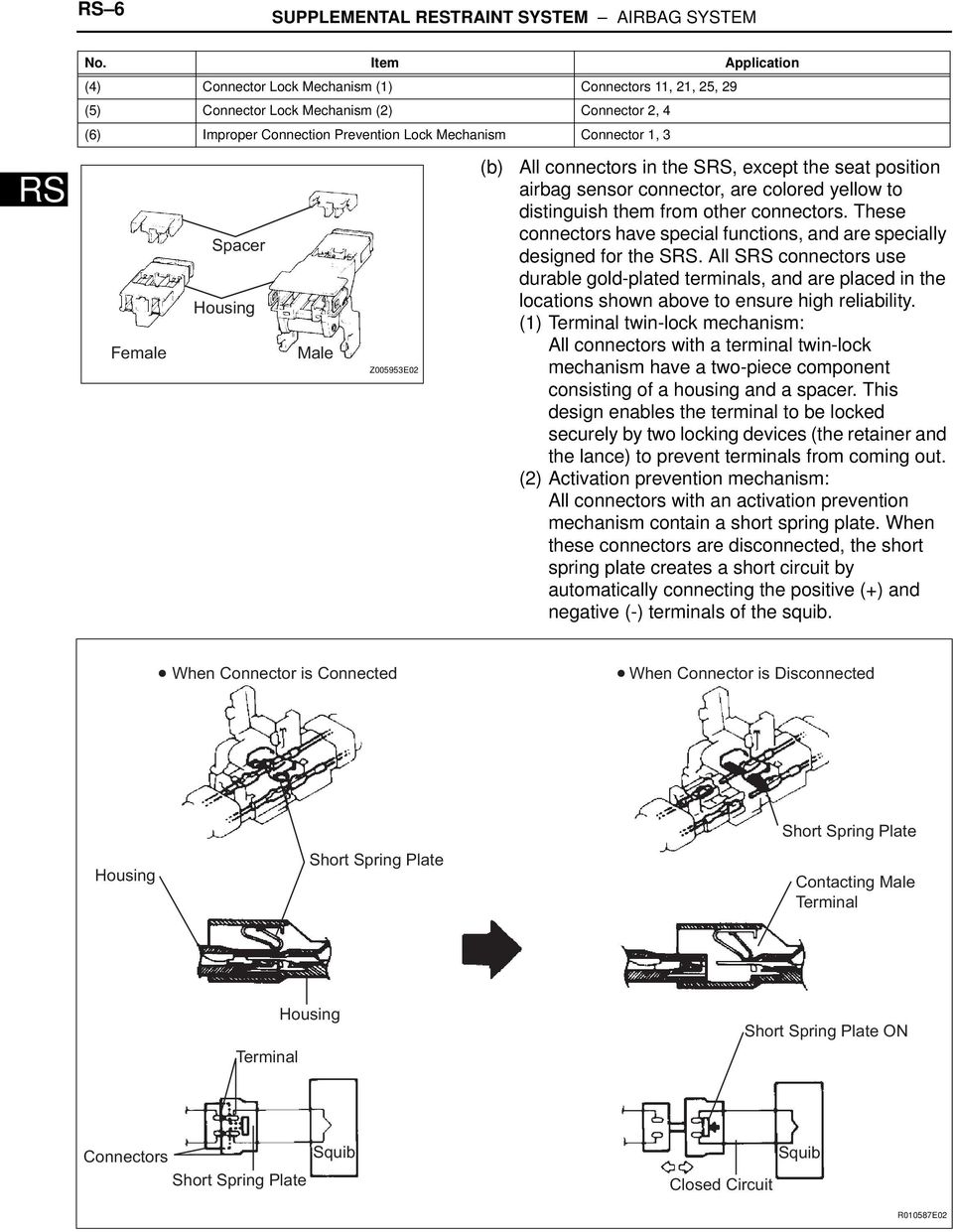
7 SUPPLEMENTAL RESTRAINT SYSTEM AIRBAG SYSTEM 7 (3) Half connection prevention mechanism: If the connector is not completely connected, the connector is disconnected due to the spring operation so that no continuity exists. Locking Part StopperLocking Arm Slider Spring Rebounded by Slider (Spring) Stopper (4) Connector position assurance mechanism: Only when the housing lock (white part) is completely engaged, the CPA (yellow part) slides, which completes the connector engagement. H040180E02 Housing Lock (White Part) CPA (Yellow Part) H043306E02 (5) Connector lock mechanism (1): Locking the connector lock button connects the connector securely. Lock Button Claw Groove H040181E04

8 8 SUPPLEMENTAL RESTRAINT SYSTEM AIRBAG SYSTEM (6) Connector lock mechanism (2): Both the primary lock with holder lances and the secondary lock with retainer prevent the connectors from being disconnected. Holder Lance Retainer Retainer H043918E01 (7) Improper connection prevention lock mechanism: When connecting the holder, the lever is pushed into the end by rotating around the A axis to lock the holder securely. A A Lever H043245E01

9 SUPPLEMENTAL RESTRAINT SYSTEM AIRBAG SYSTEM 9 4. DISCONNECTION OF CONNECTO FOR STEERI PAD, FRONT PASSEER AIRBAG (SQUIB SIDE), CURTAIN SHIELD AIRBAG AND FRONT SEAT OUTER BELT Tape the screwdriver tip before use. Release the lock button (yellow part) of the connector using a screwdriver. Insert the screwdriver tip between the connector and the base, and then raise the connector. Lock Button (Yellow part) Lock Button (Yellow part) Mark H042906E04 5. CONNECTION OF CONNECTO FOR STEERI PAD, FRONT PASSEER AIRBAG (SQUIB SIDE), CURTAIN SHIELD AIRBAG AND FRONT SEAT OUTER BELT Connect the connector.

10 10 SUPPLEMENTAL RESTRAINT SYSTEM AIRBAG SYSTEM Push down securely on the lock button (yellow part) of the connector. When locking, a click sound can be heard. Lock Button (Yellow part) H043151E04 6. DISCONNECTION OF CONNECTOR FOR FRONT PASSEER AIRBAG (INSTRUMENT PANEL WIRE SIDE) Place a finger on the slider, slide the slider to release the lock, and then disconnect the connector. Slider Slider Disconnection is completed H001586E02

11 SUPPLEMENTAL RESTRAINT SYSTEM AIRBAG SYSTEM CONNECTION OF CONNECTOR FOR FRONT PASSEER AIRBAG (INSTRUMENT PANEL WIRE SIDE) Connect the connector as shown in the illustration. When locking, make sure that the slider returns to its original position and a click sound can be heard. When connecting, the slider will slide. Be sure not to touch the slider while connecting, as it may result in an insecure fit. Slider Slider Connection is completed H043731E02 8. DISCONNECTION OF CONNECTO FOR FRONT SEAT AIRBAG Place a finger on the slider, slide the slider to release the lock, and then disconnect the connector. Slider Slider Disconnect is completed H001584E09

12 12 SUPPLEMENTAL RESTRAINT SYSTEM AIRBAG SYSTEM 9. CONNECTION OF CONNECTO FOR FRONT SEAT AIRBAG Connect the connector as shown in the illustration. When locking, make sure that the slider returns to its original position and a click sound can be heard. When connecting, the slider will slide. Be sure not to touch the slider while connecting, as it may result in an insecure fit. Slider Slider Connection is completed H043169E DISCONNECTION OF CONNECTOR FOR CENTER AIRBAG SENSOR Pull the lever by pushing part A as shown in the illustration and disconnect the holder (with connectors). A Holder (with connectors) Disconnection is completed H045112E01 Perform the following procedures when replacing the holder.

13 SUPPLEMENTAL RESTRAINT SYSTEM AIRBAG SYSTEM 13 Remove the holder. (1) Using a screwdriver, unlock the retainer. Retainer H043188E01 (2) Release the fitting lance and remove the holder. Lances H043189E01 H043190E01 Install the holder. (1) Install the connectors to the holder. When locking, a click sound can be heard. The retainer is locked when the holder is connected. 11. CONNECTION OF CONNECTOR FOR CENTER AIRBAG SENSOR ASSEMBLY Firmly insert the holder (with connectors) into the center airbag sensor until it cannot be pushed any further.

14 14 SUPPLEMENTAL RESTRAINT SYSTEM AIRBAG SYSTEM Push the lever to connect the holder (with connectors). When locking, a click sound can be heard. The holder slides in to the center airbag sensor when it is being connected. Be sure not to hold the holder while connecting, as it may result in an insecure fit. Holder (with connectors) Lever Connection is completed H045113E DISCONNECTION OF CONNECTOR FOR FRONT AIRBAG SENSOR Push down the housing lock (white part) and slide the CPA (yellow part). At this time, the connector cannot be disconnected yet. Push down the housing lock (white part) again and disconnect the connector. Do not push down the A part shown in the illustration when disconnecting.

15 SUPPLEMENTAL RESTRAINT SYSTEM AIRBAG SYSTEM 15 A Connector lock is released CPA (Yellow Part) Housing Lock (White Part) H043302E02 After disconnecting the connector, check that the position of the housing lock (white part) is as shown in the illustration. H043303E02

16 16 SUPPLEMENTAL RESTRAINT SYSTEM AIRBAG SYSTEM 13. CONNECTION OF CONNECTOR FOR FRONT AIRBAG SENSOR Before connecting the connectors, check that the position of the housing lock (white part) is as shown in the illustration. H043304E01 Be sure to engage the connectors until they are locked. When locking, make sure that a click sound can be heard. When connecting them, the housing lock (white part) slides. Be sure not to hold the housing lock (white part) and part A, as it may result in an insecure fit. A Housing Lock (White Part) CPA (Yellow Part) Connection is completed H043305E02

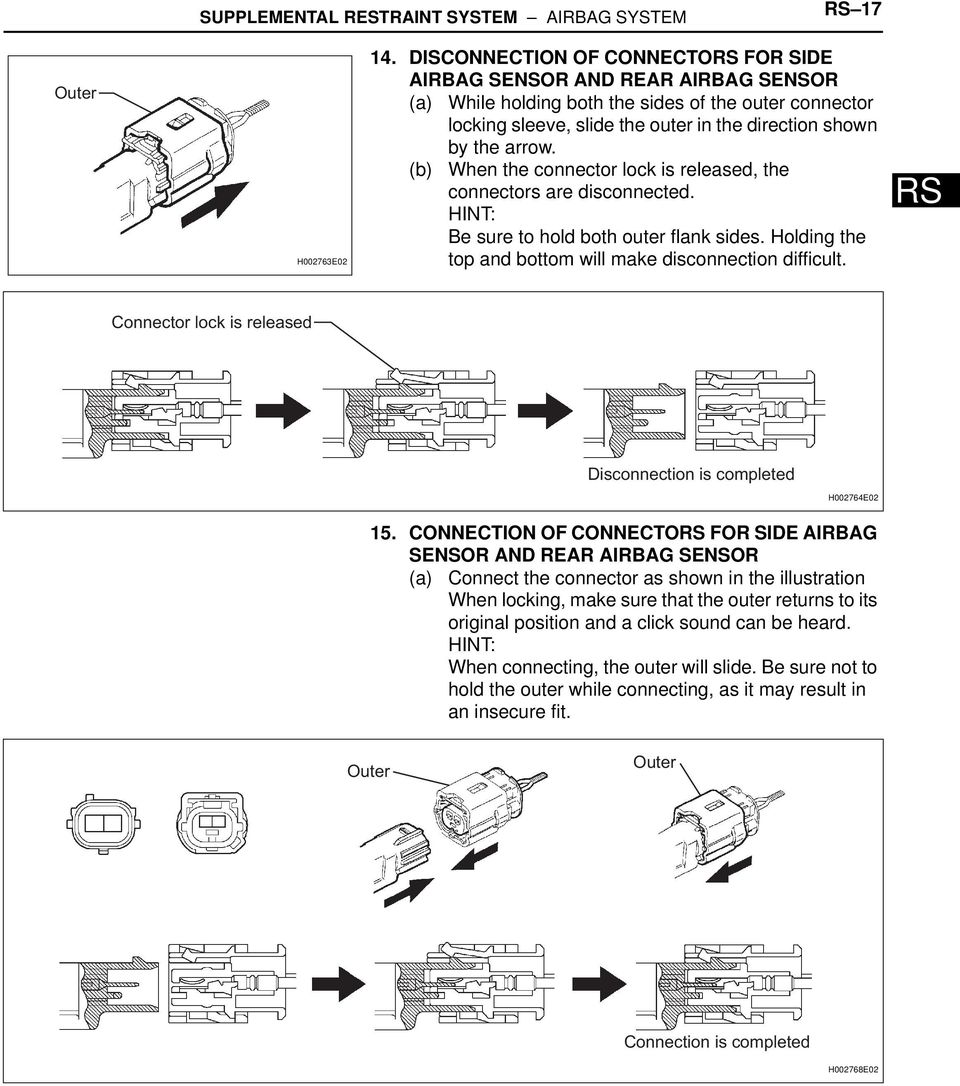
17 SUPPLEMENTAL RESTRAINT SYSTEM AIRBAG SYSTEM 17 Outer H002763E DISCONNECTION OF CONNECTO FOR SIDE AIRBAG SENSOR AND REAR AIRBAG SENSOR While holding both the sides of the outer connector locking sleeve, slide the outer in the direction shown by the arrow. When the connector lock is released, the connectors are disconnected. Be sure to hold both outer flank sides. Holding the top and bottom will make disconnection difficult. Connector lock is released Disconnection is completed H002764E CONNECTION OF CONNECTO FOR SIDE AIRBAG SENSOR AND REAR AIRBAG SENSOR Connect the connector as shown in the illustration When locking, make sure that the outer returns to its original position and a click sound can be heard. When connecting, the outer will slide. Be sure not to hold the outer while connecting, as it may result in an insecure fit. Outer Outer Connection is completed H002768E02
18 18 PARTS LOCATION SUPPLEMENTAL RESTRAINT SYSTEM AIRBAG SYSTEM REAR AIRBAG SENSOR SIDE AIRBAG SENSOR FRONT AIRBAG SENSOR C123569E02

19 SUPPLEMENTAL RESTRAINT SYSTEM AIRBAG SYSTEM 19 CURTAIN SHIELD AIRBAG ASSEMBLY FRONT SEAT SIDE AIRBAG ASSEMBLY FRONT SEAT OUTER BELT ASSEMBLY RH FRONT SEAT OUTER BELT ASSEMBLY LH SEAT POSITION SENSOR FRONT SEAT INNER BELT ASSEMBLY OCCUPANT CLASSIFICATION ECU C123571E02

20 20 SUPPLEMENTAL RESTRAINT SYSTEM AIRBAG SYSTEM COMBINATION METER S WARNI LIGHT FRONT PASSEER AIRBAG ASSEMBLY SPIRAL CABLE DLC3 STEERI PAD CENTER AIRBAG SENSOR ASSEMBLY C123570E02

21 SUPPLEMENTAL RESTRAINT SYSTEM AIRBAG SYSTEM 21 SYSTEM DIAGRAM Front Airbag Sensor LH Front Airbag Sensor RH Steering Pad (Driver Side Squib) Front Passenger Airbag (Driver Side Squib) Side Airbag Sensor LH Side Airbag Sensor RH Front Seat Airbag LH (Driver Side Squib LH)* Rear Airbag Sensor LH Front Seat Airbag RH (Front Passenger Side Squib RH)* Rear Airbag Sensor RH Seat Position Airbag Sensor Front Seat Inner Belt LH Center Airbag Sensor Curtain Shield Airbag LH (Driver Side Squib LH)* Curtain Shield Airbag RH (Front Passenger Side Squib RH)* Occupant Classification ECU Front Seat Outer Belt LH (Driver Side Pretensioner LH) Front Seat Outer Belt RH (Front Passenger Pretensioner RH) Passenger Airbag ON/OFF Indicator Combination Meter HV ECU *: w/ Side Airbag and Curtain Shield Airbag DLC3 C123547E02
22 22 SUPPLEMENTAL RESTRAINT SYSTEM AIRBAG SYSTEM SYSTEM DESCRIPTION 1. S AIRBAG SYSTEM OUTLINE FRONTAL COLLISION (1) The driver and front passenger airbag are designed to supplement seat belts in the event of a front collision in order to help reduce shock to the head and chest of the driver and front passenger. (2) Frontal collisions are detected by the center airbag sensor and two front airbag sensors. The driver and front passenger airbag and the seat belt pretensioner then operate simultaneously. (3) Electrical deceleration sensors are built into the two front airbag sensors in the engine compartment in order to detect the severity of the impact during the initial stage of the collision. The deployment of the driver and front passenger airbags are controlled in two stages according to the severity of the impact. SIDE COLLISION (1) The front seat airbag and curtain shield airbag are designed to help reduce shock to the driver, front passenger and rear outer passenger. The curtain shield airbag was designed to help reduce shock to the front and rear passengers in the event of a side collision. (2) Side collisions are detected by the side airbag sensor installed in the bottom of the center pillar and the airbag sensor rear installed in the bottom of the rear pillar. Front side collisions are detected by the side airbag sensor, causing the front seat airbag and curtain shield airbag to deploy simultaneously. Rear side collisions are detected by the airbag sensor rear to deploy only the curtain shield airbag. 2. CONSTRUCTION AND OPERATION FRONT AIRBAG SENSOR (1) The front airbag sensors are installed on the right and left side members. (2) The deceleration sensor and safing sensor are built into the airbag sensor front and distortion that is created in the sensor is converted into an electric signal based on the vehicle deceleration rate during a frontal collision. Accordingly, the extent of the initial collision can be detected in detail. SIDE AIRBAG SENSOR (1) The side airbag sensors are installed on the right and left center pillars.
23 SUPPLEMENTAL RESTRAINT SYSTEM AIRBAG SYSTEM 23 (d) (2) The side airbag sensor consists of the deceleration sensor, safing sensor, ignition control circuit, and diagnostic circuit. The side airbag sensor receives signals from the deceleration sensor and determines whether the front seat airbag and curtain shield airbag should be activated, and diagnoses system malfunctions simultaneously. REAR AIRBAG SENSOR (1) The rear airbag sensor is installed on the bottom of the right and left rear pillars respectively. (2) The deceleration sensor and safing sensor are built into the rear airbag sensor and the distortion that is created in the sensor is converted into an electric signal based on the vehicle deceleration rate during a rear side collision. CENTER AIRBAG SENSOR (1) General The center airbag sensor is installed on the center floor under the instrument panel. The center airbag sensor consists of the deceleration sensor, safing sensor, electrical safing sensor, ignition control circuit and diagnostic circuit. The center airbag sensor receives signals from the deceleration sensors and safing sensors built into the center airbag sensor and front airbag sensor. The center airbag sensor causes the front seat side airbag and the curtain shield airbag to deploy when receiving signals from the deceleration sensor and the safing sensor built into the side airbag sensor. The center airbag sensor receives signals from the deceleration sensors and the electrical safing sensors built into the center airbag sensor and the rear airbag sensor, and determines whether or not the curtain shield airbag should be activated, and then diagnoses system malfunctions. The center airbag sensor can be check using check mode, which can detect and output DTCs. If the malfunction does not recur during troubleshooting, joggling each connector or driving on various type of roads with the center airbag sensor in check mode as a simulation method makes it possible to obtain more accurate information.
24 24 SUPPLEMENTAL RESTRAINT SYSTEM AIRBAG SYSTEM (e) (2) Deceleration sensor and ignition control circuit The deceleration sensor is built into the center airbag sensor, and the distortion created based on the deceleration of the vehicle during a frontal or rear side collision is converted into an electric signal. The ignition control circuit performs calculations based on the signal output from the deceleration sensors of the center airbag sensor and front airbag sensor. If the calculated values are greater than the specified values, the airbag deploy. (3) Safing sensor The safing sensor is built into the center airbag sensor. During a frontal collision, the sensor turns on and outputs an ON signal to the center airbag sensor if a deceleration rate greater than the specified value is applied to the safing sensor. (4) Electronic safing sensor The electronic safing sensor is built into the center airbag sensor. During a rear side collision, the sensor turns on and outputs an ON signal to the center airbag sensor if a deceleration rate greater than the specified value is applied to the electronic safing sensor. (5) Back-up power source The back-up power source consists of a condenser and a DC-DC converter. When the power system does not function during a collision, the condenser discharges and supplies electric power to the system. The DC-DC converter operates as a boosting transformer when the battery voltage falls below a predetermined level. (6) Diagnostic circuit This circuit constantly diagnoses the system malfunctions. When a malfunction is detected, it lights up the S warning light on the combination meter to inform the driver. (7) Memory circuit When a malfunction is detected in the diagnostic circuit, it is coded and stored in the memory circuit. S WARNI LIGHT (1) The S warning light is located on the combination meter. The S warning light informs the driver of detected malfunctions in the diagnostic circuit of the center airbag sensor or the S airbag system. Under normal operating conditions when the power switch is turned on, the S warning light comes on for approximately 6 seconds and then goes off.
25 SUPPLEMENTAL RESTRAINT SYSTEM AIRBAG SYSTEM DEPLOYMENT CONDITION When the vehicle collides and the shock is greater than the specified value, the S is activated automatically. The center airbag sensor includes the safing sensor and deceleration sensor. The safing sensor was designed to the turned on at a smaller deceleration rate than the deceleration sensor. The center airbag sensor determines whether or not ignition is necessary based on signals from the deceleration sensor and the front airbag sensor*. If the deceleration sensor, front airbag sensor* and safing sensor turn on simultaneously, current flows to the squibs to deploy the S as shown in the illustration below. Center Airbag Sensor Safing Sensor ON Deceleration Sensor ON AND Steering Pad Front Passenger Airbag Center Airbag Sensor Safing Sensor ON Deceleration Sensor ON AND AND Steering Pad Front Passenger Airbag Front Airbag Sensor* C C109526E11 *: In case of front collision, the ignition signal could be output with the deceleration sensor ON signal even without a signal from the front airbag sensor.
26 26 SUPPLEMENTAL RESTRAINT SYSTEM AIRBAG SYSTEM The center airbag sensor determines whether or not ignition is necessary based on signals from the side airbag sensor. If the side airbag sensor and safing sensor turn on simultaneously, current flows to the squib to deploy the S as shown in the illustration below. Safing Sensor AND Front Seat Airbag Side Airbag Sensor C C109527E10 The center airbag sensor determines whether or not ignition is necessary based on signals from the rear airbag sensor. If the rear airbag sensor and safing sensor turn on simultaneously, current flows to the squib to deploy the S as shown in the illustration below. Front Seat Airbag Deployment Safing Sensor Front Seat Side Airbag AND OR Curtain Shield Airbag* Rear Airbag Sensor* C C109528E10 *: If the front seat airbag deploys, the curtain shield airbag will also deploy, regardless of whether the signal is output from the rear airbag sensor.
27 SUPPLEMENTAL RESTRAINT SYSTEM AIRBAG SYSTEM 27 HOW TO PROCEED WITH TROUBLESHOOTI Use these procedures to troubleshoot the airbag system. *: Use the intelligent tester. 1 VEHICLE BROUGHT TO WORKSHOP NEXT 2 INSPECT BATTERY VOLTAGE NEXT Standard voltage: 11 to 14 V If the voltage is below 11 V, recharge or replace the battery before proceeding. 3 CHECK MULTIPLEX COMMUNICATION SYSTEM* Check the DTC (see page -38). Result Result DTC is not output DTC is output Proceed to A B B CHECK MULTIPLEX COMMUNICATION SYSTEM A 4 CHECK CAN COMMUNICATION SYSTEM* Check the DTC (see page -38). Result Result DTC is not output DTC is output Proceed to A B B CHECK CAN COMMUNICATION CIRCUIT A 5 WARNI LIGHT CHECK NEXT
28 28 SUPPLEMENTAL RESTRAINT SYSTEM AIRBAG SYSTEM 6 CHECK DTC (Present and Past DTCs)* Check the DTC (see page -38). Result Result DTC is not output DTC is output Proceed to A B B PROBLEM SYMPTOMS TABLE A 7 DTC CHART NEXT 8 CIRCUIT INSPECTION NEXT 9 REPAIR NEXT 10 CLEAR DTC (Present and Past DTCs)* NEXT 11 CHECK DTC (Present and Past DTCs)* Check the DTC (see page -38). Result Result DTC is not output DTC is output Proceed to A B B Go to step 6 A
29 SUPPLEMENTAL RESTRAINT SYSTEM AIRBAG SYSTEM CONFIRMATION TEST NEXT END
30 30 SUPPLEMENTAL RESTRAINT SYSTEM AIRBAG SYSTEM Airbag system PROBLEM SYMPTOMS TABLE Use the table below to help determine the cause of the problem symptom. The potential causes of the symptoms are listed in order of probability in the "Suspected area" column of the table. Check each symptom by checking the suspected areas in the order they are listed. Replace parts as necessary. Inspect the fuses and relays related to this system before inspecting the suspected areas below. Symptom Suspected area See page The S warning light sometimes comes on after approximately 6 seconds when the power switch is ON (IG). S Warning Light Remains ON -161 The S warning light remains on when DTC is not output. The S warning light does not come on with the power switch ON (IG). S Warning Light Remains ON S Warning Light does not Come ON S warning light blinks. TC and CG Terminal Circuit -167 DTC cannot read. TC and CG Terminal Circuit -167
31 SUPPLEMENTAL RESTRAINT SYSTEM AIRBAG SYSTEM 31 TERMINALS OF ECU A17 A18 A19 C109532E08 Terminal No. Terminal Symbol Destination A17-1 SFD+ Front seat side airbag LH (Side squib LH) A17-2 SFD- Front seat side airbag LH (Side squib LH) A17-3 ICD- Curtain shield airbag LH (Driver side curtain shield squib) A17-4 ICD+ Curtain shield airbag LH (Driver side curtain shield squib) A17-5 PD+ Front seat outer belt LH (Driver side pretensioner squib) A17-6 PD- Front seat outer belt LH (Driver side pretensioner squib) A17-9 DSP+ Seat position sensor A17-10 DBE+ Front seat inner belt LH A17-17 DSP- Seat position sensor A17-18 DBE- Front seat inner belt LH A17-19 VUPD Side airbag sensor LH A17-20 VUCD Rear airbag sensor LH A17-21 ESD Side airbag sensor LH A17-22 ESCD Rear airbag sensor LH A18-1 P2+ Front passenger airbag (Front passenger side squib 2nd step) A18-2 P2- Front passenger airbag (Front passenger side squib 2nd step) A18-3 P- Front passenger airbag (Front passenger side squib) A18-4 P+ Front passenger airbag (Front passenger side squib) A18-5 D+ Steering pad (Driver side squib) A18-6 D- Steering pad (Driver side squib) A18-7 D2- Steering pad (Driver side squib 2nd step) A18-8 D2+ Steering pad (Driver side squib 2nd step)
32 32 SUPPLEMENTAL RESTRAINT SYSTEM AIRBAG SYSTEM Terminal No. Terminal Symbol Destination A18-13 PBEW Combination meter ECU A18-14 LA Combination meter A18-15 TC DLC3 A18-16 SIL DLC3 A18-17 P-AB Front passenger seat belt warning light (Passenger airbag ON/OFF indicator) A18-21 IG2 IGN fuse A18-22 GSW2 HV ECU A18-23 PAON Front passenger seat belt warning light (Passenger airbag ON/OFF indicator) A18-25 E1 Ground A18-26 E2 Ground A SR Front airbag sensor RH A SL Front airbag sensor LH A SR Front airbag sensor RH A SL Front airbag sensor LH A19-3 PP- Front seat outer belt RH (Front passenger side pretensioner squib RH) A19-4 PP+ Front seat outer belt RH (Front passenger side pretensioner squib RH) A19-5 ICP+ Curtain shield airbag RH (Curtain shield squib RH) A19-6 ICP- Curtain shield airbag RH (Curtain shield squib RH) A19-7 SFP- Front seat side airbag RH (Side squib RH) A19-8 SFP+ Front seat side airbag RH (Side squib RH) A19-16 FSP+ Occupant classification ECU A19-19 ESCP Side airbag sensor RH A19-20 ESP Rear airbag sensor RH A19-21 VUCP Side airbag sensor RH A19-22 VUPP Rear airbag sensor RH A19-24 FSP- Occupant classification ECU
33 SUPPLEMENTAL RESTRAINT SYSTEM AIRBAG SYSTEM 33 DIAGNOSIS SYSTEM CG SG CANH SIL 1. DESCRIPTION The center airbag sensor controls the functions of the Supplemental Restraint System (S) on the vehicle. Data of the S can be read in the Data Link Connector 3 (DLC3) of the vehicle. When the system seems to be malfunctioning, use the intelligent tester to check for a malfunction and perform repairs. 2. CHECK DLC3 The ECU uses ISO for communication. The terminal arrangement of the DLC3 complies with ISO and matches the ISO format. CANL BAT H100769E16 Symbols (Terminal No.) Terminal Description Condition Specified Condition SIL (7) - SG (5) Bus "+" line During transmission Pulse generation CG (4) - Body ground Chassis ground Always Below 1 Ω SG (5) - Body ground Signal ground Always Below 1 Ω BAT (16) - Body ground Battery positive Always 11 to 14 V CANH (6) - CANL (14) HIGH-Level CAN bus line Power switch is OFF* 54 to 69 Ω CANH (6) - Battery positive HIGH-level CAN bus line Power switch is OFF* 1 kω or more CANH (6) - CG (4) HIGH-level CAN bus line Power switch is OFF* 1 kω or more CANL (14) - Battery positive LOW-level CAN bus line Power switch is OFF* 1 MΩ or more CANL (14) - CG (4) LOW-level CAN bus line Power switch is OFF* 1 MΩ or more NOTICE: *: Before measuring the resistance, leave the vehicle as is for at least 1 minute and do not operate the power switch, any other switches or the doors. If the result is not as specified, the DLC3 may have a malfunction. Repair or replace the harness and connector. Connect the cable of the intelligent tester (with CAN VIM) to the DLC3, turn the power switch ON (IG) and attempt to use the tester. If the display indicates that a communication error has occurred, there is a problem either with the vehicle or with the tester. If communication is normal when the tester is connected to another vehicle, inspect the DLC3 on the original vehicle. If communication is still not possible when the tool is connected to another vehicle, the problem is probably in the tester itself. Consult the Service Department listed in the tester's instruction manual.
34 34 SUPPLEMENTAL RESTRAINT SYSTEM AIRBAG SYSTEM Vibrate Slightly Shake Slightly Vibrate Slightly D025083E02 3. SYMPTOM SIMULATION The most difficult case in troubleshooting is when no problem symptoms occur. In such a case, a thorough problem analysis must be carried out. A simulation of the same or similar conditions and environment in which the problem occurred in the customer's vehicle should be carried out. No matter how much skill or experience a technician has, troubleshooting without confirming the problem symptoms will lead to important repairs being overlooked and mistakes or delays. Vibration method: When vibration seems to be the major cause. Perform the simulation method only during the primary check period (for approximately 6 seconds after the power switch ON (IG)). (1) Slightly vibrate the part of the sensor considered to be the problem cause with your fingers and check whether the malfunction occurs. Shaking the relays too strongly may result in open relays. (2) Slightly shake the connector vertically and horizontally. (3) Slightly shake the wire harness vertically and horizontally. The connector joint and fulcrum of the vibration are the major areas to be checked thoroughly. 4. FUNCTION OF S WARNI LIGHT Primary check. (1) Turn the power switch OFF. Wait for at least 2 seconds, then turn the power switch ON (IG). The S warning light comes on for approximately 6 seconds and the diagnosis of the airbag system (including the seat belt pretensioners) is performed. If trouble is detected during the primary check, the S warning light remains on even after the primary check period (for approximately 6 seconds) has elapsed. Constant check. (1) After the primary check, the center airbag sensor constantly monitors the airbag system for trouble. If trouble is detected during the constant check, the center airbag sensor functions as follows: The S warning light comes on.
35 SUPPLEMENTAL RESTRAINT SYSTEM AIRBAG SYSTEM 35 C093955E02 The S warning light goes off, and then comes on. This blinking pattern indicates a source voltage drop. The S warning light goes off 10 seconds after the source voltage returns to normal. Review. (1) When the airbag system is normal: The S warning light comes on only during the primary check period (for approximately 6 seconds after the power switch is turned ON (IG)). (2) When the airbag system has trouble: The S warning light remains on even after the primary check period has elapsed. The S warning light goes off after the primary check, but comes on again during the constant check. The S warning light does not come on when turning the power switch from OFF to ON (IG). The center airbag sensor keeps the S warning light on if the airbag has been deployed. 5. S WARNI LIGHT CHECK Turn the power switch ON (IG), and check that the S warning light comes on for approximately 6 seconds (primary check). Check that the S warning light goes off approximately 6 seconds after the power switch is turned ON (IG) (constant check). When any of the following symptoms occur, refer to the "Problem Symptoms Table" (see page -29). The S warning light comes on occasionally after the primary check period has elapsed. The S warning light comes on, but a DTC is not output. The power switch is turned from OFF to ON (IG), but the S warning light does not come on. 6. ACTIVATION PREVENTION MECHANISM FUNCTION OF ACTIVATION PREVENTION MECHANISM (1) An activation prevention mechanism is built into the connector on the center airbag sensor side of the airbag system squib circuit to prevent accidental airbag activation. (2) This mechanism closes the circuit when the connector is disconnected by bringing the short spring into contact with the terminals and shutting off external electricity to prevent accidental airbag activation.
36 36 SUPPLEMENTAL RESTRAINT SYSTEM AIRBAG SYSTEM RELEASE METHOD OF ACTIVATION PREVENTION MECHANISM (1) To release the activation prevention mechanism, insert a piece of paper with the same thickness as the male terminal (approximately 0.5 mm (0.020 in.)) between the terminals and the short spring to break the connection. (2) Refer to the illustrations below concerning connectors utilizing the activation prevention mechanism and its release method. CAUTION: Never release the activation prevention mechanism on the squib connector even when inspecting with the squib disconnected. NOTICE: Do not release the activation prevention mechanism unless specially directed by the troubleshooting procedure. To prevent the terminal and the short spring from being damaged, always use a piece of paper of the same thickness as the male terminal.
37 SUPPLEMENTAL RESTRAINT SYSTEM AIRBAG SYSTEM 37 Front Airbag Sensor LH 7 5 Steering Pad (Driver Side Squib) Spiral Cable HV ECU Rear Airbag Sensor LH Seat Position Sensor Front Seat Side Airbag LH (Side Squib LH) Front Seat Outer Belt LH (Front Pretensioner Squib LH) Center Airbag Sensor Side Airbag Sensor LH Curtain Shield Airbag LH (Curtain Shield Squib LH) C132223E01
38 38 SUPPLEMENTAL RESTRAINT SYSTEM AIRBAG SYSTEM 5 7 Front Airbag Sensor RH Front Passenger Airbag (Front Passenger Side Squib) Passenger Airbag ON/OFF Indicator Rear Airbag Sensor RH Occupant Classification ECU Front Seat Side Airbag RH (Side Squib RH) Front Seat Outer Belt RH (Front Pretensioner Squib RH) Center Airbag Sensor Side Airbag Sensor RH Curtain Shield Airbag RH (Curtain Shield Squib RH) 26 C132224E01
39 SUPPLEMENTAL RESTRAINT SYSTEM AIRBAG SYSTEM 39 Center Airbag Sensor Connector Connector 4 Connector 2 Connector 4 Short Spring Before Release Short Spring After Release Short Spring Paper Paper Short Spring Short Spring Connector 10 Before Release After Release Short Spring Short Spring Paper Short Spring Paper Connector 28 Before Release After Release C Short Spring CG DLC3 TC H100769E50 Short Spring Paper DTC CHECK / CLEAR Short Spring Paper 1. CHECK DTC (USI SST CHECK WIRE) Check for DTCs (Present DTC). (1) Turn the power switch ON (IG), and wait for approximately 60 seconds. (2) Using SST, connect terminals 13 (TC) and 4 (CG) of the DLC3. SST C109538E04
40 40 SUPPLEMENTAL RESTRAINT SYSTEM AIRBAG SYSTEM Normal System Code (without Past Trouble Code) ON OFF 0.25 sec sec. Normal System Code (with Past Trouble Code) ON OFF 0.75 sec sec. DTC (Example DTCs 11 and 31) 0.5 sec. 2.5 sec. 1.5 sec. 0.5 sec. DTC 11 DTC sec. Repeat H100355E02 NOTICE: Connect the terminals to the correct positions to avoid a malfunction. Check for DTCs (Past DTC). (1) Using SST, connect terminals 13 (TC) and 4 (CG) of the DLC3. SST NOTICE: Connect the terminals to the correct positions to avoid a malfunction. (2) Turn the power switch ON (IG), and wait for approximately 60 seconds. Read the DTCs. (1) Read the blinking patterns of the DTCs. As examples, the blinking patterns for the normal system code and DTCs 11 and 31 are shown in the illustration. Normal system code indication (without past DTC) The light blinks twice per second. Normal system code indication (with past DTC) When the past DTC is stored in the center airbag sensor, the light blinks once per second. DTC indication The first blinking pattern indicates the first digit DTC. The second blinking pattern occurs after a 1.5-second pause. If there are 2 or more DTCs, there is a 2.5- second pause between each DTC. After all DTCs are shown, there is a 4.0-second pause, and they are all repeated. If 2 or more malfunctions are found, the indication begins with the lowest numbered DTC. If DTCs are indicated without connecting the terminals, proceed to the "TC and CG Terminal Circuit" (see page -167). 2. CLEAR DTC (USI SST CHECK WIRE) Clear the DTCs. (1) When the power switch is turned OFF, the DTCs are cleared. Depending on the DTCs, the DTCs may not all be cleared by turning off the power switch. In this case, proceed to the next step. (2) Using SST, connect terminals 13 (TC) and 4 (CG) of the DLC3, and then turn the power switch on. SST
41 SUPPLEMENTAL RESTRAINT SYSTEM AIRBAG SYSTEM 41 (3) Disconnect terminal 13 (TC) of the DLC3 within 3 to 10 seconds after the DTCs are output, and check that the S warning light comes on after 3 seconds. (4) Within 2 to 4 seconds of the S warning light coming on, connect terminals 13 (TC) and 4 (CG) of the DLC3. (5) The S warning light goes off within 2 to 4 seconds of connecting terminals 13 (TC) and 4 (CG) of the DLC3. Then, disconnect terminal 13 (TC) within 2 to 4 seconds of the S warning light going off. (6) The S warning light comes on again within 2 to 4 seconds of disconnecting terminal 13 (TC). Then, reconnect terminals 13 (TC) and 4 (CG) within 2 to 4 seconds of the S warning light coming on. (7) Check that the S warning light goes off within 2 to 4 seconds of connecting terminals 13 (TC) and 4 (CG) of the DLC3. Also check that the normal system code is output within 1 second of the S warning light going off. If DTCs are not cleared, repeat these procedure until the DTCs are cleared. Power Switch ON (IG) OFF DLC3 (TC and CG) Open Short S Warning Light* ON T1: Preparation time OFF T2: Approximately 6 seconds 1.5 T3: 3 to 5 seconds T4: 3 to 10 seconds T1 T2 T3 T4 T5 T6 T5 T6 T5 T6 T5 T7 T5: 2 to 4 seconds T6: 1 to 5 seconds (seconds) T7: Within 1 second *: The past DTC in the illustration shows DTC 21 as an example. C C109537E12
42 42 SUPPLEMENTAL RESTRAINT SYSTEM AIRBAG SYSTEM DLC3 DLC3 Intelligent Tester CAN VIM Intelligent Tester CAN VIM B126098E01 B126098E01 3. CHECK DTC (USI INTELLIGENT TESTER) Connect the intelligent tester (with CAN VIM) to the DLC3. Turn the power switch ON (IG). Check the DTCs by following the prompts on the tester screen. Refer to the intelligent tester operator's manual for further details. 4. CLEAR DTC (USI INTELLIGENT TESTER) Connect the intelligent tester (with CAN VIM) to the DLC3. Turn the power switch ON (IG). Clear the DTCs by following the prompts on the tester screen. Refer to the intelligent tester operator's manual for further details. CHECK MODE PROCEDURE 1. CHECK MODE (SIGNAL CHECK): DTC CHECK Connect the intelligent tester (with CAN VIM) to the DLC3. Turn the power switch ON (IG). Select the SIGNAL CHECK, and proceed to check with the intelligent tester. NOTICE: Select the SIGNAL CHECK from the DTC CHECK screen displayed on the intelligent tester to clear the output DTCs (both present and past). DTCs can be detected more sensitively in check mode than in normal diagnosis mode. Perform the check mode inspection when a malfunction in each squib circuit is suspected even after the normal system code is output through the normal diagnosis mode inspection.
43 SUPPLEMENTAL RESTRAINT SYSTEM AIRBAG SYSTEM 43 Center airbag sensor: Item D SEAT POSITION PASSEER CLASS D BUCKLE SW P BUCKLE SW DISPLAY TYPE PAST CODES Measure Item/ Range (Display) Seat position (Driver side)/ FORWARD: Seat position forward BKWARD: Seat position backward FAIL: Failure detected DATA LIST / ACTIVE TEST 1. READ DATA LIST Using the intelligent tester's DATA LIST allows switch, sensor, actuator and other item values to be read without removing any parts. Reading the DATA LIST early in troubleshooting is one way to save time. Connect the intelligent tester (with CAN VIM) to the DLC3. Front passenger classification/ : Data is not determined OFF: Vacant CHILD: Child (Less than 36 kg [79.37 lb]) seated AF05: Adult (36 to 54 kg [79.37 to lb]) seated AM50: Adult (More than 54 kg [ lb]) seated FAIL: Failure detected Buckle switch (Driver side)/ UNSET: Seat belt not fastened SET: Seat belt fastened : Data not determined Buckle switch (Front passenger side)/ UNSET: Seat belt not fastened SET: Seat belt fastened : Data not determined Display type identification information/ LR: Display indicated by LH/RH DP: Display indicated by Driver/ Passenger Number of past DTCs/ Min.: 0, Max.: 255 Turn the power switch ON (IG). Read the DATA LIST according to the display on the tester. Normal Condition FORWARD/BKWARD - /OFF/CHILD/AF05/AM50/ FAIL UNSET/SET - UNSET/SET - DP Diagnostic Note -
44 44 SUPPLEMENTAL RESTRAINT SYSTEM AIRBAG SYSTEM Airbag system: DIAGNOSTIC TROUBLE CODE CHART If a DTC is displayed during the DTC check, check the circuit listed for the DTC in the table below. When the S warning light remains on and the normal system code is output, a decrease in the source voltage is likely to occur. This malfunction is not stored in the memory of the center airbag sensor. If the power source voltage returns to normal, the S warning light will automatically go off. When 2 or more DTCs are indicated, the DTC with the lowest number appears first. If a DTC is not listed on the DTC chart, the center airbag sensor may have malfunction. In the case of any malfunctions concerning open circuits, shorts to ground, or shorts to B+ due to squibs, other DTCs may not be set. In this case, repair the malfunction currently indicated and then perform malfunction diagnosis again. Mark in the check mode column: -: DTC does not correspond to check mode. : DTC corresponds to check mode. When DTC B1650/32 is set as a result of troubleshooting the Supplemental Restraint System (S), perform troubleshooting for the occupant classification system. DTC No. Detection Item Check Mode S Warning Light See page B1000/31 Center Airbag Sensor - ON -46 Assembly Malfunction B1610/13 Front Airbag Sensor RH Circuit Malfunction B1615/14 Front Airbag Sensor LH Circuit Malfunction B1620/21 Driver Side - Side Airbag Sensor Circuit Malfunction B1625/22 Front Passenger Side - Side Airbag Sensor Circuit Malfunction B1630/23 Driver Side Rear Airbag Sensor Circuit Malfunction B1635/24 Front Passenger Side Rear Airbag Sensor Circuit Malfunction B1650/32 Occupant Classification System Malfunction B1653/35 Seat Position Airbag Sensor Circuit Malfunction B1655/37 Driver Side Seat Belt Buckle Switch Circuit Malfunction B1660/43 Passenger Airbag ON / OFF Indicator Circuit Malfunction B1800/51 Short in Driver Side Squib Circuit B1801/51 Open in Driver Side Squib Circuit - ON ON ON ON ON ON ON ON ON ON -103 ON -112 ON -112
45 SUPPLEMENTAL RESTRAINT SYSTEM AIRBAG SYSTEM 45 DTC No. Detection Item Check Mode S Warning Light See page B1802/51 Short to GND in Driver Side Squib Circuit B1803/51 Short to B+ in Driver Side Squib Circuit B1805/52 Short in Front Passenger Side Squib Circuit B1806/52 Open in Front Passenger Side Squib Circuit B1807/52 Short to GND in Front Passenger Side Squib Circuit B1808/52 Short to B+ in Front Passenger Side Squib Circuit B1810/53 Short in Driver Side Squib 2nd Step Circuit B1811/53 Open in Driver Side Squib 2nd Step Circuit B1812/53 Short to GND in Driver Side Squib 2nd Step Circuit B1813/53 Short to B+ in Driver Side Squib 2nd Step Circuit B1815/54 Short in Front Passenger Side Squib 2nd Step Circuit B1816/54 Open in Front Passenger Side Squib 2nd Step Circuit B1817/54 Short to GND in Front Passenger Side Squib 2nd Step Circuit B1818/54 Short to B+ in Front Passenger Side Squib 2nd Step Circuit B1820/55 Short in Driver Side - Side Squib Circuit B1821/55 Open in Driver Side - Side Squib Circuit B1822/55 Short to GND in Driver Side - Side Squib Circuit B1823/55 Short to B+ in Driver Side - Side Squib Circuit B1825/56 Short in Front Passenger Side - Side Squib Circuit B1826/56 Open in Front Passenger Side - Side Squib Circuit B1827/56 Short to GND in Front Passenger Side - Side Squib Circuit B1828/56 Short to B+ in Front Passenger Side - Side Squib Circuit B1830/57 Short in Driver Side Curtain Shield Squib Circuit B1831/57 Open in Driver Side Curtain Shield Squib Circuit ON -112 ON -112 ON -117 ON -117 ON -117 ON -117 ON -122 ON -122 ON -122 ON -122 ON -127 ON -127 ON -127 ON -127 ON -132 ON -132 ON -132 ON -132 ON -137 ON -137 ON -137 ON -137 ON -142 ON -142
46 46 SUPPLEMENTAL RESTRAINT SYSTEM AIRBAG SYSTEM DTC No. Detection Item Check Mode S Warning Light See page B1832/57 Short to GND in Driver Side Curtain Shield Squib Circuit B1833/57 Short to B+ in Driver Side Curtain Shield Squib Circuit B1835/58 Short in Front Passenger Side Curtain Shield Squib Circuit B1836/58 Open in Front Passenger Side Curtain Shield Squib Circuit B1837/58 Short to GND in Front Passenger Side Curtain Shield Squib Circuit B1838/58 Short to B+ in Front Passenger Side Curtain Shield Squib Circuit B1900/73 Short in Driver Side Front Pretensioner Squib Circuit B1901/73 Open in Driver Side Front Pretensioner Squib Circuit B1902/73 Short to GND in Driver Side Front Pretensioner Squib Circuit B1903/73 Short to B+ in Driver Side Front Pretensioner Squib Circuit B1905/74 Short in Front Passenger Side Front Pretensioner Squib Circuit B1906/74 Open in Front Passenger Side Front Pretensioner Squib Circuit B1907/74 Short to GND in Front Passenger Side Front Pretensioner Squib Circuit B1908/74 Short to B+ in Front Passenger Side Front Pretensioner Squib Circuit ON -142 ON -142 ON -146 ON -146 ON -146 ON -146 ON -150 ON -150 ON -150 ON -150 ON -154 ON -154 ON -154 ON -154
47 SUPPLEMENTAL RESTRAINT SYSTEM AIRBAG SYSTEM 47 DTC B1000/31 Center Airbag Sensor Assembly Malfunction DESCRIPTION The center airbag sensor consists of the airbag sensor, the safing sensor, the drive circuit, the diagnosis circuit and the power control. When the center airbag sensor receives signals from the airbag sensor, it determines whether or not the S should be activated. DTC B1000/31 is set when a malfunction is detected in the center airbag sensor. DTC No. DTC Detection Condition Trouble Area B1000/31 Center airbag sensor malfunction Center airbag sensor When any other DTCs are set simultaneously with B1000/31, repair the malfunctions indicated by those DTCs first. INSPECTION PROCEDURE 1 CHECK CENTER AIRBAG SENSOR ASSEMBLY CG DLC3 TC DTC 31 H041086E03 Turn the power switch OFF. Disconnect the cable from the negative (-) battery terminal, and wait for at least 90 seconds. Connect the cable to the negative (-) battery terminal, and wait for at least 2 seconds. (d) Turn the power switch ON (IG), and wait for at least 60 seconds. (e) Clear the DTCs (see page -38). (f) Turn the power switch OFF. (g) Turn the power switch ON (IG), and wait for at least 60 seconds. (h) Check for DTCs (see page -38). : DTC B1000/31 is not output. REPLACE CENTER AIRBAG SENSOR ASSEMBLY USE SIMULATION METHOD TO CHECK
48 48 SUPPLEMENTAL RESTRAINT SYSTEM AIRBAG SYSTEM DTC B1610/13 Front Airbag Sensor RH Circuit Malfunction DESCRIPTION The front airbag sensor RH consists of the diagnostic circuit and the front deceleration sensor. If the center airbag sensor receives signals from the frontal deceleration sensor, it determines whether or not the S should be activated. DTC B1610/13 is recorded when a malfunction is detected in the front airbag sensor RH circuit. DTC No. DTC Detection Condition Trouble Area B1610/13 When one of following conditions is met: Center airbag sensor receives a line short signal, an open signal, a short to ground signal or a short to B+ signal from the front airbag sensor RH sensor for 2 seconds. Front airbag sensor RH malfunction Center airbag sensor malfunction Instrument panel wire Engine room main wire Front airbag sensor RH Center airbag sensor WIRI DIAGRAM Front Airbag Sensor RH Center Airbag Sensor SR+ SR+ SR- SR- C123527E01
49 SUPPLEMENTAL RESTRAINT SYSTEM AIRBAG SYSTEM 49 INSPECTION PROCEDURE 1 CHECK FOR DTC Front Airbag Sensor RH DLC3 Center Airbag Sensor DTC 13 Turn the power switch ON (IG), and wait for at least 60 seconds. Clear the DTCs (see page -38). Turn the power switch OFF. (d) Turn the power switch ON (IG), and wait for at least 60 seconds. (e) Check the DTCs (see page -38). : DTC B1610/13 is not output. DTCs other than DTC B1610/13 may be output at this time, but they are not related to this check. CG TC USE SIMULATION METHOD TO CHECK C C130774E02 2 CHECK CONNECTION OF CONNECTOR Turn the power switch OFF. Disconnect the cable from the negative (-) battery terminal, and wait for at least 90 seconds. Check that the connectors are properly connected to the center airbag sensor and the front airbag sensor RH. : The connectors are properly connected. CONNECT CONNECTOR
50 50 SUPPLEMENTAL RESTRAINT SYSTEM AIRBAG SYSTEM 3 CHECK FRONT AIRBAG SENSOR RH CIRCUIT (OPEN) F Front Airbag Sensor RH E DC B A Center Airbag Sensor Disconnect the connectors from the center airbag sensor and the front airbag sensor RH. Using a service wire, connect terminals A18-29 (+SR) and A18-27 (-SR) of connector B. NOTICE: Do not forcibly insert a service wire into the terminals of the connector. Measure the resistance of the wire harness side connector. Standard resistance Connector E Connector B Tester Connection Specified Condition F2-2 (+SR) - F2-1 (-SR) Below 1 Ω F2 A18 Go to step C -SR +SR +SR -SR Service Wire C130775E02 4 CHECK FRONT AIRBAG SENSOR RH CIRCUIT (SHORT) F E DC B A Disconnect the service wire from connector B. Measure the resistance of the wire harness side connector. Standard resistance Tester Connection Specified Condition F2-2 (+SR) - F2-1 (-SR) 1 MΩ or higher Front Airbag Sensor RH Center Airbag Sensor Go to step 9 Connector E F2 C -SR +SR C130776E04
51 SUPPLEMENTAL RESTRAINT SYSTEM AIRBAG SYSTEM 51 5 CHECK FRONT AIRBAG SENSOR RH CIRCUIT (TO B+) F Front Airbag Sensor RH E D C B A Center Airbag Sensor Connect the cable to the negative (-) battery terminal, and wait for at least 2 seconds. Turn the power switch ON (IG). Measure the voltage of the wire harness side connector. Standard voltage Tester Connection Specified Condition F2-2 (+SR) - Body ground Below 1 V F2-1 (-SR) - Body ground Below 1 V Go to step 10 Connector E F2 C -SR +SR C130776E05 6 CHECK FRONT AIRBAG SENSOR RH CIRCUIT (TO GROUND) F E D C B A Turn the power switch OFF. Disconnect the cable from the negative (-) battery terminal, and wait for at least 90 seconds. Measure the resistance of the wire harness side connector. Standard resistance Front Airbag Sensor RH Center Airbag Sensor Tester Connection Specified Condition F2-2 (+SR) - Body ground 1 MΩ or higher F2-1 (-SR) - Body ground 1 MΩ or higher Go to step 11 Connector E F2 C -SR +SR C130776E01
52 52 SUPPLEMENTAL RESTRAINT SYSTEM AIRBAG SYSTEM 7 CHECK FRONT AIRBAG SENSOR RH Front Airbag Sensor LH DLC3 Center Airbag Sensor DTC 13 DTC 14 Connect the connectors to the center airbag sensor. Interchange the front airbag sensor RH with the front airbag sensor LH and connect the connectors to them. Connect the cable to the negative (-) battery terminal, and wait for at least 2 seconds. (d) Turn the power switch ON (IG), and wait for at least 60 seconds. (e) Clear the DTCs (see page -38). (f) Turn the power switch OFF. (g) Turn the power switch ON (IG), and wait for at least 60 seconds. (h) Check the DTCs (see page -38). Result Result DTC B1610/13 and B1615/14 are not output. DTC B1610/13 is output. Proceed to A B DTC B1615/14 is output. C C CG TC C130777E01 DTCs other than DTC B1610/13 and B1615/14 may be output at this time, but they are not related to this check. B C REPLACE CENTER AIRBAG SENSOR ASSEMBLY REPLACE FRONT AIRBAG SENSOR RH A USE SIMULATION METHOD TO CHECK
53 SUPPLEMENTAL RESTRAINT SYSTEM AIRBAG SYSTEM 53 8 CHECK EINE ROOM MAIN WIRE (OPEN) Instrument Panel Wire F Front Airbag Sensor RH E D C Engine Room Main Wire B A Center Airbag Sensor Disconnect the service wire from connector B. Disconnect the instrument panel wire connector from the engine room main wire. NOTICE: Do not forcibly insert a service wire into the terminals of the connector when connecting. Using a service wire, connect terminals F2-2 (+SR) and F2-1 (-SR) of connector E. (d) Measure the resistance of the wire harness side connector. Standard resistance Connector E F2 -SR +SR Service Wire Connector D IJ2 -SR +SR C123572E01 Tester Connection IJ2-1 (+SR) - IJ2-2 (-SR) Specified Condition Below 1 Ω REPAIR OR REPLACE EINE ROOM MAIN WIRE REPAIR OR REPLACE INSTRUMENT PANEL WIRE
54 54 SUPPLEMENTAL RESTRAINT SYSTEM AIRBAG SYSTEM 9 CHECK EINE ROOM MAIN WIRE (SHORT) Instrument Panel Wire F E D C B A Disconnect the engine room main wire connector from the instrument panel wire. Measure the resistance of the wire harness side connector. Standard resistance Front Airbag Sensor RH Engine Room Main Wire Center Airbag Sensor Tester Connection IJ2-1 (+SR) - IJ2-2 (-SR) Specified Condition 1 MΩ or higher REPAIR OR REPLACE EINE ROOM MAIN WIRE IJ2 Connector D -SR +SR C130778E01 REPAIR OR REPLACE INSTRUMENT PANEL WIRE
55 SUPPLEMENTAL RESTRAINT SYSTEM AIRBAG SYSTEM CHECK EINE ROOM MAIN WIRE (TO B+) Instrument Panel Wire F Front Airbag Sensor RH E D C Engine Room Main Wire B A Center Airbag Sensor (d) (e) (f) Turn the power switch OFF. Disconnect the cable from the negative (-) battery terminal, and wait for at least 90 seconds. Disconnect the engine room main wire connector from the instrument panel wire. Connect the cable to the negative (-) battery terminal, and wait for at least 2 seconds. Turn the power switch ON (IG). Measure the voltage of the wire harness side connector. Standard voltage Connector D IJ2 -SR +SR Tester connection IJ2-1 (+SR) - Body ground IJ2-2 (-SR) - Body ground Specified condition Below 1 V Below 1 V REPAIR OR REPLACE EINE ROOM MAIN WIRE C130778E01 REPAIR OR REPLACE INSTRUMENT PANEL WIRE
56 56 SUPPLEMENTAL RESTRAINT SYSTEM AIRBAG SYSTEM 11 CHECK EINE ROOM MAIN WIRE (TO GROUND) Instrument Panel Wire F E D C B A Disconnect the engine room main wire connector from the instrument panel wire. Measure the resistance of the wire harness side connector. Standard resistance Front Airbag Sensor RH Engine Room Main Wire Center Airbag Sensor Tester connection IJ2-1 (+SR) - Body ground IJ2-2 (-SR) - Body ground Specified condition 1 MΩ or higher 1 MΩ or higher IJ2 Connector D REPAIR OR REPLACE EINE ROOM MAIN WIRE -SR +SR C130778E01 REPAIR OR REPLACE INSTRUMENT PANEL WIRE
57 SUPPLEMENTAL RESTRAINT SYSTEM AIRBAG SYSTEM 57 DTC B1615/14 Front Airbag Sensor LH Circuit Malfunction DESCRIPTION The front airbag sensor LH consists of the diagnostic circuit and the front deceleration sensor. If the center airbag sensor receives signals from the frontal deceleration sensor, it determines whether or not the S should be activated. DTC B1615/14 is recorded when a malfunction is detected in the front airbag sensor LH circuit. DTC No. DTC Detection Condition Trouble Area B1615/14 When one of following conditions is met: The center airbag sensor receives a line short signal, an open signal, a short to ground signal or a short to B+ signal from the front airbag sensor LH sensor for 2 seconds. Front airbag sensor LH malfunction Center airbag sensor malfunction Instrument panel wire Engine room main wire Front airbag sensor LH Center airbag sensor WIRI DIAGRAM Front Airbag Sensor LH Center Airbag Sensor SL+ SL+ SL- SL- C123527E02
58 58 SUPPLEMENTAL RESTRAINT SYSTEM AIRBAG SYSTEM INSPECTION PROCEDURE 1 CHECK FOR DTC Front Airbag Sensor LH Center Airbag Sensor DLC3 DTC 14 Turn the power switch ON (IG), and wait for at least 60 seconds. Clear the DTCs (see page -38). Turn the power switch OFF. (d) Turn the power switch ON (IG), and wait for at least 60 seconds. (e) Check for DTCs (see page -38). : DTC B1615/14 is not output. DTCs other than DTC B1615/14 may be output at this time, but they are not related to this check. C CG TC C130779E01 USE SIMULATION METHOD TO CHECK 2 CHECK CONNECTION OF CONNECTOR Turn the power switch OFF. Disconnect the cable from the negative (-) battery terminal, and wait for at least 90 seconds. Check that the connectors are properly connected to the center airbag sensor and the front airbag sensor LH. : The connectors are properly connected. CONNECT CONNECTOR
59 SUPPLEMENTAL RESTRAINT SYSTEM AIRBAG SYSTEM 59 3 CHECK FRONT AIRBAG SENSOR LH CIRCUIT (OPEN) F Front Airbag Sensor LH E DC B A Center Airbag Sensor Disconnect the connectors from the airbag sensor center and the front airbag sensor LH. Using a service wire, connect A18-30 (+SL) and A18-28 (-SL) of connector B. NOTICE: Do not forcibly insert a service wire into the terminals of the connector. Measure the resistance of the wire harness side connector. Standard resistance Tester Connection Specified Condition Connector E Connector B F1-2 (+SL) - F1-1 (-SL) Below 1 Ω F1 A18 Go to step SL C -SL +SL Service Wire -SL C130780E01 4 CHECK FRONT AIRBAG SENSOR LH CIRCUIT (SHORT) F Front Airbag Sensor LH E D C B A Center Airbag Sensor Disconnect the service wire from connector B. Measure the resistance of the wire harness side connector. Standard resistance Tester Connection Specified Condition F1-2 (+SL) - F1-1 (-SL) 1 MΩ or higher Go to step 9 Connector E F1 C -SL +SL C130776E02
60 60 SUPPLEMENTAL RESTRAINT SYSTEM AIRBAG SYSTEM 5 CHECK FRONT AIRBAG SENSOR LH CIRCUIT (TO B+) F Front Airbag Sensor LH E D C B A Center Airbag Sensor Connect the cable to the negative (-) battery terminal, and wait for at least 2 seconds. Turn the power switch ON (IG). Measure the voltage of the wire harness side connector. Standard voltage Tester Connection Specified Condition F1-2 (+SL) - Body ground Below 1 V F1-1 (-SL) - Body ground Below 1 V Go to step 10 Connector E F1 C -SL +SL C130776E02 6 CHECK FRONT AIRBAG SENSOR LH CIRCUIT (TO GROUND) F E D C B A Turn the power switch OFF. Disconnect the cable from the negative (-) battery terminal, and wait for at least 90 seconds. Measure the resistance of the wire harness side connector. Standard resistance Front Airbag Sensor LH Center Airbag Sensor Tester Connection Specified Condition F1-2 (+SL) - Body ground 1 MΩ or higher F1-1 (-SL) - Body ground 1 MΩ or higher Go to step 11 Connector E F1 C -SL +SL C130776E02
61 SUPPLEMENTAL RESTRAINT SYSTEM AIRBAG SYSTEM 61 7 CHECK FRONT AIRBAG SENSOR LH Front Airbag Sensor RH DLC3 Center Airbag Sensor DTC 13 DTC 14 Connect the connectors to the center airbag sensor. Interchange the front airbag sensor LH with the front airbag sensor RH and connect the connectors to them. Connect the cable to the negative (-) battery terminal, and wait for at least 2 seconds. (d) Turn the power switch ON (IG), and wait for at least 60 seconds. (e) Clear the DTCs (see page -38). (f) Turn the power switch OFF. (g) Turn the power switch ON (IG), and wait for at least 60 seconds. (h) Check for DTCs (see page -38). Result Result DTC B1610/13 and B1615/14 are not output. DTC B1615/14 is output. Proceed to A B DTC B1610/13 is output. C C CG TC C130777E02 DTCs other than DTC B1610/13 and B1615/14 may be output at this time, but they are not related to this check. B C REPLACE CENTER AIRBAG SENSOR ASSEMBLY REPLACE FRONT AIRBAG SENSOR LH A USE SIMULATION METHOD TO CHECK
62 62 SUPPLEMENTAL RESTRAINT SYSTEM AIRBAG SYSTEM 8 CHECK EINE ROOM MAIN WIRE (OPEN) Instrument Panel Wire F Front Airbag Sensor LH E D C Engine Room Main Wire B A Center Airbag Sensor Disconnect the service wire from connector B. Disconnect the instrument panel wire connector from the engine room main wire. Using a service wire, connect terminals F1-2 (+SL) and F1-1 (-SL) of connector E. NOTICE: Do not forcibly insert a service wire into the terminals of the connector. (d) Measure the resistance of the wire harness side connector. Standard resistance F1 Connector E IJ2 Connector D Tester Connection IJ2-3 (+SL) - IJ2-4(-SL) Specified Condition Below 1 Ω REPAIR OR REPLACE EINE ROOM MAIN WIRE -SL +SL -SL +SL C130781E01 REPAIR OR REPLACE INSTRUMENT PANEL WIRE
63 SUPPLEMENTAL RESTRAINT SYSTEM AIRBAG SYSTEM 63 9 CHECK EINE ROOM MAIN WIRE (SHORT) Instrument Panel Wire F Front Airbag Sensor LH E D C Engine Room Main Wire B Connector D A Center Airbag Sensor Disconnect the engine room main wire connector from the instrument panel wire. Measure the resistance of the wire harness side connector. Standard resistance Tester Connection IJ2-3 (+SL) - IJ2-4 (-SL) Specified Condition 1 MΩ or higher REPAIR OR REPLACE EINE ROOM MAIN WIRE IJ2 -SL +SL C130782E01 REPAIR OR REPLACE INSTRUMENT PANEL WIRE
64 64 SUPPLEMENTAL RESTRAINT SYSTEM AIRBAG SYSTEM 10 CHECK EINE ROOM MAIN WIRE (TO B+) Instrument Panel Wire F Front Airbag Sensor LH E D C Engine Room Main Wire B A Center Airbag Sensor (d) (e) (f) Turn the power switch OFF. Disconnect the cable from the negative (-) battery terminal, and wait for at least 90 seconds. Disconnect the engine room main wire connector from the instrument panel wire. Connect the cable to the negative (-) battery terminal, and wait for at least 2 seconds. Turn the power switch ON (IG). Measure the voltage of the wire harness side connector. Standard voltage Connector D IJ2 -SL +SL Tester Connection IJ2-3 (+SL) - Body ground IJ2-4 (-SL) - Body ground Specified Condition Below 1 V Below 1 V REPAIR OR REPLACE EINE ROOM MAIN WIRE C130782E01 REPAIR OR REPLACE INSTRUMENT PANEL WIRE
65 SUPPLEMENTAL RESTRAINT SYSTEM AIRBAG SYSTEM CHECK EINE ROOM MAIN WIRE (TO GROUND) Instrument Panel Wire F Front Airbag Sensor LH E D C Engine Room Main Wire B A Center Airbag Sensor Disconnect the engine room main wire connector from the instrument panel wire. Measure the resistance of the wire harness side connector. Standard resistance Tester Connection IJ2-3 (+SL) - Body ground IJ2-4 (-SL) - Body ground Specified Condition 1 MΩ or higher 1 MΩ or higher Connector D REPAIR OR REPLACE EINE ROOM MAIN WIRE IJ2 -SL +SL C130782E01 REPAIR OR REPLACE INSTRUMENT PANEL WIRE
66 66 SUPPLEMENTAL RESTRAINT SYSTEM AIRBAG SYSTEM DTC B1620/21 Driver Side - Side Airbag Sensor Circuit Malfunction DESCRIPTION The side airbag sensor LH consists of the safing sensor, the diagnostic circuit and the lateral deceleration sensor. The center airbag sensor receives signals from the lateral deceleration sensor and determines whether or not the S should be activated. DTC B1620/21 is recorded when a malfunction is detected in the side airbag sensor LH circuit. DTC No. DTC Detection Condition Trouble Area B1620/21 When one of following conditions is met: Center airbag sensor receives line short signal, open signal, short to ground or B+ short signal from side airbag sensor LH sensor for 2 seconds Side airbag sensor LH malfunction Center airbag sensor malfunction Floor wire Center airbag sensor Side airbag sensor LH WIRI DIAGRAM Side Airbag Sensor LH Center Airbag Sensor VUPL VUPD ESL ESD C123527E06
67 SUPPLEMENTAL RESTRAINT SYSTEM AIRBAG SYSTEM 67 INSPECTION PROCEDURE 1 CHECK FOR DTC Side Airbag Sensor LH Center Airbag Sensor Turn the power switch ON (IG), and wait for at least 60 seconds. Clear the DTCs (see page -38). Turn the power switch OFF. (d) Turn the power switch ON (IG), and wait for at least 60 seconds. (e) Check for DTCs (see page -38). : DTC B1620/21 is not output. DTCs other than DTC B1620/21 may be output at this time, but they are not related to this check. DLC3 DTC 21 USE SIMULATION METHOD TO CHECK CG TC C130783E01 2 CHECK CONNECTION OF CONNECTOR Turn the power switch OFF. Disconnect the cable from the negative (-) battery terminal, and wait for at least 90 seconds. Check that the connectors are properly connected to the center airbag sensor and side airbag sensor LH. : Connectors are connected. CONNECT CONNECTOR
68 68 SUPPLEMENTAL RESTRAINT SYSTEM AIRBAG SYSTEM 3 CHECK FLOOR WIRE (OPEN) S18 D Side Airbag Sensor LH Connector C C Floor Wire B A17 A Center Airbag Sensor Connector B Disconnect the connectors from the center airbag sensor and side airbag sensor LH. Using a service wire, connect terminals S18-2 (VUPL) and S18-1 (ESL) of connector C. NOTICE: Do not forcibly insert a service wire into the terminals of the connector. Measure the resistance of the wire harness side connector. Standard resistance Tester Connection Specified Condition A17-19 (VUPD) - A17-21 (ESD) Below 1 Ω REPAIR OR REPLACE FLOOR WIRE ESL VUPL ESD VUPD C130784E01 4 CHECK FLOOR WIRE (SHORT) D C B A Disconnect the service wire from connector C. Measure the resistance of the wire harness side connector. Standard resistance Side Airbag Sensor LH Floor Wire Center Airbag Sensor Tester Connection Specified Condition A17-19 (VUPD) - A17-21 (ESD) 1 MΩ or higher REPAIR OR REPLACE FLOOR WIRE Connector B A17 ESD VUPD C123576E02
69 SUPPLEMENTAL RESTRAINT SYSTEM AIRBAG SYSTEM 69 5 CHECK FLOOR WIRE (TO B+) D Side Airbag Sensor LH C Floor Wire A17 B Connector B A Center Airbag Sensor Connect the cable to the negative (-) battery terminal, and wait for at least 2 seconds. Turn the power switch ON (IG). Measure the voltage of the wire harness side connector. Standard voltage Tester Connection Specified Condition A17-19 (VUPD) - Body ground Below 1 V A17-21 (ESD) - Body ground Below 1 V REPAIR OR REPLACE FLOOR WIRE ESD VUPD C123576E02 6 CHECK FLOOR WIRE (TO GROUND) D Side Airbag Sensor LH C Floor Wire B A Center Airbag Sensor Turn the power switch OFF. Disconnect the cable from the negative (-) battery terminal, and wait for at least 90 seconds. Measure the resistance of the wire harness side connector. Standard resistance Tester Connection Specified Condition A17-19 (VUPD) - Body ground 1 MΩ or higher A17-21 (ESD) - Body ground 1 MΩ or higher Connector B REPAIR OR REPLACE FLOOR WIRE A17 ESD VUPD C123576E02
70 70 SUPPLEMENTAL RESTRAINT SYSTEM AIRBAG SYSTEM 7 CHECK SIDE AIRBAG SENSOR LH Side Airbag Sensor RH DLC3 Center Airbag Sensor DTC 21 Connect the connector to the center airbag sensor. Interchange the side airbag sensor LH with the side airbag sensor RH and connect the connectors to them. Connect the cable to the negative (-) battery terminal, and wait for at least 2 seconds. (d) Turn the power switch ON (IG), and wait for at least 60 seconds. (e) Clear the DTCs (see page -38). (f) Turn the power switch OFF. (g) Turn the power switch ON (IG), and wait for at least 60 seconds. (h) Check for DTCs (see page -38). Result Result Proceed to DTC 22 DTC B1620/21 and B1625/22 are not output A CG TC DTC B1620/21 is output DTC B1625/22 is output B C C123577E02 DTCs other than DTC B1620/21 and B1625/22 may be output at this time, but they are not related to this check. B C REPLACE CENTER AIRBAG SENSOR ASSEMBLY REPLACE SIDE AIRBAG SENSOR LH A USE SIMULATION METHOD TO CHECK
71 SUPPLEMENTAL RESTRAINT SYSTEM AIRBAG SYSTEM 71 DTC B1625/22 Front Passenger Side - Side Airbag Sensor Circuit Malfunction DESCRIPTION The side airbag sensor RH consists of the safing sensor, the diagnostic circuit and the lateral deceleration sensor. The center airbag sensor receives signals from the lateral deceleration sensor and determines whether or not the S should be activated. DTC B1625/22 is recorded when a malfunction is detected in the side airbag sensor RH circuit. DTC No. DTC Detection Condition Trouble Area B1625/22 When one of following conditions is met: Center airbag sensor receives line short signal, open signal, short to ground or B+ short signal from side airbag sensor RH sensor for 2 seconds Side airbag sensor RH malfunction Center airbag sensor malfunction No. 2 floor wire Center airbag sensor Side airbag sensor RH WIRI DIAGRAM Side Airbag Sensor RH Center Airbag Sensor VUPR VUPP ESR ESP C123527E07
72 72 SUPPLEMENTAL RESTRAINT SYSTEM AIRBAG SYSTEM INSPECTION PROCEDURE 1 CHECK FOR DTC Side Airbag Sensor RH Center Airbag Sensor Turn the power switch ON (IG), and wait for at least 60 seconds. Clear the DTCs (see page -38). Turn the power switch OFF. (d) Turn the power switch ON (IG), and wait for at least 60 seconds. (e) Check for DTCs (see page -38). : DTC B1622/25 is not output. DTCs other than DTC B1622/25 may be output at this time, but they are not related to this check. DLC3 DTC 22 USE SIMULATION METHOD TO CHECK CG TC C130785E01 2 CHECK CONNECTION OF CONNECTOR Turn the power switch OFF. Disconnect the cable from the negative (-) battery terminal, and wait for at least 90 seconds. Check that the connectors are properly connected to the center airbag sensor and side airbag sensor RH. : Connectors are connected. CONNECT CONNECTOR
73 SUPPLEMENTAL RESTRAINT SYSTEM AIRBAG SYSTEM 73 3 CHECK NO. 2 FLOOR WIRE (OPEN) D Side Airbag Sensor RH Connector C C B A Center Airbag Sensor No. 2 Floor Wire Connector B Disconnect the connectors from the center airbag sensor and side airbag sensor RH. Using a service wire, connect terminals S19-2 (VUPR) and S19-1 (ESR) of connector C. NOTICE: Do not forcibly insert a service wire into the terminals of the connector. Measure the resistance of the wire harness side connector. Standard resistance Tester Connection Specified Condition A19-22 (VUPP) - A19-20 (ESP) Below 1 Ω S19 A19 REPAIR OR REPLACE NO. 2 FLOOR WIRE ESR VUPR VUPP ESP C130786E01 4 CHECK NO. 2 FLOOR WIRE (SHORT) No. 2 Floor Wire Disconnect the service wire from connector C. Measure the resistance of the wire harness side connector. Standard resistance D C B A Tester Connection Specified Condition A19-22 (VUPP) - A19-20 (ESP) 1 MΩ or higher Side Airbag Sensor RH Center Airbag Sensor REPAIR OR REPLACE NO. 2 FLOOR WIRE Connector B A19 VUPP ESP C123579E02
74 74 SUPPLEMENTAL RESTRAINT SYSTEM AIRBAG SYSTEM 5 CHECK NO. 2 FLOOR WIRE (TO B+) No. 2 Floor Wire D Side Airbag Sensor RH C B A Center Airbag Sensor Connect the cable to the negative (-) battery terminal, and wait for at least 2 seconds. Turn the power switch ON (IG). Measure the voltage of the wire harness side connector. Standard voltage Tester Connection Specified Condition A19-22 (VUPP) - Body ground Below 1 V A19-20 (ESP) - Body ground Below 1 V REPAIR OR REPLACE NO. 2 FLOOR WIRE Connector B A19 VUPP ESP C123579E02 6 CHECK NO. 2 FLOOR WIRE (TO GROUND) No. 2 Floor Wire D Side Airbag Sensor RH C B A Center Airbag Sensor Turn the power switch OFF. Disconnect the cable from the negative (-) battery terminal, and wait for at least 90 seconds. Measure the resistance of the wire harness side connector. Standard resistance Tester Connection Specified Condition A19-22 (VUPP) - Body ground 1 MΩ or higher A19-20 (ESP) - Body ground 1 MΩ or higher Connector B REPAIR OR REPLACE NO. 2 FLOOR WIRE A19 VUPP ESP C123579E02
75 SUPPLEMENTAL RESTRAINT SYSTEM AIRBAG SYSTEM 75 7 CHECK SIDE AIRBAG SENSOR RH Side Airbag Sensor LH DLC3 Center Airbag Sensor DTC 21 DTC 22 Connect the connector to the center airbag sensor. Interchange the side airbag sensor RH with the side airbag sensor LH and connect the connectors to them. Connect the cable to the negative (-) battery terminal, and wait for at least 2 seconds. (d) Turn the power switch ON (IG), and wait for at least 60 seconds. (e) Clear the DTCs (see page -38). (f) Turn the power switch OFF. (g) Turn the power switch ON (IG), and wait for at least 60 seconds. (h) Check for DTCs (see page -38). Result Result DTC B1620/21 and B1625/22 are not output Proceed to A CG TC DTC B1625/22 is output DTC B1620/21 is output B C H100847E04 DTCs other than DTC B1620/21 and B1625/22 may be output at this time, but they are not related to this check. B C REPLACE CENTER AIRBAG SENSOR ASSEMBLY REPLACE SIDE AIRBAG SENSOR RH A USE SIMULATION METHOD TO CHECK
76 76 SUPPLEMENTAL RESTRAINT SYSTEM AIRBAG SYSTEM DTC B1630/23 Driver Side Rear Airbag Sensor Circuit Malfunction DESCRIPTION The rear airbag sensor LH consists of the safing sensor, the diagnostic circuit and the lateral deceleration sensor. The center airbag sensor receives signals from the lateral deceleration sensor and determines whether or not the S should be activated. DTC B1630/23 is recorded when a malfunction is detected in the rear airbag sensor LH circuit. DTC No. DTC Detection Condition Trouble Area B1630/23 When one of following conditions is met: Center airbag sensor receives line short signal, open signal, short to ground or B+ short signal from rear airbag sensor LH sensor for 2 seconds Rear airbag sensor LH malfunction Center airbag sensor malfunction Floor wire Center airbag sensor Rear airbag sensor LH WIRI DIAGRAM Rear Airbag Sensor LH Center Airbag Sensor VUCL VUCD ESCL ESCD C123527E13
77 SUPPLEMENTAL RESTRAINT SYSTEM AIRBAG SYSTEM 77 INSPECTION PROCEDURE 1 CHECK FOR DTC Rear Airbag Sensor LH Center Airbag Sensor Turn the power switch ON (IG), and wait for at least 60 seconds. Clear the DTCs (see page -38). Turn the power switch OFF. (d) Turn the power switch ON (IG), and wait for at least 60 seconds. (e) Check for DTCs (see page -38). : DTC B1630/23 is not output. DTCs other than DTC B1630/23 may be output at this time, but they are not related to this check. DLC3 DTC 23 USE SIMULATION METHOD TO CHECK CG TC C130787E01 2 CHECK CONNECTION OF CONNECTOR Turn the power switch OFF. Disconnect the cable from the negative (-) battery terminal, and wait for at least 90 seconds. Check that the connectors are properly connected to the center airbag sensor and rear airbag sensor LH. : Connectors are connected. CONNECT CONNECTOR
78 78 SUPPLEMENTAL RESTRAINT SYSTEM AIRBAG SYSTEM 3 CHECK FLOOR WIRE (OPEN) Rear Airbag Sensor LH C15 D Connector C C Floor Wire B A17 A Center Airbag Sensor Connector B Disconnect the connectors from the center airbag sensor and rear airbag sensor LH. Using a service wire, connect terminals C15-2 (VUCL) and C15-1 (ESCL) of connector C. NOTICE: Do not forcibly insert a service wire into the terminals of the connector. Measure the resistance of the wire harness side connector. Standard resistance Tester Connection Specified Condition A17-20 (VUCD) - A17-22 (ESCD) Below 1 Ω REPAIR OR REPLACE FLOOR WIRE ESCL VUCL ESCD VUCD C130784E02 4 CHECK FLOOR WIRE (SHORT) D C B A Disconnect the service wire from connector C. Measure the resistance of the wire harness side connector. Standard resistance Rear Airbag Sensor LH Floor Wire Center Airbag Sensor Tester Connection Specified Condition A17-20 (VUCD) - A17-22 (ESCD) 1 MΩ or higher REPAIR OR REPLACE FLOOR WIRE Connector B A17 ESCD VUCD C123576E03
79 SUPPLEMENTAL RESTRAINT SYSTEM AIRBAG SYSTEM 79 5 CHECK FLOOR WIRE (TO B+) D Rear Airbag Sensor LH A17 C Floor Wire B Connector B A Center Airbag Sensor Connect the cable to the negative (-) battery terminal, and wait for at least 2 seconds. Turn the power switch ON (IG). Measure the voltage of the wire harness side connector. Standard voltage Tester Connection Specified Condition A17-20 (VUCD) - Body ground Below 1 V A17-22 (ESCD) - Body ground Below 1 V REPAIR OR REPLACE FLOOR WIRE ESCD VUCD C123576E03 6 CHECK FLOOR WIRE (TO GROUND) D Rear Airbag Sensor LH C Floor Wire B A Center Airbag Sensor Turn the power switch OFF. Disconnect the cable from the negative (-) battery terminal, and wait for at least 90 seconds. Measure the resistance of the wire harness side connector. Standard resistance Tester Connection Specified Condition A17-20 (VUCD) - Body ground 1 MΩ or higher A17-22 (ESCD) - Body ground 1 MΩ or higher Connector B REPAIR OR REPLACE FLOOR WIRE A17 ESCD VUCD C123576E03
80 80 SUPPLEMENTAL RESTRAINT SYSTEM AIRBAG SYSTEM 7 CHECK REAR AIRBAG SENSOR LH Rear Airbag Sensor RH DLC3 Center Airbag Sensor DTC 23 Connect the connector to the center airbag sensor. Interchange the side airbag sensor LH with the side airbag sensor RH and connect the connectors to them. Connect the cable to the negative (-) battery terminal, and wait for at least 2 seconds. (d) Turn the power switch ON (IG), and wait for at least 60 seconds. (e) Clear the DTCs (see page -38). (f) Turn the power switch OFF. (g) Turn the power switch ON (IG), and wait for at least 60 seconds. (h) Check for DTCs (see page -38). Result Result Proceed to CG TC DTC 24 DTC B1630/23 and B1635/24 are not output DTC B1630/23 is output DTC B1635/24 is output A B C C130788E01 DTCs other than DTC B1630/23 and B1635/24 may be output at this time, but they are not related to this check. B C REPLACE CENTER AIRBAG SENSOR ASSEMBLY REPLACE REAR AIRBAG SENSOR LH A USE SIMULATION METHOD TO CHECK
81 SUPPLEMENTAL RESTRAINT SYSTEM AIRBAG SYSTEM 81 DTC B1635/24 Front Passenger Side Rear Airbag Sensor Circuit Malfunction DESCRIPTION The rear airbag sensor RH consists of the safing sensor, the diagnostic circuit and the lateral deceleration sensor. The center airbag sensor receives signals from the lateral deceleration sensor and determines whether or not the S should be activated. DTC B1635/24 is recorded when a malfunction is detected in the rear airbag sensor RH circuit. DTC No. DTC Detection Condition Trouble Area B1635/24 When one of following conditions is met: Center airbag sensor receives line short signal, open signal, short to ground or B+ short signal from side airbag sensor RH sensor for 2 seconds Rear airbag sensor RH malfunction Center airbag sensor malfunction No. 2 Floor wire Center airbag sensor sensor Rear airbag sensor RH WIRI DIAGRAM Rear Airbag Sensor RH Center Airbag Sensor VUCR VUCP ESCR ESCP C123527E08
82 82 SUPPLEMENTAL RESTRAINT SYSTEM AIRBAG SYSTEM INSPECTION PROCEDURE 1 CHECK FOR DTC Rear Airbag Sensor RH Center Airbag Sensor Turn the power switch ON (IG), and wait for at least 60 seconds. Clear the DTCs (see page -38). Turn the power switch OFF. (d) Turn the power switch ON (IG), and wait for at least 60 seconds. (e) Check for DTCs (see page -38). : DTC B1635/24 is not output. DTCs other than DTC B1635/24 may be output at this time, but they are not related to this check. DLC3 DTC 24 USE SIMULATION METHOD TO CHECK CG TC C130789E01 2 CHECK CONNECTION OF CONNECTOR Turn the power switch OFF. Disconnect the cable from the negative (-) battery terminal, and wait for at least 90 seconds. Check that the connectors are properly connected to the center airbag sensor and rear airbag sensor RH. : Connectors are connected. CONNECT CONNECTOR
83 SUPPLEMENTAL RESTRAINT SYSTEM AIRBAG SYSTEM 83 3 CHECK NO. 2 FLOOR WIRE (OPEN) D Rear Airbag Sensor RH Connector C C B A Center Airbag Sensor No. 2 Floor Wire Connector B Disconnect the connectors from the center airbag sensor and rear airbag sensor RH. Using a service wire, connect terminals C16-2 (VUCR) and C16-1 (ESCR) of connector C. NOTICE: Do not forcibly insert a service wire into the terminals of the connector. Measure the resistance of the wire harness side connector. Standard resistance Tester Connection Specified Condition A19-21 (VUCP) - A19-19 (ESCP) Below 1 Ω C16 A19 REPAIR OR REPLACE NO. 2 FLOOR WIRE ESCR VUCR VUCP ESCP C130786E02 4 CHECK NO. 2 FLOOR WIRE (SHORT) No. 2 Floor Wire Disconnect the service wire from connector C. Measure the resistance of the wire harness side connector. Standard resistance D C B A Tester Connection Specified Condition A19-21 (VUCP) - A19-19 (ESCP) 1 MΩ or higher Rear Airbag Sensor RH Center Airbag Sensor REPAIR OR REPLACE NO. 2 FLOOR WIRE Connector B A19 VUCP ESCP C123579E03
84 84 SUPPLEMENTAL RESTRAINT SYSTEM AIRBAG SYSTEM 5 CHECK NO. 2 FLOOR WIRE (TO B+) No. 2 Floor Wire D Rear Airbag Sensor RH C B A Center Airbag Sensor Connect the cable to the negative (-) battery terminal, and wait for at least 2 seconds. Turn the power switch ON (IG). Measure the voltage of the wire harness side connector. Standard voltage Tester Connection Specified Condition A19-21 (VUCP) - Body ground Below 1 V A19-19 (ESCP) - Body ground Below 1 V REPAIR OR REPLACE NO. 2 FLOOR WIRE Connector B A19 VUCP ESCP C123579E03 6 CHECK NO. 2 FLOOR WIRE (TO GROUND) No. 2 Floor Wire D Rear Airbag Sensor RH C B A Center Airbag Sensor Turn the power switch OFF. Disconnect the cable from the negative (-) battery terminal, and wait for at least 90 seconds. Measure the resistance of the wire harness side connector. Standard resistance Tester Connection Specified Condition A19-21 (VUCP) - Body ground 1 MΩ or higher A19-19 (ESCP) - Body ground 1 MΩ or higher Connector B REPAIR OR REPLACE NO. 2 FLOOR WIRE A19 VUCP ESCP C123579E03
85 SUPPLEMENTAL RESTRAINT SYSTEM AIRBAG SYSTEM 85 7 CHECK REAR AIRBAG SENSOR RH Rear Airbag Sensor LH DLC3 Center Airbag Sensor DTC 23 Connect the connector to the center airbag sensor. Interchange the rear airbag sensor RH with the rear airbag sensor LH and connect the connectors to them. Connect the cable to the negative (-) battery terminal, and wait for at least 2 seconds. (d) Turn the power switch ON (IG), and wait for at least 60 seconds. (e) Clear the DTCs (see page -38). (f) Turn the power switch OFF. (g) Turn the power switch ON (IG), and wait for at least 60 seconds. (h) Check for DTCs (see page -38). Result Result Proceed to DTC 24 DTC B1630/23 and B1635/24 are not output A CG TC DTC B1635/24 is output DTC B1630/23 is output B C C130790E01 DTCs other than DTC B1630/23 and B1635/24 may be output at this time, but they are not related to this check. B C REPLACE CENTER AIRBAG SENSOR ASSEMBLY REPLACE REAR AIRBAG SENSOR RH A USE SIMULATION METHOD TO CHECK
86 86 SUPPLEMENTAL RESTRAINT SYSTEM AIRBAG SYSTEM DTC B1650/32 Occupant Classification System Malfunction DESCRIPTION The occupant classification system circuit consists of the center airbag sensor and the occupant classification system. When the center airbag sensor receives signals from the occupant classification ECU, it determines whether or not the front passenger airbag, front seat side airbag RH and seat belt pretensioner RH should be operated. DTC B1650/32 is set when a malfunction is detected in the occupant classification system circuit. DTC No. DTC Detection Conditions Trouble Areas B1650/32 When one of following conditions is met: Occupant classification system malfunction Center airbag sensor detects line short signal, open signal, short to ground signal or short to B+ signal from occupant classification system circuit for 2 seconds Center airbag sensor malfunction Floor wire Occupant classification system Center airbag sensor WIRI DIAGRAM Occupant Classification ECU Center Airbag Sensor FSR+ FSP+ FSR- FSP- C123527E09
87 SUPPLEMENTAL RESTRAINT SYSTEM AIRBAG SYSTEM 87 INSPECTION PROCEDURE 1 CHECK DTC (CENTER AIRBAG SENSOR ASSEMBLY) Occupant Classification ECU Center Airbag Sensor Turn the power switch ON (IG), and wait for at least 60 seconds. Clear the DTCs (see page -38). Turn the power switch OFF. (d) Turn the power switch ON (IG), and wait for at least 60 seconds. (e) Check for DTCs (see page -38). : DTC B1650/32 is not output. DTCs other than DTC B1650/32 may be output at this time, but they are not related to this check. DLC3 DTC 32 USE SIMULATION METHOD TO CHECK CG TC H100887E06 2 CHECK DTC (OCCUPANT CLASSIFICATION ECU) Turn the power switch ON (IG), and wait for at least 10 seconds. Using the intelligent tester (with CAN VIM), check for DTCs of the occupant classification ECU (see page - 182). : DTC is not output. GO TO DTC CHART 3 CHECK CONNECTION OF CONNECTOR Turn the power switch OFF. Disconnect the cable from the negative (-) battery terminal, and wait for at least 90 seconds. Check that the connectors are properly connected to the center airbag sensor and the occupant classification ECU. : Connectors are connected.
88 88 SUPPLEMENTAL RESTRAINT SYSTEM AIRBAG SYSTEM CONNECT CONNECTOR 4 CHECK FLOOR WIRE (OPEN) O4 Floor Wire D Occupant Classification ECU Connector C C B A19 A Center Airbag Sensor Connector B Disconnect the connectors from the center airbag sensor and the occupant classification ECU. Using a service wire, connect terminals O4-8 (FSR+) and O4-4 (FSR-) of connector C. NOTICE: Do not forcibly insert a service wire into the terminals of the connector. Measure the resistance of the wire harness side connector. Standard resistance Terminal Connection Specified Condition A19-16 (FSP+) - A19-24 (FSP-) Below 1 Ω REPAIR OR REPLACE FLOOR WIRE FSR+ FSR- FSP- FSP+ C130791E01
89 SUPPLEMENTAL RESTRAINT SYSTEM AIRBAG SYSTEM 89 5 CHECK FLOOR WIRE (SHORT) Floor Wire Disconnect the service wire from connector C. Measure the resistance of the wire harness side connector. Standard resistance D C B A Terminal Connection Specified Condition A19-16 (FSP+) - A19-24 (FSP-) 1 MΩ or higher Occupant Classification ECU Center Airbag Sensor REPAIR OR REPLACE FLOOR WIRE Connector B A19 FSP+ C130792E01 6 CHECK FLOOR WIRE (TO B+) Floor Wire D Occupant Classification ECU C B A Center Airbag Sensor Connect the cable to the negative (-) battery terminal, and wait for at least 2 seconds. Turn the power switch ON (IG). Measure the voltage of the wire harness side connector. Standard voltage Terminal Connection Specified Condition A19-16 (FSP+) - Body ground Below 1 V A19-24 (FSP-) - Body ground Below 1 V REPAIR OR REPLACE FLOOR WIRE Connector B A19 FSP- FSP- FSP+ C130792E01
90 90 SUPPLEMENTAL RESTRAINT SYSTEM AIRBAG SYSTEM 7 CHECK FLOOR WIRE (TO GROUND) Floor Wire Occupant Classification ECU A19 D C B Connector B A Center Airbag Sensor Turn the power switch OFF. Disconnect the cable from the negative (-) battery terminal, and wait for at least 90 seconds. Measure the resistance of the wire harness side connector. Standard resistance Terminal Connection Specified Condition A19-16 (FSP+) - Body ground 1 MΩ or higher A19-24 (FSP-) - Body ground 1 MΩ or higher REPAIR OR REPLACE FLOOR WIRE FSP- FSP+ C130792E01 8 CHECK CENTER AIRBAG SENSOR ASSEMBLY Occupant Classification ECU CG DLC3 TC Center Airbag Sensor DTC 32 H100887E07 Turn the power switch OFF. Disconnect the cable from the negative (-) battery terminal, and wait for at least 90 seconds. Replace the center airbag sensor (see page -306). Perform the inspection using parts from a normal vehicle when possible. (d) Connect the connectors to the center airbag sensor. (e) Connect the cable to the negative (-) battery terminal, and wait for at least 2 seconds. (f) Turn the power switch ON (IG), and wait for at least 60 seconds. (g) Clear the DTCs (see page -38). (h) Turn the power switch OFF. (i) Turn the power switch ON (IG), and wait for at least 60 seconds. (j) Check for DTCs (see page -38). : DTC B1650/32 is not output. DTCs other than DTC B1650/32 may be output at this time, but they are not related to this check. USE SIMULATION METHOD TO CHECK
91 SUPPLEMENTAL RESTRAINT SYSTEM AIRBAG SYSTEM 91 9 REPLACE OCCUPANT CLASSIFICATION ECU Turn the power switch OFF. Disconnect the cable from the negative (-) battery terminal, and wait for at least 90 seconds. Replace the occupant classification ECU (see page SE- 4). NEXT 10 PERFORM ZERO POINT CALIBRATION (d) Connect the cable to the negative (-) battery terminal, and wait for at least 2 seconds. Connect the intelligent tester to the DLC3. Turn the power switch ON (IG). Using the intelligent tester, perform the zero point calibration (see page -174). : COMPLETED is displayed on the tester. NEXT 11 PERFORM SENSITIVITY CHECK Using the intelligent tester, perform the sensitivity check (see page -174). Standard value: 27 to 33 kg (59.52 to lb) NEXT END
92 92 SUPPLEMENTAL RESTRAINT SYSTEM AIRBAG SYSTEM DTC B1653/35 DESCRIPTION The seat position airbag sensor circuit consists of the center airbag sensor and the seat position airbag sensor. DTC B1653/35 is recorded when a malfunction is detected in the seat position airbag sensor circuit. DTC No. DTC Detection Condition Trouble Area B1653/35 When one of following conditions is met: The center airbag sensor receives a line short signal, an open signal, a short to ground signal or a short to B+ signal from the seat position airbag sensor for 2 seconds. Seat position airbag sensor malfunction Center airbag sensor malfunction Floor wire Seat position airbag sensor Center airbag sensor WIRI DIAGRAM Front Seat Inner Belt LH* Center Airbag Sensor Seat Position Sensor DSP+ VS GND Seat Position Airbag Sensor Circuit Malfunction DSP- *: A wire harness and connectors that are connected to the seat position sensor are component parts of the seat inner belt LH. C123584E05
93 SUPPLEMENTAL RESTRAINT SYSTEM AIRBAG SYSTEM 93 INSPECTION PROCEDURE 1 CHECK FOR DTC Seat Position Airbag Sensor DLC3 Center Airbag Sensor DTC 35 Turn the power switch ON (IG), and wait for at least 60 seconds. Clear the DTCs (see page -38). Turn the power switch OFF. (d) Turn the power switch ON (IG), and wait for at least 60 seconds. (e) Check the DTCs (see page -38). : DTC B1653/35 is not output. DTCs other than DTC B1653/35 may be output at this time, but they are not related to this check. C CG TC C130794E01 USE SIMULATION METHOD TO CHECK 2 CHECK CONNECTION OF CONNECTOR Turn the power switch OFF. Disconnect the cable from the negative (-) battery terminal, and wait for at least 90 seconds. Check that the connectors are properly connected to the center airbag sensor and the seat position airbag sensor. : Connectors are connected. CONNECT CONNECTOR
94 94 SUPPLEMENTAL RESTRAINT SYSTEM AIRBAG SYSTEM 3 CHECK FLOOR WIRE (OPEN) D Seat Position Airbag Sensor C B Floor Wire A Center Airbag Sensor Disconnect the connectors from the center airbag sensor and the seat position airbag sensor. Using a service wire, connect terminals A17-9 (DSP+) and A17-17 (DSP-) of connector B. NOTICE: Do not forcibly insert a service wire into the terminals of the connector. Measure the resistance of the wire harness side connector. Standard resistance Connector C S Connector B DSP+ A17 Tester Connection Specified Condition S17-2 (VS) - S17-4 (GND) Below 1 Ω REPAIR OR REPLACE FLOOR WIRE VS GND DSP- C C130795E01 4 CHECK FLOOR WIRE (SHORT) D C B Floor Wire A Disconnect the service wire from connector B. Measure the resistance of the wire harness side connector. Standard resistance Seat Position Airbag Sensor Center Airbag Sensor Tester Connection Specified Condition S17-2 (VS) - S17-4 (GND) 1 MΩ or higher REPAIR OR REPLACE FLOOR WIRE Connector C S17 C VS GND C130796E01
95 SUPPLEMENTAL RESTRAINT SYSTEM AIRBAG SYSTEM 95 5 CHECK FLOOR WIRE (TO B+) D Seat Position Airbag Sensor C B Floor Wire A Center Airbag Sensor Connect the cable to the negative (-) battery terminal, and wait for at least 2 seconds. Turn the power switch ON (IG). Measure the voltage of the wire harness side connector. Standard voltage Tester Connection Specified Condition S17-2 (VS) - Body ground Below 1 V S17-4 (GND) - Body ground Below 1 V REPAIR OR REPLACE FLOOR WIRE Connector C S17 C VS GND C130796E01 6 CHECK FLOOR WIRE (TO GROUND) D Seat Position Airbag Sensor C B Floor Wire A Center Airbag Sensor Turn the power switch OFF. Disconnect the cable from the negative (-) battery terminal, and wait for at least 90 seconds. Measure the resistance of the wire harness side connector. Standard resistance Tester Connection Specified Condition S17-2 (VS) - Body ground 1 MΩ or higher S17-4 (GND) - Body ground 1 MΩ or higher REPAIR OR REPLACE FLOOR WIRE Connector C S17 C VS GND C130796E01
96 96 SUPPLEMENTAL RESTRAINT SYSTEM AIRBAG SYSTEM 7 CHECK SEAT POSITION AIRBAG SENSOR C Seat Position Airbag Sensor DLC3 CG TC Center Airbag Sensor DTC 35 C130794E01 Connect the connectors to the center airbag sensor and the seat position airbag sensor. Connect the cable to the negative (-) battery terminal, and wait for at least 2 seconds. Turn the power switch ON (IG), and wait for at least 60 seconds. (d) Clear the DTCs (see page -38). (e) Turn the power switch OFF. (f) Turn the power switch ON (IG), and wait for at least 60 seconds. (g) Check the DTCs (see page -38). : DTC B1653/35 is not output. DTCs other than DTC B1653/35 may be output at this time, but they are not related to this check. USE SIMULATION METHOD TO CHECK 8 REPLACE SEAT POSITION AIRBAG SENSOR Turn the power switch OFF. Disconnect the cable from the negative (-) battery terminal, and wait for at least 90 seconds. Replace the seat position airbag sensor (see page - 319). Perform inspection using parts from a normal vehicle if possible. NEXT
97 SUPPLEMENTAL RESTRAINT SYSTEM AIRBAG SYSTEM 97 9 CHECK CENTER AIRBAG SENSOR ASSEMBLY C Seat Position Airbag Sensor DLC3 CG TC Center Airbag Sensor DTC 35 C130794E01 Connect the cable to the negative (-) battery terminal, and wait for at least 2 seconds. Turn the power switch ON (IG), and wait for at least 60 seconds. Clear the DTCs (see page -38). (d) Turn the power switch OFF. (e) Turn the power switch ON (IG), and wait for at least 60 seconds. (f) Check the DTCs (see page -38). : DTC B1653/35 is not output. DTCs other than DTC B1653/35 may be output at this time, but they are not related to this check. REPLACE CENTER AIRBAG SENSOR ASSEMBLY USE SIMULATION METHOD TO CHECK
98 98 SUPPLEMENTAL RESTRAINT SYSTEM AIRBAG SYSTEM DTC B1655/37 DESCRIPTION The driver side seat belt buckle switch circuit consists of the center airbag sensor and the front seat inner belt LH. DTC B1655/37 is recorded when a malfunction is detected in the driver side seat belt buckle switch circuit. DTC No. DTC Detection Condition Trouble Area B1655/37 When one of following conditions is met: Center airbag sensor receives a line short signal, an open signal, a short to ground signal or a short to B+ signal from the driver side seat belt buckle switch sensor for 2 seconds. Front seat inner belt LH malfunction Center airbag sensor malfunction Floor wire Front seat inner belt LH (Driver side seat belt buckle switch) Center airbag sensor WIRI DIAGRAM Front Seat Inner Belt LH* Center Airbag Sensor Buckle Switch DBE+ Driver Side Seat Belt Buckle Switch Circuit Malfunction DBE- *: A wire harness and connectors that are connected to the seat position sensor are component parts of the front seat inner belt LH. C123590E02
99 SUPPLEMENTAL RESTRAINT SYSTEM AIRBAG SYSTEM 99 INSPECTION PROCEDURE 1 CHECK FOR DTC Front Seat Inner Belt LH Center Airbag Sensor DLC3 DTC 37 Turn the power switch ON (IG), and wait for at least 60 seconds. Clear the DTCs (see page -38). Turn the power switch OFF. (d) Turn the power switch ON (IG), and wait for at least 60 seconds. (e) Check the DTCs (see page -38). : DTC B1655/37 is not output. DTCs other than DTC B1655/37 may be output at this time, but they are not related to this check. C CG TC C130797E01 USE SIMULATION METHOD TO CHECK 2 CHECK CONNECTION OF CONNECTOR Turn the power switch OFF. Disconnect the cable from the negative (-) battery terminal, and wait for at least 90 seconds. Check that the connectors are properly connected to the center airbag sensor and the front seat inner belt LH. : Connectors are connected. CONNECT CONNECTOR
100 100 SUPPLEMENTAL RESTRAINT SYSTEM AIRBAG SYSTEM 3 CHECK FLOOR WIRE (OPEN) D Front Seat Inner Belt LH C B Floor Wire A Center Airbag Sensor Disconnect the connectors from the center airbag sensor and the front seat inner belt LH. Using a service wire, connect terminals A17-10 (DBE+) and A17-18 (DBE-) of connector B. NOTICE: Do not forcibly insert a service wire into the terminals of the connector. Measure the resistance of the wire harness side connector. Standard resistance Connector C S A17 Connector B DBE+ Tester Connection Specified Condition S S17-3 Below 1 Ω REPAIR OR REPLACE FLOOR WIRE DBE- C C130798E01 4 CHECK FLOOR WIRE (SHORT) D C B Floor Wire A Disconnect the service wire from connector B. Measure the resistance of the wire harness side connector. Standard resistance Front Seat Inner Belt LH Center Airbag Sensor Tester Connection Specified Condition S S MΩ or higher REPAIR OR REPLACE FLOOR WIRE S17 Connector C C C130796E02
101 SUPPLEMENTAL RESTRAINT SYSTEM AIRBAG SYSTEM CHECK FLOOR WIRE (TO B+) D Front Seat Inner Belt LH C B Floor Wire A Center Airbag Sensor Connect the cable to the negative (-) battery terminal, and wait for at least 2 seconds. Turn the power switch ON (IG). Measure the voltage of the wire harness side connector. Standard voltage Tester connection Specified condition S Body ground Below 1 V S Body ground Below 1 V REPAIR OR REPLACE FLOOR WIRE S17 Connector C C C130796E02 6 CHECK FLOOR WIRE (TO GROUND) D Front Seat Inner Belt LH C B Floor Wire A Center Airbag Sensor Turn the power switch OFF. Disconnect the cable from the negative (-) battery terminal, and wait for at least 90 seconds. Measure the resistance of the wire harness side connector. Standard resistance Tester connection Specified condition S Body ground 1 MΩ or higher S Body ground 1 MΩ or higher REPAIR OR REPLACE FLOOR WIRE S17 Connector C C C130796E02
102 102 SUPPLEMENTAL RESTRAINT SYSTEM AIRBAG SYSTEM 7 CHECK FRONT SEAT INNER BELT ASSEMBLY LH C Front Seat Inner Belt LH Center Airbag Sensor DLC3 DTC 37 CG TC C130797E01 Connect the connectors to the center airbag sensor and the front seat inner belt LH. Connect the cable to the negative (-) battery terminal, and wait for at least 2 seconds. Turn the power switch ON (IG), and wait for at least 60 seconds. (d) Clear the DTCs (see page -38). (e) Turn the power switch OFF. (f) Turn the power switch ON (IG), and wait for at least 60 seconds. (g) Check the DTCs (see page -38). : DTC B1655/37 is not output. DTCs other than DTC B1655/37 may be output at this time, but they are not related to this check. USE SIMULATION METHOD TO CHECK 8 REPLACE FRONT SEAT INNER BELT ASSEMBLY LH Turn the power switch OFF. Disconnect the cable from the negative (-) battery terminal, and wait for at least 90 seconds. Replace the front seat inner belt LH (see page SB-5). Perform inspection using parts from a normal vehicle if possible. NEXT
103 SUPPLEMENTAL RESTRAINT SYSTEM AIRBAG SYSTEM CHECK CENTER AIRBAG SENSOR ASSEMBLY C Front Seat Inner Belt LH Center Airbag Sensor DLC3 DTC 37 CG TC C130797E01 Connect the cable to the negative (-) battery terminal, and wait for at least 2 seconds. Turn the power switch ON (IG), and wait for at least 60 seconds. Clear the DTCs (see page -38). (d) Turn the power switch OFF. (e) Turn the power switch ON (IG), and wait for at least 60 seconds. (f) Check the DTCs (see page -38). : DTC B1655/37 is not output. DTCs other than DTC B1655/37 may be output at this time, but they are not related to this check. REPLACE CENTER AIRBAG SENSOR ASSEMBLY USE SIMULATION METHOD TO CHECK
104 104 SUPPLEMENTAL RESTRAINT SYSTEM AIRBAG SYSTEM DTC B1660/43 Passenger Airbag ON / OFF Indicator Circuit Malfunction DESCRIPTION The passenger airbag ON / OFF indicator circuit consists of the center airbag sensor and the front passenger seat belt warning light. This circuit indicates the operation condition of the front passenger airbag, front passenger side airbag and passenger side seat belt pretensioner. DTC B1660/43 is set when a malfunction is detected in the passenger airbag ON / OFF indicator circuit. DTC No. DTC Detection Conditions Trouble Areas B1660/43 When one of following is met: Center airbag sensor detects line short signal, open signal, short to ground signal or short to B+ signal from passenger airbag ON / OFF indicator circuit for 2 seconds Front passenger seat belt warning light malfunction Center airbag sensor malfunction Instrument panel wire Front passenger airbag ON / OFF Indicator light Center airbag sensor WIRI DIAGRAM Front Passenger Seat Belt Warning Light Center Airbag Sensor from GAUGE Fuse IG+ PAON PAON to Combination Meter PBEW P-AB P-AB C130799E01
105 SUPPLEMENTAL RESTRAINT SYSTEM AIRBAG SYSTEM 105 INSPECTION PROCEDURE 1 CHECK PASSEER AIRBAG ON/OFF INDICATOR OPERATION Turn the power switch ON (IG). Check the passenger airbag ON / OFF indicator operation. Power Switch Passenger Airbag ON / OFF Indicator Light (ON) ON (IG) OFF ON OFF 4 sec. 4 sec. 2 sec. 2 sec. Passenger Airbag ON / OFF Indicator Light (OFF) ON OFF ON / OFF condition depends on the front passenger detection results. H043700E19 Result ON / OFF Indicator Illumination Always ON OFF Proceed to A B B Go to step 8 A 2 CHECK CONNECTION OF CONNECTOR Turn the power switch OFF. Disconnect the cable from the negative (-) battery terminal, and wait for at least 90 seconds. Check that the connectors are properly connected to the center airbag sensor and the front passenger seat belt warning light. : Connectors are connected. CONNECT CONNECTOR
106 106 SUPPLEMENTAL RESTRAINT SYSTEM AIRBAG SYSTEM 3 CHECK FRONT PASSEER AIRBAG ON/OFF INDICATOR LIGHT (d) Disconnect the connector from the center airbag sensor. Connect the cable to the negative (-) battery terminal, and wait for at least 2 seconds. Turn the power switch ON (IG). Check the passenger airbag ON / OFF indicator operation. : Neither ON nor OFF passenger airbag ON / OFF indicator comes on. C Go to step 14 4 CHECK INSTRUMENT PANEL WIRE (OPEN) Front Passenger Seat Belt Warning Light F11 D Connector C C A18 Instrument Panel Wire B A Center Airbag Sensor Connector B (d) (e) Turn the power switch OFF. Disconnect the cable from the negative (-) battery terminal, and wait for at least 90 seconds. Disconnect the connector from the front passenger seat belt warning light. Using a service wire, connect terminals F11-1 (PAON) and F11-5 (P-AB) of connector C. NOTICE: Do not forcibly insert a service wire into the terminals of the connector. Measure the resistance of the wire harness side connector. Standard resistance Terminal Connection Specified Condition A18-17 (P-AB) - A18-23 (PAON) Below 1 Ω P-AB PAON PAON Service Wire P-AB REPAIR OR REPLACE INSTRUMENT PANEL WIRE C130801E01
107 SUPPLEMENTAL RESTRAINT SYSTEM AIRBAG SYSTEM CHECK INSTRUMENT PANEL WIRE (SHORT) D C Instrument Panel Wire B A Disconnect the service wire from connector C. Measure the resistance of the wire harness side connector. Standard resistance Terminal Connection Specified Condition A18-17 (P-AB) - A18-23 (PAON) 1 MΩ or higher Front Passenger Seat Belt Warning Light Center Airbag Sensor REPAIR OR REPLACE INSTRUMENT PANEL WIRE Connector B A18 P-AB PAON C130802E01 6 CHECK INSTRUMENT PANEL WIRE (TO B+) D C Front Passenger Seat Belt Warning Light Instrument Panel Wire B A Center Airbag Sensor Connect the cable to the negative (-) battery terminal, and wait for at least 2 seconds. Turn the power switch ON (IG). Measure the voltage of the wire harness side connector. Standard voltage Terminal Connection Specified Condition A18-23 (PAON) - Body ground Below 1 V A18-17 (P-AB) - Body ground Below 1 V REPAIR OR REPLACE INSTRUMENT PANEL WIRE Connector B A18 P-AB PAON C130802E01
108 108 SUPPLEMENTAL RESTRAINT SYSTEM AIRBAG SYSTEM 7 CHECK INSTRUMENT PANEL WIRE (TO GROUND) D C Instrument Panel Wire B A Turn the power switch OFF. Disconnect the cable from the negative (-) battery terminal, and wait for at least 90 seconds. Measure the resistance of the wire harness side connector. Standard resistance Front Passenger Seat Belt Warning Light Center Airbag Sensor Terminal Connection Specified Condition A18-17 (P-AB) -Body ground 1 MΩ or higher A18-23 (PAON) -Body ground 1 MΩ or higher Connector B REPAIR OR REPLACE INSTRUMENT PANEL WIRE A18 P-AB PAON C130802E01 REPLACE FRONT PASSEER AIRBAG ON/OFF INDICATOR LIGHT 8 CHECK CONNECTION OF CONNECTOR Turn the power switch OFF. Disconnect the cable from the negative (-) battery terminal, and wait for at least 90 seconds. Check that the connectors are properly connected to the center airbag sensor and the front passenger seat belt warning light. : Connectors are connected. CONNECT CONNECTOR
109 SUPPLEMENTAL RESTRAINT SYSTEM AIRBAG SYSTEM CHECK INSTRUMENT PANEL WIRE (OPEN) D C Front Passenger Seat Belt Warning Light Instrument Panel Wire B A Center Airbag Sensor Disconnect the connector from the center airbag sensor and the front passenger seat belt warning light. Using a service wire, connect terminals F11-1 (PAON) and F11-5 (P-AB) of connector C. NOTICE: Do not forcibly insert a service wire into the terminals of the connector. Measure the resistance of the wire harness side connector. Standard resistance Connector C F11 A18 PAON Connector B Terminal Connection Specified Condition A18-23 (PAON) - A18-17 (P-AB) Below 1 Ω REPAIR OR REPLACE INSTRUMENT PANEL WIRE P-AB PAON Service Wire P-AB C130801E01 10 CHECK INSTRUMENT PANEL WIRE (SHORT) D C Instrument Panel Wire B A Disconnect the service wire from connector C. Measure the resistance of the wire harness side connector. Standard resistance Terminal Connection Specified Condition A18-17 (P-AB) - A18-23 (PAON) 1 MΩ or higher Front Passenger Seat Belt Warning Light Center Airbag Sensor REPAIR OR REPLACE INSTRUMENT PANEL WIRE Connector B A18 P-AB PAON C130802E01
110 110 SUPPLEMENTAL RESTRAINT SYSTEM AIRBAG SYSTEM 11 CHECK INSTRUMENT PANEL WIRE (TO B+) D C Instrument Panel Wire B A Connect the cable to the negative (-) battery terminal, and wait for at least 2 seconds. Turn the power switch ON (IG). Measure the voltage of the wire harness side connector. Standard voltage Terminal Connection Specified Condition Front Passenger Seat Belt Warning Light Center Airbag Sensor A18-23 (PAON) - Body ground Below 1 V A18-17 (P-AB) - Body ground Below 1 V REPAIR OR REPLACE INSTRUMENT PANEL WIRE Connector B A18 P-AB PAON C130802E01 12 CHECK INSTRUMENT PANEL WIRE (TO GROUND) D C Instrument Panel Wire B A Turn the power switch OFF. Disconnect the cable from the negative (-) battery terminal, and wait for at least 90 seconds. Measure the resistance of the wire harness side connector. Standard resistance Front Passenger Seat Belt Warning Light Center Airbag Sensor Terminal Connection Specified Condition A18-17 (P-AB) - Body ground 1 MΩ or higher A18-23 (PAON) - Body ground 1 MΩ or higher Connector B REPAIR OR REPLACE INSTRUMENT PANEL WIRE A18 P-AB PAON C130802E01
111 SUPPLEMENTAL RESTRAINT SYSTEM AIRBAG SYSTEM CHECK WIRE HARNESS (POWER SOURCE) D C Instrument Panel Wire B A Connect the cable to the negative (-) battery terminal, and wait for at least 2 seconds. Turn the power switch ON (IG). Measure the voltage of the wire harness side connector. Standard voltage Terminal Connection Specified Condition Front Passenger Seat Belt Warning Light Center Airbag Sensor F11-6 (IG+) - Body ground 10 to 14 V REPAIR OR REPLACE POWER SOURCE CIRCUIT F11 Connector C IG C130803E01 14 CHECK FRONT PASSEER AIRBAG ON/OFF INDICATOR LIGHT P-AB F11 PAON PBEW C130804E01 (d) (e) (f) (g) Turn the power switch OFF. Disconnect the cable from the negative (-) battery terminal, and wait for at least 90 seconds. Using a service wire, connect terminals F11-5 (P-AB) and F11-4 (PBEW) of the front passenger seat belt warning light. Using a service wire, connect terminals F11-1 (PAON) and F11-4 (PBEW) of the front passenger seat belt warning light. Connect the cable to the negative (-) battery terminal, and wait for at least 2 seconds. Turn the power switch ON (IG). Check the front passenger airbag ON / OFF indicator operation. : Front passenger airbag ON / OFF indicator comes on REPLACE FRONT PASSEER AIRBAG ON/ OFF INDICATOR LIGHT
112 112 SUPPLEMENTAL RESTRAINT SYSTEM AIRBAG SYSTEM 15 CHECK CENTER AIRBAG SENSOR ASSEMBLY Front Passenger Seat Belt Warning Light Center Airbag Sensor DLC3 DTC 43 CG TC C130805E01 Turn the power switch OFF. Disconnect the cable from the negative (-) battery terminal, and wait for at least 90 seconds. Connect the connectors to the center airbag sensor and the front passenger seat belt warning light. (d) Connect the cable to the negative (-) battery terminal, and wait for at least 2 seconds. (e) Turn the power switch ON (IG), and wait for at least 60 seconds. (f) Clear the DTCs (see page -38). (g) Turn the power switch OFF. (h) Turn the power switch ON (IG), and wait for at least 60 seconds. (i) Check for DTCs (see page -38). : DTC B1660/43 is not output. DTCs other than DTC B1660/43 may be output at this time, but they are not related to this check. REPLACE CENTER AIRBAG SENSOR ASSEMBLY USE SIMULATION METHOD TO CHECK
113 SUPPLEMENTAL RESTRAINT SYSTEM AIRBAG SYSTEM 113 DTC B1800/51 Short in Driver Side Squib Circuit DTC B1801/51 Open in Driver Side Squib Circuit DTC B1802/51 Short to GND in Driver Side Squib Circuit DTC B1803/51 Short to B+ in Driver Side Squib Circuit DESCRIPTION The driver side squib circuit consists of the center airbag sensor, the spiral cable and the steering pad. The circuit instructs the S to deploy when deployment conditions are met. These DTCs are recorded when a malfunction is detected in the driver side squib circuit. DTC No. DTC Detection Condition Trouble Area B1800/51 Center airbag sensor receives a line short signal 5 times from the driver side squib circuit during primary check. B1801/51 Center airbag sensor receives an open signal from the driver side squib circuit for 2 seconds. B1802/51 Center airbag sensor receives a short to ground signal from the driver side squib circuit for 0.5 seconds. B1803/51 Center airbag sensor receives a short to B+ signal from the driver side squib circuit for 0.5 seconds. Instrument panel wire Spiral cable Steering pad (Driver side squib) Center airbag sensor Instrument panel wire Spiral cable Steering pad (Driver side squib) Center airbag sensor Instrument panel wire Spiral cable Steering pad (Driver side squib) Center airbag sensor Instrument panel wire Spiral cable Steering pad (Driver side squib) Center airbag sensor
114 114 SUPPLEMENTAL RESTRAINT SYSTEM AIRBAG SYSTEM WIRI DIAGRAM Steering Pad (Driver Side Squib) Center Airbag Sensor D+ D+ D- D- Spiral Cable H101253E04 INSPECTION PROCEDURE Perform the simulation method by selecting the "CHECK MODE" (signal check) with the intelligent tester (see page -41). After selecting the "CHECK MODE" (signal check), perform the simulation method by wiggling each connector of the airbag system or driving the vehicle on various types of roads (see page -41).
115 SUPPLEMENTAL RESTRAINT SYSTEM AIRBAG SYSTEM CHECK STEERI PAD (DRIVER SIDE SQUIB) F E Spiral Cable Driver Side Squib Connector E DLC3 CG TC C DC Center Airbag Sensor SST DTC 51 C114804E02 Turn the power switch OFF. Disconnect the cable from the negative (-) battery terminal, and wait for at least 90 seconds. Disconnect the connectors from the steering pad. (d) Connect the white wire side of SST to connector E. CAUTION: Never connect SST to the steering pad (driver side squib) for measurement, as this may lead to a serious injury due to airbag deployment. NOTICE: Do not forcibly insert SST into the terminals of the connector when connecting. Insert SST straight into the terminals of the connector. SST (e) Connect the cable to the negative (-) battery terminal, and wait for at least 2 seconds. (f) Turn the power switch ON (IG), and wait for at least 60 seconds. (g) Clear the DTCs (see page -38). (h) Turn the power switch OFF. (i) Turn the power switch ON (IG), and wait for at least 60 seconds. (j) Check the DTCs (see page -38). : DTC B1800, B1801, B1802, B1803 or 51 is not output. DTCs other than DTC B1800, B1801, B1802, B1803 or 51 may be output at this time, but they are not related to this check. REPLACE STEERI PAD 2 CHECK CONNECTOR (d) Turn the power switch OFF. Disconnect the cable from the negative (-) battery terminal, and wait for at least 90 seconds. Disconnect SST from the spiral cable. Check that the spiral cable connectors (on the steering pad side) are not damaged. : Lock button is not disengaged, and claw of lock is not deformed or damaged. REPLACE SPIRAL CABLE
116 116 SUPPLEMENTAL RESTRAINT SYSTEM AIRBAG SYSTEM 3 CHECK DRIVER SIDE SQUIB CIRCUIT Driver Side Squib F E DC B Spiral Cable A Center Airbag Sensor (d) Disconnect the connectors from the center airbag sensor. Connect the cable to the negative (-) battery terminal, and wait for at least 2 seconds. Turn the power switch ON (IG). Measure the voltage of the wire harness side connector. Standard voltage Tester Connection Specified Condition D+ - Body ground Below 1 V D- - Body ground Below 1 V C Connector E D- D+ Color: Orange C114805E03 (e) (f) (g) Turn the power switch OFF. Disconnect the cable from the negative (-) battery terminal, and wait for at least 90 seconds. Measure the resistance of the wire harness side connector. Standard resistance Tester Connection Specified Condition D+ - D- Below 1 Ω D+ - Body ground 1 MΩ or higher D- - Body ground 1 MΩ or higher (h) (i) Release the activation prevention mechanism built into connector B (see page -31). Measure the resistance of the wire harness side connector. Standard resistance Tester Connection Specified Condition D+ - D- 1 MΩ or higher REPLACE CENTER AIRBAG SENSOR ASSEMBLY
117 SUPPLEMENTAL RESTRAINT SYSTEM AIRBAG SYSTEM CHECK INSTRUMENT PANEL WIRE Instrument Panel Wire F E D C B Spiral Cable Driver Side Squib A22 Connector C Center Airbag Sensor D- A D+ (d) (e) (f) (g) (h) Restore the released activation prevention mechanism of connector B to its original position. Disconnect the instrument panel wire connector from the spiral cable. Connect the cable to the negative (-) battery terminal, and wait for at least 2 seconds. Turn the power switch ON (IG). Measure the voltage of the wire harness side connector. Standard voltage Tester Connection Specified Condition A22-1 (D+) - Body ground Below 1 V A22-2 (D-) - Body ground Below 1 V Turn the power switch OFF. Disconnect the cable from the negative (-) battery terminal, and wait for at least 90 seconds. Measure the resistance of the wire harness side connector. Standard resistance C C114807E05 Tester Connection Specified Condition A22-1 (D+) - A22-2 (D-) Below 1 Ω A22-1 (D+) - Body ground 1 MΩ or higher A22-2 (D-) - Body ground 1 MΩ or higher (i) (j) Release the activation prevention mechanism built into connector B (see page -31). Measure the resistance of the wire harness side connector. Standard resistance Tester Connection Specified Condition A22-1 (D+) - A22-2 (D-) 1 MΩ or higher REPAIR OR REPLACE INSTRUMENT PANEL WIRE REPLACE SPIRAL CABLE
118 118 SUPPLEMENTAL RESTRAINT SYSTEM AIRBAG SYSTEM DTC B1805/52 Short in Front Passenger Side Squib Circuit DTC B1806/52 Open in Front Passenger Side Squib Circuit DTC B1807/52 DTC B1808/52 Short to GND in Front Passenger Side Squib Circuit Short to B+ in Front Passenger Side Squib Circuit DESCRIPTION The front passenger side squib circuit consists of the center airbag sensor and the front passenger airbag. The circuit instructs the S to deploy when deployment conditions are met. These DTCs are recorded when a malfunction is detected in the front passenger side squib circuit. DTC No. DTC Detection Condition Trouble Area B1805/52 Center airbag sensor receives a line short signal 5 times from the front passenger side squib circuit during primary check. B1806/52 Center airbag sensor receives an open circuit signal from the front passenger side squib circuit for 2 seconds. B1807/52 Center airbag sensor receives a short to ground signal from the front passenger side squib circuit for 0.5 seconds. B1808/52 Center airbag sensor receives a short to B+ signal from the front passenger side squib circuit for 0.5 seconds. Instrument panel wire No. 2 instrument panel wire Front passenger airbag (Front passenger side squib) Center airbag sensor Instrument panel wire No. 2 instrument panel wire Front passenger airbag (Front passenger side squib) Center airbag sensor Instrument panel wire No. 2 instrument panel wire Front passenger airbag (Front passenger side squib) Center airbag sensor Instrument panel wire No. 2 instrument panel wire Front passenger airbag (Front passenger side squib) Center airbag sensor
119 SUPPLEMENTAL RESTRAINT SYSTEM AIRBAG SYSTEM 119 WIRI DIAGRAM Center Airbag Sensor Front Passenger Airbag (Passenger Side Squib) P+ P+ P- P- H101119E15 INSPECTION PROCEDURE Perform the simulation method by selecting the "CHECK MODE" (signal check) with the intelligent tester (see page -41). After selecting the "CHECK MODE" (signal check), perform the simulation method by wiggling each connector of the airbag system or driving the vehicle on various types of roads (see page -41).
120 120 SUPPLEMENTAL RESTRAINT SYSTEM AIRBAG SYSTEM 1 CHECK FRONT PASSEER AIRBAG ASSEMBLY (FRONT PASSEER SIDE SQUIB) Front Passenger Side Squib C CG A20 DLC3 F E TC DC Connector E Center Airbag Sensor SST DTC 52 C114809E03 Turn the power switch OFF. Disconnect the cable from the negative (-) battery terminal, and wait for at least 90 seconds. Disconnect the connectors from the front passenger airbag. (d) Connect the white wire side of SST (resistance 2.1 Ω) to the instrument panel wire connector E. CAUTION: Never connect SST to the front passenger airbag (front passenger side squib) for measurement, as this may lead to a serious injury due to airbag deployment. NOTICE: Do not forcibly insert SST into the terminals of the connector when connecting. Insert SST straight into the terminals of the connector. SST (e) Connect the cable to the negative (-) battery terminal, and wait for at least 2 seconds. (f) Turn the power switch ON (IG), and wait for at least 60 seconds. (g) Clear the DTCs (see page -38). (h) Turn the power switch OFF. (i) Turn the power switch ON (IG), and wait for at least 60 seconds. (j) Check the DTCs (see page -38). : DTC B1805, B1806, B1807, B1808 or 52 is not output. DTCs other than DTC B1805, B1806, B1807, B1808 or 52 may be output at this time, but they are not related to this check. REPLACE FRONT PASSEER AIRBAG ASSEMBLY 2 CHECK CONNECTOR (d) Turn the power switch OFF. Disconnect the cable from the negative (-) battery terminal, and wait for at least 90 seconds. Disconnect SST from the instrument panel wire. Check that the instrument panel wire connectors (on the front passenger side airbag) are not damaged. : Lock button is not disengaged, and claw of lock is not deformed or damaged.
121 SUPPLEMENTAL RESTRAINT SYSTEM AIRBAG SYSTEM 121 REPLACE INSTRUMENT PANEL WIRE 3 CHECK INSTRUMENT PANEL WIRE (FRONT PASSEER SIDE SQUIB) Passenger Squib F E D C B A Center Airbag Sensor (d) Disconnect the connector from the center airbag sensor. Connect the cable to the negative (-) battery terminal, and wait for at least 2 seconds. Turn the power switch ON (IG). Measure the voltage of the wire harness side connector. Standard voltage A20 P+ P- Color: Orange H100374E11 Tester Connection Specified Condition A20-1 (P+) - Body ground Below 1 V A20-2 (P-) - Body ground Below 1 V (e) (f) (g) Turn the power switch OFF. Disconnect the cable from the negative (-) battery terminal, and wait for at least 90 seconds. Measure the resistance of the wire harness side connector. Standard resistance Tester Connection Specified Condition A20-1 (P+) - A20-2 (P-) Below 1 Ω A20-1 (P+) - Body ground 1 MΩ or higher A20-2 (P-) - Body ground 1 MΩ or higher (h) (i) Release the activation prevention mechanism built into connector B (see page -31). Measure the resistance of the wire harness side connector. Standard resistance Tester Connection Specified Condition A20-1 (P+) - A20-2 (P-) 1 MΩ or higher REPLACE CENTER AIRBAG SENSOR ASSEMBLY
122 122 SUPPLEMENTAL RESTRAINT SYSTEM AIRBAG SYSTEM 4 CHECK NO. 2 INSTRUMENT PANEL WIRE No. 2 Instrument Panel Wire F E Passenger Squib P+ D A20 C P- Instrument Panel Wire B A P+ Center Airbag Sensor IH1 P- C130806E01 (d) (e) (f) Connect the cable to the negative (-) battery terminal, and wait for at least 2 seconds. Turn the power switch ON (IG). Measure the voltage of the wire harness side connector. Standard voltage Tester Connection Specified Condition A20-1 (P+) - Body ground Below 1 V A20-2 (P-) - Body ground Below 1 V Turn the power switch OFF. Disconnect the cable from the negative (-) battery terminal, and wait for at least 90 seconds. Measure the resistance of the wire harness side connector. Standard resistance Tester Connection Specified Condition A20-2 (P-) - IH1-2 Below 1 Ω A20-1 (P+) - IH1-1 Below 1 Ω A20-2 (P-) - A20-1 (P+) 1 MΩ or higher A20-2 (P-) - Body ground 1 MΩ or higher A20-1 (P+) - Body ground 1 MΩ or higher REPAIR OR REPLACE NO. 2 INSTRUMENT PANEL WIRE REPAIR OR REPLACE INSTRUMENT PANEL WIRE
123 SUPPLEMENTAL RESTRAINT SYSTEM AIRBAG SYSTEM 123 DTC B1810/53 Short in Driver Side Squib 2nd Step Circuit DTC B1811/53 Open in Driver Side Squib 2nd Step Circuit DTC B1812/53 DTC B1813/53 Short to GND in Driver Side Squib 2nd Step Circuit Short to B+ in Driver Side Squib 2nd Step Circuit DESCRIPTION The driver side squib 2nd step circuit consists of the center airbag sensor, the spiral cable and the steering pad. The circuit instructs the S to deploy when deployment conditions are met. These DTCs are recorded when a malfunction is detected in the driver side squib 2nd step circuit. DTC No. DTC Detection Condition Trouble Area B1810/53 Center airbag sensor receives a line short signal 5 times from the driver side squib 2nd step circuit during primary check. B1811/53 Center airbag sensor receives an open signal from the driver side squib 2nd step circuit for 2 seconds. B1812/53 Center airbag sensor receives a short circuit to ground signal from the driver side 2nd step circuit for 0.5 seconds. B1813/53 Center airbag sensor receives a short circuit to B+ signal from the driver side squib 2nd step circuit for 0.5 seconds. Instrument panel wire Spiral cable Steering pad (Driver side squib 2nd step) Center airbag sensor Instrument panel wire Spiral cable Steering pad (Driver side squib 2nd step) Center airbag sensor Instrument panel wire Spiral cable Steering pad (Driver side squib 2nd step) Center airbag sensor Instrument panel wire Spiral cable Steering pad (Driver side squib 2nd step) Center airbag sensor
124 124 SUPPLEMENTAL RESTRAINT SYSTEM AIRBAG SYSTEM WIRI DIAGRAM Center Airbag Sensor Driver Side Squib 2nd Step D2+ D2+ D2- D2- Spiral Cable H101118E06 INSPECTION PROCEDURE Perform the simulation method by selecting the "CHECK MODE" (signal check) with the intelligent tester (see page -41). After selecting the "CHECK MODE" (signal check), perform the simulation method by wiggling each connector of the airbag system or driving the vehicle on various types of roads (see page -41).
125 SUPPLEMENTAL RESTRAINT SYSTEM AIRBAG SYSTEM CHECK STEERI PAD (DRIVER SIDE SQUIB 2ND STEP) C F E CG DLC3 Spiral Cable Driver Side Squib 2nd Step TC DC Connector E Center Airbag Sensor SST DTC 53 C114814E02 Turn the power switch OFF. Disconnect the cable from the negative (-) battery terminal, and wait for at least 90 seconds. Disconnect the connectors from the steering pad. (d) Connect the white wire side of SST to the spiral cable connector E. CAUTION: Never connect SST to the steering pad (driver side squib 2nd step) for measurement, as this may lead to a serious injury due to airbag deployment. NOTICE: Do not forcibly insert SST into the terminals of the connector when connecting. Insert SST straight into the terminals of the connector. SST (e) Connect the cable to the negative (-) battery terminal, and wait for at least 2 seconds. (f) Turn the power switch ON (IG), and wait for at least 60 seconds. (g) Clear the DTCs (see page -38). (h) Turn the power switch OFF. (i) Turn the power switch ON (IG), and wait for at least 60 seconds. (j) Check the DTCs (see page -38). : DTC B1810, B1811, B1812, B1813 or 53 is not output. DTCs other than DTC B1810, B1811, B1812, B1813 or 53 may be output at this time, but they are not related to this check. REPLACE STEERI PAD 2 CHECK CONNECTOR (d) Turn the power switch OFF. Disconnect the cable from the negative (-) battery terminal, and wait for at least 90 seconds. Disconnect SST from the spiral cable. Check that the spiral cable connector (on the steering pad side) is not damaged. : Lock button is not disengaged, and claw of lock is not deformed or damaged. REPLACE SPIRAL CABLE
126 126 SUPPLEMENTAL RESTRAINT SYSTEM AIRBAG SYSTEM 3 CHECK DRIVER SIDE SQUIB 2ND STEP CIRCUIT Driver Side Squib 2nd Step F E DC B D2- Spiral Cable Connector E D2+ A Center Airbag Sensor (d) (e) (f) (g) Disconnect the connector from the center airbag sensor. Connect the cable to the negative (-) battery terminal, and wait for at least 2 seconds. Turn the power switch ON (IG). Measure the voltage of the wire harness side connector. Standard voltage Tester Connection Specified Condition D2+ - Body ground Below 1 V D2- - Body ground Below 1 V Turn the power switch OFF. Disconnect the cable from the negative (-) battery terminal, and wait for at least 90 seconds. Measure the resistance of the wire harness side connector. Standard resistance C C114815E02 Tester Connection Specified Condition D2+ - D2- Below 1 Ω D2+ - Body ground 1 MΩ or higher D2- - Body ground 1 MΩ or higher (h) (i) Release the activation prevention mechanism built into connector B (see page -31). Measure the resistance of the wire harness side connector. Standard resistance Tester Connection Specified Condition D2+ - D2-1 MΩ or higher REPLACE CENTER AIRBAG SENSOR ASSEMBLY
127 SUPPLEMENTAL RESTRAINT SYSTEM AIRBAG SYSTEM CHECK INSTRUMENT PANEL WIRE Instrument Panel Wire F E D C B Spiral Cable Driver Side Squib 2nd Step A22 D2+ Connector C A Center Airbag Sensor D2- (d) (e) (f) (g) (h) Restore the released activation prevention mechanism of connector B to its original position. Disconnect the instrument panel wire connector from the spiral cable. Connect the cable to the negative (-) battery terminal, and wait for at least 2 seconds. Turn the power switch ON (IG). Measure the voltage of the wire harness side connector. Standard voltage Tester Connection Specified Condition A22-4 (D2+) - Body ground Below 1 V A22-3 (D2-) - Body ground Below 1 V Turn the power switch OFF. Disconnect the cable from the negative (-) battery terminal, and wait for at least 90 seconds. Measure the resistance of the wire harness side connector. Standard resistance C C114807E06 Tester Connection Specified Condition A22-4 (D2+) - A22-3 (D2-) Below 1 Ω A22-4 (D2+) - Body ground 1 MΩ or higher A22-3 (D2-) - Body ground 1 MΩ or higher (i) (j) Release the activation prevention mechanism built into connector B (see page -31). Measure the resistance of the wire harness side connector. Standard resistance Tester Connection Specified Condition A22-4 (D2+) - A22-3 (D2-) 1 MΩ or higher REPAIR OR REPLACE INSTRUMENT PANEL WIRE ASSEMBLY REPLACE SPIRAL CABLE
128 128 SUPPLEMENTAL RESTRAINT SYSTEM AIRBAG SYSTEM DTC B1815/54 DTC B1816/54 DTC B1817/54 DTC B1818/54 Short in Front Passenger Side Squib 2nd Step Circuit Open in Front Passenger Side Squib 2nd Step Circuit Short to GND in Front Passenger Side Squib 2nd Step Circuit Short to B+ in Front Passenger Side Squib 2nd Step Circuit DESCRIPTION The front passenger side squib 2nd step circuit consists of the center airbag sensor and the front passenger airbag. The circuit instructs the S to deploy when deployment conditions are met. These DTCs are recorded when a malfunction is detected in the front passenger side squib 2nd step circuit. DTC No. DTC Detection Condition Trouble Area B1815/54 Center airbag sensor receives a line short signal 5 times from the front passenger side squib 2nd step circuit during primary check. B1816/54 Center airbag sensor receives an open signal from the front passenger side squib 2nd step circuit for 2 seconds. B1817/54 Center airbag sensor receives a short to ground signal from the front passenger side squib 2nd step circuit for 0.5 seconds. B1818/54 Center airbag sensor receives a short to B+ signal from the front passenger side squib 2nd step circuit for 0.5 seconds. Instrument panel wire No. 2 instrument panel wire Front passenger airbag (Front passenger side squib 2nd step) Center airbag sensor Instrument panel wire No. 2 instrument panel wire Front passenger airbag (Front passenger side squib 2nd step) Center airbag sensor Instrument panel wire No. 2 instrument panel wire Front passenger airbag (Front passenger side squib 2nd step) Center airbag sensor Instrument panel wire No. 2 instrument panel wire Front passenger airbag (Front passenger side squib 2nd step) Center airbag sensor
129 SUPPLEMENTAL RESTRAINT SYSTEM AIRBAG SYSTEM 129 WIRI DIAGRAM Center Airbag Sensor Front Passenger Side Squib 2nd Step P2+ P2+ P2- P2- H101119E05 INSPECTION PROCEDURE Perform the simulation method by selecting the "CHECK MODE" (signal check) with the intelligent tester (see page -41). After selecting the "CHECK MODE" (signal check), perform the simulation method by wiggling each connector of the airbag system or driving the vehicle on various types of roads (see page -41).
130 130 SUPPLEMENTAL RESTRAINT SYSTEM AIRBAG SYSTEM 1 CHECK FRONT PASSEER AIRBAG ASSEMBLY (FRONT PASSEER SIDE SQUIB 2ND STEP) C CG A21 DLC3 F E TC DC Front Passenger Side Squib 2nd Step Connector E Center Airbag Sensor SST DTC 53 C114820E03 Turn the power switch OFF. Disconnect the cable from the negative (-) battery terminal, and wait for at least 90 seconds. Disconnect the connector to the front passenger airbag. (d) Connect the white wire side of SST (resistance 2.1 Ω) to the instrument panel wire connector E. CAUTION: Never connect SST to the front passenger airbag (front passenger side squib 2nd step) for measurement, as this may lead to a serious injury due to airbag deployment. NOTICE: Do not forcibly insert SST into the terminals of the connector when connecting. Insert SST straight into the terminals of the connector. SST (e) Connect the cable to the negative (-) battery terminal, and wait for at least 2 seconds. (f) Turn the power switch ON (IG), and wait for at least 60 seconds. (g) Clear the DTCs (see page -38). (h) Turn the power switch OFF. (i) Turn the power switch ON (IG), and wait for at least 60 seconds. (j) Check the DTCs (see page -38). : DTC B1815, B1816, B1817, B1818 or 54 is not output. Codes other than DTC B1815, B1816, B1817, B1818 and 54 may be output at this time, but they are not related to this check. REPLACE FRONT PASSEER AIRBAG ASSEMBLY 2 CHECK CONNECTOR (d) Turn the power switch OFF. Disconnect the cable from the negative (-) battery terminal, and wait for at least 90 seconds. Disconnect SST from the instrument panel wire. Check that the No. 2 instrument panel wire connector (on the front passenger side airbag) are not damaged. : Lock button is not disengaged, and claw of lock is not deformed or damaged.
131 SUPPLEMENTAL RESTRAINT SYSTEM AIRBAG SYSTEM 131 REPAIR OR REPLACE NO. 2 INSTRUMENT PANEL WIRE 3 CHECK INSTRUMENT PANEL WIRE (FRONT PASSEER SIDE SQUIB 2ND STEP) Passenger Squib 2nd Step F E D C B A Center Airbag Sensor (d) Disconnect the connector from the center airbag sensor. Connect the cable to the negative (-) battery terminal, and wait for at least 2 seconds. Turn the power switch ON (IG). Measure the voltage of the wire harness side connector. Standard voltage A21 P2+ P2- H100374E12 Tester Connection Specified Condition A21-1 (P2+) - Body ground Below 1 V A21-2 (P2-) - Body ground Below 1 V (e) (f) (g) Turn the power switch OFF. Disconnect the cable from the negative (-) battery terminal, and wait for at least 90 seconds. Measure the resistance of the wire harness side connector. Standard resistance Tester Connection Specified Condition A21-1 (P2+) - A21-2 (P2-) Below 1 Ω A21-1 (P2+) - Body ground 1 MΩ or higher A21-2 (P2-) - Body ground 1 MΩ or higher (h) (i) Release the activation prevention mechanism built into connector B (see page -31). Measure the resistance of the wire harness side connector. Standard resistance Tester Connection Specified Condition A21-1 (P2+) - A21-2 (P2-) 1 MΩ or higher REPLACE CENTER AIRBAG SENSOR ASSEMBLY
132 132 SUPPLEMENTAL RESTRAINT SYSTEM AIRBAG SYSTEM 4 CHECK NO. 2 INSTRUMENT PANEL WIRE No. 2 Instrument Panel Wire F E Passenger Squib 2nd Step P2+ D A21 C Instrument Panel Wire B A Center Airbag Sensor IH1 P2+ P2- P2- C130806E02 (d) (e) (f) Connect the cable to the negative (-) battery terminal, and wait for at least 2 seconds. Turn the power switch ON (IG). Measure the voltage of the wire harness side connector. Standard voltage Tester Connection Specified Condition A21-1 (P2+) - Body ground Below 1 V A21-2 (P2-) - Body ground Below 1 V Turn the power switch OFF. Disconnect the cable from the negative (-) battery terminal, and wait for at least 90 seconds. Measure the resistance of the wire harness side connector. Standard resistance Tester Connection Specified Condition A21-1 (P2+) - IH1-3 Below 1 Ω A21-2 (P2-) - IH1-4 Below 1 Ω A21-1 (P2+) - A21-2 (P2-) Below 1 Ω A21-1 (P2+) - Body ground 1 MΩ or higher A21-2 (P2-) - Body ground 1 MΩ or higher REPAIR OR REPLACE NO. 2 INSTRUMENT PANEL WIRE REPAIR OR REPLACE INSTRUMENT PANEL WIRE
133 SUPPLEMENTAL RESTRAINT SYSTEM AIRBAG SYSTEM 133 DTC B1820/55 Short in Driver Side - Side Squib Circuit DTC B1821/55 Open in Driver Side - Side Squib Circuit DTC B1822/55 Short to GND in Driver Side - Side Squib Circuit DTC B1823/55 Short to B+ in Driver Side - Side Squib Circuit DESCRIPTION The driver side - side squib circuit consists of the center airbag sensor and the front seat side airbag LH. This circuit instructs the S to deploy when deployment conditions are met. These DTCs are recorded when a malfunction is detected in the driver side - side squib circuit. DTC No. DTC Detection Condition Trouble Area B1820/55 Center airbag sensor receives a line short signal 5 times from the driver side - side squib circuit during primary check. B1821/55 Center airbag sensor receives an open signal from the driver side - side squib circuit for 2 seconds. B1822/55 Center airbag sensor receives a short to ground signal from the driver side - side squib circuit for 0.5 seconds. B1823/55 Center airbag sensor receives a short to B+ signal from the driver side - side squib circuit for 0.5 seconds. Floor wire No. 1 seat airbag wire Front seat side airbag LH (Driver side - side squib) Center airbag sensor Floor wire No. 1 seat airbag wire Front seat side airbag LH (Driver side - side squib) Center airbag sensor Floor wire No. 1 seat airbag wire Front seat side airbag LH (Driver side - side squib) Center airbag sensor Floor wire No. 1 seat airbag wire Front seat side airbag LH (Driver side - side squib) Center airbag sensor
134 134 SUPPLEMENTAL RESTRAINT SYSTEM AIRBAG SYSTEM WIRI DIAGRAM Center Airbag Sensor Driver Side - Side Squib SFL+ SFD+ SFD- SFL- H101119E38 INSPECTION PROCEDURE Perform the simulation method by selecting the "CHECK MODE" (signal check) with the intelligent tester (see page -41). After selecting the "CHECK MODE" (signal check), perform the simulation method by wiggling each connector of the airbag system or driving the vehicle on various types of roads (see page -41).
135 SUPPLEMENTAL RESTRAINT SYSTEM AIRBAG SYSTEM CHECK FRONT SEAT SIDE AIRBAG ASSEMBLY LH (DRIVER SIDE - SIDE SQUIB) F E Driver Side - Side Squib CG SFL+ S20 DLC3 TC DC Connector E Center Airbag Sensor SFL- SST DTC 55 C128712E02 Turn the power switch OFF. Disconnect the cable from the negative (-) battery terminal, and wait for at least 90 seconds. Disconnect the connector from the front seat side airbag LH. (d) Connect the black wire side of SST to connector E. CAUTION: Never connect SST to the front seat side airbag LH (driver side - side squib) for measurement, as this may lead to a serious injury due to airbag deployment. NOTICE: Do not forcibly insert SST into the terminals of the connector when connecting. Insert SST straight into the terminals of the connector. SST (e) Connect the cable to the negative (-) battery terminal, and wait for at least 2 seconds. (f) Turn the power switch ON (IG), and wait for at least 60 seconds. (g) Clear the DTCs (see page -38). (h) Turn the power switch OFF. (i) Turn the power switch ON (IG), and wait for at least 60 seconds. (j) Check the DTCs (see page -38). : DTC B1820, B1821, B1822, B1823 or 55 is not output. DTCs other than DTC B1820, B1821, B1822, B1823 or 55 may be output at this time, but they are not related to this check. REPLACE FRONT SEAT ASSEMBLY LH 2 CHECK CONNECTOR (d) Turn the power switch OFF. Disconnect the cable from the negative (-) battery terminal, and wait for at least 90 seconds. Disconnect SST from the No. 1 seat airbag wire. Check that the No. 1 seat airbag wire connector (on the driver side - side squib) are not damaged. : Lock button is not disengaged, and claw of lock is not deformed or damaged.
136 136 SUPPLEMENTAL RESTRAINT SYSTEM AIRBAG SYSTEM REPAIR OR REPLACE NO. 1 SEAT AIRBAG WIRE 3 CHECK FLOOR WIRE (DRIVER SIDE - SIDE SQUIB CIRCUIT) F E DC B A (d) Disconnect the connector from the center airbag sensor. Connect the cable to the negative (-) battery terminal, and wait for at least 2 seconds. Turn the power switch ON (IG). Measure the voltage of the wire harness side connector. Standard voltage Driver Side - Side Squib SFL- S20 Floor Wire Connector E SFL+ Center Airbag Sensor C128713E02 Tester Condition Specified Condition S20-1 (SFL-) - Body ground Below 1 V S20-2 (SFL+) - Body ground Below 1 V (e) (f) (g) (h) (i) Turn the power switch OFF. Disconnect the cable from the negative (-) battery terminal, and wait for at least 90 seconds. Measure the resistance of the wire harness side connector. Standard resistance Tester Condition Specified Condition S20-1 (SFL-) - S20-2 (SFL+) Below 1 Ω S20-1 (SFL-) - Body ground 1 MΩ or higher S20-2 (SFL+) - Body ground 1 MΩ or higher Release the activation prevention mechanism built into connector B (see page -31). Measure the resistance of the wire harness side connector. Standard resistance Tester Condition Specified Condition S20-1 (SFL-) - S20-2 (SFL+) 1 MΩ or higher REPLACE CENTER AIRBAG SENSOR ASSEMBLY
137 SUPPLEMENTAL RESTRAINT SYSTEM AIRBAG SYSTEM CHECK NO. 1 SEAT AIRBAG WIRE Driver Side - Side Squib S20 SFL- F E Connector E D C B No. 1 Seat Airbag Wire SFL+ BC1 Floor Wire A Center Airbag Sensor Connector D C130807E01 (d) (e) (f) Connect the cable to the negative (-) battery terminal, and wait for at least 2 seconds. Turn the power switch ON (IG). Measure the voltage of the wire harness side connector. Standard voltage Tester Connection Specified Condition S20-1 (SFL-) - Body ground Below 1 V S20-2 (SFL+) - Body ground Below 1 V Turn the power switch OFF. Disconnect the cable from the negative (-) battery terminal, and wait for at least 90 seconds. Measure the resistance of the wire harness side connector. Standard resistance Tester Connection Specified Condition S20-2 (SFL+) - BC1-1 Below 1 Ω S20-1 (SFL-) - BC1-2 Below 1 Ω S20-2 (SFL+) - S20-1 (SFL-) 1 MΩ or higher S20-2 (SFL+) - Body ground 1 MΩ or higher S20-1 (SFL-) - Body ground 1 MΩ or higher REPAIR OR REPLACE NO. 1 SEAT AIRBAG WIRE REPAIR OR REPLACE FLOOR WIRE
138 138 SUPPLEMENTAL RESTRAINT SYSTEM AIRBAG SYSTEM DTC B1825/56 DTC B1826/56 DTC B1827/56 DTC B1828/56 Short in Front Passenger Side - Side Squib Circuit Open in Front Passenger Side - Side Squib Circuit Short to GND in Front Passenger Side - Side Squib Circuit Short to B+ in Front Passenger Side - Side Squib Circuit DESCRIPTION The front passenger side - side squib circuit consists of the center airbag sensor and the front seat side airbag RH. The circuit instructs the S to deploy when deployment conditions are met. These DTCs are recorded when a malfunction is detected in the front passenger side - side squib circuit. DTC No. DTC Detection Condition Trouble Area B1825/56 The center airbag sensor receives a line short signal 5 times from the front passenger side - side squib circuit during primary check. B1826/56 Center airbag sensor receives an open signal from the front passenger side - side squib circuit for 2 seconds. B1827/56 Center airbag sensor receives a short to ground signal from the front passenger side - side squib circuit for 0.5 seconds. B1828/56 Center airbag sensor receives a short to B+ signal from the front passenger side - side squib circuit for 0.5 seconds. No. 2 floor wire No. 2 seat airbag wire Front seat side airbag RH (Front passenger side - side squib) Center airbag sensor No. 2 floor wire No. 2 seat airbag wire Front seat side airbag RH (Front passenger side - side squib) Center airbag sensor No. 2 floor wire No. 2 seat airbag wire Front seat side airbag RH (Front passenger side - side squib) Center airbag sensor No. 2 floor wire No. 2 seat airbag wire Front seat side airbag RH (Front passenger side - side squib) Center airbag sensor
139 SUPPLEMENTAL RESTRAINT SYSTEM AIRBAG SYSTEM 139 WIRI DIAGRAM Center Airbag Sensor Front Passenger Side - Side Squib SFR+ SFP+ SFP- SFR- H101119E16 INSPECTION PROCEDURE Perform the simulation method by selecting the "CHECK MODE" (signal check) with the intelligent tester (see page -41). After selecting the "CHECK MODE" (signal check), perform the simulation method by wiggling each connector of the airbag system or driving the vehicle on various types of roads (see page -41).
140 140 SUPPLEMENTAL RESTRAINT SYSTEM AIRBAG SYSTEM 1 CHECK FRONT SEAT SIDE AIRBAG ASSEMBLY RH (FRONT PASSEER SIDE - SIDE SQUIB) F E DC Front Passenger Side - Side Squib CG SFR- S21 Connector E Center Airbag Sensor SFR+ SST DLC3 DTC 56 TC C128717E02 Turn the power switch OFF. Disconnect the cable from the negative (-) battery terminal, and wait for at least 90 seconds. Disconnect the connector from the front seat side airbag RH. (d) Connect the black wire side of SST to connector E. CAUTION: Never connect SST to the front seat side airbag RH (front passenger side - side squib) for measurement, as this may lead to a serious injury due to airbag deployment. NOTICE: Do not forcibly insert SST into the terminals of the connector when connecting. Insert SST straight into the terminals of the connector. SST (e) Connect the cable to the negative (-) battery terminal, and wait for at least 2 seconds. (f) Turn the power switch ON (IG), and wait for at least 60 seconds. (g) Clear the DTCs (see page -38). (h) Turn the power switch OFF. (i) Turn the power switch ON (IG), and wait for at least 60 seconds. (j) Check the DTCs (see page -38). : DTC B1825, B1826, B1827, B1828 or 56 is not output. DTCs other than DTC B1825, B1826, B1827, B1828 or 56 may be output at this time, but they are not related to this check. REPLACE FRONT SEAT ASSEMBLY RH 2 CHECK CONNECTOR Turn the power switch OFF. Disconnect the cable from the negative (-) battery terminal, and wait for at least 90 seconds. Disconnect the SST from connector E. (d) Check that the No. 2 seat airbag wire connector (on the front passenger side - side squib) are not damaged. : Lock button is not disengaged, and claw of lock is not deformed or damaged.
141 SUPPLEMENTAL RESTRAINT SYSTEM AIRBAG SYSTEM 141 REPAIR OR REPLACE NO. 2 SEAT AIRBAG WIRE 3 CHECK NO. 2 FLOOR WIRE (FRONT PASSEER SIDE - SIDE SQUIB CIRCUIT) F E D C Front Passenger Side - Side Squib SFR- S21 Connector E B SFR+ A Center Airbag Sensor C128718E02 (d) (e) (f) (g) (h) (i) Disconnect the connector from the center airbag sensor. Connect the cable to the negative (-) battery terminal, and wait for at least 2 seconds. Turn the power switch ON (IG). Measure the voltage of the wire harness side connector. Standard voltage Tester Connection Specified Condition S21-1 (SFR-) - Body ground Below 1 V S21-2 (SFR+) - Body ground Below 1 V Turn the power switch OFF. Disconnect the cable from the negative (-) battery terminal, and wait for at least 90 seconds. Measure the resistance of the wire harness side connector. Standard resistance Tester Connection Specified Condition S21-1 (SFR-) - S21-2 (SFR+) Below 1 Ω S21-1 (SFR-) - Body ground 1 MΩ or higher S21-2 (SFR+) - Body ground 1 MΩ or higher Release the activation prevention mechanism built into connector B (see page -31). Measure the resistance of the wire harness side connector. Standard resistance Tester connection Specified condition S21-1 (SFR-) - S21-2 (SFR+) 1 MΩ or higher REPLACE CENTER AIRBAG SENSOR ASSEMBLY
142 142 SUPPLEMENTAL RESTRAINT SYSTEM AIRBAG SYSTEM 4 CHECK NO. 2 SEAT AIRBAG WIRE No. 2 Seat Airbag Wire F E D Front Passenger Side - Side Squib S21 SFR- Connector E C SFR+ No. 2 Floor Wire B BG1 A Center Airbag Sensor Connector D C130808E01 (d) (e) (f) Connect the cable to the negative (-) battery terminal, and wait for at least 2 seconds. Turn the power switch OFF. Measure the voltage of the wire harness side connector. Standard voltage Tester Connection Specified Condition S21-1 (SFR-) - Body ground Below 1 V S21-2 (SFR+) - Body ground Below 1 V Turn the power switch OFF. Disconnect the cable from the negative (-) battery terminal, and wait for at least 90 seconds. Measure the resistance of the wire harness side connector. Standard resistance Tester Connection Specified Condition S21-1 (SFR-) - BG1-2 Below 1 Ω S21-2 (SFR+) - BG1-1 Below 1 Ω S21-1 (SFR-) - S21-2 (SFR+) 1 MΩ or higher S21-1 (SFR-) - Body ground 1 MΩ or higher S21-2 (SFR+) - Body ground 1 MΩ or higher REPAIR OR REPLACE NO. 2 SEAT AIRBAG WIRE REPAIR OR REPLACE NO. 2 FLOOR WIRE
143 SUPPLEMENTAL RESTRAINT SYSTEM AIRBAG SYSTEM 143 DTC B1830/57 DTC B1831/57 DTC B1832/57 DTC B1833/57 Short in Driver Side Curtain Shield Squib Circuit Open in Driver Side Curtain Shield Squib Circuit Short to GND in Driver Side Curtain Shield Squib Circuit Short to B+ in Driver Side Curtain Shield Squib Circuit DESCRIPTION The driver side curtain shield squib circuit consists of the center airbag sensor and the curtain shield airbag LH. The circuit instructs the S to deploy when deployment conditions are met. These DTCs are recorded when a malfunction is detected in the driver side curtain shield squib circuit. DTC No. DTC Detection Condition Trouble Area B1830/57 Center airbag sensor receives a line short signal 5 times from the driver side curtain shield squib circuit during primary check. B1831/57 Center airbag sensor receives an open signal from the driver side curtain shield squib circuit for 2 seconds. B1832/57 Center airbag sensor receives a short to ground signal from the driver side curtain shield squib circuit for 0.5 seconds. B1833/57 Center airbag sensor receives a short to B+ signal from the driver side curtain shield squib circuit for 0.5 seconds. Floor wire Curtain shield airbag LH (Driver side curtain shield squib) Center airbag sensor Floor wire Curtain shield airbag LH (Driver side curtain shield squib) Center airbag sensor Floor wire Curtain shield airbag LH (Driver side curtain shield squib) Center airbag sensor Floor wire Curtain shield airbag LH (Driver side curtain shield squib) Center airbag sensor
144 144 SUPPLEMENTAL RESTRAINT SYSTEM AIRBAG SYSTEM WIRI DIAGRAM Center Airbag Sensor Driver Side Curtain Shield Squib IGL+ ICD+ ICD- IGL- H101119E17 INSPECTION PROCEDURE Perform the simulation method by selecting the "CHECK MODE" (signal check) with the intelligent tester (see page -41). After selecting the "CHECK MODE" (signal check), perform the simulation method by wiggling each connector of the airbag system or driving the vehicle on various types of roads (see page -41).
145 SUPPLEMENTAL RESTRAINT SYSTEM AIRBAG SYSTEM CHECK CURTAIN SHIELD AIRBAG ASSEMBLY LH (DRIVER SIDE CURTAIN SHIELD SQUIB) D C Driver Side Curtain Shield Squib C17 Center Airbag Sensor Connector C SST DLC3 DTC 57 CG TC C130809E01 Turn the power switch OFF. Disconnect the cable from the negative (-) battery terminal, and wait for at least 90 seconds. Disconnect the connector from the curtain shield airbag LH. (d) Connect the white wire side of SST to connector C. CAUTION: Never connect SST to the curtain shield airbag LH (driver side curtain shield squib) for measurement, as this may lead to a serious injury due to airbag deployment. NOTICE: Do not forcibly insert SST into the terminals of the connector when connecting. Insert SST straight into the terminals of the connector. SST (e) Connect the cable to the negative (-) battery terminal, and wait for at least 2 seconds. (f) Turn the power switch ON (IG), and wait for at least 60 seconds. (g) Clear the DTCs (see page -38). (h) Turn the power switch OFF. (i) Turn the power switch ON (IG), and wait for at least 60 seconds. (j) Check the DTCs (see page -38). : DTC B1830, B1831, B1832, B1833 or 57 is not output. DTCs other than DTC B1830, B1831, B1832, B1833 or 57 may be output at this time, but they are not related to this check. REPLACE CURTAIN SHIELD AIRBAG ASSEMBLY LH 2 CHECK CONNECTOR Turn the power switch OFF. Disconnect the cable from the negative (-) battery terminal, and wait for at least 90 seconds. Disconnect the SST from connector C. (d) Check that the floor wire connector (on the curtain shield LH side) is not damaged. : Lock button is not disengaged, and claw of lock is not deformed or damaged.
146 146 SUPPLEMENTAL RESTRAINT SYSTEM AIRBAG SYSTEM REPAIR OR REPLACE FLOOR WIRE 3 CHECK FLOOR WIRE (DRIVER SIDE CURTAIN SHIELD SQUIB CIRCUIT) D Driver Side Curtain Shield Squib C Floor Wire B A Center Airbag Sensor (d) Disconnect the connector from the center airbag sensor. Connect the cable to the negative (-) battery terminal, and wait for at least 2 seconds. Turn the power switch ON (IG). Measure the voltage of the wire harness side connector. Standard voltage Tester Connection Specified Condition C17-1 (IGL+) - Body ground Below 1 V C17-2 (IGL-) - Body ground Below 1 V Connector C C17 IGL+ IGL- C130810E01 (e) (f) (g) (h) (i) Turn the power switch OFF. Disconnect the cable from the negative (-) battery terminal, and wait for at least 90 seconds. Measure the resistance of the wire harness side connector. Standard resistance Tester Connection Specified Condition C17-1 (IGL+) - C17-2 (IGL-) Below 1 Ω C17-1 (IGL+) - Body ground 1 MΩ or higher C17-2 (IGL-) - Body ground 1 MΩ or higher Release the activation prevention mechanism built into connector B (see page -31). Measure the resistance of the wire harness side connector. Standard resistance Tester Connection Specified Condition C17-1 (IGL+) - C17-2 (IGL-) 1 MΩ or higher REPAIR OR REPLACE FLOOR WIRE REPLACE CENTER AIRBAG SENSOR ASSEMBLY
147 SUPPLEMENTAL RESTRAINT SYSTEM AIRBAG SYSTEM 147 DTC B1835/58 DTC B1836/58 DTC B1837/58 DTC B1838/58 Short in Front Passenger Side Curtain Shield Squib Circuit Open in Front Passenger Side Curtain Shield Squib Circuit Short to GND in Front Passenger Side Curtain Shield Squib Circuit Short to B+ in Front Passenger Side Curtain Shield Squib Circuit DESCRIPTION The front passenger side curtain shield squib circuit consists of the center airbag sensor and the curtain shield airbag RH. The circuit instructs the S to deploy when deployment conditions are met. These DTCs are recorded when a malfunction is detected in the front passenger side curtain shield squib circuit. DTC No. DTC Detection Condition Trouble Area B1835/58 Center airbag sensor receives a line short circuit signal 5 times from the front passenger side curtain shield squib circuit during primary check. B1836/58 Center airbag sensor receives an open signal from the front passenger side curtain shield squib circuit for 2 seconds. B1837/58 Center airbag sensor receives a short to ground signal from the front passenger side curtain shield squib circuit for 0.5 seconds. B1838/58 Center airbag sensor receives a short to B+ signal from the front passenger side curtain shield squib circuit for 0.5 seconds. No. 2 floor wire Curtain shield airbag RH (Front passenger side curtain shield squib) Center airbag sensor No. 2 floor wire Curtain shield airbag RH (Front passenger side curtain shield squib) Center airbag sensor No. 2 floor wire Curtain shield airbag RH (Front passenger side curtain shield squib) Center airbag sensor No. 2 floor wire Curtain shield airbag RH (Front passenger side curtain shield squib) Center airbag sensor
148 148 SUPPLEMENTAL RESTRAINT SYSTEM AIRBAG SYSTEM WIRI DIAGRAM Center Airbag Sensor Front Passenger Side Curtain Shield Squib IGR+ ICP+ ICP- IGR- H101119E18 INSPECTION PROCEDURE Perform the simulation method by selecting the "CHECK MODE" (signal check) with the intelligent tester (see page -41). After selecting the "CHECK MODE" (signal check), perform the simulation method by wiggling each connector of the airbag system or driving the vehicle on various types of roads (see page -41).
149 SUPPLEMENTAL RESTRAINT SYSTEM AIRBAG SYSTEM CHECK CURTAIN SHIELD AIRBAG ASSEMBLY RH (FRONT PASSEER SIDE CURTAIN SHIELD SQUIB) Front Passenger Side Curtain Shield Squib CG C DLC3 C18 TC D C Connector C Center Airbag Sensor SST DTC 58 C114827E05 Turn the power switch OFF. Disconnect the cable from the negative (-) battery terminal, and wait for at least 90 seconds. Disconnect the connectors from the curtain shield airbag RH. (d) Connect the white wire side of SST (resistance 2.1 Ω) to connector C. CAUTION: Never connect SST to the curtain shield airbag RH (front passenger side curtain shield squib) for measurement, as this may lead to a serious injury due to airbag deployment. NOTICE: Do not forcibly insert SST into the terminals of the connector when connecting. Insert SST straight into the terminals of the connector. SST (e) Connect the cable to the negative (-) battery terminal, and wait for at least 2 seconds. (f) Turn the power switch ON (IG), and wait for at least 60 seconds. (g) Clear the DTCs (see page -38). (h) Turn the power switch OFF. (i) Turn the power switch ON (IG), and wait for at least 60 seconds. (j) Check the DTCs (see page -38). : DTC B1835, B1836, B1837, B1838 or 58 is not output. DTCs other than DTC B1835, B1836, B1837, B1838 or 58 may be output at this time, but they are not related to this check. REPLACE CURTAIN SHIELD AIRBAG ASSEMBLY RH 2 CHECK CONNECTOR Turn the power switch OFF. Disconnect the cable from the negative (-) battery terminal, and wait for at least 90 seconds. Disconnect the SST from connector C. (d) Check that the floor wire connector (on the curtain shield airbag RH side) are not damaged.
150 150 SUPPLEMENTAL RESTRAINT SYSTEM AIRBAG SYSTEM : Lock button is not disengaged, and claw of lock is not deformed or damaged. REPAIR OR REPLACE FLOOR WIRE 3 CHECK FLOOR WIRE (FRONT PASSEER SIDE CURTAIN SHIELD SQUIB CIRCUIT) No. 2 Floor Wire D C B Front Passenger Side Curtain Shield Squib A Center Airbag Sensor (d) Disconnect the connectors from the center airbag sensor. Connect the cable to the negative (-) battery terminal, and wait for at least 2 seconds. Turn the power switch ON (IG). Measure the voltage of the wire harness side connector. Standard voltage Tester Connection Specified Condition C18-1 (IGR+) - Body ground Below 1 V C18-2 (IGR-) - Body ground Below 1 V C IGR+ Connector C C18 IGR- C111666E23 (e) (f) (g) Turn the power switch OFF. Disconnect the cable from the negative (-) battery terminal, and wait for at least 90 seconds. Measure the resistance of the wire harness side connector. Standard resistance Tester Connection Specified Condition C18-1 (IGR+) - C18-2 (IGR-) Below 1 Ω C18-1 (IGR+) - Body ground 1 MΩ or higher C18-2 (IGR-) - Body ground 1 MΩ or higher (h) (i) Release the activation prevention mechanism built into connector B (see page -31). Measure the resistance of the wire harness side connector. Standard resistance Tester Connection Specified Condition C18-1 (IGR+) - C18-2 (IGR-) 1 MΩ or higher REPAIR OR REPLACE FLOOR WIRE REPLACE CENTER AIRBAG SENSOR ASSEMBLY
151 SUPPLEMENTAL RESTRAINT SYSTEM AIRBAG SYSTEM 151 DTC B1900/73 DTC B1901/73 DTC B1902/73 DTC B1903/73 Short in Driver Side Front Pretensioner Squib Circuit Open in Driver Side Front Pretensioner Squib Circuit Short to GND in Driver Side Front Pretensioner Squib Circuit Short to B+ in Driver Side Front Pretensioner Squib Circuit DESCRIPTION The driver side front pretensioner squib circuit consists of the center airbag sensor and the front seat outer belt LH. This circuit instructs the S to deploy when deployment conditions are met. These DTCs are recorded when a malfunction is detected in the front pretensioner squib circuit. DTC No. DTC Detection Condition Trouble Area B1900/73 Center airbag sensor receives a line short signal 5 times from the driver side front pretensioner squib circuit during primary check. B1901/73 Center airbag sensor receives an open signal from the driver side front pretensioner squib circuit for 2 seconds. B1902/73 Center airbag sensor receives a short to ground signal from the driver side front pretensioner squib circuit for 0.5 seconds. B1903/73 Center airbag sensor receives a short circuit to B+ signal from the driver side front pretensioner squib circuit for 0.5 seconds. Floor wire Front seat outer belt LH (Driver side front pretensioner squib) Center airbag sensor Floor wire Front seat outer belt LH (Driver side front pretensioner squib) Center airbag sensor Floor wire Front seat outer belt LH (Driver side front pretensioner squib) Center airbag sensor Floor wire Front seat outer belt LH (Driver side front pretensioner squib) Center airbag sensor
152 152 SUPPLEMENTAL RESTRAINT SYSTEM AIRBAG SYSTEM WIRI DIAGRAM Center Airbag Sensor Driver Side Front Pretensioner Squib L+ PD+ L- PD- H101119E19 INSPECTION PROCEDURE Perform the simulation method by selecting the "CHECK MODE" (signal check) with the intelligent tester (see page -41). After selecting the "CHECK MODE" (signal check), perform the simulation method by wiggling each connector of the airbag system or driving the vehicle on various types of roads (see page -41).
153 SUPPLEMENTAL RESTRAINT SYSTEM AIRBAG SYSTEM CHECK FRONT SEAT OUTER BELT ASSEMBLY LH (DRIVER SIDE FRONT PRETENSIONER SQUIB) D C Driver Side Front Pretensioner Squib DLC3 CG P22 TC Center Airbag Sensor Connector C SST DTC 73 C130811E01 Turn the power switch OFF. Disconnect the cable from the negative (-) battery terminal, and wait for at least 90 seconds. Disconnect the connectors from the front seat outer belt LH. (d) Connect the white wire side of SST to connector C. CAUTION: Never connect SST to the front seat outer belt LH (driver side front pretensioner squib) for measurement, as this may lead to a serious injury due to airbag deployment. NOTICE: Do not forcibly insert SST into the terminals of the connector when connecting. Insert SST straight into the terminals of the connector. SST (e) Connect the cable to the negative (-) battery terminal, and wait for at least 2 seconds. (f) Turn the power switch ON (IG), and wait for at least 60 seconds. (g) Clear the DTCs (see page -38). (h) Turn the power switch OFF. (i) Turn the power switch ON (IG), and wait for at least 60 seconds. (j) Check the DTCs (see page -38). : DTC B1900, B1901, B1902, B1903 or 73 is not output. DTCs other than DTC B1900, B1901, B1902, B1903 or 73 may be output at this time, but they are not related to this check. REPLACE FRONT SEAT OUTER BELT ASSEMBLY LH 2 CHECK CONNECTOR Turn the power switch OFF. Disconnect the cable from the negative (-) battery terminal, and wait for at least 90 seconds. Disconnect the SST from connector C. (d) Check that the floor wire connector (on the driver side front seat outer belt) is not damaged. : The lock button is not disengaged, or the claw of the lock is not deformed or damaged.
154 154 SUPPLEMENTAL RESTRAINT SYSTEM AIRBAG SYSTEM REPAIR OR REPLACE FLOOR WIRE 3 CHECK FLOOR WIRE (DRIVER SIDE FRONT PRETENSIONER SQUIB CIRCUIT) D C Driver Side Front Pretensioner Squib P22 Floor Wire B A Center Airbag Sensor Connector C L+ L- C130812E01 (d) (e) (f) (g) (h) (i) Disconnect the connector from the center airbag sensor. Connect the cable to the negative (-) battery terminal, and wait for at least 2 seconds. Turn the power switch ON (IG). Measure the voltage of the wire harness side connector. Standard voltage Tester Connection Specified Condition P22-1 (L+) - Body ground Below 1 V P22-2 (L-) - Body ground Below 1 V Turn the power switch OFF. Disconnect the cable from the negative (-) battery terminal, and wait for at least 90 seconds. Measure the resistance of the wire harness side connector. Standard resistance Tester Connection Specified Condition P22-1 (L+) - P22-2 (L-) Below 1 Ω P22-1 (L+) - Body ground 1 MΩ or higher P22-2 (L-) - Body ground 1 MΩ or higher Release the activation prevention mechanism built into connector B (see page -31). Measure the resistance of the wire harness side connector. Standard resistance Tester Connection Specified Condition P22-1 (L+) - P22-2 (L-) 1 MΩ or higher REPAIR OR REPLACE FLOOR WIRE REPLACE CENTER AIRBAG SENSOR ASSEMBLY
155 SUPPLEMENTAL RESTRAINT SYSTEM AIRBAG SYSTEM 155 DTC B1905/74 DTC B1906/74 DTC B1907/74 DTC B1908/74 Short in Front Passenger Side Front Pretensioner Squib Circuit Open in Front Passenger Side Front Pretensioner Squib Circuit Short to GND in Front Passenger Side Front Pretensioner Squib Circuit Short to B+ in Front Passenger Side Front Pretensioner Squib Circuit DESCRIPTION The front passenger side front pretensioner squib circuit consists of the center airbag sensor and the front seat outer belt RH. This circuit instructs the S to deploy when deployment conditions are met. These DTCs are recorded when a malfunction is detected in the front passenger side front pretensioner squib circuit. DTC No. DTC Detection Condition Trouble Area B1905/74 Center airbag sensor receives a line short signal 5 times from the front passenger side front pretensioner squib circuit during primary check. B1906/74 Center airbag sensor receives an open signal from the front passenger side front pretensioner squib circuit for 2 seconds. B1907/74 Center airbag sensor receives a short to ground signal from the front passenger side front pretensioner squib circuit for 0.5 seconds. B1908/74 Center airbag sensor receives a short to B+ signal from the front passenger side front pretensioner squib circuit for 0.5 seconds. No. 2 floor wire Front seat outer belt RH (Front passenger side front pretensioner squib) Center airbag sensor No. 2 floor wire Front seat outer belt RH (Front passenger side front pretensioner squib) Center airbag sensor No. 2 floor wire Front seat outer belt RH (Front passenger side front pretensioner squib) Center airbag sensor No. 2 floor wire Front seat outer belt RH (Front passenger side front pretensioner squib) Center airbag sensor
156 156 SUPPLEMENTAL RESTRAINT SYSTEM AIRBAG SYSTEM WIRI DIAGRAM Center Airbag Sensor Front Passenger Side Front Pretensioner Squib R+ PP+ R- PP- H101119E20 INSPECTION PROCEDURE Perform the simulation method by selecting the "CHECK MODE" (signal check) with the intelligent tester (see page -41). After selecting the "CHECK MODE" (signal check), perform the simulation method by wiggling each connector of the airbag system or driving the vehicle on various types of roads (see page -41).
157 SUPPLEMENTAL RESTRAINT SYSTEM AIRBAG SYSTEM CHECK FRONT SEAT OUTER BELT ASSEMBLY RH (FRONT PASSEER SIDE FRONT PRETENSIONER SQUIB) D C Front Passenger Side Front Pretensioner Squib CG C P23 TC Connector C Center Airbag Sensor SST DLC3 DTC 74 C109514E13 Turn the power switch OFF. Disconnect the cable from the negative (-) battery terminal, and wait for at least 90 seconds. Disconnect the connectors from the front seat outer belt RH. (d) Connect the white wire side of SST to connector C. CAUTION: Never connect SST to the front seat outer belt RH (front passenger side front pretensioner squib) for measurement, as this may lead to a serious injury due to airbag deployment. NOTICE: Do not forcibly insert SST into the terminals of the connector when connecting. Insert SST straight into the terminals of the connector. SST (e) Connect the cable to the negative (-) battery terminal, and wait for at least 2 seconds. (f) Turn the power switch ON (IG), and wait for at least 60 seconds. (g) Clear the DTCs (see page -38). (h) Turn the power switch OFF. (i) Turn the power switch ON (IG), and wait for at least 60 seconds. (j) Check the DTCs (see page -38). : DTC B1905, B1906, B1907, B1908 or 74 is not output. DTCs other than DTC B1905, B1906, B1907, B1908 or 74 may be output at this time, but they are not related to this check. REPLACE FRONT SEAT OUTER BELT ASSEMBLY RH 2 CHECK CONNECTOR Turn the power switch OFF. Disconnect the cable from the negative (-) battery terminal, and wait for at least 90 seconds. Disconnect the SST from connector C. (d) Check that the floor wire connector (on the front seat outer belt RH side) is not damaged. : Lock button is not disengaged, or the claw of the lock is not deformed or damaged.
158 158 SUPPLEMENTAL RESTRAINT SYSTEM AIRBAG SYSTEM REPAIR OR REPLACE NO. 2 FLOOR WIRE 3 CHECK NO. 2 FLOOR WIRE (FRONT PASSEER SIDE FRONT PRETENSIONER SQUIB CIRCUIT) No. 2 Floor Wire A D C B Front Passenger Side Front Pretensioner Squib Center Airbag Sensor Disconnect the connectors from the center airbag sensor. Connect the cable to the negative (-) battery terminal, and wait for at least 2 seconds. Measure the voltage of the wire harness side connector. Standard voltage Tester Connection Specified Condition P23-1 (R+) - Body ground Below 1 V P23-2 (R-) - Body ground Below 1 V C Connector C R+ R- P23 C114784E07 (d) (e) (f) (g) (h) Turn the power switch OFF. Disconnect the cable from the negative (-) battery terminal, and wait for at least 90 seconds. Measure the resistance of the wire harness side connector. Standard resistance Tester Connection Specified Condition P23-1 (R+) - P23-2 (R-) Below 1 Ω P23-1 (R+) - Body ground 1 MΩ or higher P23-2 (R-) - Body ground 1 MΩ or higher Release the activation prevention mechanism built into connector B (see page -31). Measure the resistance of the wire harness side connector. Standard resistance Tester Connection Specified Condition P23-1 (R+) - P23-2 (R-) 1 MΩ or higher REPAIR OR REPLACE NO. 2 FLOOR WIRE REPLACE CENTER AIRBAG SENSOR ASSEMBLY
159 SUPPLEMENTAL RESTRAINT SYSTEM AIRBAG SYSTEM 159 Source Voltage Drop DESCRIPTION The S is equipped with a voltage-increase circuit (DC-DC converter) in the center airbag sensor in case the source voltage drops. When the source voltage drops, the voltage-increase circuit (DC-DC converter) functions to increase the voltage of the S to a normal working level. When a malfunction occurs in this circuit, no DTCs are output (a normal system code is output). If a source voltage drop occurs, the S warning light comes on. A malfunction in this circuit is not recorded in the center airbag sensor. The S warning light automatically goes off when the source voltage returns to normal. WIRI DIAGRAM Center Airbag Sensor from Battery IGN IG2 E1 E2 C131001E02
160 160 SUPPLEMENTAL RESTRAINT SYSTEM AIRBAG SYSTEM INSPECTION PROCEDURE 1 CHECK WIRE HARNESS (CENTER AIRBAG SENSOR - BATTERY) A18 IG2 (d) (e) Turn the power switch OFF. Disconnect the cable from the negative (-) battery terminal, and wait for at least 90 seconds. Disconnect the connectors from the center airbag sensor. Connect the cable to the negative (-) battery terminal, and wait for at least 2 seconds. Measure the voltage of the wire harness side connector. Standard voltage G027651E31 Tester Connection Condition Specified Condition A18-21 (IG2) - Body ground Power switch ON (IG) 11 to 14 V REPAIR OR REPLACE HARNESS AND CONNECTOR, CHARGI SYSTEM AND BATTERY 2 CHECK WIRE HARNESS (CENTER AIRBAG SENSOR - BODY GROUND) A18 Measure the resistance of the wire harness side connector. Standard resistance Tester Connection Specified Condition A18-25 (E1) - Body ground Below 1 Ω A18-26 (E2) - Body ground Below 1 Ω E2 E1 G027651E32 REPAIR OR REPLACE HARNESS AND CONNECTOR 3 CHECK S WARNI LIGHT Turn the power switch OFF. Disconnect the cable from the negative (-) battery terminal, and wait for at least 90 seconds. Connect the center airbag sensor connector. (d) Connect the cable to the negative (-) battery terminal, and wait for at least 2 seconds. (e) Turn the power switch ON (IG), and wait for at least 6 seconds. (f) Operate all components of the electrical system (defogger, wiper, headlight, heater, blower, etc.) and check that the S warning light does not come on.
161 SUPPLEMENTAL RESTRAINT SYSTEM AIRBAG SYSTEM 161 : S warning light does not come on. END REPLACE CENTER AIRBAG SENSOR ASSEMBLY
162 162 SUPPLEMENTAL RESTRAINT SYSTEM AIRBAG SYSTEM S Warning Light Remains ON DESCRIPTION The S warning light is located on the combination meter. When the power switch is turned from OFF to ON (IG), the S warning light illuminates. If the S is normal, the S warning light turns OFF automatically after approximately 6 seconds. If there is a malfunction in the S, the S warning light remains illuminated even after approximately 6 seconds have passed. When terminals TC and CG of the DLC3 are connected, the DTCs are communicated through S warning light blinking patterns. WIRI DIAGRAM Combination Meter from DOME Fuse B from GAUGE Fuse IG+ ET Center Airbag Sensor from IGN Fuse IG2 E1 E2 LA LA C130816E01 INSPECTION PROCEDURE 1 INSPECT BATTERY Measure the voltage of the battery. Standard voltage: 11 to 14 V
163 SUPPLEMENTAL RESTRAINT SYSTEM AIRBAG SYSTEM 163 RECHARGE OR REPLACE BATTERY 2 CHECK CONNECTION OF CONNECTOR Disconnect the cable from the negative (-) battery terminal, and wait for at least 90 seconds. Check that the connector is properly connected to the center airbag sensor. : Connector is connected. CONNECT CONNECTOR 3 PREPARE FOR INSPECTION CAUTION: Be sure to perform the following procedures before troubleshooting to avoid unexpected airbag deployment. Disconnect the connector from the center airbag sensor. Disconnect the connector from the steering pad connector. NEXT 4 CHECK CENTER AIRBAG SENSOR ASSEMBLY Wire Harness Side IG2 A18 E1 H100389E13 Connect the cable to the negative (-) battery terminal, and wait for at least 2 seconds. Turn the power switch ON (IG). Measure the voltage and resistance of the wire harness side connector. Standard voltage Tester Connection Specified Condition A18-21 (IG2) - Body ground 8 to 14 V Standard resistance Tester Connection Specified Condition A18-25 (E1) - Body ground Below 1 Ω REPAIR OR REPLACE HARNESS AND CONNECTOR
164 164 SUPPLEMENTAL RESTRAINT SYSTEM AIRBAG SYSTEM 5 CHECK COMBINATION METER ASSEMBLY (POWER SOURCE) Wire Harness Side C10 Disconnect the C10 meter connector. Turn the power switch ON (IG). Measure the voltage of the wire harness side connector. Standard voltage Tester Connection Specified Condition C Body ground 8 to 14 V H100390E02 REPAIR OR REPLACE HARNESS AND CONNECTOR 6 CHECK WIRE HARNESS (CENTER AIRBAG SENSOR - COMBINATION METER) Wire Harness Side A18 Center Airbag Sensor LA Disconnect the A18 sensor connector. Disconnect the C10 meter connector. Measure the resistance of the wire harness side connectors. Standard resistance Tester Connection Specified Condition A18-14 (LA) - C10-11 Below 1 Ω REPAIR OR REPLACE HARNESS AND CONNECTOR Combination Meter C10 H100391E09 7 CHECK S WARNI LIGHT (OPERATION) Disconnect the A18 ECU connector with the C10 meter connector connected. Turn the power switch ON (IG). Check that the warning light illuminates for 6 seconds after turning the power switch ON (IG). : Warning light illuminates for 6 seconds after turning power switch ON (IG).
165 SUPPLEMENTAL RESTRAINT SYSTEM AIRBAG SYSTEM 165 REPLACE COMBINATION METER ASSEMBLY 8 CHECK CENTER AIRBAG SENSOR ASSEMBLY Wire Harness Side A18 Disconnect the A18 sensor connector. Turn the power switch ON (IG). Measure the voltage of the wire harness side connector. Standard voltage Tester Connection Specified Condition A18-14 (LA) - Body ground 8 to 14 V LA H100389E14 REPAIR OR REPLACE HARNESS AND CONNECTOR 9 REPLACE CENTER AIRBAG SENSOR ASSEMBLY Replace the center airbag sensor. Check that the S warning light illuminates normally. : S warning light illuminates normally. REPLACE COMBINATION METER ASSEMBLY END
166 166 SUPPLEMENTAL RESTRAINT SYSTEM AIRBAG SYSTEM S Warning Light does not Come ON DESCRIPTION The S warning light is located on the combination meter. When the power switch is turned from OFF to ON (IG), the S warning light illuminates. If the S is normal, the S warning light turns off automatically after approximately 6 seconds. If there is a malfunction in the S, the S warning light remains illuminated even after approximately 6 seconds have passed. When terminals TC and CG of the DLC3 are connected, the DTCs are communicated through S warning light blinking patterns. WIRI DIAGRAM Combination Meter from DOME Fuse B from GAUGE Fuse IG+ ET Center Airbag Sensor from IGN Fuse IG2 E1 E2 LA LA C130816E01 INSPECTION PROCEDURE 1 CHECK CONNECTION OF CONNECTO Disconnect the cable from the negative (-) battery terminal, and wait for at least 90 seconds. Check that the connectors are properly connected to the center airbag sensor and combination meter.
167 SUPPLEMENTAL RESTRAINT SYSTEM AIRBAG SYSTEM 167 : Connectors are connected. CONNECT CONNECTO 2 CHECK COMBINATION METER ASSEMBLY Wire Harness Side C10 Disconnect the C10 meter connector. Turn the power switch ON (IG). Measure the voltage of the wire harness side connector. Standard voltage Tester Connection Specified Condition C Body ground 8 to 14 V H100390E02 REPAIR OR REPLACE HARNESS AND CONNECTOR 3 CHECK S WARNI LIGHT (OPERATION) Disconnect the A18 sensor connector with the C10 meter connector connected. Turn the power switch ON (IG). Check that the warning light illuminates for 6 seconds after turning the power switch ON (IG). : Warning light illuminates for 6 seconds after turning power switch ON (IG). REPLACE COMBINATION METER ASSEMBLY 4 REPLACE CENTER AIRBAG SENSOR ASSEMBLY Replace the center airbag sensor. Check that the S warning light illuminates normally. : S warning light illuminates normally. REPLACE COMBINATION METER ASSEMBLY END
168 168 SUPPLEMENTAL RESTRAINT SYSTEM AIRBAG SYSTEM TC and CG Terminal Circuit DESCRIPTION DTC output mode is set by connecting terminals TC and CG of the DLC3. The DTCs are communicated through S warning light blinking patterns. When one or more of the warning lights blinks continuously, the cause may be a ground short in the wiring of terminal TC of the DLC3 or an internal ground short in each ECU. WIRI DIAGRAM Skid Control ECU with Actuator Center Airbag Sensor TC TC ECM TC DLC3 TC CG H101256E03
169 SUPPLEMENTAL RESTRAINT SYSTEM AIRBAG SYSTEM 169 INSPECTION PROCEDURE CAUTION: Be sure to perform the following procedures before troubleshooting to avoid unexpected airbag deployment. 1. Turn the power switch OFF. 2. Disconnect the cable from the negative (-) battery terminal, and wait for at least 90 seconds. 1 CHECK WIRE HARNESS (DLC3 - CENTER AIRBAG SENSOR AND BODY GROUND) Wire Harness Side DLC3 Disconnect the A18 sensor connector. Measure the resistance of the wire harness side connectors. Standard resistance Tester Connection Specified Condition D1 D1-13 (TC) - A18-15 (TC) Below 1 Ω D1-4 (CG) - Body ground Below 1 Ω A18-15 (TC) - Body ground 1 MΩ or higher CG Center Airbag Sensor TC REPAIR OR REPLACE HARNESS AND CONNECTOR A18 TC H100393E06 REPLACE CENTER AIRBAG SENSOR ASSEMBLY
170 SUPPLEMENTAL RESTRAINT SYSTEM OCCUPANT CLASSIFICATION SYSTEM OCCUPANT CLASSIFICATION SYSTEM PRECAUTION INSPECTION PROCEDURE FOR VEHICLE INVOLVED IN ACCIDENT Perform the zero point calibration and sensitivity check if any of the following conditions apply. The occupant classification ECU is replaced. Accessories (seatback tray and seat cover, etc.) are installed. The front passenger seat is removed from the vehicle. The passenger airbag ON/OFF indicator (OFF) comes on when the front passenger seat is not occupied. The vehicle is brought to the workshop for repair due to an accident or a collision. NOTICE: When a vehicle involved in an accident is brought into the workshop for repair, check the flatness of the floor where the front passenger seat is mounted. If the flatness is not within mm ( in.), adjust it to the specified range. 2. NOTICE FOR INITIALIZATION When disconnecting the negative (-) battery terminal, initialize the following system after the terminal is reconnected. System Name Power Window Control System See page IN NOTICE FOR HYBRID SYSTEM ACTIVATION When the warning light is illuminated or the battery has been disconnected and reconnected, pressing the power switch may not start the system on the first try. If so, press the power switch again. With the power switch's power mode changed to ON (IG), disconnect the battery. If the key not in the key slot during reconnection, DTC B2799 may be output.
171 170 SUPPLEMENTAL RESTRAINT SYSTEM OCCUPANT CLASSIFICATION SYSTEM PARTS LOCATION PASSEER AIRBAG ON / OFF INDICATOR FRONT OCCUPANT CLASSIFICATION SENSOR LH FRONT OCCUPANT CLASSIFICATION SENSOR RH CENTER AIRBAG SENSOR ASSEMBLY FRONT SEAT INNER BELT ASSEMBLY REAR OCCUPANT CLASSIFICATION SENSOR LH REAR OCCUPANT CLASSIFICATION SENSOR RH OCCUPANT CLASSIFICATION ECU C128660E01
172 SUPPLEMENTAL RESTRAINT SYSTEM OCCUPANT CLASSIFICATION SYSTEM 171 SYSTEM DIAGRAM Front Seat Inner Belt Assembly RH (Buckle Switch RH) Occupant Classification ECU Front Occupant Classification Sensor LH Front Occupant Classification Sensor RH Rear Occupant Classification Sensor LH Rear Occupant Classification Sensor RH DLC3 Center Airbag Sensor Passenger Airbag ON / OFF Indicator H100928E04
173 172 SUPPLEMENTAL RESTRAINT SYSTEM OCCUPANT CLASSIFICATION SYSTEM SYSTEM DESCRIPTION 1. GENERAL The front passenger occupant classification system judges whether the front passenger seat is occupied or not in accordance with the seat belt buckle status; and whether the seat is occupied by an adult or child (with child seat) in accordance with the load that is applied to the front passenger seat. Thus, when appropriate, it restricts the deployment of the front passenger airbag, front passenger side airbag, and the front passenger seat belt pretensioner. In addition, the system informs the driver of the result of the judgment through the use of the airbag ON/ OFF indicator. Passenger Airbag ON/OFF Indicator Occupant Classification Sensor Front Passenger Airbag Front Passenger Side Front Seat Side Airbag *1 Center Airbag Sensor Assembly Occupant Classification ECU *2 Front Passenger Side Front Seat Outer Belt (Seat Belt Pretensioner) *3 DLC3 Seat Belt Buckle Switch Unoccupied judgment: *1, *2 and *3 are deactivated Combination Meter (S Warning Light) Child or child seat judgment: *1 and *2 are deactivated C130895E04 2. MAIN COMPONENTS Component Occupant Classification Sensor Occupant Classification ECU Passenger Airbag ON / OFF Indicator Seat Belt Buckle Switch Description Outputs voltages to occupant classification ECU in accordance with load applied to sensor Constantly monitors weight of front passenger seat load, and judges occupancy condition in accordance with signals from occupant classification sensors and seat belt buckle switch Passenger airbag ON indicator illuminates when front passenger and front passenger side airbags activated. Airbag OFF indicator illuminates when front passenger and front passenger side airbags deactivated. Detects whether seat belt is fastened and outputs appropriate signals to occupant classification ECU
174 SUPPLEMENTAL RESTRAINT SYSTEM OCCUPANT CLASSIFICATION SYSTEM 173 HOW TO PROCEED WITH TROUBLESHOOTI Use the following procedures to troubleshoot the occupant classification system. *: Use the intelligent tester. 1 VEHICLE BROUGHT TO WORKSHOP NEXT 2 PASSEER AIRBAG ON/OFF INDICATOR CHECK NEXT 3 DTC CHECK (Present and Past DTC)* Check for DTCs (see page -182 ). Result Result DTC is output. DTC is not output. Proceed to A B B GO TO PROBLEM SYMPTOMS TABLE A 4 DTC CHART NEXT 5 REPAIR OR REPLACEMENT NEXT 6 DTC CLEARANCE (Present and Past DTCs)* Clear the DTCs (see page -182). NEXT 7 DTC CHECK (Present and Past DTCs)* Check for DTCs (see page -182 ).
175 174 SUPPLEMENTAL RESTRAINT SYSTEM OCCUPANT CLASSIFICATION SYSTEM Result Result DTC is not output. DTC is output. Proceed to A B A B Go to step 5 8 PROBLEM SYMPTOMS SIMULATION Result Check the passenger airbag ON/OFF indicator condition (see page -179). Result Passenger airbag ON/OFF indicator is operating normally. Passenger airbag ON/OFF indicator (OFF) is not operating normally. Proceed to A B B Go to step 5 A 9 CONFIRMATION TEST NEXT END
176 SUPPLEMENTAL RESTRAINT SYSTEM OCCUPANT CLASSIFICATION SYSTEM 175 INITIALIZATION 1. ZERO POINT CALIBRATION NOTICE: Make sure that the front passenger seat is not occupied before performing the operation. Perform the zero point calibration and sensitivity check if any of the following conditions apply. The occupant classification ECU is replaced. Accessories (seat cover, etc.) are installed. The front passenger seat is removed from the vehicle. The passenger airbag ON / OFF indicator (OFF) comes on when the front passenger seat is not occupied. The vehicle is brought to the workshop for repair due to an accident or a collision. Zero point calibration and sensitivity check procedures: Make sure that the zero point calibration has finished normally, and then perform the sensitivity check. (1) Adjust the seat position in accordance with the table below. Adjustment Item Slide Direction Reclining Angle Headrest Height Lifter Height Position Rearmost position Upright position Lowest position Lowest position Intelligent Tester (2) Connect the intelligent tester (with CAN VIM) to the DLC3. (3) Turn the power switch ON (IG). DLC3 CAN VIM B126098E01
177 176 SUPPLEMENTAL RESTRAINT SYSTEM OCCUPANT CLASSIFICATION SYSTEM (4) Perform the zero point calibration by following the prompts on the tester screen. ZERO POINT CALIBRATION PROCEDURE 1: DIAGNOSIS - 1: OBD/MOBD - MODEL YEAR - MODEL SELECTION - 9: OCCUPANT DETECT Refer to the following screen flowchart. ZERO CALIBRATION Perform sensitivity check. Perform DTC check and repair. Sensor information is shown as, MAX. or MIN. in [ ]. If MAX. or MIN. is displayed, replace front seat outer belt assembly. C C113452E11 Refer to the intelligent tester operator's manual for further details.
178 SUPPLEMENTAL RESTRAINT SYSTEM OCCUPANT CLASSIFICATION SYSTEM 177 : COMPLETED is displayed. (5) Perform the sensitivity check by following the prompts on the tester screen. (6) Confirm that the beginning sensor reading is within the standard range. Standard range: -3.2 to 3.2 kg (-7 to 7 lb) (7) Place a 30 kg (66.14 lb) weight (e.g. a lead mass) onto the front passenger seat. (8) Confirm that the sensitivity is within the standard range. SENSITIVITY CHECK PROCEDURE 1: DIAGNOSIS 1: OBD/MOBD MODEL YEAR MODEL SELECTION 9: OCCUPANT DETECT. P *1: The unit can be changed by entering the following menu items on an intelligent tester.. [Unit Selection Screen] 1: DIAGNOSIS 9: SETUP 4: UNIT CONVEION WEIGHT (kg = lbs) C C130896E02 Standard range: 27 to 33 kg (59.52 to lb) When performing the sensitivity check, use a solid metal weight (the check result may not be accurate if a liquid weight is used).
179 178 SUPPLEMENTAL RESTRAINT SYSTEM OCCUPANT CLASSIFICATION SYSTEM If the sensitivity deviates from the standard range, retighten the bolts of the front passenger seat taking care not to deform the seat rail. After performing this procedure, if the sensitivity is not within the standard range, replace the front seat RH. If the zero point calibration has not finished normally, replace the front seat RH.
180 SUPPLEMENTAL RESTRAINT SYSTEM OCCUPANT CLASSIFICATION SYSTEM 179 Occupant classification ECU PROBLEM SYMPTOMS TABLE Use the table below to help determine the cause of the problem symptom. The potential cases of the symptoms are listed in order of probability in the "Suspected Area" column of the table. Check each symptom by checking the suspected areas in the order they are listed. Replace parts as necessary. Proceed to the troubleshooting procedures for each circuit in the table below. Symptom Suspected area See page The front passenger seat condition differs from the indication of the passenger airbag ON / OFF indicator (DTC is not output). Trouble in Passenger Airbag ON / OFF Indicator -260
181 180 SUPPLEMENTAL RESTRAINT SYSTEM OCCUPANT CLASSIFICATION SYSTEM TERMINALS OF ECU 1. CHECK OCCUPANT CLASSIFICATION ECU Measure the voltage of the connector. O5 O4 H100909E09 Symbols (Terminal No.) Wiring Color Terminal Description Condition Specified Condition +B (O4-1) - GND (O4-3) L - W-B +B power source Always 10 to 14 V DIA (O4-2) - GND (O4-3) W - W-B Diagnosis (DLC3) Power switch ON (IG) Pulse generation GND (O4-3) - Body ground W-B - Body ground Ground Always Below 1 Ω FSR- (O4-4) - GND (O4-3) BGND (O4-5) - GND (O4-3) Y-B - W-B R - W-B Center airbag sensor communication line Passenger side buckle switch ground line Always Always Below 1 Ω Below 1 Ω IG (O4-7) - GND (O4-3) B - W-B IG power source Power switch ON (IG) 10 to 14 V FSR+ (O4-8) - FSR- (O4-4) BSW (O4-9) - BGND (O4-5) SGD1 (O5-1) - GND (O4-3) SGD2 (O5-2) - GND (O4-3) SGD3 (O5-3) - GND (O4-3) SGD4 (O5-4) - GND (O4-3) SVC1 (O5-11) - SGD1 (O5-1) SVC2 (O5-12) - SGD2 (O5-2) SVC3 (O5-5) - SGD3 (O5-3) SVC4 (O5-6) - SGD4 (O5-4) Y - Y-B G - R G - W-B O - W-B W - W-B BR - W-B R - G W - O GR - W V - BR Center airbag sensor communication line Passenger side buckle switch line Front occupant classification sensor LH ground line Front occupant classification sensor RH ground line Rear occupant classification sensor LH ground line Rear occupant classification sensor RH ground line Front occupant classification sensor LH power supply line Front occupant classification sensor RH power supply line Rear occupant classification sensor LH power supply line Rear occupant classification sensor RH power supply line Power switch ON (IG) Buckle switch ON Buckle switch OFF Always Always Always Always Power switch ON (IG), a load is applied to front occupant classification sensor LH Power switch ON (IG), a load is applied to front occupant classification sensor RH Power switch ON (IG), a load is applied to rear occupant classification sensor LH Power switch ON (IG), a load is applied to rear occupant classification sensor RH Pulse generation Pulse generation Below 1 Ω Below 1 Ω Below 1 Ω Below 1 Ω 4.5 to 5.1 V 4.5 to 5.1 V 4.5 to 5.1 V 4.5 to 5.1 V
182 SUPPLEMENTAL RESTRAINT SYSTEM OCCUPANT CLASSIFICATION SYSTEM 181 Symbols (Terminal No.) Wiring Color Terminal Description Condition Specified Condition SIG1 (O5-7) - SGD1 (O5-1) SIG2 (O5-8) - SGD2 (O5-2) SIG3 (O5-9) - SGD3 (O5-3) SIG4 (O5-10) - SGD4 (O5-4) SB - G L - O Y - W R - BR Front occupant classification sensor LH signal line Front occupant classification sensor RH signal line Rear occupant classification sensor LH signal line Rear occupant classification sensor RH signal line Power switch ON (IG), a load is applied to front occupant classification sensor LH Power switch ON (IG), a load is applied to front occupant classification sensor RH Power switch ON (IG), a load is applied to rear occupant classification sensor LH Power switch ON (IG), a load is applied to rear occupant classification sensor RH 0.2 to 4.7 V 0.2 to 4.7 V 0.2 to 4.7 V 0.2 to 4.7 V
183 182 SUPPLEMENTAL RESTRAINT SYSTEM OCCUPANT CLASSIFICATION SYSTEM CG SG CANH SIL DIAGNOSIS SYSTEM 1. DESCRIPTION The occupant classification ECU controls the functions of the occupant classification System on the vehicle. Data of the occupant classification system can be read in the Data Link Connector 3 (DLC3) of the vehicle. When the system seems to be malfunctioning, use the intelligent tester to check for a malfunction and perform repairs. 2. CHECK DLC3 The ECU uses the ISO for communication. The terminal arrangement of the DLC3 complies with ISO and matches the ISO format. CANL BAT H100769E16 Symbols (Terminal No.) Terminal Description Condition Specified Condition SIL (7) - SG (5) Bus + line During transmission Pulse generation CG (4) - Body ground Chassis ground Always Below 1 Ω SG (5) - Body ground Signal ground Always Below 1 Ω BAT (16) - Body ground Battery positive Always 11 to 14 V CANH (6) - CANL (14) HIGH-Level CAN bus line Power switch is OFF* 54 to 69 Ω CANH (6) - Battery positive HIGH-Level CAN bus line Power switch is OFF* 1 kω or more CANH (6) - CG (4) HIGH-Level CAN bus line Power switch is OFF* 1 kω or more CANL (14) - Battery positive LOW-level CAN bus line Power switch is OFF* 1 MΩ or more CANL (14) - CG (4) LOW-level CAN bus line Power switch is OFF* 1 MΩ or more NOTICE: *: Before measuring the resistance, leave the vehicle as is for at least 1 minute and do not operate the power switch, any switches or doors. If the result is not as specified, the DLC3 may have a malfunction. Repair or replace the harness and connector. Connect the cable of the intelligent tester (with CAN VIM) to the DLC3, turn the power switch ON and attempt to use the tester. If the display indicates that a communication error has occurred, there is a problem either with the vehicle or with the tester. If communication is normal when the tester is connected to another vehicle, inspect the DLC3 on the original vehicle. If communication is still not possible when the tool is connected to another vehicle, the problem is probably in the tester itself. Consult the Service Department listed in the tester's instruction manual.
184 SUPPLEMENTAL RESTRAINT SYSTEM OCCUPANT CLASSIFICATION SYSTEM 183 Shake Slightly Vibrate Slightly Vibrate Slightly D025083E03 3. SYMPTOM SIMULATION The most difficult case in troubleshooting is when no symptoms occur. In such cases, a thorough customer problem analysis must be carried out. A simulation of the same or similar conditions and environment in which the problem occurred in the customer's vehicle should be carried out. No matter how much skill or experience a technician has, troubleshooting without confirming the problem symptoms will lead to important repairs being overlooked and mistakes or delays. This leads to a standstill in troubleshooting. Vibration method: When vibration seems to be the major cause. Perform the simulation method only during the primary check period (for approximately 6 seconds after the power switch is turned ON (IG)). (1) Slightly vibrate the part of the sensor considered to be the cause of the problem with your fingers and check whether the malfunction occurs. Shaking the relays too strongly may result in open relays. (2) Slightly shake the connector vertically and horizontally. (3) Slightly shake the wire harness vertically and horizontally. The connector joint and fulcrum of the vibration are the major areas to be checked thoroughly. Simulation method for DTC B1795: Turn the power switch from the OFF to the ON (IG) position, hold the position for 10 seconds, and then turn it back to the OFF position again 50 times in a row. DTC B1795 is output if the occupant classification ECU receives the power switch OFF - ON (IG) - OFF signal 50 times in a row when a malfunction occurs in the power circuit for the occupant classification system. 4. FUNCTION OF PASSEER AIRBAG ON/OFF INDICATOR Initial check (1) Turn the power switch ON (IG). (2) The passenger airbag ON /OFF indicator (ON and OFF) comes on for approximately 4 seconds, then goes off for approximately 2 seconds.
185 184 SUPPLEMENTAL RESTRAINT SYSTEM OCCUPANT CLASSIFICATION SYSTEM (3) Approximately 6 seconds after the power switch is turned to the ON (IG) position, the passenger airbag ON/OFF indicator will be ON/OFF depending on the conditions listed below. Condition ON Indicator OFF Indicator Vacant OFF OFF Adult is seated ON OFF Child is seated OFF ON Child restraint system is set OFF ON Front passenger occupant classification system failure OFF ON The passenger airbag ON / OFF indicator operates based on the timing chart below in order to check the indicator light circuit. Power Switch on (IG) Passenger Airbag ON Indicator off ON 4 sec. 2 sec. OFF 4 sec. 2 sec. Passenger Airbag OFF Indicator ON OFF ON/OFF condition depends on the front passenger detection results. H043700E21 When the occupant classification system has trouble, both the S warning light and the passenger airbag OFF indicator (OFF) come on. In this case, check the DTCs in the airbag system first. C CHECK PASSEER AIRBAG ON/OFF INDICATOR Turn the power switch ON (IG). Check that the passenger airbag ON/OFF indicators come on for approximately 4 seconds, then go off for approximately 2 seconds. Refer to the table in the previous step regarding the passenger airbag ON/OFF indicator when approximately 6 seconds have elapsed after the power switch is turned ON (IG).
186 SUPPLEMENTAL RESTRAINT SYSTEM OCCUPANT CLASSIFICATION SYSTEM 185 DTC CHECK / CLEAR 1. CHECK DTC When DTC B1650/23 is detected as a result of troubleshooting for the airbag system, troubleshoot the occupant classification system. Use the intelligent tester (with CAN VIM) to read and clear DTCs, otherwise the DTCs cannot be read and cleared. DLC3 Intelligent Tester CAN VIM B126098E01 Connect the intelligent tester (with CAN VIM) to the DLC3. Turn the power switch ON (IG). Check for DTCs by following the prompts on the tester screen. Refer to the intelligent tester operator's manual for further details. 2. Clear DTC Connect the intelligent tester (with CAN VIM) to the DLC3. Turn the power switch ON (IG). Clear the DTCs by following the prompts on the tester screen. Refer to the intelligent tester operator's manual for further details.
187 186 SUPPLEMENTAL RESTRAINT SYSTEM OCCUPANT CLASSIFICATION SYSTEM Intelligent Tester DATA LIST / ACTIVE TEST Using the intelligent tester's DATA LIST allows switch, sensor, actuator and other item values to be read without removing any parts. Reading the DATA LIST early in troubleshooting is one way to save time. 1. DATA LIST FOR OCCUPANT CLASSIFICATION ECU Connect the intelligent tester (with CAN VIM) to the DLC3. Turn the power switch ON (IG). Read the DATA LIST on the tester's screen. DLC3 CAN VIM B126098E01 Occupant classification ECU IG SW P BUCKLE SW Item Front passenger CLASS SENS RAE INF FL SENS RAE Measurement Item/ Range (Display) Power switch condition/ ON: Power switch ON (IG) OFF: Power switch OFF Buckle switch (Front passenger side)/ UNSET: Front passenger side seat belt is unfastened SET: Front passenger side seat belt is fastened : Front passenger side seat belt is malfunctioning Front passenger classification/ AF05: Adult (36 to 54 kg (79.37 to lb)) is seated AM50: Adult (more than 54 kg ( lb)) is seated CHILD: Child (less than 36 kg (79.37 lb)) is seated C: Child restraint system and front passenger side buckle switch ON, then 7 to 36 kg (15.43 to lb) is set OFF: Vacant Sensor range information/ : The sensor value is within the range : The sensor value is outside the range Front left sensor range information/ : Sensor range is -17 to 27 kg ( to lb) Min.: Less than -17 kg ( lb) Max.: More than 27 kg (59.52 lb) Normal Condition Diagnostic Note ON/OFF - UNSET/SET - AF05/AM50/CHILD/C/OFF - - -
188 SUPPLEMENTAL RESTRAINT SYSTEM OCCUPANT CLASSIFICATION SYSTEM 187 Item Measurement Item/ Range (Display) Normal Condition Diagnostic Note FR SENS RAE RL SENS RAE Front right sensor range information/ : Sensor range is -17 to 27 kg ( to lb) Min.: Less than -17 kg ( lb) Max.: More than 27 kg (59.52 lb) Rear left sensor range information/ : Sensor range is -17 to 37 kg ( to lb) Min.: Less than -17 kg ( lb) Max.: More than 37 kg (81.57 lb) - - RR SENS RAE Rear right sensor range information/ : Sensor range is -17 to 37 kg ( to lb) Min.: Less than -17 kg ( lb) Max.: More than 37 kg (81.57 lb) - FL SENS VOL Front left sensor voltage/ Min.: 0 V Max.: 19.8 V 0 to 4.7 V - FR SENS VOL Front right sensor voltage/ Min.: 0 V Max.: 19.8 V 0 to 4.7 V - RL SENS VOL Rear left sensor voltage/ Min.: 0 V Max.: 19.8 V 0 to 4.7 V - RR SENS VOL Rear right sensor voltage/ Min.: 0 V Max.: 19.8 V 0 to 4.7 V - FL SENS WEIGHT Front left sensor weight information/ Min.: -17 kg ( lb) Max.: 27 kg (59.52 lb) -17 to 27 kg ( to lb) - FR SENS WEIGHT Front right sensor weight information/ Min.: -17 kg ( lb) Max.: 27 kg (59.52 lb) -17 to 27 kg ( to lb) - RL SENS WEIGHT Rear left sensor weight information/ Min.: -17 kg ( lb) Max.: 37 kg (81.57 lb) -17 to 37 kg ( to lb) - RR SENS WEIGHT Rear right sensor weight information/ Min.: -17 kg ( lb) Max.: 37 kg (81.57 lb) -17 to 37 kg ( to lb) - TOTAL WEIGHT Total weight information/ Min.: -68 kg ( lb) Max.: 128 kg ( lb) -68 to 128 kg ( to lb) - #PRESENT CODES Number of present DTCs Min.: 0, Max.: #PAST CODES Number of past DTCs Min.: 0, Max.:
189 188 SUPPLEMENTAL RESTRAINT SYSTEM OCCUPANT CLASSIFICATION SYSTEM Occupant classification system DIAGNOSTIC TROUBLE CODE CHART If a trouble code is displayed during the DTC check, check the circuit listed for the code in the table below (proceed to the page listed for that circuit). DTC No. Detection Item Trouble Area See page B1771 Passenger Side Buckle Switch 1. Floor wire -187 Circuit Malfunction 2. Front seat inner belt assembly (Buckle switch RH) 3. Occupant classification ECU B1780 B1781 B1782 B1783 B1785 B1786 B1787 B1788 B1790 B1793 B1794 B1795 Front Occupant Classification Sensor LH Circuit Malfunction Front Occupant Classification Sensor RH Circuit Malfunction Rear Occupant Classification Sensor LH Circuit Malfunction Rear Occupant Classification Sensor RH Circuit Malfunction Front Occupant Classification Sensor LH Collision Detection Front Occupant Classification Sensor RH Collision Detection Rear Occupant Classification Sensor LH Collision Detection Rear Occupant Classification Sensor RH Collision Detection Center Airbag Sensor Assembly Communication Circuit Malfunction Occupant Classification Sensor Power Supply Circuit Malfunction Open in Occupant Classification ECU Battery Positive Line Occupant Classification ECU Malfunction 1. Front seat wire RH 2. Front seat assembly RH (Front occupant classification sensor RH) 3. Occupant classification ECU 1. Front seat wire RH 2. Front seat assembly RH (Front occupant classification sensor RH) 3. Occupant classification ECU 1. Front seat wire RH 2. Front seat assembly RH (Rear occupant classification sensor LH) 3. Occupant classification ECU 1. Front seat wire RH 2. Front seat assembly RH (Rear occupant classification sensor RH) 3. Occupant classification ECU 1. Front seat assembly RH (Front occupant classification sensor LH) 2. Occupant classification ECU 1. Front seat assembly RH (Front occupant classification sensor RH) 2. Occupant classification ECU 1. Front seat assembly RH (Rear occupant classification sensor LH) 2. Occupant classification ECU 1. Front seat assembly RH (Rear occupant classification sensor RH) 2. Occupant classification ECU 1. Floor wire 2. Occupant classification ECU 3. Center airbag sensor assembly 1. Front seat wire RH 2. Front seat assembly RH (Occupant classification sensors) 3. Occupant classification ECU 1. Wire harness 2. Occupant classification ECU 1. Battery 2. ECU-B Fuse 3. No. 2 floor wire 4. Front seat inner belt RH 5. Occupant classification ECU
190 SUPPLEMENTAL RESTRAINT SYSTEM OCCUPANT CLASSIFICATION SYSTEM 189 DTC No. Detection Item Trouble Area See page B1796 Sleep Operation Failure of Occupant Classification ECU Occupant classification ECU -258
191 190 SUPPLEMENTAL RESTRAINT SYSTEM OCCUPANT CLASSIFICATION SYSTEM DTC B1771 Passenger Side Buckle Switch Circuit Malfunction DESCRIPTION The passenger side buckle switch circuit consists of the occupant classification ECU and the front seat inner belt RH. DTC B1771 is recorded when a malfunction is detected in the passenger side buckle switch circuit. Troubleshoot DTC B1771 first when DTCs B1771 and B1795 are output simultaneously. DTC No. DTC Detection Condition Trouble Area B1771 When one of following conditions is met: Occupant classification ECU detects line short signal, open signal, short to ground signal or short to B+ signal in the passenger side buckle switch circuit for 2 seconds Passenger side buckle switch malfunction Occupant classification ECU malfunction Floor wire Front seat inner belt RH (Buckle switch RH) Occupant classification ECU WIRI DIAGRAM Front Seat Inner Belt RH Occupant Classification ECU BSW BGND C123546E05
192 SUPPLEMENTAL RESTRAINT SYSTEM OCCUPANT CLASSIFICATION SYSTEM 191 INSPECTION PROCEDURE If troubleshooting (wire harness inspection) is difficult to perform, remove the front passenger seat installation bolts to see the undersurface of the seat cushion. In the above case, hold the seat so that it does not tip over. Holding the seat for a long period of time may cause a problem, such as seat rail deformation. Hold the seat up only for as long as necessary. 1 CHECK FOR DTC (d) (e) Turn the power switch ON (IG). Clear the DTCs (see page -182). First clear DTCs stored in the occupant classification ECU and then in the center airbag sensor. Turn the power switch OFF. Turn the power switch ON (IG). Check the DTCs (see page -182). : DTC B1771 is not output. DTCs other than DTC B1771 may be output at this time, but they are not related to this check. USE SIMULATION METHOD TO CHECK 2 CHECK CONNECTION OF CONNECTOR Turn the power switch OFF. Disconnect the cable from the negative (-) battery terminal, and wait for at least 90 seconds. Check that the connectors are properly connected to the occupant classification ECU and the front seat inner belt RH. : The connectors are properly connected. CONNECT CONNECTOR
193 192 SUPPLEMENTAL RESTRAINT SYSTEM OCCUPANT CLASSIFICATION SYSTEM 3 CHECK FLOOR WIRE (TO B+) D C Front Seat Inner Belt RH Floor Wire B A Occupant Classification ECU (d) Disconnect the connectors from the occupant classification ECU and the front seat inner belt RH. Connect the cable to the negative (-) battery terminal, and wait for at least 2 seconds. Turn the power switch ON (IG). Measure the voltage of the wire harness side connector. Standard voltage Tester Connection Specified Condition O4-9 (BSW) - Body ground Below 1 V O4-5 (BGND) - Body ground Below 1 V REPAIR OR REPLACE FLOOR WIRE Connector B O4 BGND BSW H100918E09 4 CHECK FLOOR WIRE (FOR OPEN) Front Seat Inner Belt RH B16 D C Connector C B Floor Wire O4 A Occupant Classification ECU Connector B Turn the power switch OFF. Disconnect the cable from the negative (-) battery terminal, and wait for at least 90 seconds. Using a service wire, connect terminals B16-2 and B16-1 of connector C. NOTICE: Do not forcibly insert a service wire into the terminals of the connector when connecting them. (d) Measure the resistance of the wire harness side connector. Standard resistance Tester Connection Specified Condition O4-9 (BSW) - O4-5 (BGND) Below 1 Ω REPAIR OR REPLACE FLOOR WIRE Service Wire BSW BGND C130813E01
194 SUPPLEMENTAL RESTRAINT SYSTEM OCCUPANT CLASSIFICATION SYSTEM CHECK FLOOR WIRE (FOR SHORT) D C Front Seat Inner Belt RH Floor Wire B A Occupant Classification ECU Disconnect the service wire from connector C. Measure the resistance of the wire harness side connector. Standard resistance Tester Connection Specified Condition O4-9 (BSW) - O4-5 (BGND) 1 MΩ or higher REPAIR OR REPLACE FLOOR WIRE Connector B O4 BGND BSW H100918E10 6 CHECK FLOOR WIRE (TO GROUND) D C Front Seat Inner Belt RH Floor Wire B A Occupant Classification ECU Measure the resistance of the wire harness side connector. Standard resistance Tester Connection Specified Condition O4-9 (BSW) - Body ground 1 MΩ or higher O4-5 (BGND) - Body ground 1 MΩ or higher REPAIR OR REPLACE FLOOR WIRE Connector B O4 BGND BSW H100918E10
195 194 SUPPLEMENTAL RESTRAINT SYSTEM OCCUPANT CLASSIFICATION SYSTEM 7 CHECK FOR DTC (d) (e) (f) (g) Connect the connectors to the occupant classification ECU and the front seat inner belt RH. Connect the cable to the negative (-) battery terminal, and wait for at least 2 seconds. Turn the power switch ON (IG). Clear the DTCs (see page -182). First clear DTCs stored in the occupant classification ECU and then in the center airbag sensor. Turn the power switch OFF. Turn the power switch ON (IG). Check the DTCs (see page -182). : DTC B1771 is not output. DTCs other than DTC B1771 may be output at this time, but they are not related to this check. USE SIMULATION METHOD TO CHECK 8 REPLACE FRONT SEAT INNER BELT ASSEMBLY RH (d) (e) (f) (g) (h) (i) Turn the power switch OFF. Disconnect the cable from the negative (-) battery terminal, and wait for at least 90 seconds. Replace the front seat inner belt RH (see page SB-5). Perform the inspection using parts from a normal vehicle if possible. Connect the cable to the negative (-) battery terminal, and wait for at least 2 seconds. Turn the power switch ON (IG). Clear the DTCs (see page -182). First clear DTCs stored in the occupant classification ECU and then in the center airbag sensor. Turn the power switch OFF. Turn the power switch ON (IG). Check the DTCs (see page -182). : DTC B1771 is not output. DTCs other than DTC B1771 may be output at this time, but they are not related to this check. END
196 SUPPLEMENTAL RESTRAINT SYSTEM OCCUPANT CLASSIFICATION SYSTEM REPLACE OCCUPANT CLASSIFICATION ECU Turn the power switch OFF. Disconnect the cable from the negative (-) battery terminal, and wait for at least 90 seconds. Replace the occupant classification ECU. NEXT 10 PERFORM ZERO POINT CALIBRATION (d) Connect the cable to the negative (-) battery terminal, and wait for at least 2 seconds. Connect the intelligent tester (with CAN VIM) to the DLC3. Turn the power switch ON (IG). Using the intelligent tester, perform the zero point calibration (see page -174). : COMPLETED is displayed. NEXT 11 PERFORM SENSITIVITY CHECK Using the intelligent tester, perform the sensitivity check (see page -174). Standard value: 27 to 33 kg (59.52 to lb) NEXT END
197 196 SUPPLEMENTAL RESTRAINT SYSTEM OCCUPANT CLASSIFICATION SYSTEM DTC B1780 Front Occupant Classification Sensor LH Circuit Malfunction DESCRIPTION The front occupant classification sensor LH circuit consists of the occupant classification ECU and the front occupant classification sensor LH. DTC B1780 is recorded when a malfunction is detected in the front occupant classification sensor LH circuit. DTC No. DTC Detection Condition Trouble Area B1780 When one of following conditions is met: Occupant classification ECU detects line short signal, open signal, short to ground signal or short to B+ signal in the front occupant classification sensor LH circuit for 2 seconds Front occupant classification sensor LH malfunction Occupant classification ECU malfunction Front seat wire RH Front seat RH (Front occupant classification sensor LH) Occupant classification ECU WIRI DIAGRAM Front Occupant Classification Sensor LH Occupant Classification ECU SVC1 SVC1 SIG1 SIG1 SGD1 SGD1 C128670E05
198 SUPPLEMENTAL RESTRAINT SYSTEM OCCUPANT CLASSIFICATION SYSTEM 197 INSPECTION PROCEDURE If troubleshooting (wire harness inspection) is difficult to perform, remove the front passenger seat installation bolts to see the undersurface of the seat cushion. In the above case, hold the seat so that it does not tip over. Holding the seat for a long period of time may cause a problem, such as seat rail deformation. Hold the seat up only for as long as necessary. 1 CHECK FOR DTC (d) (e) Turn the power switch ON (IG). Clear the DTCs (see page -182). First clear DTCs stored in the occupant classification ECU and then in the center airbag sensor. Turn the power switch OFF. Turn the power switch ON (IG). Check the DTCs (see page -182). : DTC B1780 is not output. DTCs other than DTC B1780 may be output at this time, but they are not related to this check. USE SIMULATION METHOD TO CHECK 2 CHECK CONNECTION OF CONNECTOR Turn the power switch OFF. Disconnect the cable from the negative (-) battery terminal, and wait for at least 90 seconds. Check that the connectors are properly connected to the occupant classification ECU and the front occupant classification sensor LH. : The connectors are properly connected. CONNECT CONNECTOR
199 198 SUPPLEMENTAL RESTRAINT SYSTEM OCCUPANT CLASSIFICATION SYSTEM 3 CHECK FRONT SEAT WIRE RH (TO B+) D C Front Occupant Classification Sensor LH Front Seat Wire RH B A Occupant Classification ECU (d) Disconnect the connectors from the occupant classification ECU and the front occupant classification sensor LH. Connect the cable to the negative (-) battery terminal, and wait for at least 2 seconds. Turn the power switch ON (IG). Measure the voltage of the wire harness side connector. Standard voltage Tester Connection Specified Condition O5-1 (SGD1) - Body ground Below 1 V O5-7 (SIG1) - Body ground Below 1 V O5-11 (SVC1) - Body ground Below 1 V O5 Connector B REPAIR OR REPLACE FRONT SEAT WIRE RH SGD1 SIG1 SVC1 C130827E01 4 CHECK FRONT SEAT WIRE RH (FOR OPEN) D C Front Occupant Classification Sensor LH Connector C Service Wire O6 SVC1 SIG1 B O5 SGD1 SGD1 SIG1 Front Seat Wire RH A Occupant Classification ECU Connector B Service Wire SVC1 H100920E22 (d) Turn the power switch OFF. Disconnect the cable from the negative (-) battery terminal, and wait for at least 90 seconds. Using a service wire, connect terminals O6-1 (SVC1) and O6-3 (SGD1), and connect terminals O6-2 (SIG1) and O6-3 (SGD1) of connector C. NOTICE: Do not forcibly insert a service wire into the terminals of the connector when connecting them. Measure the resistance of the wire harness side connector. Standard resistance Tester Connection Specified Condition O5-7 (SIG1) - O5-1 (SGD1) Below 1 Ω O5-11 (SVC1) - O5-1 (SGD1) Below 1 Ω REPAIR OR REPLACE FRONT SEAT WIRE RH
200 SUPPLEMENTAL RESTRAINT SYSTEM OCCUPANT CLASSIFICATION SYSTEM CHECK FRONT SEAT WIRE RH (FOR SHORT) D C Front Seat Wire RH B A Disconnect the service wire from connector C. Measure the resistance of the wire harness side connector. Standard resistance Tester Connection Specified Condition O5-7 (SIG1) - O5-1 (SGD1) 1 MΩ or higher Front Occupant Classification Sensor LH Occupant Classification ECU O5-11 (SVC1) - O5-1 (SGD1) 1 MΩ or higher O5-7 (SIG1) - O5-11 (SVC1) 1 MΩ or higher REPAIR OR REPLACE FRONT SEAT WIRE RH O5 Connector B SGD1 SIG1 SVC1 C130827E01 6 CHECK FRONT SEAT WIRE RH (TO GROUND) Front Seat Wire RH Measure the resistance of the wire harness side connector. Standard resistance D C Front Occupant Classification Sensor LH B A Occupant Classification ECU Tester Connection Specified Condition O5-1 (SGD1) - Body ground 1 MΩ or higher O5-7 (SIG1) - Body ground 1 MΩ or higher O5-11 (SVC1) - Body ground 1 MΩ or higher REPAIR OR REPLACE FRONT SEAT WIRE RH O5 Connector B SGD1 SIG1 SVC1 C130827E01
201 200 SUPPLEMENTAL RESTRAINT SYSTEM OCCUPANT CLASSIFICATION SYSTEM 7 CHECK FOR DTC (d) (e) (f) (g) Connect the connectors to the occupant classification ECU and the front occupant classification sensor LH. Connect the cable to the negative (-) battery terminal, and wait for at least 2 seconds. Turn the power switch ON (IG). Clear the DTCs (see page -182). First clear DTCs stored in the occupant classification ECU and then in the center airbag sensor. Turn the power switch OFF. Turn the power switch ON (IG). Check the DTCs (see page -182). : DTC B1780 is not output. DTCs other than DTC B1780 may be output at this time, but they are not related to this check. USE SIMULATION METHOD TO CHECK 8 REPLACE OCCUPANT CLASSIFICATION ECU Turn the power switch OFF. Disconnect the cable from the negative (-) battery terminal, and wait for at least 90 seconds. Replace the occupant classification ECU. Perform the inspection using parts from a normal vehicle if possible. NEXT 9 PERFORM ZERO POINT CALIBRATION (d) Connect the cable to the negative (-) battery terminal, and wait for at least 2 seconds. Connect the intelligent tester (with CAN VIM) to the DLC3. Turn the power switch ON (IG). Using the intelligent tester, perform the zero point calibration (see page -174). : COMPLETED is displayed. Go to step 12
202 SUPPLEMENTAL RESTRAINT SYSTEM OCCUPANT CLASSIFICATION SYSTEM PERFORM SENSITIVITY CHECK Using the intelligent tester, perform the sensitivity check (see page -174). Standard value: 27 to 33 kg (59.52 to lb) Go to step CHECK FOR DTC (d) (e) (f) Connect the cable to the negative (-) battery terminal, and wait for at least 2 seconds. Turn the power switch ON (IG). Clear the DTCs (see page -182). First clear DTCs stored in the occupant classification ECU and then in the center airbag sensor. Turn the power switch OFF. Turn the power switch ON (IG). Check the DTCs (see page -182). : DTC B1780 is not output. DTCs other than DTC B1780 may be output at this time, but they are not related to this check. END 12 REPLACE FRONT SEAT ASSEMBLY RH Turn the power switch OFF. Disconnect the cable from the negative (-) battery terminal, and wait for at least 90 seconds. Replace the front seat RH (see page SE-1). NEXT 13 PERFORM ZERO POINT CALIBRATION (d) Connect the cable to the negative (-) battery terminal, and wait for at least 2 seconds. Connect the intelligent tester to the DLC3. Turn the power switch ON (IG). Using the intelligent tester, perform the zero point calibration (see page -174). : COMPLETED is displayed.
203 202 SUPPLEMENTAL RESTRAINT SYSTEM OCCUPANT CLASSIFICATION SYSTEM NEXT 14 PERFORM SENSITIVITY CHECK Using the intelligent tester, perform the sensitivity check (see page -174). Standard values: 27 to 33 kg (59.52 to lb) NEXT END
204 SUPPLEMENTAL RESTRAINT SYSTEM OCCUPANT CLASSIFICATION SYSTEM 203 DTC B1781 Front Occupant Classification Sensor RH Circuit Malfunction DESCRIPTION The front occupant classification sensor RH circuit consists of the occupant classification ECU and the front occupant classification sensor RH. DTC B1781 is recorded when a malfunction is detected in the front occupant classification sensor RH circuit. DTC No. DTC Detection Condition Trouble Area B1781 When one of following conditions is met: Occupant classification ECU detects line short signal, open signal, short to ground signal or short to B+ signal in the front occupant classification sensor RH circuit for 2 seconds Front occupant classification sensor RH malfunction Occupant classification ECU malfunction Front seat wire RH Front seat RH (Front occupant classification sensor RH) Occupant classification ECU WIRI DIAGRAM Front Occupant Classification Sensor RH Occupant Classification ECU SVC2 SVC2 SIG2 SIG2 SGD2 SGD2 C128670E06
205 204 SUPPLEMENTAL RESTRAINT SYSTEM OCCUPANT CLASSIFICATION SYSTEM INSPECTION PROCEDURE If troubleshooting (wire harness inspection) is difficult to perform, remove the front passenger seat installation bolts to see the undersurface of the seat cushion. In the above case, hold the seat so that it does not tip over. Holding the seat for a long period of time may cause a problem, such as seat rail deformation. Hold the seat up only for as long as necessary. 1 CHECK FOR DTC (d) (e) Turn the power switch ON (IG). Clear the DTCs (see page -182). First clear DTCs stored in the occupant classification ECU and then in the center airbag sensor. Turn the power switch OFF. Turn the power switch ON (IG). Check the DTCs (see page -182). : DTC B1781 is not output. DTCs other than DTC B1781 may be output at this time, but they are not related to this check. USE SIMULATION METHOD TO CHECK 2 CHECK CONNECTION OF CONNECTOR Turn the power switch OFF. Disconnect the cable from the negative (-) battery terminal, and wait for at least 90 seconds. Check that the connectors are properly connected to the occupant classification ECU and the front occupant classification sensor RH. : The connectors are properly connected. CONNECT CONNECTOR
206 SUPPLEMENTAL RESTRAINT SYSTEM OCCUPANT CLASSIFICATION SYSTEM CHECK FRONT SEAT WIRE RH (TO B+) D C Front Occupant Classification Sensor RH Front Seat Wire RH B A Occupant Classification ECU (d) Disconnect the connectors from the occupant classification ECU and the front occupant classification sensor RH. Connect the cable to the negative (-) terminal battery, and wait for at least 2 seconds. Turn the power switch ON (IG). Measure the voltage of the wire harness side connector. Standard voltage Tester Connection Specified Condition O5-2 (SGD2) - Body ground Below 1 V O5-8 (SIG2) - Body ground Below 1 V O5-12 (SVC2) - Body ground Below 1 V O5 Connector B REPAIR OR REPLACE FRONT SEAT WIRE RH SGD2 SIG2 SVC2 C130827E02 4 CHECK FRONT SEAT WIRE RH (OPEN) D C Front Occupant Classification Sensor RH Connector C Service Wire O7 SVC2 SIG2 B O5 SGD2 SGD2 Front Seat Wire RH SIG2 A Occupant Classification ECU Connector B Service Wire SVC2 H100920E23 (d) Turn the power switch OFF. Disconnect the cable from the negative (-) battery terminal, and wait for at least 90 seconds. Using a service wire, connect terminals O7-1 (SVC2) and O7-3 (SGD2), and connect terminals O7-2 (SIG2) and O7-3 (SGD2) of connector C. NOTICE: Do not forcibly insert a service wire into the terminals of the connector when connecting them. Measure the resistance of the wire harness side connector. Standard resistance Tester Connection Specified Condition O5-8 (SIG2) - O5-2 (SGD2) Below 1 Ω O5-12 (SVC2) - O5-2 (SGD2) Below 1 Ω REPAIR OR REPLACE FRONT SEAT WIRE RH
207 206 SUPPLEMENTAL RESTRAINT SYSTEM OCCUPANT CLASSIFICATION SYSTEM 5 CHECK FRONT SEAT WIRE RH (SHORT) D C Front Seat Wire RH B A Disconnect the service wire from connector C. Measure the resistance of the wire harness side connector. Standard resistance Tester Connection Specified Condition O5-8 (SIG2) - O5-2 (SGD2) 1 MΩ or higher Front Occupant Classification Sensor RH Occupant Classification ECU O5-12 (SVC2) - O5-2 (SGD2) 1 MΩ or higher O5-8 (SIG2) - O5-12 (SVC2) 1 MΩ or higher REPAIR OR REPLACE FRONT SEAT WIRE RH Connector B O5 SGD2 SIG2 SVC2 C130827E02 6 CHECK FRONT SEAT WIRE RH (TO GROUND) Front Seat Wire RH Measure the resistance of the wire harness side connector. Standard resistance D C Front Occupant Classification Sensor RH B A Occupant Classification ECU Tester Connection Specified Condition O5-2 (SGD2) - Body ground 1 MΩ or higher O5-8 (SIG2) - Body ground 1 MΩ or higher O5-12 (SVC2) - Body ground 1 MΩ or higher REPAIR OR REPLACE FRONT SEAT WIRE RH Connector B O5 SGD2 SIG2 SVC2 C130827E02
208 SUPPLEMENTAL RESTRAINT SYSTEM OCCUPANT CLASSIFICATION SYSTEM CHECK FOR DTC (d) (e) (f) (g) Connect the connectors to the occupant classification ECU and the front occupant classification sensor RH. Connect the cable to the negative (-) battery terminal, and wait for at least 2 seconds. Turn the power switch ON (IG). Clear the DTCs (see page -182). First clear DTCs stored in the occupant classification ECU and then in the center airbag sensor. Turn the power switch OFF. Turn the power switch ON (IG). Check the DTCs (see page -182). : DTC B1781 is not output. DTCs other than DTC B1781 may be output at this time, but they are not related to this check. USE SIMULATION METHOD TO CHECK 8 REPLACE OCCUPANT CLASSIFICATION ECU Turn the power switch OFF. Disconnect the cable from the negative (-) battery terminal, and wait for at least 90 seconds. Replace the occupant classification ECU. Perform the inspection using parts from a normal vehicle if possible. NEXT 9 PERFORM ZERO POINT CALIBRATION (d) Connect the cable to the negative (-) battery terminal, and wait for at least 2 seconds. Connect the intelligent tester to the DLC3. Turn the power switch ON (IG). Using the intelligent tester, perform the zero point calibration (see page -174). : COMPLETED is displayed. Go to step 12
209 208 SUPPLEMENTAL RESTRAINT SYSTEM OCCUPANT CLASSIFICATION SYSTEM 10 PERFORM SENSITIVITY CHECK Using the intelligent tester, perform the sensitivity check (see page -174). Standard value: 27 to 33 kg (59.52 to lb) Go to step CHECK FOR DTC (d) (e) (f) Connect the cable to the negative (-) battery terminal, and wait for at least 2 seconds. Turn the power switch ON (IG). Clear the DTCs (see page -182). First clear DTCs stored in the occupant classification ECU and then in the center airbag sensor. Turn the power switch OFF. Turn the power switch ON (IG). Check the DTCs (see page -182). : DTC B1781 is not output. DTCs other than DTC B1781 may be output at this time, but they are not related to this check. END 12 REPLACE FRONT SEAT ASSEMBLY RH Turn the power switch OFF. Disconnect the cable from the negative (-) battery terminal, and wait for at least 90 seconds. Replace the front seat RH (see page SE-1). NEXT 13 PERFORM ZERO POINT CALIBRATION (d) Connect the cable to the negative (-) battery terminal, and wait for at least 2 seconds. Connect the intelligent tester to the DLC3. Turn the power switch ON (IG). Using the intelligent tester, perform the zero point calibration (see page -174). : COMPLETED is displayed.
210 SUPPLEMENTAL RESTRAINT SYSTEM OCCUPANT CLASSIFICATION SYSTEM 209 NEXT 14 PERFORM SENSITIVITY CHECK Using the intelligent tester, perform the sensitivity check (see page -174). Standard value: 27 to 33 kg (59.52 to lb) NEXT END
211 210 SUPPLEMENTAL RESTRAINT SYSTEM OCCUPANT CLASSIFICATION SYSTEM DTC B1782 Rear Occupant Classification Sensor LH Circuit Malfunction DESCRIPTION The rear occupant classification sensor LH circuit consists of the occupant classification ECU and the rear occupant classification sensor LH. DTC B1782 is recorded when a malfunction is detected in the rear occupant classification sensor LH circuit. DTC No. DTC Detection Condition Trouble Area B1782 When one of following conditions is met: Occupant classification ECU detects line short signal, open signal, short to ground signal or short to B+ signal in the rear occupant classification sensor LH circuit for 2 seconds Rear occupant classification sensor LH malfunction Occupant classification ECU malfunction Front seat wire RH Front seat RH (Rear occupant classification sensor LH) Occupant classification ECU WIRI DIAGRAM Rear Occupant Classification Sensor LH Occupant Classification ECU SVC3 SVC3 SIG3 SIG3 SGD3 SGD3 C128670E07
212 SUPPLEMENTAL RESTRAINT SYSTEM OCCUPANT CLASSIFICATION SYSTEM 211 INSPECTION PROCEDURE If troubleshooting (wire harness inspection) is difficult to perform, remove the front passenger seat installation bolts to see the undersurface of the seat cushion. In the above case, hold the seat so that it does not tip over. Holding the seat for a long period of time may cause a problem, such as seat rail deformation. Hold the seat up only for as long as necessary. 1 CHECK FOR DTC (d) (e) Turn the power switch ON (IG). Clear the DTCs (see page -182). First clear DTCs stored in the occupant classification ECU and then in the center airbag sensor. Turn the power switch OFF. Turn the power switch ON (IG). Check the DTCs (see page -182). : DTC B1782 is not output. DTCs other than DTC B1782 may be output at this time, but they are not related to this check. USE SIMULATION METHOD TO CHECK 2 CHECK CONNECTION OF CONNECTOR Turn the power switch OFF. Disconnect the cable from the negative (-) battery terminal, and wait for at least 90 seconds. Check that the connectors are properly connected to the occupant classification ECU and the rear occupant classification sensor LH. : The connectors are properly connected. CONNECT CONNECTOR
213 212 SUPPLEMENTAL RESTRAINT SYSTEM OCCUPANT CLASSIFICATION SYSTEM 3 CHECK FRONT SEAT WIRE RH (TO B+) D C Rear Occupant Classification Sensor LH Front Seat Wire RH B A Occupant Classification ECU (d) Disconnect the connectors from the occupant classification ECU and the rear occupant classification sensor LH. Connect the cable to the negative (-) battery terminal, and wait for at least 2 seconds. Turn the power switch ON (IG). Measure the voltage of the wire harness side connector. Standard voltage Tester Connection Specified Condition O5-3 (SGD3) - Body ground Below 1 V O5-5 (SVC3) - Body ground Below 1 V O5-9 (SIG3) - Body ground Below 1 V O5 Connector B SGD3 REPAIR OR REPLACE FRONT SEAT WIRE RH SVC3 SIG3 C130827E03 4 CHECK FRONT SEAT WIRE RH (OPEN) D C Rear Occupant Classification Sensor LH Connector C Service Wire O8 SVC3 B O5 SGD3 SGD3 Front Seat Wire RH SIG3 A Occupant Classification ECU Connector B SVC3 (d) Turn the power switch OFF. Disconnect the cable from the negative (-) battery terminal, and wait for at least 90 seconds. Using a service wire, connect terminals O8-1 (SVC3) and O8-3 (SGD3), and connect terminals O8-2 (SIG3) and O8-3 (SGD3) of connector C. NOTICE: Do not forcibly insert a service wire into the terminals of the connector when connecting them. Measure the resistance of the wire harness side connector. Standard resistance Tester Connection Specified Condition O5-5 (SVC3) - O5-3 (SGD3) Below 1 Ω O5-9 (SIG3) - O5-3 (SGD3) Below 1 Ω REPAIR OR REPLACE FRONT SEAT WIRE RH SIG3 Service Wire H100920E24
214 SUPPLEMENTAL RESTRAINT SYSTEM OCCUPANT CLASSIFICATION SYSTEM CHECK FRONT SEAT WIRE RH (SHORT) D C Front Seat Wire RH B A Disconnect the service wire from connector C. Measure the resistance of the wire harness side connector. Standard resistance Tester Connection Specified Condition O5-5 (SVC3) - O5-3 (SGD3) 1 MΩ or higher Rear Occupant Classification Sensor LH Occupant Classification ECU O5-9 (SIG3) - O5-3 (SGD3) 1 MΩ or higher O5-5 (SVC3) - O5-9 (SIG3) 1 MΩ or higher REPAIR OR REPLACE FRONT SEAT WIRE RH Connector B O5 SGD3 SVC3 SIG3 C130827E03 6 CHECK FRONT SEAT WIRE RH (TO GROUND) Front Seat Wire RH Measure the resistance of the wire harness side connector. Standard resistance D C Rear Occupant Classification Sensor LH B A Occupant Classification ECU Tester Connection Specified Condition O5-3 (SGD3) - Body ground 1 MΩ or higher O5-5 (SVC3) - Body ground 1 MΩ or higher O5-9 (SIG3) - Body ground 1 MΩ or higher REPAIR OR REPLACE FRONT SEAT WIRE RH Connector B O5 SGD3 SVC3 SIG3 C130827E03
215 214 SUPPLEMENTAL RESTRAINT SYSTEM OCCUPANT CLASSIFICATION SYSTEM 7 CHECK FOR DTC (d) (e) (f) (g) Connect the connectors to the occupant classification ECU and the rear occupant classification sensor LH. Connect the cable to the negative (-) battery terminal, and wait for at least 2 seconds. Turn the power switch ON (IG). Clear the DTCs (see page -182). First clear DTCs stored in the occupant classification ECU and then in the center airbag sensor. Turn the power switch OFF. Turn the power switch ON (IG). Check the DTCs (see page -182). : DTC B1782 is not output. DTCs other than DTC B1782 may be output at this time, but they are not related to this check. USE SIMULATION METHOD TO CHECK 8 REPLACE OCCUPANT CLASSIFICATION ECU Turn the power switch OFF. Disconnect the cable from the negative (-) battery terminal, and wait for at least 90 seconds. Replace the occupant classification ECU. Perform the inspection using parts from a normal vehicle if possible. NEXT 9 PERFORM ZERO POINT CALIBRATION (d) Connect the cable to the negative (-) battery terminal, and wait for at least 2 seconds. Connect the intelligent tester to the DLC3. Turn the power switch ON (IG). Using the intelligent tester, perform the zero point calibration (see page -174). : COMPLETED is displayed. Go to step 12
216 SUPPLEMENTAL RESTRAINT SYSTEM OCCUPANT CLASSIFICATION SYSTEM PERFORM SENSITIVITY CHECK Using the intelligent tester, perform the sensitivity check (see page -174). Standard value: 27 to 33 kg (59.52 to lb) Go to step CHECK FOR DTC (d) (e) (f) Connect the cable to the negative (-) battery terminal, and wait for at least 2 seconds. Turn the power switch ON (IG). Clear the DTCs (see page -182). First clear DTCs stored in the occupant classification ECU and then in the center airbag sensor. Turn the power switch OFF. Turn the power switch ON (IG). Check the DTCs (see page -182). : DTC B1782 is not output. DTCs other than DTC B1782 may be output at this time, but they are not related to this check. END 12 REPLACE FRONT SEAT ASSEMBLY RH Turn the power switch OFF. Disconnect the cable from the negative (-) battery terminal, and wait for at least 90 seconds. Replace the front seat RH (see page SE-1). NEXT 13 PERFORM ZERO POINT CALIBRATION (d) Connect the cable to the negative (-) terminal battery, and wait for at least 2 seconds. Connect the intelligent tester to the DLC3. Turn the power switch ON (IG). Using the intelligent tester, perform the zero point calibration (see page -174). : COMPLETED is displayed.
217 216 SUPPLEMENTAL RESTRAINT SYSTEM OCCUPANT CLASSIFICATION SYSTEM NEXT 14 PERFORM SENSITIVITY CHECK Using the intelligent tester, perform the sensitivity check (see page -174). Standard value: 27 to 33 kg (59.52 to lb) NEXT END
218 SUPPLEMENTAL RESTRAINT SYSTEM OCCUPANT CLASSIFICATION SYSTEM 217 DTC B1783 Rear Occupant Classification Sensor RH Circuit Malfunction DESCRIPTION The rear occupant classification sensor RH circuit consists of the occupant classification ECU and the rear occupant classification sensor RH. DTC B1783 is recorded when a malfunction is detected in the rear occupant classification sensor RH circuit. DTC No. DTC Detection Condition Trouble Area B1783 When one of following conditions is met: Occupant classification ECU detects line short signal, open signal, short to ground signal or short to B+ signal in the rear occupant classification sensor RH circuit for 2 seconds Rear occupant classification sensor RH malfunction Occupant classification ECU malfunction Front seat wire RH Front seat RH (Rear occupant classification sensor RH) Occupant classification ECU WIRI DIAGRAM Rear Occupant Classification Sensor RH Occupant Classification ECU SVC4 SVC4 SIG4 SIG4 SGD4 SGD4 C128670E08
219 218 SUPPLEMENTAL RESTRAINT SYSTEM OCCUPANT CLASSIFICATION SYSTEM INSPECTION PROCEDURE If troubleshooting (wire harness inspection) is difficult to perform, remove the front passenger seat installation bolts to see the undersurface of the seat cushion. In the above case, hold the seat so that it does not tip over. Holding the seat for a long period of time may cause a problem, such as seat rail deformation. Hold the seat up only for as long as necessary. 1 CHECK DTC (d) (e) Turn the power switch ON (IG). Clear the DTCs (see page -182). First clear DTCs stored in the occupant classification ECU and then in the center airbag sensor. Turn the power switch OFF. Turn the power switch ON (IG). Check the DTCs (see page -182). : DTC B1783 is not output. DTCs other than DTC B1783 may be output at this time, but they are not related to this check. USE SIMULATION METHOD TO CHECK 2 CHECK CONNECTION OF CONNECTOR Turn the power switch OFF. Disconnect the cable from the negative (-) battery terminal, and wait for at least 90 seconds. Check that the connectors are properly connected to the occupant classification ECU and the rear occupant classification sensor RH. : The connectors are properly connected. CONNECT CONNECTOR
220 SUPPLEMENTAL RESTRAINT SYSTEM OCCUPANT CLASSIFICATION SYSTEM CHECK FRONT SEAT WIRE RH (TO B+) D C Rear Occupant Classification Sensor RH Front Seat Wire RH B A Occupant Classification ECU (d) Disconnect the connectors from the occupant classification ECU and the rear occupant classification sensor RH. Connect the cable to the negative (-) battery terminal, and wait for at least 2 seconds. Turn the power switch ON (IG). Measure the voltage of the wire harness side connector. Standard voltage Tester Connection Specified Condition O5-4 (SGD4) - Body ground Below 1 V O5-6 (SVC4) - Body ground Below 1 V O5-10 (SIG4) - Body ground Below 1 V O5 Connector B SGD4 REPAIR OR REPLACE FRONT SEAT WIRE RH SVC4 SIG4 C130827E04 4 CHECK FRONT SEAT WIRE RH (OPEN) D C Rear Occupant Classification Sensor RH Connector C Service Wire O9 Front Seat Wire RH O5 B A Occupant Classification ECU Connector B SGD4 (d) Turn the power switch OFF. Disconnect the cable from the negative (-) battery terminal, and wait for at least 90 seconds. Using a service wire, connect terminals O9-1 (SVC4) and O9-3 (SGD4), and connect terminals O9-2 (SIG4) and O9-3 (SGD4) of connector C. NOTICE: Do not forcibly insert a service wire into the terminals of the connector when connecting them. Measure the resistance of the wire harness side connector. Standard resistance Tester Connection Specified Condition O5-6 (SVC4) - O5-4 (SGD4) Below 1 Ω O5-10 (SIG4) - O5-4 (SGD4) Below 1 Ω SVC4 SIG4 SGD4 SVC4 SIG4 Service Wire H100920E25 REPAIR OR REPLACE FRONT SEAT WIRE RH
221 220 SUPPLEMENTAL RESTRAINT SYSTEM OCCUPANT CLASSIFICATION SYSTEM 5 CHECK FRONT SEAT WIRE RH (SHORT) D C Front Seat Wire RH B A Disconnect the service wire from connector C. Measure the resistance of the wire harness side connector. Standard resistance Tester Connection Specified Condition O5-6 (SVC4) - O5-4 (SGD4) 1 MΩ or higher Rear Occupant Classification Sensor RH Occupant Classification ECU O5-10 (SIG4) - O5-4 (SGD4) 1 MΩ or higher O5-6 (SVC4) - O5-10 (SIG4) 1 MΩ or higher REPAIR OR REPLACE FRONT SEAT WIRE RH Connector B O5 SGD4 SVC4 SIG4 C130827E04 6 CHECK FRONT SEAT WIRE RH (TO GROUND) Front Seat Wire RH Measure the resistance of the wire harness side connector. Standard resistance D C Rear Occupant Classification Sensor RH B A Occupant Classification ECU Tester Connection Specified Condition O5-4 (SGD4) - Body ground 1 MΩ or higher O5-6 (SVC4) - Body ground 1 MΩ or higher O5-10 (SIG4) - Body ground 1 MΩ or higher REPAIR OR REPLACE FRONT SEAT WIRE RH Connector B O5 SGD4 SVC4 SIG4 C130827E04
222 SUPPLEMENTAL RESTRAINT SYSTEM OCCUPANT CLASSIFICATION SYSTEM CHECK FOR DTC (d) (e) (f) (g) Connect the connectors to the occupant classification ECU and the rear occupant classification sensor RH. Connect the cable to the negative (-) battery terminal, and wait for at least 2 seconds. Turn the power switch ON (IG). Clear the DTCs (see page -182). First clear DTCs stored in the occupant classification ECU and then in the center airbag sensor. Turn the power switch OFF. Turn the power switch ON (IG). Check the DTCs (see page -182). : DTC B1783 is not output. DTCs other than DTC B1783 may be output at this time, but they are not related to this check. USE SIMULATION METHOD TO CHECK 8 REPLACE OCCUPANT CLASSIFICATION ECU Turn the power switch OFF. Disconnect the cable from the negative (-) battery terminal, and wait for at least 90 seconds. Replace the occupant classification ECU. Perform the inspection using parts from a normal vehicle if possible. NEXT 9 PERFORM ZERO POINT CALIBRATION (d) Connect the cable to the negative (-) battery terminal, and wait for at least 2 seconds. Connect the intelligent tester to the DLC3. Turn the power switch ON (IG). Using the intelligent tester, perform the zero point calibration (see page -174). : COMPLETED is displayed. Go to step 12
223 222 SUPPLEMENTAL RESTRAINT SYSTEM OCCUPANT CLASSIFICATION SYSTEM 10 PERFORM SENSITIVITY CHECK Using the intelligent tester, perform the sensitivity check (see page -174). Standard values: 27 to 33 kg (59.52 to lb) Go to step CHECK FOR DTC (d) (e) (f) Connect the cable to the negative (-) battery terminal, and wait for at least 2 seconds. Turn the power switch ON (IG). Clear the DTCs (see page -182). First clear DTCs stored in the occupant classification ECU and then in the center airbag sensor. Turn the power switch OFF. Turn the power switch ON (IG). Check the DTCs (see page -182). : DTC B1783 is not output. DTCs other than DTC B1783 may be output at this time, but they are not related to this check. END 12 REPLACE FRONT SEAT ASSEMBLY RH Turn the power switch OFF. Disconnect the cable from the negative (-) battery terminal, and wait for at least 90 seconds. Replace the front seat RH (see page SE-1). NEXT 13 PERFORM ZERO POINT CALIBRATION (d) Connect the cable to the negative (-) battery terminal, and wait for at least 2 seconds. Connect the intelligent tester to the DLC3. Turn the power switch ON (IG). Using the intelligent tester, perform the zero point calibration (see page -174). : COMPLETED is displayed.
224 SUPPLEMENTAL RESTRAINT SYSTEM OCCUPANT CLASSIFICATION SYSTEM 223 NEXT 14 PERFORM SENSITIVITY CHECK Using the intelligent tester, perform the sensitivity check (see page -174). Standard values: 27 to 33 kg (59.52 to lb) NEXT END
225 224 SUPPLEMENTAL RESTRAINT SYSTEM OCCUPANT CLASSIFICATION SYSTEM DTC B1785 Front Occupant Classification Sensor LH Collision Detection DESCRIPTION DTC B1785 is output when the occupant classification ECU receives a collision detection signal sent by the front occupant classification sensor LH when an accident occurs. DTC B1785 is also output when the front seat RH is subjected to a strong impact, even if an actual accident does not occur. However, when the occupant classification ECU outputs a collision detection signal, even if the vehicle is not in a collision, DTC B1785 can be cleared by performing the zero point calibration and sensitivity check. Therefore, when DTC B1785 is output, first perform the zero point calibration and sensitivity check. DTC No. DTC Detection Condition Trouble Area B1785 When one of following conditions is met: Front seat RH malfunction Occupant classification ECU malfunction Front occupant classification sensor LH detects large load Occupant classification ECU Front seat RH (Front occupant classification sensor LH) WIRI DIAGRAM Front Occupant Classification Sensor LH Occupant Classification ECU SVC1 SVC1 SIG1 SIG1 SGD1 SGD1 C128670E09
226 SUPPLEMENTAL RESTRAINT SYSTEM OCCUPANT CLASSIFICATION SYSTEM 225 INSPECTION PROCEDURE 1 PERFORM ZERO POINT CALIBRATION Connect the intelligent tester (with CAN VIM) to the DLC3. Turn the power switch ON (IG). Using the intelligent tester, perform the zero point calibration (see page -174). : COMPLETED is displayed. Go to step 4 2 PERFORM SENSITIVITY CHECK Using the intelligent tester, perform the sensitivity check (see page -174). Standard value: 27 to 33 kg (59.52 to lb) Go to step 4 3 CHECK FOR DTC (d) (e) Turn the power switch ON (IG). Clear the DTCs (see page -182). First clear DTCs stored in the occupant classification ECU and then in the center airbag sensor. Turn the power switch OFF. Turn the power switch ON (IG). Check the DTCs (see page -182). : DTC B1785 is not output. DTCs other than DTC B1785 may be output at this time, but they are not related to this check. USE SIMULATION METHOD TO CHECK 4 REPLACE FRONT SEAT ASSEMBLY RH Turn the power switch OFF. Disconnect the cable from the negative (-) battery terminal, and wait for at least 90 seconds.
227 226 SUPPLEMENTAL RESTRAINT SYSTEM OCCUPANT CLASSIFICATION SYSTEM Replace the front seat RH (see page SE-1). Perform the inspection using parts from a normal vehicle if possible. NEXT 5 PERFORM ZERO POINT CALIBRATION (d) Connect the cable to the negative (-) battery terminal, and wait for at least 2 seconds. Connect the intelligent tester (with CAN VIM) to the DLC3. Turn the power switch ON (IG). Using the intelligent tester, perform the zero point calibration (see page -174). : COMPLETED is displayed. Go to step 8 6 PERFORM SENSITIVITY CHECK Using the intelligent tester, perform the sensitivity check (see page -174). Standard value: 27 to 33 kg (59.52 to lb) Go to step 8 7 CHECK FOR DTC (d) (e) Turn the power switch ON (IG). Clear the DTCs (see page -182). First clear DTCs stored in the occupant classification ECU and then in the center airbag sensor. Turn the power switch OFF. Turn the power switch ON (IG). Check the DTCs (see page -182). : DTC B1785 is not output. DTCs other than DTC B1785 may be output at this time, but they are not related to this check. USE SIMULATION METHOD TO CHECK
228 SUPPLEMENTAL RESTRAINT SYSTEM OCCUPANT CLASSIFICATION SYSTEM REPLACE OCCUPANT CLASSIFICATION ECU Turn the power switch OFF. Disconnect the cable from the negative (-) battery terminal, and wait for at least 90 seconds. Replace the occupant classification ECU. NEXT 9 PERFORM ZERO POINT CALIBRATION (d) Connect the cable to the negative (-) battery terminal, and wait for at least 2 seconds. Connect the intelligent tester to the DLC3. Turn the power switch ON (IG). Using the intelligent tester, perform the zero point calibration (see page -174). : COMPLETED is displayed. NEXT 10 PERFORM SENSITIVITY CHECK Using the intelligent tester, perform the sensitivity check (see page -174). Standard value: 27 to 33 kg (59.52 to lb) NEXT END
229 228 SUPPLEMENTAL RESTRAINT SYSTEM OCCUPANT CLASSIFICATION SYSTEM DTC B1786 Front Occupant Classification Sensor RH Collision Detection DESCRIPTION DTC B1786 is output when the occupant classification ECU receives a collision detection signal sent by the front occupant classification sensor RH when an accident occurs. DTC B1786 is also output when the front seat RH is subjected to a strong impact, even if an actual accident does not occur. However, when the occupant classification ECU outputs a collision detection signal, even if the vehicle is not in a collision, DTC B1786 can be cleared by performing the zero point calibration and sensitivity check. Therefore, when DTC B1786 is output, first perform the zero point calibration and sensitivity check. DTC No. DTC Detection Condition Trouble Area B1786 When one of following conditions is met: Front seat RH malfunction Occupant classification ECU malfunction Front occupant classification sensor RH detects large load Occupant classification ECU Front seat RH (Front occupant classification sensor RH) WIRI DIAGRAM Front Occupant Classification Sensor RH Occupant Classification ECU SVC2 SVC2 SIG2 SIG2 SGD2 SGD2 C128670E10
230 SUPPLEMENTAL RESTRAINT SYSTEM OCCUPANT CLASSIFICATION SYSTEM 229 INSPECTION PROCEDURE 1 PERFORM ZERO POINT CALIBRATION Connect the intelligent tester to the DLC3. Turn the power switch ON (IG). Using the intelligent tester, perform the zero point calibration (see page -174). : COMPLETED is displayed. Go to step 4 2 PERFORM SENSITIVITY CHECK Using the intelligent tester, perform the sensitivity check (see page -174). Standard value: 27 to 33 kg (59.52 to lb) Go to step 4 3 CHECK FOR DTC (d) (e) Turn the power switch ON (IG). Clear the DTCs (see page -182). First clear DTCs stored in the occupant classification ECU and then in the center airbag sensor. Turn the power switch OFF. Turn the power switch ON (IG). Check the DTCs (see page -182). : DTC B1786 is not output. DTCs other than DTC B1786 may be output at this time, but they are not related to this check. USE SIMULATION METHOD TO CHECK 4 REPLACE FRONT SEAT ASSEMBLY RH Turn the power switch OFF. Disconnect the cable from the negative (-) battery terminal, and wait for at least 90 seconds. Replace the front seat RH (see page SE-1).
231 230 SUPPLEMENTAL RESTRAINT SYSTEM OCCUPANT CLASSIFICATION SYSTEM Perform the inspection using parts from a normal vehicle if possible. NEXT 5 PERFORM ZERO POINT CALIBRATION (d) Connect the cable to the negative (-) battery terminal, and wait for at least 2 seconds. Connect the intelligent tester to the DLC3. Turn the power switch ON (IG). Using the intelligent tester, perform the zero point calibration (see page -174). : COMPLETED is displayed. Go to step 8 6 PERFORM SENSITIVITY CHECK Using the intelligent tester, perform the sensitivity check (see page -174). Standard value: 27 to 33 kg (59.52 to lb) Go to step 8 7 CHECK FOR DTC (d) (e) Turn the power switch ON (IG). Clear the DTCs (see page -182). First clear DTCs stored in the occupant classification ECU and then in the center airbag sensor. Turn the power switch OFF. Turn the power switch ON (IG). Check the DTCs (see page -182). : DTC B1786 is not output. DTCs other than DTC B1786 may be output at this time, but they are not related to this check. USE SIMULATION METHOD TO CHECK
232 SUPPLEMENTAL RESTRAINT SYSTEM OCCUPANT CLASSIFICATION SYSTEM REPLACE OCCUPANT CLASSIFICATION ECU Turn the power switch OFF. Disconnect the cable from the negative (-) battery terminal, and wait for at least 90 seconds. Replace the occupant classification ECU. NEXT 9 PERFORM ZERO POINT CALIBRATION (d) Connect the cable to the negative (-) battery terminal, and wait for at least 2 seconds. Connect the intelligent tester to the DLC3. Turn the power switch ON (IG). Using the intelligent tester, perform the zero point calibration (see page -174). : COMPLETED is displayed. NEXT 10 PERFORM SENSITIVITY CHECK Using the intelligent tester, perform the sensitivity check (see page -174). Standard value: 27 to 33 kg (59.52 to lb) NEXT END
233 232 SUPPLEMENTAL RESTRAINT SYSTEM OCCUPANT CLASSIFICATION SYSTEM DTC B1787 Rear Occupant Classification Sensor LH Collision Detection DESCRIPTION DTC B1787 is output when the occupant classification ECU receives a collision detection signal sent by the rear occupant classification sensor LH when an accident occurs. DTC B1787 is also output when the front seat RH is subjected to a strong impact, even if an actual accident does not occur. However, when the occupant classification ECU outputs a collision detection signal, even if the vehicle is not in a collision, DTC B1787 can be cleared by performing the zero point calibration and sensitivity check. Therefore, when DTC B1787 is output, first perform the zero point calibration and sensitivity check. DTC No. DTC Detection Condition Trouble Area B1787 When one of following conditions is met: Front seat RH malfunction Occupant classification ECU malfunction Rear occupant classification sensor LH detects large load Occupant classification ECU Front seat RH (Rear occupant classification sensor LH) WIRI DIAGRAM Rear Occupant Classification Sensor LH Occupant Classification ECU SVC3 SVC3 SIG3 SIG3 SGD3 SGD3 C128670E11
234 SUPPLEMENTAL RESTRAINT SYSTEM OCCUPANT CLASSIFICATION SYSTEM 233 INSPECTION PROCEDURE 1 PERFORM ZERO POINT CALIBRATION Connect the intelligent tester to the DLC3. Turn the power switch ON (IG). Using the intelligent tester, perform the zero point calibration (see page -174). : COMPLETED is displayed. Go to step 4 2 PERFORM SENSITIVITY CHECK Using the intelligent tester, perform the sensitivity check (see page -174). Standard value: 27 to 33 kg (59.52 to lb) Go to step 4 3 CHECK FOR DTC (d) (e) Turn the power switch ON (IG). Clear the DTCs (see page -182). First clear DTCs stored in the occupant classification ECU and then in the center airbag sensor. Turn the power switch OFF. Turn the power switch ON (IG). Check the DTCs (see page -182). : DTC B1787 is not output. DTCs other than DTC B1787 may be output at this time, but they are not related to this check. USE SIMULATION METHOD TO CHECK 4 REPLACE FRONT SEAT ASSEMBLY RH Turn the power switch OFF. Disconnect the cable from the negative (-) battery terminal, and wait for at least 90 seconds. Replace the front seat RH (see page SE-1).
235 234 SUPPLEMENTAL RESTRAINT SYSTEM OCCUPANT CLASSIFICATION SYSTEM Perform the inspection using parts from a normal vehicle if possible. NEXT 5 PERFORM ZERO POINT CALIBRATION (d) Connect the cable to the negative (-) battery terminal, and wait for at least 2 seconds. Connect the intelligent tester to the DLC3. Turn the power switch ON (IG). Using the intelligent tester, perform the zero point calibration (see page -174). : COMPLETED is displayed. Go to step 8 6 PERFORM SENSITIVITY CHECK Using the intelligent tester, perform the sensitivity check (see page -174). Standard value: 27 to 33 kg (59.52 to lb) Go to step 8 7 CHECK FOR DTC (d) (e) Turn the power switch ON (IG). Clear the DTCs (see page -182). First clear DTCs stored in the occupant classification ECU and then in the center airbag sensor. Turn the power switch OFF. Turn the power switch ON (IG). Check the DTCs (see page -182). : DTC B1787 is not output. DTCs other than DTC B1787 may be output at this time, but they are not related to this check. USE SIMULATION METHOD TO CHECK
236 SUPPLEMENTAL RESTRAINT SYSTEM OCCUPANT CLASSIFICATION SYSTEM REPLACE OCCUPANT CLASSIFICATION ECU Turn the power switch OFF. Disconnect the cable from the negative (-) battery terminal, and wait for at least 90 seconds. Replace the occupant classification ECU (see page ). NEXT 9 PERFORM ZERO POINT CALIBRATION (d) Connect the cable to the negative (-) battery terminal, and wait for at least 2 seconds. Connect the intelligent tester to the DLC3. Turn the power switch ON (IG). Using the intelligent tester, perform the zero point calibration (see page -174). : COMPLETED is displayed. NEXT 10 PERFORM SENSITIVITY CHECK Using the intelligent tester, perform the sensitivity check (see page -174). Standard value: 27 to 33 kg (59.52 to lb) NEXT END
237 236 SUPPLEMENTAL RESTRAINT SYSTEM OCCUPANT CLASSIFICATION SYSTEM DTC B1788 Rear Occupant Classification Sensor RH Collision Detection DESCRIPTION DTC B1788 is output when the occupant classification ECU receives a collision detection signal sent by the rear occupant classification sensor RH when an accident occurs. DTC B1788 is also output when the front seat RH is subjected to a strong impact, even if an actual accident does not occur. However, when the occupant classification ECU outputs a collision detection signal, even if the vehicle is not in a collision, DTC B1788 can be cleared by performing the zero point calibration and sensitivity check. Therefore, when DTC B1788 is output, first perform the zero point calibration and sensitivity check. DTC No. DTC Detection Condition Trouble Area B1788 When one of following conditions is met: Front seat RH malfunction Occupant classification ECU malfunction Rear occupant classification sensor RH detects large load Occupant classification ECU Front seat RH (Rear occupant classification sensor RH) WIRI DIAGRAM Rear Occupant Classification Sensor RH Occupant Classification ECU SVC4 SVC4 SIG4 SIG4 SGD4 SGD4 C128670E12
238 SUPPLEMENTAL RESTRAINT SYSTEM OCCUPANT CLASSIFICATION SYSTEM 237 INSPECTION PROCEDURE 1 PERFORM ZERO POINT CALIBRATION Connect the intelligent tester to the DLC3. Turn the power switch ON (IG). Using the intelligent tester, perform the zero point calibration (see page -174). : COMPLETED is displayed. Go to step 4 2 PERFORM SENSITIVITY CHECK Using the intelligent tester, perform the sensitivity check (see page -174). Standard value: 27 to 33 kg (59.52 to lb) Go to step 4 3 CHECK FOR DTC (d) (e) Turn the power switch ON (IG). Clear the DTCs (see page -182). First clear DTCs stored in the occupant classification ECU and then in the center airbag sensor. Turn the power switch OFF. Turn the power switch ON (IG). Check the DTCs (see page -182). : DTC B1788 is not output. DTCs other than DTC B1788 may be output at this time, but they are not related to this check. USE SIMULATION METHOD TO CHECK 4 REPLACE FRONT SEAT ASSEMBLY RH Turn the power switch OFF. Disconnect the cable from the negative (-) battery terminal, and wait for at least 90 seconds. Replace the front seat RH (see page SE-1).
239 238 SUPPLEMENTAL RESTRAINT SYSTEM OCCUPANT CLASSIFICATION SYSTEM Perform the inspection using parts from a normal vehicle if possible. NEXT 5 PERFORM ZERO POINT CALIBRATION (d) Connect the cable to the negative (-) battery terminal, and wait for at least 2 seconds. Connect the intelligent tester to the DLC3. Turn the power switch ON (IG). Using the intelligent tester, perform the zero point calibration (see page -174). : COMPLETED is displayed. Go to step 8 6 PERFORM SENSITIVITY CHECK Using the intelligent tester, perform the sensitivity check (see page -174). Standard value: 27 to 33 kg (59.52 to lb) Go to step 8 7 CHECK FOR DTC (d) (e) Turn the power switch ON (IG). Clear the DTCs (see page -182). First clear DTCs stored in the occupant classification ECU and then in the center airbag sensor. Turn the power switch OFF. Turn the power switch ON (IG). Check the DTCs (see page -182). : DTC B1788 is not output. DTCs other than DTC B1788 may be output at this time, but they are not related to this check. USE SIMULATION METHOD TO CHECK
240 SUPPLEMENTAL RESTRAINT SYSTEM OCCUPANT CLASSIFICATION SYSTEM REPLACE OCCUPANT CLASSIFICATION ECU Turn the power switch OFF. Disconnect the cable from the negative (-) battery terminal, and wait for at least 90 seconds. Replace the occupant classification ECU. NEXT 9 PERFORM ZERO POINT CALIBRATION (d) Connect the cable to the negative (-) battery terminal, and wait for at least 2 seconds. Connect the intelligent tester to the DLC3. Turn the power switch ON (IG). Using the intelligent tester, perform the zero point calibration (see page -174). : COMPLETED is displayed. NEXT 10 PERFORM SENSITIVITY CHECK Using the intelligent tester, perform the sensitivity check (see page -174). Standard value: 27 to 33 kg (59.52 to lb) NEXT END
241 240 SUPPLEMENTAL RESTRAINT SYSTEM OCCUPANT CLASSIFICATION SYSTEM DTC B1790 Center Airbag Sensor Assembly Communication Circuit Malfunction DESCRIPTION The center airbag sensor communication circuit consists of the occupant classification ECU and the center airbag sensor. DTC B1790 is recorded when a malfunction is detected in the center airbag sensor communication circuit. DTC No. DTC Detection Condition Trouble Area B1790 When one of following conditions is met: Occupant classification ECU detects line short signal, open signal, short to ground signal or short circuit to B+ signal in the center airbag sensor communication circuit for 2 seconds Center airbag sensor malfunction Occupant classification ECU malfunction Floor wire Occupant classification ECU Center airbag sensor WIRI DIAGRAM Occupant Classification ECU Center Airbag Sensor FSR+ FSP+ FSR- FSP- C123527E03
242 SUPPLEMENTAL RESTRAINT SYSTEM OCCUPANT CLASSIFICATION SYSTEM 241 INSPECTION PROCEDURE If troubleshooting (wire harness inspection) is difficult to perform, remove the front passenger seat installation bolts to see the undersurface of the seat cushion. In the above case, hold the seat so that it does not tip over. Holding the seat for a long period of time may cause a problem, such as seat rail deformation. Hold the seat up only for as long as necessary. 1 CHECK FOR DTC (d) (e) Turn the power switch ON (IG). Clear the DTCs (see page -182). First clear DTCs stored in the occupant classification ECU and then in the center airbag sensor. Turn the power switch OFF. Turn the power switch ON (IG). Check the DTCs (see page -182). : DTC B1790 is not output. DTCs other than DTC B1790 may be output at this time, but they are not related to this check. USE SIMULATION METHOD TO CHECK 2 CHECK CONNECTION OF CONNECTOR Turn the power switch OFF. Disconnect the cable from the negative (-) battery terminal, and wait for at least 90 seconds. Check that the connectors are properly connected to the occupant classification ECU and the center airbag sensor. : The connectors are properly connected. CONNECT CONNECTOR
243 242 SUPPLEMENTAL RESTRAINT SYSTEM OCCUPANT CLASSIFICATION SYSTEM 3 CHECK FLOOR WIRE (TO B+) Floor Wire D C Occupant Classification ECU B A Center Airbag Sensor Assembly (d) Disconnect the connectors from the occupant classification ECU and the center airbag sensor. Connect the cable to the negative (-) battery terminal, and wait for at least 2 seconds. Turn the power switch ON (IG). Measure the voltage of the wire harness side connector. Standard voltage Tester Connection Specified Condition O4-8 (FSR+) - Body ground Below 1 V O4-4 (FSR-) - Body ground Below 1 V REPAIR OR REPLACE FLOOR WIRE O4 Connector C FSR- FSR+ H100922E06 4 CHECK FLOOR WIRE (OPEN) O4 Floor Wire D Occupant Classification ECU Connector C C B A19 A Center Airbag Sensor Connector B (d) Turn the power switch OFF. Disconnect the cable from the negative (-) battery terminal, and wait for at least 90 seconds. Using a service wire, connect terminals A19-16 (FSP+) and A19-24 (FSP-) of connector B. NOTICE: Do not forcibly insert a service wire into the terminals of the connector when connecting them. Measure the resistance of the wire harness side connector. Standard resistance Tester Connection Specified Condition O4-8 (FSR+) - O4-4 (FSR-) Below 1 Ω REPAIR OR REPLACE FLOOR WIRE FSR+ FSR- FSP- FSP+ Service Wire C130815E01
244 SUPPLEMENTAL RESTRAINT SYSTEM OCCUPANT CLASSIFICATION SYSTEM CHECK FLOOR WIRE (SHORT) Floor Wire D C B A Disconnect the service wire from connector B. Measure the resistance of the wire harness side connector. Standard resistance Tester Connection Specified Condition Occupant Classification ECU Center Airbag Sensor Assembly O4-8 (FSR+) - O4-4 (FSR-) 1 MΩ or higher REPAIR OR REPLACE FLOOR WIRE O4 Connector C FSR+ H100922E06 6 CHECK FLOOR WIRE (TO GROUND) Floor Wire D C Occupant Classification ECU B A Center Airbag Sensor Assembly Measure the resistance of the wire harness side connector. Standard resistance Tester Connection Specified Condition O4-8 (FSR+) - Body ground 1 MΩ or higher O4-4 (FSR-) - Body ground 1 MΩ or higher REPAIR OR REPLACE FLOOR WIRE O4 Connector C FSR- FSR- FSR+ H100922E06
245 244 SUPPLEMENTAL RESTRAINT SYSTEM OCCUPANT CLASSIFICATION SYSTEM 7 CHECK FOR DTC (d) (e) (f) (g) Connect the connectors to the occupant classification ECU and the center airbag sensor. Connect the cable to the negative (-) battery terminal, and wait for at least 2 seconds. Turn the power switch ON (IG). Clear the DTCs (see page -182). First clear DTCs stored in the occupant classification ECU and then in the center airbag sensor. Turn the power switch OFF. Turn the power switch ON (IG). Check the DTCs (see page -182). : DTC B1790 is not output. DTCs other than DTC B1790 may be output at this time, but they are not related to this check. USE SIMULATION METHOD TO CHECK 8 REPLACE OCCUPANT CLASSIFICATION ECU Turn the power switch OFF. Disconnect the cable from the negative (-) battery terminal, and wait for at least 90 seconds. Replace the occupant classification ECU. Perform the inspection using parts from a normal vehicle if possible. NEXT 9 PERFORM ZERO POINT CALIBRATION (d) Connect the cable to the negative (-) terminal battery, and wait for at least 2 seconds. Connect the intelligent tester (with CAN VIM) to the DLC3. Turn the power switch ON (IG). Using the intelligent tester, perform the zero point calibration (see page -174). : COMPLETED is displayed. NEXT
246 SUPPLEMENTAL RESTRAINT SYSTEM OCCUPANT CLASSIFICATION SYSTEM PERFORM SENSITIVITY CHECK Using the intelligent tester, perform the sensitivity check (see page -174). Standard values: 27 to 33 kg (59.52 to lb) NEXT 11 CHECK FOR DTC (d) (e) Turn the power switch ON (IG). Clear the DTCs (see page -182). First clear DTCs stored in the occupant classification ECU and then in the center airbag sensor. Turn the power switch OFF. Turn the power switch ON (IG). Check the DTCs (see page -182). : DTC B1790 is not output. DTCs other than DTC B1790 may be output at this time, but they are not related to this check. REPLACE CENTER AIRBAG SENSOR ASSEMBLY END
247 246 SUPPLEMENTAL RESTRAINT SYSTEM OCCUPANT CLASSIFICATION SYSTEM DTC B1793 Occupant Classification Sensor Power Supply Circuit Malfunction DESCRIPTION The occupant classification sensor power supply circuit consists of the occupant classification ECU and the occupant classification sensors. DTC B1793 is recorded when a malfunction is detected in the occupant classification sensor power supply circuit. DTC No. DTC Detection Condition Trouble Area B1793 When one of following conditions is met: Occupant classification ECU detects line short signal, open signal, short to ground signal or short to B+ signal in the occupant classification sensor power supply circuit for 2 seconds Occupant classification ECU malfunction Front seat wire RH Front seat RH (Occupant classification sensors) Occupant classification ECU
248 SUPPLEMENTAL RESTRAINT SYSTEM OCCUPANT CLASSIFICATION SYSTEM 247 WIRI DIAGRAM Front Occupant Classification Sensor LH SVC1 Occupant Classification ECU SVC1 Front Occupant Classification Sensor RH SVC2 SVC2 Rear Occupant Classification Sensor LH SVC3 SVC3 Rear Occupant Classification Sensor RH SVC4 SVC4 C128672E03 INSPECTION PROCEDURE If troubleshooting (wire harness inspection) is difficult to perform, remove the front passenger seat installation bolts to see the undersurface of the seat cushion. In the above case, hold the seat so that it does not tip over. Holding the seat for a long period of time may cause a problem, such as seat rail deformation. Hold the seat up only for as long as necessary. 1 CHECK FOR DTC Turn the power switch ON (IG). Clear the DTCs (see page -182).
249 248 SUPPLEMENTAL RESTRAINT SYSTEM OCCUPANT CLASSIFICATION SYSTEM (d) (e) First clear DTCs stored in the occupant classification ECU and then in the center airbag sensor. Turn the power switch OFF. Turn the power switch ON (IG). Check the DTCs (see page -182). : DTC B1793 is not output. DTCs other than DTC B1793 may be output at this time, but they are not related to this check. USE SIMULATION METHOD TO CHECK 2 CHECK CONNECTION OF CONNECTOR Turn the power switch OFF. Disconnect the cable from the negative (-) battery terminal, and wait for at least 90 seconds. Check that the connectors are properly connected to the occupant classification ECU and the occupant classification sensors. : The connectors are properly connected. CONNECT CONNECTOR 3 CHECK FRONT SEAT WIRE RH (TO B+) O5 SVC3 SVC1 SVC4 SVC2 H043111E43 (d) Disconnect the connectors from the occupant classification ECU and the 4 occupant classification sensors. Connect the cable to the negative (-) battery terminal, and wait for at least 2 seconds. Turn the power switch ON (IG). Measure the voltage of the wire harness side connector. Standard voltage Tester Connection Specified Condition O5-11 (SVC1) - Body ground Below 1 V O5-12 (SVC2) - Body ground Below 1 V O5-5 (SVC3) - Body ground Below 1 V O5-6 (SVC4) - Body ground Below 1 V REPAIR OR REPLACE FRONT SEAT WIRE RH
250 SUPPLEMENTAL RESTRAINT SYSTEM OCCUPANT CLASSIFICATION SYSTEM CHECK FRONT SEAT WIRE RH (TO GROUND) O5 SVC3 SVC4 SVC2 Turn the power switch OFF. Disconnect the cable from the negative (-) battery terminal, and wait for at least 90 seconds. Measure the resistance of the wire harness side connector. Standard resistance SVC1 H043111E43 Tester Connection Specified Condition O5-11 (SVC1) - Body ground 1 MΩ or higher O5-12 (SVC2) - Body ground 1 MΩ or higher O5-5 (SVC3) - Body ground 1 MΩ or higher O5-6 (SVC4) - Body ground 1 MΩ or higher REPAIR OR REPLACE FRONT SEAT WIRE RH
251 250 SUPPLEMENTAL RESTRAINT SYSTEM OCCUPANT CLASSIFICATION SYSTEM 5 CHECK FRONT SEAT WIRE RH (OPEN) Front Seat Wire RH D C Occupant Classification Sensor B A Occupant Classification ECU Measure the resistance of the wire harness side connectors. Standard resistance Tester Connection Specified Condition O5-11 (SVC1) - O6-1 (SVC1) Below 1 Ω O5-12 (SVC2) - O7-1 (SVC2) Below 1 Ω O5-5 (SVC3) - O8-1 (SVC3) Below 1 Ω O5-6 (SVC4) - O9-1 (SVC4) Below 1 Ω Connector C Front LH REPAIR OR REPLACE FRONT SEAT WIRE RH O6 Front RH SVC1 O7 O8 Rear LH Rear RH Connector B SVC2 O5 SVC1 SVC3 SVC3 SVC4 SVC2 O9 SVC4 H100925E04 6 CHECK FRONT SEAT WIRE RH (SHORT) O5 SVC3 SVC4 Measure the resistance of the wire harness side connector. Standard resistance Tester Connection Specified Condition SVC2 O5-5 (SVC3) - O5-6 (SVC4) 1 MΩ or higher O5-6 (SVC4) - O5-11 (SVC1) 1 MΩ or higher SVC1 O5-11 (SVC1) - O5-12 (SVC2) 1 MΩ or higher O5-12 (SVC2) - O5-5 (SVC3) 1 MΩ or higher H043111E43 O5-12 (SVC2) - O5-6 (SVC4) 1 MΩ or higher O5-11 (SVC1) - O5-5 (SVC3) 1 MΩ or higher
252 SUPPLEMENTAL RESTRAINT SYSTEM OCCUPANT CLASSIFICATION SYSTEM 251 REPAIR OR REPLACE FRONT SEAT WIRE RH 7 CHECK FOR DTC (d) (e) (f) (g) Connect the connectors to the occupant classification ECU and the 4 occupant classification sensors. Connect the cable to the negative (-) battery terminal, and wait for at least 2 seconds. Turn the power switch ON (IG). Clear the DTCs (see page -182). First clear DTCs stored in the occupant classification ECU and then in the center airbag sensor. Turn the power switch OFF. Turn the power switch ON (IG). Check the DTCs (see page -182). : DTC B1793 is not output. DTCs other than DTC B1793 may be output at this time, but they are not related to this check. USE SIMULATION METHOD TO CHECK 8 REPLACE OCCUPANT CLASSIFICATION ECU Turn the power switch OFF. Disconnect the cable from the negative (-) battery terminal, and wait for at least 90 seconds. Replace the occupant classification ECU. Perform the inspection using parts from a normal vehicle if possible. NEXT 9 PERFORM ZERO POINT CALIBRATION (d) Connect the cable to the negative (-) battery terminal, and wait for at least 2 seconds. Connect the intelligent tester to the DLC3. Turn the power switch ON (IG). Using the intelligent tester, perform the zero point calibration (see page -174). : COMPLETED is displayed. Go to step 12
253 252 SUPPLEMENTAL RESTRAINT SYSTEM OCCUPANT CLASSIFICATION SYSTEM 10 PERFORM SENSITIVITY CHECK Using the intelligent tester, perform the sensitivity check (see page -174). Standard value: 27 to 33 kg (59.52 to lb) Go to step CHECK FOR DTC (d) (e) (f) Connect the cable to the negative (-) battery terminal, and wait for at least 2 seconds. Turn the power switch ON (IG). Clear the DTCs (see page -182). First clear DTCs stored in the occupant classification ECU and then in the center airbag sensor. Turn the power switch OFF. Turn the power switch ON (IG). Check the DTCs (see page -182). : DTC B1793 is not output. DTCs other than DTC B1793 may be output at this time, but they are related to this check. END 12 REPLACE FRONT SEAT ASSEMBLY RH Turn the power switch OFF. Disconnect the cable from the negative (-) battery terminal, and wait for at least 90 seconds. Replace the front seat RH (see page SE-1). NEXT 13 PERFORM ZERO POINT CALIBRATION (d) Connect the cable to the negative (-) battery terminal, and wait for at least 2 seconds. Connect the intelligent tester to the DLC3. Turn the power switch ON (IG). Using the intelligent tester, perform the zero point calibration (see page -174).
254 SUPPLEMENTAL RESTRAINT SYSTEM OCCUPANT CLASSIFICATION SYSTEM 253 : COMPLETED is displayed. NEXT 14 PERFORM SENSITIVITY CHECK NEXT Using the intelligent tester, perform the sensitivity check (see page -174). Standard value: 27 to 33 kg (59.52 to lb) END
255 254 SUPPLEMENTAL RESTRAINT SYSTEM OCCUPANT CLASSIFICATION SYSTEM DTC B1794 Open in Occupant Classification ECU Battery Positive Line DESCRIPTION DTC B1794 is set when a malfunction is detected in the occupant classification ECU battery positive line. DTC No. DTC Detection Condition Trouble Area B1794 When one of following conditions is met: Occupant classification ECU circuit malfunction Occupant classification ECU malfunction Occupant classification ECU detects short to ground signal in passenger side buckle switch circuit for 2 seconds Wire harness Occupant classification ECU WIRI DIAGRAM Occupant Classification ECU from DOME Fuse ECU-B +B from IG1 Relay ECU-IG IG GND C130828E01
256 SUPPLEMENTAL RESTRAINT SYSTEM OCCUPANT CLASSIFICATION SYSTEM 255 INSPECTION PROCEDURE 1 CHECK FOR DTC Turn the power switch ON (IG). Clear the DTCs (see page -182). First clear DTCs stored in the occupant classification ECU and then in the center airbag sensor. Turn the power switch OFF, and wait for at least 10 seconds. (d) Turn the power switch ON (IG). (e) Check the DTCs (see page -182). : DTC B1794 is not output. DTCs other than B1794 may be output at this time, but they are not related to this check. USE SIMULATION METHOD TO CHECK 2 CHECK CONNECTION OF CONNECTOR Turn the power switch OFF. Disconnect the cable from the negative (-) battery terminal, and wait for at least 90 seconds. Check that the connectors are properly connected to the occupant classification ECU. : The connectors are properly connected. CONNECT CONNECTOR 3 CHECK WIRE HARNESS (SOURCE VOLTAGE) Wire Harness Side O4 +B IG GND (d) (e) Turn the power switch OFF. Disconnect the cable from the negative (-) battery terminal, and wait for at least 90 seconds. Disconnect the O4 connector from the occupant classification ECU. Connect the cable to the negative (-) battery terminal, and wait for at least 2 seconds. Measure the voltage of the wire harness side connector. Standard voltage H043112E15 Tester Connection Condition Specified Condition O4-1 (+B) - Body ground Always 10 to 14 V O4-7 (IG) - Body ground Power switch ON (IG) 10 to 14 V
257 256 SUPPLEMENTAL RESTRAINT SYSTEM OCCUPANT CLASSIFICATION SYSTEM (f) Measure the resistance of the wire harness side connector. Standard resistance Tester Connection Specified Condition O4-3 (GND) - Body ground Below 1 Ω REPAIR OR REPLACE HARNESS AND CONNECTOR (BATTERY - OCCUPANT CLASSIFICATION ECU) 4 CHECK FOR DTC Turn the power switch OFF. Disconnect the cable from the negative (-) battery terminal, and wait for at least 90 seconds. Connect the connectors to the occupant classification ECU. (d) Connect the cable to the negative (-) battery terminal, and wait for at least 2 seconds. (e) Turn the power switch ON (IG). (f) Clear the DTCs (see page -182). First clear DTCs stored in the occupant classification ECU and then in the center airbag sensor. (g) Turn the power switch OFF, and wait for at least 10 seconds. (h) Turn the power switch ON (IG). (i) Using the intelligent tester, check for DTCs of the occupant classification ECU (see page -182). : DTC B1794 is not output. DTCs other than B1794 may be output at this time, but they are not related to this check. USE SIMULATION METHOD TO CHECK 5 REPLACE OCCUPANT CLASSIFICATION ECU Turn the power switch OFF. Disconnect the cable from the negative (-) battery terminal, and wait for at least 90 seconds. Replace the occupant classification ECU. Perform the inspection using parts from a normal vehicle when possible. NEXT
258 SUPPLEMENTAL RESTRAINT SYSTEM OCCUPANT CLASSIFICATION SYSTEM PERFORM ZERO POINT CALIBRATION (d) Connect the cable to the negative (-) battery terminal, and wait for at least 2 seconds. Connect the intelligent tester (with CAN VIM) to the DLC3. Turn the power switch ON (IG). Using the intelligent tester, perform the zero point calibration (see page -174). : COMPLETED is displayed NEXT 7 PERFORM SENSITIVITY CHECK Using the intelligent tester, perform the sensitivity check (see page -174). Standard value: 27 to 33 kg (59.52 to lb) NEXT END
259 258 SUPPLEMENTAL RESTRAINT SYSTEM OCCUPANT CLASSIFICATION SYSTEM DTC B1795 Occupant Classification ECU Malfunction DESCRIPTION DTC B1795 is recorded when a malfunction is detected in the occupant classification ECU. Troubleshoot DTC B1771 first when DTC B1771 and B1795 are output simultaneously. DTC No. DTC Detection Condition Trouble Area B1795 When one of following conditions is met: The occupant classification ECU receives the power switch OFF to ON (IG) signal 50 times in a row when a malfunction occurs in the power circuit for the occupant classification ECU (OFF to ON (IG) to OFF should be counted as 1 time). Occupant classification ECU circuit malfunction The occupant classification ECU receives a short to ground signal in the passenger side buckle switch circuit for 2 seconds. Occupant classification ECU malfunction Battery ECU-B fuse No. 2 floor wire Front seat inner belt RH Occupant classification ECU WIRI DIAGRAM Occupant Classification ECU from DOME Fuse ECU-B +B from IG1 Relay ECU-IG IG GND C130828E01
260 SUPPLEMENTAL RESTRAINT SYSTEM OCCUPANT CLASSIFICATION SYSTEM 259 INSPECTION PROCEDURE 1 CHECK FOR DTC Turn the power switch ON (IG), and wait for at least 10 seconds. Check the DTCs (see page -182). Result Result DTC B1795 is output. DTC B1771 and B1795 are output. Proceed to A B DTCs other than DTC B1771 and B1795 may be output at this time, but they are not related to this check. B GO TO DTC B1771 A 2 CHECK FUSE (ECU-B) Check the ECU-B fuse from the instrument panel junction block. Measure the resistance of the fuse. Standard resistance: Below 1 Ω REPLACE FUSE 3 CHECK WIRE HARNESS (SOURCE VOLTAGE) +B IG O4 GND (d) (e) Turn the power switch OFF. Disconnect the cable from the negative (-) battery terminal, and wait for at least 90 seconds. Disconnect the No. 2 floor wire connector from the occupant classification ECU. Connect the cable to the negative (-) battery terminal, and wait for at least 2 seconds. Measure the voltage of the wire harness side connector. Standard voltage H043112E16 Tester Connection Condition Specified Condition O4-1 (+B) - Body ground Always 10 to 14 V O4-7 (IG) - Body ground Power switch ON (IG) 10 to 14 V (f) (g) Turn the power switch OFF. Measure the resistance of the wire harness side connector.
261 260 SUPPLEMENTAL RESTRAINT SYSTEM OCCUPANT CLASSIFICATION SYSTEM Standard resistance Tester Connection Specified Condition O4-3 (GND) - Body ground Below 1 Ω REPAIR OR REPLACE WIRE HARNESS 4 REPLACE OCCUPANT CLASSIFICATION ECU Turn the power switch OFF. Disconnect the cable from the negative (-) battery terminal, and wait for at least 90 seconds. Replace the occupant classification ECU. Perform the inspection using parts from a normal vehicle if possible. NEXT 5 PERFORM ZERO POINT CALIBRATION (d) Connect the cable to the negative (-) battery terminal, and wait for at least 2 seconds. Connect the intelligent tester to the DLC3. Turn the power switch ON (IG). Using the intelligent tester, perform the zero point calibration (see page -174). : COMPLETED is displayed. NEXT 6 PERFORM SENSITIVITY CHECK Using the intelligent tester, perform the sensitivity check (see page -174). Standard value: 27 to 33 kg (59.52 to lb) NEXT END
262 SUPPLEMENTAL RESTRAINT SYSTEM OCCUPANT CLASSIFICATION SYSTEM 261 DTC B1796 Sleep Operation Failure of Occupant Classification ECU DESCRIPTION During sleep mode, the occupant classification ECU reads the condition of each sensor while the power switch is OFF. In this mode, if the occupant classification ECU detects an internal malfunction, DTC B1796 is output. DTC No. DTC Detection Condition Trouble Area B1796 Occupant classification ECU malfunction Occupant classification ECU INSPECTION PROCEDURE 1 CHECK FOR DTC Turn the power switch ON (IG). Clear the DTCs (see page -182). First clear DTCs stored in the occupant classification ECU and then in the center airbag sensor. Turn the power switch OFF, and wait for at least 2 seconds. (d) Turn the power switch ON (IG). (e) Check the DTCs (see page -182). : DTC B1796 is not output. DTCs other than DTC B1796 may be output at this time, but they are not related to this check. USE SIMULATION METHOD TO CHECK 2 REPLACE OCCUPANT CLASSIFICATION ECU Turn the power switch OFF. Disconnect the cable from the negative (-) battery terminal, and wait for at least 90 seconds. Replace the occupant classification ECU. Perform the inspection using parts from a normal vehicle if possible. NEXT 3 PERFORM ZERO POINT CALIBRATION Connect the cable to the negative (-) battery terminal, and wait for at least 2 seconds. Connect the intelligent tester to the DLC3. Turn the power switch ON (IG).
263 262 SUPPLEMENTAL RESTRAINT SYSTEM OCCUPANT CLASSIFICATION SYSTEM (d) Using the intelligent tester, perform the zero point calibration (see page -174). : COMPLETED is displayed. NEXT 4 PERFORM SENSITIVITY CHECK Using the intelligent tester, perform the sensitivity check (see page -174). Standard value: 27 to 33 kg (59.52 to lb) NEXT END
264 SUPPLEMENTAL RESTRAINT SYSTEM OCCUPANT CLASSIFICATION SYSTEM 263 Trouble in Passenger Airbag ON / OFF Indicator DESCRIPTION The occupant classification system detects the front passenger seat condition and then indicates whether the front passenger airbag is activated or not through the passenger airbag ON / OFF indicator illumination. The passenger airbag ON / OFF indicator illumination changes depending on the front passenger seat condition as shown in the table below. Front Passenger Seat Condition ON Indicator OFF Indicator Adult is seated ON OFF Child is seated OFF ON Vacant OFF OFF Occupant classification system failure OFF ON
265 264 SUPPLEMENTAL RESTRAINT SYSTEM OCCUPANT CLASSIFICATION SYSTEM WIRI DIAGRAM Passenger Airbag ON/OFF Indicator Center Airbag Sensor PAON P-AB PAON P-AB Occupant Classification ECU FSR+ FSP+ FSP- FSR- SIG1 SVC1 SGD1 SIG1 SVC1 SGD1 Front Occupant Classification Sensor LH SIG2 SVC2 SGD2 SIG2 SVC2 SGD2 Front Occupant Classification Sensor RH SIG3 SVC3 SGD3 SIG3 SVC3 SGD3 Rear Occupant Classification Sensor LH SIG4 SVC4 SGD4 SIG4 SVC4 SGD4 Rear Occupant Classification Sensor RH C128675E04
266 SUPPLEMENTAL RESTRAINT SYSTEM OCCUPANT CLASSIFICATION SYSTEM 265 INSPECTION PROCEDURE 1 CHECK S WARNI LIGHT Turn the power switch ON (IG), and check the S warning light condition. : The S warning light does not come on. Go to step 9 2 CHECK PASSEER AIRBAG ON/OFF INDICATOR CONDITION Turn the power switch ON (IG). Check if the passenger airbag ON/OFF indicator correctly indicates the front passenger seat condition. Front Passenger Seat Condition ON Indicator OFF Indicator Adult is seated ON OFF Child is seated OFF ON Vacant OFF OFF Occupant classification system failure OFF ON END 3 PERFORM ZERO POINT CALIBRATION (d) Turn the power switch OFF. Connect the intelligent tester (with CAN VIM) to the DLC3. Turn the power switch ON (IG). Using the intelligent tester, perform the zero point calibration (see page -174). : COMPLETED is displayed. Go to step 5 4 PERFORM SENSITIVITY CHECK Using the intelligent tester, perform the sensitivity check (see page -174). Standard value: 27 to 33 kg (59.52 to lb) Go to step 5
267 266 SUPPLEMENTAL RESTRAINT SYSTEM OCCUPANT CLASSIFICATION SYSTEM END 5 RETIGHTEN FRONT SEAT ASSEMBLY RH BOLT Turn the power switch OFF. Loosen the 4 installation bolts of the front seat RH. Tighten the 4 installation bolts of the front seat RH to the specified torque (see page SE-1). Torque: 37 N*m{ 380 kgf*cm, 27 ft.*lbf } Go to step 8 6 PERFORM ZERO POINT CALIBRATION Connect the intelligent tester (with CAN VIM) to the DLC3. Turn the power switch ON (IG). Using the intelligent tester, perform the zero point calibration (see page -174). : COMPLETED is displayed. Go to step 8 7 PERFORM SENSITIVITY CHECK Using the intelligent tester, perform the sensitivity check (see page -174). Standard value: 27 to 33 kg (59.52 to lb) Go to step 8 8 CHECK CONNECTOR Turn the power switch OFF. Disconnect the cable from the negative (-) battery terminal, and wait for at least 90 seconds. Check that the connectors are properly connected to the occupant classification ECU and the 4 occupant classification sensors.
268 SUPPLEMENTAL RESTRAINT SYSTEM OCCUPANT CLASSIFICATION SYSTEM 267 (d) (e) : The connectors are connected. Disconnect the connectors from the occupant classification ECU and the 4 occupant classification sensors. Check that the connectors are not damaged or deformed. : The connectors are normal. REPAIR OR REPLACE WIRE HARNESS AND CONNECTOR 9 CHECK FOR DTC Connect the connectors to the occupant classification ECU and the 4 occupant classification sensors. Connect the cable to the negative (-) battery terminal, and wait for at least 2 seconds. Turn the power switch ON (IG), and wait for at least 60 seconds. (d) Turn the power switch OFF. (e) Clear the DTCs (see page -182). (f) Turn the power switch ON (IG), and wait for at least 60 seconds. (g) Check the DTCs (see page -182). : DTC is not output. REPLACE CENTER AIRBAG SENSOR ASSEMBLY 10 REPLACE OCCUPANT CLASSIFICATION ECU Turn the power switch OFF. Disconnect the cable from the negative (-) battery terminal, and wait for at least 90 seconds. Replace the occupant classification ECU (see page - 182). Perform the inspection using parts from a normal vehicle if possible. NEXT 11 PERFORM ZERO POINT CALIBRATION Connect the cable to the negative (-) battery terminal, and wait for at least 2 seconds.
269 268 SUPPLEMENTAL RESTRAINT SYSTEM OCCUPANT CLASSIFICATION SYSTEM NEXT (d) Connect the intelligent tester (with CAN VIM) to the DLC3. Turn the power switch ON (IG). Using the intelligent tester, perform the zero point calibration (see page -174). : COMPLETED is displayed. 12 PERFORM SENSITIVITY CHECK NEXT Using the intelligent tester, perform the sensitivity check (see page -174). Standard value: 27 to 33 kg (59.52 to lb) END
270 266 SUPPLEMENTAL RESTRAINT SYSTEM STEERI PAD STEERI PAD RESTRAINTS SUPPLEMENTAL RESTRAINT SYSTEM COMPONENTS TORX SCREW TORX SCREW 8.8 (90, 78 in.*lbf) 8.8 (90, 78 in.*lbf) 50 (510, 37) NO. 2 STEERI COLUMN COVER LOWER NO. 3 STEERI COLUMN COVER LOWER STEERI WHEEL ASSEMBLY STEERI PAD ASSEMBLY N*m (kgf*cm, ft.*lbf) : Specified torque B126629E02
271 SUPPLEMENTAL RESTRAINT SYSTEM STEERI PAD 267 Contact Plate H043732E02 H043733E02 H043734E03 ON-VEHICLE INSPECTION 1. CHECK STEERI PAD ASSEMBLY (VEHICLE NOT INVOLVED IN COLLISION AND AIRBAG NOT DEPLOYED) Perform a diagnostic system check (see page - 41). With the steering pad (with airbag) installed on the vehicle, perform a visual check: Check for cuts, cracks or discoloration on the steering pad outer surface and in the grooved portion. If any of the defects mentioned above are present, replace the steering pad assembly with a new one. CAUTION: For removal and installation of the steering pad assembly, be sure to follow the correct procedures. 2. CHECK STEERI PAD ASSEMBLY (VEHICLE INVOLVED IN COLLISION AND AIRBAG NOT DEPLOYED) Perform a diagnostic system check (see page - 41). With the steering pad (with airbag) removed from the vehicle, perform a visual check: Check for cuts, cracks or discoloration on the steering pad outer surface and in the grooved portion. Check for cuts and cracks in the wire harness, and chipping on the connectors. Check for deformation on the steering wheel. Check for deformation of the steering pad contact plates. If any of the defects mentioned above are present, replace the steering pad assembly with a new one. CAUTION: For removal and installation of the steering pad assembly, be sure to follow the correct procedures. If the steering pad contact plates are deformed, never repair them. Always replace the steering pad assembly with a new one. There should be no interference between the steering pad and steering wheel, and the clearance should be uniform all the way around when the new steering pad is installed on the steering wheel. H043735E02
272 268 Screw Case SUPPLEMENTAL RESTRAINT SYSTEM STEERI PAD Torx Screw REMOVAL CAUTION: Be sure to read the precautionary notices concerning the S airbag system before servicing it (see page -1). 1. DISCONNECT CABLE FROM NEGATIVE BATTERY TERMINAL CAUTION: Wait at least 90 seconds after disconnecting the cable from the negative (-) battery terminal to prevent airbag and seat belt pretensioner activation. 2. REMOVE NO. 2 STEERI WHEEL COVER LOWER 3. REMOVE NO. 3 STEERI WHEEL COVER LOWER 4. REMOVE STEERI PAD ASSEMBLY Straighten the front wheels. Using a T30 "torx" socket, loosen the 2 screws until the groove along each screw circumference catches on the screw case. No. 2 Steering Wheel No. 3 Steering Wheel Cover Lower Cover Lower A125170E03 H043738E02 (d) (e) Pull out the steering pad from the steering wheel and support the steering pad with one hand as shown in the illustration. NOTICE: When removing the steering pad, do not pull the airbag wire harness. Using a screwdriver, disconnect the 2 airbag connectors. CAUTION: When handling the airbag connector, do not damage the airbag wire harness. Disconnect the horn connector and remove the steering pad.
273 SUPPLEMENTAL RESTRAINT SYSTEM STEERI PAD 269 H043738E03 INSTALLATION CAUTION: Be sure to read the precautionary notices concerning the S airbag system before servicing it (see page -1). 1. INSTALL STEERI PAD ASSEMBLY Support the steering pad with one hand as shown in the illustration. Connect the 2 airbag connectors. NOTICE: When handling the airbag connector, do not damage the airbag wire harness. (d) (e) Connect the horn connector. Install the steering pad after confirming that the circumference grooves of the screws are caught on the screw case. Using a T30 "torx" socket, install the 2 screws. Torque: 8.8 N*m (90 kgf*cm, 78 in.*lbf) 2. INSTALL NO. 2 STEERI WHEEL COVER LOWER 3. INSTALL NO. 3 STEERI WHEEL COVER LOWER 4. CONNECT CABLE TO NEGATIVE BATTERY TERMINAL 5. INSPECT STEERI PAD ASSEMBLY Check for cuts, cracks or discoloration on the steering pad outer surface and in the grooved portion. Check that the horn sounds. 6. PERFORM INITIALIZATION Perform initialization (see page IN-32). NOTICE: Certain systems need to be initialized after disconnecting and reconnecting the cable from the negative (-) battery terminal. 7. CHECK S WARNI LIGHT Check the S warning light (see page -31).
274 270 SUPPLEMENTAL RESTRAINT SYSTEM STEERI PAD DISPOSAL SST C110371E03 When scrapping a vehicle equipped with an S or disposing of the steering pad, be sure to deploy the airbag first in accordance with the procedure described below. If any abnormality occurs with the airbag deployment, contact the SERVICE DEPARTMENT of TOYOTA MOTOR SALES, U.S.A., INC. CAUTION: Never dispose of a steering pad with an unactivated airbag. The airbag produces a loud, exploding sound when it activates. Perform the operation where it will not be a nuisance to people nearby. When activating the airbag, always use the specified SST (S airbag deployment tool). Perform procedures in a place away from electrical interference. When activating the airbag, stand at least 10 m (33 ft.) away from the steering pad. The steering pad becomes very hot when the airbag is deployed. Do not touch it for at least 30 minutes after activation. Use gloves and safety glasses when handling a steering pad with a deployed airbag. Do not apply water to a steering pad with a deployed airbag. Always wash your hands with water after completing the operation. 1. DISPOSE OF STEERI PAD ASSEMBLY TOGETHER WITH VEHICLE Prepare a battery as the power source to deploy the airbag. Check if SST is functioning properly. SST SST C110371E03
275 SUPPLEMENTAL RESTRAINT SYSTEM STEERI PAD 271 SST Battery (1) Connect the SST's red clip to the positive (+) battery terminal and the black clip to the negative (-) battery terminal. The yellow connector will be used to connect to another SST in a later step. C110372E03 SST C110475E02 (2) Press the SST activation switch, and check that the LED of the SST activation switch illuminates. CAUTION: If the LED illuminates when the activation switch is not pressed, SST may have a malfunction, in which case that SST should not be used. (3) Disconnect SST from the battery. Follow the "Precaution" (see page -1). Disconnect the cable from the negative (-) battery terminal. CAUTION: Wait at least 90 seconds after disconnecting the cable from the negative (-) battery terminal to prevent airbag and seat belt pretensioner activation. Remove the steering column cover lower. (1) Turn the steering wheel to the right and left as necessary to remove the 2 screws. (2) Remove the screw and cover lower. (d) H043739E02 SST (B) SST (A) H043740E02 (e) Install SST. CAUTION: Check that there is no free play in the steering wheel and steering pad. (1) Disconnect the yellow airbag connector from the spiral cable. NOTICE: When handling the airbag connector, do not damage the airbag wire harness. (2) Connect SST (A) to SST (B). Then connect the SST (B)'s connector to the spiral cable. SST ,
276 272 SUPPLEMENTAL RESTRAINT SYSTEM STEERI PAD SST Battery 10 m or more C110476E02 NOTICE: To avoid damaging the SST connector and wire harness, do not lock the secondary lock of the twin lock. (3) Move SST at least 10 m (33 ft.) away from the front side window. (4) Maintain a small opening in the front side window for the SST wire harness. Close the remaining windows of the vehicle. Close all doors. NOTICE: Take care not do damage the SST wire harness. (5) Connect the SST's red clip to the positive (+) battery terminal and the black clip to the negative (-) battery terminal. (f) Deploy the airbag. (1) Check that no one is inside the vehicle or within a 10 m (33 ft.) radius of the vehicle. (2) Press the SST activation switch and deploy the airbag. CAUTION: When deploying the airbag, make sure that no one is near the vehicle. The steering pad becomes extremely hot when the airbag is deployed. Do not touch it for at least 30 minutes after deployment. Use gloves and safety glasses when handling a steering pad with a deployed airbag. Do not apply water to a steering pad with a deployed airbag. Always wash your hands with water after completing the operation. The airbag is deployed as the SST activation switch LED illuminates. 2. DISPOSE OF ONLY STEERI PAD ASSEMBLY NOTICE: When disposing of the steering pad, never use the customer's vehicle to deploy the airbag. Be sure to follow the procedure detailed below when deploying the airbag. Prepare a battery as the power source to deploy the airbag.
277 SUPPLEMENTAL RESTRAINT SYSTEM STEERI PAD 273 SST B104819E02 Check if SST is functioning properly (see previous step). Remove the steering pad (see page -267). CAUTION: When removing the steering pad, work must be started at least 90 seconds after the ignition switch is turned OFF and the cable is disconnected from the negative (-) battery terminal. When storing the steering pad, keep the airbag deployment side facing upward. Using service wire harnesses for the vehicle, tie down the steering pad to a disc wheel (with tire). Wire harness: Stripped wire harness section A: 1.25 mm 2 or more ( in. 2 or more) NOTICE: Use a disc wheel (with tire) that you are planning to throw away, as the airbag deployment will damage the disc wheel. CAUTION: Do not use wire harnesses that are too thin or any other substitute items to tie down the steering pad. They may snap when the airbag deploys. Always use vehicle wire harnesses that have an area of at least 1.25 mm 2 or more ( in. 2 ). To calculate the area of the stripped wire harness section: Area = 3.14 x Diameter 2 /4 (1) Install the 2 bolts with washers into the 2 bolt holes of the steering pad. Bolt: L: 35.0 mm (1.378 in.) M: 6.0 mm (0.236 in.) Pitch: 1.0 mm (0.039 in.) NOTICE: Tighten the bolts by hand until they become difficult to turn. Do not tighten the bolts excessively. A Stripped Wire Harness Section B104882E06 L M H043742E03
278 274 SUPPLEMENTAL RESTRAINT SYSTEM STEERI PAD SST (2) After connecting SST to each other, connect them to the steering pad. SST ( , ) H043743E03 2 Times or more (3) Wind 3 wire harnesses at least twice around the bolts installed on the left and right sides of the steering pad. CAUTION: Tightly wind the wire harnesses around the bolts so that there is no slack. Make sure that the wire harnesses are tight. If there is slack in a wire harness, the steering pad may come loose when the airbag is deployed. 2 Times or more H043744E05 H043745E02 (4) Face the airbag deployment side of the steering pad upward. Separately tie the left and right sides of the steering pad to a disc wheel through the hub nut holes. Position the SST connector so that it hangs downward through the hub hole in the disc wheel. CAUTION: Make sure that the wire harnesses are tight. If there is slack in a wire harness, the steering pad may come loose when the airbag is deployed. Always tie down the steering pad with the airbag deployment side facing upward.
279 SUPPLEMENTAL RESTRAINT SYSTEM STEERI PAD 275 SST H043746E03 (d) Install SST. CAUTION: Place the tire with disc wheel and steering pad on a level surface. (1) Connect the connector of SST. SST NOTICE: To avoid damaging the SST connector and wire harness, do not lock the secondary lock of the twin lock. Also, secure some slack for the SST wire harness inside the disc wheel. (2) Move SST at least 10 m (33 ft.) away from the steering pad. Battery SST 10 m or more H040014E05 Weight Y Y X H042015E05 (e) Cover the steering pad with a cardboard box or tires. (1) Covering method using a cardboard box: Cover the steering pad with the cardboard box and place weights of at least 19 kg (43 lb) on the cardboard box in 4 places. Cardboard box size: X minimum = 460 mm (18.11 in.) Y minimum = 650 mm (25.59 in.) NOTICE: When dimension Y of the cardboard box exceeds the tire dimension, X should be the following size. X minimum = 460 mm (18.11 in.) + width of tire If using a cardboard box that is smaller than the specified size, the cardboard box will break during airbag deployment.
280 276 SUPPLEMENTAL RESTRAINT SYSTEM STEERI PAD Tires (3 or more) Inner Diameter Width A125171E02 (2) Covering method using tires: Place at least 3 tires (without disc wheels) on top of the tire (with disc wheel and steering pad). Tire size: Width minimum: 185 mm (7.28 in.) Inner diameter minimum: 360 mm (14.17 in.) CAUTION: Do not use tires with disc wheels to cover the tire (with disc wheel and steering pad). NOTICE: Use tires that you are planning to throw away, as the airbag deployment may damage the tires. Do not place the SST connector under the tire as the connector may be damaged. (3) Tie the tires together with 2 wire harnesses. CAUTION: Make sure that the wire harnesses are tight. If there is slack in a wire harness, the tires may come loose when the airbag is deployed. H043722E01 SST Steering Pad Battery 10 m or more (f) Deploy the airbag. (1) Connect the SST's red clip to the positive (+) battery terminal and the black clip to the negative (-) battery terminal. (2) Check that no one is within a 10 m (33 ft.) radius of the steering pad. (3) Press the SST activation switch and deploy the airbag. CAUTION: When deploying the airbag, make sure that no one is near the tires. The airbag is deployed as the SST activation switch LED illuminates. B110263E03
281 SUPPLEMENTAL RESTRAINT SYSTEM STEERI PAD 277 H040177E01 (g) Dispose of the steering pad. CAUTION: The steering pad becomes extremely hot when the airbag is deployed. Do not touch it for at least 30 minutes after deployment. Do not apply water to a steering pad with a deployed airbag. Always wash your hands with water after completing the operation. (1) Remove the steering pad from the disc wheel. (2) Place the steering pad in a plastic bag, tie it tightly and dispose of it in the same way as other general parts.
282 SUPPLEMENTAL RESTRAINT SYSTEM SPIRAL CABLE 277 SPIRAL CABLE RESTRAINTS SUPPLEMENTAL RESTRAINT SYSTEM COMPONENTS TORX SCREW 8.8 (90, 78 in.*lbf) TORX SCREW 8.8 (90, 78 in.*lbf) STEERI COLUMN COVER (UPPER) 50 (510, 37) SPIRAL CABLE SUB-ASSEMBLY NO. 2 STEERI WHEEL COVER LOWER NO. 3 STEERI WHEEL COVER LOWER STEERI COLUMN COVER (LOWER) STEERI PAD ASSEMBLY N*m (kgf*cm, ft.*lbf) : Specified torque B126650E02
283 278 SUPPLEMENTAL RESTRAINT SYSTEM SPIRAL CABLE REMOVAL CAUTION: Be sure to read the precautionary notices concerning the S airbag system before servicing it (see page -1). 1. DISCONNECT CABLE FROM NEGATIVE BATTERY TERMINAL CAUTION: Wait at least 90 seconds after disconnecting the cable from the negative (-) battery terminal to prevent airbag and seat belt pretensioner activation. 2. PLACE FRONT WHEELS FACI STRAIGHT AHEAD 3. REMOVE NO. 2 STEERI WHEEL COVER LOWER 4. REMOVE NO. 3 STEERI WHEEL COVER LOWER 5. REMOVE STEERI PAD ASSEMBLY (See page - 268) 6. REMOVE STEERI WHEEL ASSEMBLY (See page SR-8) 7. REMOVE STEERI COLUMN COVER (See page SR-8) 8. REMOVE SPIRAL CABLE SUB-ASSEMBLY Disconnect the airbag connector. NOTICE: When handling the airbag connector, do not damage the airbag wire harness. Detach the 3 claws and remove the spiral cable. H043749E02
284 SUPPLEMENTAL RESTRAINT SYSTEM SPIRAL CABLE 279 INSPECTION 1. INSPECT SPIRAL CABLE SUB-ASSEMBLY Check that there are no scratches or cracks on its connector, and that the cable does not have cracks, dents or chipping.
285 280 SUPPLEMENTAL RESTRAINT SYSTEM SPIRAL CABLE INSTALLATION CAUTION: Be sure to read the precautionary notices concerning the S airbag system before servicing it (see page -1). 1. INSTALL SPIRAL CABLE SUB-ASSEMBLY Check that the front wheels are facing straight ahead. Set the turn signal switch to the neutral position. NOTICE: Make sure that the turn signal switch is in the neutral position, as the pin of the turn signal switch may be snapped. Install the spiral cable. NOTICE: When replacing the spiral cable with a new one, remove the lock pin before installing the steering wheel. (d) Connect the connector to the spiral cable. NOTICE: When handling the airbag connector, do not damage the airbag wire harness. 2. INSTALL STEERI COLUMN COVER (See page SR- 14) 3. POSITION SPIRAL CABLE Slowly rotate the spiral cable counterclockwise by hand until it feels firm. NOTICE: Do not use the airbag wire harness to turn the spiral cable. H043750E02 Marks H043751E02 Rotate the spiral cable clockwise approximately 2.5 turns to align the marks. NOTICE: Do not use the airbag wire harness to turn the spiral cable. The spiral cable will rotate approximately 2.5 turns to the left and right from the center. 4. INSTALL STEERI WHEEL ASSEMBLY (See page SR-15) 5. INSTALL STEERI PAD ASSEMBLY (See page - 269) 6. INSTALL NO. 2 STEERI WHEEL COVER LOWER 7. INSTALL NO. 3 STEERI WHEEL COVER LOWER 8. CONNECT CABLE TO NEGATIVE BATTERY TERMINAL
286 SUPPLEMENTAL RESTRAINT SYSTEM SPIRAL CABLE INSPECT STEERI PAD ASSEMBLY (See page - 267) 10. PERFORM INITIALIZATION NOTICE: Certain systems need to be initialized after disconnecting and reconnecting the cable from the negative (-) battery terminal. Perform initialization (see page IN-32). 11. CHECK S WARNI LIGHT Check the S warning light (see page -31). 12. INSPECT STEERI WHEEL POSITION
287 280 SUPPLEMENTAL RESTRAINT SYSTEM FRONT PASSEER AIRBAG ASSEMBLY FRONT PASSEER AIRBAG ASSEMBLY RESTRAINTS SUPPLEMENTAL RESTRAINT SYSTEM COMPONENTS FRONT PASSEER AIRBAG ASSEMBLY 20 (204, 15) INSTRUMENT PANEL WIRE ASSEMBLY INSTRUMENT PANEL SUB-ASSEMBLY N*m (kgf*cm, ft.*lbf) : Specified torque B126630E02
288 SUPPLEMENTAL RESTRAINT SYSTEM FRONT PASSEER AIRBAG ASSEMBLY 281 H043752E02 H043753E02 H043754E02 ON-VEHICLE INSPECTION 1. CHECK FRONT PASSEER AIRBAG ASSEMBLY (VEHICLE NOT INVOLVED IN COLLISION AND AIRBAG NOT DEPLOYED) Perform a diagnostic system check (see page - 41). With the front passenger airbag installed on the vehicle, perform a visual check: Check for cuts, cracks or discoloration on the front passenger airbag surface and in the grooved portion. If any of the defects mentioned above are present, replace the front passenger airbag with a new one. CAUTION: For removal and installation of the front passenger airbag, be sure to follow the correct procedures. 2. CHECK FRONT PASSEER AIRBAG ASSEMBLY (VEHICLE INVOLVED IN COLLISION AND AIRBAG NOT DEPLOYED) Perform a diagnostic system check (see page - 41). With the front passenger airbag removed from the vehicle, perform a visual check: Check for cuts, cracks or discoloration on the front passenger airbag. Check for cracks or other damage on the connectors. Check for deformation or cracks on the instrument panel and instrument panel reinforcement. If any of the defects mentioned above are present, replace the front passenger airbag with a new one. CAUTION: For removal and installation of the front passenger airbag, be sure to follow the correct procedures.
289 282 SUPPLEMENTAL RESTRAINT SYSTEM FRONT PASSEER AIRBAG ASSEMBLY REMOVAL CAUTION: Be sure to read the precautionary notices concerning the S airbag system before servicing it (see page -1). 1. DISCONNECT CABLE FROM NEGATIVE BATTERY TERMINAL CAUTION: Wait at least 90 seconds after disconnecting the cable from the negative (-) battery terminal to prevent airbag and seat belt pretensioner activation. 2. REMOVE GLOVE COMPARTMENT DOOR ASSEMBLY (See page IP-7) 3. DISCONNECT PASSEER AIRBAG CONNECTOR Disconnect the front passenger airbag connector. NOTICE: When handling the airbag connector, take care not to damage the airbag wire harness. 4. REMOVE INSTRUMENT PANEL SAFETY PAD Remove the instrument panel (see page IP-5). H043756E02 5. DISCONNECT INSTRUMENT PANEL WIRE ASSEMBLY Disconnect the connectors from the front passenger airbag. NOTICE: When handling the airbag connector, take care not to damage the airbag wire harness. H043758E03 6. REMOVE FRONT PASSEER AIRBAG ASSEMBLY Detach the 10 claws and remove the front passenger airbag. C130877
290 SUPPLEMENTAL RESTRAINT SYSTEM FRONT PASSEER AIRBAG ASSEMBLY 283 INSTALLATION CAUTION: Be sure to read the precautionary notices concerning the S airbag system before servicing it (see page -1). 1. INSTALL FRONT PASSEER AIRBAG ASSEMBLY Attach the 10 claws to install the front passenger airbag. C H043758E02 H043757E02 2. CONNECT INSTRUMENT PANEL WIRE ASSEMBLY Connect the connectors to the front passenger airbag. NOTICE: When handling the airbag connector, do not damage the airbag wire harness. 3. INSTALL INSTRUMENT PANEL SAFETY PAD Install the instrument panel (see page IP-11). NOTICE: When handling the airbag connector, do not damage the airbag wire harness. 4. CONNECT PASSEER AIRBAG CONNECTOR Connect the front passenger airbag connector. NOTICE: When handling the airbag connector, do not damage the airbag wire harness. 5. CONNECT CABLE TO NEGATIVE BATTERY TERMINAL 6. PERFORM INITIALIZATION Perform initialization (see page IN-32). NOTICE: Certain systems need to be initialized after disconnecting and reconnecting the cable from the negative (-) battery terminal. 7. CHECK S WARNI LIGHT Check the S warning light (see page -31).
291 284 SST SST SUPPLEMENTAL RESTRAINT SYSTEM FRONT PASSEER AIRBAG ASSEMBLY C110371E03 DISPOSAL When scrapping a vehicle equipped with an S or disposing of the front passenger airbag assembly, be sure to deploy the airbag first in accordance with the procedure described below. If any abnormality occurs with the airbag deployment, contact the SERVICE DEPARTMENT of TOYOTA MOTOR SALES, U.S.A., INC. CAUTION: Never dispose of a front passenger airbag with an unactivated airbag. The airbag produces a loud, exploding sound when it activates. Perform the operation where it will not be a nuisance to people nearby. When activating the airbag, always use the specified SST (S airbag deployment tool). Perform procedures in a place away from electrical interference. When activating the airbag, stand at least 10 m (33 ft.) away from the airbag. The airbag becomes very hot when it is deployed. Do not touch it for at least 30 minutes after activation. Use gloves and safety glasses when handling a deployed airbag. Do not apply water to a deployed airbag. Always wash your hands with water after completing the operation. 1. DISPOSE OF FRONT PASSEER AIRBAG ASSEMBLY TOGETHER WITH VEHICLE Prepare a battery as the power source to deploy the airbag. Check if SST is functioning properly. SST (1) Connect the SST's red clip to the positive (+) battery terminal and the black clip to the negative (-) battery terminal. The yellow connector will be used to connect to another SST in a later step. C110371E03 SST C110475E02 (2) Press the SST activation switch, and check that the LED of the SST activation switch illuminates. CAUTION: If the LED illuminates when the activation switch is not pressed, SST may have a malfunction, in which case that SST should not be used. (3) Disconnect SST from the battery. Follow the "Precaution" (see page -1).
292 SUPPLEMENTAL RESTRAINT SYSTEM FRONT PASSEER AIRBAG ASSEMBLY 285 (d) (e) Disconnect the cable from the negative (-) battery terminal. CAUTION: Wait at least 90 seconds after disconnecting the cable from the negative (-) battery terminal to prevent airbag and seat belt pretensioner activation. Remove the glove compartment door (see page IP- 7). Install SST. (1) Disconnect the front passenger airbag connector. NOTICE: When handling the airbag connector, do not damage the airbag wire harness. H043756E03 SST(A) (2) Connect SST (A) to SST (B). Then connect the SST (B)'s connector to the cable. SST , NOTICE: To avoid damaging the SST connector and wire harness, do not lock the secondary lock of the twin lock. SST(B) H043760E03 SST Battery 10 m or more C110476E02 (f) (3) Move SST at least 10 m (33 ft.) away from the front side window. (4) Maintain a small opening in the front side window for the SST wire harness. Close the remaining windows of the vehicle. Close all doors. NOTICE: Take care not to damage the SST wire harness. (5) Connect the SST's red clip to the positive (+) battery terminal and the black clip to the negative (-) battery terminal. Deploy the airbag. (1) Check that no one is inside the vehicle or within a 10 m (33 ft.) radius of the vehicle. (2) Press the SST activation switch and deploy the airbag. CAUTION: When deploying the airbag, make sure that no one is near the vehicle. The airbag becomes extremely hot when it is deployed. Do not touch it for at least 30 minutes after deployment.
293 286 SST SUPPLEMENTAL RESTRAINT SYSTEM FRONT PASSEER AIRBAG ASSEMBLY Use gloves and safety glasses when handling a deployed airbag. Do not apply water to a deployed airbag. Always wash your hands with water after completing the operation. The airbag is deployed as the SST activation switch LED illuminates. 2. DISPOSE OF ONLY FRONT PASSEER AIRBAG ASSEMBLY NOTICE: When disposing of the airbag, never use the customer's vehicle to deploy the airbag. Be sure to follow the procedure detailed below when deploying the airbag. Prepare a battery as the power source to deploy the airbag. Check if SST is functioning properly. SST (1) Connect the SST's red clip to the positive (+) battery terminal and the black clip to the negative (-) battery terminal. The yellow connector will be used to connect to another SST in a later step. C110371E03 SST C110475E02 (2) Press the SST activation switch, and check that the LED of the SST activation switch illuminates. CAUTION: If the LED illuminates when the activation switch is not pressed, SST may have a malfunction, in which case that SST should not be used. (3) Disconnect SST from the battery. Remove the front passenger airbag (see page - 281). CAUTION: When removing the airbag, work must be started at least 90 seconds after the ignition switch is turned OFF and the cable is disconnected from the negative (-) battery terminal. When storing the airbag, keep the airbag deployment side facing upward.
294 SUPPLEMENTAL RESTRAINT SYSTEM FRONT PASSEER AIRBAG ASSEMBLY 287 Using service wire harnesses for the vehicle, tie down the airbag to a tire. Wire harness: Stripped wire harness section A: 1.25 mm 2 or more ( in. 2 or more) NOTICE: Use a tire that you are planning to throw away, as the airbag deployment may damage the tire. CAUTION: Do not use wire harnesses that are too thin or any other substitute items to tie down the front passenger airbag assembly. They may snap when the airbag deploys. Always use vehicle wire harnesses that have an area of at least 1.25 mm 2 ( in. 2 ). To calculate the area of the stripped wire harness section: Area = 3.14 x Diameter 2 /4 (1) Position the airbag inside the tire so that the brackets contact the tire. Tire size: Width minimum: 185 mm (7.28 in.) Inner diameter minimum: 360 mm (14.17 in.) (2) Wind 3 wire harnesses at least twice around the airbag brackets and tire. Stripped Wire Harness Section A B104882E03 Inner Diameter Width Tire H043761E04 CAUTION: Tightly wind the wire harnesses around the brackets so that there is no slack.
295 288 SUPPLEMENTAL RESTRAINT SYSTEM FRONT PASSEER AIRBAG ASSEMBLY SST (d) Make sure that the wire harnesses are tight. If there is slack in a wire harness, the airbag may come loose when it is deployed. Always tie down the airbag with the airbag deployment side facing inside the tire. Install SST. SST ( , ) (1) Connect the SST connectors to the airbag. H043762E03 Tires (2 or more) Tires (2 or more) H044501E03 (e) Place the tires. (1) Place at least 2 tires under the tire to which the airbag is tied. (2) Place at least 2 tires on top of the tire to which the airbag is tied. The top tire should have a disc wheel installed. NOTICE: Do not place the SST connector under the tire as the connector may be damaged. Use a disc wheel that you are planning to throw away, as the airbag deployment will damage the disc wheel. Use tires that you are planning to throw away, as the airbag deployment may damage the tires. (3) Tie the tires together with 2 wire harnesses. CAUTION: Make sure that the wire harnesses are tight. If there is slack in a wire harness, the tires may come loose when the airbag is deployed. H042763E01
296 SUPPLEMENTAL RESTRAINT SYSTEM FRONT PASSEER AIRBAG ASSEMBLY 289 Front Passenger Airbag Battery SST 10 m or more A125172E02 (f) (g) Install SST. (1) Connect the SST connector. SST NOTICE: To avoid damaging the SST connector and wire harness, do not lock the secondary lock of the twin lock. Also, secure some slack for the SST wire harness inside the tire. Deploy the airbag. (1) Connect the SST's red clip to the positive (+) battery terminal and the black clip to the negative (-) battery terminal. (2) Check that no one is within a 10 m (33 ft.) radius of the airbag. (3) Press the SST activation switch and deploy the airbag. CAUTION: When deploying the airbag, make sure that no one is near the tires. The airbag is deployed as the SST activation switch LED illuminates. Dispose of the airbag. CAUTION: The airbag becomes extremely hot when it is deployed. Do not touch it for at least 30 minutes after deployment. Use gloves and safety glasses when handling a deployed airbag. Do not apply water to a deployed airbag. Always wash your hands with water after completing the operation. (1) Remove the airbag from the tire. (2) Place the airbag in a plastic bag, tie it tightly and dispose of it in the same way as other general parts. H041436E05 (h)
297 290 SUPPLEMENTAL RESTRAINT SYSTEM CURTAIN SHIELD AIRBAG ASSEMBLY CURTAIN SHIELD AIRBAG ASSEMBLY RESTRAINTS SUPPLEMENTAL RESTRAINT SYSTEM COMPONENTS CURTAIN SHIELD AIRBAG ASSEMBLY 14 (143, 10) N*m (kgf*cm, ft.*lbf) : Specified torque B126631E02
298 SUPPLEMENTAL RESTRAINT SYSTEM CURTAIN SHIELD AIRBAG ASSEMBLY 291 ON-VEHICLE INSPECTION 1. CHECK CURTAIN SHIELD AIRBAG ASSEMBLY (VEHICLE NOT INVOLVED IN COLLISION) Perform a diagnostic system check (see page - 41). With the curtain shield airbag installed on the vehicle, perform a visual check. If any of the defects mentioned below are present, replace the curtain shield airbag with a new one: Cuts, minute cracks or marked discoloration on the curtain shield airbag. CAUTION: For removal and installation of the curtain shield airbag assembly, be sure to follow the correct procedures. H043770E02 H043771E04 2. CHECK CURTAIN SHIELD AIRBAG ASSEMBLY (VEHICLE INVOLVED IN COLLISION AND AIRBAG NOT DEPLOYED) Perform a diagnostic system check (see page - 41). With the curtain shield airbag removed from the vehicle, perform a visual check. If there are any defects as mentioned below, replace the curtain shield airbag with a new one: Cuts, minute cracks or marked discoloration on the curtain shield airbag. Cracks or other damage to the connectors. CAUTION: For removal and installation of the curtain shield airbag assembly, be sure to follow the correct procedures.
299 292 SUPPLEMENTAL RESTRAINT SYSTEM CURTAIN SHIELD AIRBAG ASSEMBLY REMOVAL CAUTION: Be sure to read the precautionary notices concerning the S airbag system before servicing it (see page -1). 1. DISCONNECT CABLE FROM NEGATIVE BATTERY TERMINAL CAUTION: Wait at least 90 seconds after disconnecting the cable from the negative (-) battery terminal to prevent airbag and seat belt pretensioner activation. 2. REMOVE ROOF HEADLINI ASSEMBLY Remove the roof headlining (see page IR-7). 3. REMOVE CURTAIN SHIELD AIRBAG ASSEMBLY Disconnect the connector. NOTICE: When handling the airbag connector, take care not to damage the airbag wire harness. Remove the 3 clips, 9 bolts and curtain shield airbag in the order shown in the illustration. H042952E01 Clip Clip Clip H043773E03
300 SUPPLEMENTAL RESTRAINT SYSTEM CURTAIN SHIELD AIRBAG ASSEMBLY 293 INSTALLATION CAUTION: Be sure to read the precautionary notices concerning the S airbag system before servicing it (see page -1). 1. INSTALL CURTAIN SHIELD AIRBAG ASSEMBLY Install the curtain shield airbag with the 9 bolts and 3 clips in the order shown in the illustration. NOTICE: Do not twist the curtain shield airbag assembly when installing it. Torque: 14 N*m (143 kgf*cm, 10 ft.*lbf) Clip Clip Clip H043773E04 H042953E01 Connect the connector. NOTICE: When handling the airbag connector, take care not to damage the airbag wire harness. 2. INSTALL ROOF HEADLINI ASSEMBLY Install the roof headlining (see page IR-13). 3. CONNECT CABLE TO NEGATIVE BATTERY TERMINAL 4. PERFORM INITIALIZATION Perform initialization (see page IN-32). NOTICE: Certain systems need to be initialized after disconnecting and reconnecting the cable from the negative (-) battery terminal. 5. CHECK S WARNI LIGHT Check the S warning light (see page -31).
301 294 SST SUPPLEMENTAL RESTRAINT SYSTEM CURTAIN SHIELD AIRBAG ASSEMBLY C110371E01 DISPOSAL When scrapping a vehicle equipped with an S or disposing of the curtain shield airbag assembly, be sure to deploy the airbag first in accordance with the procedure described below. If any abnormality occurs with the airbag deployment, contact the SERVICE DEPARTMENT of TOYOTA MOTOR SALES, U.S.A., INC. CAUTION: Never dispose of a curtain shield airbag that has an unactivated airbag. The airbag produces an exploding sound when it is deployed, so perform the operation outdoors and where it will not create a nuisance to nearby residents. When deploying the airbag, always use the specified SST (S airbag deployment tool). Perform the operation in a place away from electrical noise. When deploying the airbag, perform the operation at least 10 m (33 ft.) away from the airbag. The airbag becomes very hot when it is deployed. Do not touch it for at least 30 minutes after activation. Use gloves and safety glasses when handling a deployed airbag. Do not apply water to a deployed airbag. Always wash your hands with water after completing the operation. 1. DISPOSE OF CURTAIN SHIELD AIRBAG ASSEMBLY TOGETHER WITH VEHICLE Prepare a battery as the power source to deploy the airbag. Check if SST is functioning properly (see page - 270). (d) (e) Follow the "Precaution" (see page -1). Disconnect the cable from the negative battery terminal. Wait at least 90 seconds after disconnecting the cable to prevent the airbag from deploying. Remove the roof headlining assembly (see page IR- 7). Install SST. (1) Disconnect the connector from the curtain shield airbag. NOTICE: When handling the airbag connector, take care not to damage the airbag wire harness.
302 SUPPLEMENTAL RESTRAINT SYSTEM CURTAIN SHIELD AIRBAG ASSEMBLY 295 SST (2) After connecting SST to each other, connect them to the curtain shield airbag. SST , ( , ) NOTICE: To avoid damaging the SST connector and wire harness, do not lock the secondary lock of the twin lock. SST H043774E03 SST Battery 10 m or more C110501E02 (3) Move SST at least 10 m (33 ft.) away from the vehicle rear side window. (4) Maintaining enough clearance for the SST wire harness in the rear side window, close all the doors and windows of the vehicle. NOTICE: Take care not to damage the SST wire harness. (5) Connect the SST's red clip to the battery positive (+) terminal and the black clip to the battery negative (-) terminal. (f) Deploy the airbag. (1) Check that no one is inside the vehicle or within a 10 m (33 ft.) radius of the vehicle. (2) Press the SST activation switch and deploy the airbag. CAUTION: When deploying the airbag, make sure that no one is near the vehicle. The airbag becomes very hot when it is deployed. Do not touch it for at least 30 minutes after activation. Use gloves and safety glasses when handling a deployed airbag. Do not apply water to a deployed airbag. Always wash your hands with water after completing the operation. The airbag is deployed as the LED of the SST activation switch comes on. 2. DISPOSE OF ONLY CURTAIN SHIELD AIRBAG ASSEMBLY NOTICE: When disposing of the curtain shield airbag, never use the customer's vehicle to deploy the airbag. Be sure to follow the procedure detailed below when deploying the airbag. Prepare a battery as the power source to deploy the airbag.
303 296 SUPPLEMENTAL RESTRAINT SYSTEM CURTAIN SHIELD AIRBAG ASSEMBLY SST C110371E01 Check if SST is functioning properly (see page - 270). Remove the curtain shield airbag assembly (see page -291). CAUTION: When removing the curtain shield airbag, work must be started at least 90 seconds after the ignition switch is turned OFF and the negative (- ) terminal cable is disconnected from the battery. Cut off the deployment section of the curtain shield airbag. H043775E02 Stripped Wire Harness Section A B104882E08 (d) Using a service wire harness for the vehicle, tie down the curtain shield airbag to the tire. Wire harness: Stripped wire harness section A: 1.25 mm 2 or more ( in. 2 or more) CAUTION: Do not use wire harnesses that are too thin or any other substitute items to tie down the curtain shield airbag assembly. They may snap when the airbag deploys. Always use vehicle wire harnesses that have an area of at least 1.25 mm 2 ( in. 2 ). To calculate the area of the stripped wire harness section: Area = 3.14 x Diameter 2 /4 (1) Position the curtain shield airbag inside the tire as shown in the illustration. Tire size: Must exceed the following dimensions Width: 185 mm (7.28 in.) Inner diameter: 360 mm (14.17 in.) CAUTION: Make sure that the wire harness is tight. If there is slack in the wire harness, the curtain shield airbag assembly may become loose due to the shock when the airbag is deployed. Width Inner Diameter H043776E03
304 SUPPLEMENTAL RESTRAINT SYSTEM CURTAIN SHIELD AIRBAG ASSEMBLY 297 SST (e) (f) NOTICE: Use tires that you are planning to throw away, as the airbag deployment may damage the tires. Install SST. (1) After connecting SST to each other, connect them to the curtain shield airbag. SST ( , ) Place the tires. CAUTION: Place the curtain shield airbag so that its deployment direction is away from the ground. H043777E03 Tires (2 or more) Tires (2 or more) (1) Place at least 2 tires under the tire to which the curtain shield airbag is tied. (2) Place at least 2 tires over the tire to which the curtain shield airbag is tied. The top tire should have a disc wheel installed. NOTICE: Do not place the SST connector under the tire because it could be damaged. H043778E05 (3) Tie the tires together with 2 wire harnesses. CAUTION: Make sure that the wire harnesses are tight. If there is slack in a wire harness, the tires may come loose when the airbag is deployed. B Curtain Shield Airbag Assembly LH SST Battery 10 m (33 ft) or more A125173E03 (g) (h) Install SST. (1) Connect the SST connector. SST NOTICE: To avoid damaging the SST connector and wire harness, do not lock the secondary lock of the twin lock. Also, secure some slack for the SST wire harness inside the tire. Deploy the airbag. (1) Connect the SST's red clip to the battery positive (+) terminal and the black clip to the battery negative (-) terminal. (2) Check that no one is within a 10 m (33 ft.) radius of the airbag.
305 298 SUPPLEMENTAL RESTRAINT SYSTEM CURTAIN SHIELD AIRBAG ASSEMBLY H043780E02 (i) (3) Press the SST activation switch and deploy the airbag. CAUTION: When deploying the airbag, make sure that no one is near the tire. The airbag is deployed as the LED of the SST activation switch comes on. Dispose of the curtain shield airbag. CAUTION: The airbag becomes very hot when it is deployed. Do not touch it for at least 30 minutes after activation. Use gloves and safety glasses when handling a deployed airbag. Do not apply water to a deployed airbag. Always wash your hands with water after completing the operation. (1) Remove the curtain shield airbag from the tire. (2) Place the curtain shield airbag in a plastic bag, tie it tightly and dispose of it in the same way as other general parts.
306 SUPPLEMENTAL RESTRAINT SYSTEM FRONT SEAT SIDE AIRBAG ASSEMBLY H043764E02 H043765E02 FRONT SEAT SIDE AIRBAG ASSEMBLY ON-VEHICLE INSPECTION CHECK FRONT SEAT SIDE AIRBAG ASSEMBLY (VEHICLE NOT INVOLVED IN COLLISION) Perform a diagnostic system check (see page - 41). With the front seat installed on the vehicle, perform a visual check. If there are any defects as mentioned below, replace the front seat assembly with a new one: Cuts, minute cracks or marked discoloration on the front seat side airbag assembly. CAUTION: For removal and installation of the front seat side airbag, be sure to follow the correct procedures. 2. CHECK FRONT SEAT SIDE AIRBAG ASSEMBLY (VEHICLE INVOLVED IN COLLISION AND AIRBAG NOT DEPLOYED) Perform a diagnostic system check (see page - 41). With the front seat side airbag assembly removed from the vehicle, perform a visual check. If there are any defects as mentioned below, replace the front seat with a new one: Cuts, minute cracks or marked discoloration on the front seat side airbag. Cracks or other damage to the wire harness or connector. CAUTION: For removal and installation of the front seat side airbag, be sure to follow the correct procedures.
307 300 SST SUPPLEMENTAL RESTRAINT SYSTEM FRONT SEAT SIDE AIRBAG ASSEMBLY C110371E01 DISPOSAL When scrapping a vehicle equipped with an S or disposing of the front seat side airbag assembly, be sure to deploy the airbag first in accordance with the procedure described below. If any abnormality occurs with the airbag deployment, contact the SERVICE DEPARTMENT of TOYOTA MOTOR SALES, U.S.A., INC. CAUTION: Never dispose of a front seat side airbag assembly that has an unactivated airbag. The airbag produces an exploding sound when it is deployed, so perform the operation outdoors and where it will not create a nuisance to nearby residents. When deploying the airbag, always use the specified SST (S airbag deployment tool). Perform the operation in a place away from electrical noise. When deploying the airbag, perform the operation at least 10 m (33 ft.) away from the airbag assembly. The airbag becomes very hot when it is deployed. Do not touch it for at least 30 minutes after activation. Use gloves and safety glasses when handling a deployed airbag. Do not apply water to a deployed airbag. Always wash your hands with water after completing the operation. 1. DISPOSE OF FRONT SEAT SIDE AIRBAG ASSEMBLY TOGETHER WITH VEHICLE Prepare a battery as the power source to deploy the airbag. Check if SST is functioning properly (see page - 270). (d) (e) Follow the "Precaution" (see page -1). Disconnect the cable from the negative (-) battery terminal. Wait at least 90 seconds after disconnecting the cable to prevent the airbag from deploying. Remove the front seat (see page SE-4). Keep the front seat assembly in the cabin. Install SST. (1) Disconnect the yellow connector from the front seat side airbag. NOTICE: When handling the airbag connector, take care not to damage the airbag wire harness.
308 SUPPLEMENTAL RESTRAINT SYSTEM FRONT SEAT SIDE AIRBAG ASSEMBLY 301 (2) Connect the SST connector to the front seat side airbag connector. SST , NOTICE: To avoid damaging the SST connector and wire harness, do not lock the secondary lock of the twin lock. (3) Install the front seat (see page SE-10). SST H043766E03 SST Battery 10 m or more C110476E03 (4) Move SST at least 10 m (33 ft.) away from the vehicle front side window. (5) Maintaining enough clearance for the SST wire harness in the front side window, close all the doors and windows of the vehicle. NOTICE: Take care not to damage the SST wire harness. (6) Connect the SST's red clip to the battery positive (+) terminal and the black clip to the battery negative (-) terminal. (f) Deploy the airbag. (1) Check that no one is inside the vehicle or within a 10 m (33 ft.) radius of the vehicle. (2) Press the SST activation switch and deploy the airbag. CAUTION: When deploying the airbag, make sure that no one is near the vehicle. The airbag becomes very hot when it is deployed. Do not touch it for at least 30 minutes after activation. Use gloves and safety glasses when handling a deployed airbag. Do not apply water to a deployed airbag. Always wash your hands with water after completing the operation. The airbag is deployed as the LED of the SST activation switch comes on. 2. DISPOSE OF ONLY FRONT SEAT SIDE AIRBAG ASSEMBLY NOTICE: When disposing of the front seat side airbag, never use the customer's vehicle to deploy the airbag. Be sure to follow the procedure detailed below when deploying the airbag. Prepare a battery as the power source to deploy the airbag.
309 302 SUPPLEMENTAL RESTRAINT SYSTEM FRONT SEAT SIDE AIRBAG ASSEMBLY SST C110371E01 Check if SST is functioning properly (see page - 270). Remove the front seat side airbag. (1) Remove the front seat (see page SE-4). (2) Remove the 2 nuts and the front seat side airbag from the seatback assembly. CAUTION: When removing the front seat side airbag, work must be started at least 90 seconds after the ignition switch is turned OFF and the negative (-) terminal cable is disconnected from the battery. When storing the front seat side airbag, keep the airbag deployment side facing upward. Using a service wire harness for the vehicle, tie down the front seat side airbag to the tire. Wire harness: Stripped wire harness section A: 1.25 mm 2 or more ( in. 2 or more) To calculate the area of the stripped wire harness section: Area = 3.14 x Diameter 2 /4 CAUTION: Do not use wire harnesses that are too thin or any other substitute items to tie down the front seat side airbag. They may snap when the airbag deploys. Always use vehicle wire harnesses that have an area of at least 1.25 mm 2 ( in. 2 ). (1) Install the 2 nuts to the front seat side airbag. Wire Harness Diameter A Stripped Wire Harness Section B104882E09 H043781E02 (2) Wind the wire harness around the stud bolts of the front seat side airbag as shown in the illustration. H043767E02
310 SUPPLEMENTAL RESTRAINT SYSTEM FRONT SEAT SIDE AIRBAG ASSEMBLY 303 Inner Diameter Width H043768E04 (3) Position the front seat side airbag inside the tire. Tire size: Must exceed the following dimensions Width: 185 mm (7.28 in.) Inner diameter: 360 mm (14.17 in.) CAUTION: Make sure that the wire harness is tight. If there is slack in the wire harness, the front seat side airbag may become loose due to the shock when the airbag is deployed. Always tie down the front seat side airbag with the airbag deployment direction facing inside the tire. NOTICE: Use tires that you are planning to throw away, as the airbag deployment may damage the tires. Install SST. (1) Connect the SST connector to the front seat side airbag connector. SST SST (d) H043769E04 Tires (2 or more) Tires (2 or more) H043800E03 (e) Place the tires. (1) Place at least 2 tires under the tire to which the front seat side airbag is tied. (2) Place at least 2 tires over the tire to which the front seat side airbag is tied. The top tire should have a disc wheel installed. NOTICE: Do not place the SST connector under the tire because it could be damaged. (3) Tie the tires together with 2 wire harnesses. CAUTION: Make sure that the wire harnesses are tight. If there is slack in a wire harness, the tires may come loose when the airbag is deployed. B105087
311 304 SUPPLEMENTAL RESTRAINT SYSTEM FRONT SEAT SIDE AIRBAG ASSEMBLY Front Seat Side Airbag Assembly LH SST Battery 10 m (33 ft) or more A125222E03 (f) (g) Install SST. (1) Connect the SST connector. SST NOTICE: To avoid damaging the SST connector and wire harness, do not lock the secondary lock of the twin lock. Also, secure some slack for the SST wire harness inside the tire. Deploy the airbag. (1) Connect the SST's red clip to the battery positive (+) terminal and the black clip to the battery negative (-) terminal. (2) Check that no one is within a 10 m (33 ft.) radius of the airbag. (3) Press the SST activation switch and deploy the airbag. CAUTION: When deploying the airbag, make sure that no one is near the tire. The airbag is deployed as the LED of the SST activation switch comes on. Dispose of the front seat side airbag assembly. CAUTION: The airbag becomes very hot when it is deployed. Do not touch it for at least 30 minutes after activation. Use gloves and safety glasses when handling a deployed airbag. Do not apply water to a deployed airbag. Always wash your hands with water after completing the operation. (1) Remove the front seat side airbag from the tire. (2) Place the front seat side airbag in a plastic bag, tie it tightly and dispose of it in the same way as other general parts. H (h)
312 SUPPLEMENTAL RESTRAINT SYSTEM CENTER AIRBAG SENSOR ASSEMBLY CENTER AIRBAG SENSOR ASSEMBLY RESTRAINTS SUPPLEMENTAL RESTRAINT SYSTEM COMPONENTS 305 CENTER AIRBAG SENSOR ASSEMBLY 17.5 (178, 13) NO. 3 AIR DUCT REAR INSTRUMENT PANEL FINISH PANEL LOWER N*m (kgf*cm, ft.*lbf) : Specified torque B126632E02
313 306 SUPPLEMENTAL RESTRAINT SYSTEM CENTER AIRBAG SENSOR ASSEMBLY ON-VEHICLE INSPECTION 1. CHECK CENTER AIRBAG SENSOR ASSEMBLY (VEHICLE NOT INVOLVED IN COLLISION AND AIRBAG NOT DEPLOYED) Perform a diagnostic system check (see page - 41). 2. CHECK CENTER AIRBAG SENSOR ASSEMBLY (VEHICLE INVOLVED IN COLLISION AND AIRBAG NOT DEPLOYED) Perform a diagnostic system check (see page - 41). 3. CHECK CENTER AIRBAG SENSOR ASSEMBLY (VEHICLE INVOLVED IN COLLISION AND AIRBAG DEPLOYED) Replace the center airbag sensor. CAUTION: For removal and installation of the center airbag sensor assembly, be sure to follow the correct procedures.
314 SUPPLEMENTAL RESTRAINT SYSTEM CENTER AIRBAG SENSOR ASSEMBLY 307 REMOVAL CAUTION: Be sure to read the precautionary notices concerning the S airbag system before servicing it (see page -1). 1. DISCONNECT CABLE FROM NEGATIVE BATTERY TERMINAL CAUTION: Wait at least 90 seconds after disconnecting the cable from the negative (-) battery terminal to prevent airbag and seat belt pretensioner activation. 2. REMOVE INSTRUMENT PANEL FINISH PANEL LOWER CENTER (See page IP-18) 3. REMOVE NO. 3 AIR DUCT REAR 4. REMOVE CENTER AIRBAG SENSOR ASSEMBLY Remove the 3 bolts and airbag sensor. Disconnect the airbag sensor connectors. H043784E02
315 308 SUPPLEMENTAL RESTRAINT SYSTEM CENTER AIRBAG SENSOR ASSEMBLY H043784E03 INSTALLATION CAUTION: Be sure to read the precautionary notices concerning the S airbag system before servicing it (see page -1). 1. INSTALL CENTER AIRBAG SENSOR ASSEMBLY Install the airbag sensor with the 3 bolts. Torque: 17.5 N*m (178 kgf*cm, 13 ft.*lbf) CAUTION: If the airbag sensor has been dropped, or there are any cracks, dents or other defects in the case, bracket or connector, replace it with a new one. When installing the airbag sensor, be careful that the S wiring does not interfere with other parts and that it is not pinched between other parts. Connect the airbag sensor connectors. 2. INSTALL NO. 3 AIR DUCT REAR 3. INSTALL INSTRUMENT PANEL FINISH PANEL LOWER CENTER (See page IP-21) 4. CONNECT CABLE TO NEGATIVE BATTERY TERMINAL 5. PERFORM INITIALIZATION Perform initialization (see page IN-32). NOTICE: Certain systems need to be initialized after disconnecting and reconnecting the cable from the negative (-) battery terminal. 6. CHECK S WARNI LIGHT Check the S warning light (see page -31).
316 308 SUPPLEMENTAL RESTRAINT SYSTEM FRONT AIRBAG SENSOR FRONT AIRBAG SENSOR RESTRAINTS SUPPLEMENTAL RESTRAINT SYSTEM COMPONENTS 9.0 (92, 80 in.*lbf) FRONT AIRBAG SENSOR RH 17.5 (178, 13) FRONT AIRBAG SENSOR LH EINE UNDER COVER RH EINE UNDER COVER LH N*m (kgf*cm, ft.*lbf) : Specified torque B126633E02
317 SUPPLEMENTAL RESTRAINT SYSTEM FRONT AIRBAG SENSOR 309 ON-VEHICLE INSPECTION 1. CHECK FRONT AIRBAG SENSOR (VEHICLE NOT INVOLVED IN COLLISION AND AIRBAG NOT DEPLOYED) Perform a diagnostic system check (see page - 41). 2. CHECK FRONT AIRBAG SENSOR (VEHICLE INVOLVED IN COLLISION AND AIRBAG NOT DEPLOYED) Perform a diagnostic system check (see page - 41). If the front fender of the vehicle or its periphery are damaged, perform a visual check: Check for cracks, dents or chips in the case. Check for cracks, dents, chips and scratches in the connector. Check for peeling of the label or damage on the serial number. If any of the defects mentioned above are present, replace the front airbag sensor with a new one. CAUTION: For removal and installation of the front airbag sensor, be sure to follow the correct procedures. 3. CHECK FRONT AIRBAG SENSOR (VEHICLE INVOLVED IN COLLISION AND AIRBAG DEPLOYED) Replace the front airbag sensor. CAUTION: For removal and installation of the front airbag sensor, be sure to follow the correct procedures. If the airbags have deployed, replace the front airbag sensor on the side in which the collision occurred. Replace both if necessary.
318 310 SUPPLEMENTAL RESTRAINT SYSTEM FRONT AIRBAG SENSOR REMOVAL CAUTION: Be sure to read the precautionary notices concerning the S airbag system before servicing it (see page -1). 1. DISCONNECT CABLE FROM NEGATIVE BATTERY TERMINAL CAUTION: Wait at least 90 seconds after disconnecting the cable from the negative (-) battery terminal to prevent airbag and seat belt pretensioner activation. 2. REMOVE EINE UNDER COVER LH 3. REMOVE EINE UNDER COVER RH 4. REMOVE FRONT AIRBAG SENSOR LH Disconnect the sensor connector. Remove the 2 bolts and sensor. H043786E02 5. REMOVE FRONT AIRBAG SENSOR RH Disconnect the sensor connector. Remove the 2 bolts and sensor. C127028
319 SUPPLEMENTAL RESTRAINT SYSTEM FRONT AIRBAG SENSOR 311 H043786E03 C INSTALLATION CAUTION: Be sure to read the precautionary notices concerning the S airbag system before servicing it (see page -1). 1. INSTALL FRONT AIRBAG SENSOR LH Install the sensor with the 2 bolts. Torque: 17.5 N*m (178 kgf*cm, 13 ft.*lbf) CAUTION: If the airbag sensor has been dropped, or there are any cracks, dents or other defects in the case or connector, replace it with a new one. When installing the airbag sensor, make sure that the S wiring does not interfere with other parts and is not pinched between other parts. Check that there is no free play in the installation parts of the sensor. Connect the sensor connector. 2. INSTALL FRONT AIRBAG SENSOR RH Install the sensor with the 2 bolts. Torque: 9.0 N*m (92 kgf*cm, 80 ft.*lbf) NOTICE: If the airbag sensor has been dropped, or there are any cracks, dents or other defects in the case or connector, replace it with a new one. When installing the airbag sensor, make sure that the S wiring does not interfere with other parts and is not pinched between other parts. Check that there is no free play in the installation parts of the sensor. Connect the sensor connector. 3. INSTALL EINE UNDER COVER LH 4. INSTALL EINE UNDER COVER RH 5. CONNECT CABLE TO NEGATIVE BATTERY TERMINAL 6. PERFORM INITIALIZATION Perform initialization (see page IN-32). NOTICE: Certain systems need to be initialized after disconnecting and reconnecting the cable from the negative (-) battery terminal. 7. CHECK S WARNI LIGHT Check the S warning light (see page -31).
320 312 SIDE AIRBAG SENSOR RESTRAINTS SUPPLEMENTAL RESTRAINT SYSTEM COMPONENTS SUPPLEMENTAL RESTRAINT SYSTEM SIDE AIRBAG SENSOR FRONT SEAT OUTER BELT ASSEMBLY LH 5.0 (51, 44 in.*lbf) REAR DOOR OPENI TRIM WEATHETRIP LH 42 (428, 31) 9.0 (92, 80 in.*lbf) SIDE AIRBAG SENSOR ASSEMBLY LH FRONT DOOR OPENI TRIM WEATHETRIP LH REAR DOOR SCUFF PLATE LH CENTER PILLAR GARNISH LOWER LH N*m (kgf*cm, ft.*lbf) : Specified torque FRONT DOOR SCUFF PLATE LH B126634E03
321 SUPPLEMENTAL RESTRAINT SYSTEM SIDE AIRBAG SENSOR 313 ON-VEHICLE INSPECTION 1. CHECK SIDE AIRBAG SENSOR (VEHICLE NOT INVOLVED IN COLLISION) Perform a diagnostic system check (see page - 41). 2. CHECK SIDE AIRBAG SENSOR (VEHICLE INVOLVED IN COLLISION AND AIRBAG NOT DEPLOYED) Perform a diagnostic system check (see page - 31). When the center pillar of the vehicle or its periphery are damaged, check if there is any damage to the side airbag sensor. If there are any defects as mentioned below, replace the side airbag sensor with a new one: Cracks, dents or chips on the sensor housing. Cracks or other damage to the connector. Peeling off of the label or damage to the serial number. CAUTION: For removal and installation of the side airbag sensor, be sure to follow the correct procedures. 3. CHECK SIDE AIRBAG SENSOR (VEHICLE INVOLVED IN COLLISION AND AIRBAG DEPLOYED) Replace the side airbag sensor. CAUTION: For removal and installation of the side airbag sensor, be sure to follow the correct procedures. If the airbags have deployed, replace the side airbag sensor on the side in which the collision occurred. Replace both if necessary.
322 314 SUPPLEMENTAL RESTRAINT SYSTEM SIDE AIRBAG SENSOR REMOVAL CAUTION: Be sure to read the precautionary notices concerning the S airbag system before servicing it (see page -1). 1. DISCONNECT CABLE FROM NEGATIVE BATTERY TERMINAL CAUTION: Wait at least 90 seconds after disconnecting the cable from the negative (-) battery terminal to prevent airbag and seat belt pretensioner activation. Use the same procedures for the RH side and LH side. The procedures listed below are for the LH side. 2. REMOVE FRONT DOOR SCUFF PLATE LH (See page IR-7) 3. REMOVE REAR DOOR SCUFF PLATE LH (See page IR-9) 4. REMOVE FRONT DOOR OPENI TRIM WEATHETRIP LH 5. REMOVE REAR DOOR OPENI TRIM WEATHETRIP LH 6. REMOVE CENTER PILLAR GARNISH LOWER LH (See page IR-9) 7. REMOVE FRONT SEAT OUTER BELT ASSEMBLY LH (See page SB-9) 8. REMOVE SIDE AIRBAG SENSOR ASSEMBLY LH Remove the 2 nuts and sensor. Disconnect the connector. H043789E03
323 SUPPLEMENTAL RESTRAINT SYSTEM SIDE AIRBAG SENSOR 315 H043789E02 INSTALLATION CAUTION: Be sure to read the precautionary notices concerning the S airbag system before servicing it (see page -1). Use the same procedures for the RH side and LH side. The procedures listed below are for the LH side. 1. INSTALL SIDE AIRBAG SENSOR ASSEMBLY LH Install the sensor with the 2 nuts. Torque: 9.0 N*m (92 kgf*cm, 80 in.*lbf) CAUTION: If the airbag sensor has been dropped, or there are any cracks, dents or other defects in the case, bracket or connector, replace it with a new one. When installing the airbag sensor, be careful that the S wiring does not interfere with other parts and that it is not pinched between other parts. Check that there is no looseness in the installation parts of the sensor. Connect the connector. 2. INSTALL FRONT SEAT OUTER BELT ASSEMBLY LH (See page SB-10) 3. INSTALL CENTER PILLAR GARNISH LOWER LH (See page IR-17) 4. INSTALL REAR DOOR OPENI TRIM WEATHETRIP LH 5. INSTALL FRONT DOOR OPENI TRIM WEATHETRIP LH 6. INSTALL REAR DOOR SCUFF PLATE LH (See page IR-18) 7. INSTALL FRONT DOOR SCUFF PLATE LH (See page IR-19) 8. CONNECT CABLE TO NEGATIVE BATTERY TERMINAL 9. PERFORM INITIALIZATION Perform initialization (see page IN-32). NOTICE: Certain systems need to be initialized after disconnecting and reconnecting the cable from the negative (-) battery terminal. 10. CHECK S WARNI LIGHT Check the S warning light (see page -31).
324 316 SUPPLEMENTAL RESTRAINT SYSTEM REAR AIRBAG SENSOR REAR AIRBAG SENSOR RESTRAINTS SUPPLEMENTAL RESTRAINT SYSTEM COMPONENTS REAR SIDE SEATBACK FRAME LH 17.5 (178, 13) REAR AIRBAG SENSOR LH REAR SEAT CUSHION ASSEMBLY N*m (kgf*cm, ft.*lbf) : Specified torque B126635E02
325 SUPPLEMENTAL RESTRAINT SYSTEM REAR AIRBAG SENSOR 317 ON-VEHICLE INSPECTION 1. CHECK REAR AIRBAG SENSOR (VEHICLE NOT INVOLVED IN COLLISION) Perform a diagnostic system check (see page - 41). 2. CHECK REAR AIRBAG SENSOR (VEHICLE INVOLVED IN COLLISION AND AIRBAG NOT DEPLOYED) Perform a diagnostic system check (see page - 41). When the quarter panel of the vehicle or its periphery is damaged, check if there is any damage to the rear airbag sensor. If there are any defects as mentioned below, replace the rear airbag sensor with a new one: Cracks, dents or chips on the sensor housing. Cracks or other damage to the connector. Peeling off of the label or damage to the serial number. CAUTION: For removal and installation of the rear airbag sensor, be sure to follow the correct procedures. 3. CHECK REAR AIRBAG SENSOR (VEHICLE INVOLVED IN COLLISION AND AIRBAG DEPLOYED) Replace the rear airbag sensor. CAUTION: For removal and installation of the rear airbag sensor, be sure to follow the correct procedures. If the airbags are deployed, replace the rear airbag sensor on the side in which the collision occurred. Replace both if necessary.
326 318 SUPPLEMENTAL RESTRAINT SYSTEM REAR AIRBAG SENSOR REMOVAL CAUTION: Be sure to read the precautionary notices concerning the S airbag system before servicing (see page -1). Use the same procedures for the RH side and LH side. The procedures listed below are for the LH side. 1. DISCONNECT CABLE FROM NEGATIVE BATTERY TERMINAL CAUTION: Wait at least 90 seconds after disconnecting the cable from the negative (-) battery terminal to prevent airbag and seat belt pretensioner activation. 2. REMOVE REAR SEAT CUSHION ASSEMBLY (See page SE-15) 3. REMOVE REAR SIDE SEATBACK FRAME LH 4. REMOVE REAR AIRBAG SENSOR LH Remove the 2 bolts and sensor. Disconnect the connector. H043790E03
327 SUPPLEMENTAL RESTRAINT SYSTEM REAR AIRBAG SENSOR 319 H043790E02 INSTALLATION CAUTION: Be sure to read the precautionary notices concerning the S airbag system before servicing it (see page -1). Use the same procedures for the RH side and LH side. The procedures listed below are for the LH side. 1. INSTALL REAR AIRBAG SENSOR LH Install the sensor with the 2 bolts. Torque: 17.5 N*m (178 kgf*cm, 13 in.*lbf) CAUTION: If the airbag sensor has been dropped, or there are any cracks, dents or other defects in the case, bracket or connector, replace it with a new one. When installing the airbag sensor, be careful that the S wiring does not interfere with other parts and that it is not pinched between other parts. Check that there is no looseness in the installation parts of the airbag sensor. Connect the connector. 2. INSTALL REAR SIDE SEATBACK FRAME LH 3. INSTALL REAR SEAT CUSHION ASSEMBLY (See page SE-23) 4. CONNECT CABLE TO NEGATIVE BATTERY TERMINAL 5. PERFORM INITIALIZATION Perform initialization (see page IN-32). NOTICE: Certain systems need to be initialized after disconnecting and reconnecting the cable from the negative (-) battery terminal. 6. CHECK S WARNI LIGHT Check the S warning light (see page -31).
328 SUPPLEMENTAL RESTRAINT SYSTEM SEAT POSITION SENSOR 319 SEAT POSITION SENSOR RESTRAINTS SUPPLEMENTAL RESTRAINT SYSTEM COMPONENTS FRONT SEAT ASSEMBLY FRONT SEAT CUSHION SHIELD TORX SCREW 8.0 (82, 71 in.*lbf) SEAT POSITION SENSOR SEAT SLIDE POSITION SENSOR PROTECTOR N*m (kgf*cm, ft.*lbf) : Specified torque B126636E03
329 320 SUPPLEMENTAL RESTRAINT SYSTEM SEAT POSITION SENSOR ON-VEHICLE INSPECTION 1. CHECK SEAT POSITION SENSOR (VEHICLE NOT INVOLVED IN COLLISION) Perform a diagnostic system check (see page - 41). 2. CHECK SEAT POSITION SENSOR (VEHICLE INVOLVED IN COLLISION) Perform a diagnostic system check (see page - 41). Even if the airbag was not deployed, check if there is any damage to the seat position sensor. If there are any defects as mentioned below, replace the seat position sensor with a new one: Cracks, dents or chips on the sensor housing. Cracks or other damage to the connector. CAUTION: For removal and installation of the seat position sensor, be sure to follow the correct procedures.
330 SUPPLEMENTAL RESTRAINT SYSTEM SEAT POSITION SENSOR 321 REMOVAL CAUTION: Be sure to read the precautionary notices concerning the S airbag system before servicing it (see page -1). 1. DISCONNECT CABLE FROM NEGATIVE BATTERY TERMINAL CAUTION: Wait at least 90 seconds after disconnecting the cable from the negative (-) battery terminal to prevent airbag and seat belt pretensioner activation. 2. REMOVE FRONT SEAT ASSEMBLY Remove the front seat assembly (see page SE-4). 3. REMOVE SEAT POSITION SENSOR Remove the seat slide position sensor protector. Disconnect the connector. Using a T30 "torx" socket, remove the screw and seat position sensor. Seat Slide Position Sensor Protector Seat Position Airbag Sensor Torx Screw H043792E03
331 322 Seat Position Airbag Sensor 1 mm Feeler Gauge SUPPLEMENTAL RESTRAINT SYSTEM SEAT POSITION SENSOR Seat Rail H043795E03 INSTALLATION CAUTION: Be sure to read the precautionary notices concerning the S airbag system before servicing it (see page -1). 1. INSTALL SEAT POSITION SENSOR (d) (e) (f) (g) (h) Check that the power switch is off. Check that the negative battery (-) terminal is disconnected. CAUTION: After disconnecting the cable from the negative battery terminal, wait for at least 90 seconds before starting the operation. Using a 1 mm (0.039 in.) feeler gauge, install the seat position sensor. NOTICE: If the seat position sensor has been dropped, or there are any cracks, dents or other defects in the case or connector, replace the seat position sensor with a new one. When installing the seat position sensor, be careful that the S wiring does not interfere with other parts and that it is not pinched between other parts. Be sure that the clearance between the seat position sensor and the seat rail is within 0.6 mm (0.023 in.) to 1.4 mm (0.055 in.). Using a "torx" socket wrench (T30), tighten the "torx" screw to install the seat position sensor. Torque: 8.0 N*m (82 kgf*cm, 71 in.*lbf) Make sure that the clearance between the seat position sensor and the seat rail is within 0.6 mm (0.023 in.) to 1.4 mm (0.055 in.). Check that there is no looseness in the installation parts of the seat position sensor. Connect the connector. Install the seat slide position sensor protector to the seat position sensor. 2. INSTALL FRONT SEAT ASSEMBLY Install the front seat assembly (see page SE-10). 3. CONNECT CABLE TO NEGATIVE BATTERY TERMINAL 4. PERFORM INITIALIZATION Perform initialization (see page IN-32). NOTICE: Certain systems need to be initialized after disconnecting and reconnecting the cable from the negative (-) battery terminal. 5. CHECK S WARNI LIGHT Check the S warning light (see page -31).
TOYOTA TECHNICAL. An example of a tire pressure monitor valve sub-assembly. This mounts to a drop area in the wheel.
 TOYOTA TIRE PRESSURE WARNING SYSTEM Toyota uses various tire pressure warning systems. Here, we ll discuss the system featured on the 2006 Land Cruiser. Combination meter warning reset switch warning reset
ELECTRONICALLY CONTROLLED BRAKE SYSTEM
 BRAKE CONTROL ELECTRONICALLY CONTROLLED BRAKE SYSTEM 1 ELECTRONICALLY CONTROLLED BRAKE SYSTEM PRECAUTION 1. TROUBLESHOOTING PRECAUTION When there is a malfunction with terminal contact points or part installation
TIRE PRESSURE WARNING SYSTEM
 CH-71 TIRE PRESSURE WARNING SYSTEM DESCRIPTION A direct-sensing type tire pressure warning system is used on U.S.A. model. If the vehicle continues to be driven with 1 or more of the 4 inflated to a low
AIR CONDITIONING SYSTEM (FOR AUTOMATIC AIR CONDITIONING SYSTEM)
 2008 HVAC Air Conditioning - RAV4 AIR CONDITIONING SYSTEM (FOR AUTOMATIC AIR CONDITIONING SYSTEM) PRECAUTION 1. IF ANY OF FOLLOWING CONDITIONS ARE MET, KEEP ENGINE IDLING WITH A/C ON (ENGINE SPEED AT LESS
DESCRIPTION. DTC P0351 Ignition Coil "A" Primary / Secondary Circuit. DTC P0352 Ignition Coil "B" Primary / Secondary Circuit
 1 of 10 6/4/2012 10:38 PM Last Modified: 3-27-2012 6.4 C From: 201203 Model Year: 2013 Model: FR-S Doc ID: RM000000XH40PUX Title: FA20 ENGINE CONTROL: SFI SYSTEM: P0351-P0354: Ignition Coil "A" Primary
CHECK CAN BUS LINE (CAN-H) FOR SHORT TO +B
 052 6 DIAGNOSTICS CHECK CAN US LINE (CANH) FOR SHORT TO + 05IR40 CIRCUIT DESCRIPTION A short to + is suspected in the CAN bus line when there is continuity between terminals 6 () and 6 () of the DLC. Symptom
COMPONENTS IP 2 INSTRUMENT PANEL INSTRUMENT PANEL ASSEMBLY ASSIST GRIP RETAINER RH FRONT PILLAR GARNISH RH FRONT DOOR OPENING TRIM WEATHERSTRIP RH
 INSTRUMENT PANEL INSTRUMENT PANEL INSTRUMENT PANEL PRECAUTION 1 1. PRECAUTION FOR VEHICLE WITH SRS AIRBAG AND SEAT BELT PRETENSIONER (a) Some of these operations may affect the SRS airbag system. Read
POWER STEERING GROUP 37A 37A-1 CONTENTS GENERAL INFORMATION... 37A-2 ELECTRICAL POWER STEERING.. 37A-5 STEERING WHEEL... 37A-3
 37A-1 GROUP 37A CONTENTS GENERAL INFORMATION........ 37A-2 STEERING WHEEL.............. 37A-3 STEERING SHAFT AND COLUMN.. 37A-4.. 37A-5 GENERAL INFORMATION............. 37A-5 STEERING GEAR....................
INSTRUMENT PANEL. 1995 Volvo 850 DESCRIPTION & OPERATION. 1995-96 ACCESSORIES & EQUIPMENT Volvo Instrument Panels
 INSTRUMENT PANEL 1995 Volvo 850 1995-96 ACCESSORIES & EQUIPMENT Volvo Instrument Panels 850 WARNING: When working around steering column and before performing repairs, disconnect and shield battery ground
DTC B1423/23 Pressure Sensor Circuit
 AIR CONDITIONI AIR CONDITIONI SYSTEM (for Manual Air Conditioning System) 145 DTC B1423/23 Pressure Sensor Circuit DESCRIPTION This DTC is output when the refrigerant pressure is either extremely low (0.19
DTC P1271/78 FUEL PRESSURE REGULATOR CIRCUIT MALFUNCTION (OPEN/SHORT) DTC P1272/78 FUEL PRESSURE REGULATOR SYSTEM MALFUNCTION
 05 596 DIAGNOSTICS ECD SYSTEM (1KD FTV)(From August, 2004) DTC P1271/78 FUEL PRESSURE REGULATOR CIRCUIT MALFUNCTION (OPEN/SHORT) 05NJ6 01 DTC P1272/78 FUEL PRESSURE REGULATOR SYSTEM MALFUNCTION For more
SECTION 501-20B Supplemental Restraint System
 501-20B-i Supplemental Restraint System 501-20B-i SECTION 501-20B Supplemental Restraint System CONTENTS PAGE DIAGNOSIS AND TESTING Air Bag and Safety Belt Pretensioner Supplemental Restraint System (SRS)...
VEHICLE THEFT/SECURITY SYSTEMS
 DN VEHICLE THEFT/SECURITY SYSTEMS 8Q - 1 VEHICLE THEFT/SECURITY SYSTEMS TABLE OF CONTENTS page GENERAL INFORMATION INTRODUCTION...1 VEHICLE THEFT SECURITY SYSTEM....1 ENABLING...1 ARMING...1 DISARMING...2
OWNER S MANUAL. Permolock C3. Docking system for Power wheelchair in vehicle
 OWNER S MANUAL US Permolock C3 Docking system for Power wheelchair in vehicle How to contact Permobil Head Office of the Permobil group Permolock C3 Docking system for electric wheelchair in vehicle Produced
Event Data Recorder - Reference Document
 Event Data Recorder - Reference Document An Event Data Recorder (EDR) is a part of the Supplemental Restraint System (SRS) ECU that records data for some types of collision events for future safety research
HVAC SYSTEM (AUTO A/C) (DIAGNOSTICS) AC
 HVAC SYSTEM (AUTO A/C) (DIAGNOSTICS) AC Page. Basic Diagnostic Procedure.... General Description...3 3. Electrical Components Location...6 4. A/C Control Module I/O Signal...8 5. Self-diagnosis...0 6.
CHASSIS - 4WD SYSTEM. Realizes stable start-off and acceleration performance
 CH-66 CHASSIS - 4WD SYSTEM 4WD SYSTEM DESCRIPTION The 4WD system of the 06 RAV4 uses an active torque control 4WD system. It is a compact, lightweight, and high performance 4WD system that optimally controls
ABS/VDC WHEEL SPEED SENSOR DIAGNOSIS
 Classification: Reference: Date: BR10-007a NTB10-102a September 25, 2012 ABS/VDC WHEEL SPEED SENSOR DIAGNOSIS This bulletin has been amended to revise the Applied Vehicles and Service Information. Please
DTC P0230 Fuel Pump Primary Circuit
 GR-FE EINE CONTROL SYSTEM SFI SYSTEM 6 DTC P030 Fuel Pump Primary Circuit DCRIPTION In the diagram below, when the engine is cranked, current flows from terminal ST of the ignition switch into the ECM
2001 Mercedes-Benz ML320
 MODEL IDENTIFICATION 2001-04 STARTING & CHARGING SYSTEMS Starters - 163 Chassis WARNING: Vehicles are equipped with air bag supplemental restraint system. Before attempting any repairs involving steering
ANTI-THEFT SYSTEM. 1995 Volvo 850 DESCRIPTION & OPERATION BASIC ALARM. 1995-96 ACCESSORIES & EQUIPMENT Volvo Anti-Theft Systems
 ANTI-THEFT SYSTEM 1995 Volvo 850 1995-96 ACCESSORIES & EQUIPMENT Volvo Anti-Theft Systems 850 DESCRIPTION & OPERATION WARNING: Deactivate air bag system before performing any service operation. For 1995
Electronically Controlled Air Suspension (ECAS) for Trucks
 $2.50 Electronically Controlled Air Suspension (ECAS) for Trucks Maintenance Manual No. 36 Issued 7-99 ECAS System for 6 x 2 and 6 x 4 Vehicles with Rear Air Suspensions Service Notes Service Notes This
Keys... 2-2 Master, submaster and valet key... 2-2 Key number... 2-2. Door locks... 2-3 Power door locking switches... 2-5
 Doors and locks Keys........................................................................... 2-2 Master, submaster and valet key..................................... 2-2 Key number...............................................................
TOYOTA ELECTRONIC TRANSMISSION CHECKS & DIAGNOSIS
 Checks and Adjustments The transmission requires regular maintenance intervals if it is to continue to operate without failure. As we discussed in previous sections, transmission fluid loses certain properties
A/C-HEATER SYSTEM - AUTOMATIC
 A/C-HEATER SYSTEM - AUTOMATIC 1995 Volvo 850 1995-96 Auto. A/C-Heater Systems Volvo 850 * PLEASE READ THIS FIRST * WARNING: To avoid injury from accidental air bag deployment, read and carefully follow
LOCAL INTERCONNECT NETWORK (LIN)
 54B-1 GROUP 54B LOCAL INTERCONNECT NETWORK (LIN) CONTENTS GENERAL INFORMATION 54B-2 SPECIAL TOOLS 54B-3 54B-4 DIAGNOSIS FUNCTION 54B-4 DIAGNOSTIC TROUBLE CODE CHART 54B-6 DIAGNOSTIC TROUBLE CODE PROCEDURES
04 13 ANTILOCK BRAKE SYSTEM
 04 13 ANTILOCK BRAKE SYSTEM ABS LOCATION INDEX............. 04 13 1 ABS SYSTEM DIAGRAM............ 04 13 2 ABS HYDRAULIC UNIT (HU)/ CONTROL MODULE (CM) SYSTEM INSPECTION............. 04 13 3 System Inspection................
DTC C1223/43 ABS Control System Malfunction
 RKE CONTROL VEHICLE STILITY CONTROL SYSTEM C 95 DTC C1223/43 S Control System Malfunction DESCRIPTION This DTC is output when the VSC system detects a malfunction in the S system. When DTC C1223/43 is
Multi-information Display (see MID )
 Driving Position Memory (see Seats ) Power Mirrors (see Mirrors ) Indicators/Gauges (see Instrument Panel ) Multi-information Display (see MID ) HomeLink (see HomeLink ) Navigation System (see Navigation
EMERGENCY SERVICES. Component Location and Safety Document. X-TYPE 2001.5 my Onwards
 EMERGENCY SERVICES Component Location and Safety Document X-TYPE 2001.5 my Onwards Parts and Service Communications B/4/013 Browns Lane Allesley Coventry CV5 9DR INTRODUCTION This document is produced
LOCAL INTERCONNECT NETWORK (LIN)
 54C-1 GROUP 54C LOCAL INTERCONNECT NETWORK (LIN) CONTENTS GENERAL INFORMATION...54C-2 SPECIAL TOOL...54C-3...54C-4 DIAGNOSTIC FUNCTION...54C-4 DIAGNOSTIC TROUBLE CODE CHART...54C-6 DIAGNOSTIC TROUBLE CODE
G PART NUMBER OF CONNECTORS
 A 1 A/C Ambient Temp. Sensor 90980 11070 Buckle SW RH (w/ Power Seat) A/C Condenser Fan Motor (1G FE) 90980 10928 B 9 Buckle SW RH (w/o Power Seat) 90980 11212 A 2 A/C Condenser Fan Motor (2JZ GE) 90980
LOCAL INTERCONNECT NETWORK (LIN)
 54B-1 GROUP 54B LOCAL INTERCONNECT NETWORK (LIN) CONTENTS GENERAL INFORMATION 54B-2 SPECIAL TOOLS 54B-3 54B-4 DIAGNOSIS FUNCTION 54B-4 DIAGNOSTIC TROUBLE CODE CHART 54B-5 DIAGNOSTIC TROUBLE CODE PROCEDURES
GENUINE PARTS INSTALLATION INSTRUCTIONS
 GENUINE PARTS INSTALLATION INSTRUCTIONS DESCRIPTION: Illuminated Kick Plate APPLICATION: Rogue (2011) PART NUMBER: 999G6 GX010 KIT CONTENTS: Item A B C G H QTY 1 1 1 D 1 E 1 F 3 15 6 Description Kick Plate,
Transporter Fitting Locations No. 804 / 1
 Page 1 of 10 Transporter Fitting Locations No. 804 / 1 Pin connector assigment of selected connections Overview: 1 - Ignition/starter switch -D- On steering column Connector assigment chapter 2 - Onboard
INSTALLATION INSTRUCTIONS
 INSTALLATION INSTRUCTIONS Accessory TRIM Application 2008 ACCORD 4-DOOR Publications No. AII 35362 Issue Date AUG 2007 PARTS LIST Steering Wheel Trim (Without Navigation) P/N 08Z13-TA0-100 Right steering
Volkswagen Jetta, Golf, GTI 1999, 2000 Brake System 46 Brakes - Mechanical Components (Page GR-46)
 46 Brakes - Mechanical Components (Page GR-46) Front brakes Brake pads, removing and installing Brake pads, removing and installing FN 3 brake caliper, servicing FS III brake caliper, servicing Rear wheel
Air conditioning, electrical testing
 just a test. Air conditioning, electrical testing 01-253 Wire and component test using VAG1598 A test box Special tools and equipment VAG 1598 A test box and VAG 1598/11 adapter cable and VAG 1598/12 VAG1526
Meritor WABCO Pneumatic Antilock Braking System (ABS) 42.22
 (ABS) 2.22 Troubleshooting WARNING Before testing a vehicle equipped with Automatic Traction Control (ATC) on a dynamometer, the ATC system must be disabled. See Subject 160 for instructions. Activation
Airbags and Pretensioners. Emergency Response Guide
 Airbags and Pretensioners Emergency Response Guide 1 This guide specifically addresses Airbags and Pretensioners in GM Vehicles. We will provide information on vehicles equipped with frontal, door mounted,
E&P HYDRAULICS Remote control EPRC-01 Level System Camper
 USER S GUIDE E&P HYDRAULICS Remote control EPRC-01 Level System Camper 1 Copyright 2012, E&P Hydraulics This manual is copyrighted, with all rights reserved. Under the copyright laws, this may not, in
Emergency Response. Prepared for Fire Service, Law Enforcement, Emergency Medical, and Professional Towing Personnel by American Honda Motor Co., Inc.
 Emergency Response Guide 2013 Prepared for Fire Service, Law Enforcement, Emergency Medical, and Professional Towing Personnel by American Honda Motor Co., Inc. Introduction This guide has been prepared
01-3 0000-00 6810-20 AIR CONDITIONING SYSTEM 1. FFH SPECIFICATION AIR CONDITIONING SYSTEM RODIUS 2004.09
 0000-00 01-3 6810-20 1. FFH SPECIFICATION 01-4 0000-00 2. SYSTEM LAYOUT AND COMPONENTS 0000-00 01-5 01-6 0000-00 3. FFH GENERAL INFORMATION The system is to increase the coolant temperature quickly by
VEHICLE SPEED CONTROL SYSTEM
 PL VEHICLE SPEED CONTROL SYSTEM 8H - 1 VEHICLE SPEED CONTROL SYSTEM TABLE OF CONTENTS page DESCRIPTION AND SPEED CONTROL SYSTEM...1 SPEED CONTROL SERVO-PCM OUTPUT....2 SPEED CONTROL SWITCHES PCM INPUT...2
Instrument panel. Volkswagen Touareg - Instrument panel. Special tools, testers and auxiliary items required. Release lever T10039
 Volkswagen Touareg - Instrument panel Page 1 / 14 70-1 Instrument panel Tools Special tools, testers and auxiliary items required Release lever T10039 Instrument panel, removing and installing Removing
How to read this guide
 How to read this guide The following shows the symbols used in this Quick start guide with descriptions and examples. Symbol Description Example P oint Reference Caution [ ] This symbol explains information
DTC P0351 Ignition Coil "A" Primary / Secondary Circuit. DTC P0352 Ignition Coil "B" Primary / Secondary Circuit
 208 2UZ-FE EINE CONTROL SYSTEM SFI SYSTEM DTC P05 Ignition Coil "A" Primary / Secondary Circuit DTC P052 Ignition Coil "B" Primary / Secondary Circuit DTC P05 Ignition Coil "C" Primary / Secondary Circuit
ILISC515-A Shift Interlock (Manual Lift Door) 2015 Ford Transit, 3.7L and 3.5L
 An ISO 9001:2008 Registered Company ILISC515-A Shift Interlock (Manual Lift Door) 2015 Ford Transit, 3.7L and 3.5L Introduction The ILISC515-A is a microprocessor driven system for controlling wheelchair
Gasoline-Electric Hybrid Synergy Drive
 Gasoline-Electric Hybrid Synergy Drive ZVW4# Series Foreword This guide was developed to educate and assist dismantlers in the safe handling of Toyota PRIUS +/PRIUS v gasoline-electric hybrid vehicles.
DIAGNOSIS SYSTEM (3S GTE and 5S FE)
 Diagnosis System (3SGTE and 5SFE) FI39 DIAGNOSIS SYSTEM (3SGTE and 5SFE) DESCRIPTION The ECM contains a builtin, selfdiagnosis system by which troubles with the engine signal network are detected and a
AUTO TRANS DIAGNOSIS Article Text 1998 Volkswagen Passat This file passed thru Volkswagen Technical Site - http://volkswagen.msk.
 AUTO TRANS DIAGNOSIS Article Text 1998 Volkswagen Passat This file passed thru Volkswagen Technical Site - http://volkswagen.msk.ru ARTICLE BEGINNING 1997-98 AUTOMATIC TRANSMISSIONS Volkswagen Shift Interlock
ABS Flash Code (Blink Code) Instructions
 ABS Flash Code (Blink Code) Instructions Innovative Products of America Incorporated Tinker Street, Woodsttock, NY 8 Local: 8-6-00 Toll Free: 888-86-8 Fax: 8-6-600 www.ipatools.com [email protected] ABS
Class 5 to 7 Truck and Bus Hydraulic Brake System
 Class 5 to 7 Truck and Bus Hydraulic Brake System Diagnostic Guide 1st Edition * 5+0 Important Service tes The information in this publication was current at the time of printing. The information presented
Interior - Lights and Switches
 Interior - Lights and Switches Стр. 1 из 3 96-1 Interior - Lights and Switches Footwell Lights Footwell lights: Left Footwell Light W9 Right Footwell Light W10 Note: The front foot well lights are located
TOYOTA TACOMA 2008- HANDS FREE BLU LOGIC Preparation
 TOYOTA TACOMA 2008- HANDS FREE BLU LOGIC Preparation Part #: PT923-00112 Conflicts: JBL Audio, Factory Navigation NOTE: Part number of this accessory may not be the same as the part number shown. Kit Contents:
Car Alarm Series 2 B 2 Buttons
 Car Alarm Series 2 B 2 Buttons G22 SE (External - Shock Sensor) Version 3 Software 67 Plus www.geniuscaralarm.com 21 CAR ALARM GENIUS Series 2B 2 Buttons - G22 Se (External Shock Sensor) Module controlled
INSTALLATION INSTRUCTIONS
 INSTALLATION INSTRUCTIONS Accessory Application Publications No. AII 26327 2004 S2000 Issue Date OCT 2004 PARTS LIST Security System: P/N 08E51-S84-100 Attachment Kit: P/N 08E55-S2A-101 2 Remote controls
Manual for Fire Suppression & Methane Detection System
 Manual for Fire Suppression & Methane Detection System Fogmaker North America Post address: 150 Gordon Dr Exton, PA 19341 Delivery address: 150 Gordon Dr Exton, PA 19341 Tel: 610-265-3610 Fax: 610-265-8327
INSTALLATION MANUAL 3RP / 5RP 4-BUTTON SERIES VEHICLE SECURITY SYSTEMS
 3RP / 5RP 4-BUTTON SERIES VEHICLE SECURITY SYSTEMS INSTALLATION MANUAL Before you begin the installation Read the INSTRUCTIONS! Always use a multi-meter when verifying vehicle wiring. Before mounting the
Electronic Brake Controller Hayes Brake Controller Company ENERGIZE III P/N # 81741B or ENERGIZE XPC P/N #81745 OPERATION MANUAL
 Electronic Brake Controller Hayes Brake Controller Company ENERGIZE III P/N # 81741B or ENERGIZE XPC P/N #81745 OPERATION MANUAL ENERGIZE III is for trailers with 2 or 4 electric brakes and vehicles with
Radio Control System
 Radio Control System The Radio Control System consists of the control transmitter unit held by the operator and the receiver with its associated components in the robot. The Radio Control Transmitter converts
Remote Access System Installation
 2011-2013 Explorer Remote Access Remote Access System Installation CONTENTS VEHICLE PREPARATION Hood Switch Wire Harness Installation Hood Switch Installation RMST Module Installation RMU Module Installation
AUTOMATIC TRANSMISSION
 23-1 AUTOMATIC TRANSMISSION CONTENTS 23109000347 SERVICE SPECIFICATIONS... 2 LUBRICANTS... 2 SPECIAL TOOLS... 2 TROUBLESHOOTI... 4 ON-VEHICLE SERVICE... 46 Essential Service... 46 A/T Control Component
Pressure Control Solenoid "D" Performance (Shift Solenoid Valve SLT)
 750E UTOMIC TRNSMISSION UTOMIC TRNSMISSION SYSTEM 123 DTC DESCRIPTION P2714 Pressure Control Solenoid "D" Performance (Shift Solenoid Valve SLT) Line Pressure Control Pressure Current Flow to Solenoid
Installation instructions, accessories - Navigation system, RTI
 XC90 Section Group Weight(Kg/Pounds) Year Month 3 393 4/8.8 2007 08 Page 1 of 20 Required tools A0000162 IMG-239667 IMG-239664 IMG-239980 IMG-242205 R8802817 R3905015 Page 2 of 20 R3903812 IMG-213320 Page
6. Diagnostics for A/C System Malfunction
 6. A: A/C OR SELF-DIAGNOSIS SYSTEMS DO NOT OPERATE TROUBLE SYMPTOM: Set temperature is not indicated on the display, switch LEDs are faulty or switches do not operate. Self-diagnosis system does not operate.
GENUINE PARTS INSTALLATION INSTRUCTIONS
 GENUINE PARTS INSTALLATION INSTRUCTIONS 1. DESCRIPTION: Auto-Dimming Mirror Kit with Compass and HomeLink 2. APPLICATION: Titan 3. PART NUMBER: 999L1 WS000 4. KIT CONTENTS: Item Qty Description Service
LOCAL INTERCONNECT NETWORK (LIN)
 54B-1 GROUP 54B LOCAL INTERCONNECT NETWORK (LIN) CONTENTS SPECIAL TOOLS................ 54B-2............ 54B-3 DIAGNOSIS CODE CHART............ 54B-3 DIAGNOSIS FUNCTION............... 54B-4 DIAGNOSIS
The Child Reminder System Installation Manual
 The Child Reminder System Installation Manual Revised June, 2006 Detailed installation information can be found at www.childreminder.com. Get through your installation quickly and easily by calling 1-888-330-6786
Replacement Instructions. Warning: During this procedure, keep small parts away from children.
 apple ibook G4 Memory Card Replacement Instructions Follow the instructions in this sheet carefully. Failure to follow these instructions could damage your equipment and void its warranty. Note: Written
Installing RNS-E SAT NAV for Audi A4
 As one of the major options on the A4 you can get a DVD Satellite Navigation System call the RNS-E. With the help of ebay these sat nav systems are now available to by at a rough cost of 650 plus the cost
Supplementary restraints system
 Supplementary restraints system PRINCIPLE OF OPERATION High speed impacts may cause serious injury or death irrespective of safety features fitted to the vehicle. Always drive with caution and consideration
CONTINUOUSLY VARIABLE TRANSMISSION (CVT)
 GROUP 23 CONTINUOUSLY VARIABLE TRANSMISSION (CVT) CONTENTS CVT........................... 23-2 GENERAL INFORMATION............. 23-2 ELECTRONIC CONTROL SYSTEM...... 23-3 EEPROM...........................
REAR AXLE SECTION CONTENTS D DRIVELINE/AXLE RAX-1 RAX
 D DRIVELINE/AXLE A SECTION REAR AXLE B C RAX CONTENTS E PRECAUTIONS... 2 Precautions for Supplemental Restraint System (SRS) AIR BAG and SEAT BELT PRE-TEN- SIONER... 2 Precautions... 2 PREPARATION... 3
«Filter-MB» Technical Manual
 Technical Manual www.tec-electronics.ru/en/ Unit Description... 2 Unit connection... 2 Table 1. Unit port outputs assignment... 3 Conenction recomendations... 3 Table 2. Technical data and operation conditions...
Retrofit Instructions Installing a Sport Heated Steering Wheel - Leather, Multifunction BMW X5, E53, 2001 2006
 Retrofit Instructions Installing a Sport Heated Steering Wheel - Leather, Multifunction BMW X5, E53, 2001 2006 Disclaimer: This set of instructions is simply a guide on how I installed my own heated steering
Introduction to Electronic Signals
 Introduction to Electronic Signals Oscilloscope An oscilloscope displays voltage changes over time. Use an oscilloscope to view analog and digital signals when required during circuit diagnosis. Fig. 6-01
Instruction Manual Copy Adapter "CPAD-C1A" "CP Fuji Electric Systems Co., Ltd. INR-SI47-0886a-EU Rev 052010
 Instruction n Manual Copy Adapter "CPAD-C1A" Thank you for purchasing our Copy Adapter CPAD-C1A. This product is designed to copy function codes and their data, which are stored in the FRENIC-Mini series
LMU-5000. Hardware and Installation Guide
 LMU-5000 Hardware and Installation Guide Plan The Installation Verify Power, Ground and Ignition. Be sure to check each source (power, ground and ignition) to ensure that the proper signaling exists. This
Group R-70 to R-75: only Vauxhall. Subject. Sound Package. Vehicles. Omega-B (only Saloon) General
 Group R-70 to R-75: only Vauxhall Subject Sound Package Vehicles Omega-B (only Saloon) General The Sound Package is available exclusively together with Radios SC 804 CDC or CD 300 RDS. In addition to the
REARWARD- & FORWARD-FACING USER MANUAL ECE R44 04. GROUP WEIGHT AGE 0+/1 0-18 kg 6m-4y
 REARWARD- & FORWARD-FACING USER MANUAL ECE R44 04 GROUP WEIGHT AGE 0+/1 0-18 kg 6m-4y 1 Thank you for choosing BeSafe izi Combi ISOfix. BeSafe has developed this seat with much care, to protect your child
Rear wheel brakes, servicing. Стр. 1 из 45. Note:
 Volkswagen Touareg - Rear wheel brakes, servicing Стр. 1 из 45 46-2 Rear wheel brakes, servicing Rear brakes, FN 44 brake caliper, servicing Note: After replacing brake pads, depress brake pedal firmly
Emergency Response Guide
 Emergency Response Guide For Hybrid Vehicles 2012 Model Year Edition Contents Introduction 1 Part 1: Information for All Honda Hybrids Vehicle Description 2 Identifying a Honda Hybrid 2 Gasoline Engine
GENESIS COUPE(BK) >2010 > G 2.0 DOHC > Body Electrical System > Immobilizer System > Description and Operation
 GENESIS COUPE(BK) >2010 > G 2.0 DOHC > Body Electrical System > Immobilizer System > Description and Operation Description The immobilizer system will disable the vehicle unless the proper ignition key
User Manual for CH-PFC76810
 AA Portable Power Corp www.batteryspace.com, Email: [email protected] User Manual for CH-PFC76810 1. Overview The CH-PFC76810 charger is suitable for charging lithium ion battery packs such as those
Service Guide. Gateway M275
 Service Guide Gateway M275 Contents Replacing Gateway M275 Components.................................... 1 Identifying the convertible tablet PC model...................................... 2 Identifying
INSTRUCTIONS FOR THE INSTALLATION AND OPERATION OF ACTIVATOR II
 INSTRUCTIONS FOR THE INSTALLATION AND OPERATION OF ACTIVATOR II ELECTRONIC TRAILER BRAKE CONTROL 5500 FOR 2, 4, 6 & 8 BRAKE SYSTEMS IMPORTANT: READ AND FOLLOW THESE INSTRUCTIONS CAREFULLY. KEEP THESE INSTRUCTIONS
ELECTRICAL WIRING (R.H. DRIVE VEHICLES)
 C-1 ELECTRICAL WIRING (R.H. DRIVE VEHICLES) CONTENTS GENERAL.......................... 3 WIRING HARNESS CONFIGURATION DIAGRAMS......................... 4 ENGINE COMPARTMENT................ 4 DASH PANEL...........................
Service Bulletin 06-009
 Service Bulletin 06-009 Applies To: See VEHICLES AFFECTED February 5, 2008 Warranty Extension: OPDS Unit or OPDS Sensor Triggers SRS DTC(s) 15-1, 15-2, 15-3 (Supersedes 06-009, dated September 21, 2007,
Mobile Data Power Model: MDP-25
 Mobile Data Power Model: MDP-25 Topic Section Features... 2 Operational Features Summary... 2 Back-up Battery Power Internal Charger Voltage Spike Protection RF Noise Filtering Warning of Imminent Loss
VEHICLE THEFT/SECURITY SYSTEM
 PL VEHICLE THEFT/SECURITY SYSTEM 8Q - 1 VEHICLE THEFT/SECURITY SYSTEM TABLE OF CONTENTS page DESCRIPTION AND OPERATION INTRODUCTION...1 VEHICLE THEFT/SECURITY SYSTEM (VTSS)... 1 (SKIS)... 2 SENTRY KEY
G-100/200 Operation & Installation
 G-100/200 Operation & Installation 2 Contents 7 Installation 15 Getting Started 16 GPS Mode Setup 18 Wheel Sensor Mode Setup 20 Fuel Calibration 23 Basic Operation 24 Telemetery Screen 27 Entering a Distance
BACKUP CAMERA JEEP COMMANDER/GRAND CHEROKEE
 BACKUP CAMERA 1 JEEP COMMANDER/GRAND CHEROKEE 2 Call Out Description Parts Quantity 1 Tie Wrap-Nylon 6.9" Supplied in kit 12 2 Camera, Rear View Supplied in kit 1 3 Camera Extension Harness Connector Supplied
2011-2013 Jeep Grand Cherokee - Interior trim removal
 2011-2013 Jeep Grand Cherokee - Interior trim removal Removal - Amplifier 1. Disconnect and isolate the battery negative cable. 2. Remove the left quarter trim panel (see Quarter trim panel, rear) 3. Disconnect
Technical Service BULLETIN
 Technical Service BULLETIN Introduction November 28, 2006 Title: Models: 04 07 Applicable Toyota & Scion The Warning System (TPWS) monitors the difference in tire pressure in all four or five tires (if
Part Number: 250-1859
 General Applicability 2010 Honda Insight 07- Kia Optima / Forte / Rondo/ 10- Sedona / 12 Soul 10- Hyundai Tucson / Elantra Touring ETC 2012 Accent / Elantra/ Genesis Recommended Tools Safety Tools Gloves,
Stop Alert Flasher with G-Force sensor
 Stop Alert Flasher with G-Force sensor Stop Alert module creates brake light flashing effect to catch attention of the drivers behind to avoid dangerous rear end collision. The flasher module is a state
TOYOTA ELECTRONIC CONTROL TRANSMISSION
 Electronic Control Transmission (ECT) The Electronic Control Transmission is an automatic transmission which uses modern electronic control technologies to control the transmission. The transmission itself,
REPAIR INSTRUCTION PRECAUTION. 1. BASIC REPAIR HINT (a) HINTS ON OPERATIONS
 015 PRECAUTION 1. BASIC REPAIR HINT (a) HINTS ON OPERATIONS 010RZ01 5 1 3 2 6 4 B73283 1 Looks Always wear a clean uniform. A hat and safety shoes must be worn. 2 Vehicle protection Prepare a grille cover,