
Solid Waste Management
|
|
|
- Hester Holt
- 9 years ago
- Views:
Transcription
1 REGIONAL DISTRICT of NORTH OKANAGAN Solid Waste Management FINAL DRAFT August Produced by: Nicole Kohner!. P.Eng., Manager of Regional Engineering Services
2 Table of Contents Page EXECUTIVE SUMMARY 3 A. INTRODUCTION 4 B. PLAN REVIEW OBJECTIVES 7 1. Waste Reduction Target C. GUIDING PRINCIPLES 8 D. STRATEGIES AND IMPLEMENTATION Development Cost Charges Inter-Regional Solid Waste Management Committee Eco-Depots Blue Bag Processing Facility Blue Bag Recycling Program Improvements Blue Bag Recycling Program for Businesses Universal Curbside Collection DLC Waste Management Strategy Organic Waste Management Strategy Non-Typical Municipal Solid Waste Management 30 E. ADDITIONAL STRATEGIES DERIVED FROM CONSULTATION 31 F. RECYCLING AND DISPOSAL FACILITIES STATUS 34 G. ANNUAL REPORTING OF PERFORMANCE 35 APPENDIX A - Phase 2 Overview - Technical Reports APPENDIX B - Recycling and Disposal Facilities Status 2011 APPENDIX C - Public Consultation Response Final Draft Solid Waste Management Plan Update 2011 Page 2

3 EXECUTIVE SUMMARY As required under Provincial guidelines, the Regional District of North Okanagan (RDNO) has undertaken a review of its Solid Waste Management Plan (SWMP). The review began in January The 2011 Plan Update restates the objectives of the original RDNO SWMP and identifies a number of initiatives that could be implemented to support the RDNO s goal to reduce the amount of municipal solid waste disposed in the region. The update also provides information on the status of the recycling and disposal facilities managed by the RDNO. Upon approval by the Ministry of Environment, implementation of the strategies contained in the Plan Update will begin. This Plan Update does not replace the original RDNO SWMP or the 2002 Plan Update, but rather builds upon these earlier documents to ensure the RDNO is managing municipal solid waste within the region in an environmentally, economically and socially responsible manner. Final Draft Solid Waste Management Plan Update 2011 Page 3

4 A. INTRODUCTION In accordance with the requirements of the Environmental Management Act (the Act), as amended, the RDNO has undertaken a review of its Solid Waste Management Plan (the Plan) for the second time. The following outlines the historical context of solid waste management planning in the RDNO: 1989: The Act was amended to require that all regional districts submit a solid waste management plan on or before December 31, 1995, and the Province endorsed a municipal solid waste (MSW) management strategy, which called for reducing the amount of municipal solid waste requiring disposal by 50 percent (from 1991 levels) by the year : The Act was amended to include the following; reconfirm that regional districts must submit solid waste management plans by 1995; clarify the roles of local governments in MSW management planning; expand the definition of MSW to include demolition, land clearing and construction (DLC) waste; expand the scope of MSW management planning to include recyclable materials as well as MSW; and provide new enabling authority for regional districts to implement MSW management plans approved by the Minister of Environment. Guidance documents were prepared by the Ministry of Environment (the Ministry) to assist regional districts in developing and implementing MSW management plans : Associated Engineering assisted the RDNO Solid Waste Management Steering Committee, the Ministry, and the RDNO technical and public advisory committees in the development of the Plan, which was endorsed by member municipalities and the RDNO Board of Directors, and subsequently approved by the Ministry : As required under Provincial guidelines, the MSW Plan was reviewed with the assistance of Associated Engineering and the RDNO Solid Waste Management Plan Monitoring Committee, and subsequently an amendment was endorsed by member municipalities and the Board of Directors and approved by the Ministry. The 2011 Plan Review was conducted in four phases. Phase 1 started in January 2007 and was completed with the assistance of CH2M Hill and Regional Board committees. Final Draft Solid Waste Management Plan Update 2011 Page 4

5 Phase 1 included a review of the following: existing SWMP programs and policies Table 9 of the 2002 Plan Update (list of strategies) the Solid Waste Function s Annual Reports including per capita waste disposal trends staff and stakeholder interviews the RDNO s needs and opportunities. The Board of Directors approved proceeding with Phase 2 of the Plan Review in October Phase 2 of the Plan Review included the evaluation of priorities that were short listed from a long list of the 71 programs and policies to address the trends, needs, and opportunities generated in Phase 1 (2007). Table 1 below lists the priorities evaluated by CH2M Hill. Appendix A contains an overview of the reports presented on each topic which are available upon request. Table 1 Short List PRIORITIES FOR PHASE 2 EVALUATION Administrative Waste Reduction & Recycling 1. Assess the ways and means of using development cost charges for solid waste management infrastructure. 2. Assess the need and implementation of Enterprise Funds to financially assist waste reduction entrepreneurs. 3. Investigate a policy to formalize interregional cooperation in waste management including harmonizing tipping fees throughout the Okanagan Valley. 4. Evaluate eco-depot concepts and locations especially with respect to customer convenience and land use in the Region, including the economic efficiency and zoning issues associated. 5. Assess the existing Blue Bag processing system and facility, including evaluation of alternatives such as out-of region processing, private public partnership for a complete Material Recovery Facility (MRF) redesign, and re-tendering to resolve existing issues. 6. Evaluate the curbside Blue Bag Program and the Drop Centre Program (RDFs and Glass Collection Depots) to determine if the program should be expanded (number of locations, etc) and enhanced to include other materials such as textiles, fluorescents, agriculture plastics, and other plastic products such as toys and pipe. Also evaluate whether or not shredded paper should be included or sent to composting facilities. 7. Determine the best method for including businesses in the Blue Bag Recycling Program. Final Draft Solid Waste Management Plan Update 2011 Page 5

6 Table 1 Short List PRIORITIES FOR PHASE 2 EVALUATION 8. Determine the economic viability of a Universal Curbside Collection Program for all residential generated materials: garbage, compostables, and recyclables whether managed by the RDNO or by individual municipalities. 9. Examine mechanisms for further diversion of DLC waste, including but not limited to, private and public resource recovery parks and partnerships with industry. Composting Residuals Management 10. Determine the best management strategy for organic waste including wood and yard waste from the Demolition, Landclearing and Construction (DLC), Residential, Commercial, Industrial, and Agricultural sectors; and food waste from the Residential, Commercial, Industrial and Agricultural sectors. 11. Examine efficiencies and environmental protection needs with respect to including in the SWMP the management of non-typical municipal solid wastes such as agricultural (e.g. plastics and slaughter waste) and industrial wastes (e.g. ash and wood), and water and wastewater treatment plant wastes. The following twelfth and thirteenth priorities were added by the Board of Directors in 2010 and 2011 respectively. 12. Examine the options for using waste-to-energy processes to manage solid waste in the RDNO. 13. Examine the feasibility of implementing a municipal solid waste sorting process at the RDNO Recycling and Disposal Facilities to ensure all recyclable material is out of the waste stream before disposal. Phase 3 of the Plan Review included public consultation and referral of the Draft 2011 Plan Update to member municipalities. Appendix C provides the feedback received and a written response to the comments and questions. The Final Draft 2011 Plan Update will be presented to the Board of Directors for endorsement and submission to the MOE. Phase 4 includes finalizing the Draft 2011 Plan Update including highlighting the changes, a second referral to the member municipalities, approval by the Board of Directors and submission to MOE for review and ministerial sign off. Implementation of the Plan will be undertaken as individual strategies are approved by the RDNO Board of Directors. Final Draft Solid Waste Management Plan Update 2011 Page 6

7 B. PLAN REVIEW OBJECTIVES The objectives of the Plan Review were to evaluate the status of current waste reduction initiatives and the quantity of waste currently being disposed, including any trends in waste management that may warrant consideration in the RDNO (Phase 1). An extensive list of 71 potential waste reduction initiatives was compiled, with eleven selected for in-depth evaluation (Phase 2). Two additional waste reduction initiatives were added by the Board of Directors during Phase 2. Since the original waste reduction target of reducing the amount of municipal solid waste requiring disposal by 50 percent (from 1991 levels has not been achieved except from 1998 to 2002, the primary objective of Phase 2 was to identify initiatives aimed at reducing the per capita disposal rate from 0.63 to 0.55 tonnes. Public involvement in the evaluation of the Phase 2 priorities was limited to attendance at Committee and Board meetings and by reviewing the reports which were posted on the RDNO website. All of the Phase 2 initiatives that have yet to be implemented or that were not rejected by the Board of Directors are included in the Draft 2011 Plan Update. Public consultation was undertaken to generate feedback on a preliminary draft of the 2011 Plan Update (Phase 3). Feedback received during public consultation and from member municipalities has been incorporated into the final draft. 1. Waste Reduction Target The 2002 Plan Update maintained the waste reduction target at 50% of 1991 disposal levels, specifically 0.55 tonnes per capita. The following table shows per capita disposal levels since The recommended waste reduction target for the 2011 Plan Update remains 0.55 tonnes disposed per capita annually. To achieve this target requires approximately 6,000 additional tonnes to be diverted from disposal annually in the RDNO, based on the 2009 disposal quantities Achievement of the waste reduction target is measured annually. An annual report is produced which provides the following information to the Board of Directors and members of the public: Solid Waste Management Plan Status Waste Reduction and Recycling Program Achievements and Plans Waste Disposal Program Achievements and Plans Administration Achievements and Plans. Final Draft Solid Waste Management Plan Update 2011 Page 7

8 C. GUIDING PRINCIPLES Phase 2 of the Plan Review included prioritizing strategies to generate a Short List, including a number of strategies that were not implemented from the 2002 Plan Update; confirmation of the Plan principles; and the in-depth evaluation of the Short List of programs and policies for the next five to ten years. In November 2007, the Regional Services Committee reconfirmed the following guiding principles for the Plan as well as the Short List of priorities: 1. All solid waste management policy and program development decisions should consider, among other things, environmental, social and economic costs and benefits; impacts on RDNO strategic plans; and impacts on stakeholders, affected agencies, and the general public. 2. The RDNO should reduce disposal of municipal solid waste to the greatest extent possible, in accordance with the hierarchy of reduce, reuse and recycle and consider zero waste principles, including sustainability, when setting new targets. 3. The RDNO should consider climate change issues when making solid waste management decisions, including generation of greenhouse gases and use of alternative energy. 4. The RDNO should consider airshed and watershed issues when making solid waste management decisions. 5. Incentives used by the RDNO to encourage reduction, reuse, recycling and composting should include user-pay and market-based mechanisms. 6. The RDNO should ensure that program implementation is inclusive of all solid waste generation sectors where feasible, including Institutional, Commercial, and Industrial (ICI), Agricultural, Residential, Demolition, Landclearing, and Construction (DLC), and other non-typical municipal solid waste streams. 7. Implementation of Solid Waste Management Plan elements should be flexible and reflect the realities of the RDNO s abilities to finance projects and programs, including the use of direct and non-direct servicing. Final Draft Solid Waste Management Plan Update 2011 Page 8

9 Greenhouse Gas (GHG) Commitments: As a signatory to the Climate Action Charter, RDNO is working towards reducing GHG emissions derived from corporate operations which includes the transportation and diversion of solid waste. In working towards fulfilling the commitments of the Climate Action Charter, RDNO will conduct annual inventories of GHG emissions and seek opportunities for reducing emissions. With respect to solid waste management, RDNO will amend collection contracts to include fuel management reporting requirements to populate the corporate GHG emissions inventory and encourage the use of fuel efficient vehicles. Energy efficiency opportunities will also be investigated in facilities used in the diversion of solid waste. The RDNO Regional Growth Strategy proposes to established regional GHG reduction targets of 15% by 2020 and 25% by 2030 from the 2007 baseline. Solid waste management makes up 4.6% of regional community GHG emissions, therefore initiatives that result in waste reduction, waste diversion or transportation reductions within the Solid Waste Management Plan will contribute to achieving these GHG reduction targets. Final Draft Solid Waste Management Plan Update 2011 Page 9

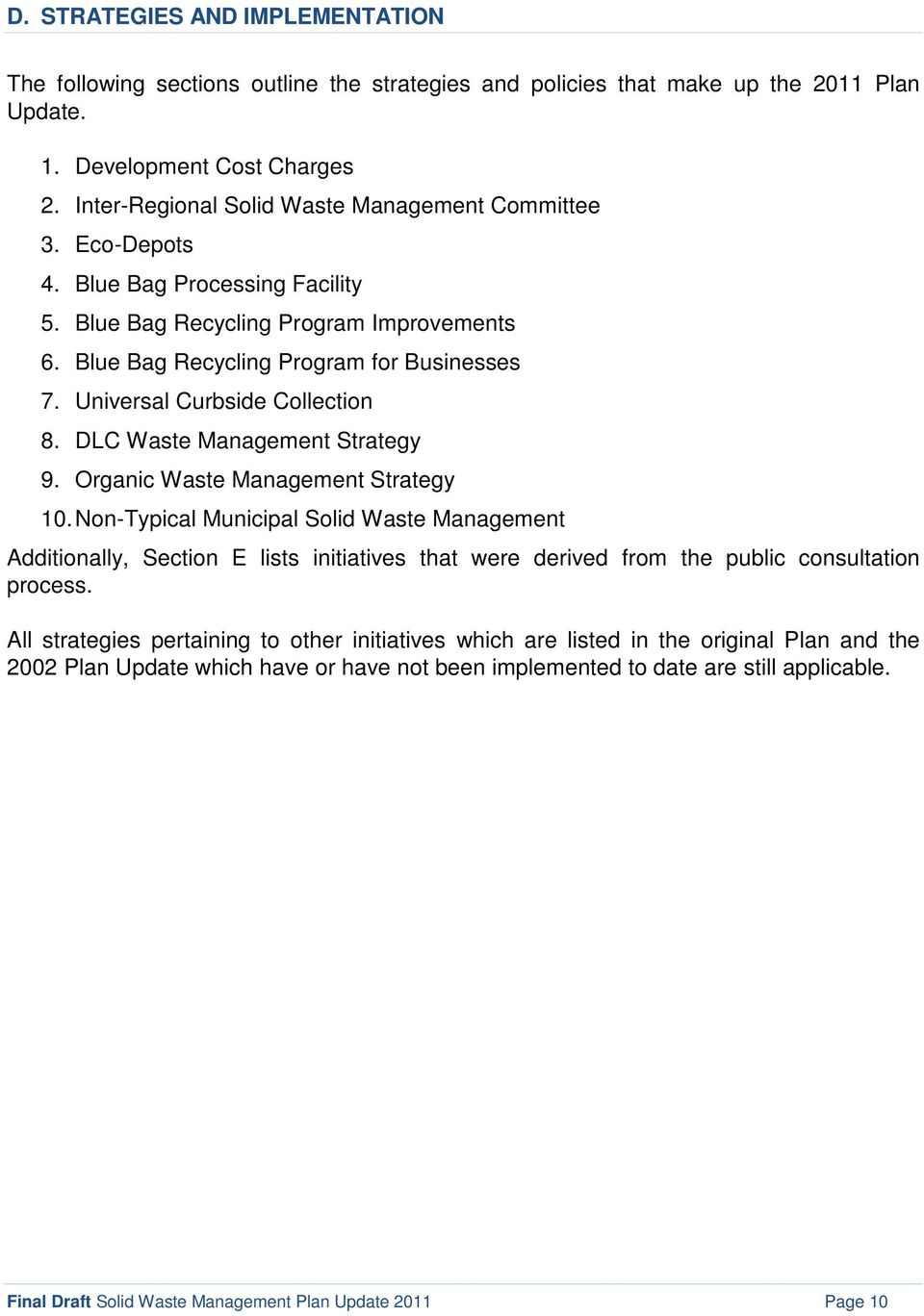
10 D. STRATEGIES AND IMPLEMENTATION The following sections outline the strategies and policies that make up the 2011 Plan Update. 1. Development Cost Charges 2. Inter-Regional Solid Waste Management Committee 3. Eco-Depots 4. Blue Bag Processing Facility 5. Blue Bag Recycling Program Improvements 6. Blue Bag Recycling Program for Businesses 7. Universal Curbside Collection 8. DLC Waste Management Strategy 9. Organic Waste Management Strategy 10. Non-Typical Municipal Solid Waste Management Additionally, Section E lists initiatives that were derived from the public consultation process. All strategies pertaining to other initiatives which are listed in the original Plan and the 2002 Plan Update which have or have not been implemented to date are still applicable. Final Draft Solid Waste Management Plan Update 2011 Page 10
11 1.0 Development Cost Charges Description of Review Topic Assess the ways and means of using development cost charges (DCCs) for solid waste management infrastructure. Diversion Potential Implementation Period Estimated Cost N/A 5 yrs N/A 1.1 Action Statement Determine the process necessary to enable local governments to include solid waste management infrastructure in their Development Cost Charge (DCC) Bylaws and to initiate this process such that the Province amends the Local Government Act to include Solid Waste Management infrastructure in DCC Bylaws by Potential Implementation a) The first step was to take a resolution to the Southern Interior Local Government Association (SILGA) to get support from other jurisdictions to have the Province amend the Local Government Act to authorize collection of DCCs for solid waste management infrastructure. b) The draft resolution that was supported by the RDNO Board of Directors at their regular meeting on March 2, 2011 was as follows: WHEREAS the Local Government Act (Section ) allows municipalities and regional districts to collect development cost charges from developers, for municipal parks, water, sewage, drainage and highways but not for municipal solid waste infrastructure; AND WHEREAS the costs to expand municipal solid waste infrastructure capacity or upgrade facilities to accommodate population growth are substantial and can be assessed; AND WHEREAS there is precedence for this type of funding, specifically, there are several jurisdictions in the United States of America that allow municipalities to use a form of development cost charges to help fund solid waste management infrastructure; THEREFORE BE IT RESOLVED that the Provincial Government amend the Local Government Act to authorize collection of development cost charges by municipalities and regional districts for municipal solid waste infrastructure. Final Draft Solid Waste Management Plan Update 2011 Page 11

12 c) The resolution was not presented at the SILGA so it will be forwarded to the Union of BC Municipalities for consideration at their conference in Spring, d) A positive outcome at UBCM may help push this issue onto the Provincial Government s agenda and result in an amendment to the Local Government Act. e) If legislation is changed, encourage member municipalities to develop DCC bylaws or amend current bylaws to include DCCs for waste management infrastructure. f) If there is no support through these channels, then the initiative should be dropped. 1.3 Performance Measurement 1. The Province agrees to consider amendments to the Local Government Act to allow DCCs for solid waste management infrastructure. 2. Identification of solid waste management infrastructure which would be eligible for funding thorough DCC s and amendment or establishment of the appropriate DCC Bylaws. Final Draft Solid Waste Management Plan Update 2011 Page 12
13 2.0 Inter-Regional Solid Waste Management Committee Description of Review Topic Establish a formal interregional Solid Waste Management Committee to facilitate valley wide cooperation on solid waste management issues Diversion Potential Implementation Period Estimated Cost N/A 2 yrs N/A 2.1 Action Statement Determine the level of interest on the part of solid waste management staff, municipal councils and regional district Boards of Directors to establish an interregional Solid Waste Management Committee to facilitate valley wide cooperation on solid waste management issues. If there is interest, RDNO Solid Waste Management staff will work cooperatively with other solid waste management staff in the southern interior to develop terms of reference for such a committee with the objective of having an Interregional Solid Waste Management Committee in place by the end of Potential Implementation a) Invite other southern interior regional districts to participate in a workshop to determine the level of interest in establishing an interregional Solid Waste Management Committee. b) If there is sufficient interest in establishing such a committee from surrounding regional districts that a committee is warranted, establish a working group to develop and finalize a memorandum of understanding that lays out the terms of reference for the committee, including representation (staff and/or directors/councilors), meeting times, hosting, reporting, agenda development etc. 2.3 Performance Measurement 1. Scheduling of workshop to determine level of interest in establishing an interregional Solid Waste Management Committee 2. Development, distribution and adoption of memorandum of understanding between neighboring jurisdictions which includes terms of reference for Interregional Solid Waste Management Committee. Final Draft Solid Waste Management Plan Update 2011 Page 13

14 3.0 Eco-Depot Collection System Description of Review Topic Diversion Potential Implementation Period Estimated Cost $200,000 capital (shared with Stewards) Evaluate eco-depot concepts and locations especially with respect to customer convenience and land use in the region tonnes/year 2 5 yrs 3.1 Action Statement Evaluate the technical and economic feasibility of establishing eco-depots at one or more locations in the regional district which would provide one-stop-drop locations for recyclable material managed by the RDNO and products managed by industry stewards under the BC Recycling Regulation by the end of 2013 and provide a recommendation to the Board of Directors with respect to the establishment of one or more eco-depots in the regional district by the end of Potential Implementation a) Evaluate the technical and economic feasibility of establishing eco-depots at one or more locations in the regional district b) Determine the level of interest amongst product stewards to provide funding to establish one or more eco-depots at RDNO Recycling and Disposal Facilities and/or private depots. c) Develop a design and operating specifications for eco-depots to be located at one or more RDNO Recycling and Disposal Facilities and provide a business case analysis to the Board of Directors for consideration. d) Upon Board of Directors approval, develop operating agreements with the industry stewards and establish eco-depots at one or more RDNO RDFs based on a full cost recovery basis. e) Develop and implement a communication and education plan with the assistance of the stewards (financial and content) designed to maximize the amount of material diverted from disposal. 3.3 Performance Measurement 1. Evaluation of technical and economic feasibility of establishing eco-depots. 2. Finalization of operating agreements with industry stewards. 3. Establishment of eco-depots at one or more RDNO Recycling and Disposal Facilities. and/or private depots. 4. Increase in quantity of material collected, processed and recycled. Final Draft Solid Waste Management Plan Update 2011 Page 14

15 4.0 Improved Blue Bag Processing System and Facility Description of Review Topic Diversion Potential Implementation Period Estimated Cost Continue to operate the current Blue Bag processing system and facility with minor capital improvement until such time as more details about the provincial EPR program for packaging and printed paper are known. 2,000 tonnes/ year 1 2 yrs $3 Million (new building) capital plus $250,000/year operating (depending on structure of agreement) 4.1 Action Statement As soon as possible, award a three to five year contract to one of the proponents involved in the Request for Proposals (RFP) process started in 2010, to upgrade and operate the RDNO Material Recovery Facility (MRF) on Birnie Road, with the RDNO providing some funding towards short term capital improvements. Within the next three years, work with the packaging and printed paper industry stewardship agencies to ensure that at least the existing RDNO Blue Bag Recycling Program is maintained, and that in future, funding for the Program is provided through the stewardship agencies. 4.2 Potential Implementation In May 2011, the Province announced that the Recycling Regulation had been amended to include packaging and printed paper and stewardship programs were to be implemented in three years. This changed the timeline on the MRF RFP process so the three proponents that submitted proposals as requested were asked to re-submit proposals for the operation of the existing facility for three to five years only, with minor capital improvement. a) Once evaluation of the proposals is completed, prepare a report for the Board of Directors with recommendations regarding contract award, and a short term funding strategy for the processing of Blue Bag Recycling Program material. b) Consult with the packaging and printed paper stewards to determine how materials collected in the RDNO will be processed in the future and if the RDNO MRF will be needed in any capacity (e.g. sorting and/or baling and marketing). c) If the RDNO s MRF is needed, develop a long term agreement with the stewardship agency(s) on a full cost recovery basis. d) Assess the need for a new MRF in the RDNO based on the long term needs of the stewardship agency(s). Final Draft Solid Waste Management Plan Update 2011 Page 15
16 4.3 Performance Measurement 1. Finalization of a short term agreement with a contractor that will operate and maintain the current MRF on Birnie Road with minor capital improvements. 2. Development of a long term agreement with the stewardship agency(s) to fund RDNO recycling programs. 3. Improved operational efficiency at the MRF in the RDNO to control per tonne processing costs and enhance the working environment for processing staff. 4. Increased quantities of recyclable material processed. Final Draft Solid Waste Management Plan Update 2011 Page 16
17 5.0(a) Expanded Recycling Programs - Textiles Description of Topic Reviewed Diversion Potential Implementation Period Estimated Cost Evaluate the curbside Blue Bag Program and the Drop Centre Program (RDFs and Glass Collection Depots) to determine if the program should be expanded (e) (number of locations, etc) and enhanced to include other materials such as textiles(a), fluorescents (b), agriculture plastics (c), and other plastic products such as toys and pipe (d). Also evaluate whether or not shredded paper should be included or sent to composting facilities tonnes per year per capita (2007) 2 5 yrs $70,000 capital and $84,000 per year operating 5.1 Action Statement The RDNO will evaluate the technical and economic feasibility of implementing a textiles recycling program that would provide curbside and/or drop centre collection of old, unusable and unsoiled clothing, rags, linens, etc. for sorting and recycling at a regional MRF by the end of Present the Board of Directors with a business case analysis of such a program for their consideration, approval and implementation by the end of Potential Implementation a) Within two years, investigate the used textiles market and evaluate the feasibility of a textiles recycling program including program design and operating costs, and if feasible provide a business case to the Board of Directors for approval. b) Upon approval, implement the program. c) Develop and implement a communication and education plan. 5.3 Performance Measurement 1. Increased annual quantity diverted from landfill once program initiated. 2. Increased quantity of recyclable material processed and shipped to market. Final Draft Solid Waste Management Plan Update 2011 Page 17

18 5.0(b) Expanded Recycling Programs Agricultural Plastics Description of Topic Reviewed Diversion Potential Implementation Period Estimated Cost See 5.0(a) 300 tonnes/year 2 5 yrs $130/tonne 5.1 Action Statement Although not considered municipal solid waste, agricultural waste plastics will be managed by the RDNO to ensure proper disposal and recycling of this material. Therefore, within the next five years, the RDNO will undertake a pilot program to determine the diversion potential, operational considerations, and associated costs for a region wide agricultural plastic waste diversion and recycling program, and will make recommendations to the Board of Directors for implementation of such a program based on the results of the pilot program. If an EPR program is implemented for this material within the next three to five years by industry or the Province, the RDNO will support this program instead. 5.2 Potential Implementation a) Undertake agricultural waste recycling pilot program for two years. b) Evaluate results of pilot program and if feasible provide a business case to the Board of Directors for approval. c) Determine the locations that will be used for collecting agricultural plastics and the markets available for the material. d) Design the program, invite stakeholders to review the program design and then finalize the program. e) Add new operational requirements to the RDF site operator s contracts. f) Develop and implement a communication and education plan. g) Report to the Board of Directors after one and a half years with recommendations for continuation of the pilot, implementation of a formal program or discontinuation of the pilot (no future program). 5.3 Performance Measurement 1. Increased quantity of recyclable material processed and shipped to market. 2. Successful pilot program (good participation). Final Draft Solid Waste Management Plan Update 2011 Page 18

19 5.0(c) Expanded Recycling Programs Bulky Plastic Products Description of Topic Reviewed Diversion Potential Implementation Period See 5.0(a) unknown 2 5 yrs Estimated Cost Include in Eco-Depot cost or Agriculture Plastic Program costs 5.1 Action Statement The RDNO will evaluate the feasibility of implementing a recycling program for bulky plastic products, starting with a drop off style program. If an Extended Producer Responsibility (EPR) program is implemented by the Province or voluntarily by industry within five years for these items, the RDNO will support this program instead. 5.2 Potential Implementation a) Within four years, staff will investigate markets for different types of bulky plastic products such as toys, tarps, furniture and drums, and if available and stable, determine a recycling program design and operating costs, and then provide a business case to the Board of Directors for approval. b) If EPR programs are implemented either voluntarily or under the Recycling Regulation, support implementation of such on a cost recovery basis. c) Upon approval, implement the program until EPR can take over. d) Encourage the private and not-for-profit sector to implement re-use programs, especially for refurbished toys. e) Develop and implement a communication and education plan. 5.3 Performance Measurement 1. Increased annual quantity diverted from landfill once program initiated. 2. Increased quantity of recyclable material processed and shipped to market. Final Draft Solid Waste Management Plan Update 2011 Page 19

20 5.0(d) Expanded Recycling Programs Fluorescent Light Tubes and Bulbs Description of Topic Reviewed See 5.0(a) Diversion Potential None (vapour only) Implementation Period 0 yrs Estimated Cost Processing - $4,000/yr and hazardous waste landfill costs - $200/year 5.1 Action Statement The RDNO will continue to decrease the amount of mercury going to landfill by accepting commercially generated fluorescent light tubes and bulbs for processing at the GVRDF, but will not accept bulbs and tubes from the residential sector, since these are now handled through a Provincially approved stewardship program. 5.2 Potential Implementation a) Ensure residential fluorescent tubes and bulbs are on the list of Regulated Material (Schedule B) in the RDNO Municipal Solid Waste Management Bylaw (Bylaw). b) Continue to accept commercial quantities of fluorescent light tubes and bulbs at the Greater Vernon, Armstrong/Spallumcheen and Lumby Recycling and Disposal Facilities for processing and disposal. c) Direct all residents to drop off residential generated fluorescent tubes and bulbs at the Stewardship depots. d) Randomly inspect residential disposal of waste to determine if tubes and bulbs are being disposed and enforce the Bylaw accordingly. 5.3 Performance Measurement 2. Increase in number of fluorescent tubes and bulbs dropped off at Recycling and Disposal Facilities for processing and prevented from being disposed. Final Draft Solid Waste Management Plan Update 2011 Page 20

21 5.0(e) Expanded Recycling Programs Two New Drop Centres Description of Topic Reviewed Diversion Potential Implementation Period See 5.0(a) Unknown 2 5 yrs Estimated Cost $400,000 capital, 120,000 /yr operating 5.1 Action Statement If a curbside program for collection of recyclable material for businesses within the RDNO is not implemented within three years by either member municipalities or the RDNO, the RDNO will consider expanding current recycling programs by adding two new drop off locations north of Enderby and north of Vernon, near the north end of Swan Lake. A primary objective is to partner with the private sector and Product Stewards where possible. 5.2 Potential Implementation a) If curbside recycling programs for businesses are not implemented within three years in all municipalities in the RDNO, staff will evaluate locations for two new drop centre facilities for Blue Bag recyclable material north of Enderby and north of Vernon. b) Determine the location costs through purchase or lease, determine the drop centre design and operating costs, and then provide a business case to the Board of Directors for approval. c) Upon approval, implement the drop centres and procure an operator. d) Develop and implement a communication and education plan. 5.3 Performance Measurement 1. Increased annual quantity diverted from landfill once program initiated. 2. Increased quantity of recyclable material processed and shipped to market. Final Draft Solid Waste Management Plan Update 2011 Page 21
22 6.0 Blue Bag Collection Program for Businesses Description of Review Topic Determine the best method for including businesses in the Blue Bag Recycling Program. Diversion Potential Implementation Period 500 tonnes/year 2 5 yrs Estimated Cost Cost recovery through collection contracts 6.1 Action Statement Within three years, the RDNO will investigate the implementation of a region-wide Blue Bag Recycling Program for businesses. For those jurisdictions interested, the RDNO will assist, and if desired, add the service to the RDNO s existing residential curbside Blue Bag Collection Program. If an Extended Producer Responsibility (EPR) program is implemented by the Province or voluntarily by industry within three years for packaging and printed paper generated by the commercial sector, the RDNO will support this program instead. 6.2 Implementation a) Determine which member municipalities wish to implement a curbside Blue Bag Recycling Program for businesses and if they would like RDNO assistance in implementing such programs. b) Provide options and estimated costs to interested member municipalities. c) Prepare a report for the Board of Directors outlining the options for provision of the service to businesses. d) If a specific option is approved, implement the option and if not, the initiative should be dropped. e) Develop and implement a communication and education plan if a new program is initiated. 6.3 Performance Measurement 1. Implementation of expanded Blue Bag collection program for businesses in all jurisdictions to further divert recyclables from landfill. 2. Increased quantity of recyclable material processed and shipped to market. Final Draft Solid Waste Management Plan Update 2011 Page 22
23 7.0 Universal Curbside Garbage and Recyclable Material Collection Program Description Diversion Potential Implementation Period Estimated Cost Determine the economic viability of a Universal Curbside Collection Program for all residential generated materials: garbage, compostables, and recyclables whether managed by the RDNO or by individual municipalities. 5,000 tonnes/year 2 5 yrs Cost recovery through collection contracts (saving to customers: 20% per household/month) 7.1 Action Statement Within the next three years and when requested by member municipalities and Electoral Areas, the RDNO will assist with the implementation of a universal garbage collection service through a regional or sub-regional tendering process, with the member municipalities having the option to manage contracts themselves. The RDNO will investigate implementing automated curbside collection, using carts, for all areas currently being served by the Blue Bag Recycling Program. If implemented, universal collection will reduce the number of self-haulers driving to RDFs through many neighborhoods, in turn reducing the number of vehicles on the road and their associated GHG emissions. This will contribute to regional and local GHG reduction targets that are set within the Regional Growth Strategy and Official Community Plans. This type of universal program would also potentially assist with reducing the amount of solid waste burned in the rural areas and increase the amount of compostable and recyclable material diverted from landfill. 7.2 Potential Implementation a) Evaluate the results of the garbage collection survey distributed to Electoral Areas B, C and D and prepare a report with recommendations for the Board of Directors outlining options for universal curbside collection. b) If the Board of Directors approves implementation of a universal curbside collection program in the Electoral Areas, invite stakeholders to a meeting to discuss implementation, develop a draft tender document and issue the tender. c) Implement a communication and education plan regarding universal curbside collection. Final Draft Solid Waste Management Plan Update 2011 Page 23
24 7.3 Performance Measurement 1. Increased diversion of recyclable material from landfill. 2. Reduced lineups at the RDFs by reduction of self hauler traffic with associated decreased service complaints from self haulers. 3. Decreased number of open burning fires. 4. Decreased wear and tear on roads and increased safety on roads (anecdotal). Final Draft Solid Waste Management Plan Update 2011 Page 24
25 8.0 Construction and Demolition Waste Management Strategy Description of Review Topic Examine mechanisms for further diversion of demolition, landclearing and construction (DLC) waste, including but not limited to, private and public resource recovery parks and partnerships with industry. Diversion Potential 13,400 tonnes/year Implementation Period 1 5 yrs Estimated Cost Potential additional grinding costs if material does not go to private Resource Recovery Facility (RRF) and $22,000/year education/promotion 8.1 Action Statements The following initiatives for demolition, landclearing and construction waste types will be considered for implementation within the next five years: Concrete: If private diversion alternatives become available, ban concrete from RDFs to divert the material to these facilities. Plastics & Fibre: Implement disincentives for including this material in loads when recycling alternatives are available. Metal: Implement more disincentives for including this material in loads when recycling alternatives exist. Asphalt: Separate all used asphalt and use for hard surfacing areas where needed at RDFs. Clean Wood: Encourage reuse as much as possible (e.g. firewood). Separate clean from dirty wood where possible. Chip and use for composting, mulch, and/or co-gen. Contaminated Wood: Separate clean from dirty wood where possible. Chip and use for roads, tipping pads and for daily cover mixed 50/50 with soil. Recognize potential for airborne hazardous particles. Consider supplying co-gen facilities where possible. Final Draft Solid Waste Management Plan Update 2011 Page 25
26 Mixed Demolition: Strongly encourage deconstruction wherever and whenever possible. Require hazardous waste assessment prior to demolition. Implement more disincentives for not pre-sorting recyclable material. Consider a sorting operation at some RDFs. Mixed Construction: Implement more disincentives for not pre-sorting recyclable material. Consider a sorting operation at some RDFs. Landclearing: Encourage stump cleaning before arrival. Chip and use for composting, mulch, and/or cogen. 8.2 Potential Implementation a) Within the next five years, develop a program design including operating costs for each initiative and seek approval from the Board of Directors. b) Upon approval, implement the program. c) Design and implement a communication and education plan for any new DLC waste management programs. 8.3 Performance Measurement 1. Increased diversion of DLC waste materials from landfill. 2. Reduced import of materials for day to day operations (i.e. road base etc.). Final Draft Solid Waste Management Plan Update 2011 Page 26
27 9.0 Organic Waste Management Strategy Description of Review Topic Determine the best management strategy for organic waste including wood and yard waste from the Demolition, Landclearing and Construction (DLC), Residential, Commercial, Industrial, and Agricultural sectors; and food waste from the Residential, Commercial, Industrial and Agricultural sectors. Diversion Potential 4,750 7,050 tonnes/year Implementation Period 1-10 yrs Estimated Cost Gas Tax Grant for new yard waste composting facility: $1M plus $125,000/year operating; $50,000 capital for north Vernon depot and $47,500 /year operating; and cost recovery through collection contracts 9.1 Action Statements The following initiatives and programs for organic waste management will be considered for implementation within the next ten years: Within 0 2 Years: 1 Natural Landscaping and Yard Care Program 2 Master Composter Program 3 Backyard Composter/ Vermicomposter Incentive Program (including review) 4 Mandatory Yard Waste Separation 5 Expanded Yard Waste Drop Off Network Invest in increasing the profile of its existing program through a renewed educational and promotional program, including cooperation with landscape professionals, garden centres and big box hardware stores. Develop a program possibly with neighboring regions and host Train the Trainer type workshops. Determine the effectiveness of the existing Composter Sale held bi-annually to see if more subsidized sales are warranted. Periodically inspect loads of refuse to determine if yard waste is being disposed and apply surcharges as per the Municipal Solid Waste Management Bylaw. Determine feasibility of providing three new drop off depots: Coldstream, Enderby & north end of Vernon. Final Draft Solid Waste Management Plan Update 2011 Page 27
28 Within 0 2 Years: 6 Expanded Christmas Tree Collection 7 Improved Wood Waste Segregation Program 8 Regional Yard Waste Composting Facility 9 Promote Development of Private Facilities 10 Mulch Production (feasibility study only) 11 Regional Coordination of Wood Waste Management Determine feasibility of providing a drop off service in Enderby, Lumby, Spallumcheen and Armstrong. Segregate wood and yard waste at RDFs into its most useful components for existing operations and programs: small debris for composting directly, large branches, clean wood, dirty wood, stumps and logs. Construct the planned facility at the GVRDF and produce a good quality marketable product. Cost recovery through GVRDF user fees should be the primary funding mechanism. Provide waste characterization information to private food waste composting facility developers, and establish policies and bylaws to provide a framework for facilities to operating within (e.g. Waste Stream Management Licenses). Assess the demand for mulch in the region and if positive then determine feasibility of filling the demand using clean wood waste received at RDFs. Work with adjacent jurisdictions to coordinate wood waste uses and supply contracts to reduce competition for existing markets. Within 3 5 Years: 12 Periodic Yard Waste Collection Facilitate curbside collection in all population centres, including expanding the collection period and ensuring consistent specifications. Within 5 10 Years: 13 Seasonal Yard Waste Collection 14 Expanded Regional Composting Initiative for Food Scraps Facilitate enhanced curbside collection in all population centres, including expanding the frequency (more seasons) and adding other organics such as food waste. Once the regional yard waste composting facility is functioning well, determine the feasibility of adding other organics such as specific food scraps to this facility or if a separate facility should be built or used on a contract basis (private facility). Final Draft Solid Waste Management Plan Update 2011 Page 28
29 Initiatives that will result in diversion of solid waste from landfills, especially a reduction in organic waste, will contribute to a reduction in landfill derived GHG emissions and contribute to achieving regional and local GHG reduction targets that are set within the Regional Growth Strategy and Official Community Plans. 9.2 Potential Implementation a) In the short term, consult with the member municipalities to determine if more frequent yard waste collection can occur in their jurisdictions, instead of just twice per year and encourage this for their next garbage collection contracts. b) Develop a program design, including operating costs, for each initiative and seek approval from the Board of Directors to implement. c) Upon approval, implement the program. d) Design and implement a communication and education plan. 9.3 Performance Measurement 1. Increased diversion of organic waste from landfill. 2. Decreased greenhouse gas emissions from RDFs. 3. Marketable end use compost to offset costs. Final Draft Solid Waste Management Plan Update 2011 Page 29
30 10.0 Non-Typical Municipal Solid Waste Disposal Policy Description of Review Topic Examine efficiencies and environmental protection needs with respect to including management of non-typical municipal solid wastes such as agricultural (e.g. plastics and slaughter waste) and industrial wastes (e.g. ash and wood), and water and wastewater treatment plant wastes in the SWMP. Diversion Potential N/A Implementation Period 1 5 yrs Estimated Cost May require additional handling costs at RDFs 10.1 Action Statement The following materials should be listed as acceptable for the purposes of disposal, recycling or reuse at RDNO Recycling and Disposal Facilities and authorized as such in the Solid Waste Management Plan, 2011 Update: 1. Hydrocarbon impacted soil 2. Agricultural plastics 3. Asbestos 4. Fibreglass manufacturing waste Disposal, recycling or reuse options require appropriate recycling and disposal fees to be set that reflect the amount of landfill capacity used and the operational requirements to manage each waste type Implementation a) Determine the changes required in RDF Operational Certificates to incorporate nontypical municipal solid waste and request amendments from the Ministry of Environment. b) Encourage the Province to develop Extended Producer Responsibility programs, especially for agricultural plastics, and if programs are implemented either voluntarily or under the Recycling Regulation, support implementation of such on a cost recovery basis. c) Confirm that RDNO bylaws are sufficient to accommodate extra costs and practices associated with the four material types Performance Measurement 1. Receipt of accurate and updated Operational Certificates from Ministry of Environment. 2. Tipping fees that reflect management costs of the non-typical materials. 3. Reduced disposal of non-typical material types at RDFs Final Draft Solid Waste Management Plan Update 2011 Page 30
31 E. ADDITIONAL STRATEGIES DERIVED FROM PUBLIC CONSULTATION During the public consultation and municipal referral phase of the Plan Review, a number of other initiatives were highlighted that could be implemented in the short term. E1. More Frequent Free Styrofoam Collection Events Action Statement: The RDNO will consider increasing the number of free Styrofoam collection events until Styrofoam packaging becomes part of an industry stewardship program. Implementation: Determine the costs associated with implementing more collection events and include in the annual Solid Waste Management budget. If approved in the budget organize the events. Performance Measurement: Increased amount of Styrofoam processed by RDNO E2. Implement a One Bag/Can Limit Action Statement: Within the next three years and before the next tendering cycle for garbage collection in each jurisdiction, a one bag/can per residence per week limit should be set in each garbage collection contract. Since 1996 the limit has been set at two bags/cans per residence per week. Unless stickers are purchased and attached to extra bags/cans set out, extra bags/cans will not be picked up. Fifteen years later, there are many more opportunities to reduce, reuse and recycle, and with stickers available for purchase, the lower limit should not be a hardship on large families. Implementation: RDNO will meet with member municipalities to discuss the change from a two bag/can limit to a one bag/can limit as soon as possible to encourage inclusion of such in existing or new garbage collection contracts. If the RDNO takes on the role of tendering and/or setting tendering specifications for collection services for member municipalities and electoral areas, the lower bag/can limit will be included in the specifications to help reduce the amount of waste being disposed and conserve landfill capacity, as encouraged under the Regional Solid Waste Management Memorandum of Understanding, to which all member municipalities are a signatory. Performance Measurement: Reduction in quantity of residential garbage being disposed by member municipalities and anecdotal acceptance of the lower bag/can limit. Final Draft Solid Waste Management Plan Update 2011 Page 31
32 E3. Enhanced Service at GVRDF for Commercial Haulers Action Statement: Evaluate the economic and operational implications of providing enhanced service for commercial haulers at the GVRDF. Enhanced service could potentially include a 7:00 a.m. opening for commercial customers only to help them avoid lineups at the scale. Enhanced service could also include a commercial only inbound lane at the GVRDF to reduce the amount of time large commercial customers spend waiting in line. Commercial haulers account for a small percentage of the total number of customers at the GVRDF (<20%), yet they account for more than 75% or total revenue. Implementation: Review the current level of service provided to commercial haulers and evaluate short term, medium term and long term option to improve the level of service. Undertake a cost/benefit analysis or such service level improvements. Performance Measurement: Improvement in commercial customer satisfaction anecdotal. E4. Audits for Large Waste Generators Action Statement: Consider offering a comprehensive waste audit to the 15 largest waste generators in the Region. Implementation: Assess who the fifteen largest waste generators in the RDNO might be and write to them requesting that they assist RDNO waste reduction staff in performing a waste audit. Conduct the audits using material already available on the RDNO web site or something similar used by other jurisdictions/agencies. Document the audits and provide recommendations to the generator. Performance Measurement: Reduction in amount of waste disposed by the individual generators. E5. Upgrade Communication Tools Action Statement: Upgrade the RDNO web site and other communication tools to help residents, businesses and others determine what can be recycled in the RDNO and where, ensuring to the greatest extent possible that content and any cost recovery comes from the agencies involved (especially industry stewards). Final Draft Solid Waste Management Plan Update 2011 Page 32
33 Implementation: Working with Information Systems staff, determine the best way to direct the public to Solid Waste Management information posted on the RDNO web site using the current web site. When the web site is upgraded, ensure the Extended Producer Responsibility (EPR) links are all still functioning well. Continue to include all EPR programs in newsletters and other publications going to the public. Look for other ways to help inform the public about EPR programs and provide this service on a cost recovery basis. Performance Measurement: Less complaints regarding where, how and when to recycling products in the RDNO. E6. Monitor Waste to Energy Technology Action Statement: The RDNO will monitor waste to energy technology as it becomes accessible to small communities in Canada. An unsolicited proposal from CanKor-Pacific Waste & Energy Ltd. was received by the Board of Directors on July 6, 2011 to install a multi-million dollar incinerator in the Enderby area on Splatsin Indian Band land. A thorough review of waste to energy as part of Phase 2 of the Plan Review indicated the RDNO is not in a position at this time to change course from landfilling municipal solid waste, but the Board of Directors would like to review this technology after five years. Final Draft Solid Waste Management Plan Update 2011 Page 33
34 F. RECYCLING AND DISPOSAL FACILITIES STATUS Refer to Table 1, Appendix B, for a comprehensive outline of the status of RDNO s Recycling and Disposal Facilities (RDF). With respect to RDF works, initiatives that capture landfill gas will contribute to a reduction in landfill derived GHG emissions and contribute to achieving regional and local GHG reduction targets that are set within the Regional Growth Strategy and Official Community Plans. Final Draft Solid Waste Management Plan Update 2011 Page 34
35 G. ANNUAL REPORTING OF PERFORMANCE Prepare and submit a report to the Board of Directors signed off by the General Manager each year by May 1 outlining the following: A. Solid Waste Management Plan Status 1. Implementation status of each initiative listed in the original Plan and all subsequent Plan Updates 2. Diversion target achievement 3. Plan monitoring process used 4. Waste diversion contingency plan if diversion target not achieved 5. Plan financing required B. Waste Reduction and Recycling 1. Data Tracking 2. Work Plan Implementation 3. Financial Information 4. Communication and Education 5. Priority Plans for 20XX C. Waste Disposal 1. Data Tracking 2. Work Plan Implementation 3. Financial Information 4. Communication & Education 5. Priority Plans for 20XX D. Administration 1. Staffing 2. Training 3. Occupational Health and Safety 4. Emergency Preparedness A very similar outline has been used annually since If a Solid Waste Management Plan Monitoring Committee is formed, they should be tasked with reviewing the annual report before it is submitted to the Board of Directors so that a list of recommendations may be developed if necessary to ensure the Plan is being implemented as intended. Final Draft Solid Waste Management Plan Update 2011 Page 35
36 APPENDIX A Phase 2 Overview - Technical Reports
37 PHASE 2 OVERVIEW - Technical Reports RDNO Solid Waste Management Framework for Next Ten Years - Updated: February 14,2011 Reports Prepared by Consultant (2) Administrative Use development cost charges for solid waste management infrastructure Presented Oct 6/10 to COTW; COTW recommended Oct 6/10 that BOD endorse for inclusion in Draft 2010 Update - was not, endorsed, however meeting called instead with Directors Lippert, Hansma & Acton Description Report on the ability to use DCCs for solid waste I management infrastructure. [Action: investigation required by RONO staffrequires changes to LGA, so lobby for the change if any appetite on Govt's part] I Waste ' Diversion Potential (tonnes/year) 0 N/A I Implementation Time Costs (1) Line i 5 yrs N/A r i I! I New Enterprise Fund - to financially assist waste reduction initiatives, Presented Oct 23/08 to COTW & Public; COTW recommended Nov 20/08 that BOD support in principle - Dec 10/08 BOD, supported in principle I Improved interregional waste management cooperation i Presented Oct 6/10 to COTW; COTW recommended Oct 6/10 that BOD endorse for inclusion in i Draft 2010 Update - endorsed Report on the establishment of a fund for municipal solid waste reduction projects/programs initiated by the private and non-profit sector. [Action: application prograrn already established - annual undertakinal,. Report on the feasibility of setting up an interregional municipal solid waste management committee similar to OBWB. [Action: establish interregional MOU - develop Terms of Reference for a Committee and list of interregional issues to work through] 5-10 tonneslyear N/A, '. I COmp1e"(8 2 yrs N/A $10,000/yr
38 Solid Waste Management Plan Review - Phase 2 Overview Page 2 of 5 I I Waste, Diversion Reports Prepared by Description ' Potential Consultant (2), (tonneslyear) I (3) Waste Reduction and Recycling NEW TOPIC ADDED by BOD 2010: Sorting Facility at RDFs Presented Feb 2/11 to COTW; NOT endorsed to include in Plan Update principle - Dec BOD, supported in principle i Improved Blue Bag processing system and facility on ITW& ed Nov Presented Oct 23/08 to COTW & Public; Tabled pending CFO review; RFP process for replacing MRF approved by BOD Sept 2/09; RFP issued Feb 11/11 Investigate the feasibility of implementing predisposal sorting of all garbage entering RDFs I Report 0 i coliectioi material stop-drol I...' - [Action: : to see if funded t y I-'roaucr ::orewaras - IT so, aevelop design and operations plan in cooperation with all partners] Report on the establishment of a new, renovated or out of region Blue Bag material processing facility. [Action: Board decision to solicit proposals to build I year on current site (Birnie Road) - draft and release RFP] - I, 6% of garbage stream tonnes/year 2,000 tonnesl I, I Implementation Time Line N/A 2-5 yrs 1-2 yrs Costs (1) $85/tonne operating; Capital unknown $200,000 capital (shared with Stewards) i $3 Million (new building) capital plus $250,000/year operating (depending on revenue share agreement) I j I J I
39 Solid Waste Management Plan Review - Phase 2 Overview Page 3 of 5 Waste Diversion Implement- Reports Prepared by Description Potential ation Time Costs (1) Consultant (2) (tonnes/year) Line (3) Report on upgrades needed to the current Blue Improved curbside Blue Bag Bag curbside and depot collection programs to and drop center programs improve efficiency and increase quantity recycled. $557,500 capital, Presented Feb 2/11 to COTW; [expanded into EA F already /2009] 253,500/yr operating endorsed by BOD Feb 2111 ; 2, yrs (bulk of cost is for 2 COTW wants more in-depth report [Action: design programs for textiles, f/uorescents, tonneslyear new depots on Ag Plastics Program; see agriculture plastic, bulky plastic items collection; primarily) detailed recommendations in BOD and increase recycling program coverage (2 more report depots) New Blue Bag recycling program for the business sector Presented Feb 2/11 to COTW; endorsed by BOD Feb 2/11 ; see detailed recommendation in BOD report Report on implementation of a Blue Bag recycling program for the business sector. [City of Vernon started program in 2009 for all businesses in City] [Action: determine collection zones in the region (e.g. Armstrong, Vernon, Lumby, Enderby) and develop RFP with franchise options.] Cost recovery 500 tonneslyear 2-5 yrs through collection contracts New Regional universal curbside garbage and recyclables collection program Presented Feb 2/11 to COTW; endorsed by BOD; see detailed recommendation in BOD report Report on amalgamating all Blue Bag, garbage and yard waste collection programs in the RDNO. [developed Waste Management MOU between member municipalities and RDNO] [Action: develop new waste-shed collection areas and tender collection of Blue Bag and garbage together in all areas currently receiving Blue Bag collection (assess split truck option and adding yard/garden waste).} 5,000 tonneslyear Cost recovery through collection 2-5 yrs contracts (saving to customers: 20% per hhlmo)
40 Solid Waste Management Plan Review - Phase 2 Overview Page 4 of 5 Reports Prepared by Consultant (2) f--. New C&D waste management I strategy I. Presented Oct 23/08 to COTW & Public; COTW recommended Nov 20/08 that BOD support in principle - Dec 10/08 BOD supported in principle Description! Waste IO;.. B;OO implementation Time Potential (tonnes/year) 1-" line (3)... Report on establishment of a construction and I I demolition waste management strategy for the region. [increased tipping fee for mixed demoiition VV8ste - effective Juiv 201 [Action: implement strategy at all RDFs, including voluntary initiatives, regulatory & policy requirements, and economic incentives and disincentives.] I 13,400 tonnes/year 1-5 yrs Costs (1) Potential additional grinding costs if mati does not go to private ROF and $22,000/year i education/promotion New organic waste management strategy Presented Oct 23/08 to COTW &, Public; COTW recommended Nov 20/08 that BOD support in principle - Dec 10/08 BOD supported in principle Report on establishment of an organic waste. (including food waste) management strategy for I the region. I [Action: implement strategy including the Regional Yard Waste Composting Facility, conduct feasibility study for food waste composting primarily with private sector, expanded backyard i composting education, mandatory yard waste separation, expanded yard waste collection programs, expanded mulch production program, and improved wood waste segregation.] 4,750-7,050 tonnes/year 1-10 yrs Gas Tax Grant for RYWCF: $1 M plus $125,000/year operating; $50,000 capital for north Vernon depot and $47,500/year operating (and cost recovery through collection contracts) Waste Disposal New non-typical municipal solid waste disposal policy i Presented Oct 6/10 to COTW; COTW recommended Oct 6/10 that BOD endorse for inclusion in Draft 2010 Update - endorsed I Report on adding non-typical municipal solid waste to the RONa Solid Waste Management Plan, including collection, recycling and disposal of agricultural and industrial waste in the RONa's integrated waste management system. [Action: where Board and MOE approve, specify acceptance of renderable & non-renderable materials, agriculture wastes, treated biomedical waste, asbestos waste, contaminated soil, and N/A 1-5 yrs May require additional handling costs at ROFs
41 Solid Waste Management Plan Review - Phase 2 Overview Page 5 of 5 Reports Prepared by Consultant (2) Waste Diversion Implement- Description Potential ation Time Costs (1) (tonnes/year) Line (3) fibreglass manufacturing wast~ in SWMP since these materials are coming to the ROFs already I but are not considered MSWj! I 1 I,,~ >n the feasibility of establishing a municipal 'gy options I ste to energy facility in the North an. Capital recovery and to BOD- I N/A 5-10 yrs operating: $50/tonne re in SWMP where Board approves conduct a siting lsification ;ibilily study for a WTE facility in the and $115/tonne I I technology in 5 years ROND.] I NOTES: 1. Staff time is not included in the costs 2. Items in bold have been presented to the RDNO Board of Directors and the public 3. Additional tonnes compared to current diversion level F:\5200~5799 ENGINEERING and PUBLIC WORKS\5360 SOLID WASTE GENERAL\ Plan Reviews - Updates\ Review and Update\Phase 2\ nck tbl Phase 2 Overview.docx
42 APPENDIX B Recycling and Disposal Facilities Status 2011
43 Final 0, ~,( 2011 Plan Update, August 2011 Recycling and Disposal Facilities Status Page 1 of4 Greater Vernon - Operational Certificate MR II Year Open: 1980 Owner: Filling Rate: O&C Plan Status: Closing: 2034 RDNO (from 2007) 39,000 tonnes / year Completely revised in 2007; Draft for Closure Reserve: Operator: Materials Diverted: approval with MOE Bylaw 2438 Ansell Construction wood, yard waste, drywall, concrete, Current Contract: masonry, ceramics, asphalt, batteries, propane tanks, scrap Equipment used: metal & appliances, loader, compactor, roll off truck, water tank/pump asphalt roofing, tires, Styrofoam, mercury in bulbs, Blue Bag material, glass jars/bottles Planned Works (5-10 yrs): - New perimeter primary haul road - Fire water supply - Expanded entrance - Storm water management - Landfill gas collection system - Site building(s) [disposal reduction] - Composting facility - Drop off facility upgrade - Phased closure Armstrong/Spaliumcheen - Operational Certificate MR Year Open: 1910 Owner: Filling Rate: O&C Plan Status: Closing: 2034 RDNO (from 2000) 12,000 tonnes I year Completely revised in 2010; Draft for Closure Reserve: Operator: Materials Diverted: approval with MOE Bylaw 2438 Ansell Construction wood, yard waste, drywall, concrete, Current Contract: masonry, ceramics, asphalt, batteries, propane tanks, scrap Equipment used: metal & appliances,, loader, compactor, roll off tires, Styrofoam, truck, water tank/pump mercury in bulbs, Blue Bag material, glass jars/bottles Planned Works (5-10 yrs): - Storm water management - Landfill gas migration mitigation - Drop off facility upgrade - Alternative daily cover system - Berm installation - Hybrid poplar tree plantation expansion - Property acquisition - Phased closure - Haul road upgrade
44 Draft 2011 Plan Update Recycling and Disposal Facilities Status Page 2 of4 Lumby and Area D - Operational Certificate MR Year Open: 1972 Owner: Filling Rate: 1,700 O&C Plan Status: Planned Works (5-10 yrs): Closing: 2075 RDNO tonnes / year Completely revised in - Recyclable material drop off 2010; Draft for facility upgrade Closure Reserve: Operator: Materials Diverted: approval with MOE - Storm water management Bylaw 2438 RDNO (2 staff) wood, yard waste, system drywall, concrete, - Leachate management system Current Contract: masonry, ceramics, - Haul road upgrade asphalt, batteries, i propane tanks, Equipment used: scrap metal & Loader/ compactor appliances, tires, combo, fire tank mercury in bulbs, Blue Bag material, glass jars/bottles Cherryville - Operational Certificate MR Year Open: 1976 Owner: Garbage Transfer O&C Plan Status: Planned Works (5-10 yrs): Closed: 2008 (final RDNO [crown lease # Rate: Closure Plan revised - Drop off facility upgrade cap required) ] 280 tonnes / year in 2008 Closure Reserve: Operator: Materials Diverted: Bylaw 2438 Otteson Logging wood, yard waste, concrete, batteries, Current Contract:: propane tanks, scrap metal & appliances, tires, Equipment used: mercury in bulbs, e- Roll off - contractor waste, Blue Bag material, glass jars/bottles
45 Draft 2(',, Plan Update Recycling and Disposal Facilities Status Page Kingfisher/Hupel - Operational Certificate PR Year Open: 1974 Owner: Garbage Transfer O&C Plan Status: Planned Works (5-10 yrs): Closed & capped: RDNO Rate: Approved by MOE in - Drop off facility upgrade tonnes / year 2004 Operator: Closure Reserve: Dan's Bobcat Materials Diverted: I For post-closure wood, yard waste, monitoring only, Bylaw Current Contract:: concrete, batteries, I propane tanks, scrap metal & I Equipment used: appliances, tires, Roll off - contractor mercury in bulbs, e- waste, Blue Bag material, glass jars/bottles, paint Pottery Road RDF - Operational Certificate PR Year Open: 1972 Owner: Filling Rate: O&C Plan Status: Planned Works (5-10 yrs):! RDNO [Crown Lease o tonnes / year Original approved by - Landfill cap Closed: # ] MOE in Leachate, storm water, and cap still Materials Diverted: landfill gas management system pending but planned Operator: N/A Closure Plan due - Property acquisition for 2012 N/A October 2011 Closure Reserve: Bylaw 2438 Current Contract: N/A Equipment used: N/A.L ,
46 Draft 2011 Plan Update Recycling and Disposal Facilities Status Page 4 of4 Ashton Creek - Operational Certificate PR-6048 i Year Open: 1970 Owner: Filling Rate: Closure Plan Status: Planned Works (5-10 yrs): RDNO [Crown o tonnes / year Original approved by N/A Closed: Licence of Occupation MOE in , capped in 1997 # ] Materials Diverted: N/A Closure Reserve: Operator: Bylaw post N/A closure only Current Contract: N/A Equipment used: N/A Silver Star Mountain Transfer Station Year Open: 2000 Owner: GarbageTransfer O&C Plan Status: Planned Works (5-10 yrs): RDNO [Crown Rate: N/A - New concrete floor Closed: Licence of Occupation 260 tonnes / year N/A ] Materials Diverted: Closure Reserve: Operator: Blue Bag material, N/A Art Devries glass jars/bottles Current Contract: Equipment used: Roll off truck - Contractor's, and compactor
47 APPENDIX C Public Consultation Response
48 PublicComme..:eedback 2011 PI~. _pdate Page 1 of2 Strategy Comments From Open Houses Online Comments & Responses To Questionnaire Response Priority Armstrong ~ May 4 Vernon ~ May 11 Lumby ~ May 17 Gary Haas Author Unknown Vote Districts should work together to open a 1 DCCs 11 major center to accommodate the recyclign of all materials The DCC initiative remains part oftl-.a 2011 Plan Update. 2 The Interregional Solid Waste Mana;!ement If areas use the same formula to develop Inter~Regional Committee remains part of the 2011 Plan 6 a plan the costs will be equal among Cooperation Update. including development of the terms of participants reference. Include styrofoam at haz Good positive opportunity to For Styrofoam see 5c below. RDNO continues to It is important that all towns & villages waste roundups; battery drop markedly improve access work with Stewardship agencies thre.ugh the BC have a one stop recycle available and 3 Eco Depots 10 Establish 'one-stop-drop' in off locations not well known; availablltiy and convenience. Product Stewardship Counci1. Locati:m of depots that they use it. This should be checked central convenient location have more collection points hopefully with enhanced open is a priority as is communication and education. for EPR products (don't want until all people realize it is in the better hours and more convenient The eco-depot initiative remains an rnportant good for all the people. to go to Vernon all the time) disposals locatkms. j:art of the 2011 Plan Update. It is more economical to do curbside The RFP for a new MRF has been reissued to source separation and pick up different shorten the term to 3 to 5 years due to the items on different days to make sorting change in BC EPR programs and th3 inclusion of easier. RD should work with major stores 4 BBMRF 8 j:ackaging and printed paper. All Blue Bag to get them on board. Use of large material from residences and businesses will compactors should be stopped - use of tecome the responsibtiity of indust!) in three small containers could drive years. RONO has an auditing prg or request. development of a major business. 5, BS Improve ~Texti!es 2 Great idea There are methods to manage collection in rural Blue Bag pgm in rural areas Include dirtied items that can be areas. The RDNO can assist upon r-3quest. It is rediculous as bags are torn disposed of in an appropriate way. unlikely soiled textiles will be includej as this can open by animals I:e a health hazard. We should be doing this now and An industry stewardship program is :>Bing 5b BB Improve ~ Ag Ag plastics waste should retailers should take back used plastic. developed for this malerial ~ Clean Farms - but in 9 Plastics go back to retailer Could create a new company that picks the mean time this is included as a 2011 Plan up and delivers r89'f!lr:t9.c.\!.i&ate inititative. EPR for toys is imminent, however RDNO may BB Improve - Bulky Want monthly styrofoam Like the idea of cleaning consider supporting re-use initiatives 5, 13 Should be a drop off service. Plastics pickup and re-using toys implemented by the private or not~for-proflt sector. This continues to be a drop off program at the 5d BB Improve - CFLs 9 Should not be a curbside pickup RDNO RDFs for commercial bulbs and tubes. program. lndusry Stewards manage drop off cepols for residentia.dwantitles. 5e In favour since the more opportunities BB I m prove - Drop Additional depots is included in the 2<l11 Plan 2 the better luck of having people dropping Centres Update draft. ltemsoff. 6 BB for Businesses 17 Should have been started by now. Businesses should take the lead as they are selling items that will need to be recycled. The Blue Bag Recycling Program fo- businesses initiative remains an important part d the 2011 Plan Update. In 3 to 5 years indust!) will be responsible for managing packaging and printed j::aper from the commercial sector nck public comment-new initiatives.xlsx 9f7f2011
49 Public Comments/Feedback 2011 Plan Update Page20f2 Strategy Comments From Open Houses Online Comments & Responses To Questionnaire Response Priority Armstrong - May 4 Vernon - May 11 Lumby - May 17 Gary Haas Vote Author Unknown 7 Universal Collection " Go to 1 can limit per week then to 1 can every other week The Universal Garbage Collection initiative remains part of the 2011 Plan Update and a new Residents should be able to opt out of initiative for one bag/can limit has been added: curbside collection (flag on the house) "Within the next three years and before the next and not pay taxes for the service. This tendering cycle for garbage collection in each should be checked 10 make sure people jurisdiction. a one bag/can per residence per not paying are disposing properly. If a week limit should be set in each garbage pgm is mandatory, a new flat rate should coliection contract. H Regardless of whether or be developed thai is similar to all other not all jurisdictions have a collection program in areas. Pickup should be reduced to one to 5 years, RDNO will continue to promote true day per week with all trucks operating in user pay programs (pay as you throw), which all areas on the same day. could include automated collection using the cart system, in these jurisdictions that do have a universal coliection program. This should be happening now if businesses want to be known as OLC Management 8 9 responsible. Contracts should include Strategy how waste is managed hand out brochures to this end. This OLC initiative remains part of the 2011 Plan Update which includes education and awareness. Organics We should be doing this now and product 9 Management 15 should be available to communities in all Strategy areas. Yard waste management remains an important part of the 2011 Plan Update. RONO will encourage more frequent yard waste collection in all future tenders in jurisdictions with collection programs. Food scraps diversion is included in the Organics Management Strategy in the 5 10 year period, however if the private sector takes the initiative RONO will support a viable alternative. RDNO-Gro will be made available for sale in These materials should not 10 Non-Typical MSW 7 go into landfills where will they go? The ag community should come up with a viable way to treat all the animal waste so it doesn't leach inlo the water chain. The meat industry should have a recycle program even if they work with the RD to develop one. Acceptance of non-typical MSW remains part of the 2011 Plan Update on a controlled basis through MOE approvals and public consultaton where needed. With non-typical MSW in the SWMP, the RDNO would work with the ag sector to help reduce disposal. Other other Other Other L nck publi ment-new initiatives.xlsx 9f Open scales earlier for commercial haulers Why are tipping fees so much higharthan Kelowna? Enhanced service for commercial haulers has been added as a new initiatwe to the 2011 Plan Update: w valuate the economic and operational implications of providing enhanced service for commercial haulers at the GVRDF. W [paraphrased) Improve access This is going backward in time and away from (more hours. better location. less controlled disposal to protect the environment. or no fees, less restrictions) 10 help Author provided no datafinformation on quantity reduce iljegal dumping and protect of illegal dumping. Jitter or hazardous waste not environment. ~d.qq.sed. Again, this would be going backward and away [paraphrased] Reconsider focus 0 n from controlling the impacts of disposal on the capturing all waste in environment environment. No datalinformation provided on instead of having good well quantity waste management programs are not managed facilities. capturing and what the impacts are on Ihe environment. It is the RON D's understanding that the City of KeJowna has sufficient closure reserves whereas the RONO does not at this time. A substantial portion of the tipping fees is designated for landfil closure and capital works.
50 Municipal Corr,ts/Feedback 2011 Pia, pdate 'ge 1013 Strategy Referral Comments From Member Municipalities Response City of Vernon City of Armstrong Township of Spallumcheen District of Coldstream would be willing to implement a 1 DCCs DCC bylaw for SWM as long as The OCC initiative remains part of the 2011 Plan Update. uses for such are dearly defined 2 supports this and would like to Inter-Regional see an elected representative The Interregional Solid Waste Management Committee remains part of the Cooperation from each jurisdiction on such a 2011 Plan Update, including development of the terms of reference. committee 3 Eco Depots Do we need to build a new 4 BBMRF MRF? Consider processing BB mati outside the region. The RFP for a new MRF has been reissued to shorten the term to 3 to 5 years due to the change in BC EPR programs and the inclusion of packaging and printed paper. All Blue Bag material will become the responsibility of industry in three years. 5a BB Improve -Textiles Request that this not apply to All #5 items: agrees with Spallumcheen as residents are wholeheartedly - take care not to encouraged to support not-fortake on responsibility of profit societies due to the stewards - set up an education potential a universal pgm may plan for EPR items (to keep out negatively impact their of landfills) organizations (Kindale, Armstrong ladies Auxilliary). EPR is complex and some programs are still having growing pains and the new ones have yet to be fully developed, with the public being confused and frustrated from time to time. The RONO is represented on the BC Product Stewardship Council and as such continues to 'lobby' for smooth transition to 100% industry responsibility, including financial. New programs designed by RONO will consider the impacts on not-far-profit organizations and small business. Improved communication has been added as a new 2011 Plan Update initiative: WUpgrade the RONO web site and other communication tools to help residents, businesses and others determine what can be recycled in the RONO and where, ensuring to the greatest extent possible that content and any cost recovery comes from the agencies involved (especialfy industry stewards). ~ 5b BB Improve" Ag Spallumcheen supports efforts An industry stewardship program is being developed for this material - Clean Plastics towards recycling of Ag plastics. Farms - but in the mean time this is included as a 2011 Plan Update inititative. 5c BB Improve - Bulky Plastics 5d BB Improve - CFls 5. BB Improve - Drop Centres agrees with wholeheartedly: RONO should coordinate exhaust all avenues under #6 6 BB for Businesses recycling for businesses not before moving on item 5e; very individual jurisdictions much in support of BB couection for businesses '- ~- The Blue Bag Recycling Program for businesses initiative remains an important part of the 2011 Plan Update. In 3 to 5 years industry will be responsible for managing packaging and printed paper from the commercial sector nck public comment-new initiatives.xlsx " 9f712Q11
51 Municipal Comments/Feedback 2011 Plan Update Page 2 of 3 Strategy Referral Comments From Member Municipalities Response 7 Universal Collection has concerns with jurisdictions not having universal collection * garbage should be managed in this day and age! The Universal Garbage Collection initiative remains part of the 2011 Plan Update and a new initiative for one bag/can limit has been added: "Within the The Township would like to next three years and before the next tendering cycle for garbage collection in maintain its individuality in supports including the option of each jurisdiction, a one bag/can per residence per week limit should be set in regards to refuse and recycling a 'per bag fee' if and when each garbage couection contract. n Regardless of whether or not all collection and not be included in considering universal collection jurisdictions have a collection program in 3 to 5 years, RONO will continue to the Universal Curbside Program promote true user pay programs (pay as you throw), which could include automated collection using the cart system, in those jurisdictions that do have a universal collection program. S OLC Management Strategy 9 address yard waste pickup Organics Management throughout the growing Strategy season more sufficiently (self haul not acceptable) supports investigation of au avenues to divert organics from disposal * this should be a high priority including food waste diversion Yard waste management remains an important part of the 2011 Plan Update. RONO will encourage more frequent yard waste collection in au future tenders in jurisdictions with collection programs. Food scraps diversion is included in the Organics Management Strategy in the 5 * 10 year period, however if the private sector takes the initiative RDND will support a viable alternative. 10 Non*Typical MSW Other address GHGs through The SWMP has been a modeling exercise, setting successful pgm, extending the GHG language has been added to the 2011 Plan Update similar to that in the individual targets, and life span of the local landfill sites Regional Growth Strategy. collaboration mechanisms by 15 years. Guiding Principles: consider RONa is continually looking to Waste audits for large waste generators has been added to the 2011 Plan Other offering a waste audit to the 15 expand its services under the Update as a new initiative: ~Consider offering a comprehensive waste audit to largest generators in the region. SWMP. the 15 largest waste generators in the Region. ~ Other supports the RONa forming a standing cmtee to review the SWM Plan in accordance with requirements under EMA A Plan Monitoring Committee is specified in the original plan and first Plan Update (2002), so the formation of such could be recommended to the Board of Directors at any time. Other address waste management at multi*family and mixed use developments as densification occurs The Township wants to ensure it retains the ability to support the local organizations in regards to the recycling of goods. Waste management at commercial and multi*family residential buildings is considered in the original plan and first Plan Update (2002): 'The RONa wif! encourage its member municipalities to develop bylaws requiring that new muft, unit and/or mufli*familydeve/opmenfs (greater than four units in one building) provide adequate space for integrated waste management. This could also be a business license requirement for commercial buildings. The space would include areas for storage of waste, (ecyclables and compostabfes. ~ advocates increased As a member of the BCPSC, the RONO continues to advocate for higher Other deposit/retum charges for deposit/retum charges on beverage containers to help increase the amount of beverage containers this product diverted from landfill nck put: -nment*new initiatives.xlsx *
52 Municipal Co: ~nts/feedback 2011 PI< Jpdate 'age 3 of 3, Strategy Referral Comments From Member Municipalities Response Spallumcheen Garbage Services have been providing RONa does not doubt the abilities of a local service provider but seeks Other excellent services and have held efficiencies and protection of infrastructure as much as practically and the garbage & recycling contract politically possible. for many years. Other cons lder sponsoring a 'free cycle' program where used household items would be placed at the curb for reuse Along with other garbage collection initiatives being promoted, the RONO will consider promoting the addition of 'free_cycie K events for future collection tenders. Other There is concem that the The SWMP attempts to foster efficiencies where possible, including economies SWMP attempts to take away of scale and enhanced service levels without cost burden increases. RONa is smaller communitie's congnizant of protecting solid waste management infrastructure and complying individuality in regards to with regulations, therefore must set standards for waste management in the garbage collection and recycling region. of materials nck public comment-new initiatives.xlsx - 9/7/2011
City of Key West, Florida Solid Waste Master Plan Executive Summary
 The City of Key West (City) retained Kessler Consulting, Inc. (KCI) to assist in developing a Solid Waste Master Plan (Plan). The purpose of the Plan is to analyze the City s existing solid waste system,
FACTS ABOUT: Recycling MONTGOMERY COUNTY RECYCLING
 Maryland Department of the Environment FACTS ABOUT: Recycling MONTGOMERY COUNTY RECYCLING Coordinator/Staff Eileen Kao, Chief, Waste Reduction and Recycling Section Alan Pultyniewicz, Recycling Coordinator
MEMORANDUM 1. INTRODUCTION 2. METHODS FOR FINANCING AND WASTE FLOW MANAGEMENT. John Sedley. Russ Smith, Anke Bergner, Capital Regional District
 MEMORANDUM TO: Russ Smith, Anke Bergner, Capital Regional District cc. John Sedley FROM: Konrad Fichtner, P.Eng. FOR INFO OF: PLEASE RESPOND BY: PROJECT No.: 5130323 00 RE: Solid Waste System Financing
DRAFT SOLID WASTE AND RESOURCE MANAGEMENT PLAN STAGE 2 REPORT FOR CONSULTATION
 DRAFT SOLID WASTE AND RESOURCE MANAGEMENT PLAN STAGE 2 REPORT FOR CONSULTATION Submitted to: Squamish Lillooet Regional District Box 219, 1350 Aster Street Pemberton, BC V0N 2L0 Submitted by: Todd Baker,
Integrated Solid Waste and Resource Management
 Integrated Solid Waste and Resource Management a Solid Waste Management Plan for the Greater Vancouver Regional District and Member Municipalities JULY 2010 4284355 www.metrovancouver.org Table of Contents
Waste Diversion Update. Quality of Life & Environment Committee January 26 th 2015
 Waste Diversion Update Quality of Life & Environment Committee January 26 th 2015 Purpose Discuss status of Zero Waste efforts and goals Discuss current outreach programs, partnerships, and policies to
City of Toronto Waste Audits Presented to Residual Waste Working Group
 City of Toronto Waste Audits Presented to Residual Waste Working Group City of Toronto Solid Waste Management Services Policy & Planning Irene Ford Monday February 11 th, 2008 Outline Waste Audits Conducted
Source Reduction, on-site handling and processing of Solid waste. CE 431: Solid Waste Management
 Source Reduction, on-site handling and processing of Solid waste CE 431: Solid Waste Management Functional Elements of Waste Management System Source Reduction/Waste Minimization First element of any waste
Summit County Energy Plan - Goals A. Explanation and Comparison: State and Summit County Goals B. Measurement and Verification
 Summit County Energy Plan - Goals A. Explanation and Comparison: State and Summit County Goals B. Measurement and Verification A. Explanation and Comparison: State and Summit County Goals In 2007, Colorado
ORDINANCE NO. 3 OF 2009
 PENN TOWNSHIP CUMBERLAND COUNTY BOARD OF SUPERVISORS 1301 Centerville Road Tel: 717-486-3104 Newville, PA 17241 Fax: 717-486-3522 Email: [email protected] Website: www.penntwpcc.org ORDINANCE NO. 3 OF
3.1.8 Utilities and Service Systems
 3.1.8 Utilities and Service Systems This section discusses potential impacts to utilities and service systems, including water, wastewater, and solid waste hauling and disposal, resulting from the implementation
Improving Canada s Record on Reducing and Recycling Waste. SWANA Northern Lights Conference May 14, 2015
 Improving Canada s Record on Reducing and Recycling Waste SWANA Northern Lights Conference May 14, 2015 Canadian Council of Ministers of the Environment Association for all 14 ministers of environment
Too Good to Waste MAKING CONSERVATION A PRIORITY
 Too Good to Waste MAKING CONSERVATION A PRIORITY Contents 5 7 8 9 10 10 14 18 22 INTRODUCTION > Why Does Alberta Need a Waste Strategy Focused on Conservation? > Principles for Waste Management and Resource
Food Scraps Diversion in the City of Los Angeles
 Food Scraps Diversion in the City of Los Angeles A Presentation at Moving Forward on Commercial Food Scraps Diversion Southern California Policies and Processes Workshop By Alexander E. Helou, P.E. Assistant
Charrette Small Group Session Friday, January 27. 8:30 am 10:00 am
 Construction & Demolition Recycling Charrette Small Group Session Friday, January 27 th 8:30 am 10:00 am What is C&D? As defined by NC DENR, C&D solid waste is solid waste generated solely from the construction,
Business Recycling. Prepared by Charmaine Johnson, Rusk County Recycling Coordinator
 Business Recycling Prepared by Charmaine Johnson, Rusk County Recycling Coordinator Roles of Recycling Coordinator Administer the recycling programs for our RU (Responsible Unit) including 11 residential
Climate Action Revenue Incentive (CARIP) Public Report for 2013
 March 6, 2013 Climate Revenue Incentive Plan (CARIP) Public Report Climate Revenue Incentive (CARIP) Public Report for 2013 City of Quesnel Reported by: Tanya Turner [email protected] Contents General
IV. ENVIRONMENTAL IMPACT ANALYSIS L. UTILITIES AND SERVICE SYSTEMS 3. SOLID WASTE AND DISPOSAL
 IV. ENVIRONMENTAL IMPACT ANALYSIS L. UTILITIES AND SERVICE SYSTEMS 3. SOLID WASTE AND DISPOSAL ENVIRONMENTAL SETTING Within the City, solid waste management, including collection and disposal services
How To Help The European People
 Manifesto for proper food waste management in the Mediterranean Basin 1 This Manifesto focuses on food waste collection and recycling, having acknowledged the priority of the strategies of source reduction,
Construction & Demolition Waste Management in Green Star Discussion Paper
 Construction & Demolition Waste Management in Green Star Discussion Paper 1 Construction & Demolition Waste Management in Green Star - Discussion Paper Construction & Demolition Waste Management in Green
BURNIE WASTE MANAGEMENT STRATEGY 2013-2017
 BURNIE WASTE MANAGEMENT STRATEGY 2013-2017 October 2013 COUNCIL STRATEGY Burnie Waste Management Strategy 2013-2017 Approved By: Council Document Code: CD-WS-W-001 Doc Controller: Director Works and Services
NEW YORK STATE DEPARTMENT OF ENVIRONMENTAL CONSERVATION RECYCLING PROGRAM. Report 2008-S-142 OFFICE OF THE NEW YORK STATE COMPTROLLER
 Thomas P. DiNapoli COMPTROLLER OFFICE OF THE NEW YORK STATE COMPTROLLER DIVISION OF STATE GOVERNMENT ACCOUNTABILITY Audit Objectives...2 Audit Results - Summary...2 Background...3 Audit Findings and Recommendations...4
Municipal waste management in Austria
 Municipal waste management in Austria Prepared by Márton Herczeg ETC/SCP February 2013 EEA project manager Almut Reichel Author affiliation Márton Herczeg, Copenhagen Resource Institute, http://www.cri.dk/
Chair Tom Galloway and Members of the Administration and Finance Committee UPDATE - CORPORATE ENVIRONMENTAL SUSTAINABILITY STRATEGY
 REGION OF WATERLOO CORPORATE RESOURCES Facilities Management & Fleet Services TO: Chair Tom Galloway and Members of the Administration and Finance Committee DATE: May 13, 2008 FILE CODE: A26-50(A) SUBJECT:
Page intentionally left blank.
 2014 Business Plan Page intentionally left blank. WDO Business Plan 2014 Table of Contents EXECUTIVE SUMMARY... 1 1.0 Waste Diversion Ontario Overview... 2 2.0 A Review of 2013... 3 3.0 Strategic Approach...
THE PRICE OF SOLID WASTE MANAGEMENT SERVICES IN VERMONT
 THE PRICE OF SOLID WASTE MANAGEMENT SERVICES IN VERMONT 2005 Overview of Survey Results FINAL REPORT July 2005 Prepared for: Vermont Department of Environmental Conservation Solid Waste Program 103 South
R4R GUIDELINES FOR LOCAL AND REGIONAL AUTHORITIES
 R4R GUIDELINES FOR LOCAL AND REGIONAL AUTHORITIES Helping cities and regions to improve their selective collection and recycling strategies November 2014 1. THE R4R PROJECT IN A NUTSHELL 1.1 The birth
Fairfax County Solid Waste Management Objectives
 Chapter 4 Fairfax County Solid Waste Management Objectives Incorporating the Overall Objectives for Fairfax County s Solid Waste Management Program in the SWMP This chapter presents the overall objectives
RESIDENTIAL SERVICES. compost recycle landfill
 RESIDENTIAL SERVICES LANDFILL compost recycle landfill for service information GREENWASTE OF PALO ALTO 2000 Geng Road Palo Alto, CA 94303 650.493.4894 [email protected] for program information
Iowa Smart Planning. Legislative Guide March 2011
 Iowa Smart Planning Legislative Guide March 2011 Rebuild Iowa Office Wallace State Office Building 529 East 9 th St Des Moines, IA 50319 515-242-5004 www.rio.iowa.gov Iowa Smart Planning Legislation The
AGRICULTURAL WASTE REDUCTION
 AGRICULTURAL WASTE REDUCTION Thurston County Solid Waste Waste reduction, the combination of waste prevention and recycling efforts, makes good financial sense. In addition to financial advantages, waste
San Francisco Zero Waste Policies & Programs. Jack Macy Department of the Environment City and County of San Francisco
 San Francisco Zero Waste Policies & Programs Jack Macy Department of the Environment City and County of San Francisco Zero Waste for Sustainability Conserve Resources Need FOUR planets if every one consumed
QUESTIONS AND ANSWERS ABOUT AUTOMATED COLLECTION
 QUESTIONS AND ANSWERS ABOUT AUTOMATED COLLECTION March, 2009 1. Q. What is automated collection? A. Automated collection is a system where garbage, recycling, and yard waste carts are emptied using a mechanical
Local Government Requirements: A Handbook for CHILD CARE PROVIDERS
 Local Government Requirements: A Handbook for CHILD CARE PROVIDERS KEY QUESTIONS to ASK YOUR MUNICIPAL/REGIONAL DISTRICT OFFICE: Do local land-use laws allow me to operate a child care facility on my chosen
DEVELOPMENT OF NATIONAL WASTE MANAGEMENT STRATEGIES IN SRI LANKA
 DEVELOPMENT OF NATIONAL WASTE MANAGEMENT STRATEGIES IN SRI LANKA M J J Fernando Deputy Director General (Education and Awareness) Project Director Project for Construction of Sanitary Landfill Central
PS: Think Recycling. How to Implement and Administer a Successful Polystyrene Recycling Program. Thinking Clean.
 PS: Think Recycling How to Implement and Administer a Successful Polystyrene Recycling Program Thinking Clean. Acting Green. 1 Recycle Expanded Polystyrene 2 Understand EPS Packaging 3 Start an EPS Recycling
3 JOINT SOURCE SEPARATED ORGANICS TREATMENT FACILITY STATUS REPORT - PROJECT 71335
 3 JOINT SOURCE SEPARATED ORGANICS TREATMENT FACILITY STATUS REPORT - PROJECT 71335 The Environmental Services Committee recommends the adoption of the recommendation contained in the following report dated
5. Environmental Analysis
 5.11 The potential for adverse impacts on utilities and service systems was evaluated based on information concerning current service levels and the ability of the service providers to accommodate the
Introduction to Waste Treatment Technologies. Contents. Household waste
 Contents Introduction to waste treatment technologies 3 Section 1: The treatment of recyclable waste 4 Bulking facilities 5 Materials Reclamation Facility (MRF) 6 Reuse and recycling centres 8 Composting
WASTE MANAGEMENT APPROACH IN THE EMIRATES OF ABU DHABI (Focus Waste to Energy) Dr. Udayan Banerjee Center of Waste Management Abu Dhabi
 WASTE MANAGEMENT APPROACH IN THE EMIRATES OF ABU DHABI (Focus Waste to Energy) Dr. Udayan Banerjee Center of Waste Management Abu Dhabi National Regulatory Framework UAE Federal Law # 24 of 1999 - Protection
Biomass Supply Chains in South Hampshire
 Biomass Supply Chains in South Hampshire 1 Executive Summary This report provides an analysis of how biomass supply chains could be developed within the area covered by the Partnership for Urban South
Memorandum SAN JOSE CAPITAL OF SILICON VALLEY ENVIRONMENT COMMITTEE RECOMMENDATION
 T&E AGENDA: 05-07-12 ITEM: d(4) CITY OF ~ SAN JOSE CAPITAL OF SILICON VALLEY TO - TRANSPORTATION AND ENVIRONMENT COMMITTEE Memorandum FROM: Kerrie Romanow SUBJECT: COMMERCIAL SOLID WASTE DATE: TRANSITION
Waste Management Action Plan 2011-2015
 Waste Management Action Plan 2011-2015 Approved on: 7 June 2011 Owner: Program Manager, 8203 7723 Trim Reference: ACC2011/77875 Next Review Date: June 2014 Executive Summary This Waste Management Action
Department of Public Works. Recycling policy for buildings and civil infrastructure
 Department of Public Works Recycling policy for buildings and civil infrastructure A whole-of-government recycling policy for buildings and civil infrastructure Policy statement The Queensland Government
Consultation Focus Groups. Household Waste & Recycling Collection Contract 2017
 Consultation Focus Groups Household Waste & Recycling Collection Contract 2017 Why are we here? To consider a range of options for Household Waste & Recycling collection services from 2017 To guide the
action plan water for life water for life action plan 1
 action plan water for life water for life action plan 1 ISBN 978-0-7785-7672-3 November 2009 2 water for life action plan TABLE OF CONTENTS Introduction 3 Alberta Water Council renewal recommendations
Policy Statement Goal A: Ecosystem Preservation and Protection. Discussion Draft for Public Consultation Page 1 of 10
 Discussion Draft for Public Consultation Page 1 of 10 Strategic Plan Potential Objectives and Examples of Strategies and Activities for the 2014-2018 Term Discussion Draft for Public Consultation June
SUBDIVISION AND DEVELOPMENT REGULATION
 Province of Alberta MUNICIPAL GOVERNMENT ACT SUBDIVISION AND DEVELOPMENT REGULATION Alberta Regulation 43/2002 With amendments up to and including Alberta Regulation 119/2014 Office Consolidation Published
DATE: June 16, 2014 REPORT NO. PW2014-050. Chair and Members Committee of the Whole Operations and Administration
 PUBLIC WORKS COMMISSION PUBLIC WORKS COMMISSION DATE: June 16, 2014 REPORT NO. PW2014-050 TO: FROM: Chair and Members Committee of the Whole Operations and Administration Geoff Rae, MBA, P.Eng. General
WASTE STORAGE AND COLLECTION GUIDANCE FOR NEW DEVELOPMENTS
 WASTE STORAGE AND COLLECTION GUIDANCE FOR NEW DEVELOPMENTS CONTENTS Page 1 Introduction 2 2 Planning Applications 3 3 Internal Segregation of Waste 3 4 Housing Developments 4 5 Apartment Developments 5-6
Vancouver Landfill Gas Capture Optimization Project
 May 11, 2015 Vancouver Landfill Gas Capture Optimization Project Allocation of GHG Reduction Credits to Metro Vancouver and its Member Municipalities 2014 Reporting Year This report was prepared by the
Waste Management. Background
 Waste Management Background Overview of current waste management In 1970, the main method of waste disposal in Iceland was open-pit burning. Over 50 burning pits were in operation, close to one pit per
City of Surrey Approach to a Fully Integrated Organic Waste Management System
 City of Surrey Approach to a Fully Integrated Organic Waste Management System PCP National Measures Report 2012 June 27 th, 2013 1:00 pm to 2:30 pm Webinar THE VISION To fuel Surrey s waste trucks with
Getting Started: 10 Questions for Cities and Towns Considering Residential Curbside Composting
 Getting Started: 10 Questions for Cities and Towns Considering Residential Curbside Composting In recent years, an increasing number of municipalities have begun to explore the economic and environmental
2.0 NEED FOR THE DEVELOPMENT & CONSIDERATION OF ALTERNATIVES
 2.0 NEED FOR THE DEVELOPMENT & CONSIDERATION OF ALTERNATIVES 2.1 This chapter outlines how the need for this proposed development has been established, where planning policy supports it, the alternative
Victoria City 2010 Community Energy and Emissions Inventory Monitoring and reporting on progress towards greenhouse gas emissions reduction targets
 1,000s of tonnes Victoria City Page 1 of 6 2010 GHG Emissions Sources (Total for this Community) 2010 GHG Emissions Sources (Total for BC) GHG Emissions Comparisons for this Community 12% 7% 250 200 40%
C&D Waste Diversion in Other Jurisdictions. Maria Kelleher 20 th July, 2006
 C&D Waste Diversion in Other Jurisdictions Maria Kelleher 20 th July, 2006 Best Practices Research to look at what others are doing is underway Focus on active drivers not passive ones, such as voluntary
THE CORPORATION OF DELTA "DELTA GARBAGE COLLECTION & REGULATION BYLAW NO. 4273, 1988"
 THE CORPORATION OF DELTA "DELTA GARBAGE COLLECTION & REGULATION BYLAW NO. 4273, 1988" A consolidation of Bylaw No. 4273 incorporating amendments pursuant to Bylaws No. 4462, 5613, 5708, 6236, 6642, 6824,
AGENCY SUMMARY NARRATIVE
 AGENCY SUMMARY Mission Statement and Statutory Authority DEQ s mission is to be a leader in restoring, maintaining and enhancing the quality of Oregon s air, water and land. The Department of Environmental
What day will my recycling be collected? Collection will continue to be on your regular pick up day the same day as your garbage pick up.
 Recycling FAQs General Program Information What is the new recycling program? The Village of Addison has answered residents requests for a larger recycling container. Residents told us they wanted a larger
How to implement a Recycling Policy and begin the journey towards Zero Waste
 How to implement a Recycling Policy and begin the journey towards Zero Waste CONTENTS: Objective and Timeline Gain Management Support Selecting a Recycling Coordinator Research Select Recyclers Set up
Massachusetts Local Disaster Debris Management Plan Checklist Updated July 2014
 Massachusetts Local Disaster Debris Management Plan Checklist Updated July 2014 This checklist is a companion document to the Massachusetts Disaster Debris Management Planning: An Introduction for Local
City of Philadelphia Solid Waste & Recycling Advisory Committee July 23, 2015
 City of Philadelphia Solid Waste & Recycling Advisory Committee July 23, 2015 Agenda Call to Order M. Feldman Plan Intro / Catch-up P. Bresee Chapter 5 Review J. Osborn Structure Key Elements SWRAC Input
Sweden. Pal Martensson from the City of Goteborg Sweden. 9,4 million inhabitants. 450 000 km 2
 Sweden Pal Martensson from the City of Goteborg Sweden. 9,4 million inhabitants 450 000 km 2 Goteborg a fast growing sustainable city Sweden s second city Scandinavia s largest port Car and truck industry
THE SUSTAINABLE WASTE MANAGEMENT IN THE CITY OF RIO DE JANEIRO
 THE SUSTAINABLE WASTE MANAGEMENT IN THE CITY OF RIO DE JANEIRO The search for environmental and economic sustainability with social responsibility José Henrique Penido Monteiro COMLURB Cia. Municipal de
Los Angeles Regional Collaborative For Climate Action & Sustainability CHARTER PREAMBLE
 CHARTER PREAMBLE The United Nations World Council on the Environment and Development defines sustainability as the ability to meet the needs of the present without compromising the ability of future generations
K A N S A S DEPARTMENT OF HEALTH AND ENVIRONMENT PERMIT APPLICATION FOR A RECLAMATION FACILITY. 1. Applicant's Name
 K A N S A S DEPARTMENT OF HEALTH AND ENVIRONMENT PERMIT APPLICATION FOR A RECLAMATION FACILITY 1. Applicant's Name Address (Street or Rural Route) (City & State) (Zip) Person to contact Title Phone Fax
EXECUTIVE SUMMARY. Introduction. Waste Characterisation. Public Perception Survey
 EXECUTIVE SUMMARY Introduction This is an Executive Summary of the second Integrated Management Plan (IWMP) of the Nelson Mandela Bay Municipality (NMBM), defining the NMBM s plan for solid waste in all
Corporate Carbon Neutral Plan
 This Carbon Neutral Plan will guide the District of 100 Mile House decision making process in terms of reducing corporate energy consumption and greenhouse gas emissions and in achieving carbon neutrality.
Climate Change and Waste The Missing Link December 2010 Written by Jacob Gregory
 Climate Change and Waste The Missing Link December 2010 Written by Jacob Gregory Strategies being used to mitigate climate change in Canada are largely focused on curtailing emissions from energy production:
Packaging Management Law 5771 2011
 1 This is an unofficial translation. The binding version is the official Hebrew text. Readers are consequently advised to consult qualified professional counsel before making any decision in connection
Energy Production from Municipal Waste: Business Potential and Project Opportunities
 Energy Production from Municipal Waste: Business Potential and Project Opportunities MARTIAL BECK, Vice President & General Manager, European Chamber of Commerce of the Philippines www.renewables-made-in-germany.com
METRO REGIONAL GOVERNMENT Records Retention Schedule
 Organizational Placement: Schedule number: 2013-0003 Division: Natural Areas Program: Nature in Neighborhoods The Nature in Neighborhoods program is an inter-departmental collaboration with responsibilities
Central coast regional district integrated strategic plan 2015 2019
 Central coast regional district integrated strategic plan 2015 2019 Adopted & Endorsed: March 12, 2015 FOREWORD The Central Coast Regional District is very appreciative and grateful for all participation,
Recycling of end-of-life building glass
 Recycling of end-of-life building glass Glass for Europe s contribution June 2013 The increased attention paid to resource efficiency, sustainable use of natural resources and sustainable buildings has
City of Toronto Solid Waste Management Services Waste Management Programs. Solid Waste Management Services. Delegation from the Republic of Latvia
 City of Toronto Solid Waste Management Services Waste Management Programs Delegation from the Republic of Latvia March 3, 2014 Vincent Sferrazza, Director, Policy, Planning & Support Solid Waste Management
Asbestos Storage Facility Plan Examples
 Asbestos Storage Facility Plan Examples The purpose of this document This document contains examples of what an operational plan, plans and specification, contingency plan and closure plan should look
CITY of richmond design ConsIderaTIons for CommerCIal ProPerTIes: recycling and garbage
 CITY of richmond design considerations for Commercial Properties: Recycling and Garbage 1 design considerations: Recycling and Garbage 1 Introduction Goals, Responsibilities 3 KEY STRATEGIES 4 STORAGE