
How To Use A Switch 2610 Series (Non Pwr) For A Long Time
|
|
|
- Corey Gilmore
- 5 years ago
- Views:
Transcription
1 Installation and Getting Started Guide ProCurve Switch 2610 Series PoE Power over Ethernet Devices

2

3 ProCurve Switch 2610 Series Installation and Getting Started Guide

4 Copyright 2007, 2008 Hewlett-Packard Development Company, L.P. Publication Number November 2008 Applicable Products ProCurve Switch ProCurve Switch /12PWR ProCurve Switch PWR ProCurve Switch ProCurve Switch PWR ProCurve 600 Redundant and External Power Supply ProCurve 610 External Power Supply (J9085A) (J9086A) (J9087A) (J9088A) (J9089A) (J8168A) (J8169A) Disclaimer HEWLETT-PACKARD COMPANY MAKES NO WARRANTY OF ANY KIND WITH REGARD TO THIS MATERIAL, INCLUDING, BUT NOT LIMITED TO, THE IMPLIED WARRANTIES OF MERCHANTABILITY AND FITNESS FOR A PARTICULAR PURPOSE. Hewlett-Packard shall not be liable for errors contained herein or for incidental or consequential damages in connection with the furnishing, performance, or use of this material. The information contained herein is subject to change without notice. The only warranties for HP products and services are set forth in the express warranty statements accompanying such products and services. Nothing herein should be construed as constituting an additional warranty. HP shall not be liable for technical or editorial errors or omissions contained herein. Hewlett-Packard assumes no responsibility for the use or reliability of its software on equipment that is not furnished by Hewlett-Packard. Warranty See the Customer Support/Warranty booklet included with the product. A copy of the specific warranty terms applicable to your Hewlett-Packard products and replacement parts can be obtained from your HP Sales and Service Office or authorized dealer. Safety Before installing and operating these products, please read the Installation Precautions in chapter 2, Installing the Switch 2610 Series, and the safety statements in appendix C, Safety and EMC Regulatory Statements. Hewlett-Packard Company 8000 Foothills Boulevard, m/s 5552 Roseville, California

5 Contents 1 Introducing the Switch Front of the Switch Network Ports LEDs Port LEDs LED Mode Select Button and Indicator LEDs Reset Button Clear Button Console Port Back of the Switch RPS and EPS Input Port Power Connector Switch Features Installing the Switch Included Parts Installation Precautions Installation Procedures Prepare the Installation Site Verify the Switch Passes Self Test LED Behavior Mount the Switch Rack or Cabinet Mounting Rack Mounting the 2610-PWR switches Rack Mounting the Non-PWR Switches Flat Wall Mounting Wall mounting Horizontal Horizontal Surface Mounting Connect the Switch to a Power Source Connect the Network Cables Using the RJ-45 Connectors iii

6 6. Installing or Removing mini-gbics Installing the mini-gbics: Removing the mini-gbics Connecting Cables to mini-gbics (Optional) Connect a Redundant Power Supply to a Switch 2610-PWR Series The 600 RPS/EPS provides two types of power to the switches: 2-19 The 610 EPS only provides external PoE power: RPS/EPS Operation Operating Characteristics of the 600 RPS/EPS (J8168A) Operating Characteristics of the 610 EPS (J8169A) RPS/EPS LEDs EPS LEDs (Optional) Connect a Console to the Switch Terminal Configuration Direct Console Access Sample Network Topologies for Non-PWR Switches As a Desktop Switch As a Segment Switch Connecting to a Backbone Switch Sample Network Topologies for PWR Switches As a Desktop Switch Implementing PoE As a Segment Switch Implementing PoE Stacking the Switch Configuring the Switch Recommended Minimal Configuration Using the Console Setup Screen Where to Go From Here Using the IP Address for Remote Switch Management Starting a Telnet Session Starting a Web Browser Session Troubleshooting Basic Troubleshooting Tips Diagnosing with the LEDs LED patterns for General Switch Troubleshooting iv
7 LED Patterns for PoE Troubleshooting Proactive Networking Hardware Diagnostic Tests Testing the Switch by Resetting It Checking the Switch LEDs Checking Console Messages Testing Twisted-Pair Cabling Testing Switch-to-Device Network Communications Testing End-to-End Network Communications Restoring the Factory Default Configuration Downloading New Switch Software HP Customer Support Services Before Calling Support A Switch Specifications Physical A-1 Electrical A-1 RPS/EPS Electrical Input A-2 Environmental A-2 BTU Ratings A-2 Acoustics A-3 Connectors A-3 Cable Length A-4 Safety A-4 Lasers A-4 B Switch Ports and Network Cables Switch Ports B-1 Twisted-Pair Cables B-1 Fiber-Optic Cables B-2 Mode Conditioning Patch Cord for Gigabit-LX B-3 Installing the Patch Cord B-4 Twisted-Pair Cable/Connector Pin-Outs B-5 v

8 Straight-through Twisted-Pair Cable for 10 Mbps or 100 Mbps Network Connections B-7 Cable Diagram B-7 Pin Assignments B-7 Crossover Twisted-Pair Cable for 10 Mbps or 100 Mbps Network Connection B-8 Cable Diagram B-8 Pin Assignments B-8 Straight-Through Twisted-Pair Cable for 1000 Mbps Network Connections B-9 Cable Diagram B-9 Pin Assignments B-9 C Safety and EMC Regulatory Statements Safety Information C-1 Informations concernant la sécurité C-2 Hinweise zur Sicherheit C-3 Considerazioni sulla sicurezza C-4 Consideraciones sobre seguridad C-5 Safety Information (Japan) C-6 Safety Information (China) C-7 EMC Regulatory Statements C-8 U.S.A C-8 Canada C-8 Australia/New Zealand C-8 Japan C-8 Korea C-9 Taiwan C-9 European Community C-10 D Recycle Statements Waste Electrical and Electronic Equipment (WEEE) Statements D-1 Index vi

9 Introducing the Switch The ProCurve Switch 2610 Series are multiport switches that can be used to build high-performance switched workgroup networks. These switches are store-and-forward devices that offer low latency for high-speed networking. The 2610-PWR Switches also support Redundant Power Supply and Power over Ethernet (PoE) technologies. 1 Introducing the Switch ProCurve Switch (J9085A) ProCurve Switch (J9088A) ProCurve Switch /12PWR (J9086A) ProCurve Switch PWR (J9087A) ProCurve Switch PWR (J9089A) 1-1

10 Introducing the Switch Introducing the Switch Throughout this manual, these switches will be referred to as the Switch 2610 Series and the Switch 2610-PWR Series. The Switch 2610 Series, has either 24 or 48 auto-sensing 10/100Base-TX RJ-45 ports with four Gigabit Uplink ports, two RJ-45 and two mini-gbic (Small Form Factor Pluggable (SFP)) slots. For a list of supported mini- GBICs see page The RJ-45 Gigabit Uplink ports are auto-sensing 10/100/1000Base-T. These ports operate independently, they are not dual-personality. The Switch 2610-PWR Series incorporate two additional features. These switches offer two types of power, one for switch AC operating power, and the other for Power over Ethernet (PoE) power: Power-over-Ethernet or PoE power - PoE technology allows IP telephones, wireless LAN Access Points and other appliances to receive power as well as data over existing LAN cabling, without needing to modify the existing Ethernet infrastructure. The Switch 2610-PWR Series are designed with an internal PoE power supply capable of providing 406 watts of PoE power (126 watts on the /12PWR). All of the Switch 2610-PWR ports can provide up to 15.4 watts (or 7.5 watts if all 12 ports are used on the /12PWR) of PoE power to connected devices. For further information regarding PoE power, see the PoE Planning and Implementation Guide, which is on the ProCurve Web site at (See page 1-12). Redundant and External Power Supply Support - The Switch PWR Series can be connected to a ProCurve 600 Redundant and External Power Supply (J8168A), hereafter referred to as the 600 RPS/EPS or a ProCurve 610 External Power Supply, hereafter referred to as the 610 EPS, and receive redundant power from that unit. As an RPS unit, the 600 RPS/ EPS will provide all the AC power necessary to keep the switch running should the switch internal AC power supply fail. As an EPS unit, the 600 RPS/EPS and the 610 EPS can supply up to 408 watts of PoE power to the switch if the internal PoE power supply of the switch should fail. When used with the Switch PWR, the additional EPS power can provide up to 15.4 watts per port for 48 ports. For further information regarding the 600 RPS/EPS or the 610 EPS PoE capabilities, see the PoE Planning and Implementation Guide, which is on the ProCurve Web site at (See page 1-12). These switches can be directly connected to computers, printers, and servers to provide dedicated bandwidth to those devices, and you can build a switched network infrastructure by connecting the switch to hubs, other switches, or routers. In addition, the Switch 2610 Series offer full network management capabilities. 1-2

11 Introducing the Switch Front of the Switch Power and Fault LEDs RPS, Fan and Test Status LEDs Front of the Switch Switch port LEDs ProCurve Switch Introducing the Switch Console Port Reset and Clear buttons LED Mode select button and indicator LEDs 10/100Base-TX RJ-45 ports 1 Uplink ports (1000Base-T 2 and mini-gbic) Power and Fault LEDs RPS, EPS, Fan and Test Status LEDs Switch port LEDs ProCurve Switch PWR Console Port Reset and Clear buttons LED Mode select button and indicator LEDs 10/100Base-TX RJ-45 ports 1 Uplink ports (1000Base-T 2 and Mini-GBIC) Power and Fault LEDs RPS, EPS, Fan and Test Status LEDs Switch port LEDs ProCurve Switch Reset and Clear buttons LED Mode select button and indicator LEDs 10/100Base-TX RJ-45 ports 1 Uplink ports (1000Base-T 2 and Mini-GBIC) Console Port 1 All 10/100Base-TX RJ-45 ports have the Auto-MDIX feature. 2 Two RJ-45 10/100/1000Base-T ports and two Mini-GBIC (SFP) slots. 1-3

12 Introducing the Switch Front of the Switch Network Ports Introducing the Switch 24, or 48 auto-sensing 10/100Base-TX ports. All these ports have the Auto-MDIX feature, which means that you can use either straight-through or crossover twisted-pair cables to connect any network devices to the switch. Two RJ-45 10/100/1000Base-T ports for high speed uplink. Two mini-gbic (SPF) slots for fiber uplinks. LEDs On the Switch 2610 Series, there are three groupings of LEDs: switch status LEDs (Table 1-1) port LEDs (Table 1-2) Port LED Mode indicator LEDs (near the selector button) (Table 1-3) Table 1-1. Switch Status LEDs Switch LEDs State Meaning Power (green) Fault (orange) Locator (blue) On Off Flashing 2 Off Flashing 2 On On Flashing Off The internal power supply is working properly. No power connection. The switch is NOT receiving power. A failure of the internal power supply. It should be flashing simultaneously with the Fault LED. (If an RPS is connected to the switch, the RPS is actively powering the switch, the RPS LED will be on.) The normal state; indicates there are no fault conditions on the switch. A fault has occurred with a component on the switch. The Status LED for the component with the fault will flash simultaneously. On briefly after the switch is powered on or reset, at the beginning of switch self test. If this LED is on for a prolonged time, the switch has encountered a fatal hardware failure, or has failed its self test. See chapter 4, Troubleshooting for more information. The Locator LED is used to locate a specific switch in an area full of switches. The LED can be set to be on solid or flash for a specified number of minutes (1-1440). The default is 30 minutes. Use the command chassislocate. 1-4

13 Introducing the Switch Front of the Switch Switch LEDs State Meaning PoE (green/ orange) 3 On Flashing/ orange 2 Flashing/ orange 1 Normal operation. The switch is ready to supply PoE power One or more ports has experienced a fault condition for PoE delivery. The Fault LED will be flashing simultaneously. If it is a self test failure, the Test LED will be flashing simultaneously. When the switch is put in PoE LED Mode, The Mode LED for the port with the problem will also be flashing simultaneously. One or more ports has an alert condition for PoE delivery, for example, an oversubscription condition (not enough PoE power available). Only this LED will be flashing, the Fault LED is off. When the switch is put in PoE LED Mode, The Mode LEDs for the ports with the alert condition will also be flashing. Introducing the Switch RPS Status (green/ orange) On Flashing orange 1 Normal operation. An external power supply is connected and operating correctly. The external power supply could be powering the unit. An external power supply is connected but may be powering another switch or the external power supply has experienced a fault. Only this LED flashes, the Fault LED is off. Off An external power supply is not connected. EPS Status 3 (green) On The switch is connected to an external power supply and operating correctly. Flashing orange 1 The external power supply has experienced a fault: There is a fan, overcurrent, power supply, or temp fault on the EPS. The Switch detects the EPS is present but cannot communicate with it. Check the Error Log on the switch for more information. Off The switch is not connected to an external power supply or the EPS cable is connected but the external power supply is not powered up. Fan (green/ orange) On Flashing orange 2 The cooling fan is operating normally. The cooling fan has failed. The switch Fault LED will be flashing simultaneously. 1-5

14 Introducing the Switch Front of the Switch Switch LEDs State Meaning Introducing the Switch Test (green/ orange) Off On Flashing orange 2 The normal operational state; the switch is not undergoing self test. The switch self test and initialization are in progress after the switch has been power cycled or reset. The switch is not operational until this LED goes off. The Test LED also comes on briefly when you hot swap a mini- GBIC into the switch; the mini-gbic is tested when it is hot swapped. A component of the switch has failed its self test. The switch Fault LED, Test LED, and the failed component LED will flash simultaneously. 1 The flashing behavior is an on/off cycle once every 0.8 seconds approximately, a fast flash. 2 The flashing behavior is an on/off cycle once every 1.6 seconds approximately, a slow flash. 3 ProCurve Switch 2610-PWR Series only. See the ProCurve 600/610 External Power Supplies Installation and Getting Started Guide for information on the LED behavior of the external power supplies. 1-6

15 Introducing the Switch Front of the Switch Port LEDs The port LEDs provide information about the individual switch ports. Table 1-2. Port LEDs Switch LEDs State Meaning Switch 2610 non-pwr Series Port LEDs Displays port link information, network activity information, whether the port is configured for full-duplex operation, or the speed of the connection depending on the LED Mode selected. See LED Mode Select Button and Indicator LEDs on the next page for more information. Introducing the Switch Mini-GBIC LEDs: Link Link and Mode (green) Flashing orange On for 2 seconds One of the following conditions exist: the mini-gbic is not supported by the current software the mini-gbic is not a genuine ProCurve Mini-GBIC and is not supported the mini-gbic is an A version in a switch that requires a B version or later. Both the Link and Mode LED turn on solid for 2 seconds and then go to normal operation. This indicates the mini-gbic has been recognized by the switch. Switch 2610-PWR Series Link (green) On Off Flashing 1 The port is enabled and receiving a link indication from the connected device. In PoE mode, indicates that the port is configured to enable PoE power delivery to the connected device. One of these condition exists: no active network cable is connected to the port the port is not receiving link beat or sufficient light the port has been disabled through the switch console, the web browser interface, ProCurve Manager, or other network management tool. In PoE mode, indicates that the port is configured such that PoE power delivery is disabled. The port has failed self test. The switch Fault, and Self Test LEDs will flash simultaneously. Mode (green) Depending on the mode selected, displays the following: Connection speed information network activity information PoE power delivery status See LED Mode Select Button and Indicator LEDs: below for more information. 1 The flashing behavior is an on/off cycle once every 1.6 seconds, approximately. 1-7

16 Introducing the Switch Front of the Switch LED Mode Select Button and Indicator LEDs Introducing the Switch The non-pwr switches, have two LEDs per port. The Link status is always shown by the Link LED. The operation of the Mode LED is controlled by the LED Mode select button, and the current setting is indicated by the LED Mode indicator LEDs near the button. Press the button to step from one view mode to the next. The default view is Activity (Act). To optimize the amount of information that can be displayed for each of the switch ports in the limited space available, the Switch 2610 Series use multipledisplay LEDs for each port. Link LED LED Mode select button and indicator LEDs Mode LED Figure non-pwr Switches The PWR switches also have two LEDs per port. The Link status is always shown by the Link LED as with the non-pwr switches. The operation of the Mode LED is the same as the non-pwr switches. The difference is the PWR switches have an additional mode, and that is PoE. In PoE mode, the Link LED indicates the PoE configuration for the port: On if PoE is enabled on the port; Off if PoE is disabled on the port. The default view is Activity (Act). Link LED (port number) LED Mode select button and indicator LEDs Mode LED Figure PWR Switches 1-8

17 Introducing the Switch Front of the Switch Table 1-3. Multiple-Display Port LEDs Switch LEDs State Meaning All 2610 Switches Port LED View indicator LEDs 3 green LEDs) Act FDx Spd Indicates the Port LEDs are displaying network activity information. Indicates the Port LEDs are lit for ports that are in full-duplex mode. Indicates the Port LEDs are displaying the connection speed at which each port is operating: if the Port LED is off, the port is operating at 10 Mbps. if the Port LED is flashing, the port is operating at 100 Mbps. if the Port LED is on continuously, the port is operating at 1000 Mbps. Introducing the Switch Switch 2610-PWR Series LED Mode indicator LEDs (PoE is the additional LED, green) PoE Indicates the Port LEDs are lit for ports that are providing PoE power to the connected device. Reset Button This button is for: Resetting the switch - When the switch is powered on. This action clears any temporary error conditions that may have occurred and executes the switch self test. Restoring Factory Default Configuration - When pressed with the Clear button in a specific pattern, any configuration changes you may have made through the switch console, the web browser interface, and SNMP management are removed, and the factory default configuration is restored to the switch. For the specific method to restore the factory default configuration, see Restoring the Factory Default Configuration on page 12, Troubleshooting of this manual. Clear Button This button is used for: Deleting Passwords - When pressed by itself for at least one second, the button deletes any switch console access passwords that you may have configured. Use this feature if you have misplaced the password and need console access. This button is provided as a convenience, however if you are concerned with the security of the switch configuration and operation, you should make sure the switch is installed in a secure location. This button can be disabled by a CLI command. Restoring Factory Default Configuration - See Reset Button above. 1-9

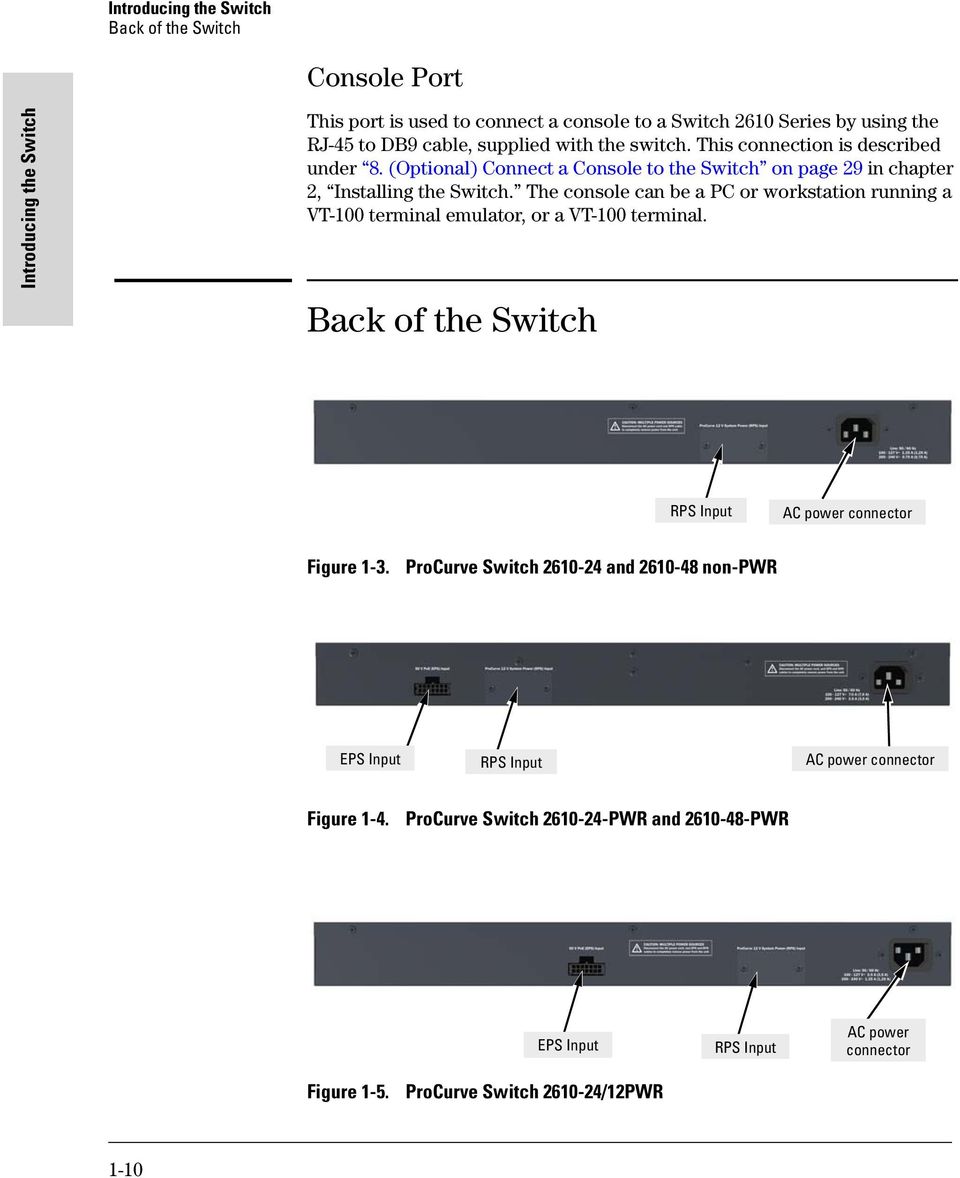
18 Introducing the Switch Back of the Switch Console Port Introducing the Switch This port is used to connect a console to a Switch 2610 Series by using the RJ-45 to DB9 cable, supplied with the switch. This connection is described under 8. (Optional) Connect a Console to the Switch on page 29 in chapter 2, Installing the Switch. The console can be a PC or workstation running a VT-100 terminal emulator, or a VT-100 terminal. Back of the Switch RPS Input AC power connector Figure 1-3. ProCurve Switch and non-pwr EPS Input RPS Input AC power connector Figure 1-4. ProCurve Switch PWR and PWR EPS Input RPS Input AC power connector Figure 1-5. ProCurve Switch /12PWR 1-10
19 Introducing the Switch Switch Features RPS and EPS Input Port The Switch 2610 Series support connectivity to a redundant power supply (RPS/EPS). The ProCurve 600 Redundant and External Power Supply (J8168A) and the ProCurve 610 External Power Supply (J8169A) are accessory products for these switches. The RPS functionality of the 600 procides redundant system power in case the switch s internal power supply fails. The EPS functionality of the 600 and the 610 provides additional PoE power. Power Connector Introducing the Switch The Switch 2610 Series and Switch 2610-PWR Series do not have a power switch; they are powered on when connected to an active AC power source. The switches automatically adjust to any voltage between and volts and either 50 or 60 Hz. There are no voltage range settings required. Switch Features The features of the Switch 2610 Series and Switch 2610-PWR Series include: 24, or 48 auto-sensing 10/100Base-TX RJ-45 ports with Auto-MDIX. 4 Uplink ports two are 1000Base-T RJ-45 and two are mini-gbic (SFP) slots. Power over Ethernet (PoE) operation the 2610-PWR Series switches are IEEE 802.3af compliant and provide up to 15.4W per port to power IP phones, wireless access points, web cameras, and more. For more information, see the PoE Planning and Implementation Guide, which is on the ProCurve Web site at (See page 1-12). The 2610-PWR switches support some pre-standard PoE devices. However, the use of a cross-over cable may be required. For a current list see the FAQ page for the 2610-PWR Switch, which can be found on the ProCurve Web site, Technical Support, FAQs (all). Plug-and-play networking all ports are enabled just connect the network cables to active network devices and your switched network is operational. Auto-MDIX on all twisted-pair ports, 10/100 and 10/100/1000, meaning that all twisted-pair connections can be made using straight-through cables. Cross-over cables are not required, although they will also work. Automatic learning of the hardware addresses in each switch s address forwarding table, (with configurable address aging value). 1-11

20 Introducing the Switch Switch Features Introducing the Switch Automatically negotiated full-duplex operation for the 10/100 and 10/100/1000 RJ-45 ports when connected to other auto-negotiating devices the mini-gbic ports always operate at full duplex, unless a 100-FX SFP transceiver is installed. The 100-FX SFP transceiver can operate at half duplex. Easy management of the switches through several available interfaces: console interface a full featured, easy to use, VT-100 terminal interface that is especially good for out-of-band switch management or for Telnet access to the switch. web browser interface an easy to use built-in graphical interface that can be accessed from common web browsers. ProCurve Manager an SNMP-based, graphical network management tool that you can use to manage your entire network. Support for the Spanning Tree Protocol to eliminate network loops Support for up to 30 IEEE 802.1Q-compliant VLANs so you can divide the attached end nodes into logical groupings that fit your business needs. Download of new switch software for product enhancements or bug fixes. Dual-speed fans to maintain cooling if the environment warms up on the following switches: Switch (J9088A) Switch /12PWR (J9086A) Switch PWR (J9087A) Switch PWR (J9089A) Support for many advanced features to enhance network performance for a description, see the Management and Configuration Guide, which is on the ProCurve Web site at To display the list of downloadable manuals, click on the following links: Technical support Product manuals (all) ProCurve Switch 2610 Series. (You may want to bookmark this Web page for easy access in the future.) 1-12
21 2 Installing the Switch The ProCurve Switch 2610 Series come with an accessory kit that includes the brackets for mounting the switch in a standard 19-inch telco rack, in an equipment cabinet, or on a wall. The brackets are designed to allow mounting the switch in a variety of locations and orientations. Rubber feet are provided that can be attached so the switch can be securely located on a horizontal surface. This chapter shows how to install the Switch Included Parts The Switch 2610 Series have the following components: ProCurve Switch 2610 Series Installation and Getting Started Guide, this manual ProCurve Manager - CD ROM and booklet Console cable Customer Support/Warranty booklet Accessory kits: 2610 Non-PWR switches and the J9086A 24/12-port partial PoE switch 2610-PWR switches, J9087A and J9089A Installing the Switch Kit number Contains: two mounting brackets eight 8-mm M4 screws to attach the mounting brackets to the switch four 5/8-inch number screws to attach the switch to a rack four rubber feet Kit number Contains: two mounting brackets 1 eight 8-mm M4 screws to attach the mounting brackets to the switch four 5/8-inch number screws to attach the switch to a rack four rubber feet 1 The mounting brackets in this kit are longer to support the increased depth of the PWR products. 2-1
22 Installing the Switch Included Parts AC power cord, one of the following: Non-PWR Switches PWR Switches 1 Installing the Switch Japan Power Cord Warning Australia/New Zealand China Continental Europe Denmark Japan Switzerland United Kingdom/Hong Kong/Singapore United States/Canada/Mexico South Africa Thailand Taiwan The cords for the PWR Switches support a higher amperage
23 Installing the Switch Included Parts Installation Precautions WARNING The rack or cabinet should be adequately secured to prevent it from becoming unstable and/or falling over. Devices installed in a rack or cabinet should be mounted as low as possible, with the heaviest devices at the bottom and progressively lighter devices installed above. For safe operation do not install the switch with the side of the switch (with the fan vents) facing either downward or upward. Do not wall mount the 2610-PWR switches. Cautions If one of the following switches is to be mounted in a rack, you can use a rail kit. Rail kit part number B21 can be used only with the following switches. J9085A ProCurve Switch J9088A ProCurve Switch J9086A ProCurve Switch /12PWR Ensure the power source circuits are properly grounded, then use the power cord supplied with the switch to connect it to the power source. If your installation requires a different power cord than the one supplied with the switch, ensure the cord is adequately sized for the switch s current requirements. In addition, be sure to use a power cord displaying the mark of the safety agency that defines the regulations for power cords in your country. The mark is your assurance that the power cord can be used safely with the switch. If the PWR device s supplied power cord does not fit, contact ProCurve Networking support. When installing the switch, the AC outlet should be near the switch and should be easily accessible in case the switch must be powered off. Ensure the switch does not overload the power circuits, wiring, and overcurrent protection. To determine the possibility of overloading the supply circuits, add together the ampere ratings of all devices installed on the same circuit as the switch and compare the total with the rating limit for the circuit. Maximum ampere ratings are usually printed on the devices near the AC power connectors. Do not install the switch in an environment where the operating ambient temperature might exceed 50 C (122 F). This includes a fully-enclosed rack. Ensure the air flow around the sides and back of the switch is not restricted. Leave at least 7.6 cm (3 inches) for cooling. Ensure all port covers are installed when the port is not in use. Installing the Switch 2-3
24 Installing the Switch Installation Procedures Installation Procedures These steps summarize your switch installation. The rest of this chapter provides details on these steps. 1. Prepare the installation site (page 2-6). Make sure the physical environment into which you will be installing the switch is properly prepared, including having the correct network cabling ready to connect to the switch and having an appropriate location for the switch. See page 2-3 for some installation precautions. Installing the Switch 2. Verify the switch passes self test (page 2-8). Plug the switch into a power source and observe that the LEDs on the switch s front panel indicate correct switch operation. 3. Mount the switch (page 2-10). The Switch 2610 Series can be mounted in a 19-inch telco rack, in an equipment cabinet, on a wall, or on a horizontal surface. The Switch 2610-PWR Series may be mounted in racks and cabinets or on a horizontal surface. The Switch 2610-PWR Series must not be wall mounted. The Switch 2610 Non-PWR Series can be wall mounted. See page 2-15 for wall mounting instructions. The following switches can be mounted with rail kit part number B21. J9085A ProCurve Switch J9088A ProCurve Switch J9086A ProCurve Switch /12PWR 4. Connect power to the switch (page 2-17). Once the switch is mounted, plug it into the main power source. 5. Connect the network devices (page 2-17). Using the appropriate network cables, connect the network devices to the switch ports. 6. (Optional) Install mini-gbics (page 2-18). The switch has two slots for installing mini-gbics. Depending on where you install the switch, it may be easier to install the mini-gbics first. Mini-GBICs can be hot swapped they can be installed or removed while the switch is powered on. 7. (Optional) Connect a 600 RPS/EPS or 610 EPS (page 2-20). You may wish to use a 600 RPS/EPS or 610 EPS with your Series 2610-PWR Switch. To do so you must connect these external power supplies using the RPS or EPS cables supplied with these devices. 2-4
25 Installing the Switch Installation Procedures 8. (Optional) Connect a console to the switch (page 2-29). You may wish to modify the switch s configuration, for example, to configure an IP address so it can be managed using a web browser, from an SNMP network management station, or through a Telnet session. Configuration changes can be made by using the included console cable to connect a PC to the switch s console port. At this point, your switch is fully installed. See the rest of this chapter if you need more detailed information on any of these installation steps. Installing the Switch 2-5
26 Installing the Switch Installation Procedures 1. Prepare the Installation Site Cabling Infrastructure - Ensure the cabling infrastructure meets the necessary network specifications. See the following table for cable types and lengths, and see appendix B, Switch Ports and Network Cables for more information: Table 2-1. Summary of Cable Types to Use With the Switch Port Type Cable Type Length Limits Twisted-Pair Cables Installing the Switch 10/100/1000Base-T For either 10, 100 Mbps, or 1000 Mbps operation: Category 5 or better, 100-ohm UTP or shielded twisted-pair (STP) balanced cable. For 1000 Mbps (gigabit) operation, Category 5e cabling or better is recommended. 100 meters Note: The Switch 2610 Series are compatible with the IEEE 802.3ab standard including the Auto MDI/MDI-X feature, which allows use of either straight-through or crossover twisted-pair cables for connecting to any network devices including end nodes, such as computers, or to other switches, hubs, and routers. Note: For 1000 Mbps operation, all four wire pairs are used for data transmission, therefore PoE is not supported for 1000 Mbps operation. 2-6
27 Installing the Switch Installation Procedures Port Type Cable Type Length Limits Fiber Optic Cables Gigabit-SX (on Gigabit-SX-LC mini-gbic) Multimode fiber-optic cables fitted with LC connectors 220 meters to 550 meters depending on the cable used. See Fiber-Optic Cables on page B-2 for more information. Gigabit-LX (on Gigabit-LX-LC mini-gbic) Gigabit-LH (on Gigabit-LH-LC mini-gbic) Single-mode fiber-optic cables fitted with LC connectors. The multimode cables specified for the Gigabit- SX mini-gbic may also be used, but a modeconditioning patch cord may be needed see Mode Conditioning Patch Cord for Gigabit-LX on page B-3 for more information. The same single-mode fiber-optic cables as for Gigabit-LX. single-mode cable = 10 kilometers multimode cable = 550 meters 70 kilometers Note: Gigabit-LH - The transmission distances are dependent on the particular fiber loss and coupling loss involved, among other factors, and can be estimated from the optical loss budget. For distances less than 20km, a 10dB attenuator must be used. For distances between 20km and 40km, a 5dB attenuator must be used. Attenuators can be purchased from most cable vendors. Installing the Switch 100-FX (on 100-FX SFP-LC transceiver) Multimode fiber-optic cables fitted with LC connectors 412 m for half-duplex 2 Km for full-duplex. Installation Location - Before installing the switch, plan its location and orientation relative to other devices and equipment: In the front of the switch, leave at least 7.6 cm (3 inches) of space for the twisted-pair and fiber-optic cabling. In the back of the switch, leave at least 3.8 cm (1 1/2 inches) of space for the power cord. On the sides of the switch, leave at least 7.6 cm (3 inches) for cooling. 2-7
28 Installing the Switch Installation Procedures 2. Verify the Switch Passes Self Test Before mounting the switch in its network location, you should first verify it is working properly by plugging it into a power source and verifying it passes its self test. 1. Connect the power cord supplied with the switch to the power connector on the back of the switch, and then into a properly grounded electrical outlet. Installing the Switch Figure 2-1. Connecting the power cord Connect power cord to the power connector Note The Switch 2610 Series do not have a power switch. They are powered on when the power cord is connected to the switch and to a power source. For safety, the power outlet should be located near the switch installation. The switch automatically adjusts to any voltage between or volts and either 50 or 60 Hz. There are no voltage range settings required. If your installation requires a different power cord than the one supplied with the switch, be sure the cord is adequately sized for the switch s current requirements. In addition, be sure to use a power cord displaying the mark of the safety agency that defines the regulations for power cords in your country. The mark is your assurance that the power cord can be used safely with the switch. If the PWR device s supplied power cord does not fit, contact ProCurve Networking support. 2-8
29 Installing the Switch Installation Procedures 2. Check the LEDs on the switch as described below. Self Test LED Switch port LEDs Power and Fault LEDs Figure 2-2. Checking the LEDs on the 2610 non-pwr switches When the switch is powered on, it performs its diagnostic self test. Self test takes approximately 50 seconds to complete. Self Test LED Switch port LEDs Installing the Switch Power and Fault LEDs Figure 2-3. Checking the LEDs on the 2610-PWR switches LED Behavior During the self test: Initially, all the switch and port LEDs are on. Most of the LEDs go off and then may come on again during phases of the self test. For the duration of the self test, the Self Test LED stays on. When the self test completes successfully: The Power and Fan LEDs remain on. The Fault and Test LEDs go off. The port LEDs on the front of the switch go into their normal operational mode: 2-9
30 Installing the Switch Installation Procedures If the ports are connected to active network devices, the LEDs behave according to the Port LED View or LED Mode selected. The default view mode (Link), the LEDs should be on and the Mode LEDs will flicker if there is network activity. If the ports are not connected to active network devices, the Link and Act LEDs will stay off. If the LED display is different than what is described above, especially if the Fault and Test LEDs stay on for more than 60 seconds or they start flashing, the self test has not completed correctly. Refer to chapter 4, Troubleshooting for diagnostic help. 3. Mount the Switch Installing the Switch After the switch passes self test, it is ready to be mounted in a stable location. The Switch 2610 Series can be mounted in these ways: Mounting Location Non-PWR Switches PWR Switches In a rack or cabinet Yes Yes On a horizontal surface Yes Yes On a wall Yes No Rack or Cabinet Mounting The Switch 2610 Series are designed to be mounted in any EIA-standard 19- inch telco rack or communication equipment cabinet. Note that the mounting brackets have multiple mounting holes and can be rotated allowing for a wide variety of mounting options. Secure the rack in accordance with the manufacture s safety guidelines. 2-10
31 Installing the Switch Installation Procedures WARNING For safe operation, please read the mounting precautions on page 2-3, before mounting a switch. Equipment Cabinet Note The screws supplied with the switch are the correct threading for standard EIA/TIA open 19-inch racks. If installing the switch in an equipment cabinet such as a server cabinet, use the clips and screws that came with the cabinet in place of the screws that are supplied with the switch. Rack Mounting the 2610-PWR switches 1. Use a #1 Phillips (cross-head) screwdriver and attach the mounting brackets to the switch with the included 8-mm M4 screws. Installing the Switch Figure 2-4. Attaching large mounting brackets WARNING For safe reliable installation, only use the screws provided in the accessory kit to attach the mounting brackets to the switch. Note The mounting brackets have multiple mounting holes and can be rotated allowing for a wide variety of mounting options. These include mounting the switch so that its front face is flush with the face of the rack, or mounting it in a more balanced position as shown in the illustration above. 2. Hold the switch with attached brackets up to the rack and move it vertically until rack holes line up with the bracket holes, then insert and tighten the four number screws holding the brackets to the rack. 2-11
32 Installing the Switch Installation Procedures Installing the Switch Install screws Figure 2-5. Mounting in a rack 2-12
33 Installing the Switch Installation Procedures Rack Mounting the Non-PWR Switches 1. Use a #1 Phillips (cross-head) screwdriver and attach the mounting brackets to the switch with the included 8-mm M4 screws. 8 mm M4 screws Figure 2-6. Attaching small mounting brackets Installing the Switch Note The mounting brackets have multiple mounting holes and can be rotated allowing for a wide variety of mounting options. These include mounting the switch so that its front face is flush with the face of the rack, or mounting it in a more balanced position as shown in the illustration. WARNING For safe reliable installation, only use the screws provided in the accessory kit to attach the mounting brackets to the switch. 2-13
34 Installing the Switch Installation Procedures 2. Hold the switch with attached brackets up to the rack and move it vertically until rack holes line up with the bracket holes, then insert and tighten the four number screws holding the brackets to the rack. Installing the Switch Install screws Figure 2-7. Mounting in a rack 2-14
35 Flat Wall Mounting Installing the Switch Installation Procedures There are two switches in this series that can be wall mounted, the J9085A 24- port Non-PoE and the J9088A 48-port Non-PoE. You can mount these switches on a wall as shown in the illustration Figure 2-8. Wall mounting is not supported for the 2610-PWR switches because of the size and weight of the devices. See page 2-15 for instructions. WARNING For safe operation do not install the switch with either side vent holes (vertical) facing downward. Do not wall mount the 2610-PWR switches. Caution The switch should be mounted only to a wall or wood surface that is at least 1/2-inch (12.7 mm) plywood or its equivalent. Supported Wall Mounting Positions. Switch Vertical Wall Mounting Horizontal Wall Mounting 2610 Non-PWR No Yes Installing the Switch 2610-PWR No No WARNING The Switch 2610-PWR Switches are not wall mountable. Wall mounting Horizontal 1. Use a #1 Phillips (cross-head) screwdriver and attach the mounting brackets to the switch with the included 8-mm M4 screws. 2. Attach the switch to the wall or wood surface with two 5/8-inch number 12 wood screws (not included). 2-15
36 Installing the Switch Installation Procedures RJ-45 Ports Wall Installing the Switch Figure 2-8. M4 screws Horizontal wall mounting 5/8-inch wood screws Caution The J9088A 48-port, non-pwr switch can be wall mounted with either the RJ-45 ports side up or down in the horizontal orientation. A vertical wall mount orientation is not supported. The J9085A 24-port, non-pwr switch can be wall mounted with the RJ-45 port side facing down only in the horizontal orientation. A vertical wall mount orientation is not supported. Horizontal Surface Mounting Place the switch on a table or other horizontal surface. The switch comes with rubber feet in the accessory kit that can be used to help keep the switch from sliding on the surface. Attach the rubber feet to the four corners on the bottom of the switch within the embossed angled lines. Use a sturdy surface in an uncluttered area. You may want to secure the networking cables and switch power cord to the table leg or other part of the surface structure to help prevent tripping over the cords. Caution Ensure the air flow is not restricted around the sides and back of the switch. 2-16
37 4. Connect the Switch to a Power Source Installing the Switch Installation Procedures 1. Plug the included power cord into the switch s power connector and into a nearby AC power source. 2. Re-check the LEDs during self test. See LED Behavior on page 2-9. Figure 2-9. Connecting the power cord 5. Connect the Network Cables Connect the network cables, described under Cabling Infrastructure (page 2-6), from the network devices or your patch panels to the fixed RJ-45 ports on the switch or to any mini-gbics you have installed in the switch. Installing the Switch Using the RJ-45 Connectors To connect: Push the RJ-45 plug into the RJ-45 port until the tab on the plug clicks into place. When power is on for the switch and for the connected device, the Link LED for the port should light to confirm a powered-on device (for example, an end node) is at the other end of the cable. If the Link LED does not go on when the network cable is connected to the port, see Diagnosing With the LEDs in chapter 4, Troubleshooting. To disconnect: Press the small tab on the plug and pull the plug out of the port. RJ-45 connector Unshielded twisted-pair cable: Category 3, 4, or 5 for 10 Mbps ports Category 5 or better for 100 Mbps ports Category 5e or better for 1000 Mbps ports Maximum distance: 100 meters Figure Connecting network cables 2-17
38 Installing the Switch Installation Procedures 6. Installing or Removing mini-gbics You can install or remove a mini-gbic from a mini-gbic slot without having to power off the switch. Use only ProCurve mini-gbics. Installing the Switch Notes The mini-gbic slots are not shared with the two 10/100/1000Base-T RJ- 45 ports. When a mini-gbic is installed in a slot, it operates independently of the RJ-45 ports. The mini-gbic ports operate only at full duplex. Half duplex operation is not supported, unless a 100-FX SFP transceiver is installed. The 100-FX SFP transceiver can operate at half duplex. Ensure the network cable is NOT connected when you install or remove a mini-gbic. When this manual was printed, the supported mini-gbics include the following: ProCurve Gigabit-SX-LC mini-gbic (J4858B, J4858C) ProCurve Gigabit-LX-LC mini-gbic (J4859B, J4859C) ProCurve Gigabit-LH-LC mini-gbic (J4860B, J4860C) ProCurve 100-FX SFP-LC Transceiver (J9054B) ProCurve 1000Base-T Mini-GBIC (J8177B) Caution Use only supported genuine ProCurve mini-gbics with your switch. Non- ProCurve mini-gbics are not supported, and their use may result in product malfunction. Should you require additional ProCurve mini-gbics, contact your ProCurve Networking Sales and Service Office or authorized dealer. Installing the mini-gbics: Remove the protective plastic cover and retain it for later use. Hold the mini- GBIC by its sides and gently insert it into either of the slots on the switch until the mini-gbic clicks into place. WARNING The ProCurve mini-gbics are Class 1 laser devices. Avoid direct eye exposure to the beam coming from the transmit port. 2-18
39 Installing the Switch Installation Procedures Figure Installing a mini-gbic (SFP) Note Removing the mini-gbics You should disconnect the network cable from the mini-gbic before removing it from the switch. Depending on when you purchased your ProCurve mini-gbic, it may have either of three different release mechanisms: a plastic tab on the bottom of the mini-gbic, a plastic collar around the mini-gbic, or a wire bail. Installing the Switch To remove the mini-gbics that have the plastic tab or plastic collar, push the tab or collar toward the switch until you see the mini-gbic release from the switch (you can see it move outward slightly), and then pull it from the slot. To remove the mini-gbics that have the wire bail, lower the bail until it is approximately horizontal, and then using the bail, pull the mini-gbic from the slot. Replace the protective plastic cover on the mini-gbic. Connecting Cables to mini-gbics If you have any mini-gbics installed in the switch, the type of network connections you will need to use depends on the type of mini-gbics you have installed. See the table on page 2-6, and appendix B, Switch Ports and Network Cables, for the mini-gbic cabling information. For mini-gbics ports, and in general for all the switch ports, when a network cable from an active network device is connected to the port, the port LED for that port should go on. If the port LED does not go on when the network cable is connected to the port, see Diagnosing with the LEDs in chapter 4, Troubleshooting. 2-19
40 Installing the Switch Installation Procedures 7. (Optional) Connect a Redundant Power Supply to a Switch 2610-PWR Series The ProCurve 600 Redundant and External Power Supply, (J8168A), hereafter referred to as the 600 RPS/EPS, and the ProCurve 610 External Power Supply (J8169A), hereafter referred to as the 610 EPS, are accessory products for the Switch 2610-PWR Series and specific other ProCurve switches. The 600 RPS/EPS provides two types of power to the switches: Installing the Switch Redundant power to one of up to six switches, to back up the internal switch power supply in case of AC power loss, or a fault condition. Should the internal switch power supply fail, power will be supplied from the 600 RPS/EPS, if it is available, that is, if the 600 RPS/EPS is not already providing power to a higher priority switch. See the documentation that came with your 600 RPS/EPS for more information. External Power-over-Ethernet (PoE) power to up to two switch products. The 600 RPS/EPS can supply 408 watts of PoE power to the switch if the internal PoE power supply should fail. For the Switch /12PWR and PWR the external PoE power is additional power made available to the switch s ports. For further information regarding the 600 RPS/EPS PoE capabilities, see the PoE Planning and Implementation Guide and the ProCurve 600/610 External Power Supplies Installation and Getting Started Guide, which is on the ProCurve Web site at (See page 1-12). The 600 RPS/EPS is an unmanaged power supply that only provides information by way of LEDs. The 610 EPS only provides external PoE power: External Power-over-Ethernet (PoE) power to up to four switch products. The 610 EPS can supply 408 watts (if one port of a pair is used) or 204 watts (if two ports of a pair are used) of PoE power to the switch if the internal PoE power supply should fail. For the Switch PWR the external PoE power is additional power made available to the switch s ports. For further information regarding the 600 RPS/EPS and the 610 EPS PoE capabilities, see the PoE Planning and Implementation Guide and the ProCurve 600/610 External Power Supplies Installation and Getting Started Guide, which is on the ProCurve Web site at (See page 1-12). The 610 EPS is an unmanaged power supply that only provides information by way of LEDs. 2-20
41 Installing the Switch Installation Procedures RPS/EPS Operation The RPS/EPS monitors the power signal from the switch by detecting that the RPS/EPS is connected to a switch with an RPS/EPS cable. When the power from the switch is no longer detected, the RPS/EPS will provide power to the switch within 1 millisecond. The RPS/EPS supports hot plugging of the RPS/EPS cable without causing a reboot of the switch or causing the power supply in either the RPS/EPS or switch to shut down temporarily or permanently. For more information refer to the documentation that came with the RPS/EPS. Operating Characteristics of the 600 RPS/EPS (J8168A) The 600 RPS/EPS has six RPS ports, each of which can provide redundant +12V power to a connected switch, but only one connector can provide this power at a given time. If a switch with no AC power is connected to an operating 600 RPS/EPS, it will receive power if power is available (no higher priority port is already using the RPS power). Installing the Switch If two or more devices fail, priority goes to the device plugged into the lower numbered port on the 600 RPS/EPS unit. Consequently the most important switch should be plugged into port one on the 600 RPS/EPS. In this state, the Connected LED should be ON, and the Power Status LED should be flashing on the lower priority RPS port not supplying power. (Refer to the documentation that came with your 600 RPS/EPS unit.) The 600 RPS/EPS also has two EPS Ports. The 600 RPS/EPS can provide a maximum of 408 watts of PoE power to a switch. It is important to understand the PoE power requirements of the 2610-PWR Series switches because if the PoE power is not planned and implemented correctly the end devices connected to the switch ports may not receive power if an internal switch PoE power supply should fail. For further information regarding the 600 RPS/EPS PoE capabilities, see the PoE Planning and Implementation Guide and the 2-21
42 Installing the Switch Installation Procedures ProCurve 600/610 External Power Supplies Installation and Getting Started Guide, which is on the ProCurve Web site at (See page 1-12). For redundant AC power, connect the 600 RPS/EPS to the switch using one of the six supplied RPS cables. RPS cables are 1.25 meters (4.10 feet) in length. For redundant or additional PoE power, connect the 600 RPS/EPS to the switch using one of the two supplied EPS cables. EPS cables are 2.00 meters (6.56 feet) in length. Operating Characteristics of the 610 EPS (J8169A) Installing the Switch The 610 EPS does not have any RPS ports and can not supply RPS power. It has four EPS Ports. You can connect one to four ProCurve PoE capable switches to provide PoE power as a primary or backup source. Two in Pair A and two in Pair B. Power is equally shared between the EPS ports in pair A (that is, port A1 and A2) and between the EPS ports in pair B (port B1 and B2) Each pair can provide a maximum of 408 watts of PoE power to a switch if only one port is used. If the second port of a pair is used, then both ports supply 204 watts each. Again, it is important to understand the PoE power requirements of the switches. For further information regarding the 610 EPS PoE capabilities, see the PoE Planning and Implementation Guide, which is on the ProCurve Web site at (See page 1-12). 600 RPS/EPS LEDs For a complete description of the LEDs see the documentation that came with the 600 RPS/EPS. The 600 RPS/EPS LEDs are located on the back of the device. These LEDs are duplicated on the front of the device for your convenience. The following graphic shows an example of the back of the 600 EPS/RPS. There are two green LEDs for each RPS and EPS port: Device Connected 2-22
43 Installing the Switch Installation Procedures Power Status RPS Device Connected LED RPS Power Status LED EPS Device Connected LED EPS Power Status LED RPS Power: 12V backup to one connected device. Lowest-numbered port has priority.! EPS Power: 50V 370W total for PoE applications. Power is shared when both ports are used. R3 R4 R5 R6 E1 RPS 3 RPS 4 RPS 5 RPS 6 EPS 1 EPS 2 E2 Device Connected Power Status Line: 50/60 Hz V~ 9.1A (9,1A) Figure RPS/EPS status LEDs The following states provide status of the RPS and EPS ports. Fault (located on the front) Device Connected Power Status Message Off Off Off Nothing Connected On or Off Off On Not a valid state - should never happen Off On Off Switch is connected, RPS is available but not required Installing the Switch Off On On RPS is powering the connected device Flashing Off Flashing RPS/EPS port is in fault condition Off On Flashing Switch is requesting power, RPS can not provide it. (N/A for EPS) 600 RPS/EPS Connectivity The following illustration shows an example of connectivity between an RPS/ EPS device and a switch device as a redundant AC power supply. 2-23
44 Installing the Switch Installation Procedures Remove the cover of the RPS input port and connect the RPS cable to the 600 RPS/EPS then to the 2610 switch. Switch RPS output port RPS input port Installing the Switch Figure Connecting a 600 RPS/EPS to a 2610 RPS The following illustration shows an example of connectivity between an RPS/ EPS device and six switch devices as a redundant AC power supply. 2-24
45 Installing the Switch Installation Procedures RPS port 1 highest priority RPS port 6 lowest priority 600 RPS/EPS Installing the Switch 2610-PWR switches Figure Connecting a 600 RPS/EPS to multiple 2610s RPS The 600 RPS/EPS can provide backup power for up to six switches. The 600 RPS/EPS can supply power to only one connected and failed switch at a time. In the illustration above, the switch connected to RPS port 1 has the highest priority and the switch connected to RPS port 6 has the lowest priority. When multiple switches fail, a switch connected to a higher priority port always receives power before a switch connected to a lower priority port. The following illustration demonstrates an example of connectivity between an RPS/EPS device and a Switch device as a PoE power supply. 2-25
46 Installing the Switch Installation Procedures Switch EPS output EPS input port Installing the Switch Power and Fault LEDs Figure Connecting a 600 RPS/EPS to a 2610 EPS 610 EPS LEDs Backup Power Port LEDs EPS Port LEDs 610 EPS hp procurve 610 eps J8169A EPS Ports Pair A EPS A1 (408 W total for PoE applications) A1 EPS Ports Pair B (408 W total for PoE applications) Device Device A2 B1 B2 EPS B2 Connected Power EPS A2 EPS B1 Connected Power Status Status Power Internal Power Status Backup Power Ports Status Fault Fan/Temp Status Fan/Temp Status flash = Temperature too high Fan/Temp Status + Fault flash = Fan failure In Ready Out Ready EPS Ports: 50V 8.3A max each. Fan/Temp Status LED Internal Power Status LED Power Status LED Device Connected LED Figure For a complete description of the LEDs see the documentation that came with the 610 EPS. For redundant or additional PoE power, connect the 610 EPS to the switch using one of the four supplied EPS cables. EPS cables are 2.00 meters (6.56 feet) in length. The following illustration demonstrates an example of connectivity between a 610 EPS device and two Switch devices as a PoE power supply. 2-26
47 Fan/Temp Status flash = Temperature too high Fan/Temp Status + Fault flash = Fan failure J8169A Internal Power Status Fan/Temp Status In Ready Fan/Temp Status flash = Temperature too high Fan/Temp Status + Fault flash = Fan failure Out Ready Backup Power Ports Status In Ready Out Ready EPSPorts:50V 8.3Amaxeach. A1 Device Connected Power Status A2 B1 Device Connected B2 Power Status Device Connected Installing the Switch Installation Procedures hp procurve 610 eps J8169A EPS Ports EPS A1 Pair A (408 W total for PoE applications) A1 Device Connected Power Status EPS A2 EPS Ports Pair B (408 W total for PoE applications) A2 B1 B2 EPS B1 EPS B2 Power Status Power Fault Internal Power Status Fan/Temp Status Backup Power Ports Status EPS Ports: 50V 8.3A max each. Figure Connecting a 610 EPS to two 2610s EPS In this example each switch receives 408 watts of PoE power. Each switch is connected to one port of each pair. If the two switches were connected to both ports of a pair, both ports of pair A for example, then each switch receives 204 watts. See the following example. Installing the Switch The following illustration demonstrates an example of connectivity between a 610 EPS device and four Switch devices as a PoE power supply. In this example each switch receives 204 watts of PoE power. hp procurve 610 eps EPS Ports Pair A (408 W total for PoE applications) EPS Ports Pair B (408 W total for PoE applications) EPS A1 EPS A2 EPS B1 EPS B2 Power Fault 2-27
48 Installing the Switch Installation Procedures Figure Connecting a 610 EPS to four 2610s EPS Installing the Switch 2-28
49 8. (Optional) Connect a Console to the Switch Installing the Switch Installation Procedures The Switch 2610 Series have a full-featured, easy to use console interface for performing switch management tasks including the following: monitor switch and port status and observe network activity statistics modify the switch s configuration to optimize switch performance, enhance network traffic control, and improve network security read the event log and access diagnostic tools to help in troubleshooting download new software to the switch add passwords to control access to the switch from the console, web browser interface, and network management stations The console can be accessed through these methods: Out-of-band: The Switch 2610 Series come with a serial cable for connecting a PC or VT-100 terminal, to be used as a console, directly to the switch. In-Band: Access the console using Telnet from a PC or UNIX station on the network, and a VT-100 terminal emulator. This method requires that you first configure the switch with an IP address and subnet mask by using either out-of-band console access or through DHCP/Bootp. For more information on IP addressing and on starting a Telnet session, see chapter 3, Configuring the Switch, in the Management and Configuration Guide, which is on the ProCurve Web site at (See page 1-12). Installing the Switch The Switch 2610 Series can simultaneously support one out-of-band console session through the Console Port and in-band Telnet console sessions. Terminal Configuration To connect a console to the switch, configure the PC terminal emulator as a DEC VT-100 (ANSI) terminal or use a VT-100 terminal, and configure either one to operate with these settings: any baud rate from 1200 to (the switch senses the speed) 8 data bits, 1 stop bit, no parity, and flow control set to Xon/Xoff for the Windows Terminal program, also disable (uncheck) the Use Function, Arrow, and Ctrl Keys for Windows option for the Hilgraeve HyperTerminal program, select the Terminal keys option for the Function, arrow, and ctrl keys act as parameter If you want to operate the console using a different configuration, make sure you change the settings on both the terminal and on the switch so they are compatible. Change the switch settings first, then change the terminal settings, then reboot the switch and reestablish the console session. 2-29
50 Installing the Switch Installation Procedures Direct Console Access Installing the Switch To connect a console to the switch, follow these steps: 1. Connect the PC or terminal to the switch s Console Port using the console cable included with the switch. (If your PC or terminal has a 25-pin serial connector, first attach a 9-pin to 25-pin straight-through adapter at one end of the console cable.) 2. Turn on the terminal or PC s power and, if using a PC, start the PC terminal program. Console port Console cable supplied with the switch PC running a terminal emulator program, or a VT-100 terminal Figure Connecting the console cable 3. Press [Enter] two or three times and you will see the copyright page and the message Press any key to continue. Press a key, and you will then see the switch console command (CLI) prompt, for example: ProCurve Switch # If you want to continue with console management of the switch at this time, see chapter 3, Getting Started With Switch Configuration for some basic configuration steps. For more detailed information, refer to the Management and Configuration Guide, which is on the ProCurve Web site at (See page 1-12). 2-30
51 Installing the Switch Sample Network Topologies for Non-PWR Switches Sample Network Topologies for Non-PWR Switches This section shows a few sample network topologies in which the Switch 2610 is implemented. For more topology information, see the ProCurve networking products Web site, As a Desktop Switch Twisted-pair straight-through or crossover cables Switch Server Gigabit fiber-optic cable to backbone Installing the Switch PCs and peripherals Figure Basic desktop configuration The Switch 2610 Series are designed to be used primarily as desktop switches to which end nodes, printers, other peripherals, and servers are directly connected, as shown in the above illustration. The end node devices are connected to the switch by straight-through or crossover twisted-pair cables. Either cable type can be used because of the Auto-MDIX feature on the Switch 2610 Series ports. 2-31
52 Installing the Switch Sample Network Topologies for Non-PWR Switches As a Segment Switch Category 5e twisted-pair straight-through or crossover cable for 1000 Mbps connection to server Server with Gigabit Ethernet NIC Category 5e twisted-pair straightthrough or crossover cable for 1000 Mbps connection to backbone Switch Installing the Switch Switch Gigabit fiber-optic cable Switch Twisted-pair straight-through cables to end nodes PCs, printers, and local servers Figure Segment network configuration The Switch 2610 Series also work well as segment switches. That is, with their high performance, they can be used for interconnecting network segments simply connect the network devices that form those segments to the Switch 2610 Series. In the illustration above, two Fast Ethernet switches with PCs, printers, and local servers attached, are both connected to a Switch The devices attached to the two desktop switches can now communicate with each other through the switch. They can also all communicate with the server that is connected to a 1000Base-T port on the switch. 2-32
53 Installing the Switch Sample Network Topologies for Non-PWR Switches Because the Switch 2610 Series have the Auto-MDIX feature, the connections between the switches, and between the switch and end nodes or servers can be through category 5 straight-through or crossover twisted-pair cable. Category 3 or 4 cable can also be used if the connection is 10 Mbps only. In all cases, the device ports must be configured to auto negotiate the link characteristics for this feature to work. The switch, in turn, can be connected to a network backbone through fiberoptic cabling connected to a Gigabit-SX, -LX, or -LH mini-gbic. Now, all the devices on these network segments can access other network resources that are connected elsewhere on the network backbone. Always remember when connecting fiber-optics that all components match in specification. Switch 5406zl Connecting to a Backbone Switch To Gigabit-Ethernet backbone Switch Installing the Switch Gigabit fiber-optic cables Switch Switch Switch Figure Networking to a gigabit ethernet backbone 2-33
54 Installing the Switch Sample Network Topologies for Non-PWR Switches The simpler desktop and segment networks shown in the previous two examples can easily be combined and expanded. For example, you could use a ProCurve Switch 5406zl to interconnect each of your smaller switched workgroups to form a larger switched network. All the devices in this network can communicate with each other. For example, with Gigabit-SX Mini-GBICs installed in a Mini-GBIC Module, in the Switch 5406zl, the entire switched topology could be connected to a campus backbone, as shown in the illustration above. Note In the Figure 2-22, the 1000 Mbps fiber-optic connection between the Switch 2610s and the Switch 5406zl is by way of a Gigabit-SX mini-gbic installed in the Switch 2610s connected to a Gigabit SX mini-gbic installed in the mini- GBIC Module in the 5406zl. Installing the Switch 2-34
55 Installing the Switch Sample Network Topologies for PWR Switches Sample Network Topologies for PWR Switches This section shows a few sample network topologies for implementing the Switch 2610-PWR Series. For more topology information, see the ProCurve networking products Web site, As a Desktop Switch Implementing PoE 600 RPS/EPS RPS cable PWR EPS cable Server Gigabit fiber-optic cable to backbone Installing the Switch IP Telephones Twisted-pair straight-through or crossover cables PCs and peripherals Figure Basic desktop configuration with external power The Switch 2610-PWR Series are also designed to be used as desktop switches to which end nodes, printers and other peripherals, and servers are directly connected, as shown in the above illustration. Except now these switches can supply PoE power to end devices such as IP telephones. As shown in the above illustration the IP telephones can be connected in line, that is, between the switch and the end device, in this case a PC. The IP telephones have two ports, one in and one out. Therefore the phone receives voice and power from the switch and the PC can send and receive data through the phone to the switch. The end node devices are connected to the switch by straight-through or crossover twisted-pair cables. Either cable type can be used because of the Auto-MDIX feature on the Switch 2610-PWR Series. 2-35
56 As a Segment Switch Implementing PoE Server with Gigabit Ethernet NIC Category 5e twisted-pair straight-through or crossover cable for 1000 Mbps connection to server Switch Non-PWR 600 RPS/EPS Twisted-pair straightthrough or crossover cables Switch PWR Gigabit fiber-optic cable uplink Switch PWR Wireless Access Points PCs, printers, and local servers Figure Segment network configuration with PoE switches As shown in the illustration above, the IP telephones have been inserted in between the Switch PWR and the PCs, and wireless access points (WAPs) have been connected to another Switch PWR. Both the telephones and WAPs will receive PoE power from each of the switches. Only devices directly connected to the PWR switches can receive PoE power. Devices connected to a non-pwr segment switch cannot receive PoE power.
57 Installing the Switch Sample Network Topologies for PWR Switches Connecting to a Backbone Switch Implementing PoE To Gigabit-Ethernet backbone Switch 5406zl Gigabit fiber-optic cable Switch non-pwr Switch non-pwr 600 RPS/EPS Installing the Switch Switch PWR Switch PWR Wireless Access Point Figure Networking PoE switches to a gigabit ethernet backbone 2-37
58 Installing the Switch Sample Network Topologies for PWR Switches Stacking the Switch Switch 2610 and 2610-PWR Series devices can be connected together, through standard network connections, and managed through a single IP address. Up to 16 switches can be connected together in such a virtual stack. You identify a Switch 2610 or 2610-PWR Series device as the Commander and give that switch an IP address. Up to 15 other switches in the network can then easily be configured as Members of the stack and managed through the Commander s IP address. The management includes Telnet access and web browser interface access to the Commander and to each Member switch through the Commander. Installing the Switch For more information on stacking your switch, see the Management and Configuration Guide, which is on the ProCurve Web site at (See page 1-12). 2-38
59 3 Configuring the Switch This chapter is a guide for using the console Switch Setup screen to quickly assign an IP (Internet Protocol) address and subnet mask to the switch, set a Manager password, and, optionally, configure other basic features. For more information on using the switch console and the web browser interface, please see the Management and Configuration Guide, which is on the ProCurve Web site at (See page 1-12). Recommended Minimal Configuration In the factory default configuration, the switch has no IP (Internet Protocol) address and subnet mask, and no passwords. In this state, it can be managed only through a direct console connection. To manage the switch through inband (networked) access, you should configure the switch with an IP address and subnet mask compatible with your network. Also, you should configure a Manager password to control access privileges from the console and web browser interface. Other parameters in the Switch Setup screen can be left at their default settings or you can configure them with values you enter. Many other features can be configured through the switch s console interface, to optimize the switch s performance, to enhance your control of the network traffic, and to improve network security. Once an IP address has been configured on the switch, these features can be accessed more conveniently through a remote Telnet session, through the switch s web browser interface, and from an SNMP network management station running a network management program. For a listing of switch features available with and without an IP address, refer to How IP Addressing Affects Switch Operation in the Management and Configuration Guide, which is on the ProCurve Web site at (See page 1-12). For more information on IP addressing, refer to IP Configuration in the Management and Configuration Guide. Configuring the Switch Note By default, the switch is configured to acquire an IP address configuration from a DHCP or Bootp server. To use DHCP/Bootp instead of the manual method described in this chapter, see DHCP/Bootp Operation in the Management and Configuration Guide, which is on the ProCurve Web site at (See page 1-12). 3-1
60 Configuring the Switch Recommended Minimal Configuration Using the Console Setup Screen The quickest and easiest way to minimally configure the switch for management and password protection in your network is to use a direct console connection to the switch, start a console session, and access the Switch Setup screen. 1. Using the method described in the preceding section, connect a terminal device to the switch and display the switch console command line interface (CLI) prompt (the default display). The CLI prompt appears, for example: ProCurve# 2. At the prompt, enter the setup command to display the Switch Setup screen. The following illustration shows the Setup screen with the default settings u 2007 Configuring the Switch Figure 3-1. Example console setup screen 3. Use the [Tab] key to select the Manager Password field and enter a manager password of up to 16 printable ASCII characters. 4. [Tab] to the IP Config (DHCP/Bootp) field and use the Space bar to select the Manual option. 5. [Tab] to the IP Address field and enter the IP address that is compatible with your network. 6. [Tab] to the Subnet Mask field and enter the subnet mask used for your network. 7. Press [Enter], then [S] (for Save). 3-2
61 Configuring the Switch Recommended Minimal Configuration Here is some information on the fields in the Setup screen. For more information on these fields, see the Management and Configuration Guide, which is on the ProCurve Web site at (See page 1-12): Parameter Default System Name blank Optional; up to 25 characters, including spaces System Contact blank Optional; up to 48 characters, including spaces Manager Password blank Recommended; up to 16 characters (no blank spaces) Logon Default CLI The default setting selects the command line interface for console access. The alternative is the menu interface. Time Zone 0 (none) Optional; 1440 to The number of minutes your location is to the West (-) or East (+) of GMT. Community Name public Default setting recommended. Spanning Tree Enabled No Default setting recommended unless STP is already running on your network or the switch will be used in complex network topologies. Default Gateway blank Optional; Enter the IP address of the next-hop gateway node if network traffic needs to be able to reach off-subnet destinations. Time Sync Method None Optional; The protocol the switch uses to acquire a time signal. The options are SNTP and TimeP. TimeP Mode Disabled Optional; The method the switch uses to acquire the TimeP server address. IP Config (DHCP/Bootp) DHCP/Bootp Set to Manual unless a DHCP/Bootp server is used on your network to configure IP addressing. IP Address xxx.xxx.xxx.xxx Recommended; If you set IP Config to Manual, then enter an IP address compatible with your network. Note: The IP address and subnet mask assigned for the switch must be compatible with the IP addressing used in your network. For more information on IP addressing, see the Management and Configuration Guide, which is on the ProCurve Web site at (See page 1-12). Configuring the Switch Subnet Mask xxx.xxx.xxx.xxx Recommended; If you entered an IP address, then enter a subnet mask compatible with your network. Where to Go From Here The above procedure configures your switch with a Manager password, IP address, and subnet mask. As a result, with the proper network connections, you can now manage the switch from a PC equipped with Telnet, and/or a web browser interface. 3-3
62 Configuring the Switch Recommended Minimal Configuration Some basic information on managing your switch is included in the next section. For more information on the console, web browser, and SNMP management interfaces and all the features that can be configured on the Series 2610 Switches, see the Management and Configuration Guide, which is on the ProCurve Web site at (See page 1-12). To Recover from a Lost Manager Password: If you cannot start a console session at the manager level because of a lost Manager password, you can clear all passwords and user names by getting physical access to the switch and pressing and holding the Clear button for a full second. Configuring the Switch 3-4
63 Configuring the Switch Using the IP Address for Remote Switch Management Using the IP Address for Remote Switch Management With your switch, you can use the switch s IP address to manage the switch from any PC that is on the same subnet as the switch. You can use either a Telnet session or a standard web browser to manage the switch. Starting a Telnet Session To access the switch through a Telnet session, follow these steps: 1. Make sure the switch is configured with an IP address and that the switch is reachable from the PC that is running the Telnet session (for example, by using a Ping command to the switch s IP address). 2. Start the Telnet program on a PC that is on the same subnet as the switch and connect to the switch s IP address. 3. You will see the copyright page and the message Press any key to continue. Press a key, and you will then see the switch console command (CLI) prompt, for example: ProCurve# Enter help or? to see a list of commands that can be executed at the prompt. Entering any command followed by help provides more detailed context help information about the command. Entering any command followed by? displays a list of options that are available at that point in the command entry. Starting a Web Browser Session Configuring the Switch The Switch 2610 Series can be managed through a graphical interface that you can access from any PC or workstation on the network by running your web browser and typing in the switch s IP address as the URL. No additional software installation is required to make this interface available; it is included in the switch s onboard software. A typical web browser interface screen is shown in the next illustration. 3-5
64 Configuring the Switch Using the IP Address for Remote Switch Management ProCurve Switch xl Status: Information J9088A ProCurve Switch xl PoE Status Figure 3-2. Example web browser session Configuring the Switch For more information on using the web browser interface, please see the Management and Configuration Guide, which is on the ProCurve Web site at (See page 1-12). An extensive help system is also available for the web browser interface. To access the help system though, the subnet on which the switch is installed must have access to the internet. 3-6
65 4 Troubleshooting This chapter describes how to troubleshoot your ProCurve Switch 2610 Series. This document describes troubleshooting mostly from a hardware perspective. You can perform more in-depth troubleshooting on these devices using the software tools available with the switches, including the fullfeatured console interface, the built-in web browser interface, and ProCurve Manager, the SNMP-based network management tool. For more information, see the chapter Troubleshooting in the Management and Configuration Guide, which is on the ProCurve Web site at (See page 1-12). This chapter describes the following: basic troubleshooting tips (page 4-1) diagnosing with the LEDs (page 4-4) proactive networking tools (page 4-9) hardware diagnostic tests (page 4-10) restoring the factory default configuration (page 4-12) downloading new software to the Series 2610 Switches (page 4-13) HP Customer Support Services (page 4-13) Basic Troubleshooting Tips Most problems are caused by the following situations. Check for these items first when starting your troubleshooting: Connecting to devices that have a fixed full-duplex configuration. The RJ-45 ports are configured as Auto. That is, when connecting to attached devices, the switch operates in one of two ways to determine the link speed and the communication mode (half duplex or full duplex): If the connected device is also configured to Auto, the switch will automatically negotiate both link speed and communication mode. If the connected device has a fixed configuration, for example 100 Mbps, at half or full duplex, the switch will automatically sense the link speed, but will default to a communication mode of half duplex. Troubleshooting 4-1
66 Troubleshooting Basic Troubleshooting Tips Caution Because the Switch 2610 Series behave in this way (in compliance with the IEEE standard), if a device connected to the switch has a fixed configuration at full duplex, the device will not connect correctly to the switch. The result will be high error rates and very inefficient communications between the switch and the device. Ensure all devices connected to the Switch 2610 Series are configured to auto negotiate, or are configured to connect at half duplex (all hubs are configured this way, for example). Troubleshooting Faulty or loose cables. Look for loose or obviously faulty connections. If the cables appear to be OK, make sure the connections are snug. If that does not correct the problem, try a different cable. Non-standard cables. Non-standard and miswired cables may cause network collisions and other network problems, and can seriously impair network performance. Use a new correctly-wired cable or compare your cable to the cable in appendix B, Switch Ports and Network Cables for pinouts and correct cable wiring. A category 5 cable tester is a recommended tool for every 100Base-TX and 1000Base-T network installation. Improper Network Topologies. It is important to make sure you have a valid network topology. Common topology faults include excessive cable length and excessive repeater delays between end nodes. If you have network problems after recent changes to the network, change back to the previous topology. If you no longer experience the problems, the new topology is probably at fault. Sample topologies are shown at the end of chapter 2 in this book, and some topology configuration guidelines can be found online at the ProCurve Web site, In addition, you should make sure that your network topology contains no data path loops. Between any two end nodes, there should be only one active cabling path at any time. Data path loops will cause broadcast storms that will severely impact your network performance. For your Switch, if you wish to build redundant paths between important nodes in your network to provide some fault tolerance, you should enable Spanning Tree Protocol support on the switch. This ensures that only one of the redundant paths is active at any time, thus avoiding data path loops. Spanning Tree can be enabled through the switch console or the web browser interface. The Switch 2610 Series also support Trunking, which allows multiple network cables to be used for a single network connection without causing a data path loop. For more information on Spanning Tree and Trunking, see the Management and Configuration Guide, which is on the ProCurve Web site at (See page 1-12). 4-2
67 Troubleshooting Basic Troubleshooting Tips Check the port configuration. A port on your switch may not be operating as you expect because it has been put into a blocking state by Spanning Tree, GVRP (automatic VLANs), or LACP (automatic trunking). (Note that the normal operation of the Spanning Tree, GVRP, and LACP features may put the port in a blocking state.) Or, the port just may have been configured as disabled through software. Use the switch console to determine the port s configuration and verify that there is not an improper or undesired configuration of any of the switch features that may be affecting the port. For more information, see the Management and Configuration Guide, which is on the ProCurve Web site at (See page 1-12). For more information on possible network problems and their solutions, refer to the technical note Troubleshooting LAN Performance and Intermittent Connectivity Problems, which can be found on the ProCurve Web site, in the Reference Library section, A-Z Index. Troubleshooting 4-3
68 Troubleshooting Diagnosing with the LEDs Diagnosing with the LEDs Table 4-1 shows LED patterns on the switch that indicate problem conditions for general switch operation troubleshooting. Table 4-2 shows LED patterns that indicate problem conditions for PoE troubleshooting. LED patterns for General Switch Troubleshooting 1. Check in the table for the LED pattern you see on your switch. 2. Refer to the corresponding diagnostic tip on the next few pages. Table 4-1. LED Error Indicators LED Pattern Indicating Problems Power Fault RPS EPS Test Fan Port Link LED Off with power cord plugged in On Prolonged On 1 1 Prolonged On 1 1 Diagnostic Tips On Flashing Flashing ➌ On Flashing Off Flashing 2 1 ➍ On Flashing Flashing 2 1 Flashing 2 ➎ ➊ ➋ Troubleshooting On Off 1 1 Off 1 Off with cable connected On Off 1 1 Off 1 On, but the port is not communicating On Flashing Flashing Flashing 1 1 ➑ 1 This LED is not important for the diagnosis. 2 The flashing behavior is an on/off cycle once every 1.6 seconds, approximately. ➏ ➐ 4-4
69 Troubleshooting Diagnosing with the LEDs Diagnostic Tips: Tip Problem Solution ➊ ➋ ➌ ➍ ➎ The switch is not plugged into an active AC power source, or the switch s power supply may have failed. A switch hardware failure has occurred. All the LEDs will stay on indefinitely. The switch has experienced a software failure during self test. One of the switch cooling fans may have failed. The network port for which the LED is flashing has experienced a self test or initialization failure. 1. Verify the power cord is plugged into an active power source and to the switch. Make sure these connections are snug. 2. Try power cycling the switch by unplugging and plugging the power cord back in. 3. If the Power LED is still not on, verify the AC power source works by plugging another device into the outlet. Or try plugging the switch into a different outlet or try a different power cord. If the power source and power cord are OK and this condition persists, the switch power supply may have failed. Call your HP-authorized LAN dealer, or use the electronic support services from HP to get assistance. See the Customer Support/Warranty booklet for more information. Try power cycling the switch. If the fault indication reoccurs, the switch may have failed. Call your HP-authorized LAN dealer, or use the electronic support services from HP to get assistance. See the Customer Support/Warranty booklet for more information. 1. Try resetting the switch by pressing the Reset button on the front of the switch, or by power cycling the switch. 2. If the fault indication reoccurs, attach a console to the switch (as indicated in chapter 2) and configure it to operate at 9600 baud. Then, reset the switch. Messages should appear on the console screen and in the console log identifying the error condition. You can view the console log at that point by selecting it from the console Main Menu or by typing Show log at the Manager command prompt (#). If necessary to resolve the problem, contact your HP-authorized LAN dealer, or use the electronic support services from HP to get assistance. See the Customer Support/ Warranty booklet for more information. Try disconnecting power from the switch and wait a few moments. Then reconnect the power to the switch and check the LEDs again. If the error indication reoccurs, one of the fans has failed. In switches with multiple fans the switch may continue to operate under this condition if the ambient temperature does not exceed normal room temperature, but for best operation, the switch should be replaced. Contact your HP-authorized LAN dealer, or use the electronic support services from HP to get assistance. See the Customer Support/Warranty booklet for more information. Try power cycling the switch. If the fault indication reoccurs, the switch port may have failed. Call your HP-authorized LAN dealer, or use the electronic support services from HP to get assistance. See the Customer Support/Warranty booklet for more information. If the port is a mini-gbic, verify that it is one of the mini-gbics supported by the switch. Unsupported mini-gbics will be identified with this fault condition. The supported mini-gbics are listed in Chapter 2, Installing the Switch on page The mini-gbics are also tested when they are hot-swapped installed or changed while the switch is powered on. To verify the port has failed, remove and reinstall the mini-gbic without powering off the switch. If the port fault indication reoccurs, you will have to replace the mini-gbic. Check the event log to see why the mini-gbic failed. Troubleshooting continued on the next page 4-5
70 Troubleshooting Diagnosing with the LEDs Tip Problem Solution ➏ The network connection is not working properly. Try the following procedures: For the indicated port, verify that both ends of the cabling, at the switch and the connected device, are connected properly. Verify the connected device and switch are both powered on and operating correctly. Verify you have used the correct cable type for the connection: For twisted-pair connections to the fixed 10/100 or 10/100/1000 ports, if the port is configured to Auto (auto negotiate), either straight-through or crossover cables can be used because of the switch s Auto-MDIX feature and the Auto MDI/MDI- X feature of the 10/100/1000-T port. Note: If the switch port configuration is changed to one of the fixed configuration options (for example, 100 Mbps/Full Duplex), then the port operates as MDI-X only and you must use the correct type of cable for the connection. In general, for connecting an end node (MDI port) to the switch, use straight-through cable; for connecting to MDI-X ports on hubs, other switches, and routers, use crossover cable. Troubleshooting For fiber-optic connections, verify the transmit port on the switch is connected to the receive port on the connected device, and the switch receive port is connected to the transmit port on the connected device. For the dual-personality 10/100/1000-T ports, be sure a mini-gbic is not installed in the associated slot. For 1000Base-T connections, verify the network cabling complies with the IEEE 802.3ab standard. The cable should be installed according to the ANSI/TIA/EIA-568-A-5 specifications. Cable testing should comply with the stated limitations for Attenuation, Near-End Crosstalk, Far-End Crosstalk, Equal-Level Far-End Crosstalk (ELFEXT), Multiple Disturber ELFEXT, and Return Loss. The cable verification process must include all patch cables from any end devices, including the switch, to any patch panels in the cabling path. Verify the port has not been disabled through a switch configuration change. You can use the console interface, or, if you have configured an IP address on the switch, use the web browser interface to determine the state of the port and re-enable the port if necessary. Verify the switch port configuration matches the configuration of the attached device. For example, if the switch port is configured as Auto, the port on the attached device also MUST be configured as Auto. Depending on the port type, twisted-pair or fiberoptic, if the configurations don t match, the results could be a very unreliable connection, or no link at all. If the other procedures don t resolve the problem, try using a different port or a different cable. 4-6
71 Troubleshooting Diagnosing with the LEDs Tip Problem Solution ➐ ➑ The port may be improperly configured, or the port may be in a blocking state by the normal operation of the Spanning Tree, LACP, or IGMP features. RPS or EPS is connected but has experienced a fault. Use the switch console to see if the port is part of a dynamic trunk (through the LACP feature) or to see if Spanning Tree is enabled on the switch, and to see if the port may have been put into a blocking state by those features. The show lacp command displays the port status for the LACP feature; the show spanning-tree command displays the port status for Spanning Tree. Also check the Port Status screen using the show interfaces command to see if the port has been configured as disabled. Other switch features that may affect the port operation include VLANs and IGMP. Use the switch console to see how the port is configured for these features. For software troubleshooting tips, see the chapter Troubleshooting in the Management and Configuration Guide, which is on the ProCurve Web site at (See page 1-12). Ensure also, that the device at the other end of the connection is indicating a good link to the switch. If it is not, the problem may be with the cabling between the devices or the connectors on the cable. Refer to the ProCurve 600/610 External Power Supplies documentation. Troubleshooting 4-7
72 Troubleshooting Diagnosing with the LEDs LED Patterns for PoE Troubleshooting If the PoE Status LED is flashing, that indicates a problem with the delivery of PoE power out one or more switch ports. Press the LED Mode button to put the switch into PoE mode and the port LEDs will show which ports are experiencing the problem. The following tables identify the specific problems that are shown by the LEDs. 1. Check in the table for the LED pattern you see on your switch. 2. Refer to the corresponding diagnostic tip. Table 4-2. LED Error Indicators LED Pattern Indicating Problems Fault PoE Status Port Link Port Mode Off Slow Flash Fast Flash Orange Slow Flash Orange Slow Flash Green Slow Flash Green Off Off Diagnostic Tips ➊ ➋ Diagnostic Tips: Tip Problem Solution ➊ ➋ PoE oversubscription condition. All available PoE power is already taken by higher-priority ports. PoE hardware fault. A switch hardware component that is involved with PoE power delivery has failed. If possible add additional PoE power, or redefine port priorities. The switch must be replaced. Troubleshooting 4-8
73 Troubleshooting Proactive Networking Proactive Networking The ProCurve Switch 2610 Series have built-in management capabilities that proactively help you manage your network including: finding and helping you fix the most common network error conditions (for example, faulty network cabling, and non-standard network topologies) informing you of the problem with clear, easy-to-understand messages recommending network configuration changes to enhance the performance of your network The following interfaces provide tests, indicators, and an event log that can be used to monitor the switch and its network connections and to help you take advantage of these proactive networking features: A graphical web browser interface you can use to manage your switch from a PC running a supported web browser, for example Microsoft Internet Explorer, and Netscape Communicator. A full-featured easy-to-use console interface you can access by connecting a standard terminal or PC running a terminal emulator to the switch s console port. The cable to make that connection is provided with your switch. The console interface is also accessible through a Telnet connection. For more information on using these software tools to diagnose and manage your switch, see the Troubleshooting chapter in the Management and Configuration Guide, which is on the ProCurve Web site at (See page 1-12). Troubleshooting 4-9
74 Troubleshooting Hardware Diagnostic Tests Hardware Diagnostic Tests Testing the Switch by Resetting It If you believe the switch is not operating correctly, you can reset the switch to test its circuitry and operating code. To reset a switch, either: unplug and plug in the power cord (power cycling) press the Reset button on the front of the switch Power cycling the switch and pressing the Reset button both cause the switch to perform its power-on self test, which almost always will resolve any temporary operational problems. These reset processes also cause any network traffic counters to be reset to zero, and cause the System Up Time timer to reset to zero. Checking the Switch LEDs The self test passes if the Fault and Self Test LEDs on the front of the switch go off after approximately 50 seconds. If these LEDs stay on longer than 60 seconds or begin flashing, there may be a problem with the switch. See Diagnosing With the LEDs on page 4-4 for information on interpreting the LED patterns. Checking Console Messages Troubleshooting Useful diagnostic messages may be displayed on the console screen when the switch is reset. As described in chapter 2 under step 7, Connect a Console to the Switch connect a PC running a VT-100 terminal emulator program or a standard VT-100 terminal to the switch s Console Port and configure it to run at 9600 baud, and with the other terminal communication settings shown on Configuring the Switch. Then, when you reset the switch, note the messages that are displayed. Additionally, you can check the switch event log, which can be accessed from the console using the show log command, or from the console Main Menu after entering the Menu command. 4-10
75 Troubleshooting Hardware Diagnostic Tests Testing Twisted-Pair Cabling Network cables that fail to provide a link or provide an unreliable link between the switch and the connected network device may not be compatible with the IEEE Type 10Base-T, 100Base-TX, or 1000Base-T standards. The twistedpair cables attached to the switch must be compatible with the appropriate standards. To verify your cable is compatible with these standards, use a qualified cable test device. Testing Switch-to-Device Network Communications You can perform the following communication tests to verify the network is operating correctly between the switch and any connected device that can respond correctly to the communication test. Link Test a physical layer test that sends IEEE test packets to any device identified by its MAC address Ping Test a network layer test used on IP networks that sends test packets to any device identified by its IP address These tests can be performed through the switch console interface from a terminal connected to the switch or through a Telnet connection, or from the switch s web browser interface. For more information, see the Management and Configuration Guide, which is on the ProCurve Web site at (See page 1-12). Testing End-to-End Network Communications Both the switch and the cabling can be tested by running an end-to-end communications test a test that sends known data from one network device to another through the switch. For example, if you have two PCs on the network that have LAN adapters between which you can run a link-level test or Ping test through the switch, you can use this test to verify that the entire communication path between the two PCs is functioning correctly. See your LAN adapter documentation for more information on running a link test or Ping test. Troubleshooting 4-11
76 Troubleshooting Restoring the Factory Default Configuration Restoring the Factory Default Configuration As part of your troubleshooting process on the Switch, it may become necessary to return the switch configuration to the factory default settings. This clears any passwords, clears the console event log, resets the network counters to zero, performs a complete self test, and reboots the switch into its factory default configuration including deleting the IP address, if one is configured. Note This process removes all switch configuration changes that you have made from the factory default settings. This includes, for example, configuration of VLANs, Spanning Tree, trunks, and stacking. Returning the configuration of these features to their factory default settings (usually disabling them) may result in network connectivity issues. If the switch has a valid configuration, and you are restoring the factory default settings for a reason other than configuration problems, you should save the switch configuration prior to performing the factory default reset. Then, after the reset and resolution of the original problem, you can restore the saved configuration to the switch. For both the save and restore processes, you can use the console copy command. For more information on this command, see the Management and Configuration Guide, which is on the ProCurve Web site at (See page 1-12). You can restore the factory default configuration either on the switch itself, or through the switch console. Troubleshooting To execute the factory default reset on the switch, perform these steps: 1. Using pointed objects, simultaneously press both the Reset and Clear buttons on the front of the switch. The power and fault lights come on. 2. Continue to press the Clear button while releasing the Reset button. 3. When the Self Test LED begins to flash, release the Clear button. The switch will then complete its self test and begin operating with its configuration restored to the factory default settings. To restore the factory default configuration using the console, execute the erase startup-config command from the console command prompt. 4-12
77 Troubleshooting Downloading New Switch Software Downloading New Switch Software When product enhancements occur for the Switch 2610 Series, new software can be downloaded to the switch through several methods, for product enhancements and new features. For more information, see the Management and Configuration Guide, which is on the ProCurve Web site at (See page 1-12). The new switch software would be available on the ProCurve Web site, HP Customer Support Services If you are still having trouble with your switch, Hewlett-Packard offers support 24 hours a day, seven days a week through the use of a number of automated electronic services. See the Customer Support/Warranty booklet that came with your switch for information on how to use these services to get technical support. The ProCurve Web site, also provides up-to-date support information. Additionally, your HP-authorized network reseller can provide you with assistance, both with services that they offer and with services offered by HP. Before Calling Support Before calling your networking dealer or HP Support, to make the support process most efficient, you first should retrieve the following information: Information Item Information Location product identification, including mini-gbics the front of the switch and on labels on the mini-gbics details about the switch s status including the software (OS) version, a copy of the switch configuration, a copy of the switch Event Log, and a copy of the switch status and counters information copy of your network topology map, including network addresses assigned to the relevant devices switch console: show tech command your network records Troubleshooting 4-13
78 Troubleshooting HP Customer Support Services Troubleshooting 4-14
79 A Switch Specifications Physical 2610 Non-PWR Series Width Depth Height Weight Switch Specifications (J9085A) 44.3 cm (17.4 in) 23.5 cm (9.3 in) 4.4 cm (1.73 in) 4.63 kg (10.20 lbs) (J9088A) 44.3 cm (17.4 in) 23.5 cm (9.3 in) 4.4 cm (1.73 in) 4.88 kg (10.75 lbs) 2610-PWR Series /12PWR (J9086A) 44.3 cm (17.4 in) 23.5 cm (9.3 in) 4.4 cm (1.73 in) 3.4 kg (7.5 lbs) PWR (J9087A) 44.3 cm (17.4 in) 31.8 cm (12.5 in) 4.4 cm (1.73 in) 6.83 kg (15.05 lbs) PWR (J9089A) 44.3 cm (17.4 in) 34.3 cm (13.5 in) 4.4 cm (1.73 in) 7.58 kg (16.70 lbs) Electrical 2610 Non-PWR Series AC voltage Maximum current Frequency range (J9085A) volts volts (J9088A) volts volts 0.75A 0.4A 1.25A 0.75A 50/60 Hz 50/60 Hz 50/60 Hz 50/60 Hz 2610-PWR Series /12PWR (J9086A) volts volts 2.5A 1.25A 50/60 Hz 50/60 Hz PWR (J9087A) volts volts 7.0A 3.5A 50/60 Hz 50/60 Hz PWR (J9089A) volts volts 7.0A 3.5A 50/60 Hz 50/60 Hz The switch automatically adjusts to any voltage between or volts and either 50 or 60 Hz. A-1
80 Switch Specifications RPS/EPS Electrical Input Switch Specifications 2610 Non-PWR Series Input voltage Maximum current RPS Input +12 VDC 7.5A EPS Input N/A N/A 2610-PWR Series Input voltage Maximum current RPS Input +12 VDC 7.5A EPS Input -50 VDC 16A Environmental 2610 Series Operating Non-Operating Temperature 0 C to 50 C (32 F to 122 F) -40 C to 70 C (-40 F to 158 F) Relative humidity (non-condensing) 15% to 95% at 40 C (104 F) 15% to 90% at 65 C (149 F) Maximum altitude 3.0 Km (10,000 ft)* 4.6 Km (15,000 ft) * The operating maximum altitude should not exceed that of any accessory being connected to any switch in the 2610 series. BTU Ratings Switch Model Combined BTU 1 Switch only BTU /12PWR PWR PWR Non-PoE Non-PoE Includes switch and maximum number of PoE powered devices connected to the switch at 15.4 watts. A-2
81 Switch Specifications Acoustics Non-PWR Switches Switch (J9085A) No fans. Switch (J9088A) Geraeuschemission LwA=36.2 db am fiktiven Arbeitsplatz nach DIN T.19 Noise Emission LwA=36.2 db at virtual work space according to DIN T.19 Switch Specifications PWR switches Switch /12PWR (J9086A) Geraeuschemission LwA=39 db am fiktiven Arbeitsplatz nach DIN T.19 Noise Emission LwA=39 db at virtual work space according to DIN T.19 Switch PWR (J9087A) Geraeuschemission LwA=57 db am fiktiven Arbeitsplatz nach DIN T.19 Noise Emission LwA=57 db at virtual work space according to DIN T.19 Switch PWR (J9089A) Geraeuschemission LwA=57 db am fiktiven Arbeitsplatz nach DIN T.19 Noise Emission LwA=57 db at virtual work space according to DIN T.19 Connectors The 10/100/1000 Mbps RJ-45 twisted-pair ports are compatible with the following standards: IEEE 802.3ab 1000Base-T IEEE 802.3u 100Base-TX IEEE Base-T The 1000 Mbps LC fiber-optic ports on the Gigabit-SX and Gigabit-LX mini- GBIC transceivers are compatible with the IEEE 802.3z Gigabit-SX and Gigabit-LX standards. A-3
82 Switch Specifications Switch Specifications EPS connector: A 2x7 Molex Micro-Fit connector should be used for EPS connection. RPS connector: A 2x7 connector is provided for external RPS connection on the power supply module. Cable Length EPS cables are 2.0 meters (6.56 feet) in length RPS cables are 1.25 meters (4.10 feet) in length Safety Complies with: EN /IEC CSA 22.2 No UL Lasers The Gigabit-SX, Gigabit-LX, and Gigabit-LH mini-gbics, and the 100-FX SFP, which can be installed in the Switch 2610 Series, are Class 1 Laser Products. Laser Klasse 1 These mini-gbics comply with IEC A-4
83 B Switch Ports and Network Cables This appendix includes switch connector information and network cable information for cables that should be used with the Switch 2610 and 2610-PWR Series devices, including minimum pin-out information and specifications for twisted-pair cables. Note Incorrectly wired cabling is the most common cause of problems for LAN communications. HP recommends that you work with a qualified LAN cable installer for assistance with your cabling requirements. Switch Ports The fixed RJ-45 10/100/1000Base-T ports on the switch accept 100-ohm unshielded and shielded twisted-pair cable with RJ-45 connectors as described on the next page. Switch Ports and Network Cables Twisted-Pair Cables 10 Mbps Operation Category 3, 4, or ohm unshielded twisted-pair (UTP) or shielded twisted-pair (STP) cable, complying with IEEE Type 10Base-T specifications, fitted with RJ-45 connectors 100 Mbps Operation Category ohm UTP or STP cable, complying with IEEE 802.3u 100Base-TX specifications, fitted with RJ-45 connectors 1000 Mbps Operation Category ohm 4-pair UTP or STP cable, complying with IEEE 802.3ab 1000Base-T specifications, fitted with RJ-45 connectors Category 5e or better is recommended (please see Note on 1000Base-T Cable Requirements, below) Note on 1000Base-T Cable Requirements. The Category 5 networking cables that work for 100Base-TX connections should also work for 1000Base-T, as long as all four-pairs are connected. But, for the most robust connections you should use cabling that complies with the Category 5e specifications, as described in Addendum 5 to the TIA-568-A standard (ANSI/ TIA/EIA-568-A-5). B-1
84 Switch Ports and Network Cables Switch Ports Because of the increased speed provided by 1000Base-T (Gigabit-T), network cable quality is more important than for either 10Base-T or 100Base-TX. Cabling plants being used to carry 1000Base-T networking must comply with the IEEE 802.3ab standards. In particular, the cabling must pass tests for Attenuation, Near-End Crosstalk (NEXT), and Far-End Crosstalk (FEXT). Additionally, unlike the cables for 100Base-TX, the 1000Base-T cables must pass tests for Equal-Level Far-End Crosstalk (ELFEXT) and Return Loss. When testing your cabling, be sure to include the patch cables that connect the switch and other end devices to the patch panels on your site. The patch cables are frequently overlooked when testing cable and they must also comply with the cabling standards. Switch Ports and Network Cables Fiber-Optic Cables Port Type Cable Specifications Connector Type Maximum Length Gigabit-SX 62.5/125 mm or 50/125 μm (core/cladding) diameter, graded-index, low metal content, multimode fiber-optic cables, complying with the ITU-T G.651 and ISO/IEC Type A1b or A1a respectively. LC 62.5 μm cable: 160 MHz*Km=220 meters 200 MHz*Km=275 meters 50 μm cable: 400 MHz*Km=500 meters 500 MHz*Km=550 meters Gigabit-LX 9/125 μm (core/cladding) diameter, gradedindex, low metal content, single mode fiberoptic cables, complying with the ITU-T G.652 and ISO/IEC Type B1 standards. Or, the multimode fiber-optic cables listed for Gigabit-SX. LC Single-mode cable: 10 kilometers Multimode cable: 550 meters Note: To use multimode cables for Gigabit-LX, a mode conditioning patch cord may be needed - See Mode Conditioning Patch Cord for Gigabit-LX on page B-3 for more information. Gigabit-LH 9/125 mm (core/cladding) diameter, gradedindex, low metal content, single mode fiberoptic cables, complying with the ITU-T G.652 and ISO/IEC Type B1 standards. LC 70 kilometers Note: The transmission distances are dependent on the particular fiber loss and coupling loss involved, among other factors, and can be estimated from the optical loss budget. For distances less than 20km, a 10dB attenuator must be used. For distances between 20km and 40km, a 5dB attenuator must be used. Attenuators can be purchased from most cable vendors. 100-FX 62.5/125 mm or 50/125 μm (core/cladding) diameter, graded-index, low metal content, multimode fiber-optic cables, complying with the ITU-T G.651 and ISO/IEC Type A1b or A1a respectively. LC half duplex: 412 m full duplex: 2 km B-2
85 Switch Ports and Network Cables Mode Conditioning Patch Cord for Gigabit-LX Mode Conditioning Patch Cord for Gigabit-LX The following information applies to installations in which multimode fiberoptic cables are connected to a Gigabit-LX port. Unlike Gigabit-SX, which connects to only multimode fiber-optic cabling, Gigabit-LX can use either single-mode or multimode cable. Multimode cable has a design characteristic called Differential Mode Delay, which requires that the transmission signals be conditioned to compensate for the cable design and thus prevent resulting transmission errors. Since Gigabit-SX is designed to operate only with multimode cable, Gigabit-SX mini-gbics can provide that transmission conditioning internally. Gigabit-LX mini-gbics, since they are designed to operate with both singlemode and multimode cable, do not provide the transmission conditioning internally. Thus, under certain circumstances, depending on the cable used and the lengths of the cable runs, an external Mode Conditioning Patch Cord may need to be installed between the Gigabit-LX transmitting device and the multimode network cable to provide the transmission conditioning. If you experience a high number of transmission errors on the Gigabit-LX ports, usually CRC or FCS errors, you may need to install one of these patch cords between the Gigabit-LX port in your switch and your multimode fiberoptic network cabling, and between the Gigabit-LX transmission device and the network cabling at the other end of the multimode fiber-optic cable run. A patch cord must be installed at both ends. The patch cord consists of a short length of single-mode fiber cable coupled to graded-index multimode fiber cable on the transmit side, and only multimode cable on the receive side. The section of single-mode fiber is connected in such a way that it minimizes the effects of the differential mode delay in the multimode cable. Switch Ports and Network Cables Note Most of the time, if you are using good quality graded-index multimode fiber cable that adheres to the standards listed on page 2-7, there should not be a need to use mode conditioning patch cords in your network. This is especially true if the fiber runs in your network are relatively short. If you are using single-mode fiber-optic cabling in your network, there is no need to use mode conditioning patch cords. Connect the single-mode network cable directly to the Gigabit-LX mini-gbic. B-3
86 Rx Tx Switch Ports and Network Cables Mode Conditioning Patch Cord for Gigabit-LX Installing the Patch Cord As shown in the illustration below, connect the patch cord to the Gigabit-LX mini-gbic with the section of single-mode fiber plugged in to the Tx (transmit) port. Then, connect the other end of the patch cord to your network cabling patch panel, or directly to the network multimode fiber. If you connect the patch cord directly to the network cabling, you may need to install a female-to-female adapter to allow the cables to be connected together. Gigabit-LX port Switch Ports and Network Cables To network multimode cabling The multimode cable in the patch cord must match the characteristics of your network cable Mode Conditioning LC Connector Patch Cord Single-mode section plugs into Tx port on Gigabit-LX Transceiver or Gigabit-LX mini-gbic Figure B-1. Connecting a patch cord Make sure you purchase a patch cord that has LC connectors on the end that connects to the Gigabit-LX mini-gbic, and has multimode fibers that match the characteristics of the multimode fiber in your network. B-4
87 Switch Ports and Network Cables Twisted-Pair Cable/Connector Pin-Outs Twisted-Pair Cable/Connector Pin-Outs The Auto-MDIX Feature: In the default configuration, Auto, the fixed 10/ 100Base-TX ports on the Switch 2610 Series all automatically detect the type of port on the connected device and operate as either an MDI or MDI-X port, whichever is appropriate. So for any connection, a straightthrough twisted-pair cable can be used you no longer have to use crossover cables, although crossover cables can also be used for any of the connections. (The 10/100/1000-T ports support the IEEE 802.3ab standard, which includes the Auto MDI/MDI-X feature, which operates the same way.) If you connect a Switch 2610 or 2610-PWR Series twisted-pair port to another switch or hub, which typically have MDI-X ports, the Switch 2610 Series port automatically operates as an MDI port. If you connect it to an end node, such as a server or PC, which typically have MDI ports, the Switch 2610 Series port operates as an MDI-X port. In all cases, you can use standard straight-through cables or crossover cables. If you happen to use a correctly wired crossover cable, though, the switch will still be able to automatically detect the MDI/MDI-X operation and link correctly to the connected device. Switch Ports and Network Cables Note Using Fixed Configurations. If the port configuration is changed to any of the fixed configurations though, for example 100 Mbps/full duplex, the port operates as MDI-X only and the correct cable type must be used: for connections to MDI ports, such as end nodes, use a straight-through cable; for connections to MDI-X ports, such as on hubs and other switches, use a crossover cable. Other Wiring Rules: All twisted-pair wires used for 10 Mbps, and 100 Mbps operation must be twisted through the entire length of the cable. The wiring sequence must conform to EIA/TIA 568-B (not USOC). See Twisted-Pair Cable Pin Assignments later in this appendix for a listing of the signals used on each pin. For 1000Base-T connections, all four pairs of wires in the cable must be available for data transmission. See Note on 1000Base-T Cable Requirements on page B-1 for more information on 1000Base-T cabling. For 10 Mbps connections to the ports, you can use Category 3, 4, or 5 unshielded twisted-pair cable, as supported by the IEEE Type 10Base-T standard. B-5
88 Switch Ports and Network Cables Twisted-Pair Cable/Connector Pin-Outs For 100 Mbps connections to the ports, use 100-ohm Category 5 UTP or STP cable only, as supported by the IEEE 802.3u Type 100Base-TX standard. For 1000 Mbps connections, 100-ohm Category 5e or better cabling is recommended. To provide Power over Ethernet to the access point, all 4 pairs must be connected for any network cable attached to this port; the cable must meet ISO/DIS Class D requirements and IEEE 802.3af requirements. Switch Ports and Network Cables B-6
89 Switch Ports and Network Cables Twisted-Pair Cable/Connector Pin-Outs Straight-through Twisted-Pair Cable for 10 Mbps or 100 Mbps Network Connections Because of the Auto-MDIX operation of the 10/100 ports on the switch, for all network connections, to PCs, servers or other end nodes, or to hubs or other switches, you can use straight-through cables. If any of these ports are given a fixed configuration, for example 100 Mbps/ Full Duplex, the ports operate as MDI-X ports, and straight-through cables must be then used for connections to PC NICs and other MDI ports. Cable Diagram Switch Ports and Network Cables Note Pins 1 and 2 on connector A must be wired as a twisted pair to pins 1 and 2 on connector B. Pins 3 and 6 on connector A must be wired as a twisted pair to pins 3 and 6 on connector B. Pins 4, 5, 7, and 8 are not used in this application, although they may be wired in the cable.. Pin Assignments Switch End (MDI-X) Computer, Transceiver, or Other End Signal Pins Pins Signal receive + receive - transmit + transmit transmit + transmit - receive + receive - B-7
90 Switch Ports and Network Cables Twisted-Pair Cable/Connector Pin-Outs Crossover Twisted-Pair Cable for 10 Mbps or 100 Mbps Network Connection The Auto-MDIX operation of the 10/100 ports on the switch also allows you to use crossover cables for all network connections, to PCs, servers or other end nodes, or to hubs or other switches. If any of these ports are given a fixed configuration, for example 100 Mbps/ Full Duplex, the ports operate as MDI-X ports, and crossover cables must be then used for connections to hubs or switches or other MDI-X network devices. Switch Ports and Network Cables Cable Diagram Note Pins 1 and 2 on connector A must be wired as a twisted pair to pins 3 and 6 on connector B. Pins 3 and 6 on connector A must be wired as a twisted pair to pins 1 and 2 on connector B. Pins 4, 5, 7, and 8 are not used in this application, although they may be wired in the cable. Pin Assignments Switch End (MDI-X) Hub or Switch Port, or Other MDI-X Port End Signal Pins Pins Signal receive + receive - transmit + transmit transmit - transmit + receive - receive + B-8
91 Straight-Through Twisted-Pair Cable for 1000 Mbps Network Connections Switch Ports and Network Cables Twisted-Pair Cable/Connector Pin-Outs 1000Base-T connections require that all four pairs of wires be connected. Cable Diagram Switch Ports and Network Cables Note Pins 1 and 2 on connector A must be wired as a twisted pair to pins 1 and 2 on connector B. Pins 3 and 6 on connector A must be wired as a twisted pair to pins 3 and 6 on connector B. Pins 4 and 5 on connector A must be wired as a twisted pair to pins 4 and 5 on connector B. Pins 7 and 8 on connector A must be wired as a twisted pair to pins 7 and 8 on connector B.. Pin Assignments For 1000Base-T operation, all four pairs of wires are used for both transmit and receive. B-9
92
93 C Safety and EMC Regulatory Statements Safety Information! WARNING Caution Documentation reference symbol. If the product is marked with this symbol, refer to the product documentation to get more information about the product. A WARNING in the manual denotes a hazard that can cause injury or death. A Caution in the manual denotes a hazard that can damage equipment. Do not proceed beyond a WARNING or Caution notice until you have understood the hazardous conditions and have taken appropriate steps. Grounding These are safety class I products and have protective earthing terminals. There must be an uninterruptible safety earth ground from the main power source to the product's input wiring terminals, power cord, or supplied power cord set. Whenever it is likely that the protection has been impaired, disconnect the power cord until the ground has been restored. For LAN cable grounding: If your LAN covers an area served by more than one power distribution system, be sure their safety grounds are securely interconnected. LAN cables may occasionally be subject to hazardous transient voltages (such as lightning or disturbances in the electrical utilities power grid). Handle exposed metal components of the network with caution. Safety and EMC Regulatory Statements Servicing There are no user-serviceable parts inside these products. Any servicing, adjustment, maintenance, or repair must be performed only by service-trained personnel. These products do not have a power switch; they are powered on when the power cord is plugged in. C-1
94 Safety and EMC Regulatory Statements Informations concernant la sécurité Informations concernant la sécurité! WARNING Caution Symbole de référence à la documentation. Si le produit est marqué de ce symbole, reportez-vous à la documentation du produit afin d'obtenir des informations plus détaillées. Dans la documentation, un WARNING indique un danger susceptible d'entraîner des dommages corporels ou la mort. Un texte de mise en garde intitulé Caution indique un danger susceptible de causer des dommages à l'équipement. Ne continuez pas au-delà d'une rubrique WARNING ou Caution avant d'avoir bien compris les conditions présentant un danger et pris les mesures appropriées. Cet appareil est un produit de classe I et possède une borne de mise à la terre. La source d'alimentation principale doit être munie d'une prise de terre de sécurité installée aux bornes du câblage d'entrée, sur le cordon d'alimentation ou le cordon de raccordement fourni avec le produit. Lorsque cette protection semble avoir été endommagée, débrancher le cordon d'alimentation jusqu'à ce que la mise à la terre ait été réparée. Safety and EMC Regulatory Statements Mise à la terre du câble de réseau local: si votre réseau local s'étend sur une zone desservie par plus d'un système de distribution de puissance, assurez-vous que les prises de terre de sécurité soient convenablement interconnectées. Les câbles de réseaux locaux peuvent occasionnellement être soumis à des surtensions transitoires dangereuses (telles que la foudre ou des perturbations dans le réseau d'alimentation public). Manipulez les composants métalliques du réseau avec précautions. Aucune pièce contenue à l'intérieur de ce produit ne peut être réparée par l'utilisateur. Tout dépannage, réglage, entretien ou réparation devra être confié exclusivement à un personnel qualifié. Cet appareil ne comporte pas de commutateur principal; la mise sous tension est effectuée par branchement du cordon d'alimentation. C-2
95 Safety and EMC Regulatory Statements Hinweise zur Sicherheit Hinweise zur Sicherheit! WARNING Caution Symbol für Dokumentationsverweis. Wenn das Produkt mit diesem Symbol markiert ist, schlagen Sie bitte in der Produktdokumentation nach, um mehr Informationen über das Produkt zu erhalten. Eine WARNING in der Dokumentation symbolisiert eine Gefahr, die Verletzungen oder sogar Todesfälle verursachen kann. Caution in der Dokumentation symbolisiert eine Gefahr, die dis Gerät beschädigen kann. Fahren Sie nach dem Hinweis WARNING oder Caution erst fort, nachdem Sie den Gefahrenzustand verstanden und die entsprechenden Maßnahmen ergriffen haben. Dies ist ein Gerät der Sicherheitsklasse I und verfügt über einen schützenden Erdungsterminal. Der Betrieb des Geräts erfordert eine ununterbrochene Sicherheitserdung von der Hauptstromquelle zu den Geräteingabeterminals, den Netzkabeln oder dem mit Strom belieferten Netzkabelsatz voraus. Sobald Grund zur Annahme besteht, daß der Schutz beeinträchtigt worden ist, das Netzkabel aus der Wandsteckdose herausziehen, bis die Erdung wiederhergestellt ist. Für LAN-Kabelerdung: Wenn Ihr LAN ein Gebiet umfaßt, das von mehr als einem Stromverteilungssystem beliefert wird, müssen Sie sich vergewissern, daß die Sicherheitserdungen fest untereinander verbunden sind. LAN-Kabel können gelegentlich gefährlichen Übergangsspannungen ausgesetzt werden (beispielsweise durch Blitz oder Störungen in dem Starkstromnetz des Elektrizitätswerks). Bei der Handhabung exponierter Metallbestandteile des Netzwerkes Vorsicht walten lassen. Dieses Gerät enthält innen keine durch den Benutzer zu wartenden Teile. Wartungs-, Anpassungs-, Instandhaltungs- oder Reparaturarbeiten dürfen nur von geschultem Bedienungspersonal durchgeführt werden. Safety and EMC Regulatory Statements Dieses Gerät hat keinen Netzschalter; es wird beim Anschließen des Netzkabels eingeschaltet. C-3
96 Safety and EMC Regulatory Statements Considerazioni sulla sicurezza Considerazioni sulla sicurezza! WARNING Caution Simbolo di riferimento alla documentazione. Se il prodotto è contrassegnato da questo simbolo, fare riferimento alla documentazione sul prodotto per ulteriori informazioni su di esso. La dicitura WARNINGdenota un pericolo che può causare lesioni o morte. La dicituracaution denota un pericolo che può danneggiare le attrezzature. Non procedere oltre un avviso di WARNING o di Cautionprima di aver compreso le condizioni di rischio e aver provveduto alle misure del caso. Questo prodotto è omologato nella classe di sicurezza I ed ha un terminale protettivo di collegamento a terra. Dev'essere installato un collegamento a terra di sicurezza, non interrompibile che vada dalla fonte d'alimentazione principale ai terminali d'entrata, al cavo d'alimentazione oppure al set cavo d'alimentazione fornito con il prodotto. Ogniqualvolta vi sia probabilità di danneggiamento della protezione, disinserite il cavo d'alimentazione fino a quando il collegaento a terra non sia stato ripristinato. Safety and EMC Regulatory Statements Per la messa a terra dei cavi LAN: se la vostra LAN copre un'area servita da più di un sistema di distribuzione elettrica, accertatevi che i collegamenti a terra di sicurezza siano ben collegati fra loro; i cavi LAN possono occasionalmente andare soggetti a pericolose tensioni transitorie (ad esempio, provocate da lampi o disturbi nella griglia d'alimentazione della società elettrica); siate cauti nel toccare parti esposte in metallo della rete. Nessun componente di questo prodotto può essere riparato dall'utente. Qualsiasi lavoro di riparazione, messa a punto, manutenzione o assistenza va effettuato esclusivamente da personale specializzato. Questo apparato non possiede un commutatore principale; si mette scotto tensione all'inserirsi il cavo d'alimentazione. C-4
97 Safety and EMC Regulatory Statements Consideraciones sobre seguridad Consideraciones sobre seguridad! WARNING Caution Símbolo de referencia a la documentación. Si el producto va marcado con este símbolo, consultar la documentación del producto a fin de obtener mayor información sobre el producto. Una WARNING en la documentación señala un riesgo que podría resultar en lesiones o la muerte. Una Caution en la documentación señala un riesgo que podría resultar en averías al equipo. No proseguir después de un símbolo de WARNING o Caution hasta no haber entendido las condiciones peligrosas y haber tomado las medidas apropiadas. Este aparato se enmarca dentro de la clase I de seguridad y se encuentra protegido por una borna de puesta a tierra. Es preciso que exista una puesta a tierra continua desde la toma de alimentación eléctrica hasta las bornas de los cables de entrada del aparato, el cable de alimentación o el juego de cable de alimentación suministrado. Si existe la probabilidad de que la protección a tierra haya sufrido desperfectos, desenchufar el cable de alimentación hasta haberse subsanado el problema. Puesta a tierra del cable de la red local (LAN): Si la LAN abarca un área cuyo suministro eléctrico proviene de más de una red de distribución de electricidad, cerciorarse de que las puestas a tierra estén conectadas entre sí de modo seguro. Es posible que los cables de la LAN se vean sometidos de vez en cuando a voltajes momentáneos que entrañen peligro (rayos o alteraciones en la red de energía eléctrica). Manejar con precaución los componentes de metal de la LAN que estén al descubierto. Este aparato no contiene pieza alguna susceptible de reparación por parte del usuario. Todas las reparaciones, ajustes o servicio de mantenimiento debe realizarlos solamente el técnico. Safety and EMC Regulatory Statements Este producto no tiene interruptor de potencia; se activa cuando se enchufa el cable de alimentación. C-5
98 Safety and EMC Regulatory Statements Safety Information (Japan) Safety Information (Japan) Safety and EMC Regulatory Statements Japan Power Cord Warning C-6
99 Safety and EMC Regulatory Statements Safety Information (China) Safety Information (China) Safety and EMC Regulatory Statements C-7
100 Safety and EMC Regulatory Statements EMC Regulatory Statements EMC Regulatory Statements U.S.A. FCC Class A This equipment has been tested and found to comply with the limits for a Class A digital device, pursuant to Part 15 of the FCC Rules. These limits are designed to provide reasonable protection against interference when the equipment is operated in a commercial environment. This equipment generates, uses, and can radiate radio frequency energy and, if not installed and used in accordance with the instruction manual, may cause interference to radio communications. Operation of this equipment in a residential area may cause interference in which case the user will be required to correct the interference at his own expense. Canada This product complies with Class A Canadian EMC requirements. Safety and EMC Regulatory Statements Australia/New Zealand Japan This product complies with Australia/New Zealand EMC Class A requirements. VCCI Class A C-8
101 Safety and EMC Regulatory Statements EMC Regulatory Statements Korea Taiwan Safety and EMC Regulatory Statements C-9
102 Safety and EMC Regulatory Statements EMC Regulatory Statements European Community DECLARATION OF CONFORMITY according to ISO/IEC and EN Supplier's Name: Hewlett-Packard Company DOC#: RSVLC-0701x (x=a,b,c or D) Supplier's Address: declares, that the product Product Name 2 : 8000 Foothills Blvd. Roseville, CA U.S.A. ProCurve Switch , ProCurve Switch /12PWR, ProCurve Switch PWR, ProCurve Switch , ProCurve Switch PWR Product Model(s): J9085A, J9086A, J9087A, J9088A, J9089A Regulatory Model Number 1 : RSVLC-0701x (x=a,b,c or D) Product Options: J8168A, J8169A*, J4858B/C, J4859B/C, J4860B/C * For use with J9086A, J9087A and J9089A only. conforms to the following Product Specifications and Regulations: Safety and EMC Regulatory Statements EMC: Class A EN 55022:1998 +A1:2000 +A2:2003 EN 55024:1998 +A1:2001 +A2:2003 EN :2000 +A2:2005 EN :1995 +A1:2001 FCC CFR47 Part 15 Safety: EN :2001 IEC :2001 EN :1994 +A1+A2 / IEC :1993 +A2 Class 1 This device complies with part 15 of the FCC Rules. Operation is subject to the following two conditions: (1) this device may not cause harmful interference; and, (2) this device must accept any interference received, including interference that may cause undesired operation. The product herewith complies with the requirements of the Low Voltage Directive 2006/95/EC, the EMC Directive 89/336/EEC and the R&TTE Directive 99/5/EC, and carries the CE-marking accordingly. Additional Information: 1) This product is assigned a Regulatory Model Number which stays with the regulatory aspects of the design. The Regulatory Model Number is ahte main product identifier in the regulatory documentation and test reports, this number should not be confused with the marketing name or the product numbers. 2) This product was tested with HP branded products only. Roseville, 9 August 2007 European Contact: Your local Hewlett-Packard Sales and Service Office or Hewlett-Packard GmbH, Department HQ- TRE, Herrenberger Straße 140, D Böblingen (FAX: ) C-10
103 D Recycle Statements Waste Electrical and Electronic Equipment (WEEE) Statements Disposal of Waste Equipment by Users in Private Household in the European Union This symbol on the product or on its packaging indicates that this product must not be disposed of with your other household waste. Instead, it is your responsibility to dispose of your waste equipment by handing it over to a designated collection point for the recycling of waste electrical and electronic equipment. The separate collection and recycling of your waste equipment at the time of disposal will help to conserve natural resources and ensure that it is recycled in a manner that protects human health and the environment. For more information about where you can drop off your waste equipment for recycling, please contact your local city office, your household waste disposal service or the shop where you purchased the product. Likvidace zařízení soukromými domácími uživateli v Evropské unii Tento symbol na produktu nebo balení označuje výrobek, který nesmí být vyhozen spolu s ostatním domácím odpadem. Povinností uživatele je předat takto označený odpad na předem určené sběrné místo pro recyklaci elektrických a elektronických zařízení. Okamžité třídění a recyklace odpadu pomůže uchovat přírodní prostředí a zajistí takový způsob recyklace, který ochrání zdraví a životní prostředí člověka. Další informace o možnostech odevzdání odpadu k recyklaci získáte na příslušném obecním nebo městském úřadě, od firmy zabývající se sběrem a svozem odpadu nebo v obchodě, kde jste produkt zakoupili. Bortskaffelse af affald fra husstande i den Europæiske Union Hvis produktet eller dets emballage er forsynet med dette symbol, angiver det, at produktet ikke må bortskaffes med andet almindeligt husholdningsaffald. I stedet er det dit ansvar at bortskaffe kasseret udstyr ved at aflevere det på den kommunale genbrugsstation, der forestår genvinding af kasseret elektrisk og elektronisk udstyr. Den centrale modtagelse og genvinding af kasseret udstyr i forbindelse med bortskaffelsen bidrager til bevarelse af naturlige ressourcer og sikrer, at udstyret genvindes på en måde, der beskytter både mennesker og miljø. Yderligere oplysninger om, hvor du kan aflevere kasseret udstyr til genvinding, kan du få hos kommunen, den lokale genbrugsstation eller i den butik, hvor du købte produktet. Seadmete jäätmete kõrvaldamine eramajapidamistes Euroopa Liidus See tootel või selle pakendil olev sümbol näitab, et kõnealust toodet ei tohi koos teiste majapidamisjäätmetega kõrvaldada. Teie kohus on oma seadmete jäätmed kõrvaldada, viies need elektri- ja elektroonikaseadmete jäätmete ringlussevõtmiseks selleks ettenähtud kogumispunkti. Seadmete jäätmete eraldi kogumine ja ringlussevõtmine kõrvaldamise ajal aitab kaitsta loodusvarasid ning tagada, et ringlussevõtmine toimub viisil, mis kaitseb inimeste tervist ning keskkonda. Lisateabe saamiseks selle kohta, kuhu oma seadmete jäätmed ringlussevõtmiseks viia, võtke palun ühendust oma kohaliku linnakantselei, majapidamisjäätmete kõrvaldamise teenistuse või kauplusega, kust Te toote ostsite. Recycle Statements D-1
104 Recycle Statements Waste Electrical and Electronic Equipment (WEEE) Statements Laitteiden hävittäminen kotitalouksissa Euroopan unionin alueella Jos tuotteessa tai sen pakkauksessa on tämä merkki, tuotetta ei saa hävittää kotitalousjätteiden mukana. Tällöin hävitettävä laite on toimitettava sähkölaitteiden ja elektronisten laitteiden kierrätyspisteeseen. Hävitettävien laitteiden erillinen käsittely ja kierrätys auttavat säästämään luonnonvaroja ja varmistamaan, että laite kierrätetään tavalla, joka estää terveyshaitat ja suojelee luontoa. Lisätietoja paikoista, joihin hävitettävät laitteet voi toimittaa kierrätettäväksi, saa ottamalla yhteyttä jätehuoltoon tai liikkeeseen, josta tuote on ostettu. Élimination des appareils mis au rebut par les ménages dans l'union européenne Le symbole apposé sur ce produit ou sur son emballage indique que ce produit ne doit pas être jeté avec les déchets ménagers ordinaires. Il est de votre responsabilité de mettre au rebut vos appareils en les déposant dans les centres de collecte publique désignés pour le recyclage des équipements électriques et électroniques. La collecte et le recyclage de vos appareils mis au rebut indépendamment du reste des déchets contribue à la préservation des ressources naturelles et garantit que ces appareils seront recyclés dans le respect de la santé humaine et de l'environnement. Pour obtenir plus d'informations sur les centres de collecte et de recyclage des appareils mis au rebut, veuillez contacter les autorités locales de votre région, les services de collecte des ordures ménagères ou le magasin dans lequel vous avez acheté ce produit. Entsorgung von Altgeräten aus privaten Haushalten in der EU Das Symbol auf dem Produkt oder seiner Verpackung weist darauf hin, dass das Produkt nicht über den normalen Hausmüll entsorgt werden darf. Benutzer sind verpflichtet, die Altgeräte an einer Rücknahmestelle für Elektro- und Elektronik-Altgeräte abzugeben. Die getrennte Sammlung und ordnungsgemäße Entsorgung Ihrer Altgeräte trägt zur Erhaltung der natürlichen Ressourcen bei und garantiert eine Wiederverwertung, die die Gesundheit des Menschen und die Umwelt schützt. Informationen dazu, wo Sie Rücknahmestellen für Ihre Altgeräte finden, erhalten Sie bei Ihrer Stadtverwaltung, den örtlichen Müllentsorgungsbetrieben oder im Geschäft, in dem Sie das Gerät erworben haben Απόρριψη άχρηστου εξοπλισμού από χρήστες σε ιδιωτικά νοικοκυριά στην Ευρωπαϊκή Ένωση Το σύμβολο αυτό στο προϊόν ή τη συσκευασία του υποδεικνύει ότι το συγκεκριμένο προϊόν δεν πρέπει να διατίθεται μαζί με τα άλλα οικιακά σας απορρίμματα. Αντίθετα, είναι δική σας ευθύνη να απορρίψετε τον άχρηστο εξοπλισμό σας παραδίδοντάς τον σε καθορισμένο σημείο συλλογής για την ανακύκλωση άχρηστου ηλεκτρικού και ηλεκτρονικού εξοπλισμού. Η ξεχωριστή συλλογή και ανακύκλωση του άχρηστου εξοπλισμού σας κατά την απόρριψη θα συμβάλει στη διατήρηση των φυσικών πόρων και θα διασφαλίσει ότι η ανακύκλωση γίνεται με τρόπο που προστατεύει την ανθρώπινη υγεία και το περιβάλλον. Για περισσότερες πληροφορίες σχετικά με το πού μπορείτε να παραδώσετε τον άχρηστο εξοπλισμό σας για ανακύκλωση, επικοινωνήστε με το αρμόδιο τοπικό γραφείο, την τοπική υπηρεσία διάθεσης οικιακών απορριμμάτων ή το κατάστημα όπου αγοράσατε το προϊόν. Recycle Statements Készülékek magánháztartásban történő selejtezése az Európai Unió területén A készüléken, illetve a készülék csomagolásán látható azonos szimbólum annak jelzésére szolgál, hogy a készülék a selejtezés során az egyéb háztartási hulladéktól eltérő módon kezelendő. A vásárló a hulladékká vált készüléket köteles a kijelölt gyűjtőhelyre szállítani az elektromos és elektronikai készülékek újrahasznosítása céljából. A hulladékká vált készülékek selejtezéskori begyűjtése és újrahasznosítása hozzájárul a természeti erőforrások megőrzéséhez, valamint biztosítja a selejtezett termékek környezetre és emberi egészségre nézve biztonságos feldolgozását. A begyűjtés pontos helyéről bővebb tájékoztatást a lakhelye szerint illetékes önkormányzattól, az illetékes szemételtakarító vállalattól, illetve a terméket elárusító helyen kaphat. D-2
105 Recycle Statements Waste Electrical and Electronic Equipment (WEEE) Statements Smaltimento delle apparecchiature da parte di privati nel territorio dell'unione Europea Questo simbolo presente sul prodotto o sulla sua confezione indica che il prodotto non può essere smaltito insieme ai rifiuti domestici. È responsabilità dell'utente smaltire le apparecchiature consegnandole presso un punto di raccolta designato al riciclo e allo smaltimento di apparecchiature elettriche ed elettroniche. La raccolta differenziata e il corretto riciclo delle apparecchiature da smaltire permette di proteggere la salute degli individui e l'ecosistema. Per ulteriori informazioni relative ai punti di raccolta delle apparecchiature, contattare l'ente locale per lo smaltimento dei rifiuti, oppure il negozio presso il quale è stato acquistato il prodotto. Nolietotu iekārtu iznīcināšanas noteikumi lietotājiem Eiropas Savienības privātajās mājsaimniecībās Šāds simbols uz izstrādājuma vai uz tā iesaiņojuma norāda, ka šo izstrādājumu nedrīkst izmest kopā ar citiem sadzīves atkritumiem. Jūs atbildat par to, lai nolietotās iekārtas tiktu nodotas speciāli iekārtotos punktos, kas paredzēti izmantoto elektrisko un elektronisko iekārtu savākšanai otrreizējai pārstrādei. Atsevišķa nolietoto iekārtu savākšana un otrreizējā pārstrāde palīdzēs saglabāt dabas resursus un garantēs, ka šīs iekārtas tiks otrreizēji pārstrādātas tādā veidā, lai pasargātu vidi un cilvēku veselību. Lai uzzinātu, kur nolietotās iekārtas var izmest otrreizējai pārstrādei, jāvēršas savas dzīves vietas pašvaldībā, sadzīves atkritumu savākšanas dienestā vai veikalā, kurā izstrādājums tika nopirkts. Vartotojų iš privačių namų ūkių įrangos atliekų šalinimas Europos Sąjungoje Šis simbolis ant gaminio arba jo pakuotės rodo, kad šio gaminio šalinti kartu su kitomis namų ūkio atliekomis negalima. Šalintinas įrangos atliekas privalote pristatyti į specialią surinkimo vietą elektros ir elektroninės įrangos atliekoms perdirbti. Atskirai surenkamos ir perdirbamos šalintinos įrangos atliekos padės saugoti gamtinius išteklius ir užtikrinti, kad jos bus perdirbtos tokiu būdu, kuris nekenkia žmonių sveikatai ir aplinkai. Jeigu norite sužinoti daugiau apie tai, kur galima pristatyti perdirbtinas įrangos atliekas, kreipkitės į savo seniūniją, namų ūkio atliekų šalinimo tarnybą arba parduotuvę, kurioje įsigijote gaminį. Verwijdering van afgedankte apparatuur door privé-gebruikers in de Europese Unie Dit symbool op het product of de verpakking geeft aan dat dit product niet mag worden gedeponeerd bij het normale huishoudelijke afval. U bent zelf verantwoordelijk voor het inleveren van uw afgedankte apparatuur bij een inzamelingspunt voor het recyclen van oude elektrische en elektronische apparatuur. Door uw oude apparatuur apart aan te bieden en te recyclen, kunnen natuurlijke bronnen worden behouden en kan het materiaal worden hergebruikt op een manier waarmee de volksgezondheid en het milieu worden beschermd. Neem contact op met uw gemeente, het afvalinzamelingsbedrijf of de winkel waar u het product hebt gekocht voor meer informatie over inzamelingspunten waar u oude apparatuur kunt aanbieden voor recycling. Pozbywanie się zużytego sprzętu przez użytkowników w prywatnych gospodarstwach domowych w Unii Europejskiej Ten symbol na produkcie lub jego opakowaniu oznacza, że produktu nie wolno wyrzucać do zwykłych pojemników na śmieci. Obowiązkiem użytkownika jest przekazanie zużytego sprzętu do wyznaczonego punktu zbiórki w celu recyklingu odpadów powstałych ze sprzętu elektrycznego i elektronicznego. Osobna zbiórka oraz recykling zużytego sprzętu pomogą w ochronie zasobów naturalnych i zapewnią ponowne wprowadzenie go do obiegu w sposób chroniący zdrowie człowieka i środowisko. Aby uzyskać więcej informacji o tym, gdzie można przekazać zużyty sprzęt do recyklingu, należy się skontaktować z urzędem miasta, zakładem gospodarki odpadami lub sklepem, w którym zakupiono produkt. Recycle Statements D-3
106 Recycle Statements Waste Electrical and Electronic Equipment (WEEE) Statements Descarte de Lixo Elétrico na Comunidade Européia Este símbolo encontrado no produto ou na embalagem indica que o produto não deve ser descartado no lixo doméstico comum. É responsabilidade do cliente descartar o material usado (lixo elétrico), encaminhando-o para um ponto de coleta para reciclagem. A coleta e a reciclagem seletivas desse tipo de lixo ajudarão a conservar as reservas naturais; sendo assim, a reciclagem será feita de uma forma segura, protegendo o ambiente e a saúde das pessoas. Para obter mais informações sobre locais que reciclam esse tipo de material, entre em contato com o escritório da HP em sua cidade, com o serviço de coleta de lixo ou com a loja em que o produto foi adquirido. Likvidácia vyradených zariadení v domácnostiach v Európskej únii Symbol na výrobku alebo jeho balení označuje, že daný výrobok sa nesmie likvidovať s domovým odpadom. Povinnosťou spotrebiteľa je odovzdať vyradené zariadenie v zbernom mieste, ktoré je určené na recykláciu vyradených elektrických a elektronických zariadení. Separovaný zber a recyklácia vyradených zariadení prispieva k ochrane prírodných zdrojov a zabezpečuje, že recyklácia sa vykonáva spôsobom chrániacim ľudské zdravie a životné prostredie. Informácie o zberných miestach na recykláciu vyradených zariadení vám poskytne miestne zastupiteľstvo, spoločnosť zabezpečujúca odvoz domového odpadu alebo obchod, v ktorom ste si výrobok zakúpili. Odstranjevanje odslužene opreme uporabnikov v zasebnih gospodinjstvih v Evropski uniji Ta znak na izdelku ali njegovi embalaži pomeni, da izdelka ne smete odvreči med gospodinjske odpadke. Nasprotno, odsluženo opremo morate predati na zbirališče, pooblaščeno za recikliranje odslužene električne in elektronske opreme. Ločeno zbiranje in recikliranje odslužene opreme prispeva k ohranjanju naravnih virov in zagotavlja recikliranje te opreme na zdravju in okolju neškodljiv način. Za podrobnejše informacije o tem, kam lahko odpeljete odsluženo opremo na recikliranje, se obrnite na pristojni organ, komunalno službo ali trgovino, kjer ste izdelek kupili. Eliminación de residuos de equipos eléctricos y electrónicos por parte de usuarios particulares en la Unión Europea Este símbolo en el producto o en su envase indica que no debe eliminarse junto con los desperdicios generales de la casa. Es responsabilidad del usuario eliminar los residuos de este tipo depositándolos en un "punto limpio" para el reciclado de residuos eléctricos y electrónicos. La recogida y el reciclado selectivos de los residuos de aparatos eléctricos en el momento de su eliminación contribuirá a conservar los recursos naturales y a garantizar el reciclado de estos residuos de forma que se proteja el medio ambiente y la salud. Para obtener más información sobre los puntos de recogida de residuos eléctricos y electrónicos para reciclado, póngase en contacto con su ayuntamiento, con el servicio de eliminación de residuos domésticos o con el establecimiento en el que adquirió el producto. Recycle Statements Bortskaffande av avfallsprodukter från användare i privathushåll inom Europeiska Unionen Om den här symbolen visas på produkten eller förpackningen betyder det att produkten inte får slängas på samma ställe som hushållssopor. I stället är det ditt ansvar att bortskaffa avfallet genom att överlämna det till ett uppsamlingsställe avsett för återvinning av avfall från elektriska och elektroniska produkter. Separat insamling och återvinning av avfallet hjälper till att spara på våra naturresurser och gör att avfallet återvinns på ett sätt som skyddar människors hälsa och miljön. Kontakta ditt lokala kommunkontor, din närmsta återvinningsstation för hushållsavfall eller affären där du köpte produkten för att få mer information om var du kan lämna ditt avfall för återvinning. D-4
107 Index Numerics 10/100Base-TX ports location on switch Base-LH connections, length limitations 2-7 ports, cables used with Base-LX connections, length limitations 2-7 ports, cables used with Base-SX connections, length limitations 2-7 ports, cables used with Base-T connections, length limitations 2-6 ports, cables used with FX connections, length limitations 2-7 ports, cables used with 2-7, B Redundant Power Supply RPS/EPS cables 2-22 connectivity 2-23 LEDs 2-22 operating characteristics EPS cables 2-26 connectivity 2-27 LEDs 2-26 operating characteristics External Power Supply 2-20 A AC power connector location on back of switch 1-10 acoustic specifications A-3 auto MDI/MDI-X operation B-7, B-9 HP Auto-MDIX feature B-5 B back of switch description 1-10 power connector 1-11 RPS input port 1-11 backbone switch topology with 2-33, basic switch configuration IP address 3-2 manager password 3-2 subnet mask 3-2 Switch Setup screen 3-2 basic troubleshooting tips 4-1 Bootp automatic switch configuration 3-1 for in-band access 2-29 BTU ratings A-2 buttons Clear button 1-9 Reset button 1-9 C cabinet mounting the switch in 2-10 cable EPS cable length 2-22 RPS cable length 2-22 cable length specifications A-4 cables B Base-LH connections 2-7 fiber-optic cable specifications B Base-LX connections 2-7 fiber-optic cable specifications B Base-SX connections 2-7 fiber-optic cable specifications B Base-T connections FX Index Index 1
108 Index connections 2-7 connecting cables to switch ports 2-17 effects of non-standard cables 4-2 fiber-optic, specifications B-2 infrastructure requirements 2-6 length limitations 2-6 required types 2-6 serial, for direct console connection 2-30 cables, twisted pair category 3, 4, 5 B-5 cross-over cable pin-out B-8 MDI-X to MDI connections B-7, B-9 MDI-X to MDI-X connections B-8 pin-outs B-7, B-9 straight-through cable pin-out B-7, B-9 switch-to-computer connection B-7, B-9 switch-to-switch or hub connection B-8 cables, twisted-pair HP Auto-MDIX feature B-5 wiring rules B-5 cables, twisted-pair connector pin-outs B-5 cabling infrastructure 2-6 Clear button deleting passwords 1-9 description 1-9 location on switch 1-3, 1-9 restoring factory default configuration 1-9, 4-12 to delete password protection 3-4 CLI prompt, console displaying 2-30 configuration 2-18 checking when troubleshooting 4-3 DHCP/Bootp 3-1 IP address 3-2 IP address, manually 3-2 manager password 3-2 restoring factory defaults 1-9, 4-12 subnet mask 3-2 Switch Setup screen 3-2 connecting the switch to a power source 2-17 connecting the switch to an EPS connecting the switch to an RPS/EPS connector specifications A-3 console checking messages during troubleshooting 4-10 displaying the CLI prompt 2-30 features 2-29 how to connect in-band 2-29 how to connect out-of-band 2-29 serial cable connection 2-30 Switch Setup screen 3-2 Telnet access 3-5 terminal configuration 2-29 console port definition 1-10 location on switch 1-3 cross-over cable pin-out B-8 D deleting passwords 1-9 description back of switch 1-10 front of switch 1-3 LEDs 1-4 switch 1-1 desktop switch sample topology 2-31, 2-35 DHCP automatic switch configuration 3-1 for in-band access 2-29 diagnostic tests 4-10 checking the console messages 4-10 checking the LEDs 4-10 end-to-end connectivity 4-11 testing the switch only 4-10 testing twisted-pair cabling 4-11 downloading new switch software 4-13 E electrical specifications, switch A-1 EMC regulatory statements C-8 environmental specifications BTU ratings A-2 environmental specifications, switch A-2 EPS 2-20 connecting to a switch EPS input port Index
109 F factory default configuration, restoring 1-9, 4-12 Fan Status LED 1-5 Fault LED 1-4 behavior during self test 2-9 behaviors 1-4 flashing definition location on switch 1-3 showing error conditions 4-4 features console 2-29 switch 1-11 fiber-optic cables B Base-LH B Base-LX B Base-SX B-2 flashing LEDs error indications 4-4 front of switch /100Base-TX ports 1-3 Clear button 1-9 description 1-3 LEDs 1-4 network ports 1-4 Reset button 1-9 full-duplex fixed configuration effects on network connections 4-1 G Gigabit-LH ports, cables used with B-2 Gigabit-SX ports, cables used with B-2 Gigbit-LX ports, cables used with B-2 H horizontal surface mounting switch on 2-16 HP Auto-MDIX feature description B-5 I in-band 3-1 in-band console access types of 2-29 included parts 2-1 installation connecting the switch to a power source 2-17 horizontal surface mounting 2-16 location considerations 2-7 network cable requirements 2-6 precautions 2-3 rack or cabinet mounting 2-10 site preparation 2-6 wall mounting 2-15 IP address configuring 3-2 IP telephones 2-35 L laser specifications A-4 LEDs behavior during self test 2-9 checking during troubleshooting 4-10 descriptions of 1-4 error indications 4-4 Fan Status 1-5 Fault 1-4 behavior during self test 2-9 showing error conditions 4-4 flashing definition location on switch 1-3 on switch 1-4 port description 1-7 Power 1-4 behavior during self test 2-9 Self Test 1-6 behavior during self test 2-9 length limitations 1000Base-LH connections Base-LX connections Base-SX connections Base-T connections FX connections 2-7 link test 4-11 location for the switch, considerations 2-7 Index Index 3
110 Index M MDI-X to MDI network cable B-7, B-9 MDI-X to MDI-X network cable B-8 mini-gbics full-duplex operation half-duplex operation 2-18 slot, location on switch 1-3 mounting the switch in a rack or cabinet 2-10 precautions 2-3 on a horizontal surface 2-16 on a wall 2-15 precautions 2-15 Multiple-Display Port LEDs 1-8 N network cables 1000Base-LH connections Base-LX connections Base-SX connections Base-T connections FX connections 2-7 fiber-optic, specifications B-2 HP Auto-MDIX feature B-5 required types 2-6 twisted-pair connector pin-outs B-5 twisted-pair, wiring rules B-5 network devices connecting to the switch 2-17 network ports connecting to 2-17 location on switch 1-4 standards compliance A-3 types of 1-4, 2-6 non-standard network cables, effects 4-2 O out-of-band console access 3-5 passwords deleting with the Clear button 3-4 if you lose the password 3-4 passwords, deleting 1-9 physical specifications, switch A-1 Ping test 4-11 pin-outs twisted-pair cables B-5 PoE LED patterns 4-8 PoE troubleshooting 4-8 port configuration checking when troubleshooting 4-3 port LEDs description 1-7 normal operation 2-9 ports 10/100Base-TX, location on switch 1-3 connecting to 2-17 console 2-29 HP Auto-MDIX feature B-5 network connections 2-17 power connector 1-11 Power LED 1-4 behavior during self test 2-9 behaviors 1-4 location on switch 1-3 power source connecting the switch to 2-17 Power-over-Ethernet PoE 2-20 PoE power 1-2 precautions mounting the switch 2-3 power requirements 2-3 preparing the installation site 2-6 Proactive Network tools diagnostics with 4-9 ProCurve 600 Redundant and External Power Supply 1-2 ProCurve 610 External Power Supply 1-2 P parts, included with the switch 2-1 password configuring 3-2 R rack mounting precautions 2-3 mounting the switch in 2-10 recycle statements D-1 4 Index
111 Redundant and External Power Supply 1-2 RPS/EPS 2-20 Redundant Power Supply 2-20 regulatory statements C-8 Reset button description 1-9 location on switch 1-3, 1-9 restoring factory default configuration 4-12 resetting the switch factory default reset 4-12 location of Reset button 1-9 troubleshooting procedure 4-10 RPS/EPS 2-20 cables 2-22 connecting to a switch operation 2-21 S safety and regulatory statements C-1 safety specifications A-4 segment switch sample topology 2-32, 2-36 self test Fault LED behavior 2-9 LED behavior during 2-9 Power LED behavior 2-9 Self Test LED 1-6 behavior during factory default reset 4-12 behavior during self test 2-9 serial cable for direct console connection 2-30 SFP ports 1-2 slots for mini-gbics location on switch 1-3 specifications acoustic A-3 cable length A-4 connectors A-3 electrical A-1 environmental A-2 laser A-4 physical A-1 safety A-4 straight-through cable pin-out B-7, B-9 subnet mask configuring 3-2 summary of cables used with the switch 2-6 switch connecting to a power source 2-17 description 1-1 downloading new software 4-13 electrical specifications A-1 environmental specifications A-2 features 1-11 front panel description 1-3 included parts 2-1 LED descriptions 1-4 mounting in a rack or cabinet 2-10 mounting on a wall 2-15 mounting on horizontal surface 2-16 physical specifications A-1 switch operation verifying after installation 2-8 Switch Setup screen 3-2 configuring a subnet mask 3-2 configuring an IP address 3-2 field descriptions 3-3 switch specifications A-1 T Telnet access to the console 3-5 terminal configuration 2-29 testing checking the console messages 4-10 checking the LEDs 4-10 diagnostic tests 4-10 end-to-end communications 4-11 link test 4-11 Ping test 4-11 switch operation 4-10 switch-to-device communications 4-11 twisted-pair cabling 4-11 tips for troubleshooting 4-1 topologies effects of improper topology 4-2 samples of 2-31, 2-35 Index Index 5
112 Index troubleshooting 4-1 basic tips 4-1 checking port configuration 4-3 checking the console messages 4-10 checking the LEDs 4-10 common network problems 4-1 connecting to fixed full-duplex devices 4-1 diagnostic tests 4-10 effects of improper topology 4-2 effects of non-standard cables 4-2 link test 4-11 Ping test 4-11 Proactive Network tools 4-9 restoring factory default configuration 4-12 testing connections to other devices 4-11 testing end-to-end communications 4-11 testing the switch 4-10 testing the twisted-pair cables 4-11 twisted-pair cable cross-over cable pin-out B-8 pin-outs B-5, B-7, B-9 straight-through cable pin-out B-7, B-9 switch-to-computer connection B-7, B-9 switch-to-switch or hub connection B-8 testing 4-11 twisted-pair ports HP Auto-MDIX feature B-5 V VT-100 terminal serial cable connection for 2-30 W wall mounting switch on 2-15 wiring rules for twisted-pair cables B-5 6 Index
113
114 Copyright 2007, 2008 Hewlett-Packard Development Company, L.P. Printed in China November 2008 Manual Part Number * *
HP ProCurve 2520G-PoE Switches
 HP ProCurve 2520G-PoE Switches Installation and Getting Started Guide Power over Ethernet HP ProCurve 2520G-PoE Switches Installation and Getting Started Guide Copyright 2009-2011 Hewlett-Packard Development
installation and getting started guide hp procurve switch 2650 www.hp.com/go/hpprocurve
 installation and getting started guide hp procurve switch 2650 www.hp.com/go/hpprocurve HP Procurve Switch 2650 Installation and Getting Started Guide Copyright 2002 Hewlett-Packard Company All Rights
HP 2530 8-Port Switches Quick Setup Guide
 HP 2530 8-Port Switches Quick Setup Guide The switch drawings in this document are for illustration only and may not match your particular switch model. For more detailed instructions and information to
HP 2530 24-Port and 48-Port Switches Quick Setup Guide
 HP 2530 24-Port and 48-Port Switches Quick Setup Guide The switch drawings in this document are for illustration only and may not match your particular switch model. For more detailed instructions and
HP ProCurve High-Speed Transceivers Installation Guide
 HP ProCurve High-Speed Transceivers Installation Guide Introduction The HP ProCurve High-Speed Transceivers can be installed into a number of HP ProCurve networking devices to provide 100 Mbps and 1000
Power over Ethernet Devices
 Planning and Implementation Guide over Ethernet Devices over Ethernet www.procurve.com ProCurve over Ethernet () Planning and Implementation Guide Copyright 2003, 2005 Hewlett-Packard Development Company,
ProCurve Switch 1400 Series
 The ProCurve Switch 1400 series provides plug-and-play simplicity for high-bandwidth connectivity. The Switch 1400 series consists of two unmanaged switches. The ProCurve Switch 1400-24G is a 24-port 10/100/1000
ProCurve Wireless Access Point 10ag
 Installation and Configuration Guide ProCurve Wireless Access Point 10ag Power over Ethernet Devices www.procurve.com ProCurve Wireless Access Point 10ag Installation and Configuration Guide Copyright
Gigabit Switching Ethernet Media Converters - Product User Guide
 Gigabit Switching Ethernet Media Converters - Product User Guide PL0338 Issue3 Introduction These Tyco Electronics Gigabit Media Converters translate between 1000Base-T copper and 1000Base-X fiber optic
Quick Start Guide. Cisco Small Business. 300 Series Managed Switches
 Quick Start Guide Cisco Small Business 300 Series Managed Switches Welcome Thank you for choosing the Cisco 300 Series Managed Switch, a Cisco Small Business network communications device. This device
Quick Start Guide. Cisco Small Business. 200E Series Advanced Smart Switches
 Quick Start Guide Cisco Small Business 200E Series Advanced Smart Switches Welcome Thank you for choosing the Cisco 200E series Advanced Smart Switch, a Cisco Small Business network communications device.
Quick Installation Guide 24-port PoE switch with 2 copper Gigabit ports and 2 Gigabit SFP ports (af Version 15.4W)
 Quick Installation Guide 24-port PoE switch with 2 copper Gigabit ports and 2 Gigabit SFP ports (af Version 15.4W) Table of Contents Introduction.. Power Over Ethernet (PoE) & Features.... Unpacking and
5-port / 8-port 10/100BaseTX Industrial Ethernet Switch User Manual
 5-port / 8-port 10/100BaseTX Industrial Ethernet Switch User Manual Content Overview... 1 Introduction... 1 Features... 3 Packing List... 4 Safety Precaution... 4 Hardware Description... 5 Front Panel...
QuickSpecs. Models. ProCurve Mini-GBICs Overview. ProCurve Gigabit-LX-LC Mini-GBIC. ProCurve Gigabit-LH-LC Mini-GBIC
 Overview ProCurve Gigabit-SX-LC Mini-GBIC ProCurve Gigabit-LX-LC Mini-GBIC ProCurve Gigabit-LH-LC Mini-GBIC Models ProCurve Gigabit-SX-LC Mini-GBIC ProCurve Gigabit-LX-LC Mini-GBIC ProCurve Gigabit-LH-LC
HP ProCurve Wireless Access Point 420
 HP ProCurve Wireless Access Point 420 Installation and Getting Started Guide Copyright 2003 Hewlett-Packard Development Company, L.P. The information contained herein is subject to change without notice.
GEU-0822 8-Port Gigabit Switch
 GEU-0822 8-Port Gigabit Switch 1 V1. 1_20150622 1. INTRODUCTION... 3 1.1 Product Briefs... 3 1.2 Product Features... 3 1.3 Hardware Introduction... 4 2. CONNECTING THE SWITCH... 5 2.1 Package Contents...
HP ProCurve 1410 Switch Series Overview. Models HP ProCurve 1410-24G Switch
 Overview Models HP ProCurve 1410-8G Switch HP ProCurve 1410-16G Switch HP ProCurve 1410-24G Switch J9559A J9560A J9561A Key features Unmanaged Layer 2 Gigabit switch 8-, 16-, and 24-port models Fanless
User Guide TL-SG1016D 16-Port Gigabit Switch TL-SG1024D 24-Port Gigabit Switch
 User Guide TL-SG1016D 16-Port Gigabit Switch TL-SG1024D 24-Port Gigabit Switch Rev: 1.1.0 7106503251 COPYRIGHT & TRADEMARKS Specifications are subject to change without notice. is a registered trademark
HP ProCurve Switch 1400 Series
 Product overview The HP ProCurve Switch 1400 Series provides plug-and-play simplicity for high-bandwidth connectivity. The ProCurve Switch 1400 Series consists of two unmanaged switches. The HP ProCurve
DES-1005P 5-Port 10/100Mbps with 1-Port PoE Unmanaged Switch
 DES-1005P 5-Port 10/100Mbps with 1-Port PoE Unmanaged Switch Manual RECYCLABLE V1.01 TABLE OF CONTENTS About This Guide... 1 Purpose... 1 Introduction... 2 Fast Ethernet Technology... 2 Switching Technology...
LevelOne IFE-0500 4-Port PoE + 1-Port TP Industrial Fast Ethernet Switch User Manual
 LevelOne IFE-0500 4-Port PoE + 1-Port TP Industrial Fast Ethernet Switch User Manual Ver. 1.0.0-0711 1 FCC Warning This Equipment has been tested and found to comply with the limits for a Class-A digital
100 240VAC 50/60Hz Power Adapter
 DGS-1224T D-Link 24-Port 10/100/1000Mbps + 2 Combo Mini GBIC Gigabit Smart Switch Broadband Router Before Your Begin This Quick Installation Guide gives step-by-step instructions for setting up the D -Link
ProCurve Switch 1700 Series
 The ProCurve Switch 1700 series complements the ProCurve Switch 1800 series as the newest addition to the ProCurve Web-managed portfolio. Ideal for businesses making the transition from unmanaged to managed
D-Link DES-1024D 24-Port 10/100Mbps Ethernet Switch. Manual
 D-Link DES-1024D 24-Port 10/100Mbps Ethernet Switch Manual TABLE OF CONTENTS About This Guide... 1 PURPOSE...1 TERMS/USAGE...1 OVERVIEW OF THIS USER S GUIDE...1 Introduction... 2 FAST ETHERNET TECHNOLOGY...2
HP ProCurve Switch 1800 Series Overview. HP ProCurve Switch 1800-24G. HP ProCurve Switch 1800-24G. HP ProCurve Switch 1800-8G
 Overview HP ProCurve Switch 1800-24G HP ProCurve Switch 1800-8G Models HP ProCurve Switch 1800-8G HP ProCurve Switch 1800-24G J9029A J9028B Key features Web-managed Layer 2 Gigabit switch 8- and 24-port
User's Manual. 8-Port 10/100Mbps with 4-Port PoE Fast Ethernet Switch FSD-804P - 1 -
 User's Manual FSD-804P 8-Port 10/100Mbps with 4-Port PoE Fast Ethernet Switch - 1 - Trademarks Disclaimer Copyright PLANET Technology Corp. 2007. Contents subject to revision without prior notice. PLANET
Quick Start Guide. 500 Series Stackable Managed Switches
 Quick Start Guide 500 Series Stackable Managed Switches Welcome Thank you for choosing the Cisco 500 Series Stackable Managed Switch, a Cisco network communications device. This device is designed to be
Quick Start Guide. Cisco Small Business. 300 Series Managed Switches
 Quick Start Guide Cisco Small Business 300 Series Managed Switches Welcome Thank you for choosing the Cisco Small Business 300 Series Managed Switch, a Cisco Small Business network communications device.
HP UPS R1500 Generation 3
 HP UPS R1500 Generation 3 Installation Instructions Part Number 650952-001 NOTE: The rating label on the device provides the class (A or B) of the equipment. Class B devices have a Federal Communications
Copper to Fiber Stand-Alone Media Converter. Quick Installation Guide
 Copper to Fiber Stand-Alone Media Converter Quick Installation Guide Model No. FVT-2001 FVT-2002 FVT-2201 FVT-2401 GVT-2000 GVT-2001 Description 10/100BASE-TX to 100BASE-FX MMF SC Converter, 2km 10/100BASE-TX
8 Port Gigabit 10M/100M/1000M Fast Ethernet Switch. User Manual
 8 Port Gigabit 10M/100M/1000M Fast Ethernet Switch User Manual Part#: PL-1008G V0613 Package Contents: The following items should be found in your package: 8 Port Desk-top Giga Ethernet Switch Power Adapter
8-port 10/100Base-TX +2-port 100Base-FX Switch. User s Guide
 8-port 10/100Base-TX +2-port 100Base-FX Switch User s Guide COPYRIGHT All rights reserved. No part of this publication may be reproduced, stored in a retrieval system, or transmitted in any form or by
HP 5400R zl2 Switches
 HP 5400R zl2 Switches Installation and Getting Started Guide Power over Ethernet HP 5400R zl2 Switches Installation and Getting Started Guide HP 5412R zl2 Switch Copyright 2005-2013, 2015 Hewlett-Packard
ProCurve Switch 2500 Series
 The ProCurve Switch 2500 series consists of low-cost, stackable, managed 24- and 12-port switches with 10/100 auto-sensing per port and 2 open transceiver slots for Gigabit or 100Base-FX. ProCurve Switches
User Guide TL-SG1016/ TL-SG1024 16/24-port Gigabit Ethernet Switch
 User Guide TL-SG1016/ TL-SG1024 16/24-port Gigabit Ethernet Switch Rev:2.0.0 7106500823 COPYRIGHT & TRADEMARKS Specifications are subject to change without notice. is a registered trademark of TP-LINK
4 Ports + 3 SFP Gigabit Smart Switch Use Manual. Ver.A0
 4 Ports + 3 SFP Gigabit Smart Switch Use Manual Ver.A0 Chapter 1 Product Specification 1.1 Product Characteristics Complies with IEEE802.3,IEEE802.3u,IEEE802.3ab standards; 4 10/100/1000Mbps Auto-Negotiation
Full_IG.book Page 1 Monday, January 9, 2012 6:11 PM. ProSafe 24 Port Gigabit Switch Installation Guide
 Full_IG.book Page 1 Monday, January 9, 2012 6:11 PM ProSafe 24 Port Gigabit Switch Installation Guide Full_IG.book Page 2 Monday, January 9, 2012 6:11 PM 2011 NETGEAR, Inc. All rights reserved. No part
FriendlyNET FX4000 4-Slot Modular Switch. User s Manual
 FriendlyNET FX4000 4-Slot Modular Switch User s Manual 2 Asanté FriendlyNET FX4000 Table of Contents Chapter 1. Introduction 5 Key Features 5 Package Contents 5 Chapter 2. Product Overview 7 Front Panel
HP V1410 Switch Series. Product overview. Key features. Data sheet
 Data sheet Product overview HP V1410 series switches are unmanaged Gigabit Ethernet and Fast Ethernet switches designed for small businesses looking for entry-level, low-cost networking solutions with
ProCurve Switch 8000m (J4110A) and Switch 8000m
 ProCurve Switch 4000m and Switch 8000m The ProCurve Switch 4000m and 8000m are managed modular 10/100/1000 desktop switches that provide scalable, expandable, low-cost migration to 10/100 switching for
TP-LINK TECHNOLOGIES CO.,LTD. E-mail [email protected] Website http:// www.tp-link.com.cn ADD FI.3,Bldg.R1-B.High-Tech Industrial Park,Shenzhen
 71035787 TP-LINK TECHNOLOGIES CO.,LTD. E-mail [email protected] Website http:// www.tp-link.com.cn ADD FI.3,Bldg.R1-B.High-Tech Industrial Park,Shenzhen Road.Shenzhen.China User s Guide TL-SG1008 8-port
HARTING mcon 1000 Introduction and features
 Introduction and features HARTING mcon 1000 es, managed, for mounting onto top-hat mounting rail in control cabinets General Description Features Supporting Ethernet (10 Mbit/s), Fast Ethernet (100 Mbit/s)
ALL8808POE. 8 Port Gigabit PoE+ Switch. Manual
 ALL8808POE 8 Port Gigabit PoE+ Switch Manual FCC Certifications This Equipment has been tested and found to comply with the limits for a Class B digital device, pursuant to part 15 of the FCC Rules. These
MDI/MDIX) FEP-32008T-3
 TM Mico-Switch/8 8 Port 10/100Base-TX Switch (Auto MDI/MDIX) FEP-32008T-3 U SER S M ANUAL (Auto MDI/MDIX) FEP-32008T-3 TM TM Package Contents Package contents include the following: Micro-Switch/8; 8 Port
16-Port and 24-Port 10/100 Switches
 16-Port and 24-Port 10/100 Switches Use this guide to install the following products: SR216 SR224 16-Port 10/100 Switch 24-Port 10/100 Switch User Guide COPYRIGHT & TRADEMARKS Specifications are subject
GS110TP Hardware Installation Guide
 GS110TP Hardware Installation Guide NETGEAR, Inc. 350 East Plumeria Drive San Jose, California 95134 USA 202-10596-01 March 2010 v1.0 2010 by NETGEAR, Inc. All rights reserved. Trademarks NETGEAR, the
Quick Start Guide. Cisco Small Business. 200 Series 8-Port Smart Switches
 Quick Start Guide Cisco Small Business 200 Series 8-Port Smart Switches Welcome Thank you for choosing the Cisco 200 Series 8-Port Smart Switch, a Cisco Small Business network communications device. This
MICROSENS Media Converter 10/100/1000T to Gigabit Fiber
 MICROSENS Media Converter 10/100/1000T to Gigabit Fiber User Guide 10/100/100 TX to Gigabit Fiber Media Converter Page 2/7 Package Contents Please refer to the package content list below to verify them
Gigabit Content Security Router CS-5800
 Gigabit Content Security Router CS-5800 Quick Installation Guide Table of Contents 1. Package Contents... 3 2. Hardware Installation... 4 2.1 Safety Instruction... 4 2.2 Front panel... 4 2.3 LED & Button
Quick Start Guide. RV0xx Series Routers
 Quick Start Guide RV0xx Series Routers RV042 Dual WAN VPN Router RV042G Gigabit Dual WAN VPN Router RV082 Dual WAN VPN Router RV016 Multi-WAN VPN Router Package Contents VPN Router Power Adapter (Cisco
Hardware Manual Product Model: DAS-3626 VDSL2 Switch Release 1.00
 Hardware Manual Product Model: DAS-3626 VDSL2 Switch Release 1.00 Copyright 2009. All rights reserved Information in this document is subject to change without notice. 2009 D-Link Corporation. All rights
Gigabit eco-friendly Ethernet Switch AT-GS900/8. Installation Guide. 613-001352 Rev. A
 Gigabit eco-friendly Ethernet Switch AT-GS900/8 Installation Guide 613-001352 Rev. A Copyright 2010 Allied Telesis, Inc. All rights reserved. No part of this publication may be reproduced without prior
8-Port PoE Network Switch
 Page 1 of 12 8-Port PoE Network Switch User s Guide Document Number 91I00-1 Rev A August, 2009 FCC Warning: Page 2 of 12 This devices has been tested and found to comply with the regulations for Class
IP DSLAM IDL-2402. Quick Installation Guide
 IP DSLAM IDL-2402 Quick Installation Guide Table of Contents Package Contents... 3 Overview... 4 Setup the IDL series IP DSLAM... 5 Safety Instruction... 5 Hardware Installation... 6 WEB Configuration...
5-port 10/100Base-TX Industrial Switch (314500) User s Guide
 5-port 10/100Base-TX Industrial Switch (314500) User s Guide COPYRIGHT All rights reserved. No part of this publication may be reproduced, stored in a retrieval system, or transmitted in any form or by
M7250P. PoE Powered. Gigabit Ethernet Media Converter 1000BASE-TX TO 1000BASE-SX/LX. Installation Guide
 M7250P PoE Powered Gigabit Ethernet Media Converter 1000BASE-TX TO 1000BASE-SX/LX Installation Guide September 2009 VERSITRON, Inc. 83 Albe Drive - Suite C Newark, DE 19702 www.versitron.com www.versitron.com
16-Port and 24-Port 10/100/1000 Gigabit Switches
 16-Port and 24-Port 10/100/1000 Gigabit Switches Use this guide to install the following products: SR2016 16-Port 10/100/1000 Gigabit Switch SR2024 24-Port 10/100/1000 Gigabit Switch User Guide COPYRIGHT
GS1100-16/GS1100-24. 16-port /24-port Unmanaged Gigabit Ethernet Switch. www.zyxel.com. Edition 1, 6/2010
 GS1100-16/GS1100-24 16-port /24-port Unmanaged Gigabit Ethernet Switch Edition 1, 6/2010 www.zyxel.com Copyright 2010 ZyXEL Communications Corporation About This User's Guide About This User's Guide Intended
GS1100-16. 16-port Unmanaged Gigabit Ethernet Switch. www.zyxel.com. Firmware Version 1.00 Edition 1, 3/2010
 GS1100-16 16-port Unmanaged Gigabit Ethernet Switch Firmware Version 1.00 Edition 1, 3/2010 www.zyxel.com Copyright 2010 ZyXEL Communications Corporation About This User's Guide Intended Audience This
HP Advanced Wireless Docking Station. User Guide
 HP Advanced Wireless Docking Station User Guide Copyright 2014, 2015 Hewlett-Packard Development Company, L.P. Intel is a trademark of Intel Corporation in the U.S. and other countries. Windows and Windows
Read Me First for the HP ProCurve Routing Switch 9304M and Routing Switch 9308M
 Read Me First for the HP ProCurve Routing Switch 9304M and Routing Switch 9308M Contents: Software Updates Are Free! New Software Release 05.0.84 Module Installation Getting Started Your Free Ticket to
RouteFinder SOHO. Quick Start Guide. SOHO Security Appliance. EDGE Models RF825-E, RF825-E-AP CDMA Models RF825-C-Nx, RF825-C-Nx-AP
 RouteFinder SOHO SOHO Security Appliance EDGE Models RF825-E, RF825-E-AP CDMA Models RF825-C-Nx, RF825-C-Nx-AP Quick Start Guide RouteFinder RF825 Series Quick Start Guide RouteFinder SOHO Security Appliance
USER S MANUAL. Ethernet 10/100 Transceiver Series DL221/DL221A
 USER S MANUAL Ethernet 10/100 Transceiver Series DL221/DL221A June 1999 ETHERNET 10/100 TRANSCEIVER INSTRUCTION MANUAL SERIES DL221/DL221A INTRODUCTION Thank you for purchasing the Radiant Communications
48-10/100Mbps + 4G Ethernet Web Smart Switch FGSW-4840S. User s Manual
 48-10/100Mbps + 4G Ethernet Web Smart Switch FGSW-4840S User s Manual Trademarks Copyright PLANET Technology Corp. 2004. Contents subject to revision without prior notice. PLANET is a registered trademark
Industrial 10/100/1000BASE-T to 100/1000BASE-X SFP Media Converter
 Industrial 10/100/BASE-T to 100/BASE-X SFP Media Converter Physical Port 1-port 10/100/BASE-T RJ45 with auto MDI / MDI-X function 1 SFP interface, 100/BASE-X dual mode (auto detection) Layer 2 Features
palm Switch 500 5 Port 10/100 Base-TX Switch with Auto MDI/MDI-X User Guide
 palm Switch 500 5 Port 10/100 Base-TX Switch with Auto MDI/MDI-X User Guide Rev. 1.0 June, 2003 User Guide 1. Introduction Welcome to the World of Mini-Networking. In the modern business society, communication
FSW-0505TX/0805TX 5/8 Port SOHO 10/100Mbps NWay Switch FSW-0505TX FSW-0805TX. 5/8 Port SOHO 10/100Mbps NWay Switch. User s Manual. (Revision 1.
 FSW-0505TX FSW-0805TX 5/8 Port SOHO 10/100Mbps NWay Switch User s Manual (Revision 1.0) FCC Class A Appliance This equipment generates and uses radio frequency energy. If it is not installed and used
USER MANUAL MODEL 2300M SERIES. OpticLink Ethernet Media Converters (2300M, 2310M, 2311M, & 2312M)
 USER MANUAL MODEL 2300M SERIES OpticLink Ethernet Media Converters (2300M, 2310M, 2311M, & 2312M) An ISO-9001 Certified Company Part# 07M2300M Doc# 077321U Rev. A Revised 4/14/03 SALES OFFICE (301) 975-1000
Cisco Unmanaged Rackmount Switches
 Quick Start Guide Cisco Small Business Cisco Unmanaged Rackmount Switches Package Contents Cisco SF 100-16, SF 100-24, SF 102-24, SG 100-16, SG 100-24, or SG 102-24 Unmanaged Rackmount Switch Rackmount
Quick Start Guide. WAP371 Wireless AC/N Dual Radio Access Point with Single Point Setup Quick Start Guide. Cisco Small Business
 Quick Start Guide Cisco Small Business WAP371 Wireless AC/N Dual Radio Access Point with Single Point Setup Quick Start Guide Versión en Español para México en el CD Version en français sur CD Versione
LFH4-M/LFH8-M Mini Fast Hubs. Installation Guide
 LFH4-M/LFH8-M Mini Fast Hubs Installation Guide Table of Contents CHAPTER 1. Introduction 1.1 Product Introduction............................... 2 1.2 Features.........................................
Contents. Section A Networking Basics... 1. 1 Learning the Basics... 3. Section B Wired Ethernet Networking... 17
 Contents Section A Networking Basics...................................... 1 1 Learning the Basics............................................. 3 Selecting a network connection........................................
MICROSENS. Installation Switch with PoE (5x10/100Base-TX) and fiber uplink (1x100Base-FX) General. Features
 Installation Switch with PoE (5x10/100Base-TX) and fiber uplink (1x100Base-FX) MICROSENS General The MICROSENS Installation Switch enables the connection of 5 end devices via twisted pair cable which also
2-Port Gigabit Ethernet Switch Operations Guide
 The IP Endpoint Company 2-Port Gigabit Ethernet Switch Operations Guide Part #011187 Document Part #930591A for Firmware Version 1.0.0 CyberData Corporation 3 Justin Court Monterey, CA 93940 (831) 373-2601
Quick Start Guide. RV 120W Wireless-N VPN Firewall. Cisco Small Business
 Quick Start Guide Cisco Small Business RV 120W Wireless-N VPN Firewall Package Contents Wireless-N VPN Firewall Ethernet Cable Power Adapter Quick Start Guide Documentation and Software on CD-ROM Welcome
4-Port 10/100Mbps with PoE + 1-Port 100FX Industrial Ethernet Switch Wide Temperature
 4-Port 10/Mbps with + 1-Port FX Industrial Ethernet Switch Wide Temperature 15 F Fiber Optic Link Capability for Flexible Distance Extension The series equips one Base-FX port that provides more flexibility
Network Design. Yiannos Mylonas
 Network Design Yiannos Mylonas Physical Topologies There are two parts to the topology definition: the physical topology, which is the actual layout of the wire (media), and the logical topology, which
Getting Started Guide for the Catalyst 2960-X and 2960-XR Switches
 Getting Started Guide for the Catalyst 2960-X and 2960-XR Switches Getting Started with Your Switch 2 Box Contents 2 Running Express Setup 3 Managing the Switch 7 Planning and Installing a Switch Stack
Installation Guide for Stand-alone Switches
 x510 Series Gigabit Ethernet Switches AT-x510-28GTX AT-x510-28GPX AT-x510-28GSX AT-x510-52GTX AT-x510-52GPX Installation Guide for Stand-alone Switches 613-001764 Rev. B Copyright 2013 Allied Telesis,
2 Setting Up the Hardware for a Wired Ethernet Network... 13. 3 Setting Up the Software for an Ethernet Network... 21
 Contents 1 Networking Basics............................................... 1 Selecting a network connection........................................ 2 Wired Ethernet network...........................................
AXIS T81B22 DC 30W Midspan
 INSTALLATION GUIDE AXIS T81B22 DC 30W Midspan ENGLISH About this Document This document includes instructions for installing AXIS T81B22 on your network. Previous experience of networking will be beneficial
HP ProCurve 1810G Switch Series
 HP ProCurve 1810G Switch Series Product overview The HP ProCurve 1810G Switch Series provides reliable, plug-and-play Gigabit network connectivity. As the follow-on to the popular HP ProCurve Switch 1800
HARTING econ 3000 Introduction and features
 HARTING Introduction and features HARTING es, unmanaged, for installation in control cabinets General Description Features The Fast es of the product family HARTING are suitable for industrial applications
AT-9400Ts Stack Installation Guide
 AT-9400Ts Series Gigabit Ethernet Switches Basic Layer 3 AT-9424Ts AT-9424Ts/XP AT-9448Ts/XP AT-9400Ts Stack Installation Guide 613-001191 Rev. B Copyright 2009 Allied Telesis, Inc. All rights reserved.
ProCurve Networking. Troubleshooting WLAN Connectivity. Technical White paper
 ProCurve Networking Troubleshooting WLAN Connectivity Technical White paper Introduction... 3 Identifying the Problem... 3 Troubleshooting Wireless Station Connection to AP... 4 Can Any Wireless Stations
10 Port L2 Managed Gigabit Ethernet Switch with 2 Open SFP Slots - Rack Mountable
 10 Port L2 Managed Gigabit Ethernet Switch with 2 Open SFP Slots - Rack Mountable StarTech ID: IES101002SFP The IES101002SFP 10-port Ethernet switch delivers flexibility and control of your network by
Router Setup Manual. NETGEAR, Inc. 4500 Great America Parkway Santa Clara, CA 95054 USA 208-10060-01 2006-03-17
 NETGEAR, Inc. 4500 Great America Parkway Santa Clara, CA 95054 USA 208-10060-01 2006-03-17 2006 by NETGEAR, Inc. All rights reserved. Trademarks NETGEAR is a trademark of Netgear, Inc. Microsoft, Windows,
HP-1000E v2. User s Manual. Powerline Ethernet Adapter. HP1000E v2 User s Manual
 HP-1000E v2 Powerline Ethernet Adapter User s Manual HP1000E v2 User s Manual Table of Contents Chapter 1: Introduction...1 Chapter 2: Planning your Powerline Network...1 Network Topology...1 Chapter 3:
HP ProDisplay P19A LED Backlit Monitor. User Guide
 HP ProDisplay P19A LED Backlit Monitor User Guide 2013 Hewlett-Packard Development Company, L.P. The only warranties for HP products and services are set forth in the express warranty statements accompanying
FCC COMPLIANCE STATEMENT
 MEDIA CONVERTER Fiber to UTP Ethernet Media Converter ET90110SC ET90110ST Instruction Guide * Actual product may vary from photo Revised: December 6, 2002 The Professionals Source For Hard-to-Find Computer
Installation Guide. x610 Series Layer 3 Stackable Gigabit Ethernet Switches
 x610 Series Layer 3 Stackable Gigabit Ethernet Switches x610-24ts x610-24ts/x x610-48ts x610-48ts/x x610-24sps/x x610-24ts-poe+ x610-24ts/x-poe+ x610-48ts-poe+ x610-48ts/x-poe+ Installation Guide 613-001664
Cisco SLM248P 48-Port 10/100 + 2-Port Gigabit Smart Switch: SFPs/PoE
 Cisco SLM248P 48-Port 10/100 + 2-Port Gigabit Smart Switch: SFPs/PoE Cisco Small Business Smart Switches Cost-Effective, Secure Switching with Simplified Management and PoE for Your Growing Business Highlights
Powerline 1200 User Manual
 User Manual Models PL1200 PLP1200 January 2016 202-11566-01 350 E. Plumeria Drive San Jose, CA 95134 USA Support Thank you for purchasing this NETGEAR product.you can visit www.netgear.com/support to register
IEEE 802.3af 4-Port Power over Ethernet Injector Hub POE-400. User s Manual
 IEEE 802.3af 4-Port Power over Ethernet Injector Hub POE-400 User s Manual - 1 - Trademarks Disclaimer Copyright PLANET Technology Corp. 2006. Contents subject to revision without prior notice. PLANET
10/100/1000 Base-T to Gigabit Fiber Media Converter
 10/100/1000 Base-T to Gigabit Fiber Media Converter Operation Manual DA-MC1101 Powered by Before Using the Product FCC Compliance Statement This device complies with part 15 of the FCC Rules. Operation
Chapter 1 Connecting the Router to the Internet
 Chapter 1 Connecting the Router to the Internet This chapter describes how to set up the router on your Local Area Network (LAN) and connect to the Internet. It describes how to set up your wireless ADSL
FriendlyNet Hub 5-Port or 8-Port Ethernet Hub User s Manual
 FriendlyNet Hub 5-Port or 8-Port Ethernet Hub User s Manual Asanté Technologies, Inc. 821 Fox Lane San Jose, CA 95131 Copyright Notice Copyright 1997 by Asanté Technologies, Inc. All rights reserved. No
Models HP NJ2000G IntelliJack
 Overview (Retired) Models HP NJ2000G IntelliJack JD057A Key features Innovative switch with in-the-wall installation Easy, secure port expansion without new cabling PoE powered with PoE forwarding Available
AS5600-52X 48-Port 10G Top-of-Rack Switch. Installation Guide. www.edge-core.com
 AS5600-52X 48-Port 0G Top-of-Rack Switch Installation Guide www.edge-core.com Installation Guide AS5600-52X 48-Port 0G Top-of-Rack Switch with 48 0GBASE SFP+ Ports, 4 40GBASE QSFP+ Ports, 000BASE-T (RJ-45)