
Remote Disaster Recovery Concepts for Microsoft SharePoint Server 2010 with Storage Based Replication
|
|
|
- John Norton
- 10 years ago
- Views:
Transcription
1 White Paper Remote Disaster Recovery Concepts for Microsoft SharePoint Server 2010 with Storage Based Replication Abstract This white paper explains the use and value of storage based replication for the purposes of disaster recovery within a SharePoint Server 2010 environment. September 2011
2 Copyright 2011 EMC Corporation. All Rights Reserved. EMC believes the information in this publication is accurate of its publication date. The information is subject to change without notice. The information in this publication is provided as is. EMC Corporation makes no representations or warranties of any kind with respect to the information in this publication, and specifically disclaims implied warranties of merchantability or fitness for a particular purpose. Use, copying, and distribution of any EMC software described in this publication requires an applicable software license. For the most up-to-date listing of EMC product names, see EMC Corporation Trademarks on EMC.com. VMware is a registered trademark of VMware, Inc. All other trademarks used herein are the property of their respective owners. Part Number h8290 2
3 Table of Contents Executive summary... 4 Audience... 5 Microsoft Office SharePoint Server 2010 component overview... 5 Web Front End server... 5 Application Server (Service Applications)... 5 Microsoft SQL Server... 7 Microsoft Office SharePoint Server farm topology overview... 8 Small server farm... 8 Medium server farm... 9 Large server farm... 9 Scenarios for configuring a DR environment... 9 Failover farm scenario Full Farm replication scenario Stretched farm scenario Conclusion

4 Executive summary Microsoft Office SharePoint Server 2010 is a suite of server-enabled application features aimed at delivering content management, enterprise search, and organizational collaboration capabilities. Due to its rich feature set, SharePoint is fast becoming a mission-critical application for many enterprises. As SharePoint becomes more mission critical to organizations, the necessity to protect the data stored within the SharePoint environment as well as protect the server infrastructure becomes equally as important in both the context of high availability (HA) and disaster recovery (DR.) SharePoint Server 2010 and underlying technologies it depends on like Microsoft SQL Server provide several layers of high availability within the application, server and storage infrastructure, including redundant server roles, clustering and data replication. The majority of these technologies fit well for providing high availability within a datacenter. EMC offers several SAN and storage array based remote replication options which can be used to protect a SharePoint 2010 environment in the context of disaster recovery between multiple datacenters. Some of these options include: EMC RecoverPoint Provides synchronous local replication using continuous data protection (CDP), synchronous and asynchronous continuous remote replication (CRR), and concurrent local and remote (CLR) data protection across heterogeneous storage arrays and storage area networks (SAN) EMC Symmetrix Remote Data Facility (SRDF) Primarily provides synchronous (SRDF/S) and asynchronous (SRDF/A) replication between Symmetrix storage arrays. SRDF can also be configured to replicate from one source to two targets in a concurrent or cascaded fashion for the purposes of providing synchronous and/or asynchronous recoverability across three sites. EMC MirrorView Provides synchronous (MirrorView/S) and Asynchronous (MirrorView/A) replication between CLARiiON storage arrays. VPLEX Metro and Geo provide for synchronous and asynchronous replication respectively across heterogeneous storage arrays. The VPLEX enables distributed federated access to shared LUNs over distance and across datacenters. The goal of this white paper is to discuss the use of block Storage or SAN based replication mechanisms in a SharePoint Server 2010 environment. Topics include DR environment scenarios, the SharePoint components that are required to be replicated, and how to perform the recovery at the DR site. 4

5 Audience This technical note is intended for EMC employees, customers and partners with a need to understand the SharePoint architecture and the possible uses of Storage or SAN based replication to protect the SharePoint environment. Microsoft Office SharePoint Server 2010 component overview SharePoint Server 2010 has several components and server roles that require attention when designing a DR solution. The following is a list and description of the main server roles in a SharePoint environment. There are three main tiers of SharePoint hosts; Web Front End server, Application Server (Service Applications) and Microsoft SQL Server Web Front End server The purpose of the SharePoint web front end (WFE) server is to process client requests. Client requests are processed via Hypertext Transfer Protocol (HTTP) by the Internet Information Service (IIS), included in the Windows operating system. Specifically, the SharePoint WFE will maintain the IIS virtual server instance that clients use to connect to portal content. These IIS virtual servers and related application pools are commonly referred to as web applications. It is under these web applications where SharePoint websites are created. The SharePoint WFE will also hold specific customizations, such as web pages, webparts, web solutions, and web security setting and mappings as optionally modified by an Administrator. SharePoint farms will have at least one, but typically multiple WFEs for redundancy and enhanced performance through load balancing. It is common for the WFE servers to perform additional SharePoint roles, for example to perform the query server role to help scale search capabilities for the SharePoint farm. Application Server (Service Applications) With SharePoint 2010 Microsoft introduced Service Applications, a replacement of the Share Service Provider (SSP) architecture of SharePoint Service Applications represent specific functions to be performed within the SharePoint environment including Search, User Profile, Visio graphics, World automation, Access and Excel among others. Service Applications can potentially store data within SQL Server databases and/or within application servers hosting components for the service. Below is a summary of some of the more common service applications including their associated components. Search service application The search service application (SSA) is used to provide enterprise search capabilities for content across SharePoint farms. The search service application can also index content which resides outside of the SharePoint environment, such as file shares, external websites and Microsoft Exchange public folders. There are three kinds of SSA that can be configured with SharePoint 2010, including the native (built-in) search SSA, the FAST query SSA and the FAST component SSA. For the initial publication of this document, only the native SharePoint SSA, commonly referred to as Microsoft SharePoint Server 2010 search, will be discussed. 5

6 The built-in search SSA has several components and related databases to provide indexing and query resolution processing for the SharePoint environment. Those components include the Administration, Crawl and Query components Administration Component The administration component defines the server and database through which configurations changes are executed and stored for the SSA. Crawl Component The crawl component(s) defines the server(s) which perform the crawling of content and initial index creation. The crawl component replaces the SharePoint 2007 equivalent Indexing server and provides additional features and functionality. The server hosting the crawl component with SharePoint 2010 only stores a temporary copy of the index it creates during the crawl process. This is a change in behavior compared to the index server role with SharePoint 2007, where the index server crawled and maintained a complete copy of the index. As the index is created, it is propagated to query servers (defined by the Query Component discussed later in this section.) Once the index is propagated the corresponding data is truncated from the crawl server, therefore the index location as defined within the crawl component is considered temporary. The crawl component also references a crawl database which is used to maintain information including content sources, crawl schedules and other data for a given SSA. Crawl components can be scaled out to provide both improved indexing performance and high availability. Scale out is achieved by configuring multiple servers to host crawl components, which can index shared content in parallel and store information across one or many crawl databases. Processing scale out and high availability can also be achieved by having redundant servers hosting the crawl component, assigned to index the same information while pointing to the same crawl database. Query Component The query component(s) define the servers which will hold a copy of the search index and provide search results for the SharePoint environment. The query component also defines the property database associated with crawled data. The property database maintains the metadata associated with the crawled content including properties, history and crawl queues. Another function of the query component is to allow for mirroring and partitioning of the SharePoint index. A mirrored query component allows for a redundant copy of the index for either load balancing or failover functionality. It is also possible to create multiple index partitions for the purposes of segmenting the index across multiple query component servers and property databases. Index partitions allow for a distributed index to help with performance in a scale out architecture. User profile service application 6

7 The user profile service application provides a central location for managing settings across several user based features including user profile properties, my site settings, audiences, organization browsing and profile synchronization. There are three databases within SQL Server that will maintain the data specific to a user profile service, the profile database, synchronization database and social tagging database. Secure store service application The secure store service application is a replacement for the Single Sign-On (SSO) service available within SharePoint The secure store service is used to maintain and map credentials to external databases and applications for the purposes of authentication and data retrieval from these external entities. The secure store service uses a database to maintain its encrypted credentials and keys. Additional service applications There are many built-in as well as external service applications that can be deployed within a SharePoint 2010 environment. For a more complete list of such applications please see the Services architecture planning guide available on technet ( ) Microsoft SQL Server All SharePoint servers rely on the backend Microsoft SQL Server databases in order to function and otherwise maintain configuration and portal content information. There are several databases types that are created and used by SharePoint namely in three categories; The Configuration database: An essential database which defines and maintains the SharePoint farm configuration Content databases: Databases which store user data Service application Databases: Configuration and metadata databases for the service applications The following paragraphs outline the most common database types found in a typical SharePoint 2010 farm. Microsoft SQL Server system databases The system databases include the master, model, msdb and tempdb databases as installed by default and required for an instance of Microsoft SQL Server. Master: The master databases maintains instance information including the attached databases, user rights information and configuration settings. MSDB: The msdb database maintains alerts, jobs, replication and backup history information. Model: The model database is the template from which the settings for new databases being created for an instance are defined. 7

8 TempDB: The tempdb database is a temporary workspace used to maintain result sets for specific kinds of transactions within SQL Server. The data maintained within the tempdb is reset whenever the instance is restarted. Configuration database Each SharePoint Farm maintains one unique configuration database. The configuration database, defines the farm, the servers, security models and bindings between top-level objects such as site collections, webapps and mappings. The configuration database is required for the SharePoint farm to be operational. Content databases Content databases maintain all user data for a given SharePoint site, including (but not limited to) documents, site properties, and user rights. There can be many content databases in a SharePoint environment dedicated to one or multiple web applications. As an example, a content database created by default is the Administration Content database. The Administration Content database maintains information as it relates to the Central Administration site. Service Application Databases SharePoint 2010 offers a number of built-in service applications where the relevant data and settings for that application are stored within Microsoft SQL Server databases. The Error! Reference source not found. section goes into detail regarding some of these databases for the most common service application deployments. Microsoft Office SharePoint Server farm topology overview While it is possible to install all of the necessary SharePoint components on a single server, a single (standalone) server topology is not generally recommended considering most performance and high availability (HA) requirements. When SharePoint components are running across multiple hosts, utilizing the same configuration database, it is considered a SharePoint farm. Based on the previously described server roles, there are several ways in which to design a SharePoint Server farm. Small server farm A small server farm generally consists of one host running Microsoft SQL Server and one host running the web and application server roles. 8

9 Medium server farm A medium server farm may consist of one or more host cluster running Microsoft SQL Server, one or more host running as an application server, and one or more hosts operating as web servers. Large server farm A large server farm will consist of one or more clustered deployments of Microsoft SQL Server, multiple (possibly load balanced) web servers, and multiple application servers dedicated to a specific role. Scenarios for configuring a DR environment Given the various components and topologies that comprise a SharePoint farm, there are several possible options for configuring a DR environment with storage or SAN based replication. The following sections will discuss three specific scenarios: Failover (also known as mirror) farm, full farm replication, and stretched farm. Under each scenario the replication requirements, configuration, and recovery steps will be discussed. For all three scenarios it is expected that both the production and the DR sites are operating under the same Microsoft Active Directory and DNS infrastructure, with the same user accounts and 9

10 permissions in place, and sufficient hosts to support these operations available at the DR site. Table 1 Brief description of possible DR configurations with SharePoint 2010 using storage replication Failover farm scenario Full Farm replication scenario Stretched farm scenario Provides for two independent farms where only content is replicated between the sites. Server roles are maintained separately between the farms. All data and server roles are replicated to a passive site for the purposes of disaster restart. Allows for one farm to stretch and otherwise have active server roles enabled between multiple sites. Failover farm scenario The failover farm scenario, also referred to as a mirror farm within some Microsoft documentation, involves a source SharePoint farm that would exist in a production site and a target SharePoint farm that would exist in a remote or DR site. With independent farms implemented in both sites, the web, query, service application, database, and index servers will be maintained separately in each of the farms. While it is possible to replicate several types of SharePoint databases, generally speaking, only the content databases and specific service application databases will be replicated. Any customizations to web servers or indexed data will need to be configured and maintained separately in each farm. Users can be redirected between the farms as required via DNS updates or network load balancers. 10

11 Figure 1 Failover farm scenario 11

12 Main considerations for the failover farm scenario include: Support for either Synchronous or Asynchronous storage replication. Allows for multiple active farms for the purposes of testing, disaster recovery and SharePoint patching/upgrades. Content changes can be incrementally refreshed between the farms. Content refresh requires a temporary outage to the secondary farm while incremental storage changes are replicated. The search service application maintained within the failover farm has the potential to perform incremental crawls across content database refreshes. Configuring the failover farm environment Web front-end server Specifically for the failover farm scenario, the web front-end servers will be maintained independently between the farms, thus, only customizations will need to be maintained and applied to the web servers at the DR site. This could be done by maintaining a change control system and applying customizations to both sites as they are made. Additionally, similar to SharePoint 2007, SharePoint 2010 offers a solutions framework that enables packaging of customizations for simplified and automated deployment. Generally speaking there is a minimal amount of data that needs to be maintained or replicated on each of the web servers. The customized data of the highest interest includes: Custom web parts Custom templates Custom web pages Add-in software SSL certificates Also, as the DR SharePoint server farm configurations will be maintained separately, the design does not have to completely mirror the production site. The number and types of front-end servers, the network names of the hosts, as well as the physical hardware can all differ. It is critical that the following items be duplicated at the target site: Windows operating system, including installed service packs and hotfixes SharePoint program install, including installed service packs and hotfixes Active Directory replication IIS settings for the web front-end servers, including any customization. For DR purposes it is recommended that the virtual server name and URL of the web application at the DR site match the production site. Then for client redirection, DNS can be modified to reference the web servers that host the appropriate URL in the failover farm. 12

13 There are also global hardware load balancer devices which can automatically re-point network names in the event of a failover, and these are seen as a necessity in enterprise solutions. As a rule of thumb, when creating and editing pages at the production site, it is recommended to use relative paths to link items within the site. In the event that the content database is used at the failover farm under a different web application name, relative paths will ensure that links and images will continue to work. Back-end SQL Server databases As the configuration database is being maintained independently between the farms in this scenario, it is only necessary to replicate specific databases to the DR site. Most importantly the content databases should be replicated and attached to web applications at the DR site. Certain service application databases can also be replicated and used at the DR site. Because only the content and some service application databases are to be replicated to the DR site, there is the opportunity to maintain a search service application instance in the failover farm using local databases. The search service application in the failover farm can be used to crawl content so that search will be available for web applications at the DR site. An important consideration when replicating content databases under this scenario is the need to periodically register new site collections within the configuration database at the DR site. Each time a new site collection is added to a given content database, information about that site collection is also added to the configuration database. As new site collections are added to the content databases at the production site, the replicated copies of the content databases will also contain the new site collection information. The configuration database at the DR site, however, will not automatically get updated with this new site collection information. In order for the configuration database to be updated at the DR site, the content databases must either be deleted and re-added to the web application, or refreshed using the.refreshsitesinconfigurationdatabase() method. The act of readding the database to the web application or using the aforementioned method will force the update of the site collections into the configuration database at the DR site. More information regarding the.refreshsitesinconfigurationdatabase() method can be found online at tiondatabase.aspx Application servers A number of databases supporting application server roles can be replicated as a part of the failover farm scenario. Because the failover farm scenario similarly matches a Microsoft failover farm topology using SQL Server based log shipping or database mirroring, it is recommended to 13

14 follow the Microsoft best practices outlined for this scenario in the technet document Plan for disaster recovery (SharePoint Server 2010) ( Additionally, a more detailed list of databases that are supported to be replicated under the failover farm scenario can be found within Database types and descriptions (SharePoint Server 2010) at Search Service Application considerations The servers hosting any service applications will be independently maintained within a secondary farm at the DR site. As indexing will be maintained separately at the failover farm in the DR site, the query and crawl servers will also be independent. Therefore, it is not necessary to replicate any data, be it index or database as it relates to the search service application. The query and crawl servers at the DR site can be designed to match the requirements of the failover farm. Each content database as replicated from the Primary SharePoint farm maintains a change log which is the EventCache table in the content database. The change log is essentially a journal of updates against that content database and is used by the search service application to determine changes which need to be indexed since the last incremental crawl process. Entries within the change log are retained for 60 days by default. The retention period can be modified at the Web Application level by editing the ChangeLogRetentionPeriod property. More information about the change log can be found on MSDN ( The long change log retention policy allows for this list of changes from within the production farm to be available to the search service application running within the failover farm between content databases refreshes. Additionally, the content database unique identifiers or GUIDs are persisted across database detach/attach or.refreshsitesinconfigurationdatabase() operations. The combination of these factors makes it possible to continually perform incremental crawl operations across content database refresh operations while using storage replication. Storage replication considerations for the failover farm scenario (SRDF example) For the initial database server setup, a decision needs to be made regarding the type of replica to be used within the failover farm. For example, on the Symmetrix platform using SRDF, the failover farm can be configured to utilize an SRDF target copy (R2) of the replicated databases, or a TimeFinder /Mirror, TimeFinder/Clone, or TimeFinder/Snap copy as created off of the SRDF R2. When mounting R2 devices directly, it is important to understand that once replication is resumed, the R2 database devices become write disabled and will now be updated from a storage perspective. This will prohibit the use of these devices for SharePoint, which means the farm at the DR site may not be accessed. Only once replication is suspended, and the R2 devices are again made read/write, can the failover farm be accessed. During access of R2 devices (on a suspended link), any pending writes from production are only staged at the production Symmetrix and so are not available on the DR site, increasing the RPO). Once access is disabled and the SRDF link resumed, all pending writes are transferred to the DR site. 14

15 When utilizing a TimeFinder copy created from the R2 devices, it is possible to configure the environment such that the DR SharePoint site can remain online, between refresh cycles while maintaining remote replication. The DR site will be available for remote access as the TimeFinder copy can remain ready while the R2 devices are write disabled during replication. In order to refresh the data within the failover farm, the TimeFinder copy can be incrementally updated from the R2 devices. Any refresh of the data on the TimeFinder copies would require that the SharePoint services be stopped so that the databases can be detached and file systems unmounted before the refresh. Also in this configuration, the search service application at the DR site can be used to crawl the available content databases and therefore update the indexes for use in the failover farm. To implement the TimeFinder scenario, it is necessary to maintain an additional (third) copy of the content databases. Usage of TimeFinder/Snap can alleviate the space concerns of a third copy, however, using snaps against an R2 device should be done carefully with performance implications in mind. In the event of a failover event, the databases will either need to be detached and redirected to the R2 LUNs or the TimeFinder copy will need to be refreshed one last time from the R2 devices, which will increase the RTO of the failover. Device mounting considerations If volumes are not properly unmounted from a Windows host prior to being updated at the storage system level, there is the possibility that Windows will maintain cached file system information about the prior state of the volumes. This can create problems for LUN-based replication technologies, since while data is changing on the volume from the storage perspective, Windows may be maintaining its own view of the data from the server perspective. This inconsistency between the Operating System view of the LUN and the storage state may lead to corruption. It is therefore recommended that when LUN based replication mechanisms are active, the volumes on these LUNs should be unmounted or otherwise masked from their respective hosts at the DR site. Once replication is stopped, the devices should then be unmasked or otherwise mounted to the DR hosts. An alternative to masking devices for a standalone host would be properly unmounting the volume using either mountvol with the /P switch, or using the Symmetrix Integration Utilities (SIU.) If the SQL Server host is clustered and the devices are physical disk resources, they should not be unmounted with mountvol /P or SIU. To properly manage volume cache for a clustered physical disk resource, the resource should be taken offline. The act of taking the disk resource offline will clear any stale volume cache. In general the disk resources should be taken offline prior to refreshing data and remain offline until replication is stopped and the LUN is read/write enabled. Initial setup The following steps can be used to create the initial association between a replicated content database and a web application within the farm at the DR site. 1. Present the appropriate replica LUNs to the SQL Server at the DR site. 15
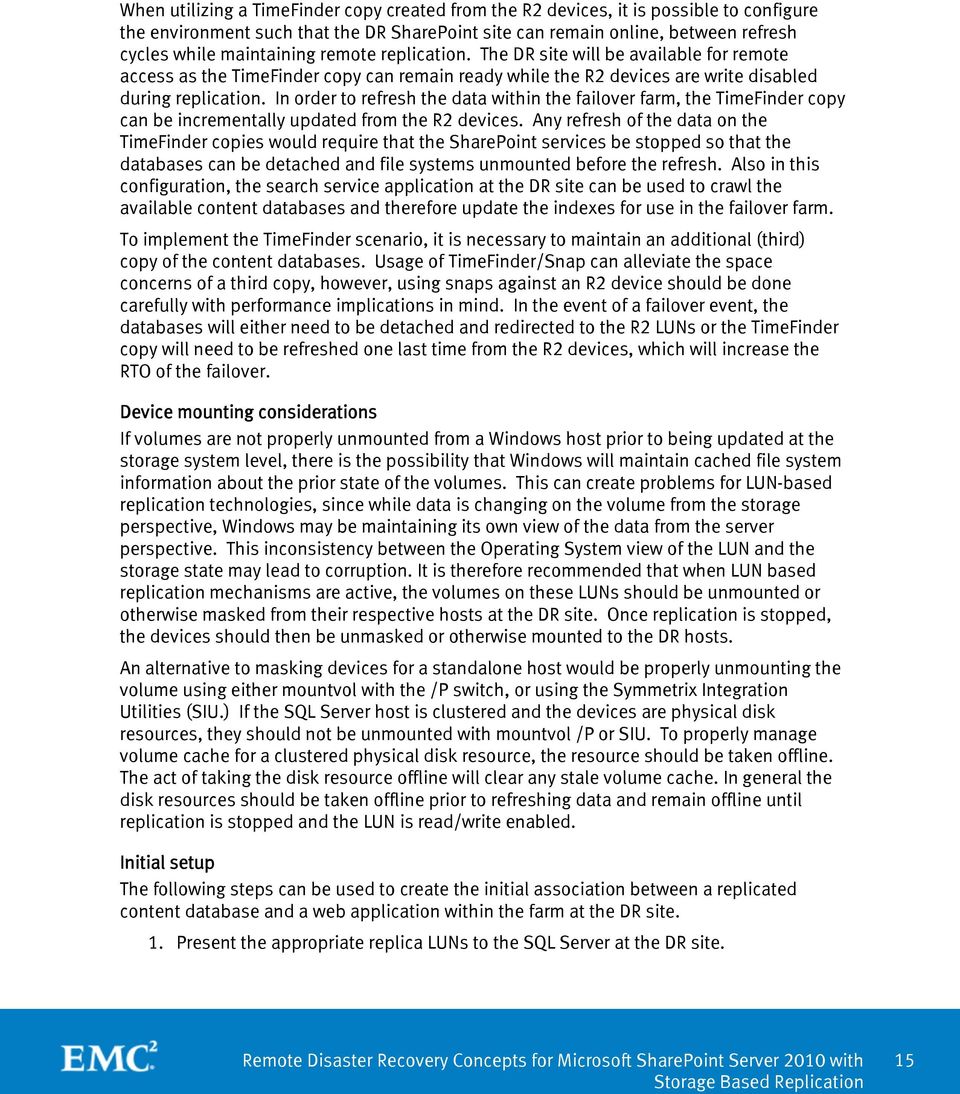
16 2. Mount the LUNs to the appropriate drive letters or mount points. a. Keeping the same enumeration (logical file location) as production simplifies the attach procedure. 3. Attach the databases to SQL Server, by script or by SQL Server Management Studio a. CREATE DATABASE Content_DBName ON (FILENAME = 'S:\primary_datafile.mdf') FOR ATTACH 4. Create the web application(s) that will support the replicated content database(s). a. The name of the replicated content database can be entered at the time of either extending or creating the web application via Central Administration. b. Use the same web application names as Production. 5. Ensure all customizations from the production farm have been added to the web servers supporting the web applications for the replicated content databases. 6. If the content database was not available at the time the web application was created or extended: a. From the Central Administrative website go to Application Management. b. Select Manage Content Databases. c. Ensure the correct web application is selected. d. Click on the content database(s) for the specified web application. e. Select the remove content database checkbox for any default databases that may have been created. f. Once unwanted databases are removed, select Add Content Database and enter the name of the appropriate replicated database. g. Site Collections should now be available for connectivity and search crawls. Refreshing the failover farm content databases Updating the data for the failover farm requires that the content databases to be refreshed must first be detached from SQL Server. There are several options that can be used to remove connections from the SQL databases for the refresh. The first option can simply involve forcing the detach of the content databases from SQL Server by setting the databases into single user mode. Once the databases are in single user mode they can be detached so that the storage replica can be refreshed. Forcing the detach in such a way will not gracefully disconnect users from the SharePoint farm. A safer process for detaching the content databases prior to the data refresh is included in the following steps. To stop user access to the farm and begin a replica refresh (SRDF example): 1. Quiesce the farm. The quiesce farm feature is designed to drain connections for session-aware applications, like Infopath forms. For general connections that are not session-aware, the users will still be able to connect, read and modify data for the site. 16

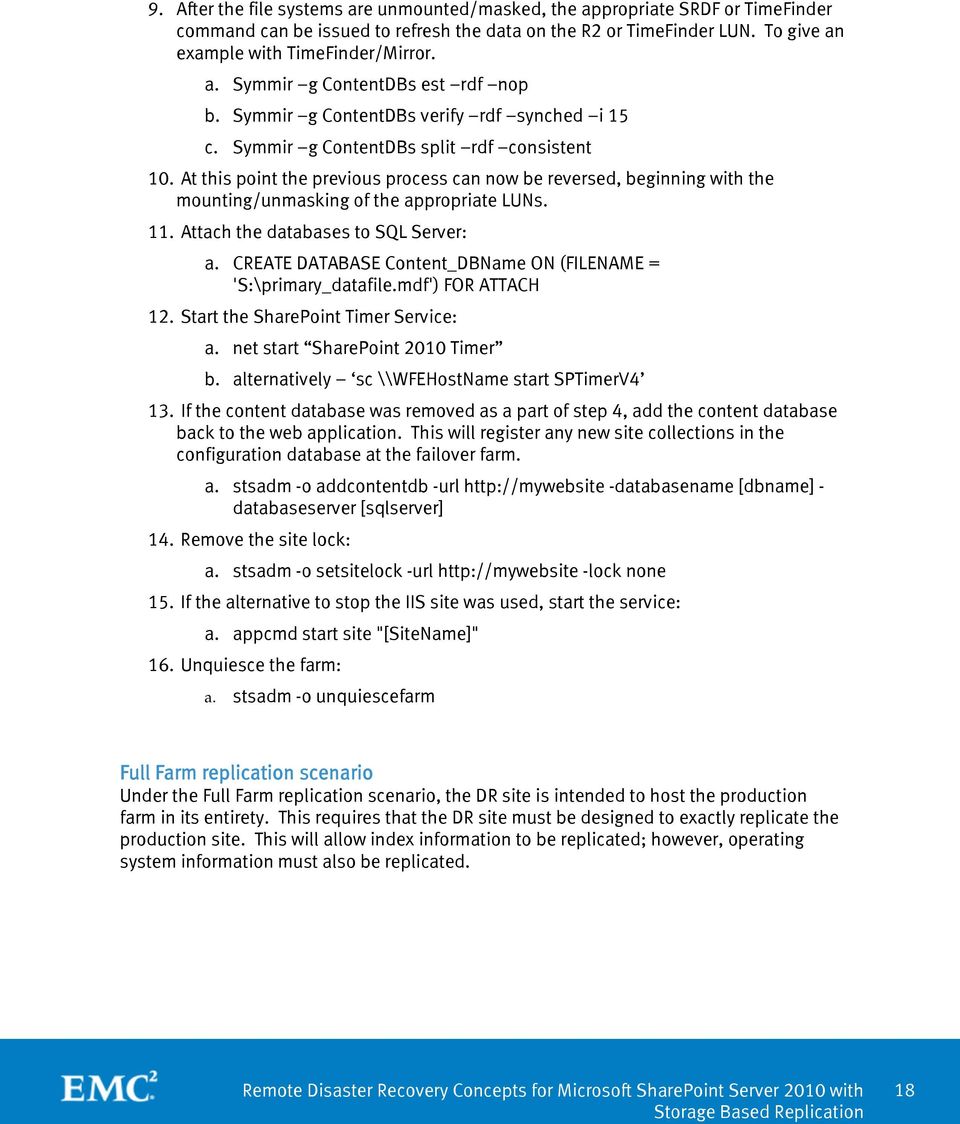
17 a. stsadm -o quiescefarm -maxduration <time in minutes> 2. Use a site collection lock. A site collection lock can be used to truly disconnect all users from a site. The lock, however, does not release all SharePoint-related handles open against the SQL databases. a. stsadm -o setsitelock -url -lock noaccess 3. Alternatively access to a site can simply be halted by stopping the appropriate IIS website. a. appcmd stop site "[SiteName]" 4. At this point we can detach the content database from the web application via the stsadm deletecontentdb command. The reason for deleting the content database from the web application is so site collections can be added to the configuration database following the refresh a. stsadm -o deletecontentdb -url -databasename [dbname] - databaseserver [sqlserver] 5. An alternative to Step 4 (deleting the content database) would be to issue the following from powershell: a. $db = get-spdatabase where {$_.Name -eq "content_database_name } $db.refreshsitesinconfigurationdatabase() 6. Following a site collection lock and content database deletion (or alternate configuration database refresh,) it is safe, from a user perspective, to use single_user mode and then detach the SQL databases. SharePoint services running on the front-end and index servers, however, may still have sessions open with the database. These sessions will be lost and may cause errors to be logged due to the unexpected detach of the SQL databases. These errors are not a major concern, and once the database is again available, the appropriate services will reconnect. To avoid the errors and more cleanly complete the quiesce process, the following can optionally be done: a. Recycle the appropriate IIS application pool: i. appcmd recycle apppool "[site name]" b. Stop SharePoint Timer Service: i. net stop "SharePoint 2010 Timer" ii. Or alternatively sc \\WFEHostName stop SPTimerV4 7. It is now safe to detach the appropriate databases: a. sp_detach_db Contet_DBName 8. Once the databases are detached, the file systems need to be either unmounted or masked as previously discussed in Device mounting considerations. 17
![Alternatively access to a site can simply be halted by stopping the appropriate IIS website. a. appcmd stop site "[SiteName]" 4.](/docs-images/42/2232325/images/page_17.jpg "At this point we can detach the content database from the web application via the stsadm deletecontentdb command.")
18 9. After the file systems are unmounted/masked, the appropriate SRDF or TimeFinder command can be issued to refresh the data on the R2 or TimeFinder LUN. To give an example with TimeFinder/Mirror. a. Symmir g ContentDBs est rdf nop b. Symmir g ContentDBs verify rdf synched i 15 c. Symmir g ContentDBs split rdf consistent 10. At this point the previous process can now be reversed, beginning with the mounting/unmasking of the appropriate LUNs. 11. Attach the databases to SQL Server: a. CREATE DATABASE Content_DBName ON (FILENAME = 'S:\primary_datafile.mdf') FOR ATTACH 12. Start the SharePoint Timer Service: a. net start SharePoint 2010 Timer b. alternatively sc \\WFEHostName start SPTimerV4 13. If the content database was removed as a part of step 4, add the content database back to the web application. This will register any new site collections in the configuration database at the failover farm. a. stsadm -o addcontentdb -url -databasename [dbname] - databaseserver [sqlserver] 14. Remove the site lock: a. stsadm -o setsitelock -url -lock none 15. If the alternative to stop the IIS site was used, start the service: a. appcmd start site "[SiteName]" 16. Unquiesce the farm: a. stsadm -o unquiescefarm Full Farm replication scenario Under the Full Farm replication scenario, the DR site is intended to host the production farm in its entirety. This requires that the DR site must be designed to exactly replicate the production site. This will allow index information to be replicated; however, operating system information must also be replicated. 18
19 Figure 2 Complete replication scenario 19

20 Considerations for the complete replication scenario include: Support for either Synchronous or Asynchronous storage replication. Provided the SQL databases and the Search indexes are replicated within the same consistency group, a full crawl of content to rebuild the indexes will not be required. Operating System data will need to be replicated. Virtualization technology such as VMware or Microsoft Hyper-V can aid in encapsulating the operating systems for the purposes of disaster recovery across heterogeneous environments. If the network subnet in the DR site differs from that in the production site, IP Addresses for the replicated OS images and clustered IP resources will need to be updated to reflect the new subnet. DNS will also need to be updated to reflect the new IP assignments. Configuring the disaster recovery environment Web front-end server Generally speaking there is a minimal amount of data that needs to be maintained or replicated from the web servers. The customized data of the highest interest includes: Root directories for virtual servers Custom web parts Custom templates Custom web pages Add-in software SSL certificates For the full farm replication scenario specific operating system information will be replicated along with the customizations in order to exactly re-create the server environment at the DR site. There are several methods that can be utilized to perform this task including backups that include the system state, and imaging tools, however, this document will only cover direct OS replication using LUN based replication, enabled by either virtualization technology or configuring physical hosts for SAN boot. By booting servers from the SAN, it is possible to replicate the entire operating system using SAN or storage based replication technologies. This allows any changes made to the source site to be automatically replicated to the DR site. Booting from the SAN has specific requirements, including the need for the server hardware at the remote site to exactly match the server hardware from the production site. This is required so that the replicated operating system can be utilized without having to make driver changes to the OS. A method to avoid this physical hardware restriction between the primary and DR site is to utilize virtualization technology. By using virtualization technology, the operating system will have the same virtual hardware configured for both the source and DR site, even though the physical hardware may differ. Also, by utilizing virtualization, the possibility for consolidating the DR environment onto less physical hardware exists. 20

21 Additionally, virtualization technologies offer integrated solutions to help automate the disaster recovery process. VMware ESX environments can leverage technologies such as Site Recovery Manager (SRM) to integrate with storage replication for the purposes of disaster recovery restart. SRM integrates with and has adapters for RecoverPoint, SRDF as well as MirrorView replication technologies. Microsoft Hyper-V can also leverage integrated solutions for disaster restart, such as EMC Cluster Enabler. EMC Cluster Enabler creates a geographically dispersed clustering environment to enable both HA and DR across datacenters for Microsoft Failover clusters. Cluster Enabler offers modules to support RecoverPoint, SRDF and MirrorView replication technologies. Back-end SQL Server databases For this scenario it is possible to replicate all SQL Server databases related to SharePoint. Because RecoverPoint, SRDF and other array or SAN based technologies perform replication at the storage level, all SharePoint databases across all SQL instances can be replicated together, consistently, to the DR site, leaving a common RPO for the entire SharePoint farm. For indexing to work properly upon failover, and not potentially require a full crawl, it is recommended for the crawl database(s), property database(s), and index file system(s) as maintained on the query servers to be replicated together using consistency technology. Additionally, the incremental relationship between a content database and the index crawl process is determined by the SharePoint change log. As items are modified within a content database, time stamped pointers to the actual modifications are inserted into the change log. The incremental crawl process can then query the change log and only index items determined to have changed since the last crawl. The change log is maintained within each content database, specifically, in the eventcache table. When considering this relationship between the content database change log and the indexing process, it is recommended that the content databases be replicated consistently with any indexed data being replicated. As discussed in the Failover farm scenario each time a new site collection is added to a given content database, information about that site collection is also added to the configuration database. Given the relationship between sites within a content database and the configuration database, it is generally recommended to also replicate the configuration database consistently with all content databases. While it is not required to replicate content databases consistently with other content databases, replicating the configuration database would require that all content databases be replicated together consistently. Should the configuration database be replicated separately from the content databases, there is the possibility for sites to exist with the content databases that might not exist within the configuration database. Should this happen, users may not be able to connect to those sites. To correct this problem, the.refreshsitesinconfigurationdatabase() method will need to be executed, or the content database would have to be removed and re-added to its web application in order to register the missing sites with the configuration database. 21
22 More information regarding this process is discussed in the Failover farm scenario section. Since it is possible to attach SQL Server databases, including the system databases, to a different host running SQL Server, it is not an absolute requirement to boot and replicate the host OS running SQL Server from the SAN. A good example of a database that generally should not be replicated is the tempdb. The tempdb can be active in SharePoint environments therefore it is not ideal, for performance and bandwidth reasons, to replicate the tempdb. If the SQL instance is not booted from the SAN or otherwise virtualized, the following requirements should be followed: The SQL instance name at the DR site should match the instance name from the production site. By matching the instance name, no configuration changes will need to be done to the farm. o It is supported to rename a host or virtual server (if clustered) running SQL Server. More information can be found within SQL Server Books Online. o It is also possible to utilize SQL Aliases for the purposes of redirecting applications like SharePoint 2010 to instances of SQL Server with different names. The correct user accounts related to SharePoint are replicated to the DR instance of SQL. o The master database maintains user accounts as they relate to the SQL instance. If the master database is replicated to the DR SQL instance then all user accounts, and specifically for SharePoint the service accounts, will be available. To manually migrate users between SQL instances refer to Microsoft KB article : Application servers The same considerations as discussed for the web front-end servers, with respect to virtualization and boot from SAN, can be applied to the application servers as well. If the application servers are replicated to the DR site then the installation of their respective server role, would not have to take place following the failover. Specifically for the search service application, it is possible to maintain the search indexes and incremental crawl capabilities when failing over the complete farm to the DR site. To ensure consistency between the content databases, search databases and indexed data, it is recommended to place all of these entities into a consistency group to ensure they are replicated to the same dependent write point-in-time. Full farm replication example With complete replication, there are a number of ways to replicate and continually update the DR site. Depending on the chosen method, the setup, maintenance, and testing of the environment can vary dramatically. The simplest way to replicate the environment under this scenario is to utilize a virtualized environment and to have all SharePoint hosts and data replicated consistently. With this scenario the virtual hosts can be configured to utilize the replicated target devices. Since 22
23 all OS data, index, content, and configuration databases are replicated, it is possible to simply Read Write enable or otherwise enable access to the remote devices and boot the virtual environment in the event of a failover. Ideally the restart of servers and services would be sequenced so that the SQL Server Instance would be started first, followed by the web servers then application servers. When virtualizing a VMware ESX environment, Site Recovery Manager could be used to help with automatically enabling access to the remote LUNs, and restarting the environment in the proper order. The main concern with this scenario is the network setup and whether a VLAN is available at the DR site to accept the same IP address and subnet information as configured and replicated from the production site. If a VLAN cannot be used, the replicated OS copies at the DR site will need to be modified with the appropriate network information. This can be done as a part of maintenance and testing of the environment, or done as a part of the failover procedure. Host name resolution, including DNS, at the DR site will also have to be adjusted accordingly depending on whether VLANs can be used in the environment. Additional details regarding full farm replication can be found within the white paper EMC Continuous Protection for Virtualized SharePoint 2010 Farms available on powerlink ( protection-virtualized-sharepoint-wp.pdf) The white paper details an example of protecting a SharePoint Server 2010 farm using VMware ESX and Site Recovery Manager with RecoverPoint CDP and CRR technologies. Stretched farm scenario In the stretched farm scenario, the DR site is intended to support the production site with separate servers that exist within the same farm. With this configuration the hosts from the DR site will be within the same farm as the servers of the production site, operating with redundant roles. All SQL Server databases will be replicated, which will also allow the possibility to replicate all farm databases including the configuration, content and those supporting service applications. Web, query, crawl and application servers will be maintained independently, but within the same SharePoint farm. Figure 3 provides an example of this scenario. 23
24 Figure 3 Stretched farm scenario 24
25 Considerations for the stretched farm scenario: Synchronous storage replication o Synchronous replication provides the potential to maintain the search service application with redundant query and crawl components at the secondary site. Redundant web front end servers can also be maintained and active depending on the round trip latency between the Primary and DR data centers. o Web front end servers and search service application roles maintained within the DR site can also be marked as passive until such time as the content databases are active within the DR datacenter. Access to the web front end servers can be controlled by network load balancing technologies, while access to the search query components can be managed by adding them as failover-only mirrors. Asynchronous storage replication o Asynchronous storage replication can be supported in a stretched farm scenario, however, it should be expected for the web front end servers and application servers maintained within the DR site to be passive where round trip network latency exceeds Microsoft recommendations. o Depending on the nature of the failover, the indexes maintained on the redundant query servers may not be consistent with the storage based copy of the search related databases. A full crawl may be required to resolve any conflicts should they exist. When considering network bandwidth and performance limitations across a WAN, Microsoft provides limited support for geographically separated servers within a farm. Some of the restrictions include: o Network latency of no more than 1 millisecond between a web server and the database server. o All server roles involved in shared services (database, index, query and excel) are located in the same data center. o Servers within a farm cannot cross time zones For additional restrictions and best practices from Microsoft, please see the Optimizing Office SharePoint Server for WAN environments article available on TechNet. Configuring the disaster recovery environment Web front-end server Specifically for the stretched farm scenario, as the web front-end servers will be maintained within the same farm, only customizations will need to be applied to the web servers at the DR site. This could be done by maintaining a change control system and applying customizations to both sites as they are made. Additionally, similar to SharePoint 25
26 2007, SharePoint 2010 offers a solutions framework that enables packaging of customizations for simplified and automated deployment. Generally speaking there is a minimal amount of data that needs to be maintained or replicated on each of the web servers. The customized data of the highest interest includes: Custom web parts Custom templates Custom web pages Add-in software SSL certificates Depending on the desired configuration, distances between the sites, networking infrastructure available (VLAN for instance) as well as performance requirements, the web servers at the DR site can be active within a Network Load Balancing (NLB) infrastructure so that they support the same web applications as the production site. An alternative would be to leave the DR servers inactive and left out of a NLB infrastructure until a failover needs to occur. DNS can then be modified to redirect users to the web servers at the DR site Also, in order to have redundancy for the Central Administration site it will need to be installed on a web server at the DR site. Installing the central administration web application can be done by going into the advanced settings within the SharePoint Product and Technologies Configuration Wizard and selecting the radio button to host the Central Administration web application. Alternate access mappings for the central administration web application can be used to help manage connectivity to the appropriate server. Back-end SQL Server databases For this scenario it is possible to replicate all SQL Server databases related to SharePoint. Because RecoverPoint, SRDF and other array or SAN based technologies perform replication at the storage level, all SharePoint databases across all SQL instances can be replicated together, consistently to the DR site, leaving a common RPO for the entire SharePoint farm. As discussed in the section Failover farm scenario, each time a new site collection is added to a given content database, information about that site collection is also added to the configuration database. Given the relationship between sites within a content database and the configuration database, it is generally recommended to also replicate the configuration database consistently with all content databases. While it is not required to replicate content databases consistently with other content databases, replicating the configuration database would require that all content databases be replicated together consistently. 26
27 Should the configuration database be replicated separately from the content databases, there is the possibility for sites to exist with the content databases that might not exist within the configuration database. Should this happen, users may not be able to connect to those sites. To correct this problem, the.refreshsitesinconfigurationdatabase() method will need to be executed, or the content database would have to be removed and re-added to its web application in order to register the missing sites with the configuration database. More information regarding this process is discussed in the Failover farm scenario section. Since it is possible to attach SQL Server databases, including the system databases, to a different host running SQL Server, it is not a requirement to boot and replicate the host OS running SQL Server from the SAN. A good example of a database that generally should not be replicated is tempdb. The tempdb can be very active in SharePoint environments; therefore it is not ideal, for performance and bandwidth reasons, to replicate the tempdb. If the SQL instance is not booted from the SAN or otherwise virtualized, the following requirements must be followed: The SQL instance name at the DR site should match the instance name from the production site. By matching the instance name, no configuration changes will need to be done to the farm. It is supported to rename a host or virtual server (if clustered) running SQL Server. More information can be found within SQL Server Books Online It is also possible to utilize SQL Aliases for the purposes of redirecting applications like SharePoint 2010 to instances of SQL Server with different names. The correct user accounts related to SharePoint are replicated to the DR instance of SQL The master database maintains user accounts as they relate to the SQL instance. If the master database is replicated to the DR SQL instance then all user accounts, and specifically for SharePoint the service accounts, will be available. To manually migrate users between SQL instances refer to Microsoft KB article : It is also possible to utilize geographically dispersed clustering technologies, like EMC s Cluster Enabler to create SQL instances that can span between the Primary and DR sites. Application servers Similar to the web server considerations in this scenario, it is necessary to decide whether application servers are hosted within the DR site to process data during normal operation. In the case of the search service application, SharePoint 2010 offers the ability to have both redundant Query and Crawl components that can be configured and installed at the DR site. The benefit of having the application servers available beyond serving queries is the fact that index propagation can occur at all times. Then in the event of a failover to the DR site, search can continue to work without the need to reindex the data. 27
28 While there are benefits, it may be problematic to host the query servers at the DR site. When considering index propagation and user queries, which may very well reference data from an index server and databases at the production site, it is possible for considerable bandwidth to be used across the WAN. Microsoft also provides limited support for geographically separated servers in a farm. Microsoft recommends that all servers that host a shared services component exist in the same data center as the database server. The distance between sites, network bandwidth, and performance requirements should be taken into account when designing the solution. EMC Cluster Enabler considerations A possible configuration to help automate the replication and failover of SharePoint resources is to utilize EMC s Cluster Enabler for Microsoft Failover Clusters (Cluster Enabler or CE for short). CE can be used in conjunction with synchronous or asynchronous replication to help automate the failover of SQL instances or highly available Hyper-V virtual machines to a DR site. CE, however, does have some limitations with respect to replicating data outside of its configured Microsoft Failover Clustering group. Microsoft Cluster Service utilizes resource groups as the granularity for moving resources between hosts. CE subsequently organizes the physical disk resources within the Failover Clustering resource groups into device groups. To use SRDF as an example, because SRDF/A devices must replicate and therefore be managed together, all devices within an SRDF/A RA group must be added to the same device group. SRDF/CE will then add all physical disk resources as defined within the device group into a single MSCS resource group. When considering a distributed environment like a SharePoint farm, it will not be possible to place all of the necessary devices that require consistency into the same MSCS group for Cluster Enabler to manage. This is problematic in the complete replication and stretched farm scenarios as there may be a requirement to replicate multiple SQL Server instances and/or the index server data consistently in order to fail over search seamlessly to the DR site. This is not to say that Cluster Enabler cannot be used in a SharePoint environment. CE can still be used to replicate and help automate the failover for all of the SQL Server databases or Hyper-V virtual machines to the DR site. It should be expected, however, to have to configure consistency groups outside of Cluster Enabler s control where consistency across multiple SQL instances or service application servers is required. Another consideration with respect to CE is tempdb replication. SQL Server under MSCS requires that all LUNs that support SQL exist within the cluster. This requirement forces CE to also include the tempdb LUNs within its device groups. This means that the tempdb traffic will be replicated while under CE control, which may have performance or bandwidth ramifications in some environments. 28
29 Conclusion Considering the various options available for protecting a SharePoint environment, it is important to match the business requirements with the most appropriate DR scenario. Some of the business requirements may include the RTO for specific components of the SharePoint environment. For instance, it may be a requirement for content to be available almost immediately following a DR event; however, having search available may not be required for several days. The RPO may also impact requirements. For example, it may be required to have a zero data loss synchronous solution, or perhaps a solution that can replicate the entire SharePoint farm to the same consistent point in time. Other considerations may include cost, in the form of network bandwidth provisioning and remote hardware availability, as well as the complexity of managing the DR solution. An excellent example regarding network bandwidth is the decision to replicate indexing traffic to the DR site. The obvious benefit is the ability to quickly resume search following a DR event, however, the additional bandwidth requirements for replicating the index from the query servers and the associated search service application databases should be considered. As SharePoint is rarely the only application in an IT environment, considerations on how to perform DR for all of the various business applications should also be taken into account. Since storage or SAN based replication provides a host-independent method for replicating data, other applications, such as external content sources (like file shares or non- SharePoint sites) that can be crawled within search, can also be replicated using storage technologies. SAN replication not only offloads the process of replication from already-burdened SharePoint and SQL hosts, but also enables enterprise scalability in protecting SharePoint farms across extended distances. Ultimately, storage based replication should provide the flexibility necessary to match the desired DR configuration for virtually any enterprise level SharePoint implementation. 29
30 Copyright 2011 EMC Corporation. All Rights Reserved. EMC believes the information in this publication is accurate as of its publication date. The information is subject to change without notice. THE INFORMATION IN THIS PUBLICATION IS PROVIDED "AS IS." EMC CORPORATION MAKES NO REPRESENTATIONS OR WARRANTIES OF ANY KIND WITH RESPECT TO THE INFORMATION IN THIS PUBLICATION, AND SPECIFICALLY DISCLAIMS IMPLIED WARRANTIES OF MERCHANTABILITY OR FITNESS FOR A PARTICULAR PURPOSE. Use, copying, and distribution of any EMC software described in this publication requires an applicable software license. For the most up-to-date listing of EMC product names, see EMC Corporation Trademarks on EMC.com. All other trademarks used herein are the property of their respective owners. 30
Increasing Recoverability of Critical Data with EMC Data Protection Advisor and Replication Analysis
 Increasing Recoverability of Critical Data with EMC Data Protection Advisor and Replication Analysis A Detailed Review Abstract EMC Data Protection Advisor (DPA) provides a comprehensive set of features
IMPROVING VMWARE DISASTER RECOVERY WITH EMC RECOVERPOINT Applied Technology
 White Paper IMPROVING VMWARE DISASTER RECOVERY WITH EMC RECOVERPOINT Applied Technology Abstract EMC RecoverPoint provides full support for data replication and disaster recovery for VMware ESX Server
VMware Site Recovery Manager with EMC RecoverPoint
 VMware Site Recovery Manager with EMC RecoverPoint Implementation Guide EMC Global Solutions Centers EMC Corporation Corporate Headquarters Hopkinton MA 01748-9103 1.508.435.1000 www.emc.com Copyright
EMC MID-RANGE STORAGE AND THE MICROSOFT SQL SERVER I/O RELIABILITY PROGRAM
 White Paper EMC MID-RANGE STORAGE AND THE MICROSOFT SQL SERVER I/O RELIABILITY PROGRAM Abstract This white paper explains the integration of EMC Mid-range Storage arrays with the Microsoft SQL Server I/O
Windows Server 2008 Hyper-V Backup and Replication on EMC CLARiiON Storage. Applied Technology
 Windows Server 2008 Hyper-V Backup and Replication on EMC CLARiiON Storage Applied Technology Abstract This white paper provides an overview of the technologies that are used to perform backup and replication
EMC Replication Manager and Kroll Ontrack PowerControls for Granular Recovery of SharePoint Items
 EMC Replication Manager and Kroll Ontrack PowerControls for Granular Recovery of SharePoint Items Applied Technology Abstract This white paper discusses how Kroll Ontrack PowerControls integrates with
EMC PERFORMANCE OPTIMIZATION FOR MICROSOFT FAST SEARCH SERVER 2010 FOR SHAREPOINT
 Reference Architecture EMC PERFORMANCE OPTIMIZATION FOR MICROSOFT FAST SEARCH SERVER 2010 FOR SHAREPOINT Optimize scalability and performance of FAST Search Server 2010 for SharePoint Validate virtualization
EMC Backup and Recovery for Microsoft SQL Server 2008 Enabled by EMC Celerra Unified Storage
 EMC Backup and Recovery for Microsoft SQL Server 2008 Enabled by EMC Celerra Unified Storage Applied Technology Abstract This white paper describes various backup and recovery solutions available for SQL
EMC NetWorker and Replication: Solutions for Backup and Recovery Performance Improvement
 EMC NetWorker and Replication: Solutions for Backup and Recovery Performance Improvement A Detailed Review Abstract Recovery management, the next phase in the evolution of backup and data protection methodologies,
White Paper. EMC REPLICATION MANAGER AND MICROSOFT SQL SERVER A Detailed Review
 White Paper EMC REPLICATION MANAGER AND MICROSOFT SQL SERVER A Detailed Review Abstract This white paper discusses how EMC Replication Manager integrates with Microsoft SQL Server to provide a solution
Best practices for operational excellence (SharePoint Server 2010)
 Best practices for operational excellence (SharePoint Server 2010) Published: May 12, 2011 Microsoft SharePoint Server 2010 is used for a broad set of applications and solutions, either stand-alone or
SharePoint 2010 Interview Questions-Architect
 Basic Intro SharePoint Architecture Questions 1) What are Web Applications in SharePoint? An IIS Web site created and used by SharePoint 2010. Saying an IIS virtual server is also an acceptable answer.
EMC Replication Manager for Virtualized Environments
 EMC Replication Manager for Virtualized Environments A Detailed Review Abstract Today s IT organization is constantly looking for ways to increase the efficiency of valuable computing resources. Increased
Microsoft SharePoint 2010 on VMware Availability and Recovery Options. Microsoft SharePoint 2010 on VMware Availability and Recovery Options
 This product is protected by U.S. and international copyright and intellectual property laws. This product is covered by one or more patents listed at http://www.vmware.com/download/patents.html. VMware
EMC NETWORKER SNAPSHOT MANAGEMENT
 White Paper Abstract This white paper describes the benefits of NetWorker Snapshot Management for EMC Arrays. It also explains the value of using EMC NetWorker for snapshots and backup. June 2013 Copyright
Availability Guide for Deploying SQL Server on VMware vsphere. August 2009
 Availability Guide for Deploying SQL Server on VMware vsphere August 2009 Contents Introduction...1 SQL Server 2008 with vsphere and VMware HA/DRS...2 Log Shipping Availability Option...4 Database Mirroring...
Storage Based Replications
 Storage Based Replications Miroslav Vraneš EMC Technology Group [email protected] 1 Protecting Information Is a Business Decision Recovery point objective (RPO): How recent is the point in time for
EMC NetWorker Module for Microsoft for Windows Bare Metal Recovery Solution
 EMC NetWorker Module for Microsoft for Windows Bare Metal Recovery Solution Release 3.0 User Guide P/N 300-999-671 REV 02 Copyright 2007-2013 EMC Corporation. All rights reserved. Published in the USA.
EMC DOCUMENTUM xplore 1.1 DISASTER RECOVERY USING EMC NETWORKER
 White Paper EMC DOCUMENTUM xplore 1.1 DISASTER RECOVERY USING EMC NETWORKER Abstract The objective of this white paper is to describe the architecture of and procedure for configuring EMC Documentum xplore
HIGHLY AVAILABLE MULTI-DATA CENTER WINDOWS SERVER SOLUTIONS USING EMC VPLEX METRO AND SANBOLIC MELIO 2010
 White Paper HIGHLY AVAILABLE MULTI-DATA CENTER WINDOWS SERVER SOLUTIONS USING EMC VPLEX METRO AND SANBOLIC MELIO 2010 Abstract This white paper demonstrates key functionality demonstrated in a lab environment
EMC NetWorker Module for Microsoft Applications Release 2.3. Application Guide P/N 300-011-105 REV A02
 EMC NetWorker Module for Microsoft Applications Release 2.3 Application Guide P/N 300-011-105 REV A02 EMC Corporation Corporate Headquarters: Hopkinton, MA 01748-9103 1-508-435-1000 www.emc.com Copyright
VMware vsphere Data Protection
 VMware vsphere Data Protection Replication Target TECHNICAL WHITEPAPER 1 Table of Contents Executive Summary... 3 VDP Identities... 3 vsphere Data Protection Replication Target Identity (VDP-RT)... 3 Replication
Redefining Microsoft SQL Server Data Management
 Redefining Microsoft SQL Server Data Management Contact Actifio Support As an Actifio customer, you can get support for all Actifio products through the Support Portal at http://support.actifio.com/. Copyright,
VMware vsphere Data Protection 6.0
 VMware vsphere Data Protection 6.0 TECHNICAL OVERVIEW REVISED FEBRUARY 2015 Table of Contents Introduction.... 3 Architectural Overview... 4 Deployment and Configuration.... 5 Backup.... 6 Application
TABLE OF CONTENTS THE SHAREPOINT MVP GUIDE TO ACHIEVING HIGH AVAILABILITY FOR SHAREPOINT DATA. Introduction. Examining Third-Party Replication Models
 1 THE SHAREPOINT MVP GUIDE TO ACHIEVING HIGH AVAILABILITY TABLE OF CONTENTS 3 Introduction 14 Examining Third-Party Replication Models 4 Understanding Sharepoint High Availability Challenges With Sharepoint
VMware vsphere Data Protection 5.8 TECHNICAL OVERVIEW REVISED AUGUST 2014
 VMware vsphere Data Protection 5.8 TECHNICAL OVERVIEW REVISED AUGUST 2014 Table of Contents Introduction.... 3 Features and Benefits of vsphere Data Protection... 3 Additional Features and Benefits of
Data Protection for Microsoft SharePoint Portal Server 2003. Agent for Microsoft SharePoint Portal Server
 WHITE PAPER Data Protection for Microsoft SharePoint Portal Server 2003 VERITAS Backup Exec TM 10 for Windows Servers Agent for Microsoft SharePoint Portal Server Applicable for Windows SharePoint Portal
ABSTRACT. February, 2014 EMC WHITE PAPER
 EMC APPSYNC SOLUTION FOR MANAGING PROTECTION OF MICROSOFT SQL SERVER SLA-DRIVEN, SELF-SERVICE CAPABILITIES FOR MAXIMIZING AND SIMPLIFYING DATA PROTECTION AND RECOVERABILITY ABSTRACT With Microsoft SQL
EMC Documentum Repository Services for Microsoft SharePoint
 EMC Documentum Repository Services for Microsoft SharePoint Version 6.5 SP2 Installation Guide P/N 300 009 829 A01 EMC Corporation Corporate Headquarters: Hopkinton, MA 01748 9103 1 508 435 1000 www.emc.com
GoGrid Implement.com Configuring a SQL Server 2012 AlwaysOn Cluster
 GoGrid Implement.com Configuring a SQL Server 2012 AlwaysOn Cluster Overview This documents the SQL Server 2012 Disaster Recovery design and deployment, calling out best practices and concerns from the
Technical Notes. EMC NetWorker Performing Backup and Recovery of SharePoint Server by using NetWorker Module for Microsoft SQL VDI Solution
 EMC NetWorker Performing Backup and Recovery of SharePoint Server by using NetWorker Module for Microsoft SQL VDI Solution Release number 9.0 TECHNICAL NOTES 302-001-760 REV 01 September, 2015 These technical
EMC RECOVERPOINT: BUSINESS CONTINUITY FOR SAP ENVIRONMENTS ACROSS DISTANCE
 White Paper EMC RECOVERPOINT: BUSINESS CONTINUITY FOR SAP ENVIRONMENTS ACROSS DISTANCE Applied Technology Abstract Business continuity is a critical component of any enterprise data protection strategy
EMC ViPR Controller. Service Catalog Reference Guide. Version 2.3 XXX-XXX-XXX 01
 EMC ViPR Controller Version 2.3 Service Catalog Reference Guide XXX-XXX-XXX 01 Copyright 2015- EMC Corporation. All rights reserved. Published in USA. Published July, 2015 EMC believes the information
AX4 5 Series Software Overview
 AX4 5 Series Software Overview March 6, 2008 This document presents an overview of all software you need to configure and monitor any AX4 5 series storage system running the Navisphere Express management
How To Use A Microsoft Networker Module For Windows 8.2.2 (Windows) And Windows 8 (Windows 8) (Windows 7) (For Windows) (Powerbook) (Msa) (Program) (Network
 EMC NetWorker Module for Microsoft Applications Release 2.3 Application Guide P/N 300-011-105 REV A03 EMC Corporation Corporate Headquarters: Hopkinton, MA 01748-9103 1-508-435-1000 www.emc.com Copyright
EMC REPLICATION MANAGER AND MICROSOFT EXCHANGE SERVER 2007
 White Paper EMC REPLICATION MANAGER AND MICROSOFT EXCHANGE SERVER 2007 A Detailed Review Abstract This white paper describes how EMC Replication Manager integrates with Microsoft Exchange 2007 to offer
Windows Geo-Clustering: SQL Server
 Windows Geo-Clustering: SQL Server Edwin Sarmiento, Microsoft SQL Server MVP, Microsoft Certified Master Contents Introduction... 3 The Business Need for Geo-Clustering... 3 Single-location Clustering
EMC NetWorker Module for Microsoft for Windows Bare Metal Recovery Solution
 EMC NetWorker Module for Microsoft for Windows Bare Metal Recovery Solution Version 9.0 User Guide 302-001-755 REV 01 Copyright 2007-2015 EMC Corporation. All rights reserved. Published in USA. Published
EMC AVAMAR INTEGRATION WITH EMC DATA DOMAIN SYSTEMS
 EMC AVAMAR INTEGRATION WITH EMC DATA DOMAIN SYSTEMS A Detailed Review ABSTRACT This white paper highlights integration features implemented in EMC Avamar with EMC Data Domain deduplication storage systems
EMC NetWorker Module for Microsoft for Windows Bare Metal Recovery Solution
 EMC NetWorker Module for Microsoft for Windows Bare Metal Recovery Solution Version 8.2 Service Pack 1 User Guide 302-001-235 REV 01 Copyright 2007-2015 EMC Corporation. All rights reserved. Published
How to Scale out SharePoint Server 2007 from a single server farm to a 3 server farm with Microsoft Network Load Balancing on the Web servers.
 1 How to Scale out SharePoint Server 2007 from a single server farm to a 3 server farm with Microsoft Network Load Balancing on the Web servers. Back to Basics Series By Steve Smith, MVP SharePoint Server,
EMC VPLEX FAMILY. Continuous Availability and Data Mobility Within and Across Data Centers
 EMC VPLEX FAMILY Continuous Availability and Data Mobility Within and Across Data Centers DELIVERING CONTINUOUS AVAILABILITY AND DATA MOBILITY FOR MISSION CRITICAL APPLICATIONS Storage infrastructure is
EMC Business Continuity and Disaster Recovery Solutions
 EMC Business Continuity and Disaster Recovery Solutions Comprehensive Data Protection Rick Walsworth Director, Product Marketing EMC Cross Platform Replication 1 Agenda Data Protection Challenges EMC Continuity
SharePoint Backup Guide
 SharePoint Backup Guide for Microsoft Windows Backing up and restoring SharePoint sites and content databases using Attix5 Pro. Copyright notice and proprietary information This User Manual is published
Metalogix SharePoint Backup. Advanced Installation Guide. Publication Date: August 24, 2015
 Metalogix SharePoint Backup Publication Date: August 24, 2015 All Rights Reserved. This software is protected by copyright law and international treaties. Unauthorized reproduction or distribution of this
BUSINESS CONTINUITY BEST PRACTICES FOR SAP HANA TAILORED DATACENTER INTEGRATION WITH EMC SYMMETRIX VMAX
 BUSINESS CONTINUITY BEST PRACTICES FOR SAP HANA TAILORED DATACENTER INTEGRATION WITH EMC SYMMETRIX VMAX Data protection and availability enabled by EMC Symmetrix Remote Data Facility EMC TimeFinder EMC
EMC Symmetrix V-Max and Microsoft SQL Server
 EMC Symmetrix V-Max and Microsoft SQL Server Applied Technology Abstract This white paper examines deployment and integration of Microsoft SQL Server solutions on the EMC Symmetrix V-Max Series with Enginuity.
EMC APPSYNC AND MICROSOFT SQL SERVER A DETAILED REVIEW
 EMC APPSYNC AND MICROSOFT SQL SERVER A DETAILED REVIEW ABSTRACT This white paper discusses how EMC AppSync integrates with Microsoft SQL Server to provide a solution for continuous availability of critical
Improving Microsoft SQL Server Recovery with EMC NetWorker and EMC RecoverPoint
 Improving Microsoft SQL Server Recovery with EMC NetWorker and EMC RecoverPoint Applied Technology Abstract This white paper covers how EMC NetWorker and EMC NetWorker modules can be used effectively in
EMC VPLEX: LEVERAGING ARRAY BASED AND NATIVE COPY TECHNOLOGIES
 White Paper EMC VPLEX: LEVERAGING ARRAY BASED AND NATIVE COPY TECHNOLOGIES Second Edition Abstract This white paper provides best practices planning and use cases for using array-based and native replication
EMC NetWorker Module for Microsoft for Windows Bare Metal Recovery Solution
 EMC NetWorker Module for Microsoft for Windows Bare Metal Recovery Solution Release 8.2 User Guide P/N 302-000-658 REV 01 Copyright 2007-2014 EMC Corporation. All rights reserved. Published in the USA.
Zerto Virtual Manager Administration Guide
 Zerto Virtual Manager Administration Guide AWS Environment ZVR-ADVA-4.0U2-01-23-07-15 Copyright 2015, Zerto Ltd. All rights reserved. Information in this document is subject to change without notice and
EMC NetWorker Module for Microsoft for SQL and SharePoint VSS User Guide
 EMC NetWorker Module for Microsoft for SQL and SharePoint VSS User Guide Version 8.2 Service Pack 1 User Guide 302-001-231 REV 01 Copyright 2007-2014 EMC Corporation. All rights reserved. Published in
Load Balancing Microsoft Sharepoint 2010 Load Balancing Microsoft Sharepoint 2013. Deployment Guide
 Load Balancing Microsoft Sharepoint 2010 Load Balancing Microsoft Sharepoint 2013 Deployment Guide rev. 1.4.2 Copyright 2015 Loadbalancer.org, Inc. 1 Table of Contents About this Guide... 3 Appliances
Deploying Exchange Server 2007 SP1 on Windows Server 2008
 Deploying Exchange Server 2007 SP1 on Windows Server 2008 Product Group - Enterprise Dell White Paper By Ananda Sankaran Andrew Bachler April 2008 Contents Introduction... 3 Deployment Considerations...
EMC SourceOne. Disaster Recovery Solution Guide. Version 7.2 302-000-951 REV 01
 EMC SourceOne Version 7.2 Disaster Recovery Solution Guide 302-000-951 REV 01 Copyright 2005-2015 EMC Corporation. All rights reserved. Published in USA. Published April 30, 2015 EMC believes the information
10231B: Designing a Microsoft SharePoint 2010 Infrastructure
 10231B: Designing a Microsoft SharePoint 2010 Infrastructure Course Number: 10231B Course Length: 5 Days Course Overview This 5 day course teaches IT Professionals to design and deploy Microsoft SharePoint
Best Practices for Installing and Configuring the Hyper-V Role on the LSI CTS2600 Storage System for Windows 2008
 Best Practices Best Practices for Installing and Configuring the Hyper-V Role on the LSI CTS2600 Storage System for Windows 2008 Installation and Configuration Guide 2010 LSI Corporation August 13, 2010
Continuous Data Protection for any Point-in-Time Recovery: Product Options for Protecting Virtual Machines or Storage Array LUNs
 EMC RECOVERPOINT FAMILY Continuous Data Protection for any Point-in-Time Recovery: Product Options for Protecting Virtual Machines or Storage Array LUNs ESSENTIALS EMC RecoverPoint Family Optimizes RPO
CA XOsoft Replication for Windows
 CA XOsoft Replication for Windows Microsoft SQL Server Operation Guide r12.5 This documentation and any related computer software help programs (hereinafter referred to as the Documentation ) is for the
10174 - SharePoint 2010
 Configuring and Managing Microsoft SharePoint 2010 Introduction The course teaches students how to install, configure and administer SharePoint, and also manage and monitor sites and users by using SharePoint
VMware vsphere Data Protection 6.1
 VMware vsphere Data Protection 6.1 Technical Overview Revised August 10, 2015 Contents Introduction... 3 Architecture... 3 Deployment and Configuration... 5 Backup... 6 Application Backup... 6 Backup Data
EMC VPLEX FAMILY. Continuous Availability and data Mobility Within and Across Data Centers
 EMC VPLEX FAMILY Continuous Availability and data Mobility Within and Across Data Centers DELIVERING CONTINUOUS AVAILABILITY AND DATA MOBILITY FOR MISSION CRITICAL APPLICATIONS Storage infrastructure is
SAP Disaster Recovery Solution with VMware Site Recovery Manager and EMC CLARiiON
 SAP Disaster Recovery Solution with VMware Site Recovery Manager and EMC CLARiiON Applied Technology Abstract This white paper demonstrates how VMware s Site Recovery Manager enables the design of a powerful
CA ARCserve Replication and High Availability
 CA ARCserve Replication and High Availability Installation Guide r16 This documentation, which includes embedded help systems and electronically distributed materials, (hereinafter referred to as the Documentation
EMC Disaster Recovery with VMware SRM
 EMC Disaster Recovery with VMware SRM Complete Data Protection for VMware Infrastructure Presented by: Dean Drinnan Senior Technology Consultant, EMC A/NZ Why EMC is the Leader for VMware Environments
Symantec NetBackup for Microsoft SharePoint Server Administrator s Guide
 Symantec NetBackup for Microsoft SharePoint Server Administrator s Guide for Windows Release 7.5 Symantec NetBackup for Microsoft SharePoint Server Administrator s Guide The software described in this
EMC Business Continuity for VMware View Enabled by EMC SRDF/S and VMware vcenter Site Recovery Manager
 EMC Business Continuity for VMware View Enabled by EMC SRDF/S and VMware vcenter Site Recovery Manager A Detailed Review Abstract This white paper demonstrates that business continuity can be enhanced
Veritas Cluster Server Application Note: Disaster Recovery for Microsoft SharePoint Server
 Veritas Cluster Server Application Note: Disaster Recovery for Microsoft SharePoint Server Windows Server 2003, Windows Server 2008 5.1 Veritas Cluster Server Application Note: Disaster Recovery for Microsoft
CA ARCserve Replication and High Availability
 CA ARCserve Replication and High Availability Microsoft SharePoint Server Operation Guide r16.5 This Documentation, which includes embedded help systems and electronically distributed materials, (hereinafter
Online Transaction Processing in SQL Server 2008
 Online Transaction Processing in SQL Server 2008 White Paper Published: August 2007 Updated: July 2008 Summary: Microsoft SQL Server 2008 provides a database platform that is optimized for today s applications,
EMC Solutions for Disaster Recovery
 EMC Solutions for Disaster Recovery EMC RecoverPoint Daniel Golic, Technology Consultant Banja Luka, May 27 th 2008 1 RecoverPoint 3.0 Overview 2 The CIO s Information Storage and Management Requirements
Veritas Storage Foundation High Availability for Windows by Symantec
 Veritas Storage Foundation High Availability for Windows by Symantec Simple-to-use solution for high availability and disaster recovery of businesscritical Windows applications Data Sheet: High Availability
Use QNAP NAS for Backup
 Use QNAP NAS for Backup BACKUP EXEC 12.5 WITH QNAP NAS Copyright 2010. QNAP Systems, Inc. All Rights Reserved. V1.0 Document revision history: Date Version Changes Apr 2010 1.0 Initial release Note: Information
Module: Business Continuity
 Upon completion of this module, you should be able to: Describe business continuity and cloud service availability Describe fault tolerance mechanisms for cloud infrastructure Discuss data protection solutions
"Charting the Course...... to Your Success!" MOC 10174 B Configuring and Administering Microsoft SharePoint 2010. Course Summary
 Description Course Summary This five-day instructor-led course teaches students how to install, configure, and administer Microsoft SharePoint and also how to manage and monitor sites and users by using
EMC SYNCPLICITY FILE SYNC AND SHARE SOLUTION
 EMC SYNCPLICITY FILE SYNC AND SHARE SOLUTION Automated file synchronization Flexible, cloud-based administration Secure, on-premises storage EMC Solutions January 2015 Copyright 2014 EMC Corporation. All
SharePoint Backup and Recovery: Ensuring Complete Protection
 SharePoint Backup and Recovery: Ensuring Complete Protection A Detailed Review Abstract The growing use of Microsoft SharePoint in the market is driving the need for comprehensive solutions for managing
Network-based Intelligent Data Protection Yossi Mossel, Product Manager
 1 EMC RecoverPoint Network-based Intelligent Data Protection Yossi Mossel, Product Manager The CIO s Information-Storage and -Management Requirements Lower TCO Utilization, consolidation, automated management
MICROSOFT SHAREPOINT SERVER: BEST PRACTICES AND DESIGN GUIDELINES FOR EMC STORAGE
 White Paper MICROSOFT SHAREPOINT SERVER: BEST PRACTICES AND DESIGN GUIDELINES FOR EMC STORAGE EMC VNX Family, EMC Symmetrix VMAX Systems, and EMC Xtrem Server Products Design and sizing best practices
SanDisk ION Accelerator High Availability
 WHITE PAPER SanDisk ION Accelerator High Availability 951 SanDisk Drive, Milpitas, CA 95035 www.sandisk.com Table of Contents Introduction 3 Basics of SanDisk ION Accelerator High Availability 3 ALUA Multipathing
CA ARCserve Backup for Windows
 CA ARCserve Backup for Windows Agent for Microsoft SharePoint Server Guide r15 This documentation and any related computer software help programs (hereinafter referred to as the "Documentation") are for
SharePoint 2013 Logical Architecture
 SharePoint 2013 Logical Architecture This document is provided "as-is". Information and views expressed in this document, including URL and other Internet Web site references, may change without notice.
TROUBLESHOOTING GUIDE
 Lepide Software LepideAuditor Suite TROUBLESHOOTING GUIDE This document explains the troubleshooting of the common issues that may appear while using LepideAuditor Suite. Copyright LepideAuditor Suite,
EMC Disk Library with EMC Data Domain Deployment Scenario
 EMC Disk Library with EMC Data Domain Deployment Scenario Best Practices Planning Abstract This white paper is an overview of the EMC Disk Library with EMC Data Domain deduplication storage system deployment
How To Install Powerpoint 6 On A Windows Server With A Powerpoint 2.5 (Powerpoint) And Powerpoint 3.5.5 On A Microsoft Powerpoint 4.5 Powerpoint (Powerpoints) And A Powerpoints 2
 DocAve 6 Service Pack 1 Installation Guide Revision C Issued September 2012 1 Table of Contents About the Installation Guide... 4 Submitting Documentation Feedback to AvePoint... 4 Before You Begin...
Disaster Recovery with EonStor DS Series &VMware Site Recovery Manager
 Disaster Recovery with EonStor DS Series &VMware Site Recovery Manager Application Note Version: 1.0 Updated: July, 2015 Abstract: This application note provides information about Infortrend Storage Replication
EMC RECOVERPOINT FAMILY
 EMC RECOVERPOINT FAMILY Cost-effective local and remote data protection and disaster recovery solution ESSENTIALS Maximize application data protection and disaster recovery Protect business applications
DR-to-the- Cloud Best Practices
 DR-to-the- Cloud Best Practices HOW TO EFFECTIVELY CONFIGURE YOUR OWN SELF-MANAGED RECOVERY PLANS AND THE REPLICATION OF CRITICAL VMWARE VIRTUAL MACHINES FROM ON-PREMISES TO A CLOUD SERVICE PROVIDER CONTENTS
EMC Virtual Infrastructure for Microsoft Applications Data Center Solution
 EMC Virtual Infrastructure for Microsoft Applications Data Center Solution Enabled by EMC Symmetrix V-Max and Reference Architecture EMC Global Solutions Copyright and Trademark Information Copyright 2009
Replicating VNXe3100/VNXe3150/VNXe3300 CIFS/NFS Shared Folders to VNX Technical Notes P/N h8270.1 REV A01 Date June, 2011
 Replicating VNXe3100/VNXe3150/VNXe3300 CIFS/NFS Shared Folders to VNX Technical Notes P/N h8270.1 REV A01 Date June, 2011 Contents Introduction... 2 Roadmap... 3 What is in this document... 3 Test Environment...
AUTOMATED DISASTER RECOVERY SOLUTION USING AZURE SITE RECOVERY FOR FILE SHARES HOSTED ON STORSIMPLE
 AUTOMATED DISASTER RECOVERY SOLUTION USING AZURE SITE RECOVERY FOR FILE SHARES HOSTED ON STORSIMPLE Copyright This document is provided "as-is." Information and views expressed in this document, including
TABLE OF CONTENTS. Features - SharePoint Server idataagent. Page 1 of 72 OVERVIEW SYSTEM REQUIREMENTS - SHAREPOINT SERVER IDATAAGENT INSTALLATION
 Page 1 of 72 Features - SharePoint Server idataagent TABLE OF CONTENTS OVERVIEW SYSTEM REQUIREMENTS - SHAREPOINT SERVER IDATAAGENT INSTALLATION Install the SharePoint Server idataagent BACKUP DATA - SHAREPOINT
EMC RecoverPoint/Cluster Enabler
 White Paper Abstract EMC RecoverPoint/ Enabler (RecoverPoint/CE) software integrates with Microsoft Failover software to allow geographically dispersed cluster nodes to be replicated by RecoverPoint continuous
Direct Storage Access Using NetApp SnapDrive. Installation & Administration Guide
 Direct Storage Access Using NetApp SnapDrive Installation & Administration Guide SnapDrive overview... 3 What SnapDrive does... 3 What SnapDrive does not do... 3 Recommendations for using SnapDrive...
DottsConnected SHAREPOINT 2010 ADMIN TRAINING. Exercise 1: Create Dedicated Service Accounts in Active Directory
 DottsConnected SHAREPOINT 2010 ADMIN TRAINING Module 1 - Getting started with SharePoint 2010 This introductory module introduces students to the fundamental terminology and architecture of SharePoint
How to Backup and Restore a VM using Veeam
 How to Backup and Restore a VM using Veeam Table of Contents Introduction... 3 Assumptions... 3 Add ESXi Server... 4 Backup a VM... 6 Restore Full VM... 12 Appendix A: Install Veeam Backup & Replication
Implementing and Administering an Enterprise SharePoint Environment
 Implementing and Administering an Enterprise SharePoint Environment There are numerous planning and management issues that your team needs to address when deploying SharePoint. This process can be simplified