
USBSQ USB 2.0 Signal Quality Analysis Application. Electrical Testing Notes
|
|
|
- Scott Wheeler
- 9 years ago
- Views:
Transcription
1 USBSQ USB 2.0 Signal Quality Analysis Application Electrical Testing Notes

2 Notices Keysight Technologies, Inc No part of this manual may be reproduced in any form or by any means (including electronic storage and retrieval or translation into a foreign language) without prior agreement and written consent from Keysight Technologies, Inc. as governed by United States and international copyright laws. Revision Version Edition July 15, 2016 Available in electronic format only Published by: Keysight Technologies, Inc Garden of the Gods Road Colorado Springs, CO USA Warranty The material contained in this document is provided "as is," and is subject to being changed, without notice, in future ed itions. Further, to the maximum extent permitted by applicable law, Keysight d isclaims all warranties, either express or implied, with regard to this manual and any information contained herein, includ ing but not limited to the implied warranties of merchantability and fitness for a particular purpose. Keysight shall not be liable for errors or for incidental or consequential damages in connection with the furnishing, use, or performance of this document or of any information contained herein. Should Keysight and the user have a separate written agreement with warranty terms covering the material in this document that conflict with these terms, the warranty terms in the separate agreement shall control. Technology License The hard ware and/or software described in this document are furnished under a license and may be used or copied only in accordance with the terms of such license. U.S. Government Rights The Software is "commercial computer software," as defined by Federal Acquisition Regulation ("FAR") Pursuant to FAR and and Department of Defense FAR Supplement ("DFARS") , the U.S. government acquires commercial computer software under the same terms by which the software is customarily provided to the public. Accordingly, Keysight provides the Software to U.S. government customers under its standard commercial license, which is embodied in its End User License Agreement (EULA), a copy of which can be found at The license set forth in the EULA represents the exclusive authority by which the U.S. government may use, modify, distribute, or disclose the Software. The EULA and the license set forth therein, does not require or permit, among other things, that Keysight: (1) Furnish technical information related to commercial computer software or commercial computer software documentation that is not customarily provided to the public; or (2) Relinquish to, or otherwise provide, the government rights in excess of these rights customarily provided to the public to use, modify, reproduce, release, perform, display, or disclose commercial computer software or commercial computer software documentation. No additional government requirements beyond those set forth in the EULA shall apply, except to the extent that those terms, rights, or licenses are explicitly required from all providers of commercial computer software pursuant to the FAR and the DFARS and are set forth specifically in writing elsewhere in the EULA. Keysight shall be under no obligation to update, revise or otherwise modify the Software. With respect to any technical data as defined by FAR 2.101, pursuant to FAR and and DFARS , the U.S. government acquires no greater than Limited Rights as defined in FAR or DFAR (c), as applicable in any technical data. Safety Notices CAUTION A CAUTION notice denotes a hazard. It calls attention to an operating procedure, practice, or the like that, if not correctly performed or adhered to, could result in damage to the product or loss of important data. Do not proceed beyond a CAUTION notice until the indicated conditions are fully understood and met. WARNING A WARNING notice denotes a hazard. It calls attention to an operating proced ure, practice, or the like that, if not correctly performed or adhered to, could resul t in personal injury or death. Do not proceed beyond a WARNING notice until the ind icated cond itions are fully understood and met. 2 USBSQ USB 2.0 Signal Quality Analysis Application Electrical Testing Notes

3 USB 2.0 Signal Analysis At a Glance The DSOX4USBSQ/DSOX6USBSQ USB 2.0 Signal Quality Analysis application for the InfiniiVision 4000/6000 X-Series oscilloscopes supports two use models: You can quickly test USB signal quality in-circuit with real-world packets. In this case: You can use test fixtures as an easy way to probe signals. The USBSQ analysis application's Auto Setups may need to be adjusted before analyzing real-world packets. You can verify signal quality to USB 2.0 compliance specifications. In this case: You must use the test fixtures, equipment, and test setups required by the USB Implementers Forum (USB-IF). The USBSQ analysis application's Auto Setups should work as is for the required test packets. The signal quality analysis application: Lets you select Hi-Speed, Full Speed, or Low Speed tests for Devices and Hosts. Hubs can be tested by running both device and hosts tests against the hub. Runs all the signal quality tests for the selected speed and device type combination. Automatically sets up the oscilloscope for the selected tests. Provides detailed results information for each test that has been run. Lets you save the detailed results information to an HTML report. In This Book This manual contains notes on the electrical tests that are performed by the DSOX4USBSQ/DSOX6USBSQ USB 2.0 Signal Quality Analysis application; it describes the equipment used and how the tests are performed. It has these chapters: Chapter 1, Preparing for Signal Quality Analysis, starting on page 9 Chapter 2, Device Signal Quality Testing, starting on page 21 Chapter 3, Host Signal Quality Testing, starting on page 43 Chapter 4, Hub Upstream Signal Quality Testing, starting on page 59 Chapter 5, Hub Downstream Signal Quality Testing, starting on page 73 Chapter 6, Saving Test Results to an HTML File, starting on page 91 USBSQ USB 2.0 Signal Quality Analysis Application Electrical Testing Notes 3
4 Appendix A, Probing Hi-Speed Signals with InfiniiMode Using SQiDD as a Feedthrough, starting on page 93 See Also The USB 2.0 developers documents are available at the USB Implementers Forum web site, 4 USBSQ USB 2.0 Signal Quality Analysis Application Electrical Testing Notes

5 Contents USB 2.0 Signal Analysis At a Glance / 3 1 Preparing for Signal Quality Analysis 2 Device Signal Quality Testing Oscilloscope Requirements / 10 Fixtures for Signal Quality Tests / 11 Fixtures for Hi-Speed Signal Quality Tests / 11 Fixture for Full/Low Speed Signal Quality Tests / 13 Probe Requirements / 14 Differential Probe Connection for Hi-Speed Signal Quality Tests / 14 Single-Ended SMA Cable Connection for Hi-Speed Signal Quality Tests / 15 Single-Ended Probe Connection for Full/Low Speed Signal Quality Tests / 16 Miscellaneous Cables and Devices / 17 Additional Equipment and Set Up for Signal Quality Compliance Testing / 18 High-Speed Electrical Test Bed Computer / 18 Additional Set Up for Signal Quality Compliance Testing / 19 Device Hi-Speed Signal Quality Test / 22 Device Hi-Speed Connection - Differential Probe / 27 Device Hi-Speed Connection - SMA Cables / 28 Device Hi-Speed Compliance Test Packets / 29 Device Full Speed Signal Quality Test / 31 Device Full Speed Connection / 33 USBSQ USB 2.0 Signal Quality Analysis Application Electrical Testing Notes 5

6 3 Host Signal Quality Testing Device Full Speed Compliance Test Packets / 35 Device Low Speed Signal Quality Test / 37 Device Low Speed Connection / 39 Device Low Speed Compliance Test Packets / 41 Host Hi-Speed Signal Quality Test / 44 Host Hi-Speed Connection - Differential Probe / 47 Host Hi-Speed Connection - SMA Cables / 48 Host Hi-Speed Compliance Test Packets / 49 Host Full Speed Signal Quality Test / 51 Host Full Speed Connection / 53 Host Low Speed Signal Quality Test / 55 Host Low Speed Connection / 57 4 Hub Upstream Signal Quality Testing Hub Upstream Hi-Speed Signal Quality Test / 60 Hub Upstream Hi-Speed Connection - Differential Probe / 63 Hub Upstream Hi-Speed Connection - SMA Cables / 64 Hub Upstream Hi-Speed Compliance Test Packets / 65 Hub Upstream Full Speed Signal Quality Test / 67 Hub Upstream Full Speed Connection / 69 Hub Upstream Full Speed Compliance Test Packets / 71 5 Hub Downstream Signal Quality Testing Hub Downstream Hi-Speed Signal Quality Test / 74 Hub Downstream Hi-Speed Connection - Differential Probe / 77 Hub Downstream Hi-Speed Connection - SMA Cables / 78 Hub Downstream Hi-Speed Compliance Test Packets / 79 Hub Downstream Full Speed Signal Quality Test / 81 6 USBSQ USB 2.0 Signal Quality Analysis Application Electrical Testing Notes

7 Hub Downstream Full Speed Connection / 84 Hub Downstream Low Speed Signal Quality Test / 86 Hub Downstream Low Speed Connection / 88 6 Saving Test Results to an HTML File A Probing Hi-Speed Signals with InfiniiMode Using SQiDD as a Feedthrough Index USBSQ USB 2.0 Signal Quality Analysis Application Electrical Testing Notes 7
8 8 USBSQ USB 2.0 Signal Quality Analysis Application Electrical Testing Notes

9 USBSQ USB 2.0 Signal Quality Analysis Application Electrical Testing Notes 1 Preparing for Signal Quality Analysis Oscilloscope Requirements / 10 Fixtures for Signal Quality Tests / 11 Probe Requirements / 14 Miscellaneous Cables and Devices / 17 This chapter describes the equipment and software required for performing signal quality analysis with the 4000/6000 X-Series oscilloscope and the DSOX4USBSQ/DSOX6USBSQ USB 2.0 Signal Quality Analysis application. 9
10 1 Preparing for Signal Quality Analysis Oscilloscope Requirements The DSOX4USBSQ/DSOX6USBSQ USB 2.0 Signal Quality Analysis application requires a Keysight InfiniiVision 4000/6000 X-Series oscilloscope, firmware version 3.10 or later. For Hi-Speed Tests For Full and Low Speed Tests For Optional USB 2.0 Triggering and Decode in the Oscilloscope Hi-Speed tests require a 1.5 GHz bandwidth model oscilloscope. Hi-Speed tests on a 2-channel oscilloscope with single-ended SMA cable connections is not supported because the sample rate will not meet the 5 GSa/s rate that is required. Using a differential probe on a 2-channel oscilloscope works fine. Full and Low Speed tests can be performed with 200 MHz, 350 MHz, 500 MHz, 1 GHz, or 1.5 GHz bandwidth model oscilloscopes. Full Speed testing is best on a 4-channel oscilloscope because when using a 2-channel oscilloscope, channels 1 and 2 are non-interleaved and the sample rate will be below the 4 GSa/s that the USB-IF testing procedures require. If Full Speed tests are run on a 2-channel oscilloscope, interpolation is used on the data. The optional DSOX4USBH/DSOX6USBH and DSOX4USBFL/DSOX6USBFL products (for USB 2.0 Hi-Speed and Full/Low-Speed triggering and decode, respectively) can be very useful tools for identifying and triggering on packets that you might want to run the USB signal quality tests on. 10 USBSQ USB 2.0 Signal Quality Analysis Application Electrical Testing Notes

11 Preparing for Signal Quality Analysis 1 Fixtures for Signal Quality Tests Two different fixtures are used for Hi-Speed tests; one is for devices and other is for hosts. See Fixtures for Hi-Speed Signal Quality Tests" on page 11. One fixture is used for Full and Low Speed tests. See Fixture for Full/Low Speed Signal Quality Tests" on page 13. Fixtures for Hi-Speed Signal Quality Tests Hi-Speed testing requires one of these test fixtures: Device Hi-Speed Signal Quality Test Fixture, part number E This fixture can be ordered using model number E2666B, which includes two RF SMA (m) vertical 50-ohm termination connectors, two 4 inch USB A-to-B cables (E ), a USB 2.0 Plug to USB 2.0 Micro Plug, and a cable for powering the fixture from a standard USB host port. USBSQ USB 2.0 Signal Quality Analysis Application Electrical Testing Notes 11

12 1 Preparing for Signal Quality Analysis This fixture can be ordered using the Keysight part number E , which includes two RF SMA (m) vertical 50-ohm termination connectors and two 4 inch USB A-to-B cables (E ). Host Hi-Speed Signal Quality Test Fixture, part number E This fixture can be ordered using model number E2667B, which includes two RF SMA (m) vertical 50-ohm termination connectors, two 4 inch USB A-to-B cables (E ), a USB 2.0 Plug to USB 2.0 Micro Plug, and a cable for powering the fixture from a standard USB host port. This fixture can be ordered using the Keysight part number E , which includes two RF SMA (m) vertical 50-ohm termination connectors and two 4 inch USB A-to-B cables (E ). These Hi-Speed Signal Quality test fixtures are powered by a 5 V power supply, which can be ordered using Keysight part number Equivalent power supplies can also be used. NOTE The Hi-Speed fixture part numbers E and E are provided for identification purposes only and cannot be used for ordering. 12 USBSQ USB 2.0 Signal Quality Analysis Application Electrical Testing Notes
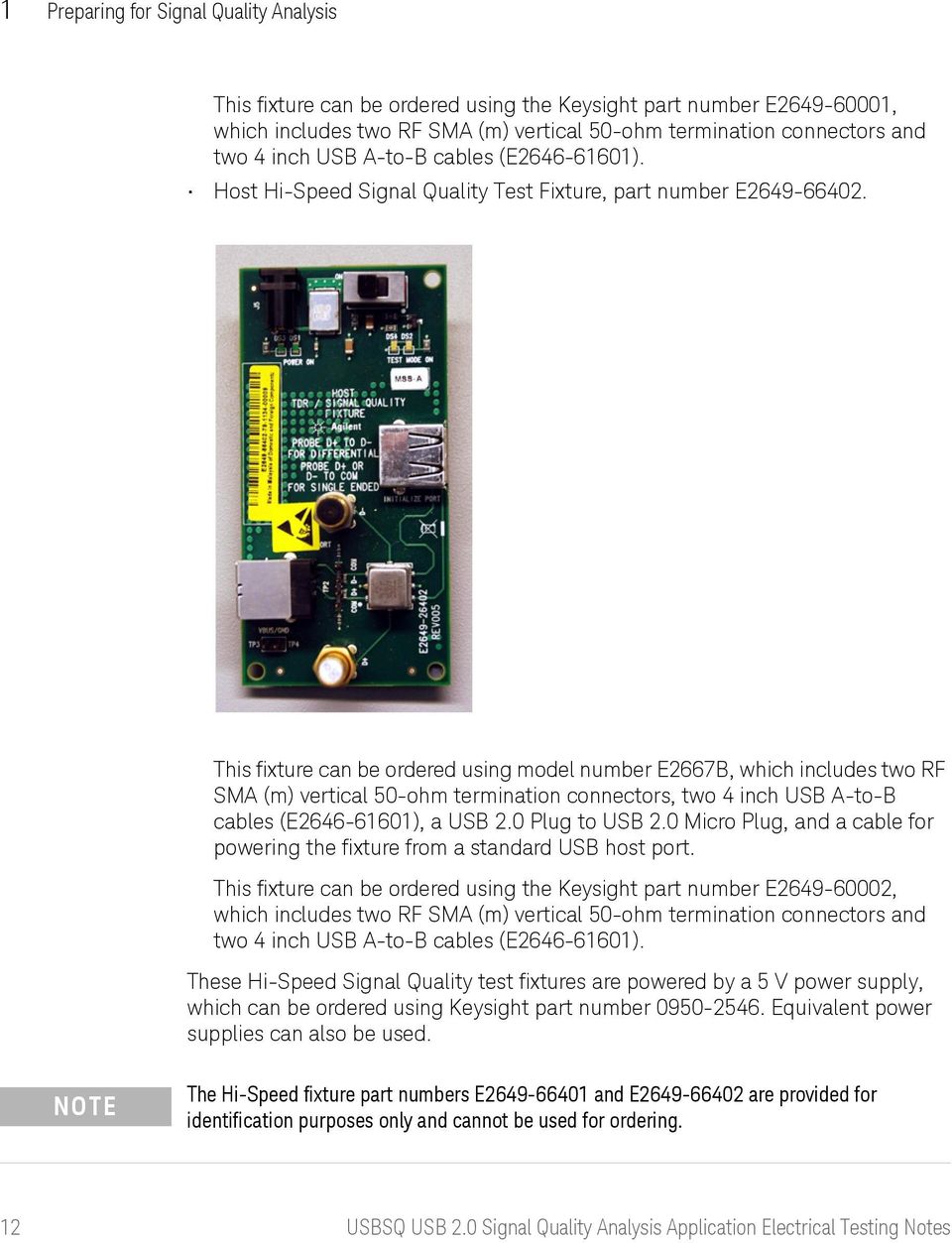
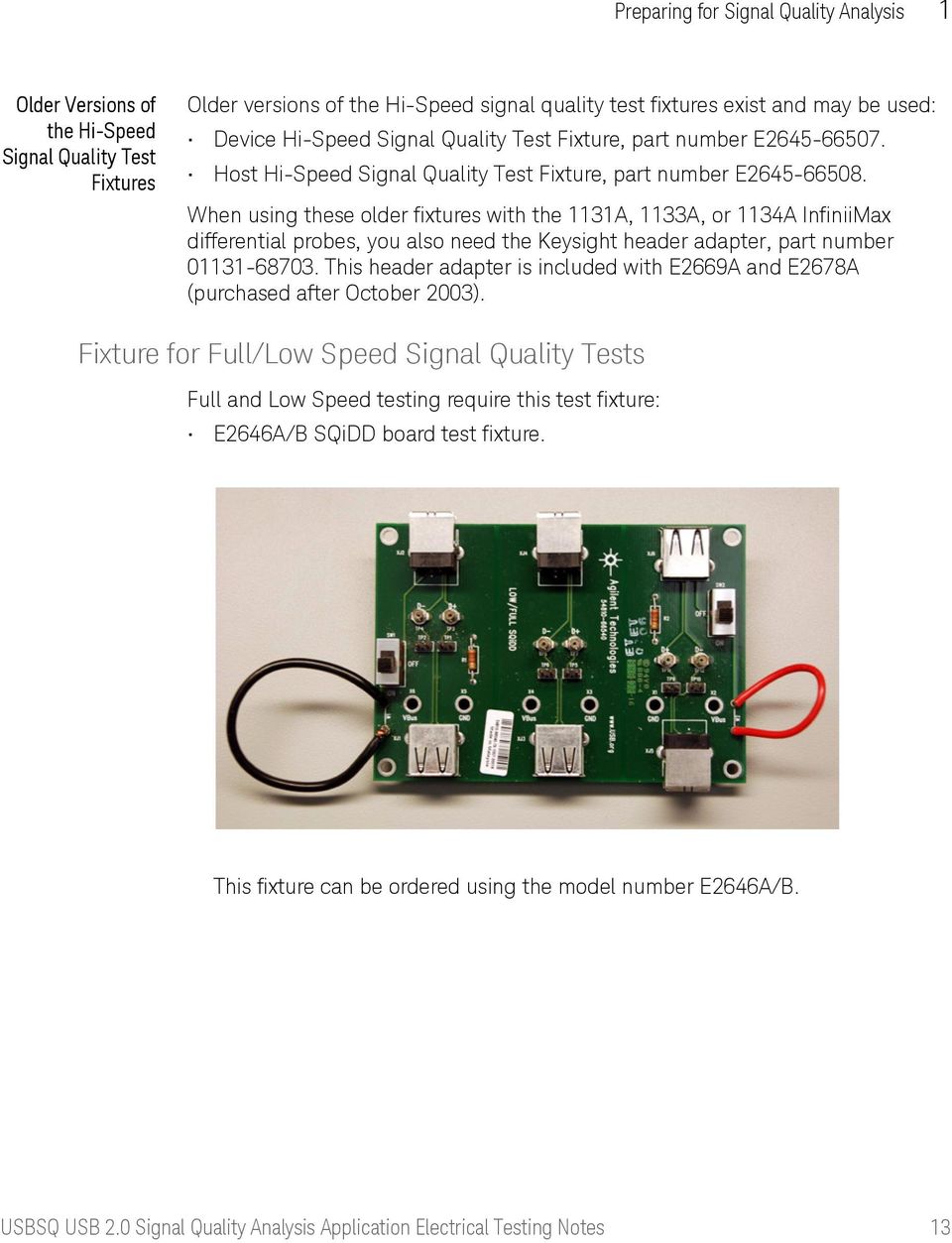
13 Preparing for Signal Quality Analysis 1 Older Versions of the Hi-Speed Signal Quality Test Fixtures Older versions of the Hi-Speed signal quality test fixtures exist and may be used: Device Hi-Speed Signal Quality Test Fixture, part number E Host Hi-Speed Signal Quality Test Fixture, part number E When using these older fixtures with the 1131A, 1133A, or 1134A InfiniiMax differential probes, you also need the Keysight header adapter, part number This header adapter is included with E2669A and E2678A (purchased after October 2003). Fixture for Full/Low Speed Signal Quality Tests Full and Low Speed testing require this test fixture: E2646A/B SQiDD board test fixture. This fixture can be ordered using the model number E2646A/B. USBSQ USB 2.0 Signal Quality Analysis Application Electrical Testing Notes 13
14 1 Preparing for Signal Quality Analysis Probe Requirements Hi-Speed tests require a differential probe (see Differential Probe Connection for Hi-Speed Signal Quality Tests" on page 14) or two single-ended SMA cable connections (see Single-Ended SMA Cable Connection for Hi-Speed Signal Quality Tests" on page 15). Low and Full Speed host tests require single-ended probes (see Single-Ended Probe Connection for Full/Low Speed Signal Quality Tests" on page 16). Differential Probe Connection for Hi-Speed Signal Quality Tests NOTE Use the N4822A socketed tip with the N2750A Series InfiniiMode probes when probing the Hi-Speed Signal Quality test fixtures. The socketed tip includes a damping resistor to achieve flat response across the rated bandwidth. If you are not verifying signal quality to USB 2.0 specifications (in other words, you are testing USB signal quality in-circuit with real-world packets), and you just need a feed-through that will let you probe Hi-Speed signals, you can use the E2646A/B SQiDD test fixture (normally used for Full and Low Speed testing) with InfiniiMode probes without the N4822A socketed tip. See Appendix A, Probing Hi-Speed Signals with InfiniiMode Using SQiDD as a Feed through, starting on page 93. When using a differential probe connection for Hi-Speed signal quality tests, Keysight recommends the 1131A, 1133A, or 1134A InfiniiMax differential probes and the E2678A socketed probe head or the E2669A differential connectivity kit. When setting up the Keysight 113xA differential probe for connection to the Hi-Speed signal quality test fixture: Attach the socketed probe head to the differential probe amplifier. Handle the socketed probe head and header adapter carefully. For durability, epoxy can be used to strengthen the assembly. Only apply epoxy to back (noncomponent) side of probe head. 14 USBSQ USB 2.0 Signal Quality Analysis Application Electrical Testing Notes
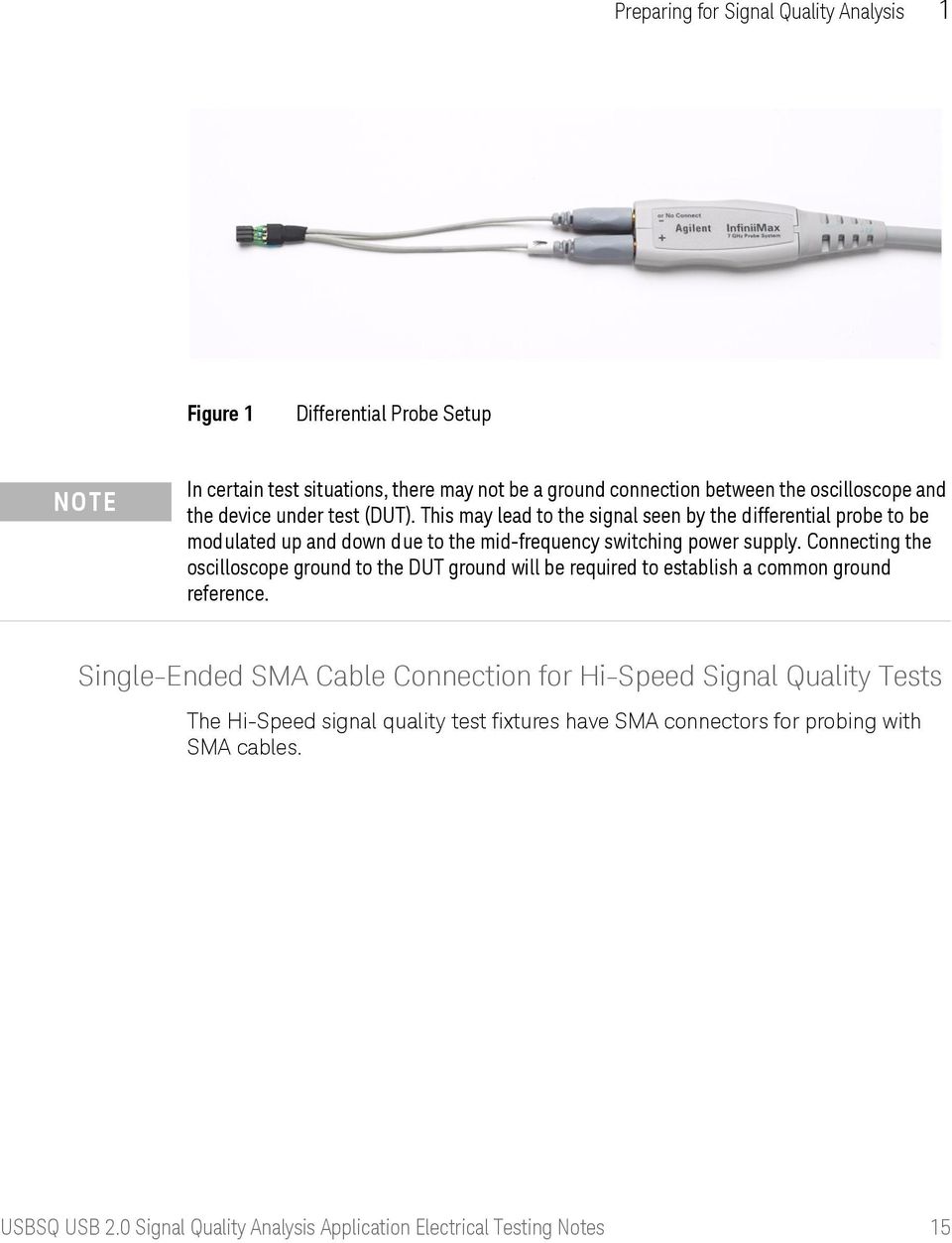
15 Preparing for Signal Quality Analysis 1 Figure 1 Differential Probe Setup NOTE In certain test situations, there may not be a ground connection between the oscilloscope and the device under test (DUT). This may lead to the signal seen by the differential probe to be modulated up and down due to the mid-frequency switching power supply. Connecting the oscilloscope ground to the DUT ground will be required to establish a common ground reference. Single-Ended SMA Cable Connection for Hi-Speed Signal Quality Tests The Hi-Speed signal quality test fixtures have SMA connectors for probing with SMA cables. USBSQ USB 2.0 Signal Quality Analysis Application Electrical Testing Notes 15
16 1 Preparing for Signal Quality Analysis Single-Ended Probe Connection for Full/Low Speed Signal Quality Tests Low and Full Speed host tests require two single-ended probes. Low and Full Speed device tests require three single-ended probes the third probe is for the adjacent D-/D+ signal. The passive probes that are included with the oscilloscope are sufficient. 16 USBSQ USB 2.0 Signal Quality Analysis Application Electrical Testing Notes

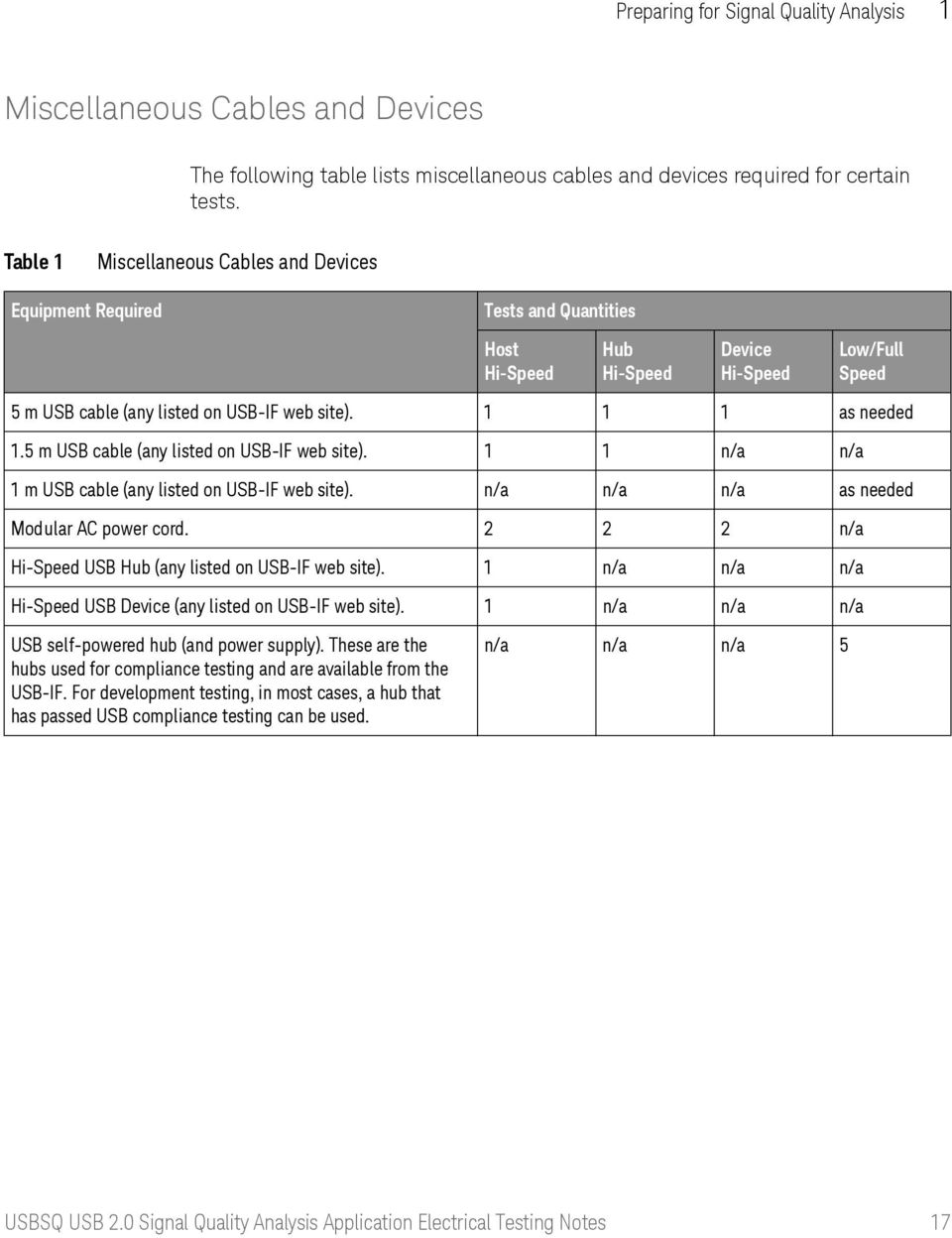
17 Preparing for Signal Quality Analysis 1 Miscellaneous Cables and Devices The following table lists miscellaneous cables and devices required for certain tests. Table 1 Miscellaneous Cables and Devices Equipment Required Tests and Quantities Host Hi-Speed Hub Hi-Speed Device Hi-Speed Low/Full Speed 5 m USB cable (any listed on USB-IF web site) as needed 1.5 m USB cable (any listed on USB-IF web site). 1 1 n/a n/a 1 m USB cable (any listed on USB-IF web site). n/a n/a n/a as needed Modular AC power cord n/a Hi-Speed USB Hub (any listed on USB-IF web site). 1 n/a n/a n/a Hi-Speed USB Device (any listed on USB-IF web site). 1 n/a n/a n/a USB self-powered hub (and power supply). These are the hubs used for compliance testing and are available from the USB-IF. For development testing, in most cases, a hub that has passed USB compliance testing can be used. n/a n/a n/a 5 USBSQ USB 2.0 Signal Quality Analysis Application Electrical Testing Notes 17
18 1 Preparing for Signal Quality Analysis Additional Equipment and Set Up for Signal Quality Compliance Testing When performing USB 2.0 signal quality compliance testing (instead of testing the signal quality of real-world packets): You need a high-speed electrical test bed computer and the High-Speed Electrical Test Tool Kit software (USBHSET) in order to generate compliance test packets. See High-Speed Electrical Test Bed Computer" on page 18. See also: Additional Set Up for Signal Quality Compliance Testing" on page 19. High-Speed Electrical Test Bed Computer The high-speed electrical test bed computer hosts a USB 2.0 compliance host controller for hi-speed hub or device electrical test, or serves as a test bed host for a USB 2.0 host controller under test. For instructions on configuring this computer, refer to the High-Speed Electrical Test Toolkit Setup Instruction document which comes with the High-Speed Electrical Test Tool Kit Software" on page 18. Table 2 High-Speed Electrical Test Bed Computer Equipment Required Tests and Quantities Host Hi-Speed Hub Hi-Speed Device Hi-Speed Low/Full Speed High-Speed Electrical Test Bed Computer High-Speed Electrical Test Tool Kit software (USBHSET) High-Speed Electrical Test Tool Kit Software You can download the High-Speed Electrical Test Tool Kit software (USBHSET) from the developers tools page at the USB Implementers Forum web site, 18 USBSQ USB 2.0 Signal Quality Analysis Application Electrical Testing Notes
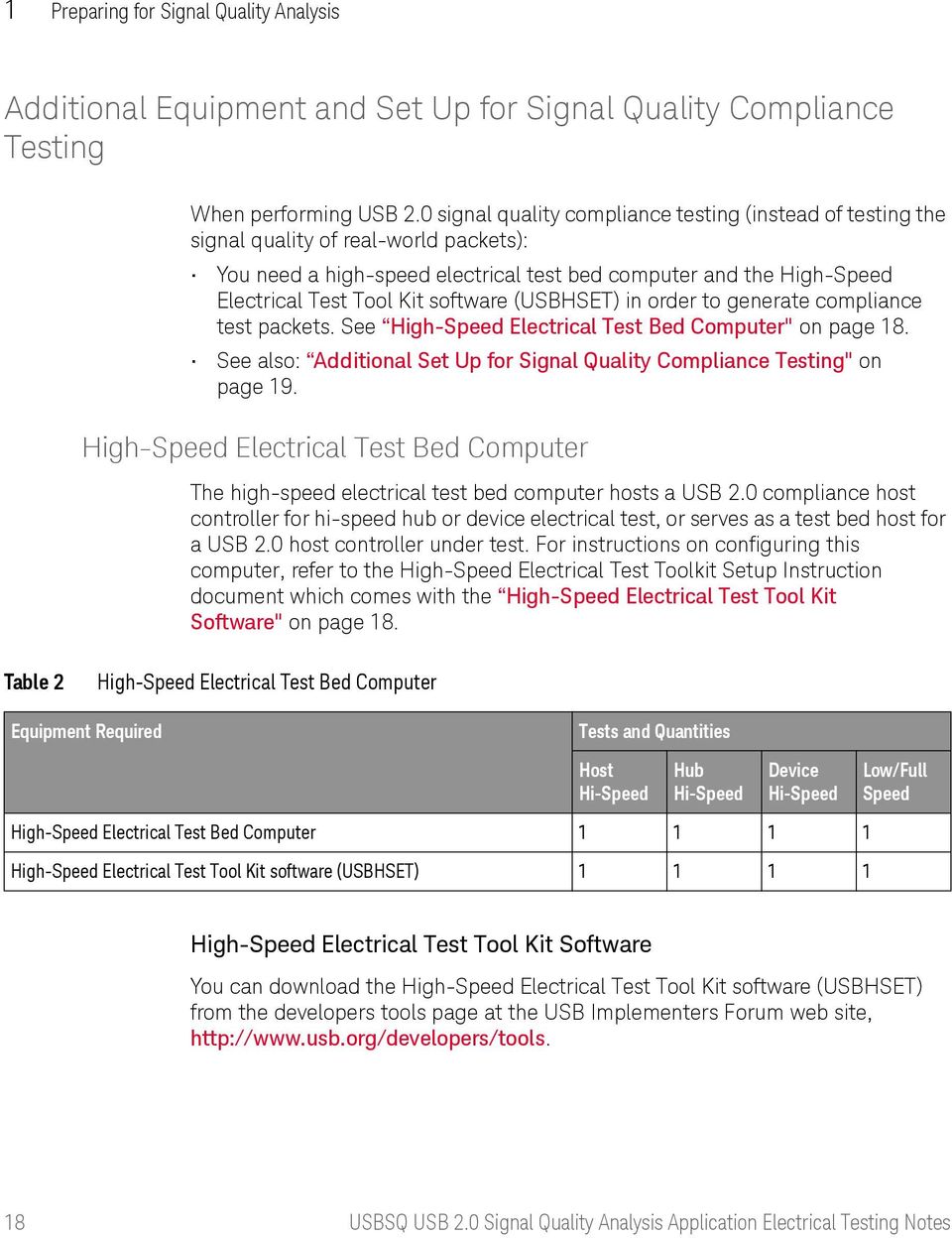
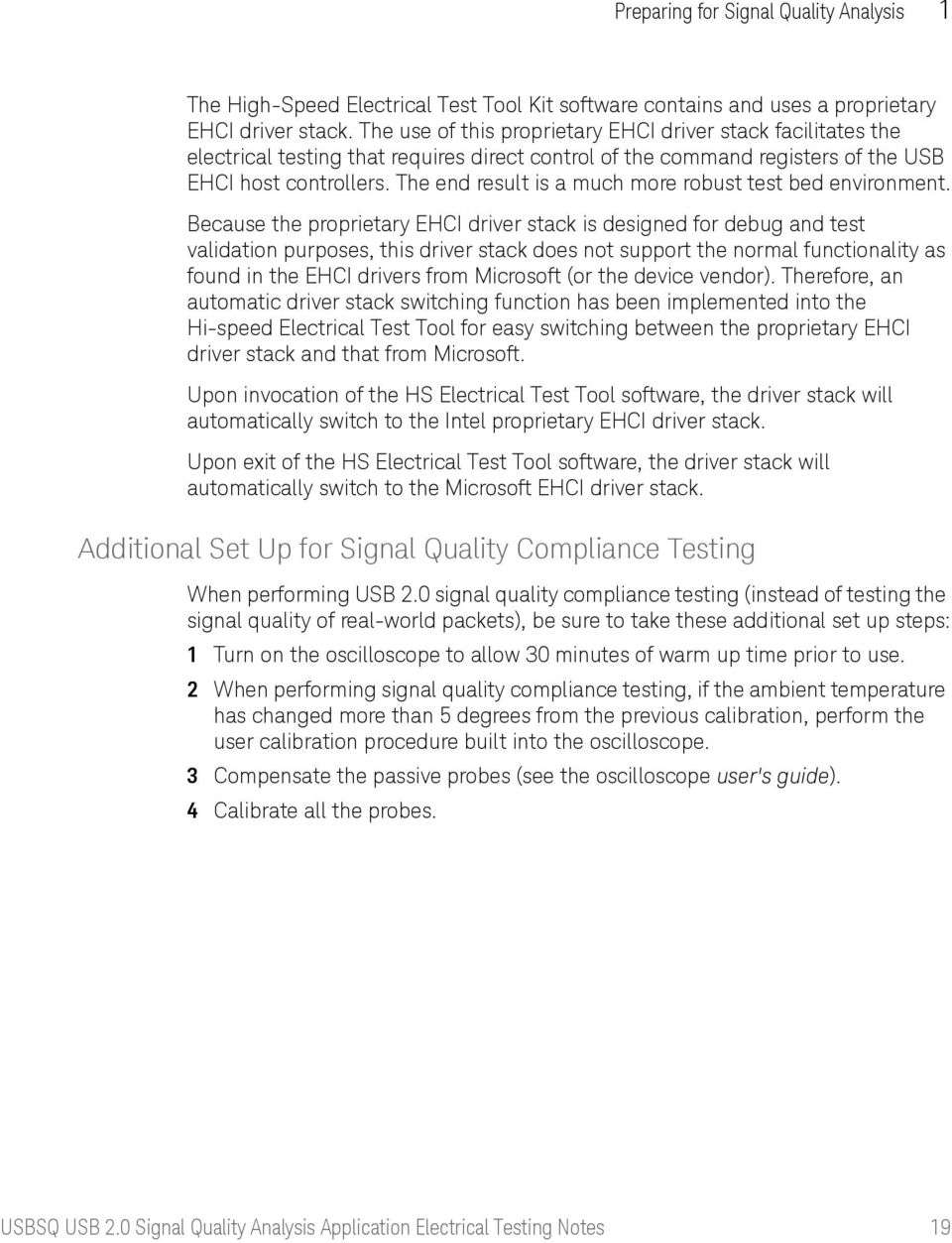
19 Preparing for Signal Quality Analysis 1 The High-Speed Electrical Test Tool Kit software contains and uses a proprietary EHCI driver stack. The use of this proprietary EHCI driver stack facilitates the electrical testing that requires direct control of the command registers of the USB EHCI host controllers. The end result is a much more robust test bed environment. Because the proprietary EHCI driver stack is designed for debug and test validation purposes, this driver stack does not support the normal functionality as found in the EHCI drivers from Microsoft (or the device vendor). Therefore, an automatic driver stack switching function has been implemented into the Hi-speed Electrical Test Tool for easy switching between the proprietary EHCI driver stack and that from Microsoft. Upon invocation of the HS Electrical Test Tool software, the driver stack will automatically switch to the Intel proprietary EHCI driver stack. Upon exit of the HS Electrical Test Tool software, the driver stack will automatically switch to the Microsoft EHCI driver stack. Additional Set Up for Signal Quality Compliance Testing When performing USB 2.0 signal quality compliance testing (instead of testing the signal quality of real-world packets), be sure to take these additional set up steps: 1 Turn on the oscilloscope to allow 30 minutes of warm up time prior to use. 2 When performing signal quality compliance testing, if the ambient temperature has changed more than 5 degrees from the previous calibration, perform the user calibration procedure built into the oscilloscope. 3 Compensate the passive probes (see the oscilloscope user's guide). 4 Calibrate all the probes. USBSQ USB 2.0 Signal Quality Analysis Application Electrical Testing Notes 19
20 1 Preparing for Signal Quality Analysis 20 USBSQ USB 2.0 Signal Quality Analysis Application Electrical Testing Notes
21 USBSQ USB 2.0 Signal Quality Analysis Application Electrical Testing Notes 2 Device Signal Quality Testing Device Hi-Speed Signal Quality Test / 22 Device Full Speed Signal Quality Test / 31 Device Low Speed Signal Quality Test / 37 21
22 2 Device Signal Quality Testing Device Hi-Speed Signal Quality Test Table 3 Equipment Used in Device Hi-Speed Signal Quality Tests Quantity Item Description/Model 1 Oscilloscope Keysight 4000/6000 X-Series >1.5 GHz bandwidth model 1 Oscilloscope probing solution: Differential probe Keysight 113xA with E2678A or E2669A SMA cables Keysight 15443A matched cable pair or equivalent 1 Host test bed computer Any computer with the Windows XP, Windows 7, or Windows 8 operating system and hi-speed USB ports. 1 Device Hi-Speed Signal Quality test fixture and 4" USB cable Keysight E V power supply Keysight or equivalent To set up and run the Device Hi-Speed signal quality tests: 1 Connect the USB Device, test fixtures, and equipment: If you are probing the test fixture using a differential probe, see Device Hi-Speed Connection - Differential Probe" on page 27. If you are probing the test fixture using SMA cables, see Device Hi-Speed Connection - SMA Cables" on page Set up the test signal/packet that will be analyzed. To set up the test packets used for compliance testing, see Device Hi-Speed Compliance Test Packets" on page On the Device Hi-Speed Signal Quality test fixture, place the TEST switch (S1) in the ON position. Verify the yellow TEST LED is lit. 4 On the oscilloscope's front panel, press the [Analyze] key. 5 In the Analyze Menu, press the Features softkey; then, select USB Signal Quality. 22 USBSQ USB 2.0 Signal Quality Analysis Application Electrical Testing Notes
23 Device Signal Quality Testing 2 6 Press the Test softkey and select the Device Hi-Speed Signal Quality test. 7 Press the Settings softkey. In the USB Signal Quality Settings Menu: a Press the Test Connection softkey and select whether you are using a Single-ended (with SMA cables) or Differential probe connection. b If you are using a differential connection, press the Source softkey and select the analog input source channel connected to the differential probe. c If you are using a single-ended (SMA cables) connection, press the DP SMA softkey and select the analog input source channel connected to the D+ signal. Then, press the DN SMA softkey and select the analog input source channel connected to the D- signal. On 4-channel oscilloscopes, you are forced to use different channel pairs for the D+ and D- signals. This provides the maximum sample rate. (Channels 1 and 2 are one pair and channels 3 and 4 are the other pair.) Hi-Speed tests using single-ended SMA cable connections are not supported on 2-channel oscilloscopes because the sample rate does not meet the required 5 GSa/s. Press the Test Type softkey and select Near-end or Far-end. The terms "near-end" and "far-end" are based on which end of the cable the test fixture is attached in relation to the device being tested. The point where measurements are made dictates what eye template is used. 8 Press the Auto Setup softkey to automatically set up the oscilloscope for the selected test. For optimal test results, you can make adjustments to the auto setup. Generally, you want one packet of data, plus the time of one bit on each end, across the oscilloscope's display. Also, vertical scale and offset should be adjusted so that the signals take six vertical divisions without being clipped. You should see the transmitted test packet on the oscilloscope as below. USBSQ USB 2.0 Signal Quality Analysis Application Electrical Testing Notes 23
24 2 Device Signal Quality Testing 9 Press the Run Test softkey to run the selected signal quality test. When tests are run, the oscilloscope stops acquisitions if they are running, analyzes the data on screen, and then displays the results. NOTE Tests can take several minutes to run and cannot be cancelled once started. When the test completes, the results are automatically displayed. You can press the Display Resul ts softkey to disable or reenable the test results display. 24 USBSQ USB 2.0 Signal Quality Analysis Application Electrical Testing Notes
25 Device Signal Quality Testing 2 USBSQ USB 2.0 Signal Quality Analysis Application Electrical Testing Notes 25
26 2 Device Signal Quality Testing 26 USBSQ USB 2.0 Signal Quality Analysis Application Electrical Testing Notes
27 Device Signal Quality Testing 2 The analyzed acquisition remains on screen and can be viewed by moving or dismissing the results dialog box. You can run tests when the oscilloscope is already stopped. This is useful in the case of embedded hosts (and other cases) where the device under test (DUT) may not easily be placed in a test mode, and you want to analyze already acquired data. See Also Chapter 6, Saving Test Results to an HTML File, starting on page 91 Device Hi-Speed Connection - Differential Probe Perform these connection steps: 1 Attach the 5V power supply to J5 of the E Device Hi-Speed signal quality test fixture. Leave the TEST switch at the OFF position. Verify the green POWER LED is lit and the yellow TEST LED is not lit. USBSQ USB 2.0 Signal Quality Analysis Application Electrical Testing Notes 27
28 2 Device Signal Quality Testing 2 Connect the [TEST PORT] of the Device Hi-speed Signal Quality test fixture into the upstream facing port of the device under test, using the 4" USB cable. 3 Connect the [INIT PORT] of the test fixture to a Hi-speed capable port of the Test Bed Computer, using a USB cable. 4 Apply power to the device. 5 Attach the differential probe to D+/D- of TP2 on the test fixture. Ensure the + polarity on the probe lines up with D+. 6 Please terminate the fixture's SMA connectors with 50 Ohm terminators xA differential probe Hi-Speed Host D+ TP2 4 Device Under Test D- Test Port 5m Cable Init. Port 5V Device Hi-Speed Signal Quality Test Fixture Device Hi-Speed Connection - SMA Cables 1 Attach the 5V power supply to J5 of the E Device Hi-Speed signal quality test fixture. Leave the TEST switch at the OFF position. 28 USBSQ USB 2.0 Signal Quality Analysis Application Electrical Testing Notes
29 Device Signal Quality Testing 2 Verify the green POWER LED is lit and the yellow TEST LED is not lit. 2 Connect the [TEST PORT] of the Device Hi-speed Signal Quality test fixture into the upstream facing port of the device under test, using the 4" USB cable. 3 Connect the [INIT PORT] of the test fixture to a Hi-speed capable port of the Test Bed Computer, using the 5 meter USB cable. 4 Apply power to the device. 5 Attach the SMA cables to the SMA connectors D+ and D- on the test fixture SMA cables Hi-Speed Host D+ TP2 4 Device Under Test D- Test Port 5m Cable Init. Port 5V Device Hi-Speed Signal Quality Test Fixture Device Hi-Speed Compliance Test Packets To set up the Host computer to transmit compliance test packets, perform these steps: 1 Invoke the HS Electrical Test Tool software on the Hi-Speed Electrical Test Bed computer. USBSQ USB 2.0 Signal Quality Analysis Application Electrical Testing Notes 29
30 2 Device Signal Quality Testing 2 Select Device and click the TEST button to open the Device Test dialog box. 3 In the Device Test dialog box, the device under test should be enumerated with the device's VID shown together with the root port in which it is connected. 4 Select TEST_PACKET from the Device Command drop down menu, and click EXECUTE. This forces the device under test to continuously transmit test packets. 30 USBSQ USB 2.0 Signal Quality Analysis Application Electrical Testing Notes
31 Device Signal Quality Testing 2 Device Full Speed Signal Quality Test Table 4 Equipment Used in Upstream Full Speed Signal Quality Test Quantity Item Description/Model 1 Oscilloscope Keysight 4000/6000 X-Series 3 Passive probes Probes included with the oscilloscope are sufficient. 1 Host test bed computer Any computer with the Windows XP, Windows 7, or Windows 8 operating system and hi-speed USB ports. 1 SQiDD board Keysight E2646A/B 1 full speed USB device Intel Create and Share USB camera, P/N , Model #: CS330 5 USB self-powered hubs Any listed on USB-IF web site 6 5 meter USB cables Any listed on USB-IF web site To set up and run the Device Full Speed signal quality tests: 1 Connect the USB Device, test fixtures, and equipment. See Device Full Speed Connection" on page Set up the test signal/packet that will be analyzed. To set up the test packets used for compliance testing, see Device Full Speed Compliance Test Packets" on page On the oscilloscope's front panel, press the [Analyze] key. 4 In the Analyze Menu, press the Features softkey; then, select USB Signal Quality. 5 Press the Test softkey and select the Device Full Speed Signal Quality test. 6 Press the Settings softkey. In the USB Signal Quality Settings Menu: a b Press the D+ Source softkey and select the analog input source channel connected to the D+ signal (channel 2 in the previous connection instructions). Press the D- Source softkey and select the analog input source channel connected to the D- signal (channel 3 in the previous connection instructions). USBSQ USB 2.0 Signal Quality Analysis Application Electrical Testing Notes 31
32 2 Device Signal Quality Testing On 4-channel oscilloscopes, you are forced to use different channel pairs for the D+ and D- signals. This provides the maximum sample rate. (Channels 1 and 2 are one pair and channels 3 and 4 are the other pair.) When full speed tests are run on a 2-channel oscilloscope, a statement about the analysis data being under-sampled will be included in the test results. c Press the Ad j D+ Source softkey and select the analog input source channel connected to the adjacent D+ signal (channel 1 in the previous connection instructions). 7 Press the Auto Setup softkey to automatically set up the oscilloscope for the selected test. For optimal test results, you can make adjustments to the auto setup. Generally, you want one packet of data, plus the time of one bit on each end, across the oscilloscope's display. Also, vertical scale and offset should be adjusted so that the signals take six vertical divisions without being clipped. You should see the transmitted test packet on the oscilloscope as below. 32 USBSQ USB 2.0 Signal Quality Analysis Application Electrical Testing Notes
33 Device Signal Quality Testing 2 8 Press the Run Test softkey to run the selected signal quality test. When tests are run, the oscilloscope stops acquisitions if they are running, analyzes the data on screen, and then displays the results. NOTE Tests can take several minutes to run and cannot be cancelled once started. When the test completes, the results are automatically displayed. You can press the Display Resul ts softkey to disable or reenable the test results display. The analyzed acquisition remains on screen and can be viewed by moving or dismissing the results dialog box. You can run tests when the oscilloscope is already stopped. This is useful in the case of embedded hosts (and other cases) where the device under test (DUT) may not easily be placed in a test mode, and you want to analyze already acquired data. See Also Chapter 6, Saving Test Results to an HTML File, starting on page 91 Device Full Speed Connection Perform these connection steps: 1 Attach the passive probes to the oscilloscope's Channel 2, Channel 3 and Channel 1 inputs. 2 Attach the SQiDD board to two USB ports at the end of 5 self-powered hubs and a host system. Hub #1 has to be a hi-speed hub and hub #2 has to be a full speed hub. The rest of the hubs can be either hi-speed or full speed hubs. NOTE Placing a full speed and/or a high-speed device downstream of a full speed hub forces both to operate in full speed mode. 3 Attach a full speed device under test to the same section of the SQiDD board. If the section has a switch, it should be set to ON. 4 Attach another full speed device to the adjacent section of the SQiDD board. This is for triggering purposes. USBSQ USB 2.0 Signal Quality Analysis Application Electrical Testing Notes 33
34 2 Device Signal Quality Testing NOTE Use a full-speed hub if device under test has embedded hub function. Otherwise the oscilloscope will falsely trigger. 5 Connect the oscilloscope Channel 2 probe to D+ probe point of the device under test portion. Connect the oscilloscope Channel 3 probe to the D- probe point of the device under test portion. Connect the oscilloscope Channel 1 probe to the D+ probe point on the adjacent device section of the SQiDD board. 34 USBSQ USB 2.0 Signal Quality Analysis Application Electrical Testing Notes
35 Device Signal Quality Testing 2 Host 5m Cable (Self-powered) Hub 1 Hi-Speed Hub 5m Cable (Self-powered) Hub 2 Full Speed Hub 5m Cable (Self-powered) Hub 3 5m Cable (Self-powered) Hub 4 5m Cable (Self-powered) Hub Probe D+ in Adjacent Device Path D- D+ D+ SQiDD Probe D- and D+ in Device Under Test Path 5m Cable Full-Speed Device Under Test Adjacent Full-Speed Device Device Full Speed Compliance Test Packets To set up the Host computer to transmit compliance test packets, perform these steps: 1 Invoke the HS Electrical Test Tool software on the Hi-Speed Electrical Test Bed computer. USBSQ USB 2.0 Signal Quality Analysis Application Electrical Testing Notes 35
36 2 Device Signal Quality Testing 2 Select Device and click the TEST button to open the Device Test dialog box. 3 In the Device Test dialog box, click Enumerate Bus once. All devices attached to the host controller should appear in the device enumeration list. If you do not know which VID/PID belongs to the device under test, detach the device under test and enumerate the bus once. Then reattach the device under test and enumerate again, this time paying attention to the new device attached. 4 Highlight the device under test and select LOOP DEVICE DESCRIPTOR from the Device Command drop down menu. 5 Click EXECUTE once. 36 USBSQ USB 2.0 Signal Quality Analysis Application Electrical Testing Notes
37 Device Signal Quality Testing 2 Device Low Speed Signal Quality Test Table 5 Equipment Used in Upstream Low Speed Signal Quality Test Quantity Item Description/Model 1 Oscilloscope Keysight 4000/6000 X-Series 3 Passive probes Probes included with the oscilloscope are sufficient. 1 Host test bed computer Any computer with the Windows XP, Windows 7, or Windows 8 operating system and hi-speed USB ports. 1 SQiDD board Keysight E2646A/B 1 low speed USB device Any USB mouse 5 USB self-powered hubs Any listed on USB-IF web site 6 5 meter USB cables Any listed on USB-IF web site To set up and run the Device Low Speed signal quality tests: 1 Connect the USB Device, test fixtures, and equipment. See Device Low Speed Connection" on page Set up the test signal/packet that will be analyzed. To set up the test packets used for compliance testing, see Device Low Speed Compliance Test Packets" on page On the oscilloscope's front panel, press the [Analyze] key. 4 In the Analyze Menu, press the Features softkey; then, select USB Signal Quality. 5 Press the Test softkey and select the Device Low Speed Signal Quality test. 6 Press the Settings softkey. In the USB Signal Quality Settings Menu: a b Press the D+ Source softkey and select the analog input source channel connected to the D+ signal (channel 2 in the previous connection instructions). Press the D- Source softkey and select the analog input source channel connected to the D- signal (channel 3 in the previous connection instructions). USBSQ USB 2.0 Signal Quality Analysis Application Electrical Testing Notes 37
38 2 Device Signal Quality Testing On 4-channel oscilloscopes, you are forced to use different channel pairs for the D+ and D- signals. This provides the maximum sample rate. (Channels 1 and 2 are one pair and channels 3 and 4 are the other pair.) c Press the Ad j D- Source softkey and select the analog input source channel connected to the adjacent D- signal (channel 1 in the previous connection instructions). 7 Press the Auto Setup softkey to automatically set up the oscilloscope for the selected test. For optimal test results, you can make adjustments to the auto setup. Generally, you want one packet of data, plus the time of one bit on each end, across the oscilloscope's display. Also, vertical scale and offset should be adjusted so that the signals take six vertical divisions without being clipped. You should see the transmitted test packet on the oscilloscope as below. 8 Press the Run Test softkey to run the selected signal quality test. 38 USBSQ USB 2.0 Signal Quality Analysis Application Electrical Testing Notes
39 Device Signal Quality Testing 2 When tests are run, the oscilloscope stops acquisitions if they are running, analyzes the data on screen, and then displays the results. NOTE Tests can take several minutes to run and cannot be cancelled once started. When the test completes, the results are automatically displayed. You can press the Display Resul ts softkey to disable or reenable the test results display. The analyzed acquisition remains on screen and can be viewed by moving or dismissing the results dialog box. You can run tests when the oscilloscope is already stopped. This is useful in the case of embedded hosts (and other cases) where the device under test (DUT) may not easily be placed in a test mode, and you want to analyze already acquired data. See Also Chapter 6, Saving Test Results to an HTML File, starting on page 91 Device Low Speed Connection Perform these connection steps: 1 Attach the passive probes to the oscilloscope's Channel 2, Channel 3 and Channel 1 inputs. 2 Attach the SQiDD board to two USB ports at the end of 5 self-powered hubs and a host system. Hub #1 has to be a hi-speed hub and hub #2 has to be a full speed hub. The rest of the hubs can be either hi-speed or full speed hubs. NOTE Placing a full speed and/or a high-speed device downstream of a full speed hub forces both to operate in full speed mode. 3 Attach a low speed device under test to the same section of the SQiDD board. If the section has a switch, it should be set to ON. 4 Attach another low speed device to the adjacent section of the SQiDD board. This is for triggering purposes. 5 Connect the oscilloscope Channel 2 probe to D+ probe point of the device under test portion. Connect the oscilloscope Channel 3 probe to the D- probe USBSQ USB 2.0 Signal Quality Analysis Application Electrical Testing Notes 39
40 2 Device Signal Quality Testing point of the device under test portion. Connect the oscilloscope Channel 1 probe to the D- probe point on the adjacent device section of the SQiDD board. Host 5m Cable 5m Cable (Self-powered) Hub 1 (Self-powered) Hub 2 Hi-Speed Hub Full Speed Hub 5m Cable (Self-powered) Hub 3 5m Cable (Self-powered) Hub 4 5m Cable (Self-powered) Hub Probe D- in Adjacent Device Path D- D+ D- SQiDD Probe D- and D+ in Device Under Test Path 5m Cable Low-Speed Device Under Test Adjacent Low-Speed Device 40 USBSQ USB 2.0 Signal Quality Analysis Application Electrical Testing Notes
41 Device Signal Quality Testing 2 Device Low Speed Compliance Test Packets To set up the Host computer to transmit compliance test packets, perform these steps: 1 Invoke the HS Electrical Test Tool software on the Hi-Speed Electrical Test Bed computer. 2 Select Device and click the TEST button to open the Device Test dialog box. 3 In the Device Test dialog box, click Enumerate Bus once. All devices attached to the host controller should appear in the device enumeration list. If you do not know which VID/PID belongs to the device under test, detach the device under test and enumerate the bus once. Then reattach the device under test and enumerate again, this time paying attention to the new device attached. 4 Highlight the device under test and select LOOP DEVICE DESCRIPTOR from the Device Command drop down menu. 5 Click EXECUTE once. USBSQ USB 2.0 Signal Quality Analysis Application Electrical Testing Notes 41
42 2 Device Signal Quality Testing 42 USBSQ USB 2.0 Signal Quality Analysis Application Electrical Testing Notes
43 USBSQ USB 2.0 Signal Quality Analysis Application Electrical Testing Notes 3 Host Signal Quality Testing Host Hi-Speed Signal Quality Test / 44 Host Full Speed Signal Quality Test / 51 Host Low Speed Signal Quality Test / 55 43
44 3 Host Signal Quality Testing Host Hi-Speed Signal Quality Test Table 6 Equipment Used in Host Hi-Speed Signal Quality Tests Quantity Item Description/Model 1 Oscilloscope Keysight 4000/6000 X-Series >1.5 GHz bandwidth model 1 Oscilloscope probing solution: Differential probe Keysight 113xA with E2678A or E2669A SMA cables Keysight 15443A matched cable pair or equivalent 1 Host test bed computer Any computer with the Windows XP, Windows 7, or Windows 8 operating system and hi-speed USB ports. 1 Host Hi-Speed Signal Quality test fixture and 4" USB cable Keysight E V power supply Keysight or equivalent To set up and run the Host Hi-Speed signal quality tests: 1 Connect the USB Device, test fixtures, and equipment: If you are probing the test fixture using a differential probe, see Host Hi-Speed Connection - Differential Probe" on page 47. If you are probing the test fixture using SMA cables, see Host Hi-Speed Connection - SMA Cables" on page Set up the test signal/packet that will be analyzed. To set up the test packets used for compliance testing, see Host Hi-Speed Compliance Test Packets" on page On the oscilloscope's front panel, press the [Analyze] key. 4 In the Analyze Menu, press the Features softkey; then, select USB Signal Quality. 5 Press the Test softkey and select the Host Hi-Speed Signal Quality test. 44 USBSQ USB 2.0 Signal Quality Analysis Application Electrical Testing Notes
45 Host Signal Quality Testing 3 6 Press the Settings softkey. In the USB Signal Quality Settings Menu: a Press the Test Connection softkey and select whether you are using a Single-ended (with SMA cables) or Differential probe connection. b If you are using a differential connection, press the Source softkey and select the analog input source channel connected to the differential probe. c d If you are using a single-ended (SMA cables) connection, press the DP SMA softkey and select the analog input source channel connected to the D+ signal. Then, press the DN SMA softkey and select the analog input source channel connected to the D- signal. On 4-channel oscilloscopes, you are forced to use different channel pairs for the D+ and D- signals. This provides the maximum sample rate. (Channels 1 and 2 are one pair and channels 3 and 4 are the other pair.) Hi-Speed tests using single-ended SMA cable connections are not supported on 2-channel oscilloscopes because the sample rate does not meet the required 5 GSa/s. Press the Test Type softkey and select Near-end or Far-end. The terms "near-end" and "far-end" are based on which end of the cable the test fixture is attached in relation to the device being tested. The point where measurements are made dictates what eye template is used. Press the Number of Hubs softkey and specify the number of internal hubs between the host and the test point. When the Near-end test type is selected, you can specify 0 to 5 hubs. When the Far-end test type is selected, the number of hubs is set to 0. The specified number of hubs affects the test limits for the Sync results and the EOP Width results. 7 Press the Auto Setup softkey to automatically set up the oscilloscope for the selected test. For optimal test results, you can make adjustments to the auto setup. Generally, you want one packet of data, plus the time of one bit on each end, across the oscilloscope's display. Also, vertical scale and offset should be adjusted so that the signals take six vertical divisions without being clipped. You should see the transmitted test packet on the oscilloscope as below. USBSQ USB 2.0 Signal Quality Analysis Application Electrical Testing Notes 45
46 3 Host Signal Quality Testing 8 Press the Run Test softkey to run the selected signal quality test. When tests are run, the oscilloscope stops acquisitions if they are running, analyzes the data on screen, and then displays the results. NOTE Tests can take several minutes to run and cannot be cancelled once started. When the test completes, the results are automatically displayed. You can press the Display Resul ts softkey to disable or reenable the test results display. The analyzed acquisition remains on screen and can be viewed by moving or dismissing the results dialog box. You can run tests when the oscilloscope is already stopped. This is useful in the case of embedded hosts (and other cases) where the device under test (DUT) may not easily be placed in a test mode, and you want to analyze already acquired data. 46 USBSQ USB 2.0 Signal Quality Analysis Application Electrical Testing Notes
47 Host Signal Quality Testing 3 See Also Chapter 6, Saving Test Results to an HTML File, starting on page 91 Host Hi-Speed Connection - Differential Probe Perform these connection steps: 1 Attach the 5V power supply to J5 of the E Host Hi-Speed Signal Quality test fixture and verify the green POWER LED is lit. a Set the TEST switch (S1) of the test fixture to the ON position and verify the yellow TEST LED is lit. 2 Attach the Keysight 113xA differential probe to TP2 of the test fixture. Ensure the + polarity on the probe lines up with D+, which is the pin nearest the USB connector. 3 Please terminate the fixture's SMA connectors with 50 Ohm terminators xA differential probe Host Under Test D+ TP2 4 D- Test Port Host Hi-Speed Signal Quality Test Fixture Init. Port 5V USBSQ USB 2.0 Signal Quality Analysis Application Electrical Testing Notes 47
48 3 Host Signal Quality Testing 4 Connect the [TEST PORT] of the E Host Hi-Speed Signal Quality test fixture into the port under test of the host controller, using the 4" USB cable. The host controller here refers to the Hi-speed Electrical Test Bed Computer that has the HS Electrical Test Tool on it. Host Hi-Speed Connection - SMA Cables 1 Attach the 5V power supply to J5 of the E Hi-Speed signal quality test fixture. Verify the green POWER LED is lit. 2 Set the TEST switch (S1) of the test fixture to the ON position and verify that the yellow TEST LED is lit. 3 Attach the SMA cables to SMA connectors D+ and D- on the test fixture SMA cables Host Under Test D+ TP2 D- Test Port 4 Host Hi-Speed Signal Quality Test Fixture Init. Port 5V 48 USBSQ USB 2.0 Signal Quality Analysis Application Electrical Testing Notes
49 Host Signal Quality Testing 3 4 Connect the [TEST PORT] of the E Host Hi-Speed Signal Quality test fixture into the port under test of the host controller, using the 4" USB cable. The host controller here refers to the Hi-speed Electrical Test Bed Computer that has the HS Electrical Test Tool on it. Host Hi-Speed Compliance Test Packets To set up the Host computer to transmit compliance test packets, perform these steps: 1 Invoke the HS Electrical Test Tool software on the Hi-Speed Electrical Test Bed computer. 2 Select Host Controller/System and click the TEST button to open the Host Test dialog box. 3 In the Host Test dialog box, select TEST_PACKET from the Port Control drop down menu. 4 Enter the port number of the port under test. 5 Click EXECUTE. This forces the port under test to continuously transmit test packets. USBSQ USB 2.0 Signal Quality Analysis Application Electrical Testing Notes 49
50 3 Host Signal Quality Testing 50 USBSQ USB 2.0 Signal Quality Analysis Application Electrical Testing Notes
51 Host Signal Quality Testing 3 Host Full Speed Signal Quality Test Table 7 Equipment Used in Host Downstream Full Speed Signal Quality Test Quantity Item Description/Model 1 Oscilloscope Keysight 4000/6000 X-Series 2 Passive probes Probes included with the oscilloscope are sufficient. 1 Host test bed computer Any computer with the Windows XP, Windows 7, or Windows 8 operating system and hi-speed USB ports. 1 SQiDD board Keysight E2646A/B 1 full speed USB device Intel Create and Share USB camera, P/N , Model #: CS330 5 USB self-powered hubs Any listed on USB-IF web site 6 5 meter USB cables Any listed on USB-IF web site To set up and run the Host Full Speed signal quality tests: 1 Connect the USB Device, test fixtures, and equipment. See Host Full Speed Connection" on page Set up the test signal/packet that will be analyzed. To generate bus traffic, connect a known good Full Speed device to the port under test and capture the Full Speed SOF to perform the eye pattern analysis. 3 On the oscilloscope's front panel, press the [Analyze] key. 4 In the Analyze Menu, press the Features softkey; then, select USB Signal Quality. 5 Press the Test softkey and select the Host Full Speed Signal Quality test. 6 Press the Settings softkey. In the USB Signal Quality Settings Menu: a b Press the D+ Source softkey and select the analog input source channel connected to the D+ signal (channel 2 in the previous connection instructions). Press the D- Source softkey and select the analog input source channel connected to the D- signal (channel 3 in the previous connection instructions). USBSQ USB 2.0 Signal Quality Analysis Application Electrical Testing Notes 51
52 3 Host Signal Quality Testing On 4-channel oscilloscopes, you are forced to use different channel pairs for the D+ and D- signals. This provides the maximum sample rate. (Channels 1 and 2 are one pair and channels 3 and 4 are the other pair.) When full speed tests are run on a 2-channel oscilloscope, a statement about the analysis data being under-sampled will be included in the test results. 7 Press the Auto Setup softkey to automatically set up the oscilloscope for the selected test. For optimal test results, you can make adjustments to the auto setup. Generally, you want one packet of data, plus the time of one bit on each end, across the oscilloscope's display. Also, vertical scale and offset should be adjusted so that the signals take six vertical divisions without being clipped. You should see the transmitted test packet on the oscilloscope as below. 8 Press the Run Test softkey to run the selected signal quality test. 52 USBSQ USB 2.0 Signal Quality Analysis Application Electrical Testing Notes
53 Host Signal Quality Testing 3 When tests are run, the oscilloscope stops acquisitions if they are running, analyzes the data on screen, and then displays the results. NOTE Tests can take several minutes to run and cannot be cancelled once started. When the test completes, the results are automatically displayed. You can press the Display Resul ts softkey to disable or reenable the test results display. The analyzed acquisition remains on screen and can be viewed by moving or dismissing the results dialog box. You can run tests when the oscilloscope is already stopped. This is useful in the case of embedded hosts (and other cases) where the device under test (DUT) may not easily be placed in a test mode, and you want to analyze already acquired data. See Also Chapter 6, Saving Test Results to an HTML File, starting on page 91 Host Full Speed Connection Perform these connection steps: 1 Attach the passive probes to the oscilloscope's Channel 3 and Channel 2 inputs. 2 Attach the SQiDD board to the root hub on the host under test. 3 Attach 5 self-powered hubs and a full-speed device to the same section of the SQiDD board. If the section has a switch, it should be set to ON. Hub #1 has to be a full-speed hub and hub #2 a Hi-speed hub. The other hubs can be either full speed or hi-speed hubs. NOTE Placing a full speed and/or a high-speed device downstream of a full speed hub forces both to operate in full speed mode. 4 Connect the oscilloscope Channel 2 probe to D+ probe point of the device under test portion. Connect the oscilloscope Channel 3 probe to the D- probe point of the device under test portion. 5 Exit the HS Electrical Test Tool if you have previously launched. USBSQ USB 2.0 Signal Quality Analysis Application Electrical Testing Notes 53
54 3 Host Signal Quality Testing Probe D+ and D- in Host Under Test Path Host Under Test Root Hub SQiDD 5m Cable D+ D- (Self-powered) Hub 1 5m Cable Full Speed Hub (Self-powered) Hub 2 Hi-Speed Hub 5m Cable (Self-powered) Hub 3 (Self-powered) Hub 4 5m Cable (Self-powered) Hub 5 5m Cable Full Speed Test Device 5m Cable 54 USBSQ USB 2.0 Signal Quality Analysis Application Electrical Testing Notes
55 Host Signal Quality Testing 3 Host Low Speed Signal Quality Test Table 8 Equipment Used in Host Downstream Low Speed Signal Quality Test Quantity Item Description/Model 1 Oscilloscope Keysight 4000/6000 X-Series 2 Passive probes Probes included with the oscilloscope are sufficient. 1 Host test bed computer Any computer with the Windows XP, Windows 7, or Windows 8 operating system and hi-speed USB ports. 1 SQiDD board Keysight E2646A/B 1 low speed USB device Any USB mouse To set up and run the Host Low Speed signal quality tests: 1 Connect the USB Device, test fixtures, and equipment. See Host Low Speed Connection" on page Set up the test signal/packet that will be analyzed. To generate bus traffic, connect a known good Low Speed device to the port under test and capture a Low Speed packet to perform the eye pattern analysis. 3 On the oscilloscope's front panel, press the [Analyze] key. 4 In the Analyze Menu, press the Features softkey; then, select USB Signal Quality. 5 Press the Test softkey and select the Host Low Speed Signal Quality test. 6 Press the Settings softkey. In the USB Signal Quality Settings Menu: a b Press the D+ Source softkey and select the analog input source channel connected to the D+ signal (channel 2 in the previous connection instructions). Press the D- Source softkey and select the analog input source channel connected to the D- signal (channel 3 in the previous connection instructions). On 4-channel oscilloscopes, you are forced to use different channel pairs for the D+ and D- signals. This provides the maximum sample rate. (Channels 1 and 2 are one pair and channels 3 and 4 are the other pair.) USBSQ USB 2.0 Signal Quality Analysis Application Electrical Testing Notes 55
56 3 Host Signal Quality Testing 7 Press the Auto Setup softkey to automatically set up the oscilloscope for the selected test. For optimal test results, you can make adjustments to the auto setup. Generally, you want one packet of data, plus the time of one bit on each end, across the oscilloscope's display. Also, vertical scale and offset should be adjusted so that the signals take six vertical divisions without being clipped. You should see the transmitted test packet on the oscilloscope as below. 8 Press the Run Test softkey to run the selected signal quality test. When tests are run, the oscilloscope stops acquisitions if they are running, analyzes the data on screen, and then displays the results. NOTE Tests can take several minutes to run and cannot be cancelled once started. 56 USBSQ USB 2.0 Signal Quality Analysis Application Electrical Testing Notes
57 Host Signal Quality Testing 3 When the test completes, the results are automatically displayed. You can press the Display Resul ts softkey to disable or reenable the test results display. The analyzed acquisition remains on screen and can be viewed by moving or dismissing the results dialog box. You can run tests when the oscilloscope is already stopped. This is useful in the case of embedded hosts (and other cases) where the device under test (DUT) may not easily be placed in a test mode, and you want to analyze already acquired data. See Also Chapter 6, Saving Test Results to an HTML File, starting on page 91 Host Low Speed Connection Perform these connection steps: 1 Use the passive probes included with the oscilloscope. 2 Attach the passive probes to the oscilloscope's Channel 3 and Channel 2 inputs. 3 Attach the SQiDD board to the root hub on the host under test. 4 Attach a low speed device to the same section of the SQiDD board. If the section has a switch, it should be set to ON. 5 Connect the oscilloscope Channel 2 probe to D+ probe point on the SQiDD board. Connect the oscilloscope Channel 3 probe to the D- probe point on the SQiDD board. 6 Exit the HS Electrical Test Tool if you have previously launched it. USBSQ USB 2.0 Signal Quality Analysis Application Electrical Testing Notes 57
58 3 Host Signal Quality Testing Host Under Test Probe D+ and D- in Host Under Test Path Root Hub Direct Connect SQiDD Cable D- D+ SQiDD Low Speed Test Device (Mouse) 58 USBSQ USB 2.0 Signal Quality Analysis Application Electrical Testing Notes
59 USBSQ USB 2.0 Signal Quality Analysis Application Electrical Testing Notes 4 Hub Upstream Signal Quality Testing Hub Upstream Hi-Speed Signal Quality Test / 60 Hub Upstream Full Speed Signal Quality Test / 67 59
60 4 Hub Upstream Signal Quality Testing Hub Upstream Hi-Speed Signal Quality Test Table 9 Equipment Used in Hub Hi-Speed Signal Quality Test - Upstream Facing Ports Quantity Item Description/Model 1 Oscilloscope Keysight 4000/6000 X-Series >1.5 GHz bandwidth model 1 Oscilloscope probing solution: Differential probe Keysight 113xA with E2678A or E2669A SMA cables Keysight 15443A matched cable pair or equivalent 1 Host test bed computer Any computer with the Windows XP, Windows 7, or Windows 8 operating system and hi-speed USB ports. 1 Device Hi-Speed Signal Quality test fixture and 4" USB cable Keysight E V power supply Keysight or equivalent To set up and run the Hub upstream Hi-Speed signal quality tests: 1 Connect the USB Device, test fixtures, and equipment: If you are probing the test fixture using a differential probe, see Hub Upstream Hi-Speed Connection - Differential Probe" on page 63. If you are probing the test fixture using SMA cables, see Hub Upstream Hi-Speed Connection - SMA Cables" on page Set up the test signal/packet that will be analyzed. To set up the test packets used for compliance testing, see Hub Upstream Hi-Speed Compliance Test Packets" on page On the Device Hi-Speed Signal Quality test fixture, place the TEST switch (S1) in the ON position. Verify the yellow TEST LED is lit. 4 On the oscilloscope's front panel, press the [Analyze] key. 5 In the Analyze Menu, press the Features softkey; then, select USB Signal Quality. 60 USBSQ USB 2.0 Signal Quality Analysis Application Electrical Testing Notes
61 Hub Upstream Signal Quality Testing 4 6 Press the Test softkey and select the Device Hi-Speed Signal Quality test. 7 Press the Settings softkey. In the USB Signal Quality Settings Menu: a Press the Test Connection softkey and select whether you are using a Single-ended (with SMA cables) or Differential probe connection. b If you are using a differential connection, press the Source softkey and select the analog input source channel connected to the differential probe. c If you are using a single-ended (SMA cables) connection, press the DP SMA softkey and select the analog input source channel connected to the D+ signal. Then, press the DN SMA softkey and select the analog input source channel connected to the D- signal. On 4-channel oscilloscopes, you are forced to use different channel pairs for the D+ and D- signals. This provides the maximum sample rate. (Channels 1 and 2 are one pair and channels 3 and 4 are the other pair.) Hi-Speed tests using single-ended SMA cable connections are not supported on 2-channel oscilloscopes because the sample rate does not meet the required 5 GSa/s. Press the Test Type softkey and select Near-end or Far-end. The terms "near-end" and "far-end" are based on which end of the cable the test fixture is attached in relation to the device being tested. The point where measurements are made dictates what eye template is used. 8 Press the Auto Setup softkey to automatically set up the oscilloscope for the selected test. For optimal test results, you can make adjustments to the auto setup. Generally, you want one packet of data, plus the time of one bit on each end, across the oscilloscope's display. Also, vertical scale and offset should be adjusted so that the signals take six vertical divisions without being clipped. You should see the transmitted test packet on the oscilloscope as below. USBSQ USB 2.0 Signal Quality Analysis Application Electrical Testing Notes 61
62 4 Hub Upstream Signal Quality Testing 9 Press the Run Test softkey to run the selected signal quality test. When tests are run, the oscilloscope stops acquisitions if they are running, analyzes the data on screen, and then displays the results. NOTE Tests can take several minutes to run and cannot be cancelled once started. When the test completes, the results are automatically displayed. You can press the Display Resul ts softkey to disable or reenable the test results display. The analyzed acquisition remains on screen and can be viewed by moving or dismissing the results dialog box. You can run tests when the oscilloscope is already stopped. This is useful in the case of embedded hosts (and other cases) where the device under test (DUT) may not easily be placed in a test mode, and you want to analyze already acquired data. 62 USBSQ USB 2.0 Signal Quality Analysis Application Electrical Testing Notes
63 Hub Upstream Signal Quality Testing 4 See Also Chapter 6, Saving Test Results to an HTML File, starting on page 91 Hub Upstream Hi-Speed Connection - Differential Probe Perform these connection steps: 1 Attach the 5V power supply to J5 of the E Device Hi-Speed Signal Quality test fixture. Leave the TEST switch at the OFF position. Verify green POWER LED is lit, and yellow TEST LED is off. 2 Connect the [TEST PORT] of the test fixture into the upstream facing port of the hub under test, using the 4" USB cable. 3 Connect the [INIT PORT] of the test fixture to a hi-speed port of the Test Bed Computer. Apply power to the hub. 4 Attach the Keysight 113xA differential probe to D+/D- of TP2 on the test fixture. Ensure the + polarity on the probe lines up with D+ on the fixture. 5 Please terminate the fixture's SMA connectors with 50 Ohm terminators. USBSQ USB 2.0 Signal Quality Analysis Application Electrical Testing Notes 63
64 4 Hub Upstream Signal Quality Testing Hi-Speed Host 113xA differential probe D+ TP2 upstream port Hub Under Test 4 D- Test Port 5m Cable Init. Port 5V Device Hi-Speed Signal Quality Test Fixture Hub Upstream Hi-Speed Connection - SMA Cables 1 Attach the 5V power supply to J5 of the E Device Hi-Speed signal quality test fixture. Leave the TEST switch at the OFF position. Verify the green POWER LED is lit and the yellow TEST LED is not lit. 2 Connect the [TEST PORT] of the Device Hi-speed Signal Quality test fixture into the upstream facing port of the device under test, using the 4" USB cable. 3 Connect the [INIT PORT] of the test fixture to a Hi-speed capable port of the Test Bed Computer, using the 5 meter USB cable. 4 Apply power to the device. 5 Attach the SMA cables to the SMA connectors D+ and D- of TP2 on the test fixture. 64 USBSQ USB 2.0 Signal Quality Analysis Application Electrical Testing Notes
65 Hub Upstream Signal Quality Testing SMA cables Hi-Speed Host D+ TP2 upstream port Hub Under Test 4 D- Test Port 5m Cable Init. Port 5V Device Hi-Speed Signal Quality Test Fixture Hub Upstream Hi-Speed Compliance Test Packets To set up the Host computer to transmit compliance test packets, perform these steps: 1 Invoke the HS Electrical Test Tool software on the Hi-Speed Electrical Test Bed computer. Select Hub and click the TEST button to enter the Hub Test dialog box. USBSQ USB 2.0 Signal Quality Analysis Application Electrical Testing Notes 65
66 4 Hub Upstream Signal Quality Testing 2 In the Hub Test dialog box, the hub under test should be enumerated with the hub's VID shown together with the USB address. Select TEST_PACKET from the Hub Command drop down menu. 3 Click EXECUTE. 66 USBSQ USB 2.0 Signal Quality Analysis Application Electrical Testing Notes
67 Hub Upstream Signal Quality Testing 4 Hub Upstream Full Speed Signal Quality Test Table 10 Equipment Used in Upstream Full Speed Signal Quality Test Quantity Item Description/Model 1 Oscilloscope Keysight 4000/6000 X-Series 3 Passive probes Probes included with the oscilloscope are sufficient. 1 Host test bed computer Any computer with the Windows XP, Windows 7, or Windows 8 operating system and hi-speed USB ports. 1 SQiDD board Keysight E2646A/B 1 full speed USB device Intel Create and Share USB camera, P/N , Model #: CS330 5 USB self-powered hubs Any listed on USB-IF web site 6 5 meter USB cables Any listed on USB-IF web site To set up and run the Hub upstream Full Speed signal quality tests: 1 Connect the USB Device, test fixtures, and equipment. See Hub Upstream Full Speed Connection" on page Set up the test signal/packet that will be analyzed. To set up the test packets used for compliance testing, see Hub Upstream Full Speed Compliance Test Packets" on page On the oscilloscope's front panel, press the [Analyze] key. 4 In the Analyze Menu, press the Features softkey; then, select USB Signal Quality. 5 Press the Test softkey and select the Device Full Speed Signal Quality test. 6 Press the Settings softkey. In the USB Signal Quality Settings Menu: a b Press the D+ Source softkey and select the analog input source channel connected to the D+ signal (channel 2 in the previous connection instructions). Press the D- Source softkey and select the analog input source channel connected to the D- signal (channel 3 in the previous connection instructions). USBSQ USB 2.0 Signal Quality Analysis Application Electrical Testing Notes 67
68 4 Hub Upstream Signal Quality Testing On 4-channel oscilloscopes, you are forced to use different channel pairs for the D+ and D- signals. This provides the maximum sample rate. (Channels 1 and 2 are one pair and channels 3 and 4 are the other pair.) When full speed tests are run on a 2-channel oscilloscope, a statement about the analysis data being under-sampled will be included in the test results. c Press the Ad j D+ Source softkey and select the analog input source channel connected to the adjacent D+ signal 7 Press the Auto Setup softkey to automatically set up the oscilloscope for the selected test. For optimal test results, you can make adjustments to the auto setup. Generally, you want one packet of data, plus the time of one bit on each end, across the oscilloscope's display. Also, vertical scale and offset should be adjusted so that the signals take six vertical divisions without being clipped. You should see the transmitted test packet on the oscilloscope as below. 68 USBSQ USB 2.0 Signal Quality Analysis Application Electrical Testing Notes
69 Hub Upstream Signal Quality Testing 4 8 Press the Run Test softkey to run the selected signal quality test. When tests are run, the oscilloscope stops acquisitions if they are running, analyzes the data on screen, and then displays the results. NOTE Tests can take several minutes to run and cannot be cancelled once started. When the test completes, the results are automatically displayed. You can press the Display Resul ts softkey to disable or reenable the test results display. The analyzed acquisition remains on screen and can be viewed by moving or dismissing the results dialog box. You can run tests when the oscilloscope is already stopped. This is useful in the case of embedded hosts (and other cases) where the device under test (DUT) may not easily be placed in a test mode, and you want to analyze already acquired data. See Also Chapter 6, Saving Test Results to an HTML File, starting on page 91 Hub Upstream Full Speed Connection Perform these connection steps: 1 Attach the passive probes to the oscilloscope's channel Channel 2, Channel 3 and Channel 1 inputs. 2 Attach the SQiDD board to two USB ports at the end of 5 self-powered hubs and a host system. Hub #1 has to be a hi-speed hub and hub #2 has to be a full speed hub. The rest of the hubs can be either hi-speed or full speed hubs. NOTE Placing a full speed and/or a high-speed device downstream of a full speed hub forces both to operate in full speed mode. 3 Attach a full speed hub under test to the same section of the SQiDD board. If the section has a switch, it should be set to ON. 4 Attach another full speed device to the adjacent section of the SQiDD board. This is for triggering purposes. USBSQ USB 2.0 Signal Quality Analysis Application Electrical Testing Notes 69
70 4 Hub Upstream Signal Quality Testing NOTE Use a full-speed hub if device under test has embedded hub function. Otherwise the oscilloscope will falsely trigger. 5 Connect the oscilloscope Channel 2 probe to D+ probe point of the hub under test portion. Connect the oscilloscope Channel 3 probe to the D- probe point of the hub under test portion. Connect the oscilloscope Channel 1 probe to the D+ probe point on the adjacent device section of the SQiDD board. 70 USBSQ USB 2.0 Signal Quality Analysis Application Electrical Testing Notes
71 Hub Upstream Signal Quality Testing 4 Host 5m Cable (Self-powered) Hub 1 Hi-Speed Hub 5m Cable (Self-powered) Hub 2 Full Speed Hub 5m Cable (Self-powered) Hub 3 5m Cable (Self-powered) Hub 4 5m Cable (Self-powered) Hub Probe D+ in Adjacent Device Path D- D+ D+ SQiDD Probe D- and D+ in Device Under Test Path upstream port Hub Under Test 5m Cable Adjacent Full-Speed Device Hub Upstream Full Speed Compliance Test Packets To set up the Host computer to transmit compliance test packets, perform these steps: 1 Invoke the HS Electrical Test Tool software on the Hi-Speed Electrical Test Bed computer. USBSQ USB 2.0 Signal Quality Analysis Application Electrical Testing Notes 71
72 4 Hub Upstream Signal Quality Testing 2 Select Device and click the TEST button to open the Device Test dialog box. 3 In the Device Test dialog box, click Enumerate Bus once. All devices attached to the host controller should appear in the device enumeration list. If you do not know which VID/PID belongs to the device under test, detach the device under test and enumerate the bus once. Then reattach the device under test and enumerate again, this time paying attention to the new device attached. 4 Highlight the hub under test and select LOOP DEVICE DESCRIPTOR from the Device Command drop down menu. 5 Click EXECUTE once. 72 USBSQ USB 2.0 Signal Quality Analysis Application Electrical Testing Notes
73 USBSQ USB 2.0 Signal Quality Analysis Application Electrical Testing Notes 5 Hub Downstream Signal Quality Testing Hub Downstream Hi-Speed Signal Quality Test / 74 Hub Downstream Full Speed Signal Quality Test / 81 Hub Downstream Low Speed Signal Quality Test / 86 73
74 5 Hub Downstream Signal Quality Testing Hub Downstream Hi-Speed Signal Quality Test Table 11 Equipment Used in Hub Hi-Speed Signal Quality Test - Downstream Facing Ports Quantity Item Description/Model 1 Oscilloscope Keysight 4000/6000 X-Series >1.5 GHz bandwidth model 1 Oscilloscope probing solution: Differential probe Keysight 113xA with E2678A or E2669A SMA cables Keysight 15443A matched cable pair or equivalent 1 Host test bed computer Any computer with the Windows XP, Windows 7, or Windows 8 operating system and hi-speed USB ports. 1 Host Hi-Speed Signal Quality test fixture and 4" USB cable Keysight E V power supply Keysight or equivalent To set up and run the Hub downstream Hi-Speed signal quality tests: 1 Connect the USB Device, test fixtures, and equipment: If you are probing the test fixture using a differential probe, see Hub Downstream Hi-Speed Connection - Differential Probe" on page 77. If you are probing the test fixture using SMA cables, see Hub Downstream Hi-Speed Connection - SMA Cables" on page Set up the test signal/packet that will be analyzed. To set up the test packets used for compliance testing, see Hub Downstream Hi-Speed Compliance Test Packets" on page On the oscilloscope's front panel, press the [Analyze] key. 4 In the Analyze Menu, press the Features softkey; then, select USB Signal Quality. 5 Press the Test softkey and select the Host Hi-Speed Signal Quality test. 74 USBSQ USB 2.0 Signal Quality Analysis Application Electrical Testing Notes
75 Hub Downstream Signal Quality Testing 5 6 Press the Settings softkey. In the USB Signal Quality Settings Menu: a Press the Test Connection softkey and select whether you are using a Single-ended (with SMA cables) or Differential probe connection. b If you are using a differential connection, press the Source softkey and select the analog input source channel connected to the differential probe. c d If you are using a single-ended (SMA cables) connection, press the DP SMA softkey and select the analog input source channel connected to the D+ signal. Then, press the DN SMA softkey and select the analog input source channel connected to the D- signal. On 4-channel oscilloscopes, you are forced to use different channel pairs for the D+ and D- signals. This provides the maximum sample rate. (Channels 1 and 2 are one pair and channels 3 and 4 are the other pair.) Hi-Speed tests using single-ended SMA cable connections are not supported on 2-channel oscilloscopes because the sample rate does not meet the required 5 GSa/s. Press the Test Type softkey and select Near-end or Far-end. The terms "near-end" and "far-end" are based on which end of the cable the test fixture is attached in relation to the device being tested. The point where measurements are made dictates what eye template is used. Press the Number of Hubs softkey and specify the number of hubs between the hub being tested and the test point. When the Near-end test type is selected, you can specify 0 to 5 hubs. When the Far-end test type is selected, the number of hubs is set to 0. The specified number of hubs affects the test limits for the Sync results and the EOP Width results. 7 Press the Auto Setup softkey to automatically set up the oscilloscope for the selected test. For optimal test results, you can make adjustments to the auto setup. Generally, you want one packet of data, plus the time of one bit on each end, across the oscilloscope's display. Also, vertical scale and offset should be adjusted so that the signals take six vertical divisions without being clipped. You should see the transmitted test packet on the oscilloscope as below. USBSQ USB 2.0 Signal Quality Analysis Application Electrical Testing Notes 75
76 5 Hub Downstream Signal Quality Testing 8 Press the Run Test softkey to run the selected signal quality test. When tests are run, the oscilloscope stops acquisitions if they are running, analyzes the data on screen, and then displays the results. NOTE Tests can take several minutes to run and cannot be cancelled once started. When the test completes, the results are automatically displayed. You can press the Display Resul ts softkey to disable or reenable the test results display. The analyzed acquisition remains on screen and can be viewed by moving or dismissing the results dialog box. You can run tests when the oscilloscope is already stopped. This is useful in the case of embedded hosts (and other cases) where the device under test (DUT) may not easily be placed in a test mode, and you want to analyze already acquired data. 76 USBSQ USB 2.0 Signal Quality Analysis Application Electrical Testing Notes
77 Hub Downstream Signal Quality Testing 5 See Also Chapter 6, Saving Test Results to an HTML File, starting on page 91 Hub Downstream Hi-Speed Connection - Differential Probe Perform these connection steps: 1 Attach the 5V power supply to J5 of the E Host Hi-Speed Signal Quality test fixture. Set the Test switch to the TEST position. Verify green POWER LED and yellow TEST LED are both lit. 2 Attach the Keysight 113xA differential probe to TP2 of the test fixture. Ensure the + polarity on the probe lines up with D+ on the fixture, located nearest to the USB connector. 3 Connect the upstream port of the hub to a high-speed root port of the test bed computer. 4 Connect the [TEST PORT] of the test fixture into the down stream facing port under the test of the hub. Apply power to the hub. 5 Please terminate the fixture's SMA connectors with 50 Ohm terminators. USBSQ USB 2.0 Signal Quality Analysis Application Electrical Testing Notes 77
78 5 Hub Downstream Signal Quality Testing xA differential probe P1 Hub upstream port 4 Hi-Speed Host D+ TP2 D- Test Port downstream port under test Host Hi-Speed Signal Quality Test Fixture Init. Port 5V Hub Downstream Hi-Speed Connection - SMA Cables Perform these connection steps: 1 Attach the 5V power supply to J5 of the E Host Hi-Speed Signal Quality test fixture. Set the TEST switch to the ON position. Verify green POWER LED and yellow TEST LED are both lit. 2 Connect the upstream port of the hub to a high-speed root port of the test bed computer. 3 Connect the [TEST PORT] of the test fixture into the down stream facing port under the test of the hub. Apply power to the hub. 78 USBSQ USB 2.0 Signal Quality Analysis Application Electrical Testing Notes
79 Hub Downstream Signal Quality Testing 5 4 Attach the SMA cables to the SMA connectors D+ and D- of TP2 on the test fixture SMA cables P1 Hub upstream port 4 Hi-Speed Host D+ TP2 D- Test Port downstream port under test Host Hi-Speed Signal Quality Test Fixture Init. Port 5V Hub Downstream Hi-Speed Compliance Test Packets To set up the Host computer to transmit compliance test packets, perform these steps: 1 Invoke the HS Electrical Test Tool software on the Hi-Speed Electrical Test Bed computer. Select Hub and click the TEST button to enter the Hub Test dialog box. USBSQ USB 2.0 Signal Quality Analysis Application Electrical Testing Notes 79
80 5 Hub Downstream Signal Quality Testing 2 In the Hub Test dialog box, click the Enumerate Bus button once. The hub under test should be enumerated with the hub's VID shown together with the USB address. 3 Select TEST_PACKET from the Port Control drop down menu. 4 Enter the port number of the hub port being tested. 5 Click EXECUTE. 80 USBSQ USB 2.0 Signal Quality Analysis Application Electrical Testing Notes
81 Hub Downstream Signal Quality Testing 5 Hub Downstream Full Speed Signal Quality Test Table 12 Equipment Used in Hub Downstream Full Speed Signal Quality Test Quantity Item Description/Model 1 Oscilloscope Keysight 4000/6000 X-Series 2 Passive probes Probes included with the oscilloscope are sufficient. 1 Host test bed computer Any computer with the Windows XP, Windows 7, or Windows 8 operating system and hi-speed USB ports. 1 SQiDD board Keysight E2646A/B 1 full speed USB device Intel Create and Share USB camera, P/N , Model #: CS330 5 USB self-powered hubs Any listed on USB-IF web site 6 5 meter USB cables Any listed on USB-IF web site To set up and run the Host Full Speed signal quality tests: 1 Connect the USB Device, test fixtures, and equipment. See Hub Downstream Full Speed Connection" on page Set up the test signal/packet that will be analyzed. Hubs produce downstream signals that can be tested. Connect a known good Full Speed device to the hub under test and capture the Full Speed SOF to perform the eye pattern analysis. 3 On the oscilloscope's front panel, press the [Analyze] key. 4 In the Analyze Menu, press the Features softkey; then, select USB Signal Quality. 5 Press the Test softkey and select the Host Full Speed Signal Quality test. USBSQ USB 2.0 Signal Quality Analysis Application Electrical Testing Notes 81
82 5 Hub Downstream Signal Quality Testing 6 Press the Settings softkey. In the USB Signal Quality Settings Menu: a Press the D+ Source softkey and select the analog input source channel connected to the D+ signal (channel 2 in the previous connection instructions). b Press the D- Source softkey and select the analog input source channel connected to the D- signal (channel 3 in the previous connection instructions). On 4-channel oscilloscopes, you are forced to use different channel pairs for the D+ and D- signals. This provides the maximum sample rate. (Channels 1 and 2 are one pair and channels 3 and 4 are the other pair.) When full speed tests are run on a 2-channel oscilloscope, a statement about the analysis data being under-sampled will be included in the test results. 7 Press the Auto Setup softkey to automatically set up the oscilloscope for the selected test. For optimal test results, you can make adjustments to the auto setup. Generally, you want one packet of data, plus the time of one bit on each end, across the oscilloscope's display. Also, vertical scale and offset should be adjusted so that the signals take six vertical divisions without being clipped. You should see the transmitted test packet on the oscilloscope as below. 82 USBSQ USB 2.0 Signal Quality Analysis Application Electrical Testing Notes
83 Hub Downstream Signal Quality Testing 5 8 Press the Run Test softkey to run the selected signal quality test. When tests are run, the oscilloscope stops acquisitions if they are running, analyzes the data on screen, and then displays the results. NOTE Tests can take several minutes to run and cannot be cancelled once started. When the test completes, the results are automatically displayed. You can press the Display Resul ts softkey to disable or reenable the test results display. The analyzed acquisition remains on screen and can be viewed by moving or dismissing the results dialog box. You can run tests when the oscilloscope is already stopped. This is useful in the case of embedded hosts (and other cases) where the device under test (DUT) may not easily be placed in a test mode, and you want to analyze already acquired data. USBSQ USB 2.0 Signal Quality Analysis Application Electrical Testing Notes 83
84 5 Hub Downstream Signal Quality Testing See Also Chapter 6, Saving Test Results to an HTML File, starting on page 91 Hub Downstream Full Speed Connection Perform these connection steps: 1 Attach the passive probes to the oscilloscope's Channel 3 and Channel 2 inputs. 2 Attach the SQiDD board to the hub under test. 3 Attach the upstream port of the hub under test to the end of 4 self-powered hubs and a host system. Hub #1 has to be a full-speed hub and hub #2 a Hi-speed hub. The other hubs can be either full speed or hi-speed hubs. NOTE Placing a full speed and/or a high-speed device downstream of a full speed hub forces both to operate in full speed mode. 4 Attach a full speed device to the same section of the SQiDD board. If the section has a switch, it should be set to ON. 5 Connect the oscilloscope Channel 2 probe to D+ probe point of the device under test portion. Connect the oscilloscope channel Channel 3 probe to the D- probe point of the device under test portion. 6 Exit the HS Electrical Test Tool if you have previously launched it. 84 USBSQ USB 2.0 Signal Quality Analysis Application Electrical Testing Notes
85 Hub Downstream Signal Quality Testing 5 Host Probe D+ and D- in Host Under Test Path 5m Cable Full Speed Hub (Self-powered) Hub 1 Full Speed Test Device 5m Cable Hi-Speed Hub (Self-powered) Hub 2 SQiDD D+ D- 5m Cable (Self-powered) Hub 3 5m Cable (Self-powered) Hub 4 5m Cable Hub Under Test 5m Cable USBSQ USB 2.0 Signal Quality Analysis Application Electrical Testing Notes 85
86 5 Hub Downstream Signal Quality Testing Hub Downstream Low Speed Signal Quality Test Table 13 Equipment Used in Hub Downstream Low Speed Signal Quality Test Quantity Item Description/Model 1 Oscilloscope Keysight 4000/6000 X-Series 2 Passive probes Probes included with the oscilloscope are sufficient. 1 Host test bed computer Any computer with the Windows XP, Windows 7, or Windows 8 operating system and hi-speed USB ports. 1 SQiDD board Keysight E2646A/B 1 low speed USB device Any USB mouse 5 USB self-powered hubs Any listed on USB-IF web site 5 5 meter USB cables Any listed on USB-IF web site To set up and run the Hub downstream Low Speed signal quality tests: 1 Connect the USB Device, test fixtures, and equipment. See Hub Downstream Low Speed Connection" on page Set up the test signal/packet that will be analyzed. Hubs produce downstream signals that can be tested. Connect a known good Low Speed device to the hub under test and capture a Low Speed packet to perform the eye pattern analysis. 3 On the oscilloscope's front panel, press the [Analyze] key. 4 In the Analyze Menu, press the Features softkey; then, select USB Signal Quality. 5 Press the Test softkey and select the Host Low Speed Signal Quality test. 6 Press the Settings softkey. In the USB Signal Quality Settings Menu: a b Press the D+ Source softkey and select the analog input source channel connected to the D+ signal (channel 2 in the previous connection instructions). Press the D- Source softkey and select the analog input source channel connected to the D- signal (channel 3 in the previous connection instructions). 86 USBSQ USB 2.0 Signal Quality Analysis Application Electrical Testing Notes
87 Hub Downstream Signal Quality Testing 5 On 4-channel oscilloscopes, you are forced to use different channel pairs for the D+ and D- signals. This provides the maximum sample rate. (Channels 1 and 2 are one pair and channels 3 and 4 are the other pair.) 7 Press the Auto Setup softkey to automatically set up the oscilloscope for the selected test. For optimal test results, you can make adjustments to the auto setup. Generally, you want one packet of data, plus the time of one bit on each end, across the oscilloscope's display. Also, vertical scale and offset should be adjusted so that the signals take six vertical divisions without being clipped. You should see the transmitted test packet on the oscilloscope as below. 8 Press the Run Test softkey to run the selected signal quality test. When tests are run, the oscilloscope stops acquisitions if they are running, analyzes the data on screen, and then displays the results. USBSQ USB 2.0 Signal Quality Analysis Application Electrical Testing Notes 87
88 5 Hub Downstream Signal Quality Testing NOTE Tests can take several minutes to run and cannot be cancelled once started. When the test completes, the results are automatically displayed. You can press the Display Resul ts softkey to disable or reenable the test results display. The analyzed acquisition remains on screen and can be viewed by moving or dismissing the results dialog box. You can run tests when the oscilloscope is already stopped. This is useful in the case of embedded hosts (and other cases) where the device under test (DUT) may not easily be placed in a test mode, and you want to analyze already acquired data. See Also Chapter 6, Saving Test Results to an HTML File, starting on page 91 Hub Downstream Low Speed Connection Perform these connection steps: 1 Use the passive probes included with the oscilloscope. 2 Attach the passive probes to the oscilloscope's Channel 3 and Channel 2 inputs. 3 Attach the SQiDD board to the hub under test. 4 Attach the upstream port of the hub under test to the end of 4 self-powered hubs and a host system. Hub #1 has to be a full speed hub. The other hubs can be either full speed or hi-speed hubs. NOTE The best method to capture and analyze low-speed downstream signal quality is to capture both a keep-alive (low speed EOP) if present and a SOF packet. Hubs are required to generate keep-alives when there is full speed traffic and pass them on to low speed devices. 5 Attach a low speed device to the same section of the SQiDD board. If the section has a switch, it should be set to ON. 6 Connect the oscilloscope Channel 2 probe to D+ probe point of the device under test portion. Connect the oscilloscope Channel 3 probe to the D- probe point of the device under test portion. 7 Exit the HS Electrical Test Tool if you have previously launched it. 88 USBSQ USB 2.0 Signal Quality Analysis Application Electrical Testing Notes
89 Hub Downstream Signal Quality Testing 5 Host Probe D+ and D- in Host Under Test Path 5m Cable Full Speed Hub (Self-powered) Hub 1 D- D+ SQiDD 5m Cable 5m Cable (Self-powered) Hub 2 (Self-powered) Hub 3 Low Speed Test Device (Mouse) 5m Cable (Self-powered) Hub 4 5m Cable Hub Under Test USBSQ USB 2.0 Signal Quality Analysis Application Electrical Testing Notes 89
90 5 Hub Downstream Signal Quality Testing 90 USBSQ USB 2.0 Signal Quality Analysis Application Electrical Testing Notes
91 USBSQ USB 2.0 Signal Quality Analysis Application Electrical Testing Notes 6 Saving Test Results to an HTML File To save USB 2.0 signal quality test results: 1 Connect a USB storage device to one of the oscilloscope's USB Host ports. 2 On the oscilloscope's front panel, press [Save/Recall] > Save > Format and select the USB Signal Quality option. 3 Press the second softkey; then, use the File Explorer to browse to the location where you want to save the test results file. 4 Press the File Name softkey and specify the name of the test results file. 5 Press the Press to Save softkey. NOTE You can also test results by pressing [Save/Recall] > and using the softkeys in the Menu. 91
92 6 Saving Test Results to an HTML File 92 USBSQ USB 2.0 Signal Quality Analysis Application Electrical Testing Notes
93 USBSQ USB 2.0 Signal Quality Analysis Application Electrical Testing Notes A Probing Hi-Speed Signals with InfiniiMode Using SQiDD as a Feedthrough If you need a feed-through that will let you probe Hi-Speed signals with the N2750A Series InfiniiMode probe, you can use the E2646A/B SQiDD test fixture (normally used for Full and Low Speed testing) and InfiniiMode probes. Use the center section of the board as the feed-though. Probe the signals using the test points. Figure 2 E2646A/B SQiDD Board 93
94 A Probing Hi-Speed Signals with InfiniiMode Using SQiDD as a Feedthrough 94 USBSQ USB 2.0 Signal Quality Analysis Application Electrical Testing Notes
95 Index Numerics header adapter, /6000 X-Series oscilloscopes, 10 A at a glance, 3 B band wid th (oscilloscope) requirements, 10 C cables, USB, 17 calibrate probes, 19 calibration, 19 channel pairs, 23, 32, 38, 45, 52, 55, 61, 68, 75, 82, 87 common ground reference, 15 compensate passive probes, 19 compliance test packets, device full speed, 35 compliance test packets, device hi-speed, 29 compliance test packets, device low speed, 41 compliance test packets, host hi-speed, 49 compliance test packets, hub downstream hi-speed, 79 compliance test packets, hub upstream full speed, 71 compliance test packets, hub upstream hi-speed, 65 compliance testing, additional equipment and set up, 18 computer, high-speed electrical test bed, 18 connection, device full speed, 33 connection, device hi-speed, differential probe, 27 connection, device hi-speed, SMA cables, 28 connection, device low speed, 39 connection, host full speed, 53 connection, host hi-speed, differential probe, 47 connection, host hi-speed, SMA cables, 48 connection, host low speed, 57 connection, hub downstream full speed, 84 connection, hub downstream hi-speed, differential probe, 77 connection, hub downstream hi-speed, SMA cables, 78 connection, hub downstream low speed, 88 connection, hub upstream full speed, 69 connection, hub upstream hi-speed, differential probe, 63 connection, hub upstream hi-speed, SMA cables, 64 copyright, 2 D decode and triggering, USB2.0, 10 device full speed signal quality test, 31 device hi-speed signal quality test, 22 device low speed signal quality test, 37 device signal quality testing, 21 devices, USB, 17 differential probe connection, 14 DSOX4USBFL/DSOX6USBFL USB 2.0 Full/Low-Speed triggering and decode, 10 DSOX4USBH/DSOX6USBH USB 2.0 Hi-Speed triggering and decode, 10 DSOX4USBSQ/DSOX6USBSQ USB 2.0 Signal Quality Analysis application, 10 E E2646A/B SQiDD board, 13 E2646A/B SQiDD test fixture, 93 EHCI driver stack, 19 electrical test bed computer, 18 equipment required, 9 F far-end, 23, 45, 61, 75 firmware version (oscilloscope) requirements, 10 fixture, Full/Low Speed signal quality test, 13 fixtures, Hi-Speed signal quality test, 11 G ground reference, common, 15 H header adapter, , 13 high-speed electrical test bed computer, 18 High-Speed Electrical Test Tool Kit software, 18 host full speed signal quality test, 51 host hi-speed signal quality test, 44 host low speed signal quality test, 55 host signal quality testing, 43 hub downstream full speed signal quality test, 81 hub downstream hi-speed signal quality test, 74 USBSQ USB 2.0 Signal Quality Analysis Application Electrical Testing Notes 95
96 Index hub downstream low speed signal quality test, 86 hub downstream signal quality testing, 73 hub upstream full speed signal quality test, 67 hub upstream hi-speed signal quality test, 60 hub upstream signal quality testing, 59 hubs, number of, 45, 75 N N2750A Series InfiniiMode probe, 93 near-end, 23, 45, 61, 75 notices, 2 number of hubs, 45, 75 triggering and decode, USB2.0, 10 U USB cables used in testing, 17 USB devices used in testing, 17 USB electrical test fixtures, 11 USBHSET software, 18 W warranty, 2 O oscilloscope requirements, 10 oscilloscope, software, and accessories, 10 overview, 3 P passive probes, compensating, 19 prerequisites, 9 probe requirements, 14 probes, calibrating, 19 R required equipment and software, 9 requirements, probe, 14 S saving test results, 91 SMA cable connection, 15 SQiDD board, 13 T test bed computer, high-speed electrical, 18 test fixtures, USB electrical, 11 test results, saving, USBSQ USB 2.0 Signal Quality Analysis Application Electrical Testing Notes
High-Speed Electrical Testing - Host
 High-Speed Electrical Testing - Host Universal Serial Bus Measurement Package www.tektronix.com 2015-05-05 REVISION RECORD SHEET Versio Completion Initiator Page n Date s 1.0 7-16-2014 S. Harrison 35 First
Keysight N4877A Clock Data Recovery and Demultiplexer 1:2
 Keysight N4877A Clock Data Recovery and Demultiplexer 1:2 Getting Started Getting Started with the Keysight N4877A Clock Data Recovery and Demultiplexer 1:2 You only need a few minutes to get started
Universal Serial Bus Implementers Forum EHCI and xhci High-speed Electrical Test Tool Setup Instruction
 Universal Serial Bus Implementers Forum EHCI and xhci High-speed Electrical Test Tool Setup Instruction Revision 0.41 December 9, 2011 1 Revision History Rev Date Author(s) Comments 0.1 June 7, 2010 Martin
Embedded Host High Speed Electrical Test Procedure
 Embedded Host High Speed Electrical Test Procedure Revision 0.99 January 2014 1 P a g e Table of content 1. Reference... 3 2. Background... 3 3. Test Mode Support... 4 3.1 Setup... 4 3.2 USB High Speed
Revision 1.10 April 7, 2015 Method of Implementation (MOI) for 100BASE-TX Ethernet Cable Tests Using Keysight E5071C ENA Option TDR
 Revision 1.10 April 7, 2015 Method of Implementation (MOI) for 100BASE-TX Ethernet Cable Tests Using Keysight E5071C ENA Option TDR 1 Table of Contents 1. Revision History... 3 2. Purpose... 3 3. References...
Agilent U1610/20A Handheld Digital Oscilloscope Quick Start Guide
 Agilent U1610/20A Handheld Digital Oscilloscope Quick Start Guide Verify that you received the following items in the shipment of your handheld scope: 1 Power cable 1 Li-Ion battery pack, 10.8 V (included
N5416A and N5417A USB Compliance Test Software for Infiniium Oscilloscopes
 N546A and N547A USB Compliance Test Software for Infiniium Oscilloscopes Data Sheet The N546A USB compliance test software for Infiniium oscilloscopes gives you a fast and reliable way to verify USB electrical
PN 100-06843L, Revision B, October 2013. Epic 950 TM. Master Programmer User s Guide
 PN 100-06843L, Revision B, October 2013 Epic 950 TM Master Programmer User s Guide This page intentionally left blank Change History Rev A Initial release Feb 2007 Rev B Update Oct 2013 100-06843L Rev
Installation Guide. Keysight 89600 Software
 Installation Guide Keysight 89600 Software Notices Copyright Notice Keysight Technologies 2000-2015 No part of this manual may be reproduced in any form or by any means (including electronic storage and
Keysight N9911X Economical Waveguide Calibration Components
 Keysight N9911X Economical Waveguide Calibration Components Configuration Guide Notices Keysight Technologies 2013, 2014 No part of this manual may be reproduced in any form or by any means (including
Protocol Logging and Analysis Software
 Protocol Logging and Analysis Software (E7515A-L01) For the E7515A UXM Wireless Test Set User's Guide Notices Copyright Notice Keysight Technologies, Inc. 2014-2015 No part of this manual may be reproduced
PL-2303 (Chip Rev H, HX, X) USB to Serial Adapter Windows Driver Installer Manual
 PL-2303 (Chip Rev H, HX, X) USB to Serial Adapter Windows Driver Installer Manual For Windows 98/ME/2000/XP/Vista/7 Release Version 1.3 (2/4/2010) Contents Introduction Features & Specifications System
Agilent Automated Card Extraction Dried Blood Spot LC/MS System
 Agilent Automated Card Extraction Dried Blood Spot LC/MS System SCAP DBS Software User Guide Notices Agilent Technologies, Inc. 2012 No part of this manual may be reproduced in any form or by any means
Agilent N9911X Economical Waveguide Calibration Components
 Agilent N9911X Economical Waveguide Calibration Components Configuration Guide Agilent Technologies Notices Agilent Technologies, Inc. 2013 No part of this manual may be reproduced in any form or by any
USB-IF Product Order Form
 USB-IF Product Order Form Please use the following information to select the test hardware from the USB-IF estore. USB 3.1 (10 GT/s) Type-C Electrical Test Fixture Kit The USB 3.1 USB (10 GT/s) Type-C
RouteFinder SOHO. Quick Start Guide. SOHO Security Appliance. EDGE Models RF825-E, RF825-E-AP CDMA Models RF825-C-Nx, RF825-C-Nx-AP
 RouteFinder SOHO SOHO Security Appliance EDGE Models RF825-E, RF825-E-AP CDMA Models RF825-C-Nx, RF825-C-Nx-AP Quick Start Guide RouteFinder RF825 Series Quick Start Guide RouteFinder SOHO Security Appliance
PT500 500Mbps Powerline Adapter. User Guide
 PT500 500Mbps Powerline Adapter User Guide PT500 500Mbps Powerline Adapter V100R001 User Guide 202593_04 Huawei Technologies Co., Ltd. provides customers with comprehensive technical support and service.
Installation and User Guide. RotatIR Automated Rotating Sample Stage Accessory
 Installation and User Guide RotatIR Automated Rotating Sample Stage Accessory The information in this publication is provided for reference only. All information contained in this publication is believed
Calibration Guide. Agilent Technologies ESG Vector Signal Generator
 Calibration Guide Agilent Technologies ESG Vector Signal Generator This guide applies to signal generator models and associated serial number prefixes listed below. Depending on your firmware revision,
Temperature & Humidity SMS Alert Controller
 Temperature & Humidity SMS Alert Controller Version 7 [Windows XP/Vista/7] GSMS THR / GSMS THP Revision 110507 [Version 2.2.14A] ~ 1 ~ SMS Alarm Messenger Version 7 [Windows XP/Vista/7] SMS Pro series
Agilent P940xA/C Solid State PIN Diode Switches
 Agilent P940xA/C Solid State PIN Diode Switches Operating and Service Manual Agilent Technologies Notices Agilent Technologies, Inc. 2007 No part of this manual may be reproduced in any form or by any
HP Advanced Wireless Docking Station. User Guide
 HP Advanced Wireless Docking Station User Guide Copyright 2014, 2015 Hewlett-Packard Development Company, L.P. Intel is a trademark of Intel Corporation in the U.S. and other countries. Windows and Windows
Nokia Internet Modem User Guide
 Nokia Internet Modem User Guide 9219840 Issue 1 EN 2010 Nokia. All rights reserved. Nokia, Nokia Connecting People and Nokia Original Accessories logo are trademarks or registered trademarks of Nokia Corporation.
Dash 18X / Dash 18 Data Acquisition Recorder
 75 Dash 18X / Dash 18 Data Acquisition Recorder QUICK START GUIDE Supports Recorder System Software Version 3.1 1. INTRODUCTION 2. GETTING STARTED 3. HARDWARE OVERVIEW 4. MENUS & BUTTONS 5. USING THE DASH
Nokia Internet Modem User Guide
 Nokia Internet Modem User Guide 9216562 Issue 1 EN 2009 Nokia. All rights reserved. Nokia, Nokia Connecting People and Nokia Original Accessories logo are trademarks or registered trademarks of Nokia Corporation.
Agilent 89600 Software. Software Installation Guide
 Agilent 89600 Software Software Installation Guide Notices Agilent Technologies, Inc. 2000-2012 No part of this manual may be reproduced in any form or by any means (including electronic storage and retrieval
Wireless LAN 802.11g USB Adapter
 Wireless LAN 802.11g USB Adapter User s Guide Version 1.0 User s Guide 0 Copyright statement No part of this publication may be reproduced, stored in a retrieval system, or transmitted in any form or by
APPLICATION. Using the PB-100 to Make Calls and Announcements From a Database. Using the PB-100 for All-Call Dialing
 APPLICATION Note TELECOM SOLUTIONS FOR THE 21ST CENTURY Using the PB-100 for All-Call Dialing March 22, 2002 Features Compatible with Windows 95, 98, ME, NT 4.0, 2000 Male sub-d 9 pin cable provided 20
Hi-Speed USB 2.0 4-Port TetraHub Connect multiple-speed USB devices at maximum bandwidth
 P74395ea_F5U231ea_uk 05-09-2003 14:51 Page 1 En Hi-Speed USB 2.0 4-Port TetraHub Connect multiple-speed USB devices at maximum bandwidth Fr De Nl Es It User Manual F5U231ea P74395ea_F5U231ea_uk 05-09-2003
HP USB Smartcard CCID Keyboard. User Guide
 HP USB Smartcard CCID Keyboard User Guide Copyright 2013 Hewlett-Packard Development Company, L.P. The information contained herein is subject to change without notice. Microsoft, Windows, and Windows
Agilent Technologies. Connectivity Guide. USB/LAN/GPIB Interfaces. Agilent Technologies
 Agilent Technologies USB/LAN/GPIB Interfaces Connectivity Guide Agilent Technologies Notices Agilent Technologies, Inc. 2003, 2004 No part of this manual may be reproduced in any form or by any means (including
PicoScope 3000 A and B Series
 PicoScope 3000 A and B Series PC Oscilloscopes and MSOs User's Guide PicoScope 3000 A and B Series PC Oscilloscopes and MSOs User's Guide I Contents 1 Welcome...1 2 Introduction...2 1 Safety symbols 2
Agilent OpenLAB. Data Store. Disaster Recovery Plan
 Agilent OpenLAB Data Store Disaster Recovery Plan Notices Agilent Technologies, Inc. 2012 No part of this manual may be reproduced in any form or by any means (including electronic storage and retrieval
User s Guide. Publication number E2697-97001 June 2004. Copyright Agilent Technologies 2003-2004 All Rights Reserved. E2697A 1 MΩ Impedance Adapter
 User s Guide A Publication number E2697-97001 June 2004 Copyright Agilent Technologies 2003-2004 All Rights Reserved. E2697A 1 MΩ Impedance Adapter In This Book This guide provides user and service information
Installing USB Drivers With Microsoft Windows XP
 Installing USB Drivers With Microsoft Windows XP Legal Notice No part of this guide may be reproduced, transmitted, transcribed, stored in a retrieval system, or translated into any computer language,
PN-L702B LCD MONITOR TOUCH PANEL DRIVER OPERATION MANUAL. Version 2.1
 PN-L702B LCD MONITOR TOUCH PANEL DRIVER OPERATION MANUAL Version 2.1 Contents Setting up the PC...3 Installing the touch panel driver...3 Touch Panel Settings...4 How to configure settings...4 Calibration...5
U7248A High Speed Inter-Chip (HSIC) Electrical Test Software Infiniium Oscilloscopes
 U7248A High Speed Inter-Chip (HSIC) Electrical Test Software Infiniium Oscilloscopes Data Sheet This application is available in the following license variations Order N7248A for user-installed license
USB 2.0 4-Port Extender Kit
 USB 2.0 4-Port Extender Kit 500072 MuxLab Inc. 2014 94-000760-A / SE-000760-A Table of Contents 1. Introduction... 2 2. Features... 2 3. Specifications... 2 4. Package Contents... 3 5. Physical Diagram...
JTAGjet. series SIGNUM SYSTEMS CORPORATION. USB 2.0 Driver for JTAGjet and ADM51. Installation Instructions
 JTAGjet series SIGNUM SYSTEMS CORPORATION USB 2.0 Driver for JTAGjet and ADM51 Installation Instructions COPYRIGHT NOTICE Copyright (c) 2011 by Signum Systems Corporation. All rights are reserved worldwide.
Transmitter Interface Program
 Transmitter Interface Program Operational Manual Version 3.0.4 1 Overview The transmitter interface software allows you to adjust configuration settings of your Max solid state transmitters. The following
Hi-Speed USB 2.0 7-Port Hub Connect up to 7 Hi-Speed USB 2.0 or USB 1.1 devices
 P74387ea_F5U237ea_uk 09-09-2003 10:07 Page 1 En Hi-Speed USB 2.0 7-Port Hub Connect up to 7 Hi-Speed USB 2.0 or USB 1.1 devices Fr De Nl Es It User Manual F5U237ea P74387ea_F5U237ea_uk 09-09-2003 10:07
MultiOne. Getting started
 MultiOne Getting started Philips Lighting B.V. 2015 1 Introduction This Getting started guide covers the following topics to help you start using MultiOne: The MultiOne system The MultiOne software Working
XTEND 900 MHZ WIRELESS MODEM For use with VEEDER-ROOT EMR³ DATALINK INSTALLATION INSTRUCTIONS Manual 577013-859, Rev. B
 INTRODUCTION This Installation Guide Contains the necessary information to Connect the Wireless Modems to the EMR³ Interconnect Box and the Office Computer for running the EMR³ Datalink Program. For Specific
Spotlight Management Pack for SCOM
 Spotlight Management Pack for SCOM User Guide January 2015 The is used to display data from alarms raised by Spotlight on SQL Server Enterprise in SCOM (System Center Operations Manager). About System
User Manual USB Plus Hub. Introduction
 User Manual USB Plus Hub Introduction Table of Contents Introduction Features...1 Package Contents...2 Technical Specifications...2 Installation...3 Information...5 Introduction Congratulations and thank
Fleet Manager II. Operator Manual
 Fleet Manager II Operator Manual Table of Contents Table of Contents Table of Contents 2 About this Publication 4 Trademarks 5 About Fleet Manager II 6 Contact BW Technologies by Honeywell 7 Getting Started
User Guide USB 2.0 LAPTOP DOCKING STATION WITH VIDEO N2953
 USB 2.0 LAPTOP DOCKING STATION WITH VIDEO 410-1864-001B / ACP51US 1 YEAR LIMITED WARRANTY: We pride ourselves on the quality of our products. For complete warranty details and a list of our worldwide offices,
USB Security Key Instructions
 These instructions describe the Universal Serial Bus (USB) security key used with Interact and InteractX software. For Interact users, the USB security key replaces the obsolete parallel port security
hp digital home networking wireless USB network adapter hn210w quick start guide
 hp digital home networking wireless USB network adapter hn210w quick start guide Revision #: 15 Page: 1 of 11 Printed: 08/15/01 04:44 PM The Hewlett-Packard Company makes no warranty of any kind with regard
EMBEDDED ACCESS CONTROL Hardware Installation Guide
 EMBEDDED ACCESS CONTROL Hardware Installation Guide Lenel goentry Hardware Installation Guide, product version 1.00. This guide is item number DOC- ENHW-ENU, revision 1.003, April 2009 Copyright 2009 Lenel
USBSPYDER08 Discovery Kit for Freescale MC9RS08KA, MC9S08QD and MC9S08QG Microcontrollers User s Manual
 USBSPYDER08 Discovery Kit for Freescale MC9RS08KA, MC9S08QD and MC9S08QG Microcontrollers User s Manual Copyright 2007 SofTec Microsystems DC01197 We want your feedback! SofTec Microsystems is always on
Third Party System Management Integration Solution
 Third Party System Management Integration Solution Oracle Hardware Management Connector Update Catalog 1.1 for Microsoft System Center Configuration Manager 2007 A complete list of currently supported
Analog Devices Welcomes Hittite Microwave Corporation NO CONTENT ON THE ATTACHED DOCUMENT HAS CHANGED
 Analog Devices Welcomes Hittite Microwave Corporation NO CONTENT ON THE ATTACHED DOCUMENT HAS CHANGED www.analog.com www.hittite.com THIS PAGE INTENTIONALLY LEFT BLANK PLL & PLL with Integrated VCO Evaluation
USER MANUAL for USB 2.0 CARDBUS
 Notice: This manual is designed to provide information about the USB2.0 Card Bus. Every effort has been made to make this manual as accurate as possible, but no warranty or fitness is implied. Information
KVM - DVI, USB 2.0, Cat 5 Extender
 KVM - DVI, USB 2.0, Cat 5 Extender 330 feet (100 meters) EL5100 User Guide Powered by Thank you for purchasing the KVM - DVI, USB 2.0, Cat 5 Extender 330 feet (100 meters) Please read this guide thoroughly.
Design Considerations for DVT and Manufacturing Test of Wireless Devices
 WHITEPAPER Design Considerations for DVT and Manufacturing Test of Wireless Devices 2015 LitePoint, A Teradyne Company. All rights reserved. Introduction Wireless devices are being deployed for a wide
User Guide 980 HDMI Protocol Analyzer
 User Guide 980 HDMI Protocol Analyzer Gen 3 System Rev: C6 Page 1 February 7, 2013 Table of Contents 1 About the 980 HDMI Protocol Analyzer 5 1.1 What makes the 980 HDMI Protocol Analyzer Unique? 5 1.2
RDC-7 Windows XP Installation Guide
 RDC-7 Windows XP Installation Guide CONTENTS 1. End User License Agreement...3 2. Important notes...4 3. Customer support...4 4. Installing the USB driver...4 I. Prior to installation...4 II. Installation
User Guide. VT1708A VIA HD Audio Adeck For Windows 2000, Windows XP & Server 2003. Jun 13 2007 Revision 1.1e
 VT1708A VIA HD Audio Adeck For Windows 2000, Windows XP & Server 2003 Jun 13 2007 Revision 1.1e VT1708A VIA HD Audio Adeck For Windows 2000, Windows XP & Server 2003 Revision History Rev Date Initial Note
RIGtalk. Revision 5. Owner s Manual 2012.
 RIGtalk Revision 5 Owner s Manual 2012 www.westmountainradio.com 1020 Spring City Drive Waukesha, WI 53186 262-522-6503 [email protected] 2012 West Mountain Radio, All rights reserved. All trademarks
About this Manual. Support for Your Product
 About this Manual We ve added this manual to the Agilent website in an effort to help you support your product. This manual is the best copy we could find; it may be incomplete or contain dated information.
JUSTOP Smart TV Player With Android 4.0. User Manual
 JUSTOP Smart TV Player With Android 4.0 User Manual User s Notice This manual is provided as is without warranty of any kind, either express or implied, including but not limited to the implied warranties
Version 1.00. User Manual. USB 3.0 to Gigabit Ethernet Adapter DUB-1312
 Version 1.00 User Manual USB 3.0 to Gigabit Ethernet Adapter DUB-1312 Manual Overview D-Link reserves the right to revise this publication and to make changes in the content hereof without obligation to
LS9 Editor Installation Guide
 LS9 Editor Installation Guide ATTENTION SOFTWARE LICENCING AGREEMENT PLEASE READ THIS SOFTWARE LICENSE AGREEMENT ( AGREEMENT ) CAREFULLY BEFORE USING THIS SOFTWARE. YOU ARE ONLY PERMITTED TO USE THIS SOFTWARE
Dolphin 70e Black. Quick Start Guide. with Windows Embedded Handheld 6.5. 70E-WEH-QS Rev B 6/13
 Dolphin 70e Black with Windows Embedded Handheld 6.5 Quick Start Guide 70E-WEH-QS Rev B 6/13 Out of the Box Verify that your carton contains the following items: Dolphin 70e Black mobile computer (terminal)
Kvaser Mini PCI Express User s Guide
 Kvaser Mini PCI Express User s Guide Copyright 2013-2014 Kvaser AB, Mölndal, Sweden http://www.kvaser.com Printed Sunday 28 th September, 2014 We believe that the information contained herein was accurate
2-Bay Raid Sub-System Smart Removable 3.5" SATA Multiple Bay Data Storage Device User's Manual
 2-Bay Raid Sub-System Smart Removable 3.5" SATA Multiple Bay Data Storage Device User's Manual www.vipower.com Table of Contents 1. How the SteelVine (VPMP-75211R/VPMA-75211R) Operates... 1 1-1 SteelVine
Installation Guide. Wyse D Class 4-GB RAM Upgrade Option Kit. Products: D90D7, D90DW. Issue: 121312 PN: 883884-35L Rev. A
 Installation Guide Wyse D Class 4-GB RAM Upgrade Option Kit Products: D90D7, D90DW Issue: 121312 PN: 883884-35L Rev. A Copyright Notices 2012, Wyse Technology Inc. All rights reserved. This manual and
and Measurement Software
 R&S TS8997 and Measurement Software Quick Calibration Guide 1520.9633.62 1 E-2 COPYRIGHT Copyright 2013 Rohde & Schwarz GmbH & Co KG. All rights reserved. Portions of the software described in this document
E7495. Notebook PC. User Guide for Windows 8
 E7495 Notebook PC User Guide for Windows 8 e7495_win8_user_guide.indd 1 8/13/12 2:47:52 PM Copyright Information No part of this manual, including the products and software described in it, may be reproduced,
Electrical Compliance Test Specification SuperSpeed Universal Serial Bus
 Electrical Compliance Test Specification SuperSpeed Universal Serial Bus Date: March 10, 2015 Revision: 1.0a SuperSpeed Electrical Compliance i Copyright 2015, USB Implementers Forum, Inc. All rights reserved.
New Features and Enhancements
 Dell Migration Manager for SharePoint 4.7 Build number: 4.7.20141207 December 9, 2014 These release notes provide information about the Dell Migration Manager for SharePoint release. New Features and Enhancements
Quick Start Guide Vodafone Mobile Connect USB Modem
 Quick Start Guide Vodafone Mobile Connect USB Modem Designed for Vodafone Welcome to your new USB data modem, designed for Vodafone with 3G and 3G Broadband. We ll now take you through the simple process
FLoader User's Manual
 FLoader User's Manual Version 1.0.07 Build February 12, 2002 Copyright Topcon Positioning Systems, Inc. 2002 All rights reserved Last Revised February 14, 2002 INTRODUCTION / TERMS AND CONDITIONS Thank
TROY Secure Print Enterprise Lite Users Guide
 TROY Secure Print Enterprise Lite Users Guide 50-06451-001 Rev A TROY Group Inc. Page 1 of 25 TABLE OF CONTENTS Preface... 3 Notice... 3 Document History... 4 Trademark Credits... 5 Section 1 Introduction...
ChipScope Pro Tutorial
 ChipScope Pro Tutorial Using an IBERT Core with ChipScope Pro Analyzer Xilinx is disclosing this user guide, manual, release note, and/or specification (the Documentation ) to you solely for use in the
Dell Statistica 13.0. Statistica Enterprise Installation Instructions
 Dell Statistica 13.0 2015 Dell Inc. ALL RIGHTS RESERVED. This guide contains proprietary information protected by copyright. The software described in this guide is furnished under a software license or
USB 3.0 4-Port PCI Express Card
 USB 3.0 4-Port PCI Express Card User Manual Ver. 2.00 All brand names and trademarks are properties of their respective owners. Contents: Chapter 1: Introduction... 3 1.1 Product Introduction... 3 1.2
hp StorageWorks DS-KGPSA-CA/CX and FCA2354 PCI host bus adapters
 release notes hp StorageWorks DS-KGPSA-CA/CX and FCA2354 PCI host bus adapters for Tru64 UNIX and Open VMS Fourth Edition (August 2003) Part Number: AA RR6YD TE These release notes contain supplemental
INSTALLATION GUIDE. AXIS Camera Station
 INSTALLATION GUIDE AXIS Camera Station About this Guide This guide is intended for administrators and users of the AXIS Camera Station, and is applicable for software release 3.50 and later. It covers
genie app and genie mobile app
 genie app and genie mobile app User Manual 350 East Plumeria Drive San Jose, CA 95134 USA June 2012 202-10933-02 v1.0 2012 NETGEAR, Inc. All rights reserved No part of this publication may be reproduced,
USB-IF Product Order Form
 USB-IF Product Order Form Please use the following information to select the test hardware from the USB-IF estore. Low-speed Functional Compliance Test Device The LS Functional Compliance Test Device is
AXIS Camera Station Quick Installation Guide
 AXIS Camera Station Quick Installation Guide Copyright Axis Communications AB April 2005 Rev. 3.5 Part Number 23997 1 Table of Contents Regulatory Information.................................. 3 AXIS Camera
DVI 2/4 PORT USB KVMP Switch
 MiniView DVI 2/4 PORT USB KVMP Switch User Manual (GCS1762 / GCS1764) Welcome Thank you for purchasing one of the most feature-rich DVI KVM with USB peripheral sharing and audio technology on the market.
Nimsoft Monitor Compatibility Matrix October 17, 2013
 Nimsoft Monitor Compatibility Matrix October 17, 2013 1 Nimsoft Monitor Compatibility Matrix Legal Notices Copyright 2013, CA. All rights reserved. Warranty The material contained in this document is provided
5. Tutorial. Starting FlashCut CNC
 FlashCut CNC Section 5 Tutorial 259 5. Tutorial Starting FlashCut CNC To start FlashCut CNC, click on the Start button, select Programs, select FlashCut CNC 4, then select the FlashCut CNC 4 icon. A dialog
Cisco Model DPC3010 DOCSIS 3.0 8x4 Cable Modem
 Cisco Model DPC3010 DOCSIS 3.0 8x4 Cable Modem The Cisco Model DPC3010 DOCSIS 3.0 8x4 Cable Modem (DPC3010) provides DOCSIS broadband service providers with a cost-effective solution for delivering high-speed
LBP-1210 Laser Printer
 LBP-1210 Laser Printer Getting Started Guide IMPORTANT: Read this manual carefully before using your printer. Save this manual for future reference. Copyright Copyright 2002 Canon Inc. All information
Agilent 89600 Software. Software Installation Guide
 Agilent 89600 Software Software Installation Guide Notices Agilent Technologies, Inc. 2000-2014 No part of this manual may be reproduced in any form or by any means (including electronic storage and retrieval
Unified Infrastructure Management Compatibility Matrix April 4, 2016
 Unified Infrastructure Management Compatibility Matrix April 4, 2016 1 Unified Infrastructure Management Compatibility Matrix- CA Technologies Legal Notices Copyright 2016, CA. All rights reserved. Warranty
Scan2CRM for ACT! User Guide
 Scan2CRM for ACT! User Guide APPENDIX Warranty... I Notice to user...ii Publication...III Trademarks...IV Version 9.50 - Supports ACT! by Sage for windows, ACT! 2007 (Version 9) and above. This publication
Installation Guide. Wyse C Class Conversion to WES7. Wyse USB Firmware Tool TM Release 1.10. Issue: 102910 PN: 883887-17L Rev. B
 Installation Guide Wyse C Class Conversion to WES7 Wyse USB Firmware Tool TM Release 1.10 Issue: 102910 PN: 883887-17L Rev. B Copyright Notices 2010, Wyse Technology Inc. All rights reserved. This manual
Software Installation and Quick Start Guide. EnergyMax -USB/RS Sensor System
 Software Installation and Quick Start Guide EnergyMax -USB/RS Sensor System Software Installation and Quick Start Guide EnergyMax-USB/RS Sensor System 27650 SW 95th Ave. Wilsonville, OR 97070 This document
Installation Guide. 85070E Dielectric Probe Kit 85071E Materials Measurement Software
 Installation Guide This guide provides instructions for installing and configuring the following software products: 85070E Dielectric Probe Kit 85071E Materials Measurement Software Agilent Part Number:
Universal Serial Bus (USB) to DH-485 Interface Converter
 Installation Instructions Universal Serial Bus (USB) to DH-485 Interface Converter Catalog Number 1747-UIC Contents Overview..................................................3 Computer and Operating System
Trace Port Analysis for ARM7-ETM and ARM9-ETM Microprocessors
 Trace Port Analysis for ARM7-ETM and ARM9-ETM Microprocessors Product Overview Introduction Quickly and accurately determine the root cause of your team s most difficult hardware, software, and system
Mbox Basics Guide. Version 6.7 for LE Systems on Windows XP or Mac OS X. Digidesign
 Mbox Basics Guide Version 6.7 for LE Systems on Windows XP or Mac OS X Digidesign 2001 Junipero Serra Boulevard Daly City, CA 94014-3886 USA tel: 650 731 6300 fax: 650 731 6399 Technical Support (USA)
COMPLETE MANUAL. Version: Optic. September 2015 (English), version 1.0. EnergyOT Optic Developed and Manufactured by Genoa Spark, lda Made in Portugal
 Version: Optic COMPLETE MANUAL September 2015 (English), version 1.0. EnergyOT Optic Developed and Manufactured by Genoa Spark, lda Made in Portugal Specifications are subject to change without notice.