
Analysis of Changes in Indemnity Claim Frequency
|
|
|
- Daisy Hill
- 9 years ago
- Views:
Transcription
1 WCIRB California Research and Analysis January 7, 2016 Analysis of Changes in Indemnity Claim Frequency January 2016 Update Report Executive Summary Historically, indemnity claim frequency has generally declined from year-to-year, both in California and the rest of the country. However, in 2010, indemnity claim frequency increased sharply in California as well as in many other states. Since 2010, indemnity claim frequency in California has in general continued to increase modestly while countrywide frequency has declined at similar levels to the pre-2010 period. Chart 1 compares indemnity claim frequency changes for California to that for the average of National Council on Compensation Insurance (NCCI) states. 1 The WCIRB currently estimates indemnity claim frequency increased by 3% from 2010 to 2014 while frequency for NCCI states declined by 11% over the same period Chart 1: Change in Estimated Indemnity Claim Frequency California vs. NCCI States as of September 30, 2015 California NCCI States (9 Mos.) Accident Year 1 NCCI estimates are based on the May 14, 2015 State of the Line Presentation (NCCI 2014 estimate is preliminary and the 2010 and 2011 estimates have been adjusted to remove the impact of audit premium and other factors). 1 Analysis of Changes in Indemnity Claim Frequency January 2016 Update Report

2 WCIRB California Research and Analysis In this report, the WCIRB has updated the information from the prior WCIRB reports based on insurer unit statistical and aggregate financial call data submitted to the WCIRB through the third quarter of 2015, as well as other external data, in order to identify the key factors driving these recent frequency increases. The key findings resulting from this analysis are detailed in Section III and include the following: A significant number of indemnity claims continue to be reported or identified later. Chart 2 shows that approximately 10% of indemnity claims are estimated to be reported after 18 months from the beginning of the accident year for 2014 as compared to less than 2% for A significant proportion of these late-reported claims are for cumulative injury claims, which are approximately four times as likely to be reported late as non-cumulative injury claims. Chart 2: Estimated Percentage of Ultimate Claim Counts Reported at 18 Months Indemnity Claims Medical-Only Claims Accident Year The level of cumulative injury claims has continued to increase. Chart 3 shows that approximately 18% of indemnity claims are estimated to involve a cumulative injury in 2014, as compared to approximately 8% in the 2005 to 2007 period. 2 The growth in cumulative injury claims beginning in 2009 has been concentrated in claims involving more serious injuries and multiple injured body parts Chart 3: Estimated Percentage of Indemnity Claims Involving Cumulative Injury Partial Accident Years Developed to 5 th Report Level Preliminary Accident Year 2 At least some of the increase in cumulative injury claims experienced in recent years is likely attributable to improved reporting of cumulative injury claims as a result of WCIRB data quality efforts. 2 Analysis of Changes in Indemnity Claim Frequency January 2016 Update Report

3 WCIRB California Research and Analysis Cumulative injury claims have characteristics that differ from other types of claims. Chart 4 shows characteristics of cumulative injury claims based on WCIRB claim surveys. Most cumulative injury claims involve attorney representation or multiple body parts, and these proportions have increased over the last several years, while the proportion involving a specific claim component, psychiatric injury or sleep disorder has declined. Additional survey information indicates that approximately two-thirds of the claims surveyed were initially denied in part or in whole by the insurer and approximately 40% of claims, despite longstanding statutory limitations on the compensability of post-termination claims, were reported posttermination. These post-termination cumulative injury claims were much more likely to involve multiple insurers, psychiatric injuries or multiple body parts and nearly all of these claims involved attorney representation and were filed in Southern California Chart 4: Cumulative Injury Claim Survey Comparison 81% 82% 72% 2012 Survey (AYs ) 2014 Survey (AYs ) 2015 Survey (AYs ) 66% 61% 62% % 22% 23% 18% 18% 16% 39% 25% 26% 21% 20% 22% 17% 15% 13% 0.0 Has Specific Component Multiple Insurers Involved Representation Return to Same Employer Psychiatric Involvement Sleep Disorder Involvement Multiple POBs Identified The frequency of cumulative injury claims has contributed to an increase in total indemnity frequency but has not had a significant impact on changes in average claim severities. Chart 5 shows that recent increases in the frequency of cumulative injury claims have contributed to 1 to 2 percentage points of increase in total indemnity claim frequency. However, as shown on Chart 6, although cumulative injury claims are significantly more expensive than non-cumulative injury claims at later maturities, changes in the frequency of cumulative injury claims or the proportion of cumulative injury claims with a specific claim component have not had a significant impact on the long-term trend in average claim severities Statewide -6.1 Chart 5: Estimated Frequency Changes Excluding Cumulative Injury Claims at 1 st Report Level Statewide Excluding Cumulative Injury Claims Accident Year Preliminary 3 Analysis of Changes in Indemnity Claim Frequency January 2016 Update Report

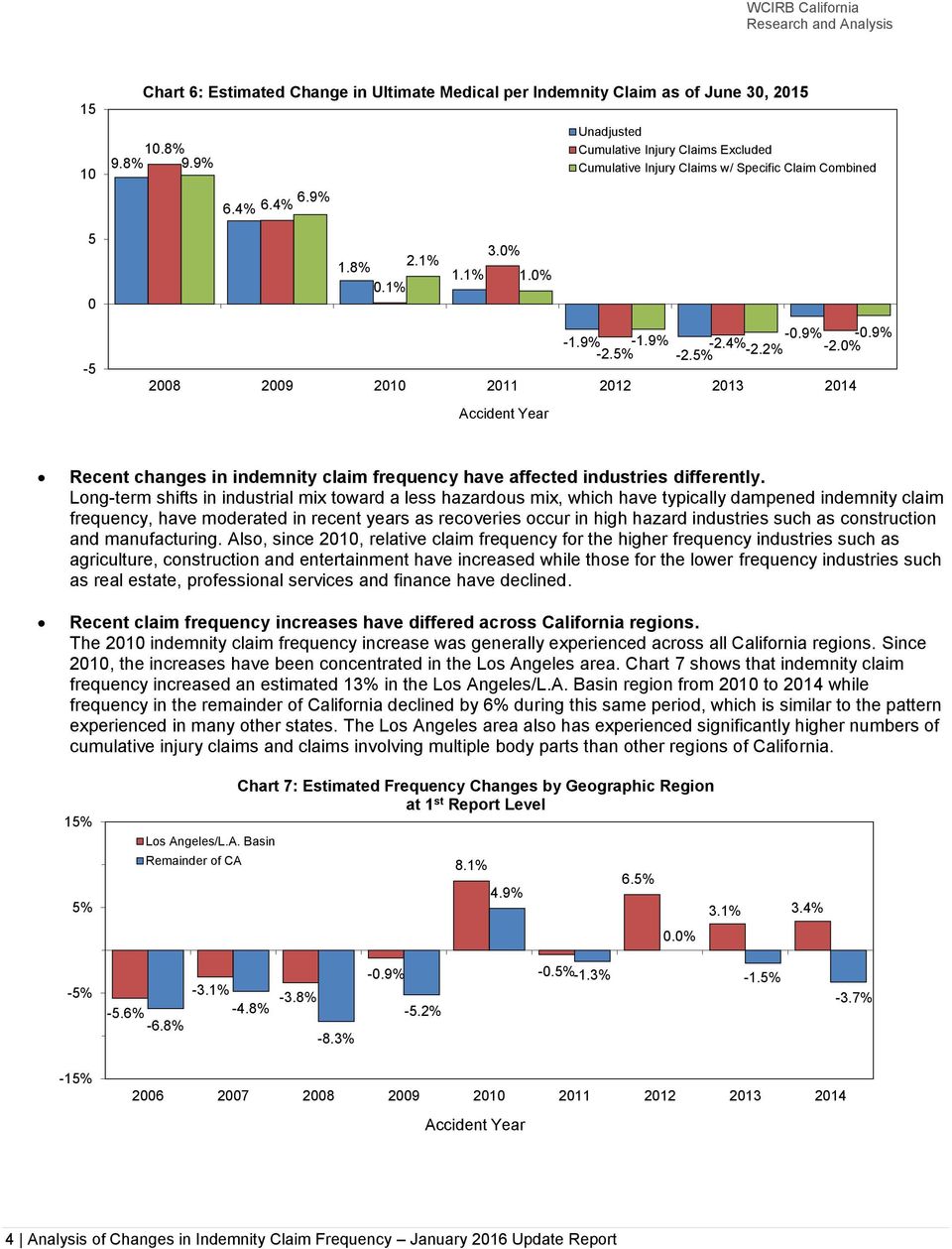
4 WCIRB California Research and Analysis Chart 6: Estimated Change in Ultimate Medical per Indemnity Claim as of June 30, % 9.8% 9.9% 6.9% 6.4% 6.4% 1.8% 2.1% 0.1% 1.1% 3.0% 1.0% -0.9% -0.9% -1.9% -1.9% -2.4% -2.0% -2.5% -2.5% -2.2% Accident Year Unadjusted Cumulative Injury Claims Excluded Cumulative Injury Claims w/ Specific Claim Combined Recent changes in indemnity claim frequency have affected industries differently. Long-term shifts in industrial mix toward a less hazardous mix, which have typically dampened indemnity claim frequency, have moderated in recent years as recoveries occur in high hazard industries such as construction and manufacturing. Also, since 2010, relative claim frequency for the higher frequency industries such as agriculture, construction and entertainment have increased while those for the lower frequency industries such as real estate, professional services and finance have declined. Recent claim frequency increases have differed across California regions. The 2010 indemnity claim frequency increase was generally experienced across all California regions. Since 2010, the increases have been concentrated in the Los Angeles area. Chart 7 shows that indemnity claim frequency increased an estimated 13% in the Los Angeles/L.A. Basin region from 2010 to 2014 while frequency in the remainder of California declined by 6% during this same period, which is similar to the pattern experienced in many other states. The Los Angeles area also has experienced significantly higher numbers of cumulative injury claims and claims involving multiple body parts than other regions of California. 15% 5% Los Angeles/L.A. Basin Remainder of CA Chart 7: Estimated Frequency Changes by Geographic Region at 1 st Report Level 8.1% 4.9% 6.5% 0.0% 3.1% 3.4% -5% -5.6% -6.8% -3.1% -4.8% -3.8% -8.3% -0.9% -5.2% -0.5%-1.3% -1.5% -3.7% -15% Accident Year 4 Analysis of Changes in Indemnity Claim Frequency January 2016 Update Report
5 WCIRB California Research and Analysis As the economy recovers, newer workers entering the system may be more likely to be injured on the job than more experienced workers. Chart 8 shows that the proportion of injured workers with less than 2 years of experience at their current job has grown by almost 10 percentage points from 2010 to 2015, suggesting the economic recovery is likely one of the drivers of recent claim frequency increases. 100% Chart 8: Distribution of Injured Worker Tenure at Date of Injury Based on DWC WCIS Data by Accident Year 28% 29% 30% 31% 31% 32% 29% 75% 50% 28% 30% 28% 25% 23% 21% 20% 25% 44% 41% 42% 44% 46% 48% 50% 0% to 2 Years 2 to 6 Years More than 6 Years Changes in frequency and severity are often related. Chart 9 shows that the 2010 frequency increase ended a years-long decline in the frequency of smaller indemnity claims (below $2,500 in incurred medical) that had been exerting upward pressure on changes in claim severities. Since that time, the frequency of mid-sized indemnity claims (between $2,500 and $25,000 in incurred medical) has increased Chart 9: Indemnity Claim Frequency per $100M Exposure by Incurred Medical Size at 1 st Report Level by Accident Year Less than $2,500 Between $2,500 and $10,000 Between $10,000 and $25,000 Greater than $25, Preliminary 5 Analysis of Changes in Indemnity Claim Frequency January 2016 Update Report

6 WCIRB California Research and Analysis Chart 10 summarizes the principal similarities and differences between the 2010 indemnity claim frequency increase and the more recent changes. Chart 10: Changes in Indemnity Claim Frequency 2010 Compared to 2012 and Later 2010 Frequency Change 2012 & Later Frequency Changes Regional Differences Increase in Many Other States and Throughout California Increase Isolated to Los Angeles Area Differs from National Trends and Other CA Regions Impact of Recession Increase in Cumulative Injury and Other Late- Reported Claims (Not Filed During Recession) Increase in Claims from More Newly-Hired Workers During Recovery Industries Affected Various Impacts to Recession-Related Industries (e.g., Construction, Real Estate) Increases for Multiple Sectors Offset by Declines for White Collar Industries Reform Impacts N/A Potential Impact of SB 863 Indemnity Benefit Increases and Other Permanent Disability Changes Cumulative Injury Claims Increases, Possibly Recession-Related Continued Significant Increases, Many Filed Post-Termination and in Southern CA Impact on Claim Severity Reversal of Gradual Decline in Smaller Indemnity Claims Increase in Mid-Size Indemnity Claims, Many Involving Cumulative Injury Background Prior to 2010, indemnity claim frequency in California had decreased for many years as it had in many other states. This long-term pattern of declining claim frequency is attributable to a number of factors including shifting patterns of economic activity toward a less hazardous and more service-based economy, increased mechanization within specific industries, and greater attention to workplace safety. This long-term frequency decline had significantly moderated premium rate increases over the decades despite years of significant medical inflation in workers compensation claims. In 2010, indemnity claim frequency increased sharply in California as well as in many other states. In 2012, the WCIRB conducted an extensive analysis of the 2010 increase. 3 Among the influencing factors identified in the WCIRB s 2012 report were (a) increases in cumulative injury claims, particularly in industries significantly impacted by the economic recession, (b) increases in smaller non-cumulative injury claims that may have been reported as medicalonly in the past, (c) increases in the proportion of indemnity claims relative to total claims and (d) increases in latereported indemnity claims, increases in the proportion of medical-only claims that later transition to indemnity, and decreases in the proportion of indemnity claims that later transition to medical-only. The 2012 report also noted that the key influencing factors were generally experienced across all California regions. Since 2010, indemnity claim frequency in California has not returned to the typical long-term pattern of decline and in fact has increased modestly since that time, while national frequency trends appear to be returning to the historical downward pattern. In 2013 and 2014, the WCIRB continued its analysis of recent frequency changes including those occurring since These subsequent WCIRB reports identified many of the drivers of frequency changes since 2010 and the similarities and differences with those impacting the 2010 increase. The reports found that since 2010, (a) late-reported claims and claims that transition from medical-only to indemnity claims have continued to increase, 3 Analysis of Changes in Indemnity Claim Frequency, WCIRB, August Analysis of Changes in Indemnity Claim Frequency 2013 Report, WCIRB, December 2013 and Analysis of Changes in Indemnity Claim Frequency 2015 Update Report, WCIRB, January 14, Analysis of Changes in Indemnity Claim Frequency January 2016 Update Report

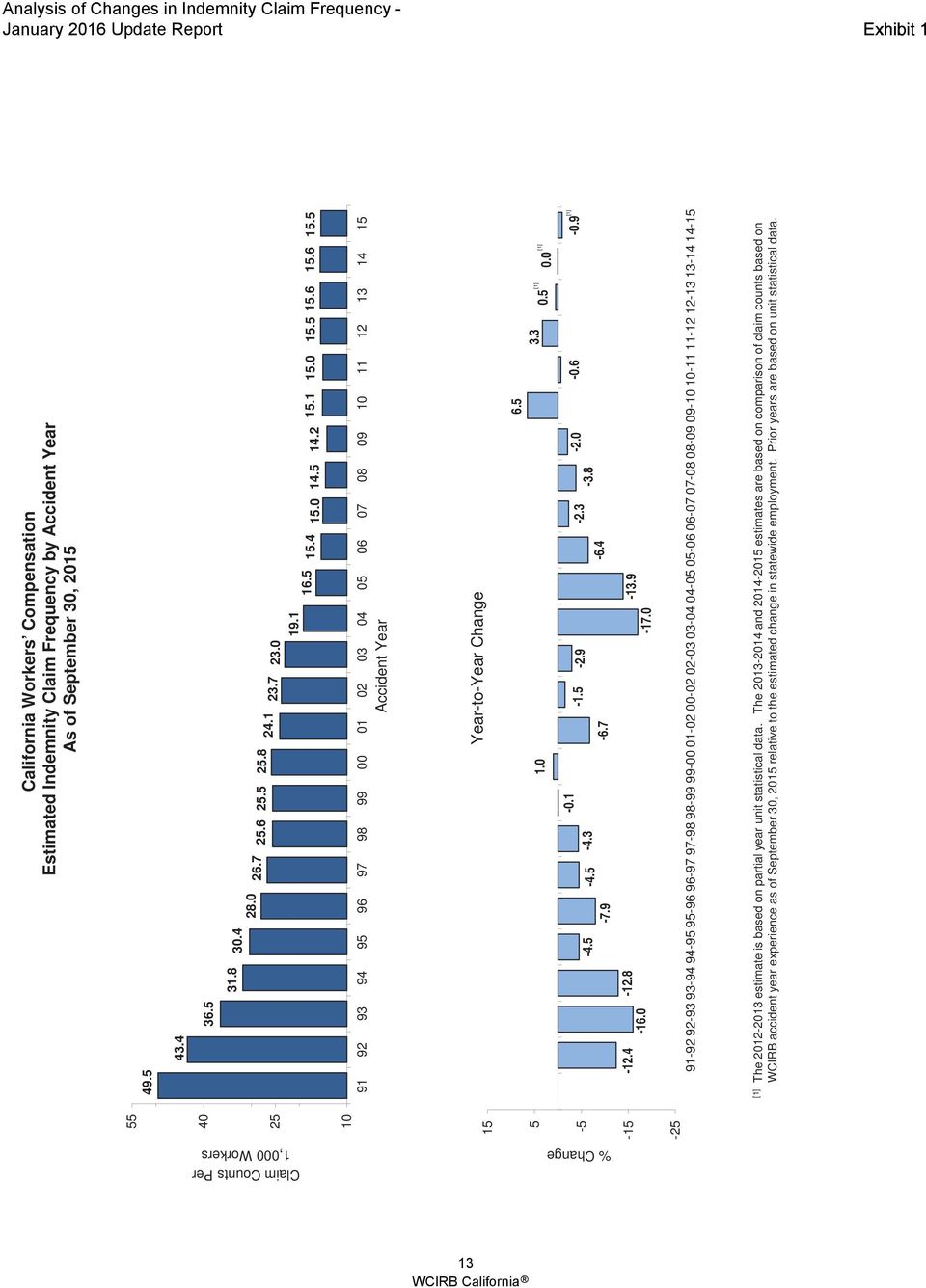
7 WCIRB California Research and Analysis (b) the proportion of cumulative injuries has continued to increase, particularly for permanent partial injuries and for claims involving multiple body parts and (c) the average tenure of an injured worker has declined as more newer workers enter the California job market. The report also found that, contrary to the 2010 increase which was experienced nationwide, increases in subsequent years have been specific to California and in particular focused in the Los Angeles area. This report updates the findings identified in the earlier reports related to recent indemnity claim frequency changes and analyzes factors influencing claim frequency through accident year Many of the findings in this report are based on preliminary claim data that may change as the claims develop and additional data is reported. The WCIRB s Actuarial Committee regularly reviews indemnity claim frequency, drivers of indemnity claim frequency changes and other system diagnostics as updated information becomes available. Analysis and Findings Attached to this report are a series of exhibits that support the WCIRB s analysis and findings. Exhibit 1 shows estimates of indemnity claim frequency per 1,000 workers and frequency changes since accident year After a fairly consistent long-term decline since the early 1990s, indemnity claim frequency increased sharply in 2010 and overall has continued to increase modestly through These recent increases notwithstanding, estimated indemnity claim frequency for 2015 remains almost 70% below that for Exhibit 2 shows indemnity claim frequency changes in California compared to the average annual changes for NCCI states. 6 Historically, estimated frequency changes for both California and NCCI states were generally changing in the same direction and at relatively similar magnitudes; however, beginning in 2012, the two estimates of frequency have diverged and this divergence has continued through The WCIRB has identified a number of factors influencing the recent frequency levels, which are detailed below. A. Claim Count Development The total number of reported indemnity claims grows or develops gradually over time as injuries are reported to insurers and detail on the severity of reported injuries is ascertained. This process of identifying additional claims after the accident year has completed is known as claim count development. In prior reports on claim frequency, the WCIRB identified increased indemnity claim count development as a key driver of recent indemnity claim frequency increases. This increased development was attributable to increases in late-reported indemnity claims (particularly in cumulative injury claims), increases in the proportion of reported medical-only claims that later transition to indemnity, and decreases in the proportion of reported indemnity claims that later transition to medical-only. 7 Indemnity claim count development is significantly higher in California than it is for other states. For example, at 12 months of maturity almost one-quarter of the ultimate California indemnity claims to be incurred for a particular accident year have not been reported as indemnity claims. The median ratio of claims unreported in the other states in the WCIRB s comparison was 9%. 8 5 Estimated frequency changes through accident year 2013 are based on unit statistical reported indemnity claim counts developed to a fifth report level compared to reported insured payroll adjusted to a common wage level. For accident years 2014 and 2015 through nine months (for which complete unit statistical data is not yet available), the WCIRB estimates indemnity claim frequency based on changes in indemnity claim counts (undeveloped) reported on WCIRB aggregate data calls compared to changes in statewide employment compiled from historical employment data and UCLA forecasts. 6 NCCI information is based on the May 14, 2015 State of the Line Presentation. 7 In 2012, the WCIRB conducted a survey of indemnity claims that later transition to medical-only in order to better understand this phenomenon. Among the key factors identified included (a) companion claims (such as a cumulative injury) in which the indemnity is only paid on one of the claims, (b) a final PD award of 0% when some PD was initially estimated, (c) the injured worker being offered modified or restricted work resulting in no lost time and (d) settlements in which the payment was made on the medical portion of the claim. See Analysis of Changes in Indemnity Claim Frequency, WCIRB, August 2012, for more information. 8 See Chart 26 of WCIRB Report on the State of the California Workers Compensation Insurance System, WCIRB, July 29, Analysis of Changes in Indemnity Claim Frequency January 2016 Update Report

8 WCIRB California Research and Analysis Exhibits 3.1, 3.2 and 3.3 show annual age-to-age and cumulative claim count development factors for indemnity claims, medical-only claims, and total claims, respectively, based on WCIRB aggregate data calls. Exhibits 4.1 through 4.3 show comparable information evaluated on a quarterly basis. Indemnity claim count development (Exhibits 3.1 and 4.1) has been increasing for the last several years which has driven accident year estimates of indemnity claim frequency upward over time. Conversely, medical-only claim count development (Exhibits 3.2 and 4.2) has been relatively stable over this period. However, indemnity claim count development in 2015 is slightly less than that for 2014, suggesting a moderation in the trend of increasing claim count development. Cumulative injury claims are a significant component of indemnity claim count development as cumulative injury claims are often reported after the accident year has ended. Exhibit 5 shows annual indemnity claim count development factors for cumulative injury claims, non-cumulative injury claims and total indemnity claims based on WCIRB unit statistical data. A cumulative injury indemnity claim is over four times as likely to be reported as an indemnity claim after first report level as a non-cumulative injury indemnity claim. 9 B. Cumulative Injury Claims Historically, the WCIRB has closely monitored the proportion of cumulative injury claims. Not only do changes in the number of cumulative injury claim filings impact indemnity claim frequency directly, but WCIRB research has shown that changes in the proportion of claims involving cumulative injury, as a proxy for claims that may have a discretionary component, is a strong indicator of changes in non-cumulative, or specific, injury claim frequency. In prior WCIRB reports on frequency, the WCIRB identified a significant increase in the proportion of cumulative injury claims as a key driver of recent increases in indemnity claim frequency. Exhibit 6 shows cumulative injury claims as a percentage of all indemnity claims by partial accident year 10 based on unit statistical data developed to fifth report level. The proportion of cumulative injury claims increased beginning with the recession period and has continued to increase significantly through 2014, for which approximately 18% of all indemnity claims involve cumulative injury. 11 As shown on Exhibit 5, cumulative injury claims develop significantly later than non-cumulative injury claims suggesting that the ultimate proportion of indemnity claims involving cumulative injury may be even higher. Exhibit 7 shows the distribution of cumulative injury claims by type of injury. Recent increases in cumulative injury claims appear to be associated with more complex claim types, as both the proportion of cumulative injury claims involving indemnity benefits and those involving permanent indemnity benefits have increased since Exhibit 8 shows the distribution of cumulative injury indemnity claims by injured part of body. (For comparison, the distribution of non-cumulative injury indemnity claims by injured part of body is also shown on Exhibit 8.) A larger proportion of cumulative injury claims in recent accident years involve multiple body parts (30% in 2014 as compared to 26% in 2010). Cumulative injury claims are also more than twice as likely to involve injuries to multiple body parts as non-cumulative injury claims. Some of this differential and recent increases in these proportions may be driven by regional differences, as recent frequency increases have been focused in the Los Angeles area, which has significantly more cumulative injury claims and claims involving multiple body parts. To better understand the increased filings of cumulative injury claims, the WCIRB has conducted several surveys of these types of claims. The results of the most recent survey conducted in are compared to prior survey results on Exhibit 9. The most recent survey results show (a) the proportion of cumulative injury claims involving a specific injury component, psychiatric injury or sleep disorder has declined, (b) the proportion of claims involving attorney representation as well as the proportion of claims that are initially denied in whole or in part by the insurer continues to be very high and (c) the proportion involving injuries to multiple body parts has increased. In addition, 9 At least some of the increase in cumulative injury claim count development experienced over recent calendar years is likely attributable to improved reporting of cumulative injury claims as a result of WCIRB data quality efforts. 10 The claims for accident year Y are from policies incepting in year Y At least some of the increase in the proportion of cumulative injury claims in recent years is likely attributable to improved reporting of cumulative injury claims as a result of WCIRB data quality efforts. 12 The vast majority of permanent indemnity claims consist of permanent partial claims, but they also include permanent total claims and death claims. 13 The 2015 survey was based on approximately 340 cumulative injury claims from accident years 2013 and Analysis of Changes in Indemnity Claim Frequency January 2016 Update Report

9 WCIRB California Research and Analysis the average and median reporting lag of cumulative injury claims as measured by the number of days between the accident date and the date reported to the insurer declined from that indicated in the 2014 survey but remains significantly higher than that indicated in the 2012 survey. Exhibit 9 also shows that, despite longstanding statutory limitations on the filing of post-termination claims, approximately 40% of the surveyed claims continue to be reported post-termination. Exhibit 10 summarizes some of the characteristics of the cumulative injury claims identified to be filed post-termination compared to the other surveyed claims. A significantly higher proportion of the post-termination claims involved multiple insurers, psychiatric injury and injuries to multiple body parts. Additionally, almost all of the surveyed claims identified as post-termination involved attorney representation and were reported in Southern California. These types of claims also had a median reporting lag approximately three times greater than that for the non-post-termination claims. Claims involving both a cumulative injury component and a specific injury component are required to be reported to the WCIRB as two separate claims. Often in these instances one of the claims is identified by the insurer as the master claim file for bill payment. Exhibit 11 shows the average and median cost of the claims from the 2015 survey identified to have a specific component based on unit statistical data at first report level. The claims have been segregated based on whether the master claim was identified as the cumulative injury claim (44%) or the specific injury claim (53%). 14 In most cases, a significantly higher incurred loss severity was attributed to the claim identified as the master claim file. As a result, these types of claims and changes in the proportion of these types of claims may have a dampening effect on estimated claim severities. Exhibits 12.1 and 12.2 show incurred indemnity and medical claim severities, respectively, based on unit statistical data for cumulative injury claims and non-cumulative injury claims. At early report levels, cumulative injury claim severities are slightly lower than or generally consistent with non-cumulative injury claim severities. However, cumulative injury claims develop at a significantly higher level than non-cumulative injury claims and, as a result, have significantly higher severities at later maturities. Exhibit 13 shows overall indemnity claim frequency compared to claim frequency excluding cumulative injury claims based on unit statistical data. Overall, recent increases in cumulative injury claims have contributed approximately 1 to 2 percentage points to annual changes in indemnity claim frequency. Inasmuch as cumulative injury claim counts develop at a significantly higher rate than non-cumulative injury claim counts, this impact may be greater at later maturities. Exhibit 14 compares estimated changes in ultimate medical per indemnity claim severities with (a) no adjustments, (b) adjustments to exclude cumulative injury claims based on their estimated proportion of indemnity claims at fifth report level (see Exhibit 6) and severities at tenth report level (see Exhibit 12.2) and (c) adjustments to combine cumulative injury claims with a specific claim component into a single claim based on WCIRB survey results (see Exhibit 9). These adjustments have an overall minor impact on estimated average severity trends. C. Industrial Impacts Changes in industrial mix have historically had a dampening effect on indemnity claim frequency as the California economy has gradually transitioned towards less hazardous employments. Exhibit 15 shows changes in indemnity claim frequency resulting from shifts in industrial mix, or inter-class frequency, over time. While this trend has continued through 2013, recoveries from the recession in higher frequency industries such as construction and manufacturing have somewhat offset this effect in recent years. Exhibit 16 shows indemnity claim frequency by NAICS sector relative to statewide (all industries combined) frequency at first report level. 15 Since 2010, relative claim frequency for the higher frequency industries such as agriculture, construction and entertainment have increased while those for the lower frequency industries such as real estate, professional services and finance have declined. 14 A small percentage of the surveyed claims identified a third claim to be the master claim file. 15 Frequency is based on reported indemnity claim counts divided by insured payroll for each sector adjusted for changes in statewide average wage levels. 9 Analysis of Changes in Indemnity Claim Frequency January 2016 Update Report

10 WCIRB California Research and Analysis The WCIRB periodically reviews economic information that may have some impact on indemnity claim frequency or other claims phenomenon such as average hours worked or net job gains and losses. While there does appear to be some variability in various economic measures among sectors, this data has not shown to significantly explain recent changes in claim frequency. D. Regional Differences Claim filing patterns can vary widely across California regions due to a variety of demographic, socioeconomic and systemic differences in addition to differing claims-filing practices. Historically, Southern California has exhibited higher rates of permanent disability (PD) claims and cumulative injury claims. However, in the WCIRB s 2012 report on frequency, it was noted that in 2010 increases in cumulative injury claim rates had been occurring across all regions in the state. Exhibit 17 shows indemnity claim frequency by geographic region. 16 Indemnity claim frequency rates in the Los Angeles/L.A. Basin region 17 have historically been significantly higher than those for the Bay Area. 18 In 2010, frequency increases were experienced across all major California regions. However, since that time, frequencies in the Bay Area and other California regions have been flat or declining while those in the Los Angeles area have continued to escalate. Preliminary unit statistical information shows indemnity claim frequency increasing by approximately 13% in the Los Angeles area from 2010 to 2014 compared to a decline of 6% for the remainder of California. Exhibit 18 shows ratios of PD claims to indemnity claims, indemnity claims to total claims, and cumulative injury claims to indemnity claims for the Bay Area, Los Angeles/L.A. Basin and other California regions at first report level. These ratios have historically been higher for the Los Angeles area when compared to other regions. However, since 2008, the disparity between the Los Angeles area ratios and those for other California regions has grown considerably in most cases. In particular, the proportion of indemnity claims that involve cumulative injury in the Los Angeles area for accident year 2014 is approximately twice that of the remainder of the state. Exhibits 19.1, 19.2 and 19.3 show the distribution of cumulative injury claims, non-cumulative injury claims and all indemnity claims, respectively, by part of body code and geographic region. The Los Angeles/L.A. Basin region historically has much higher rates of multiple body parts reported on claims, particularly for cumulative injuries, while the Bay Area has a greater proportion of injuries involving the hand and/or wrist. As mentioned above, regional differences in claim frequency patterns are, in part, attributable to differing demographic and socioeconomic conditions. The WCIRB has reviewed various demographic information across regions such as indemnity claim frequency by industrial sector and distributions of indemnity claims by wage level. While there typically were regional differences among the various diagnostics analyzed, these patterns had been relatively stable over the last several years. In 2015, the WCIRB conducted extensive research into the assignment of exposures and claims to California regions and analyzed regional differences in claim frequency and other claim characteristics. This research showed significantly higher claim frequency in the Los Angeles area relative to statewide levels, even after controlling for wage level differences and industrial mix. 19 E. Other Claim Demographics In addition to the areas identified above, the WCIRB has reviewed several other factors that may impact recent indemnity claim frequency levels. Exhibit 20 shows the distribution of indemnity claim counts by injury type at first report level. The proportion of indemnity claims continues to increase since 2010 while the proportion of medical-only claims has declined. 16 For purposes of this analysis, the region assigned to the payroll and claims data is based on the zip code on the workers compensation policy address. 17 This region includes Los Angeles County, Orange County, Ventura County, San Bernardino County, and Riverside County and represents approximately 45% of the insured payroll in California. 18 Some of this differential may be due to differences in industrial mix. 19 Study of Geographical Differences in California Workers Compensation Claim Costs, WCIRB, November 5, Analysis of Changes in Indemnity Claim Frequency January 2016 Update Report

11 WCIRB California Research and Analysis Newer, more inexperienced workers are generally more likely to be injured on the job and file a workers compensation claim. To assess this impact on recent claim frequency changes, the WCIRB has compiled data from the Division of Workers Compensation (DWC) Workers Compensation Information System (WCIS) on employee tenure at the time of injury. Exhibit 21 shows the average and median tenure for injured workers in the insured system by accident quarter through the third quarter of These figures have continued to decline as more inexperienced workers are added to the workforce as the California economy continues to recover from the major recession of the latter part of the last decade. Exhibit 22 shows the distribution of tenure by year. In 2015, approximately 50% of injured workers had been with the employer for less than two years compared to 41% in 2010, suggesting that the economic recovery may be a significant factor impacting recent frequency changes. Exhibit 23 shows the average and median tenure from WCIS data for select industrial sectors. Recent reductions in average and median tenure have been relatively consistent across multiple industries. Preliminary WCIRB estimates of indemnity claim frequency changes compare changes in the number of indemnity claims to changes in statewide employment. Changes in employment have shown to be a reasonable proxy for changes in insured exposure levels as long as there are not significant shifts of employers in and out of selfinsurance. If there are shifts in self-insurance levels, this could significantly impact insured exposure levels without affecting statewide employment levels, which could potentially distort frequency measures based on statewide employment changes. The WCIRB regularly monitors self-insurance levels and has not observed any shifts in these levels over the last several years that would significantly distort frequency projections. F. Impact of SB 863 Senate Bill No. 863 (SB 863) increased permanent disability benefits effective January 1, 2013 and January 1, 2014, and provided a number of structural reforms to the California workers compensation system. With changes in benefit levels, not only is the cost of average weekly benefits changed, but the frequency of claims is also affected. WCIRB estimates of the impact of benefit level changes on claim frequency are based on an econometric model of the effect of a number of economic, demographic, and claims-related variables, including changes in indemnity benefit levels, on the frequency of claims in California. 20 In the WCIRB s 2015 SB 863 Cost Monitoring Report, it was noted that the frequency model projections for accident years 2013 and 2014 which include estimated impacts for SB 863 were generally consistent with estimated actual frequency for those years, but the indemnity claim frequency increase in 2012 was significantly greater than projected. 21 However, the report also noted that indemnity claim frequency for accident year 2012 estimated at 6 months (and prior to the enactment of SB 863) showed an increase generally consistent with the current estimate. As a result, the greater than projected increase in frequency for accident year 2012 is likely the result of factors other than SB G. Impact on Average Claim Size Changes in indemnity claim frequency and claim severity are not independent. Unlike claim frequency, ultimate claim severities develop over many years and much more limited information on claim severities for more recent years is available. Nevertheless, the WCIRB has compiled preliminary information on claim frequency and severity to assess the types of claim sizes emerging. Exhibit 24 shows the distribution of indemnity claim frequency changes by layer of incurred medical at first report level. Prior to 2010, the frequency of smaller indemnity claims with less than $2,500 incurred medical had declined at a greater rate than other types of claims, exerting upward pressure on claim severities. Since 2010, this decline in smaller claims and its upward effect on claim severity ended, and recent increases have been experienced in 20 Brooks, Ward, California Workers Compensation Benefit Utilization A Study of Changes in Frequency and Severity in Response to Changes in Statutory Workers Compensation Benefit Levels, Proceedings of the Casualty Actuarial Society, Volume LXXXVI, 1999, pp WCIRB research has shown that statutory changes in indemnity benefit levels not only affect indemnity claim frequency in the year they become effective, but are also strongly correlated with frequency changes in the immediate prior year. As a result, the indemnity benefit level in the WCIRB s econometric model is a leading variable. Therefore, the 2013 PD benefit increases (and other 2013 effective reforms impacting indemnity benefits) are also projected to affect accident year 2012 claim frequency, and the 2014 PD benefit increases are also projected to impact accident year 2013 frequency. 22 See Senate Bill No. 863 WCIRB Cost Monitoring Report 2015 Retrospective Evaluation, WCIRB, November 16, 2015, for more information. 11 Analysis of Changes in Indemnity Claim Frequency January 2016 Update Report

12 WCIRB California Research and Analysis the frequency of mid-sized claims (between $2,500 and $25,000 incurred medical). As this information is based on incurred losses, which includes claims adjusters estimates of the total cost of a claim, these differences may not be reflected in analyses of paid severities, which may be relatively more homogenous during the early life of a claim. Exhibit 25 shows changes in policy year average and median incurred severities at first report level. In 2013, the median incurred indemnity increased significantly and the median incurred medical decreased significantly, while changes in average severities for each of the components were more modest, suggesting a shift in the size of loss distribution. Although changes in the frequency of smaller or larger claims is one possible driver of these shifts, other factors, particularly SB 863, may also be significant drivers. 12 Analysis of Changes in Indemnity Claim Frequency January 2016 Update Report

13 January 2016 Update Report Exhibit California Workers Compensation Estimated Indemnity Claim Frequency by Accident Year As of September 30, Accident Year Year-to-Year Change [1] [1] -0.9 [1] [1] The estimate is based on partial year unit statistical data. The and estimates are based on comparison of claim counts based on WCIRB accident year experience as of September 30, 2015 relative to the estimated change in statewide employment. Prior years are based on unit statistical data. % Change Claim Counts Per 1,000 Workers 13
14 January 2016 Update Report Exhibit 2 10 Change in Estimated Indemnity Claim Frequency California vs. NCCI States % As of September 30, 2015 California 5 NCCI States Accident Year (9 Mos.) Source: WCIRB Unit Statistical Data ( ) and Aggregate Data Calls ( ). NCCI estimates are based on May 14, 2015 State of the Line Presentation (NCCI 2014 estimate is preliminary and the 2010 and 2011 estimates have been adjusted to remove the impact of audit premium and other factors). 14

15 January 2016 Update Report Exhibit 3.1 Indemnity Claim Count Development as of June 30, 2015 Experience Accident Indemnity Claim Count Development for Age-to-Age Year 18/6 30/18 42/30 54/42 66/54 78/66 90/78 102/90 114/ / Cumulative Development (Latest Year Selections): Calendar Year ULT/6 ULT/18 ULT/30 ULT/42 ULT/54 ULT/66 ULT/78 ULT/90 ULT/102 ULT/ Source: WCIRB aggregate data calls 15

16 January 2016 Update Report Exhibit 3.2 Medical-Only Claim Count Development as of June 30, 2015 Experience Accident Medical-Only Claim Count Development for Age-to-Age Year 18/6 30/18 42/30 54/42 66/54 78/66 90/78 102/90 114/ / Cumulative Development (Latest Year Selections): Calendar Year ULT/6 ULT/18 ULT/30 ULT/42 ULT/54 ULT/66 ULT/78 ULT/90 ULT/102 ULT/ Source: WCIRB aggregate data calls 16

17 January 2016 Update Report Exhibit 3.3 Total Claim Count Development as of June 30, 2015 Experience Accident Total Claim Count Development for Age-to-Age Year 18/6 30/18 42/30 54/42 66/54 78/66 90/78 102/90 114/ / Cumulative Development (Latest Year Selections): Calendar Year ULT/6 ULT/18 ULT/30 ULT/42 ULT/54 ULT/66 ULT/78 ULT/90 ULT/102 ULT/ Source: WCIRB aggregate data calls 17

18 January 2016 Update Report Exhibit 4.1 Indemnity Claim Count Development as of September 30, 2015 Experience Accident Development for Age-to-Age Year Source: WCIRB aggregate data calls 18

19 January 2016 Update Report Exhibit 4.2 Medical-Only Claim Count Development as of September 30, 2015 Experience Accident Development for Age-to-Age Year Source: WCIRB aggregate data calls 19

20 January 2016 Update Report Exhibit 4.3 Total Claim Count Development as of September 30, 2015 Experience Accident Development for Age-to-Age Year Source: WCIRB aggregate data calls 20

21 January 2016 Update Report Exhibit 5 Indemnity Claim Count Development by Type of Claim A. Cumulative Injury Claim Count Development Accident Report Level Calendar 1st to 5th Year 1 to 2 2 to 3 3 to 4 4 to 5 5 to 6 6 to 7 7 to 8 8 to 9 9 to 10 Year Development B. Non-Cumulative Injury Claim Count Development Accident Report Level Calendar 1st to 5th Year 1 to 2 2 to 3 3 to 4 4 to 5 5 to 6 6 to 7 7 to 8 8 to 9 9 to 10 Year Development C. All Indemnity Claim Count Development Accident Report Level Calendar 1st to 5th Year 1 to 2 2 to 3 3 to 4 4 to 5 5 to 6 6 to 7 7 to 8 8 to 9 9 to 10 Year Development Source: WCIRB unit statistical data 21
22 January 2016 Update Report Exhibit 6 Partial Accident Year Cumulative Injury Indemnity Claim Counts by Policy Year and Report Level Share of Total Indemnity Count 1st Half Partial PY.RL Sources 1st Half Partial PY.RL Sources AY (AY-1).1 (AY-1).2 (AY-1).3 (AY-1).4 (AY-1).5 (AY-1).1 (AY-1).2 (AY-1).3 (AY-1).4 (AY-1) ,519 4,071 5,035 6,162 6, % 5.9% 6.7% 7.9% 8.0% ,756 4,734 5,516 5,842 5, % 6.4% 6.8% 7.2% 7.0% ,371 5,394 5,991 6,107 6, % 6.6% 7.2% 7.2% 7.5% ,594 5,515 5,823 5,994 5, % 6.5% 6.7% 7.1% 7.1% ,301 5,928 6,496 6,637 6, % 6.8% 7.5% 7.6% 7.9% ,573 6,660 7,055 7,404 7, % 7.6% 7.9% 8.2% 8.3% ,750 6,795 7,576 7,679 7, % 7.8% 8.5% 8.6% 8.7% ,400 7,046 7,241 7,381 7, % 8.3% 8.5% 8.6% 8.7% ,143 6,952 7,183 7,329 7, % 8.6% 8.9% 9.1% 9.2% ,374 5,723 5,860 5,961 6, % 8.7% 8.9% 9.0% 9.2% ,184 3,665 3,969 4,243 4, % 6.4% 6.8% 7.3% 7.7% ,989 3,569 3,924 4,231 4, % 6.4% 7.0% 7.5% 7.8% ,037 3,645 4,036 4,274 4, % 6.8% 7.4% 7.8% 8.1% ,914 3,659 4,180 4,458 4, % 7.0% 7.9% 8.4% 8.6% ,974 3,932 4,524 4,822 5, % 8.2% 9.3% 9.8% 10.4% ,442 4,472 4,983 5,491 5, % 9.0% 9.8% 10.8% 11.1% ,321 4,370 5,228 5, % 8.6% 10.1% 10.6% ,513 5,076 5, % 9.3% 10.3% ,714 6, % 11.0% , % 1st Half 1st Half Partial PY.RL Development Factors Share of (AY-1).1 (AY-1).2 (AY-1).3 (AY-1).4 Final Ttl Ind AY to (AY-1).2 to (AY-1).3 to (AY-1).4 to (AY-1).5 Fifths Fifths , % , % , % , % , % , % , % , % , % , % , % , % , % , % , % , % , % , % , % , % Notes: Cumulative injury claims include occupational disease. Selected link ratios are geometric mean of latest two links and are shown in bold. The partial accident years shown represent claims occurring during the year from policies written the previous year. For example, AY 2014 claims occurred in 2014 from policies written in Source: WCIRB unit statistical data 22
23 January 2016 Update Report Exhibit 7 Distribution of Cumulative Injury Claims by Injury Type Permanent Indemnity* Percentage of All Cumulative Injury Claims Annual Change AY/RL AY/RL % 34.2% 35.7% 36.7% 37.4% % 35.4% 36.9% 37.5% 36.3% % 3.4% 3.3% 2.2% -3.0% % 35.0% 36.6% 37.3% 37.6% % -1.2% -0.7% -0.7% 3.5% % 36.5% 37.5% 38.0% 37.8% % 4.5% 2.4% 2.1% 0.7% % 37.1% 38.3% 38.6% 38.8% % 1.7% 2.0% 1.4% 2.6% % 31.2% 32.6% 33.3% 34.4% % -15.9% -14.9% -13.8% -11.3% % 24.5% 26.8% 29.2% 31.0% % -21.6% -17.6% -12.2% -9.9% % 24.4% 27.7% 29.7% 30.6% % -0.2% 3.2% 1.8% -1.4% % 26.1% 29.1% 29.2% 30.9% % 6.7% 4.8% -1.7% 1.1% % 27.0% 30.2% 31.0% 31.4% % 3.4% 3.9% 6.1% 1.6% % 30.6% 34.3% 34.9% 34.5% % 13.4% 13.7% 12.5% 9.7% % 31.9% 33.8% 34.1% 33.9% % 4.4% -1.6% -2.2% -1.6% % 32.8% 34.6% 34.8% % 2.7% 2.3% 2.0% % 33.6% 34.7% % 2.3% 0.4% % 35.3% % 5.3% % % Temporary Indemnity Percentage of All Cumulative Injury Claims Annual Change AY/RL AY/RL % 17.0% 16.2% 15.7% 15.4% % 17.2% 17.2% 16.6% 16.1% % 1.0% 5.9% 5.6% 4.4% % 18.4% 17.5% 16.7% 16.1% % 7.2% 1.6% 0.3% 0.0% % 18.0% 16.5% 15.6% 15.6% % -2.5% -5.7% -6.3% -3.2% % 18.1% 16.6% 16.1% 15.9% % 0.4% 0.8% 3.0% 2.2% % 18.6% 17.2% 16.4% 15.6% % 3.3% 3.4% 2.2% -2.1% % 19.0% 17.5% 15.9% 14.6% % 1.9% 2.1% -3.3% -6.0% % 19.2% 16.7% 15.4% 14.6% % 0.9% -5.0% -3.4% -0.4% % 18.7% 17.1% 15.8% 15.6% % -2.2% 2.7% 3.1% 6.7% % 19.1% 17.3% 16.2% 15.6% % 1.9% 0.9% 2.3% 0.1% % 21.6% 19.3% 17.5% 16.8% % 13.2% 11.7% 8.1% 7.9% % 21.9% 19.2% 18.4% 18.9% % 1.2% -0.6% 5.0% 12.7% % 22.8% 21.3% 22.2% % 4.2% 11.2% 20.8% % 23.7% 22.9% % 3.9% 7.6% % 27.2% % 14.7% % % Medical-Only Percentage of All Cumulative Injury Claims Annual Change AY/RL AY/RL % 48.6% 48.0% 47.4% 47.1% % 47.3% 45.8% 45.7% 47.5% % -2.7% -4.5% -3.6% 0.9% % 46.5% 45.8% 46.0% 46.3% % -1.7% 0.0% 0.5% -2.7% % 45.4% 45.9% 46.2% 46.5% % -2.3% 0.2% 0.6% 0.5% % 44.7% 45.0% 45.2% 45.2% % -1.5% -2.0% -2.2% -2.8% % 50.1% 50.2% 50.2% 49.9% % 12.0% 11.5% 11.0% 10.4% % 56.5% 55.5% 54.8% 54.2% % 12.7% 10.7% 9.0% 8.6% % 56.3% 55.5% 54.7% 54.7% % -0.3% -0.1% 0.0% 0.8% % 55.1% 53.7% 54.8% 53.3% % -2.1% -3.2% 0.1% -2.4% % 53.9% 52.4% 52.6% 52.8% % -2.2% -2.4% -4.0% -0.9% % 47.7% 46.2% 47.4% 48.6% % -11.4% -11.8% -9.9% -8.1% % 46.1% 46.9% 47.3% 46.3% % -3.4% 1.5% -0.2% -4.7% % 44.3% 43.9% 43.9% % -3.9% -6.4% -7.3% % 42.7% 41.5% % -3.6% -5.6% % 40.3% % -5.6% % % * Includes Permanent Partial, Permanent Total, and Death Note: Figures in italics are based on a partial accident year. Cumulative injury claims include occupational disease. Source: WCIRB unit statistical data 23
24 January 2016 Update Report Exhibit 8 Indemnity Claim Count Distribution by Part of Body Code Top 20 Part of Body Codes for Cumulative Injury Indemnity Claims based on AY 2013 Shares 2013 POB POB Accident Year Rank Code Description Multiple Body Parts 28.5% 26.5% 25.7% 24.0% 25.1% 25.9% 29.0% 29.8% 31.0% 29.9% 2 42 Lower Back 5.0% 5.5% 6.4% 6.2% 7.6% 8.3% 8.2% 8.1% 8.9% 9.7% 3 91 Body Systems 1.7% 1.8% 2.5% 3.0% 4.1% 3.5% 3.7% 4.8% 6.7% 6.2% 4 34 Wrist 10.8% 11.8% 10.4% 9.9% 7.9% 7.0% 6.8% 7.1% 5.6% 5.7% 5 38 Shoulder 3.5% 4.0% 4.9% 5.4% 4.6% 4.8% 4.6% 4.6% 4.7% 5.1% 6 66 Psych 2.7% 3.1% 4.2% 5.5% 5.6% 5.9% 5.2% 5.1% 4.6% 4.3% 7 30 Multiple Upper 8.2% 7.1% 6.4% 5.9% 5.1% 4.4% 4.2% 4.6% 4.0% 3.9% 8 35 Hand 6.0% 5.9% 5.8% 5.3% 4.6% 4.4% 4.5% 3.9% 3.9% 3.9% 9 39 Wrist and Hand 4.7% 4.7% 4.3% 5.6% 4.2% 4.0% 4.2% 4.4% 3.7% 3.4% Knee 2.5% 2.4% 3.0% 2.8% 2.2% 2.8% 2.5% 2.3% 2.8% 2.6% Unclassified 2.2% 1.9% 1.8% 1.7% 2.3% 2.0% 2.9% 2.7% 1.9% 2.1% Soft Tissue (Neck) 0.7% 0.6% 0.7% 1.1% 1.6% 2.0% 1.6% 1.7% 1.8% 2.2% Lower Arm 2.1% 2.3% 2.5% 1.9% 1.8% 1.6% 1.4% 1.6% 1.5% 0.8% Brain 4.6% 4.7% 4.4% 4.0% 5.5% 5.2% 4.2% 2.9% 1.4% 1.2% Elbow 2.1% 1.7% 1.8% 2.1% 1.6% 1.3% 1.2% 1.3% 1.3% 1.3% Multiple Neck 0.5% 0.7% 0.7% 0.9% 1.0% 0.9% 0.9% 1.3% 1.1% 0.9% Multiple Head 0.6% 0.8% 0.6% 1.0% 1.6% 1.4% 1.0% 1.1% 1.1% 1.3% Upper Back 1.3% 1.3% 1.3% 1.2% 1.5% 1.2% 1.3% 1.2% 1.1% 1.1% Disc (Neck) 0.5% 0.5% 0.6% 0.6% 0.5% 0.6% 0.7% 0.7% 1.0% 1.3% Disc (Back) 0.2% 0.2% 0.2% 0.2% 0.4% 0.4% 0.3% 0.6% 1.0% 1.4% Other Other 11.8% 12.5% 11.8% 12.0% 11.4% 12.3% 11.5% 10.3% 10.8% 11.7% Top 20 Part of Body Codes for Non-Cumulative Injury Indemnity Claims based on AY 2013 Shares 2013 POB POB Accident Year Rank Code Description Lower Back 15.1% 15.5% 15.6% 16.7% 17.4% 17.3% 16.8% 16.8% 16.9% 16.4% 2 90 Multiple Body Parts 12.3% 11.2% 11.2% 10.7% 10.8% 11.7% 13.1% 12.6% 12.2% 11.9% 3 53 Knee 7.6% 7.9% 8.2% 8.5% 8.6% 8.6% 8.3% 8.4% 8.9% 8.3% 4 38 Shoulder 4.4% 4.7% 5.1% 5.7% 6.2% 6.1% 6.1% 6.6% 7.5% 7.0% 5 36 Finger 5.7% 6.1% 6.1% 6.2% 6.0% 6.0% 5.8% 5.8% 5.8% 6.0% 6 35 Hand 3.9% 4.1% 4.2% 4.1% 4.1% 4.3% 4.4% 4.6% 4.6% 4.2% 7 55 Ankle 3.9% 4.3% 4.3% 4.4% 4.4% 4.2% 4.3% 4.2% 4.2% 4.4% 8 34 Wrist 5.4% 5.8% 5.9% 5.7% 5.6% 6.0% 5.6% 5.4% 4.1% 5.1% 9 56 Foot 3.0% 3.3% 3.4% 3.1% 3.0% 2.9% 3.0% 2.9% 3.0% 3.2% Abdomen 2.3% 2.3% 2.4% 2.4% 2.4% 2.1% 2.3% 2.3% 2.4% 2.3% Lower Arm 1.7% 1.8% 1.8% 1.9% 2.0% 2.0% 2.1% 2.2% 2.1% 2.1% Upper Back 1.4% 1.4% 1.5% 1.4% 1.4% 1.5% 1.5% 1.6% 1.9% 1.8% Elbow 1.6% 1.8% 1.8% 1.8% 1.8% 1.8% 1.7% 1.8% 1.9% 1.9% Lower Leg 1.8% 1.9% 1.9% 1.9% 1.8% 1.8% 1.8% 1.8% 1.8% 1.8% Multiple Upper 2.5% 2.4% 2.1% 1.9% 1.9% 2.0% 1.9% 1.9% 1.7% 2.0% Upper Arm 1.6% 1.7% 1.8% 1.9% 2.2% 2.3% 2.3% 2.0% 1.7% 2.0% Thumb 1.6% 1.7% 1.7% 1.7% 1.7% 1.5% 1.6% 1.6% 1.6% 1.6% Soft Tissue (Neck) 0.6% 0.7% 0.9% 1.0% 1.3% 1.5% 1.4% 1.3% 1.4% 1.2% Multiple Head 1.0% 1.1% 1.1% 1.1% 1.2% 1.3% 1.2% 1.3% 1.1% 1.3% Chest 0.9% 1.1% 1.2% 1.1% 1.2% 1.2% 1.1% 1.0% 1.1% 1.1% Other Other 21.6% 19.3% 17.9% 16.7% 15.1% 14.0% 13.8% 13.7% 14.2% 14.4% Note: Figures in italics are based on a preliminary partial data. Source: WCIRB unit statistical data at first report level 24
25 January 2016 Update Report Exhibit 9 Summary of Cumulative Injury Claim Surveys, Survey Accident Years 2014 Survey Accident Years 2015 Survey Accident Years Number of Claims Surveyed Number Received Miscoded (Not Cumulative) Claims Included in Summary Percentage with: Specific Component 29% 15% 26% 28% 25% 27% 19% 22% 15% 21% 18% Multiple Cumulative Claims 4% 3% 4% 9% 5% Multiple Insurers Involved 4% 24% 17% 24% 18% 24% 23% 23% 21% 10% 16% Representation 68% 68% 79% 72% 72% 79% 82% 81% 83% 80% 82% Return to Same Employer 36% 18% 28% 20% 25% 21% 22% 21% 18% 23% 20% Filed Post-Termination % 43% 41% 46% 33% 40% Psychiatric Involvement 29% 29% 49% 43% 39% 31% 24% 26% 24% 19% 22% Sleep Disorder Involvement 14% 12% 17% 22% 17% 16% 15% 15% 15% 11% 13% Multiple POBs Identified 50% 59% 66% 63% 61% 57% 65% 62% 65% 67% 66% Permanent Disability 57% 47% 64% 65% 59% 61% 54% 56% 58% 58% 58% Temporary Only 43% 53% 36% 35% 41% 39% 46% 44% 42% 41% 42% WCAB Office Code Split Northern California % 13% 16% Southern California % 87% 84% Claim Status All Surveyed Claims All Body Parts Denied % 66% 63% 64% 61% 63% Some Body Parts Accepted % 11% 12% 8% 11% 9% All Body Parts Accepted % 23% 26% 28% 28% 28% Claims with a Specific Component All Body Parts Denied % 78% 71% 57% 72% 65% Some Body Parts Accepted % 17% 15% 7% 16% 12% All Body Parts Accepted % 5% 13% 36% 12% 23% Days Until Claim Reported Average Median Months between Date of Hire and Accident Date Average Median Notes: Few claims involved one unique item. Many of these items overlap, so percentages will not add to 100%. Many of these items were not specifically requested on the surveys. As such, the percentages shown here likely represent lower bounds of the true proportions. 25
26 January 2016 Update Report Exhibit 10 Cumulative Injury Claim Survey - Post-Termination Claims Claim Filed Post-Termination Claim Not Filed Post-Termination 2014 Survey 2015 Survey 2014 Survey 2015 Survey Accident Years Accident Years Accident Years Accident Years Claims Included in Summary Percentage with: Specific Component 20% 14% 28% 21% Multiple Insurers Involved 31% 21% 19% 12% Representation 99% 98% 68% 71% Psychiatric Involvement 33% 30% 24% 16% Sleep Disorder Involvement 20% 15% 12% 12% Multiple POBs Identified 79% 76% 49% 59% Permanent Disability 60% 64% 52% 54% Temporary Only 40% 36% 48% 46% WCAB Office Code Split Northern California % % Southern California % % Claim Status All Body Parts Denied 91% 88% 42% 46% Some Body Parts Accepted 6% 8% 16% 11% All Body Parts Accepted 3% 4% 42% 44% Days Until Claim Reported Average Median Months between Date of Hire and Accident Date Average Median Notes: Few claims involved one unique item. Many of these items overlap, so percentages will not add to 100%. Many of these items were not specifically requested on the surveys. As such, the percentages shown here likely represent lower bounds of the true proportions. 26
27 January 2016 Update Report Exhibit 11 Cumulative Injury Claim Survey - Claims with Specific Component 2015 Survey Accident Years Master Claim for Bill Payment Specific Claim 54% 52% 53% Cumulative Injury Claim 39% 48% 44% Another Claim 7% 0% 4% Med/Legal Split or Paid on Master Paid on Master 89% 79% 84% Split 11% 21% 16% Claim Severities when "Master" Claim is... Incurred Indemnity Incurred Medical Cumulative Injury Claim (44%) Average Median Average Median Cumulative Injury Component (Master) 15,161 8,798 18,273 10,000 Specific Component 3, ,218 0 Incurred Indemnity Incurred Medical Specific Claim (53%) Average Median Average Median Cumulative Injury Component 6,487 2,490 7,154 4,634 Specific Component (Master) 11,230 1,090 21,750 4,500 27
28 January 2016 Update Report Exhibit 12.1 Indemnity Severity on Cumulative and Non-Cumulative Injury Indemnity Claims Incurred Indemnity per Cumulative Injury Indemnity Claim Developed AY/RL to 10th ,283 16,347 18,876 20,072 21,407 22,887 24,090 24,826 25,446 25,946 25, ,958 14,052 16,502 18,724 21,425 23,033 24,149 24,716 25,545 24,728 24, ,730 15,217 19,005 22,026 23,944 25,659 26,565 27,428 28,533 29, ,848 17,167 20,468 22,548 24,479 25,844 27,357 29,013 30, ,345 17,805 21,541 23,915 26,022 27,972 29,137 31, ,751 17,688 21,190 23,780 25,639 27,419 31, ,868 18,592 22,005 24,102 25,489 31, ,820 17,438 21,208 22,995 30, ,527 17,048 20,457 30, ,887 15,557 27, ,089 29,305 Incurred Indemnity per Non-Cumulative Injury Indemnity Claim Developed AY/RL to 10th ,390 15,094 16,744 17,686 18,460 18,983 19,280 19,709 19,978 20,155 20, ,043 13,020 14,627 15,833 16,424 17,045 17,581 17,883 17,972 17,469 17, ,398 13,924 15,865 17,017 18,039 18,758 19,214 19,439 18,951 19, ,050 15,047 17,280 18,652 19,662 20,267 20,753 20,859 21, ,796 16,436 19,111 20,770 21,784 22,351 22,541 23, ,257 16,915 19,664 21,427 22,477 23,337 24, ,805 16,537 19,267 20,888 21,954 24, ,368 16,882 19,266 20,517 23, ,265 16,702 19,442 24, ,526 16,601 24, ,759 25,536 Incurred Indemnity per Indemnity Claim Developed AY/RL to 10th ,458 15,193 16,916 17,881 18,709 19,322 19,702 20,159 20,460 20,670 20, ,096 13,084 14,751 16,035 16,788 17,491 18,074 18,402 18,553 18,046 18, ,416 14,006 16,079 17,374 18,471 19,270 19,764 20,048 19,682 19, ,097 15,187 17,507 18,941 20,026 20,698 21,275 21,498 21, ,829 16,530 19,294 21,017 22,127 22,819 23,103 24, ,292 16,977 19,798 21,642 22,779 23,729 25, ,886 16,711 19,515 21,199 22,314 24, ,400 16,928 19,448 20,751 24, ,285 16,734 19,533 25, ,468 16,483 24, ,690 25,999 Ratio of Cumulative to Non-Cumulative Indemnity Severity Developed AY/RL to 10th Note: Figures in italics are based on a partial accident year. Development is based on the average of the latest two years' age-to-age factors. Source: WCIRB unit statistical data 28
29 January 2016 Update Report Exhibit 12.2 Medical Severity on Cumulative and Non-Cumulative Injury Indemnity Claims Incurred Medical Per Cumulative Injury Indemnity Claim Developed AY/RL to 10th ,198 15,605 17,489 19,206 21,252 23,601 25,712 26,833 27,933 29,187 29, ,749 15,109 17,616 20,063 23,334 26,030 27,529 28,737 30,288 33,853 33, ,181 17,061 20,489 23,752 26,219 28,517 30,369 31,946 33,718 36, ,757 19,168 22,586 26,158 29,011 31,859 33,620 36,898 42, ,843 20,264 24,103 27,260 29,989 33,495 36,168 43, ,755 21,960 26,088 29,682 32,287 32,804 42, ,892 22,779 26,986 30,060 33,396 47, ,279 20,726 24,675 26,396 40, ,190 19,832 23,060 39, ,188 18,824 37, ,853 36,745 Incurred Medical Per Non-Cumulative Injury Indemnity Claim Developed AY/RL to 10th ,190 15,803 17,570 19,437 20,890 22,137 23,126 23,907 24,569 25,053 25, ,391 16,319 18,328 19,988 21,437 22,820 23,931 24,947 25,368 24,871 24, ,408 18,237 20,847 22,600 24,237 25,651 26,757 27,418 27,458 27, ,625 20,133 23,204 25,451 27,281 28,815 29,795 29,540 30, ,225 22,139 25,400 28,169 30,092 31,425 32,977 34, ,096 23,261 26,828 29,627 31,692 32,357 35, ,597 22,963 26,873 29,249 31,639 36, ,058 23,088 26,117 28,349 34, ,628 21,894 24,372 32, ,735 21,549 32, ,685 31,070 Incurred Medical Per Indemnity Claim Developed AY/RL to 10th ,191 15,788 17,564 19,418 20,920 22,264 23,353 24,164 24,866 25,420 25, ,354 16,243 18,281 19,994 21,576 23,059 24,201 25,235 25,745 25,605 25, ,340 18,162 20,823 22,682 24,382 25,864 27,027 27,763 27,938 28, ,574 20,069 23,160 25,503 27,412 29,050 30,097 30,129 31, ,141 22,010 25,303 28,098 30,084 31,597 33,247 35, ,002 23,157 26,763 29,632 31,749 32,384 35, ,544 22,947 26,883 29,327 31,812 37, ,933 22,891 25,981 28,132 35, ,522 21,706 24,245 33, ,503 21,255 32, ,495 31,461 Ratio of Cumulative to Non-Cumulative Medical Severity Developed AY/RL to 10th Note: Figures in italics are based on a partial accident year. Development is based on the average of the latest two years' age-to-age factors. Source: WCIRB unit statistical data 29
30 January 2016 Update Report Exhibit 13 Impact of Cumulative Injury Claims on Indemnity Claim Frequency Indemnity Claim Frequency - Excluding Cumulative Injury Claims Indemnity Claim Frequency per $100M of Exposure at AY 2013 Level Annual Change AY/RL AY/RL % -0.9% -1.6% -1.6% -1.6% % -2.9% -3.5% -3.4% -3.5% % -16.2% -16.0% -16.0% -16.5% % -13.1% -13.0% -13.3% -12.2% % -6.4% -6.6% -5.9% -6.8% % -3.8% -3.1% -3.6% -3.0% % -4.8% -5.0% -4.5% -4.6% % -3.9% -3.4% -3.5% -3.7% % 6.2% 6.3% 6.0% 6.2% % -0.2% -0.4% -0.2% % 2.1% 2.9% % 0.5% % Indemnity Claim Frequency - All Indemnity Claims Indemnity Claim Frequency per $100M of Exposure at AY 2013 Level Annual Change AY/RL AY/RL % -0.5% -1.3% -1.3% -1.3% % -2.8% -3.3% -3.3% -3.3% % -16.5% -16.4% -16.3% -16.8% % -14.7% -14.3% -14.4% -13.3% % -6.3% -6.4% -5.7% -6.8% % -3.5% -2.7% -3.3% -2.7% % -4.5% -4.6% -4.1% -4.0% % -2.7% -2.1% -2.1% -2.1% % 6.8% 6.7% 6.7% 6.8% % -0.4% -0.1% 0.2% % 3.1% 3.8% % 2.8% % Figures in italics are based on preliminary partial data. Cumulative injury includes occupational disease. Source: WCIRB unit statistical data 30
31 January 2016 Update Report Exhibit Change in Ultimate Medical per Indemnity Claim % Unadjusted Cumulative Injury Claims Excluded Cumulative Injury Claims w/ Specific Claim Combined As of June 30, Accident Year Annual Exponential Trend Based on : Unadjusted: +1.4% Cum. Inj. Claims Excluded: +1.4% Cum. Inj. Claims w/ Specific Claim Combined: +1.6% Source: WCIRB aggregate financial data calls, unit statistical data, and cumulative injury claim surveys. MCCP included in all years. 2 31
32 January 2016 Update Report Exhibit Impact of Shifts in Industrial Mix on Frequency % Change in Inter-Class Indemnity Claim Frequency Preliminary Accident Year Source: WCIRB Unit Statistical Data Developed to 5 th Report Level. 32
33 January 2016 Update Report Exhibit 16 Indemnity Claim Frequency Relativities by NAICS Sector NAICS NAICS Indemnity Claim Frequency Relativite to Accident Year Total Frequency at 1st Report Sector Name &21 Agriculture & Mining Construction Manufacturing Wholesale Retail &48 Utilities & Transportation Information Finance Real Estate Prof. Services Administrative Education Health Hospitality Entertainment Other Services Outside Sales &8810 Clerical & Public Admin Accident Year Total Frequency NAICS NAICS Annual Change Sector Name &21 Agriculture & Mining % 4.7% 4.5% 0.1% 2.6% -4.8% 2.5% 3.2% 1.9% 8.1% -1.2% 3.4% 1.5% 23 Construction % 0.4% 2.5% 4.6% -0.9% -4.1% -2.7% -3.2% -3.7% 5.6% -5.0% 3.2% 2.2% 31 Manufacturing % 1.1% -0.6% -2.7% 1.5% 1.3% -4.6% -3.0% 2.0% 4.3% 2.1% 5.3% 1.4% 42 Wholesale % 1.5% 1.8% 0.9% 0.3% 5.6% -3.2% -0.3% 7.6% 3.5% 6.4% 0.6% 1.0% 44 Retail % -3.3% 3.8% 4.6% 2.7% 3.2% 5.8% 4.1% 2.9% -5.2% 4.5% -4.9% -1.6% 22&48 Utilities & Transportation % 0.4% 3.9% 10.5% 6.3% 0.6% -2.3% -5.0% 0.4% -2.2% -5.1% 4.9% 4.6% 51 Information % 9.1% -1.2% -6.3% 4.3% 5.7% 9.4% -0.3% -5.4% -11.6% 19.8% -2.6% -27.8% 52 Finance % -22.8% 4.2% -0.9% -12.2% 17.7% 5.4% 14.4% -7.3% -1.8% -10.7% -15.1% -11.5% 53 Real Estate % -13.9% 2.9% -0.6% 10.2% 25.2% 5.1% 6.0% -4.0% 1.7% -6.0% -6.5% -6.3% 54 Prof. Services % 0.1% -1.8% -6.1% 0.0% -5.4% 3.2% -9.8% -6.6% -9.1% -13.9% -10.3% 4.9% 56 Administrative % -0.2% 0.3% -0.8% 6.1% 0.0% 8.0% 2.9% 2.8% 2.1% -0.4% 2.7% 3.3% 61 Education % 9.1% -19.8% 3.1% 2.3% -3.5% 8.9% -1.1% -1.4% -0.3% 0.2% -7.8% -8.9% 62 Health % -0.5% -5.9% -4.2% -3.0% 7.5% 1.4% 5.2% 1.5% 2.4% -5.5% -1.7% 0.1% 71 Hospitality % -3.5% -0.2% 3.8% 7.1% 4.6% 2.9% -2.7% 2.5% 3.5% -1.8% -2.0% -4.5% 72 Entertainment % 0.1% -3.5% -1.1% 4.0% 2.2% 3.5% 9.0% 7.9% 3.8% 8.4% 4.4% 3.9% 81 Other Services % -4.5% 4.6% -0.5% -0.1% -0.2% 3.6% 4.6% 3.9% 1.3% 6.2% -0.5% -2.0% 8742 Outside Sales % 10.3% -10.9% -7.7% -5.5% 2.6% -4.7% 9.6% -13.0% 0.1% -4.7% -6.0% 2.2% 92&8810 Clerical & Public Admin % -3.9% -5.9% -11.4% -7.0% -8.2% 7.1% 1.8% -3.2% -9.8% 3.3% -4.0% -6.7% Accident Year Total Frequency % 0.5% -15.4% -14.7% -6.3% -4.0% -6.2% -3.2% 6.4% -1.1% 2.9% 1.3% 0.2% Figures in italics are based on preliminary partial data. Source: WCIRB unit statistical data 33
34 January 2016 Update Report Exhibit 17 Indemnity Claim Frequency by Geographic Region Bay Area Indemnity Claim Frequency per $100M of Exposure at AY 2013 Level Annual Change AY/RL AY/RL % -3.4% -2.4% -2.8% -1.8% % -2.6% -4.6% -3.7% -3.0% % -17.2% -16.5% -15.9% -17.5% % -14.8% -14.1% -15.5% -14.2% % -5.0% -6.8% -5.9% -7.0% % -6.3% -4.9% -4.9% -4.2% % -6.3% -6.4% -6.0% -6.2% % -8.2% -7.9% -8.2% -7.9% % 5.2% 4.9% 5.0% 5.2% % -3.2% -2.7% -2.7% % -0.7% 0.6% % -3.4% % Los Angeles/L.A. Basin Indemnity Claim Frequency per $100M of Exposure at AY 2013 Level Annual Change AY/RL AY/RL % 2.0% 1.2% 1.2% 0.2% % -1.6% -2.4% -3.1% -2.9% % -17.8% -18.2% -17.8% -17.4% % -16.0% -15.0% -14.7% -14.3% % -5.2% -5.0% -4.7% -5.8% % -2.2% -1.9% -2.5% -2.3% % -2.3% -2.3% -2.3% -2.1% % -0.4% -0.2% 0.2% 0.2% % 7.3% 7.6% 7.5% 7.6% % 0.9% 1.2% 1.6% % 6.7% 7.3% % 5.8% % All Other Indemnity Claim Frequency per $100M of Exposure at AY 2013 Level Annual Change AY/RL AY/RL % -2.8% -4.4% -4.3% -3.6% % -4.9% -4.5% -3.8% -4.5% % -14.3% -13.7% -14.5% -15.5% % -12.8% -13.4% -13.4% -11.4% % -8.2% -7.9% -6.8% -7.8% % -3.7% -2.6% -3.2% -2.4% % -6.3% -6.6% -5.3% -5.4% % -2.6% -1.4% -1.7% -1.8% % 7.3% 6.9% 6.9% 7.0% % -0.8% -0.5% -0.4% % 0.9% 1.4% % 2.7% % All Regions Indemnity Claim Frequency per $100M of Exposure at AY 2013 Level Annual Change AY/RL AY/RL % -0.5% -1.3% -1.3% -1.3% % -2.8% -3.3% -3.3% -3.3% % -16.5% -16.4% -16.3% -16.8% % -14.7% -14.3% -14.4% -13.3% % -6.3% -6.4% -5.7% -6.8% % -3.5% -2.7% -3.3% -2.7% % -4.5% -4.6% -4.1% -4.0% % -2.7% -2.1% -2.1% -2.1% % 6.8% 6.7% 6.7% 6.8% % -0.4% -0.1% 0.2% % 3.1% 3.8% % 2.8% % Figures in italics are based on preliminary partial data. Source: WCIRB unit statistical data 34
35 January 2016 Update Report Exhibit 18 Claim Count Ratios by Region Based on Unit Statistical Data at 1st Report Level Ratio of Permanent Disability Claims to Indemnity Claims for Accident Year Region Bay Area Los Angeles/LA Basin All Other All Regions Annual Change Region Bay Area % -4.9% -5.7% -12.9% -0.3% -7.5% 1.8% 3.7% -0.1% 3.7% -1.4% 4.2% 1.8% Los Angeles/LA Basin % 0.7% -4.0% -13.1% -4.3% 2.8% 2.6% -1.0% -3.3% 3.3% 2.2% 0.5% -1.8% All Other % -3.9% -8.9% -13.7% -1.5% -4.1% 5.0% -0.4% 0.3% -0.9% 3.9% 1.3% 2.1% All Regions % -1.6% -6.0% -13.4% -2.7% -1.1% 3.6% 0.4% -1.5% 1.8% 2.4% 1.3% -0.1% Ratio of Indemnity Claims to Total Claims for Accident Year Region Bay Area Los Angeles/LA Basin All Other All Regions Annual Change Region Bay Area % 0.9% -10.8% -8.2% 1.1% 1.1% 1.5% 4.0% 3.6% 2.5% 0.0% 2.9% 0.7% Los Angeles/LA Basin % 1.1% -8.7% -9.5% -1.8% 2.6% 3.1% 8.2% 4.3% 1.7% 4.0% 5.0% 3.9% All Other % 0.0% -8.7% -8.0% -2.2% 1.2% 2.1% 4.1% 4.9% 2.6% 1.6% 2.6% -0.5% All Regions % 0.7% -9.1% -8.7% -1.4% 1.8% 2.5% 6.1% 4.5% 2.1% 2.5% 3.8% 2.0% Cumulative Injury Claims per 100 Indemnity Claims for Accident Year Region Bay Area Los Angeles/LA Basin All Other All Regions Annual Change Region Bay Area % -5.8% -7.8% -17.7% -10.4% 16.6% -0.6% 3.5% 1.5% -5.7% -0.6% 28.2% 6.5% Los Angeles/LA Basin % 8.2% -1.2% -25.1% -4.3% 7.4% 1.9% 21.6% 10.6% -3.9% 12.2% 25.1% 14.2% All Other % 3.1% -3.2% -28.7% 2.6% 0.4% 0.3% 13.3% 18.1% -9.7% 2.0% 18.6% 13.5% All Regions % 4.2% -2.9% -25.1% -3.4% 7.0% 1.5% 16.8% 11.3% -6.1% 8.0% 24.2% 14.3% Figures in italics are based on preliminary partial data. 35
36 January 2016 Update Report Exhibit 19.1 Indemnity Claim Count Distribution by Part of Body Code Top 5 Part of Body Codes for Cumulative Injury Indemnity Claims based on AY 2013 Shares Bay Area 2013 POB POB Accident Year Rank Code Description Multiple Body Parts 15.2% 20.0% 25.1% 24.1% 23.1% 21.0% 19.6% 17.1% 16.5% 19.1% 19.2% 17.6% 19.4% 18.1% 2 34 Wrist 14.4% 12.3% 11.4% 10.9% 13.0% 14.3% 11.7% 13.3% 12.0% 10.1% 8.8% 10.9% 8.6% 10.1% 3 42 Lower Back 4.7% 6.0% 3.7% 4.7% 4.6% 4.1% 6.2% 4.6% 6.2% 6.7% 6.4% 7.3% 8.0% 10.5% 4 38 Shoulder 3.6% 3.7% 3.7% 3.6% 3.5% 4.5% 6.4% 7.6% 6.9% 6.8% 5.8% 5.8% 6.6% 7.9% 5 30 Multiple Upper 11.3% 10.2% 11.6% 12.9% 11.3% 10.3% 10.4% 8.7% 8.3% 7.2% 6.7% 7.1% 6.0% 4.4% Other Other 50.8% 47.8% 44.4% 43.8% 44.4% 45.9% 45.7% 48.6% 50.1% 50.1% 53.1% 51.3% 51.3% 49.0% Los Angeles/L.A. Basin 2013 POB POB Accident Year Rank Code Description Multiple Body Parts 23.0% 26.5% 36.4% 32.6% 33.7% 30.9% 30.5% 29.1% 30.7% 30.4% 34.3% 34.5% 34.3% 34.0% 2 42 Lower Back 3.7% 3.8% 3.3% 4.5% 5.2% 6.1% 6.6% 6.9% 7.9% 8.9% 8.5% 8.3% 9.0% 9.1% 3 91 Body Systems 1.2% 1.2% 1.1% 1.2% 2.3% 2.1% 3.0% 3.9% 4.9% 4.4% 3.6% 5.6% 8.1% 7.3% 4 34 Wrist 10.1% 10.2% 8.3% 8.2% 9.1% 10.0% 9.2% 7.7% 5.0% 5.0% 5.7% 5.4% 4.1% 4.4% 5 38 Shoulder 2.7% 3.0% 2.8% 2.8% 3.2% 3.4% 4.1% 4.2% 3.9% 4.2% 3.9% 4.1% 4.1% 4.9% Other Other 59.4% 55.4% 48.0% 50.7% 46.5% 47.5% 46.6% 48.2% 47.5% 47.1% 43.9% 42.1% 40.3% 40.4% All Other 2013 POB POB Accident Year Rank Code Description Multiple Body Parts 15.2% 19.2% 27.5% 23.6% 21.9% 21.8% 20.4% 18.1% 17.3% 19.1% 22.1% 23.8% 28.3% 24.3% 2 42 Lower Back 4.9% 3.6% 3.9% 5.3% 4.8% 5.1% 6.2% 5.6% 7.6% 7.7% 8.7% 7.8% 9.3% 11.3% 3 34 Wrist 13.2% 13.7% 12.2% 11.2% 12.6% 13.7% 11.9% 12.3% 12.3% 9.8% 8.1% 9.7% 8.1% 7.2% 4 38 Shoulder 3.3% 4.2% 4.0% 4.6% 4.1% 4.9% 5.4% 6.4% 4.6% 5.3% 5.4% 5.5% 5.0% 4.1% 5 39 Wrist and Hand 6.1% 6.1% 5.6% 5.0% 7.0% 6.5% 5.4% 6.4% 5.7% 5.4% 5.6% 5.8% 5.2% 5.2% Other Other 57.4% 53.1% 46.8% 50.4% 49.5% 48.0% 50.8% 51.2% 52.6% 52.8% 50.2% 47.4% 44.0% 47.9% Note: Figures in italics are based on a preliminary partial data. Source: WCIRB unit statistical data at first report level 36
37 January 2016 Update Report Exhibit 19.2 Indemnity Claim Count Distribution by Part of Body Code Top 5 Part of Body Codes for Non-Cumulative Injury Indemnity Claims based on AY 2013 Shares Bay Area 2013 POB POB Accident Year Rank Code Description Lower Back 13.9% 11.9% 11.7% 13.9% 15.9% 15.9% 16.4% 16.9% 18.5% 17.7% 17.2% 17.4% 17.1% 17.2% 2 90 Multiple Body Parts 9.5% 11.7% 15.8% 14.0% 11.6% 10.9% 10.2% 9.8% 9.0% 9.7% 10.9% 10.4% 9.9% 9.4% 3 53 Knee 6.3% 6.9% 6.7% 7.1% 8.0% 7.9% 8.6% 8.9% 9.0% 9.1% 9.0% 9.1% 9.2% 9.1% 4 38 Shoulder 3.4% 3.7% 3.7% 4.3% 4.8% 4.8% 5.8% 6.3% 6.5% 6.9% 6.8% 7.2% 8.0% 8.4% 5 36 Finger 4.3% 4.4% 4.7% 5.2% 5.6% 6.1% 6.2% 6.2% 6.2% 6.0% 5.8% 6.2% 6.0% 6.5% Other Other 62.6% 61.4% 57.4% 55.4% 54.2% 54.4% 52.8% 51.9% 50.8% 50.6% 50.2% 49.7% 49.9% 49.3% Los Angeles/L.A. Basin 2013 POB POB Accident Year Rank Code Description Lower Back 12.7% 10.5% 10.1% 12.8% 14.7% 15.4% 15.5% 16.5% 17.0% 17.6% 16.7% 16.6% 16.7% 16.1% 2 90 Multiple Body Parts 10.8% 13.9% 17.9% 16.0% 14.0% 12.6% 12.9% 12.6% 12.8% 13.1% 14.4% 14.3% 14.2% 13.3% 3 53 Knee 6.3% 6.5% 6.3% 6.7% 7.2% 7.7% 7.7% 8.2% 7.9% 8.1% 7.9% 7.9% 8.4% 8.2% 4 38 Shoulder 3.3% 3.6% 3.8% 4.1% 4.2% 4.4% 4.8% 5.3% 6.0% 6.0% 5.6% 6.2% 7.0% 7.6% 5 36 Finger 5.2% 5.1% 5.4% 5.7% 6.0% 6.3% 6.4% 6.4% 5.9% 5.8% 5.9% 5.6% 5.6% 5.9% Other Other 61.6% 60.4% 56.4% 54.7% 53.8% 53.4% 52.7% 50.9% 50.3% 49.4% 49.6% 49.4% 48.0% 48.9% All Other 2013 POB POB Accident Year Rank Code Description Lower Back 11.1% 9.9% 9.8% 12.9% 15.2% 15.5% 15.4% 16.9% 17.3% 16.8% 16.7% 16.7% 17.0% 16.8% 2 90 Multiple Body Parts 8.0% 10.7% 14.3% 13.1% 10.6% 9.7% 9.6% 8.7% 8.9% 10.6% 12.3% 11.4% 10.5% 9.7% 3 53 Knee 6.3% 6.7% 7.0% 7.3% 8.0% 8.0% 8.5% 8.9% 9.3% 8.9% 8.6% 8.9% 9.4% 9.4% 4 38 Shoulder 3.3% 3.9% 4.2% 4.4% 4.5% 4.9% 5.2% 5.8% 6.4% 6.0% 6.5% 6.9% 7.9% 8.0% 5 36 Finger 4.1% 4.1% 4.8% 4.8% 5.4% 5.7% 5.8% 5.9% 6.1% 6.2% 5.8% 5.8% 6.0% 5.9% Other Other 67.2% 64.6% 59.8% 57.5% 56.4% 56.2% 55.5% 53.8% 52.0% 51.4% 50.2% 50.2% 49.1% 50.2% Note: Figures in italics are based on a preliminary partial data. Source: WCIRB unit statistical data at first report level 37
38 January 2016 Update Report Exhibit 19.3 Indemnity Claim Count Distribution by Part of Body Code Top 5 Part of Body Codes for All Indemnity Claims based on AY 2013 Shares Bay Area 2013 POB POB Accident Year Rank Code Description Lower Back 13.2% 11.4% 11.1% 13.3% 15.2% 15.3% 15.7% 16.1% 17.7% 17.0% 16.6% 16.8% 16.4% 16.7% 2 90 Multiple Body Parts 9.9% 12.4% 16.5% 14.7% 12.3% 11.4% 10.8% 10.3% 9.5% 10.3% 11.4% 10.8% 10.6% 10.1% 3 53 Knee 6.0% 6.5% 6.4% 6.9% 7.8% 7.7% 8.3% 8.7% 8.7% 8.7% 8.7% 8.8% 8.9% 8.6% 4 38 Shoulder 3.4% 3.7% 3.7% 4.3% 4.7% 4.7% 5.8% 6.4% 6.5% 6.9% 6.8% 7.2% 7.9% 8.3% 5 36 Finger 4.1% 4.2% 4.4% 5.0% 5.3% 5.8% 5.8% 5.8% 5.9% 5.7% 5.6% 5.9% 5.6% 6.1% Other Other 63.4% 61.8% 57.9% 55.8% 54.7% 55.1% 53.4% 52.7% 51.8% 51.4% 51.0% 50.5% 50.6% 50.1% Los Angeles/L.A. Basin 2013 POB POB Accident Year Rank Code Description Multiple Body Parts 11.8% 15.0% 19.6% 17.5% 15.4% 13.8% 14.1% 13.8% 14.3% 14.8% 16.1% 16.2% 16.5% 16.0% 2 42 Lower Back 12.0% 10.0% 9.5% 12.0% 14.0% 14.8% 14.9% 15.9% 16.2% 16.8% 16.0% 15.8% 15.8% 15.1% 3 53 Knee 6.0% 6.1% 5.9% 6.3% 6.9% 7.4% 7.3% 7.7% 7.4% 7.6% 7.4% 7.3% 7.7% 7.4% 4 38 Shoulder 3.3% 3.6% 3.7% 4.0% 4.2% 4.4% 4.7% 5.3% 5.8% 5.8% 5.5% 6.0% 6.7% 7.3% 5 36 Finger 4.9% 4.7% 5.0% 5.3% 5.7% 6.0% 6.0% 6.0% 5.5% 5.3% 5.4% 5.2% 5.0% 5.2% Other Other 62.1% 60.6% 56.2% 54.8% 53.9% 53.6% 52.9% 51.4% 50.7% 49.7% 49.6% 49.5% 48.2% 48.9% All Other 2013 POB POB Accident Year Rank Code Description Lower Back 10.7% 9.6% 9.4% 12.4% 14.8% 15.0% 15.0% 16.4% 16.8% 16.3% 16.2% 16.3% 16.6% 16.5% 2 90 Multiple Body Parts 8.4% 11.2% 15.2% 13.7% 11.0% 10.2% 10.1% 9.1% 9.4% 11.1% 12.8% 12.1% 11.6% 10.7% 3 53 Knee 6.1% 6.5% 6.7% 7.1% 7.8% 7.8% 8.3% 8.6% 9.0% 8.6% 8.2% 8.5% 9.0% 9.0% 4 38 Shoulder 3.3% 3.9% 4.2% 4.5% 4.5% 4.9% 5.2% 5.8% 6.3% 5.9% 6.5% 6.8% 7.8% 7.8% 5 36 Finger 3.9% 3.9% 4.6% 4.6% 5.2% 5.5% 5.6% 5.7% 5.8% 6.0% 5.5% 5.6% 5.7% 5.6% Other Other 67.5% 64.9% 59.9% 57.6% 56.8% 56.6% 55.8% 54.3% 52.7% 52.1% 50.7% 50.7% 49.4% 50.5% Note: Figures in italics are based on a preliminary partial data. Source: WCIRB unit statistical data at first report level 38
39 January 2016 Update Report Exhibit 20 Claim Count Distribution by Injury Type at 1st Unit Statistical Report Level Injury Type PT/Death 0.3% 0.3% 0.3% 0.4% 0.3% 0.3% 0.3% 0.2% 0.2% 0.2% 0.3% 0.2% Permanent Partial 41.9% 41.1% 36.0% 34.8% 34.3% 35.8% 35.8% 35.0% 35.6% 36.5% 37.0% 36.9% Temporary 57.8% 58.6% 63.7% 64.8% 65.3% 64.0% 63.9% 64.7% 64.1% 63.3% 62.8% 62.9% Indemnity 31.9% 32.5% 30.0% 29.4% 30.0% 30.9% 32.9% 34.1% 35.3% 36.0% 37.0% 38.2% Medical-Only 68.1% 67.5% 70.0% 70.6% 70.0% 69.1% 67.1% 65.9% 64.7% 64.0% 62.9% 61.8% Injury Type PT/Death % -14.1% 28.3% -15.9% -15.3% -2.3% -12.9% 5.0% -15.6% 26.6% -26.1% Permanent Partial % -12.5% -3.2% -1.4% 4.1% 0.2% -2.3% 1.7% 2.3% 1.3% -0.1% Temporary % 8.8% 1.7% 0.8% -2.1% -0.1% 1.3% -1.0% -1.2% -0.9% 0.1% Indemnity % -7.7% -2.0% 1.8% 3.2% 6.4% 3.8% 3.4% 1.9% 3.0% 3.0% Medical-Only % 3.7% 0.9% -0.8% -1.4% -2.9% -1.9% -1.8% -1.0% -1.7% -1.7% Note: PT/Death, permanent partial, and temporary claims are compared to total indemnity count, indemnity and medicalonly claims are compared to total count. Figures in italics are based on preliminary partial data. 39
40 January 2016 Update Report Exhibit 21 Employee Average and Median Tenure at Date of Injury - Insured System Median Tenure in Years at Date of Injury Average Tenure in Years at Date of Injury AY/AQ Annual AY/AQ Annual Change in Median Tenure Change in Average Tenure Quarterly Change Annual Quarterly Change Annual AY/AQ Change AY/AQ Change % 16.7% 12.0% 11.5% 12.0% % 4.9% 3.2% 3.0% 4.4% % 3.6% 0.0% 0.0% 3.6% % 0.6% -0.5% 1.6% 1.2% % -3.4% -10.7% -10.3% -6.9% % 1.6% 2.4% 1.0% 1.5% % -10.7% -8.0% -11.5% -11.1% % -0.8% -1.1% -3.1% -1.8% % -12.0% -8.7% -4.3% -8.3% % -3.2% -1.1% 0.4% -1.7% 2015* -12.0% -13.6% -14.3% -9.1% 2015* -1.5% -6.7% -5.5% -3.6% *Note: Source: 2015 annual change in average tenure is the change from the first three quarters of 2014 to the first three quarters of DWC WCIS data 40
41 January 2016 Update Report Exhibit 22 Distribution of Years of Tenure at Date of Injury - Insured System Years Accident Year & Over Median Average % 10.6% 15.7% 10.8% 7.6% 5.3% 4.0% 3.1% 2.8% 3.0% 2.5% 7.1% 3.8% 4.2% 1.2% 0.2% % 9.1% 13.0% 10.7% 8.5% 6.4% 4.6% 3.5% 2.8% 2.6% 2.7% 7.7% 3.6% 4.5% 1.4% 0.2% % 10.0% 12.1% 8.3% 7.8% 6.5% 5.3% 3.8% 3.0% 2.3% 2.3% 8.5% 3.7% 4.6% 1.4% 0.2% % 10.4% 13.1% 7.5% 5.7% 6.1% 5.4% 4.3% 3.2% 2.5% 2.1% 8.9% 3.8% 4.6% 1.4% 0.2% % 10.8% 13.1% 7.9% 5.2% 4.3% 5.0% 4.3% 3.7% 2.7% 2.2% 8.5% 4.2% 4.3% 1.3% 0.2% % 11.1% 13.4% 7.9% 5.5% 3.8% 3.4% 4.1% 3.6% 3.0% 2.5% 8.3% 4.4% 4.2% 1.4% 0.2% % 12.4% 14.2% 7.9% 5.4% 4.1% 3.0% 2.7% 3.2% 3.0% 2.4% 8.0% 4.5% 4.1% 1.3% 0.2% Source: DWC WCIS data 41
42 January 2016 Update Report Exhibit 23 Average and Median Tenure at Date of Injury by NAICS - Insured System NAICS NAICS Median Tenure in Years for Accident Year NAICS NAICS Average Tenure in Years for Accident Year Sector Name Sector Name Agriculture Agriculture Construction Construction Manufacturing Manufacturing Wholesale Wholesale Retail Retail Transportation Transportation Administrative Administrative Health Health Entertainment Entertainment Clerical Clerical Other All Other Other All Other All All NAICS NAICS Change in Median Tenure for Accident Year NAICS NAICS Change in Average Tenure for Accident Year Sector Name Sector Name Agriculture 26.7% -15.8% -6.3% -13.3% -7.7% 8.3% 11 Agriculture 8.8% -4.4% -1.0% -2.9% -3.4% 3.0% 23 Construction -5.3% -16.7% -20.0% -8.3% 0.0% 0.0% 23 Construction 2.3% 0.1% -9.1% -3.0% 1.7% -2.3% 31 Manufacturing 8.3% -5.1% 0.0% -18.9% -3.3% -20.7% 31 Manufacturing 0.0% -3.0% -0.5% -5.3% 1.5% -10.0% 42 Wholesale 21.7% -10.7% -16.0% -9.5% -10.5% 0.0% 42 Wholesale 4.9% -2.9% 0.8% -3.4% -2.0% 2.7% 44 Retail 21.7% 3.6% 0.0% 0.0% -3.4% -10.7% 44 Retail 8.3% 2.7% 2.5% 8.1% -1.5% -3.0% 48 Transportation 8.8% 8.1% 10.0% -27.3% 0.0% -9.4% 48 Transportation 4.0% 2.0% 7.4% -10.2% -0.8% 0.0% 56 Administrative 17.6% 0.0% -5.0% -5.3% -11.1% -6.3% 56 Administrative 7.3% 2.0% 0.7% 0.1% -1.6% 5.6% 62 Health 16.7% 10.7% 3.2% 0.0% -6.3% -13.3% 62 Health 7.0% 2.0% 2.2% 6.2% -1.0% -2.6% 72 Entertainment 15.8% -9.1% -5.0% -5.3% -11.1% 0.0% 72 Entertainment 3.1% 0.1% 2.5% 0.7% -2.0% 1.8% 8810 Clerical 0.0% 12.1% 8.1% -10.0% -19.4% -20.7% 8810 Clerical 0.3% 3.1% 4.5% -3.3% -1.9% -11.3% Other All Other 15.4% 10.0% 3.0% -8.8% -12.9% -11.1% Other All Other 5.3% 5.8% 3.7% 0.3% -2.6% -3.3% All 12.0% 3.6% -6.9% -11.1% -8.3% -9.1% All 4.4% 1.2% 1.5% -1.8% -1.2% -3.6% Source: DWC WCIS data 42
43 January 2016 Update Report Exhibit 24 Indemnity Claim Frequency by Layer of Incurred Medical at USR 1st Indemnity Claim Frequency per $1M of Exposure at 2013 Wage Level Layer of Incurred Medical Accident 0 2,500 10,000 25,000 All Year 2,499 9,999 24,999 & Over Claims Annual Change Accident 0 2,500 10,000 25,000 All Year 2,499 9,999 24,999 & Over Claims % -9.1% -1.3% 9.2% -3.3% % 2.3% 4.3% 2.6% 1.7% % -12.8% -12.1% -26.2% -15.7% % -16.1% -18.3% -19.5% -15.5% % -7.6% -8.4% -0.3% -6.4% % -8.7% -3.8% 5.7% -3.6% % -10.4% -2.8% 3.7% -5.7% % -3.6% -0.9% 1.2% -2.8% % 7.0% 7.9% 6.9% 6.6% % -1.8% -3.7% -3.3% -1.8% % 2.8% 3.5% 2.8% 2.9% % 0.4% 2.6% -0.6% 0.4% % 9.1% 8.7% -2.9% 2.6% Percent of Annual Change Attributable to Each Layer Accident 0 2,500 10,000 25,000 All Year 2,499 9,999 24,999 & Over Claims % -2.1% -0.3% 2.3% -3.3% % 0.5% 1.0% 0.7% 1.7% % -2.8% -2.8% -7.4% -15.7% % -3.7% -4.5% -4.8% -15.5% % -1.7% -2.0% -0.1% -6.4% % -2.0% -0.9% 1.4% -3.6% % -2.2% -0.7% 1.0% -5.7% % -0.7% -0.2% 0.4% -2.8% % 1.4% 1.9% 2.2% 6.6% % -0.4% -0.9% -1.0% -1.8% % 0.6% 0.8% 0.9% 2.9% % 0.1% 0.6% -0.2% 0.4% % 1.8% 2.2% -0.9% 2.6% Indemnity Claim Count Distribution Layer of Incurred Medical Accident 0 2,500 10,000 25,000 All Year 2,499 9,999 24,999 & Over Claims % 23.3% 22.4% 24.8% 100.0% % 21.9% 22.9% 27.9% 100.0% % 22.1% 23.4% 28.2% 100.0% % 22.9% 24.5% 24.7% 100.0% % 22.7% 23.6% 23.5% 100.0% % 22.4% 23.1% 25.1% 100.0% % 21.2% 23.1% 27.5% 100.0% % 20.1% 23.8% 30.2% 100.0% % 20.0% 24.3% 31.5% 100.0% % 20.0% 24.5% 31.5% 100.0% % 20.0% 24.1% 31.1% 100.0% % 20.0% 24.2% 31.1% 100.0% % 20.0% 24.8% 30.7% 100.0% % 21.3% 26.2% 29.1% 100.0% Note: Figures in italics are based on a partial accident year. Source: WCIRB unit statistical data 43
44 January 2016 Update Report Exhibit 25 Average and Median Indemnity Claim Severities at USR 1st Average Median Incurred Incurred Policy Indemnity Annual Indemnity Annual Year Severity Change Severity Change , , , % 3, % , % 4, % , % 4, % , % 5, % , % 4, % , % 3, % , % 3, % , % 3, % , % 4, % , % 4, % , % 4, % , % 5, % , % 5, % , % 5, % Average Median Incurred Incurred Policy Medical Annual Medical Annual Year Severity Change Severity Change , , , % 5, % , % 6, % , % 7, % , % 7, % , % 6, % , % 6, % , % 6, % , % 7, % , % 9, % , % 9, % , % 9, % , % 9, % , % 9, % , % 8, % Source: WCIRB Unit Statistical data. 44
45 WCIRB California Research and Analysis Notice This Analysis of Changes in Indemnity Claim Frequency January 2016 Update Report (Report) was developed by the Workers Compensation Insurance Rating Bureau of California (WCIRB) for the convenience of its users. The WCIRB has made reasonable efforts to ensure the accuracy of this Report. You must make an independent assessment regarding the use of this Report based upon your particular facts and circumstances. The WCIRB shall not be liable for any damages of any kind, whether direct, indirect, incidental, punitive or consequential, arising from the use, inability to use, or reliance upon information provided in this Report Workers Compensation Insurance Rating Bureau of California. All rights reserved. No part of this work may be reproduced or transmitted in any form or by any means, electronic or mechanical, including, without limitation, photocopying and recording, or by any information storage or retrieval system without the prior written permission of the Workers Compensation Insurance Rating Bureau of California (WCIRB), unless such copying is expressly permitted in this copyright notice or by federal copyright law. Each WCIRB member company, including any registered third-party entities, (Company) is authorized to reproduce any part of this work solely for the following purposes in connection with the transaction of workers compensation insurance: (1) as necessary in connection with Company s required filings with the California Department of Insurance; (2) to incorporate portions of this work, as necessary, into Company manuals distributed at no charge only to Company employees; and (3) to the extent reasonably necessary for the training of Company personnel. Each Company and all agents and brokers licensed to transact workers compensation insurance in the state of California are authorized to physically reproduce any part of this work for issuance to a prospective or current policyholder upon request at no charge solely for the purpose of transacting workers compensation insurance and for no other purpose. This reproduction right does not include the right to make any part of this work available on any website or on any form of social media. Workers Compensation Insurance Rating Bureau of California, WCIRB, WCIRB California, WCIRB Online, X-Mod Direct, escad and the WCIRB California logo (WCIRB Marks) are registered trademarks or service marks of the WCIRB. WCIRB Marks may not be displayed or used in any manner without the WCIRB s prior written permission. Any permitted copying of this work must maintain any and all trademarks and/or service marks on all copies. To seek permission to use any of the WCIRB Marks or any copyrighted material, please contact the Workers Compensation Insurance Rating Bureau of California at [email protected]. Workers Compensation Insurance Rating Bureau of California 1221 Broadway, Suite 900 Oakland, CA (CA-WCIRB)
Analysis of Changes in Indemnity Claim Frequency January 2015 Update Report Released: January 14, 2015
 Workers Compensation Insurance Rating Bureau of California Analysis of Changes in Indemnity Claim Frequency January 2015 Update Report Released: January 14, 2015 Notice This Analysis of Changes in Indemnity
WCIRB REPORT ON THE STATE OF THE CALIFORNIA WORKERS COMPENSATION INSURANCE SYSTEM
 STATE OF THE SYSTEM WCIRB REPORT ON THE STATE OF THE CALIFORNIA WORKERS COMPENSATION INSURANCE SYSTEM Introduction The workers compensation insurance system in California is over 100 years old. It provides
California Workers Compensation Update WCIRB Perspective
 W o r k e r s C o m p e n s a t i o n I n s u r a n c e R a t i n g B u r e a u o f C a l i f o r n i a California Workers Compensation Update WCIRB Perspective Dave Bellusci WCIRB CPCU 65 th Annual All
WCIRB Report on June 30, 2014 Insurer Experience Released: September 11, 2014
 Workers Compensation Insurance Rating Bureau of California WCIRB Report on June 3, 214 Insurer Experience Released: September 11, 214 WCIRB California 525 Market Street, Suite 8 San Francisco, CA 9415-2767
WCIRB Workers Compensation Conference. California Workers Compensation System in 2012 A WCIRB Perspective Dave Bellusci, WCIRB Chief Actuary
 6/19/212 W o r k e r s C o m p e n s a t i o n I n s u r a n c e R a t i n g B u r e a u o f C a l i f o r n i a WCIRB Workers Compensation Conference Silverado Resort Napa, California June 14, 212 California
The California Workers Compensation System A WCIRB Perspective
 W o r k e r s C o m p e n s a t i o n I n s u r a n c e R a t i n g B u r e a u o f C a l i f o r n i a The California Workers Compensation System A WCIRB Perspective Dave Bellusci EVP, COO and Chief Actuary
STATE OF THE SYSTEM WCIRB REPORT ON THE STATE OF THE CALIFORNIA WORKERS COMPENSATION INSURANCE SYSTEM
 STATE OF THE SYSTEM WCIRB REPORT ON THE STATE OF THE CALIFORNIA WORKERS COMPENSATION INSURANCE SYSTEM Introduction The workers compensation insurance system in California is over 100 years old. It provides
WORKERS COMPENSATION CLAIM COSTS AND TRENDS IN CONNECTICUT
 Consulting Actuaries WORKERS COMPENSATION CLAIM COSTS AND TRENDS IN CONNECTICUT Scott J. Lefkowitz, FCAS, MAAA, FCA October 2015 CONTENTS Introduction... 1 Claim Frequency... 3 Introduction... 3 Frequency
California Workers Compensation Insurance Pure Premium Rates and Claims Cost Benchmark Effective January 1, 2014
 October 24, 2013 Ms. Christina Carrol, CPCU Attorney California Department of Insurance Legal Division, Government Law Bureau 300 Capitol Mall, 17th Floor Sacramento, CA 95814 RE: California Workers Compensation
2012 Workers Compensation Data Call Summary Insurance Oversight Part A
 2012 Workers Compensation Data Call Summary Insurance Oversight Part A INTRODUCTION: Revisions to the Illinois Workers Compensation Act (820 ILCS 305/29) in the fall of 2011 required the Department of
WORKERS COMPENSATION CLAIM COSTS AND TRENDS IN NEW JERSEY
 Consulting Actuaries WORKERS COMPENSATION CLAIM COSTS AND TRENDS IN NEW JERSEY Scott J. Lefkowitz, FCAS, MAAA, FCA October 2015 CONTENTS Introduction... 1 Claim Frequency... 3 Introduction... 3 Frequency
Minnesota Workers' Compensation. System Report, 2012. minnesota department of. labor & industry. research and statistics
 Minnesota Workers' Compensation System Report, 2012 minnesota department of labor & industry research and statistics Minnesota Workers Compensation System Report, 2012 by David Berry (principal) Brian
Quarterly Economics Briefing
 Quarterly Economics Briefing March June 2015 2016 Review of Current Conditions: The Economic Outlook and Its Impact on Workers Compensation The exhibits below are updated to reflect the current economic
Report on 2013 California Workers Compensation Losses and Expenses Released: June 26, 2014
 Workers Compensation Insurance Rating Bureau of California Report on 2013 California Workers Compensation Losses and Expenses Released: June 26, 2014 Notice The 2013 California Workers Compensation Losses
Understanding Workers Compensation in New York
 Understanding Workers Compensation in New York May 2015 Scott J Lefkowitz FCAS, MAAA, FCA About Me Oliver Wyman Actuarial Consulting Office in Melville, NY FCAS, MAAA, FCA with 27 Years in Actuarial Field
2016 ASSESSMENT RATES
 2016 ASSESSMENT RATES FOREWORD WorkSafeNB determines employers assessment rates annually. Several factors influence rates, such as WorkSafeNB s current financial obligations, the prevailing economic environment,
State of the Workers Compensation Market
 State of the Workers Compensation Market and Recent Experience Rating Changes Presented by: Tony DiDonato, FCAS, MAAA Director & Senior Actuary, NCCI CASE Spring Meeting March 27, 2013 Nashville, TN Workers
Casualty Actuarial Society
 Antitrust Notice The Casualty Actuarial Society is committed to adhering strictly to the letter and spirit of the antitrust laws. Seminars conducted under the auspices of the CAS are designed solely to
September 22, 2014. California Workers Compensation: Trends
 September 22, 2014 California Workers Compensation: Trends Speakers Michael Sullivan General Managing Partner Michael Sullivan & Associates LLP [email protected] (310) 337-4480 Mark Priven, FCAS,
Minnesota Workers' Compensation. System Report, 2006. minnesota department of. labor & industry. Policy Development, Research and Statistics
 Minnesota Workers' Compensation System Report, 2006 minnesota department of labor & industry Policy Development, Research and Statistics Minnesota Workers Compensation System Report, 2006 by David Berry
pwc.com.au NT WorkSafe Actuarial review of Northern Territory workers compensation scheme as at June 2014
 pwc.com.au NT WorkSafe Actuarial review of Northern Territory workers compensation scheme as at June 2014 30 June 2013 Key findings Funding ratio The following table shows the funding ratio for the scheme
Indemnity Payment at 30 Months Maturity
 2013 Workers Compensation Insurance Oversight Report INTRODUCTION: Revisions to the Illinois Workers Compensation Act (820 ILCS 305/29) in the summer of 2011 require the Department of Insurance (Department)
Workers Compensation and the Aging Workforce
 December 2011 by Tanya Restrepo and Harry Shuford Workers Compensation and the Aging Workforce There is widespread concern about the potential adverse impact on workers compensation loss costs as the baby
The State of Competition in the Workers' Compensation Market 2015
 Maine State Library Maine State Documents Insurance Documents Professional and Financial Regulation 12-30-2015 The State of Competition in the Workers' Compensation Market 2015 Maine Bureau of Insurance
A REVIEW OF CURRENT WORKERS COMPENSATION COSTS IN NEW YORK
 Consulting Actuaries A REVIEW OF CURRENT WORKERS COMPENSATION COSTS IN NEW YORK Scott J. Lefkowitz, FCAS, MAAA, FCA CONTENTS Introduction... 1 Summary of the 2007 Legislation... 3 Consequences of the 2007
Examining Costs and Trends of Workers Compensation Claims
 Consulting Actuaries Examining Costs and Trends of Workers Compensation Claims in Connecticut Authors Scott J. Lefkowitz, FCAS, MAAA, FCA Eric. J. Hornick, FCAS, MAAA, FCA Contents 1. Introduction 1 2.
RESEARCH UPDATE. Temporary Disability Outcomes in California Workers Compensation. Accident Years 2002 2009. Background.
 August 2011 RESEARCH UPDATE Temporary Disability Outcomes in California Workers Compensation Accident Years 2002 2009 by John Ireland, MHSA and Alex Swedlow, MHSA Background Prior to April 2004, California
Minnesota Workers' Compensation. System Report, 2010. minnesota department of. labor & industry. research and statistics
 Minnesota Workers' Compensation System Report, 2010 minnesota department of labor & industry research and statistics Minnesota Workers Compensation System Report, 2010 by David Berry (principal) Brian
State of Connecticut Insurance Department
 State of Connecticut Insurance Department Commissioner Thomas R. Sullivan P.O. Box 816 153 Market Street Hartford, CT 06142-0816 (860) 297-3801 www.ct.gov/cid Connecticut Medical Malpractice Annual Report
The Relationship Between Accident Report Lag and Claim Cost in Workers Compensation Insurance
 The Relationship Between Accident Report Lag and Claim Cost in Workers Compensation Insurance By Thomas Sheppard Actuarial Consultant NCCI In 2000, a study by The Hartford, using its own data, found that
ANALYSIS OF PROPOSED BILLS TO REFORM THE WORKERS COMPENSATION SYSTEM
 ANALYSIS OF PROPOSED BILLS TO REFORM THE WORKERS COMPENSATION SYSTEM Part O of Senate Bill 2605 / Assembly 3005, which is part of the proposed budget bill introduced by Governor Cuomo proposes to reform
How To Get A Workers Compensation Rate Decrease In Florida
 Florida Workers Compensation Insurance Rates Decrease By 5.2% in 2015, Down by More than 57% Since the 2003 Reforms A. Introduction. Rafael Gonzalez Vice President of Strategic Solutions Helios Tampa,
Montana Workers Compensation
 Montana Workers Compensation Part 1 - Ratemaking Overview Copyright 2013 National Council on Compensation Insurance, Inc. All Rights Reserved. [email protected] 503-892-1858 WC Ratemaking Basics Where
Overview of Tennessee s s Workers Compensation Market Conditions and Environment
 Overview of Tennessee s s Workers Compensation Market Conditions and Environment Tennessee Advisory Council on Workers Compensation August 22, 2011 Mike Shinnick,, Workers Compensation Manager Tennessee
Florida Workers Compensation: A Guide for the HR Professional
 Florida Workers Compensation: A Guide for the HR Professional Jennifer K. Price, FCAS, MAAA Session Objectives Workers Compensation Basics Florida Reforms, Cost Trends, and Challenges The Patient Protection
New York State Employment Trends
 New York State Employment Trends August 2015 Thomas P. DiNapoli New York State Comptroller Prepared by the Office of Budget and Policy Analysis Additional copies of this report may be obtained from: Office
California Workers Compensation Reform What Should We Expect Next
 California Workers Compensation Reform What Should We Expect Next Dave Bellusci, FCAS, MAAA WCIRB Michele Lyons, RN, MSN, JD, CCM, MSCC Farmers Insurance Casualty Loss Reserve Seminar San Diego, California
WCARF ASSESSMENT (Section 5.1 of attached Methodology): (1.076178217* X 2014 Total California Direct Written Premium) X 0.003433
 STATE OF CALIFORNIA DEPARTMENT OF INDUSTRIAL RELATIONS Christine Baker, Director Office of the Director 1515 Clay Street, 17 th Floor Oakland, CA 94612 Tel: (510) 622-3959 Fax: (510) 622-3265 EDMUND G.
Corporate Consulting Services, Ltd. Workers Compensation in Today s Environment
 Corporate Consulting Services, Ltd. Workers Compensation in Today s Environment 2014 Corporate 2014 Corporate Consulting Consulting Services, Services, Ltd. Ltd. Forces Impacting Workers Compensation Today
West Virginia Children and Families Funding Study
 West Virginia Children and Families Funding Study Update and Report on Nine Year Trends in Public Expenditures FY 1999 through FY 2007 June, 2009 Supported By: Division of Criminal Justice Services / Department
All Insurers Authorized to Transact Workers Compensation in California. Christine Baker, Director, Department of Industrial Relations
 STATE OF CALIFORNIA DEPARTMENT OF INDUSTRIAL RELATIONS Christine Baker, Director Office of the Director 1515 Clay Street, 17 th Floor Oakland, CA 94612 Tel: (510) 622-3959 Fax: (510) 622-3265 EDMUND G.
ABC Auto Insurance Company Actuarial Review of Loss and LAE Reserves As of 12/31/11
 ABC Auto Insurance Company Actuarial Review of Loss and LAE Reserves As of 12/31/11 Prepared by: Joe Actuary, ACAS, MAAA What s the Point Actuarial Consultants, Inc. Background and Scope ABC Auto Ins Co
EXAMINING COSTS AND TRENDS OF WORKERS COMPENSATION CLAIMS IN NEW YORK STATE
 Consulting Actuaries EXAMINING COSTS AND TRENDS OF WORKERS COMPENSATION CLAIMS IN NEW YORK STATE MARCH 2013 AUTHORS Scott J. Lefkowitz, FCAS, MAAA, FCA Steven G. McKinnon, FCAS, MAAA, FCA Eric J. Hornick,
The Water and Power Employees Retirement Disability and Death Benefit Insurance Plan
 The Water and Power Employees Retirement Disability and Death Benefit Insurance Plan Review of the Death Benefit Fund as of July 1, 2014 Family Death Benefit Allowance Fund Supplemental Family Death Benefit
NEW YORK STATE WORKERS COMPENSATION BOARD ASSESSMENTS
 Consulting Actuaries NEW YORK STATE WORKERS COMPENSATION BOARD ASSESSMENTS A DISCUSSION OF ASSESSMENTS AND RECENT INCREASES IMPACTING EMPLOYERS APRIL 2013 AUTHORS Scott J. Lefkowitz, FCAS, MAAA, FCA Steven
RESEARCH UPDATE. California Workers Compensation Reform Monitoring. Part 3: Temporary Disability Outcomes Accident Years 2002 2007 Claims Experience
 January 2009 RESEARCH UPDATE California Workers Compensation Reform Monitoring Part 3: Temporary Disability Outcomes Accident Years 2002 2007 Claims Experience by Alex Swedlow, MHSA and John Ireland, MHSA
VERMONT DEPARTMENT OF BANKING, INSURANCE, SECURITIES, AND HEALTH CARE ADMINISTRATION
 VERMONT DEPARTMENT OF BANKING, INSURANCE, SECURITIES, AND HEALTH CARE ADMINISTRATION TECHNIQUES TO STABILIZE VERMONT WORKERS COMPENSATION PREMIUM COSTS AND MINIMIZE THE IMPACT OF LARGE CLAIMS Prepared
Workers Compensation Claim Frequency 2013 Update
 September 2013 by Jim Davis and Daniel Stern Workers Compensation Claim Frequency 2013 Update INTRODUCTION The Great Recession of 2007 2009 was the most serious and long lasting economic contraction since
Tennessee Workers Compensation Data Calendar Years 2003-2012. A Report of Statewide Data for the Tennessee Advisory Council on Workers Compensation
 Tennessee Workers Compensation Data Calendar Years 2003-2012 A Report of Statewide Data for the Tennessee Advisory Council on Workers Compensation August 2013 Tennessee Workers Compensation Data Calendar
WORKERS COMPENSATION RATEMAKING PROCESSES OF THE NATIONAL COUNCIL ON COMPENSATION INSURANCE, INC.
 WORKERS COMPENSATION RATEMAKING PROCESSES OF THE NATIONAL COUNCIL ON COMPENSATION INSURANCE, INC. JANUARY 2014 CONTENTS 1. Introduction... 1 Scope... 1 Overview of the NCCI Ratemaking Methodology... 2
Maryland Insurance Administration s 2005 Report on Workers Compensation Insurance
 Maryland Insurance Administration s 2005 Report on Workers Compensation Insurance December 2005 Table of Contents Topic Page I Preface 3 II Overview 4 III Market Concentration 6 IV NCCI s Rate Filings
Workers Compensation Claim Frequency 2014 Update
 July 2014 By Jim Davis and Daniel Stern Workers Compensation Claim Frequency 2014 Update INTRODUCTION According to preliminary estimates, lost-time claim frequency declined by a relatively modest 2% in
Hospital Workers Compensation Benchmark Study
 Hospital Workers Compensation Benchmark Study P R E S E N T E D B Y B E E C H E R C A R L S O N I N S U R A N C E S E R V I C E S Beecher Carlson is pleased to present this fourth edition of the Hospital
Report to the 79 th Legislature. Use of Credit Information by Insurers in Texas
 Report to the 79 th Legislature Use of Credit Information by Insurers in Texas Texas Department of Insurance December 30, 2004 TABLE OF CONTENTS Executive Summary Page 3 Discussion Introduction Page 6
How To Calculate The Annual Rate Of Return On A Car In Alberta
 February 11, 2005 Review of Alberta Automobile Insurance Experience as of June 30, 2004 Contents 1. Introduction and Executive Summary...1 Data and Reliances...2 Limitations...3 2. Summary of Findings...4
Session 25 L, Introduction to General Insurance Ratemaking & Reserving: An Integrated Look. Moderator: W. Scott Lennox, FSA, FCAS, FCIA
 Session 25 L, Introduction to General Insurance Ratemaking & Reserving: An Integrated Look Moderator: W. Scott Lennox, FSA, FCAS, FCIA Presenter: Houston Cheng, FCAS, FCIA Society of Actuaries 2013 Annual
Workers' Compensation
 Workers' Compensation Workers compensation provides benefits to injured employees for accidents or occupational diseases arising out of, and in the course of, their employment. Compensation coverage is
MINNESOTA AGGREGATE FINANCIAL DATA REPORTING GUIDEBOOK. Annual Calls for Experience Valued as of December 31, 2015
 MINNESOTA AGGREGATE FINANCIAL DATA REPORTING GUIDEBOOK Annual Calls for Experience Valued as of December 31, 2015 11/5/2015 ANNUAL CALLS FOR EXPERIENCE As the licensed Data Service Organization in Minnesota,
STATE OF TENNESSEE. Workers Compensation Advisory Council. REPORTS TO THE GENERAL ASSEMBLY and THE SPECIAL JOINT COMMITTEE ON WORKERS COMPENSATION
 STATE OF TENNESSEE Workers Compensation Advisory Council ~~~~~~~~~~~~~~~~~~~~~~~~~~~~~~~~~~~~~~~~~~~ REPORTS TO THE GENERAL ASSEMBLY and THE SPECIAL JOINT COMMITTEE ON WORKERS COMPENSATION Findings and
The Performance of Total Payroll as the Exposure Base for Workers Compensation
 NCCI RESEARCH BRIEF September 2006 by Natasha Moore and Delano Brown The Performance of Total Payroll as the Exposure Base for Workers Compensation The following examines the principle that total payroll
Introduction. California Employer Health Benefits
 Survey: Workers Feel the Pinch January 2014 Introduction Employer-based coverage is the leading source of health insurance in California as well as nationally. This edition of the annual Survey provides
WORKERS COMPENSATION GLOSSARY
 WORKERS COMPENSATION GLOSSARY ACCIDENT An unplanned and unexpected event which occurs suddenly and at a definite place resulting in injury and/or damage. ACCIDENT FREQUENCY The rate of the occurrence of
COMMUNICATION THE BOARD OF TRUSTEES, FEDERAL OLD-AGE AND SURVIVORS INSURANCE AND FEDERAL DISABILITY INSURANCE TRUST FUNDS
 THE 2016 ANNUAL REPORT OF THE BOARD OF TRUSTEES OF THE FEDERAL OLD-AGE AND SURVIVORS INSURANCE AND FEDERAL DISABILITY INSURANCE TRUST FUNDS COMMUNICATION FROM THE BOARD OF TRUSTEES, FEDERAL OLD-AGE AND
The Effects of Tort Reforms on the Frequency and Severity of Medical Malpractice Claims
 The Ohio State University Knowledge Bank kb.osu.edu Ohio State Law Journal (Moritz College of Law) Ohio State Law Journal: Volume 48, Issue 2 (1987) 1987 The Effects of Tort Reforms on the Frequency and
A Strong Housing Recovery Fuels Growth
 Chapman University A. Gary Anderson Center for Economic Research FOR RELEASE: ONLINE: June 12, 2013; 10:00 a.m. PRINT: June 13, 2013 CONTACT: James Doti, President and Donald Bren Distinguished Chair of
Workers Compensation Claim Frequency 2012 Update
 NCCI RESEARCH BRIEF July 2012 by Jim Davis Workers Compensation Claim Frequency 2012 Update Overview The Great Recession of 2007 2009 was the most serious and long lasting economic contraction since the
Living Standard Trends in Australia: Report for Anglicare Australia. BEN PHILLIPS NATSEM UNIVERSITY OF CANBERRA, September 2015
 Living Standard Trends in Australia: Report for Anglicare Australia BEN PHILLIPS NATSEM UNIVERSITY OF CANBERRA, September 2015 2 Contents 1 Executive Sumary 3 2 Introduction 5 3 Methodology 6 4 Results
California Workers' Compensation Insurance Market Overview
 California Workers' Compensation Insurance Market Overview The Department of Insurance has received numerous calls about the increase in workers' compensation insurance premiums. The Department realizes