
Financial Statements December 31, 2014 IFRS
|
|
|
- Henry Bryan
- 9 years ago
- Views:
Transcription
1 Financial Statements December 31, 2014 IFRS Filed with the CVM, SEC and HKEx on February 26, 2015

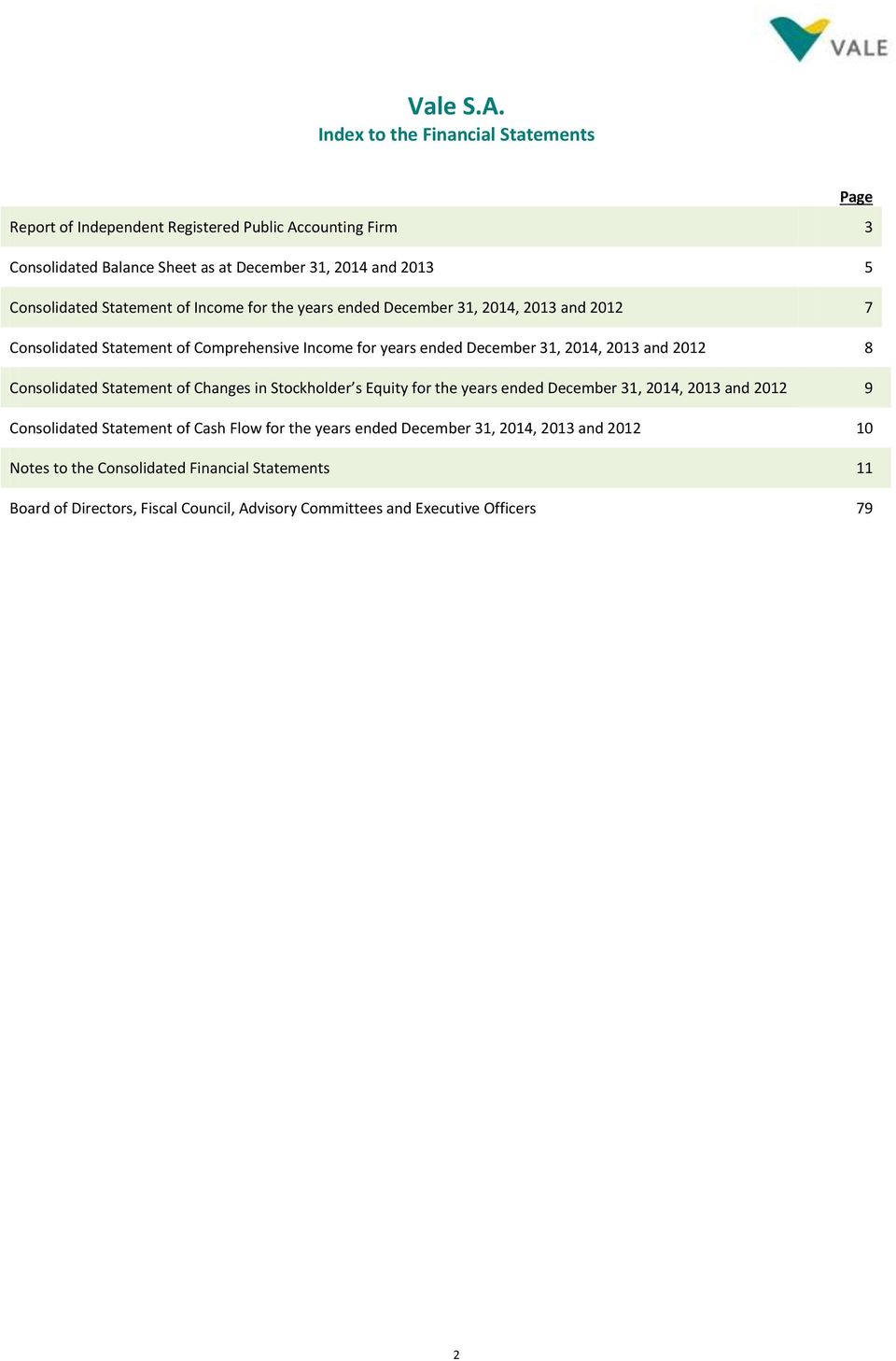
2 Vale S.A. Index to the Financial Statements Report of Independent Registered Public Accounting Firm 3 Consolidated Balance Sheet as at December 31, 2014 and Consolidated Statement of Income for the years ended December 31, 2014, 2013 and Consolidated Statement of Comprehensive Income for years ended December 31, 2014, 2013 and Consolidated Statement of Changes in Stockholder s Equity for the years ended December 31, 2014, 2013 and Consolidated Statement of Cash Flow for the years ended December 31, 2014, 2013 and Notes to the Consolidated Financial Statements 110 Board of Directors, Fiscal Council, Advisory Committees and Executive Officers 79 Page 2
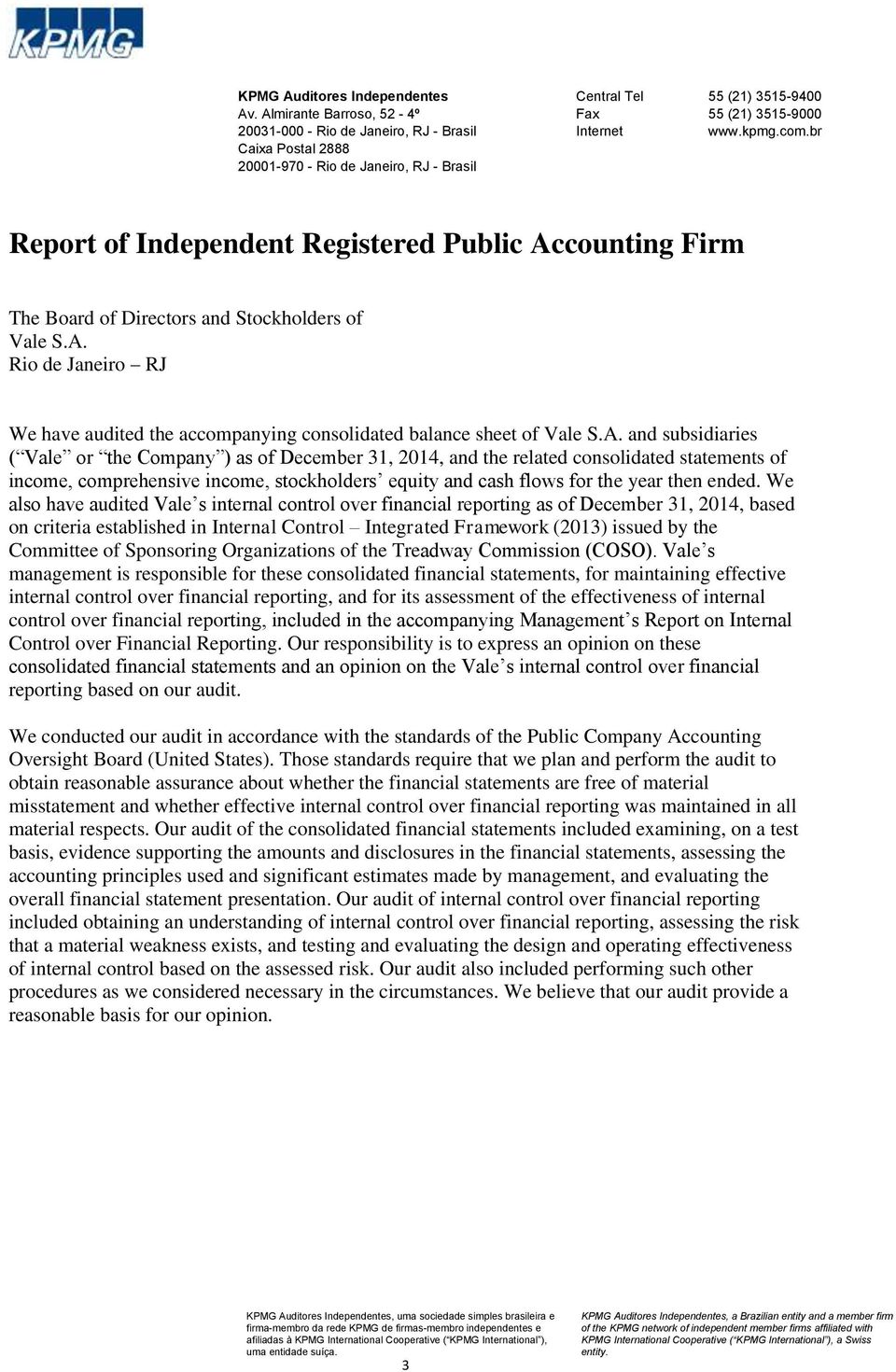
3 KPMG Auditores Independentes Av. Almirante Barroso, 52-4º Rio de Janeiro, RJ - Brasil Caixa Postal Rio de Janeiro, RJ - Brasil Central Tel 55 (21) Fax 55 (21) Internet Report of Independent Registered Public Accounting Firm The Board of Directors and Stockholders of Vale S.A. Rio de Janeiro RJ We have audited the accompanying consolidated balance sheet of Vale S.A. and subsidiaries ( Vale or the Company ) as of December 31, 2014, and the related consolidated statements of income, comprehensive income, stockholders equity and cash flows for the year then ended. We also have audited Vale s internal control over financial reporting as of December 31, 2014, based on criteria established in Internal Control Integrated Framework (2013) issued by the Committee of Sponsoring Organizations of the Treadway Commission (COSO). Vale s management is responsible for these consolidated financial statements, for maintaining effective internal control over financial reporting, and for its assessment of the effectiveness of internal control over financial reporting, included in the accompanying Management s Report on Internal Control over Financial Reporting. Our responsibility is to express an opinion on these consolidated financial statements and an opinion on the Vale s internal control over financial reporting based on our audit. We conducted our audit in accordance with the standards of the Public Company Accounting Oversight Board (United States). Those standards require that we plan and perform the audit to obtain reasonable assurance about whether the financial statements are free of material misstatement and whether effective internal control over financial reporting was maintained in all material respects. Our audit of the consolidated financial statements included examining, on a test basis, evidence supporting the amounts and disclosures in the financial statements, assessing the accounting principles used and significant estimates made by management, and evaluating the overall financial statement presentation. Our audit of internal control over financial reporting included obtaining an understanding of internal control over financial reporting, assessing the risk that a material weakness exists, and testing and evaluating the design and operating effectiveness of internal control based on the assessed risk. Our audit also included performing such other procedures as we considered necessary in the circumstances. We believe that our audit provide a reasonable basis for our opinion. KPMG Auditores Independentes, uma sociedade simples brasileira e firma-membro da rede KPMG de firmas-membro independentes e afiliadas à KPMG International Cooperative ( KPMG International ), uma entidade suíça. 3 KPMG Auditores Independentes, a Brazilian entity and a member firm of the KPMG network of independent member firms affiliated with KPMG International Cooperative ( KPMG International ), a Swiss entity.
4 A company s internal control over financial reporting is a process designed to provide reasonable assurance regarding the reliability of financial reporting and the preparation of financial statements for external purposes in accordance with generally accepted accounting principles. A company s internal control over financial reporting includes those policies and procedures that (1) pertain to the maintenance of records that, in reasonable detail, accurately and fairly reflect the transactions and dispositions of the assets of the company; (2) provide reasonable assurance that transactions are recorded as necessary to permit preparation of financial statements in accordance with generally accepted accounting principles, and that receipts and expenditures of the company are being made only in accordance with authorizations of management and directors of the company; and (3) provide reasonable assurance regarding prevention or timely detection of unauthorized acquisition, use, or disposition of the company s assets that could have a material effect on the financial statements. Because of its inherent limitations, internal control over financial reporting may not prevent or detect misstatements. Also, projections of any evaluation of effectiveness to future periods are subject to the risk that controls may become inadequate because of changes in conditions, or that the degree of compliance with the policies or procedures may deteriorate. In our opinion, the consolidated financial statements referred to above present fairly, in all material respects, the financial position of Vale S.A. and subsidiaries as of December 31, 2014, and the results of its operations and its cash flows for the year then ended, in conformity with International Financial Reporting Standards as issued by the International Accounting Standards Board. Also in our opinion, Vale maintained, in all material respects, effective internal control over financial reporting as of December 31, 2014, based on criteria established in Internal Control Integrated Framework (2013) issued by the Committee of Sponsoring Organizations of the Treadway Commission (COSO). The accompanying consolidated balance sheet of Vale S.A. as of December 31, 2013 and the related consolidated statements of income, comprehensive income, stockholders equity and cash flows for each of the years ended December 31, 2013 and 2012, were audited by other auditors whose report thereon dated February 26, 2014, expressed an unqualified opinion on those statements. /s/ KPMG Auditores Independentes KPMG Auditores Independentes Rio de Janeiro, Brazil February 25, 2015 KPMG Auditores Independentes, uma sociedade simples brasileira e firma-membro da rede KPMG de firmas-membro independentes e afiliadas à KPMG International Cooperative ( KPMG International ), uma entidade suíça. 4 KPMG Auditores Independentes, a Brazilian entity and a member firm of the KPMG network of independent member firms affiliated with KPMG International Cooperative ( KPMG International ), a Swiss entity.

5 Consolidated Balance Sheet In millions of United States dollars Notes December 31, 2014 December 31, 2013 Assets Current assets Cash and cash equivalents 8 3,974 5,321 Financial investments Derivative financial instruments Accounts receivable 9 3,275 5,703 Related parties Inventories 10 4,501 4,125 Prepaid income taxes 1,581 2,375 Recoverable taxes 11 1,700 1,579 Advances to suppliers Others ,594 20,611 Non-current assets held for sale and discontinued operation 6 3,640 3,766 20,234 24,377 Non-current assets Related parties Loans and financing agreements receivable Judicial deposits 18 1,269 1,490 Recoverable income taxes Deferred income taxes 20 3,976 4,523 Recoverable taxes Derivative financial instruments Deposit on incentive and reinvestment Others ,180 8,100 Investments 12 4,133 3,584 Intangible assets, net 13 6,820 6,871 Property, plant and equipment, net 14 78,122 81,665 96, ,220 Total 116, ,597 5

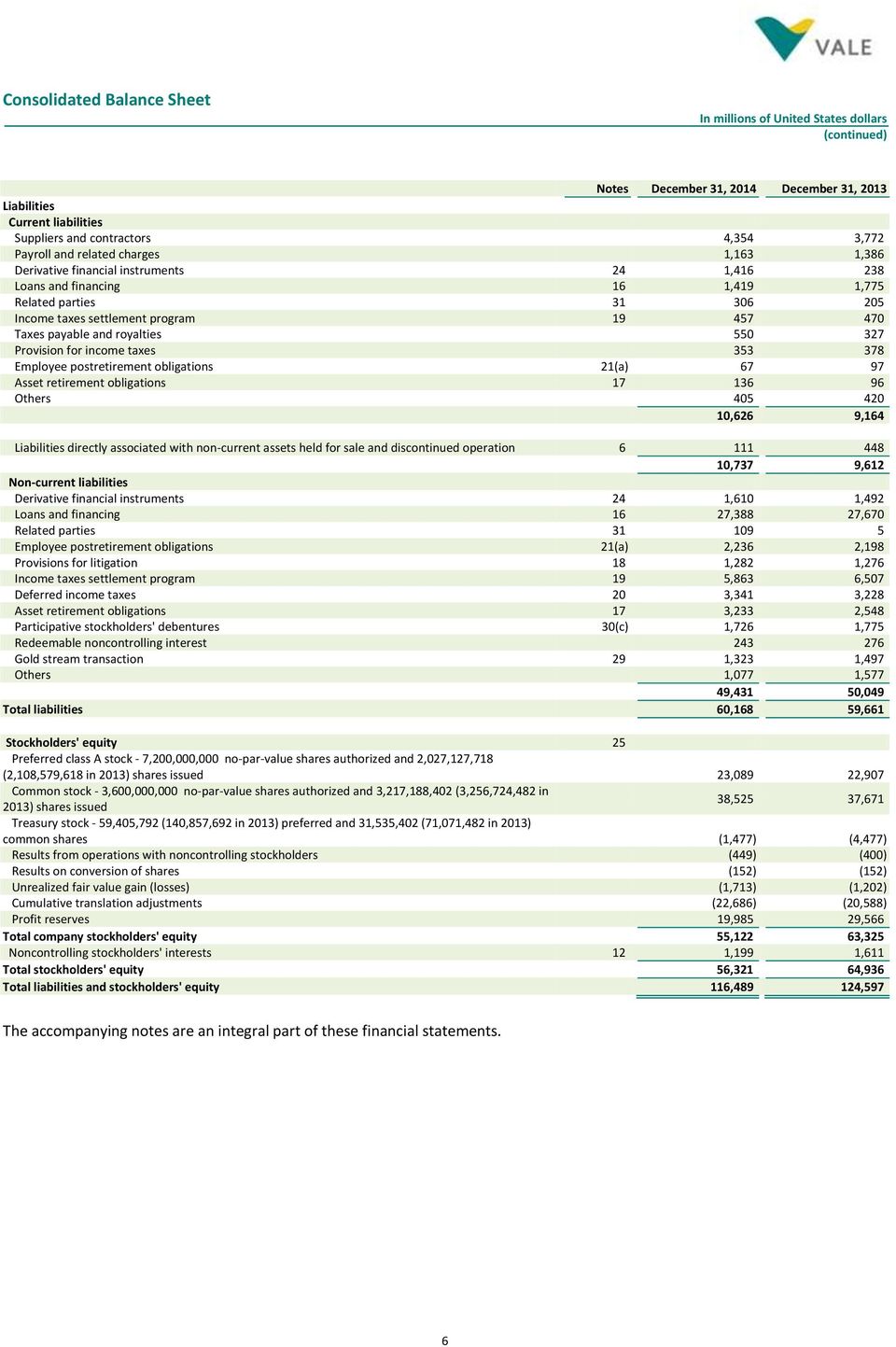
6 Consolidated Balance Sheet In millions of United States dollars (continued) Notes December 31, 2014 December 31, 2013 Liabilities Current liabilities Suppliers and contractors 4,354 3,772 Payroll and related charges 1,163 1,386 Derivative financial instruments 24 1, Loans and financing 16 1,419 1,775 Related parties Income taxes settlement program Taxes payable and royalties Provision for income taxes Employee postretirement obligations 21(a) Asset retirement obligations Others ,626 9,164 Liabilities directly associated with non-current assets held for sale and discontinued operation ,737 9,612 Non-current liabilities Derivative financial instruments 24 1,610 1,492 Loans and financing 16 27,388 27,670 Related parties Employee postretirement obligations 21(a) 2,236 2,198 Provisions for litigation 18 1,282 1,276 Income taxes settlement program 19 5,863 6,507 Deferred income taxes 20 3,341 3,228 Asset retirement obligations 17 3,233 2,548 Participative stockholders' debentures 30(c) 1,726 1,775 Redeemable noncontrolling interest Gold stream transaction 29 1,323 1,497 Others 1,077 1,577 49,431 50,049 Total liabilities 60,168 59,661 Stockholders' equity 25 Preferred class A stock - 7,200,000,000 no-par-value shares authorized and 2,027,127,718 (2,108,579,618 in 2013) shares issued 23,089 22,907 Common stock - 3,600,000,000 no-par-value shares authorized and 3,217,188,402 (3,256,724,482 in 2013) shares issued 38,525 37,671 Treasury stock - 59,405,792 (140,857,692 in 2013) preferred and 31,535,402 (71,071,482 in 2013) common shares (1,477) (4,477) Results from operations with noncontrolling stockholders (449) (400) Results on conversion of shares (152) (152) Unrealized fair value gain (losses) (1,713) (1,202) Cumulative translation adjustments (22,686) (20,588) Profit reserves 19,985 29,566 Total company stockholders' equity 55,122 63,325 Noncontrolling stockholders' interests 12 1,199 1,611 Total stockholders' equity 56,321 64,936 Total liabilities and stockholders' equity 116, ,597 The accompanying notes are an integral part of these financial statements. 6
7 Consolidated Statement of Income In millions of United States dollars, except as otherwise stated Year ended as at December 31, Notes Continuing operations Net operating revenue 26 37,539 46,767 46,553 Cost of goods sold and services rendered 27(a) (25,064) (24,245) (25,390) Gross profit 12,475 22,522 21,163 Operating (expenses) income Selling and administrative expenses 27(b) (1,099) (1,302) (2,172) Research and evaluation expenses (734) (801) (1,465) Pre operating and stoppage operation (1,088) (1,859) (1,592) Other operating expenses, net 27(c) (1,057) (984) (1,996) (3,978) (4,946) (7,225) Impairment of non-current assets 15 (1,152) (2,298) (4,023) Loss on measurement or sales of non-current assets 7 (167) (215) (506) Operating income 7,178 15,063 9,409 Financial income 28 3,770 2,699 1,595 Financial expenses 28 (9,839) (11,031) (5,617) Equity results from joint ventures and associates Results on sale or disposal of investments from joint ventures and associates 7 (30) 41 - Impairment of investment from joint ventures and associates 15 (31) - (1,941) Net income before income taxes 1,553 7,241 4,091 Income taxes 20 Current tax (1,051) (7,786) (2,503) Deferred tax (149) 953 3,677 (1,200) (6,833) 1,174 Net income from continuing operations ,265 Loss attributable to noncontrolling interests (304) (178) (257) Net income from continuing operations attributable to the Company's stockholders ,522 Discontinued operations Loss from discontinued operations - (2) (68) Loss from discontinued operations attributable to the Company's stockholders - (2) (68) Net income ,197 Loss attributable to noncontrolling interests 12 (304) (178) (257) Net income attributable to the Company's stockholders ,454 Earnings per share attributable to the Company's stockholders: 25(e) Basic and diluted earnings per share: Preferred share (USD) Common share (USD) The accompanying notes are an integral part of these financial statements. 7

8 Consolidated Statement of Comprehensive Income In millions of United States dollars Year ended as at December 31, Net income ,197 Other comprehensive income Item that will not be reclassified subsequently to income Cumulative translation adjustments (7,436) (9,830) (7,695) Retirement benefit obligations Gross balance for the year (279) 914 (929) Effect of taxes 85 (284) 274 Equity results from joint ventures and associates, net taxes (192) 630 (655) Total items that will not be reclassified subsequently to income (7,628) (9,200) (8,350) Item that will be reclassified subsequently to income Cumulative translation adjustments Gross balance for the year 3,407 2,822 5,290 Transfer results realized to the net income ,407 3,257 5,407 Available-for-sale financial instruments Gross balance for the year (4) 193 (1) Transfer results realized to the net income 4 (194) - - (1) (1) Cash flow hedge Gross balance for the year (290) (23) (273) Effect of taxes (3) 12 (8) Equity results from joint ventures and associates, net taxes (1) - 13 Transfer of realized results to income, net of taxes (122) (40) 147 (416) (51) (121) Total of items that will be reclassified subsequently to income 2,991 3,205 5,285 Total comprehensive income (loss) (4,284) (5,589) 2,132 Comprehensive loss attributable to noncontrolling interests (330) (175) (223) Comprehensive income (loss) attributable to the Company's stockholders (3,954) (5,414) 2,355 (4,284) (5,589) 2,132 The accompanying notes are an integral part of these financial statements. 8

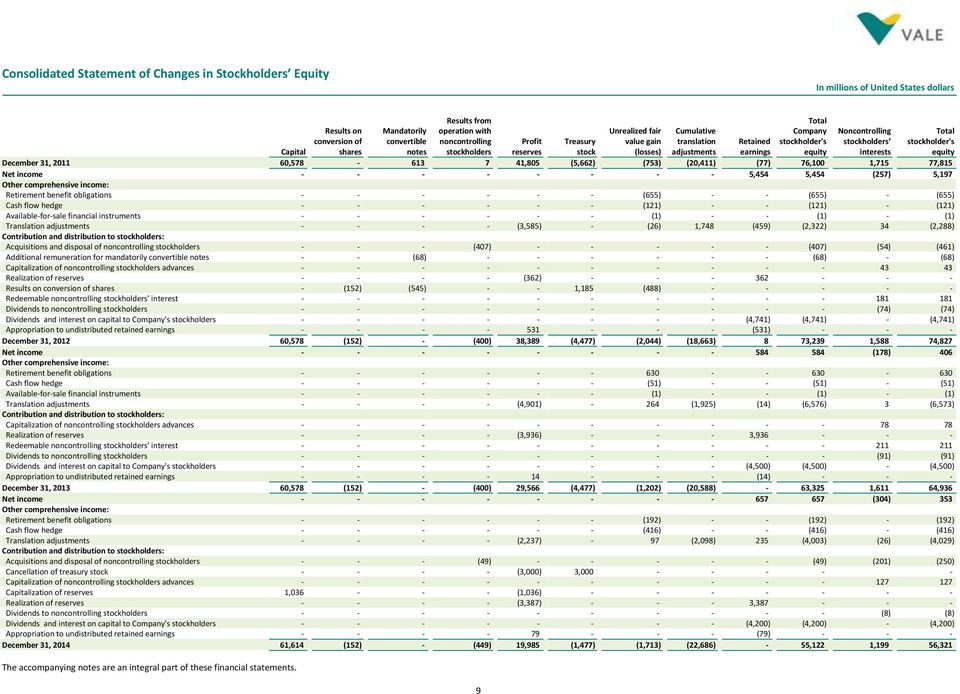
9 Consolidated Statement of Changes in Stockholders Equity In millions of United States dollars Results on conversion of shares Mandatorily convertible notes Results from operation with noncontrolling stockholders 9 Unrealized fair value gain (losses) Cumulative translation adjustments Total Company stockholder's equity Noncontrolling stockholders interests Total stockholder's equity Profit Treasury Retained Capital reserves stock earnings December 31, , ,805 (5,662) (753) (20,411) (77) 76,100 1,715 77,815 Net income ,454 5,454 (257) 5,197 Other comprehensive income: Retirement benefit obligations (655) - - (655) - (655) Cash flow hedge (121) - - (121) - (121) Available-for-sale financial instruments (1) - - (1) - (1) Translation adjustments (3,585) - (26) 1,748 (459) (2,322) 34 (2,288) Contribution and distribution to stockholders: Acquisitions and disposal of noncontrolling stockholders (407) (407) (54) (461) Additional remuneration for mandatorily convertible notes - - (68) (68) - (68) Capitalization of noncontrolling stockholders advances Realization of reserves (362) Results on conversion of shares - (152) (545) - - 1,185 (488) Redeemable noncontrolling stockholders' interest Dividends to noncontrolling stockholders (74) (74) Dividends and interest on capital to Company's stockholders (4,741) (4,741) - (4,741) Appropriation to undistributed retained earnings (531) December 31, ,578 (152) - (400) 38,389 (4,477) (2,044) (18,663) 8 73,239 1,588 74,827 Net income (178) 406 Other comprehensive income: Retirement benefit obligations Cash flow hedge (51) - - (51) - (51) Available-for-sale financial instruments (1) - - (1) - (1) Translation adjustments (4,901) (1,925) (14) (6,576) 3 (6,573) Contribution and distribution to stockholders: Capitalization of noncontrolling stockholders advances Realization of reserves (3,936) , Redeemable noncontrolling stockholders' interest Dividends to noncontrolling stockholders (91) (91) Dividends and interest on capital to Company's stockholders (4,500) (4,500) - (4,500) Appropriation to undistributed retained earnings (14) December 31, ,578 (152) - (400) 29,566 (4,477) (1,202) (20,588) - 63,325 1,611 64,936 Net income (304) 353 Other comprehensive income: Retirement benefit obligations (192) - - (192) - (192) Cash flow hedge (416) - - (416) - (416) Translation adjustments (2,237) - 97 (2,098) 235 (4,003) (26) (4,029) Contribution and distribution to stockholders: Acquisitions and disposal of noncontrolling stockholders (49) (49) (201) (250) Cancellation of treasury stock (3,000) 3, Capitalization of noncontrolling stockholders advances Capitalization of reserves 1, (1,036) Realization of reserves (3,387) , Dividends to noncontrolling stockholders (8) (8) Dividends and interest on capital to Company's stockholders (4,200) (4,200) - (4,200) Appropriation to undistributed retained earnings (79) December 31, ,614 (152) - (449) 19,985 (1,477) (1,713) (22,686) - 55,122 1,199 56,321 The accompanying notes are an integral part of these financial statements.
10 Consolidated Statement of Cash Flow In millions of United States dollars Year ended as at December 31, Cash flow from continuing operating activities: Net income from continuing operations ,265 Adjustments to reconcile net income with cash from continuing operations Equity results from associates and joint ventures (505) (469) (645) Loss on measurement or sales of non-current assets Results on sale or disposal of investments from joint ventures and associates 30 (41) - Loss on disposal of property, plant and equipment and intangibles Impairment of non-current assets 1,183 2,298 5,964 Depreciation, amortization and depletion 4,288 4,150 4,155 Deferred income taxes 149 (953) (3,677) Foreign exchange and indexation, net 1, ,314 Unrealized derivative losses, net 1, Participative stockholders' debentures Other (452) Decrease (increase) in assets: Accounts receivable 2, ,951 Inventories (535) 346 (675) Recoverable taxes 11 (2,405) 229 Other 738 (132) 537 Increase (decrease) in liabilities: Suppliers and contractors 1,013 (124) (229) Payroll and related charges (77) Taxes and contributions (163) Gold stream transaction - 1,319 - Income taxes - settlement program 188 7,030 - Other (33) (663) 709 Net cash provided by operating activities from continuing operations 12,807 14,542 15,721 Net cash provided by operating activities from discontinued operations Net cash provided by operating activities 12,807 14,792 16,135 Cash flow from continuing investing activities: Financial investments redeemed (invested) (148) 357 (246) Loans and advances received (granted) 364 (17) 293 Guarantees and deposits received (granted) 59 (147) (135) Additions to investments (244) (378) (474) Additions to property, plant and equipment and intangible assets (11,813) (13,105) (15,322) Dividends and interest on capital received from associates and joint ventures Proceeds from disposal of assets and Investments 1,246 2, Proceeds from gold stream transaction Net cash used in investing activities from continuing operations (9,968) (9,845) (14,450) Net cash used in investing activities from discontinued operations - (763) (437) Net cash used in investing activities (9,968) (10,608) (14,887) Cash flow from continuing financing activities: Loans and financing Additions 2,341 3,310 9,333 Repayments (1,936) (3,347) (1,712) Repayments to stockholders: Dividends and interest on capital paid to stockholders (4,200) (4,500) (6,000) Dividends and interest on capital attributed to noncontrolling interest (66) (20) (45) Transactions with noncontrolling stockholders - - (411) Net cash provided by (used in) financing activities from continuing operations (3,861) (4,557) 1,165 Net cash provided by financing activities from discontinued operations Net cash provided by (used in) used in financing activities (3,861) (4,470) 1,165 Increase (decrease) in cash and cash equivalents (1,022) (286) 2,413 Cash and cash equivalents in the beginning of the year 5,321 5,832 3,531 Effect of exchange rate changes on cash and cash equivalents (325) (225) (112) Cash and cash equivalents at end of the year 3,974 5,321 5,832 Cash paid during the year for (i): Interest on loans and financing (1,560) (1,535) (1,316) Income taxes (504) (2,405) (1,238) Income taxes - settlement program (494) (2,594) - Non-cash transactions: Additions to property, plant and equipment - interest capitalization Additions to property, plant and equipment - Costs of assets retirement obligations (i) Amounts paid are classified as cash flows from operating activities. The accompanying notes are an integral part of these financial statements. 10

11 Notes to Consolidated Financial Statements Expressed in millions of United States dollar, unless otherwise stated 1. Operational context Vale S.A. (the Parent Company ) is a public company headquartered at 26, Av. Graça Aranha, Rio de Janeiro, Brazil with securities traded on the stock exchanges of São Paulo ( BM&F BOVESPA ), New York ( NYSE ), Paris ( NYSE Euronext ) and Hong Kong ( HKEx ). Vale S.A. and its direct and indirect subsidiaries ( Vale, Group or Company ) are principally engaged in the research, production and sale of iron ore and pellets, nickel, fertilizer, copper, coal, manganese, ferroalloys, cobalt, platinum group metals and precious metals. The Company also operates in the segments of energy and steel. The information by segment is presented in note 26. The principal consolidated operating subsidiaries of the Company at December 31, 2014 were as follow: Entities % ownership % voting capital Location Principal activity Compañia Minera Miski Mayo S.A.C Peru Fertilizers Mineração Corumbaense Reunida S.A Brazil Iron ore and manganese PT Vale Indonesia Tbk Indonesia Nickel Salobo Metais S.A Brazil Copper Vale Australia Pty Ltd Australia Coal Vale Canada Limited Canada Nickel Vale Fertilizantes S.A Brazil Fertilizers Vale International Holdings GmbH Austria Holding and research Vale International S.A Switzerland Trading Vale Manganês S.A Brazil Manganese and ferroalloys Vale Moçambique S.A Mozambique Coal Vale Nouvelle-Calédonie S.A.S New Caledonia Nickel Vale Oman Pelletizing Company LLC Oman Pellet Vale Shipping Holding Pte Ltd Singapore Logistics of iron ore 2. Summary of the main accounting practices and accounting estimates a) Basis of presentation The consolidated financial statements of the Company ( financial statements ) have been prepared in accordance with the International Financial Reporting Standards ( IFRS ) as issued by the International Accounting Standards Board ( IASB ). The financial statements have been prepared under the historical cost convention as adjusted to reflect: (i) the fair value of held for trading financial instruments measured at fair value through the statement of income or available-for-sale financial instruments measured at fair value through the statement of comprehensive income; and (ii) impairment of assets. All numbers of the comparative financial statements of 2012 have been adjusted as a result of a change in accounting practices, disclosed in note 6 of the financial statements of The Company evaluated subsequent events through February 25, 2015, which was the date the financial statement was approved by the Board of Directors. b) Functional currency and presentation currency The financial statements of each of the Group s entities are measured using the currency of the primary economic environment in which the entity operates ( functional currency ), which in the case of the Parent Company is the Brazilian Real ( BRL or R$ ). For presentation purposes, these financial statements are presented in United States dollar ( USD or US$ ) as the Company believes that this is how international investors analyze the financial statements. Operations in other currencies are translated into the functional currency using the actual exchange rates in force on the respective transactions dates. The foreign exchange gains and losses resulting from the translation at the exchange rates in force at the end of the year are recognized in the statement of income as financial expense or financial income. The exceptions are transactions for which gains and losses are recognized in the statement of comprehensive income. 11
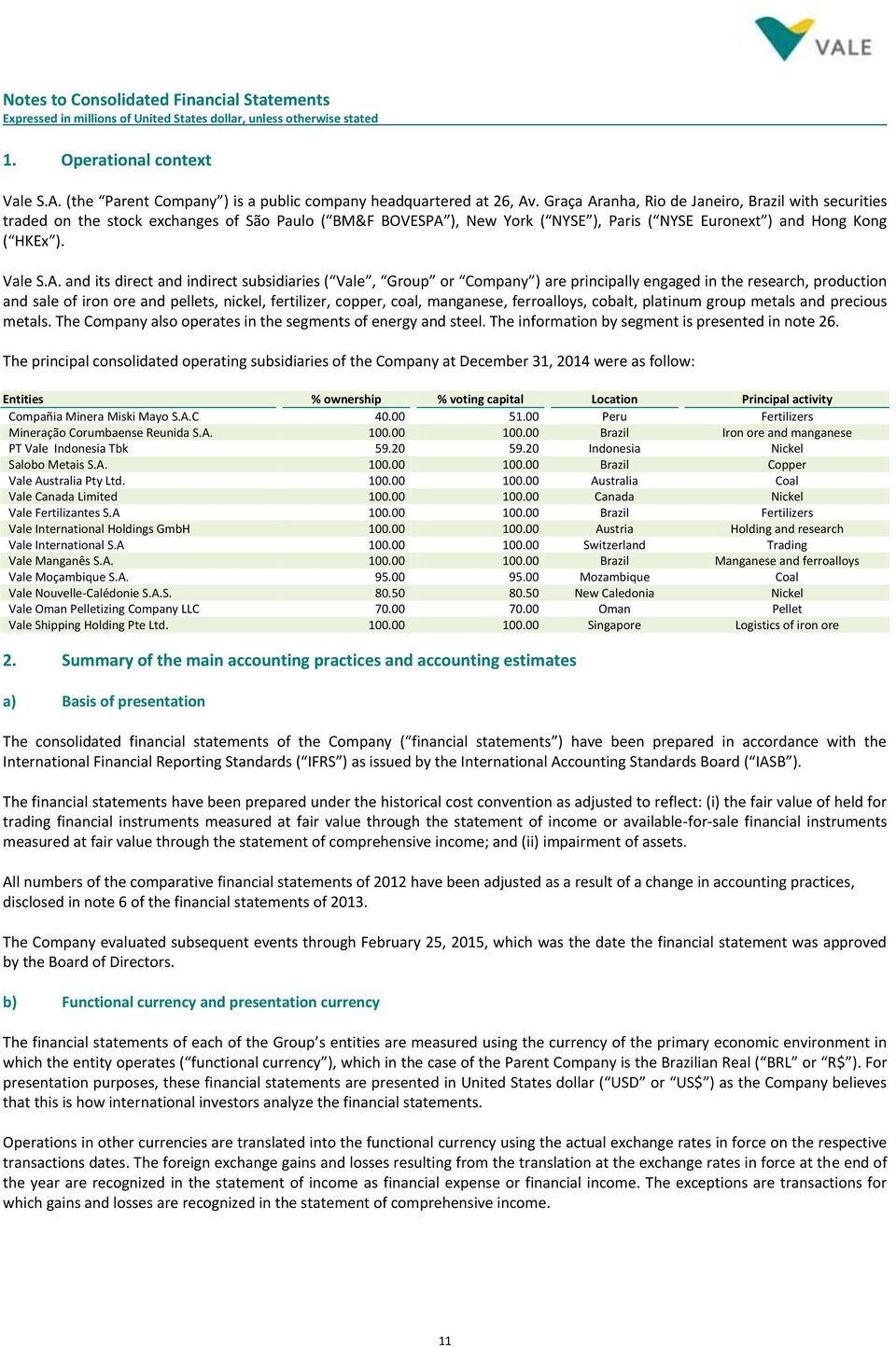
12 The statement of income and balance sheet of the Group s entities whose functional currency is different from the presentation currency are translated into the presentation currency as follows: (i) assets, liabilities and stockholders equity (except components described in item (iii)) for each balance sheet presented are translated at the closing rate at the balance sheet date; (ii) income and expenses for each statement of income are translated at the average exchange rates, except for specific transactions that, considering their significance, are translated at the rate at the transaction date and; (iii) capital, capital reserves and treasury stock are translated at the rate at the date of each transaction. All resulting exchange differences are recognized in a separate component of the statement of comprehensive income as cumulative translation adjustment, and subsequently transferred to the statement of income when the operations are realized. The exchange rates of the major currencies that impact the operations are: Exchange rates used for conversions in Brazilian Reais Closing rate as of Average rate for the year ended US dollar ("US$") Canadian dollar ( CAD ) Australian dollar ( AUD ) Euro ( EUR or ) c) Consolidation and investments The financial statements reflect the balance of assets and liabilities and the transactions of the Parent Company and its direct and indirect controlled entities ( subsidiaries ), eliminating intercompany transactions. Subsidiaries over which control is achieved through other means, such as stockholders agreement, are also consolidated even if the Company does not own a majority of the voting capital. For entities over which the Company has joint control ( joint ventures ) or significant influence, but not control ( associates ), the investments are measured using the equity method. The accounting practices of subsidiaries, joint ventures and associated companies are set to ensure consistency with the policies adopted by the Parent Company. Transactions between consolidated companies, as well as balances, unrealized profits and losses on these transactions are eliminated. Unrealized gains on downstream or upstream transactions between the Company and its associates and joint ventures are eliminated fully or proportionately to the extent of the Company. The Company compares the carrying values of its equity investments with reference to the publicly quoted market prices when available. If the quoted market price is lower than book value and this decline is considered other than temporary, the Company accounts an impairment of the equity investments to the level of the quoted market value. For interests in joint arrangements operations ( joint operations ), the Company recognizes its share of assets, liabilities and transactions. d) Business combinations When the Company acquires control over an entity, the identifiable assets acquired, the liabilities and contingent liabilities assumed and the noncontrolling stockholders interests recognized are measured initially at their fair values as at the acquisition date. The excess of the consideration transferred plus the fair value of assets acquired and the liabilities assumed is recorded as goodwill, which is allocated to each cash-generating unit acquired. e) Noncontrolling stockholders interests Investments held by investors in entities controlled by Vale are classified as noncontrolling stockholders' interests. The Company treats transactions with noncontrolling stockholders' interests as transactions with equity owners of the Group. For purchases of noncontrolling stockholders interests, the difference between any consideration paid and the portion acquired of the carrying value of net assets of the subsidiary is recorded in stockholders equity. Gains or losses on disposals of noncontrolling stockholders interest are also recorded in stockholders equity. When the Company ceases to hold control or significant influence, any retained interest in the entity is remeasured to its fair value, with the change in the carrying amount recognized in the statement of income. Any amounts previously recognized in Gain/ (loss) from operations with noncontrolling stockholders interests relating to that entity are accounted for as if the Group had directly sold the related assets or liabilities. This means that the amounts previously recognized in gain/ (loss) from operations with noncontrolling stockholders interests are reclassified to the statement of income. 12
13 f) Segment information and information by geographic area The Company discloses information by business segment and assets by geographic unit, in accordance with the principles and concepts used by the chief operating decision makers in evaluating performance and allocating resources. The information is analyzed by operating segment as follows: Bulk Material Comprises (i) the production and extraction of ferrous minerals, as iron ore, pellets and its logistic services (railroads, ports and terminals), manganese, ferroalloys and others ferrous products and services; and (ii) the extraction of coal and its logistic services (railroads, ports and terminals). Base metals Includes the production and extraction of non-ferrous minerals, including nickel operations (co-products and byproducts) and copper. Fertilizers Includes the production of the three major groups of nutrients: potash, phosphate and nitrogen. Other Comprises sales and expenses of other products, services and investments in joint ventures and associate in other businesses. g) Current and non-current assets or liabilities The Company classifies assets and liabilities as current when the expectation to realize the assets or to settle the liabilities is twelve months from the end of the reporting period. Others assets and liabilities are classified as non-current. h) Cash equivalents and financial investments The amounts recorded as cash and cash equivalents correspond to the amount available in cash, bank deposits and short-term investments that have immediate liquidity and original maturities within three months and insignificant risk of variation on its fair value. Other investments with maturities after three months are recognized at fair value through income and presented in financial investments. i) Accounts receivables Account receivables are financial instruments classified in the category loan and receivables and represent the total amount due from sale of products and services rendered by the Company. The receivables are initially recognized at fair value and subsequently measured at amortized cost, net of impairment losses, when applicable. j) Inventories Inventories are stated at the lower of the average cost of acquisition or production and the net realizable value. The inventory production cost is determined on the basis of variable and fixed costs, direct and indirect costs of production, using the average cost method. An allowance for losses on obsolete or slow-moving inventory is recognized. Ore piles are counted as processed when the ore is extracted from the mine. The cost of the finished product is composed of depreciation and any direct cost required converting ore piles to finished products. Inventory of maintenance supplies are measured at the lower of cost and net realizable value and, where applicable, an estimate of losses on obsolete or slow-moving inventory is recognized. k) Non-current assets and liabilities held for sale and discontinued operation When the Company is committed to a sale plan of a set of assets and liabilities available for immediate disposal, these assets and liabilities are classified as non-current assets and liabilities held for sale. If this group of assets and liabilities represent a major line of business are classified as discontinued operations. The non-current assets and liabilities held for sale and discontinued operations are recognized in current, separate from the other assets and liabilities being measured at the lower of carrying amount and fair value less costs to sell. Discontinued operations transactions are presented separately from the balance of Company s continuing operations in the statement of income, statement of comprehensive income and statement of cash flows. 13

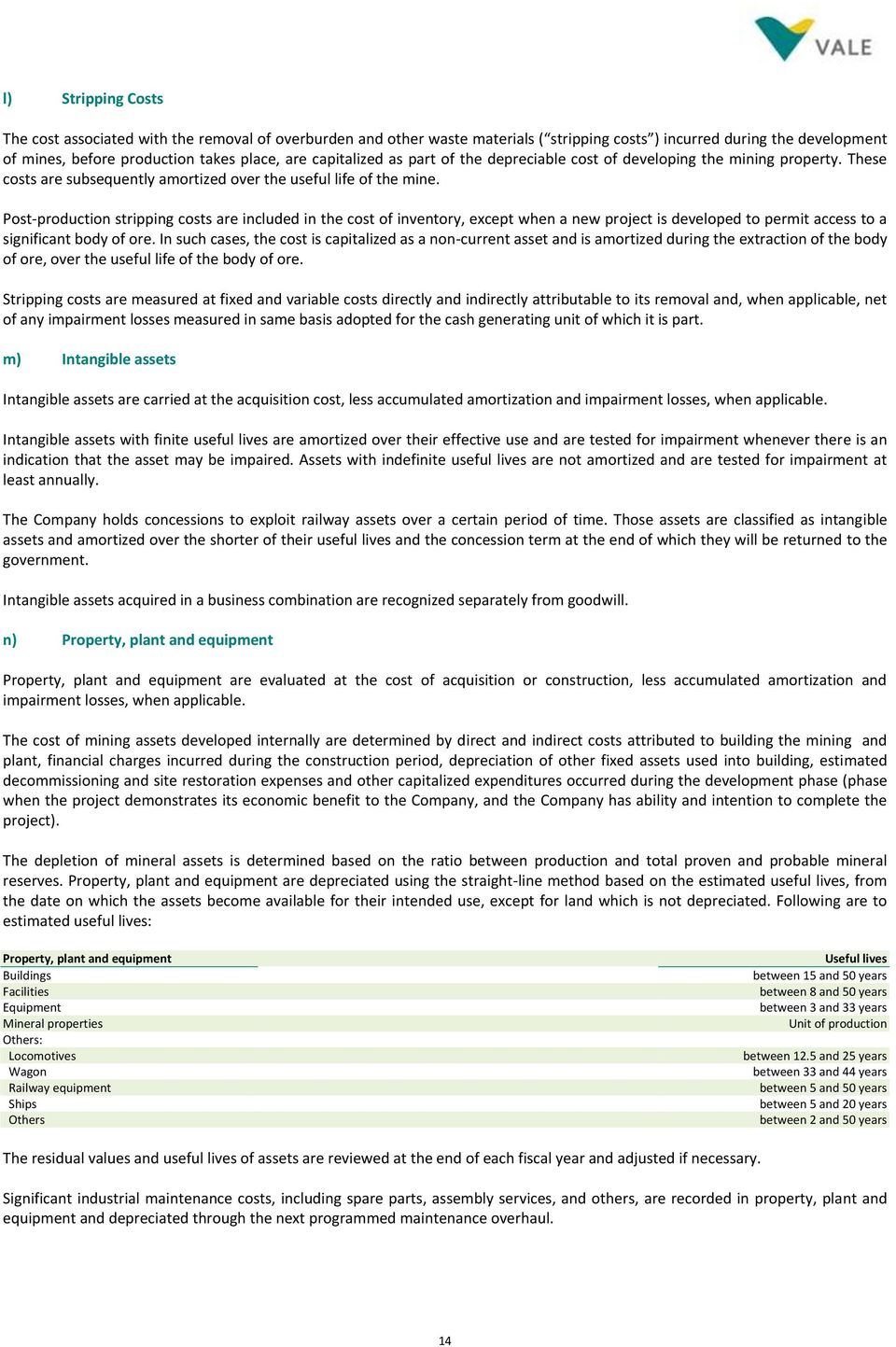
14 l) Stripping Costs The cost associated with the removal of overburden and other waste materials ( stripping costs ) incurred during the development of mines, before production takes place, are capitalized as part of the depreciable cost of developing the mining property. These costs are subsequently amortized over the useful life of the mine. Post-production stripping costs are included in the cost of inventory, except when a new project is developed to permit access to a significant body of ore. In such cases, the cost is capitalized as a non-current asset and is amortized during the extraction of the body of ore, over the useful life of the body of ore. Stripping costs are measured at fixed and variable costs directly and indirectly attributable to its removal and, when applicable, net of any impairment losses measured in same basis adopted for the cash generating unit of which it is part. m) Intangible assets Intangible assets are carried at the acquisition cost, less accumulated amortization and impairment losses, when applicable. Intangible assets with finite useful lives are amortized over their effective use and are tested for impairment whenever there is an indication that the asset may be impaired. Assets with indefinite useful lives are not amortized and are tested for impairment at least annually. The Company holds concessions to exploit railway assets over a certain period of time. Those assets are classified as intangible assets and amortized over the shorter of their useful lives and the concession term at the end of which they will be returned to the government. Intangible assets acquired in a business combination are recognized separately from goodwill. n) Property, plant and equipment Property, plant and equipment are evaluated at the cost of acquisition or construction, less accumulated amortization and impairment losses, when applicable. The cost of mining assets developed internally are determined by direct and indirect costs attributed to building the mining and plant, financial charges incurred during the construction period, depreciation of other fixed assets used into building, estimated decommissioning and site restoration expenses and other capitalized expenditures occurred during the development phase (phase when the project demonstrates its economic benefit to the Company, and the Company has ability and intention to complete the project). The depletion of mineral assets is determined based on the ratio between production and total proven and probable mineral reserves. Property, plant and equipment are depreciated using the straight-line method based on the estimated useful lives, from the date on which the assets become available for their intended use, except for land which is not depreciated. Following are to estimated useful lives: Property, plant and equipment Buildings Facilities Equipment Mineral properties Others: Locomotives Wagon Railway equipment Ships Others Useful lives between 15 and 50 years between 8 and 50 years between 3 and 33 years Unit of production between 12.5 and 25 years between 33 and 44 years between 5 and 50 years between 5 and 20 years between 2 and 50 years The residual values and useful lives of assets are reviewed at the end of each fiscal year and adjusted if necessary. Significant industrial maintenance costs, including spare parts, assembly services, and others, are recorded in property, plant and equipment and depreciated through the next programmed maintenance overhaul. 14
15 o) Research and evaluation i. Exploration and evaluation expenditures Expenditures on mining research are accounted for as operating expenses until the effective proof of economic feasibility and commercial operation of a given field can be demonstrated. From then on, the expenditures incurred are capitalized as mine development costs. ii. Expenditures on feasibility studies, new technologies and others research The Company also conducts feasibility studies for many businesses which it operates including researching new technologies to optimize the mining process. After these costs are proven to generate future benefits to the Company, the expenditures incurred are capitalized. p) Impairment of assets The Company assesses, at each reporting date, whether there is evidence that the carrying amount of financial assets measured through amortized cost and long-live non-financial asset, should be impaired. For financial assets measured through amortized cost, Vale compares the carrying amount with the expected cash flows of the asset, and when appropriate, the carrying value is adjusted to reflect the present value of future cash flows. For long-lived non-financial assets (such as intangible or property plant and equipment), when impairment indication are identified, a test is conducted by comparing the recoverable value of these assets grouped at the lowest levels for which there are separately identifiable cash flows of the cash-generating unit ( CGU ) to which the asset belongs to their carrying amount. If the Company identifies the need for impairment, it is consistently applied to each asset's cash-generating unit. The recoverable amount is the higher of value in use and fair value less costs to sell. The Company determines its cash flows based on approved budgets, considering mineral reserves and mineral resources calculated by internal experts, costs and investments based on the best estimate of past performance and approved budgets, sale prices consistent with the projections used in reports published by industry considering the market price when available and appropriate. Cash flows used are designed based on the life of each cash-generating unit (consumption of reserve units in the case of minerals) and considering discount rates that reflect specific risks relating to the relevant assets in each cash-generating unit, depending on their composition and location. For investments in affiliated companies with publicly traded stock, the Company assesses the recoverability of its assets when there is prolonged or significant decline in market value. The balance of their investments is compared in relation to the market value of the shares, when available. If the market value is less than the carrying value of investments, and the decrease is considered prolonged and significant, the Company performs the adjustment of the investment to the realizable value quoted in the market. Regardless the indication of impairment of its carrying value, goodwill balances arising from business combinations, intangible assets with indefinite useful lives and land are tested for impairment at least once a year. Non-current assets (excluding goodwill) which the Company recognized an impairment are reviewed whenever events or changes in circumstances indicate that the impairment may no longer be applicable. In such cases, an impairment reversal will be recognized. q) Suppliers and contractors Accounts payable to suppliers and contractors are obligations to pay for goods and services that were acquired in the ordinary course of business. They are initially recognized at fair value and subsequently measured at amortized cost using the effective interest rate method. r) Loans and financing Loans and financing are initially measured at fair value, net of transaction costs incurred and are subsequently carried at amortized cost and updated using the effective interest rate method. Any difference between the proceeds (net of transaction costs) and the redemption value is recognized in the Statement of Income over the period of the loan, using the effective interest rate method. The fees paid in obtaining the loan are recognized as transaction costs. 15

16 Compound financial instruments include financial liability (debt) components and stockholders equity. The liability component instrument is initially recognized at fair value that is determined using discounted cash flow, considering the interest rate market for a non-convertible debt instrument with similar characteristics (period, value, credit risk). After initial recognition, the liability component of a compound financial instrument is measured at amortized cost using the effective interest rate method. The stockholders equity component is recognized as the difference between the total values received by the Company from the issue of the securities, and the initially recognized amount of the liability component. Following initial recognition, the equity component of a compound financial instrument is not remeasured until its conversion. s) Leases The Company classifies its contracts as finance leases or operating leases based on the substance of the contract as to whether it is linked to the transfer of substantially all risks and benefits of the assets ownership to the Company during their useful life. For finance leases, the lower of the fair value of the leased asset and the present value of minimum lease payments is recorded in tangible fixed assets and the corresponding obligation recorded in liabilities. For operating leases, payments are recognized on a straight line basis during the term of the contract as a cost or expense in the statement of income. t) Provisions Provisions are recognized only when there is a present obligation (legal or constructive) resulting from a past event, and it is probable that the settlement of this obligation will result in an outflow of resources, and the amount of the obligation can be reasonably estimated. Provisions are reviewed and adjusted to reflect the current best estimate at the end of each reporting period. Provisions are measured at the present value of the expenditure expected to be required to settle an obligation using a pre-tax rate, which reflects current market assessments of the time value of money and the risks specific to the obligation. The increase in the obligation due to the passage of time is recognized as interest expense. i. Provision for asset retirement obligations The provision made by the Company refers to costs related to mine closure and reclamation, with the completion of mining activities and decommissioning of assets related to mine. When the provision is recognized, the corresponding cost is capitalized as part of property plant and equipment and is depreciated on the same basis over the related asset and recorded in the statement of income. The long-term liability is subsequently measured using a long-term discount rate and recorded in the statement of income, as a financial expenses until the Company makes payments related to mine closure and decommissioning of assets mining. ii. Provision for litigation The provision refers to litigation and fines incurred by the Company. A provision is recognized when the obligation is considered probable and can be measured. The accounting counterpart for the obligation is an expense in statement of income. This obligation is updated according to the evolution of the judicial process or interest incurred and can be reversed if the estimate of loss is not considered probable or settled when the obligation is paid. u) Employee benefits i. Current benefits wages, vacations and related taxes Payments of benefits such as wages, vacation past due or accrued vacation, as well the related social security taxes over those benefits, are recognized monthly in income, on an accruals basis. ii. Current benefits profit sharing program The Company has a profit sharing program based on the performance goals achievement of the Company and its employees. The Company recognizes the provision based on the recurring measurement of the compliance with goals and results, using the accrual basis and recognition of present obligation arising from past events in the estimated outflow of resources in the future. The counter entry of the provision is recorded as cost of goods sold and services rendered or operating expenses in accordance with the activity of each employee. 16
17 iii. Non-current benefits long-term incentive programs The Company has established a procedure for awarding certain eligible executives (Matching Plan and Long-Term Incentive Plan - ILP) with the goal of encouraging employee retention and optimum performance. The Matching Plan establishes that these executives eligible for the plan are entitled to a specific number of preferred class A stocks of the Company, and shall be entitled at the end of three years to a cash sum corresponding to the market value of the shares lot initially linked by the executives, provided that they are under the ownership of executives throughout the entirety of the period. As well as matching, the ILP provides at the end of three years the payment in the amount equivalent to a certain number of shares based on the assessment of the executives performance and the Company s results in relation to a group of companies of similar size (per group). Plan liabilities are measured at each reporting date, at their fair values, based on market prices. Obligations are measured at each reporting date, at fair values based on market prices. The compensation costs incurred are recognized in income during the vesting period as defined. iv. Non-current benefits pension costs and other post-retirement benefits The Company has several retirement plans for its employees. For defined contribution plans, the Company's obligations are limited to a monthly contribution linked to a pre-defined percentage of the remuneration of employees enrolled in to these plans. For defined benefit plans, actuarial calculations are periodically obtained for liabilities determined in accordance with the Projected Unit Credit Method in order to estimate the Company s obligation. The liability recognized in the balance sheet represents the present value of the defined benefit obligation as of that date, less the fair value of plan assets. The Company recognized in the statement of income the costs of services, the interest expense of the obligations and the interest income of the plan assets. The remeasurement of gains and losses, return on plan assets (excluding the amount of interest on return of assets, which is recognized in income for the year) and changes in the effect of the ceiling of the active and onerous liabilities are recognized in comprehensive income for the year. For plans presenting a surplus, the Company does not recognize any assets or benefits in the balance sheet or statement of income until such time as the use of this surplus is clearly defined. For plans presenting a deficit, the Company recognizes actuarial liabilities and results arising from the actuarial valuation. v) Derivative financial instruments and hedge operations The Company uses derivative instruments to manage its financial risks as a way of hedging against these risks. The Company does not use derivative instruments for speculative purposes. Derivative financial instruments are recognized as assets or liabilities in the balance sheet and are measured at their fair values. Changes in the fair values of derivatives are recorded in each year as gains or losses in the statements of income or in stockholders equity when the transaction is eligible to be characterized as an effective cash flow hedge. On the beginning of the hedge operations, the Company documents the relationship between hedging instruments and hedged items with the objective of risk management and strategy for carrying out hedging operations. The Company also documents, both initially and on a continuously basis, that its assessment of whether the derivatives used in hedging transactions are highly effective. The effective components of changes in the fair values of derivative financial instruments designated as cash flow hedges are recorded as unrealized fair value gain/(losses) and recognized in stockholders equity; and their non-effective components recorded in income. The amounts recorded in the statement of comprehensive income, will only be transferred to statement of income (costs, operating expenses or financial expenses) when the hedged item is actually realized. 17

18 w) Financial instruments classification The Company classifies its financial instruments in accordance with the purpose for which they were acquired, and determines the classification and initial recognition according to the following categories: i. Financial assets Measured at fair value through the statement of income Financial assets held for trading acquired for the purpose of selling in the short-term. These instruments are measured at fair value, except for derivative financial instruments not classified as hedge accounting, considering the inclusion of the credit risk of counterparties on the calculation of the instruments. Loans and receivables Non-derivative financial instruments with fixed or defined payments, which are not quoted in an active market, are initially measured at fair value and subsequently at amortized cost using the effective interest method. Held to maturity Non-derivative financial assets with fixed or determinable payments and fixed maturities for which the Company has the intent and ability to hold them to maturity, are initially measured at fair value and subsequently at amortized cost. Available for sale Non-derivative financial assets not classified in another category of financial instrument. Financial instruments in this category are measured at fair value, with changes in fair value until the moment of realization then recorded in statement of comprehensive income. On realization of the financial asset, its fair value is reclassified to statement of income. ii. Financial liabilities Measured at fair value through the statement of income Financial liabilities with the purpose of trading (repurchase) or which are initially measured at fair value by the Company, being irreversibly this method of classification. Measured at amortized cost Non-derivative financial liabilities with fixed and determinable payments and fixed maturities, which were not classified as measured at fair value through the statement of income. x) Capital The Company periodically repurchases its shares to hold in treasury for future sale or cancellation. These shares are recorded in a specific account as a reduction of stockholders equity at their acquisition value and carried at cost. These programs are approved by the Board of Directors with a determined terms and numbers of type of shares. Incremental costs directly attributable to the issue of new shares or options are recognized in stockholders equity as a deduction from the amount raised, net of taxes. y) Government grants and support Government grants and support are accounted for when Company has reasonably complied with conditions set by the government in relation to the grants. The Company recognizes the grants in the statement of income as a reduction in tax expense according to the nature of the item, and classified through retained earnings in stockholders equity during allocation of net income. z) Revenue recognition Revenue is recognized when Vale transfers to its customers all of the significant risks and rewards of ownership of the product sold or when services are rendered. Net revenue excludes any applicable sales taxes and is recognized at the fair value of the consideration received or receivable to the extent that it is probable that economic benefits will flow to Vale and the revenues and costs can be reliably measured. Depending on the contract, sales can be recognized when the product is available at the loading port, loaded on the ship or delivered to the destination. Service revenues are recognized in the amount by which the services are rendered and accepted by the customer. In some cases, the sale price is determined on a provisional basis at the date of sale and the final selling price is subject to escalation clauses through date of final pricing. Revenue from the sale of provisionally priced products is recognized when the risks and rewards of ownership are transferred to the customer and the revenue can be measured reliably. At this date, the amount of revenue to be recognized is estimated based on the forward price of the product sold. Amounts billed to customers for shipping related to products sold by the Company are recognized as revenue when the Company is responsible for shipping. Shipping costs are recognized as operating costs. 18

19 aa) Current and deferred income taxes Income taxes are recognized in the statement of income, except for items recognized directly in stockholders equity, in which the tax is also recognized in stockholder s equity. The provision for income tax is calculated individually for each entity in the Group based on tax rates and tax rules in force in the location of the entity. The recognition of deferred taxes are based on temporary differences between carrying value and the tax basis of assets and liabilities as well as taxes losses carry forwards. The deferred income taxes assets and liabilities are offset when there is a legally enforceable right to offset current tax assets against fiscal current liabilities and when the deferred income taxes assets and liabilities are related to income taxes recorded by the same taxation authority on the same taxable entity. bb) Basic and diluted earnings per share Basic earnings per share are calculated by dividing the income attributable to the stockholders of the Company, after accounting for the remuneration to the holders of equity securities, by the weighted average number of shares outstanding (total shares less treasury shares). Diluted earnings per share are calculated by adjusting the weighted average number of shares outstanding for the conversion of all dilutive potential shares. The Company does not have mandatory convertible securities that could result in the dilution of the earning per share. cc) Stockholder s remuneration The stockholder s remuneration is paid on dividends and interest on capital. This remuneration is recognized as a liability in the financial statements of the Company based on bylaws. Any amount above the minimum compulsory remuneration approved by the bylaws shall only be recognized in current liabilities on the date that is approved by stockholders. The Company is permitted to distribute interest attributable to stockholders equity. The calculation is based on the stockholders equity amounts as stated in the statutory accounting records and the interest rate applied may not exceed the Brazilian Government Long-term Interest Rate ( TJLP ) determined by the Central Bank of Brazil. Also, such interest may not exceed 50% of net income for the year or 50% of retained earnings plus profit reserves as determined by Brazilian corporate law. The benefit to the Company, as opposed to making a dividend payment, is a reduction in the income tax burden because this interest charge is tax deductible in Brazil. Income tax of 15% is withheld on behalf of the stockholders relative to the interest distribution. Under Brazilian law, interest attributed to stockholders equity is considered as part of the annual minimum mandatory dividend (note 25-f). This notional interest distribution is treated for accounting purposes as a deduction from stockholders' equity in a manner similar to a dividend and the tax credit recorded in income. 3. Critical accounting estimates and judgment The preparation of financial statements requires the use of certain critical accounting estimates and also the exercise of judgment by the management of the Company. These estimates are based on the best knowledge and information existing on the balance sheet date. Changes in facts and circumstances may lead to the revision of these estimates. Actual future results may differ from the estimates. The significant estimates and assumptions used by Company in these financial statements are as follow: a) Mineral reserves and mine useful life The estimates of proven and probable reserves are regularly evaluated and updated. These reserves are determined using generally accepted geological estimates. The calculation of reserves requires the Company to take positions on expected future conditions that are uncertain, including future ore prices, exchange rates, inflation rates, mining technology, availability of permits and production costs. Changes in some of these assumptions could have a significant impact on the proven and probable reserves of the Company. 19

20 The estimated volume of mineral reserves is used as basis for the calculation of depletion of the mines, and also for the estimated useful life which is a major factor to quantify the provision for asset retirement obligation and environmental recovery of mines. Any changes to the estimates of the volume of mine reserves and the useful lives of assets may have a significant impact on the depreciation, depletion and amortization charges included in cost of goods sold. Changes in the estimated useful life of the mine have a significant impact on the estimates of environmental provision and impairment analysis. b) Asset retirement obligation The Company recognizes an obligation under the fair value for asset retirement obligations in the period in which they occur, as note 2t-i. The Company considers the accounting estimates related to closure costs of a mine as a critical accounting policy because they involve significant values for the provision and are estimated using several assumptions, such as interest rate, inflation, useful life of the asset considering the current state of closure and the projected date of depletion of each mine. The estimates are reviewed annually. c) Impairment The Company tests impairment of tangible (whether there is evidence of impairment) and intangible (annually) assets segregated by cash-generating units using discounted cash flow model that depends on several estimates, which are influenced by market conditions prevailing at the time the impairment test is performed. d) Litigation losses Provisions are recorded when the possibility of loss relating to legal proceedings or contingent liabilities is considered probable by the Company s legal department and its legal advisors. The provisions are recorded when the amount of loss can be reasonably estimated. By their nature, litigations will be resolved when one or more future event occurs or fails to occur. Typically, the occurrence or not of such events is outside the Company s control. Legal uncertainties involve the exercise of significant estimates and judgments of management regarding the results of future events. e) Post-retirement benefits for employees The amount recognized and disclosed depend on a number of factors that are determined based on actuarial calculations using various assumptions in order to determine costs and liabilities. One of these assumptions is selection and use of the discount rate. Any changes to these assumptions will affect the amount recognized. At the end of each year the Company and external actuaries reviews the assumptions that should be used for the following year. These assumptions are used in determining the fair values of assets and liabilities, costs and expenses and the future values of estimated cash outflows, which are recorded in the plan obligations. f) Fair values of derivatives and others financial instruments The fair values of financial instruments that are not traded in active markets are determined using valuation techniques. Vale uses its own judgment to choose between the various methods and assumptions are based on the market conditions, at the end of the year. An analysis of the impact if actual results are different from management's estimates is present on note 24 (sensibility analysis). g) Deferred income taxes The Company recognizes the effects of deferred taxes arising from tax losses and temporary differences and derecognizes when believes that tax credits recoverable are not probable. Deferred tax liabilities are fully recognized. The determination of the recognition of income tax or deferred income tax, assets and liabilities, and any derecognition of tax credits requires the use of estimates. For each tax asset, the Company assesses the probability that some or all of the tax assets may not be recoverable. The impairment recorded in relation to the accumulated tax losses depends on the assessment of the probability of the generation of future taxable profits based on production and sales planning, commodity prices, operational costs, restructuring plans, reclamation costs and planned capital costs. 20

21 4. Accounting standards issued but not yet effective The standards and interpretations those are issued by IASB, but not yet effective, up to the date of issuance of the Company s financial statements are disclosed below. The Company intends to adopt these standards, if applicable, when they become effective. Sale or Contribution of Assets between an Investor and its Associate or Joint Venture In September 2014 the IASB issued narrowscope amendments to IFRS 10 Consolidated Financial Statements and IAS 28 Investments in Associates and Joint Ventures (2011). The amendments address an acknowledged inconsistency between the requirements in IFRS 10 and those in IAS 28 (2011), in dealing with the sale or contribution of assets between an investor and its associate or joint venture. The main consequence of the amendments is that a full gain or loss is recognized when a transaction involves a business (whether it is housed in a subsidiary or not). A partial gain or loss is recognized when a transaction involves assets that do not constitute a business, even if these assets are housed in a subsidiary. The adoption of the amendment will be required from January 1, 2016 and the Company is analyzing potential impacts regarding this update on the financial statements. Equity Method in Separate Financial Statements In August 2014 the IASB issued an amendment to IAS 27, which allows an entity to use the equity method to account for investments in subsidiaries, joint ventures and associates in their separate financial statements. The IASB clarifies that the changes will help some jurisdictions to register in their separate IFRS financial statements, reducing compliance costs without reducing the information available to investors. The adoption will be required for annual periods beginning from January 1, 2016 with retrospective application. The Group already uses in its individual financial statements the equity method of accounting to record investments in subsidiaries, joint ventures and associates. IFRS 9 Financial instruments - In July 2014 the IASB issued IFRS 9 Financial instruments, sets out the requirements for recognizing and measuring financial assets, financial liabilities and some contracts to buy or sell non-financial items. This Standard replaces IAS 39 Financial Instruments: Recognition and Measurement. The adoption will be required from January 1, 2018 and the Company is currently analyzing potential impacts regarding this pronouncement on the financial statements. Accounting for Acquisitions of Interests in Joint Operations In May 2014 the IASB issued an amendment to IFRS 11 - Joint Arrangements, to provide guidance on the accounting for acquisitions of interests in joint operations in which the activity constitutes a business. The adoption of the amendment will be required from January 1, 2016 and the Company is analyzing potential impacts regarding this update on the financial statements. Clarification of Acceptable Methods of Depreciation and Amortization In May 2014 the IASB issued an amendment to IAS 16 - Property, Plant and Equipment and IAS 38 - Intangible Assets, established the pattern of consumption of an asset s expected future economic benefits as acceptable methods of depreciation and amortization of assets. The IASB clarifies that the use of methods based on revenues to calculate the depreciation of an asset and also to measure the consumption of the economic benefits embodied in an intangible asset, are not appropriate. The adoption of the amendment will be required from January 1, 2016 and the Company is currently analyzing potential impacts regarding this update on the financial statements. IFRS 15 Revenue from Contracts with Customers - In May 2014 the IASB issued IFRS 15 statement - Revenue from Contracts with customers, sets out the requirements for revenue recognition that apply to all contracts with customer (except for contracts that are within the scope of the Standards on leases, insurance contracts and financial instruments), and replaces the current pronouncements IAS 18 - revenue, IAS 11 - Construction contracts and interpretations related to revenue recognition. The principle core in that framework is that a company should recognize revenue to depict the transfer of promised goods or services to the customer in an amount that reflects the consideration to which the company expects to be entitled in exchange for those goods or services. The adoption will be required from January 1, 2017 and the Company is currently analyzing potential impacts regarding this pronouncement on the financial statements. 21
22 5. Risk management The Company considers that an effective risk management is a key objective to support its growth plan, strategic planning and financial flexibility. Therefore, Vale has developed its risk management strategy in order to provide an integrated approach of the risks the company is exposed to. To do that, evaluates not only the impact in the results of the business caused by variables traded in financial markets (market risk) and those arising from liquidity risk, but also the risk from counterparties obligations (credit risk), those relating to inadequate or failed internal processes, people, systems or external events (operational risk), among others. a) Risk management policy The Board of Directors established a risk management policy in order to (i) support the Company s growth plan, strategic planning and Company s business continuity; (ii) improve its capital structure and asset management of the Group; (iii) ensure adequate degree of flexibility in financial management while maintaining the level of robustness required for investment grade; and (iv) improve corporate governance practices. The corporate risk management policy determines that Vale should measure and monitor regularly its corporate risk on a consolidated approach in order to guarantee that the overall risk level of the Company remains aligned with the guidelines defined by the Board of Directors and the Executive Board. The Executive Risk Management Committee, created by the Board of Directors, is responsible for supporting the Executive Board in the risk assessments and for issuing opinion regarding the Company s risk management. It s also responsible for the supervision and revision of the principles and instruments of corporate risks management. The Executive Board is responsible for the approval of the policy deployment into norms, rules and responsibilities and for reporting to the Board of Directors about such procedures. The risk management norms and instructions complement the corporate risk management policy and define practices, processes, controls, roles and responsibilities in the Company regarding risk management. The Company may, when necessary, allocate specific risk limits to management activities, including but not limited to, market risk limit, corporate and sovereign credit limit, in accordance with the acceptable corporate risk limit. b) Liquidity risk management The liquidity risk arises from the possibility that Vale might not perform its obligations on due dates, as well as face difficulties to meet its cash requirements due to market liquidity constraints. To mitigate such risk, Vale has a revolving credit facility to assist the short term liquidity management and to enable more efficiency in cash management, being consistent with the strategic focus on cost of capital reduction. The revolving credit facilities available today were acquired from a syndicate of several global commercial banks. c) Credit risk management Vale s credit risk arises from potential negative impacts in its cash flows due to uncertainty in the ability of counterparties to meet their contractual obligations. To manage that risk, Vale has procedures and processes, such as the controlling of credit limits, the obligation of exposure diversification through several counterparties and the monitoring of the portfolio s credit risk. Vale s counterparties can be divided into three main categories: the customers, responsible by obligations regarding receivables from payment term sales; financial institutions with whom Vale keeps its cash investments or negotiates derivatives transactions; and suppliers of equipment, products and services in the case of payments in advance. d) Commercial credit risk management For the commercial credit exposure, which arises from sales to final customers, the risk management department, in accordance with the current delegation level, approves or request the approval of credit risk limits for each counterpart. Besides that, the Executive Board sets annually global commercial credit risk limits for the customer s portfolio. The Company attributes an internal credit risk rating for each counterparty using its own quantitative methodology for credit risk analysis, based on three main sources of information: i) Expected Default Frequency (EDF) provided by KMV (Moody s); ii) credit ratings from the main international credit agencies; iii) costumer's financial statements for economic and financial evaluation based on financial indicators. On 31 December 2014, 82% of accounts receivable due to Vale commercial sales had insignificant or low risk, 16% had moderate risk and 2% high risk. 22
23 Whenever considered necessary, the quantitative credit risk analysis is complemented by a qualitative analysis which takes into consideration the payment history of that counterparty, its commercial relationship with Vale and the customer s strategic position in its economic sector, among others variables. Based on the counterparty s credit risk or based on Vale s consolidated credit risk profile, risk mitigation strategies are used to minimize the Company`s credit risk in order to meet the acceptable level of risk approved by the Executive Board. The main credit risk mitigation strategies include non-recourse discount of receivables, insurance instruments, letters of credit, corporate and bank guarantees, mortgages, among others. The Company has a diversified accounts receivable portfolio from a geographical standpoint, being China, Europe, Brazil and Japan the regions with more significant exposures. According to each region, different guarantees can be used to enhance the credit quality of the receivables. The Company controls its account receivables portfolio through Credit and Cash Collection committees, in which representatives from risk management, cash collection and commercial departments monitor periodically each counterparty`s exposure. Finally, Vale has an automatic control that blocks additional sales to customers in default. e) Treasury credit risk management The management of exposure arising from cash investments and derivatives instruments is realized through the following procedures: annual approval by the Executive Board of the credit limits by counterparty, controls of portfolio diversification, counterparties` credit spread variations and the treasury portfolio overall credit risk. There s also a monitoring of all positions, exposure versus limit control and periodic report to the Executive Risk Management Committee. The calculation of the exposure to a counterparty that has several derivative transactions with Vale it`s considered the sum of exposures of each derivative acquired with this counterparty. The exposure for each derivative is defined as the future value calculated within the life of the derivative, considering the variation of the market risk factors that affect the value of the derivative instrument. The Company also assesses the creditworthiness of its counterparties in treasury operations following an internal methodology similar to commercial credit risk management that aims to define a default probability for each counterparty. Depending on the counterparty s nature (banks, insurance companies, countries or corporations), different inputs will be considered: i) expected default probability given by KMV; ii) CDS (Credit Default Swaps) and bond market spreads; iii) credit ratings defined by the main international rating agencies; iv) financial statements data and indicators analysis. f) Market risk management The Company is exposed to the behavior of several market risk factors that can impact its cash flow. The assessment of this potential impact arising from the volatility of risk factors and their correlations is performed periodically to support the decision making process and the growth strategy of the Company, ensure its financial flexibility and monitor the volatility of future cash flows. When necessary, market risk mitigation strategies are evaluated and implemented in line with these objectives. Some strategies may incorporate financial instruments, including derivatives. The portfolios of the financial instruments are monitored on a monthly basis, enabling financial results surveillance and its impact on cash flow. Considering the nature of Vale s business and operations, the main market risk factors which the Company is exposed to are: Foreign exchange and Interest rates; Product prices and input costs. g) Foreign exchange and interest rate risk The Company s cash flow is subjected to volatility of several currencies, once its product prices are predominantly indexed to US dollar, while most of the costs, disbursements and investments are indexed to other currencies, mainly Brazilian real and Canadian dollar. In order to reduce the potential impact that arises from this currency mismatch, derivatives instruments can be used as a risk mitigation strategy. In the case of cash flow foreign exchange protection regarding revenues, costs, disbursements and investments, the main risk mitigation strategies used are forwards and swaps. 23
24 The Company implemented hedge transactions to protect its cash flow against the market risks that arises from its debt obligations mainly currency volatility. The hedges cover most of the debts in reais and euros. The Company uses swap transactions to convert debt linked to Brazilian real and Euros into US dollar that have similar - or sometimes shorter - settlement dates than the final maturity of the debt instruments. Their notional amounts are similar to the principal and interest payments, subjected to liquidity market conditions. Swaps with shorter settlement dates are renegotiated through time so that their final maturity matches - or becomes closer - to the debts` final maturity. At each settlement date, the results of the swap transactions partially offset the impact of the foreign exchange rate in Vale s obligations, contributing to stabilize the cash disbursements in US dollar. In the case of debt instruments denominated in Brazilian real, in the event of an appreciation (or depreciation) of the Brazilian Real against the US Dollar, the negative (or positive) impact on Vale`s debt service (interest and/or principal payment) measured in US dollars will be partially offset by the positive (or negative) effect from the swaps, regardless of the US$/R$ exchange rate on the payment date. The same rationale is applicable to debts denominated in other currencies and their respective swaps. The Company has also exposure to interest rates risks over loans and financings. The US Dollar floating rate debt in the portfolio consists mainly of loans including export pre-payments, commercial banks and multilateral organizations loans. In general, such debt instruments are indexed to the LIBOR (London Interbank Offer Rate in US dollar). Considering the impact of interest rate volatility on the cash flow, Vale observes the potential natural hedges effects between US Dollar floating rates and commodities prices in the decision process of acquiring financial instruments. h) Risk of product and Input prices The Company is also exposed to market risks regarding commodities prices and input volatilities. In accordance with risk management policy, risk mitigation strategies involving commodities can be used to adjust the cash flow risk profile and reduce Vale s cash flow volatility. For this kind of risk mitigation strategy, Vale uses predominantly forwards, futures or zero-cost collars. i) Operational risk management The operational risk management is the structured approach that Vale uses to manage uncertainty related to possible inadequate or failure in internal processes, people, systems and external events, in accordance with the principles and guidelines of ISO The main operational risks are periodically monitored, ensuring the effectiveness of prevention / mitigation key controls in operation and execution of the risk treatment strategy (creation of new controls, changes in the risk environment, transfer part of the risk by contracting insurance, provisioning of resources, etc.). Therefore, the Company seeks to have a clear view of its major risks, of the best cost-benefit mitigation plans and of the controls in place, monitoring the potential impact of operational risk and allocating capital efficiently. j) Capital management The Company's policy aims, to manage its capital, to seek a structure that will ensure the continuity of your business in the long term. Within this perspective, the Company has been able to deliver value to stockholders through dividend payments and capital gain, and at the same time maintain a debt profile suitable for its activities, with an amortization well distributed over the years, on average 9 years, thus avoiding a concentration in one specific period. k) Insurance The Company hires several types of insurance, such as operational risks insurance, engineering risks insurance (projects), civil responsibility, life insurance policy for their employees, among others. The coverage of these policies is similar to the ones used in general by the mining industry and is contracted in line with the objectives defined by the Company, with the corporate risk management policy and the limitation imposed by the insurance and reinsurance global market. In general, the company's assets directly related with its operations are included in the coverage of insurance policies. Insurance management is performed with the support of existing insurance committees in the various operational areas of the Company. Among the management instruments, Vale uses captive reinsurance companies that allows to contract insurances on a competitive basis as well as direct access to key international markets of insurance and reinsurance. 24
25 6. Non-current assets and liabilities held for sale and discontinued operation Described below are the assets and liabilities held for sale and discontinued operation reclassified during the year: December 31, 2014 December 31, 2013 Energy (i) Nacala (i) Total General Cargo - Logistic (ii) Energy (i) Total Assets held for sale and discontinued operation Accounts receivable Other current assets Investments Intangible, net ,687-1,687 Property, plant and equipment, net 477 2,910 3,387 1, ,588 Total assets 565 3,075 3,640 3, ,766 Liabilities associated with assets held for sale and discontinued operation Suppliers and contractors Payroll and related charges Other current liabilities Other non-current liabilities Total liabilities Net assets held for sale and discontinued operation 565 2,964 3,529 2, ,318 (i) Assets and liabilities held for sale (ii) Discontinued operation a) Assets and liabilities held for sale Nacala logistic corridor ( Nacala ) In December 2014, the Company signed an agreement with Mitsui & Co., Ltd. ( Mitsui ) to sell 50% of its stake of 70% in Nacala, which comprises entities which holds a railroad and port concession under construction located in Mozambique and Malawi and are related to coal segment. The investment in Nacala was funded by Vale through equity and equity instruments of US$313, with the remaining balance funded through Vale s bridge shareholder loans. With the transaction, a new company will be incorporated to which Vale will contribute their investment in Nacala. Mitsui will then contribute to the new company the amount of US$313 in equity instruments and will therefore hold 50% of the participation of the new company. Vale and Mitsui are in negotiations to fund the remaining investment required and to take-out part of Vale s bridge shareholder loans. After completion of the transaction, Vale will share control of Nalaca with Mitsui and therefore will not consolidate the assets and liabilities of these entities. The assets were transferred to assets held for sale with no impact in the statement of income Energy generation assets In December 2013, the company signed agreements with CEMIG Geração e Transmissão S.A. ( CEMIG GT ), as follow : (i) to sell 49% of its stake of 9% in Norte Energia S.A. ( Norte Energia ), the company in charge of the construction, operation and exploration of the Belo Monte Hydroelectric facility, and (ii) to create a joint venture named Aliança Geração de Energia S.A. to be established by Vale and CEMIG GT through contribution of its shares on the following power generation assets: Porto Estrela, Igarapava, Funil, Capim Branco I and II, Aimorés and Candonga. No cash will be disbursed as part of the transaction. Vale and CEMIG GT will hold respectively 55% and 45% and will share control of the new company, which will supply energy to Vale operations, previously guaranteed by its own generation plant, ensured by a long-term contract. The transaction above has been approved by the Brazilian Electricity Regulatory Agency ( Agência Nacional de Energia Elétrica or ANEEL ), but is pending of a minor precedent condition. The conclusion of the transaction is expected to occur in the first quarter of The assets were transferred to assets held for sale with no impact in the statement of income. Once the transaction is completed, the Company will recognize a gain on sale of assets in the statement of income in the amount of US$195, approximately (based on balance sheet as of December 31, 2014). 25
26 b) Discontinued operation General cargo - Logistic At the end of 2013, Vale entered to an agreement to dispose of control over its subsidiary VLI S.A. ( VLI ), which aggregates all operations of the general cargo segment. As a consequence, at the beginning of January 1, 2014, the investment in VLI has been accounted as an investment in associate (note 12). In April 2014, Vale finalized the sale of 35.9% of its stake in VLI capital to Mitsui and to Fundo de Investimento do Fundo de Garantia de Tempo de Serviço ( FGTS ) for the amount of US$1,197, which US$896 was settled through a capital contribution directly in VLI. In August 2014, Vale completed the sale of 26.5% of its stake in VLI to a fund of Brookfield Asset Management Inc. ( Brookfield ) for US$908 (R$2,000). At the completion of the transaction, Vale now holds 37.6% of VLI s total stockholder s equity. 7. Acquisitions and divestitures The results on divestitures are presented as follow: Year ended as at December 31, Loss on measurement or sales of non-current assets Sociedad Contractual Minera Tres Valles - (215) - Manganese and ferroalloys assets - - (22) Coal assets - - (355) Araucária Nitrogenados S.A. - - (129) Mineral rights - CoW Indonesia (note 30a) (167) - - (167) (215) (506) Financial income Norsk Hydro ASA Results on sale or disposal of investments from associates and joint ventures Vale Florestar Fundo de Investimento em Participações (30) - - Log-in Logística Intermodal S.A Fosbrasil S.A (30) a) Divestitures of Vale Florestar Fundo de Investimento em Participações ( Vale Florestar ) Vale signed an agreement with a subsidiary of Suzano Papel e Celulose S.A ( Suzano ), a company that produces eucalyptus pulp, for the sale of its entire stake in Vale Florestar for US$93 (R$205). The approval of this transaction by the Conselho Administrativo de Defesa Econômica ( CADE ) has been obtained in July, A loss on this transaction, of US$30 (R$68) was recorded in the statement of income as results on sale or disposals of investments from joint ventures and associates. b) Incorporation of Vale Mina do Azul S.A. ( VMA ) In December 2014, Vale incorporated its wholly-owned subsidiary VMA, with no impact in the consolidated financial statements. 26
27 2013 c) Divestitures of Norsk Hydro ASA ( Hydro ) As part of Vale s strategy of reducing its exposure to non-core assets, in November 2013, the Company sold its Hydro common shares for US$1,811. Since February 2013 when the lock-up period for trading Hydro shares ended, the investment could be traded in the market and therefore the Company started classifying this investment as a financial asset available for sale. As result of this operation, the Company recognized a gain of US$214 in the statement of income as financial income for the year ended as at December 31, 2013, as below: Hydro Balance in the date of sale 1,845 Cumulative translation adjustment recycling (442) Results on available for sale investments recycling 194 1,597 Amount received 1,811 Gain on sale 214 d) Divestitures of Sociedad Contractual Minera Tres Valles ( Tres Valles ) In December 2013, the Company sold its total participation in Tres Valles for US$25. This transaction is consistent with Vale s strategy of focusing on world-class assets, with scale compatible with its existing operations. In this transaction, Vale recognized a loss of US$215 presented in the statement of income as loss on measurement or sale of non-current assets of the year ended as at December 31, The total loss includes an amount of US$7 transferred from cumulative translation adjustments. e) Divestitures of Fosbrasil S.A. ( Fosbrasil ) In December 2013, the Company entered into an agreement to sale its minority participation in the associate Fosbrasil, producer of purified phosphoric acid, for US$45. On this transaction, Vale recognized a gain of US$27 presented in the statement of income as result on sale or disposal of investments from joint ventures and associates for the year ended as at December 31, f) Divestitures of Log-In Logística Intermodal S.A. ( Log-in ) In December 2013, Vale conducted an auction to sell its common shares of Log-in. All the shares were sold by US$94 and the gain of US$14 on this transaction was recorded in the statement of income as result on sale or disposal of investments from associates and joint ventures for the year ended as at December 31, g) Acquisition of additional participation in Belvedere Coal Project During 2012, the Company completed the purchase option on additional 24.5% participation in the Belvedere Coal Project owned by Aquila Resources Limited in the amount of AUD150 million (US$156). In 2013, after the approval of the local government, Vale acquired 100% of Belvedere and paid the total amount of US$ 338 for the wholly owned participation. h) Sales of coal assets In June 2012, Vale completed the sale of its thermal coal operations in Colombia to CPC S.A.S., an affiliate of Colombian Natural Resources S.A.S. The loss on this transaction, of US$355 was recorded in the income statement as loss on measurement or sales of non-current assets for the year ended as at December 31, i) Acquisition of Empreendimentos Brasileiros de Mineração ( EBM ) shares At 2012, the Company acquired an additional of 10.46% of EBM. As result of the acquisition, Vale increased its share in EBM to 96.7% and recognized US$62 as result from operation with non-controlling interest in stockholders equity. j) Divestitures of manganese and ferroalloys assets In October 2012, the Company completed the sale of its manganese and ferroalloys operations in Europe for US$160. On this transactions Vale recognized US$22 presented in statement of income as loss on measurement or sales of non-current assets for the year ended as at December 31,
28 k) Divestitures of participation in Vale Oman Pelletizing LLC ( Vale Oman ) In October 2012, the Company sold 30% of its participation in Vale Oman for US$71. In this transaction, the Company recognized a gain of US$63 as result from operation with non-controlling interest in stockholders equity. l) Divestitures of Araucária Nitrogenados S.A. ( Araucária ) In December 2012, the Company finalized an agreement with Petróleo Brasileiro S.A. ( Petrobras ) to sell Araucária, an operation for production of basic nitrogen for fertilizer, located in Araucária, in the Brazilian state of Paraná, for the amount of US$234 and recognized a loss of US$129 recorded on loss on measurement or sales of non-current assets in statement of income for the year ended as at December 31, Cash and cash equivalents December 31, 2014 December 31, 2013 Cash and bank deposits 2,109 1,558 Short-term investments 1,865 3,763 3,974 5,321 Cash and cash equivalents includes cash, immediately redeemable deposits and short-term investments with an insignificant risk of changes in value and readily convertible to cash, part in Brazilian Real, indexed to the Brazilian Interbank Interest rate ( DI Rate or CDI ) and part denominated in US dollar, mainly time deposits. 9. Accounts receivable December 31, 2014 December 31, 2013 Ferrous minerals 2,155 4,417 Coal Base metals Fertilizers Others ,362 5,792 Provision for doubtful debts (87) (89) 3,275 5,703 Accounts receivable related to the steel sector represented 77.97% and 79.70% of total receivables on December 31, 2014 and 2013, respectively. No individual customer represents over 10% of receivables or revenues. The provision for doubtful debts recorded in the statement of income as at December 31, 2014, 2013 and 2012 totaled US$36, US$ 4 and US$ 22, respectively. The Company recognized write-off as at December 31, 2014, 2013 and 2012 in the amount of US$5, US$ 15 and US$ 16, respectively. Accounts receivable presented by currency are shown in note
29 10. Inventories Inventories are comprised as follows: December 31, 2014 December 31, 2013 Inventories of products Bulk Material Ferrous minerals Iron ore 1, Pellets Manganese and ferroalloys , Coal Base Metals Nickel and other products 1,435 1,398 Copper ,461 1,421 Fertilizers Potash 12 8 Phosphates Nitrogen Others products 4 8 Total of inventories of products 3,330 2,896 Inventory of consumables 1,171 1,229 Total 4,501 4,125 As at December 31, 2014 and 2013 the Company had provisions to adjust inventories to market value for nickel in the amount of US$0 and US$14, respectively; manganese in the amount of US$0 and US$1, respectively; and coal in the amount of US$285 and US$117, respectively. Year ended as at December 31, Inventories of products Balance at beginning of the year 2,896 3,597 3,975 Production/acquisition 23,060 20,008 21,167 Transfer from inventory of consumables 3,201 4,125 4,224 Cost of goods sold (25,064) (24,245) (25,390) Provision for market value adjustment (285) (132) (38) Translation adjustments (478) (457) (341) Balance at end of the year 3,330 2,896 3,597 Year ended as at December 31, Inventory of consumables Balance at beginning of the year 1,229 1,455 1,276 Acquisition 3,282 4,063 4,508 Transfer to inventories of products (3,201) (4,125) (4,224) Translation adjustments (138) (164) (105) Transfer to held for sale (1) - - Balance at end of the year 1,171 1,229 1,455 29
30 11. Recoverable taxes The recoverable taxes, net of provision for losses of tax credits, are as follows: December 31, 2014 December 31, 2013 Value-added tax 1,057 1,129 Brazilian federal contributions 1, Others Total 2,101 1,864 Current 1,700 1,579 Non-current Total 2,101 1, Investments The changes of investments in associates and joint ventures are as follow: Year ended as at December 31, Balance at beginning of the year 3,584 6,384 8,013 Additions Disposals - (98) (32) Transfer - Control acquisition Translation adjustment (536) (582) (223) Equity results Equity on other comprehensive income (2) (204) 35 Dividends declared (831) (747) (587) Impairment (note 15) (31) - (1,941) Transfers to held for sale/ financial instruments - investments (i) (110) (2,016) - Transfers from held for sale (ii) 1, Balance at end of the year 4,133 3,584 6,384 i. The transfers to held for sale refers to investments in Vale Florestar of US$110 in 2014 and to investments in Hydro of US$2,016 in ii. The transfers from held for sale refers to investments in VLI of US$1,
31 Investments (Continued) Investments Equity results Received dividends As of Year ended as at December 31, Year ended as at December 31, Joint ventures and associates % ownership % voting capital December 31, 2014 December 31, Bulk Material Iron Ore and pellets Baovale Mineração S.A (7) Companhia Nipo-Brasileira de Pelotização (i) Companhia Hispano-Brasileira de Pelotização (i) Companhia Coreano-Brasileira de Pelotização Companhia Ítalo-Brasileira de Pelotização (i) MRS Logística S.A Minas da Serra Geral S.A Samarco Mineração S.A Tecnored Desenvolvimento Tecnológico S.A. (ii) (1) (11) (20) Zhuhai YPM Pellet Co ,139 1, Coal Henan Longyu Energy Resources Co., Ltd Base Metals Copper Teal Minerals Inc (35) (24) (5) - - Nickel Korea Nickel Corp (2) Others VLI S.A. (iii) , Bauxite Mineração Rio Grande do Norte S.A Steel California Steel Industries, Inc Companhia Siderúrgica do Pecém (iv) (44) (10) (7) Thyssenkrupp Companhia Siderúrgica do Atlântico Ltd (60) (158) (169) ,114 1,188 (92) (148) (160) Other associates and joint ventures Norte Energia S.A. (iv) (11) (2) (2) Others (61) (33) (72) (72) (35) (74) Disposal investments Norsk Hydro ASA (35) Logística Intermodal S.A (1) (10) ,133 3, i. Although Vale held majority of the voting capital, the entities are accounted under equity method, due to existing veto rights held by other stockholders. ii. Consolidated since March iii. Considering the updated interest after the transaction described in note 6b. iv. Pre-operational stage. 31
32 Investments (Continued) December 31, December 31, Adjusted Adjusted net Adjusted net Location Principal activity Assets Liabilities stockholders equity Adjusted operating results income for the year income for the year Subsidiaries and affiliates Direct and indirect subsidiaries Aços Laminados do Pará S.A. Brazil Steel (2) Biopalma da Amazônia S.A. Brazil Energy (82) (148) (145) Companhia Portuária da Baía de Sepetiba Brazil Iron ore Compañia Minera Miski Mayo S.A.C. Peru Fertilizers Mineração Corumbaense Reunida S.A. Brazil Iron ore and manganese Minerações Brasileiras Reunidas S.A. Brazil Iron ore 2, , (27) Potasio Rio Colorado S.A. Argentina Fertilizers (30) (33) (2,723) Salobo Metais S.A. Brazil Copper 3, , (31) Tecnored Desenvolvimento Tecnológico S.A. Brazil Iron ore (27) (28) (22) Vale International Holdings GmbH Austria Holding and research 35, , (6,108) (913) Vale Canada Holdings Inc. Canada Holding 12,359 10,429 1,930 (7) (9) (7) Vale Canada Limited Canada Nickel 40,235 31,855 8,380 (449) (229) (812) Vale Fertilizantes S.A. (Antiga Mineração Naque S.A.) Brazil Fertilizers 6,397 1,186 5,211 (1,254) (897) (2,801) Vale International S.A. Switzerland Trading and holding 63,454 31,457 31,997 (1,879) (3,865) (918) Vale Malaysia Minerals Sdn. Bhd. Malaysia Iron ore 1, ,224 (51) (43) 32 Vale Manganês S.A. Brazil Manganese and ferroalloys (10) Vale Moçambique S.A. Mozambique Coal 6, ,451 (6) (161) (34) Vale Shipping Holding Pte. Ltd. Singapore Iron ore 3, , Direct and indirect affiliates California Steel Industries, Inc. USA Steel Companhia Coreano-Brasileira de Pelotização Brazil Pellets Companhia Hispano-Brasileira de Pelotização Brazil Pellets Companhia Ítalo-Brasileira de Pelotização Brazil Pellets Companhia Nipo-Brasileira de Pelotização Brazil Pellets Companhia Siderúrgica do Pecém Brazil Steel 2,785 1,335 1, (88) (22) Henan Longyu Energy Resources Co., Ltd. China Coal 1, , Mineração Rio Grande do Norte S.A. Brazil Bauxite MRS Logística S.A. Brazil Iron ore 2,702 1,630 1, Norte Energia S.A. Brazil Energy 8,650 6,667 1,983 (32) (122) (19) Samarco Mineração S.A. Brazil Pellets 6,048 5, , Teal Minerals (Barbados) Inc. Zambia Copper 1, (51) (70) (47) Thyssenkrupp Companhia Siderúrgica do Atlântico Brazil Steel 4,008 3, (120) (223) (588) VLI S.A. Brazil Others 4,116 1,166 2, Zhuhai YPM Pellet Co China Pellets Noncontrolling interests Stockholder's equity Gain (loss) for the year As of Year ended as at December 31, December 31, 2014 December 31, Biopalma da Amazônia S.A (35) (43) (25) Compañia Mineradora Miski Mayo S.A.C PT Vale Indonesia Tbk Vale Moçambique S.A. (57) (38) (26) (13) (10) Vale Nouvelle Caledonie S.A.S (348) (68) (225) Vale Oman Pelletizing LLC Outros (40) (97) (76) 1,199 1,611 (304) (178) (257) 13. Intangible assets December 31, 2014 December 31, 2013 Indefinite useful life Cost Amortization Net Cost Amortization Net Goodwill 3,760-3,760 4,140-4,140 Finite useful life Concessions 3,421 (1,208) 2,213 3,099 (1,192) 1,907 Right of use 518 (221) (75) 253 Software 1,356 (806) 550 1,295 (724) 571 5,295 (2,235) 3,060 4,722 (1,991) 2,731 Total 9,055 (2,235) 6,820 8,862 (1,991) 6,871 Rights of use refers to the usufruct contract entered into with noncontrolling stockholders to use the shares of Empreendimentos Brasileiros de Mineração S.A. (owner of Minerações Brasileiras Reunidas S.A. shares) and intangible assets identified in the business combination of Vale Canada Limited ( Vale Canada ). The amortization of the right of use will expire in 2037 and Vale Canada's intangible will end in September of The concessions refer to the agreements with the brazilian government for the exploration and the development of ports and railways as shown in note 30d. 32
33 The table below shows the changes of intangible assets during the year: Goodwill Concessions Right of use Software Total Balance on December 31, ,603 3, ,211 Additions Disposals - (13) - (2) (15) Amortization - (181) (27) (133) (341) Transfer to held for sale - (1,686) - - (1,686) Translation adjustments (463) (508) (22) (72) (1,065) Net effect of discontinued operation in the year Balance on December 31, ,140 1, ,871 Additions ,189 Disposals - (6) - - (6) Amortization - (202) (31) (174) (407) Impairment (note 15) (460) (460) Translation adjustments (411) (321) (27) (99) (858) Others Balance on December 31, ,760 2, ,820 Of the total goodwill, US$2,103 is allocated to the Nickel CGU which was tested using the Value in use method determined by cash flows based on approved budgets, considering mineral reserves and mineral resources calculated by internal experts, costs and investments based on the best estimate of past performance and approved budgets and sales prices using a range of (21,000 23,000 US$/MT). Cash flows used are designed based on the life of each cash-generating unit (consumption of reserve units in the case of minerals) and considering a discount rates range of (7.5% - 8.9%). 14. Property, plant and equipment December 31, 2014 December 31, 2013 Accumulated Accumulated Cost Depreciation Net Cost Depreciation Net Land 1,069-1, Buildings 14,144 (2,490) 11,654 9,916 (2,131) 7,785 Facilities 15,749 (4,936) 10,813 15,659 (4,722) 10,937 Equipment 14,381 (5,094) 9,287 13,296 (4,892) 8,404 Mineral properties 20,965 (6,036) 14,929 21,603 (5,327) 16,276 Others 14,888 (3,934) 10,954 14,532 (4,013) 10,519 Construction in progress 19,416-19,416 26,799-26, ,612 (22,490) 78, ,750 (21,085) 81,665 Property, plant and equipment (net book value) pledged as guarantees for judicial claims on December 31, 2014, 2013 and 2012 corresponds to US$68, US$77 and US$96, respectively. The table below shows the movement of Property, plant and equipment during the year: Land Building Facilities Equipment Mineral properties Others Constructions in progress Total Balance on December 31, ,093 11,756 7,273 18,867 11,281 28,936 84,882 Additions (i) ,889 12,889 Disposals (1) (3) (74) (26) (33) (44) (312) (493) Depreciation and amortization - (289) (756) (1,132) (799) (699) - (3,675) Translation adjustments (143) (768) (1,305) 128 (1,163) (933) (4,518) (8,702) Transfers 413 2,802 2,068 2,161 (592) 1,503 (8,355) - Impairment (note 15) - (13) (172) - - (3) (2,110) (2,298) Net effect of discontinued operation in the year (4) Transfer to held for sale - (46) (587) - - (837) (162) (1,632) Balance on December 31, ,785 10,937 8,404 16,276 10,519 26,799 81,665 Additions (i) ,054 12,054 Disposals (ii) (3) (50) (10) (9) (264) (28) (232) (596) Depreciation and amortization - (454) (818) (1,025) (1,083) (723) - (4,103) Transfer to non-current assets held for sale - - (10) (49) (85) (2) (2,764) (2,910) Impairment (note 15) (47) 112 (1,255) (18) (17) (692) Translation adjustments (75) (1,412) (2,407) (992) (132) (1,238) (1,040) (7,296) Transfers 202 5,252 3,168 2,846 1,472 2,444 (15,384) - Balance on December 31, ,069 11,654 10,813 9,287 14,929 10,954 19,416 78,122 (i) interest capitalized and ARO included, see cash flow. (ii) includes the disposal of CoW Indonesia (note 30). 33
34 15. Impairment According to the accounting policy describe in note 2p, the Company identified evidence of impairment in relation to certain investments, intangible and property, plant and equipment. The following impairment charges and reversals were recorded: December 31, 2014 Assets Cash-generating unit Net carrying amount Recoverable amount Impairment (reversals) adjustment Property, plant and equipment Coal Australian assets (i) Fertilizers Brazilian assets 4,054 3, Nickel Onça Puma operations 845 2,462 (1,617) Nickel New Caledonia operations 5,674 5, Iron ore projects VGB - Vale BSGR Limited 1,135 1,135 12,188 11, Intangible Fertilizers Brazilian assets ,648 11,496 1,152 Investment Energy Vale Soluções em Energia S.A (i) Refers to Integra e Isaac Plains mining complex December 31, 2013 Assets Cash-generating unit Net carrying amount Recoverable amount Impairment adjustment Fertilizers PRC 2, ,116 Pellets Pelletizing asset , ,298 a) Property plant and equipment and intangible i. Coal Australian assets In May 2014, the Company announced that is taking the necessary steps to place its Integra and Isaac Plains mining complex, both in Australia, into care and maintenance since the operation is not economically feasible under current market conditions. As a consequence, the Company recognized an impairment of US$343. ii. Fertilizers Brazilian Assets In 2014, volatility of fertilizers products prices contributed to a decrease in the recoverable amount of the fertilizers assets. The recoverable amount was determined by using discounted cash flow projections based on financial budgets approved by management over the life of the mine. Management calculated the impairment using commodities prices based on market studies and a discount rate of 7.5%. PRC In 2013, the Company suspended the implementation of the Rio Colorado project in Argentina ( PRC ). The company will continue honoring its commitments related to the concessions and reviewing alternatives to enhance the project outcome in order to determine prospects for future project development. In the fourth quarter of 2013, the Company concluded its analyses in relation to the PRC investment and used its best estimate, to determine the recoverable amount, in determining the fair value less cost to sell for purposes of the impairment charge. As a result the Company recognized an impairment charge of US$2,
35 iii. Nickel Onça Puma operations In 2012, due to incidents in both furnaces at Onça Puma, which resulted in a fifteen month stoppage of the operation, the Company recognized an impairment of US$ 2,849. After the rebuild of one of the furnaces, operations resumed towards the end of 2013 and have now operated normally for more than one year. Accordingly, the Company reviewed and updated the recoverable amount of the operations, which resulted in the recognition of a partial recovery of the impairment charged in The amount recovered in 2014 was US$1,617. For the test the Company used a price range (21,000 23,000 US$/MT) and a discount rate of 7.5%. New Caledonia operations The operations of New Caledonia have experienced a number of challenges and incidents during the ramp-up period which has lead the Company to adopt a more conservative production ramp up curve that has resulted in the Company conducting an impairment test on the asset. The recoverable amount was determined using discounted cash flow projections based on financial budgets approved by management over the life of the mine. Management calculated the impairment using a commodity price range of (21,000 23,000 US$/MT) and a discount rate of 7.79%. As a result of the updated calculations an impairment charge of US$238 was recorded in iv. Pellets Pelletizing assets The Company analyzed the temporary stoppage of pelletizing plants in Brazil and the uncertainty resumption of operations resulted in the revaluations of these assets with the respective impairment. v. Iron ore projects VGB - Vale BSGR Limited Vale s 51%-owned subsidiary VBG-Vale BSGR Limited ("VBG") holds iron ore concession rights in Simandou South (Zogota) and iron ore exploration permits in Simandou North (Blocks 1 & 2) in Guinea. On April 25, 2014 the government of Guinea revoked VBG S mining concessions, based on the recommendation of a technical committee established pursuant to Guinean legislation. The decision is based on the allegations of fraudulent conduct in connection with the acquisition of licenses by BSGR (Vale s current partner in VBG) more than one year before Vale had made any investment in VBG. The decision does not indicate any involvement by Vale and therefore does not prohibit Vale to participate in any reallocation of the mining titles. Vale is actively considering its legal rights towards the Guinean Government and its partner at VBG and addressing options to guarantee the value of both the investments made in Guinea project development as well as the initial investment made in the VBG. Considering the uncertainties in this process the Company recognized an impairment of the total amount invested in the project. b) Investment vi. Energy Based on changes in the Company s strategy, which have affected the recoverable amount of this investment, Vale recognized an impairment. 35
36 16. Loans and financing a) Total debt Current liabilities Non-current liabilities December 31, 2014 December 31, 2013 December 31, 2014 December 31, 2013 Debt contracts in the international markets Floating rates in: US dollars ,095 4,662 Others currencies Fixed rates in: US dollars ,239 13,808 Euro - 1,822 2,066 Accrued charges ,158 20,539 Debt contracts in Brazil Floating rates in: Reais, indexed to TJLP, TR, IPCA, IGP-M and CDI ,503 5,372 Basket of currencies and US dollars indexed to LIBOR ,364 1,365 Fixed rates in: Reais US dollars Accrued charges ,077 7,230 7,131 1,419 1,775 27,388 27,670 Below are the payments flows futures of debt (principal and interest), per nature of funding: Estimated future Bank loans (i) Capital market (i) Development agencies (i) Debt principal (i) payments of interest (ii) , ,957 1, ,212 1,046 2,443 1, , ,170 3,969 1, ,000 1,333 2,844 1, , , Between 2021 and ,204 3,387 2,133 6,724 3, onwards 417 6, ,130 5,826 4,677 15,082 8,610 28,370 17,036 (i) Does not include accrued charges. (ii) Consists of estimated future payments of interest on our loans, financings and debentures, calculated based on interest rate curves and foreign exchange rates applicable at December 31, 2014 and assuming that all amortization payments and payments at maturity on loans, financings and debentures will be made on their scheduled payments dates. This amount compound of the estimated values of future payments not still recognized, in addition to amounts accrued interest already recognized in the financial statements. At December 31, 2014, the average annual interest rates by currency on the debt are as follows: Average interest rate (i) Debt Loans and financing in US dollars 4.54% 20,314 Loans and financing in Reais (ii) 9.55% 6,306 Loans and financing in Euros (iii) 4.06% 1,896 Loans and financing in others currencies 6.24% ,807 (i) In order to determine the average interest rate for debt contracts with floating rates, the Company used the last renegotiated rate at December 31, (ii) Brazilian Real denominated debt that bears interest at IPCA, CDI and TJLP, plus spread. For a total of US$ 5,202, the Company entered into derivative transactions to mitigate the exposure to the cash flow variations of the floating rate debt denominated in Brazilian Real, resulting in an average cost of 2.38% per year in US dollars. (iii) Eurobonds, for which the Company entered into derivatives to mitigate the exposure to the cash flow variations of the debt denominated in Euros, resulting in an average cost of 4.42% per year in US dollars. 36
37 b) Credit lines Amounts drawn on Type Contractual currency Date of agreement Available until Total amount December 31, 2014 December 31, 2013 Revolving credit lines Revolving Credit Facility - Vale/ Vale International/ Vale Canada US$ April years 3, Revolving Credit Facility - Vale/ Vale International/ Vale Canada US$ July years 2, Credit Lines Export-Import Bank of China and Bank of China Limited US$ September 2010 i. 13 years 1,229 1, BNDES R$ April 2008 ii. 10 years 2,748 1,831 1,741 Financing BNDES - CLN 150 R$ September 2012 iii. 10 years 1,462 1,257 1,159 BNDES - Investment Sustaining Program 3.0% R$ June 2013 iv. 10 years BNDES - Tecnored 3.5% R$ December 2013 v. 8 years BNDES S11D / S11D Logística R$ May 2014 vi. 10 years 2, Canadian agency Export Development Canada US$ January 2014 vii. 5 and 7 years i. Acquisition of twelve large ore carriers from chinese shipyards. ii. Memorandum of understanding signature date, however projects financing term is considered from the signature date of each projects contract amendment. iii. Capacitação Logística Norte 150 Project ( CLN 150 ). iv. Acquisition of domestic equipment. v. Support to Tecnored's investment plan from 2013 to vi. Iron ore project S11D and S11D Logistica implementation. vii. General corporate purpose. Total amounts and amounts disbursed, when not contracted in the reporting currency, are affected by exchange rate variation among periods. c) Guarantees As at December 31, 2014 and 2013, our financing and loans, in the amount of US$1,312 and US$1,456, respectively, was secured by property, plant and equipment and receivables. The securities issued through Vale s wholly-owned finance subsidiary Vale Overseas Limited, are all fully and unconditionally guaranteed by Vale. d) Covenants The main covenants of the Company require maintaining certain ratios, such as debt to EBITDA (Earnings before Interest Taxes, Depreciation and Amortization) and interest coverage. The Company has not identified any instances of noncompliance as of December 31, 2014 and Asset retirement obligations The Company applies judgments and assumptions when measuring its obligations related to its asset retirement obligation. The accrued amounts of these obligations are not deducted from the potential costs covered by insurance or indemnities. Long term interest rate used to discount these obligations to present values and to update the provisions on December 31, 2014 was of 5.51% p.a. (6.39% 2013) on Brazil, of 2.05% p.a. (3.23% 2013) on Canada and between 1.61% % p.a. for the others localities. The liability is periodically updated based on this discount rate plus the inflation index for the year of each locality. Changes in the provision for asset retirement obligation are as follows: December 31, 2014 December 31, 2013 Balance at beginning of the year 2,644 2,748 Increase expense Settlement in the current year (41) (40) Revisions in estimated cash flows Translation adjustments (269) (276) Transfer to held for sale - (4) Balance at end of the year 3,369 2,644 Current Non-current 3,233 2,548 3,369 2,644 37
38 18. Litigation a) Provision for litigation Vale is party to labor, civil, tax and other ongoing lawsuits and is discussing these issues both at administrative and court levels. When applicable, these lawsuits are supported by judicial deposits. Provisions for losses resulting from these processes are estimated and updated by the Company, supported by legal advice of the legal board of the Company and by its legal consultants. Tax litigation Civil litigation Labor litigation Environmental litigation Total of litigation provision Balance on December 31, ,065 Additions 19, ,797 Reversals (10,083) (72) (160) (12) (10,327) Payments (2,924) (154) (82) - (3,160) Indexation and interest (30) Translation adjustment (110) (43) (95) (5) (253) Transfer to income taxes - settlement program (6,977) (6,977) Net movements of discontinued operation in the year (1) (3) (2) - (6) Transfer to held for sale - (6) (27) 1 (32) Balance on December 31, ,276 Additions Reversals (2) (104) (133) (13) (252) Payments (37) (20) (48) - (105) Indexation and interest 136 (6) Translation adjustment (164) (15) (111) (7) (297) Balance on December 31, ,282 Provisions for tax litigation - the nature of tax contingencies balances refer to discussions on the basis of calculations made for the Financial Compensation for Exploiting Mineral Resources ( CFEM ) as well as denials of compensation claims of credits in the settlement of federal taxes in Brazil, and mining taxes at the foreign subsidiaries. The other causes refer to the charges of Additional Port Workers Compensation ( AITP ) and questioning about the location for the purpose of assessment of Service Tax ( ISS ). Provisions for civil litigation - relates to demands concerning contracts between Vale and unrelated service suppliers companies, concerning differences in amounts due to alleged losses that have occurred due to various economic plans, while other demands are related to accidents, actions damages and other demands. Provisions for labor and social security litigation - consist of lawsuits filed by employees and service suppliers, related to employment relationships. The most recurring claims are related to payment of overtime, hours in itinerary, and health and safety. The social security ( INSS ) contingencies are related to legal and administrative disputes between INSS and Vale due to applicability of compulsory social security charges. b) Contingent liabilities The Company discusses, at administrative and judicial levels, claims where the expectation of loss is classified as possible and has determinate that there is no need to recognize a provision, based on legal support. These possible contingent liabilities are as follows: December 31, 2014 December 31, 2013 Tax litigation 6,094 3,789 Civil litigation 1, Labor litigation 1,955 2,900 Environmental litigation 1,122 1,165 Total 10,577 8,622 The categories of contingent liabilities in the table above include the following: Tax litigation - the most significant claims relate to pending challenges by the Brazilian federal tax authority concerning the deductibility of Brazilian social contribution payments for income tax purposes (approximately US$1,995) and demands by Brazilian state tax authorities for additional payments of the value-added tax on services and circulation of goods ( ICMS ) in relation to the use of ICMS credits from sales and energy transmission. 38
39 Civil litigation - most of these claim have been filed by suppliers for indemnification under construction contracts, primarily relating to certain alleged damages, payments and contractual penalties. A number of other claims involve disputed contractual terms for inflation indexation. Labor litigation - these claims represent a very large number of individual claims by (i) employees and service providers, primarily involving demands for additional compensation for overtime work, time spent commuting or health and safety conditions; and (ii) the Brazilian federal social security administration ( INSS ) regarding contributions on compensation programs based on profits. Environmental litigation - the most significant claims concern alleged procedural deficiencies in licensing processes, noncompliance with existing environmental licenses or damage to the environment. c) Judicial deposits In addition to those provisions and contingent liabilities, there are also judicial deposits. These court-ordered deposits are legally required and are monetarily updated and reported in non-current assets until a judicial decision to draw the deposit occurs, in case of a non-favorable decision to Vale. Judicial deposits are as follows: December 31, 2014 December 31, 2013 Tax litigations Civil litigations Labor litigations Environmental litigations - 11 Total 1,269 1, Income taxes settlement program ( REFIS ) In November 2013 the Company elected to participate in the REFIS, a federal tax settlement program with respect to most of the claims related to the collection of income tax and social contribution on equity gain of foreign subsidiaries and affiliates from 2003 to The total obligation for REFIS was US$9.6 billion, including the upfront payments and the first installment of US$2.6 billion in 2013 and during 2014, US$494 related to twelve monthly installments. On December 31, 2014, the balance of US$6,320 (US$457 in current and US$5,863 in non-current) is due in 166 monthly installments, bearing interest at the SELIC rate. The effects of the statement of income as at December 31, 2014 and 2013 are summarized as follows: Financial expense Initial recognition of interest/fines - (12,162) SELIC Rate charge on REFIS (683) 9,525 Net increase on financial expenses (683) (2,637) Income tax expense Recognition of obligation - (7,460) Tax effect of deductibility of interest/fines 232 2,841 Other effects (3,833) Amount related to discontinued operation - (216) Net effect on income tax expense - continued operations 232 (4,049) Total effect on statement of income (451) (6,686) 39
40 20. Income taxes The Company analyzes the potential tax impact associated with undistributed earnings of each subsidiary. As described in note 19, the Company entered into the Brazilian REFIS program to pay the amounts related to the collection of income taxes on equity earning of foreign subsidiaries and affiliates from 2003 to 2012 and therefore, the repatriation of these earnings would have no Brazilian tax consequences. The Law 12,973, 2014 brings changes in taxation of Brazilian companies on profits and income earned abroad through direct and indirect subsidiaries with effect from of the year As a rule, the new Brazilian tax legislation is intended tax on an accrual basis the profits earned by the direct and indirect subsidiaries in accordance with local practices and on a cash basis the profits of associated companies, being accepted the tax credit when it is paid abroad. Since met certain conditions of the law, is expected option to: (1) the consolidation of income (profit and loss) of direct and indirect subsidiaries eligible by the year 2022; (2) the payment within eight years of the tax generated by the taxation of profits of eligible companies. The net deferred balances were as follows: December 31, 2014 December 31, 2013 Taxes losses carryfoward 1,637 2,053 Temporary differences: Pension plan Provision for litigation Provision for losses of assets Fair value of financial instruments 1,341 1,075 Allocated goodwill (4,831) (4,774) Impairment 733 1,222 Others (218) (227) (1,002) (758) Total 635 1,295 Assets 3,976 4,523 Liabilities (3,341) (3,228) 635 1,295 Assets Liabilities Total Balance on December 31, ,053 3, Net income effect 791 (162) 953 Translation adjustment (463) (182) (281) Constitution/Reversal of Tax Carryforward Other comprehensive income (45) 227 (272) Net movements of discontinued operation 283 (3) 286 Transfer to held for sale (283) (79) (204) Balance on December 31, ,523 3,228 1,295 Net income effect (31) 118 (149) Transfers (433) Translation adjustment (452) (292) (160) Transfer between assets and liabilities (160) (160) - Other comprehensive income 38 (44) 82 Balance on December 31, ,976 3, Deferred tax assets arising from tax losses, negative social contribution basis and temporary differences are registered taking into consideration the analysis of future performance, based on economic and financial projections, prepared based on internal assumptions and macroeconomic, trade and tax scenarios that may be subject to changes in future. The income tax in Brazil is comprised of taxation on income and social contribution on profit. The statutory rate applicable in the period presented is 34%. In other countries where the Company has operations, it is subject to various rates, depending on jurisdiction. 40
41 The total amount presented as income taxes in the statement of income is reconciled to the rate established by law, as follows: Year ended as at December 31, Net income before income taxes 1,553 7,241 4,091 Income taxes at statutory rates 34% (528) (2,462) (1,391) Adjustments that affect the basis of taxes: Income tax benefit from interest on stockholders' equity 1,123 1,167 1,337 Tax incentives Results of overseas companies taxed by different rates which differs from the parent company rate (1,200) Results of equity investments Undeductible impairment (450) (719) (359) Reversal of deferred tax liabilities - - 1,236 Constitution/reversal for tax loss carryforward (178) 180 (228) Income taxes statement program - REFIS (note 19) - (4,954) - Other (i) (234) (364) (52) Income taxes on the profit for the year (1,200) (6,833) 1,174 (i) Include mainly provisional tax on export sale. Tax incentives In Brazil, Vale has a tax incentive for the partial reduction of income tax due to the amount equivalent to the portion allocated by tax law to transactions in the north and northeast regions with iron, pellets, railroad, manganese, copper, nickel and potash. The incentive is calculated based on the tax profit of the activity (called operating income), takes into consideration the allocation of operating profit by incentive production levels during the periods specified for each product as grantees, and generally, for 10 years and in the case of the Company it does not expire until An amount equal to that obtained with the tax saving must be appropriated in a retained earnings reserve account in Stockholders equity, and may not be distributed as dividends to stockholders. Vale benefits from the allocation of part of income tax due to be reinvested in the purchase of equipment, subject to subsequent approval by the regulatory agency in the incentive area of Superintendence for the Development of Amazonia (SUDAM) and the Superintendence for the Development of Northeast (SUDENE). When the reinvestment is approved, the tax benefit is also appropriate in retained earnings reserve, which restricts the distribution as dividends to stockholders. Vale also has tax incentives related to the production of nickel and cobalt from Vale Nouvelle Caledonie SAS (VNC). These incentives include the exemption of income tax during the construction phase of the project, and also for a period of 15 years beginning in the first year of commercial production, as defined by applicable law, followed by a 5 year 50% exemption of income tax. VNC is subject to a branch profit tax on its profits (after deducting available tax losses) starting in the first year that commercial production is reached, as defined by applicable law. To date, there has been no net taxable income realized in VNC. In Mozambique, the tax incentives applicable to Vale Mozambique SA for the Moatize Coal Mine Project include a 25% reduction of rate for five years counting from the first year the company has taxable profits. Vale also received tax incentives for projects in Oman and Malaysia. Vale is subject to the revision of income tax by local tax authorities for up to five years in companies operating in Brazil, ten years for operations in Indonesia and up to seven years for companies with operations in Canada. 41
42 21. Employee benefits obligations a) Employee postretirements obligations In Brazil, the management of the pension plans of the Company is the responsibility of the Fundação Vale do Rio Doce de Seguridade Social ( Valia ) a nonprofit private entity with administrative and financial autonomy. The Brazilian plans are as follows: Benefit plan Vale Mais ( Vale Mais ) and benefit plan Valiaprev ( Valiaprev ) Certain of the Company s employees are participants in a plan (Vale Mais e Valiaprev) with components of defined benefit (specific coverage for death, pensions and disability allowances) and components of defined contributions (for programmable benefits). The defined benefits plan is subject to actuarial evaluations. The defined contribution plan represents a fixed amount held on behalf of the participants. Both Vale Mais and Valiaprev were overfunded as at December 31, 2014 and Defined benefit plan ( Plano BD ) The Company also sponsors a pension plan with defined benefit characteristics, covering almost exclusively retirees and their beneficiaries. Currently the plan does not accept new participants, was overfunded as at December 31, 2014 and 2013 and contributions by the Company are not significant. Abono complementação The Company sponsors a specific group of former employees entitled to receive additional benefits from Valia normal payments plus post-retirement benefit that covers medical, dental and pharmaceutical assistance. The abono complementação benefit was overfunded as at December 31, 2014 and Other benefits The Company sponsors medical plans for employees that meet specific criteria and for employees who use the abono complementação benefit. Although those benefits are not specific retirement plans, actuarial calculations are used to calculate future commitments. As those benefits are related to health care plans they have the nature of underfunded benefits, and are presented as underfunded plans as at December 31, 2014 and The Foreign plans are managed in accordance with the region and centralized in Vale Canada Limited. They are divided between plans in Canada, United States of America, United Kingdom, Indonesia, New Caledonia, Japan and Taiwan. Pension plans in Canada are composed of a defined benefit and defined contribution component and are the most relevant. Currently the defined benefit plans in other regions do not allow new memberships. Plans abroad are underfunded as at December 31, 2014 and Employers disclosure about pensions and other post-retirement benefits on the status of the defined benefit elements of all plans is provided as follows. i. Change in benefit obligation Overfunded pension plans Underfunded pension plans Others underfunded pension plans Benefit obligation as at December 31, ,567 7,156 2,045 Service costs Interest costs Benefits paid (312) (334) (76) Participant contributions Plan amendments - - (16) Transfers 1,910 (1,907) - Effect of changes in the actuarial assumptions (1,059) (269) (249) Effect of business combinations Translation adjustment (537) (559) (184) Benefit obligation as at December 31, ,080 4,406 1,693 Service Costs Interest Costs Benefits paid (327) (321) (74) Participant contributions Effect of changes in the actuarial assumptions (32) 454 (81) Translation adjustment (497) (347) (146) Benefit obligation as at December 31, ,728 4,521 1,498 42
43 ii. Evolution of the fair value of assets Overfunded pension plans Underfunded pension plans Others underfunded pension plans Fair value of plan assets as at December 31, ,412 5,685 1 Transfers 1,765 (1,763) - Interest income Employer contributions Participant contributions Benefits paid (312) (334) (76) Plan settlements - (91) - Return on plan assets (excluding interest income) (576) Translation adjustment (683) (366) (1) Fair value of plan assets as at December 31, ,271 3,804 - Interest income Employer contributions Participant contributions Benefits paid (327) (321) (74) Plan settlements - (3) - Return on plan assets (excluding interest income) (2) Translation adjustment (671) (298) - Fair value of plan assets as at December 31, ,029 3,716 - iii. Reconciliation of assets and liabilities in balance sheet Overfunded pension plans Plans in Brazil December 31, 2014 December 31, 2013 Others Others Underfunded underfunded Overfunded Underfunded underfunded pension plans pension plans pension plans pension plans pension plans Ceiling recognition of an asset (ceiling) / onerous liability Beginning of the year 1, Interest income Changes in asset ceiling/ onerous liability Translation adjustment (172) - - (146) - - End of the year 1, , Amount recognized in the balance sheet Present value of actuarial liabilities (3,728) (387) (246) (4,080) (442) (276) Fair value of assets 5, , Effect of the asset ceiling (1,301) - - (1,191) - - Liabilities provisioned - (38) (246) - (19) (276) Current liabilities - - (25) - - (23) Non-current liabilities - (38) (221) - (19) (253) Liabilities provisioned - (38) (246) - (19) (276) Overfunded pension plans Foreign plan December 31, 2014 December 31, 2013 Others Others Underfunded underfunded Overfunded Underfunded underfunded pension plans pension plans pension plans pension plans pension plans Amount recognized in the balance sheet Present value of actuarial liabilities - (4,134) (1,252) - (3,964) (1,417) Fair value of assets - 3, ,381 - Liabilities provisioned - (767) (1,252) - (583) (1,417) Current liabilities - (16) (26) - (9) (65) Non-current liabilities - (751) (1,226) - (574) (1,352) Liabilities provisioned - (767) (1,252) - (583) (1,417) 43
44 Overfunded pension plans Total December 31, 2014 December 31, 2013 Others Others Underfunded underfunded Overfunded Underfunded underfunded pension plans pension plans pension plans pension plans pension plans Ceiling recognition of an asset (ceiling) / onerous liability Beginning of the year 1, Interest income Changes in asset ceiling/ onerous liability Translation adjustment (172) - - (146) - - End of the year 1, , Amount recognized in the balance sheet Present value of actuarial liabilities (3,728) (4,521) (1,498) (4,080) (4,406) (1,693) Fair value of assets 5,029 3,716-5,271 3,804 - Effect of the asset ceiling (1,301) - - (1,191) - - Liabilities provisioned - (805) (1,498) - (602) (1,693) Current liabilities - (16) (51) - (9) (88) Non-current liabilities - (789) (1,447) - (593) (1,605) Liabilities provisioned - (805) (1,498) - (602) (1,693) iv. Costs recognized in the statements of income Overfunded pension plans Underfunded pension plans Others underfunded pension plans Year ended as at December 31, Others Others Overfunded Underfunded underfunded Overfunded Underfunded underfunded pension pension pension pension pension pension plans plans plans plans plans plans Current service cost Interest on expense on liabilities Interest income on plan assets (625) (201) - (523) (169) - (469) (384) - Interest expense on effect of (asset ceiling)/ onerous liability Total of cost, net v. Costs recognized in the statement of comprehensive income for the year Overfunded pension plans Underfunded pension plans Others underfunded pension plans Year ended as at December 31, Others Others Overfunded Underfunded underfunded Overfunded Underfunded underfunded pension pension pension pension pension pension plans plans plans plans plans plans Beginning of the year (94) (395) (196) (3) (994) (381) (4) (529) (180) Effect of changes actuarial assumptions 32 (454) 81 1, (684) (1,121) (301) Return on plan assets (excluding interest income) (2) (576) (79) Change of asset ceiling / costly liabilities (excluding interest income) (133) - - (423) Others (103) (257) (626) (301) Deferred income tax (17) (19) (167) (75) Others comprehensive income (69) (189) (444) (211) Conversion effect (21) 10 Transfers/ disposal - 12 (6) (142) 173 (1) Accumulated other comprehensive income (143) (570) (132) (94) (395) (196) (3) (994) (381) vi. Risks related to plans The Administrators of the plans have committed to strategic planning to strengthen internal controls and risk management. This commitment is archive by conducting audits of internal controls, which aim to mitigate operational risks in routine management of market risk and credit activities. Risks are presented as follow: Legal - lawsuits: issuing periodic reports to internal audit and directors contemplating the analysis of lawyers about the possibility of loss (remote, probable or possible), aiming to support the administrative decision regarding provisioning. Contracts, tax and decision-making process: previous legal analysis through technical advice. 44
45 Analysis and ongoing monitoring of developments in the legal scenario and its dissemination within the institution in order to subsidize the administrative plans, considered the impact of regulatory changes. Actuarial - the annual actuarial valuation of the benefit plans comprises the assessment of costs, revenues and adequacy of plan funding. It also considered the monitoring of biometric, economic and financial assumptions (asset volatility, changes in interest rates, inflation, life expectancy, salaries and other). Market - profitability projections are performed for the various plans and profiles of investments for 10 years in the management study of assets and liabilities. These projections include the risks of investments in various market segments. Furthermore, the risks for short-term market of the plans are monitored monthly through metrics of VaR (Value at Risk) and stress testing. For exclusive investment funds of Valia, the market risk is measured daily by the custodian asset bank. Credit - assessment of the credit quality of issuers by hiring expert consultants to evaluate financial institutions and internal assessment of payment ability of non-financial companies. For assets of non-financial companies is conducted a monitoring of the company until the maturity of the security. vii. Actuarial and economic assumptions and sensitivity analysis All calculations involve future actuarial projections about some parameters, such as: salaries, interest, inflation, the behavior of INSS benefits, mortality, disability, etc. The economic actuarial assumptions adopted have been formulated considering the long-term period for maturity and should therefore be examined accordingly. So, in the short term, they may not necessarily be realized. In the evaluations were adopted the following assumptions: Brazil December 31, 2014 December 31, 2013 Others Others Overfunded pension plans Underfunded pension plans underfunded pension plans Overfunded pension plans Underfunded pension plans underfunded pension plans Discount rate to determine benefit obligation 12.70% 12.54% 12.39% 12.13% 12.46% 12.57% Nominal average rate to determine expense/ (income) 12.37% 12.46% N/A 9.98% 8.12% N/A Nominal average rate of salary increase 6.94% 8.12% N/A 6.00% 6.00% N/A Nominal average rate of benefit increase 6.00% 6.00% 6.00% 6.00% 6.00% 6.00% Immediate health care cost trend rate N/A N/A 9.18% N/A N/A 9.18% Ultimate health care cost trend rate N/A N/A 9.18% N/A N/A 9.18% Nominal average rate of price inflation 6.00% 6.00% 6.00% 6.00% 6.00% 6.00% Foreign December 31, 2014 December 31, 2013 Underfunded pension plans Others underfunded pension plans Underfunded pension plans Others underfunded pension plans Discount rate to determine benefit obligation 3.89% 4.10% 4.80% 5.40% Nominal average rate to determine expense/ (income) 4.80% N/A 4.80% N/A Nominal average rate of salary increase 3.90% N/A 4.00% 3.00% Nominal average rate of benefit increase 3.90% 3.00% 4.00% 3.00% Immediate health care cost trend rate N/A 7.22% N/A 7.00% Ultimate health care cost trend rate N/A 4.49% N/A 4.45% Nominal average rate of price inflation 2.00% 2.00% 2.00% 2.00% For the sensitivity analysis, the Company considers the effect of 1% in nominal discount rate to determine the actuarial liability. The effects of this change in actuarial liabilities in premise and adopted the average duration of the plan are shown below: December 31, 2014 Overfunded pension plans Underfunded pension plans Others underfunded pension plans Nominal discount rate - 1% increase Actuarial liability balance 3,368 3,646 1,297 Assumptions made 13.36% 4.91% 6.50% Average duration of the obligation - (years) Nominal discount rate - 1% reduction 4,160 4,692 1,745 Assumptions made 11.36% 2.91% 4.36% Average duration of the obligation - (years)
46 viii. Assets of pension plans Brazilian plan assets as at December 31, 2014 and 2013 include respectively (i) investments in a portfolio of Vale s stock amounting to US$94 and US$206; (ii) equity investments from related parties amounting to US$1 and US$6; and (iii) Brazilian Federal Government in securities of US$3,581 and US$3,293. Foreign plan assets as at December 31, 2014 and 2013 included Canadian Government securities amounted to US$852 and US$789, respectively. ix. Overfunded pension plans Assets by category are as follows: December 31, 2014 December 31, 2013 Level 1 Level 2 Level 3 Total Level 1 Level 2 Level 3 Total Assets by category Accounts Receivable Equity securities Debt securities - Corporate bonds Debt securities - Government bonds 2, ,106 1, ,730 Investments funds - Fixed Income 2, ,272 2, ,702 Investments funds - Equity International investments Structured investments - Private Equity funds Structured investments - Real estate funds Real estate Loans to participants Total 5, ,161 6,509 5, ,213 7,065 Funds not related to risk plans (1,480) (1,794) Fair value of plan assets at end of year 5,029 5,271 Measurement of overfunded plan assets at fair value with no observable market variables - level 3: Private equity funds Real state funds Real state Loans to participants Total Balance as at December 31, Actual return on plan assets Assets purchases and settlements Assets sold during the year (18) - (42) (196) (256) Translation adjustment (30) - (71) (47) (148) Transfers in and/ out of Level Balance as at December 31, ,213 Actual return on plan assets (12) Assets purchases, sales and settlements Assets sold during the year (17) - (42) (211) (270) Translation adjustment (33) (1) (67) (54) (155) Transfers in and/ out of Level Balance as at December 31, ,161 x. Underfunded pension plans Assets by category are as follows: December 31, 2014 December 31, 2013 Level 1 Level 2 Level 3 Total Level 1 Level 2 Level 3 Total Assets by category Cash and cash equivalents (32) - 73 Equity securities 1, ,624 1, ,535 Debt securities - Corporate bonds Debt securities - Government bonds Investments funds - Fixed Income Investments funds - Equity Structured investments - Private Equity funds Real estate Loans to participants Total 1,977 1, ,716 2,175 1, ,804 Fair value of plan assets at end of year 3,716 3,804 46
47 Measurement of overfunded plan assets at fair value with no observable market variables - Level 3 Private equity funds Real state funds Real state Loans to participants Total Balance as at December 31, Translation adjustment (2) - (35) (12) (49) Transfers in and/ out of Level 3 (41) - (83) (195) (319) Balance as at December 31, Actual return on plan assets Assets purchases, sales and settlements Translation adjustment (2) - (4) - (6) Transfers in and/ out of Level Balance as at December 31, xi. Disbursement of future cash flow Vale expects to disburse US$257 in 2015 in relation to pension plans and other benefits. xii. Expected benefit payments The following table presents the expected benefit payments, which reflect future services: December 31, 2014 Overfunded pension plans Underfunded pension plans Others underfunded pension plans and thereafter 2,102 1, b) Profit sharing program ( PLR ) The Company has a profit sharing program ( PLR ) measured on the evaluation of individual and collective performance of its employees. The PPR is calculated according to the achievement of goals of the employees and to the results of the Company. The model of PLR was approved by the Board of Directors and discussed with the unions. The Company accrued expenses and costs related to participation in the results as follow: Year ended as at December 31, Operational expenses Cost of goods sold and services rendered Total c) Long-term stock option compensation plan In order to promote stockholder cultures, in addition to increasing the ability to retain executives and to strengthen the culture of sustainability performance, Vale has a long-term incentive programs (Matching plan and long-term incentive plan ILP) for some executives of the Company, covering 3 to 4 years cycles. For the Matching plan, the participants may acquire preferred stocks of Vale to participate on the plan, through a prescribed financial institution under market conditions and without any benefit being provided by Vale. Since 2014, the participation on the program has been mandatory for the executive officers. The shares purchased by executive have no restrictions and can be sold at any time. However, the shares need to be held for a period of three years, and the executives need to maintain their employment relationship with Vale during this period the participant shall be entitled, as long as the shares are not sold and employment relationship is maintained, to receive from Vale, a payment in cash equivalent to the value of their stock holdings under this scheme based on market quotations. The total number of stocks linked to the plan as at December 31, 2014 and 2013 was 6,710,413 and 6,214,288, respectively. 47
48 For ILP plan, certain eligible executives have the opportunity to receive at the end of a four year cycle a monetary value equivalent to market value of a determined number of stocks based on an assessment of their careers and performance factors measured as an indicator of total return to the Stockholders. Liabilities are measured at fair value on the date of each issuance of the report, based on market rates. Compensation costs incurred are recognized by the defined vesting period of three years. At December 31, 2014, 2013 and 2012, the Company recorded a liability with impact in the statement of income of US$61, US$84 and US$87, respectively. 22. Classification of financial instruments The classification of financial assets and liabilities is as follows: At fair value through profit or loss (ii) Derivatives designated as hedge (iii) December 31, 2014 Financial assets Loans and receivables (i) Total Current Cash and cash equivalents 3, ,974 Financial investments Derivative financial instruments Accounts receivable 3, ,275 Related parties , ,142 Non-current Related parties Derivative financial instruments Total of assets 8, ,526 Financial liabilities Current Suppliers and contractors 4, ,354 Derivative financial instruments ,416 Loans and financing 1, ,419 Related parties , ,495 Non-current Derivative financial instruments - 1, ,610 Loans and financing 27, ,388 Related parties Participative stockholders' debentures - 1,726-1,726 Others (iv) ,497 3, ,948 Total of liabilities 33,576 4, ,443 (i) Non derivative financial instruments with identifiable cash flow. (ii) Financial instruments for trading in short-term. (iii) See note 24a. (iv) See note 23a. 48
49 December 31, 2013 Financial assets Loans and receivables (i) At fair value through profit or loss (ii) Derivatives designated as hedge (iii) Available for sale Total Current Cash and cash equivalents 5, ,321 Financial investments Derivative financial instruments Accounts receivable 5, ,703 Related parties , ,489 Non-current Related parties Loans and financing agreements receivable Derivative financial instruments Others Total of assets 11, ,983 Financial liabilities Current Suppliers and contractors 3, ,772 Derivative financial instruments Loans and financing 1, ,775 Related parties , ,990 Non-current Derivative financial instruments - 1, ,492 Loans and financing 27, ,670 Related parties Participative stockholders' debentures - 1, ,775 27,675 3, ,942 Total of liabilities 33,427 3, ,932 (i) Non derivative financial instruments with identifiable cash flow. (ii) Financial instruments for trading in short-term. (iii) See note 24a. The classification of financial assets and liabilities by currencies are as follows: December 31, 2014 Others Financial assets R$ US$ CAD AUD EUR currencies Total Current Cash and cash equivalents 977 2, ,974 Financial investments Derivative financial instruments Accounts receivable 740 2, ,275 Related parties ,401 5, ,142 Non-current Related parties Loans and financing agreements receivable Derivative financial instruments Total of assets 2,455 5, ,439 Financial liabilities Current Suppliers and contractors 2,183 2, ,354 Derivative financial instruments 357 1, ,416 Loans and financing ,419 Related parties ,285 4, ,495 Non-current Derivative financial instruments 1, ,610 Loans and financing 5,866 19, ,822-27,388 Related parties Stockholders' Debentures 1, ,726 Others ,272 19, ,822-30,948 Total of liabilities 12,557 23, ,922-38,443 49
50 December 31, 2013 Others Financial assets R$ US$ CAD AUD EUR currencies Total Current Cash and cash equivalents 1,856 3, ,321 Financial investments Derivative financial instruments Accounts receivable 465 5, ,703 Related parties ,667 8, ,489 Non-current Related parties Loans and financing agreements receivable Derivative financial instruments Others Total of assets 2,758 8, ,983 Financial liabilities Current Suppliers and contractors 1,880 1, ,772 Derivative financial instruments Loans and financing ,775 Related parties ,160 1, ,990 Non-current Derivative financial instruments 1, ,492 Loans and financing 5,686 19, ,066-27,670 Related parties Stockholders' Debentures 1, ,775 8,822 20, ,066-30,942 Total of liabilities 11,982 21, , , Fair value estimate Due to the short-term cycle, it is assumed that the fair value of cash and cash equivalents balances, financial investments, accounts receivable and accounts payable are close to their book values. For the measurement and determination of fair value, the Company uses various methods including market, income or cost approaches, in order to estimate the value that market participants would use when pricing the asset or liability. The financial assets and liabilities recorded at fair value classified and disclosed in accordance with the following levels: Level 1 unadjusted quoted prices on an active, liquid and visible market for identical assets or liabilities that are accessible at the measurement date; Level 2 - quoted prices (adjusted or unadjusted) for identical or similar assets or liabilities on active markets; and Level 3 - assets and liabilities, for which quoted prices, do not exist, or where prices or valuation techniques are supported by little or no market activity, unobservable or illiquid. 50
51 a) Assets and liabilities measured and recognized at fair value: December 31, 2014 December 31, 2013 Level 2 Level 3 Total Level 2 Financial assets Current Derivatives at fair value through profit or loss Derivatives designated as hedge Non-current Derivatives at fair value through profit or loss Total of assets Financial liabilities Current Derivatives at fair value through profit or loss Derivatives designated as hedge ,416-1, Non-current Derivatives at fair value through profit or loss 1,609-1,609 1,480 Derivatives designated as hedge Participative stockholders' debentures 1,726-1,726 1,775 Others (minimun return instrument) , ,451 3,267 Total of liabilities 4, ,867 3,505 Methods and techniques of evaluation i) Derivatives designated or not as hedge The financial instruments were evaluated by calculating their present value through the use of instrument yield curves at the verification dates. The curves and prices used in the calculation for each group of instruments are detailed in the "market curves. The pricing method used for European options is the Black & Scholes model. In this model, the fair value of the derivative is a function of the volatility in the price of the underlying asset, the exercise price of the option, the interest rate and period to maturity. In the case of options when the income is a function of the average price of the underlying asset over the period of the option, the Company uses Turnbull & Wakeman model. In this model, besides the factors that influence the option price in the Black-Scholes model, the formation period of the average price is also considered. In the case of swaps, both the present value of the assets and liability tip are estimated by discounting the cash flow by the interest rate of the currency in which the swap is denominated. The difference between the present value of assets and liability of the swap generates its fair value. In the case of swaps tied to the TJLP, the calculation of the fair value considers the TJLP are constant, that is the projections of future cash flow in Brazilian Reais are made on the basis of the last TJLP disclosed. Contracts for the purchase or sale of products, inputs and costs of selling with future settlement are priced using the forward yield curves for each product. Typically, these curves are obtained on the stock exchanges where the products are traded, such as the London Metals Exchange ( LME ), the Commodity Exchange ( COMEX ) or other providers of market prices. When there is no price for the desired maturity, Vale uses an interpolation between the available maturities. ii) Participative stockholders debentures Comprise the debentures issued during the privatization process (note 30b), whose fair values are measured based on the market approach. Reference prices are available on the secondary market. iii) Minimum return instrument Refers to a minimum return instrument held by Brookfield that under certain conditions can generate a disbursement obligation to Vale at the end of the sixth year of the completion of the acquisition of interest in VLI (Note 6b). The Company used internal assumptions in a probability model to calculate the fair value of this instrument. 51
52 b) Fair value measurement compared to book value For loans allocated to Level 1 market approach to the contracts listed on the secondary market is the evaluation method used to estimate debt fair value. For loans allocated Level 2, the fair value for both fixed-indexed rate debt and floating rate debt is determined by on discounted cash flows using the future values of the LIBOR and the curve of Vale s Bonds (income approach). The fair values and carrying amounts of non-current loans (net of interest) are shown in the table below: December 31, 2014 Financial liabilities Balance Fair value (ii) Level 1 Level 2 Loans (long term) (i) 28,370 29,479 15,841 13,638 (i) Net interest of US$437 (ii) No classification according to level 3. December 31, 2013 Financial liabilities Balance Fair value (ii) Level 1 Level 2 Loans (long term) (i) 28,996 30,005 15,964 14,041 (i) Net interest of US$449 (ii) No classification according to level Derivative financial instruments a) Derivatives effects on balance sheet Assets December 31, 2014 December 31, 2013 Current Non-current Current Non-current Derivatives not designated as hedge Foreign exchange and interest rate risk CDI & TJLP vs. US$ fixed and floating rate swap IPCA swap Eurobonds swap Pre dollar swap Commodities price risk Nickel Warrants SLW options (note 29) Derivatives designated as hedge (cash flow hedge) Bunker Oil Total Liabilities December 31, 2014 December 31, 2013 Current Non-current Current Non-current Derivatives not designated as hedge Foreign exchange and interest rate risk CDI & TJLP vs. US$ fixed and floating rate swap 442 1, ,369 IPCA swap Eurobonds swap Pre dollar swap , ,479 Commodities price risk Nickel Bunker oil Embedded derivatives Gas Oman Derivatives designated as hedge (cash flow hedge) Bunker oil Foreign exchange Total 1,416 1, ,492 52
53 b) Derivatives effects in the statement of income, cash flow and other comprehensive income Year ended as at December 31, Amount of gain or(loss) recognized as financial income (expense) Financial settlement inflows/ (Outflows) Amount of gain (loss) recognized in OCI Derivatives not designated as hedge Foreign exchange and interest rate risk CDI & TJLP vs. US$ fixed and floating rate swap (437) (897) (316) 4 (146) IPCA swap (58) Eurobonds swap (160) (5) (4) Treasury future Pre dollar swap (28) (55) (7) (683) (861) (264) 21 (135) Commodities price risk Nickel 9 (2) (2) 12 (5) (2) Bunker oil (533) (72) 1 (90) (62) (524) (74) (1) (78) (67) Warrants SLW options (note 29) (6) (60) (6) (60) Embedded derivatives Gas Oman 1 2 (2) (2) Derivatives designated as hedge (cash flow hedge) Bunker Oil (81) (42) 1 (81) (42) 1 (423) (10) (1) Nickel (13) (149) Foreign exchange (41) (11) (26) (41) (11) (26) 8 (28) 16 (122) (40) 147 (122) (40) 147 (415) (51) (134) Total (1,334) (1,033) (120) (179) (242) 493 (415) (51) (134) The maturities dates of the consolidated financial instruments are as follows: Maturities dates Currencies/ Interest Rates July 2023 Gas Oman April 2016 Nickel December 2016 Copper March 2015 Warrants February 2023 Bunker Oil December 2015 Additional information about derivatives financial instruments Value at risk computation methodology The value at risk of the positions was measured using a delta-normal parametric approach, which considers that the future distribution of the risk factors - and its correlations - tends to present the same statistic properties verified in the historical data. The value at risk of Vale s derivatives current positions was estimated considering one business day time horizon and a 95% confidence level. Contracts subjected to margin calls Vale has contracts subject to margin calls only for part of nickel trades executed by its wholly-owned subsidiary Vale Canada Limited. There was not cash amount deposited for margin call on December 31, Initial cost of contracts The financial derivatives negotiated by Vale and its controlled companies described in this document didn t have initial costs (initial cash flow) associated. The following tables show as of December 31, 2014, the derivatives positions for Vale and controlled companies with the following information: notional amount, fair value (considering counterparty credit risk) 1, gains or losses in the period, value at risk and the fair value for the remaining years of the operations per each group of instruments. 1 The Adjusted net/total for credit risk considers the adjustments for credit (counterparty) risk calculated for the instruments, in accordance with International Financial Reporting Standard 13 (CPC 46). 53
54 Foreign exchange and interest rates derivative positions Protection program for the Real denominated debt indexed to CDI CDI vs. US$ fixed rate swap In order to reduce the cash flow volatility, Vale entered into swap transactions to convert the cash flows from debt instruments denominated in BRL linked to CDI to US$. In those swaps, Vale pays fixed rates in US$ and receives payments linked to CDI. CDI vs. US$ floating rate swap In order to reduce the cash flow volatility, Vale entered into swap transactions to convert the cash flows from debt instruments denominated in BRL linked to CDI to US$. In those swaps, Vale pays floating rates in US$ (Libor London Interbank Offered Rate) and receives payments linked to CDI. Flow US$ Million Notional ($ million) Index Average rate Fair value Realized Gain/Loss Value at Risk Fair value by year December 31, 2014 December 31, 2013 December 31, 2014 December 31, 2013 December 31, 2014 December 31, CDI vs. fixed rate swap Receivable R$ R$ CDI 109,55% Payable US$ US$ US$ + 3,82% (2.327) (2.799) (592) Net (544) (408) (142) (301) (47) (54) Adjusted Net for credit risk (547) (411) (142) (302) (48) (55) CDI vs. floating rate swap Receivable R$ 428 R$ 428 CDI 103,50% Payable US$ 250 US$ 250 Libor + 0,99% (251) (254) (3) Net (82) (64) 13 3 (82) Adjusted Net for credit risk (82) (64) (82) Type of contracts: OTC Contracts Protected item: Debts linked to BRL The protected items are the debt instruments linked to BRL once the objective of this protection is to transform the obligations linked to BRL into obligations linked to US$ so as to achieve a currency offset by matching Vale s receivables (mainly linked to US$) with Vale s payables. Protection program for the real denominated debt indexed to TJLP TJLP vs. US$ fixed rate swap In order to reduce the cash flow volatility, Vale entered into swap transactions to convert the cash flows of the loans with Banco Nacional de Desenvolvimento Econômico e Social (BNDES) from TJLP 2 to US$. In those swaps, Vale pays fixed rates in US$ and receives payments linked to TJLP. TJLP vs. US$ floating rate swap In order to reduce the cash flow volatility, Vale entered into swap transactions to convert the cash flows of the loans with BNDES from TJLP to US$. In those swaps, Vale pays floating rates in US$ and receives payments linked to TJLP. Flow US$ Million Notional ($ million) Average Fair value Realized Gain/Loss Value at Risk Fair value by year Index rate December 31, 2014 December 31, 2013 December 31, 2014 December 31, 2013 December 31, 2014 December 31, Swap TJLP vs. fixed rate swap Receivable R$ 6,247 R$ 6,456 TJLP % 2,050 2, Payable US$ 3,051 US$ 3,310 USD % (2,937) (3,172) (746) Net (888) (771) (83) 96 (80) (139) (212) (457) Adjusted Net for credit risk (953) (803) (81) (141) (222) (509) Swap TJLP vs. floating rate swap Receivable R$ 295 R$ 615 TJLP % Payable US$ 173 US$ 350 Libor % (155) (324) (12) Net (64) (100) (2) (5) (58) Adjusted Net for credit risk (66) (102) 1 (2) (5) (60) Type of contracts: OTC Contracts Protected item: Debts linked to BRL The protected items are the debt instruments linked to BRL once the objective of this protection is to transform the obligations linked to BRL into obligations linked to US$ so as to achieve a currency offset by matching Vale s receivables (mainly linked to US$) with Vale s payables. 2 Due to TJLP derivatives market liquidity constraints, some swap trades were done through CDI equivalency. 54
55 Protection program for the Real denominated fixed rate debt BRL fixed rate vs. US$ fixed rate swap: In order to reduce the cash flow volatility, Vale entered into a swap transactions to convert the cash flows from loans rate with Banco Nacional de Desenvolvimento Econômico e Social (BNDES) in BRL linked to fixed rate to US$ linked to fixed. In those swaps, Vale pays fixed rates in US$ and receives fixed rates in BRL. US$ Million Flow Notional ($ million) Fair value Realized Gain/Loss Value at Risk Fair value by year Index Average rate December 31, 2014 December 31, 2013 December 31, 2014 December 31, 2013 December 31, 2014 December 31, R$ fixed rate vs. US$ fixed rate swap Receivable R$ 735 R$ 824 Fix 4.47% Payable US$ 395 US$ 446 US$ % (366) (411) (44) Net (122) (102) 6 9 (28) (69) (4) (21) Adjusted Net for credit risk (127) (106) (28) (70) (4) (25) Type of contracts: OTC Contracts Protected item: Debts linked to BRL The protected items are the debt instruments linked to BRL once the objective of this protection is to transform the obligations linked to BRL into obligations linked to US$ so as to achieve a currency offset by matching Vale s receivables (mainly linked to US$) with Vale s payables. Protection program for the Real denominated debt indexed to IPCA IPCA vs. US$ fixed rate swap In order to reduce the cash flow volatility, Vale entered into swap transactions to convert the cash flows from debt instruments denominated in BRL linked to IPCA into US$ on the debenture contracts issued by Vale in 2014 with a notional amount of BRL 1 billion. In those swaps, Vale pays fixed rates in US$ and receives payments linked to IPCA. Flow US$ Million Notional ($ million) Fair value Realized Gain/Loss Value at Risk Fair value by year Index Average rate March 31, 2014 December 31, 2013 December 31, 2014 December 31, 2013 December 31, 2014 December 31, IPCA vs. US$ fixed rate swap Receivable R$ 1,000 - IPCA % Payable US$ US$ % (474) - - Net (55) (75) Adjusted Net for credit risk (56) (76) Type of contracts: OTC Contracts Protected item: Debts linked to BRL The protected items are the debt instruments linked to BRL once the objective of this protection is to transform the obligations linked to BRL into obligations linked to US$ so as to achieve a currency offset by matching Vale s receivables (mainly linked to US$) with Vale s payables. Protection program for Euro denominated debt EUR fixed rate vs. US$ fixed rate swap: In order to hedge the cash flow volatility, Vale entered into a swap transaction to convert the cash flows from debts in Euros linked to fixed rate to US$ linked to fixed rate. This trade was used to convert the cash flows of part of debts in Euros, each one with a notional amount of 750 million, issued in 2010 and 2012 by Vale. Vale receives fixed rates in Euros and pays fixed rates in US$. Flow US$ million Notional ($ million) Fair value Realized Gain/Loss Value at Risk Fair value by year Index Average rate December 31, 2014 December 31, 2013 December 31, 2014 December 31, 2013 December 31, 2014 December 31, Receivable 1,000 1,000 EUR 4.063% 1,431 1, Payable US$ 1,302 US$ 1,288 US$ 4.511% (1,484) (1,411) (643) Net (53) (9) (89) 45 Adjusted Net for credit risk (58) 113 (10) (89) 41 Type of contracts: OTC Contracts Protected item: Vale s Debt linked to EUR 55
56 The P&L shown in the table above is offset by the hedged items P&L due to EUR/US$ exchange rate. Foreign exchange hedging program for disbursements in Canadian dollars Canadian Dollar Forward In order to reduce the cash flow volatility, Vale entered into forward transactions to mitigate the foreign exchange exposure that arises from the currency mismatch between the revenues denominated in US$ and the disbursements denominated in Canadian Dollars. US$ million Flow Notional ($ million) Average rate Fair value Realized Gain/Loss Value at Risk Fair value by year Buy/ Sell (CAD/USD) December 31, 2014 December 31, 2013 December 31, 2014 December 31, 2013 December 31, 2014 December 31, Forward CAD 230 CAD 786 B (27) (38) - 1 (26) (1) Adjusted total for credit risk (27) (39) (26) (1) Type of contracts: OTC Contracts Hedged item: part of disbursements in Canadian Dollars The P&L shown in the table above is offset by the hedged items P&L due to CAD/US$ exchange rate. Commodity derivative positions The Company s cash flow is also exposed to several market risks associated to global commodities price volatilities. To offset these volatilities, Vale contracted the following derivatives transactions: Nickel purchase protection program In order to reduce the cash flow volatility and eliminate the mismatch between the pricing of the purchased nickel (concentrate, cathode, sinter and others) and the pricing of the final or original product sold to the clients, hedging transactions were implemented. The trades are usually implemented by the sale and/or buy of nickel forward or future contracts at LME or over-thecounter operations. US$ million Flow Notional (ton) Average Strike Fair value Realized Gain/Loss Value at Risk Fair value by year Buy/ Sell (US$/ton) December 31, 2014 December 31, 2013 December 31, 2014 December 31, 2013 December 31, 2014 December 31, Nickel Futures S 16, (0.05) Adjusted total for credit risk Type of contracts: LME contracts and OTC contracts Protected item: part of Vale s revenues linked to nickel price. The P&L shown in the table above is offset by the protected items P&L due to nickel price. Nickel fixed price program In order to maintain the revenues exposure to nickel price fluctuations, the Company entered into derivatives to convert to floating prices all contracts with clients that required a fixed price. These trades aim to guarantee that the prices of these operations would be the same of the average prices negotiated in LME in the date the product is delivered to the client. It normally involves buying nickel forwards (over-the-counter) or futures (exchange negotiated). Those operations are usually reverted before the maturity in order to match the settlement dates of the commercial contracts in which the prices are fixed. Flow US$ million Notional (ton) Average Strike Fair value Realized Gain/Loss Value at Risk Fair value by year Buy/ Sell (US$/ton) December 31, 2014 December 31, 2013 December 31, 2014 December 31, 2013 December 31, 2014 December 31, Nickel Futures 11,264 6,317 B 17,110 (24) (2) 5 4 (22) (2) Adjusted total for credit risk (24) (2) (22) (2) Type of contracts: LME contracts and OTC contracts Protected item: part of Vale s revenues linked to fixed price sales of nickel. The P&L shown in the table above is offset by the protected items P&L due to nickel price. 56
57 Copper scrap purchase protection program This program was implemented in order to reduce the cash flow volatility due to the quotation period mismatch between the pricing period of copper scrap purchase and the pricing period of final products sale to the clients, as the copper scrap combined with other raw materials or inputs to produce copper for the final clients. This program usually is implemented by the sale of forwards or futures at LME or over-the-counter operations. Flow US$ million Notional (lbs) Average Strike Fair value Realized Gain/Loss Value at Risk Fair value by year Buy/ Sell (US$/lbs) December 31, 2014 December 31, 2013 December 31, 2014 December 31, 2013 December 31, 2014 December 31, Forward 793,665 1,101,029 S (0.1) Adjusted total for credit risk 0.1 (0.1) 0.1 Type of contracts: OTC contracts Protected item: of Vale s revenues linked to copper price. The P&L shown in the table above is offset by the protected items P&L due to copper price. Bunker Oil purchase protection program In order to reduce the impact of bunker oil price fluctuation on Vale s maritime freight hiring/supply and consequently reducing the Company s cash flow volatility, bunker oil derivatives were implemented. These transactions are usually executed through forward purchases and zero cost-collars. Flow US$ million Notional (ton) Average Strike Fair value Realized Gain/Loss Value at Risk Fair value by year Buy/ Sell (US$/mt) December 31, 2014 December 31, 2013 December 31, 2014 December 31, 2013 December 31, 2014 December 31, Forward 2,205,000 - B 483 (363) - (163) 7 (363) Adjusted total for credit risk (363) - (363) Type of contracts: OTC Contracts Protected item: part of Vale s costs linked to bunker oil price The P&L shown in the table above is offset by the protected items P&L due to bunker oil price. Bunker Oil purchase hedging program In order to reduce the impact of bunker oil price fluctuation on Vale s maritime freight hiring/supply and consequently reducing the Company s cash flow volatility, bunker oil derivatives were implemented. These transactions are usually executed through forward purchases and zero cost-collars. US$ million Flow Notional (ton) Average Strike Fair value Realized Gain/Loss Value at Risk Fair value by year Buy/ Sell (US$/mt) December 31, 2014 December 31, 2013 December 31, 2014 December 31, 2013 December 31, 2014 December 31, Forward 1,950,000 1,590,000 B 509 (371) (3) (130) 7 (371) Adjusted total for credit risk (371) (3) (371) Type of contracts: OTC contracts Protected item: part of Vale s costs linked to bunker oil price The P&L shown in the table above is offset by the protected items P&L due to bunker oil price. 57
58 Sale of part of future gold production (copper subproduct) The company has definitive contracts with Silver Wheaton Corp. (SLW), a Canadian company with stocks negotiated in Toronto Stock Exchange and New York Stock Exchange, to sell 25% of gold payable flows produced as a sub product from Salobo copper mine during its life and 70% of gold payable flows produced as a sub product from some nickel mines in Sudbury during 20 years. For this transaction the payment was realized part in cash (US$ 1.9 billion) and part as 10 million of SLW warrants, where this last part configures an American call option. Flow US$ million Notional (quantity) Fair value Realized Gain/Loss Value at Risk Fair value by year Average Strike Buy/ Sell (US$/stock) December 31, 2014 December 31, 2013 December 31, 2014 December 31, 2013 December 31, 2014 December 31, Call Option 10,000,000 10,000,000 B Adjusted total for credit risk Embedded derivative positions The Company s cash flow is also exposed to several market risks associated to contracts that contain embedded derivatives or derivative-like features. From Vale s perspective, it may include, but is not limited to, commercial contracts, procurement contracts, rental contracts, bonds, insurance policies and loans. The following embedded derivatives were observed in December 31, 2014: Raw material and intermediate products purchase Nickel concentrate and raw materials purchase agreements, in which there are provisions based on nickel and copper future prices behavior. These provisions are considered as embedded derivatives. US$ million Flow Notional (ton) Average Strike Fair value Realized Gain/Loss Value at Risk Fair value by year Buy/ Sell (US$/ton) December 31, 2014 December 31, 2013 December 31, 2014 December 31, 2013 December 31, 2014 December 31, Nickel Forwards (0,6) 0,0 12,3 (0,6) S Copper Forwards ,1 0,3 (1,8) 1,1 Total 0,5 0,3 10,5-0,5 Gas purchase for pelletizing company in Oman Vale s subsidiary Vale Oman Pelletizing Company LLC has a natural gas purchase agreement in which there s a clause that defines that a premium can be charged if pellet prices trades above a pre-defined level. This clause is considered as an embedded derivative. Flow US$ million Notional (volume/month) Average Strike Fair value Realized Gain/Loss Value at Risk Fair value by year Buy/ Sell (US$/ton) December 31, 2014 December 31, 2013 December 31, 2014 December 31, 2013 December 31, 2014 December 31, Call Options 746, ,667 S (0.2) (1.5) (0.1) (0.1) Market curves To build the curves used on the pricing of the derivatives, public data from BM&F, Central Bank of Brazil, London Metals Exchange (LME) and proprietary data from Thomson Reuters and Bloomberg were used. 58
59 1. Commodities Nickel Maturity Price (US$/ton) Maturity Price (US$/ton) Maturity Price (US$/ton) SPOT 14, JUN15 15, DEC15 15, JAN15 15, JUL15 15, DEC16 15, FEB15 15, AUG15 15, DEC17 15, MAR15 15, SEP15 15, DEC18 15, APR15 15, OCT15 15, MAY15 15, NOV15 15, Copper Maturity Price (US$/lb) Maturity Price (US$/lb) Maturity Price (US$/lb) SPOT 2.83 JUN DEC JAN JUL DEC FEB AUG DEC MAR SEP DEC APR OCT MAY NOV Bunker Oil Maturity Price (US$/ton) Maturity Price (US$/ton) Maturity Price (US$/ton) SPOT JUN DEC JAN JUL DEC FEB AUG DEC MAR SEP DEC APR OCT MAY NOV
60 2. Rates US$-Brazil Interest Rate Maturity Rate (% p.a.) Maturity Rate (% p.a.) Maturity Rate (% p.a.) 02/02/ /03/ /01/ /02/ /03/ /02/ /01/ /02/ /01/ /01/ /02/ /01/ /01/ /02/ /04/ /04/ /02/ /01/ /01/ /01/ /03/ /01/ /02/ /02/ /03/ /01/ /02/ /02/ /01/ /02/ US$ Interest Rate Maturity Rate (% p.a.) Maturity Rate (% p.a.) Maturity Rate (% p.a.) 1M M M M M M M M Y M M Y M M Y 1.64 TJLP Maturity Rate (% p.a.) Maturity Rate (% p.a.) Maturity Rate (% p.a.) 02/02/ /03/ /01/ /02/ /03/ /02/ /01/ /02/ /01/ /01/ /02/ /01/ /01/ /02/ /04/ /04/ /02/ /01/ /01/ /01/ /03/ /01/ /02/ /02/ /03/ /01/ /02/ /02/ /01/ /02/ BRL Interest Rate Maturity Rate (% p.a.) Maturity Rate (% p.a.) Maturity Rate (% p.a.) 02/02/ /03/ /01/ /02/ /03/ /02/ /01/ /02/ /01/ /01/ /02/ /01/ /01/ /02/ /04/ /04/ /02/ /01/ /01/ /01/ /03/ /01/ /02/ /02/ /03/ /01/ /02/ /02/ /01/ /02/ Implicit Inflation (IPCA) Maturity Rate (% p.a.) Maturity Rate (% p.a.) Maturity Rate (% p.a.) 02/02/ /03/ /01/ /02/ /03/ /02/ /01/ /02/ /01/ /01/ /02/ /01/ /01/ /02/ /04/ /04/ /02/ /01/ /01/ /01/ /03/ /01/ /02/ /02/ /03/ /01/ /02/ /02/ /01/ /02/ EUR Interest Rate Maturity Rate (% p.a.) Maturity Rate (% p.a.) Maturity Rate (% p.a.) 1M M M M M M M M Y M M Y M M Y 0.29 CAD Interest Rate Maturity Rate (% p.a.) Maturity Rate (% p.a.) Maturity Rate (% p.a.) 1M M M M M M M M Y M M Y M M Y 1.73 Currencies - Ending rates CAD/US$ US$/BRL EUR/US$
61 Sensitivity analysis 3 The table below comprises the sensitivity analysis for all derivatives outstanding positions as of December 31, 2014 given predefined scenarios for market risk factors behavior. The scenarios were defined as follows: Fair Value: the fair value of the financial instruments position as at December 31, 2014; Scenario I: Potential change in fair value considering a 25% deterioration of market curves for main underlying market risk factors; Scenario II: Potential change in fair value considering a 25% evolution of market curves for main underlying market risk factors; Scenario III: Potential change in fair value considering a 50% deterioration of market curves for main underlying market risk factors; Scenario IV: Potential change in fair value considering a 50% evolution of market curves for main underlying market risk factors; Sensitivity analysis Summary of the US$/BRL fluctuation debt, cash investments and derivatives Sensitivity analysis - Summary of the US$/BRL fluctuation Amounts in US$ million Program Instrument Risk Scenario I Scenario II Scenario III Scenario IV Funding Debt denominated in BRL BRL fluctuation Funding Non hedged debt denominated in US$ BRL fluctuation 5,935 (5,935) 11,870 (11,870) Cash Investments Cash denominated in BRL BRL fluctuation Cash Investments Cash denominated in US$ BRL fluctuation 2 (2) 3 (3) Derivatives Consolidated derivatives portfolio BRL fluctuation (1,628) 1,628 (3,255) 3,255 Net result 4,309 (4,309) 8,618 (8,618) Sensitivity analysis Consolidated derivatives portfolio Sensitivity analysis - Foreign Exchange and Interest Rate Derivative Positions Amounts in US$ million Program Instrument Main Risks Fair Value Scenario I Scenario II Scenario III Scenario IV Protection program for the Real denominated debt indexed to CDI Protection program for the Real denominated debt indexed to TJLP Protection program for the Real denominated fixed rate debt Protection program for the Real denominated debt indexed to IPCA Protection Program for the Euro denominated debt Foreign Exchange hedging program for disbursements in Canadian dollars (CAD) BRL fluctuation (582) 582 (1,163) 1,163 CDI vs. US$ fixed rate swap USD interest rate inside Brazil variation (27) 26 (55) 51 (547) Brazilian interest rate fluctuation (8) 7 (16) 14 USD Libor variation (0.4) 0.4 (0.8) 0.7 BRL fluctuation (63) 63 (126) 126 CDI vs. US$ floating rate swap Brazilian interest rate fluctuation (83) (0.01) 0.01 (0.02) 0.02 USD Libor variation (0.01) 0.01 (0.02) 0.02 Protected Items - Real denominated debt BRL fluctuation n.a BRL fluctuation (735) 735 (1,469) 1,469 TJLP vs. US$ fixed rate swap USD interest rate inside Brazil variation (58) 55 (119) 107 (953) Brazilian interest rate fluctuation 148 (131) 317 (247) TJLP interest rate fluctuation (66) 64 (132) 126 BRL fluctuation (39) 39 (78) 78 USD interest rate inside Brazil variation (5) 4 (10) 8 TJLP vs. US$ floating rate swap Brazilian interest rate fluctuation (66) 9 (8) 19 (14) TJLP interest rate fluctuation (4) 4 (8) 8 USD Libor variation 3 (3) 5 (5) Protected Items - Real denominated debt BRL fluctuation n.a BRL fluctuation (91) 91 (183) 183 BRL fixed rate vs. US$ fixed rate swap USD interest rate inside Brazil variation (127) (5) 4 (9) 8 Brazilian interest rate fluctuation 11 (10) 24 (20) Protected Items - Real denominated debt BRL fluctuation n.a BRL fluctuation (119) 119 (237) 237 USD interest rate inside Brazil variation (11) 10 (23) 19 IPCA vs. US$ fixed rate swap Brazilian interest rate fluctuation (56) 54 (46) 118 (85) IPCA index fluctuation (24) 26 (48) 53 USD Libor variation (3) 3 (7) 6 Protected Items - Real denominated debt BRL fluctuation n.a EUR fluctuation (358) 358 (715) 715 EUR fixed rate vs. US$ fixed rate swap EUR Libor variation (58) 9 (9) 18 (17) USD Libor variation (27) 25 (56) 48 Protected Items - Euro denominated debt EUR fluctuation n.a. 358 (358) 715 (715) CAD fluctuation (56) 56 (112) 112 CAD Forward CAD Libor variation (27) 0 (0) 1 (1) USD Libor variation (0.1) 0.1 (0.2) 0.2 Protected Items - Disbursement in Canadian dollars CAD fluctuation n.a. 56 (56) 112 (112) 3 The deterioration scenario of BRL fluctuation on the tables of this section means the depreciation of BRL against the USD. The same is applicable for the other currencies fluctuations as risk factors. Specifically on Sensitivity analysis - cash investments in other currencies table, the depreciation of each currency is risk factor against another currencies in general, not only USD. 61
62 Sensitivity analysis - Commodity Derivative Positions Amounts in US$ million Program Instrument Main Risks Fair Value Scenario I Scenario II Scenario III Scenario IV Nickel price fluctuation 0.5 (0.5) 1.1 (1.1) Nickel purchase protection program Pruchase / sale of nickel future/forward contracts 0.2 CAD fluctuation 0.04 (0.04) 0.07 (0.07) Protected Item: Part of Vale s revenues linked to Nickel Nickel price fluctuation n.a. (0.5) 0.5 (1.1) 1.1 price Nickel price fluctuation (43) 43 (85) 85 Nickel fixed price program Purchase of nickel future/forward contracts (24) CAD fluctuation (6) 6 (12) 12 Protected Item: Part of Vale s nickel revenues from sales Nickel price fluctuation n.a. 43 (43) 85 (85) with fixed prices Copper Scrap Purchase Protection Copper price fluctuation 0.6 (0.6) 1.1 (1.1) Sale of copper future/forward contracts 0.1 Program CAD fluctuation 0.03 (0.03) 0.06 (0.06) Protected Item: Part of Vale s revenues linked to Copper Copper price fluctuation n.a. (0.6) 0.6 (1.1) 1.1 price Bunker Oil Protection Program Bunker Oil forward Bunker Oil price fluctuation (363) (175) 175 (350) 350 Bunker Oil Hedge Program Protected Item: part of Vale s costs linked to Bunker Oil price Bunker Oil price fluctuation n.a. 175 (175) 350 (350) Bunker Oil forward Bunker Oil price fluctuation (371) (155) 155 (310) 310 Protected Item: part of Vale s costs linked to Bunker Oil Bunker Oil price fluctuation n.a. 155 (155) 310 (310) price Sell of part of future gold production SLW stock price fluctuation (15) 18 (26) million of SLW warrants 33 (subproduct) from Vale Libor USD fluctuation (1) 1 (3) 3 Sell of part of future gold production (subproduct) from SLW stock price fluctuation n.a. 15 (18) 26 (40) Vale Sensitivity analysis - Embedded Derivative Positions Amounts in US$ million Program Instrument Main Risks Fair Value Scenario I Scenario II Scenario III Scenario IV Embedded derivatives - Raw Nickel price fluctuation 18 (18) 36 (36) Embedded derivatives - Raw material purchase (0.6) material purchase (Nickel) CAD fluctuation (0.1) 0.1 (0.3) 0.3 Embedded derivatives - Raw Copper price fluctuation 10 (10) 20 (20) Embedded derivatives - Raw material purchase 1.1 material purchase (Copper) CAD fluctuation 0.3 (0.3) 0.6 (0.6) Embedded derivatives - Gas Embedded derivatives - Gas purchase Pellet price fluctuation (0.2) 0.04 (0.20) 0.05 (0.75) purchase for Pelletizing Company Sensitivity analysis - cash investments The cash investments are subjected to foreign exchange risk when the investment currency is other than the functional currency of the investor company. Sensitivity analysis - Cash Investments (Other currencies) Amounts in US$ million Program Instrument Risk Scenario I Scenario II Scenario III Scenario IV Cash Investments Cash denominated in EUR EUR (9) 9 (17) 17 Cash Investments Cash denominated in CAD CAD (0.02) 0.02 (0.04) 0.04 Cash Investments Cash denominated in GBP GBP (4) 4 (7) 7 Cash Investments Cash denominated in AUD AUD (1) 1 (1) 1 Cash Investments Cash denominated in Other Currencies* Others (42) 42 (84) 84 (*) Includes investments in other currencies and investments in USD as the functional currency of the investor is not USD or BRL. Financial counterparties ratings Derivative transactions and cash investments are held with financial institutions whose exposure limits are periodically reviewed and approved by the delegated authority. The financial institutions credit risk tracking is performed making use of a methodology which considers, among other information, published ratings provided by international rating agencies. The table below presents the ratings in foreign currency published by Moody s and S&P agencies for the financial institutions that the Company has outstanding trades as of December 31,
63 Counterparties Long Term Ratings Moody s S&P ANZ Australia and New Zealand Banking Aa2 AA- Banco Bradesco Baa2 BBB- Banco de Credito del Peru Baa1 BBB+ Banco do Brasil Baa2 BBB- Banco do Nordeste Baa3 BBB- Banco Safra Baa2 BBB- Banco Santander Baa2 BBB- Banco Votorantim Baa2 BB+ Bank of America Baa2 A- Bank of Nova Scotia Aa2 A+ Banpara Ba3 BB Barclays A3 A- BBVA Baa2 BBB BNP Paribas A1 A+ BTG Pactual Baa3 BB+ * Caixa Economica Federal Baa2 BBB- Citigroup Baa2 A- Credit Agricole A2 A Deutsche Bank A3 A Goldman Sachs Baa1 A- HSBC Aa3 A+ Intesa Sanpaolo Spa Baa2 BBB- Itau Unibanco Baa2 BBB- JP Morgan Chase & Co A3 A Morgan Stanley Baa2 A- National Australia Bank NAB Aa2 AA- Royal Bank of Canada Aa3 AA- Societe Generale A2 A Standard Bank Group Baa3 - Standard Chartered A2 A 25. Stockholders equity a) Capital Stockholders equity is represented by common shares ( ON ) and preferred non-redeemable shares ( PNA ) without par value. Preferred shares have the same rights as common shares, with the exception of voting for election of members of the Board of Directors. The Board of Directors may, regardless of changes to bylaws, issue new shares (authorized capital), including the capitalization of profits and reserves to the extent authorized. In May 2014 the Stockholders approved at the Extraordinary General Shareholders Meeting, the proposed increase in capital without issuance of shares, in the total amount of US$1,036, by the capitalization of profit reserves. On December 31, 2014, the capital was US$61,614 corresponding to 5,244,316,120 shares without par value. December 31, 2014 Stockholders ON PNA Total Valepar S.A. 1,716,435,045 20,340,000 1,736,775,045 Brazilian Government (Golden Share) Foreign investors - ADRs 759,360, ,848,377 1,362,208,661 FMP - FGTS 81,586,650-81,586,650 PIBB - BNDES 1,351,264 2,184,794 3,536,058 BNDESPar 206,378,882 66,185, ,564,154 Foreign institutional investors in local market 273,535, ,136, ,671,734 Institutional investors 107,043, ,750, ,793,915 Retail investors in Brazil 39,961, ,277, ,238,697 Treasury stock 31,535,402 59,405,792 90,941,194 Total 3,217,188,402 2,027,127,718 5,244,316,120 63
64 b) Profit reserves The amount of profit reserves are distributed as follow: Investments reserve Legal reserve Tax incentive reserve Total of profit reserves Balance as of December 31, ,248 3,953 1,188 38,389 Realization of reserves (3,936) - - (3,936) Allocation of income Translation adjustment (4,244) (505) (152) (4,901) Balance as of December 31, ,068 3,451 1,047 29,566 Capitalization of reserves (13) - (1,023) (1,036) Cancellation of treasury stock (3,000) - - (3,000) Realization of reserves (3,387) - - (3,387) Allocation of income Translation adjustment (1,874) (408) 45 (2,237) Balance as of December 31, ,794 3, ,985 Investment reserve - aims to ensure the maintenance and development of activities that comprise the Company s operations in an amount not exceeding 50% of distributable annual net income, limited to the total capital. Legal reserve - is a requirement for all Brazilian Public Companies and represents the appropriation of 5% of annual net income based on Brazilian law, up to 20% of the capital. Tax incentive reserve - results from the option to designate a portion of the income tax for investments in projects approved by the Brazilian Government as well as tax incentives (note 20). c) Treasury stocks In May 2014, the Stockholders approved, at the Extraordinary General Shareholders Meeting, the proposed cancellation of 39,536,080 common shares and 81,451,900 preferred shares class A issued by Vale and held in treasury, arising from the buy-back program approved in June On December 31, 2014, there were 90,941,194 treasury stocks, in the total amount of US$1,477, as follows: Classes of Shares Preferred Common Total Balance on December 31, ,857,692 71,071, ,929,174 Cancellation (81,451,900) (39,536,080) (120,987,980) Balance on December 31, ,405,792 31,535,402 90,941,194 d) Unrealized fair value gain (losses) Retirement benefit obligations Cash flow hedge Available-for-sale financial instruments Conversion shares Total gain (losses) Balance as of December 31, 2012 (1,378) (12) (1) (653) (2,044) Other comprehensive income 630 (51) (1) Translation adjustment Balance as of December 31, 2013 (685) (46) (2) (469) (1,202) Other comprehensive income (192) (416) - - (608) Translation adjustment Balance as of December 31, 2014 (845) (453) (2) (413) (1,713) 64
65 e) Basic and diluted earnings per share Basic and diluted earnings per share were calculated as follows: Year ended as at December 31, Net income from continuing operations attributable to the Company's stockholders ,522 Basic and diluted earnings per share: Income available to preferred stockholders ,091 Income available to common stockholders ,431 Total ,522 Weighted average number of shares outstanding (thousands of shares) - preferred shares 1,967,722 1,967,722 1,933,491 Weighted average number of shares outstanding (thousands of shares) - common shares 3,185,653 3,185,653 3,172,179 Total 5,153,375 5,153,375 5,105,670 Basic and diluted earnings per share from continuing operations Preferred share Common share Year ended as at December 31, Loss from discontinuing operations attributable to the Company's stockholders (2) (68) Basic and diluted earnings per share: Loss available to preferred stockholders (1) (26) Loss available to common stockholders (1) (42) Total (2) (68) Weighted average number of shares outstanding (thousands of shares) - preferred shares 1,967,722 1,933,491 Weighted average number of shares outstanding (thousands of shares) - common shares 3,185,653 3,172,179 Total 5,153,375 5,105,670 Basic and diluted earnings per share from discontinuing operations Preferred share - (0.02) Common share - (0.02) Year ended as at December 31, Net income attributable to the Company's stockholders ,454 Basic and diluted earnings per share: Income available to preferred stockholders ,065 Income available to common stockholders ,389 Total ,454 Weighted average number of shares outstanding (thousands of shares) - preferred shares 1,967,722 1,967,722 1,933,491 Weighted average number of shares outstanding (thousands of shares) - common shares 3,185,653 3,185,653 3,172,179 Total 5,153,375 5,153,375 5,105,670 Basic and diluted earnings per share Preferred share Common share
66 f) Remuneration of stockholders Vale's by-laws determine the minimum remuneration to stockholders of 25% of net income, after adjustments from Brazil s legal requirements. The minimum remuneration includes the rights of stockholders Class "A" of preferred shares which provides priority to receive of 3% of the equity or 6% on the portion of capital formed by these classes of shares, whichever higher. The proposal distribution of net income and stockholders' remuneration were calculated in R$, below is the equivalent amounts in US$: 2014 Net income 657 Legal reserve (18) Tax incentive reserve (61) Adjusted net income 578 Realization of reserves 3,387 Cumulative translation adjustments 235 4,200 Remuneration: Mandatory minimum (includes the rights of the preferred shares) 675 Additional remuneration 3,525 4,200 Remuneration nature: Interest on capital 3,483 Dividends 717 4,200 Total remuneration per share The amounts paid to stockholders, by nature of remuneration, are as follows: Remuneration attributed to stockholders Amount per outstanding Dividends Interest on capital Total preferred or common share Amounts paid in 2012 First installment - April - 3,000 3, Second installment - October 1,670 1,330 3, ,670 4,330 6,000 Amounts paid in 2013 First installment - April 400 1,850 2, Second installment - October 287 1,963 2, ,813 4,500 Amounts paid in 2014 First installment - April - 2,100 2, Second installment - October 717 1,383 2, ,483 4,200 66
67 26. Information by business segment and information by geographic area The information presented to the Executive Board on the performance of each segment is derived from the accounting records, adjusted for reallocations between segments. a) Investment, intangible and property, plant and equipment by geographic area December 31, 2014 December 31, 2013 Property, plant & Property, plant & Investments Intangible equipment Total Investments Intangible equipment Total Brazil 3,411 4,380 40,971 48,762 2,825 4,835 45,506 53,166 Canada 4 2,352 17,478 19, ,940 18,367 20,310 America, except Brazil and Canada Europa Asia 340-7,043 7, ,117 5,464 Australia ,004 New Caledonia - - 4,140 4, ,814 3,814 Mozambique - - 5,376 5, ,602 3,602 Oman - - 1,057 1, ,099 1,099 Rest of world ,883 2,111 Total 4,133 6,820 78,122 89,075 3,584 6,871 81,665 92,120 b) Results by segment and revenues by geographic area Year ended as at December 31, 2014 Bulk Materials Ferrous minerals Coal Base Metals Fertilizers Others Total Results Net operating revenue 25, ,692 2, ,539 Cost and expenses (14,902) (1,436) (5,171) (2,137) (1,108) (24,754) Impairment of non-current assets (1,135) (343) 1,379 (1,053) - (1,152) Loss on measurement or sales of non-current assets - - (167) - - (167) Depreciation, depletion and amortization (1,930) (120) (1,791) (419) (28) (4,288) Operating income (loss) 7,730 (1,160) 1,942 (1,194) (140) 7,178 Financial results, net (6,003) 194 (198) (51) (11) (6,069) Results on sale or disposal of investments from associates and joint ventures (30) (30) Equity results from associates and joint ventures (35) - (109) 505 Income taxes (1,451) 81 (145) 403 (88) (1,200) Impairment of investments (31) (31) Net income (loss) 893 (853) 1,564 (842) (409) 353 Income (loss) attributable to noncontrolling interests 59 (49) (284) 4 (34) (304) Income (loss) attributable to the company's stockholders 834 (804) 1,848 (846) (375) 657 Sales classified by geographic area: America, except United States and Brazil , ,088 United States of America 24-1, ,368 Europe 3, , ,697 Middle East/Africa/Oceania 1, ,870 Japan 2, ,627 China 11, ,657 Asia, except Japan and China 2, ,305 Brazil 2, , ,927 Net operating revenue 25, ,692 2, ,539 67
68 Bulk Materials Ferrous minerals Base metals Fertilizers Year ended as at December 31, 2013 Total of continued operations Discontinued operations (General Cargo) Coal Others Total Results Net operating revenue 34,792 1,010 7,286 2, ,767 1,283 48,050 Cost and expenses (13,964) (1,505) (5,647) (2,868) (1,057) (25,041) (1,164) (26,205) Impairments of non-current assets (182) - - (2,116) - (2,298) - (2,298) Loss on measurement or sales of non-current assets - - (215) - - (215) (209) (424) Depreciation, depletion and amortization (1,746) (173) (1,766) (431) (34) (4,150) (158) (4,308) Operating income (loss) 18,900 (668) (342) (2,601) (226) 15,063 (248) 14,815 Financial results, net (8,559) 44 (50) (18) 251 (8,332) (2) (8,334) Results on sale or disposal of investments from joint ventures and associates Equity results from associates and joint ventures (26) - (160) Income taxes (7,200) (45) (6,833) 248 (6,585) Net income (loss) 3,768 (302) (356) (2,536) (166) 408 (2) 406 Net income (loss) attributable to noncontrolling interests (42) (35) (58) 13 (56) (178) - (178) Income (loss) attributable to the company's stockholders 3,810 (267) (298) (2,549) (110) 586 (2) 584 Sales classified by geographic area: America, except United States and Brazil 733-1, ,848-1,848 United States of America 30-1, ,312-1,312 Europe 5, , ,763-8,763 Middle East/Africa/Oceania 1, ,098-2,098 Japan 3, ,035-4,035 China 17, ,921-18,921 Asia, except Japan and China 2, ,600-3,600 Brazil 2, , ,190 1,283 7,473 Net operating revenue 34,792 1,010 7,286 2, ,767 1,283 48,050 Bulk Materials Ferrous minerals Coal Base Metals Fertilizers Others Year ended as at December 31, 2012 Total of continued operations Discontinued operations (General Cargo) Total Results Net operating revenue 34,280 1,092 7,131 3, ,553 1,141 47,694 Cost and expenses (16,439) (1,541) (6,529) (2,940) (1,011) (28,460) (1,058) (29,518) Impairments of non-current assets - (1,029) (2,848) - (146) (4,023) - (4,023) Loss on measurement or sales of non-current assets (22) (355) - (129) - (506) - (506) Depreciation, depletion and amortization (1,806) (198) (1,647) (463) (41) (4,155) (133) (4,288) Operating income (loss) 16,013 (2,031) (3,893) 38 (718) 9,409 (50) 9,359 Financial results, net (4,327) (46) 14 (4,022) (1) (4,023) Equity results from associates and joint ventures (5) - (243) Income taxes (823) , ,174 (17) 1,157 Impairments of investments - - (975) - (966) (1,941) - (1,941) Net income (loss) 11,713 (1,444) (4,557) 1,198 (1,645) 5,265 (68) 5,197 Net income (loss) attributable to noncontrolling interests (55) (10) (207) 54 (39) (257) - (257) Income (loss) attributable to the company's stockholders 11,768 (1,434) (4,350) 1,144 (1,606) 5,522 (68) 5,454 Sales classified by geographic area: America, except United States and Brazil ,823-1,823 United States of America 108-1, ,334-1,334 Europe 5, , ,199-8,199 Middle East/Africa/Oceania 1, ,653-1,653 Japan 3, ,931-4,931 China 16, ,638-17,638 Asia, except Japan and China 2, , ,049-4,049 Brazil 3, , ,926 1,141 8,067 Net operating revenue 34,280 1,092 7,131 3, ,553 1,141 47,694 68
69 Net operating revenues Cost Expenses Research and evaluation Pre operating and stoppage operation Margin before depreciation (iv) Depreciation, depletion and amortization Loss on measurement or sales of non-current assets Operating income (loss) Property, plant and equipment and intangible Year ended as at December 31, 2014 Additions to property, plant and equipment and intangible (iii) Impairment Investments Bulk Material Ferrous minerals Iron ore 19,301 (9,532) (1,258) (319) (160) 8,032 (1,514) - (1,135) 5,383 35,294 6, Pellets 5,263 (2,705) (21) - (38) 2,499 (274) - - 2,225 1, Ferroalloys and manganese 392 (261) (13) - (23) 95 (32) Others ferrous products and services 741 (565) 3 (10) (110) ,697 (13,063) (1,289) (329) (221) 10,795 (1,930) - (1,135) 7,730 37,478 7,255 1,139 Coal 739 (1,071) (309) (18) (38) (697) (120) - (343) (1,160) 4,429 2, Base Metals Nickel and other products (i) 6,241 (3,710) 101 (138) (514) 1,980 (1,617) (167) 1,379 1,575 29,615 1, Copper (ii) 1,451 (877) (12) (5) (16) 541 (174) , ,692 (4,587) 89 (143) (530) 2,521 (1,791) (167) 1,379 1,942 33,279 2, Fertilizers Potash 154 (133) (15) (19) (22) (35) (26) - - (61) Phosphates 1,820 (1,514) (70) (46) (56) 134 (345) - (1,053) (1,264) 5, Nitrogen 349 (238) (10) (7) (7) 87 (48) Others fertilizers products ,415 (1,885) (95) (72) (85) 278 (419) - (1,053) (1,194) 5, Others 996 (601) (329) (172) (6) (112) (28) - - (140) 4, ,424 Total 37,539 (21,207) (1,933) (734) (880) 12,785 (4,288) (167) (1,152) 7,178 84,942 11,813 4,133 (i) Includes nickel by-products and by-products (copper, precious metal, cobalt and others). (ii) Includes copper concentrate and does not include the cooper by-product of nickel. (iii) Includes only addictions realized with cash and cash equivalents. (iv) The Company adds US$568 of dividends received from joint ventures and associates to margin before depreciation, totaling US$13,353 for performance management. 69
70 Net operating revenues Cost Expenses Research and evaluation Pre operating and stoppage operation Margin before depreciation (iv) Depreciation, depletion and amortization Loss on measurement or sales of non-current assets Impairment Operating income (loss) Year ended as at December 31, 2013 Additions to Property, property, plant and plant and equipment equipment and and intangible intangible (iii) Investments Bulk Material Ferrous minerals Iron ore 27,844 (9,067) (1,261) (314) (244) 16,958 (1,393) ,565 37,124 6, Pellets 6,000 (2,299) (110) (12) (130) 3,449 (184) - (182) 3,083 1, Ferroalloys and manganese 523 (317) (34) - (13) 159 (29) Others ferrous products and services 425 (166) (140) ,792 (11,849) (1,402) (326) (387) 20,828 (1,746) - (182) 18,900 39,635 7,321 1,505 Coal 1,010 (1,147) (262) (49) (47) (495) (173) - - (668) 4,307 1, Base Metals Nickel and other products (i) 5,839 (3,657) (123) (173) (753) 1,133 (1,592) - - (459) 29,739 2, Copper (ii) 1,447 (1,008) (122) (45) (10) 262 (174) (215) - (127) 3, Others ,286 (4,665) (1) (218) (763) 1,639 (1,766) (215) - (342) 33,451 2, Fertilizers Potash 201 (127) (29) (16) (394) (365) (44) - (2,116) (2,525) Phosphates 2,065 (1,681) (146) (30) (29) 179 (312) - - (133) 7, Nitrogen 469 (382) (22) (5) (5) 55 (75) - - (20) Others fertilizers products (2) ,814 (2,190) (197) (53) (428) (54) (431) - (2,116) (2,601) 7, Others 865 (669) (233) (155) - (192) (34) - - (226) 3, ,547 Total of continued operations 46,767 (20,520) (2,095) (801) (1,625) 21,726 (4,150) (215) (2,298) 15,063 88,536 13,105 3,584 Discontinued operations (General Cargo) 1,283 (1,078) (72) (14) (158) (209) - (248) 1, Total 48,050 (21,598) (2,167) (815) (1,625) 21,845 (4,308) (424) (2,298) 14,815 89,563 13,868 3,584 (i) Includes nickel by-products and by-products (copper, precious metal, cobalt and others). (ii) Includes copper concentrate and does not include the cooper by-product of nickel. (iii) Includes only addictions realized with cash and cash equivalents. (iv) The Company adds US$834 of dividends received from joint ventures and associates to margin before depreciation of continued operations, totaling US$22,560 for performance management. 70
71 Net operating revenues Cost Expenses Research and evaluation Pre operating and stoppage operation Margin before depreciation (iv) Depreciation, depletion and amortization Loss on measurement or sales of non-current assets Operating income (loss) Year ended as at December 31, 2012 Additions to Property, property, plant and plant and equipment equipment and and intangible intangible (iii) Investments Impairment Bulk Material Ferrous minerals Iron ore 26,691 (9,810) (2,336) (616) (196) 13,733 (1,406) ,327 37,488 7, Pellets 6,560 (2,644) - - (125) 3,791 (235) - - 3,556 2, ,106 Ferroalloys and manganese 543 (352) (1) (45) (22) Others ferrous products and services 486 (304) (55) (120) ,280 (13,110) (2,392) (616) (321) 17,841 (1,806) (22) - 16,013 40,411 8,558 1,784 Coal 1,092 (1,046) (352) (115) (28) (449) (198) (355) (1,029) (2,031) 3,616 1, Base Metals Nickel and other products (i) 5,975 (3,835) (511) (299) (791) 539 (1,508) - (2,848) (3,817) 30,474 2, Copper (ii) 1,156 (854) (40) (96) (103) 63 (139) - - (76) 4, ,131 (4,689) (551) (395) (894) 602 (1,647) - (2,848) (3,893) 35,010 3, Fertilizers Potash 290 (158) (13) (73) - 46 (23) ,209 1,333 - Phosphates 2,507 (1,790) (157) (36) (93) 431 (331) , Nitrogen 699 (575) (45) (109) (129) - (159) Others fertilizers products ,570 (2,523) (215) (109) (93) 630 (463) (129) ,749 1,678 - Others 480 (363) (418) (230) - (531) (41) - (146) (718) 1, ,043 Total of continued operations 46,553 (21,731) (3,928) (1,465) (1,336) 18,093 (4,155) (506) (4,023) 9,409 91,723 15,322 6,384 Discontinued operations (General Cargo) 1,141 (930) (115) (13) - 83 (133) - - (50) 2, Total 47,694 (22,661) (4,043) (1,478) (1,336) 18,176 (4,288) (506) (4,023) 9,359 94,093 15,777 6,384 (i) Includes nickel by-products and by-products (copper, precious metal, cobalt and others). (ii) Includes copper concentrate and does not include the cooper by-product of nickel. (iii) Includes only addictions realized with cash and cash equivalents. (iv) The Company adds US$460 of dividends received from joint ventures and associates to margin before depreciation of continued operations, totaling US$18,553 for performance management. 71
72 27. Cost of goods sold and services rendered, and selling and administrative expenses and other operational expenses (income), net, by nature a) Costs of goods sold and services rendered Year ended as at December 31, Personnel 3,051 3,265 3,413 Material and services 5,389 6,128 6,990 Fuel oil and gas 1,639 1,804 1,947 Maintenance 2,434 1,868 1,878 Energy Acquisition of products 1,615 1,412 1,367 Depreciation and depletion 3,856 3,724 3,659 Freight 3,592 3,189 2,801 Others 2,886 2,192 2,472 Total 25,064 24,245 25,390 b) Selling and administrative expenses Year ended as at December 31, Personnel Services (consulting, infrastructure and others) Advertising and publicity Depreciation Travel expenses Taxes and rents Selling Others Total 1,099 1,302 2,172 c) Others operational expenses (incomes), net Year ended as at December 31, Provision for litigation 174 (88) 704 Provision for loss with VAT credits (ICMS) VAT - settlement program PPR Vale do Rio Doce Foundation - FRVD Provision for disposal of materials/inventories Tax incentives not used Results on sale or disposal of property, plant and equipment and intangible Goldstream transaction - (244) - Other Total 1, ,996 72
73 28. Financial result The financial results, by nature, are as follows: Year ended as at December 31, Financial expenses Interest (1,148) (1,335) (1,251) Labor, tax and civil lawsuits (91) (109) (79) Derivatives (1,974) (1,443) (634) Indexation and exchange rate variation (a) (4,929) (4,586) (2,562) Participative stockholders' debentures (315) (381) (466) Expenses of REFIS (683) (2,637) - Others (699) (540) (625) (9,839) (11,031) (5,617) Financial income Short term investments Derivatives Indexation and exchange rate variation (b) 2,729 1, Others ,770 2,699 1,595 Financial results, net (6,069) (8,332) (4,022) Summary of indexation and exchange rate variation Cash and cash equivalents Loans and financing (3,251) (3,335) (1,622) Related parties Others 1, (312) Net (a) + (b) (2,200) (2,940) (1,892) 29. Gold stream transaction In February 2013, the Company entered into a gold stream transaction with Silver Wheaton Corp. ("SLW") to sell 25% of the gold extracted during the life of the mine as a by-product of Salobo copper mine ( Salobo transaction ) and 70% of the gold extracted during the next 20 years as a by-product of the Sudbury nickel mines ( Sudbury transaction ). In March 2013, the Company received up-front cash proceeds of US$1.9 billion, plus ten million warrants of SLW with an exercise price of US$65 exercisable in the next ten years, which fair value was determined to be US$100. The amount of US$1,330 was received for the Salobo transaction and US$570 plus the ten million warrants of SLW were received for the Sudbury transaction. As the gold is delivered to SLW, Vale will receive a payment equal to the lesser of: (i) US$400 per ounce of refined gold delivered, subject to an annual increase of 1% per year commencing on January 1, 2016 and each January 1 thereafter; and (ii) the reference market price on the date of delivery. This transaction was bifurcated into two identifiable components: (i) the sale of the mineral rights for US$337 and, (ii) the services for gold extraction on the portion in which Vale operates as an agent for SLW gold extraction. The result of the sale of the mineral rights of US$244 was recognized in the statement of income under other operating expenses, net, while the portion related to the provision of future services for gold extraction, was estimated at US$1,393 and is recorded as deferred revenue (liability) and will be recognized in the statement of income as the service is rendered and the gold extracted. During 2014 and 2013, the Company recognized US$64 and US$31, respectively, in statement of income related to rendered services. The deferred revenue will be recognized in the future based on the units of gold extracted compared to the total reserve of proven and probable gold reserves negotiated with SLW. Defining the gain on sale of mineral interest and the deferred revenue portion of the transaction requires the use of critical accounting estimates as follow: - Discount rates used to measure the present value of future inflows and outflows; - Allocation of costs between the core products (copper and nickel) and gold based on relative prices; - Expected margin for the independent elements (sale of mineral rights and service for gold extraction) based on Company s best estimative. Changes in the assumptions above could significantly change the initial gain recognition. 73
74 30. Commitments a) Base metals operations i. Nickel operations New Caledonia In regards to the construction and installation of the nickel plant in New Caledonia, the Company has provided guarantees in respect of the financing arrangements. Pursuant to the Girardin Act tax, an advantaged lease financing arrangement sponsored by the French government, the Company provided guarantees to BNP Paribas as agent for the benefit of the tax investors regarding certain payments due from Vale Nouvelle-Calédonie S.A.S. ( VNC ), associated with Girardin Act lease financing. Consistent with the commitments, the assets were substantially complete as at December 31, The Company also committed that assets associated the Girardin Act lease financing would operate for a five year period from then on and meet specified production criteria which remain consistent with our current plans. The Company believes the likelihood of the guarantee being called upon is remote. In October 2012, the Company entered into an agreement with Sumic, a shareholder in VNC, to amend the shareholders agreement to reflect Sumic s agreement to the dilution of their interest in VNC from 21% to 14.5%. Sumic originally held a put option to sell to Vale the shares they own in VNC if the defined cost of the initial nickel project exceeded US$4.6 billion and an agreement could not be reached on how to proceed with the project. On May 27, 2010, the threshold was reached and the put option discussion and decision period was extended. As a result of the October 2012 agreement, the trigger on the put option changed from a cost threshold to a production threshold which was to have been met by December VNC did not achieve the production test by December In February 2015, the Company concluded a further amendment to the shareholder s agreement with Sumic which modified the production test and extended it to December If VNC achieves the production test by December 2015, the put option automatically terminates and Sumic remains a shareholder in VNC. If VNC fails to achieve the production test by December 2015 then the put option is automatically triggered and Sumic sells their equity interest to Vale. ii. Nickel Operations Indonesia In October 2014, Vale subsidiary PT Vale Indonesia Tbk ( PTVI ), a public company in Indonesia, renegotiated its license to operate (known as the Contract of Work ( CoW )) with the Government of Indonesia. The renegotiation included the following main points: (i) Royalty - the royalty rate will be 2% of sales of nickel matte and will increase to 3% based on a defined nickel price threshold; (ii) Divestment - the Company agrees to further divest 15% of its interest within five years with its partner Sumitomo Mining Metal Co., Ltd. also divesting 5% of their interest; (iii) Continuity of Business Operations - as long as the Company complies with its obligations under the COW it can apply to continue the right to operate up to the year 2045; and (iv) Size of CoW Area - PTVI will reduce its the size of its CoW area by 72 kha which will not impact the implementation of its growth strategy; (v) Domestic Processing PTVI is in compliance with its obligation to conduct domestic processing and refining; and (vi) Priority Use of Domestic Manpower, Goods and Services PTVI is in compliance with its obligation to prioritize use of domestic manpower, goods and services. The renegotiated agreement had a net impact on the results, as loss on measurement or sales of non-current assets, of US$167 due to the reduction in the size of the COW area. iii. Nickel Operations Canada The Development Agreement, as amended, between Vale Canada, Vale Newfoundland & Labrador Limited ( VNLL ) and the Province of Newfoundland and Labrador (the Province ) governs VNLL s rights and obligations with respect to the development and operation of the Voisey s Bay mine along with certain other obligations with respect to processing in the Province and the export of nickel and copper concentrate. On December 19, 2014, the Sixth Amendment to the Development Agreement was executed (the Sixth Amendment ). The Sixth Amendment, amongst other things, (i) increases the amount of nickel-in-concentrate that VNLL can export from the Province by an additional 94,000 tonnes over and above the exiting limit of 539,000 tonnes, (ii) extends the time by which VNLL can export nickelin-concentrate to December 31, 2020, and (iii) permits VNLL to export a mid-grade nickel in concentrate product ( middlings ), at VNLL s option, to meet its ramp-up schedule for the Long Harbour Processing Plant (the LHPP ). In return, VNLL has agreed, amongst other things, to (i) return to the Province an equivalent amount of nickel units for processing that it has exported, (ii) replace the middlings with an equivalent amount of nickel units within twelve months of the middlings having been exported, (iii) make certain payments to the Government in relation to the additional nickel-in-concentrate that VNLL exports, (iv) proceed diligently with constructing the LHPP, and (v) make a community investment in the Province. In addition to the commitments contained in the Sixth Amendment, other key commitments in the Development Agreement, as amended, remain binding. As such, under the Development Agreement, as amended, VNLL has a potential obligation secured by letters of credit and other security, which may become due and payable in the event that certain commitments in relation to the construction of the underground mine are delayed or not met. 74
75 In the course of the operations the Company has provided other letters of credit and guarantees in the amount of US$1 billion that are associated with items such as environment reclamation, asset retirement obligation commitments, insurance, electricity commitments, post-retirement benefits, community service commitments and import and export duties. b) VBG - Guinea On April 30, 2014, Rio Tinto plc ( Rio Tinto ) filed a lawsuit against Vale, BSGR, and other defendants in the United States District Court for the Southern District of New York, alleging violations of the U.S. Racketeer Influenced and Corrupt Organizations Act (RICO) in relation to Rio Tinto s loss of certain Simandou mining rights, the Government of Guinea s assignment of those rights to BSGR, and Vale s subsequent investment in VBG. Discovery, a pre-trial evidentiary procedure in which the parties are required to disclose information and produce documents to each other and can depose potential witnesses or take other steps to obtain relevant information, has begun and under the current schedule will be completed in March Vale intends to vigorously defend the action, which it believes to be without factual or legal merit. c) Participative stockholders debentures At the time of its privatization in 1997, Vale issued debentures to then-existing stockholders, including the Brazilian Government. The debentures terms were set to ensure that pre-privatization stockholders would participate in potential future benefits that might be obtained from exploiting mineral resources. A total of 388,559,056 debentures were issued with a par value of R$0.01 (one cent of Brazilian Real), whose value will be inflationindexed the General Market Price Index ( IGP-M ), as set out in the Issue Deed. On December 31, 2014 and December 31, 2013 the value of the debentures at fair value totaled US$1,726 and US$1,775, respectively. The Company made available for withdrawal in March and October of 2014 the amount of US$52 and US$66 as annual compensation. d) Operating lease - pelletizing operations Vale has operating lease agreements with its joint ventures Companhia Coreano-Brasileira de Pelotização, Companhia Hispano- Brasileira de Pelotização, Companhia Ítalo-Brasileira de Pelotização and Companhia Nipo-Brasileira de Pelotização (together pelletizing companies ), in which Vale leases their pelletizing plants. These renewable operating lease agreements have last between 3 and 10 years. The table below shows the minimum future annual payments and required non-cancelable operating lease for the pelletizing companies as at December 31: Total minimum payments required 220 The total amount of operational leasing expenses related to pelletizing operations for the period ended on December 31, 2014,2013 and 2012 were US$348, US$162 and US$206, respectively. e) Concession agreements i. Rail companies The Company entered into not onerous concession agreements with the Brazilian Federal Government through the Ministry of Transport, for the exploration and development of the public rail transportation of cargo. The accounting records of grants presented in note 13. Railroad End of the concession period Vitória a Minas e Carajás June 2027 The grant can be terminated with the completion of one of the following events: the termination of the contract term, expropriation, forfeiture, cancellation, annulment or dissolution and bankruptcy of the concessionaire. 75
76 ii. Port The Company has the following specialized port terminals: Terminals Location End of the concession period Port of Tubarão and bulk liquids Vitória - ES 2020 Port of Vila Velha Vila Velha - ES 2023 Ponta da Madeira Terminal - Píer I e III S. Luiz - MA 2018 Ponta da Madeira Terminal - Píer II S. Luiz - MA (i) 2028 Port of Ore Exportation- Itaguaí Terminal Itaguaí - RJ 2021 Guaíba Island Terminal - TIG - Mangaratiba Mangaratiba - RJ 2018 (i) Concession contract ended in 2010 was extended for 36 months and renewed in March 2013 for another 15 years. The contractual basis and deadlines for completion of concessions railways and port terminals are unchanged in the period. f) Guarantee issued to affiliates The Company provided corporate guarantees, within the limits of its interest, a credit line acquired by its associate Norte Energia S.A. from BNDES, Caixa Econômica Federal and Banco BTG Pactual. On December 31, 2014 the amount guaranteed by Vale was US$521. After the conclusion of the transaction of the energy generations assets (note 6), the guarantee will be shared with CEMIG GT. On December 31, 2014, the total amount guaranteed by the Company to Companhia Siderúrgica do Pecém S.A. ( CSP ) bridge loan equals to US$450, within its participation threshold on CSP. 76
77 31. Related parties Transactions with related parties are made by the Company at arm s-length, observing the price and usual market conditions and therefore do not generate any undue benefit to their counterparties or loss to the Company. In the normal course of operations, Vale contracts rights and obligations with related parties (associates, joint ventures and stockholders), derived from operations of sale and purchase of products and services, leasing of assets, sale of raw material and railway transportation services. The balances of these related party transactions and their effects on the financial statements may be identified as follows: Assets December 31, 2014 December 31, 2013 Accounts receivable Related parties Accounts receivable Related parties Mitsui & Co., Ltd MRS Logística S.A Samarco Mineração S.A Teal Minerals Inc VLI Multimodal S.A VLI S.A VLI Operações Portuárias S.A Others Total Current Non-current Total Liabilities December 31, 2014 December 31, 2013 Suppliers and contractors Related parties Suppliers and contractors Related parties Baovale Mineração S.A Companhia Coreano-Brasileira de Pelotização Companhia Hispano-Brasileira de Pelotização Companhia Ítalo-Brasileira de Pelotização Companhia Nipo-Brasileira de Pelotização Ferrovia Centro-Atlântica S.A Mitsui and Co., Ltd MRS Logística S.A Others Total Current Non-current Total Year ended as at December 31, Income Cost/ expense California Steel Industries, Inc Thyssenkrupp Companhia Siderúrgica do Atlântico Ltd Companhia Coreano-Brasileira de Pelotização Companhia Hispano-Brasileira de Pelotização Companhia Ítalo-Brasileira de Pelotização Companhia Nipo-Brasileira de Pelotização Ferrovia Centro Atlântica S.A Mitsui & Co., Ltd MRS Logística S.A Samarco Mineração S.A VLI S.A VLI Multimodal S.A Others Total 1, , ,250 77
78 Year ended as at December 31, Income Cost/ expense Sales/Cost of iron ore and pellets Revenues/ Expense from logistic services Sales/ Cost of steel products Financial income/ Expenses Others , , ,250 Balance sheet Statement of income Year ended as at December 31, December 31, 2014 December 31, Cash and cash equivalents Bradesco Loans and financing payable BNDES 4,511 4, BNDESPar ,100 5, Remuneration of key management personnel Year ended as at December 31, Short term benefits: Wages or pro labor Direct and indirect benefits Bonus Long term benefits: Based on stock Termination of position
79 Board of Directors, Fiscal Council, Advisory Committees and Executive Officers Board of Directors Dan Antonio Marinho Conrado Chairman Mário da Silveira Teixeira Júnior Vice-President Hiroyuki Kato João Batista Cavaglieri José Mauro Mettrau Carneiro da Cunha Luciano Galvão Coutinho Marcel Juviniano Barros Oscar Augusto de Camargo Filho Paulo Rogério Caffarelli Robson Rocha Sérgio Alexandre Figueiredo Clemente Alternate Eduardo de Oliveira Rodrigues Filho Eduardo Fernando Jardim Pinto Francisco Ferreira Alexandre Hayton Jurema da Rocha Isao Funaki Laura Bedeschi Rego de Mattos Luiz Carlos de Freitas Luiz Maurício Leuzinger Marco Geovanne Tobias da Silva Sandro Kohler Marcondes Advisory Committees of the Board of Directors Controlling Committee Eduardo Cesar Pasa Luiz Carlos de Freitas Paulo Roberto Ferreira de Medeiros Executive Development Committee Laura Bedeschi Rego de Mattos Luiz Maurício Leuzinger Marcel Juviniano Barros Oscar Augusto de Camargo Filho Strategic Committee Murilo Pinto de Oliveira Ferreira Dan Antonio Marinho Conrado Luciano Galvão Coutinho Mário da Silveira Teixeira Júnior Oscar Augusto de Camargo Filho Finance Committee Luciano Siani Pires Eduardo de Oliveira Rodrigues Filho Gilmar Dalilo Cezar Wanderley Luiz Maurício Leuzinger Governance and Sustainability Committee Gilmar Dalilo Cezar Wanderley Luiz Maurício Leuzinger Ricardo Simonsen Tatiana Boavista Barros Heil Fiscal Council Marcelo Amaral Moraes Chairman Aníbal Moreira dos Santos Arnaldo José Vollet Dyogo Henrique de Oliveira Alternate Oswaldo Mário Pêgo de Amorim Azevedo Paulo Fontoura Valle Valeriano Durval Guimarães Gomes Executive Officers Murilo Pinto de Oliveira Ferreira Chief Executive Officer Vânia Lucia Chaves Somavilla Executive Officer (Human Resources, Health & Safety, Sustainability and Energy) Luciano Siani Pires Chief Financial Officer and Investors Relations Roger Allan Downey Executive Officer (Fertilizers and Coal) Gerd Peter Poppinga Executive Officer (Ferrous) Galib Abrahão Chaim Executive Officer (Capital Projects Implementation) Humberto Ramos de Freitas Executive Officer (Logistics and Mineral Research) Vacant Executive Officer (Base Metals) Marcelo Botelho Rodrigues Global Controller Director Marcus Vinicius Dias Severini Chief Officer of Accounting and Control Department CRC-RJ /O-3 Murilo Muller Chief Accountant CRC-PR /O-5 "S" RJ 79
Note 2 SIGNIFICANT ACCOUNTING
 Note 2 SIGNIFICANT ACCOUNTING POLICIES BASIS FOR THE PREPARATION OF THE FINANCIAL STATEMENTS The consolidated financial statements have been prepared in accordance with International Financial Reporting
Consolidated financial statements
 Summary of significant accounting policies Basis of preparation DSM s consolidated financial statements have been prepared in accordance with International Financial Reporting Standards (IFRS) as adopted
Residual carrying amounts and expected useful lives are reviewed at each reporting date and adjusted if necessary.
 87 Accounting Policies Intangible assets a) Goodwill Goodwill represents the excess of the cost of an acquisition over the fair value of identifiable net assets and liabilities of the acquired company
G8 Education Limited ABN: 95 123 828 553. Accounting Policies
 G8 Education Limited ABN: 95 123 828 553 Accounting Policies Table of Contents Note 1: Summary of significant accounting policies... 3 (a) Basis of preparation... 3 (b) Principles of consolidation... 3
KOREAN AIR LINES CO., LTD. AND SUBSIDIARIES. Consolidated Financial Statements
 Consolidated Financial Statements December 31, 2015 (With Independent Auditors Report Thereon) Contents Page Independent Auditors Report 1 Consolidated Statements of Financial Position 3 Consolidated Statements
Consolidated Statement of Financial Position Sumitomo Corporation and Subsidiaries As of March 31, 2016 and 2015. Millions of U.S.
 Consolidated Statement of Financial Position Sumitomo Corporation and Subsidiaries As of March 31, 2016 and 2015 ASSETS Current assets: Cash and cash equivalents 868,755 895,875 $ 7,757 Time deposits 11,930
PART III. Consolidated Financial Statements of Hitachi, Ltd. and Subsidiaries: Independent Auditors Report 47
 PART III Item 17. Financial Statements Consolidated Financial Statements of Hitachi, Ltd. and Subsidiaries: Schedule: Page Number Independent Auditors Report 47 Consolidated Balance Sheets as of March
Consolidated financial statements of MTY Food Group Inc. November 30, 2015 and 2014
 Consolidated financial statements of MTY Food Group Inc. Independent auditor s report...1 2 Consolidated statements of income... 3 Consolidated statements of comprehensive income... 4 Consolidated statements
MATRIX IT LTD. AND ITS SUBSIDIARIES CONSOLIDATED FINANCIAL STATEMENTS
 CONSOLIDATED FINANCIAL STATEMENTS AS OF DECEMBER 31, 2013 CONSOLIDATED FINANCIAL STATEMENTS AS OF DECEMBER 31, 2013 NIS IN THOUSANDS INDEX Page Auditors' Reports 2-4 Consolidated Statements of Financial
ATS AUTOMATION TOOLING SYSTEMS INC. Annual Audited Consolidated Financial Statements
 Annual Audited Consolidated Financial Statements For the year ended March 31, 2014 MANAGEMENT S RESPONSIBILITY FOR FINANCIAL REPORTING The preparation and presentation of the Company s consolidated financial
Financial Statements
 Financial Statements Years ended March 31,2002 and 2003 Contents Consolidated Financial Statements...1 Report of Independent Auditors on Consolidated Financial Statements...2 Consolidated Balance Sheets...3
Shin Kong Investment Trust Co., Ltd. Financial Statements for the Years Ended December 31, 2014 and 2013 and Independent Auditors Report
 Shin Kong Investment Trust Co., Ltd. Financial Statements for the Years Ended, 2014 and 2013 and Independent Auditors Report INDEPENDENT AUDITORS REPORT The Board of Directors and stockholder Shin Kong
SAMPLE MANUFACTURING COMPANY LIMITED CONSOLIDATED FINANCIAL STATEMENTS. Year ended December 31, 2011
 SAMPLE MANUFACTURING COMPANY LIMITED CONSOLIDATED FINANCIAL STATEMENTS Year ended SAMPLE MANUFACTURING COMPANY LIMITED CONSOLIDATED FINANCIAL STATEMENTS For the year ended The information contained in
Investments and advances... 313,669
 Consolidated Financial Statements of the Company The consolidated balance sheet, statement of income, and statement of equity of the Company are as follows. Please note the Company s consolidated financial
(Amounts in millions of Canadian dollars except for per share amounts and where otherwise stated. All amounts stated in US dollars are in millions.
 Notes to the Consolidated Financial Statements (Amounts in millions of Canadian dollars except for per share amounts and where otherwise stated. All amounts stated in US dollars are in millions.) 1. Significant
Summary of significant accounting policies
 1 (14) Summary of significant accounting policies The principal accounting policies applied in the preparation of Neste's consolidated financial statements are set out below. These policies have been consistently
In addition, Outokumpu has adopted the following amended standards as of January 1, 2009:
 1. Corporate information Outokumpu Oyj is a Finnish public limited liability company organised under the laws of Finland and domiciled in Espoo. The parent company, Outokumpu Oyj, has been listed on the
Consolidated Financial Statements. FUJIFILM Holdings Corporation and Subsidiaries. March 31, 2015 with Report of Independent Auditors
 Consolidated Financial Statements FUJIFILM Holdings Corporation and Subsidiaries March 31, 2015 with Report of Independent Auditors Consolidated Financial Statements March 31, 2015 Contents Report of Independent
A&W Food Services of Canada Inc. Consolidated Financial Statements December 30, 2012 and January 1, 2012 (in thousands of dollars)
 A&W Food Services of Canada Inc. Consolidated Financial Statements December 30, and January 1, (in thousands of dollars) February 12, 2013 Independent Auditor s Report To the Shareholders of A&W Food Services
Summary of Significant Accounting Policies FOR THE FINANCIAL YEAR ENDED 31 MARCH 2014
 46 Unless otherwise stated, the following accounting policies have been applied consistently in dealing with items which are considered material in relation to the financial statements. The Company and
Consolidated Balance Sheets
 Consolidated Balance Sheets March 31 2015 2014 2015 Assets: Current assets Cash and cash equivalents 726,888 604,571 $ 6,057,400 Marketable securities 19,033 16,635 158,608 Notes and accounts receivable:
Consolidated Financial Statements Notes to the Consolidated Financial Statements for Fiscal Year 2014
 171 The most important exchange rates applied in the consolidated financial statements developed as follows in relation to the euro: Currency Average rate Closing rate Country 1 EUR = 2014 2013 2014 2013
Acal plc. Accounting policies March 2006
 Acal plc Accounting policies March 2006 Basis of preparation The consolidated financial statements of Acal plc and all its subsidiaries have been prepared in accordance with International Financial Reporting
Principal Accounting Policies
 1. Basis of Preparation The accounts have been prepared in accordance with Hong Kong Financial Reporting Standards ( HKFRS ). The accounts have been prepared under the historical cost convention as modified
Expressed in Canadian Dollars - Unaudited
 Hatch Interactive Technologies Corp. (Formerly Tosca Resources Corp.) Consolidated Interim Financial Report For the three and nine month periods ended August 31, 2015 Expressed in Canadian Dollars - Unaudited
Financials. Ahold Annual Report 2014 63. Financials
 at a glance Financials Annual Report 2014 63 Financials Financial statements 64 Consolidated income statement 65 Consolidated statement of comprehensive income 66 Consolidated balance sheet 67 Consolidated
Investments and advances... 344,499
 Consolidated Financial Statements of the Company The consolidated balance sheet, statement of income, and statement of equity of the Company are as follows. Please note the Company s consolidated financial
D. Consolidated Financial Statements
 Consolidated 254 D.1 Consolidated Statements of Income 255 D.2 Consolidated Statements of Comprehensive Income 256 D.3 Consolidated Statements of Financial Position 257 D.4 Consolidated Statements of Cash
Ahold Annual Report 2012 73 Ahold at a glance Our strategy Our performance Governance Financials Investors
 Ahold Annual Report 73 Ahold at a glance Our strategy Our performance Governance Financials Investors Consolidated income statement Consolidated statement of comprehensive income Consolidated balance sheet
WWW.SIEMENS.COM/AR/CONSOLIDATED- FINANCIAL-STATEMENTS
 The Consolidated Financial Statements are prepared in accordance with International Financial Reporting Standards (IFRS) as adopted by the European Union (EU), the supplementary requirements of German
Significant Accounting Policies
 Apart from the accounting policies presented within the corresponding notes to the financial statements, other significant accounting policies are set out below. These policies have been consistently applied
FEDERATED CO-OPERATIVES LIMITED CONSOLIDATED STATEMENT OF COMPREHENSIVE INCOME year ended October 31, 2012
 CONSOLIDATED Financial Statements Federated Co-operatives Limited / OCTOBER 31, 2012 In Millions of CAD $ FEDERATED CO-OPERATIVES LIMITED CONSOLIDATED STATEMENT OF COMPREHENSIVE INCOME year ended October
SAMPLE MANUFACTURING COMPANY LIMITED CONSOLIDATED FINANCIAL STATEMENTS. Year ended December 31, 2012
 SAMPLE MANUFACTURING COMPANY LIMITED CONSOLIDATED FINANCIAL STATEMENTS Year ended SAMPLE MANUFACTURING COMPANY LIMITED CONSOLIDATED FINANCIAL STATEMENTS For the year ended The information contained in
136 ST ENGINEERING / ABOVE & BEYOND
 136 ST ENGINEERING / ABOVE & BEYOND Independent auditors report Members of the Company Singapore Technologies Engineering Ltd Report on the financial STATEMENTS We have audited the accompanying financial
EXPLANATORY NOTES. 1. Summary of accounting policies
 1. Summary of accounting policies Reporting Entity Taranaki Regional Council is a regional local authority governed by the Local Government Act 2002. The Taranaki Regional Council group (TRC) consists
Empire Company Limited Consolidated Financial Statements May 7, 2016
 Consolidated Financial Statements CONTENTS Independent Auditor s Report... 1-2 Consolidated Balance Sheets... 3 Consolidated Statements of (Loss) Earnings... 4 Consolidated Statements of Comprehensive
HARMONIC DRIVE SYSTEMS INC. AND CONSOLIDATED SUBSIDIARIES CONSOLIDATED FINANCIAL STATEMENTS MARCH 31, 2013
 HARMONIC DRIVE SYSTEMS INC. AND CONSOLIDATED SUBSIDIARIES CONSOLIDATED FINANCIAL STATEMENTS MARCH 31, 2013 HARMONIC DRIVE SYSTEMS INC. AND CONSOLIDATED SUBSIDIARIES CONSOLIDATED BALANCE SHEETS ASSETS
CONSOLIDATED FINANCIAL STATEMENTS
 CONSOLIDATED FINANCIAL STATEMENTS TABLE OF CONTENTS MANAGEMENT S STATEMENT OF RESPONSIBILITY FOR FINANCIAL REPORTING 65 INDEPENDENT AUDITOR S REPORT 66 CONSOLIDATED FINANCIAL STATEMENTS 67 Consolidated
INGENICO GROUP Consolidated Financial Statements
 INGENICO GROUP Consolidated Financial Statements December 31, 2014 Ingenico Consolidated Financial Statements December 31, 2014 I. CONSOLIDATED INCOME STATEMENTS For the years ended December 31, 2014 and
Content. 3 Group Financial Statements. 68 Financial Statements of Schindler Holding Ltd. 86 Compensation Report. 102 Corporate Governance
 Each day Schindler moves one billion people. Financial Statements 2013 Content 3 Group Financial Statements 68 Financial Statements of Schindler Holding Ltd. 86 Compensation Report 102 Corporate Governance
ACCOUNTING POLICY 1.1 FINANCIAL REPORTING. Policy Statement. Definitions. Area covered. This Policy is University-wide.
 POLICY Area covered ACCOUNTING POLICY This Policy is University-wide Approval date 5 May 2016 Policy Statement Intent Scope Effective date 5 May 2016 Next review date 5 May 2019 To establish decisions,
CONSOLIDATED FINANCIAL STATEMENTS AND NOTES
 CONSOLIDATED FINANCIAL STATEMENTS AND NOTES Consolidated Income Statements p.2 Statements of profit or loss and other comprehensive Income p.3 Statements of financial position p.4 Consolidated Cash Flow
5N PLUS INC. Condensed Interim Consolidated Financial Statements (Unaudited) For the three month periods ended March 31, 2016 and 2015 (in thousands
 Condensed Interim Consolidated Financial Statements (Unaudited) (in thousands of United States dollars) Condensed Interim Consolidated Statements of Financial Position (in thousands of United States dollars)
TCS Financial Solutions Australia (Holdings) Pty Limited. ABN 61 003 653 549 Financial Statements for the year ended 31 March 2015
 TCS Financial Solutions Australia (Holdings) Pty Limited ABN 61 003 653 549 Financial Statements for the year ended 31 March 2015 Contents Page Directors' report 3 Statement of profit or loss and other
Brussels, March 2014 Summary of significant accounting policies
 Brussels, March 2014 Summary of significant accounting policies Tessenderlo Chemie NV (hereafter referred to as the "company"), the parent company, is domiciled in Belgium. The consolidated financial statements
POLICY MANUAL. Financial Management Significant Accounting Policies (July 2015)
 POLICY 1. Objective To adopt Full Accrual Accounting and all other applicable Accounting Standards. 2. Local Government Reference Local Government Act 1995 Local Government (Financial Management) Regulations
ANNUAL FINANCIAL RESULTS FOR THE YEAR ENDED 31 JULY 2014 FONTERRA ANNUAL FINANCIAL RESULTS 2014 A
 ANNUAL FINANCIAL RESULTS FOR THE YEAR ENDED 31 JULY 2014 FONTERRA ANNUAL FINANCIAL RESULTS 2014 A CONTENTS DIRECTORS STATEMENT 1 INCOME STATEMENT 2 STATEMENT OF COMPREHENSIVE INCOME 3 STATEMENT OF FINANCIAL
Volex Group plc. Transition to International Financial Reporting Standards Supporting document for 2 October 2005 Interim Statement. 1.
 Volex Group plc Transition to International Financial Reporting Standards Supporting document for 2 October 2005 Interim Statement 1. Introduction The consolidated financial statements of Volex Group plc
Cathay Life Insurance Co., Ltd. Financial Statements As of December 31, 2006 and 2007 With Independent Auditors Report
 Financial Statements With Independent Auditors Report The reader is advised that these financial statements have been prepared originally in Chinese. These financial statements do not include additional
Jollibee Foods Corporation and Subsidiaries
 Jollibee Foods Corporation and Subsidiaries Consolidated Financial Statements December 31, 2013 and 2012 and Years Ended December 31, 2013, 2012 and 2011 and Independent Auditors Report SyCip Gorres Velayo
Consolidated Financial Statements of. Years ended September 30, 2015 and 2014
 Consolidated Financial Statements of Years ended September 30, 2015 and 2014 1 KPMG LLP Telephone 519-747-8800 115 King Street South, 2 nd Floor Fax 519-747-8830 Waterloo ON N2J 5A3 Internet www.kpmg.ca
Annual Report 2009 Financial Information
 Annual Report 2009 Financial Information Financial Information 2009 Contents 01 Chief Executive Officer and Chief Financial Officer s Responsibility Statement 02 2009 Consolidated Financial Statements
SIGNIFICANT GROUP ACCOUNTING POLICIES
 SIGNIFICANT GROUP ACCOUNTING POLICIES Basis of consolidation Subsidiaries Subsidiaries are all entities over which the Group has the sole right to exercise control over the operations and govern the financial
Samsung Life Insurance Co., Ltd. Separate Financial Statements March 31, 2013 and 2012
 Separate Financial Statements Index Page(s) Report of Independent Auditors 1-2 Separate Financial Statements Statements of Financial Position 3 Statements of Comprehensive Income 4 5 Statements of Changes
IFRS. Disclosure checklist. August 2012. kpmg.com/ifrs
 IFRS Disclosure checklist August 2012 kpmg.com/ifrs Contents About this publication 1 What s new? 2 The Checklist 3 1. General presentation 3 1.1 Presentation of financial statements 3 1.2 Changes in equity
Preliminary Final report
 Appendix 4E Rule 4.3A Preliminary Final report AMCOR LIMITED ABN 62 000 017 372 1. Details of the reporting period and the previous corresponding period Reporting Period: Year Ended Previous Corresponding
MOUNTAIN EQUIPMENT CO-OPERATIVE
 Consolidated Financial Statements of MOUNTAIN EQUIPMENT CO-OPERATIVE KPMG LLP PO Box 10426 777 Dunsmuir Street Vancouver BC V7Y 1K3 Canada Telephone (604) 691-3000 Fax (604) 691-3031 Internet www.kpmg.ca
Notes to the Consolidated Financial Statements
 1. General The Company is a public limited company incorporated in Hong Kong and its shares are listed on The Stock Exchange of Hong Kong Limited (the Stock Exchange ). The address of the registered office
International Accounting Standard 7 Statement of cash flows *
 International Accounting Standard 7 Statement of cash flows * Objective Information about the cash flows of an entity is useful in providing users of financial statements with a basis to assess the ability
ANNUAL FINANCIAL RESULTS
 ANNUAL FINANCIAL RESULTS For the year ended 31 July 2013 ANNUAL FINANCIAL RESULTS 2013 FONTERRA CO-OPERATIVE GROUP LIMITED Contents: DIRECTORS STATEMENT... 1 INCOME STATEMENT... 2 STATEMENT OF COMPREHENSIVE
Audit Report of Independent Certified Public Accountants
 Audit Report of Independent Certified Public Accountants The Board of Directors Acer Incorporated: We have audited the non-consolidated balance sheets of Acer Incorporated (the Company ) as of June 30,
FUBON LIFE INSURANCE CO., LTD. AND SUBSIDIARIES. CONSOLIDATED INTERIM FINANCIAL STATEMENTS June 30, 2014 and 2013
 CONSOLIDATED INTERIM FINANCIAL STATEMENTS 2014 and (with Independent Accountants Report Thereon) Address: 14F, No. 108, Sec. 1, Tun Hua S. Road, Taipei, Taiwan Telephone: 886-2-8771-6699 - 1 - 2014 and
Consolidated Financial Statements
 Consolidated Financial Statements Reports 111 Management s responsibility for financial reporting 111 Report of Independent Registered Chartered Accountants 112 Management s report on internal control
NOTES TO THE FINANCIAL STATEMENTS
 NOTES TO THE FINANCIAL STATEMENTS 1 SIGNIFICANT ACCOUNTING POLICIES (a) Statement of compliance These financial statements have been prepared in accordance with all applicable Hong Kong Financial Reporting
CEZ GROUP CONSOLIDATED FINANCIAL STATEMENTS PREPARED IN ACCORDANCE WITH INTERNATIONAL FINANCIAL REPORTING STANDARDS AS OF DECEMBER 31, 2010
 CEZ GROUP CONSOLIDATED FINANCIAL STATEMENTS PREPARED IN ACCORDANCE WITH INTERNATIONAL FINANCIAL REPORTING STANDARDS AS OF DECEMBER 31, 2010 TOGETHER WITH INDEPENDENT AUDITOR S REPORT INDEPENDENT AUDITOR'S
CONSOLIDATED FINANCIAL STATEMENTS
 Financial Report 2015 Consolidated Financial Statements 1 CONSOLIDATED FINANCIAL STATEMENTS CONTENTS Consolidated Income Statement Consolidated Statement of Comprehensive Income Consolidated Statement
Summary of Certain Differences between SFRS and US GAAP
 Summary of Certain Differences between and SUMMARY OF CERTAIN DIFFERENCES BETWEEN AND The combined financial statements and the pro forma consolidated financial information of our Group included in this
INCA ONE GOLD CORP. (Formerly Inca One Resources Corp.)
 Consolidated Financial Statements INDEPENDENT AUDITORS' REPORT To the Shareholders of Inca One Gold Corp. (formerly Inca One Resources Corp.) We have audited the accompanying consolidated financial statements
Mood Media Corporation
 Consolidated Financial Statements Mood Media Corporation For the year ended 1 INDEPENDENT AUDITORS REPORT To the Shareholders of Mood Media Corporation We have audited the accompanying consolidated financial
Contents. 3 Consolidated Financial Statements. 69 Financial Statements of Schindler Holding Ltd. 84 Compensation Report. 102 Corporate Governance
 Accelerating business. Smart mobility solutions. Financial Statements 2015 Contents 3 Consolidated Financial Statements 69 Financial Statements of Schindler Holding Ltd. 84 Compensation Report 102 Corporate
PSAB AT A GLANCE Section PS 1201 Financial Statement Presentation
 PSAB AT A GLANCE Section PS 1201 Financial Statement Presentation November 2015 Section PS 1201 - Financial Statement Presentation GENERAL REPORTING PRINCIPLES Effective Date This Section applies in the
NIKE, Inc. Consolidated Statements of Income
 NIKE, Inc. Consolidated Statements of Income (In millions, except per share data) 2014 2013 2012 Income from continuing operations: Revenues $ 27,799 $ 25,313 $ 23,331 Cost of sales 15,353 14,279 13,183
Contents. 3 Group Financial Statements. 68 Financial Statements of Schindler Holding Ltd. 84 Compensation Report. 102 Corporate Governance
 Investing in people and technology. Financial Statements 2014 Contents 3 Group Financial Statements 68 Financial Statements of Schindler Holding Ltd. 84 Compensation Report 102 Corporate Governance The
ATS AUTOMATION TOOLING SYSTEMS INC.
 Interim Consolidated Financial Statements For the period ended June 29, 2014 (Unaudited) (Condensed) Interim Consolidated Statements of Financial Position (in thousands of Canadian dollars unaudited) June
Consolidated Financial Statements December 31, 2014 and 2013. (Stated in Canadian Dollars)
 Consolidated Financial Statements December 31, 2014 and 2013 CONSOLIDATED STATEMENTS OF FINANCIAL POSITION As at December 31, 2014 2013 Note $ $ ASSETS Current assets Cash and cash equivalents 4 32,141,013
DESIGNIT OSLO A/S STANDALONE FINANCIAL STATEMENTS AS OF AND FOR THE YEAR ENDED MARCH 31, 2016
 DESIGNIT OSLO A/S STANDALONE FINANCIAL STATEMENTS AS OF AND FOR THE YEAR ENDED MARCH 31, 2016 Payables include balances due to Micro & Small Enterprises ` NIL as on 31 st March 2016. *Trade 1. Company
Interim report to the shareholders for the six months ended March 31, 2012
 Interim report to the shareholders for the six months ended March 31, 2012 CASTING AND EXTRUSION AUTOMOTIVE SOLUTIONS NOTICE TO READER The attached consolidated financial statements have been prepared
CONTENTS FINANCIAL STATEMENTS. Responsibility statement 136 Independent auditor s report to the members of Anglo American plc 137
 FINANCIAL STATEMENTS CONTENTS Responsibility statement 136 Independent auditor s report to the members of Anglo American plc 137 Principal statements Consolidated income statement 138 Consolidated statement
Condensed Consolidated Statement of Operations and Comprehensive Income (Loss) 3. Condensed Consolidated Balance Sheet 4
 CONSOLIDATED FINANCIAL STATEMENTS For the fiscal year ended March 31, 2014 INDEX Page Condensed Consolidated Statement of Operations and Comprehensive Income (Loss) 3 Condensed Consolidated Balance Sheet
Japan Vilene Company, Ltd. and Subsidiaries
 - 27 - Japan Vilene Company, Ltd. and Subsidiaries Notes to Consolidated Financial Statements Year Ended March 31, 2015 1. BASIS OF PRESENTATION OF CONSOLIDATED FINANCIAL STATEMENTS The accompanying consolidated
 3 4 5 6 FINANCIAL SECTION Five-Year Summary (Consolidated) TSUKISHIMA KIKAI CO., LTD. and its consolidated subsidiaries Years ended March 31 (Note 1) 2005 2004 2003 2002 2001 2005 For the year: Net sales...
SHIRE OF CARNARVON POLICY
 SHIRE OF CARNARVON POLICY POLICY NO C010 POLICY SIGNIFICANT ACCOUNTING POLICIES RESPONSIBLE DIRECTORATE CORPORATE COUNCIL ADOPTION Date: 27.5.14 Resolution No. FC 5/5/14 REVIEWED/MODIFIED Date: Resolution
IFrS. Disclosure checklist. July 2011. kpmg.com/ifrs
 IFrS Disclosure checklist July 2011 kpmg.com/ifrs Contents What s new? 1 1. General presentation 2 1.1 Presentation of financial statements 2 1.2 Changes in equity 12 1.3 Statement of cash flows 13 1.4
Investments and Other Assets: Investment Securities 11,145 10,339 135,694 Investments in Unconsolidated Subsidiaries and Associated Companies
 Consolidated Balance Sheets IBJ Leasing Company, Limited and Consolidated Subsidiaries As of March 31, 2012 and 2011 Millions of yen Thousands of U.S. dollars (Note 1) ASSETS Current Assets: Cash and Cash
ASPE at a Glance. Standards Included in Topic
 ASPE AT A GLANCE ASPE AT A GLANCE This publication has been compiled to assist users in gaining a high level overview of Accounting Standards for Private Enterprises (ASPE) included in Part II of the CPA