
Calm, Alert and Happy
|
|
|
- Francis Johnston
- 9 years ago
- Views:
Transcription
1 Calm, Alert and Happy Written by Dr. Stuart Shanker York University What Is Self-Regulation? Just about everywhere you turn these days you come across someone talking about the importance of enhancing children s ability to self-regulate. This is because of a growing number of studies showing that self-regulation lays a foundation for a child s long-term physical, psychological, behavioral, and educational well-being (Shanker, 2012). What isn t quite so clear, however, is what exactly self-regulation is, and what sorts of things parents, caregivers and early childhood educators can do to enhance a child s ability to self-regulate. There is a tendency to think that self-regulation is just another way of talking about self-control. We have long seen self-control as a sort of muscle: as having the internal strength to resist an impulse. Self-control is clearly important for children s ability to deal with the tasks and the temptations that they are confronted with every day (Moffitt et al., 2011; Duckworth & Seligman, 2005). But self-regulation represents a very different way of understanding why a child might be having problems with self-control, and more important, what can be done to help that child. One of the most common mistakes is to confuse self-regulation with compliance. A child might behave the way we want because he is afraid of being punished, or solely in order to obtain some coveted award; but this is not at all the same thing as the child who actually wants to behave this way, where the consequences of such an attitude for healthy development are profound. Self-regulation has nothing to do with being strong or weak, and to punish a child for a lack of self-discipline when his problem has to do with an over-stretched nervous system risks exacerbating the self-regulatory problems that the child is dealing with.
2 For a long time the prevailing idea was that you can get a child to do what you want by using punishments and rewards; but the more these behaviour management techniques have been studied the more we ve come to recognize that not only is this very draining on the adults who have to play the role of disciplinarian, but, as far as the child is concerned, they often don t work very well and in too many cases they can actually make things worse (Pink, 2011). Self-regulation, on the other hand, represents an attempt to understand the causes of a problematic behavior and then mitigate those causes, rather than simply trying to extinguish the behavior. In simplest terms, self-regulation refers to how efficiently and effectively a child deals with a stressor and then recovers (Porges, 2011; Lillas & Turnbull, 2009; McEwen, 2002). To deal with a stressor, the brain triggers a sort of gas pedal, the sympathetic nervous system, to produce the energy needed; and then applies a sort of brake, the parasympathetic nervous system, in order to recover. In this way the brain regulates the amount of energy that the child expends on stress so that resources are freed up for other bodily functions, like digestion, cellular repair, maintaining a stable body temperature, or paying attention and learning. The Development of Self-Regulation A baby is born with only between 20-25% of her adult brain. At the moment of birth her brain starts to grow at a phenomenal rate, producing approximately 700 new synapses every single second. In addition to forming connections between all the different sensory and motor systems, the part of the baby s brain that is growing the most is the prefrontal cortex, where the systems that support self-regulation are housed. Over the past decade, developmental neuroscientists have learned that it is by being regulated that these robustly growing systems are wired to support self-regulation. The experiences that promote this process begin immediately. The tactile stimulation that the baby receives when you hold or stroke her release neurohormones that are highly calming; through your voice, your shining eyes, your smiling face, or gently rocking or bouncing your baby when she is fussy, you are laying the foundation for good self-regulation. The next critical stage in the development of self-regulation is called Social Engagement. This begins long before your baby begins to speak. The more calmly and warmly the caregiver responds to her baby s crying, and the better she reads the cues as to what her baby is feeling or wants, the better she can up-regulate or down-regulate her. This is a fundamental principle of self-regulation: it is as much about arousing a baby e.g., energizing her when she is drowsy and it is time to eat or perhaps just play as it is about calming a baby down when she is agitated or it s time to sleep. The development of language marks a critical advance in this social engagement system. Now the toddler can tell you what he wants or needs, and it is imperative that we respond 2 Calm, Alert and Happy

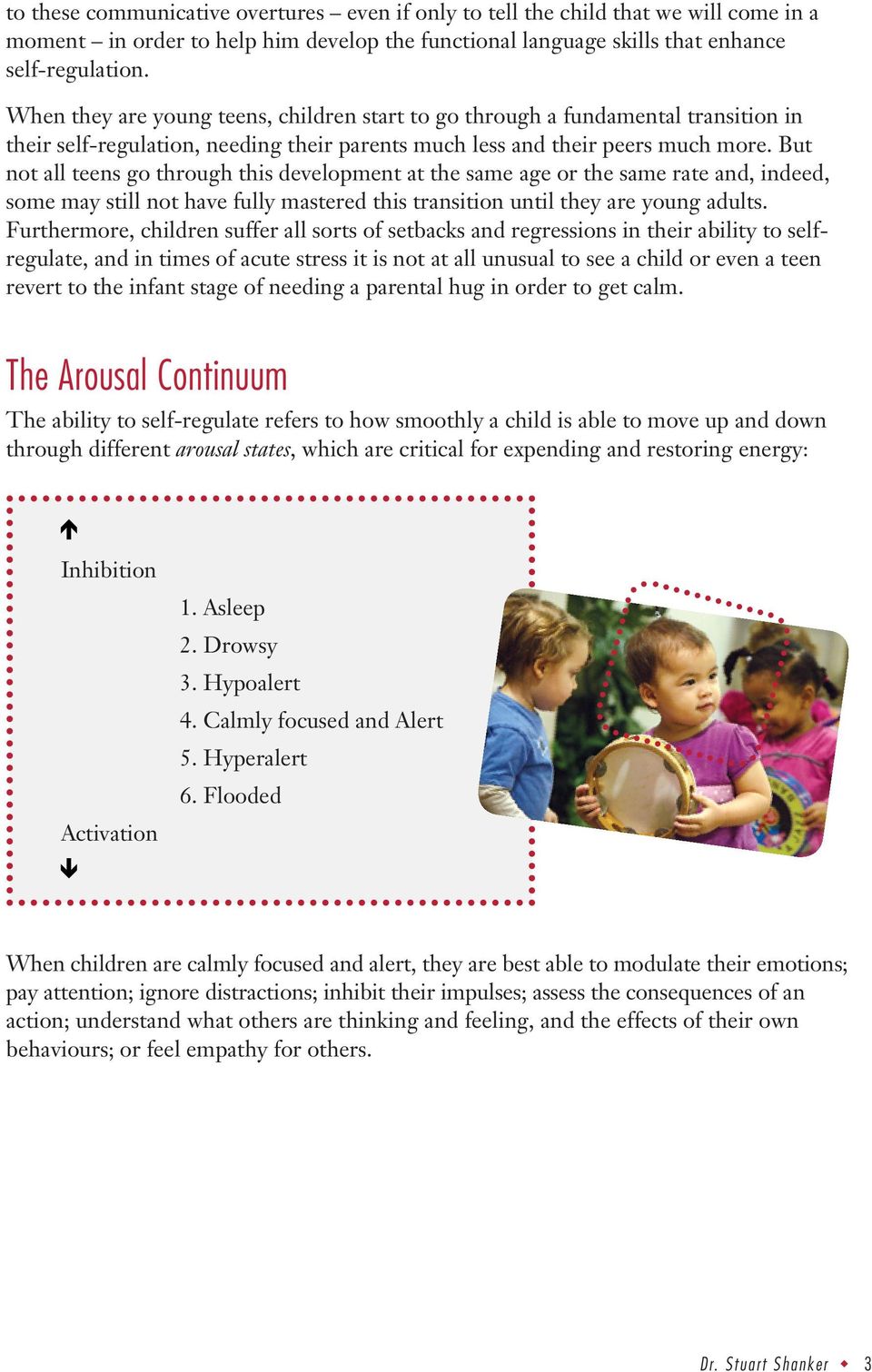
3 to these communicative overtures even if only to tell the child that we will come in a moment in order to help him develop the functional language skills that enhance self-regulation. When they are young teens, children start to go through a fundamental transition in their self-regulation, needing their parents much less and their peers much more. But not all teens go through this development at the same age or the same rate and, indeed, some may still not have fully mastered this transition until they are young adults. Furthermore, children suffer all sorts of setbacks and regressions in their ability to selfregulate, and in times of acute stress it is not at all unusual to see a child or even a teen revert to the infant stage of needing a parental hug in order to get calm. The Arousal Continuum The ability to self-regulate refers to how smoothly a child is able to move up and down through different arousal states, which are critical for expending and restoring energy: Inhibition Activation 1. Asleep 2. Drowsy 3. Hypoalert 4. Calmly focused and Alert 5. Hyperalert 6. Flooded When children are calmly focused and alert, they are best able to modulate their emotions; pay attention; ignore distractions; inhibit their impulses; assess the consequences of an action; understand what others are thinking and feeling, and the effects of their own behaviours; or feel empathy for others. Dr. Stuart Shanker 3
4 Children s Stress Over the past two decades, scientists have made a number of important discoveries in regards to children s stress: 1. While some stress is highly motivating, too much stress can have a long-term negative effect. 2. Too many children are dealing with too many stressors in their lives today. 3. We need to develop a much better understanding of the nature of these stressors and how to reduce them. 4. Children need to learn how to identify for themselves when they are becoming agitated and what they can do to return to being calm and focused. So what exactly are these stressors? We all know that children are under a lot of pressure today and there is a lot of uncertainty in their lives. But scientists have been developing a much broader understanding of stress: of the sorts of things that activate the sympathetic nervous system, and just as important, the sorts of things that help a child s recovery. The five primary sources of stress in children s lives today are: 1. Biological 2. Emotional 3. Cognitive 4. Social 5. Prosocial Each of these levels influences and is influenced by all the others. So when working on a child s self-regulation we always have to be mindful that we are looking at all five levels, and not simply one or two. For a lot of children, too much noise or visual stimulation or strong smells can be a stressor. For some children, too much junk food or sugar can be a stressor. For far too many children today, not enough sleep or exercise or just playing with other children is a huge stressor. Many children struggle with strong negative emotions, like fear, anger, shame, or sadness. Some children find certain kinds of cognitive challenge very draining. A great many children find group activities stressful. And finally, children can find it very challenging to have to deal with other children s feelings or needs. The Signs of an Excessive Stress-Load When we study the above list it starts to become clear that many of the things that might be stressing a child aren t things that we necessarily think of as a stressor. So how can we tell if a child is over-stressed? For parents, caregivers, and educators, there are a number of signs of when a child is being overloaded by stress. Some of the key ones are when a child: has a lot of trouble paying attention, or even responding to his name has a lot of trouble doing the simplest things is very crabby when he wakes up in the morning, or never seems to be happy during the day 4 Calm, Alert and Happy

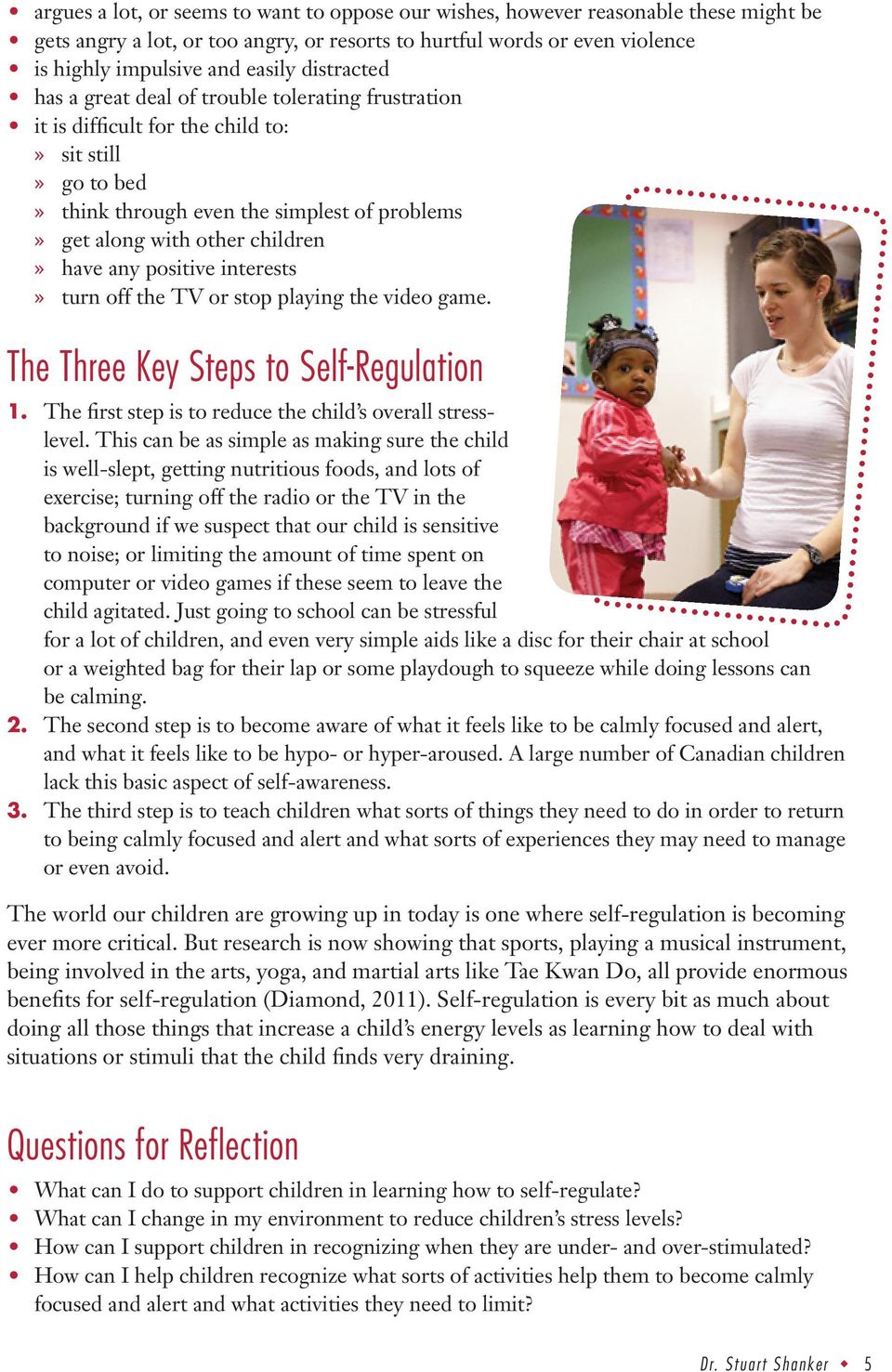
5 argues a lot, or seems to want to oppose our wishes, however reasonable these might be gets angry a lot, or too angry, or resorts to hurtful words or even violence is highly impulsive and easily distracted has a great deal of trouble tolerating frustration it is difficult for the child to: sit still go to bed think through even the simplest of problems get along with other children have any positive interests turn off the TV or stop playing the video game. The Three Key Steps to Self-Regulation 1. The first step is to reduce the child s overall stresslevel. This can be as simple as making sure the child is well-slept, getting nutritious foods, and lots of exercise; turning off the radio or the TV in the background if we suspect that our child is sensitive to noise; or limiting the amount of time spent on computer or video games if these seem to leave the child agitated. Just going to school can be stressful for a lot of children, and even very simple aids like a disc for their chair at school or a weighted bag for their lap or some playdough to squeeze while doing lessons can be calming. 2. The second step is to become aware of what it feels like to be calmly focused and alert, and what it feels like to be hypo- or hyper-aroused. A large number of Canadian children lack this basic aspect of self-awareness. 3. The third step is to teach children what sorts of things they need to do in order to return to being calmly focused and alert and what sorts of experiences they may need to manage or even avoid. The world our children are growing up in today is one where self-regulation is becoming ever more critical. But research is now showing that sports, playing a musical instrument, being involved in the arts, yoga, and martial arts like Tae Kwan Do, all provide enormous benefits for self-regulation (Diamond, 2011). Self-regulation is every bit as much about doing all those things that increase a child s energy levels as learning how to deal with situations or stimuli that the child finds very draining. Questions for Reflection What can I do to support children in learning how to self-regulate? What can I change in my environment to reduce children s stress levels? How can I support children in recognizing when they are under- and over-stimulated? How can I help children recognize what sorts of activities help them to become calmly focused and alert and what activities they need to limit? Dr. Stuart Shanker 5
6 References Diamond, A. & Lee, K. (2011). Interventions Shown to Aid Executive Function Development in Children 4 to 12 Years Old. Science, 333(6045), Duckworth, A. & Seligman, M. (2005). Self-Discipline Outdoes IQ. Predicting Academic Performance of Adolescents. Psychological Science, 16(12), Lillas, C. & Turnbull, J. (2009). Infant child mental health, early intervention, and relationship-based therapies. New York: W. W. Norton. McEwen, B. (2002). The end of stress as we know it. Washington, D.C.: National Academy Press. Moffitt, T. E., Arseneault, L., Belsky, D., Dickson, N., Hancox, R. J., Harrington, H., Caspi, A. (2011). A gradient of childhood self-control predicts health, wealth, and public safety. Proceedings of the National Academy of Sciences of the United States of America, 108(7), Pink, D. (2011). Drive: The Surprising truth about what motivates us. Riverhead Trade. Porges, S. W. (2011). The polyvagal theory: Neurophysiological foundations of emotions, attachment, communication, and self-regulation. New York: W. W. Norton. Shanker, S. G. (2012). Calm, Alert and Learning: Classroom strategies for self-regulation. Toronto: Pearson. The Canadian Self-Regulation Initiative (CSRI) was launched in the fall of The goal of this initiative is to embed practices designed to enhance self-regulation in the classroom. A number of schools in British Columbia, Ontario and Yukon are involved in the First Wave of the CSRI. For more information about this initiative, as well as useful tips and practices for parents and educators, go to Queen s Printer for Ontario, Calm, Alert and Happy

Nikki White Children s Occupational Therapist Barnet Community Services
 Nikki White Children s Occupational Therapist Barnet Community Services What is Occupational Therapy (OT)? An occupation is anything you do in your daily life. Anything meaningful or purposeful Eg. Getting
TEXAS RISING STAR WEBINAR SERIES: CURRICULUM AND EARLY LEARNING GUIDELINES RECORDED OCTOBER 29, 2015 NOTES
 TEXAS RISING STAR WEBINAR SERIES: CURRICULUM AND EARLY LEARNING GUIDELINES RECORDED OCTOBER 29, 2015 NOTES The topics that will be addressed during these webinars include: 1. The General Overview: Curriculum
Restorative Parenting: A Group Facilitation Curriculum Activities Dave Mathews, Psy.D., LICSW
 Restorative Parenting: A Group Facilitation Curriculum Activities Dave Mathews, Psy.D., LICSW RP Activities 1. Framework of Resourcefulness 2. Identifying the Broken Contract Articles 3. The Process of
Taking Hold of Your Mind: What Skills:
 Taking Hold of Your Mind: What Skills: Observing, Describing, and Participating Core mindfulness skills are the foundation of all Dialectical Behavioral Therapy (DBT) skills training. The problems addressed
Introduction to Infant and Toddler Social Emotional Development*
 Introduction to Infant and Toddler Social Emotional Development* [Introduction] Hi, my name is Eva. In this course, we are going to focus on infant and toddler social emotional development, with a special
ADHD: Information for Teachers and Parents
 Educational Psychology Service What is ADHD? ADHD: Information for Teachers and Parents All children may experience attention difficulties at one time or another. This can be more noticeable if a child
Behavior & Sensory Strategies for Individuals with ASD
 Behavior & Sensory Strategies for Individuals with ASD Kathleen Mo Taylor, OTR/L The Autism Programs Center for Development and Disability University of New Mexico This presentation is made possible, in
Impacting the Brain of the Traumatized Child Dave Ziegler, PhD
 Impacting the Brain of the Traumatized Child Dave Ziegler, PhD There is now sufficient information available from research on brain development and brain functioning, as well as the effects of trauma,
Grade 8 Lesson Stress Management
 Grade 8 Lesson Stress Management Summary This lesson is one in a series of Grade 8 lessons. If you aren t able to teach all the lessons, try pairing this lesson with the Weighing Risks to Make Decisions,
What is emotional intelligence?
 What is emotional intelligence? Emotional intelligence is the ability to identify, use, understand, and manage your emotions in positive and constructive ways. It's about recognizing your own emotional
Schizophrenia National Institute of Mental Health
 Schizophrenia National Institute of Mental Health U.S. DEPARTMENT OF HEALTH AND HUMAN SERVICES National Institutes of Health Schizophrenia Do you know someone who seems like he or she has lost touch with
Eyes on Aggressive behaviours. You can help to manage them
 Eyes on Aggressive behaviours You can help to manage them Aggressive behaviours What do we know? From pregnancy to 6 months old n Children are better able to control their aggressive behaviours if their
Parenting a Child with ADD / ADHD
 Parenting a Child with ADD / ADHD Strategies for Family and Home life The needs of a child with ADD/ADHD can overwhelm families and make home life chaotic but they don t have to. You can use strategies
Caring for the Stroke Patient from a patient perspective. Amy L. Heyden, RN, MS, ANP-BC, CNRN, SCRN
 Caring for the Stroke Patient from a patient perspective Amy L. Heyden, RN, MS, ANP-BC, CNRN, SCRN My Stroke of Insight Jill Bolte Taylor, Ph.D. A brain Scientist s Personal Journey I now existed in a
Dr Sarah Blunden s Adolescent Sleep Facts Sheet
 Dr Sarah Blunden s Adolescent Sleep Facts Sheet I am Sleep Researcher and a Psychologist. As a Sleep Researcher, I investigate the effects of poor sleep on young children and adolescents. I also diagnose
HELPING CHILDREN COPE WITH STRESS
 CENTER FOR EFFECTIVE PARENTING HELPING CHILDREN COPE WITH STRESS Stress is a natural and normal part of children's lives. The process of growing up carries with it quite a bit of stress. Children begin
PARENTING AND BLOCKED CARE
 PARENTING AND BLOCKED CARE In their book Brain Based Parenting Dan Hughes and Jonathan Baylin explore the neuroscience of caregiving and consider what this means in terms of parenting. The book describes
Emotional Intelligence Self Assessment
 Emotional Intelligence Self Assessment Emotional Intelligence When people in the workplace do not act with Emotional Intelligence (EQ) the costs can be great: low morale, bitter conflict and stress all
EFFECTIVE DISCIPLINE
 PRACTICE GUIDE EFFECTIVE DISCIPLINE CHILD DEVELOPMENT 12 Months-Introduce 15 Months-Reinforce 2 Years-Reinforce FINDING OUTLETS FOR YOUR CHILD S AUTONOMY/TANTRUMS PROBLEM SOLVING A BEHAVIORAL ISSUE NORMAL
Personal Action / Crisis Prevention Plan
 Personal Action / Crisis Prevention Plan This Plan is meant to help clients/consumers, their support persons and providers prepare for times when life seems too hard to manage. This Plan is designed to
Insecure Attachment and Reactive Attachment Disorder
 Attachment Disorders Insecure Attachment and Reactive Attachment Disorder When infants and young children have a loving caregiver consistently responding to their needs, they build a secure attachment.
Healthy Sleep Healthy Me
 Healthy Sleep Healthy Me What s Inside? 2 Dear Parent/Caregiver 3 Sleep Benefits 4 What Happens During Sleep? 6 What Can You Do To Help? 7 Before I Sleep 8 Safety Is A Priority 10 Where I Rest My Head
Coping skills for managing emotions
 Coping skills for managing emotions Contents Children need adults to help them manage their emotions From feeling bad to feeling good Being warm, caring and providing security Positive touch helps children
Talk To Your Baby Quiz
 Talk To Your Baby Quiz 1. When should you start talking to babies? a) From the moment they are born b) After six weeks c) When they smile at you 2. When does the majority of brain development occur in
Executive function. A beginner's guide
 Executive function A beginner's guide 2014 Commonwealth of Australia through the Australian Government Department of Education. Why are executive functions important? Your executive functions have a huge
Grandparents Top Tips for a child with Aspergers Syndrome by Dave Angel
 1 Grandparents Top Tips for a child with Aspergers Syndrome by Dave Angel 1 2 Having a grandchild is such an exciting time. However having a grandchild diagnosed with a disability that we know nothing
Whatever the specifics of a plan may be, the following are key principles to make the plan most effective:
 Behavior Management Principles For the ADHD Child What I would like to talk about in the last part of this presentation is on the behavior management principles for the ADHD child. In order to get specific
Secrets to Parenting your Child with Aspergers
 Parenting Community for All Parents of Children with Secrets to Parenting your Child with By Dave Angel www.parentingcommunity.com 1 For Free Weekly Tips on www.parenting.com/blog Parenting Community for
STEP 5: Giving Feedback
 STEP 5: Giving Feedback Introduction You are now aware of the responsibilities of workplace mentoring, the six step approach to teaching skills, the importance of identifying the point of the lesson, and
ADD/ADHD in the Classroom
 ADD/ADHD in the Classroom TIPS FOR TEACHERS AND PARENTS At any given time, a teacher can expect to have at least one student with ADHD. The impulsive and hyperactive behavior of such students can be distracting
Sleep Strategies Introduction: 1. Providing a comfortable sleep setting
 Sleep Strategies Introduction: Sleep problems-- either trouble falling asleep, staying asleep, or early morning waking, are common problems in typically developing children and in children with Autism
References to Play in NAEYC Position Statements
 References to Play in NAEYC Position Statements Developmentally Appropriate Practice Guidelines http://www.naeyc.org/positionstatements/dap From: Principles of Child Development and Learning that Inform
For parents and carers of children with autism
 For parents and carers of children with autism The NSPCC helps parents and carers talk to their children about staying safe. It s part of our work to prevent abuse from happening to any child. And it
Lecture 2. The Development Part of the. The Greenspan Floortime Approach D Part of Model Lecture 2
 Lecture 2 The Development Part of the DIR /Floortime Model The Greenspan Floortime Approach D Part of Model Lecture 2 Functional Emotional Developmental elopmental Capacities Core capacities that integrate
Purpose: To approach the world with a sense of trust and emotional security
 Purpose: To approach the world with a sense of trust and emotional security The social and emotional domain includes the development of trust and emotional security, self-awareness, self-regulation and
Helping People with Mental Illness
 Helping People with Mental Illness A Mental Health Training Programme for Community Health Workers Module E Helping Families Cope with Mental Health Problems Page 1 About this course Helping People with
SENSORY FRIENDLY CLASSROOMS- SUPPORTING SENSORIAL LEARNING AND INTEGRATION FOR SCHOOL READINESS
 SENSORY FRIENDLY CLASSROOMS- SUPPORTING SENSORIAL LEARNING AND INTEGRATION FOR SCHOOL READINESS Julia Childs Andrews, Disabilities Coordinator Cindy S. Jones, MFT, Mental Health Coordinator Neighborhood
Parenting. Coping with DEATH. For children aged 6 to 12
 Parenting Positively Coping with DEATH For children aged 6 to 12 This booklet will help you to understand more about death and the feelings we all have when someone we care about, like a parent, a brother
Executive Functioning What is it? What does it look like? Presented By: Jamee Riggio Heelan, OTR/L Occupational Therapist
 Executive Functioning What is it? What does it look like? Presented By: Jamee Riggio Heelan, OTR/L Occupational Therapist Definition of Executive per Google * Adjective: Executive: having the power to
Development Through the Lifespan. Psychosocial Stages During Infancy and Toddlerhood. First Appearance of Basic Emotions
 Development Through the Lifespan Chapter 6 Emotional and Social Development in Infancy and Toddlerhood This multimedia product and its contents are protected under copyright law. The following are prohibited
Mental Health Role Plays
 Mental Health Role Plays Goals: To discuss various mental health issues and mental illnesses. To discuss stigma, support and treatment options surrounding mental health issues and mental illnesses. Requirements:
Workshop 1: In the Beginning: What Happens Early Matters
 Workshop 1: In the Beginning: What Happens Early Matters This session offers participants an overview of early childhood mental health through the examination of Guiding Principles in Infant Mental Health
Ten Tips for Parents. To Help Their Children Avoid Teen Pregnancy
 Ten Tips for Parents To Help Their Children Avoid Teen Pregnancy Ten Tips for Parents To Help Their Children Avoid Teen Pregnancy The National Campaign to Prevent Teen Pregnancy has reviewed research
HELPING YOUNG CHILDREN COPE WITH TRAUMA
 HELPING YOUNG CHILDREN COPE WITH TRAUMA Disasters are upsetting to everyone involved. Children, older people, and/or people with disabilities are especially at risk. For a child, his or her view of the
Title: Conducting FBAs and Designing Behavior Interventions for Individuals with ASD: Keeping the Characteristics in Mind
 Title: Conducting FBAs and Designing Behavior Interventions for Individuals with ASD: Keeping the Characteristics in Mind Presenters: Ruth Aspy, Ph.D., and Barry G. Grossman, Ph.D. Recognizing when problem
Conflict Resolution / Behavior Management Notes - New
 Conflict Resolution / Behavior Management Notes - New I have found that one of the major stressors for mentoring ministry staff is dealing with conflict and behavioral issues. Mentoring is all about developing
Schizophrenia. This factsheet provides a basic description of schizophrenia, its symptoms and the treatments and support options available.
 This factsheet provides a basic description of schizophrenia, its symptoms and the treatments and support options available. What is schizophrenia? Schizophrenia is a commonly misunderstood condition,
Arkansas State PIRC/ Center for Effective Parenting
 How to Effectively COMMUNICATE With Your Child Talk between parents and children is very important, if for no other reason than it is relatively rare when compared to the other activities that today s
Executive Function in Context: The Role of Stress and Vulnerability and Opportunities for Intervention. Stephanie M. Jones
 Ending Poverty: Integrating Behavioral and Social Sciences Executive Function in Context: The Role of Stress and Vulnerability and Opportunities for Intervention Stephanie M. Jones Harvard Graduate School
Virtual Child Written Project Assignment. Four-Assignment Version of Reflective Questions
 Virtual Child Written Project Assignment Four-Assignment Version of Reflective Questions Virtual Child Report (Assignment) 1: Infants and Toddlers (20 points) Choose 7 or 8 questions whose total point
Loss & bereavement in people with dementia
 IS 42 December 2011 Information sheet Loss & bereavement in people with dementia Introduction... 1 What is grief?... 1 Breaking the news... 2 Planning the funeral rituals... 2 The funeral - a rite of passage...
Sexual Behavior and Children: When Is It a Problem and What To Do About It
 Sexual Behavior and Children: When Is It a Problem and What To Do About It The Harborview Center for Sexual Assault and Traumatic Stress has services to help families of children with sexual behavior problems.
Arkansas State PIRC/ Center for Effective Parenting
 Increasing Your Child s Motivation to Learn In order to be successful in school and to learn, students must stay involved in the learning process. This requires students to do many different activities
Epilepsy and Neuropsychology Dr. Sare Akdag, RPsych
 Epilepsy and Neuropsychology Dr. Sare Akdag, RPsych Most people living with epilepsy do not experience serious problems with their thinking. However, there are aspects of thinking that can be affected
supporting social-emotional needs
 supporting social-emotional needs supporting social-emotional needs. Understanding Social-Emotional Disorders. Exploring Emotions and the Brain. Modeling Control. Supporting Emotional Needs. Resources
 Marty's Big Mistake A short story about character by Wes Fessler Marty mouse was walking home from school one sunny day. A rock was on the sidewalk, which he kicked along the way. The rock would bounce
Sample Letters Death Announcements
 Sample Letters Death Announcements Sample Letter to Parents Dear Parents, As you may or may not be aware, our school (or district) has recently experienced (specify event, whether death, fire, etc.) which
The Dance of Attachment
 The Dance of Attachment The parenting challenge for carers fostering or adopting children with attachment difficulties Kim S. Golding Dancing the Same Steps Child signals attachment needs clearly Sensitive
100 Ways To Improve Your Sales Success. Some Great Tips To Boost Your Sales
 100 Ways To Improve Your Sales Success Some Great Tips To Boost Your Sales 100 Ways To Improve Your Sales Success By Sean Mcpheat, Managing Director Of The Sales Training Consultancy What makes a successful
Stress Management. comprehend stress, (2) manage it and (3) respond positively to stress management as it applies to their life and goals.
 xxx Lesson 22 Stress Management Overview: Stress Management is a lesson that helps learners to understand that stress is a part of everyone s life. This lesson focuses on how learners are feeling and what
Teaching Children Self-Control
 Teaching Children Self-Control Written by: Hannah Chancellor, SSP ECUSD7 School Psychologist Self-control is the ability to maintain composure in challenging situations or to stop and think before acting.
Building Healthy Relationships:
 Building Healthy Relationships: Conflict Resolution Alberta Education Health & Life Skills Program of Studies Outcomes 8Grade The student will R - 8.5 R - 8.7 Develop strategies for maintaining healthy
The Amazing Brain: What Every Parent and Caregiver Needs to Know. By Linda Burgess Chamberlain, PhD, MPH
 The Amazing Brain: What Every Parent and Caregiver Needs to Know By Linda Burgess Chamberlain, PhD, MPH Experience Shapes Our Brains How your child s brain develops each and every day is being shaped by
Opening Our Hearts, Transforming Our Losses
 Preface Alcoholism is a disease of many losses. For those of us who are the relatives and friends of alcoholics, these losses affect many aspects of our lives and remain with us over time, whether or not
DEALING EFFECTIVELY WITH CHILD SEXUAL BEHAVIORS. By Brandy Steelhammer, MSW
 DEALING EFFECTIVELY WITH CHILD SEXUAL BEHAVIORS Children are sexual beings. Take a slow breath and read that sentence again. Children are sexual beings. Are you still with me? Keep breathing. Keep reading.
Attachment: What Works?
 Center on the Social and Emotional Foundations for Early Learning Project funded by the Child Care and Head Start Bureaus in the U.S. Department of Health and Human Services Attachment: What Works? 24
A Guide for Parents. of Elementary and Secondary School Students
 A Guide for Parents of Elementary and Secondary School Students The effects of bullying go beyond the school yard. As a parent, here s what to watch for, what you can do, and where you can go to get help.
100 Pug Training Tips
 1. Be committed. Do not get a puppy or a dog for a pet if you are not fully committed in caring for it. Without commitment, you can never train your pet effectively. By being committed, as well as by loving
The FacTs: * All concussions are serious. A Fact Sheet for School Nurses
 A Fact Sheet for School Nurses Assess the situation Be alert for signs and symptoms Contact a health care professional The FacTs: * All concussions are serious. * Most concussions occur without loss of
Background. Provincial Teacher Resource List 2015-2016. Please Note:
 Provincial Teacher Resource List 2015-2016 Background The purpose of this list is to help teachers and schools promote a Comprehensive School Health (CSH) approach in a classroom setting. CSH is an internationally
PLAY STIMULATION CASE STUDY
 PLAY STIMULATION CASE STUDY AIMS Play stimulation work contributes towards the following 2003-2006 PSA targets: Improving social and emotional development, and Improving learning. With regard to PSA targets
The New York Society for the Prevention of Cruelty to Children. Kathy Lotsos, LCSW & Helen Woodbury, LCSW www.nyspcc.org
 The New York Society for the Prevention of Cruelty to Children Kathy Lotsos, LCSW & Helen Woodbury, LCSW www.nyspcc.org Overview Trauma a definition The neurobiology of trauma; Trauma memory storage; Trauma
Intellectual Disabilities
 Intellectual Disabilities NICHCY Disability Fact Sheet #8 January 2011 Matthew s Story Matt is 15 years old. Because Matt has an intellectual disability, he has been receiving special education services
Twin no JL Cummings, 1994. 1. Did not ask according to instructions 2. Not applicable (e.g., due to twin s physical condition)
 1 Interviewer Number: Informant: Name: Informant Number: Telephone: What is your job? Aide Undernurse Nurse Other What shift do you usually work? Day/Night (schedule) Days only Nights only Other Reason
My Classroom Management Philosophy
 My Classroom Management Philosophy I believe one of the hardest things for new teachers to build is their classroom management plan. I have seen many different types of classroom management plans throughout
Tear Soup Cooking Tips Reprinted from Tear Soup, a recipe for healing after loss
 Grandy s Cooking Tips Grief is the process you go through as you adjust to the loss of anything or anyone important in your life. The loss of a job, a move, divorce, death of someone you love, or a change
Telling the Kids about Separation and Divorce Ruth A. Peters, Ph.D.
 Telling the Kids about Separation and Divorce Ruth A. Peters, Ph.D. Divorce is tough on everyone--mom, Dad, as well as the kids. But, there are some steps that parents can take to make the situation less
Lessons by CDA Content
 Lessons by CDA Content The following lessons are a mix of On Demand Lessons and Lessons by Mail you can use to meet the 120 CDA Hours. CDA 1 Competency Goal: To establish and maintain a safe, healthy,
Mindfulness in adults with autism spectrum disorders
 Mindfulness in adults with autism spectrum disorders Introduction Autism is a lifelong developmental disorder that affects functioning in multiple areas. Recent studies show that autism is often accompanied
Teaching Strategies That Support Problem Solving
 Teaching Strategies That Support Problem Solving Adults encourage children to solve problems on their own in the following ways. 47 Encourage children to describe the problems they encounter When you see
By LaDonna Pavetti Vice President for Family Income Support
 By LaDonna Pavetti Vice President for Family Income Support Presented to: Building Bridges to Self-Sufficiency Region V and VII TANF Programs September 4, 2014 What are Executive Function Skills? Simplest
inner peace Easy Practices to Increase Life Balance
 inner peace Easy Practices to Increase Life Balance Often, we define peacefulness by the absence of stress a neutral, inactive state. However, is peace really just a passive state? For most people, adopting
Think, Feel, Act. Lessons from Research about Young Children
 2013 Think, Feel, Act Lessons from Research about Young Children The Ontario Public Service endeavours to demonstrate leadership with respect to accessibility in Ontario. Our goal is to ensure that Ontario
0 3 Months. Smile spontaneously. By 2 3 months, your baby s social smiles are signs that she knows who you are.
 0 3 Months Your baby was born relationship ready and in her first three months of life is actively trying to make sense of her world. Before she can even speak, your baby is communicating with her facial
By Brianne Masselli and Johanna Bergan Youth M.O.V.E. National. A Guide for Youth. Understanding Trauma
 By Brianne Masselli and Johanna Bergan Youth M.O.V.E. National A Guide for Youth Understanding Trauma For National Technical Assistance Center for Children s Mental Health Georgetown University Center
When a Parent Has Mental Illness Helping Children Cope
 When a Parent Has Mental Illness Helping Children Cope World Fellowship for Schizophrenia and Allied Disorders 124 Merton Street, Suite 507 Toronto, Ontario, M4S 2Z2, Canada Email: [email protected]
WORKSHOP DESCRIPTION
 Family and Child Care Resources Winter/Spring 2014 Workshops WORKSHOP DESCRIPTION F01 Attachment and the Circle of Security Friday February 28, 2014 9:00 a.m. 12:00 p.m. The Circle of Security training
Community Legal Information Association of Prince Edward Island, Inc. Custody and Access
 Community Legal Information Association of Prince Edward Island, Inc. Custody and Access Separating parents must make arrangements for child custody, access and visitation. This pamphlet explains some
What Can I Do To Help Myself Deal with Loss and Grief?
 What Can I Do To Help Myself Deal with Loss and Grief? There are certain tasks that help people adjust to a loss. Every person will complete these tasks in his or her own time and in his/her own way. The
LINDA LANTIERI EXPERT IN SOCIAL AND EMOTIONAL LEARNING
 SUNDAY, March 20, 2011 Diario de Mallorca LINDA LANTIERI EXPERT IN SOCIAL AND EMOTIONAL LEARNING She has been a school principal in Harlem and has helped children and adults solve their conflicts in over
Attention-Deficit/ Hyperactivity Disorder
 Attention-Deficit/ Hyperactivity Disorder NICHCY Disability Fact Sheet #19 Updated March 2012 Mario s Story Mario is 10 years old. When he was 7, his family learned he had AD/HD. At the time, he was driving
31.1 The Neuron. BUILD Vocabulary. Lesson Objectives
 Name Class Date 31.1 The Neuron Lesson Objectives Identify the functions of the nervous system. Describe the function of neurons. Describe how a nerve impulse is transmitted. BUILD Vocabulary A. The chart
Classroom Management Plan: Upper Elementary School/6 th Grade. Effective classroom management has six dimensions to it. As a future teacher, it
 1 Valerie Tracht Classroom Management Plan: Upper Elementary School/6 th Grade Effective classroom management has six dimensions to it. As a future teacher, it is crucial that I have a deep understanding
Life with a new baby is not always what you expect
 Life with a new baby is not always what you expect Postpartum Blues or Baby Blues are COMMON. 4 in 5 mothers will have postpartum blues. POSTPARTUM BLUES OR BABY BLUES Pregnancy, the birth of a baby, or
Talking to our children about Violence and Terrorism: Living in Anxious times
 Talking to our children about Violence and Terrorism: Living in Anxious times Living in Anxious Times: Introductory Remarks Since the September 11 attack America has changed. Children and adults alike
6864 NE 14th Street, Suite 5 Ankeny, IA 50023 800.277.8145 Toll free 515.289.4567 Dsm area www.ifapa.org Website ifapa@ifapa.
 About IFAPA The Iowa Foster and Adoptive Parents Association (IFAPA) is a non profit organization serving as a resource to foster, adoptive and kinship families in Iowa. Membership with IFAPA is free for
Five Mistakes People Make Reading Body Language And Five Nonverbal Signals That Send Positive Messages
 Five Mistakes People Make Reading Body Language And Five Nonverbal Signals That Send Positive Messages This is one of a series of occasional papers by The Dilenschneider Group to bring clients and friends
A Guide for Enabling Scouts with Cognitive Impairments
 A Guide for Enabling Scouts with Cognitive Impairments What cognitive impairments are discussed in this manual? Autism Spectrum Disorder Attention Deficit Hyper Activity Disorder Depression Down Syndrome
Part 5. Dinosaur School Notes to Teachers. 1. Introduction. 2. Iguanodon Unit: How to be Successful in School
 Part 5 Dinosaur School Notes to Teachers 1. Introduction 2. Iguanodon Unit: How to be Successful in School 3 & 4. Triceratops Unit: Detecting, Understanding and Talking About Feelings 5. Stegosaurus Unit:
dealing with a depression diagnosis
 tips for dealing with a depression diagnosis 2011 www.heretohelp.bc.ca No one wants to feel unwell. Talking to your doctor or other health professional about problems with your mood is an important first