
Batteries and Charging Systems for QRP
|
|
|
- Eugenia Davis
- 9 years ago
- Views:
Transcription
1 Batteries and Charging Systems for QRP James R. Duffey KK6MC/5 Cedar Crest NM, Pacificon 2005, San Ramon, California, October 15, 2005 Introduction QRPers have a wide variety of battery types to choose from today. The widespread growth of personal electronic devices has resulted in new types of batteries becoming available, significant improvements to traditional battery technology, and widespread availability of inexpensive small batteries. I first prepared a talk similar to this for the 2001 Iowa QRP forum. Since then, the battery front has changed significantly; Ni-Cd has largely been supplanted by Ni-MH for new use in the AA size and rechargeable lithium batteries are becoming more widespread and a bit less expensive. I discuss the various types of batteries available to the QRPer and the relative advantages and disadvantages of each. Schematic diagrams for simple battery chargers are presented, although high-performance commercial battery chargers, at least for AA batteries, are getting so inexpensive that building your own is not as advantageous as it once was. Solar power is attractive for field operation. Many QRP contests, including Field Day, offer special multipliers for using renewable energy sources. A solar panel is essentially a constant current source, so charging a battery with one is easy. I discuss charging batteries with a solar panel and present a couple of simple charging regulators. Portions of this paper and accompanying viewgraph presentation are based on a presentation I gave at the Iowa QRP forum in 2001, and a slightly revised version of that same presentation that I gave at the Duke City Hamfest in I have based some of my sections on my QRP-L posts, so they may sound familiar to long time readers of that reflector. As an aside, the underused QRP-L reflector searchable archive, is a wealth of information, not only on batteries, but on nearly all topics of interest to the QRPer. QRPers, both novice and experienced alike, are wise to start their search for information there. Over the 12 years that QRP-L has existed, there is hardly a topic of interest to hams that has not been discussed there. The archive has all but a few posts spanning this time. Use it. Abbreviation Used in this Paper A Ampere, a measure of current AH - Ampere hour, used to specify the capacity of a battery C- Capacity of battery, generally specified in Amp Hours (AH) or milliamphours (mah) FYBO- Freeze Your Bu** Off, a winter contest sponsored by the Az SQRPions ma - milliampere mah milliamperehour, used to specify the capacity of a small battery 1

2 Ni-Cd- Nickel cadmium, a rechargeable battery chemistry type Ni-MH Nickel Metal Hydride a rechargeable battery chemistry SLA- Sealed Lead-Acid, a rechargeable battery type V- Volt Types of Batteries Batteries fall into two general categories, primary and secondary. Primary batteries are designed to be used once; secondary batteries are designed to be recharged and used multiple times. The common alkaline battery is a primary battery; the Nickel Cadmium (Ni-Cd) battery is secondary battery. Table I lists common battery types. Table I Types of batteries commonly used for QRP Primary Secondary Carbon - Zinc Lead-Acid (Gel Cells) Alkaline Nickel Cadmium (Ni-Cd) Lithium Nickel Metal Hydride(Ni-MH) Lithium Primary Batteries (one time use) Carbon Zinc Carbon-Zinc batteries are useless for QRP use. The capacity is small and gets worse as more current is drawn. They can leak and corrode battery holders or worse yet, your favorite QRP rig. They have a short life. Tom, WB5QYT, told me that he tried carbonzinc batteries in his FT-817 once. He got just 20 minutes of battery life out of that set with no transmitting! Fortunately, Carbon-Zinc batteries are becoming harder and harder to find. When they are available, they are cheap. They are often packaged with inexpensive toys, tools, and flashlights. You may find them sold side by side with alkaline cells at discount drug stores and flea markets, often marked as heavy duty, but do not make the mistake of purchasing them instead of the preferred alkaline cells. Alkaline batteries are marked as such; if in doubt, look for the word alkaline on the package somewhere. You can use carbon-zinc batteries in an emergency if nothing else is available, but you will be disappointed and frustrated at their performance. Alkaline Alkaline cells are the workhorse of the primary battery world. They are widely available, consistent in quality and provide reliable power over a long time. They are widely available in sizes other than the ubiquitous AA. They have a relatively large capacity, and are inexpensive. They have a long shelf life, usually in excess of 5 years. If you don t do a lot of work that requires batteries, they are a good choice for the occasionally trip to the field. They have two to three times the capacity of rechargeable Ni-Cd cells. They do have their downside. The power output is not constant, but varies over the useful life from 1.55 V per cell to about 0.9 V per cell. This has a couple of drawbacks. In order to extract all of the useful power available in the battery, your rig should be able to operate over this entire range, which means 12 V down to 7.2 V for a nominally 12 V powered rig. Few rigs can do this. Those that can will show a steady power reduction over the range. Not a bad thing in and of itself, as some prefer a gentle degradation to a sudden one, but you should be aware of it. 2

3 The alkaline battery has a reduced output at 32 F; about 0.5X that at room temperature. It gets worse below that. You might want to use another battery technology for FYBO, or stuff that battery inside your jacket to keep it warm. If you buy alkaline batteries in bulk, the price for AA alkaline batteries is reasonable, $0.20 to $0.30 each. Large buying club stores such as Costco or Sam s Club often have the best prices. Lithium Lithium cells are very lightweight for the power they provide and hence provide high capacity for their size. They typically supply twice the amp-hour capacity of alkaline cells, but are much lighter. They have extremely long shelf lives; 10 years or more is commonly specified. They have two down sides; they are very expensive and they provide 3 V rather than the 1.5 V we are accustomed to for primary cells. A lithium cell is nearly fully discharged when it approaches 2.5 V per cell. In order to extract all of the energy in a 12 V lithium battery pack, a QRP rig should operate down to 10 V. Lithium cells provide excellent cold temperature operation, hence they are a good choice for FYBO. Overall, the detractions of lithium cells overwhelm the attractions, particularly the cost, and limit their utility for QRP. Recently AA lithium cells with nominal 1.5 V have become available, but they are still quite expensive. I have not evaluated them. Secondary Batteries (rechargeable) Sealed Lead Acid (Gel-Cells) Sealed lead acid batteries, a type of lead acid battery that often goes by the name gelcell, are widely available, but not in smaller than C size. A D sized cell is also available, as are larger single cells, but most QRPers use a 12 V or a pair of 6 V batteries in a single package. These are specified by their capacity; 2.5 AH, 4.5 AH, and 7 AH are all commonly available and are useful sizes to QRPers. Larger sizes are available, but these are more useful to the home station or extended portable operation than they are to the QRPer for portable operation. They have less capacity than Ni-Cd or Ni-MH batteries and much less capacity at high discharge rates. The voltage drops as the cell is discharged, so a 12 V rig must operate at 10.5 V in order to get the most out of a SLA when it is nearly fully depleted. Sealed acid cells have a low self discharge rate, typically 1% to 5% per month. They keep 80 % of their capacity at 32 F, but decrease rapidly below that as anyone who has tried to start a car in a South Dakota winter can testify. Sealed lead acid cells are easy to charge and easy to keep charged by floating them at a constant voltage. They can be charged with constant voltage, constant current, or a mix of the two methods. Manufacturers often print the charging recommendations on the side of the battery. Trickle charging at a constant voltage is about a foolproof method of charging SLA batteries as there is. Unless the battery manufacturer supplies different values, apply a constant voltage of 13.2 V to 13.8 V at an available a current of c/4 or less. The current will generally decrease to zero as the battery becomes fully charged. As the battery self discharges the charger will supply additional current and keep it fully 3

4 charged. There are two downsides to this method. It takes a long time to fully charge the battery. As the battery approaches the charger voltage it draws less and less current and charges slower and slower. It is not possible to charge the battery to full capacity using this technique, but typically it is possible to charge it to 85% of rated capacity. The SLA can also be charged with a constant current. Using this technique, the battery is charged at c/10 to c/4 (or whatever value the manufacturer specifies), until a terminal voltage of 14.4 V is reached. The battery is nearly fully charged at this point and may be float charged to maintain charge. Constant voltage and constant charging may be mixed and this is the technique that is often used in commercial chargers. Using this multi-mode technique, the battery is charged at a constant current until 14.4 volts is reached. The battery is then held at this voltage until the current drops to 10% or so of the charge value. Then the charger switches to the float voltage, usually 13.6 V or so. This technique results in a fully charged battery. There is a commercial IC available that does this, the TI (formerly Unitrode) UC3906. I have provided the data sheet and application note on the CD. The SLA is capable of giving good life. Expect 500 to 1000 full discharge/charge cycles. The fewer deep discharges the SLA sees, the greater number of charge/discharge cycles you will get out of the battery. Charge the battery immediately after use to prolong life. Store the battery fully charged and top it off every 6 months or so to account for self discharge. The SLA is a good choice for a battery to run a home QRP station or to operate a station that is used in portable operations where transportation is done by car. They are a bit heavy for backpacking. SLA batteries are widely available new in a variety of sizes. They are relatively inexpensive. SLA batteries are widely used in alarm systems, uninterruptible power supplies, and emergency lighting systems. Batteries in these systems are usually pulled for preventative maintenance every year or two and the pulls are often available surplus or as giveaways. These batteries have usually been well maintained and have lots of life available after they are pulled. Alarm companies are a good place to check for these pulls. Nickel Cadmium (Ni-Cd) Ni-Cd cells are a good choice for QRP use, although in the AA size, they have been largely supplanted by Ni-MH batteries. Ni-Cd cells have fairly high capacity for their weight, certainly better than SLA batteries. This makes them a good choice for portable use. Ni-Cds have a flat discharge curve, holding constant at nearly 1.2 V until fully discharged. They are pretty much fully discharged at 1 V. Therefore, equipment running on a 12 V Ni-Cd pack should operate at voltages down to 10 V to extract the most energy from a Ni-Cd battery. Ni-Cd cells have good capacity at 32 F and decrease somewhat below that, but are better than alkaline cells or SLA batteries for cold weather operation. They have a relatively high self-discharge rate, 10% or so a month, so if they are not used and charged often, they should be topped off every month or so. Ni-Cd cells can be charged indefinitely with a constant current charger at c/10. Charging at this rate for 14 hours will result in a full charge. The battery can be left 4

5 connected to the charger, but it is wise to reduce the current to 0.02 C or less if the charger is to be left connected. A better way to charge these batteries is to monitor the voltage with respect to time as the battery is charged with a constant current charger. When the voltage ceases to rise and begins to decrease, the battery is fully charged. This effect is shown in Figure 1. The temperature also rises when full charge is approached. Commercial chargers use this technique or a combination of these techniques. I have included the data sheets from the Maxim MAX 712/713 ICs on the CD, both which use this method. A simple versatile charger can be built from this chip. Commercial chargers are commonly available inexpensively and are a good way to charge cells. Unlike the SLA, the endpoint voltage cannot be used to determine when a Ni-Cd battery has reached full charge, as the endpoint voltage depends on how the battery was discharged previously. Figure 1 Voltage and Temperature of a Ni-Cd cell being charged with constant current. The voltage peaks when the cell is fully charged and the temperature rises. Full charge can be determined by detecting when dv/dt goes to zero or negative, or when the temperature rises. Commercial chargers use these methods to determine full charge. (From MAX712/713 data sheet) The Ni-Cd battery is capable of giving good life. Expect 500 or more discharge/charge cycles. The fewer deep discharges the Ni-Cd sees, the greater number of charge/discharge cycles you will get out of the battery. Charge the battery immediately after use to prolong life. Store the battery fully charged and top it off every month to account for self discharge. Although Ni-Cd cells have been largely supplanted by Ni-MH in the AA size, if you want larger capacity, Ni-Cd is still the choice. C cell and D cell sizes are available and Radio Shack stocks both. One of the best values in rechargeable batteries is the 2/3 C or sub C size. These are widely used in rechargeable power tools and rechargeable household appliances such as portable vacuum cleaners. Due to their wide use, they are often available in surplus cheaper than either C cells or AA cells, often with solder tabs. It is easy to make up a 12 V battery pack using 10 of these cells and heat shrink tubing. One should beware of Ni-Cd C and D cells that are the correct size physically, but contain a smaller AA, 2/3 C, or C cell. Several manufacturers, including several major battery manufacturers, do this to save money. These cells have limited capacity. 5

6 Be sure to check the capacity when you purchase a Ni-Cd or Ni-MH C or D cell. Table II lists capacity of the various sized cells to help guide your choice. Nickel Metal Hydride (Ni-MH) Due to the proliferation of digital cameras, Ni-MH cells are widely available in AA size in large capacities. AA Ni-Cd cells, once widely available at discount stores are now hard to find. The Ni-MH chemistry has significantly improved in the past 5 years and the discharge rate, 15% to 20% per month, is significantly lower than when first introduced. Ni-MH cells share many of the same characteristics with Ni-Cd cells. They have a flat discharge curve and good capacity at 32 F. At 15% to 20% self discharge per month, Ni-MHs have a much more rapid self discharge rate than do Ni-Cds or SLA batteries. If not used and charged regularly, they should be topped off every two weeks or so. Unlike Ni-Cds, Ni-MH cells are intolerant of overcharging. Some have reported success at charging these at 0.05C with no damage, but it will take 28 hours to fully charge a discharged battery at this rate. It is better to monitor the voltage when charging and cease charging when the voltage stops to increase, dv/dt = 0. This behavior is shown in Figure 2. The peak is quite shallow, so waiting for the derivative to go negative, like can be done for Ni-Cd cells, will lead to overcharging of Ni-MH cells and their quick demise. The temperature also rises when the cell becomes fully charged. Both of these techniques are used in commercial chargers. An IC, the Maxim MAX712 can be used to build an effective Ni-MH charger. I have included the data sheet on the CD. Figure 2 The voltage and temperature response of a Ni-MH battery being charged at constant current. The voltage maximum, indicating full charge is much shallower than it is with a Ni-Cd cell. (From MAX712/713 data sheet) Ni-MH batteries are most widely available in AA size. Other sizes are harder to find. Panasonic makes them in AAA, sub C, and D cells. Digi-Key stocks these cells. Beware of large cells being sold with AA cells in them. Check the capacity. The Ni-MH battery is capable of giving modest life. Expect 300 to 500 full discharge/charge cycles. This is significantly less than either the Ni-Cd or SLA. The fewer deep discharges the Ni-MH sees, the greater number of charge/discharge cycles you will get out of the battery. Charge the battery immediately after use to prolong life. 6

7 Store the battery fully charged and top it off every 2 weeks to account for self discharge. If you need an AA battery pack for QRP use, particularly for backpacking applications, Ni-MH batteries are a good choice. Care should be exercised with their charging. Lithium Lithium cells are now becoming widely available due in large part to the widespread use of cell phones. They have very high power density, but as anyone who has replaced a cell phone battery knows, they are expensive. Rechargeable lithium cells share many of the properties of the primary lithium cells; they have long shelf life, are lightweight and are very usable in cold weather. The rechargeable lithium cells are usually in nonconventional proprietary physical packages, so incorporating them into existing battery packs can be difficult. Lithium batteries are usually available in 3.6 V or 7.2 V sizes. A 12 V rig operating on lithium cells would need to operate from either a 10.8 V or 14.4 V rechargeable battery pack. Neither Voltage is ideal for the rig, 10.8 V is too low and 14.4 V is a bit high when fully charged. Lithium batteries are usually charged with constant voltage until the battery is fully charged. Charging must be terminated as soon as full charge is reached, or the battery heats rapidly and can destroy itself. Commercial chargers are the best way to charge these. I am unaware of anyone using a homebuilt charger with lithium cells. Lithium batteries are being widely used by radio-control hobbyists, as they are quite concerned with weight considerations. Calculating the Battery Capacity Needed A common question on QRP-L is how much battery do I need for such and such an operation? It is straight forward to calculate the battery capacity you need. First you need to determine how much average current the battery needs to supply to the rig when receiving, Irec and how much it draws during transmit, Itran. My K1 draws about 80 ma at comfortable listening level. At 5 Watts output power, it draws about 0.8 A. CW is a 40% duty cycle mode. This information should be in the instruction manual, or you can measure it yourself with an ammeter. Manufacturer s numbers tend to be on the low side. If we spend half our time transmitting and half our time receiving, typical of a contest situation, then the average current, Iav, drawn by the transceiver is: Iav = 1/2 (Irec) + 1/2(Itran) = 1/2(0.08A) + 1/2 (Itran) For casual operating, you might want to change the fraction spent transmitting and receiving. A ratio of ¾ listening 1/4 transmitting is probably more typical of noncontest operating. Recalling that CW is a 40% duty cycle mode, Itran = 0.4(0.8A) + (0.6)(0.08A) = A =.362A 7

8 The 0.6 is the fraction of time the rig spends in receive during a typical transmission. The average current the K-1 will draw is then: Iav = 1/2(0.08A) + 1/2(.362A) = 0.04A A = 0.220A Now determine how long you wish to operate. If you want to operate for 12 hours, then the current capacity the battery needs to supply is: C = 0.22A(12 hours) = 2.64 Ampere Hours You will need a SLA battery that has a larger capacity than this for several reasons. 1. Most battery capacities are stated for a 20 H discharge rate. If Sealed Lead Acid batteries are discharged at a faster rater, they will have less capacity. At the 10 hour discharge rate, the capacity is about 0.8 to 0.9 times the 20 hour rate. 2. You do not want to fully discharge the battery, as that can cause permanent damage. You should leave at least 10% charge remaining. 3. It is difficult to fully charge SLA batteries, particularly with a simple charger. A battery that is trickle charged will be able to supply only 85% of its rated capacity. With all these caveats, you should over specify the battery capacity, unless you don t have a hard and fast requirement for time duration. Using the worse case from the above 3, we need to multiply the C by: 1/0.8*0.9*0.85 = 1/0.61 = 1.6 So we need to look for a battery that has a capacity of: 1.6*2.64 = 4.2 AH or greater. SLA cells are available in a 4.5 AH capacity. If you power accessories such as a keyer, tuner, or lamp, you should add in that current draw. With the exception of the lamp, the power required by these devices is usually negligible compared to even the receive current drawn. You can do a similar calculation for Ni-Cd or Ni-MH batteries. Ni-Cds can deliver nearly their full rated capacity at almost any reasonable discharge rate unless the current draw is very high. It is easy to fully charge Ni-Cds with a constant current charger as long as the charge is stopped at the proper time. You don't want to fully discharge the Ni-Cds though. So, only factor 2, restraining from fully discharging the battery applies from above; and we need to adjust our capacity only by 1/0.9 or 1.11 so we need to have 2.9 AH capacity. C cell Ni-Cds and Ni-MH AA cells have a capacity of about 2.5 AH, but that would be a bit light. Ni-Cd D cells have a capacity of about 4.5AH, but they are pricey. It is difficult, but not impossible to find Ni-MH batteries in sizes other than AA. Table II lists the various size cells available in the various chemistries. 8

9 These calculations are approximate and depend greatly on personal operating habits. It is best to leave some headroom until you are familiar with the power consumption of you rig and your operating habits. Table II- Size and Capacity of Cells Available for Various Battery Types Cell size Alkaline (mah) Lead-Acid Ni-Cd (mah) Ni-MH (mah) AAA 1100 NA AA 2450 NA /3 C (sub C) NA NA C NA D Lantern Battery 20,000 (6 V) NA NA NA SLA batteries are usually specified by capacity, C, or the AH rating, rather than a physical size, so it is easy to determine the capacity required. Ni-Cd, Ni-MH, and alkaline batteries are specified by physical size and the capacity is not always obvious. Battery Chargers Several techniques are commonly used to charge batteries: constant current, constant voltage, and a mixture of the two techniques. Homemade versions of all three are possible, and are described below. Commercial versions of chargers are so inexpensive and perform so well, that many do not think that building a charger is worthwhile. Since charging Ni-MH and lithium batteries requires care, it may be best to purchase a commercial charger for these batteries. Determining when a battery is fully charged is the trick in successfully charging a battery, and time, voltage, current, and temperature are all used. This is generally the most difficult part of building a homemade charger. The easiest chargers to build are those for non-critical battery charging situations, trickle charging SLA batteries at constant voltage, and Ni-Cds at constant (and low) current. The Simplest Charger ST Microelectronics makes an IC in a TO-220 package, the PB137, that is a complete constant voltage battery charger with reverse polarity protection, over voltage protection, over temperature protection (for the charger), and short circuit protection. It requires 3 parts, the chip and two capacitors. Figure 3 shows the diagram. The IC is available from Mouser for $0.50, so a good trickle charger for SLA batteries can be built for less than $1.00, exclusive of the Vin supply. The PB137 should have a hefty heat sink; the power dissipated will be (Vin-13.7)Icharge. The PB137 is based on the L200, an adjustable voltage regulator that provides adjustable current limiting, variable voltage, over voltage protection, over temperature protection and short circuit protection, It is quite popular in England, but until recently was not widely available over here. It is quite superior to the LM317 we use for the same applications and deserves to be more widely used. It is now available from Digi-Key. 9

10 Figure 3 A trickle charger for SLA batteries based on the STMicroelectronics PB137 IC. Vin should be 16 V or greater. Tantalum capacitors are preferred for Cin and Cout but any electrolytic will do. The input capacitor is there to prevent oscillations when the chip is far removed from the supply and the output capacitor reduces transients. Wall warts may require additional filtering if used for Vin. The IC can supply up to 1.5 Amperes, depending on the input supply. The PB137 has built in current limiting and short circuit protection to prevent damage to itself. The PB137 is in a TO-220 package, which needs to be adequately heat sunk. (From the PB137 data sheet) Constant Voltage Chargers A constant voltage charger can be made from three terminal voltage regulators. Low drop out regulators such as the LT-1086 are preferred, but the good old LM-317 is commonly available and more likely to be in your junk box. It is one of the few parts that Radio Shack still carries, so you can find the parts for this project easily. Figure 4 shows a constant voltage charger schematic from the LM-317 data sheet. Figure 4 A battery charger built from an LM317 variable voltage regulator. It is advisable to place a diode between the regulator and the battery to prevent discharge of the battery if a short circuit occurs in the charger. If the charger is located far from the supply, a 0.1 uf tantalum bypass capacitors should be added to the input. The values shown are for a 13.7 V charger. For other voltages, V = 1.25(1+ R2/R1). Vin should be 18 V or greater. (from LM317 data sheet) 10

11 The LM317 has a 3 V drop out voltage and if a series diode is added, Vin should be 17.3 Volts or greater. Use an 18 V supply. The LM317 should be heat sunk. If the charger is located far away from the voltage source, the input should be bypassed with a 0.1 uf tantalum capacitor to prevent possible HF oscillations. Constant Current Charger The ubiquitous LM317 can also be used as a constant current charger. The LM317 regulates such that 1.25 volts is maintained between the Vout and ADJ terminals. If the ADJ terminal is floated and a resistor placed between the Vout and ADJ terminals then the regulated current is given by I=1.25V/R. A 50 ma charger based on this principle is shown in Figure 5. Figure 5 Constant current charger made with LM-317 regulator chip. It is advisable to add a series diode between the battery and the 24 Ohm resistor. A 50 ma charger suitable for Ni-Cd AAA cells is shown, the 24 Ohm resistor can be changed for other charging currents using R=1.25V/I, where I is the charging current desired. Be sure to use a resistor of adequate power rating, P = I 2 R. Vin should take into account the voltage drops for the regulator, 3V, the resistor, IR, the diode, and the battery. For a 12 V AAA Ni-Cd battery this will be 19 V, assuming a fully charged voltage of 14 V for a 12 V battery. (from LM317 data sheet) This technique can be used with other regulators as well. A five volt regulator such as the 78L05 can be used by tying the Vout to Gnd with a resistor such that I=5V/R. Larger resistors are required for these regulators than for the LM317 and hence, more power dissipation in the resistor and a higher Vin is required. Multimode (Constant Current/Constant Voltage) Charger While it is probably better to use a commercial chip for multi-mode chargers, it is possible to use commonly available parts to make a simple multi-mode charger for charging SLA batteries. Combining the constant current and constant voltage chargers above, Marvin Harner described a simple charger in the July 1987 Sky and Telescope. This charger is shown in Figure 6. The charger in Figure 6 uses an SCR to disconnect and connect the LM317 so that it switches between constant current charging and constant voltage charging. A low drop out voltage regulator can be substituted for the LM317 and a Schottky diode for D5. These changes will result in less power dissipation. 11

12 Figure 6 - Constant Current/Constant Voltage Charger for SLA batteries. R1 is given by 1.25/Icharge, and should have a power rating of I 2 R1. When connected to a discharged battery, the SCR is off, and the charger functions like the constant-current charger in Figure 5. When the battery approaches full charge, the SCR turns on and the charger functions as a constant-voltage trickle-charger similar to that shown in Figure 4. R4 sets the trip point for the SCR and should be set to 13.8 V to 14.4 V, and R3 sets the trickle charge voltage, which should be 13.2 V to 13.8 V. If the battery manufacturer specifies different values, these should be used. LED1 indicates that the battery is charged. When this circuit was presented in Sky and Telescope, all of the parts were available from Radio Shack. Unfortunately, the SCR is no longer carried at local stores, but the rest of the parts remain available. The LM317 should be adequately heat sunk. Chargers Based on Commercial Chips In addition to the PB137 described above, excellent chargers can be built based on the UC3906 for SLA batteries and the MAX712/713 for Ni-CD and Ni-MH respectively. These chips are available in DIP packages from Digi-Key and other suppliers. The data sheets, included on this CD, show how to design and build chargers based on these versatile chips. In addition, QST carried articles on how to build a charger based on the UC3906 in June 1987, pp and on a charger based on the MAX712/713 in September 1994, pp The handbook carried these charger circuits for many years, but they are no longer in the current edition. The UC3906 based charger is available in kit form from A&A Engineering. The kit makes a 1A charger. There are other custom battery charging chips available, but I have suggested the two above for two reasons: they are widely available; Digi-Key stocks both, and they are available in DIP packages for those who don t want to deal with surface mount devices. Using a Solar Panel to Charge Batteries It is easy to use a solar panel to charge a battery in the field. This is attractive from the point of being self contained and many contests offer an additional multiplier for solar power. Visitors to a portable site are often impressed by the solar panel powering a ham radio station that is working other stations all over the country. 12

13 Small solar panels can often be found surplus or at ham fests. A 3 to 5 Watt size is a good choice for most portable operations. Such a panel will produce 250 ma to 300 ma at 18V in full sun and is a good mate to a 7 AH SLA battery. Some foreign car manufacturers ship their cars with a small solar panel on the dash to keep the battery charged. These panels are sold or given away after the car is received. Check with your local VW dealer, or they can often be found on e-bay. Harbor Freight has several solar panels which go on sale form time to time. When on sale these are usually good deals. A solar panel is a constant current device and can be thought of as a constant current charger. SLA batteries and Ni-Cd batteries lend themselves to constant current charging and hence to simple charging by the solar panel. In the simplest arrangement the panel is simply hooked up to the battery, observing polarity, and allowed to charge. This works best if the panel output is less than 0.1C or if the current drawn by the rig is less than the current supplied by the panel. If either of these two conditions are not present it is wise to use a Zener diode or a charge controller. The Zener diode should have a voltage rating higher than the highest expected fully charged battery voltage. A 15 V Zener is adequate for 12 V Ni-Cd or SLA batteries. The power rating should be the same as the panel. The full power of the panel will be dissipated by the Zener when the battery is fully charged. Polarity Protection Figure 7 Simplest solar charging setup. The solar panel is a constant current device and can charge Ni-Cd and SLA batteries. The Zener diode is provided for over-voltage protection to the battery and should be a slightly higher value than the fully charged battery potential. It can be omitted if the charging rate is less than 0.1C or if the current drawn by the transceiver is equal to or greater than the current supplied by the panel. The series diode is often built into solar panels and avoids discharging the battery into the solar cell at night. If the solar panel is to be used long term in a fixed location, or if the current supplied by the panel is higher than 0.1C, or the power consumed by the attached rig is less than the panel can supply, a charge controller should be used to avoid damage by 13

14 overcharging the battery. A shunt controller is preferred to a series controller. A series controller will often have significant voltage drops that will limit the amount of power the solar panel can deliver to the battery. There are a number of shunt controller designs, some with elaborate microprocessor control and others using exotic switching devices. A simple and straight forward design from commonly available parts is shown in Figure 8. This design is from the ARRL Publication QRP Power, p 3-24, and is simple, easy to build, and simple to setup. It is capable of handling charge currents of up to 1A. Alternate component values are given in the figure for lower current applications. The only adjustment is the voltage trip point when the current is shunted through the transistor and load resistor. This should be set with a fully charged battery. As the transistor and R3 have the entire panel s output across them when the battery is fully charged, they should be well heat sunk. Figure 8 This simple charge controller will handle charging currents up to 1 A. When the battery is fully charged, all of the current from the panel will be going through R3 and the Darlington transistor TIP112, so these must be well heat sunk. Adjust R1 for the trip point, usually 14.4 V 15 V for a 12 V SLA or a 12 V Ni-Cd battery. (From QRP Power p 3-24) A Strategy for Using Batteries It is useful to develop a strategy for using batteries in your QRP shack and portable rig. If you do not, you can end up needing many different size batteries, connectors, and chargers. For fixed station use, this is not so bad, for portable operation, it always seems like you will be missing a crucial battery for a crucial application, or you will end up needing to use different battery types in a single application. For rigs that have low-power consumption and lightweight requirements, like backpacking with the NE602 based SW-XX rigs, KD1JV s ATS rigs and K-1s, standardizing on AA cells is a good strategy. A 12 V AA pack made of either alkaline or rechargeable Ni-Cd/Ni-MH cells is a good idea. You should power any accessories, 14

15 keyers, or tuners with additional AA batteries, or from the same battery pack. Choose AA battery based flashlights so you can scavenge batteries from them if you need to. Encourage others who go camping with you to do the same. You can make up a battery pack using solder tab cells. Heat-shrink tubing can be used to hold it all together or you can use battery holders. As 10 Ni-Cd/Ni-MH cells make up the nominal 12 V required for most rigs, use a 10 cell holder, Mouser 12BH310A. Or you can make up a custom holder using an eight cell (or 2-4s) holder in series with a two cell holder. That way, if your Ni-Cd/Ni-MH cells get exhausted, you can replace them with eight easily available alkaline cells. For rigs that require more power or where weight is not a concern, like the OHRs I am fond of, or a K2, a lead acid battery is a good choice. Power all of the accessories from the same battery. If the voltages required are different, use the same battery and power them with a low-dropout micropower regulator if they need a lower voltage. The 78L0X series is not a good choice, here, good choices include the LP2951 (adjustable), LP2950-X (X is the specified voltage), and Lt-1121CZ-X. The 2.1mm coaxial power connector center pin positive is pretty much standard on most QRP rigs these days. It is a good idea to use it on all of your equipment. I use power cords with this connector on one end and alligator clips on the other end, so I don t need to worry about matching connectors on the batteries. I have a few cords that have the Radio Shack/Molex connector on the battery end. The ARRL was pushing this as a standard a few years back. I prefer the alligator clips. The Anderson Power Pole connectors are now becoming standard and they are a very effective system. There are a number of power distribution stations available, including one from Saratoga Systems that has voltage regulators (and fuses) built in to supply voltages at other (lower) than 12 V. This is a very convenient device. It is pretty much a tautology that you should have spare batteries for each battery powered device. But we have all been caught short with a dead keyer battery and no spare at one time or another. Now is the time to raid all of those battery powered devices for a spare. Flashlights are an obvious choice, as are Walkman tape players and CD players, but we often overlook garage door openers and multimeters. You might want to raid those AA cells in your handie-talkie for another use. But the best idea is to bring spares. I carry a small 4.5 AH SLA cell as a back up to my standard 7 AH SLA, and often an alkaline 9 volt battery as well. Having 8 alkaline AA cells as backup is a good idea. If you go with a group, invariably someone will show up with a dead battery and no spare. If you can supply a spare, you will be a hero. It is not a bad idea to carry spares not only for your own gear, but also for others. Be prepared. A voltmeter is a good device for checking the health of a battery, but 12 V light bulbs are probably more useful as they provide a load. Twelve volt lamps are available in a wide variety of sizes; pick one with a current draw roughly equal to your rig to test your battery. Radio Shack has a wide variety of 12 V bulbs, as does your auto parts store. The bulbs are also good for checking those surplus batteries often available at swap meets. In the field, I find it enlightening to make periodic measurements with a voltmeter over the course of operating to determine how the battery is really holding up. It gives me an idea if I really need a battery that big, or if I can get away with a slightly smaller one next time. 15

16 If you use a rechargeable battery to operate your rig in the shack, you should keep it charged. For an evening or afternoon of operating I operate from the battery and connect the charger at the end of the operating session. For longer sessions, like in a contest, I keep the charger connected to the battery. If you only operate from batteries occasionally, you should top off your batteries from time to time. Ni-MH should be topped off once every two weeks, Ni-Cds once a month and SLA batteries once every six months. Always top off a battery before going to the field. Summary and Conclusions So what battery technology should you chose? If you only go to the field occasionally, or want to try portable operation without a lot of expense, alkaline cells are probably the best choice. If weight is not a factor, you can operate a typical QRP rig from alkaline D-cells for months of casual operating and from a pair of lantern cells for almost a year For portable operations where weight is not a concern, sealed lead-acids are probably the best bet. They are relatively inexpensive, particularly if you can get a pull, and are easy to charge. Do some homework first to size the battery properly. For backpacking with efficient low power rigs, where low weight is paramount, use a battery pack made from Ni-MH AA cells. If the capacity of an AA cell is not sufficient, use the larger sizes available in Ni-Cd cells. Ni-MH cells must be charged with care, they are no where as forgiving as Ni-Cd cells. If you want to try solar power, SLA batteries and Ni-Cd batteries are the easiest to use with solar panels and the most forgiving to charge. Cold weather operation favors lithium, Ni-Cd, and Ni-MH cells. SLA batteries and alkaline cells are definitely poor choices for FYBO. In order to make your rechargeable batteries last the longest, do not overcharge them, do not discharge them fully, store them fully charged, top them off as required, and avoid long term trickle charging of Ni-Cd cells. 16

Lithium Iron Phosphate Batteries
 Lithium Iron Phosphate Batteries An Ideal Technology for Ham Radio? Bob Beatty, WB4SON Bob Beatty, WB4SON July 8, 2013 A History of Battery Development 1791 Luigi Galvani ( Animal Electricity Frogs beware)
ECEN 1400, Introduction to Analog and Digital Electronics
 ECEN 1400, Introduction to Analog and Digital Electronics Lab 4: Power supply 1 INTRODUCTION This lab will span two lab periods. In this lab, you will create the power supply that transforms the AC wall
Homebuilt HF Radios for Use Underground Paul R. Jorgenson KE7HR
 Homebuilt HF Radios for Use Underground Paul R. Jorgenson KE7HR With the good success in using Amateur Band HF radio for underground communications, I started looking for cheaper alternatives to the $500+
Smart Batteries and Lithium Ion Voltage Profiles
 Smart Batteries and Lithium Ion Voltage Profiles Louis W. Hruska, Director Rechargeable Batteries Duracell Worldwide Technology Center, 37A Street, Needham MA 02194 Abstract: This paper addresses how the
Alkaline-Manganese Dioxide
 Performance Characteristics The performance characteristics described in Sections. through.9 are those characteristics specific to the alkaline-manganese dioxide products manufactured and distributed by
Odyssey of the Mind Technology Fair. Simple Electronics
 Simple Electronics 1. Terms volts, amps, ohms, watts, positive, negative, AC, DC 2. Matching voltages a. Series vs. parallel 3. Battery capacity 4. Simple electronic circuit light bulb 5. Chose the right
High Efficiency Battery Charger using Power Components [1]
![High Efficiency Battery Charger using Power Components [1]](/thumbs/40/21622985.jpg "High Efficiency Battery Charger using Power Components [1]") application note TPB:101 High Efficiency Battery Charger using Power Components [1] Marco Panizza Senior Applications Engineer July 2006 Contents Page Introduction 1 A Unique Converter 1 Control Scheme
application note TPB:101 High Efficiency Battery Charger using Power Components [1] Marco Panizza Senior Applications Engineer July 2006 Contents Page Introduction 1 A Unique Converter 1 Control Scheme
What are the technical features and performance of the AccuCell system?
 What is AccuCell? AccuCell is an alkaline-manganese battery system that allows recharging while preserving the advantages of disposable alkaline cells. The first batteries of this kind were developed in
Hand Crank Generator (9 May 05) Converting a Portable Cordless Drill to a Hand Crank DC Generator
 Converting a Portable Cordless Drill to a Hand Crank DC Generator The unit is light weight (2.5 lb), portable, low cost ($10-$20) and can be used to recharge single cell batteries at from 1-3.5 amps. It
Torfino Enterprises, Inc.
 Torfino Enterprises, Inc. An independent study of commercially available 9 volt rechargeable battery technology for implementation and use with the ICE LIGHT & METAL-TEC 1400 Product line Written By: Nicholas
LM 358 Op Amp. If you have small signals and need a more useful reading we could amplify it using the op amp, this is commonly used in sensors.
 LM 358 Op Amp S k i l l L e v e l : I n t e r m e d i a t e OVERVIEW The LM 358 is a duel single supply operational amplifier. As it is a single supply it eliminates the need for a duel power supply, thus
Energizer Non-Rechargeable Batteries: Frequently Asked Questions
 Click on the question to view the answer: 1. Is it a good idea to store batteries in a refrigerator or freezer? 2. Why is mixing batteries of different chemistries, brands or age a potential problem? 3.
Battery Power for LED Pixels and Strips. Created by Phillip Burgess
 Battery Power for LED Pixels and Strips Created by Phillip Burgess Guide Contents Guide Contents Overview About Batteries Diode Fix for Alkaline Batteries Powering the Microcontroller Estimating Running
Routinely DIYers opt to make themselves a passive preamp - just an input selector and a volume control.
 The First Watt B1 Buffer Preamp Nelson Pass, June 2008 Side A So here we are in the New Millennium, and thanks to Tom Holman and THX we ve got lots of gain in our electronics. More gain than some of us
Power Supplies. 1.0 Power Supply Basics. www.learnabout-electronics.org. Module
 Module 1 www.learnabout-electronics.org Power Supplies 1.0 Power Supply Basics What you ll learn in Module 1 Section 1.0 Power Supply Basics. Basic functions of a power supply. Safety aspects of working
Georgia Performance Standards Framework for Physical Science 8 th Grade. Powering Satellites
 The following instructional plan is part of a GaDOE collection of Unit Frameworks, Performance Tasks, examples of Student Work, and Teacher Commentary. Many more GaDOE approved instructional plans are
If you accidentally get battery acid on your skin, flush it with lots of water
 RV Battery Savvy To properly maintain and extend the life of your RV batteries you need to have a basic understanding of what a battery is and how it works. Batteries used in RVs are lead acid batteries.
You Too, Can Recondition Batteries
 You Too, Can Recondition Batteries The Complete Story Copyright: www.reconditionbattery.com, 2009 Copying, reselling, or giving away this e-book is not permitted 1 Table of Contents Introduction Why Do
Joule Thief 3.0 Kit. June 2012, Rev 1 1 http://www.easternvoltageresearch.com Joule Thief 3.0
 Kit Instruction Manual Eastern Voltage Research, LLC June 2012, Rev 1 1 http://www.easternvoltageresearch.com HIGH BRIGHTNESS LED THIS KIT USES A 1W CREE, HIGH BRIGHTNESS LED. DO NOT STARE AT THIS (OR
12 Volt 30 Amp Digital Solar Charge Controller
 12 Volt 30 Amp Digital Solar Charge Controller User s Manual WARNING Read carefully and understand all INSTRUCTIONS before operating. Failure to follow the safety rules and other basic safety precautions
Mobile Data Power Model: MDP-25
 Mobile Data Power Model: MDP-25 Topic Section Features... 2 Operational Features Summary... 2 Back-up Battery Power Internal Charger Voltage Spike Protection RF Noise Filtering Warning of Imminent Loss
In The fastest growing battery system, lithium ion (Li-ion) batteries are used where high-energy density and
 WHITE PAPER Selection, Use and Timely Replacement of Lithium Ion Batteries In The fastest growing battery system, lithium ion (Li-ion) batteries are used where high-energy density and light weight is of
Renewable Energy Test Station (RETS) TEST PROCEDURES FOR SOLAR TUKI
 Renewable Energy Test Station (RETS) TEST PROCEDURES FOR SOLAR TUKI March 2007 A. Test Procedures for Solar Tuki Lamp S. No. Test Parameters Technical Requirements Instruments Required Test Methods A.
GLOLAB Two Wire Stepper Motor Positioner
 Introduction A simple and inexpensive way to remotely rotate a display or object is with a positioner that uses a stepper motor to rotate it. The motor is driven by a circuit mounted near the motor and
GLOLAB Universal Telephone Hold
 GLOLAB Universal Telephone Hold 1 UNIVERSAL HOLD CIRCUIT If you have touch tone telephone service, you can now put a call on hold from any phone in the house, even from cordless phones and phones without
RADIANT PLASMA 4700 Plasma Spark Generator
 RADIANT PLASMA 4700 Plasma Spark Generator Installation Guide / User Manual A S P A R K O F F R E S H A I R Aquapulser.com Contents 1 Introduction 2 1.1 About the Product....................................
0.9V Boost Driver PR4403 for White LEDs in Solar Lamps
 0.9 Boost Driver for White LEDs in Solar Lamps The is a single cell step-up converter for white LEDs operating from a single rechargeable cell of 1.2 supply voltage down to less than 0.9. An adjustable
Radio Control System
 Radio Control System The Radio Control System consists of the control transmitter unit held by the operator and the receiver with its associated components in the robot. The Radio Control Transmitter converts
COOL-01, Cooling Fan Operation and Troubleshooting
 COOL-01, Cooling Fan Operation and Troubleshooting Table of Contents Introduction Early 944s With Air Conditioning Cooling Fan Operation On Early 944s With Air Conditioning Testing Fan Relay One Early
Handbook. We aim to bequeath a beautiful Earth for our future generations.
 We aim to bequeath a beautiful Earth for our future generations. What can we do as a leading company for energy and environment? We can start from what we have; our unique technology and innovative creativity
QUICK START GUIDE FOR DEMONSTRATION CIRCUIT 735 LITHIUM-ION LINEAR BATTERY CHARGER WITH LDO REGULATOR
 DESCRIPTION QUICK START GUIDE FOR DEMONSTRATION CIRCUIT 735 LTC4063EDD Demonstration circuit 735 is a complete constantcurrent, constant-voltage battery charger for one Lithium-Ion cell and includes a
BAO TONG USA dba TYSONIC BATTERY. SPECIFICATION SHEET FOR 9V NI-MH RECHARGEABLE BATTERY TY-9V-200mAH
 BAO TONG USA dba TYSONIC BATTERY SPECIFICATION SHEET FOR 9V NI-MH RECHARGEABLE BATTERY TY-9V-200mAH I. GENERAL INTRODUCTION 1. Main Features 1) Friendly To The Environment Cd 0% Hg0% Pb0% 2) High Energy
The definite Guide to Power connectors, Charging, and other Power related questions for the #11 Keychain Camera
 The definite Guide to Power connectors, Charging, and other Power related questions for the #11 Keychain Camera The same questions are being asked over and over again. I hope that this guide will clarify
36V 14.5Ah ezee Flat Battery
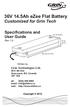 36V 14.5Ah ezee Flat Battery Customized for Grin Tech Specifications and User Guide Rev 1.0 14 cm (5.6") 6 cm (2.4") 35 cm (13.75") Written by: Grin Technologies Ltd. 20 E 4th Ave Vancouver, BC, Canada
How Batteries Work by Marshall Brain
 How Batteries Work by Marshall Brain Batteries are all over the place -- in our cars, our PCs, laptops, portable MP3 players and cell phones. A battery is essentially a can full of chemicals that produce
NC2000 Charge Controller for Nickel-Cadmium and Nickel-Metal Hydride Batteries
 NC2000 Charge Controller for Nickel-Cadmium and Nickel-Metal Hydride Batteries General Description The NC2000 is a device designed to intelligent charge either nickel-cadmium (NiCad) or nickel-metal hydride
PV (photovoltaic) Basics There are generally two types of PV systems. The first and easiest (though the least flexible) is a grid tie system where
 PV (photovoltaic) Basics There are generally two types of PV systems. The first and easiest (though the least flexible) is a grid tie system where the power generated by the solar panel (panels) runs an
"Charging Lithium-Ion Batteries: Not All Charging Systems Are Created Equal"
 "Charging Lithium-Ion Batteries: Not All Charging Systems Are Created Equal" By Scott Dearborn Principal Applications Engineer Microchip Technology Inc. 2355 West Chandler Blvd Chandler, AZ 85224 www.microchip.com
Battery Charger For Nickel Cadmium and Nickel-Metal Hydride Rechargeable Batteries Model PSN Series
 Battery Charger For Nickel Cadmium and Nickel-Metal Hydride Rechargeable Batteries Model PSN Series Operating Instructions WARNING CONCERNING THE REMOVAL OF COVER: CAUTION: TO PREVENT THE RISK OF ELECTRIC
MANUAL D250S DUAL. Solar panel + Vehicle ground/solar panel
 MANUAL CONGRATULATIONS on the purchase of your new CTEK professional battery management unit. This unit is part of a range of professional battery chargers from CTEK SWEDEN AB. It represents the latest
INSTRUCTION MANUAL PLEASE READ ALL THE INSTRUCTIONS COMPLETELY BEFORE USE AND SAVE THIS MANUAL FOR FUTURE REFERENCE
 INSTRUCTION MANUAL PLEASE READ ALL THE INSTRUCTIONS COMPLETELY BEFORE USE AND SAVE THIS MANUAL FOR FUTURE REFERENCE m Before Use Please read IMPORTANT SAFETY INSTRUCTIONS on page 10 before use. It is important
Charger Output AC Ripple Voltage and the affect on VRLA batteries
 TECHNICAL BULLETIN 41-2131 Charger Output AC Ripple Voltage and the affect on VRLA batteries Please Note: The information in this technical bulletin was developed for C&D Dynasty 12 Volt VRLA products.
www.ringautomotive.co.uk Instructions: Retain these instructions for future reference SmartChargePro35 RSCPR35-12v, 2 / 8 / 16 / 35A
 SmartChargePro7 RSCPR7-12v, 7A SmartChargePro10 RSCPR10-12v, 10A SmartChargePro15 RSCPR15-12v, 15A SmartChargePro25 RSCPR25-12v, 2 / 6 / 12 / 25A SmartChargePro35 RSCPR35-12v, 2 / 8 / 16 / 35A SmartChargePro50
Getting started with the Super Brain Palm computer interface.
 Getting started with the Super Brain Palm computer interface. Step 1: Connect the RB502 interface cable to your Super Brain Palm Charger. Step 2: Connect the USB interface to your computers USB port. Step
OUTPUT CABLE CONNECTIONS:
 Tender Plus: Models: 12V1.25A and 6V1.25A The Tender Plus 12 Volt, 1.25 Amp 6 Volt, 1.25 Amp GENERAL DESCRIPTION: The Tender Plus battery charger is a desktop, portable, linear power converter that has
Designing Applications with Lithium-Ion Batteries
 Application Note Roland van Roy AN025 Sep 2014 Designing Applications with Lithium-Ion Batteries Contents 1. Introduction...1 2. Single Li-Ion Cell as Power Source...2 3. Battery Charging...6 4. Battery
PSC-A5 Solar Charge Controller Manual
 ( 5A, 12V/24V Output, Double Mode ) 1. Introduction: This controller is suitable for 12V and 24V solar photovoltaic system. The charge and discharge current is 5A. The maximum solar panel for 12V system
Byonics Micro Trak 1000 High Altitude Balloon Tracker
 Byonics Micro Trak 1000 High Altitude Balloon Tracker The Micro Trak 1000 (MT 1000) is a high altitude balloon (HAB) tracker. It is usually sold as a combination to provide a simple, turn key tracking
Modifying the Yaesu FT-847 External 22.625 MHz Reference Input
 Modifying the Yaesu FT-847 External 22.625 MHz Reference Input David Smith VK3HZ Introduction This document describes the modification of an FT-847 to allow an external 22.625 MHz Reference oscillator
Eveready Carbon Zinc (Zn/MnO ² ) Application Manual
 Page 1 of 13 Eveready Carbon Zinc (Zn/MnO ² ) Application Manual Eveready carbon zinc batteries are marketed in two basic categories--classic and Super Heavy Duty. The Classic category, our least expensive
Solar Powered Wireless Sensors & Instrumentation: Energy Harvesting Technology Reduces Operating Cost at Remote Sites
 Solar Powered Wireless Sensors & Instrumentation: Energy Harvesting Technology Reduces Operating Cost at Remote Sites Standards Certification Education & Training Publishing Conferences & Exhibits Michael
Automatic taper of charge rate for superior battery life through good equalization of cells and low water use rate.
 *00151* FEATURES Automatic taper of charge rate for superior battery life through good equalization of cells and low water use rate. Silicon diodes with inherent surge protection operated at a conservative
A fridge that takes only 0.1 kwh a day?
 A fridge that takes only 0.1 kwh a day? By Tom Chalko, Mt Best, Australia, mtbest.net There is no mistake in the title. This article describes an inexpensive fridge that is 10 to 20 times more energy efficient
CHARGING METHODS. Methods of Charging the Valve Regulated (Sealed) Lead-Acid Battery. 19 Valve Regulated (Sealed) Lead-Acid Batteries
 CHARGNG METHODS Methods of Charging the alve Regulated (Sealed) Lead-Acid Battery For charging the alve Regulated (Sealed) lead-acid battery, a well-matched charger should be used because the capacity
Battery Recycling and You
 Published by the City of Pittsburg Environmental Affairs Division and Local Enforcement Agency. Battery Recycling and You City of Pittsburg 65 Civic Avenue Pittsburg, CA 94565 252-4110 2/2007. Printed
Resistors in Series and Parallel
 Resistors in Series and Parallel Bởi: OpenStaxCollege Most circuits have more than one component, called a resistor that limits the flow of charge in the circuit. A measure of this limit on charge flow
Optical Sensor Interface for AFX Digital LED Timer/Counter by George Warner, Jan. 2003 [email protected]
 Optical Sensor Interface for AFX Digital LED Timer/Counter by George Warner, Jan. 200 [email protected] Abstract This paper presents a design for an optical sensor interface to an AFX Digital LED Timer/Counter.
SUPER SNOOPER BIG EAR
 AA-1D Super Snooper Big Ear SPECIFICATIONS Operates on 5 to 9v DC Will drive a small speaker Provides up to 1 watt of audio power Distortion > 0.2% Voltage Gain up to 46 db Size: 1 x 1.95 Rainbowkits.com
Considerations When Specifying a DC Power Supply
 Programming Circuit White Paper Considerations When Specifying a DC Power Supply By Bill Martin, Sales/Applications Engineer Every automated test system that tests electronic circuit boards, modules or
Alarm over IP. IRIS Touch Home Installation Manual. Version 1.0 ENGLISH. Now certified and compliant with EN50131, EN50136 Security Grade 4 ATS6
 Alarm over IP IRIS Touch Home Installation Manual Version 1.0 ENGLISH Now certified and compliant with EN50131, EN50136 Security Grade 4 ATS6 1. Introduction No more bulky batteries, just one sleek unit
SANYO ENELOOP, The Ultimate NiMH Rechargeable AA & AAA Batteries.
 SANYO ENELOOP, The Ultimate NiMH Rechargeable AA & AAA Batteries. All of us have had the misfortune of AA or AAA batteries going DEAD in a device at the most inappropriate time and discovering there are
Ameritron ATP-102 Tuning Pulser II
 Ameritron ATP-102 The Ameritron ATP-102 relieves temperature related stress on amplifiers, tuners, and dummy loads while allowing proper system adjustments. It allows amplifiers to be properly adjusted
Objectives: Part 1: Build a simple power supply. CS99S Laboratory 1
 CS99S Laboratory 1 Objectives: 1. Become familiar with the breadboard 2. Build a logic power supply 3. Use switches to make 1s and 0s 4. Use LEDs to observe 1s and 0s 5. Make a simple oscillator 6. Use
Battery Handbook. By: RON SMITH
 Battery Handbook By: RON SMITH Information compiled from the Battery Charger Handbook and the Battery Handbook written by Alvin G. Graham, Chief Engineer, Ratelco Electronics Inc. Introduction The purpose
Basic Setup Guide. browndoggadgets.com. 12V Solar Charge Controller with Dual USB. Dull Introduction
 Solar Charge Controller with USB Basic Setup Guide browndoggadgets.com In this guide we will show you how to do a basic setup for all three of our Solar Charge Controllers with USB. Models Covered 6V Solar
Battery Cell Balancing: What to Balance and How
 Battery Cell Balancing: What to Balance and How Yevgen Barsukov, Texas Instruments ABSTRACT Different algorithms of cell balancing are often discussed when multiple serial cells are used in a battery pack
ARRL Morse Code Oscillator, How It Works By: Mark Spencer, WA8SME
 The national association for AMATEUR RADIO ARRL Morse Code Oscillator, How It Works By: Mark Spencer, WA8SME This supplement is intended for use with the ARRL Morse Code Oscillator kit, sold separately.
AS2815. 1.5A Low Dropout Voltage Regulator Adjustable & Fixed Output, Fast Response
 1.5A Low Dropout oltage Regulator Adjustable & Fixed Output, Fast Response FEATURES Adjustable Output Down To 1.2 Fixed Output oltages 1.5, 2.5, 3.3, 5.0 Output Current of 1.5A Low Dropout oltage 1.1 Typ.
LM138 LM338 5-Amp Adjustable Regulators
 LM138 LM338 5-Amp Adjustable Regulators General Description The LM138 series of adjustable 3-terminal positive voltage regulators is capable of supplying in excess of 5A over a 1 2V to 32V output range
Solar Mobile charging Solutions
 Solar Mobile charging Solutions Solar power is one of the widely available energy sources. It has been in focus worldwide and solar installations of capacities in megawatts order are reality today. The
SOLAR POWER - THE NEW WAY TO RV!
 IMPORTANT! - YOU'RE SOLAR READY SOLAR POWER - THE NEW WAY TO RV! Your RV is PRE-WIRED for SOLAR POWER! Benefits of Solar Zamp Solar Portable Solar Kit Maximize Battery Life Electrical Independence Green,
LM1084 5A Low Dropout Positive Regulators
 5A Low Dropout Positive Regulators General Description The LM1084 is a series of low dropout voltage positive regulators with a maximum dropout of 1.5 at 5A of load current. It has the same pin-out as
Kit 106. 50 Watt Audio Amplifier
 Kit 106 50 Watt Audio Amplifier T his kit is based on an amazing IC amplifier module from ST Electronics, the TDA7294 It is intended for use as a high quality audio class AB amplifier in hi-fi applications
3 Slot Payphone Controller
 5A2 3 Slot Payphone Controller The 3 Slot Payphone -- Part of American History Building a Coin Relay Controller Version S1BX Instruction Manual and Safety Precautions It is very important that for your
CONSTRUCTING A VARIABLE POWER SUPPLY UNIT
 CONSTRUCTING A VARIABLE POWER SUPPLY UNIT Building a power supply is a good way to put into practice many of the ideas we have been studying about electrical power so far. Most often, power supplies are
BATTERY BOX INSTALLATION WARNING WARNING CAUTION ATTENTION AVERTISSEMENT ADVERTENCIA PRECAUCIÓN SOLBBOX12V CARTON INVENTORY COMPLETED OVERVIEW
 WARNING CARTON INVENTORY CAUTION with: Charger, Cable 15', Fuses (2), Battery Strap and Strain Relief (2) Model SOLBBOX 12V Battery Not Included AVERTISSEMENT ATTENTION DC Power Adapter 12Vdc to 32Vdc
Basic circuit troubleshooting
 Basic circuit troubleshooting This worksheet and all related files are licensed under the Creative Commons Attribution License, version 1.0. To view a copy of this license, visit http://creativecommons.org/licenses/by/1.0/,
28 Volt Input - 40 Watt
 Features Powers 28 volt dc-dc converters during power dropout Input voltage 12 to 40 volts Operating temperature -55 to +125 C Reduces hold-up capacitance by 80% Inhibit function Synchronization function
ST Series POWER SUPPLIES USER INSTRUCTIONS
 Introduction These instructions detail the installation and operation requirements for the ST20 & ST35 power supplies. These have been designed for operation in RV s providing a DC power system, with optional
Type SA-1 Generator Differential Relay
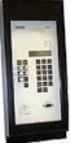 ABB Automation Inc. Substation Automation and Protection Division Coral Springs, FL 33065 Instruction Leaflet 41-348.11C Effective: November 1999 Supersedes I.L. 41-348.11B, Dated August 1986 ( ) Denotes
SPECIFICATIONS. Recommended Battery sizes (Maintenance) AUTOMOTIVE 150 650CCA 150 750CCA MARINE 200 700MCA 200 850MCA DEEP CYCLE 17 55Ah 17 80Ah
 WARNING Read the operating instructions before use. Lead Acid Batteries can be dangerous. Ensure no sparks or flames are present when working near batteries. Eye protection should be used. Make sure the
Application Manual. Nickel Cadmium 11/06/01 Page 1 of 12
 Page 1 of 12 Nickel Cadmium Batteries Application Manual The nickel-cadmium battery is a remarkable device. More than fifty years of successful use has proved this point. Nickel-cadmium batteries may be
12 Volt 30 Amp Digital Solar Charge Controller Installation & Operation Manual
 12 Volt 30 Amp Digital Solar Charge Controller Installation & Operation Manual This 30Amp charge controller is designed to protect your 12Volt Lead-acid or Gel-cell battery from being overcharge by solar
Solar Wind Microhydro Water Pumping Inverters Batteries Professional system design and installation
 Solar Wind Microhydro Water Pumping Inverters Batteries Professional system design and installation BATTERY CHARGING GUIDELINES FOR GLOBAL/DAVIDSON TUBULAR PLATE BATTERIES Introduction Your Global/Davidson
Sample. What Electricity Can Do LESSON 2. Overview and Objectives. Background
 What Electricity Can Do Overview and Objectives Background Light bulbs are such an integral part of everyday life that most people can t imagine being without them. Because people tend to take light bulbs
How to connect to a Class II router using a mobile-phone data cable specifically for Solwise & Safecom routers
 USB to router s serial port How to connect to a Class II router using a mobile-phone data cable specifically for Solwise & Safecom routers by Neo at RouterTech.Org Introduction Routers based on the AR7RD/AR7WRD
GROUND DETECTION CIRCUITS FOR STATIONARY APPLICATIONS (IN PLAIN DOWN TO EARTH LANGUAGE)
 GROUND DETECTION CIRCUITS FOR STATIONARY APPLICATIONS (IN PLAIN DOWN TO EARTH LANGUAGE) Matthew Theriault Designer Hindle Power Inc. Easton, PA SCOPE AND PURPOSE OF THE PAPER Why do we bother to monitor
Table of Contents. The Basics of Electricity 2. Using a Digital Multimeter 4. Testing Voltage 8. Testing Current 10. Testing Resistance 12
 Table of Contents The Basics of Electricity 2 Using a Digital Multimeter 4 IDEAL Digital Multimeters An Introduction The Basics of Digital Multimeters is designed to give you a fundamental knowledge of
Total solder points: 205 Difficulty level: beginner 1 2 3 4 5 advanced UNIVERSAL BATTERY CHARGER / DISCHARGER K7300 ILLUSTRATED ASSEMBLY MANUAL
 Total solder points: 205 Difficulty level: beginner 1 2 3 4 5 advanced UNIVERSAL BATTERY CHARGER / DISCHARGER K7300 Automatic (dis)charging of both NiCd and NiMH batteries. ILLUSTRATED ASSEMBLY MANUAL
Panasonic Microwave Oven Inverter HV Power Supply
 Panasonic Microwave Oven Inverter HV Power Supply David Smith VK3HZ (vk3hz (*at*) wia.org.au) This particular power supply comes from a circa-2000 Panasonic Microwave model NN-S550WF. Nearly all Panasonic
Table Of Contents 6 6 6 7 7 8 8 9-11 12 12-13 14 15 16 17 18 19 20-21 22 22 23 24 24 24
 USER S GUIDE Table Of Contents Package Contents Accessories: Sold Separately Product Specifications Intended Use Compatibility ResMed Device Warning Battery Pack Run Times Power Backup Usage Getting Started
Height w/o Terminals (in)
 EaglePicher Technologies, LLC Commercial Power P.O. Box 47 Joplin, MO 6482 (417) 623-8 [email protected] Carefree Sealed Lead Acid (SLA) MSDS EaglePicher s Carefree lead acid batteries are
Dashboard Digital Voltmeter
 Dashboard Digital Voltmeter...November, 2002 This project is helpful to anyone who drives an automobile. I had found this project at the local libary... in an old publication. I made it and it worked fine.
Experiment #5, Series and Parallel Circuits, Kirchhoff s Laws
 Physics 182 Summer 2013 Experiment #5 1 Experiment #5, Series and Parallel Circuits, Kirchhoff s Laws 1 Purpose Our purpose is to explore and validate Kirchhoff s laws as a way to better understanding
Bosch C3 and C7 Battery Chargers: Smart, safe and simple to use
 Bosch C3 and C7 Battery Chargers: Smart, safe and simple to use The smart charger for many applications Did you know? The intelligent characteristics of the Bosch C3 and C7 battery chargers enable them
Constant Voltage Charger Selection for VRLA Batteries
 TECHNICAL BULLETIN 41-2129 Constant Voltage Charger Selection for VRLA Batteries Please Note: The information in this technical bulletin was developed for C&D Dynasty 12 Volt VRLA products. While much
Lab E1: Introduction to Circuits
 E1.1 Lab E1: Introduction to Circuits The purpose of the this lab is to introduce you to some basic instrumentation used in electrical circuits. You will learn to use a DC power supply, a digital multimeter
Build A Video Switcher. Reprinted with permission from Electronics Now Magazine September 1997 issue
 Build A Video Switcher Reprinted with permission from Electronics Now Magazine September 1997 issue Copyright Gernsback Publications, Inc.,1997 BUILD A VIDEO SWITCHER FRANK MONTEGARI Watch several cameras