
CONNECT Nav CONNECT Nav+
|
|
|
- Linette Gilmore
- 9 years ago
- Views:
Transcription
1 CONNECT Nav CONNECT Nav+

2 The car is fitted with the infotelematic CONNECT system, designed in accordance with the specific features of the passenger compartment and with a personalised design that blends with the styling of the dashboard. The system is installed in a user-friendly position for the driver and the graphics on the front panel make it easy to quickly locate the controls which facilitates the use of them. To increase safety against theft, the set is fitted with a protection system that allows the use of it only on the vehicle on which it was fitted originally. The pages that follow contain the instructions for use, which we advise you to read carefully and always keep within reach (e.g. in the glove compartment). So, enjoy your reading and have a good journey. WARNING The CONNECT system must be used keeping full control of the car; in the case of doubt in the use of the functions, it is necessary to stop before performing the various operations. WARNING For the navigation system only use the original CD provided with the car or in any case other CDs of the same brand. Texts, illustrations, and specifications shown herein are based on the CONNECT system, as it appears at the date when this Owner s Handbook was printed. In the endless effort to improve its products, Alfa Romeo can add technical changes during production, and technical specifications may hence undergo changes without a preliminary warning. For detailed information please contact the factory business network.

3

4 CONNECT Nav QUICK GUIDE... 5 SWITCHING THE SYSTEM ON AND OFF... 5 DARKENING THE MONITOR... 6 CHOOSING AND ACTIVATING MENU FUNCTIONS... 6 VOLUME ADJUSTMENT... 6 MAIN SCREEN (MAIN)... 7 RADIO SCREEN (AUDIO)... 8 TELEPHONE SCREEN (TEL) NAVIGATION (NAV) ON-BOARD COMPUTER (TRIP) INFORMATION AND ASSISTANCE SERVICES (TARGASYS) ADVICE ROAD SAFETY RECEPTION CONDITIONS CARE AND MAINTENANCE SYSTEM SOFTWARE UPDATING COMPACT DISCS CONTROLS CONTROLS ON FRONT PANEL CONTROLS ON STEERING WHEEL GENERAL INFORMATION IMPORTANT NOTES FOR USE AND ROAD SAFETY SWITCHING THE SYSTEM ON AUTOMATIC SWITCHING ON MANUAL SWITCHING ON SYSTEM POWER OFF DEACTIVATION INDEPENDENT OF IGNITION KEY DEACTIVATION DEPENDENT ON IGNITION KEY PROTECTION AGAINST THEFT POWER-ON AUTHENTICATION PROCEDURE MAIN MODE SETUP FUNCTION CONNECT LANGUAGE CHANGE PROCEDURE AUDIO SCREENS OPTIONS AND FUNCTIONS FM RADIO MANUAL TUNING AUTOMATIC TUNING MANUAL STATION STORAGE HEARING STORED STATIONS AUDIO SETUP FUNCTION (AUDIO ADJUSTMENTS) TA-TRAFF.ANN. FUNCTION (TRAFFIC INFORMATION) AF-ALT.FREQ. FUNCTION (SEEKING ALTERNATIVE FREQUENCIES) RDS FUNCTION PTY-PROG.TYPE FUNCTION (CHOOSING A TYPE OF PROGRAMME) AUTOSTORE FUNCTION (AUTOMATIC STATION STORAGE) BAND SCAN FUNCTION PRESET SCAN FUNCTION RADIO SET-UP FUNCTION LOC/DX FUNCTION (TUNER SENSITIVITY ADJUSTMENT) MONO/STEREO FUNCTION REGIONAL FUNCTION NEWS FUNCTION AM RADIO CD PLAYER CD SHUFFLE FUNCTION (RANDOM PLAYBACK) CD-TA TRAFF.ANN. FUNCTION (TRAFFIC INFORMATION) CD REPEAT FUNCTION CD PROG FUNCTION CD SCAN FUNCTION (BRIEF PLAYBACK) CD COMPRESSION FUNCTION CD SETUP MENU AUDIO SETUP FUNCTION (AUDIO ADJUSTMENTS) CD-CHANGER MODE AUDIO SETUP FUNCTION (AUDIO ADJUSTMENTS) CDC SHUFFLE FUNCTION (RANDOM PLAYBACK) CDC TA-TRAFF.ANN. FUNCTION (TRAFFIC INFORMATION) CDC SCAN FUNCTION (BRIEF PLAYBACK) CDC COMPRESSION FUNCTION

5 CONNECT Nav 4 AUDIO SETTINGS MENU INFO BASS ADJUSTMENT (BASS) TREBLE ADJUSTMENT (TREBLE) LOUDNESS FUNCTION EQUALIZER FUNCTION MANUAL EQUALIZER FUNCTION AUTO VOL.CONT. FUNCTION (VOLUME CHANGING WITH SPEED) BALANCE/FADER FUNCTION (SOUND DISTRIBUTION) AUTOCLIP DETECT FUNCTION (DYNAMIC DISTORTION LIMITER) MAX. VOL. AT ON FUNCTION MP3 MODE MAIN SCREEN OPTIONS AND FUNCTIONS SETUP FUNCTION (AUDIO ADJUSTMENTS) DEFINE PLAYLIST FUNCTION PLAYLIST FUNCTION COMPRESSION FUNCTION TA-TRAFF.ANN. FUNCTION (TRAFFIC INFORMATION) SCAN FUNCTION (BRIEF PLAYBACK) SHUFFLE FUNCTION (RANDOM PLAYBACK) PLAYING THE PLAYLIST PLAYING MP3 CD DEFINE PLAYLIST PLAYLIST VIEW PLAYLIST CELLULAR TELEPHONE GENERAL INFORMATION PRELIMINARY OPERATIONS ENTERING AND EXITING THE TELEPHONE MODE TELEPHONE CARD INSERTION PIN CODE ENTRY INCOMING CALLS OUTGOING CALLS DIALLING A SERVICE NUMBER FREQUENT NUMBERS FUNCTION LAST CALLS RECEIVED FUNCTION LAST NUMBERS CALLED FUNCTION DIRECTORY FUNCTION WAP FUNCTION VOICE MEMO FUNCTION SMS (short message service) OPTIONS FUNCTION PHONE SETTINGS FUNCTION NAVIGATOR (NAV) GENERAL INFORMATION NAVIGATION CD-ROM READER MAIN NAVIGATION SCREEN SELECT ADDRESS SELECT ADDRESS: ADDRESS SELECT ADDRESS: POINTS OF INTEREST SELECT ADDRESS: LAST DESTINATIONS SELECT ADDRESS: DIRECTORY SELECT ADDRESS: RDS-TMC SELECT ADDRESS: HOME1 HOME INFO GPS INFO ROUTE INFO HIGHWAY INFO DETOUR SET ROUTE DESTINATION AND ROUTE VOICE DIRECTORY ON-BOARD COMPUTER (TRIP) TRIP SUBMENU GENERAL TRIP TRIP B VOICE RECOGNITION (where fitted) GENERAL INFORMATION VOICE COMMANDS EXAMPLES (voice commands) INFORMATION AND ASSISTANCE SERVICES MEDICAL ADVICE ROADSITE ASSISTANCE PERSONAL NUMBER EMERGENCY SETTINGS CALLS FOR MEDICAL ADVICE OR ROADSIDE ASSISTANCE INFOMOBILITY FAULTS INTERNAL FAULTS FAULTS DUE TO OVERHEATING

6 The system has a very simple and intuitive interface: therefore the few instructions given in this chapter are enough to be able to quickly use the main system functions. You are however recommended to read this annex completely, to learn all the functions of the CON- NECT system and the corresponding notes and precautions for use. In using the system, follow the options provided by the various pages of the menus that are shown on the screen, after activating the main page screen of a function by briefly pressing the corresponding button. Items that cannot be selected are always shown in grey. QUICK GUIDE The main system functions are activated by pressing the following buttons: MAIN SCREEN = MAIN button RADIO WITH CD PLAYER/AUDIO/ MP3 = AUDIO button TELEPHONE = TEL button VOICE COMMANDS (*) = ô button VOICE MESSAGE RECORDING = ô button NAVIGATION = NAV button ON-BOARD COMPUTER = TRIP button INFORMATION AND ASSISTANCE SER- VICES (**) = button. (*) For the use of voice commands, please refer to the corresponding chapter of this annex. For immediate use of the system, use the manual controls. (**) The activation of calls for assistance is subordinate to whether the cell phone is working and correctly supplied electrically. Therefore in the event of accidents or damage to the car it might not be available. SWITCHING THE SYSTEM ON AND OFF AUTOMATIC SWITCHING ON: starting the engine (key at MAR). MANUAL SWITCHING ON: press the left knob. AUTOMATIC SWITCHING OFF (subject to setting, see paragraph System power off"): turning the key to STOP (switching off the engine). Switch off is delayed by 20 minutes if the system has a destination entered or a call is in progress. MANUAL SWITCHING OFF: press the left knob. CONNECT Nav 5

7 CONNECT Nav DARKENING THE MONITOR DARKENING THE MONITOR: press the MAIN button at length. REACTIVATING THE MONITOR: press the MAIN button briefly. MONITOR BRIGHTNESS ADJUSTMENT: display the main page (MAIN button), press the right knob and select Connect. CHOOSING AND ACTIVATING MENU FUNCTIONS CHOOSING FUNCTIONS: turn the right knob. CONFIRMING THE FUNCTION CHOSEN: press the right knob. RETURN TO PREVIOUS SCREEN SAVING THE NEW SETTINGS: choose and confirm OK. VOLUME ADJUSTMENT HIGHERING VOLUME: turn the left knob clockwise. LOWERING VOLUME: turn the left knob counter-clockwise. SWITCHING THE RADIO OFF: press the AU- DIO button at length. SWITCHING THE RADIO ON: press the AU- DIO button briefly. RETURN TO PREVIOUS SCREEN SAVING THE PREVIOUS SETTINGS: press ESC. TELEPHONE VOLUME ADJUSTMENT: turn the left knob during the call. NAVIGATOR INFORMATION VOLUME AD- JUSTMENT: turn the left knob during the voice information and if necessary press RPT to repeat the voice information and adjust the volume. CUTTING OFF NAVIGATOR INFORMATION (NAV MUTE): press the NAV button at length. RESETTING NAVIGATOR INFORMATION: press the NAV button at length. 6

8 MAIN SCREEN (MAIN) ACTIVATING THE PAGE: briefly press the MAIN button. RADIO INFORMATION DISPLAYED: RADIO Wavelength and station chosen Name or frequency of broadcaster TA : traffic bulletin function activated AF : seek alternative frequencies function activated LOC : low tuning sensitivity DX : high tuning sensitivity NEWS, etc. : PTY programme (if provided by radio stations) STEREO : stereophonic transmission CD PLAYER Number of current track Time elapsed from start of track or CD. CD-CHANGER Number of current CD Number of current track Time elapsed from start of track or CD. TELEPHONE Field intensity detected Name of network access provider Notice of lack of network access provider Telephone deactivated notice (SIM card not inserted) Forward call on/off Presence and number of SMS messages received and not read SOS call in progress notice Available credit (if made available by network access provider) Other person s name (if present in telephone directory) or phone number (for calls received, if available) Caller s number (if made available by network access provider) Time elapsed from start of call (in seconds). NAVIGATOR Display of next two manoeuvres Distance from point of manoeuvres displayed CONNECT Nav MONO : non stereophonic transmission TP : station that broadcasts traffic bulletins EON : station belonging to a circuit of broadcasters who transmit traffic bulletins. 7

9 CONNECT Nav RADIO SCREEN (AUDIO) PAGE ACTIVATION: briefly press the AUDIO button. AUDIO SOURCE CHOICE (FM1, FM2, FM3, LW, MW, CD - if inserted, CD-Changer - if installed): repeatedly press the SRC button. AUDIO PARAMETERS ADJUSTMENT: Audio setup function. Treble = treble tones Bass = bass tones Loudness (excluding versions with HI-FI BOSE system) = improves listening at low volume Equalizer (excluding versions with HI- FI BOSE system) = predefines audio parameter settings Manual equalizer (excluding versions with HI-FI BOSE system) = personalised audio parameter setting Bal/Fad. = audio distribution. RADIO CHOOSING WAVE RANGE: repeatedly press the SRC button. MANUAL STATION SEARCH: press at length the * or # keys of the telephone keypad to start the manual station search, lowering or highering the frequency respectively. AUTOMATIC STATION SEARCH: press at length the * or # keys of the telephone keypad to start the automatic station search, lowering or highering the frequency respectively. AUTOMATIC STATION STORAGE: Autostore function. MANUAL STATION STORAGE: keep one of the buttons numbered from 1 to 6 pressed. CHOOSING STORED STATIONS: briefly press one of the buttons numbered from 1 to 6 pressed. TO RECEIVE TRAFFIC INFORMATION: select the TA/AF function. AUTOMATIC SEARCH FOR STRONGEST FRE- QUENCY OF CURRENT STATION: select the TA/AF function. SEARCH FOR ALL STATIONS: select the LOC/DX function. SEARCH FOR STATIONS WITH STRONGEST SIGNAL: select the LOC/DX function. SEARCH FOR STATIONS CLASSIFIED BY TYPE OF PROGRAMME PTY: select the PTY function. STEREO RECEPTION: select the St/Mono function. MONO RECEPTION (WEAK STATIONS): select the St/Mono function. 8
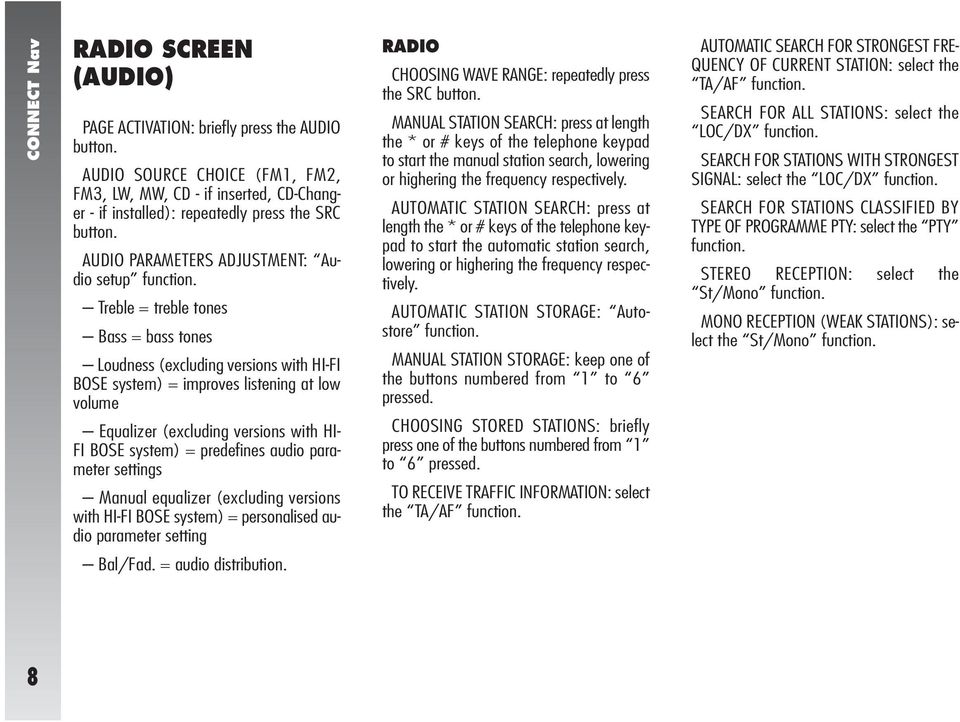
10 CD PLAYER CHOOSING CD SOURCE (if an audio CD is inserted): repeatedly press the SRC button. CHOOSING PREVIOUS TRACK: briefly press the * key of the telephone keypad. CHOOSING NEXT TRACK: briefly press the # key of the telephone keypad. PLAY/STOP PLAYING CD: briefly press the 0 key of the telephone keypad. PAUSE WHEN PLAYING CD: press the 0 key of the telephone keypad at length. PLAYING THE FIRST 10 SECONDS OF ALL TRACKS: Scan function. RANDOM TRACK PLAYING: Shuffle function. CHOICE OF DISPLAYED INFORMATION: firstly select CD setup and then CD Time mode. Available options: time elapsed since start of track ( Track elapsed time ) (*) total elapsed time since start of CD ( Total elapsed time ) (*) total time remaining to the end of CD ( Total remaining time ) (*) Option not available when the Shuffle function is activated. CONTINUOUS TRACK PLAYBACK: firstly select CD repeat and then Repeat one. CONTINUOUS PLAYBACK OF WHOLE CD: firstly select CD repeat and then Repeat all. EJECT CD: press. CD-CHANGER (where fitted) CHOOSING CDC SOURCE: press repeatedly the SRC button. CHOOSING PREVIOUS CD: briefly press key 7 of the telephone keypad. CHOOSING NEXT CD: briefly press key 9 of the telephone keypad. CHOOSING PREVIOUS TRACK: briefly press the * key of the telephone keypad. CHOOSING NEXT TRACK: briefly press the # key of the telephone keypad. PLAYING/STOPPING CD: briefly press the 0 key of the telephone keypad. PAUSE WHEN PLAYING CD: press the 0 key of the telephone keypad at length. PLAYING THE FIRST 10 SECONDS OF ALL THE TRACKS OF CURRENT CD: Scan function. RANDOM PLAYING OF THE TRACKS ON THE CURRENT CD: Shuffle function. CHOICE OF INFORMATION DISPLAYED: firstly select CDC setup and then CDC Time mode. Available options: time elapsed since start of track ( Track elapsed time ) CONNECT Nav 9

11 CONNECT Nav TELEPHONE SCREEN (TEL) PAGE ACTIVATION: briefly press the TEL button. INSERTING THE SIM CARD: insert the card in the special slot with the integrated chip at the front right in relation to the direction of travel, until it is held in. WARNING When necessary, only use the SIM card adapter provided with the car; in the event of loss, breakage or for buying other adapters, contact Alfa Romeo Authorised Services. WARNING Before removing or inserting the SIM card, turn off the telephone by prolonged pressing of "TEL" button (19- fig.1), or the system by pressing knob (16-fig. 1). REMOVING THE SIM CARD: press the card in its housing and release. ENTERING THE PIN CODE: enter the code with the phone keypad and confirm pressing the right knob. DIALLING THE NUMBER: briefly press the buttons of the telephone keypad. ENTERING THE INTERNATIONAL CODE: press the 0 key at length. FORWARDING STORED NUMBERS (frequent numbers): press one of the keys numbered from 1 to 9 at length. FORWARDING THE CALL: briefly press the ò button. TO STOP FORWARDING THE CALL: press the ESC button. ENDING THE CALL: briefly press the ò button. ACCEPTING THE INCOMING CALL: briefly press the ò button. REFUSING THE INCOMING CALL: press the ò button at length. LIST WITH 9 MORE FREQUENT NUMBERS USED: Frequent numbers function. TELEPHONE DIRECTORY: Directory function. LIST OF LAST 10 CALLS RECEIVED: Last received function. LIST OF LAST 10 CALLS MADE: Last called function. SHORT MESSAGE SERVICE (SMS): Messages function. CHOICE OF NETWORK OPERATOR: choose the Network operator function and choose an option: Selection (to define the criteria for choosing the operator) Operator (to choose a determinate operator, when possible). SETTING TELEPHONE PARAMETERS: choose Settings then choose the options: Ringer vol. (call waiting volume) Redial (automatic repetition of number dialled, if engaged) Call forwarding (to forward incoming calls) Call forwarding No. (number to which calls will be forwarded) Enable call waiting (to activate call forwarding set). INFORMATION ABOUT NETWORK OPERA- TOR: Information function. 10

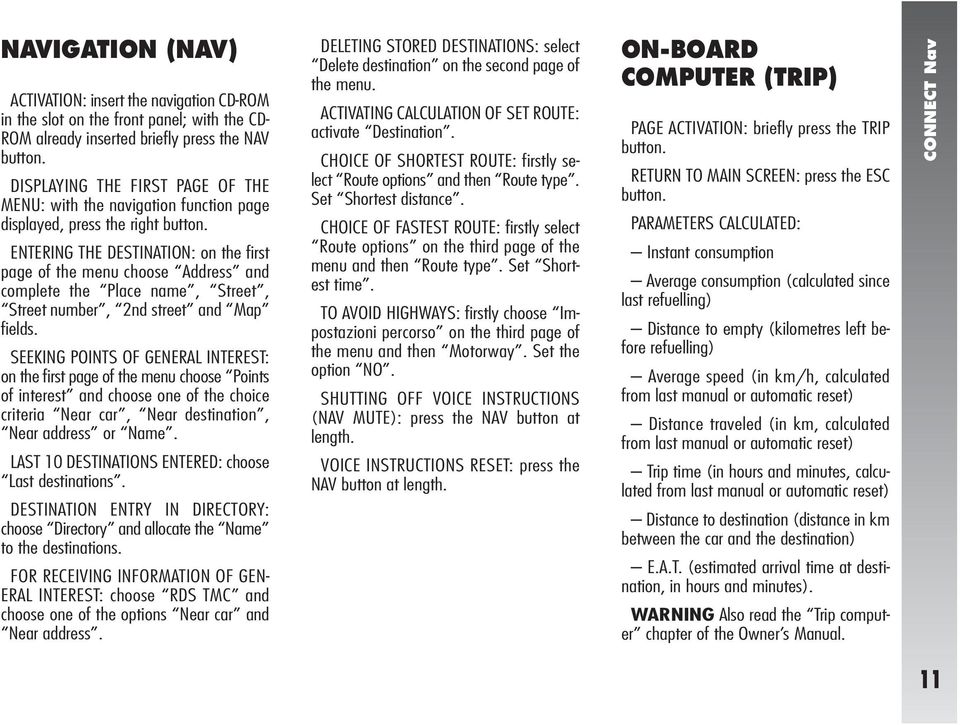
12 NAVIGATION (NAV) ACTIVATION: insert the navigation CD-ROM in the slot on the front panel; with the CD- ROM already inserted briefly press the NAV button. DISPLAYING THE FIRST PAGE OF THE MENU: with the navigation function page displayed, press the right button. ENTERING THE DESTINATION: on the first page of the menu choose Address and complete the Place name, Street, Street number, 2nd street and Map fields. SEEKING POINTS OF GENERAL INTEREST: on the first page of the menu choose Points of interest and choose one of the choice criteria Near car, Near destination, Near address or Name. LAST 10 DESTINATIONS ENTERED: choose Last destinations. DESTINATION ENTRY IN DIRECTORY: choose Directory and allocate the Name to the destinations. FOR RECEIVING INFORMATION OF GEN- ERAL INTEREST: choose RDS TMC and choose one of the options Near car and Near address. DELETING STORED DESTINATIONS: select Delete destination on the second page of the menu. ACTIVATING CALCULATION OF SET ROUTE: activate Destination. CHOICE OF SHORTEST ROUTE: firstly select Route options and then Route type. Set Shortest distance. CHOICE OF FASTEST ROUTE: firstly select Route options on the third page of the menu and then Route type. Set Shortest time. TO AVOID HIGHWAYS: firstly choose Impostazioni percorso on the third page of the menu and then Motorway. Set the option NO. SHUTTING OFF VOICE INSTRUCTIONS (NAV MUTE): press the NAV button at length. VOICE INSTRUCTIONS RESET: press the NAV button at length. ON-BOARD COMPUTER (TRIP) PAGE ACTIVATION: briefly press the TRIP button. RETURN TO MAIN SCREEN: press the ESC button. PARAMETERS CALCULATED: Instant consumption Average consumption (calculated since last refuelling) Distance to empty (kilometres left before refuelling) Average speed (in km/h, calculated from last manual or automatic reset) Distance traveled (in km, calculated from last manual or automatic reset) Trip time (in hours and minutes, calculated from last manual or automatic reset) Distance to destination (distance in km between the car and the destination) E.A.T. (estimated arrival time at destination, in hours and minutes). WARNING Also read the Trip computer chapter of the Owner s Manual. CONNECT Nav 11
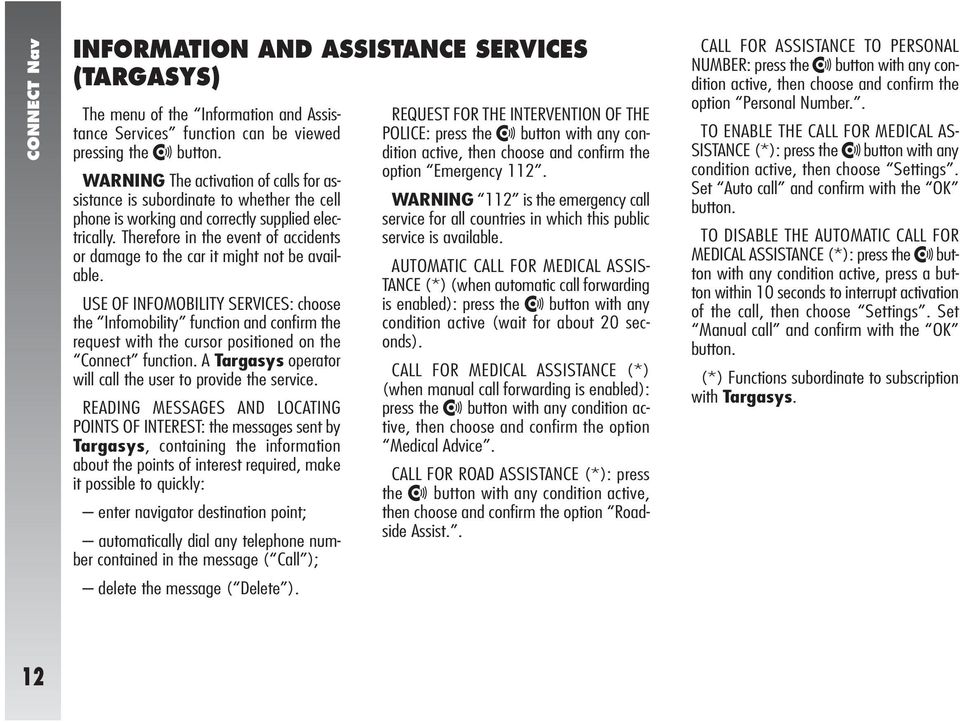
13 CONNECT Nav INFORMATION AND ASSISTANCE SERVICES (TARGASYS) The menu of the Information and Assistance Services function can be viewed pressing the button. WARNING The activation of calls for assistance is subordinate to whether the cell phone is working and correctly supplied electrically. Therefore in the event of accidents or damage to the car it might not be available. USE OF INFOMOBILITY SERVICES: choose the Infomobility function and confirm the request with the cursor positioned on the Connect function. A Targasys operator will call the user to provide the service. READING MESSAGES AND LOCATING POINTS OF INTEREST: the messages sent by Targasys, containing the information about the points of interest required, make it possible to quickly: enter navigator destination point; automatically dial any telephone number contained in the message ( Call ); delete the message ( Delete ). REQUEST FOR THE INTERVENTION OF THE POLICE: press the button with any condition active, then choose and confirm the option Emergency 112. WARNING 112 is the emergency call service for all countries in which this public service is available. AUTOMATIC CALL FOR MEDICAL ASSIS- TANCE (*) (when automatic call forwarding is enabled): press the button with any condition active (wait for about 20 seconds). CALL FOR MEDICAL ASSISTANCE (*) (when manual call forwarding is enabled): press the button with any condition active, then choose and confirm the option Medical Advice. CALL FOR ROAD ASSISTANCE (*): press the button with any condition active, then choose and confirm the option Roadside Assist.. CALL FOR ASSISTANCE TO PERSONAL NUMBER: press the button with any condition active, then choose and confirm the option Personal Number.. TO ENABLE THE CALL FOR MEDICAL AS- SISTANCE (*): press the button with any condition active, then choose Settings. Set Auto call and confirm with the OK button. TO DISABLE THE AUTOMATIC CALL FOR MEDICAL ASSISTANCE (*): press the button with any condition active, press a button within 10 seconds to interrupt activation of the call, then choose Settings. Set Manual call and confirm with the OK button. (*) Functions subordinate to subscription with Targasys. 12
14 ROAD SAFETY You are recommended to learn how to use the different functions of the CONNECT system and in particular of the radio (e.g. storing stations) before starting to drive. ADVICE RECEPTION CONDITIONS Reception conditions change constantly when driving. Reception can be disturbed by the presence of mountains, buildings, bridges particularly when far away from the broadcaster received. WARNING When receiving traffic information the volume might be higher than normal. Be careful not to knock the display with pointed or hard objects and avoid touching with the hands. Do not press on the display when cleaning. CONNECT Nav Too high a volume when driving can put the driver s life at risk and that of other people. Therefore the volume should always be adjusted in such a way that it is always possible to hear the noises of the surrounding environment (e.g. horns, ambulance, police sirens, etc.). CARE AND MAINTENANCE The structure of the system ensures long years of operation with no need for particular maintenance. In the event of a fault, contact Alfa Romeo Authorised Services. Some care must however be taken to ensure the complete efficiency of the system: the monitor is sensitive to scratching, liquid detergents and UV rays; liquids that penetrate inside may damage the device irreparably. Clean the front panel and display only using a soft, dry antistatic cloth. Cleaning and polishing products may damage the surface. WARNINGS In the event of a fault the CONNECT system should be checked and repaired only by Alfa Romeo Authorised Services. In case of particularly low temperatures the dispositive of protection of the system may come into action suspending operation until the passenger compartment temperature falls to acceptable levels. 13

15 CONNECT Nav SYSTEM SOFTWARE UPDATING When new versions are available for the software of the CONNECT system navigation module, the system can be updated to benefit of the improvements made to controlling certain functions. Software updating is to be seen to by specialised staff of the Alfa Romeo network. COMPACT DISCS If a Compact Disc is used on the sound system, remember that the presence of dirt or marks on Compact Discs may cause skipping when playing and poor sound quality. The same happens if Compact Discs are bent by accident. WARNING Never use 8 cm audio or MP3 CDs, even with the specific adapter, since this format will damage the system. To obtain optimum playing conditions we give the following advice: Only use Audio Compact Discs with the brand: Carefully clean all Compact Discs of any fingerprints and dust using a soft cloth. Support Compact Discs on the edges and clean from the centre outwards. Never use chemical products for cleaning (e.g. spray cans, antistatics or thinners) as they might damage the surface of Compact Discs. After listening to them put Compact Discs back in their boxes to avoid marking or scoring which could cause skipping when playing. Do not expose Compact Discs to direct sunlight, high temperatures or damp for prolonged lengths of time to prevent them from bending. Do not stick labels or write on the recorded surface of Compact Discs with pens or pencils. To remove a Compact Disc from its container, press on the centre and raise the disc holding carefully from the edges. Removing the disc Proper way to hold the compact disc Always hold a Compact Disc by the edge. Never touch the surface. To remove fingerprints and dust, use a soft cloth starting from the centre of the Compact Disc towards the circumference. No New discs may be rough around the edges. When using these discs the player might not work or the sound might skip. To remove roughness from the edge of a disc use a ballpoint pen, etc. Ball-point pen Roughness 14

16 Obtaining the best audio performance depends on the use of original CD supports. Correct operation is not ensured if not correctly written CD-R/RW supports and/or with capacity higher than 650 MB are used. WARNING if the CD is copy-protected, the system may need few seconds before starting to play it. WARNING Do not use the protective sheets for CDs in commerce or discs with stabilisers, etc. as they might get stuck in the internal mechanism and damage the disc. Notes about Compact Discs Do not stick labels on the surfaces of a Compact Disc or write on the surface with pens or pencils. No Do not use highly scratched, cracked or distorted Compact Discs. This could damage the player or prevent it from working properly. No No WARNING To restrict indiscriminate audio CD copy, Record Companies have implemented different copy-protection devices (seven at least are know up to today), to prevent reading on PCs. The implementation of these copy-protection devices has originated the production of audio CDs NOT "compliant" with Audio CD standard and without Audio CD logo. Reading of these CDs could therefore be impossible, not only on PCs, but also on other kind of players. According to the CD mechanism being used, reading impossibility can take place as follows: no playing; CD not recognised (dedicated failure message on the display); temporary and/or partial sound system stop (reset system by switching it off and on). CONNECT Nav No Do not expose Compact Discs to direct sunlight or any other source of heat. Do not use solvents such as stain removers, antistatic sprays or thinners in commerce for cleaning Compact Discs. 15

17 CONNECT Nav CONTROLS A0A2150g 16 fig. 1

18 CONTROLS ON FRONT PANEL Some controls have multiple functions which depend on the system operating conditions active. Turning on the function chosen is in some cases controlled by the length of time the button is pressed (brief or prolonged press), as shown in the following table: Legend Brief press on button Long press on button (less than 1 second) (over 1 second) Numbers 1, 2, 3, 4, 5, 6 of telephone keypad. Storing stations no Calling stored stations. 7 Number 7 of telephone keypad Selecting previous CD of the CD-Changer 8 Number 8 of telephone keypad 9 Number 9 of telephone keypad Selecting next CD of the CD-Changer 10 Play / stop CD/CDC. Pause in playing CD/CDC Number 0 of telephone keypad * Symbol * of telephone keypad Radio: backward radio frequency Radio: frequency skip skip, i.e. jump backward to (50 khz (FM)/1 khz (AM)) to the previous the first tunable radio station. tunable radio station CD: previous track skip. CD: previous track skip. MP3: shift to previous MP3: previous track skip. not empty folder 12 - # Symbol # of telephone keypad Radio: forward radio frequency Radio: frequency skip skip, i.e. jump forward to (50 khz (FM) / 1 khz (AM)) to the next the first tunable radio station to the next tunable radio station. CD: next track skip. CD: next track skip. MP3: shift to successive MP3: next track skip. not empty folder CONNECT Nav 17

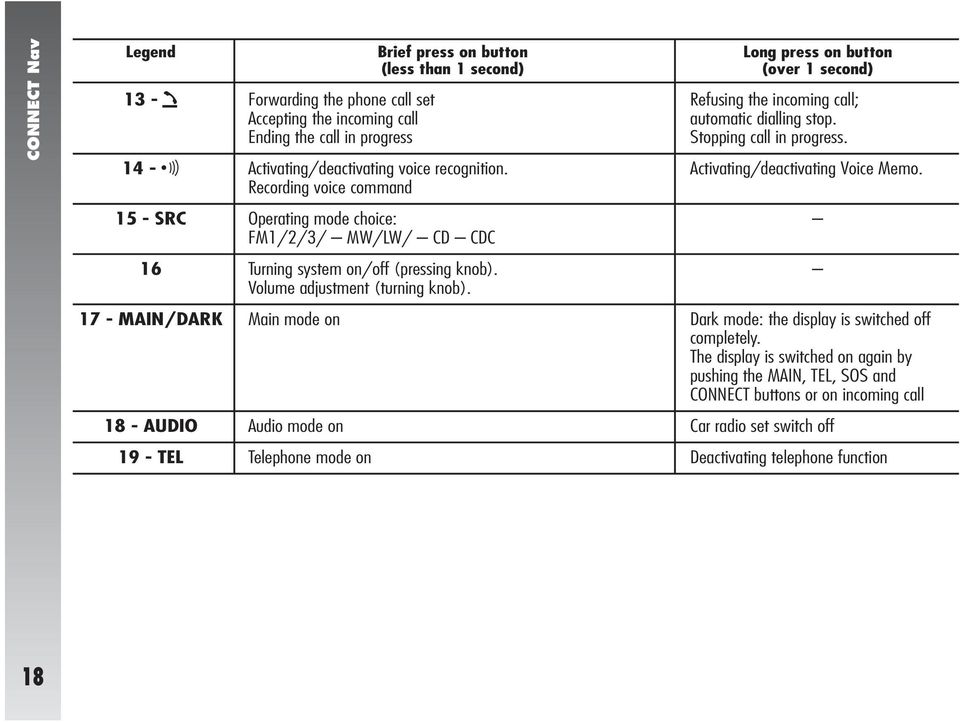
19 CONNECT Nav Legend Brief press on button Long press on button (less than 1 second) (over 1 second) 13 - ò Forwarding the phone call set Refusing the incoming call; Accepting the incoming call automatic dialling stop. Ending the call in progress Stopping call in progress ô Activating/deactivating voice recognition. Activating/deactivating Voice Memo. Recording voice command 15 - SRC Operating mode choice: FM1/2/3/ MW/LW/ CD CDC 16 Turning system on/off (pressing knob). Volume adjustment (turning knob) MAIN/DARK Main mode on Dark mode: the display is switched off completely. The display is switched on again by pushing the MAIN, TEL, SOS and CONNECT buttons or on incoming call 18 - AUDIO Audio mode on Car radio set switch off 19 - TEL Telephone mode on Deactivating telephone function 18
20 Legend Brief press on button Long press on button (less than 1 second) (over 1 second) 20 - NAV Navigation mode on Excluding navigator voice messages (NAV/MUTE function). Restoring voice messages 21 - TRIP Trip mode on 22 Select functions (turning the knob). Confirm function selected (pressing the knob) 23 - ESC This button lets the user get out from a selection list or jump from a submenu to an upper menu 24 - RPT Repetition of last voice instruction 25 - Display of Information and Assistance Services menu In the NAVIGATOR configuration Tel is not installed. Pressing the button will display the following message: SUBSCRIBED SERVICES NOT ENABLED Eject navigator CD ROM and audio CD. 27 Slot for SIM telephone card 28 Slot for CD 29 Daylight sensor CONNECT Nav 19

21 CONNECT Nav CONTROLS ON STEERING WHEEL (on request for versions/markets where applicable) (fig. 2) The main functions of the CONNECT system are repeated on the steering wheel, which facilitates control. 1. Volume highering button 2. Volume lowering button 3. Mute button (volume lowering) 4. Voice recognition button: voice recognition on/off (brief press) voice message storage (long press) 5. Radio frequency range select button (FM1, FM2, FM3, LW, MW) and available listening sources (Radio CD CD Changer if installed) 6. Multifunction key: Radio: forward radio frequency skip, i.e. jump forward to the first tunable radio station CD player: select next track CD-Changer: select next track of current CD 7. Multifunction key: Radio: backward radio frequency skip, i.e. jump backward to the first tunable radio station. CD player: select previous track CD-Changer: select previous track of current CD 8. Phone button: Take incoming call (brief press) Send last number called (brief press) Send last number dialled with phone keypad (prolonged press) Refuse incoming call (prolonged press) Close call in progress (brief press) Volume adjustment keys (1) and (2) The volume adjustment keys (1) and (2) change the volume of the audio source on at the time of adjustment. Mute key (3) This key (3) cyclically turns the Mute function on/off (3) which subdues the volume of the active source. Voice recognition key (4) Key (4) turns on voice recognition as follows: brief press on key: voice recognition on/off prolonged press on key: voice message storage. A0A2152b 20 fig. 2
22 Frequency range and listening source select key (5) To cyclically select the frequency ranges and listening sources available, briefly and repeatedly press the SRC key (5). The frequencies and sources available are: FM1, FM2, FM3, LW, MW, CD, CDC(*) (*) Only if the CD-Changer is connected. Multifunction keys (6) and (7) Using the multifunction keys (6) and (7) it is possible to call the preset radio stations in the frequency band set and select the next or previous track when playing a CD (*) or the CD-Changer (**). Press key (6) to choose the next stations or to listen to the next track of the CD (*) or the current CD in the CD-Changer (**). Press key (7) to choose the previous stations or to listen to the previous track of the CD (*) or the current CD in the CD-Changer (**). Telephone key (8) Key (8) activates the main functions of the telephone, depending on the conditions active when the key is pressed and the length of the press (brief or long). Brief press on key: taking the incoming call sending a call to the last number dialled previously sending a call to the number dialled using the phone keypad Long press on key: reject incoming call. GENERAL INFORMATION IMPORTANT NOTES FOR USE AND ROAD SAFETY The CONNECT with Radio/Telephone/Navigator/On-board computer allows you to easily control the main functions of the vehicle. To avoid creating dangerous situations for yourself and others in use of the system, please pay attention to the following points: the CONNECT system must be used keeping full control of the car; in the case of doubt in the use of the functions, it is necessary to stop before performing the various operations; use of the cell phone is prohibited near explosive substances. CONNECT Nav (*) Only if the audio CD is inserted. (**) Only if the CD-Changer is connected. 21
23 CONNECT Nav The navigation system allows you to reach your destination, indicating each route change stored on the navigation CD-ROM. In fact, in calculating the route, the system takes into account of all the information stored concerning the roads, advising the best route. However it cannot take account of the traffic, sudden interruptions or any other inconvenience. In carrying out any manoeuvre it is always necessary to follow the rules of the road, regardless of the advice given by the navigation system. If you leave the suggested route, the navigation system will calculate a new one and suggest it to you. SWITCHING THE SYSTEM ON The CONNECT system can be switched on in two different ways: Automatic switching on (called key on): with ignition key at MAR Manual switching on: by pressing knob (16-fig. 1). The navigation system helps the driver while driving by suggesting, vocally and graphically, the best route to be followed to reach the preset destination. The suggestions given by the navigation system do not exempt the driver from full responsibility due to driving behaviour and compliance with road and other traffic regulations. The responsibility for road safety always and anyway lies with the car s driver. AUTOMATIC SWITCHING ON Turning the ignition key to MAR will turn the CONNECT system on automatically, thus activating or making available all the functions described in this manual. 22
24 MANUAL SWITCHING ON With ignition key to STOP (called key off), press knob (16-fig. 1) or key (25-fig. 1), to switch the CONNECT system on, thus making available the following modules: MAIN AUDIO NAV TEL WARNING In this mode, the SETUP and TRIP modules can be activated; however, it will not be possible to validate any operation concerning parameter change, language change, units change and any other type of adjustment provided by the CON- NECT system. These limitations are normal when switching the system on manually by pressing the knob (16-fig. 1), since with engine off (key at STOP) the car data transmission devices are not operating. Turning the ignition key to MAR, will make all system functions active. SYSTEM POWER OFF The CONNECT system can be switched off in two different ways: deactivation independent of ignition key deactivation dependent on ignition key To choose the power-off mode, see the POWER OFF submenu in the SETUP menu. DEACTIVATION INDEPENDENT OF IGNITION KEY With this mode active, the CONNECT system can be turned off by pressing the knob (16-fig. 1). The display will show the message PLEASE WAIT WHILE SYSTEM TURNS OFF. DEACTIVATION DEPENDENT ON IGNITION KEY With this mode active, the CONNECT system can be switched off by turning the ignition key to STOP. However, with engine running or instrument panel on the system can be switched off by pressing knob (16-fig. 1). WARNING Switch off is delayed by 20 minutes if the system has a destination entered or a phone call is in progress. CONNECT Nav 23
25 CONNECT Nav PROTECTION AGAINST THEFT POWER-ON AUTHENTICATION PROCEDURE The CONNECT system is protected against theft and unauthorised installation by means of an authentication procedure. This kind of verification involves Body Computer Node (by means of messages exchanged on car network) and is performed at every power-on. This procedure does not take place if the CONNECT system is switched on by knob (16-fig. 1) or key (25-fig. 1) and ignition key is at STOP. In this case the CONNECT system is enabled to work normally, without authentication procedure. With ignition key at MAR if authentication fails, system starts working as usual, but the user is asked to enter the 4-digit Master Code to allow access to the standard functions. Master code is unique for each CONNECT system, and is stored in its memory and can not be reset. A specific screen allows code insertion (fig. 3). This screen is similar to that for PIN insertion request, but the dialog box itself is generated on a wholly blackened screen. Only the keys for entering the code and knob (16-fig. 1) are active. After having entered the code, a second screen notices the user that the authentication procedure is in progress (fig. 4). In case the correct code is provided, the system is fully enabled. On the contrary, if a wrong code is entered, screen is cleared and previous box is shown again with the following string: Incorrect code entered. Enter master code or turn off system with ON button. There is no upper limit to the number of wrong codes that can be entered. A0A2000g A0A2001g 24 fig. 3 fig. 4
26 MAIN MODE The MAIN mode is activated by pressing the MAIN key (17-fig. 1) located on the front panel. From the MAIN mode it is possible to display the Setup menu To display the Setup menu, display first the MAIN page then press the right knob (22- fig. 1), for further information refer to the Setup section. Press ESC (23-fig. 1) repeatedly to go back to the MAIN screen The main system modules displayed are the following: AUDIO TELEPHONE NAVIGATOR Three fields are displayed (fig. 5): Navigation: current car position (street and town), graphic symbol representing next manoeuvre and distance or position data if the Navigation CD is not inserted Telephone: GSM provider (if no provider is present, then the display shows FIND. If phone is switched off, the string will be TEL OFF (fig. 6), active call forward arrow-shaped icon, unread SMS message envelope-shaped icon, field strength status bar. Audio source: RDS string, tuned band and frequency, or CD playback track. SETUP FUNCTION The SETUP mode enables to set different car and CONNECT system operating modes and parameters. To enter the SETUP mode, press the MAIN button and then press the right knob (22- fig. 1); the CONNECT string will be displayed CONNECT To display the CONNECT screen, select CONNECT with the right knob (22- fig. 1), then press the knob to confirm. The display will show the following submenu: Video Power Off CONNECT Nav A0A2002g A0A2003g fig. 5 fig. 6 25
27 CONNECT Nav Video Selecting Video, by turning the right knob (22-fig. 1) and pressing it to confirm will display the following options: 1) Daytime brightness : enables to adjust the display brightness in day mode. To perform the adjustment, select the relevant icon rotating the right knob (22-fig. 1) and press it to confirm. Turn the right knob (22-fig. 1) clockwise to increase brightness and counterclockwise to decrease it. 2) Daytime contrast : to adjust contrast in day brightness mode. To perform the adjustment, select the relevant icon rotating the right knob (22-fig. 1) and press it to confirm. Turn the right knob (22-fig. 1) clockwise to increase contrast and counterclockwise to decrease it. 3) Nighttime brightness : enables to adjust the display brightness in night mode. To perform the adjustment, select the relevant icon rotating the right knob (22-fig. 1) and press it to confirm. Turn the right knob (22-fig. 1) clockwise to increase brightness and counterclockwise to decrease it. 4) Nighttime contrast : to adjust contrast in night brightness mode. To perform the adjustment, select the relevant icon rotating the right knob (22-fig. 1) and press it to confirm. Turn the right knob (22-fig. 1) clockwise to increase contrast and counterclockwise to decrease it. 5) Mode dimming/contrast : selecting this option by rotating the right knob (22- fig. 1) and pressing it to confirm, the following settings are possible: a) Automatic : enables to adjust automatically the day/night mode depending on car lights switching on/off. b) Day : activates day mode. c) Night : activates night mode. After selecting the required setting, press the right knob (22-fig. 1) to confirm. If the automatic mode is Day only day adjustment is displayed and the night one is deactivated. If the automatic mode is Night only night adjustment is displayed and the day one is deactivated. 26
28 Power OFF Select Power OFF rotating the right knob (22-fig. 1) and press it to confirm to access the type of setting that determines the CONNECT system switching off (dependent on or independent of ignition key). Available settings, only with ignition key at MAR, are the following: Deactivation dependent on ignition key Deactivation independent of ignition key Current activated setting will be highlighted. Select the required setting by rotating the right knob (22-fig. 1) and press it to confirm. LANGUAGE CHANGE PROCEDURE Language change procedure is performed through the instrument panel controls; see the relevant manual for further details. The following paragraphs describe CONNECT interactions with the user during the language change procedure. The user can set the required language: Italian, English, French, German, Spanish or Dutch. WARNING To change language, the Connect system must be ON. The language chosen will be valid for the displayed text, for voice recognition (where fitted) and for whatever information given by the system. As concerns the written text, the new language is active after giving confirmation through the instrument panel. For setting voice recognition language, the user will be requested to insert the Setup CD. WARNING Before starting the language change procedure, check whether the setup CD (provided with the car) is present and ready for use. The ignition key shall be at MAR. WARNING If the Setup CD is not inserted, the new set language will be operative for written text only. Voice recognition (and instruction coming from the system) language will be the default or the preset one. The display will show the following string: Insert Setup CD to change language of messages and voice commands. Press ESC to cancel. CONNECT Nav 27
29 CONNECT Nav If the Setup CD is inserted the following message will be permanently displayed: System will be unavailable for a few seconds and calls in progress will be terminated. Press ENTER to continue or ESC to cancel. Pressing the right knob (22-fig. 1) the following message will be permanently displayed: Message and voice command language change in progress. Please wait. The end of the procedure is indicated by the following message: Message and voice command language change concluded correctly. If some errors occur during language updating, the following message will be displayed: Language change failed. Please repeat procedure. This message asks the user to repeat the above procedure. Whenever the system is switched on turning the ignition key to MAR, the language module is checked and if the system finds a fault the following message is displayed: Voice commands and messages not available. Please change the language. This message asks the user to repeat language change procedure. The user shall set again the desired language according to previously described procedure. 28
30 The audio system is turned on by pressing briefly the AUDIO key (18-fig. 1) which accesses the main functions of the radio. Keeping the AUDIO button (18-fig. 1) pressed longer, with the audio system on and any operating mode active, the standby mode is switched on: this way the radio is turned off and the display shows the message AUDIO OFF (fig. 7). To turn the radio on again, briefly press the AU- DIO button (18-fig. 1), reactivating the audio function with the corresponding screen. AUDIO Through the audio system of the CONNECT it is possible to control: RDS radio with FM/AM reception; Compact Disc player; CD-Changer (where fitted); equalizer (excluding versions with HI- FI BOSE system); MP3 player. SCREENS OPTIONS AND FUNCTIONS Repeatedly pressing the SRC key (15- fig. 1) the available audio sources are displayed cyclically: Radio (FM1, FM2, FM3, MW, LW) CD / NO CD (if the CD is inserted or not) CD-Changer (where fitted). The audio source is automatically changed in one of the following cases: CONNECT Nav broadcasting of traffic information, if the TA function is on and an enabled station is tuned (TP) phone call A0A2004g receiving a phone call voice recognition function activation. The previously selected audio source will be then restored. fig. 7 29
31 CONNECT Nav RADIO FM If the active source is FM radio (FM 1/2/3), the display will show the current radio status (fig. 8): Active frequency band FM: FM1, FM2, FM3. Tuned station frequency. Frequency measure unit (MHz). Stored station frequency and RDS channel name Vertically, on the left window: chosen PTY (if any), AF, tuner sensitivity (LOC low sensitivity, DX high sensitivity ) MONO/ STEREO, TA. The left side of the front panel features 12 keys: 1..6 (short push): to select a previously stored station; there are 6 available memories for each band (FM 1/2/3, LW, MW) (long push): to store the current station in the selected band. Press the right knob (22-fig. 1) to display the following menu (fig. 9): TA Traff. Ann.: to enable/disable traffic announcement. AF Alt. Freq.: to enable/disable alternative frequency function. RDS: to enable/disable the RDS function. PTY (Prog. Type): to select the required PTY code (channel filter) through a list of 32 available codes. Autostore: to store automatically the six stations with the strongest signal in the frequency band tuned. Band scan: to play for 10 seconds the radio stations in the band tuned. Preset scan: to play for 10 seconds the radio stations stored in the band tuned. Station list: to list the radio stations previously stored in the band tuned, and to list also the RDS codes and frequencies (fig. 10). A0A2005g A0A2006g A0A2007g 30 fig. 8 fig. 9 fig. 10
32 Radio Setup: to display the radio setup menu with the following options, (fig. 11): LOC/DX: to change tuner sensitivity for searching stations (LOC for low sensitivity, DX for high sensitivity ). Mono/Stereo: to enable/disable stereo playback. Regional: to enable/disable RDS RE- GIONAL function. NEWS: to enable/disable PTY NEWS function, (only available in FM band). Audio setup: to display the audio setup menu. The front panel keys are the following: and (short push): backward or forward 50 khz skip from the current tuned frequency; and (long push): tuning to next or previous station, according to active filters (TA, PTY). When searching stations, the RDS code is replaced by string SEEK. MANUAL TUNING This allows manual station searching in the chosen band. Proceed as follows: select the frequency band (FM1, FM2, FM3, MW, LW) pressing the SRC key repeatedly (15-fig. 1); briefly press key (11-fig. 1) or (12-fig. 1) to start the search for tuning the previous or next station that can be received. CONNECT Nav A0A2008g fig
33 CONNECT Nav AUTOMATIC TUNING This function automatically seeks stations in the chosen band. Proceed as follows: select the frequency band (FM1, FM2, FM3, MW, LW) pressing the SRC key repeatedly (15-fig. 1); press key (11-fig. 1) or (12-fig. 1) to start the search for tuning the previous or next station that can be received. If the PTY function is on, the tuner only seeks PTY stations. MANUAL STATION STORAGE The station being heard can be stored in the range chosen with the keys (fig. 1) numbered from 1 to 6 located on the left side of the front panel. Keep one of these keys pressed until the display shows the number of the key with which the station has been stored. HEARING STORED STATIONS Proceed as follows: choose the required frequency band (FM1, FM2, FM3, MW or LW) repeatedly pressing the SRC key (15-fig. 1); briefly press one of the station storage keys (fig. 1) numbered from 1 to 6 located at the bottom of the main screen. In the FM1, FM2 and FM3 bands, if reception is poor and the AF-Alt.freq. alternative frequency seek function is on, a station with the strongest signal that is broadcasting the same programme is automatically sought. 32
34 AUDIO SETUP FUNCTION (AUDIO ADJUSTMENTS) The audio parameters can be activated and adjusted in the same way with all the audio sources (Radio, CD, CD-Changer and MP3). The adjustment procedures are described in paragraph AUDIO SETTINGS. TA-TRAFF.ANN. FUNCTION (TRAFFIC INFORMATION) Some stations in the FM band (FM1, FM2 and FM3) are also enabled to broadcast information about the conditions of the traffic. In this case the displays shows the abbreviation TP. To turn the TA function (Traffic Announcement) on/off for traffic bulletins, press the right knob (22-fig. 1) from the main audio menu. Turn the right knob (22-fig. 1) to select TA-TRAFF.ANN., and then press the knob to confirm. Select SERVICE AC- TIVATED or SERVICE DEACTIVATED and press the right knob again. When the TA function is on, the display shows TA at the bottom of the main screen on the right side. The listening conditions and information shown on the display may be the following: TA and TP: you are tuned to a station that broadcasts traffic information and the traffic information function is on TP: you are tuned to a station that broadcasts traffic information but the traffic information function is off TA: the traffic information function is on but you are tuned to a station that does not broadcast traffic information TA and TP not shown on the display: you are tuned to a station that does not broadcast traffic information and the traffic information function is off. With the TA function on it is possible: 1) to search stations broadcasting traffic info only in the FM band; 2) to receive traffic information also if the CD/CDC/MP3 player is working; 3) to receive traffic information at a preestablished minimum level also with the radio volume down completely. CONNECT Nav 33
35 CONNECT Nav The operations to be carried out for each of the three above conditions are listed below. 1) To receive stations enabled to broadcast traffic information: choose band FM1, FM2 or FM3; turn on the TA function so that the display shows TA ; start seeking the frequencies. 2) If you wish to receive traffic information while listening to a CD, before inserting the CD, tune to a station enabled to broadcast traffic information (TP) turn on the TA function. If, while playing the CD, this station broadcasts traffic information, CD playing will be temporarily stopped and resumed automatically at the end of the message. If the CD player is already working and at the same time you wish to receive traffic information, turning on the TA function, the radio tunes to the last station heard in the FM band and the traffic announcements are transmitted. If the station selected does not broadcast traffic information, an enabled station is sought automatically. If you wish to interrupt a traffic announcement, turn off the TA function while the announcement itself is being broadcast. If the tuned station belongs to the EON (ENHANCED OTHER NETWORK) circuit, the display will show EON. A telephone call has higher priority than traffic message. WARNING In some countries, radio stations exist which though the TP function is on (the display shows TP ), do not broadcast traffic information. If the radio is working in the AM band, choosing the FM band tunes to the last station heard. If the station chosen does not broadcast traffic information ( TP not shown on the display), an automatic search is started for an enabled station. If the volume is changed during a traffic bulletin the value is not shown on the display and the new value is kept only for the bulletin in progress. WARNING If the TA function is on and the station tuned is not enabled to provide traffic information or is no longer able to broadcast this information (the display does not show TP ), after about 1 minute in which the radio is in these conditions: if a CD is being played another station enabled to broadcast traffic information is sought automatically 34
36 AF-ALT.FREQ. FUNCTION (SEEKING ALTERNATIVE FREQUENCIES) Within the RDS system the radio can work in two different modes: AF ON: alternative frequency search on; AF OFF: alternative frequency search off. When the signal of the RDS station tuned weakens, the following two cases may occur: With AF ON the RDS system activates automatic tuning of the optimum frequency of the station chosen, with the stations enabled, therefore the radio is automatically tuned to the station with the strongest signal that is broadcasting the same programme. During the journey it will thus be possible to continue listening to the station chosen without having to change the frequency when changing area. Of course, the station being listened to must be receivable in the area the car is crossing. With AF OFF the radio will not tune the strongest station automatically and it will have to be found manually using the tuner buttons. To turn this function on/off, select AF- ALT.FREQ. with the right knob (22-fig. 1) and press it to confirm. Select ENABLED or DISABLED with the right knob (22- fig. 1) then press it to confirm. When the AF function is on the display shows AF on the vertical list of the main audio screen. The RDS name (if available) is still shown on the display. RDS FUNCTION The RDS function enables/disables RDS string (showing the tuned station name) display. To turn the RDS function on/off, select RDS by the right knob (22-fig. 1) and then press it to select YES or NO. When the RDS function is on, the display shows the string with tuned station name. CONNECT Nav 35
37 CONNECT Nav PTY-PROG.TYPE FUNCTION (CHOOSING A TYPE OF PROGRAMME) The PTY (Program Type) function, when present, makes it possible to give priority to broadcasters transmitting programmes classified according to the type of PTY. PTY programmes may concern emergency announcements or various subjects (e.g. music, news). To access the list of PTY programmes, choose PTY-PROG.TYPE with the right knob (22-fig. 1) and press it to confirm; the display will show the screen with the list of PTY programmes and the subject of the last station heard (e.g. NEWS ). To scroll the list of PTY programmes, turn the right knob (22-fig. 1). To choose a type of programme, press the right knob (22-fig. 1) on the required type. WARNING The PTY function can only be turned on in the FM band. The list of PTY programmes is as follows: NO PTY NEWS AFFAIRS INFO SPORT EDUCATE DRAMA CULTURE SCIENCE VARIED POP M ROCK M EASY M LIGHT M PHONE IN TRAVEL LEISURE JAZZ COUNTRY NATION M OLDIES FOLK M DOCUMENT TEST ALARM To store the station tuned, press one of the 6 preset keys at length (over 2 seconds) To seek a station with this type of programme, follow the instructions given in the Automatic tuning paragraph. CLASSICS OTHER M WEATHER FINANCE CHILDREN If no station is available with this type of programme, the station selected previously is returned and for about 2 seconds the display will show the wording NO-PTY. Choose No PTY if you do not wish to set a programme type. SOCIAL 36 RELIGION
38 AUTOSTORE FUNCTION (AUTOMATIC STATION STORAGE) To turn on the AUTOSTORE function (automatic station storage), select AUTO- STORE with the right knob (22-fig. 1) and press it (22-fig. 1) to confirm. When this function is on, the radio automatically stores the stations with the strongest signal, in decreasing order of intensity of the signal in the frequency band tuned: 6 FM stations for each of the 3 bands or 6 AM stations. If the TA function is on (traffic information), only stations that broadcast traffic information will be stored. During automatic storage the display shows the wording STORE. On the preset keys 1 to 6 (fig. 1) the stations that have a strong signal in that moment will be stored, in the preset band. After storage the radio tunes automatically to the first station of the band, corresponding to the frequency stored on preset key 1 (fig. 1). Every station is stored only once, except in the case of regional programmes, which in certain cases might be stored twice. The behaviour of the set during Autostore is as follows: pressing one of the preset keys from 1 to 6 the automatic storage process is interrupted and the station stored with that key is tuned selecting and activating a radio function (e.g. PTY) the automatic storage process is interrupted, the last station heard before tuning on Autostore is tuned and the function associated with the key pressed is run changing the audio source (Radio, CD, CD-Changer) during the automatic storage process, the Autostore function is interrupted. WARNING It may occur that the Autostore function is unable to find 6 stations with a strong signal; in this case only the stations found are stored. WARNING Activating the AUTOSTORE function cancels the stations stored previously. CONNECT Nav 37
39 CONNECT Nav BAND SCAN FUNCTION The BAND SCAN function activates station scanning in the chosen frequency band. Each station frequency will be displayed for about 10 seconds. To turn on the BAND SCAN function, select Band scan with the right knob (22- fig. 1) and press it to confirm. During scanning, the display will show BAND SCAN. PRESET SCAN FUNCTION The PRESET SCAN function activates stored station scanning in the chosen frequency band. Each stored station will be played for about 10 seconds. To turn on the PRESET SCAN function, select Preset scan with the right knob (22-fig. 1) and press it to confirm. During scanning, the display will show PRES. SCAN. RADIO SET-UP FUNCTION To activate this function, select RADIO SET-UP with the right knob (22-fig. 1) and press it to confirm. This function enables to go to next window to adjust radio settings. When in this window it is not possible to change the audio source. The following functions are displayed: LOC/DX Mono/Stereo Regional NEWS 38
40 LOC/DX FUNCTION (TUNER SENSITIVITY ADJUSTMENT) With this function it is possible to change the sensitivity of automatic radio station searching. When low sensitivity LOC is set, only stations with excellent reception are sought; when high sensitivity DX is set, all the stations are sought. If you are in an area with a large number of broadcasters and you want the ones with the strongest signal, choose low sensitivity LOC. To choose between low or high tuner sensitivity, press the right knob (22-fig. 1) after selecting the LOC/DX function. The abbreviation of the sensitivity chosen will be shown on the display: LOC = low sensitivity; DX = high sensitivity. Select the required item and then press the right knob (22-fig. 1) to confirm. MONO/STEREO FUNCTION To turn on/off the Stereo function (stereo reception of stations) press the right knob (22-fig. 1) after selecting the MONO/ STEREO function; select STEREO or MONO turning the right knob (22- fig. 1) and press it to confirm. This function can only be turned on in the FM band. When the signal of the station tuned is weak, to improve the sound quality, it is advisable to switch to MONO. REGIONAL FUNCTION This function enables or disables a RDS regional service. To turn on/off the function, select RE- GIONAL and then press the right knob (22-fig. 1). Select SERVICE ACTIVATED or SERVICE DEACTIVATED by turning the right knob (22-fig. 1) and then press it to confirm. This function can only be turned on in the FM band. The display will show: DISABLED or ENABLED. CONNECT Nav 39
41 CONNECT Nav NEWS FUNCTION This function shortly enables or not the PTY code News. To turn on/off this function, press button (22-fig. 1) after selecting NEWS. Select SERVICE ACTIVATED or SERVICE DE- ACTIVATED by turning the right knob (22- fig. 1) and then press it to confirm. This function can only be turned on in the FM band. The display will show: DISABLED or ENABLED. RADIO AM If the tuned band is AM, the display shows a screen like that displayed for the FM band (see fig. 8) but with the following differences (fig ): TA, AF, RDS and PTY functions are not present. Certain information concerning the station (stereo signal, TP code, EON, TMC, PTY) are not present. Frequency unit is khz (instead of MHz). CD PLAYER To guarantee optimum playing, use top quality CDs duplicated at as low as possible speed. WARNING Never use 8 cm audio or MP3 CDs, even with the specific adapter, since this format will damage the system. Choosing the CD source with the SRC key (15-fig. 1) will display a screen with the following options (fig. 14): Audio source: CD. CD name (if set). TA, if traffic announcement function is on. A0A2009g A0A2010g A0A2011g 40 fig. 12 fig. 13 fig. 14
42 Track and time information. Current status of CD (play, pause, stop). CD time information. If there is no CD, the display will show the message NO CD and all CD options are disabled. SCAN, if the SCAN function is on. SHUFFLE, if the SFL function is on. REPEAT ONE /REPEAT ALL, if the relevant functions are on. Pressing the right knob (22-fig. 1) will display the following options: CD SHUFFLE CD-TA CD REPEAT CD PROG. CD SCAN CD COMPRESSION CD SETUP. AUDIO SETUP CD SHUFFLE FUNCTION (RANDOM PLAYBACK) To turn the SHUFFLE function on/off, press the right knob (22-fig. 1), after selecting SHUFFLE ; select YES or NO turning the right knob (22-fig. 1) and press it to confirm. When the Shuffle function is on, the display shows SFL With this function on, the CD tracks are played in random sequence. To turn off this function select NO with the same above described procedure. CD-TA TRAFF.ANN. FUNCTION (TRAFFIC INFORMATION) To turn the TA function (Traffic Announcement) on/off while listening to a CD, select CD-TA TRAFF. ANN. and press the right knob (22-fig. 1) to confirm. When the TA function is on, the main screen displays TA. For the description of the function, refer to the corresponding paragraph in the RADIO FM chapter. CONNECT Nav 41
43 CONNECT Nav CD REPEAT FUNCTION To activate this function, select CD RE- PEAT and press the right knob (22- fig. 1). The display will show three icon keys: NO REPEAT, REPEAT ONE and REPEAT ALL. NO REPEAT : repeat function off REPEAT ONE : repeat one CD track REPEAT ALL : repeat all CD tracks CD PROG FUNCTION To turn this function on/off, select CD PROG rotating the right knob (22-fig. 1) and then press it to confirm. This function enables or disables playback of the previously user programmed track list (see CD setup functions). CD PROG function is disabled if no programmed list has been entered. CD COMPRESSION FUNCTION This function activates dynamic sound compression when playing a CD in the car. To turn this function on/off, select COM- PRESSION with the right knob (22- fig. 1) and then press it to confirm. Icon keys YES / NO to turn this function on/off will be displayed. CD SCAN FUNCTION (BRIEF PLAYBACK) To turn this function on/off, select SCAN rotating the right knob (22-fig. 1) and then press it to confirm. When this function is on, all the CD tracks are played for about 10 seconds in the actual sequence on the CD. 42
44 CD SETUP MENU Select CD SETUP with the right knob (22-fig. 1) and press it to confirm to display the following menu (fig. 15): CD TIME MODE CD PROG CD NAME CD INFO OK CD TIME MODE function The CD TIME MODE function defines time information about the CD shown on the display: TRACK ELAPSED TIME (time elapsed from start of track) (*) TOTAL ELAPSED TIME (total time elapsed from start of CD) (*) TOTAL REMAINING TIME (total remaining time to end of CD) (*) Option not available when the Shuffle function is activated. CD PROG function Selecting CD PROG with the right knob (22-fig. 1) and pressing it to confirm will display a numeric keypad (fig. 16). WARNING: The CD PROG function can only be turned on if CD is not playing ( Stop ). Use the right knob (22-fig. 1) to select the number of the track you want to add to the programming sequence. Turn the knob to select the required number and then press it to confirm. Delc option enables to clear off the last stored track. CONNECT Nav A0A2012g A0A2013g fig. 15 fig
45 CONNECT Nav This option is disabled if the sequence is empty. To turn this option on, select Delc rotating the right knob (22-fig. 1) and press it to confirm. Del option enables to delete the entire track list stored. This option is disabled if the sequence is empty. To turn this option on, select Del rotating the right knob (22-fig. 1) and press it to confirm. Scroll option shall be used to select the tracks not displayed. To turn this option on, select Scroll rotating the right knob (22-fig. 1) and press it to confirm. With this option on, rotate the right knob (22-fig. 1) to display the remaining track list, press the right knob (22- fig. 1) again to turn this option off. To confirm the prog sequence select OK with the right knob (22-fig. 1) and press it to confirm. CD NAME function If the Cd already has a name, this will be shown on the display. The CD NAME function allows to name max. 20 CDs with 20 characters max. Selecting the CD NAME function by rotating the right knob (22-fig. 1) and pressing it goes to the following submenu (fig. 17): CD NAME SEQUENCE DELETE DELETE NAME OK. WARNING: The CD NAME function can only be turned on if CD is not playing ( Stop ). A0A2014g 44 fig. 17
46 CD NAME Select CD Name with the right knob (22-fig. 1) and press it to confirm, in this way you go to a screen showing an alphanumeric sequence to be used to name the CD inserted, (fig. 18). Proceed as follows: select the first letter rotating the right knob(22-fig. 1); press the right knob (22-fig. 1) to confirm the selected letter; proceed in the same way for the other letters until completing the name; select and press OK to confirm the CD name. After confirming the CD name, the previous screen is shown automatically. The CD name is automatically associated to CD track number and total time duration. SEQUENCE Selecting SEQUENCE with the right knob (22-fig. 1) and pressing it to confirm gives access to a menu with the option to associate a name to a preset track sequence. Proceed as described before. DELETE DELETE enables to clear the CD name and track sequence. To turn this function on, select Delete rotating the right knob (22-fig. 1) and press it to confirm. Before starting deletion the system will ask for confirmation by displaying the following message: Delete CD programming? Press ENTER to confirm or ESC to cancel. DELETE NAME DELETE NAME enables to delete a previously stored sequence name. With this function it is possible to delete a specific CD programming sequence although another CD is inserted in the player Selecting DELETE NAME by rotating the right knob (22-fig. 1) and pressing it will display the list of programmed CDs. Select the CD name to be deleted with the right knob (22-fig. 1) and press it, then select OK to confirm CONNECT Nav A0A2015g fig
47 CONNECT Nav OK To confirm your choices, select OK with the right knob (22-fig. 1) and then press it to confirm; the name and the associated sequence will be stored or deleted. WARNING In case of buffer full, a warning message WARNING, FULL MEMORY will be displayed to point out the problem. The user shall have to delete some previously stored CD names. AUDIO SETUP FUNCTION (AUDIO ADJUSTMENTS) To access the audio setup menu while listening to a CD, select AUDIO SETUP rotating the right knob (22-fig. 1) and press it to confirm. For the description of the different functions available in the menu, see the corresponding paragraph of the AUDIO SET- TINGS chapter. CD-CHANGER MODE (where fitted) To guarantee optimum playing, use top quality CDs duplicated at as low as possible speed. WARNING Never use 8 cm audio or MP3 CDs, even with the specific adapter, since this format will damage the system. If the multiple CD player is installed, selecting CDC source (CD-Changer) with the SRC key (15-fig. 1), the following functions are displayed: CDC SHUFFLE CDC TA-TRAFF.ANN. CDC PROG. (*) CDC SCAN CDC COMPRESSION CDC SETUP. (*) CDC AUDIO SETUP (*) WARNING CDC PROG. and CDC SETUP functions are displayed but cannot be selected through Connect. 46
48 The CD-Changer can control 10 CDs. By selecting the CD-Changer, replay automatically starts from the first track (piece) in the first CD. At the end of a CD, next CD playing will start automatically (if no other CD is present in the magazine, the current CD will be played again). To change the current CD (only when current CD is in Play) use the keypad buttons 7 and 9 to hear the previous or next track of the current CD. To play the previous or next track of the current CD respectively press buttons (11-fig. 1) or (12-fig. 1). To stop the CD, press briefly button II/ (10-fig. 1). To restart CD playing, press briefly again button II (10-fig. 1). To pause the CD player press continuously button II (10-fig. 1). During CD stop or CD pause any information concerning the CD (time info, CD name ) are not displayed and keys O (7-fig. 1) and (9-fig. 1) are disabled. When requesting to restart playing (Play), the following situations can take place: after CD stop (if the CD is still present in the player in same position, without temporary ejection), playing starts from first CD track; after CD pause (if the CD is still present in the player in same position, without temporary ejection), playing continues from stopped point; after CD stop or CD pause, playing starts from first track of default CD (*) if previous CD has been (also temporary) ejected; after CD stop or CD pause, no CD starts playing and the string NO CD is displayed if all the CDs have been removed from the multiple player. (*) Consider as default CD the first available CD (increasing numeric order) starting from previously played CD. CONNECT Nav 47
49 CONNECT Nav AUDIO SETUP FUNCTION (AUDIO ADJUSTMENTS) To access the audio setup menu while listening to a CD, select AUDIO SETUP rotating the right knob (22-fig. 1) and press it to confirm. For the description of the different functions available in the menu, see the corresponding paragraph of the AUDIO SET- TINGS chapter. CDC SHUFFLE FUNCTION (RANDOM PLAYBACK) The SHUFFLE function is turned on/off rotating the right knob (22-fig. 1) and pressing it (22-fig. 1) after selecting the function itself. When this function is on, the main screen displays SFL. With this function on, the CD tracks are played in random sequence (just the tracks in the current CD). To turn off this function proceed in the same way selecting NO. SHUFFLE function is disabled automatically when changing CD. CDC TA-TRAFF.ANN. FUNCTION (TRAFFIC INFORMATION To turn the TA function (Traffic Announcement) on/off while listening to CDC, select CDC-TA TRAFF. ANN. and press the right knob (22-fig. 1) to confirm. For the description of the function, refer to the corresponding paragraph in the RADIO MODE chapter. 48
50 CDC SCAN FUNCTION (BRIEF PLAYBACK) To turn the CDC SCAN function on/off, select it with the right knob (22-fig. 1) and then press it to confirm. When this function is on, all the CD tracks are played for about 10 seconds in the actual sequence on the CD. To turn this function off use the same procedure selecting NO. CDC COMPRESSION FUNCTION This function activates dynamic sound compression when playing a CD in the car. Use the right knob (22-fig. 1) to select the number of the track you want to add to the programming sequence. Turn the knob to select the required number and then press it to confirm. AUDIO SETTINGS The audio parameters described in this paragraph can be activated and adjusted with all the audio sources (Radio, CD, CD- Changer). Select Audio setup from the main menu of one of the audio source with the right knob (22-fig. 1) and press it to confirm. In this way the first level menu is displayed. CONNECT Nav 49
51 CONNECT Nav The available functions are the following (fig. 19): INFO BASS TREBLE LOUDNESS (excluding versions with HI- FI BOSE system) EQUALIZER (excluding versions with HI- FI BOSE system) MANUAL EQUALIZER (excluding versions with HI-FI BOSE system) AUTO VOL. CONT. INFO This function displays a summary of the selected audio parameters (fig. 20). BASS ADJUSTMENT (BASS) Proceed as follows: select BASS turning the right knob (22-fig. 1); press the right knob (22-fig. 1) to confirm; turn the right knob (22-fig. 1) right to increase the bass tones or left to reduce them. At the end, press the right knob (22- fig. 1) to confirm setting and continue with the other parameters settings. BALANCE/FADER AUTOCLIP DETECT MAX. VOL. AT ON OK A0A2018g A0A2019g 50 fig. 19 fig. 20
52 TREBLE ADJUSTMENT (TREBLE) (fig. 21) Proceed as follows: select TREBLE turning the right knob (22-fig. 1); press the right knob (22-fig. 1) to confirm; turn the right knob (22-fig. 1) right to increase the treble tones or left to reduce them. At the end, press the right knob (22- fig. 1) to confirm setting and continue with the other parameters settings. LOUDNESS FUNCTION (excluding versions with HI-FI BOSE system) The LOUDNESS function improves the level of the sound when listening at low volume, increasing the bass and treble tones. To turn the function on and off, select LOUDNESS with the right knob (22- fig. 1) and press it to confirm. EQUALIZER FUNCTION (excluding versions with HI-FI BOSE system) With this function it is possible to choose, among the predefined equalizer settings, the most appropriate one for the music being listened to. The predefined settings are: EQUALIZER OFF = standard setting BEST = optimal setting for listening to music in the car ROCK = setting for Rock music CLASSIC = setting for classical music CONNECT Nav JAZZ = setting for Jazz music MANUAL = personalised settings obtained through MANUAL EQUALIZER. A0A2020g fig
53 CONNECT Nav To activate the chosen setting, proceed as follows: choose and confirm the EQUALIZER function turning and pressing the right knob (22-fig. 1); turn the right knob (22-fig. 1) again to select the setting chosen, then confirm pressing the right knob. A change in the treble and bass setting (Treble/Bass) will turn off the equalizer. MANUAL EQUALIZER FUNCTION (excluding versions with HI-FI BOSE system) This function, when selected in EQUAL- IZER (MANUAL) menu, allows manual adjustment of the 5 equalizer frequency bands and deactivates the treble and bass settings (Treble/Bass). Proceed as follows (fig. 22): select and confirm MANUAL EQUALIZ- ER turning and pressing the right knob (22-fig. 1); turn the right knob (22-fig. 1) again to select the sliding regulator of the frequency band to be adjusted, then confirm pressing the right knob; adjust the band selected turning the right knob (22-fig. 1), then press the actual knob (22-fig. 1) to confirm the adjustment and go to the next band; after adjusting all the bands choose and confirm OK with the right knob (22- fig. 1) to go back to the previous screen. If the ESCAPE key (22-fig. 1) is pressed you go back to the previous screen with the settings stored previously. A0A2021g 52 fig. 22
54 AUTO VOL.CONT. FUNCTION (VOLUME CHANGING WITH SPEED) With the AUTO VOL.CONT. function it is possible to automatically adjust the radio volume level to the speed of the car, increasing it as the speed increases to maintain the correct ratio with the noise level in the passenger compartment. The adjustment levels available are: OFF (function off) 1 (MIN) (min volume) To turn the function on/off or to enter the chosen setting, proceed as follows: choose and confirm the AUTO VOL. CONT. function turning and pressing the right knob (22-fig. 1); turn the right knob (22-fig. 1) again to select a setting or turn the function off, then press the actual knob. BALANCE/FADER FUNCTION (SOUND DISTRIBUTION) The BALANCE/FADER function shows a schematic representation of the position of the speakers in the car (left/right and front/rear). Sound distribution is represented by a red small square cursor. To adjust sound distribution, proceed as follows (fig. 23): choose and confirm the BALANCE/FAD- ER function turning and pressing the right knob (22-fig. 1); CONNECT Nav (MAX) (max. volume). A0A2022g fig
55 CONNECT Nav turn the right knob (22-fig. 1) again to select the BALANCE function, which adjusts the sound distribution among the right and left speakers of the passenger compartment, then press the actual knob; turn the right knob (22-fig. 1) to change the sound distribution in the passenger compartment between the right and left speakers (cursor moving along the horizontal axis), then press the actual knob to confirm. In the same way, choose and confirm the FADER function to change the sound distribution between the front and rear speakers (cursor moving along the vertical axis). After adjustment, select OK with the right knob (22-fig. 1) and press it to confirm the setting and go back to the previous screen. If the ESC key (23-fig. 1) is pressed, you go back to the previous screen with the settings stored previously. AUTOCLIP DETECT FUNCTION (DYNAMIC DISTORTION LIMITER) With the AUTOCLIP DETECT function the radio output level is reduced automatically when excessive distortion level (that could damage the speakers) is detected. To turn this function on and off, select and confirm AUTOCLIP DETECT with the right knob (22-fig. 1). The function status (on or off) is shown on the display by wording YES or NO. MAX. VOL. AT ON FUNCTION The MAX. VOL. AT ON function clips radio volume (at level 10) at power on. If the radio was switched off with a volume setting higher than 10, at power on the volume is reset to the above limit. To turn this function on and off, select and confirm MAX. VOL. AT ON with the right knob (22-fig. 1). 54
56 MP3 MODE The CONNECT system can recognize the type of Compact Disc inserted. During the reading procedure to recognize the disk the display shows Exploring MP3... WARNING Never use 8 cm audio or MP3 CDs, even with the specific adapter, since this format will damage the system. WARNING The system builds MP3 CD folder-organized structure of files; folders are organized in sequence with their own MP3 tracks (up to max. four levels of folders/subdirectories). Folder and file name length shall not exceed 20 characters. Characters: blank, (apostrophe), and () (open and closed brackets) are not admitted in track names. When creating MP3 CD you must not use these characters to name files otherwise the system will not be able to play it. Since a full MP3 CD could hypothetically include thousands of MP3 files, a 999 music pieces limit is imposed by the system. If the user inserts a MP3 CD which has more than 999 tracks (files) in it, then only the first 999 files will be considered and a 7- second warning will be displayed (fig. 24) WARNING: THE SYSTEM WILL MANAGE ON- LY THE FIRST 999 TRACKS ON THE MP3 CD ; This warning will be closed after set time or upon pressing ESC (23-fig. 1). Only one Playlist for each MP3 CD can be managed. Trying to create a second playlist on the same CD you will overwrite the existent one. The CONNECT system allows storing a max. number of 10 playlists (10 different CDs); when reaching the last one admitted (when trying to insert the 11 th MP3 CD) the oldest playlist will be overwritten; the display will show the following message: 10 PLAYLIST HAVE ALREADY BEEN STORED. DO YOU WANT TO OVERWRITE THE OLDEST?. CONNECT Nav A0A2023g fig
57 CONNECT Nav When a MP3 CD is inserted, the CONNECT system checks the presence of a stored playlist coupled with the CD. If one of the 10 known CDs is detected, playing starts automatically according to the preset sequence. If no playlist coupled to the inserted MP3 CD is found, then playing starts from the first file on the CD. WARNING Technical data and operating conditions for MP3 files: sampling frequencies are: 44.1 khz, stereo (96 to 320 kbit/s) khz, mono or stereo (32 to 80 kbit/s); it is possible to play variable bit-rate tracks (files); compatibility with multi-session CDs, in this case only the first CD session will be read; reading compatibility with CD-RW; MP3 CDs shall have ISO 9660 format; incompatibility with ID3TAG-2; incompatibility with packet writing CDs (DirectCD TM or INCD TM ); files in WMA TM or Atrac3 TM renamed as.mp3, cannot be played. Correct operation is not ensured if not correctly written CD-R/RW supports and/or with capacity higher than 650 MB are used. If recorded MP3 CD was not sampled at right frequency, playback is immediately stopped and the display shows the following message: FORMAT INCOMPATIBLE. SYSTEM CANNOT READ TRACK (fig. 25). ATTENTION To facilitate consulting the pieces available on the MP3 CD, it is suggested to organise the CD in many subfiles which can be gone through by depressing extensively the push buttons (11, 12-fig. 1). A0A2024g 56 fig. 25
58 MAIN SCREEN OPTIONS AND FUNCTIONS The main screen displays the following functions (fig. 26): audio source (MP3); file or track name; author (if present); TA, SFL, RPT according to the active function; number of the track being played; current status of MP3 CD source (play, pause, stop); Pressing the right knob (22-fig. 1) will display the following options (fig. 27): AUDIO SETUP DEFINE PLAYLIST PLAYLIST VIEW PLAYLIST COMPRESSION TA-TRAFF ANNOUN. SCAN SHUFFLE REPEAT (fig. 28) To stop the MP3 CD, press briefly II (10-fig. 1). To restart playing, press briefly again II (10-fig. 1). To pause the MP3 CD, press continuously II (10-fig. 1). Stop and Pause cause the stop of track playing, maintaining in the main screen information about the last played song. To eject the MP3 CD (28-fig. 1) press (26-fig. 1). CONNECT Nav CD time information; A0A2025g A0A2026g A0A2027g fig. 26 fig. 27 fig
59 CONNECT Nav SETUP FUNCTION (AUDIO ADJUSTMENTS) To access the audio setup menu while listening to a MP3 CD, select SETUP rotating the right knob (22-fig. 1) and press it to confirm. For the description of the different functions available in the menu, see the corresponding paragraph in chapter AUDIO SYSTEM. DEFINE PLAYLIST FUNCTION DEFINE PLAYLIST function allows the management of max. 100 music pieces among those included in the MP3 CD, to be played in a specified sequence. Dedicated windows allow the tracks choice, addition or cancellation. It is possible to add a single track or an entire directory. This function is described in detail in a specific paragraph below. DEFINE PLAYLIST is disabled when a MP3 CD is playing, you must stop CD playing to enable it. PLAYLIST FUNCTION This function enables or disables playback of the user track list previously programmed. To turn this function on/off, select PLAYLIST with theright knob (22-fig. 1) and then press it to confirm. When the PLAYLIST function is on, the display shows PROG. Selection is deactivated when playing MP3 CD, regardless of PLAYLIST function activation/deactivation; when stopping playing, editing can be performed again. 58
60 COMPRESSION FUNCTION This function optimizes MP3 CD sound quality when playing it in the car. To turn this function on/off, select and confirm COMPRESSION with the right knob (22-fig. 1). TA-TRAFF.ANN. FUNCTION (TRAFFIC INFORMATION) To turn the TA function (Traffic Announcement) on/off while listening to a MP3 CD, select and confirm TA-TRAFF. ANN with the right knob (22-fig. 1). For the description of the function, refer to the corresponding paragraph in the RADIO FM chapter. SCAN FUNCTION (BRIEF PLAYBACK) To turn this function on/off, select and confirm SCAN with the right knob(22- fig. 1). When the Scan function is on, the display shows SCAN. When this function is on, all the MP3 CD tracks are played for about 10 seconds in the actual sequence on the MP3 CD or the preset playlist is played (depending on Playlist enable/disable). Press the right knob (22-fig. 1) again to turn the function off. CONNECT Nav 59
61 CONNECT Nav SHUFFLE FUNCTION (RANDOM PLAYBACK) To turn the SHUFFLE function on/off, select and confirm it with the right knob (22-fig. 1). When the Scan function is on, the display shows SFL. With this function on, the MP3 CD tracks or the playlist are played in random sequence (depending on Playlist enable/disable). Press the right knob (22-fig. 1) again to turn the function off. PLAYING THE PLAYLIST Inserting a MP3 CD with associated playlist starts sequence playing automatically. DEFINE PLAYLIST, PLAYLIST and VIEW PLAYLIST functions are active only when MP3 CD is stopped ( Stop ). At Stop (stop playing by pressing II (10-fig. 1), the user can modify the playlist through the DEFINE PLAYLIST function or can set a playlist. Press II (10- fig. 1) ( Play ) to restart MP3 CD playback. PLAYING MP3 CD Inserting a MP3 CD when no playlist is found, the CONNECT Nav+ system displays for 5 seconds the name of the first not empty folder. Playing starts automatically from the first track of the first folder of the MP3 CD, going on in sequence. When actual folder tracks are all played, the sequence continues with the next MP3 CD folder tracks. Before starting to play the first track of the new folder, the display shows for five seconds the new folder name. 60
62 The main screen shows the following information (fig. 26): audio source (MP3); when available, author and song name, or file name; current track number; current status of MP3 CD source (play, pause, stop); CD time information; TA, SFL, RPT according to the active function. DEFINE PLAYLIST and PLAYLIST can be activated after stopping MP3 CD playing ( Stop ). When playing MP3 CD, buttons (11-fig. 1) and (12-fig. 1) set on the left side of the CON- NECT front panel, perform the following functions: with short push skips to previous/next track in playlist (if any), any change from one folder to another displays the name of the new folder for 5 seconds; with long push skips to previous/next not-empty folder (directory). During this operation the name of the new folder is displayed for five seconds. DEFINE PLAYLIST The Define Playlist function enables to create a playlist (fig. 29). Select DEFINE PLAYLIST function on the main screen by rotating and pressing the right knob (22-fig. 1). CONNECT Nav A0A2028g fig
63 CONNECT Nav To define the playlist proceed as follows: Select the preferred track (or track folder) scrolling the available ones rotating the right knob (22-fig. 1). press the right knob (22-fig. 1) to confirm. Proceed in the same way for all the tracks (or track folder) you want to add to the playlist. NOTE: selecting a folder (symbol / on the left side) during the playlist definition corresponds to selecting all the tracks it contains. When the max. limit is reached (100 max.), the display will show the following message: PLAYLIST IS FULL. ELIMINATE AT LEAST ONE TRACK IN ORDER TO ENTER THE CURRENT TRACK... (fig. 30). Press ESC to store the required settings (23-fig. 1). Pressing "ESC" (23-fig. 1) will display a screen for storing performed settings. After this operation you go back to MP3 mode main screen. Changing the operating mode, without leaving the "Define playlist" menu will display the message "MP3 DEF" on the screen section dedicated to AUDIO module info. A0A2029g 62 fig. 30
64 PLAYLIST This function enables or disables playback of a track list (fig. 31). When inserting a MP3 CD coupled to a playlist the PLAYLIST function is enabled automatically otherwise the playlist function is disabled automatically. VIEW PLAYLIST Selecting VIEW PLAYLIST with the right knob (22-fig. 1) and pressing it to confirm, will display a screen with the option DELETE ALL followed by the file names composing the playlist (fig. 32). To delete a file (track) from the playlist, select and confirm it with the right knob (22-fig. 1). Pressing ESC (23-fig. 1) will display a message for storing the performed changes, after this operation the main MP3 screen is displayed. Select and confirm DELETE ALL with the right knob (22-fig. 1) to delete the whole playlist; the playlist menu function is thus disabled. CONNECT Nav A0A2030g A0A2031g fig. 31 fig
65 CONNECT Nav The CONNECT system is fitted with a Dual Band GSM cellular telephone with handsfree feature. The GSM standard (Global System for Mobile Communication) is now available in many countries and offers excellent coverage: for information about the areas served currently by the GSM networks and those available in the future, contact your network provider. CELLULAR TELEPHONE GENERAL INFORMATION The cellular telephone has the following functions which simplify use: PIN code (Personal Identification Number) to prevent unauthorised telephone use PIN change activating and deactivating PIN request at access incoming calls acceptance and refusal start a telephone call emergency call (even without SIM card and without entering PIN code) reading the telephone numbers stored on the SIM card entry of a new telephone number on the SIM card deleting a telephone number from the SIM card information on SIM card conditions (correct or wrong insertion) access to the list of the last 10 numbers dialled to facilitate frequent calls access to the list of the last 10 calls received SMS (Short Message Service) function to receive and send short text messages activation and deactivation of access to SIM card access and change of the lists containing the most frequently dialled numbers and to telephone directory 64
66 manual number dialling DTMF setting (Dual Tone Multi Frequency) to repeat dialling and inhibit the own identification number transmission selection of network provider selection of network provider setting telephone and ringer volume and tone display of remaining credit in case of prepaid SIM card (if available by network provider) display of signal field intensity and other status warnings with symbols and words. PRELIMINARY OPERATIONS ENTERING AND EXITING THE TELEPHONE MODE To enter the telephone mode proceed as follows: short push on TEL button (19- fig. 1) on front panel. If the Connect is off, switch it on by turning the ignition key to MAR or by pressing the left knob (16-fig. 1). With the SIM card on, and after entering the PIN code No., the display shows the telephone mode main screen (fig. 35) that provides the following information: Currency symbol and remaining credit (if available by network provider. Phone number box. GSM field strength. If telephone mode is switched off the display shows TEL OFF. GSM signal strength is shown even if no SIM card is inserted. Active GSM provider. If a SIM card is inserted and validated by PIN and no provider is available, the display will show FIND. An envelope-shaped symbol to indicate unread SMS message/s. An arrow-shaped symbol to indicate active call forward. A box to input telephone number with Enter No. string. CONNECT Nav A0A2032g fig
67 CONNECT Nav In main telephone mode screen, press the right knob (22-fig. 1) to display the following menu: FREQUENT NUMBERS LAST CALLS RECEIVED LAST NUMBERS CALLED DIRECTORY WAP VOICE MEMO MESSAGES PHONE OPTIONS PHONE SETTINGS Press ESC (23-fig. 1) to go back to the main TEL screen. If the CONNECT system is already on (e.g.: audio mode), to enter the telephone mode proceed as follows: press shortly button ò (13-fig. 1), the display will show for few seconds the last dialled number; press again button ò (13-fig. 1) to start the phone call. When call is in progress, the display shows the status as in (fig. 36): Current telephone status ( call in progress ). Conversation time of the active call. Called or incoming telephone number (if available by the provider). Directory data associated to this number. Numbers typed-in during the conversation when calling a service provider and inputting requested information like credit card number, or arrival time of your desired train, etc A0A2033g 66 fig. 36
68 A long push on TEL button (19-fig. 1) switches off (the display shows an hourglass during this operation) the telephone mode (TEL OFF) (fig. 37). To switch it on again, a short push on the same button will be required. TELEPHONE CARD INSERTION If no valid SIM card is inserted when calling the telephone function, the display shows the relevant warning message. The insertion of a valid SIM card makes it possible to make the telephone operational and access its functions. The telephone card is to be inserted in the special slot (27- fig. 1) with the integrated chip at the front right in relation to the direction of travel, until it is held in. WARNING When necessary, only use the SIM card adapter provided with the car; in the event of loss, breakage or for buying other adapters, contact Alfa Romeo Authorised Services. Correct card insertion is confirmed by the prompt to type the card PIN code (fig. 38). To remove the SIM card, slightly press into its housing and then release it; it will come out a little so that you can extract it. WARNING Removing the SIM card with the telephone on may cause temporary faults; before removing the SIM card the user should always turn the telephone off through the TEL button (19-fig. 1) or turn the CONNECT system off using the left knob (16-fig. 1). In the event of faults due to removing the SIM card with the phone working, normal operation will be resumed switching the system off and on again. CONNECT Nav A0A2034g A0A2035g fig. 37 fig
69 CONNECT Nav PIN CODE ENTRY WARNING The PIN code (Personal Identification Number) prevents unauthorised use of SIM card services. PIN is asked by CONNECT system in the following cases: When the system is switched on, with SIM card already inserted into the SIM reader and PIN lock is enabled on that SIM card. When a SIM card is inserted into the SIM reader, and the system is already on, and PIN lock is enabled on that SIM card. When TEL key (19-fig. 1) is pushed to switch on a previously switched off telephone module (TEL OFF), and the SIM card is inserted into the SIM reader, the PIN lock is enabled on that SIM card and PIN code has never been inserted before. When the user tries to make a nonemergency call and the SIM card is inserted into the SIM reader, PIN lock is enabled on that SIM card and PIN code has never been inserted before. To enter the PIN code (between 4 and 8 digits) use the keypad on the left side of the front panel and then press the right knob to confirm (22-fig. 1). Entered digits are shown by asterisks on the display. If a PIN code digit needs to be corrected, press ESC (23-fig. 1) to delete it and write it again correctly. WARNING If the user refuses to insert PIN, a dialog box is displayed, saying that telephone functions will not be available till the insertion of the correct PIN. Only emergency calls (like police, S.O.S., etc.) will always be enabled; in this case only the input box will be displayed. WARNING After the max. number of unsuccessful PIN code entries, the card is locked. To unlock the card, enter both the PUK code (Pin Unblocking Key) and the new PIN. The network signal search begins after entering the PIN code and the display shows the main telephone function page. After connection, the display shows the network provider s name. INCOMING CALLS Whichever is the CONNECT system active mode, when an external telephone call comes in, a dialog box will be overlapped (fig. 39) on the current window that shows the following information: Call from: Name of the calling party (if available in the directory); Caller phone number, if this service is available from the network provider; A0A2036g 68 fig. 39
70 To accept the call, proceed as follows: short push on button ò (13-fig. 1); dialog box disappears and ring stops, the display shows the string call in progress. To close the conversation, proceed as follows: press button ò (13-fig. 1); the system returns automatically to the previous mode and the display shows the relevant status. To refuse the call, proceed as follows: long push on button ò (13-fig. 1); dialog box disappears and ring stops. In this case the screen will remain the one shown before the incoming call. WARNING Dialog box disappears and ring stops also if the line is unwillingly lost. OUTGOING CALLS To start a call, proceed as follows: enter the telephone mode as previously described; dial the required number using the 12 keys of the keypad set on the left side of the front panel; to enter the international prefix ( + char), push 0 at length dialled number is shown in the input box on the display; max. 20 digits can be input and in case there is no enough space to keep the whole string, the interface will provide a left string scroll; to start a call, press button ò (13- fig. 1); active screen becomes the one shown in fig. 36. To enter a phone number, follow these instructions: Press briefly one of the 12 keys to enter the corresponding digit or character. More particularly keys * and # can be used. Press continuously button 0/+ to enter the international prefix. Press continuously 1/9 keys to select the corresponding frequent number set (see paragraph Frequent Numbers ). Short push on ESC (23-fig. 1) clears the last input digit. Long push on ESC (23-fig. 1) clears all entered digits. DIALLING A SERVICE NUMBER Following the instructions given in the previous paragraph, the user can dial service numbers (e.g.: # xxxxx ) according to ETSI Standard GSM CONNECT Nav 69
71 CONNECT Nav FREQUENT NUMBERS FUNCTION FREQUENT NUMBERS function enables to create and have quick access to a list with the 9 most frequently dialled phone numbers. To choose the required frequent number, select FREQUENT NUMBERS on the main telephone function screen by rotating and pressing the right knob (22-fig. 1). The display shows the submenu in (fig. 40) with options SELECT, NEW ENTRY and ORDER. From this screen it is possible to select the required number through the next menus or, to select the required number directly using the 1-9 keys. SELECT The SELECT function enables the user to enter the list of stored frequent numbers and to display the position and phone number (fig. 41). After selecting an entry of the list with the right knob (22-fig. 1), start the call by pushing button ò (13-fig. 1); Pressing the right knob (22-fig. 1) will display options: CALL, DELETE and INFO (fig. 42). CALL: select CALL by rotating and pressing the right knob (22-fig. 1) to start the call. DELETE: select DELETE by rotating the right knob (22-fig. 1), the screen in (fig. 43) will be displayed; press the right knob (22-fig. 1) to confirm deletion. All the numbers below the deleted one are moved up by one position automatically. Press ESC (23-fig. 1) to cancel. WARNING Delete shall be used specially when the Frequent numbers list is full (9 numbers stored) and you want to enter a new number. A0A2037g A0A2038g A0A2039g 70 fig. 40 fig. 41 fig. 42
72 INFO: selecting INFO by rotating the right knob (22-fig. 1), and pressing it to confirm will display a new screen with information concerning the name and the telephone number. NEW ENTRY Select NEW ENTRY by turning and pressing the right knob (22-fig. 1), to copy an entry from the directory to the frequent numbers list. If the list is full this function is disabled. When this function is on, the display shows a keypad (fig. 44), or a list according to the directory entries in order to find the name. Type-in or search as required by selecting the first letters of the name with the right knob (22-fig. 1) and then press it to confirm. ORDER ORDER allows arrangements of the entries in the Frequent Numbers list. To move an entry from position 3 to position 1 for example, proceed as follows: select Order by turning and pressing the right knob (22-fig. 1); select the number in position 3 with the right knob (22-fig. 1) and then press it to confirm; move selected number from position 3 to 1 by rotating the right knob (22- fig. 1) then press it to store the new position. CONNECT Nav A0A2040g A0A2041g fig. 43 fig
73 CONNECT Nav LAST CALLS RECEIVED FUNCTION LAST CALLS RECEIVED pops up the list of the last 10 calls received. The list shows the name (if stored in the directory) and the phone number relevant to the most recently received calls (fig. 45). The list is managed and updated by the system automatically. To call directly one of the entry in the list proceed as follows: select the required entry by rotating the right knob (22-fig. 1); press ò (13-fig. 1) to start the call. After selecting the required entry, press the right knob (22-fig. 1) to display CALL, RECORD IN DIRECTORY, INFO. rotate the right knob (22-fig. 1) to select CALL and press it to confirm: the system starts the call to the displayed number; turn the right knob (22-fig. 1) to select RECORD IN DIRECTORY and then press it to confirm and to store the entry in the directory. If the entry is already present in the directory, RECORD IN DIRECTORY option is disabled. select INFO by the rotating and pressing the right knob (22-fig. 1) to display information about name and phone number. LAST NUMBERS CALLED FUNCTION LAST NUMBERS CALLED pops up the list of the last 10 made calls. The list shows the name (if stored in the directory) and the phone number relevant to the most recently made calls. The list is managed and updated by the system automatically. To call directly one of the entries in the list proceed as follows: select an entry in the list by rotating the right knob (22-fig. 1); press ò (13-fig. 1) to start the call. After selecting the required entry, press the right knob (22-fig. 1) to display CALL, RECORD IN DIRECTORY, INFO. A0A2042g 72 fig. 45
74 rotate the right knob (22-fig. 1) to select CALL and press the knob to confirm: the system starts the call to the displayed number; rotate the right knob (22-fig. 1) to select RECORD IN DIRECTORY and then press the knob to to confirm and to store the entry in the directory. If the entry is already present in the directory, RECORD IN DIRECTORY option is disabled. select INFO by rotating and pressing the right knob (22-fig. 1) to display information about name and phone number. DIRECTORY FUNCTION The DIRECTORY function makes access to an electronic directory of personal phone numbers and names. rotate the right knob (22-fig. 1) to select DIRECTORY and press it to confirm; the screen shown is that in fig. 46 with the following available options: SELECT, ADD, PLAY VOICE DIRECTORY, DELETE VOICE DIRECTORY SELECT SELECT is used to select a directory phone number. Rotate and press the knob (22-fig. 1) to choose SELECT ; the display shows the keypad and the editing box (fig. 47). The keypad provides the following options: alphanumeric characters (including space); string or last entered character deletion; CONNECT Nav A0A2043g A0A2044g fig. 46 fig
75 CONNECT Nav active list: enter a character selecting it by rotating and pressing the right knob (22-fig. 1) the system searches and displays automatically the first stored entry, in the relevant data base, that begins with the same letter. Proceeding with the editing box composition, as soon as the system finds an entry present in the data base, selection moves automatically to the directory list; press the right knob (22-fig. 1) to confirm. The keypad includes the following characters: A B C D E F G H I J K L M N O P Q R S T U V W X Y Z Ç Ø Æ ` ^ ~., - _ ( ) To compose the following characters À Á Â Ã Ä Å È É Ê Ë Ì Í Î Ï Ò Ó Ô Õ Ö Ù Ú Û Ü _ Ÿ Ñ, combined use of the following symbols ` ^ ~ is required Example: if the user selects E and then the two characters are replaced by their corresponding single character Ë. Blank and symbols, - _ ( ) are word separator characters. Selecting LIST by rotating and pressing the right knob (22-fig. 1): the keypad disappears and an entry of the list can be selected (fig. 48); a scrolling lift key appears on the left when the list is shown and the items cannot be displayed together, the lift indicates the focus position in the displayed position; after selecting the required entry, press button ò (13-fig. 1) to start the call; pressing the right knob (22-fig. 1) will display the following options: CALL, CHANGE, DELETE, RECORD IN FRE- QUENT NUMBERS and INFO (fig. 49). A0A2045g A0A2046g 74 fig. 48 fig. 49
76 WARNING A SIM card element cannot be associated to a voice sample. CALL : rotating and pressing the right knob (22-fig. 1) to select this option, starts call to the selected number; the display goes back to call in progress screen. CHANGE : rotating and pressing the right knob (22-fig. 1) to select this option, it is possible to change the name, the phone number, the relevant voice sample (if you are operating in the directory) and to copy an entry from the directory to the SIM card and vice versa. Location cannot be changed (fig. 50). To copy the selected entry from the directory to the SIM card and vice versa, proceed as follows: to copy a directory entry to the SIM card: rotate and press the right knob (22- fig. 1) to select and confirm SAVE IN SIM ; the system checks if an entry with the same name is already present in the SIM card (if it is so, the display shows the string Name is already in SIM ) then copy to SIM card is done; To copy an entry from the SIM card to the directory: rotate and press the right knob (22-fig. 1) to select SAVE IN DIRECTO- RY ; the system checks if an entry with the same name is already present in the directory (if it is so, the display shows the string Name is already in directory ) then copy to directory is done. In the entry list, a dedicated icon indicates entry location: BOOK SYMBOL = directory entry; SIM CARD SYMBOL = SIM entry. DELETE : to delete a directory entry. rotate the right knob (22-fig. 1) to select DELETE, the display will show the confirmation screen in (fig. 51). press the right knob (22-fig. 1) to confirm deletion; ESC to abort the operation. CONNECT Nav A0A2047g A0A2048g fig. 50 fig
77 CONNECT Nav RECORD IN FREQUENT NUMBERS : selecting this option by rotating the right knob (22-fig. 1) and pressing it to confirm will add the selected entry to the FREQUENT NUMBERS list (if the list is full this function is disabled). INFO : selecting this option by rotating and pressing the right knob (22-fig. 1) will provide detailed information on directory entries: name, phone number, location and symbol (ô) for voice sample (if any). ADD ADD icon enables to add a new entry to the directory. Select Add by rotating and pressing the right knob (22-fig. 1), the display will show the status in fig. 52 with the following options: NAME, NUMBER, LO- CATION, VOICE RECOGNITION, OK. NAME : allows input of name and surname of new entry, proceed as follows WARNING When selecting NAME remember that it is not possible to add a name already present in the Navigator function directory. rotate the right knob (22-fig. 1), select NAME then press the right knob to confirm; the display shows the editing box; form name and surname by selecting letters one by one rotating and pressing the right knob (22-fig. 1); proceed in this way until completing the entry; rotate the right knob (22-fig. 1), select OK and then press the knob to confirm; the display returns to screen in fig. 52. A0A2049g A0A2050g 76 fig. 52 fig. 53
78 NUMBER : allows insertion of new phone number, proceed as follows (fig. 53): Rotate the knob (22-fig. 1), select NUMBER and press the the knob to confirm; the display shows the editing box. Enter the number through the keypad set on the left side of the front panel and then press the knob (22-fig. 1) to confirm it; the display returns to the screen in fig. 52. LOCATION : is used to store the new entry on the SIM card or directory according to the chosen option (fig. 54). SIM card numbers are automatically copied to the directory after PIN validation and cleared at SIM card extraction. VOICE RECOGNITION : allows to manage a voice sample associated to stored names/numbers. OK : activates settings. WARNING If the same name is already existing, the display will inform the user that the name is already in directory. Voice recognition (if installed) This function is active only when Directory has been selected as stored phone number location, to enter this mode proceed as follows: Rotate the knob (22-fig. 1), select VOICE RECOGNITION and then press the knob to confirm; the display will show the screen in fig. 55 with the following options: NEW VOICE COMMAND, DELETE VOICE COMMAND, LISTEN TO VOICE COMMAND, OK. CONNECT Nav A0A2051g A0A2052g fig. 54 fig
79 CONNECT Nav NEW VOICE COMMAND : activates recording of a new voice sample. Rotate the knob (22-fig. 1), select New voice command and then press the knob to confirm; user is guided by appropriate messages and will have to pronounce twice the name to be recorded. DELETE VOICE COMMAND : allows deletion of a previously recorded voice sample. rotate the knob (22-fig. 1), select DELETE VOICE COMMAND and then press the knob to confirm. The system will display the following confirmation screen: Press ENTER to confirm, ESC to cancel, before deleting the selected item. pressing ESC (23-fig. 1) the display goes back to previous screen and the voice sample will not be deleted. WARNING This function is active only if the concerned entry, in the directory, is associated to a voice sample as described previously. LISTEN TO VOICE COMMAND : reproduces a previously recorded voice sample. rotate the right knob (22-fig. 1), select LISTEN TO VOICE COMMAND, then press the knob to confirm, the system will reproduce the selected voice sample. WARNING This function is active only if the concerned entry, in the directory, is associated to a voice sample as described previously. OK : confirm changes and stores them in the directory. WARNING If the user after ending these operations doesn t select OK and confirm by rotating the right knob (22-fig. 1) new settings will not be stored in the directory. 78
80 PLAY VOICE DIRECTORY This function (play voice directory) allows playback of all the previously recorded voice samples, stored to allow vocal management of telephone directory. Rotate the knob (22-fig. 1), select PLAY VOICE DIRECTORY then press the knob to confirm; the system will reproduce stored samples. DELETE VOICE DIRECTORY This function (delete voice directory) allows to clear off previously recorded voice samples. Rotate the knob (22-fig. 1), select DELETE VOICE DIRECTORY then press the knob to confirm. The system will display the following confirmation screen: Press EN- TER to confirm, ESC to cancel before deleting the selected voice sample. press the right knob (22-fig. 1) to delete voice samples. press ESC (23-fig. 1) to go back to previous screen without deleting voice samples. WAP FUNCTION The WAP function opens a GSM link to a WAP provider, browsing the home site first. Access to WAP site loads automatically in memory the corresponding deck ; the display shows the first card of the deck. WAP main screen is composed of the following elements (fig. 56): Card title, in the centre of the upper bar. Menu key to display WAP options and functions. Card text, links and possible selections and data input areas. CONNECT Nav A0A2053g fig
81 CONNECT Nav Should the screen size be not enough to show the entire card contents, rotate the right knob (22-fig. 1) to scroll the screen; the display will show arrow or according to the required direction. Rotate and press the right knob (22- fig. 1) to select MENU, the following menu will be displayed (fig. 57): GO : goes to input address screen (direct access or bookmark recall); BACK : displays previously shown card. INTERRUPT : stops current deck loading; HOME : makes access to the defined address; UPDATE : to reload current deck; CARD ACTION keys ( Options, Prew, Help ): displays a list of functions relevant to the current card; existence, number and functionality of these action keys depend on the card content; CARD LIST : displays the title or the ID number of all the cards included in the loaded deck. This function is greyed when the displayed deck is declared as No bookmark-able (fig. 58); WAP OPTIONS : to set home site and other WAP options; IN DIRECTORY : to store in directory a maximum of ten addresses; ESC : to recall the card text screen. To choose the required option, select it by rotating and pressing the right knob (22- fig. 1); the display will show the relevant screen. Functions are active only when they are necessary and they are greyed when not consistent; for example and are active only when window size is not enough to show the entire card. During loading operations, an hourglass is displayed on the current page. A0A2054g A0A2055g 80 fig. 57 fig. 58
82 GO This function, selected and confirmed with the right knob (22-fig. 1) makes access to a specified net address (if the Provider allows such operation). A menu with the following options will be displayed (fig. 59): ADDRESS SELECT FROM DIRECTORY To have access to the specified net address, proceed as follows: select and confirm ADDRESS with the right knob (22-fig. 1); the display will show a keypad for typing in the required net address (fig. 60); or, if the address is already stored in the directory: select and confirm SELECT FROM DI- RECTORY with the right knob (22- fig. 1); the display will show the stored site directory (fig. 61); rotate the right knob (22-fig. 1) to select the required address and then press the knob to confirm. CONNECT Nav OK A0A2056g A0A2057g A0A2058g fig. 59 fig. 60 fig
83 CONNECT Nav IN DIRECTORY This function, selected and confirmed by the right knob (22-fig. 1) stores current displayed site address in SITE DIRECTORY (with a maximum of 10 stored addresses), proceed as follows: A mnemonic string can be associated to each stored address; proceed as follows: rotate the right knob (22-fig. 1) to select NAME (fig. 62) and type in the required name using the keypad. WAP OPTIONS This function, selected and confirmed with the right knob (22-fig. 1) allows to set up the following WAP options: address of HOME SETUP site, site directory and settings. rotate and press the right knob (22- fig. 1) to select and confirm the address. The display shows the following options (fig. 63): Storing the tenth address, the display shows a dialog box warning the user that the directory is full and the icon key ( IN DI- RECTORY ) is greyed. Further storing requests a preventive deletion. HOME SETUP SITE DIRECTORY SETTINGS A0A2059g A0A2060g 82 fig. 62 fig. 63
84 HOME SETUP This function, selected and confirmed with the right knob (22-fig. 1) allows specification of home site address. The display shows the following options: ADDRESS SELECT FROM DIRECTORY Choose SELECT FROM DIRECTORY by rotating the right knob (22-fig. 1) the display shows the stored site directory (fig. 64); select the required site rotating the right knob (22-fig. 1) and then press it to confirm. SITE DIRECTORY This function, selected and confirmed by rotating and pressing the right knob (22- fig. 1) displays the following options: SELECT ENTER. CONNECT Nav Selecting ADDRESS rotating the right knob(22-fig. 1), the display shows the keypad and the editing box for typing the required address; SELECT This function (fig. 65) selected and confirmed by rotating and pressing the right knob (22-fig. 1) allows to select a previously stored address; the following options are displayed: CHANGE, DELETE. A0A2062g A0A2061g fig. 64 fig
85 CONNECT Nav CHANGE (fig. 66), selected and confirmed with the right knob (22-fig. 1) allows to change site address and/or name; in this case the display shows the keypad and the editing box for typing the required address; proceed as follows: select ADDRESS and then change the address using the keypad; select NAME and then change the name using the keypad; select OK to store changes. DELETE, selected and confirmed with the right knob (22-fig. 1) deletes the selected address; proceed as follows: select the address by rotating and pressing the right knob (22-fig. 1). ENTER This function, selected and confirmed by rotating and pressing the right knob (22- fig. 1) allows to enter the required address; proceed as follows: select ADDRESS by rotating and pressing the right knob (22-fig. 1); the display shows the keypad and the editing box for typing the required address; select NAME by rotating and pressing the right knob (22-fig. 1); the display shows the keypad and the editing box for typing the required name. select OK by rotating and pressing the right knob (22-fig. 1) to confirm the entered data. A0A2063g 84 fig. 66
86 SETTINGS This function selected and confirmed by rotating and pressing the right knob (22- fig. 1) allows the following: to enter provider telephone number by selecting PROVIDER PHONE (fig. 67); to enter connection line type by selecting CONNECTION TYPE analog or ISDN; to enter IP address by selecting IP AD- DRESS ; to enter IP port by selecting IP PORT ; to log-in user name by selecting USER NAME (fig. 68); to enter the password used to access the WAP service, by selecting PASSWORD. Any of these options activates the keypad to be used for entering the required data. VOICE MEMO FUNCTION (where fitted) VOICE MEMO allows management of the messages recorded in the voice box. It is activated by long push on the front panel key ô (14-fig. 1) a beep and a display message (fig. 69) mark the start of recording. A maximum of 3 minutes of user s voice sampling is available and can be split in several recording sessions. CONNECT Nav A0A2064g A0A2065g A0A2066g fig. 67 fig. 68 fig
87 CONNECT Nav A further push on ô (14-fig. 1) stops sampling. Next sampling will be queued after the previous one. After 3 minutes recording operation is stopped and the display shows the screen in fig. 70. Selecting and confirming VOICE MEMO in the main telephone screen with the right knob (22-fig. 1) displays the screen in fig. 71, where percentage of memory occupied/available and active message number (compared with total memorized messages number) are shown. Press the right knob again to display the specific voice memo menu. To select the required option, rotate and press the right knob (22-fig. 1). Options are the following (fig. 72): Play plays active message; Stop stops message playback or recording; Skip skips to next message; Skip ù skips to previous message; Record starts recording; Delete deletes all recorded messages. A0A2067g A0A2068g A0A2069g 86 fig. 70 fig. 71 fig. 72
88 SMS SMS (Short Message Service) MESSAGES function allows reading and sending short messages (maximum length is 160 characters) by GSM phone. Read and sent messages are stored into two separate boxes, which however share a common memory section; so the sum of sent and read stored messages must not exceed the maximum number of allowed SMSs (it depends on the SIM card). Telephone module stops input of new messages when the buffer is full and the Dial options is disabled. In this case the display shows a string with the following warning message: Further messages cannot be stored or received. Selecting SMS (Messages) by rotating and pressing the right knob (22-fig. 1), the display shows the screen in (fig. 73) with the following options: DIAL : to compose message; SELECT : to select message; CENTER NUMBER : to specify service center telephone number, stored in the SIM card. DIAL Selecting DIAL by rotating and pressing the right knob (22-fig. 1), the display shows (fig. 74) screen with the following options: TEXT : displays the following three options (fig. 75): ADD : to add a new message using the scroll menu; the counter shows the number of still available characters (fig. 76); VIEW MESSAGE : to display the text of the message (fig. 77); OK : to confirm; CONNECT Nav A0A2070g A0A2071g fig. 73 fig
89 CONNECT Nav TELEPHONE NUMBER : displays the following two options: MANUAL INPUT (fig. 78) to enter the phone number through the keypad; INPUT FROM DIRECTORY lets the user choose a number from the directory instead of direct number dialling (see paragraph Directory for further details); STORE : (enabled if message text is present) stores the message for later delivery. When the buffer is full, the display will show the message Further messages cannot be stored or received. SEND : (enabled only if phone number is present) sends the message; the display shows USER INFORMATION Please wait.. ; after sending the message successfully the display will show MESSAGE SENT. Otherwise the display will show the following message ERROR IN SENDING MESSAGE. A0A2072g fig. 75 A0A2073g A0A2074g A0A2075g 88 fig. 76 fig. 77 fig. 78
90 SELECT When choosing and confirming SELECT by rotating and pressing the right knob (22-fig. 1), the display shows the message list (fig. 79). There are four different message types: 1) message stored but not sent; 2) message stored and sent; 3) message received but not read; 4) message received and read. When the user selects a message of type 1 or 2 from the above list, screen displayed is that shown in fig. 80 with the following options: VIEW MESSAGE DELETE SEND. Selecting and confirming VIEW MES- SAGE by rotating and pressing the right knob (22-fig. 1) will display the selected message. Selecting and confirming DELETE by rotating and pressing the right knob (22- fig. 1) activates selected message deletion. A confirmation dialog is shown for user confirmation; pressing the right knob (22- fig. 1) starts message deletion from SIM card. Selecting and confirming SEND (active only if phone number is present) by rotating and pressing the right knob (22- fig. 1) starts message sending to the selected number. Press ESC (23-fig. 1) to go back to previous menu without sending the message. CONNECT Nav A0A2076g A0A2077g fig. 79 fig
91 CONNECT Nav When selecting types 3 or 4 from the above list, the display will show the screen in fig. 81 with the following options: VIEW MESSAGE DELETE CALL ANSWER. Selecting and confirming VIEW MES- SAGE by rotating and pressing the right knob (22-fig. 1) will display the selected message. Selecting and confirming DELETE by rotating and pressing the right knob (22- fig. 1) activates selected message deletion. A confirmation dialog is shown for user confirmation; pressing the right knob (22- fig. 1) starts message deletion from SIM card. Selecting and confirming CALL by rotating and pressing the right knob (22- fig. 1) starts a call to the sender of the message; the display shows Call in progress. Selecting and confirming ANSWER by rotating and pressing the right knob (22-fig. 1) lets the user reply to the received message with a new SMS. Press ESC (23-fig. 1) to quit and go back to (fig. 81) screen. CENTER NUMBER Selecting and confirming CENTER NUM- BER (provider phone number) by rotating and pressing the right knob 22- fig. 1), the user can set, using the keypad (keys 0-9, + (long 0), *, #) the service Provider phone number. A0A2078g 90 fig. 81
92 OPTIONS FUNCTION Selecting and confirming TEL OPTIONS by rotating and pressing the right knob (22-fig. 1) the display shows (fig. 82) screen with the following options: NETWORK OPERATOR : to select provider; PIN : PIN editing and setting; INFORMATION : shows information related to the GSM module (Provider name, IMEI code, etc ). UNKNOWN : enables or disables forwarding of caller telephone number to the called party. NETWORK OPERATOR When selected and confirmed by rotating and pressing the right knob (22-fig. 1) NETWORK OPERATOR function allows management of network Providers; the display shows the following options (fig. 83): SELECT : to display operator selection modes; OPERATOR : for manual operator choice (if enabled); OK : to accept and store settings. SELECT OPERATOR With these options the user has three possible ways to choose the network operator: Automatic : the system chooses automatically the network operator. If it is no longer able to provide an adequate GSM field, another operator is sought. In this case Operator is disabled. Manual (fig. 84): operator is chosen manually. In this case Operator is enabled. If chosen operator is no longer able to provide an adequate GSM field, telephone functions will not be available. CONNECT Nav A0A2079g A0A2080g A0A2081g fig. 82 fig. 83 fig
93 CONNECT Nav Preferential : operator is chosen manually. In this case Operator is enabled, and if chosen operator is no longer able to provide an adequate GSM field, the system automatically looks for another available operator. OK OK is always active ( automatic, manual, preferential ) after a valid operator selection. Select and confirm this option to accept and store previous settings. CHANGE PIN CHANGE PIN enables to enter new PIN code (fig. 86), proceed as follows: enter the old PIN code; the user is asked to enter twice the new PIN code and then to confirm. If the user commits a mistake in retyping the PIN code, the message Warning: you have entered different Pins! Please repeat procedure is displayed for 5 seconds. In this case restart the entire procedure. ENABLE PIN REQUEST : enables/disables PIN check on inserted SIM card. This setting is saved in SIM card memory. If ENABLE PIN REQUEST is enabled and RECALL LAST PIN is disabled, each time the SIM card is inserted the display will show PIN REQUEST. RECALL LAST PIN : stores the first PIN entered, sending it automatically to the SIM card when required. This setting is saved in system settings, when inserting the SIM card the display will not show PIN REQUEST. OK : to accept and store settings. PIN PIN, when selected and confirmed, enables to display the relevant menu with the following options (fig. 85): A0A2082g A0A2083g 92 fig. 85 fig. 86
94 INFORMATION INFORMATION shows information related to the GSM service provider (fig. 87). Press ESC (23-fig. 1) to quit. PHONE SETTINGS FUNCTION Selecting and confirming PHONE SET- TINGS by rotating and pressing the right knob (22-fig. 1) will display the screen in fig. 88 with the following options: RINGER VOLUME : sets the volume level of the telephone ringer; REDIAL : in case of busy line, redials automatically the called number (for a preset number of times); CALL FORWARDING : enables or disables call divert; CALL FORWARDING NO. : allows input of the phone number to which call is diverted; ENABLE CALL WAITING : enables or disables incoming call announcement; OK : to accept and store settings. When the user modifies the call forwarding settings, the display shows WARNING! OPERATION IN PROGRESS: PLEASE WAIT.... Should it be impossible to modify settings, the display shows Call forwarding Operation not performed. CONNECT Nav A0A2084g A0A2085g fig. 87 fig
95 CONNECT Nav GENERAL INFORMATION The navigator integrated in the CONNECT system allows you to reach the chosen destination by visual and voice instructions. Use of the navigation system is quick, convenient, safe and above all very flexible because it allows you to call up already programmed destinations or points of reference such as hotels, monuments, public structures, fuel stations or Alfa Romeo Authorised Services. The car position is determined through the GPS system (Global Positioning System) installed on the car. The GPS system is fitted with an antenna and a reception module integrated in the telematic system. This system configuration dynamically processes the satellite signals, those from the right and left odometer, the reversing signal and the information of the gyroscope integrated in the navigation computer, integrating them with the current position of the car to obtain an estimated car point. NAVIGATOR (NAV) The navigation system helps the driver while he/she drives by suggesting vocally and graphically the optimum routing to reach the preset destination. The navigation system suggestions do not exempt the driver from full responsibility due to his/her driving behaviour and to compliance with road and other traffic regulations. The responsibility for road safety always and in any case lies with the car driver. WARNINGS GPS reception is difficult under trees, among tall buildings, in multi-level car parks, tunnels and everywhere reception of the satellite antenna may be hindered. The GPS system needs about 15 minutes for activation if the car battery is disconnected. The GPS system needs a few minutes to determine the new position of the car if it is turned off and the car is moved with the system off (e.g.: on ferryboat). The GPS satellite aerial must not be covered with metal or damp objects. The instantaneous car position is identified in the CD-ROM and shown on the display together with the topographic characteristics of the area memorised on the CD-ROM. Access to data on the CD-ROM requires a few moments waiting for the map displays. 94
96 WARNINGS Accurate self-adjustment of the navigation system requires approx. 100 km of travel the first time and when tyres are changed; during this stage the calculated position could be less accurate. Continuous lack of grip at the wheels (for example skidding on ice), makes the system temporarily detect an incorrect position. The navigation system is completely managed by the telematic system, therefore the only operations that may be required are replacement of the CD-ROM to set the map of another area or an updated map. Pressing the NAV key at length (20- fig. 1) engages the navigation system NAV MUTE function, which will therefore no longer provide the voice instructions. To turn off the NAV MUTE function press the NAV key (20-fig. 1) at length again. Each time you start the engine and select the navigation function, the display will show the cautions for using the system; the text displayed is as follows: The Alfa Romeo navigation system guides you in traffic and helps you reach your destination. Local traffic regulations must take precedence over the manoeuvres indicated by the navigation system. The driver is responsible for operating the vehicle and observing all traffic regulations. To exit from this condition, depress button (22-fig. 1). This page will not be displayed as long as the ignition key is to MAR. CONNECT Nav 95
97 CONNECT Nav NAVIGATION CD-ROM PLAYER The navigator CD-ROM player (28- fig. 1) is located on the CONNECT Nav+ front panel and it is the same used for the audio CD. Therefore, it is not possible to use the player for audio and navigation CD-ROM at the same time: however, the navigation system can operate partially even without inserting the navigation CD-ROM. In this case, when pressing key (26- fig. 1) to remove the CD-ROM with navigation function engaged (to then insert an audio CD), the following two cases may occur: no route is calculated: only the car position is displayed on the map; the route previously calculated is still valid, the system provides the user with any instruction to reach the destination. In the first case only the car position and the prompt to insert the navigation CD-ROM (fig. 89) will be displayed. In the second case the system can still provide the user with instructions to reach the destination; the screen in (fig. 90) will be displayed. If the user presses ESC (23-fig. 1) the system continues and behaves as in the first case (only car position is displayed) and the navigation CD is ejected; if the right knob is pressed (22-fig. 1) the system stores in its memory the concerned map section; this operation requires a few seconds and the display will prompt the message to wait (fig. 91). After loading, the CD-ROM is ejected and the system restarts its navigation function. Moreover, navigation in these conditions involves limitations and therefore some functions and commands will not be available. A0A2124g A0A2125g A0A2126g 96 fig. 89 fig. 90 fig. 91
98 When the navigation system is no longer able to continue destination guidance or the car is now out of the loaded map section, the system prompts for inserting the navigation CD-ROM (fig. 92). If the user does not insert the CD-ROM, the system returns to the operating conditions previously described for the first case, i.e.: displaying only GPS information (car position and number of available satellites) and not map information. WARNINGS The driver is always responsible for compliance with the enforced traffic regulations: any indication based on wrong map data leading to unauthorised driving manoeuvres MUST NOT be followed. MAIN NAVIGATION SCREEN Main navigator screen (fig. 93) shows the following information: Distance to destination and estimated arrival time (E.A.T.). Navigation info: next turn/intersection and distance, current car position (town, street). GPS and GSM signal strengths. Pressing the right knob (22-fig. 1), when in NAV mode, will display the following options: SELECT ADDRESS: lets the user select a geographical point (through address, directory.). ACTIVATE RG: enables/disables route guide. If RG is disabled, then voice messages and intersection pictograms are no more available. Should a path be active when the RG is not deactivated, the guide remains active, while the new automatic re-calculation is not active. VOLUME: enables adjusting navigation message volume provided by system. HOME1/HOME2: start route calculation towards one of the two predefined or frequently used destinations. If no destination has been predefined as Home 1 or 2 these functions are disabled. CONNECT Nav A0A2127g A0A2086g fig. 92 fig
99 CONNECT Nav INFO: displays info on car position and destination. DETOUR: allows the user to choose an alternative route. SET ROUTE: defines route calculation parameters and activates the zoom intersection function. DESTINATION AND ROUTE: controls destination and activate route calculation. VOICE DIRECTORY: controls navigator voice directory. SELECT ADDRESS Choosing and confirming SELECT POINT by rotating and pressing the right knob (22-fig. 1) will activate this function that enables to specify a geographical point (for navigation purposes) or a service and to get the required information (fig. 94). The available options are the following: ADDRESS. POINTS OF INTEREST. LAST DESTINATIONS. DIRECTORY. RDS-TMC. HOME 1. HOME 2. A0A2087g 98 fig. 94
100 SELECT ADDRESS: ADDRESS Choosing and confirming ADDRESS by rotating and pressing the right knob (22- fig. 1) will display a submenu with the following options PLACE NAME, STREET, STREET NUMBER, 2 nd STREET and OK (fig. 95). Place name The (destination) city name is entered by selecting and confirming with the right knob (22-fig. 1), the PLACE NAME option in the ADDRESS submenu, thus displaying the name entry field (fig. 96). Enter the characters by selecting and confirming them using the right knob (22- fig. 1). Selecting List the computer starts a quick search for a city name matching the entered characters. Select Del and DelC to delete the whole word or just the last typed character. After selecting the place name, press the right knob (22-fig. 1) to confirm it and continue with next page to enter the street; press ESCAPE (23-fig. 1) to return to the previous display without entering new cities. Street The destination street name is entered, after selecting the city, by selecting and confirming with the right knob (22-fig. 1) the STREET option in the ADDRESS function submenu. Enter the street name characters by selecting and confirming them using the right knob (22-fig. 1). Entering the character C instead of the street, the chosen city centre is selected as the destination, therefore the STREET NUMBER and 2 nd STREET fields are not to be filled in. The navigation system always takes you to the centre in case of very small towns. After setting the street name, press the right knob (22-fig. 1) to confirm and continue with the following page for the street number entry; press the ESCAPE key (23-fig. 1) to return to the previous display without setting the street. CONNECT Nav A0A2088g A0A2089g fig. 95 fig
101 CONNECT Nav Street number Entering the destination street number is obtained, after entering the street, by selecting and confirming the STREET NUM- BER option from the Address function submenu using the right knob (22-fig. 1). To enter the numbers select and confirm them using the right knob (22-fig. 1). 2 nd street This option is used to enter the name of a second street that intersects the first entered street, so that the selected destination may be the intersection between the two streets. The second street name may be entered, after the city and the first street entry, by selecting and confirming the 2 nd STREET option from the ADDRESS function submenu using the right knob (22-fig. 1). To enter the 2 nd street name characters select and confirm them using the right knob (22-fig. 1). OK After entering the city name, street and street number, select and confirm OK with the right knob (22-fig. 1) to display a new screen with the following options: DESTINATION, DIRECTORY, HOME1, HOME2, LOCATE (fig. 97). Press the ESCAPE key (23-fig. 1) to return to the previous display without storing the new entries. A0A2090g 100 fig. 97
102 Destination Select DESTINATION by rotating and pressing the right knob (22-fig. 1) to start route calculation. If route guidance is active yet, selecting DESTINATION again, the display shows the following message: CALCULATE ROUTE TO NEW DESTINATION. PRESS ENT TO CON- FIRM ESC TO CANCEL. Pressing ESCAPE (23-fig. 1) will maintain the current route thus refusing new route calculation that will be inserted in the destinations list (fig. 98) as second destination. Pressing the right knob (22-fig. 1) will start new route calculation and the old one will become the second destination. Should there be several destinations, when reaching the first destination the display will show the message: CALCULATE ROUTE TO NEW DESTINATION. PRESS ENT TO CON- FIRM ESC TO CANCEL. Pressing the right knob (22-fig. 1) the system will calculate the route to the next destination. Directory This function is used to store an address into the navigation system directory and to associate it to a name and a voice sample (e.g.: Home ) for easy retrieval (fig. 99). The name to be associated with the destination can be entered after selecting and confirming Name in the submenu of the DIRECTORY function using the right knob (22-fig. 1). IMPORTANT When selecting Name, remember that it is not possible to add a name already present in the Telephone (TEL) function directory. To enter the characters simply select and confirm them by turning and pressing the right knob (22-fig. 1). After completing the name, select OK. CONNECT Nav A0A2091g A0A2092g fig. 98 fig
103 CONNECT Nav Voice recognition (where provided) VOICE RECOGNITION allows to associate a voice sample to a destination stored in the directory. Selecting and confirming this function by turning and pressing the right knob (22-fig. 1) will display the following options (fig. 100): DIRECTORY-NEW VOICE COMMAND : allows recording of a new voice sample. User is guided with suitable prompts and is invited to pronounce twice the name to be recorded. During sampling a standard message will be displayed (see section dealing with voice recognition). DIRECTORY-DELETE VOICE COMMAND : allows deletion of a previously recorded voice sample. If there is no sample, this key is disabled. DIRECTORY-VOICE COMMAND PLAY- BACK : reproduces a previously recorded voice sample. If there is no recorded sample, this key is disabled. OK : stores settings. To select and confirm the required function, rotate and press the right knob (22-fig. 1). HOME 1 AND HOME 2 Home 1 and Home 2 store the selected point in the relevant memories. If a point has already been previously stored as Home 1 or Home 2, a warning box asks the user for confirmation about substitution. LOCATE This function enables to force the car position in the position defined by the entered geographical point. SELECT ADDRESS: POINTS OF INTEREST This function is used to obtain a file containing the location and information on points of general interest such as, for example, restaurants, museums, stations etc., divided by category. Select and confirm POINTS OF INTEREST with the right knob (22-fig. 1) to obtain a submenu with the following required service selection criteria (fig. 101): NEAR CAR NEAR DESTINATION NEAR ADDRESS NAME. A0A2093g A0A2094g 102 fig. 100 fig. 101
104 Near car NEAR CAR allows the user to identify the required services near the current car position as follows: CATEGORY : allows service category (hotels, restaurants,..) selection in the system data-base using the keypad. LIST OF SERVICES : will provide the list of available services for the specified category indicating service name, distance and direction. The list is scrolled by rotating the right knob (22-fig. 1); press the knob to confirm the service selected. INFO : to get information on the selected service with respect to the chosen point of interest. OK : to use the point of interest. Near destination This function is used to identify the services sought nearest to the destination set. The options available are: DESTINATION, CATEGORY and LIST OF SERVICES (fig. 102). If no point has been defined, this function cannot be selected. After selecting the destination (fig. 103) and the service, associated information may be obtained using INFO. OK : to use the point of interest. CONNECT Nav A0A2095I A0A2096I fig. 102 fig
105 CONNECT Nav Near address This function is used to identify the services sought nearest to the address set. The options available are: CATEGORY, LOCA- TION, STREET, STREET NO. and LIST OF SERVICES (fig. 104). After selecting the required service, associated information may be obtained using INFO. OK : to use the point of interest. Name Service selection by Name is used to select a known service as the destination by entering CATEGORY, LOCATE and SER- VICE NAME (fig. 105). After confirming the selected service, associated information may be obtained using INFO. OK : to use the point of interest. SELECT ADDRESS: LAST DESTINATIONS LAST DESTINATIONS submenu is used to select an address in the list of last inserted destinations (maximum 10). At each route calculation, the destination is automatically inserted in the list of the DESTINATION AND ROUTE submenu and then removed when reaching the destination. Selection of a destination from that list is done by rotating and pressing the right knob (22- fig. 1) to confirm (fig. 106). A0A2097g A0A2098g A0A2099g 104 fig. 104 fig. 105 fig. 106
106 DIRECTORY DIRECTORY option enables to select a point from those stored in the navigator directory. For each selected character, the entered string is compared to the data base string: only the names corresponding to next possible alphabetical characters will be available (fig. 107). If the entries in the list can be all displayed or when the user selects List, the keypad disappears, names are displayed and can be selected (fig. 108). If a data base entry is selected, the display will show a screen like that in. Each directory entry is associated (where provided) to a mnemonic string with the description of the geographical point. Symbol ô is displayed when a voice sample is present. Selecting and confirming the required option by turning and pressing the right knob (22-fig. 1) will display the following functions: INFO : displays the address with the associated name (fig. 109). CONNECT Nav A0A2100g A0A2101g A0A2102g fig. 107 fig. 108 fig
107 CONNECT Nav DESTINATION : allows the use of the point as already described. DELETE : deletes entry. CHANGE : changes the string (Name) associated to the point and enables to record/change/delete the associated voice sample (fig ). A0A2103g SELECT ADDRESS: RDS-TMC (service available where provided) Select and confirm this function by rotating and pressing the right knob (22-fig. 1). RDS-TMC option allows the user to select a geographical point to get related RDS- TMC information. RDS-TMC events include: queue, accidents, generic dangers, works in progress, closed road/narrow road/no entry road/slippery road, ice/snow, fog, wind, procession, danger of explosions, slow down, traffic sings out of order, parking, forecast. A TMC event cannot be used to identify a destination. RDS-TMC events are classified into the following three categories: Traffic: information on traffic and road conditions. Weather: information on weather conditions. Info: general information. When RDS-TMC function is on (fig. 112), the system will detect events near the car or near the specified address. To choose one of these two options, select NEAR CAR or NEAR ADDRESS with the right knob (22-fig. 1) and then press it to confirm. WARNING TMC info function is subordinate to message broadcasting by radio stations. Please remember that TMC info broadcasting is not available in certain Countries or it is available only in certain areas. If the radio station is enabled to broadcast TMC services, the Audio box will show the wording "TMC". fig. 110 A0A2104g A0A2105g 106 fig. 111 fig. 112
108 RDS-TMC: NEAR CAR NEAR CAR option enables to get information on events near the current car position. The menu (fig. 113) includes the following keys: CATEGORY : to select the required event category ( TRAFFIC, WEATHER, GENERAL, ALL ). EVENTS : to open the event list and to choose the event of interest. INFO : to get information about the selected event. RDS-TMC: NEAR ADDRESS NEAR ADDRESS enables to get information on events near a specific address. The following functions are available: CATEGORY : specifies event category: TRAFFIC, WEATHER, GENERAL, ALL (fig. 114). PLACE NAME, STREET, STREET NUMBER : inputs resort address. EVENTS : opens the event list and chooses the event of interest. INFO : provides information about selected event (fig ). OK : this key takes back to the main navigator screen. To select the required function, rotate and press the right knob (22-fig. 1). A0A2108g CONNECT Nav OK : this key takes back to the main navigator screen. To select the required function, rotate and press the right knob (22-fig. 1). A0A2106g A0A2107g fig. 115 A0A2109g fig. 113 fig. 114 fig
109 CONNECT Nav SELECT ADDRESS: HOME 1 - HOME 2 Selecting HOME 1 or HOME 2 by rotating and pressing the right knob (22- fig. 1), will display the following options (fig. 117): INFO Selecting and confirming INFO by rotating and pressing the right knob (22-fig. 1) will display the following options: GPS IN- FO, ROUTE INFO, HIGHWAY INFO. GPS INFO Selecting and confirming GPS INFO by rotating and pressing the right knob (22- fig. 1) will display GPS information (latitude, longitude and height) and the number of available satellites (fig ). INFO : full address of a point. DESTINATION : to use the point as destination. DELETE : to delete point from home 1/2. To select the required function, rotate and press the right knob (22-fig. 1). A0A2110g A0A2111g A0A2112g 108 fig. 117 fig. 118 fig. 119
110 ROUTE INFO Selecting and confirming ROUTE INFO by rotating and pressing the right knob (22-fig. 1) will display the destination (street/town), the estimated time of arrival and the distance to destination (fig ). HIGHWAY INFO Selecting and confirming HIGHWAY IN- FO by rotating and pressing the right knob (22-fig. 1) will display information and distance from the next two gas stations (fig ). This option is enabled only if the car is on a highway and a route has been previously calculated. CONNECT Nav Obviously, this function will be available only if there is a calculated route. A0A2115g A0A2117g A0A2113g fig. 122 A0A2116g fig. 124 A0A2118g fig. 120 fig. 123 fig
111 CONNECT Nav DETOUR Selecting and confirming DETOUR by rotating and pressing the right knob (22- fig. 1) allows the user to choose (if possible) an alternative route to reach the selected destination (within the preset distance: 500 m, 1 km, 2 km, 5 km) avoiding a specified portion of the currently calculated route, (fig. 126). A0A2114g When new route is calculated, the display will show the new distance and the time necessary to reach the destination (fig. 127). Using the right knob (22-fig. 1) or pressing ESC (23-fig. 1) the user can accept or reject the new route. If there is no alternative route, then the display shows NO ALTERNATIVE ROUTE AVAILABLE (fig. 128). ROUTE OPTIONS ROUTE OPTIONS allows to define the route calculation parameters. When selecting and confirming this function by rotating and pressing the right knob (22-fig. 1), the display shows the following options ( fig. 129): INFO : to display current route setting. ROUTE TYPE : to set the route calculation criteria according to shortest time or shortest distance. MOTORWAY : to define if route can include highway segments or not. fig. 126 A0A2120g A0A2121g A0A2122g 110 fig. 127 fig. 128 fig. 129
112 ZOOM INTERSECTION : enables or disables the zoom intersection option, i.e. whether to zoom the map when car approaches an intersection. The screen shows: map with streets only vertical bar with distance to intersection; each segment corresponds to 50 metres. pictogram showing next turn (including distance to turn); pictogram showing following turn (including distance to turn). OK : to activate settings. To select the required function, rotate and press the right knob (22-fig. 1). DESTINATION AND ROUTE Selecting and confirming DESTINATION AND ROUTE rotating and pressing the right knob (22-fig. 1) will display the following options (fig. 130): DISPLAY : to display the list of the last destinations to reach (max. 10). DELETE : to delete an entry from the list. DELETE ALL : to delete the whole list. To select the required function, rotate and press the right knob (22-fig. 1). VOICE DIRECTORY (where provided) To select the VOICE DIRECTORY function rotate and press the right knob (22-fig. 1). This function enables to control navigator voice directory. Two options will be available: PLAY VOICE DIRECTORY : allows playback of all the previously recorded and stored voice samples. The display will then show the following message: PRESS ESC TO INTERRUPT. DELETE VOICE DIRECTORY : deletes all the previously recorded voice samples. Press the right knob (22-fig. 1) to confirm deletion, press ESC (23-fig. 1) to quit. CONNECT Nav A0A2123g fig
113 CONNECT Nav The on-board computer provides a series of helpful data relevant to current travel (e.g.: times, distances, speed, fuel consumption). Certain information depends on set navigation route. WARNING Certain information/operations hereafter described are available/possible only with ignition key turned to MAR. ON-BOARD COMPUTER (TRIP) To access the on-board computer screen press the TRIP key (21-fig. 1) on the front panel, the following list of information will be displayed: DISTANCE TO EMPTY DISTANCE TRAVELED AVERAGE CONSUMPTION INSTANT CONSUMPTION AVERAGE SPEED TRIP TIME E.A.T. (ESTIMATED ARRIVAL TIME) DISTANCE TO DESTINATION A0A2146g Distance to empty Shows the distance a car can still go before refuelling becomes necessary, calculated by an average consumption assessment obtained by a dedicated reckoning. This value is the same for both GENERAL TRIP and TRIP B. Value is expressed in km (kilometres), unless otherwise set by user. Distance traveled This shows the distance traveled by the car in kilometres from the last manual reset. The value is expressed in km (kilometres), unless otherwise set. To change this setting see the instrument cluster Owner s Manual. If no route is set, is displayed. 112 fig. 131
114 Average consumption This shows the average consumption of the car calculated from the last manual reset. The value is expressed in l/100 km (litres per 100 kilometres) unless otherwise set. Instant consumption This shows the consumption of the car while driving and is therefore helpful for learning the fuel consumption in relation to the driving style adopted. This value is the same for both GENERAL TRIP and TRIP B. The default value is expressed in l/100 km (litres per 100 kilometres), unless otherwise set. To change this setting see the instrument cluster Owner s Manual. Average speed This shows the average speed of the car calculated from the last manual reset of the on-board computer. The value is expressed in km/h (kilometres per hour) unless otherwise set. To change this setting see the instrument cluster Owner s Manual. If no route is set, is displayed. Trip time This shows the time elapsed since the last manual reset of the on-board computer. The value is expressed in hh:m (hours and minutes). If no route is set, is displayed. E.A.T. This information, present only when the navigation function is on, shows the presumed time in which the destination set will be reached. Time is shown in hh:mm (hours and minutes). If no route is set, is displayed. Distance to destination This information, present only when the navigation function is on, shows the distance (in kilometres) between the current position and the destination set. If no route is set, is displayed. CONNECT Nav 113
115 CONNECT Nav TRIP SUBMENU To display the trip computer submenu, press TRIP key (21-fig. 1) and when the above described list of information is displayed press ENTER (22-fig. 1). The following menu will be displayed (fig. 132): GENERAL TRIP TRIP B To select the required menu, rotate and press the right knob (22-fig. 1). GENERAL TRIP Selecting and confirming GENERAL TRIP by rotating and pressing the right knob (22-fig. 1) will display the following menu: DISTANCE TO EMPTY DISTANCE TRAVELED (*) AVERAGE CONSUMPTION (*) INSTANT CONSUMPTION AVERAGE SPEED (*) TRIP TIME (*) E.A.T. DISTANCE TO DESTINATION Data marked with (*) can be reset through RESET GENERAL TRIP. However, data will be reset two hours after having turned the ignition key to STOP. TRIP B Selecting and confirming TRIP B by rotating and pressing the right knob (22- fig. 1) will display the following menu: DISTANCE TO EMPTY DISTANCE TRAVELED (*) AVERAGE CONSUMPTION INSTANT CONSUMPTION (*) AVERAGE SPEED (*) TRIP TIME (*) E.A.T. DISTANCE TO DESTINATION Data marked with (*) can be reset through RESET GENERAL TRIP or RESET TRIP B. However, data will be reset two hours after having turned the ignition key to STOP. A0A2147g To activate this setting use the instrument cluster display controls (refer to the Owner s Manual). To activate this setting use the instrument cluster display controls (refer to the Owner s Manual). 114 fig. 132
116 GENERAL INFORMATION VOICE RECOGNITION (where fitted) With the Voice recognition function the user can control the CONNECT system by voice. By means of Voice recognition, the user can send commands to the system through a microphone: short push on ô (14-fig. 1) set on front panel or on ô (4-fig. 2) set on the steering wheel enables voice command interpretation; the system will then provide voice help to guide the user get the required function. Press again ô (14-fig. 1) or ô (4- fig. 2) to stop procedure. Voice recognition is performed in two ways: voice recognition without voice identification; voice recognition with voice identification. Commands without voice identification activate the main system functions (TEL, RADIO, CD etc.). Commands with voice identification make it possible to enter/recall names in the phone directory and/or navigation addresses. In the first case (voice recognition without voice identification), the system is able to receive the voice commands regardless of the user s sex and voice tone and inflexion. No preliminary training phase is required, just follow the instructions given by the system each time. In the second case (voice recognition with voice identification), the system is able to recognise the required command comparing the voice command pronounced to the corresponding voice sample previously stored by the user. WARNING The voice recognition and message store operations are immediately interrupted in the event of incoming calls; in this case, at the end of the call, the whole operation must be repeated. Conversely, incoming SMS text messages do not interrupt the operations. WARNING The voice recognition system interprets and actuates user's commands by comparing the sounds coming from the microphone (set on the ceiling light) with those stored in the Connect memory. If voice commands are pronounced under noisy conditions (e.g.: other people speaking, windows open at high speed, driving under heavy rain or hail), Connect could not recognise voice commands and numbers at the first attempt. CONNECT Nav 115
117 CONNECT Nav 116 VOICE COMMANDS (where fitted) Voice commands, identified as keywords, that the system is able to recognize are organized according to four increasing levels: 1 st level, 2 nd level, 3 rd level, 4 th level. 1 st level keywords activate the following main system functions: Memo; Radio; CD player; CD Changer; Navigator, Telephone. When a 1 st level keyword is pronounced, the system will activate 2 nd level keywords; when a 2 nd level keyword is pronounced, the system will activate 3 rd level keywords; when a 3 rd level keyword is pronounced, the system will activate 4 th level keywords. If the user pronounces a 1 st level keyword, then the submenu relevant to that command will remain active until another 1 st level keyword is given; the same rule applies for the other lower levels (2, 3 and 4). System answers by a special sound message (BEEP) to each message received and understood; user is therefore to wait for this sound message before uttering the next level control. Should the time interval be too long between one control and another one at a lower level, or should the message not be understood, system asks user to continue operation by the voice message Can I help you? 1 st level keywords are the following: Memo Radio CD player CD changer Navigator Call Dial Redial PIN code Address book Abort. KEYWORDS - Summary The following tables show the list /divided according to function) of voice commands ( keywords ) that the system can receive. Memo function VOICE COMMANDS - KEYWORDS 1 st LEVEL KEYWORDS Memo 2 nd LEVEL KEYWORDS Read Delete Next Previous Record 3 rd LEVEL KEYWORDS 4 th LEVEL KEYWORDS REQUIRED FUNCTION Memo ( Voice memo function) Read a message Delete all messages Go to next message Go to previous message Record memo
118 Radio function 1 st LEVEL KEYWORDS Radio 2 nd LEVEL KEYWORDS Next Previous FM MW LW Memory Autostore Tune Frequency (*) VOICE COMMANDS - KEYWORDS 3 rd LEVEL KEYWORDS (1. 3) (1. 6) (0. 9) Point Cancel Delete Abort Repeat 4 th LEVEL KEYWORDS REQUIRED FUNCTION Tuner Tune next radio station Tune previous radio station Select FM band Select MW band Select LW band Select one station in the band If FM station is tuned: FMAST band is selected. If LW or MW station is tuned: AMAST band is selected. Valid only if selected band is FMAST or AMAST: autostore function activation. Tuning on special frequency CONNECT Nav Once a command has been pronounced and executed, second level keywords and all first level keywords will remain available for further commands. (*) After this command the system will ask: The frequency, please. 117
119 CONNECT Nav CD Player function 1 st LEVEL KEYWORDS CD player 2 nd LEVEL KEYWORDS VOICE COMMANDS - KEYWORDS 3 rd LEVEL KEYWORDS 4 th LEVEL KEYWORDS REQUIRED FUNCTION Integrated CD Player Stop Stop Play Play Pause Pause Previous Previous track Next Next track Track Direct track selection (*) (1. 20) Random Random play Once a command has been pronounced and executed, second level keywords and all first level keywords will remain available for further commands. (*) Direct track selection for MP3 CDs is not available. 118
120 CD Changer function 1 st LEVEL KEYWORDS CD Changer 2 nd LEVEL KEYWORDS VOICE COMMANDS - KEYWORDS 3 rd LEVEL KEYWORDS 4 th LEVEL KEYWORDS REQUIRED FUNCTION CD Changer CONNECT Nav Stop Stop Play Play Pause Pause Previous Previous track Next Next track Random Random play CD (1. 10) Select CD by number Previous Previous CD Next Next CD Once a command has been pronounced and executed, second level keywords and all first level keywords will remain available for further commands. 119
121 CONNECT Nav Navigator function 1 st LEVEL KEYWORDS Navigator 2 nd LEVEL KEYWORDS VOICE COMMANDS - KEYWORDS 3 rd LEVEL KEYWORDS 4 th LEVEL KEYWORDS REQUIRED FUNCTION Navigator Destination (*) Select destination (only with voice identification mode) List of destinations Read Play list of destinations stored with voice identification mode Delete Destination (*) Delete a destination (only with voice identification mode) All Delete all the voice samples associated to destinations stored in directory Once a command has been pronounced and executed, second level keywords and all first level keywords will remain available for further commands. (*) After these commands the system will ask: The destination, please. 120
122 Telephone function 1 st LEVEL KEYWORDS Call (*) Dial (**) Redial PIN code (***) Address book 2 nd LEVEL KEYWORDS (0. 9) Plus Cancel Delete Abort Repeat Send (0. 9) Cancel Delete Abort Repeat Send VOICE COMMANDS - KEYWORDS 3 rd LEVEL KEYWORDS 4 th LEVEL KEYWORDS REQUIRED FUNCTION Call an address book number (only with voice identification mode) Call a number Call back Enter PIN code Read Play all the voice samples associated to the phone book with voice identification mode Delete Name (*) Delete an entry from the phone book (only with voice identification mode) All Delete all the voice samples associated to the phone book Once a command has been pronounced and executed, second level keywords and all first level keywords will remain available for further commands. (*) After this command the system will ask: The name, please. (**) After this command the system will ask: The number, please. (***) After this command the system will ask: The PIN code, please. CONNECT Nav 121
123 CONNECT Nav Dialogue stop function 1 st LEVEL KEYWORDS Abort 2 nd LEVEL KEYWORDS VOICE COMMANDS - KEYWORDS 3 rd LEVEL KEYWORDS 4 th LEVEL KEYWORDS REQUIRED FUNCTION Dialogue stop Dialogue keywords During the conversation with the voice recognition system, the user can modify the conversation sequence, using the keywords listed in the following table: VOICE COMMANDS KEYWORDS Abort Delete Cancel Repeat Send No Yes REQUIRED FUNCTION Current operation is aborted The system cancels last user s command The system cancels all user s commands The system repeats user s commands The system performs the required function Abort operation Confirm operation 122
124 EXAMPLES (voice commands) Tuning a radio frequency Pronouncing 1 st level keyword Radio and then the 2 nd level one Frequency, opens a dialogue enabling the following keywords: [0..9] Point Cancel Delete Abort Repeat Send. First example: User: Radio - Frequency CONNECT: The frequency, please User: Point-5 CONNECT: Point-5 User: Send CONNECT: The frequency is being tuned. Second example: User: Radio - Frequency CONNECT: The frequency, please User: 9-6 CONNECT: 9-6 User: Point-5-0 CONNECT: Point-5-0 Third example: User: Radio - Frequency CONNECT: The frequency, please User: CONNECT: User: Point-7 CONNECT: Point-7 User: Delete CONNECT: User: Point-6 CONNECT: Point-6 User: Repeat CONNECT: Point-6 User: Send CONNECT: The frequency is being tuned. CONNECT Nav User: Send CONNECT: The frequency is being tuned. 123
125 CONNECT Nav Dialling a telephone number Pronouncing 1 st level keyword Dial opens a dialogue enabling the following keywords: [0..9] Plus (+) Cancel Delete Abort Repeat Send. First example: User: Dial CONNECT: The number, please User: CONNECT: User: CONNECT: User: CONNECT: User: 7-8 CONNECT: 7-8 User: Send CONNECT: The number is being dialled. Third example: User: Dial CONNECT: The number, please User: CONNECT: User: CONNECT: User: Repeat CONNECT: User: Delete CONNECT: User: Second example: User: Dial CONNECT: The number, please User: CONNECT: User: CONNECT: User: Repeat CONNECT: User: Send CONNECT: User: Send CONNECT: The number is being dialled. 124 CONNECT: The number is being dialled.
126 Enter PIN code Pronouncing 1 st level keyword PIN code, opens a dialogue enabling the following keywords: [0..9] Cancel Delete Abort Repeat First example: User: PIN code CONNECT: The PIN code, please User: CONNECT: User: Send CONNECT: The PIN code is being dialled. Third example: User: PIN code CONNECT: The PIN code, please User: 1-2 CONNECT: 1-2 User: 3-4 CONNECT: 3-8 User: Delete CONNECT: 1-2 CONNECT Nav Send. Second example: User: PIN code CONNECT: The PIN code, please User: 1-2 CONNECT: 1-2 User: 3-4 CONNECT: 3-4 User: 3-4 CONNECT: 3-4 User: Repeat CONNECT: User: Send CONNECT: The PIN code is being dialled. User: Send CONNECT: The PIN code is being dialled. 125
127 CONNECT Nav Storing an entry in the address book with voice identification The user can insert into the telephone book a voice sample associated to a number (only with voice identification mode). Recording stage cannot be performed through voice commands (for further details see section Cellular telephone with voice commands at paragraph Directory function Voice recognition ). User can stop the operation only by pressing the front panel key ô (14-fig. 1) or the steering wheel key ô (4-fig. 2): First example: CONNECT: The name, please User: Barbara CONNECT: Please, repeat the name User: Barbara CONNECT: The name has been stored. Second example: CONNECT: The name, please User: Francesca CONNECT: Please, repeat the name User: Maria CONNECT: The name has not been stored. An information window with the message "Voice recognition error" will be displayed and then go off a few seconds later, thus enabling to repeat voice sample recording as described in example 1. Calling an entry from the address book with voice recognition Pronouncing 1 st level keyword Call, opens a dialogue enabling the following keywords: Cancel Delete Abort Repeat Send. First example: User: Call CONNECT: The name, please User: Paola CONNECT: Paola User: Send CONNECT: The number is being dialled. Second example: User: Call 126 CONNECT: The address book is empty.
128 Third example: User: Call CONNECT: The name, please User: Paoletta CONNECT: Please repeat User: Paola Deleting a name from the address book Pronouncing 1 st level keyword Address book and then Delete and Name, will open a dialogue enabling the following keywords: Yes Second example: User: Delete CONNECT: Name or all User: Name CONNECT: The name, please User: Barbara CONNECT Nav CONNECT: User: CONNECT: Paola Send The number is being dialled. No Cancel Delete Abort CONNECT: User: CONNECT: Do you wish to delete "Barbara" No Cancel Fourth example: Repeat. Third example: User: CONNECT: User: CONNECT: User: CONNECT: User: CONNECT: User: CONNECT: User: CONNECT: Call The name, please Anna Vanna Repeat Vanna Cancel The name, please Anna Anna Send The number is being dialled. First example: User: Delete CONNECT: Name or all User: Name CONNECT: The name, please User: Barbara CONNECT: Do you wish to delete "Barbara" User: Yes CONNECT: The name has been deleted User: CONNECT: User: CONNECT: User: CONNECT: User: CONNECT: Delete Name or all All Do you wish to delete the entire address book? Yes Are you sure? Yes The address book has been deleted Answering "No" to both questions, the system will say "Cancel" and will stop the deleting procedure. 127
129 CONNECT Nav Fourth example: User: Address book - Delete - Name CONNECT: Address book is empty Fifth example: User: Delete CONNECT: Name or all User: Name CONNECT: The name, please User: Paola CONNECT: Do you wish to delete "Paola" User: Abort CONNECT: The name, please User: Paola CONNECT: Do you wish to delete "Paola" User: Yes Storing a destination in the list of destinations with voice recognition The user can insert into the navigator directory a voice sample associated to a stored address. This function cannot be activated by voice command. User can stop the dialogue only pressing front panel key ô (14-fig. 1) or steering wheel key ô (4-fig. 2): First example: CONNECT: The destination, please. User: Home. CONNECT Please, repeat the destination. User: Home. CONNECT: The destination has been stored. Second example: CONNECT: The destination, please. User: Office Milano. CONNECT Please, repeat the destination. User: Milano Office. CONNECT: The destination has not been stored. The destination, please. User: Office Milano. CONNECT: Please, repeat the destination. User: Office Milano. CONNECT: The destination has been stored. CONNECT: The name has been deleted 128
130 Calling a destination from the list of destinations with voice recognition Pronouncing 1 st level keyword Navigator and then the 2 nd level one Destination opens a dialogue enabling the following keywords: Cancel Delete Abort Repeat Send. First example: User: Navigator - Destination CONNECT: The destination, please User: Office CONNECT: Office User: Send CONNECT: The destination is being entered. Second example: User: Navigator - Destination CONNECT: The list of destinations is empty. Third example: User: Navigator - Destination CONNECT: The destination, please User: Office Milano CONNECT: Please repeat User: Milano Office CONNECT: Milano Office User: Send CONNECT: The destination is being entered. Fourth example: User: Navigator - Destination CONNECT: The destination, please User: Anna s house CONNECT: Vanna s house User: Repeat CONNECT: Vanna s house User: Delete CONNECT: The destination, please User: Anna s house CONNECT: Anna s house User: Send CONNECT: The destination is being entered. CONNECT Nav 129
131 CONNECT Nav Deleting a destination from the list of destinations Pronouncing 1 st level keyword Navigator and then List of destinations, Delete, Destination will open a dialogue enabling the following keywords: Yes First example: User: Navigator - List of destinations - Delete - Destination. CONNECT: The destination, please Second example: User: Navigator - List of destinations - Delete - Destination. CONNECT: The destination, please No User: Home User: Torino Cancel Delete Abort Repeat. CONNECT: User: CONNECT: Do you wish to delete (Home)? Yes The destination has been deleted. CONNECT: User: CONNECT: Do you wish to delete (Toirano)? Repeat Do you wish to delete (Toirano)? User: No CONNECT: Abort. Third example: User: Navigator - List of destinations - Delete - Destination. CONNECT: The list of destinations is empty. 130
132 Fourth example: User: Navigator - List of destinations - Delete - Destination. CONNECT: The destination, please User: Office Milano CONNECT: Do you wish to delete (Office Milano)? Stopping the dialogue To stop a dialogue, pronounce Abort keyword. Keywords entered before pronouncing abort, are deleted. Abort is recognized by the system only in voice recognition without voice identification mode. First example: User: Call CONNECT: The name, please User: Barbara CONNECT: "Barbara" User: Interrupt CONNECT: Cancel CONNECT Nav User: Cancel CONNECT: The destination, please User: Paola s house CONNECT: Do you wish to delete (Paola s house)? User: Yes CONNECT: The destination has been deleted. 131
133 CONNECT Nav INFORMATION AND ASSISTANCE SERVICES When the key (25-fig. 1) is pressed, the screen is shown for requesting Targasys information and assistance services (if enabled) and 112 emergency call, regardless of the page shown previously on the display. If Targasys services are not enabled, the display will show the message in (fig. 133). WARNING 112 is the emergency call service for all countries in which this public service is available. The Emergency 112 call can always be activated, even if the telephone card is not inserted in the slot. WARNING The activation of calls for assistance is based on phone connection between car and Targasys centre. If the pay services SIM Card has not been inserted, services will not be enabled. During subscription you will be given the activation and deactivation procedures of the Telematic Services offered by Targasys. If the PIN code has not been entered, in the case of a request for services the user is warned of the need to the enter the PIN code. The activation of calls for assistance is subordinate to whether the cell phone is working and correctly supplied electrically. Therefore in the event of accidents or damage to the car it might not be available. Pressing (25-fig. 1) will display the following functions: INFOMOBILITY (this function is operating only if Targasys Services are enabled. During subscription you will be given the activation and deactivation procedures of the Telematic Services offered by Targasys) A0A2128g 132 fig. 133
134 MEDICAL ADVICE (this function will be available only if Targasys Services are enabled. During subscription you will be given the activation and deactivation procedures of the Telematic Services offered by Targasys) ROADSITE ASSISTANCE (this function will be available only if Targasys Services are enabled. During subscription you will be given the activation and deactivation procedures of the Telematic Services offered by Targasys) PERSONAL NUMBER (this function will be available only if the phone is on, the SIM card is inserted and the PIN code has been entered) EMERGENCY 112 This function enables to send a call to the emergency 112 call service without activating the phone menu and dialling the number. 112 is the emergency call service for all the countries in which this public service is available. The Emergency 112 call can always be activated, even if the telephone card is not inserted in the slot SETTINGS This function enables to set and adjust certain operating modes (see the relevant paragraph). MEDICAL ADVICE This function will be available only if Targasys Services are enabled. During subscription you will be given the activation and deactivation procedures of the Telematic Services offered by Targasys. Selecting and confirming this function by pressing the right knob, after about 10 seconds a message calling for medical assistance is forwarded to the Targasys operator, completed with the position of the car to allow it to be located. Activating automatic medical assistance with the Settings function shown below, the message is sent simply pressing the key (25-fig. 1), with no need to select the special function. When automatic medical advice is enabled, to avoid accidental forwarding, the user has about 25 seconds, from pressing the key (25-fig. 1) to interrupt the call; to block the call, simply press ESC (23- fig. 1). WARNING The medical advice centre number cannot be set by the user. CONNECT Nav 133
135 CONNECT Nav ROADSITE ASSISTANCE This function will be available only if Targasys Services are enabled. During subscription you will be given the activation and deactivation procedures of the Telematic Services offered by Targasys. Selecting and confirming this function by rotating and pressing the right knob (22- fig. 1) after about 10 seconds a message calling for road assistance is sent to the Targasys operator, completed with the position of the car to allow it to be located. To block the call press ESC (23-fig. 1). WARNING The road assistance centre number cannot be set by the user. For both Roadsite Assistance and Medical Advice calls, if transmission of the telematic call is not successful, automatic dialling of the toll-free number concerning the service required is envisaged, to inform in any case of the need for assistance (this call will be successful only if the area in which the car is has GSM coverage). PERSONAL NUMBER Choosing and confirming this function with the right knob (22-fig. 1) on the main menu page automatically sends a phone call to a number set previously by the user. The procedure for setting this number is described in the Settings paragraph that follows. 134
136 EMERGENCY 112 Choosing and confirming this function with the right knob (22-fig. 1) on the main menu page, directly sends a call to the police force. WARNING 112 is the emergency call service for all the countries in which this public service is available. The Emergency 112 call can always be activated, even if the telephone card is not inserted in the slot (27-fig. 1). SETTINGS Choosing and confirming this function with the right knob (22-fig. 1) on the main menu page, accesses a new screen with the MEDICAL ADVICE, PERSONAL NUMBER and CODE CONNECT functions (fig. 134). Medical Advice This function will be available only if Targasys Services are enabled. During subscription you will be given the activation and deactivation procedures of the Telematic Services offered by Targasys. The MEDICAL ADVICE function allows you to activate or deactivate automatic sending of the medical call ( AUTO CALL or MANUAL CALL ) (fig. 135). CONNECT Nav A0A2129g A0A2132g fig. 134 fig
137 CONNECT Nav Personal number Choosing and confirming this function with the right knob (22-fig. 1), it is possible to enter the number to be called when the PERSONAL NUMBER function is activated for the emergency call. Dial the telephone number using the keypad (fig. 136). Connect Code This allows to view the system terminal identification code (fig. 137): this code shall be communicated to the Targasys centre when activating services. During subscription you will be given the activation and deactivation procedures of the Telematic Services offered by Targasys. CALLS FOR MEDICAL ADVICE OR ROADSIDE ASSISTANCE During the forwarding of a call for assistance to the operating centre, any other operations activated are interrupted and the volume of any audio sources (except the phone) is turned down. These conditions will be maintained as long as the call for assistance is active, with the corresponding screen on the display. If a phone call is received while forwarding a request for assistance, the corresponding alert will not be shown on the display but the ringer will ring. If the user decides to accept the call and briefly presses the telephone button, the assistance call screen goes off the display. A0A2131g A0A2130g 136 fig. 136 fig. 137
138 WARNING The call for assistance is always forwarded, however, if you accept the incoming call, the Targasys operator might have difficulty in contacting you because the number could be busy. When the call has been sent, the display shows the corresponding call forwarded message for about 4 seconds. If for any reason the call for assistance cannot be sent, the display shows a warning message and the user is then asked if he/she wants to activate a phone call in any case to the operating centre to avail of the service required, even if in this case the operating centre will no longer be able to locate the car. INFOMOBILITY Selecting INFOMOBILITY displays a screen to be used to request pay services and information. Available functions are (fig. 135): CONNECT SELECT. CONNECT Services are available only upon subscription. If the user hasn t subscribed yet of if Targasys subscription expired, the CONNECT option is disabled and cannot be selected. User can call the Targasys operator to get information to (re)activate the service. If Targasys subscription expired, it is always possible to consult stored information. CONNECT Nav A0A2133g fig
139 CONNECT Nav SELECT If they are not deleted, all the messages received are stored. A maximum of ten messages can be stored: further arrivals overwrite the oldest one. To access single messages of the list which may contain information on the traffic, points of interest or weather information, activate and confirm the Select function with the right knob (22-fig. 1), then turn the right knob (22-fig. 1) to scroll the list of messages (also the invisible part) (fig. 139). When the message you want to read is highlighted, press the right knob (22- fig. 1) to view it on the display. Every message is identified by an icon recalling the message type (T= traffic; i= information, point of interest) and an envelope recalling the message status: read or not (sealed envelope = unread message, open envelope = read message). Traffic information The icon with T identifies messages with traffic information (e.g.: accidents, etc...) (fig. 140). When the message contains geographical information for locating the point, after viewing, press the right knob (22-fig. 1) to display the following options Delete and Use point (fig. 141). A0A2137g A0A2138g A0A2139g 138 fig. 139 fig. 140 fig. 141
140 Selecting and confirming Delete by rotating and pressing the right knob (22- fig. 1), eliminates definitively the message from the list, while with Use point it is possible to use point position with standard navigation functions (destination, directory). Information about points of interest The icon with i identifies messages with traffic information about points of interest or with generic information (fig. 142). When the message is shown on the display, press the right knob (22-fig. 1) to display the following options Delete, Use point and Call (fig. 143). Selecting and confirming Delete by rotating and pressing the right knob (22- fig. 1) eliminates definitively the message from the list, while with Use point it is possible to use point position with standard navigation functions (destination, directory). With the Call key, when present, it is possible to send a phone call directly to the number given in the message. CONNECT Nav Generic information The icon with i identifies messages with generic information (weather conditions, atmospheric events, etc.) (fig. 144). A0A2140g A0A2141g A0A2142g fig. 142 fig. 143 fig
141 CONNECT Nav When one of these messages, without geographical information for location, is shown on the display, only the Delete option is available which allows it to be definitively deleted from the list (fig. 145). Connect Selecting and confirming this function by rotating and pressing the right knob (22- fig. 1) sends the request for information. Upon receiving the request, Targasys activates a telephone connection. When the connection is activated the user can ask an operator for the information required. If it is not possible to activate the telematic connection, the display will show the corresponding warning message. In any case the telematic system will attempt again to connect with the information service offered by Targasys. Some information will be given only vocally by the operator, while others may also be sent with SMS messages (fig. 146), that will be received regardless of the function active (MAIN, AUDIO, etc). The message will be shown directly on the screen active at that moment, (rotate the right knob to scroll the screen). Pressing the right knob (22-fig. 1) will display a menu with the following functions: Store, Delete, Use point (if the message contains geographical indications) and Call (if a telephone number is present) (fig. 147). A0A2143g A0A2134g A0A2135g 140 fig. 145 fig. 146 fig. 147
142 Choosing and confirming Store by rotating and pressing the right knob (22- fig. 1) the message will be stored, while Delete will clear it from the screen and from the memory. hoosing and confirming Use point, by rotating and pressing the right knob (22- fig. 1) the geographical coordinates can be used to set the Navigation function or can be entered in the navigation directory (fig. 148). In this case the message will be stored automatically. Choosing and confirming Call by rotating and pressing the right knob (22-fig. 1) the telephone number contained in the message will be dialled automatically and the message will be stored. Should a sequence of messages be received, a specific window will be opened for each of them and for each of them it will be possible to perform the storage, deletion, use point or call phone number operations. CONNECT Nav A0A2136g fig
143 CONNECT Nav The CONNECT system is able to detect both internal faults and faults due to overheating. FAULTS INTERNAL FAULTS If the system detects an internal fault on a certain module (audio, telephone, etc ), the system will freeze the last available screen and it will start diagnostics. For a set period of time the system monitors the involved module for troubleshooting. If time-out expires with no result, the system will adopt the best repair action (e.g.: resetting involved module hardware). Should the system be not operating, reset it manually by pressing the "TRIP" key (21- fig. 1) for four consecutive times within 3 seconds. FAULTS DUE TO OVERHEATING If the temperature of a system hardware module (audio, telephone, CD player, etc..) exceeds the max. limit, the involved module will detect overheating and the display will show a dedicated warning message. The involved module will automatically be limited or disabled. In extreme cases the system is turned off automatically until regular operating temperature is restored. The display will show the screen in fig A0A2144g 142 fig. 149
144 Press ESC (23-fig. 1) to quit; the involved module will feature limited functions as described in the following table: Hardware module Application Displayed message Audio CD player Audio (Radio, CD, CDC) Telephone (voice) Navigator (voice) Voice recognition (voice) Audio (CD only) CD player OFF Navigation Limited audio volume Telephone Cellular telephone, SOS Telephone OFF (TEL OFF) CONNECT All Whole system OFF Audio module overheating In case of Audio module overheating, current audio volume is automatically limited regardless of the current audio source (radio, CD, CD Changer). The display will show a proper warning message. CONNECT Nav 143
145 CONNECT Nav CD player module overheating In case of CD player module overheating, no CD will be played: no audio CD or MP3 CD will be played and the navigation functions will not be guaranteed (unless navigation without CD has been previously activated). The display will show a proper warning message. Telephone module overheating In case of Telephone module overheating, the module is deactivated (TEL OFF), thus inhibiting information and assistance functions (SOS). The display will show a proper warning message. System auto-off In case of excessive overtemperature, a warning message will inform the user that the auto-off procedure has been activated. The system can be switched on normally when regular operating temperature values are restored. 144
146 CONNECT Nav+ QUICK GUIDE SWITCHING THE SYSTEM ON AND OFF DARKENING THE MONITOR CHOOSING AND ACTIVATING MENU FUNCTIONS VOLUME ADJUSTMENT MAIN SCREEN (MAIN) RADIO SCREEN (AUDIO) TELEPHONE SCREEN (TEL) RECORDING VOICE MESSAGES NAVIGATION (NAV) ON-BOARD COMPUTER (TRIP) INFORMATION AND ASSISTANCE SERVICES (TARGASYS) ADVICE, CONTROLS AND GENERAL INFORMATION ADVICE ROAD SAFETY RECEPTION CONDITIONS CARE AND MAINTENANCE SYSTEM SOFTWARE UPDATING COMPACT DISCS CONTROLS CONTROLS ON FRONT PANEL CONTROLS ON STEERING WHEEL GENERAL INFORMATION IMPORTANT NOTES FOR USE AND ROAD SAFETY GENERAL INFORMATION MULTIFUNCTION INFORMATION DISPLAY SYSTEM SWITCHING ON/OFF AND STAND-BY CHOOSING THE OPERATING MODE CHOOSING THE MENU FUNCTIONS VOLUME ADJUSTMENT PROTECTION AGAINST THEFT PROTECTION AGAINST OVERHEATING MAIN SCREEN (MAIN) RADIO COMPACT DISC PLAYER TELEPHONE TIME OUTSIDE TEMPERATURE DROP-DOWN MENU VOICE MEMORY FUNCTION SETUP FUNCTION RADIO WITH CD PLAYER (AUDIO) SCREEN OPTIONS AND FUNCTIONS AUDIO SETUP FUNCTION TREBLE ADJUSTMENT (TREBLE) BASS ADJUSTMENT (BASS) LOUDNESS FUNCTION EQUALIZER FUNCTION EQUAL. MAN. FUNCTION SDV FUNCTION (VOLUME CHANGING WITH SPEED) BAL/FADER FUNCTION (SOUND DISTRIBUTION) RADIO MODE FREQUENCY FUNCTION AUDIO SETUP FUNCTION (AUDIO ADJUSTMENTS) TA FUNCTION (TRAFFIC INFORMATION) AF FUNCTION (SEEKING ALTERNATIVE FREQUENCIES) LOC/DX FUNCTION (TUNER SENSITIVITY ADJUSTMENT) PTY FUNCTION (CHOOSING A TYPE OF PROGRAMME) EON FUNCTION
147 CONNECT Nav+ 146 AUTOSTORE FUNCTION (AUTOMATIC STATION STORAGE) ST/MONO FUNCTION CD MODE TA FUNCTION (TRAFFIC INFORMATION) SCAN FUNCTION (BRIEF PLAYBACK) SHUFFLE FUNCTION (RANDOM PLAYBACK) CD SETUP MENU AUDIO SETUP MENU (AUDIO ADJUSTMENTS) CD-CHANGER MODE TA FUNCTION (TRAFFIC INFORMATION) SCAN FUNCTION (BRIEF PLAYBACK) SHUFFLE FUNCTION (RANDOM PLAYBACK) CDC SETUP MENU AUDIO SETUP MENU (AUDIO ADJUSTMENTS) CELLULAR TELEPHONE WITH VOICE COMMANDS GENERAL PRELIMINARY OPERATIONS SCREEN OPTIONS ACCEPTING CALLS TELEPHONE CALL MAIN MENU FUNCTIONS FREQUENT NUMBERS FUNCTION DIRECTORY FUNCTION LAST CALLS RECEIVED FUNCTION LAST NUMBERS CALLED FUNCTION MESSAGES FUNCTION NETWORK OPERATOR FUNCTION PIN FUNCTION SETTINGS FUNCTION INFORMATION FUNCTION VOICE RECOGNITION GENERAL INFORMATION VOICE COMANDS EXAMPLES(voice comands) VOICE MESSAGES RECORDING VOICE MESSAGES HEARING AND DELETING VOICE MESSAGES NAVIGATOR (NAV) GENERAL INFORMATION SCREEN OPTIONS AND FUNCTIONS GRAPHIC INSTRUCTIONS VOICE INSTRUCTIONS NAVIGATION CD-ROM READER NAVIGATION SYSTEM MENU ADDRESS - DESTINATION ENTRY POINTS OF INTEREST USEFUL SERVICES FILES LAST DESTINATIONS DESTINATION DIRECTORY RDS TMC INFORMATION OF GENERAL INTEREST ATLAS DESTINATION ENTRY IN THE MAP CHANGE DISPLAY - INFORMATION ON DISPLAY ALTERNATIVE ROUTE DELETE DESTINATIONS ENABLE ROUTE CALCULATION MAP OPTIONS ROUTE OPTIONS ON-BOARD COMPUTER (TRIP) INFORMATION AND ASSISTANCE SERVICES INFOMOBILITY MEDICAL ADVICE ROADSIDE ASSISTANCE PERSONAL NUMBER EMERGENCY SETTINGS CALLS FOR MEDICAL ADVICE OR ROADSIDE ASSISTANCE FAULTS INTERNAL FAULTS FAULTS DUE TO OVERHEATING
148 The CONNECT Nav+ has a very simple and intuitive interface: therefore the few instructions given in this chapter are enough to be able to quickly use the main system functions. You are however recommended to read this annex completely, to learn to use all the functions of the CONNECT Nav+ and the corresponding notes and precautions for use. In using the system, follow the options provided by the various pages of the menus that are shown on the screen, after activating the main page screen of a function by briefly pressing the corresponding button. Items that cannot be selected are always shown in grey. QUICK GUIDE The main CONNECT Nav+ functions are activated by pressing the following buttons: MAIN SCREEN = MAIN button RADIO WITH CD PLAYER = AUDIO button TELEPHONE = TEL button VOICE COMMANDS FOR TELEPHONE (*) = ô button VOICE MESSAGE RECORDING = ô button NAVIGATION = NAV button ON-BOARD COMPUTER = TRIP button INFORMATION AND ASSISTANCE SER- VICES (**) = button. (*) For use of the telephone voice commands, please refer to the corresponding chapter of this annex. For immediate use of the phone, use the manual controls of the CONNECT Nav+. (**) The activation of calls for assistance is subordinate to whether the cell phone is working and correctly supplied electrically. Therefore in the event of accidents or damage to the car it might not be available. SWITCHING THE SYSTEM ON AND OFF AUTOMATIC SWITCHING ON: starting the engine (key at MAR). MANUAL SWITCHING ON: press the left knob. AUTOMATIC SWITCHING OFF: turning the key to STOP (switching off the engine). Switch off is delayed by 20 minutes if the system has a destination entered or a call is in progress MANUAL SWITCHING OFF: press the left knob. CONNECT Nav+ 147
149 CONNECT Nav+ DARKENING THE MONITOR DARKENING THE MONITOR: press the MAIN button at length. REACTIVATING THE MONITOR: press the MAIN button briefly. MONITOR BRIGHTNESS ADJUSTMENT: display the main page (MAIN button), press the right knob and select Setup. CHOOSING AND ACTIVATING MENU FUNCTIONS CHOOSING FUNCTIONS: turn the right knob. CONFIRMING THE FUNCTION CHOSEN: press the right knob. RETURN TO PREVIOUS SCREEN SAVING THE NEW SETTINGS: choose and confirm OK. VOLUME ADJUSTMENT HIGHERING VOLUME: turn the left knob clockwise. LOWERING VOLUME: turn the left knob counter-clockwise. SWITCHING THE RADIO OFF: press the AU- DIO button at length. SWITCHING THE RADIO ON: press the AU- DIO button briefly. RETURN TO PREVIOUS SCREEN SAVING THE PREVIOUS SETTINGS: press ESC. TELEPHONE VOLUME ADJUSTMENT: turn the left knob during the call. NAVIGATOR INFORMATION VOLUME AD- JUSTMENT: turn the left knob during the voice information and if necessary press RPT to repeat the voice information and adjust the volume. CUTTING OFF NAVIGATOR INFORMATION (NAV MUTE): press the NAV button at length. RESETTING NAVIGATOR INFORMATION: press the NAV button at length. 148
150 MAIN SCREEN (MAIN) ACTIVATING THE PAGE: briefly press the MAIN button. GENERAL INFORMATION DISPLAYED: Time - Outside temperature. RADIO INFORMATION DISPLAYED: CD PLAYER Number of current track Time elapsed from start of track or CD. CD-CHANGER Number of current CD Number of current track Caller s number (if made available by network access provider) Interlocutor's name (if present in address book) or phone number (for calls received, if available) NAVIGATOR Display of next two manoeuvres CONNECT Nav+ RADIO Wavelength and station chosen Name or frequency of broadcaster TA : traffic bulletin function activated AF : seek alternative frequencies function activated LOC : low tuning sensitivity Total remaining time. TELEPHONE Field intensity detected Name of network access provider or, lacking it, message "Seek..." Telephone deactivated notice (SIM card not inserted) Distance from point of manoeuvres displayed Direction of destination. Time of arrival to destination (hour and minute) Car position (address and place) DX : high tuning sensitivity Forward call on/off NEWS, etc. : PTY programme (if provided by radio stations) Presence and number of SMS messages received and not read STEREO : stereophonic transmission SOS call in progress notice MONO : non stereophonic transmission Available credit with prepaid SIM card (if made available by network provider) TP : station that broadcasts traffic bulletins EON : station belonging to a circuit of broadcasters who transmit traffic bulletins. Other person s name (if present in telephone directory) or phone number (for calls received, if available) 149
151 CONNECT Nav+ RADIO SCREEN (AUDIO) PAGE ACTIVATION: briefly press the AUDIO button. AUDIO SOURCE CHOICE (FM1, FM2, FM3, LW, MW, CD - if inserted, CD-Changer - if installed): repeatedly press the SRC button. AUDIO PARAMETERS ADJUSTMENT: Audio setup function. Treble = treble tones Bass = bass tones Loudness = improves listening at low volume Equalizer = predefines audio parameter settings Manual equalizer = personalised audio parameter setting SDV = (speed dependent volume) volume changing with speed Bal/Fad. = audio distribution. RADIO CHOOSING WAVE RANGE: repeatedly press the SRC button. MANUAL STATION SEARCH: Frequency function. Turn the right knob clockwise or counter-clockwise to start the manual search for a higher or lower frequency. AUTOMATIC STATION SEARCH: Frequency function. Press the * or # keys of the telephone keypad to start automatic search of the next station, lowering or highering the frequency respectively. AUTOMATIC STATION STORAGE: Autostore function. MANUAL STATION STORAGE: keep one of the buttons numbered from 1 to 6 pressed. CHOOSING STORED STATIONS: briefly press one of the buttons numbered from 1 to 6 pressed. TO RECEIVE TRAFFIC INFORMATION: TA/AF function. Press repeatedly the right knob until the display shows TA. AUTOMATIC SEARCH FOR STRONGEST FRE- QUENCY OF CURRENT STATION: TA/AF function. Press repeatedly the right knob until the display shows AF. 150
152 SEARCH FOR ALL STATIONS: LOC/DX function. Press repeatedly the right knob until the display shows DX. SEARCH FOR STATIONS WITH STRONGEST SIGNAL: LOC/DX function. Press repeatedly the right knob until the display shows LOC. SEARCH FOR STATIONS CLASSIFIED BY TYPE OF PROGRAMME PTY: PTY function. STEREO RECEPTION: St/Mono function. Press repeatedly the right knob until the display shows STEREO. MONO RECEPTION (WEAK STATIONS): St/Mono function. Press repeatedly the right knob until the display shows MONO. CD PLAYER CHOOSING CD SOURCE (if an audio CD is inserted): repeatedly press the SRC button. CHOOSING PREVIOUS TRACK: briefly press the * key of the telephone keypad. CHOOSING NEXT TRACK: briefly press the # key of the telephone keypad. PLAY/STOP PLAYING CD: briefly press the 0 key of the telephone keypad. PAUSE WHEN PLAYING CD: press the 0 key of the telephone keypad at length. PLAYING THE FIRST 10 SECONDS OF ALL TRACKS: Scan function. RANDOM TRACK PLAYING: Shuffle function. CHOICE OF DISPLAYED INFORMATION: firstly select CD setup and then Display. Available options: time elapsed since start of track ( Track elapsed time ) (*) total elapsed time since start of CD ( Total elapsed time ) (*) total remaining time to end of CD ( Total remaining time ) (*) Option not available when the Shuffle function is activated. CONTINUOUS TRACK PLAYBACK: firstly select CD setup, then Repeat, then Single. CONTINUOUS PLAYBACK OF WHOLE CD: firstly select CD setup, then Repeat, then Complete. EJECT CD: press. CONNECT Nav+ 151
153 CONNECT Nav+ CD-CHANGER (where fitted) CHOOSING CDC SOURCE: press repeatedly the SRC button. CHOOSING PREVIOUS CD: briefly press key 7 of the telephone keypad. CHOOSING NEXT CD: briefly press key 9 of the telephone keypad. CHOOSING PREVIOUS TRACK: briefly press the * key of the telephone keypad. CHOOSING NEXT TRACK: briefly press the # key of the telephone keypad. PLAYING/STOPPING CD: briefly press the 0 key of the telephone keypad. PAUSE WHEN PLAYING CD: press the 0 key of the telephone keypad at length. PLAYING THE FIRST 10 SECONDS OF ALL THE TRACKS OF CURRENT CD: Scan function. RANDOM PLAYING OF THE TRACKS ON THE CURRENT CD: Shuffle function. CHOICE OF INFORMATION DISPLAYED: firstly select CDC setup and then Display. Available option: time elapsed since start of track ( Track elapsed time ) CONTINUOUS TRACK PLAYBACK: first select CDC setup, then Repeat and then Track. CONTINUOUS PLAYBACK OF THE WHOLE CURRENT CD: firstly choose CDC setup, and then Repeat, then the option CD. CONTINUOUS PLAYBACK OF ALL THE CDs IN THE LOADER: firstly select CDC setup, then Repeat, then Complete. 152
154 TELEPHONE SCREEN (TEL) PAGE ACTIVATION: briefly press the TEL button. INSERTING THE SIM CARD: insert the card in the special slot with the integrated chip at the front right in relation to the direction of travel, until it is held in. WARNING When necessary, only use the SIM card adapter provided with the car; in the event of loss, breakage or for buying other adapters, contact Alfa Romeo Authorised Services. WARNING Before removing or inserting the SIM card, turn off the telephone by prolonged pressing of "TEL" button (19- fig.1), or the system by pressing knob (16-fig. 1). REMOVING THE SIM CARD: press the card in its housing and release. ENTERING THE PIN CODE: enter the code with the phone keypad and confirm pressing the right knob. DIALLING THE NUMBER: briefly press the buttons of the telephone keypad. ENTERING THE INTERNATIONAL CODE: press the 0 key at length. FORWARDING STORED NUMBERS (frequent nos.): press one of the keys numbered from 1 to 9 at length. FORWARDING THE CALL: briefly press the ò button. ENDING THE CALL: briefly press the ò button. ACCEPTING THE INCOMING CALL: briefly press the ò button. REFUSING THE INCOMING CALL: press the ò button at length. LIST WITH 9 MORE FREQUENT NUMBERS USED: Frequent numbers function. TELEPHONE DIRECTORY: Directory function. LIST OF LAST 10 CALLS RECEIVED: Last received function. LIST OF LAST 10 CALLS MADE: Last called function. SHORT MESSAGE SERVICE (SMS): Messages function. CHOICE OF NETWORK OPERATOR: choose the Network operator function and choose an option: Selezione (to define the criteria for choosing the operator) Operator (to choose a determinate operator, when possible). CONNECT Nav+ 153
155 CONNECT Nav+ SETTING TELEPHONE PARAMETERS: choose Settings then choose the options: Ringer volume (call waiting volume) Redial (automatic repetition of number dialled, if engaged) Unknown (enables or disables phone number recognition by receiver) Call forwarding (to forward incoming calls) Call forwarding No. (number to which calls will be forwarded) Enable call waiting (to display another incoming call during current call). INFORMATION ABOUT NETWORK PROVIDER and IMEI code: Information function. RECORDING VOICE MESSAGES (MAXIMUM DURATION 60 SECONDS) RECORDING MESSAGES: press the ô button at length. HEARING RECORDED MESSAGES: display the main page (MAIN button), press the right knob and select Memorize and then Listen. DELETING RECORDED MESSAGES: display the main page (MAIN button), press the right knob and select Memorize then Delete. NAVIGATION (NAV) ACTIVATION: insert the navigation CD-ROM in the slot on the front panel; with the CD- ROM already inserted briefly press the NAV button. DISPLAYING THE FIRST PAGE OF THE MENU: with the navigation function page displayed, press the right button. DISPLAYING OTHER PAGES OF THE MENU: choose Other menus on each page of the menu. ENTERING THE DESTINATION: on the first page of the menu choose Address and complete the Place name, Street, Street number, 2 nd street, Map. SEEKING POINTS OF GENERAL INTEREST: on the first page of the menu choose Points of interest and choose one of the choice criteria Near car, Near destination, Near address or Name. 154
156 LAST 10 DESTINATIONS ENTERED: on the first page of the menu choose Last destinations. DESTINATION ENTRY IN DIRECTORY: select Directory in the first page of the menu and allocate the Name to the destinations. FOR RECEIVING INFORMATION OF GEN- ERAL INTEREST: from the first page of the menu, choose RDS TMC and choose one of the options Near car and Near address. CHOOSING THE DESTINATION DIRECTLY ON THE MAP: select Atlas on the second page of the navigation menu and identify the destination through the options RE (horizontal movement), QZ (vertical movement) and Scale. CHOICE OF INFORMATION DISPLAYED: choose Change information displayed on the second page of the menu and choose the information to be shown on the display: Map (map with next two manoeuvres) Percorso intero (map with whole route) GPS info (geographical position of the car and number of receivable GPS satellites) Highway info (name and distance of next two junctions and service areas (distance from current position). REQUEST FOR A DIFFERENT ROUTE THAN THE ONE CALCULATED: select Alternative route on the second page of the menu. DELETING STORED DESTINATIONS: select Delete destinations on the second page of the menu. ACTIVATING CALCULATION OF SET ROUTE: activate Calcolate route on the third page of the menu. CHOICE OF GRAPHIC SETTINGS: choose Preferenze mappa on the third page of the menu and change the settings: Draw map (map bearing) Zoom intersection (enlargement of intersections) Draw icons (showing points of interest chosen on map with icons) Draw wordings (place names on map) (*) RDS-TMC draw (static representation on the map, with icons, of categories of RDS TMC events) Draw areas (map with 2D or 3D segments). (*) Note Icons will not be displayed for zoom factors higher than 50 km. CONNECT Nav+ 155
157 CONNECT Nav+ CHOICE OF SHORTEST ROUTE: firstly select Route options on the third page of the menu, then Route type. Set Shortest distance. CHOICE OF FASTEST ROUTE: firstly select Route options on the third page of the menu, then Route type. Set Shortest time. TO AVOID HIGHWAYS: firstly choose Route options on the third page of the menu and then Motorway. Set the option NO. SHUTTING OFF VOICE INSTRUCTIONS (NAV MUTE): press the NAV button at length. VOICE INSTRUCTIONS RESET: press the NAV button at length. ON-BOARD COMPUTER (TRIP) PAGE ACTIVATION: briefly press the TRIP button. READING DATA FROM LAST MANUAL RE- SET: select the Trip function Da reset. READING DATA FROM LAST MANUAL OR AUTOMATIC RESET: select the Trip function B da hh:mm. PARAMETERS CALCULATED: Instant consumption Average consumption (calculated since last refuelling) Distance to empty (kilometres left before refuelling) Average speed (in km/h, calculated from last manual or automatic reset) Distance traveled (in km, calculated from last manual or automatic reset) Trip time (in hours and minutes, calculated from last manual or automatic reset) Distance to destination (distance in km between the car and the destination) E.A.T. (estimated arrival time at destination, in hours and minutes). WARNING Also read the Trip computer chapter of the Owner s Manual. 156
158 INFORMATION AND ASSISTANCE SERVICES (TARGASYS) The menu of the Information and Assistance Services function can be viewed pressing the button. WARNING The activation of calls for assistance is subordinate to whether the cell phone is working and correctly supplied electrically. Therefore in the event of accidents or damage to the car it might not be available. USE OF INFOMOBILITY SERVICES: choose the Infomobility function and confirm the request with the cursor positioned on the Connect function. A Targasys operator will call the user to provide the service. READING MESSAGES AND LOCATING POINTS OF INTEREST: the messages sent by Targasys, containing the information about the points of interest required, make it possible to quickly: view the point on the map and enter it as navigator destination ( Map ); automatically dial any telephone number contained in the message ( Call ); delete the message ( Delete ). REQUEST FOR THE INTERVENTION OF THE POLICE: press the button with any condition active, then choose and confirm the option Emergency 112. WARNING 112 is the emergency call service for all countries in which this public service is available. AUTOMATIC CALL FOR MEDICAL ASSIS- TANCE (*) (when automatic call forwarding is enabled): press the button with any condition active (wait for about 20 seconds). CALL FOR MEDICAL ASSISTANCE (*) (when manual call forwarding is enabled): press the button with any condition active, then choose and confirm the option Medical advice. CALL FOR ROAD ASSISTANCE (*): press the button with any condition active, then choose and confirm the option Roadside Assist.. CALL FOR ASSISTANCE TO PERSONAL NUMBER: press the button with any condition active, then choose and confirm the option Personal number. TO ENABLE THE CALL FOR MEDICAL AS- SISTANCE (*): press the button with any condition active, then choose Settings. Set Auto call and confirm with the OK button. TO DISABLE THE AUTOMATIC CALL FOR MEDICAL ASSISTANCE (*): press the button with any condition active, press a button within 10 seconds to interrupt activation of the call, then choose Settings. Set Manual call and confirm with the OK button. (*) Functions subordinate to subscription with Targasys. CONNECT Nav+ 157
159 CONNECT Nav+ 158 ADVICE ROAD SAFETY You are recommended to learn how to use the different functions of the CONNECT Nav+ system and in particular of the radio (e.g. storing stations) before starting to drive. Too high a volume when driving can put the driver s life at risk and that of other people. Therefore the volume should always be adjusted in such a way that it is always possible to hear the noises of the surrounding environment (e.g. horns, ambulance, police sirens, etc.). ADVICE, CONTROLS AND GENERAL INFORMATION RECEPTION CONDITIONS Reception conditions change constantly when driving. Reception can be disturbed by the presence of mountains, buildings, bridges particularly when far away from the broadcaster received. WARNING When receiving traffic information the volume might be higher than normal. ARE AND MAINTENANCE The structure of the CONNECT Nav+ ensures long years of operation with no need for particular maintenance. In the event of a fault, contact Alfa Romeo Authorised Services. Some care must however be taken to ensure the complete efficiency of the CONNECT Nav+: the monitor is sensitive to scratching, liquid detergents and UV rays; liquids that penetrate inside may damage the device irreparably. Clean the front panel and display only using a soft, dry antistatic cloth. Cleaning and polishing products may damage the surface. Be careful not to knock the display with pointed or hard objects and avoid touching with the hands. Do not press on the display when cleaning.
160 WARNINGS In the event of a fault the CONNECT Nav+ should be checked and repaired only by Alfa Romeo Authorised Services. In case of particularly low temperatures the display might take a certain time to reach the optimum brightness. In the case of prolonged parking with a high outside temperature, the automatic thermal protection of the system may come into action suspending operation until the passenger compartment temperature falls to acceptable levels. SYSTEM SOFTWARE UPDATING When new versions are available for the software of the navigation module of the CONNECT Nav+, the system can be updated to benefit of the improvements made to controlling certain functions. Software updating is to be seen to by specialised staff of the Alfa Romeo network. COMPACT DISCS If a Compact Disc is used on the Sound system, remember that the presence of dirt or marks on Compact Discs may cause skipping when playing and poor sound quality. The same happens if Compact Discs are bent by accident. WARNING Never use 8 cm audio or MP3 CDs, even with the specific adapter, since this format will damage the system. To obtain optimum playing conditions we give the following advice: Only use Audio Compact Discs with the brand: CONNECT Nav+ Carefully clean all Compact Discs of any fingerprints and dust using a soft cloth. Support Compact Discs on the edges and clean from the centre outwards. Never use chemical products for cleaning (e.g. spray cans, antistatics or thinners) as they might damage the surface of Compact Discs. 159
161 CONNECT Nav+ After listening to them put Compact Discs back in their boxes to avoid marking or scoring which could cause skipping when playing. Do not expose Compact Discs to direct sunlight, high temperatures or damp for prolonged lengths of time to prevent them from bending. Do not stick labels or write on the recorded surface of Compact Discs with pens or pencils. To remove a Compact Disc from its container, press on the centre and raise the disc holding carefully from the edges. To remove fingerprints and dust, use a soft cloth starting from the centre of the Compact Disc towards the circumference. No Obtaining the best audio performance depends on the use of original CD supports. Correct operation is not ensured if not correctly written CD-R/RW supports and/or with capacity higher than 650 MB are used. WARNING if the CD is copy-protected, the system may need few seconds before starting to play it. WARNING Do not use the protective sheets for CDs in commerce or discs with stabilisers, etc. as they might get stuck in the internal mechanism and damage the disc. Removing the disc Proper way to hold the compact disc New discs may be rough around the edges. When using these discs the player might not work or the sound might skip. To remove roughness from the edge of a disc use a ballpoint pen, etc. Ball-point pen Always hold a Compact Disc by the edge. Never touch the surface. Roughness 160
162 Notes about Compact Discs Do not stick labels on the surfaces of a Compact Disc or write on the surface with pens or pencils. No Do not use highly scratched, cracked or distorted Compact Discs. This could damage the player or prevent it from working properly. No WARNING To restrict indiscriminate audio CD copy, Record Companies have implemented different copy-protection devices (seven at least are know up to today), to prevent reading on PCs. The implementation of these copy-protection devices has originated the production of audio CDs NOT "compliant" with Audio CD standard and without Audio CD logo. Reading of these CDs could therefore be impossible, not only on PCs, but also on other kind of players. According to the CD mechanism being used, reading impossibility can take place as follows: no playing; CD not recognised (dedicated failure message on the display); temporary and/or partial sound system stop (reset system by switching it off and on). CONNECT Nav+ Do not use solvents such as stain removers, antistatic sprays or thinners in commerce for cleaning Compact Discs. No Do not expose Compact Discs to direct sunlight or any other source of heat. No 161
163 CONNECT Nav+ CONTROLS A0A2151g 162 fig. 1
164 CONTROLS ON FRONT PANEL Some controls have multiple functions which depend on the system operating conditions active. Turning on the function chosen is in some cases controlled by the length of time the button is pressed (brief or prolonged press), as shown in the following table. Legend Brief press on button Long press on button (less than 1 second) (over 1 second) Numbers 1, 2, 3, 4, 5, 6 of phone keypad Storing stations no Calling stored stations 7 Number 7 of telephone keypad Selecting previous CD of the CD-Changer (where installed) 8 Number 8 of telephone keypad 9 Number 9 of telephone keypad Selecting next CD of the CD-Changer (where installed) 10 Number 0 of telephone keypad Pause in playing audio CD Play/stop audio CD 11 - * Symbol (*) of telephone keypad Radio mode: seeking first station that can be tuned with lower frequency CD mode: select previous track 12 - # Symbol (#) of telephone keypad Radio mode: seeking first station that can be tuned with higher frequency CD mode: select next track 13 - ò Forwarding the phone call set Refusing the incoming call Accepting the incoming call Ending the call in progress CONNECT Nav+ 163
165 CONNECT Nav+ 164 Legend Brief press on button Long press on button (less than 1 second) (over 1 second) 14 - ô Activating/deactivating voice recognition Storing voice message 15 - SRC Operating mode choice: FM1-FM2-FM3-LW-MW-CD-CDC (if installed) 16 - Turning system on/off (pressing knob) ON/OFF VOL Volume adjustment (turning knob) 17 - MAIN/DARK Selecting main screen Darkening the monitor (Dark mode) 18 - AUDIO/OFF Selecting radio screen. Turning radio on Turning radio off 19 - TEL/OFF Selecting phone screen. Turning telephone on Turning telephone off 20 - NAV/MUTE Selecting navigation function Excluding navigator voice messages (NAV/MUTE function) Reset voice messages 21 - TRIP Selecting computer screen 22 - SEL Select functions (turning the knob). Confirm function selected (pressing the knob). Drop-down menu activation (pressing the knob with MAIN or navigation screen) 23 - ESC Exit screen selected. Return to higher level of menu, deleting functions that have not been confirmed 24 - RPT Navigator voice instruction (only if you are in the sensitivity area of the next manoeuvre point) 25 - Display of Information and Assistance Service menu 26 - Eject navigator CD-ROM or Audio CD 27 Slot for SIM telephone card 28 Slot for navigator CD-ROM and Audio CD 29 Daylight sensor
166 CONTROLS ON STEERING WHEEL (fig. 2) (on request for versions/markets where applicable) The main functions of the CONNECT Nav+ are repeated on the steering wheel, which facilitates control. 1. Volume highering button 2. Volume lowering button 3. Mute button (volume lowering) 4. Voice recognition button: voice recognition on/off (brief press) voice message storage (long press) 5. Radio frequency range select button (FM1, FM2, FM3, LW, MW) and available listening sources (Radio CD CD-Changer if installed) 6. Multifunction key: Radio: call next station CD player: select next track CD-Changer: select next track of current CD 7. Multifunction key: Radio: call previous stations CD player: select previous track CD-Changer: select previous track of current CD 8. Phone button: Take incoming call (brief press) Send last number called (brief press) Send last number dialled with phone keypad (brief press) Refuse incoming call (prolonged press) Close call in progress (brief press) Volume adjustment keys (1) and (2) The volume adjustment keys (1) and (2) change the volume of the audio source on at the time of adjustment. Mute key (3) This key (3) cyclically turns the Mute function on/off (3) which subdues the volume of the active source. When it is on the upper part of the navigator screen displays a special symbol. Voice recognition key (4) Key (4) turns on voice recognition as follows: brief press on key: voice recognition on/off prolonged press on key: voice message storage. A0A2152b CONNECT Nav+ fig
167 CONNECT Nav+ Frequency range and listening source select key (5) To cyclically select the frequency ranges and listening sources available, briefly and repeatedly press the SRC key (5). The frequencies and sources available are: FM1, FM2, FM3, LW, MW, CD, CDC*. (*) Only if the CD-Changer is connected Multifunction keys (6) and (7) Using the multifunction keys (6) and (7) is possible to seek forward and backward the different radio stations in the frequency band set and to select the next or previous track when playing a CD* or the CD- Changer **. Press key (6) to choose the next stations or to listen to the next track of the CD* or the current CD in the CD-Changer**. Press key (7) to choose the previous stations or to listen to the previous track of the CD* or the current CD in the CD-Changer**. Telephone key (8) Key (8) activates the main functions of the telephone, depending on the conditions active when the key is pressed and the length of the press (brief or long). Brief press on key: taking the incoming call sending a call to the last number dialled previously sending a call to the number dialled using the phone keypad. Long press on key: reject incoming call. GENERAL INFORMATION IMPORTANT NOTES FOR USE AND ROAD SAFETY The CONNECT Nav+ with Radio/Telephone/Navigator/On-board computer makes it possible to easily control the main functions of the car. To avoid creating dangerous situations for yourself and others in use of the system, please pay attention to the following points: the CONNECT Nav+ must be used keeping full control of the car; in the case of doubt in the use of the functions, it is necessary to stop before performing the various operations; use of the cell phone is prohibited near explosive substances. (*) Only if the audio CD is inserted (**) Only if the CD-Changer is connected 166
168 The navigation system allows you to reach your destination, indicating each route change stored on the navigation CD-ROM. In fact, in calculating the route, the system takes account of all the information stored concerning the roads, advising the best route. However it cannot take account of the traffic, sudden interruptions or any other inconvenience. The navigation system helps the driver while driving by suggesting, vocally and graphically, the best route to be followed to reach the preset destination. The suggestions given by the navigation system do not exempt the driver from full responsibility due to driving behaviour and compliance with road and other traffic regulations. The responsibility for road safety always and anyway lies with the car s driver. In carrying out any manoeuvre it is always necessary to follow the rules of the road, regardless of the advice given by the navigation system. If you leave the suggested route, the navigation system will calculate a new one and suggest it to you. GENERAL INFORMATION The CONNECT Nav+ controls and provides information for the following systems and functions: Radio with CD-ROM and Audio CD player GSM Dual Band cell phone with voice controls Navigation system On-board computer Information and Assistance Services. The interface is the multifunction information display for all the integrated components. MULTIFUNCTION INFORMATION DISPLAY The colour display comprises a 5 TFT (approx. 7,5 x 10,3 cm) and 320H x 234V pixel screen. The display brightness can be changed depending on the environment conditions and the driver's requirements storing two settings, day and night. The user can set automatic adjustment according to environment conditions and turning on of the external lights. For setting this function, refer to paragraph "SETUP function" in section "Drop-down menu". SYSTEM SWITCHING ON/OFF AND STAND-BY The system may be in one of the following conditions: off, with all functions disabled; normal status, with all functions active or activatable; stand-by, no user interface and screen darkened. CONNECT Nav+ 167
169 CONNECT Nav+ 168 Switching the system on The system is turned on automatically turning the ignition key to MAR. When it is turned on the system is in the condition that was active before the last time it was turned off (normal or stand-by). When the ignition key is at STOP or removed, the system is turned on pressing the knob (16-fig. 1) or key (25-fig. 1) for the Emergency call (to use the phone it is necessary to enter the PIN code). Switching the system off The system is turned off automatically when the ignition key is moved to STOP. The conditions and functions active before turning off are memorised and brought back the next time the engine is started. Turning off is delayed by about 20 minutes if one (or more) of the following conditions is present: call in progress Emergency call in progress navigation on If the system was turned on with the knob (16-fig. 1) or key (25-fig. 1), with the igition key at STOP or removed, it is turned off pressing the knob again (16-fig. 1) or automatically after 20 minutes, to preserve the battery. Stand-by During operation with the ignition key engaged, the system may be set to stand-by by pressing knob (16-fig. 1). This operating condition, similar to switching off, corresponds to a dark screen with volume off; the system is however working invisibly and the Connect buttons are lit. If during stand-by operation the limit of an active function is exceeded, the corresponding warning message will be displayed. To bring the system back to the normal operating condition, briefly press one of the following buttons: knob (16-fig. 1), AU- DIO (18-fig. 1), TEL (19-fig. 1), NAV (20-fig. 1), TRIP (21-fig. 1) or button (25-fig. 1) for Emergency call (to use the phone it is necessary to enter the PIN code). Darkening the monitor (Dark) During normal operation it is possible to darken the monitor. In this mode audio stays on, the phone is ready to receive and navigation is active. This function is activated by prolonged press on the MAIN button (17-fig. 1). To deactivate this function and turn the display on again, briefly press one of the following buttons: MAIN button (17-fig. 1) AUDIO button (18-fig. 1) TEL button (19-fig. 1) NAV button (20-fig. 1) TRIP button (21-fig. 1) CHOOSING THE OPERATING MODE The operating mode is selected pressing one of the following keys (fig. 1): MAIN key (17) = MAIN SCREEN AUDIO key (18) = RADIO WITH CD PLAYER TEL key (19) = TELEPHONE key (14) = VOICE CONTROLS FOR TELEPHONE
170 NAV key (20) = NAVIGATOR TRIP key (21) = ON-BOARD COMPUTER (25) button = CALL FOR INFOR- MATION AND ASSISTANCE. For each operating mode the corresponding menu is shown on the display. CHOOSING THE MENU FUNCTIONS The different operating modes of the CON- NECT Nav+ allow access to different menus, with functions that in turn show other submenus on the display and so on. The procedures for choosing and confirming the functions of the different menus and submenus are however the same and they are described below. To go back to the previous screen from a submenu or to exit the various operating modes, press the ESC key (23-fig. 1). Confirming the function chosen To confirm the function selected, press the knob (22-fig. 1). WARNING On the menu pages showing OK, to store the functions chosen it is necessary to exit the corresponding screen confirming the OK function. Leaving the page of the menu or submenu with the ESC key (23-fig. 1), the previous functions are restored instead of the new settings. Too high a volume when driving can put the driver s life at risk and that of other people. Therefore the volume should always be adjusted in such a way that it is always possible to hear the noises of the surrounding environment (e.g. horns, ambulance, police sirens, etc.). CONNECT Nav+ Choosing a function To select a function of the menu on the display, simply turn the knob (22-fig. 1) in one of the two directions until showing the function required. VOLUME ADJUSTMENT To increase the volume: turn the knob (16-fig. 1) clockwise. To lower the volume: turn the knob (16- fig. 1) counter-clockwise. During adjustment, the volume level is shown graphically on the display (only in the main menu of audio sources). WARNING The volume of PTY31 Alarm/Traffic Announcement (TA), telephone, telephone ringer and voice recognition can be adjusted separately. Automatic volume lowering during phone calls During phone calls, the radio volume is turned down automatically and the screen shows the telephone symbol. 169
171 CONNECT Nav+ MUTE function (turning down the audio volume) To turn off the volume of the audio system (Radio, CD, CDC), with any operating mode on (MAIN, NAV, TRIP), keep the button (18-fig. 1) pressed; this way the radio turns off and the display shows the wording Audio OFF. To turn the radio on again, briefly press the button (18-fig. 1), thereby turning the audio function on again with the corresponding screen. NAV MUTE function (excluding navigator voice messages) To turn off the navigator voice instructions keep the NAV key pressed (20-fig. 1). The volume will lower gradually (Soft Mute function) and the display will show the wording NAV MUTE. To turn off the NAV MUTE function press the NAV key at length (20-fig. 1). With the NAV MUTE function on, all the other navigator functions are usable and if traffic information is received with the TA function on or an emergency alarm is received the message ignores the MUTE function. Soft Mute function When the MUTE function (audio system) (navigator) is turned on or off, the volume lowers or highers gradually (Soft Mute function). The Soft Mute function is also turned on pressing one of the six presetting keys from 1 to 6, key (11-fig. 1) or key (12-fig. 1) for turning radio stations. PROTECTION AGAINST THEFT The CONNECT Nav+ is fitted with an antitheft protection based on the exchange of information with the electronic control unit (Body Computer) of the car, which prevents its use on another vehicle even if fitted with Body Computer. The protection system makes the telematic system unusable once it has been stolen from the dashboard. This recognition procedure is carried out every time the engine is started. The system adopted warrants top security and avoids entering the secret code each time the system supply has been disconnected (battery disconnection). In fact, after every re-connection an automatic check procedure is run; if the check result is positive, the system starts working, if the comparison codes are not the same, the system shows a message asking the user to enter the secret 4-digit code. 170
172 Secret code entry The secret 4-digit code, shown by black asterisks, should be entered using the phone keypad and confirmed pressing the knob (22-fig. 1). The figures entered are shown by red asterisks instead of the black ones. If a digit of the code needs to be corrected, briefly press the ESC key (23-fig. 1) to erase it then rewrite it correctly. A prolonged press on the ESC key (23-fig. 1) deletes the whole secret code entered. After entering and confirming the secret code, the display shows a message that warns the user that the recognition procedure is in progress. If the result is positive the system starts working normally, if not the code entry screen is shown again. The system will not work until the correct code is entered. WARNING Entering the secret code is required to allow operation of the CONNECT Nav+ after the first connection to the electric system of the car or to a different Body Computer than the original one or after repairs on the system. Code Card This is the document that certifies possession of the CONNECT Nav+. The Code Card contains the system serial number and secret code. WARNING The Code Card must be kept carefully to give the corresponding data to the authorities concerned in the event of theft of the telematic system. PROTECTION AGAINST OVERHEATING The components of the telematic system are protected against overheating. This device stops it from working when the temperature of the module exceeds the established limit. In this case the function activated by the module that has reached the temperature limit is switched off and the display shows a warning message for the user. To resume the interrupted function, the user should wait for the temperature of the module to fall below the limit; this condition will be indicated by the message going off the display followed by reactivation of the function. Conversely, to exit the screen with the message immediately and activate a different function, press the ESC key (23-fig. 1). CONNECT Nav+ 171
173 CONNECT Nav+ With the main screen it is possible to display the most important system data without offering options (fig. 3). The MAIN screen is shown turning the ignition key to MAR or pressing the key (17- fig. 1) and it provides the following information for the various active functions. MAIN SCREEN (MAIN) A0A1003g RADIO When the radio is on the following are shown on the display: chosen frequency band and station; station name and frequency after tuning; frequency only, during station seek; TA if the traffic information reception system is on; TP if the station selected is enabled to broadcast traffic information; EON in the case of reception of EON information (Enhanced Other Network); AF if the alternative frequency seek function is on; DX/LOC depending on the sensitivity set for radio station seeking; STEREO/MONO function: the radio will tune to mono or stereo stations only; symbol 4: the radio station being listened to is broadcasting in stereo mode; name and frequency of the radio station being listened to. 172 fig. 3
174 COMPACT DISC PLAYER (CD) When the CD player is working the display shows the following: track number (number of track being played); TA if the traffic information reception function is on. TELEPHONE When the telephone is working the following are shown on the display: name of telephone network access provider and reception signal intensity; name or telephone number and duration of conversation during a telephone connection; remaining credit available on phone card (where applicable by the provider); symbols and wordings associated with the phone settings: call ringer off display of SIM absent warning if the SIM card is not inserted; display of enter PIN or carta difettosa or ricerca rete or solo emergenza or enter PUK message depending on the case; display of selezione interrotta warning in the case of momentary interruption of call; display of call over warning; display of No connection warning for interruption of connection from the network; display of number busy warning; display of call refusal warning. CONNECT Nav+ forwarding function on disable function on telephone off or lack of access to network SMS message received, not read; 173
175 CONNECT Nav+ TIME The time is shown with the 24 hour system hh:mm. OUTSIDE TEMPERATURE The outside temperature is shown in C, according to the car display setup. DROP-DOWN MENU Pressing the knob (22-fig. 1) when the display shows the main screen, a hidden menu appears (fig. 4) which contains the following functions: Voice Memory; Del. Reg.; Setup. To clear the menu from the display, press the ESC key (23-fig. 1). A0A1004g 174 fig. 4
176 VOICE MEMORY FUNCTION With this function it is possible to hear and if necessary delete the voice messages recorded by the user. For the voice message recording procedure, refer to the paragraph Voice messages in the chapter VOICE COMMANDS. Selecting and confirming Voice Memory with the knob (22-fig. 1) from the hidden menu, a submenu is shown with the following options (fig. 5): Listen; Delete. The Listen function is used to hear the recorded voice messages again; hearing is sequential with no possibility to skip the messages, always beginning from the first recorded message. Message deletion involves all recorded messages and is activated by selecting the Delete function and confirming the option by entering YES. DEL. REG. FUNCTION This function enables to delete the last data entered through the Telephone and Navigator functions. Select and confirm Del.Reg (fig. 6) to display the following menu: Last call Last rec. Last dest. to delete respectively: the list of last numbers called the list of last calls received CONNECT Nav+ the list of last set destinations Press ESC (23-fig. 1) to go back to MAIN screen A0A1005g A0A1004g fig. 5 fig
177 CONNECT Nav+ SETUP FUNCTION With the Setup function of the hidden menu it is possible to access a new screen with the following system adjustment functions (fig. 6a): Daytime brightness; Nighttime brightness; Colors; Voice Language The day or night Brightness function, selected and confirmed using the knob (22- fig. 1), changes the display brightness within the foreseen range. A0A1006g With the Colors functions it is possible to choose between the Day, Night and Automatic settings of the display colour. In this last mode, if external lights are switched on and outside light is under a certain level, brightness mode will automatically set to "Night". If lights are turned on with sunlight "Day" mode will stay on. Choosing Voice Language it is possible to set the operating language. The CONNECT Nav+ can be set to show the screens in one of the following languages, in accordance with the wordings of the instrument panel multifunction display: ITALIANO DEUTSCH ENGLISH ESPÃNOL FRANÇAIS NEDERLANDS. Changing the language of the CONNECT Nav+ is obtained by setting the language required and confirming the change with the OK button. A message is then shown saying to wait a few minutes until the operation has been completed: the navigator must not be disturbed during this operation. Do not start the car and do not disconnect the battery, before the language change operation has been completed. Should this occur, the first time the navigator is turned on again, a special message - that cannot be deleted by the user - will be shown on the monitor saying that the operation must be completed inserting the Setup CD. ATTENTION: Language change failed. Please repeat procedure. To exit the Setup screen storing the settings chosen, choose and confirm OK with the knob (22-fig. 1). 176 fig. 6a
178 RADIO WITH CD PLAYER (AUDIO) The audio system is turned on briefly pressing the AUDIO key (18-fig. 1) which accesses the main functions of the radio (fig. 7). Keeping the button pressed longer (18- fig. 1), with the audio system on and any operating mode active, the MUTE function is switched on: this way the radio is turned off and the display shows the wording Audio OFF. To turn the radio on again, briefly press the key (18-fig. 1), reactivating the audio function with the corresponding screen. A0A1007g Through the audio system of the telematic system it is possible to control: RDS radio with FM/AM reception; Compact Disc player; CD-Changer (if installed); equalizer (except versions with BOSE HI-FI system). SCREEN OPTIONS AND FUNCTIONS Repeatedly pressing the SRC key (15- fig. 1) the available audio sources are displayed cyclically: Radio (FM1, FM2, FM3, LW, MW) CD (if the CD is inserted) CD-Changer (if installed). The audio source is automatically changed in one of the following cases: broadcasting of traffic information, if the TA function is on and an enabled station is tuned (TP) phone call receiving a phone call voice recognition function activation insertion of a CD. CONNECT Nav+ fig
179 CONNECT Nav+ AUDIO SETUP FUNCTION (AUDIO ADJUSTMENTS) The audio parameters described in this paragraph can be activated and adjusted with all the audio sources (Radio, CD, CD- Changer). Select and confirm Audio setup from the main menu of one of the audio sources, turning and pressing the knob (22-fig. 1). A0A1008g The adjustments available are (fig. 8): Treble Bass Loudness Equalizer Equal. Man. SDV Bal/Fader. Choosing and confirming OK, goes back to the previous screen storing the adjustments set. Pressing the ESC key (23- fig. 1) goes back to the previous screen resuming the settings stored previously. TREBLE ADJUSTMENT (TREBLE) Proceed as follows: choose and confirm the Treble function with the knob (22-fig. 1); turn the knob (22-fig. 1) right to increase the treble tones or left to reduce them. BASS ADJUSTMENT (BASS) Proceed as follows: choose and confirm the Bass function with the knob (22-fig. 1); turn the knob (22-fig. 1) right to increase the bass tones or left to reduce them. At the end, press knob to confirm setting and continue with the other parameter settings. LOUDNESS FUNCTION (except versions with HI-FI BOSE system) The Loudness function improves the level of the sound when listening at low volume, increasing the bass and treble tones. To turn the function on and off, select it with the knob (22-fig. 1) then press the knob. The function status (on or off) is shown on the display by wording YES or NO. At the end, press knob to confirm setting and continue with the other parameter settings. 178 fig. 8
180 EQUALIZER FUNCTION (except versions with BOSE HI-FI system) With this function it is possible to choose, among the predefined equalizer settings, the most appropriate one for the music being heard. The predefined settings are (fig. 9): PRESET = standard setting ROCK = setting for Rock music JAZZ = setting for Jazz music CLASSIC = setting for classical music USER = personalised settings. To activate the chosen setting, proceed as follows: choose and confirm the Equalizer function turning and pressing the knob (22- fig. 1); turn the knob again (22-fig. 1) to select the setting chosen, then confirm pressing the actual knob. The equalizer setting active is shown on the display. EQUAL. MAN. FUNCTION (except versions with BOSE HI-FI system) This function allows manual adjustment of the 5 equalizer frequency bands and deactivates the treble and bass settings (Treble/Bass). Proceed as follows (fig. 10): choose and confirm the Equal.Man turning and pressing the knob (22-fig. 1); turn the knob again (22-fig. 1) to select the sliding regulator of the frequency band to be adjusted, then confirm pressing the knob; adjust the band selected turning the knob (22-fig. 1), then press the actual knob to confirm the adjustment and go to the next band; after adjusting all the bands, choose and confirm OK with the knob (22-fig. 1) to go back to the previous screen. If the ESC key is pressed (23-fig. 1) you go back to the previous screen with the settings stored previously. When the user equalizer adjustment is set, the display shows the word USER. CONNECT Nav+ A0A1009g A0A1010g fig. 9 fig
181 CONNECT Nav+ SDV FUNCTION (VOLUME CHANGING WITH SPEED) With the SDV function it is possible to automatically adjust the radio volume level to the speed of the car, increasing it as the speed increases to maintain the correct ratio with the noise level in the passenger compartment. The adjustment levels available are (fig. 11): OFF (function off) VERY WEAK WEAK MEDIUM STRONG VERY STRONG. To turn the function on/off or enter the setting, proceed as follows: choose and confirm the SDV function turning and pressing the knob (22-fig. 1); turn the knob again (22-fig. 1) to select a setting or turn the function off, then press the actual knob. The display shows the current status of the function. BAL/FADER FUNCTION (SOUND DISTRIBUTION) The Bal/Fader function shows a schematic representation of the position of the speakers in the car (left/right and front/rear). Sound distribution is represented by a small square cursor. To adjust sound distribution, proceed as follows (fig. 12): choose and confirm the Bal/Fader function turning and pressing the knob (22- fig. 1); turn the knob again (22-fig. 1) to select the Balance function, which adjusts the sound distribution among the right and left speakers of the passenger compartment, then press the actual knob; A0A1011g A0A1012g 180 fig. 11 fig. 12
182 turn the knob (22-fig. 1) to change the sound distribution in the passenger compartment between the right and left speakers, then press the knob to confirm the adjustment. In the same way, choose and confirm the Fader function to change the sound distribution between the front and rear speakers. After adjustment, select OK with the knob (22-fig. 1) to confirm the setting and go back to the previous screen. If the ESC key is pressed (23-fig. 1) you go back to the previous screen with the settings stored previously. RADIO MODE Choosing the Radio source with the SRC key (15-fig. 1), the following functions are displayed (fig. 13): Frequency Audio setup TA/AF LOC/DX PTY Autostore St/Mono. FREQUENCY FUNCTION (TUNING STATIONS) Manual tuning This allows manual station searching in the chosen band. Proceed as follows: select the frequency band (FM1, FM2, FM3, LW or MW) pressing the SRC key repeatedly (15-fig. 1); turn the knob (22-fig. 1) right or left to start the manual search for the higher or lower frequency. CONNECT Nav+ The radio is always set to receive stations in the RDS (Radio Data System) mode. A0A1013g fig
183 CONNECT Nav+ Automatic tuning This function automatically seeks stations in the chosen band. Proceed as follows: select the frequency band (FM1, FM2, FM3, LW or MW) pressing the SRC key repeatedly (15-fig. 1); Press key (11-fig. 1) or (12-fig. 1) to start the automatic search for tuning the next station that can be received in the direction chosen, respectively lowering or highering the frequency. If the TA function is on (traffic information), the tuner only seeks stations that broadcast traffic bulletins. If the PTY function is on, the tuner only seeks PTY stations. Manual station storage The station being heard can be stored in the range chosen with keys (1), (2), (3), (4), (5) and (6) (fig. 1) numbered from 1 to 6. Keep one of these keys pressed until the display shows the number of the key with which the station has been stored. Hearing stored stations Proceed as follows: choose the required frequency band (FM1, FM2, FM3, LW or MW) repeatedly pressing the SRC key (15-fig. 1); briefly press one of the station storage keys (1), (2), (3), (4), (5) or (6) (fig. 1) numbered from 1 to 6. In the FM1, FM2 and FM3 bands, if reception is poor and the AF alternative frequency seek function is on, a station with the strongest signal that is broadcasting the same programme is automatically sought. AUDIO SETUP FUNCTION (AUDIO ADJUSTMENTS) The audio parameters can be activated and adjusted in the same way with all the audio sources (Radio, CD, CD-Changer). The adjustment procedures are described in the related paragraph of the previous chapter. TA FUNCTION (TRAFFIC INFORMATION) Some stations in the FM band (FM1, FM2 and FM3) are also enabled to broadcast information about the conditions of the traffic. In this case the displays shows the abbreviation TP. To turn the TA function (Traffic Announcement) on/off for traffic bulletins, repeatedly press the knob (22-fig. 1) after selecting the TA/AF function. The cyclic activation of the TA/AF functions, which is obtained by brief presses on the knob (22-fig. 1), is the following: AF TA TA and AF both functions off AF etc. When the TA function is on the display shows TA. 182
184 The listening conditions and information shown on the display may be the following: TA and TP: you are tuned to a station that broadcasts traffic information and the traffic information function is on TP: you are tuned to a station that broadcasts traffic information but the traffic information function is off TA: the traffic information function is on but you are tuned to a station that does not broadcast traffic information TA and TP not shown on the display: you are tuned to a station that does not broadcast traffic information and the traffic information function is off. With the TA function on it is possible: 1) to seek only RDS stations that broadcast in the FM band, enabled to broadcast traffic information; 2) to receive traffic information also if the CD player is working; 3) to receive traffic information at a preestablished minimum level also with the radio volume down completely or in stand-by. The operations to be carried out for each of the three above conditions are listed below. 1) To receive stations enabled to broadcast traffic information: choose band FM1, FM2 or FM3; turn on the TA function so that the display shows TA ; start seeking the frequencies. 2) If you wish to receive traffic information while listening to a CD, before inserting the CD, tune to a station enabled to broadcast traffic information (TP) and turn the TA function on. If while listening to the Compact Disc (both from built-in player or CD Changer), this station broadcasts traffic information, the Compact Disc will be suspended temporarily and resumed again automatically after the end of the message. If the CD player is already working and at the same time you wish to receive traffic information, turning on the TA function, the radio tunes to the last station heard in the FM band and the traffic announcements are transmitted. If the station selected does not broadcast traffic information, an enabled station is sought automatically. If you wish to interrupt a traffic announcement, turn off the TA function while the announcement itself is being broadcast. WARNING In some countries, radio stations exist which though the TP function is on (the display shows TP ), do not broadcast traffic information. If the radio is working in the AM band, choosing the FM band tunes to the last station heard. If the chosen station does not broadcast traffic information ( TP not shown on the display), an automatic search is started for an enabled station. If the volume is changed during a traffic bulletin the value is not shown on the display and the new value is kept only for the bulletin in progress. CONNECT Nav+ 183
185 CONNECT Nav+ WARNING If the TA function is on and the station tuned is not enabled to provide traffic information or is no longer able to broadcast this information (the display does not show TP ) then, after about 1 minute in which a CD is being played another station enabled to broadcast traffic information is sought automatically. AF FUNCTION (SEEKING ALTERNATIVE FREQUENCIES) Within the RDS system the radio can work in two different modes: AF ON: alternative frequency search on; AF OFF: alternative frequency search off. When the signal of the RDS station tuned weakens, the following two cases may occur: With AF ON the RDS system activates automatic tuning of the optimum frequency of the station chosen, with the stations enabled, therefore the radio is automatically tuned to the station with the strongest signal that is broadcasting the same programme. During the journey it will thus be possible to continue listening to the station chosen without having to change the frequency when changing area. Of course, the station being listened to must be receivable in the area the car is crossing. With AF OFF the radio will not tune the strongest station automatically and it will have to be found manually using the tuner buttons. To turn the AF function on/off, repeatedly press the knob (22-fig. 1) after selecting the TA/AF function. The cyclic activation of the TA/AF functions, which is obtained by brief presses on the knob (22-fig. 1), is the following: AF TA TA and AF both functions off AF etc. When the AF function is on the display shows AF. The RDS channel name (if available) is still shown on the display. If the radio is working in the AM band, when the SRC key is pressed (15-fig. 1) it moves the FM band on the last station chosen. 184
186 LOC/DX FUNCTION (TUNER SENSITIVITY ADJUSTMENT) With this function it is possible to change the sensitivity of automatic radio station searching. When low sensitivity LOC is set, only stations with excellent reception are sought; when high sensitivity DX is set, all the stations are sought. If you are in an area with a large number of broadcasters and you want the ones with the strongest signal, choose low sensitivity LOC. To choose between low or high tuner sensitivity, repeatedly press the knob (22- fig. 1) after selecting the LOC/DX function. The abbreviation of the sensitivity chosen will be shown on the display: LOC = low sensitivity; PTY FUNCTION (CHOOSING A TYPE OF PROGRAMME) The PTY function (Program Type),when present, makes it possible to give priority to broadcasters transmitting programmes classified according to the type of PTY. PTY programmes may concern emergency announcements or various subjects (e.g. music, news). To access the list of PTY programmes, choose the and confirm the PTY function with the knob (22-fig. 1); the display will show the screen with the list of PTY programmes (fig. 14) and the subject of the last station heard (e.g. NEWS ). To scroll the list of PTY programmes turn the knob (22-fig. 1). To choose a type of programme press the knob after choosing the type. WARNING The PTY function can only be turned on in the FM band. The list of PTY programmes is the following: No PTY News Magazine Service Sport Education Drama Science Misc Pop CONNECT Nav+ DX = high sensitivity. Rock Varied A0A1014g Light classic Classic Other music Weather Finance Children fig. 14 Social 185
187 CONNECT Nav+ Religion Phone in Travel Leisure Jazz Country National Oldies Folk Documentary Test Alert To change the type of PTY programme press the keys (11-fig. 1) or (12-fig. 1) or one of the 6 preset keys. If the display shows the frequency or station name, pressing the keys (11-fig. 1) or (12-fig. 1) the type of the current programme will be shown. To store the current programme type on one of the 6 preset keys, press the required preset key at length (over 2 seconds). To seek a station with this programme, follow the instructions given in the Automatic tuning paragraph. To exit the screen with the list of PTY programmes, choose a type of programme, or No PTY if you do not wish to set a programme type. EON FUNCTION (ENHANCED OTHER NETWORK) In some countries there are circuits which group together several stations enabled to broadcast traffic information. In this case the programme of the station being heard will be temporarily interrupted to receive the traffic announcement (only with the TA function on), every time they are broadcast by one of the stations of the same circuit. When the station tuned belongs to an EON circuit the display shows the initials EON. 186
188 AUTOSTORE FUNCTION (AUTOMATIC STATION STORAGE) To turn on the Autostore function (automatic station storage) press the knob (22- fig. 1) after selecting it. When this function is on, the radio automatically stores the stations with the strongest signal, in decreasing order of intensity of the signal in the frequency band tuned: 6 stations in the FM1, FM2 or FM3 band or 6 stations in the MW band or 6 stations in the LW band. If the TA function is on (traffic information), only stations that broadcast traffic information will be stored. This function can be turned on also when playing a CD. During automatic storage the display shows the wording Autostore. To interrupt the automatic storage process, just press one of the preset keys (1 to 6). In this way the radio will tune to the selected station and interrupt the Autostore function. On the preset keys (1), (2), (3), (4), (5), (6) (fig. 1) the stations that have a strong signal in that moment will be stored, in the preset band. After storage the radio tunes automatically to the first station of the FM1 band, corresponding to the frequency stored on preset key 1 (1-fig. 1). Every station is stored only once, except in the case of regional programmes, which in certain cases might be stored twice. The behaviour of the set during Autostore is as follows: at the beginning of the Autostore function all the other functions are disabled any change in volume is not shown on the display pressing one of the preset keys from 1 to 6 the automatic storage process is interrupted and the station stored with that key is tuned changing the audio source (Radio, CD, CD-Changer) during the automatic storage process will interrupt the Autostore function. WARNING It may occur that the Autostore function is unable to find 6 stations with a strong signal; in this case only the stations found are stored. CONNECT Nav+ 187
189 CONNECT Nav+ ST/MONO FUNCTION To turn on/off the Stereo function (stereo station reception) press the knob (22- fig. 1) after selecting the St/Mono function. When stereo reception is on the display shows STEREO, when it is off the display shows MONO. When the signal of the station tuned is weak, to improve the sound quality, it is advisable to switch to MONO. CD MODE To guarantee optimum playing, use top quality CDs duplicated at as low as possible speed. WARNING Never use 8 cm audio or MP3 CDs, even with the specific adapter, since this format will damage the system. Choosing the CD source with the SRC key (15-fig. 1), the following functions are displayed (fig. 15): TA Scan Shuffle CD setup Audio setup. If the CD is not inserted, the display shows the wording No CD. Select the source CD and depress button (10-fig. 1), to start playing the first piece in the entered CD. To listen to the previous or to the next piece in the CD, respectively depress buttons (11 or 12-fig. 1). The top of the display shows the number of the track being played, the list of the tracks to be played yet, the active functions and the elapsed time (total or partial). If the CD is illegible or is not an audio CD, the display will show CD Error. The lower part of the display shows the total CD playing time. To stop playing the CD, briefly press the key (10-fig. 1). To start again briefly press the key ( 10-fig. 1). To pause the CD press the key at length (10-fig. 1). To remove the CD from its slot (28- fig. 1) press the key (26-fig. 1). A0A1015g 188 fig. 15
190 TA FUNCTION (TRAFFIC INFORMATION) To turn the TA function (Traffic Announcement) on/off while listening to a CD, press the knob (22-fig. 1) after selecting the function itself. For the description of the function, refer to the corresponding paragraph in the RADIO MODE chapter. SCAN FUNCTION (BRIEF PLAYBACK) The Scan function is turned on/off pressing the knob (22-fig. 1) after selecting the function itself. When this function is on, all the CD tracks are played for about 10 seconds in the actual sequence on the CD. Press the knob again to turn the function off (22-fig. 1). If the Scan function is on, it is not possible to select the Shuffle function. SHUFFLE FUNCTION (RANDOM PLAYBACK) The Shuffle function is turned on/off pressing the knob (22-fig. 1) after selecting the function itself. This function can be activated only after deactivating the Scan function. With this function on, the CD tracks are played in random sequence. To turn the function off press the knob again (22-fig. 1). The Shuffle function is turned off automatically when the Scan function is turned on. Display function With this function it is possible to choose the information about the CD shown on the display. The options available are (fig. 17): Track elapsed time (time elapsed from start of track) (*) Total elapsed time (total time elapsed from start of CD) (*) Total remaining time (total remaining time to end of CD) (*) Option not available when the Shuffle function is activated. CONNECT Nav+ CD SETUP MENU Choosing and activating CD setup with the knob (22-fig. 1) access is gained to the CD functions (fig. 16): Display Repeat OK. A0A1016g A0A1017g fig. 16 fig
191 CONNECT Nav+ To choose an option turn and press the knob (22-fig. 1) after selecting the Display function. To store the option chosen, choose and confirm OK with the knob (22-fig. 1). Repeat function With this function it is possible to turn on/off the continuous repetition of the current track or of the whole CD. The available options are (fig. 18): None (function off) Single (continuous playback of current track) Complete (continuous playback of whole CD). To choose an option turn and press the knob (22-fig. 1) after selecting the Repeat function. To store the option chosen, choose and confirm OK with the knob (22-fig. 1). AUDIO SETUP MENU (AUDIO ADJUSTMENTS) To access the audio setup menu while listening to a CD, press the knob (22-fig. 1) after selecting Audio setup. For the description of the different functions available in the menu, see the corresponding paragraph of the AUDIO SYS- TEM chapter. CD-CHANGER MODE (if installed) To guarantee optimum playing, use top quality CDs duplicated at as low as possible speed. WARNING Never use 8 mm audio or MP3 CDs, even with the specific adapter, since this format will damage the system. If the multiple CD player is installed, selecting CDC (CD-Changer) with the SRC key (15-fig. 1), the following functions are displayed (fig. 19): TA Scan Shuffle CDC setup Audio setup. A0A1018g A0A1019g 190 fig. 18 fig. 19
192 Select the CD-Changer and depress button (10-fig. 1) to start playing the first piece in the first CD existing on the loader. To change the CD being listened to, use buttons (7-fig. 1) or (9-fig. 1). To listen to the previous or to the next piece in the CD being listened to, respectively depress buttons (11-fig. 1) or (12-fig. 1). The upper part of the display shows the message "CDC" and the track being played, the number of tracks to be played yet, the activated functions and the elapsed time. If the CD selected is not available in the loader the display shows the wording NO CD. If the CD is illegible or is not an audio CD, the display will show CD Error. The upper part of the display shows the CDs available in the changer and the corresponding total playback time. TA FUNCTION (TRAFFIC INFORMATION) To turn the TA function (Traffic Announcement) on/off while listening to a CD, press the knob (22-fig. 1) after selecting the function itself. For the description of the function, refer to the corresponding paragraph in the RADIO MODE chapter. SCAN FUNCTION (BRIEF PLAYBACK) The Scan function is turned on/off pressing the knob (22-fig. 1) after selecting the function itself. When this function is on, all the tracks of the current CD are played for about 10 seconds in the actual sequence on the CD. To turn the function off press the knob again (22-fig. 1). If the Scan function is on, it is not possible to select the Shuffle function. SHUFFLE FUNCTION (RANDOM PLAYBACK) The Shuffle is turned on/off pressing the knob (22-fig. 1) after selecting the function itself. This function can be activated only after deactivating the Scan function. With this function on, the current CD tracks are played in random sequence. To turn the function off press the knob again (22- fig. 1). The Shuffle function is turned off automatically when the Scan function is turned on. CDC SETUP MENU Choosing and activating CDC setup with the knob (22-fig. 1) access is gained to the CD-Changer functions menu (fig. 20): Time mode Repeat OK. A0A1020g CONNECT Nav+ fig
193 CONNECT Nav+ Time Mode function With this function it is possible to choose the type of information about the operating mode of the current CD to be shown on the display. Available option is (fig. 21): Track elapsed time (time elapsed from start of track) To choose an option turn and press the knob (22-fig. 1) after selecting the Display function. To store the option chosen, select and confirm OK with the knob (22-fig. 1). Repeat function With this function it is possible to turn on/off the continuous playing of the current track, of the whole CD or of all the CDs contained in the loader of the CD-Changer. The available options are (fig. 22): None (function off) Track (continuous playback of current track) CD (continuous playback of whole CD) Complete (continuous playback of all the CD s in the loader). To choose an option turn and press the knob (22-fig. 1) after selecting the Repeat function. AUDIO SETUP MENU (AUDIO ADJUSTMENTS) To access the audio setup menu while listening to a CD, press the knob (22-fig. 1) after selecting Audio setup. For the description of the different functions available in the menu, see the corresponding paragraph of the AUDIO SYS- TEM chapter. To store the option chosen, choose and confirm OK with the knob (22-fig. 1). A0A1021g A0A1022g 192 fig. 21 fig. 22
194 The CONNECT Nav+ is fitted with a Dual Band GSM cellular telephone with handsfree feature. The GSM standard is now available in many countries and offers excellent coverage: for information about the areas served currently by the GSM networks and those available in the future, contact your network provider. The cellular telephone functions are displayed by pressing the TEL key (19-fig. 1) or the telephone key (13-fig. 1). CELLULAR TELEPHONE (TEL) If the telephone screen is accessed pressing key (13-fig. 1), the display will show the last number called without actually calling it: to make the call, press the key again (13-fig. 1) Press ESC to return to the main telephone screen (23-fig. 1). To deactivate the Telephone function (in this mode it is not possible to access the relevant functions and to make/receive calls), keep the TEL button (19-fig. 1) pressed until "TEL OFF" is displayed. To reactivate this function, briefly press the TEL button (19-fig. 1). GENERAL The cellular telephone has many functions which simplify use: PIN code (Personal Identification Number) to prevent unauthorised telephone use PIN change activating and deactivating PIN request at access incoming calls acceptance and refusal start a telephone call emergency call (even without SIM card and without entering PIN code) reading the telephone numbers stored on the SIM card entry of a new telephone number on the SIM card deleting a telephone number from the SIM card information on SIM card conditions (correct or wrong insertion and space available in the memory) CONNECT Nav+ 193
195 CONNECT Nav+ access to the list of the last 10 numbers dialled to facilitate frequent calls access to the list of the last 10 calls received SMS (Short Message Service) function to receive and send short text messages activation and deactivation of access to SIM card (Subscriber Identification Module) access and change of the lists containing the most frequently dialled numbers and to telephone directory; manual number dialling DTMF setting (Dual Tone Multi Frequency) to repeat dialling and inhibit the own identification number transmission selection of network provider setting telephone and ringer volume display of remaining credit in case of prepaid SIM card (if available by network provider) display of signal field intensity and other status warnings with icons and words: ê GSM field intensity ï call forwarding function activated ó SMS message received and not read yet PRELIMINARY OPERATIONS Telephone card insertion If no valid SIM card is inserted when calling the telephone function, the display shows the related warning message (fig. 23). The insertion of a valid SIM card makes it possible to make the telephone operational and access its functions. The telephone card is to be inserted in the special slot (27- fig. 1) with the integrated chip at the front right in relation to the direction of travel, until it is held in. NOTE When necessary, only use the SIM card adapter provided with the car; in the event of loss, breakage or for buying other adapters, contact Alfa Romeo Authorised Services. A0A1023g 194 fig. 23
196 Correct card insertion is confirmed by the prompt to type the card PIN code (fig. 24). When the card is already inserted, access to the operating system is obtained by pressing the TEL key (19-fig. 1) or the telephone key (13-fig. 1). To remove the SIM card, slightly press into its housing and then release it; it will come out a little so that you can extract it. WARNING Removing the SIM card with the telephone on may cause malfunctions and/or faults; before removing the SIM card the user should always turn off the phone by prolonged pressing of the TEL button (19-fig.1) or the CONNECT Nav+ system by pressing knob (16-fig. 1). PIN code entry (fig. 24) The PIN code, initially formed of four digits must be entered using the telephone keypad and confirmed pressing the knob (22- fig. 1). The digits entered are shown by red asterisks. If a code digit needs to be corrected, slightly press the ESC key (23-fig. 1) in order to delete it and write it again correctly. Press the ESC key (23-fig. 1) longer to delete the complete PIN code entered. WARNING After three unsuccessful PIN code entries, the card is locked. To unlock the card, press both the PUK code (Pin Unblocking Key) and the new PIN (minimum 4 characters, maximum 8 characters). The network signal search begins after entering the PIN code and the display shows the main telephone function page. After connection, the display shows the network provider's name. CONNECT Nav+ A0A1024g fig
197 CONNECT Nav+ SCREEN OPTIONS Information provided in the display upper part are: display of detected field intensity name of network provider warning of no carrier deactivated telephone warning (SIM card not inserted) call forwarding enabled/disabled presence and number of SMS messages received and read emergency call in progress warning credit available in case of a prepaid SIM card. During an incoming or outgoing call, the lower part of the display provides the following information: interlocutor s name (if present in the telephone directory) or telephone number (for calls received, if available) interlocutor s telephone number (if made available by the network provider) time from beginning of the call (in seconds) Information provided in the display lower part are replaced, at the end of the call, by the telephone number dialling sector. INCOMING CALLS Incoming calls are signalled, regardless of the active mode of the integrated system (radio, CD player etc.), by a screen that shows the caller s name (if present in the directory) and number (if available) and the prompt to accept or refuse the call. Any incoming call while a conversation is in progress is shown on the display by the name (if present in the directory) and by the number (if available) of the caller and by the options Accept or Refuse. To choose and confirm the options use the knob (22-fig. 1). If the new call is accepted, the previous one will wait till the end of the new call or till the interlocutor decides to hang up. If the incoming call is refused, the displayed message disappears and the first telephone call continues with no disturbance. To accept the call, proceed as follows: short push on button ò (13-fig. 1); dialog box disappears and ring stops, the display shows the string call in progress. To close the conversation, proceed as follows: press button ò (13-fig. 1); the system returns automatically to the previous mode and the display shows the relevant status. To refuse the call, proceed as follows: long push on button ò (13-fig. 1); dialog box disappears and ring stops. In this case the screen will remain the one shown before the incoming call. WARNING Dialog box disappears and ring stops also if the line is unwillingly lost. 196
198 OUTGOING CALLS To make a call choose the cellular telephone function using the button (19- fig. 1), then press (13-fig. 1) button ò after dialling the phone number using the keypad on the left-hand part of the control panel or calling it up from one of the functions contained in the menu (directory, frequent numbers, last numbers received or called). When calling, the display left-hand side shows information associated with the call in progress, the car radio is switched off, connection is made and, if the called person answers, the call duration counter is started. To interrupt the forwarding of a call, keep the ò (13-fig. 1) button pressed. Manual dialling For manual dialling, use the keypad located on the control panel left-hand side, pressing the keys as follows: press the keys with numbers from 0 to 9 for less than 1 second to enter the associated number; press keys for numbers from 1 to 9 for more than one second to enter the telephone number stored in the corresponding position using the Frequent numbers function. press the 0 number key for more than 1 second to enter the international calls code (+). If a digit of the entered number needs to be changed, press the ESC key for less than 1 second (23-fig. 1) to cancel it and then write it correctly. Press the ESC key (23- fig. 1) longer to cancel the whole telephone number entered. End of conversation The end of conversation function is obtained by pressing the ò (13-fig. 1) button. Hands-free feature volume During a conversation, the call volume can be adjusted through knob (16-fig. 1). CONNECT Nav+ 197
199 CONNECT Nav+ MAIN MENU FUNCTIONS The cellular telephone functions that may be accessed by pressing the TEL key (19- fig. 1) or ò (13-fig. 1) button, are the following (fig. 25): Other menus (access to the second menu page) Frequent numbers (list of the 9 most used numbers) Directory (directory with names and phone numbers) Last received (list of the 10 last received calls) Last called (list of the 10 last called numbers) Messages (SMS - short text messages) Selecting and confirming Other menus the second telephone function page is accessed. They are (fig. 26): Other menus (access to the first menu page) Network operator (selection of the telephone network provider) PIN (change of the telephone use access code) Settings (function entry and change) Information (information on the network operator and on the SIM card) Changing from the first to the second telephone menu page and viceversa occurs in cycles, by selecting and confirming Other menus on each page. FREQUENT NUMBERS FUNCTION The Frequent numbers function is used to generate and quickly access a list of the 9 most frequently used telephone numbers. The system is able to automatically manage and recognize the list of frequent numbers of a maximum 5 different SIM cards, whose information is obtained from the system directory or from the read telephone card. A subscriber, whose number is indicated as a frequent number is selected by using knob (22-fig. 1) Frequent numbers on the main telephone function page to select and confirm, thus accessing sub-menus for the Select, New entry and Order functions. The Select function accesses the list of stored numbers, with the options Call and Delete. The entry selected can be called activating Call or deleted from the list with Delete. A0A1025g A0A1026g 198 fig. 25 fig. 26
200 In this case the system asks for confirmation before removing the entry selected. Elimination of an entry is necessary when the list of Frequent numbers is complete with 9 numbers and you want to enter a new frequent number from the directory. Compiling or updating the Frequent numbers list takes place selecting New entry using the knob (22-fig. 1) and pressing to confirm. From all the entries of the telephone directory it is possible to copy up to 9 entries. For the list compiling procedure follow the instructions given in the Directory function paragraph. With the Order function it is possible to change the order of the numbers in the Frequents numbers list according to your requirements. For example moving a number from position 7 to position 1, takes place activating the Order function, highlighting the number in position 7 using the knob (22-fig. 1), pressing to select it and moving the number selected with the knob (22-fig. 1) from position 7 to position 1. The operation is stored pressing the knob (22-fig. 1). DIRECTORY FUNCTION A new entry in the telephone directory is obtained selecting the Rubrica function on the telephone main functions page and accessing a new page with the options Select, Add, Hear voi. direct., Del. voice direct (fig. 27). Choosing "Select" accesses a new screen which makes it possible, by seeking a name, to select a phone number stored in the directory. After selecting a directory entry, this is shown on the display with all the data available (name, number, location and voice recognition) and with the options Call (immediate calling), Change (data correction) and Delete (elimination of the entry). The system prompts for confirmation before carrying out the changes set with Change and Delete : to store the changes set choose and confirm OK with the knob (22-fig. 1). Choosing and confirming Add with the knob (22-fig. 1) CONNECT Nav+ A0A1027g A0A1028g fig. 27 fig
201 CONNECT Nav+ it is possible to add a new entry to the directory; to add the new entry proceed as described above. Adding the phone number is facilitated using the telephone keypad. Location means the place in which you want to store the new directory entry (SIM card or system telephone directory), bearing in mind that the numbers stored on the SIM card are copied on the system directory when the telephone is turned on and deleted from the directory when the SIM card is removed. WARNING The CONNECT Nav+ could display different characters or blanks instead of non-standard characters stored on the SIM card. The "Voice recognition" function is available only if the new voice has been recorded in the phone address book: in this case message "Voice box recorded". When copying from the system address book to the SIM card, the voice sample will not be transferred and therefore the name will be displayed twice in the name list. After entering, confirm with OK. If voice recognition is enabled, a new screen is displayed with the New Voice Command, Delete Voice Command and Listen to Voice Command functions. Choosing and confirming New Voice Command with the knob (22-fig. 1) it is possible to associate a new voice sample with the directory entry; to interrupt the operation press the (14-fig. 1) button. With the Delete Voice Command function it is possible to delete a previously recorded voice command, while Listen to Voice Command allows you to hear the voice message recorded. Using the knob (22-fig. 1) to choose and confirm Hear voi. direct. it is possible to hear the entire contents of the voice directory; to stop hearing press the ESC button (23-fig. 1). Choosing and confirming Del. voice direct. it is possible to delete the entire contents of the voice directory: to delete press the knob (22-fig. 1) to go back to the previous screen press the ESC button (23- fig. 1). For data entry, a special screen is shown (fig. 28) where all the characters and numbers are available and the options Delete (to delete the whole line), Delete character (to delete the last character) OK (to confirm the entry) and Space (to enter a blank space between characters). In the lower part of the screen a zoom is available that highlights the character selected. To enter characters and functions, select and confirm them using the knob (22- fig. 1). In order to quicken character entry, the system automatically moves to the beginning or the end of the list when the cursor is taken in front of the first character and after the last one, respectively. If a combination between two characters is possible (a letter of the alphabet and a symbol), it will automatically be replaced by the corresponding single character: for example, entering E first and them, the two characters will be replaced by the only character Ë. The blank space and symbols, - _ ( ) are used to separate the words. 200
202 LAST RECEIVED FUNCTION Choosing this function accesses the list with the last 10 calls received. Each item of the list includes the name of the person that made the call (if stored in the directory and if the call was not in the unknown mode) and the corresponding telephone number. To directly call one of the entries in the list simply select it and confirm it with the knob (22-fig. 1). LAST CALLED FUNCTION Choosing this function accesses the list with the last 10 numbers called. Each item of the list includes the name of the person called (if stored in the directory) and the corresponding telephone number. To directly call one of the entries in the list simply select it and confirm it with the knob (22-fig. 1). NOTE The list of last calls made and received can be deleted from the MAIN screen through the "Del.Reg." option (see section "Drop-down menu"). MESSAGES FUNCTION This function allows access to the SMS message page (short text messages), that can be received and sent, and which displays a menu with the following items (fig. 29): Dial (to write the message) Select (to select a message) Service centre number (number of the message service centre) WARNING For some network providers, the SMS function must be made operational Dial function Selecting the Dial function accesses a submenu with the items Text, Num.tel., Directory, Store and Send. Choosing and confirming Text accesses the screen that allows you to write the text message (within the limits of the space available of 160 characters). To write the text follow the instructions given for compiling the telephone directory in the Directory Function paragraph; the option NEXT allows you to pass from CAPITAL to small letters and vice versa. Select Num.Tel. to enter the message destination number. This option is available only after writing the message. Use the telephone keypad to dial the number. Choosing Directory it is possible to choose the addressee among the numbers stored in the telephone directory, instead of dialling directly. The number chosen will be highlighted in the special box. The option Store is used to file one or more messages to send them later on. A dedicated signal warns the user that the memory is full; in this case, press the ESC key (23-fig. 1) to return to the previous screen and possibly delete other messages. A0A1029g CONNECT Nav+ fig
203 CONNECT Nav+ Select Send to send the message: the user is warned that the message is being sent and, at the end, the message sent OK or NOT OK warning is displayed. Select Function Selecting this function, the present SMS messages are displayed. They may be of 4 types: í message sent î message written but not sent yet ó message received and not read yet ñ message received and already read. Selecting a message sent or to be sent, a new screen is accessed with the Delete and Send options, used to delete or send the message respectively. Press the ESC key to return to the previous display (23- fig. 1). Selecting a received message already read or to be read, a new display with the Delete, Call and Answer options is accessed, used to delete the message, call the sender telephone number or send him/her an answer message respectively. Press the ESC key to return to the previous display (23-fig. 1). Service centre n. function This function is used to enter the center number using the telephone keypad. NETWORK OPERATOR FUNCTION This function, that may be accessed from the second telephone menu page, makes the following network provider management options available: Selezione (to define the criteria for choosing the operator) Operator (to select a provider, when possible) OK (to confirm the selected options. Select function This function is used to define the criteria used to select the network provider: Automatic Manual Preferential The Automatic provider selection is performed directly by the telematic system based on the GSM field intensity provided by each available provider; therefore, the Operator function is not available with this function. The Manual selection allows the user to select the preferred provider using the Operator function but, in case of insufficient GSM field, the telephone will not be able to receive or make calls. The Preferential selection allows the user to select the provider that the system must select, using the Preferential option, when the provided GSM field is sufficient. 202
204 Operator function This function is available in Manual or Preferential mode only and it is used to select and set the network provider using knob (22-fig. 1) OK Selecting and confirming OK using knob (22-fig. 1) the set type of selection and provider name are stored. PIN FUNCTION This function is used to access the PIN code setting page, through the Change PIN, Enabl. req. PIN, Remember last PIN and OK options. For obvious safety reasons in use of the telephone, whenever the user needs to access this menu functions, the system requires entering the current PIN. Change PIN function The "Change PIN" function allows changing the SIM card PIN code, accessing a new page with following options: Old PIN New PIN 1 New PIN 2 OK. First of all, the current PIN code must be entered in the first page and then enter the new PIN twice in the New PIN 1 and New PIN 2 fields. If the system finds that the two new PINs are different, an error message is issued for a few seconds: in this case, the user must repeat the whole PIN change procedure, except for the old PIN that remains valid. At the end of this operation, in order to store the new PIN, select and confirm "OK" using knob (22-fig. 1). Pressing the ESC key (23-fig. 1) the system returns to the previous display and cancels operation. Enabl. req. PIN function This function is used to enable or disable the PIN code request whenever the SIM card is inserted. In order to engage/disengage this option, select it and press knob (22- fig. 1): YES: function enabled (PIN request each time the SIM card is inserted) NO: function disabled (direct access to telephone functions inserting the SIM card). Remember last PIN function Setting YES or NO, this function enables the system to store the first PIN code entered by the user, or not. Setting YES the system will send the PIN code directly to the SIM card at each request, without prompting the user to enter it. OK Selecting and confirming "OK" using knob (22-fig. 1) the selections are stored; press the ESC key (23-fig. 1) to return to the previous display and restore the previous setting. CONNECT Nav+ 203
205 CONNECT Nav+ SETTINGS FUNCTION Selecting and confirming this function using knob (22-fig. 1), the telephone setting menu page is displayed (fig. 30): Ringer volume Redial Ringer volume function The Ringer volume function is used to adjust the incoming call ringer. Proceed as follows: select and confirm this function using knob (22-fig. 1); Redial function This function enables or disables (YES/NO) the automatic redial option for a few times, in case the number called is busy. However, even if this option is active, it is always possible to interrupt the call keeping the ò button (13-fig. 1) pressed. Unknown Call forwarding Call forwarding no. Enable call waiting OK. rotate knob (22-fig. 1) clockwise to increase ringer volume and anti-clockwise to reduce it. At the end, press knob to confirm setting and continue with the other parameter settings. Unknown function This function enables or disables (YES/NON) telephone number identification by the receiver, when the user makes a call. The availability of this function depends on the network access provider. A0A1030g 204 fig. 30
206 Call forwarding function The Call forwarding function enables or disables (YES/NO) incoming call forwarding. Call forwarding is indicated by the system with some dedicated messages on the display. Call forwarding no. function Selecting this function, it is possible to enter the Call forwarding no. receiving the unanswered calls. This function availability depends on the network provider. Use the telephone keypad to enter the call forwarding number. Enable call waiting function This function is used to enable or disable the call waiting message (YES/NO) OK Selecting and confirming OK using knob (22-fig. 1) the selections are stored; press the ESC key (23-fig. 1) to return to the previous display and restore the previous setting. INFORMATION FUNCTION The "Information" function allows displaying the network provider name and/or acronym, the entered SIM card telephone number (own telephone number) as well as the system telephone module electronic serial number (IMEI = International Mobile Equipment Identity). Not all SIM cards allow you to display your telephone number; in this case, to store the number it must be entered in the telephone directory, following the instructions given in the corresponding paragraph. CONNECT Nav+ 205
207 CONNECT Nav+ GENERAL INFORMATION VOICE RECOGNITION (where fitted) With the Voice recognition function the user can control the CONNECT system by voice. By means of Voice recognition, the user can send commands to the system through a microphone: short push on ô (14-fig. 1) set on front panel or on ô (4- fig. 2) set on the steering wheel enables voice command interpretation; the system will then provide voice help to guide the user get the required function. Press again ô (14-fig. 1) or ô (4- fig. 2) to stop procedure. Voice recognition is performed in two ways: voice recognition without voice identification; voice recognition with voice identification. Commands without voice identification activate the main system functions (TEL, RADIO, CD etc.). Commands with voice identification make it possible to enter/recall names in the phone directory and/or navigation addresses. In the first case (voice recognition without voice identification), the system is able to receive the voice commands regardless of the user s sex and voice tone and inflexion. No preliminary training phase is required, just follow the instructions given by the system each time. In the second case (voice recognition with voice identification), the system is able to recognise the required command comparing the voice command pronounced to the corresponding voice sample previously stored by the user. WARNING The voice recognition and message store operations are immediately interrupted in the event of incoming calls; in this case, at the end of the call, the whole operation must be repeated. Conversely, incoming SMS text messages do not interrupt the operations. WARNING The voice recognition system interprets and actuates user's commands by comparing the sounds coming from the microphone (set on the ceiling light) with those stored in the Connect memory. If voice commands are pronounced under noisy conditions (e.g.: other people speaking, windows open at high speed, driving under heavy rain or hail), Connect could not recognise voice commands and numbers at the first attempt. 206
208 VOICE COMMANDS (where fitted) Voice commands, identified as keywords, that the system is able to recognize are organized according to four increasing levels: 1 st level, 2 nd level, 3 rd level, 4 th level. 1 st level keywords activate the following main system functions: Memo; Radio; CD player; CD Changer; Navigator, Telephone. When a 1 st level keyword is pronounced, the system will activate 2 nd level keywords; when a 2 nd level keyword is pronounced, the system will activate 3 rd level keywords; when a 3 rd level keyword is pronounced, the system will activate 4 th level keywords. 2 nd LEVEL KEYWORDS Read Delete Record If the user pronounces a 1 st level keyword, then the submenu relevant to that command will remain active until another 1 st level keyword is given; the same rule applies for the other lower levels (2, 3 and 4). System answers by a special sound message (BEEP) to each message received and understood; user is therefore to wait for this sound message before uttering the next level control. Should the time interval be too long between one control and another one at a lower level, or should the message not be understood, system asks user to continue operation by the voice message Can I help you? 3 rd LEVEL KEYWORDS 4 th LEVEL KEYWORDS 1 st level keywords are the following: Memo Radio CD player CD changer Navigator Call Dial Redial PIN code Address book Abort. KEYWORDS - Summary The following tables show the list /divided according to function) of voice commands ( keywords ) that the system can receive. Memo function 1 st LEVEL KEYWORDS Memo VOICE COMMANDS - KEYWORDS REQUIRED FUNCTION Memo ( Voice memo function) Read a message Delete all messages Record memo CONNECT Nav+ 207
209 CONNECT Nav+ Radio function 1 st LEVEL KEYWORDS Radio 2 nd LEVEL KEYWORDS Next Previous FM MW LW Memory Tune/Autostore Frequency (*) VOICE COMMANDS - KEYWORDS 3 rd LEVEL KEYWORDS (1. 3) (1. 6) (0. 9) Point Cancel Delete Abort Repeat 4 th LEVEL KEYWORDS REQUIRED FUNCTION Tuner Tune next radio station Tune previous radio station Select FM band Select MW band Select LW band Select one station in the band Activation of the Autostore function. The system memorises the best received broadcasting stations on the currently selected band. Tuning on special frequency Once a command has been pronounced and executed, second level keywords and all first level keywords will remain available for further commands. (*) After this command the system will ask: The frequency, please. 208
210 CD Player function 1 st LEVEL KEYWORDS CD player 2 nd LEVEL KEYWORDS VOICE COMMANDS - KEYWORDS 3 rd LEVEL KEYWORDS 4 th LEVEL KEYWORDS REQUIRED FUNCTION Integrated CD Player CONNECT Nav+ Stop Stop Play Play Pause Pause Previous Previous track Next Next track Track Direct track selection (1. 20) Random Random play Once a command has been pronounced and executed, second level keywords and all first level keywords will remain available for further commands. 209
211 CONNECT Nav+ CD Changer function 1 st LEVEL KEYWORDS CD Changer 2 nd LEVEL KEYWORDS VOICE COMMANDS - KEYWORDS 3 rd LEVEL KEYWORDS 4 th LEVEL KEYWORDS REQUIRED FUNCTION CD Changer Stop Stop Play Play Pause Pause Previous Previous track Next Next track Random Random play CD (1. 10) Select CD by number Previous Previous CD Next Next CD Once a command has been pronounced and executed, second level keywords and all first level keywords will remain available for further commands. 210
212 Navigator function 1 st LEVEL KEYWORDS Navigator 2 nd LEVEL KEYWORDS VOICE COMMANDS - KEYWORDS 3 rd LEVEL KEYWORDS 4 th LEVEL KEYWORDS REQUIRED FUNCTION Navigator CONNECT Nav+ Display/show Map Choice of Map view on display Route Choice of road view on display Hotels Highlight hotels on the map Restaurants Highlight restaurants on the map Parking Highlight car parks on the map Petrol station Highlight fuel stations on the map Nothing Do not highlight anything on the map Zoom in Zoom In Zoom out Zoom Out Once a command has been pronounced and executed, second level keywords and all first level keywords will remain available for further commands. 211
213 CONNECT Nav+ 212 Telephone function 1 st LEVEL KEYWORDS Call (*) Dial (**) Redial PIN code (***) Address book 2 nd LEVEL KEYWORDS (0. 9) Plus Cancel Delete Abort Repeat Send (0. 9) Cancel Delete Abort Repeat Send VOICE COMMANDS - KEYWORDS 3 rd LEVEL KEYWORDS 4 th LEVEL KEYWORDS REQUIRED FUNCTION Call an address book number (only with voice identification mode) Call a number Call back Enter PIN code Read Play all the voice samples associated to the phone book with voice identification mode Delete Name (*) Delete an entry from the phone book (only with voice identification mode) All Delete all the voice samples associated to the phone book Once a command has been pronounced and executed, second level keywords and all first level keywords will remain available for further commands. (*) After this command the system will ask: The name, please. (**) After this command the system will ask: The number, please. (***) After this command the system will ask: The PIN code, please.
214 Dialogue stop function 1 st LEVEL KEYWORDS Abort 2 nd LEVEL KEYWORDS VOICE COMMANDS - KEYWORDS 3 rd LEVEL KEYWORDS 4 th LEVEL KEYWORDS REQUIRED FUNCTION Dialogue stop CONNECT Nav+ Dialogue keywords During the conversation with vthe voice recognition system, the user can modify the conversation sequence, using the keywords listed in the following table: VOICE COMMANDS KEYWORDS Abort Delete Cancel Repeat Send No Yes REQUIRED FUNCTION Current operation is aborted The system cancels last user s command The system cancels all user s commands The system repeats user s commands The system performs the required function Abort operation Confirm operation 213
215 CONNECT Nav+ EXAMPLES (voice commands) Tuning a radio frequency Pronouncing 1 st level keyword Radio and then the 2 nd level one Frequency, opens a dialogue enabling the following keywords: [0..9] Point Cancel Delete Abort Repeat Send. First example: User: Radio - Frequency CONNECT: The frequency, please User: Point-5 CONNECT: Point-5 User: Send CONNECT: The frequency is being tuned. Second example: User: Radio - Frequency CONNECT: The frequency, please User: 9-6 CONNECT: 9-6 User: Point-5-0 CONNECT: Point-5-0 Third example: User: Radio - Frequency CONNECT: The frequency, please User: CONNECT: User: Point-7 CONNECT: Point-7 User: Delete CONNECT: User: Point-6 CONNECT: Point-6 User: Repeat CONNECT: Point-6 User: Send CONNECT: The frequency is being tuned. User: Send CONNECT: The frequency is being tuned. 214
216 Dialling a telephone number Pronouncing 1 st level keyword Dial opens a dialogue enabling the following keywords: [0..9] Plus (+) Cancel Delete Abort Repeat Send. First example: User: Dial CONNECT: The number, please User: CONNECT: User: CONNECT: User: CONNECT: User: 7-8 CONNECT: 7-8 User: Send CONNECT: The number is being dialled. Third example: User: Dial CONNECT: The number, please User: CONNECT: User: CONNECT: User: Repeat CONNECT: User: Delete CONNECT: User: CONNECT Nav+ Second example: User: Dial CONNECT: The number, please User: CONNECT: User: CONNECT: User: Repeat CONNECT: User: Send CONNECT: User: Send CONNECT: The number is being dialled. CONNECT: The number is being dialled. 215
217 CONNECT Nav+ Enter PIN code Pronouncing 1 st level keyword PIN code, opens a dialogue enabling the following keywords: [0..9] Cancel Delete Abort Repeat First example: User: PIN code CONNECT: The PIN code, please User: CONNECT: User: Send CONNECT: The PIN code is being dialled. Third example: User: PIN code CONNECT: The PIN code, please User: 1-2 CONNECT: 1-2 User: 3-4 CONNECT: 3-8 User: Delete CONNECT: 1-2 Send. Second example: User: PIN code CONNECT: The PIN code, please User: 1-2 CONNECT: 1-2 User: 3-4 CONNECT: 3-4 User: 3-4 CONNECT: 3-4 User: Repeat CONNECT: User: Send CONNECT: The PIN code is being dialled. User: Send CONNECT: The PIN code is being dialled. 216
218 Storing an entry in the address book with voice identification The user can insert into the telephone book a voice sample associated to a number (only with voice identification mode). Recording stage cannot be performed through voice commands (for further details see section Cellular telephone at paragraph Directory function ). User can stop the operation only by pressing the front panel key ô (14-fig. 1) or the steering wheel key ô (4-fig. 2): First example: CONNECT: The name, please User: Barbara CONNECT: Please, repeat the name User: Barbara CONNECT: The name has been stored. Second example: CONNECT: The name, please User: Francesca CONNECT: Please, repeat the name User: Maria CONNECT: The name has not been stored. The name, please An information window with the message "Voice recognition error" will be displayed and then go off a few seconds later, thus enabling to repeat voice sample recording as described in example 1. Calling an entry from the address book with voice recognition Pronouncing 1 st level keyword Call, opens a dialogue enabling the following keywords: Cancel Delete Abort Repeat Send. First example: User: Call CONNECT: The name, please User: Paola CONNECT: Paola User: Send CONNECT: The number is being dialled. CONNECT Nav+ Second example: User: Call CONNECT: The address book is empty. 217
219 CONNECT Nav+ Third example: User: Call CONNECT: The name, please User: Paoletta CONNECT: Please repeat User: Paola Deleting a name from the address book Pronouncing 1 st level keyword Address book and then Delete and Name, will open a dialogue enabling the following keywords: Yes Second example: User: Delete CONNECT: Name or all User: Name CONNECT: The name, please User: Barbara CONNECT: User: CONNECT: Paola Send The number is being dialled. No Cancel Delete Abort CONNECT: User: CONNECT: Do you wish to delete "Barbara" No Cancel Fourth example: Repeat. Third example: 218 User: CONNECT: User: CONNECT: User: CONNECT: User: CONNECT: User: CONNECT: User: CONNECT: Call The name, please Anna Vanna Repeat Vanna Cancel The name, please Anna Anna Send The number is being dialled. First example: User: Delete CONNECT: Name or all User: Name CONNECT: The name, please User: Barbara CONNECT: Do you wish to delete "Barbara" User: Yes CONNECT: The name has been deleted User: CONNECT: User: CONNECT: User: CONNECT: User: CONNECT: Delete Name or all All Do you wish to delete the entire address book? Yes Are you sure? Yes The address book has been deleted Answering "No" to both questions, the system will say "Cancel" and will stop the deleting procedure.
220 Fourth example: User: Address book - Delete - Name CONNECT: The address book is empty. Fifth example: User: Delete CONNECT: Name or all User: Name CONNECT: The name, please User: Paola CONNECT: Do you wish to delete "Paola" Stopping the dialogue To stop a dialogue, pronounce Abort keyword. Keywords entered before pronouncing abort, are deleted. Abort is recognized by the system only in voice recognition without voice identification mode. First example: User: Call CONNECT Nav+ User: Abort CONNECT: The name, please CONNECT: The name, please User: Barbara User: Paola CONNECT: "Barbara" CONNECT: User: Do you wish to delete "Paola" Yes User: CONNECT: Interrupt Cancel CONNECT: The name has been deleted 219
221 CONNECT Nav+ This function allows the user to record and obviously hear the sequential voice messages again, for a maximum duration of 60 seconds. When the time available is over, the operation is automatically finished VOICE MESSAGES HEARING AND DELETING VOICE MESSAGES Selecting and confirming the Mem. voce function using the knob (22-fig. 1) from the drop-down menu, a submenu appears with the Listen and Delete options (fig. 32). The Listen function is used to hear the recorded voice messages again; hearing is sequential with no possibility to skip the messages, always beginning from the first recorded message. Message deletion involves all recorded messages and is activated by selecting the Delete function and confirming the option by entering YES. RECORDING VOICE MESSAGES In order to record a voice message, press the key (14-fig. 1) for more than one second. The message to wait for the beep before recording is displayed; at the end of this operation, press the key (14-fig. 1). A second beep indicates that the operation has been finished either automatically or by user s will. Pressing the knob (22-fig. 1) when the display shows the main screen, a drop-down menu is shown which contains the Voice Memory, Del. Reg. and Setup functions (fig. 31). To clear the menu from the display, press the ESC key (23-fig. 1). A0A1004g A0A1005g 220 fig. 31 fig. 32
222 GENERAL INFORMATION The navigator integrated in the CONNECT Nav+ allows you to reach the chosen destination by visual and voice instructions. Use of the navigation system is quick, convenient, safe and above all very flexible because it allows you to call up already programmed destinations or points of reference such as hotels, monuments, public structures, fuel stations or Alfa Romeo Authorised Services. The car position is determined through the GPS system (Global Positioning System) installed on the vehicle. The GPS system is fitted with an antenna and a reception module integrated in the telematic system. This system configuration dynamically processes the satellite signals, those from the right and left odometer, the reversing signal and the information of the gyroscope integrated in the navigation computer, integrating them with the current position of the car to obtain an estimated car point. NAVIGATOR (NAV) The signals from the right and left odometer make it possible to determine the movement of the car, and any turning (identified by the different path between the right and left wheel), while the reversing sensor distinguishes the direction of travel. The Alfa Romeo navigation system helps the driver while he/she drives by suggesting vocally and graphically the optimum routing to reach the preset destination. The navigation system suggestions do not exempt the driver from full responsibility due to his/her driving behaviour and to compliance with road and other traffic regulations. The responsibility for road safety always and in any case lies with the car driver. WARNINGS GPS reception is difficult under trees, among tall buildings, in multi-level car parks, tunnels and everywhere reception of the satellite antenna may be hindered. The GPS system needs about 15 minutes for activation if the car battery is disconnected. The GPS system needs a few minutes to determine the new position of the vehicle if it is turned off and the vehicle is moved with the system off (e.g.: on ferryboat). In the lack of satellite information, the system uses information from the wheel sensor for temporary data analysis. The GPS satellite aerial must not be covered with metal or damp objects. CONNECT Nav+ 221
223 CONNECT Nav+ The instantaneous vehicle position is identified in the CD-ROM and shown on the display together with the topographic characteristics of the area memorised on the CD- ROM. Access to data on the CD-ROM requires a few moments waiting for the map displays. The system constantly compares data from the right and left odometer, from the reverse gear sensor, from the GPS antenna to automatically compensate changes in temperature, pressure or any other occurrence that may lead to a false position detection in any way. WARNINGS Accurate self-adjustment of the navigation system requires approx. 100 km of travel the first time and when tyres are changed. Continuous lack of grip at the wheels (for example skidding on ice), makes the system temporarily detect an incorrect position. During accuracy self-adjustment, the position is not completely detected. The navigation system is completely managed by the telematic system, therefore the only operations that may be required are replacement of the CD-ROM to set the map of another area or an updated map. Access to the navigation main functions is gained by short push on NAV key (20- fig. 1) after turning on. Pressing the NAV key at length (20- fig. 1) engages the navigation system Mute function, which will therefore no longer provide the voice instructions. When the Mute function is engaged, the display shows the wording Nav Mute. To turn off the Mute function press the NAV key (20- fig. 1) at length again. When first calling the navigation function after starting the engine, a page with all system use cautions is displayed (fig. 33); in order to continue system use, this page must be confirmed press the NAV key again (20- fig. 1). This page will not be displayed as long as the system is on. The displayed text is: The Alfa Romeo navigation system guides you in traffic and helps you reach your destination. Local traffic regulations must take precedence over the manoeuvres indicated by the navigation system. The driver is responsible for operating the vehicle and observing all traffic regulations. A0A1035g 222 fig. 33
224 SCREEN OPTIONS AND FUNCTIONS The main information and functions provided and managed by the navigation system are: ë GPS signal symbol which differs in colour depending on the quality of reception; voice and visual instructions with indications of distance from the destination and planned arrival time; detailed map in different colours and with different scales to clearly show the vehicle position, route and destination; customisation of the navigation system with possibility of entering pre-memorised destinations with street and street number; automatic memorising of the last 8 destinations; name of current street; possibility to choose the route according to personal preference; information on current position; information on arrival time; If the system contains a wrong CD-ROM, an audio CD or no CD, whenever the system asks for the navigation CD-ROM for route calculation or map up-date, the insertion prompt will appear on the display. Navigation functions are mainly controlled using the knob (22-fig. 1): rotate the knob to access the various map zoom levels; press the knob to display the first menu page; use the knob to select and confirm the Other menus item and access the following menu pages; press the knob again and the menu page will disappear. GRAPHIC INSTRUCTIONS The main navigation function page and the MAIN page display the manoeuvres to be made using arrows or symbols. The downward arrow represents next manoeuvre (turn left, right, straight on, U-turn) while the upward arrow or the symbol on top represent the next one. The number displayed under the arrow indicates the vehicle distance from the turn point. The small arrow down on the right-hand side of the display (on the MAIN page) or in the top box (on the main navigation function page) indicates the destination direction. Next to this arrow the planned arrival time and the distance still to be covered are also indicated. CONNECT Nav+ 223
225 CONNECT Nav+ VOICE INSTRUCTIONS The voice instructions provided by the system guide you to your destination and suggest all manoeuvres to be carried out in due time: in particular, the manoeuvres is announced first and then detailed instructions are given. Press the RPT button (24-fig. 1) to obtain voice instruction about next manoeuvre. The system will give the most appropriate instruction at that moment according to the distance from the point of manoeuvre. If the distance from the point of manoeuvre is high, no voice instruction will be given: this shall not be considered as a malfunction. To adjust the volume of the voice instruction turn the knob (16-fig. 1) during voice information. If necessary, press the RPT key (24- fig. 1) to repeat the voice instruction and adjust the volume. NAVIGATION CD-ROM READER The navigation CD-ROM reader (28- fig. 1) is located on the telematic system front panel and it is the same used for the audio CD. Therefore, it is not possible to use the reader for audio and navigation CD-ROM at the same time: however, the navigation system can operate partially even without inserting the navigation CD-ROM. In this case, when pressing key (26- fig. 1) to remove the CD-ROM with navigation function engaged (to then insert an audio CD), the following two cases may occur: the system cannot calculate the required route at present; the route calculated before removing the navigation CD-ROM is still valid. In the first case, only the vehicle position and request to insert the navigation CD-ROM will be displayed (fig. 34), while, in the second case, the system is still able to provide instructions to reach the destination and therefore the user is asked whether he/she intends to maintain the route guiding function or not. If the user selects and confirms NO the system continues and behaves as in the first case, with YES, the system stores in its memory the concerned map section; this operation requires a few seconds and the display will prompt the message to wait. A0A1036g 224 fig. 34
226 After loading, the CD-ROM is ejected and the system restarts its navigation function with the maximum scale of 2 km ; therefore it may be possible that not all of the route is visible. Moreover, navigation in these conditions involves limitations and therefore some functions and commands will not be available. Also information shown on the map will be limited. When the navigation system is no longer able to continue destination guidance or the vehicle is now out of the loaded map section, the system prompts for inserting the navigation CD-ROM. WARNINGS When entering the new CD-ROM, the system software is automatically up-dated to the new map material or the new functions. During this operation, a wait message is displayed and at the end the destination memory is empty. The driver is always responsible for compliance with the enforced traffic regulations: any indication based on wrong map data leading to unauthorised driving manoeuvres MUST NOT be followed. NAVIGATION SYSTEM MENU The system has three menu pages that are shown on the display after selecting the navigation function page using the NAV key (20-fig. 1) pressing knob (22-fig. 1) and selecting the Other menus option on each menu page. These are the functions that may be selected from the various menu pages. First menu page (fig. 35) The functions available from the first menu page are: Other menus Address Points of interest Last destinations Address book RDS TMC. Access to the following page is obtained by selecting and confirming Other menus using knob (22-fig. 1). CONNECT Nav+ A0A1037g fig
227 CONNECT Nav+ Second menu page (fig. 36) The functions available from the second menu page are: Other menus Atlas Change display Alternative route Third menu page (fig. 37) The functions available from the third menu page are: Other menus Calcolate route Map options Route options. ADDRESS - DESTINATION ENTRY To enter the destination in the first page of the menu select the Address function thus displaying the submenu with Place name, Street, Street number, 2 nd street, Map and OK (fig. 38), the fields of which always contain the data concerning the destination calculated last. Delete destination Access to the following page is obtained by selecting and confirming Other menus using knob (22-fig. 1). Returning to the first menu page is obtained by selecting and confirming Other menus by knob (22-fig. 1), and pressing the knob clears the menu from the display. A0A1038g A0A1039g A0A1040g 226 fig. 36 fig. 37 fig. 38
228 Place name The (destination) city name is entered by selecting and confirming Place name option in the Address function submenu with the knob (22-fig. 1) thus displaying the name entry field (fig. 39). The display has available all characters and the Delete (to delete the complete line), Delete Character (to delete the last entered letter), List (list of stored items compatible with the entered characters) and Space (to enter a blank space between the characters) options. Moreover, a zoom is available in the display lower part to highlight the selected character. Enter the characters by selecting and confirming them using knob (22-fig. 1). A0A1041g For city name entry, it is advisable to select List, after entering a few characters and then select the destination directly using the knob (22-fig. 1). In fact, when List is selected, the computer starts a quick search for a city name matching the entered characters in the stored list. The city field is automatically filled as soon as a matching city is found on the list. In order to quicken character entry, the system automatically moves to the beginning or the end of the list when the cursor is taken in front of the first character and after the last one, respectively. If a combination between two characters is possible (a letter of the alphabet and a symbol), it will automatically be replaced by the corresponding single character: for example, entering E first and them, the two characters will be replaced by the only character Ë. The blank space and symbols, - _ ( ) are used to separate the words. After selecting the place name, press knob (22-fig. 1) to confirm it and continue with next page to enter the street; press the ESC key (23-fig. 1) to return to the previous display without entering new cities. Street The destination street name is entered, after selecting the city, by selecting and confirming with the knob the Street option in the Address function submenu (22- fig. 1), thus displaying the name entry page. Entering the destination street name is obtained with the same procedure used for Place name. Entering the character C instead of the street, the chosen city centre is selected as the destination, therefore the Street number and 2 nd street fields are not to be filled in. The navigation system always takes you to the centre in case of very small towns. After setting the street name, press knob (22-fig. 1) to confirm and continue with the following page for street number entry; press the ESC key (23-fig. 1) to return to the previous display without setting the street. CONNECT Nav+ fig
229 CONNECT Nav+ Street number Entering the destination street number is obtained, after entering the street, by selecting and confirming the Street number option from the Address function submenu using knob (22-fig. 1), thus displaying the entry page (fig. 40). The display contains all the available characters and numbers, as well as Delete (to delete the complete line), Delete character (to delete the last entered character), OK (to confirm entry) and Space (to enter a blank space between the characters) options. Moreover, a zoom is available in the display lower part to highlight the selected number. To enter the numbers select and confirm them using knob (22-fig. 1). 2 nd street This option is used to enter the name of a second street that intersects the first entered street, so that the selected destination may be the intersection between the two streets. The second street name may be entered, after the city and the first street entry, by selecting and confirming the 2 nd street option from the Address function submenu with the knob (22-fig. 1), thus displaying the associated entry page. The second street name may be entered using the same procedure adopted for Place name. OK After entering the place name, street and street number, select and confirm OK using knob (22-fig. 1); press the ESC key (23-fig. 1) to return to the previous display without storing the new entries. Confirming OK accesses a new screen with the Destination and Address book functions, which makes it possible to decide what to do with the new destination entered. Destination Select Destination to choose among the Enter, Replace and Delete options (fig. 41). A0A1042g A0A1043g 228 fig. 40 fig. 41
230 The Enter function is used to add a new destination to the list containing the last 8 destinations entered and specify its location. The required location must be selected and confirmed using knob (22-fig. 1). If no space is available in the list, a location may freed using the Delete function. The Replace function is used to change the new selected destination with a previous one. After scrolling the list of destinations and highlighting one using knob (22- fig. 1), press the knob and then select the location where the destination is to be entered and press the knob again. Address book This function is used to associate a name (e.g. Casa - Home) to the stored destinations for easy retrieval (fig. 42). The name to be associated with the destination can be entered, after selecting and confirming Name in the submenu of the Address book function using knob (22- fig. 1) thus displaying the corresponding setup page (fig. 43). The screens contains all the characters and numbers and the options Delete (for deleting the whole line), Delete character (for deleting the last character entered), OK (for confirming the entry) and Space (for entering a blank space between the characters). A zoom is also available in the lower part of the display to highlight the number selected. To enter the characters simply select and confirm them with the knob (22-fig. 1). CONNECT Nav+ WARNINGS The list is displayed if at least one destination is present; otherwise, the new destination is automatically entered in the first destination list location. When the new destination is entered or replaced with one on the list, the navigation system informs the user that route calculation has begun; during calculation, the navigation CD-ROM cannot be removed. The Delete function is used to display up to 8 destinations to be deleted from the navigation memory. Select the destination to be deleted and confirm using knob (22- fig. 1). A0A1044g A0A1045g fig. 42 fig
231 CONNECT Nav+ Enter the name and confirm with OK. The system informs the user if the name is already present, with the possibility to change it: if the user chooses to change it, a window with the name to be corrected is displayed, otherwise, the system returns to the main navigation function page and stores also the new destination with the name already present in the list. Map When selecting this menu function to enter the destination, a map section is displayed where the destination is identified by a white cross-shaped cursor (fig. 44). The map is always represented with north in the top of the display and with 100 m scale. The right-hand part of the display contains the options R E (horizontal movement) and QZ (vertical movement), Scale and OK. The move functions are used to move the cursor, which represents the destination, directly on the map, in order to change the destination. The Scale function (fig. 45) is used to change the map representation scale. The available scales are: 100 m, 200 m, 500 m, 1 km, 2 km, 5 km, 10 km, 20 km, 50 km, 100 km, 200 km. At the end of the settings it is necessary to confirm with OK. If the destination has been changed by moving the cursor directly on the map a new screen appears (fig. 46) with functions Destination, Address book, Service info, RDS TMC and Locate. Destination and Address Book functions have already been described previously. The Service Info function provides information about any service selected, while the RDS TMC function is described in detail in a later paragraph. "Locate" function enables to position the car manually in the point shown on the map (e.g. impossibility to receive the GPS signal) (fig. 47). A0A1046g A0A1047g A0A1048g 230 fig. 44 fig. 45 fig. 46
232 POINTS OF INTEREST USEFUL SERVICES FILES This function is used to obtain a file containing the location and information on points of general interest such as, for example, restaurants, museums, stations etc., divided by category. Select Points of interest on the first navigation menu page to obtain a sub-menu with the following required service selection criteria (fig. 48): Near car Near destination Near address Name. Near car This is used to identify the required services near the current vehicle position. The available options are Category and List of services (fig. 49). After selecting the required service, associated information and location may be obtained using Info and Map. Confirm by selecting OK. CONNECT Nav+ The procedure to enter the selected service indications (category, city, street, street number) is the same used for the Address function contained in the previous paragraph. A0A1049g A0A1050g A0A1051g fig. 47 fig. 48 fig
233 CONNECT Nav+ Near destination It is used to identify the required service near to the selected destination. The available options are Destination, Category and List of services (fig. 50). After selecting the destination and selected service, information may be obtained and the service may be located using Info and Map. Confirm the selection with OK. Near address This is used to identify the services sought nearest to the address set. The available options are Category, Place name, Street, Street number and List of services (fig. 51). After selecting the required service, associated information and location may be obtained using Info and Map. Confirm by selecting OK. Name The service selection by Name is used to select a known service as the destination by entering Category, Place name and Service name. After confirming the selected service, associated information and location may be obtained using Info and Map. Confirm the selection with OK. LAST DESTINATIONS Selecting Last destinations from the first navigation function page, the list of the last ten entered destinations is obtained. Selecting and confirming a destination, the map is displayed and the destination is represented by a white cross-shaped cursor (fig. 52). For the description of the options available for this new display, see Map in the Address - Destination entry paragraph. A0A1052g A0A1053g A0A1046g 232 fig. 50 fig. 51 fig. 52
234 ADDRESS BOOK DESTINATION Using the knob (22-fig. 1) to select and confirm the Address book function on the first page of the navigation menu, accesses the page with the characters for entering the Name of the chosen destination. To enter the name proceed as described previously for Address : selecting List it is possible to directly access the list of filed destinations (e.g. Casa - Home) (fig. 53). When confirming the destination, the system displays a page with other filed information and the Destination, Change, Delete and Map functions (fig. 54). For information on how to use these functions and corresponding submenus, see the previous Address - Destination entry paragraph. RDS TMC INFORMATION OF GENERAL INTEREST Select this function by rotating the knob (22-fig. 1) and pressing the same. To display information the radio shall be tuned to a station providing this service; check on the "Audio" screen if the "TMC" icon for the tuned station is active. The display shows the following options (fig. 55): Near car; Near address. WARNING TMC info function is subordinate to message broadcasting by radio stations. Please remember that TMC info broadcasting is not available in certain Countries or it is available only in certain areas. If the radio station is enabled to broadcast TMC services, the Audio box will show the wording "TMC". CONNECT Nav+ A0A1055g A0A1056g A0A1057g fig. 53 fig. 54 fig
235 CONNECT Nav+ RDS-TMC icon allows the user to select a geographical point to get related RDS-TMC information: RDS-TMC events are pictured through dedicated icons on the map. TMC icons are updated each time the map is updated, updating can take place at the following main events (certain events are automatic whereas other events are activated by the user): repositioning in motion (auto-pan) of the arrow representing the car in the middle of the screen; scale changes; route calculations and recalculations; display style changes (e.g.: 2D/3D, town names displaying). A TMC event cannot be used to identify a destination. Here follow the icons (constantly updated) shown on map: 1. Queue. 2. Accident. 3. Generic danger. 4. Works in progress. 5. Closed road. 6. Narrow road. 7. No entry road. 8. Slippery road. 9. Ice / snow. 10. Fog. 13. Danger of explosions. 14. Slow down. 15. Traffic sings out of order. 16. Parking. 17. Forecast. Lacking messages or TMC service, wording "Absent" is displayed instead of the info message. Moreover, for proper icon displaying on the map: check whether the GPS signal is received, check in "Map options" whether "Draw RDS-TMC" option is enabled (see paragraph Map options on next pages) and then set a zoom level below 50 km. 11. Wind. 12. Procession, protest. 234
236 Near car Near car option enables to get information on events near the current car position. The menu (fig. 56) includes the following keys: Near address Near address enables to get information on events near a specific address. The following functions are available (fig. 57): Category : specifies event category: Traffic, Weather, Info, All. Info : to get info about the selected event. Select this function by rotating the knob (22-fig. 1) and pressing the same. CONNECT Nav+ Category : specifies the event category: Traffic, Weather, Info, All. City, Street, Street number : inputs resort address. List of events : to open the event list and to choose the event of interest. List of Events : opens the event list and choose the event of interest. Info : to get info about the selected event. Select this function by rotating the knob (22-fig. 1) and pressing the same. A0A1058g A0A1059g fig. 56 fig
237 CONNECT Nav+ ATLANTE DESTINATION ENTRY IN THE MAP Choosing the Atlante function on the second page of the navigation menu, it is possible to enter the destination directly on the map. In fact, the display shows the map and a cursor in the form of a white cross which represent the destination (fig. 58). The map is always represented with north in the top of the display and with 100 m scale. The right-hand part of the display contains the options R E (horizontal movement) and QZ (vertical movement), Scale and OK. The move functions are used to move the cursor directly on the map to move the destination. The Scale function (fig. 59) is used to change the map representation scale. The available scales are: 100 m, 200 m, 500 m, 1 km, 2 km, 5 km, 10 km, 20 km, 50 km, 100 km, 200 km. After setup confirm with OK. After confirming a new screen is shown on the map (fig. 60) with the functions Destination, Address book, Service Info, RDS TMC and Locate. Destination and Address book functions have already been described previously in the Address - Destination entry paragraph. The Service Info function provides information on all selected services, while the RDS TMC function has already been described. A0A1046g A0A1047g A0A1048g 236 fig. 58 fig. 59 fig. 60
238 "Locate" function enables to position the car manually (e.g. impossibility to receive the GPS signal) in the point shown on the map (fig. 61). CHANGE DISPLAY - INFORMATION ON DISPLAY When selecting the Change display function on the navigation menu second page, displayed information may be entered. The available options are (fig. 62): Map Near address GPS info Route info Highway info. Map When this option is selected, the display shows the map with the two following turns displayed on the left-hand side. Near address With this option, that may be selected only after the system has calculated the route, the display shows the complete route between current vehicle position and destination. GPS info When this function is activated, the display shows the current vehicle position (longitude, latitude, altitude) as well as the number of GPS satellites in reception. The vehicle is graphically represented by a symbol within the cardinal points. CONNECT Nav+ Route info A0A1049g A0A1064g With this option, that may be selected only after the system has calculated the route, it is possible to highlight the list with the current destinations (with a maximum of 8). fig. 61 fig
239 CONNECT Nav+ Highway info This option, that can be activated only on highways, provides information about the next two exits (name and distance from current position) and about service areas (distance from current position). ALTERNATIVE ROUTE Selecting Alternative route on the second page of the navigation menu, the user asks the system, if possible, to locate a new route compared with the one calculated previously to reach the destination. Calculation of the new route starts from the car s current position and ends at the distance set by the user. After calculating the new route, the display shows the route differences and the time estimated for reaching the destination asking to confirm (YES/NO) if the user intends to adopt the new route. Confirming, the navigation system will replace the current route with the alternate one, while cancelling the original route will be followed. If no alternate routes may be identified, a warning message is displayed. DELETE DESTINATIONS This function, available on the navigation menu second page, is used to delete the selected destination from the memory. ENABLE ROUTE CALCULATION The Calcolate route option, accessible from the third page of the navigation menu is for enabling road guide or not (YES/NO). Keeping trace of the car s position and the recommended route, it is possible to activate/cease the pronouncement and display of the sequence of manoeuvres to be accomplished and calculation of the distances in relation to the next manoeuvres. 238
240 MAP OPTIONS When this function is selected on the navigation menu third page, a new page is displayed with the following submenus (fig. 63): Draw map Zoom intersection Draw icon Draw wordings Draw RDS-TMC Draw areas OK. Draw map This function is used to select map orientation on the display. The available options are (fig. 64): Oriented towards north Oriented automatically. The map position is not updated in real time, but only after the vehicle has covered a certain distance or has changed direction, turning by at least 5 degrees. When the first option is set, the map is shown oriented towards north and the vehicle icon is oriented accordingly. Selecting the automatic orientation option, the navigation system will automatically display the map oriented in the vehicle direction when low scale values are selected (from 100 m to 2 km) and oriented towards north with high scale values (from 5 km to 200 km). Zoom intersection This option is used to enable or disable (YES/NO) the map zoom option when the vehicle approaches an intersection. Draw icon This option is used to deactivate or activate the map representation with icons, selected points of interest (for example: hotels, service stations, restaurants, etc.). CONNECT Nav+ A0A1065g A0A1066g In order to deactivate icon representation, select and confirm NO ; to activate it, select and confirm the required services from the list. Draw wordings This option is used to enable or disable (YES/NO) the city name display on the map. fig. 63 fig
241 CONNECT Nav+ Draw RDS TMC This option is used to activate or deactivate icon representation on the map of RDS TMC categories of events ( NO, Traffic, Weather, Info ). In order to deactivate the icon representation, select and confirm NO, to activate it, select and confirm one of the categories from the list. Only one category may be represented on the map at a time. Draw areas When this function is selected, the following map representation options are obtained: NO (representation with street, rivers, etc. segments) 2D (representation with coloured segments and polygons) 3D (three-dimensional representation). ROUTE OPTIONS When selecting this function on the navigation menu third page, a new page is obtained to enter the route calculation user s preferences (fig. 65). The navigation system automatically makes available only the options that may actually be activated. The available functions are: Route type Highway OK. Route type This function is used to select one of the main route calculation criteria, i.e. Shortest time or Shortest distance. In the first case, the navigation system will choose a highway or freeway route; with the second option, the shortest route will be identified. Highway With this option, the user defines whether the navigation system route calculation is to include highways or not (YES/NO). OK In order to activate the new setting, select and confirm OK with the knob (22- fig. 1); conversely, press the ESC key (23- fig. 1) to return to the previous display and keep the previous settings. A0A1067g OK In order to activate the new setting, select and confirm OK with the knob (22- fig. 1); conversely, press the ESC key (23- fig. 1) to return to the previous display and keep the previous settings. 240 fig. 65
242 To access the on-board computer screen, press the TRIP key (21-fig. 1); to go back to the MAIN screen press the MAIN key (17-fig. 1). The on-board computer provides a series of helpful data, some of which are calculated starting from different times depending on the type of function set: From reset or B since hh:mm. To activate the function chosen use the knob (22-fig. 1) to select the corresponding icon. When Da reset is set, the computer provides the data since the last time the computer was reset manually. ON-BOARD COMPUTER (TRIP) With B since hh:mm the data are determined starting from the last manual computer reset or automatically from the last time the engine was stopped (turning the ignition key to STOP) separated from the next start by an interval of time of at least two hours. Manual reset of the data stored by the onboard computer (average speed, distance traveled and trip time) is carried out with the controls of the dashboard display (see Owner s Manual). This information is also shown on the display (for about 4 seconds) every time the knob is turned (22-fig. 1). The parameters of both functions are always available, allowing the user to pass from the data of one to that of the other. The information available includes (fig. 66): Actual consumption Average consumption Range Average speed Distance traveled Travel time Distance to destination Estimated arrival time CONNECT Nav+ A0A1068g fig
243 CONNECT Nav+ WARNINGS The distance to destination and time of arrival data are available with the guide to destination of the navigation system active. The system stops indicating the remaining distance to empty for values below 50 km (dashes are shown instead of the distance to empty in kilometres). In the case of refuelling with the fuel reserve warning light on, the system updates the remaining distance to empty value only if, after refuelling, the total quantity of fuel in the tank amounts to or exceeds approx. 1/4 of its capacity (approx. 18 litres). For lower refuelling values the distance to empty given before refuelling continues to be shown. Average consumption This shows the average consumption of the car calculated from the last time of refuelling. Range This shows the distance in kilometres that the car can still cover before needing fuel. The travelling distance to empty calculated depends on the amount of fuel still in the tank and on the average consumption rate. Travel time This shows the time elapsed since the last manual ( Da reset ) or automatic reset ( B da hh:mm ) of the on-board computer. The value is expressed in (h) (m) (hours and minutes). Distance to destination This information, present only when the navigation function is on, shows the distance (in kilometres) between the current position and the destination set. Actual consumption This shows the consumption of the car while driving and is therefore helpful for learning the fuel consumption in relation to the driving style adopted. This value is the same with the two computer functions( Da reset and B da hh:mm ). Average speed This shows the average speed of the car calculated from the last manual ( Da reset ) or automatic reset ( B da hh:mm ) of the on-board computer. Distance traveled This shows the distance traveled by the car in kilometres from the last manual ( Da reset ) or automatic reset ( B da hh:mm ) of the on-board computer. Estimated arrival time This information, present only when the navigation function is on, shows the presumed time in which the destination set will be reached. The time is shown in hh:mm (hours and minutes). The time of arrival shown is obtained increasing by about 30% the remaining trip time, calculated on the basis of the mean speed added to the current time. 242
244 INFORMATION AND ASSISTANCE SERVICES When the button is pressed (25- fig. 1) the screen is shown for requesting Information and Assistance Services (fig. 67), regardless of the page shown previously on the display. WARNINGS 112 is the emergency call service for all countries in which this public service is available. The Emergency 112 call can always be activated, even if the telephone card is not inserted in the slot (27-fig. 1). If the PIN code has not been entered, in the case of a request for services the user is warned of the need to the enter the PIN code. The activation of calls for assistance is subordinate to whether the cell phone is working and correctly supplied electrically. Therefore in the event of accidents or damage to the car it might not be available. The menu includes the following functions: Infomobility * Medical advice * Roadside assist. * Personal number Emergency 112 Settings. (*) These pay services, run by Targasys, can be activated on request. If the user has not yet subscribed to them, the associated menu functions are inactive (fig. 68). During subscription you will be given the activation and deactivation procedures of the Telematic Services offered by Targasys. CONNECT Nav+ A0A1069g A0A1070g fig. 67 fig
245 CONNECT Nav+ INFOMOBILITY Connect Choosing Infomobility and confirming the Connect function with the knob (22- fig. 1) (fig. 69), sends the request for information. Upon receiving the request, Targasys activates a telephone connection. When the connection is activated the user can ask an operator for the information required. If it is not possible to activate the telematic connection, the display will show the corresponding warning message. In any case the telematic system will attempt again to connect with the information service offered by Targasys. Some information will be given only vocally by the operator, while others may also be sent with SMS messages, that will be received regardless of the function active (MAIN, AUDIO, etc.). The message will be shown directly above the screen active at that moment (fig. 70), in a window containing the Store, Delete, Map functions (if the message contains geographical indications) and Call (if a telephone number is present). Choosing the option Store the message will be stored, while Delete will clear it from the screen and from the memory. Choosing Map will automatically display the point on the map, with the possibility to enter it as navigation system destination. In this case the message will also be stored automatically. Choosing Call the telephone number contained in the message will be dialled automatically and the message will be stored. Should a sequence of messages be received, a specific window will be opened for each of them and for each of them it will be possible to perform the storage, deletion, display on the map or call phone number operations. A0A1071g A0A1072g 244 fig. 69 fig. 70
246 Select If they are not deleted, all the messages received are stored. The list with all the messages can be seen in the bottom part of the display, in the screen with Infomobility function (fig. 71). Every message is identified by an icon which identifies the type, date and time of sending. To access the single messages of the list, which may contain information on the traffic, points of interest or weather information, activate the Select function with the knob (22-fig. 1), then turn it to scroll the list of messages (also the invisible part). When the message you want to read is highlighted, press the knob (22-fig. 1) to view it on the display. Traffic information (fig. 74) The icon with T identifies messages with traffic information (e.g.: accidents). When the message contains geographical information for locating the point, when viewing, the Delete and Map options are made available on the display (fig. 73). Selecting and confirming Delete eliminates definitively the message from the list, while with Map the map is displayed showing the position involved in the event. The screen with the map also shows the corresponding graphic options (zoom, etc.), described previously in the Map paragraph of the NAVIGATOR (NAV) chapter. CONNECT Nav+ A0A1073g A0A1074g A0A1075g fig. 71 fig. 72 fig
247 CONNECT Nav+ Information about points of interest (fig. 74) The icon with i identifies messages with traffic information about points of interest or with generic information. When the message is shown on the display, the options Delete, Map and Call are made available. Selecting and confirming Delete definitively erases the message from the list, while Map views the map that shows the position of the point of interest that can also be used as destination or entered in the system directory. With the Call button, when present, it is possible to send a phone call directly to the number given in the message. Generic information The icon with i identifies messages with generic information (weather conditions, atmospheric events, etc.). When one of these messages, without geographic information for location, is shown on the display, only the Delete option is available which allows it to be definitively erased from the list. MEDICAL ADVICE Selecting and activating this function (fig. 75), after about 10 seconds (fig. 76), a message calling for medical assistance is forwarded to the Targasys operator, completed with the position of the car to allow it to be located. Activating automatic medical assistance with the Settings function shown below, the message is sent simply pressing the button (25-fig. 1), with no need to select the special function. A0A1076g A0A1077g 246 fig. 74 fig. 75
248 When automatic medical advice is enabled, to avoid accidental forwarding, the user has about 10 seconds, from pressing the button (25-fig. 1), to interrupt the call: to block the call, simply turn the knob (22-fig. 1) to another option. WARNING The medical advice centre number cannot be set by the user. ROADSIDE ASSISTANCE Choosing and activating this function on the menu main page, after about 10 seconds a message calling for road assistance is sent to the Targasys operator, completed with the position of the car to allow it to be located. WARNING The road assistance centre number cannot be set by the user. For both Roadside assistance and Medical Advice calls, if transmission of the telematic call is not successful, automatic dialling of the toll-free number concerning the service required is envisaged, to inform in any case of the need for assistance (this call will be successful only if the area in which the car is has GSM coverage). PERSONAL NUMBER Choosing and activating this function on the menu main page, automatically sends a phone call to a number set previously by the user. The procedure for setting this number is described in the Settings paragraph that follows. CONNECT Nav+ A0A1078g fig
249 CONNECT Nav+ EMERGENCY 112 Choosing and activating this function on the menu main page, directly sends a call to the police force. WARNING 112 is the emergency call service for all the countries in which this public service is available. The Emergency 112 call can always be activated even without the telephone card in its slot (27- fig. 1). SETTINGS Choosing and confirming Settings on the menu main page, accesses a new screen with the Connect Code, Personal number and Medical advice functions (fig. 77). Connect Code This allows you to view the system terminal identification code. Medical advice The Medical advice function allows to activate or deactivate automatic sending of the medical call ( Automatic or Manual medical advice call). When automatic medical call is enabled, this will be sent by the system about 10 seconds from when the user has pressed the button (25-fig. 1), with no need to do anything else. If the user wishes to call for medical assistance when the function is disabled, it will be necessary to use the knob (22-fig. 1) to firstly choose Settings and then activate Auto call. If the function is enabled, selecting the button (25-fig. 1), automatically opens the screen with the Auto call function already highlighted (fig. 78): if the user does not move the cursor within 10 seconds, using the knob (22-fig. 1), the request for medical aid will be forwarded automatically. If not, the call will not be sent and to activate it at a later time, the user will have to choose Auto call again and confirm pressing the knob (22-fig. 1). Personal number Selecting and confirming this function with the knob (22-fig. 1) using the telephone keypad, it is possible to enter the number to be called when the Personal number function is activated, on the screen that appears after pressing the key (25- fig. 1) for the emergency call. A0A1079g 248 fig. 77
250 CALLS FOR MEDICAL ADVICE OR ROADSIDE ASSISTANCE During the forwarding of a call for assistance to the operating centre, any other operations activated are interrupted and the volume of any audio sources (except the phone) is muted. These conditions will be maintained as long as the call for assistance is active, with the corresponding screen on the display. If a phone call is received while forwarding a request for assistance, the corresponding alert will not be shown on the display but the ringer will ring. If the user decides to accept the call and briefly presses the telephone button (13-fig. 1), the assistance call screen goes off the display. WARNING The call for assistance is always forwarded; however, if the you accept the incoming call, the Targasys operator might have difficulty in contacting you, because the number could be busy. When the call has been sent, the display shows the corresponding call forwarded message for about 4 seconds. If for any reason the call for assistance cannot be sent, the display shows a warning message and the user is then asked if he/she wants to activate a phone call in any case (*) to the operating centre to avail of the service required, even if in this case the operating centre will no longer be able to locate the car. (*) The call is normally made using the toll-free number, while it is at the user s expense if it is made in roaming conditions. CONNECT Nav+ 249
251 CONNECT Nav+ The CONNECT Nav+ is able to detect both internal faults and faults due to overheating. FAULTS INTERNAL FAULTS If the system detects an internal fault on a certain module (audio, telephone, etc ), the system will freeze the last available screen and it will start diagnostics. For a set period of time the system monitors the involved module for troubleshooting. If time-out expires with no result, the system will adopt the best repair action (e.g.: resetting involved module hardware). FAULTS DUE TO OVERHEATING If the temperature of a system hardware module (audio, telephone, CD player, etc..) exceeds the max. limit, the involved module will detect overheating and the display will show a dedicated warning message. The involved module will automatically be limited or disabled. In extreme cases the system is turned off automatically until regular operating temperature is restored. The display will show the screen in fig. 78. A0A1080g 250 fig. 78
252 Press ESC (23-fig. 1) to quit; the involved module will feature limited functions as described in the following table: Hardware module Application Displayed message Audio CD player Audio (Radio, CD, CDC) Telephone (voice) Navigator (voice) Voice recognition (voice) Audio (CD only) CD player OFF Navigation Limited audio volume Telephone Cellular telephone, SOS Telephone OFF (TEL OFF) CONNECT All Whole system OFF Audio module overheating In case of Audio module overheating, current audio volume is automatically limited regardless of the current audio source (radio, CD, CD Changer). The display will show a proper warning message. CONNECT Nav+ 251
253 CONNECT Nav+ CD player module overheating In case of CD player module overheating, no CD will be played, no audio CD will be played and the navigation functions will not be guaranteed (unless navigation without CD has been previously activated). The display will show a proper warning message. Telephone module overheating In case of Telephone module overheating, the module is deactivated (TEL OFF), thus inhibiting information and assistance functions (SOS). The display will show a proper warning message. System auto-off In case of excessive overtemperature, a warning message will inform the user that the auto-off procedure has been activated. The system can be switched on normally when regular operating temperature values are restored. 252
254 NOTES CONNECT Nav+ 253
255 CONNECT Nav+ 254
256 CONNECT Nav+ 255
257 SERVICE QUALITY ASSISTENZA TECNICA - INGEGNERIA ASSISTENZIALE Largo Senatore G. Agnelli, Volvera - Torino (Italia) Fiat Group Automobiles S.p.A. Publication no rd Edition - 02/2007 All rights reserved. Reproduction, even in part is prohibited without written permission from Fiat Group Automobiles S.p.A.
258
CONTENTS INTRODUCTION AND GENERAL INFORMATION - CONTROLS ON STEERING WHEEL MAIN DISPLAY (MAIN) CELL PHONE (TEL) AUDIO SYSTEM (AUDIO) NAVIGATOR (NAVI)
 CONTENTS INTRODUCTION AND GENERAL INFORMATION - CONTROLS ON STEERING WHEEL MAIN DISPLAY (MAIN) CELL PHONE (TEL) AUDIO SYSTEM (AUDIO) NAVIGATOR (NAVI) ON-BOARD COMPUTER (TRIP) STATUS MESSAGES, GENERALITIES
UVO SYSTEM QUICK REFERENCE GUIDE
 UVO SYSTEM QUICK REFERENCE GUIDE Congratulations on the Purchase of your new UVO system! Your new UVO system allows you to enjoy various audio and multimedia features through the main audio system. For
ŠkodaAuto CAR RADIO BEAT SIMPLY CLEVER
 ŠkodaAuto CAR RADIO BEAT SIMPLY CLEVER Contents 1 Contents Radio....................................... Radio - Overview............................. Important information........................ Anti-theft
INTRODUCTION... 3 Advice... 3 - Road safety... 3 - Reception conditions... 3 - Care and maintenance... 4 - Compact Disc... 4 Technical data...
 CONTENTS INTRODUCTION... 3 Advice... 3 - Road safety... 3 - Reception conditions... 3 - Care and maintenance... 4 - Compact Disc... 4 Technical data... 5 QUICK REFERENCE GUIDE... 6 Steering wheel controls...
CAR RADIO BLUES OWNER'S MANUAL
 CAR RADIO BLUES OWNER'S MANUAL Contents 1 Contents Radio........................................ Radio - Overview............................. Important information........................ Anti-theft
SIMPLY CLEVER. ŠkodaAuto CAR RADIO BLUES
 SIMPLY CLEVER ŠkodaAuto CAR RADIO BLUES Contents 1 Contents Radio....................................... Radio - Overview............................. Important information........................ Anti-theft
ŠkodaOctavia Tour CAR RADIO SYMPHONY SIMPLY CLEVER
 ŠkodaOctavia Tour CAR RADIO SYMPHONY SIMPLY CLEVER Contents 1 Contents Radio....................................... Radio - Overview............................. Important information........................
Owner's Manual for your BMW Business CD Car Radio. For your listening enjoyment.
 Owner's Manual for your BMW Business CD Car Radio. For your listening enjoyment. 2n This Owner's Manual is intended to familiarize you with the details of your BMW car radio. In addition, we recommend
OPEL ASTRA. Infotainment System
 OPEL ASTRA Infotainment System Contents CD 70 / DVD 90 NAVI... 3 CDC 40 OPERA... 73 CD 30 / CD 30 MP3... 111 Mobile phone portal... 137 CD 70 / DVD 90 NAVI Introduction... 4 Radio... 22 CD Player...
Opel Astra Infotainment System
 Opel Astra Infotainment System Contents Introduction... 4 Radio... 28 CD Player... 44 AUX input... 50 USB port... 52 Digital picture frame... 56 Navigation... 59 Voice recognition... 104 Phone... 118
SIMPLY CLEVER RADIO BLUES OWNER'S MANUAL
 SIMPLY CLEVER RADIO BLUES OWNER'S MANUAL Table of Contents 1 Table of Contents General information...................... 2 Owner's Manual.................................... 2 Symbols in the text of the
2006 Cadillac Escalade, Escalade ESV and Escalade EXT Navigation System M
 2006 Cadillac Escalade, Escalade ESV and Escalade EXT Navigation System M Overview... 1-1 Overview... 1-2 Features and Controls... 2-1 Features and Controls... 2-2 Navigation Audio System... 3-1 Navigation
INTRODUCTION... 3 Suggestions... 3 Technical specifications... 5
 SUMMARY... 3 Suggestions... 3 Technical specifications... 5... 6 Steering wheel controls... 9 General information... 10... 12 Turning the car radio on... 12 Turning the car radio off... 12 Selecting the
Operation Manual for Users
 Operation Manual for Users Model No.: FLTAMFMRCD!!!!!!!!!! ATTENTION!!!!!!!!!! THE RESET BUTTON MUST BE PRESSED TO ENSURE PROPER OPERATION. SEE INSTRUCTION MANUAL Table of Contents Table of Contents ---------------------------------------------------------------------------------------------
CAR RADIO SWING OWNER'S MANUAL
 CAR RADIO SWING OWNER'S MANUAL B1Z-6000F Contents 1 Contents General information................. Operating instructions....................... Symbols in the text of the operating instructions Equipment
CR9986 ROBERTS. Dual Alarm CD Clock Radio. Sound for Generations. Please read this manual before use
 ROBERTS Sound for Generations CR9986 Dual Alarm CD Clock Radio Please read this manual before use Contents Contents... Controls... - Switching on and setting the time... 4 Listening to the radio... 5 Compact
INSTRUCTION MANUAL K100C
 INSTRUCTION MANUAL K100C MP3/WMA CD PLAYER WITH AM/FM RADIO BEFORE USE Before operating the unit, please read this manual thoroughly and retain it for future reference 1. OPERATING INSTRUCTIONS ---------------------------------------------
SIMPLY CLEVER. Radio Swing Owner's Manual
 SIMPLY CLEVER Radio Swing Owner's Manual Table of Contents General information Owner's Manual 2 Symbols in the text of the operating instructions 2 Equipment overview 2 Important information 2 Anti-theft
Table of Contents. System Requirement of MP3 Player:... 4. Connection and Downloading... 7. Downloading DRM10 Files... 8.
 Table of Contents Instructions... 1 Precautions... 2 System requirements... 4 System Requirement of MP3 Player:... 4 Introduction... 5 Features... 5 Charging the Battery... 6 Connection and Downloading...
Infotainment Manual Model Year 2015 Edition: March 2014 KTA-2701/5-VX-en. VAUXHALL Movano
 Infotainment Manual Model Year 2015 Edition: March 2014 KTA-2701/5-VX-en VAUXHALL Movano 0-1 Infotainment Manual Model Year 2015 Edition: March 2014 KTA-2701/5-VX-en Contents Introduction... 2 Radio...
Digital Radio/DAB+/FM RDS digital clock radio with dual alarm Operating instruction
 381SE1D-A Digital Radio/DAB+/FM RDS digital clock radio with dual alarm Operating instruction GB Contents Controls... 2-3 Using the clock radio for the first time... 4 Operating your clock radio... 5 Selecting
Audi Navigation Syste Operating Instr. Audi Navigation System plus (RNS-E) 11.04
 Audi Navigation Syste Operating Instr Audi Navigation System plus (RNS-E) 11.04 2004 AUDI AG It has always been Audi s policy to continuously improve its products. Audi, therefore, reserves the right to
DAB1001. Wireless Digital Radio Interface. Installation & User Guide
 DAB1001 Wireless Digital Radio Interface Installation & User Guide Contents Contents... 2 Introduction... 3 Contents of Package... 4 Installation... 5 Product Overview... 5 Installation Procedure... 5
ŠkodaAuto CAR RADIO SWING SIMPLY CLEVER
 ŠkodaAuto CAR RADIO SWING SIMPLY CLEVER Contents 1 Contents General information................. Equipment overview.......................... Important information........................ Anti-theft protection..........................
Contents of the Guide
 BeoCenter 1 Guide Contents of the Guide 3 The following is an index to the contents of the separate Reference book with page references: How to set up BeoCenter 1, 4 Connect your TV cables, 5 Connect
ATS-505. GB Version 1
 ATS-505 GB Version 1 Control Locations Power/Sleep Power On/off/Alarm off/sleep function Display Switch between radio frequency and time while radio is power on Mode Mode set up (please see below mode
CONNECTIVITY QUICK START GUIDE
 CONNECTIVITY QUICK START GUIDE MZD-CONNECT 1 MZD-CONNECT INFOTAINMENT SYSTEM The MZD-Connect system is divided into five sections as displayed on the Home screen. The Home screen can be accessed at any
Getting to Know Xsight... 3. Home Screen and Everyday Use... 9. Settings... 11. PC Setup... 17. 2 www.oneforall.com
 User Manual English English Getting to Know Xsight........................................ 3 Unpacking and Setting Up Xsight............................................................. 3 Using Xsight
Jabra CRUISER2. User manual. www.jabra.com MUTE VOL - VOL + jabra
 Jabra CRUISER2 VOL - VOL + MUTE jabra User manual www.jabra.com Contents THANK YOU...2 ABOUT YOUR JABRA CRUISER2...2 WHAT YOUR SPEAKERPHONE CAN DO...3 GETTING STARTED...4 CHARGE YOUR SPEAKERPHONE...4 TURNING
CAR RADIO BOLERO OWNER'S MANUAL
 CAR RADIO BOLERO OWNER'S MANUAL Contents 1 Contents General information................. Operating instructions....................... Symbols used throughout the operating instructions...................................
Car Radio CD USB SD Bluetooth
 Car Radio CD USB SD Bluetooth www.blaupunkt.com Helsinki 220 BT 1 011 200 210 / 1 011 200 211 London 120 1 011 300 311 / 1 011 300 312 Sydney 220 BT 1 011 200 110 / 1 011 200 111 Melbourne 120 1 011 300
Professional answering machine with time control, SMS service and message transfer. Retell 540 office
 Manual (UK) Professional answering machine with time control, SMS service and message transfer Retell 540 office Safety instructions Safety instructions When installing, connecting and operating the Retell
Position of the RDS signal in the modulation spectrum... 3 RDS groups... 3 Group Format... 4 Error Correction and Synchronization...
 RDS Basics The RDS service (Radio Data System)... 2 RDS features... 2 Alternate Frequency (AF/EON)... 2 Traffic Announcement / Traffic Program Indication (TA/TP)... 2 TMC - Traffic Information via Traffic
GSM Alarm System User Manual
 GSM Alarm System User Manual For a better understanding of this product, please read this user manual thoroughly before using it. Quick Guider After getting this alarm system, you need to do the following
TravelPilot Navigation Radio/CD. TravelPilot DX-R70. Operating instructions. http://www.blaupunkt.com
 TravelPilot Navigation Radio/CD TravelPilot DX-R70 Operating instructions http://www.blaupunkt.com INTRODUCTION NAVIGATION RADIO MODE CD MODE CD CHANGER SETUP Device overview 2 1 2 3 4 5 6 7 8 9 17 16
Rider's Manual Audio system BMW Professional 2000
 Rider's Manual Audio system BMW Professional 2000 BMW Motorrad The Ultimate Riding Machine Motorcycle data/dealership details Motorcycle data Dealership details Model Person to contact in Service department
TR7322U-OR RDS / MP3-USB TUNER (24 Volt)
 www.vdo.com TR7322U-OR RDS / MP3-USB TUNER (24 Volt) OWNER'S MANUAL Safety Information Safety Information Thank you for purchasing this product, please read the manual carefully before operating, and reserve
SIMPLY CLEVER RADIO BOLERO OWNER'S MANUAL
 SIMPLY CLEVER RADIO BOLERO OWNER'S MANUAL Table of Contents 1 Table of Contents General information...................... 2 Owner's Manual.................................... 2 Symbols in the text of
INSTRUCTIONS Please read all instructions carefully before using
 Car Multimedia System XM-2DTSB79 AUX IR MIC RESET USB INSTRUCTIONS Please read all instructions carefully before using Touch calibration If touch calibration error occurs, you can adjust the touch coordinate
Jabra FREEWAY. User manual. www.jabra.com
 Jabra FREEWAY User manual www.jabra.com CONTENTS THANK YOU...2 ABOUT YOUR...2 WHAT YOUR SPEAKERPHONE CAN DO...3 GETTING STARTED...4 CHARGE YOUR SPEAKERPHONE...4 TURNING YOUR SPEAKERPHONE ON AND OFF...5
Car Radio CD USB SD Bluetooth. Toronto 420 BT 1 011 202 420 / 1 011 202 421 San Francisco 320 1 011 202 320 / 1 011 202 321. www.blaupunkt.
 Car Radio CD USB SD Bluetooth www.blaupunkt.com Toronto 420 BT 1 011 202 420 / 1 011 202 421 San Francisco 320 1 011 202 320 / 1 011 202 321 www.blaupunkt.com Operating and installation instructions Controls
Controls (front) 1. Loudspeaker 2. Light button 3. Band button 4. Auto tune button 5. Alarm button 6. LCD display
 GB Contents Controls... 2-4 Mains operation... 5 Operating your radio... 6 Selecting a station DAB... 7 Display modes DAB... 8 Finding new stations - DAB... 9 Secondary services DAB... 9 Manual tuning
An explanation of symbols in the Guide and Reference book TV LIST. Buttons on the Beo4 remote control. Display on the Beo4 remote control
 BeoVision 6 Guide The Guide and the Reference book This Guide contains information about the daily use of your Bang & Olufsen product. The Reference book contains information about more advanced operation
CAR RADIO STOCKHOLM 230 DAB 1 011 402 220 001. Enjoy it. Operating and installation instructions
 CAR RADIO STOCKHOLM 230 DAB 1 011 402 220 001 Enjoy it. Operating and installation instructions Controls 1 2 3 4 5 6 7 8 9 16 15 14 13 12 11 10 1 button Unlock the detachable control panel 2 MENU button
SIMPLY CLEVER. Radio Swing Owner's Manual
 SIMPLY CLEVER Radio Swing Owner's Manual Structure of this Owner's Manual (explanations) This Owner's Manual has been systematically designed to make it easy for you to search for and obtain the information
HANDS FREE COMMUNICATION (UConnect ) IF EQUIPPED
 UConnect Hands Free Communications- Complete Instructions HANDS FREE COMMUNICATION (UConnect ) IF EQUIPPED UConnect is a voice-activated, hands-free, in- vehicle communications system. UConnect allows
Printed in China. Issue 1.2 AT&T 03/07. Advanced American Telephones. AT&T and the AT&T logo are trademarks of AT&T Knowledge Ventures, licensed to
 2007 Advanced American Telephones. All rights reserved. AT&T and the AT&T logo are trademarks of AT&T Knowledge Ventures, licensed to Advanced American Telephones. Printed in China. Issue 1.2 AT&T 03/07
/&' 79 7; /% ) &RORU 7HOHYLVLRQ (QJOLVK
 245U Using the On Screen Displays Many features available on this TV can be accessed via the On Screen Display menu system. Use the remote control as shown below to access and adjust features as desired.
Radio BMR100 INSTRUCTION MANUAL. ENGLISH (Original instructions)
 ENGLISH (Original instructions) INSTRUCTION MANUAL Radio BMR00 WARNING: For your personal safety, READ and UNDERSTAND before using. SAVE THESE INSTRUCTIONS FOR FUTURE REFERENCE. Symbols The following show
Digital Photo Picture Frame. Operation Manual
 Digital Photo Picture Frame Operation Manual 20070309 CONGRATULATIONS on your purchase of a Polaroid 7 LCD Digital Photo Picture Frame. Please read carefully and follow all warnings and instructions in
DAB+ / FM Tuner Model: TU-201
 DAB+ / FM Tuner Model: TU-201 Instruction Manual www.pulse-audio.co.uk 1 Safety Information The lightning bolt within a triangle is intended to alert the user to the presence of dangerous voltage levels
UVO SYSTEM USER'S MANUAL
 UVO SYSTEM USER'S MANUAL Preface Congratulations on the Purchase of your new UVO system! Your new UVO system allows you to enjoy various audio and multimedia features through the main audio system. For
Owner s Manual AWM910 JENSEN AWM910 COMPACT DISC PLAYER RADIO CD COMPACT MUSIC SYSTEM MUTE AUX BAND AUX IN PUSH PUSH PWR VOL ALARM T/F AUD SPK A SPK B
 AWM910 Owner s Manual COMPACT DISC PLAYER PUSH 1 2 3 4 5 6 RPT SCAN RDM H M PUSH PWR VOL ALARM SET ON/OFF EQ T/F AUD RADIO CD COMPACT MUSIC SYSTEM MUTE AUX BAND CD AUX IN A B A+B JENSEN AWM910 Thank You!
High Power Receiver CR-W400U Operating Instructions
 High Power Receiver CR-W400U Operating Instructions Please read these instructions carefully before using this product and save this manual for future use. Panasonic welcomes you to our ever growing family
Model : TCM-3 Instruction Manual. Compact Disc CD/CD-R/CD-RW/MP3 Player with PLL MW/FM Radio, Radio Data System
 Model : TCM-3 Instruction Manual Compact Disc CD/CD-R/CD-RW/MP3 Player with PLL MW/FM Radio, Radio Data System LOCATIONS OF CONTROLS 1. POWER ON/OFF 2. FUNCTION SELECT BUTTON 3. VOL UP/VOL DOWN 4. MODE
Tiny Audio C3. English TINY AUDIO C3. Please read carefully before using this product
 English TINY AUDIO C3 Please read carefully before using this product 1 Safety Instructions: 1. Do not use this radio near water. 2. Clean with dry cloth. 3. Do not block any ventilation openings. 4. Do
ALL-NEW MAZDA3 CONNECTIVITY QUICK START GUIDE
 ALL-NEW MAZDA3 CONNECTIVITY QUICK START GUIDE 1 MZD-CONNECT INFOTAINMENT SYSTEM For more information on any of the topics covered in this guide as well as detailed how-to guides for most functions please
Smart Music Control Application CONTENTS. Smart Music Control Application. User Guide CONTENTS 1 GETTING STARTED 1 MEDIA PLAYER MODE 1
 Smart Music Control Application JVC KENWOOD Corporation Smart Music Control Application User Guide CONTENTS CONTENTS 1 GETTING STARTED 1 How to Install Smart Music Control App 1 Preparing the Music Player
STEREO BLUETOOTH WIRELESS HEADPHONES
 STEREO BLUETOOTH WIRELESS HEADPHONES model: AF32 USER MANUAL part of the series PACKAGE CONTENTS Runaway AF32 Stereo Bluetooth Wireless Headphones Charging cable (USB 3.5mm) Stereo audio cable (3.5mm 3.5mm)
CD / DAB / FM Digital Sound System with dock for ipod and iphone
 Enjoy Listening ROBERTS CD / DAB / FM Digital Sound System with dock for ipod and iphone Please read this manual before use Contents Introduction...2-9 Sound 00 Sound System features...3 Controls and connections...4-5
Part 2. Copyright 1998 Philips Consumer Communications L.P. All rights reserved. Printed in Mexico. Issue 1AT&T 848229506
 2 User's Manual for Two-Line Digital Answering System Telephone with Speakerphone 1872 Fold open this paper for information about this telephone's installation and operation. Please read Part 1 Important
Lenovo Miix 2 8. User Guide. Read the safety notices and important tips in the included manuals before using your computer.
 Lenovo Miix 2 8 User Guide Read the safety notices and important tips in the included manuals before using your computer. Notes Before using the product, be sure to read Lenovo Safety and General Information
DEH-2330R DEH-2300R DEH-2300RB DEH-1330R DEH-1300R
 High power CD player with RDS tuner Operation Manual DEH-2330R DEH-2300R DEH-2300RB DEH-1330R DEH-1300R ENGLISH ESPAÑOL DEUTSCH FRANÇAIS ITALIANO NEDERLANDS Contents Key Finder... 2 - Head Unit Before
MITEL 5330 IP Phone User Guide. Northwestern Michigan College
 MITEL 5330 IP Phone User Guide Northwestern Michigan College The Mitel 5330 IP Phones is a full-featured, dual port, dual mode enterprise-class telephone that provides voice communication over an IP network.
Parrot MKi9000. User guide
 Parrot MKi9000 User guide Contents Contents... 2 Installation... 3 Before you begin... 3 Checking the car configuration... 3 Caution... 3 Removing the car stereo... 3 Installing the kit... 4 Car stereo
ŠkodaAuto CAR RADIO BOLERO SIMPLY CLEVER
 ŠkodaAuto CAR RADIO BOLERO SIMPLY CLEVER Contents 1 Contents General information................. Equipment overview.......................... Important information........................ Anti-theft
Firmware version: 1.10 Issue: 7 AUTODIALER GD30.2. Instruction Manual
 Firmware version: 1.10 Issue: 7 AUTODIALER GD30.2 Instruction Manual Firmware version: 2.0.1 Issue: 0.6 Version of the GPRS transmitters configurator: 1.3.6.3 Date of issue: 07.03.2012 TABLE OF CONTENTS
DS 1722-010B LBT 8546 SINGLE-FAMILY HANDS-FREE COLOUR VIDEO KIT WITH VIDEO DOOR PHONE ANSWERING SERVICE. Ref. 1722/71 USER HANDBOOK
 Mod. 1722 DS 1722-010B LBT 8546 SINGLE-FAMILY HANDS-FREE COLOUR VIDEO KIT WITH VIDEO DOOR PHONE ANSWERING SERVICE Ref. 1722/71 USER HANDBOOK The CD supplied contains the handbook full version with traslation
Introducing the hard disc recorder and Beo4, Daily use, Advanced operation, Preference settings, Set up the hard disc recorder, On-screen menus,
 HDR 2 Guide Contents 3 Introducing the hard disc recorder and Beo4, 4 Find out how to operate the hard disc recorder with the Beo4 remote control and bring up the menus on your television screen. Daily
Controls. LCD Display. Tuning Up Time Set and Station Scan
 PR-D8 GB Revision 3 1 1 2 4 5 7 9 10 12 14 16 18 20 22 24 25 26 27 29 31 33 35 36 37 38 Controls Stereo Built-in Microphone (Left Channel) LCD Display Stereo Built-in Microphone (Right channel) Power/Auto
Contents. 5. Navigating the Software Menus 25 The Basics 25 Diagrams of Top Level Sub Menus 27. 6. Tips and Troubleshooting 34
 Contents 1. Quick Start 1 Features 1 What You Need to Begin 2 Installing the Battery 2 The Basic Controls 3 Play Music 5 Listen to the FM Radio 7 Voice recording 8 Headphone/Earphone 9 2. Playing Music
UK s best selling phone brand. User Guide. BT Decor 2200 Corded Phone
 UK s best selling phone brand User Guide BT Decor 2200 Corded Phone 2 This User Guide provides you with all the information you need to get the most from your phone. Before you make your first call you
ŠkodaAuto RADIO NAVIGATION SYSTEM CRUISE SIMPLY CLEVER
 ŠkodaAuto RADIO NAVIGATION SYSTEM CRUISE SIMPLY CLEVER Brn-01H15 Contents 1 Contents Radio....................................... Equipment overview.......................... Important information........................
New GSM Alarm System. User s Manual. Profile For a better understanding of this product, please read this user manual thoroughly before using it.
 New GSM Alarm System User s Manual Profile For a better understanding of this product, please read this user manual thoroughly before using it. Chapter 1. Features Chapter 2. Alarm Host Introduction Chapter
Before you start. How to use this Guide Use this Key to identify what a button or status display looks like in an instruction sequence.
 BeoCom 6000 Guide Before you start 3 This Guide contains instructions in how to use the BeoCom 6000 handset with either a BeoLine ISDN, a BeoLine PSTN or a BeoCom 6000 base. ISDN or PSTN? ISDN and PSTN
user manual It is important to read this user manual prior to using your new product for the first time.
 user manual Thank you for purchasing an Acoustic Research product. We pride ourselves on the quality and reliability of all our electronic products. For service or repairing, please contact the authorized
Bluetooth Operation. In - Dash Navigation Radio
 Bluetooth Operation In - Dash Navigation Radio Introduction Congratulations on your purchase of the In-Dash Navigation Radio. Please read the instruction manual for this product before using. The documentation
The Parts of the System
 2 The Parts of the System THE RECEIVER THE RECEIVER FRONT PANEL Power Light This green light on the receiver front panel lights up when the receiver is turned ON. This light flashes when the receiver memory
Samba W - Table of Contents
 Samba W - Table of Contents 1.Getting Started... 3 1.1 Installing the SIM Card, SD Card and Battery... 3 2. Input Type... 4 3. Menu Guide... 6 1.2 Messaging... 6 1.3 Call History... 6 1.4 Calculator...
How To Use A 2010 Element
 Element 2 0 1 0 Technology Reference Guide Indicators/Info Display/TPMS Instrument Panel Indicators Indicators briefly appear with each engine start. Red and amber indicators are most critical. Blue and
MVS - Mini Video Speaker
 MVS - Mini Video Speaker Mini Clock Radio Night Vision Hidden Camera User Manual Spy Tec www.spytecinc.com GETTING STARTED Components Features Powering Up the Device Micro SD Memory Card for Data Storage
Charger / Magnum, Grand Caravan, Avenger, Nitro, (Journey and Caliber 2009 only) Chrysler:
 MyGIG Multimedia System with GPS Navigation Detailed Information Availability 2008-09 Model Year Vehicles Dodge: Charger / Magnum, Grand Caravan, Avenger, Nitro, (Journey and Caliber 2009 only) Chrysler:
MyGIG Multimedia System with GPS Navigation
 MyGIG Multimedia System with GPS Navigation Detailed Information Availability 2008-09 Model Year Vehicles Dodge: Charger / Magnum, Grand Caravan, Avenger, Nitro, (Journey and Caliber 2009 only) Chrysler:
Digital Photo Frame User s Manual
 OM6075US001-CMYK Digital Photo Frame User s Manual Questions? Need Some Help? This manual should help you understand your new product. If you still have questions, call our help line found on the insert
In-Car Digital Radio Adaptor User Guide
 S1000-DAB In-Car Digital Radio Adaptor User Guide Table of Content INTRODUCTION... 1 CONTENTS OF PACKAGE... 2 INSTALLATION...3 OVERVIEW OF CONTROLS AND CONNECTORS... 5 STARTING UP THE SYSTEM... 7 USING
IMPORTANT SAFETY INSTRUCTIONS. When using this electronic device, basic precautions should always be taken, including the following:
 IMPORTANT SAFETY INSTRUCTIONS When using this electronic device, basic precautions should always be taken, including the following: 1. Read all instructions before using the product. 2. Do not use this
DX-395. FM/AM/SW1/SW2 PLL Synthesized Receiver OWNER S MANUAL. Cat. No. 20-225. Please read before using this equipment.
 20-225.fm Page 1 Wednesday, August 4, 1999 10:07 AM Cat. No. 20-225 OWNER S MANUAL Please read before using this equipment. DX-395 FM/AM/SW1/SW2 PLL Synthesized Receiver 20-225.fm Page 2 Wednesday, August
2008 Mid-Size Truck Navigation System M
 2008 Mid-Size Truck Navigation System M Overview... 1-1 Overview... 1-2 Features and Controls... 2-1 Features and Controls... 2-2 Navigation Audio System... 3-1 Navigation Audio System... 3-2 Index...
Smart Music Control Application
 Smart Music Control Application JVC KENWOOD Corporation 2014 Smart Music Control Application User Guide 2014 JVC KENWOOD Corporation CONTENTS CONTENTS 2 GETTING STARTED 1 Installing Smart Music Control
UK s best selling phone brand. User Guide. BT Decor 2500 Corded Phone
 UK s best selling phone brand User Guide BT Decor 2500 Corded Phone 2 This User Guide provides you with all the information you need to get the most from your phone. Before you make your first call you
INSTRUCTION MANUAL CD/MP3 PLAYER WITH FM RADIO AND USB READER
 English INSTRUCTION MANUAL CD/MP3 PLAYER WITH FM RADIO AND USB READER Please read and follow these instructions before using your unit. OVERVIEW OF THE PLAYER 1 2 3 10 8 4 5 6 9 7 11 12 13 14 15 16 17
Kanguru Micro MP3 PRO USB2.0 User s Manual
 Kanguru Micro MP3 PRO USB2.0 User s Manual MP3/WMA Player + Digital Voice Recorder FM Tuner + USB Flash Drive Copyright 2005, All Rights Reserved. This manual applies to 1.1 or later versions of the Kanguru
Parrot Zikmu by Starck. User guide
 Parrot Zikmu by Starck User guide Contents Getting started... 4 Installation... 4 Installation... 4 Maintenance and precautions... 5 Commands... 5 Turning the speakers on / off... 5 Selecting an audio
To set up your navigation device, you need to answer a few questions by tapping the screen.
 TomTom 1. Before you start Before you start Switching on Follow the instructions at the start of this manual to dock your TomTom in your car stereo. Your TomTom can also be used without docking it in your
Blue&Me. Live life while you drive. What you can do: Introduction. What it consists of:
 Blue&Me Live life while you drive Introduction Blue&Me is an innovative in-car system that allows you to use your Bluetooth mobile phone and to listen to your music while you drive. Blue&Me can be controlled
DR-1 Portable Digital Recorder OWNER'S MANUAL
 » D01019610A DR-1 Portable Digital Recorder OWNER'S MANUAL Contents 1 Introduction... 3 Main functions... 3 Supplied accessories... 3 Recycling the rechargeable battery... 3 Notes about this manual...