
Accommodations and Modifications
|
|
|
- Chad Holmes
- 9 years ago
- Views:
Transcription
1 Accommodations and Modifications

2 Accommodations Versus Modifications Accommodations Accommodations indicate changes to how the content is: 1) taught, 2) made accessible; and/or 3) assessed. Accommodations do not change what the student is expected to master. The objectives of the course remain intact. Modifications-- Indicates the what (content) being taught is modified. The student is expected to learn something different than the general education standard (e.g., GLE).

3 Accommodations General Examples Ex. -The use of Braille, books on tape, screen readers, interpreter, word processor, etc. for visually impaired students Ex. For struggling readers - Color-key vowels and provide a vowel chart to reference to the correct sound for the letter Ex. - Provide a space for the student to work that decreases distractions Ex. Oral testing, untimed testing, extended time to complete assignments, shortened tests, draw a diagram, develop a model, perform the answer, etc. Explain how you will address the varied needs of the students in your classroom. How will you meet the needs of students that require remediation or enrichment. Ex. How will you address the needs of struggling readers? Ex. - How will you address the needs of ESL students? Ex. Will you integrate study skills into your teaching practices? Ex. Will you use Learning Centers, Tiered Instruction, Varied Pacing, Problem- Based Learning, Compacting, Chunking, varied forms of collaborative activities, peerteaching, etc.?

4 Accommodations Hearing Impaired Hearing Impaired Visual accommodations include sign language interpreters, lip reading, and captioning. Aural accommodations include amplification devices such as FM systems. Other When speaking, make sure the student can see your face and avoid unnecessary pacing and moving. When speaking, avoid obscuring your lips or face with hands, books, or other materials. Repeat discussion questions and statements made by other students. Write discussion questions/answers on a whiteboard or overhead projector. Speak clearly and at a normal rate. Use visual aids with few words and large images and fonts. Provide written lecture outlines, class assignments, lab instructions, and demonstration summaries and distribute them before class when possible. From

5 Accommodations Visually Impaired Blindness refers to the disability of students who cannot read printed text, even when enlarged. Typical accommodations include: Audiotaped, Brailled or electronic-formatted lecture notes, handouts, and texts. Verbal descriptions of visual aids. Raised-line drawings and tactile models of graphic materials. Braille lab signs and equipment labels. Auditory lab warning signals. Adaptive lab equipment (e.g., talking thermometers and calculators, light probes, and tactile timers). Computer with optical character reader, speech output, Braille screen display and/or Braille embosser. Low Vision refers to students who have some usable vision, but cannot read standard-size text, have field deficits (for example, cannot see peripherally or centrally but can see well in other ranges), or other visual impairments. Typical accommodations include: Seating near front of class. Large print handouts, lab signs, and equipment labels. TV monitor connected to microscope to enlarge images. Class assignments made available in electronic format. Computer equipped to enlarge screen characters and images. From

6 Accommodations Learning Disability Learning Disabilities are documented disabilities that may affect reading, processing information, remembering, calculating, and spatial abilities. Examples of accommodations for students who have specific learning disabilities include: Notetakers and/or audiotaped class sessions. Captioned videos and films. Extra exam time, alternative testing arrangements. Visual, aural, and tactile instructional demonstrations. Reinforcing directions verbally. Breaking large amounts of information or instructions into smaller segments. Detailed printed or audiotaped project descriptions or instructions. Books on tape. Computers equipped with speech output, which highlights and reads (via screen reading software and a speech synthesizer) text on the computer screen. Word processing software that includes electronic spelling and grammar checkers, software with highlighting capabilities, and word prediction features. Software to enlarge screen images.

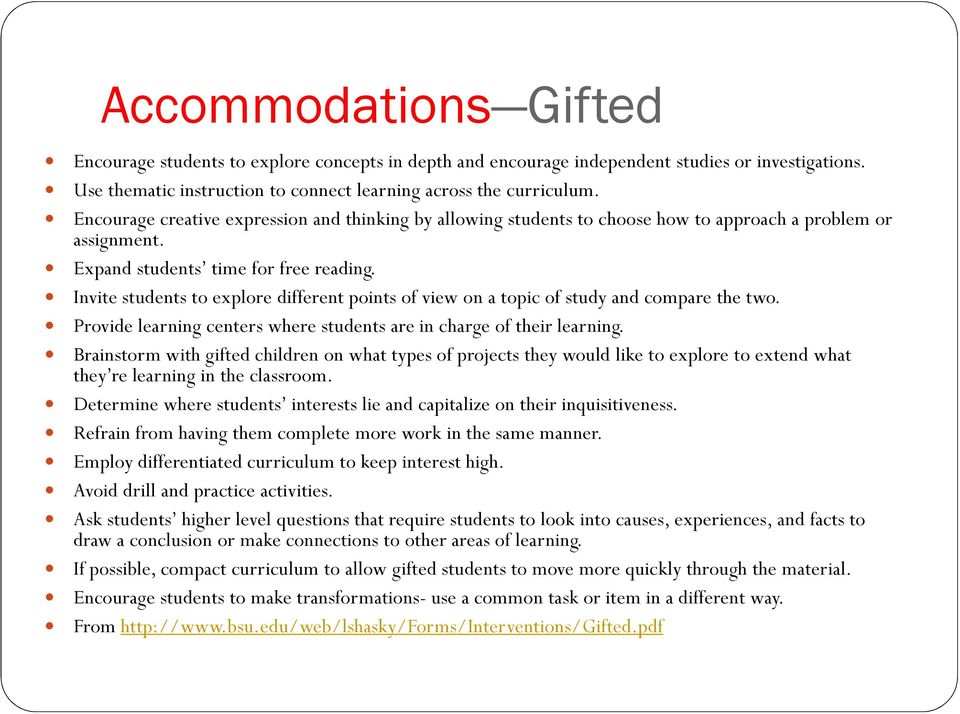
7 Accommodations Gifted Encourage students to explore concepts in depth and encourage independent studies or investigations. Use thematic instruction to connect learning across the curriculum. Encourage creative expression and thinking by allowing students to choose how to approach a problem or assignment. Expand students time for free reading. Invite students to explore different points of view on a topic of study and compare the two. Provide learning centers where students are in charge of their learning. Brainstorm with gifted children on what types of projects they would like to explore to extend what they re learning in the classroom. Determine where students interests lie and capitalize on their inquisitiveness. Refrain from having them complete more work in the same manner. Employ differentiated curriculum to keep interest high. Avoid drill and practice activities. Ask students higher level questions that require students to look into causes, experiences, and facts to draw a conclusion or make connections to other areas of learning. If possible, compact curriculum to allow gifted students to move more quickly through the material. Encourage students to make transformations- use a common task or item in a different way. From
8 Modifications--General Examples Modify the amount of work required Alter format of materials on page (font, spacing) Allow for alternate modes of responding Use alternate grading system Different test items Noted different objective for specific students

Teaching Students with Sensory Impairments Developed by Patricia Carlton and Jennifer Hertzfeld
 Introduction F AST FACTS FOR FACULTY Teaching Students with Sensory Impairments Developed by Patricia Carlton and Jennifer Hertzfeld The Ohio State University Partnership Grant Students with sensory disabilities
Differentiated Instruction
 Differentiated Instruction In any classroom, students will have a range of abilities, needs and interests. Differentiated instruction is any instructional strategy that recognizes and supports individual
Models for an Adapted and for a Modified Program
 Models for an Adapted and for a Modified Program Students are assessed to the prescribed learning outcomes Students receive letter grades Adapted Program Instructional practices: Options for: Giving instructions
Assistive Technology and Augmentative and Alternative Communication Policies and Procedures for the Moriarty Edgewood School District
 Assistive Technology and Augmentative and Alternative Communication Policies and Procedures for the Moriarty Edgewood School District 1 Purpose The purpose of this manual is to assist teachers, case managers,
Modifying Curriculum and Instruction
 Modifying Curriculum and Instruction Purpose of Modification: The purpose of modification is to enable an individual to compensate for intellectual, behavioral, or physical disabi1ities. Modifications
Lone Star College System Disability Services Accommodations Definitions
 Lone Star College System Disability Services Accommodations Definitions This document is intended to provide both students and employees with a better understanding of the most common reasonable accommodations
IMPLEMENTING THE DEAF CHILD S BILL OF RIGHTS: GUIDELINES FOR SCHOOLS 1
 IMPLEMENTING THE DEAF CHILD S BILL OF RIGHTS: GUIDELINES FOR SCHOOLS 1 cde The Colorado Department of Education 201 E. Colfax Ave Denver, CO 80203 January, 1999 1 Portions of this document are taken from
Equal Access: Universal Design of Instruction
 Equal Access: Universal Design of Instruction A checklist for inclusive teaching by Sheryl Burgstahler, Ph.D. Universal Design of Instruction The universal design of instruction (UDI) is gaining increased
Disability Support Services
 INTRODUCTION 1 CAPE FEAR COMMUNITY COLLEGE Disability Support Services Faculty/Staff Handbook Cape Fear Community College is committed to encouraging persons with disabilities to participate in all programs
Creative Ideas: Enhanced to Meet Special Needs of Students
 Creative Ideas: Enhanced to Meet Special Needs of Students INTRODUCTION The Curriculum Center for Family and Consumer Sciences has produced instructional guides for all Family and Consumer Sciences courses.
Differentiation for Science
 What is Differentiated Instruction? for Science Differentiated instruction, also called differentiation, is a process through which teachers enhance learning by matching student characteristics to instruction
ASSISTIVE TECHNOLOGY
 ASSISTIVE TECHNOLOGY VI- 1 Assistive Technology and Transition Planning Many students with disabilities require assistive technology to participate in and benefit from their educational programs. Students
Introducing Universal Design into Instruction
 Introducing Universal Design into Instruction Our goal at UCFV is to provide the best possible education to our learners, and a diverse group of learners it is; single parents, ESL students, and students
WHAT IS A LEARNING DISABILITY?
 WHAT IS A LEARNING DISABILITY? Learning disabilities (LD) is a generic term that refers to a group of disorders which are manifested by significant difficulties in at least one of the following areas:
UNIVERSAL DESIGN OF DISTANCE LEARNING
 UNIVERSAL DESIGN OF DISTANCE LEARNING Sheryl Burgstahler, Ph.D. University of Washington Distance learning has been around for a long time. For hundreds of years instructors have taught students across
Suggested Teaching Strategies: blind and visually impaired students
 Suggested Teaching Strategies: blind and visually impaired students Of the number of students who disclose that have a visual impairment, those who have a total absence of vision are a minority; many more
MStM Reading/Language Arts Curriculum Lesson Plan Template
 Grade Level: 6 th grade Standard 1: Students will use multiple strategies to read a variety of texts. Grade Level Objective: 1. A.6.1: compare/contrast the differences in fiction and non-fiction text.
Disability Services (DS) offers a wide range of support services and accommodations to Columbus State students with documented disabilities
 Disability Services @ Columbus State Training Module Adapted from Disability Services Instructor Training Module 2014 PowerPoint Disability Services (DS) offers a wide range of support services and accommodations
PARCC Computer-Based Accessibility Features/Accommodations Form Instructions
 PARCC Computer-Based Accessibility Features/Accommodations Form Instructions PARCC Computer-Based Accessibility Features and Accommodations Form is provided to assist in identifying and documenting the
TOOLS for DEVELOPING Communication PLANS
 TOOLS for DEVELOPING Communication PLANS Students with disabilities, like all students, must have the opportunity to fully participate in all aspects of their education. Being able to effectively communicate
Designing Lessons for Diverse Learners by Natalie Olinghouse 2008
 Designing Lessons for Diverse Learners by Natalie Olinghouse 2008 Who deserves accommodations? Everyone! Instructional accommodations are not just for students who are struggling. When accommodations are
Study Strategies Used By Successful Students
 Study Strategies Used By Successful Students Test performance not only reflects how much one studied in the hours and days right before the test but also how well the person has been studying throughout
APPENDIX B CHECKLISTS
 APPENDIX B CHECKLISTS Kindergarten First Grade Second Grade Third Grade 69 70 Teacher Visit 1 By: Date / / Time - WG SG Visit 2 By: Date / / Time - WG SG Visit 3 By: Date / / Time - WG SG VISITS 1 2 3
ACCOMMODATIONS GUIDELINES
 NEBRASKA DEPARTMENT OF EDUCATION ACCOMMODATIONS GUIDELINES HOW TO SELECT, ADMINISTER, AND EVALUATE ACCOMMODATIONS FOR INSTRUCTION OF STUDENTS WITH DISABILITIES OCTOBER 2009 TEMPLATE DEVELOPED BY THE CCSSO
AODA. Accessibility for Ontarians with Disabilities Act. Guide to Accessible Events
 AODA Accessibility for Ontarians with Disabilities Act Guide to Accessible Events Events That Are Accessible For All The Accessibility for Ontarians with Disabilities Act (AODA) promotes the principles
DSPS ACCOMMODATIONS & INTERPRETING SERVICES. Revised 1/2007 OHLONE COLLEGE FREMONT, CALIFORNIA
 INSTRUCTOR HANDBOOK DSPS ACCOMMODATIONS & INTERPRETING SERVICES Revised 1/2007 OHLONE COLLEGE FREMONT, CALIFORNIA INTRODUCTION The Ohlone College DSP&S Accommodations and Interpreting Services Office provides
APPENDIX H MCAS TEST ACCOMMODATIONS FOR STUDENTS WITH DISABILITIES
 APPENDIX H MCAS TEST ACCOMMODATIONS FOR STUDENTS WITH DISABILITIES MCAS Test Accommodations for Students with Disabilities A. Definition and Purpose of Test Accommodations A test accommodation is a change
Accessibility Strategies for Mathematics
 Accessibility Strategies for Mathematics "Equity does not mean that every student should receive identical instruction; instead, it demands that reasonable and appropriate accommodations be made as needed
COMPARATIVE ANALYSIS OF COMPUTER SOFTWARE AND BRAILLE LITERACY TO EDUCATE STUDENTS HAVING VISUAL IMPAIRMENT
 COMPARATIVE ANALYSIS OF COMPUTER SOFTWARE AND BRAILLE LITERACY TO EDUCATE STUDENTS HAVING VISUAL IMPAIRMENT Ismat Bano PhD. Scholar, University of Education Lahore Syed Abir Hassan Naqvi Lecturer, IER,
COURSE TITLE: PHOTOGRAPHY 1 GRADES 9-12 LENGTH: ONE SEMESTER SCHOOLS: RUTHERFORD HIGH SCHOOL RUTHERFORD, NEW JERSEY DATE:
 COURSE TITLE: PHOTOGRAPHY 1 GRADES 9-12 LENGTH: ONE SEMESTER SCHOOLS: RUTHERFORD HIGH SCHOOL RUTHERFORD, NEW JERSEY DATE: SPRING 2015 PHOTOGRAPHY 1 2 Rutherford High School Rutherford, NJ Photography 1
National Dissemination Center for Children with Disabilities
 Teaching Students with Disabilities Resources Developed by: National Dissemination Center for Children with Disabilities 1 Table of Contents* Disorder Page # Attention Deficit/Hyperactivity Disorder (AD/HD).3
Realtime Remote Online Captioning: An Effective Accommodation for Rural Schools and Colleges. June 27, 2001
 Realtime Remote Online Captioning 1 Realtime Remote Online Captioning: An Effective Accommodation for Rural Schools and Colleges June 27, 2001 M. Bryce Fifield, Ph.D. North Dakota Center for Persons with
Section III Guided Oral Practice 10/2. 34-36 T Graph for Social Skills. 37-40 Chants 41-44 Sentence Pattern Chart.. 45-49
 1 Section I Focus and Motivation Section II Input G.L.A.D. Resource Book (Guided Language Acquisition Design) Table of Contents Pages Cognitive Content Dictionary 3-4 Exploration Report. 5-7 Observation
cbe.ab.ca reporting Considerations for students with Alberta Education Special Education Coding K-9
 cbe.ab.ca reporting Considerations for students with Alberta Education Special Education Coding K-9 Considerations for students with Alberta Education Special Education Coding Reporting and communicating
Real Connections: Making Distance Learning Accessible to Everyone
 Real Connections: Making Distance Learning Accessible to Everyone By Sheryl Burgstahler, Ph.D. Distance learning has been around for a long time. For hundreds of years instructors have taught students
AT Inventory Checklists
 AT Inventory Checklists Directions for completing the AT Inventory Checklist, Step 1 To complete section of the form, add an x in the check boxes to indicate: I own or have access to a device/app/software
WESTERN KENTUCKY UNIVERSITY. Web Accessibility. Objective
 WESTERN KENTUCKY UNIVERSITY Web Accessibility Objective This document includes research on policies and procedures, how many employees working on ADA Compliance, audit procedures, and tracking content
Tips for Communicating with Deaf and Hard-of-Hearing People
 Tips for Communicating with Deaf and Hard-of-Hearing People Introduction Deafness is a fact of many people s lives more than 22 million Americans have some form of hearing loss. Like their hearing counterparts,
A checklist for making campus services welcoming, accessible, and usable
 Equal Access: Universal Design of Student Services Adapted from the University of Washington Publication of the same name (http://www.washington.edu/doit/brochures/academics/equal_access_ss.html) A checklist
Avaya DECT R4 Telephones Models 3720, 3725, 3740, 3745 and 3749
 Avaya DECT R4 Telephones Models Voluntary Product Accessibility Template (VPAT) The DECT ( Digital Enhanced Cordless Technology ) standard originated in Europe as a replacement for earlier cordless telephone
Explanation of Testing Accommodations for Students with Disabilities - Assistive Technology Accommodations
 Explanation of Testing for Students with Disabilities - Assistive Technology According to the Regulations Governing Special Education Programs for Children with Disabilities in Virginia, assistive technology
Tips for Presenting Online to People Who Are Blind or Visually Impaired
 Introduction Tips for Presenting to the WebEx & Assistive Technology WebEx does not yet support screen readers but is currently working to provide this support. In the interim, this document, People Who
Website Accessibility Under Title II of the ADA
 Chapter 5 Website Accessibility Under Title II of the ADA In this chapter, you will learn how the nondiscrimination requirements of Title II of 1 the ADA apply to state and local government websites. Chapter
Expository Reading and Writing By Grade Level
 Expository and Writing By Grade Level Kindergarten TEKS identify the topic of an informational text heard identify the topic and details in expository text heard or read, referring to the words and/or
Teacher notes and activities
 Teacher notes and activities This resource provides teachers in the early years with a versatile classroom resource that can be used on the Internet or printed out and presented as a booklet or worksheets.
FCPS STANDARDS OF LEARNING ACCOMMODATIONS REFERENCE CHART SWD=Students with Disabilities LEP=Limited English Proficient
 FCPS STANDARDS OF LEARNING ACCOMMODATIONS REFERENCE CHART SWD=Students with Disabilities LEP=Limited English Proficient All accommodations are considered standard for the 2011-12 school year. VAAP Writing
A CHEESY BILL (Grade Levels 6-8) Civics/U.S. Government
 Unit Title: Animals Lesson Title: A Cheesy Bill Theme: Animals Content: Social Studies-Civics/U.S. Government Topic: How A Bill Becomes A Law Language: English Grant: Best Grade: Middle School A Brief
Creating a Literacy Rich Classroom
 Creating a Literacy Rich Classroom Module 6 A: Creating a Literacy Rich Classroom Segment 1: Classroom Environment Viewing Time: 6 minutes Module 6 Activity 1 In order for to be implemented effectively,
Serving Students with Unique Needs: students with disabilities
 Serving Students with Unique Needs: students with disabilities Celia Reed, RSE-TASC trainer Rebecca DeBottis, Region 7 Coordinator 1 Objectives for the Session: Identify what special education regulations
Tier I. Classroom Checklist ASD Nest Program Three-Tier Model
 Tier I Tier I Classroom Checklist ASD Nest Program Three-Tier Model Tier I Strategies and Supports for ASD Nest Classes The Tier I Classroom Checklist is used by the ASD Nest consultant to ensure full
Meeting the Needs of Visual-Spatial Learners
 Meeting the Needs of Visual-Spatial Learners Component 13 of the Competencies Collaboration SEVA Council of Gifted Administrators Table of Contents 1. Characteristics and strengths of visual spatial learners
The Notebook Software Activity Guide
 The Notebook Software Activity Guide The Notebook software activity guide is intended to act as a reference of the best practices for creating and presenting lesson activities using Notebook software.
P3 AUDIT Manual (Version 1.1)
 P3 AUDIT Manual (Version 1.1) Jungeun Kim, OTS; Roger O. Smith, PhD; Denis Anson, MS, OTR; & Kathy L. Rust Manual last updated January 26, 2009 2009 R 2 D 2 Center, UW-Milwaukee OK to copy and distribute
An introduction to videoconference teaching
 UTas Teaching and Learning resources An introduction to videoconference teaching is used extensively throughout the University for teaching purposes. There are 9 dedicated videoconference venues spread
A Resource Guide to Assistive Technology for Students with Visual Impairment
 A Resource Guide to Assistive Technology for Students with Visual Impairment Lisa R. Tebo, M.Ed., OTR/L, ATP This project was completed in fulfillment of the capstone project requirement in the Graduate
Stages of Instructional Design V. Professional Development
 Stages of Instructional Design V. Professional Development Derived from Gagné, R. M., Briggs, L. J., & Wager, W. W. (1992). Principles of Instructional Design (4th ed.). Fort Worth, TX: Harcourt Brace
Using the AT Decision-Making Guide
 Using the AT Decision-Making Guide When the members of the team who have been assigned to gather information have completed their tasks, the team is ready to come together for the next step. The information
Assessing A Student s Need for Assistive Technology: Where to Start?
 Assessing A Student s Need for Assistive Technology: Where to Start? When the question of a student s need for AT leads to an assessment, the first action is to identify a team of people to address that
Classroom Management Plan. Be respectful and considerate of classmates.
 Classroom Management Plan 1. Classroom Rules Be on time and be prepared for class. Be respectful and considerate of classmates. Focus on the task at hand. No electronic devices, food or gum. Eye protection,
BOGOTA PUBLIC SCHOOLS Bogota, New Jersey. Forensic Science Curriculum. Grades 10-12
 BOGOTA PUBLIC SCHOOLS Bogota, New Jersey Forensic Science Curriculum Grades 10-12 Carol Fredericks, Ed.D. Interim Superintendent of Schools Letizia Pantoliano, Ed.D. Director of Curriculum Susan Johnson
High School to College Transition for Students with Specific Learning Disabilities. Best Practice Documentation Guidelines for Secondary Educators
 High School to College Transition for Students with Specific Learning Disabilities Best Practice Documentation Guidelines for Secondary Educators The following document was developed by a group of secondary
NETS for Students: Extended Rubric for Grades 6 8
 DRAFT (September 7, 2004) Purpose: This draft version of the NETS extended rubric for Grades 6 8 is available online for educational technology professionals to review and provide feedback to the developers.
PDF Accessibility Overview
 Contents 1 Overview of Portable Document Format (PDF) 1 Determine the Accessibility Path for each PDF Document 2 Start with an Accessible Document 2 Characteristics of Accessible PDF files 4 Adobe Acrobat
Section 6. Writing Assistive Technology Into the IEP
 ` Section 6 Writing Assistive Technology Into the IEP 2013 90 Overview of Assistive Technology and the IEP The IEP is a collaboratively created document designed to help guide the delivery of special education
ADD/ADHD in the Classroom
 ADD/ADHD in the Classroom TIPS FOR TEACHERS AND PARENTS At any given time, a teacher can expect to have at least one student with ADHD. The impulsive and hyperactive behavior of such students can be distracting
Assessment Arrangements Explained
 Assessment Arrangements Explained Publication date: January 2010 Publication code: FA5351 Published by the Scottish Qualifications Authority The Optima Building, 58 Robertson Street, Glasgow G2 8DQ Ironmills
Xerox DocuMate 3125 Document Scanner
 Xerox DocuMate 3125 Document Scanner Voluntary Product Accessibility Template (VPAT) Submitted by Visioneer, Inc., November 30, 2011 Date: 11/30/2011 Name of Product: Xerox DocuMate 3125 Contact for more
Innovative Systems CVAA Compliance Statement
 Innovative Systems CVAA Compliance Statement History The Twenty First Century Communications and Video Accessibility Act of 2010 (CVAA) was signed into law on October 8, 2010 by President Obama. The CVAA
LOS ANGELES CITY COLLEGE (LACC) ALTERNATE MEDIA PRODUCTION POLICY EQUAL ACCESS TO INSTRUCTIONAL AND COLLEGE WIDE INFORMATION
 04/28/2003 LOS ANGELES CITY COLLEGE (LACC) ALTERNATE MEDIA PRODUCTION POLICY EQUAL ACCESS TO INSTRUCTIONAL AND COLLEGE WIDE INFORMATION Federal and state regulations (see footer) require the provision
Universal Design for the Mathematics Classroom
 Kat Blair & Emily Goins University of Arkansas Fayetteville Universal Design for the Mathematics Classroom Universal Design (UD) is a set of principles that allows for designing curriculum and creating
COURSE TITLE: PHOTOGRAPHY 2 GRADES 9-12 LENGTH: ONE SEMESTER SCHOOLS: RUTHERFORD HIGH SCHOOL RUTHERFORD, NEW JERSEY DATE:
 COURSE TITLE: PHOTOGRAPHY 2 GRADES 9-12 LENGTH: ONE SEMESTER SCHOOLS: RUTHERFORD HIGH SCHOOL RUTHERFORD, NEW JERSEY DATE: SPRING 2015 PHOTOGRAPHY 2 2 Rutherford High School Rutherford, NJ Photography 2
IP Office Contact Center R9.0 Interactive Voice Response Voluntary Product Accessibility Template (VPAT)
 IP Office Contact Center R9.0 Interactive Voice Response Voluntary Product Accessibility Template (VPAT) The IP Office Contact Center solution consists of a suite of software applications. The statements
Learning Styles. The VARK Categories. What is a Learning Style?
 Learning Styles What is a Learning Style? Learning styles focus on how your brain receives information. No one else learns or processes information exactly the way you do! If you discover how you process
Correlation Map of LEARNING-FOCUSED to Marzano s Evaluation Model
 Correlation Map of LEARNING-FOCUSED to Marzano s Evaluation Model Correlation Map of LEARNING-FOCUSED to Marzano s Evaluation Model LEARNING-FOCUSED provides schools and districts with the best solutions
Faculty Handbook for Working with Deaf and Hard of Hearing Students
 Faculty Handbook for Working with Deaf and Hard of Hearing Students Table of Contents Disability Laws in Postsecondary Education... 2 SAIC Disability Documentation Requirements... 3 About Hearing Disabilities...
Developing accessible portals and portlets with IBM WebSphere Portal
 Developing accessible portals and portlets with IBM WebSphere Portal Level: Introductory IBM Human Ability and Accessibility Center Austin, Texas February, 2006 Copyright International Business Machines
LECTURE AND NOTE TAKING
 LECTURE AND NOTE TAKING Goals of Note Taking Taking notes helps with classroom concentration, test preparation and for clues as to what the instructor feels is most important. Prepare to take effective
Universal Design for Learning: Frequently Asked Questions
 40 Harvard Mills Square, Suite #3 Wakefield, MA 01880 781.245.2212. www.cast.org Universal Design for Learning: Frequently Asked Questions Q 1: How can Universal Design for Learning (UDL) improve students'
GUIDELINE: DEVELOPING INDIVIDUAL EDUCATIONAL ACCESS PLANS
 GUIDELINE: DEVELOPING INDIVIDUAL EDUCATIONAL ACCESS PLANS The University has chosen to adopt and adapt the principles of the International Classification of Functioning, Disability and Health (ICF; WHO,
Ten Simple Steps Toward Universal Design of Online Courses
 Ten Simple Steps Toward Universal Design of Online Courses Implementing the principles of universal design in online learning means anticipating the diversity of students that may enroll in your course
Criteria for Evaluating Instructional Materials in Science, Kindergarten Through Grade Eight
 Criteria for Evaluating Instructional Materials in Science, Kindergarten Through Grade Eight Instructional materials are adopted by the state for the purpose of helping teachers present the content set
Athens Technical College Student Support Disability Services 800 U.S. Highway 29 North Athens, GA 30601-1500 706-355-5006 / jfelts@athenstech.
 Athens Technical College Student Support Disability Services 800 U.S. Highway 29 North 706-355-5006 / Dear Athens Technical College Applicant/Student: Thank you for contacting the Disability Services Office
Wyse Winterm Thin Clients -- Accessibility Information
 Wyse Winterm Thin Clients -- Accessibility Information Winterm 3000 Series Thin Clients As of: November 1, 2002 Winterm 3000 Series Thin Clients -- Windows CE and CE.NET operating systems Section Software
Glossary of Teaching Strategies
 This list of teaching strategies and activities was developed out of a focused brainstorming process conducted with general education, special education and English as a Second Language teachers in Minnesota
Description. Strategy
 Description UDI Product: A Strategy for Organizing Ideas through Color-Coding Developed by James M. Gentile and Donna McCormac-Condon Manchester Community College Manchester, Connecticut This product assists
PRESCHOOL PLACEMENT CATEGORIES
 PRESCHOOL PLACEMENT CATEGORIES CASEMIS 20 EARLY CHILDHOOD SPECIAL EDUCATION SETTING Early Childhood Special Education Setting: This is a placement setting where children receive all of their special education