
SOURCES AND EFFECTS OF IONIZING RADIATION
|
|
|
- Stella Waters
- 9 years ago
- Views:
Transcription
1 SOURCES AND EFFECTS OF IONIZING RADIATION United Nations Scientific Committee on the Effects of Atomic Radiation UNSCEAR 2008 Report to the General Assembly with Scientific Annexes VOLUME I UNITED NATIONS New York, 2010

2 NOTE The report of the Committee without its annexes appears as Official Records of the General Assembly, Sixty-third Session, Supplement No. 46. The designations employed and the presentation of material in this publication do not imply the expression of any opinion whatsoever on the part of the Secretariat of the United Nations concerning the legal status of any country, territory, city or area, or of its authorities, or concerning the delimitation of its frontiers or boundaries. The country names used in this document are, in most cases, those that were in use at the time the data were collected or the text prepared. In other cases, however, the names have been updated, where this was possible and appropriate, to reflect political changes. UNITED NATIONS PUBLICATION Sales No. E.10.XI.3 ISBN

3 ANNEX A Medical radiation exposures Contents MEDICAL EXPOSURE TO IONIZING RADIATION I. Introduction II. Scope and basis for the analysis III. medical RADIATION exposure IV. Methodology and sources of data V. Assessment of global practice A. Diagnostic radiology B. Nuclear medicine C. Radiation therapy VI. Implications for the future analysis of medical exposures VII. Summary and conclusions Page APPENDIX A: METHODOLOGY FOR ESTIMATING WORLDWIDE MEDICAL EXPOSURES I. Introduction II. Methodology for analysis of dosimetry in diagnostic and interventional radiology A. Projection radiography B. Fluoroscopy C. Mammography D. CT dosimetry E. Dental panoral tomography F. Dual-energy absorptiometry III. Methodology for analysis of dosimetry in nuclear medicine A. Dosimetric approaches IV. Methodology for analysis of dosimetry in radiation therapy APPENDIX B: LEVELS AND TRENDS OF EXPOSURE IN DIAGNOSTIC RADIOLOGY I. Summary from UNSCEAR 2000 Report II. Doses for specific X-ray procedures A. Diagnostic radiography B. Mammography C. Fluoroscopy and angiography D. Interventional radiology E. Interventional cardiology
4 Page F. Computed tomography G. Dental radiology H. Bone mineral densitometry and dual-energy X-ray absorptiometry III. Doses for specific populations A. Paediatric patients B. Foetal dosimetry IV. Trends A. Trends in practice B. Trends in patient doses C. Survey results V. Summary APPENDIX C: LEVELS AND TRENDS OF EXPOSURE IN NUCLEAR MEDICINE I. Introduction II. Analysis of PRACTICE III. Doses for specific nuclear medicine procedures A. Diagnostic uses B. Therapeutic uses IV. Doses for specific populations A. Paediatric patients B. Foetal dosimetry C. The breast-feeding infant V. Survey VI. Summary APPENDIX D: LEVELS AND TRENDS IN THE USE OF RADIATION THERAPY I. Introduction II. Techniques III. Summary from THE UNSCEAR 2000 Report IV. Dosimetric approaches V. Analysis of PRACTICE A. Frequency of treatments B. Exposed populations C. Doses from treatments D. Assessment of global practice VI. Trends in radiation therapy A. Teletherapy B. Brachytherapy C. Other modalities VII. Accidents in radiation therapy VIII. Summary References
5 MEDICAL EXPOSURE TO IONIZING RADIATION I. Introduction 1. The objective of the past reports of the Scientific Committee [U3, U4, U6, U7, U9, U10] with respect to medical exposures has been to establish the annual frequency of medical examinations and procedures involving the use of radiation, as well as their associated doses. Reviews have been performed of practice in diagnostic radiology, in the use of nuclear medicine and in radiation therapy. Data have been analysed to deduce temporal trends, to evaluate the collective population dose due to medical exposure, and to identify procedures for which the doses are major contributors to the total collective dose. In earlier UNSCEAR reports on doses from medical irradiation [U10, U11], the annual frequency of medical exposures was estimated on the basis of a very limited series of surveys, mainly but not exclusively performed in developed countries. Initially information was obtained under broad headings such as diagnostic radiography or diagnostic fluoroscopy [U11]. 2. The purpose of this annex is to assess the magnitude of use of medical exposures around the globe in the period , to determine the relative contribution to dose from various modalities and procedures, and to assess trends. It is not within the mandate of the Committee to assess potential benefits from medical exposure. Documented detrimental effects resulting from medical exposures have been covered in other reports of the Committee and their associated scientific annexes, for example those on carcinogenesis (annex A, Epidemiological studies of radiation and cancer, of the UNSCEAR 2006 Report [U1]) and accidental exposure (annex C, Radiation exposures in accidents, of the UNSCEAR 2008 Report). 3. Exposure of the public resulting from contact with patients undergoing either treatment or a diagnostic procedure that uses sealed or unsealed radionuclides is considered in annex B, Exposures of the public and workers from various sources of radiation, of the UNSCEAR 2008 Report. That annex also addresses exposures of the public arising from the disposal of radioactive waste from hospitals and the production of radionuclides for medicine. 4. Occupational exposure resulting from work involving the medical use of radiation occurs for persons administering the radiation to the patient or in some circumstances for persons nearby. Annex B also examines such occupational exposure in detail. 5. This annex presents a comprehensive up-to-date review of medical exposures to ionizing radiation. This review is based in part on an analysis of the responses to the UNSCEAR Global Survey of Medical Radiation Usage and Exposures and a critical assessment of the published literature on medical exposures. The purpose of this annex is to estimate the annual frequency (number of examinations per fixed number of people) of diagnostic and therapeutic medical procedures and the doses associated with them. II. Scope and basis for the analysis 6. Medical exposures include [I3]: (a) the exposure of patients as part of their medical diagnosis or treatment; (b) the exposure of individuals as part of health screening programmes; (c) the exposure of healthy individuals or patients voluntarily participating in medical, biomedical, diagnostic or therapeutic research programmes. 7. There are substantial and distinct differences between medical exposure to radiation and most other exposures to radiation. Medical exposure is almost always voluntary and is generally accepted to bring more benefits than risks. In many developing countries, increasing the availability of appropriate medical procedures that use ionizing radiation results in a net health benefit. 8. Medical exposures typically involve only a portion of the body, whereas many other exposures involve the whole body. In addition, many persons who are exposed are not typical of the general population. Their average age is usually somewhat higher and they have medical conditions that may significantly affect the trade-off between the benefits and the risks of using radiation. In contrast, the introduction of new imaging technologies has in some instances resulted in increased use of paediatric radiology, influencing the age profile for the examinations performed. As a result of the above considerations, while the magnitude of medical exposures can be examined, it is very difficult or impossible to estimate the risks of adverse effects due to medical uses, still less to defensibly compare such estimates with those for other sources of exposure to radiation. 23

6 24 UNSCEAR 2008 REPORT: VOLUME I III. medical RADIATION exposure 9. There are three general categories of medical practice involving exposure to ionizing radiation: diagnostic radiology (and image-guided interventional procedures), nuclear medicine and radiation therapy. 10. Diagnostic radiology generally refers to the analysis of images obtained using X-rays. These include plain radiographs (e.g. chest X-rays), images of the breast (i.e. mammo graphy), images obtained using fluoroscopy (e.g. with a barium meal or barium enema) and images obtained by devices using computerized reconstruction techniques such as computed tomography (CT). In addition to their use for diagnosis, interventional or invasive procedures are also performed in hospitals (e.g. placing a catheter in a blood vessel to obtain images). For the purposes of this annex, such uses are considered to be diagnostic exposures. Some of the procedures mentioned above are not always performed by diagnostic radiologists but may also be performed by others, including general medical physicians, cardiologists and orthopaedic surgeons, whose training in radiation protection may not be as thorough as that of diagnostic radiologists. Physicians also use imaging technologies that do not employ ionizing radiation, such as ultrasound and magnetic resonance imaging (MRI). Dental radiology has been included in the analysis conducted here of diagnostic radiology practice; however the terms diagnostic dental radiology and diagnostic medical radiology (mutatis mutandi) are used to distinguish dental exposures from other diagnostic exposures. 11. Nuclear medicine refers to the introduction of unsealed radioactive materials into the body, most commonly to obtain images that provide information on either structure or organ function. The radioactive material is usually given intravenously, orally or by inhalation. A radionuclide is usually modified to form a radiopharmaceutical that will be distributed in the body according to physical or chemical characteristics (for example, a radionuclide modified as a phosphate will localize in the bone, making a bone scan possible). Radiation emitted from the body is analysed to produce diagnostic images. Less commonly, unsealed radionuclides are administered to treat certain diseases (most frequently hyperthyroidism and thyroid cancer). There is a clear trend towards increased therapeutic applications in modern nuclear medicine. 12. Radiation therapy refers to the use of ionizing radiation to treat various diseases (usually cancer). Sometimes radiation therapy is referred to as radiation oncology; however, benign diseases also may be treated. External radiotherapy refers to treatment of the patient using a radiation source that is outside the patient. This may be a machine containing a highly radioactive source (usually cobalt-60) or a high-voltage machine that produces radiation (e.g. a linear accelerator). Treatment can also be performed by placing metallic or sealed radioactive sources within the patient (brachytherapy). These may be placed either temporarily or permanently. IV. Methodology and sources of data 13. Evaluation of medical exposures consists of assessing the annual frequency and types of procedure being undertaken, as well as an evaluation of the radiation doses for each type of procedure. Annual frequency and dose data are derived from three main sources: the peer-reviewed scientific literature, official reports provided by member States, and the Surveys of Medical Radiation Usage and Exposures conducted by the secretariat on behalf of the Committee. As in previous reports, annual frequency data on procedures are stratified by health-care level (level I, II, III or IV), which are based on the number of physicians per head of population. The number of physicians per head of population has been shown to correlate well with the number of medical examinations performed using ionizing radiation [M39, M40]. This allows extrapolation to those countries for which the Committee has limited or no data. 14. The UNSCEAR 1982 Report [U9] was the first to use a survey, developed by WHO in cooperation with UNSCEAR, to obtain information on the availability of diagnostic radiology equipment and the annual frequency of diagnostic X-ray examinations in various countries. Examination frequency data in previous reports had been based upon surveys in a limited number of countries. Data from five continents were presented in the UNSCEAR 1982 Report [U9], which was also the first UNSCEAR survey to include an assessment of exposures from CT. 15. The four-level health-care model for the analysis of medical exposures was introduced in the UNSCEAR 1988 Report [U7] and has been used in the Committee s subsequent reports. In this model, countries were stratified according to the number of physicians per head of population. Level I countries were defined as those in which there was at least one physician for every 1,000 people in the general population; in level II countries there was one physician for every 1,000 2,999 people; in level III countries there was one physician for every 3,000 10,000 people; and in level IV countries there was less than one physician for every 10,000 people [U7]. 16. The Committee also explored other approaches to the classification of health-care levels, for example by healthcare expenditure or number of hospital beds. However, it

7 ANNEX A: MEDICAL RADIATION EXPOSURES 25 was found that there was a poor correlation between values for these parameters and the number of medical radiation procedures. Subsequent reports have therefore continued to use the four-level health-care model based upon the number of physicians per head of population [U3, U6]. Over the years this model has proved to be robust in estimating medical radiation exposures. One of the main advantages of the model is that it provides a consistent basis for the extrapolation of practice in a small sample of countries to the entire world. It also facilitates the comparison of trends in medical exposures over time [U7]. Consequently this health-care model has been used in the present analysis of worldwide exposure. 17. In order to evaluate the level of medical exposures worldwide, the UNSCEAR secretariat conducted a Survey of Medical Radiation Usage and Exposures by circulating a questionnaire to all Member States of the United Nations. The Committee bases its estimation of medical exposures upon an analysis of the questionnaire returns. Most of the responses have been received from countries defined by the Committee as health-care level I countries, which represent under a quarter of the world s population. 18. As annual frequency data were only available from those countries that undertake surveys of practice, the analysis of medical exposures has necessarily been based on extrapolating data from the fraction of countries where data were reported to all other countries in a given health-care level. Data on doses were also collected by survey and compared with those in the published literature. For each procedure, the number of procedures per head of population is multiplied by the effective dose per procedure and the relevant population size (i.e. population size for the respective health-care level). The collective effective dose (or population dose) for the global population is then deduced by performing the above calculation for all procedures across all health-care levels and summing the result for all procedures. The Committee also examines trends over time for various procedures, as well as trends over time in the global collective effective dose. V. Assessment of global practice A. Diagnostic radiology 19. The medical use of ionizing radiation remains a rapidly changing field. This is in part because of the high level of innovation by equipment supply companies [W1] and the introduction of new imaging techniques such as multislice CT and digital imaging. 20. In the UNSCEAR 2000 Report [U3] it was noted that 34% of the collective dose due to medical exposures arose from CT examinations. As a consequence, the increasing trend in annual CT examination frequency and the significant dose per examination have an important impact on the overall population dose due to medical exposures. The contribution of CT examinations to the population dose has continued to increase rapidly ever since the practice was introduced in the 1970s. In the area of CT examinations, the introduction of helical and multislice scanning has reduced scan times [I28]. As a consequence, it is now possible to perform more examinations in a given time, to extend the scope of some examinations, and to introduce new techniques and examinations. The ease of acquisition of images could result in unnecessary exposures of patients to radiation. This, combined with the increase in the number of machines, has a significant impact on population doses, particularly for countries with health-care systems at level I. An accurate assessment of medical exposures due to CT scanning is therefore particularly important. 21. Digital imaging is another area of diagnostic radiology that has seen striking changes [I8]. Digital imaging using photostimulable storage phosphor devices was introduced into clinical practice in the 1980s. Since its introduction, there has been a gradual increase in its use. New types of digi tal imaging device are being introduced to the marketplace. These systems utilize a large-area direct digital detector for imaging and offer many advantages, one of which in principle is a lower dose per image compared with other devices. Thus there could be another era of rapidly changing practice in diagnostic radiology over the course of the next UNSCEAR Global Survey of Medical Radiation Usage and Exposures. This will initially influence population doses in health-care level I countries for radiographic and fluoroscopic examinations before the practice widely influences population doses in countries at other health-care levels. Population doses due to digital radiology will probably increase as a result of an increasing frequency of digital imaging examinations and procedures. 22. According to the current analysis, there are approximately 3.6 billion diagnostic radiology X-ray examinations (including diagnostic medical and dental examinations) undertaken annually in the world. Figure I presents trends in the annual frequency of diagnostic medical and dental radiological examinations for each health-care level. 23. The 24% of the population living in health-care level I countries receive approximately two thirds of these examinations. The annual frequency of diagnostic medical examinations alone (defined here as excluding dental radiology) in health-care level I countries is estimated to have increased from 820 per 1,000 population in to 1,332 per 1,000 population in this survey. Comparative values for health-care level II countries exhibit an even greater relative increase, from 26 per 1,000 in to 332 per 1,000 in Most of the increase for level I and II countries

8 26 UNSCEAR 2008 REPORT: VOLUME I occurred in the period The estimated annual frequency of diagnostic medical examinations in healthcare level III/IV countries has remained fairly constant over this period, although since there were limited data for these countries, there is considerable uncertainty associated with this estimate. Figure I. Trends in the annual frequency of diagnostic medical and dental radiological examinations for each health-care level NUMBER OF EXAMINATIONS PER POPULATION I II III IV HEALTH CARE LEVEL CT scanning accounts for 7.9% of the total number of diagnostic medical examinations in health-care level I countries, just over 2.0% in health-care level II countries and just under 14% in health-care level III/IV countries. However, the contribution of CT scanning to the total collective effective dose due to diagnostic medical examinations is approximately 47% in health-care level I countries, and 15% and 65% in health-care level II and III/IV countries, respectively (there is great uncertainty in the doses and frequencies for health-care level III/IV countries). According to this UNSCEAR Global Survey of Medical Radiation Usage and Exposures, CT scanning accounts for 43% of the total collective effective dose due to diagnostic medical radiology. 25. For diagnostic dental examinations, the annual frequency has remained fairly constant for health-care level I countries, being 275 per 1,000 population in this survey, compared with 320 per 1,000 population in the survey. Over this period, there has been a substantial increase in the annual frequency of diagnostic dental examinations in healthcare level II countries, rising from 0.8 per 1,000 population in to 16 per 1,000 population in the current survey. 26. Figure II summarizes the variation in annual frequency of diagnostic medical and dental radiological examinations for each health-care level, as found in the current UNSCEAR Global Survey of Medical Radiation Usage and Exposures. Also shown in figure II are the global averages. There are wide variations in the frequency of diagnostic medical and dental examinations. For example, diagnostic medical examinations are over 66 times more frequent in health-care level I countries (where 24% of the global population live) than in health-care level III and IV countries (where 27% of the global population live). The change in annual frequency of diagnostic medical examinations reflects changes in population demographics, as most medical exposures are performed on older individuals. Globally, on average there are just over 488 diagnostic medical examinations and 74 dental examinations per 1,000 population. The wide imbalance in health-care provision is also reflected in the availability of X-ray equipment and of physicians. Figure II. Variation in the annual frequency of diagnostic medical and dental radiological examinations for the respective health-care levels and the global average ( ) NUMBER OF EXAMINATIONS PER POPULATION I II III IV Global HEALTH CARE LEVEL Medical Dental

9 ANNEX A: MEDICAL RADIATION EXPOSURES The variation in the annual collective effective dose between health-care levels for diagnostic medical and dental radiological examinations is summarized in figure III. Dental exposures account for less than 1% of the collective dose. On average, over 70% of the total collective effective dose is received by the 1.54 billion individuals living in health-care level I countries. The annual collective effective dose to the population of health-care level I countries from diagnostic medical examinations is estimated to be 2,900,000 man Sv, with 1,000,000 man Sv to the population of health-care level II countries, 33,000 man Sv to the population of healthcare level III countries and 24,000 man Sv to the population of health-care level IV countries. The total annual collective effective dose to the global population from diagnostic medical exposures is estimated to be 4,000,000 man Sv. Figure III. Variation in the annual collective effective dose from diagnostic medical and dental radiological examinations for the respective health-care levels and the global total ( ) Figure IV. Variation in the annual per caput effective dose from diagnostic medical and dental radiological examinations for the respective health-care levels and the global average ( ) PER CAPUT DOSE msv HEALTH CARE LEVEL 0.62 I II III IV Global COLLECTIVE EFFECTIVE DOSE man Sv I II III IV Global HEALTH CARE LEVEL Medical Dental 28. Figure IV shows the annual per caput effective dose for the various health-care levels and the average value across the global population (0.62 msv) from diagnostic medical and dental radiological examinations. Temporal trends in the annual frequency of diagnostic dental radiological examinations have been obtained and are shown in figure V. Worldwide there are an estimated 480 million diagnostic dental examinations performed annually. Almost all of these are undertaken in level I countries. The contribution of dental examinations to annual per caput or collective effective dose is very small (much less than 1%). However, the number of dental examinations and the availability of equipment may be under-reported in many countries. Figure V. Trends in the annual frequency of dental radiological examinations for each health-care level NUMBER OF EXAMINATIONS PER POPULATION I II III IV HEALTH CARE LEVEL
10 28 UNSCEAR 2008 REPORT: VOLUME I 29. For diagnostic dental radiology the collective effective dose to the population of health-care level I countries is estimated to be 9,900 man Sv, with 1,300 man Sv, 51 man Sv and 38 man Sv being received by the populations of healthcare level II, III and IV countries, respectively. The total annual collective effective dose to the global population from diagnostic dental radiology is 11,000 man Sv. 30. In the period covered by the 2008 UNSCEAR Report, the estimated annual collective effective dose to the world population from diagnostic medical and dental radiological examinations is estimated to be 4,000,000 man Sv (see table 1). Since the previous survey [U3], there has been a rise of approximately 1,700,000 man Sv. This increase results in part from an increase in the annual frequency of diagnostic medical and dental radiological examinations (from 1,230 per 1,000 population to 1,607 per 1,000 population in health-care level I countries; from 168 per 1,000 population to 348 per 1,000 population in health-care level II countries; and from 20 per 1,000 population to 23 per 1,000 population in health-care level III/IV countries), an increase in the per caput effective dose per examination (from 0.4 to 0.62 msv) and an increase in the global population (from 5,800 million to 6,446 million). Table 1. Estimated annual per caput dose and annual effective dose to the world population from diagnostic medical and dental radiological examinations ( ) Health-care level Population (millions) Annual per caput dose (msv) Annual collective effective dose (man Sv) Medical Dental Medical Dental I II III IV Global Trends in dose for selected diagnostic medical examinations are shown in table 2. It is clear that doses for two typical radiological examinations (chest radiography and mammography) have been decreasing significantly. On the other hand, the dose from a CT examination, which is a relatively high-dose procedure, has decreased only slightly since the previous survey. However, the nature of CT scanning has changed over the years. In the survey, only head scans were included; now most CT examinations are of other parts of the body. Table 2. Trends in average effective doses resulting from selected diagnostic medical examinations in countries of health-care level I Examination Average effective dose per examination (msv) Chest radiography Abdomen X-ray Mammography CT scan Angiography B. Nuclear medicine 32. There are approximately 33 million diagnostic nuclear medicine examinations performed annually worldwide. The 24% of the global population living in level I countries receive about 90% of all nuclear medicine examinations. The annual frequency of diagnostic nuclear medicine examinations in health-care level I countries is estimated to have increased from 11 per 1,000 population in to 19 per 1,000 in this survey. Comparative values for health-care

11 ANNEX A: MEDICAL RADIATION EXPOSURES 29 level II countries also exhibit an increase, from 0.9 per 1,000 population in to 1.1 per 1,000 in For therapeutic nuclear medicine procedures, according to the global model, the annual frequency of nuclear medicine treatments in health-care level I countries has increased from 0.17 per 1,000 population in to 0.47 per 1,000 in this survey, consistent with the trend towards more therapeutic applications. Comparative values for health-care level II countries exhibit an increase from per 1,000 population in to per 1,000 in Figures VI and VII present summaries of the annual frequencies of nuclear medicine examinations for the respective healthcare levels and average annual numbers of examinations for each time period considered, respectively. Figure VI. Annual frequency of diagnostic nuclear medicine examinations for the respective health-care levels and the global average ( ) NUMBER OF EXAMINATIONS PER POPULATION I II III IV Global HEALTH CARE LEVEL 33. In the period covered by the 2008 UNSCEAR Report, the annual collective effective dose to the world population due to diagnostic nuclear medicine examinations is estimated to be 202,000 man Sv. The trend in the annual collective effective dose from diagnostic nuclear medicine examinations over the last three surveys is summarized in figure VIII. There has been an increase in collective dose of nearly 50,000 man Sv, a rise of just over a third since the last report. The increase in the global collective effective dose from diagnostic nuclear medicine examinations results from three factors: an increase of nearly a third in the average effective dose per procedure (from 4.6 msv in the UNSCEAR 2000 Report to the present estimate of 6.0 msv) and an increase in the annual number of diagnostic nuclear medicine examinations to the world population. The annual collective effective dose for the respective health-care levels is shown in figure IX. Figure VIII. Trend in the annual collective effective dose from diagnostic nuclear medicine examinations COLLECTIVE DOSE man Sv Figure VII. Annual number of diagnostic nuclear medicine examinations Figure IX. Annual collective effective dose from diagnostic nuclear medicine examinations for the respective healthcare levels and the global total ( ) NUMBER OF EXAMINATIONS millions COLLECTIVE EFFECTIVE DOSE man Sv I II III IV Global UNSCEAR SURVEY HEALTH CARE LEVEL
12 30 UNSCEAR 2008 REPORT: VOLUME I C. Radiation therapy 34. Worldwide in , approximately equal numbers of radiation therapy patients were treated using X-ray machines, radionuclide units and linear accelerators [U3]. Insufficient data were received for the period to estimate the numbers of patients treated with each type of treatment device. The availability of linear accelerators worldwide was about 1.6 machines per million population. The availability of X-ray machines and of cobalt units was about equal, 0.4 per million population. In level I countries, however, the availability of treatment equipment was considerably greater than the world average (for example, there were 5.4 linear accelerators per million population). The total number of treatment machines also varied from one health-care level to another. The numbers of patients treated in different countries varied in approximate proportion to the availability of treatment equipment. The annual number of various types of treatment for each health-care level is shown in table 3. The 24% of the world population in the level I countries received approximately three-quarters of all radiation therapy treatments. 35. In the period , the global use of radiation therapy increased to 5.1 million treatments, from 4.7 million treatments in About 4.7 million patients were treated with external beam radiation therapy, while 0.4 million were treated with brachytherapy. The number of linear accelerator treatment units increased to about 10,000 worldwide, from about 5,000 in the previous period. A large increase was seen in level I countries. Level II countries appeared to show a decrease, but this is likely to be an artefact of the limited data received from the survey. At the same time, the number of brachytherapy treatments and the number of afterloading brachytherapy units appeared to have changed very little. Table 3. Estimated annual number of radiation therapy treatmentsa in the world ( ) Data from the UNSCEAR Global Survey of Medical Radiation Usage and Exposures Health-care level Population (millions) Annual number of teletherapy treatments Annual number of brachytherapy treatments b Annual number of all radiotherapy treatments Millions Per population Millions Per population Millions Per population I II III (<0.05) c (<0.01) c IV 744 (0.03) c (<0.01) c (<0.01) c (<0.005) c (0.03) c (0.01) c World d a Complete courses of treatment. b Excluding treatments with radiopharmaceuticals. c Assumed value in the absence of data. d Global data include several countries not represented by levels I IV. VI. Implications for the future analysis of medical exposures 36. Because of the introduction of new techniques and equipment and the ever-increasing use of radiation in medicine, it is important to continue to assess the doses resulting from medical exposure to radiation [O2]. At present it appears that the world is entering another period of major technological changes, where the impact of these changes on the population dose worldwide in the future will be very difficult to predict. The introduction of the new technologies may also affect the age profile of the exposed population. 37. The present questionnaire that the Committee has used to collect information is quite detailed and asks for much more information than most countries routinely collect, and this may have discouraged some responses. For future surveys it would probably be useful to design a simpler questionnaire, taking into account feedback from those collecting, analysing or using the data. Comprehensive data from less industrialized countries are difficult to obtain, but given the large populations of these areas, the Committee would encourage those countries to develop their programmes to assess medical uses and exposures. 38. Just under half of the collective effective dose due to diagnostic radiology arises from three procedures: CT, angiographic examinations and interventional radiology. Therefore accurate comprehensive data on these procedures would improve the estimation of population dose. For diagnostic nuclear medicine, the main contributions to the collective effective dose arise from 99m Tc bone scans, 201 Tl cardiovascular studies and iodine thyroid scans.

13 ANNEX A: MEDICAL RADIATION EXPOSURES 31 VII. Summary and conclusions 39. Medical exposure remains by far the largest humanmade source of exposure to ionizing radiation and continues to grow at a substantial rate. There are now about 3.6 billion medical radiation procedures performed annually. There is a markedly uneven distribution of medical radiation procedures (including both diagnostic medical and dental procedures) among countries, with about twothirds of these procedures being received by the 24% of the world s population living in health-care level I countries. For level I and II countries, where 75% of the world s popu lation resides, medical uses of radiation have increased from year to year as the benefits of the procedures become more widely known. While there are limited data on the annual frequency of examinations in countries with healthcare levels III and IV, the annual frequency of diagnostic medical examinations has remained fairly constant. For diagnostic dental examinations the annual frequency has remained fairly constant for health-care levels I and II, but has substantially increased for health-care levels III and IV. In addition, the trend for increasing urbanization of the world population, together with a gradual improvement in living standards, inevitably means that more individuals can access health-care systems. As a consequence, the population dose due to medical exposures has continuously increased across all health-care levels. 40. Table 4 and figure X summarize the annual collective effective dose from diagnostic exposures (including those due to diagnostic medical and dental radiology, and due to diagnostic nuclear medicine procedures) for the period Most of the worldwide collective effective dose arises from diagnostic examinations in health-care level I countries. The total annual collective effective dose from all diagnostic exposures is approximately 4,200,000 man Sv. Table 4. Annual collective effective dose from all diagnostic exposures (including those due to diagnostic medical and dental radiology, and due to diagnostic nuclear medicine procedures) Health-care level Population (millions) Annual collective effective dose (man Sv) Medical Dental Nuclear medicine Total I II III a IV World a Refers to health-care levels III-IV. Figure X. Annual collective effective dose from all diagnostic exposures for each health-care level and the global totals ( ) COLLECTIVE EFFECTIVE DOSE man Sv I II III IV Global HEALTH CARE LEVEL Diagnostic Dental Nuclear medicine Total
14 32 UNSCEAR 2008 REPORT: VOLUME I 41. The annual per caput effective dose to the global population due to all sources of ionizing radiation is summarized in table 5 and figure XI. Natural background radiation represents just less than 80% of the total per caput effective dose of about 3 msv. Diagnostic examinations result in a per caput effective dose of 0.66 msv. Medical exposures now contribute around 20% of the average annual per caput dose to the global population. The total annual collective effective dose to the global population is estimated to be 19.2 million man Sv (see table 6), most of which arises from natural background radiation. Diagnostic exposures account for approximately 4.2 million man Sv. Annually there are approximately 3.1 billion diagnostic medical radiological examinations and 0.48 billion diagnostic dental radiological examinations. Table 5. Global annual per caput effective dose Source Annual per caput effective dose (msv) Contribution (%) Natural background Diagnostic medical radiology Diagnostic dental radiology <0.1 Nuclear medicine Fallout <0.2 Total Table 6. Global annual total collective effective dose Source Annual collective effective dose (man Sv) Contribution (%) Natural background Diagnostic medical radiology Diagnostic dental radiology <0.1 Nuclear medicine Fallout <0.1 Total Figure XI. Annual per caput effective dose (msv) New medical X-ray technologies and techniques (particularly with respect to CT scanning) are proving increasingly useful clinically, resulting in rapid growth in the 3 number of procedures in many countries and hence in a marked increase in collective dose. In at least one country, this has given rise to a situation where medical exposures have resulted in population and per caput doses equal to or greater than those from the previously largest source (i.e. natural background radiation); other countries will follow. PER CAPUT DOSE msv SOURCE Natural background Medical Dental Nuclear medicine Fallout 43. Diagnostic nuclear medicine has increased worldwide from about 23.5 million examinations annually in 1988 to an estimated 32.7 million annually during the period , and this has resulted in an annual per caput dose of about msv. The estimated annual collective dose has increased from about 74,000 man Sv in 1980 to an annual collective dose of about 202,000 man Sv by the end of the period About half of the dose results from cardio vascular applications. The distribution of nuclear medicine procedures among countries is quite uneven, with 90% of examinations occurring in level I health-care countries, which represent about 24% of the world s population.

15 ANNEX A: MEDICAL RADIATION EXPOSURES 33 There were about 0.9 million patients treated therapeutically each year with unsealed radionuclides. 44. There were an estimated 5.1 million patients treated annually with radiation therapy during the period , up from an estimated 4.3 million in About 4.7 million were treated with teletherapy and 0.4 million with brachytherapy. The 24% of the population living in health-care level I countries received 71% of the total radiation therapy treatments. 45. Medical exposure has grown very rapidly over the last three decades in some industrialized countries. As an example, figures XII and XIII show that increases in medical uses in the United States in the period resulted in an increase in the total annual per caput effective dose from 3.0 msv to 6.2 msv, making medical exposure comparable with the exposure due to natural background radiation [N26]. 46. Table 7 summarizes the trends in diagnostic radiology practice since Over the period shown, the annual number of diagnostic radiological examinations has increased by a factor of 2.25 (see figure XIV). This increase has arisen in part because of the increase in the global population and because of the increase in the annual frequency of diagnostic radiological examinations by a factor of 1.7 (see figure XV). Over the same period the annual collective effective dose to the world population has increased from 1,800,000 man Sv in 1988 to 4,000,000 man Sv (see figure XVI). There has also been an upward trend in the annual per caput effective dose, as may be seen in figure XVII. Figure XII. Annual per caput effective dose (msv) for the United States population in 1980 [M37] Figure XIII. Annual per caput effective dose (msv) for the United States population in 2006 [N26] Medical 0.53 All other 0.05 Diagnostic radiography 0.3 Interventional radiology 0.4 All other 0.14 Natural background 3.1 Nuclear medicine 0.8 Natural background 2.4 CT scans 1.5 Table 7. Trends in the global use of radiation for diagnosis: diagnostic medical radiological examinations From UNSCEAR Global Surveys of Medical Radiation Usage and Exposures Survey Annual number of examinations (millions) Annual frequency (per population) Annual collective effective dose (1 000 man Sv) Annual per caput dose (msv) 1988 [U7] [U6] [U3]

16 34 UNSCEAR 2008 REPORT: VOLUME I Figure XIV. Trend in the annual number of diagnostic medical radiological examinations Figure XVI. Trend in the annual collective effective dose from diagnostic medical radiological examinations NUMBER OF EXAMINATIONS millions [U7] 1993 [U6] 2000 [U3] 2008 COLLECTIVE EFFECTIVE DOSE (1 000 man Sv) [U7] 1993 [U6] 2000 [U3] 2008 UNSCEAR SURVEY UNSCEAR SURVEY Figure XV. Trend in the annual frequency of diagnostic medical radiological examinations Figure XVII. Trend in the annual per caput effective dose from diagnostic medical radiological examinations NUMBER OF EXAMINATIONS PER POPULATION [U7] 1993 [U6] 2000 [U3] 2008 PER CAPUT EFFECTIVE DOSE (msv) [U7] 1993 [U6] 2000 [U3] 2008 UNSCEAR SURVEY UNSCEAR SURVEY 47. Trends in the global use of dental radiology are given in table 8. The number of dental radiological examinations has increased since 1988 (figure XVIII). This is mainly because of the increase in the world s population; the annual frequency of dental radiological examinations has remained fairly constant over this period (figure XIX). The annual collective effective dose has decreased since 1988 (figure XX). Given that the number of examinations has increased, this decrease results from the reduction in the dose per examination associated with the introduction of improved films and film screen systems. Similarly, there has been a substantial decrease in the per caput dose due to dental radiology (figure XXI). Table 8. Trends in the global use of radiation for diagnosis: dental radiology Data from UNSCEAR Global Surveys of Medical Radiation Usage and Exposures Survey Annual number of examinations (millions) Annual frequency per population Annual collective effective dose (1 000 man Sv) Annual per caput dose (msv) 1988 [U7] [U6] [U3]
![[U7] 1993 [U6] 2000 [U3] 2008 COLLECTIVE EFFECTIVE DOSE (1 000 man Sv) 5 000 4 000 3 000 2 000 1 000 0 4 000 2 300 1 800 1 600 1988 [U7] 1993 [U6] 2000 [U3] 2008 UNSCEAR SURVEY UNSCEAR SURVEY Figure](/docs-images/46/21510827/images/page_16.jpg "XV. Trend in the annual frequency of diagnostic medical radiological examinations Figure XVII.")
17 ANNEX A: MEDICAL RADIATION EXPOSURES 35 Figure XVIII. Trend in the annual number of dental radiological examinations No data were obtained in the 1993 survey Figure XX. Trend in the annual collective effective dose from dental radiological examinations NUMBER OF EXAMINATIONS (millions) [U7] 1993 [U6] 2000 [U3] 2008 COLLECTIVE EFFECTIVE DOSE man Sv [U7] 1993 [U6] 2000 [U3] 2008 UNSCEAR SURVEY UNSCEAR SURVEY Figure XIX. Trend in the annual frequency of dental radiological examinations No data were obtained in the 1993 survey Figure XXI. Trend in the annual per caput effective dose from dental radiology NUMBER OF EXAMINATIONS PER POPULATION [U7] 1993 [U6] 2000 [U3] 2008 PER CAPUT EFFECTIVE DOSE msv [U7] 1993 [U6] 2000 [U3] 2008 UNSCEAR SURVEY UNSCEAR SURVEY 48. Trends in diagnostic nuclear medicine procedures are summarized in table 9. Since 1988 there has been a modest increase in the number of examinations, comparable with the increase in the global population (figure XXII). The annual frequency of diagnostic nuclear medicine procedures has remained fairly constant since 1988 (figure XXIII). However, the collective effective dose due to diagnostic nuclear medicine procedures has tripled (figure XXIV). This is because of the introduction of high-dose cardiac studies and a reduction in the frequency of other types of procedure. The annual per caput dose has remained constant since 1993 (after having doubled between 1988 and 1993) (figure XXV). Table 9. Trends in the global use of radiation for diagnosis: nuclear medicine Data from UNSCEAR Global Surveys of Medical Radiation Usage and Exposures Survey Annual number of examinations (millions) Annual frequency (per population) Annual collective effective dose (1 000 man Sv) Annual per caput dose (msv) 1988 [U7] [U6] [U3]
![COLLECTIVE EFFECTIVE DOSE 1 000 man Sv 20 15 10 5 0 17 18 14 11 1988 [U7] 1993 [U6] 2000 [U3] 2008 UNSCEAR SURVEY UNSCEAR SURVEY Figure XIX.](/docs-images/46/21510827/images/page_17.jpg "Trend in the annual frequency of dental radiological examinations No data were obtained in the 1993 survey Figure XXI.")
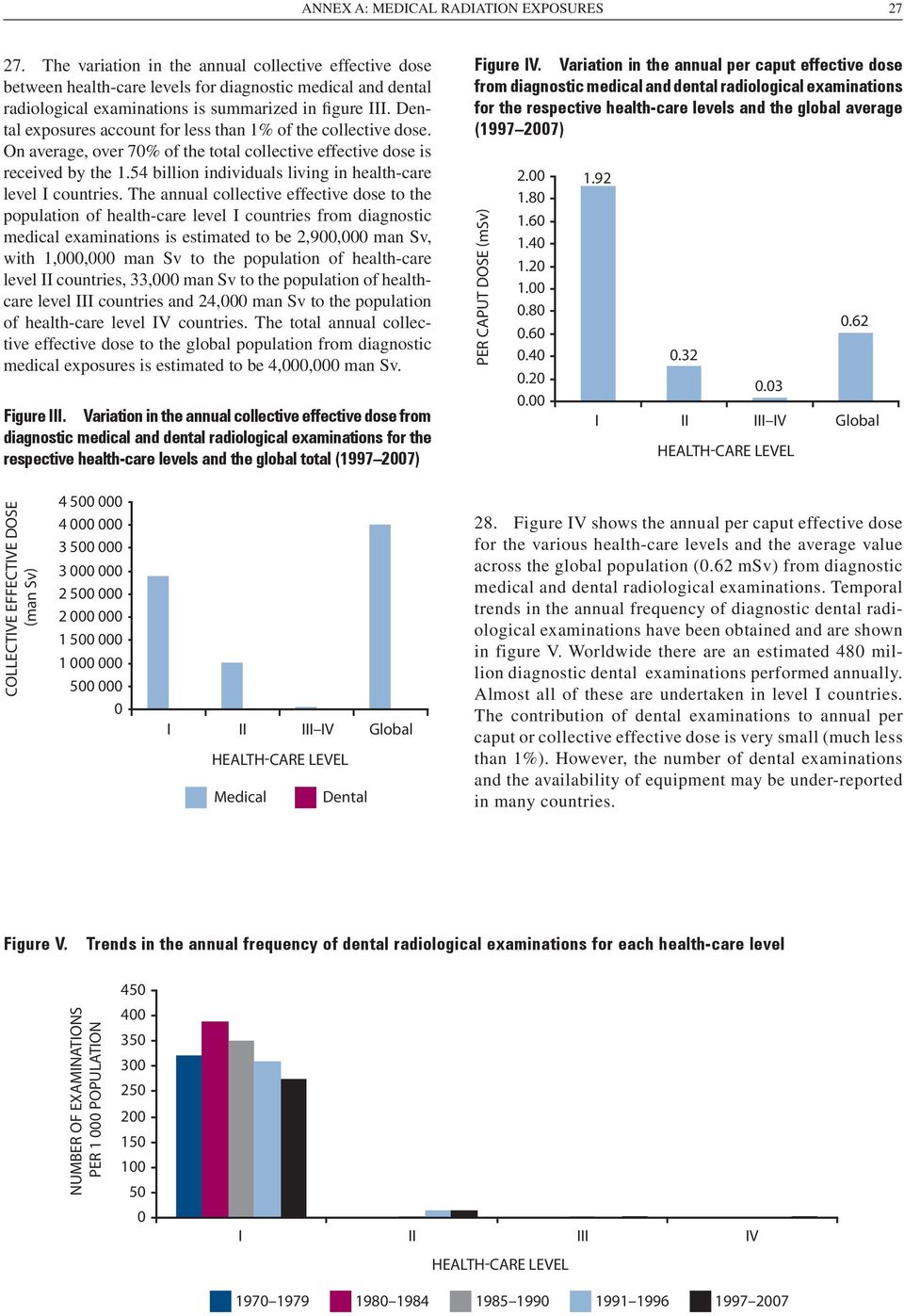
18 36 UNSCEAR 2008 REPORT: VOLUME I Figure XXII. Trend in the annual number of diagnostic nuclear medicine procedures Figure XXIV. Trend in the annual collective effective dose from diagnostic nuclear medicine procedures NUMBER OF EXAMINATIONS millions [U7] 1993 [U6] 2000 [U3] 2008 COLLECTIVE EFFECTIVE DOSE man Sv [U7] 1993 [U6] 2000 [U3] 2008 UNSCEAR SURVEY UNSCEAR SURVEY Figure XXIII. Trend in the annual frequency of diagnostic nuclear medicine procedures Figure XXV. Trend in the per caput effective dose from diagnostic nuclear medicine procedures NUMBER OF EXAMINATIONS PER POPULATION [U7] 1993 [U6] 2000 [U3] 2008 UNSCEAR SURVEY PER CAPUT EFFECTIVE DOSE (msv) [U7] 1993 [U6] 2000 [U3] 2008 UNSCEAR SURVEY
![5 24 1988 [U7] 1993 [U6] 2000 [U3] 2008 COLLECTIVE EFFECTIVE DOSE 1 000 man Sv 250 200 150 100 50 0 202 160 150 74 1988 [U7] 1993 [U6] 2000 [U3] 2008 UNSCEAR SURVEY UNSCEAR SURVEY Figure XXIII.](/docs-images/46/21510827/images/page_18.jpg "Trend in the annual frequency of diagnostic nuclear medicine procedures Figure XXV.")
19 APPENDIX a. METHODOLOGY FOR ESTIMATING WORLDWIDE MEDICAL EXPOSURES I. Introduction A1. As early as 1962 the Committee [U15] provided tables of information on medical exposures. Data were supplied by approximately 20 countries. The data indicated the total population and total annual frequency of examinations (expressed as annual number of examinations per 1,000 population in the general population). Emphasis was predominantly on gonadal dose and genetically significant dose, since at that time hereditary effects were felt to be very important. By 1972 the Committee [U11] had added estimation of marrow dose as well, but again only reporting the total annual frequency of examinations. In 1977 the Committee [U10] began to include data on the annual frequency of specific examination types for at least one country (Sweden). In the 1982 UNSCEAR Report [U9], data on the annual frequency of specific examinations were presented for 16 countries, and estimates of effective dose equivalent for various examinations were reported for two countries (Japan and Poland). Absorbed doses to some organs were also estimated. Genetically significant dose and marrow dose were no longer used at that time, having been replaced by effective dose equivalent as a quantity of interest. A2. In the 1988 UNSCEAR Report [U7] the Committee greatly expanded its presentation on medical exposures and attempted to estimate global exposure rather than simply presenting country-specific data. This was possible as data from large countries, such as China and countries in Latin America, became available. In addition, the Committee decided to prepare and distribute a survey questionnaire to Member States aimed at acquiring data on medical exposures in addition to those that appeared in the published literature. This survey methodology has continued to the present day. A3. The Committee recognized that estimation of the population dose due to medical exposures had significant weaknesses [U3, U9]. In spite of the efforts of the UNSCEAR secretariat, data were still available for only about a quarter of the world s population. Most of the data on frequency and types of radiological examination were mainly available from developed countries [M39]. A method was sought to extrapolate the existing data to other countries where no data were available. Members of the UNSCEAR secretariat examined possible correlations that might be helpful. Some correlations that were examined in relation to frequency of medical radiation exposures, but which were found not to be helpful, included the percentage of gross domestic product spent on health care, the number of hospital beds per 1,000 population, and the number of examinations or procedures per X-ray, nuclear medicine or radiation therapy machine. Mettler et al. developed an analytical model to estimate the availability and frequency of medical uses of radiation worldwide [M39]. Because frequency and equipment data are un available for many countries, Mettler et al. investigated data sources that were available and that correlated reasonably well with examination frequency. In their original paper they found that there was a good correlation between the number of people in the population divided by the number of physicians and the annual frequency of diagnostic radiological examinations. This subsequently led to the four-level health-care model, which has been used in recent UNSCEAR reports [M39, U3, U7, U9]. The model has also been used in performing analyses of diagnostic X-ray examinations [M40]. A4. The model used to analyse population exposure assigned countries to four health-care levels as follows: Level I with at least one physician for every 1,000 people; Level II with one physician for every 1,000 2,999 people; Level III with one physician for every 3,000 10,000 people; Level IV with less than one physician for every 10,000 people. A5. The changes in the population distribution across the four health-care levels between 1970 and 2007 is shown in figure A-I. About half of the world s population live in countries that have 1,000 2,999 people per physician, and this percentage has stayed relatively constant for the last 25 years. There has been a gradual decline in the percentage of the world s population living in level I countries. A6. While the distribution of population by health-care level has not changed significantly, the world s population has increased substantially, rising from just over 4 billion in 1977 to about 6.5 billion in 2006, an increase of over 60% (figure A-II). 37

20 38 UNSCEAR 2008 REPORT: VOLUME I A7. By analysing the available data using these healthcare level criteria and data on the annual frequency of selected examinations from various countries, it was possible to obtain an average annual frequency for these examinations for a given health-care level and apply this value to the other countries of the same health-care level for which the Committee had no specific data. This allowed a global estimate of the number and type of examinations or procedures to be presented in the UNSCEAR 1988 Report [U7] as well as in all subsequent reports of the Committee [U3, U4, U6]. Figure A-I. Population distribution across the four healthcare levels ( ) Figure A-II. Change in the global population over the period covered by the various UNSCEAR Global Surveys of Medical Radiation Usage and Exposures POPULATION millions UNSCEAR SURVEY CONTRIBUTION % A8. The UNSCEAR 1988 Report also presented the first estimate of collective effective dose equivalent to patients from diagnostic radiology and diagnostic nuclear medicine [U7]. This estimate was made by multiplying the total number of specific examinations by the effective dose equivalent per examination. The data collected on the calculated effective dose equivalent for various examinations were presented. In more recent reports of the Committee, effective dose has been used rather than effective dose equivalent [U3]. The specific dosimetric methodologies are presented below I II III IV HEALTH CARE LEVEL A9. The questionnaire used in the most recent UNSCEAR Global Survey of Medical Radiation Usage and Exposures comprises five parts. The first part requests general information and data on the number of practitioners for various groups in a country. Form 1 requests information on diagnostic and therapeutic equipment. Forms 2, 3 and 4 cover diagnostic radiological examinations, nuclear medicine procedures (both diagnostic and therapeutic) and radiation therapy treatments, respectively. II. Methodology for analysis of dosimetry in diagnostic and interventional radiology A10. This section comprises a review of the various approaches to patient dosimetry and is based upon the approach described by the International Commission on Radiation Units and Measurements (ICRU) in ICRU Report 74, Patient dosimetry for X-rays used in medical imaging [I46]. Further details on patient dosimetry may be found elsewhere [F1, F3, H34, I17, I32, J2, M22, N1, S17, S18, S19, U3, W16]. A11. Over the years, a number of patient dosimetric quantities have been developed. These dosimetric quantities will be described in subsequent paragraphs. A12. The ICRU [I47] has defined energy fluence, Y, as the quotient of dr by da, where dr is the radiant energy incident on a sphere with a cross-sectional area da. This quantity specifies the energy carried by the photons in an X-ray beam: Y = dr/da Units: J m 2 A13. Kerma, K, is defined at a point and is given by: K = de er /dm Units: J kg 1 or Gy where de er is the sum of the initial kinetic energies of all the charged particles liberated by photons in a mass dm [I30]. For medical exposures, air kerma, K a, is commonly used. Air kerma for photons of a single energy is given by: K a = Y (µ tr /r) a Units: J kg 1 or Gy
21 ANNEX A: MEDICAL RADIATION EXPOSURES 39 where (µ tr /r) a is the mass energy transfer coefficient for air. For medical exposures, the photon beam is usually not monoenergetic; in these circumstances the mass energy transfer coefficient must be weighted according to the energy distribution of the energy fluence. A14. Air kerma rate, K, is given by: a K a = dk a /dt Units: J kg 1 s 1 or Gy s 1 where dk a /dt is the increment of air kerma in a time interval dt. A15. The deposition of energy due to ionizing radiation in a material is quantified by the absorbed dose, D [I47]. Absorbed dose is defined as: D = d e /dm Units: J kg 1 or Gy where d e is the mean energy imparted by the radiation to matter of mass dm. Absorbed dose, D t, to a material t is related to the energy fluence, Y, by the mass energy absorption coefficient in that material, (µ en /r) t, under conditions of charged particle equilibrium. For photons of a single energy, D t is given by: D t = Y (µ en /r) t Units: J kg 1 or Gy In medical images where polychromatic X-ray photons are usual, the mean value of (µ en /r) t, weighted according to the energy distribution of the energy fluence, is used. If bremsstrahlung is negligible, (µ en /r) t = (µ tr /r) t hence D t = K t A16. Absorbed dose rate, D, is defined as [I30]: D = dd/dt Units: J kg 1 s 1 or Gy s 1 Incident dose is the dose on the central axis of the X-ray beam at the point where the X-ray beam enters the patient; it does not include backscatter. Entrance surface air kerma (ESAK) is the air kerma on the central X-ray beam axis at the point where the X-ray beam enters the patient or phantom [I17, I46]; it includes the effect of backscatter (see figure A-II). ESAK is recommended by the ICRU for dosimetry in medical imaging. However, many of the publications reviewed in this report use entrance surface dose (ESD), which does not include the effect of backscatter. For consistency, ESD has been used in this report. A17. The quantity exposure, X, is defined by the ICRU [I47] as: X = dq/dm Units: C kg 1 A18. For measurements of dose from medical exposures it is important that both the quantity and the measurement point must be specified. This is particularly important when specifying ESD. When making measurements close to the entrance surface of the patient or phantom, it is critical whether the quantity being measured is incident air kerma that ignores backscatter or ESAK that includes backscatter. Thus the distance from the measurement point to the entrance surface of the patient or phantom should be specified. Air kerma area product is deduced from the field size in a particular plane perpendicular to the central axis of the X-ray beam and the air kerma for the central axis in this plane (see figure A-III). A19. The International Commission on Radiological Protection (ICRP) has recommended that average absorbed dose in a tissue or organ be the basic quantity for assessing stochastic risks [I48]. The ICRU [I2] has defined the average absorbed dose, D T, in a specified organ or tissue T as the total energy imparted to the tissue, e T, divided by the mass, m T : D t = e T /m T A20. The risk of a stochastic effect is dependent on the type and energy of the radiation as well as on the absorbed dose. As a consequence, the ICRP [I3] has recommended that the organ dose be weighted by a radiation weighting factor. A21. For stochastic risk assessment, the ICRP [I3] has introduced the quantity equivalent dose, H T. The equivalent dose in a tissue T is given by: H = w D, T R T R R where D T,R is the average absorbed dose to tissue T from radiation R, and w R is the radiation weighting factor (w R = 1 for X-rays). For medical exposures, gauging the risks of stochastic effects is complicated because almost invariably more than one organ is irradiated. The ICRP introduced the unique quantity effective dose equivalent (H e or EDE) in its Publication 30 [I36], and then redefined and renamed the quantity effective dose (E) in ICRP Publication 60 [I3], for expressing stochastic risk to radiation workers and to the whole population [I3]. To evaluate effective dose, the equivalent dose to a tissue or organ, H T, is weighted by a dimensionless tissue weighting factor w T. Multiplying the equivalent dose (H T ) of an organ or tissue by its assigned tissue weighting factor (w T ) gives a weighted equivalent dose. The sum of weighted equivalent doses for a given exposure to radiation is the effective dose. Thus: where dq is the absolute value of the total charge of the ions of one sign produced in air when all the electrons and positrons liberated or created by photons in air of mass dm are completely stopped in air.
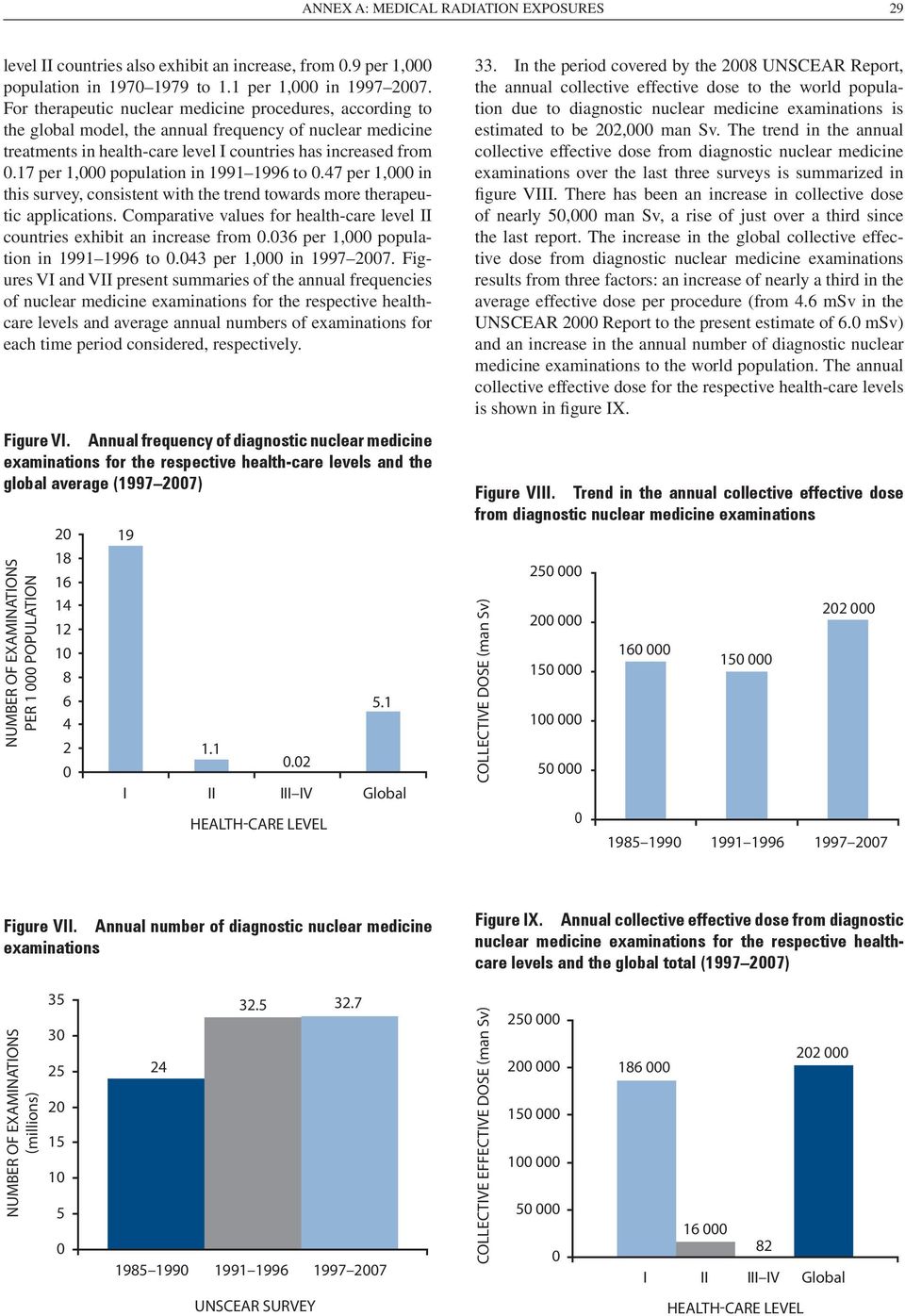
22 40 UNSCEAR 2008 REPORT: VOLUME I A22. Table A1 summarizes the various tissue weighting factors (w T ) as prescribed by the ICRP over the years. Tissue weighting factors represent a judgement by the ICRP of the relative contribution of organs or tissues to the total detriment associated with stochastic effects [I46]. The sum of the tissue weighting factors is unity. Thus the numerical value of effective dose resulting from a non-uniform irradiation is intended to be that equivalent dose which, if received uniformly by the whole body, would result in the same total risk. (Whole-body doses are usually meaningless for assessing the risk of medical exposures, because non-uniform and localized energy deposition is averaged over the mass of the entire body.) Figure A-III. Simple exposure arrangement for radiography illustrating some of the dosimetric and geometric quantities recommended for determination of patient dose [I17] Focal spotto-surface distance d FSD Focal spotto-image receptor distance d FID X-ray tube Focal spot position Collimator Air kerma area product P KA meter - Incident air kerma K a,i (no backscatter) - Entrance surface air kerma K a,e (including backscatter) Organ dose D t Table Image receptor Absorbed dose to tissue at a point in the patient D t Table A1. Summary of tissue weighting factors [I3, I6, I36] Organ Tissue weighting factors, w T ICRP 30 [I36] 1979 ICRP 60 [I3] 1991 ICRP 103 [I6] 2008 Gonads Red bone marrow Colon Lungs Stomach Bladder Breasts Liver Oesophagus Thyroid Skin Bone surfaces Salivary glands 0.01 Brain 0.01 Remainder
23 ANNEX A: MEDICAL RADIATION EXPOSURES 41 A23. The tissue weighting factors are judged to be independent of the type and energy of radiation incident on the body. The nominal stochastic risk coefficients for effective dose to workers and members of the public are based on the notional risk of radiation-induced cancer and severe hereditary disorders averaged over these populations. Moreover, to assess the risks from exposures at low doses and dose rates, the ICRP has introduced a dose and dose-rate effectiveness factor (DDREF) of 2, which is included in the nominal stochastic risk coefficients. A24. Both the radiation and tissue weighting factors are derived from the observed rates of expression of these effects in various populations exposed to radiation and from radiobiological studies. As more research evidence has become available, the ICRP has prescribed different values for these weighting factors [I6] (see table A1). Thus the reported effective dose equivalents are not strictly comparable with the reported values of effective dose for a particular examination, since their derivations involve different weighting factors. Another limitation of the use of effective dose in the assessment of medical exposures is that it may be difficult to perform a coherent trend analysis in the future. This may affect comparisons of the results between UNSCEAR reports. A25. There are other issues regarding the use of effective dose to gauge the risk of potential effects from medical exposures. The most significant relates to differences in age, sex and health status of the medically exposed populations compared with the population characteristics used by the ICRP [I3, I6, I36] to derive its nominal risk coefficients [I46]. For example, the age distribution and life expectancy of patients having percutaneous transluminal coronary angioplasty (PTCA) procedures is different to that of the general population or a population of radiation workers [B25]. Consequently the ICRU suggests that effective dose should not be used for the assessment of risk from medical exposures [I46]. A26. The ICRP suggests that estimating stochastic risks for a specific population is sometimes better achieved using absorbed dose and specific data relating to the relative biological effectiveness of the radiation and risk coefficients, taking into account health status and/or life expectancy [I3, I6, I36, I46]. A27. The ICRU recommends that stochastic and deterministic risks associated with medical exposures be assessed from a detailed knowledge of organ doses, absorbed dose distribution, age and sex [I46]. Effective dose is not considered suitable for this purpose by the ICRU. However, many authors in the literature survey of reports on doses from medical examinations and in references cited in the present report have used effective dose, despite its limitations, as a surrogate quantity to assess patient exposures, in part because it is convenient to use. Effective dose has therefore been used in this report for purposes of comparison with previous publications despite its weaknesses for gauging risks as noted above. A28. In most radiology procedures, the primary X-ray beam will directly irradiate only part of the patient. Effective dose is a risk-related quantity, which takes into account which organs are irradiated and by how much. It is a derived quantity and its evaluation provides a numerical value for the uniform whole-body exposure that would result in the same overall radiation risk as the respective partial-body exposure. A29. In diagnostic radiology it is common practice to measure a radiation dose quantity that is then converted into organ doses and effective dose by means of conversion coefficients. These coefficients are defined as the ratio of the dose to a specified tissue or effective dose divided by the normalization quantity. Incident dose, air kerma, ESAK, ESD or kerma area product (KAP) can be used as normalization quantities [I46]. A30. Estimating effective dose from values of organ doses is particularly difficult in radiology, because usually only part of the body is directly irradiated owing to the collimation of the X-ray beam to the area of clinical interest. In addition, often only part of an organ is included in the primary beam, the remainder being exposed to scattered radiation. A31. Irrespective of which approach is adopted to estimate doses and risks resulting from diagnostic X-ray examinations, there are weaknesses. For example, there are considerable uncertainties on estimates or measurements of organ dose in many circumstances. There are also differences in the size and position of radiosensitive organs within the bodies of individuals and even within phantoms. Inspection of normalized organ dose data reveals some variability in this respect. There is a large difference in the organ dose depending on whether or not the organ is in the primary beam [I26, J1, K23, L21, P15, R19, R21, R22, S39, Z9, Z10, Z11, Z12, Z13]. All of these factors lead to uncertainty in organ dose estimation. A32. These problems exist even if a well-defined part of the body is irradiated. For example, in head CT or dental radiology, the value for effective dose will be dependent upon whether the thyroid/oesophagus is assumed to be in the primary beam. Assumptions have also to be made about the amount and location of red bone marrow and about bone surfaces in the skull [L5, L6]. A33. There are three main approaches to the assessment of patient doses in diagnostic radiology: (a) direct dose measurements on a patient; (b) dose measurements in physical phantoms; and (c) Monte Carlo radiation transport calculations. The most common approach is the combination of an easily measurable quantity such as KAP with the respective conversion coefficients derived from Monte Carlo calculations. Direct measurement of patient dose is limited to relatively few superficial organs, such as the eye, skin, thyroid or testes. A34. A general problem faced in clinical practice is the difficulty associated with making measurements on groups of patients whose size and build differ markedly from the
24 42 UNSCEAR 2008 REPORT: VOLUME I norm [F9]. In these circumstances one accepted approach is to perform the measurements on all patients undergoing this procedure during a measurement period and then take the average of the dose values as the outcome for a standard sized patient, 70 kg ± 10 kg. This will give a reasonable estimate of that dose provided that the number of patients is not too small, perhaps a minimum of ten patients [E5]. A35. An alternative approach is to apply a height and weight conversion factor to allow for deviation in size and composition from that of reference man [L4]. Correcting for patient size was first proposed by Lindskoug [L4] and has been further developed by Chapple et al. [C1]. It enables reference values to be obtained from large-scale patient dose surveys by correcting each individual dose quantity to what it would have been had the individual corresponded to the size and composition of reference man. A36. The collective effective dose to the population is the sum, over all types of examinations, of the mean effective dose, E e, for a specific examination type multiplied by the number of these examinations, n e. The number of examinations may be deduced from the annual frequency (expressed as number of examimations per 1,000 population) and the estimated population for that country or health-care level. A37. The per caput effective dose is also used to quantify exposures that result from diagnostic radiology. It is the collective effective dose averaged over the population of both exposed and non-exposed individuals. The weakness of the per caput dose approach is that medical exposures tend to be performed on a subset of the population whose members are ill. A. Projection radiography A38. In projection radiography, the assessment of air kerma or dose (with or without backscatter) at the entrance surface of the patient is a common approach to patient dosimetry. This may be achieved by measurement of tube radiation output in mgy/mas at a given point (without a patient) using an ionization chamber, followed by calculation of the ESD from recorded exposure and geometric data, as well as the use of an appropriate backscatter factor. ESD or ESAK may be measured using thermoluminescent dosimetry (TLD). A39. A common method for measuring patient doses is to use TLDs. The dosimeters are packaged in plastic sleeves that are sterilizable, and are attached to the patient s skin using surgical tape. Correction factors for the energy dependence of the dosimeters and their sensitivity are applied to the raw TLD data. A background correction is also applied. A40. In addition to TLDs, glass dosimeters are widely used in Japan to assess medical exposures owing to their superior technical characteristics. Glass dosimeters have been used to assess ESD in intraoral radiography and for endovascular treatments [K31, N14]. A41. Physical phantoms that simulate patient anatomy can be used for dosimetry [C1, M2]. Some phantoms have a fair degree of anatomical accuracy and are a reasonably accurate representation of human anatomy, both in terms of the size and position of the organs and with respect to the attenuation properties. A problem with some anthropomorphic phantoms is that they are not tissue equivalent, which leads to inaccurate dosimetry for diagnostic radiology [S38]. The ICRU has described the requirements for physical dosimetry phantoms [I30]. A42. There are limitations regarding measurements in a physical dosimetry phantom. These relate to the need to use a large number of dosimeters to estimate the dose to physically large organs, the non-uniform distribution of radiation within the phantom and the effect of small uncertainties in the position of the radiation field. As a consequence, this method of patient dosimetry as well as the other methods (measuring ESD with TLDs) are not suitable for routine patient dose assessments. A43. Monte Carlo computational techniques are also used to estimate organ or tissue doses. These are computer-based methods that employ computational models to simulate the physical processes associated with the interaction of an X-ray beam with the human body. There are two types of computational model: mathematical and voxel phantoms. Monte Carlo calculations are used to deduce energy deposition of X-ray photons in computational models of human anatomy [I30]. Normally, patient dose is assessed by applying suitable Monte Carlo calculated conversion coefficients to a routinely measured quantity such as KAP or ESD. Mathematical phantoms are a three-dimensional representation of a patient. The organs and the whole body are defined as geometric bodies (such as cylinders and ellipsoids). The various phantoms used have been of increasing anatomical accuracy and complexity [C21, I26, J1, K23, S39]. A44. Voxel phantoms are based on either CT or MR images of actual patients. Organ sizes and positions are deduced from the volume elements determined from the imaging data. As a consequence these phantoms are physically more accurate, the only limitation being the size of the voxels used. Various voxel phantoms have been described in references [P15, V13, Z9, Z10]. A45. As mentioned above, there are uncertainties in the estimation of organ doses. For example, relatively small differences in patient build can result in large differences in organ doses depending on whether the organs lie within or outside the primary beam [G21, S40]. In chest radiology the uncertainty in dose to the lower large intestines can be as large as 48% [I46]. Other uncertainties in Monte Carlo calculations arise from uncertainties in attenuation coefficients, the patient phantom and the model of the X-ray source. A46. If the dose or air kerma at a specified point is known, it is possible to use normalized organ dose data to deduce organ doses for a typical patient, effective dose being calculated
25 ANNEX A: MEDICAL RADIATION EXPOSURES 43 from the organ doses. Normalized organ dose data are available for many examination types, including CT. They are generally based upon Monte Carlo simulations of examinations [D3, D4, D6, H13, J1, J3, R2]. A47. Numerous publications have tabulated back scatter factors for X-rays [B22, C22, G3, G4, G22, H28, H29, I23, K24, K25, M29, P16, S41], which may be required in estimating entrance skin dose. Various handbooks of dose conversion coefficients have been published [D6, H13, H30, H31, H32, J1, J3, K23, R19, R20, R21, R22, S42, S43, V13, Z9, Z11, Z12, Z13]. A48. A computer-based Monte Carlo program for calculating patient doses resulting from medical radiological examinations has been developed by Tapiovaara et al. [T17]. This computer program uses hermaphrodite phantoms for six ages ranging from newborn to adult. There is good agreement between this program and other software [H30, H32, J1] when used to calculate organ dose conversion coefficients. B. Fluoroscopy A49. Approaches to patient dosimetry are different for procedures that involve the use of fluoroscopy equipment [B1]. During these examinations an automatic exposure control is used to adjust the generator settings to compensate for changes in attenuation in the X-ray beam. Consequently the tube potential and tube current change continuously as the projection direction changes because of changes in attenuation through the patient. Furthermore, the anatomical area of the patient irradiated by the primary beam varies, and different tissues have different attenuation coefficients. This means that it is difficult to monitor maximum ESD directly, as the anatomical position where this occurs may not be known in advance [W4]. In addition, dosimeters placed on the patient s skin may not be in the primary beam for all projection directions used in some procedures (e.g. interventional cardiology). In these circumstances, dose area product (DAP) or air KAP may be assessed, depending upon the calibration of the measurement instrument. These are quantities that have the advantages of being easy to measure and to correlate with risk. Additionally they are independent of the distance from the X-ray tube [A13, B21, C23, M31]. A50. In fluoroscopy, large-area transmission ionization chambers are commonly used to assess patient doses [C10]. These instruments measure KAP (Gy cm 2 ) or DAP (Gy cm 2 ) [I46], depending on the calibration of the instrument [I46, W26]. These quantities can be used to deduce the total energy imparted to the body or effective dose. It is also possible to derive other dose quantities from the KAP or DAP reading (e.g. ESD and mean organ doses) [I46, W26]. A51. Transmission ionization chambers must be calibrated in situ, because for geometry involving an undercouch X-ray tube and overcouch detector the attenuation of the patient couch must be taken into account [C24]. The uncertainty on DAP or KAP readings is approximately 6% for an overcouch X-ray tube geometry [L25] and up to 20% for an undercouch X-ray tube geometry, depending on how well the DAP meter has been calibrated [C24]. A52. The structure of transmission ionization chambers often includes high-atomic-number elements [I46], which means that their calibration is dependent on the radiation beam energy [B25, L25]. Instrument calibration is therefore particularly important for fluoroscopy equipment on which additional copper filtration is used. A53. There is increasing concern about skin dose levels in cardiology and interventional radiology [I1]. This is because of the discovery of deterministic injuries in patients who have undergone long procedures using suboptimal equipment and performed by individuals inadequately trained in radiation protection. Assessment of maximum ESD is particularly difficult, as the projection direction and irradiated area change during interventional procedures. Various measurement techniques have been proposed, including slow films [G11], real time software [F12], DAP [V18] and calculation [M12]. A54. Organ doses resulting from fluoroscopy procedures may also be assessed using TLDs loaded into a physical phantom. Dosimeters may be placed in the phantom at positions corresponding to the organs of interest, and a typical fluoroscopy procedure is simulated on the phantom using the appropriate X-ray equipment [C1]. The TLDs are read out and the organ doses deduced. Surface doses during fluoroscopy have also been assessed using glass dosimeters [N14]. A55. Measurement of either air KAP or DAP is probably the method of choice for assessing the doses and effective dose, and hence the potential risks, resulting from interventional procedures. DAP correlates reasonably well with radiation risk by means of conversion factors [H13]. These conversion factors are examination-specific and may be deduced from Monte Carlo organ dose calculations made for simulated interventional procedures. This approach has been used in reporting many of the patient dose data in response to the surveys (sections III and IV of this appendix). A56. At present there are no established technical approaches that provide a direct indication of maximum ESDs. However, there are four technical approaches that are being developed: (a) calculation of entrance dose from the generator settings, assuming a given focus skin distance; (b) directly determining entrance dose from either the air KAP or the DAP and collimator settings, also assuming a given focus skin distance; (c) use of special solid-state detectors placed on the skin surface of the patient; and (d) use of a large-area field-sensing ionization chamber, which measures DAP and entrance dose at a given focus distance simultaneously [T2]. Methods (a), (b) and (d) require an assumption about backscatter radiation, whereas the detector in (c) will automatically include it. The use of detectors placed on the skin is a potential problem, in that with different angulations
26 44 UNSCEAR 2008 REPORT: VOLUME I of the X-ray tube, the dosimeter may not be placed at the position where the maximum skin dose occurs (as this may not be known beforehand). The dosimeters may also be visible on the displayed image. The other approaches inevitably yield an overestimate of maximum ESD. A57. One design of ionization chamber incorporates an ultrasonic distance ruler at the chamber [T2]. This instrument can therefore deduce ESD. The computer linked to the chamber applies an inverse square law correction based on the measurement of the chamber-to-patient distance made using the ultrasonic ruler. Consequently this instrument design can provide an on-line display of ESD, but if different angulations of the X-ray tube are used, this method will also overestimate the maximum ESD. C. Mammography A58. Dosimetry in mammography is particularly difficult, as low-energy X-rays are used to image the breast [N4]. This places particular demands on the instruments used to measure breast dose, as they need to be energy independent down to 15 kev or an appropriate calibration factor should be applied. A59. Moreover, while simple measurement of ESD on top of an appropriate phantom has been considered as a suitable quantity, this does not take into account the attenuation properties of breast tissue, which vary according to both breast composition and X-ray radiation quality. Depth-dose data are critically dependent upon breast composition and the X-ray spectrum [D3, D4, D12]. A60. It is widely acknowledged that within the breast it is the glandular tissue that is most radiosensitive, rather than fat or connective tissue. Mean glandular dose or average absorbed dose in glandular tissue has been recommended by the ICRP as the relevant dosimetric quantity for mammography [D6, I5, I46, N4]. While the quantity mean glandular dose correlates reasonably well with the associated radiation risk, it cannot be measured directly and therefore has to be inferred from other measurements. A61. Hammerstein et al. [H9] proposed a model for a standard breast comprising 50% adipose and 50% glandular tissue. The composition of this breast was deduced from the elemental composition of a relatively small number of autopsy sections. Hammerstein et al. also proposed using a conversion factor to be applied to the measured ESD [H9]. A62. Mean glandular dose, D G, can also be derived from incident air kerma, K a,i, to a standard breast phantom; this has a superficial layer of either 0.4 cm of glandular tissue or 0.5 cm of adipose tissue with a varying thickness of 50:50 adipose and glandular tissue between the two superficial layers [D4]. A conversion coefficient is used to deduce D G [I46]: D G = c G K a,i (Gy) A63. Many authors have published conversion coefficients for assessing doses in mammography [A14, D4, D12, J11, R23, S43, W27, W28, Z14]. Conversion coefficients are tabulated as a function of half-value layer and compressed breast thickness [D4]. There are variations of up to approximately 15% between different conversion coefficients [I46]. In addition, breast composition also varies with compressed breast thickness [G15, K26, Y11, Y12]. A64. Since this earlier work, a number of authors have used Monte Carlo techniques to model the interaction of low-energy X-ray beams within breast tissue [D3, D4, R2]. D. CT dosimetry A65. Air kerma length product, P KL, is recommended by the ICRU for CT dosimetry [I46]. The air kerma length product is the integral of the air kerma free in air along a line of length parallel to the axis of rotation of the CT scanner and is given by: P KL = L K a (L) dl (Gy cm) This quantity may also be assessed inside a phantom, P KL,CT. A66. The CT air kerma index free in air, CTDI air, has also been defined by the ICRU [I46] for dosimetry of fan beam scanners. It is the integral of the CT axial air kerma profile, K a (z), along the axis of rotation of the CT scanner for a single rotation divided by the nominal beam collimation, T. CTDI air = 1/T = P KL /T (Gy) K a (z) dz A67. For a multislice CT scanner with N slices of collimation T CTDI air = P KL /(NT) (Gy) A68. For phantom measurements on CT scanners, a CT air kerma index, C K,PMMA, can also be defined [I46]. C K,PMMA = K a,pmma (z) dz = P KL,PMMA /T (Gy) A69. Other specialized dosimetric techniques have been used to assess patient radiation dose in CT, as it is difficult to directly determine organ doses [S17, S18]. These techniques have been described in a series of publications [F3, I32, J2, M22, S18, S19, U3, W16]. These dosimetric approaches are based upon the use of three quantities dedicated to CT dosimetry: weighted CT dose index (CTDI W ), volume-weighted CT dose index (CTDI vol ) and dose length product (DLP).
27 ANNEX A: MEDICAL RADIATION EXPOSURES 45 A70. Dedicated CT dosimetry phantoms are recommended by the ICRU [I30]. The phantom is placed on the CT scanner couch so that the scanner s axis of rotation coincides with the longitudinal axis of the phantom [I46]. The centre of the CT scanner slice or multiple slices is aligned to the centre of the phantom. Measurements are made at the centre and peri phery of the CT dosimetry phantom, which is manufactured from polymethylmethacrylate (PMMA). A71. CT dosimetry is based upon the use of PMMA phantoms with diameters of 16 cm and 32 cm to represent an adult head and body, respectively. Measurements are made, usually with a pencil ionization chamber of 100 mm length, at the centre of the phantom and 1 cm below the surface at four equally spaced locations. A72. The weighted CTDI w in either phantom is given by: CTDI w =1/3 CTDI 100,c + 2/3 CTDI 100,p where CTDI 100,p is the average of the four CTDI measurements (see above) made at the periphery of the phantom. CTDI 100,c is the measurement made at the centre of the phantom. CTDI w is measured for a range of technique factors (i.e. tube current, tube voltage, slice collimation) typical of those used clinically. A73. CTDI 100 (expressed in mgy) is defined as the integral over 100 mm along a line parallel to the axis of rotation (z) of the dose profile D(z) for a single rotation, at a fixed tube potential, divided by the nominal collimation of the X-ray beam used by the CT scanner [S18]: CTDI 100 = 1/NT 50mm 50mm D(z) dz where, for a single rotation, the number of CT slices is N, the nominal thickness of each slice is T, and NT (expressed in cm) is the total detector acquisition width and is equivalent to the nominal beam collimation [S18]. CTDI 100 is usually measured using a pencil ionization chamber of 100 mm length. A74. CTDI vol (expressed in mgy) is given by the following equation: CTDI vol = CTDI w /P where P is the CT pitch factor given by: P = d/nt where d is the distance (expressed in cm) moved by the patient table in the z direction, between serial scans or per rotation in helical scanning [I32, S19]. A75. CTDI w may be normalized to the tube current time product. Normalized CTDI w may also be given for a standardized nominal beam collimation of 10 mm [S19]. For specific models of CT scanner, relative conversion coefficients are provided for a range of collimation settings. In CT scanners that operate in automatic exposure control mode where the tube current is automatically modulated, average tube current or current time product is used to take account of the effect of this modulation [K11, K12, L17]. A76. DLP (expressed in mgy cm) is given by the following equation: DLP = CTDI w NT n where N is the number of slices of collimation T in centimetres per rotation and n is the total number of rotations. Alternatively, DLP may be calculated using: DLP = CTDI vol L where L is the scan length, determined by the outer margin of the volume irradiated in the CT scan [M22, S19]. A77. The International Electrotechnical Commission (IEC) has recognized the need for a dose display on CT scanners and has recommended that CTDI vol be used [I32]. On some machines, DLP is also displayed. These equipment displays mean that patient dosimetry in CT is made easier by using recently manufactured machines. The IEC has also considered developing a standard for the recording of dosimetry data in the DICOM header. A78. One of the problems associated with performing patient dosimetry measurements using CTDI on CT scanners with a large number of rows of detectors is the required integration length. For a nominal beam width of 128 mm, an integration length of 300 mm is required if scattered radiation is to be appropriately assessed [M36]. Conversion factors have been developed to allow a standard CTDI phantom and a 100-mm-long ionization chamber to assess CTDI on multislice CT scanners [M36]. A79. Effective dose E may be inferred from the DLP using appropriate conversion coefficients ((E DLP ) regime ). Conversion coefficients have been calculated for different regions of the body at a range of standard ages [J2, J3, K13, S18, S19, S20, S21]. These conversion coefficients are derived from mathematical phantoms [K13] using Monte Carlo modelling. Measured conversion coefficients have been published by Chapple et al. [C13] for paediatric patients. These conversion coefficients were deduced from a series of measurements made using anthropomorphic phantoms that simulate a range of ages from 0 to 15 years, into which TLDs had been placed.
28 46 UNSCEAR 2008 REPORT: VOLUME I E. Dental panoral tomography A80. ESD is commonly measured in intraoral dental radiology. A81. In dental panoral tomography (and also in CT), air kerma length product is used for dosimetry. Air kerma length product, P KL, is the integral of the air kerma over a length L [I17]. P KL = L K(z)dz F. Dual-energy absorptiometry A82. In dual-energy absorptiometry it is common to use approaches to patient dosimetry that are similar to those employed for projection radiography (i.e. measurement of ESD or effective dose using anthropomorphic phantoms). III. Methodology for analysis of dosimetry in nuclear medicine A. Dosimetric approaches A83. The MIRD (medical internal radiation dose) system was developed primarily for use in estimating radiation doses received by patients from administered radio pharmaceuticals. A84. The simplest form of the dose equation is: where N is the number of disintegrations that occur in a source organ and DF is given by: where n i = number of particles with energy E i emitted per nuclear transition; E i = energy of particle emitted (MeV); f i = fraction of energy emitted that is absorbed in the target; m = mass of target region (kg); k = the proportionality constant used to resolve the units (Gy kg (MBq s MeV) 1 ). The equation for absorbed dose in the MIRD system is [T18]: In this equation, r k represents a target region and r h represents a source region. The term à h is the number of disintegrations in a source region h and all other terms must be amalgamated into the factor S, which becomes: A85. The ICRP has developed a system for calculating internal doses to radiation workers who inhale or ingest radionuclides. The technical basis is identical to that shown above, but different symbols are used for many of the quantities. Moreover, values of permissible intakes and air concentrations for many radionuclides are derived from dose limits established for workers. The details are not given here, because this report focuses on dosimetry for the purposes of nuclear medicine. A86. However, the ICRP has also published extensive compendia of dose estimates for radiopharmaceuticals in its Publications 53 [I34] and 80 [I25]. In these documents, the available literature supporting the design of a kinetic model for each of the (over 100) radiopharmaceuticals is reviewed and a kinetic model is given, as well as dose estimates for adult and 15-, 10-, 5- and 1-year-old subjects. A87. As discussed above, the ICRP has defined the quantity effective dose [I3] for the purpose of gauging stochastic risks from radiation exposure. The discussion above concerning the limitations of the use of effective dose for assessing the exposures due to medical radiology also apply to its use for assessing exposures due to nuclear medicine. Thus, although the quantity has limitations, it is used here as a surrogate to assess patient exposures because of its convenience.
29 ANNEX A: MEDICAL RADIATION EXPOSURES 47 IV. Methodology for analysis of dosimetry in radiation therapy A88. Data for analysis of trends and annual frequency of procedures in radiation therapy are derived from published literature, supplied by professional organizations and governments, and/or from the survey forms. The data are typically more difficult to obtain than those for diagnostic radio logy or nuclear medicine. There are some inherent difficulties with the definition and comparison of the reported values. Some surveys report the number of patients treated, others report the number of treatment regimens (each of which may have up to 30 treatments) and still others report treatments. For this analysis it has proven valuable to supplement these estimates by considering data on the number and type of installed machines. A89. The UNSCEAR reports have often presented the intended absorbed or equivalent organ doses for various treatments. However, these are typically of the order of tens of grays. The concept of effective dose strictly applies only to lower dose levels (in the region where only stochastic effects occur), and therefore neither effective dose nor collective effective dose may legitimately be used for the high dose levels of radiation therapy. As a result, no contribution has been calculated for radiation oncology or included in the estimates of worldwide annual per caput effective dose or collective effective dose from medical exposures. A90. There are risks of stochastic and deterministic effects for patients who undergo radiation therapy resulting from radiation exposure of tissues outside the target radiation field. The risk of a second cancer is particularly important for those radiation oncology patients who survive treatment for malignant disease or receive radiation therapy for benign disease. However, the Committee has been unable to obtain sufficient data to adequately quantify these risks.
30
31 APPENDIX B. LEVELS AND TRENDS OF EXPOSURE IN DIAGNOSTIC RADIOLOGY I. Summary from UNSCEAR 2000 Report [U3] B1. The utilization of X-rays for diagnosis in medicine varied significantly between countries. Information on national practices that had been provided to the Committee by a sample of countries was extrapolated to allow a broad assessment of global practice, although inevitably there were significant uncertainties in many of the calculated results. On the basis of a global model in which countries were stratified into four levels of health care depending on the number of physicians relative to the size of population, the world annual total number of medical radiological examinations for was estimated to be about 1,900 million, corresponding to an annual frequency of 330 per 1,000 world population (table B1). Estimates of these quantities for were 1,600 million and 300 per 1,000 population, respectively. The global total of examinations was distributed according to the model among countries with different health-care levels as follows: 74% in countries of level I (at a mean rate of 920 per 1,000 population; 25% in countries of level II (150 per 1,000 population); and 1% in countries of health-care levels III and IV (20 per 1,000 population). In addition to such medical radiological examinations, there was also an estimated global total of about 520 million dental radiological examinations annually, corresponding to an annual frequency of 90 per 1,000 world population. The assumed distribution between health-care levels is: more than 90% occur in level I and less than 0.1% in levels III and IV. Notwithstanding the estimated mean frequencies of examination for each health-care level quoted above, there were also significant variations in the national frequencies between countries in the same health-care level. B2. Estimated doses to the world population resulting from diagnostic medical and dental radiological examinations are summarized in table B2. For , the global annual collective effective dose due to medical radiological examinations was estimated to be about 2,330,000 man Sv, corresponding to an average annual per caput dose of 0.4 msv; estimates of these quantities for were 1,600,000 man Sv and 0.3 msv, respectively. The distribution of the collective dose among the different health-care levels of the global model was as follows: 80% in countries of level I (giving a mean annual per caput dose of 1.2 msv); 18% in countries of level II (corresponding to 0.14 msv per caput); and 2% in countries of health-care levels III and IV (corresponding to 0.02 msv per caput). Diagnostic dental radiological examinations were estimated to provide a further annual collective dose to the world population of about 14,000 man Sv, equating to about msv per caput. These values were less than the corresponding estimates for of 18,000 man Sv and msv per caput. However, the uncertainties in all these estimates were considerable and this apparent trend may not be real. Approximately 68% of the global collective dose due to dental radiology arises from countries in health-care level I, with contributions of about 31% and less than 1% from countries in health-care level II and level III/IV, respectively. B3. The numbers of X-ray generators (excluding dental units) available for diagnostic radiology varied considerably between countries and between the health-care levels of the global model, with estimated averages of 0.5, 0.2 and 0.02 per million population for levels I, II and III/IV, respectively (table B1). The estimated average annual number of medical radiological examinations per medical X-ray generator was lower for countries of health-care levels III and IV (1,100) than for those of level II (2,300) and level I (2,700). The estimated average values of annual collective dose per medical X-ray generator followed a similar global pattern: 1.2 man Sv per unit in health-care levels III and IV; 2.0 man Sv per unit in level II; and 3.6 man Sv per unit in level I. However, there may be an under-reporting of medical and dental equipment in some countries. B4. The estimated global annual per caput effective dose per medical radiological examination for was 1.2 msv, which is comparable to the value of 1.0 msv estimated for However, the levels of dose to individual patients varied significantly among the different types of examination and also among countries. The contributions to collective dose provided by the different categories of examination are summarized in table B3 according to health-care level. On a global scale, population exposure due to medical radiology was dominated by the use of CT (which accounted for 34% of the annual collective dose) rather than examinations of the upper gastrointestinal (GI) tract (12%), which had been estimated to be the most important procedure for the period This new pattern applied principally for countries of health-care level I, where the mean contribution from the use of CT was 41%. However, the dominant practice in health-care level II countries was chest fluoroscopy (50% of collective dose), and in countries of levels III and IV it was examination of the lower GI tract (34%), with CT use providing contributions of only 5% and 2%, respectively. 49
32 50 UNSCEAR 2008 REPORT: VOLUME I II. Doses for specific X-ray procedures A. Diagnostic radiography B5. In the United Kingdom of Great Britain and Northern Ireland, the former National Radiological Protection Board (NRPB) (now the Radiation Protection Division of the Health Protection Agency) performed surveys of patient doses for common radiological examinations [S7]. A national database is used to collect data on patient doses from routine examinations according to a national protocol [N1]. B6. The NRPB has published data for common radiological examinations in terms of ESD and DAP [H34]. B7. Table B4 is a summary of patient dose data for conventional diagnostic radiological examinations (adapted from reference [H33]). It has been revised with additional patient dosimetry data. Effective dose estimates are given in the table. These have been calculated by the authors of the NRPB report, by the authors of the cited document or by applying a conversion factor used by the NRPB to the additional dosimetry data assessed in the cited patient dose survey. B8. Various authors have compared flat panel direct digital detectors with computed radiography (CR) systems [B12, Z4]. For the same image quality, radiation doses were halved using direct digital radiography (DDR) during excretory urography [Z4]. Doses for chest imaging were 2.7 times lower for a direct digital detector compared with film screen radiography and 1.7 times lower compared with a computed radiography system. B9. In another study, Ludwig et al. used monkeys as surrogates for paediatric patients in order to deduce the dose saving from the introduction of flat panel detectors for lumbar spine radiography [L11]. Dose savings of 75% without loss in image quality were predicted. B10. Vañó et al. [V8] have developed a computerized system for dose monitoring in radiology. Technical details for a series of examinations performed on a CT system were deduced from the DICOM header. A computer workstation, linked to the hospital PACS network, calculates ESD and DAP from the technical parameters. The dose monitoring system calculates a running average for ESD and DAP for the most recent ten patients. It then compares this running average with reference levels. A warning signal is given if the running average is higher than the preset reference value. B11. There is some evidence that the use of technique factors suggested by manufacturers can lead to higher doses in projection radiography [P17]. Peters and Brennan [P17] were able to reduce patient doses by optimizing technique factors. Weatherburn et al. [W20] investigated patient dose levels associated with bedside chest radiography following the replacement of a film screen system with a computed radiography system. They discovered in a randomized controlled trial that ESDs were higher in the computed radiography group. B12. Vañó et al. [V14] performed a retrospective analysis of patient dose levels in projection radiography using a computed radiography system. They found that immediately following the introduction of computed radiography, doses increased by between 44% and 103% for lumbar spine and chest examinations when compared with the film screen combination. Since this initial period, patient doses have been reduced. This analysis is based upon relatively large sample sizes of between 1,800 and 23,000. B13. Radiation doses for standard radiographic examinations in an accident and emergency department were studied by an Italian group [C28]. They concluded that effective doses for direct digital radiography were typically 29% and 43% lower than for film screen or computed radiography. B14. Since the previous report, digital imaging has been introduced into many centres worldwide. In summary, the impact of the introduction of digital imaging on patient dose levels in diagnostic radiography is unclear. B. Mammography B15. Mammography has also undergone many technological changes. Originally it was performed with conventional X-ray tubes using industrial direct exposure X-ray film to have good image quality. The introduction of dedicated mammography equipment, having a specialized tube with a molybdenum target/molybdenum filtration, combined with the introduction of film screen cassettes with a rear phosphor screen, substantially reduced radiation doses. B16. This reduction in dose facilitated consideration of the introduction of mass screening programmes. Given the public health benefits of breast cancer screening, many countries in health-care level I have introduced mass screening programmes. As a consequence, there has been a large increase in the frequency of use of mammography. B17. The introduction of film screen mammography coupled with molybdenum target tubes with molybdenum filters has reduced ESD to about 0.01 Gy [G8]. However, a number of individuals have advocated increasing film optical density so that the target optical density coincides with the point on the film screen characteristic curve with maximum slope and hence contrast amplification [F2]. This has been shown to improve cancer detection rates [Y3]. B18. Compressed breast thickness was analysed by Ogasawara and Date for Japanese women [O5]. The typical compressed breast thickness for Japanese women was under 3.8 cm, comparable to that in the Republic of Korea [O3].
33 ANNEX A: MEDICAL RADIATION EXPOSURES 51 Mean glandular doses are likely to be similar. Typical glandular doses were reported as 1.5 mgy in studies in Japan and in Taiwan Province of China [D8, T6]. While the compressed breast thickness reported in a German study [H22] was 5.57 cm, the mean glandular dose was comparable to that in surveys of Asian women (1.51 mgy). A similar value (1.5 mgy) was reported in a Canadian study [F10]. B19. Young [Y2] surveyed radiation doses in the United Kingdom trial of breast screening in women aged years. Doses for 2,296 women were estimated. The average dose was 2.0 mgy for a craniocaudal film and 2.5 mgy for an oblique view. Doses in younger women were approximately 7% higher than in older women (those aged over 50 years). B20. The Food and Drug Administration in the United States approved the first full-field digital mammography unit in 2000 [C25]. The introduction of digital mammography in the United States has been relatively slow, with digital units comprising 6.4% of the accredited mammography units [L26, M32]. Digi tal mammography offers potential benefits in the imaging of young women and women with dense breasts [P22, P24]. However, the high cost of digital mammography represents a limitation on its acquisition by screening programmes [T5]. B21. Doses to over 5,000 women were examined on a General Electric 2000D full-field digital mammography system in a two-year period [M6]. Dose information was obtained from the DICOM header. Mean glandular doses for both craniocaudal and mediolateral oblique projections were 1.8 mgy and 1.95 mgy, respectively. Fischmann et al. also found that doses for full-field digital mammography were comparable to those for film screen systems [F4]. B22. Gennaro et al. [G15] calculated the ESAK for a sample of 800 craniocaudal full-field digital mammograms. Mean glandular doses were in the range mgy and mgy for 50% and 30% glandularity, respectively. These dose levels are lower than for film screen mammography. B23. The Digital Mammographic Imaging Screening Trial (DMIST) included 49,528 women from 33 participating academic and community practices in the United States and Canada (25.5 months of enrolment from 2001 to 2003). All women in the trial underwent both film screen and digital mammography. Mean glandular doses were between 1.7 and 2.5 mgy for the digital systems and between 1.5 and 2 mgy for the film screen mammography units [P25]. B24. As may be deduced from table B4, the variation in dose is relatively small for mammography. The small range in doses is consistent with the practice of optimized mammography subject to quality control. C. Fluoroscopy and angiography B25. Direct fluoroscopy. Most regulatory systems internationally have prohibited the use of direct or non-intensified fluoroscopy [I11]. However, direct or non-intensified fluoroscopy is still performed in some countries. The number of dose surveys on non-intensified fluoroscopy systems is somewhat limited. Dosimetry on these systems is important, not least from a historical perspective. B26. In a study in Brazil, doses for barium enema were reported as 63 Gy cm 2, with a range of Gy cm 2. A mean dose of 107 Gy cm 2, with a range of Gy cm 2, was reported for hysterosalpingograms [C2]. Most of the DAP arose from direct fluoroscopy and not from radiographic images. Mean DAP for seriography was 167 Gy cm 2 (range Gy cm 2 ) [C2]. B27. Marshall et al. performed a study of chest examinations using non-intensified fluoroscopy in Albania [M3]. They investigated seven direct chest fluoroscopy systems. DAP ranged from 0.34 to 3.64 Gy cm 2, with effective doses in the range msv. The ESD was typically 17 mgy for a PA chest fluoroscopy, which is nearly 100 times higher than the reference dose for the equivalent examination performed using a film screen system in the United Kingdom [H34]. B28. Image intensified fluoroscopy. In the United Kingdom, the NRPB published data on DAP received by patients for common examinations involving fluoroscopy [H33]. This survey was undertaken in a limited number of centres and may not be representative of national practice. B29. Average DAP for endoscopic retrograde cholangiopancreatography (ERCP) in Greece was studied by Tsalafoutas et al. [T8]. The average DAP was 13.7 Gy cm 2 for a diagnostic procedure and 41.8 Gy cm 2 for a therapeutic one. B30. Patient doses for barium meal examinations were measured in three hospitals in Serbia and Montenegro by Ciraj et al. [C14]. A total of 74 patients were monitored in three hospitals with a minimum of 19 in each. All patients weighed within 10 kg of 70 kg. Median values of KAP varied by a factor of 3, from 7.2 to 22.1 Gy cm 2. The authors also calculated effective doses. These ranged from 1.7 to 4.8 msv [C14], which illustrates the variation between hospitals. B31. In summary, there are wide variations in dose levels for fluoroscopy procedures, reflecting differences in local practice, equipment and staff. The impact of digital imaging on dose levels is also unclear. D. Interventional radiology B32. Interventional radiology procedures have experienced a dramatic increase in frequency in recent years, principally because of the numerous significant benefits. Specifically, it is now possible to perform in a radiology department on an outpatient basis procedures that previously would have
34 52 UNSCEAR 2008 REPORT: VOLUME I necessitated surgical treatment in hospital. This results in considerably reduced trauma for the patient, and the hospital gains because more patients can be treated as outpatients at a lower cost. Consequently, both hospitals and the public demand access to more interventional radiology. This inevitably leads to an increase in the frequency of interventional radiology procedures. B33. This growth in demand has implications for population doses [C11, N10, W10]. Specifically, some interventional procedures are very complicated, and often involve extended fluoroscopy times and the operation of fluoroscopy equipment in high-dose-rate mode. This leads to high patient doses. In some patients the procedures are repeated owing to restenosis. B34. Table B5 is a summary of various sources of patient dose data for interventional radiology procedures; it has been adapted from a table produced by Hart and Wall [H33]. The original table has been revised with the inclusion of additional patient dose survey results in interventional radiology. Effective dose has been included for comparative purposes. Effective dose was calculated by either the NRPB or the original authors of the cited reports. In those instances where the authors of the survey did not deduce the effective dose, the NRPB conversion factor has been applied to the DAP to derive the value quoted. B35. Data on various fluoroscopy and interventional procedures have been analysed by the NRPB in the United Kingdom [H33, H34]. However, as the NRPB indicates, many of the data were obtained from too small a number of hospitals or X-ray rooms to be indicative of national practice in the United Kingdom. B36. Results from a large-scale survey of patient doses in interventional radiology have been published by Marshall et al. [M1]. Forty fluoroscopy rooms were monitored using calibrated DAP meters linked to laptop computers. Sizecorrected DAP values for seven groups of interventional procedures were published. Size correction was performed using previously published approaches [C1, L4]. B37. It is clear from the data presented in these tables that considerable variations in patient dose exist between centres. Doses are dependent upon factors related to both equipment and procedure, as well as on the skill of the interventionalist and the clinical protocol adopted in a specific centre. In addition, some centres perform more complex procedures, and hence dose levels tend to be higher [P6]. The data presented in these tables should therefore be regarded as indicative of radiation dose levels received by patients. B38. Lavoie and Rasuli have assessed ESDs for angiographic procedures in Canada [L2]. The mean ESD was 0.16 Gy for a transluminal aortogram, rising to 2.1 Gy for a liver tumour embolization. Uterine embolization had a mean ESD of 1.3 Gy [L2]. B39. The effect of the choice of puncture site on radiation doses in intrainguinal angioplasty has been studied [N9]. The mean DAP was 7.95 Gy cm 2 for a retrograde puncture site and 1.07 mgy cm 2 for antegrade punctures, which illustrates the effect of examination protocol on patient doses. B40. Doses from cerebral embolization studies were reported by Theodorakou and Horrocks [T9]. The average DAP was 48 Gy cm 2 for a posterior anterior plane and 58 Gy cm 2 for a lateral plane. Typical doses were 60 mgy to the patient s right eye and 24 mgy to the thyroid gland. B41. Ropolo et al. have deduced a factor to convert DAP to effective dose (0.15 msv/(gy cm 2 )) [R7] for abdominal and vascular interventional radiology procedures. They concluded that there was a good correlation between DAP and fluoroscopy time, as well as DAP and number of images. B42. A large United States study has been reported by Miller et al. [M13]. The Society of Interventional Radiology was asked by the Food and Drug Administration to undertake a survey of dose levels in interventional radiology. Twentyone interventional procedures were studied over a three-year period. Dose data from 2,142 cases were reported. Dosimetry data were obtained in terms of DAP and cumulative dose (i.e. total air kerma at the interventional reference point). Table B6 (adapted from reference [M13]) summarizes the mean, 95% confidence intervals, minimum and maximum DAP (cgy cm 2 ), and cumulative dose (mgy). B43. Vetter et al. [V5] estimated the effective dose resulting from uterine artery embolization of leiomyomata. They observed that the estimated effective dose of 34 msv for uterine artery embolization (deduced from the DAP) was twice that for an abdominal CT scan. B44. Bor et al. [B20] performed a series of measurements in Turkey for a range of interventional radiology procedures. DAP and entrance doses were assessed for a series of 162 adult patients. Conversion factors were used to deduce effective dose. Table B7 is a summary of effective doses measured in this study compared with previously published data [C12, H1, M2, M4, M14, S26, T12, Z5]. The effective dose levels assessed in Turkey are comparable to those reported in previous surveys. B45. Struelens studied patient doses for interventional procedures in seven different hospitals in Belgium [S25]. Average DAPs for angiography of the lower limbs, carotid arteries and cerebral embolizations were 68, 36 and 230 Gy cm 2, respectively. Average skin doses were 77, mgy and 262 mgy, respectively, for the same three procedures [S25]. B46. Bridcut et al. investigated patient doses resulting from 3-D rotational neurovascular studies [B7]. Threedimensional rotational angiography is a recently introduced technique in which the X-ray tube and detector rotate around the patient during an interventional X-ray procedure. Reconstruction techniques are used to present the radiologist with
35 ANNEX A: MEDICAL RADIATION EXPOSURES 53 3-D volume data. This technique is particularly useful in the treatment of cerebral aneurysms. The average DAP was 48 Gy cm 2 for conventional digital subtraction angiography and 2 Gy cm 2 for 3-D rotational angiograph. E. Interventional cardiology B47. Coronary angiography is used in the diagnosis of coronary artery disease [P19]. In these examinations, contrast medium is introduced into the bloodstream using a catheter to provide images of the heart. Coronary angiography is used in the diagnosis of obstructive coronary artery disease to determine whether an angioplasty or coronary artery bypass surgery is appropriate [F6]. Coronary angiography is the most common angiographic procedure and tends to be undertaken in those aged 45 years or over. Angiography may also be performed in other areas of the body, for example to diagnose obstructive disease in the extremities or the head. B48. A literature search has been performed to deduce typical dose levels for cardiac interventional procedures. Dose data for coronary angiograms are presented in table B8. The reviews of PTCA patient dosimetry studies are summarized in table B9 and data for stent procedures are presented in table B10. Table B11 is a review of the patient dosimetry studies for pacemaker insertions. It may be deduced from this literature review that the typical DAP was 32 Gy cm 2 for a coronary angiogram, 44 Gy cm 2 for a PTCA, 46 Gy cm 2 for a stent procedure and 18 Gy cm 2 for a pacemaker insertion. B49. Conversion factors may be used to deduce the effective dose from DAP or KAP readings and have been published by various authors for cardiac interventional procedures [B14, M14, M35, R19]. The average conversion factor is 0.17 msv/ (Gy cm 2 ). B50. Larrazet et al. studied the effect of various factors on DAP during percutaneous coronary angioplasty [L14]. DAP was 175 Gy cm 2 for a radial technique compared with 138 Gy cm 2 for a femoral technique. Predilation, direct stenting significantly reduced the DAP. B51. In common with other interventional procedures, dose levels in interventional cardiology are influenced by staff and the clinical protocol used, as well as the type of equipment. F. Computed tomography B52. A review of the published literature has been undertaken. Data on DLP and effective dose for head, body, spine, angiography and other types of CT scans on adults are given in tables B12, B13, B14, B15 and B16, respectively. Table B17 summarizes patient doses for CT scanning in paediatric patients. B53. The annual frequency of CT examinations has exhibited a dramatic increase since CT s introduction [H3]. In the United Kingdom in 1990, 20% of the annual collective dose due to all radiological examinations resulted from CT examinations, even though there were a relatively small number of scanners [S1, S2]. Recent publications have confirmed the upward trend in the contribution of CT to the total collective dose from medical examinations [N16, N17]. In 1998 Shrimpton and Edyvean estimated the contribution to have risen to 40% [S17]. This had increased to 50% in 2003 [H24]. The number of CT scanners had almost doubled in the six years since the original survey, [S3]. However, the number of CT scanners per caput is over 50% higher in the European Union as a whole and over 400% higher in the United States than in the United Kingdom [B3]. The collective effective dose to the citizens of countries that have a higher number of CT scanners per caput is likely to be even higher than that in the United Kingdom. B54. The NRPB performed a survey of CT practice in the United Kingdom between 2002 and 2003, surveying 126 of the estimated 471 CT scanners in the country. In the period since the previous survey in 1991, all the CT scanners had been replaced and were capable of scanning in the helical mode. Over a third of the CT scanners surveyed were capable of multislice scanning (2 16 slices). A questionnaire was sent to each centre to obtain information on scanning protocols and sequences. Typical doses from CT scanning in the United Kingdom are summarized in tables B12 and B13 [S19]. B55. Huda and Mergo [H5] have investigated the impact of the introduction of multislice or helical CT. Table B14 provides a comparison of effective doses for three regions of the body. It is interesting to compare doses with time from these various surveys of CT practice [H4, J2, S1]. The European data for head CT scanning are comparable to the reported mean effective doses, being in the range msv. This is particularly remarkable, given that the first paper [S1] preceded the last by nearly a decade [H4]. The introduction of spiral/axial multislice CT has resulted in an increase in effective dose by a factor of over 2.5 for chest CT and of over 2 for abdomen CT (table B14). B56. A survey of patient doses from CT examinations has been undertaken in Hungary [P1]. The authors estimated an annual total of 623,000 CT examinations in 1999 on 54 operational machines. This equates to 62.3 examinations per 1,000 individuals. B57. A comparison of the performance of CT scanners in Nordic countries has been undertaken by Torp et al. [T1]. Results for brain, chest and lumbar spine scans are given in tables B15, B16 and B17, respectively. Effective dose was calculated using the method developed by the NRPB [J3]. B58. In two editorials in the American Journal of Roentgenology, Rogers [R13, R14] raised awareness of the need for dose reduction in CT, especially the need to adjust CT exposure factors for paediatric patients [D7, P11]. As a consequence, optimization of CT examinations has become an important topic with a high level of public interest [M26, P12, R15].
36 54 UNSCEAR 2008 REPORT: VOLUME I B59. In the United States, a nationwide survey of patient doses from CT was undertaken during as part of the series of NEXT surveys of X-ray trends [S24]. Information on patient workload and CT scanning technique factors was obtained from 263 facilities in 39 states. X-ray output measurements were performed both free in air and in a standard head phantom manufactured from PMMA. From these measurements, CTDI and mean effective dose were deduced. B60. The NEXT survey estimated that there were 7,800 CT facilities in the United States. The estimated number of CT examinations and procedures (both adult and paediatric) was 58,000,000. The survey revealed that 30% of CT scanners performed axial scanning only. Helical scanners comprised 69% of CT scanners. Of the machines surveyed, 29% were capable of multiple slices. Just 1% of the machines were electron beam CT scanners [S24]. B61. The estimated effective doses for CT scanning in the United States are summarized in table B18. B62. A nationwide survey of CT examinations was undertaken in 2000 in Japan [N13]. This survey indicated that there were 87.8 CT scanners per million population. The distribution of examinations according to age was 100,000 in children aged up to 14 years, and 3.54 million for persons aged 15 years and older (i.e. 290 examinations per 1,000 population). The most common examination was head scanning, which comprised 80% of the examinations in children and 40% of those in adults. A breakdown of the annual number of CT examinations in Japan is given in table B19. B63. The effective dose per examination assessed in this Japanese survey was 2.4, 9.1, 12.9 and 10.5 msv for head, chest, abdomen and pelvis scans, respectively. The trend in the number of CT scanners, examination frequencies, number of CT scans, collective effective dose and effective dose per person in Japan is summarized in table B20 [N13]. B64. A survey of radiation exposure for multislice CT was conducted by Brix et al. [B18] in Germany in The facilities for each of the 207 multislice CT scanners in Germany were contacted, of which 113 replied. The response rate was slightly higher for public hospitals (60%) than for private practice (43%). All facilities were asked to provide data on scan parameters and annual frequency for 14 standard examinations. Standard CT dosimetry quantities were deduced using formulae that had been experimentally verified. The results of the survey for multislice CT scanners are summarized in table B21. The results of the previous survey are summarized in table B22 [G13] for comparison. (An examination may comprise more than one series.) B65. Comparison of the results of the two surveys indicated that the scanner annual workload is considerably higher for multislice CT (5,500) than for single-slice CT (3,500), a difference of 63%. Average effective dose for CT examinations was 7.4 msv for single-slice, 5.5 msv for dual-slice and 8.1 msv for quad-slice CT scanners. The increase in dose for quad-slice CT scanners was not as great as reported by Giacomuzzi et al. [G14], probably owing to the optimization of procedures. The authors predicted that improved clinical efficacy and new applications will lead to rising examination frequencies [G14]. B66. Zammit-Maempel et al. studied the radiation dose to the lens of the eye during scanning of the paranasal sinuses [Z1]. TLDs were attached to the patient to measure eye and thyroid doses in the axial and coronal planes on a Siemens CT scanner using 140 kv, 100 mas and 1 mm collimation. Eye doses of 35.1 mgy for the coronal plane and 24.5 mgy for the axial plane were measured. Thyroid doses were 2.9 mgy and 1.4 mgy, respectively. The use of a low-dose scanning technique resulted in an eye dose of 9.2 mgy and a thyroid dose of 0.4 mgy. B67. The use of CT in the diagnosis of renal colic has been investigated [K4]. The effective mean dose from low-dose helical scanning was 1.35 msv for female patients. Lowdose helical CT was considered to be the method of choice. B68. Multidetector CT (MDCT) has enabled angiographic examinations to be performed on CT scanners. As a consequence, MDCT is being explored as an alternative to conventional angiographic examinations. In another study [K5], doses from conventional and CT angiography of the renal arteries were compared. For conventional renal angiography, effective dose was deduced from the DAP. Two dose reduction strategies in conventional renal angiography were compared with the default factory settings. Effective dose was reduced from 22 msv to 11 msv if half the number of digital subtraction angiography images were taken and to 9.1 msv if the beam filtration was increased. The effective dose from CT angiography was 5.2 msv, lower than any of the low-dose conventional angiography procedures. B69. Nickoloff and Alderson measured radiation doses from a 64-slice cardiac CT scanner [N25]. Effective doses for 64-slice CT angiography were in the range 8 25 msv, compared with 3 6 msv for a routine chest CT and msv for diagnostic coronary angiography with fluoroscopy [N25]. The main cause for concern was the high equivalent dose to the breast of msv. B70. Radiation doses from CT and cone beam CT in dentistry were studied by Ludlow et al. [L12]. As might be expected, the effective dose varied depending upon whether the salivary gland was included in the calculation. The effective dose for a cone beam CT mandibular/maxilliary scan was 36 μsv, or 78 μsv if the salivary glands were included in the calculation. For a maxillary scan only, the effective doses were 19 and 42 μsv, respectively. For a mandibular scan, the respective effective doses were 35 and 75 μsv. These doses are less than the effective dose for conventional CT.
37 ANNEX A: MEDICAL RADIATION EXPOSURES 55 B71. Mori et al. compared patient doses for 256-slice CT with those for 16-slice CT [M24]. A prototype 256-slice CT scanner was developed to take dynamic 3-D images of moving organs such as the heart. The estimated effective doses for chest, abdomen and pelvis examinations were 2.2, 2.6 and 3.3 msv, respectively. Dose profile integrals were between 11% and 47% lower for 256-slice CT than for 16-slice CT [M24]. B72. Van der Molen et al. [V9] have investigated the reductions in effective dose achievable on 16-slice CT scanners compared with 4-slice CT, once the scanning protocol was optimized. Dose reduction was greatest for abdomen and pulmonary CT angiography, the magnitude of the dose reduction depending on the examination. Effective doses for optimized 16-slice CT ranged from 1.9 msv for head scans to 7.2 msv for abdomen scans. B73. Mettler et al. [M41] have reviewed the published literature on radiation doses from CT scanning. These data are presented in table B23. B74. Effective doses for CT colonography are in the range 1 18 msv, with a typical effective dose of 8 msv [I19]. B75. In summary, patient dose levels for CT examinations are higher than for many other types of diagnostic medical exposure. The introduction of multislice CT scanning has shortened examination times and has enabled more examinations to be performed on a single scanner. The increase in workload associated with multislice CT scanning will impact on population doses. G. Dental radiology B76. Dental radiological examinations are among the most common medical exposures [H12]. There are two basic techniques: intraoral and dental panoral tomography [G10, H2]. The former involves placing a film inside the mouth and the use of a dedicated dental X-ray tube. In dental panoral tomography both the tube and the film move around the head. B77. Geist and Katz [G9] surveyed 65 dental schools in the United States and Canada. They found that 86% use E-speed film. Direct digital imaging is used by just over half (58%) for intraoral radiography and by 11% for extraoral. The use of dose reduction techniques was quite high, with 88% using long focus skin distances, 47% rectangular collimation and 100% rare-earth film screen systems for intraoral radiography. B78. The use of digital imaging for intraoral radiography by general dental practitioners in the Netherlands was investigated [B10]. The study indicated that centres using digital imaging devices took more radiographs. Centres using photostimulable storage phosphor plates took an average of 42.8 radiographs weekly, compared with 32.5 for film screen users and 48.4 for centres with solid-state detectors. The study concluded that, despite the increase in the frequency of use, the introduction of digital imaging would reduce effective doses by about 25%, as digital intraoral radiography requires 50 80% lower doses. B79. A Chinese study looked at eye doses in full-mouth dental radiography [Z2]. The dose to the lens of the eye was 250 μgy. The dose to the thyroid was 125 μgy, to the pituitary 110 μgy, to the parotid 150 μgy and to the breast 12 μgy. B80. In panoral tomography, the X-ray tube and film rotate around the patient s head to obtain an image of the entire dentition and jawbones. X-ray manufacturers have introduced panoramic equipment that allows the operator to select the part of the jaw or dentition to be imaged. Effective doses for one machine have been reported as being in the range 6 19 µsv, depending upon which anatomical programme has been selected [L6]. B81. Doses for dental implant imaging were assessed by Lecomber et al. [L10]. Conventional radiography, cephalometry, linear cross-sectional tomography and CT were compared. Doses were measured using thermoluminescent dosimeters in an anthropomorphic phantom. Salivary gland doses were msv for dental panoral tomography and msv for both cephalometric imaging and crosssectional tomography. CT doses were substantially higher, at 0.31 msv. B82. Doses in dental radiology have recently been assessed by Helmrot and Alm Carlsson [H2]. ESAK and DAP for four common intraoral dental examinations in Sweden varied from 1 mgy ESAK for an incisor to 2.5 mgy ESAK for a molar/upper jaw examination. DAP values for panoral tomography were in the range Gy cm 2 for adult examinations and Gy cm 2 for paediatric examinations. B83. Manufacturers have developed dedicated CT scanners for dental radiology. These devices use cone beams and software specific to maxillodental CT scanning [S12]. They are used for the diagnosis of a wide variety of maxillofacial diseases in addition to dental implant imaging [H38]. B84. Digital volume tomography (DVT) is a recently introduced technique in dental radiology [C5]. It is intended to be a low-dose alternative to CT and panoramic tomography. A study has been performed by Cohnen et al. [C5] to assess DVT. Two types of DVT were compared with CT scanning. Radiation doses were measured using TLDs placed in an Alderson Rando phantom. The results are given in table B24. DVT acquires an image optimized for the display of bony structures and other high-contrast objects, at the expense of soft-tissue imaging. It operates at a lower dose than either dental CT or sinus CT.
38 56 UNSCEAR 2008 REPORT: VOLUME I B85. Doyle et al. [D13] assessed dose width product (DWP) and DAP for 20 panoral tomography dental units and compared their findings with a series of earlier studies [I33, N15, O6, P13, T13, W17] (table B25). B86. Iwai et al. [I24] have estimated the effective dose for dental cone beam X-ray CT examinations. Effective doses were 7.4 µsv for the maxillary incisor, 6.3 µsv for the maxillary first molar, 12 µsv for the mandibular first molar, 9 µsv for the temporomandibular joint (TMJ) and 14 µsv for the middle ear when assessed using 3-dimensional X-ray multiimage micro-ct. For an ortho-ct machine the effective doses for the mandible, maxilla and TMJ were 13, 22 and 23 µsv, respectively. B87. Dose levels from dental radiology are, in the main, low compared with other types of diagnostic medical exposure. The impact of dental CT will have to be closely monitored. H. Bone mineral densitometry and dual-energy X-ray absorptiometry B88. Bone mineral densitometry is a rapidly growing specialized radiological technique. It is used to deduce bone mass and bone density from X-ray or gamma ray transmission measurements. B89. Low bone density is associated with a higher fracture risk. Though it affects a small but significant fraction of the male population, low bone mass is a particular problem in post-menopausal women. As a consequence, most bone mineral densitometry scans are performed on post-menopausal women. B90. Effective doses for pencil beam and for array modes of operation (dual-energy X-ray absorptiometry (DEXA) examinations) are given in table B26 [N5]. There is a clear trend towards more frequent and shorter examinations [L3]. B91. The effective dose for an anterior posterior (AP) lumbar spine scan was 59 μsv on a Lunar Expert-XL fan beam DEXA scanner [S13]. The effective dose was 56 μsv for an AP femoral neck scan, 71 μsv for lateral spine morphometry and 75 μsv for a whole-body scan. B92. Effective doses to children from DEXA have been assessed by Njeh et al. [N8]. Patient doses were assessed using lithium borate TLDs in anthropomorphic child phantoms. Effective doses for posterior anterior (PA) spine procedures were 0.28 μsv for a 5-year-old and 0.20 μsv for a 10-year-old. The effective dose for a whole-body scan was 0.03 μsv to a 5-year-old and 0.02 μsv for a 10-year-old. B93. In summary, dose levels to patients having DEXA examinations are small compared with those for most other diagnostic medical examinations. III. Doses for specific populations A. Paediatric patients B94. Data on paediatric doses are very difficult to analyse, because the height and weight of children is very dependent on age [H11]. In addition, it is inappropriate to use effective dose to quantify patient dose levels for paediatric and neonatal radiology. In order to compare centres, an agreement was reached within the European Union to collect data for five standard ages, i.e. for newborn, 1-year-old, 5-year-old, 10-year-old and 15-year-old children. B95. Some data are available in the United Kingdom for paediatric patients [H34]. These data are summarized in table B27 for five common radiographic examinations in terms of ESD, and in table B28 for three fluoroscopic examinations (DAP). As these data were obtained from a small sample of centres, these values may not be representative of practice nationally. B96. Compagnone et al. [C15] assessed ESDs and deduced effective doses for various paediatric examinations. Effective doses were msv for chest PA and 0.10 msv for abdomen AP examinations. B97. Patient doses from paediatric radiology have been assessed in a large Spanish hospital [V10]. Dose values were obtained for four common projection radiography examinations performed using a photostimulable storage phosphor computed radiography system. The DICOM header was interrogated to provide information on the examination, patient and technique factors. ESD was deduced using knowledge of the measured tube output. Over 3,500 patient dose values were obtained. A summary of the results of this survey is given in table B29. B98. A multicentre study of patient doses from CT scanning in children has been undertaken in Belgium [P7]. Values of effective dose were in the ranges msv, msv and msv for head, thorax and abdomen scans, respectively. B99. ESDs in micturating cystourethrography (MCU) examinations in children have been monitored by Fotakis et al. [F11]. Despite its limitations noted earlier, effective dose was evaluated for comparative purposes using the factors published by the ICRP [I3]. The mean effective dose was 0.86 msv for male patients and 0.76 msv for female patients.
39 ANNEX A: MEDICAL RADIATION EXPOSURES 57 B100. Skin doses during paediatric cardiac catheterization examinations have been assessed [L13]. The average ESD to infants and children was 870 mgy. B101. The effective dose during the percutaneous treatment of varicocele in adolescents was 18 msv [P9]. This compared with the doses from abdominal X-rays (1.31 msv) and for urography (4.6 msv). B102. In another study, Ono et al. [O9] investigated the annual frequency and type of X-ray examinations performed on neonates as a function of birthweight in a neonatal intensive care unit. The radiology records of over 2,400 neonates were investigated. On average, neonates weighing less than 720 g birth weight had 26 films. While the number of ESDs per neonate was dependent on birth weight, the maximum dose was not. For chest examinations the dose varied between 0.02 and 0.17 mgy, depending on birth weight. B103. Kiljunen et al. have collected a series of patient doses for thorax examinations on paediatric patients in six hospitals in Finland in the years and in two hospitals in 2004 [K31]. Patient doses correlated exponentially with projection thickness. As a consequence, diagnostic reference levels were specified in terms of both ESD and DAP as a function of patient projection thickness rather than by age band. B104. Onnasch et al. [O10] evaluated DAP for three different types of angiocardiography system over a period of eight years. Data on 2,859 patients were acquired. Mean effective doses for seven paediatric cardiac interventions are given in table B30 [O10]. Onnasch et al. also investigated the total effective dose for patients with different types of congenital heart disease who underwent multiple examinations over 12 years [O10]. On average a paediatric patient would have four examinations. The mean total effective dose for a child with congenital heart disease who had multiple examinations was 19 msv (range msv). B. Foetal dosimetry B105. The risks to the foetus of radiation exposure are well established. Consequently, most X-ray and nuclear medicine departments have mechanisms for avoiding unintended irradiation of the foetus. There are relatively few studies of radiation doses to the foetus, reflecting the effectiveness of these mechanisms. B106. A retrospective study performed in the Islamic Republic of Iran [A1] involved over 1,300 patients referred to a medical physicist for dose estimation. The average age of the foetus was 31 days and the mean foetal absorbed dose was 6 8 mgy. Most examinations were performed for non-malignant gastrointestinal or urological problems. B107. Osei and Faulkner studied the foetal dose received by a series of 50 pregnant women in the north of England [O1]. These women had asked their physicians about the risks of ionizing radiation to the foetus. Virtually all the dose estimations were performed retrospectively, as most of the women were unaware that they were pregnant at the time of the examination. Table B31 is a summary of the estimated mean of foetal absorbed dose per examination for this group of women. Also given in table B31 are reported typical means from the published literature. Most of the foetal doses in this table are based upon a United Kingdom survey made in the mid 1980s and may not be representative of current practice. B108. Most of the foetuses (68%) had a gestational age of less than 8 weeks; a further 26% had a gestational age between 8 and 25 weeks. Five of the foetuses (10%) received a total dose of over 10 mgy. The majority (58%) received doses of below 5 mgy. Estimated doses to the women tended to be higher than would be deduced from average doses for the examination. In addition, the women tended to be older than the norm. B109. Wagner et al. [W6] have produced a guide to the medical management of pregnant patients and diagnostic irradiation. In their book, a series of case studies are presented. While the majority were diagnostic radiological examinations, some nuclear medicine procedures were performed. Most doses were in the range mgy. These doses are higher than those reported by Osei and Faulkner [O1], mainly because many patients in the series reported by Wagner et al. had CT scans [W6]. B110. The estimated foetal dose while patients underwent ERCP procedures was 3.1 msv in a study in the United States [T7]. Foetal doses were reviewed in a study of the use of double pigtail stents in the treatment of hydronephrosis [H20]. The mean uterus/foetal dose was 0.40 mgy (range mgy). B111. CT can be used for the detection of pulmonary embolism in pregnant patients [R8]. Doses from helical CT were calculated [W12]. Foetal doses varied with gestational age, being in the range mgy in the first trimester and rising to mgy in the third. Mean foetal doses with helical CT were reported as being lower than with the scintigraphy technique. B112. TLDs were used to estimate foetal dose from CT in late pregnancy using anthropomorphic phantoms [D10]. The measured foetal dose for abdomen examinations was in the range mgy in the second trimester and mgy in the third trimester. B113. Transjugular intrahepatic portosystemic shunts (TIPS) are used in the treatment of recurrent bleeding in liver cirrhosis [W13]. The foetal dose was estimated as below 10 msv in a German study [W13].
40 58 UNSCEAR 2008 REPORT: VOLUME I IV. Trends A. Trends in practice B114. Most radiological examinations are performed on a subgroup of the population who are ill. Patients who are ill tend to be either young or older than the average age of the general population. It is for this reason that the data collection forms ask for the age distribution for the examinations performed. For example, the average age of cancer patients is generally higher than the average age of the general population. Some of these patients are likely to have multiple CT examinations to diagnose and stage their disease. They are also likely to be subject to multiple follow-up CT examinations to check that there is no recurrence of the disease. Consequently their total dose will likely be somewhat higher than the average. In addition to this effect, there is a trend for the increasing use of CT examinations for the early diagnosis of diseases and the screening of asymptomatic individuals (for lung cancer, colorectal cancer, whole-body screening, and calcium scoring). B115. The introduction of MRI has had an impact on the frequency of diagnostic radiological examinations. For example, in the period in Canada, the number of MRI spine scans increased by 450%, whereas in the same period the number of CT spine scans increased by 51% and the number of radiographic examinations of the lumbar spine decreased by 11% [C25]. B116. In the main, radiology is performed more frequently on elderly individuals than on the general population. An exception is dental radiology, which tends to be performed more on younger individuals, whose teeth and dentition are still developing. With improvements in dental hygiene, however, individuals are likely to retain their teeth for longer; thus the age distribution of individuals having dental radiology will change with time. B117. The past four decades have witnessed immense technological advances in radiology. The introduction of image intensification has led to the development of diagnostic procedures such as angiography and interventional radiology. The improvement in image quality associated with the introduction of image intensification and subsequent technical developments such as image digitization have made possible the expanded use of fluoroscopic examinations. Angiographic examinations have become more common and in some instances more complicated. B118. Digital imaging has had the greatest impact on the conduct of barium studies. Almost overnight, conventional fluoroscopy equipment ceased to represent the state of the art. Digital imaging meant that barium studies could be performed in a shorter period of time, and spot (still) digital images were instantaneously available. This meant that fewer technologists were required to assist the radiologist performing the examination. Also, more examinations could be performed in a given period, inevitably leading to more efficient use of equipment and more examinations being performed. In addition, the introduction of colonoscopy will have an impact on the number of barium studies conducted. B119. Digital imaging has also proved useful to interventional radiologists and cardiologists. The availability of last image hold or road mapping facilities has made it much easier for the interventionalist to orientate the displayed image with patient anatomy. The planning of procedures has become easier. B120. The acquisition of images in a digital format permits the use of computer techniques to enhance the images. Thus it is easier to see guidewires, catheters, stents, etc. This facilitates the introduction of more complex interventional procedures. Almost all interventional radiology is performed with digital imaging equipment where it is available, even in countries with health-care levels II to IV. B121. While digital radiography was originally introduced two decades ago, it is only recently that these systems have started to become widely available in health-care level I countries. With these systems, dose becomes a userselectable variable. It is therefore important to select a dose sufficient to obtain the image quality required for the clinical objective of the examinations. B122. Dotter and Judkins described the first percutaneous treatment of arteriosclerotic vascular obliterations in 1964 [D1]. Since then the range of interventional procedures has dramatically increased. This has been accompanied by significant developments in equipment, such as the introduction of digital imaging and more recently direct digital imaging. B123. In recent years there has been a dramatic increase in the frequency of both diagnostic cardiological examinations (coronary angiograms) and X-ray-guided coronary treatment procedures, such as PTCA and the insertion of coronary stents and pacemakers. This increase has been motivated by the many benefits of X-ray-guided cardiological procedures. These cardiological procedures, which would previously have required open-heart surgery, can be undertaken on an outpatient basis. The patient benefits from a reduction of the trauma associated with the procedure. B124. The aspirations of interventionalists to perform more complex procedures have been matched by the desire of manufacturers to design and market systems that meet these perceived requirements [W1]. Initially, interventionalists used equipment intended for diagnostic studies such as barium studies or to use a mobile image intensifier system in a sterile theatre. However, manufacturers nowadays sell equipment with highly differentiated designs. Thus interventional equipment designed specifically for neuroradiology or cardiology has been developed. The design and operation are
41 ANNEX A: MEDICAL RADIATION EXPOSURES 59 thus optimized for a narrow group of procedures. For example, the imaging requirements for embolization in interventional neuroradiology is different from the requirements for barium studies. B125. The frequency of interventional cardiological procedures has been investigated by Faulkner and Werduch [F19]. On its website [H27] the British Heart Foundation publishes statistical information on the rates of coronary angiograms, PTCA and stents per million population for various European countries for the period The data are incomplete, the most complete data being for PTCA procedures. It is possible to deduce the frequency of PTCA procedures in 2006 by separately performing a regression analysis on each country s data and then extrapolating to 2006 using the average annual rate of increase. For illustration purposes, the data for the Netherlands are shown in figure B-I. Also shown is the linear regression line fitted to these data. For each country the fitting of a regression line to the PTCA annual frequency data was reasonably good, the worst fit being for Greece with a p-value of and an R-value of The Finnish data fitted best to a regression analysis for data after 1999, when there appears to be a change in the rate of increase in the annual number of procedures. This general approach was used to analyse the coronary angiography and stent data for those countries where the data were available. Figure B-I. Frequency of PTCA procedures in the Netherlands for the period A regression line has been fitted to the data (p < 0.001; R = 0.995) NUMBER OF PTCA PROCEDURES PER MILLION POPULATION y = x YEAR B126. For some countries, frequency data on the number of coronary angiograms and stents per million population were not available on the website. In order to estimate the number of coronary angiograms and stents, the ratio of the annual frequency of coronary angiograms to PTCAs and the ratio of the annual frequency of stents to PTCAs were calculated for each country using the data available. The average ratio of coronary angiograms to PTCAs was 3.6, and the average ratio of stents to PTCAs was These ratios were used to estimate the number of coronary angio gram and stent procedures for cases where data were not available. B127. There were limited data available for the number of pacemaker insertions performed for each country where data were available. The ratio of pacemaker insertions to PTCAs for the country in 2000 was used to deduce the number of pacemaker insertions in 2006 from the estimated number of PTCA procedures. If this ratio was not available for a given country, the average ratio across those countries where data were available was used. B128. Table B32 gives the estimated number of procedures per million population and the total number of procedures in 2006 for various European countries. In the table, data estimated from the annual frequency of PTCAs using the ratio method are given in italics. Data on the population for European countries were obtained from the Central Intelligence Agency website [C26]. The total number of procedures for each country was deduced by multiplying the annual frequency (expressed as number per million population) by the size of the country s population (in millions). For Bulgaria and Ireland, limited data were available on the British Heart Foundation website, which gave only the number of PTCA procedures for years around 2000 and no data for other years. The average annual rate of increase across Europe was used to deduce the number of PTCA procedures in The ratio method was then used to deduce the estimated number of coronary angiograms per million population and of stents per million population for Bulgaria and Ireland. B129. It may be deduced from table B32 that in the 29 European countries studied, the estimated average number of coronary angiogram is 5,045 (range ,646) per million population (population-weighted average). The average number of PTCA procedures in Europe is 1,510 (range 186
42 60 UNSCEAR 2008 REPORT: VOLUME I to 3,704) per million population. The corresponding figures for stent procedures are 836 (range 134 to 2,667) per million and 926 (range 53 2,481) per million for pacemaker insertions. On average there are 3.6 coronary angiogram examinations for every stent procedure. This ratio varies between countries and will reflect the local practice regarding the classification of combined coronary angiogram and PTCA procedures and stent procedures. Data for recent years will be affected by the rate of introduction of drug-eluting stents, as these have an impact on the restenosis rate. B130. López-Palop et al. [L18] have surveyed interventional cardiology practice in Spain in Data were acquired from 112 centres (104 adult, 8 paediatric), representing nearly all centres in Spain. Over 40,000 percutaneous coronary interventions were performed; an increase of 14.4% in a year; 92.5% of interventions involved the use of stents. The number of mitral valvuloplasty procedures increased by 23% in 2003 to 433. B131. The annual frequency of screening mammography varies between countries. For example, the Canadian Cancer Society recommends that women aged 50 years to 69 years have a screening mammogram on a biennial basis [C25], whereas in the United Kingdom s National Health Service Breast Screening Programme, women aged 50 to 69 are offered mammography on a triennial basis [L27]. The number of screening mammography examinations performed in a specific country depends on the health-care level, the eligible population, and the screening interval and uptake. B132. CT scanners were introduced into clinical use in 1972 by EMI in the United Kingdom [H3]. The clinical benefits of these procedures were realized immediately. The use of computers in medical imaging has subsequently revolutionized radiology, with the introduction of digital radiography and the digitization of images produced by image intensifier television systems. B133. In Canada, the number of CT scanners increased by 82% in the period [C25]. There was a variation of almost a factor of 4 in the number of CT scanners per million population in different states, yet the variation in the number of angiography suites per million population was less than a factor of 3, and the variation in the number of catheterization laboratories per caput was only a factor of 2. Typically there were 2.1 CT scanners for every MRI machine. B134. The Organisation for Economic Co-operation and Development (OECD) has reported wider variations in the number of items of medical imaging equipment. Figure B-II summarizes the number of CT scanners per million population. Japan has the largest number of CT scanners per population, approximately 60 times more than Mexico. The median number of CT scanners in the countries studied in the OECD survey [C25] was 14 per million population. However, the data may not be representative of the number of CT scanners in Germany. Figure B-II. Number of CT scanners per million population in OECD countries [C25] Sources: OECD Health Data 2007, OECD, for all countries except Sweden and Canada; Belgian Health Care Knowledge Centre, HTA of Diagnostic Resonance Imaging, KCE report vol. 37C, 2006, for Sweden; National Survey of Selected Medical Imaging Equipment, Canadian Institute for Health Information, for Canada. Reproduced with permission from the Canadian Institute for Health Information Japan (2002*) Australia (2004*) United States (2004*) Republic of Korea Belgium (2004*) Austria Luxembourg Italy Portugal Greece Iceland Switzerland Sweden (2006) Germany Finland Median Denmark Spain Czech Republic New Zealand (2004*) Canada (2006**) Slovakia Ireland France Poland United Kingdom Turkey (2003*) Hungary Netherlands Mexico *Latest year for which data are available. **As of January 1, NUMBER OF CTs PER MILLION POPULATION
43 ANNEX A: MEDICAL RADIATION EXPOSURES 61 B135. Temporal changes in the number of CT scanners for three European countries and Canada over the period are summarized in figure B-III. The largest increase occurred in Italy, where the number of CT scanners increased by a factor of over 3. There was a 68% increase in the number of CT scanners between 1998 and 2002 [C25]. In the period the number of CT scanners in Canada increased from 200 to 361 [C25]. B136. Mettler et al. [M37] investigated CT practice in the United States. The authors concluded that in the period the annual growth in the number of CT procedures was over 10% (figure B-IV). The rate of increase has been steeper since 1998 (just under 17%), which is probably associated with the introduction of helical and multislice CT scanning. Figure B-III. Number of CT scanners per million population in selected G8 countries for which time series were available, [C25] Sources: OECD Health Data 2007; National Survey of Selected Medical Imaging Equipment (2003, 2004 and 2005). Reproduced with permission from the Canadian Institute for Health Information NUMBER OF CT SCANNERS PER MILLION POPULATION YEAR United States Italy Germany Canada France Figure B-IV. Number of CT procedures annually in the United States [M37] NUMBER OF PROCEDURES (MILLIONS) YEAR
44 62 UNSCEAR 2008 REPORT: VOLUME I B137. With the advent of helical and multislice scanning together with the associated use of slip ring technology, CT has undergone a renaissance. The shortening of scan times, coupled with the rapid reconstruction of CT images made possible by modern computer processing power, has resulted in an increased demand for CT scanners. Given the relatively high doses associated with these machines, it is likely that CT examinations will make the largest contribution to population dose from man-made exposures in many countries. B138. The development of multimodality CT scanners will inevitably lead to an increase in the number and annual frequency of CT scans. These machines allow the acquisition of nuclear medicine scans and CT scans using the same machine. They are described in greater detail in appendix C on nuclear medicine. B. Trends in patient doses B139. International organizations, regulatory bodies and standards organizations have promoted dose reduction for medical exposures [L8]. Equipment manufacturers have responded to this with a series of technological developments and advances to reduce patient doses. Thus doses for a single examination have tended to decrease because of continuing improvements in equipment design and performance. Doses for diagnostic examinations can be reduced by giving careful consideration to the use of X-ray equipment, its design and how the procedure is performed. Methods of dose reduction in diagnostic radiology have been reviewed elsewhere [F2]. B140. Film screen systems are used in conjunction with manual film processing in many centres worldwide, whereas in centres of health-care level I countries, automatic processing is almost invariably used. The number of repeat films made necessary because of problems with manual processing may be as high as 50%, whereas for automatic processors this can drop to 6% [R3]. B141. Image intensifiers have replaced direct fluoroscopy systems, because the former have enabled the examinations to be performed in low ambient light rather than under conditions of dark adaptation. In addition, patient and staff doses with the non-intensified equipment were unacceptably high. B142. Increasing the gain of an image intensifier insert means that less radiation is required to be incident upon the input surface of the insert to produce the same light output. High-gain systems can reduce patient doses [B2]. Inappropriately adjusted control systems may result in unnecessarily high patient doses. Checking image intensifier input dose rates under automatic control usually forms part of a quality assurance programme. Automatic systems can compensate for a loss in image intensifier gain without the operator being aware of the problem. This has led to one overexposure incident in the United Kingdom [G1]. A significant proportion of the population dose from the overexposure arose from the use of automatic control systems with image intensifiers that suffered a rapid loss in gain. B143. Manufacturers are developing new detectors with higher detective quantum efficiency (DQE) [D2]. The introduction of detectors based on amorphous selenium could reduce patient doses. These detectors have higher DQEs than conventional film screen combinations or computed radiography systems and require a lower dose to form an image containing an equivalent level of noise. B144. The detection efficiency of amorphous selenium depends on the thickness of the material and the X-ray energy. The DQE of amorphous selenium is approximately twice that of the thallium-doped caesium iodide typically used in image intensifiers [Y1]. Terbium-activated gadolinium oxysulphate, used as a fluorescent screen for radiographic imaging, has a DQE comparable to that of amorphous selenium [Y1]. B145. In the United Kingdom, the Royal College of Radiologists published a handbook on referral criteria designed to fit in the coat pocket of junior doctors and consultants [R1]. The European Commission has adopted an amended version of this document [E3]. The original handbook has also been subsequently revised and replaced [R26]. These publications are based upon research evidence and a consensus approach. They provide advice to the referring physician when a particular radiological examination is recommended for the assessment of a specific clinical condition; their use is intended to avoid inappropriate or unnecessary radiation exposure. C. Survey results B146. Table B33 is a summary of the world population distribution according to the four health-care levels as used in previous UNSCEAR assessments of medical exposures. Countries were allocated to a health-care level according to the number of physicians per caput. Data on the population of each country and the number of physicians per caput were obtained from the WHO website [W2]. B147. Table B34 is a summary of the number of physicians and health-care professionals recorded in the UNSCEAR survey. The data have been stratified according to the four health-care levels described above. Data on the number of radiology technicians, medical physicists and other physicians performing radiology have been solicited in this survey. B148. The numbers of physicians and other health-care professionals per million population are summarized in table B35. The weighted average is obtained from the number of physicians in a country weighted according to its population. For health-care level I countries the weighted average number of physicians per million population was 3,530, which represents an increase of just over 600 per million population, or of just under 20%, since the previous survey [U3]. For health-care level II countries the number of physicians per caput has nearly doubled since the previous survey.
45 ANNEX A: MEDICAL RADIATION EXPOSURES 63 There is some uncertainty in the data presented in this table as there are no internationally agreed definitions for some of the professions. The number of physicians per caput in Zimbabwe has decreased over the period of this report; Zimbabwe s inclusion in the health-care level III category may need to be reviewed in the future. B149. Information on the number of items of diagnostic radiology equipment in each country has been obtained as part of the UNSCEAR survey of practice. Data on digital imaging systems were also requested in this survey. Table B36 summarizes the data returns for various types of conventional diagnostic X-ray generators, bone mineral densitometers and CT scanners, with table B37 summarizing the data received on digital diagnostic equipment. B150. The data given in tables B36 and B37 have been analysed according to the number of items of equipment, normalized to the size of the population of each country supplying data. This analysis is presented in tables B38 for conventional generators, bone mineral densitometers and CT scanners, and in table B39 for digital equipment. Figure B-V summarizes the number of items of radiological equipment per million population across the four health-care levels. Figure B-V. Numbers of items of radiological equipment per million population across the four health-care levels 1: general; 2: mammography; 3: dental; 4: interventional; 5: general fluoroscopy; 6: angiography, 7: bone densitometry, 8: CT NUMBER PER MILLION POPULATION TYPE OF X-RAY EQUIPMENT Health-care level I Health-care level II Health-care level III Health-care level IV B151. For health-care level I countries the number of conventional medical X-ray generators has increased to 370 per million population from 293 per million population in the previous survey [U3]. The number of digital mammography units constitutes just over 25% of the total, whereas for conventional X-ray generators the proportion of digital units is considerably lower for health-care level I countries. The number of CT scanners has nearly doubled to 32 scanners per million population in health-care level I countries. B152. Trend analysis for health-care level II countries is less robust, owing to the limited number of survey returns. However, it is apparent from the survey that there has been an increase of nearly a factor of 2 in the number of mammography units per caput. Similarly, the number of CT scanners per caput has increased by a third since the previous UNSCEAR survey of practice [U3]. B153. Table B40 contains an analysis of the temporal trends in the average provision for medical radiology. B154. Temporal trends in the number of conventional X-ray generators, dental X-ray units and CT scanners over the period covered by the various UNSCEAR surveys are summarized in figures B-VI, B-VII and B-VIII, respectively. The estimated number of conventional X-ray generators in health-care level I countries decreased until and then increased again with this survey. Figure B-VI. Temporal trends in the provision of conventional X-ray generators NUMBER PER MILLION POPULATION UNSCEAR SURVEY Health-care level I Health-care level II Health-care level III Health-care level IV
46 64 UNSCEAR 2008 REPORT: VOLUME I Figure B-VII. Temporal trends in the provision of dental X-ray generators NUMBER PER MILLION POPULATION UNSCEAR SURVEY Health-care level I Health-care level II Health-care level III Health-care level IV Figure B-VIII. Temporal trends in the provision of CT scanners NUMBER PER MILLION POPULATION UNSCEAR SURVEY Health-care level I Health-care level II Health-care level III Health-care level IV B155. The UNSCEAR survey also requested information on the annual number of medical radiological examinations. These data are summarized in tables B41(a d). B156. The total number of diagnostic medical and dental examinations performed in various countries obtained from the UNSCEAR survey is summarized in table B42. The survey data in tables B41(a d) have been analysed according to the number of medical and dental radiological examinations per thousand population performed annually, and this information is presented in tables B43(a d). The weighted average has been obtained from the number of examinations per caput, weighted according to the size of the country s population. In general, for health-care level II countries the number of examinations has increased for virtually all examination types. There is a large imbalance in the number of procedures per caput across the four health-care levels. B157. Table B44 is a summary of the total annual number of diagnostic medical and dental examinations performed per thousand population obtained from the UNSCEAR survey. The weighted average total number of diagnostic examinations is approximately 1,180 per thousand population and approximately 350 dental radiological examinations per thousand population, equating to about 1,530 medical and dental examinations per 1,000 population in total in healthcare level I countries. For health-care level II countries there were on average just over 410 medical and 15 dental examinations per 1,000 population. The total number of medical and dental examinations was just under 430 per thousand population for health-care level II countries. B158. Tables B45(a d) summarize the mean patient dose and variation on the mean for all diagnostic medical and dental radiological examinations included in the UNSCEAR survey. Data in italics are for ESAK. Data in bold are for DAP, whereas CTDI values are underlined. In mammography, mean glandular dose has been used as the dosimetric quantity. B159. Mean effective doses and variation on the mean value are summarized in tables B46(a d). Weighted average effective dose has been estimated using the effective dose values given in the UNSCEAR survey of practice for each country, weighted according to population size of that country. Data were available only for level I and level IV countries. The values of effective doses per examination were comparable in these two health-care levels. Mean effective doses for various examinations are given in figures B-IX, B-X and B-XI.
47 ANNEX A: MEDICAL RADIATION EXPOSURES 65 Figure B-IX. Mean effective doses for various interventional procedures in health-care level I countries 1: PTCA cardiac; 2: cerebral; 3: vascular; 4: other; 5: non-cardiac angiography; 6: cardiac angiography MEAN EFFECTIVE DOSE (msv) PROCEDURE Figure B-X. Mean effective doses for various CT examinations in health-care level I countries 1: head; 2: thorax; 3: abdomen; 4: spine; 5: pelvis; 6: other B160. Table B47 is a summary of the distribution by age and sex of patients undergoing medical and dental radiological examinations. The weighted average has been calculated. Most medical examinations are performed on individuals aged over 40 years. There is a fairly even split between medical examinations performed on men and on women; the exceptions are mammography, which is mainly performed on women, and pelvimetry, which is performed only on women, usually aged between 15 and 40 years. B161. In dental radiology, most examinations are performed on individuals aged between 16 and 40 years. There is an almost equal split of examinations between the two sexes. In general the age and sex distribution of individuals undergoing medical and dental exposures is comparable to that of the previous survey [U3]. B162. The annual collective dose due to diagnostic radiology was estimated by multiplying the number of examinations per thousand population for a health-care level country by the effective dose for that examination and the total population of that country obtained using the health-care model summarized in table B33. Using the data in table B48, the average effective per caput dose from medical exposures was 1.91, 0.32 and 0.03 msv for health-care levels I, II and III IV, respectively. MEAN EFFECTIVE DOSE (msv) TYPE OF CT SCAN B163. For dental examinations, the total collective dose to the population was estimated as 9,900 man Sv for health-care level I countries, 1,300 man Sv for health-care level II countries and 89 man Sv for health-care level III IV countries. The total collective dose to the world population from dental exposures estimated on the basis of the survey returns and using the UNSCEAR health-care model is 11,000 man Sv. B164. The total collective dose from all medical and dental exposures is estimated as 2,900,000 man Sv for health-care level I countries, 1,000,000 man Sv for health-care level II countries and 57,000 man Sv for health-care level III IV countries. The contribution made by dental exposures to the total is approximately 0.25% for health-care level I countries, 0.03% for level II countries and 0.002% for countries of level III IV. Figure B-XI. Mean effective doses for various dental examinations in health-care level I countries 1: intraoral; 2: panoral tomography MEAN EFFECTIVE DOSE (msv) EXAMINATION 0.06 B165. The total collective dose to the global population from medical exposures is estimated to be 4,000,000 man Sv and from dental exposures 11,000 man Sv. About 73% of the collective dose to the global population due to medical and dental radiological examinations is received by individuals living in health-care level I countries. The populations of level II receive about 25%, while the populations of level III IV countries receive only about 1%. This essentially reflects the variation in the frequency of medical and dental radiological examinations between health-care levels. B166. Vanmarcke et al. [V1] have estimated the collective dose to the population of Belgium in In this study they used the same approach as was used in the previous UNSCEAR report [U3] and which has been employed here. The estimated annual per caput dose from diagnostic
48 66 UNSCEAR 2008 REPORT: VOLUME I radiological examinations was 1.8 msv, with 0.2 msv from nuclear medicine. Approximately half of the dose (0.9 msv) arose from CT examinations. B167. The estimated annual per caput dose to the Belgian population was higher than the average effective per caput dose estimated here for medical and dental procedures in level I countries [V1]. This is consistent with Belgium having a higher annual frequency of medical examinations per caput than the average for level I countries (i.e. 1,255 per 1,000 population annually). B168. Scanff et al. [S44] have investigated the dose to the French population from diagnostic medical procedures. Data on the frequency of examinations in 2002 were obtained. The estimated annual number of medical examinations was in the range 672 1,001 per 1,000 population, slightly lower than the average for level I countries estimated here. The estimated annual per caput effective dose was in the range msv, with CT examinations contributing 39% of the collective dose. The per caput effective dose is less than that estimated here. This is consistent with CT examinations making a smaller contribution to the population dose than in other level I countries in this study. B169. In the United Kingdom, the Health Protection Agency has estimated the dose to the United Kingdom population from medical exposures [H33]. Hart and Wall estimated that there were 700 medical examinations per 1,000 population annually, giving rise to an annual per caput dose of 0.33 msv, considerably lower than those for France, Belgium and other level I countries estimated in this annex [H33, S44, V1]. The lower per caput dose was attributed to the lower doses per examination and fewer examinations per person in the United Kingdom [H33]. B170. The National Council on Radiation Protection and Measurements (NCRP) [N26] has estimated the dose to the population of the United States due to diagnostic radiology and nuclear medicine (table B49). The annual collective effective dose to the population of the United States was estimated to be 900,000 man Sv, with an annual per caput effective dose of 3 msv, somewhat higher than that estimated for health-care level I countries here. B171. Table B50 summarizes the contribution made by the various types of radiological examination to the total number of procedures, stratified according to the UNSCEAR health-care level model. Just over 87% of radiological examinations worldwide are diagnostic, with 13% being dental. Worldwide, CT scanning accounts for just under 6% of all examinations.the percentage contribution to the collective dose for various types of medical and dental examination is summarized in table B51. It may be deduced from table B51 that just under 43% of the total dose to the world population arises from CT scanning. B172. Temporal trends in the annual frequency of diagnostic medical radiological examinations are summarized in table B52. For health-care level I countries the number of diagnostic medical radiological examinations has increased from 820 to 1,332 per 1,000 population over the period covered by the UNSCEAR surveys, mainly because of the steep increase noted in the current survey. Over the same period, the increase in the annual frequency of diagnostic radiological examinations in health-care level II countries has increased by a factor of over 12. For health-care level III and IV countries the number of diagnostic radiological examinations per caput has remained approximately constant. B173. Table B53 summarizes the temporal trends in the annual frequency of diagnostic dental radiological examinations since the first UNSCEAR survey in , though the approach to estimating the annual frequency has changed over this period. The annual frequency of diagnostic dental examinations has remained fairly constant in health-care level I countries, while in level II countries it has increased by a factor of 20. The annual frequency of diagnostic dental procedures in health-care level III and IV countries has also dramatically increased. B174. Table B54 illustrates the temporal trends in the average effective dose for some diagnostic medical radiological examinations in health-care level I countries over the period covered by the various UNSCEAR surveys of medical practice. In general, average effective doses for radiography examinations have decreased in this period (e.g. chest and head). B175. Effective doses for upper and lower GI examinations that involve the use of fluoroscopy were constant for the first two surveys. Then there was a major decrease to less than half for the third survey period, and those lower doses have been maintained for the present survey. This could reflect the introduction of digital fluoroscopy systems for barium studies and/or the impact of optimization studies in the period B176. In the first survey period, the only CT scans were examinations of the head. In the next survey, body scanning was introduced. The change in practice impacts on the average effective doses because the dose for a head CT examination is less than that for a typical body scan. B177. The estimated dose to the world s population from diagnostic medical and dental radiological examinations in the period , stratified according to the UNSCEAR health-care level model, is given in table B55. The total annual collective dose due to all diagnostic medical radiological examinations estimated using the approach of previous UNSCEAR reports was 4,000,000 man Sv, and 11,000 man Sv due to diagnostic dental examinations. The total annual collective effective dose due to all diagnostic radiology was 4,011,000 man Sv.
49 ANNEX A: MEDICAL RADIATION EXPOSURES 67 B178. Figure B-XII illustrates the variation in per caput effective dose for diagnostic medical exposures with healthcare level. The per caput effective dose to individuals living in health-care level I countries is approximately six times that received by individuals in health-care level II countries. By comparison, the per caput effective dose for individuals living in health-care level III and IV countries is less than one-tenth of that in health-care level II countries. Figure B-XII. Variation in per caput effective dose for diagnostic medical radiological exposures with health-care level PER CAPUT DOSE (msv) I II III IV HEALTH CARE LEVEL Figure B-XIII illustrates the variation in per caput effective dose with health-care level for diagnostic dental radiological examinations. Figure B-XIII. Variation in per caput effective dose for diagnostic dental radiological exposures with health-care level PER CAPUT DOSE (msv) I II III IV HEALTH CARE LEVEL B179. The variation in collective effective dose due to diagnostic medical radiological examinations is given in figure B-XIV. Most of the collective effective dose is received by individuals living in health-care level I countries, where this value is more than twice that for health-care level II countries. Figure B-XIV. Variation in collective effective dose from diagnostic medical radiological examinations COLLECTIVE EFFECTIVE DOSE (man Sv) COLLECTIVE EFFECTIVE DOSE (man Sv) I II III IV HEALTH CARE LEVEL HEALTH CARE LEVEL B180. Figure B-XV illustrates the variation in collective effective dose due to diagnostic dental radiological examinations. Once again the majority of the collective effective dose is received by individuals living in health-care level I countries. Figure B-XV. Variation in collective effective dose from diagnostic dental radiological examinations I II III IV B181. As with previous estimates of the annual collective effective dose to the world s population from diagnostic medical examinations, there are considerable uncertainties in this estimate. This uncertainty arises in part from data limitations in the survey returns at all health-care levels, but particularly for health-care levels II, III and IV. Survey returns submitted by countries in health-care level I represented just under half of the total population in this category. This represents a reasonable level of response. For health-care levels II, III and IV, the survey returns submitted represented only about 1% of the total population in each category. As a consequence there are major uncertainties in the estimates for the annual frequency of each radiological examination, particularly for health-care levels II, III and IV. This is compounded by uncertainties in population estimates and in the effective dose received for specific radiological examinations. Thus the value for the annual collective effective dose given here should be regarded as a reasonable estimate, but one on which there is some considerable uncertainty.
50 68 UNSCEAR 2008 REPORT: VOLUME I V. Summary B182. A survey of practice in medical and dental radiology has been undertaken. Responses from various countries have been received. These data have been supplemented by information on medical and dental radiological examinations obtained from a review of the published literature. B183. A global model, as used in earlier UNSCEAR reports, has been used. In this model, countries are stratified into four health-care levels, depending on the number of physicians per 1,000 members of the population. As with previous UNSCEAR surveys of global exposure, there are considerable uncertainties on the results estimated using this global model. B184. The uncertainty arises from a number of sources, but primarily in extrapolating from the limited survey data obtained. In addition, patient dose surveys sample the patient dose distribution, which can have a wide range (i.e. the doses received by some individuals may be 100 to 1,000 times those received by others). In addition, the small sample size in the UNSCEAR survey could mean that the annual frequency data are distorted. There is also an uncertainty on the population estimates for the global population, although this uncertainty is much smaller than the others. B185. According to this global model, the annual frequency of diagnostic medical examinations in health-care level I countries has increased from 820 per 1,000 population in to 1,332 per 1,000 in this survey. Comparative values for health-care level II countries exhibit an even greater increase, from 26 per 1,000 population in to 332 per 1,000 in Between the periods and , level III and IV countries have shown a slight decrease in the annual frequency of diagnostic medical examinations: from 23 per 1,000 population to 20 per 1,000 population for level III countries and from 27 per 1,000 population to 20 per 1,000 population for level IV countries. B186. Temporal trends in the annual frequency of diagnostic dental examinations have been obtained. For health-care level I countries, the annual frequency has slightly decreased, from 320 per 1,000 population to 275 per 1,000 between the periods and , whereas for the countries of other health-care levels, the number of diagnostic dental radiological examinations has increased. B187. In the period covered by this UNSCEAR report, the estimated annual collective effective dose to the world population due to diagnostic medical and dental radiological examinations is estimated to be 4,000,000 man Sv. This represents an increase in collective dose of approximately 1,700,000 man Sv, or of just over 70% from the previous evaluation. This increase in collective dose has occurred because of two main factors. Firstly, the per caput effective dose has increased from 0.4 msv to 0.62 msv, mainly as a result of the increased annual frequency of CT scanning. Secondly, the world population itself has increased. Table B1. Global use of medical radiology ( ) [U3] Estimates derived from the UNSCEAR Global Survey of Medical Radiation Usage and Exposures Quantity PART A: NORMALIZED VALUES Number per million population a at health-care level I II III IV Globally Physicians All physicians Physicians conducting radiological procedures X-ray imaging Equipment Medical Dental Mammography CT Annual number of Medical b examinations Dental c Radionuclide imaging Equipment Gamma cameras Rectilinear scanners PET scanners Annual number of examinations d
51 ANNEX A: MEDICAL RADIATION EXPOSURES 69 Quantity Number per million population a at health-care level I II III IV Globally Radionuclide therapy Annual number of patients e Teletherapy Equipment X-ray Radionuclide Linac Annual number of patients f Brachytherapy Afterloading units Annual number of patients g (15) h 70 a Extrapolated, with rounding, from limited samples of data. b Based on following population sample sizes for global model: 67% for level I, 50% for level II, 9% for levels III and IV, and 46% overall. c Based on following population sample sizes for global model: 39% for level I, 49% for level II, 4% for levels III and IV, and 37% overall. d Based on following population sample sizes for global model: 68% for level I, 18% for level II, 11% for level III, 16% for level IV and 30% overall. e Based on following population sample sizes in relation to global model: 44% for level I, 16% for level II, 8% for level III, 16% for level IV and 22% overall. f Based on following population sample sizes in relation to global model: 56% for level I, 19% for level II, 17% for level III, 5% for level IV and 27% overall. g Based on following population sample sizes in relation to global model: 38% for level I, 11% for level II, 9% for level III, 0% for level IV and 17% overall. h Assumed value in the absence of survey data. Quantity PART B: ABSOLUTE NUMBERS Total number (millions) at health-care level a I II III IV Globally Physicians All physicians Physicians conducting radiological procedures X-ray imaging Equipment Medical Dental < Mammography CT Annual number of Medical b examinations Dental c Radionuclide imaging Equipment Gamma cameras Rectilinear scanners PET scanners Annual number of examinations d Radionuclide therapy Annual number of patients e Teletherapy Equipment X-ray Radionuclide Linac Annual number of patients f Brachytherapy Afterloading units Annual number of patients g (0.01) h 0.4
52 70 UNSCEAR 2008 REPORT: VOLUME I Quantity Total number (millions) at health-care level a I II III IV Globally Population Total population a Extrapolated, with rounding, from limited samples of data. b Based on following population sample sizes for global model: 67% for level I, 50% for level II, 9% for levels III and IV, and 46% overall. c Based on following population sample sizes for global model: 39% for level I, 49% for level II, 4% for levels III and IV, and 37% overall. d Based on following population sample sizes for global model: 68% for level I, 18% for level II, 11% for level III, 16% for level IV and 30% overall. e Based on following population sample sizes in relation to global model: 44% for level I, 16% for level II, 8% for level III, 16% for level IV and 22% overall. f Based on following population sample sizes in relation to global model: 56% for level I, 19% for level II, 17% for level III, 5% for level IV and 27% overall. g Based on following population sample sizes in relation to global model: 38% for level I, 11% for level II, 9% for level III, 0% for level IV and 17% overall. h Assumed value in the absence of survey data. Table B2. Estimated doses to the world population from diagnostic medical and dental radiological examinations a ( ) [U3] Health-care level I II III IV Population (millions) Annual per caput effective dose (msv) Annual collective effective dose (man Sv) Medical Dental Medical Dental < < World a As was discussed in appendix A, because many of these exposures are received by patients nearing the end of their lives and the doses are not distributed evenly among the population, these dose estimates should not be used for the assessment of detriment Table B3. Contributions to frequency and to collective dose from the various types of diagnostic medical (excluding dental) radiological examination assumed for global model ( ) [U3] Examination Contribution (%) Level I Level II Levels III and IV World Contribution to total annual frequency Chest radiography Chest photofluorography <0.1 3 Chest fluoroscopy 1 42 < Limbs and joints Lumbar spine Thoracic spine Cervical spine Pelvis and hip Head Abdomen Upper GI tract Lower GI tract Cholecystography Urography Mammography <0.1 2 CT
53 ANNEX A: MEDICAL RADIATION EXPOSURES 71 Examination Contribution (%) Level I Level II Levels III and IV World Angiography < Interventional procedures < Other All Contribution to total annual collective dose Chest radiography Chest photofluorography 2 <0.1 <0.1 2 Chest fluoroscopy 1 50 < Limbs and joints Lumbar spine Thoracic spine Cervical spine Pelvis and hip Head Abdomen Upper GI tract Lower GI tract Cholecystography Urography Mammography < CT Angiography Interventional procedures Other All Table B4. Summary of patient dose data for diagnostic medical radiological examinations Examination ESD (mgy) DAP (Gy cm 2 ) Skull and facial bones Effective dose (msv) Nasal bones 0.01 [H33] Facial bones [H33] Mastoids 0.06 [H33] Patients Reference Skull (PA + LAT AP) [G2, H33] Skull PA [Z6] Skull LAT [Z6] Skull [C28] Skull 0.1 [M41] Skull (CR) [C28] Skull (DDR) [C28] Cephalometry [N23, S43] Mandible [H33] TMJ [H33] Sinuses and antra [H33]
54 72 UNSCEAR 2008 REPORT: VOLUME I Examination ESD (mgy) DAP (Gy cm 2 ) Effective dose (msv) Patients Reference Head, soft tissue Dacryocystography [H33] Pharyngography 0.06 [H33] Post-nasal space [H33] Salivary glands [H33] Sialography [H33] Eyes [H33] Head [V8] Teeth Intraoral [L5, N23] Intraoral [M41] Panoramic 0.01 [N23] Panoramic 0.01 [M41] Cerebral angiography Carotid/cerebral [M2] Carotid/cerebral [H33] Carotid/cerebral [K30] Myelography Myelography [H33] Discography [M34] Lumbar radiculography [M34] Neck, soft tissue Soft tissues of neck [H33] Larynx 0.07 [H33] Laryngography 0.07 [H33] Cervical spine Cervical spine 0.3, [H33] Cervical spine [H33] Cervical spine 0.2 [M41] Thoracic spine Thoracic spine 0.7 [W7] Thoracic spine 3.9, [H33] Thoracic spine [H33] Thoracic spine 1.0 [M41] Thoracic spine AP [Z6] Thoracic spine LAT [Z6] Lumbar spine Lumbar spine AP, LAT 6, [H33] Lumbar spine [H33] Lumbar spine 1.5 [M41] Lumbar spine AP [Z6] Lumbar spine LAT [Z6] Lumbar spine AP/PA [V8] Lumbar spine LAT [V8] Lumbar spine AP + LAT [C28] Lumbar spine AP + LAT (CR) [C28] Lumbar spine AP + LAT (DDR) [C28]
55 ANNEX A: MEDICAL RADIATION EXPOSURES 73 Examination ESD (mgy) DAP (Gy cm 2 ) Lumbosacral joint Effective dose (msv) Lumbosacral joint 0.3 [W7] Lumbosacral joint [H33] Lumbosacral joint 2.2 [N2] Sacroilliac 0.17 [H33] Sacroilliac [H33] Sacrum and coccyx [H33] Whole spine/scoliosis Whole spine/scoliosis 0.1 [H33] Whole spine/scoliosis 0.53, [H33] Whole spine/scoliosis [H12] Whole spine/scoliosis [C29] Whole spine/scoliosis [P21] Shoulder girdle Shoulder [H33] Patients Reference Shoulder 0.01 [M41] Shoulder AP [H33] Shoulder AP/LAT 0.31, [H37] Acrominoclavicular joints 0.01 [H33] Clavicle/collar bone 0.01 [H33] Scapula 0.01 [H33] Sternoclavicular joint 0.01 [H33] Sternum 0.01 [H33] Upper arm Upper arm [H37] Elbow [H33] Elbow Forearm, wrist and hand Fingers [H33] Hand [H33] Hand [H33] Radius and ulna/forearm [H33] Extremities [M41] Thumb [H33] Wrist/scaphoid [H33] Pelvis 0.7 [W7] Pelvis [H37] Pelvis [H33] Pelvis 0.6 [M41] Pelvis AP [N2] Pelvis/hip [V8] Pelvis AP [C28] Pelvis AP (CR) [C28] Pelvis AP (DDR) [C28] Pelvis
56 74 UNSCEAR 2008 REPORT: VOLUME I Examination ESD (mgy) DAP (Gy cm 2 ) Effective dose (msv) Hip 0.35 [H33] Hip 2.7, [H33] Hip [H33] Hip [H37] Hip [Z6] Hip Patients Reference Hip 0.7 [M41] Orthopaedic pinning [C30] Femur [H37] Femur 0.13, [H33] Femur Leg length Leg length [R24] Knee, lower leg, ankle, foot Ankle [H33] Ankle [H33] Foot [H33] Foot [H33] Knee [H33] Knee [H33] Knee [M41] Calcanaeum/heel [H33] Patella [H33] Tibia and fibula [H33] Tibia and fibula [H33] Toes [H33] Skeletal survey Skeletal survey [H33] Chest/ribs 0.02 [W7] Chest/ribs [H33] Chest PA [Z6] Chest PA 0.02 [M41] Chest PA [V8] Chest LAT [V8] Chest PA + LAT 0.29 [C28] Chest PA + LAT 0.1 [M41] Chest PA + LAT (CR) [C28] Chest PA + LAT (DDR) 0.23 [C28] Thoracic inlet 0.02 [H33] Bronchography [H33] Chest Mammography Craniocaudal 1.77 [O3] Lateral 1.88 [O3] Craniocaudal 1.54 [J5] Lateral 1.82 [J5] 1.5 [T6] 1.5 [D6]
57 ANNEX A: MEDICAL RADIATION EXPOSURES 75 Examination ESD (mgy) DAP (Gy cm 2 ) Effective dose (msv) Patients Reference 1.51 [H22] Craniocaudal 2 [Y2] Lateral 2.5 [Y2] 1.5 [F10] Craniocaudal [G15] Lateral [G15] Craniocaudal 1.8 [M11] Lateral 1.95 [M11] Symptomatic 0.37 [Y12] Symptomatic 0.33 [B15, P21] Symptomatic 0.4 [M41] Screening (two views) [Y12] Screening (two views) [B15] Assessment [N23] Abdomen Abdomen 0.7 [W7] Abdomen [H33] Abdomen Abdomen AP [Z6] Abdomen [V8] Abdomen 0.7 [M41] Abdomen AP [C28] Abdomen AP (CR) [C28] Abdomen AP (DDR) [C28] Kidney and ureter Kidneys exposed 2.5 [H33] Antegrade pyelography [H33] Nephrostogram, post-operative [H33] Retrograde pyelogram [H33] Urinary tract AP [C28] Urinary tract AP (CR) [C28] Urinary tract AP (DDR) [C28] Intravenous urography IVU [H33] IVU 3.0 [M41] Bladder and urethra Cystourethrography 1.5 [H33] Cystometrography [H33] Cystography [H33] Excretion urography/mcu [H33] Urethrography [H33] Gynaecology Pelvimetry [H33] Pelvimetry [H33] Hysterosalpingogram [H33] Lymphangiogram Lymphangiogram [H33]
58 76 UNSCEAR 2008 REPORT: VOLUME I Examination ESD (mgy) DAP (Gy cm 2 ) Tomography Effective dose (msv) Tomography [R15] Bone mineral densitometry Bone mineral densitometry [A7] Bone mineral densitometry [N5] Patients Reference Bone mineral densitometry [M41] Arthrography Arthrography [H33] Pulmonary angiography Pulmonary arteriography [H33] Pulmonary angiogram 5 [M41] Arterial pressures 7 [H33] Superior venacavography 2.5 [H33] Venacavogram [H33] Abdominal angiography Inferior venacavography 2.5 Mesenteric angiography [H33] Mesenteric angiography [K30] Renal and visceral [K30] Renal and visceral [R10] Aortography Thoracic [H33] Abdominal [W14] Abdominal [L16] Abdominal 12 [M41] Peripheral angiography Arteriography [H33] Arteriography [K30] Arteriography [T12] Phlebography [H33] Phlebography [W14] Barium swallow Barium swallow [W7] Barium meal Barium meal [H33] Barium follow-through Barium follow-through [W7] Small bowel enema Small bowel enema [H33] Barium enema Barium enema 8 [M41] Barium enema [H33] Abdominal investigations Endoscopy 0.3 Fistulogram [H33] Herniography [H33] Loopogram [H33] Peritoneogram [H33]
59 ANNEX A: MEDICAL RADIATION EXPOSURES 77 Examination ESD (mgy) DAP (Gy cm 2 ) Effective dose (msv) Ileoanal pouchogram [H33] Sinography [H33] Biliary system Preliminary cholecystogram 2 [H33] Operative cholangiography 3 [H33] Infusion cholangiography 9 [H33] Intravenous cholangiography [H33] Oral cholecystography [H33] ERCP [H33] ERCP [M1] Patients Reference ERCP 4.0 [M41] Percutaneous transhepatic cholangiography [H33] T-tube choleangiogram [H33] Table B5. Summary of patient dose data for interventional radiology procedures Procedure DAP (Gy cm 2 ) Effective dose (msv) Patients Reference Biopsy Pathological specimen 1.6 [H33] Biopsy [H33] Small bowel biopsy [H33] Venous sampling 0.4 [H33] Biliary and urinary systems Bile duct drainage [H33] Bile duct drainage [R10] Bile duct drainage [V2] Bile duct drainage [R9] Bile duct drainage [M13] Bile duct drainage [R10] Bile duct drainage [R10] Bile duct dilatation/stenting [H33] Bile duct dilatation/stenting [W14] Bile duct dilatation/stenting [M14] Biliary intervention [M1] Bile duct stone extraction [H33] Lithotripsy [H33] Nephrostomy [H33] Nephrostomy [M13] Nephrostomy [R10] Nephrostomy [M14] Nephrostomy [V6] Nephrostomy [R9] Ureteric stenting [H33] Kidney stent insertion [H33]
60 78 UNSCEAR 2008 REPORT: VOLUME I Procedure DAP (Gy cm 2 ) Effective dose (msv) Patients Reference Cardiovascular Embolization [H33] Embolization [W14] Embolization [M1] Management of varicocele [C31] Management of varicocele [R10] Management of varicocele [H33] Management of varicocele [R9] Management of varicocele [M13] Neuroembolization [H33] Neuroembolization [M2] Neuroembolization [B13] Neuroembolization [M14] Neuroembolization [M13] Neuroembolization [J4] Neuroembolization [J4] Thrombolysis [H33] TIPS [H33] TIPS [W14] TIPS [Z3] TIPS [M14] TIPS ` 135 [M13] TIPS [Z3] TIPS [Z3] TIPS 70 [M41] Valvuloplasty [B14] Vascular stenting [H33] Vascular stenting [O8] Pelvic vein embolization 60 [M41] Insertion of caval filters [H33] Removal of foreign bodies 7 [H33] Uterine fibroid embolization Uterine fibroid embolization [M13] Uterine fibroid embolization [A4] Uterine fibroid embolization [A4] Gastrointestinal Feeding tube [H33] Gastrostomy [H33] Dilation/stenting oesophagus [H33] Dilation pyloric stenosis [H33] Colonic stent 7 [H33] Nerve injection [C30]
61 ANNEX A: MEDICAL RADIATION EXPOSURES 79 Table B6. Statistics on a variety of interventional radiology and interventional neuroradiology procedures [M13] Procedure description Total cases DAP (cgy cm 2 ) Cumulative dose (mgy) Mean 95% CI Min Max Mean 95% CI Min Max TIPS , , Biliary drainage , , Nephrostomy, obstruction , , Nephrostomy, stone access , , Pulmonary angiogram, no IVC filter , , Pulmonary angiogram, with IVC filter , , IVC filter placement only , , Renal/visceral angioplasty, no stent , , Renal/visceral angioplasty, with stent , , Iliac angioplasty, no stent , , Iliac angioplasty, with stent , , Central venous reconstruction, SVC , , Central venous reconstruction, IVC Aortic fenestration Bronchial artery embolization , , Hepatic chemoembolization , , Pelvic arterial embolization, trauma , , Pelvic arterial embolization, tumour , , Pelvic arterial embolization, fibroids , , Pelvic arterial embolization, AVM , , Pelvic arterial embolization, aneurysm Pelvic vein embolization, ovarian vein Pelvic vein embolization, varicocele , , Other tumour embolization , , Peripheral AVM embolization , , GI haemorrhage, diagnosis/therapy , , Neuroembolization, head, AVM , , Neuroembolization, head, tumour , , Neuroembolization, head, aneurysm , , Neuroembolization, spine, AVM , , Neuroembolization, spine, aneurysm Neuroembolization, spine, tumour , , Stroke therapy , , Carotid stent , , Vertebroplasty , , Note: IVC = inferior vena cava; SVC = superior vena cava; AVM = arteriovenous malformation.
62 80 UNSCEAR 2008 REPORT: VOLUME I Table B7. Comparison of effective dose (msv) for various interventional procedures [B20] Procedure Reference [B20] a [M14] [S26] b [T12] [C12] [H1] [M4] [K14] [Z5] [M2] Hepatic 8.6/ Renal 11.7/ Thoracic Upper extremity 0.54/ Lower extremity 3.5/ c d /2.8 e Carotid 2.5/ Cerebral 3.0/ f a Diagnostic/therapeutic. b Effective dose equivalent. c Femoral angiography. d Digital. e Analogue. f Therapeutic. Table B8. Summary of patient dose data for coronary angiography examinations DAP (Gy cm 2 ) Effective dose (msv) Patients Reference [B19] [B19] [V2] [V16] [V16] [V16] [V16] [D9] [D9] [V17] [V18] [V18] [N11] [P18] [A15] [H33] [H33] [H34] [H34] [L16] [F18] [B11] [P20] 42 [H7] [E6] [K27] [K27] [K28]
63 ANNEX A: MEDICAL RADIATION EXPOSURES 81 DAP (Gy cm 2 ) Effective dose (msv) Patients Reference [K28] [T18] [N11] [H35] 2.5 [K29] 2.1 [K29] [B15] [Z15] [W15] Table B9. Summary of patient dose data for PTCA examinations DAP (Gy cm 2 ) Effective dose (msv) Patients Reference [B19] [B19] [V2] [V16] [D9] [D9] [V17] [V18] [N22] [P18] [B9] [W11] [M33] [P20] [F18] [F18] 42 [H7] [E6] [K27] [K27] [T18] [H34] [N11] [H35] [B16] [B16] [B16] [B16] [B16] [B16] [W15] [A15] [K28] [K28]
64 82 UNSCEAR 2008 REPORT: VOLUME I Table B10. Summary of patient dose data for stent procedures DAP (Gy cm 2 ) Effective dose (msv) Patients Reference [V18] [B11] [B11] [P20] [P20] Table B11. Summary of patient dose data for pacemaker insertions DAP (Gy cm 2 ) Effective dose (msv) Patients Reference [B19] [H34] [A15] Table B12. Summary of patient dose data for head CT examinations DLP (mgy cm) Effective dose (msv) Reference 2.1 [P4] [A8] [T23] 2.2 [N2] [N3] [O4] [O4] [M25] [T20] [M43] [H10] [Y4] 2.2 [B18] [T19] 1.9 [V9] 1.5 [H14] 1.3 [H15] 0.9 [H36] [S19] 2.8 (neck) [C16] 1.4 [T22] [S6] 1.7 [C17] 2.4 [E1] (spiral) [H5] 1.2 (multislice) [H5] 1.7 [T1]
65 ANNEX A: MEDICAL RADIATION EXPOSURES 83 Table B13. Summary of patient dose data for body CT examinations DLP (mgy cm) Effective dose (msv) Reference Abdomen 7.4 [P4] [M43] [C16] [N3] 3.1 [H14] [M25] 15.3 [N2] [S19] [S6] [A8] 7.2 [V9] 9.9 (abscess) [T22] 14.5 (liver metastases) [T22] [T20] 7.8 [O4] 7.9 [O4] 2.4 [H10] 3.6 (contrast) [H10] [T23] [Y4] [T19] [I4] 3.9 [W3] 9.7 [B18] 11.7 [E1] 3.5 (axial) [H5] 7.7 (multislice) [H5] Chest 3.9 (spiral) [H5] 10.5 (multislice) [H5] [T1] 7.3 [P4] [T19] [A8] [S19] [S6] 5.5 [B18] [T20] 3.8 [V9] [C16] 2.3 [T22] [M43] [H10] [Y4] (high resolution) [Y4] [N3]
66 84 UNSCEAR 2008 REPORT: VOLUME I DLP (mgy cm) Effective dose (msv) Reference 8.0 [O4] 7.9 [O4] [M25] [T23] 12.2 [N2] [I4] [E1] Pelvis 10.3 [P4] [N3] [A8] [M25] [T20] 8.9 [O4] 8.8 [O4] [T19] 13.4 [N2] [I4] [E1] Chest abdomen pelvis [Y4] [S6] Table B14. Summary of patient dose data for spine CT examinations DLP (mgy cm) Effective dose (msv) Reference Lumbar spine 7.1 [P4] [H10] [Y4] [N2] 5.4 [N3] [M25] 4.5 [T22] [O4] [O4] [I4] 800 [E1] [T1] Thoracic spine 13.1 [P4] Cervical spine 3.4 [P4] [O4]
67 ANNEX A: MEDICAL RADIATION EXPOSURES 85 Table B15. Summary of patient dose data for CT angiography examinations DLP (mgy cm) Effective dose (msv) Reference Coronary angiography [S22] 9 29 [E4] (aortic) [H10] 9.5 [E8] 11.7 (calcium scoring) [E8] 22.8 (16 slices) [M44] 27.8 (64 slices) [M44] 14.1 (256 slices) [M44] 14.7 [C20] 3.0 [H39] (male) [H35] (female) [H35] 20.6 [N24] 8.1 (female) [T21] 10.9 (male) [T21] 6.4 (16 slices) [H40] 11.0 (64 slices) [H40] 9.8 [D5] Pulmonary angiography [H10] [H41] 14.4 [H21] 4.1 [T22] 3.0 [V9] 4.2 [K6] 21.5 (4 slices) [C27] (16 slices) [C27] 5.2 [B18] Table B16. Summary of patient dose data for various other CT examinations DLP (mgy cm) Effective dose (msv) Reference Appendix 13.3 [H21] Renal 4.5 [H21] 4.6 [H10] Liver spleen pancreas [T20] 10.2 [V9] 900 [E1] Kidneys [T20] 800 [E1]
68 86 UNSCEAR 2008 REPORT: VOLUME I Table B17. Summary of patient dose data for paediatric CT examinations DLP (mgy cm) Effective dose (msv) Reference Head 300 (<1 year) [S21] 600 (5 years) [S21] 750 (10 years) [S21] (8 weeks) [M43] (5 7 years) [M43] 7.6 [H15] 6.0 (newborn) [H14] 4.9 (1 year) [H14] 4.0 (5 years) [H14] 2.8 (10 years) [H14] 1.7 (15 years) [H14] 230 (1 year) 2.5 (1 year) [S6] 383 (5 years) 1.5 (5 years) [S6] 508 (10 years) 1.6 (10 years) [S6] 3.6 (<1 year) [H36] 4 [B5] Chest 200 (<1 year) [S21] 400 (5 years) [S21] 600 (10 years) [S21] (8 weeks) [M43] (5 7 years) [M43] 50 (newborn) 1.7 (newborn) [H19] 100 (1 year) 1.8 (1 year) [H19] 140 (5 years) 2.1 (5 years) [H19] 270 (10 years) 3.0 (10 years) [H19] 430 (15 years) 4.1 (15 years) [H19] 780 (18 years) 5.4 (18 years) [H19] 6.4 (8 weeks) [M45] 6.8 (7 years) [M45] 159 (<1 year) 6.3 (<1 year) [S6] 198 (5 years) 3.6 (5 years) [S6] 303 (10 years) 3.9 (10 years) [S6] 3 [B5] Abdomen 330 (<1 year) [S21] 360 (5 years) [S21] 800 (10 years) [S21] 6.1 (<10 years) [W3] 4.4 (11 18 years) [W3] (8 weeks) [M43] (5 7 years) [M43] 5.3 (newborn) [H14] 4.2 (1 year) [H14] 3.7 (5 year) [H14] 3.7 (10 year) [H14]
69 ANNEX A: MEDICAL RADIATION EXPOSURES 87 DLP (mgy cm) Effective dose (msv) Reference 3.6 (15 year) [H14] 5 [B5] [H10] Table B18. [S24] Effective dose from routine CT examinations in the United States according to the NEXT Survey Examination Percentage a Percentage axial Percentage helical Mean (msv) Axial scanning SD Number Mean (msv) Helical scanning Head (brain) Abdomen pelvis Chest Abdomen Simple sinus Chest abdomen pelvis Pelvis Skull Spine Kidneys Liver Pancreas Other a The distribution of adult examinations is based on 56 facilities reporting an average of 3,165 axial and 2,680 helical examinations. SD Number Table B19. Annual number of CT examinations in Japan [N13] Scan region Male Female Total Head Head chest Head abdomen Head pelvis Chest Chest abdomen Chest pelvis Abdomen Abdomen pelvis Pelvis Other Total
70 88 UNSCEAR 2008 REPORT: VOLUME I Table B20. CT practice in Japan: comparison of surveys [N13] Survey year Number of CT scanners Annual number of examinations Annual number of scans Collective effective dose (man Sv) 1979 [N16] Per caput effective dose (msv) 1989 [N17] [N13] Table B21. Summary of measurements undertaken on multislice CT scanners in Germany in 2002 Data provided from 113 CT scanners [B18] Examination Relative frequency (%) Number of centres providing data Effective dose/series (msv) Effective dose/examination (msv) Brain Face and sinuses Face and neck Chest Abdomen pelvis Pelvis Liver kidney Whole trunk Aorta thoracic Aorta abdomen Pulmonary vessels Pelvis skeleton Cervical spine Lumbar spine Table B22. Summary of measurements undertaken on single-slice spiral CT scanners in Germany Data provided from 398 CT scanners installed between January 1996 and June 1999 [B18] Examination Number of centres providing data Effective dose/series (msv) Effective dose/examination (msv) Brain Face and sinuses Face and neck Chest Abdomen pelvis Pelvis Liver kidney Whole trunk Aorta thoracic Aorta abdomen Pulmonary vessels Pelvis skeleton Cervical spine Lumbar spine
71 ANNEX A: MEDICAL RADIATION EXPOSURES 89 Table B23. Representative adult effective dose for various CT procedures [M41] Examination Effective dose (msv) Reported range (msv) Head Neck 3 Chest Pulmonary embolism Abdomen Pelvis Liver (3-phase) Spine Coronary angiogram Calcium scoring Virtual colonoscopy Dental 0.2 Table B24. Comparison of effective dose from various types of dental X-ray equipment [C5] Equipment Effective dose (msv) DVT old, soft tissue DVT new, soft tissue Orthophos CT Dental CT 94 ma Dental CT 60 ma Dental CT 43 ma Dental multislice CT Sinus CT 94 ma Table B25. Comparison of mean DWPs for panoramic dental radiography examinations [D13] Study Sample size Mean DWP (mgy mm) Mean DAP (mgy cm 2 ) [D13] [N15] [I33] 5 74 [P13] [W17] [O6] [T13] (male) [T13] (female) Table B26. Effective dose for pencil and fan beam DEXA (premenopausal women) [N5] Type of machine Scan type Effective dose (msv) Total body 4.6 Pencil beam AP spine (L1 L4) 0.5 Lateral spine (L2 L4) 0.6 Proximal femur 1.4 PA spine (L1 L4) Fan beam Lateral spine (L2 L4) Proximal femur Total body 3.6
72 90 UNSCEAR 2008 REPORT: VOLUME I Table B27. Mean ESD per radiograph for paediatric patients [N2] Examination Age (years) Mean ESD (mgy) Abdomen AP Chest AP/PA Pelvis AP Skull AP Skull LAT Table B28. DAP for common paediatric fluoroscopic examinations [N2] Examination Age (years) Normalized DAP per examination (mgy cm 2 ) MCU Barium meal Barium swallow Table B29. Patient dose survey of paediatric radiology in a Madrid hospital [V10] Examination Age (years) Sample size Median ESD (mgy) Chest (no bucky)
73 ANNEX A: MEDICAL RADIATION EXPOSURES 91 Examination Age (years) Sample size Median ESD (mgy) Chest (with bucky) Abdomen Pelvis Table B30. Effective dose for seven selected paediatric cardiac interventions [O10] Procedure Number Effective dose (msv) ASD occlusion PDA occlusion Balloon dilation Coil embolization VSD occlusion Atrial septostomy PFO occlusion ASD = atrial septal defect; PDA = patent ductus; VSD = ventricular septal defect; PFO = patent foramen ovale. Table B31. Comparison of mean and reported typical mean foetal doses per examination [O1] Examination Mean (from [O1]) (mgy) Reported typical mean from literature (mgy) Abdomen AP [S7] Abdomen PA [S7] Abdomen [W6] Chest AP <0.01 <0.01 [S7] Chest PA <0.01 <0.01 [S7] Chest < [W6] Lumbar spine AP [S7] Lumbar spine LAT [S7] Lumbar spine [W6] Lumbosacral joint LAT [S7] Pelvis AP [W6] Thoracic spine AP <0.01 <0.01 [S7] Thoracic spine PA <0.01 <0.01 [S7] Thoracic spine <0.01 <0.1 [W6]
74 92 UNSCEAR 2008 REPORT: VOLUME I Table B32. Estimated number of procedures per million population and total number of procedures in 2006 for various European countries [F19] Country Number of procedures/million population Population Total number of procedures CA PTCA Stent Pacemaker CA PTCA Stent Pacemaker Austria Belgium Bulgaria a Croatia Czech Republic Denmark Estonia Finland France Germany Greece Hungary Iceland Ireland a Israel Italy Latvia Lithuania Netherlands Poland Portugal Romania San Marino Spain Sweden Switzerland Turkey The former Yugoslav Republic of Macedonia United Kingdom Total Note: Data in italics estimated using average ratio of coronary angiograms to PTCAs (3.6), stents to PTCAs (0.72) and pacemakers to PTCAs (0.67) as appropriate. a Estimated from 2000 data using an average rate. Table B33. Population distribution over the four health-care levels as used in global assessments of medical exposures Year Percentage of population by health-care level Global population Reference I II III IV (millions) [U9] [U7] [U6] [U3] Present
75 ANNEX A: MEDICAL RADIATION EXPOSURES 93 Table B34. Physicians and health-care professionals Data from the UNSCEAR Global Survey of Medical Radiation Usage and Exposures Country/area Population (thousands) All physicians Physicians conducting radiological procedures Number Radiologytechnicians Medicalphysicists Interventional cardiologists Other physicians performing radiology Dentists Health-care level I Albania Australia Austria Belgium Bulgaria Croatia Czech Republic Estonia Finland France Germany Greece Hungary Iceland Japan Korea, Rep Latvia Lithuania Luxembourg Malta Netherlands New Zealand Norway Russian Federation Slovenia Spain Sweden Switzerland The former Yugoslav Republic of Macedonia United Kingdom Venezuela (Bolivarian Rep. of ) Health-care level II Azerbaijan Brazil Chile China Colombia Costa Rica El Salvador Malaysia Mauritius Oman
76 94 UNSCEAR 2008 REPORT: VOLUME I Country/area Population (thousands) All physicians Physicians conducting radiological procedures Number Interventional cardiologists Other physicians performing radiology Thailand Trinidad and Tobago Tunisia Turkey Health-care level III Zimbabwe Health-care level IV Maldives Dentists Table B35. Physicians and health-care professionals per million population Data from the UNSCEAR Global Survey of Medical Radiation Usage and Exposures Country/area Population (thousands) All physicians Physicians conducting radiological procedures Health-care level I Number per million population Radiologytechnicians Medicalphysicists Radiologytechnicians Medicalphysicists Interventional cardiologists Albania Other physicians performing radiology Australia Austria Belgium Bulgaria Croatia Czech Republic Estonia Finland France Germany Greece Hungary Iceland Japan Korea, Rep Latvia (3 153) Lithuania Luxembourg Malta Netherlands New Zealand Norway Russian Federation Slovenia Spain Dentists
77 ANNEX A: MEDICAL RADIATION EXPOSURES 95 Country/area Population (thousands) All physicians Physicians conducting radiological procedures Number per million population Radiologytechnicians Medicalphysicists Interventional cardiologists Other physicians performing radiology Sweden Switzerland The former Yugoslav Republic of Macedonia United Kingdom Venezuela (Bolivarian Republic of) Weighted average Health-care level II Azerbaijan Brazil Chile China Colombia Costa Rica El Salvador Malaysia Mauritius Oman Thailand Trinidad and Tobago Tunisia Turkey Weighted average Health-care level III Zimbabwe Weighted average Health-care level IV Maldives Weighted average Note: Value for Latvia excluded from the calculation of the population-weighted mean. Dentists
78 96 UNSCEAR 2008 REPORT: VOLUME I Table B36. Number of items of diagnostic X-ray equipment in various countries Country X-ray generators Bone Medical Mammography Dental Interventional General Angiography densitometry fluoroscopy Health-care level I Albania Australia Austria Belgium Bulgaria Croatia Czech Republic Estonia Finland France CT scanners Germany Greece Hungary Iceland Japan Korea, Rep Latvia Lithuania Luxembourg Malta New Zealand Norway Romania Russian Federation Slovakia Slovenia Spain Sweden Switzerland The former Yugoslav Republic of Macedonia United Kingdom 400 Venezuela (Bolivarian Republic of) Health-care level II Azerbaijan Brazil Chile China Colombia Costa Rica El Salvador Mauritius
79 ANNEX A: MEDICAL RADIATION EXPOSURES 97 Country X-ray generators Bone Medical Mammography Dental Interventional General Angiography densitometry fluoroscopy Oman Thailand Trinidad and Tobago Tunisia Turkey Health-care level III Zimbabwe Health-care level IV Maldives Note: For some countries, the number of items of conventional equipment also includes the number of digital machines. CT scanners Table B37. Number of items of digital diagnostic equipment in various countries Country Digital systems General Mammography Dental Interventional General fluoroscopy Health-care level I Albania Australia 31 Bulgaria Czech Republic 36 Estonia Finland 81 Hungary Iceland 30 6 Japan Latvia 7 2 Luxembourg New Zealand 0 3 Romania Russian Federation Spain Sweden Venezuela (Bolivarian Rep. of) 43 Health-care level II Costa Rica El Salvador 15 Mauritius Oman 2 Trinidad and Tobago Tunisia 10 Note: For some countries, the number of items of conventional equipment also includes the number of digital machines. Angiography
80 98 UNSCEAR 2008 REPORT: VOLUME I Table B38. Number of items of diagnostic X-ray equipment in various countries per million population Country X-ray generators Bone Medical Mammography Dental Interventional General Angiography densitometry fluoroscopy Health-care level I Albania Australia Austria Belgium Bulgaria Croatia Czech Republic Estonia Finland France Germany Greece Hungary Iceland Japan Korea, Rep Latvia Lithuania Luxembourg Malta Netherlands New Zealand Norway Russian Federation Slovakia Slovenia Spain Sweden Switzerland The former Yugoslav Republic of Macedonia United Kingdom 6.7 Venezuela (Bolivarian Republic of) Weighted average Health-care level II Azerbaijan Brazil Chile China Colombia Costa Rica El Salvador Mauritius Oman CT scanners
81 ANNEX A: MEDICAL RADIATION EXPOSURES 99 Country X-ray generators Bone Medical Mammography Dental Interventional General Angiography densitometry fluoroscopy Thailand Trinidad and Tobago Tunisia Turkey Weighted average Health-care level III Zimbabwe Average Health-care level IV Maldives Average CT scanners Table B39. Number of items of digital diagnostic equipment in various countries per million population Country Digital systems General Mammography Dental Interventional General fluoroscopy Health-care level I Albania Australia 1.5 Bulgaria Czech Republic 3.5 Estonia Angiography Finland Hungary Iceland Japan Latvia Luxembourg New Zealand Romania Russian Federation Spain Sweden Venezuela (Bolivarian Republic of) Weighted average El Salvador 2.3 Health-care level II Mauritius Trinidad and Tobago Tunisia 1.0 Weighted average
82 100 UNSCEAR 2008 REPORT: VOLUME I Table B40. Trends in average provision of medical radiology per million population Data from the UNSCEAR Global Surveys of Medical Radiation Usage and Exposures Resource Years Number per million population at health-care level I II III IV Physicians Physicians conducting radiological procedures Dentists Medical physicists Radiology technicians Diagnostic radiology physicians Interventional cardiologists Medical X-ray generators, conventional Mammography X-ray generators, conventional Dental X-ray generators, conventional Interventional radiology systems, conventional CT scanners General X-ray generators, digital Mammography, digital Dental, digital Interventional radiology, digital Bone mineral densitometry
83 Table B41a. Annual number of medical radiological examinations Data from the UNSCEAR Global Survey of Medical Radiation Usage and Exposures Health-care level I Country Chest Limbs and Chest Chest Photofluorography Fluoroscopy joints PA LAT Australia Austria Belgium Bulgaria Croatia Czech Republic Finland France Germany Lumbar AP/PA Greece Hungary Iceland Japan Korea, Rep Latvia Lithuana Luxembourg Malta Netherlands Norway Romania Russian Federation Slovenia Spain Sweden Switzerland The former Yugoslav Republic of Macedonia United Kingdom Lumbar LAT Thoracic AP Spine Thoracic LAT Cervical AP Cervical LAT ANNEX A: MEDICAL RADIATION EXPOSURES 101
84 Health-care level II Country Chest Limbs and Chest Chest Photofluorography Fluoroscopy joints PA LAT Costa Rica El Salvador Mauritius Oman Trinidad and Tobago III Zimbabwe IV Maldives Table B41b. Annual number of medical radiological examinations Data from the UNSCEAR Global Survey of Medical Radiation Usage and Exposures Health-care level Country Pelvis/hip Head Abdomen Upper GI Lower GI Cholecystography Urography Mammography I Australia Austria Belgium Bulgaria Croatia Czech Republic Finland France Germany Greece Hungary Iceland Japan Korea, Rep Latvia Lithuania Lumbar AP/PA Lumbar LAT Thoracic AP Spine Thoracic LAT Cervical AP Screening Cervical LAT Clinical diagnosis 102 UNSCEAR 2008 REPORT: VOLUME I
85 Health-care level Country Pelvis/hip Head Abdomen Upper GI Lower GI Cholecystography Urography Mammography I II Luxembourg Malta Netherlands Norway Romania Russian Federation Slovenia Spain Sweden Switzerland The former Yugoslav Republic of Macedonia United Kingdom Costa Rica El Salvador Mauritius Oman Trinidad and Tobago III Zimbabwe IV Maldives Table B41c. Annual number of medical radiological examinations Data from the UNSCEAR Global Survey of Medical Radiation Usage and Exposures Health-care level I Country CT Interventional procedures Angiography Head Thorax Abdomen Spine Pelvis Interventional Screening Other PTCA Cerebral Vascular Others Noncardiac Australia Austria Belgium Bulgaria Croatia Clinical diagnosis Cardiac ANNEX A: MEDICAL RADIATION EXPOSURES 103
86 Health-care level I II Country CT Interventional procedures Angiography Head Thorax Abdomen Spine Pelvis Interventional Other PTCA Cerebral Vascular Others Noncardiac Czech Republic Finland France Germany Greece Hungary Iceland Japan Korea, Rep Latvia Lithuania Luxembourg Malta Netherlands Norway Romania Russian Federation Slovakia Spain Sweden Switzerland The former Yugoslav Republic of Macedonia United Kingdom Costa Rica El Salvador Mauritius Oman Trinidad and Tobago III Zimbabwe IV Maldives Cardiac 104 UNSCEAR 2008 REPORT: VOLUME I
87 ANNEX A: MEDICAL RADIATION EXPOSURES 105 Table B41d. Annual number of various medical and dental radiological examinations Data from the UNSCEAR Global Survey of Medical Radiation Usage and Exposures Health-care level Country Pelvimetry Other medical Total medical Intraoral Panoramic Dental CT Total dental Austria Belgium Bulgaria Croatia Czech Republic Finland France Germany Greece Iceland Japan Korea, Rep I Latvia Lithuania Luxembourg Malta Netherlands Norway Romania Russian Federation Slovenia Spain Switzerland The former Yugoslav Republic of Macedonia United Kingdom Costa Rica II El Salvador Mauritius Oman III Zimbabwe IV Maldives
88 106 UNSCEAR 2008 REPORT: VOLUME I Table B42. Total annual number of diagnostic medical and dental radiological examinations Data from the UNSCEAR Global Survey of Medical Radiation Usage and Exposures Health-care level Country Diagnostic examinations Medical Dental I II IV Austria Belgium Bulgaria Croatia Czech Republic Finland France Germany Iceland Japan Korea, Rep Latvia Lithuana Luxembourg Malta Netherlands Romania Russian Federation Slovenia Spain Sweden Switzerland The former Yugoslav Republic of Macedonia United Kingdom Costa Rica El Salvador Mauritius Oman Maldives
89 Table B43a. Annual number of various medical examinations per 1,000 population Data from the UNSCEAR Global Survey of Medical Radiation Usage and Exposures Health-care level I Country Chest Limbs and Chest Chest Photofluorography Fluoroscopy joints PA LAT Australia Austria Belgium Bulgaria Croatia Czech Republic Finland France Germany Greece Hungary Iceland Japan Korea, Rep Latvia Lithuania Luxembourg Malta Netherlands Norway Romania Russian Federation Slovenia Spain Sweden Switzerland The former Yugoslav Republic of Macedonia United Kingdom Weighted average Lumbar AP/PA Lumbar LAT Thoracic AP Spine Thoracic LAT Cervical AP Cervical LAT ANNEX A: MEDICAL RADIATION EXPOSURES 107
90 Health-care level II III IV Country Chest Limbs and Chest Chest Photofluorography Fluoroscopy joints PA LAT Azerbaijan Costa Rica El Salvador Mauritius Oman Trinidad and Tobago Weighted average Zimbabwe Average Maldives Average Lumbar AP/PA Lumbar LAT Thoracic AP Spine Thoracic LAT Cervical AP Cervical LAT 108 UNSCEAR 2008 REPORT: VOLUME I Table B43b. Annual number of various medical examinations per 1,000 population Data from the UNSCEAR Global Survey of Medical Radiation Usage and Exposures Health-care level I Country Pelvis/hip Head Abdomen Upper GI Lower GI Cholecystography Urography Mammography Screening Clinical diagnosis Australia Austria Belgium Bulgaria Croatia Czech Republic
91 Health-care level I II III IV Country Pelvis/hip Head Abdomen Upper GI Lower GI Cholecystography Urography Mammography Screening Clinical diagnosis Finland France Germany Greece Hungary Iceland Japan Korea, Rep Latvia Lithuania Luxembourg Malta Netherlands Norway Romania Russian Federation Slovenia Spain Sweden Switzerland The former Yugoslav Republic of Macedonia 0.85 United Kingdom Weighted average Costa Rica El Salvador Mauritius Oman Trinidad and Tobago Weighted average Zimbabwe Average Maldives Average ANNEX A: MEDICAL RADIATION EXPOSURES 109
92 Table B43c. Annual number of various medical examinations per 1,000 population Data from the UNSCEAR Global Survey of Medical Radiation Usage and Exposures Health-care level Country CT Interventional procedures Angiography Head Thorax Abdomen Spine Pelvis Interventional Other PTCA Cerebral Vascular Others Non-cardiac Cardiac Australia Austria Belgium Bulgaria Croatia Czech Republic Finland France Germany Greece Hungary Iceland Japan I Korea, Rep Latvia Lithuania Luxembourg Malta Netherlands Norway Romania Russian Federation Slovenia Spain Sweden Switzerland United Kingdom Weighted average UNSCEAR 2008 REPORT: VOLUME I
93 Health-care level Country CT Interventional procedures Angiography Head Thorax Abdomen Spine Pelvis Interventional Other PTCA Cerebral Vascular Others Non-cardiac Cardiac Costa Rica El Salvador (111.04) 5.84 II Mauritius Oman 7.25 Trinidad and Tobago Weighted average III Zimbabwe Average IV Maldives Average Note: Data for El Salvador in parentheses were excluded from the calculation of the weighted average for non-cardiac angiography. ANNEX A: MEDICAL RADIATION EXPOSURES 111
94 112 UNSCEAR 2008 REPORT: VOLUME I Table B43d. Annual number of various medical and dental radiological examinations per 1,000 population Data from the UNSCEAR Global Survey of Medical Radiation Usage and Exposures Health-care level Country Pelvimetry Other medical Total medical Intraoral Panoramic Dental CT Total dental Austria Belgium Bulgaria Croatia Czech Republic Finland France Germany Greece 2.00 Iceland Japan Korea, Rep I Latvia Lithuania Luxembourg Malta Netherlands Norway Romania Russian Federation Slovenia Spain Switzerland United Kingdom Weighted average Costa Rica El Salvador II Mauritius Oman Weighted average III IV Zimbabwe Average Maldives Average 260
95 ANNEX A: MEDICAL RADIATION EXPOSURES 113 Table B44. Total annual numbers of medical and dental radiological examinations per 1,000 population Data from the UNSCEAR Global Survey of Medical Radiation Usage and Exposures Health-care level Country Total medical Total dental Total diagnostic Austria Belgium Bulgaria Croatia Czech Republic Finland France Germany Iceland Japan Korea, Rep Latvia I Lithuania Luxembourg Malta Netherlands Norway Romania Russian Federation Slovenia Spain Sweden 566 Switzerland United Kingdom Weighted average Costa Rica El Salvador II Mauritius Oman Weighted average IV Maldives Average 260
96 Table B45a. Mean patient dose a for various medical and dental radiological examinations Data from the UNSCEAR Global Survey of Medical Radiation Usage and Exposures Health-care level Country Chest Limbs and Spine Chest PA Chest LAT Photofluorography Fluoroscopy joints Lumbar AP/PA Lumbar LAT Thoracic AP Thoracic LAT Cervical AP Cervical LAT I II Australia Belgium Czech Republic Germany Greece Hungary Iceland Japan Lithuania Malta Netherlands 0.04 Norway Romania Slovenia Spain Sweden Switzerland United Kingdom Chile Mauritius AP 10; LAT 30 Oman Thailand 0.20 Tunisia Turkey IV Maldives UNSCEAR 2008 REPORT: VOLUME I a Values in regular type are for entrance air kerma in mgy; values in bold type are for DAP in Gy cm 2.
97 Table B45b. Mean patient dose a for various medical and dental radiological examinations Data from the UNSCEAR Global Survey of Medical Radiation Usage and Exposures Health-care level I II Country Pelvis/hip Head Abdomen Upper GI Lower GI Cholecystography Urography Mammography (mean glandular dose) Australia Belgium Czech Republic Germany Greece Hungary Iceland Japan Lithuania Malta Netherlands Norway 5.17 Screening Clinical diagnosis Romania Slovenia Spain b 6.7 b Sweden Switzerland United Kingdom Chile Mauritius Oman Thailand Tunisia 7.60 Turkey IV Maldives a Values in regular type are for entrance air kerma in mgy; values in bold type are for DAP in Gy cm 2 ; values in italic type are for ESD. b ESD in mammography. ANNEX A: MEDICAL RADIATION EXPOSURES 115
98 Table B45c. Mean patient dose a for various medical and dental radiological examinations Data from the UNSCEAR Global Survey of Medical Radiation Usage and Exposures Health-care level I Country CT Interventional procedures Angiography Head Thorax Abdomen Spine Pelvis Interventional Other PTCA Cerebral Vascular Others Non-cardiac Cardiac Czech Republic Germany Greece Iceland Japan Malta Netherlands Romania Slovenia Spain Sweden Switzerland II Chile ` IV Maldives a Values in regular type are for entrance air kerma in mgy; values in bold type are for DAP in Gy cm 2 ; values underlined are for CTDI in mgy cm; values underlined and in bold type are for DLP in mgy cm. 116 UNSCEAR 2008 REPORT: VOLUME I Table B45d. Mean patient dose a for various medical and dental radiological examinations Data from the UNSCEAR Global Survey of Medical Radiation Usage and Exposures Health-care level Country Pelvimetry Other medical Intraoral Panoramic Dental CT Finland Japan 3.98 I Malta Romania Spain Switzerland a Values in regular type are for entrance air kerma in mgy; values in bold type are for DAP in Gy cm 2.
99 Table B46a. Mean effective dose and variation on the mean for various medical and dental radiological examinations Data from the UNSCEAR Global Survey of Medical Radiation Usage and Exposures Health-care level I IV I Country Chest Limbs and joints Spine Chest PA Chest LAT Photofluorography Fluoroscopy Lumbar AP/PA Lumbar LAT Thoracic AP Thoracic LAT Cervical AP Cervical LAT Mean effective dose (msv) Australia Austria Belgium Bulgaria Czech Republic France Germany Japan Korea, Rep Malta Netherlands 0.02 < Norway Romania Russian Federation Spain Sweden Switzerland United Kingdom Weighted average Maldives Average Standard deviation or range of mean effective dose (msv) Australia Belgium Bulgaria Germany Korea, Rep Netherlands Romania Spain ANNEX A: MEDICAL RADIATION EXPOSURES 117
100 Health-care level I Country Chest Limbs and joints Spine Chest PA Chest LAT Photofluorography Fluoroscopy Lumbar AP/PA Lumbar LAT Thoracic AP Thoracic LAT Cervical AP Cervical LAT Sweden Switzerland IV Maldives Table B46b. Mean effective dose and variation on the mean for various medical and dental radiological examinations Data from the UNSCEAR Global Survey of Medical Radiation Usage and Exposures Health-care level Country Pelvis/hip Head Abdomen Upper GI Lower GI Cholecystography Urography Mammography I Mean effective dose (msv) Australia Screening Clinical diagnosis Austria Belgium 0.99 Czech Republic France Germany Japan Korea, Rep Malta Netherlands Norway Romania Russian Federation 2.23/ Spain Sweden Switzerland United Kingdom Weighted average UNSCEAR 2008 REPORT: VOLUME I
101 Health-care level Country Pelvis/hip Head Abdomen Upper GI Lower GI Cholecystography Urography Mammography Screening Clinical diagnosis IV Maldives Average Standard deviation or range of mean effective dose (msv) Australia Belgium 1.56 Germany Korea, Rep I Netherlands Romania Spain Sweden Switzerland IV Maldives ANNEX A: MEDICAL RADIATION EXPOSURES 119
102 Table B46c. Mean effective dose and variation on the mean for various medical and dental radiological examinations Data from the UNSCEAR Global Survey of Medical Radiation Usage and Exposures Health-care level I I Country CT Interventional procedures Angiography Head Thorax Abdomen Spine Pelvis Interventional Other PTCA Cerebral Vascular Others Non-cardiac Cardiac Australia Mean effective dose (msv) Austria Belgium Czech Republic France Germany Greece Hungary Iceland Japan Korea, Rep Netherlands Norway Romania 0.32 Spain Sweden Switzerland United Kingdom Weighted average Belgium Standard deviation or range of mean effective dose (msv) Germany Greece Iceland Netherlands Romania 0.12 Spain Sweden Switzerland UNSCEAR 2008 REPORT: VOLUME I
103 Table B46d. Mean effective dose and variation on the mean for various medical and dental radiological examinations Data from the UNSCEAR Global Survey of Medical Radiation Usage and Exposures Health-care level Country Pelvimetry Other medical Total medical Intraoral Panoramic Dental CT Total dental Mean effective dose (msv) Austria Czech Republic 0.10 France Germany Japan I Netherlands Norway 1.47 Romania Russian Federation Switzerland United Kingdom Weighted average IV Maldives 0.01 Average 0.01 Standard deviation or range of mean effective dose Germany I Romania Switzerland ANNEX A: MEDICAL RADIATION EXPOSURES 121
104 122 UNSCEAR 2008 REPORT: VOLUME I Table B47. Distribution by age and sex of patients undergoing various types of diagnostic radiological examination ( ) Data from the UNSCEAR Global Survey of Medical Radiation Usage and Exposures Health-care level Country Age distribution (%) Sex distribution (%) 0 15 years years >40 years Male Female Chest PA Australia Bulgaria Czech Republic Iceland Japan I Korea, Rep Luxembourg Romania Russian Federation Spain Switzerland Weighted average Trinidad and Tobago II Tunisia Turkey Weighted average III Zimbabwe Average IV Maldives Average Chest LAT Australia Bulgaria Iceland Japan I Korea, Rep Luxembourg Romania Spain Switzerland Weighted average Trinidad and Tobago II Tunisia Weighted average III Zimbabwe Average IV Maldives Average Chest photofluorography Bulgaria I Romania Russian Federation Weighted average
105 ANNEX A: MEDICAL RADIATION EXPOSURES 123 Health-care level Country Age distribution (%) Sex distribution (%) 0 15 years years >40 years Male Female III Zimbabwe Average Chest fluoroscopy Bulgaria Czech Republic I Japan Romania Russian Federation Weighted average Limbs and joints Australia Bulgaria Czech Republic Iceland Japan I Luxembourg Romania Russian Federation Spain Switzerland Weighted average III Zimbabwe Average IV Maldives Average Lumbar spine AP/PA Australia Czech Republic Iceland Japan Korea, Rep I Luxembourg Romania Russian Federation Spain Switzerland Weighted average Trinidad and Tobago II Tunisia Turkey Weighted average III Zimbabwe Average IV Maldives Average
106 124 UNSCEAR 2008 REPORT: VOLUME I Health-care level Country Age distribution (%) Sex distribution (%) 0 15 years years >40 years Male Female Lumbar spine LAT I II III IV Australia Iceland Japan Korea, Rep Romania Spain Switzerland Weighted average Trinidad and Tobago Tunisia Turkey Weighted average Zimbabwe Average Maldives Average Thoracic spine AP I II III IV Australia Czech Republic Iceland Japan Korea, Rep Luxembourg Romania Russian Federation Spain Switzerland Weighted average Trinidad and Tobago Turkey Weighted average Zimbabwe Average Maldives Average Thoracic spine LAT I II Australia Iceland Korea, Rep Romania Spain Switzerland Weighted average Trinidad and Tobago Turkey Weighted average
107 ANNEX A: MEDICAL RADIATION EXPOSURES 125 Health-care level Country Age distribution (%) Sex distribution (%) 0 15 years years >40 years Male Female III Zimbabwe Average IV Maldives Average Cervical spine AP I II III IV Australia Czech Republic Iceland Japan Korea, Rep Luxembourg Romania Russian Federation Spain Switzerland Weighted average Trinidad and Tobago Turkey Weighted average Zimbabwe Average Maldives Average Cervical spine LAT I II III IV Australia Iceland Korea, Rep Romania Spain Switzerland Weighted average Trinidad and Tobago Turkey Weighted average Zimbabwe Average Maldives Average Pelvis/hip I Australia Bulgaria Czech Republic Iceland Japan Korea, Rep Luxembourg Romania
108 126 UNSCEAR 2008 REPORT: VOLUME I Health-care level Country Age distribution (%) Sex distribution (%) 0 15 years years >40 years Male Female Russian Federation I Spain Switzerland Weighted average Trinidad and Tobago II Turkey Weighted average III Zimbabwe Average IV Maldives Average Head I II III IV Bulgaria Czech Republic Iceland Japan Korea, Rep Luxembourg Romania Russian Federation Spain Switzerland Weighted average Trinidad and Tobago Turkey Weighted average Zimbabwe Average Maldives Average Abdomen I II Australia Bulgaria Czech Republic Iceland Japan Korea, Rep Luxembourg Romania Russian Federation Spain Switzerland Weighted average Trinidad and Tobago Tunisia Turkey Weighted average
109 ANNEX A: MEDICAL RADIATION EXPOSURES 127 Health-care level Country Age distribution (%) Sex distribution (%) 0 15 years years >40 years Male Female III Zimbabwe Average IV Maldives Average Upper gastrointestinal tract I II III IV Bulgaria Czech Republic Iceland Japan Luxembourg Romania Russian Federation Spain Switzerland Weighted average Trinidad and Tobago Turkey Weighted average Zimbabwe Average Maldives Average Lower gastrointestinal tract I II III IV Bulgaria Czech Republic Iceland Japan Luxembourg Romania Russian Federation Spain Switzerland Weighted average Trinidad and Tobago Tunisia Weighted average Zimbabwe Average Maldives Average Cholecystography I Bulgaria Czech Republic Japan Luxembourg Romania Russian Federation
110 128 UNSCEAR 2008 REPORT: VOLUME I Health-care level Country Age distribution (%) Sex distribution (%) 0 15 years years >40 years Male Female Spain I Switzerland Weighted average Urography Bulgaria Czech Republic Iceland Japan I Luxembourg Romania Russian Federation Spain Switzerland Weighted average Trinidad and Tobago II Turkey Weighted average IV Maldives Average Mammography screening Australia Bulgaria I Luxembourg Russian Federation Spain Weighted average Trinidad and Tobago II Turkey Weighted Average IV Maldives Average Mammography clinical diagnosis Australia Bulgaria Czech Republic Japan I Luxembourg Romania Russian Federation Spain Weighted average II Turkey Average CT head Australia I Bulgaria Czech Republic Iceland
111 ANNEX A: MEDICAL RADIATION EXPOSURES 129 Health-care level Country Age distribution (%) Sex distribution (%) 0 15 years years >40 years Male Female Japan Korea, Rep Luxembourg I Romania Russian Federation Spain Switzerland Weighted average Trinidad and Tobago II Turkey Weighted average III Zimbabwe Average IV Maldives Average CT abdomen I II III IV Australia Bulgaria Czech Republic Iceland Japan Korea, Rep Luxembourg Russian Federation Spain Switzerland Weighted average Trinidad and Tobago Turkey Weighted average Zimbabwe Average Maldives Average CT thorax I Australia Bulgaria Czech Republic Iceland Japan Korea, Rep Luxembourg Romania Russian Federation Spain Switzerland Weighted average
112 130 UNSCEAR 2008 REPORT: VOLUME I Health-care level Country Age distribution (%) Sex distribution (%) 0 15 years years >40 years Male Female Trinidad and Tobago II Turkey Weighted average III Zimbabwe Average IV Maldives Average CT spine I II III IV Bulgaria Czech Republic Luxembourg Spain Switzerland Weighted average Trinidad and Tobago Average Zimbabwe Average Maldives Average CT pelvis I II III IV Bulgaria Czech Republic Japan Spain Switzerland Weighted average Trinidad and Tobago Average Zimbabwe Average Maldives Average CT interventional I III Bulgaria Spain Weighted average Zimbabwe Average CT other I Bulgaria Iceland Japan Luxembourg Spain Weighted average
113 ANNEX A: MEDICAL RADIATION EXPOSURES 131 Health-care level Country Age distribution (%) Sex distribution (%) 0 15 years years >40 years Male Female Non-cardiac angiography Czech Republic Japan Luxembourg I Romania Russian Federation Spain Switzerland Weighted average Cardiac angiography Czech Republic Iceland Luxembourg I Romania Russian Federation Spain Switzerland Weighted average Cardiac PTCA Czech Republic Iceland Luxembourg I Romania Spain Switzerland Weighted average Cerebral angiography Czech Republic Luxembourg I Spain Switzerland Weighted average Vascular angiography (non-cardiac) Czech Republic Luxembourg I Spain Switzerland Weighted average Other interventional Luxembourg I Spain Switzerland Weighted average Pelvimetry Bulgaria Iceland Japan I Luxembourg Romania Spain Weighted average
114 132 UNSCEAR 2008 REPORT: VOLUME I Health-care level Country Age distribution (%) Sex distribution (%) 0 15 years years >40 years Male Female Other diagnostic Bulgaria Japan I Luxembourg Romania Spain Weighted average Intraoral dental Bulgaria Czech Republic Japan I Luxembourg Romania Spain Switzerland Weighted average III Zimbabwe Average Panoramic dental radiology Bulgaria Czech Republic Japan I Luxembourg Romania Spain Switzerland Weighted average III Zimbabwe Average IV Maldives Average Dental CT I Luxembourg Average
115 Table B48. Frequencies, population-weighted average effective doses and collective doses assumed in the global model for diagnostic practice with medical and dental radiological examinations ( ) Examinations Number of examinations per population Effective dose per examination (msv) Annual collective dose (man Sv) Level I Level II Levels III IV World Level I Level II Levels III IV World Level I Level II Levels III IV World Chest PA Chest LAT Chest photofluorography Chest fluoroscopy Limbs and joints Lumbar spine AP/PA Lumbar spine LAT Thoracic spine AP/PA Thoracic spine LAT Cervical spine AP/PA Cervical spine LAT Pelvis/hip Head Abdomen Upper GI tract Lower GI tract Cholecystography Urography Mammography screening Mammography clinical diagnosis CT head CT thorax CT abdomen ANNEX A: MEDICAL RADIATION EXPOSURES 133
116 Examinations Number of examinations per population Effective dose per examination (msv) Annual collective dose (man Sv) Level I Level II Levels III IV World Level I Level II Levels III IV World Level I Level II Levels III IV World CT spine CT pelvis CT interventional CT other Non-cardiac angiography Cardiac angiography Cardiac PTCA Cerebral angiography Vascular angiography (noncardiac) Other interventional Pelvimetry Other diagnostic Total diagnostic Intraoral dental Panoramic dental Dental CT UNSCEAR 2008 REPORT: VOLUME I Total dental Average effective dose per caput from medical radiological examinations (msv) Average effective dose per caput from dental radiological examinations (msv) Average effective dose per medical radiological examination (msv) Average effective dose per dental radiological examination (msv) Note: Values in italics have been estimated in the absence of data from the UNSCEAR survey.
117 ANNEX A: MEDICAL RADIATION EXPOSURES 135 Table B49. Estimated global number of procedures, collective effective dose and per caput effective dose for various categories of radiographic (excluding dental) nuclear medicine procedures using ionizing radiation in the United States [N26] Type of procedure Number of procedures (millions) Collective effective dose (man Sv) Per caput effective dose (msv) Conventional radiography and fluoroscopy Interventional CT Nuclear medicine Total Table B50. Contribution to the frequency of various types of diagnostic medical and dental radiological examination Examinations Contribution (%) Level I Level II Levels III IV World Chest PA Chest LAT Chest photofluorography Chest fluoroscopy Limbs and joints Lumbar spine AP/PA Lumbar spine LAT Thoracic spine AP/PA Thoracic spine LAT Cervical spine AP/PA Cervical spine LAT Pelvis/hip Head Abdomen Upper GI tract Lower GI tract Cholecystography Urography Mammography screening Mammography clinical diagnosis CT head CT thorax CT abdomen CT spine CT pelvis CT interventional CT other Non-cardiac angiography Cardiac angiography Cardiac PTCA Cerebral Vascular angiography (non-cardiac) Other interventional Pelvimetry Other medical Total medical
118 136 UNSCEAR 2008 REPORT: VOLUME I Examinations Contribution (%) Level I Level II Levels III IV World Intraoral dental Panoramic dental Dental CT Total dental Total diagnostic examinations Table B51. examination Contribution to the collective effective dose of various types of diagnostic medical and dental radiological Examinations Contribution (%) Level I Level II Levels III IV World Chest PA Chest LAT Chest photofluorography Chest fluoroscopy Limbs and joints Lumbar spine AP/PA Lumbar spine LAT Thoracic spine AP/PA Thoracic spine LAT Cervical spine AP/PA Cervical spine LAT Pelvis/hip Head Abdomen Upper GI tract Lower GI tract Cholecystography Urography Mammography screening Mammography clinical diagnosis CT head CT thorax CT abdomen CT spine CT pelvis CT interventional CT other Non-cardiac angiography Cardiac angiography Cardiac PTCA Cerebral Vascular angiography (non-cardiac) Other interventional Pelvimetry Other medical a Total medical
119 ANNEX A: MEDICAL RADIATION EXPOSURES 137 Examinations Contribution (%) Level I Level II Levels III IV World Intraoral dental Panoramic dental Dental CT Total dental a As there was only one return giving an effective dose for other medical examinations, a value of 1.6 msv has been used, which is an average across all examinations when the data for other medical are included. This represents an estimate of the typical effective dose for other diagnostic examinations. Table B52. Trends in the annual frequency of diagnostic medical radiological examinations expressed as number per 1,000 population Level I II III IV Table B53. Trends in the annual frequency of diagnostic dental radiological examinations expressed as number per 1,000 population Level I II III IV Table B54. level I Trends in average effective dose from diagnostic medical radiological examinations for countries in health-care Examination Average effective dose per examination (msv) Chest radiography Chest photofluoroscopy Chest fluoroscopy Limbs and joints Pelvis and hip Head Abdomen Upper GI Lower GI Cholecystography Urography Mammography CT PTCA
120 138 UNSCEAR 2008 REPORT: VOLUME I Table B55. Estimated doses to the world population from medical and dental radiological examinations Health-care level Population (millions) Per caput effective dose (msv) Collective effective dose (man Sv) Medical Dental Medical Dental I II III IV World
121 APPENDIX C: LEVELS AND TRENDS OF EXPOSURE IN NUCLEAR MEDICINE I. Introduction C1. A radiopharmaceutical is a compound whose molecular structure causes it to concentrate primarily in a specific region of the body and which also contains a radio active species that allows: (a) external imaging of the body (diagnosis) to evaluate the structure and/or function of the region, or (b) delivery of a large radiation dose (therapy) to the region to control a specific disease. Most medical imaging or therapy procedures rely on external sources of ionizing or non-ionizing radiation to achieve their aims; nuclear medicine studies employ the unique approach of introducing a radio labelled substance into the body of the subject, with devices external to the body being able to detect, and in some cases quantify, the activity in different regions of the subject. This thus permits not only the study of the configuration of internal structures, but the evaluation of internal physiological processes. In the case of therapy, the concentration of the material in the target tissue of interest allows the delivery of lethal doses of radiation to the undesirable tissues, with the aim of maintaining lower concentrations in other body tissues so as to minimize unwanted deleterious effects. C2. In most nuclear medicine imaging procedures, the goal for the physician is diagnosis of disease or improper organ function via study of the distribution of radioactivity inside specific structures within the body. Many imaging procedures evaluate organ structure, size and shape, or may evaluate the presence of cancerous or otherwise deleterious lesions. Dynamic studies are also widely used to provide information on organ or system function through the measurement of the rate of accumulation and subsequent removal of the radiopharmaceutical by an organ of interest. Two examples of dynamic imaging include the study of dynamic cardiac function and of renal clearance of radiolabelled substances [M27]. C3. Nuclear medicine practice depends firstly on the availability of radioactive substances (radionuclides). Radionuclides are generally produced from [W18]: Nuclear reactors; Particle accelerators; or Radionuclide generator systems (devices that contain a longer-lived parent radionuclide that continuously produces a shorter-lived progeny that can be readily separated from the system for delivery to patients). The reliable delivery of high-quality radionuclides directly to nuclear medicine centres, or more commonly, to radiopharmacies that produce radiopharmaceuticals and deliver them to nuclear medicine centres, is essential to the routine practice of nuclear medicine. Many hospitals and clinics are very busy, and depend on an uninterrupted supply of highquality radiopharmaceuticals to function. The amount of a radiopharmaceutical product administered, in terms of mass, is generally quite small, as the specific activity (amount of activity per unit mass, e.g. Bq/g) is kept high. This allows the compound to act as a tracer within the system without perturbing the normal system kinetics or introducing toxicity concerns. C4. The creation and dissemination of the labelled drug products (radiopharmaceuticals or radiotracers) is the next essential step to successful nuclear medicine practice. The large majority of radiopharmaceutical products are labelled with 99m Tc, which has a half-life of approximately 6 hours and is supported in a generator system by its parent 99 Mo (T 1/2 = 66 h). Another large general class of radiopharmaceuticals is that of the radioiodinated compounds tracers labelled with 131 I, 123 I, 125 I and possibly other isotopes of iodine. The other significant class of radiolabelled products are those designed for use with positron emission tomography (PET) systems. The principal radionuclides are 18 F, 11 C, 15 O and 13 N. The 18 F and 11 C labels are bound to a number of tracers of interest for the study of myocardial or cerebral function, cancer detection and other processes. The isotope 15 O as labelled O 2 or H 2 O is used in a number of applications; 13 N as NH 3 is used for myocardial imaging. C5. The equipment for imaging nuclear medicine studies is quite specialized and highly technical. These imaging systems and their associated electronic and computer components have evolved over the past five decades or so. The gamma camera is the main device used for imaging radionuclides. The main detecting medium is a large sodium iodide (NaI (Tl)) crystal, usually in a circular or square configuration. Radiation absorbed by the detector crystal is converted into light, which is detected by a large array of photomultiplier tubes (PMTs). Electronic circuits analyse the PMT 139
122 140 UNSCEAR 2008 REPORT: VOLUME I signals to ensure that the energy of the pulses is within a preset tolerance for the nuclide s principal decay energy, to determine the position of the gamma ray interaction and to record acceptable events in a two-dimensional projection field. This information is then displayed and possibly analysed further using computer software provided with the imaging system. Regions of interest may be drawn over different portions of the image and the numbers of counts in different regions determined at various times. Nuclear medicine cameras employ a range of different types of collimator for nuclides of different energies and for particular types of study. Typically, cameras employ low-, medium- and highenergy collimators for large-area viewing, and pinhole or other specialized collimators may be used for particular studies. The majority of commercial cameras today contain more than one head (i.e. imaging system comprised of a NaI (Tl) crystal, PMTs and electronic circuitry). Dual-headed systems are the most common (these permit simultaneous acquisition of data on two sides of the subject, typically anterior and posterior, as well as rapid acquisition of tomographic data in single-photon-emission computed tomography (SPECT)), but some triple-headed systems have also been developed. C6. Some simpler imaging systems are also routinely used, e.g. small NaI (Tl) crystals for studies of thyroid uptake and function. Simple gamma probes may be used to assist surgeons in identifying and resecting lymph nodes that take up 99m Tc-labelled colloids. Some other studies using in vitro analysis of patient tissue or fluid samples may also be performed; for example, vitamin B12 absorption from the gastrointestinal tract may be evaluated by measuring the fraction of orally administered vitamin B12 labelled with radioactive cobalt ( 57 Co and/or 58 Co) that is excreted in urine. Other non-imaging uses of radiopharmaceuticals involve the in vitro studies of thyroid function [P8] and labelled blood cells [S5], and radioimmunoassay [Y13]. C7. The nuclear medicine camera may be used in a number of different data acquisition modes: A static image may be obtained by simply placing the camera near the region of the patient to be imaged and leaving it in place during data acquisition. The camera may be placed, for example, over the abdomen, near the chest (for cardiac imaging) or over the head (for cerebral imaging). In addition, the camera may be used to obtain images of the whole body of the subject for bone imaging, quantitative studies and other purposes. This requires the use of special collimators or large subject-tocamera distances. Multiple static images of parts of the body may also be pieced together to create whole-body images. Dynamic imaging studies may be performed in which the gamma camera is positioned over the organ to be imaged and images are acquired in a time series possibly before, and certainly after, the injection of the radiopharmaceutical. For example, in a renogram, which is used to assess kidney function, a radiopharmaceutical that is preferentially taken up by the kidney is administered to the patient, usually intravenously. The movement of the radio pharmaceutical through the body, its accumulation in the kidney and its subsequent excretion are imaged. Kidney function is assessed on the basis of the time it takes for the radiopharmaceutical to reach peak concentration and how long it takes for this activity to be cleared from the body. Many dynamic studies of cardiac function are also routinely performed. Tomographic data may be taken (SPECT) in a procedure whereby the camera is rotated around the subject and data are gathered from many different angles, with the collected data subsequently analysed to develop three-dimensional images of the radionuclide distribution in the patient. Static or dynamic gamma camera images provide a twodimensional projection image of the activity within the body. A dual-headed camera provides two projection images, typically 180 apart from each other, although the camera heads can be manipulated to provide other configurations. With correction for scatter and attenuation, these two-dimensional projections can yield quantitative information about the radionuclide content of an identified region. If a three-dimensional representation is obtained using tomography, one may obtain images and quantitative estimates of activity constructed from millions of voxels (volume elements, corresponding to the pixels, or picture elements, that constitute a twodimensional electronic image). This allows a more detailed evaluation of the radionuclide distribution within the body. The procedures for correcting all of the many projection images taken around the body for attenuation, scatter and other effects are quite involved. Most camera systems provide some standard software for performing these evaluations; the science of these analyses, however, continues to be an area of active investigation and constant improvement. C8. Properties of many radionuclides commonly used for in vivo imaging are shown in table C1. Many different radionuclides have been employed for imaging, but the most popular for most studies (except for PET) is 99m Tc. This radionuclide has a short half-life (6 hours). It emits a gamma ray at 140 kev with about 89% abundance, which is ideally suited for typical gamma cameras. In addition, as noted above, it is readily available from commercially available molybdenum technetium generator systems. Table C2 provides a summary of many important radiopharmaceuticals used in nuclear medicine [K15]. The radiopharmaceuticals in use change periodically, of course, as new agents are added or others fall out of use. Particularly in radiation therapy with internal emitters, new radionuclides and agents are continually being proposed and tested. In addition, studies that are popular in some parts of the world are not popular, or approved for use, in others, so practice varies widely.
123 ANNEX A: MEDICAL RADIATION EXPOSURES 141 C9. Improved spatial resolution in tomographic nuclear medicine studies can be achieved with PET. Radionuclides that emit a positron provide the unique advantage that after the positron interacts with an electron in the environment and both are annihilated, two photons of energy MeV are emitted simultaneously at a 180º orientation to each other. A PET imaging device exploits this fact and detects pairs of photons in spatially opposed detectors, thereby permitting identification of the location at which the positron annihilation occurred. Table C3 lists some common PET radio nuclides and studies [L19]. C10. PET offers another advantage in that small quantities of radiopharmaceutical can be used to measure metabolic function rates, receptor densities, blood flow and changes in function. The main disadvantage of PET scanning is that positron-emitting radionuclides (e.g. 11 C, 13 N, 15 O and 18 F) have relatively short half-lives. As a consequence, PET scanners need to be located within short travelling times of the facility that produces the radiopharmaceuticals. C11. Some advantages of PET studies are that: The sensitivity and resolution of PET scanners are better than those of SPECT systems. The attenuation correction algorithms are more accurate. Many unique radiopharmaceuticals have been developed to image particular biological or physiological processes, such as general cardiac uptake, tumour imaging and neuroreceptor imaging. The use of short-half-life radionuclides may result in lower patient doses. C12. In PET scanning, a number of radiopharmaceuticals are used for various diagnostic studies. One example is 18 F-labelled fluorodeoxyglucose ( 18 F FDG), which is a labelled sugar compound administered to the patient. FDG is thus a marker for sugar metabolism and is used for a number of useful studies. In cardiology, PET measures both blood flow (perfusion) and metabolic rate within the heart. PET imaging can identify areas of decreased blood flow as well as muscle damage in the heart. This information is particularly important in patients who have had a myocardial infarction and who are being considered for a revascularization procedure. PET studies may be used in neurological studies to diagnose Alzheimer s disease, Parkinson s disease, epilepsy and other neurological conditions. Cancer cells tend to have a higher metabolic rate than normal cells. As a consequence, 18 F FDG accumulates preferentially in cancer cells, which appear as an area of higher activity on a PET scan. C13. PET is considered to be particularly effective for imaging a number of common cancers, such as lung cancer, colorectal cancer, lymphoma, melanoma and breast cancer. The nuclear medicine physician is able to identify whether cancer is present or if it has spread. PET is particularly useful in assessing response to treatment and to confirm whether a patient is cancer-free after treatment. PET is also used for cancer staging and for assessing the effectiveness of different kinds of therapy (e.g. chemotherapy). C14. PET imaging studies have been of high interest to the nuclear medicine community for many years. Interest grew steadily, as did the general use of radiopharmaceuticals. In 1953, Gordon Brownell and H.H. Sweet built a positron detector based on the detection of annihilation photons by means of coincidence counting. Clinical use has been increasing in the last decade owing to increases in the availability of equipment and health-care reimbursement for PET procedures. Patient doses for PET studies are on the high end for diagnostic nuclear medicine procedures, as will be shown in detail below, and the 511 kev photon from the annihilation radiation contributes to staff radiation doses. C15. Combined SPECT CT and PET CT scanners are in widespread use in many countries. In these devices, images from the two modalities may be obtained from a patient without the patient moving between scans. This enables images obtained from the two imaging approaches to be easily coregistered and combined to provide a three-dimensional activity map that is tied directly to the subject s anatomical map. II. Analysis of PRACTICE C16. A wide variety of radiopharmaceuticals are administered diagnostically to patients to study tissue physiology and organ function. The practice of diagnostic nuclear medicine varies significantly between countries; broad estimates of worldwide practice have been made from the available national survey data using a global model, although the uncertainties in this approach are likely to be significant. There was particularly poor reporting from level III and level IV countries in this period, and some discrepancies in reporting caused difficulties in the data analysis. For example, many countries reported individual results for cardiac examinations using either 99m Tc or 201 Tl. These examinations have markedly different values for the average dose per procedure (8.0 and 41 msv, respectively). However, other countries that probably used both nuclides simply reported a total number of cardiac studies, without differentiating between 99m Tc and 201 Tl. Only the data from the countries that reported these examinations separately were used to develop average numbers of procedures and values for dose per procedure. Also, none of the countries of levels II, III and IV reported values for dose per procedure. The values reported by level I countries were considered to be reliable, and the
124 142 UNSCEAR 2008 REPORT: VOLUME I population-weighted average values were assumed to apply to the other levels and were used in the dosimetric analysis. The worldwide total number of procedures for is estimated to be about 32.7 million annually, corresponding to an annual frequency of 5.1 per 1,000 population. Estimates of the worldwide total number of procedures for and were 24 and 32.5 million, respectively, corresponding to frequencies of 4.5 and 5.6 per 1,000 population. The present global total of procedures is distributed among the health-care levels of the model as follows: 89% in countries of level I (at a mean rate of 19 per 1,000 population); 10% in countries of level II (1.1 per 1,000 population); and <1% collectively in countries of health-care levels III and IV (<0.05 per 1,000 population). Notwithstanding the estimated mean frequencies of examination for each healthcare level quoted above, there are also significant variations in the national frequencies between countries in the same health-care level (table C4). The overall decrease in the average value for level I countries is likely to be due to underreporting during this survey period. Several cases are seen of clear increases in the numbers of studies in individual countries, and some countries (e.g. the United States and Canada) that previously reported high values did not report during this survey. C17. The estimated doses to the world population from diagnostic nuclear medicine procedures are summarized in table C5. The global annual collective effective dose for is estimated to be about 202,000 man Sv, which equates with an average per caput dose of msv. These estimates are comparable to the figures for (150,000 man Sv and 0.03 msv) and (160,000 man Sv and 0.03 msv). The distribution of collective dose among the health-care levels of the global model is currently as follows: 92% in countries of level I (giving a mean per caput dose of 0.12 msv), 8% in countries of level II (corresponding to <0.01 msv per caput) and <1% in countries of level III ( msv per caput). Globally, practice is dominated by bone scans, cardiovascular studies and thyroid studies, with the last being particularly important in countries of health-care levels III and IV. C18. Overall, the use of diagnostic practices with radiopharmaceuticals remains small in comparison with the use of X-rays. The annual numbers of nuclear medicine procedures and their associated collective doses are only 0.9% and 5.1%, respectively, of the corresponding values for medical X-rays. However, the mean dose per (diagnostic) procedure is larger for nuclear medicine (6.0 msv) than for medical X-rays (1.3 msv). C19. Radiopharmaceuticals are administered systemically or regionally to patients in order to deliver therapeutic radiation absorbed doses to particular target tissues, in particular the thyroid, for the treatment of benign disease and cancer. The utilization of such therapy varies significantly between countries (table C6). Global annual numbers of radiopharmaceutical therapeutic treatments have been broadly estimated from the limited national survey data available using a global model, and the results are summarized in table C7. The uncertainties in these data are likely to be significant. The worldwide total number of treatments for is estimated to be about 0.87 million annually, corresponding to an average annual frequency of 0.14 treatment per 1,000 population. Estimates of the total number of treatments annually for and were 0.4 million and 0.2 million, respectively, and for the same two periods the average annual frequency of treatments per 1,000 population was and 0.04, respectively. However, this is surely an underestimate, because no level II, III or IV countries reported a frequency for therapy studies, when surely many occurred. The present global total of treatments is distributed among the health-care levels of the model as follows: 83% in countries of level I (at a mean rate of 0.47 per 1,000 population), 16% in countries of level II (0.043 per 1,000 population), 0.9% in countries of level III/IV (0.004 per 1,000 population). In comparison with the practices assessed for the other modes of radiotherapy, radionuclide therapy is much less common than teletherapy (annual global total of 4.7 million treatments), but is similar in number of treatments to brachytherapy (total of 0.43 million). III. Doses for specific nuclear medicine procedures A. Diagnostic uses C20. A nationwide survey of nuclear medicine practice in Japan in 2002 had the following findings [K16]: A total of 1,697 gamma cameras were installed in 1,160 facilities; 50% of these were dual-headed cameras. The estimated total annual number of examinations performed was 1.60 million, similar to that of an earlier survey in The annual frequency of SPECT studies increased to 40%, from 30% in the earlier survey. The most commonly performed procedure was bone scintigraphy (35%), followed by myocardial perfusion (24%) and brain perfusion (12%) studies. The annual frequency of all of these types of study has increased steadily over the past 20 years. Tumour imaging studies, however, fell from third to fourth place in terms of annual procedure frequency. The most commonly used radiopharmaceuticals were 99m Tc HMDP for bone studies, 201 Tl chloride for myocardial studies, 67 Ga citrate for tumour imaging and 123 I IMP for brain studies.
125 ANNEX A: MEDICAL RADIATION EXPOSURES 143 A total of 29,376 PET studies were performed in The use of 18 F FDG increased by a factor of 3.7 over previously reported results. There were 1,647 and 3, I therapies for thyroid cancer and hyperthyroidism, respectively. A total of million in vitro radioassays were reported; the number of in vitro radioassays has been decreasing continuously since C21. A nationwide survey of nuclear medicine practice in the United Kingdom in [H25] had the following findings: A total of 380 gamma cameras were installed in 240 facilities; an average of approximately 1,580 procedures are performed annually on these cameras. The total number of procedures performed annually increased by 36% over the last ten years. An estimated 670,000 procedures were performed, approximately 11 procedures per 1,000 population, which is up from 6.8 per 1,000 in 1982 and 7.6 per 1,000 in Planar imaging constitutes 73% of all nuclear medicine studies; SPECT and PET constitute 16% and 2% of all studies, respectively. Non-imaging diagnostic procedures represent 7% of all nuclear medicine studies, and therapy procedures account for the remaining 2% of studies. The most frequently performed procedures are bone scans, which constitute 29% of all procedures, followed by lung perfusion scans (14%) and myocardial perfusion studies (14%). The most frequently performed therapeutic scan is the use of 131 I for thyrotoxicosis, which accounts for 75% of all therapy procedures. The annual collective effective dose in the United Kingdom from diagnostic nuclear medicine is around 1,600 man Sv (corresponding to an annual per caput effective dose of about 0.03 msv). Bone scans are the largest contributor to collective dose. Planar imaging comprises 61% of the total collective effective dose due to diagnostic nuclear medicine studies in the United Kingdom; SPECT, PET and non-imaging studies account for 33%, 6% and 0.3%, respectively. C22. Effective doses for many typical radiopharmaceutical procedures for adults are shown in table C8. Most of these data are taken directly from the dose estimates given in ICRP Publication 80 [I25]. Doses for 201 Tl chloride and 99m Tc Neurolite were taken from NUREG/CR-6345 [S27]. The doses for 153 Sm and 99m Tc Apcitide and Depreotide came from the Radiation Internal Dose Information Center in Oak Ridge, Tennessee, United States [R5]. The survey form used for submitting data for this report asked the countries to report mean patient effective doses per examination. These doses will depend on the amount of activity administered and the assumed values of effective dose per unit activity administered. Data supplied by the respondents were taken as reported, without checking which source may have been used to estimate these doses. C23. At the time of writing, a significant change is under way in the frequency of use of PET procedures, as well as in the use of combined PET CT and SPECT CT imaging systems. One study of four university hospitals in Germany [B4] revealed an average effective dose per PET CT procedure of 25 msv, with the majority coming from the CT scans. Ideas for reducing patient dose per procedure have been discussed by a number of authors [B4, C6, C19, T16, W3]. A study based in the United States [F7] concluded that data for CT-based attenuation corrections can be obtained with very-low-dose CT scans, and that for CT scans of diagnostic quality, the dose reduction ideas proposed by Donnelly et al. [D7] and Huda et al. [H6] can be helpful. B. Therapeutic uses C24. Therapeutic procedures using radiopharmaceuticals are considerably less frequent than diagnostic procedures. Many therapeutic procedures are for the treatment of thyroid disease using 131 I, which is particularly useful in the treatment of differentiated thyroid carcinoma and hyperthyroidism. C25. Routine therapeutic applications of radiopharmaceuticals also include the use of a number of radiolabelled biological agents against various forms of cancer. Two monoclonal antibody products were recently approved in the United States ( 131 I Tositumomab and 90 Y Ibritumomab tiuxetan) for the treatment of non-hodgkin s lymphoma (The use of 90 Y Ibritumomab tiuxetan is also approved in the European Union.). A number of other compounds and nuclides are of current interest in radioimmunotherapy [G16] (tables C9 and C10). C26. The general concept of molecular targeting has been used for both imaging and diagnosis in nuclear medicine therapy. It may be defined as the specific concentration of a diagnostic tracer or therapeutic agent by virtue of its interaction with a molecular species that is distinctly present or absent in a disease state [B23]. Specific molecular targets have been attacked with antisense molecules, aptamers, antibodies and antibody fragments. Other cellular physiological activities, including metabolism, hypoxia, proliferation, apoptosis, angiogenesis, response to infection and multiple drug resistance, have also been studied by means of molecular targeting [B23]. C27. A number of radionuclides are used in the palliation of bone pain [L20]. The characteristics and treatment modes are shown in tables C11 and C12. C28. Another form of radiopharmaceutical therapy involves administration of compounds directly into intracavitary spaces to treat diffuse tumours or arthritis and synovitis.
126 144 UNSCEAR 2008 REPORT: VOLUME I Direct injection of sodium or chromic phosphate labelled with 32 P or 198 Au colloids or of 131 I- or 90 Y-labelled antibodies is made into confined anatomical spaces such as the pleural space or the peritoneal cavity. Treatment of arthritis and synovitis has also been performed using 90 Y ferric hydroxide macroaggregate (FHMA), 165 Dy FHMA or 169 Er colloid into joint spaces. C29. Polycythemia vera is a relatively rare disease that is characterized by overproduction of red and white blood cells by the bone marrow. 32 P phosphate given intravenously will localize in bone, and the radiation dose delivered results in mild bone marrow suppression and management of this disease. C I-labelled oil contrast and 90 Y glass or resin microspheres have been used to perform intra-arterial therapy for highly vascularized tumours that may not be amenable to surgery or chemotherapy. These radiolabelled compounds are injected and lodge in the arterioles and capillaries of the tumour, providing a highly localized radiation dose. C31. There are significant advantages in combining PET and CT images for radiation treatment planning [T18]. This technology provides the ability to acquire accurately aligned anatomical and functional images for subjects in a single imaging session. This aids in accurate identification of pathology and accurate localization of abnormal foci. This technology is currently undergoing rapid growth. Some PET CT design features in 2004 are shown in table C13. The radionuclides and techniques employed here are not used directly in the therapeutic procedures, but are used to diagnose and stage disease. IV. Doses for specific populations A. Paediatric patients C32. When paediatric patients undergo nuclear medicine procedures, it is accepted practice that lower activities of radionuclide are administered. In general, administered activities of radionuclide are adjusted to body surface area or body weight. If the second approach is adopted, then the effective dose to paediatric patients will be comparable to that of an adult. Effective doses to paediatric patients from diagnostic nuclear medicine procedures are given in table C14 [H16, I25, I34, S27]. The references are the same as those for the adult procedures described above. B. Foetal dosimetry C33. Doses to the embryo and foetus arise from the uptake of radionuclides by the mother and the transfer of radionuclides across the placenta, and depend on the types and distribution of radionuclides in foetal tissue. Radiation doses to the embryo and foetus resulting from intakes of radionuclides by the mother also depend on a number of other factors: Their transfer through maternal blood and placenta after deposition in the tissues of the mother; Their distribution and retention in foetal tissues; Growth of the embryo/foetus; Irradiation from deposits in the placenta and maternal tissue; Direct transfer to the embryo and foetus from maternal blood. C34. The processes involved in transfer from maternal to foetal blood through the placenta include simple diffusion, facilitated transport and active transport, movement through pores and channels, and pinocytosis [I37]. A radioisotopes follows the same pathways of uptake to maternal blood as the stable element. If data on a particular element are unavailable, then radionuclides will have similar pathways to elements that are chemically similar. For many elements, the rate of transfer depends on the chemical affinity for the different transport systems in various tissues and the placenta [I37]. C35. A comprehensive treatment of radiation doses for radiopharmaceuticals has been given in a document of the American National Standards Institute/Health Physics Society [S23]; the values are shown in table C15. C36. An area of particular concern in foetal dosimetry is the dose to the foetal thyroid, principally from administration of radioiodines. Radiation doses to the foetal thyroid at various stages of gestation were estimated by Watson [W19] and are shown in table C16. C. The breast-feeding infant C37. Another population of concern in nuclear medicine is that of infants who ingest radioactive material excreted in the breast milk of lactating women who undergo nuclear medicine examinations. Several review articles on the subject have been produced, with varying recommendations about cessation times for breastfeeding after administration of various radiopharmaceuticals. Data on such exposures to the population are sparse, as reporting of these events is irregular [M46, M47, R25, S4].
127 ANNEX A: MEDICAL RADIATION EXPOSURES 145 V. Survey C38. The nuclear medicine questionnaires are given in Form 3 of the UNSCEAR Global Survey of Medical Radiation Usage and Exposures. C39. Tables C17 and C18 summarize the current status of diagnostic nuclear medicine equipment in each country, according to health-care level, obtained from the latest UNSCEAR survey. The number of examinations, number of examinations per million population and effective dose for various diagnostic nuclear medicine procedures are given in tables C19 (a b), C20 (a b) and C21 (a b). C40. The results of the UNSCEAR survey of practice in therapeutic nuclear medicine are given in tables C22, C23 and C24. The number of procedures, the number of procedures per million population, and the mean and variance on effective dose are recorded in these tables. C41. Numbers of diagnostic examinations per 1,000 population, effective dose per examination and annual collective dose for diagnostic nuclear medicine examinations are given in table C25. VI. C42. A survey of practice in nuclear medicine has been undertaken. Responses from various countries have been received. These data have been supplemented by information on nuclear medicine procedures and treatments obtained from a review of the published literature. C43. A global model, as used in earlier UNSCEAR reports, has been used. In this model, countries are stratified into four health-care levels, depending on the number of physicians per 1,000 members of the population. As with previous UNSCEAR surveys of global exposure, there are considerable uncertainties on the results estimated using this global model. C44. The uncertainty arises from a number of sources, but primarily in extrapolating from the limited survey data obtained. For example, the small sample size in the UNSCEAR survey could mean that the annual frequency data are distorted. There is also an uncertainty on the population estimates for the global population. C45. According to this global model, the annual frequency of diagnostic nuclear medicine examinations per 1,000 population in health-care level I countries has increased from Summary 11 in to 19 in the present survey. Comparative values for health-care level II countries also exhibit an increase, from 0.9 per 1,000 in to 1.1 per 1,000 in C46. By comparison, for therapeutic nuclear medicine procedures, according to this global model, the annual frequency of nuclear medicine treatments in health-care level I countries has increased from 0.17 per 1,000 population in to 0.47 per 1,000 population in this survey. Comparative values for health-care level II countries exhibit an even greater increase, from per 1,000 population in to per 1,000 population in In the period covered by this UNSCEAR report, the estimated dose to the world population due to diagnostic nuclear medicine procedures is estimated to be 202,000 man Sv. This represents an increase in collective dose of 52,000 man Sv, a rise of just over a third. This rise in collective dose occurs because of two factors. Firstly, the average effective dose per procedure has increased from 4.6 msv to 6.0 msv. Secondly, there has been an increase in the annual number of diagnostic nuclear medicine examinations to the world population. Table C1. Properties of some radionuclides used for in vivo imaging Radionuclide Half-life Principal emissions Examples of uses 11 C 20 min Positrons kev photons Cerebral perfusion studies 13 N 10 min Positrons kev photons Myocardial perfusion studies 15 O 2 min Positrons kev photons Oxygen or water flow studies 18 F 110 min Positrons kev photons Glucose metabolism 67 Ga 78 h 92 kev, 182 kev photons Detection of soft tissue malignancies, infection 99m Tc 6 h 140 kev photons Many 111 In 2.8 d 173 kev, 247 kev photons Blood element imaging 123 I 13 h 160 kev photons Thyroid imaging 125 I 60 d kev X-rays and photons Blood volume determination 131 I 8 d 365 kev photons Thyroid imaging, therapy of cancer and hyperthyroidism 133 Xe 5.3 d 81 kev photons Lung ventilation studies 201 Tl 73 h 80 kev X-rays Myocardial perfusion studies
128 146 UNSCEAR 2008 REPORT: VOLUME I Table C2. Radiopharmaceuticals used in nuclear medicine [K15] Radionuclide Form Use Typical administered activity (adult subjects) (MBq) Route 11 C Carbon monoxide Cardiac, blood volume Inhalation 11 C Flumazenil injection Brain, benzodiazepine receptor IV 11 C Methionine injection Neoplastic brain disease IV 11 C Raclopride injection Dopamine receptor IV 11 C Sodium acetate Cardiac IV 14 C Urea Helicobacter pylori diagnosis PO 51 Cr Sodium chromate Red blood cells IV 57 Co Cyanoalbain capsules Pernicious anaemia PO 18 F Fludeoxyglucose injection Glucose utilization IV 18 F Fluorodopa Dopamine neuronal IV 18 F Sodium fluoride injection Bone imaging 370 IV 67 Ga Gallium citrate Hodgkin s lymphoma IV 67 Ga Gallium citrate Acute inflammatory lesions 185 IV 111 In Capromab pendetide injection Metastases 185 IV 111 In Indium chloride solution Radiolabelling 111 In Indium oxide solution Labelling autologous leucocytes 18.5 IV 111 In Pentetate injection Cisternography 18.5 Intrathecal 111 In Pentetreotide Neuroendocrine tumours 111 IV 111 In Pentetreotide Neuroendocrine tumours (SPECT) 220 IV 111 In Ibritumomab tiuxetan Biodistribution 185 IV 123 I Iobenguane injection Pheochromocytoma 5.18/kg (child) IV 123 I Sodium iodide Thyroid imaging PO 123 I Sodium iodide Thyroid metastases 74 PO 125 I Albumin injection Plasma volume IV 125 I Iothalamate sodium injection Glomerular filtration rate 1.11 IV 131 I Iobenguane injection Pheochromocytoma 18.5/1.7 m 2 IV 131 I Sodium iodide Thyroid function PO 131 I Sodium iodide Thyroid imaging PO 131 I Sodium iodide Thyroid imaging (substernal) 3.7 PO 131 I Sodium iodide Thyroid metastases 74 PO 131 I Sodium iodide Hyperthyroidism PO 131 I Sodium iodide Carcinoma PO 131 I Iodohippurate sodium Recoverable renal function IV 131 I Tositumomab Treatment of non-hodgkin s <0.75 Gy IV lymphoma 13 N Ammonia injection Myocardial perfusion IV 15 O Water injection Cardiac perfusion IV 32 P Chromic phosphate Peritoneal and pleural effusions Intraperitoneal 32 P Sodium phosphate Polycythemia IV 82 Rb Rubidium chloride Myocardial perfusion IV 153 Sm Lexidronam Bone palliation 37/kg IV 89 Sr Strontium chloride Bone palliation 148 IV 99m Tc Albumin injection Heart blood pool 740 IV 99m Tc Albumin aggregated Lung perfusion 111 IV 99m Tc Bicisate Stroke 740 IV 99m Tc Disofenin Hepatobiliary 185 IV 99m Tc Exametazime Cerebral perfusion IV
129 ANNEX A: MEDICAL RADIATION EXPOSURES 147 Radionuclide Form Use Typical administered activity (adult subjects) (MBq) Route 99m Tc Gluceptate Brain 740 IV 99m Tc Gluceptate Renal perfusion 370 IV 99m Tc Mebrofenin Hepatobiliary 185 IV 99m Tc Medronate Bone IV 99m Tc Mertiatide Kidney imaging 185 IV 99m Tc Mertiatide Renogram, renal transplant IV 99m Tc Mertiatide Renogram IV 99m Tc Oxidronate Bone IV 99m Tc Pentetate injection Glomerular filtration rate (quantitative) 111 IV 99m Tc Pentetate injection Renogram 111 IV 99m Tc Pentetate injection Renal perfusion 370 IV 99m Tc Pyrophosphate Infarct-avid 555 IV 99m Tc Red blood cells Gastrointestinal bleeding 555 IV 99m Tc Sestamibi Myocardial perfusion IV 99m Tc Sodium pertechnetate Brain 740 IV 99m Tc Sodium pertechnetate Thyroid imaging 370 IV 99m Tc Sodium pertechnetate Ventriculogram 740 IV 99m Tc Sodium pertechnetate Cystography 37 Urethral 99m Tc Sodium pertechnetate Dacrocystography 3.7 Eye drops 99m Tc Sodium pertechnetate Meckel s diverticulum 185 IV 99m Tc Succimer Renal scan, renal function 185 IV 99m Tc Succimer Renal scan, cortical anatomy 185 IV 99m Tc Sulphur colloid Liver spleen 185 IV 99m Tc Sulphur colloid Lymphoscintigraphy, breast Interstitial 99m Tc Sulphur colloid Lymphoscintigraphy, melanoma Intradermal 99m Tc Sulphur colloid Gastric emptying 37 PO 99m Tc Sulphur colloid Gastrointestinal bleeding 370 IV 99m Tc Sulphur colloid Lung aspiration 185 PO 99m Tc Sulphur colloid Gastroesophageal reflux 7.4 PO 99m Tc Tetrofosomin Myocardial perfusion IV 201 Tl Thallium chloride Myocardial perfusion IV 133 Xe Xenon Lung ventilation Inhalation 90 Y Ibritumomab tiuxetan Treatment of non-hodgkin s lymphoma /kg IV Table C3. Radiopharmaceuticals used for clinical PET studies (adapted from reference [L19]) Radionuclide and compound 15 O Types of study performed Carbon dioxide Oxygen Water Cerebral blood flow Quantification of myocardial oxygen consumption and oxygen extraction fraction, measurement of tumour necrosis Quantification of myocardial oxygen consumption and oxygen extraction fraction, tracer for myocardial blood perfusion 13 N Ammonia Acetate Carfentanil Myocardial blood flow Oxidative metabolism Opiate receptors in the brain 11 C
130 148 UNSCEAR 2008 REPORT: VOLUME I Radionuclide and compound Cocaine Deprenyl Leucine Methionine N-methylspiperone Raclopride Haloperidol Fluorine ion Fluorodeoxyglucose (FDG) Fluorodopa Fluoroethylspiperone Fluorouracil Types of study performed Identification and characterization of drug binding sites in the brain Distribution of monoamine oxidase (MAO) type B, the isoenzyme that catabolizes dopamine Amino acid uptake and protein synthesis, providing an indicator of tumour viability Amino acid uptake and protein synthesis, providing an indicator of tumour viability Neurochemical effects of various substances on dopaminergic function Function of dopaminergic synapses 18 F Binding sites of haloperidol, a widely used antipsychotic and anxiety-reducing drug Clinical bone scanning Neurology, cardiology and oncology to study glucose metabolism Metabolism, neurotransmission and cell processes Metabolism, neurotransmission and cell processes Delivery of chemotherapeutic agents in the treatment of cancer 82 Rb 82 Rb Myocardial perfusion Table C4. Trends in annual number of diagnostic nuclear medicine procedures per 1,000 population [U3] Data from the UNSCEAR Global Surveys of Medical Radiation Usage and Exposures Country/area Health-care level I Argentina Australia Austria Belarus Belgium Bulgaria Canada Cayman Islands 0 China - Taiwan 6.6 Croatia Cuba a (0.8) Cyprus 6.6 Czechoslovakia b Czech Republic Denmark Ecuador a (0.5) (0.8) 0.8 Estonia Finland France Germany c Greece 16.7 Hungary Iceland 14.1 Ireland 6.1 Italy Japan Kuwait
131 ANNEX A: MEDICAL RADIATION EXPOSURES 149 Country/area Latvia 6.8 Lithuania 10.6 Luxembourg Netherlands New Zealand Norway Panama 3.4 Poland 3.0 Portugal 4.0 Qatar 4.7 Romania Russian Federation d (9) (11) (15) 12.6 Slovakia d (4.9) 9.4 Slovenia Spain 16.9 Sweden The former Yugoslav Republic of Macedonia 4.0 Switzerland Ukraine 5.0 United Arab Emirates 7.2 United Kingdom United States Yugoslavia 6.1 Average Health-care level II Antigua and Barbuda 0 Barbados 1.0 Brazil China 0.6 Costa Rica 1.73 Dominica 0 El Salvador 0.61 Grenada 0 India Iran (Islamic Rep. of) 1.9 Iraq 1.2 Jordan 1.6 Mexico 1.1 Oman 0.6 Pakistan 0.6 Peru Saint Kitts and Nevis 0 Saint Lucia 0 Saint Vincent and the Grenadines 0 0 Trinidad and Tobago 0.17 Tunisia Turkey Average
132 150 UNSCEAR 2008 REPORT: VOLUME I Country/area Health-care level III Egypt Ghana 0.05 Indonesia 0.01 Jamaica a (2.8) (2.0) Morocco 0.62 Myanmar Sudan Thailand Zimbabwe 0.02 Average Health-care level IV Ethiopia United Rep. of Tanzania Average 0.02 a Categorized in health-care level II in previous analyses. b Historical data. c Historical data for , and refer to Federal Republic of Germany. d Historical data were not included in previous analyses. Table C5. Estimated dose to the world population from diagnostic nuclear medicine procedures ( ) [U3] Health-care level Population (millions) Annual per caput effective dose (msv) Annual collective effective dose (man Sv) I II III-IV World Table C6. Annual number of therapeutic treatments with radiopharmaceuticals per million population ( ) Data from the UNSCEAR Global Survey of Medical Radiation Usage and Exposures [U3] Country/area Thyroid malignancy Hyperthyroidism Polycythemia vera Bone metastases Synovitis Other, e.g. 90 YCl Total Health-care level I Austria Croatia Czech Republic Estonia Finland Greece Hungary Iceland Japan Luxembourg Malta Norway Poland Slovenia Spain Sweden
133 ANNEX A: MEDICAL RADIATION EXPOSURES 151 Country/area Thyroid malignancy Hyperthyroidism Polycythemia vera Bone metastases Synovitis Other, e.g. 90 YCl Total Switzerland The former Yugoslav Republic of Macedonia United Kingdom Average Health-care level II Costa Rica El Salvador Average Health-care levels III and IV Indonesia Myanmar Zimbabwe Average Table C7. Estimated annual number of therapeutic treatments with radiopharmaceuticals in the world ( ) [U3] Health-care level Population (millions) Annual number of treatments Millions Per population I II III IV World Table C8. Effective dose (adult subjects) from typical nuclear medicine procedures [H29, I25, I34, S27] Procedure msv/mbq MBq msv 14 C urea (normal) C urea (Heliobacter positive) Co cyanocobalamin (IV, no carrier) Co cyanocobalamin (IV, with carrier) Co cyanocobalamin (oral, no flushing) Co-7 cyanocobalamin (oral, with flushing) Cr sodium chromate RBCs F FDG Ga citrate I hippuran I MIBG I sodium iodide (0% uptake) I sodium iodide (35% uptake) I albumin I hippuran I MIBG I sodium iodide (0% uptake) n.a. 131 I sodium iodide (35% uptake) n.a. 111 In pentetreotide, also known as Octreoscan In white blood cells m Kr krypton gas
134 152 UNSCEAR 2008 REPORT: VOLUME I Procedure msv/mbq MBq msv 15 O water P phosphate Sm lexidronam, also known as Quadramet n.a. 89 Sr chloride, also known as Metastron n.a. 99m Tc apcitide, also known as AcuTect m Tc depreotide, also known as NeoTect m Tc disofenin, also known as HIDA (iminodiacetic acid) m Tc DMSA (dimercaptosuccinic acid), also known as Succimer m Tc exametazime, also known as Ceretec and HMPAO m Tc macroaggregated albumin (MAA) m Tc medronate, also known as Tc-99m Methyenedi-phosphonate (MDP) 99m Tc mertiatide, also known as MAG3 (normal renal function) m Tc mertiatide, also known as MAG3 (abnormal renal function) m Tc mertiatide, also known as MAG3 (acute unilateral renal blockage) 99m Tc Neurolite, also known as ECD and Bicisate m Tc pentetate, also known as Tc-99m DTPA m Tc pyrophosphate m Tc red blood cells m Tc sestamibi, also known as Cardiolite (rest) m Tc sestamibi, also known as Cardiolite (stress) m Tc sodium pertechnetate m Tc sulphur colloid m Tc Technegas m Tc tetrofosmin, also known as Myoview (rest) m Tc tetrofosmin, also known as Myoview (stress) Tl thallous chloride (with contaminants) Xe xenon gas (rebreathing for 5 minutes) Note: n.a. = not applicable. Table C9. Radionuclides of current interest in radioimmunotherapy [G16] Isotope t ½ (h) Emission (for therapy) Maximum energy (kev) Maximum particle range (mm) 131 I 193 b Y 64 b Lu 161 b Cu 62 b Re 91 b Re 17 b Bi 1 a Bi 0.77 a >6 000 < At 7.2 a
135 ANNEX A: MEDICAL RADIATION EXPOSURES 153 Table C10. Recent clinical studies of radioimmunotherapy in haematological tumours [G16] Tumour type Target antigen Antibody Radiolabels Non-Hodgkin s lymphoma CD20 B1 131 I CD20 Y2B8 90 Y CD22 hll2 131 I, 90 Y HLA-DR Lym I, 67 Cu Hodgkin s disease Ferritin Rabbit 131 I, 90 Y Myelocytic leukemia CD33 HuM I, 213 Bi NCA95 BW250/ Re Table C11. Physical characteristics of therapeutic radionuclides for bone pain palliation [L20] Radionuclide Half-life Maximum energy (MeV) Mean energy (MeV) Maximum range g emission (kev) 32 P 14.3 d 1.7 (ß) (ß) 8.5 mm None 89 Sr 50.5 d 1.4 (ß) (ß) 7 mm None 186 Re 3.7 d 1.07 (ß) (ß) 5 mm Re 16.9 h 2.1 (ß) (ß) 10 mm Sm 1.9 d 0.81 (ß) (ß) 4 mm m Sn 13.6 d 0.13 and 0.16 conversion electrons <1 µm Ra 11.4 d 5.78 (a) (average) <10 µm 154 Table C12. [L20] Administered activity, typical response time and duration, and re-treatment interval for bone-seeking radionuclides Radiopharmaceutical Usual administered activity Typical response time (days) Typical response duration (weeks) Re-treatment interval (months) 32 P 444 MBq (fractionated) >3 89 SrCl MBq >3 186 Re-HEDP 1.3 GBq >2 188 Re-HEDP GBq n.e. 153 Sm-EDTMP 37 MBq/kg >2 117m Sn-DTPA 2 10 MBq/kg >2 223 RaCl kbq/kg <10 n.e. n.e. Note: n.e. = not established. Table C13. CT and PET parameters in PET CT designs (2004) [L20] CT parameters PET parameters Detectors Ceramic Scintillator BGO, GSO, LSO Slices 1, 2, 4, 8, 16 Detector size 4 4 mm, 6 6 mm Rotation speed s Axial FOV cm Tube current ma Septa 2-D/3-D, 3-D only Heat capacity MHU Attenuation Rod, point, CT only Transaxial FOV cm Transaxial FOV cm Time/100 cm s Time/bed 1 5 min Slice width mm Resolution 4 6 mm Patient port 70 cm Patient port cm Note: BGO = bismuth germanate; GSO = gadolinium oxyorthosilicate; LSO = lutetium oxyorthosilicate; FOV = field of view; MHU = mega Hounsfield units.
136 154 UNSCEAR 2008 REPORT: VOLUME I Table C14. Radiation dose (paediatric subjects) from typical nuclear medicine procedures [H16, I34, I35, S27] Procedure 15-year-old (msv/mbq) 10-year-old (msv/mbq) 5-year-old (msv/mbq) 1-year-old (msv/mbq) 18 F FDG Ga citrate I sodium iodide (0% uptake) I sodium iodide (5% uptake) I sodium iodide (15% uptake) I sodium iodide (25% uptake) I sodium iodide (35% uptake) I sodium iodide (45% uptake) I sodium iodide (55% uptake) In pentatreotide, also known as Octreoscan In white blood cells m Tc disofenin, also known as HIDA (iminodiacetic acid) m Tc DMSA (dimercaptosuccinic acid), also known as Succimer m Tc exametazime, also known as Ceretec and HMPAO m Tc macroaggregated albumin (MAA) m Tc medronate, also known as Tc-99m methylene diphosphonate (MDP) m Tc mertiatide, also known as MAG m Tc Bicisate, also known as ECD and Neurolite m Tc pentetate, also known as Tc-99m DTPA m Tc pyrophosphate m Tc red blood cells m Tc sestamibi, also known as Cardiolite (rest) m Tc sestamibi, also known as Cardiolite (stress) m Tc sodium pertechnetate m Tc sulphur colloid m Tc tetrofosmin, also known as Myoview (rest) m Tc tetrofosmin, also known as Myoview (stress) Tl thallous chloride Table C15. Estimated foetal dose from various nuclear medicine procedures [S23] (shading indicates maternal and foetal self-dose contributions) Radiopharmaceutical 57 Co vitamin B12 Activity administered (MBq) Dose to foetus at different ages Early (mgy) 3 months (mgy) 6 months (mgy) 9 months (mgy) Normal, flushing Normal, no flushing Pernicious anaemia, flushing Pernicious anaemia, no flushing Co vitamin B12 Normal, flushing Normal, no flushing Pernicious anaemia, flushing Pernicious anaemia, no flushing
137 ANNEX A: MEDICAL RADIATION EXPOSURES 155 Radiopharmaceutical Activity administered (MBq) Dose to foetus at different ages Early (mgy) 3 months (mgy) 6 months (mgy) 9 months (mgy) 18 F FDG Ga citrate Hg chlormerodrin I hippuran I IMP I MIBG 123 I sodium iodide Phaeochromocytoma Cecholamine tumour Thyroid uptake study Thyroid imaging I HSA I NaI I hippuran Renal function Renal imaging I HSA I MAA I MIBG I NaI (diagnostic) 131 I NaI (therapeutic) Thyroid uptake Scintiscanning Localization of extrathyroid metastases Hyperthyroidism Ablation of normal thyroid tissue I rose bengal In DTPA In pentetreotide Planar imaging SPECT imaging In platelets In white blood cells m Kr gas m Tc disofenin m Tc DMSA m Tc DTPA Kidney imaging and glomular filtration Brain imaging and renal perfusion First pass Gastric reflux Hypertension Residual urine determination m Tc DTPA aerosol
138 156 UNSCEAR 2008 REPORT: VOLUME I Radiopharmaceutical 99m Tc glucoheptonate Activity administered (MBq) Dose to foetus at different ages Early (mgy) 3 months (mgy) 6 months (mgy) 9 months (mgy) Renal imaging Brain imaging m Tc HDP m Tc HMPAO m Tc HSA m Tc MAA Hepatic artery perfusion Lung imaging Isotopic venography LeVeen shunt patency m Tc MAG m Tc MDP m Tc MIBI, rest m Tc MIBI, stress m Tc pertechnetate Brain imaging Thyroid imaging Salivary gland imaging Placental localization Blood pool imaging Cardiovascular shunt detection m Tc PYP First pass Skeletal imaging Cardiac imaging m Tc red blood cell in vitro labelling m Tc red blood cell in vivo labelling Rest Exercise Lower GI bleeding m Tc sulphur colloid, normal Liver spleen imaging Bone marrow imaging Pulmonary aspiration LeVeen shunt patency m Tc white blood cells Tl chloride Planar imaging SPECT imaging Myocardial perfusion Xe, injection Thyroid imaging Muscle blood flow Pulmonary function with imaging
139 ANNEX A: MEDICAL RADIATION EXPOSURES 157 Table C16. Absorbed dose to the foetal thyroid per unit activity administered to the mother (mgy/mbq) [W19] Gestational age (months) 123 I 124 I 125 I 131 I Table C17. Number of items of nuclear medicine equipment and of sites, physicians and examinations Data from the UNSCEAR Global Survey of Medical Radiation Usage and Exposures Country Number of items of equipment Number of sites, physicians and examinations Planar gamma camera SPECT gamma camera PET or PET CT scanner Rectilinear scanner Health-care level I Static gamma detector Albania Argentina Sites Physicians Diagnostic examinations Australia Therapeutic treatments Austria Belarus Belgium Croatia Czech Republic Estonia Finland France Germany Greece Hungary Iceland < Japan Korea, Rep Latvia Lithuania 4 11 Luxembourg Malta Netherlands New Zealand Norway Poland Romania Russian Federation Slovakia Slovenia
140 158 UNSCEAR 2008 REPORT: VOLUME I Country Number of items of equipment Number of sites, physicians and examinations Planar gamma camera SPECT gamma camera PET or PET CT scanner Rectilinear scanner Static gamma detector Sites Physicians Diagnostic examinations Therapeutic treatments Spain Sweden Switzerland The former Yugoslav Republic of Macedonia United Kingdom Venezuela (Bolivarian Republic of) 21 4 Health-care level II Brazil Chile 30 China Costa Rica El Salvador Iraq 7 10 Trinidad and Tobago Health-care level III Indonesia Myanmar Zimbabwe Health-care level IV Maldives Table C18. Number of items of nuclear medicine equipment and of physicians per million population Data from the UNSCEAR Global Survey of Medical Radiation Usage and Exposures Country Planar gamma camera SPECT gamma camera Health-care level I Number of items of equipment PET or PET CT scanner Rectilinear scanner Static gamma detector Albania Argentina Australia Austria Belarus Belgium Croatia Czech Republic Estonia Finland France Germany Greece Hungary Iceland Japan Number of physicians
141 ANNEX A: MEDICAL RADIATION EXPOSURES 159 Country Planar gamma camera SPECT gamma camera Number of items of equipment PET or PET CT scanner Korea, Rep Latvia Rectilinear scanner Lithuania Static gamma detector Luxembourg Malta Netherlands New Zealand Norway Poland Romania 2.29 Russian Federation 14 Slovakia Slovenia Spain Sweden Switzerland The former Yugoslav Republic of Macedonia United Kingdom 20 Venezuela (Bolivarian Rep. of) Health-care level II Brazil Chile China Costa Rica El Salvador Iraq Trinidad and Tobago Health-care level III Indonesia Myanmar Zimbabwe Health-care level IV Maldives Number of physicians
142 Table C19a. Annual number of various nuclear medicine examinations Data from the UNSCEAR Global Survey of Medical Radiation Usage and Exposures Health-care level I II Country Bone ( 99m Tc) Cardiovascular Lung Lung ventilation Thyroid scan 99m 201 perfusion 99m 81m m 131 Tc Tl Total Tc Rb Xe Total Tc I/ 123 I Total ( 99m Tc) Australia Austria Belarus Belgium Croatia Czech Republic Estonia Finland France Germany Greece Hungary Iceland Japan Latvia Luxembourg Malta Netherlands New Zealand Norway Poland Romania Slovenia Spain Sweden Switzerland The former Yugoslav Republic of Macedonia Costa Rica El Salvador Trinidad and Tobago UNSCEAR 2008 REPORT: VOLUME I
143 Health-care level Country Bone ( 99m Tc) Cardiovascular Lung Lung ventilation Thyroid scan 99m 201 perfusion 99m 81m m 131 Tc Tl Total Tc Rb Xe Total Tc I/ 123 I Total ( 99m Tc) III Indonesia Myanmar Zimbabwe Table C19b. Annual number of various nuclear medicine examinations Data from the UNSCEAR Global Survey of Medical Radiation Usage and Exposures Health-care level Country Renal Gastroenterology Brain Liver PET PET CT combined Other gastric emptying I Australia Austria Belarus Other 67 Ga scan Belgium Croatia Czech Republic Estonia Finland Germany Greece Hungary Iceland Japan Latvia Luxembourg Malta Netherlands New Zealand Norway Poland Romania Slovenia Spain Total ANNEX A: MEDICAL RADIATION EXPOSURES 161
144 Health-care level Country Renal Gastroenterology Brain Liver PET PET CT combined Other gastric emptying I II III Sweden Switzerland The former Yugoslav Republic of Macedonia Other 67 Ga scan United Kingdom Costa Rica El Salvador Trinidad and Tobago Indonesia Myanmar Zimbabwe Table C20a. Number of various diagnostic nuclear medicine examinations per million population Data from the UNSCEAR Global Survey of Medical Radiation Usage and Exposures Health-care level I Country Bone ( 99m Tc) Cardiovascular Lung Lung ventilation Thyroid scan 99m 201 perfusion 99m 81m m 131 Tc Tl Total Tc Rb Xe Total Tc I/ 123 I Total ( 99m Tc) Australia Austria Belarus Belgium Croatia Czech Republic Estonia Finland France Germany Greece Hungary Iceland Japan Latvia Luxembourg Total 162 UNSCEAR 2008 REPORT: VOLUME I
145 Health-care level I II III Country Bone ( 99m Tc) Cardiovascular Lung Lung ventilation Thyroid scan 99m 201 perfusion 99m 81m m 131 Tc Tl Total Tc Rb Xe Total Tc I/ 123 I Total ( 99m Tc) Malta Netherlands New Zealand Norway Poland Romania Slovenia Spain Sweden Switzerland The former Yugoslav Republic of Macedonia Costa Rica El Salvador Trinidad and Tobago Indonesia Myanmar Zimbabwe Table C20b. Number of various diagnostic nuclear medicine examinations per million population Data from the UNSCEAR Global Survey of Medical Radiation Usage and Exposures Health-care level I Country Renal Gastroenterology Brain Liver PET PET CT combined Australia Austria Belarus Other gastric emptying Other 67 Ga scan Belgium Croatia Czech Republic Estonia Finland Germany Total ANNEX A: MEDICAL RADIATION EXPOSURES 163
146 Health-care level I II III Country Renal Gastroenterology Brain Liver PET PET CT combined Greece Hungary Iceland Japan Latvia 936 Luxembourg Malta Other gastric emptying Other 67 Ga scan Netherlands New Zealand Norway Poland Romania Slovenia Spain Sweden Switzerland The former Yugoslav Republic of Macedonia United Kingdom Costa Rica El Salvador Trinidad and Tobago Indonesia Myanmar Zimbabwe Total 164 UNSCEAR 2008 REPORT: VOLUME I
147 ANNEX A: MEDICAL RADIATION EXPOSURES 165 Table C21a. Mean patient effective dose (msv) for various nuclear medicine diagnostic examinations Data from the UNSCEAR Global Survey of Medical Radiation Usage and Exposures Country Bone ( 99m Tc) Cardiovascular Lung Lung ventilation Thyroid scan 99m 201 perfusion 99m 81m m 131 Tc Tl Total Tc Rb Xe Total Tc I/ 123 I Total ( 99m Tc) Health-care level I Australia Austria Belarus Belgium Croatia Czech Republic Estonia Finland Germany Japan Malta Netherlands Norway Poland 4.9 Romania Spain Sweden Switzerland Health-care level III Myanmar Table C21b. Mean patient effective dose (msv) for various nuclear medicine diagnostic examinations Data from the UNSCEAR Global Survey of Medical Radiation Usage and Exposures Health-care level I Country Renal Gastroenterology Australia Brain Liver PET PET-CT combined Austria Belarus Other gastric emptying Other 67 Ga scan Belgium Croatia Czech Republic Estonia Germany Japan Malta Netherlands Norway Romania Spain Switzerland III Myanmar Total
148 166 UNSCEAR 2008 REPORT: VOLUME I Table C22. Number of various therapeutic nuclear medicine examinations Data from the UNSCEAR Global Survey of Medical Radiation Usage and Exposures Health-care level I II III Country Thyroid malignancy Hyperthyroidism Polycythemia vera Bone metastases Synovitis Other, e.g. 90 YCl Austria Croatia Czech Republic Estonia Finland Greece Hungary Iceland Japan Luxembourg Malta Netherlands Norway Poland Slovenia Spain Sweden Switzerland The former yugoslav Republic of Macedonia United Kingdom Costa Rica El Salvador Indonesia Myanmar Zimbabwe Total
149 ANNEX A: MEDICAL RADIATION EXPOSURES 167 Table C23. Number of various therapeutic nuclear medicine examinations per million population Data from the UNSCEAR Global Survey of Medical Radiation Usage and Exposures Health-care level I II III Country Thyroid malignancy Hyperthyroidism Polycythemia vera Bone metastases Synovitis Other, e.g. 90 YCl Austria Croatia Czech Republic Estonia Finland Greece Hungary Iceland Japan Luxembourg Malta Netherlands 384 Norway Poland Slovenia Spain Sweden Switzerland The former Yugoslav Republic of Macedonia United Kingdom Costa Rica El Salvador Indonesia Myanmar Zimbabwe Total Table C24. Reported mean patient dose (msv) for various nuclear medicine therapeutic examinations Data from the UNSCEAR Global Survey of Medical Radiation Usage and Exposures Health-care level Country Thyroid malignancy I Hyperthyroidism Polycythemia vera Bone metastases Synovitis Other, e.g. 90 YCl Austria 380 Estonia Spain III Myanmar
150 Table C25. Frequency, population-weighted average effective dose and collective dose for nuclear medicine diagnostic examinations ( ) Data from the UNSCEAR Global Survey of Medical Radiation Usage and Exposures Examination Number of examinations per population Effective dose per examination (msv) Annual collective dose (man Sv) Level I Level II Levels III IV World Level I Level II Levels III IV World Level I Level II Levels III IV World Bone 99m Tc Cardiovascular 99m Tc Cardiovascular 201 Tl Lung perfusion 99m Tc Lung ventilation 99m Tc Lung ventilation 81m Rb Lung ventilation 133 Xe Thyroid scan 99m Tc Thyroid scan 131 I/ 123 I Renal Gastroenterology Brain Liver PET PET CT combined Other gastric emptying Other 67 Ga scan Thyroid malignancy Hyperthyroidism Polycythemia vera PET Bone metastases Synovitis Other, e.g. 90 YCl Total diagnostic Average effective dose per caput from diagnostic nuclear medicine examinations (msv) UNSCEAR 2008 REPORT: VOLUME I
151 APPENDIX D: LEVELS AND TRENDS IN THE USE OF RADIATION THERAPY I. Introduction D1. Radiation therapy, often referred to as radiotherapy, is the collection of treatment options available in the medical specialty known as clinical radiation oncology. Nowadays radiation therapy is used for the treatment of many types of cancer [C18, P14, U3, U4]. The goal of radiation therapy is to achieve cytotoxic levels of irradiation to a well-defined target volume (the volume of tissue that must be treated to assure that the tumour receives the prescribed dose) of the patient, while as far as possible avoiding the exposure of surrounding healthy tissues. Treatments generally involve multiple exposures (fractions) spaced over a period of time for maximum therapeutic effect. Radiation therapy is an important treatment modality for malignant disease, and is most often delivered in combination with surgery or chemotherapy, or both [C18, M28, S10, S11, W22]. The utilization of radiation treatment in oncology varies significantly among the different sites of disease and also between countries. In the United States, for example, 37% of women diagnosed with early stage breast cancer in 2002 received radiation treatment [N7]. In contrast, the radiation therapy utilization rate for breast cancer patients in the Russian Federation in 1995 was 2% [U3]. Less commonly, radiation is also used in the treatment of benign disease [O7]. In 2000, external beam radiation therapy utilization varied considerably among countries. In level I countries, Hungary and the Czech Republic reported 3.5 or more patients treated per 1,000 population, while the United States and the United Kingdom reported approximately 2.0 to 2.5 patients per 1,000 population, and Ecuador, Kuwait and the United Arab Emirates reported fewer than 0.3 patient per 1,000 population. In level II countries, 0.7 patient per 1,000 population received radiation therapy, and in level III countries, only 0.5 patient per 1,000 population received treatment [U3]. The clinical goal in radiation therapy is either the eradication of cancer (curative treatment) or the relief of symptoms associated with the disease (palliative treatment) [C18]. In level I and II countries, the majority of treatments are considered curative. In level III and IV countries, where tumours are less likely to be diagnosed early and where equipment and techniques are generally less advanced than in level I and II countries, a larger proportion of treatments are palliative. D2. Radiation therapy is delivered by one of two methods: teletherapy, in which a beam of radiation is directed to the target tissue from outside the body; or brachytherapy, in which radioactive sources are placed in a body cavity or placed directly in the tissue. For some tumours, such as cancers of the uterine cervix and the prostate, teletherapy and brachytherapy often are used sequentially or even concomitantly, as is described in more detail below. Unsealed sources of radiation are sometimes used for treatment of metastatic or widespread disease. Such therapy with unsealed sources (radiopharmaceuticals) or with monoclonal antibodies (radioimmunotherapy) is discussed in appendix C. Beams of radiation for therapeutic purposes are produced by machines that fall into four general types: X-ray machines are quite commonly used for therapy, and produce beams of radiation generated between about 50 and 300 kvp. Cobalt teletherapy units contain large sources of radioactive 60 Co, with a mechanism that moves the source from a shielded location to a position that permits the gamma rays to pass through an opening of adjustable size, called a collimator. In one type of cobalt unit, multiple sources are arranged in a spherical shield, into which a patient s head is positioned for treatment. Caesium-137 sources have been used in the past, but these have largely been replaced by more modern machines. Megavoltage X-rays can be produced by electron linear accelerators, which are now commonly used throughout the developed world and are becoming more widely used in developing countries. A small number of radiation therapy centres operate cyclotrons or synchrotrons that accelerate beams of protons or heavier charged particles that are used for treatment. At present, 31 centres operate such machines, most of them in Europe, Japan and the United States. Another six are under construction and at least eight more have been proposed [F14, P23]. D3. Radiation therapy involves the use of intense radiation beams and high-activity sources. Treatments are often complex, requiring the delivery of conformally shaped beams from multiple directions, or the use of sophisticated beam modifiers. Properly trained staff are required, and they must follow carefully developed procedures. The equipment must be properly maintained. Failure to adhere to recommended quality assurance procedures and the use of inadequately prepared staff can contribute to a significant potential for accidents. Such events have resulted in serious consequences for the health of both patients and staff; such incidents are discussed further in section VII of this appendix. 169
152 170 UNSCEAR 2008 REPORT: VOLUME I II. Techniques D4. The objectives of radiation protection in radiation therapy are to minimize the radiation dose to the patient outside the target volume, and to maintain the doses to staff and members of the public as low as reasonably achievable [P14]. Radiation therapy is becoming increasingly sophisticated in the pursuit of these objectives. Achieving the first objective requires that the extent of the tumour be established precisely and that nearby sensitive structures be identified. This requires the use of state-of-the-art diagnostic techniques to distinguish tissues involved with tumours from healthy tissues. The use of CT and MRI for radiation therapy treatment planning is becoming more common. Treatment planning involves the use of a computer to calculate the radiation dose distribution within the body. With advances in computing and the availability of inexpensive fast computer processors, it has become practical to plan radiation therapy treatments in three dimensions (3-D), thereby more closely matching or conforming the treated volume to the tumour. Optimized treatments may require multiple beam angles, different beam weights, complex field shapes, wedge filters or other modifiers, or the use of intensity-modulated techniques. The second goal is addressed through improvements in the design and operation of equipment and facilities to provide greater protection for staff and members of the public. D5. External beam radiation therapy (also called teletherapy) can be delivered with several classes of treatment machines. These can be grouped as: (a) kilovoltage X-ray generators, (b) radionuclide teletherapy units, (c) megavoltage X-ray machines such as linear accelerators, and (d) proton and heavy particle accelerators. D6. Kilovoltage X-ray machines can be of three main types: (1) Contact therapy machines, though rare today, produce X-rays at energies of 25 to 40 kvp. (2) Superficial therapy machines produce X-rays in the range kvp, with a typical source skin distance (SSD) of 30 cm or less, and are used to treat small epithelial lesions. The beam quality of superficial X-ray therapy is usually specified in terms of its half-value layer and lies in the range mm aluminium [H17, I21]. Lesions of the skin and of the oral, vaginal or rectal mucosa are sometimes treated with this technique [L23]. (3) Orthovoltage therapy machines generate X-ray beams in the range kvp. Orthovoltage units have been used to treat skin lesions and bone metastases. The beam size is limited by either an applicator or a diaphragm. SSDs in the range cm are used. Orthovoltage therapy units have half-value layers in the range mm copper [I21]. D7. Many centres worldwide use radiation therapy units containing a high-activity source of radioactive cobalt ( 60 Co). The isotope 60 Co decays with a half-life of 5.26 years to 60 Ni, producing two gamma rays of 1.17 MeV and 1.33 MeV. Consequently, the radiation from this source is referred to as megavoltage radiation. The activity of the source must be high enough to allow an SSD of cm. This means that isocentric treatments are possible. As the source size is relatively large, there is a wide penumbra associated with these radiation sources [H17]. Satellite collimators, or penumbra trimmers, were introduced to reduce the width of the penumbra, but in comparison with linear accelerator beams, the penumbra of a cobalt beam is still large [H17, J10]. D8. Megavoltage radiation therapy may also be delivered using medical accelerators, usually electron linear accelerators (linacs). These machines use radiofrequency radiation to accelerate electrons to energies of between 4 and 25 MeV. The accelerated narrow electron beam can be passed through a scattering foil to produce a broad uniform electron beam that is directed towards the patient and is defined by a cone or applicator that typically extends to within 5 cm of the patient surface. Electrons lose energy at the rate of about 2 MeV/cm in tissue and are useful for treating superficial tissues quite uniformly while sparing deeper-seated structures. When using sterile intraoperative techniques, electrons can be used to treat a tumour or the tumour bed once it has been exposed through surgery. D9. Alternatively, the accelerated electron beam can be steered into a metal target, producing bremsstrahlung and characteristic X-rays whose energies fall in a spectrum with a maximum energy equal to the energy of the accelerated electrons. Similar to kilovoltage X-rays, accelerator-produced megavoltage photon beams are commonly described by a potential corresponding to the maximum electron energy, e.g. 4 MV to 25 MV. A collimator consisting of several parts limits and shapes the X-ray beam. A primary collimator is placed near the target and limits the beam to some maximum size, generally 56 cm diameter at the normal treatment distance. A secondary collimator consists of two pairs of heavy moveable jaws that can shape the beam to any rectangle up to the maximum size. Some accelerators are equipped with multileaf collimators (MLCs) that can produce an irregularshaped beam. The MLC either replaces one pair of collimator jaws or is mounted below the jaws. High-energy photon beams are more penetrating than superficial or orthovoltage X-rays and have a skin-sparing effect. Consequently, these beams are very useful for treating deep-seated tumours, as well as shallower structures such as the breast, for which beams can be directed tangentially. D10. Worldwide in , approximately equal numbers of radiation therapy patients were treated using X-ray machines, radionuclide units and linear accelerators (table B1 in appendix B) [U3]. Insufficient data were received in to estimate numbers of patients treated with each type of treatment device. However, the relative availability of linear accelerators worldwide was about 1.6 machines per million population. X-ray machines and cobalt units were each found at a frequency of 0.4 per
153 ANNEX A: MEDICAL RADIATION EXPOSURES 171 million population. In level I countries, however, the availability of treatment equipment was considerably greater, and linear accelerators were reported at a frequency of 5.4 per million population (table D1). The total number of treatment machines also varied from one health-care level to another (table D2). The numbers of patients treated in different countries varied in relation to the availability of treatment equipment. In level I countries, the number of courses of treatment given was 2.4 per 1,000 population, while smaller numbers were reported by level II and III countries (table D3). D11. The characteristics of a radiation beam are often described through the use of isodose curves. These curves represent a map of the radiation dose distribution, in which each curve corresponds to the locus of points at which the dose is a selected value, such as 20 Gy, or a relative value, such as 70% of the dose at a reference point. Patient dose distributions are generally displayed by superimposing isodose curves on a CT image or other representation of the patient. Several examples of isodose distributions are shown in figures D-I, D-II, D-III and D-IV. Figure D-I. Representative isodose distributions: A 3-dimensional conformal treatment plan for the prostate, showing significant dose to the rectum Isodose levels (in Gy) are shown by solid lines, while structures are contoured in dashed lines. Red dashed line prostate; purple dashed line prostate PTV (see paragraphs D28-D31); pink dashed line rectum
154 172 UNSCEAR 2008 REPORT: VOLUME I Figure D-II. Representative isodose distributions: Intensity-modulated radiation therapy plan for a gynaecological tumour, showing superior conformation of the 50 Gy isodose line to the planning target volume Isodose levels (in gray) are shown by solid lines, while structures are contoured in dashed lines. Blue dashed line prostate; dark red dashed line prostate PTV (see paragraphs D28-D31); yellow dashed line bladder; pink dashed line rectum Figure D-III. Representative isodose distributions: Treatment plan showing the use of stereotactic body radiation therapy for a lung tumour Isodose levels (in gray) are shown by solid lines, while structures are contoured in dashed lines. Red dashed line lung tumour CTV (see paragraphs D28-D31); purple dashed line PTV; yellow dashed line spinal cord
155 ANNEX A: MEDICAL RADIATION EXPOSURES 173 Figure D-IV. Representative isodose distributions: Dose volume histograms for a clinical target volume (CTV) and an organ at risk (OAR) VOLUME (%) CTV OAR DOSE (Gy) D12. The fluence distribution of a teletherapy beam can be adjusted by several means. A simple method of modulating the beam is through the use of a metal wedge filter, which differentially attenuates the beam, producing a sloping intensity profile. The angle through which the isodose curves are tilted is termed the wedge angle. Modern treatment machines use programmable wedges, meaning that one jaw is moved across the field while the beam is on, to differentially modulate the beam and produce wedge-shaped dose distributions. D13. MLCs can be used to shape the field to the projection of the target volume and to protect normal tissue. This obviates the need for heavy metal alloy shielding blocks and can result in reduced set-up time for treatment. MLCs also can be programmed to modulate the intensity of the treatment beam to create highly conformal dose distributions. This procedure is known as intensity-modulated radiation therapy (IMRT) [B26]. IMRT can be delivered in several ways: (a) in step-and-shoot IMRT, at each of several gantry angles the MLC is programmed to several different shapes. A selected number of monitor units is delivered through each MLC setting, creating a non-uniform intensity distribution. When combined with the non-uniform intensity distributions produced at the other gantry angles, a dose distribution is produced that conforms to the target volume; (b) in sliding window IMRT, a non-uniform intensity distribution is created by moving pairs of leaves across the field while the beam is on. The width of the field created by each pair of leaves is changed, resulting in an increased or decreased dose at each location. Again, this is done for each of several gantry angles; (c) serial tomotherapy is delivered through the use of a binary MLC [C3]. This device, first marketed in the 1990s as the Peacock system, uses a 40-cm-wide by 2-cm-long field, which can be blocked by an MLC consisting of 40 pairs of leaves of 1 cm width. Regions 1 cm wide by 2 cm long can be effectively switched on and off, as the gantry is rotated continuously, delivering an IMRT treatment to a 2-cm-thick transverse section of the patient. Following each gantry arc, the patient support couch must be moved precisely 2 cm and the process repeated as necessary to treat the entire length of the target volume; (d) helical tomotherapy is a similar process, but rather than delivering an IMRT treatment to a single transverse slice of the patient, the patient couch is moved continuously as the gantry rotates, in exactly the same manner that helical CT is performed. A dedicated treatment machine has been developed for this type of treatment [M5]; (e) intensity-modulated arc therapy (IMAT) is delivered by adjusting the MLC to a specific shape, then rotating the accelerator gantry through a range of angles with the beam on. The arc is then repeated, but with the MLC set to a different shape, to increase the dose only to selected regions of the target volume. This process may be repeated several times [Y9]. D14. Radiation therapy is generally delivered to specific, well-defined volumes of tissue, although large-field techniques are also used: whole-body photon beam irradiation in conjunction with bone marrow transplantation for the treatment of leukaemia, hemibody irradiation for the palliation of painful bone metastases, mantle irradiation in the treatment of lymphomas, and irradiation of the entire central nervous system in the treatment of medulloblastoma [S28, W22]. Total-skin electron therapy is used for the treatment of widespread skin diseases such as cutaneous T-cell lymphoma, or Kaposi s sarcoma [B27]. D15. Stereotactic radiosurgery (SRS) refers to the use of narrow, well-defined beams of ionizing radiation for the precise ablation of a well-defined intracranial or extracranial target volume at the focus of a stereotactic guiding device, without significant damage to adjacent (healthy) tissues. SRS is typically given through a single fraction of radiation, with the intention of obliterating the target [C4, F13, G5]. D16. A related treatment called stereotactic radiation therapy (SRT) refers to the use of stereotactic techniques for multifraction radiation therapy. When delivered to extracranial targets, this technique is often referred to as stereotactic body radiation therapy (SBRT) [K9]. An example of an SBRT treatment to a lung tumour is shown in figure D-III. Since the introduction of the technique in 1951, clinical studies have been undertaken with high-energy photons from linear accelerators [F13, G12, K3, K9] and 60 Co sources, with protons and with heavy particles. D17. Brachytherapy involves the placement of an encapsulated source or a group of such sources on or in the patient by application to a surface, within a cavity or directly into the tissue to deliver gamma or beta radiation at a distance of up to a few centimetres [D22]. Radium-226 sources, on the basis of which many brachytherapy techniques were developed, have a number of undesirable characteristics, including the
156 174 UNSCEAR 2008 REPORT: VOLUME I risk of contamination through leakage or breaking, and have been replaced almost completely by a variety of artificial radionuclides, principally 137 Cs, 192 Ir and specially designed small 60 Co sources [T4]. D18. A novel electronic brachytherapy source has been described recently [R16]. The device consists of a miniature X-ray tube having outer dimensions of approximately 3 mm by 3 mm. The tube operates at either 40 or 50 kvp and is designed to emit X-rays essentially isotropically. Preliminary data indicate that the device can be used quite successfully to simulate an 192 Ir brachytherapy source [R27]. Dose rates of as much as 1 Gy/min at 1 cm can be delivered. D19. When brachytherapy is practical, it offers several advantages over other types of radiation therapy: the radiation source can be placed within or adjacent to the target tissue; the radiation usually does not have to traverse healthy tissue to reach the target tissue; and in the case of low-doserate (LDR) brachytherapy, the low dose rate and continuous irradiation offer radiobiological advantages. D20. Permanent interstitial brachytherapy implants are generally used for deep-seated tumours and today are principally used for treatment of the prostate [S29]. The most commonly used sources are 125 I and 103 Pd, either as individual miniature sources (seeds) or loaded in dissolvable sutures. Temporary interstitial implants also are used for superficial and easily accessible tumours such as those of the breast, head and neck, and base of the tongue. D21. The intracavitary implant technique consists of the placement of an applicator containing radioactive sources into a natural body cavity to irradiate an adjacent tumour. It is routinely used in the treatment of carcinomas of the cervix, vagina and endometrium. Intraluminal implants, using a special applicator or catheter, are used in the treatment of carcinomas of the oesophagus, bronchus and bile ducts [S30]. Ophthalmic applicators are used for treating malignant melanoma of the uvea and other malignant and benign tumours of the eye [H26]; medium-sized and large tumours are usually treated with 103 Pd or 125 I plaques, and small tumours with beta ray applicators incorporating 106 Ru or 90 Sr. D22. A number of multicentre studies were completed to investigate the efficacy of endovascular brachytherapy treatment for the inhibition of restenosis after angioplasty [W21]. These have shown that, while brachytherapy is successful in delaying restenosis, newer drug-eluting stents provide equivalent results. Initial concerns about increases in the rate of stent thrombosis leading to increases in the risk of death and myocardial infarction following the use of drug-eluting stents have recently been retracted. In a revised statement, the United States Food and Drug Administration reported that the small increased risk of stent thrombosis with drugeluting stents was not associated with an increased risk of death or myocardial infarction compared bare metal stents [F8]. Consequently, intravascular brachytherapy has been abandoned at most centres. D23. Brachytherapy can be used alone but is more often used in combination with external beam therapy [W22]. For example, in the management of cancer of the cervix, teletherapy is used to treat the entire target volume, including the parametrial and pelvic lymph nodes. Intracavitary brachytherapy is used to deliver an additional dose to the primary tumour volume, thus sparing normal tissues and organs at risk from doses above tolerance levels. Tumours of the tongue and breast are often given preliminary treatment by teletherapy, with brachytherapy providing a boost in the dose to the primary tumour. Prostate tumours are often treated with external beam therapy followed by a brachytherapy boost, although it is also common to use brachytherapy alone (monotherapy). D24. Conventional LDR brachytherapy using 137 Cs sources involves dose rates at the prescribed point or surface in the range Gy/h, with most treatments given over a period of several days in one fraction, or more often two; higher-activity 137 Cs sources can provide medium dose rates (MDR) of up to 12 Gy/h. High-dose-rate (HDR) brachytherapy utilizes 192 Ir sources to provide even higher dose rates, generally 2 5 Gy/min, with treatment times reduced to minutes or less and the treatment generally delivered through several fractions [P10, T11]. Sources having a nominal activity of 3,700 GBq (10 Ci) are generally used, and are driven through coupling tubes into the implanted applicator by a machine called a remote afterloader [S29]. The source is programmed to stop ( dwell ) at selected locations within the applicator, most often in a pattern that simulates the source placement used in conventional LDR brachytherapy. In some countries, sources of 60 Co are increasingly being used for HDR brachytherapy; worldwide in 2006, the use of 103 such devices was reported, with most in the Russian Federation and China. Pulsed-dose-rate (PDR) brachytherapy has recently become popular and allows pulses of HDR radiation to be delivered over a time period comparable to that used for LDR brachytherapy. This method uses a highactivity source (typically 370 GBq or 1 Ci) and a remote afterloading machine to deliver the radiation in fractions of a few minutes; these are repeated at intervals of 1 or 1.5 h. Remote afterloading offers significant radiation protection benefits, in that the source is returned to the shielded storage container periodically to allow other persons to be present, for example to give the patinet medical attention. The source can be retracted at any time in the event of an emergency. From a radiological protection point of view, remote afterloading is essential, for HDR, PDR and MDR techniques. Other developments in radiation therapy are discussed in section VI.A in relation to trends in the practice.
157 ANNEX A: MEDICAL RADIATION EXPOSURES 175 III. Summary from THE UNSCEAR 2000 Report D25. Radiation therapy involves the delivery to patients of high absorbed doses to target volumes for the treatment of malignant or benign conditions. Resources for radiation therapy were distributed unevenly around the world, with significant variations in radiation therapy practice both among and often within individual countries. Many cancer patients had little or no access to radiation therapy services. Global annual numbers of complete treatments by the two main modalities, teletherapy and brachytherapy, were estimated from the scarce national survey data available, supplemented using a global model, although the uncertainties in this approach are likely to be significant. The world annual total number of treatments for was estimated to be about 5.1 million, with teletherapy accounting for over 90% of the treatments. The corresponding average annual frequency of 0.9 treatment per 1,000 population was similar to the level quoted for [U6] on the basis of an estimated total number of 4.0 million treatments. IV. Dosimetric approaches D26. Successful treatment of cancer with radiation is dependent upon the accurate and consistent delivery of high doses of radiation to specified volumes of the patient, while minimizing the irradiation of healthy tissues. Detailed assessment of the dose for individual patients is critical to this aim, and techniques for dosimetry and treatment planning are well-documented; see, for example, publications from the ICRU [I9, I10, I13, I14, I15], the IAEA [I12, I42, I43, I44, I45] and others [A12, B28, B29], as well as various codes of practice (e.g. [A2, I45, K10, M29, N18, N21, R17]). Special treatment and dosimetry techniques are required for pregnant patients to minimize potential risks to the foetus from exposure in utero [A3, M20, M21, S31]. Approximately 4,000 pregnant patients required treatment for malignancy in the United States in The radiofrequency radiation from radiation therapy treatment machines can cause permanently implanted cardiac pacemakers to malfunction, and special techniques have been recommended for the planning and administration of treatment to such patients [L21, M30]. Quality assurance measures and dosimetry intercomparisons are widely recommended to ensure continuing performance to accepted standards [D14, D21, I7, K17, K18, N12, N19, W9]. D27. The delivery of clinical radiation therapy requires assessment of the extent of the disease (staging); identification of the appropriate treatment modality; specification of a prescription defining the treatment volume (encompassing the tumour volume and tissues at risk for microscopic spread), intended tumour doses, consideration of critical normal tissues, number of treatment fractions, dose per fraction, frequency of treatment and overall treatment period; preparation of a treatment plan to provide an optimal dose distribution; and delivery of treatment and follow-up. Radiological imaging, frequently involving CT but also including radiography, MRI and PET when appropriate, is widely used throughout this process; applications include the assessment of extent of disease, preparation of the treatment plan, verifying the location of brachytherapy sources and confirming correct patient set-up for external beam therapy. Because radiation therapy practice is largely empirical, significant variations are apparent in the dose/time schedules used in the treatment of specific clinical problems [D11, D19, G17, N19, P5, U17]. However, the publication of results of clinical trials, both from single-institution practice and from co operative cancer study groups, has helped to bring a certain degree of conformity to treatment practice among cancer centres. [I16, K19, M23, S32, V11]. D28. The ICRU has promoted a uniform approach to the specification and reporting of dose distributions. ICRU Reports 50 and 62 [I9, I31] have updated Report 29 [I10] and introduce several clinical volumes: gross tumour volume (GTV); clinical target volume (CTV); planning target volume (PTV); organ at risk (OAR); planning organ-at-risk volume (PRV); treated volume (TV); and irradiated volume (IV) [I9, I10, I31]. The failure to accurately define the tumour, its spread into adjacent tissue and its movement relative to landmarks during a course of treatment can result in inadequate dose being delivered to part or all of the tumour. The consequence of such inadequate treatment can be a recurrence of the tumour. Consequently, the systematic identification of the volumes described above can aid in achieving the goal of designing and delivering a successful treatment. D29. The GTV defines the extent of a demonstrable tumour. This is determined from clinical examination, surgical resection or findings from imaging. D30. The CTV extends beyond the GTV by a certain margin to take into account the possible microscopic spread of the tumour [S9]. The CTV also can be defined to include local lymph nodes, and sometimes encompasses several GTVs. For gynaecological brachytherapy, MRI is most useful to demonstrate the anatomy, although its use is largely limited to a few centres in level I countries. A recent publication suggests that the tumour identified at the time of diagnosis be termed the intermediate-risk CTV and be prescribed a moderate dose, say 15 Gy, following 45 Gy of external beam radiation. The volume at risk visible on MRI at the time of brachytherapy plus a margin is considered the highrisk CTV and is prescribed a higher dose, typically 35 Gy, following external beam radiation [P3]. D31. With very few exceptions (such as possibly tumours of the brain), there will inevitably be movement of the CTV
158 176 UNSCEAR 2008 REPORT: VOLUME I relative to external landmarks during a course of treatment involving a number of fractions. To accommodate this interfraction motion, as well as the uncertainty in reproducing the patient position from one fraction to the next, the ICRU specifies an additional margin to the CTV to create the PTV. The PTV is equivalent to the previous concept of target volume [I10, S9]. Dose planning, specification and reporting are based upon the PTV, although reporting of doses to the CTV is appropriate under some circumstances [S9]. D32. Healthy tissues that are sensitive to radiation are defined as organs at risk (OAR) and are spared as much as possible during radiation therapy. To accommodate any movement of an OAR during a course of therapy and to take into account the uncertainty of delineating an OAR, a margin can be drawn around the OAR to produce a planning organat-risk volume (PRV), which is analogous to the PTV drawn around a CTV. D33. The doses to healthy tissues from radiation therapy can be estimated from isodose distributions such as those shown in figures D-I, D-II, D-III and D-IV. For example, figure D-I indicates that the dose to the rectum from this prostate treatment plan varies from below 50 Gy to more than 76 Gy. However, it is clear that the distribution shown in figure D-I represents the dose only in a single transverse plane. To understand the dose to the entire rectal volume (or that of another organ), multiple transverse planes must be examined. Alternatively, a dose volume histogram (DVH) can be valuable to indicate the dose to an organ. A DVH is a graph of the fractional volume of an organ or structure receiving a selected dose or greater. Figure D-IV shows typical DVHs for a target organ (CTV) and an OAR. The figure shows that about 95% of the CTV is receiving at least 60 Gy, while 30% of the OAR is receiving about 37 Gy or more. D34. Brachytherapy treatments for carcinoma of the uterine cervix have evolved little from the early Stockholm and Paris techniques developed in the 1920s and 1930s [H23, P10, R11]. For example, the Manchester system was evolved from the Paris technique and is still used in a number of centres. Similar treatment applicators are used. In the Manchester system, doses are specified at point A and point B. Point A is defined as being 2 cm lateral to the centre of the uterine canal and 2 cm from the mucous membrane of the lateral fornix in the plane of the uterus. Point B is 5 cm from the midline of the uterus. D35. In the past several years, significant efforts have been made to develop protocols for image-guided brachytherapy [N19, P3]. The ICRU terminology for defining target volumes has been adapted for brachytherapy, with modifications that make it possible to distinguish between the masses of tumour present before and after surgery. Such protocols allow the treatment to be tailored to the patient s precise condition, rather than relying on simplistic prescriptions based on surrogate non-anatomical reference markers such as point A. D36. In many treatment centres today, radiation therapy considers the location and shape of the CTV in three dimensions, and the treatment planning process attempts to conform the dose distribution to the PTV and to avoid PRVs. Such 3-D conformal radiation therapy (3-D CRT) uses custom-designed beam blocking or MLCs to shape the field to the projection of the PTV, and allows the display of patient anatomy and dose distributions using 3-D techniques. Modern treatment planning systems also perform dose calculations that consider the effects of tissue densities in three dimensions. D37. The 3-D CRT technique is capable of shaping dose distributions only to relatively simple convex shapes (figure D-I). In a number of common treatment situations, the PTV exhibits concavities or invaginations produced by the presence or pressure of another structure. A common example is the prostate, which frequently partially wraps around the rectum. Tumours of the posterior nasopharynx can wrap partly around the spinal cord. It is possible with IMRT to generate dose distributions that conform to complex and convoluted PTVs, with the primary goal of minimizing the dose to nearby PRVs, to allow the delivery of high doses to the PTV [B26]. The IMRT technique can achieve uniform dose delivery to the PTV, but generally uniformity of dose is considered of secondary importance to the sparing of organs at risk. Figure D-II provides an example of the use of IMRT. D38. A principal objective of radiation therapy dosi metry is to measure or predict the absorbed dose in various tissues [H17, I15]. Radiation therapy dosimetry is typically conducted in two stages. D39. Firstly, the radiation beam from the treatment unit must be fully characterized in a manner that allows a treatment planning computer to reproduce the dose distribution under a range of clinical circumstances. This is done through measurements made in a uniform tissue-simulating medium. Water is most often used, as it is very nearly tissueequivalent and is easily obtained. It has the further important advantage of allowing an ionization chamber or another radiation detector to be moved to positions within and near the radiation beam to determine the dose distribution. These depth-dose data describe the variation of dose with depth, field size and shape, and distance from the source. D40. In addition to the depth-dose measurements, it is important to know how radiation output at a reference point changes with various important parameters, including the field size and shape and the distance from the source, and the attenuation of field-shaping and field-modulating devices. It is impractical to measure all conceivable variations, so a sufficient number of representative measurements must be made to allow accurate estimations for clinical treatment situations [H17, I15]. For example, wedge factors are measured to deduce the impact of the wedge on patient field sizes and depth doses.
159 ANNEX A: MEDICAL RADIATION EXPOSURES 177 D41. In many situations, ionization chambers or similar detectors used in water phantoms are inadequate to describe the dose distribution in regions of steep dose gradient, as is found near brachytherapy sources or in very small fields such as are used for SRS. Radiochromic film can be used for quantitative planar dosimetry to map dose distributions under these circumstances as well as for proton beam therapy, and beta ray ophthalmic plaque therapy [N6, V12, Z7]. Radiochromic film offers advantages over radiographic film: it does not require processing, and as it has no highatomic-number components, it shows very little energy dependence. D42. The data obtained to characterize the beam are either stored in the treatment planning system or are used to create a mathematical model to simulate dose distributions. Data characterizing the patient are also entered, and the dose distribution is calculated taking into account the beam arrangement, the location of the tumour and the anatomy of the patient. D43. Radiation therapy equipment is calibrated to determine the relationship between the dose delivered at a reference point and time (in the case of isotope units) and the signal from a monitor chamber (in a linear accelerator). Various protocols exist that explicitly describe each stage of the calibration process [A2, I45]. A quality assurance programme is necessary to ensure that the treatment unit performs consistently from one treatment fraction to the next and from one patient to the next. Recommendations for quality assurance programmes have been published [F15, K17]. D44. In vivo dosimetry is conducted to monitor the actual dose received by the patient during treatment to check the accuracy of delivery and as a means of determining the dose to critical organs, such as the lens of the eye and the spinal cord [E7, M15]. TLDs [D18, K20, K21] and several types of solid-state detector [A9, B30, C7, S8, V7, W23] are used. In vivo dosimetry is particularly useful during 3-D conformal radiation therapy [L24]. D45. Quality assurance of IMRT treatments requires the measurement of dose and dose distribution in a phantom to ensure that the patient will be treated correctly [B26]. This is most often done by simulating a simple water or water-equivalent phantom (generally rectangular or cylindrical) with the treatment planning computer and imposing on it the fluence distributions determined for patient treatment [L15, L22, T14, W24]. The shape of the hybrid phantom, as it is often called, will distort the dose distribution from that intended for the patient, but it allows the placement of ion chambers and film or other detectors to compare the calculated distribution with measurements. Agreement in the hybrid phantom provides assurance that the intended dose and dose distribution will be delivered to the patient [L1]. D46. Independent quality audits of radiation therapy facilities are conducted to help provide assurance that patient treatments are delivered consistently from one facility to another. Several groups, including the IAEA, the European Society for Therapeutic Radiology and Oncology (ESTRO) Quality Assurance Programme (EQUAL) and the Radiological Physics Center (RPC), among others, perform periodic audits of megavoltage treatment machine calibration using mailed TLDs [F5, H8, I20, I29, K32]. These programmes identify, at relatively low cost, errors in treatment machine calibration, often resulting from misinterpretation of a calibration protocol, incorrect use of the dosimetry equipment or the failure of a component of the treatment machine itself. Audits also have been conducted of complex treatment procedures through the use of anthropomorphic phantoms [I35, I40, M42]. These audits permit evaluation of the entire radiation therapy process, from imaging, through treatment planning and quality assurance, to treatment delivery. The experience of the RPC indicates that, in an evaluation of IMRT, roughly one third of the institutions surveyed failed to deliver the intended dose distribution to within 7% and 4 mm distance to agreement [I35]. V. Analysis of PRACTICE A. Frequency of treatments D47. Differences in the resources available for radiation therapy lead to wide variations in national practice, with many smaller countries or less developed countries having no treatment facilities, or only a few. Even in countries with treatment facilities, the type of equipment available varies considerably, and this affects the numbers of patients treated as well as the types of treatment given. The number of treatment centres available to residents, by country, is shown in table D4. The data demonstrate an average in level I countries of 3.4 radiation therapy centres per million population. The number of centres also varies within level I. Monaco has only one radiation therapy centre, but with its small population, the relative value is over 30 per million residents. Excluding Monaco, the United States and Japan have the highest values, with 9.2 and 5.7 centres per million population, respectively. In level II countries, the average falls to 0.56 centre per million population, with a range of from 0.1 (for example for Algeria, Pakistan and Uganda) to more than 6 (for example for Barbados and the Bahamas, both countries with small populations). In level III countries, there were fewer than 0.2 centre per million population, while in level IV, there were fewer than 0.1 centre per million. Annual numbers of treatments reported by different countries from 2000 to 2006 are summarized in tables D5(a c) and D6(a b) for teletherapy procedures and in table D7 for brachytherapy procedures.
160 178 UNSCEAR 2008 REPORT: VOLUME I D48. Patterns of practice vary significantly from country to country, even within a single health-care level. For comparison, countries in health-care level I reported 5.41 linear accelerators per million population (table D4). The number dropped to 0.34 per million population for level II countries, to 0.06 per million for level III countries and to 0.53 per million for Botswana, the only level IV country reporting these data. These numbers show a significant increase for level II and III countries over data from In contrast, the number of cobalt units reported by health-care level was 0.78 per million population for level I, 0.43 per million for level II, 0.19 per million for level III and 0.05 per million for level IV. These numbers have increased for all levels except level I. Within level I, the number of accelerators varied from less than 0.1 per million population in countries such as the Republic of Korea and Ukraine to 9 per million in Denmark and 16 per million in the United States. Annual frequencies of teletherapy treatments differed by a factor of over 6 within the sample of 18 countries in health-care level I, where the average was 2.4 courses of treatment per 1,000 population (see tables D3, D5 (a c) and D6 (a b)). Disregarding countries reporting zero practice, similarly large variations existed in level II countries, where the average was 0.4 course per 1,000 population. Insufficient data were available from level III and IV countries. D49. Brachytherapy practice was difficult to ascertain for several reasons. Firstly, limited data were obtained through the UNSCEAR surveys. Secondly, the surveys did not distinguish clearly between remote and manual afterloading procedures. Consequently, the analyses discussed here are based on limited data from a small number of countries. Additional data were obtained from a survey of brachytherapy use in European installations [G7]. D50. The average annual frequency of brachytherapy treatments in level I countries (0.12 treatment per 1,000 population) is about 1/18 of that for teletherapy. In level II, practice in brachytherapy is lower by a factor of about 2 compared with level I. D51. Regardless of the differences between the individual countries, some broad patterns of practice in radiation therapy are apparent from the average frequencies of use for the different health-care levels. In general, teletherapy is widely used in the treatment of breast and gynaecological tumours, although there is also significant use for treatments of the prostate and lung/thorax in countries of level I, and for treatments of the head/neck in level II. Brachytherapy practice is universally dominated by treatments of gynaecological tumours. Some interesting variations among countries are evident from tables D5 (a c) and D6 (a b). Luxembourg reports that a large fraction of teletherapy treatments are used for breast cancer, while more than 50% of teletherapy treatments in El Salvador are for gynaecological disease. Japan reports a high annual treatment frequency for head and neck cancer as well as for digestive tumours other than colorectal. Both Hungary and Norway use teletherapy frequently for palliative treatments, but the Czech Republic reports that 40% of teletherapy is used for benign disease. Temporal trends in the annual frequency of examinations are discussed elsewhere. B. Exposed populations D52. The distributions reported by different countries of the age and sex of patients undergoing teletherapy treatments for selected diseases in are presented in table D8. As was done for previous analyses of exposed populations, three ranges of patient age have been used, and the countries are listed by health-care level. As might be expected, since radiation therapy is primarily employed in the treatment of cancer, therapeutic exposures are largely conducted on older patients (>40 years old), with the skew in ages being even more pronounced than for the populations of patients undergoing diagnostic examinations with X-rays or radiopharmaceuticals. Countries in the lower health-care levels exhibit a shift towards the younger age ranges for most treatments, relative to level I countries, probably as a result of underlying differences in national population age structures [U3]. D53. For certain teletherapy and brachytherapy procedures, for example the treatment of breast and gynaecological tumours in females and of prostate tumours in males, there are obvious links to patient sex. However, there are some surprising exceptions in the reported data. For example, Hungary reported that, of the patients treated with external beam therapy for head and neck cancer, 84% were female. For other treatments, there is a general bias towards males in the populations of patients. In a few cases, the bias towards females appears extreme; for example, several countries report the use of brachytherapy almost exclusively in females, evidently for gynaecological disease. C. Doses from treatments D54. The doses received by patients from radiation therapy are summarized in tables D9 (a c) and D10 (a c) in terms of the prescribed doses to target volumes for complete courses of treatment, as discussed previously. The average doses for each type of treatment and health-care level are weighted by the numbers of treatments in each country. Prescribed doses are typically in the range Gy for most treatments, with somewhat lower doses being used in radiation therapy for leukaemia, testis tumours, benign disease and some paediatric tumours. Other variations in the reported data are apparent, although these might have resulted from misinterpretation of the data requested by the survey forms. D55. In teletherapy with photon beams, the doses to tissues at large distances from the target volume arise from several sources: (1) radiation scattered in the patient; (2) leakage through the treatment head of the machine; (3) scatter from the collimator and its accessories; and (4) radiation scattered from the floor, walls or ceiling [N20, V4]. The first and fourth contributions depend on field size, distance and
161 ANNEX A: MEDICAL RADIATION EXPOSURES 179 photon energy, and can be measured and applied generally. The second and third contributions are machine-specific and in principle require measurement for individual machines. Collimator scatter varies according to specific design, although levels of leakage radiation are rather similar for all modern equipment, corresponding to an average value of 0.03 ± 0.01% (relative to the central axis dose maximum) in the patient plane at a distance of 50 cm from the beam axis [K22, S34]. When evaluating the deleterious effects of out-of-field doses, the gonads are generally considered the limiting organ, although organs such as the thyroid and the breasts of young women must also be considered. When the distance between the organ being considered (for example the gonads) and the primary beam is large (around 40 cm, for example, in the treatment of breast cancer), gonad dose is primarily determined by the leakage radiation. Collimator scatter can be influenced by the presence of accessories, in particular wedge filters, which increase the out-of-field dose significantly [F16]. Specific data have also been reported in relation to the peripheral dose during therapy using a linear accelerator equipped with multileaf collimation [S34]. Leakage radiation might not be insignificant during highenergy electron treatments, although the associated risks to patients should be judged in the context of the therapy and the patient s age and medical condition [M16]. D56. Measurements in a patient population have demonstrated a broad range of gonad doses from photon teletherapy treatments for some specific treatment sites [V4]. The minimum and maximum values are determined not only by the range of tumour doses considered but also by the range of field sizes and distances encountered in clinical practice, with due account taken of the variation between men and women in the distance to the gonads. For treatments in the pelvic region, gonad doses can range from tens of milligrays to several grays, depending on the exact distance from the centre of the treatment volume to the gonads. These data are also relevant for estimating the dose to a foetus carried by a pregnant woman. D57. The risk to patients of a second malignancy as a result of out-of-field radiation has been estimated [S31]. With IMRT, these risk estimates are increased. An IMRT treatment requires that the MLC be adjusted to create small field segments for much of the treatment, while different regions of the target volume are irradiated to different doses. This makes IMRT delivery considerably less efficient than 3-D conformal therapy. It is not unusual for the number of monitor units used for IMRT to be from four to ten times as great as for 3-D conformal therapy. As a result, the leakage radiation emitted by the accelerator head during IMRT is proportionally greater [K22]. D58. In brachytherapy, where radiation sources are inserted directly into the body, the dose to peripheral organs is determined primarily by their distance from the target volume. The decrease in dose with distance from a brachytherapy point source can be described by the inverse square law, modified by a factor to account for scatter and absorption in tissue, and experimental data have been reported to allow the estimation of dose in the range cm from 60 Co, 137 Cs and 192 Ir sources [V4]. D59. The skin-sparing advantage and clinical efficacy of high-energy photon beams can be compromised by electron contamination arising from the treatment head of the machine and the intervening air volume, and comprehensive dosimetric assessment requires taking into consideration the effect of this component on the depth-dose distribution [H18, S35, Z8]. Electrons and photons with energies of above 8 MeV can produce neutrons through interactions with various materials in the target, the flattening filter and the collimation system of the linear accelerator, as well as in the patient [K7]. For a typical treatment of 50 Gy to the target volume using a four-field box irradiation technique with 25 MV X-rays, the additional average dose over the irradiated volume from such photoneutrons is estimated to be less than 2 mgy and is quite negligible in comparison with the therapeutic dose delivered by the photons [A10]. The average photoneutron dose outside the target volume would be about 0.5 mgy under the same circumstances, and for peripheral doses this component could be similar in magnitude to the contribution from photons [V4]. High-energy X-ray beams will also undergo photonuclear reactions in tissue to produce protons and alpha particles [S36], with total charged particle emissions exceeding neutron emissions above 11 MeV [A11]. However, these charged particles have a short range, so any additional dose to the patient will mostly be imparted within the treatment volume and will be insignificant. D. Assessment of global practice D60. The data in table D3 for the period provide estimates of the annual total numbers of teletherapy and brachytherapy patients per 1,000 population within each health-care level. The frequencies of teletherapy in levels II and III may have been overestimated as it appears that some of the national data used refer to numbers of treatments rather than cancer patients, although these sources of uncertainty are reduced when considering global practice. Data broken down by disease category and by patient age were provided by too few countries for to permit an in-depth evaluation. Consequently, the mean values shown in table D8 for the individual types of treatment within each health-care level were averaged over different populations because of the lack of comprehensive information for all countries listed and so do not represent a self-consistent set of data. Analyses are presented separately for both teletherapy and brachytherapy. The estimates of world practice have been calculated using the global model of population described above. The uncertainties inherent in the estimates of mean frequencies provided by the global model are difficult to quantify but will be significant, particularly when extrapolations have been made on the basis of small samples of data.
162 180 UNSCEAR 2008 REPORT: VOLUME I D61. According to the model developed, the global annual frequencies assessed for radiation therapy treatments during are dominated by the national practices in healthcare level I countries, which provide contributions of about 73% and 42% to the total numbers of teletherapy and brachytherapy treatments, respectively, in the world (table D2). The most important uses of teletherapy are for treatments of breast, lung, genitourinary and gynaecological tumours, while practice in brachytherapy is principally concerned with the treatment of gynaecological and genitourinary tumours, although some differences are apparent between the mean frequencies for the different health-care levels. The global average annual frequency assessed for brachytherapy treatments (0.07 per 1,000 population) is about one-tenth that for teletherapy treatments (0.7 per 1,000 population) (see table D3). Figure D-V shows the estimated annual number of all radiotherapy (both teletherapy and brachytherapy) treatments (in millions) for the four health-care levels. Figure D-V. Estimated total annual number of radiotherapy treatments (both teletherapy and brachytherapy) NUMBER OF TREATMENTS (millions) I II III IV Total HEALTH CARE LEVEL D62. While radiation therapy is most often used for treatment of malignant diseases, a significant number of patients are treated with radiation for benign conditions. The use of radiation to treat conditions such as bursitis and acne, while common in the 1950s, has essentially disappeared today. However, as shown in tables D5 and D6, the use of radiation for treatment of benign conditions, such as arteriovenous malformations, trigeminal neuralgias and acoustic neuromas, today is quite common in some countries [C4]. VI. Trends in radiation therapy A. Teletherapy D63. Over the last 50 years, there have been continuing advances in engineering, the planning and delivery of treatment, and clinical radiation therapy practice, all with the aim of improving performance [B31]. In developed countries, at least, there has been growing use of high-energy linear accelerators for the effective treatment of deep-seated tumours. It has been suggested that the energy ranges 4 15 MV for photons and 4 20 MeV for electrons are those optimally suited to the treatment of cancer in humans [D23]. Units with 60 Co sources remain important for developing countries in view of their lower initial and maintenance costs and their simpler dosimetry in comparison with linear accelerators. D64. Chemotherapy has been used in combination with radiation therapy for many years. The delivery of certain chemotherapeutic agents in close temporal proximity to radiation therapy can enhance the effectiveness of the radiation against cancer cells. The synergistic effects of combined therapy will continue to be pursued as new drugs are developed. D65. Developments in diagnostic imaging, such as CT and MRI, have benefited the assessment of disease and also the planning and delivery of therapy [C8, R18]. Treatment plans are calculated using sophisticated computer algorithms to provide 3-D dose distributions, including so-called beam s-eye views. Monte Carlo simulation techniques are beginning to be used in selected cases for comparison [M17, S37]. Computer control of the linear accelerator has facilitated the development of new treatment techniques. MLCs can not only replace the use of individual shielding blocks in routine treatments with static fields as a tool for sparing healthy tissues, but can also allow the achievement of computer-controlled conformal radiation therapy [G20]. This type of therapy seeks to provide optimal shaping of the dose distribution in three dimensions so as to fit the target volume [D16, F17]. Developments include: tomotherapy, which uses slit beams provided by dynamic control of MLCs coupled with movement of the gantry during treatment [Y7]; IMAT, which combines spatial and temporal intensity modulation [Y9]; and adaptive radiation therapy, in which treatment plans for individual patients are automatically reoptimized during the course of therapy on the basis of systematic monitoring of treatment variations [Y5]. The success of such therapies is compromised by intrafraction organ
163 ANNEX A: MEDICAL RADIATION EXPOSURES 181 motion [Y6], and synchronous gating or tracking of the radiation beam with respiration is being evaluated in a number of centres [K8]. D66. Tumours of the lung, breast and liver can move as a result of normal respiration. Such intrafraction motion is difficult to estimate, much less accommodate in treatment planning without sophisticated imaging procedures. Fourdimensional computed tomography (4-DCT) is being evaluated at a number of centres to demonstrate the respiratory motion of some tumours. The 4-DCT technique requires the use of a fast multidetector helical CT scanner, and either gating of imaging with respiratory motion, or continuous imaging during free breathing, with subsequent binning of the images according to the stage of the respiratory cycle at the time of each scan. From 4-DCT images, an internal target volume can be drawn that contains the full range of motion of the CTV. D67. The use of a novel 3-D gel dosimeter for evaluating IMRT dose distributions has been described recently [G19, I22, I38, I39]. The dosimeter, composed of acrylic monomers stabilized in a gelatin matrix, responds to irradiation by polymerizing. The distribution of polymer microparticles is proportional to the absorbed dose, and a map of the distribution can be obtained either by MRI or by optical CT scanning [I39]. D68. Portal films and digital imaging devices visualizing exit fields are used to verify the positional accuracy of external beams during treatment, and increasingly to provide quantitative dosimetric information [A5, S33, T10]. Some treatment machines are equipped with on-board X-ray imaging devices, and use is beginning to be made of these systems to image patients on the treatment table, so that adjustments to patient position can be made immediately before treatment [G18]. D69. A technique called volumetric modulated arc therapy (VMAT) has been described recently [T15]. This technique combines sliding-window MLC control simultaneously with gantry rotation to eliminate the requirement for couch movement. Commercialization of this technique began at the end of D70. Patients undergoing radiation therapy should have available to them the necessary facilities and staff to provide safe and effective treatment. Many radiation therapy centres in level II, III and IV countries do not have sufficient numbers of linear accelerators, simulators or remote afterloading brachytherapy units, and the level of availability significantly compromises their ability to deliver radiation therapy [B6]. B. Brachytherapy D71. Intracavitary brachytherapy for gynaecological cancer using radium ( 226 Ra) was one of the first radiotherapeutic techniques to be developed. This radionuclide has now largely been replaced throughout the world by 137 Cs. The remote afterloading technique is standard practice in most countries for the treatment of carcinoma of the cervix and is increasingly being used for interstitial implants in relation to the bronchus, breast and prostate [S29]. HDR brachytherapy offers advantages over the manual LDR technique, for example in terms of improved geometrical stability during the shorter treatment times and reduced staff exposures. However, the relative loss of therapeutic ratio requires modified treatment schedules to avoid late normal tissue damage and so allow cost-effective therapy [J6, J7, T11]. PDR brachytherapy has been developed in the hope of combining the advantages of the two techniques, while avoiding their disadvantages [B32, M18]. In essence, a continuous LDR interstitial treatment lasting several days is replaced with a series of short HDR irradiations, each about 10 minutes long, for example, and given on an hourly basis, so as to deliver the same average dose. Each pulse involves the stepping of a single high-activity source through all catheters of an implant, with computer-controlled dwell times in each position to reflect the required dose distribution. D72. Endovascular brachytherapy treatments to inhibit restenosis after angioplasty enjoyed a brief popularity during the 1990s and early 2000s, but they have now largely been replaced by the use of drug-eluting stents. Patients who are not candidates for these stents are occasionally treated with intravenous brachytherapy using catheters for the temporary implantation of radioactive seeds and wires ( 192 Ir or 90 Sr/ 90 Y) and also for the permanent implantation of radioactive stents ( 32 P) [C9, J8, T3]. C. Other modalities D73. A continuing obstacle to definitive radiation therapy is the difficulty of delivering lethal doses to tumours while minimizing the doses to adjacent critical organs. Various special techniques have been developed to overcome this limitation, although such modalities are less common practice than the techniques discussed above. Intraoperative radiation therapy (IORT) involves surgery to expose the tumour or tumour bed for subsequent irradiation, usually with a beam of electrons in the energy range 6 17 MeV, while normal organs are shifted from the field [D15, M19]. The entire dose is delivered as a single fraction in a complex configuration, which makes dose control and measurement particularly critical [B24]. A total of approximately 3,000 patients are estimated to have been treated with IORT worldwide by 1989, mostly in Japan and the United States. A recent development for the treatment of primary bone sarcomas is extracorporeal radiation therapy, in which the afflicted bone is temporarily excised surgically so that it can undergo high-level irradiation in isolation before immediate reimplanting [W25]. Studies have also been made of the potential enhancement of dose to the target volume using the technique of photon activation, in which increased photoelectric absorption is achieved by loading the tissue with an appropriate element prior to irradiation. Modelling has
164 182 UNSCEAR 2008 REPORT: VOLUME I been reported for therapeutic applications of iodine contrast agents in association with a CT scanner modified for rotation X-ray therapy [M7, S14] and for a silver metalloporphyrin for use in interstitial brachytherapy with 125 I seeds [Y8]. D74. There were at least 451 dedicated stereotactic devices in use worldwide in 2008, of which 247 were in the United States. Of the 451 devices worldwide, at least 247 were units containing multiple 60 Co sources called a Leksell Gammaknife (LGK). Data from the manufacturer indicate a total of 46 gamma knives in Japan and 16 in China; additional information is given in table D11 [E2]. Data from the 2000 UNSCEAR Global Survey of Medical Radiation Usage and Exposures indicated a total of 20 gamma knives in Japan and 36 in China. The reason for the difference in numbers in Japan is not known. The difference in numbers in China may reflect the use of a similar device sold by a Chinese manufacturer. The Leksell Society reported that 350,000 treatments had been delivered with the LGK worldwide up to the end of 2005 [L7]. Doses to extracranial sites during LGK treatments have been reported to be relatively low, with the eyes receiving about 0.7% of the maximum target dose and doses to other sites decreasing exponentially with increasing distance from the isocentre of the LGK unit [G5]. A frameless robotic radiosurgery system has been developed in which real-time X-ray imaging of the patient locates and tracks the treatment site during exposure and so provides automatic targeting of a 6 MV photon beam [M8, M9]. Data from the manufacturer indicate that there were 98 of these devices in use worldwide in 2006, of which 62 were in the United States and 17 were in Japan [A6]. At least 72 conventional linear accelerators were used for SRS in 2006; these were modified by adding a micro-mlc. Trials are also in progress with a novel miniature X-ray source for stereotactic interstitial radiosurgery, in which a needle-like probe is used to deliver relatively low-energy photons directly into a lesion. The intensity and peak energy are adjustable for optimal tumour dose while minimizing damage to surrounding healthy tissue [B9, B25, D17, Y10]. D75. There are potential advantages in conducting radiation therapy with high-energy, heavy charged particles such as protons and heavier charged particles [W5]. Such beams of charged particles can provide superior localization of dose at depth within target volumes [L9, M10, N21]. Furthermore, ions with high-linear-energy-transfer (LET) components can damage cells in locally advanced radioresistant tumours more effectively than low-let radiations such as photons and electrons [B17]. During proton therapy, secondary neutrons and photons make small contributions to the patient dose [A10]. However, the dose received by non-target tissues is low, and is considered comparable to the neutron dose received during treatments with high-energy photon beams. D76. Proton beams have been used therapeutically since 1955 and represent the treatment of choice for ocular melanoma [B17, I41]. Protons are currently also being used to treat deep-seated tumours, including those of the prostate, brain and lung. As of early 2007, there had been more than 53,000 patient treatments worldwide with protons and heavier ions. The largest numbers of patients have been treated in the United States. There are currently 31 facilities actively engaged in proton or ion therapy. Another 20 facilities are in various stages of planning and construction in several European countries, the United States, Africa and Asia [M10, N21, P23, S15, S16]. D77. Light ions (e.g. helium or carbon) are attractive owing to their favourable physical and radiobiological characteristics, such as high relative biological effectiveness, small oxygen effect and small cell-cycle dependence [K1, P23]. In 1996, only two heavy-ion facilities were operational in the world: HIMAC in Japan and GSI in Germany. A third facility opened in 2002 at the HIBMC facility in Japan. However, developments for the establishment of ion therapy centres in Europe have gained momentum and at present are in a very dynamic phase. In Heidelberg, Germany, a new facility has just initiated patient treatments. In Pavia, Italy, and in Wiener Neustadt, Austria, similar facilities are scheduled to become operational before The ENLIGHT cooperation, coordinated by ESTRO and supported by the European Commission, has been instrumental in networking all these projects and in creating for them a common platform for research and a concerted clinical approach between European radiation oncologists. More than 2,800 patients with various types of tumour located in various organs have been treated with a carbon beam at the HIMAC facility alone since 1994 [K2]. As of early 2007, more than 3,300 patients had been treated worldwide. In addition, about 1,100 patients were treated with negative pi mesons between 1974 and 1994, although with no active facilities since 1996, this is not a significant modality. D78. Fast neutron radiation therapy was first used as a cancer treatment tool in 1938 in the United States, but it was not successful, because the radiobiology was not fully understood [G6]. Later, in the 1960s. studies in the United Kingdom with appropriate fractionation paved the way for clinical trials at various centres around the world. In particular, a 20-year multi phase project was begun in the United States in 1971; the project has involved ten separate neutron facilities and several thousand patients to establish the efficacy of neutron therapy. Clinical experience over two decades with neutron therapy for pancreatic cancer has demonstrated high complication rates and overall survival rates that are no better than those achieved with conventional radiation therapy [D20, R6, R12]. Neutron brachytherapy using 252 Cf sources is being carried out at one medical centre in the United States [M11]. Boron neutron capture therapy is currently being evaluated at a few reactor facilities. This technique is predicated on the supposition that pharmaceuticals containing boron can be designed that will be deposited preferentially in a tumour. If a patient whose tumour contained an adequate concentration of boron were irradiated with a beam of neutrons from a reactor, the tumour would receive a significantly higher dose than the surrounding tissue. The technique is proposed for treatment of brain tumours, specifically glioblastoma multiforme. However, to date, the results have been disappointing owing to the lack of selectivity of the boron carriers [V3].
165 ANNEX A: MEDICAL RADIATION EXPOSURES 183 VII. Accidents in radiation therapy D79. The practice of radiation therapy involves the use of large doses of radiation, which if applied incorrectly can cause serious harm or death to the irradiated individual. The delivery of radiation doses that exceed the tolerance of normal tissues can result in unintended adverse effects, referred to as complications of treatment. It should be emphasized that such complications are distinct from radiation therapy accidents; the risk of complications is well known and understood, and most radiation therapy treatments are prescribed with the full knowledge of an attendant small risk of significant complications. D80. While radiation therapy accidents are rare, a number of serious mistakes have resulted in unfortunate consequences for patients and members of the public. A summary of nearly 100 radiation therapy accidents has been published by the IAEA [I18] and a similar number have been reported by the ICRP [I27]. These accidents have been examined in detail and categorized to indicate their educational value to practitioners. Annex C to the present report, Radiation exposures in accidents, also discusses radiation therapy accidents in the context of other radiation accidents. D81. The IAEA grouped the accidents into the following categories: radiation measurement systems; external beam therapy machine commissioning and calibration; external beam therapy treatment planning, patient set-up and treatment; decommissioning of teletherapy equipment; mechanical and electrical malfunctions; LDR brachytherapy sources and applicators; HDR brachytherapy; and unsealed sources. D82. The accidents include events such as the failure to correctly interpret the treatment time setting during calibration, resulting in overdoses of 50% to patients. Other accidents have resulted in doses significantly below what was needed; when such accidents occur under circumstances from which recovery is not possible, they can result in progression of the patient s tumour. Accidents caused by misinterpretation of the physician s prescription are also reported. D83. Accidents involving SRS have been reported, including errors caused by misinterpretation of the coordinates of the target volume [N22]. In one reported case, a patient was positioned in a CT scanner feet-first rather than the more common head-first position. This change was not recognized by the treatment staff, who mistakenly irradiated the wrong side of the patient s head. Calibration errors have also been reported, including one in which a linear accelerator used for SRS was calibrated in error by 50% [J9]. According to news reports, 77 patients were treated before the error was discovered and received 50% greater doses than had been prescribed. D84. The use of modern technology, including dynamic MLCs and programmable wedge distributions, has been involved in several accidents resulting in patient injury. In one case, 23 patients received doses that were 7% to 34% greater than prescribed. The error was due to a misinterpretation of treatment planning software in which the operators confused dynamic wedge treatments with the use of mechanical (metal) wedge filters. Information displayed by the software was in English rather than the operators native language, apparently contributing to the confusion. The result was that, on some occasions, the monitor unit setting for the accelerator was calculated as if a mechanical wedge filter was to be used, when in fact a programmable wedge distribution was created by moving one collimator jaw across the field to modulate the intensity [P2]. D85. Accidents involving IMRT have been reported, including several in which patients received lethal doses of radiation. In at least one case, a treatment plan was corrupted in the process of transferring it from the treatment-planning computer to the treatment machine. Reportedly, the treatment staff overlooked or ignored a warning message indicating that the treatment plan had not been transferred correctly. As a result, the treatment was delivered through open fields, rather than with the MLC modulating the beam intensity. The patient was believed to have received approximately seven times the intended dose [V15]. D86. Accidents involving brachytherapy also have been reported. One in which a patient received an extremely large dose, causing her death, was reported in November 1992 in Indiana, Pennsylvania. The accident involved a female patient scheduled for an HDR brachytherapy procedure using a 159 GBq 192 Ir source. The treatment was to be given in three fractions of 6 Gy each. Part-way through the first fraction, the source broke off the guidewire and remained inside one of the catheters that had been surgically implanted into the patient s tumour. The patient was returned to a local nursing home without a radiological survey being performed. The catheter containing the source became dislodged four days later and was discarded in the biohazard waste. It was discovered soon afterwards when a waste truck passed through a radiation detector installed at an incinerator facility. The estimated dose at 1 cm in tissue was 16,000 Gy. Ninetyfour additional individuals, including staff, visitors, family members and other nursing home residents were exposed, although the doses were not medically significant [M38]. D87. A website has been established by a group called the Radiation Oncology Safety Information System (ROSIS), to which individuals can post a description of radiation therapy errors or accidents, with the goal of providing education to others [R4]. The website lists over 700 such events, ranging from typographical errors in a verification system discovered at the time of the first treatment, to the failure to use a wedge filter for an entire course of treatment, resulting in a dose delivery error approaching a factor of 2.
166 184 UNSCEAR 2008 REPORT: VOLUME I VIII. Summary D88. Cancer is likely to be an increasingly important disease in populations with increasing lifespan, and this will probably cause radiation therapy practice to grow in most countries. WHO estimates that, worldwide, by the year 2015 the annual number of new cancer cases will have risen to about 15 million, from 9 million in 1995, with about two thirds of these cases occurring in developing countries [W8]. If half of these cases are treated with radiation, at least 10,000 external beam therapy machines will be required at that time in developing countries, in addition to a large number of brachytherapy units. D89. In the period , the global use of radiation therapy increased to 5.1 million treatments, from 4.7 million treatments in About 4.7 million patients were treated with external beam radiation therapy, while 0.4 million were treated with brachytherapy. The number of linear accelerator treatment units increased to about 10,000 worldwide, from about 5,000 in the previous period. A large increase was seen in level I countries. Level II countries appeared to show a decrease, but this is likely to be an artefact of the limited data received from the survey. At the same time, the number of brachytherapy treatments and the number of afterloading brachytherapy units appeared to have changed very little. D90. Radiation therapy involves the delivery of high doses to patients and accordingly there is an attendant potential for accidents with serious consequences for the health of patients (arising from over- or under-exposure relative to prescription) and also of staff. Quality assurance programmes help ensure high and consistent standards of practice so as to minimize the risks of such accidents. Effective programmes comprehensively address all aspects of radiation therapy, including, inter alia: the evaluation of patients during and after treatment; the education and training of physicians, technologists and physicists; the commissioning, calibration and maintenance of equipment; independent audits for dosimetry and treatment planning; and protocols for treatment procedures and the supervision of delivery [D14, D21, K17]. Table D1. Global use of radiotherapy ( ): normalized values Data from United Nations Survey of Nations and IAEA/WHO Directory (DIRAC) Quantity Number per million population at health-care level I II III IV Globally Teletherapy X-ray a a 0.4 Equipment Radionuclide Linac Annual number of patients a Brachytherapy Afterloading units Annual number of patients a a 67.2 a No data submitted. Table D2. Global use of radiotherapy ( ): total values Data from United Nations Survey of Nations and IAEA/WHO Directory (DIRAC) Equipment Quantity Total number (millions) at health-care level I II III IV Globally Teletherapy X-ray a a Radionuclide Linac a Annual number of patients (0.03) b 4.7 Brachytherapy Afterloading units Annual number of patients (0.05) b (0.01) b 0.43 a No data submitted. b Assumed value in the absence of data.
167 ANNEX A: MEDICAL RADIATION EXPOSURES 185 Table D3. Estimated annual number of radiotherapy treatments a in the world ( ) Data from United Nations Survey of Nations and United Nations World Population Database Health-care level Population (millions) Annual number of teletherapy treatments Annual number of brachytherapy treatments b Annual number of all radiotherapy treatments Millions Per population Millions Per population Millions Per population I II III (<0.05) c (<0.01) c IV 744 (0.03) c (<0.01) c (<0.01) c (<0.005) c (0.03) c (0.01) c World a Complete courses of treatment. b Excluding treatments with radiopharmaceuticals. c Assumed value in the absence of data. Table D4. Number of radiotherapy centres and of items of radiotherapy equipment per million population ( ) Data from IAEA/WHO Directory (DIRAC), United Nations Survey of Nations, United Nations World Population Database and Radiological Physics Center Country/area Radiotherapy centres Teletherapy units Brachytherapy afterloading units X-ray Radionuclide Linear accelerator Health-care level I Albania Argentina Armenia Australia Austria Azerbaijan 0.2 Belarus Belgium Bulgaria Canada China - Hong Kong SAR China - Taiwan 0.4 Croatia Cuba Cyprus Czech Republic Democratic People s Republic of Korea Denmark Ecuador Estonia Finland France Georgia Germany Greece Hungary Iceland Ireland Israel
168 186 UNSCEAR 2008 REPORT: VOLUME I Country/area Radiotherapy centres Teletherapy units Brachytherapy afterloading units X-ray Radionuclide Linear accelerator Italy Japan Kazakhstan Kuwait Kyrgyzstan Latvia Lebanon Lithuania Luxembourg Malta Monaco 30.3 Netherlands New Zealand Norway Panama Poland Portugal Qatar 2.4 Republic of Korea Republic of Moldova Romania Russian Federation Singapore Slovakia Slovenia South Africa Spain Sri Lanka Sweden Switzerland The former Yugoslav Republic of Macedonia Ukraine United Arab Emirates United Kingdom United States Uruguay Uzbekistan Venezuela (Bolivarian Rep. of) Average a Health-care level II Algeria Bahamas Barbados Bolivia Bosnia and Herzegovina Brazil Chile China
169 ANNEX A: MEDICAL RADIATION EXPOSURES 187 Country/area Radiotherapy centres Teletherapy units Brachytherapy afterloading units X-ray Radionuclide Linear accelerator Colombia Costa Rica Dominican Republic El Salvador Iran Jordan Libyan Arab Jamahiriya Malaysia Mauritius Mexico Mongolia Montenegro Nicaragua Pakistan Paraguay Peru Philippines Puerto Rico Serbia Syrian Arab Republic Tajikistan Thailand Trinidad and Tobago Tunisia Turkey Uganda Average a Health-care level III Congo, Rep. 0.1 Egypt Gabon Ghana Guatemala Haiti Honduras India Iraq Jamaica Madagascar Morocco Namibia Nigeria Saudi Arabia Sudan Viet Nam Zimbabwe Average a
170 188 UNSCEAR 2008 REPORT: VOLUME I Country/area Radiotherapy centres Teletherapy units Brachytherapy afterloading units X-ray Radionuclide Linear accelerator Health-care level IV Angola 0.1 Bangladesh Botswana Cambodia 0.1 Cameroon Ethiopia Indonesia Kenya Myanmar Nepal Papua New Guinea Senegal United Rep. of Tanzania Yemen Zambia 0.1 Average a a Averages are based on data submitted by surveyed countries, weighted by the population sizes of those countries. Table D5a. Number of patients treated annually with various teletherapy procedures ( ) Data from the UNSCEAR Global Survey of Medical Radiation Usage and Exposures Country Leukaemia Lymphoma Breast Hodgkin s Nontumour Hodgkin s Health-care level I Lung/thorax tumour Gynaecological tumour Head/neck tumour Croatia Czech Republic Hungary Japan Latvia Lithuania Luxembourg Malta Netherlands Norway Poland Slovenia South Africa Spain Switzerland The former Yugoslav Republic of Macedonia Total Brain tumour
171 ANNEX A: MEDICAL RADIATION EXPOSURES 189 Country Leukaemia Lymphoma Breast Hodgkin s Nontumour Hodgkin s Health-care level II Lung/thorax tumour Gynaecological tumour Head/neck tumour Costa Rica El Salvador Trinidad and Tobago Total Health-care level III Zimbabwe Total Brain tumour Table D5b. Number of patients treated annually with various teletherapy procedures ( ) Data from the UNSCEAR Global Survey of Medical Radiation Usage and Exposures Country Skin tumour Bladder tumour Prostate tumour Testis Other urological tumours Tumour of colon and rectum Other digestive tumours Health-care level I Croatia Czech Republic Hungary Japan Latvia Lithuania Luxembourg Malta Netherlands Norway Poland Slovenia South Africa Spain Switzerland The former Yugoslav Republic of Macedonia Total Health-care level II Costa Rica El Salvador Trinidad and Tobago Total Health-care level III Zimbabwe Total
172 190 UNSCEAR 2008 REPORT: VOLUME I Table D5c. Number of patients treated annually with various teletherapy procedures ( ) Data from the UNSCEAR Global Survey of Medical Radiation Usage and Exposures Country Bone and soft tissue sarcomas Palliative treatments Health-care level I Benign diseases Other Total of all patients treated Croatia Czech Republic Finland Germany Hungary Japan Latvia Lithuania Luxembourg Malta Netherlands Norway Poland Slovenia South Africa Spain Switzerland The former Yugoslav Republic of Macedonia United States a Total Health-care level II China Costa Rica El Salvador Trinidad and Tobago Total Health-care level III Zimbabwe Total a Estimate from the Radiological Physics Center, United States. Table D6a. Number of paediatric patients treated annually with teletherapy ( ) Data from the UNSCEAR Global Survey of Medical Radiation Usage and Exposures Country Brain Lymphoma Neuroblastoma Rhabdomyosarcoma Wilm s tumour Other tumour Health-care level I Croatia Czech Republic Hungary Japan Lithuania 15 1 Luxembourg 1 1 Poland
173 ANNEX A: MEDICAL RADIATION EXPOSURES 191 Country Brain Lymphoma Neuroblastoma Rhabdomyosarcoma Wilm s tumour Other tumour Slovenia South Africa Spain Switzerland Total Health-care level II Costa Rica Total Health-care level III Zimbabwe Total Table D6b. Number of patients treated annually with special teletherapy procedures ( ) Data from the UNSCEAR Global Survey of Medical Radiation Usage and Exposures Country Intraoperative radiotherapy Whole-body irradiation Total lymphoid irradiation Stereotactic irradiation Intracranial Extracranial Health-care level I Croatia 4 Czech Republic Hungary Netherlands Norway Poland Slovenia 15 Spain Switzerland Total Table D7. Number of patients treated annually with brachytherapy ( ) Data from the UNSCEAR Global Survey of Medical Radiation Usage and Exposures Country Head/neck tumour Breast tumour Gynaecological tumour Health-care level I Prostate tumour Intravascular brachytherapy Croatia Czech Republic Finland 774 Hungary Japan Latvia Lithuania Luxembourg Malta 5 5 Netherlands Norway Poland Other Total
174 192 UNSCEAR 2008 REPORT: VOLUME I Country Head/neck tumour Breast tumour Gynaecological tumour Prostate tumour Intravascular brachytherapy Slovenia South Africa Spain Sweden Switzerland The former Yugoslav Republic of Macedonia United States 0 a Total Health-care level II China 0 Costa Rica El Salvador Trinidad and Tobago Total Health-care level III Zimbabwe 0 Total Other Total a Data from the Radiological Physics Center, United States. Table D8. Distribution by age and sex of patients undergoing teletherapy for a range of conditions ( ) Data from the UNSCEAR Global Survey of Medical Radiation Usage and Exposures Health-care level Country Age distribution (%) Sex distribution (%) 0 15 years years >40 years Male Female Head and neck tumour Croatia Czech Republic Hungary Japan Lithuania Luxembourg I II I Malta Poland Slovenia South Africa Spain Switzerland Average Costa Rica El Salvador Average Breast tumour Croatia Czech Republic Hungary
175 ANNEX A: MEDICAL RADIATION EXPOSURES 193 Health-care level Country Age distribution (%) Sex distribution (%) 0 15 years years >40 years Male Female I II I II I Japan Latvia Lithuania Luxembourg Malta Poland Slovenia South Africa Spain Switzerland Average Costa Rica El Salvador Average Gynaecological tumour Croatia Czech Republic Hungary Japan Latvia Lithuania Luxembourg Malta Poland Slovenia South Africa Spain Switzerland Average Costa Rica El Salvador Average Prostate tumour Croatia Czech Republic Hungary Japan Latvia Lithuania Luxembourg Malta Poland Slovenia South Africa Spain Switzerland Average
176 194 UNSCEAR 2008 REPORT: VOLUME I Health-care level Country Age distribution (%) Sex distribution (%) II I 0 15 years years >40 years Male Female Costa Rica El Salvador Average Brachytherapy treatments Czech Republic Hungary Japan Latvia Lithuania Luxembourg Malta Poland Slovenia Switzerland Average Table D9a. Typical patient teletherapy doses (Gy) Data from the UNSCEAR Global Survey of Medical Radiation Usage and Exposures Country Leukaemia Lymphoma Breast Hodgkin s Nontumour Hodgkin s Lung/ thorax tumour Gynaecological tumour Head/neck tumour Brain tumour Health-care level I Croatia Czech Republic Hungary Japan Latvia Lithuania Luxembourg Norway Poland Slovenia South Africa Spain Switzerland The former Yugoslav Republic of Macedonia Average Health-care level II Costa Rica El Salvador Trinidad and Tobago Average
177 ANNEX A: MEDICAL RADIATION EXPOSURES 195 Table D9b. Typical patient teletherapy doses (Gy) Data from the UNSCEAR Global Survey of Medical Radiation Usage and Exposures Country Skin tumour Bladder tumour Prostate tumour Health-care level I Testis Other urological tumours Tumour of colon and rectum Other digestive tumours Croatia Czech Republic Hungary Japan Latvia Lithuania Luxembourg Norway Poland Slovenia South Africa Spain Switzerland The former Yugoslav Republic of Macedonia Average Health-care level II Costa Rica El Salvador 45 Trinidad and Tobago Average Table D9c. Typical patient teletherapy doses (Gy) Data from the UNSCEAR Global Survey of Medical Radiation Usage and Exposures Country Bone and soft tissue sarcomas Palliative treatments Benign diseases Other Health-care level I Croatia Czech Republic Hungary Japan Latvia Lithuania Luxembourg Norway Poland Slovenia South Africa Spain Switzerland Average Health-care level II Costa Rica Average
178 196 UNSCEAR 2008 REPORT: VOLUME I Table D10a. Typical paediatric teletherapy doses (Gy) Data from the UNSCEAR Global Survey of Medical Radiation Usage and Exposures Country Brain Lymphomas Neuroblastoma Rhabdomyosarcoma Wilm s tumour Health-care level I Croatia Czech Republic Hungary Japan Lithuania 50 Luxembourg Norway Poland Slovenia South Africa Spain Sweden Switzerland Average Table D10b. Typical patient teletherapy special procedure doses (Gy) Data from the UNSCEAR Global Survey of Medical Radiation Usage and Exposures Country Intraoperative RT Total body irradiation Health-care level I Total lymphoid irradiation Intracranial Stereotactic irradiation Extracranial Croatia 42 Czech Republic Hungary Norway 25 Poland Slovenia 14 Spain Switzerland Average
179 ANNEX A: MEDICAL RADIATION EXPOSURES 197 Table D10c. Typical patient brachytherapy doses (Gy) Data from the UNSCEAR Global Survey of Medical Radiation Usage and Exposures Country Head/neck tumour Breast tumour Health-care level I Gynaecological tumour Prostate tumour Intravascular brachytherapy Croatia Czech Republic Hungary Latvia 35 Lithuania 48 Luxembourg 14 Norway Poland Slovenia Spain Switzerland The former Yugoslav Republic of Macedonia 21 Average Health-care level II Trinidad and Tobago Average Other Table D11. Number of dedicated stereotactic installations by country Country/area GammaKnife installations [E2] CyberKnife installations [A6] Novalis installations [B8] Argentina 1 Austria 3 Belgium 1 1 Brazil 1 Canada 3 2 China China, Taiwan Croatia 1 Czech Republic 1 Democratic People s Republic of Korea 2 Denmark 1 Egypt 2 Finland 1 France Germany Greece 1 1 Hong Kong 1 1 India 3 Iran, Islamic Rep. 2 Italy 4 3 Japan Jordan 1 Malaysia 1
180 198 UNSCEAR 2008 REPORT: VOLUME I Country/area GammaKnife installations [E2] CyberKnife installations [A6] Novalis installations [B8] Mexico 2 2 Netherlands Norway 1 Philippines 1 Republic of Korea Romania 1 Russian Federation 1 2 Singapore 1 Spain Sweden 2 Switzerland 1 Thailand 1 1 Turkey 3 2 United Kingdom 3 United States Viet Nam 1 Total
181 ANNEX A: MEDICAL RADIATION EXPOSURES 199 References PART A Responses to the UNSCEAR Global Survey on Medical Radiation Usage and Exposures Country Respondent Albania Argentina Australia Austria Azerbaijan Belarus Belgium Brazil Bulgaria Canada Chile China Colombia Costa Rica Croatia Czech Republic El Salvador Estonia Ethiopia Finland France Germany Greece Hungary Iceland Indonesia Japan Ida Pashko. Radiation Protection Office, Tirana Adriana Curti. Nuclear Regulatory Authority, Buenos Aires Julian Thomson and Peter Thomas. Australian Radiation Protection and Nuclear Safety Agency, Yallambie, Victoria Manfred Ditto. Federal Ministry of Health, Family and Youth, Vienna National Centre of Oncology, Baku V. Butkevich, G. Chizh, L. Furmanchuk, I. Minailo, R. Smoliakova, I. Tarutin. Ministry of Health, Minsk Jan Van Dam and Harry Mol. Catholic University Leuven, Health Physics, Leuven Lodewijk Van Bladel. Federal Agency for Nuclear Control, Brussels Simone Kodlulovich Dias and Marcello Gomes Goncalves. Instituto de Radioproteção e Dosimetria, Rio de Janeiro G. Vassilev. National Centre of Radiobiology and Radiation Protection, Ministry of Health, Sofia R.P. Bradley and N. Martel. Health Canada, Ottawa Fernando Leyton, Otto Delgado, Alfonso Espinoza, Niurka Pérez and Sandra Pobrete. National Health Institute, Marathon Jun Zheng Zheng. Laboratory of Industrial Hygiene, Ministry of Health, Beijing Blanca Elvira Cajigas de Acosta. Ministerio de la Protección Social, Bogota Aquilino Forero Lovera and Juan Vicente Conde Sierra. Ministerio de Salud, Bogota Patricia Mora. Dosimetry Section, Nuclear Physics Laboratory, University of Costa Rica, Atomic and Nuclear Sciences Research Center Daisy Benítez Rodríguez. Ministerio de Salud, San José Nikša Sviličić. State Office for Radiation Protection, Zagreb Hana Podškubková and Karla Petrova. State Office for Nuclear Safety, Prague Ronald Enrique Torres Gómez. Unidad Reguladora de Radiaciones Ionizantes (UNRA), San Salvador Mare Varipuu and Irina Filippova. Estonian Radiation Protection Centre, Tallinn Solomon Demena and Tariku Wordofa. Nuclear Medicine Unit, Department of Internal Medicine, Faculty of Medicine, Addis Ababa Ritva Parkkinen, Ritva Havukainen, Ritva Bly, Helinä Korpela, Petri Sipilä, Petra Tenkanen-Rautakoski, Antti Servomaa. Radiation and Nuclear Safety Authority STUK, Helsinki Bernard Aubert. Institut de Radioprotection et de Sûreté Nucléaire (IRSN), Fontenay-aux-Roses E. Nekolla, B. Bauer, J. Griebel, D. Nosske, A. Stamm-Meyer and R. Veit. Federal Office for Radiation Protection, Department SG Radiation Protection and Health, Neuherberg C.J. Hourdakis, Panagiotis Dimitriou, V. Kamenopoulou and Stavroula Vogiatzi. Greek Atomic Energy Commission, Athens Ivan Földes, Jozsef Lovey and Sándor Pellet. National Research Institute for Radiobiology and Radiohygiene, Budapest Gudlaugur Einarsson. Icelandic Radiation Protection Institute, Reykjavik Fadil Nazir and Heru Prasetio. Indonesia Radiation Oncologist Association, Center for Technology of Radiation Safety and Metrology, National Nuclear Energy Agency, Jakarta Japan Expert Panel for UNSCEAR. Regulatory Sciences Research Group, National Institute of Radiological Sciences, Chiba Masahiro Doi, Yoshiharu Yonekura, Shinji Yoshinaga and Kanae Nishizawa. National Institute of Radiological Sciences, Chiba
182 200 UNSCEAR 2008 REPORT: VOLUME I Responses to the UNSCEAR Global Survey on Medical Radiation Usage and Exposures Country Respondent Latvia Lithuania Luxembourg Malaysia Maldives Malta Mauritius Myanmar Netherlands New Zealand Norway Oman Poland Republic of Korea Romania Russian Federation Slovakia Slovenia South Africa Spain Sweden Switzerland Thailand The former Yugoslav Republic of Macedonia Trinidad and Tobago Tunisia Turkey United Kingdom Venezuela (Bolivarian Republic of) Zimbabwe Anta Vērdiņa. Health Statistics and Medical Technologies State Agency, Riga B. Gricienė, G. Morkūnas and J. Žiliukas. Radiation Protection Centre, Vilnius Ferid Shannoun. Department of Radiation Protection, Ministry of Health Lee Peter. Radiation Safety and Health Branch, Ministry of Health Sheena Moosa and Ibrahim Yasir. Ministry of Health, Male Paul Brejza and Tilluck Bhikha. Radiation Protection Board, Pieta Reza Pooloo. Physics Section, Ministry of Health, Victoria Hospital, Quatre Bornes Daw War War Myo Aung, Daw Mi cho cho, Lwin Lwin Wai. Radiation Protection Department, Department of Atomic Energy, Ministry of Science and Technology, Yangon H. Bijwaard, E. Meeuwsen and M. Brugmans. National Institute for Public Health and the Environment, BA Bilthoven John Le Heron, Vere Smyth, Glenn Stirling and Tony Cotterill. National Radiation Laboratory, Christchurch Berit Sundby Avset, Hans Bjerke, Dag Clement Johannessen, Lars Klæboe, Sverre Levernes, Gunnar Saxebøl, Eva Bjørklund, Hilde M. Olerud and Jan Frede Unhjem. Norwegian Radiation Protection Authority, Østerås L.S. Arun Kumar and David Wood. Ministry of Health, Muscat Barbara Gwiazdowska, Jerzy Jankowski, Dariusz Kluszczynski, Leszek Krolicki, Julian Liniecki and Michal Waligorski. National Centre for Radiation Protection in Medicine, Lodz Ministry of Science and Technology, Government Complex Gwacheon Dae-Hyung Cho. Korea Food and Drug Administration Cornelia Diaconescu, Constantin Milu and Olga Iacob. Institute of Public Health, Radiation Hygiene Laboratory, Iasi Gabriel Stanescu. National Commission for Nuclear Activities Control, Bucharest S.A. Kalnitsky and V.Y. Golikov. State Institute of Radiation Hygiene, Saint-Petersburg Emil Bédi. Public Health Authority of the Slovak Republic, Bratislava Nina Jug. Slovenian Radiation Protection Administration, Ljubljana Primož Strojan. Institute of Oncology, Ljubljana Petro van der Westhuizen. Wilgers Radiation Oncology Centre, Pretoria Bernard Donde. Johannesburg Hospital Mercedes Bezares and Eliseo Vañó. Department of Public Health, Madrid Wolfram Leitz. Swedish Radiation Protection Institute, Karolinska Hospital, Stockholm Philipp Trueb and Gloria Perewusnyk. Swiss Federal Office of Public Health, Radiation Protection Division, Bern Danai Leelasomsiri. Division of Radiation and Medical Devices, Department of Medical Sciences, Nonthaburi Lidija Nikolovska and Rumen Stamenov. Radiation Safety Directorate, Skopje Sue Jaan Mejias. Ministry of Health, Port of Spain Sadok Mtimet. Centre National de Radioprotection, Tunis A. Gönül Buyan, Güngör Arslan, Neşe Güven and Ibrahim Uslu. Turkish Atomic Energy Authority, Ankara David Hart, Steve Ebdon-Jackson, Paul Shrimpton and Barry Wall. Health Protection Agency, Chilton, Didcot Dirección General de Salud Ambiental, Coordinación de Radiofísica Sanitaria, Urbanización Andrés Bello, Av. Las Delicias, Maracay Godfrey Mukwada, E.D. Maphosa, Naomi Myedziwa. Parirenyatwa Group of Hospitals, Harare
183 ANNEX A: MEDICAL RADIATION EXPOSURES 201 PART B A1 A2 A3 A4 A5 A6 A7 A8 A9 A10 A11 A12 A13 A14 A15 Arbabi, A. Ten years investigation on radiological exposures to the embryo and fetus in pregnant women of Iran. p in: Radiological Protection of Patients in Diagnostic and Interventional Radiology, Nuclear Medicine and Radiotherapy. Contributed Papers. IAEA, Vienna (2001). Almond, P.R., P.J. Biggs, B. Coursey et al. AAPM s TG-51 protocol for clinical reference dosimetry of high-energy photon and electron beams. Med. Phys. 26(9): (1999). Antolak, J.A. and E.A. Strom. Fetal dose estimates for electron-beam treatment to the chest wall of a pregnant patient. Med. Phys. 25(12): (1998). Andrews, R.T. and P.H. Brown. Uterine arterial embolization: factors influencing patient radiation exposure. Radiology 217(3): (2000). Althof, V.G.M., J.C.J. de Boer, H. Huizenga et al. Physical characteristics of a commercial electronic portal imaging device. Med. Phys. 23(11): (1996). Accuray Incorporated. List of CyberKnife Installations. aspx. Website accessed 13 May Angelucci, M., R. Borio, S. Chiocchini et al. Patient doses and risk evaluation in bone mineral densitometry. Radiat. Prot. Dosim. 86(3): (1999). Aldrich, J.E., A.M. Bilawich and J.R. Mayo. Radiation doses to patients receiving computed tomography examinations in British Columbia. Can. Assoc. Radiol. J. 57(2): (2006). Alecu, R. and M. Alecu. In-vivo rectal dose measurements with diodes to avoid misadministrations during intracavitary high dose rate brachytherapy for carcinoma of the cervix. Med. Phys. 26(5): (1999). Agosteo, S., A.F. Para, F. Gerardi et al. Photoneutron dose in soft tissue phantoms irradiated by 25 MV x-rays. Phys. Med. Biol. 38(10): (1993). Allen, P.D. and M.A. Chaudhri. Charged photoparticle production in tissue during radiotherapy. Med. Phys. 24(6): (1997). Aird, E.G.A., J.E. Burns, M.J. Day et al. Central axis depth dose data for use in radiotherapy: Report of a BIR/IPSM Working Party. Br. J. Radiol. 25 (Suppl.): (1996). Arnal, M.L. and H. Pychlau. Die Strahlenbelastung des Patienten bei röntgendiagnostischen Untersuchungen. Fortschr. Geb. Röntgenstr. 95: (1961). Alm Carlsson, G. and D.R. Dance. Breast absorbed doses in mammography: evaluation of experimental and theoretical approaches. Radiat. Prot. Dosim. 43(1): (1992). Aroua, A., J.-P. Vader and J.-F. Valley. A survey on exposure by radiodiagnostics in Switzerland in Institut Universitaire de Radiophysique Appliquée, Lausanne, B1 British Institute of Radiology. Radiation Protection In Interventional Radiology (K. Faulkner and D. Teunen, eds.). British Institute of Radiology, London, B2 Broadhead, D.A., C.L. Chapple and K. Faulkner. The impact of digital imaging on patient doses during barium studies. Br. J. Radiol. 68(813): (1995). B3 Bahador, B. Trends in Diagnostic Imaging to Strategies for Success. FT Pharmaceuticals and Healthcare Publishing, London, B4 Brix, G., U. Lechel, G. Glatting et al. Radiation exposure of patients undergoing whole-body dual-modality 18F-FDG PET/CT examinations. J. Nucl. Med. 46(4): (2005). B5 Brody, A.S., D.P. Frush, W. Huda et al. Radiation risk to children from computed tomography. Pediatrics 120(3): (2007). B6 Barton, M.B., M. Frommer and J. Shafiq. Role of radiotherapy in cancer control in low-income and middle-income countries. Lancet Oncol. 7(7): (2006). B7 Bridcut, R.R., E. Murphy, A. Workman et al. Patient dose from 3D rotational neuro-vascular studies. Br. J. Radiol. 80(953): (2007). B8 BrainLab AG. Accessed 13 May B9 Biggs, D.S. and E.S. Thomson. Radiation properties of a miniature X-ray device for radiosurgery. Br. J. Radiol. 69(822): (1996). B10 Berkhout, W.E., G.L. Sanderink and P.F. van der Stelt. Does digital radiography increase the number of intraoral radiographs? A questionnaire study of Dutch general practice. Dento-Maxillo-Facial Radiol. 32(2): (2003). B11 Betsou, S., E.P. Efstathopoulos, D. Katritsis et al. Patient radiation doses during cardiac catheterization procedures. Br. J. Radiol. 71(846): (1998). B12 Bacher, K., P. Smeets, K. Bonnarens et al. Dose reduction in patients undergoing chest imaging: digital amorphous silicon flat-panel detector radiography versus conventional film-screen radiography and phosphor-based computed radiography. Am. J. Roentgenol. 181(4): (2003). B13 Bergeron, P., R. Carrier, D. Roy et al. Radiation doses to patients in neuro-interventional procedures. Am. J. Neuroradiol. 15(10): (1994). B14 Broadhead, D.A., C.-L. Chapple, K. Faulkner et al. The impact of cardiology on the collective effective dose in the North of England. Br. J. Radiol. 70(833): (1997). B15 Burch, A. and D.A. Goodman. A pilot survey of radiation doses received in the United Kingdom Breast Screening Programme. Br. J. Radiol. 71(845): (1998).
184 202 UNSCEAR 2008 REPORT: VOLUME I B16 B17 B18 B19 B20 B21 B22 B23 B24 B25 B26 B27 B28 B29 B30 Balter, S., G. Bernardi, E. Cotelo et al. Potential Radiation Guidance Levels for Invasive Cardiology. American Association of Physicists in Medicine 48th Annual Meeting, Orlando, USA, 1 August Bonnett, D.E. Current developments in proton therapy: a review. Phys. Med. Biol. 38(10): (1993). Brix, G., H.D. Nagel, G. Stamm et al. Radiation exposure in multi-slice versus single-slice spiral CT: results of a nationwide survey. Eur. Radiol. 13(8): (2003). Broadhead, D.A., C.-L. Chapple, K. Faulkner et al. Local reference doses during cardiology procedures. Radiat. Prot. Dosim. 80(1): (1998). Bor, D., T. Sancak, T. Olgar et al. Comparison of effective doses obtained from dose-area product and air kerma measurements in interventional radiology. Br. J. Radiol. 77(916): (2004). Bednarek, D.R. and S. Rudin. Comparison of two dose-area-product ionization chambers with different conductive surface coating for over-table and undertable tube configurations. Health Phys. 78(3): (2000). British Journal of Radiology. Central axis depth dose data for use in radiotherapy. A survey of depth doses and related data measured in water or equivalent media. Br. J. Radiol. (Suppl. 17): (1983). Britz-Cunningham, S.H. and S. James Adelstein. Molecular targeting with radionuclides: State of the Science. J. Nucl. Med. 44(12): (2003). Beteille, D., R. Setzkorn, H. Prévost et al. Laser heating of thermoluminescent plates: application to intraoperative radiotherapy. Med. Phys. 23(8): (1996). Brenner, D.J., C.S. Leu, J.F. Beatty et al. Clinical relative biological effectiveness of low-energy x-rays emitted by miniature x-ray devices. Phys. Med. Biol. 44(2): (1999). Burman, C., C.-S. Chui, G. Kutcher et al. Planning, delivery, and quality assurance of intensity-modulated radiotherapy using dynamic multileaf collimator: a strategy for large-scale implementation for the treatment of carcinoma of the prostate. Int. J. Radiat. Oncol. Biol. Phys. 39(4): (1997). Ballo, M.T., G.K. Zagars, J.N. Cormier et al. Interval between surgery and radiotherapy: effect on local control of soft tissue sarcoma. Int. J. Radiat. Oncol. Biol. Phys. 58(5): (2004). Bentel, G.C., C.E. Nelson and K.T. Noell. Treatment Planning and Dose Calculation in Radiation Oncology, fourth edition. Pergamon Press, New York, British Institute of Radiology. Recommendations for brachytherapy dosimetry. Report of a Joint Working Party of the BIR and the Institute of Physical Sciences in Medicine. British Institute of Radiology, London, Blyth, C.M., A.S. McLeod and D.I. Thwaites. A pilot study of the use of in vivo diode dosimetry for quality B31 B32 C1 C2 C3 C4 C5 C6 C7 C8 C9 C10 C11 C12 C13 C14 assurance in radiotherapy. Radiography 3(2): (1997). Brady, L.W. Jr. and S.H. Levitt. The American Radium Society. Radiation oncology in the 3rd millennium. Radiology 209(3): (1998). Bruggmoser, G. and R.F. Mould. Brachytherapy Review. Freiburg Oncology Series, Monograph No. 1. Albert-Ludwigs-University, Freiburg, Chapple, C.L., D.A. Broadhead and K. Faulkner. A phantom based method for deriving typical patient doses from measurements of dose-area product on populations of patients. Br. J. Radiol. 68(814): (1995). Canevaro, L.V. and G. Drexler. Fluoroscopy without image intensifier. p in: Radiological Protection of Patients in Diagnostic and Interventional Radiology, Nuclear Medicine and Radiotherapy. Contributed Papers. IAEA, Vienna (2001). Carol, M.P., H. Targovnik, D. Smith et al. 3D planning and delivery system for optimized conformal therapy. Int. J. Radiat. Oncol. Biol. Phys. 24: 159 (1992). Chang, S.D., I.C. Gibbs, G.T. Sakamoto et al. Staged stereotactic irradiation for acoustic neuroma. Neurosurgery 56(6): (2005). Cohnen, M., J. Kemper, O. Möbes et al. Radiation dose in dental radiology. Eur. Radiol. 12(3): (2002). Cohnen, M., H. Fischer, J. Hamacher et al. CT of the head by use of reduced current and kilovoltage: Relationship between image quality and dose reduction. Am. J. Neuroradiol. 21(9): (2000). Cozzi, L. and A. Fogliata-Cozzi. Quality assurance in radiation oncology: A study of feasibility and impact on action levels of an in vivo dosimetry program during breast cancer irradiation. Radiother. Oncol. 47(1): (1998). Cho, P.S., K.L. Lindsley, J.G. Douglas et al. Digital radiotherapy simulator. Comput. Med. Imaging Graph. 22(1): 1-7 (1998). Carswell, H. Interventionalists fight restenosis with radiation. Diagn. Imag. Int. 13(3): (1997). Carroll, E.M. and P.C. Brennan. Investigation into patient doses for intravenous urography and proposed Irish diagnostic reference levels. Eur. Radiol. 13(7): (2003). Chu, R.Y.L., C. Parry, W. Thompson III et al. Patient doses in abdominal aortogram and aorta femoral runoff examinations. Health Phys. 75(5): (1998). Clarke, S.E., D.G. Clarke and N. Prescod. Radionuclide therapy in the United Kingdom in Nucl. Med. Commun. 20(8): (1999). Chapple, C.-L., S. Willis and J. Frame. Effective dose in paediatric computed tomography. Phys. Med. Biol. 47(1): (2002). Ciraj, O., S. Marković and D. Košutić. Patient doses for barium meal examination in Serbia and Montenegro and potentials for dose reduction through
185 ANNEX A: MEDICAL RADIATION EXPOSURES 203 changes in equipment settings. Radiat. Prot. Dosim. 114 (1-3): (2005). C15 Compagnone, G., L. Pagan and C. Bergamini. Effective dose calculations in conventional diagnostic X-ray examinations for adult and paediatric patients in a large Italian hospital. Radiat. Prot. Dosim. 114(1-3): (2005). C16 Cohnen, M., L.J. Poll, C. Puettmann et al. Effective doses in standard protocols for multi-slice CT scanning. Eur. Radiol. 13(5): (2003). C17 Cohnen, M., H.J. Wittsack, S. Assadi et al. Radiation exposure of patients in comprehensive computed tomography of the head in acute stroke. Am. J. Neuroradiol. 27(8): (2006). C18 Cox, J.D. and K.K. Ang. Radiation Oncology: Rationale, Technique, Results, eighth edition. Mosby, St. Louis, C19 Crawley, M.T., A. Booth and A. Wainwright. A practical approach to the first iteration in the optimization of radiation dose and image quality in CT: estimates of the collective dose savings achieved. Br. J. Radiol. 74(883): (2001). C20 Coles, D.R., M.A. Smail, I.S. Negus et al. Comparison of radiation doses from multislice computed tomography coronary angiography and conventional diagnostic angiography. J. Am. Coll. Cardiol. 47(9): (2006). C21 Cristy, M. Active bone marrow distribution as a function of age in humans. Phys. Med. Biol. 26(3): (1981). C22 Chan, H.P. and K. Doi. Monte Carlo simulation studies of backscatter factors in mammography. Radiology 139(1): (1981). C23 Cameron, J.R. A proposed unit for patient radiation exposure from diagnostic X-rays. Health Phys. 21(6): (1971). C24 Carlsson, C.A. and G. Alm Carlsson. Dosimetry in diagnostic radiology and computed tomography. p in: The Dosimetry of Ionizing Radiation, Vol. III (K.R. Kase, B.E. Bjärngard and F.H. Attix, eds.). Academic Press, Orlando, C25 Canadian Institute for Health Information. Medical Imaging in Canada CIHI, Ottawa, C26 Central Intelligence Agency. cited 11 September C27 Coche, E., S. Vynckier and M. Octave-Prignot. Pulmonary embolism: radiation dose with multi-detector row CT and digital angiography for diagnosis. Radiology 240(3): (2006). C28 Compagnone, G., M. Casadio Baleni, L. Pagan et al. Comparison of radiation doses to patients undergoing standard radiographic examinations with conventional screen-film radiography, computed radiography and direct digital radiography. Br. J. Radiol. 79(947): (2006). C29 Chamberlain, C.C., W. Huda, L.S. Hojnowski et al. Radiation doses to patients undergoing scoliosis radiography. Br. J. Radiol. 73(872): (2000). C30 C31 D1 D2 D3 D4 D5 D6 D7 D8 D9 D10 D11 D12 D13 Crawley, M.T. and A.T. Rogers. Dose-area product measurements in a range of common orthopaedic procedures and their possible use in establishing local diagnostic reference levels. Br. J. Radiol. 73(871): (2000). Chalmers, N., A.P. Hufton, R.W. Jackson et al. Radiation risk estimation in varicocele embolization. Br. J. Radiol. 73(867): (2000). Dotter, C.T. and M.P. Judkins. Transluminal treatment of arteriosclerotic obstruction. Description of a new technic and a preliminary report of its application. Circulation 30(5): (1964). Dainty, J.C. and R. Shaw. Image Science. Academic Press, London, Dance, D.R. The Monte Carlo calculation of integral radiation dose in xeromammography. Phys. Med. Biol. 25(1): (1980). Dance, D.R. Monte-Carlo calculation of conversion factors for the estimation of mean glandular breast dose. Phys. Med. Biol. 35(9): (1990). Dill, T., A. Deetjen, O. Ekinci et al. Radiation dose exposure in multislice computed tomography of the coronaries in comparison with conventional coronary angiography. Int. J. Cardiol. 124(3): (2008). Drexler, G., W. Panzer, L. Widenmann et al. The calculation of dose from external photon exposures using reference human phantoms and Monte Carlo methods. Part III: Organ doses in X-ray diagnosis. GSF-Bericht 11/90 (S-1026) (1990). Donnelly, L.F., K.H. Emery, A.S. Brody et al. Minimizing radiation dose for pediatric body applications of single-detector helical CT: strategies at a large Children s Hospital. Am. J. Roentgenol. 176(2): (2001). Dong, S.L., T.C. Chu, J.S. Lee et al. Estimation of mean-glandular dose from monitoring breast entrance skin air kerma using a high sensitivity metal oxide semiconductor field effect transistor (MOSFET) dosimeter system in mammography. Appl. Radiat. Isot. 57(6): (2002). Delichas, M., K. Psarrakos, E. Molyvda-Athanassopoulou et al. Radiation exposure to cardiologists performing interventional cardiology procedures. Eur. J. Radiol. 48(3): (2003). Damilakis, J., K. Perisinakis, A. Voloudaki et al. Estimation of fetal radiation dose from computed tomography scanning in late pregnancy: depth-dose data from routine examinations. Invest. Radiol. 35(9): (2000). Duncan, G., W. Duncan and E.J. Maher. Patterns of palliative radiotherapy in Canada. Clin. Oncol. (R. Coll. Radiol.) 5(2): (1993). Dance, D.R., C.L. Skinner, K.C. Young et al. Additional factors for the estimation of mean glandular breast dose using the UK mammography dosimetry protocol. Phys. Med. Biol. 45(11): (2000). Doyle, P., C.J. Martin and J. Robertson. Techniques for measurement of dose width product in panoramic
186 204 UNSCEAR 2008 REPORT: VOLUME I D14 D15 D16 D17 D18 D19 D20 D21 D22 D23 E1 E2 E3 E4 E5 E6 E7 dental radiography. Br. J. Radiol. 79(938): (2006). Department of Health, United Kingdom. Quality Assurance in Radiotherapy: A Quality Management System for Radiotherapy. Department of Health, London, Dobelbower, R.R. Jr. and M. Abe. Intra-operative Radiation Therapy. CRC Press, Florida, Dearnaley, D.P., V.S. Khoo, A.R. Norman et al. Comparison of radiation side-effects of conformal and conventional radiotherapy in prostate cancer: a randomised trial. Lancet 353(9149): (1999). Dinsmore, M., K.J. Harte, A.P. Sliski et al. A new miniature x-ray source for interstitial radiosurgery: device description. Med. Phys. 23(1): (1996). Duch, M.A., M. Ginjaume, H. Chakkor et al. Thermoluminescence dosimetry applied to in vivo dose measurements for total body irradiation techniques. Radiother. Oncol. 47(3): (1998). Das, I.J., C.W. Cheng, D.A. Fein et al. Patterns of dose variability in radiation prescription of breast cancer. Radiother. Oncol. 44(1): (1997). Donahue, B.R. and A.D. Steinfeld. Neutron therapy for pancreatic cancer: thirty years of unrealized promise. Radiology 200(3): (1996). Derreumaux, S., J. Chavaudra, A. Bridier et al. A European quality assurance network for radiotherapy: dose measurement procedure. Phys. Med. Biol. 40(7): (1995). Dutreix, J., M. Tubiana and B. Pierquin. The hazy dawn of brachytherapy. Radiother. Oncol. 49(3): (1998). Das, I.J. and K.R. Kase. Higher energy: is it necessary, is it worth the cost for radiation oncology? Med. Phys. 19(4): (1992). European Commission. European guidelines on quality criteria for computed tomography. EUR EN (1999). Elekta AB. gamma_knife_surgery.php. website accessed 13 May European Commission. Referral guidelines for imaging. Radiation Protection 118 (2000). Einstein, A.J., M.J. Henzlova and S. Rajagopalan. Estimating risk of cancer associated with radiation exposure from 64-slice computed tomography coronary angiography. J. Am. Med. Assoc. 298(3): (2007). European Commission. Guidance on diagnostic reference levels for medical exposure. Radiation Protection 109 (1999). Efstathopoulos, E.P., S.S. Makrygiannis, S. Kottou et al. Medical personnel and patient dosimetry during coronary angiography and intervention. Phys. Med. Biol. 48(18): (2003). Edwards, C.R., M.H. Grieveson, P.J. Mountford et al. A survey of current in vivo radiotherapy dosimetry practice. Br. J. Radiol. 70(831): (1997). E8 F1 F2 F3 F4 F5 F6 F7 F8 F9 F10 F11 F12 F13 F14 Einstein, A.J., J. Sanz, S. Dellegrottaglie et al. Radiation dose and cancer risk estimates in 16-slice computed tomography coronary angiography. J. Nucl. Cardiol. 15(2): (2008). Faulkner, K., D.A. Broadhead and R.M. Harrison. Patient dosimetry measurement methods. Appl. Radiat. Isot. 50(1): (1999). Faulkner, K. The potential for reducing exposure in diagnostic radiology. p in: The Expanding Role of Medical Physics in Diagnostic Imaging. American Association of Physicists in Medicine, Washington, Faulkner, K. and B.M. Moores. Radiation dose and somatic risk from computed tomography. Acta Radiol. 28(4): (1987). Fischmann, A., K.C. Siegmann, A. Wersebe et al. Comparison of full-field digital mammography and film-screen mammography: image quality and lesion detection. Br. J. Radiol. 78(928): (2005). Ferreira, I.H., A. Dutreix, A. Bridier et al. The ESTRO-QUALity assurance network (EQUAL). Radiother. Oncol. 55(3): (2000). Faulkner, K., H.G. Love, J.K. Sweeney et al. Radiation doses and somatic risk to patients during cardiac radiological procedures. Br. J. Radiol. 59(700): (1986). Fahey, F.H., M.R. Palmer, K.J. Strauss et al. Dosimetry and adequacy of CT-based attenuation correction for pediatric PET: Phantom study. Radiology 243(1): (2007). Food and Drug Administration (FDA). Update to FDA Statement on Coronary Drug-Eluting Stents, 4 January html. Accessed 4 November Faulkner, K. Appropriate methodology for reference levels in examinations involving fluoroscopy. p in: ERPET Course Establishment of Reference Doses in Diagnostic Radiology. CEC, Brussels, Ford, N.L. and M.J. Yaffe. Comparison of image quality indicators among mammo-graphy facilities in Ontario. Can. Assoc. Radiol. J. 52(6): (2001). Fotakis, M., E. Molyvda Athanasopoulou, K. Psarrakos et al. Radiation doses to paediatric patients up to 5 years of age undergoing micturating cystourethrography examinations and its dependence on patient age: a Monte Carlo study. Br. J. Radiol. 76(911): (2003). Fletcher, D.W., D.L. Miller, S. Balter et al. Comparison of four techniques to estimate radiation dose to skin during angiographic and interventional radiology procedures. J. Vasc. Interv. Radiol. 13(4): (2002). Friedman, W.A., J.M. Buatti, F.J. Bova et al. Linac Radiosurgery: A Practical Guide. Springer-Verlag, New York, Farr, J. Proton Therapy and Dosimetry. Council on Ionizing Radiation and Measurements, 2005.
187 ANNEX A: MEDICAL RADIATION EXPOSURES 205 F15 F16 F17 F18 F19 G1 G2 G3 G4 G5 G6 G7 G8 G9 G10 G11 G12 Fraass, B., K. Doppke, M. Hunt et al. American Association of Physicists in Medicine Radiation Therapy Committee Task Group 53: Quality assurance for clinical radiotherapy treatment planning. Med. Phys. 25(10): (1998). Fraass, B.A. and J. van de Geijn. Peripheral dose from megavolt beams. Med. Phys. 10(6): (1983). Fraass, B.A. The development of conformal radiation therapy. Med. Phys. 22(11): (1995). Fransson, S.G. and J. Persliden. Patient radiation exposure during coronary angiography and intervention. Acta Radiol. 41(2): (2000). Faulkner, K. and A. Werduch. Analysis of the frequency of interventional cardiology in various European countries. Radiat. Prot. Dosim. 129(1-3): (2008). Gill, J.R. Overexposure of patients due to malfunctions or defects in radiation equipment. Radiat. Prot. Dosim. 43(1): (1992). Gallagher, D. Current practices in accident and emergency skull radiography. Radiogr. Today 59(673): (1993). Grosswendt, B. Dependence of the photon backscatter factor for water on source-to-phantom distance and irradiation field size. Phys. Med. Biol. 35(9): (1990). Grosswendt, B. Dependence of the photon backscatter factor for water on irradiation field size and source-to-phantom distances between 1.5 and 10 cm. Phys. Med. Biol. 38(2): (1993). Ganz, J.C. Gamma Knife Surgery, second edition. Springer, Vienna, Griffin, T.W. Fast neutron radiation therapy. Crit. Rev. Oncol./Hematol. 13(1): (1992). Guedea, F., T. Ellison, G. Heeren et al. Preliminary analysis of the resources in brachytherapy in Europe and its variability of use. Clin. Transl. Oncol. 8(7): (2006). Gray, J.E. Radiological protection issues in mammography and computed tomography. p in: Radiological Protection of Patients in Diagnostic and Interventional Radiology, Nuclear Medicine and Radiotherapy. Contributed Papers. IAEA, Vienna (2001). Geist, J.R. and J.O. Katz. Radiation dose-reduction techniques in North American dental schools. Oral. Surg., Oral Med., Oral Pathol., Oral Radiol. Endoc. 93(4): (2002). González, L., E. Vañó and R. Fernández. Reference doses in dental radiodiagnostic facilities. Br. J. Radiol. 74(878): (2001). Guibelalde, E., E. Vañó, L. González et al. Practical aspects for the evaluation of skin doses in interventional cardiology using a new slow film. Br. J. Radiol. 76(905): (2003). Galvin, J.M. and G.S. Ibbott. Commissioning and accreditation of a stereotactic body radiation therapy program. p in: Stereotactic Body Radiation G13 G14 G15 G16 G17 G18 G19 G20 G21 G22 H1 H2 H3 H4 H5 H6 Therapy (B.D. Kavanagh and R.D. Timmerman, eds.). Lippincott Williams & Wilkins, Galanski, M., H.D. Nagel and G. Stamm. CTexpositionspraxis in der Bundesrepublik Deutschland. Fortschr. Röntgenstr. 173(10): R1-R66 (2001). Giacomuzzi, S.M., P. Torbica, M. Rieger et al. Evaluation of radiation exposure with singleslice- and a multislice-spiral CT system (a phantom study). Fortschr. Röntgenstr. 173(7): (2001). Gennaro, G., P. Baldelli, A. Taibi et al. Patient dose in full-field digital mammography: an Italian survey. Eur. Radiol. 14(4): (2004). Goldenberg, D.M. Targeted therapy of cancer with radiolabeled antibodies. J. Nucl. Med. 43(5): (2002). Gaze, M.N., C.G. Kelly, G.R. Kerr et al. Pain relief and quality of life following radiotherapy for bone metastases: a randomised trial of two fractionation schedules. Radiother. Oncol. 45(2): (1997). Groh, B.A., J.H. Siewerdsen, D.G. Drake et al. A performance comparison of flat-panel imager-based MV and kv cone-beam CT. Med. Phys. 29(6): (2002). Gustavsson, H., A. Karlsson, S.A.J. Bäck et al. MAGIC-type polymer gel for three-dimensional dosimetry: Intensity-modulated radiation therapy verification. Med. Phys. 30(6): (2003). Georg, D., F. Julia, E. Briot et al. Dosimetric comparison of an integrated multileaf-collimator versus a conventional collimator. Phys. Med. Biol. 42(11): (1997). Gosch, D. and S. Gursky. Describing the radiation exposure of patients in diagnostic radiology on the basis of absorbed energy. Radiat. Prot. Dosim. 43(1): (1992). Grosswendt, B. Backscatter factors for x-rays generated at voltages between 10 and 100 kv. Phys. Med. Biol. 29(5): (1984). Hoskins, P.R., I. Gillespie and H.M. Ireland. Patient dose measurements from femoral angiography. Br. J. Radiol. 69(828): (1996). Helmrot, E. and G. Alm Carlsson. Measurement of radiation dose in dental radiology. Radiat. Prot. Dosim. 114(1-3): (2005). Hounsfield, G.N. Computerized transverse axial scanning (tomography). 1. Description of system. Br. J. Radiol. 46(552): (1973). Hiles, P.A., S.A. Scott, S.E. Brennan et al. All Wales CT dose and technique survey. Report by the Medical Imaging Sub-Committee of the Welsh Scientific Committee, Welsh Office (1996). Huda, W. and P.J. Mergo. How will the introduction of multi-slice CT affect patient doses? p in: Radiological Protection of Patients in Diagnostic and Interventional Radiology, Nuclear Medicine and Radiotherapy. Contributed Papers. IAEA, Vienna (2001). Huda, W., E.M. Scalzetti and G. Levin. Technique factors and image quality as functions of patient
188 206 UNSCEAR 2008 REPORT: VOLUME I H7 H8 H9 H10 H11 H12 H13 H14 H15 H16 H17 H18 H19 H20 H21 H22 weight at abdominal CT. Radiology 217(2): (2000). Huyskens, C.J. and W.A. Hummel. Data analysis on patient exposures in cardiac angiography. Radiat. Prot. Dosim. 57(1): (1995). Hanson, W.F., R.J. Shalek and P. Kennedy. Dosimetry quality assurance in the United States from the experience of the Radiological Physics Center, IAEA/ WHO Vienna, Austria. SSDL Newsletter 30 (1991). Hammerstein, G.R., D.W. Miller, D.R. White et al. Absorbed radiation dose in mammography. Radiology 130(2): (1979). Heggie, J.C. Patient doses in multi-slice CT and the importance of optimisation. Australas. Phys. Eng. Sci. Med. 28(2): (2005). Hart, D., B.F. Wall, P.C. Shrimpton et al. Reference doses and patient size in paediatric radiology. NRPB- R318 (2000). Hart, D., M.C. Hillier, B.F. Wall et al. Doses to patients from medical x-ray examinations in the UK: 1995 review. NRPB-R289 (1996). Hart, D., D.G. Jones and B.F. Wall. Estimation of effective dose in diagnostic radiology from entrance surface dose and dose-area product measurements. NRPB-R262 (1994). Huda, W., J.V. Atherton, D.E. Ware et al. An approach for the estimation of effective radiation dose at CT in pediatric patients. Radiology 203(2): (1997). Huda, W., C.C. Chamberlain, A.E. Rosenbaum et al. Radiation doses to infants and adults undergoing head CT examinations. Med. Phys. 28(3): (2001). Hays, M.T., E.E. Watson, S.R. Thomas et al. MIRD Dose Estimate Report No. 19: Radiation absorbed dose estimates from 18 F-FDG. J. Nucl. Med. 43(2): (2002). Hendee, W.R., G.S. Ibbott and E.G. Hendee. Radiation Therapy Physics, third edition. John Wiley and Sons, Hoboken, N.J., Hounsell, A.R. and J.M. Wilkinson. Electron contamination and build-up doses in conformal radiotherapy fields. Phys. Med. Biol. 44(1): (1999). Huda, W. Radiation doses and risks in chest computed tomography examinations. Proc. Am. Thorac. Soc. 4(4): (2007). Hellawell, G.O., N.C. Cowen, S.J. Holt et al. A radiation perspective for treating loin pain in pregnancy by double-pigtail stents. Br. J. Urol. Int. 90(9): (2002). Hurwitz, L.M., T.T. Yoshizumi, R.E. Reiman et al. Radiation dose to the female breast from 16-MDCT body protocols. Am. J. Roentgenol. 186(6): (2006). Hermann, K.P., S. Obenauer, K. Marten et al. Average glandular dose with amorphous silicon full-field digital mammography clinical results. Roefo Fortschr. Geb. Roentgenstr. Neuen Bildgebenden Verfahr. 174(6): (2002). H23 Heyman, J. The so-called Stockholm method and the results of treatment of uterine cancer at the Radiumhemmet. Acta Radiol. 16: (1935). H24 Hart, D. and B.F. Wall. UK population dose from medical X-ray examinations. Eur. J. Radiol. 50(3): (2004). H25 Hart, D. and B.F. Wall. A survey of nuclear medicine in the UK in 2003/4. HPA-RPD-003 (2005). H26 Hokkanen, J., J. Heikkonen and P. Holmberg. Theoretical calculations of dose distributions for beta-ray eye applicators. Med. Phys. 24(2): (1997). H27 Heart Foundation. Accessed 24 February H28 Harrison, R.M., C. Walker and R.J. Aukett. Measurement of backscatter factors for low energy radiotherapy ( mm Al HVL) using thermoluminescence dosimetry. Phys. Med. Biol. 35(9): (1990). H29 Harrison, R.M. Backscatter factors for diagnostic radiology (1-4 mm Al HVL). Phys. Med. Biol. 27(12): (1982). H30 Hart, D., D.G. Jones and B.F. Wall. Normalised organ doses for medical x-ray examinations calculated using Monte Carlo techniques. NRPB-SR262 (1994). H31 Hart, D., D.G. Jones and B.F. Wall. Coefficients for estimating effective dose from paediatric x-ray examinations. NRPB-R279 (1996). H32 Hart, D., D.G. Jones and B.F. Wall. Normalised organ doses for paediatric x-ray examinations calculated using Monte Carlo techniques. NRPB-SR279 (1996). H33 Hart, D. and B.F. Wall. Radiation exposure of the UK population from medical and dental x-ray examinations. NRPB-W4 (2002). H34 Hart, D., M.C. Hillier and B.F. Wall. Doses to patients from medical x-ray examinations in the UK: 2000 review. NRPB-W14 (2002). H35 Hunold, P., F.M. Vogt, A. Schmermund et al. Radiation exposure during cardiac CT: effective doses at multi-detector row CT and electron-beam CT. Radiology 226(1): (2003). H36 Huda, W. and A. Vance. Patient radiation doses from adult and pediatric CT. Am. J. Roentgenol. 188(2): (2007). H37 Heggie, J.C. A survey of doses to patients in a large public hospital resulting from common plain film radiographic procedures. Australas. Phys. Eng. Sci. Med. 13(2): (1990). H38 Honda, K., T.A. Larheim, K. Maruhashi et al. Osseous abnormalities of the mandibular condyle: diagnostic reliability of cone beam computed tomography compared with helical computed tomography based on an autopsy material. Dentomaxillofacial Radiol. 35(3): (2006). H39 Horiguchi, J., M. Kiguchi, C. Fujioka et al. Radiation dose, image quality, stenosis measurement, and CT densitometry using ECG-triggered coronary 64-MDCT angiography: a phantom study. Am. J. Roentgenol. 190(2): (2008).
189 ANNEX A: MEDICAL RADIATION EXPOSURES 207 H40 H41 I1 I2 I3 I4 I5 I6 I7 I8 I9 I10 I11 I12 I13 Hausleiter, J., T. Meyer, M. Hadamitzky et al. Radiation dose estimates from cardiac multislice computed tomography in daily practice: impact of different scanning protocols on effective dose estimates. Circulation 113(10): (2006). Hurwitz, L.M., R.E. Reiman, T.T. Yoshizumi et al. Radiation dose from contemporary cardiothoracic multidetector CT protocols with an anthropomorphic female phantom: implications for cancer induction. Radiology 245(3): (2007). International Commission on Radiological Protection. Avoidance of Radiation Injuries from Medical Interventional Procedures. ICRP Publication 85. Annals of the ICRP 30(2). Pergammon Press, Oxford, International Commission on Radiation Units and Measurements. Quantities and units in radiation protection dosimetry. ICRU Report 51 (1993). International Commission on Radiological Protection Recommendations of the International Commission on Radiological Protection. ICRP Publication 60. Annals of the ICRP 21(1-3). Pergamon Press, Oxford, Imhof, H., N. Schibany, A. Ba-Ssalamah et al. Spiral CT and radiation dose. Eur. J. Radiol. 47(1): (2003). International Commission on Radiological Protection. Protection of the Patient in Nuclear Medicine. Includes Statement from the 1987 Como Meeting of the ICRP. ICRP Publication 52. Annals of the ICRP 17(4). Pergamon Press, Oxford, International Commission on Radiological Protection. The 2007 Recommendations of the International Commission on Radiological Protection. ICRP Publication 103. Annals of the ICRP 37(2-4). Elsevier, Oxford, Ibbott, G.S., F.H. Attix, T.W. Slowey et al. Uncertainty of calibrations at the accredited dosimetry calibration laboratories. Med. Phys. 24(8): (1997). International Commission on Radiological Protection. Managing Patient Dose in Digital Radiology. ICRP Publication 93. Annals of the ICRP 34(1). Elsevier, Oxford, International Commission on Radiation Units and Measurements. Prescribing, recording and reporting photon beam therapy. ICRU Report 50 (1993). International Commission on Radiation Units and Measurements. Dose specification for reporting external beam therapy with photons and electrons. ICRU Report 29 (1978). International Atomic Energy Agency. International basic safety standards for protection against ionizing radiation and for the safety of radiation sources. Safety Series No IAEA, Vienna (1996). International Atomic Energy Agency. Absorbed dose determination in photon and electron beams: An international code of practice. Technical Reports Series No IAEA, Vienna (1987). International Commission on Radiation Units and Measurements. Radiation dosimetry: electron beams with energies between 1 and 50 MeV. ICRU Report 35 (1984). I14 I15 I16 I17 I18 I19 I20 I21 I22 I23 I24 I25 I26 I27 I28 I29 International Commission on Radiation Units and Measurements. Dose and volume specification for reporting intracavitary therapy in gynaecology. ICRU Report 38 (1985). International Commission on Radiation Units and Measurements. Use of computers in external beam radiotherapy procedures with high-energy photons and electrons. ICRU Report 42 (1987). Ibbott, G.S., W.F. Hanson, E. O Meara et al. Dose specification and quality assurance of radiation therapy oncology group protocol 95-17; a cooperative group study of iridium-192 breast implants as sole therapy. Int. J. Radiat. Oncol. Biol. Phys. 69(5): (2007). International Atomic Energy Agency. Dosimetry in diagnostic radiology: An international code of practice. Technical Reports Series No IAEA, Vienna (2007). International Atomic Energy Agency. Lessons learned from accidental exposures in radiotherapy. Safety Reports Series No. 17. IAEA, Vienna (2000). International Atomic Energy Agency. iaea.org accessed 21 July Izewska, J. and P. Andreo. The IAEA/WHO TLD postal programme for radiotherapy hospitals. Radiother. Oncol. 34(1): (2000). International Atomic Energy Agency. Training course on radiation protection in radiotherapy. IAEA, Vienna (2005). Ibbott, G.S. Applications of gel dosimetry. J. Phys.: Conf. Ser. 3: (2004). Institute of Physical Sciences in Medicine. Report of the IPSM working party on low- and medium-energy x-ray dosimetry. Phys. Med. Biol. 36(8): (1991). Iwai, K., Y. Arai, K. Hashimoto et al. Estimation of effective dose from limited cone beam X-ray CT examination. Dental Radiol. 40(4): (2000). International Commission on Radiological Protection. Radiation Dose to Patients from Radiopharmaceuticals. ICRP Publication 80. Annals of the ICRP 28(3). Pergamon Press, Oxford, International Commission on Radiological Protection. Reference Man: Anatomical, Physiological and Metabolic Characteristics. ICRP Publication 23. Pergamon Press, Oxford, International Commission on Radiological Protection. Prevention of Accidents to Patients Undergoing Radiation Therapy. ICRP Publication 86. Annals of the ICRP 30(3). Pergamon Press, Oxford, International Commission on Radiological Protection. Managing Patient Dose in Computed Tomography. ICRP Publication 87. Annals of the ICRP 30(4). Pergamon Press, Oxford, Izewska, J., D. Georg, P. Bera et al. A methodology for TLD postal dosimetry audit of high-energy radiotherapy photon beams in non-reference conditions. Radiother. Oncol. 84(1): (2007).
190 208 UNSCEAR 2008 REPORT: VOLUME I I30 I31 I32 I33 I34 I35 I36 I37 I38 I39 I40 I41 I42 I43 International Commission on Radiation Units and Measurements. Phantoms and computational models in therapy, diagnosis and protection. ICRU Report 48 (1992). International Commission on Radiation Units and Measurements. Prescribing, recording and reporting photon beam therapy (Supplement to ICRU Report 50). ICRU Report 62 (1999). International Electrotechnical Commission. Medical electrical equipment Part 2-44: Particular requirements for the safety of x-ray equipment for computed tomography. IEC Standard , edition 2.1. IEC, Geneva (2002). Isoardi, P. and R. Ropolo. Measurement of dosewidth product in panoramic dental radiology. Br. J. Radiol. 76(902): (2003). International Commission on Radiological Protection. Radiation Dose to Patients from Radiopharmaceuticals. ICRP Publication 53. Annals of the ICRP 18(1-4). Pergamon Press, Oxford, Ibbott, G.S., D.S. Followill, H.A. Molineu et al. Challenges in credentialing institutions and participants in advanced technology multi-institutional clinical trials. Int. J. Radiat. Oncol. Biol. Phys. 71(1): S71-S75 (2008). International Commission on Radiological Protection. Limits for Intakes of Radionuclides by Workers. ICRP Publication 30. Annals of the ICRP 19(4). Pergamon Press, New York, International Commission on Radiological Protection. Doses to the Embryo and Fetus from Intakes of Radionuclides by the Mother. ICRP Publication 88. Annals of the ICRP 31(1-3). Pergamon Press, Oxford, Ibbott, G., M. Beach and M. Maryanski. An anthropomorphic head phantom with a BANG polymer gel insert for the dosimetric evaluation of intensity modulated radiation therapy treatment delivery. Volume 2. p in: Standards and Codes of Practice in Medical Radiation Dosimetry. Proceedings Series. IAEA, Vienna (2003). Ibbott, G.S. The medical physics consult gel dosimetry. J. Am. Coll. Radiol. 3(2): (2006). Ibbott, G.S., A. Molineu and D.S. Followill. Independent evaluations of IMRT through the use of an anthropomorphic phantom. Technol. Cancer Res. Treat. 5(5): (2006). International Commission on Radiation Units and Measurements. Clinical proton dosimetry. Part 1: beam production, beam delivery and measurement of absorbed dose. ICRU Report 59 (1998). International Atomic Energy Agency. Cobalt-60 teletherapy: A compendium of international practice. IAEA, Vienna (1984). International Atomic Energy Agency. Radiotherapy in developing countries. Proceedings Series. IAEA, Vienna (1987). I44 I45 I46 I47 I48 J1 J2 J3 J4 J5 J6 J7 J8 J9 J10 J11 International Atomic Energy Agency. Dosimetry in radiotherapy. Proceedings Series. IAEA, Vienna (1988). International Atomic Energy Agency. Absorbed dose determination in external beam radiotherapy: An international code of practice for dosimetry based on standards of absorbed dose to water. Technical Reports Series No IAEA, Vienna. (2000). International Commission on Radiation Units and Measurements. Patient dosimetry for X-rays used in medical imaging. ICRU Report 74 (2005). International Commission on Radiation Units and Measurements. Fundamental quantities and units for ionizing radiation. ICRU Report 60 (1998). International Commission on Radiological Protection. The Biological Basis for Dose Limitation in the Skin. ICRP Publication 59. Annals of the ICRP 22(2). Pergamon Press, Oxford, Jones, D.G. and B.F. Wall. Organ doses from medical X-ray examinations calculated using Monte Carlo techniques. NRPB-R186 (1985). Jessen, K.A., P.C. Shrimpton, J. Geleijns et al. Dosimetry for optimisation of patient protection in computed tomography. Appl. Radiat. Isot. 50(1): (1999). Jones, D.G. and P.C. Shrimpton. Survey of CT practice in the UK. Part 3: Normalised organ doses calculated using Monte Carlo techniques. NRPB-R250 (1991). Johnson, D.R., J. Kyriou, E.J. Morton et al. Radiation protection in interventional radiology. Clin. Radiol. 56(2): (2001). Jamal, N., K.H. Ng and D. McLean. A study of mean glandular dose during diagnostic mammography in Malaysia and some of the factors affecting it. Br. J. Radiol. 76(904): (2003). Jones, G., H. Lukka and B. O Brien. High dose rate versus low dose rate brachytherapy for squamous cell carcinoma of the cervix: an economic analysis. Br. J. Radiol. 67(803): (1994). Jones, B., P.L. Pryce, P.R. Blake et al. High dose rate brachytherapy practice for the treatment of gynaecological cancers in the UK. Br. J. Radiol. 72(856): (1999). Jani, S.K. Physics of vascular brachytherapy. J. Invasive Cardiol. 11(8): (1999). Johnson, S.H. Cancer patients got extra radiation. Tampa Tribune, 2 April news/mgbiklzb17e.html. Website accessed 4 April Johns, H.E., E.R. Epp, D.V. Cormack et al curie cobalt units for radiation therapy. II. Depth dose data and diaphragm design for the Saskatchewan 1000 curie cobalt unit. Br. J. Radiol. 25(294): (1952). Jansen, J.T.M., J. Dierker and J. Zoetelief. Calculation of air kerma to mean glandular dose conversion factors for mammography units employing various target filter combinations. p in: Proceedings
191 ANNEX A: MEDICAL RADIATION EXPOSURES 209 K1 K2 K3 K4 K5 K6 K7 K8 K9 K10 K11 K12 K13 of the Xth Scientific Symposium of the Belgian Society of Hospital Physicists (B. Schaeken and J. Vanregemorter, eds.). Belgian Society of Hospital Physicists, Antwerpen, Belgium, Kanai, T. and E. Takada (eds.). Proceedings of NIRS International Seminar on the Application of Heavy Ion Accelerator to Radiation Therapy of Cancer. NIRS-M-103 (1994). Kanai, T., M. Endo, S. Minohara et al. Biophysical characteristics of HIMAC clinical irradiation system for heavy-ion radiation therapy. Int. J. Radiat. Oncol. Biol. Phys. 44(1): (1999). Kavanagh, B.D., T.E. Schefter, H.R. Cardenes et al. Biologically potent doses safely achieved in a multicenter trial of stereotactic body radiation therapy for liver metastases. Int. J. Radiat. Oncol. Biol. Phys. 60(1) (Suppl.): S412 (2004). Knöpfle, E., M. Hamm, S. Wartenberg et al. CT in ureterolithiasis with a radiation dose equal to intravenous urography: results in 209 patients. Roefo Fortschr. Geb. Roentgenstr. Neuen Bildgebenden Verfahr. 175(12): (2003). (In German). Kemerink, G.J., M.W. De Haan, G.B. Vasbinder et al. The effect of equipment set up on patient radiation dose in conventional and CT angiography of the renal arteries. Br. J. Radiol. 76(909): (2003). Kuiper, J.W., J. Geleijns, N.A.A. Matheijssen et al. Radiation exposure of multi-row detector spiral computed tomography of the pulmonary arteries: comparison with digital subtraction pulmonary angiography. Eur. Radiol. 13(7): (2003). Kase, K.R., X.S. Mao, W.R. Nelson et al. Neutron fluence and energy spectra around the Varian Clinac 2100C/2300C medical accelerator. Health Phys. 74(1): (1998). Kubo, H.D. and B.C. Hill. Respiration gated radiotherapy treatment: a technical study. Phys. Med. Biol. 41(1): (1996). Kavanagh, B.D. and R.D. Timmerman (eds.). Stereotactic Body Radiation Therapy. Lippincott Williams & Wilkins, Klevenhagen, S.C., R.J. Aukett, R.M. Harrison et al. The IPEMB code of practice for the determination of absorbed dose for x-rays below 300 kv generating potential (0.035 mm Al 4 mm Cu HVL; kv generating potential). Phys. Med. Biol. 41(12): (1996). Kalra, M.K., M.M. Maher, T.L. Toth et al. Techniques and applications of automatic tube current modulation for CT. Radiology 233(3): (2004). Keat, N. CT scanner automatic exposure control systems. MHRA Evaluation Report Medicines and Healthcare Products Regulatory Agency, London (2005). Khursheed, A., M.C. Hillier, P.C. Shrimpton et al. Influence of patient age on normalized effective doses calculated for CT examinations. Br. J. Radiol. 75(898): (2002). K14 K15 K16 K17 K18 K19 K20 K21 K22 K23 Kemerink, G.J., P.J.H. Kicken, F.W. Schultz et al. Patient dosimetry in abdominal arteriography. Phys. Med. Biol. 44(5): (1999). Kowalsky, R.J. and S.W. Falen. Radio-pharmaceuticals in Nuclear Pharmacy and Nuclear Medicine. American Pharmacists Association, Washington, Koizumi, K., N. Tamaki, T. Inoue et al. Nuclear medicine practice in Japan: a report of the 5th nationwide survey in Ann. Nucl. Med. 18(1): (2004). Kutcher, G.J., L. Coia, M. Gillin et al. Comprehensive QA for radiation oncology: report of AAPM Radiation Therapy Committee Task Group 40. Med. Phys. 21(4): (1994). Kubo, H.D., G.P. Glasgow, T.D. Pethel et al. High dose-rate brachytherapy treatment delivery: report of the AAPM Radiation Therapy Committee Task Group No. 59. Med. Phys. 25(4): (1998). Kuske, R.R., K. Winter, D.W. Arthur et al. Phase II trial of brachytherapy alone after lumpectomy for select breast cancer: toxicity analysis of RTOG Int. J. Radiat. Oncol. Biol. Phys. 65(1): (2006). Kron, T. Applications of thermo-luminescence dosimetry in medicine. Radiat. Prot. Dosim. 85(1): (1999). Kirby, T.H., W.F. Hanson and D.A. Johnston. Uncertainty analysis of absorbed dose calculations from thermoluminescence dosimeters. Med. Phys. 19(6): (1992). Kry, S., U. Titt, F. Poenisch et al. SU-CC-J-6C-02: A Monte Carlo simulation of out-of-field radiation from an 18-MV beam. Med. Phys. 32(6): 1889 (2005). Kramer, R., M. Zankl, G. Williams et al. The calculation of dose from external photon exposures using reference human phantoms and Monte Carlo methods. Part I: the male (ADAM) and female (EVA) adult mathematical phantoms. GSF Bericht S-885, ISSN (1982). K24 Klevenhagen, S.C. Experimentally determined backscatter factors for X-rays generated at voltages between 16 and 140 kv. Phys. Med. Biol. 34(12): (1989). K25 K26 K27 K28 Klevenhagen, S.C. The build-up of back-scatter in the energy range 1 mm Al to 8 mm Al HVT (radiotherapy beams). Phys. Med. Biol. 27(8): (1982). Klein, R., H. Aichinger, J. Dierker et al. Determination of average glandular dose with modern mammography units for two large groups of patients. Phys. Med. Biol. 42(4): (1997). Kuon, E., C. Glaser and J.B. Dahm. Effective techniques for reduction of radiation dosage to patients undergoing invasive cardiac procedures. Br. J. Radiol. 76(906): (2003). Kuon, E., J.B. Dahm, M. Schmitt et al. Time of day influences patient radiation exposure from percutaneous cardiac interventions. Br. J. Radiol. 76(903): (2003).
192 210 UNSCEAR 2008 REPORT: VOLUME I K29 K30 K31 K32 L1 L2 L3 L4 L5 L6 L7 L8 L9 L10 L11 Karambatsakidou, A., P. Tornvall, N. Saleh et al. Skin dose alarm levels in cardiac angiography procedures: Is a single DAP value sufficient? Br. J. Radiol. 78(933): (2005). Kicken, P.J.H., D. Koster and G.J. Kemerink. Exposure conditions of patients in vascular radiology. Radiat. Prot. Dosim. 86(2): (1999). Kiljunen, T., H. Järvinen and S. Savolainen. Diagnostic reference levels for thorax X-ray examinations of paediatric patients. Br. J. Radiol. 80(954): (2007). Kirby, T.H., W.F. Hanson, R.J. Gastorf et al. Mailable TLD system for photon and electron therapy beams. Int. J. Radiat. Oncol. Biol. Phys. 12(2): (1986). LoSasso, T., C.S. Chui and C.C. Ling. Comprehensive quality assurance for the delivery of intensity modulated radiotherapy with a multileaf collimator used in the dynamic mode. Med. Phys. 28(11): (2001). Lavoie, C. and P. Rasuli. Radiation dose during angiographic procedures. p in: Radiological Protection of Patients in Diagnostic and Interventional Radiology, Nuclear Medicine and Radiotherapy. Contributed Papers. IAEA, Vienna (2001). Lewis, M.K., G.M. Blake and I. Fogelman. Patient dose in dual x-ray absorptiometry. Osteoporosis Int. 4(1): (1994). Lindskoug, B.A. Reference man in diagnostic radiology dosimetry. Radiat. Prot. Dosim. 43(1): (1992). Lecomber, A.R. and K. Faulkner. Organ absorbed doses in intraoral dental radiography. Br. J. Radiol. 66(791): (1993). Lecomber, A.R. and K. Faulkner. Dose reduction in panoramic radiography. Dento-Maxillo-Facial Radiol. 22(2): (1993). Leksell Gamma Knife Society. Indications treated December Stockholm, Sweden. com/healthcare_us_leksell_gamma_knife_society. php. Lillicrap, S.C., P. Paras and H. Duschka. Influence of standardisation in the design and development of medical radiological equipment for the protection of the patient. p in: Radiological Protection of Patients in Diagnostic and Interventional Radiology, Nuclear Medicine and Radio-therapy. Contributed Papers. IAEA, Vienna (2001). Lomax, A.J., T. Bohringer, A. Bolsi et al. Treatment planning and verification of proton therapy using spot scanning: initial experience. Med. Phys. 31(11): (2004). Lecomber, A.R., Y. Yonegama, D.J. Lovelock et al. Comparison of patient dose from imaging protocols for dental implant planning using conventional radiography and computed tomography. Dento-Maxillo- Facial Radiol. 30(5): (2001). Ludwig, K., A. Henschel, T.M. Bernhardt et al. Performance of a flat-panel detector in the detection of L12 L13 L14 L15 L16 L17 L18 L19 L20 L21 L22 L23 L24 L25 L26 L27 artificial erosive changes: comparison with conventional screen-film and storage-phosphor radiography. Eur. Radiol. 13(6): (2003). Ludlow, J.B., L.E. Davies-Ludlow and S.L. Brooks. Dosimetry of two extraoral direct digital imaging devices: NewTom cone beam CT and orthophos plus DS panoramic unit. Dento-Maxillo-Facial Radiol. 32(4): (2003). Li, L.B., M. Kai and T. Kusama. Radiation exposure to patients during paediatric cardiac catheterisation. Radiat. Prot. Dosim. 94(4): (2001). Larrazet, F., A. Dibie, F. Philippe et al. Factors influencing fluoroscopy time and dose-area product values during ad-hoc one-vessel percutaneous coronary angioplasty. Br. J. Radiol. 76(907): (2003). Lee, K.Y., M.C. Chau et al. Design of an inexpensive phantom for IMRT verification. Radiother. Oncol. 61 (Suppl. 1): S110 (2001). Leung, K.C. and C.J. Martin. Effective doses for coronary angiography. Br. J. Radiol. 69(821): (1996). Lewis, M.A. Multislice CT: opportunities and challenges. Br. J. Radiol. 74(885): (2001). López-Palop, R., J. Morán, F. Fernández-Vázquez et al. Spanish registry of cardiac catheterization and coronary interventions. Thirteenth official report of the working group on cardiac catheterization and interventional cardiology of the Spanish Society of Cardiology ( ). Rev. Esp. Cardiol. 57(11): (2004). (In Spanish.) Laxmi. radioisotopes/tracers.html. Lewington, V.J. Bone-seeking radionuclides for therapy. J. Nucl. Med. 46(1): 38S-47S (2005). Last, A. Radiotherapy in patients with cardiac pacemakers. Br. J. Radiol. 71(841): 4-10 (1998). Low, D.A., S. Mutic, J.F. Dempsey et al. Quantitative dosimetric verification of an IMRT planning and delivery system. Radiother. Oncol. 49(3): (1998). Li, X.A., C.-M. Ma, D. Salhani et al. Dosimetric evaluation of a widely used kilovoltage x-ray unit for endocavitary radiotherapy. Med. Phys. 25(8): (1998). Lanson, J.H., M. Essers, G.J. Meijer et al. In vivo dosimetry during conformal radiotherapy: requirements for and findings of a routine procedure. Radiother. Oncol. 52(1): (1999). Larsson, J.P., J. Persliden, M. Sandborg et al. Transmission ionization chambers for measurements of air collision kerma integrated over beam area. Factors limiting the accuracy of calibration. Phys. Med. Biol. 41(11): (1996). Lewin, J.M., C.J. D Orsi and R.E. Hendrick. Digital mammography. Radiol. Clin. North Am. 42(5): (2004). Law, J., K. Faulkner and K.C. Young. Risk factors for induction of breast cancer by X-rays and their
193 ANNEX A: MEDICAL RADIATION EXPOSURES 211 implications for breast screening. Br. J. Radiol. 80(952): (2007). M1 Marshall, N.W., C.L. Chapple and C.J. Kotre. Diagnostic reference levels in interventional radiology. Phys. Med. Biol. 45(12): (2000). M2 Marshall, N.W., J. Noble and K. Faulkner. Patient and staff dosimetry in neuroradiological procedures. Br. J. Radiol. 68(809): (1995). M3 Marshall, N.W., G. Shehu, D. Marsh et al. Effective dose in Albanian direct chest fluoroscopy. Eur. J. Radiol. 11(4): (2001). M4 Mini, R.L., B. Schmid, P. Schneeberger et al. Dosearea product measurements during angiographic X ray procedures. Radiat. Prot. Dosim. 80(1): (1998). M5 Mackie, T.R., J. Balog, K. Ruchala et al. Tomotherapy. Semin. Radiat. Oncol. 9(1): (1999). M6 Moran, P., M. Chevalier, J.I. Ten et al. A survey of patient dose and clinical factors in a full-field digital mammography system. Radiat. Prot. Dosim. 114(1-3): (2005). M7 Mesa, A.V., A. Norman, T.D. Solberg et al. Dose distributions using kilovoltage x-rays and dose enhancement from iodine contrast agents. Phys. Med. Biol. 44(8): (1999). M8 Murphy, M.J. and R.S. Cox. The accuracy of dose localization for an image-guided frameless radiosurgery system. Med. Phys. 23(12): (1996). M9 Mould, R.F. (ed.). Robotic Radiosurgery, Volume 1. The Cyberknife Society Press, Sunnyvale, California, M10 Miller, D.W. A review of proton beam radiation therapy. Med. Phys. 22(11): (1995). M11 Martin, R.C., R.R. Laxson, J.H. Miller et al. Development of high-activity 252 Cf sources for neutron brachytherapy. Appl. Radiat. Isot. 48(10-12): (1997). M12 Miralbell, R., P.A. Doriot, P. Nouet et al. X-ray dose to the skin in patients undergoing percutaneous transluminal coronary angioplasty. Catheter. Cardiovasc. Interv. 50(3): (2000). M13 Miller, D.L., S. Balter, P.E. Cole et al. Radiation doses in interventional radiology procedures: The RAD-IR study: Part I: overall measures of dose. J. Vasc. Interv. Radiol. 14(6): (2003). M14 McParland, B.J. A study of patient radiation doses in interventional radiological procedures. Br. J. Radiol. 71(842): (1998). M15 Mayles, W.P.M., S. Heisig and H.M.O. Mayles. Treatment verification and in vivo dosimetry. Chapter 10 in: Radiotherapy Physics in Practice (J.R. Williams and D.I. Thwaites, eds.). OUP, Oxford, M16 Morgan, H.M., S.C. Lillicrap and A.L. McKenzie. Technical note: leakage radiation in radiotherapy what is an acceptable level in the electron mode? Br. J. Radiol. 66(786): (1993). M17 Ma, C.M., E. Mok, A. Kapur et al. Clinical implementation of a Monte Carlo treatment planning system. Med. Phys. 26(10): (1999). M18 M19 M20 M21 M22 M23 M24 M25 M26 M27 M28 M29 M30 M31 M32 M33 M34 Mould, R.F., J.J. Battermann, A.A. Martinez et al. (eds.). Brachytherapy from Radium to Optimization. Nucletron International BV, Netherlands, Meurk, M.L., D.A. Goer, G. Spalek et al. The Mobetron: a new concept for IORT. Front. Radiat. Ther. Oncol. 31: (1997). Mazonakis, M., J. Damilakis, N. Theoharopoulos et al. Brain radiotherapy during pregnancy: an analysis of conceptus dose using anthropomorphic phantoms. Br. J. Radiol. 72(855): (1999). Moeckli, R., M. Ozsahin, G. Pache et al. Fetal dose reduction in head and neck radiotherapy of a pregnant woman. Z. Med. Phys. 14(3): (2004). McNitt-Gray, M.F. AAPM/RSNA physics tutorial for residents: topics in CT. Radiation dose in CT. Radiographics 22(6): (2002). Michalski, J.M., J.A. Purdy, K. Winter et al. Preliminary report of toxicity following 3D radiation therapy for prostate cancer on 3DOG/RTOG Int. J. Radiat. Oncol. Biol. Phys. 46(2): (2000). Mori, S., M. Endo, K. Nishizawa et al. Comparison of patient doses in 256-slice CT and 16-slice CT scanners. Br. J. Radiol. 79(937): (2006). Muhogora, W.E., A.M. Nyanda, W.M. Ngoye et al. Radiation doses to patients during selected CT procedures at four hospitals in Tanzania. Eur. J. Radiol. 57(3): (2006). Mayo, J.R., T.E. Hartman, K.S. Lee et al. CT of the chest: minimal tube current required for good image quality with the least radiation dose. Am. J. Roentgenol. 164(3): (1995). Maisey, M.N., K.E. Britton, B.D. Collier (eds.). Clinical Nuclear Medicine, third edition. Chapman and Hall Medical, New York, Mitsuhashi, N., K. Hayakawa, M. Yamakawa et al. Cancer in patients aged 90 years or older: radiation therapy. Radiology 211(3): (1999). Ma, C.M., C.W. Coffey, L.A. DeWerd et al. AAPM protocol for kv x-ray beam dosimetry in radiotherapy and radiobiology. Med. Phys. 28(6): (2001). Marbach, J.R., M.R. Sontag, J. Van Dyk et al. Management of radiation oncology patients with implanted cardiac pacemakers: Report of AAPM Task Group No. 34. Med. Phys. 21(1): (1994). Morgan, R.H. The measurement of radiant energy levels in diagnostic roentgenology. Radiology 76: (1961). Morin, R.L. and A.D.A. Maidment. Technology talk Digital mammography: coming of age. J. Am. Coll. Radiol. 2(9): (2005). Maccia, C., V. Neofotistou, R. Padovani et al. Patient doses in interventional radiology. p in: Radiation Protection in Interventional Radiology (K. Faulkner and D. Teunen, eds.). BIR, London, Martin, C.J. and S. Hunter. Analysis of patient doses for myelogram and discogram examinations and their reduction through changes in equipment set-up. Br. J. Radiol. 68(809): (1995).
194 212 UNSCEAR 2008 REPORT: VOLUME I M35 M36 M37 M38 M39 M40 M41 M42 M43 M44 M45 M46 M47 N1 N2 McFadden, S.L., R.B. Mooney and P.H. Shepherd. X-ray dose and associated risks from radiofrequency catheter ablation procedures. Br. J. Radiol. 75(891): (2002). Mori, S., K. Nishizawa, M. Ohno et al. Conversion factor for CT dosimetry to assess patient dose using a 256-slice CT scanner. Br. J. Radiol. 79(947): (2006). Mettler, F.A. Jr., B.R. Thomadsen, M. Bhargavan et al. Medical radiation exposure in the U.S. in 2006: preliminary results. Health Phys. 95(5): (2008). Mettler, F.A. Jr and P. Ortiz-Lopez. Accidents in radiation therapy. p in: Medical Management of Radiation Accidents, second edition (I.A. Gusev, A.K. Guskova and F.A. Mettler, eds.). CRC Press, Boca Raton, Mettler, F.A. Jr., M. Davis, C.A. Kelsey et al. Analytical modeling of worldwide medical radiation use. Health Phys. 52(2): (1987). Mettler, F.A., T.M. Haygood and A.J. Meholic. Diagnostic radiology around the world. Radiology 175(2): (1990). Mettler, F.A. Jr., W. Huda, T.T. Yoshizumi et al. Effective doses in radiology and diagnostic nuclear medicine: a catalog. Radiology 248(1): (2008). Molineu, A., D.S. Followill, P.A. Balter et al. Design and implementation of an anthropomorphic quality assurance phantom for intensity-modulated radiation therapy for the Radiation Therapy Oncology Group. Int. J. Radiat. Oncol. Biol. Phys. 63(2): (2005). Moss, M. and D. McLean. Paediatric and adult computed tomography practice and patient dose in Australia. Australas. Radiol. 50(1): (2006). Mori, S., K. Nishizawa, C. Kondo et al. Effective doses in subjects undergoing computed tomography cardiac imaging with the 256-multislice CT scanner. Eur. J. Radiol. 65(3): (2008). McLean, D., N. Malitz and S. Lewis. Survey of effective dose levels from typical paediatric CT protocols. Australas. Radiol. 47(2): (2003). Mountford, P.J. and A.J. Coakley. A review of the secretion of radioactivity in human breast milk: data, quantitative analysis and recommendations. Nucl. Med. Commun. 10(1): (1989). Mountford, P.J. and A.J. Coakley. Radiopharmaceuticals in breast milk. p in: Fourth International Radiopharmaceutical Dosimetry Symposium, Proceedings of a Conference, Oak Ridge, Tennessee, 5-8 November CONF (1986). National Radiological Protection Board/Institute of Physical Sciences in Medicine/College of Radiographers. National Protocol for Patient Dose Measurements in Diagnostic Radiology. NRPB, Didcot, Ngaile, J.E., P. Msaki and R. Kazema. Current status of patient radiation doses from computed tomography N3 N4 N5 N6 N7 N8 N9 N10 N11 N12 N13 N14 N15 N16 N17 examinations in Tanzania. Radiat. Prot. Dosim. 121(2): (2006). Ngaile, J.E., P. Msaki and R. Kazema. Towards establishment of the national reference dose levels from computed tomography examinations in Tanzania. J. Radiol. Prot. 26(2): (2006). National Council on Radiation Protection and Measurements. Mammography a user s guide. NCRP Report No. 85 (1986). Njeh, C.F., T. Fuerst, D. Hans et al. Radiation exposure in bone mineral density assessment. Appl. Radiat. Isot. 50(1): (1999). Niroomand-Rad, A., C.R. Blackwell, B.M. Coursey et al. Radiochromic film dosimetry: recommendations of AAPM Radiation Therapy Committee Task Group 55. Med. Phys. 25(11): (1998). National Cancer Institute. NCI Cancer Facts. www. cancer.gov/cancertopics/cancer-advances-in-focus/ breast. Accessed 26 May Njeh, C.F., S.B. Samat, A. Nightingale et al. Radiation dose and in vitro precision in paediatric bone mineral density measurements using dual energy X-ray absorptiometry. Br. J. Radiol. 70(835): (1997). Nice, C., G. Timmons, P. Bartholemew et al. Retrograde vs. antegrade puncture for infra-inguinal angioplasty. Cardiovasc. Interv. Radiol. 26(4): (2003). Nikolic, B., J.B. Spies, M.J. Lundsten et al. Patient radiation dose associated with uterine artery embolization. Radiology 214(1): (2000). Neofotistou, V., E. Vañó, R. Padovani et al. Preliminary reference levels in interventional cardiology. Eur. Radiol. 13(10): (2003). Nisbet, A., D.I. Thwaites and M.E. Sheridan. A dosimetric intercomparison of kilovoltage x-rays, megavoltage photons and electrons in the Republic of Ireland. Radiother. Oncol. 48(1): (1998). Nishizawa, K., M. Matsumoto, K. Iwai et al. Survey of CT practice in Japan and collective effective dose estimation. Nippon Acta Radiol. 64(3): (2004). Nishizawa, K., T. Moritake, Y. Matsumaru et al. Dose measurement for patients and physicians using a glass dosemeter during endovascular treatment for brain disease. Radiat. Prot. Dosim. 107(4): (2003). Napier, I.D. Reference doses for dental radiography. Br. Dent. J. 186(8): (1999). Nishizawa, K., T. Maruyama, T. Iwata et al. Estimation of stochastic risk from computed tomography examinations in Japan, Estimation of population doses and stochastic risk. Nippon Igaku Hoshasen Gakkai Zasshi 41(5): (1981). Nishizawa, K., T. Maruyama, M. Takayama et al. Estimation of effective dose from CT examination. Nippon Igaku Hoshasen Gakkai Zasshi 55(11): (1995).
195 ANNEX A: MEDICAL RADIATION EXPOSURES 213 N18 N19 N20 N21 N22 N23 N24 N25 N26 O1 O2 O3 O4 O5 O6 O7 O8 Newhauser, W.D., J. Burns and A.R. Smith. Dosimetry for ocular proton beam therapy at the Harvard Cyclotron Laboratory based on the ICRU Report 59. Med. Phys. 29(9): (2002). Norman, A. and A.R. Kagan. Radiation doses in radiation therapy are not safe. Med. Phys. 24(11): (1997). National Council on Radiation Protection and Measurements. Structural shielding design and evaluation from megavoltage X- and gamma-ray radiotherapy facilities. NCRP Report No. 151 (2006). Newhauser, W.D. and G.S. Ibbott. Future Trends in Proton Therapy; Increased Standardization. CIRMS, Gaithersburg, Nuclear Regulatory Commission. Gamma knife treatment to wrong side of brain. NRC Event Notification Number (2007). National Radiological Protection Board. Guidelines on radiology standards in primary dental care. Doc. NRPB 5(3): Nawfel, R. and T. Yoshizumi. Update on radiation dose in CT. Am. Assoc. Phys. Med. Newsl. 30(2): (2005). Nickoloff, E.L. and P.O. Alderson. A comparative study of thoracic radiation doses from 64-slice cardiac CT. Br. J. Radiol. 80(955): (2007). National Council on Radiation Protection and Measurements. Ionizing radiation exposure of the population of the United States. NCRP Report No. 160 (2009). Osei, E.K. and K. Faulkner. Fetal doses from radiological examinations. Br. J. Radiol. 72(860): (1999). Overbeek, F.J., E.K.J. Pauwels, J.L. Bloem et al. Somatic effects in nuclear medicine and radiology. Appl. Radiat. Isot. 50(1): (1999). Oh, K.K., J. Hur, E.K. Kim et al. Dosimetric evaluation of the mean glandular dose for mammography in Korean women: a preliminary report. Yonsei Med. J. 44(5): (2003). Origgi, D., S. Vigorito, G. Villa et al. Survey of computed tomography techniques and absorbed dose in Italian hospitals: a comparison between two methods to estimate the dose length product and the effective dose and to verify fulfilment of the diagnostic reference levels. Eur. Radiol. 16(1): (2006). Ogasawara, K. and H. Date. A numerical model for compressed breast of Japanese women in mammography. Igaku Butsuri 21(4): (2001). Oduko, J. Optimisation of patient dose and image quality in dental radiology Over 65 time to retire your OPG? IPEM Meeting, York, Order, S.E. and S.S. Donaldson. Radiation Therapy of Benign Diseases: A Clinical Guide, second edition. Springer-Verlag, Berlin, O Driscoll, D., E.A. McNeil, J. Ferrando et al. Effective dose to the patient undergoing superior vena cava stent. Br. J. Radiol. 71(852): (1998). O9 O10 P1 P2 P3 P4 P5 Ono, K., K. Akahane, T. Aota et al. Neonatal doses from X-ray examinations by birth weight in a neonatal intensive care unit. Radiat. Prot. Dosim. 103(2): (2003). Onnasch, D.G.W., F.K. Schröder, G. Fischer et al. Diagnostic reference levels and effective dose in paediatric cardiac catheterization. Br. J. Radiol. 80(951): (2007). Pellet, S., L. Ballay, A. Motoc et al. Patient doses for computed tomography in Hungary. p in: Radiological Protection of Patients in Diagnostic and Interventional Radiology, Nuclear Medicine and Radiotherapy. Contributed Papers. IAEA, Vienna (2001). Ploquin, N., P. Dunscombe and T. Sarrazin. The radiation therapy incident at the Centre Hospitalier Jean Monet, Épinal, France. AAPM Newsletter (May/ June): (2007). Pötter, R., E. Van Limbergen, W. Dries et al. Recommendations of the EVA GEC ESTRO Working Group: prescribing, recording, and reporting in endovascular brachytherapy. Quality assurance, equipment, personnel and education. Radiother. Oncol. 59(3): (2001). Papadimitriou, D., A. Perris, A. Manetou et al. A survey of 14 computed tomography scanners in Greece and 32 scanners in Italy. Examination frequencies, dose reference values, effective doses and doses to organs. Radiat. Prot. Dosim. 104(1): (2003). Priestman, T.J., J.A. Bullimore, T.P. Godden et al. The Royal College of Radiologists fractionation survey. Clin. Oncol. (R. Coll. Radiol.) 1(1): (1989). P6 Padovani, R. Interventional radiology. p in: Radiological Protection of Patients in Diagnostic and Interventional Radiology, Nuclear Medicine and Radio-therapy. Contributed Papers. IAEA, Vienna (2001). P7 P8 P9 P10 P11 P12 Pages, J., N. Buls and M. Osteaux. CT doses in children: a multicentre study. Br. J. Radiol. 76(911): (2003). Pearson Murphy, B.E. In vitro tests of thyroid function. Semin. Nucl. Med. 1(3): (1971). Pieri, S., P. Agresti, M. Morucci et al. Analysis of radiation doses in the percutaneous treatment of varicocele in adolescents. Radiol. Med. (Torino) 105(5-6): (2003). Pierquin, B. and G. Marinello. A Practical Manual of Brachytherapy. Translated by F. Wilson, B. Erickson and J. Cunningham. Medical Physics Publishing, Madison, Wisconsin, Paterson, A., D.P. Frush and L.F. Donnelly. Helical CT of the body: Are settings adjusted for pediatric patients? Am. J. Roentgenol. 176(2): (2001). Prasad, S.R., C. Wittram, J.A. Shepard et al. Standard-dose and 50%-reduced-dose chest CT: comparing the effect on image quality. Am. J. Roentgenol. 179(2): (2002).
196 214 UNSCEAR 2008 REPORT: VOLUME I P13 P14 P15 P16 P17 P18 P19 P20 P21 P22 P23 P24 P25 R1 R2 R3 Perisinakis, K., J. Damilakis, J. Neratzoulakis et al. Determination of dose-area product from panoramic radiography using a pencil ionization chamber: normalized data for the estimation of patient effective and organ doses. Med. Phys. 31(4): (2004). Pérez, C.A., L.W. Brady, E.C. Halperin et al. Principles and Practice of Radiation Oncology, fourth edition. Lippincott Williams & Wilkins, Petoussi-Henss, N., M. Zankl, U. Fill et al. The GSF family of voxel phantoms. Phys. Med. Biol. 47(1): (2002). Petoussi-Henss, N., M. Zankl, G. Drexler et al. Calculation of backscatter factors for diagnostic radiology using Monte Carlo methods. Phys. Med. Biol. 43(8): (1998). Peters, S.E. and P.C. Brennan. Digital radiography: are the manufacturers settings too high? Optimisation of the Kodak digital radiography system with aid of the computed radiography dose index. Eur. Radiol. 12(9): (2002). Padovani, R., R. Novario and G. Bernardi. Optimisation in coronary angiography and percutaneous transluminal coronary angioplasty. Radiat. Prot. Dosim. 80(1): (1998). Pratt, T.A. and A.J. Shaw. Factors affecting the radiation dose to the lens of the eye during cardiac catheterization procedures. Br. J. Radiol. 66(784): (1993). Paisley, E.M., J.P. Eatough, P.J. Mountford et al. Patient radiation doses during invasive cardiac procedures categorised by clinical code. Br. J. Radiol. 77(924): (2004). Palmer, S.H., H.C. Starritt and M. Patterson. Radiation protection of the ovaries in young scoliosis patients. Eur. Spine J. 7(4): (1998). Parkin, G.J. Clinical aspects of direct digital mammography. J. Digit. Imaging 8 (1 Suppl. 1): (1995). Proton Therapy Co-Operative Group (PTCOG). Accessed 26 May Pisano, E.D., C. Gatsonis, E. Hendrick et al. Diagnostic performance of digital versus film mammography for breast-cancer screening. N. Engl. J. Med. 353(17): (2005). Erratum in N. Engl. J. Med. 355(17): 1840 (2006). Pisano, E.D., C.A. Gatsonis, M.J. Yaffe et al. American College of Radiology Imaging Network digital mammographic imaging screening trial: objectives and methodology. Radiology 236(2): (2005). Royal College of Radiologists. Making the Best Use of a Department of Radiology. RCR, London, Rosenstein, M., L.W. Anderson and L.G. Wagner. Handbook of tissue doses in mammography. FDA (1985). Rehani, M.M. Protection of patients in general radiography. p in: Radiological Protection of Patients in Diagnostic and Interventional Radiology, Nuclear Medicine and Radiotherapy. Contributed Papers. IAEA, Vienna (2001). R4 Radiation Oncology Safety Information System (ROSIS). Accessed 6 April R5 Radiation Internal Dose Information Center, Oak Ridge, United States. Communication to the UNSCEAR Secretariat (2008). R6 Rivard, M.J. Measurements and calculations of thermal neutron fluence rate and neutron energy spectra resulting from moderation of 252 Cf fast neutrons: applications for neutron capture therapy. Med. Phys. 27(8): (2000). R7 Ropolo, R., O. Rampado, P. Isoardi et al. Evaluation of patient doses in interventional radiology. Radiol. Med. 102(5-6): (2001). R8 Resten, A., F. Mausoleo, M. Valero et al. Comparison of doses for pulmonary embolism detection with helical CT and pulmonary angiography. Eur. Radiol. 13(7): (2003). R9 Ruiz Cruces, R., J. García-Granados, F.J. Díaz Romero et al. Estimation of effective dose in some digital angiographic and interventional procedures. Br. J. Radiol. 71(841): (1998). R10 Ruiz-Cruces, R., M. Pérez-Martínez, A. Martín- Palanca et al. Patient dose in radiologically guided interventional vascular procedures: conventional versus digital systems. Radiology 205(2): (1997). R11 Regaud, C. Radium therapy of cancer at the Radium Institute of Paris. Am. J. Roentgenol. Radium Ther. 21: 1 (1929). R12 Rivard, M.J. Neutron dosimetry for a general 252 Cf brachytherapy source. Med. Phys. 27(12): (2000). R13 Rogers, L.F. Dose reduction in CT: How low can we go? Am. J. Roentgenol. 179(2): 299 (2002). R14 Rogers, L.F. Low-dose CT: How are we doing? Am. J. Roentgenol. 180(2): 303 (2003). R15 Ravenel, J.G., E.M. Scalzetti, W. Huda et al. Radiation exposure and image quality in chest CT examinations. Am. J. Roentgenol. 177(2): (2001). R16 Rusch, T., T. Bohm and M. Rivard. SU-FF-T-293: Monte Carlo modeling of the Xoft AXXENTTM x-ray source. Med. Phys. 32(6): (2005). R17 Rivard, M.J., B.M. Coursey, L.A. DeWerd et al. Update of AAPM Task Group No. 43 Report: A revised AAPM protocol for brachytherapy dose calculations. Med. Phys. 31(3): (2004). R18 Ruchala, K.J., G.H. Olivera, E.A. Schloesser et al. Megavoltage CT on a tomotherapy system. Phys. Med. Biol. 44(10): (1999). R19 Rosenstein, M. Handbook of selected tissue doses for projections common in diagnostic radiology. HHS Publication FDA (1988). R20 Rosenstein, M., L.W. Andersen and G.G. Warner. Handbook of glandular tissue doses in mammography. HHS Publication FDA (1988).
197 ANNEX A: MEDICAL RADIATION EXPOSURES 215 R21 R22 R23 R24 R25 R26 R27 S1 S2 S3 S4 S5 S6 S7 S8 S9 Rosenstein, M., O.H. Suleiman, R.L. Burkhart et al. Handbook of selected tissue doses for the upper gastrointestinal fluoroscopic examination. HHS Publication FDA (1992). Rosenstein, M., T.J. Beck and G.G. Warner. Handbook of selected organ doses for projections common in pediatric radiology. HEW Publication FDA (1979). Rosenstein, M. Handbook of glandular tissue doses in mammography. Presentation at the 29th Meeting of the Health Physics Society, New Orleans, Romanowski, C.A.J., A.C. Underwood and A. Sprigg. Reduction of radiation doses in leg lengthening procedures by means of audit and CT scannogram techniques. Br. J. Radiol. 67(830): (1994). Rubow, S., J. Klopper, H. Wasserman et al. The excretion of radiopharmaceuticals in human breast milk: additional data and dosimetry. Eur. J. Nucl. Med. 21(2): (1994). Royal College of Radiologists. Making the Best Use of a Department of Radiology. Guidelines for Doctors, fifth edition. RCR, London, Rivard, M.J., S.D. Davis, L.A. DeWerd et al. Calculated and measured brachytherapy dosimetry parameters in water for the XSoft Axxent X-ray source: An electronic brachytherapy source. Med. Phys. 33(11): (2006). Shrimpton, P.C., D.G. Jones, M.C. Hillier et al. Survey of CT practice in the UK. Part 2: Dosimetric aspects. NRPB-R249 (1991). Shrimpton, P.C., D. Hart, M.C. Hillier et al. Survey of CT practice in the UK. Part 1: Aspects of examination frequency and quality assurance. NRPB-R248 (1991). Shrimpton, P.C., B.F. Wall and D. Hart. Diagnostic medical exposures in the U.K. Appl. Radiat. Isot. 50(1): (1999). Stabin, M.G. and H.B. Breitz. Breast milk excretion of radiopharmaceuticals: mechanisms, findings, and radiation dosimetry. J. Nucl. Med. 41(5): (2000). Srivastava, S.C. and L. Rao Chervu. Radionuclidelabeled red blood cells: Current status and future prospects. Semin. Nucl. Med. 14(2): (1984). Shrimpton, P.C., M.C. Hillier, M.A. Lewis et al. National survey of doses from CT in the UK: Br. J. Radiol. 79(948): (2006). Shrimpton, P.C., B.F. Wall, D.G. Jones et al. A national survey of doses to patients undergoing a selection of routine x-ray examinations in English hospitals. NRPB-R200 (1986). Shakeshaft, J.T., H.M. Morgan and P.D. Simpson. In vivo dosimetry using diodes as a quality control tool experience of 2 years and 2000 patients. Br. J. Radiol. 72(861): (1999). Shalev, S. On the definition of beam margins in radiation therapy. p in: Quantitative Imaging in Oncology (K. Faulkner, B. Carey, A. Crellin et al., eds.). British Institute of Radiology, London, S10 S11 S12 S13 S14 S15 S16 S17 S18 S19 S20 S21 S22 S23 S24 S25 S26 Swedish Council on Technology Assessment in Health Care. Radiotherapy for cancer Volume 1. Acta Oncol. 35 (Suppl. 6): (1997). Swedish Council on Technology Assessment in Health Care. Radiotherapy for cancer Volume 2. Acta Oncol. 35 (Suppl. 7): (1997). Sukovic, P. Cone beam computed tomography in craniofacial imaging. Orthod. Craniofac. Res. 6 (Suppl. 1): (2003). Steel, S.A., A.J. Baker and J.R. Saunderson. An assessment of the radiation dose to patients and staff from a Lunar Expert-XL fan beam densitometer. Physiol. Meas. 19(1): (1998). Solberg, T.D., K.S. Iwamoto and A. Norman. Calculation of radiation dose enhancement factors for dose enhancement therapy of brain tumours. Phys. Med. Biol. 37(2): (1992). Smith, A.R. Rationale for and history of heavy charged particle radiation therapy. Med. Phys. 23(6): 1120 (1996). Sisterson, J.M. World wide proton therapy experience in p in: Applications of Accelerators in Research and Industry (J.L. Duggan and I.L. Morgan, eds.). AIP Conference Proceedings 475. AIP. Press, New York, Shrimpton, P.C. and S. Edyvean. CT scanner dosimetry. Br. J. Radiol. 71(841): 1-3 (1998). Shrimpton, P.C. Assessment of patient dose in CT. NRPB-PE/1/2004 (2004). Shrimpton, P.C., M.C. Hillier, M.A. Lewis et al. Doses from computed tomography (CT) examinations in the UK 2003 review. NRPB-W67 (2005). Shrimpton, P.C., K.A. Jessen, J. Geleijns et al. Reference doses in computed tomography. Radiat. Prot. Dosim. 80(1): (1998). Shrimpton, P.C. and B.F. Wall. Reference doses for paediatric computed tomography. Radiat. Prot. Dosim. 90(1): (2000). Stolzmann, P., H. Scheffel, T. Schertler et al. Radiation dose estimates in dual-source computed tomography coronary angiography. Eur. Radiol. 18(3): (2008). Stabin, M.G., R. Blackwell, R.L. Brent et al. Fetal Radiation Dose Calculations. ANSI N American National Standards Institute, Washington, Stern, S.H., R.V. Kaczmarek, D.C. Spelic et al. Nationwide evaluation of x-ray trends (NEXT) survey of patient radiation exposure from computed tomographic (CT) examinations in the United States. Presented at the 87th Scientific Assembly and Annual Meeting of the Radiological Society of North America, Chicago, Struelens, L. Optimisation of patient doses, linked to image quality in vascular radiology. PhD Thesis (2004). Steele, H.R. and D.H. Temperton. Technical note: patient doses received during digital subtraction angio graphy. Br. J. Radiol. 66(785): (1993).
198 216 UNSCEAR 2008 REPORT: VOLUME I S27 S28 Stabin, M.G., J.B. Stubbs and R.E. Toohey. Radiation dose estimates for radio-pharmaceuticals. NUREG/ CR-6345 (1996). Silverman, C.L. and S.L. Goldberg. Total body irradiation in bone marrow transplantation and advanced lymphomas: a comprehensive overview. Chapter 14 in: Current Radiation Oncology, Volume 2 (J.S. Tobias and P.R.M. Thomas, eds.). Arnold, London, S29 Syed, A.M.N. and A.A. Puthawala. Current brachytherapy techniques. Chapter 4 in: Current Radiation Oncology, Volume 2 (J.S. Tobias and P.R.M. Thomas, eds.). Arnold, London, S30 S31 S32 S33 S34 S35 S36 S37 S38 S39 S40 S41 S42 Stout, R. Intraluminal radiotherapy and its use in lung cancer. RAD Mag.: (1996). Stovall, M., C.R. Blackwell, J. Cundiff et al. Fetal dose from radiotherapy with photon beams: report of AAPM Radiation Therapy Committee Task Group No. 36. Med. Phys. 22(1): (1995). Suwinski, R., M. Bankowska-Wozniak, W. Majewski et al. Randomized clinical trial on continuous 7-days-a-week postoperative radiotherapy for highrisk squamous cell head-and-neck cancer: a report on acute normal tissue reactions. Radiother. Oncol. 77(1): (2005). Stasi, M., V. Casanova Borca and C. Fiorino. Measurements of exit dose profiles in 60 Co beams with a conventional portal film system. Br. J. Radiol. 70(840): (1997). Stern, R.L. Peripheral dose from a linear accelerator equipped with multileaf collimation. Med. Phys. 26(4): (1999). Sjögren, R. and M. Karlsson. Electron contamination in clinical high energy photon beams. Med. Phys. 23(11): (1996). Sotherberg, A. and L. Johansson. Photonuclear production in tissue for different 50 MV bremsstrahlung beams. Med. Phys. 25(5): (1998). Solberg, T.D., J.J. DeMarco, F.E. Holly et al. Monte Carlo treatment planning for stereotactic radiosurgery. Radiother. Oncol. 49(1): (1998). Shrimpton, P.C., B.F. Wall and E.S. Fisher. The tissue-equivalence of the Alderson Rando anthropomorphic phantom for X-rays of diagnostic qualities. Phys. Med. Biol. 26(1): (1981). Snyder, W.S., H.L. Fisher Jr., M.R. Ford et al. Estimates of absorbed fraction for monoenergetic photon sources uniformly distributed in various organs of a heterogeneous phantom. MIRD Pamphlet No. 5. J. Nucl. Med. 10 (Suppl. 3): 7-52 (1969). Schultz, F.W., J. Geleijns and J. Zoetelief. Calculation of dose conversion factors for posterior-anterior chest radiography of adults with a relatively highenergy X-ray spectrum. Br. J. Radiol. 67(800): (1994). Stanton, L., S.D. Brattelli and J.L. Day. Measurements of diagnostic x-ray backscatter by a novel ion chamber method. Med. Phys. 9(1): (1982). Stern, S.H., M. Rosenstein, L. Renaud et al. Handbook S43 S44 T1 T2 T3 T4 T5 T6 T7 T8 T9 T10 T11 T12 T13 of selected tissue doses for fluoroscopic and cineangiographic examination of the coronary arteries (in SI units). HHS Publication FDA (1995). Stanton, L., T. Villafana, J.L. Day et al. Dosage evaluation in mammography. Radiology 150(2): (1984). Scanff, P., J. Donadieu, P. Pirard et al. Population exposure to ionizing radiation from medical examinations in France. Br. J. Radiol. 81(963): (2008). Torp, C.G., H.M. Olerud, G. Einarsson et al. Use of the EC quality criteria as a common method of inspecting CT laboratories A pilot project by the Nordic radiation protection authorities. p in: Radiological Protection of Patients in Diagnostic and Interventional Radiology, Nuclear Medicine and Radiotherapy. Contributed Papers. IAEA, Vienna (2001). Toivonen, M. Review of dosimetry instrumentation in digital and interventional radiology. Radiat. Prot. Dosim. 94(1): (2001). Teirstein, P.S., V. Massullo, S. Jani et al. Catheterbased radiotherapy to inhibit restenosis after coronary stenting. N. Engl. J. Med. 336(24): (1997). Trott, N.G. Radionuclides in brachytherapy: radium and after. Br. J. Radiol. 21 (Suppl.): 1-54 (1987). Taibi, A., S. Fabbri, P. Baldelli et al. Dual energy imaging in full field digital mammography: a phantom study. Phys. Med. Biol. 48(13): (2003). Terada, H. Mammography a guidance level and the present situation of mammographic dose. Igaku Butsuri 22(2): (2002). Tham, T.L., J. Vandervoort, J. Wong et al. Safety of ERCP during pregnancy. Am. J. Gastroenterol. 98(2): (2003). Tsalafoutas, I.A., K.D. Paraskeva, E.N. Yakoumakis et al. Radiation doses to patients from endoscopic retrograde cholangio-pancreatography examinations and image quality considerations. Radiat. Prot. Dosim. 106(3): (2003). Theodorakou, C. and J.A. Horrocks. A study on radiation doses and irradiated areas in cerebral embolisation. Br. J. Radiol. 76(908): (2003). Thompson, V., M. Bidmead and C. Mubata. Pictorial review: comparison of portal imaging and megavoltage verification films for conformal pelvic irradiation. Br. J. Radiol. 69(828): (1996). Thomadsen, B. Why HDR? Differences compared to LDR brachytherapy. Med. Phys. 23(6): 1046 (1996). Thwaites, J.H., M.W. Rafferty, N. Gray et al. A patient dose survey for femoral arteriogram diagnostic radiographic examinations using a dose-area product meter. Phys. Med. Biol. 41(5): (1996). Tierris, C.E., E.N. Yakoumakis, G.N. Bramis et al. Dose area product reference levels in dental panoramic radiology. Radiat. Prot. Dosim. 111(3): (2004).
199 ANNEX A: MEDICAL RADIATION EXPOSURES 217 T14 T15 T16 T17 T18 T19 T20 T21 T22 T23 U1 U3 U4 Tsai, J.S., D.E. Wazer, M.N. Ling et al. Dosimetric verification of the dynamic intensity-modulated radiation therapy of 92 patients. Int. J. Radiat. Oncol. Biol. Phys. 40(5): (1998). Tang, G., M.A. Earl, S. Luan et al. Converting multiple-arc intensity modulated arc therapy into a single arc for efficient delivery. Int. J. Radiat. Oncol. Biol. Phys. 69(3): S673 (2007). Takahashi, M., W.M. Maguire, M. Ashtari et al. Lowdose spiral computed tomography of the thorax: comparison with the standard-dose technique. Invest. Radiol. 33(2): (1998). Tapiovaara, M., M. Lakkisto and A. Servomaa. PCXMC: A PC-based Monte Carlo program for calculating patient doses in medical x-ray examinations. STUK-A139 (1997). Tsapaki, V., S. Kottou, E. Vano et al. Patient dose values in a dedicated Greek cardiac centre. Br. J. Radiol. 76(910): (2003). Tsapaki, V., S. Kottou and D. Papadimitriou. Application of European Commission reference dose levels in CT examinations in Crete, Greece. Br. J. Radiol. 74(885): (2001). Tsai, H.Y., C.J. Tung, C.C. Yu et al. Survey of computed tomography scanners in Taiwan: dose descriptors, dose guidance levels, and effective doses. Med. Phys. 34(4): (2007). Trabold, T., M. Buchgeister, A. Küttner et al. Estimation of radiation exposure in 16-detector row computed tomography of the heart with retrospective ECG-gating. Roefo 175(8): (2003). Teeuwisse, W., J. Geleijns and W. Veldkamp. An inter-hospital comparison of patient dose based on clinical indications. Eur. Radiol. 17(7): (2007). Tsapaki, V., J.E. Aldrich, R. Sharma et al. Dose reduction in CT while maintaining diagnostic confidence: diagnostic reference levels at routine head, chest, and abdominal CT: IAEA-coordinated research project. Radiology 240(3): (2006). United Nations. Effects of Ionizing Radiation. Volume I: Report to the General Assembly, Scientific Annexes A and B; Volume II: Scientific Annexes C, D and E. United Nations Scientific Committee on the Effects of Atomic Radiation, UNSCEAR 2006 Report. United Nations sales publications E.08.IX.6 (2008) and E.09.IX.5 (2009). United Nations, New York. United Nations. Sources and Effects of Ionizing Radiation. Volume I: Sources; Volume II: Effects. United Nations Scientific Committee on the Effects of Atomic Radiation, 2000 Report to the General Assembly, with scientific annexes. United Nations sales publications E.00.IX.3 and E.00.IX.4. United Nations, New York, United Nations. Sources and Effects of Ionizing Radiation. United Nations Scientific Committee on the Effects of Atomic Radiation, 1996 Report to the General Assembly, with scientific annex. U6 U7 U9 U10 U11 U15 U17 V1 V2 V3 V4 V5 United Nations sales publication E.96.IX.3. United Nations, New York, United Nations. Sources and Effects of Ionizing Radiation. United Nations Scientific Committee on the Effects of Atomic Radiation, 1993 Report to the General Assembly, with scientific annexes. United Nations sales publication E.94.IX.2. United Nations, New York, United Nations. Sources, Effects and Risks of Ionizing Radiation. United Nations Scientific Committee on the Effects of Atomic Radiation, 1988 Report to the General Assembly, with annexes. United Nations sales publication E.88.IX.7. United Nations, New York, United Nations. Ionizing Radiation: Sources and Biological Effects. United Nations Scientific Committee on the Effects of Atomic Radiation, 1982 Report to the General Assembly, with annexes. United Nations sales publication E.82.IX.8. United Nations, New York, United Nations. Sources and Effects of Ionizing Radiation. United Nations Scientific Committee on the Effects of Atomic Radiation, 1977 Report to the General Assembly, with annexes. United Nations sales publication E.77.IX.1. United Nations, New York, United Nations. Ionizing Radiation: Levels and Effects. Volume I: Levels; Volume II: Effects. United Nations Scientific Committee on the Effects of Atomic Radiation, 1972 Report to the General Assembly, with annexes. United Nations sales publication E.72.IX.17 and 18. United Nations, New York, United Nations. Report of the United Nations Scientific Committee on the Effects of Atomic Radiation. Official Records of the General Assembly, Seventeenth Session, Supplement No. 16 (A/5216). New York, Uppelschoten, J.M., S.L. Wanders and J.M. de Jong. Single-dose radiotherapy (6 Gy): palliation in painful bone metastases. Radiother. Oncol. 36(3): (1995). Vanmarcke, H., H. Mol, J. Paridaens et al. Exposure of the Belgian population to ionizing radiation. Paper 6d20 in: 11th International Congress of the International Radiation Protection Association, Madrid, May Vañó, E., L. González, J.M. Fernández et al. Patient dose values in interventional radiology. Br. J. Radiol. 68(815): (1995). Van Rij, C.M., A.J. Wilhelm, W.A. Sauerwein et al. Boron neutron capture therapy for glioblastoma multiforme. Pharm. World Sci. 27(2): (2005). van der Giessen, P.H. Dose outside the irradiated volume in radiotherapy: gonadal or fetal dose and its associated risks. Doctoral Thesis, University of Leiden (1997). Vetter, S., F.W. Schultz, E.P. Strecker et al. Patient radiation exposure in uterine artery embolization of leiomyomata: calculation of organ doses and effective dose. Eur. Radiol. 14(5): (2004).
200 218 UNSCEAR 2008 REPORT: VOLUME I V6 V7 V8 V9 V10 V11 V12 V13 V14 V15 V16 V17 V18 W1 W2 W3 Vehmas, T., R. Havukainen, M. Tapiovaara et al. Radiation exposure during percutaneous nephrostomy. Roefo Fortschr. Geb. Roentgenstr. Neuen Bildgebenden Verfahr. 154(3): (1991). Voordeckers, M., H. Goossens, J. Rutten et al. The implementation of in vivo dosimetry in a small radiotherapy department. Radiother. Oncol. 47(1): (1998). Vañó, E. Communication to the UNSCEAR Secretariat (2002). Van der Molen, A.J., W.J.H. Veldkamp and J. Geleijns. 16-slice CT: achievable effective doses of common protocols in comparison with recent CT dose surveys. Br. J. Radiol. 80(952): (2007). Vañó, E., D. Martínez, J.M. Fernández et al. Paediatric entrance doses from exposure index in computed radiography. Phys. Med. Biol. 53(12): (2008). Vicini, F.A., E.M. Horwitz, M.D. Lacerna et al. Long-term outcome with interstitial brachytherapy in the management of patients with early-stage breast cancer treated with breast-conserving therapy. Int. J. Radiat. Oncol. Biol. Phys. 37(4): (1997). Vatnitsky, S.M., R.W. Schulte, R. Galindo et al. Radiochromic film dosimetry for verification of dose distributions delivered with proton-beam radiosurgery. Phys. Med. Biol. 42(10): (1997). Veit, R., M. Zankl, N. Petoussi et al. Tomographic anthropomorphic models. Part 1: Construction technique and description of models of an 8 week old baby and a 7 year old child. ISSN GSF Bericht 3/89 (1989). Vañó, E., J.M. Fernández, J.I. Ten et al. Transition from screen-film to digital radiography: Evolution of patient radiation doses at projection radiography. Radiology 243(2): (2007). Varian Medical Systems. [Treatment facility] Incident evaluation summary, CP (April 13, 2005). Vañó, E., L. Gonzalez, J.I. Ten et al. Skin dose and dose-area product values for interventional cardiology procedures. Br. J. Radiol. 74(877): (2001). Vañó, E., J. Goicolea, C. Galvan et al. Skin radiation injures in patients following repeated coronary angioplasty procedures. Br. J. Radiol. 74(887): (2001). Van de Putte, S., F. Verhaegen, Y. Taeymans et al. Correlation of patient skin doses in cardiac interventional radiology with dose-area product. Br. J. Radiol. 73(869): (2000). World Health Organization. Efficacy and Radiation Safety in Interventional Radiology. Chapter 4. WHO, Geneva, World Health Organization. database/core_select_process.cfm?countries=all&in dicators=health personnel. Accessed 3 March Ware, D.E., W. Huda, P.J. Mergo et al. Radiation effective doses to patients undergoing abdominal CT examinations. Radiology 210(3): (1999). W4 Waite, J.C. and M. Fitzgerald. An assessment of methods for monitoring entrance surface dose in fluoroscopically guided interventional procedures. p in: Radiological Protection of Patients in Diagnostic and Interventional Radiology, Nuclear Medicine and Radiotherapy. Contributed Papers. IAEA, Vienna (2001). W5 Wambersie, A., P.M. Deluca, P. Andreo et al. Light or Heavy ions: a debate of terminology? Radiother. Oncol. 73 (Suppl. 2): iii (2004). W6 Wagner, L.K., R.G. Lester and L.R. Saldane. Exposure of the Pregnant Patient in Diagnostic Radiology. Medical Physics Publishing, Madison, W7 Wall, B.F. and D. Hart. Revised radiation doses for typical x-ray examinations. Br. J. Radiol. 70(833): (1997). W8 World Health Organization. Quality Assurance in Nuclear Medicine. WHO, Geneva, W9 World Health Organization. Quality Assurance in Radiotherapy. WHO, Geneva, W10 World Health Organization. Efficacy and Radiation Safety in Interventional Radiology. Chapter 2. WHO, Geneva, W11 Warren-Forward, H.M. and L. Duggan. Patient radiation doses from interventional procedures. p. 136 in: Southport 99, Proceedings of the 6th SRP International Symposium (M.C. Thorne, ed.). SRP, London, W12 Winer-Muram, H.T., J.M. Boone, H.L. Brown et al. Pulmonary embolism in pregnant patients: fetal radiation dose with helical CT. Radiology 224(2): (2002). W13 Wildberger, J.E., D. Vorwerk, R. Winograd et al. New TIPS placement in pregnancy in recurrent esophageal varices hemorrhage assessment of fetal radiation exposure. Roefo Fortschr. Geb. Roentgenstr. Neuen Bildgebenden Verfahr. 169(4): (1998). (In German). W14 Williams, J.R. The interdependence of staff and patient doses in interventional radiology. Br. J. Radiol. 70(833): (1997). W15 Werduch, A. Dose estimation in interventional cardiology procedures. Master s Thesis, University of Lodz, Poland (2005). W16 Wall, B.F. Radiation protection dosimetry for diagnostic radiology patients. Radiat. Prot. Dosim. 109(4): (2004). W17 Williams, J.R. and A. Montgomery. Measurement of dose in panoramic dental radiology. Br. J. Radiol. 73(873): (2000). W18 Wagner, H.N. Jr., Z.S. Szabo and J.W. Buchanan (eds.). Principles of Nuclear Medicine, second edition. W.B. Saunders Company, Philadelphia, W19 Watson, E.E. Radiation absorbed dose to the human fetal thyroid. p in: Fifth International Radiopharmaceutical Dosimetry Symposium, Proceedings of a Conference, Oak Ridge, 1992.
201 ANNEX A: MEDICAL RADIATION EXPOSURES 219 W20 Weatherburn, G.C., S. Bryan and J.G. Davies. Comparison of doses for bedside examinations of the chest with conventional screen-film and computed radiography: results of a randomized controlled trial. Radiology 217(3): (2000). W21 Waksman, R., S.B. King, I.R. Crocker et al. Vascular Brachytherapy. Nucletron International BV, Veenendaal, W22 World Health Organization. Radiotherapy in Cancer Management A Practical Manual. Chapman & Hall Medical, London, W23 Waligórski, M.P.R. What can solid state detectors do for clinical dosimetry in modern radiotherapy? Radiat. Prot. Dosim. 85(1): (1999). W24 Wang, X., S. Spirou, T. LoSasso et al. Dosimetric verification of intensity-modulated fields. Med. Phys. 23(3): (1996). W25 Walker, S.J. Extra-corporeal radiotherapy for primary bone sarcomas. Radiography 2: (1996). W26 Wambersie, A., J. Zoetelief, H.G. Menzel et al. The ICRU (International Commission on Radiation Units and Measurements): its contribution to dosimetry in diagnostic and interventional radiology. Radiat. Prot. Dosim. 117(3): 7-12 (2007). W27 Wu, X. Breast dosimetry in screen-film mammography. p in: Screen-Film Mammography: Imaging Considerations and Medical Physics Responsibilities (G.T. Barnes and D.M. Tucker, eds.). Medical Physics Publishing, Madison, W28 Wu, X., E.L. Gingold, G.T. Barnes et al. Normalized average glandular dose in molybdenum targetrhodium filter and rhodium target-rhodium filter mammo-graphy. Radiology 193(1): (1994). Y1 Yaffe, M.J. and J.A. Rowlands. X-ray detectors for digital radiography. Phys. Med. Biol. 42(1): 1-39 (1997). Y2 Young, K.C. Radiation doses in the UK trial of breast screening in women aged years. Br. J. Radiol. 75(892): (2002). Y3 Young, K.C., M.G. Wallis, R.G. Blanks et al. Influence of number of views and mammographic film density on the detection of invasive cancers: results from the NHS Breast Screening Programme. Br. J. Radiol. 70(833): (1997). Y4 Yates, S.J., L.C. Pike and K.E. Goldstone. Effect of multislice scanners on patient dose from routine CT examinations in East Anglia. Br. J. Radiol. 77(918): (2004). Y5 Yan, D., F. Vicini, J. Wong et al. Adaptive radiation therapy. Phys. Med. Biol. 42(1): (1997). Y6 Yu, C.X., D.A. Jaffray and J.W. Wong. The effects of intra-fraction organ motion on the delivery of dynamic intensity modulation. Phys. Med. Biol. 43(1): (1998). Y7 Yang, J.N., T.R. Mackie, P. Reckwerdt et al. An investigation of tomotherapy beam delivery. Med. Phys. 24(3): (1997). Y8 Young, L.A., I.J. Kalet, J.S. Rasey et al. 125 I brachytherapy k-edge dose enhancement with AgTPPS4. Med. Phys. 25(5): (1998). Y9 Yu, C.X. Intensity-modulated arc therapy with dynamic multileaf collimation: an alternative to tomotherapy. Phys. Med. Biol. 40(9): (1995). Y10 Yasuda, T., J. Beatty, P.J. Biggs et al. Two-dimensional dose distribution of a miniature x-ray device for stereotactic radiosurgery. Med. Phys. 25(7): (1998). Y11 Young, K.C., M.L. Ramsdale and F. Bignell. Review of dosimetric methods for mammography in the UK Breast Screening Programme. Radiat. Prot. Dosim. 80(1): (1998). Y12 Young, K.C. and A. Burch. Radiation doses received in the UK Breast Screening Programme in 1997 and Br. J. Radiol. 73(867): (2000). Y13 Yalow, R.S. and S.A. Berson. Immunoassay of endogenous plasma insulin in man. J. Clin. Invest. 39(7): (1960). Z1 Zammit-Maempel, I., C.L. Chadwick and S.P. Willis. Radiation dose to the lens of eye and thyroid gland in paranasal sinus multislice CT. Br. J. Radiol. 76(906): (2003). Z2 Zhang, G., O. Yasuhiko and Y. Hidegiko. Absorbed doses to critical organs from full mouth dental radiography. Chin. J. Stomatology 34(1): 5-8 (1999). (In Chinese). Z3 Zweers, D., J. Geleijns, N.J.M. Aarts et al. Patient and staff radiation dose in fluoroscopy-guided TIPS procedures and dose reduction using dedicated fluoroscopy exposure settings. Br. J. Radiol. 71(846): (1998). Z4 Zähringer, M., V. Hesselmann, O. Schulte et al. Reducing the radiation dose during excretory urography: flat-panel silicon x-ray detector versus computed radiography. Am. J. Roentgenol. 181(4): (2003). Z5 Zoetelief, J., J. Geleijns, P.J.H. Kicken et al. Diagnostic reference levels derived from recent surveys on patient dose for various types of radiological examination in the Netherlands. Radiat. Prot. Dosim. 80(1): (1998). Z6 Ziliukas, J. and G. Morkunas. Results of a patient dose survey on diagnostic radiology in Lithuania. Radiat. Prot. Dosim. 114(1-3): (2005). Z7 Zhu, Y., A.S. Kirov, V. Mishra et al. Quantitative evaluation of radiochromic film response for twodimensional dosimetry. Med. Phys. 24(2): (1997). Z8 Zhu, T.C. and J.R. Palta. Electron contamination in 8 and 18 MV photon beams. Med. Phys. 25(1): (1998). Z9 Z10 Zankl, M., R. Veit, G. Williams et al. The construction of computer tomographic phantoms and their application in radiology and radiation protection. Radiat. Environ. Biophys. 27(2): (1998). Zankl, M. and A. Wittmann. The adult male voxel model Golem segmented from whole-body CT patient data. Radiat. Environ. Biophys. 40(2): (2001).
202 220 UNSCEAR 2008 REPORT: VOLUME I Z11 Z12 Zankl, M., N. Petoussi, R. Veit et al. Organ doses for a child in diagnostic radiology: comparison of a realistic and a MIRD-type phantom. p in: Optimization of Image Quality and Patient Exposure in Diagnostic Radiology (B.M. Moores, B.F. Wall, H. Eriskat et al., eds.). BIR Report 20 (1989). Zankl, M., W. Panzer and G. Drexler. The calculation of dose from external photon exposures using reference human phantoms and Monte Carlo methods. Part VI: Organ doses from computed tomographic examinations. ISSN GSF-Bericht 30/91 (1991). Z13 Z14 Z15 Zankl, M., W. Panzer and G. Drexler. Tomographic anthropomorphic models. Part II: Organ doses from computed tomographic examinations in paediatric radiology. ISSN GSF Bericht 30/93 (1993). Zoetelief, J. and J.Th.M. Jansen. Calculation of air kerma to average glandular tissue dose conversion factors for mammography. Radiat. Prot. Dosim. 57(1): (1995). Zorzetto, M., G. Bernardi, G. Morocutti et al. Radiation exposure to patients and operators during diagnostic catheterization and coronary angioplasty. Cathet. Cardiovasc. Diagn. 40(4): (1997).
PRACTICAL TIPS IN ENSURING RADIATION SAFETY IN THE USE OF MEDICAL DIAGNOSTIC X-RAY EQUIPMENT
 PRACTICAL TIPS IN ENSURING RADIATION SAFETY IN THE USE OF MEDICAL DIAGNOSTIC X-RAY EQUIPMENT Although the medical uses of X-rays to examine a patient without surgery became an amazing medical breakthrough,
X-Rays Benefits and Risks. Techniques that use x-rays
 X-Rays Benefits and Risks X-rays are a form of electromagnetic radiation, just like light waves and radiowaves. Because X-rays have higher energy than light waves, they can pass through the body. X-rays
Imaging Technology. Diagnostic Medical Sonographer, Dosimetrist, Nuclear Medicine Technologist, Radiation Therapist, Radiologic Technologist
 Imaging Technology Diagnostic Medical Sonographer, Dosimetrist, Nuclear Medicine Technologist, Radiation Therapist, Radiologic Technologist Diagnostic Medical Sonographer, Dosimetrist Diagnostic Medical
COMMUNICATING RADIATION RISKS IN PAEDIATRIC IMAGING
 COMMUNICATING RADIATION RISKS IN PAEDIATRIC IMAGING Information to support healthcare discussions about benefit and risk Executive summary Executive summary Advances in technologies using ionizing radiation
First floor, Main Hospital North Services provided 24/7 365 days per year
 First floor, Main Hospital North Services provided 24/7 365 days per year General Radiology (X-ray) Fluoroscopy Ultrasound (Sonography) Nuclear Medicine P.E.T. imaging Computed Tomography (CT scan) Magnetic
STUDY PLAN FOR THE CERTIFICATE OF THE HIGHER SPECIALIZATION IN ( Diagnostic Radiology)
 STUDY PLAN FOR THE CERTIFICATE OF THE HIGHER SPECIALIZATION IN ( Diagnostic Radiology) plan number :15/11/97/NT I-GENERAL RULES AND CONDITIONS: 1- This plan conforms to the regulations of granting the
Bonn Call-for-Action Joint Position Statement by the IAEA and WHO
 Bonn Call-for-Action Joint Position Statement by the IAEA and WHO The International Atomic Energy Agency (IAEA) held the International Conference on Radiation Protection in Medicine: Setting the Scene
Radiation Exposure in X-ray and CT Examinations
 Patient Safety-Xray: Radiation Exposure in X-ray and CT Examinations What are x-rays and what do they do? X-rays are forms of radiant energy, like light or radio waves. Unlike light, x-rays can penetrate
ESTIMATING POPULATION DOSES FROM MEDICAL RADIOLOGY
 ESTIMATING POPULATION DOSES FROM MEDICAL RADIOLOGY B. Wall, (Co-ordinator) 1, D. Hart 1, H. Mol 2, A. Lecluyse 2, A. Aroua 3, P. Trueb 3, J. Griebel 4, E. Nekolla 4, P. Gron 5, H. Waltenburg 5, H. Beauvais-March
Staff Doses & Practical Radiation Protection in DEXA
 Patient Xray X Doses Staff Doses & Practical Radiation Protection in DEXA Una O ConnorO Dept. of Medical Physics & Bioengineering, St. James s s Hospital. Examination Types General XrayX Fluoroscopy /
SOP #: Revision #: Current Version Implementation Date: Page #: Page 1 of 10 Last Reviewed/Update Date: Expiration
 Implementation Page #: Page 1 of 10 Last Reviewed/Update 1. Purpose and Scope The purpose of this document is to describe the Medical Physics and Radiation Safety program at Boston University (BU) and
RADIOLOGY HOUSE STAFF MANUAL
 RADIOLOGY HOUSE STAFF MANUAL The Department of Radiology offers a wide range of services/procedures and operates 12 divisions/sections, which are listed separately below. The procedures offered are listed
U.S. Bureau of Labor Statistics. Radiology Tech
 From the: U.S. Bureau of Labor Statistics Radiology Tech What They Do Radiologic technologists (RTs) perform diagnostic imaging examinations, such as x rays, on patients. Duties RTs typically do the following:
European Academy of DentoMaxilloFacial Radiology
 European Academy of DentoMaxilloFacial Radiology Framework for Specialist Training in Dental and Maxillofacial Radiology Background The scope of DentoMaxilloFacial Radiology DMFR (Dental and Maxillofacial
Patient Prep Information
 Stereotactic Breast Biopsy Patient Prep Information Imaging Services Cannon Memorial Hospital Watauga Medical Center Table Weight Limits for each facility Cannon Memorial Hospital Watauga Medical Center
IONISING RADIATION. X-rays: benefit and risk
 IONISING RADIATION X-rays: benefit and risk Impress Federal Office for Radiation Protection Postfach 10 01 49 D - 38201 Salzgitter Telephone: + 49 (0) 30 18333-0 Fax: + 49 (0) 30 18333-1885 Website: www.bfs.de
53 X-rays and Diagnostic Radiology
 Learning Outcomes 53.1 Explain how x-rays are used for diagnostic and therapeutic purposes. 53-2 CHAPTER 53 X-rays and Diagnostic Radiology 53.2 Compare invasive and noninvasive diagnostic procedures.
The Field. Radiologic technologists take x-rays and administer nonradioactive materials into patients' bloodstreams for diagnostic purposes.
 Radiologic Technologist Overview The Field - Specialty Areas - Preparation - Day in the Life - Earnings - Employment - Career Path Forecast - Professional Organizations The Field Radiologic technologists
What is Radiology and Radiologic Technology?
 What is Radiology and Radiologic Technology? Note: Prospective CSI Radiologic Technology students are encouraged to print this document out and study it thoroughly before applying for admission to the
Radiation Safety for Nurses
 Medical Care Program Southern California Region Radiation Safety for Nurses Rev. 2/01 Nursing RADIATION SAFETY FOR NURSES HOW TO USE THIS HANDOUT This handout is in two parts, and you should use each part
Test Request Tip Sheet
 With/Without Contrast CT, MRI Studies should NOT be ordered simultaneously as dual studies (i.e., with and without contrast). Radiation exposure is doubled and both views are rarely necessary. The study
Consultation. Review of the scopes of practice for registration in the profession of medical radiation technology
 Consultation Review of the scopes of practice for registration in the profession of medical radiation technology CONTENTS Page Consultation Information... 3 Context of the Consultation... 4-7 Legislative
STATE OF NEBRASKA STATUTES RELATING TO MEDICAL RADIOGRAPHY PRACTICE ACT
 2010 STATE OF NEBRASKA STATUTES RELATING TO MEDICAL RADIOGRAPHY PRACTICE ACT Department of Health and Human Services Division of Public Health Licensure Unit 301 Centennial Mall South, Third Floor PO Box
RADIOLOGY SERVICES. By Dr Lim Eng Kok 1
 INTRODUCTION RADIOLOGY SERVICES By Dr Lim Eng Kok 1 Radiology is the branch of medicine that deals with the use of ionising (e.g. x- rays and radio-isotopes) and non-ionising radiation (e.g. ultrasound
Clinical Aims & Objectives Stage 1
 BSc (Hons) Medical Imaging (Diagnostic Radiography) PAM 1007 Practice Placement 1 Clinical Aims & Stage 1 PAM1007 Practice Placement 1 comprises a set of placements specified in the Syllabus Plan and Content
Basic Radiation Therapy Terms
 Basic Radiation Therapy Terms accelerated radiation: radiation schedule in which the total dose is given over a shorter period of time. (Compare to hyperfractionated radiation.) adjuvant therapy (add-joo-vunt):
Bon Secours St. Mary s Hospital School of Medical Imaging Course Descriptions by Semester 18 Month Program
 Bon Secours St. Mary s Hospital School of Medical Imaging Course Descriptions by Semester 18 Month Program First Semester RAD 1101 Patient Care, Ethics, Law and Diversity Credits This 16 week course prepares
List of Contents Section 10, Nuclear Safety and Radiation Protection Legislation Page
 List of Contents Section 10, Nuclear Safety and Radiation Protection Legislation Page Overview 1 The Radiation Protection (Medical Exposures) Directive 11 The Public Information (Radiological Emergency)
Health Care Careers in the Field of Imaging. Shari Workman, MSM,PHR,CIR MultiCare Health System Senior Recruiter/Employment Specialist
 Health Care Careers in the Field of Imaging Shari Workman, MSM,PHR,CIR MultiCare Health System Senior Recruiter/Employment Specialist What is Health Care Imaging? Technologists working with patients, using
Qualifications for Healthcare Facility Radiation Safety Officer
 Standards of Qualification and Practice (SQ/P) Qualifications for Healthcare Facility Radiation Safety Officer Medical Health Physics Section American Academy of Health Physics and Medical Health Physics
X-ray (Radiography) - Abdomen
 Scan for mobile link. X-ray (Radiography) - Abdomen Abdominal x-ray uses a very small dose of ionizing radiation to produce pictures of the inside of the abdominal cavity. It is used to evaluate the stomach,
Comparison of Medical and DOE Health Physics Programs. Kevin Lee Radiation Safety Officer Palmetto Health
 Comparison of Medical and DOE Health Physics Programs Kevin Lee Radiation Safety Officer Palmetto Health Objectives To understand basic medical use of radiation producing equipment and radioactive materials.
Topic 2. Physical bases of ID (1) Bases of ultrasonography. Ultrasound (US). The Doppler effect. Interventionist ultrasonography.
 SUBJECT GENERAL RADIOLOGY AND PHYSICAL MEDICINE CREDITS Total 6.5 Theory 3 Practical 3.5 GENERAL OBJECTIVES As part of the syllabus of the Faculty of Medicine, Radiology and Physical Medicine deals with
SOURCES AND EFFECTS OF IONIZING RADIATION
 SOURCES AND EFFECTS OF IONIZING RADIATION United Nations Scientific Committee on the Effects of Atomic Radiation UNSCEAR 2008 Report to the General Assembly with Scientific Annexes VOLUME I UNITED NATIONS
Bone Densitometry. What is a Bone Density Scan (DXA)?
 Scan for mobile link. Bone Densitometry Bone densitometry, also called dual-energy x-ray absorptiometry or DEXA, uses a very small dose of ionizing radiation to produce pictures of the inside of the body
Application for the Regulation of the Clinical Technologist Profession by the Health Professions Council
 Application for the Regulation of the Clinical Technologist Profession by the Health Professions Council The Voluntary Register of Clinical Technologists Institute of Physics and Engineering in Medicine
How To Become An Xray Technician
 MICHIGAN CIVIL SERVICE COMMISSION JOB SPECIFICATION X-RAY TECHNICIAN JOB DESCRIPTION Employees in this job function as radiological technologists with responsibility for operating X-ray and fluoroscopic
GENERAL ASSEMBLY OF NORTH CAROLINA SESSION 2015 H 1 HOUSE BILL 833* Short Title: Enhance Patient Safety in Radiologic Imaging.
 GENERAL ASSEMBLY OF NORTH CAROLINA SESSION 01 H 1 HOUSE BILL * Short Title: Enhance Patient Safety in Radiologic Imaging. (Public) Sponsors: Referred to: Representatives Insko, Setzer, Howard, and West
Intensity-Modulated Radiation Therapy (IMRT)
 Scan for mobile link. Intensity-Modulated Radiation Therapy (IMRT) Intensity-modulated radiotherapy (IMRT) uses linear accelerators to safely and painlessly deliver precise radiation doses to a tumor while
WHERE IN THE WORLD JILL LIPOTI?
 WHERE IN THE WORLD IS JILL LIPOTI? HELLO FROM NEW JERSEY CRCPD - National Symposium on Fusion Imaging and Multimodalities February 18-20, 2004 Kansas City, Missouri New Jersey s Requirements As They Pertain
Quality control tests of diagnostic radiology equipment in Hungary, and its radiation protection aspects
 Quality control tests of diagnostic radiology equipment in Hungary, and its radiation protection aspects Tamás Porubszky *, Csaba Váradi, László Ballay, Olivér Turák, Géza Gáspárdy, István Turai Frédéric
USE OF IONIZING RADIATION IN THE TEACHING OF PHYSICS AND CHEMISTRY
 GUIDE ST 5.3 / 4 MAY 2007 USE OF IONIZING RADIATION IN THE TEACHING OF PHYSICS AND CHEMISTRY 1 Ge n e r a l 3 2 Safety licences and exemption from licensing 3 3 Safety licence-exempt use of radiation 3
Oakwood Career Ladder RESPIRATORY CARE
 RESPIRATORY CARE Registered Respiratory Therapist Associate Degree program in Respiratory Care from JRCRTE accredited institution; Two years in the field of Respiratory Care. May include clinical rotations
Illinois. Accreditation. Requirements. Medical Radiation. Technology
 Illinois Emergency Management Agency Division of Nuclear Safety A Guide for Illinois Accreditation Requirements in Medical Radiation Technology Pat Quinn Governor Jonathan Monken Director CONTENTS 1. Introduction...
DOSES TO EYES AND EXTREMITIES OF MEDICAL STAFF DURING INTERVENTIONAL RADIOLOGY PROCEDURES
 DOSES TO EYES AND EXTREMITIES OF MEDICAL STAFF DURING INTERVENTIONAL RADIOLOGY PROCEDURES Ausra Urboniene, Birute Griciene Lithuania Introduction Medical staff during interventional radiology procedures
5DGLDWLRQ3URWHFWLRQ *8,'(/,1(621('8&$7,21 $1'75$,1,1*,15$',$7,21 3527(&7,21)250(',&$/ (;32685(6 (XURSHDQ&RPPLVVLRQ
 5DGLDWLRQ3URWHFWLRQ *8,'(/,1(621('8&$7,21 $1'75$,1,1*,15$',$7,21 3527(&7,21)250(',&$/ (;32685(6 (XURSHDQ&RPPLVVLRQ European Commission 5DGLDWLRQ3URWHFWLRQ *8,'(/,1(621('8&$7,21$1'75$,1,1*,15$',$7,21 3527(&7,21)250(',&$/(;32685(6
 P R E S E N T S Dr. Mufa T. Ghadiali is skilled in all aspects of General Surgery. His General Surgery Services include: General Surgery Advanced Laparoscopic Surgery Surgical Oncology Gastrointestinal
REGULATION: QUALITY ASSURANCE PROGRAMS FOR MEDICAL DIAGNOSTIC X-RAY INSTALLATIONS N.J.A.C. 7:28-22
 REGULATION: QUALITY ASSURANCE PROGRAMS FOR MEDICAL DIAGNOSTIC X-RAY INSTALLATIONS N.J.A.C. 7:28-22 New Jersey Department of Environmental Protection Bureau of Radiological Health PO Box 415 Trenton NJ
Preface to Practice Standards
 0 0 0 0 Preface to Practice Standards A profession s practice standards serve as a guide for appropriate practice. The practice standards define the practice and establish general criteria to determine
The practice of Clinical Technologists is divided into Clinical Physics and Clinical Engineering. They work in the following disciplines:
 VRCT Voluntary Register of Clinical Technologists Regulating the Clinical Technologist Profession The Clinical Technologist: Scope of Practice Draft Document Clinical Technologists are Healthcare Scientists
GENERAL INFORMATION BROCHURE FOR ACCREDITATION OF MEDICAL IMAGING SERVICES
 GENERAL INFORMATION BROCHURE FOR ACCREDITATION OF MEDICAL IMAGING SERVICES 2010 Page 1 Introduction to Accreditation Program for Medical Imaging Services Definition of Medical Imaging Services (MIS) Medical
Training needs for professionals in conventional radiology (radiology technicians, physicists, radiologists) joining digital radiology
 Training needs for professionals in conventional radiology (radiology technicians, physicists, radiologists) joining digital radiology S Peer 1, R Peer 1, P Torbica 1, W Jaschke 1, E Vaño 2 Innsbruck University
Parkway College of Nursing and Allied Health School of Nursing and Allied Health. BSc (Hons) Diagnostic Radiography and Imaging Module Synopses
 Parkway College of Nursing and Allied Health School of Nursing and Allied Health 4FHH1157 Anatomy, Physiology and Pathology for Imaging 1 Develop a broad understanding of anatomy, physiology, pathology
Performance of Authorized Activities
 Performance of Authorized Activities College publications contain practice parameters and standards which should be considered by all Ontario physiotherapists/physical therapists in the care of their patients
Better equipped to care?
 Better equipped to care? Follow-up report on managing medical equipment Key messages / Prepared for the Auditor General for Scotland February 2004 1 Key messages Why medical equipment is important Managing
SUBCHAPTER 22 QUALITY ASSURANCE PROGRAMS FOR MEDICAL DIAGNOSTIC X-RAY INSTALLATIONS
 Note: This is a courtesy copy and is not the official version of this rule. The official, legally effective version of this rule is available through www.lexisnexic.com/bookstore (Phone: (800) 223-1940).
IAEA Human Health Programme
 Human Health Programme May Abdel-Wahab, MD, PhD Director Division of Human Health Department of Nuclear Applications International Atomic Energy Agency A UNIQUE MANDATE OF THE UN SYSTEM The Agency shall
DIAGNOSTIC IMAGING SERVICES
 DIAGNOSTIC IMAGING SERVICES Policy NHP reimburses contracted providers for medically necessary diagnostic imaging services delivered in non-institutional settings such as an office or free-standing facility,
OPTIMIZING PATIENT EXPOSURE TO IONIZING RADIATION (OPEIR) MEASURES GROUP OVERVIEW 2015 PQRS OPTIONS FOR MEASURES GROUPS:
 OPTIMIZING PATIENT EXPOSURE TO IONIZING RADIATION (OPEIR) MEASURES GROUP OVERVIEW 2015 PQRS OPTIONS F MEASURES GROUPS: 2015 PQRS MEASURES IN OPTIMIZING PATIENT EXPOSURE TO IONIZING RADIATION (OPEIR) MEASURES
2. Incidence, prevalence and duration of breastfeeding
 2. Incidence, prevalence and duration of breastfeeding Key Findings Mothers in the UK are breastfeeding their babies for longer with one in three mothers still breastfeeding at six months in 2010 compared
IPEM guidance on coding Medical Physics and Clinical Engineering staff within ESR for Healthcare Science Leads
 IPEM guidance on coding Medical Physics and Clinical Engineering staff within ESR for Healthcare Science Leads Background Workforce Standards at the Health & Social Care Information Centre have recently
International Postprofessional Doctoral of Physical Therapy (DPT) in Musculoskeletal Management Program (non US/Canada) Curriculum
 International Postprofessional Doctoral of Physical Therapy (DPT) in Musculoskeletal Management Program (non US/Canada) Curriculum Effective: July 2015 INTERNATIONAL POSTPROFESSIONAL DOCTORAL OF PHYSICAL
University of Colorado Radiology Dose-Risk Smartcard
 University of Colorado Radiology Dose-Risk Smartcard Estimates of cancer risk from the low-dose radiation exposures in this card come from ICRP-103 and BEIR-VII (see references). These studies assume a
PERSONNEL MONITORING AND DOSIMETRY POLICIES
 PERSONNEL MONITORING AND DOSIMETRY POLICIES All individuals who are required to have their exposure to ionizing radiation monitored must be trained prior to using the source(s) of radiation. The radioactive
Environmental Radiation Risk Assessment
 Environmental Radiation Risk Assessment Jerome Puskin, PhD Center for Science & Risk Assessment Radiation Protection Division Office of Radiation and Indoor Air (ORIA) 2 Outline 1. Ionizing radiation definitions,
Frequently Asked Questions: The following regulations are provided to answer some of the many questions that are asked of this office.
 Steven L. Beshear Governor CABINET FOR HEALTH AND FAMILY SERVICES DEPARTMENT FOR PUBLIC HEALTH Division of Public Health Protection and Safety Radiation Health Branch 275 East Main Street, HS 1C-A Frankfort,
THE MANAGEMENT OF SICKNESS ABSENCE BY NHS TRUSTS IN WALES
 THE MANAGEMENT OF SICKNESS ABSENCE BY NHS TRUSTS IN WALES Report by Auditor General for Wales, presented to the National Assembly on 30 January 2004 Executive Summary 1 The health and well being of the
HEALTH PROFESSIONS ACT 56 OF 1974
 HEALTH PROFESSIONS ACT 56 OF 1974 REGULATIONS DEFINING THE SCOPE OF THE PROFESSION OF RADIOGRAPHY Published under Government Notice R2326 in Government Gazette 5349 of 3 December 1976 and amended by GN
Bon Secours St. Mary s School of Medical Imaging Course Descriptions by Semester Class of 2009. CRS 101 Clinical Radiation Science 3
 Bon Secours St. Mary s School of Medical Imaging Course Descriptions by Semester Class of 2009 First Year Fall REV.5/07 Credits CRS 101 Clinical Radiation Science 3 A clinical education course designed
B e l l i n. S c h o o l R a d i o l o g i c T e c h n o l o g y. Bellin Health School of Radiologic Technology. Bellin Health
 B e l l i n Bellin Health School of Radiologic Technology S c h o o l o f R a d i o l o g i c T e c h n o l o g y The radiologic technologist is an essential The radiologic technologist is an essential
OREGON HEALTH CARE CAREERS
 Career School Degree Required Description Art Therapy Marylhurst Masters Art therapists use drawings and other art/media forms to assess, treat, and rehabilitate patients with mental, emotional, physical,
(Superior School of Health Technology of Porto)
 (Superior School of Health Technology of Porto) Introduction Since 1993 the Superior School of Health Technology of Porto is integrated in the Higher education System at a Polytechnic level. Until the
Agenda item number: 5 FINANCE AND PERFORMANCE MANAGEMENT OVERVIEW AND SCRUTINY COMMITTEE FUTURE WORK PROGRAMME
 Agenda item number: 5 COMMITTEE FINANCE AND PERFORMANCE MANAGEMENT OVERVIEW AND SCRUTINY COMMITTEE DATE TUESDAY 17 JUNE 2003 TITLE OF REPORT RESPONSIBLE OFFICER FUTURE WORK PROGRAMME Ann Joyce, Head of
Radiologic Technologists and Technicians
 SOC 29-2034: Take X-rays and CAT scans or administer nonradioactive materials into patient s blood stream for diagnostic purposes. Include technologists who specialize in other modalities, such as computed
Overview of a University and Affiliated Hospital Radiation Safety Program
 Environmental Health and Safety Division Overview of a University and Affiliated Hospital Radiation Safety Program Walter S. Loring, MS, CHP Interim Associate Vice President Environmental Health and Safety
Albany Medical Center Chief Medical Physicist Radiation Oncology Imaging and Related Services
 Albany Medical Center Chief Medical Physicist Radiation Oncology Imaging and Related Services POSITION SUMMARY: The Medical Physicist is responsible for assuring the high quality radiation therapy through
FUNDAMENTALS OF A STATE S NUCLEAR SECURITY REGIME: OBJECTIVE AND ESSENTIAL ELEMENTS
 IAEA NUCLEAR SECURITY SERIES NO. FUNDAMENTALS OF A STATE S NUCLEAR SECURITY REGIME: OBJECTIVE AND ESSENTIAL ELEMENTS Revision 17.04 Page 1 of 20 FOREWORD [TO BE PROVIDED BY THE SECRETARIAT AT A LATER TIME]
Corporate Medical Policy Intensity-Modulated Radiation Therapy (IMRT) of the Prostate
 Corporate Medical Policy Intensity-Modulated Radiation Therapy (IMRT) of the Prostate File Name: Origination: Last CAP Review: Next CAP Review: Last Review: intensity_modulated_radiation_therapy_imrt_of_the_prostate
3rd International Symposium of the System of Radiological Protection Seoul, Korea, 20-22 October 2015
 3rd International Symposium of the System of Radiological Protection Seoul, Korea, 20-22 October 2015 Dr. Pedro Ortiz López Member of ICRP Committee 3 on Radiological Protection in Medicine 2 1895 Discovery
Inova. Breast Care Institute
 Inova Breast Care Institute At the Inova Breast Care Institute, our commitment is to provide expert care for you, every step of the way. Our multidisciplinary team of more than 80 experts provides a full
Prostate Cancer Guide. A resource to help answer your questions about prostate cancer
 Prostate Cancer Guide A resource to help answer your questions about prostate cancer Thank you for downloading this guide to prostate cancer treatment. We know that all the information provided online
Diagnostic Radiology. Contrast Enema 74270
 CPT Code* Update *(Current Procedural Terminology 2008 American Medical Association. All rights reserved. CPT is a registered trademark of the American Medical Association.) As of January 1,, radiology
Radiation therapy involves using many terms you may have never heard before. Below is a list of words you could hear during your treatment.
 Dictionary Radiation therapy involves using many terms you may have never heard before. Below is a list of words you could hear during your treatment. Applicator A device used to hold a radioactive source
King Fahd University of Petroleum & Minerals. Graduate Bulletin
 King Fahd University of Petroleum & Minerals Graduate Bulletin 2009-2011 King Fahd University of Petroleum & Minerals GRADUATE BULLETIN 2009-2011 Dhahran 31261, Saudi Arabia GRADUATE BULLETIN 2009-2011
The Right to Decide. to the health care professionals who provide the care? All persons have the fundamental right to
 The Right to Decide We have the right to make health care decisions, but how do we communicate them clearly to the health care professionals who provide the care? All persons have the fundamental right
Radiography Education and Training in Saudi Arabia
 Open Journal of Radiology, 2012, 2, 134-140 doi:10.4236/ojrad.2012.24025 Published Online December 2012 (http://www.scirp.org/journal/ojrad) Radiography Education and Training in Saudi Arabia Abdulaziz
State of Alaska. Department of Health & Social Services Frontier Extended Stay Clinic. Licensure Application
 Application for Licensure GENERAL INSTRUCTIONS A. This application is for both initial and renewal licensure. B. All items of information on the Application for (FESC) Licensure form must be filled in
There must be an appropriate administrative structure for each residency program.
 Specific Standards of Accreditation for Residency Programs in Radiation Oncology 2015 VERSION 3.0 INTRODUCTION The purpose of this document is to provide program directors and surveyors with an interpretation
TOTAL HIP REPLACEMENT FOR A LIFETIME: THE CEMENTLESS METAL ON METAL RECONSTRUCTION
 Richard A. Sweet, M.D. Louisville Orthopaedic Clinic Louisville, KY TOTAL HIP REPLACEMENT FOR A LIFETIME: THE CEMENTLESS METAL ON METAL RECONSTRUCTION INTRODUCTION Total hip replacement surgery (THR) has
Patient Exposure Doses During Diagnostic Radiography
 Patient Exposure Doses During Diagnostic Radiography JMAJ 44(11): 473 479, 2001 Shoichi SUZUKI Associated Professor, Faculty of Radiological Technology, School of Health Sciences, Fujita Health University
STAMFORD HOSPITAL DEPARTMENT OF RADIOLOGY RULES AND REGULATIONS. Preamble
 STAMFORD HOSPITAL DEPARTMENT OF RADIOLOGY RULES AND REGULATIONS Preamble Stamford Hospital and its radiology staff shall maintain radiological facilities and services sufficient to meet the needs of the