
Measuring Bullet Velocity with a PC Soundcard
|
|
|
- Gwendolyn McKenzie
- 9 years ago
- Views:
Transcription
1 Measuring Bullet Velocity with a PC Soundcard Michael Courtney and Brian Edwards Abstract: This article describes a simple method for using a PC soundcard to accurately measure bullet velocity. The method involves placing the microphone within a foot of the muzzle and firing at a steel target between 50 and 100 yards away. The time of flight for the bullet is simply the recorded time between muzzle blast and sound of the bullet hitting the target minus the time it takes the sound to return from the target to the microphone. The average bullet velocity is simply the distance from the muzzle to the target divided by the time of flight of the bullet. This method can also be applied to measurement of paintball velocities. Introduction Physics has a long and important relationship with the measurement of bullet velocity. The earliest accurate measurements of bullet velocity relied on the ballistic pendulum. The ballistic pendulum remains an important laboratory tool for demonstrating conservation of momentum and energy, as well as providing a method for measuring the velocity generated by potato cannons. 1 As firearms design matured, higher velocities made capture of a bullet in a pendulum more difficult. Longer range applications from higher velocity and increased accuracy also mandated more accurate velocity measurements in order to accurately predict long range trajectories. This led to the development of the optical chronograph (commonly known simply as the chronograph in modern ballistics) which measures bullet velocity by optically detecting the bullet passing over fixed points and using the time interval to compute the velocity. As paintball has become increasingly popular, most paintball facilities require that paintball markers (the devices which shoot paintballs are called markers rather than guns ) be adjusted to keep the projectile velocity under 250 feet per second. This ensures the safety of participants, since injury becomes more likely as velocities exceed 250 feet per second. Optical chronographs have long been used in this application, but recently less expensive paintball chronographs have become available that employ the Doppler effect. Measuring the velocity of a bullet or paintball with an optical chronograph is a relatively simple process and the price of these instruments has become more affordable in the last several years. However, shooters who use their chronographs regularly and under a variety of conditions have probably noticed some drawbacks. This technique requires putting the instrument in front of the gun and shooting through skyscreens, which contain a photodiode, a lens, and light diffuser. Some models require the electronics to also be placed in front of the gun. Consequently, replacing skyscreens and electronics can become a recurring operational expense, especially if one s aim is poor or if one regularly chronographs shotgun loads or saboted muzzleloader projectiles. Shotgun wads and plastic sabots can quickly separate 1

2 from the projectile(s) and damage the equipment. An important rule of firearms safety is never allow the muzzle to point at anything you are not willing to destroy. Many chronographs end up vivid demonstrations of this important safety rule. Optical chronographs can also be inconsistent in some lighting conditions such as late afternoon, early morning, or the covered shooting area of a range. Cables and sky screens can be an irritation to set-up. Fiddling around with a chronograph in front of the firing line is an unwelcome activity at many range facilities. This article describes a simple method for using a PC soundcard to accurately measure bullet or paintball velocity. Soundcards are inexpensive and readily available, and the most computers today include a soundcard. The biggest advantage of the method is that no expensive equipment needs to be placed in front of the gun. Non-marking (paintless) projectiles are available to measure the muzzle velocity of paintball markers with less mess. The Soundcard Method The soundcard method involves placing the microphone within a foot of the muzzle, preferably a bit to the side and slightly behind the muzzle. A steel target that makes a loud noise when hit is placed at a carefully measured distance between 50 and 100 yards away. Targets that make a resonating sound like a gong work better than targets which make more clink type of sounds. For paintball markers, much shorter distances (15-30 feet) should be used. The soundcard should be operated with software (such as Audacity 2 ) that allows the user to view the sound waveform and accurately determine the time difference between the beginning of the muzzle blast and the beginning of the sound of the bullet hitting the steel target. One can also use a Vernier LabPro with a microphone. Under some conditions, especially if the range is covered and the target is close, reverberation of the muzzle blast will be loud enough to mask the sound of the bullet hitting the target. If this occurs, the easiest solution is increasing the distance to the target to give the muzzle blast more time to dissipate before the sound of the bullet hitting the target arrives back at the microphone. The time of flight of the bullet (t bullet ) is determined by subtracting the time it takes sound to travel from the target back to the microphone (t sound ) from the time recorded between the muzzle blast and the sound of the bullet hitting the target (t total ). Expressed as a formula, t bullet = t total t sound. The time it takes the sound to travel back from the steel target to the microphone is simply the distance (d) divided by the velocity of sound (V sound ), t sound = d / V sound. 2

3 Table 1: The velocity of sound for temperatures from 0 to 100 F. Temperature V sound Temperature V sound ( F) (ft/s) ( F) (ft/s) The velocity of sound is roughly 1100 feet per second (ft/s), but it varies with temperature as shown in Table 1. In addition to having an accurate distance measurement (tape measure rather than range finder), one needs the ambient temperature within 2 degrees to have an accurate V sound. Once the time of flight of the bullet is determined, the average velocity of the bullet is V bullet = d / t bullet. Results and Analysis The first load tested is a mild.223 Remington load. The resulting sound waveform is shown in Figure 1. Our software is set to begin recording the waveform when a loud noise is detected, so the beginning of the muzzle blast is at t = 0. As shown in Figure 1, 3
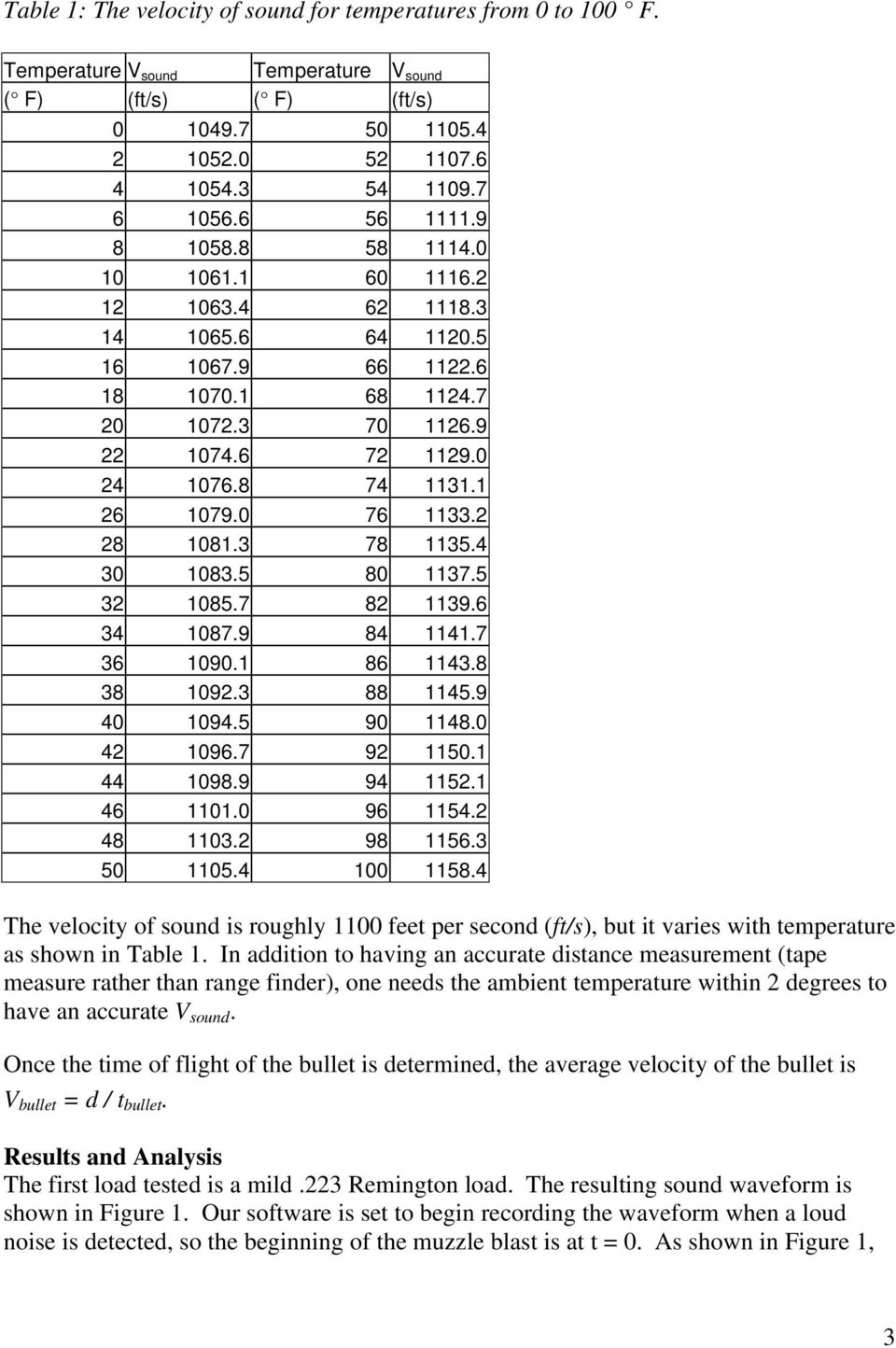
4 the sound level saturates the equipment for the first 0.04 seconds, and there are some prominent peaks intermittently through the signal that correspond to echoes. There is a large peak at t = s that records the bullet hitting the steel target. Figure 1:.223 Remington Sound Waveform 5 4 muzzle blast echoes A t = s, bullet striking target sound [arbitrary] time [seconds] We shot a metal target located 150 feet away. The speed of sound at 82 F is ft/sec. Consequently, the time for the sound to return from the target to the microphone is t sound = 150 ft/ ( ft/s) = s. Analysis of the sound waveform shown in Figure 1 (zooming in is required) shows the time between the muzzle blast and sound of the bullet hitting the target is t total = s. Subtracting the time it takes the sound to return from the target to the microphone gives t bullet = t total t sound = s s = s. The average velocity of the bullet over the distance of 50 yards is then V bullet = d / t bullet = 150 ft/ ( s) = 2684 ft/s. For comparison, the velocity measured on an Oehler Model 35 optical chronograph placed 6 feet in front of the muzzle is 2763 ft/s. At first glance, these measurements do not seem to agree, but it is important to note that our acoustic method measures the average velocity between the bullet and the target. This average velocity is slightly slower than the muzzle velocity because the bullet slows down in flight as a result of air resistance. 4
![2 0.25 0.3 0.35 0.4 0.45 0.5 time [seconds] We shot a metal target located 150 feet away. The speed of sound at 82 F is 1139.6 ft/sec.](/docs-images/46/21447887/images/page_4.jpg "Consequently, the time for the sound to return from the target to the microphone is t sound = 150 ft/ (1139.6 ft/s) = 0.1316 s.")
5 There are a number of public access ballistics programs that one can use for computing time of flight and trajectory for a given muzzle velocity and ballistic coefficient. The ballistic coefficient is the specification describing how air resistance slows down a bullet in flight. The ballistic coefficient is a dimensionless quantity that roughly corresponds to the fraction of 1000 yards that a bullet must travel to lose 50% of its initial kinetic energy (or 29.3% of its initial velocity). For example, a bullet with a ballistic coefficient of 0.4 has lost 50% of its kinetic energy at a range of 400 yards. Performing a Google search for ballistic calculator will provide several options. We have found the JBM ballistic calculator reliable and easy to use. 3 Using the manufacturer s published ballistic coefficient of for the.223 bullet, the JBM ballistics calculator predicts a time of flight of s for 50 yards, thus an average velocity 2679 ft/s for a 50 yard flight. Consequently, our acoustic measurement of bullet velocity is in excellent agreement with the optical chronograph, with a relative error of 0.2%. Looking again at Figure 1, one might be tempted to misinterpret one of the earlier echo peaks as corresponding to the sound of the bullet hitting the plate, but more careful analysis rules out this possibility. For example, consider the peak labeled A with a magnitude close to 3.7 located at a time of s. Since sound takes s to return from the target, this peak would correspond to a bullet time of flight of s suggesting an impossible velocity over 17,000 ft/s. We also tested the acoustic method of measuring bullet velocity using a 38 grain hollow point load in the 22 Long Rifle cartridge (22LR). A sound waveform is shown in Figure 2. The sound level saturates the equipment for the first seconds, and there are some prominent peaks between 0.06 s and 0.12 s corresponding to echoes. As explained above, it is not possible to interpret these early peaks as the sound of the bullet hitting the target because it takes sound over 0.13 s to return from the target. There is a large peak with a magnitude of 3.5 at t = s. This is the peak that records the bullet hitting the steel target. The speed of sound at 76 F is ft/s. The time for the sound to return from the target to the microphone is t sound = 150 ft/ ( ft/s) = s. The total time between the muzzle blast and sound of the bullet hitting the target is t total = s. Subtracting the time it takes the sound to return from the target to the microphone gives t bullet = t total t sound = s s = s. 5
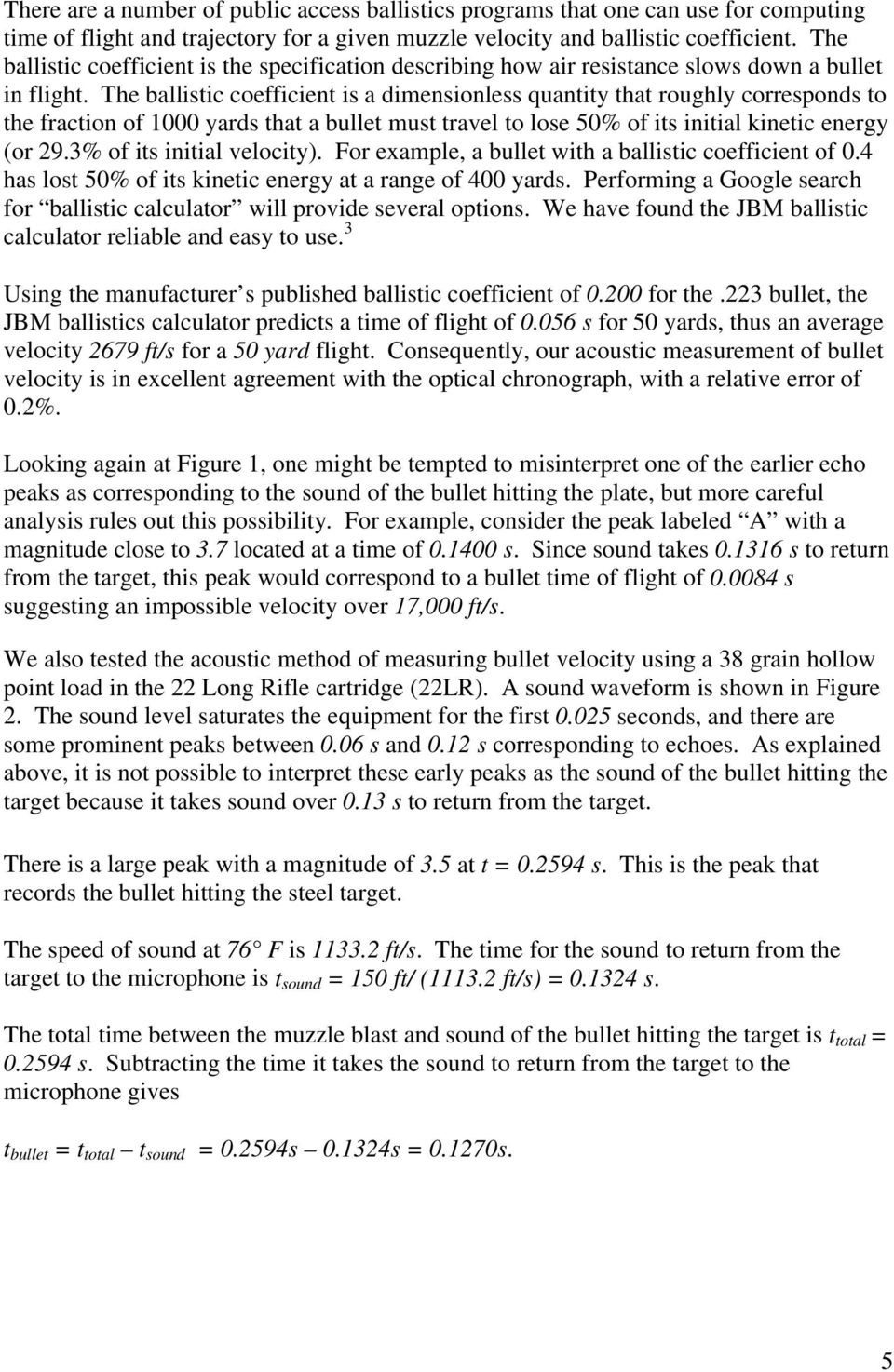
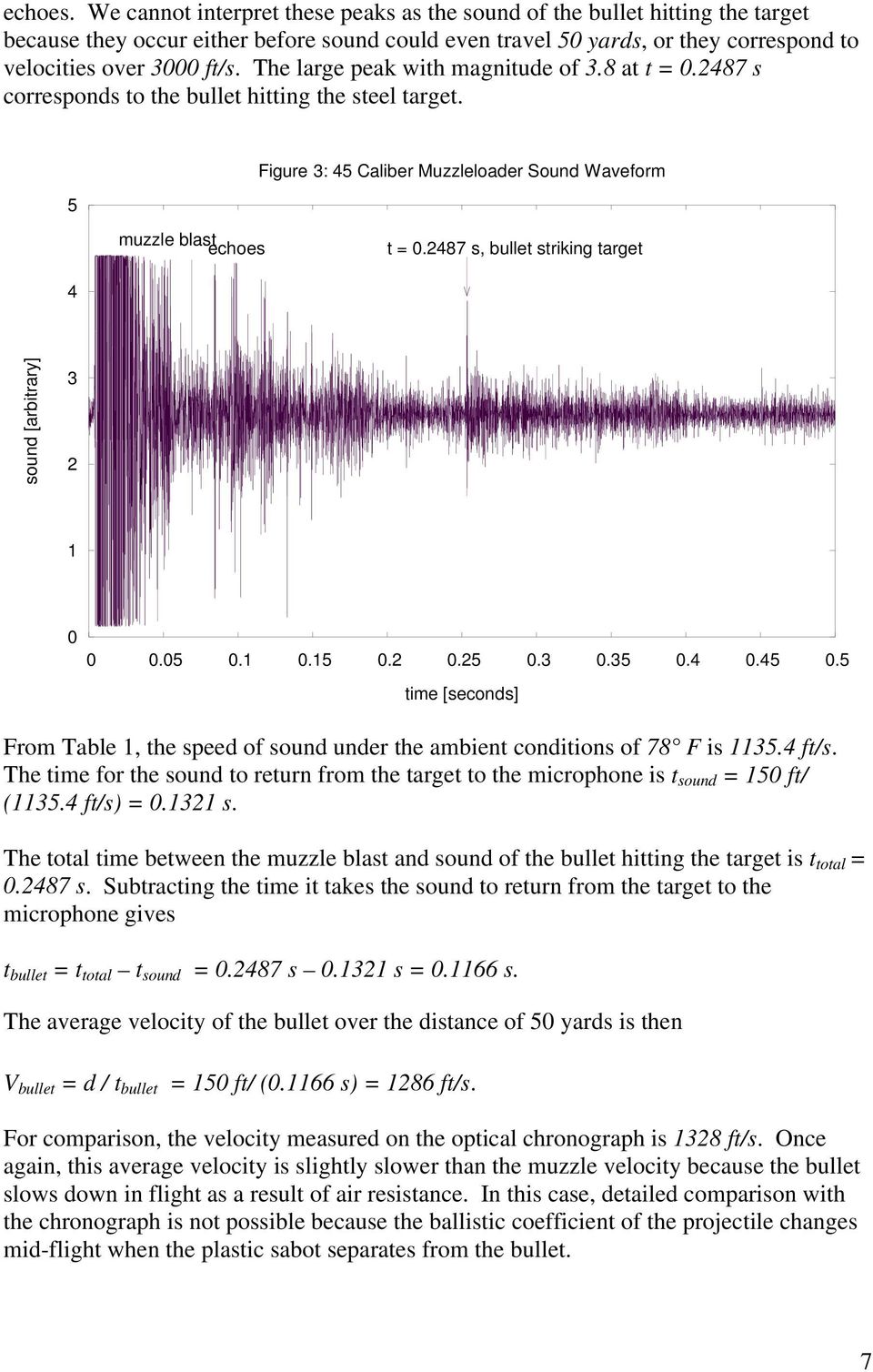
6 Figure 2: 22 Long Rifle Sound Waveform 5 4 muzzle blast echoes t = s, bullet striking target sound [arbitrary] time [seconds] The average velocity of the bullet over the distance of 50 yards is then V bullet = d / t bullet = 150 ft/ (0.1270s) = 1181 ft/s. The optical chronograph velocity for this shot is 1270 ft/s. As expected, the average velocity from the acoustic method is slightly slower than the chronographed muzzle velocity because the bullet slows down in flight. Using a ballistic coefficient of 0.124, we compute the time of flight for the measured chronograph velocity to predict a time of flight of s for 50 yards, thus an average velocity 1190 ft/s. The acoustic measurement of bullet velocity is in excellent agreement with a chronograph with a relative error of 0.8%. Since this technique is partly motivated by the propensity for muzzleloaders to be tough on chronographs (sabots and corrosive residue), we also tested the acoustic method on a muzzleloader. Our test load was 40 grains of Hodgdon Triple Seven powder in a 45 caliber muzzleloader behind a saboted.357 caliber 180 grain bullet. Our test load is relatively quiet. Many muzzleloader loads have a muzzle blast of significantly longer duration that requires placing the target at 100 yards to prevent the muzzle blast from obscuring the sound of the bullet hitting the target in the sound waveform. We were able to test this milder load at 50 yards. As shown in Figure 3, the sound level saturates the equipment for the first 0.05 seconds, and there are some prominent peaks in the 0.06 to 0.17 second range that correspond to 6

7 echoes. We cannot interpret these peaks as the sound of the bullet hitting the target because they occur either before sound could even travel 50 yards, or they correspond to velocities over 3000 ft/s. The large peak with magnitude of 3.8 at t = s corresponds to the bullet hitting the steel target. 5 Figure 3: 45 Caliber Muzzleloader Sound Waveform muzzle blast echoes t = s, bullet striking target 4 sound [arbitrary] time [seconds] From Table 1, the speed of sound under the ambient conditions of 78 F is ft/s. The time for the sound to return from the target to the microphone is t sound = 150 ft/ ( ft/s) = s. The total time between the muzzle blast and sound of the bullet hitting the target is t total = s. Subtracting the time it takes the sound to return from the target to the microphone gives t bullet = t total t sound = s s = s. The average velocity of the bullet over the distance of 50 yards is then V bullet = d / t bullet = 150 ft/ ( s) = 1286 ft/s. For comparison, the velocity measured on the optical chronograph is 1328 ft/s. Once again, this average velocity is slightly slower than the muzzle velocity because the bullet slows down in flight as a result of air resistance. In this case, detailed comparison with the chronograph is not possible because the ballistic coefficient of the projectile changes mid-flight when the plastic sabot separates from the bullet. 7
8 Discussion and Conclusions One might consider using this acoustic time of flight measurement technique along with an optical chronograph to measure an unknown ballistic coefficient. Many ballistic software programs will compute the ballistic coefficient given the muzzle velocity from a chronograph and time of flight from the soundcard. If the software program lacks this feature, one might guess different ballistic coefficients until the software gives the measured time of flight. We should caution those considering this approach that very small errors in the time of flight determination yield relatively large errors in the determination of ballistic coefficients. Even though the acoustic technique described above can measure the time of flight and bullet velocity reliably with an accuracy better than 1%, attempts to determine an unknown ballistic coefficient by this method can be off by as much as 10-20% due to uncertainties introduced by errors in the distance measurement and speed of sound determination. Accurately determining the time of flight well enough to reasonably estimate the ballistic coefficient requires both measuring the distance to the target within a couple of inches and placing a second microphone within two inches of the target and recording the time difference between the muzzle blast on the near microphone and the sound of impact on the far microphone. The safest place for the far microphone is behind an impenetrable steel target. We believe that the soundcard method of measuring bullet velocity has potential commercial software application in a program that uses a soundcard and automates the processes described above. However, reliable commercial application will require discerning the sound of the bullet hitting the target even in cases where the muzzle blast and other sounds prevent the clear discrimination of a peak when the bullet hits the target. This can be accomplished with standard techniques of Fourier analysis where the program learns the unique spectral signature of the target and detects the time at which this spectral signature occurs in the sound waveform. The Audacity software program has a sound spectrogram feature that facilitates this and can be used to demonstrate the benefits of a resonant target. In conclusion, we have presented a useful method for measuring bullet velocity with a PC soundcard or Vernier LabPro. This method provides reasonable accuracy (1%) but requires some care. Admittedly our method of measuring bullet velocity with a soundcard has some drawbacks. Loud noise can interfere with the measurement. The technique requires some computations, but these are relatively simple and are not hard to set up in a spreadsheet program. On the positive side, the PC soundcard method of measuring bullet velocity is a great example of Physics and technology working together to accomplish a technically challenging goal without putting specialized equipment in front of the barrel of a gun. 8

9 References: 1. Gurstelle, William, Backyard Ballistics, Chicago Review Press, Chicago, Also see 2. Audacity software available at This is a free audio capture, analysis, and editing program covered by GNU General Public License The JBM ballistic calculator is our favorite. About the Authors: Michael Courtney has a PhD in experimental Physics from the Massachusetts Institute of Technology and has authored and co-authored numerous papers in the peer-reviewed journals. Michael worked for seven years as a microwave test and measurement engineer for high-tech companies before becoming an Assistant Professor of Physics at Lorain County Community College. He is an NRA certified instructor for Basic Pistol and Personal Protection in the Home as well as a volunteer hunter education instructor for the Ohio Division of Wildlife. Division of Science and Math, Lorain County Community College, Elyria, OH 44035; [email protected] Brian Edwards is a member of the NRA who is an avid hunter and firearms enthusiast. He is an exceptional Physics student who hopes to major in Physics or Engineering. Division of Science and Math, Lorain County Community College, Elyria, OH

Nikon BDC Reticle. Guide to using. Instruction manual. Nikon Inc. 1300 WALT WHITMAN ROAD, MELVILLE, NEW YORK 11747-3064, U.S.A.
 Guide to using Nikon BDC Reticle Nikon Inc. 1300 WALT WHITMAN ROAD, MELVILLE, NEW YORK 11747-3064, U.S.A. Edited by NIKON VISION CO., LTD. Printed in the Philippines (702C)2E/1110 Instruction manual E
Teaching Fourier Analysis and Wave Physics with the Bass Guitar
 Teaching Fourier Analysis and Wave Physics with the Bass Guitar Michael Courtney Department of Chemistry and Physics, Western Carolina University Norm Althausen Lorain County Community College This article
A Discussion on Performance, Recoil and Comparative Testing By Dave Emary, Hornady Senior Ballistician
 A Discussion on Performance, Recoil and Comparative Testing By Dave Emary, Hornady Senior Ballistician Superformance ammunition achieves the highest performance of any ammunition on the market today; 100-200
Lapua Ballistics User Guide
 Lapua Ballistics User Guide 1 Lapua Ballistics User Guide Introduction Lapua Ballistics is advanced exterior ballistic software for mobile phones capable of predicting trajectories in real time with extreme
Lab 8: Ballistic Pendulum
 Lab 8: Ballistic Pendulum Equipment: Ballistic pendulum apparatus, 2 meter ruler, 30 cm ruler, blank paper, carbon paper, masking tape, scale. Caution In this experiment a steel ball is projected horizontally
suggested by the manufacturer of the scope mounts. The scope is positioned in the rings allowing correct eye-relief. You should see a complete field
 Thank you for selecting the Nikon OMEGA for your muzzleloading rifle. The Nikon OMEGA has been developed specifically for muzzleloaders the size, optics and reticle are optimized for your sport. The OMEGA
CHAPTER 1 ARROW BALLISTICS FROM SINGLE SHOT TO COURSE REQUIREMENTS
 CHAPTER 1 ARROW BALLISTICS FROM SINGLE SHOT TO COURSE REQUIREMENTS ARROW FLIGHT - BALLISTICS The Oxford Dictionary defines ballistics as "the science of projectiles." Unfortunately, this leads to thoughts
Shooting Uphill and Downhill. Major John L. Plaster, USAR (ret) Of all the ways a precision rifleman must compensate when firing such as for distance,
 Shooting Uphill and Downhill By Major John L. Plaster, USAR (ret) Of all the ways a precision rifleman must compensate when firing such as for distance, for wind and for target movement the most confounding
Swarovski Optik Ballistic Reticle (BR Reticle)
 BR Reticle Swarovski Optik Ballistic Reticle (BR Reticle) Instructions for use. The Swarovski Optik Ballistic Reticle is available in the following riflescopes: AV 3-10x42 AV 4-12x50 AV 6-18x50 General
Point Blank Zero. Fast Shots versus Precision Hits. By Major John L. Plaster, USA (ret)
 Point Blank Zero Fast Shots versus Precision Hits By Major John L. Plaster, USA (ret) The fastest way to get off an effective shot is to set your scope s elevation for a Point Blank Zero. When done properly,
First Focal Plane Uncapped Turrets
 RIFLESCOPE First Focal Plane Uncapped Turrets 4-16 x50 FFP ebr-1 RETICLE The Vortex EBR-1 MOA Reticle Designed to maximize long distance shooting and ranging abilities, the EBR-1 MOA reticle for the Viper
Tri State Gun Club Montrose, IA
 Tri State Gun Club Montrose, IA Membership Package Tri State Gun Club, Inc. is a private non-profit corporation incorporated in the State of Iowa. Our mission is to provide members with a facility for
The Perverse Nature of Standard Deviation Denton Bramwell
 The Perverse Nature of Standard Deviation Denton Bramwell Standard deviation is simpler to understand than you think, but also harder to deal with. If you understand it, you can use it for sensible decision
Your new scope must be properly mounted to ensure accurate and reliable use in the field. Here are some of the basics: All base and ring screws
 Thank you for selecting this Nikon riflescope. We sincerely appreciate your trust in our products. Nikon riflescopes offer superior optics, rugged construction and reliable performance. Your new Nikon
MODELS 93/693 By CO2 SEMI-AUTOMATIC
 O p e r a t i o n M a n u a l MODELS 93/693 By CO2 SEMI-AUTOMATIC.177 cal BB (4.5 mm) STEEL AIRGUN SHOT 12gm CO2 cylinder only WARNING: NOT A TOY. ADULT SUPERVISION REQUIRED. MISUSE OR CARELESS USE MAY
Using a Mil Based Scope - Easy Transition
 Using a Mil Based Scope - Easy Transition Over the last 2 years we have seen a big increase in the number of scopes that offer their adjustments in Milliradian. I am personally a strong proponent of the
Technical Track: Outdoor Range Design
 Technical Track: Outdoor Range Design Design Criteria for Shooting Ranges By Clark Vargas, P.E., President C. Vargas and Associates, LTD., Inc., Jacksonville, Florida There is one overriding design criteria
High-speed Photography with a Still Digital Camera
 High-speed Photography with a Still Digital Camera Matthew Moore North Carolina School of Science and Math 1219 Broad St. Durham, NC 27705 Sponsored By Dr. Loren Winters 12/2/99 Abstract High-speed photography
Using Tungsten Powder in Small Arms Projectiles
 Using Tungsten Powder in Small Arms Projectiles by D.R. Corbin, President Corbin Manufacturing & Supply, Inc. July 10, 1998 Synopsis: Five design characteristics are identified for the use of tungsten
Rifles, Calibres and Land Advice for Enquiry Officers
 Rifles, Calibres and Land Advice for Enquiry Officers Rifles, Calibres and Land. Advice for Enquiry Officers April 2009 BASC Firearms Department. Tel: 01244 573010 N.B. In preparing this advice it has
INSTRUCTIONS FOR MAG LASER BORESIGHTING SYSTEMS: SL-100, SL-150, SL-500 (IMPORTANT - READ ALL INSTRUCTIONS PRIOR TO USE)
 INSTRUCTIONS FOR MAG ASER BORESIGHTING SYSTEMS: S-100, S-150, S-500 (IMPORTANT - READ A INSTRUCTIONS PRIOR TO USE) WARNING! UNOAD FIREARM BEFORE PROCEEDING! Physically Check Firearm Do Not Assume it is
Technology Assessment Program NIJ Standard for Ballistic Helmets
 Note to users: This electronic document is not subject to copyright. You may copy it, but you are requested not to disseminate altered copies. Technology Assessment Program NIJ Standard for Ballistic Helmets
Analysis of the shooting of Barbara Scharton
 Summary Analysis of the shooting of Barbara Scharton 1. After gaining entry on the first floor in the Lyons/Scharton home, the assailants discovered Barbara Scharton in a bedroom on that floor. Assailant
Rifle Shooting Merit Badge Workbook
 Merit Badge Workbook This workbook can help you but you still need to read the merit badge pamphlet. The work space provided for each requirement should be used by the Scout to make notes for discussing
Adjusting the Powder Burn rate Factor and the Bullet Weight to Help Match QL to Range Chronograph Data:
 2/22/08 Author: Chris Long, AKA TechShooter Adjusting the Powder Burn rate Factor and the Bullet Weight to Help Match QL to Range Chronograph Data: Getting QL to match your actual, range measured load
PD-102R-92 Forensic Firearms Analyst II I. A. PRIMARY PURPOSE OF ORGANIZATIONAL UNIT:
 STATE OF NORTH CAROLINA OFFICE OF STATE PERSONNEL POSITION DESCRIPTION FORM (POLICE DEPARTMENT-102R-92) APPROVED CLASSIFICATION: EFFECTIVE DATE: ANALYST: (This space for Personnel Department Use Only)
Comparison Qualities of the Wireless TASER (XREP) and the Mossberg X12 LLS
 259 Comparison Qualities of the Wireless TASER (XREP) and the Mossberg X12 LLS By: R.T. Wyant, M.S and.b.j. Smelser, Washington State Patrol, 2203 Airport Way S, Seattle, Wa 98134 Keywords: Electronic
Performance testing of lead free primers: blast waves, velocity variations, and environmental testing
 Performance testing of lead free primers: blast waves, velocity variations, and environmental testing Authors: Elya Courtney 1 Amy Courtney 1 Peter David Summer 2 Michael Courtney 1 Results are presented
Sound Management for Outdoor Shooting Ranges. Michael Smillie BCWF
 Sound Management for Outdoor Shooting Ranges Michael Smillie BCWF Issue Public encroachment leading to: Increasing amounts of noise complaints More outdoor ranges being shut down due to noise issues Why
Hunter Development Program - Muzzleloading Rifle Workshop
 Hunter Development Program Workshop Lesson Guide Workshop Title: Muzzleloading Rifle Workshop Objective: Participants will demonstrate the ability to use safe and proper procedures when transporting, loading
Clay Pigeon Shooting Basics
 Clay Pigeon Shooting Basics The sport of Clay Pigeon Shooting involves using a shotgun to shoot at and break a circular flying target made form a fragile material. Clay Shooting still retains many phrases
Round Ball Loads. Multiple ball loads are fun to shoot and plink with and may have an application for small game hunting and pest control.
 Round Ball Loads I became interested in round ball loads and multiple round ball loads several years ago and experimented with them off an on for about a year in both rifles and revolvers. Single Ball
IDPA 3-gun Shoot Spring 2013 Stage instructions
 IDPA 3-gun Shoot Spring 2013 Stage instructions Stage 1: Rifle Skill at Arms Course of Fire: 3 positions standing, kneeling, prone No Concealment Round Count: 18 rounds rifle Target Distance: 20-60 yard
Optical Ranging System (BORS )
 Optical Ranging System (BORS ) Operator s Manual 11/06/08 USE OF THIS MANUAL Before you handle the Barrett Optical Ranging System (BORS), read this manual in its entirety. It is important that you understand
Range Equipment HVAC Design & Supply Modular Ranges
 Range Equipment HVAC Design & Supply Modular Ranges SRI Shooting Range Industries LLC, SRI is a premier design and manufacturing company of quality and innovative live fire Modular Containerized Small
NOVEL EXAMINATION OF GUN BORE RESISTANCE ANALYSIS AND EXPERIMENTAL VALIDATION
 23 RD INTERNATIONAL SYMPOSIUM ON BALLISTICS TARRAGONA, SPAIN 16-2 APRIL 27 NOVEL EXAMINATION OF GUN BORE RESISTANCE ANALYSIS AND EXPERIMENTAL VALIDATION D. Carlucci 1, J. Vega 1, M. Pocock 2, S. Einstein
Curriculum for Investigative Science
 Curriculum for Investigative Science Created/compiled by: Merle Hunsaker Renee Wootten Tecumseh High School Tecumseh, Oklahoma Research Experience for Teachers 2005 Department of Physics & Astronomy University
Note: This article appeared in the November-December 2013 Issue of FBI NAA s The Associate Magazine.
 Lead to Green Note: This article appeared in the November-December 2013 Issue of FBI NAA s The Associate Magazine. The long-term commitment of the Federal Law Enforcement Training Center (FLETC) to the
Course of fire begins with a proper load and make ready for each relay.
 SEMI-AUTO PISTOL QUALIFICATION COURSE: 2011 OPOTA TARGET: OPOTA RQT-2 NUMBER OF ROUNDS: 25 (26 minimum on shooter) FIRING RANGE DISTANCE REQ.: TIME LIMITS: LIGHT CONDITIONS: MODE OF CARRY: MAGAZINES ARE
Owner s. Manual. Instruction Book for: Models 700ML & 700MLS In-Line Bolt Action Muzzleloading Rifles IMPORTANT!
 Owner s Manual Instruction Book for: Models 700ML & 700MLS In-Line Bolt Action Muzzleloading Rifles IMPORTANT! READ ALL INSTRUCTIONS AND WARNINGS IN THIS BOOK BEFORE USING THE FIREARM. page 2...the ten
Experiment 2: Conservation of Momentum
 Experiment 2: Conservation of Momentum Learning Goals After you finish this lab, you will be able to: 1. Use Logger Pro to analyze video and calculate position, velocity, and acceleration. 2. Use the equations
Best Shot Gun Shop/Dealer/Range Insurance Application
 Best Shot Gun Shop/Dealer/Range Insurance Application General Information Business Name: Principal Contact: FEIN#/SSN# Location Address: Location City: County: State: Zip: Contact Number: Fax Number: Website:
MOD 25 HATSAN ARMS COMPANY. Instruction manual. Bedienungsanleitung. Manuel d instruction. Manual de instrucciones. Break barrel air pistol
 HATSAN ARMS COMPANY MOD 25 Break barrel air pistol Luftpistole Pistolet à air canon basculant Pistola de aire comprimido con acción de quiebre Instruction manual Bedienungsanleitung Manuel d instruction
Technical Report TR-05-2005 WARNING SHOT TARGET BALLISTIC TEST EVALUATION. Prepared for:
 Technical Report TR-05-2005 WARNING SHOT TARGET BALLISTIC TEST EVALUATION. Prepared for: Canadian Police Research Centre National Research Council Canada 1200 Montreal Road Ottawa, ON K1A 0R6 Prepared
The M1A As A Whitetail Rifle
 Pierce The M1A As A Whitetail Rifle Page 1 The M1A As A Whitetail Rifle Many years ago, I had the good fortune to acquire an M1A. For those of you that may not know, the M1A is a 308, (Winchester) caliber,
AVOIDING FANSTASY GUNFIGHT TRAINING
 TRAINING FOR THE REAL FIGHT OR AVOIDING FANSTASY GUNFIGHT TRAINING Realistic training for a future gunfight is critical for a successful outcome. My combat experiences have taught me to reevaluate my training
WARNING: This product contains chemicals known to the state of California to cause cancer, or birth defects or other reproductive harm.
 WARNING: This product contains chemicals known to the state of California to cause cancer, or birth defects or other reproductive harm. 9780 SW Freeman Drive Wilsonville, OR 97070 USA Tel: 800-442-2406
the bottomm of the main page
 Ballistica V.1.1 Manual Ballistica is a quick, accurate and streamlined tool for calculating ballistic trajectories. It can either be used to calculate a single firing solution (Quick Shot page) or a trajectory
Welcome. www.airforceairguns.com. For more information on all of our products, please visit us at. made in the usa
 s e r i o u s a i r g u n n i n g s t a r t s h e r e Welcome In this catalog you will find some of the most advanced, flexible and accurate airgun products available on the market today. As the first
Chapter 8 Conservation of Linear Momentum. Conservation of Linear Momentum
 Chapter 8 Conservation of Linear Momentum Physics 201 October 22, 2009 Conservation of Linear Momentum Definition of linear momentum, p p = m v Linear momentum is a vector. Units of linear momentum are
application note Directional Microphone Applications Introduction Directional Hearing Aids
 APPLICATION NOTE AN-4 Directional Microphone Applications Introduction The inability to understand speech in noisy environments is a significant problem for hearing impaired individuals. An omnidirectional
History of Explosia a.s.
 Propellants History of Explosia a.s. SINCE 1920 Production of smokeless powders, black powders and explosives in Explosia a.s. has a long tradition. The company was established in 1920 under the name Czechoslovak
Shock Wave Theory Rifle Internal Ballistics, Longitudinal Shock Waves, and Shot Dispersion Introduction
 Shock Wave Theory Rifle Internal Ballistics, Longitudinal Shock Waves, and Shot Dispersion Introduction I started looking at the causes of shot to shot dispersion after getting serious for the first time
Barrel length, velocity, and pressure
 Barrel length, velocity, and pressure This article discusses velocity vs barrel length, which is old hat to some people, and adds a new twist, which is pressure vs barrel length. The pressure is derived
Indoor Rifle / Pistol Range 25meter / 50meter
 This document is intended as a rough example of the costs and decisions when planning a range. It is in no way complete, and a full definition / design / operation would be completed by the Shooting Academy.
http://guninfo.tnet.com
 Reconstructed Manual for a PA-63 Double Action Semi-Automatic Pistol 9x18mm Makarov More Gun Info can be found at: http://guninfo.tnet.com The contents of this manual were reconstructed from graphical
SMALL ARMS TRAINING SIMULATOR
 SECURITY SySTEMS SMALL ARMS TRAINING SIMULATOR In security you cannot choose the second best option indracompany.com SAC+ SMALL ARMS TRAINING SIMULATOR Within the range of simulators developed by Indra,
Features: Mounting the Optic
 MICRO GREEN DOT with INTEGRATED RED LASER The Patented Micro Green Dot with Integrated Red Laser is a compact optical system packed with many features. The Green Dot is designed as the primary targeting
Chapter 9. is gradually increased, does the center of mass shift toward or away from that particle or does it remain stationary.
 Chapter 9 9.2 Figure 9-37 shows a three particle system with masses m 1 3.0 kg, m 2 4.0 kg, and m 3 8.0 kg. The scales are set by x s 2.0 m and y s 2.0 m. What are (a) the x coordinate and (b) the y coordinate
Morini CM 162EI. Technical Data
 Morini CM 162EI Technical Data Caliber: Weight: Total Length: Total Height: Total Width: Length of Sight Line: Barrel Length: Type of Barrel: Number of Riflings: Functioning: Trigger: Path: Arrest Point:
GUNSHOT EFFECTS SIMULATION
 GUNSHOT EFFECTS SIMULATION Mário ŠTIAVNICKÝ, Peter LISÝ Abstract: In the paper it is presented an approach to simulate gunshot process and its unmasking effects together with means to suppress it. A finite
Getting Started. Introduction to NRA Action Pistol. Written by: Damien Orsinger, Pistol Program Coordinator. NRA Competitive Shooting Division
 Getting Started Introduction to NRA Action Pistol Written by: Damien Orsinger, Pistol Program Coordinator NRA Competitive Shooting Division Are you interested in getting involved in competitive shooting?
Easily installed and simple to set up, Flow Pulse uses an acoustic technique never before seen in flow measurement to deliver reliable results across
 Flow Pulse Unique, non-invasive clamp-on flow monitor Easily installed and simple to set up, Flow Pulse uses an acoustic technique never before seen in flow measurement to deliver reliable results across
Chapter 9. particle is increased.
 Chapter 9 9. Figure 9-36 shows a three particle system. What are (a) the x coordinate and (b) the y coordinate of the center of mass of the three particle system. (c) What happens to the center of mass
Speed A B C. Time. Chapter 3: Falling Objects and Projectile Motion
 Chapter 3: Falling Objects and Projectile Motion 1. Neglecting friction, if a Cadillac and Volkswagen start rolling down a hill together, the heavier Cadillac will get to the bottom A. before the Volkswagen.
P22 Cal..22L.R. Operating Instructions. Semi-Automatic pistol USA. anl_us~1.qxd 13.08.2002 07:52 Seite 1. extractor
 anl_us~1.qxd 13.08.2002 07:52 Seite 1 manual safety extractor stabilizer frontsight slide Loaded chamber indicator rear sight hammer barrel trigger lock muzzle trigger mounting rail manual safety slide
D013 S011 S015 D032 S020 D036 D037.1 D037.2
 LOVEX powders for pistols and revolvers CALIBRES D013 S011 S015 D032 S020 D036 D037.1 D037.2 7.6 x 25 TOKAREV.380 AUTO 9 mm LUGER.38 SPECIAL.357 MAGNUM.357 SIG.40 S&W.44 REMINGTON MAG..45 ACP LOVEX powders
T = 1 f. Phase. Measure of relative position in time within a single period of a signal For a periodic signal f(t), phase is fractional part t p
 Data Transmission Concepts and terminology Transmission terminology Transmission from transmitter to receiver goes over some transmission medium using electromagnetic waves Guided media. Waves are guided
Waves: Recording Sound Waves and Sound Wave Interference (Teacher s Guide)
 Waves: Recording Sound Waves and Sound Wave Interference (Teacher s Guide) OVERVIEW Students will measure a sound wave by placing the Ward s DataHub microphone near one tuning fork A440 (f=440hz). Then
Understanding Shock Loads By Delbert L. Hall Published in TD&T, Vol. 49 No. 2 (spring 2013)
 Understanding Shock Loads By Delbert L. Hall Published in TD&T, Vol. 49 No. 2 (spring 2013) Theatre Design & Technology, the journal for design and production professionals in the performing arts and entertainment
Jump Shot Mathematics Howard Penn
 Jump Shot Mathematics Howard Penn Abstract In this paper we exae variations of standard calculus problems in the context of shooting a basketball jump shot. We believe that many students will find this
SELF DEFENCE & PERSONAL PROTECTION PAINTBALL KITS
 SELF & PERSONAL PROTECTION PAINTBALL KITS Office & General inquiries: Cell : 072 757 2245 SELF PRODUCTS THAT COME WITH PEACE OF MIND Paintball markers for self defence In South Africa it is not against
TECHNOLOGY RESEARCH AND DEVELOPMENT More Than Alarm Anna Kołodziej-Saramak
 TECHNOLOGY RESEARCH AND DEVELOPMENT More Than Alarm Anna Kołodziej-Saramak The purpose of the voice alarm systems (VAS) is to inform people about hazards in a possibly efficient way (which, unfortunately,
Experiment 2 Free Fall and Projectile Motion
 Name Partner(s): Experiment 2 Free Fall and Projectile Motion Objectives Preparation Pre-Lab Learn how to solve projectile motion problems. Understand that the acceleration due to gravity is constant (9.8
The Physics of Kicking a Soccer Ball
 The Physics of Kicking a Soccer Ball Shael Brown Grade 8 Table of Contents Introduction...1 What actually happens when you kick a soccer ball?...2 Who kicks harder shorter or taller people?...4 How much
AS COMPETITION PAPER 2008
 AS COMPETITION PAPER 28 Name School Town & County Total Mark/5 Time Allowed: One hour Attempt as many questions as you can. Write your answers on this question paper. Marks allocated for each question
Test Specifications/ Components
 243 Winchester Test Specifications/ Components Firearm Used: Remington 700 Barrel Length: 22" Twist: 1 x 9 1/8" Case: Federal Trim-to Length: 2.035" Primer: Fed 210M Remarks: Introduced in 1955, the 243
The Control of ph and Oxidation Reduction Potential (ORP) in Cooling Tower Applications By Charles T. Johnson, Walchem Corporation
 The Control of ph and Oxidation Reduction Potential (ORP) in Cooling Tower Applications By Charles T. Johnson, Walchem Corporation Introduction The importance of keeping cooling tower water in proper chemical
LeadingEdge Systematic Approach. Room Acoustic Principles - Paper One. The Standing Wave Problem
 LeadingEdge Systematic Approach Room Acoustic Principles - Paper One The Standing Wave Problem Sound quality problems caused by poor room acoustics. We all recognise that room acoustics can cause sound
Installation and use of Millett Tactical TRS-1 and TRS-2 scopes TRS-1 TRS-2. Before starting, make sure firearm is UNLOADED!!
 I N S T R U C T I O N a n d O P E R A T I O N TRS-1 TRS-2 Tactical Rifle scope Installation and use of Millett Tactical TRS-1 and TRS-2 scopes TRS-1 TRS-2 Before starting, make sure firearm is UNLOADED!!
FIREARMS, TOOL MARKS, AND OTHER IMPRESSIONS
 FIREARMS, TOOL MARKS, AND OTHER IMPRESSIONS 15-1 Introduction Structural variations and irregularities caused by scratches, nicks, breaks, and wear may permit the criminalist to relate: A bullet to a gun
TOF FUNDAMENTALS TUTORIAL
 TOF FUNDAMENTALS TUTORIAL Presented By: JORDAN TOF PRODUCTS, INC. 990 Golden Gate Terrace Grass Valley, CA 95945 530-272-4580 / 530-272-2955 [fax] www.rmjordan.com [web] [email protected] [e-mail] This
SMALL ARMS AMMUNITION
 SMALL ARMS AMMUNITION Properties & Recommendations for Storage & Handling 11 Mile Hill Road, Newtown, CT 06470-2359 This leaflet has been prepared by the Sporting Arms and Ammunition Manufacturers Institute,
NRA Firearms Safety Instructor Certificate
 NRA Firearms Safety Instructor Certificate Fall 2015 Course Offerings The first Gunsmithing courses were designed and offered at TSJC in 1947 by P.O. Ackley. Since that time the program has developed into
OWNER'S MANUAL. MODELS Beretta 92FS and 92FS Match Caliber.177 (4.5 mm) Pellet CO2 Air Pistol. Patent Pending
 OWNER'S MANUAL READ ALL INSTRUCTIONS AND WARNINGS IN THIS MANUAL BEFORE USING THIS AIR PISTOL. MODELS Beretta 92FS and 92FS Match Caliber.177 (4.5 mm) Pellet CO2 Air Pistol Patent Pending Not a toy. Adult
Projectile Motion 1:Horizontally Launched Projectiles
 A cannon shoots a clown directly upward with a speed of 20 m/s. What height will the clown reach? How much time will the clown spend in the air? Projectile Motion 1:Horizontally Launched Projectiles Two
Sensors and Cellphones
 Sensors and Cellphones What is a sensor? A converter that measures a physical quantity and converts it into a signal which can be read by an observer or by an instrument What are some sensors we use every
Lab #6 Room Acoustics
 EQUIPMENT Physics of Music PHY103 Lab Manual Lab #6 Room Acoustics Tape measures Noise making devices (pieces of wood for clappers). Microphones, stands, preamps connected to computers. Extra XLR microphone
Work, Energy & Momentum Homework Packet Worksheet 1: This is a lot of work!
 Work, Energy & Momentum Homework Packet Worksheet 1: This is a lot of work! 1. A student holds her 1.5-kg psychology textbook out of a second floor classroom window until her arm is tired; then she releases
Acoustic Terms, Definitions and General Information
 Acoustic Terms, Definitions and General Information Authored by: Daniel Ziobroski Acoustic Engineer Environmental and Acoustic Engineering GE Energy Charles Powers Program Manager Environmental and Acoustic
Comparisons of Motorcycle Helmet Standards Snell M2005, M2010/M2015, DOT and ECE 22-05 Edward B. Becker, September 29, 2015
 The following compares four standards: Snell M2005, Snell M2015/M2010, DOT, and ECE 22-05. M2005 and the current DOT Standard (Federal Motor Vehicle Safety Standard 218) apply largely to motorcycle helmets
GUNSHOT RECORDINGS FROM DIGITAL VOICE RECORDERS
 GUNSHOT RECORDINGS FROM DIGITAL VOICE RECORDERS ROBERT C. MAHER AND STEVEN R. SHAW Department of Electrical and Computer Engineering, Montana State University, Bozeman, MT USA [email protected] Audio
AP Physics 1 and 2 Lab Investigations
 AP Physics 1 and 2 Lab Investigations Student Guide to Data Analysis New York, NY. College Board, Advanced Placement, Advanced Placement Program, AP, AP Central, and the acorn logo are registered trademarks
HATSAN BREAK BARREL AIR RIFLES
 HATSAN ARMS COMPANY HATSAN BREAK BARREL AIR RIFLES Instruction Manual GB Bedienungsanleitung Manuel d instruction DE FR Manual de Instrucciones ESP PLEASE READ THIS MANUAL BEFORE USING YOUR AIR GUN Thank
NON-LINE OF SIGHT: TECHNOLOGY & IMPLEMENTATION
 SOLECTEK WHITE PAPER NON-LINE OF SIGHT: TECHNOLOGY & IMPLEMENTATION Introduction To many industry insiders, the promise of broadband wireless access (BWA) is clear. Delivery of last mile, enterprise infrastructure
Advances in Military Technology Vol. 6, No. 2, December 2011. Additional Effect of Gases on Strain Gauges at Barrel Muzzle
 AiMT Advances in Military Technology Vol. 6, No. 2, December 2011 Additional Effect of Gases on Strain Gauges at Barrel Muzzle S. Procházka *, P. Seman and M. Vondráček Department of Weapons and Ammunition,
B) 286 m C) 325 m D) 367 m Answer: B
 Practice Midterm 1 1) When a parachutist jumps from an airplane, he eventually reaches a constant speed, called the terminal velocity. This means that A) the acceleration is equal to g. B) the force of