
Driver for Delimited Text Implementation Guide. Identity Manager 4.0.2
|
|
|
- Alan Owen
- 9 years ago
- Views:
Transcription
1 Driver for Delimited Text Implementation Guide Identity Manager February 2014
2 Legal Notice THIS DOCUMENT AND THE SOFTWARE DESCRIBED IN THIS DOCUMENT ARE FURNISHED UNDER AND ARE SUBJECT TO THE TERMS OF A LICENSE AGREEMENT OR A NON DISCLOSURE AGREEMENT. EXCEPT AS EXPRESSLY SET FORTH IN SUCH LICENSE AGREEMENT OR NON DISCLOSURE AGREEMENT, NETIQ CORPORATION PROVIDES THIS DOCUMENT AND THE SOFTWARE DESCRIBED IN THIS DOCUMENT ʺAS ISʺ WITHOUT WARRANTY OF ANY KIND, EITHER EXPRESS OR IMPLIED, INCLUDING, BUT NOT LIMITED TO, THE IMPLIED WARRANTIES OF MERCHANTABILITY OR FITNESS FOR A PARTICULAR PURPOSE. SOME STATES DO NOT ALLOW DISCLAIMERS OF EXPRESS OR IMPLIED WARRANTIES IN CERTAIN TRANSACTIONS; THEREFORE, THIS STATEMENT MAY NOT APPLY TO YOU. For purposes of clarity, any module, adapter or other similar material (ʺModuleʺ) is licensed under the terms and conditions of the End User License Agreement for the applicable version of the NetIQ product or software to which it relates or interoperates with, and by accessing, copying or using a Module you agree to be bound by such terms. If you do not agree to the terms of the End User License Agreement you are not authorized to use, access or copy a Module and you must destroy all copies of the Module and contact NetIQ for further instructions. This document and the software described in this document may not be lent, sold, or given away without the prior written permission of NetIQ Corporation, except as otherwise permitted by law. Except as expressly set forth in such license agreement or non disclosure agreement, no part of this document or the software described in this document may be reproduced, stored in a retrieval system, or transmitted in any form or by any means, electronic, mechanical, or otherwise, without the prior written consent of NetIQ Corporation. Some companies, names, and data in this document are used for illustration purposes and may not represent real companies, individuals, or data. This document could include technical inaccuracies or typographical errors. Changes are periodically made to the information herein. These changes may be incorporated in new editions of this document. NetIQ Corporation may make improvements in or changes to the software described in this document at any time. U.S. Government Restricted Rights: If the software and documentation are being acquired by or on behalf of the U.S. Government or by a U.S. Government prime contractor or subcontractor (at any tier), in accordance with 48 C.F.R (for Department of Defense (DOD) acquisitions) and 48 C.F.R and (for non DOD acquisitions), the government s rights in the software and documentation, including its rights to use, modify, reproduce, release, perform, display or disclose the software or documentation, will be subject in all respects to the commercial license rights and restrictions provided in the license agreement NetIQ Corporation and its affiliates. All Rights Reserved. For information about NetIQ trademarks, see

3 Contents About this Book and the Library 5 About NetIQ Corporation 7 1 Understanding the Delimited Text Driver How the Delimited Text Driver Works Publisher and Subscriber Channels Policies Supported File Types Java Interfaces to the Driver Key Driver Features Local and Remote Platforms Entitlements Password Synchronization Installing Driver Files 15 3 Creating a New Driver Object Preparing Data Locations Creating the Driver Object in Designer Importing the Current Driver Packages Installing the Driver Packages Modifying the Driver Settings Deploying the Driver Object Starting the Driver Object Activating the Driver Object Adding Packages to an Existing Driver Viewing Permission Collection and Reconciliation Service Configuration Objects Upgrading an Existing Driver Supported Upgrade Paths What s New in Version Upgrade Procedure Setting Up One-Way Synchronization 29 6 Configuring for XDS XML Files Using the Publisher Channel Using the Subscriber Channel Using Style Sheets to Configure Data Synchronization 33 8 Using Java Interfaces to Customize File Processing Creating a Java Class Contents 3

4 8.2 Creating a Java.jar File Configuring the Driver to Use the New Class Managing the Driver Troubleshooting Stop the driver before doing a bulk assignment or removal of resource assignments A Driver Properties 43 A.1 Driver Configuration A.1.1 Driver Module A.1.2 Driver Object Password A.1.3 Authentication A.1.4 Startup Option A.1.5 Driver Parameters A.1.6 ECMAScript (Designer Only) A.1.7 Global Configurations A.2 Global Configuration Values A.2.1 Default Configuration A.2.2 Entitlements A.2.3 Password Synchronization A.2.4 Managed System Information B Delimited Text Driver Extensions 53 B.1 Using the ImageFile InputSource Extension B.1.1 Installing the ImageFile InputSource Extension B.1.2 Configuring the Driver for the ImageFile InputSource Extension B.2 Customizing ImageFile InputSource B.3 Using the ImageFile PostProcessor B.3.1 Installing the ImageFile PostProcessor Extension B.3.2 Configuring the Driver for the ImageFile Extension B.4 Customizing the ImageFile Extension NetIQ Identity Manager Driver for Delimited Text Implementation Guide

5 About this Book and the Library The Identity Manager Driver for Delimited Text Implementation Guide explains how to install and configure the Identity Manager Driver for Delimited Text. Intended Audience This guide is intended for edirectory and Identity Manager administrators who are using the Delimited Text driver. Other Information in the Library The library provides the following information resources: Identity Manager Framework Installation Guide Provides detailed planning and installation information for Identity Manager components. Identity Manager Integrated Installation Guide Provides integrated installation information for installing Identity Manager components. Identity Manager Overview Guide Provides conceptual information about Identity Manager. This book also provides an overview of the various components and many administration tasks. Identity Manager Driver Guides Provides implementation information about Identity Manager drivers. About this Book and the Library 5

6 6 NetIQ Identity Manager Driver for Delimited Text Implementation Guide

7 About NetIQ Corporation We are a global, enterprise software company, with a focus on the three persistent challenges in your environment: Change, complexity and risk and how we can help you control them. Our Viewpoint Adapting to change and managing complexity and risk are nothing new In fact, of all the challenges you face, these are perhaps the most prominent variables that deny you the control you need to securely measure, monitor, and manage your physical, virtual, and cloud computing environments. Enabling critical business services, better and faster We believe that providing as much control as possible to IT organizations is the only way to enable timelier and cost effective delivery of services. Persistent pressures like change and complexity will only continue to increase as organizations continue to change and the technologies needed to manage them become inherently more complex. Our Philosophy Selling intelligent solutions, not just software In order to provide reliable control, we first make sure we understand the real world scenarios in which IT organizations like yours operate day in and day out. Thatʹs the only way we can develop practical, intelligent IT solutions that successfully yield proven, measurable results. And thatʹs so much more rewarding than simply selling software. Driving your success is our passion We place your success at the heart of how we do business. From product inception to deployment, we understand that you need IT solutions that work well and integrate seamlessly with your existing investments; you need ongoing support and training post deployment; and you need someone that is truly easy to work with for a change. Ultimately, when you succeed, we all succeed. Our Solutions Identity & Access Governance Access Management Security Management Systems & Application Management Workload Management Service Management About NetIQ Corporation 7

8 Contacting Sales Support For questions about products, pricing, and capabilities, contact your local partner. If you cannot contact your partner, contact our Sales Support team. Worldwide: United States and Canada: Web Site: Contacting Technical Support For specific product issues, contact our Technical Support team. Worldwide: North and South America: Europe, Middle East, and Africa: +353 (0) Web Site: Contacting Documentation Support Our goal is to provide documentation that meets your needs. The documentation for this product is available on the NetIQ Web site in HTML and PDF formats on a page that does not require you to log in. If you have suggestions for documentation improvements, click Add Comment at the bottom of any page in the HTML version of the documentation posted at You can also Documentation [email protected]. We value your input and look forward to hearing from you. Contacting the Online User Community NetIQ Communities, the NetIQ online community, is a collaborative network connecting you to your peers and NetIQ experts. By providing more immediate information, useful links to helpful resources, and access to NetIQ experts, NetIQ Communities helps ensure you are mastering the knowledge you need to realize the full potential of IT investments upon which you rely. For more information, visit community.netiq.com. 8 NetIQ Identity Manager Driver for Delimited Text Implementation Guide

9 1 1Understanding the Delimited Text Driver The Delimited Text driver lets you use delimited text files (CSV) to synchronize data between the Identity Vault and applications. Essentially, you can transfer data from the Identity Vault to any system that can consume delimited text files, or transfer data to the Identity Vault from any system that can generate delimited text files. The Delimited Text driver can also be modified to consume an XML files. The following sections provide information to help you understand the Delimited Text driver. Section 1.1, How the Delimited Text Driver Works, on page 9 Section 1.2, Java Interfaces to the Driver, on page 12 Section 1.3, Key Driver Features, on page How the Delimited Text Driver Works The Delimited Text driver uses the Publisher channel, the Subscriber channel, and policies to control data flow between the Identity Vault and the delimited text files, as explained in the following sections: Section 1.1.1, Publisher and Subscriber Channels, on page 9 Section 1.1.2, Policies, on page 10 Section 1.1.3, Supported File Types, on page Publisher and Subscriber Channels The Delimited Text driver provides data flow along the Publisher and Subscriber channels as shown in Figure 1 1. Figure 1-1 Data Flow.bak Input Directory.csv /.xml Input Directory Publisher Identity Vault Database Identity Manager Join Engine Subscriber Delimited Text Driver Output Directory.csv /.xml Output Directory Understanding the Delimited Text Driver 9

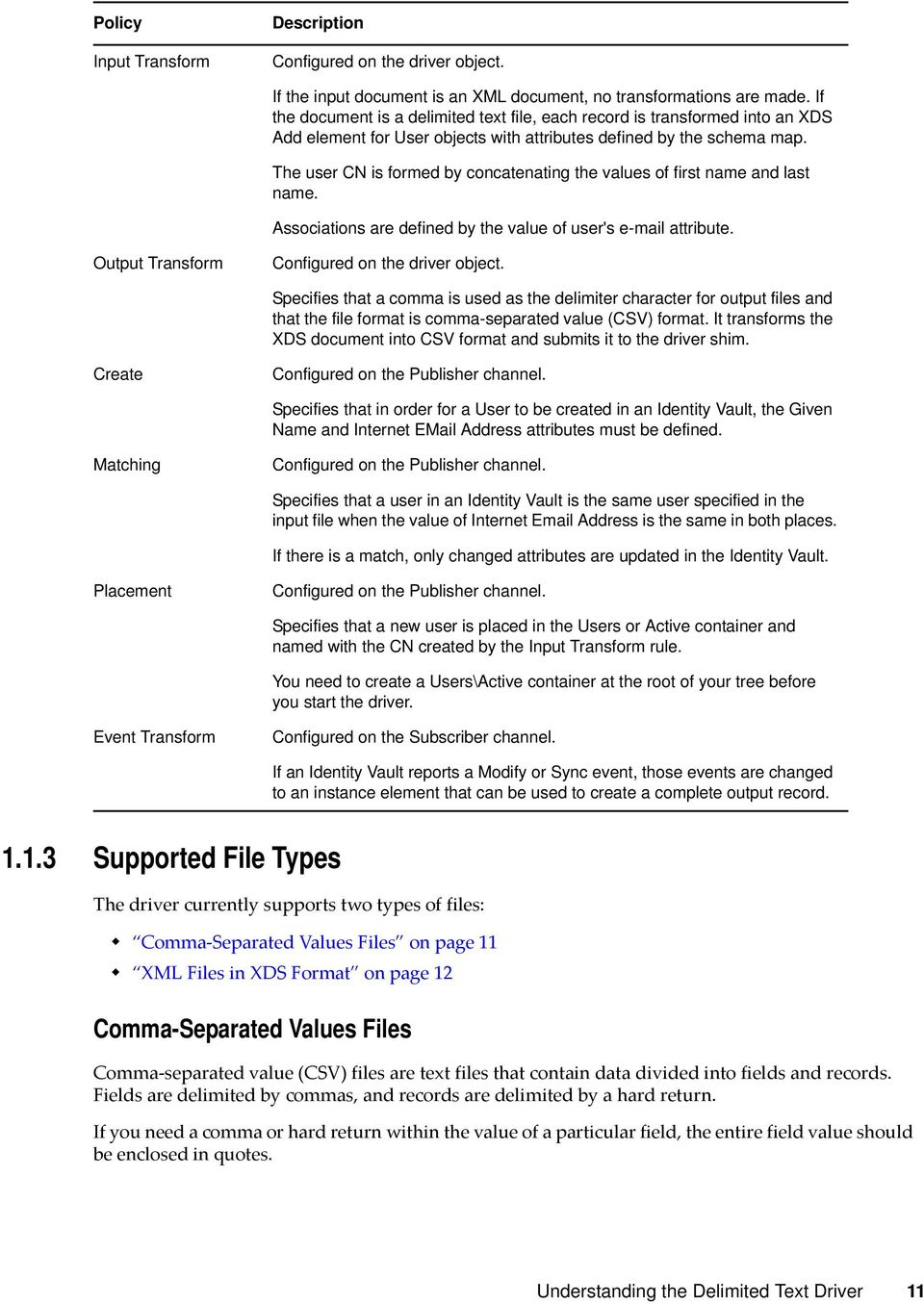
10 The example configuration that ships with this driver includes both Subscriber and Publisher channels. However, in many configurations, only one way data flow is required. In those configurations, only a Publisher or Subscriber channel is used. The other channel is disabled. For more information, see Chapter 5, Setting Up One Way Synchronization, on page 29. Publisher Channel The Publisher channel reads information from input text files on your local file system and submits that information to the Identity Vault via the Identity Manager engine. By default, the Publisher channel does the following: Checks the input directory every 10 seconds. Processes any files that have a.csv extension. Changes.csv extensions of processed files to.bak. Cycles through this process until you stop the driver. Subscriber Channel The Subscriber channel watches for additions and modifications to Identity Vault objects and creates output files on your local file system that reflect those changes. By default, the Subscriber channel keeps an output file open until either 200 transactions have been logged or 30 seconds have elapsed. When either of these thresholds is reached, the output file is saved with a number.csv filename and a new output file is opened Policies Policies control data synchronization between the driver and the Identity Vault. The following table provides information on the set of preconfigured policies that come with the Delimited Text driver. For information about modifying policies, see Policies in imanager for Identity Manager or Policies in Designer Table 1-1 Preconfigured Policies Policy Schema Map Description Configured on the driver object. Maps Identity Vault User properties to application attributes as follows: Surname > LastName Given Name > FirstName Title > Title Internet Address > Telephone Number > WorkPhone Facsimile Telephone Number > Fax mobile > WirelessPhone Description > Description The application attributes correspond to the sequence of values in the file or, if present, to the attributes associated with unnamed XDS <field> elements. 10 NetIQ Identity Manager Driver for Delimited Text Implementation Guide
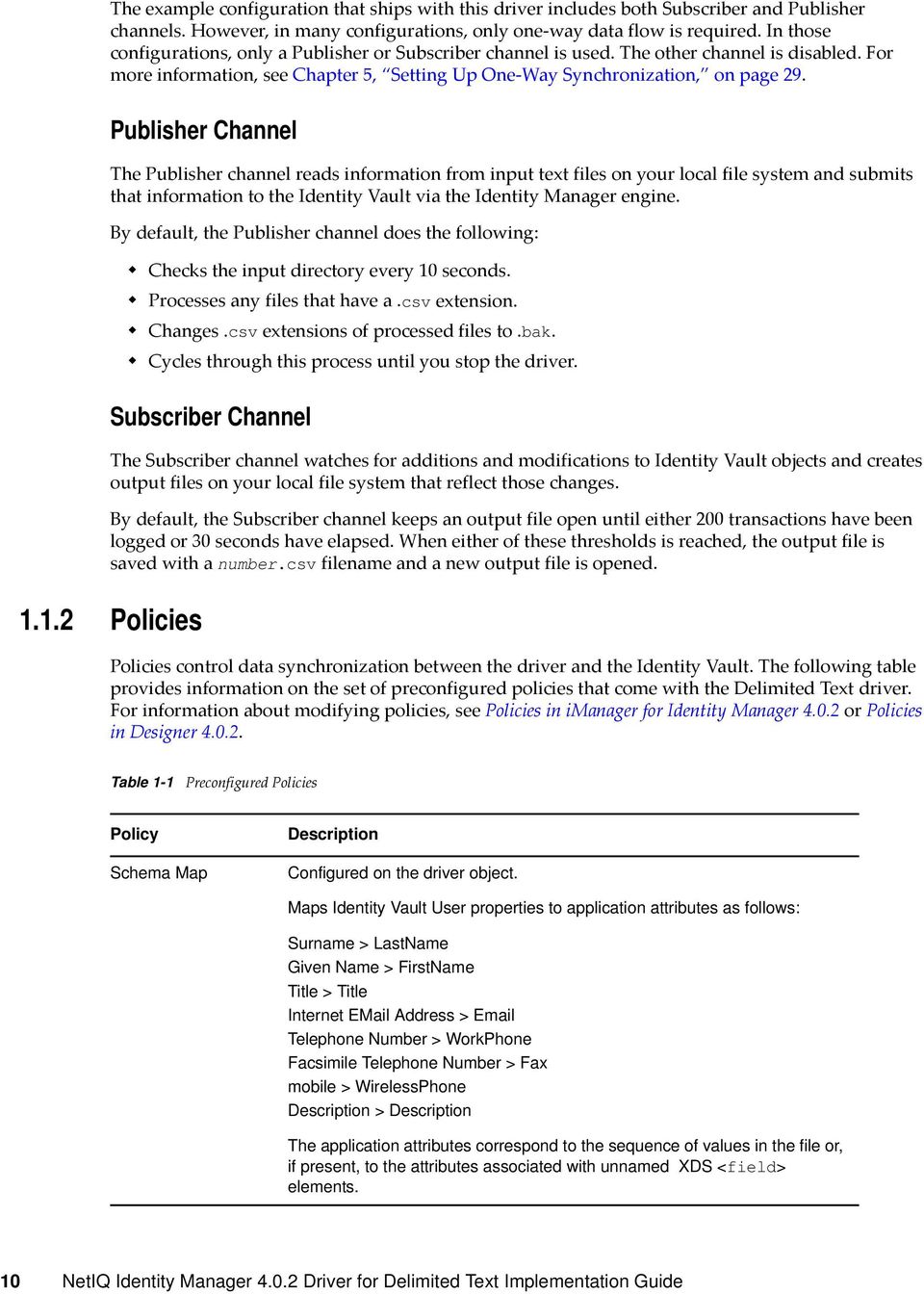
11 Policy Input Transform Description Configured on the driver object. If the input document is an XML document, no transformations are made. If the document is a delimited text file, each record is transformed into an XDS Add element for User objects with attributes defined by the schema map. The user CN is formed by concatenating the values of first name and last name. Associations are defined by the value of user's attribute. Output Transform Configured on the driver object. Specifies that a comma is used as the delimiter character for output files and that the file format is comma-separated value (CSV) format. It transforms the XDS document into CSV format and submits it to the driver shim. Create Configured on the Publisher channel. Specifies that in order for a User to be created in an Identity Vault, the Given Name and Internet Address attributes must be defined. Matching Configured on the Publisher channel. Specifies that a user in an Identity Vault is the same user specified in the input file when the value of Internet Address is the same in both places. If there is a match, only changed attributes are updated in the Identity Vault. Placement Configured on the Publisher channel. Specifies that a new user is placed in the Users or Active container and named with the CN created by the Input Transform rule. You need to create a Users\Active container at the root of your tree before you start the driver. Event Transform Configured on the Subscriber channel. If an Identity Vault reports a Modify or Sync event, those events are changed to an instance element that can be used to create a complete output record Supported File Types The driver currently supports two types of files: Comma Separated Values Files on page 11 XML Files in XDS Format on page 12 Comma-Separated Values Files Comma separated value (CSV) files are text files that contain data divided into fields and records. Fields are delimited by commas, and records are delimited by a hard return. If you need a comma or hard return within the value of a particular field, the entire field value should be enclosed in quotes. Understanding the Delimited Text Driver 11
12 Because the meaning of each field in a CSV file is derived from its position, each record in a CSV file should have the same number of fields. Field values can be left blank, but each record should have the same number of delimiter characters. XML Files in XDS Format The XDS format is the defined NetIQ subset of possible XML formats. This is the initial format for data coming from an Identity Vault. By modifying default rules and changing the style sheets, the Delimited Text driver can be configured to work with any XML format. For detailed information on the XDS format, refer to NDS DTD Commands and Events ( developer.novell.com/ndk/doc/dirxml/index.html?dirxmlbk/data/a5323rs.html). For information on configuring the driver to use XML files in the XDS format, see Chapter 6, Configuring for XDS XML Files, on page Java Interfaces to the Driver The Delimited Text driver includes four Java interfaces that enable you to add extensions, which are optional. These enhancements to the driver require Java programming. For more information, see Chapter 8, Using Java Interfaces to Customize File Processing, on page Key Driver Features The sections below contains information about the key driver features Local and Remote Platforms The Delimited Text driver runs on the Identity Manager server or uses the Remote Loader to run on another server Entitlements The Delimited Text driver supports custom and administrator defined entitlements. The driver content includes a new entitlement package that allows Identity Manager to consume CSV files containing target system permission information, dynamically create an entitlement and dynamic resource for each permission type, and load the permission data as entitlement values into Identity Manager Role Based Provisioning Module. The driver can then automatically provision or deprovision these resources to Identity Manager identities based on attribute values consumed during standard Publication channel processing. The following packages contain the content necessary for Permission Collection and Reconciliation service: NOVLDTXTBASE_2.2.0 (Base Package) NOVLDTXTENT_2.0.0 (Entitlements Package) If you want the driver to support custom and administrator defined entitlements, ensure that these packages are installed on the driver. You can turn Permission Collection and Reconciliation service on or off using GCVs provided with this service. 12 NetIQ Identity Manager Driver for Delimited Text Implementation Guide

13 Prerequisites Before continuing, ensure that you go through the prerequisites needed for enabling this service. For general prerequisites, see Prerequisites in Understanding Permission Collection and Reconciliation Service in the NetIQ Identity Manager Common Driver Administration Guide. In addition to the general prerequisites, ensure that the Delimited Text driver version is Also, you need to set up administrative user accounts and configure a password policy for them. For more information, see Setting Up Administrative User Accounts and Setting Up Administrative Passwords in the NetIQ Identity Manager Common Driver Administration Guide. To use the Permission Collection and Reconciliation service included in the Delimited Text driver, you can either create a new driver with the latest packages or upgrade packages on an existing driver. For more information about creating a driver, see Section 3.2, Creating the Driver Object in Designer, on page 17 or Section 3.4, Adding Packages to an Existing Driver, on page 24. CSV File Format The Delimited Text driver can consume the entitlement information from the CSV file extracted from a target system. The CSV file must contain values for the target system permission information in a correct format so that the driver reads them correctly from the file. A separate CSV file must be maintained for every custom entitlement. For example, a CSV file that holds ParkingPass entitlement details represents this information in the following format: North, North Lot, North Parking Lot where North is the entitlement value, North Lot is the display name in the User Application for the entitlement value North, and North Parking Lot is the description for the entitlement value. This description is displayed in the User Application. The CSV file must be located on the same server as the driver. This file contains the values for application entitlements Password Synchronization The Delimited Text driver has policies to handle password synchronization. However, no automatic password synchronization exists for the Delimited Text driver. You must decide which attribute you want to hold the password and then synchronize that attribute. Any password synchronization for the driver is just an attribute synchronization. Understanding the Delimited Text Driver 13

14 14 NetIQ Identity Manager Driver for Delimited Text Implementation Guide

15 2 2Installing Driver Files By default, the Delimited Text driver files are installed on the Identity Manager server at the same time as the Identity Manager engine. The installation program extends the Identity Vault s schema and installs both the driver shim and the driver configuration files. It does not create the driver in the Identity Vault (see Chapter 3, Creating a New Driver Object, on page 17) or upgrade an existing driver s configuration (see Chapter 4, Upgrading an Existing Driver, on page 27). Unless you extend the driver s functionality along with the Java interfaces (see Chapter 8, Using Java Interfaces to Customize File Processing, on page 35), the driver is only capable of reading input text files from the local file system of the server where the driver is running. This means that your input directory must be located on the same server as the driver. You have three options: If your input directory can be located on the Identity Manager server and the Delimited Text driver files are already installed on the server, skip this section and continue with Chapter 3, Creating a New Driver Object, on page 17. If your input directory can be located on the Identity Manager server but the driver files are not already installed on the server, install the files by using the instructions in Installing Identity Manager in the Identity Manager Integrated Installation Guide. If your input directory cannot be located on the Identity Manager server, install the Remote Loader (required to run the driver on a non Identity Manager server) and the driver files on the server where the input directory resides. See Installing Identity Manager in the Identity Manager Integrated Installation Guide. Installing Driver Files 15

16 16 NetIQ Identity Manager Driver for Delimited Text Implementation Guide

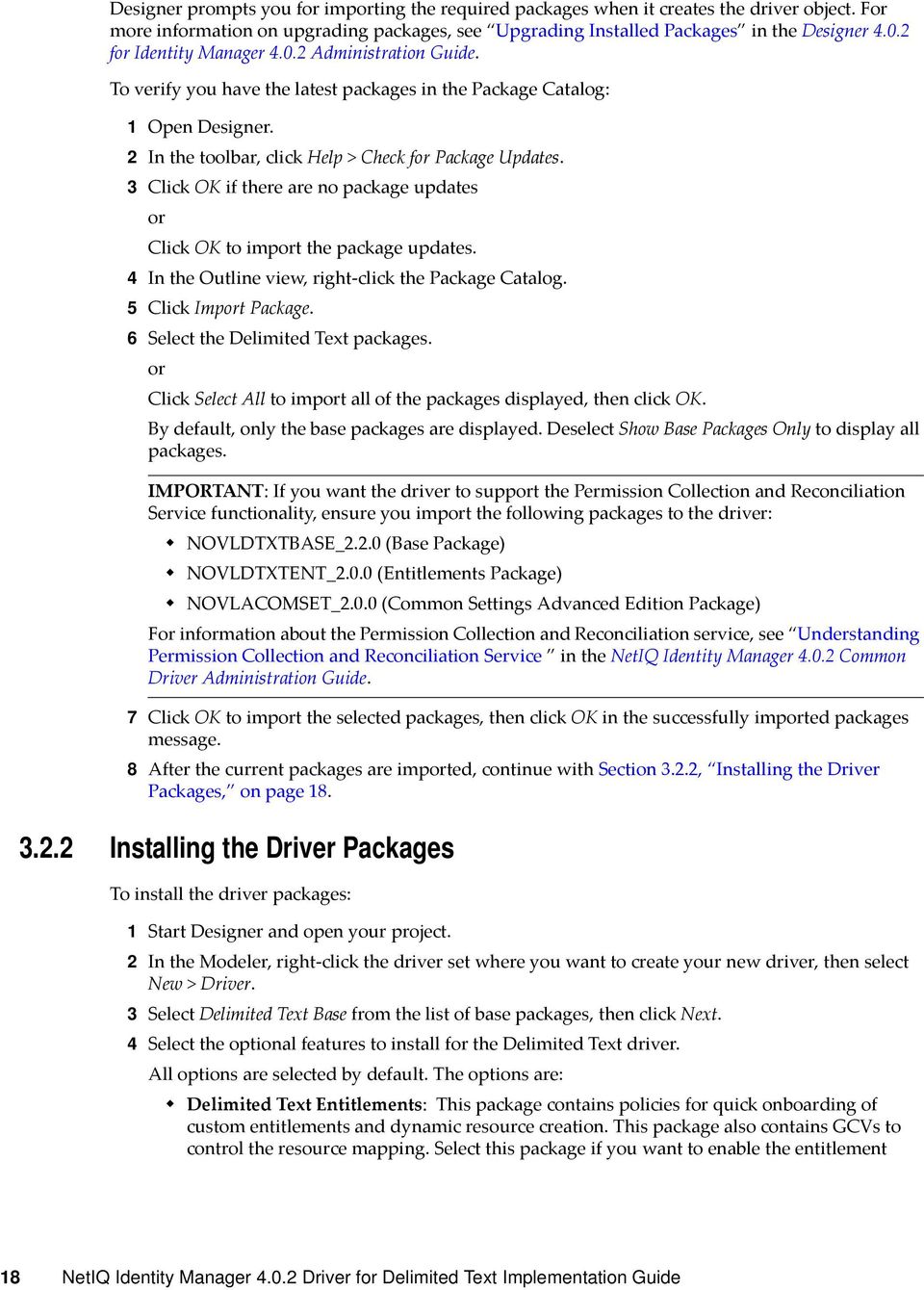
17 3 3Creating a New Driver Object You can create the driver object in the Identity Vault by installing the driver packages and then modifying the driver configuration to suit your environment. The following sections provide instructions: Section 3.1, Preparing Data Locations, on page 17 Section 3.2, Creating the Driver Object in Designer, on page 17 Section 3.3, Activating the Driver Object, on page 23 Section 3.4, Adding Packages to an Existing Driver, on page 24 Section 3.5, Viewing Permission Collection and Reconciliation Service Configuration Objects, on page Preparing Data Locations You need to make sure that the driver s input and output directories exist. The input directory is where the driver looks for files to be processed into the Identity Vault. The output directory is where the driver places files to be processed by the target application. The input and output directories must be located on the same server as the driver. The directories can have any names supported by the server operating system. 3.2 Creating the Driver Object in Designer To create a Delimited Text driver object, install the driver packages and then modify the configuration to suit your environment. After you create and configure the driver object, you need to deploy it to the Identity Vault and start it. Section 3.2.1, Importing the Current Driver Packages, on page 17 Section 3.2.2, Installing the Driver Packages, on page 18 Section 3.2.3, Modifying the Driver Settings, on page 21 Section 3.2.4, Deploying the Driver Object, on page 22 Section 3.2.5, Starting the Driver Object, on page Importing the Current Driver Packages The driver packages contain the items required to create a driver, such as policies, entitlements, filters, and Schema Mapping policies. These packages are only available in Designer. You can upgrade any package that is installed if there is a newer version of the package available. It is recommended to have the latest packages in the Package Catalog before creating a new driver object. Creating a New Driver Object 17

18 Designer prompts you for importing the required packages when it creates the driver object. For more information on upgrading packages, see Upgrading Installed Packages in the Designer for Identity Manager Administration Guide. To verify you have the latest packages in the Package Catalog: 1 Open Designer. 2 In the toolbar, click Help > Check for Package Updates. 3 Click OK if there are no package updates or Click OK to import the package updates. 4 In the Outline view, right click the Package Catalog. 5 Click Import Package. 6 Select the Delimited Text packages. or Click Select All to import all of the packages displayed, then click OK. By default, only the base packages are displayed. Deselect Show Base Packages Only to display all packages. IMPORTANT: If you want the driver to support the Permission Collection and Reconciliation Service functionality, ensure you import the following packages to the driver: NOVLDTXTBASE_2.2.0 (Base Package) NOVLDTXTENT_2.0.0 (Entitlements Package) NOVLACOMSET_2.0.0 (Common Settings Advanced Edition Package) For information about the Permission Collection and Reconciliation service, see Understanding Permission Collection and Reconciliation Service in the NetIQ Identity Manager Common Driver Administration Guide. 7 Click OK to import the selected packages, then click OK in the successfully imported packages message. 8 After the current packages are imported, continue with Section 3.2.2, Installing the Driver Packages, on page Installing the Driver Packages To install the driver packages: 1 Start Designer and open your project. 2 In the Modeler, right click the driver set where you want to create your new driver, then select New > Driver. 3 Select Delimited Text Base from the list of base packages, then click Next. 4 Select the optional features to install for the Delimited Text driver. All options are selected by default. The options are: Delimited Text Entitlements: This package contains policies for quick onboarding of custom entitlements and dynamic resource creation. This package also contains GCVs to control the resource mapping. Select this package if you want to enable the entitlement 18 NetIQ Identity Manager Driver for Delimited Text Implementation Guide
19 onboarding feature for this driver. For more information, see Understanding Permission Collection and Reconciliation Service in the NetIQ Identity Manager Common Driver Administration Guide. NOTE: If you are enabling quick onboarding of custom entitlements functionality, ensure that you upgrade the Managed System Gateway driver version to Delimited Text Password Synchronization: This package contains GCVs and sample policies for synchronizing passwords. Delimited Text Managed System Information: This package contains the policies that enable the driver to collect data for reports. Note that if the Delimited Text Managed System Information and Password Synchronization packages are not imported into the Package Catalog, only the package ID is displayed for those packages in the list of optional features. 5 Click Next. 6 (Optional) If you want the driver to synchronize passwords, select the Delimited Text Password Synchronization package, then click Next. 7 (Conditional) If not already configured, fill in the following fields on the Common Settings page, then click Next: User Container: Select the Identity Vault container where users are added if they don t already exist in the Identity Vault. This value becomes the default value for all drivers in the driver set. Group Container: Select the Identity Vault container where groups are added if they don t already exist in the Identity Vault. This value becomes the default value for all drivers in the driver set. NOTE: The Common Settings page is only displayed if the Common Settings package is a dependency. 8 (Conditional) If not already configured, fill in the following fields on the Common Settings Advanced Edition page, then click Next: User Application Provisioning Services URL: Specify the User Application Identity Manager Provisioning URL. User Application Provisioning Services Administrator: Specify the DN of the User Application Administrator user. This user should have the rights for creating and assigning resources. For more information, see Setting Up Administrative User Accounts in the NetIQ Identity Manager Common Driver Administration Guide. NOTE: This page is only displayed if you installed the Common Settings Advanced Edition package. 9 On the Install Delimited Text Base page, specify a name for the driver, then click Next. 10 Fill in the following fields, then click Next: Input File Path: Specify the path for the input file. Output File Path: Specify the path for the output file. 11 (Conditional) If you want to use the Remote Loader with this driver, fill in the following fields to configure the driver to connect through the Remote Loader, then click Next. Otherwise, click No, then click Next. Connect to Remote Loader: By default, the driver is configured to connect through the Remote Loader. If you want to run the driver locally, select no, then click Next. Otherwise, fill in the remaining fields to configure the driver to connect through the Remote Loader. Creating a New Driver Object 19

20 Host Name: Specify the host name or IP address of the server where the driver s Remote Loader service is running. Port: Specify the port number where the Remote Loader is installed and is running for this driver. The default port number is Remote Password: Specify the Remote Loader s password, as defined on the Remote Loader. The Identity Manager server or the Remote Loader shim requires this password to authenticate to the Remote Loader Driver Password: Specify the driver object password that is defined in the Remote Loader service. The Remote Loader requires this password to authenticate to the Identity Manager server. 12 On the Driver Parameters page, fill in the following fields, then click Next: Field Delimiter: Specify the character to use to delimit field values in the input and output files. It must be one character. You can also use the tab as the delimiter field value. Tab is represented as {tab}. The default is a comma. Field Names: Specify a comma separated list of attribute names that can be referred to in the Schema Mapping rule. The fields of the records included in your input CSV files must correspond to the order and positioning of the names in this list. 13 (Conditional) On the Entitlements Name to CSV File Mappings page, click the Add Name to File Mapping icon to populate the page with the entitlement configuration options. NOTE: This page is only displayed if you installed the Entitlements package. The information that you specify in this page is used for creating the permission catalog. Fill in the following fields: Entitlement Name: Specify a descriptive name for the entitlement to map it to the CSV file that contains the target system entitlement details. Entitlement Name is the name of the entitlement. This parameter corresponds to the Entitlement Assignment Attribute on the target system. For example, you could define an entitlement called ParkingPass. This parameter is used to create a resource in the User Application. Entitlement Assignment Attribute: Specify a descriptive name for the assignment attribute for an entitlement. Entitlement Assignment Attribute holds the entitlement values on the target system. For example, you could have an attribute called Parking. You must add this parameter to Field Names in the Driver Parameters page or modify it in driver settings after creating the driver. CSV File: Specify the location of the CSV file. This file must be located on the same server as the driver. This file contains the values for application entitlements. Multi valued?: Set the value of this parameter to True if you want to assign resources and entitlements multiple times with different values to the same user. Otherwise, set it to False. 14 (Conditional) On the Install Delimited Text Managed System Information page, fill in the following fields to define your Delimited Text system, then click Next: NOTE: This page is only displayed if you installed the Managed System Information package. Name: Specify a descriptive name for this Delimited Text system. Description: Specify a brief description for this Delimited Text system. Location: Specify the physical location of this Delimited Text system. Vendor: Leave the setting unchanged. 20 NetIQ Identity Manager Driver for Delimited Text Implementation Guide

21 Version: Specify the version of this Delimited Text system. 15 (Conditional) On the Install Delimited Text Managed System Information page, fill in the following fields to define your Delimited Text system, then click Next: NOTE: This page is only displayed if you selected to install the Managed System Information package. Business Owner: Select a user object in the Identity Vault that is the business owner of the Delimited Text system. This can only be a user object, not a role, group, or container. Application Owner: Select a user object in the Identity Vault that is the application owner of the Delimited Text system. This can only be a user object, not a role, group, or container. 16 (Conditional) On the Install Delimited Text Managed System Information page, fill in the following fields to define your Delimited Text system, then click Next: Classification: Select the classification of the Delimited Text system. This information is displayed in the reports. Your options are: Mission Critical Vital Not Critical Other If you select Other, you must specify a custom classification for the Delimited Text driver system. Environment: Select the type of environment the Delimited Text system provides. The options are: Development Test Staging Production Other If you select Other, you must specify a custom classification for the Delimited Text driver system. 17 Review the settings and click Finish to create the driver. 18 Modify the driver settings. Proceed to Section 3.2.3, Modifying the Driver Settings, on page Modifying the Driver Settings There are many settings that can help you customize and optimize the driver. The settings are divided into categories such as Driver Configuration, Engine Control Values, and Global Configuration Values (GCVs). Although it is important for you to understand all of the settings, your first priority should be to review the Driver Parameters located on the Driver Configuration page. These settings let you control the format and content of the input and output files. The driver configuration settings are explained in Appendix A, Driver Properties, on page 43. If you do not have the Driver Properties page displayed in Designer: 1 Open your project. 2 In the Modeler, right click the driver icon or the driver line, then select Properties. 3 (Conditional) Click GCVs > Entitlements and review the following settings: Creating a New Driver Object 21
22 NOTE: These settings are only displayed if you installed the Entitlements package. Enable Permission Collection and Reconciliation: Select the value of this parameter to True for allowing permission collection and entitlement assignment. By default it is set to False, which allows the driver to override any other conditions to reconcile custom entitlements. Enable Permission Reconciliation for all Custom Entitlements: If the value of this parameter is set to No, it allows you to select specific custom entitlements for reconciling them. By default, it is set to Yes, which allows reconciling of all custom entitlements. Add Custom Entitlements for Reconciliation: This parameter is presented if the value of Enable Permission Reconciliation for all Custom Entitlements is set to No. Click the Add icon to add custom entitlements you want to selectively onboard and specify Assignment Attribute Name for them. NOTE: Ensure that Entitlement Assignment Attributes values are added to the Field Names parameter in the driver configuration if they are not added initially during driver creation. 4 Click OK when finished. 5 Deploy the driver to the Identity Vault. Proceed to Section 3.2.4, Deploying the Driver Object, on page Deploying the Driver Object To deploy the driver into the Identity Vault, 1 In the Modeler, right click the driver icon or the driver line, then select Live > Deploy. 2 If you are authenticated to the Identity Vault, skip to Step 3, otherwise, specify the following information, then click OK.: Host: Specify the IP address or DNS name of the server hosting the Identity Vault. Username: Specify the DN of the user object used to authenticate to the Identity Vault. Password: Specify the user s password. 3 Read through the deployment summary, then click Deploy. 4 Read the successful message, then click OK. 5 Click Define Security Equivalence to assign rights to the driver. The driver requires rights to objects within the Identity Vault and to the input and output directories on the server. The Admin user object is most often used to supply these rights. However, you might want to create a DriversUser, for example, and assign security equivalence to that user. For more information about defining a Security Equivalent User in objects for drivers in the Identity Vault, see Establishing a Security Equivalent User in the Identity Manager Security Guide. For receiving events from the Identity Vault, ensure that the driver s Security Equals DN has the following rights in the Identity Vault: Entry: Browse rights. Attributes: Read rights. 5a Click Add, browse to and select the object with the correct rights. 5b Click OK twice. 6 Click Exclude Administrative Roles to exclude users that should not be synchronized. 22 NetIQ Identity Manager Driver for Delimited Text Implementation Guide
23 You should exclude any administrative User objects (for example, Admin and DriversUser) from synchronization. 6a Click Add, browse to and select the user object you want to exclude, then click OK. 6b Repeat Step 6a for each object you want to exclude, then click OK. 7 Click OK. After you have customized the driver for your environment, you must deploy it to the Identity Vault. Proceed to Section 3.2.4, Deploying the Driver Object, on page Starting the Driver Object If you configured the driver with the Permission Collection and Reconciliation service, ensure the driver meets the following requirements before it is started for the first time: The Entitlement value CSV files are available in the locations specified during driver configuration. You can check the location you specified by examining the PermissionNameToFile mapping table under the driver in the Outline View of Designer. The driver administrator and the User Application Resource Administrator are added to a Password Policy. To start the driver, in the Modeler, right click the driver icon or the driver line, then select Live > Start Driver. For information about management tasks with the driver, see Chapter 9, Managing the Driver, on page Activating the Driver Object If you create the Delimited Text driver in a driver set where you have already activated a driver that comes with the Integration Module for Tools, the driver inherits the activation. If you created the Delimited Text driver in a driver set that has not been activated, you must activate the driver within 90 days by using the Integration Module for Tools activation. Otherwise, the driver stops working. The drivers that are included in the Integration Module for Tools are: Driver for Delimited Text Driver for SOAP For information on activation, refer to Activating Novell Identity Manager Products in the Identity Manager Integrated Installation Guide. If driver activation has expired, the following error message is displayed in the ndstrace window: DirXML Log Event Driver: \META-RHEL6\system\DriverSet\eDirDriver-BulkOperations Channel: Subscriber Status: Error Message: Code(-9075) Shutting down because DirXML engine evaluation period has expired. Activation is required for further use. To use the driver, you must reactivate it. Creating a New Driver Object 23
24 3.4 Adding Packages to an Existing Driver You can add new functionality to an existing driver by adding new packages to it. 1 Right click the driver, then click Properties. 2 Click Packages, then upgrade the already installed Delimited Text Base package. 2a Select the package from the list of packages, then click the Select Operation cell. 2b Click Upgrade from the drop down list, then click Apply. 2c Click OK to close the Package Management page. You can upgrade the Password Synchronization package in a similar way. 3 Click the Add Packages icon. 4 Select the packages to install. NOTE: The Delimited Text Entitlements package contains the content for Permission Collection and Reconciliation service. Select it to enable this service. 5 (Optional) If you want to see all available packages for the driver, clear the Show only applicable package versions option, if you want to see all available packages for the driver, then click OK. This option is only displayed on drivers. By default, only the packages that can be installed on the selected driver are displayed. 6 Click Apply to install all of the packages listed with the Install operation. 7 (Conditional) Fill in the fields with appropriate information to install the package you selected for the driver, then click Next. 8 Read the summary of the installation, then click Finish. 9 Click OK to close the Package Management page after you have reviewed the installed packages. 10 Modify the driver configuration settings. See Section 3.2.3, Modifying the Driver Settings, on page Deploy the driver. See Section 3.2.4, Deploying the Driver Object, on page Start the driver. See Section 3.2.5, Starting the Driver Object, on page (Conditional) Review the newly created or modified configuration objects. See Section 3.5, Viewing Permission Collection and Reconciliation Service Configuration Objects, on page Repeat Step 1 through Step 9 for each driver where you want to add the new packages. 3.5 Viewing Permission Collection and Reconciliation Service Configuration Objects NOTE: This section contains information about verifying the objects that are either newly created or modified as part of enabling the Permission Collection and Reconciliation service. If this service is not enabled for the driver, skip this section. After the driver is deployed and configured with the new Permission Collection and Reconciliation service, verify that the driver correctly creates and updates the entitlements information in the Identity Vault. 24 NetIQ Identity Manager Driver for Delimited Text Implementation Guide
25 Complete the following steps: 1 In imanager, click to display the Identity Manager Administration page. 2 In the Administration list, click Identity Manager Overview. 2a (Conditional) If the driver set is not listed on the Driver Sets tab, use the Search In field to search for and display the driver set. 2b Click the driver set to open the Driver Set Overview page. 3 Click the Delimited Text driver icon. 4 Click the Jobs tab. The PermissionOnboarding job is displayed in the Jobs page. For more information, see PermissionOnboarding Job in the NetIQ Identity Manager Common Driver Administration Guide. 5 Click Advanced > Mapping Tables. The DNs of the Entitlement objects are displayed in the Mapping Table page based on the InitEntitlementResourceObjects policy and data from the configuration objects. For more information, see Mapping Tables in the NetIQ Identity Manager Common Driver Administration Guide. 6 Click Global Config Values to display the driver set GCV page. This page contains two sets of GCVs that are consumed by the drivers in the driver set. Ensure that you configure them for the driver set containing the drivers for quick onboarding of identity, resources, and permission assignments. NOVLCOMSET: This GCV object contains the following: User Container: Specifies the Identity Vault container where the users are added, if they don t already exist in the Identity Vault. This value is the default value for all drivers in the driver set. Group Container: Specifies the Identity Vault container where the groups are added, if they don t already exist in the Identity Vault. This value is the default value for all drivers in the driver set. NOVLACOMSET: This GCV object contains the following: User Application Provisioning Services URL: Specifies the User Application Identity Manager Provisioning URL. User Application Provisioning Administrator: Specifies the DN of the provisioning administrator. This user should have the rights for creating and assigning resources. Creating a New Driver Object 25
26 26 NetIQ Identity Manager Driver for Delimited Text Implementation Guide
27 4 4Upgrading an Existing Driver If you are running the driver on the Identity Manager server, the driver shim files are updated when you update the server unless they were not selected during a custom installation. If you are running the driver on another server, the driver shim files are updated when you update the Remote Loader on the server. The version of the driver shim supports drivers created by using any 3.x version of the driver configuration file. You can continue to use these driver configurations until you want to upgrade the driver to packages. The following sections provide information to help you upgrade an existing driver to version 4.0.2: Section 4.1, Supported Upgrade Paths, on page 27 Section 4.2, What s New in Version 4.0.2, on page 27 Section 4.3, Upgrade Procedure, on page Supported Upgrade Paths You can upgrade from any 3.x version of the Delimited Text driver. Upgrading a pre 3.x version of the driver directly to version is not supported. 4.2 What s New in Version Version of the driver now provides support for quick onboarding of custom entitlements. For more information, see Entitlements on page 12. For more information about how quick onboarding of custom entitlements works, see Understanding Permission Collection and Reconciliation Service in the NetIQ Identity Manager Common Driver Administration Guide. From Identity Manager 4.0 onwards, driver content is delivered in packages instead of through a driver configuration file. 4.3 Upgrade Procedure The process for upgrading the Delimited Text driver is the same as for other Identity Manager drivers. For detailed instructions, see Upgrading Drivers to Packages in the Identity Manager Upgrade and Migration Guide. Upgrading an Existing Driver 27
28 28 NetIQ Identity Manager Driver for Delimited Text Implementation Guide
29 5 5Setting Up One-Way Synchronization If your data synchronization goes only one way, you need to disable the channel that you don t use. To disable one of the channels, clear the filters on the channel you don t need and remove the path for the input or output directory, depending on the channel. For example, if you only need a Publisher channel: 1 In the Filter editor in imanager, clear the filters on the Subscriber channel. 1a For example, select the User class. 1b Select Ignore in the Subscribe section. The Subscriber channel icon for the User class changes to show that the class is no longer being synchronized. 2 Click OK to save the changes. 3 Edit the driver properties to remove the path specified for the Output File Path. This setting is located under the Subscriber Settings for the Driver Parameters on the Driver Configuration page. For details, see Section A.1.5, Driver Parameters, on page 45. If you only need a Subscriber channel, clear the filters on the Publisher object and remove the path specified for the Input File Path in the Driver Parameters section. Setting Up One-Way Synchronization 29
30 30 NetIQ Identity Manager Driver for Delimited Text Implementation Guide
31 6 6Configuring for XDS XML Files You can use XML files in XDS format instead of comma separated value (CSV) files with the driver. Because you generally use this driver only with a Publisher or Subscriber channel, perform only the steps from the section that you need. Section 6.1, Using the Publisher Channel, on page 31 Section 6.2, Using the Subscriber Channel, on page Using the Publisher Channel To have the driver accept input in XML format, change the input file extension to.xml. 6.2 Using the Subscriber Channel To have the driver send output in XDS format, remove the Event Transform and Output Transform style sheets from the Subscriber channel. We recommend you to use Designer for modifying or deleting policies, rules, or objects. 1 Launch Designer, then go to the Outline view. 2 Browse to the driver s Subscriber object, then select the SubscriberEventTransformSS object and click Delete. 3 Browse to and select the driver s OutputTransformSS object, then click Delete. Configuring for XDS XML Files 31
32 32 NetIQ Identity Manager Driver for Delimited Text Implementation Guide
33 7 7Using Style Sheets to Configure Data Synchronization The real power of Identity Manager is in managing the shared data itself. This section covers some common customizations for the Delimited Text driver. The example configuration available with the driver uses comma separated value files. However, you can use the driver in many ways. It is designed to be as flexible as possible. The driver passes the textbased files largely unchanged to the style sheets. The style sheets do most of the work. You can write new style sheets to allow the driver to work with almost any text based file that contains predictably repeatable patterns. The basis for this exchange is the <delimited-text> XML element. For example, to design a Publisher channel that reads information from a text file, create an Input Transform style sheet that receives the contents of the file and converts it into a <delimited-text> element. The following is an example of a <delimited-text> element: <delimited-text> <record> <field name="firstname">john</field> <field name="lastname">maxfield</field> <field name="phone"> </field> </record> <record> <field name="firstname">sarah</field> <field name="lastname">lopez</field> <field name="phone"> </field> </record> </delimited-text> For detailed information on writing style sheets to handle other document types, refer to the sample style sheets that come with this driver. If you create the driver by using the example configuration, you can use Input Transform, Output Transform, and Event Transformation style sheets as a starting point. Using Style Sheets to Configure Data Synchronization 33
34 34 NetIQ Identity Manager Driver for Delimited Text Implementation Guide
35 8 8Using Java Interfaces to Customize File Processing Java interfaces enable you to customize file processing by using Java classes that you write: InputSorter InputSource PreProcessor PostProcessor These interfaces enable you to add extensions, which are optional. The driver continues to function as before without extensions. However, if you want to directly modify the behavior of the driver, but you have been unable to make these modifications from a style sheet or DirXML Script, extending the Delimited Text driver can be useful. By using Java classes that you write, you can use the interfaces to customize the publish and subscribe processes in the following ways: Table 8-1 Customizing the Publish and Subscribe Processes Process Interface Description Publish InputSorter Defines the processing order of multiple input files. The system where your driver is installed determines the default processing order. For example, files on an NT system are processed in alphabetical order. You can use the InputSorter to impose the processing order that you require. Publish InputSource Provides data other than the files in the default location for the driver to process. For example, you can check an FTP server for input files and then transfer the files to the local file system for processing. Publish PreProcessor Ties data manipulation required to prepare input files for driver processing directly to the driver. Before this interface was available, preprocessing was independent of the driver. You could create a separate application that monitored another directory for input files, modify the files in some way, and then copy the files to the input directory of the driver. By creating a class that implements the PreProcessor, you can do this type of preprocessing more directly. Subscribe PostProcessor Ties data manipulation required by the application, consuming Identity Vault output directly to the driver. Using Java Interfaces to Customize File Processing 35
36 These enhancements to the driver require Java programming. To implement this functionality, complete the following processes: Section 8.1, Creating a Java Class, on page 36 Section 8.2, Creating a Java.jar File, on page 36 Section 8.3, Configuring the Driver to Use the New Class, on page Creating a Java Class JavaDoc and an example class are included with the driver to help you implement this functionality. Find the JavaDoc at./products/idm/windows/setup/drivers/delimitedtext/javadocs and the sample code at./products/idm/windows/setup/drivers/delimitedtext/extensions/sample code. 8.2 Creating a Java.jar File After you have implemented your class file, create a Java.jar file (Java archive) by using the jar tool. The.jar file must contain the class that you have created. Put the.jar file into the novell/nds/lib directory. The path might differ, depending on the platform you re on, but it should be the same location as DelimitedTextShim.jar and DelimitedTextUtil.jar. 8.3 Configuring the Driver to Use the New Class After you have placed the new.jar file in the correct location, configure the driver to use your new class by modifying the driverʹs properties. 1 In imanager, open the driver s property page: 1a In imanager, click to display the Identity Manager Administration page. 1b In the Administration list, click Identity Manager Overview. 1c Open the driver set that contains the driver. 1d Click the driver icon to open the Identity Manager Driver Overview page. 1e Click the upper right corner of the driver icon to open the Actions menu, then click Edit properties. 2 Select Driver Configuration. 3 Scroll to Driver Parameters, then click Edit XML. 4 Locate the <publisher-options> section of the file. This file defines which parameters and values appear in the Driver Parameters section of the Driver Configuration page. For each class you created that works on the Publisher channel, you enter an additional option in the <publisher-options> section. After you update this file, you see your new options in the interface. 5 For each new class you created on the Publisher channel, add an entry corresponding to the interface type. Use the following table as a guide: 36 NetIQ Identity Manager Driver for Delimited Text Implementation Guide
37 Interface InputSorter New Entry <definition display-name="inputsorter Class" name=" inputsorter" type="string"> <value>com.acme.mynewclass</value> </definition> <definition display-name="inputsorter init string" name=" input-sorter-params" type="string"> <value>my CONFIG PARAMS</value> </definition> InputSource <definition display-name="inputsource Class" name=" inputsource" type="string"> <value>com.acme.mynewclass</value> </definition> <definition display-name="inputsource init string" name=" input-source-params" type="string"> <value>my CONFIG PARAMS</value> </definition> PreProcessor <definition display-name="preprocessor Class" name="preprocessor" type="string"> <value>com.acme.mynewclass</ value> </definition> <definition display-name="preprocessor init string" name="pre-processor-params" type="string"> <value>my CONFIG PARAMS</value> </definition> 5a Replace com.acme.mynewclass with the name of the class that you defined, along with a full package identifier. 5b Replace MY CONFIG PARAMS with any information that you want to pass to the init method of your class. The init method of your class is then responsible for parsing the information contained in this string. If your class doesn t require a configuration string to be passed to the init method, you can leave off the whole element, in which case null is passed to the init method. 6 If you created a PostProcessor rule, locate the <subscriber-options> section of the file and add the following lines: <post-processor display-name="postprocessor Class:">com.acme.MyNewClass</postprocessor> <post-processor-params display-name="postprocessor init string:">my CONFIG PARAMS</post-processor-params> 6a Replace com.acme.mynewclass with the name of the class that you have defined along with full package information. 6b Replace MY CONFIG PARAMS with any information that you want to pass to the init method of your class. The init method of your class is then responsible for parsing the information contained in this string. If your class doesn t require a configuration string to be passed to the init method, you can leave off the entire element, in which case null would be passed to the init method. 7 Click OK. Using Java Interfaces to Customize File Processing 37
38 38 NetIQ Identity Manager Driver for Delimited Text Implementation Guide
39 9 9Managing the Driver As you work with the Delimited Text driver, there are a variety of management tasks you might need to perform, including the following: Starting and stopping the driver Viewing driver version information Using Named Passwords to securely store passwords associated with the driver Monitoring the driver s health status Backing up the driver Inspecting the driver s cache files Viewing the driver s statistics Using the DirXML Command Line utility to perform management tasks through scripts Securing the driver and its information Because these tasks, as well as several others, are common to all Identity Manager drivers, they are included in one reference, the NetIQ Identity Manager Common Driver Administration Guide. Managing the Driver 39
40 40 NetIQ Identity Manager Driver for Delimited Text Implementation Guide
41 10 10Troubleshooting Viewing driver processes is necessary to analyze unexpected behavior. To view the driver processing events, use DSTrace. You should only use it during testing and troubleshooting the driver. Running DSTrace while the drivers are in production increases the utilization on the Identity Manager server and can cause events to process very slowly. For more information, see Viewing Identity Manager Processes in the NetIQ Identity Manager Common Driver Administration Guide Stop the driver before doing a bulk assignment or removal of resource assignments If you don t stop the driver before doing a bulk removal of resource assignments from the User Application, the driver creates multiple user entries in the output CSV file. It might display a warning message when you are deploying the driver for the first time. To workaround this issue, stop the driver before doing such bulk revocations from the User Application, then restart the driver. This creates the output CSV file with one entry instead of multiple intermediate entries in it. Troubleshooting 41
42 42 NetIQ Identity Manager Driver for Delimited Text Implementation Guide
43 A ADriver Properties This section provides information about the Driver Configuration and Global Configuration Values properties for the Delimited Text driver. These are the only unique properties for the Delimited Text driver. All other driver properties (Named Password, Engine Control Values, Log Level, and so forth) are common to all drivers. Refer to Driver Properties in the NetIQ Identity Manager Common Driver Administration Guide for information about the common properties. The properties information is presented from the viewpoint of imanager. If a field is different in Designer, it is marked with a icon. Section A.1, Driver Configuration, on page 43 Section A.2, Global Configuration Values, on page 49 A.1 Driver Configuration In imanager: 1 Click to display the Identity Manager Administration page. 2 Open the driver set that contains the driver whose properties you want to edit: 2a In the Administration list, click Identity Manager Overview. 2b If the driver set is not listed on the Driver Sets tab, use the Search In field to search for and display the driver set. 2c Click the driver set to open the Driver Set Overview page. 3 Locate the Delimited Text driver icon, then click the upper right corner of the driver icon to display the Actions menu. 4 Click Edit Properties to display the driver s properties page. In Designer: 1 Open a project in the Modeler. 2 Right click the driver icon or line, then select click Properties > Driver Configuration. The Driver Configuration options are divided into the following sections: Section A.1.1, Driver Module, on page 44 Section A.1.2, Driver Object Password, on page 44 Section A.1.3, Authentication, on page 44 Section A.1.4, Startup Option, on page 45 Section A.1.5, Driver Parameters, on page 45 Section A.1.6, ECMAScript (Designer Only), on page 48 Section A.1.7, Global Configurations, on page 48 Driver Properties 43
44 A.1.1 Driver Module The Driver Module section lets you change the driver from running locally to running remotely or the reverse. Java: Used to specify the name of the Java class that is instantiated for the shim component of the driver. This class can be located in the classes directory as a class file, or in the lib directory as a.jar file. If this option is selected, the driver is running locally. The name of the Java class is: com.novell.nds.dirxml.driver.delimitedtext.delimitedtextdriver Native: Used to specify the name of the.dll file that is instantiated for the application shim component of the driver. If this option is selected, the driver is running locally. Connect to Remote Loader: Used when the driver is connecting remotely to the connected system. Designer includes two suboptions: Remote Loader Client Configuration for Documentation: Includes information on the Remote Loader client configuration when Designer generates documentation for the Delimited Text driver. Driver Object Password: Specifies a password for the Driver object. If you are using the Remote Loader, you must enter a password on this page. Otherwise, the remote driver does not run. The Remote Loader uses this password to authenticate itself to the remote driver shim. A.1.2 Driver Object Password Driver Object Password: Specifies a password for the Driver object. If you are using the Remote Loader, you must enter a password on this page. Otherwise, the remote driver does not run. The Remote Loader uses this password to authenticate itself to the remote driver shim. A.1.3 Authentication The Authentication section stores the information required to authenticate to the connected system. Authentication information for server: Displays or specifies the server that the driver is associated with. Authentication ID: Specify a user application ID. This ID is used to pass Identity Vault subscription information to the application. Example: Administrator Authentication Context: Specify the IP address or name of the server that the application shim should communicate with. Remote Loader Connection Parameter: Used only if the driver is connecting to the application through the Remote Loader. In imanager, the parameter to enter is hostname=xxx.xxx.xxx.xxx port=xxxx kmo=certificatename, where the host name is the IP address of the Remote Loader server and the port is the port the Remote Loader is listening on. The default port for the Remote Loader is The kmo entry is optional. It is used only when an SSL connection exists between the Remote Loader and the Identity Manager engine. Example: hostname= port=8090 kmo=idmcertificate 44 NetIQ Identity Manager Driver for Delimited Text Implementation Guide
45 Application Password: Specify the password for the user object listed in the Authentication ID field. Remote Loader Password: Used only if the driver is connecting to the application through the Remote Loader. The password is used to control access to the Remote Loader instance. It must be the same password specified during the configuration of the Remote Loader on the connected system. Cache limit (KB): Specify the maximum event cache file size (in KB). If it is set to zero, the file size is unlimited. Click Unlimited to set the file size to unlimited in Designer. A.1.4 Startup Option The Startup Option section enables you to set the driver state when the Identity Manager server is started. Auto start: The driver starts every time the Identity Manager server is started. Manual The driver does not start when the Identity Manager server is started. The driver must be started through Designer or imanager. Disabled: The driver has a cache file that stores all of the events. When the driver is set to Disabled, this file is deleted and no new events are stored in the file until the driver state is changed to Manual or Auto Start. Do not automatically synchronize the driver: This option applies only if the driver is deployed and was previously disabled. If this is not selected, the driver re synchronizes the next time it is started. A.1.5 Driver Parameters The Driver Parameters section lets you configure the driver specific parameters. When you change driver parameters, you tune driver behavior to align with your network environment. For example, you might find the default Publisher polling interval to be shorter than your synchronization requires. Making the interval longer could improve network performance while still maintaining appropriate synchronization. The driver parameters are presented by categories: Driver Options on page 45 Subscriber Options on page 46 Publish Options on page 47 Driver Options Driver parameters for server: Displays or specifies the server name or IP address of the server whose driver parameters you want to modify. Edit XML: Opens an editor so that you can edit the driver s configuration file. Field Delimiter: Specifies the character that is used to delimit field values in the input files. It must be one character. You can also use the tab as the delimiter field value. Tab is represented as {tab}. The default is a comma. If the values of any of the input fields contain this character, enclose the entire value in quotes to prevent it from being seen as a delimiter. Driver Properties 45
46 Changing this delimiter parameter to something other than a comma does not automatically change the delimiter character used in the output files when a Subscriber is used. To change the delimiter character in the output files, edit the Output Transform style sheet. The delimiter character is assigned to a variable at the beginning of that style sheet. For example, to change the delimiter, locate the <xsl:variable name="delimiter" select="','"/> line in the default style sheet and modify it appropriately. Field Names: Specifies a comma separated list of attribute names that can be referred to in the Schema Mapping rule. In the input files, the fields of the records must correspond to the order and positioning of the names in this list. For example, if you list eight field names in this parameter, each record of the input files should have eight fields separated by the field delimiter character. On Windows, see sample.csv in the delimitedtext/samples directory for an example. On Solaris and Linux, sample.csv is located in the /usr/lib/dirxml/rules/delim directory. The default values are LastName, FirstName, Title, , WorkPhone, Fax, WirelessPhone, and Description. Object Class Name: Specifies the NetIQ edirectory class name that should be used when creating new objects to correspond to input files. Allow Driver to Consume Its Own Output: Prevents you from inadvertently creating a situation in which the driver writes output files that are immediately read in again as input of the same driver. The default is No. By default, the driver wonʹt load if all the following conditions occur: You have both a Subscriber channel and a Publisher channel. The input and output directories are the same. The input and output file extensions are the same. If you want to feed the output of the Subscriber channel into the input of the Subscriber channel as a way to detect Identity Vault events to trigger other changes in the Identity Vault, set this parameter to Yes. For example, to update the Full Name attribute when the Given Name, Surname, or Initials attributes are updated, set this parameter to Yes. Subscriber Options Output File Path: Specifies the directory on the local file system where output files will be created. An error occurs if this directory doesn t exist. The default values are: Windows: c:\csvsample\output Solaris or Linux: /csvsample/output Output File Extension: When this parameter contains no value, the default Java character encoding for your locale is used. Output files have a unique name that ends with the characters in the Output File Extension parameter. If the output files from a Subscriber channel are used as input files for the Publisher channel of another Delimited Text driver, the destination file extension must match the source file extension parameter of the second driver. Destination File Character Encoding (leave blank for default): To use an encoding other than the default for your locale, enter one of the canonical names from the Supported Encoding table. The Publisher and Subscriber channels can use different character encodings. 46 NetIQ Identity Manager Driver for Delimited Text Implementation Guide
47 Maximum Number of Transactions per Output File: Specifies the maximum number of transactions that are written to a single output file. When the file transaction limit is reached, the file closes, and a new file is created for subsequent transactions. To limit the number of transactions that can be written to a single file, leave this parameter blank or set it to zero. For more information, see the next item, Maximum Time in Seconds before Flushing All Transactions: on page 47. Enable/Disable Duplicate Records: To allow duplicate records to be written into the output files, change this parameter to Yes. By default, the parameter is set to No. Maximum Time in Seconds before Flushing All Transactions: If no new transactions have been written to the output file in the amount of time specified in this parameter, the file is closed. When new transactions need to be written, a new output file is created. If you don t want to limit the time that can pass before the output file is closed, leave this parameter blank or set it to zero. Time of Day (Local Time) to Flush All Transactions: If a value is supplied for this parameter, the current output file is closed at the specified time each day. Subsequent transactions are written to a new file. This parameter does not prevent the Maximum Number of Transactions per Output File or the Maximum Time in Seconds before Flushing All Transactions parameters from also acting as output file thresholds. If you use this parameter and only want one file per day, set the other two parameters to zero. The format of this parameter can be HH:MM:SS (using the 24 hour clock) or H:MM:SS AM/PM. An hour is required, but the minutes and seconds are optional. Because the parameter assumes local time, any time zone information included in the value is ignored. The previous three parameters (Maximum Number of Transactions per Output File, Maximum Time in Seconds before Flushing All Transactions, and Time of Day to Flush All Transactions) are all capable of acting as a threshold for the transaction size a file is able to grow to, or for the time that it remains open to accept new transactions. As long as an output file is still open for writing by the Delimited Text driver, it shouldn t be considered as finalized. Avoid opening the file in any other process until the driver closes the file. For this reason, one of the three previous parameters must be set to assure that output files don t remain open indefinitely. To avoid this condition, if the driver detects that all three parameters are blank (or zero), it automatically sets the Maximum Number of Transactions per Output File to the value of 1. Publish Options Input File Path: The Publisher channel looks for new input files in the Input File Path, which is a directory on the local file system. Example paths: On Windows: c:\csvsample\input On Solaris and Linux: /usr/lib/dirxml/rules/delim Input File Extension: The extension used to designate input files (for example, csv). Source File Character Encoding (leave blank for default): When this parameter contains no value, the default Java character encoding for your locale is used. To use an encoding other than the default for your locale, enter one of the canonical names from the Supported Encoding table. If the Input File Extension parameter is.xml, the Source File Character Encoding can be indicated in one of two ways. If a value is indicated in the Source File Character Encoding parameter, it is used. Driver Properties 47
48 If the parameter is blank, and if the XML document specifies an Encoding Declaration as described in the W3C XML Recommendation ( xml#charencoding)n in paragraph 4.3.3, the Encoding Declaration is handled by the XML parser in the Identity Manager engine. The Identity Manager XML parser handles the following character encodings: UTF 8 UTF 16 ISO US ASCII Rename File Extension: The Publisher channel uses only files that have the extension specified in the parameter. After the files have been processed, the value of the Rename File Extension parameter is appended to the filename, so the Publisher channel won t try to process the same file again. If the value of the Rename File Extension parameter is left blank, the source file is deleted after it is processed. IMPORTANT: If you change the default, use only characters that are valid in filenames on your platform. Invalid characters cause the rename to fail and the driver to reprocess the same file repeatedly. Polling Rate (in Seconds): When the Publisher channel has finished processing all source files, it waits the number of seconds specified in this parameter before checking for new source files to process. Publisher heartbeat interval: Configures the driver shim to send a periodic status message on the Publisher channel when there has been no Publisher traffic for the given number of minutes. A.1.6 ECMAScript (Designer Only) Enables you to add ECMAScript resource files. The resources extend the driver s functionality when Identity Manager starts the driver. A.1.7 Global Configurations Displays an ordered list of Global Configuration objects. The objects contain extension GCV definitions for the driver that Identity Manager loads when the driver is started. You can add or remove the Global Configuration objects, and you can change the order in which the objects are executed. 48 NetIQ Identity Manager Driver for Delimited Text Implementation Guide
49 A.2 Global Configuration Values Global configuration values (GCVs) enable you to specify settings for the Identity Manager features such as password synchronization and driver heartbeat, as well as settings that are specific to the function of an individual driver configuration. Some GCVs are provided with the drivers, but you can also add your own. In imanager: 1 Click to display the Identity Manager Administration page. 2 Open the driver set that contains the driver whose properties you want to edit: 2a In the Administration list, click Identity Manager Overview. 2b If the driver set is not listed on the Driver Sets tab, use the Search In field to search for and display the driver set. 2c Click the driver set to open the Driver Set Overview page. 3 Locate the Delimited Text driver icon, then click the upper right corner of the driver icon to display the Actions menu. 4 Click Edit Properties to display the driver s properties page. 5 Click Global Config Values to display the GCV page. In Designer: 1 Open a project in the Modeler. 2 Right click the driver icon or line, then select Properties > Global Configuration Values. The Global Configuration Values are divided into the following categories: Section A.2.1, Default Configuration, on page 49 Section A.2.2, Entitlements, on page 50 Section A.2.3, Password Synchronization, on page 50 Section A.2.4, Managed System Information, on page 51 A.2.1 Default Configuration The following GCVs control the configuration of the Delimited Text driver: Field Delimiter: Specifies the character that is used to delimit field values in the input files. It must be one character. You can also use the tab as the delimiter field value. Tab is represented as {tab}. The default is a comma. If the values of any of the input fields contain this character, enclose the entire value in quotes to prevent it from being seen as a delimiter. Changing this delimiter parameter to something other than a comma does not automatically change the delimiter character used in the output files when a Subscriber is used. To change the delimiter character in the output files, edit the Output Transform style sheet. The delimiter character is assigned to a variable at the beginning of that style sheet. For example, to change the delimiter, locate the <xsl:variable name=ʺdelimiterʺ select=ʺʹ,ʹʺ/> line in the default style sheet and modify it appropriately. This option in the driver configuration synchronizes User, Group, Organization, Country, and Organizational Unit objects. It also mirrors the structure of a subtree in the other tree. Driver Properties 49
50 Field Names: Specifies a comma separated list of attribute names that can be referred to in the Schema Mapping rule. In the input files, the fields of the records must correspond to the order and positioning of the names in this list. For example, if you list eight field names in this parameter, each record of the input files should have eight fields separated by the field delimiter character. On Windows, see sample.csv in the delimitedtext/samples directory for an example. On Solaris and Linux, sample.csv is located in the /usr/lib/dirxml/rules/delim directory. The default values are LastName, FirstName, Title, , WorkPhone, Fax, WirelessPhone, and Description. Association Attribute: Specifies the attribute value used for association. A.2.2 Entitlements The following options are enabled or displayed when the Entitlements package is installed. For more information about entitlements, see Section 1.3.2, Entitlements, on page 12. Enable Permission Collection and Reconciliation: Select the value of this parameter to True for allowing permission collection and entitlement assignment. By default it is set to False, which allows the driver to override any other conditions to reconcile custom entitlements. Enable Permission Reconciliation for all Custom Entitlements: If the value of this parameter is set to No, it allows you to select specific custom entitlements for reconciling them. By default, it is set to Yes, which allows reconciling of all custom entitlements. Add Custom Entitlements for Reconciliation: This parameter is presented if the value of Enable Permission Reconciliation for all Custom Entitlements is set to No. Click the Add icon to add custom entitlements you want to selectively onboard and specify Assignment Attribute Name for them. A.2.3 Password Synchronization The following GCVs control password synchronization for the Delimited Text driver. For more information, see the Identity Manager Password Management Guide. In Designer, you must click the icon next to a GCV to edit it. This displays the Password Synchronization Options dialog box for a better view of the relationship between the different GCVs. In imanager, you should edit the Password Management Options on the Server Variables tab rather than under the GCVs. The Server Variables page has a better view of the relationship between the different GCVs. Connected System Name or Driver Name: Specify the name of the driver. The e mail notification template uses this value to identify the source of the notification message. Application accepts passwords from Identity Manager: If True, allows passwords to flow from the Identity Manager data store to the connected system. Identity Manager accepts passwords from application: If True, allows passwords to flow from the connected system to Identity Manager. Publish passwords to NDS password: Use the password from the connected system to set the nonreversible NDS password in edirectory. Publish passwords to Distribution Password: Use the password from the connected system to set the NMAS Distribution Password used for Identity Manager password synchronization. 50 NetIQ Identity Manager Driver for Delimited Text Implementation Guide
51 Require password policy validation before publishing passwords: If True, applies NMAS password policies during publish password operations. The password is not written to the data store if it does not comply. Reset user s external system password to the Identity Manager password on failure: If True, on a publish Distribution Password failure, attempt to reset the password in the connected system by using the Distribution Password from the Identity Manager data store. Notify the user of password synchronization failure via e mail: If True, notify the user by e mail of any password synchronization failures. A.2.4 Managed System Information These settings help the Identity Reporting Module function to generate reports. There are different sections in the Managed System Information tab. General Information on page 51 System Ownership on page 51 System Classification on page 51 Connection and Miscellaneous Information on page 52 General Information Name: Specifies a descriptive name for this Identity Vault. Description: Specifies a brief description of this Identity Vault. Location: Specifies the physical location of this Identity Vault. Vendor: Specifies the vendor of the Identity Vault. Version: Specifies the version of this Identity Vault. System Ownership Business Owner: Browse to and select the business owner in the Identity Vault for this Identity Vault. You must select a user object, not a role, group, or container. Application Owner: Browse to and select the application owner in the Identity Vault for this Identity Vault. You must select a user object, not a role, group, or container. System Classification Classification: Specifies the classification of the Identity Vault. This information is displayed in the reports. The options are: Mission Critical Vital Not Critical Other If you select Other, you must specify a custom classification for the Identity Vault. Driver Properties 51
52 Environment: Specifies the type of environment the Identity Vault provides. The options are: Development Test Staging Production Other If you select Other, you must specify a custom classification for the Identity Vault. Connection and Miscellaneous Information Connection and miscellaneous information: This options is always set to hide, so that you don t make changes to these options. 52 NetIQ Identity Manager Driver for Delimited Text Implementation Guide
53 B BDelimited Text Driver Extensions The Delimited Text driver defines different interfaces that you can implement in Java classes to extend the base functionality of the driver. Figure B-1 Java Class Interfaces This section includes the following information about using the ImageFile and ImageSource extensions: Section B.1, Using the ImageFile InputSource Extension, on page 53 Section B.2, Customizing ImageFile InputSource, on page 55 Section B.3, Using the ImageFile PostProcessor, on page 56 Section B.4, Customizing the ImageFile Extension, on page 59 B.1 Using the ImageFile InputSource Extension The ImageFile InputSource extension allows you to easily import GIF, JPG, and PNG images into edirectory. The InputSource reads the image files from a specified directory, transforms them to a Base64 encoded string, and passes this string to the driver shim as if it were a normal delimited text string, together with additional information about the image, such as file size, file name, and modification date. Delimited Text Driver Extensions 53
54 Figure B-2 InputSource Extension Standard rules and style sheets, as used for other implementations of the Delimited Text driver, can be used to further process the image data. The image itself is meant to be stored in an attribute of syntax octet string or stream. Section B.1.1, Installing the ImageFile InputSource Extension, on page 54 Section B.1.2, Configuring the Driver for the ImageFile InputSource Extension, on page 54 B.1.1 Installing the ImageFile InputSource Extension The ImageFile InputSource extensions are installed when you install Identity Manager and select the Delimited Text driver. The extensions are configured in the driver parameters. Each extension takes a parameter string that is specified in the driver parameters and passes it to the extension during initialization. Extensions define their own format for the parameter string. The extensions are included in the DelimitedTextUtil.jar file. B.1.2 Configuring the Driver for the ImageFile InputSource Extension Use the following table to customize your driver for the ImageFile extension. Table B-1 Delimited Text Driver Parameters Driver Parameter XML Name Sample Values Purpose Field Delimiter fielddelimiter # Indicates the character that is used to delineate field values in the input files. It must be one character. This must be set to the same character as the delim extension parameter or, if delim is not specified, set it to #. 54 NetIQ Identity Manager Driver for Delimited Text Implementation Guide
55 Driver Parameter XML Name Sample Values Purpose Field Names (Field1, Field2, Field3 ) fieldnames idx name prefix suffix size modified pic64 A comma-separated list of attribute names that can be referred to in the Schema Mapping rule. In the input files, the fields of the records must correspond to the order and positioning of the names in this list. For example, if you list eight field names in this parameter, then each record of the input files should have eight fields separated by the field delimiter character. The extension defines which fields it supports. The fields as listed here are the ones delivered by the extension. Altering the fields can cause malfunctions. InputSource Class inputsource com.novell.nds.dirxml.driver.delimitedtext.i magefile.imagefileinputsource Class name of the input source. InputSource init string inputsourceparams srcdir=c:\temp\dirxml;renameto=bak;delbla cklist=false;renblacklistto=ignore;minsize=1 000;debug=true InputSource initialization parameters. For more information, see Section B.3.2, Configuring the Driver for the ImageFile Extension, on page 57. B.2 Customizing ImageFile InputSource You can fine tune the behavior of the ImageFile InputSource by setting the parameters that are discussed in this section. Parameters are passed to the InputSource as a string. The string must be in the following format: <name1>=<value1>;<name2>=<value2>;<name n>=<value n> Sample: srcdir=c:\temp\dirxml;renameto=bak;delblacklist=false;renblacklistto=ignore;minsiz e=1000;debug=true Use the following values to configure the ImageFile properties: Table B-2 ImageFile InputSource Parameters Parameter Required Default Purpose srcdir yes Directory where the image files are stored. minsize no -1 Minimum size of the file to be processed. Number is the number of bytes. Set the value to -1 to disable the filter. maxsize no -1 Maximum size of the file to be processed, in bytes. Set the value to -1 to disable the filter. Delimited Text Driver Extensions 55
56 Parameter Required Default Purpose minwidth no -1 Minimum width of the image to be processed (number of pixels). Set the value to -1 to disable the filter. maxwidth no -1 Maximum width of the image to be processed (number of pixels). Set the value to -1 to disable the filter. minheight no -1 Minimum height of the image to be processed (number of pixels). Set the value to -1 to disable the filter. delim no # Delimiter to be used in the created input files. The same delimiter must be configured in the driver parameters for the Delimited Text driver. consolidate no true Set consolidate to True to produce only one input file for all images. Set consolidate to False to produce an input file for each image. renameto no Specify the suffix you want to be appended to the image files after processing. By default, the renameto parameter is not set and the files are deleted after processing. debug no false Set to True to turn on debug messages. Debugging is turned off by default. delblacklist no true Set to False to prevent deletion of the blacklist. The blacklist consists of all the image files that have been filtered out. By default, the blacklist is deleted. renblacklistto no Specify any file suffix you want blacklist image files to be renamed to. By default the renameto parameter is not set and the processed files are handled according to the delblacklist parameter. B.3 Using the ImageFile PostProcessor The ImageFile PostProcessor extension allows you to easily export images from the directory to the file system as JPG or PNG files. The PostProcessor further processes the output file generated by the driver. It expects the output file to be in a certain format. The images are contained in the output file as Base64 encoded strings and are then converted into binary blobs and written to files in a specified directory. 56 NetIQ Identity Manager Driver for Delimited Text Implementation Guide
57 Figure B-3 ImageFile PostProcessor Extension Policies and style sheets can be used to control the export process. The images are usually stored in an attribute of syntax octet string or stream for binary data. B.3.1 Installing the ImageFile PostProcessor Extension The ImageFile PostProcessor extensions are installed when you install Identity Manager and select the Delimited Text driver. The extensions are configured in the driver parameters. Each extension takes a parameter string that is specified in the driver parameters and passes it to the extension during initialization. Extensions define their own format for the parameter string. The extensions are included in the DelimitedTextUtil.jar file. B.3.2 Configuring the Driver for the ImageFile Extension Driver Module on page 57 Driver Parameters on page 58 Driver Module The ImageFile InputSource requires the Delimited Text driver. 1 In Designer, right click the Delimited Text driver, then click Properties. 2 Select Java, then specify com.novell.nds.dirxml.driver.delimitedtext.delimitedtextdriver if the driver is running locally or Select Connect to Remote Loader, 3 Click OK to save the changes. 4 (Conditional) If you are running the Remote Loader, you must add the following class for the Delimited Text driver com.novell.nds.dirxml.driver.delimitedtext.delimitedtextdriver. For more information, see Configuring the Remote Loader in the Identity Manager Remote Loader Guide. Delimited Text Driver Extensions 57
58 Driver Parameters Use the following table to configure the driver. For additional information regarding other driver parameters, refer to the Identity Manager Driver for Delimited Text documentation. ( Table B-3 ImageFile PostProcessor Parameters Parameter XML Name Sample Value Purpose Field Delimiter field-delimiter # Indicates the character that is used to delineate field values in the input files. It must be one character. This must be set to the same character as the delim extension parameter or, if delim is not specified, set it to #. Field Names (Field1, Field2, Field3 ) field-names idx name prefix suffix size modified pic64 A comma-separated list of attribute names that can be referred to in the Schema Mapping rule. In the input files, the fields of the records must correspond to the order and positioning of the names in this list. For example, if you list eight field names in this parameter, then each record of the input files should have eight fields separated by the field delimiter character. The extension defines which fields it supports. The fields as listed here are the ones delivered by the extension. Altering the fields can cause malfunctions. PostProcessor Class post-processor com.novell.nds.dirxml.driver.de limitedtext.imagefile.imagefilei nputsource Class name of the input source. PostProcessor init string post-processorparams destdir=/var/novell/idm/users/ output/ images;format=png;debug=tru e PostProcessor initialization parameters. For more information, see Section B.1.1, Installing the ImageFile InputSource Extension, on page NetIQ Identity Manager Driver for Delimited Text Implementation Guide
59 B.4 Customizing the ImageFile Extension You can fine tune the behavior of the ImageFile extension by setting parameters. Parameters are passed to the PostProcessor as a string. The string must be in the following format: <name1>=<value1>;<name2>=<value2>;<name n>=<value n> Sample: destdir=/var/novell/idm/users/output/images;format=png;debug=true Use the following table to customize the ImageFile extension. Table B-4 ImageFile Custom Parameters Parameter Required Default Value Purpose destdir yes Directory where the image files are stored. delim no # Used when parsing the output files. The same delimiter should be configured in the Delimited Text driver parameters. format no png Image format. debug no false Set the value to True to turn on debugging. Debugging is off by default. Delimited Text Driver Extensions 59
60 60 NetIQ Identity Manager Driver for Delimited Text Implementation Guide
NetIQ Identity Manager
 NetIQ Identity Manager E-Mail Notification Guide December 2014 Legal Notice THIS DOCUMENT AND THE SOFTWARE DESCRIBED IN THIS DOCUMENT ARE FURNISHED UNDER AND ARE SUBJECT TO THE TERMS OF A LICENSE AGREEMENT
NetIQ Identity Manager
 NetIQ Identity Manager Security Guide December 2014 Legal Notice THIS DOCUMENT AND THE SOFTWARE DESCRIBED IN THIS DOCUMENT ARE FURNISHED UNDER AND ARE SUBJECT TO THE TERMS OF A LICENSE AGREEMENT OR A NON
Common Driver Administration Guide. Identity Manager 4.0.2
 Common Driver Administration Guide Identity Manager 4.0.2 July 2014 Legal Notice THIS DOCUMENT AND THE SOFTWARE DESCRIBED IN THIS DOCUMENT ARE FURNISHED UNDER AND ARE SUBJECT TO THE TERMS OF A LICENSE
Driver for NetIQ Privileged User Manager Implementation Guide. Identity Manager 4.0.2
 Driver for NetIQ Privileged User Manager Implementation Guide Identity Manager 4.0.2 May 2014 Legal Notice THIS DOCUMENT AND THE SOFTWARE DESCRIBED IN THIS DOCUMENT ARE FURNISHED UNDER AND ARE SUBJECT
NetIQ AppManager for Self Monitoring UNIX and Linux Servers (AMHealthUNIX) Management Guide
 NetIQ AppManager for Self Monitoring UNIX and Linux Servers (AMHealthUNIX) Management Guide September 2014 Legal Notice THIS DOCUMENT AND THE SOFTWARE DESCRIBED IN THIS DOCUMENT ARE FURNISHED UNDER AND
NetIQ Identity Manager
 NetIQ Identity Manager Management Guide October 2014 Legal Notice THIS DOCUMENT AND THE SOFTWARE DESCRIBED IN THIS DOCUMENT ARE FURNISHED UNDER AND ARE SUBJECT TO THE TERMS OF A LICENSE AGREEMENT OR A
Identity as a Service Powered by NetIQ Solution Overview Guide
 Identity as a Powered by NetIQ Solution Overview Guide July 2015 www.netiq.com/documentation Legal Notice THIS DOCUMENT AND THE SOFTWARE DESCRIBED IN THIS DOCUMENT ARE FURNISHED UNDER AND ARE SUBJECT TO
Identity as a Service Powered by NetIQ Privileged Account Manager Service Installation and Configuration Guide
 Identity as a Service Powered by NetIQ Privileged Account Manager Service Installation and Configuration Guide July 2015 www.netiq.com/documentation Legal Notice THIS DOCUMENT AND THE SOFTWARE DESCRIBED
NetIQ Identity Manager
 NetIQ Identity Manager Driver for ID Provider Implementation Guide October 2014 Legal Notice THIS DOCUMENT AND THE SOFTWARE DESCRIBED IN THIS DOCUMENT ARE FURNISHED UNDER AND ARE SUBJECT TO THE TERMS OF
Driver for Oracle E-Business Suite (User Management, HR, and TCA) Implementation Guide
 Driver for Oracle E-Business Suite (User Management, HR, and TCA) Implementation Guide February 2014 www.netiq.com/documentation Legal Notice THIS DOCUMENT AND THE SOFTWARE DESCRIBED IN THIS DOCUMENT ARE
NetIQ Directory and Resource Administrator NetIQ Exchange Administrator. Installation Guide
 NetIQ Directory and Resource Administrator NetIQ Exchange Administrator Installation Guide August 2013 Legal Notice NetIQ Directory and Resource Administrator is protected by United States Patent No(s):
NetIQ Identity Manager
 NetIQ Identity Manager User Application: User Guide December 2014 Legal Notice THIS DOCUMENT AND THE SOFTWARE DESCRIBED IN THIS DOCUMENT ARE FURNISHED UNDER AND ARE SUBJECT TO THE TERMS OF A LICENSE AGREEMENT
Installation Guide Advanced Authentication - Linux PAM Client. Version 5.3
 Installation Guide Advanced Authentication - Linux PAM Client Version 5.3 Legal Notices For information about legal notices, trademarks, disclaimers, warranties, export and other use restrictions, U.S.
Driver for Sentinel. Implementation Guide. June 2013
 Driver for Sentinel Implementation Guide June 2013 Legal Notice NetIQ Corporation, and its affiliates, have intellectual property rights relating to technology embodied in the product that is described
Novell Identity Manager
 AUTHORIZED DOCUMENTATION Manual Task Service Driver Implementation Guide Novell Identity Manager 4.0.1 April 15, 2011 www.novell.com Legal Notices Novell, Inc. makes no representations or warranties with
Driver for Active Directory Implementation Guide. Identity Manager 4.0.2
 Driver for Active Directory Implementation Guide Identity Manager 4.0.2 February 2014 Legal Notice THIS DOCUMENT AND THE SOFTWARE DESCRIBED IN THIS DOCUMENT ARE FURNISHED UNDER AND ARE SUBJECT TO THE TERMS
NetIQ Identity Manager Identity Reporting Module Guide
 NetIQ Identity Manager Identity Reporting Module Guide December 2014 www.netiq.com/documentation Legal Notice THIS DOCUMENT AND THE SOFTWARE DESCRIBED IN THIS DOCUMENT ARE FURNISHED UNDER AND ARE SUBJECT
NetIQ Identity Manager Setup Guide
 NetIQ Identity Manager Setup Guide July 2015 www.netiq.com/documentation Legal Notice THIS DOCUMENT AND THE SOFTWARE DESCRIBED IN THIS DOCUMENT ARE FURNISHED UNDER AND ARE SUBJECT TO THE TERMS OF A LICENSE
Using NetIQ's Implementation of NetFlow to Solve Customer's Problems Lecture Manual
 ATT9290 Lecture Using NetIQ's Implementation of NetFlow to Solve Customer's Problems Using NetIQ's Implementation of NetFlow to Solve Customer's Problems Lecture Manual ATT9290 NetIQ Training Services
Office 365 Driver Implementation Guide
 www.novell.com/documentation Office 365 Driver Implementation Guide Identity Manager 4.0.2 January 2014 Legal Notices Novell, Inc. makes no representations or warranties with respect to the contents or
Setup Guide Access Manager 3.2 SP3
 Setup Guide Access Manager 3.2 SP3 August 2014 www.netiq.com/documentation Legal Notice THIS DOCUMENT AND THE SOFTWARE DESCRIBED IN THIS DOCUMENT ARE FURNISHED UNDER AND ARE SUBJECT TO THE TERMS OF A LICENSE
NetIQ Privileged User Manager
 NetIQ Privileged User Manager Performance and Sizing Guidelines March 2014 Legal Notice THIS DOCUMENT AND THE SOFTWARE DESCRIBED IN THIS DOCUMENT ARE FURNISHED UNDER AND ARE SUBJECT TO THE TERMS OF A LICENSE
Installation Guide NetIQ AppManager
 Installation Guide NetIQ AppManager April 2016 www.netiq.com/documentation Legal Notice NetIQ AppManager is covered by United States Patent No(s): 05829001, 05986653, 05999178, 06078324, 06397359, 06408335.
NetIQ AppManager for Self Monitoring (AM Health) Management Guide
 NetIQ AppManager for Self Monitoring (AM Health) Management Guide September 2015 www.netiq.com/documentation Legal Notice THIS DOCUMENT AND THE SOFTWARE DESCRIBED IN THIS DOCUMENT ARE FURNISHED UNDER AND
Administration Guide. NetIQ Sentinel 7.1. June 2013
 Administration Guide NetIQ Sentinel 7.1 June 2013 Legal Notice NetIQ Sentinel is protected by United States Patent No(s): 05829001. THIS DOCUMENT AND THE SOFTWARE DESCRIBED IN THIS DOCUMENT ARE FURNISHED
Password Management Guide
 www.novell.com/documentation Management Guide Identity Manager 4.0.2 June 2012 Legal Notices Novell, Inc. makes no representations or warranties with respect to the contents or use of this documentation,
Novell Identity Manager
 Password Management Guide AUTHORIZED DOCUMENTATION Novell Identity Manager 3.6.1 June 05, 2009 www.novell.com Identity Manager 3.6.1 Password Management Guide Legal Notices Novell, Inc. makes no representations
Reporting Guide NetIQ Reporting Center
 Reporting Guide NetIQ Reporting Center October 2015 www.netiq.com/documentation Legal Notice THIS DOCUMENT AND THE SOFTWARE DESCRIBED IN THIS DOCUMENT ARE FURNISHED UNDER AND ARE SUBJECT TO THE TERMS OF
How To Use Netiq Access Manager 4.0.1.1 (Netiq) On A Pc Or Mac Or Macbook Or Macode (For Pc Or Ipad) On Your Computer Or Ipa (For Mac) On An Ip
 Setup Guide Access Manager 4.0 SP1 May 2014 www.netiq.com/documentation Legal Notice THIS DOCUMENT AND THE SOFTWARE DESCRIBED IN THIS DOCUMENT ARE FURNISHED UNDER AND ARE SUBJECT TO THE TERMS OF A LICENSE
User Guide Secure Configuration Manager
 User Guide Secure Configuration Manager January 2015 www.netiq.com/documentation Legal Notice NetIQ Secure Configuration Manager is protected by United States Patent No(s): 5829001, 7707183. THIS DOCUMENT
www.novell.com/documentation Jobs Guide Identity Manager 4.0.1 February 10, 2012
 www.novell.com/documentation Jobs Guide Identity Manager 4.0.1 February 10, 2012 Legal Notices Novell, Inc. makes no representations or warranties with respect to the contents or use of this documentation,
Setup Guide Access Manager Appliance 3.2 SP3
 Setup Guide Access Manager Appliance 3.2 SP3 August 2014 www.netiq.com/documentation Legal Notice THIS DOCUMENT AND THE SOFTWARE DESCRIBED IN THIS DOCUMENT ARE FURNISHED UNDER AND ARE SUBJECT TO THE TERMS
User Application: Design Guide
 www.novell.com/documentation User Application: Design Guide Designer for Identity Manager Roles Based Provisioning Tools 4.0.2 June 15, 2012 Legal Notices Novell, Inc. makes no representations or warranties
NetIQ Aegis Adapter for Databases
 Contents NetIQ Aegis Adapter for Databases Configuration Guide May 2011 Overview... 1 Product Requirements... 1 Implementation Overview... 1 Installing the Database Adapter... 2 Configuring a Database
Novell Identity Manager
 AUTHORIZED DOCUMENTATION Driver for LDAP Implementation Guide Novell Identity Manager 3.6.1 December 04, 2009 www.novell.com Legal Notices Novell, Inc. makes no representations or warranties with respect
NetIQ SecureLogin 8.0.1 includes new features, improves usability, and resolves several previous issues.
 NetIQ SecureLogin 8.0 SP1 Readme May 2014 NetIQ SecureLogin 8.0.1 includes new features, improves usability, and resolves several previous issues. Many of these improvements were made in direct response
NetIQ Group Policy Administrator User Guide
 NetIQ Group Policy Administrator User Guide October 2014 www.netiq.com/documentation Legal Notice THIS DOCUMENT AND THE SOFTWARE DESCRIBED IN THIS DOCUMENT ARE FURNISHED UNDER AND ARE SUBJECT TO THE TERMS
WebTrends 7 Backup and Restore for MySQL Databases
 WebTrends 7 Backup and Restore for MySQL Databases May 2004 Edition 2004 NetIQ Corporation Disclaimer This document and the software described in this document are furnished under and are subject to the
Administration Guide. SecureLogin 8.0. October, 2013
 Administration Guide SecureLogin 8.0 October, 2013 Legal Notice NetIQ Product Name is protected by United States Patent No(s): nnnnnnnn, nnnnnnnn, nnnnnnnn. THIS DOCUMENT AND THE SOFTWARE DESCRIBED IN
Service Level Agreement Guide. Operations Center 5.0
 Service Level Agreement Guide Operations Center 5.0 November 6, 2013 Legal Notices THIS DOCUMENT AND THE SOFTWARE DESCRIBED IN THIS DOCUMENT ARE FURNISHED UNDER AND ARE SUBJECT TO THE TERMS OF A LICENSE
Novell Identity Manager Driver for Remedy Action Request System (ARS)
 Novell Identity Manager Driver for Remedy Action Request System (ARS) 1.1 www.novell.com June 05, 2009 DRIVER GUIDE 1/18 Legal Notices Novell, Inc. makes no representations or warranties with respect to
NetIQ Certificate Server 8.8 SP8. Administration Guide
 NetIQ Certificate Server 8.8 SP8 Administration Guide September 2013 Legal Notice THIS DOCUMENT AND THE SOFTWARE DESCRIBED IN THIS DOCUMENT ARE FURNISHED UNDER AND ARE SUBJECT TO THE TERMS OF A LICENSE
Identity as a Service Powered by NetIQ IdentityAccess Service Configuration and Administration Guide
 Identity as a Service Powered by NetIQ IdentityAccess Service Configuration and Administration Guide December 2015 www.netiq.com/documentation Legal Notice For information about NetIQ legal notices, disclaimers,
Integration With Third Party SIEM Solutions
 Integration With Third Party SIEM Solutions Secure Configuration Manager February 2015 www.netiq.com Legal Notice NetIQ Secure Configuration Manager is protected by United States Patent No(s): 5829001,
NetIQ AppManager for Microsoft Cluster Server. Management Guide
 NetIQ AppManager for Microsoft Cluster Server Management Guide October 2013 Legal Notice THIS DOCUMENT AND THE SOFTWARE DESCRIBED IN THIS DOCUMENT ARE FURNISHED UNDER AND ARE SUBJECT TO THE TERMS OF A
PlateSpin Forge 4. Rebuilding Forge 4 Appliance 2. June 14, 2014
 PlateSpin Forge 4 Rebuilding Forge 4 Appliance 2 June 14, 2014 Legal Notice THIS DOCUMENT AND THE SOFTWARE DESCRIBED IN THIS DOCUMENT ARE FURNISHED UNDER AND ARE SUBJECT TO THE TERMS OF A LICENSE AGREEMENT
NetIQ Cloud Manager 2.4 Procedures Guide
 NetIQ Cloud Manager 2.4 Procedures Guide March 2015 www.netiq.com/documentation Legal Notice THIS DOCUMENT AND THE SOFTWARE DESCRIBED IN THIS DOCUMENT ARE FURNISHED UNDER AND ARE SUBJECT TO THE TERMS OF
Upgrade and Migration Guide
 www.novell.com/documentation Upgrade and Migration Guide Identity Manager 4.0.2 June 2012 Legal Notices Novell, Inc. makes no representations or warranties with respect to the contents or use of this documentation,
Installation and Configuration Guide
 www.novell.com/documentation Installation and Configuration Guide GroupWise Coexistence Solution for Exchange August 2014 Legal Notices Novell, Inc., makes no representations or warranties with respect
Identity as a Service Powered by NetIQ Services Director Installation Guide
 Identity as a Service Powered by NetIQ Services Director Installation Guide July 2015 www.netiq.com/documentation Legal Notice THIS DOCUMENT AND THE SOFTWARE DESCRIBED IN THIS DOCUMENT ARE FURNISHED UNDER
MailMarshal SMTP in a Load Balanced Array of Servers Technical White Paper September 29, 2003
 Contents Introduction... 1 Network Load Balancing... 2 Example Environment... 5 Microsoft Network Load Balancing (Configuration)... 6 Validating your NLB configuration... 13 MailMarshal Specific Configuration...
Customer admin guide. UC Management Centre
 Customer admin guide UC Management Centre June 2013 Contents 1. Introduction 1.1 Logging into the UC Management Centre 1.2 Language Options 1.3 Navigating Around the UC Management Centre 4 4 5 5 2. Customers
User Guide NetIQ Identity Manager Home and Provisioning Dashboard
 User Guide NetIQ Identity Manager Home and Provisioning Dashboard January 2016 www.netiq.com/documentation Legal Notice THIS DOCUMENT AND THE SOFTWARE DESCRIBED IN THIS DOCUMENT ARE FURNISHED UNDER AND
NetIQ AppManager for BlackBerry Enterprise Server. Management Guide
 NetIQ AppManager for BlackBerry Enterprise Server Management Guide April 2014 Legal Notice THIS DOCUMENT AND THE SOFTWARE DESCRIBED IN THIS DOCUMENT ARE FURNISHED UNDER AND ARE SUBJECT TO THE TERMS OF
ORACLE USER PRODUCTIVITY KIT USAGE TRACKING ADMINISTRATION & REPORTING RELEASE 3.6 PART NO. E17087-01
 ORACLE USER PRODUCTIVITY KIT USAGE TRACKING ADMINISTRATION & REPORTING RELEASE 3.6 PART NO. E17087-01 FEBRUARY 2010 COPYRIGHT Copyright 1998, 2009, Oracle and/or its affiliates. All rights reserved. Part
Data Integrator Guide
 Data Integrator Guide Operations Center 5.0 March 3, 2014 Legal Notices THIS DOCUMENT AND THE SOFTWARE DESCRIBED IN THIS DOCUMENT ARE FURNISHED UNDER AND ARE SUBJECT TO THE TERMS OF A LICENSE AGREEMENT
NetIQ Aegis Adapter for VMware vcenter Server
 Contents NetIQ Aegis Adapter for VMware vcenter Server Configuration Guide May 2011 Overview... 1 Product Requirements... 1 Supported Configurations... 2 Implementation Overview... 2 Ensuring Minimum Rights
PlateSpin Protect 11.0.1 Installation and Upgrade Guide
 PlateSpin Protect 11.0.1 Installation and Upgrade Guide February 2015 www.netiq.com/documentation Legal Notice THIS DOCUMENT AND THE SOFTWARE DESCRIBED IN THIS DOCUMENT ARE FURNISHED UNDER AND ARE SUBJECT
PlateSpin Migrate 11.1 Installation and Upgrade Guide
 PlateSpin Migrate 11.1 Installation and Upgrade Guide September 22, 2014 www.netiq.com/documentation Legal Notice THIS DOCUMENT AND THE SOFTWARE DESCRIBED IN THIS DOCUMENT ARE FURNISHED UNDER AND ARE SUBJECT
Installing and Configuring vcloud Connector
 Installing and Configuring vcloud Connector vcloud Connector 2.0.0 This document supports the version of each product listed and supports all subsequent versions until the document is replaced by a new
Using the Message Releasing Features of MailMarshal SMTP Technical White Paper October 15, 2003
 Contents Introduction... 1 Automatic Message Releasing Concepts...2 Server Configuration...3 Policy components...5 Array Support...7 Summary...8. Using the Message Releasing Features of MailMarshal SMTP
HP IMC User Behavior Auditor
 HP IMC User Behavior Auditor Administrator Guide Abstract This guide describes the User Behavior Auditor (UBA), an add-on service module of the HP Intelligent Management Center. UBA is designed for IMC
Installation and Configuration Guide. NetIQ Secure Configuration Manager UNIX Agent
 Installation and Configuration Guide NetIQ Secure Configuration Manager UNIX Agent March 2014 Legal Notice THIS DOCUMENT AND THE SOFTWARE DESCRIBED IN THIS DOCUMENT ARE FURNISHED UNDER AND ARE SUBJECT
Server Configuration and Customization Guide. Operations Center 5.0
 Server Configuration and Customization Guide Operations Center 5.0 March 3, 2014 Legal Notices THIS DOCUMENT AND THE SOFTWARE DESCRIBED IN THIS DOCUMENT ARE FURNISHED UNDER AND ARE SUBJECT TO THE TERMS
Access Gateway Guide Access Manager 4.0 SP1
 Access Gateway Guide Access Manager 4.0 SP1 May 2014 www.netiq.com/documentation Legal Notice THIS DOCUMENT AND THE SOFTWARE DESCRIBED IN THIS DOCUMENT ARE FURNISHED UNDER AND ARE SUBJECT TO THE TERMS
Synchronization Agent Configuration Guide
 SafeNet Authentication Service Synchronization Agent Configuration Guide 1 Document Information Document Part Number 007-012476-001, Revision A Release Date July 2014 Trademarks All intellectual property
Administration Quick Start
 www.novell.com/documentation Administration Quick Start ZENworks 11 Support Pack 3 February 2014 Legal Notices Novell, Inc., makes no representations or warranties with respect to the contents or use of
Windows Server Update Services 3.0 SP2 Step By Step Guide
 Windows Server Update Services 3.0 SP2 Step By Step Guide Microsoft Corporation Author: Anita Taylor Editor: Theresa Haynie Abstract This guide provides detailed instructions for installing Windows Server
Installation and Configuration Guide
 www.novell.com/documentation Installation and Configuration Guide GroupWise Coexistence Solution for Exchange November 2015 Legal Notices Novell, Inc., makes no representations or warranties with respect
Samsung KNOX EMM Authentication Services. SDK Quick Start Guide
 Samsung KNOX EMM Authentication Services SDK Quick Start Guide June 2014 Legal notice This document and the software described in this document are furnished under and are subject to the terms of a license
JD Edwards EnterpriseOne Tools. 1 Understanding JD Edwards EnterpriseOne Business Intelligence Integration. 1.1 Oracle Business Intelligence
 JD Edwards EnterpriseOne Tools Embedded Business Intelligence for JD Edwards EnterpriseOne Release 8.98 Update 4 E21426-02 March 2011 This document provides instructions for using Form Design Aid to create
Administration Guide NetIQ Sentinel
 Administration Guide NetIQ Sentinel February 2015 www.netiq.com/documentation Legal Notice NetIQ Sentinel is protected by United States Patent No(s): 05829001. THIS DOCUMENT AND THE SOFTWARE DESCRIBED
How To Monitor An Exchange Server With Netiqmc On A Windows 7.X.X (Windows 7) On A Microsoft Powerbook 2.X862 (Windows) On An Ubuntu 7.5 (Windows 8) On Windows
 NetIQ AppManager for Microsoft Exchange Server 2007, 2010, and 2013 Management Guide September 2015 www.netiq.com/documentation Legal Notice THIS DOCUMENT AND THE SOFTWARE DESCRIBED IN THIS DOCUMENT ARE
Novell ZENworks 10 Configuration Management SP3
 AUTHORIZED DOCUMENTATION Software Distribution Reference Novell ZENworks 10 Configuration Management SP3 10.3 November 17, 2011 www.novell.com Legal Notices Novell, Inc., makes no representations or warranties
Content Filtering Client Policy & Reporting Administrator s Guide
 Content Filtering Client Policy & Reporting Administrator s Guide Notes, Cautions, and Warnings NOTE: A NOTE indicates important information that helps you make better use of your system. CAUTION: A CAUTION
Oracle Enterprise Manager
 Oracle Enterprise Manager System Monitoring Plug-in Installation Guide for Microsoft Active Directory Release 12.1.0.1.0 E28548-04 February 2014 Microsoft Active Directory, which is included with Microsoft
NetIQ Access Manager. Developer Kit 3.2. May 2012
 NetIQ Access Manager Developer Kit 3.2 May 2012 Legal Notice THIS DOCUMENT AND THE SOFTWARE DESCRIBED IN THIS DOCUMENT ARE FURNISHED UNDER AND ARE SUBJECT TO THE TERMS OF A LICENSE AGREEMENT OR A NON DISCLOSURE
Installation and Configuration Guide. NetIQ Security and Compliance Dashboard
 Installation and Configuration Guide NetIQ Security and Compliance Dashboard June 2011 Legal Notice NetIQ Secure Configuration Manager is covered by United States Patent No(s): 5829001, 7093251. THIS DOCUMENT
Audit Management Reference
 www.novell.com/documentation Audit Management Reference ZENworks 11 Support Pack 3 February 2014 Legal Notices Novell, Inc., makes no representations or warranties with respect to the contents or use of
Installing and Configuring DB2 10, WebSphere Application Server v8 & Maximo Asset Management
 IBM Tivoli Software Maximo Asset Management Installing and Configuring DB2 10, WebSphere Application Server v8 & Maximo Asset Management Document version 1.0 Rick McGovern Staff Software Engineer IBM Maximo
NetIQ AppManager for NetBackup UNIX
 NetIQ AppManager for NetBackup UNIX Management Guide January 2008 Legal Notice NetIQ AppManager is covered by United States Patent No(s): 05829001, 05986653, 05999178, 06078324, 06397359, 06408335. THIS
TIBCO Spotfire Automation Services Installation and Configuration
 TIBCO Spotfire Automation Services Installation and Configuration Software Release 7.0 February 2015 Updated March 2015 Two-Second Advantage 2 Important Information SOME TIBCO SOFTWARE EMBEDS OR BUNDLES
CA Performance Center
 CA Performance Center Single Sign-On User Guide 2.4 This Documentation, which includes embedded help systems and electronically distributed materials, (hereinafter referred to as the Documentation ) is
NetIQ Identity Manager NetIQ Identity Manager Catalog Administrator
 NetIQ Identity Manager NetIQ Identity Manager Catalog Administrat January 2016 www.netiq.com/documentation Legal Notice THIS DOCUMENT AND THE SOFTWARE DESCRIBED IN THIS DOCUMENT ARE FURNISHED UNDER AND
Enhanced Connector Applications SupportPac VP01 for IBM WebSphere Business Events 3.0.0
 Enhanced Connector Applications SupportPac VP01 for IBM WebSphere Business Events 3.0.0 Third edition (May 2012). Copyright International Business Machines Corporation 2012. US Government Users Restricted
Citrix and Terminal Services Guide SecureLogin 8.1
 Citrix and Terminal Services Guide SecureLogin 8.1 September, 2015 www.netiq.com/documentation Legal Notice NetIQ Product Name is protected by United States Patent No(s): nnnnnnnn, nnnnnnnn, nnnnnnnn.
Third Party System Management Integration Solution
 Third Party System Management Integration Solution Oracle Hardware Management Connector Update Catalog 1.1 for Microsoft System Center Configuration Manager 2007 A complete list of currently supported
SSL VPN Server Guide. Access Manager 3.2 SP2. June 2013
 SSL VPN Server Guide Access Manager 3.2 SP2 June 2013 Legal Notice THIS DOCUMENT AND THE SOFTWARE DESCRIBED IN THIS DOCUMENT ARE FURNISHED UNDER AND ARE SUBJECT TO THE TERMS OF A LICENSE AGREEMENT OR A
Admin Quick Start Guide
 Getting Started TIBCO Slingshot Admin Quick Start Guide v1.8.1 1. September 2, 2011 Configuring Slingshot Important Information SOME TIBCO SOFTWARE EMBEDS OR BUNDLES OTHER TIBCO SOFTWARE. USE OF SUCH EMBEDDED
NetIQ imanager 2.7.7. Administration Guide. September 2013
 NetIQ imanager 2.7.7 Administration Guide September 2013 Legal Notice THIS DOCUMENT AND THE SOFTWARE DESCRIBED IN THIS DOCUMENT ARE FURNISHED UNDER AND ARE SUBJECT TO THE TERMS OF A LICENSE AGREEMENT OR
Centrify Mobile Authentication Services for Samsung KNOX
 Centrify Mobile Authentication Services for Samsung KNOX SDK Quick Start Guide 3 October 2013 Centrify Corporation Legal notice This document and the software described in this document are furnished under
Symantec LiveUpdate Administrator. Getting Started Guide
 Symantec LiveUpdate Administrator Getting Started Guide Symantec LiveUpdate Administrator Getting Started Guide The software described in this book is furnished under a license agreement and may be used