
Community Colleges Working for Texas
|
|
|
- John Edwards
- 9 years ago
- Views:
Transcription
1 Texas Association of Community Colleges 1101 Trinity, Suite 200 Austin, Texas / / (fax) Contact: Rey Garcia, TACC 512/ ; Editors/news directors: This study was released in Austin today, June 18, (Austin) Community colleges are working for Texas, producing significant returns for the state s economy, students, and taxpayers, according to a study released today by the Texas Association of Community Colleges. The study reached three major conclusions: community colleges stimulate the state s economy, community colleges generate a return on the government s investment, and community college increase the earnings potential of their students. Those conclusions were reached from a new statewide economic impact study, titled The Socioeconomic Benefits Generated by 50 Community College Districts in Texas and conducted by CCBenefits, Inc. for the Texas Association of Community Colleges (TACC). The study was funded by Houston Endowment Inc. and the 50 community college districts. Economists Kjell Christophersen and Henry Robison collected information for Fall 2000 from all 50 public community college districts in Texas. Community colleges are stimulating the state s economy by $13.5 billion. This is explained by two activities, according to Rey García, TACC s executive director. The colleges payrolls and the multiplier effect of those payrolls account for $1.9 billion in the state s economy. Additionally, the value of past college students working in the state, using their enhanced skills to get higher paying jobs, adds an additional impact of $11.6 billion. According to Christophersen and Robison, The earnings explained by the colleges are equal to that of roughly 351,530 jobs. Both state and local government invest a significant sum of money in community colleges, and they receive a significant return on their investment, explained TACC president Bill Crowe. Community colleges return the investment in the form of higher wages for their students and through avoided costs improved health, reduction in crime, and reduced welfare and unemployment. Measured broadly, taking into account all of the earnings of community college students and the avoided costs, state and local governments are getting a return of $18 for every dollar invested over the next 30 years, said Crowe. Even if measured from a narrow perspective, taking into account only the increased tax revenue attributable to community college students and the avoided costs, state and local (more)

2 governments receive a return of $3 for every dollar invested, concluded Crowe. According to Christophersen and Robison, the rate of return is 15.9 percent and the payback period is 8.2 years. Christophersen and Robison also noted that because of the work of the community colleges the State of Texas will benefit from $276.3 million worth of avoided costs per year, broken down as follows: $31.0 million in annual dollar savings from a reduction in health related absenteeism. $52.3 million in annual dollar savings from fewer smokers. $33.8 million in annual dollar savings from fewer alcohol abusers. $72.1 million in annual dollar savings from reduced crime. $15.2 million in annual dollar savings from reduced victim costs. $21.4 million in dollar earnings from people employed rather than incarcerated. $14.1 million in annual dollar savings from fewer people on welfare. $36.4 million in annual dollar savings from fewer people drawing unemployment benefits. Community college students in Texas invest money in their education. They receive excellent returns on their money, and they recover and surpass their costs in a relatively short period of time, explained García. From an investment standpoint, the community college students will, on average, enjoy a 26.1 percent rate of return on their investments of time and money, which compares favorably with the returns on other investments like stocks and bonds. For every dollar the student invests in community college education, the student will receive $9.05 in higher future earnings over the next 30 years or so, explained Christophersen and Robison. The payback period, the time needed to recover all costs, is 5.8 years. CCBenefits has conducted field tests for the study at more than 160 community colleges throughout the United States; the organization uses economic theories, functional relationships, and national and local education-related data for its analyses and conclusions. We take data collected from individual community colleges and translate the information into common-sense cost-benefit and investment terms, said Christophersen. Our model provides relief from the all-too-common advocacy analyses that inflate benefits, underestimate costs and, as a result, discredit the process of assessing the impact of higher education and community colleges. TACC s García summarized the study: The results demonstrate that investing in Texas community colleges is sound, based on a number of perspectives. They enrich the lives of students and reduce the demand for taxpayer-supported services. And finally, community colleges contribute to the vitality of both local and state economies and to the education of its citizens. For a copy of the study consult the TACC web page ( # # #
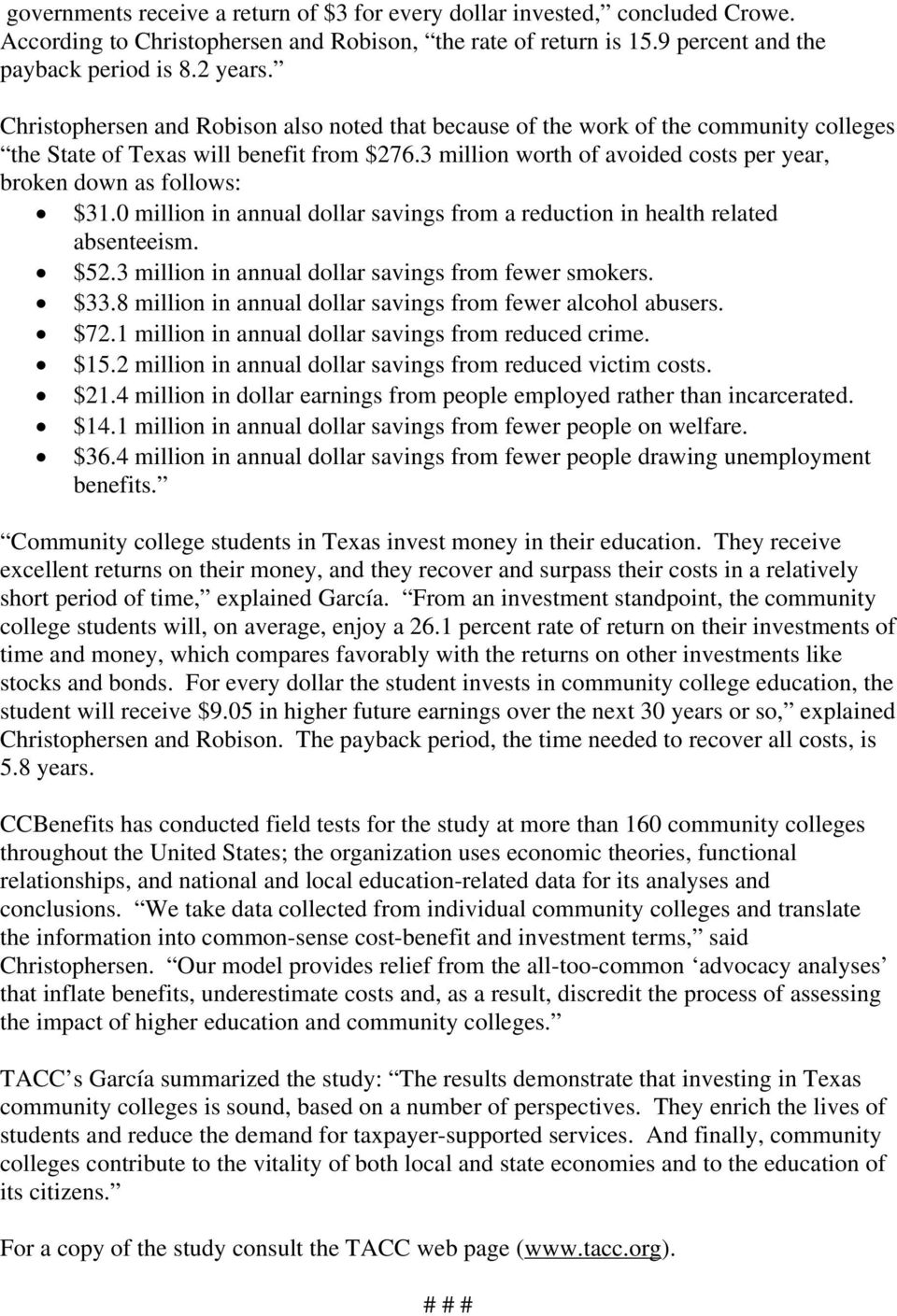
3 Fact Sheet: Economic Impact of Texas 50 Community College Districts What role do the 50 community college districts in Texas play in the statewide economy? Business sales in the state are $34,182.0 million larger, and labor income is $13,470.7 million larger due to the past and present operations of these 50 community colleges. The benefits of a robust economy translate into job and investment opportunities, increased business revenues, greater availability of public funds, and an eased tax burden. Texas 50 CC districts stimulate the economy The combined operating budgets of the CC districts amounted to $2,138.7 million in fiscal 2000, of which $1,635.0 million (76%) was spent in Texas on wages, salaries and supplies. The colleges employ 24,514 full-time and 27,032 part-time faculty and staff. They paid faculty and staff wages of $1,241.1 million in fiscal For every $1 paid by the colleges in wages and salaries, there is another $0.52 in wages and salaries generated off the campuses in the state economy this is the commonly known multiplier effect. The activities of the 50 CC districts encourage new business, assist existing business, and create long-term economic growth. The colleges enhance worker skills and provide customized training to businesses and industries. It is estimated that the present-day Texas workforce embodies over million credit and non-credit hours of past and present CC training. CC skills embodied in the present-day workforce increase the output of industries in the State of Texas economy where the former students are employed by $14, million. Associated multiplier effects (sometimes called indirect effects) in other industries increase sales by $17, million. CC-acquired skills from current and former students increase wages and salaries in State of Texas by $5,292.6 million directly, and by another $6,287.9 million indirectly in fiscal Leveraging taxpayer dollars State taxpayers allocated $1,327.3 million in support of Texas 50 CC districts in fiscal For every dollar appropriated by state and county government, college spending alone generated $1.42 in wages and salaries in the state. For every dollar appropriated by the taxpayers in fiscal 2000, student earnings will increase by an average of $0.90 per year, every year through the rest of their working lives. Likewise, for every state dollar appropriated, Texas will see social savings of $0.21 per year, every year (i.e., reduced incarceration and health care expenditures, reduced expenditures on unemployment and welfare, and reduced absenteeism). CCs generate returns on government investments Taxpayer support for the CCs in fiscal 2000 will be fully recovered in 8.2 years, in the form of higher tax receipts (from increased student wages) and avoided costs (e.g., from reduced public expenditures on incarceration). Accounting for increased tax receipts and avoided costs; the state taxpayers will see a rate of return of 15.9% on their fiscal 2000 support for the CCs. CCs increase individuals earning potential 1,060,174 credit and non-credit students attended the 50 colleges in fiscal 2000, 72% were employed full- or part-time while attending. 95% of the students stay in-state and contribute to the state s economy after they leave the college. Studies demonstrate that education increases lifetime earnings. The average annual earnings of students with a 1-year certificate is $24,628, or 80.8% more than someone without a high school degree or GED, and 16.0% more than a student with just a high school diploma. The average earnings of someone with an Associate Degree is $28,960, or 112.6% more than someone without a high school degree or GED, and 36.4% more than a student with just a high school diploma or GED. After leaving the college, the average student in the Texas CC system will spend 37.2 years in the workforce. The student who leaves with a twoyear college degree will earn $287,315 more than someone with just a high school degree or GED. Over their next 37.2 years in the workforce, the average student s lifetime earnings will increase $20 for every education dollar invested (in the form of tuition, fees, books, and forgone earnings from employment). Students in the Texas CC system enjoy an attractive 26.1% rate of return on their educational investment, and recover all costs (including wages foregone while attending) in 5.8 years.
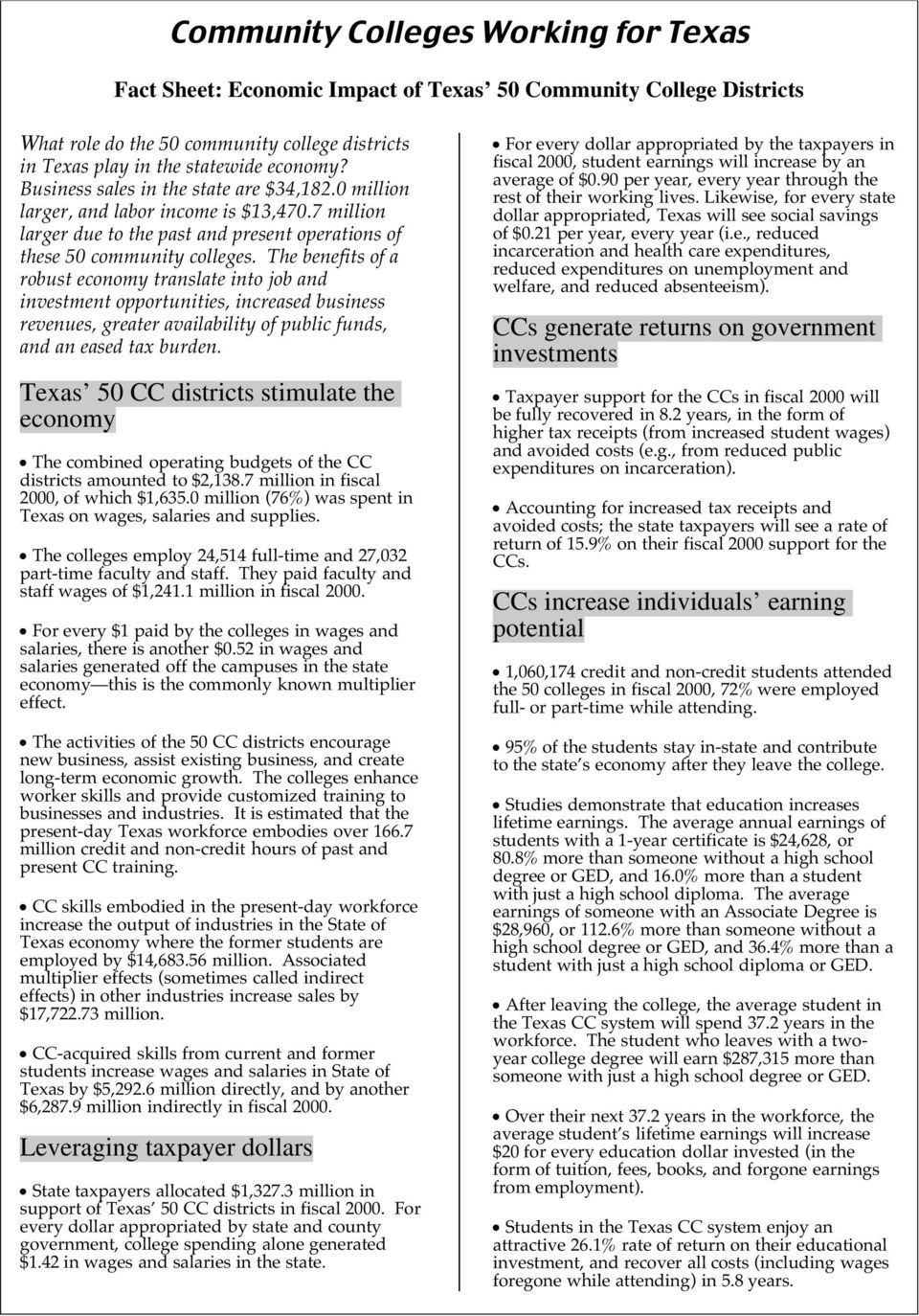
4 Texas Association of Community Colleges 1101 Trinity, Suite 200 Austin, Texas / / (fax) Facts About Texas Community Colleges There are 50 community college districts in Texas. 95% of the state's population is in a community college service area. All Texas community colleges are open admission institutions. A locally elected board of trustees governs each community college district. Community colleges are the largest sector of higher education in Texas. Fall 2001 enrollment in semester length classes was 461,236 students. Enrollment figures more than double when non-semester courses are considered and student enrollment is reported for the entire academic year. During the academic year, 1.06 million students (unduplicated headcount) were enrolled in community and technical colleges. The average age for a community college student is 26. Female students comprise 57% of the enrollment at community colleges. 70% of the freshmen and sophomores in Texas public higher education enroll in community colleges; 75% of the minority freshmen and sophomores attend a Texas public community college. Community college students reflect the ethnic diversity of Texas: Community college enrollment: 55% White, 28% Hispanic, 11% African American, 6% Other Texas population: 59% White, 27% Hispanic, 12% African American, 2% Other (over)

5 Texas Community College Districts Alamo Community College, San Antonio Alvin Community College, Alvin Amarillo College,Amarillo Angelina Community College, Lufkin Austin Community College, Austin Blinn College, Brenham Brazosport College, Lake Jackson Central Texas College, Killeen Cisco Junior College, Cisco Clarendon College, Clarendon Coastal Bend College, Beeville College of the Mainland, Texas City Collin County Community College, Plano Dallas County Community College, Dallas Del Mar College, Corpus Christi El Paso Community College, El Paso Frank Phillips College, Borger Galveston College, Galveston Grayson County College, Denison Hill College, Hillsboro Houston Community College, Houston Howard College, Big Spring Kilgore College, Kilgore Laredo Community College, Laredo Lee College, Baytown McLennan Community College, Waco Midland College, Midland Navarro College, Corsicana North Central Texas College, Gainesville North Harris Montgomery Community College, Houston Northeast Texas Community College, Mt Pleasant Odessa College, Odessa Panola College, Carthage Paris Junior College, Paris Ranger College, Ranger San Jacinto College, Pasadena South Plains College, Levelland South Texas Community College, McAllen Southwest Texas Junior College, Uvalde Tarrant County College, Fort Worth Temple College, Temple Texarkana College, Texarkana Texas Southmost College, Brownsville Trinity Valley Community College, Athens Tyler Junior College, Tyler Vernon College, Vernon Victoria College, Victoria Weatherford College, Weatherford Western Texas College, Snyder Wharton County Junior College, Wharton

6 The Socioeconomic Benefits Generated by 50 Community College Districts in Texas Kjell A. Christophersen & M. Henry Robison CCBenefits, Inc. Community Colleges Stimulate the Texas Economy Total Economic Impact: $13.5 billion The 50 community college districts account for $1.9 billion in the Texas economy. The 50 community college districts account for an additional $11.6 billion in wages and salaries generated by former students. 1

7 Texas Public Community Colleges Generate a Return on the Government s Investment Broad Analysis: $18 for every dollar invested by state and local government over the next 30 years. Narrow Analysis: $3 per dollar invested. Taxpayers see a book rate of return of 15.9% on their annual investment and recover all investments in 8.2 years. The State of Texas benefits from improved health and reduced welfare, unemployment, and crime, saving the public $276.3 million per year. Texas Public Community Colleges Increase the Earnings Potential of Their Students For every dollar a student invests in community college education, the student will receive $9.05 in higher future earnings over the next 30 years. Average Rate of Return on Investment in a Community College Education: 26.1%. Payback period: 5.8 years (time needed to recover costs) 2

8 The Socioeconomic Benefits Generated by 50 Community College Districts in Texas Kjell A. Christophersen & M. Henry Robison CCBenefits, Inc. Community Colleges Stimulate the Texas Economy Total Economic Impact: $13.5 billion The 50 community college districts account for $1.9 billion in the Texas economy. The 50 community college districts account for an additional $11.6 billion in wages and salaries generated by former students. 1

9 Texas Public Community Colleges Generate a Return on the Government s Investment Broad Analysis: $18 for every dollar invested by state and local government over the next 30 years. Narrow Analysis: $3 per dollar invested. Taxpayers see a book rate of return of 15.9% on their annual investment and recover all investments in 8.2 years. The State of Texas benefits from improved health and reduced welfare, unemployment, and crime, saving the public $276.3 million per year. Texas Public Community Colleges Increase the Earnings Potential of Their Students For every dollar a student invests in community college education, the student will receive $9.05 in higher future earnings over the next 30 years. Average Rate of Return on Investment in a Community College Education: 26.1%. Payback period: 5.8 years (time needed to recover costs) 2

Report on Internet-based. Meningococcal Exemption Requests for Public Junior and Community Colleges. SchoolYear2Ol3-2014.
 September 2014 Department of State Health Services Senate Bill 62, 83 rd Texas Legislature, Regular Session, 2013 Texas Education Code, Chapter 51, Section 51.9192 and As Required By Meningococcal Exemption
The following table provides a comparison of Texas pass rates with the national average. Year 2014 2013 2012 2011 2010 83.93% 9,290/11,069 84.
 Agenda Item: 3.2.5. Prepared by: J. Hooper Board Meeting: January 2015 Report of 2014 NCLEX-RN Examination Pass s For Professional Education Summary: The period between October 1 and ending September 30
TEXAS 2011 For a strong economy, the skills gap must be closed.
 For a strong economy, the skills gap must be closed. 6% 3% 29% By 22, jobs requiring a career certificate or college degree Skills gap Too few students make it through college. MEMBER Texas adults who
Report of NCLEX-RN Examination Pass Rates for 2013
 Report of NCLEX-RN Examination Pass Rates for 2013 Agenda Item: 3.2.8. Prepared by: J. Hooper Board Meeting: January 2014 Summary: The period between October 1 and ending September 30 is used for the purpose
 Advanced Computer Programing CENTRAL TEXAS COLLEGE ITSE 2459 Advanced Computer Programing DCCCD - BROOKHAVEN COLLEGE ITSE 2059 Advanced Computer Programing DCCCD - BROOKHAVEN COLLEGE ITSE 2459 Advanced
Total Number of Foreign Students: 49,081. Part 1: Net Contribution to State Economy by Foreign Students (2006-07)
 Texas Total Number of Foreign Students: 49,081 Part 1: Net Contribution to State Economy by Foreign Students (2006-07) Contribution from Tuition and Fees to State Economy: $590,460,000 Contribution from
Texas Board of Nursing 2013 Enrollment, Graduation, Admissions Vocational Nursing
 2013, Graduation, s Graduation ALVIN COMMUNITY COLLEGE Brazoria 47 22 43 108 43 43 2 5 1 3 0 N AMARILLO COLLEGE Potter 84 66 90 109 88 84 2 1 1 3 0 N AMERICAN MEDICAL INSTITUTE Houston 67 62 0 0 0 0 1
Subotal - Community and Technical Colleges 267
 1 of 5 Academic Students Alvin Community College 1 Angelina College 3 Austin Community College 8 Blinn College 25 Collin County Community College District 8 DCCCD - Brookhaven College 2 DCCCD - Cedar Valley
LSC-Montgomery. Institutions Attended, Fall 2009 Academic Students. LSC-Montgomery
 Alamo Community College District 5 Alvin Community College 4 Austin Community College 49 Blinn College 141 Brazosport College 1 Cisco Junior College 2 Clarendon College 1 College of the Mainland 1 Collin
According to Texas Higher Education Coordinating Board data, the following ATC courses are available at these colleges. Please note that not all
 According to Texas Higher Education Coordinating Board data, the following ATC courses are available at these colleges. Please note that not all colleges on this list participate fully in ATC, but it would
Peace Officer Tuition Exemption Eligible Programs
 Universities Angelo State University Lamar University Midwestern State University Prairie View A&M University Sam Houston State University Stephen F. Austin State University Sul Ross State University Sul
State of Oregon. Executive Summary. June 22, 2006. M. Henry Robison and Kjell A. Christophersen
 THE ECONOMIC CONTRIBUTION OF THE COMMUNITY COLLEGES OF OREGON State of Oregon Executive Summary M. Henry Robison and Kjell A. Christophersen HIGHLIGHTS Students enjoy an attractive 19% annual return on
Education and Training Voucher (ETV) Program TUTORING SERVICES & RESOURCES www.texasetv.com
 Education and Training Voucher (ETV) Program TUTORING SERVICES & RESOURCES www.texasetv.com SCHOOL TUTORING SERVICES Public Universities Angelo State University Tutoring Center: [email protected]
INTRA-STATE REGIONAL ASSOCIATIONS
 INTRA-STATE REGIONAL ASSOCIATIONS CenTACRAO Central Texas Association of Collegiate Registrars and Admissions Officers The Central Texas Association of Collegiate Registrars and Admissions Officers (CenTACRAO)
Texas Board of Nursing 2013 Enrollment, Graduation, and Admissions Professional Nursing Programs
 213, Graduation, and issions s from Academic Year 212-213 RN Student issions Enroll cap Qual App Diploma School Covenant School of Nursing Lubbock 259 2 2 18 281 281 122 12 134 134 159 366 159 159 Diploma
Financial Condition Analysis Of Texas Public Community College Districts
 AGENDA ITEM V-C DRAFT Financial Condition Analysis Of Texas Public Community College Districts 2013 Planning and Accountability Texas Higher Education Coordinating Board Harold Hahn, CHAIR El Paso Robert
Senate Finance Commi-ee
 Senate Finance Commi-ee Tes0mony of Public Community Colleges Presenta(on by: Dr. Richard Rhodes Chair - Texas Associa/on of Community Colleges President, Aus/n Community College Panel to Assist with Answering
1 State Tuition Reimbursement Prog ram ELIGIBLE SCHOOLS
 State Tuition Reimbursement Program ELIGIBLE SCHOOLS Any Texas public or private college or university as listed in Texas Education Code, Section 61.003. School must have been established in and have headquarters
TRANSFER COURSES TYLER JUNIOR COLLEGE
 TRANSFER COURSES The University of Texas at Tyler participates in the Texas Common Course Numbering System (TCCNS), which is a voluntary, cooperative effort among Texas community colleges and universities
National Registry-Texas Pass Percentage December 1, 2012 to November 30, 2013
 National Registry-Texas December 1, 2012 to November 30, 2013 The statistics below include the 2013 Texas EMS program pass rates and compare overall Texas scores to the national average. The data is from
Higher Education Pays: The Initial Earnings of Graduates of Texas Public Colleges and Universities
 Higher Education Pays: The Initial Earnings of Graduates of Texas Public Colleges and Universities Mark Schneider President, College Measures Vice President, American Institutes for Research A product
FY 2015 Hinson-Hazlewood Allocations
 FY 2015 Hinson-Hazlewood Allocations Public Universities Allocation FY 2015 ANGELO STATE UNIVERSITY $ 771,000 LAMAR UNIVERSITY $ 281,000 MIDWESTERN STATE UNIVERSITY $ 528,000 PRAIRIE VIEW A&M UNIVERSITY
Financial Condition Analysis Of Texas Public Community College Districts
 Financial Condition Analysis Of Texas Public Community College Districts 2012 Planning and Accountability Texas Higher Education Coordinating Board Fred W. Heldenfels IV, CHAIR Harold Hahn, VICE CHAIR
What Is the Advanced Technical Credit Program?
 What Is the Advanced Technical Credit Program? The Advanced Technical Credit Program (ATC), also known as statewide articulation, is an advanced placement program for students interested in preparing for
The Economic Benefits of International Education to the United States for the 2010-2011 Academic Year: A Statistical Analysis
 The Economic Benefits of International Education to the United States for the 2010-2011 Academic Year: A Statistical Analysis NAFSA: Association of International Educators estimates that foreign students
Texas Community Colleges Developmental Education Mission
 Texas Community Colleges Developmental Education Mission Robin L. Capt, West Texas A&M University abstract: This article explores the developmental education missions of public Texas community colleges
TEXAS TESTING CENTERS
 Abilene Abilene Christian University ACU Box 28180 Abilene, TX 79699 Fee: $25.00 Telephone: 325.674.2451 Contact the Coordinator of Testing. Alpine Sul Ross State University Career Services & Testing Office
TEXAS GUARANTEED TUITION PLAN ACTUARY S REPORT ON PROGRAM SOUNDNESS
 TEXAS GUARANTEED TUITION PLAN ACTUARY S REPORT ON PROGRAM SOUNDNESS AUGUST 31, 2014 October 2014 Texas Guaranteed Tuition Plan Actuary s Report on Program Soundness August 31, 2014 Contents Page Section
Accountability System Reports for Selected Success Measures Very Large Community College Districts Spring 2008
 1 Accountability System Reports for Selected Success Measures Very Large Community College Districts Spring 2008 Membership in Group: The group of very large community colleges in Texas includes the following
Texas Relocation Report
 Texas Relocation Report 2014 Edition Release date: Oct. 1, 2014 Contact: Stacy Armijo Pierpont Communications 512-448-4950 [email protected] About the Texas Relocation Report The Texas Relocation Report
WTS Community College/Technical/Trade School Scholarship. Application Checklist
 WTS Scholarship Application Checklist Please ensure you have completed and enclosed the following items before submitting your application. Items may come in separate envelopes or emails, but each item
Texas Relocation Report
 Texas Relocation Report 2015 Edition Release date: Oct. 1, 2015 Contact: Danielle Urban Pierpont Communications 512-448-4950 [email protected] About the Texas Relocation Report The Texas Relocation Report
83rd Texas Legislature. Session Summary
 July 2013 Texas Associa+on of Community Colleges 83rd Texas Legislature: Table of Contents Appropria+ons... 1-13 Instruc+onal Funds... 1 Group Health Insurance (HEGI)... 2 Re+rement (TRS/ORP)... 2 Student
Outlet: Austin Business Journal (online) Date: December 17, 2014 Unique Visitors Per Month: 151,284 Link:
 Outlet: Austin Business Journal (online) Unique Visitors Per Month: 151,284 Link: http://www.bizjournals.com/austin/prnewswire/press_releases/georgia/2014/12/17/la92883?ana=prnews Outlet: Dallas Business
Population Change in Texas and The Dallas-Fort Worth Area: Implications for Education, the Labor Force and Economic Development
 Population Change in Texas and The Dallas-Fort Worth Area: Implications for Education, the Labor Force and Economic Development Steve H. Murdock, Director Hobby Center for the Study of Texas and Allyn
Dallas/Fort Worth Chapter WTS Undergraduate Scholarship. Application Checklist
 Dallas/Fort Worth Chapter WTS Undergraduate Scholarship Application Checklist Please ensure you have completed and enclosed the following items before submitting your application. Items may come in separate
*West Texas A&M University *Midwestern State University University of North Texas System Center at Dallas University of North Texas
 1 1. http://www.thecb.state.tx.us/ 2. http://www.thecb.state.tx.us/interactivetools/programinventory/deginv.cfm Then enter criminal justice in box labeled PROGRAM NAME 3. http://www.alvincollege.edu/future/get_started.cfm
LBB Performance Measures Comparison of FY 2009, FY 2011 & FY 2013 Big 10 Community Colleges with Statewide
 LBB Performance Measures Comparison of FY 2009, FY 2011 & FY 2013 Compiled by: Office of Institutional Intelligence & Research Tarrant County College District February 2015 1. Percentage of Courses Completed
LBB Performance Measures FY 2013 Big 10 Community Colleges with Statewide
 LBB Performance Measures FY 2013 Compiled by: Office of Institutional Intelligence & Research Tarrant County College District February 2015 1. Percentage of Courses Completed Courses Completed College
Dallas/Fort Worth Chapter WTS Undergraduate Leadership. Scholarship. Application Checklist
 Scholarship Application Checklist Please ensure you have completed and enclosed the following items before submitting your application. Items may come in separate envelopes or emails, but each item must
Genworth 2015 Cost of Care Survey Texas
 Cost of Care Survey 2015 Genworth 2015 Cost of Care Survey State-Specific Data 118928TX 04/01/15 Homemaker Services Hourly Rates USA $8 $20 $40 $44,616 2% Whole State $8 $19 $35 $42,328 1% Abilene $17
Texas Reality Check Budget Data 2012-2013
 Texas Reality Check Budget Data 2012-2013 X Design Group, Inc www.xdesigngroup.com Texas Reality Check Texas Reality Check Website Texas Reality Check is a website designed to provide In the following
RECOVERY ACT LOCAL JAG AWARDS. Texas
 Anderson County Aransas County Atascosa County Bandera County Bastrop County Bee County Brazoria County Burleson County Caldwell County Cherokee County City of Abilene City of Alamo City of Alice City
EXECUTIVE SUMMARY. Where Value Meets Values: The Economic Impact of Community Colleges
 EXECUTIVE SUMMARY Where Value Meets Values: The Economic Impact of Community Colleges ANALYSIS OF THE ECONOMIC IMPACT & RETURN ON INVESTMENT OF EDUCATION FEBRUARY 2014 EXECUTIVE SUMMARY America s community
062010_tblAccreditedTCRLabs
 REGION COUNTY LAB ID LAB LAB_ CITY OF BORGER WATER 1 HUTCHINSON 48114 PLANT LAB (806) 273-0966 [email protected], [email protected] 1 RANDALL 48103 CITY OF AMARILLO EL (806)
Academic Catalog. GOLD: Community College of Denver SILVER: Lone Star College System Viewbook
 Academic Catalog GOLD: Community College of Denver Viewbook GOLD: Northern Wyoming Community College District SILVER: Northern Wyoming Community College District BRONZE: Tyler Junior College College Annual
VII. DIRECT, INDIRECT, AND INDUCED ECONOMIC IMPACTS OF UC SAN DIEGO
 VII. DIRECT, INDIRECT, AND INDUCED ECONOMIC IMPACTS OF UC SAN DIEGO THE CONCEPT OF INDIRECT AND INDUCED ECONOMIC IMPACTS The impact of UC San Diego on the local, regional, and state economies is greater
ALAMO SAN ANTONIO COLLEGE
 Faculty Compensation and Course Sizes for Online/VCT Courses Statewide Compiled by Matt Miller, Director, Media Integration Services Center Navarro College Following is a compilation of responses received
Texas. DeVry Impact. Summary Statistics. Earnings by Education Level. Total Wage Growth Over Studied Period. 65% Growth $44,262. 42% Growth $39,478
 Texas DeVry Inc. s eight Texas locations 1 produced $82.7 million in economic impact in FY2010. As part of this economic impact, DeVry Inc. schools supported 809 jobs. Wage Impact annually, while the degree
DEPARTMENT OF STATE HEALTH SERVICES DIVISION OF MENTAL HEALTH AND SUBSTANCE ABUSE SERVICES
 DEPARTMENT OF STATE HEALTH SERVICES DIVISION OF MENTAL HEALTH AND SUBSTANCE ABUSE SERVICES Outreach, Screening, Assessment and Referral Services, and Treatment Services RFP# SA/OSR-TRT-0371.1 REGION 1
TEXAS. ECE Training Institutions - alphabetized by city ABILENE CHRISTIAN UNIVERSITY ACU BOX 28228 ABILENE, TX 79699 325-674-2960 ECE PROGRAM 4-YEAR
 TEXAS ECE Training Institutions - alphabetized by city ABILENE CHRISTIAN UNIVERSITY ACU BOX 28228 ABILENE, TX 79699 325-674-2960 DR. DANA HOOD ASSOCIATE PROFESSOR AND DIRECTOR ABILENE CHRISTIAN UNIVERSITY
PRIMARY CESAREAN SECTION DELIVERY RATE, 2009
 page=1 STATE OF TEXAS (272,302) 2009 Texas rate: 19.53 ABILENE MSA Abilene Regional Medical Center (805) 19.88 Acadia Abilene (Fewer than 5) Fewer than 30 cases Hendrick Medical Center (985) 22.23 AMARILLO
Alamo Colleges Benchmarks
 As of February 2013 - Draft for discussion purposes only s How the Measure Up This document shows for selected KPI measures how the measure up to the other very large community colleges (VLCC) of Texas
Texas Team Advancing Health through Nursing An Action Coalition of the Initiative on the Future of Nursing. Coalition Members as of April 26, 2013
 Lead Organizations Texas Team Advancing Health through Nursing An Action Coalition of the Initiative on the Future of Nursing Coalition Members as of April 26, 2013 Blue Cross Blue Shield of Texas Richardson,
Texas Council of Academic Libraries Library and Printing Fee Survey - September 2015
 Texas Council of Academic Libraries Library and Printing Fee Survey - September 2015 INSTITUTION T C S U L Angelo State University Yes - $10/SCH (12 SCH & under); flat fee of $120 for 13+ hours $ 1,420,060
The Economic Impact Of Minnesota s State Colleges And Universities. An Update
 The Economic Impact Of Minnesota s State Colleges And Universities An Update a report prepared for MnSCU August, 2002 Anton, Lubov & Associates, Inc. 15 South Fifth Street, Suite 765 Minneapolis, Minnesota
Ranking metros by percentage share of employment in
 OCTOBER 2013 Texas Economy PUBLICATION 2041 A Reprint from Tierra Grande magazine 2013. Real Estate Center. All rights reserved. By Ali Anari Texas economy is all about jobs. To better understand how the
TOADN Newsletter. In This Issue: January 2009 Volume 9, Issue 1. Regional News. Nurse In The. Committees Members TOADN BOARD:
 January 2009 Volume 9, Issue 1 TOADN Newsletter In This Issue: Message from the President. Regional News NOADN convention Position AD to BS Nurse In The Spotlight Committees Members TOADN BOARD: President:
Frank R. Salvatore Jr., RRT, MBA, FAARC Administrator Ancillary Services Greater Hudson Valley Health System Middletown, NY AARC President 2015-2016
 Frank R. Salvatore Jr., RRT, MBA, FAARC Administrator Ancillary Services Greater Hudson Valley Health System Middletown, NY AARC President 205-206 Dallas, TX Objectives Review the AARC Mission and Vision
2015 2016 Texas Application for State Financial Aid (TASFA)
 INSTRUCTIONS FOR: 2015 2016 Texas Application for State Financial Aid (TASFA) (for House Bill 1403/Senate Bill 1528 students only) Which financial aid application should I use? Residency Status I am a