
Planetary Axle Wheel Ends
|
|
|
- Leon Palmer
- 9 years ago
- Views:
Transcription
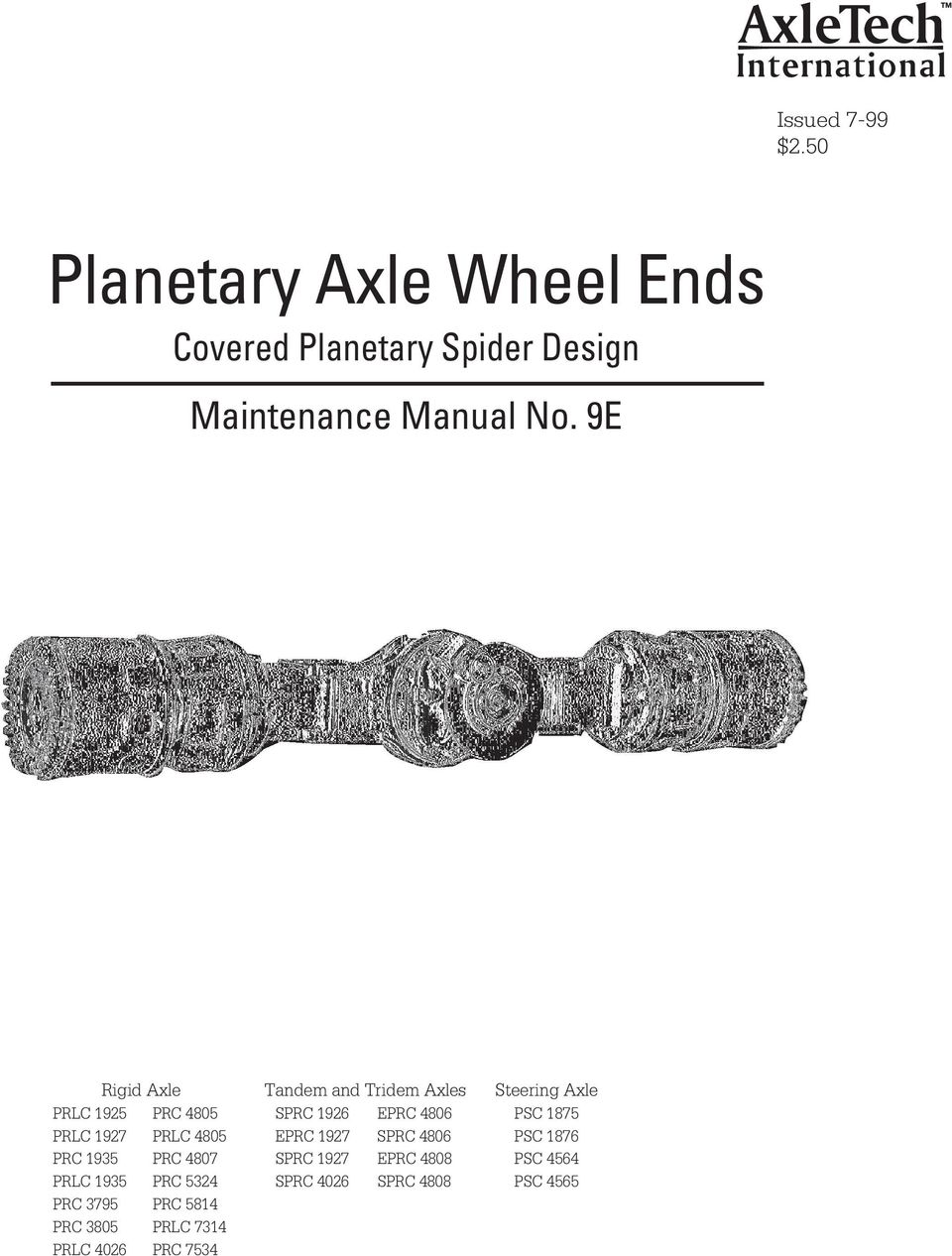
1 Issued 7-99 $2.50 Planetary Axle Wheel Ends Covered Planetary Spider Design Maintenance Manual No. 9E Rigid Axle Tandem and Tridem Axles Steering Axle PRLC 1925 PRC 4805 SPRC 1926 EPRC 4806 PSC 1875 PRLC 1927 PRLC 4805 EPRC 1927 SPRC 4806 PSC 1876 PRC 1935 PRC 4807 SPRC 1927 EPRC 4808 PSC 4564 PRLC 1935 PRC 5324 SPRC 4026 SPRC 4808 PSC 4565 PRC 3795 PRC 5814 PRC 3805 PRLC 7314 PRLC 4026 PRC 7534
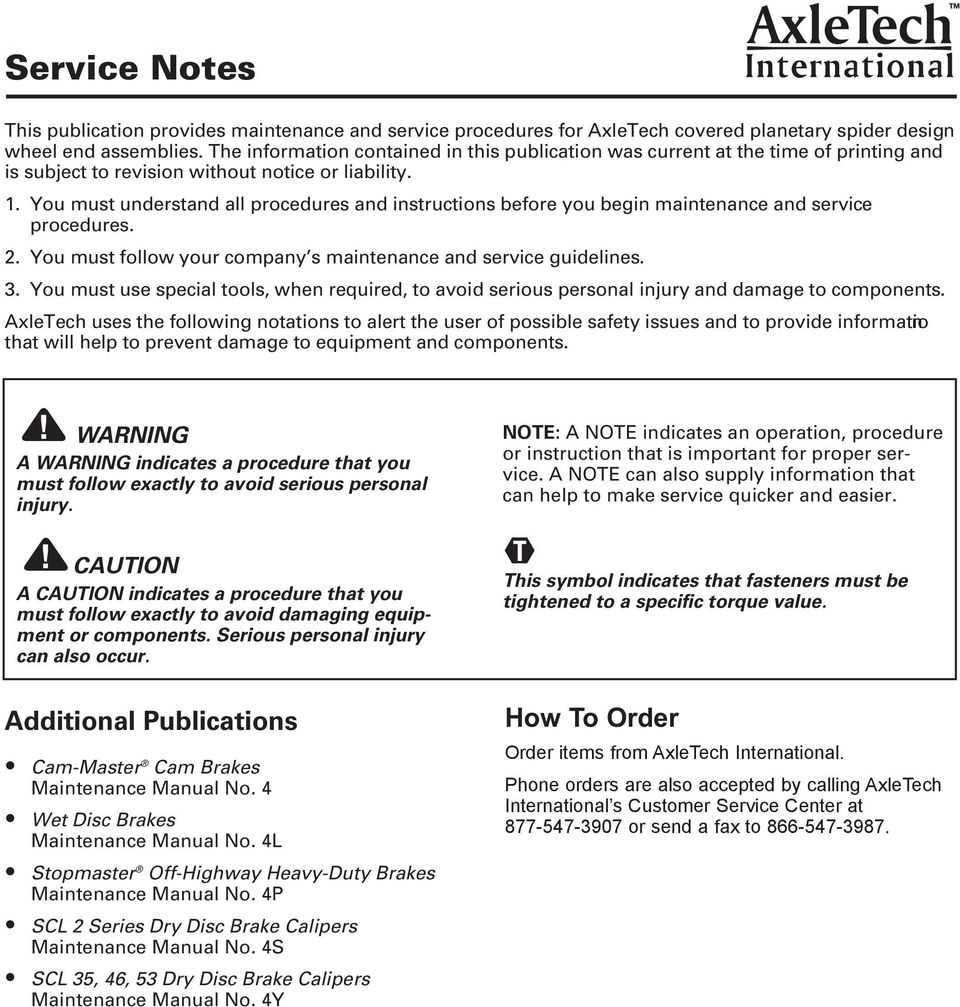
2 Service Notes This publication provides maintenance and service procedures for AxleTech covered planetary spider design wheel end assemblies. The information contained in this publication was current at the time of printing and is subject to revision without notice or liability. 1. You must understand all procedures and instructions before you begin maintenance and service procedures. 2. You must follow your company s maintenance and service guidelines. 3. You must use special tools, when required, to avoid serious personal injury and damage to components. AxleTech uses the following notations to alert the user of possible safety issues and to provide informatio n that will help to prevent damage to equipment and components. A indicates a procedure that you must follow exactly to avoid serious personal injury. NOTE: A NOTE indicates an operation, procedure or instruction that is important for proper service. A NOTE can also supply information that can help to make service quicker and easier. T CAUTION A CAUTION indicates a procedure that you must follow exactly to avoid damaging equipment or components. Serious personal injury can also occur. This symbol indicates that fasteners must be tightened to a specific torque value. Additional Publications Cam-Master Cam Brakes Maintenance Manual No. 4 Wet Disc Brakes Maintenance Manual No. 4L Stopmaster Off-Highway Heavy-Duty Brakes Maintenance Manual No. 4P SCL 2 Series Dry Disc Brake Calipers Maintenance Manual No. 4S SCL 35, 46, 53 Dry Disc Brake Calipers Maintenance Manual No. 4Y How To Order Order items from AxleTech International. Phone orders are also accepted by calling AxleTech International s Customer Service Center at or send a fax to
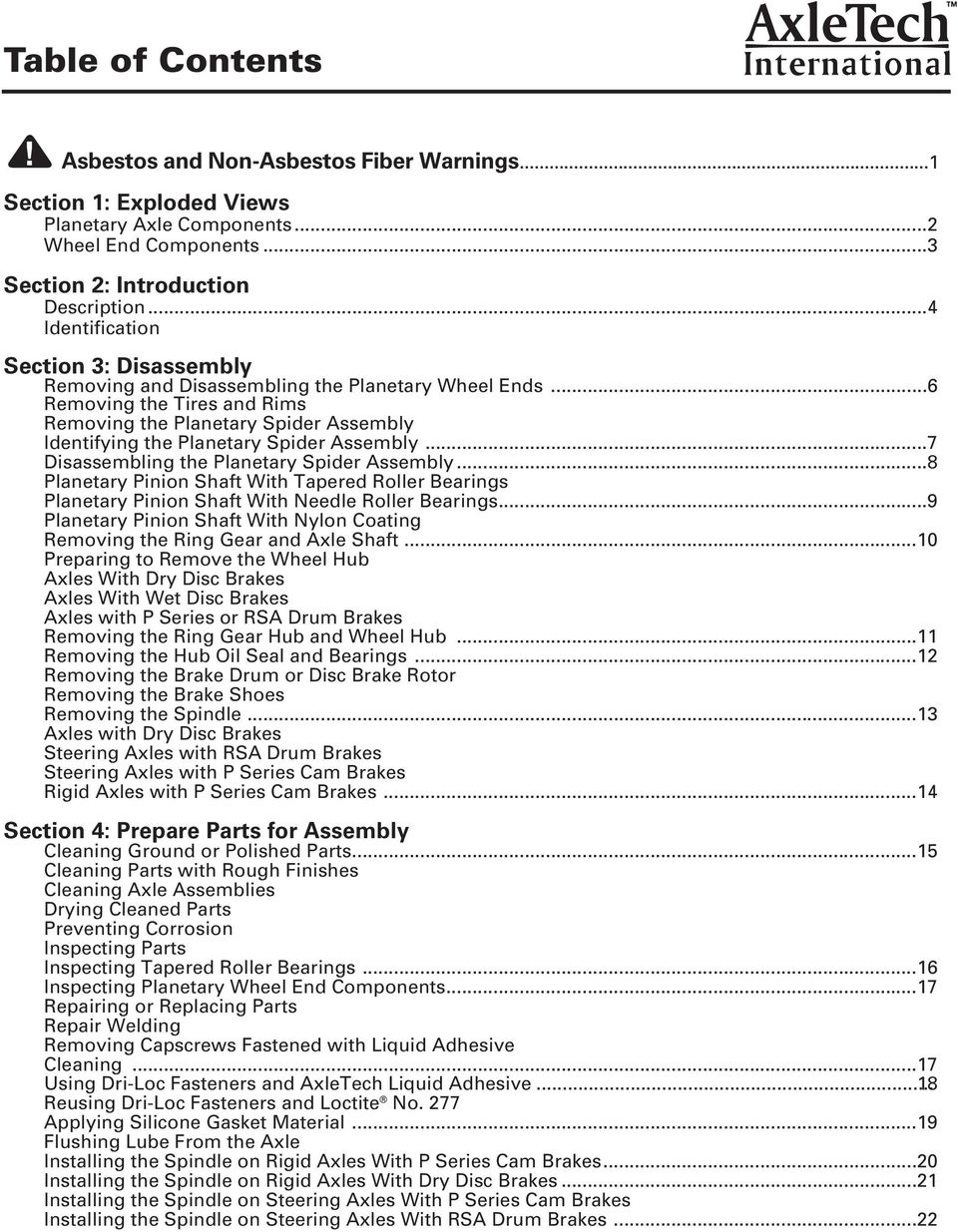
3 Table of Contents Asbestos and Non-Asbestos Fiber Warnings...1 Section 1: Exploded Views Planetary Axle Components...2 Wheel End Components...3 Section 2: Introduction Description...4 Identification Section 3: Disassembly Removing and Disassembling the Planetary Wheel Ends...6 Removing the Tires and Rims Removing the Planetary Spider Assembly Identifying the Planetary Spider Assembly...7 Disassembling the Planetary Spider Assembly...8 Planetary Pinion Shaft With Tapered Roller Bearings Planetary Pinion Shaft With Needle Roller Bearings...9 Planetary Pinion Shaft With Nylon Coating Removing the Ring Gear and Axle Shaft...10 Preparing to Remove the Wheel Hub Axles With Dry Disc Brakes Axles With Wet Disc Brakes Axles with P Series or RSA Drum Brakes Removing the Ring Gear Hub and Wheel Hub...11 Removing the Hub Oil Seal and Bearings...12 Removing the Brake Drum or Disc Brake Rotor Removing the Brake Shoes Removing the Spindle...13 Axles with Dry Disc Brakes Steering Axles with RSA Drum Brakes Steering Axles with P Series Cam Brakes Rigid Axles with P Series Cam Brakes...14 Section 4: Prepare Parts for Assembly Cleaning Ground or Polished Parts...15 Cleaning Parts with Rough Finishes Cleaning Axle Assemblies Drying Cleaned Parts Preventing Corrosion Inspecting Parts Inspecting Tapered Roller Bearings...16 Inspecting Planetary Wheel End Components...17 Repairing or Replacing Parts Repair Welding Removing Capscrews Fastened with Liquid Adhesive Cleaning...17 Using Dri-Loc Fasteners and AxleTech Liquid Adhesive Reusing Dri-Loc Fasteners and Loctite No. 277 Applying Silicone Gasket Material...19 Flushing Lube From the Axle Installing the Spindle on Rigid Axles With P Series Cam Brakes...20 Installing the Spindle on Rigid Axles With Dry Disc Brakes...21 Installing the Spindle on Steering Axles With P Series Cam Brakes Installing the Spindle on Steering Axles With RSA Drum Brakes...22
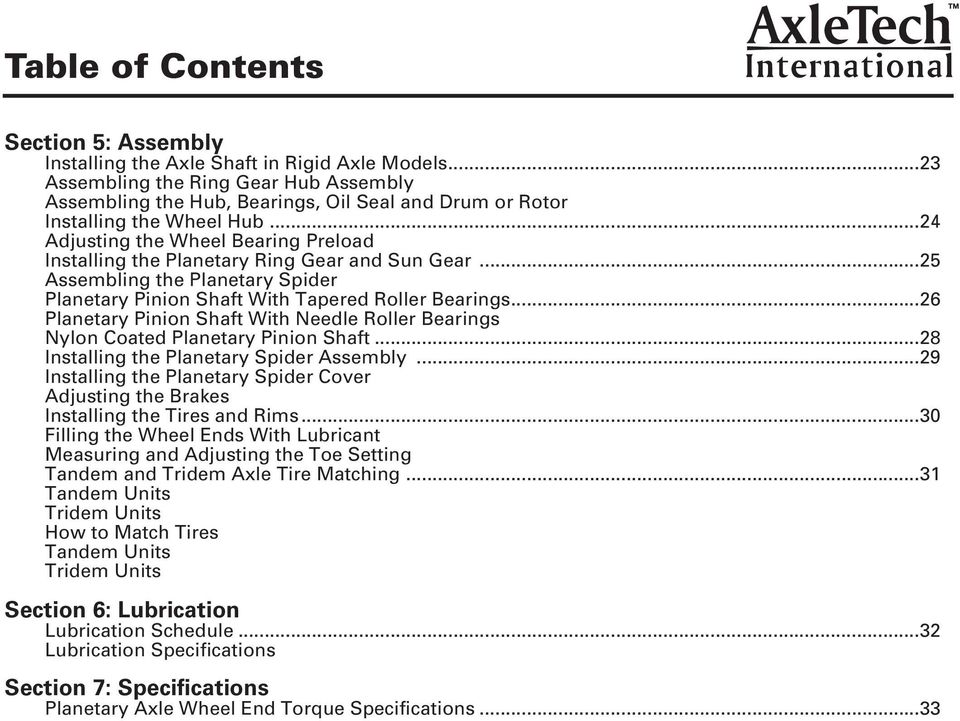
4 Table of Contents Section 5: Assembly Installing the Axle Shaft in Rigid Axle Models...23 Assembling the Ring Gear Hub Assembly Assembling the Hub, Bearings, Oil Seal and Drum or Rotor Installing the Wheel Hub...24 Adjusting the Wheel Bearing Preload Installing the Planetary Ring Gear and Sun Gear...25 Assembling the Planetary Spider Planetary Pinion Shaft With Tapered Roller Bearings...26 Planetary Pinion Shaft With Needle Roller Bearings Nylon Coated Planetary Pinion Shaft...28 Installing the Planetary Spider Assembly...29 Installing the Planetary Spider Cover Adjusting the Brakes Installing the Tires and Rims...30 Filling the Wheel Ends With Lubricant Measuring and Adjusting the Toe Setting Tandem and Tridem Axle Tire Matching...31 Tandem Units Tridem Units How to Match Tires Tandem Units Tridem Units Section 6: Lubrication Lubrication Schedule...32 Lubrication Specifications Section 7: Specifications Planetary Axle Wheel End Torque Specifications...33
5 Asbestos and Non-Asbestos Fibers ASBESTOS FIBER The following procedures for servicing brakes are recommended to reduce exposure to asbestos fiber dust, a cancer and lung disease hazard. Material Safety Data Sheets are available from AxleTech.. Hazard Summary Because some brake linings contain asbestos, workers who service brakes must understand the potential hazards of asbestos and precautions for reducing risks. Exposure to airborne asbestos dust can cause serious and possibly fatal diseases, including asbestosis (a chronic lung disease) and cancer, principally lung cancer and mesothelioma (a cancer of the lining of the chest or abdominal cavities). Some studies show that the risk of lung cancer among persons who smoke and who are exposed to asbestos is much greater than the risk for non-smokers. Symptoms of these diseases may not become apparent for 15, 20 or more years after the first exposure to asbestos. Accordingly, workers must use caution to avoid creating and breathing dust when servicing brakes. Specific recommended work practices for reducing exposure to asbestos dust follow. Consult your employer for more details. Recommended Work Practices 1. Separate Work Areas. Whenever feasible, service brakes in a separate area away from other operations to reduce risks to unprotected persons. OSHA has set a maximum allowable level of exposure for asbestos of 0.1 f/cc as an 8-hour time-weighted average and 1.0 f/cc averaged over a 30-minute period. Scientists disagree, however, to what extent adherence to the maximum allowable exposure levels will eliminate the risk of disease that can result from inhaling asbestos dust. OSHA requires that the following sign be posted at the entrance to areas where exposures exceed either of the maximum allowable levels: DANGER: ASBESTOS CANCER AND LUNG DISEASE HAZARD AUTHORIZED PERSONNEL ONLY RESPIRATORS AND PROTECTIVE CLOTHING ARE REQUIRED IN THIS AREA 2. Respiratory Protection. Wear a respirator equipped with a high-efficiency (HEPA) filter approved by NIOSH or MSHA for use with asbestos at all times when servicing brakes, beginning with the removal of the wheels. 3. Procedures for Servicing Brakes. a. Enclose the brake assembly within a negative pressure enclosure. The enclosure should be equipped with a HEPA vacuum and worker arm sleeves. With the enclosure in place, use the HEPA vacuum to loosen and vacuum residue from the brake parts. b. As an alternative procedure, use a catch basin with water and a biodegradable, nonphosphate, water-based detergent to wash the brake drum or rotor and other brake parts. The solution should be applied with low pressure to prevent dust from becoming airborne. Allow the solution to flow between the brake drum and the brake support or the brake rotor and caliper. The wheel hub and brake assembly components should be thoroughly wetted to suppress dust before the brake shoes or brake pads are removed. Wipe the brake parts clean with a cloth. c. If an enclosed vacuum system or brake washing equipment is not available, employers may adopt their own written procedures for servicing brakes, provided that the exposure levels associated with the employer s procedures do not exceed the levels associated with the enclosed vacuum system or brake washing equipment. Consult OSHA regulations for more details. d. Wear a respirator equipped with a HEPA filter approved by NIOSH or MSHA for use with asbestos when grinding or machining brake linings. In addition, do such work in an area with a local exhaust ventilation system equipped with a HEPA filter. e. NEVER use compressed air by itself, dry brushing, or a vacuum not equipped with a HEPA filter when cleaning brake parts or assemblies. NEVER use carcinogenic solvents, flammable solvents, or solvents that can damage brake components as wetting agents. 4. Cleaning Work Areas. Clean work areas with a vacuum equipped with a HEPA filter or by wet wiping. NEVER use compressed air or dry sweeping to clean work areas. When you empty vacuum cleaners and handle used rags, wear a respirator equipped with a HEPA filter approved by NIOSH or MSHA for use with asbestos. When you replace a HEPA filter, wet the filter with a fine mist of water and dispose of the used filter with care. 5. Worker Clean-Up. After servicing brakes, wash your hands before you eat, drink or smoke. Shower after work. Do not wear work clothes home. Use a vacuum equipped with a HEPA filter to vacuum work clothes after they are worn. Launder them separately. Do not shake or use compressed air to remove dust from work clothes. 6. Waste Disposal. Dispose of discarded linings, used rags, cloths and HEPA filters with care, such as in sealed plastic bags. Consult applicable EPA, state and local regulations on waste disposal. Regulatory Guidance References to OSHA, NIOSH, MSHA, and EPA, which are regulatory agencies in the United States, are made to provide further guidance to employers and workers employed within the United States. Employers and workers employed outside of the United States should consult the regulations that apply to them for further guidance. NON-ASBESTOS FIBERS The following procedures for servicing brakes are recommended to reduce exposure to non-asbestos fiber dust, a potential cancer and lung disease hazard. Material Safety Data Sheets are available from AxleTech.. Hazard Summary Most recently manufactured brake linings do not contain asbestos fibers. These brake linings may contain one or more of a variety of ingredients, including glass fibers, mineral wool, aramid fibers, ceramic fibers and silica that can present health risks if inhaled. Scientists disagree on the extent of the risks from exposure to these substances. Nonetheless, exposure to silica dust can cause silicosis, a non-cancerous lung disease. Silicosis gradually reduces lung capacity and efficiency and can result in serious breathing difficulty. Some scientists believe other types of non-asbestos fibers, when inhaled, can cause similar diseases of the lung. In addition, silica dust and ceramic fiber dust are known to the State of California to cause lung cancer. U.S. and international agencies have also determined that dust from mineral wool, ceramic fibers and silica are potential causes of cancer. Accordingly, workers must use caution to avoid creating and breathing dust when servicing brakes. Specific recommended work practices for reducing exposure to nonasbestos dust follow. Consult your employer for more details. Recommended Work Practices 1. Separate Work Areas. Whenever feasible, service brakes in a separate area away from other operations to reduce risks to unprotected persons. 2. Respiratory Protection. OSHA has set a maximum allowable level of exposure for silica of 0.1 mg/m 3 as an 8-hour time-weighted average. Some manufacturers of nonasbestos brake linings recommend that exposures to other ingredients found in nonasbestos brake linings be kept below 1.0 f/cc as an 8-hour time-weighted average. Scientists disagree, however, to what extent adherence to these maximum allowable exposure levels will eliminate the risk of disease that can result from inhaling nonasbestos dust. Therefore, wear respiratory protection at all times during brake servicing, beginning with the removal of the wheels. Wear a respirator equipped with a high-efficiency (HEPA) filter approved by NIOSH or MSHA, if the exposures levels may exceed OSHA or manufacturer s recommended maximum levels. Even when exposures are expected to be within the maximum allowable levels, wearing such a respirator at all times during brake servicing will help minimize exposure. 3. Procedures for Servicing Brakes. a. Enclose the brake assembly within a negative pressure enclosure. The enclosure should be equipped with a HEPA vacuum and worker arm sleeves. With the enclosure in place, use the HEPA vacuum to loosen and vacuum residue from the brake parts. b. As an alternative procedure, use a catch basin with water and a biodegradable, nonphosphate, water-based detergent to wash the brake drum or rotor and other brake parts. The solution should be applied with low pressure to prevent dust from becoming airborne. Allow the solution to flow between the brake drum and the brake support or the brake rotor and caliper. The wheel hub and brake assembly components should be thoroughly wetted to suppress dust before the brake shoes or brake pads are removed. Wipe the brake parts clean with a cloth. c. If an enclosed vacuum system or brake washing equipment is not available, carefully clean the brake parts in the open air. Wet the parts with a solution applied with a pump-spray bottle that creates a fine mist. Use a solution containing water, and, if available, a biodegradable, non-phosphate, water-based detergent. The wheel hub and brake assembly components should be thoroughly wetted to suppress dust before the brake shoes or brake pads are removed. Wipe the brake parts clean with a cloth. d. Wear a respirator equipped with a HEPA filter approved by NIOSH or MSHA when grinding or machining brake linings. In addition, do such work in an area with a local exhaust ventilation system equipped with a HEPA filter. e. NEVER use compressed air by itself, dry brushing, or a vacuum not equipped with a HEPA filter when cleaning brake parts or assemblies. NEVER use carcinogenic solvents, flammable solvents, or solvents that can damage brake components as wetting agents. 4. Cleaning Work Areas. Clean work areas with a vacuum equipped with a HEPA filter or by wet wiping. NEVER use compressed air or dry sweeping to clean work areas. When you empty vacuum cleaners and handle used rags, wear a respirator equipped with a HEPA filter approved by NIOSH or MSHA, to minimize exposure. When you replace a HEPA filter, wet the filter with a fine mist of water and dispose of the used filter with care. 5. Worker Clean-Up. After servicing brakes, wash your hands before you eat, drink or smoke. Shower after work. Do not wear work clothes home. Use a vacuum equipped with a HEPA filter to vacuum work clothes after they are worn. Launder them separately. Do not shake or use compressed air to remove dust from work clothes. 6. Waste Disposal. Dispose of discarded linings, used rags, cloths and HEPA filters with care, such as in sealed plastic bags. Consult applicable EPA, state and local regulations on waste disposal. Regulatory Guidance References to OSHA, NIOSH, MSHA, and EPA, which are regulatory agencies in the United States, are made to provide further guidance to employers and workers employed within the United States. Employers and workers employed outside of the United States should consult the regulations that apply to them for further guidance. 1
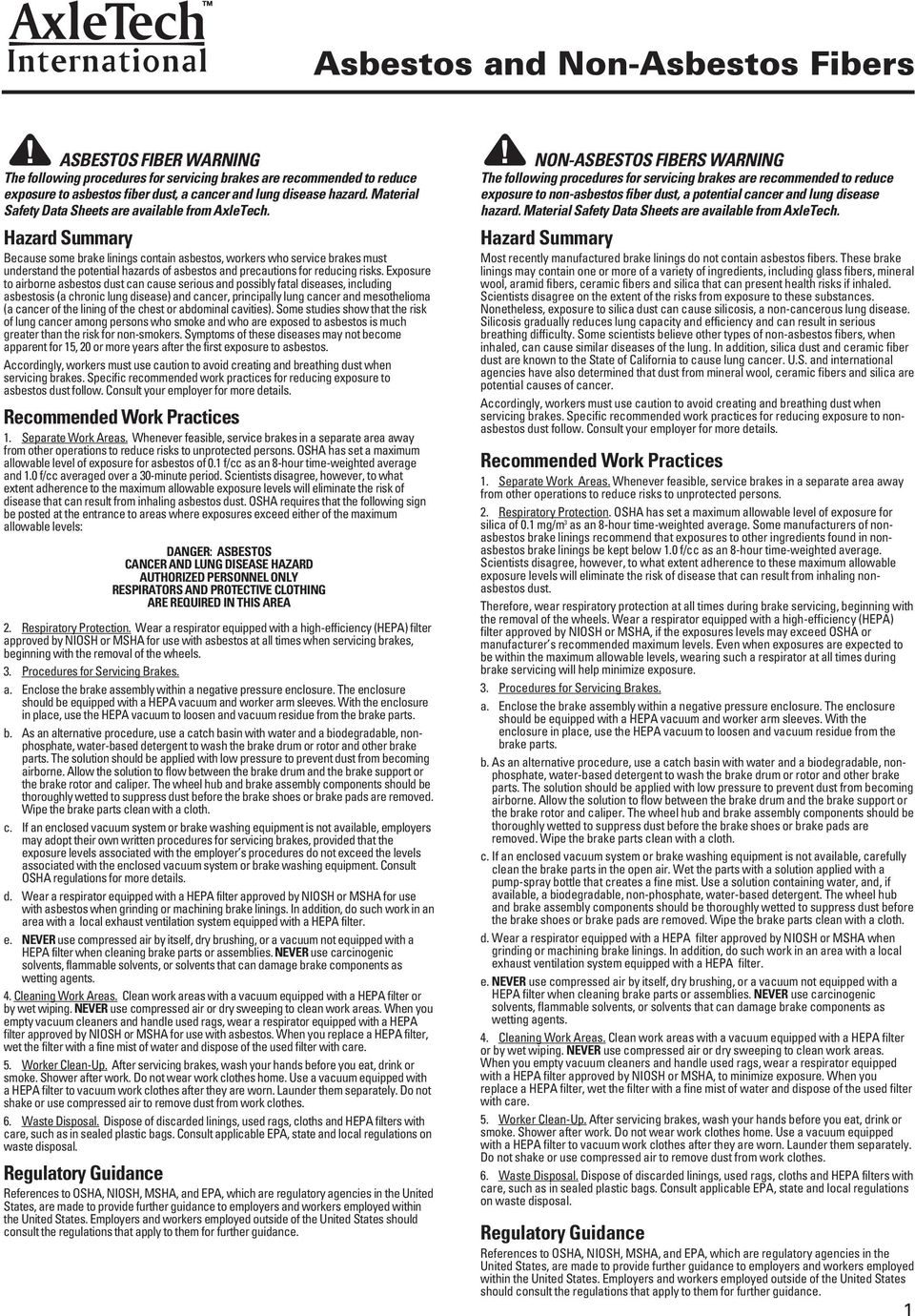
6 Section 1 Exploded View Planetary Axle Components ALTERNATE NUT LOCK NYLON COATED PLANETARY PIN ASSEMBLY PLANETARY PIN ASSEMBLY WITH NEEDLE ROLLER BEARINGS PLANETARY PIN ASSEMBLY WITH TAPERED ROLLER BEARINGS Item Description 1 Plug oil level / fill 2 Cover planetary spider 3 Thrust button axle shaft 4 Capscrew planetary spider mount 5 Planetary spider 6 Snap Ring axle shaft 7 Sun Gear planetary 8 Washer sun gear thrust 9 Nut wheel bearing adjusting 10 Lock wheel bearing adjusting nut 11 Capscrew hub nut lock 12 Lock wheel bearing adjusting nut 2 Item Description 13 Gear planetary ring 14 Hub planetary ring gear 15 Lock planetary ring gear 16 Capscrew planetary ring gear lock 17 Capscrew planetary spider cover 18 Nut wheel stud 19 Washer wheel stud nut 20 Clamp wheel rim 21 Wheel Stud 22 Washer wheel stud 23 Plug oil drain 24 Shaft planet pinion 25 Washer planet pinion outer thrust Item Description 26 Pinion planetary drive 27 Washer planet pinion inner thrust 28 Needle Roller Bearings 29 Spacer needle roller bearing 30 Locknut planetary pinion shaft 31 Spacer planetary pinion bearing 32 Snap Ring tapered bearing assembly 33 Tapered Roller Bearing Assembly 34 Ball pinion shaft lock
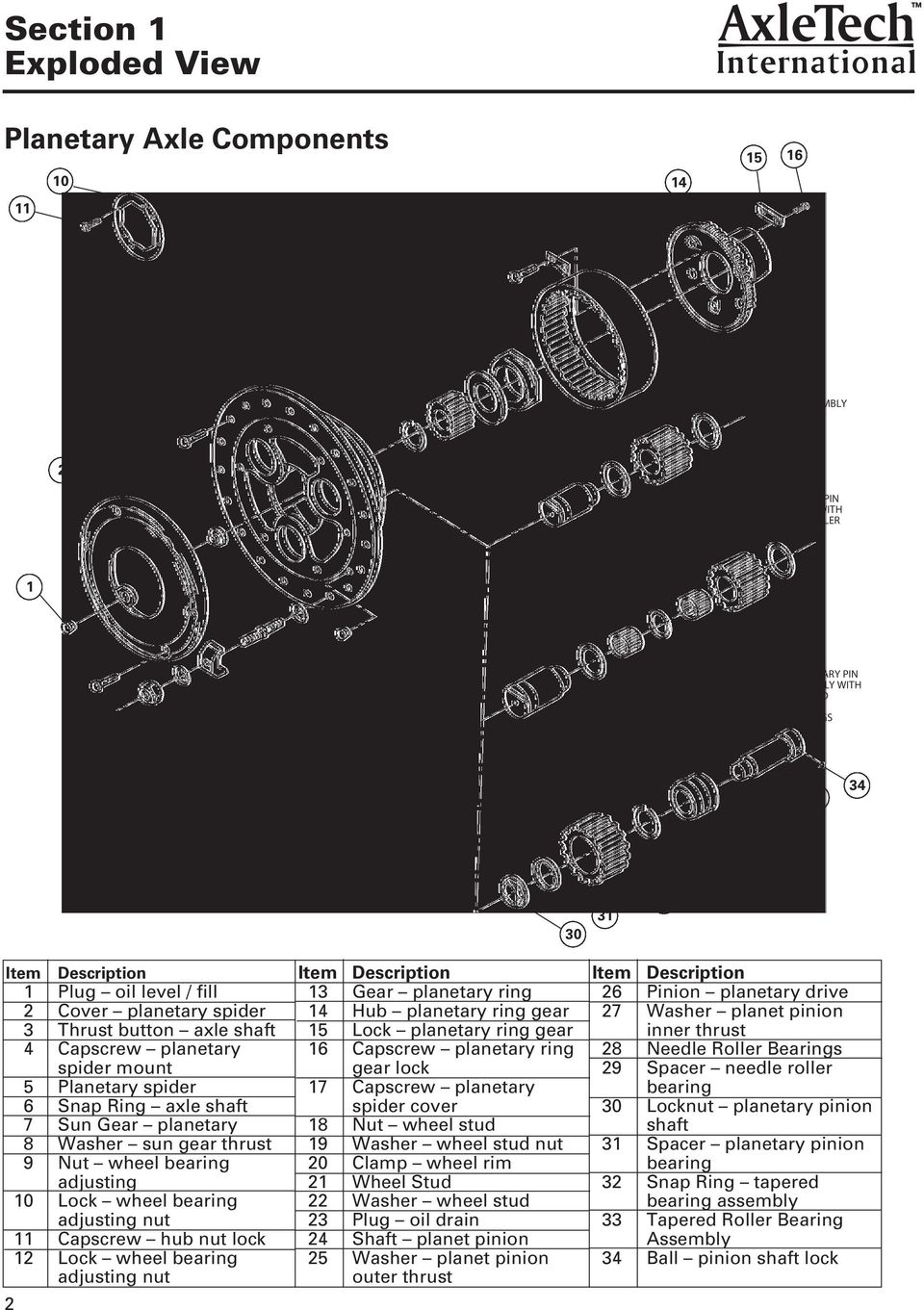
7 Section 1 Exploded View Wheel End Components Item Description 1 Cone outer wheel bearing 2 Cup outer wheel bearing 3 Wheel Hub 4 Cup inner wheel bearing 5 Cone inner wheel bearing 6 Oil Seal hub inner bearing 7 Washer brake disc to hub 8 Capscrew brake disc to hub 9 Disc Brake 10 Spindle (Dry Disc Version shown) 11 Locknut brake caliper mount 12 Washer brake caliper mount 13 Brake Driver wet disc brake Item Description 14 Washer brake driver mount 15 Capscrew brake driver mount 16 Capscrew spindle mount 17 Washer spindle mount 18 Spindle (typical wet or drum brake) 19 Brake Drum 20 Washer drum mount 21 Capscrew drum mount 22 Return Spring brake shoe 23 Brake Shoe & Lining Assembly 24 Camshaft air actuated brake 25 Axle Shaft (for rigid axle) 26 Axle Shaft Universal Joint Assembly 3

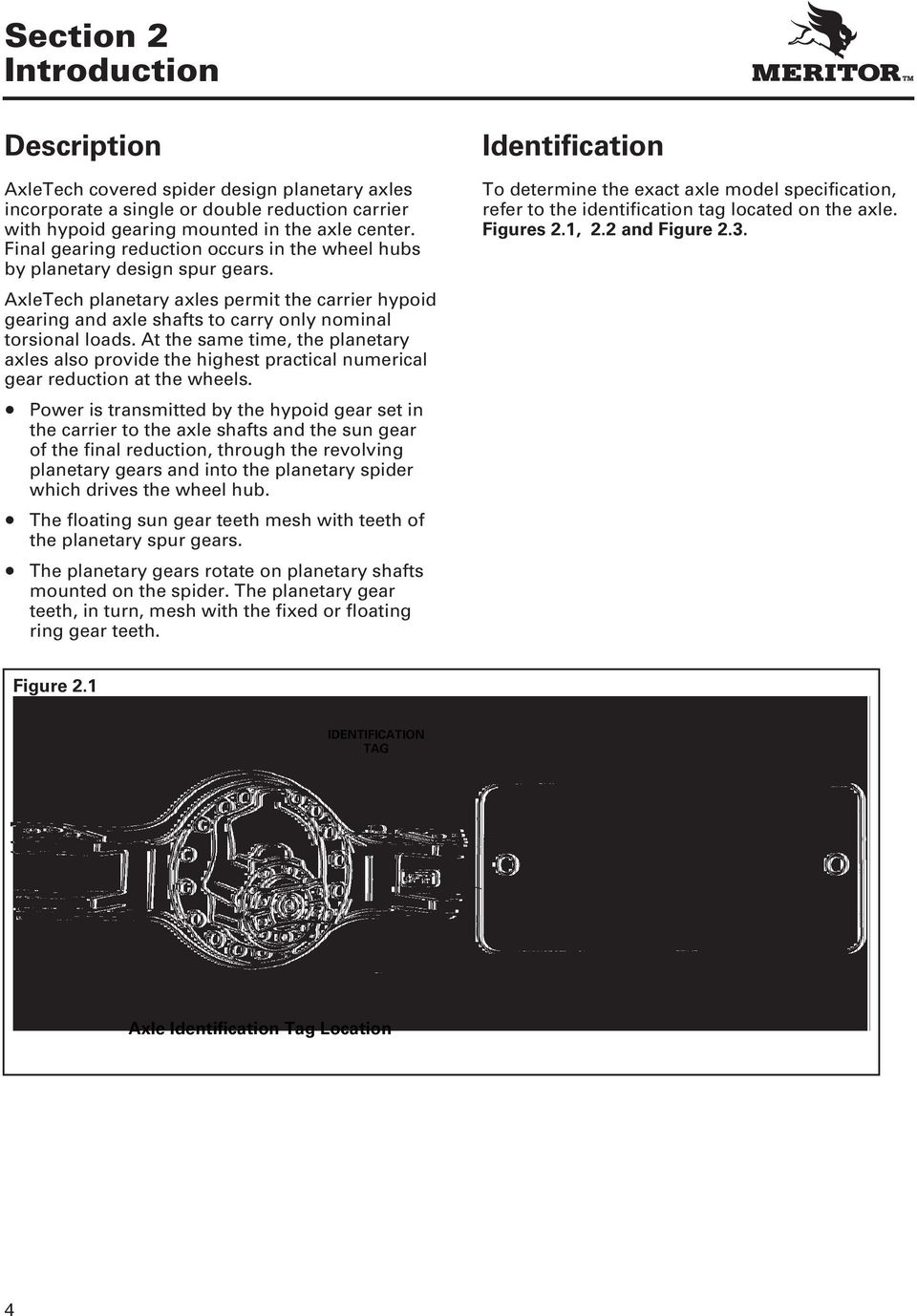
8 Section 2 Introduction Description AxleTech covered spider design planetary axles incorporate a single or double reduction carrier with hypoid gearing mounted in the axle center. Final gearing reduction occurs in the wheel hubs by planetary design spur gears. AxleTech planetary axles permit the carrier hypoid gearing and axle shafts to carry only nominal torsional loads. At the same time, the planetary axles also provide the highest practical numerical gear reduction at the wheels. Power is transmitted by the hypoid gear set in the carrier to the axle shafts and the sun gear of the final reduction, through the revolving planetary gears and into the planetary spider which drives the wheel hub. The floating sun gear teeth mesh with teeth of the planetary spur gears. The planetary gears rotate on planetary shafts mounted on the spider. The planetary gear teeth, in turn, mesh with the fixed or floating ring gear teeth. Identification To determine the exact axle model specification, refer to the identification tag located on the axle. Figures 2.1, 2.2 and Figure 2.3. Figure 2.1 IDENTIFICATION TAG Model No. PRC-7534-W4H Customer No Serial No Plant Ratio Date Axle Identification Tag Location 4
9 Section 2 Introduction Figure 2.2 TANDEM AND TRIDEM AXLES S P R C Only if applicable S = Tandem E = Tridem P = Planetary N = No Planetary Gears R = Rigid S = Steering Housing Type Designation C = Integral Cast First Two or Three Digits Wheel End Designation (Basic Model Number) Last Digit Carrier Designation for Base Model Number Figure 2.3 STEERING EXAMPLE RIGID EXAMPLE SINGLE PLANETARY AXLE P S C P P R C W 4 H First Two Digits Wheel End Designation (Basic Model Number) Housing Type Designation C = Integral Cast Last Digit Carrier Designation for Base Model Number Exact Specification P = Planetary N = Non-Drive R = Rigid S = Steering Only If Applicable: T = Transmission on Carrier O= Oscillating or Pin Mount L = Mounting Other Than Pad with Drilling Brake Type: N NR P DLH HDB RDA RDH RSA RSH None With Rotor Less Calipers Cam-Master P Series Cam 17 in. (432 mm) Hydraulic Drum (Dual Leading Hydraulic) Hydraulic Dry Disc Stopmaster Wedge (Dual Air Chamber) Stopmaster Wedge (Dual Hydraulic Cylinders) Stopmaster Wedge Single Air Chamber Stopmaster Wedge (Single Hydraulic Cylinders) W4H Dura-Disc 17 in. (432 mm) Wet Disc W4M Dura-Disc 17 in. (432 mm) Wet Disc Spring Applied Hydraulic Release WDH432 Dura-Disc 17 in. (432 mm) Wet Disc (Unit Mount) 5

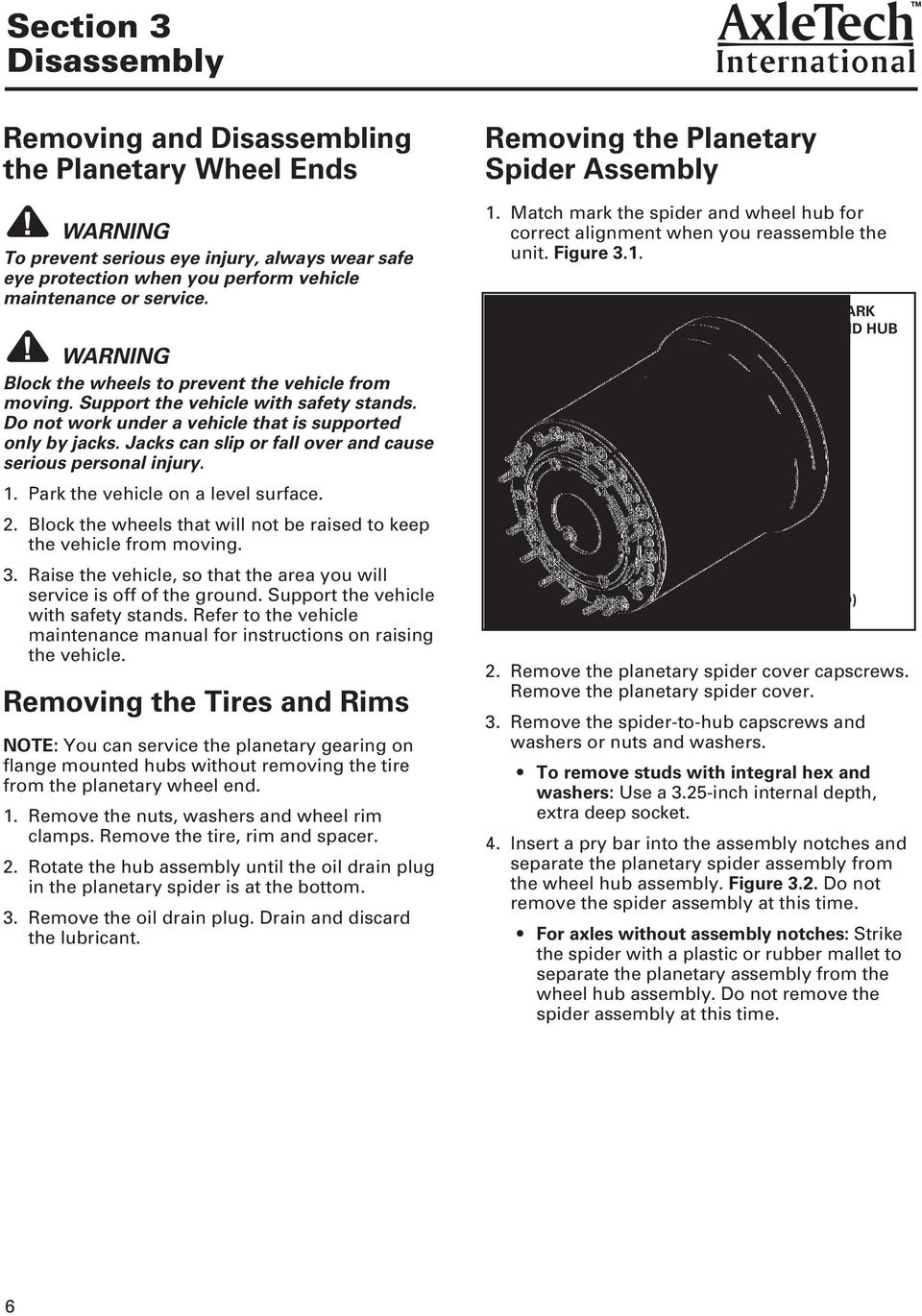
10 Section 3 Disassembly Removing and Disassembling the Planetary Wheel Ends To prevent serious eye injury, always wear safe eye protection when you perform vehicle maintenance or service. Block the wheels to prevent the vehicle from moving. Support the vehicle with safety stands. Do not work under a vehicle that is supported only by jacks. Jacks can slip or fall over and cause serious personal injury. 1. Park the vehicle on a level surface. 2. Block the wheels that will not be raised to keep the vehicle from moving. 3. Raise the vehicle, so that the area you will service is off of the ground. Support the vehicle with safety stands. Refer to the vehicle maintenance manual for instructions on raising the vehicle. Removing the Tires and Rims NOTE: You can service the planetary gearing on flange mounted hubs without removing the tire from the planetary wheel end. 1. Remove the nuts, washers and wheel rim clamps. Remove the tire, rim and spacer. 2. Rotate the hub assembly until the oil drain plug in the planetary spider is at the bottom. 3. Remove the oil drain plug. Drain and discard the lubricant. Removing the Planetary Spider Assembly 1. Match mark the spider and wheel hub for correct alignment when you reassemble the unit. Figure 3.1. Figure 3.1 MATCH MARK SPIDER AND HUB (RIM MOUNTED) 2. Remove the planetary spider cover capscrews. Remove the planetary spider cover. 3. Remove the spider-to-hub capscrews and washers or nuts and washers. To remove studs with integral hex and washers: Use a 3.25-inch internal depth, extra deep socket. 4. Insert a pry bar into the assembly notches and separate the planetary spider assembly from the wheel hub assembly. Figure 3.2. Do not remove the spider assembly at this time. For axles without assembly notches: Strike the spider with a plastic or rubber mallet to separate the planetary assembly from the wheel hub assembly. Do not remove the spider assembly at this time. 6
11 Section 3 Disassembly Figure 3.2 Identifying the Planetary Spider Assembly AxleTech planetary wheel ends come equipped with different planetary designs: Planetary pinion shafts with tapered roller bearings Planetary pinion shafts with needle roller bearings Planetary pinion shafts with nylon coating To identify the design you are servicing, inspect the outside planetary spider flange. Take care when you use lifting devices. When you use a lifting strap, inspect the strap for damage before you use it. Do not use a lifting strap to shock load or drop load a component. Serious personal injury and damage to components can result. 5. Use a lifting device to remove the planetary spider assembly from the wheel hub assembly. Figure 3.3. Planetary spider assemblies with a locknut on the outside flange: This type of planetary design includes planetary pinion shafts with tapered roller bearings. Figure 3.4. Figure 3.4 Planetary spider assembly with locknuts on the outside flange Figure 3.3 Planetary spider assemblies without a locknut on the outside flange: This type of planetary design can include planetary pinion shafts with needle roller bearings or planetary pinion shafts with nylon coating. Figure

12 Section 3 Disassembly Figure 3.5 Planetary spider assembly without locknuts on the outside flange Observe all S and CAUTIONS provided by the press manufacturer concerning press operation to avoid serious personal injury and possible damage to components during assembly and installation procedures. 2. Place the spider assembly in a press, flange side UP. If a press is not available: Use a brass drift and a mallet to remove the pinion shafts. 3. Support the spider assembly as required. 4. Place a container of cushioning material under the press to catch the planetary pinion shafts as they are pressed out of the spider and planetary pinion gears. Figure 3.6. Disassembling the Planetary Spider Assembly NOTE: During disassembly, mark or tag the planetary spider parts you do not plan to replace. Marking and tagging these parts, will aid correct installation during assembly. Follow the correct disassembly procedure for the type of planetary design you are servicing. 5. Press a planetary pinion shaft out of the spider. Figure 3.6. Figure 3.6 PRESS Planetary Pinion Shaft With Tapered Roller Bearings CAUTION Carefully remove the planetary pinion shafts. A ball in the large end of each planetary pinion shaft, prevents the pinion shaft from rotating and can become lost as it disengages from the spider. NOTE: DO NOT mix bearing components from one bearing set with those of other bearing sets. A matched bearing set consists of two cups, two cones, a cone spacer and a cup spacer. 1. Remove the planetary pinion shaft lock nuts. 8
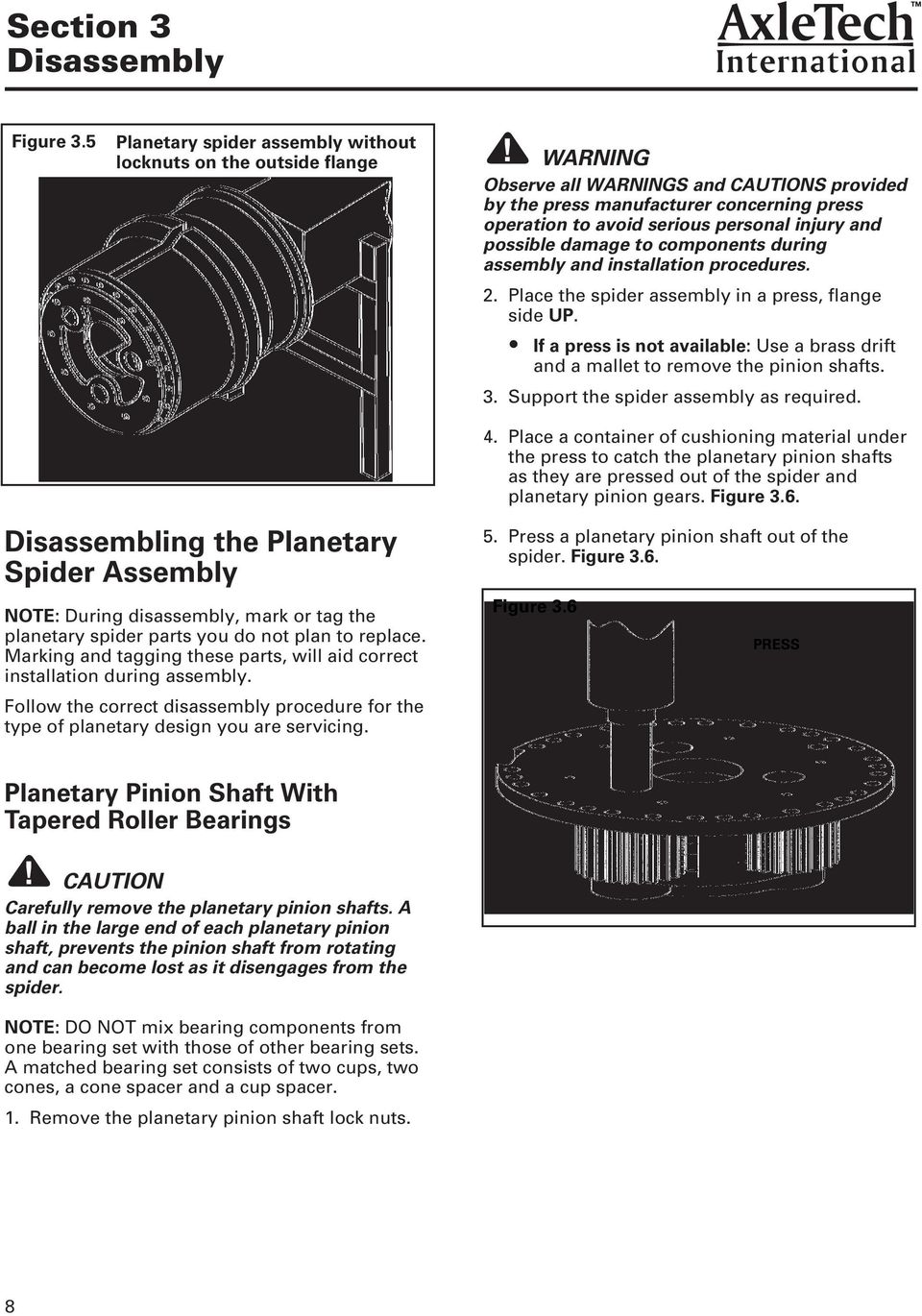
13 Section 3 Disassembly NOTE: Mark the bearings to aid correct installation during assembly. 6. Remove the bearing cones and bearing cone spacer from the planetary pinion gear. Figure 3.7. Figure 3.7 SPACER BEARING ASSEMBLY WITH SNAP RING PLANETARY GEAR NOTE: The bearing cups are positioned in the planetary pinion gears with a snap ring between them. DO NOT press both cups out from one end of the planetary pinion gear at the same time. If the bearing cups do not need to be replaced, do not remove them from the planetary pinion gears. 7. Inspect the bearing cups and bearing cones for wear and damage. If the bearing cups and bearing cones are free of wear and damage: Clean and lubricate the components. If the bearing cups and bearing cones are worn or damaged: Remove and replace the two bearing cups and spacer. Avoid damaging the internal diameter of the gear when you remove the bearing cups. 8. Remove the snap ring and spacer. 9. Press-out the remaining bearing cup. PINION SHAFT Planetary Pinion Shaft With Needle Roller Bearings Planetary Pinion Shaft With Nylon Coating Observe all S and CAUTIONS provided by the press manufacturer concerning press operation to avoid serious personal injury and possible damage to components during assembly and installation procedures. 1. Place the spider assembly in a press with the flange side DOWN. If a press is not available: Use a brass drift and mallet to remove the pinion shafts. 2. Support the spider assembly as required. 3. Place a container of cushioning material under the press to catch the planetary pinion shafts as you press them out of the spider and planetary pinion gears. 4. Press each pinion shaft out of the spider and planetary gear. Figure 3.8 and Figure 3.9. For bolted cover designs: You may be able to remove the planetary pinion shaft by hand. Use a press to remove the planetary shaft only when necessary. Figure 3.8 INNER THRUST WASHER NEEDLE ROLLERS SPACER PLANETARY GEAR Planetary pinion shaft with needle roller bearings NEEDLE ROLLERS OUTER THRUST WASHER PINION SHAFT 9
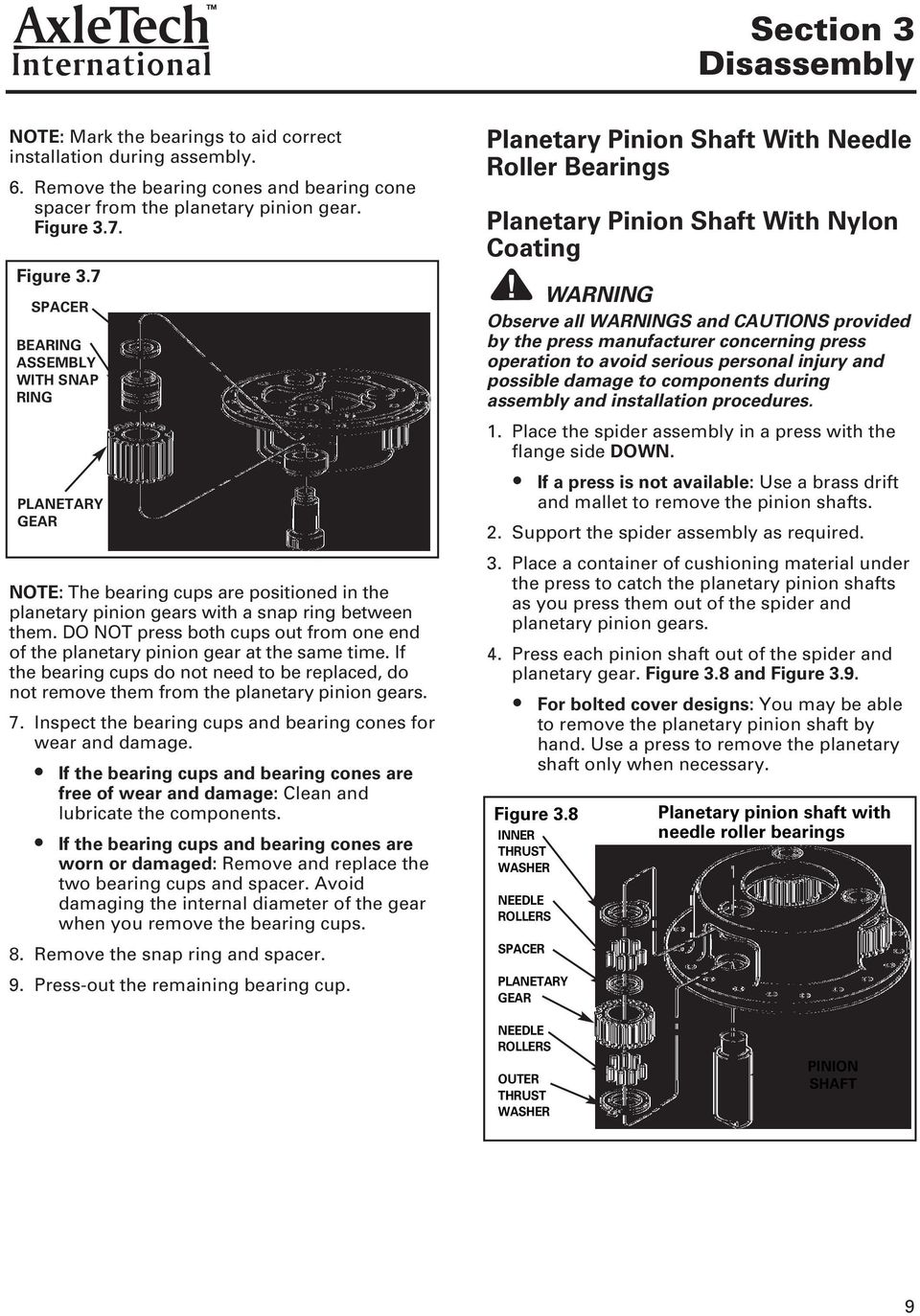
14 Section 3 Disassembly Figure 3.9 Planetary pinion shaft with nylon coating 4. Remove the sun gear thrust washer assembly. Figure Figure 3.11 INNER THRUST WASHER (SMALL BORE) PLANETARY GEAR OUTER THRUST WASHER SPIDER THRUST WASHER 5. Remove the planetary gears and thrust washers from the planetary spider. 6. For planetary pinion shafts with needle roller bearings: Remove the needle roller bearings and spacer from the bore of the planetary gear. Removing the Ring Gear and Axle Shaft 1. For models where the ring gear is not secured to the ring gear hub, remove the floating ring gear. If necessary, use a lifting device to remove the ring gear. Figure Remove the snap ring from the end of the axle shaft. 3. Remove the sun gear. Figure On rigid axles with integral axle shaft and sun gear: Remove the complete axle shaft. Figure 3.10 SUN GEAR SNAP RING PINION SHAFT AXLE SHAFT 5. On rigid axle models without integral sun gear: Remove the axle shaft. 6. To remove the axle shaft from a steering axle: Remove the wheel hub and spindle before you remove the axle shaft. Preparing to Remove the Wheel Hub Axles With Dry Disc Brakes Remove the brake caliper and adapter assembly. Refer to Maintenance Manuals No. 4S, SCL 2 Series Dry Disc Brake Calipers and Maintenance Manual No. 4Y, SCL 35, 46, 53 Dry Disc Brake Calipers. To order these publications, call AxleTech s Customer Service Center at Axles With Wet Disc Brakes Refer to Maintenance Manual No. 4L, Wet Disc Brakes, for instructions on removing and servicing the wheel hub, brake driver, hub oil seal, wheel bearings and spindle. To order this manual, call AxleTech s Customer Service Center at AXLE SHAFT RING GEAR 10
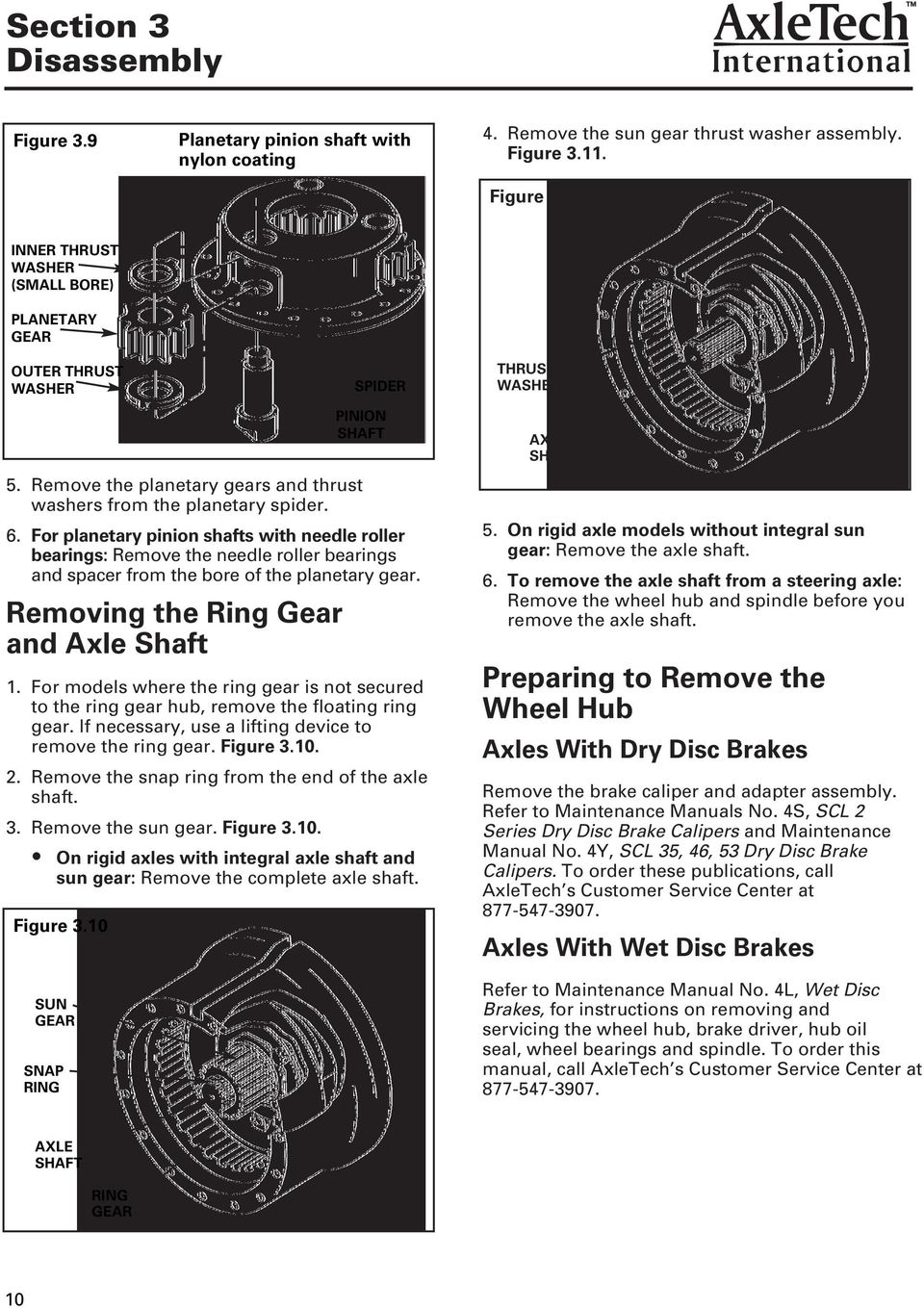
15 Section 3 Disassembly Axles With P Series or RSA Drum Brakes When you work on a spring chamber, carefully follow the service instructions of the chamber manufacturer. Sudden release of a compressed spring can cause serious personal injury. 1. If the brake has spring chambers, manually compress and lock the springs to release the brakes. NOTE: If AxleTech automatic slack adjusters are used, refer to AxleTech Maintenance Manual No. 4B, PayMaster Automatic Slack Adjuster for the correct adjustment procedure. To order this publication, call AxleTech s Customer Service Center at Turn the slack adjuster manual adjusting nut until the brake shoes fully retract and the drum clears the lining. Removing the Ring Gear Hub and Wheel Hub 1. Remove the capscrews from the adjusting nut lock. The adjusting nut lock features one of the following designs: A ring that secures all corners of the nut One or two bow ties that secure one or two corners of the adjusting nut or the flat of the nut 2. Remove the wheel bearing adjusting nut lock and wheel bearing nut. Figure 3.12 If you cannot remove the ring gear hub by hand: Install capscrews into the puller screw holes in the ring gear hub flange ( UNC thread). Tighten each capscrew the same amount to separate the ring gear hub assembly from the spindle and the wheel hub. NOTE: On models without a floating ring gear, the ring gear is secured to the ring gear hub with capscrews and retainer plates on the back side of the assembly. 4. Remove the retainer plate capscrews to remove the ring gear from the ring gear hub. Figure Figure 3.13 HUB OUTER WHEEL BEARING CAUTION Support the wheel hub, as shown in Figure 3.12, before you remove the ring gear and the ring gear hub assembly. Do not remove the ring gear and the ring gear hub assembly without supporting the wheel hub. Serious personal injury and damage to components can result. 3. Remove the ring gear hub by pulling it straight out of the wheel hub and off of the spindle. To avoid dropping and possibly damaging the outer wheel bearing cone, ensure that the outer wheel bearing cone remains in place as you remove the ring gear hub. Figure RING GEAR RETAINER PLATE (SOME MODELS) 5. Remove the outer wheel bearing from the ring gear hub. 11
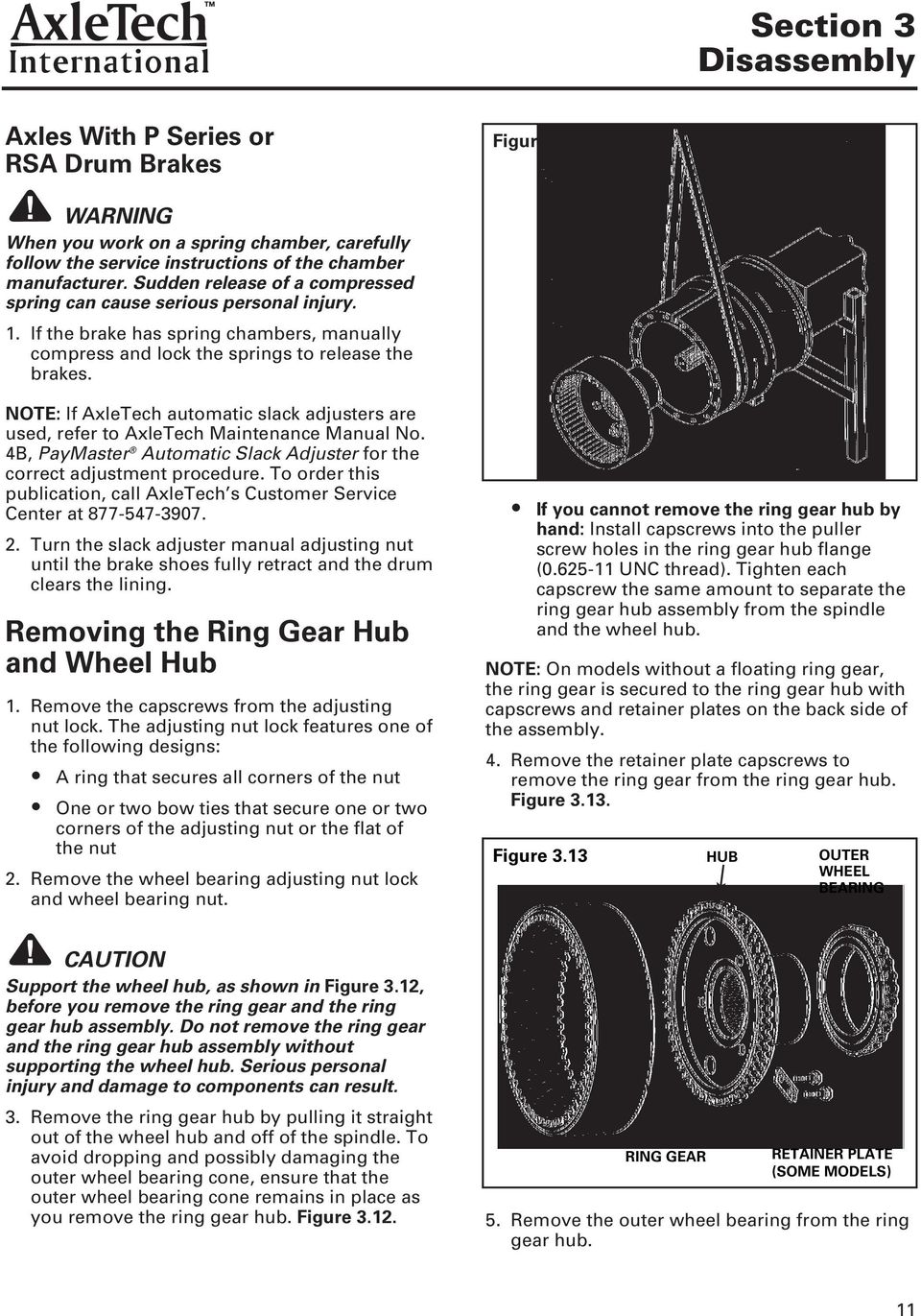
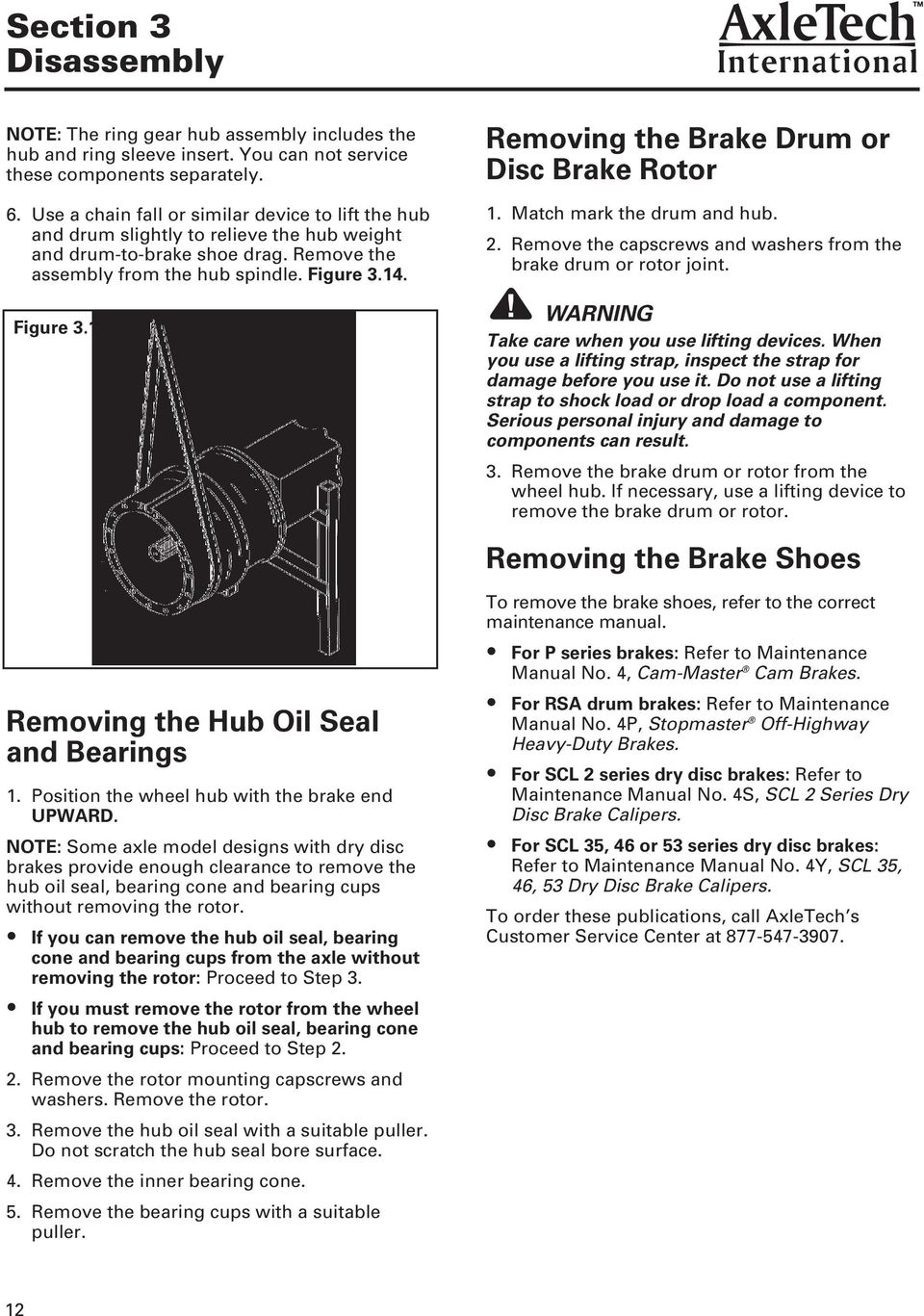
16 Section 3 Disassembly NOTE: The ring gear hub assembly includes the hub and ring sleeve insert. You can not service these components separately. 6. Use a chain fall or similar device to lift the hub and drum slightly to relieve the hub weight and drum-to-brake shoe drag. Remove the assembly from the hub spindle. Figure Figure 3.14 Removing the Brake Drum or Disc Brake Rotor 1. Match mark the drum and hub. 2. Remove the capscrews and washers from the brake drum or rotor joint. Take care when you use lifting devices. When you use a lifting strap, inspect the strap for damage before you use it. Do not use a lifting strap to shock load or drop load a component. Serious personal injury and damage to components can result. 3. Remove the brake drum or rotor from the wheel hub. If necessary, use a lifting device to remove the brake drum or rotor. Removing the Brake Shoes To remove the brake shoes, refer to the correct maintenance manual. For P series brakes: Refer to Maintenance Manual No. 4, Cam-Master Cam Brakes. Removing the Hub Oil Seal and Bearings 1. Position the wheel hub with the brake end UPWARD. NOTE: Some axle model designs with dry disc brakes provide enough clearance to remove the hub oil seal, bearing cone and bearing cups without removing the rotor. If you can remove the hub oil seal, bearing cone and bearing cups from the axle without removing the rotor: Proceed to Step 3. If you must remove the rotor from the wheel hub to remove the hub oil seal, bearing cone and bearing cups: Proceed to Step Remove the rotor mounting capscrews and washers. Remove the rotor. 3. Remove the hub oil seal with a suitable puller. Do not scratch the hub seal bore surface. 4. Remove the inner bearing cone. 5. Remove the bearing cups with a suitable puller. For RSA drum brakes: Refer to Maintenance Manual No. 4P, Stopmaster Off-Highway Heavy-Duty Brakes. For SCL 2 series dry disc brakes: Refer to Maintenance Manual No. 4S, SCL 2 Series Dry Disc Brake Calipers. For SCL 35, 46 or 53 series dry disc brakes: Refer to Maintenance Manual No. 4Y, SCL 35, 46, 53 Dry Disc Brake Calipers. To order these publications, call AxleTech s Customer Service Center at
17 Section 3 Disassembly Removing the Spindle Axles With Dry Disc Brakes 1. Match mark the spindle and housing flange. 2. Use straps and a lifting device to support the spindle. 3. Remove the spindle mounting capscrews and washers. 4. Remove the spindle from the axle housing or steer knuckle. Steering Axles With RSA Drum Brakes 1. Remove all air from the air system. 2. Remove the air lines from the air chamber. Tag the lines and ports to aid reassembly. When you work on a spring chamber, carefully follow the service instructions of the chamber manufacturer. Sudden release of a compressed spring can cause serious personal injury. 3. If the brake has spring chambers, manually compress and lock the springs to release the brakes. 4. Match mark the air chamber housing tube and the brake spider plunger housing to aid reassembly. 5. Remove the set-screw that retains the air chamber assembly in the spider plunger housing. 6. If there is a collet nut on the threads of the chamber housing tube: Use a hammer and a brass drift to loosen the collet nut. 7. Remove the air chamber assembly from the plunger housing. If necessary, use a strap wrench to remove the air chamber assembly. 8. Remove the brake shoe return springs. 9. Rotate the brake shoes to allow access to the spindle/brake spider mounting capscrews. 10. Match mark the brake spider and steering knuckle to aid correct installation at assembly. 11. Remove the two capscrews and washers that mount the brake spider and spindle to the steering knuckle at the 11 and 1 o clock positions. 12. Install two studs 4-6 inches long with UNF threads on the end that engages the steering knuckle to aid spindle removal. 13. Support the spindle and brake spider assembly. 14. Remove the remaining capscrews and washers. 15. Remove the brake spider and brake shoe assembly. NOTE: The oil seal in the bore of the spindle large end may be damaged during spindle removal. 16. Remove the spindle from the steering knuckle by sliding the spindle over the outer end of the axle shaft and universal joint assembly. 17. Remove the axle shaft and universal joint assembly. Steering Axles With P Series Cam Brakes 1. Remove the brake shoe return springs. 2. Rotate the brake shoes until enough clearance exists to remove the spindle mounting nuts and washers with a wrench. 3. Remove the spindle mounting nuts and washers. NOTE: The oil seal in the bore of the spindle large end may be damaged during spindle removal. 4. Remove the spindle from the steer knuckle by sliding the spindle over the outer end of the axle shaft assembly. 5. Remove the axle shaft and universal joint assembly. 13

18 Section 3 Disassembly Rigid Axles With P Series Cam Brakes NOTE: Some rigid axles feature a two-piece camshaft and coupling which allows you to remove the camshaft without removing the slack adjuster. When servicing an axle with a two-piece camshaft and coupling, proceed to Step Remove the brake shoe return springs. 2. Rotate the brake shoes to allow access to the brake camshaft and the spindle mounting capscrews. 3. Remove the slack adjuster clevis pin that connects the air chamber push rod. 4. Remove the snap ring and washers that connect the slack adjuster to the brake camshaft. Stack the washers and separate them from other parts. 5. Remove the slack adjuster and washers. Separate the washers from other parts and prevent them from mixing with the washers you previously removed. 6. Remove the snap rings that retain the camshaft in the spindle support boss. 7. Remove the brake camshaft from the spindle. Separate the washers you removed from the face of the spindle boss. Prevent the washers from mixing with the washers you previously removed. Take care when you use lifting devices. When you use a lifting strap, inspect the strap for damage before you use it. Do not use a lifting strap to shock load or drop load a component. Serious personal injury and damage to components can result. 8. Use straps and a lifting device to support the spindle and brake shoe assembly. 9. Match mark the housing and spindle flange. 10. Remove the mounting capscrews and washers. 11. Remove the spindle from the axle housing. 14
19 Section 4 Prepare Parts for Assembly Cleaning Ground or Polished Parts To prevent serious eye injury, always wear safe eye protection when you perform vehicle maintenance or service. Solvent cleaners can be flammable, poisonous and cause burns. Examples of solvent cleaners are carbon tetrachloride, emulsion-type cleaners and petroleum-based cleaners. To avoid serious personal injury when you use solvent cleaners, you must carefully follow the manufacturer s product instructions and these procedures: Wear safe eye protection. Wear clothing that protects your skin. Work in a well-ventilated area. Do not use gasoline or solvents that contain gasoline. Gasoline can explode. You must use hot solution tanks or alkaline solutions correctly. Follow the manufacturer s instructions carefully. Use a cleaning solvent to clean ground or polished parts or surfaces. Kerosene or diesel fuel oil can be used for this purpose. NEVER USE GASOLINE. Remove gasket material from parts. Be careful not to damage ground surfaces. DO NOT clean ground or polished parts in a hot solution tank, water, steam or alkaline solution. Cleaning Parts With Rough Finishes Parts with a rough finish can be cleaned with cleaning solvent or in a hot solution tank with a weak alkaline solution. Cleaning Axle Assemblies A complete axle assembly can be steam cleaned on the outside to remove dirt. Before the axle is steam cleaned, close or put a cover over all openings in the axle assembly. Examples of openings are breathers or vents in air chambers. Drying Cleaned Parts Dry the parts immediately after cleaning and washing. Dry the parts with soft clean paper or rags. CAUTION Damage to bearings can be caused if dried by rotating with compressed air. Except for bearings, parts can be dried with compressed air. Preventing Corrosion Apply a light lubricant to cleaned and dried parts that are not damaged and are to be assembled. Apply a special material that prevents corrosion to all surfaces. If parts are to be stored, wrap the parts in special paper that prevents corrosion. Inspecting Parts It is very important to inspect all parts carefully and completely before the axle or carrier is assembled. Check all parts for wear and replace damaged parts. Replacement of damaged or worn parts will prevent breakdown of assembly later. Parts must remain in hot solution tanks until completely cleaned and heated. Parts must be washed with water until the alkaline solution is removed. 15
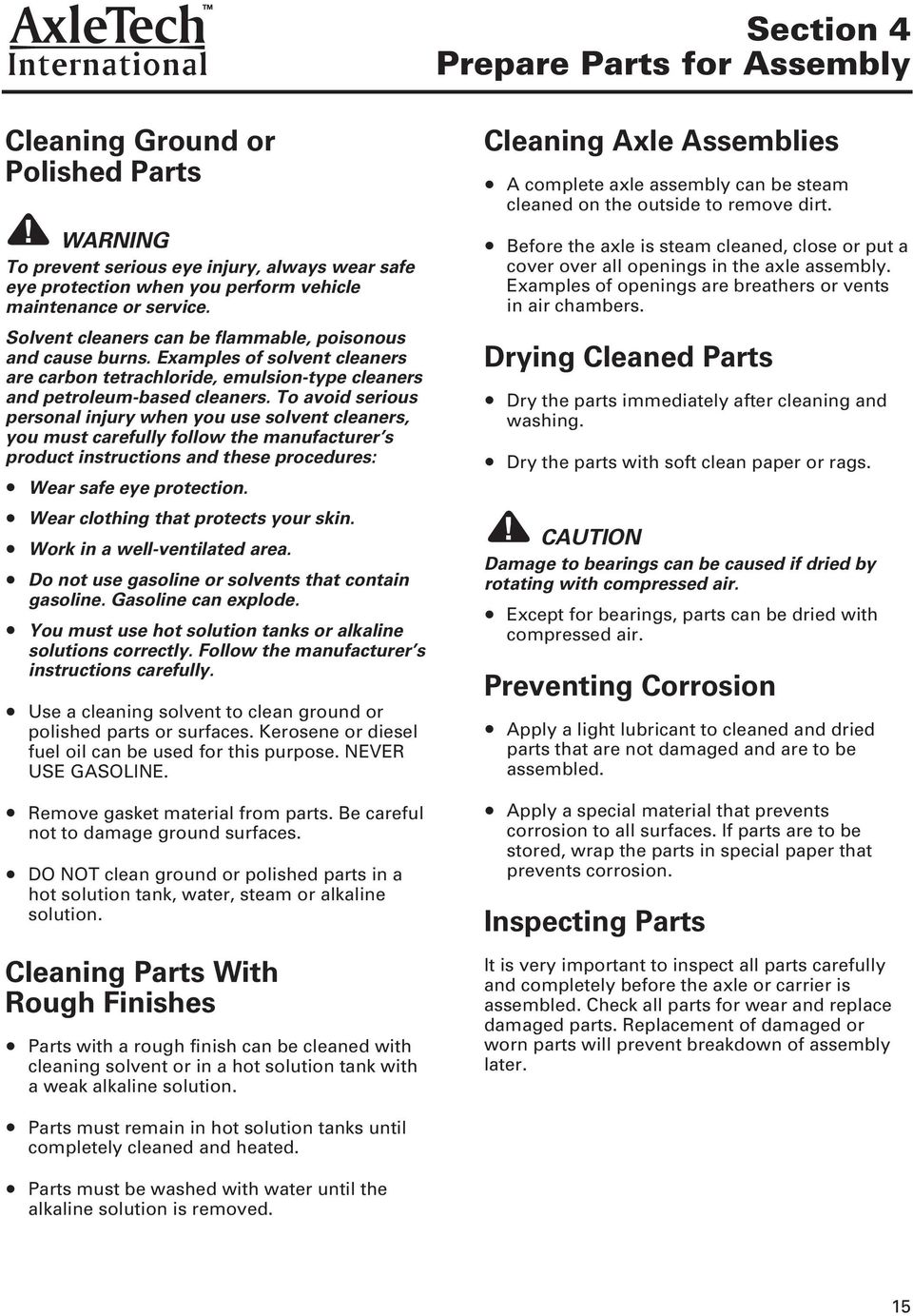
20 Section 4 Prepare Parts for Assembly Inspecting Tapered Roller Bearings Deep cracks or breaks in the cup, cone inner race or roller surfaces. Inspect the cup, cone, rollers and cage of all tapered roller bearings in the assembly. If any of the following conditions exist, the bearing must be replaced: Bright wear marks on the outer surface of the roller cage. Figure 4.3. Figure 4.3 The center of the large diameter end of the rollers are worn level with, or below the surface. The center of the large diameter end of the rollers are worn to a sharp edge. Figure 4.1. Figure 4.1 WORN RADIUS WEAR MARKS Damage on rollers and on surfaces of the cup and cone inner race that touch the rollers. Figure 4.4. Figure 4.4 ETCHING & PITTING WORN SURFACE A visible roller groove in the cup or cone inner race surfaces. The groove can be seen at the small or large diameter end of both parts. Figure 4.2. Figure 4.2 CRACK 16 WEAR GROOVES
21 Section 4 Prepare Parts for Assembly Damage on the cup and cone inner race surfaces that touch the rollers. Figure 4.5. Figure 4.5 SPALLING & FLAKING Remove nicks, marks and burrs from parts having machined or ground surfaces. Use a fine file, India stone, emery cloth or crocus cloth for this purpose. Clean and repair threads of fasteners and holes. Use a die or tap of the correct size or a fine file for this purpose. CAUTION Threads must be without damage and clean so that accurate adjustment and correct torque values can be applied to fasteners and parts. Tighten all fasteners to correct torque values. Do not repair axle housings by bending or straightening. Repair of axle housings by bending or straightening can cause poor performance and possible unsafe operation of the axle. This can cause serious personal injury. Repair Welding Inspecting Planetary Wheel End Components Inspect the planetary reduction, planetary gears, sun gear and ring gear assembly for wear or damage. Replace gears, shafts or thrust washers that are scored, pitted, ridged, chipped or worn. Repairing or Replacing Parts Replace worn or damaged parts of an axle assembly. The following are some examples to check for repair and possible replacement: Replace any fastener if corners of the head are worn. Replace washers if damaged. Replace gaskets, oil seals or grease seals at the time of axle repair. Clean parts and apply new liquid gasket material where required when axle is assembled. Do not repair weld drive axle assemblies. Repair welding can detract from the structural integrity of a component, particularly to heat treated parts where the benefit of heat treatment can be nullified by welding. Removing Capscrews Fastened With Liquid Adhesive CAUTION Do not use impact wrenches or strike components with a hammer. To remove capscrews fastened with liquid adhesive, use the regular mechanical disassembly procedure. If the removal of a capscrew, for example, becomes difficult due to a worn head or unusually high breakaway torque, the locking strength can be reduced by heating the threaded area to approximately 300 F (150 C). Heat slowly to avoid thermal stresses in components. 17
22 Section 4 Prepare Parts for Assembly Cleaning To avoid serious personal injury, trichloroethylene must not come in contact with your skin. Do not smoke and avoid breathing vapors in closed rooms without ventilation. Do not use trichloroethylene near flames, welding operations or hot surfaces exceeding 900 F (482 C). Clean the capscrew, nut or bolt tapped hole and fastener thread carefully. Use a cleaning solvent such as trichloroethylene or equivalent to remove dirt, oil, grease or moisture. NOTE: Do not apply liquid adhesive to the fastener. Trapped air in the threaded hole will create back pressure and blow out the adhesive as the fastener advances. 2. Apply Loctite No. 277 adhesive to the threaded holes only. Before threading in the fasteners, visually check to make sure that the adhesive contacts the threads. Figure 4.6. Figure 4.6 Using Dri-Loc Fasteners and AxleTech Liquid Adhesive NOTE: Do not apply AxleTech liquid adhesive or any other type of fastener retainer material, sealant or adhesive on Dri-Loc fasteners or in the threaded holes. NOTE: No cure time is required for Dri-Loc fasteners before rebuilding the axle and returning it to service. 1. Wipe excess oil residue from the threaded holes of all components that use Dri-Loc fasteners. 2. Assemble the components that use Dri-Loc fasteners. 3. Tighten the Dri-Loc fasteners to the specified torque value. Reusing Dri-Loc Fasteners and Loctite No. 277 Take care when using Loctite to avoid serious personal injury. Follow the manufacturer s instructions to prevent irritation to the eyes and skin. If Loctite gets into your eyes, flush them with water for 15 minutes. Have your eyes checked by a doctor as soon as possible. 1. Wipe excess oil residue from the Dri-Loc fasteners and threaded holes. 3. Tighten the fasteners to the specific torque value recommended for the fastener. Loctite No. 277 will not alter the torque requirement. NOTE: No cure time is required for Loctite No. 277 before rebuilding the axle and returning it to service. 4. When servicing drive units assembled with Dri-Loc fasteners or with Loctite No. 277 in threaded holes where the fasteners do not require removal: Check each fastener for tightness by tightening the fastener to the minimum specified torque. If the fastener does not rotate, the fastener is tightened to the correct torque. If the fastener rotates to any degree, remove it from the component and apply liquid adhesive to the threaded hole. 18
23 Section 4 Prepare Parts for Assembly Applying Silicone Gasket Material AxleTech recommends the following liquid gasket materials: ThreeBond 1216 Loctite 5699 When you apply some silicone gasket materials, small amounts of acid vapor are present. To prevent possible serious injury, the work area must be well-ventilated. If the silicone gasket material gets into your eyes, flush them with water for 15 minutes. Have your eyes checked by a doctor as soon as possible. CAUTION The amount of liquid gasket material applied must not exceed a in. (3.18 mm) diameter bead. Too much gasket material can block lubrication passages and result in damage to components. 1. Remove all old gasket material from both surfaces. 2. Clean the surfaces where liquid gasket material will be applied. Remove all oil, grease, dirt and moisture. 3. Thoroughly dry both surfaces. 4. Apply approximately a inch (3.18 mm) diameter continuous bead of liquid gasket material around one surface. Also apply gasket material around the edge of all fastener holes on that surface. Figure Assemble the components quickly to permit the gasket material to compress evenly between parts. 6. Tighten the fasteners with the required torque. Flushing Lube From the Axle NOTE: The rigid axle wheel end and housing bowl share the same oil. Lubricant contamination of the wheel end or housing bowl can spread to all areas of the axle. Flush lubricant from the entire axle, including the wheel ends and housing bowl, before you assemble the axle. Figure " (3.18 MM) DIAMETER SILICONE GASKET MATERIAL BEAD 19
24 Section 5 Assembly Installing the Spindle on Rigid Axles With P Series Cam Brakes Figure 5.2 To prevent serious eye injury, always wear safe eye protection when you perform vehicle maintenance or service. 1. Install two 4-inch long temporary studs into the axle housing flange at the 1 and 11 o clock positions. Figure 5.1. GASKET MATERIAL Figure Apply a inch diameter continuous bead of liquid gasket material around the flange mounting face of the axle housing. Take care when you use lifting devices. When you use a lifting strap, inspect the strap for damage before you use it. Do not use a lifting strap to shock load or drop load a component. Serious personal injury and damage to components can result. 3. Align the spindle and axle housing match marks. Install the spindle on the axle housing. If necessary, use an overhead crane to lift and support large spindles. Figure Install and hand tighten the spindle mounting capscrews and washers. Remove the temporary studs and replace them with capscrews and washers. 5. Tighten the capscrews according to the torque specifications shown in Table A. Table A: Spindle Mounting Capscrew Torque Specifications Torque Size lb-ft N m 3/4" /8"-9 & "-12 & /4" "-8 (Nut on stud) Replace the brake camshaft bushings and grease seals in the spindle boss and camshaft brackets. Refer to Maintenance Manual No. 4, Cam-Master Cam Brakes. To order this publication, call AxleTech s Customer Service Center at Install the cam head thrust washer onto the camshaft. Apply O-617-A or O-617-B chassis grease to the camshaft bushings and journals. 8. Install the camshaft through the spindle bushings. Install the washers and slide the camshaft through the air chamber support bracket. For two-piece camshaft designs: Engage the coupling when you install the camshafts. T 20
25 Section 5 Assembly 9. Install the slack adjuster, washers, and snap ring. Connect the slack adjuster to the air chamber push rod yoke. Check that the snap ring is installed to the camshaft at the inner face of the spindle boss. Installing the Spindle on Rigid Axles With Dry Disc Brakes 1. For axle models that use capscrews to mount the spindle: Install two 4-inch long temporary studs into the axle housing flange at the 1 and 11 o clock positions. Figure Apply a inch diameter continuous bead of liquid gasket material around the flange mounting face of the axle housing. 3. Align the spindle with the axle housing match marks to correctly position the brake caliper mounting bosses. Install the spindle on the axle housing. 4. Install and hand tighten the spindle mounting capscrews and washers. Remove the temporary studs and replace them with capscrews and washers. For models with studs in the axle housing: Install washers and locknuts. 5. Tighten the capscrews or locknuts according to the torque specifications shown in Table B. Table B: Spindle Mounting Capscrew and Locknut Torque Specifications Torque Size lb-ft N m 3/4" /8"-9 & "-12 & /4" "-8 (Nut on stud) Installing the Spindle on Steering Axles With P Series Cam Brakes T 1. Apply a thin coat of NLGI grade 1 or 2 grease to the following areas: Oil seal lips and bushing bore in the end of the axle housing Axle shaft assembly seal and bushing journals CAUTION Avoid damaging the housing oil seal when you install the shaft assembly. Lubricant loss and damage to components can result. 2. Install the axle shaft assembly through the steering knuckle and axle housing until the shaft engages the differential assembly side gear. Figure 5.3. Figure If the original shaft support bushing in the bore of the spindle is worn or damaged: Remove the oil seal and bushing and install a new bushing. 4. Install a new oil seal in the spindle bore. Apply a thin coat of NLGI grade 1 or 2 grease to the seal lips and bushing bore. NOTE: Install the differential carrier assembly and the steering knuckles on the steering axles before performing the following procedure. 21
26 Section 5 Assembly CAUTION CAUTION Avoid damaging the oil seal in the spindle when you install the spindle. Lubricant loss and damage to components can result. Avoid damaging the oil seal in the spindle when you install the spindle. Lubricant loss and damage to components can result. 5. Install the spindle on the steering knuckle by carefully sliding it over the outer end of the axle shaft assembly. 6. Install the spindle mounting washers and nuts. Hand tighten the nuts. 7. Tighten the 3/4-inch-19 nuts to lb-ft ( N m). 8. If you removed the brake shoes or camshaft: Install the brake shoes or camshaft. Refer to Maintenance Manual No. 4, Cam-Master Cam Brakes. To order this publication, call AxleTech s Customer Service Center at Installing the Spindle on Steering Axles With RSA Drum Brakes NOTE: Install the differential carrier assembly and the steering knuckles on the steering axle before performing the following procedure. 1. Apply a thin coating of NLGI grade 1 or 2 grease to the following areas: 22 T Oil seal lips and bushing bore in the end of the axle housing Axle shaft assembly seal and bushing journals CAUTION Avoid damaging the housing oil seal when you install the shaft assembly. Lubricant loss and damage to components can result. 2. Install the axle shaft assembly through the steering knuckle and axle housing until the shaft engages the differential assembly side gear. 3. If the original shaft support bushing in the bore of the spindle is worn or damaged: Remove the oil seal and bushing and install a new bushing. 4. Install a new oil seal in the spindle bore. Apply a thin coat of NLGI grade 1 or 2 grease to the seal lips and bushing bore. 5. Use a lifting device to install the spindle onto the steering knuckle. Carefully slide the spindle over the outer end of the axle shaft assembly and engage the two temporary guide studs. 6. Align the brake spider and brake shoe assembly with the spindle match marks. Install the brake spider and brake shoe assembly on the spindle. Refer to Maintenance Manual No. 4P, Stopmaster Off- Highway Heavy-Duty Brakes. 7. Install the spindle and brake spider mounting capscrews and washers. Remove the two temporary studs you installed during disassembly. Replace the temporary studs with capscrews and washers. 8. Tighten the 7/8-inch-14 capscrews and washers to lb-ft ( N m). 9. Install the air chamber assembly into the brake spider. Refer to Maintenance Manual No. 4P, Stopmaster Off-Highway Heavy-Duty Brakes. 10. Install the brake shoe return spring. NOTE: Release the spring chamber after you finish adjusting the wheel hub. 11. Connect the air lines to the correct ports in the air chamber assembly. T
27 Section 5 Assembly Installing the Axle Shaft in Rigid Axle Models NOTE: If the axle uses a one piece shaft/sun gear, install the shaft/sun gear after adjusting the wheel bearings. Install the axle shaft through the spindle bore and housing until it engages the differential side gear. The shaft end with the snap ring groove must extend beyond the outer end of the spindle. Assembling the Ring Gear Hub Assembly NOTE: When servicing an axle model with a floating ring gear, install the ring gear immediately before you assemble the planetary spider. 1. For axle models that include a planetary ring gear with tapped holes, lock plates and capscrews: Assemble the ring gear to the ring gear hub. Figure 5.4. Figure 5.4 PLANETARY RING GEAR HUB RING GEAR OUTER WHEEL BEARING RETAINER PLATE 2. Install the outer wheel bearing cone on the ring gear hub journal squarely against the hub shoulder. Apply the same lubricant used in the wheel ends to the rollers. Slip fit the bearing cone over the ring gear hub journal. Do not install the ring gear hub assembly on the spindle at this time. Assembling the Hub, Bearings, Oil Seal and Drum or Rotor 1. If the hub bearing cups need to be replaced, install the new cups with a suitable driver. NOTE: Most models require installation of the inner bearing cone prior to installation of the wheel hub oil seal into the bore of the wheel hub. 2. Apply lubricant to the inner bearing cone rollers. Install the bearing cone into the wheel hub. 3. If used, install the oil seal guard washer. 4. Position the new wheel hub oil seal so that the spring lip of the seal faces the wheel bearing. Use a suitable seal driver to drive the seal into the same location as the original wheel hub oil seal. Refer to the following list for three possible seal installation locations: Bottom of the hub bore Pushed-in until it contacts the guard washer Flush with the end face of the hub CAUTION Use extreme care to avoid nicking the oil seal wear sleeve end when you install the oil seal wear sleeve. A nicked oil seal wear sleeve end can damage the seal lip when you install the wheel hub. Lubricant loss and damage to components can result. 5. If a sleeve is used, carefully install a new oil seal wear sleeve on the spindle. 6. Lubricate the seals in the following areas only. Conventional seals: Lubricate the oil seal lips. Unitized seals: Lubricate the inside diameter of the seal. Face seals: Lubricate the contact surfaces of the metal rings. Do not apply lubricant to any other part of the face seal. 7. Apply a thin coat of lubricant to the oil seal journal surface of the spindle. 23
28 Section 5 Assembly 8. Install the brake rotor or drum and oil slinger. If the slinger fits loosely between the hub and drum: Apply a bead of liquid gasket material to prevent rattling. 9. Install the drum or rotor mounting capscrews and washers. For dual tire models: Align the air valve stem clearance notch in the drum outside diameter with the wheel hub notch. 10. Tighten the capscrews according to the torque specifications shown in Table C. Table C: Brake Rotor Mounting Capscrew Torque Specifications Torque Size lb-ft N m 3/4" " /8" Installing the Wheel Hub Take care when you use lifting devices. When you use a lifting strap, inspect the strap for damage before you use it. Do not use a lifting strap to shock load or drop load a component. Serious personal injury and damage to components can result. 1. Use a lifting device to carefully lift and slide the wheel hub assembly over the spindle. Keep the wheel hub assembly aligned with the spindle to avoid oil seal damage. Figure 5.5. For axle models with three threaded holes (5/8 inch-11 UNC) in the boss area near the outer wheel bearing: You can temporarily attach the planetary ring gear hub assembly to the wheel hub prior to installation on the spindle. Table D: Wheel Bearing Adjustment Rigid Axle Models Steering Axle Models T Figure Install the ring gear hub assembly, which includes the outer bearing cone, on the spindle. Figure Install the wheel bearing adjusting nut on the spindle. If you temporarily attached the planetary ring gear hub assembly to the wheel hub in Step 1: Remove the temporary capscrews from the ring gear hub. Adjusting the Wheel Bearing Preload NOTE: For wheel bearing adjustment procedures for axles equipped with wet disc brakes, refer to AxleTech Maintenance Manual No. 4L, Wet Disc Brakes. To order this publication, call AxleTech's Customer Service Center at Tighten the wheel bearing adjusting nut to the initial seating torque listed in Table D, while rotating the wheel hub. 2. Continue to rotate the hub a minimum of one full revolution in both directions. Adjusting Nut Torque Initial Seating Final Adjustment lb.-ft. N m lb.-ft. N m PRC-1925 through 4807 PSC SPRC & EPRC- through through 4808 PRC-5324 through PRC-7534 (wet brake) T 24
29 Section 5 Assembly 3. Tighten the wheel bearing adjusting nut again to the initial seating torque listed in Table E, while rotating the wheel hub in both directions. 4. Repeat Steps 1 and 2 until the adjusting nut will not advance with the application of the initial seating nut torque. 5. Loosen the adjusting nut 1/8 to 1/4 turn. 6. Tighten the adjusting nut to the final adjustment nut torque listed in Table E while rotating the wheel hub. NOTE: Do not loosen the adjusting nut from the setting in Step 6 when you install the adjusting nut lockplate. Loosening the adjusting nut can result in an incorrect bearing preload. 7. Use one of the following procedures to install the adjusting nut lockplate: Place the flat side of the lockplate against a flat surface of the nut. or Place the lockplate notch over a corner of the adjusting nut. If necessary, tighten the adjusting nut to align the lockplate holes with the threaded holes in the ring gear hub. Do not loosen the adjusting nut. T Take care when using Loctite to avoid serious personal injury. Follow the manufacturer s instructions to prevent irritation to the eyes and skin. If Loctite gets into your eyes, flush them with water for 15 minutes. Have your eyes checked by a doctor as soon as possible. 8. Install new lockplate capscrews with pre-applied locking agent on the threads. If you use the original capscrews, apply 2 or 3 drops of Loctite 277 or equivalent to the internal threads of the ring gear hub. Tighten the capscrews lb-ft ( N m). Installing the Planetary Ring Gear and Sun Gear 1. Apply grease to the inner face of the sun gear thrust washer (the side with tangs or dowel pins). Install the thrust washer so that the tangs or dowels engage the slots or holes in the wheel bearing adjusting nut. T T T 2. Install the sun gear on the axle shaft and against the thrust washer. For a one piece axle shaft/sun gear: Install the axle shaft/sun gear by engaging the differential side gear until the sun gear is against the thrust washer. Figure 5.6. Figure 5.6 SUN GEAR AXLE SHAFT RING GEAR 3. Install the snap ring into the axle shaft groove. 4. For axle models with a floating ring gear: Install the planetary ring gear onto the ring gear hub. Assembling the Planetary Spider AxleTech s planetary wheel ends come equipped with three different planetary designs: Planetary pinion shaft with tapered roller bearings Planetary pinion shaft with needle roller bearings Nylon coated planetary pinion shafts Follow the correct assembly procedure for the type of planetary design you are servicing. 25
30 Section 5 Assembly Planetary Pinion Shaft With Tapered Roller Bearings 1. Carefully inspect the planetary gears, pinion shafts and planetary gear tapered roller bearings. Replace damaged or worn parts. 2. If you removed the bearing cups, install new bearing cups with a suitable driver. To install the new bearing cups, refer to the following procedure: a. Install a snap ring into the groove on the inside diameter of the planetary gear. b. Press one bearing cup into the planetary gear bore until it seats against the snap ring. You must install the bearing cup into the side of the gear closest to the snap ring. Use care to avoid pressing the cup through the snap ring. c. Install the cup spacer against the snap ring in the other planetary gear end. d. Press the other bearing cup into the planetary gear bore until it seats against the cup spacer. 3. Install the bearing cones and bearing cone spacer in the planetary gear bore. If you reuse the bearing cup and bearing cone: Assemble the bearing cup and bearing cone in the original position. Observe all S and CAUTIONS provided by the press manufacturer concerning press operation to avoid serious personal injury and possible damage to components during assembly and installation procedures. 4. Support the planetary spider in a press, flange side DOWN. Install the planetary gear and bearing assembly with the gear spacer toward the small hole in the spider. Look through the hole in the spider to check that the bearings and spacer align with the spider bores. NOTE: You must place the spacer at the correct end of the planetary gear for correct gear alignment. 5. Place the ball in the hole on the large outside diameter of the planetary pinion shaft. Carefully align the ball with the slot in the planetary spider. Use grease to retain the ball in the hole during assembly. 6. Install the planetary pinion shaft by hand. Figure 5.7. If you cannot install the planetary pinion shaft by hand: Use a press to press-in the planetary pinion shaft through the planetary gear assembly until the shoulder of the pin bottoms-out. When a press is not available, use a brass drift and mallet to tap the pinion shafts through the spider and planetary gear assembly. Figure 5.7 PLANETARY GEAR BEARING ASSEMBLY WITH SNAP RING SPACER PINION SHAFT 7. Install the planetary pinion shaft locknut and tighten to lb-ft ( N m). 8. Repeat Steps 1-7 for the remaining shaft, gear, and bearing assemblies. Planetary Pinion Shaft With Needle Roller Bearings NOTE: For maximum planetary gear life, change the pinion shafts and needle roller bearings on both wheel ends at the same time. NOTE: The inner diameter of the inner thrust washer is smaller than the outer thrust washer. 1. Apply approved O-617-A or B, NLGI grade 1 or 2 grease to the side of the inner thrust washer opposite the tang. Place the greased side of the thrust washer toward the planetary gear. The thrust washer tangs fit into the spider grooves. T 26
31 Section 5 Assembly NOTE: Replace the needle roller bearings and planetary gears when you replace the pinion shafts. 2. Place the thrust washer on the end of the new planetary gear. 3. Apply approved O-617-A or B, NLGI grade 1 or 2 grease to the bore of the planetary gear. NOTE: Replace the needle roller bearings and planetary gears when you replace the pinion shafts. NOTE: The number of needle roller bearings used in the pinion bore differs for each axle model. 4. Install a row of needle rollers around the bore in the pinion and against the inner thrust washer. Install as many rollers as will fit. 5. Place the spacer into the bore of the gear on top of the needle rollers. Install another row of needle rollers on top of the spacer. 6. Apply approved O-617-A or B, NLGI grade 1 or 2 grease to the side of the outer thrust washer opposite the tang. 7. Place the outer thrust washer on the end of the planetary gear. The tang must align with the tang of the opposite washer. 8. Set the planetary spider on a level surface with the flange side facing UP. Carefully slide the loaded planetary gear assembly into the planetary spider. Check that the following conditions exist before you proceed to Step 9: The outer thrust washer (large bore) must be on top of the gear assembly. The washer tangs must be in the planetary spider grooves. The needle roller bearings must be in place. NOTE: You must align the pinion shaft so that the flat surface on the large end faces the outside of the spider. This alignment provides clearance for the spider cover and prevents the shaft from rotating when you install the spider cover. 9. Install the pinion shaft through the spider, the planetary gear and the thrust washers. Allow the pinion shaft to extend out from spider. Do not press the pinion shaft into the spider at this time. Figure 5.8. Figure 5.8 OUTER THRUST WASHER NEEDLE ROLLERS SPACER PLANETARY GEAR NEEDLE ROLLERS INNER THRUST WASHER 10. Repeat Steps 1-9 to install the second and third sets of pinion shafts, gears, needle rollers and thrust washers. 11. Check the alignment of the pinion shafts. PINION SHAFT Place the spider cover over the shaft ends. When necessary, rotate the shafts so that spider cover fits over the flats. After you align the shafts, remove the cover. Observe all S and CAUTIONS provided by the press manufacturer concerning press operation to avoid serious personal injury and possible damage to components during assembly and installation procedures. 12. Install each pinion shaft into the spider gear assembly by hand. If you cannot install a pinion shaft into the spider gear assembly by hand: Use a press to install the pinion shaft into the spider assembly until the shoulder of the shaft bottoms against the inner (bottom) thrust washer. When a press is not available, use a brass drift and mallet to install the pinion shafts. 27
32 Section 5 Assembly Nylon Coated Planetary Pinion Shaft 1. Inspect the large bore chamfers. The chamfers must be smooth to prevent damage to the nylon coating on the planetary pinion shaft during installation. If the large bore chamfers are not smooth: Use an emery cloth to clean the chamfer surface. 2. Inspect the planetary gear bores. Do not use planetary gears with rough bore surfaces. Observe all S and CAUTIONS provided by the press manufacturer concerning press operation to avoid serious personal injury and possible damage to components during assembly and installation procedures. 3. Place the spider in a press with the flange side UP. Support the spider as required. 4. Install the inner thrust washer (small bore). Place the washer tab into the spider indent and align the washer bore with the spider bore. 5. Apply a thin coat of the same gear lubricant used in the wheel end to the planetary gear bore. 6. Slide the planetary gear and the outer thrust washer into the spider. Align the bores of the parts and place the outer thrust washer tab into the spider indent. 7. Apply a thin coat of gear lube to the nylon coating on the pinion shaft. NOTE: You must align the pinion shaft so that the flat surface on the large end faces the outside of the hub circle. This alignment provides clearance for the spider cover and prevents the shaft from rotating when you install the spider cover. 8. Install the planetary pinion shaft in the spider and through the planetary gear and thrust washer. Allow the large end of the shaft to extend from the spider. Figure 5.9. Figure 5.9 OUTER THRUST WASHER PLANETARY GEAR PINION SHAFT INNER THRUST WASHER (SMALL BORE) SPIDER 9. Repeat Steps 1-8 to install the second and third sets of planetary pinion shafts, gears and washers. 10. Check the alignment of the pinion shafts by placing the spider cover over the shaft ends. When necessary, rotate the shafts so that the spider cover fits over the flats. After you align the shafts, remove the cover. 11. Install each pinion shaft into the spider gear assembly by hand. If you cannot install a pinion shaft into the spider gear assembly by hand: Use a press to install the pinion shaft into the spider assembly until the shoulder of the shaft bottoms against the inner (bottom) thrust washer. When a press is not available, use a brass drift and a mallet to install the pinion shafts. 28
33 Section 5 Assembly Installing the Planetary Spider Assembly Small amounts of acid vapor are present when applying some silicone gasket materials. To prevent possible serious personal injury, make sure there is good ventilation in the work area. If the silicone gasket material gets in your eyes, flush your eyes with water for 15 minutes. Have your eyes checked by a doctor. CAUTION Use only the correct gasket material. Do not use non-approved gasket material. Lubricant loss and damage to components can result. 1. Apply silicone (RTV) gasket material to the spider flange at the hub mounting face. Refer to Silicone (RTV) Gasket Material Application in Section Install the spider and pinion assembly in the wheel hub. Align the planetary gear teeth with the sun gear and ring gear teeth. Align the spider flange and wheel hub match marks you previously marked at disassembly. Figure Figure Correctly align the spider mounting holes with the wheel hub holes or studs. Push the spider assembly against the hub. 4. Install the nuts and washers or capscrews and washers. To install studs with integral hex and washers: Use a 3.25-inch internal depth, extra deep socket. 5. Tighten the wheel studs, capscrews or nuts according to the torque specifications shown in Table F. T Table F: Planetary Spider Mounting Capscrew and Stud Torque Specifications Torque Size lb-ft N m 1/2" /16" /4" /8" Installing the Planetary Spider Cover 1. Apply silicone (RTV) gasket material to the cover flange at the spider mounting face. Refer to Applying Silicone Gasket Material in Section Align the drain arrow on the spider cover with the drain plug. Install the spider cover and capscrews. 3. Tighten the cover capscrews to lb-ft ( N m). T Adjusting the Brakes Adjust the brakes for axles with P series and RSA drum brakes only. For P series brakes: Refer to Maintenance Manual No. 4, Cam-Master Cam Brakes. For RSA brakes: Refer to Maintenance Manual No. 4P, Stopmaster Off-Highway Heavy Duty Brakes. To order these publications, call AxleTech s Customer Service Center at
34 Section 5 Assembly Installing the Tires and Rims 1. Install the tires and rims. Secure them with wheel rim clamps, nuts and washers. 2. Tighten the wheel nuts according to the vehicle manufacturer's specifications. Measuring and Adjusting the Toe Setting Toe is the difference in distance between the front of the front tires and the rear of the front tires. Figure Filling the Wheel Ends With Lubricant Figure 5.11 X FORWARD 1. Rotate the wheel end until the oil fill line and oil level line are parallel to the ground. 2. Lower the vehicle to the ground. 3. Remove the oil fill plug from the cover. Clean all magnetic plugs and install the oil drain plug in the spider prior to filling the wheel end with lubricant. NOTE: The rigid axle wheel end and housing bowl share the same oil and oil level. 4. Add oil to each wheel end and then to the bowl. Refer to Section 6 for lubrication specifications. Do not add oil through the bowl only. Wait for the oil to evenly distribute throughout the axle. Check the oil level and add oil if necessary. 5. Replace and securely tighten all plugs. TOP VIEW Y MINUS X EQUALS TOE-IN Check and adjust the toe setting after you install any of the following components: a front steering axle a new steering knuckle a tie rod component Y AxleTech performs the toe adjustment with the axle in an unloaded condition. The toe specification for AxleTech off-highway steering axles is 1/16-inch toe-in (± 1/16-inch). This specification is based on a 24-inch radius (theoretical tire with a 48-inch outside diameter). 30
35 Section 5 Assembly Tandem and Tridem Axle Tire Matching CAUTION Unmatched tires on both tandem drive units and tridem drive units will cause tire wear and scuffing and possible damage to the drive units. AxleTech recommends that the tires be matched to within 1/8 inch of the same rolling radius, 3/4 inch of the same rolling circumference. Tandem Units The four largest tires should never be installed on one driving axle or the four smallest tires on the other driving axle. Such tire mounting will cause an interaxle fight, unusually high axle lubricant temperatures that result in premature lubricant breakdown and possible costly axle service. In addition to matching individual tire rolling radii or rolling circumference, AxleTech recommends matching, as nearly as possible, the total tire circumference of one driving axle to the total tire circumference of the other driving axle. This will usually result in satisfactory tandem axle lubricant temperatures that lengthen drive unit service with higher tire mileage. Tridem Units 4. Mount the two largest tires on one side of one axle and mount the two smallest on the opposite side of the same axle. 5. Mount the four other tires on the other axle in the same manner. 6. Test run the vehicle to gather accurate rear axle lubricant temperature readings on the two axle lubricant temperature gauges. 7. Vary tire air pressure within the tire manufacturer's recommended range so the lubricant temperature of both axles is within 30 F (-1 C) of each other and not in excess of 200 F (93 C). This will usually result in uniform tire loading and good tire life. Tridem Units To match tires on Tridem Units, follow the same procedure used for Tandem Units. Arrange the tires in order of size: The two largest and two smallest go on one axle. The next two largest and smallest go on the second axle. The remaining four tires go on the third axle. When three driving axles are hooked together in a Tridem Series, unmatched tires will compound the problems described in the preceding paragraphs. AxleTech recommends matching, as nearly as possible, the total tire circumference of each of the three driving axles. How to Match Tires Tandem Units Park the vehicle on a level floor. The vehicle must carry a correctly distributed rated capacity load. All the tires must be the same size. Measure new tires to verify that they will be correctly matched. 1. Inflate all tires to the same pressure. 2. Carefully measure the rolling circumference of each tire with a steel tape. 3. Mark the size on each tire with chalk and arrange the tires in order of size, largest to smallest. 31
36 Section 6 Lubrication NOTE: Do not fill only through the axle housing bowl. For axles with a common level, fill the axle at each wheel end and the axle housing bowl to the bottom of the fill/level plug hole with the specified oil. Wait and allow the oil to flow through the axle. Check the oil level again and fill to the specified level if necessary. NOTE: Refer to AxleTech Maintenance Manual No. 1, Lubrication, for further lubrication information. To order this publication, call AxleTech s Customer Service Center at Lubrication Schedule Operation Initial Oil Change Check Oil Level Petroleum Oil Change Synthetic Oil or Semi-Synthetic Oil Change Off-Highway➀ 250 operating hours➀ 250 operating hours➀ 1,500 operating hours or twice a year (whichever comes first)➀ 3,000 operating hours or once a year (whichever comes first) ➀ The interval depends on the individual operating conditions, speeds and loads. Severe operating conditions may require more frequent intervals. Lubrication Specifications Outside Temperature Military F C AxleTech Specification Oil Specifications Approval Description Min. Max. Min. Max. O-76A, Gear Oil GL-5, SAE 85W/ None -12 None O-76D, Gear Oil MIL-L-2105D GL-5, SAE 80W/90-15 None -26 None O-76E, Gear Oil or GL-5, SAE 75W/90-40 None -40 None O-76L, Gear Oil MIL-PRF-2105-E GL-5, SAE 75W/ None -40 None O-76M, Gear Oil O-76N, Gear Oil GL-5, SAE 75W/140 GL-5, SAE 75W/ None None None None 32
37 Planetary Axle Wheel End Torque Specifications Item 1 Fastener Description Wheel Rim Clamp Nut Size Torque lb.-ft. Section 7 Specifications N m Refer to OEM specifications 2 Planetary Spider Cover Capscrew 1/2" Planetary Spider Mounting Capscrew 1/2" /16" /4" Planetary Spider Mounting Stud 3/4" Lockplate Capscrew 7/8" /16" Wheel Bearing Adjusting Nut Refer to Adjusting the Wheel Bearing Preload in Section 5. 7 Wet Brake Driver Mounting Capscrew 7/8" " Brake Drum Mounting Capscrew 3/4" /8" " Brake Rotor Mounting Capscrew 3/4" " Spindle Mounting Capscrew 3/4" (Nut on stud) 7/8"-9 & "-12 & /4" " Caliper Adapter to Spindle Bolt 7/8" Caliper to Adapter Capscrew 3/4" M Spindle to Steer Knuckle Stud Nut 3/4" Spindle to Steer Knuckle Capscrew 7/8" Pinion Shaft Locknut Oil Level/Drain Plug 1-3/4"-12 3/4" Planetary Ring Gear Lock Capscrew 3/8" (Not Shown) 7/16"
38 Section 7 Specifications Rigid Axle Wet Brake Rigid Axle Drum Brake Rigid Axle Dry Disc Brake Steer Axle Drum Brake
39 Notes
40 Notes
41 Suite 400 AxleTech International France AxleTech do Brasil Sistemas Automotivos Ltda West Big Beaver Road 4, Rue Jean Servanton Avendia Joao Batista, 830 Troy, Michigan Boite Postale 656 Centro-Osasco-SP U.S.A Saint Etienne Cédex Brasil Toll Free: France Phone: Non-Toll Free: (33) Fax: Fax: Fax: (33) Website: MM9E Issued Copyright AxleTech International Printed in the USA
Planetary Rigid and Steering Axle Wheel Ends
 Issued 12-00 $2.50 Planetary Rigid and Steering Axle Wheel Ends Cantilever-Mounted Planetary Pinion Shaft Design Maintenance Manual 9C Rigid Axle Models Steering Axle Models 134 204 515 165 354 164 205
Planetary Drive Axles
 Issued 07-00 $2.50 Planetary Drive Axles Maintenance Manual 9H PRLC 124 W2H PRLC 144 W2H Models PRLC 124 W2H PRLC 144 W2H Service Notes Service This Notes maintenance manual describes the correct service
Revised 02-95 $2.50. Wedge Brakes. Maintenance Manual No. 4R. RDA Brake
 Revised 02-95 $2.50 Wedge Brakes Maintenance Manual No. 4R RDA Brake Service Notes This Service Notes publication provides maintenance and service procedures for Meritor s Meritor wedge brakes. The information
Hydraulic and. Mechanical Brakes
 $2.50 Hydraulic and Mechanical Drum Brakes Maintenance Manual No. 4H Revised 4-96 DLH DSH DH FSH H Mechanical Brakes DCM DLM DM Service Notes This maintenance manual describes the correct service and repair
Cam Brakes and Automatic Slack Adjusters
 Maintenance Manual 4 Cam Brakes and Automatic Slack Adjusters Revised 08-16 Service Notes About This Manual This manual provides maintenance and service information for Meritor cam brakes and automatic
Cam Brakes and Automatic Slack Adjusters
 Maintenance Manual 4 Cam Brakes and Automatic Slack Adjusters Supersedes Maintenance Manual 4B, Automatic Slack Adjusters Revised 01-05 Service Notes About This Manual This manual provides maintenance
Spicer Axles & Brakes P/N: SHAIS133
 Spicer Axles & Brakes P/N: SHAIS133 WORK INSTRUCTIONS DANA KIT PART NUMBER: 326837 Reference: Kenworth Campaign Number: 01KW7 Kenworth Recall Bulletin Number: C-E-101 Below are work instructions for the
Section 6 Brake Drum Failure Analysis. Brake Drum Wear Conditions. What is Normal Wear? What is Deep or Excessive Wear? WARNING. Deep, Uniform Wear
 Section Brake Drum 6 Failure Analysis WARNING To prevent serious eye injury, always wear safe eye protection when you perform vehicle maintenance or service. Figure 6.1 ASBESTOS AND NON-ASBESTOS FIBERS
DiscPlus DX195 and DX225 Air Disc Brakes
 Revised 11-04 Technical Bulletin Revised 1 Technical 11-04 Bulletin DiscPlus DX195 and DX225 Air Disc Brakes Inspection, Installation and Diagnostics Air Disc Brake Inspection Intervals and Procedures
Rebuild Instructions for 70001 and 70010 Transmission
 Rebuild Instructions for 70001 and 70010 Transmission Brinn, Incorporated 1615 Tech Drive Bay City, MI 48706 Telephone 989.686.8920 Fax 989.686.6520 www.brinninc.com Notice Read all instructions before
DO NOT attempt to repair hub and wheel bearing assembly.
 Page 1 of 6 HUB & WHEEL BEARINGS (WITH PULSE VACUUM HUBLOCK) DO NOT attempt to repair hub and wheel bearing assembly. Removal DO NOT remove hub lock assembly by prying on hub lock legs. This can crack
Meritor Rear Axle Seals
 System: Axles, Driven Bulletin #: 22-4 Date: March 9, 2005 Meritor Rear Axle Seals Accompanying this bulletin is information on the new Multiple Lip Seals used in the Meritor rear drive axles. Please utilize
AXLE SHAFTS - FRONT. 1998 Pontiac Bonneville MODEL IDENTIFICATION DESCRIPTION & OPERATION TROUBLE SHOOTING REMOVAL & INSTALLATION
 AXLE SHAFTS - FRONT 1998 Pontiac Bonneville 1998-99 DRIVE AXLES FWD Axle Shafts - Cars - "C", "G" & "H" Bodies GM Aurora, Bonneville, Eighty Eight, LeSabre, LSS, Park Avenue, Regency, Riviera MODEL IDENTIFICATION
Drive shaft, servicing
 Volkswagen Passat B6 - Drive shaft, servicing Стр. 1 из 41 40-7 Drive shaft, servicing Drive shafts, overview I - Assembly overview: Drive axle with CV joint VL100 40-7, Drive axle with CV joint VL100,
Char-Lynn Hydraulic Motor. Repair Information. 10 000 Series. October, 1997
 Char-Lynn Hydraulic Motor October, 1997 Repair Information Geroler Motor Two Speed 001 27 Retainer inside bore of valve plate bearingless motors only 4 15 16 3 6 35 Parts Drawing 25 2 2 1 19 17 36 40 47
STEERING SYSTEM - POWER
 STEERING SYSTEM - POWER 1990 Nissan 240SX 1990 STEERING Nissan - Power Rack & Pinion Axxess, Maxima, Pulsar NX, Sentra, Stanza, 240SX, 300ZX DESCRIPTION The power steering system consists of a rack and
This is the civilian transfer case with the cooling loop only found in the driven gear half of the front case.
 INTRODUCTION The Transfer case used in the AMG Hummer is a New Venture Gear, model 242. This case has been in use for the H-1/Hummer since the early 1990 s. There have been modifications to the internal
ARVINMERITOR UNITIZED FRONT WHEEL HUB INSPECTION AND MAINTENANCE
 SERVICE BULLETIN (Also applies to Mack Trucks Australia) NUMBER: SB-423-002 DATE: 8/23/02 MODEL: All with FF981 Front Axle ARVINMERITOR UNITIZED FRONT WHEEL HUB INSPECTION AND MAINTENANCE The ArvinMeritor
DANA 30 MANUAL HUB CONVERSION KIT
 DANA 30 MANUAL HUB CONVERSION KIT 12194 PLEASE READ AND UNDERSTAND ALL INSTRUCTIONS BEFORE YOU BEGIN Your safety and the safety of other motorists is very important. Your Jeep is an off road capable vehicle
TECHNICAL SERVICE MANUAL
 TECHNICAL SERVICE MANUAL HEAVY-DUTY PUMPS SERIES 4195 AND 495 SIZES GG - AL SECTION TSM 144 PAGE 1 of 10 ISSUE D CONTENTS Introduction....................... 1 Safety Information.................... 2
Spicer Axles & Brakes ABIB-0302
 Information Bulletin Bulletin Type: Parts / Service Information Topic: Dana LMS Hub Assembly Procedure Steer and Drive Axles Spicer Axles & Brakes ABIB-0302 Note: Bulletin ABIB-0302 replaces the original
2100 AD 015 0009 Mirror Elevator Ball Nut Replacement Procedure
 2100 AD 015 0009 Mirror Elevator Ball Nut Replacement Procedure Derek Guenther 1/28/2015 Rev. Purpose The purpose of this document is to describe the procedure necessary to replace one of the ball nuts
1.8 CRANKSHAFT OIL SEALS
 SERIES 60 SERVICE MANUAL 1.8 CRANKSHAFT OIL SEALS An oil seal is fitted between each end of the crankshaft and the bores of the flywheel housing and gear case cover to retain the lubricating oil in the
Volkswagen Jetta, Golf, GTI 1999, 2000 Brake System 47 Brakes - Hydraulic Components (Page GR-47)
 47 Brakes - Hydraulic Components (Page GR-47) FS III front brake calipers, servicing Front brake caliper piston, removing and installing FN 3 front brake calipers, servicing Front caliper piston, removing
Slack Adjuster. Table of Contents
 Slack Adjuster Table of Contents Sub-Headings Safety 3 Warnings 3 s 3 s 3 Automatic Slack Adjuster Service 3 PayMaster Automatic Slack Adjuster 3 How the Automatic Slack Adjuster Works 3 Pressed-In, Sealed
SERVICE PARTS LIST PAGE 1 OF 6 BASE ASSEMBLY SPECIFY CATALOG NO. AND SERIAL NO. WHEN ORDERING PARTS 12" DUAL BEVEL COMPOUND MITER SAW B27A
 PAGE 1 OF 6 BASE ASSEMBLY 00 0 EXAMPLE: Component Parts (Small #) Are Included When Ordering The Assembly (Large #). SPECIFY CATALOG NO. AND NO. WHEN ORDERING PARTS 1 02-80-0050 Thrust Bearing (1) 2 05-80-0510
Checking Wheel Brakes Wear
 Issue 1 en 1 Checking Wheel Brakes Wear Contents Disc Brakes... 3 Removing the wheels... 4 Checking the Brake Pads... 5 Check brake disc thickness... 7 Checking brake disc for cracks... 8 Drum Brakes...
Round Housing with Side Ports
 Power Steering Steering Control Unit (SCU) Parts and Repair Information 5 Series Steering Control Units 001 Square Housing with Side Ports Round Housing with Side Ports T E L RP Round Housing with End
DIFFERENTIAL AND DRIVELINE
 PL DIFFERENTIAL AND DRIVELINE 3-1 DIFFERENTIAL AND DRIVELINE TABLE OF CONTENTS page DESCRIPTION AND OPERATION FRONT DRIVESHAFTS...1 DIAGNOSIS AND TESTING DRIVESHAFT DIAGNOSIS....2 REMOVAL AND INSTALLATION
Tool And Material Checklist
 HOW - TO CV JOINTS CV JOINTS Tool And Material Checklist Screwdriver Metal Shears Breaker Bar or Torque Wrench Assorted Wrenches Wire Evaporating Spray Solvent Pusher Tool Vise Snap Ring or Duckbill Pliers
INGROUND, ROPED, AND HOLELESS JACK SEAL REPLACEMENT
 D. L. Martin Company INGROUND, ROPED, AND HOLELESS JACK SEAL REPLACEMENT TYPICAL HYDRAULIC JACK HEAD ASSEMBLY 1 TOOLS REQUIRED: 1) Container to hold hydraulic fluid. 2) Clean rags and protective covers
Unit: mm(in) Item Standard value Service limit Axle shaft run out - 0.2(0.008)
 Rear Wheel/Brake/Suspension 13. Rear Wheel/Brake/Suspension Service Information 13-1 Troubleshooting 13-2 Rear Wheel 13-3 Rear Cushion 13-4 Rear Swing Arm 13-7 Service Information General Safety If the
Slide the new steering column shaft through the steering column from the driver compartment.
 Slide the new steering column shaft through the steering column from the driver compartment. Push the column shaft through the steering column until the machined end is out past the column lower bushing.
AXLE SHAFTS - FRONT. 1993 Toyota Celica DESCRIPTION REMOVAL, DISASSEMBLY, REASSEMBLY & INSTALLATION. 1993 DRIVE AXLES Toyota FWD Axle Shafts
 AXLE SHAFTS - FRONT 1993 Toyota Celica 1993 DRIVE AXLES Toyota FWD Axle Shafts Toyota; Celica DESCRIPTION Axle shafts transfer power from transaxle to driving wheels. All axle shafts consist of a shaft
INSTRUCTIONS AND PARTS LIST FOR MODEL 70H & 75H HAND-OPERATED HYDRAULIC PRESS
 INSTRUCTIONS AND PARTS LIST FOR MODEL 70H & 75H HAND-OPERATED HYDRAULIC PRESS SETTING UP THE PRESS FOR OPERATION For shipping convenience, the gauge, pump handle, hoist crank, screw nose and base angles
S-Cam Air Brakes. Braking Systems - Air. Operation
 Operation S-Cam Air Brakes Trailer air brakes are operated by the tractor air supply through a series of relay and check valves. When braking is desired, the air is supplied to the axle air chamber which
Rear wheel brakes, servicing. Стр. 1 из 45. Note:
 Volkswagen Touareg - Rear wheel brakes, servicing Стр. 1 из 45 46-2 Rear wheel brakes, servicing Rear brakes, FN 44 brake caliper, servicing Note: After replacing brake pads, depress brake pedal firmly
Front brakes (FN- 3), servicing
 j a t Front brakes (FN- 3), servicing 46-1 Front brakes, servicing Note: Install complete repair kit. After replacing brake pads and before moving vehicle, depress brake pedal several times firmly to properly
6-Speed Synchromesh Transmission Service Manual. (FS-6406 Series)
 6-Speed Synchromesh Transmission Service Manual (FS-6406 Series) Issue 01/2003 Eaton 6-Speed Synchromesh Transmission Truck Components Operations Europe PO Box 11 Worsley Manchester M28 5GJ England Service
CHROME FRONT BRAKE MASTER CYLINDER KIT
 -J075 REV. 009-0-0 CHROME FRONT BRAKE MASTER CYLINDER KIT GENERAL Kit Number 5-99D, 5-99D Models These Chrome Master Cylinder Kits are designed to replace the original equipment front brake master cylinder
Char-Lynn Spool Valve Hydraulic Motors. Repair Information. W Series Geroler Motors
 Char-Lynn Spool Valve Hydraulic Motors Repair Information W Series Geroler Motors with Parking Brake 004 Nut Key Ring, Retaining Bearing Ring, Retaining Ring, Retaining Washer (Thick), Pressure Washer,
Procedures and Intervals to Inspect the Wheel Ends and Tighten the Spindle Nuts on Meritor TL Series Trailer Axles with Unitized Wheel Ends
 Technical Bulletin Revised 1 Technical 02-11 Bulletin Revised 02-11 Procedures and Intervals to Inspect the Wheel Ends and Tighten the Spindle Nuts on Meritor TL Series Trailer Axles with Unitized Wheel
FJ2. 2 Ton Trolley Floor Jack Assembly & Operating Instructions
 FJ2 2 Ton Trolley Floor Jack Assembly & Operating Instructions READ ALL INSTRUCTIONS AND WARNINGS BEFORE USING THIS PRODUCT. This manual provides important information on proper operation & maintenance.
TRANS-05, Torque Tube Removal, Rebuilding, and Installation
 TRANS-05, Torque Tube Removal, Rebuilding, and Installation Tools Metric Wrench Set Metric Socket Set Jack Stands (6 minimum) Floor Jack 8mm Cheesehead socket (also referred to as 12 point internal socket
12. REAR WHEEL/BRAKE/SUSPENSION
 12 12 12-0 SERVICE INFORMATION... 12-1 REAR BRAKE... 12-5 TROUBLESHOOTING... 12-2 REAR SHOCK ABSORBER... 12-8 REAR WHEEL... 12-3 REAR FORK... 12-9 SERVICE INFORMATION GENERAL INSTRUCTIONS When installing
ARTICLE BEGINNING APPLICATION IDENTIFICATION DESCRIPTION LUBRICATION & ADJUSTMENT TROUBLE SHOOTING. MANUAL TRANSMISSIONS Saab 5-Speed Transaxle
 Article Text ARTICLE BEGINNING MANUAL TRANSMISSIONS Saab 5-Speed Transaxle APPLICATION TRANSMISSION APPLICATION ÄÄÄÄÄÄÄÄÄÄÄÄÄÄÄÄÄÄÄÄÄÄÄÄÄÄÄÄÄÄÄÄÄÄÄÄÄÄÄÄÄÄÄÄÄÄÄÄÄÄÄÄÄÄÄÄÄÄÄÄ Vehicle Application Transmission
STORAGE, INSTALLATION AND MAINTENANCE PROCEDURES
 GATE VALVE O.S. & Y 1.0 Periodic Inspections 1.1 The valve stem packing should be inspected at least monthly. If the stem packing shows signs of leakage, simply tighten the adjusting nuts to compress the
BRAKE DRUM AND ROTOR SERVICE INFORMATION
 SERVICE INFORMATION To achieve maximum drum life and optimum performance, proper brake maintenance and brake balance are essential. Consult your truck or trailer manufacturer s maintenance manual for proper
1/29/2008 DR70. Baja Motorsports Inc. P.O. Box 61150 Phoenix, AZ 85082 Toll Free: 888-863-2252 PART NUMBERS PRICES ARE SUBJECT TO CHANGE 1 of 43
 DR70 Toll Free: 888-863-2252 PART NUMBERS PRICES ARE SUBJECT TO CHANGE 1 of 43 CYLINDER & CYLINDER HEAD 1 DR70-001 883099044472 CYLINDER 1 1 2 DR70-002 883099044489 GASKET, CYLINDER 1 1 3 DR70-003 883099044496
Installation, Operating and Maintenance Instructions for AEON Metal Seated Gate Valve (MSGV) Water
 1 Foreword 1.1 Thank you for choosing one of the range of AEON's BS standard valves. For safety purposes, the user shall read this instruction to fully understand the operation of the product. 2 AEON Design
INTRODUCTION KINGPIN REPLACEMENT
 KINGPIN REPLACEMENT Author: Randy Baumann All information, illustrations and specifications are based on the best information available at the time of publication. The author cannot guarantee the accuracy
758 Heavy-duty Ratchet Guy Wire Cutter
 INSTRUCTION MANUAL 758 Heavy-duty Ratchet Guy Wire Cutter Read and understand all of the instructions and safety information in this manual before operating or servicing this tool. Register this product
2008 ACCORD - Front Knuckle/Hub/Wheel Bearing Replacement (page 18-13)
 2008 ACCORD - Front Knuckle/Hub/Wheel Bearing Replacement (page 18-13) Exploded View Special Tools Required Ball joint remover, 28 mm 07MAC-SL0A202 Hub dis/assembly tool 07GAF-SD40100 Bearing driver attachment,
STEERING HANDLEBAR/FRONT WHEEL/ FRONT SHOCK ABSORBER
 14 14 STEERING HANDLEBAR/FRONT WHEEL/ SCHEMATIC DRAWING ------------------------------------------------- 14-1 SERVICE INFORMATION------------------------------------------------ 14-2 TROUBLESHOOTING-----------------------------------------------------
1993 SUSPENSION Volkswagen Front. EuroVan
 Article Text ARTICLE BEGINNING 1993 SUSPENSION Volkswagen Front EuroVan DESCRIPTION FWD independent suspension is an double-wishbone type with torsion bars mounted on upper control arm. Wheel is supported
Front axle components, overview
 just a test. Front axle components, overview 40-1 General Information Load bearing components and parts of the suspension must not be welded or straightened. Vehicles without drive axle must not be moved,
Volkswagen Jetta, Golf, GTI 1999, 2000 Brake System 46 Brakes - Mechanical Components (Page GR-46)
 46 Brakes - Mechanical Components (Page GR-46) Front brakes Brake pads, removing and installing Brake pads, removing and installing FN 3 brake caliper, servicing FS III brake caliper, servicing Rear wheel
Enhanced Easy-Stop TM Trailer ABS with PLC
 TRAILER ABS Enhanced Easy-Stop TM Trailer ABS with PLC Maintenance Manual Revised 11-15 2S/1M Basic 2S/2M Standard 2S/2M, 4S/2M, 4S/3M Premium Service Notes Service Notes Before You Begin This manual contains
MUSTANG II IFS COMPLETE PARTS PACKAGE
 MUSTANG II IFS COMPLETE PARTS PACKAGE Your Southern Rods & Parts Mustang II IFS Parts Package contains the following items: 1 pr) Upper Control Arms (2023) 1) Upper Arm Bolt Kit (MP-001-A) 1 pr) Lower
FOR ANY QUESTIONS, PLEASE CALL US @ 727.347.9915 M-F 8:00a.m.-8:00p.m. EST. REAR BRAKES 1 AEROSPACE COMPONENTS 727.347.9915
 REAR BRAKES 1 AEROSPACE COMPONENTS 727.347.9915 REAR BRAKES Before getting started, remove all stock braking components. Pre-assembly of parts: Clean the bolts and the threads in the hat with acetone.
Dana Spicer. Service Manual. Single Speed Axle. 70HD*276*80*286 April 2001
 Service Manual Single Speed Axle Dana Spicer AXSM-0053 70HD*276*80*286 April 2001 For the most current information visit the Roadranger Website at www.roadranger.com INDEX SECTION 1 GENERAL INFORMATION
2011-14 F250 6 RADIUS ARM KIT
 92154000 Thank you for choosing Rough Country for your suspension needs. 2011-14 F250 6 RADIUS ARM KIT Rough Country recommends a certified technician installs this system. In addition to these instructions,
DYNA RIDER FOOTBOARD KIT
 -J0 REV. 0-0-0 DYNA RIDER FOOTBOARD KIT GENERAL Kit Number 000 Models For model fitment information, see the P&A Retail Catalog or the Parts and Accessories section of www.harley-davidson.com (English
Thank You For Choosing. INSTALLATION INSTRUCTIONS Portal Gear Hubs Polaris RZR 800. (installation performed on 60 Model) (Right) (Left)
 740B Clifty Drive Madison, Indiana 47250 812-574-7777 INSTALLATION INSTRUCTIONS Portal Gear Hubs Polaris RZR 800 A (installation performed on 60 Model) Item Description Qty A Rotor 4 B Gear Box, L 2 C
13. REAR WHEEL/BRAKE/SUSPENSION
 13. REAR WHEEL/BRAKE/SUSPENSION 13 3.5~4.5kg-m 8.0~10.0kg-m 0.8~1.2kg-m 3.0~4.0kg-m 2.4~3.0kg-m 3.5~4.5kg-m 6.0~8.0kg-m 13-0 13. REAR WHEEL/BRAKE/SUSPENSION 13 REAR WHEEL/BRAKE/SUSPENSION SERVICE INFORMATION...
Viking Pump with Motor and Gear Reduction Drive
 Viking Pump with Motor and Gear Reduction Drive Mfg: Viking Model: Stock No. SPGP003.2 Serial No. Viking Pump with motor and gear reduction drive. Motor: Ajax Electric Motors. Type DFT100L4. 23/450 volt,
Anti-Lock Braking System (ABS) for Trucks, Tractors and Buses
 TRUCK ABS Anti-Lock Braking System (ABS) for Trucks, Tractors and Buses Maintenance Manual 30 Revised 04-01 For D Version ECUs Service Notes Before You Begin This manual provides correct service and repair
Webinar Series. Committee. Disc Brake Wheels Off Inspection and Reline. Presents
 1 APTA Bus Webinar Technical Series Maintenance Committee Webinar Series Presents Disc Brake Wheels Off Inspection and Reline January 21, 2015 2 Introduction Welcome to today s webinar in which we will
Thank You For Choosing. INSTALLATION INSTRUCTIONS Portal Gear Hubs Polaris RZR XP 900 Crew. (Right) (Left)
 740B Clifty Drive Madison, Indiana 47250 812-574-7777 INSTALLATION INSTRUCTIONS Portal Gear Hubs Polaris RZR XP 900 Crew A Item Description Qty A Rotor 4 B Gear Box, L 2 C Gear Box, R 2 D Gasket 4 E Cap
System Saver 318 Air Compressor for Mack E-Tech and ASET Engines
 Maintenance Manual 31 System Saver 318 Air Compressor for Mack E-Tech and ASET Engines Revised 08-05 NON-THROUGH DRIVE THROUGH DRIVE Service Notes About This Manual This manual provides service and repair
Anti-Lock Braking Systems (ABS) for Trucks, Tractors and Buses
 Anti-Lock Braking Systems (ABS) for Trucks, Tractors and Buses Maintenance Manual No. 28 Revised 4-98 For C Version ECUs Service Notes This Maintenance Manual describes the correct service, replacement
Servicing Rear Axles on Ford 9N/2N Tractors
 Servicing Rear Axles on Ford 9N/2N Tractors by John Korschot - www.johnsoldiron.com (March 2010) So you've heard that these tractors have poor brakes. Well, that's not true, they have a poor axle seal
DR50 Hensim Dirt Runner 49cc Dirt Bike (VIN PREFIX LLCH or LUAH)
 Page 1 of 21 Product Information Baja Web > Product Information > Parts Lists > DIRTBIKE > DR50 Hensim Dirt Runner 49cc Dirt Bike (VIN PREFIX LLCH or LUAH) DR50 Hensim Dirt Runner 49cc Dirt Bike (VIN PREFIX
Title: Best Practices Removal and Installation of Wheel Assembly (Tire Mounted to Rim Assembly) From Container Chassis
 INSTITUTE OF INTERNATIONAL CONTAINER LESSORS IICL Chassis Technical Bulletin CTB 021, February 12, 2015 Title: Best Practices Removal and Installation of Wheel Assembly (Tire Mounted to Rim Assembly) From
SCREAMIN' EAGLE "HEAVY BREATHER" PERFORMANCE AIR CLEANER KIT
 REV. 05-04- SCREAMIN' EAGLE "HEAVY BREATHER" PERFORMANCE AIR CLEANER KIT GENERAL Kit Numbers 95-08B, 9006-09B, 876-0A Models For model fitment information, see the P&A Retail Catalog or the Parts and Accessories
Service Manual Rol-Lift
 R 2000 Service Manual Rol-Lift Series: T and E Developed by Generic Parts Service This manual is intended for basic service and maintenance of the Rol-Lift pallet jack. The pallet jacks you are servicing
DeZURIK 3-20" BAW AWWA BUTTERFLY VALVES WITH TRANSFER MOLDED SEAT
 3-20" BAW AWWA BUTTERFLY VALVES WITH TRANSFER MOLDED SEAT Instruction D10386 August 2013 Instructions These instructions provide installation, operation and maintenance information for BAW Butterfly Valves.
1/29/2008 DR50. Baja Motorsports Inc. P.O. Box 61150 Phoenix, AZ 85082 Toll Free: 888-863-2252 PART NUMBERS PRICES ARE SUBJECT TO CHANGE 1 of 45
 DR50 Toll Free: 888-863-2252 PART NUMBERS PRICES ARE SUBJECT TO CHANGE 1 of 45 CYLINDER & CYLINDER HEAD Part UPC Number Description Baja Description 1 DR50-001 842645074424 CYLINDER 1 1 2 DR50-002 842645074431
Installation Instructions 4508 4508S
 SYMPHONY Spread Lavatory Faucet with Speed Connect Drain Congratulations on purchasing your American Standard faucet with Speed Connect drain, a feature found only on American Standard faucets. Speed Connect
BETTIS CONVERSION INSTRUCTIONS TO CONVERT HD SERIES ACTUATORS TO HD-M3, HD-SR-M3 HD-M3HW OR HD-SR-M3HW SERIES PNEUMATIC ACTUATORS
 BETTIS CONVERSION INSTRUCTIONS TO CONVERT HD SERIES ACTUATORS TO HD-M3, HD-SR-M3 HD-M3HW OR HD-SR-M3HW SERIES PNEUMATIC ACTUATORS PART NUMBER: 132581 REVISION: A RELEASE DATE: 24 March 2000 Page 1 of 10
TECHNICAL PROCEDURE HENDRICKSON TRAILER SUSPENSION SYSTEMS. SUBJECT: Drum Brake Maintenance Procedures. LIT NO: L974 DATE: November 2014 REVISION: B
 TECHNICAL PROCEDURE HENDRICKSON TRAILER SUSPENSION SYSTEMS SUBJECT: Drum Brake Maintenance Procedures LIT NO: L974 DATE: November 2014 REVISION: B TABLE OF CONTENTS Conventions Applied In This Document...4
For exploded diagram and part number information, refer to the Spare Parts Catalog available on our website at www.rockshox.com.
 For exploded diagram and part number information, refer to the Spare Parts Catalog available on our website at www.rockshox.com. Information contained in this publication is subject to change at anytime
AUTOMOTIVE CORPORATION TC-270 TRANSFER CASE SERVICE MANUAL
 AUTOMOTIVE CORPORATION TC-270 TRANSFER CASE SERVICE MANUAL Fabco Automotive Corporation, Livermore, CA Ph: (925) 454-9500 1-(800) 967-8838 FAX (925) 454-9501 www.fabcoautomotive.com TABLE OF CONTENTS SECTION
CAM-03, Camshaft Assembly Oil Seal Replacement
 CAM-03, Camshaft Assembly Oil Seal Replacement Tools Jack stands Floor Jack Metric Socket set Metric Wrench set Porsche Timing Belt Tension tool (P9201) Flywheel Lock (P9206) Balance Shaft Pin Spanner
DR90. Baja Motorsports Inc. P.O. Box 61150 Phoenix, AZ 85082 Toll Free: 888-863-2252 PART NUMBERS AND PRICES ARE SUBJECT TO CHANGE 1 of 51
 DR90 Toll Free: 888-863-2252 PART NUMBERS AND PRICES ARE SUBJECT TO CHANGE 1 of 51 CYLINDER & CYLINDER HEAD 1 DR90-001 842645048166 CYLINDER 1 1 2 DR90-002 842645048173 GASKET, CYLINDER 1 1 3 DR90-003
Easy-Stop TM Trailer ABS
 TRAILER ABS Easy-Stop TM Trailer ABS Maintenance Manual No. 33 Revised 4-98 $2.50 2S/1M (Basic and Standard), 2S/2M, 4S/2M and 4S/3M Systems Service Notes Important Information This manual contains maintenance
INSTALLATION INSTRUCTIONS for Bifold Doors (JII103)
 Thank you for selecting JELD-WEN products. Attached are JELD-WEN s recommended installation instructions for premium composite, hollow and solid core molded Bifold Doors. Bifolds are designed for fast
HYBRID CAM PLATE AND HIGH VOLUME OIL PUMP KIT
 -J056 REV. 0-05-0 HYBRID CAM PLATE AND HIGH VOLUME OIL PUMP KIT GENERAL Kit Number 584- Models For model fitment information, see the P&A retail catalog or the Parts and Accessories section of www.harley-davidson.com
Ford F-250 / 350 2-1/2 Coil Kit. Ford F-250, F350 2011-2015. Part#: 013255
 Part#: 013255 Ford F-250 / 350 2-1/2 Coil Kit Ford F-250, F350 2011-2015 Rev.040815 491 W. Garfield Ave., Coldwater, MI 49036. Phone: 517-279-2135 Web/live chat: www.bds-suspension.com. E-mail: [email protected]
2007 Hummer H3. 2007 BRAKES Disc Brakes - H3. Fastener Tightening Specifications Specification Application
 2007 BRAKES Disc Brakes - H3 SPECIFICATIONS FASTENER TIGHTENING SPECIFICATIONS Fastener Tightening Specifications Specification Application Metric English Backing Plate Bolts 135 N.m 100 lb ft Brake Hose
TUTORIAL. REbUILdING. REAR CALIpER O-RING CONVERSION CORVETTE 1965-82. Part #: HT-2
 Part #: HT-2 1965-82 CORVETTE O-RING CONVERSION REAR CALIpER REbUILdING TUTORIAL Choosing a Brake Caliper Rebuild Kit Standard Lip Seals vs. O-Ring Seals Lip seal design seals are used on 1965-1982 Corvette
Fisher 1061 Pneumatic Piston Rotary Actuator with Style F & G Mounting Adaptations
 Instruction Manual 1061 F & G Actuator Fisher 1061 Pneumatic Piston Rotary Actuator with Style F & G Mounting Adaptations Contents Introduction... 1 Scope of Manual... 1 Description... 2 Specifications...
SCION tc 2005-2008 COIL OVER SUSPENSION Preparation
 SCION tc 2005-2008 COIL OVER SUSPENSION Preparation Part Number: PTR11-21070 NOTE: Part number of this accessory may not be the same as the part number shown. Kit Contents: Item # Quantity Reqd. Description
These features have made Lo Torc valves the choice of high pressure plug value users, worldwide:
 LO TORC Plug Valve The high value, dependable performance, and low maintenance requirements of Halliburton Lo Torc valves can help reduce overall operating costs and help cut downtime. These features have
300 SERIES 331, 332, 333, 344, 356 AND 367 MODELS
 Section: MOYNO 500 PUMPS Page: 1 of 8 Date: March 1, 1998 SERVICE MANUAL MOYNO 500 PUMPS 300 SERIES 331, 332, 333, 344, 356 AND 367 MODELS Mechanical Seal Models Packing Gland Models MODELS DESIGN FEATURES
Hydraulic Anti-Lock Braking Systems (HABS) for Medium-Duty Trucks, Buses and Motor Home Chassis
 Maintenance Manual MM-0677 Hydraulic Anti-Lock Braking Systems (HABS) for Medium-Duty Trucks, Buses and Motor Home Chassis For E Version Hydraulic ABS Revised 07-15 Service Notes About This Manual This
INSTRUCTIONS. FLHR/C/S (Road King) FRONT END LOWERING KIT 1WARNING -J03242 REV. 10-19-04. General. Removal (Left and Right Forks) Kit Number 54614-05
 INSTRUCTIONS -J04 REV. 0-9-04 General FLHR/C/S (Road King) FRONT END LOWERING KIT This kit is designed for installation on 00 and later FLHR/C/S Model Motorcycles. Road King models use the conventional
TUTORIAL. REbUILdING. front CALIpER O-RING CONVERSION CORVETTE 1965-82. Part #: HT-1
 Part #: HT-1 1965-82 CORVETTE O-RING CONVERSION front CALIpER REbUILdING TUTORIAL Choosing a Brake Caliper Rebuild Kit Standard Lip Seals vs. O-Ring Seals Lip seal design seals are used on 1965-1982 Corvette