
Model S4000TH. Intelligent Sensor for Hydrogen Sulfide Gas Detection
|
|
|
- Sophia Kelly
- 9 years ago
- Views:
Transcription
1 Intelligent Sensor for Hydrogen Sulfide Gas Detection The information and technical data disclosed in this document may be used and disseminated only for the purposes and to the extent specifically authorized in writing by General Monitors. Instruction Manual General Monitors reserves the right to change published specifications and designs without prior notice. MANS4000TH Part No. Revision MANS4000TH K/04-14
2 This page intentionally left blank i
3 Table of Contents TABLE OF FIGURES... VI TABLE OF TABLES... VII QUICK START GUIDE... 1 Mounting and Wiring... 1 Tools Required... 1 Terminal Connections INTRODUCTION Protection for Life Special Warnings System Integrity Verification PRODUCT DESCRIPTION General Description INSTALLATION Receipt of Equipment Tools Required Choosing Product Locations Remote Mounting of the Sensor from the Electronics Mounting and Wiring Terminal Connections Terminal Block TB1 Sensor Connections Terminal Block TB2 Power and Signal Connections DC Power and Ground Connections Analog Signal Connections Terminal Block TB3 Relay Connections European Union (EU) Approved Applications Cable Termination in the Non-hazardous Area Maintaining the X/P Integrity OPERATION Start-Up Checklist Start-Up Relay Reset User Selectable Options Model S4000TH User Menu Structure Sensor Range Calibration Output Warning Relay Settings Alarm Relay Settings Modbus Channel 1 Settings Modbus Channel 2 Settings HART ii
4 4.6 Gas Check Mode Procedure for Checking the Calibration Calibration Calibration Procedure Aborting Calibration Remaining Sensor Life Initializing the Remaining Sensor Life Calibration Equipment Calibrating with a Breaker Bottle and Ampoules Calibrating with an H 2 S Portable Purge Calibrator MAINTENANCE General Maintenance Storage TROUBLESHOOTING Fault Codes and Their Remedies F2 - Failed to Complete the Calibration F3 Flash Checksum Error F4 - Sensor Heater Open Error or Sensor Amplifier Error F5 - Sensor Heater Shorted Error F6 - Low Supply Voltage F7 - EEPROM Verification Failure F8 - Failure to Complete Setup F9 - Gas Check Period Exceeded F10 Switch Error F11 Internal Error CUSTOMER SUPPORT General Monitors Offices MODBUS INTERFACE Baud Rate Data Format Modbus Read Status Protocol (Query/Response) Modbus Read Query Message Modbus Read Response Message Modbus Write Command Protocol (Query/Response) Modbus Write Query Message Modbus Write Response Message Function Codes Supported Exception Responses and Exception Codes Exception Response Exception Code S4000TH Command Register Locations S4000TH Command Register Details Analog (00H) Mode (01H) Status/Error (02H) Not Used (03H) iii
5 8.8.5 Unit Type (04H) Software Revision (05H) Status Block (06H) Analog Value (06H) Mode & Error (07H) Error Sensor & Sensor Life (08H) Display (0x09H & 0x0AH) Serial Number (0BH/0CH) Alarm Settings (0DH) Warn Settings (0EH) Com1 Address (0FH) Com1 Baud Rate (10H) Com1 Data Format (11H) Com2 Address (12H) Com2 Baud Rate (13H) Com2 Data Format (14H) Not Used (15H) Reset Alarms (16H) Sensor Life (17H) Sensor Scale (18H) HazardWatch (Co Calibration Output) (19H) Not Used (1A, AB, 1C H) HART Enable (1D H) HART Test (1Eh) Abort Calibration (1Fh) Total Receive Errors (20H) Bus Activity Rate % (21H) Function Code Errors (22H) Starting Address Errors (24H) RXD CRC Errors Hi (25H) RXD CRC Errors Lo (Same as Hi) (26H) Parity Errors (27H) Overrun Errors (28H) Framing Errors (29H) Total Software CH1 Errors (2AH) Not Used (2BH) Clear Hardware Errors (2CH) Clear Communication Errors (2DH) User Information (60H to 6FH) CH2 Total Receive Errors (70H) CH2 Bus Activity Rate % (71H) CH2 Function Code Errors (72H) CH2 Starting Address Errors (73H) CH2 Number of Register Errors (74H) CH2 RXD CRC Errors Hi (75H) CH2 RXD CRC Errors Lo (Same as Hi) (76H) CH2 Parity Errors (77H) CH2 Overrun Errors (78H) CH2 Framing Errors (79H) CH2 Total Software CH1 Errors (7AH) Not Used (7BH) CH2 Clear UART Errors (7CH) iv
6 CH2 Clear Stats (7DH) APPENDIX Warranty Principle of Operation Specifications System Specifications Mechanical Specifications Electrical Specifications Environmental Specifications Approvals Spare Parts and Accessories Sensors Sensor Housing Sensor Accessories Calibration Equipment Intelligent Sensor (S4000TH) Replacement Parts Recommended Spare Parts for One Year FM Approval v
7 Table of Figures Figure 1: S4000TH Outline and Mounting Dimensions, in inches... 1 Figure 2: Spring Type Terminal Block Operation... 2 Figure 3: Screw Type Terminal Block Operation... 2 Figure 4: Model S4000TH Intelligent Sensor... 7 Figure 5: S4000TH Outline and Mounting Dimensions, in inches Figure 6: S4000TH Terminal Block Locations Figure 7: Spring Type Terminal Block Operation Figure 8: Screw Type Terminal Block Operation Figure 9: Wire Strip Length Figure 10: Relay Protection for DC and AC Loads Figure 11: Relay Reset Figure 12: User Menu Structure Figure 13: Gas Check Figure 14: Automatic Calibration Mode Figure 15: Calibration in Progress Mode Figure 16: Calibration Complete Mode Figure 17: Ampoules with Breaker Bottles Figure 18: Portable Purge Calibrator vi
8 Table of Tables Table 1: TB2 Power and Signal Connections Table 2: Ground or Common Connections Table 3: Power Connections Table 4: Analog Signal Connections Table 5: Alarm Relay Connections Table 6: Warn Relay Connections Table 7: Fault Relay Connections Table 8: GM Locations Table 9: Data Format Table 10: Exception Codes Table 11: Command Register Locations Table 12: Com1 Baud Rate Table 13: Com1 Data Format Table 14: Com2 Baud Rate Table 15: Com2 Data Format Table 16: Sensor Scale Table 17: 24 VDC Cable Lengths Table 18: Analog Output Cable Lengths Table 19: Sensor Cable Lengths vii
9 Quick Start Guide Mounting and Wiring Tools Required 5mm Allen head wrench to remove enclosure lid (included with gas detector). Flat-head screwdriver maximum 3/16 in (5 mm) width for terminal block connections (included with gas detector). Adjustable wrench for conduit or cable gland connections (not included). The outline and mounting dimensions for the Model S4000TH (Figure 1) should be used when making installation determinations. Information on Class I Division 1 and Zone 1 wiring methods can be found in the NEC and CEC. WARNING: Acetic acid will cause damage to metal components, metal hardware, ceramic IC s, etc. If damage results from the use of a sealant that outgases acetic acid (RTV silicone), the warranty will be void. Figure 1: S4000TH Outline and Mounting Dimensions, in inches Terminal Connections The terminal blocks (TB) are located inside the housing and can be accessed by removing the cover. A label inside of the housing cover provides a diagram of all the terminal connections. 1
10 It is recommended that a minimum three-wire shielded cable be used for making the power and 0-20mA Output connection on TB2 of the S4000TH. It is also recommended that separate two-wire shielded twisted pair cables be used for making the Modbus connections. The spring type terminal block accepts 14 AWG to 20 AWG and the screw type terminal block accepts 12 AWG to 18 AWG stranded or solid wire. Each wire should be stripped before wiring the S4000TH. To connect wiring to the spring type terminal block, insert a screwdriver into the orange tab and press down (Figure 2), opening the terminal. Insert the wire into the terminal and release the orange tab, clamping the wire in the terminal. Check the hold of the wire by gently tugging it to ensure it is locked in. Figure 2: Spring Type Terminal Block Operation To connect wiring to the screw type terminal block, loosen the top screw counter clock wise (Figure 3). Insert the wire into the terminal and tighten the top screw clockwise. Figure 3: Screw Type Terminal Block Operation NOTE: Power must remain disconnected until all other wiring connections have been made. The maximum distance between the S4000TH and the power supply is 2,000 feet or 610 meters (each cable run should be as short as possible). See Section for cable length specifications. 2
11 Connect +24 VDC to TB2, position 9. Connect the ground or common wire to TB2, position 8. For making power and ground connections to display devices, see Figures 2 and 3. To connect the analog signal, please refer to Section General Monitors recommends that the S4000TH Intelligent Sensor be calibrated 1 hour after start-up and that the calibration be checked at least every 90 days to ensure system integrity. The instrument is now ready to operate. Please consult the manual for more information on the instrument s many features. NOTE: If in case of device failure during set-up or testing, please consult Troubleshooting (Sec. 6.0) or call the factory. 3
12 1.0 Introduction 1.1 Protection for Life General Monitors mission is to benefit society by providing solutions through industry leading safety products, services, and systems that save lives and protect capital resources from the dangers of hazardous flames, gases, and vapors. This manual provides instruction for installing and operating General Monitors Model S4000TH Intelligent Sensor for hydrogen sulfide gas detection. Although the S4000TH is easy to install and operate, this manual should be read in full and the information contained herein understood before attempting to place the system in service. The safety products you have purchased should be handled carefully and installed, calibrated, and maintained in accordance with the respective product instruction manual. Remember these products are for your safety. 1.2 Special Warnings The Model S4000TH Intelligent Sensor contains components, which can be damaged by static electricity. Special care must be taken when wiring the system to ensure that only the connection points are touched. WARNING: Hydrogen sulfide (H 2 S) is an extremely toxic gas, and exposure may result in a loss of consciousness or death. DO NOT OPEN WHEN AN EXPLOSIVE ATMOSHPERE IS PRESENT. READ AND UNDERSTAND INSTRUCTION MANUAL BEFORE OPERATING OR SERVICING. OPEN CIRCUIT BEFORE REMOVING COVER. NE PAS OUVRIR UN PRÉSENCE D ATMOSPHÉRE EXPLOSIVE. LIRE ET COMPRENDRE MANUEL D INSTRUCTIONS AVANT D UTILISER OU SERVICE. OUVRIR LE CIRCUIT AVANT D'ENLEVER LE COUVERCLE SPECIAL CONDITIONS OF SAFE USE PERTAINING TO ATEX/IECEx INSTALLATIONS: The S4000TH shall not be used as a Safety Related Device as defined by ATEX Directive 94/9/EC, When alternative detector elements are utilized, they shall only be mounted remotely in a suitable certified enclosure in accordance with requirements of their respective certificates and relevant local requirements. The associated cable shall be connected to the Intelligent Gas Sensors using a suitably certified cable entry device with a ¾ thread form. The Universal Gas Sensor (P/N XX) is suitable for use with the following enclosure types and service temperature ranges that are dependent on the type of cement used in their construction; therefore, they shall only be used with the enclosure type and where the surface temperature, at the point of mounting, is as detailed below: 4
13 Cement Ambient Range Enclosure Type 2850FT Cat 11 or 2762 Cat C to +70 C Enclosures that are certified by a notified body and satisfy the requirements of the current edition of EN or EN and European Directive 94/9/EC. 2850FT Cat C to +120 C Enclosures that are certified by a notified body and satisfy the requirements of the current edition of EN and European Directive 94/9/EC Cat C to +180 C Enclosures that are certified by a notified body and satisfy the requirements of the current edition of EN and European Directive 94/9/EC. 1.3 System Integrity Verification To ensure operation at optimum performance, General Monitors recommends that certain maintenance items be performed. Commissioning Safety Systems Before power-up, verify wiring, terminal connections and stability of mounting for all integral safety equipment including the following items: Power supplies Control modules Field detection devices Signaling and output devices Accessories connected to field and signaling devices After the initial application of power (and any factory specified warm-up period) to the safety system, verify that all signal outputs, to and from devices and modules, are within the manufacturers specifications. Initial calibration, calibration checking, or testing should be performed per the manufacturer s recommendations and instructions. Proper system operation should be verified by performing a full, functional test of all component devices of the safety system, ensuring that the proper levels of alarming occur. Fault and malfunction circuit operation should be verified. Periodic Testing/Calibration of Field Devices Periodic testing/calibrating should be performed per the manufacturer s recommendations and instructions. Testing/Calibrating procedures should include, verify integrity of all optical surfaces and devices When testing produces results outside of the manufacturer s specifications, re-calibration or repair and replacement of the suspect device(s) should be performed as necessary. Calibration 5
14 intervals should be independently established through a documented procedure, including a calibration log, maintained by plant personnel or third party testing services. Periodic System Verification The following system verifications should be performed at least annually: Verify wiring, terminal connections and stability of mounting for all integral safety equipment including, the following items: Power supplies Control modules Field detection devices Signaling and output devices Accessories connected to field and signaling devices Calibration intervals should be independently established through a documented procedure, including a calibration log maintained by plant personnel or third party testing services. 6
15 2.0 Product Description 2.1 General Description The Model S4000TH is an intelligent sensor for the detection of hydrogen sulfide (H 2 S) gas. The microprocessor-based electronics process information at the sensor site within an explosion-proof housing. A digital display provides indications and display codes that can be viewed through a window in the cover. A red LED above the digital display signifies an alarm condition, while a red LED below the digital display signifies a warning condition. Analog signal (4-20 ma) and relays provide remote and/or discrete indications of the sensor s operation. Optional dual redundant Modbus, HART, or HART and single Modbus provide digital communication. The S4000TH Intelligent Sensor is rated explosion-proof for use in the following hazardous areas: CSA/FM: Class I, Division 1, Groups B, C, D and Class I, Zone 1, IIB+H 2 ATEX/IECEx: Zone 1, Group IIB+ H 2 Figure 4: Model S4000TH Intelligent Sensor 7
16 3.0 Installation 3.1 Receipt of Equipment All equipment shipped by General Monitors is pre-packed in shock absorbing containers, which provide protection against physical damage (original containers should be kept for future shipping or storage needs). Shipping container contents should be carefully removed and checked against the packing list. If any damage has occurred or there is any discrepancy in the order, please notify General Monitors as soon as possible. All correspondence with General Monitors must specify the equipment part number and serial number. Although the factory tests each unit, a complete system checkout is suggested upon initial installation to ensure system integrity. WARNING: Only suitably skilled and competent personnel should carry out installation and maintenance. WARNING: The S4000TH Intelligent Sensor contains components, which can be damaged by static electricity. Special care must be taken when wiring the system to ensure that only the connection points are touched. 3.2 Tools Required 5mm Allen head wrench to remove enclosure lid (included with gas detector). Flat-head screwdriver maximum 3/16 in (5 mm) width for terminal block connections (included with gas detector). Adjustable wrench for conduit or cable gland connections (not included). 3.3 Choosing Product Locations There are no standard rules for sensor placement, since the optimum sensor location is different for each application. The customer must evaluate conditions at the facility to make this determination. In generally, experience suggests the device is more effective at detecting gas if the following recommendations are followed: Mount sensor pointing down to prevent water build-up on the sensor head. Do not place sensor where contaminating substances may coat it. Although the S4000TH is RFI resistant, do not install sensor in close proximity to radio transmitters or similar equipment. Locate the S4000TH where prevailing air currents contain the maximum concentration of gas. 8
17 Locate the S4000TH near possible sources of gas leaks. Observe the S4000TH s temperature specification and locate the unit away from concentrated sources of heat. Install sensor in an area that is as free from wind, dust, water, shock, and vibration as possible. See Section for the environmental specifications of the unit. If dust and rain cannot be avoided, we recommend the use of our splash guard (GM P/N ). Sensors may be adversely affected by prolonged exposure to certain substances. Loss of sensitivity or corrosion may be gradual if such agents are present in low concentrations or it may be rapid at high concentrations. Examples of these substances are as follows: Silicones (often contained in greases and aerosols) Halides: compounds containing fluorine, chlorine, bromine and iodine Heavy metals, e.g. tetraethyl lead Caustic and Acidic liquids and vapors Glycol The presence of contaminants in an area does not necessarily preclude the use of a S4000TH Intelligent Sensor. The feasibility of using a sensor in such areas must be determined by an analysis of the specific factors in each application, and General Monitors should be consulted before attempting any such installation. Sensors used in these areas usually require more frequent calibration checks than normal, and typically have a shorter life. In many such applications the standard 2-year warranty would not apply. IMPORTANT: Each H 2 S sensor is shipped with a red plastic cap fitted over the sensor head. Inside the cap is a desiccant. Do not remove this cap until the system is ready to be powered. Save the cap and re-cap the sensor anytime the system power is off for more than 1 hour. WARNING: General Monitors discourages the painting of sensor assemblies. If the sensor head is painted over, the gas will not be able to diffuse into the sensor. If the assembly cover is painted over, the digital display cannot be read Remote Mounting of the Sensor from the Electronics If it is necessary to remotely mount the sensor from the electronics and the housing, the maximum distance can be no greater than 3,700 feet (1,125) meters, using 14 AWG wire. Sensors that are remotely mounted must be placed in an explosion-proof rated sensor housing (GM P/N ), and the cable run must be contained in a conduit running from the sensor housing to the electronics. For remote mounting in Canada where the location is classified using the Zone classification system, the sensors must be mounted in sensor housing B Only sensors can be used in this configuration. 9
18 3.4 Mounting and Wiring WARNING: Unused cable entry holes must be sealed with a suitably certified ATEX or IECEx approved explosion-proof plug. Red caps supplied by General Monitors are for dust protection only and must not be left on the unit when installed. WARNING: Conduits must be sealed within 18 inches of the enclosure. The outline and mounting dimensions for the S4000TH (Figure 5) should be used when making installation determinations. A complete list of the mechanical specifications can be found in Section To prevent possible corrosion due to moisture or condensation, it is recommended that the conduit connected to the S4000TH housing, contain a drain loop. NOTE: For ATEX and IECEx applications, conduit connections must only be made via suitably certified ATEX (or IECEx as appropriate) conduit stopping boxes. Information on Class I Division 1 and Zone 1 wiring methods can be found in the NEC or CEC. Figure 5: S4000TH Outline and Mounting Dimensions, in inches WARNING: Acetic acid will cause damage to metal components, metal hardware, ceramic IC s and other parts. If damage results from the use of a sealant that outgases acetic acid (RTV silicone), the warranty will be void. Once correctly installed, the S4000TH requires little or no maintenance, other than periodic calibration checks to ensure system integrity. General Monitors recommends that a schedule be established and followed. 10
19 NOTE: The S4000TH full 2-year warranty will be voided if customer personnel or third parties damage the S4000TH during repair attempts. Sensor heads exposed to the elements may require the accessory mounting threads to be lubricated. Grease must not be used. As an alternate, PTFE (Teflon) tape may be used on sensor accessory threads. NOTE: Do not use any material or substance on threads that contact the sensor housing. The removal of particulate matter from sensor accessories may be done through the use of an appropriate halogen-free solvent. Water or ethanol are examples of suitable solvents. The accessories should be thoroughly dried, with compressed air if necessary, before refitting to the sensor body. 3.5 Terminal Connections The terminal blocks (TB) are located inside the housing and can be accessed by removing the cover. A label on the inside of the housing cover provides details of all the terminal connections. Figure 6: S4000TH Terminal Block Locations Terminal Block TB1 Sensor Connections TB1 contains the four sensor connections, white (W), black (B), red (R) and green (G). Remove the display board by loosening the 2 captive screws on the board and lifting it straight up. 11
20 Connect the color-coded wires from the sensor to the matching colored terminals on TB1. The label on the inside of the cover can serve as a guide. Replace the display board by pressing it into place and tightening the two captive screws. WARNING: Do not connect +24 VDC to TB1. Damage to the electronics or sensor may result Terminal Block TB2 Power and Signal Connections TB2 contains the connections for Power, Relay Reset, Remote Calibration, Modbus, and 0-20 ma Output Signal. The terminal connections are as follows: TB2 position Function ma Output 2 CH1 Modbus - 3 CH1 Modbus + 4 CH2 Modbus - 5 CH2 Modbus + 6 Remote Calibration 7 Relay Reset 8 Ground VDC Power Table 1: TB2 Power and Signal Connections It is recommended that a minimum three-wire shielded cable be used for making the power and 0-20mA Output connection on the S4000TH. It is also recommended that separate two-wire shielded twisted pair cables be used for making the Modbus connections. The spring type terminal block accepts 14 AWG to 20 AWG and the screw type terminal block accepts 12 AWG to 18 AWG stranded or solid wire. Each wire should be stripped before wiring the S4000TH. To connect wiring to the spring type terminal block, insert a screwdriver into the orange tab and press down (Figure 7). Insert the wire into the terminal and release the orange tab, clamping the wire in the terminal. Check the hold of the wire by gently tugging it to ensure it is locked in. To connect wiring to the screw type terminal block, loosen the top screw counterclockwise (Figure 8). Insert the wire into the terminal and tighten the top screw clockwise. Check the hold of the wire by gently tugging it to ensure it is locked in. Figure 7: Spring Type Terminal Block Operation 12
21 Figure 8: Screw Type Terminal Block Operation Figure 9: Wire Strip Length NOTE: Up to 12 AWG wire can be used if it is carefully striped. This applies only to a screw type terminal connection (Figure 8) DC Power and Ground Connections The customer must provide primary DC power, unless one of the following General Monitors Modules is being used with the S4000TH: TA202A Trip Amplifier Module with a PS002 Power Supply and Relay Module The following General Monitors Modules provide power connections for the S4000TH, but need a customer supplied DC source: DT210 Eight-Channel Readout and Relay Display Module TA202A Trip Amplifier Module without a PS002 Since the S4000TH is designed to operate continuously, a power switch is not included, in order to prevent accidental system shutdown. NOTE: Power must remain disconnected until all other wiring connections have been made. See Section for cable length specifications. To connect +24 VDC to the S4000TH, connect the red wire (+24 VDC) to TB2, position 9. Connect the ground or common wire to TB2, position 8. 13
22 For making power and ground connections to display devices see Table 2 and Table 3. FROM TO S4000TH DT210 TA202A TB2-8 COM Rear COMMON Rear Pin 30d or 30z Table 2: Ground or Common Connections FROM TO S4000TH DT210 TA202A TB VDC Rear CH V Rear Pin 28d or 28z Table 3: Power Connections Analog Signal Connections The S4000TH Intelligent Transmitter provides a 4 to 20 ma output signal. This signal can be sent to a General Monitors readout and relay display module, an industrial analog to digital converter, or logic solver. The 4 to 20 ma signal provides for control room or other locations remote to the S4000TH to display indications of operation and alarm conditions. To connect the 4 to 20 ma output signal with another unit, connect the wire into TB2, position 1, labeled 4-20 ma OUT. For making output signal connections to display devices, refer to the specific manual for that device (Table 4). FROM TO S4000TH DT210 TA202A TB ma Output 14 Rear CH ma Rear Pin 26d or 26z Table 4: Analog Signal Connections If a device other than a General Monitors readout and relay display module is being used, the DC ground, COM, of both systems must be connected together. The analog output can also be configured as a HART communication link Terminal Block TB3 Relay Connections TB3 contains the connections for the relay contacts (optional). The function for the warn and alarm relay connections vary according to the normal state of the relay. Use the following as a guide for determining the Normally Open (NO) and the Normally Closed (NC) contact:
23 TB3 position Relay Contact (De-Energized) Relay Contact (Energized) 1 Normally Closed Normally Open 2 Common Common 3 Normally Open Normally Closed Table 5: Alarm Relay Connections TB3 position Relay Contact (De-Energized) Relay Contact (Energized) 4 Normally Closed Normally Open 5 Common Common 6 Normally Open Normally Closed Table 6: Warn Relay Connections TB3 position Relay Contact (Energized) 7 Normally Open 8 Common 9 Normally Closed Table 7: Fault Relay Connections NOTE: Fault relay is normally energized. Relay will change state after power up. WARNING: Contact with PCB components should be avoided to prevent damage by static electricity. All wire connections are made to the Terminal Blocks. WARNING: Relay contacts must be protected against transient and over voltage conditions (Figure 10). Figure 10: Relay Protection for DC and AC Loads North American Approved Applications - The alarm relay contact ratings are VAC and 8 30 VDC resistive max. European Union (EU) Approved Applications - The alarm relay contact ratings are 8 A, 30 V RMS/42.4 V peak or 8 30 VDC resistive max. 15
24 3.5.6 European Union (EU) Approved Applications Interconnecting cables must have an overall screen, or screen and armor. Cables BS5308 Part 2, Type 2, or equivalent, are suitable. Note that the terms screen and shield are equivalent for the purpose of this manual. The cable armor must be terminated in a suitable cable gland, at the detector, to ensure a positive electrical connection Cable Termination in the Non-hazardous Area The cable armor must be connected to safety earth in the safe area. The cable screen (drain wire) must be connected to an instrument earth in the safe area. The power supply 0V return must be connected to an instrument earth in the safe area. The interconnecting cables should be segregated from power and other noisy cables. Avoid proximity to cables associated with radio transmitters, welders, switch mode power supplies, inverters, battery chargers, ignition systems, generators, switch gear, arc lights, and other high frequency or high power switching process equipment. In general, a minimum separation of at least 1 meter between instrument and other cables should be maintained. Greater separations are required where long parallel cable runs are unavoidable. Avoid running instrument cable trenches close to lightning conductor earth pits. Complete all cable insulation testing before connecting the cable at either end. WARNING: Under NO circumstances should equipment be connected or disconnected when under power. This is contrary to hazardous area regulations and may lead to serious damage to the equipment. Equipment damaged in this manner is not covered under warranty. 3.6 Maintaining the X/P Integrity Some of the factors that influence the explosion-proof integrity of the S4000TH housing are: Strength of the enclosure material Thickness of the enclosure walls Flame path between the housing and cover Flame path of threaded joints The acceptable limits for explosion-proof housings that are used in Class I hazardous locations are defined in CSA Standard C22.2 No.30, FM 3615, and EN/IEC Anytime the cover of the S4000TH housing is removed or the cover bolts are loosened, the flame path between the lid and the housing is affected. If power is to be left on while removing the cover or loosening the cover bolts on the Model S4000TH, the area must be declassified. When replacing the cover, the gap between the lid and the housing should be less than inch (0.038 mm). Make sure that the flame path is clear of dirt and debris before replacing the 16
25 cover. This can be verified by tightening the cover bolts to a torque setting of 50 inch-pounds or by using a feeler gauge to ensure the gap between the cover and the housing is less than inch (0.038 mm). There are four entry holes, one each on the left and right sides, and two on the bottom of the S4000TH housing. These holes are dedicated for the sensor,and conduit/cable. Each hole is tapped for ¾ NPT threads. If a particular entry hole is not used, it must be plugged during operation in the field. The factory installs plugs in the unused entry holes, except one. A red plastic cap is placed into this remaining hole and must be removed before conduit/cable can be attached to the housing. The S4000TH will have the following items placed in the four entry holes, at the factory: A sensor, if present (otherwise a red plastic cap) Two aluminum stopping plugs A red plastic cap The sensor and aluminum stopping plugs have seven threads. Each of these components is screwed into the housing using five to seven turns. If any of these components must be replaced, apply five to seven turns upon replacing the component to ensure the explosion proof integrity of the device is maintained. 17
26 4.0 Operation 4.1 Start-Up Checklist Prior to starting the system, verify the following: Inhibit any external devices, such as trip amplifiers, PLC, or DCS systems. Verify that the optional settings are set for the desired configuration. Verify that the unit is properly mounted. Ensure the conduit/cable gland entries are pointed downward. Verify that the signal wiring is correct. Verify that the power supply is connected properly. The S4000TH is powered by +24 VDC (20 to 36 VDC voltage range). The detector will output a low voltage fault (F6) at 18.5 VDC or below. Make sure the lid is securely installed or the area has been declassified. Make sure the HART option is selected if desired. Make sure Modbus is properly configured if desired. 4.2 Start-Up Before applying power to the system for the first time, all wiring connections should be checked for correctness and the housing cover replaced. Upon first power-up, the sensor may take up to fifteen minutes to stabilize. At the initial application of power, the unit tests all LED segments by displaying The software revision letter is then displayed for a few seconds. When the software revision level appears, the unit enters Operational Mode and the current gas concentration at the sensor will be displayed. For details on Calibrating and Gas Checking the unit, see Sections 4.56 and Relay Reset If the warn and alarm relays are configured as latching, they must be manually reset after an alarm occurs. This can be accomplished by three different methods: The relays can be reset by using a magnet. To do this, place the magnet over the GM logo on the cover of the unit. After 3 seconds, the display shows rst. After the LED displayed this code, remove the magnet. The relays are now reset (Figure 11). 18
27 Figure 11: Relay Reset The relays can be reset via the remote reset input terminals on TB2. Connect a normally open switch between terminal TB2-7 and TB2-8. Closing the switch momentarily will reset the relays. General Monitors explosion-proof switch, P/N can be used for this purpose. See Section 9.5 for ordering instructions. The relays can be reset via the Modbus Interface (Section ). The relays can be reset via the HART communication. NOTE: Red LED s above and below the digital display indicate that the alarm and warn relays are active. Latching relays can only be reset if the gas concentration has fallen below the respective relay set point. 4.4 User Selectable Options The S4000TH includes many selectable options to provide the user with the most flexible H 2 S gas detector possible. These options include selectable sensor range, warn and alarm relay set points and configuration, HART communications and Modbus communications settings. These allow the unit to operate with a wide variety of PLC and DCS systems. The following sections explain the available options and how they can be customized. A flow diagram is included to help the user in understanding the process of reviewing and changing the available options (Figure 12). NOTE: If the unit was ordered without relays, HART, or Modbus communications, changing the relay, HART, or Modbus settings will have no effect on the operation of the unit. Modbus Dual Redundant Modbus Single Modbus and HART HART HART is a Master to Slave -One to One communication channel. 19
28 4.4.1 Model S4000TH User Menu Structure Operate Rm rst Hm Hm Hm Hm Hm - - AC SE SE Time Out Y Fault Rm Rm Rm Rm N Reset Relays Enter Gas Check Mode Enter Calibration Mode Sr Am Set Sensor Range 20,50,100 ppm Fi N Gas Detected? Y Reset Sensor Life? Am N If Hart Enabled N Am Co Enable Disable Fi Gas Removed? Reset Sensor Life to 100% Y If Hart installed Y Apply Gas and Remove When Complete N Am Hrt Enable Disable Fi Lo Warm Relay Am Energized or De-Energized Latching or Non-Latching Setpoint Fi Hm Hold magnet Hi Alarm Relay Am Energized or De-Energized Latching or Non-Latching Setpoint Fi Am Apply magnet Rm Remove magnet N No CH1 Modbus Ch. 1 Am Baud Rate Data Format Address Fi Y - Yes If Hart Enabled N Y CH2 Modbus Ch. 2 Am Baud Rate Data Format Address Fi Fi Finished Am Figure 12: User Menu Structure NOTE: Co stands for Calibration Output. When Co is enabled and calibration is successful, the analog output goes from 1.5 ma to 3.2 ma for five seconds, settling at the desired value of 4 ma. This option is commonly used with the General Monitors HazardWatch system Sensor Range The sensor range is selectable between 0-20 ppm, 0-50 ppm, or ppm depending on the installed sensor. To adjust the sensor range of the S4000TH, apply the magnet to the GM logo on the cover of the unit until SE is displayed, then remove the magnet. This puts the unit into setup mode. After a few seconds Sr will be displayed. Apply and remove the magnet to adjust the sensor range. The current sensor range will be displayed. To change the sensor range, apply and remove the magnet repeatedly until the desired range is displayed. Once the desired range is displayed, wait three seconds and Fi will be displayed. Apply and remove the 20
29 magnet, to return to the next level of the setup menu. When Fi is displayed again, apply and remove the magnet, the unit will go to calibration mode. The display will flash the remaining sensor life for a few seconds. Ensure that the sensor is seeing clean air during this time. Apply the calibration gas concentration to the sensor (50% FS of the desired range of H2S. *See notes section below.). The display will change from AC (Automatic Calibration) to CP (Calibration in Progress) indicating that the sensor is responding to the calibration gas. After 3 to 5 minutes, the display will change from CP to CC, indicating that the calibration is complete. Remove the gas and wait for the unit to return to normal operation. The unit is now calibrated and the new span value has been stored in the non-volatile memory (EEPROM). If a fault occurs during this process, please refer to the notes section below. NOTE: When the sensor range is changed, the warning and alarm set points are automatically scaled to the new range. The unit must now be calibrated to the new range (Section 4.7.1). The Sensor Range and the Alarm/Warning set points will remain at the previous setting if the calibration is aborted, faulted, or the power is cycled before the calibration is completed. It is recommended to go back through the SE mode to confirm range and sensor setpoints have been changed correctly. Changing the sensor range will require that the operator change the concentration H2S previously used for calibrating the unit. It is necessary to use 50% of the "new" full scale reading when changing the scale, as well as after the scale is changed during normal calibration maintenance periods (i.e. 10ppm for a 0-20ppm, 25ppm for a 0-50ppm and 50ppm for a 0-100ppm). It is important to note that changing a units range may require changing the sensor to match the new sensor range. (-1 sensor for 0-100ppm, -5 sensor for 0-50ppm, and -9 for 0-20ppm). Once the operator reaches the calibration mode, the operator will have 12 minutes to complete a calibration. If the 12 minute timeframe elapses and the calibration is not complete (unit must return to "0" reading for calibration to be considered complete), the unit's display will show an "F2" fault. If this occurs while changing the Sensor Range, the operator must start the Sensor Range process over until the process is completed properly without any faults being shown throughout the process. If faults continue during this process, please consult the factory directly Calibration Output To enable the calibration output feature of the S4000TH, apply the magnet to the GM logo on the cover of the unit until SE is displayed, then remove the magnet. This puts the unit into setup mode. After a few seconds Co will be displayed. Apply and remove the magnet to enter the calibration output setting. The current setting (Enable or Disable) will then be displayed. To change this setting, apply and remove the magnet repeatedly until the desired setting is displayed. Once it is displayed, wait three seconds and Fi will be displayed. Apply and remove the magnet to return to the next level of the setup menu. When Fi is displayed again, apply and remove the magnet to return to normal operation Warning Relay Settings To adjust the warning relay settings of the S4000TH, apply the magnet to the GM logo on the cover of the unit until SE is displayed, then remove the magnet. This puts the unit into setup mode. After a few seconds Lo will be displayed. Apply and remove the magnet to change the warning or low alarm settings. 21
30 First, the energized/de-energized state of the relay is shown by either En or de being displayed, respectively. Apply and remove the magnet until the desired state is displayed. After a few seconds the latching/non-latching state of the relay is shown by either La or nl. Apply and remove the magnet, until the desired state is displayed. After a few seconds, the current warning relay set point is displayed. Apply and remove the magnet, until the desired set point is displayed. Once the desired set point value is displayed, wait 3 seconds and Fi will be displayed. Apply and remove the magnet to return to the next level of the Setup menu. When Fi is displayed again, apply and remove the magnet to return to normal operation. The default warning relay settings are non-latching, de-energized, 30% FS set point. The maximum allowable set point is 50 ppm. NOTE: The warn relay set point cannot be set higher than the alarm relay set point Alarm Relay Settings To adjust the alarm relay settings of the S4000TH, apply the magnet to the GM logo on the cover of the unit until SE is displayed, then remove the magnet. This puts the unit into setup mode. After a few seconds Hi will be displayed. Apply and remove the magnet, to change the alarm or high alarm settings. First, the energized/de-energized state of the relay is displayed by either En or de being displayed respectively. Apply and remove the magnet, until the desired state is displayed. After a few seconds the latching/non-latching state of the relay is displayed by either La or nl. Apply and remove the magnet until the desired state is displayed. After a few seconds the current Alarm relay set point is displayed. Apply and remove the magnet until the desired set point is displayed. Once the desired set point value is shown, wait 3 seconds and Fi will be displayed. Apply and remove the magnet to return to the next level of the setup menu. When Fi is displayed again, apply and remove the magnet, to return to normal operation. The default Alarm relay settings are: latching, de-energized, 60% FS set point. NOTE: The alarm relay set point cannot be set lower than the Warning relay set point Modbus Channel 1 Settings To change the Modbus Channel 1 settings of the S4000TH, apply the magnet to the GM logo on the cover of the unit until SE is displayed, then remove the magnet. This puts the unit into setup mode. After a few seconds CH1 will be displayed. Apply and remove the magnet to change the Modbus Channel 1 settings. First, the current Baud Rate Modbus Channel 1 is displayed. If another baud rate is to be selected, apply and remove the magnet until the desired baud rate is displayed. The choices are 19.2k baud 19.2, 9600 baud 96, 4800 baud 48, or 2400 baud
31 After a few seconds, the current Data Format for Modbus Channel 1 is displayed. If another data format is to be selected, apply and remove the magnet until the desired data format is displayed. The choices are: 8-N-1 8n1, 8-N-2 8n2, 8-E-1 8E1, or 8-O-1 8O1. After a few seconds, the current address for Modbus Channel 1 is displayed. Apply and remove the magnet until the desired address is displayed. Once the desired address is displayed, wait for 3 seconds and Fi will be displayed. Apply and remove the magnet to return to the next level of the Setup menu. When Fi is displayed again, apply and remove the magnet to return to normal operation. Default settings for Channel 1 are: address 1, 19.2k baud, 8-N-1. NOTE: The address can be adjusted from 1 to 247. Channel 1 and Channel 2 addresses may be the same Modbus Channel 2 Settings NOTE: If HART is enabled the Modbus 2 settings do not appear on the display. To use Modbus 2 make sure HART is disabled. To change the Modbus channel 2 settings, apply the magnet to the GM logo and set the unit in set up mode. Once CH2 is displayed, follow the same steps as in section above. Default settings for Channel 2 are: address 2, 19.2k baud, 8-N-1. NOTE: The address can be adjusted from 1 to 247. Channel 1 and Channel 2 addresses may be the same. 4.5 HART This option is not shown if HART was not purchased for the S4000TH. When HART is selected via setup, the Channel 2 setup is not displayed or available. When Channel 2 is changed from HART to Modbus, the previous settings are used. To change the HART setting of the S4000TH, apply the magnet to the GM logo on the cover of the unit until SE is displayed, then remove the magnet. This puts the unit into setup mode. After a few seconds Hrt will be displayed. Apply and remove the magnet to enter the HART setting. The current setting (Enable or Disable) will then be displayed. To change this setting, apply and remove the magnet repeatedly until the desired setting is displayed. Once it is displayed, wait three seconds and Fi will be displayed. Apply and remove the magnet to return to the next level of the setup menu. When Fi is displayed again, apply and remove the magnet to return to normal operation. The S4000TH has a HART option. The HART option allows the user to get management information and to remotely calibrate the unit. Because HART preserves the 4-20 ma signal, it enables two-way digital communication to occur without disturbing the integrity of the analog connection. The DDL is available at the HART foundation s website ( If the S4000TH is ordered with the HART option it is in the enabled state. The HART function can also be disabled and then Channel 2 can be used for Modbus. 23
32 The S4000TH HART configuration is compatible with the Emerson 375 Field Communicator and AMS Aware Gas Check Mode The sensor s response can be checked without activating external alarms by placing the S4000TH in Gas Check Mode. In this mode, the alarm relays are inhibited and the analog output is fixed at 1.5 ma. Please see section for more information on the analog output values. NOTE: If HART is enabled, the current may be different. See HART analog output selection chart Procedure for Checking the Calibration Place the magnet over the GM logo on the cover of the S4000TH. Remove the magnet when a flashing pair of bars, - - appears on the display (about 10 seconds) (Figure 13). Apply the test gas to the sensor. The value of the gas concentration will be indicated by the flashing display and should stabilize in 1 to 2 minutes. Figure 13: Gas Check When the reading has stabilized and the test is complete, remove the gas and the unit will return to normal operation, when the concentration drops below 5% full-scale. If, after the reading has stabilized, the sensor is to be calibrated, simply apply the magnet to the GM logo on the housing cover and the unit will enter Calibration Mode. Gas Check Mode can be aborted if gas has not been applied to the sensor. Simply reapply the magnet to the GM logo on the cover and the unit will return to normal operation. NOTE: The test gas concentration must be at least 10% full-scale before the unit will complete the gas check sequence. If the S4000TH is placed in the gas check mode and no gas is applied for twelve minutes, the unit will revert to a Fault condition. Re-applying the magnet over the GM logo will return the unit to normal operation. 4.7 Calibration General Monitors recommends that the S4000TH Intelligent Sensor be calibrated 1 hour after start-up, and again 24 hours after initial start-up, and that the calibration be checked at least every 90 days to ensure system integrity of this life protecting equipment. The above statement is not intended to discourage the customer from checking calibration more frequently. Frequent calibration checks are recommended for environments that have 24
33 problems, such as mud collecting on the sensor head, sensors accidentally being painted over, etc. General Monitors recommends that a calibration schedule be established and followed. A logbook should also be kept, showing calibration dates and dates of sensor replacement Calibration Procedure If hydrogen sulfide (H 2 S) gas is suspected to be present, it will be necessary to purge the sensor environment with clean air. Entering Calibration Mode automatically disables the alarm circuits by sending a 1.5 ma output signal and disabling the warn and alarm relays, if present. This will also prevent activation of the remote relay contacts when using a General Monitors readout/relay display module with the Model S4000TH. Please see section for more information on the analog output values. To enter Calibration Mode, place the magnet over the GM logo on the cover of the unit (Figure 4) and hold it there until AC (Figure 14) appears on the display (about 10 seconds). The display will flash the remaining sensor life (Section 4.7.3) for a few seconds. Ensure that the sensor is seeing clean air during this time. Figure 14: Automatic Calibration Mode Apply the calibration gas concentration to the sensor (50% FS of the desired range of H 2 S). The display will change from AC (Automatic Calibration) to CP (Calibration in Progress) indicating that the sensor is responding to the calibration gas (Figure 15). Figure 15: Calibration in Progress Mode After 3 to 5 minutes, the display will change from CP to CC indicating that the calibration is complete. (Figure 16). Figure 16: Calibration Complete Mode Remove the gas and wait for the unit to return to normal operation. Once the gas concentration decreases, the display will read a few percent parts per million and then will reach 0. 25
34 The unit is now calibrated and the new span value has been stored in the non-volatile memory (EEPROM). NOTE: The sensor life figure displayed is that calculated on completion of the last calibration. To determine the current sensor life, calibrate unit and then repeat steps 1 and Aborting Calibration If calibration is to be aborted and gas has not been applied, wait ninety seconds and reapply the magnet. The unit will then returns to normal operation with the previous calibration values unchanged. NOTE: Once gas has been applied, it is not possible to abort a calibration. If the S4000TH is placed in the Calibration Mode and no gas is applied for 12 minutes, the unit reverts to a Fault (F2) condition. Re-applying the magnet over the GM logo returns the unit to operational mode with the previous calibration values unchanged Remaining Sensor Life The S4000TH Intelligent Sensor provides an estimate of remaining sensor life, in percent remaining, to provide the user with an early warning of the need for sensor replacement. The remaining sensor life is updated each time the unit is calibrated. The current remaining sensor life estimate is displayed during the zeroing portion of a calibration sequence. It can also be read via the Modbus or HART interface (Section 8.0). NOTE: Remaining sensor life is an estimate of sensor degradation derived from sensor sensitivity. Because sensor sensitivity is affected by factors other than the natural sensor degradation, users must establish their own reference by resetting sensor life whenever these factors are at play. Some examples of these factors are new sensor installations, sensor replacement, change of the target gas, and changes in the access of gas to the sensor (produced by the TGA, RGC, or splash guard). If sensor life is not reset, the remaining sensor life indicator will no longer reflect the true state of the sensor Initializing the Remaining Sensor Life The remaining sensor life estimate must be initialized each time a new hydrogen sulfide sensor is installed. The initialization should be done during the first calibration of a newly installed sensor. After the sensor has been on power for a minimum of 1 hour, enter calibration mode as described in Section 4.7. While the display is flashing the remaining sensor life estimate during zeroing, apply the magnet to the GM logo on the cover. The flashing number will change to 100, indicating the sensor has 100% of remaining sensor life. Complete the calibration per Section Calibration Equipment Calibrating with a Breaker Bottle and Ampoules General Monitors offers ampoules with breaker bottles as a method of reliably introducing calibration gas to the S4000TH. The ampoule is placed inside the breaker bottle into the 26
35 breaker slot, and the breaker bottle is placed over the sensor. The ampoule should contain 50% FS of H 2 S of the sensor range. Follow the calibration procedure in Section 4.7. When the display indicates AC, break the ampoule by turning the thumbscrew on the side of the breaker bottle clockwise. The display will change to CP indicating that the sensor is seeing the gas. When the display reads CC, the calibration is complete. Remove the breaker bottle and allow the sensor to see clean air. It will return to normal operation once the gas at the sensor is below 5% of full-scale. See Section 9.5 for available equipment. Figure 17: Ampoules with Breaker Bottles Calibrating with an H 2 S Portable Purge Calibrator An alternate method for introducing calibration or test gas to the S4000TH is available. The H 2 S Portable Purge Calibrator is a compact, practical, accurate and safe system for field calibration of H 2 S sensors. The bottle is filled with a hydrogen sulfide (H 2 S) in air mixture and is available in seven concentrations. The temperature limitation for operation and storage is 0 F to +130 F (-18 C to +54 C). Figure 18: Portable Purge Calibrator NOTE: Do not store the cylinder with the regulator fully engaged in the cylinder valve. To calibrate, make sure the portable purge calibrator contains a gas concentration equivalent to 50% of full-scale for the unit that is going to be calibrated. Ensure that the sensor is seeing clean air. If it is suspected that hydrogen sulfide gas is present, it will be necessary to purge the sensor environment with clean air. 27
36 Place the gas cup over the sensor and initiate the calibration sequence, by placing the magnet over the GM logo on the cover of the unit. When the letters AC appear in the display window, remove the magnet and apply the calibration gas (50% of full-scale) by opening the valve on the cylinder. When the sensor begins to see the gas, the display will change from AC to CP to indicate Calibration in Progress. When the calibration sequence is complete, the display will change from CP to CC to indicate Calibration Complete. Remove the gas by closing the valve on the cylinder, and remove the cup allowing the sensor to see clean air. The display will change from CC to indicate a few parts per million (ppm) and then drop to 0. The unit is now calibrated and the new values have been stored in the EEPROM (non-volatile memory). See Section 9.5 for available equipment. 28
37 5.0 Maintenance 5.1 General Maintenance WARNING: Disconnect or inhibit external devices such as trip amplifiers, PLC s, or DCS systems before performing any maintenance. European Union (EU) Approved Applications: The following grease compound is recommended for use: PBC Polybutylcuprysil, (or equivalent), which has BASEEFA Health & Safety Executive Component Approval No. 1051U for use as a jointing compound on flameproof electrical enclosures. This is available from General Monitors. The neoprene rubber gasket should also be lubricated with Type P80 lubricant, available from General Monitors (P/N ). 5.2 Storage The S4000TH Intelligent Sensor should be stored in a clean, dry area and within the temperature and humidity ranges quoted in the Appendix under Environmental Specifications. Insert red dust caps into any vacant cable entry holes. See section
38 6.0 Troubleshooting CAUTION: Component level repair must be undertaken either by General Monitors personnel, or by competent authorized service engineers. SMT PCB repair shall only be performed at a General Monitors facility. Failure to comply with this requirement will invalidate the warranty. Be sure to inhibit or disconnect external alarm wiring before making any check, which might send the unit into alarm. 6.1 Fault Codes and Their Remedies The S4000TH has self-diagnostics incorporated into the microprocessor s program. If a fault is detected, the output signal drops to 0 ma, the fault relay de-energizes and a fault code is displayed. The output signal informs a remote display module that the S4000TH is in the Fault Mode. The display indicates a fault code that can be viewed at the sensor site. Refer to section for more information on analog output values. There are nine fault conditions that are monitored by the microprocessor as follows: F2 - Failed to Complete the Calibration This fault occurs if the unit is placed in the calibration mode and no gas is applied within twelve minutes, or if gas is left on for more than twelve minutes. ACTION - Remove gas, if present. Apply magnet to GM logo on the cover to clear fault. Recalibrate, if necessary F3 Flash Checksum Error This fault indicates that the contents of the S4000TH s program memory have changed. This usually occurs when powering the unit up after a lightning strike or large voltage transient on the power or signal lines to the unit. ACTION - The unit must be returned to the factory or authorized service center for repair F4 - Sensor Heater Open Error or Sensor Amplifier Error This fault indicates that either one of the remote sensor leads is open or shorted or that the sensor has drifted greater than 10% of the reading. The S4000TH has an additional protection feature. If any of the sensor wires are shorted to ground, the sensor power is turned off. After one minute the power turns back on. If the short is still present, power is quickly turned off. ACTION - Check the integrity of all sensor connections, and ensure that the cable from the S4000TH to the remote sensor is not damaged. If all sensor leads are connected properly, attempt to re-calibrate the unit. If calibration fails, replace the sensor and re-calibrate. NOTE: Anytime a sensor is replaced, the unit should be disconnected from all alarms as the unit may go upscale upon power-up. 30
39 If this does not solve the problem the internal sensor amplifier has a defective part. The unit must be returned for service F5 - Sensor Heater Shorted Error This fault indicates that one of the sensor circuit leads is short-circuited to ground or +24 V ACTION - Check the integrity of all sensor connections and ensure that the cable from the S4000TH to the remote sensor is not damaged. If this does not correct the problem, replace the sensor and recalibrate. NOTE: When the black lead is accidentally shorted to +24 Volts, the S4000TH delays coming out of fault to allow parts to cool down F6 - Low Supply Voltage This fault occurs if the supply voltage at the S4000TH drops below VDC. ACTION - Ensure that the supply voltage is at least +20 VDC at the S4000TH. NOTE: With long supply leads, a considerable voltage drop may occur due to the electrical resistance of the leads. The maximum cable resistance, which the S4000TH can tolerate, is dependent on the supply voltage F7 - EEPROM Verification Failure In the event of an EEPROM error, the user must recycle the power to potentially clear the error. After power reset, the following may occur: 1) Unit returns to normal. a. This indicates the EEPROM writing did not keep up with changing events or the Modbus write cycle is too fast. 2) Unit goes to F2. The user must recalibrate after 1-2 minute sensor warm up. a. This means the non-critical part of the EEPROM was corrupted. b. This is probably caused by an event-logging problem. c. There is a possibility any of the following may be corrupted: i. Event logging data ii. Modbus settings iii. HART Settings iv. Calibration information 3) Unit returns to F7 a. This is a critical error. This fault occurs when an attempt to verify the setup/calibration parameters just written to the EEPROM memory fails. ACTION - The unit must be returned to the factory or authorized service center for repair F8 - Failure to Complete Setup This fault occurs if the unit is left in setup mode for more than six minutes. 31
40 ACTION - Exit setup mode. Enter setup mode again to change any user selectable options, if necessary F9 - Gas Check Period Exceeded If the S4000TH is left in the Gas Check Mode for more than 12 minutes with test gas applied, this fault occurs. ACTION - Place the magnet over the GM logo on the cover to return the unit to normal operation. NOTE: Anytime a sensor is replaced, the unit should be disconnected from all alarms, as the unit may go upscale upon power-up F10 Switch Error This fault occurs if either the remote test, remote calibrate, or magnetic switch is closed for more than two minutes. ACTION Check the wiring on the remote reset and remote calibrate switches. Once the short circuit is cleared, the unit will return to normal operation. If the magnetic switch is shorted, the unit must be returned to the factory or to an authorized service center for service F11 Internal Error An internal error has occurred. ACTION - The unit must be returned to the factory for service. A possible error is that internal voltages are not at their proper values. Different options will have different internal errors. 32
41 7.0 Customer Support 7.1 General Monitors Offices Area UNITED STATES Corporate Office: Simpatica Circle Lake Forest, CA Phone/Fax/ Toll Free: Phone: Fax: Whithorn Drive Houston, TX UNITED KINGDOM Heather Close Lyme Green Business Park Macclesfield, Cheshire, United Kingdom, SK11 0LR IRELAND Ballybrit Business Park Galway Republic of Ireland SINGAPORE No. 2 Kallang Pudding Rd. #09-16 Mactech Building Singapore Phone: Fax: [email protected] Phone: Fax: [email protected] Phone: Fax: [email protected] Phone: Fax: [email protected] MIDDLE EAST P.O. Box Jebel Ali, Dubai United Arab Emirates Phone: Fax: [email protected] Table 8: GM Locations 33
42 8.0 Modbus Interface 8.1 Baud Rate The baud rate is selectable via the Modbus Communications Interface. The selectable baud rates are 19200, 9600, 4800, or 2400 bits per second. 8.2 Data Format The Data Format is selectable via the Modbus Communications Interface. The selectable data formats are as follows: Data Bits Parity Stop Bit Format 8 None 1 8-N-1 8 Even 1 8-E-1 8 Odd 1 8-O-1 8 None 2 8-N-2 Table 9: Data Format 8.3 Modbus Read Status Protocol (Query/Response) Modbus Read Query Message Byte Modbus Range Referenced to S4000TH 1 st Slave Address 1-247* (Decimal) S4000TH ID (Address) 2 nd Function Code 03 Read Holding Registers 3 rd Starting Address Hi** 00 Not Used by S4000TH 4 th Starting Address Lo** 00-FF (Hex) S4000TH Commands 5 th No. Of Registers Hi 00 Not Used by S4000TH 6 th No. Of Registers Lo 01 No. Of 16 Bit Registers 7 th CRC Lo 00-FF (Hex) CRC Lo Byte 8 th CRC Hi 00-FF (Hex) CRC Hi Byte *NOTE: Address 0 is reserved for broadcast mode and will not be supported at this time. ** NOTE: Start Address can be a maximum of 9999 Address Locations ( E) Modbus Read Response Message Byte Modbus Range Referenced to S4000TH 1 st Slave Address 1-247* (Decimal) S4000TH ID (Address) 2 nd Function Code 03 Read Holding Registers 3 rd Byte Count 02 No. Of Data Bytes 4 th Data Hi 00-FF (Hex) S4000TH Hi Byte Status Data 5 th Data Lo 00-FF (Hex) S4000TH Lo Byte Status Data 6 th CRC Lo 00-FF (Hex) CRC Lo Byte 7 th CRC Hi 00-FF (Hex) CRC Hi Byte 34
43 8.4 Modbus Write Command Protocol (Query/Response) Modbus Write Query Message Byte Modbus Range Referenced to S4000TH 1 st Slave Address 1-247* (Decimal) S4000TH ID (Address) 2 nd Function Code 06 Preset Single Register 3 rd Register Address Hi 00 Not Used by S4000TH 4 th Register Address Lo 00-FF (Hex) S4000TH Commands 5 th Preset Data Hi 00-FF (Hex) S4000TH Hi Byte Command Data 6 th Preset Data Lo 00-FF (Hex) S4000TH Lo Byte Command Data 7 th CRC Lo 00-FF (Hex) CRC Lo Byte 8 th CRC Hi 00-FF (Hex) CRC Hi Byte *NOTE: Address 0 is reserved for broadcast mode and will not be supported at this time. **NOTE: Start Address can be a maximum of 9999 Address Locations ( E) Modbus Write Response Message Byte Modbus Range Referenced to S4000TH 1 st Slave Address 1-247* (Decimal) S4000TH ID (Address) 2 nd Function Code 06 Preset Single Register 3 rd Register Address Hi 00 Not Used by S4000TH 4 th Register Address Lo 00-FF (Hex) S4000TH Commands 5 th Preset Data Hi 00-FF (Hex) S4000TH Hi Byte Command Data 6 th Preset Data Lo 00-FF (Hex) S4000TH Lo Byte Command Data 7 th CRC Lo 00-FF (Hex) CRC Lo Byte 8 th CRC Hi 00-FF (Hex) CRC Hi Byte 8.5 Function Codes Supported Function Code 03 (Read Holding Registers) is used to read status from the slave unit. Function Code 06 (Preset Single Register) is used to write a command to the slave unit. 8.6 Exception Responses and Exception Codes Exception Response In a normal communications query and response, the master device sends a query to the S4000TH and the S4000TH receives the query without a communications error and handles the query normally within the master device s allowable timeout. The S4000TH then returns a normal response to the master. An abnormal communications produces one of four possible events: If the S4000TH does not receive the query due to a communications error, then no response is returned from the S4000TH and the master device eventually processes a timeout condition for the query. If the S4000TH receives the query, but detects a communication error (CRC, etc.), then no response is returned from the S4000TH and the master device eventually processes a timeout condition for the query. 35
44 If the S4000TH receives the query without a communications error, but cannot process the response to the master within the master s timeout setting, then no response is returned from the S4000TH. The master device eventually processes a timeout condition for the query. In order to prevent this condition from occurring, the maximum response time for the S4000TH is 200 milliseconds. Therefore, the master s timeout setting should be set to 200 milliseconds or greater. If the S4000TH receives the query without a communications error, but cannot process it due to reading or writing to a non-existent S4000TH command register, then the S4000TH returns an exception response message informing the master of the error. The exception response message (ref. No. 4 above) has two fields that differentiate it from a normal response: Byte Modbus Range Referenced to S4000TH 1 st Slave Address 1-247* (Decimal) S4000TH ID (Address) 2 nd Function Code 83 or 86 (Hex) MSB is set with Function Code 3 rd Exception Code (Hex) Appropriate Exception Code (See Below) 4 th CRC Lo 00-FF (Hex) CRC Lo Byte 5 th CRC Hi 00-FF (Hex) CRC Hi Byte Exception Code Exception Code Field: In a normal response, the S4000TH returns data and status in the data field, which was requested in the query from the master. In an exception response, the S4000TH returns an exception code in the data field, which describes the S4000TH condition that caused the exception. Below is a list of exception codes that are supported by the S4000TH: Code Name Description 01 Illegal Function The function code received in the query is not an allowable action for the S4000TH 02 Illegal Data Address The data address received in the query is not an allowable address for the S4000TH. 03 Illegal Data Value A value contained in the query data field is not an allowable value for the S4000TH. 04 Slave Device Failure An unrecoverable error occurred while the S4000TH was attempting to perform the requested action. 05 Acknowledge The S4000TH has accepted the request and is processing it, but a long duration of time will be required to do so. This response is returned to prevent a timeout error from occurring in the master. 06 Device Busy The S4000TH is engaged in processing a longduration program command. The master should retransmit the message later when the slave is free. Table 10: Exception Codes 36
45 8.7 S4000TH Command Register Locations Parameter Function Type Scale Register Access Address Master I/O Address Analog 0-20 ma Current Output Value 16-Bit R Mode Indicates and Controls Mode Bit R/W Status/Error Indicates Errors Bit R Not Used N/A Unit Type Identifies the S4000TH in Value 16-Bit R Decimal Software Rev Indicates the Software ASCII 2-Char R Revision Status Block Returns Analog, Mode, Multi 6-bytes R Status, Error, and Sensor Life Returns Address 6,7,8 Analog Analog 2 Value R Mode Mode Bit R Error 2 Error 2 Bit R Error 1 Error 1 Bit R Sensor Life Sensor Life Value R Display Display (LED & MSD) Bit R /ASCII Display Display (Mid & LSD) ASCII R 000A Serial Number Upper serial number Value R 000B Serial Number Lower serial number 32 bit R 000C Alarm Settings Read or change settings for Bit (0-15) R/W 000D the high alarm Warn Settings Read or change settings for Bit (0-15) R/W 000E the low alarm Com1 Addr. Read or change settings for Value 8-Bit R/W 000F the Com1 Address Com1 Baud Read or change settings for Bit (0-7) R/W the Com1 Baud Rate Com1 Data Read or change settings for Bit (0-7) R/W Format the Com1 Data Format Com2 Addr. Read or change settings for Value 8-Bit R/W the Com2 Address Com2 Baud Read or change settings for Bit (0-7) R/W the Com2 Baud Rate Com2 Data Read or change settings for Bit (0-7) R/W Format the Com2 Data Format Not Used N/A Reset Alarms Reset any latched alarms Bit (0) W Sensor Life Read the Remaining Sensor Bit (0) R Life Sensor Scale Change the Scale for the H 2 S Value 8-Bit R/W sensors on the S4000TH Hazard Watch Indicates Calibration Success Value 8-Bit R/W (Co) Not Used 001A Not Used 001B
46 Parameter Function Type Scale Register Access Address Master I/O Address Not Used 001C HART EN/DE Enable/Disable Bit 1/0 R/W 001D HART Test Transmit a constant 1 or 0 Value 0,1,2 R/W 001E signal Cal Abort Abort calibration R/W 001F Total Receive Total # of Receive Errors Value 8-Bit R Errors Bus Activity Bus Activity Rate in % of This Decimal R Rate % Addressed Node vs. Other Addressed Nodes Function Code Total # of Function Code Value 8-Bit R Errors Errors Starting Addr. Total # of Starting Address Value 8-Bit R Errors Errors No. of Register Total # of Register Errors Value 16-Bit R Errors RXD CRC Hi Total # of RXD CRC Hi Errors Value 16-Bit R Errors RXD CRC Low Total # of RXD CRC Low Value 16-Bit R Errors Errors Same as 38 Ch1 Parity Total parity errors Value 16-Bit R Errors Ch1 Overrun Total overrun errors Value 16-Bit R errors Ch1 Framing Total Framing errors Value 16-Bit R errors Ch1 Software Total Software request errors Value 16-Bit R 002A Errors Not used 002B Clear CH1 Clear Ch1 Hardware Errors Bit (0) W 002C Errors Clear Ch1 Clear Ch 1 Software Errors Bit (0) W 002D Errors HART Ao Range Changes the range of Ao for R/W 002E HART only Not used Internal use only 002F Event Timer Event Set Time Hi Event Timer Event Set Time Lo See Event CHART Clear Event 005F User Info User information User Info User information User info User information F Ch2 Total Receive Errors Total # of Receive Errors Value 16-Bit R
47 Parameter Function Type Scale Register Access Address Master I/O Address Ch2 Bus Activity Bus Activity Rate in % of This Decimal R Rate % Addressed Node vs. Other Addressed Nodes Ch2 Function Total # of Function Code Value 16-Bit R Code Errors Errors Ch2 Starting Total # of Starting Address Value 16-Bit R Addr Errors Errors Ch2 No of Total # of Register Errors Value 16-Bit R Register Errors Ch2 CRC errors Value 16-Bit R Ch2 CRC errors Value 16-Bit R Ch2 Parity Total parity errors Value 16-Bit R Errors Ch2 Overrun Total overrun errors Value 16-Bit R errors Ch2 Framing Total Framing errors Value 16-Bit R errors Ch2 Software Total Ch 2 Software request Value 16-Bit R 007A Errors errors Not used Not used 007B Ch2 Clear errors Ch2 Clear Hardware errors Bit 0 R/W 007C Ch2 Clear errors Ch2 Clear Software errors Bit 0 R/W 007D Not used Not used 007E Table 11: Command Register Locations 39
48 8.8 S4000TH Command Register Details Analog (00H) A read returns a value, which is proportional to the 0-20 ma output current. The current is based on a 16-bit value. The scaling is decimal, which corresponds to ma Mode (01H) A read returns the present mode of the S4000TH. A write command changes the mode to the requested mode. A data value of 08 starts calibration mode if the unit is in the run mode. It also goes from cal check to cal mode. Exception: Returns an exception code 01 (illegal function) if an illegal write is requested. A calibrate command returns an exception code 01 (Acknowledge 05). The operation will take a long time to complete. Function Bit Position Access Calibration Complete 7 MSB Read Spanning 6 Read Zero Complete, Waiting for Gas 5 Read Zeroing 4 Read Calibration Mode 3 Read/Write Calibration Check Mode 2 Read/Write Run Mode 1 Read Startup Mode 0 LSB Read Status/Error (02H) A read returns the alarm state and errors that are occurring at the present time, which are indicated, by bit position. Function Bit Position Access Alarm 15 MSB Read Warn 14 Read Fault 13 Read Not Used 12 Read Not Used 11 Read Not Used 10 Read Not Used 9 Read Switch Error 8 Read Setup Error 7 Read Calibration Check Timeout 6 Read EEPROM Error 5 Read EPROM Error 4 Read Sensor Error 3 Read Fail to Calibrate 2 Read Low Supply Voltage 1 Read 40
49 8.8.4 Not Used (03H) Unit Type (04H) A read returns the decimal value This identifies the S4000TH Software Revision (05H) A read returns the software revision of the S4000TH in 2 ASCII characters Status Block (06H) A read returns a 6-byte message containing the analog (2 bytes), mode (1 byte), status/error (2 bytes), and sensor life (1 byte) in that order. For the format of each byte, refer to the appropriate individual commands. NOTE: These registers can be read individually or as a group. Only when the starting address is 06 is a block return Analog Value (06H) A value which is proportional to the 0-20 ma output current. The current is based on a 16-bit value. The scaling is decimal, which corresponds to ma Mode & Error (07H) See mode (02) Calibration Complete 8000 Spanning 4000 Zero Complete, Waiting for Gas 2000 Zeroing 1000 Calibration Mode 0800 Calibration Check Mode 0400 Run Mode 0200 Startup Mode 0100 Alarm 0080 Warn 0040 Error ( any error) 0020 NA 0010 NA 0008 NA 0004 Internal 0002 Switch Error Sensor & Sensor Life (08H) Upper Bit for Sensor Errors Setup error 80 Cal Check error 40 EEPROM Check sum error 20 Flash Check sum 10 41
50 Sensor 08 Calibration error 04 Low supply 02 NA Lower Bit for Sensor Life Sensor Life 0-100% Display (0x09H & 0x0AH) The display is also present on the Modbus. It is at address 0x09 and 0x0A. The first address (0x09) contains the LED, the decimal point location, and the most significant digit (MSD). The upper word represents the LED and Decimal point. They are defined as shown below. The lower word is the ASCII value for the MSD. The second address (0x0A) represents the middle digit (MID) and the least significant digit (LSD) in ASCII. The upper word represents the MID and the lower word represents the LSD. DP_LSD 0x01 DP_MID 0x02 DP_MSD 0x04 WRN_LED 0x08 ALM_LED 0x Serial Number (0BH/0CH) The serial number is a 32-bit word but the value is only 23 bits long. The upper bits are always zero. This is done to keep the same serial number as the HART serial number. Address 0x0C contains the lower part of the number and address 0X0B contains the upper part Alarm Settings (0DH) A read returns the present alarm settings of the S4000TH. A write command changes the settings to the requested values. The set points are programmable in 5% FS steps (1% FS steps for 20 ppm range). NOTE: The maximum alarm setting for the S4000TH is 60% FS.. A 1 in the 9 th bit position means the output is latching, a 0 means it is non-latching. A 1 in the 8 th bit position means the output is normally energized a 0 means it is normally deenergized. The alarm set point cannot be set below the warn set point. Factory default is 60% FS, latching, de-energized. Exception: Returns an exception code 01 (illegal function) if an illegal write is requested. 42
51 Byte Function Bit Position Access High Not Used 15 MSB Read Not Used 14 Read Not Used 13 Read Not Used 12 Read Not Used 11 Read Not Used 10 Read Latching/Non-Latching 9 R/W Energized/De-Energized 8 R/W Low Set point (7-0) R/W Warn Settings (0EH) A read returns the present warn settings of the S4000TH. A write command changes the settings to the requested values. The set points are programmable in 5% FS steps (1% FS steps for 20 ppm range). NOTE: The maximum alarm setting for the S4000TH is 60% FS. A 1 in the 9 th bit position means the output is latching, a 0 means it is non-latching. A 1 in the 8 th bit position means the output is normally energized a 0 means it is normally deenergized. The warn set point cannot be set above the alarm set point. Factory default is 30% FS, non-latching, de-energized. The maximum allowable set point is 50 ppm. Exception: Returns an Exception Code 01 (illegal function) if an illegal write is requested. Byte Function Bit Position Access High Not Used 15 MSB Read Not Used 14 Read Not Used 13 Read Not Used 12 Read Not Used 11 Read Not Used 10 Read Latching/Non-Latching 9 R/W Energized/De-Energized 8 R/W Low Set point (7-0) R/W Com1 Address (0FH) A read command returns the current address for Com1. A write command changes the address to the requested value. Valid addresses are decimal. Factory default is 1. Exception: If the address is not in range an illegal data value (03) is returned Com1 Baud Rate (10H) A read command returns the current baud rate for Com1. A write command changes the baud rate to the requested values. Valid settings are shown in the table on the following page. Factory default is
52 Baud Rate Value Access Read/Write Read/Write Read/Write Read/Write Table 12: Com1 Baud Rate Exception: If the baud rate is not in range, an illegal data value (03) is returned Com1 Data Format (11H) A read command returns the current data format for Com1. Write command changes the data format to the requested values. Valid settings are shown in the table below. Default format is 8-N-1. Data Parity Stop Format Data(Bits 9-8) Access 8 None 1 8-N-1 0 Read/Write 8 Even 1 8-E-1 1 Read/Write 8 Odd 1 8-O-1 2 Read/Write 8 None 2 8-N-2 3 Read/Write Table 13: Com1 Data Format Exception: If the data format is not in range, an illegal data value (03) is returned Com2 Address (12H) A read command returns the current address for Com2. A write command changes the address to the requested values. Valid addresses are decimal. Factory default is 2. Exception: If the address is not in range an illegal data value (03) is returned Com2 Baud Rate (13H) A read command returns the current baud rate for Com2. A write command changes the baud rate to the requested values. Valid settings are shown in the table below. Factory default is Baud Rate Value Access Read/Write Read/Write Read/Write Read/Write Table 14: Com2 Baud Rate Exception: If the baud rate is not in range an illegal data value (03) is returned Com2 Data Format (14H) A read command returns the current data format for Com2. Write command changes the data format to the requested values. Valid settings are shown in the table below. Factory default is 8-N-1. 44
53 Data Parity Stop Format Data(Bits 9-8) Access 8 None 1 8-N-1 0 Read/Write 8 Even 1 8-E-1 1 Read/Write 8 Odd 1 8-O-1 2 Read/Write 8 None 2 8-N-2 3 Read/Write Table 15: Com2 Data Format Exception: If the data format is not in range an illegal data value (03) is returned Not Used (15H) Reset Alarms (16H) A write to this register with a data value of 1 resets any latched alarms provided the current gas level is below the alarm set point Sensor Life (17H) A read returns the current estimate of remaining sensor life in percentage Sensor Scale (18H) A read returns the current H 2 S sensor scale selected: 0-20 ppm, 0-50 ppm, ppm. A write changes the scale to the desired scale. If the scale is changed, a calibration fault is generated, forcing the operator to calibrate the unit. H 2 S Sensor Scale Value (decimal) 0-20 ppm ppm ppm 100 Table 16: Sensor Scale HazardWatch (Co Calibration Output) (19H) HazardWatch indicates when a successful calibration takes place. In HazardWatch mode, the current goes to 3.2 ma for five seconds then to 4.0 ma. An aborted calibration would go straight to 4.0 ma. A read to this register will return the status of the HazardWatch option. 0x01 enables this option, 0x00 disables this option, similar to the write Not Used (1A, AB, 1C H) 8.9 HART Enable (1D H) This command enables or disables the HART. A 0 is Modbus a 1 is HART HART Test (1Eh) This command is used to test the HART output. It produces constant zeros or constant ones on the HART output. 45
54 Code Abort Calibration (1Fh) Results 0 Normal 1 Constant ones 2 Constant zeros Sending a 1 causes a calibration or calibration abort Total Receive Errors (20H) A read indicates the total number of Modbus communication receive errors that occurred in the slave device. When the counter for these errors reaches 255, it rolls over to zero and begins counting again. The total errors are an accumulation of the individual communication errors listed below Bus Activity Rate % (21H) A read indicates the bus activity rate in percent of this Slave s addressed node versus other addressed nodes. Range of this value is in hex (0-64) which translates to decimal (0-100%) Function Code Errors (22H) A read indicates the number of function code errors that occurred in the slave device. When the counter for these errors reaches 255, it rolls over to zero and begins counting again Starting Address Errors (24H) The counter is incremented for each address that does not equal the device address. A read indicates the number of starting address errors that occurred in the slave device. When the counter for these errors reaches 255, it rolls over to zero and begins counting again RXD CRC Errors Hi (25H) A read indicates the number of RXD CRC errors that occurred in the slave device. When the counter for these errors reaches 255, it rolls over to zero and begins counting again RXD CRC Errors Lo (Same as Hi) (26H) NOTE: Hi and Lo CRC errors are now reported in the same word. A read from either Hi or Lo returns the same count Parity Errors (27H) A read indicates the number of hardware UART parity errors that occurred in the slave device. When the counter for these errors reaches 65535, it rolls over to zero and begins counting again. 46
55 Overrun Errors (28H) A read indicates the number of hardware UART overrun errors that occurred in the slave device. When the counter for these errors reaches 65535, it rolls over to zero and begins counting again Framing Errors (29H) A read indicates the number of hardware UART framing errors that occurred in the slave device. When the counter for these errors reaches 65535, it rolls over to zero and begins counting again Total Software CH1 Errors (2AH) A read indicates the number of address or data errors that occurred in the slave device. When the counter for these errors reaches 65535, it rolls over to zero and begins counting again Not Used (2BH) Clear Hardware Errors (2CH) Clear parity, framing, and overrun errors Clear Communication Errors (2DH) HART Low Current Select (2EH) Normally in HART mode the low current does not decrease below 3.5 ma. If use of current levels below 3.5mA is required by an application, the S4000TH features and expanded scale that permits faults to be set as low as 1.25 ma. A read returns 1 or 0. Condition HART Current Normal HART Expanded Scale Run 4 to 20 ma 4 to 20 ma Off Line 3.5 ma 1.5 ma Fault 3.5 ma 1.25 ma Internal Use (2FH) Event Logging (30H to 5FH) Faults Whenever the fault word changes, the time is recorded. Time of fault is saved. The quantity of faults is saved in a counter. When the fault is removed, it is not saved and the counter is not incremented. A fault event is logged for every 30 seconds recorded. There are a total of ten event time stamps stored. 47
56 Address (hex) Warning The time the gas level reaches the warning level is recorded. Each time this happens a counter is incremented. The end of the event is when the gas goes below 5%.The counter is also saved. There are a total of ten event time stamps stored. Alarm The time where the gas level reaches the alarm level is recorded. Each time this happens a counter is incremented. The end of the event is when the gas goes below 5%.The counter is also saved. There are a total of ten event time stamps stored. Calibration The time a successful zero and calibration occurs is saved in the event log. A counter is increment for each successful calibration. If the unit fails to zero or calibrate, the event is not recorded. If the calibration is aborted the event is also not recorded. Note the zero and calibration are one operation in the S4000TH. There are a total of ten event time stamps stored. Maintenance The time a Check Calibration occurs is saved in the maintenance event log. Each successful calibration increments the maintenance counter. There are a total of 10 event time stamps stored. Setting structure clock See table below. Event Logging Registry Table Parameter Function Data Type Data range Access 30 Seconds Time Hi Seconds Time Hi Numeric value Timer Sec 31 Seconds Time Seconds Time Numeric value Timer Sec Low 32 Real Time Clock Read/Set year and 2 Numeric Values 0-99 year, Timer Struct Year, Month month of RTC 1 12 month 33 Real Time Clock Day, Hour Read/Set day and hour of RTC 2 Numeric Values 1 31 day, 0 23 hour 34 Real Time Clock Read/Set minutes and 2 Numeric Values 0 59 minute, Timer Struct Minute, Second seconds of RTC 0 59 second 35 Power Cycle Flag Read Power Cycle Numeric Value 1 Time Not Flag Flag. Reset; 0 Time Was Reset 36 Event Index Event index of Logged Numeric value 0-9 Index 37 Warn Seconds Time Hi 38 Seconds Time Low Event Seconds Time Hi for warning event log entries Seconds Time Low for warning event log entries 39 Structure time Hi Hi byte year, low byte month for warning 48 Numeric value Warn Numeric value Warn Numeric value Warn
57 Address (hex) Parameter Function Data Type Data range Access 3A 3B Structure time Mid Structure time Low Hi byte day, low byte hour warning event log entries Hi byte min, low byte sec for warning event log entries 49 Numeric value Warn Numeric value Warn 3C Reserved Reserved Numeric value 0 3D Reserved Reserved Numeric value 0 3E Warn Warning Event Count Numeric value Warn Event Count 3F Alarm Seconds Time Hi for Numeric value Alarm Seconds Time Hi alarm event log entries 40 Seconds Time Seconds Time Low for Numeric value Alarm Low alarm event log entries 41 Structure time Hi Hi byte year, low byte Numeric value Alarm month for alarm event log entries 42 Structure time Mid Hi byte day, low byte hour alarm event log Numeric value Alarm 43 Structure time 44Low entries Hi byte min, low byte sec for alarm event log entries Numeric value Alarm 44 Reserved Reserved Numeric value 0 45 Reserved Reserved Numeric value 0 46 Alarm Alarm Event Count Numeric value Alarm Event Count 47 Fault Seconds Time Hi for Numeric value Fault Seconds Time Hi fault event log entries 48 Seconds Time Seconds Time Low for Numeric value Fault Low fault event log entries 49 Structure time Hi Hi byte year, low byte month for fault event log entries Numeric value Fault 4A 4B Structure time Mid Structure time Low Hi byte day, low byte hour alarm event log entries Hi byte min, low byte sec for fault event log entries Numeric value Fault Numeric value Fault 4C Fault code Fault code. Same code Numeric value Fault as register 2 4D Reserved Reserved Numeric value 0 4E Fault Fault Event Count Numeric value Fault Event Count 4F Maintenance Seconds Time Hi Numeric value Maintenance Seconds Time Hi for lamp test event log entries
58 Address (hex) Parameter Function Data Type Data range Access 50 Seconds Time Low Seconds Time Low for lamp test event log entries 51 Structure time Hi Hi byte year, low byte month for lamp test event log entries 52 Structure time Mid 53 Structure time Low Numeric value Maintenance Numeric value Maintenance Hi byte day, low byte hour lamp test event log entries Numeric value Maintenance Hi byte min, low byte Numeric value Maintenance sec for lamp test event log entries Cal check Numeric value 0 Maintenance 54 Maintenance code 55 Reserved Reserved Numeric value 0 56 Maintenance Maintenance Count Numeric value Maintenance Count 57 Calibrate Seconds Time Hi for Numeric value Calibrate Seconds Time Hi lamp test event log 58 Seconds Time Low entries Seconds Time Low for lamp test event log entries 59 Structure time Hi Hi byte year, low byte month for lamp test event log entries 5A 5B Structure time Mid Structure time Low Hi byte day, low byte hour lamp test event log entries Hi byte min, low byte sec for lamp test event log entries Numeric value Calibrate Numeric value Calibrate Numeric value Calibrate Numeric value Calibrate 5C Calibrate code Cal Numeric value 0 Calibrate 5D Reserved Reserved Numeric value 0 5E Calibrate Calibrate Numeric value Calibrate Count Count 5F Reset Event Counters Reset Event Counters Numeric value 1 Reset User Information (60H to 6FH) There is a section in memory that allows the user to store information. This is useful if the physical location or other user identification is required. The only restriction on the information is it must be Modbus compatible. Only one word can be written per command. There are a total of 16 words for the user. 50
59 CH2 Total Receive Errors (70H) A read indicates the total Modbus communication hardware receive errors that occurred in the slave device. The maximum count is and then the counter will rollover to zero and begin counting again. The total errors are an accumulation of the individual communication errors listed below CH2 Bus Activity Rate % (71H) A read indicates the bus activity rate in percent of this slave s addressed node versus other addressed nodes. Range of this value is in hex (0-64), which translates to decimal (0-100%) CH2 Function Code Errors (72H) A read indicates the number of function code errors that occurred in the slave device. The maximum count is and then the counter will rollover to zero and begin counting again CH2 Starting Address Errors (73H) The counter is incremented for each address that does not equal the device address. A read indicates the number of starting address errors that occurred in the slave device. The maximum count is and then the counter will rollover to zero and begin counting again CH2 Number of Register Errors (74H) A read indicates the number of register errors that occurred in the slave device. The maximum count is and then the counter will rollover to zero and begin counting again CH2 RXD CRC Errors Hi (75H) A read indicates the number of RXD CRC errors that occurred in the slave device. The maximum count is and then the counter will rollover to zero and begin counting again CH2 RXD CRC Errors Lo (Same as Hi) (76H) NOTE: Hi and Lo CRC errors are now reported in the same word. A read from either Hi or Lo will return the same count CH2 Parity Errors (77H) A read indicates the number of hardware UART parity errors that occurred in the slave device. The maximum count is and then the counter will rollover to zero and begin counting again CH2 Overrun Errors (78H) A read indicates the number of hardware UART overrun errors that occurred in the slave device. The maximum count is and then the counter will rollover to zero and begin counting again. 51
60 CH2 Framing Errors (79H) A read indicates the number of hardware UART framing errors that occurred in the slave device. The maximum count is and then the counter will rollover to zero and begin counting again CH2 Total Software CH1 Errors (7AH) A read indicates the number of address or data errors that occurred in the slave device. The maximum count is and then the counter will rollover to zero and begin counting again Not Used (7BH) CH2 Clear UART Errors (7CH) CH2 Clear Stats (7DH) 52
61 9.0 Appendix 9.1 Warranty General Monitors warrants the S4000TH to be free from defects in workmanship or material under normal use and service within two years from the date of shipment. General Monitors will repair or replace without charge any such equipment found to be defective during the warranty period. Full determination of the nature of, and responsibility for, defective or damaged equipment will be made by General Monitors personnel. Defective or damaged equipment must be shipped to the General Monitors plant or representative from which the original shipment was made. In all cases this warranty is limited to the cost of the equipment supplied by General Monitors. The customer will assume all liability for the misuse of this equipment by its employees or other personnel. All warranties are contingent upon proper use in the application for which the product was intended and does not cover products which have been modified or repaired without General Monitors approval, or which have been subjected to neglect, accident, improper installation or application, or on which the original identification marks have been removed or altered. Except for the express warranty stated above, General Monitors disclaims all warranties with regard to the products sold, including all implied warranties of merchantability and fitness and the express warranties stated herein are in lieu of all obligations or liabilities on the part of General Monitors for damages including, but not limited to, consequential damages arising out of, or in connection with, the performance of the product. 9.2 Principle of Operation General Monitors uses a proprietary Metal Oxide Semiconductor (MOS) film on the sensor for detecting hydrogen sulfide (H 2 S) gas. The MOS film is deposited onto a substrate between two electrodes. With no gas present, the measured resistance between these two electrodes is very high (in the mega-ohms). As H 2 S adsorbs onto the film, the resistance between the two electrodes decreases (to kilo-ohms). This decrease in resistance is logarithmically proportional to the concentration of H 2 S that is present. The change in resistance is converted to a change in voltage, and amplified by the input circuit. This amplified signal is fed to an Analog to Digital (A/D) Converter, converted to a digital signal and sent to the microprocessor to be processed. The process of H 2 S adsorbing onto the MOS film is most effective at an elevated temperature. On the outer edge of the substrate is a heater ring. The temperature of this heater ring is measured with a thermistor, and kept constant by a circuit located inside the body of the sensor. As H 2 S adsorbs onto the film, electrons move more freely from one electrode to the other. This is represented as a decrease in resistance. The process of H 2 S adsorbing onto the MOS film is completely reversible. As the concentration of H 2 S decreases (H 2 S desorbs), the resistance between the electrodes will increase. 53
62 9.3 Specifications System Specifications Sensor Type: Continuous diffusion, adsorption type metal oxide semiconductor (MOS) Sensor Life: 3 to 5 years typical Repeatability: +2 ppm or 10% of the applied gas, whichever is greater Long Term Drift: ±2 ppm or 10% of reading, whichever value provides the wider tolerance (as defined per ISA ) Response Time T 50 < 14 seconds (screen); T 50 < 30 seconds (sintered) (Typical): with full scale gas applied according to ISA Measuring Ranges: 0-20 ppm, 0-50 ppm, ppm Modes: Approvals: Warranty: Calibration, gas check, setup CSA/FM: Class I, Division 1, Groups B, C, D T6; T amb = -40 C to +60 C (FM); -40 C to +75 C (CSA) CSA: Ex d IIB + H 2 T5 Gb (Tamb = -40 C to +70 C) ATEX/IECEx: II 2 G Ex d IIB+H 2 T5 Gb (T amb = -40 C to +70 C) Two years Mechanical Specifications Length: 6.4 inches (161 mm) Height: 3.4 inches (86 mm) Width: 4.1 inches (104 mm) Weight: 5.5 lbs. (2.5 kg) AL, 14.0 lbs (6.4 kg) SS Mounting Holes: 5.0 inches (127mm) center to center Housing: Aluminum alloy (6061-T6 cover, A356-T6 base) or 316 stainless steel Electrical Specifications Input Power: 24 VDC nominal, 20 to 36 VDC, 350 ma max. Power Consumption Start-up 270 ma, Normal Operation 120 ma Relay Ratings: VAC / 8 30 VDC resistive max. (3x) SPDT - Warning, Alarm & Fault Analog Signal: Status Indicators: RS-485 Output: Baud Rate: Faults Monitored: Mode HART not HART HART enabled modified AO Malfunction 0 ma 3.5 ma 1.25 ma Calibration 1.5 ma 3.5 ma 1.5 ma Gas Check 1.5 ma 3.5 ma 1.5 ma Setup mode 1.5 ma 3.5 ma 1.5 ma Startup 4.05 ma 4.05 ma 4.05 ma Zero reading 4.05 ma 4.05 ma 4.05 ma 0-100% FS 4-20 ma 4 20 ma ma Over-range ma ma ma Three-digit digital display with gas concentration, warn and alarm LED s, calibration prompts, fault codes, and setup options Dual Redundant Modbus RTU, suitable for linking up to 128 units or up to 247 units with repeaters 2400, 4800, 9600, or BPS Calibration error, sensor heater error, low DC supply, EEPROM, EPROM, setup error, gas check time exceeded, switch error, 54
63 magnet error. EMC Protection: Complies with EN 50270, EN HART: RX 100K CX 5nF Cable Requirements: 3-wire shielded cable. Maximum distance between S4000TH and power 24 VDC nominal with warn & alarm relay energized. If no relays are used the distance can be increased by 20%. AWG FEET METERS Table 17: 24 VDC Cable Lengths Based on 20 Ohm cable resistance the recommended analog output cable length is shown in Table 18. The total resistance should not exceed Volts. AWG FEET METERS Table 18: Analog Output Cable Lengths Maximum distance between the transmitter and sensor with one way resistance of 10 Ohms (20-Ohm loop): Environmental Specifications AWG FEET METERS Table 19: Sensor Cable Lengths Operating Temperature Range Electronics Storage Temperature Range Operating Humidity Range CSA FM ATEX/IECEx Division Classification -40 F to 167 F (-40 C to 75 C) Zone Classification -40 F to 158 F (-40 C to 70 C) -40 F to 140 F (-40 C to 60 C) -58 F to 185 F (-50 C to +85 C) 10% to 95% RH, non-condensing -40 F to 158 F (-40 C to 70 C) 55
64 9.4 Approvals CE Marking; CSA, FM, ATEX, IECEx and GOST approved. Complies with ANSI/ISA :1998, performance requirements. SIL 2/3 suitable (use in typical environments has a lower safety rating than in clean environments). HART Registered. HART: Approved by the HART Communication Foundation. Compatible with Emersion 375 Field Communicator. Listed in Emerson Process Management s Aware device list. 9.5 Spare Parts and Accessories To order spare parts and/or accessories, please contact the nearest General Monitors representative or, General Monitors directly, and give the following information: Part Number of Spare Part or Accessory Description of Spare Part or Accessory Quantity of Spare Part or Accessory Sensors to 100 ppm, Aluminum Body, Wire Screen Arrestor to 50 ppm, Aluminum Body, Wire Screen Arrestor to 20 ppm, Aluminum Body, Wire Screen Arrestor to 100 ppm, Stainless Steel Body, Wire Screen Arrestor to 50 ppm, Stainless Steel Body, Wire Screen Arrestor to 20 ppm, Stainless Steel Body, Wire Screen Arrestor L 0 to 100 ppm, Stainless Steel Body, Sintered Steel Arrestor L 0 to 50 ppm, Stainless Steel, Sintered Steel Arrestor L 0 to 20 ppm, Stainless Steel, Sintered Steel Arrestor Sensor Housing Universal Housing 56
65 9.5.3 Sensor Accessories Duct Mounting Plate Calibration Equipment Breaker Bottle, Single Individual Ampoules, 10 ppm (12 minimum) Individual Ampoules, 25 ppm (12 minimum) Individual Ampoules, 50 ppm (12 minimum) Ampoules at 50 ppm (0-100ppm scale) Ampoules at 25 ppm (0-50ppm scale) Ampoules at 10 ppm (0-20ppm scale) Ampoules at 50 ppm, includes breaker bottle (0-100 ppm scale) Ampoules at 25 ppm, includes breaker bottle (0-50 ppm scale) Ampoules at 10 ppm, includes breaker bottle (0-20 ppm scale) ppm H 2 S Portable Purge Calibration Assembly ppm H 2 S Portable Purge Calibration Assembly ppm H 2 S Portable Purge Calibration Assembly ppm H 2 S Replacement Cylinder ppm H 2 S Replacement Cylinder ppm H 2 S Replacement Cylinder 57
66 Case for Portable Purge Assembly Replacement Regulator (0.2 L/min) Replacement Hose Hose Clamp, 5/ Hose Clamp, ¼ Calibration Cup Intelligent Sensor (S4000TH) Replacement Parts ,-2,-3,-4 Control Board Electronics ,-2 Output Board Electronics Display Board Electronics Enclosure Cover Assembly with Window Enclosure Base Assembly Calibration Magnet Cover Assembly O-Ring Recommended Spare Parts for One Year Extra Calibration Magnet (Qty. 1) 58
67 9.6 FM Approval Factory Mutual Research Corporation 1151 Boston-Providence Turnpike Norwood, Massachusetts Approval of the transmitter does not include or imply approval of apparatus, to which the transmitter may be connected and which processes the electronic signal for the eventual end use. In order to maintain FMRC approved system, the control instrument, to which the subject instrument is connected, must also be FMRC approved. The following sensors have been FMRC approved for use with the Model S4000TH: Aluminum Body H2S Gas Specific MOS Sensor, 0 to 100 ppm Aluminum Body H2S Gas Specific MOS Sensor, 0 to 50 ppm Aluminum Body H2S Gas Specific MOS Sensor, 0 to 20 ppm Stainless Steel Body H2S Gas Specific MOS Sensor, 0 to 100 ppm Stainless Steel Body H2S Gas Specific MOS Sensor, 0 to 50 ppm Stainless Steel Body H2S Gas Specific MOS Sensor, 0 to 20 ppm The following apparatus have been FMRC approved (although they have not been verified as part of a Model S4000TH system): Model DT210 Eight-Channel Readout/Relay Display Module with Power Supply and Relay Module 59
68 ADDENDUM Product Disposal Considerations This product may contain hazardous and/or toxic substances. EU Member states shall dispose according to WEEE regulations. For further General Monitors product WEEE disposal information please visit: All other countries or states: please dispose of in accordance with existing federal, state and local environmental control regulations. 60
Model S4000CH. Intelligent Sensor for Combustible Gas Detection
 Intelligent Sensor for Combustible Gas Detection The information and technical data disclosed in this document may be used and disseminated only for the purposes and to the extent specifically authorized
P R O D U C T S P E C I F I C A T I O N MSA Ultima X Series Sensor/Transmitter Specification
 P R O D U C T S P E C I F I C A T I O N MSA Ultima X Series Sensor/Transmitter Specification 1.0 This specification details the attributes and operating characteristics of the MSA Ultima X Series sensors/transmitters.
S4000TH HART. HART Communication Manual
 HART Communication Manual The information and technical data disclosed in this document may be used and disseminated only for the purposes and to the extent specifically authorized in writing by General
Combustible Gas Transmitter 65-2400RK-05
 Combustible Gas Transmitter 65-2400RK-05 Overview This detection insert describes the combustible gas transmitter. This insert also describes how to install, start up, maintain, and calibrate the transmitter.
RAEGuard EC FGM-13XX
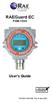 RAEGuard EC FGM-13XX User s Guide P/N 033-4102-000 Rev B May 2007 - READ BEFORE OPERATING - This manual must be carefully read by all individuals who have or will have the responsibility of using, maintaining,
RAY-MAX Integrated Solar Power Strip
 RAY-MAX Integrated Solar Power Strip 600008, 600009, 600010, 600208, 600209, 600210 Owner s Manual NEXTRONEX, INC. Revision Date: 10/27/14 Contents 1. Safety Instructions... 3 2. General Equipment Warnings...
OEM Manual MODEL 2350 ELECTRONIC DUAL CYLINDER SCALE
 OEM Manual MODEL 2350 ELECTRONIC DUAL CYLINDER SCALE Scaletron Industries, Ltd. Bedminster Industrial Park 53 Apple Tree Lane P.O. Box 365 Plumsteadville, PA 18949 USA Toll Free: 1-800-257-5911 (USA &
Duct Humidity Transmitter
 SDC-H Duct Humidity Transmitter Features Replaceable sensor element Humidity measurement for air ducts Minimum and maximum value memory 0 0V, 0 0mA or 0V, 4 0mA measuring signals selectable with jumpers
Advantium 2 Plus Alarm
 ADI 9510-B Advantium 2 Plus Alarm INSTALLATION AND OPERATING INSTRUCTIONS Carefully Read These Instructions Before Operating Carefully Read These Controls Corporation of America 1501 Harpers Road Virginia
RI-215A Operator s Manual. Part Number: 71-0045RK Revision 0 Released: 10/3/05
 RI-215A Operator s Manual Part Number: 71-0045RK Revision 0 Released: 10/3/05 Warranty RKI Instruments, Inc., warrants gas alarm equipment sold by us to be free from defects in materials and workmanship,
ETC TWO STAGE ELECTRONIC TEMPERATURE CONTROL
 RANCO INSTALLATION INSTRUCTIONS ETC TWO STAGE ELECTRONIC TEMPERATURE CONTROL Relay Electrical Ratings PRODUCT DESCRIPTION The Ranco ETC is a microprocessor-based family of electronic temperature controls,
FlameGard 5 UV/IR. Ultraviolet/Infrared Flame Detector
 FlameGard 5 UV/IR Ultraviolet/Infrared Flame Detector The information and technical data disclosed in this document may be used and disseminated only for the purposes and to the extent specifically authorized
Automatic Transfer Switch FT-10 Network Control Communications Module (CCM-T) Kit 541 0811
 Instruction Sheet 1-2003 Automatic Transfer Switch FT-10 Network Control Communications Module (CCM-T) Kit 541 0811 PURPOSE OF KIT A CCM-T is used to monitor and control an automatic transfer switch. The
RMM2 Heat-Tracing Remote Monitoring Module for the Raychem NGC Control System Installation Instructions
 Heat-Tracing Remote Monitoring Module for the NGC Control System Installation Instructions Tools Required 3 mm slotted screwdriver 3/8 hex key (for -4X only) Approvals Nonhazardous locations Type NM LISTED
When any of the following symbols appear, read the associated information carefully. Symbol Meaning Description
 Samba OPLC SM35-J-R20 Installation Guide The Unitronics SM35-J-R20 offers the following onboard I/Os: 12 Digital Inputs, configurable via wiring to include: 1 HSC/Shaft-encoder Input, 2 Analog inputs (only
* DISCLAIMER: Contents. How to Use This Guide: COMMERCIAL INSTALL GUIDE 2
 COMMERCIAL INSTALL GUIDE 2 Contents How to Use This Guide: The first section of this guide is designed to assist you with the installation of your DECK Monitoring hardware. The revenue grade meter and
D7050/D7050TH. Installation Instructions. Multiplex Photoelectric Smoke Detectors
 D7050/D7050TH EN Installation Instructions Multiplex Photoelectric Smoke Detectors D7050/D7050TH Installation Instructions.0 Description Notices These instructions cover the installation of the D7050/D7050TH
ATS Overhead Table Shelf System INSTRUCTION MANUAL
 ATS Overhead Table Shelf System INSTRUCTION MANUAL ATS Overhead Table Shelf System Instruction Manual Warranty Newport Corporation warrants this product to be free of defects in material and workmanship
Explosion proof enclosures
 1 of 7 Explosion proof enclosures DE8 C 2 of 7 The Ex d enclosures are rugged and designed for harsh environment like: Oil and gas industry Chemical industry Pharmaceutical industry Agribusiness Without
INSTALLATION OPERATION AND MAINTENANCE INSTRUCTIONS FOR EXHEAT INDUSTRIAL IMMERSION HEATERS (INCLUDING FLAMEPROOF)
 INSTALLATION OPERATION AND MAINTENANCE INSTRUCTIONS FOR EXHEAT INDUSTRIAL IMMERSION HEATERS (INCLUDING FLAMEPROOF) Please read these instructions thoroughly before installation and ensure they are passed
DC400 Dispensing Cutoff System
 DC400 Dispensing Cutoff System DC404 and DC406 Installation Instructions Franklin Fueling Systems 3760 Marsh Rd. Madison, WI 53718 USA Tel: +1 608 838 8786 800 225 9787 Fax: +1 608 838 6433 www.franklinfueling.com
MCR1900 Media Converter 19-Slot Chassis
 MCR1900 Media Converter 19-Slot Chassis Installation Guide Part #5500304-11 Copyright Statement This document must not be reproduced in any way whatsoever, either printed or electronically, without the
RGC-IR Remote Gas Calibrator for IR400
 Remote Gas Calibrator for IR400 The information and technical data disclosed in this document may be used and disseminated only for the purposes and to the extent specifically authorized in writing by
Single Station Remote Alarm
 ADI 5106G Certified ISO 9001:2000 Single Station Remote Alarm 529 5106-01-120 529 5106-01-220 INSTALLATION AND OPERATING INSTRUCTIONS Carefully Read These Instructions Before Operating Controls Corporation
INSTALLATION INSTRUCTIONS
 LIGHTING CONTROL PANELS 4 AND 8 RELAYS INSTALLATION INSTRUCTIONS INSTALLATION OVERVIEW The installation instructions contained in this document are provided as a guide for proper and reliable installation.
DORMA MODEL PS-406BB POWER SUPPLY INSTALLATION INSTRUCTIONS
 Features: INSTALLATION Install in accordance with NFPA 70. DORMA MODEL PS-406BB POWER SUPPLY INSTALLATION INSTRUCTIONS Up to 1.95 Amps Load Capacity Class 2 Rated Outputs Overload, Over Voltage, and Short
TECHNICAL DATASHEET #TD1404AX PWM CONTROLLED SOLENOID DRIVER
 TECHNICAL DATASHEET #TD1404AX PWM CONTROLLED SOLENOID DRIVER (PWM Input, 1.2A or 2A Output, Metal Box or PCB) PCB Board - P/N: PWMC-PCB-2A, PWMC-PCB-1.2A Packaged Driver (metal box with 1.5 m (5 ft.) cable)
Manual for Fire Suppression & Methane Detection System
 Manual for Fire Suppression & Methane Detection System Fogmaker North America Post address: 150 Gordon Dr Exton, PA 19341 Delivery address: 150 Gordon Dr Exton, PA 19341 Tel: 610-265-3610 Fax: 610-265-8327
INSTALLATION GUIDE. Card Reader & Controller with KIM Swipe Reader for Solitaire 850 / 950 / 850L Learnlok PK2930
 INSTALLATION GUIDE Card Reader & Controller with KIM Swipe Reader for Solitaire 850 / 950 / 850L Learnlok PK2930 Card Reader and Controller Model 3.5 with KIM Swipe Reader Table of Contents 1. Features..................................
Outdoor 33.6W Dual Port Passive Power-over-Ethernet Midspan For External Security Cameras and Wireless Access Points
 Outdoor 33.6W Dual Port Passive Power-over-Ethernet Midspan For External Security Cameras and Wireless Access Points Features SELV Compliant No Detection Passive Injector Gigabit Compatible Full Protection
12 Volt 30 Amp Digital Solar Charge Controller
 12 Volt 30 Amp Digital Solar Charge Controller User s Manual WARNING Read carefully and understand all INSTRUCTIONS before operating. Failure to follow the safety rules and other basic safety precautions
FIRE ALARM SYSTEM TECHNICAL SPECIFICATIONS Page 1 of 10
 TECHNICAL SPECIFICATIONS Page 1 of 10 FIRE DETECTION AND ALARM SYSTEM Scope Furnish a complete 24V DC conventional, electrically supervised, zone annunciated, fire detection and alarm system as specified
Installation Instructions for Alarm Module Kit A043F059
 Instruction Sheet 07-2013 Installation Instructions for Alarm Module Kit A043F059 1 Introduction The information contained within is based on information available at the time of going to print. In line
INSTALLATION AND OPERATING INSTRUCTIONS For Model GL1 Gate Locks
 Securitron Magnalock Corp. www.securitron.com ASSA ABLOY, the global leader Tel 800.624.5625 [email protected] in door opening solutions INSTALLATION AND OPERATING INSTRUCTIONS For Model GL1 Gate
Part I - Installation
 400 Series Pressure and Differential Pressure Switches Types: H400, H402, H403, H400K, H402K, J400, J402, J403, J400K, J402K UNITED ELECTRIC CONTROLS Installation and Maintenance Instructions Please read
VX 2400 Dimmer User's Manual
 TM VX 2400 Dimmer User's Manual 21-2119C Manual Revision 1.01 Software Version 1.0 10 March 1994 Table of Contents 1. General Description...3 1.1. Standard Features:...3 2. Installing Options...4 2.1.
Instruction Manual. T3111 T3111L T3111P T3111Ex
 www.cometsystem.cz Instruction Manual T3111 T3111L T3111P T3111Ex Programmable transmitter of temperature, relative humidity and other calculated humidity values with external probe and 4-20 ma outputs
EX-5175-EC Sensor/Transmitter Manual
 PO Box 979 Ann Arbor, MI 48106-0979 www.enmet.com EX-5175-EC Sensor/Transmitter Manual Manual Part Number 80003-099 MCN-13-008, 11/06/13 Table of Contents 1.0 INTRODUCTION... 1 1.1 Unpack... 1 1.2 Check
LD2 One & Two Zone Water Detection Alarm Installation and Operation Manual
 CMR Electrical Ltd Bolton House Five Chimneys Lane Hadlow Down East Sussex TN22 4DX Tel: 01825 733600 LD2 One & Two Zone Water Detection Alarm Installation and Operation Manual Contents 1) Operation 2)
DIGITAL ALARM II FOR HOSPITALS AND LABORATORIES INSTALLATION AND OPERATING INSTRUCTIONS 52 635.0
 Form No. 74-00-4001 S168-195-001 Revision E DIGITAL ALARM II FOR HOSPITALS AND LABORATORIES INSTALLATION AND OPERATING INSTRUCTIONS 52 635.0 INTRODUCTION Allied Healthcare Products, Inc. s Digital Alarm
FIRERAY 2000 Installation Guide
 FIRERAY 2000 Installation Guide Features Range 33ft to 330 ft. 24Vdc operation Selectable alarm thresholds Low current consumption Ground level electronics Manual or Automatic reset System Description
Detector transparent with Color Inserts. FAA 500 TR P Trim Ring transparent with Color Inserts. FCA 500 / FCA 500 E Detector Bases
 Detector Color Detector transparent with Color Inserts FAA 500 TR W Trim Ring FAA 500 TR P Trim Ring transparent with Color Inserts FAA 500 BB Ceiling Mount Back Box FCA 500 / FCA 500 E Detector Bases
PART 1 - INTRODUCTION...
 Table of Contents PART 1 - INTRODUCTION... 3 1.1 General... 3 1.2 Sensor Features... 3 1.3 Sensor Specifications (CDE-45P)... 4 Figure 1-1 CDE-45P Sensor Dimensions (standard, convertible style)... 4 PART
CONNECTOR AMPLIFIER FOR PROPORTIONAL VALVES (4-20 ma Input Version)
 TECHNICAL DATASHEET #TD1102AX CONNECTOR AMPLIFIER FOR PROPORTIONAL VALVES (4-20 ma Input Version) Part Number: Connector Amplifier CAPV-H-4-20MA-x complete with cable CAPV-4C-yM Where: x = current output
SECTION 26 09 26 LOW VOLTAGE LIGHTING CONTROLS
 SECTION 26 09 26 LOW VOLTAGE LIGHTING CONTROLS PART 1 - GENERAL 1.01 RELATED DOCUMENTS: A. The Conditions of the Contract and applicable requirements of Division 1, "General Requirements", and Section
Installation instructions for Series NRX INCOM communications adapter module
 4000 NRX RF DRAWOUT SUBTITLE IMAGE (12/15/2010) Effective July 2015 Supersedes October 2010 IL01301033EH04 Installation instructions for Series NRX INCOM communications adapter module Instructions apply
ABB Drives. User s Manual. Pulse Encoder Interface Module RTAC-01
 ABB Drives User s Manual Pulse Encoder Interface Module RTAC-0 Pulse Encoder Interface Module RTAC-0 User s Manual 3AFE 64486853 REV A EN EFFECTIVE:.5.00 00 ABB Oy. All Rights Reserved. Safety instructions
TS93 EMR T/PT/TDE. Surface applied door closer
 TS EMR T/PT/TDE Surface applied door closer Installation instructions: Pull side track mount door closer with smoke detector (EMR T) Push side track mount door closer with smoke detector (EMR PT) Double
Submersion/Insertion Toroidal Sensor
 Instruction Sheet PN 51A-228/rev.P December 2010 Model 228 Submersion/Insertion Toroidal Sensor For additional information, please visit our website at www.emersonprocess.com/raihome/liquid/. CAUTION SENSOR/PROCESS
Applied Electronics. Commercial Dimming System UPDATE NOTICE
 REV. A Applied Electronics Commercial Dimming System UPDATE NOTICE This notice is to inform the end user of an additional feature added to this DP12/2400 dimming unit. This unit has been outfitted with
AXIS T81B22 DC 30W Midspan
 INSTALLATION GUIDE AXIS T81B22 DC 30W Midspan ENGLISH About this Document This document includes instructions for installing AXIS T81B22 on your network. Previous experience of networking will be beneficial
Troubleshooting and Diagnostics
 Troubleshooting and Diagnostics The troubleshooting and diagnostics guide provides instructions to assist in tracking down the source of many basic controller installation problems. If there is a problem
TSn SERIES Surge Protective Device
 Page: 1 of 8 TSn SERIES Surge Protective Installation & Operation Manual 3621 Saunders Avenue www.systems.us Ph 804.355.1100 Richmond, VA 23227 4354 [email protected] Fax 804.355.8900 Page: 2 of 8 Quick
Roof Top Air Conditioner INSTALLATION AND OPERATING INSTRUCTIONS
 Roof Top Air Conditioner INSTALLATION AND OPERATING INSTRUCTIONS Ducted System RECORD THIS UNIT INFORMATION FOR FUTURE REFERENCE: Model Number: Serial Number: Date Purchased: This manual must be read and
Operating Instructions
 Important information: These instructions contain safety information, read and follow them carefully. Dialight will not accept any responsibility for injury, damage or loss which may occur due to incorrect
Solid Core and Split Core Adjustable Current Status Switches CSS-O, CSS-C; CSP-O, CSP-C
 Solid Core and Split Core Adjustable Current Status Switches CSS-O, CSS-C; CSP-O, CSP-C DESCRIPTION FEATURES PRODUCT DATA Very low operating trip points LED status indication Integral DIN rail mounting
Toroidal Conductivity Sensor
 Instruction Sheet PN 51A-/rev.C June 2012 Toroidal Conductivity Sensor For additional information, please visit our website at www.emersonprocess.com/rosemountanalytical.com SPECIFICATIONS Wetted Materials:
98371000 REV. REL 1302 WEST BEARDSLEY AVENUE P.O. BOX 1127 ELKHART IN 46515 (574) 295-8330 FAX (574) 293-9914 2011 ELKHART BRASS MFG. CO., INC.
 81471067 Electric Monitor Motor Control Panel For use with Model 8394059 SPIT-FIRE Monitor Installation, Operation, and Maintenance Instructions FOR ATEX APPLICATIONS 1302 WEST BEARDSLEY AVENUE P.O. BOX
SolarEdge. RS485 Expansion Kit Installation Guide. Version 1.0
 SolarEdge RS485 Expansion Kit Installation Guide Version 1.0 Disclaimers Disclaimers Important Notice Copyright SolarEdge Inc. All rights reserved. No part of this document may be reproduced, stored in
FTW 175 VERIZON Wireless Monitoring System Reference Manual Part Number 7911751VERIZON
 FTW 175 VERIZON Wireless Monitoring System Reference Manual Part Number 7911751VERIZON SERIAL NUMBER Flash Technology, 332 Nichol Mill Lane, Franklin, TN 37067 (615) 261-2000 Front Matter Abstract This
HMI display Installation Guide
 HMI display Installation Guide Product Description Specifications Important Information o Package Contents o Related Documents o Accessories Cautions and Warnings Mounting and Dimensions o BAC-DIS-ENC
PD 100A. Printing data system
 PD 100A Printing data system Operating instructions ENGLISH IMPORTANT: Read these instructions carefully before installing and using the device; do not forget following all additional information. Keep
OPLC Installation Guide
 Samba OPLC SM43-J-T20/ SM35-J-T20 OPLC Installation Guide 12 Digital Inputs, include 1 HSC/Shaft-encoder Input, 2 Analog inputs (only when the digital inputs are set to pnp), 8 Relay Outputs 12 Digital
NELSON VOLTAGE MONITOR INSTALLATION & PROGRAMMING MANUAL
 NELSON VOLTAGE MONITOR INSTALLATION & PROGRAMMING MANUAL CONTENTS GENERAL INFORMATION...3 INSTALLATION...3 FIELD WIRING...4 PROGRAMMING...4 Circuit Monitor Options...5 Power Frequency...5 Alarm Silence
MAKING MODERN LIVING POSSIBLE. AK-SC255 On-Site Installation Guide DANFOSS ELECTRONIC CONTROLS & SENSORS
 MAKING MODERN LIVING POSSIBLE AK-SC255 On-Site Installation Guide DANFOSS ELECTRONIC CONTROLS & SENSORS How to Use This Guide Read this Guide completely as you install and start up your new AK-SC 255 controller.
DLP-PU/E Instruction Manual
 Instruction Manual BEFORE USING THE POWER SUPPLY UNIT Pay attention to all warnings and cautions before using the unit. Incorrect usage could lead to an electrical shock, damage to the unit or a fire hazard.
Operation & Maintenance Manual. Electrochemical (EC) Gas Sensor Family
 Operation & Maintenance Manual Electrochemical (EC) Gas Sensor Family For Detection of Oxygen and Toxic Gases Important: Read and understand contents prior to first use. Improper use or operation could
with MERCURY FREE 1 HP Relays ! WARNING Before using this product read and understand instructions.
 B Installation & Maintenance Instructions MM-414 Series 150E and 157E Low Water Cut-Off/Pump Controllers For Steam Boilers and Other Level Control Applications A Typical Applications: Primary or secondary
G670 Intermittent Pilot Ignition Controls
 Installation Sheets Manual 121 Gas Combustion Combination Controls and Systems Section G Technical Bulletin Issue Date 0300 Intermittent Pilot Ignition Controls Figure 1: Intermittent Pilot Ignition Control
i ChatterBox! Motorcycle Security
 i Before you Start the Installation * Please read this manual to become familiar with the requirements necessary to complete the installation. * Use a high quality multi-meter to test all wires before
Series 510 Submersible Level Transmitters
 Series 510 Submersible Level Transmitters The Series 510 Submersible Level Transmitters are solid state instruments designed for direct submergence into many types of liquid for quick, accurate and reliable
BUILT-IN DISHWASHER INSTALLATION INSTRUCTIONS
 BUILT-IN DISHWASHER INSTALLATION INSTRUCTIONS PLEASE READ COMPLETE INSTRUCTIONS BEFORE YOU BEGIN LEAVE INSTALLATION INSTRUCTIONS AND USER'S GUIDE WITH OWNER ALL ELECTRIC WIRING AND PLUMBING MUST BE DONE
Shunt lock function 3066
 Version: January 2004 Contents Alarm System Activation unit Deactivation unit Digital locking cylinder or Smart Relay 1.0 Method of Operation 4 1.1 General 4 1.2 Turning the Alarm System On 4 1.3 Turning
36G22, 36G23, 36G24 & 36G52 36J22, 36J23, 36J24 & 36J52 DSI and HSI Single Stage Combination Gas Valve
 Operator: Save these instructions for future use! FAILURE TO READ AND FOLLOW ALL INSTRUCTIONS CAREFULLY BEFORE INSTALLING OR OPERATING THIS CONTROL COULD CAUSE PERSONAL INJURY AND/OR PROPERTY DAMAGE. DESCRIPTION
Mobile Data Power Model: MDP-25
 Mobile Data Power Model: MDP-25 Topic Section Features... 2 Operational Features Summary... 2 Back-up Battery Power Internal Charger Voltage Spike Protection RF Noise Filtering Warning of Imminent Loss
Continuous Monitoring of Flue and Combustible or Hazardous Gases and Vapors
 Continuous Monitoring of Flue and Combustible or Hazardous Gases and Vapors www.static-control.in 1 Introduction The detection or monitoring of flue gases and or hazardous gases has been a complex subject
33.6W Power over Ethernet Waterproof Adapter PoE Plus Single Port Injector for Outdoor Application
 33.6W Power over Ethernet Waterproof Adapter PoE Plus Single Port Injector for Outdoor Application Features Compliant with the IEEE802.3at Standard -40 to +60 C Temperature Range Diagnostic LEDs Full Protection
Global Water Instrumentation, Inc.
 Global Water Instrumentation, Inc. 11390 Amalgam Way Gold River, CA 95670 T: 800-876-1172 Int l: (916) 638-3429, F: (916) 638-3270 6 Tipping Bucket: RG200 02/05/10 01-343 - 1 - Congratulations on your
SDX Submersible Depth Transmitter User Manual
 SDX Submersible Depth Transmitter User Manual January 2011 USER INFORMATION Stevens makes no warranty as to the information furnished in these instructions and the reader assumes all risk in the use thereof.
A99B Series Temperature Sensors
 FANs 125, 121, 930, 930.5 Product/Technical Bulletin A99 Issue Date 0615 A99B Series Temperature s The A99B Series Temperature s are passive PTC (Positive Temperature Coefficient) sensors. The A99B sensors
NC-12 Modbus Application
 NC-12 Modbus Application NC-12 1 Table of Contents 1 Table of Contents... 2 2 Glossary... 3 SCADA...3 3 NC-12 Modbus in general... 3 4 Entire system... 4 4.1 PFC to PC connection alternatives...4 4.1.1
Inductive Sensors Single or Dual Loop Detectors Type LD with teach-in
 Inductive Sensors Single or Dual Loop Detectors Type LD with teach-in Single or Dual loop detector Automatically adjustment of detection level Manual sensitivity for compensations of variations Easy installation
LIEBERT VNSA Installation Sheet
 LIEBERT VNSA Installation Sheet Description The Liebert vnsa network switch is designed for connecting multiple Ethernet-ready devices and comes in various models. The unit may have: A Liebert icom display
INSTALLATION & SERVICE MANUAL. Display Panel
 INSTALLATION & SERVICE MANUAL Display Panel The PowerLine EMS TM is a specialized power distribution and energy management system intended to be used in recreational vehicles. The Control Module is housed
Terminal Boxes Series 8146
 Series > Enclosures in shock-resistant glass fibre reinforced polyester resin > basic enclosure sizes various heights > Fitted according to the customer's requirements > For terminals up to max. 00 mm
OPERATING INSTRUCTIONS
 PIPELINE INSPECTION COMPANY LTD. OPERATING INSTRUCTIONS Wet Sponge Holiday Detectors 670,673, and MSRB Wet Sponge Holiday Detectors Portable and In-Plant Detectors Table of Contents General Information.......................3
3.0 CHARACTERISTICS. AR Auxiliary Relay High Speed, High Threshold 41-759.3C
 41-759.3C the magnetic core upon energizing of the switch. When the switch closes, the moving contacts bridge two stationary contacts, completing the trip circuit. Also during this operation two fingers
Digi-Motor Installation Guide
 Digi-Motor Installation Guide Installation Video...located at marsdelivers.com Digi-Motor Installation Guide Digi-Motor For technical assistance with your Azure Digi-Motor, call the MARS technical support
EX-TECH SAS CP/PB 150 EXPLOSIONPROOF MANUAL CALL POINT/ PUSH BOTTON TECHNICAL MANUAL
 PRODUCT NAME: CP/PB -150- EXPLOSION-PROOF-MANUAL CALL POINT/ PUSH BOTTON DOC NO.: EX-TECH SAS-12-CP-PB150-TM REV01 EXPLOSION-PROOF MANUAL CALL POINT/ PUSH BOTTON II 2GD EPL Gb, Db Ex d IIC T6, IP66 Ex
Technical data sheet TDS0070
 Technical data sheet TDS0070 ATEX Certified II 2 G Ex d IIC T4 Gb IECEx Certified Ex d IIC T4 Gb Ta = -20ºC to +60ºC FEATURES INCLUDE: - ATEX and IECEx Certified explosion proof Exd housing for Premier
PHOTOVOLTAIC SYSTEM CONTROLLERS SUNSAVER MODELS INCLUDED IN THIS MANUAL SS-6 / SS-6L SS-10 / SS-10L SS-10-24V / SS-10L-24V SS-20L SS-20L-24V
 PHOTOVOLTAIC SYSTEM CONTROLLERS OPERATOR S MANUAL SUNSAVER MODELS INCLUDED IN THIS MANUAL SS-6 / SS-6L SS-10 / SS-10L SS-10-24V / SS-10L-24V SS-20L SS-20L-24V 6A / 12V 10A / 12V 10A / 24V 20A / 12V 20A
BARDIC. 4 & 8 Zone Fire Panels Zircon range. Data, installation, operation and maintenance. by Honeywell
 Data, installation, operation and maintenance 4 & 8 Zone Fire Panels Zircon range BARDIC by Honeywell LED flashing LED Continuous FAULT DISABLE/TEST Power General Fault Sounder Fault/ Disable System Fault
AMERBRITE UNDERWATER WHITE LED POOL LAMP
 AMERBRITE UNDERWATER WHITE LED POOL LAMP FOR USE ONLY WITH PENTAIR AMERLITE LUMINAIRE INSTALLATION AND USER S GUIDE IMPORTANT SAFETY INSTRUCTIONS READ AND FOLLOW ALL INSTRUCTIONS SAVE THESE INSTRUCTIONS
Fiber Optic Selector Guide for Analog & Digital Data Links, Contact Closures & Multiplexers
 Fiber Optic Selector Guide for Analog & Digital Data Links, Contact Closures & Multiplexers Analog Data Links Multi-Channel Contact Closures Multiplexers Digital Data Links - Contact Closures Power Supply
User s Manual Before using the inverter, you need to read and save the safety instructions.
 User s Manual Before using the inverter, you need to read and save the safety instructions. STI SERIES (STI200, STI300, STI500, STI700, STI1000) Power Frequency Pure Sine Wave Inverter The information
ECO SENSORS, INC. OZONE SENSOR AND MONITOR
 ECO SENSORS, INC. OZONE SENSOR AND MONITOR Model A-22 11-07 INSTRUCTIONS FOR USE Sensor Rubber boot to protect against mechanical damage. Data and power jacks on the side. SM-X precalibrated sensor module.
Installation and Operation Manual. Digital Remote Meter for Monitoring System Performance. Version: RM-1
 REMOTE METER TM Installation and Operation Manual. Digital Remote Meter for Monitoring System Performance. Version: RM-1 1098 Washington Crossing Road Washington Crossing, PA 18977 USA www.morningstarcorp.com
3. SEISCO PARTS & SERVICE REMOVAL AND REPAIR GUIDE
 4 3. SEISCO PARTS & SERVICE REMOVAL AND REPAIR GUIDE A. Changing the Control Board B. Replacing a Heating Element C. Thermistor Replacement D. High Limit Switch Replacement E. Level Detector Replacement
PT-6000 Power Tower INSTALLATION MANUAL SPECIFICATIONS
 PT-6000 Power Tower INSTALLATION MANUAL 10.5 9.75 12 22.75 10.75 MAXIMUM SOIL HEIGHT: DO NOT ALLOW FILL TO EXCEED THIS LEVEL! 11.5 4 4 13 Optional PT-BASE for new installations or when previous 2000/6000