
LM8UU Prusa Mendel Build Manual
|
|
|
- Marianna Fields
- 9 years ago
- Views:
Transcription
1 LM8UU Prusa Mendel Build Manual The programs supplied and referenced in this manual are free software: you can redistribute them and/or modify them under the terms of the GNU General Public License as published by the Free Software Foundation, either version 3 of the License, or (at your option) any later version. These programs are distributed in the hope that they will be useful, but WITHOUT ANY WARRANTY; without even the implied warranty of MERCHANTABILITY or FITNESS FOR A PARTICULAR PURPOSE. See the GNU General Public License for more details. You should have received a copy of the GNU General Public License along with these programs. If not, see Copyright 2012 NextDayReprap All registered trademarks belong to their respective owners, any unauthorized copying and redistribution is strictly prohibited. E&OE

2 A step by step guide for building your Prusa Mendel 3D Printer Kit. The following instructions will take you through every step to build and commission your Prusa Mendel 3D printer. All the parts required are included in your kit. We recommend you read through the complete manual to familiarize yourself with the process before starting. We also recommend you read the following important points about your kit and the parts it contains. Plastic Parts All our plastic parts are printed on the same printers that you will be building. The parts are built at varying densities to suit their application. Some are required to be stronger than others. You should take special care when inserting bearings or nuts into plastic part recesses. Some parts have more fragile areas. When inserting bearings ensure the part is held firmly on a flat surface, ensuring there is no force on fragile areas. Then push the bearing into the recess, increase the force until the bearing clips into place. If you cannot get the bearing in place, using a pair of large pliers and a small amount of force should ensure they go all the way in, always ensure you keep the bearing level and avoid pushing in at an angle. Plastic parts will wear over time. You should regularly follow the the maintenance tips in the manual to ensure your printer remains reliable. We recommend that if your first purpose is not to build yourself or a friend a second printer then you should print a spare set of parts for your own. This will help you in the future should a critical part wear out. This is also a great way to familiarize yourself with the print process and all the files you need are included on the CD-Rom. This manual is available to view and download as a pdf on our website

3 Health & Safety This is a kit of components for assembly into a 3D Printer by the end user. Building and using the printer is potentially very dangerous as it involves electricity and high temperatures. Building the printer will require a certain amount of physical dexterity, common sense and a thorough understanding of what you are doing. We have provided this fully comprehensive build documentation to enable you to build your Prusa Mendel 3D Printer Kit in a safe manner, we have pre assembled many of the more complicated components, such as the electronics to make it easier for you. However ultimately we cannot be responsible for your health and safety whilst building or operating the printer, with that in mind be sure you are confident with what you are doing prior to commencing with building or buying. Read all of the manual to enable you to make an informed decision. Building and operating involves electricity, so all necessary precautions should be taken and adhered to, the printer runs on 12V supplied by a certified power supply, so you shouldn t ever have to get involved with anything over 12V but bear in mind there can still be high currents involved and even at 12V they shouldn t be taken lightly. High temperatures are involved with 3D Printing, the Extrusion nozzle of the hot end runs at 230 C, the heated bed runs a 110 C and the molten plastic extruded will initially be at around 200 C, so special care and attention should be made when handling these parts of the printer during operation. We wouldn t recommend leaving your printer running un attended, or at least until you are confident to do so. We cannot be held responsible for any loss, damage, threat, hurt or other negligent result from either building or using the printer.
4 Contents - Reprap Prusa Mendel Build Manual 1.0 Bill of Materials 1.1 Check Kit Contents & Familiarize yourself with the kit components 2.0 Frame Assembly 2.1 Parts Required 2.2 Assembly 3.0 Y Axis Assembly 3.1 Parts Required 3.2 Assembly 4.0 X Z Axis Assembly 4.1 Parts Required 4.2 Assembly 5.0 Y Carriage Assembly 5.1 Parts Required 5.2 Assembly 6.0 Motor/Belt & Endstop Assembly 6.1 Parts Required 6.2 Assembly 7.0 Build/Heated Bed Assembly 7.1 Parts Required 7.2 Assembly 8.0 Extruder Assembly 8.1 Parts Required 8.2 Assembly 3.3 Hot End Connection 9.0 Wiring 9.1 Parts Required 9.2 Completing Connections 9.3 RAMPS Diagram 9.4 RAMPS Board Connections 10.0 Computer setup 10.0 Hardware Driver Installation 10.1 Hardware Setup & Connection Ardunio Driver - Windows XP Installation Ardunio Driver - Windows 7 / Vista 10.2 Arduino Software Installation Ardunio Software - Windows XP Installation Ardunio Software - Windows 7 / Vista Installation
5 Contents - Reprap Prusa Mendel Build Manual 10.3 Python Environment & Dependencies Installation Python Environment & Dependencies - Windows XP Installation Python Environment & Dependencies - Windows 7 / Vista Installation 10.4 Pronterface Installation Pronterface/PrintRun- Windows XP Installation Pronterface/PrintRun - Windows 7 / Vista Installation 10.5 Skienforge Installation Skienforge - Windows XP Installation Skienforge - Windows 7 / Vista Installation 10.6 Testing Software & Communicating With the Printer Connecting Hardware & Testing - Windows XP Connecting Hardware & Testing - Windows 7 / Vista Firmware Installation Flashing Firmware, Test & Comms - Windows XP Flashing Firmware, Test & Comms - Windows 7 / Vista 10.8 Firmware Variables 11.0 Commissioning & Calibration 11.1 Hardware Setup & Connection Frame Levelling 11.2 Bed Levelling 11.3 Endstops 11.4 Pololu Stepper Driver Calibration 11.5 Hot End 11.6 Heated Bed 11.7 Loading Filament 11.8 Removing Filament 11.9 Changing Hot Ends Printing a Test Print 12.0 Maintenance 12.0 Health & Safety 12.1 Axis Lubrication 12.2 Hot End & Nozzle 12.3 Nuts & Bolts 12.4 Extruder & Gears 12.5 Electronics 12.6 Pulley Grub Screws & Belt Tensions 12.7 Build Surface 12.8 Bed Leveling 12.9 Plastic Parts Bearings

6 1.0 Bill of Materials - Reprap Prusa Mendel Build Manual Check Kit Contents & Familiarize yourself with the kit components Below is a complete list of all the components within your kit, please check everything is present prior to starting your build. It includes everything you need to build your printer and start printing, except for a computer! If anything is missing please advise us straight away. Tools & Ancillaries 0.1 Build Manual 0.2 Operation Manual 0.3 Software CD/Flash Drive M 20mm Kapton Tape 0.5 Cable Ties Kg White 3mm ABS Filament 0.12 Silver Tape 0.13 Cable Tidy 1.0 Electronics 1.1 Fully assembled RAMPS 1.4 Wired & Soldered with Hot end power & Thermistor attached. 1.2 Ramps Power Cables 1.3 3x Mechanical Endstops with Completed Wiring

7 1.0 Bill of Materials - Reprap Prusa Mendel Build Manual W ATX PSU 1.5 ATX Power Supply Adaptor (to switch PSU) 1.6 V2 Heat bed with Surface Mount LEDs/Resistor & Soldered Power Cable (inc Thermistor) x Nema 17 Stepper Motors with Connectors & Crimps

8 1.0 Bill of Materials - Reprap Prusa Mendel Build Manual 1.8 Fully assembled Hot End wired for Power & Thermistor with Mini Fit Molex connectors. 1.9 Mains Power Lead (Kettle Type) & 1M USB 2.0 Cable 2.0 Rod 2.1 6x 300mm A2 Stainless 1.25mm Pitch Threaded Rod - YUP 2.2 2x 450mm BZP 1.25mm Pitch Threaded Rod 2.3 1x 320mm BZP 1.25mm Pitch Threaded 2.4 6x 380mm BZP 1.25mm Pitch Threaded Rod 2.5 2x 330mm Bright Stainless Steel Round Rod - YUP 2.6 2x 400mm Steel Round Rod 2.7 2x 400mm Steel Round Rod 2.8 1x 16mm Steel Round Rod ( Extruder Idler) 2.9 1x 50mm Threaded Rod (X Idler)

9 1.0 Bill of Materials - Reprap Prusa Mendel Build Manual 3.0 Nuts & Bolts x M2 16mm Hex Socket Bolts x M3 10mm Hex Socket Bolts x M3 20mm Hex Socket Bolts 3.4 2x M3 40mm Hex Socket Bolts 3.5 2x M4 50mm Hex Socket Bolts 3.6 2x M4 45mm Hex Head Bolts 3.7 4x M4 40mm Countersunk Hex Socket Bolts 3.8 6x M8 30mm Fender/Penny Washers 3.9 6x M2 Nuts x M3 Nuts x M4 Nuts x M8 Nuts x M3 Nylock Nuts x M8 Nylock Nuts x M2 Washers x M3 Washers x M4 Washers x M8 Washers x Hobbed Bolt x M3 10mm Grub Screw (Extruder Small Gear)

10 1.0 Bill of Materials - Reprap Prusa Mendel Build Manual 4.0 Bearings & Pulleys & Couplings x LM8UU Bearings (1 Spare) (Some may have been pre fitted to the printed parts) x 608ZZ Bearings (1 Spare) 4.3 2x 12 tooth T5 XL Aluminum Pulleys 4.4 2x Rigid Z Axis Couplings

11 1.0 Bill of Materials - Reprap Prusa Mendel Build Manual 5.0 Springs x Heat Bed Springs 5.2 2x Z Axis Springs 5.3 2x Extruder Springs 6.0 Timing Belts 6.1 2x 1M Brecoflex 6mm T5 Belt
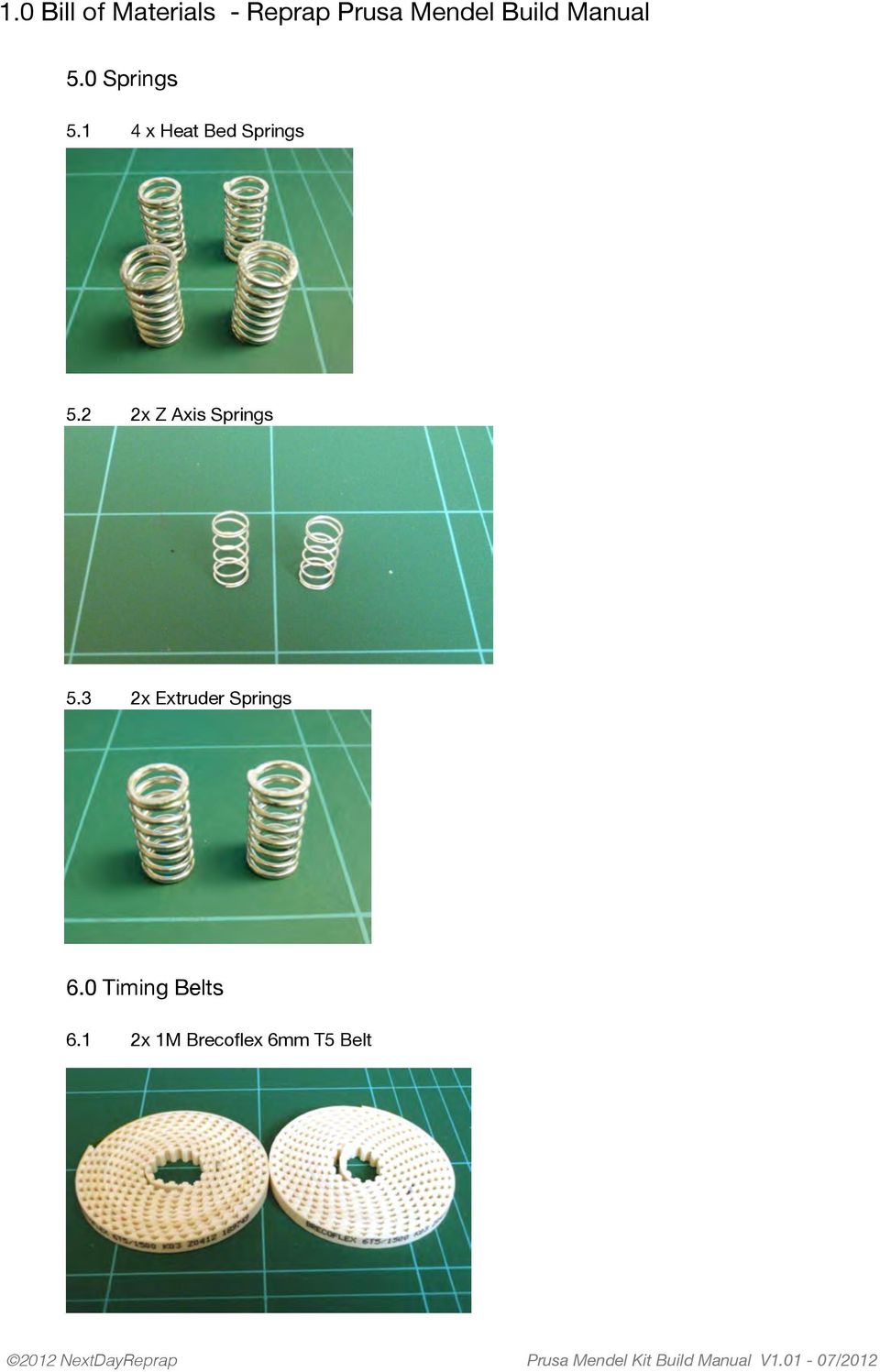
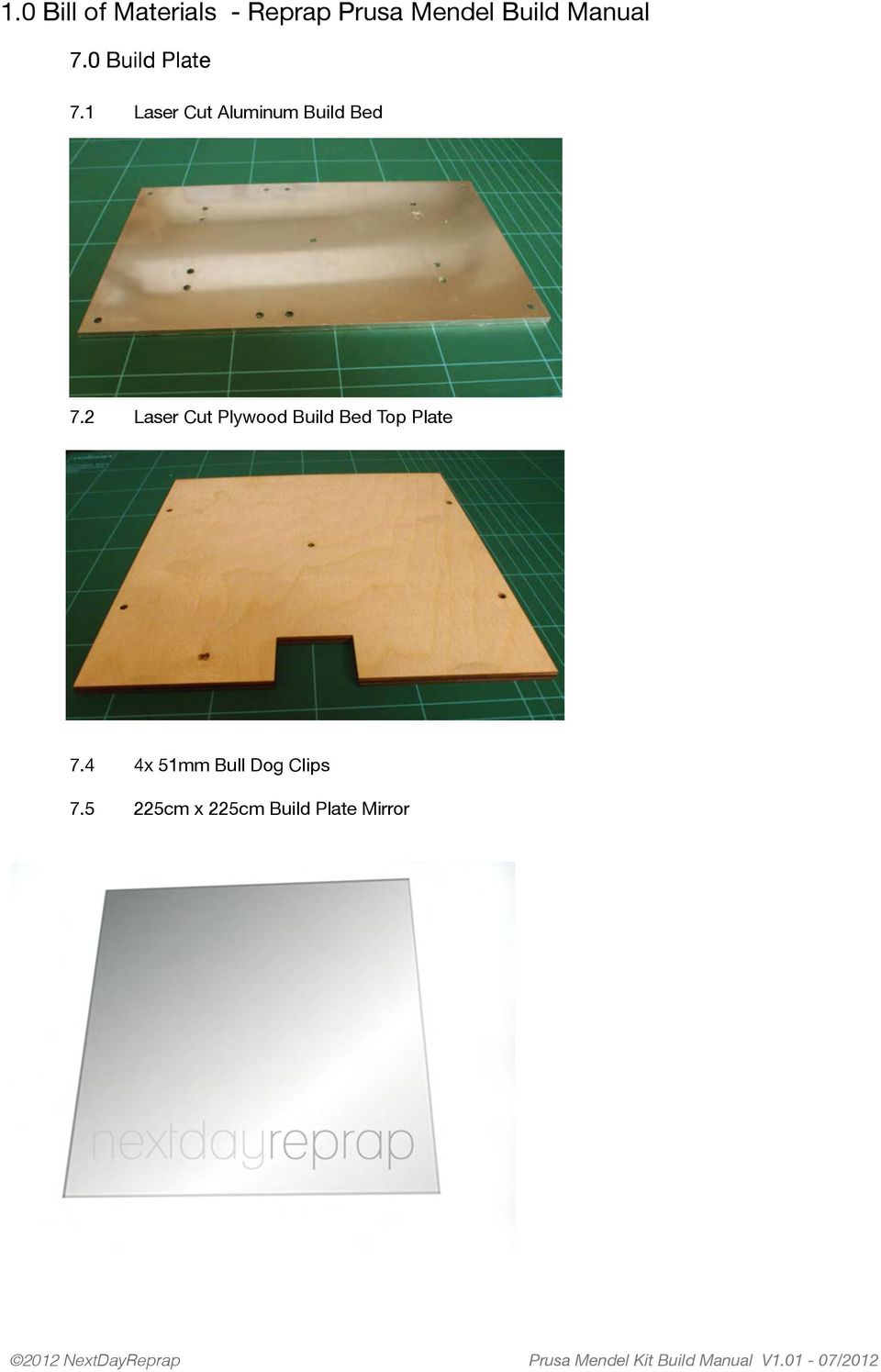
12 1.0 Bill of Materials - Reprap Prusa Mendel Build Manual 7.0 Build Plate 7.1 Laser Cut Aluminum Build Bed 7.2 Laser Cut Plywood Build Bed Top Plate 7.4 4x 51mm Bull Dog Clips cm x 225cm Build Plate Mirror
13 1.0 Bill of Materials - Reprap Prusa Mendel Build Manual 8.0 Printed Parts 8.1 4x Bar Clamps x Rod Clamps x Belt Clamps x Endstop Holder x LM8UU Bearing Pillows

14 1.0 Bill of Materials - Reprap Prusa Mendel Build Manual x Extruder x Extruder Idler x Extruder Large Gear x Extruder Small Gear x Frame Vertex 8.8 4x Frame Vertex with Foot
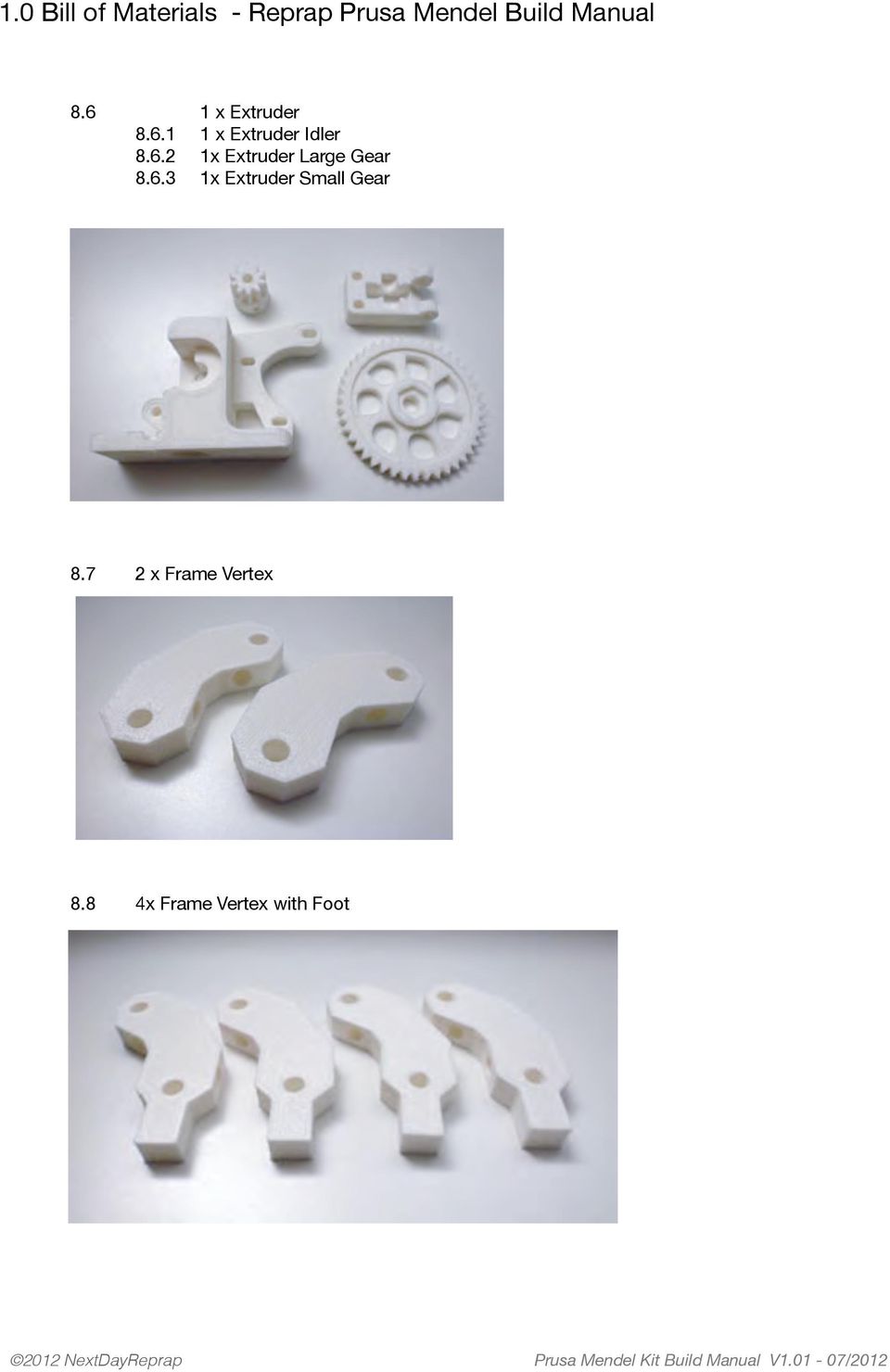
15 1.0 Bill of Materials - Reprap Prusa Mendel Build Manual 8.9 2x Lower Z Mount x X Motor Mount x X Idler x Y Motor Mount

16 1.0 Bill of Materials - Reprap Prusa Mendel Build Manual x Z Motor Mount x X Carriage x Hot End Clamp x Ramps Box
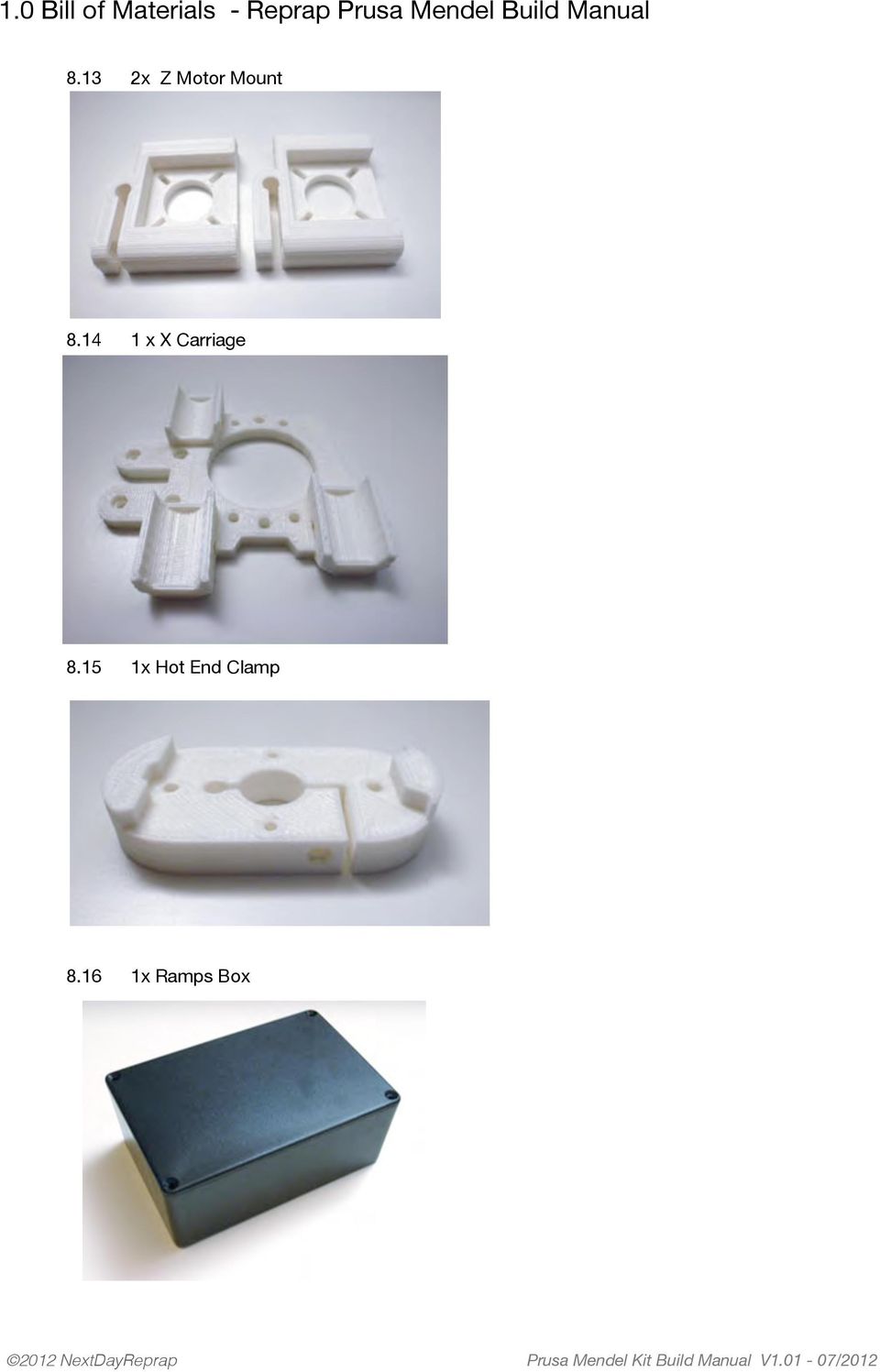
17 1.0 Bill of Materials - Reprap Prusa Mendel Build Manual All Printed Parts

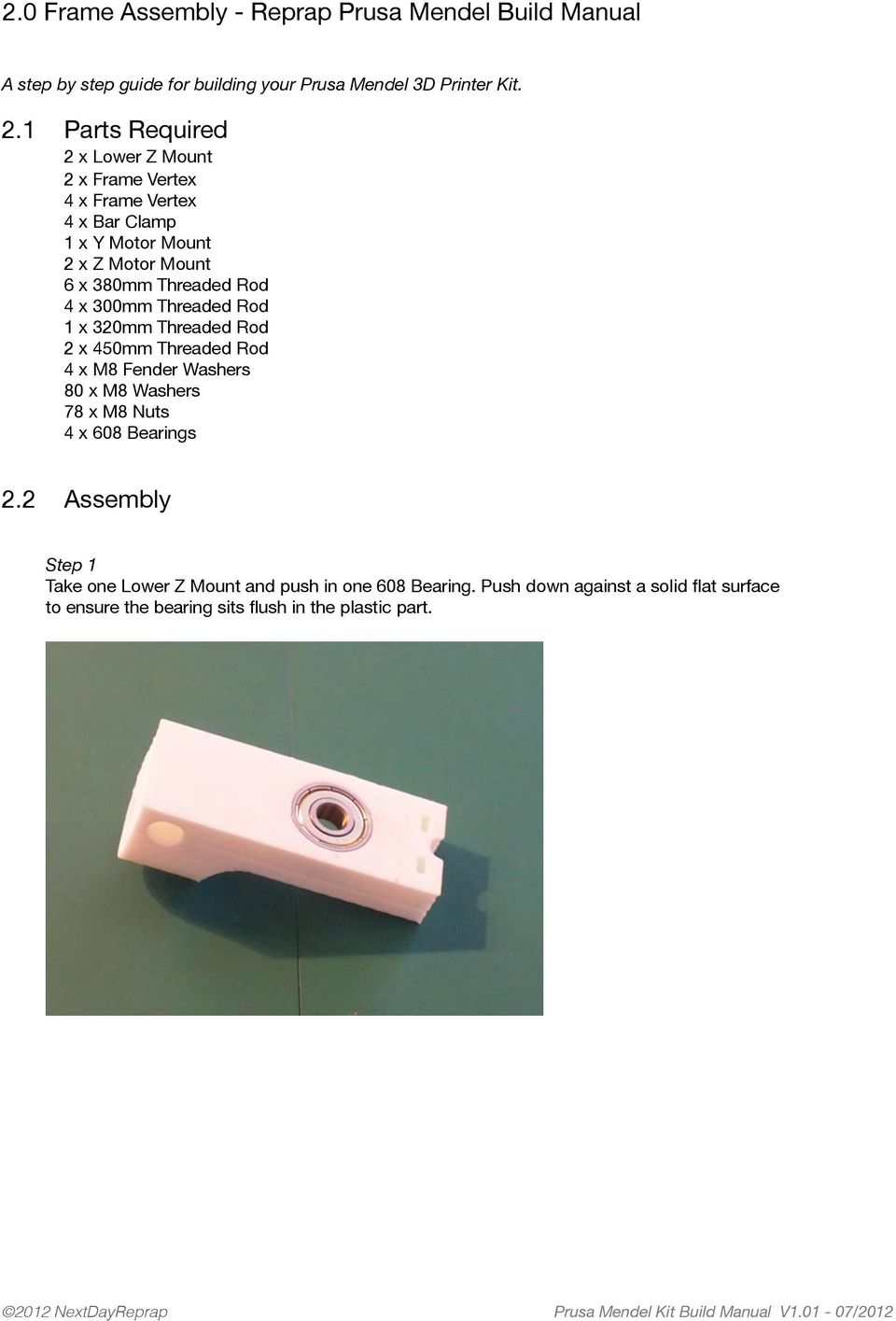
18 2.0 Frame Assembly - Reprap Prusa Mendel Build Manual A step by step guide for building your Prusa Mendel 3D Printer Kit. 2.1 Parts Required 2 x Lower Z Mount 2 x Frame Vertex 4 x Frame Vertex 4 x Bar Clamp 1 x Y Motor Mount 2 x Z Motor Mount 6 x 380mm Threaded Rod 4 x 300mm Threaded Rod 1 x 320mm Threaded Rod 2 x 450mm Threaded Rod 4 x M8 Fender Washers 80 x M8 Washers 78 x M8 Nuts 4 x 608 Bearings 2.2 Assembly Step 1 Take one Lower Z Mount and push in one 608 Bearing. Push down against a solid flat surface to ensure the bearing sits flush in the plastic part.
19 2.0 Frame Assembly - Reprap Prusa Mendel Build Manual Step 2 Take one 380mm Threaded Rod and thread on the following parts from left to right. M8 Nut/M8 Washer/Vertex with Foot/M8 Washer/M8 Nut/M8 Nut/M8 Washer/Lower Z Mount/M8 Washer/ M8 Nut/M8 Nut/M8 Washer/Vertex with Foot/M8 Washer/M8 Nut. Space the parts as in the photo below. Leave approximately 5mm of thread showing on the end of the rods. The Lower Z mount should be central on the rod. Do not over tighten the M8 Nuts. Leave them finger tight at this stage. Step 3 Take one 380 mm Threaded Rod and thread on the following parts from left to right. M8 Washer/M8 Nut/M8 Nut/M8 Washer/Frame Vertex/M8 Washer/M8 Nut. Space apart as in the photo below.

20 2.0 Frame Assembly - Reprap Prusa Mendel Build Manual Step 4 Take another 380 mm Threaded Rod and thread on the following parts from left to right. M8 Nut/M8 Washer/M8 Nut. Push this rod through the Frame Vertex from step 3 and attach an M8 washer and M8 nut to secure it. Your component should look like the photo below. Step 5 Take your component from step one and thread it on to the component from step four. Add an M8 washer and M8 nut to the end of the threaded rods. Your component should look like the photo below.

21 2.0 Frame Assembly - Reprap Prusa Mendel Build Manual Step 6 Now measure the distance between the inside edges of the printed frame vertices. Make this gap 290 mm. Loosely tighten the M8 nuts against the vertices and adjust evenly until all three sides are 290mm. The Lower Z Mount should be left loose and approximately in the centre of the rod. Check your measurements and tighten the M8 nuts against the vertices ensuring your frame side is stiff and even. Step 7 Repeat steps 1 to 6 and you should now have two frame sides. Place these to one side.
22 2.0 Frame Assembly - Reprap Prusa Mendel Build Manual Step 8 Take one 300mm Threaded Rod and thread on the following parts from left to right. M8 Washer/M8 Nut/M8 Nut/M8 Washer. This component should look like the photo below. Step 9 Take one 300mm threaded rod and thread on the following parts from left to right. M8 Washer/ M8 Nut/M8 Nut/M8 Washer/Bar Clamp/M8 Washer/M8 Nut/M8 Nut/Fender Washer/M8 Washer/608 Bearing/M8 Washer/Fender Washer/M8 Nut/M8 Nut/M8 Nut/M8 Washer/Bar Clamp/M8 Washer/M8 Nut/M8 Nut/M8 Washer.This component should look like the photo below.
23 2.0 Frame Assembly - Reprap Prusa Mendel Build Manual Step 10 Take two 300mm threaded rods. Thread the Y Motor Bracket on to both rods as in the photo below. Then thread all of the following parts on the upper threaded rod (The upper rod is the one that is closest to the longer flat edge on the Y Motor Bracket), from left to right. M8 Washer/M8 Nut/M8 Nut/M8 Washer/Bar Clamp/M8 Washer/M8 Nut/M8 Nut/Fender Washer/M8 Washer/ 608 Bearing/M8 Washer/Fender Washer/M8 Nut/M8 Washer/Y Motor Bracket/M8 Washer/M8 Nut/M8 Nut/M8 Washer/Bar Clamp/M8 Washer/M8 Nut/M8 Nut/M8 Washer. Then Thread the following parts on the lower threaded rod, from left to right. M8 Washer/M8 Nut/M8 Nut/M8 Washer/Y Motor Bracket/M8 Washer/M8 Nut/M8 Nut/M8 Washer. This component should look like the photo below.
24 2.0 Frame Assembly - Reprap Prusa Mendel Build Manual Step 11 Take two 450 mm threaded rods and thread them each with the following parts from left to right. M8 Washer/M8 Nut/M8 Nut/M8 Washer. Space them as in the photo below (leave approximately 100mm of threaded rod on each end). Step 12 Take one 320 mm threaded rod and thread it with the following parts from left to right. M8 Washer/M8 Nut/M8 Nut/M8 Washer. Space them as in the photo below.
25 2.0 Frame Assembly - Reprap Prusa Mendel Build Manual Step 13 The next steps will take you through joining your two triangle components together using the rods created in steps 8 to 12. Take one of the frame sides you completed in step seven and the threaded rod from step from step 12. Slide the threaded rod through the lower Z mount and add an M8 Washer and M8 Nut to secure it. Ensure the Lower Z mount has the 608 bearing facing up. Step 14 Take the rod from step ten and thread through the vertex with foot as the photo below. Use an M8 Washer and M8 Nut on each rod to secure it. Ensure the longer flat edge of the Y Motor Bracket is at the bottom.
26 2.0 Frame Assembly - Reprap Prusa Mendel Build Manual Step 15 Take the rod from step eight and thread through the lower hole on the second vertex foot. Use an M8 Washer and M8 Nut to secure it. Step 16 Take the rod from step nine and thread through the upper hole on the second vertex foot. Use an M8 Washer and M8 Nut to secure it.
27 2.0 Frame Assembly - Reprap Prusa Mendel Build Manual Step 17 Take a 450 mm Rod from step eleven and slide them through the upper frame vertices. Use an M8 Washer and M8 Nut to secure it. Step 18 You can now attach the second frame side from step seven. Push it onto each of the roads ensuring the lower Z mounts both face outwards with the 608 bearing upwards. Secure the end of each of the threaded rods with an M8 Nut and M8 Washer. Your frame should look like the picture below.
28 2.0 Frame Assembly - Reprap Prusa Mendel Build Manual Step 19 You can now adjust the width of the frame. Gently tighten the frame until the gap between the inside edges of the vertices is 250mm. Adjust each rod gradually tightening until all are 250mm gaps once tight your frame should be solid and sturdy on a level surface if you find your frame wobbles when on a flat surface check the spacing between vertices and ensure they are 290mm between vertices on the triangle sides and 250mm across the width. Adjust your frame in opposite corners by approximately 2 mm at a time until until your frame is solid. The lower Z mounts should still be loose and sit approximately central. Step 20 Add a washer to each end of both 450 mm threaded bars that go through the upper vertices, then push on the Z Motor Mounts to each side. If you had to make adjustments for leveling you may find you need to add one or two extra M8 Washers between the frame vertices and Z motor mounts for them to sit flat in line with the upper frame vertices. Add an M8 Washer and M8 Nut to each rod and loosely tighten the rod clamp side, then firmly tighten the plain side. Once attached it should look like the picture below note that the clamp is loose.
29 3.0 Y Axis Assembly - Reprap Prusa Mendel Build Manual 3.1 Parts Required 2x 400mm Smooth Rod 4 x LM8UU Bearing 3.2 Assembly Step 1 Ensure the M8 nuts holding the Rod Clamps in position are loose and then slide a 400mm Smooth Rod through from one side. Before pushing the rod into the second rod clamp slide two LM8UU Bearings on to the rod. Repeat this for both rods. It should look like the picture below. Step 2 Slide the rods into the second rod clamps. Centre the rods 50mm from the inside edge of the frame vertices. Do not fully tighten yet. ensure the rod clamp has 1-2mm of play. These will be adjusted and tightened during the Y Carriage Assembly.
30 4.0 X/Z Axis Assembly Assembly - Reprap Prusa Mendel Build Manual 4.1 Parts Required 1 x X Motor Mount 1 x X Idler End 1 x X Carriage 2 x Belt Clamps 2 x Z Axis Springs 2 x Rod Clamps 2 x 300mm Smooth Rod 2 x 400mm Smooth Rod 2 x Aluminum Couplings 7 x LM8UU Bearings 8 x M3 Washer 8 x M3 20mm Bolt 8 x M3 Nut 1 x 50mm Threaded Rod 4 x M8 Nut 2 x M8 Fender Washer 5 x M8 Washer 4.2 Assembly Step 1 This step may already be completed and your X Mounts will have bearings installed and secured with cable ties. If so go on to step two. Take the X End Idler and push two LM8UU Bearings into the side recesses. Push in until the bearings locate fully in the bearing guides. Repeat this bearing installation on the X Motor Mount. Be careful not to put pressure on to the brackets on these parts.
31 4.0 X/Z Axis Assembly Assembly - Reprap Prusa Mendel Build Manual Step 2 Take one 300mm Threaded Rod and thread on one M8 nut approximately 100mm on from the left. Slide a Z Axis Spring on from the opposite end. Repeat this step so you have two rods. Step 3 Take one rod push through the X end idler so that the spring is compressed inside the deep hexagonal recess on the part, then thread an M8 Nut on from the opposite end and thread on until it meets the X end idler base. Keep the spring compressed and twist the rod to locate the nut into the recess of the X End Idler. Once the lower nut is located, release the pressure on the spring and the rod should be held in place with the spring pushing out against the nuts. Twist the rod and ensure it twists through the nuts cleanly and smoothly. Repeat this with the second rod and X Motor Mount.
32 4.0 X/Z Axis Assembly Assembly - Reprap Prusa Mendel Build Manual Step 4 Now take two 400mm smooth rods and push in to the horizontal holes on the X end idler. Then slide two LM8UU Bearings onto the rod closest to the motor mounting point. Slide one LM8UU Bearing on to the other smooth rod. Check the picture below to ensure your bearings are on the correct rods. Step 5 Slide the X Motor Mount onto the rods and then slide two 300mm smooth rods through the LM8UU bearings in each X end part. It should now look like the photo below.
33 4.0 X/Z Axis Assembly Assembly - Reprap Prusa Mendel Build Manual Step 6 Take the XY axis you have made and position into the frame as in the photo below. Pass the axis through the centre of the frame. Straighten the axis and slide the threaded rods through the 608 bearings in the lower Z Mounts, now slide the smooth rods on the XY axis up into the Z Motor mount clamps. secure the top of the rods in the clamps by tightening the M8 nuts on the 450mm Threaded Rod top bars. Step 7 Locate the bottom of the smooth rod in the cut-out on the lower Z Mount. Place an M3 Nut in each of the recesses on the lower Z mounts. secure the smooth rods using M3 20mm Bolts and M3 Washers and the two Rod Clamps.
34 4.0 X/Z Axis Assembly Assembly - Reprap Prusa Mendel Build Manual Step 8 Take the X carriage and attach two Belt Clamps using 20 mm M8 bolts and Washers and push M8 Nuts into the recesses on the underside. Leave the belt clamps loose. Then place the X carriage onto the X axis bearings and ensure the bearings are located correctly. They should sit snug in the X carriage. Use small zip ties to secure the carriage. Step 9 Take the 50mm threaded rod and thread on two M8 Nuts and an M8 Washer. Thread this though the hole on the X end idler. Then thread on the following parts. M8 Washer/Fender Washer/M8 Washer/608 Bearing/M8 Washer/Fender Washer/M8 Nut/M8 Nut. Tighten the M8 Nuts against each other to ensure the idler is tight and the rod does not wobble but the 608 bearing is free to spin.
35 5.0 Y Carriage Assembly Assembly - Reprap Prusa Mendel Build Manual A step by step guide for building your Prusa Mendel 3D Printer Kit. 5.1 Parts Required 1 x Aluminum Bed 4 x LM8UU Bearing Pillow 2 x Belt Clamp 8 x M3 10mm Bolt 4 x M3 20mm Bolt 12 x M3 Nut 16 x M3 Washer 5.2 Assembly Step 1 Take the four LM8UU bearing pillows and push M3 Nuts into each of the recesses. Attach the bearing pillows to the aluminum bed using 10 mm M3 Bolts and M3 Washers. On the opposite side of the aluminum bed attached two Belt Clamps using 20mm M3 Bolts and M3 Washers with M3 Nuts and M3 Washers on the underside.
36 5.0 Y Carriage Assembly Assembly - Reprap Prusa Mendel Build Manual Step 2 Place the bed over the Y axis smooth rods. Check the below picture to ensure your bed is orientated the correct way. The belt clamps on the bed should line up with the 608 Bearings on the frame. Lineup the bearings on the Y smooth rods and carefully clip the pillows on to the bearing. Ensure you line up the bearings correctly before applying any pressure to the LM8UU bearing pillow. If you feel unsure about how much pressure is required you may find is easier to remove the Y smooth rods and slide off the 4 LM8UU Bearings. You can then install them in the pillows first. Then slide the whole bed back on and put the Y rods back in place. You can also loosen the M3 bolts holding the LM8UU Bearing Pillows to allow more adjustment. Once the bed is in place go round and gradually tighten the bar clamps holding the Y rods. While tightening slide the bed back and forward and adjust by tightening the M8 nuts against the bar clamps until they are all tight and the bed maintains a smooth action. Adding a small amount of bearing grease to the Smooth Rods can help ensure your bed runs smoothly.
37 6.0 Motor/Belt/Endstop Assembly - Reprap Prusa Mendel Build Manual 6.1 Parts Required 4 x Nema Stepper Motor 2 x Aluminum Pulley 2 x T5 Belt 3 x Endstop Holder 3 x Microswitch 2 x Carbon Tube Insert 6 x M2 15mm Bolt 6 x M2 Nut 12 x M2 Washer 14 x M3 10mm 17 x M3 Washer 6.2 Assembly Step 1 Attach one aluminum pulley in to a Nema stepper motor ensuring the grub screw end is closest to the motor body the motor shaft should be flush with the pulleys edge. Tighten the grub screw against the flat side of the motor spindle. Mount the motor on to the Y motor mount using 10mm M3 Bolts.
38 6.0 Motor/Belt/Endstop Assembly - Reprap Prusa Mendel Build Manual Step 2 Take another nema stepper motor and aluminum pulley and attach the pulley the opposite way round to the previous step. The grub screw end should be furtherest from the motor body. The motor shaft should be flush with the pulleys edge. Tighten the grub screw against the flat side of the motor spindle. Mount the motor on the X motor mount using 10mm M3 Bolts. Step 3 Mount two Nema stepper motors in the Z motor mounts with the shafts pointing down. Attach using four M3 10mm Bolts M3 Washers for each motor.
39 6.0 Motor/Belt/Endstop Assembly - Reprap Prusa Mendel Build Manual Step 4 Attach an aluminum coupling to the top of the Z axis threaded rod and tighten the grub screw. Repeat for the second Z axis. Then lift the XZ axis assembly so that the aluminum couplings meet the Z motor shafts. Ensure the grub screws in the couplings line up with flat part of the motor shaft and once fully in position tighten the grub screws against the motor shafts. Once both couplings are in place they should support the X axis. Now level the the X axis by measuring the height from your work surface to the bottom of once of the X End plastic parts. Now hold the coupling still on that the side you measured and turn the coupling on the other side. the X Mount should move up or down, you can now adjust in the required direction until both X Mounts are the same height from your work surface. Step 5 Take a T5 Belt and run it around the X Idler Bearing and the X Motor pulley. Bring the ends together under the belt clamps on the X carriage. Pull the ends through until the belt is tight but does not strain the X idler mount. Tighten the M3 Bolts in the X Carriage to hold the belt in place.
40 6.0 Motor/Belt/Endstop Assembly - Reprap Prusa Mendel Build Manual Step 6 Take the second T5 Belt and run around the 608 Bearings and the Y motor pulley, place the ends under the belt clamps on the aluminum bed and tighten the M3 bolts just enough to hold the belt still. now adjust the M8 Nuts either side of the 608 Bearings on the frame and move until the belt, bearings and pulleys all run in a straight line, gradually tighten the M8 Nuts, the Belt Clamps and the Y motor Mount while sliding the bed back and forward and ensure the belt runs straight, the bed should move smoothly, however you may feel some resistance from the stepper motors. Only a small amount of force should be needed to move the bed and it should not have a jerky motion. Once you are happy gradually tighten the Nuts and tighten the belt clamps down. Step 7 Take a microswitch and attach it to an Endstop Holder using 20mm M2 Bolts with an M2 Washer on each side and an M2 Nut.
41 6.0 Motor/Belt/Endstop Assembly - Reprap Prusa Mendel Build Manual Step 8 Using 20mm M3 Bolts with a washer and an M3 Nut placed in the End Stop Holder recess, attach the first Endstop assembly to the Z Axis Smooth Rod underneath the X Idler. It should be positioned so the microswitch is depressed when the X Idler comes down the Z axis and hits the microswitch, before hitting the print bed. Loosely attach and this will be adjusted when the print bed is assembled. Place the second of the Endstop assemblies on the X Axis smooth rod where is will be activated when the X Carriage returns along the X axis. Place the third assembly on the Y axis smooth rod to the right of the Y Motor, this will be activated by the aluminum bed.
42 7.0 Build/Heated Bed Assembly - Reprap Prusa Mendel Build Manual 7.1 Parts Required 1 x Wooden Bed 4 x Bed Springs 4 x M4 Countersunk Bolts 1 x Bed Thermistor 1 x Heated Bed 1 x Aluminum Tape 4 x M4 Nut 12 x M4 Washer 6 x Bulldog Clip 7.2 Assembly Step 1 Lay the Wooden Bed with the countersunk holes face down and the cut out at the bottom. Using the Aluminum Tape attach the Bed Thermistor to the Wooden Bed. The thermistor should poke through the central hole on the bed about 1mm. Tape this securely and run the cable to the right.
43 7.0 Build/Heated Bed Assembly - Reprap Prusa Mendel Build Manual Step 2 Place the wooden bed over the Aluminum Bed on your printer. The Aluminum tape should be facing down and the cut out in the Wooden Bed should be at the front of the frame (The Y Motor Is the rear of the frame). Secure this in place using the M4 Countersunk Bolts. Thread the bolt through the Wooden Bed, Then thread on an M4 Washer, Bed Spring and M4 Washer, thread through the Aluminum Bed and add an M4 Washer and M4 Nut. Repeat this in each corner and then tighten down so that the springs compress to 2/3rds of the original length. Measure the gap between the wooden bed and aluminium bed in one sprung corner and then adjust the other corners to the same height. You can also use a small spirit level to ensure the bed is as level as possible. Place the spirit level on each side of the wooden bed and adjust the sprung bolts to get an even level at each edge. Then place the spirit level diagonally across the bed to and adjust the sprung bolts if necessary.
44 7.0 Build/Heated Bed Assembly - Reprap Prusa Mendel Build Manual Step 3 Place the Heated Bed on the Wooden bed, thread the cables under the wooden bed and follow the thermistor cables out the left hand side. Position the centre of the Heated Bed over the thermistor in the centre of the wooden bed and hold in place with the 6 bulldog clips. Once in place remove the silver spring arms from the bulldog clips, leaving the black clamps in place.
45 8.0 Extruder & Hot End Assembly - Reprap Prusa Mendel Build Manual 8.1 Parts Required 1 x Hot End 1 x Extruder 1 x Extruder Idler 1 x Extruder Large Gear 1 x Extruder Small Gear 1 x Hot End Clamp 1 x Hobbed Bolt 4 x M8 Washer 1 x M8 Nylock Nut 3 x 608 Bearing 1 x 16mm Smooth Rod 2 x M3 40mm Bolt 2 x M3 Nylock Nut 4 x M3 Washer 2 x M4 50mm Bolt 4 x M4 Nut 6 x M4 Washer 2 x Extruder Spring 1 x Nema Stepper Motor 1 x M3 Grub Screw 1 x M3 Nut 3 x M3 10mm Bolt 8.2 Assembly Step 1 Take the 16mm Smooth Rod and slide through a 608 Bearing. Place this into the Extruder idler. Push in until the Smooth Rod is fully located. Using a 40mm M3 Bolt with M3 washer and M3 Nylock Nut attach the idler to the Extruder.
46 8.0 Extruder & Hot End Assembly - Reprap Prusa Mendel Build Manual Step 2 Push a 608 Bearing in to the recess on the flat side of the extruder. Take the Hobbed Bolt and slide on the Extruder large gear. Then Thread on 4 M8 Washers, one 608 Bearing and 1 M8 Washer. Slide the hobbed bolt through the Extruder and through the 608 Bearing. Add 2 M8 Washers and an M8 Nylock Nut and tighten together until there is no wobble on the Hobbed Bolt but the Extruder Large Gear turns freely. Step 3 Push 2 M4 Nuts in to the recesses on the top of the Extruder and pull up the the idler. Take two 40mm M4 Bolts and thread on each an M4 Washer, Idler Spring and M4 Washer. Push through the idler and screw into the M4 bolts in the recesses. Ensure the bolts screw in and compress the springs then loosen the bolts back off.
47 8.0 Extruder & Hot End Assembly - Reprap Prusa Mendel Build Manual Step 4 Take the Extrude Small Gear and push an M3 Nut in to the recess, secure the nut using an M3 Grub Screw. Take a Nema Stepper Motor and Line up the grub screw with the flat part of the motor shaft and push the gear onto the shaft. The Motor shaft should be flush with the edge of the gear. Tighten the grub screw. Step 5 Attach the motor to the Extruder using three 10mm M3 Bolts. when in position loosen the bolts a little and push the motor in so the gears fit as tightly as possible against the Large Gear. Then tighten the motor in place.
48 8.0 Extruder & Hot End Assembly - Reprap Prusa Mendel Build Manual 8.3 Hot End Connection Step 6 Take the Hot End Clamp and push a M3 Nylock nut in to the recess on the side. Secure with a 40mm M3 Bolt and M3 Washer. The clamp can be very tight, this is to ensure the hot end stays in place. You may find it useful to use a longer M3 bolt. There will be one in the spare parts bag. Leave the clamp loose. Push two 50mm Hex Top Bolts through the base of the extruder so the heads locate in the recesses. Slide the Hot end clamp on to the Hex Top Bolts. Ensure that the clamp opening is on the same side as the extruder gear. The clamp only fits on to the X Carriage one way so if it is the incorrect way round, your Extruder will be mounted backwards.
49 8.0 Extruder & Hot End Assembly - Reprap Prusa Mendel Build Manual Step 7 Take your Hotend part and inspect it carefully before using. Check that the barrel is not loose and there are no gaps between components. There are two resistors running through the aluminum block, check there are no breaks on the connections. There is a smaller thermistor also in the top of the aluminum block. the glass bead on this should be inside the block. If it is protruding from the block or has slipped out completely, use a pair of tweezers and gently push it in to the aluminum block. Hold the Brass tip up to a light and look through the Hotend, Make sure you can see the pin hole and ensure there is no debris inside. Make sure the PTFE lining is pushed in fully and flush with the top of the Hotend. Step 8 Take your Hotend Part and remove the white PTFE Disc. Push this in to the 16mm round recess on the bottom of the extruder. This disc acts as a barrier stopping the inner PTFE lining of the Hotend from being pulled out when the extruder reverses. Push it all the way through the clamp and in to the Extruder recess, ensure it is all the way in and flat.
50 8.0 Extruder & Hot End Assembly - Reprap Prusa Mendel Build Manual Step 9 Take your Hot end and push in to the recess to butt up against the PTFE Disc. The Hotend must be pushed all the way in to the extruder. Do not leave any gap between the extruder, PTFE Disc and Hotend. Once in place, ensure the Hotend Clamp is pushed all the way up to the extruder and tighten the clamp around the Hotend. Step 10 Now take your Extruder/Hotend assembly and feed the Hotend cables down through the centre of the X Carriage part. The Gears on the extruder should face the front of the printer. The rear of the printer (the rear has the Y Motor Mount).
51 8.0 Extruder & Hot End Assembly - Reprap Prusa Mendel Build Manual Step 11 Once the cables are through line up the Hex Bots with the X Carriage and guide the whole assembly down. Step 12 Push the Hotend Clamp down on the the X Carriage and it should clip tightly in to place. Use an M4 Washer and M4 Nut on each of the hex bolts and tighten all the way up. Make sure the Extruder assembly is tightly held and does not wobble.
52 8.0 Extruder & Hot End Assembly - Reprap Prusa Mendel Build Manual Step 13 Check everything is tight and that your Hotend has not moved or loosened. Feed the cables from the Hotend and Motor up and through the two top Threaded rods ready to connect to your RAMPS Board.
53 9.0 Wiring - Reprap Prusa Mendel Build Manual 9.1 Parts Required RAMPS Board Power Supply USB Cable 5 x PC Header Black Plastic Connectors 20 x Crimp Terminals 9.2 Completing Connections The Nema Stepper Motors that you have mounted on the printer will require the plastic PC Header connectors crimped and connected to the wires before you can attach them to your RAMPS hardware. The following instructions will guide you through the process. If you are experienced at this type of connection we recommend that you put small amount of solder on the crimps to ensure there longevity. You should always double check the order the the wires are connected before pushing in to the black plastic PC Header plugs as they are very difficult Step 1 Take the four coloured (Red, Blue, Green, Black) wires from the Nema Stepper Motor and strip 5mm of the plastic sheath from each of the wires.
54 9.0 Wiring - Reprap Prusa Mendel Build Manual Step 2 Take one of the Crimp connectors and place the Red stripped wire as shown below. Ensure the longer metal prongs on the connector line up with the sheathed part of the wire. The bare wire should sit in the centre of the connector. Step 3 Now crimp down the smaller metal prongs. Ensure they hold the wire tight. Make sure there are no loose or frayed strands of wire.
55 9.0 Wiring - Reprap Prusa Mendel Build Manual Step 4 Crimp the larger of the prongs around the sheathed part of the wire. Ensure these grip the sheathed wires, but do not crush the wire. Ensure your crimps are small and tight on the wire. Ensure the connector is not bent. The whole of the metal connector will slide in to the plastic PC Header connector so you should ensure there are no wires hanging and the metal crimp is secure. Step 5 Repeat the the process until all four wires from the stepper motor have connectors attached.
56 9.0 Wiring - Reprap Prusa Mendel Build Manual Step 6 Take a plastic PC Header connector and hold it so that the cut outs on the flat side face you. Line up the Red wire with your crimp connector. The crimp should have the flat side down. The red wire goes in to the right hand hole in the connector. Step 7 Slide the connector in to the PC Header connector as shown in the photo. The connector must slide all the way in until your feel a click as the crimp connector locates in to the plastic. If your crimp will not go all the way in, check that your crimped prongs are tight enough. To check that your wire is all the way in look in to the PC Header connector and the crimp should be visible and you should see that it is in as far as possible.
57 9.0 Wiring - Reprap Prusa Mendel Build Manual Step 8 Repeat fitting the connectors in the PC Header connector for each wire. Ensure the order matches the photo below. From left to right it should be Black, Green, Blue and Red. Step 9 Repeat the steps for all five of your stepper motors. You are now ready to connect to your RAMPS Board.
58 9.0 Wiring - Reprap Prusa Mendel Build Manual 9.3 RAMPS Board Diagram
59 9.0 Wiring - Reprap Prusa Mendel Build Manual 9.4 RAMPS Board Connection You can now connect your printer to the RAMPS Hardware. Your RAMPS board already has two cables connected, these are for the Hotend thermistor and power, the ends are labeled. You should place your ramps board the to rear left hand side of your printer. Run the Hotend cables over the printer and drop through the upper threaded rods Connect these to your Hotend. As you connect your components to the ramps board use cable ties to hold the cables against the frame and ensure no cables are trapped or touching moving parts. We recommend loosely tidying cables until your printer is fully running and then making permanent later. Make sure when connecting plastic connectors, that the pins are fully inserted in to the plastic plugs, but have not pushed the connector out of the plug housing. Step 1 Start by connecting the Heated Bed power cable to the screw terminals labelled D8 on the Ramps Board. Ensure the red wire is screwed in to the positive (+) terminal and black to negative (-).
60 9.0 Wiring - Reprap Prusa Mendel Build Manual Step 2 Connect the Heated Bed Thermistor to connector labelled T1. The orientation does not matter on this connector only. Step 3 Connect the X Endstop Microswitch to the connector labelled x. There should be two rows of 6 pins. The x is the first pair, the next endstop connectors will use every other pair of pins. Ensure the black cable is closest to the centre of the RAMPS board.
61 9.0 Wiring - Reprap Prusa Mendel Build Manual Step 4 Connect the Y Endstop Microswitch to the connector labelled y. Ensure the black cable is closest to the centre of the RAMPS board. Step 5 Connect the Z Endstop Microswitch to the connector labelled z. Ensure the black cable is closest to the centre of the RAMPS board.
62 9.0 Wiring - Reprap Prusa Mendel Build Manual Step 6 Connect the X Motor to the connector labelled X. Ensure the Red cable is closest to the green screw terminals on the RAMPS board. Step 7 Connect the Y Motor to the connector labelled Z. Ensure the Red cable is closest to the green screw terminals on the RAMPS board.
63 9.0 Wiring - Reprap Prusa Mendel Build Manual Step 8 Connect the first Z Motor to the lower connector labelled Z. Ensure the Red cable is closest to the green screw terminals on the RAMPS board. Step 9 Connect the second Z Motor to the upper connector labelled Z. Ensure the Red cable is closest to the green screw terminals on the RAMPS board.
64 9.0 Wiring - Reprap Prusa Mendel Build Manual Step 10 Connect the Extruder Motor to the connector labelled E0. Ensure the Red cable is closest to the green screw terminals on the RAMPS board. Step 11 Connect Power Supply cable to the green socket.
65 9.0 Wiring - Reprap Prusa Mendel Build Manual Step 12 Connect the other end on the Power Supply cables to the cables on your main power supply. The smaller connector has only one matching connector on the main power supply. The wider connector will atatch to any of the matching connectors on the main power supply. Step 13 You can now connect the USB cable to the RAMPS board and the other end to your computer.
66 10.0 Computer Setup - Reprap Prusa Mendel Build Manual 10.1 Connecting Hardware & Driver Installation Hardware Setup & Connection. Parts Required 0.3 Software CD 1.1 Fully Assembled RAMPS 1.2 Ramps Power Cables W Silent ATX Power Supply 1.5 ATX Power Supply Adaptor 1.9 Mains Power Lead & USB 2.0 Cable Ensure your computer is in good working order and you have a free USB 2.0 port and a mains power socket within reach. Boot up your computer and either insert the software CD that came with your Kit or navigate to arduino.cc/hu/main/software. Create a folder called REPRAP wherever you want to work/run your 3D Printer from and then either Download Ver 1.0 (MUST BE THIS VERSION) of the Ardunio Dev Environment or copy from the CD the Folder called ARDUINO 1.0 and place inside the newly created REPRAP folder. As per Steps 11, 12 in 9.0 Wiring : Connect the green connector from the RAMPS Power Leads(1.2) to the green connector on the RAMPS board. Now connect the 4 Pin Square connector on the RAMPS Power Cables(1.2) onto the the lone P4 Power connector on the ATX Power Supply(1.4) and connect the rectangular connector on the RAMPS Power Cables(1.2) onto one of the rectangular power connectors on the ATX Power Supply(1.4) Step 1 Now connect the ATX Power Supply Connector(1.5) onto the the 20Way ATX connector on the ATX Power Supply(1.4). Now connect the Mains Power Lead(1.9) to the ATX Power Supply(1.4) and the other end to a spare mains socket. As per Step 13 in 9.0 Wiring : Now connect the USB Cable(1.9) to the RAMPS Board(1.1) and connect the other end to the spare USB2.0 port on the computer. - You may notice a green light or two flash on the RAMPS Board. Step 2 Now switch the power switch on the back of the ATX Power Supply(1.4) to the on position. - The fan on the Power Supply should start to spin.
67 10.0 Computer Setup - Reprap Prusa Mendel Build Manual 10.1 Connecting Hardware & Driver Installation Ardunio Driver - Windows XP Installation Step 1 A Found New Hardware Wizard Dialogue window should appear, Select No, not this time and select Next. Step 2 Select Install from a Specific Location and Select Next. Step 3 Select Don t Search I will Choose the Driver to Install and Select Next.
68 10.0 Computer Setup - Reprap Prusa Mendel Build Manual Step 4 Select Ports (COM & LPT) and Select Next. Step 5 Select Have Disk. Step 6 Select Browse.
69 10.0 Computer Setup - Reprap Prusa Mendel Build Manual Step 7 Navigate to your Arduino 1.0 folder and then into Drivers. Step 8 Select Ardunio MEGA 2560 REV3.inf and select Open. Step 9 Select Ardunio MEGA 2560 R3 and select Next.
70 10.0 Computer Setup - Reprap Prusa Mendel Build Manual Step 10 Select Continue Anyway. Step 11 Select Finish. Your Ramps Board is now setup to communicate with your computer, you should see the following message pop up after selecting Finish. Now proceed to 1.11 Setting Port Speed.
71 10.0 Computer Setup - Reprap Prusa Mendel Build Manual 10.1 Connecting Hardware & Driver Installation Ardunio Driver - Windows XP Installation Installation Setting Port Speed - Windows XP We now need to set the correct port speed for the new serial port we have just created by installing the Arduino driver in the previous section. Step 1 Navigate to the Windows Control Panel and select system and select the hardware tab. Step 2 Navigate to Ports (COM & LPT) and expand it by selecting the + symbol, now select Arduino MEGA 2560 R3 and right click and select Properties.
72 10.0 Computer Setup - Reprap Prusa Mendel Build Manual Step 3 Make a note of the COM Port your computer has allocated, we will need this later on when we re setting up the printing software (in brackets after the device title). Then Select the Port Settings Tab. Step 4 Select Bits per second. Step 5 Select the from the drop down menu.
73 10.0 Computer Setup - Reprap Prusa Mendel Build Manual 10.1 Connecting Hardware & Driver Installation Ardunio Driver - Windows 7 / Vista Step 1 After connecting the USB Cable to the Computer either a Found New Hardware Wizard Dialogue window will appear, or a dialogue box as below, either way just close the respective window. Step 2 Navigate to the Windows Control Panel and Select System and then select Device Manager on the top left hand side. You should then be able to see an unknown device under other devices Step 3 Right click over the unknown device and select properties.
74 10.0 Computer Setup - Reprap Prusa Mendel Build Manual Step 4 Select Update Driver. Step 5 Select Browse my computer for driver software. Step 6 Select Browse.
75 10.0 Computer Setup - Reprap Prusa Mendel Build Manual Step 7 Select Ports (COM & LPT). Step 8 Select Have Disk Step 9 Select Browse
76 10.0 Computer Setup - Reprap Prusa Mendel Build Manual Step 10 Navigate to Where you located the Arduino 1.0 folder, then go into the drivers folder and then select Arduino MEGA 2560 REV3.inf and click Open Step 11 Select Ok. Step 12 Select Arduino Mega 2560 R3 then select Next.
77 10.0 Computer Setup - Reprap Prusa Mendel Build Manual Step 13 Select Install this driver software anyway. Step 14 After a short while (it could be up to a few minutes depending on your computer speed) the following message should appear, then select Close.
78 10.0 Computer Setup - Reprap Prusa Mendel Build Manual 10.1 Connecting Hardware & Driver Installation Ardunio Driver - Windows 7 / Vista Setting Port Speed - Windows 7 / Vista Installation We now need to set the correct port speed for the new serial port we have just created by installing the Arduino driver in the previous section. Step 1 Navigate to the Windows Control Panel and select System and then select device manager from the top left hand side. Step 2 Navigate to Ports (COM & LPT) and expand by selecting the triangle/arrow to the left of it, then right click over Arduino Mega 2560 R3 (COM?) and select Properties
79 10.0 Computer Setup - Reprap Prusa Mendel Build Manual Step 3 Make a note of the COM port your computer has allocated to the Arduino Serial Port, in the title COM, you will need this later when setting up your printer software. Now select Port Settings Step 4 Select the Bits per second drop down menu and select , then select Ok Step 5 Select Ok, now we have set the port speed we.
80 10.0 Computer Setup - Reprap Prusa Mendel Build Manual 10.2 Arduino Software Installation Ardunio Software - Windows XP Installation Install application Insert the software CD that came with your Kit or navigate to then either Download Ver 0.22 (MUST BE THIS VERSION) of the Ardunio Dev Environment or copy it from the CD, take the Folder called ARDUINO 022 and place inside the newly created REPRAP folder. Make sure that when you download the software that you unzip/extract it before placing into your REPRAP FOLDER Create Shortcut Now navigate into the Arduino 022 folder and locate arduino.exe right click on it and select send to -> Desktop (create shortcut), this will make things easier later on Ardunio Software - Windows 7 / Vista Install application Insert the software CD that came with your Kit or navigate to then either Download Ver 0.22 (MUST BE THIS VERSION) of the Ardunio Dev Environment or copy it from the CD, take the Folder called ARDUINO 022 and place inside the newly created REPRAP folder. Make sure that when you download the software that you unzip/extract it before placing into your REPRAP FOLDER Create Shortcut Now navigate into the Arduino 022 folder and locate arduino.exe right click on it and select send to -> Desktop (create shortcut), this will make things easier later on.
81 10.0 Computer Setup - Reprap Prusa Mendel Build Manual 10.3 Python Environment & Dependencies Installation Python Environment & Dependencies - Windows XP Installation Step 1 Navigate to The Python folder and then select python msi or download from python.org/ftp/python/2.7.2/python msi Step 2 Select Next and install Python Step 3 Now we ve installed Python 2.7 we need to install PYSerial for Python, Navigate to the PYSerial folder and select pyserial-2.5.win32.exe, or download from pyserial/pyserial-2.5.win32.exe
82 10.0 Computer Setup - Reprap Prusa Mendel Build Manual Step 4 Select Next and complete the installation of PY Serial. Step 5 Install Python 8 support, Navigate to Python 8 folder and select wxpython2.8-win32- unicode py27.exe, or download here wxpython2.8-win32-unicode py27.exe Step 6 Select Next and follow the instructions to install Python 8 support, On the final dialogue (installation complete) screen un tick convert.py files to.pyc and select Finish
83 10.0 Computer Setup - Reprap Prusa Mendel Build Manual Step 7 Navigate to the PYREADLINE Folder and select pyreadline-1.7.win32.exe, or download here : Step 8 Select Next and follow the instructions to complete the installation of pyreadline 1.7. Step 9 Now we need to install PYGLET, First navigate to your reprap folder and check that you have a folder called pyglet-1.1.4, Alternatively download here pyglet zip
84 10.0 Computer Setup - Reprap Prusa Mendel Build Manual Step 10 Select Start and then select Run and type cmd. Step 11 At the command prompt, navigate to the pyglet folder. - from your home directory, cd desktop, cd REPRAP, cd PYGLET, cd pyglet Now you should be in the pyglet folder, now type setup.py install and press return. Step 12 You should now see some text passing the screen, which should complete the installation of Pyglet, once this is comeplete, type exit and press return.
85 10.0 Computer Setup - Reprap Prusa Mendel Build Manual 10.3 Python Environment & Dependencies Installation Python Environment & Dependencies - Windows 7 / Vista Step 1 Navigate to The Python folder and then select python msi or download from python.org/ftp/python/2.7.2/python msi Step 2 Select Next and install Python 2.7.2
86 10.0 Computer Setup - Reprap Prusa Mendel Build Manual Step 3 Now we ve installed Python 2.7 we need to install PYSerial for Python, Navigate to the PYSerial folder and select pyserial-2.5.win32.exe, or download from pyserial-2.5.win32.exe Step 4 Select Next and complete the installation of PY Serial. Step 5 Install Python 8 support, Navigate to Python 8 folder and select wxpython2.8-win32- unicode py27.exe, or download here wxpython2.8-win32-unicode py27.exe
87 10.0 Computer Setup - Reprap Prusa Mendel Build Manual Step 6 Select Next and follow the instructions to install Python 8 support, Note, you will receive a message Do you want to allow the following program from an unknown publisher to make changes to this computer - Select Yes and continue. On the final dialogue (installation complete) screen un tick convert.py files to.pyc and select Finish Step 7 Navigate to the PYREADLINE Folder and select pyreadline-1.7.win32.exe, or download here : Step 8 Select Next and follow the instructions to complete the installation of pyreadline 1.7.
88 10.0 Computer Setup - Reprap Prusa Mendel Build Manual Step 9 Now we need to install PYGLET, First navigate to your reprap folder and check that you have a folder called pyglet-1.1.4, Alternatively download here Step 10 Select Start and then select Run and type cmd. Step 11 At the command prompt, navigate to the pyglet folder. - from your home directory, cd desktop, cd REPRAP, cd PYGLET, cd pyglet Now you should be in the pyglet folder, now type setup.py install and press return.
89 10.0 Computer Setup - Reprap Prusa Mendel Build Manual Step 12 You should now see some text passing the screen, which should complete the installation of Pyglet, once this is comeplete, type exit and press return. You have now completed the Python and Dependencies installation, please proceed to 10.4 Pronterface/Printrun Installation
90 10.0 Computer Setup - Reprap Prusa Mendel Build Manual 10.4 Pronterface Installation Pronterface/Print Run Installation - Windows XP Step 1 Navigate to the PRINT_RUN folder and then navigate to the kilment-printrun-65e0121 folder and make sure it is located where you require, i.e. inside the Reprap folder Step 2 Navigate inside the kilment-printrun-65e0121 folder and right click on pronterface.py and select send to desktop (create shortcut) Step 3 Now you should have a shortcut on your desktop called shortcut to pronterface.py, double click on this and Pronterface/Printrun should open - You have successfully setup Pronterface/PrintRun
91 10.0 Computer Setup - Reprap Prusa Mendel Build Manual 10.4 Pronterface Installation Pronterface/Print Run Installation - Windows 7 / Vista Step 1 Navigate to the PRINT_RUN folder and then navigate to the kilment-printrun-65e0121 folder and make sure it is located where you require, i.e. inside the Reprap folder. Navigate to pronteface.py and right click on it and select Send to and then desktop (Create Shortcut) Step 2 Now you should have a shortcut on your desktop called shortcut to pronterface.py, double click on this and Pronterface/Printrun should open - You have successfully setup Pronterface/PrintRun
92 10.0 Computer Setup - Reprap Prusa Mendel Build Manual 10.5 Skeinforge Installation Skeinforge Installation - Windows XP Step 1 Navigate to your Reprap folder and locate the.skeinforge folder ( in order to see this folder you will need to be able to view hidden files - Tools ->Folder Options->View Tab-> and select show hidden files, folders & drives. Now right click on the folder and select copy. Step 2 Now navigate to the root of your home folder - Documents & Settings -> Your User Name and then paste the.skeinforge folder into the root of your home directory. Skeinforge is now installed in the correct place for Printrun/Pronterface to use, your skeinforge profiles will be stored in this folder
93 10.0 Computer Setup - Reprap Prusa Mendel Build Manual 10.5 Skeinforge Installation Skeinforge Installation - Windows 7 / Vista Step 1 Navigate to your Reprap folder and locate the.skeinforge folder ( in order to see this folder you will need to be able to view hidden files - Tools ->Folder Options->View Tab-> and select show hidden files, folders & drives. Now right click on the folder and select copy. Step 2 Now navigate to the root of your home folder - C Drive/Main Drive -> Users -> Your User Name and then paste the.skeinforge folder into the root of your home directory. Skeinforge is now installed in the correct place for Printrun/Pronterface to use, your skeinforge profiles will be stored in this folder
94 10.0 Computer Setup - Reprap Prusa Mendel Build Manual 10.6 Testing Software & Communicating with the Printer Connecting Hardware & Testing - Windows XP Now you should have the Ardunio Driver and Development environment installed, the Python environment and it s dependencies installed, pronterface/printrun and skeinforge installed. You should have a shortcut to the Arduino development Environment and a shortcut to pronterface.py on your desktop. You should have also made a note of your COM Port Number (during the Arduino Driver Installation ) and have set the Port Speed to within the windows control panel (10.1.2). Your Ramps Board should be powered on and connected to the computer by USB ( ) Step 1 Select the Pronterface.py shortcut on your desktop and pronterface should load. Step 2 Now Select the correct Com Port from the drop down ( as noted when you installed the Arduino Driver )
95 10.0 Computer Setup - Reprap Prusa Mendel Build Manual Step 3 Now Select the correct Port Speed from the Speed Dropdown and select to match the port speed you set earlier when you configured the port setting speed (10.1.2) Step 4 Now Select settings from the top menu and select Options then set the e_federate value to 115 ( this is the speed at which the extruder will operate when pressing the manual extrude and reverse buttons Step 5 Now Select connect from the top menu and after a short pause connecting... Printer is now Online should appear in the dialogue menu. You have now successfully connected to the printer, so now we need to check the communication between the software & the printer.
96 10.0 Computer Setup - Reprap Prusa Mendel Build Manual Step 6 Your RAMPS board has already been flashed with the correct firmware & settings so now we need to check the axis s move as expected, first of all click on the the circle one row out from the outside within the X region of the circle and the X axis (extruder axis) should move by approximately 10mm away from the from the home end Step 7 Now click on the Home X Button in the top left and now the axis should move in the opposite direction towards home (the endstop end of the X Axis) until it reaches the endstop and the endstop should click and X Axis will stop moving - NOTE if the endstop fails and x axis tries to keep moving select the reset button along the top menu bar and the printer should stop trying to move ( n.b. you ll need to click on connect again after you have selected reset Step 8 Now repeat the process for the Y Axis (build bed axis) and check it home s in the correct direction, i.e it moves towards the end with the endstop, hits the endstop and stops.
97 10.0 Computer Setup - Reprap Prusa Mendel Build Manual Step 9 Now repeat the process for the Z Axis ( Vertical Movement Axis), except when you select Z Minus make sure the endstop is in place to stop the hot end crashing into the build bed. It s best to move it a little at a time towards the home/endstop, ie select the mirror of 1 and the Z axis should move down by approx. 10mm and keep doing until you hit the endstop and it stops. If necessary adjust the endstop height/position on the vertical smooth rod of the Z axis to ensure the endstop is hit before the hot end hits the bed. Step 10 Now select the Heater Temperature and select 230 Abs from the drop down, ( this is the temperature to which the hot end will be heated and maintained) and then select the Set button, a red light will appear on the RAMPS Board.
98 10.0 Computer Setup - Reprap Prusa Mendel Build Manual Step 11 Now select the Bed Temperature and select 110 Abs from the drop down, ( this is the temperature to which the heat bed will be heated and maintained) and then select the Set button, a red light will appear on the RAMPS Board. Step 12 Now select the tick box at the top monitor printer and you should now see the hot end and the bed temperature respectively, these will be updated every few seconds and you should see them going up until they reach their respective set level and then the software will maintain them near to their set temperatures. Step 13 Now select settings from the top menu and select Slicing Settings and Select the Profile Type and select Extrusion
99 10.0 Computer Setup - Reprap Prusa Mendel Build Manual Step 14 Now select Profile Selection and from the drop down select Starting Point Profile and select save all at the bottom of the window. Step 15 Now we have set the software up and it s connected to the printer and communicating, we need to move onto section Commissioning.
100 10.0 Computer Setup - Reprap Prusa Mendel Build Manual 10.6 Testing Software & Communicating with the Printer Connecting Hardware & Testing - Windows 7/Vista Now you should have the Ardunio Driver and Development environment installed, the Python environment and it s dependencies installed, pronterface/printrun and skienforge installed. You should have a shortcut to the Arduino development Environment and a shortcut to pronterface.py on your desktop. You should have also made a note of your COM Port Number (during the Arduino Driver Installation ) and have set the Port Speed to within the windows control panel (10.2.2). Your Ramps Board should be powered on and connected to the computer by USB ( ) Step 1 Select the Pronterface.py shortcut on your desktop and pronterface should load. Step 2 Now Select the correct Com Port from the drop down ( as noted when you installed the Arduino Driver )
101 10.0 Computer Setup - Reprap Prusa Mendel Build Manual Step 3 Now Select the correct Port Speed from the Speed Dropdown and select to match the port speed you set earlier when you configured the port setting speed (10.2.2) Step 4 Now Select settings from the top menu and select Options then set the e_federate value to 115 ( this is the speed at which the extruder will operate when pressing the manual extrude and reverse buttons. Step 5 Now Select connect from the top menu and after a short pause connecting... Printer is now Online should appear in the dialogue menu. You have now successfully connected to the printer, so now we need to check the communication between the software & the printer.
102 10.0 Computer Setup - Reprap Prusa Mendel Build Manual Step 6 Your RAMPS board has already been flashed with the correct firmware & settings so now we need to check the axis s move as expected, first of all click on the the circle one row out from the outside within the X region of the circle and the X axis (extruder axis) on the printer should move by approximately 10mm away from the from the home end. Step 7 Now click on the Home X Button in the top left and now the axis should move in the opposite direction towards home (the endstop end of the X Axis) until it reaches the endstop and the endstop should click and X Axis will stop moving - NOTE if the endstop fails and x axis tries to keep moving select the reset button along the top menu bar and the printer should stop trying to move ( n.b. you ll need to click on connect again after you have selected reset Step 8 Now repeat the process for the Y Axis (build bed axis) and check it home s in the correct direction, i.e it moves towards the end with the endstop, hits the endstop and stops.
103 10.0 Computer Setup - Reprap Prusa Mendel Build Manual Step 9 Now repeat the process for the Z Axis ( Vertical Movement Axis), except when you select Z Minus make sure the endstop is in place to stop the hot end crashing into the build bed. It s best to move it a little at a time towards the home/endstop, ie select the mirror of 1 and the Z axis should move down by approx. 10mm and keep doing until you hit the endstop and it stops. If necessary adjust the endstop height/position on the vertical smooth rod of the Z axis to ensure the endstop is hit before the hot end hits the bed. Step 10 Now select the Heater Temperature and select 230 Abs from the drop down, ( this is the temperature to which the hot end will be heated and maintained) and then select the Set button, a red light will appear on the RAMPS Board.
104 10.0 Computer Setup - Reprap Prusa Mendel Build Manual Step 11 Now select the Bed Temperature and select 110 Abs from the drop down, ( this is the temperature to which the heat bed will be heated and maintained) and then select the Set button, a red light will appear on the RAMPS Board. Step 12 Now select the tick box at the top monitor printer and you should now see the hot end and the bed temperature respectively, these will be updated every few seconds and you should see them going up until they reach their respective set level and then the software will maintain them near to their set temperatures. Step 13 Now select settings from the top menu and select Slicing Settings and Select the Profile Type and select Extrusion
105 10.0 Computer Setup - Reprap Prusa Mendel Build Manual Step 14 Now select Profile Selection and from the drop down select Starting Point Profile and select save all at the bottom of the window Step 15 Now we have set the software up and it s connected to the printer and communicating, we need to move onto section Commissioning.
106 10.0 Computer Setup - Reprap Prusa Mendel Build Manual 10.7 Firmware Flashing, Test & Comms - Windows XP Your RAMPS board has already been flashed with our build of the Sprinter Firmware, this is configured to work correctly with your kit. However you may wish to modify your firmware once your up an running to add functionality, improve performance, experiment with different settings and variables and make changes if you change any hardware components on the printer. To update/flash your firmware, we need to use the Arduino Development environment that we installed in section and our build of the Sprinter firmware. Our build of the Sprinter firmware is located in the folder caller SPRINTER on the disk supplied with your kit, if you look inside the folder you should find a subfolder called sprinter and inside that you should see some.h files and a file called sprinter.pde - this is your firmware file that needs to be opened within the Arduino development. This will then allow you to modify the settings within the firmware and upload it to the chip on the RAMPS board. Note you can t actually view the firmware that is on the chip or rip the firmware from the chip, so it is probably prudent to make a backup copy of our sprinter folder, before you start adjusting any settings. Make sure your hardware is connected and turned on as per Step 1 Open the Arduino Environment by selecting the shortcut(10.2.1) we created earlier on your desktop, you should then be presented by the following screen - Note, DO NOT update to the latest version when the Arduino software prompts you too. Then select Tools from the top menu and select Serial Port and set this to the com port we noted earlier (Step ).
107 10.0 Computer Setup - Reprap Prusa Mendel Build Manual Step 2 Now select Tools from the top menu and select Board and set this to Arduino Mega Step 3 Select File -> Open and navigate to your SPRINTER folder and select the file Sprinter.pde and select Open
108 10.0 Computer Setup - Reprap Prusa Mendel Build Manual Step 4 A new window should now open with various tabs across the top below the main menu. The 1st tab should read Sprinter and the second tab should read configuration.h, this is the tab we need to select and then we can adjust the variables within this tab to modify the firmware. Step 5 Now we can select the configuration.h file and here we can make modifications to the firmware variables, such as setting the main board type, thermistor types, steps per mm etc. Please refer to section Firmware variables for guidance on what the values within this file mean and calculating them.
109 10.0 Computer Setup - Reprap Prusa Mendel Build Manual Step 6 Once modifications have been made to the configuration.h file, then it can be uploaded to the RAMPS Board, to do this select the right arrow icon button from the icon buttons across the top, and then you should see a message at the bottom of the screen saying Uploading to I/O Board Step 7 The status box at the bottom of the window should then display Binary sketch size:????? bytes (of a????? bytes maximum.
110 10.0 Computer Setup - Reprap Prusa Mendel Build Manual Step 8 After a just under a minute the status box should display Done Uploading... You have now successfully flashed/uploaded your modified firmware to the RAMPS Board. You should now save your modifications by selecting the button icon on the far right or selecting File -> Save. For help on the actual firmware variables, there meaning and calculating their values please read section Firmware Variables
111 10.0 Computer Setup - Reprap Prusa Mendel Build Manual 10.7 Firmware Flashing, Test & Comms - Windows 7 / Vista Your RAMPS board has already been flashed with our build of the Sprinter Firmware, this is configured to work correctly with your kit. However you may wish to modify your firmware once your up an running to add functionality, improve performance, experiment with different settings and variables and make changes if you change any hardware components on the printer. To update/flash your firmware, we need to use the Arduino Development environment that we installed in section and our build of the Sprinter firmware. Our build of the Sprinter firmware is located in the folder caller SPRINTER on the disk supplied with your kit, if you look inside the folder you should find a subfolder called sprinter and inside that you should see some.h files and a file called sprinter.pde - this is your firmware file that needs to be opened within the Arduino development. This will then allow you to modify the settings within the firmware and upload it to the chip on the RAMPS board. Note you can t actually view the firmware that is on the chip or rip the firmware from the chip, so it is probably prudent to make a backup copy of our sprinter folder, before you start adjusting any settings. Make sure your hardware is connected and turned on as per Step 1 Open the Arduino Environment by selecting the shortcut(10.2.2) we created earlier on your desktop, you should then be presented by the following screen - Note, DO NOT update to the latest version when the Arduino software prompts you too. Then select Tools from the top menu and select Serial Port and set this to the com port we noted earlier (Step ).
112 10.0 Computer Setup - Reprap Prusa Mendel Build Manual Step 2 Now select Tools from the top menu and select Board and set this to Arduino Mega Step 3 Select File -> Open and navigate to your SPRINTER folder and select the file Sprinter.pde and select Open Step 4 A new window should now open with various tabs across the top below the main menu. The 1st tab should read Sprinter and the second tab should read configuration.h, this is the tab we need to select and then we can adjust the variables within this tab to modify the firmware.
113 10.0 Computer Setup - Reprap Prusa Mendel Build Manual Step 5 Now we can select the configuration.h file and here we can make modifications to the firmware variables, such as setting the main board type, thermistor types, steps per mm etc. Please refer to section Firmware variables for guidance on what the values within this file mean and calculating them. Step 6 Once modifications have been made to the configuration.h file, then it can be uploaded to the RAMPS Board, to do this select the right arrow icon button from the icon buttons across the top, and then you should see a message at the bottom of the screen saying Uploading to I/O Board Step 7 The status box at the bottom of the window should then display Binary sketch size:????? bytes (of a????? bytes maximum.
114 10.0 Computer Setup - Reprap Prusa Mendel Build Manual Step 8 After a just under a minute the status box should display Done Uploading... You have now successfully flashed/uploaded your modified firmware to the RAMPS Board. You should now save your modifications by selecting the button icon on the far right or selecting File -> Save. For help on the actual firmware variables, there meaning and calculating their values please read section Firmware Variables
115 10.0 Computer Setup - Reprap Prusa Mendel Build Manual 10.8 Firmware Variables 10.8 Firmware Variables We use the Arduino Development environment to view and edit the the firmware, please refer to section (XP) or (Vista/Win7) for instructions for using the development environment. All main variables that you are likely to want to modify are located in the configuration.h file. Here we will list the main variables, their functions and how to calculate their values. The file is quite well documented itself, you can add your own comments or remove lines by placing // at the beginning of the line. #define MOTHERBOARD This value tells the chip which kind of board it is connected to. Possible Values : 3 - MEGA/RAMPS up to Version RAMPS 1.3 and above 5 - Generation Sanguinololu up to Sanguinololu 1.2 and above 21 - Generation 3 Plus 22 - Generation 3 Monolithic Electronics Our Kit Value : We use RAMPS 1.4 so our value is : #define MOTHERBOARD = 33 #define THERMISTORHEATER #define THERMISTORBED These values tell the chip which kind of thermistors are being used for the Hot End and the Heat Bed respectively. Possible Values : 1-100K Thermistor 2-200K Thermistor 3 - Mendel-Parts Thermistor 4-10K Thermistor 5 - Parcan supplied 104GT-2 100K 6 - EPOCS 100k Our Kit Value : We use 100k Thermistors for both the Hot End and the Head Bed so our values are : #define THERMISTORHEATER = 1 #define THERMISTORBED = 1
116 10.0 Computer Setup - Reprap Prusa Mendel Build Manual float axis_steps_per_unit[x,y,z,e] These values tell the chip the number of steps the stepper motor needs to make to move the respective axis or extruder by 1mm. There are four values and they which correlate to to the x axis, the Y axis, the Z Axis and the Extruder you will notice that there are preset values here for different types of printer. To calculate these values we need to take a few hardware variables into account. Calculate X & Y values 1. Motor Step Angle/Size 2. Motor Driver Microstepping 3. Belt Pitch 4. Tooth Count We can then apply the above values into the following equation to give us the steps per mm value for the X and Y Axis Steps per mm = ((360 /Motor step size ) * (1/Driver microstepping))/(belt pitch * Tooth count) We use Stepper Motors with a 1.8 Step Angle and 1/16 Microstepping on the A4988 Polulo Stepper Drivers, our belts are T5 Pitched and we use 12 tooth Pulleys so our value calculates as follows : Steps per mm = ((360 /1.8 ) * (1(1/16)))/(5 * 12) = Steps per MM As this results in a recurring number we round it to the nearest non recurring number hence our value of 53.2mm This is the value we use for X and Y axis Calculate Z Axis value To Calculate the the Z axis value we use a fraction (steps for a 360 rotation of stepper/threaded Rod Pitch), as our our Motors have a 1.8 step angle and the Pololu A4988 Stepper Drivers use 1/16 stepping this results in 3200 (360/1.8)= 200 then multiply by 16 results in The pitch of our Z Axis Rod is 1.25, so the value for our Z axis is 3200/1.25 Calculate the E Axis value This is the value for the Extruder and this is the one variable you might like to play around with as it is affected by the type of filament used. The default value used is 1487 in order to test weather this is accurate for your printer we need to perform a test. We need to extrude a set distance of filament and then measure how much has actually extruded and any variance between the requested distance and the actual distance then needs to be factored into the default value. The default extrude distance set to 5mm for the manual extrude button within pronterface, so we then need to mark the filament and measure how much the filament actually moves. The bigger distance you measure the more accurate your results will be so we ll start with 50mm.
117 10.0 Computer Setup - Reprap Prusa Mendel Build Manual Calculate the E Axis value Cont... Now we have changed the manual extrude value to 50mm, we need to mark the filament with a marker pen, mark it say 100mm along from where the filament enters the extruder, i.e. measure 100mm from the where the filament enters the extruder. Now with the printer connected and up to temperature, press the extrude button and let it complete the extrusion. Now measure the distance between the where the filament enters the extruder and the mark you made and this distance should equal 50mm. If there is any variance from 50mm we need to do a calculation to ascertain the correct value for E. Take the Extruded amount requested (50mm) and multiply by the current E value (1487) then divide this by the amount of filament actually fed though (i.e. the difference between your mark and a movement of 50mm) So for example E is set to 1487 the requested extrude was 50mm and the actual extrude was 48mm so we would calculate the following (50x1487)/48= our new E Value ( ) The longer the amount you extrude and measure the more accurate you will be able to get this value. const bool ENDSTOPS_INVERTING=true; This value defines the behavior of the endstops setting the value to true inverts the the logic of the endstops #define BAUDRATE This value determines the the baud rate (speed) of the serial port that printer is connected to. This should be the same value as set in port settings in & and should be reflected in within Pronterface ( Step 3) #define SDSupport This value determines weather SD support is required comment it out by preceding it with a //. #define X_ENABLE_ON 0 #define Y_ENABLE_ON 0 #define Z_ENABLE_ON 0 #define E_ENABLE_ON 0 These values enable you to invert the stepper motor enable pins (shouldn t need to touch these) const bool Disable_X = false; const bool Disable_Y = false; const bool Disable_Z = true; const bool Disable_E = false; These values disable the respective axis when they are not being used, so the motor s don t hold them whilst there idle, during printing. const bool INVERT_X_DIR = true; const bool INVERT_Y_DIR = true; const bool INVERT_Z_DIR = true; const bool INVERT_E_DIR = true; These values will invert the direction of the respective axis if set to true
118 10.0 Computer Setup - Reprap Prusa Mendel Build Manual #define X_HOME_DIR -1 #define Y_HOME_DIR -1 #define Z_HOME_DIR -1 These values set the direction of the endstops when homing, -1 =MIN & 1 =MAX const bool min_software_endstops = false; If this value is set to true the axes won t move to coordinates less than zero. const bool max_software_endstops = true; If this value is set to true the axes won t move to coordinates greater than the defined lengths (below) const int X_MAX_LENGTH = 200; const int Y_MAX_LENGTH = 200; const int Z_MAX_LENGTH = 135; These values determine the maximum build area, i.e. the maximum length away from home that can be travelled on the respective axis.
119 11.0 Commissioning & Calibration - Reprap Prusa Mendel Build Manual A step by step guide for building your Prusa Mendel 3D Printer Kit. This section will take you through the final steps in setting up your printer and printing your first prints. Some areas of the commissioning will be related to your computer set up We recommend you read through both the computer set up sections and commissioning sections before starting either. These sections include instructions for setting up important parts of your printer and both should be carried out at the same time Frame Leveling Step 1 Check that the surface your printer will be used on is level. Position your printer where is will be used. Remember to allow enough room for the bed to move fully. Leave space for your electronics and the Power supply. Now check that all nuts on your printer frame are tight. The printer should sit squarely and not twist.
120 11.0 Commissioning & Calibration - Reprap Prusa Mendel Build Manual Step 2 Take a small spirit level (A weighted piece of string will also work if you do not have a small spirit level) and hold it against one the smooth rods on the outside on the Z Axis. Loosen the M8 nuts next to the lower Z axis and move the axis until your Z Axis is level then tighten. Repeat this for both of the Z Axis. Step 3 Now measure then gap between your work surface and the base of the X End Motor Mount. Make a note of this and then hold the coupling tight on that Z Axis. Twist the opposing Z Axis coupling to raise or lower your X Idler Mount until it is the same height as the other X end. If you have a spirit level you can use it to ensure your X Axis is perfectly level by place across the ZX Axis smooth rods. Turn the Couplings until level.
121 11.0 Commissioning & Calibration - Reprap Prusa Mendel Build Manual 11.2 Bed Leveling Step 1 Check that all four corners of your bed have the springs securely in place. Measure the height from your work surface to the wooden bed in one corner. Adjust the corner screws until all four corners are the same height. Step 2 If you have a spirit level you can use it to ensure your bed is perfectly level. Place it on each edge of the bed and adjust the bed screws to level.
122 11.0 Commissioning & Calibration - Reprap Prusa Mendel Build Manual Step 3 If you are using a Heated bed plate We recommend you level your bed at each stage. You should level the wooden bed, then add your heated bed and use your bulldog clips to hold in place then check the level of your bed again and adjust it if needed. Additionally if you use one of our mirror beds or another glass layer we recommend you use bulldog clips to clamp the mirror and heated bed down and then check the level of the bed. Step 4 Now bring your Z axis down until the tip of the Hotend is approximately 10mm from the bed. If you have set up your computer you can use the software to lower the Axis. Be careful not to go too far as you risk damaging the Hotend nib against your bed. If you have not set the computer you can twist the couplings at the same time to bring both sides of the X Axis down. Once you have lowered the Axis Check it is still level and adjust it if needed.
123 11.0 Commissioning & Calibration - Reprap Prusa Mendel Build Manual Step 5 If your computer is set up, turn off the motors. If you are not connected make sure your X Carriage and Bed are both free to move. Now while watching your Hotend nib move the bed back and forward. Watch to see if the gaps between your bed and the Hotend stays consitent. If you see that the gap changes, adjust the bed corners to bring it level. Do the same with the X Axis. Move the X Carriage side to side and watch the Hotend tip. Adjust the X Axis by truning the Z Axis couplings while holding the other still. This will raise or lower the end. Step 6 Repeat these steps while gradually lowering the X Axis down the Z Axis. Ensure the Hotend stays level above the bed until it 1-2mm from the bed. Now slide a peice of paper between the nib and your bed.
124 11.0 Commissioning & Calibration - Reprap Prusa Mendel Build Manual 11.3 End Stops The Endstops are used by your printer to know where so start and stopped. they are triggered when the metal pin on the microswitch is pressed, the motor on the coresponding axis will stop (reached home). Step 1 The Z Axis end stop Can be pushed up against the base of the X end so that the pin is depressed. Your Hotend should be close to the right height following the previous steps. Now using the software raise your Z axis up by mm. Then lower your Z Axis by the smallest increments, position the end stop so the switch is pressed before the Hotend nib touches the bed surface. The correct gap between bed and nib is 0.5mm. Using the peice of paper you left between the nib and bed, lower the Z Axis until the nib is a close as possible but you can still move the paper.
125 11.0 Commissioning & Calibration - Reprap Prusa Mendel Build Manual Step 2 To get the X axis Endstop in the correct position, check that when the X Carriage moves along the rods, part of the extruder body should make contact with the switch. when the X Carriage is all the way across and the switch is depressed check that the Hotend nib is above the bed still and if it has gane past or will catch on your bulldog clips then bring the Endstop in along the rod to adjust. Step 3 Ensure the Y Endstop is in position to be activeated by the Aluminum bed when it returns alongs its axis. Check that your bulldog clips and cables do not catch on it. Step 4 With your Endstops in place and your frame and bed level ensure your computer software is set up and test the movement of your printer. Make sure that your Axis move in the correct direction and check there is no excess statin on belts or pulleys. Check for any loose nuts and bolts.
126 11.0 Commissioning & Calibration - Reprap Prusa Mendel Build Manual 11.4 Adjusting Stepper Motor Drivers The Pololu A4988 Stepper Drivers have already been assembled, calibrated and mounted to your RAMPS Board. But it may be necessary to adjust them slightly if you are experiencing certain issues, such as missing steps ( when the print staggers in an Axial direction) or if you are experiencing extrusion consistency issues). Either way the following is for your reference to help you understand how the stepper drivers affect the printer. We use low voltage Nema 17 Stepper Motors which can take a maximum current of 1.68A at a 2.8V the Polulo A4988 Stepper Driver can drive up to 2A, this is far higher than the level required, resulting in the stepper motors running a lot cooler. There is a very fine line between too much current and too little current in relation to the accurate operation of the stepper motor itself. The best starting point is about 0.7x the rated current, this is the maximum current the stepper driver can output before requiring a heat sink ( n.b Heatsinks are already fitted). You can calculate the approximate required Vref Voltage value by applying the following calculations : Vref = Stepper Motor Max Current x Factor Current x 0.4 Vref = 1.85A X 0.7A x 0.4 = 0.47V So now select DC Current on your Multimeter to two decimal places
127 11.0 Commissioning & Calibration - Reprap Prusa Mendel Build Manual Step 2 With power connected and on and the stepper motors connected, locate the Vref Adjustment Pot and looking at the stepper driver in the following orientation the 2nd pin in from the left along the top row and measure the current by putting the ground probe on the 2nd pin from the left on the top row and the positive probe on the adjustment pot, poke the probe into the pot until you get a reading on your multimeter. Make sure you don t slip and touch any of the other pins as this could damage the stepper driver
128 11.0 Commissioning & Calibration - Reprap Prusa Mendel Build Manual Step 3 Now we have a reading of the Vref voltage, it should be between 0.40 and 0.50v, if we wish to adjust it we need to turn the pot slightly, if we turn it clockwise we ll increase the current drawn and anti clockwise we ll reduce it. Use an insulated small slotted screwdriver to turn the pot slightly. There is a flat side to the pot, usually this should sit at around the 10/11 O Clock position. Step 4 Now you have adjusted the pot slightly re-read the Vref voltage as in step 2 and you should see the change in the Vref from the adjustment you made, now you should have a feel for the amount of change in Vref in relation to the degree change of the pot. A value of between 0.4v and 0.5v is appropriate for the Stepper Motors in you kit. You should notice a physical change in the behaviour of the stepper motor as the Vref is manipulated, when it is too low the stepper motor will make a noise and vibrate as if it were moving but it will fail to move or move accuratley, if the Vref and hence current is too high the stepper motor will move in jerky overly highly torquey manner ( it will seem unnecessarily powerful for the printer) and after a certain point the motor won t move again and will vibrate and get very hot. Depending upon which motors are being used more heavily when printing will depict how warm/hot they get along with their respective heat sinks on the stepper drivers, so for example the Extruder stepper may well be considerably hotter than the z axis stepper motor as it is
129 11.0 Commissioning & Calibration - Reprap Prusa Mendel Build Manual 11.5 Hotend In the Pronterface software check the figure in the Heater dialog box. Make this 230 if not already. Click Set in the next box. You can now click Check temp. Pronterface will show you a reading. You Hotend should get to 230 in a couple of minutes. The check box at the top in Pronterface labelled Monitor Printer will start Pronterface regular temperature checks and the latest temperature for Hotend and Bed will be displayed Heated Bed You can now turn on the heated bed. In the Pronterface software check your bed temp is 110 in the dialog box and click Set. The Bed is much slower to heat than the Hotend. Also any further layers on your heated bed will take longer to heat. If you are using a mirror or glass bed leave your bed heating for a further 10 minutes after Pronterface shows the temp has reached 110.
130 11.0 Commissioning & Calibration - Reprap Prusa Mendel Build Manual 11.7 Loading Filament Step 1 To load filament for the first time, start by ensuring your Hotend is at the correct temperature (230 for ABS). Ensure your motors are set to off in the Pronterface software. Remove the two sprung bolts from the Extruder Idler and pull the Idler down. Step 2 Take the end of your filament and ensure is has no kinks or twists in it. Take the end of your filament and using wire cutters or a stanley knife cut diagonally across the filament. This creates a pointed end to ease feed to filament on to your Hotend.
131 11.0 Commissioning & Calibration - Reprap Prusa Mendel Build Manual Step 3 Feed the filament between the top threaded rods of the printer. Feed it down through the hole in the top of the extruder. When is gets to the hobbed bolt the filament will be pushed away from the lower hole. Use small pliers to push the filament down throught the lower hole. Once in turn the large gear on the extruder to feed the filament through. Step 4 Keep feeding the filament until it reaches the bottom of the Hotend, you should see the filament start to ooze from the Hotend. Keep your fingers loosely gripped on the filament as it's being sucked into the extruder to ensure it doesn't foul and stop being pulled through.
132 11.0 Commissioning & Calibration - Reprap Prusa Mendel Build Manual Step 5 Now pull the Idler back up and Put the two sprung bolts back in. Tighen the bolts so the bearing in the idler pushes the filament against the Hobbed bolt. Step 6 Now you can test extruding filament from the Pronterface software. Use Pronterface to move your axis so that the Hotend tip is approximately 50mm from the bed. In Pronterface check that the Extrude length is 5mm and click Extrude. You should see filament come out of your Hotend. Now increase the extrude length in pronterface to 50mm and click extrude. Watch the filament as is releases. You should see a consistent line extruded at a consistent speed. If your filament is extruding fast then slow or it is coming out at different thicknesses, adjust the tension on the two sprung extruder bolts. Tightening them will push the filament against the hobbed bolt increasing grip. If these are too tight the filament will grind against the hobbed bolt and not extrude.
133 11.0 Commissioning & Calibration - Reprap Prusa Mendel Build Manual 11.8 Removing Filament Step 1 Always ensure you Hotend is up to temperature before removing filament (230 for ABS). Turn off the motors in the Pronterface software (Button Located on the top left hand side). Then remove the two Sprung bolts in the extruder idler. Step 2 Grip the filament above the extruder and pull up in one swift movement. This ensures the filament comes out cleanly and no blobs of plastic are left behind. You may find it helpful to turn the large gear on the extruder in reverse as you pull the filament up.
134 11.0 Commissioning & Calibration - Reprap Prusa Mendel Build Manual Step 3 Whenever removing filament, always check your Hotend is fully located in the extruder recess before reloading. If necessary you can loosen the Hotend clamp an holding the Hotend with pliers or grips push up into position and retighten the Hotend Clamp.
135 11.0 Commissioning & Calibration - Reprap Prusa Mendel Build Manual 11.9 Changing Hotends When changing a hot end always remove the filament before starting and always remove when the hot end is at full temperature (230 C. (Refer to 11.7) We recommend allowing your hotend to cool before changing. Loosen the hotend clamp and grip the hotend with large pliers around the aluminium heater block. Take care not to crush the thermistor and resistor cables. Slide the hotend down and out of the extruder and through the hotend clamp. Then disconnect the cables. When changing a hot end always check that the PTFE disc stays in place in the extruder recess. Always check for debris in the extruder and hotend. If your hotend will remain out of your printer for some time place a strip of kapton tape over the hole and ensure the brass nib does not get damaged. Refit or install your replacement by sliding through the hotend clamp and in to the extruder recess. Ensure it is all the way in and tighten the hot end clamp. Always check the Z endstop home position after changing hotends.
136 11.0 Commissioning & Calibration - Reprap Prusa Mendel Build Manual Printing A Test Part Assuming you have worked though section 10.0 Computer setup and installed all the required software & drivers, you are now ready to complete your 1st test print. The printer should be powered up and connected to the computer (as in section 10.0) and Filament loaded into the extruder and hot end (Section 11.6) Now open Pronterface ( by clicking on the pronterface.py shortcut that we created in section 10.0). Now connect to the printer and set the temperature of hot end (heater) and the heat bed and wait a few minutes whilst the printer gets up to temperature. Now we need to generate some Gcode from an STL 3D Design file. The Gcode is the list of commands that is directly transmitted to the printer. In order to generate the G Code we need to use the compose function of Pronterface, this creates a graphical representation of your print bed, allows you to position the object on the heat bed and then pronterface generates the Gcode by using Skeinforge (Pronterface acts as a front end for Skeinforge). Click compose and the following window will appear, then select load and navigate to your Reprap folder and the STLs folder inside the folder you should find a file called 20mmbox.stl, select this file and open.
137 11.0 Commissioning & Calibration - Reprap Prusa Mendel Build Manual Now you should a green graphical representation of the object to be printed in the bottom left of the window. Click and hold on the object and drag it into the centre of the build area, note you can also rotate the object by holding down alt and scrolling. Now select done and the compose window will close and the pronterface dialogue will start showing a log of the G Code as it is being generated, depending upon how fast your computer is and the size and complexity of the object will affect the time taken to generate the G Code. On a relatively modern dual core machine it should take less than a minute or so to generate the code for the test cube, the log will indicate once it s complete and an image should appear in the central window. The Gcode that is generated is stored in a folder called Temp STL inside the Printrun/ Pronterface application folder. If you want to keep the gcode you generated to save generating it again in the future, copy the generated g code file and store it somewhere else, then you can just select file open and open the Gcode file directly within pronterface.
138 11.0 Commissioning & Calibration - Reprap Prusa Mendel Build Manual Now ensure the printer is up to temperature by selecting check temp and or ticking the monitor printer box, once the hot end is up to 230 C and the heat bed is over 100 C you are ready to print. Assuming you have completed the bed leveling section earlier in this chapter, click the home all axis button the white button with a home symbol in the bottom left of the axis control button area. The printer should now move all of the axis to their respective home positions, now you can press the print button. Once you have pressed print watch your printer lay down the first lines of plastic. Your plastic extrusion should come out smoothly and adhere to your print surface. Watch as the printer turns corners. Make sure the plastic sticks to the bed and doesn't pull off. common causes are that the bed is not hot enough or the z axis endstop is to high. If your plastic is being squashed down against your bed by the hotend nib your Z axis endstop may be too low and you risk damaging the bed. This is when having your power supply main switch close can help avoid accidentally scraping the hotend nib on the bed. If your hotend does scrape your bed or hit a bulldog clip you should always check and reseat the hotend. Watch as your printer builds the first layer. If the lines judder, check your bed and X axis movement. Check they both move smoothly. Add some bearing grease or a small dab of oil to the smooth rods to help the bearings. You should regularly twist the rods to avoid constant bearing wear. Then check the tension of the X and Y belts. They should have some flex but you should not be able to slip the teeth around the motor gear. Your plastic should come out in smooth lines and consistent speeds. If it is not lift the Z axis and extrude 50mm through the hotend. Check whether it is consistent. Adjust the sprung bolts on the extruder and check by extruding again. If it remains inconsistent check your stepper motor drivers and check the teeth on your cogs. If your prints remain inconsistent but when tested straight through he extruder it is fine, you should check your skienforge settings.
139 11.0 Commissioning & Calibration - Reprap Prusa Mendel Build Manual If the printer is not adhering or the layers are not in line you can pause your printer from pronterface. Raise the Z axis to move the hotend away and remove the misprint. Once you've resolved the cause you can reprint from pronterface. Always move your hotend to the home position before restarting your print. When the cube is complete the hotend will move away. The bed and hotend will turn off and begin to cool. You should allow the print to cool before removing from the bed. Be careful not to damage the heated bed when removing prints. Move your hotend to its home position and set the heated bed and hotend temperature and you are ready to print again.
140 12.0 Maintenance - Reprap Prusa Mendel Build Manual Health & Safety This is a kit of components for assembly into a 3D Printer by the end user. Building and using the printer is potentially very dangerous as it involves electricity and high temperatures. Building the printer will require a certain amount of physical dexterity, common sense and a thorough understanding of what you are doing. We have provided fully comprehensive build documentation to enable you to build your Prusa Mendel 3D Printer Kit in a safe manner, we have pre assembled many of the more complicated components, such as the electronics to make it easier for you. However ultimately we cannot be responsible for your health and safety whilst building or operating the printer, with that in mind be sure you are confident with what you are doing prior to commencing with building or buying. Read all of the manual to enable you to make an informed decision. Building and operating involves electricity, so all necessary precautions should be taken and adhered to, the printer runs on 12V supplied by a certified power supply, so you shouldn t ever have to get involved with anything over 12V but bear in mind there can still be high currents involved and even at 12V they shouldn t be taken lightly. High temperatures are involved with 3D Printing, the Extrusion nozzle of the hot end runs at 230 C, the heated bed runs a 110 C and the molten plastic extruded will initially be at around 200 C, so special care and attention should be made when handling these parts of the printer during operation. We wouldn t recommend leaving your printer running un attended, or at least until you are confident to do so. We cannot be held responsible for any loss, damage, threat, hurt or other negligent result from either building or using the printer.
141 12.0 Maintenance - Reprap Prusa Mendel Build Manual A step by step guide for building your Prusa Mendel 3D Printer Kit. Some guidance and tips for looking after your 3d printer and keeping it working effectively and efficiently. The extent to which this guidance needs to be implemented will depend on how heavily you are using your 3D Printer. This guidance should be read in conjunction with the rest of this manual. General Visually check the printer before commencing a print to check everything is where it is supposed to be to prevent any unexpected problems, because the printer has many moving parts it is important to make sure nothing becomes disconnected or dislodged that goes un-noticed prior to commencing a print. Endstops - Make sure they haven t moved on their respective axis and that they are connected electrically Axis - Make sure they are tightly gripped and don t have any vertical or horizontal movement. When sending manual commands to the printer from the Pronterface software, always pay attention to what the printer is actually doing and make sure you don t issue any commands by accident. As a rule always move the axis in smaller steps ie 10mm at a time rather than 100mm at a time, this is because the printer is controlled serially and the commands will queue and execute sequently irrespective of what happens physically. Don t ever over/aimlessly click on buttons in the software, as the commands will queue and keep sequentially operating. For example, the z endstop becomes slightly loose and moves slightly, then when you home the z axis (prior to printing) the endstop gets missed and the hot end crashes into your build bed, if you re moving in smaller increments you are less likely to do any damage etc. Because the printer communicates serially and commands are queued in batches, there can be a slight delay between pressing pause or stop and the printer actually stopping, so it s handy to always have quick/easy access to the power switch on the PSU, so in the event the printer behaves unexpectedly or you enter an inappropriate / erroneous command you can just cut the power before any damage is done ( this won t damage the electronics) Axis Lubrication Regular lubrication of the X and Y Axis is important for the longevity and smooth running of your printer. These axis should always move without much resistance, if you were to lift one end of the printer the y carriage should move under it s own weight by gravity. The rods can be lubricated with oil or grease. Ideally bearing grease should be used (from a local auto supplier) and apply generously to both the X Axis and Y Axis. In terms of frequency, this will depend on how heavily you are using the printer, but as a general rule, the axis s should never be dry to touch, they should be lightly lubricated. When lubricating the axis it is also recommended to rotate the axis slightly to prevent bearing wear on the rod itself. Do this by loosening the bar clamps and rotating the rod slightly.
142 12.0 Maintenance - Reprap Prusa Mendel Build Manual 12.2 Hot End & Nozzle Keep your Hot End Nozzle clean, don t let molten plastic build up on it as this will cause issues when starting prints. Brillo/ Scotch Brite Pads or a scourer are a good way of keeping it clean. It s easiest to keep it clean as you go, by using tweezers to remove excess plastic in between printing and not letting it stick to the nozzle. Visually ensure wiring and connections haven t moved and are still located in their correct positions, pay special attention to the hot end thermistor, if this moves away from the hot end heater block it will result in the electronics applying more power to the hot end to maintain it at a higher temperature as an offset to the thermistor being further away, this could result in the electronics cutting the power to the hot end as too much current is drawn. This would then result in the hot end cooling mid print, and then the filament will grind out in the extruder and you will need to reload the extruder and start the print again 12.3 Nuts & Bolts Check the nuts and washers across the printer to ensure they are still tight and haven t worked loose, as the printer move s and vibrates a lot, it is prudent to check these regularly. It is important they don t work loose as it can affect the geometry and stability of the 3D Printer 12.4 Extruder & Gears The Extruder is one of the hardest working parts of the printer. Every so often open the extruder Idler and clean out any loose plastic and plastic debris that may have built up on and around the hobbed bolt. Using a small tooth brush or hand held vacuum is very effective, clear out any loose debris, you should do this everytime you change filament anyway. Visually check the drive and driven gears for wear and to ensure no teeth have broken or become damaged, this might not be obviously visible, make sure you look closely. This could result in uneven/inconsistent extrusion. Check the drive and driven gears still consistently mate together tightly. Check that the hot end is still tightly clamped into the extruder and is still located in it s original position, in that it hasn t moved or slipped at all.
143 12.0 Maintenance - Reprap Prusa Mendel Build Manual 12.5 Electronics Always keep the electronics in an open, ventilated area, located in such away that you re not going to drop any conductive debris on them ( such as nuts & washers etc). Regularly check that the pc header connectors on the Ramps board haven t worked loose or become disconnected, especially the Endstop and thermistor connections. Every so often, check all of the slotted screw terminals on the the associated power connections on the RAMPS board and tighten them where necessary. Make sure both the Bed Thermistor and Hot End Thermistors haven t moved or dislodged from their positions on the printer. Make sure the connectors on the endstops are still homed tight and in position Pulley Grub Screws & Belt Tensions Make sure that the grub screws holding the X & Y Pulleys and the Extruder Drive Gear are tight and that the pulleys never/ can t slip. Over time and the more you use your 3d printer the X and Y timing belts will loosen slightly, so you need to check their tensions and tighten them if they have become loose or looser 12.7 Build Surface Make sure you keep your build surface, clean, dry and free of oil/grease. In order for ABS Plastic to adhere to the build surface and to prevent warping, you will be using kapton tape on your build surface. The kapton tape will need to be replaced and re applied to the build plate when it gets damaged, scratched and scuffed. You can use your judgment as to when you need to, but to ensure a smooth base on the printed object, you ll need to ensure the kapton tape is in good order Bed Leveling When ever you move your printer or place it on a different surface, you should re level your bed as in section 11.0 Commissioning to ensure an even gap between the hot end nozzle and the build surface. It is very important that your bed is correctly leveled, for example if the bed is too high in one corner of the build bed, when the hot end moves over that area of the bed it will drag and scrape on the bed, potentially damaging the hot end and the build bed surface.
144 12.0 Maintenance - Reprap Prusa Mendel Build Manual 12.9 Plastic Parts Certain plastic parts on the printer are prone to wear more than other parts, so once you re up and printing it would be prudent to print some spare parts for yourself. Parts we recommend printing are the Extruder Drive Gear, The Extruder Driven Gear, The Extruder, X Carriage, Hot End Clamp and Endstop Holders. The design files for these parts are included on the software CD that came with your Prusa Mendel 3D Printer kit or you can download them from our website These parts are more prone to wear as they are either heavily used or regularly adjusted Bearings You need to ensure all the LM8UU Bearings maintain their correctly seated placement within the plastic parts. This is especially important on the Y carriage, as these bearings can be knocked out of alignment with the bearing pillows, if the y carriage has been moved in an erroneous fashion. For example you move the y axis 100mm away from home by pressing the button in the pronterface software, but there is only 60mm left of free axis, so when the instruction is sent the printer keeps trying to move the Y Axis for another 40mm after it has hit the end, this could result in the bearings nudging within their mounting pillows. This would then cause the bed level to be changed without you realising, so when you went to print the hot end nozzle would either crash into part of the bed or be too far away from it. Visually and physically check that all four of the LM88UU Bearings are mounted level and even within the printed plastic bearing pillows on the underside of the Y Carriage, if necessary re seat and align them ( as per section 5.0 Y Carriage Assembly). For the X Carriage and Z Axis visually check the bearings are level and evenly located and that the cable ties are tight and tighten them as necessary.
Hot-End Replacement Guide. BFB 3000 plus & 3D Touch
 Hot-End Replacement Guide BFB 3000 plus & 3D Touch Pre assembly checks: Testing the hot-end before fitting: Check the heating cable: Set the multi-meter to read resistance (2000 ohms) Test the two outside
ASSEMBLY MANUAL MATERIA 101. Revision 04
 ASSEMBLY MANUAL MATERIA 101 Revision 04 24 NOVEMBER 2014 00 INDEX 03 01 - Introduction 42 08 - Board wiring 05 06 07 07 07 08 02 - KIT Contents Parts list Box A Box B Box C Notes 46 49 09 - Calibration
Building A Computer: A Beginners Guide
 Building A Computer: A Beginners Guide Mr. Marty Brandl The following was written to help an individual setup a Pentium 133 system using an ASUS P/I- P55T2P4 motherboard. The tutorial includes the installation
FTDI VCP DRIVER (free) (WIN/MAC/LINUX) http://www.ftdichip.com/drivers/vcp.htm
 002 - CONNECTING THE PRINTER Now that you have an idea what 3D printing entails, we can continue and connect the printer to your computer. First make sure you have a computer with a decent amount of RAM
3. Loosen 3 x grub screws in the Dec end cap and unscrew the cap and counterweight shaft. NEQ6 Belt Modification Kit.
 NEQ6 Belt Modification Kit. Thank you for your purchase. Please read these instructions fully before fitting. Your package should contain 2 off 47 & 2 off 12 tooth aluminium pulleys 2 off belts 6mm wide
Creator Start-up Guide
 www.ff3dp.com Creator Start-up Guide Zhejiang Flashforge 3D Technology Co., Ltd. www.ff3dp.com Contents Precautions:... 1 1. What's in the box?...1 2. Unboxing... 2 3. Initial Hardware Installation...5
FRONT BUMPER INSTALLATION INSTRUCTIONS 2007-2011 DODGE / MERCEDES SPRINTER
 Aluminess Products Inc 9402 Wheatlands Ct. #A Santee, CA 92071 619-449-9930 FRONT BUMPER INSTALLATION INSTRUCTIONS 2007-2011 DODGE / MERCEDES SPRINTER Please read before beginning Stainless steel hardware
SPRITE and BIGFOOT DESKTOP CNC MACHINE KIT ASSEMBLY INSTRUCTIONS
 SPRITE and BIGFOOT DESKTOP CNC MACHINE KIT ASSEMBLY INSTRUCTIONS README FIRST: Thank you for purchasing your MyDIYCNC Desktop CNC Machine Kit. We hope this versatile and innovative machine brings you many
RAMPS 1.4 Assembly Guide
 RAMPS 1.4 Assembly Guide 3D Printer Czar Version 1 Table of Content Getting to know RAMPS 1.4 ---------------------------------------------------3 Insert jumpers to RAMPS 1.4---------------------------------------------------4
Build Your Own Solar Car Teach build learn renewable Energy! Page 1 of 1
 Solar Car Teach build learn renewable Energy! Page 1 of 1 Background Not only is the sun a source of heat and light, it s a source of electricity too! Solar cells, also called photovoltaic cells, are used
Documentation version 1.4 ASSEMBLY INSTRUCTIONS REV 1.1
 Documentation version 1.4 ASSEMBLY INSTRUCTIONS REV 1.1 / 2 INTRODUCTION / 3 INTRODUCTION Target : Prupose a visual guide of the differents steps to build and use a µdelta printer Designers : Hugo Flye
BUILDINGA 1/10 SCALE FLATBED TRAILER
 VOLUME 1, ISSUE 1 BUILDINGA 1/10 SCALE FLATBED TRAILER BUILT, DESIGNED & WRITTEN BY NATHAN MYERS MATERIALS: FEATURES: While the design was kept simple to allow anyone to be able to build their own trailer,
TABLE OF CONTENTS. I. TROUBLESHOOTING... 2 - Section 1.01: Common Problems/Solutions... 2
 BAL Accu-Slide System I. Table of Contents TABLE OF CONTENTS I. TROUBLESHOOTING... 2 - Section 1.01: Common Problems/Solutions... 2 II. GETTING STARTED... 5 - Section 2.01: Tools You Will Need... 5 - Section
FOLGER TECHNOLOGIES, LLC 2020 i3 3D Printer Kit
 FOLGER TECHNOLOGIES, LLC 2020 i3 3D Printer Kit CONFIG GUIDE Rev. A http://www.folgertech.com 2020 Prusa i3 Config Guide Page: 1 / 15 You did it! You built your Folger Tech 2020 i3 Printer and now you
HP Laser Jet 4200/4240/4250/4300/4350 Swing Plate
 HP Laser Jet 4200/4240/4250/4300/4350 Swing Plate 1 Swing Plate Assembly-RM1-0043 1 Swing Plate Kit-5851-2766 (RM1-0043 plus RM1-1091 gear) CAUTION: Fuser may be hot. Turn off printer, unplug it and allow
Original Assembly Guide
 TCT Multipurpose Single Bevel Sliding Compound Mitre Saw Original Assembly Guide Read instructions before assembling this tool. Table of Contents GB Assembly Guide Read instructions before assembling this
Speed-Mat Rectangle Cutter
 Speed-Mat Rectangle Cutter 1 Honeycomb baseboard. 2 Left hold down. 14 3 Bottom hold down. 4 4 Left / right rule. 8 5 8 5 Left / right rule pointer. 1 6 Top / bottom rule. 7 Top / bottom rule pointer.
SERVICE MANUAL. Corpus 3G. Seat system for electric wheelchair
 SERVICE MANUAL US Corpus 3G Seat system for electric wheelchair How to contact Permobil Head Office of the Permobil group Produced and published by Permobil AB, Sweden Version 4, 2014-07 Item No.: 205260-US-0
Documentation version 1.3.26. Prusa i3 Rework ASSEMBLY INSTRUCTIONS REV 1.5
 Documentation version 1.3.26 Prusa i3 Rework ASSEMBLY INSTRUCTIONS REV 1.5 INTRODUCTION / 2 INTRODUCTION INTRODUCTION / 3 INTRODUCTION Target : Prupose a visual guide of the differents steps to build and
BUILT-IN DISHWASHER INSTALLATION INSTRUCTIONS
 BUILT-IN DISHWASHER INSTALLATION INSTRUCTIONS PLEASE READ COMPLETE INSTRUCTIONS BEFORE YOU BEGIN LEAVE INSTALLATION INSTRUCTIONS AND USER'S GUIDE WITH OWNER ALL ELECTRIC WIRING AND PLUMBING MUST BE DONE
Solstice/Sky Water Pump Replacement
 Solstice/Sky Water Pump Replacement The water pump on the Solstice/Sky is starting to need replacement on some vehicles. This guide will help in replacing the water pump while the engine is still in the
CAST IRON THE BASICS. Heatline - Cast Iron Radiators SMOOTH FLAT FILE TO REMOVE ANY SWARF. ONE TIME. ASSEMBLY. JOINTS SHOULD BE TIGHTENED.
 CAST IRON THE BASICS 1. DO NOT LIFT ON YOUR OWN. 2. ONLY LIFT THE RADIATOR VERTICALLY. 3. DO NOT LIFT MORE THAN 8/10 SECTIONS AT ANY ONE TIME. 4. POSITION THE RADIATOR BEFORE FINAL ASSEMBLY. 5. THIS PRODUCT
Front brakes (FN- 3), servicing
 j a t Front brakes (FN- 3), servicing 46-1 Front brakes, servicing Note: Install complete repair kit. After replacing brake pads and before moving vehicle, depress brake pedal several times firmly to properly
Basic Spring Motor Roller Shades
 Comprehensive Roller Shade Installation Guide Basic Spring Motor Roller Shades ATTENTION!!! READ CAREFULLY! This shade has a reliable long-lasting Spring Motor. The Spring Motor must have proper tension
BOBBIN WINDER - TYPES & FUNCTION
 BOBBIN WINDER - TYPES & FUNCTION 13.1.006 The bobbin winder is a separate unit screwed on to the machine, adjacent to the balance wheel. Its function is to wind a reserve of cotton evenly onto an empty
http://waterheatertimer.org/troubleshoot-rheem-tankless-water-heater.html
 http://waterheatertimer.org/troubleshoot-rheem-tankless-water-heater.html TECHNICAL SERVICE DEPARTMENT Removal, Cleaning, & Reinstallation of the Burner Assembly For models 74 & GT199 Required tools -
EPSON Stylus. Start Here
 EPSON Stylus C84 EPSON Stylus Start Here C84 CPD-16675R1 4043482-00 XXX 1 Unpack 1 Remove everything from the box. Paper support Printer Manual Power cord Ink cartridges CD-ROM 2 Remove all the blue tape
Prusa i3 Installation V2.1
 Prusa i3 Installation V2.1 1 Installation of Y-Axis Mount Material List: Plastic Items Screw Slide Guide Bearing Fastening piece y-corners * 4 M10-410mm* 2 M8-380mm * 2 605ZZ * 2 M10 Nut&Shim * 12 y-idler
INSTALL/REMOVAL INSTRUCTIONS: WINDOW LIFT MOTOR
 REMOVAL/INSTALL OF WINDOW LIFT MOTOR (742-273) Ford Expedition 1997 2002, Lincoln Navigator 1998 2002, Ford F-150 Super Crew Cab 2001 General Tech Tips: Use painter s tape rather than duct tape to secure
Go-kart for little race-drivers
 Go-kart for little race-drivers Drill and drive. Go-kart What it lacks in speed, it more than makes up for in fun: the go-kart will excite little race-drivers. 1 Introduction It s only a go-kart, but it
758 Heavy-duty Ratchet Guy Wire Cutter
 INSTRUCTION MANUAL 758 Heavy-duty Ratchet Guy Wire Cutter Read and understand all of the instructions and safety information in this manual before operating or servicing this tool. Register this product
Table of Contents. www.hunterfan.com. What to Expect with. Preparation. Tools Needed. Wiring. Hanging the Fan. Blades. Motor Housing.
 www.hunterfan.com Table of Contents What to Expect with Your Installation 30 inches Hanging the Fan Wiring 8 Maintenance, Operation & Cleaning Light Kit 13??? 14 1 9 Troubleshooting 11 5 Blades Motor Housing
Elecraft K3 KPA3 Power Connector Replacement Revision A Review, April 16, 2012 Copyright 2012, Elecraft, Inc. All Rights Reserved
 Introduction Elecraft K3 KPA3 Power Connector Replacement Revision A Review, April 16, 2012 Copyright 2012, Elecraft, Inc. All Rights Reserved The connectors furnishing high current to the KPA3 module
COOPER S PULLEY UPGRADE KIT INSTALLATION INSTRUCTIONS PART NUMBER NME5011
 COOPER S PULLEY UPGRADE KIT INSTALLATION INSTRUCTIONS PART NUMBER NME5011 Below are instructions for the Mini Mania Pulley Upgrade Kit, Part Number NME5011. Please take all necessary precautions for working
Control Box Wiring For PRSstandard Tool
 888-680-4466 ShopBotTools.com Control Box Wiring For PRSstandard Tool Copyright 2016 ShopBot Tools, Inc. page 1 Copyright 2016 ShopBot Tools, Inc. page 2 Table of Contents Introduction:...5 Installation:...5
PRS X-axis E-chain installation: For tools with a 12 Z-Axis
 PRS X-axis Energy Chain (Echain) Installation Page -1- PRS X-axis E-chain installation: For tools with a 12 Z-Axis This kit is compatible with PRS Shopbots that have an X-axis cutting area of 96 to 144.
TECHNICAL MANUAL FOR THE STAND ALONE BELT DRIVE ENCODER SYSTEM
 INTERNATIONAL LIFT EQUIPMENT LTD London Office Leicester Office Units 1&2 Wanlip Road Highams Park Ind Estate Syston Larkshall Road Leicester London Leicestershire E4 9JD LE7 1PD Telephone 0208 5279669
Manual for GlobePharma Mini-Press II Rotary Tablet Press
 1 of 13 Preparing the Rotary Press 1. Make sure the rotary press is unplugged. 2. Open the bottom cabinet of the rotary press and take out the grey tool kit, and the beige box of punches and dies. 3. Take
LIFT-505. BMF Lift Kit. Yamaha Drive Gas or Electric. Installation Instructions
 LIFT-505 BMF Lift Kit Yamaha Drive Gas or Electric Installation Instructions Contents of LIFT-505 Yamaha Drive BMF Lift Kit: a (1 ea.) BMF A-Arm Assembly b (1 ea.) Driver Side Shock Tower c (1 ea.) Passenger
430 Power/Electronics Replacement
 Replacing the main board WARNING Before proceeding, turn off the main power switch and unplug the power cord. Caution Make sure you are properly grounded with an ESD strap before continuing. The main printed
Ford F-Series Column Shift Repairs
 Ford F-Series Column Shift Repairs I ve had it on my list to tighten up the linkage on my 52 s column shift setup for a long time. I tried to get it apart when I had all the front end sheet metal off,
Range Road RR Series Semi-Automatic Firewood Processor. Crated Unit Assembly Manual
 Range Road RR Series Semi-Automatic Firewood Processor Crated Unit Assembly Manual 1 1) Undo 8-18mm x 19mm Nuts and bolts, 2 on each leg of top frame 2) Lift top of Metal crate off and move out of work
Owner s Manual Read and keep this manual. Patents World Wide
 Owner s Manual Read and keep this manual. Patents World Wide S & S Industries, Inc., Sarasota, FL, USA www.trail-gator.com Copyright 2008 All Rights Reserved The following manual is provided to assist
QSI Auto-Focus Mounting Bracket
 QSI Auto-Focus Mounting Bracket The camera mounting bracket makes extensive use of sliding dovetails. The dovetail joint gets immense strength from a trapezoidal pin trapped in a slot. The internal flats
Installing RNS-E SAT NAV for Audi A4
 As one of the major options on the A4 you can get a DVD Satellite Navigation System call the RNS-E. With the help of ebay these sat nav systems are now available to by at a rough cost of 650 plus the cost
Zenbot CNC User s guide www.zenbotcnc.com
 Zenbot CNC User s guide www.zenbotcnc.com Note: If at any point you are unsure what to do or would like assistance, don t hesitate to email [email protected], or call 559-901-8329. Customer satisfaction
Gripper Kit for the Boe-Bot Robot (#28202)
 599 Menlo Drive, Suite 100 Rocklin, California 95765, USA Office: (916) 624-8333 Fax: (916) 624-8003 General: [email protected] Technical: [email protected] Web Site: www.parallax.com Educational: www.stampsinclass.com
Oceanscience Cable Chimp II Cableway ROV System User Guide and Warranty
 Oceanscience Cable Chimp II Cableway ROV System User Guide and Warranty Page 1 Table of Contents Introduction Page 3 Overview Page 3 Setup and Operation Page 5 Remote Control Page 6 Power Management Page
Z-Truck (Vertical Moving) Z-truck Flag. Y-Truck (Horizontal Moving) FIGURE 1: VIEW OF THE Z-TRUCK. Flexshaft Assembly
 Replacing the Cover Micro-Switch To remove and replace the Cover Micro-Switch you will need the following tools: #2 Phillips screwdriver (magnetic tip preferred) #1 Phillips screwdriver (magnetic tip preferred)
STEADYfast Stabilizer Installation Notes Fifth Wheel and Travel Trailers 11/23/13
 STEADYfast Stabilizer Installation Notes Fifth Wheel and Travel Trailers 11/23/13 (See Supplemental Instructions for trailers with heavy duty round footplates and/or Power Leveling Systems) PHONE SUPPORT
Written By: Walter Galan
 ipad 2 GSM Front Panel Replacement Replace the front panel in your ipad 2 GSM. Written By: Walter Galan INTRODUCTION Note: this is a complete guide for replacing a plain front panel. If you have a Front
Router Table Plans. www.bobsplans.com
 www.bobsplans.com Router Table Plans Increase the capabilities of your router with this weekend project. Features a sliding fence with EZ-Mount clamps. These clamps are simple to make and grip tightly
majestic install ation guide barcelona three sided enclosure 24mm surface mounted wall channels and underframe to base
 majestic install ation guide barcelona three sided enclosure 24mm surface mounted wall channels and underframe to base These Instructions are for a left and right handed unit. The diagrams show a left
Drive shaft, servicing
 Volkswagen Passat B6 - Drive shaft, servicing Стр. 1 из 41 40-7 Drive shaft, servicing Drive shafts, overview I - Assembly overview: Drive axle with CV joint VL100 40-7, Drive axle with CV joint VL100,
Your New Frog Bike. Congratulations on purchasing a new bike and thank you for choosing Frog!
 Your New Frog Bike Congratulations on purchasing a new bike and thank you for choosing Frog! We know that you must be raring to go but before you do there s a few little things still to do to get you up
Cable Drum Installation
 20 Cable Drum Installation COUNTERBALANCE None Shake the TorqueMaster spring tube gently to extend the winding shafts out about 5" on each side. For single spring applications, there will be no left hand
4 in 1 Strength Station
 Revision 0 September 2010 4 in 1 Strength Station Owner s Manual Record Serial Number Here Platinum by Tunturi www.tunturi.com Date www.tunturi.com of Purchase 4 in 1 Strength Station Owner s Manual Instructions
Service Guide. Gateway M275
 Service Guide Gateway M275 Contents Replacing Gateway M275 Components.................................... 1 Identifying the convertible tablet PC model...................................... 2 Identifying
SERVICE PARTS LIST PAGE 1 OF 6 BASE ASSEMBLY SPECIFY CATALOG NO. AND SERIAL NO. WHEN ORDERING PARTS 12" DUAL BEVEL COMPOUND MITER SAW B27A
 PAGE 1 OF 6 BASE ASSEMBLY 00 0 EXAMPLE: Component Parts (Small #) Are Included When Ordering The Assembly (Large #). SPECIFY CATALOG NO. AND NO. WHEN ORDERING PARTS 1 02-80-0050 Thrust Bearing (1) 2 05-80-0510
TECHNICAL INFORMATION
 TECHNICAL INFORMATION Models No. 2012NB Description 304mm (12") Automatic Thickness Planer CONCEPTION AND MAIN APPLICATIONS * Compact and light weight (27 Kg./59 lbs) automatic thickness planer for easier
Installation Guide 2010 BMW S1000RR Full Exhaust System
 Installation Guide 2010 BMW S1000RR Full Exhaust System!! THIS PRODUCT IS DESIGNED FOR USE IN CLOSED COURSE RACING AND IS NOT INTENDED FOR HIGHWAY USE!! Congratulations on the purchase of your new TaylorMade
Installation instruction do88 Intercooler for Volvo S40 / V50 / C30
 Installation instruction do88 Intercooler for Volvo S40 / V50 / C30 This instruction shows how to replace the OEM intercooler with our performance intercooler. 2. 3. 1. 4. 5. Part number: ICM-170 6. At
POD Visor Instructions
 POD Visor Instructions Please read fully before beginning assembly and mounting the Visor Parts List - Visor Left Part (LV), Visor Right Part (RV) Qty 2, Aluminum Crossbars Hardware - Qty 17, 1/4" X 3/4"
Wren Kitchens Installation Tips... 3. Carefully check your kitchen delivery... 4. Measuring out and marking up... 5. Fitting the base cabinets...
 tra 1 Index Wren Kitchens Installation Tips... 3 Carefully check your kitchen delivery... 4 Measuring out and marking up... 5 Fitting the base cabinets... 6 Fitting the corner cabinets... 7 The 972mm or
ADDING AN ELECTRIC AUXILIARY FAN TO RADIATOR STACK ON 03 ALPINE COACH
 ADDING AN ELECTRIC AUXILIARY FAN TO RADIATOR STACK ON 03 ALPINE COACH The original design of the 03 Alpine Coaches (and perhaps other years as well) did not include any kind of engine fan engage mechanism
EXPLORE 4-Leg Teaming Table with Screen Share Assembly Instructions
 EXPLORE 4-Leg Teaming Table with Screen Share Monitor Display Requirements: your flat panel display must confirm to the following requirements. y With the stand removed, the monitor must not exceed 40
The "DAVID" Steam Engine By Alan Marconett Hobbit Engineering HTTP://WWW.HobbitEngineering.com Alan@HobbitEngineering.
 The "DAVID" Steam Engine By Alan Marconett Hobbit Engineering HTTP://WWW.HobbitEngineering.com [email protected] (c) 2/20/03 The David steam engine is a simple oscillating steam engine, many plans
Written By: Walter Galan
 ipad 2 GSM LCD Replacement Replace the LCD in your ipad 2 GSM. Written By: Walter Galan INTRODUCTION Use this guide to replace a broken LCD. TOOLS: iopener (1) Phillips #00 Screwdriver (1) Plastic Opening
How to connect to a Class II router using a mobile-phone data cable specifically for Solwise & Safecom routers
 USB to router s serial port How to connect to a Class II router using a mobile-phone data cable specifically for Solwise & Safecom routers by Neo at RouterTech.Org Introduction Routers based on the AR7RD/AR7WRD
Owners & Installation Manual for the Sheridan, Mountainair, Pine Valley and Old Forge Ceiling Fan Family
 Owners & Installation Manual for the Sheridan, Mountainair, Pine Valley and Old Forge Ceiling Fan Family Part of the Kiva Lighting Family Custom Lighting and Fans Since 1992 1312 12th St NW Albuquerque,
OWNER S MANUAL. Permolock C3. Docking system for Power wheelchair in vehicle
 OWNER S MANUAL US Permolock C3 Docking system for Power wheelchair in vehicle How to contact Permobil Head Office of the Permobil group Permolock C3 Docking system for electric wheelchair in vehicle Produced
Step 1. Item 6. Item 1
 Voltage Regulators QD3/T350 Motor Replacement Kit Kit Number 57A63675100B Service Information S225-50-35 Contents General..................................... 1 Parts Supplied...............................
FTC 2015-2016 DIY Mountain Build Guide
 FTC 2015-2016 DIY Mountain Build Guide Assembly Instructions Check out the DIY2015-2016 Prints and BoM for individual part details. Release 1.0 9/10/15 Page 1 This guide and Bill of Materials are for constructing
4BT A/C Bracket Directions
 4BT A/C Bracket Directions This kit will be broken into smaller kits for ease of installation and recognition of hardware. Tools needed for install; 3/8 Ratchet 1/2 wrench 1/2 socket 9/16 wrench 9/16 socket
R O A D M A S T E R, I N C.
 R O A D M A S T E R, I N C. 11 10 20 12 4 18 19 1 2 13 16 ITEM QTY NAME MATERIAL 1...2... 1/2" x 3 1/2" BOLT... 350103-00 2...2... 1/2" x 2" BOLT... 350097-00 3...6... 1/2" x 1 1/2" BOLT... 350095-00 4...2...
The Drink-Aide The NEW look of independence
 The Drink-Aide The NEW look of independence Introducing Drink-Aide What is Drink-Aide? The Drink-Aide is a water bottle that attaches easily to a wheelchair for use by persons with little or no upper
Power Window/Power Lock Installation. To begin with you will need all the parts listed below:
 Power Window/Power Lock Installation To begin with you will need all the parts listed below: From Donor Fiero: Fiero power window regulators Power window motors (Generic GM type part) -motors are riveted
16 April 2012 1032011-F 1994-2002 Dodge Adjustable Track bar with Relocation Bracket 1
 16 April 2012 1032011-F 1994-2002 Dodge Adjustable Track bar with Relocation Bracket 1 BD Adjustable Track Bar w/bracket Dodge 2500-3500 4WD Models 1994-2002 Dodge 1500 4WD Model 1994-2001 P/N# 1032011-F
INSTRUCTIONS: LocknCharge Laptop Carts
 INSTRUCTIONS: LocknCharge Laptop Carts www.lockncharge.com Extra Tools required: Hammer, Philips head screwdriver, medium adjustable spanner. (Allen key supplied) (Panel colours for illustration purposes
Rebuild Instructions for 70001 and 70010 Transmission
 Rebuild Instructions for 70001 and 70010 Transmission Brinn, Incorporated 1615 Tech Drive Bay City, MI 48706 Telephone 989.686.8920 Fax 989.686.6520 www.brinninc.com Notice Read all instructions before
INSTALL/REMOVAL INSTRUCTIONS: WINDOW REGULATOR
 REMOVAL/INSTALL OF WINDOW REGULATOR (741-306) Honda Accord 2003 07 General Tech Tips: Use painter s tape rather than duct tape to secure window. It will not damage paint or leave sticky residue. A plastic
DIY QUAD. Build Manual V.A 2014
 DIY QUAD Build Manual V.A 2014 1 Contents Thanks for purchasing a DIY Quad! These instructions will show you how to assemble a Quad using the Pixhawk autopilot system and ArduCopter/APM:Copter firmware.
Assembly and Usage Instructions
 Assembly and Usage Instructions A Product 5885 West Van Horn Tavern Road Columbia, MO 65203 www.caldwellshooting.com Instruction #1001667 Limited Warranty Every Caldwell product is warrantied to be free
Installation Manual. SKU# 21000 series (Base Rails) SKU# 22000 series (Overhead Racks)
 Installation Manual SKU# 21000 series (Base Rails) SKU# 22000 series (Overhead Racks) Welcome to the world of TracRac! We re delighted that you have chosen TracRac, the ultimate sliding truck rack system.
INSTALLATION INSTRUCTIONS FOR 2006-2009 VW MK5
 CI100018 INSTALLATION INSTRUCTIONS FOR 2006-2009 VW MK5 Rabbit, Jetta 2.5L These instructions are applicable to vehicles equipped with either manual or automatic transmissions Thank you for choosing to
TERMINATION EQUIPMENT INSTRUCTION MANUAL TELE-PIERCE P/N 356-246
 TERMINATION EQUIPMENT INSTRUCTION MANUAL TELE-PIERCE P/N 356-246 OPERATION AND SERVICE INSTRUCTIONS AMPHENOL 157 SERIES TELE-PIERCE MULTI-WIRE TERMINATION TOOL 356-246 AMPHENOL TERMINATION SYSTEMS 1830
FL ADJUSTABLE RIDER BACKREST MOUNTING HARDWARE KIT
 -J070 REV. 0-0-0 FL ADJUSTABLE RIDER BACKREST MOUNTING HARDWARE KIT GENERAL Kit Number 9-09A Models For model fitment information, see the P&A Retail Catalog or the Parts and Accessories section of www.harley-davidson.com
Written By: Walter Galan
 ipad 2 GSM Rear Camera Replacement Replace the rear camera in your ipad 2 GSM. Written By: Walter Galan INTRODUCTION Use this guide to replace a broken rear camera. TOOLS: ifixit Opening Picks set of 6
Auto-belay Cable Replacement Process
 Auto-belay Cable Replacement Process Version 2.00 WARNING: The air pressure in the auto-belay system is what causes the cable to be retracted when releasing the cable or climbing the wall with the cable
READ CAREFULLY - FAILURE TO FOLLOW INSTRUCTIONS AND SAFETY RULES MAY RESULT IN SERIOUS INJURY
 Owner s Manual LSP16H LS3001 LS3002H LS3003 LSP21H LS3101 LS3102H LS3103 LSP24H LS3201 LS3102H LS3103 LSP28H LS3301 LS3302H LS3303 mainframe bundle H-unit bundle accessory box mainframe bundle H-unit bundle
MODEL 2400 RAISED BED PLASTIC MULCH LAYER OPERATING MANUAL
 MODEL 2400 RAISED BED PLASTIC MULCH LAYER OPERATING MANUAL Rain-Flo Irrigation 929 Reading Road East Earl, Pa 17519 PH: 717-445-3000 Table Of Contents Bed Height...............................7 Cover Disk...............................9
Navico-Northstar 2kW JRC Radar Package, Scanner Cable Removal and Replacement
 Navico-Northstar 2kW JRC Radar Package, Scanner Cable Removal and Replacement This work instruction describes the methods and means for which to remove and reinstall optional scanner cable configurations
SAFETY & OPERATING INSTRUCTIONS
 SAFETY & OPERATING INSTRUCTIONS EDLUND TOMATO LASER, Models ETL -316, -140 & -380 READ AND UNDERSTAND THIS MANUAL AND ALL INSTRUCTIONS BEFORE OPERATING THIS SLICER. 159 Industrial Parkway, Burlington,
Printrbot Getting Started Guide. For models: Simple
 Printrbot Getting Started Guide For models: Simple Contents 4 4 4 5 5 5 6 6 6 6 7 8 Chapter 1: Welcome Overview Support Chapter 2: Your Printrbot has arrived... now what? Printrbot Kits Pre-Assembled Printrbots
Trillium 40 Axis Spring Tensioner Wire Replacement Instructions
 Trillium 40 Axis Spring Tensioner Wire Replacement Instructions 1 Overview The objective is to replace the broken axis spring tensioner wire. This requires the following tasks: 1. Remove the seismometer
9,000lb capacity 4 Post Lift Installation Manual
 9,000lb capacity 4 Post Lift Installation Manual Parts Checklist 1 Main side track with 9/16 hole on cylinder end complete with cylinder, hose and connector 1 Offside track 2 Cross Rails pre-assembled
TABLE OF CONTENTS. Section 1 - Assembling your new pit bike.
 Orion Pit Bike Sales Owners Manual (All information and content is the property of Orion Pit Bike Sales. Any attempt to copy or resell is a direct violation of our copyright. All violators will be prosecuted)
WINDOWS 7/8 instruction guide for your Printrbot printer and computer software
 Software To start printing with your Printrbot Simple 3d printer, you need to download 3 pieces of software and two digital models (STL files). 1. The teensy Serial Driver. This connects the printer to
Drive Doctor for Nintendo Wii
 Drive Doctor for Nintendo Wii Installation Guide. Warning: Installation of Drive Doctor for Nintendo Wii requires you to have some prior experience of soldering, and demands careful following of these