
Released Test Items: Grade 8 Social Studies
|
|
|
- Verity Johnston
- 9 years ago
- Views:
Transcription
1 Released Test Items: Sample Student Work Illustrating LEAP 21 Achievement Levels July 2005 Grade 8 Social Studies Cecil J. Picard State Superintendent of Education

2 LOUISIANA STATE BOARD OF ELEMENTARY AND SECONDARY EDUCATION Ms. Glenny Lee Buquet President 3rd District Mr. Walter Lee Vice President 4th District Ms. Linda Johnson Secretary-Treasurer 8th District Ms. Penny Dastugue 1st District Ms. Louella Givens 2nd District Dr. James Stafford 5th District Ms. Polly Broussard 6th District Mr. Dale Bayard 7th District Mr. Edgar Chase Member-at-Large Ms. Leslie Jacobs Member-at-Large Ms. Mary Washington Member-at-Large Ms. Weegie Peabody Executive Director For further information, contact Scott Norton or Claudia Davis Division of Student Standards and Assessments , , The Louisiana Department of Education (LDE) does not discriminate on the basis of sex in any of the education programs or activities that it operates, including employment and admission related to such programs and activities. The LDE is required by Title IX of the Education Amendments of 1972 (Title IX) and its implementing regulations not to engage in such discrimination. LDE s Title IX Coord. is Patrick D. Weaver, Deputy Undersecretary, LDE, Exec. Office of the Supt.; PO Box 94064, Baton Rouge, LA ; or [email protected]. All inquiries pertaining to LDE s policy prohibiting discrimination based on sex or to the requirements of Title IX and its implementing regulations can be directed to Patrick D. Weaver or to the USDE, Asst. Sec. for Civil Rights. This public document was printed at a cost of $2,157. Two thousand one hundred (2,100) copies of this document were printed in this first printing at a cost of $2,157. The total cost for the printing of this document, including reprints, was $2,157. This document was published by the Louisiana Department of Education, Office of Student and School Performance, Division of Student Standards and Assessments, PO Box 94064, Baton Rouge, Louisiana , by Data Recognition Corporation, Bass Lake Road, Maple Grove, Minnesota This material was printed in accordance with the standards for printing by State Agencies established pursuant to R.S. 43:31. 0

3 Louisiana Educational Assessment Program for the 21st Century (LEAP 21) GRADE 8 SAMPLE ITEMS AND STUDENT WORK LEAP 21 is an integral part of the Louisiana school and district accountability system passed by the state legislature and signed into law in The primary purposes of the accountability system are to raise expectations for achievement for all Louisiana public school students and to improve public education in the state. In March 2005, students in grade 8 took LEAP 21 English Language Arts, Mathematics, Science, and Social Studies tests. The test scores are combined with other relevant data to create school and district accountability scores, which serve as a means of measuring educational quality and improvement in educational programs over time. This document is part of a series of materials meant to promote understanding of knowledge and skills students must have and the kinds of work they must produce to be successful on the LEAP 21. A list of other documents providing background and further information on the LEAP 21 tests can be found on the Louisiana Department of Education Web site at LEAP 21 Reports Louisiana s grade 8 students are tested each year in March. Individual student, school, district, and state test results are released in phases in May and July. School and district accountability results are reported in the fall. For LEAP 21, student scores are reported at five achievement levels: Advanced, Mastery, Basic, Approaching Basic, and Unsatisfactory. The percentage of students scoring at each level is reported for individual schools, districts, and the state. General definitions for achievement levels are given on page 2. Specific definitions of achievement levels for the Social Studies test were published in the 2000 Released Items documents. The achievement level definitions for all content areas can be found on the Louisiana Department of Education Web site at Click on the Testing link below the tabs at the top of the page, then on the Achievement Levels link at the left of the page. 1
4 LEAP 21 General Achievement Level Definitions Achievement Level Advanced Mastery Basic Approaching Basic Unsatisfactory Definition A student at this level has demonstrated superior performance beyond the level of mastery. A student at this level has demonstrated competency over challenging subject matter and is well prepared for the next level of schooling. A student at this level has demonstrated only the fundamental knowledge and skills needed for the next level of schooling. A student at this level has only partially demonstrated the fundamental knowledge and skills needed for the next level of schooling. A student at this level has not demonstrated the fundamental knowledge and skills needed for the next level of schooling. Purpose of This Document This document presents student work in the Social Studies test, which was completed as part of a LEAP 21 assessment. The document includes multiple-choice and constructed-response items that exemplify what students scoring at specified achievement levels should know and be able to do. A discussion of each item highlights the knowledge and skills it is intended to measure, as well as strengths and weaknesses in the student work on the item. As you review the items, it is important to remember that a student s achievement level is based on his or her total test score (cumulative score for all questions in the test) in a content area, not on one particular item or section, and that sample items included in this report represent a small portion of the body of knowledge and skills measured by the LEAP 21 tests. Additional items will be released in future years of the LEAP 21. 2

5 Social Studies The grade 8 LEAP 21 Social Studies test is composed of sixty multiple-choice and four constructed-response items. A student earns one point for each correct answer to a multiple-choice item and from 0 to 4 points for the answer and work shown for each constructed-response item. The general scoring rubric for constructed-response items is: Score Description S The student s response demonstrates in-depth understanding of the relevant content and/or procedures. S The student completes all important components of the task accurately and communicates ideas effectively. S Where appropriate, the student offers insightful interpretations and/or extensions. S Where appropriate, the student uses more sophisticated reasoning and/or efficient procedures. S The student completes most important aspects of the task accurately and communicates clearly. S The student s response demonstrates an understanding of major concepts and/or processes, although less important ideas or details may be overlooked or misunderstood. S The student s logic and reasoning may contain minor flaws. S The student completes some parts of the task successfully. S The student s response demonstrates gaps in conceptual understanding. S The student completes only a small portion of the task and/or shows minimal understanding of the concepts and/or processes. S The student s response is incorrect, irrelevant, too brief to evaluate, or blank. Note: It is important to recognize that score points for constructed-response items and LEAP 21 achievement levels do not share a one-to-one correspondence. For example, it should not be assumed that a student who scores at the Advanced level in the test has earned a score of 4 on each constructed-response item. It is possible for a student to earn a total of 76 points on the grade 8 LEAP 21 Social Studies test. The number of raw score points that a student would have to achieve to reach each achievement level may change slightly from year to year given the difficulty of that particular form of the test. The spring 2005 raw score range for each achievement level is listed on the following page. 3

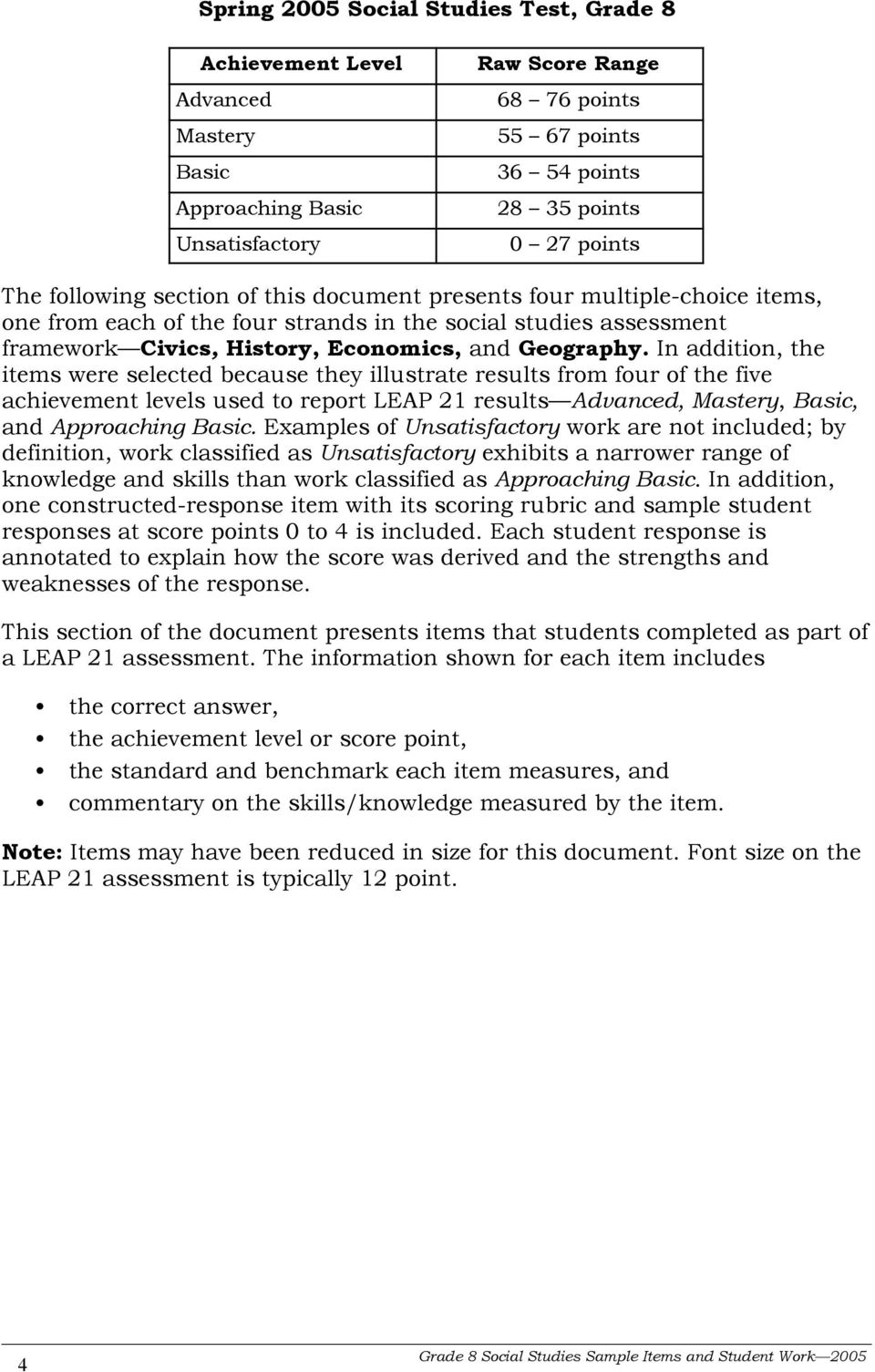
6 Spring 2005 Social Studies Test, Grade 8 Achievement Level Advanced Mastery Basic Approaching Basic Unsatisfactory Raw Score Range points points points points points The following section of this document presents four multiple-choice items, one from each of the four strands in the social studies assessment framework Civics, History, Economics, and Geography. In addition, the items were selected because they illustrate results from four of the five achievement levels used to report LEAP 21 results Advanced, Mastery, Basic, and Approaching Basic. Examples of Unsatisfactory work are not included; by definition, work classified as Unsatisfactory exhibits a narrower range of knowledge and skills than work classified as Approaching Basic. In addition, one constructed-response item with its scoring rubric and sample student responses at score points 0 to 4 is included. Each student response is annotated to explain how the score was derived and the strengths and weaknesses of the response. This section of the document presents items that students completed as part of a LEAP 21 assessment. The information shown for each item includes S S S S the correct answer, the achievement level or score point, the standard and benchmark each item measures, and commentary on the skills/knowledge measured by the item. Note: Items may have been reduced in size for this document. Font size on the LEAP 21 assessment is typically 12 point. 4
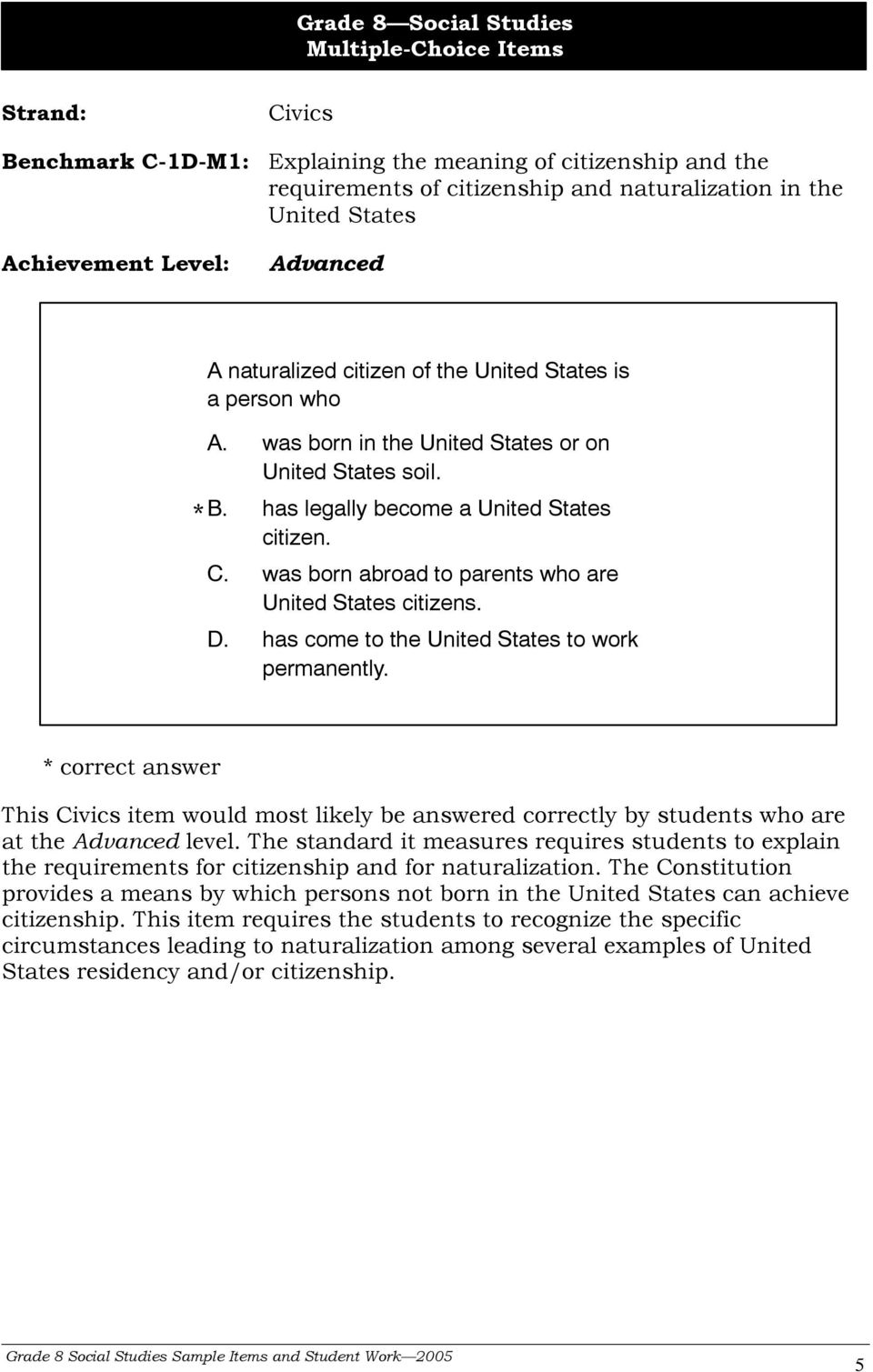
7 Grade 8 Social Studies Multiple-Choice Items Strand: Benchmark C-1D-M1: Achievement Level: Civics Explaining the meaning of citizenship and the requirements of citizenship and naturalization in the United States Advanced * A naturalized citizen of the United States is a person who A. was born in the United States or on United States soil. B. has legally become a United States citizen. C. was born abroad to parents who are United States citizens. D. has come to the United States to work permanently. * correct answer This Civics item would most likely be answered correctly by students who are at the Advanced level. The standard it measures requires students to explain the requirements for citizenship and for naturalization. The Constitution provides a means by which persons not born in the United States can achieve citizenship. This item requires the students to recognize the specific circumstances leading to naturalization among several examples of United States residency and/or citizenship. 5
8 Strand: Benchmark H-1B-M6: Achievement Level: History Explaining the causes and course of the American Revolution and the reasons for the American victory Mastery Put the number for each of the following events in the correct box on the time line below to help answer the following question. 1. The American Revolution began. 2. The British passed the Stamp Act in The colonies signed the Declaration of Independence. 4. The colonists protested against British laws by throwing tea into Boston Harbor Which answer below lists the four events in the correct chronological order? A. 2, 3, 1, 4 * B. 2, 4, 1, 3 C. 2, 1, 4, 3 D. 2, 1, 3, 4 * correct answer This History item would most likely be answered correctly by students who are at the Mastery level and above. The standard it measures requires students to explain the causes and course of the American Revolution. The item s visual stimulus is a timeline of several events in the thirteen original colonies. Students must use their historical knowledge as well as apply the concept of cause and effect to determine the correct sequence of events. 6

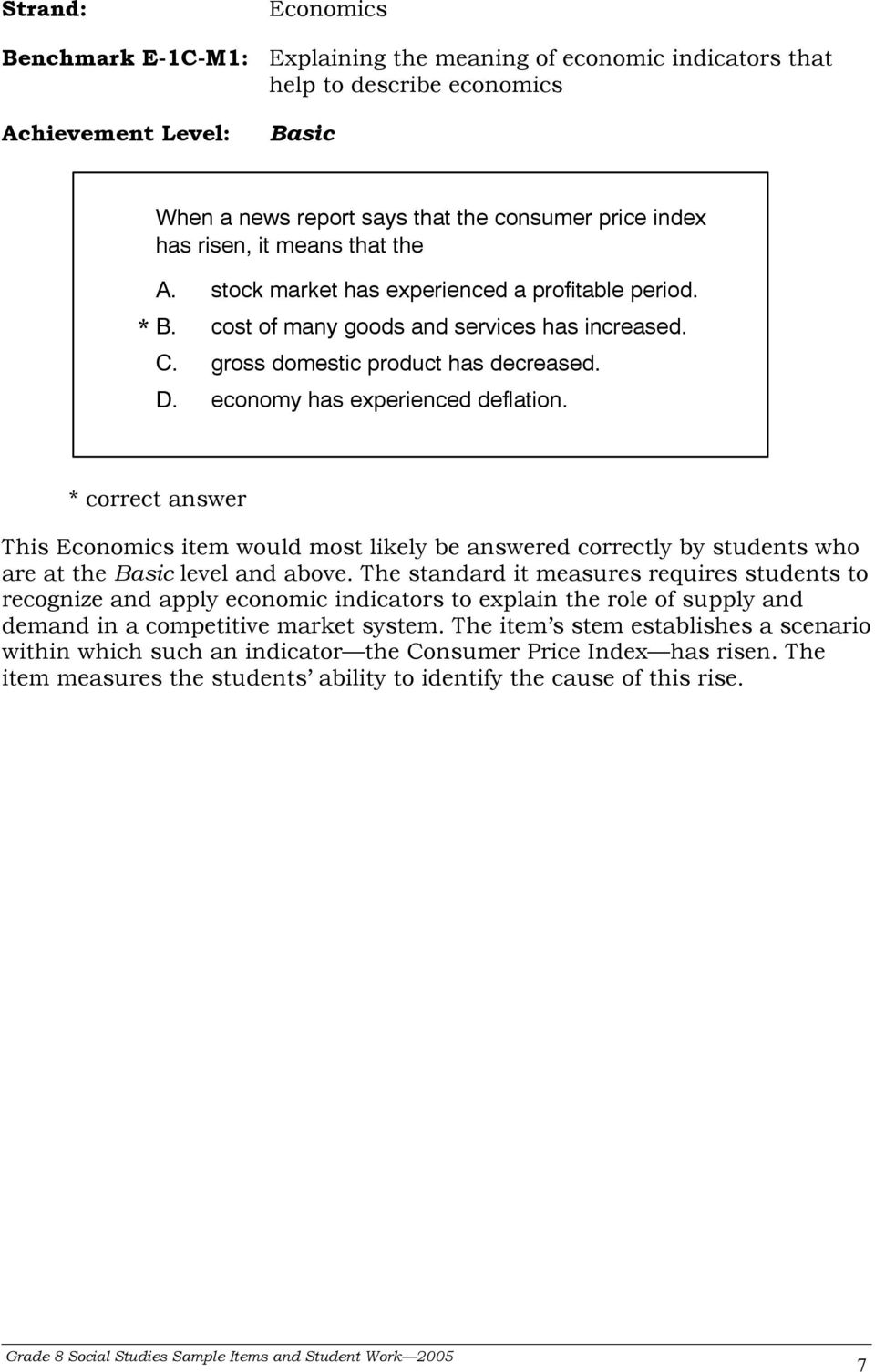
9 Strand: Benchmark E-1C-M1: Achievement Level: Economics Explaining the meaning of economic indicators that help to describe economics Basic When a news report says that the consumer price index has risen, it means that the A. stock market has experienced a profitable period. * B. cost of many goods and services has increased. C. gross domestic product has decreased. D. economy has experienced deflation. * correct answer This Economics item would most likely be answered correctly by students who are at the Basic level and above. The standard it measures requires students to recognize and apply economic indicators to explain the role of supply and demand in a competitive market system. The item s stem establishes a scenario within which such an indicator the Consumer Price Index has risen. The item measures the students ability to identify the cause of this rise. 7
10 Strand: Benchmark G-1A-M1: Achievement Level: Geography Identifying and describing the characteristics, functions, and applications of various types of maps and other geographic representations, tools, and technologies Approaching Basic Use the graph below to answer the following question. Which feature must be added to the Louisiana map to make the information it presents understandable? * A. a legend B. a distance scale C. a compass rose D. a date * correct answer This Geography item would most likely be answered correctly by students who are at the Approaching Basic level and above. The standard it measures requires students to identify and describe the characteristics of geographic representations. The item s stimulus is a product/resource map of Louisiana. Students answering the question must identify which map tool must be added in order to make the map usable. The legend, or key, explains the symbols used to represent information on a map. 8

11 Grade 8 Social Studies Constructed-Response Item A social studies constructed-response item for a LEAP 21 test may require students to write an extended answer in response to a question, direction, or other prompt. Frequently, constructed-response items are multipart items; in addition to writing, students are asked to work with graphics or other materials. The item, scoring rubric, and sample student responses are shown on the following pages. Student responses at each score point (0 to 4) are annotated to explain how each score was derived and the strengths and weaknesses of the responses. 9

12 Strand: Benchmark G-1A-M2: Geography Interpreting and developing maps, globes, graphs, charts, models, and databases to analyze spatial distributions and patterns 10

13 A. Choose two of the resources that are important to Louisiana s economy and write them in the space below. B. For each resource you listed, explain the geographic factors that make it possible for the resource to be produced or collected. C. Identify one non-renewable resource from the chart. D. What can Louisiana do to preserve its non-renewable resources? 11

14 Scoring Rubric Score 4 Description The response accurately identifies two resources from the map (part A) AND thoroughly explains two geographic factors that make the production of them possible (part B) AND correctly identifies one non-renewable resource from the chart (part C) AND correctly states a way in which non-renewable resources in Louisiana can be preserved (part D). 3 The response correctly answers three parts of the question. 2 The response correctly answers two parts of the question. 1 The response correctly answers one part of the question. 0 The response is incorrect, irrelevant, or too brief to evaluate. Scoring Notes: Maximum points to be awarded per section: Part A no points awarded for this section but it must be completed in order to get a total score point of 4. Also, if the student does not answer part A but identifies the resources in part B, the maximum total the student can receive shall be a score point of 3 if all of the other parts are correct. Part B 2 points Part C 1 point Part D 1 point Possible responses (not inclusive): Part B Geographic factors include: Location, climate (temperature, precipitation), landforms, and bodies of water Part C Non-renewable resources from the chart include: Naturalgas,oil,salt,sulphur Part D Any reasonable answer dealing with conservation or preservation 12

15 Score 4 13

16 All parts of the question have been accurately answered. Part A accurately identifies sugarcane and seafood as two resources from the map. Part B earns 2 points for thoroughly explaining two geographic factors that make the production of sugarcane and seafood possible (bodies of water for catching seafood and fertile soil for growing sugarcane). Part C earns 1 point for correctly identifying one non-renewable resource from the chart ( sulphur ), and part D receives 1 point for correctly stating a way that Louisiana can preserve its non-renewable resources ( find positive alternatives ). 14
17 Score 3 15

18 This response correctly answers three parts of the question. Part A identifies rice and sugarcane as two resources from the map, but since no points are awarded for answering part A, parts B and D earn the 3 points in this response. Part B earns 2 points by thoroughly explaining two geographic factors that make the production of rice and sugarcane possible (rich soil/proximity to water for growing rice and fertile, flat land for growing sugarcane). Part C receives no credit because it incorrectly identifies tobacco as a non-renewable resource. Finally, part D receives 1 point for correctly stating a way that Louisiana can preserve its non-renewable resources ( not sell as much...andstorethemaway ). 16

19 Score 2 Two parts of the question are answered correctly in this response. Part A identifies beef and rice from the map, but the response to part B gets no credit because it does not explain the geographic factors that make production of beef and rice possible; it merely explains how those resources are beneficial to humans. Part C receives 1 point for identifying one non-renewable resource ( Natural Gas ), and part D garners 1 point for stating that Louisiana could preserve its non-renewable resources by using less gas...less often...only on necessary things. 17

20 Score 1 In this response, only one part of the question is correctly answered. Part A receives no points, and part B receives no points because it is irrelevant. In part C, 1 point is received for identifying salt as a non-renewable resource. Part D does not receive credit because the response does not address the question posed. 18

21 Score 0 This response receives no points because all information provided in this response is either incorrect or irrelevant. No points are awarded for answering part A. The explanations in part B are irrelevant because they do not explain geographic factors that make it possible to produce or collect cotton or sugarcane. Part C is incorrect because forest products are renewable rather than non-renewable resources, and part D is irrelevant because it fails to address preservation of non-renewable resources. 19
22 Spring Louisiana Department of Education Office of Student and School Performance Division of Student Standards and Assessments
Special Education Reporting System User Guide Version 4.0
 -* Special Education Reporting System User Guide Version 4.0 Paul G. Pastorek State Superintendent of Education Issued: March 2006 Last Revised: November 2010 LOUISIANA DEPARTMENT OF EDUCATION 1.877.453.2721
Required Services Program Guidelines. Required Services Reimbursement Program. Program Guidelines
 Required Services Reimbursement Program Program Guidelines July 2011 A DEPARTMENT OF EDUCATION 1.877.453.2721 www.louisianaschools.net State Board of Elementary and Secondary Education Ms. Penny Dastugue
Routes to Attaining Special Education Certification. Overview of Special Education Certification. Traditional Undergraduate Programs
 OCTOBER 2010 L O U I S I A N A D E P A R T M E N T O F E D U C A T I O N Table of Contents Overview of Special Education Certification... 2 Routes to Attaining Special Education Certification... 3 Special
LOUISIANA PRE K-12 EDUCATIONAL TECHNOLOGY STANDARDS
 LOUISIANA PRE K-12 EDUCATIONAL TECHNOLOGY STANDARDS Adapted from the National Educational Technology Standards for Students Paul G. Pastorek, Superintendent Approved by BESE December 2008 1 State Board
SOCIAL STUDIES UNIT OUTLINES FIFTH GRADE
 SOCIAL STUDIES UNIT OUTLINES FIFTH GRADE In fifth grade, students use their understanding of social studies concepts and cause-and-effect relationships to study the development of the United States up
Registered)Nonpublic)Schools) (Not)Seeking)State)Approval))
 Registered)Nonpublic)Schools) (Not)Seeking)State)Approval)) ) JohnWhite StateSuperintendentofEducation August2014 z LOUISIANA DEPARTMENT OF EDUCATION 1.877.453.2721 www.louisianaschools.net State Board
Rise of the Revolution Grade Nine
 Ohio Standards Connection: Citizenship Rights and Responsibilities Benchmark A Analyze ways people achieve governmental change, including political action, social protest, and revolution. Indicator 1 Analyze
Chapter 2: LEAP Mathematics, Grade 4
 4th Grade Math Chapter 2: LEAP Mathematics, Grade 4 This section describes the overall design of the LEAP Mathematics test to be administered to students in grade 4. Test specifications, sample test questions,
Louisiana Accounting & Uniform Governmental Handbook
 Louisiana Accounting & Uniform Governmental Handbook B u l l e t i n 19 2 9 N O V E M B E R paul g. pastorek 2 0 1 0 state superintendent of education LOUISIANA DEPARTMENT OF EDUCATION 1.877.453.2721 www.louisianaschools.net
SOCIAL STUDIES Geography/United States History Grade 8 The Oregon Country
 Lesson Components: Benchmarks SOCIAL STUDIES Geography/United States History Grade 8 The Oregon Country G-1A-M2 G-1B-M1 G-1B-M2 G-1C-M7 G-1D-M1 G-1D-M2 C-1B-M4 C-1C-M1 E-1B-M7 H-1A-M1 H-1A-M2 H-1A-M3 interpreting
LOUISIANA K-12 EDUCATIONAL TECHNOLOGY STANDARDS
 LOUISIANA K-12 EDUCATIONAL TECHNOLOGY STANDARDS Adapted from the National Educational Technology Standards Cecil J. Picard, Superintendent Approved by BESE February 2003 State Board of Elementary and Secondary
A Correlation of. Pearson myworld Social Studies Grade 2 Florida Edition. To the Monroe County Curriculum Guide
 A Correlation of Pearson myworld Social Studies Grade 2 Florida Edition To the Monroe County Curriculum Guide Table of Contents HISTORICAL THINKING SKILLS... 3 Unit 1- Rules and Laws... 4 Unit 2: Citizenship:
Sample Set Boston Tea Party Grade 4
 Sample Set Boston Tea Party Grade 4 Standard 7 Government and Political Systems Students explain the structure and purposes of government and the foundations of the United States democratic system using
New York State Testing Program Grade 3 Common Core Mathematics Test. Released Questions with Annotations
 New York State Testing Program Grade 3 Common Core Mathematics Test Released Questions with Annotations August 2013 THE STATE EDUCATION DEPARTMENT / THE UNIVERSITY OF THE STATE OF NEW YORK / ALBANY, NY
DRAFT SOCIAL STUDIES Georgia Standards of Excellence (GSE) American Government/Civics
 DRAFT SOCIAL STUDIES American Government/Civics American Government/Civics The government course provides students with a background in the philosophy, functions, and structure of the United States government.
Pacemaker World Geography and Cultures. correlated to. Florida Sunshine State Standards Social Studies Grades 6-8
 Pacemaker World Geography and Cultures correlated to Florida Sunshine State Standards Social Studies Grades 6-8 Pacemaker World Geography and Cultures Pearson Learning Group correlated to Sunshine State
What are some effective standards-based classroom assessment practices?
 How does classroom assessment help teachers and students? Classroom assessments can help teachers plan and implement effective instruction and can help students learn at deeper and higher levels. Assessments
6 th Grade Vocabulary-ALL CAMPUSES
 6 th Grade Vocabulary-ALL CAMPUSES 6.1 History. The student understands that historical events influence contemporary events. (B) analyze the historical background of the United States to evaluate relationships
Senior Phase Grade 7 Today Planning Pack SOCIAL SCIENCES
 M780636110182 Senior Phase Grade 7 Today Planning Pack SOCIAL SCIENCES Contents: Work Schedule: Page Grade 7 2 Lesson Plans: Grade 7 4 Rubrics: Rubric 1 11 Rubric 2 12 Rubric 3 13 Work schedule for Social
Grades 3-5. Benchmark A: Use map elements or coordinates to locate physical and human features of North America.
 Grades 3-5 Students use knowledge of geographic locations, patterns and processes to show the interrelationship between the physical environment and human activity, and to explain the interactions that
GRADE 7 SOCIAL STUDIES. History
 GRADE 7 SOCIAL STUDIES History Standard 1 Historical Thinking Skills Students use information and concepts to interpret, analyze, and draw conclusions about United States history from 1763 1877. 7.1.1
A. Wessels, J. D. & Birkholz, C. Rubrics and Other Tools for Teaching Quality. Montana: Ten Sigma, 1996.
 USING RUBRICS AS A TOOL TO ASSESS STUDENT ACHIEVEMENT IN THE CORE KNOWLEDGE CLASSROOM Special Area: Administration (K-5) Written by: Reuben O. Doss, Jr., Gretna Elementary School, Gretna, Virginia I. ABSTRACT
Designing Scoring Rubrics for Your Classroom
 Designing Scoring Rubrics for Your Classroom Craig A. Mertler, Ph.D. Division of Educational Foundations & Inquiry College of Education & Human Development Bowling Green State University Bowling Green,
Fractions as Numbers INTENSIVE INTERVENTION. National Center on. at American Institutes for Research
 National Center on INTENSIVE INTERVENTION at American Institutes for Research Fractions as Numbers 000 Thomas Jefferson Street, NW Washington, DC 0007 E-mail: [email protected] While permission to reprint this
NCSS Standards 1. d. compare ways in which people from different cultures think about and deal with their physical environment and social conditions;
 NCSS Standards 1 National Council for the Social Studies (NCSS) Curriculum Standards for Social Studies Standard I. Culture study of culture and cultural diversity, so that the learner can a. explore and
2016 Practice Test Grade 53
 English Mathematics Language Arts 2016 Practice Test Grade 53 Session 1 Directions: Today, you will take Session 1 of the Grade 35 Mathematics Test. You will not be able to use a calculator in this session.
Senior Phase Grade 7 Today Planning Pack ECONOMIC AND MANAGEMENT SCIENCES
 M780636110229 Senior Phase Grade 7 Today Planning Pack ECONOMIC AND MANAGEMENT SCIENCES Contents: Work Schedule: Page Grade 7 2 Lesson Plans: Grade 7 8 Rubrics: Rubric 1 18 Rubric 2 19 Rubric 3 20 Work
Fourth Grade Social Studies Content Standards and Objectives
 Fourth Grade Social Studies Content Standards and Objectives Standard 1: Citizenship characterize and good citizenship by building social networks of reciprocity and trustworthiness (Civic Dispositions).
GRAINGER W W INC Filed by GRAINGER DAVID W
 GRAINGER W W INC Filed by GRAINGER DAVID W FORM SC 13D/A (Amended Statement of Beneficial Ownership) Filed 08/22/14 Address 100 GRAINGER PARKWAY LAKE FOREST, IL 60045-5201 Telephone 847-535-1000 CIK 0000277135
201 Math Problem Solving
 201 Math Problem Solving Source: Charles, Randall, Lester, Frank and O'Daffer, Phares. How to Evaluate Progress in Problem Solving. Reston, VA: National Council of Teachers of Mathematics, 1987. In Stenmark,
Grade Level Expectations for the Sunshine State Standards
 for the Sunshine State Standards FLORIDA DEPARTMENT OF EDUCATION http://www.myfloridaeducation.com/ The fourth grade student: Time, Continuity, and Change [History] knows different types of primary and
Number Factors. Number Factors Number of factors 1 1 1 16 1, 2, 4, 8, 16 5 2 1, 2 2 17 1, 17 2 3 1, 3 2 18 1, 2, 3, 6, 9, 18 6 4 1, 2, 4 3 19 1, 19 2
 Factors This problem gives you the chance to: work with factors of numbers up to 30 A factor of a number divides into the number exactly. This table shows all the factors of most of the numbers up to 30.
Dear Mr. President. Estimated Time: 40 minutes
 Dear Mr. President Estimated Time: 40 minutes I. Objectives As a result of this lesson, students will: identify the parts of a friendly letter. write a friendly letter to the president. II. Materials and
1. I have 4 sides. My opposite sides are equal. I have 4 right angles. Which shape am I?
 Which Shape? This problem gives you the chance to: identify and describe shapes use clues to solve riddles Use shapes A, B, or C to solve the riddles. A B C 1. I have 4 sides. My opposite sides are equal.
Grade 5. Ontario Provincial Curriculum-based Expectations Guideline Walking with Miskwaadesi and Walking with A`nó:wara By Subject/Strand
 Ontario Provincial Curriculum-based Expectations Guideline Walking with Miskwaadesi and Walking with A`nó:wara By Subject/Strand Turtle Island Conservation Ontario Teachers Resource Bundle 1 The Arts 1.1
Louisiana Health Education Content Standards Bulletin 103
 Louisiana Health Education Content Standards Bulletin 103 Louisiana Department of Education Cecil J. Picard Superintendent of Education Louisiana State Board of Elementary and Secondary Education Paul
CURRICULUM MAP. Elementary and Early Childhood Program: Alignment of Student Learning Outcomes, Standards, and Assessments
 CURRICULUM MAP Elementary and Early Childhood Program: Alignment of Student Learning Outcomes, Standards, and Assessments ACEI = Association for Childhood Education International Standards (see below for
North Carolina Essential Standards Third grade Social Studies
 North Carolina s Third grade Social Studies In third grade, students draw upon knowledge learned in previous grades to develop more sophisticated understandings of how communities may be linked to form
The Regions of the United States
 CHAPTER 1 Identify characteristic landforms of the five major regions of the United States. Describe, compare, and contrast regional climates of the United States. Identify regional resources of the United
GRADE 3: WORKING TOGETHER
 GRADE 3: WORKING TOGETHER Considerations for Curriculum Development Third Grade Contextual Theme: Society My community and communities around the world. Assumptions and Goals of Curriculum Development
TELEPHONE: (225) 771-5390 TOLL FREE 1(888) 223-1460 FAX: (225) 771-5723 Download applications at http://www.subr.edu/gradschool
 APPLICATION FOR ADMISSION TO A GRADUATE DEGREE PROGRAM INSTRUCTIONS THE GRADUATE SCHOOL SOUTHERN UNIVERSITY AND A & M COLLEGE P. O. BOX 9860 BATON ROUGE, LA 70813 TELEPHONE: (225) 771-5390 TOLL FREE 1(888)
Senior Phase Grade 8 Today Planning Pack SOCIAL SCIENCES
 M780636110250 Senior Phase Grade 8 Today Planning Pack SOCIAL SCIENCES Contents: Work Schedule: Page Grade 8 2 Lesson Plans: Grade 8 4 Rubrics: Rubric 1 14 Rubric 2 15 Rubric 3 16 Work schedule for Grade
1 J (Gr 6): Summarize and describe distributions.
 MAT.07.PT.4.TRVLT.A.299 Sample Item ID: MAT.07.PT.4.TRVLT.A.299 Title: Travel Time to Work (TRVLT) Grade: 07 Primary Claim: Claim 4: Modeling and Data Analysis Students can analyze complex, real-world
Physical Education HANDBOOK. Grade-Level Expectations. Louisiana Department of Education Paul G. Pastorek, State Superintendent of Education
 Physical Education HANDBOOK Grade-Level Expectations Louisiana Department of Education Paul G. Pastorek, State Superintendent of Education LOUISIANA DEPARTMENT OF EDUCATION 1.877.453.2721 www.louisianaschools.net
SOCIAL STUDIES UNIT OUTLINES - SIXTH GRADE
 SOCIAL STUDIES UNIT OUTLINES - SIXTH GRADE In sixth grade, students are ready to deepen their understanding of the Earth and its peoples through the study of history, geography, politics, culture, and
Earth Science & Environmental Science SOL
 Earth Science & Environmental Science SOL THE SOL FOR GRADE 6 The Virginia Science SOL for Grades K 6 are organized according to a set of strands, with the SOL in each strand developed progressively through
INDIVIDUAL MASTERY for: St#: 1153366 Test: CH 9 Acceleration Test on 29/07/2015 Grade: B Score: 85.37 % (35.00 of 41.00)
 INDIVIDUAL MASTERY for: St#: 1153366 Grade: B Score: 85.37 % (35.00 of 41.00) INDIVIDUAL MASTERY for: St#: 1346350 Grade: I Score: 21.95 % (9.00 of 41.00) INDIVIDUAL MASTERY for: St#: 1350672 Grade: A
INDIVIDUAL MASTERY for: St#: 1141027 Test: CH 9 Acceleration Test on 09/06/2015 Grade: A Score: 92.68 % (38.00 of 41.00)
 INDIVIDUAL MASTERY for: St#: 1141027 Grade: A Score: 92.68 % (38.00 of 41.00) INDIVIDUAL MASTERY for: St#: 1172998 Grade: B Score: 85.37 % (35.00 of 41.00) INDIVIDUAL MASTERY for: St#: 1232138 Grade: B
Study Guide for the Mathematics: Proofs, Models, and Problems, Part I, Test
 Study Guide for the Mathematics: Proofs, Models, and Problems, Part I, Test A PUBLICATION OF ETS Table of Contents Study Guide for the Mathematics: Proofs, Models, and Problems, Part I, Test TABLE OF CONTENTS
Grade Level Expectations for the Sunshine State Standards
 for the Sunshine State Standards FLORIDA DEPARTMENT OF EDUCATION http://www.myfloridaeducation.com/ Standard A: Standard 1: Time, Continuity, and Change [History] The student understands historical chronology
Running head: AMERICAN REVOLUTION 1
 Running head: AMERICAN REVOLUTION 1 American Revolution Persuasive Essay Student A. Sample Grand Canyon University: HIS 345 12/12/2012 AMERICAN REVOLUTION 2 American Revolution Persuasive Essay The American
Georgia Performance Standards for Science Grade 6. This Performance Standards document includes four major components. They are
 Sixth Grade Science Curriculum One Stop Shop For Educators The Georgia Performance Standards are designed to provide students with the knowledge and skills for proficiency in science at the sixth grade
Appendix A: Annotated Table of Activities & Tools
 APPENDIX A Annotated Table of Activities and Tools MODULE 1: Get Ready for Inquiry ( Activities) Activity 1.1 Activity 1.2 Activity 1.3 Activity 1.4 Activity 1.5 How Data Can Help Us in the School Improvement
Chapter 2: LEAP Mathematics, Grade 8
 8th Grade Math Chapter 2: LEAP Mathematics, Grade 8 This section describes the overall design of the LEAP Mathematics test to be administered to students in grade 8. Test specifications, sample test questions,
Allows teachers to print reports for individual students or an entire class.
 Map and Globe Skills Developed by teachers and geography specialists, Map and Globe Skills provides the strategies, skills and practice your students need to develop a strong understanding of basic mapping
High School Algebra Reasoning with Equations and Inequalities Solve systems of equations.
 Performance Assessment Task Graphs (2006) Grade 9 This task challenges a student to use knowledge of graphs and their significant features to identify the linear equations for various lines. A student
This portfolio comprises a number of work samples drawn from a range of assessment tasks, namely:
 Student Portfolio Summary Geography Year 4 WORK SAMPLE PORTFOLIO The 2013 portfolios are a resource to support teachers in the planning and implementation of the Foundation to Year 10 Australian Curriculum:
Instructional Materials Review. Frequently Asked Questions
 Instructional Materials Review Frequently Asked Questions 2015-2016 Table of Contents OVERVIEW:... 2 TIMELINE:... 3 TYPES OF MATERIALS:... 3 DIGITAL VERSIONS:... 3 FEES/CONTRACTS:... 4 RATINGS & PUBLICATIONS:...
Title 28 EDUCATION Part CLXVII. Bulletin 140 Louisiana Early Childhood Care and Education Network
 Title 28 EDUCATION Part CLXVII. Bulletin 140 Louisiana Early Childhood Care and Education Network TABLE OF CONTENTS Chapter 1. General Provisions... 2 101. Purpose... 2 103. Definitions... 2 Chapter 3.
Minnesota Academic Standards
 Minnesota Academic Standards Arts K-12 2008 The proposed revised standards in this document were drafted during the 2007-2008 school year. These standards are currently proceeding through the administrative
Educational Technology Standard Articulated by Grade Level. Pre-K to 6 th Grade
 Pre-K to 6 th Grade Arizona Department of Education Educational Technology Division Approved 5.18.2009 Strand 1: Creativity and Innovation 2 Strand 1: Creativity and Innovation Concept 1: Knowledge and
Planning Guide. Grade 6 Factors and Multiples. Number Specific Outcome 3
 Mathematics Planning Guide Grade 6 Factors and Multiples Number Specific Outcome 3 This Planning Guide can be accessed online at: http://www.learnalberta.ca/content/mepg6/html/pg6_factorsmultiples/index.html
Tom wants to find two real numbers, a and b, that have a sum of 10 and have a product of 10. He makes this table.
 Sum and Product This problem gives you the chance to: use arithmetic and algebra to represent and analyze a mathematical situation solve a quadratic equation by trial and improvement Tom wants to find
Send all inquiries to: Glencoe/McGraw-Hill 8787 Orion Place Columbus, Ohio 43240-4027 ISBN 0-07-824996-1. Printed in the United States of America
 Copyright by The McGraw-Hill Companies, Inc. All rights reserved. Permission is granted to reproduce the material contained herein on the condition that such material be reproduced only for classroom use;
CORRELATION SUNSHINE STATE STANDARDS. 1 SE = Student Edition TE = Teacher Edition TR = Teacher Resources TECH = Technology
 CORRELATION SUNSHINE STATE STANDARDS SUBJECT: Social Studies SUBMISSION TITLE: Prentice Hall Civics: Government and Economics In Action 2005 PUBLISHER: Pearson Prentice Hall GRADE: Grade 6-8 M/J Civics/
Principles of Data-Driven Instruction
 Education in our times must try to find whatever there is in students that might yearn for completion, and to reconstruct the learning that would enable them autonomously to seek that completion. Allan
TOWARDS THE PATHWAYS VISION MODEL OF INTRODUCTORY ACCOUNTING. Michael S. Wilson, PhD, CPA, CGMA
 TOWARDS THE PATHWAYS VISION MODEL OF INTRODUCTORY ACCOUNTING Michael S. Wilson, PhD, CPA, CGMA Associate Professor Metropolitan State University St Paul, MN 55106 [email protected] (612) 659-7279
Counting Money and Making Change Grade Two
 Ohio Standards Connection Number, Number Sense and Operations Benchmark D Determine the value of a collection of coins and dollar bills. Indicator 4 Represent and write the value of money using the sign
OFFICE OF GRADUATE STUDIES
 OFFICE OF GRADUATE STUDIES APPLICATION INSERT TO APPLICANT: 1. Please be advised that in accordance with Title IX of the Education Amendments of 1972, 20 U.S.C 1681 and its implementing regulation at 34
History and Social Science
 Example s History and Social Science Pilot Priority Grades Pre-Kindergarten High School 1 Example s Table of Contents Pre-Kindergarten... 9 Galileo Pre-K Online Technology Incorporated... 10 Work Sampling
2016 Bridge Competition Guidelines Grades 9 and 10
 2016 Bridge Competition Guidelines Grades 9 and 10 The TRAnsportation and Civil Engineering (TRAC) Program THE PURPOSE OF TRAC: The TRAC program is a new and inventive way of introducing students to the
Sample Pages. Free E-mail Newsletter Sign up Today! Learn Through Experience
 Learn Through Experience Sample Pages Sample pages from this product are provided for evaluation purposes. The entire product is available for purchase at www.socialstudies.com or www.teachinteract.com
Effects of the Enlightenment Grade Nine
 History Ohio Standards Connection: Benchmark A Explain connections between the ideas of the Enlightenment and changes in the relationships between citizens and their governments. Indicator 1 Explain how
Geometry Solve real life and mathematical problems involving angle measure, area, surface area and volume.
 Performance Assessment Task Pizza Crusts Grade 7 This task challenges a student to calculate area and perimeters of squares and rectangles and find circumference and area of a circle. Students must find
6 th Grade Unit 5: Latin America Today
 The following instructional plan is part of a GaDOE collection of Unit Frameworks, Performance Tasks, examples of Student Work, and Teacher Commentary for the SIXTH GRADE Social Studies course. 6 th Grade
LOUISIANA DEPARTMENT OF EDUCATION STRATEGIC PLAN
 LOUISIANA DEPARTMENT OF EDUCATION STRATEGIC PLAN FY 2017-2018 THROUGH FY 2021-2022 JOHN WHITE STATE SUPERINTENDENT OF EDUCATION July 2016 Louisiana Department of Education FY 18-22 Strategic Plan 1 Table
Transcript: What Is Progress Monitoring?
 Transcript: What Is Progress Monitoring? Slide 1: Welcome to the webinar, What Is Progress Monitoring? This is one of 11 webinars developed by the National Center on Response to Intervention (NCRTI). This
Civil Disobedience During the Civil Rights Movement Grade 10
 Ohio Standards Connection: Citizenship Rights and Responsibilities Benchmark A Analyze ways people achieve governmental change, including political action, social protest and revolution. Indicator 2 Explain
ALIKE AND DIFFERENT: GERMANY, THE UNITED STATES, AND OUR REGION. A Second Grade Lesson Plan
 ALIKE AND DIFFERENT: GERMANY, THE UNITED STATES, AND OUR REGION A Second Grade Lesson Plan Wanda Dengel Notre Dame Elementary Portsmouth, Ohio September 26,2008 1 (NOTE: The Second Grade Lesson below can
STANDARD 1: The student understands historical chronology and the historical perspective.
 Prentice Hall World Studies, The Eight Book Series Foundations of Geography 2005 Florida Sunshine State Standards, Social Studies Benchmarks and STRAND A: TIME, CONTINUITY, AND CHANGE [HISTORY] STANDARD
Assessment That Drives Instruction
 Improving Instruction Through Assessment Assessment That Drives Instruction Pokey Stanford Stacy Reeves TEACHING Exceptional Children, Vol. 37, No. 4, pp. 18-22. Copyright 2005 CEC. Two challenging aspects
Grade 1. Ontario Provincial Curriculum-based Expectations Guideline Walking with Miskwaadesi and Walking with A`nó:wara By Subject/Strand
 Grade 1 Ontario Provincial Curriculum-based Expectations Guideline Walking with Miskwaadesi and Walking with A`nó:wara By Subject/Strand Turtle Island Conservation Ontario Teacher Resource Bundle 1 The
LITERACY: READING LANGUAGE ARTS
 IMPORTANT NOTICE TO CANDIDATES: The assessment information in this document is aligned with NBPTS Literacy: Reading Language Arts Standards, Second Edition (for teachers of students ages 3 12). If you
U. S. Constitution [8th grade]
![U. S. Constitution [8th grade]](/thumbs/40/20655561.jpg "U. S. Constitution [8th grade]") Trinity University Digital Commons @ Trinity Understanding by Design: Complete Collection Understanding by Design 6-15-2006 U. S. Constitution [8th grade] Ben Altman Trinity University Follow this and
Trinity University Digital Commons @ Trinity Understanding by Design: Complete Collection Understanding by Design 6-15-2006 U. S. Constitution [8th grade] Ben Altman Trinity University Follow this and
Introduction: Online school report cards are not new in North Carolina. The North Carolina Department of Public Instruction (NCDPI) has been
 Introduction: Online school report cards are not new in North Carolina. The North Carolina Department of Public Instruction (NCDPI) has been reporting ABCs results since 1996-97. In 2001, the state General