
NHS Midlands and East Stroke Services Specification
|
|
|
- Joshua Gilmore
- 9 years ago
- Views:
Transcription
1 NHS Midlands and East Stroke Services Specification Version Control Version No. Date Authors/ Editors To be reviewed by Status v June 2012 Tim Lawrence, Laura Dendy External Expert Advisory Group (EEAG) 1 st Draft v June 2012 Tim Lawrence, Laura Dendy EEAG, Stroke Network Directors, Project Board 2 nd Draft v June 2012 Tim Lawrence, Laura Dendy EEAG 3 rd Draft v June 2012 Tony Rudd, Tim Lawrence Damian Jenkinson 4 th Draft v June 2012 Tim Lawrence, Laura Dendy EEAG, Stroke Network Clinical Leads 5 th Draft v June 2012 Tim Lawrence Damian Jenkinson 6 th Draft v June 2012 EEAG N/A Final V Oct 2012 EEAG V Oct 2012 EEAG p.24 - TIA performance standard 2 removed Amended Final NHS Midlands East Stroke Service Specification FINAL 1

2 1. Introduction and Purpose 1.1 Purpose The following Service Specification document sets out the criteria, as recommended by the External Expert Advisory Group, that different parts of the stroke pathway need to meet to deliver high quality care to patients and achieve the step change improvement sought by the Midlands and East Stroke Review. These are the expected standards commissioners should adopt when commissioning stroke care services. This service specification has been developed by the External Expert Advisory Group (EEAG) in consultation with stakeholders, including Stroke Networks, clinical staff working in stroke and other associated services, commissioners and patients and carers who have experienced NHS services. The document aims to build on clinical best practice and provide clarity on the system requirements for stroke services without prescribing the service model to be adopted locally. 1.2 Overview The National Stroke Strategy (2007) provides the foundation for defining stroke services and outlines what is needed to create the most effective stroke services in England. The strategy identifies major stages in the stroke patient s pathway and stresses a need to reorganise the way in which stroke services are delivered, from through to support for those who have experienced a stroke. A whole pathway approach to the provision of stroke services is crucial to maximising the clinical outcomes for patients, the resultant quality of life and their experience of stroke services. The first 72 hours of care is vital to ensure the optimum clinical outcome for stroke survivors. This needs to be underpinned by an effective whole system pathway for assessment, discharge and repatriation to local stroke services, subsequent rehabilitation and longer term support. Improving outcomes in stroke services is core to the NHS Midlands and East s ambitions to provide access to the highest quality services. Although there have been significant improvements in stroke services across the Midlands and East region over the last three years, there remains scope for further improvement; demonstrated by the gap between the regions performance as measured against the national Integrated Performance Measures. 1.3 Midlands and East Vision for Stroke Services Midlands and East want to achieve a step change improvement in the quality of stroke and TIA services and outcomes. The overarching vision for stroke services across the area is to ensure that all patients who experience a stroke have access to high quality acute care 24/7 and high quality life after stroke rehabilitation as part of a stroke pathway focused on providing patient and carer centric care, empowerment and facilitation of self-management leading to meaningful participation in daily life. 1.4 Objectives and Expected Outcomes The objectives are to: Provide a fully integrated, end-to-end stroke service for NHS Midlands and East. Implement the recommendations of the National Stroke Strategy NHS Midlands East Stroke Service Specification FINAL 2

3 1. Introduction and Purpose Meet the service standards and specifications set by the Royal College of Physicians and NICE guidelines. Ensure that stroke services deliver: o Improved clinical outcomes e.g. reduced mortality o Improved quality of life outcomes e.g. reduced level of disability following a stroke o An excellent patient and carer experience e.g. experience across the whole pathway and including improved access Ensure equity of service provision, outcomes and experience across the region In meeting the above objectives, the expected outcomes will be that any patient presenting with acute stroke symptoms will receive the most appropriate care for their condition. Placing patients on the correct pathway (TIA, hyperacute or acute) will maximise the likelihood of best possible outcomes and allow NHS Midlands and East to use resources effectively within the local area. The specific performance standards are listed in each section, but the general expected outcomes are: Improved outcomes of stroke patients, by reducing the levels of death and disability following a stroke Reduced length of stay of stroke patients in bed based services Improved patient experience and to enhance recovery following a stroke through long term support and follow up A service that is sustainable and provides good value for money through effective use of resources Access to the services and the quality of care provided is equitable across the region. Provide high quality specialist stroke professional development 1.5 Evidence Base Stroke is the third biggest killer in England and the main cause of adult disability - Stroke killed more than 40,000 people in 2009 in England and over 12,000 in NHS Midlands and East. Around two thirds of people will survive their stroke, but half of stroke survivors are left with long term disability and dependent on others for everyday activities. Stroke care costs the NHS and the economy about 8 billion a year about 3 billion in direct costs to the NHS 1, 2.4 billion in informal care costs (costs of nursing home care and care borne by the patients families) and 1.8 billion in income lost to mortality and morbidity and benefit payments. This service specification is based upon a comprehensive and current evidence base and agreed best practice, including: National Stroke Strategy (2007) Department of Health. National Clinical Guidelines for Stroke (2012) Royal College of Physicians Quality Standards Programme: Stroke (2010) National Institute for Clinical Excellence. Stroke Service Standards (2010) British Association of Stroke Physicians Quality and Outcomes Framework for 2012/13 (2011) NHS Employers. The NHS Outcomes Framework 2012/13 (2011) Department of Health. A Public Health Outcomes Framework for England (2012) Department of Health. The 2012/13 Adult Social Care Outcomes Framework (2012) Department of Health Supporting Life after stroke (2011) Care Quality Commission 1 NAO (2010) Progressing in improving stroke care report NHS Midlands East Stroke Service Specification FINAL 3

4 2. Service Specification The service specification is divided into phases of the care pathway for stroke patients: This document is structured according to the stroke pathway phases below. In addition, expectations that apply across the whole pathway are described at the outset. A. Primary B. Pre-hospital C. Acute phase i. Hyper Acute Stroke care ii. Acute Stroke care (including in-hospital rehabilitation services) iii. Transient Ischaemic Attack (TIA) services iv. Tertiary care services (e.g. neuro and vascular surgery referrals) D. Community rehabilitation i. Early Supported Discharge (ESD) ii. Stroke specialist community rehabilitation E. Long term care and support F. Secondary G. End of life The specification divides the expected outcomes into three time windows within 6 months, 6-12 months and 18 months or beyond. These are the expectation based on starting implementation following the Midlands and East SHA decision at the end of March 2013, therefore within 6 months would be by end of September The performance standards specified for each pathway stage are defined according to the data definitions of the stated data collection audit (e.g. ASI, SSNAP, QOF etc.) The diagram overleaf summaries the pathway according to the patient movement across the phases since they are not necessarily linear and not all phases or services are applicable to all patients NHS Midlands East Stroke Service Specification FINAL 4

5 Low risk TIA clinic <7days Specialist assessment <7days Risk assessment Discharge High risk (ABCD >4) Fast track clinic <24 hrs Specialist assessment <24hrs Suspected Stroke/ TIA event Triage alert crew Paramedic FAST Assessment Formal hand-over to GP CAT A Response Ambulance transfer (<60mins) and Pre-alert destination Specialist stroke assessment (<30mins) Thrombolysis Brain scan (next slot/ <1 hour) Diagnosis and eligibility for thrombolysis Hyper-acute stroke bed care for specialist monitoring Acute stroke bed care All therapy assessments & treatment (<72hrs) goals agreed and documented (<5days) Personalised joint care plan & goal setting Appropriate active therapy (min 45 mins 5 days per week) Social work assessment as appropriate (<3 days) GP Informed of stroke survivor discharged home/hospital Specialist stroke rehabilitation services tailored to survivors needs Regular review of personal care plans Provision for social care requirements as appropriate Multidisciplinary review 6 weeks, 6 months and annually Ongoing provision of care and stroke survivor support requirements Information and support provided to enable return to community life 2. Service Specification Summary stroke pathway diagram: C) i. Hyper Acute Care 0-72 hours C) ii. Acute Care 3 7 days Call to Door time <60mins Door to Needle:<60 mins Stroke D) i. Early Supported Discharge (ESD) GP referral D) ii. Specialist stroke community rehabilitation Self presenter at A&E TIA / minor stroke C) iv. Tertiary Care GP / Out of hours service Inpatient Self presenter at A&E C) iii. TIA Services Care Note: No scale: shape sizes not indicative of time NHS Midlands East Stroke Service Specification FINAL 5

6 2. Expectations across the whole stroke pathway Across the entire pathway stroke care must be underpinned by several universally applicable components to improve the quality of care e.g. communications; to improve patient experience of stroke services; and to ensure the step change improvement being sought in stroke care can be achieved e.g. data collection. These elements that apply across the whole pathway are described in this section. 1. Patient Experience Patients and their carers are informed throughout the care pathway on a regular and timely basis of: o Their prognosis and situation o What is likely to happen to them next e.g. how soon they will be seen, frequency of contact, contact information for the new team, how goals will be carried over o Who is taking care of them and who is responsible for their care o What they need to be doing to facilitate their care and recovery e.g. advice and information about exercises or other activities that they can practice independently Patients and carers are able to access information provided to them i.e. provided in an appropriate format/ medium, and in relevant community languages other than English; and that is specific to the phase of recovery and their needs at that time. Patients and carers receive instruction and guidance regarding any prescriptions verbally and supported by written information Families and carers are actively involved in day to day care, rehabilitation and decisions about the planning and delivery of their care Patients are directed to relevant voluntary service organisations The service has in place a process for incorporating patient/ carer feedback into quality improvement service developments 2. Engagement and Communications Awareness raising activities are proactive and ongoing e.g. FAST awareness across primary care, care homes and providers and the general public. Providers of stroke services are actively engaged with their local stroke network/s e.g. to ensure that each stroke unit is linked to a regional neurosciences centre for emergency review of local brain imaging Clinical teams proactively communicate between themselves and with anyone who takes over responsibility for a patients care, while the processes used to manage care involve all relevant people and support seamless transitions between services along the pathway Clinical team members communicate regularly with patients and carers in appropriate ways for their condition and needs Formal links exist with patient and carer organisations e.g. local users forum, Stroke Association Group, community stroke clubs. 3. Data Transfer and Information Sharing Accurate and explicit records of patients are recorded and shared using agreed protocols between all hospital, community and social care practitioners and individuals in a timely way NHS Midlands East Stroke Service Specification FINAL 6

7 2. Expectations across the whole stroke pathway 4. Data Collection and Monitoring All organisations should report historical Sentinel metrics where available and required All organisations should submit data for the DH stroke and TIA IPMRs All clinical services take responsibility for all aspects of data collection, keeping stroke register, and participating in national stroke audit (SSNAP) either directly of via upload of equivalent local data that enables comparison with regional and national peers) A sustainable system of coding for stroke patients is in place. Local guidance should be in place to support the collection of data between community and across service providers All organisations will need to develop a robust system for collection and validation of reliable and accurate stroke data with a lead responsible individual to approve and sign off the data. This may involve investment in data systems and personnel to avoid the burden of data collection responsibility on clinical staff. An assessment of patient and carer experience across the stroke pathway is required at regular intervals. This information should be used to inform the improvement of local services and results submitted to inform commissioners on the progress in improving patient experience. 5. Innovation and Research & Development To be part of a research network, have a dedicated stroke research lead and actively participate in research (e.g. On the role of interventional radiology in treatment of acute ischaemic stroke or whether the increased intensity of therapy result in improved outcomes) Work with Stroke Research Networks Be open to performing and participating in national and international trials NHS Midlands East Stroke Service Specification FINAL 7

8 2. Lack of awareness of stroke and TIA lifestyle causes, risk factors, and symptoms can be a significant challenge to the realisation of a successful outcome for someone who goes on to experience a stroke or TIA. A proactive approach by all healthcare professionals to recognise patients at risk of stroke or TIA and subsequent mitigation against those risks will support the minimisation of stroke or TIAs. Immediate Service Outcomes Performance Standards Primary care and other health care professionals (e.g. opticians, ophthalmologists) are effective in: Identifying patients at risk of stroke or TIA Identifying atrial fibrillation and reducing the risk of stroke e.g. through anticoagulation Promoting the Know your Pulse campaign and other national/ regional campaigns Advising at risk patients of lifestyle choices and treatments to minimise risk of stroke and TIA Advising and educating patients on how to identify symptoms of stroke and TIA to enable effective early intervention/ treatment Ensuring patient attendance at vascular health check programme and regular long term condition reviews as appropriate Social care staff in domiciliary care, care homes and day centres, together with personal assistants purchased through Direct Payments are: Effectively trained in the signs of stroke and TIA and aware of the consequences of delay Able to recognise when a referral to emergency care is needed, and able to contact such services quickly Able to reassure service users whilst the emergency services are en-route Members of the public are able to recognise and identify the main symptoms of stroke and TIA and know it needs to be treated as an emergency. 2 Local health economy, including voluntary organisations communicates basic information to patients on the symptoms, emergency treatment, risk factors, lifestyle factors and treatments. No metrics are proposed for monitoring. It is expected that local systems will performance manage primary according to NICE guidelines on atrial fibrillation and anticoagulation. There are a large number of performance standards in the QOF and ASI that should be supported. Delivering a step change in Primary is not the focus for the Midlands and East Stroke Review. However it is an important component of the stroke pathway and thus included at high-level for completeness to ensure it is recognised as part of a pathway wide approach to managing stroke. 2 National Stroke Strategy Quality Markers QM1: Awareness Raising NHS Midlands East Stroke Service Specification FINAL 8

9 2. B) Pre-Hospital A fast response to stroke reduces the risk of mortality and disability Time is Brain. The identification of potential stroke and TIA patients and their timely admission to an appropriate stroke centre is a critical stage of the care pathway. Promotion amongst healthcare professionals, the public and carers of stroke symptom awareness (e.g. FAST) that prompt emergency treatment can improve health outcomes through timely access to stroke care and specialist treatments such as thrombolysis, which must be administered within a few hours of the onset of symptoms. Service Outcomes Immediate Requirements <6 months 6-12 months Clinical assessment by ambulance staff: Patients with suspected acute stroke (or sudden onset of neurological symptoms) are screened using a validated tool 3 to diagnose stroke or assess TIA risk 4. All patients with suspected acute stroke are immediately transferred by ambulance to a hospital with facilities to manage hyper acute stroke (to include FAST positive or where stroke is suspected by paramedics even if FAST negative). Higher risk TIA (ABCD2 score >3, on anticoagulation or with crescendo TIA 5 ) is treated as an emergency, being at greater and imminent risk of stroke, undergoes specialist assessment within 24 hours of presentation to healthcare professional. 6 All suspected stroke patients are assessed and managed in accordance with best clinical practice and monitored for atrial fibrillation and other dysrrhythmias 7. Ambulance transfer to hospital: Ambulance service transfer to the appropriate stroke centre within 60 mins, ideally within 30 mins (from scene to hospital). Local areas may choose to set more challenging targets as their geography permits All patients with suspected acute stroke are immediately transferred by ambulance to a stroke centre offering hyper acute stroke services 8 Long term (>18months) 3 Note: Many valid tools exist and this specification does not specify which one should be used, though some suggestions are made 4 NICE Quality Standards Quality Statement 1; National Stroke Strategy Quality Markers QM8: Assessment 5 Crescendo TIA is defined as two or more TIAs in one week 6 RCP C & D; low risk TIA should receive specialist assessment as soon as possible, but definitely within one week of onset of symptoms 7 RCP F, G & H 8 National Stroke Strategy Quality Markers QM7: Urgent Response NHS Midlands East Stroke Service Specification FINAL 9

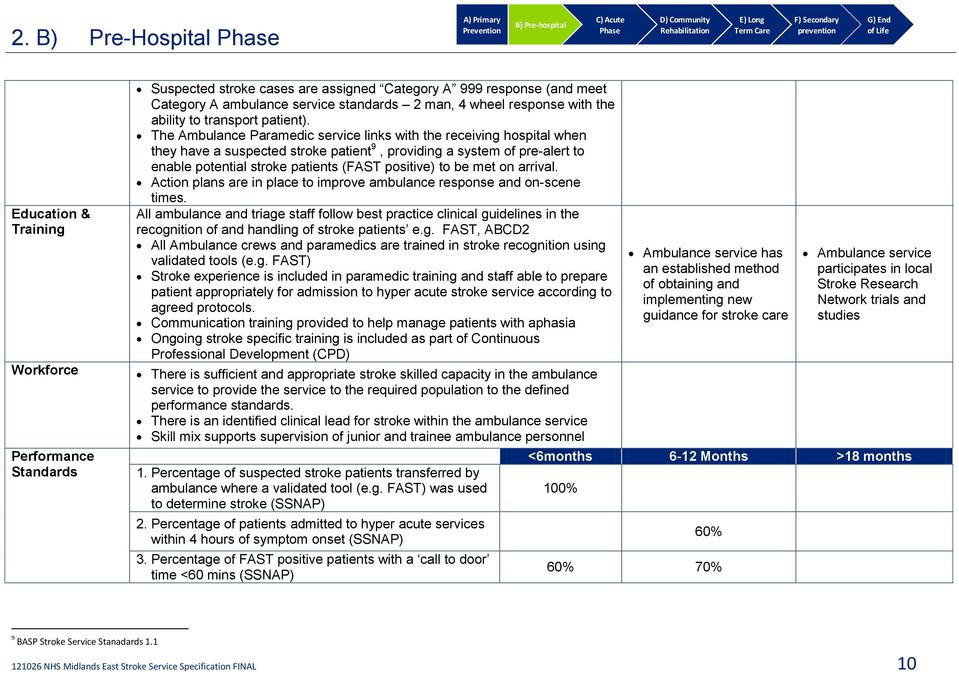
10 2. B) Pre-Hospital Education & Training Workforce Performance Standards Suspected stroke cases are assigned Category A 999 response (and meet Category A ambulance service standards 2 man, 4 wheel response with the ability to transport patient). The Ambulance Paramedic service links with the receiving hospital when they have a suspected stroke patient 9, providing a system of pre-alert to enable potential stroke patients (FAST positive) to be met on arrival. Action plans are in place to improve ambulance response and on-scene times. All ambulance and triage staff follow best practice clinical guidelines in the recognition of and handling of stroke patients e.g. FAST, ABCD2 All Ambulance crews and paramedics are trained in stroke recognition using validated tools (e.g. FAST) Stroke experience is included in paramedic training and staff able to prepare patient appropriately for admission to hyper acute stroke service according to agreed protocols. Communication training provided to help manage patients with aphasia Ongoing stroke specific training is included as part of Continuous Professional Development (CPD) There is sufficient and appropriate stroke skilled capacity in the ambulance service to provide the service to the required population to the defined performance standards. There is an identified clinical lead for stroke within the ambulance service Skill mix supports supervision of junior and trainee ambulance personnel 1. Percentage of suspected stroke patients transferred by ambulance where a validated tool (e.g. FAST) was used to determine stroke (SSNAP) 2. Percentage of patients admitted to hyper acute services within 4 hours of symptom onset (SSNAP) 3. Percentage of FAST positive patients with a call to door time <60 mins (SSNAP) Ambulance service has an established method of obtaining and implementing new guidance for stroke care Ambulance service participates in local Stroke Research Network trials and studies <6months 6-12 Months >18 months 100% 60% 60% 70% 9 BASP Stroke Service Stanadards NHS Midlands East Stroke Service Specification FINAL 10
11 2. C) i. Hyper acute stroke care Hyper acute services provide expert specialist clinical assessment, rapid imaging and the ability to deliver intravenous thrombolysis 24/7, typically for no longer than 72 hours after admission. These services may be in a specialist Hyper Acute Stroke Unit (HASU) or as a dedicated area on a stroke unit. At least 600 stroke cases per year are typically required to provide sufficient patient volumes to make a hyper acute stroke service clinically sustainable, to maintain expertise and to ensure good clinical outcomes. This standard is only one factor and must be seen within the context of other crucial variables such as travel times, clinical and financial sustainability, workforce and inclusive whole-systems working. People with acute stroke will receive an early multidisciplinary assessment, including swallow screening and, for those that continue to need it, have prompt access to high-quality stroke care. Service Outcomes Immediate <6 months 6-12 months Clinical assessment: All patients (including self/ GP referrals) with suspected stroke are admitted to a hospital with a hyper acute services and seen immediately by stroke team to receive immediate structured assessment by the appropriately trained staff in a consultant led team to determine likely diagnosis and suitability for thrombolysis and ongoing care needs 10 : Hyper acute service alerted prior to patient arrival (where appropriate) Hyper acute service has sufficient capacity for all stroke admissions Patients are seen and assessed by a member of the specialist stroke team without delay and within 30 minutes of arrival Patients diagnosed with stroke receive early multidisciplinary assessment: o Eligibility for thrombolysis o Need for immediate brain imaging o Swallow screening (within 4 hours of admission 11 ) with ongoing management plan for provision of adequate nutrition. Patients who fail swallow screen to be assessed by Speech and Language Therapist within 24 hours o Assessment for malnutrition and need for nasogastric tube or gastrostomy within 24 hours of admission 12 o Protocols for assessment and management of other causes of stroke: intracerebral haemorrhage, subarachnoid haemorrhage, acute arterial dissection, cerebral venous thrombosis 13 Long term (>18months) 10 National Stroke Strategy Quality Markers QM8: Assessment; NICE Quality Standards Quality Statement 3 11 NICE Quality Standards Quality Standard 4 12 RCP RCP NHS Midlands East Stroke Service Specification FINAL 11

12 2. C) i. Hyper acute stroke care o Patients with ischaemic stroke or TIA found to be in atrial fibrillation should be anticoagulated (once intracranial bleeding excluded by imaging) at the discretion of the prescriber, but no later than 14 days from the onset 14 Patients with stroke are assessed and managed by stroke nursing staff and at least one member of the specialist rehabilitation team within 24 hours of admission to hospital 15 Ensure all patients with stroke are given an antiplatelet (e.g. aspirin 300mg) immediately after scanning unless contraindicated 16 Diagnosis discussed with patient and carer and plan of care clearly written in patient notes Thrombolysis: Thrombolysis can be provided 24/7 to confirmed stroke patients with an appropriate protocol in place to screen patients against the medical criteria for thrombolysis: Appropriate stroke patients, identified as potentially eligible for thrombolysis treatment, to be scanned within next available CT slot Appropriate stroke patients to be scanned and receive thrombolysis, ideally within 30 mins and certainly within 60 mins of admission (door to needle time) 17. Thrombolysis should be conducted within the criteria specified within the RCP National clinical guidelines for stroke 2012 Monitoring: Protocols or pathways in place that ensure appropriate monitoring of stroke patients in the hyper acute phase of care: All hyper acute patients should be monitored according to a protocol post stroke for 24 hours and then according to patients needs. 18 Any thrombolysed patient should be closely monitored by stroke-trained staff according to a protocol for the first hours post-thrombolysis in a monitored bed. All conscious patients admitted with suspected acute stroke are mobilised out 14 RCP C 15 NICE Quality Standards Quality Statement 5 16 RCP J-L 17 BASP Stroke Service Standards Physiological monitoring and maintenance of hemostasis is recommended in RCP NHS Midlands East Stroke Service Specification FINAL 12

13 2. C) i. Hyper acute stroke care of bed on the day of admission unless contraindicated with frequent opportunity to practice functional activities with a trained healthcare professional 19 Mixed gender wards may be used for critical or highly specialised care in line with DH guidelines for mixed sex accommodation Access to support services: Hyper acute services have onsite access to the following support services and clinical interpretation: Brain imaging (MRI and CT) patients are scanned in the next scan slot within usual working hours, and within a maximum of 60 minutes of request out-of-hours with skilled radiological and clinical interpretation being available 24/7 20 Carotid imaging (e.g. ultrasound, MRA, CTA), within 24 hours 21 Education & Training Access (onsite or via clear pathway) is also available to tertiary care services with clear protocols to provide: Neuro surgery Vascular surgery Repatriation/ Patient transfer: If patient transfer is required from hyper acute to acute care services appropriate pathway protocols are in place and followed. A system is in place to reduce delays in patient transfers. Hyper acute service staff have comprehensive knowledge of the stroke pathway: Clinical staff assessing stroke admissions are trained in thrombolysis and interpretation of brain imaging In-house multidisciplinary team stroke training programmes provided. External stroke training available Stroke physicians and non-medical specialist/ expert practitioners attend BASP thrombolysis training Communication training provided to help manage patients with aphasia. 19 BASP Stroke Service Standards National Stroke Strategy Quality Markers QM8: Assessment; NICE Quality Standards Quality Standard 2; BASP Stroke Service Standards RCP C; BASP Stroke Service Standards NHS Midlands East Stroke Service Specification FINAL 13

14 2. C) i. Hyper acute stroke care All staff aware of the Mental Capacity Act and its implications Specific education and training is developed and provided in accordance with the Stroke-Specific Education Framework Workforce Consultant Stroke Specialist led: Access to consultant stroke specialist 22 decision making for all hyper acute stroke related issues, including thrombolysis 24/7: In person or via telemedicine 23 Sustainable on-call consultant with stroke training rota (no more than1:6) At least daily consultant stroke specialist rounds, 7 days a week In practice, the EEAG will therefore expect to see daily consultant-level stroke specialist rounds, 7 days a week. These could be consultant-level healthcare professionals who may not be doctors as long as they have SEFF-approved stroke training and demonstrable skills and knowledge appropriate to that level. That, in conjunction with the less frequent, unpredictable need for brief medical input to thrombolysis decision-making (e.g. via telemedicine) would provide coverage for all DGHs including those based in remote locations. (Added October 2012) Multidisciplinary Team: Hyper acute services have a sufficient multi-disciplinary team on rota to provide service outcomes with an identified consultant stroke specialist clinical lead: 24/7 availability of appropriately trained staff for assessment of all patients, including thrombolysis eligibility assessment Specialist stroke nursing is available for the care and monitoring of all hyper acute service patients Meet at least once per week to exchange information about individual patients A stroke specialist is defined as a healthcare professional with the necessary knowledge and skills in managing people with stroke, usually evidenced by having a relevant further qualification and keeping up-to-date through CPD; it does not require the person to exclusively see people with stroke (RCP ) 23 Telemedicine with telephone and video, with a local specialist stroke nurse (and IT support and regular audits for quality) can be used as an alternative to face-to-face with a stroke specialist (RCP ) 24 RCP F NHS Midlands East Stroke Service Specification FINAL 14

15 2. C) i. Hyper acute stroke care Staffing Numbers Hyper acute services provide minimum staffing ratios 25 of: 6 BASP thrombolysis trained physicians on a rota 24/7 2.9 WTE nurses per bed to comply with 80:20 trained vs. untrained skill mix 0.73 WTE Physiotherapist per 5 beds (respiratory & neuro) 0.68 WTE Occupational Therapist per 5 beds 0.68 WTE S< per 10 beds Access to social worker Performance Standards 1. Percentage of all stroke patients admitted to hyper acute unit within 4 hours of arrival to hospital (SSNAP) 2. Percentage of patients seen and assessed within 30mins of admission by a specialist in stroke (SSNAP) 3. Percentage of appropriate patients having thrombolysis within 60 mins of entry (door to needle time) (SSNAP) 4. Percentage of appropriate patients having thrombolysis within 45 mins of entry (door to needle time) (SSNAP) <6months 6-12 Months >18 months 90% 90% 95% 85% 90% 95% 90% 5. Percentage of appropriate patients having thrombolysis within 30 mins of entry (door to needle time) (SSNAP) 6. Percentage of stroke patients, identified as ineligible for thrombolysis, scanned within 12 hours of admission (SSNAP) 7. Percentage of all conscious stroke patients to receive a swallow screen within 4 hours of admission (SSNAP) 8. Percentage of patients who fail swallow screen that are assessed by Speech and Language Therapist within 24 hours (SSNAP) 9. Proportion of patients with stroke assessed and managed by stroke nursing staff and at least one 95% 100% 100% 80% 50% 25 RCP NHS Midlands East Stroke Service Specification FINAL 15

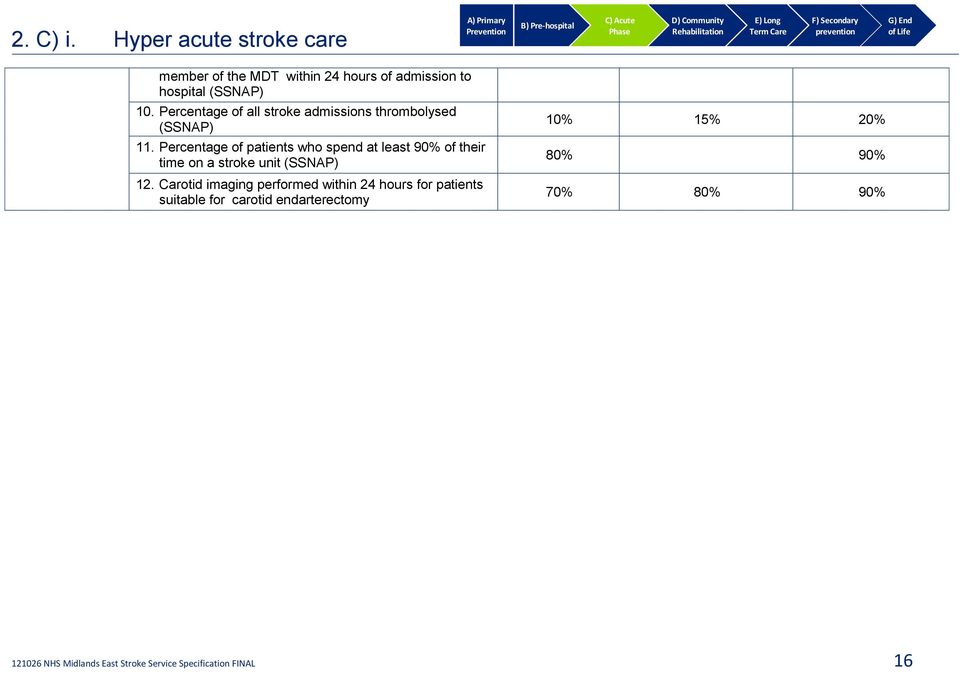
16 2. C) i. Hyper acute stroke care member of the MDT within 24 hours of admission to hospital (SSNAP) 10. Percentage of all stroke admissions thrombolysed (SSNAP) 11. Percentage of patients who spend at least 90% of their time on a stroke unit (SSNAP) 12. Carotid imaging performed within 24 hours for patients suitable for carotid endarterectomy 10% 15% 20% 80% 90% 70% 80% 90% NHS Midlands East Stroke Service Specification FINAL 16
17 2. C) ii. Acute stroke care Acute stroke care immediately follows the hyper-acute phase, usually after first 72 hours after admission. Acute stroke care services provide continuing specialist day and night care, with daily multidisciplinary care, continued access to stroke trained consultant care, access to physiological monitoring and access to urgent imaging as required. In-hospital rehabilitation should begin immediately after a person has had a stroke. services should continue for as long as required, to ensure the best recovery and the minimisation of any disabilities 26 though these are likely to extend beyond time in-hospital (see section D). goals should be agreed between the multidisciplinary team and stroke patients and carers. Service Outcomes Immediate <6 months 6-12 months Acute stroke care: All stroke patients should have access to high quality stroke care and spend the majority of their time in hospital under specialist stroke care: Patients have access to a stroke trained nurse at all times Protocol in place for the promotion of bladder and bowel continence including a policy to avoid urinary catheters 27 and of pressure sores Daily consultant or specialist registrar ward rounds at least 5 days a week Protocols are in place for receiving and discharging patients 7 days a week in a timely manner All patients with stroke have access to a designated stroke rehabilitation services 28 whether in an acute stroke bed or on a specialist rehabilitation unit in hospital. All patients to be mobilised out of bed on day of admission unless contraindicated and offered frequent opportunity to practice functional activities with a trained healthcare professional 29. commences as soon as possible following admission into the acute stroke pathway. Social work assessment as soon as possible and within a maximum of 3 days from referral, if appropriate Long term (>18months) Stroke trained MDT available 7 days a week 26 National Stroke Strategy Quality Markers QM10: High-quality specialist rehabilitation 27 BASP Stroke Service Standards BASP Stroke Service Standards 4.1; NICE Quality Standards Quality Standard 6 29 BASP Stroke Service Standards NHS Midlands East Stroke Service Specification FINAL 17

18 2. C) ii. Acute stroke care Access to support services: Acute stroke services have access (not necessarily onsite) to the following support services and clinical interpretation: Brain imaging (MRI and CT) 30 Carotid imaging (including ultrasound, MRA, CTA) Based on carotid imaging/ stenosis, CEA should be undertaken as soon as possible and within 7 days 31 of symptoms Access is also available to tertiary care services (onsite or offsite with clear protocols) to provide: Neuro surgery Vascular surgery planning in hospital: programmes are built around the individual needs with patient agreed goals: Patients assessed by specialist rehab team within 72 hours, with documented multidisciplinary goals agreed within 5 days 32 ) Personal care plan which is patient-centred, goal-led and implemented from admission. The expected date of discharge will be planned and worked towards and plans shared with patient and carers Multidisciplinary meetings at least once a week to plan patient care services available: services that provide specialist stroke care 5 days a week: Assessment by specialist therapists (Physiotherapist, occupational therapist, speech and language therapist) within 72 hours of admission 33 Stroke survivors offered required active therapy at a level appropriate for obtaining rehabilitation goals for as long as they are continuing to benefit from the therapy and are able to tolerate it (target for 45 mins per discipline, 5 days a week) 34 Access to a service capable of appropriately managing mood, behaviour or cognitive disturbance following a stroke A dysphagia management service is services that provide specialist stroke care 7 days a week 30 Brain imaging should be performed immediately (ideally the next imaging sot and definitely within 1 hour) for people with acute stroke if several conditions apply, else as soon as possible and at most within 24 hours (RCP A &B) 31 RCP C 32 RCP NICE Quality Standards Quality Standard BASP Stroke Service Standards 3.10, 3.11, 3.12, 4.4, 4.5, 4.6; NICE Quality Standards Quality Standard 7; RCP A NHS Midlands East Stroke Service Specification FINAL 18

19 2. C) ii. Acute stroke care Identification of cognitive and perceptual problems within 7 days via a cognitive and psychological assessment using a validated screening tool for all patients by appropriate therapist Screening of all patients to identify mood disturbance and cognitive impairment prior to discharge or within 6 weeks 35 Specialised neuro-rehabilitation services e.g. spasticity, orthotics, continence, driving, vocational etc. prior to discharge 36 Stroke survivors with continued loss of bladder control 2 weeks after diagnosis are reassessed and agree an ongoing treatment plan involving both patients and carers 37 Comprehensive secondary advice and treatment 38 is provided Preparation for discharge: Planning for care after discharge undertaken with stroke patients and their carer/s at as soon as possible to enable domiciliary care support and adaptations to be arranged in good time and in context of pre-admission status and family/ carer support available Protocols are in place to ensure patients and families are fully informed and participate in the process of transfer of care Discharge planning protocols ensures information handover with clear direction for community rehabilitation requirements, discharge destination (e.g. home, care home) with full participation of the ESD/ community rehabilitation team Stroke survivors receive advice and support to enable a return to previous level of activities A formal discharge summary report should be shared with the referrer, GP and stroke survivor (if requested) within 7 days of discharge available including Percutaneous Endoscopic Gastrostomy (PEG) 35 RCP H 36 BASP Stroke Service Standards RCP G; NICE Quality Standards Quality Standard 8 38 BASP Stroke Service Standards NHS Midlands East Stroke Service Specification FINAL 19

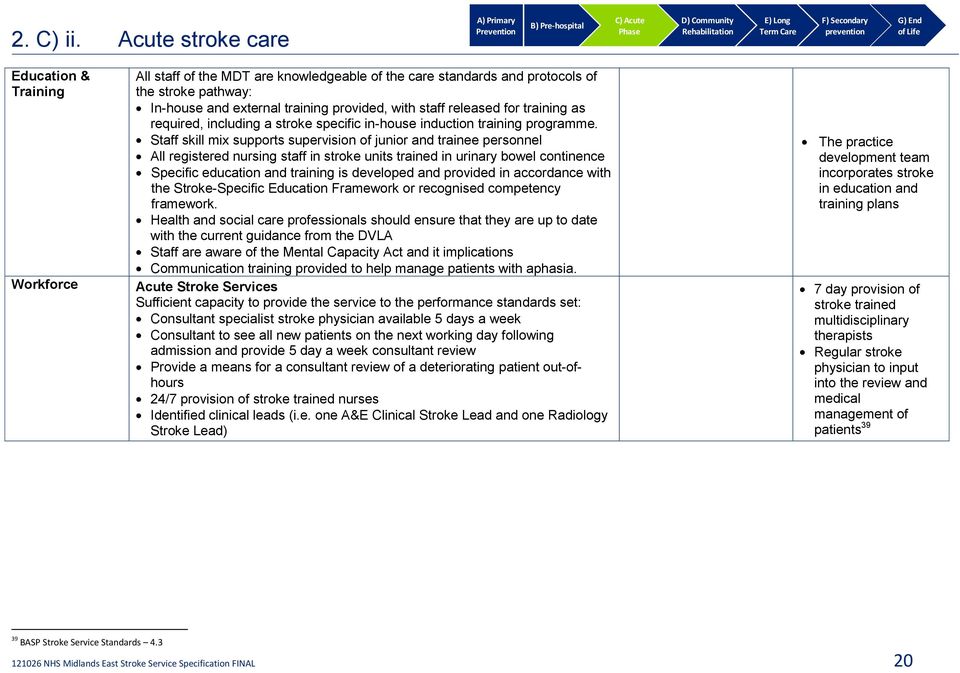
20 2. C) ii. Acute stroke care Education & Training Workforce All staff of the MDT are knowledgeable of the care standards and protocols of the stroke pathway: In-house and external training provided, with staff released for training as required, including a stroke specific in-house induction training programme. Staff skill mix supports supervision of junior and trainee personnel All registered nursing staff in stroke units trained in urinary bowel continence Specific education and training is developed and provided in accordance with the Stroke-Specific Education Framework or recognised competency framework. Health and social care professionals should ensure that they are up to date with the current guidance from the DVLA Staff are aware of the Mental Capacity Act and it implications Communication training provided to help manage patients with aphasia. Acute Stroke Services Sufficient capacity to provide the service to the performance standards set: Consultant specialist stroke physician available 5 days a week Consultant to see all new patients on the next working day following admission and provide 5 day a week consultant review Provide a means for a consultant review of a deteriorating patient out-ofhours 24/7 provision of stroke trained nurses Identified clinical leads (i.e. one A&E Clinical Stroke Lead and one Radiology Stroke Lead) The practice development team incorporates stroke in education and training plans 7 day provision of stroke trained multidisciplinary therapists Regular stroke physician to input into the review and medical management of patients BASP Stroke Service Standards NHS Midlands East Stroke Service Specification FINAL 20
21 2. C) ii. Acute stroke care Other Performance Standards Staffing numbers: Acute and rehabilitation services should have a multidisciplinary team comprising of 40 : o Nurses: 1.35 WTE per bed (65:35 trained to untrained skill mix) o Physiotherapists: 0.84 WTE per 5 beds o Occupational Therapists: 0.81 WTE per 5 beds o Speech & Language Therapists: 0.81 WTE per 10 beds o Psychologists o Dieticians o Social workers Access is available to a range of additional professionals including those in: o Clinical Psychology o Oral health o Orthoptics o Orthotics o Pharmacy Note: where combined stroke units are used, it is expected that beds are designated as hyper acute and acute, then staffed according to the hyper acute service and acute service standards outlined. Equipment and Aids: All equipment and aids (e.g. wheelchairs, continence equipment etc) should be reviewed and ordered before discharge 1. Percentage of patients with agreed rehabilitation goals within 5 days of admission with appropriately formatted copy of goals given to them (SSNAP) 2. Percentage of appropriate patients weighed (or alternative weight estimate if weighting not appropriate) within 72 hours of admission to acute stroke care (SSNAP) Open referral system in social services for assessments of home adaptations and equipment needs <6months 6-12 Months >18 months 80% 100% 40 RCP NHS Midlands East Stroke Service Specification FINAL 21
22 2. C) ii. Acute stroke care 3. Percentage of incontinent patients having continence management plan within 7 days of admission (SSNAP) 4. Percentage of appropriate patients to receive an occupational therapy assessment within 72 hours of admission to acute stroke care (SSNAP) 5. Percentage of appropriate patients to receive physiotherapy assessment and treatment within 72 hours of admission to acute stroke care (SSNAP) 6. Percentage of appropriate patients to receive speech and language assessment and treatment within 72 hours of admission to acute stroke care (SSNAP) 7. Percentage of appropriate patients receiving 5 x45min face-to-face sessions per week each of occupational therapy as necessary 41 (SSNAP) 8. Percentage of appropriate patients receiving 5 x45min face-to-face sessions per week each of speech and language therapy as necessary 41 (SSNAP) 9. Percentage of appropriate patients receiving 5 x45min face-to-face sessions per week each of physiotherapy as necessary 41 (SSNAP) 10. Percentage of patients receiving cognitive/ perceptual screening within six weeks if required (SSNAP) 11. Percentage of patients receiving a continence assessment before discharge (SSNAP) 12. Percentage of appropriate patients and carers provided with joint care plan on discharge from hospital (ASI 7) 80% 95% Within 24 hours 95% 95% Within 24 hours 95% 95% Within 24 hours 95% 80% 80% 80% 85% 100% 100% 41 NICE Quality Standards Quality Standard NHS Midlands East Stroke Service Specification FINAL 22
23 2. C) iii. TIA services The risk of a stroke is high following a TIA approximately 10 to 20 percent of patients who have a TIA will go on to have a stroke within seven days. Specific TIA services provide rapid diagnostic assessment and access to specialist care for high risk patients thereby lowering the risk of a subsequent stroke. Service Outcomes Immediate <6 months 6-12 months TIA identification: TIA patients are risk stratified using the ABCD2 score All TIA patients will be referred to a TIA service (accepting direct referral from primary care and A&E) TIA Service: Specific TIA service is provided for those identified with TIA: Access 7 days a week, 365 days a year. The TIA service has both the facilities to diagnose and treat people with confirmed TIA, plus the facilities to identify and appropriately manage (which may include onward referral) people with conditions mimicking TIA High risk patients 42 must receive specialist assessment and investigation within 24 hours of presenting to a healthcare professional and be started on an antiplatelet (e.g. aspirin) and a statin immediately 43 TIA service has access to: o Blood tests o ECG o Brain scan (if vascular territory or pathology uncertain) MRI DWI is preferred mode of imaging; urgently in high risk and within one week in low risk TIA o Completion of carotid imaging (where indicated) o Referral for carotid surgery 44 where indicated, which should be undertaken within 7 days of onset of TIA 45 o Provision of aspirin, clopidogrel or statins as appropriate o Control of blood pressure o Information and advice provided regarding stroke risk and secondary Long term (>18months) 42 High risk TIA is defined as ABCD score of 4 or above or crescendo TIA (two or more TIAs in one week) 43 RCP C & D 44 Carotid endarterectomy is the recommended procedure, with less routine indications for carotid angioplasty or stenting (RCP L) 45 RCP C NHS Midlands East Stroke Service Specification FINAL 23
24 2. C) iii. TIA services Lower risk TIA patients should receive specialist assessment as soon as possible, but definitely within one week of symptoms 46 Education & Training Workforce Performance Standards Specialist stroke practitioner assessing TIA patients have training, skills and competence in the diagnosis and management of TIA. This should be consistent with the UK Forum for Stroke Training 47 Education and training for primary care staff in recognition and management of TIA patients Specific education and training is developed and provided in accordance with the Stroke-Specific Education Framework or recognised competency framework. The service should be led by a specialist stroke consultant and provided by a specialist in vascular services with access to the consultant lead or specialist stroke nurse with appropriate specialist competency (where appropriate) 1. TIA cases with a higher risk of stroke who are assessed and treated within 24 hours of presenting to a healthcare professional (ASI 5/ IPMR) <6months 6-12 Months >18 months 70% 46 RCP E NHS Midlands East Stroke Service Specification FINAL 24
25 2. C) iv. Tertiary Care Specialist neurosurgical and vascular procedures are sometimes necessary to prevent further damage following a stroke, or prevent stroke altogether. Effective and timely referrals are necessary to ensure that patients suffering a stroke receive the most appropriate care as quickly as possible to improve their long term outcome. Service Outcomes Immediate Requirements <6 months 6-12 months Access to tertiary services: Surgical services are provided as early as possible through early recognition of the need for surgical intervention: All patients with a suspected non-disabling stroke or TIA have urgent access to comprehensive neurovascular services 48. Neurovascular services include: o Neurosurgical services o Vascular surgical services Access to tertiary services may be on site or off-site. For offsite services, clear protocols must be in place for a commissioned pathway of care. Neuro surgical services There are relatively few indications for neurosurgical intervention in patients with stroke; however specific cases of stroke may require urgent management. For example: Cases of middle cerebral infarction should be referred within 24 hours and treated (e.g. decompressive hemicraniotomy) within 48 hours 49. Treatment for aneurysm (endovascular embolisation or surgical clipping) should be available within 48 hours 50 Vascular surgical services: Carotid intervention (e.g. carotid endarterectomy) for recently symptomatic severe carotid stenosis should be regarded as an emergency procedure in patients who are neurologically stable, and be performed within 7 days of a TIA or minor stroke 51 Long term Requirements (>18months) High risk TIA 42 that require carotid endarterectomy are admitted for urgent investigation and surgery within 48 hours 48 BASP Stroke Service Standards 5.1; National Stroke Strategy Quality Markers QM 9: Stroke Treatment 49 RCP N 50 RCP C 51 National Stroke Strategy Quality Markers QM 6: TIA and Minor Stroke Treatment; BASP Stroke Service Standards 3.16; Also note: The use of carotid artery stenting (CAS) was reviewed by NICE/RCP; however, no evidence (no RCT) for early stenting was found on which to base a recommendation [RCP ; NICE CG ] NHS Midlands East Stroke Service Specification FINAL 25
26 2. C) iv. Tertiary Care Education and Training Workforce Performance Standards Staff trained to recognise when specialist referral is required Stroke physicians input to the multi-disciplinary management of appropriate cases 1. Percentage of patients receiving carotid surgery within 7 days of symptom onset that triggered referral (UK Carotid Interventions Audit) <6months 6-12 Months >18 months 95% NHS Midlands East Stroke Service Specification FINAL 26
27 2. D) i. Early Supported Discharge (ESD) Early supported discharge (ESD) enables appropriate stroke survivors to leave hospital early through the provision of intense rehabilitation in the community at a similar level to the care provided in hospital. An ESD team of nurses, therapists, doctors and social care staff work collaboratively as a team and with patient and families, providing intensive rehabilitation at home for up to 6 weeks, thereby reducing the risk of re-admission into hospital for stroke related problems and increasing independence and quality of life with support the carer and family. Service Outcomes Education & Training Immediate Requirements <6 months 6-12 months ESD service: ESD team should be stroke specific and sufficiently able to commence treatment within 24 hours of discharge: Rapid response, same day ESD service provided 5 days a week at a stroke survivors place of residence to facilitate timely discharge from hospital setting for a period of up to 6 weeks. Stroke survivors offered required active therapy, (target of 45 mins per discipline, 5 days a week) to an intensity equivalent to in hospital rehabilitation, but reflective of individual patient needs and goals Single point of contact provided to patients, carer and families (into rehab) Carers are appropriately educated and trained to recognise common causes of illness that result in avoidable admissions e.g. constipation, urinary tract infection (into rehab) Collaboration with health and social services, the independent and third sectors to enable to stroke survivor to develop a greater quality of life and independence (in all or generic) Access is provided to community rehabilitation services/ long term care provision following ESD if required. Specific education and training is developed and provided in accordance with the Stroke-Specific Education Framework Long term Requirements (>18months) 7 days a week ESD service NHS Midlands East Stroke Service Specification FINAL 27
28 2. D) i. Early Supported Discharge (ESD) Workforce Other Performance Standards A stroke ESD multidisciplinary team composition should include as a minimum (WTE per 100 cases per year 52 ): o Occupational Therapy (1) o Physiotherapy (1) o Speech and Language Therapy (0.4) The stroke ESD team has access to support from: o Stroke physician (0.1) o Nurse (0-1.2) o Social worker (0-0.5) o assistants (0.25) o Clinical Psychology o Dieticians o Orthotics o Orthoptics There are coordinated stroke skilled ESD teams working in partnership with local authorities and other health and third sector providers ESD team meets weekly as a minimum to plan and manage patient care Equipment and Aids: All equipment and aids (e.g. wheelchairs, continence equipment) should be reviewed and ordered during ESD service 1. Percentage of stroke survivors supported by a stroke skilled Early Supported Discharge team (ASI 9) Open referral system in social services for assessments of home adaptations and equipment needs <6months 6-12 Months >18 months 2. Percentage appropriate stroke survivors whose treatment programme started within one working day 80% 100% of release from hospital* *Requires a separate data collection exercise. These metrics are believed to be important components of the care pathway, but at the moment there is not a existing data source to provide a standard means of collection and thus would require local collection. 40% 52 East Midlands ESD Service Specification NHS Midlands East Stroke Service Specification FINAL 28
29 2. D) ii. Stroke Specialist Community Stroke survivors rehabilitation will continue after the initial time spent in acute in-hospital rehabilitation, out into the community. These services enable stroke survivors develop a greater quality of life and independence following stroke. Patients will access community rehabilitation services following standard discharge from a stroke unit or following ESD. Community stroke rehabilitation services includes the transfer of care from hospital to home and time at home provided through collaboration with health and social services, the independent and third sectors. Service Outcomes Immediate Requirements <6 months 6-12 months A range of services are in place and easily accessible to support the individual long-term needs of individuals, their carer/s and families 53, encouraging selfmanagement where appropriate. Comprehensive social care is provided to all patients and their carers that need it Single point of contact provided when patients leave hospital All stroke survivors discharged from hospital who have residual strokerelated problems are followed up within 72 hours by specialist stroke rehabilitation services for assessment and ongoing management 54 Any stroke survivors referred to a social worker will receive an assessment within 72 hours of receipt of the referral Goals incorporated into a personalised care plan that allows the patient to take ownership of their rehabilitation and reviewed regularly (every 4-6 weeks) with the patient throughout the treatment period. Active therapy at a level appropriate for obtaining rehabilitation goals for as long as they are continuing to benefit from the therapy and are able to tolerate it 55 (target for 45 mins per discipline, 5 days a week 56 ) The GP and other relevant community services are informed that a stroke survivor has been discharged home or to another hospital prior to discharge. Age appropriate provision made for the social care requirements of stroke survivor prior to discharge, e.g. domestic tasks (such as shopping and laundry) Training in selfmanagement, goal setting and problem solving skills is available 60 Long term Requirements (>18months) 53 National Stroke Strategy Quality Markers QM 13: Long term care and support; Adult Social Care Outcomes Framework 54 RCP A 55 BASP Standards 3.10, 3.11, 3.12; 4.4, 4.5, 4.6; NICE Quality Standards Quality Standard 7 56 RCP A 60 Royal College of Physicians Stroke Guidelines; London commissioning guidelines NHS Midlands East Stroke Service Specification FINAL 29
30 2. D) ii. Stroke Specialist Community Adult social services provide advice on aids and adaptations to daily living Review of home environment, usually by a home visit by an occupational therapist, to adapt to patient needs where patient remains dependent in some activities 57 A carers assessment should be completed for each carer with links to carer support groups made and family support organisations and followed up Specialist stroke rehabilitation, support and any appropriate management plans will address the following issues either directly or by seamless onward referral where required 58 : o Mobility and movement (including exercise programmes, gait retraining, mobility aids and orthotics) o Upper limb rehabilitation o Management of spasticity and tone o Sensory impairment screening and sensory discrimination training o Falls (including assessment of bone health, progressive balance training and aids) o Cognitive rehabilitation (including addressing impairment in attention, memory, spatial awareness, perception, praxis and executive function) o Communication (including aphasia support twice weekly during the first 20 weeks, techniques or aids for dysarthria and apraxia, information about local groups) o Everyday activities including provision of daily living aids and equipment (e.g. dressing, washing, meal preparation) o Emotional and psychosocial issues (e.g. depression, adjustment difficulties, changes in self-esteem or efficacy, emotionalism) o Swallowing (including swallowing rehab, maintenance of oral and dental hygiene, nasograstric tube feeding, gastrostomy) o Skin integrity ( i.e. pressure care and positioning) o Nutrition (including specialist nutritional assessment, nutritional support)visual disturbance o Continence (bladder and bowel) o Social interaction, relationships and sexual functioning (including psychosocial management or medications) o Pain (assessed regularly using validated score, referred to specialist where indicated) 57 RCP D 58 RCP to NHS Midlands East Stroke Service Specification FINAL 30
31 2. D) ii. Stroke Specialist Community Education & Training Workforce o Home assessment (including need for larger scale equipment or adaptation) o Return to work (including referral to specialist in employment or vocational rehabilitation) o Driving o Financial management and accessing benefits Community leisure and exercise classes are available and promoted to stroke survivors, who are then supported to attend Stroke survivors are aware of and offered options to promote wellbeing, including peer-led support groups, engagement in community activities and professional psychological therapies including IAPT and community mental health services Telephone counselling support available for three months 59 Specific education and training is developed and provided in accordance with the Stroke-Specific Education Framework Staff are aware of the Mental Capacity Act and it implications Carers receive training in care, for example, moving, handling and dressing; receive written information on management plan and point of contact for stroke information There are established stroke skilled, multidisciplinary community rehabilitation teams. Composition of the team should include as a minimum: o Physiotherapist o Occupational therapist o Speech and language therapist o Community nursing (as appropriate) o Social care o assistants o Clinical psychology (as appropriate) The community rehabilitation team has access to support from: o GP o Dieticians o Orthotics o Orthoptics o Vocational rehabilitation Initial assessment of the stroke patient is carried out by a qualified 59 RCP C NHS Midlands East Stroke Service Specification FINAL 31
32 2. D) ii. Stroke Specialist Community Other Performance Standards professional (some of the care may be delivered by rehabilitation assistants under the supervision of a qualified therapist) Equipment and Aids: All equipment and aids (e.g. wheelchairs, continence equipment etc) necessary to ensure a safe environment should be available at discharge and appropriate training provided to stroke survivors and carers. 1. Percentage of appropriate patients and carers with joint care plans on discharge from hospital (ASI 7/ SSNAP) 2. Percentage of stroke survivors contacted by a member of community rehabilitation team within one working day and assessed within 72 hours* 3. Percentage appropriate stroke survivors whose treatment programme started within 7 days where agreed as part of care plan (SSNAP) Open referral system in social services for assessments of home adaptations and equipment needs <6months 6-12 Months >18 months 85% 95% 100% 80% 90% 100% 80% 100% 4. Percentage of stroke patients that are reviewed six 95% weeks after leaving hospital* *Requires a separate data collection exercise. These metrics are believed to be important components of the care pathway, but at the moment there is not a existing data source to provide a standard means of collection and thus would require local collection NHS Midlands East Stroke Service Specification FINAL 32
33 2. term care Stroke survivors and their carers should be enabled to live a full life in the community 61 over the medium and long term (>3 months). Support is required from local services to ensure appropriate, tailored support is provided to assist re-integration into the community and maximise the quality of life experienced by stroke survivors, their carer/s and families. Service Outcomes Immediate Requirements <6 months 6-12 months Provision of information and support for stroke survivors, carers and families: Ongoing physical, speech and language, continence and other required therapies are provided where clinically appropriate to meet patient needs Carers of stroke survivors with stroke are provided with a named point of contact for stroke information, written information about the stroke survivors diagnosis and personal care plan, and sufficient practical training to enable them to provide care 62 Carers are provided with clear guidance on how to find help if problems develop Regular review and needs assessment: The patient and family will be aware of their single named point of contact All stroke survivors receive a review and onward referral to appropriate MDT members at six weeks, six months, 12 months and then annually that facilitates a clear pathway back to further specialist review, risk factor screening, advice, information, support and rehabilitation where required, is provided 63. Information from reviews should be shared across the entire team involved in delivering care to the stroke survivor, including with the stroke survivor themselves and their GP. Stroke survivors and their carers are enabled to participate in paid, supported and voluntary employment 64 All eligible users of social care services should have access to a personal budget Long term Requirements (>18months) Carers have the opportunity to access long-term emotional and practical support though peer support groups facilitated by charitable or voluntary groups 61 National Stroke Strategy Quality Markers QM 15: Participation in community life 62 NICE Quality Standards Quality Standard National Stroke Strategy Quality Markers QM 3: Information, advice and support, QM 14: Assessment and review 64 National Stroke Strategy Quality Markers QM 16: Return to work NHS Midlands East Stroke Service Specification FINAL 33
34 2. term care Education & Training Staff seeing stroke survivors know where to go to obtain information on other local services, charities in the area and how the stroke survivor may access financial, emotional, social, and vocational support. Staff are aware of the Mental Capacity Act and it implications Health and social care professionals should ensure that they are up to date with the current guidance from the DVLA Care home staff should be familiar with stroke care strategies and options (including physical, physchological and social), and the needs and aspirations of those in their care Staff have the details of the local IAPT service so that those that need it can access the service Carers involved with the care management process from the outset, and encouraged to participate in an educational programme (on stroke, care and management, ) Service should include staff with expertise and competence in assessing, treating and monitoring people with behavioural and cognitive disturbance Workforce Performance Standards Staff working in long term care should have access to support and guidance from stroke skilled staff 1. Proportion of stroke patients that are reviewed six months after leaving hospital (ASI 8/ SSNAP) <6months 6-12 Months >18 months 95% 2. Percentage of stroke survivors that received psychological support for mood, behaviour or cognitive disturbance within six months (ASI 6/ SSNAP) 3. Percentage of patients with Barthel score recorded at discharge (SSNAP) 4. Percentage of patients with Modified Rankin score at discharge (SSNAP) 40% 100% 100% NHS Midlands East Stroke Service Specification FINAL 34
35 2. Healthy lifestyles and management of specific risk factors reduce the risk of an initial stroke and the risk of a subsequent stroke 65. For those who have already had a stroke or TIA, advice is even more important. This means assessing individuals for their risk factors and giving them information about possible strategies to modify their lifestyle that can reduce their risk. GPs need to actively manage these conditions in line with national guidelines. Service Outcomes Immediate <6 months 6-12 months Assessment: After stroke, stroke survivors and their carers need to be offered a review from primary care services 66 of their health, social care and secondary needs: All stroke survivors with a stroke will have their risk factors assessed as soon as possible and certainly within one week 67 ; documented and a personal care plan for secondary as part of the stroke team s assessment which is passed onto primary care Monitored regularly in primary care on a yearly basis at minimum Monitoring: This specification does not attempt to define all risk factors (see RCP National clinical guidelines 2012), though significant risk factors and assessment include the following: Managing hypertension so systolic blood pressure is below 130 mmhg; treatment should be initiated prior to discharge or at two weeks 68 Anticoagulation (e.g. Warfarin) for individuals with atrial fibrillation and where not contraindicated; prescribed before discharge or plans to anticoagulate as out-patient which ever aligns with guidelines to administer 2 weeks following stroke onset All patients with ischaemic stroke, not in atrial fibrillation, to have antiplatelets medication unless contraindicated All patient who have had an ischaemic stroke or TIA should be offered a statin drug unless contraindicated 69 Smoking cessation, alcohol, tailored exercise programmes and healthy lifestyle advice for all stroke/tia survivors. Protocols in place for stroke survivors education for secondary of stroke encouraging better compliance with end result of reduced recurrent stroke Long term (>18months) 65 National Stroke Strategy Quality Markers QM 2: Managing risk 66 National Stroke Strategy Quality Markers QM 14: Assessment and review 67 RCP A 68 RCP D. Note: For non-admitted patients requiring blood pressure treatment, treatment should be stated at the first clinic visit 69 RCP A NHS Midlands East Stroke Service Specification FINAL 35
36 2. Education & Training Performance Standards Risk management: Risk factors, including hypertension, obesity, high cholesterol, atrial fibrillation and diabetes, are managed according to clinical guidelines, and appropriate action is taken to reduce overall vascular risk 70 Participating GPs produce and maintain a register of patients who have had a stroke or TIA, forming a suite of indicators to provide quality of care 77 Measures for secondary introduced as soon as the diagnosis is confirmed, including discussion of individual risk factors Information and advice strategies to ensure that clear, consistent, culturally sensitive messages are being given to those who have had a stroke, their families and those at high risk Practices can produce a register of patients with stroke or TIA 71 Information and advice: Those at risk of stroke and stroke survivors are assessed for and given information about risk factors and lifestyle management issues (exercise, smoking, diet, weight and alcohol), and are advised and supported in possible strategies to modify their lifestyle and risk factors 70 Stroke survivors given named contact to help them plan and manage their long-term care 72 Meet individual needs, tailoring for a variety of ages, ethnicities and lifestyles Access to leaflets in variety of formats (i.e. different languages, large print, braille, dysphasia friendly) All primary care professionals maintain and update their knowledge of national guidelines and implement them in practice, targeting high risk patient groups Percentage of patients with stroke or TIA who smoke whose notes record smoking status within the previous 15 months 73 (QOF) <6months 6-12 Months >18 months 90% 70 National Stroke Strategy Quality Markers QM2: Managing Risk 71 Quality and Outcomes Framework: Stroke 1 72 Care Quality Commission: Supporting Life After Stroke 73 QOF Smoking NHS Midlands East Stroke Service Specification FINAL 36
37 2. 2. Percentage of patients with a history of TIA or stroke in whom the last blood pressure reading (measured in the previous 15 months) is 150/90 or less 74 (QOF) 3. Percentage of patients with a TIA or stroke who have a record of total cholesterol in the last 15 months 75 (QOF) 4. Percentage of patients with TIA or stroke who last measured total cholesterol (measured in the previous 15 months) is 5 mmol/l or less 76 (QOF) 5. Percentage of patients with stroke or TIA who smoke whose notes contain a record that smoking cessation advice or referral to a specialist service, where available, has been offered within the previous 15 months 77 (QOF) 6. Percentage of patients presenting with stroke with new or previously diagnosed atrial fibrillation who are anti-coagulated on discharge. (ASI 1) 70% 90% 60% 90% 60% 70% 80% 74 QOF Stroke 6 75 QOF Stroke 7 76 QOF Stroke 8 77 QOF Smoking NHS Midlands East Stroke Service Specification FINAL 37
38 care Stroke is the UK s third biggest killer 78. Patients with stroke may enter the End pathway at many stages of the Stroke Pathway, in different care settings. Clear decisions will indicate when a patient s prognosis means that an end of life pathway is appropriate. It is important that this decision is made by the appropriate skilled and experienced individual, taking account of the needs and choices of the patient, carer and family. Service Outcomes Education & Training Workforce Performance Standards Immediate <6 months 6-12 months End of life care: Decision to enter a patient into an end of life pathway should be taken by an appropriate and experienced individual, taking account of the needs and wishes of the patient, carer and family 79 Patients and carer offered opportunity to be discharged home for end of life care Palliative and End care will be provided in line with clinical practice guidance and the local service specification for End care. This may include referral to specialist palliative care services. The Liverpool Care Pathway for the dying should be used to care for people in the last days or hours of life to deliver high quality care during this phase 79. Preferred Priorities for Care (PPC) document shared with all health and social care staff involved in their care Application of the Gold standards framework to enable identification of appropriate patients and their care, and the Liverpool Care Pathway Communication training provided to support practitioners in conversations about end of life care Patients receiving end of life care do so from a workforce with appropriate skills and experience in all care settings Percentage mortality of stroke patients at 1 month following a stroke (SSNAP) Patients considered to be in the last 12 months of life are recommended for inclusion on the GP s GSF register Long term (>18months) <6months 6-12 Months >18 months N/A 78 Stroke Association Manifesto National Stroke Strategy Quality Markers QM 11: End care NHS Midlands East Stroke Service Specification FINAL 38
39 care 2. Percentage mortality of stroke patients at 6 months following a stroke (SSNAP) N/A 3. Percentage mortality of stroke patients one year following a stroke (SSNAP) N/A No explicit performance measures are included for End care services, though it is expected that the National Quality Markers for End care are met, with data collected to support achievement NHS Midlands East Stroke Service Specification FINAL 39
SECTION B THE SERVICES COMMUNITY STROKE REHABILITATION SPECIFICATION 20XX/YY
 SECTION B THE SERVICES COMMUNITY STROKE REHABILITATION SPECIFICATION 20XX/YY SECTION B PART 1 - SERVICE SPECIFICATIONS Service specification number Service Commissioner Lead Provider Lead Period Date of
Early Supported Discharge (in the context of Stroke Rehabilitation in the Community)
 Early Supported Discharge (in the context of Stroke Rehabilitation in the Community) Gold Standard Framework This document was produced with reference to national standards for best practice (e.g. NICE
Stroke Services: Ensuring the best outcomes for patients and communities in the year ahead. Progress and Way Forward
 Stroke Services: Ensuring the best outcomes for patients and communities in the year ahead Progress and Way Forward Version 3.0, 3 March 2014 Summary The most important message for anyone with a suspected
GP workshop. Maria Fitzpatrick Nurse Consultant Kings College Stroke Centre
 GP workshop Maria Fitzpatrick Nurse Consultant Kings College Stroke Centre Stroke: the Facts Stroke: the Facts Every 5 minutes someone in the UK has a stroke 1 in 4 men and 1 in 5 women will have a stroke
Ambulance Trust Feedback Report. Progress in improving stroke care
 Feedback Report Ambulance Trust Feedback Report Progress in improving stroke care Progress in improving stroke care Ambulance Trust Feedback Report Introduction In February 2010 we published a report on
Assessment Blueprint for Stroke Medicine. Mini- DOPS MSF SESR CBD TP A R area
 Assessment Blueprint for troke Medicine DOP MF ER CBD TP A R 1. ACUTE TROE OBJECTIVE - TO PROVIDE THE TRAINEE WITH THE NOWLEDGE AND ILL TO CONTRIBUTE TO A COMPREHENIVE PECIALIT ERVICE FOR PATIENT WITH
ADULT HEALTH AND WELLBEING LONG-TERM NEUROLOGICAL CONDITIONS
 ADULT HEALTH AND WELLBEING LONG-TERM NEUROLOGICAL CONDITIONS i. Summary The National Service Framework for long-term neurological conditions categorises neurological conditions as: Sudden-onset conditions
Stroke rehabilitation
 Costing report Stroke rehabilitation Published: June 2013 http://guidance.nice.org.uk/cg162 This costing report accompanies the clinical guideline: Stroke rehabilitation (available online at http://guidance.nice.org.uk/cg162).
ALBERTA PROVINCIAL STROKE STRATEGY (APSS)
 ALBERTA PROVINCIAL STROKE STRATEGY (APSS) Stroke Systems of Care Key Components APSS Pillar Recommendations March 28, 2007 1 The following is a summary of the key components and APSS Pillar recommendations
Rehabilitation Network Strategy 2014 2017. Final Version 30 th June 2014
 Rehabilitation Network Strategy 2014 2017 Final Version 30 th June 2014 Contents Foreword 3 Introduction Our Strategy 4 Overview of the Cheshire and Merseyside Rehabilitation Network 6 Analysis of our
Review of the Case for Change For Stroke Services in Kent and Medway
 The Clinical Co-Dependencies of Acute Hospital Services: A Clinical Senate Review Review of the Case for Change For Stroke Services in Kent and Medway June 2015 Email: [email protected]
London Specialist Inpatient Rehabilitation Referral & Assessment Form (Version 4.2: September 2014)
 London Specialist Inpatient Rehabilitation Referral & Assessment Form (Version 4.2: September 2014) Please complete all sections in order to avoid delays processing referral. Section A. Patient Details
BRIEFING PAPER STROKE SERVICES REDESIGN
 1. Introduction BRIEFING PAPER STROKE SERVICES REDESIGN Agenda Item 3 Stroke is the leading cause of adult disability in Wales, and the third most common cause of death, after cancer and heart disease.
Stroke Care First week
 Stroke Care First week Florence Nightingale (1820 1910) Stroke Unit Dedicated personnel trained in stroke management Stepwise guidelines supported by explicit checklists Continuous monitoring available
Bringing Big Data to Quality Improvement in the Sentinel Stroke National Audit Programme (SSNAP)
 Bringing Big Data to Quality Improvement in the Sentinel Stroke National Audit Programme (SSNAP) Mark Kavanagh SSNAP Project Manager www.strokeaudit.org 16 June 2015 What is a stroke? A stroke is a serious,
Approved: Acute Stroke Ready Hospital Advanced Certification Program
 Approved: Acute Stroke Ready Hospital Advanced Certification Program The Joint Commission recently developed a new Disease- Specific Care Advanced Certification program for Acute Stroke Ready Hospitals
Proposed co-location of stroke services
 Proposed co-location of stroke services Contents Contents... 2 Executive summary... 3 Introduction... 4 How stroke services are currently provided... 6 The case for change... 8 What is our proposed service
Commissioning Support for London. Stroke rehabilitation guide: supporting London commissioners to commission quality services in 2010/11
 Commissioning Support for London Stroke rehabilitation guide: supporting London commissioners to commission quality services in 2010/11 Contents Executive summary 4 1 Introduction 7 1.1 Healthcare for
Community health care services Alternatives to acute admission & Facilitated discharge options. Directory
 Community health care services Alternatives to acute admission & Facilitated discharge options Directory Introduction The purpose of this directory is to provide primary and secondary health and social
STROKE AND TIA MULTIDISCIPLINARY CARE PATHWAY 6 th Edition Cornwall Stroke Service (Royal Cornwall Hospital Trust Facing)
 STROKE AND TIA MULTIDISCIPLINARY CARE PATHWAY 6 th Edition Cornwall Stroke Service (Royal Cornwall Hospital Trust Facing) 1. Aim/Purpose of this Guideline The aim of this document to inform clinicians
How good is stroke care?
 How good is stroke care? First SSNAP Annual Report Care received from April 2013 to March 2014 Distant as a light house I felt, shining my inner light for a rescue boat... In time it eventually came! Claire
SSNAP s Acute Organisational Audit Report 2012: Performance Summary for South London
 SSNAP s Acute Organisational Audit Report 2012: Performance Summary for South London The Sentinel Stroke National Audit Programme (SSNAP) s Acute Organisational Audit looks at how stroke services across
Quality standard Published: 11 June 2015 nice.org.uk/guidance/qs89
 Pressure ulcers Quality standard Published: 11 June 2015 nice.org.uk/guidance/qs89 NICE 2015. All rights reserved. Contents Introduction... 6 Why this quality standard is needed... 6 How this quality standard
Acute care toolkit 2
 Acute care toolkit 2 High-quality acute care October 2011 Consultant physicians are at the forefront of delivering care to patients presenting to hospital with medical emergencies. Delivering this care
Special review. Supporting life after stroke. A review of services for people who have had a stroke and their carers
 Special review Supporting life after stroke A review of services for people who have had a stroke and their carers January 2011 About the Care Quality Commission The Care Quality Commission (CQC) is the
NATIONAL INSTITUTE FOR HEALTH AND CLINICAL EXCELLENCE CENTRE FOR CLINICAL PRACTICE QUALITY STANDARDS PROGRAMME
 NATIONAL INSTITUTE FOR HEALTH AND CLINICAL EXCELLENCE CENTRE FOR CLINICAL PRACTICE QUALITY STANDARDS PROGRAMME standard topic: Specialist neonatal care Output: standard advice to the Secretary of State
NICE Pathways bring together all NICE guidance, quality standards and other NICE information on a specific topic.
 Rehabilitation for movement difficulties after stroke bring together all NICE guidance, quality standards and other NICE information on a specific topic. are interactive and designed to be used online.
REHABILITATION MEDICINE by PROFESSOR ANTHONY WARD
 REHABILITATION MEDICINE by PROFESSOR ANTHONY WARD What is Rehabilitation Medicine? Rehabilitation Medicine (RM) is the medical specialty with rehabilitation as its primary strategy. It provides services
Lambeth and Southwark Action on Malnutrition Project (LAMP) Dr Liz Weekes Project Lead Guy s & St Thomas NHS Foundation Trust
 Lambeth and Southwark Action on Malnutrition Project (LAMP) Dr Liz Weekes Project Lead Guy s & St Thomas NHS Foundation Trust Page 0 What is the problem? Page 1 3 million (5 % population) at risk of malnutrition
National Clinical Programmes
 National Clinical Programmes Section 3 Background information on the National Clinical Programmes Mission, Vision and Objectives July 2011 V0. 6_ 4 th July, 2011 1 National Clinical Programmes: Mission
Cheshire and Merseyside Rehabilitation Network Referral Criteria
 Cheshire and Merseyside Rehabilitation Network Referral Criteria Date Approved: September 2014 Effective From: September 2014 Review Date: August 2015 1. Rehabilitation Definition Rehabilitation is an
GP Round Up Introduction by Alistair Flowerdew Medical Director
 GP Round Up Issue 55 October 2014 Contents GP Round Up Introduction by Alistair Flowerdew Medical Director... 1 Observation ward opens in Emergency Department... 2 Orthopaedic Elective Centre to open in
National Sentinel Stroke Audit Phase I (organisational audit) 2006 Phase II (clinical audit) 2006. Report for England, Wales and Northern Ireland
 National Sentinel Stroke Audit Phase I (organisational audit) 2006 Phase II (clinical audit) 2006 Report for England, Wales and Northern Ireland Prepared on behalf of the Intercollegiate Stroke Working
Improving Urgent and Emergency care through better use of pharmacists. Introduction. Recommendations. Shaping pharmacy for the future
 Improving Urgent and Emergency care through better use of pharmacists The Royal Pharmaceutical Society (RPS) believes that pharmacists are an underutilised resource in the delivery of better urgent and
Appendix L: HQO Year 1 Implementation Priorities
 Appendix L: HQO Year 1 Implementation Priorities Chronic Obstructive Pulmonary Disease (Source: COPD Chairs) Non-Invasive Positive Pressure Ventilation Early Ambulation If possible, seek patient preferences
REMINDER: Please ensure all stroke and TIA patients admitted to hospital are designated as "Stroke Service" in Cerner.
 ACUTE STROKE CLINICAL PATHWAY QEH/HH PCH KCMH Souris Western Stewart Memorial O'Leary PATIENT ID INCLUSION CRITERIA* All patients admitted to hosptial with a suspected diagnosis of acute ischemic stroke
All about stroke. English fact sheet. How do I recognise the signs of stroke? What is a stroke? Call StrokeLine 1800 STROKE (1800 787 653)
 What is a? A happens when the blood supply to the brain is interrupted. Blood contains oxygen and important nutrients for your brain cells. Blood may stop moving through an artery because it is blocked
Effective Approaches in Urgent and Emergency Care. Priorities within Acute Hospitals
 Effective Approaches in Urgent and Emergency Care Paper 1 Priorities within Acute Hospitals When people are taken to hospital as an emergency, they want prompt, safe and effective treatment that alleviates
Manifesto for Acquired Brain Injury Rehabilitation
 Manifesto for Acquired Brain Injury Rehabilitation For further information please contact: Chloë Hayward UKABIF Executive Director PO Box 355 Plymouth PL3 4WD Tel: 01752 601318 Email: [email protected]
Stroke Systems of Care
 Stroke Systems of Care Ashutosh P. Jadhav, MD PhD Assistant Professor, Neurology and Neurological Surgery Center for Neuro-endovascular Therapy UPMC Stroke Institute Pittsburgh, PA Stroke chain of survival
Transfer of Care Guideline for Stroke Patients Stroke Reperfusion Workgroup
 Transfer of Care Guideline for Stroke Patients Stroke Reperfusion Workgroup Contact: Mark Longworth, Stroke Network Manager, ACI, Mob 0417 680 482, Tel 02 8644 2188 [email protected]
Future National Clinical Priorities for Ambulance Services in England
 Background Future National Clinical Priorities for Ambulance Services in England National Ambulance Service Medical Directors (NASMeD) April 2014 Ambulance services have delivered significant improvements
Ischaemic stroke 85% (85 in every 100 strokes)
 UNDERSTANDING STROKE DUE TO INTRACEREBRAL HAEMORRHAGE This factsheet provides information for people who have had a stroke due to an intracerebral (bleed in the brain) and for their families and carers.
Service Specification Template Department of Health, updated June 2015
 Service Specification Template Department of Health, updated June 2015 Service Specification No. : 2 Service: Commissioner Lead: Provider Lead: Period: Anti-coagulation monitoring Date of Review: 31 st
Specialist Rehabilitation and Community Services. Your Pathway: a better future
 Specialist Rehabilitation and Community Services Your Pathway: a better future About Us Active Pathways is an established provider of Mental Health services in the North West of England. We offer a range
COMMUNITY STROKE SERVICES
 Members Event COMMUNITY STROKE SERVICES Sue Baker Matron/Specialist Nurse Practitioner Worcestershire Health & Care Trust Caroline Lister Worcestershire Acute Hospitals Trust September 2013 Aims: To gain
When a stroke happens
 When a stroke happens When a stroke happens What to expect during the first hours, days and weeks after a stroke We re for life after stroke Introduction Need to talk? Call our confidential Stroke Helpline
NATIONAL STROKE NURSING FORUM NURSE STAFFING OF STROKE SERVICES POSITION STATEMENT FOR NATIONAL STROKE STRATEGY
 NATIONAL STROKE NURSING FORUM NURSE STAFFING OF STROKE SERVICES POSITION STATEMENT FOR NATIONAL STROKE STRATEGY Preamble The National Stroke Nursing Forum is pleased to be able to contribute to the development
WMAS Clinical Guidelines CLN PRO - 027 I Version - 4
 WMAS Clinical Guidelines CLN PRO - 027 I Version - 4 Guideline ID CLN PRO - 027 Version Version 4 Title WMAS Stroke Guidelines Approved by Clinical Steering Group Date Issued 4 May 2016 Review Date May
S9 Administer thrombolytic treatment in acute ischaemic stroke
 S9 Administer thrombolytic treatment in acute ischaemic Screening and initiating treatment, overseeing competency of treatment About this workforce competence This competence is about the emergency administration
ISSUED BY: TITLE: ISSUED BY: TITLE: President
 CLINICAL PRACTICE GUIDELINE PROFESSIONAL PRACTICE TITLE: Stroke Care Rehabilitation Unit DATE OF ISSUE: 2005, 05 PAGE 1 OF 7 NUMBER: CPG 20-3 SUPERCEDES: New ISSUED BY: TITLE: Chief of Medical Staff ISSUED
The new Stroke Nurse Practitioner candidate position at Austin Health
 The new Stroke Nurse Practitioner candidate position at Austin Health The new Stroke Nurse Practitioner (NP) candidate position offered by Austin Health provides an exciting opportunity for a senior nurse
Health Professionals who Support People Living with Dementia
 Clinical Access and Redesign Unit Health Professionals who Support People Living with Dementia (in alphabetical order) Health Professional Description Role in care of people with dementia Dieticians and
Progress on the System Sustainability Programme. Submitted to: NHS West Norfolk CCG Governing Body, 31 July 2014
 Agenda Item: 9.1 Subject: Presented by: Progress on the System Sustainability Programme Dr Sue Crossman, Chief Officer Submitted to: NHS West Norfolk CCG Governing Body, 31 July 2014 Purpose of Paper:
Job Description. Nurse Consultant Cardiac Rhythm Management. Lead Nurse, Division of Cardiothoracic Services. Job purpose
 Job Description Position: Accountable To: Responsible To: Hours of Duty: Location: Nurse Consultant Cardiac Rhythm Management Director of Nursing Lead Nurse, Division of Cardiothoracic Services 37 ½ hours
Occupational Therapy Strategy. Mental health and wellbeing
 Occupational Therapy Strategy Mental health and wellbeing 2015 2020 2015 2020 Background Occupational Therapy (OT) is an integral part of the services Derbyshire Healthcare NHS Foundation Trust (DHCFT)
A fresh start for the regulation of independent healthcare. Working together to change how we regulate independent healthcare
 A fresh start for the regulation of independent healthcare Working together to change how we regulate independent healthcare The Care Quality Commission is the independent regulator of health and adult
The diagnosis of dementia for people living in care homes. Frequently Asked Questions by GPs
 The diagnosis of dementia for people living in care homes Frequently Asked Questions by GPs A discussion document jointly prepared by Maggie Keeble, GP with special interest in palliative care and older
Service delivery interventions
 Service delivery interventions S A S H A S H E P P E R D D E P A R T M E N T O F P U B L I C H E A L T H, U N I V E R S I T Y O F O X F O R D CO- C O O R D I N A T I N G E D I T O R C O C H R A N E E P
STANDARDS. for the provision of. Inpatient Adult Rehabilitation Medicine Services. Public and Private Hospitals
 Australasian Faculty of Rehabilitation Medicine STANDARDS for the provision of Inpatient Adult Rehabilitation Medicine Services in Public and Private Hospitals 2011 Telephone (02) 9256 5420 145 Macquarie
ACUTE STROKE PATHWAY
 ACUTE STROKE PATHWAY THERE IS A NEED FOR STATEWIDE STROKE SYSTEM OF CARE ALL MISSISSIPPIANS SHOULD BE ABLE TO ACCESS NEW PROTOCOLS FOR STROKE TREATMENT JOINT EFFORT WITH EMS, PHYSICIANS, HOSPITALS AND
Intermediate care and reablement
 Factsheet 76 May 2015 About this factsheet This factsheet explains intermediate care, a term that includes reablement. It consists of a range of integrated services that can be offered on a short term
Provincial Rehabilitation Unit. Patient Handbook
 Provincial Rehabilitation Unit Patient Handbook ONE ISLAND FUTURE ONE ISLAND HEALTH SYSTEM Welcome to Unit 7, the Provincial Rehabilitation Unit. This specialized 20 bed unit is staffed by an interdisciplinary
Private treatment. What private treatments are available for stroke? What is private treatment? Why would I consider private treatment?
 Stroke Helpline: 0303 3033 100 Website: stroke.org.uk Private treatment You can choose private health treatment for all medical conditions, including stroke. If you are considering private treatment this
Acutely ill patients in hospital
 Acutely ill patients in hospital Recognition of and response to acute illness in adults in hospital Issued: July 2007 NICE clinical guideline 50 guidance.nice.org.uk/cg50 NICE 2007 Contents Introduction...
STROKE SERIES SS10. Understanding thrombolysis treatment For stroke
 STROKE SERIES SS10 Understanding thrombolysis treatment For stroke Chest Heart & Stroke Scotland improves the quality of life for people in Scotland affected by chest, heart and stroke illness, through
Neurorehabilitation Strategy Briefing Document and Position Paper
 Neurorehabilitation Strategy Briefing Document and Position Paper Background What is neurorehabilitation? The World Health Organisation defines neurorehabilitation as: A problem-solving process in which
KIH Cardiac Rehabilitation Program
 KIH Cardiac Rehabilitation Program For any further information Contact: +92-51-2870361-3, 2271154 [email protected] What is Cardiac Rehabilitation Cardiac rehabilitation describes all measures used to
Rehabilitation Services within Essex Cancer Network for people with Brain & CNS tumours
 Rehabilitation Services within Essex Cancer Network for people with Brain & CNS tumours The NICE IOG for people with Brain & other CNS tumours (2006) states that patients with such tumours should have
BMI Werndale Hospital Quality Accounts April 2013 to March 2014
 BMI Werndale Hospital Quality Accounts April 2013 to March 2014 Chief Executive s Statement Welcome to our Quality Accounts 2014, the fifth year we have published this data. The information presented here
National Clinical Programme in Surgery (NCPS) Care Pathway for the Management of Day Case Laparoscopic Cholecystectomy
 National Clinical Programme in Surgery (NCPS) Care Pathway for the Management of Day Case Consultant Surgeon DRAFT VERSION 0.5 090415 Table of Contents 1.0 Purpose... 3 2.0 Scope... 3 3.0 Responsibility...
Document Details Title. Early Warning Score Protocol for Community Hospitals and Prisons to detect the Deteriorating Patient
 Document Details Title Early warning Score Protocol for community Hospitals and Prisons to Detect the Deteriorating Patient Trust Ref No 1558-29748 Local Ref (optional) Main points the document This protocol
Xerox Custom Healthcare Solution
 Xerox Custom Healthcare Solution Xerox HR Services has undertaken a comprehensive review of the employee benefits market, assessing all of the major providers, in order to develop our Xerox Custom Healthcare
Chapter 13 Continence
 Chapter 13 Continence 13.1 Key audiences Primary care trusts: NHS trusts: commissioners of services for older people directors of public health directors of community nursing GPs. Nursing homes: medical
STATEMENT ON THE DELINEATION OF EMERGENCY DEPARTMENTS
 STATEMENT Document No: S12 Approved: Jul-97 Last Revised: Nov-12 Version No: 05 STATEMENT ON THE DELINEATION OF EMERGENCY DEPARTMENTS 1. PURPOSE This document defines the minimum requirement for a health
Improving Patient Involvement in Stroke Care
 Improving Patient Involvement in Stroke Care Keywords: Communication, patient involvement, patient led developments, stroke, rehabilitation Duration of project: November 2007-June 2010 Project team: Terence
The Acute Neurological Rehabilitation Unit
 The Acute Neurological Rehabilitation Unit Welcome The Wellington Hospital s Acute Neurological Rehabilitation Unit is the largest private unit in the UK, with 60 rooms specifically designed for neurological
National STROKE. Strategy
 National STROKE Strategy Contents Contents Foreword 2 Introduction 4 Executive summary 5 Purpose and scope 10 Chapter 1 Everyone s challenge: raising awareness and informing and involving 14 1. Awareness
Lewy body dementia Referral for a Diagnosis
 THE Lewy Body society The more people who know, the fewer people who suffer Lewy body dementia Referral for a Diagnosis Lewy Body Dementias REFERRAL FOR A DIAGNOSIS In the UK people with all forms of dementia
Accreditation and Certification Guidelines
 Accreditation and Certification Guidelines MARTIN GIZZI, MD, PHD, FAHA CHAIR, NJ NEUROSCIENCE INSTITUTE AT JFK CHAIR, NORTH EAST CEREBROVASCULAR CONSORTIUM (NECC) CHAIR, STROKE ADVISORY PANEL, NJDOH MEMBER,
Policy Document Control Page. Title: Protocol for Mental Health Inpatient Service Users who require care in the Pennine Acute Hospital
 Policy Document Control Page Title: Protocol for Mental Health Inpatient Service Users who require care in the Pennine Acute Hospital Version: 5 Reference Number: CL25 Supersedes Supersedes: Protocol for