
ANNEX XV RESTRICTION REPORT PROPOSAL FOR A RESTRICTION
|
|
|
- Winifred Samantha Harris
- 9 years ago
- Views:
Transcription

1 1 (340) ANNEX XV RESTRICTION REPORT PROPOSAL FOR A RESTRICTION SUBSTANCE NAME: Perfluorooctanoic acid (PFOA), PFOA salts and PFOA-related substances CONTACT DETAILS OF THE DOSSIER SUBMITTER: The German and Norwegian competent authorities VERSION NUMBER: 1.0 DATE: 17 October 2014 Annankatu 18, P.O. Box 400, FI Helsinki, Finland Tel Fax echa.europa.eu

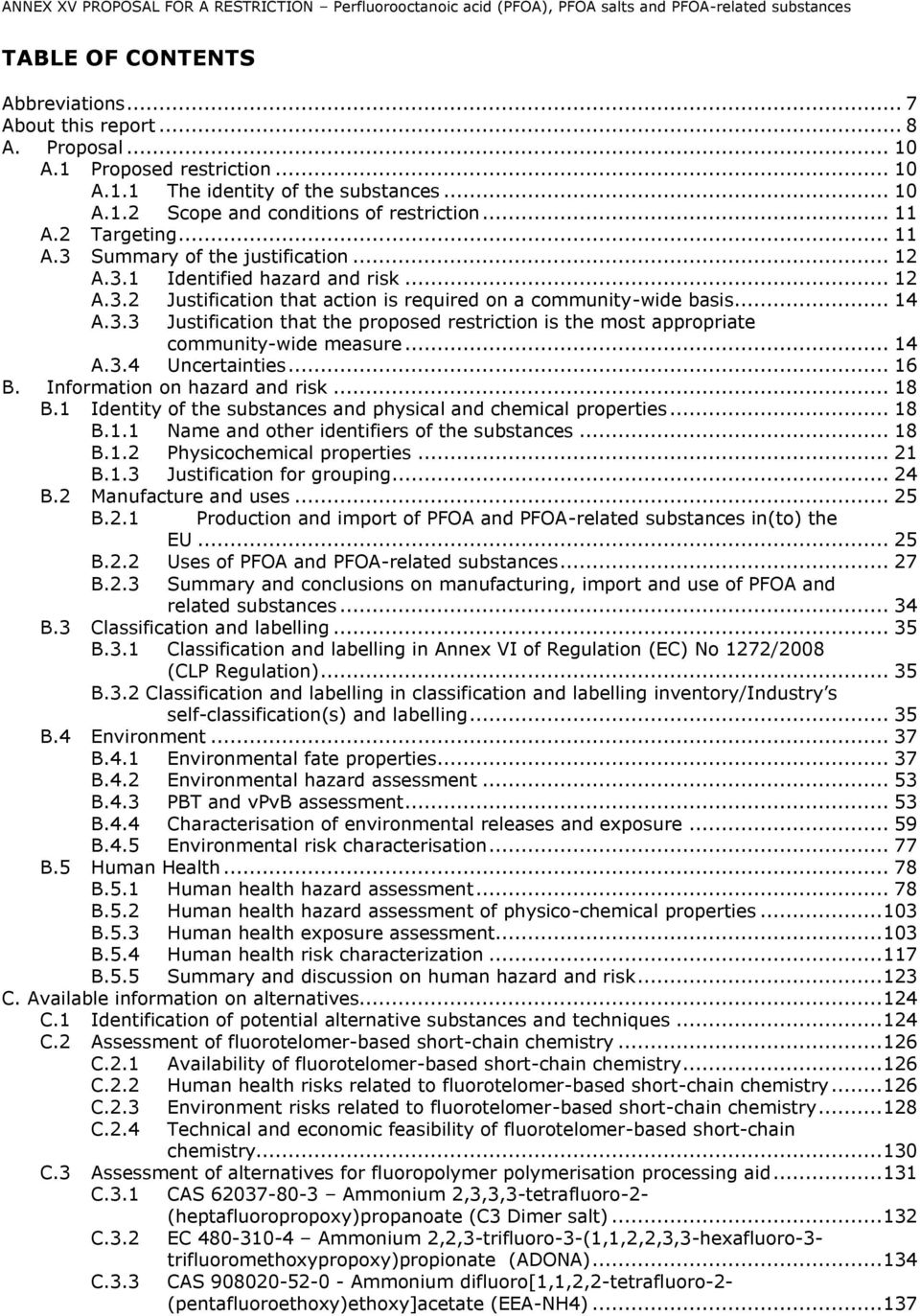
2 TABLE OF CONTENTS Abbreviations... 7 About this report... 8 A. Proposal A.1 Proposed restriction A.1.1 The identity of the substances A.1.2 Scope and conditions of restriction A.2 Targeting A.3 Summary of the justification A.3.1 Identified hazard and risk A.3.2 Justification that action is required on a community-wide basis A.3.3 Justification that the proposed restriction is the most appropriate community-wide measure A.3.4 Uncertainties B. Information on hazard and risk B.1 Identity of the substances and physical and chemical properties B.1.1 Name and other identifiers of the substances B.1.2 Physicochemical properties B.1.3 Justification for grouping B.2 Manufacture and uses B.2.1 Production and import of PFOA and PFOA-related substances in(to) the EU B.2.2 Uses of PFOA and PFOA-related substances B.2.3 Summary and conclusions on manufacturing, import and use of PFOA and related substances B.3 Classification and labelling B.3.1 Classification and labelling in Annex VI of Regulation (EC) No 1272/2008 (CLP Regulation) B.3.2 Classification and labelling in classification and labelling inventory/industry s self-classification(s) and labelling B.4 Environment B.4.1 Environmental fate properties B.4.2 Environmental hazard assessment B.4.3 PBT and vpvb assessment B.4.4 Characterisation of environmental releases and exposure B.4.5 Environmental risk characterisation B.5 Human Health B.5.1 Human health hazard assessment B.5.2 Human health hazard assessment of physico-chemical properties B.5.3 Human health exposure assessment B.5.4 Human health risk characterization B.5.5 Summary and discussion on human hazard and risk C. Available information on alternatives C.1 Identification of potential alternative substances and techniques C.2 Assessment of fluorotelomer-based short-chain chemistry C.2.1 Availability of fluorotelomer-based short-chain chemistry C.2.2 Human health risks related to fluorotelomer-based short-chain chemistry C.2.3 Environment risks related to fluorotelomer-based short-chain chemistry C.2.4 Technical and economic feasibility of fluorotelomer-based short-chain chemistry C.3 Assessment of alternatives for fluoropolymer polymerisation processing aid C.3.1 C.3.2 C.3.3 CAS Ammonium 2,3,3,3-tetrafluoro-2- (heptafluoropropoxy)propanoate (C3 Dimer salt) EC Ammonium 2,2,3-trifluoro-3-(1,1,2,2,3,3-hexafluoro-3- trifluoromethoxypropoxy)propionate (ADONA) CAS Ammonium difluoro[1,1,2,2-tetrafluoro-2- (pentafluoroethoxy)ethoxy]acetate (EEA-NH4)
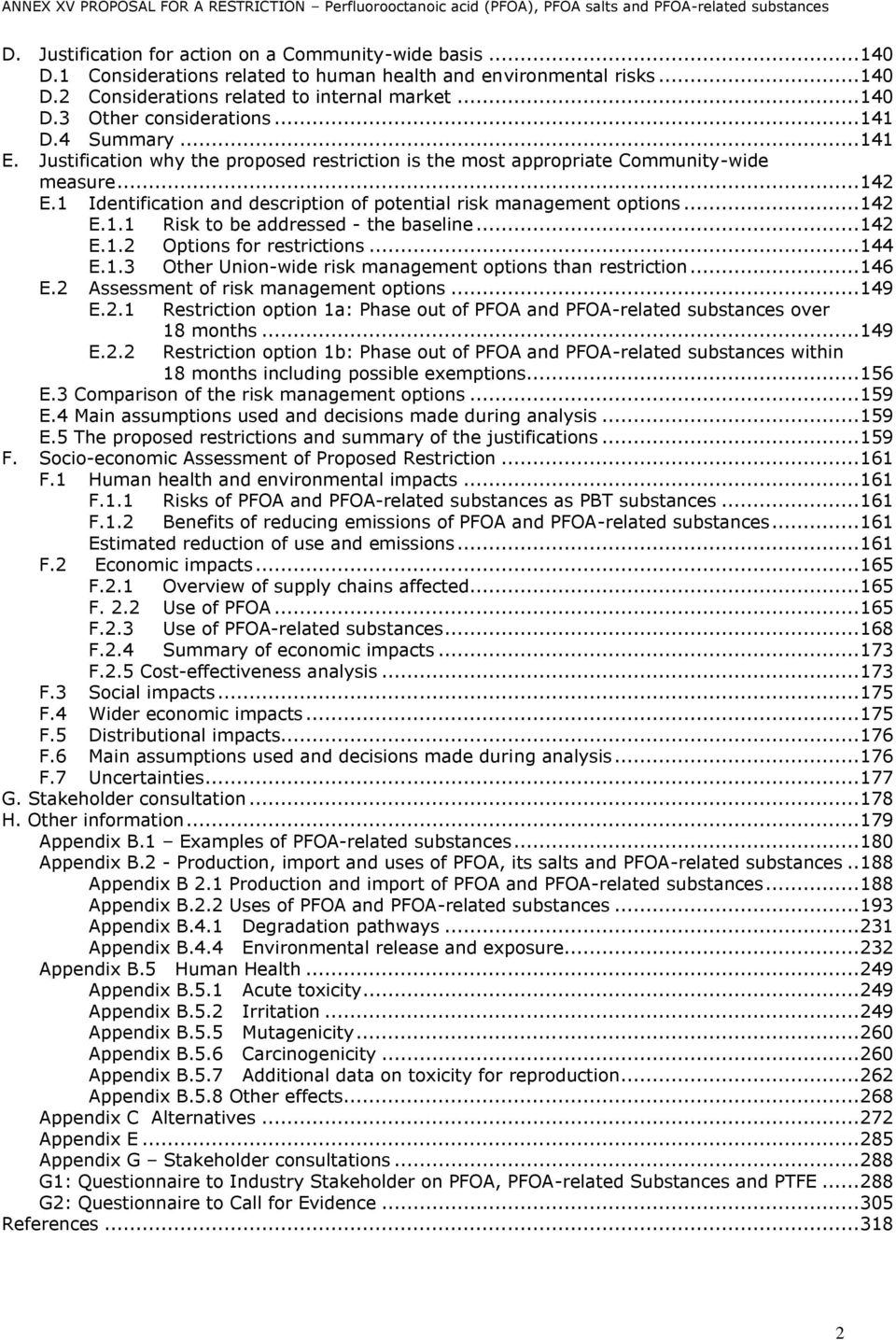
3 D. Justification for action on a Community-wide basis D.1 Considerations related to human health and environmental risks D.2 Considerations related to internal market D.3 Other considerations D.4 Summary E. Justification why the proposed restriction is the most appropriate Community-wide measure E.1 Identification and description of potential risk management options E.1.1 Risk to be addressed - the baseline E.1.2 Options for restrictions E.1.3 Other Union-wide risk management options than restriction E.2 Assessment of risk management options E.2.1 Restriction option 1a: Phase out of PFOA and PFOA-related substances over E months Restriction option 1b: Phase out of PFOA and PFOA-related substances within 18 months including possible exemptions E.3 Comparison of the risk management options E.4 Main assumptions used and decisions made during analysis E.5 The proposed restrictions and summary of the justifications F. Socio-economic Assessment of Proposed Restriction F.1 Human health and environmental impacts F.1.1 Risks of PFOA and PFOA-related substances as PBT substances F.1.2 Benefits of reducing emissions of PFOA and PFOA-related substances Estimated reduction of use and emissions F.2 Economic impacts F.2.1 Overview of supply chains affected F. 2.2 Use of PFOA F.2.3 Use of PFOA-related substances F.2.4 Summary of economic impacts F.2.5 Cost-effectiveness analysis F.3 Social impacts F.4 Wider economic impacts F.5 Distributional impacts F.6 Main assumptions used and decisions made during analysis F.7 Uncertainties G. Stakeholder consultation H. Other information Appendix B.1 Examples of PFOA-related substances Appendix B.2 - Production, import and uses of PFOA, its salts and PFOA-related substances Appendix B 2.1 Production and import of PFOA and PFOA-related substances Appendix B.2.2 Uses of PFOA and PFOA-related substances Appendix B.4.1 Degradation pathways Appendix B.4.4 Environmental release and exposure Appendix B.5 Human Health Appendix B.5.1 Acute toxicity Appendix B.5.2 Irritation Appendix B.5.5 Mutagenicity Appendix B.5.6 Carcinogenicity Appendix B.5.7 Additional data on toxicity for reproduction Appendix B.5.8 Other effects Appendix C Alternatives Appendix E Appendix G Stakeholder consultations G1: Questionnaire to Industry Stakeholder on PFOA, PFOA-related Substances and PTFE G2: Questionnaire to Call for Evidence References
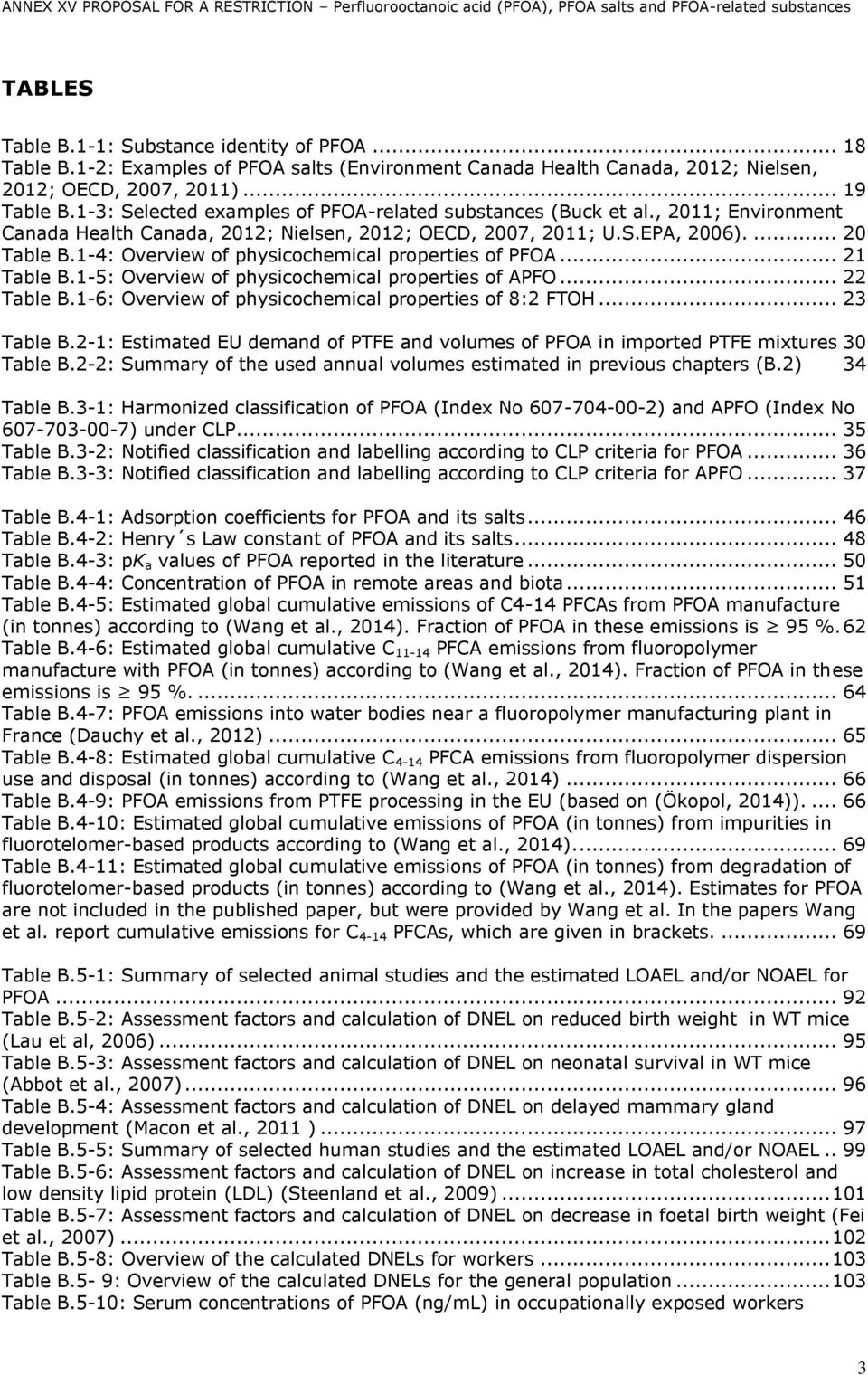
4 TABLES Table B.1-1: Substance identity of PFOA Table B.1-2: Examples of PFOA salts (Environment Canada Health Canada, 2012; Nielsen, 2012; OECD, 2007, 2011) Table B.1-3: Selected examples of PFOA-related substances (Buck et al., 2011; Environment Canada Health Canada, 2012; Nielsen, 2012; OECD, 2007, 2011; U.S.EPA, 2006) Table B.1-4: Overview of physicochemical properties of PFOA Table B.1-5: Overview of physicochemical properties of APFO Table B.1-6: Overview of physicochemical properties of 8:2 FTOH Table B.2-1: Estimated EU demand of PTFE and volumes of PFOA in imported PTFE mixtures 30 Table B.2-2: Summary of the used annual volumes estimated in previous chapters (B.2) 34 Table B.3-1: Harmonized classification of PFOA (Index No ) and APFO (Index No ) under CLP Table B.3-2: Notified classification and labelling according to CLP criteria for PFOA Table B.3-3: Notified classification and labelling according to CLP criteria for APFO Table B.4-1: Adsorption coefficients for PFOA and its salts Table B.4-2: Henry s Law constant of PFOA and its salts Table B.4-3: pk a values of PFOA reported in the literature Table B.4-4: Concentration of PFOA in remote areas and biota Table B.4-5: Estimated global cumulative emissions of C4-14 PFCAs from PFOA manufacture (in tonnes) according to (Wang et al., 2014). Fraction of PFOA in these emissions is 95 %. 62 Table B.4-6: Estimated global cumulative C PFCA emissions from fluoropolymer manufacture with PFOA (in tonnes) according to (Wang et al., 2014). Fraction of PFOA in these emissions is 95 % Table B.4-7: PFOA emissions into water bodies near a fluoropolymer manufacturing plant in France (Dauchy et al., 2012) Table B.4-8: Estimated global cumulative C 4-14 PFCA emissions from fluoropolymer dispersion use and disposal (in tonnes) according to (Wang et al., 2014) Table B.4-9: PFOA emissions from PTFE processing in the EU (based on (Ökopol, 2014)) Table B.4-10: Estimated global cumulative emissions of PFOA (in tonnes) from impurities in fluorotelomer-based products according to (Wang et al., 2014) Table B.4-11: Estimated global cumulative emissions of PFOA (in tonnes) from degradation of fluorotelomer-based products (in tonnes) according to (Wang et al., 2014). Estimates for PFOA are not included in the published paper, but were provided by Wang et al. In the papers Wang et al. report cumulative emissions for C 4-14 PFCAs, which are given in brackets Table B.5-1: Summary of selected animal studies and the estimated LOAEL and/or NOAEL for PFOA Table B.5-2: Assessment factors and calculation of DNEL on reduced birth weight in WT mice (Lau et al, 2006) Table B.5-3: Assessment factors and calculation of DNEL on neonatal survival in WT mice (Abbot et al., 2007) Table B.5-4: Assessment factors and calculation of DNEL on delayed mammary gland development (Macon et al., 2011 ) Table B.5-5: Summary of selected human studies and the estimated LOAEL and/or NOAEL.. 99 Table B.5-6: Assessment factors and calculation of DNEL on increase in total cholesterol and low density lipid protein (LDL) (Steenland et al., 2009) Table B.5-7: Assessment factors and calculation of DNEL on decrease in foetal birth weight (Fei et al., 2007) Table B.5-8: Overview of the calculated DNELs for workers Table B.5-9: Overview of the calculated DNELs for the general population Table B.5-10: Serum concentrations of PFOA (ng/ml) in occupationally exposed workers 3
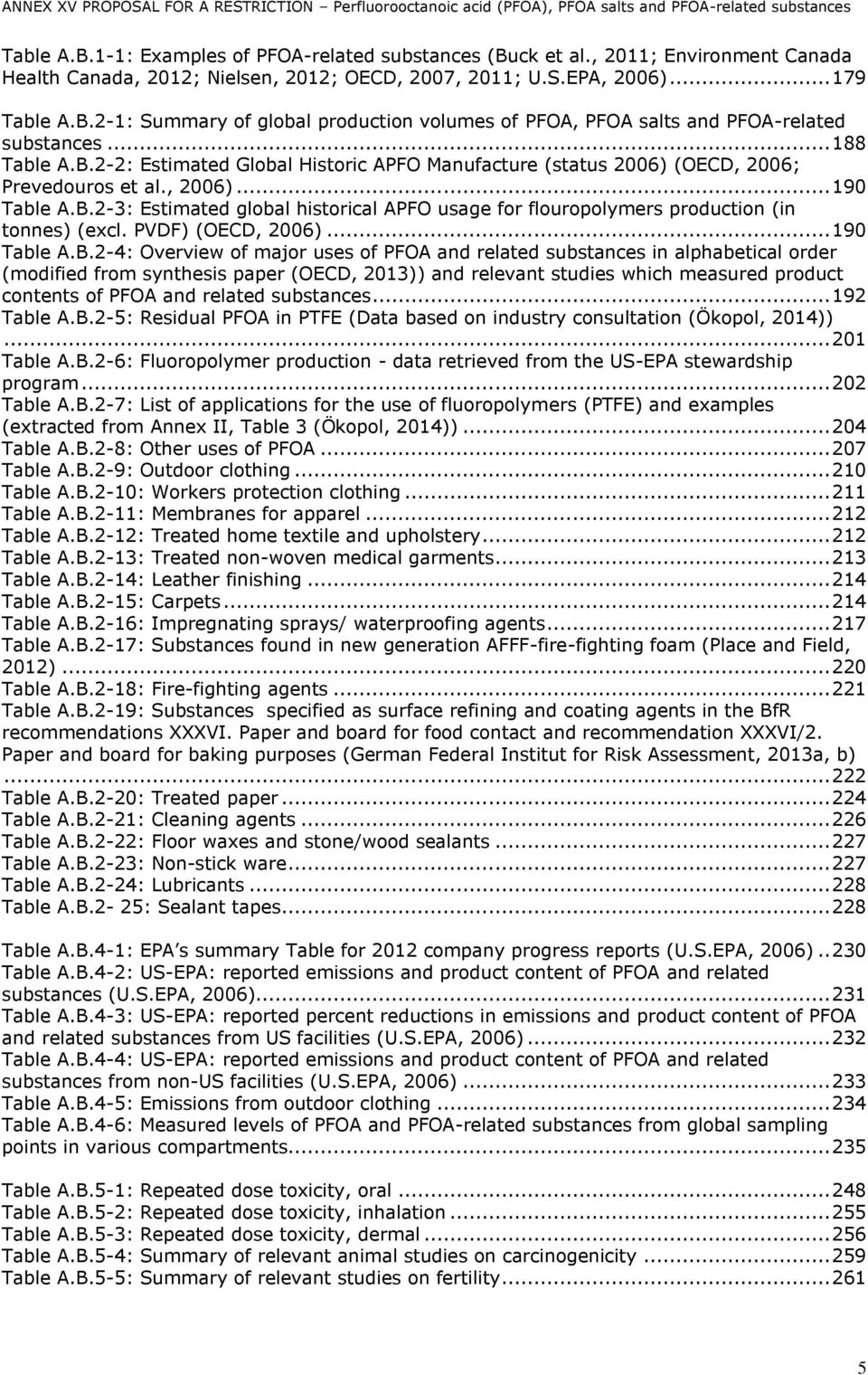
5 (Fromme et al., 2009) and intakes (ng/kg bw/day) back-calculated using a one-compartment steady-state pharmacokinetic model Table B.5-11: Estimated total intakes of PFOA from multiple exposure pathways Table B.5-12: Examples of serum/plasma concentrations of PFOA (ng/ml) in the general European adult population and back-calculated intakes using a one-compartment steady-state pharmacokinetic model Table B.5-13: Examples of serum/plasma concentrations of PFOA (ng/ml) in children worldwide Table B.5-14: Examples of serum concentrations of PFOA (ng/ml) in cord blood world wide 117 Table B.5-15: RCR is calculated for fluoropolymer production workers by dividing internal values against the different DNELs Table B.5-16: RCR is calculated for professional skiwaxers by dividing internal values against the different DNELs Table B.5-17: RCR is calculated for workers by dividing exposure values against the DNELs for external exposure Table B.5-18: RCR is calculated for internal values measured in the general adult population against the different DNELs obtained Table B.5-19: RCR is calculated for internal values measured in children against the different DNELs obtained. Please note that an RCR for children based on reduced birth weight in offspring was not considered relevant Table C.1-1: Overview of available fluorinated and non-fluorinated alternatives for different branches Table C.2-1: Human related PBT properties of PFOA and 6:2 FTOH Table C.2-2: Aquatic toxicity data of 6:2 FTOH, 8:2 FTOH and their main metabolites Table C.3-1: Identification and notified classification of three potential PFOA-alternatives Table C.3-2: Human related PBT properties of PFOA and C3 Dimer salt Table C.3-3: Human related PBT properties of PFOA and ADONA Table C.3-4: Human related PBT properties of PFOA and EEA-NH Table E.1-1: Manufacturing and import: Available data on current situation and predicted trend without restriction for PFOA and PFOA-related substances in the EU Table E.1-2: Assessment of Community-wide risk management options other than a restriction under REACH Table F.1-1: Estimated annual use volumes and emissions of PFOA (red) and PFOA-related substances (blue) subject to the proposed restriction based on current use (worst case scenario) and post 2015 (more realistic scenario) Table F.2-1: Estimated substitution costs of PFOA in PTFE manufacture (for imported mixtures) Table F.2-2: Estimated annual substitution costs of PFOA-related substances in textile treatment based on current use (worst case scenario) and projected for the post 2015 scenario (more realistic case) Table F.2-3: Estimated substitution costs of PFOA-related substances in fire-fighting foams based on current use (worst case scenario) and projected for post-2015 (more realistic scenario) Table F.2-4: Estimated substitution costs of PFOA-related substances in paper treatment based on current use (worst case scenario) and projected for post-2015 (more realistic case) Table F.2-5: Estimated substitution costs of PFOA-related substances in coatings and inks based on current use (worst case scenario) and projected for post-2015 (more realistic case) Table F.2-6: Summary of use volumes and, substitution costs estimates of PFOA (red) and PFOA-related substances (blue) for current use (worst case scenario) and projected for post (more realistic case)

6 Table A.B.1-1: Examples of PFOA-related substances (Buck et al., 2011; Environment Canada Health Canada, 2012; Nielsen, 2012; OECD, 2007, 2011; U.S.EPA, 2006) Table A.B.2-1: Summary of global production volumes of PFOA, PFOA salts and PFOA-related substances Table A.B.2-2: Estimated Global Historic APFO Manufacture (status 2006) (OECD, 2006; Prevedouros et al., 2006) Table A.B.2-3: Estimated global historical APFO usage for flouropolymers production (in tonnes) (excl. PVDF) (OECD, 2006) Table A.B.2-4: Overview of major uses of PFOA and related substances in alphabetical order (modified from synthesis paper (OECD, 2013)) and relevant studies which measured product contents of PFOA and related substances Table A.B.2-5: Residual PFOA in PTFE (Data based on industry consultation (Ökopol, 2014)) Table A.B.2-6: Fluoropolymer production - data retrieved from the US-EPA stewardship program Table A.B.2-7: List of applications for the use of fluoropolymers (PTFE) and examples (extracted from Annex II, Table 3 (Ökopol, 2014)) Table A.B.2-8: Other uses of PFOA Table A.B.2-9: Outdoor clothing Table A.B.2-10: Workers protection clothing Table A.B.2-11: Membranes for apparel Table A.B.2-12: Treated home textile and upholstery Table A.B.2-13: Treated non-woven medical garments Table A.B.2-14: Leather finishing Table A.B.2-15: Carpets Table A.B.2-16: Impregnating sprays/ waterproofing agents Table A.B.2-17: Substances found in new generation AFFF-fire-fighting foam (Place and Field, 2012) Table A.B.2-18: Fire-fighting agents Table A.B.2-19: Substances specified as surface refining and coating agents in the BfR recommendations XXXVI. Paper and board for food contact and recommendation XXXVI/2. Paper and board for baking purposes (German Federal Institut for Risk Assessment, 2013a, b) Table A.B.2-20: Treated paper Table A.B.2-21: Cleaning agents Table A.B.2-22: Floor waxes and stone/wood sealants Table A.B.2-23: Non-stick ware Table A.B.2-24: Lubricants Table A.B.2-25: Sealant tapes Table A.B.4-1: EPA s summary Table for 2012 company progress reports (U.S.EPA, 2006) Table A.B.4-2: US-EPA: reported emissions and product content of PFOA and related substances (U.S.EPA, 2006) Table A.B.4-3: US-EPA: reported percent reductions in emissions and product content of PFOA and related substances from US facilities (U.S.EPA, 2006) Table A.B.4-4: US-EPA: reported emissions and product content of PFOA and related substances from non-us facilities (U.S.EPA, 2006) Table A.B.4-5: Emissions from outdoor clothing Table A.B.4-6: Measured levels of PFOA and PFOA-related substances from global sampling points in various compartments Table A.B.5-1: Repeated dose toxicity, oral Table A.B.5-2: Repeated dose toxicity, inhalation Table A.B.5-3: Repeated dose toxicity, dermal Table A.B.5-4: Summary of relevant animal studies on carcinogenicity Table A.B.5-5: Summary of relevant studies on fertility
7 FIGURES Figure A.1-1: Identity of PFOA Figure A.1-2: Chemical structure of PFOA (top) and PFOA-related substances Figure B.4-1: Aerobic degradation pathways of 8:2 FTOH in soil and activated sludge Figure B.4-2: Mass balance of PFOA in the Baltic Sea (based on (Filipovic et al., 2013)) Figure C.2-1: Proposed 6:2 FTOH aerobic biodegradation pathways Figure F.2-1: Supply chains affected by the proposed restriction Figure A.B.2-1: Telomerisation process (figure based on (Knepper and Lange, 2012)) Figure A.B.2-2: Share of different manufacturers in the world market of fluoropolymers (Halopolymer.com, 2012)
8 Abbreviations AFFF Aqueous film-forming foam APFO Ammonium perfluorooctanoate AR-AFFF Alcohol-resistant aqueous film-forming foam AR-FFFP Alcohol-resistant film-forming fluoroprotein foams C6-based Fluorchemicals or fluorchemistry related to six fully fluorinated C8- atoms and PFHxA C8-based Fluorchemicals or fluorchemistry related to eight fully fluorinated C8- atoms and PFOA CBI Confidential Business Information dipap Polyfluoroalkyl phosphoric acid diester ECF Electrochemical fluorination FEP Fluorinated ethylene propylene FFFP Film-forming fluoroprotein foam FTAC Flurrotelomer acrylates FTI Fluorotelomer iodide FTMAS Fluorotelomer methacrylates FTO Fluorotelomer olefine FTOH Fluorotelomer alcohol GD gestational day monopap Polyfluoroalkyl phosphoric acid monoester Na-PFOA Sodium perfluorooctanoate PFA Perfluoroalkoxy alkane PFASs Per- and polyfluoralkyl substances PFCA Perfluorocarboxylic acid PFO Perfluoroctanoate PFOA Perfluorooctanoic acid PFOI Perfluorooctyl iodide PFOS Perfluorooctane sulfonic acid PFPA Perfluoroalkyl phosphonic acid PFPIA Perfluoroalkyl phosphinic acid PFSi Polylfuorinated silanes PND Post natal day POP Persistent organic pollutant PTFE Polytetrafluoroethylene PVDF Polyvinylidene fluoride TFE Tetrafluoroethylene 7
9 About this report Perfluorooctanoic acid (PFOA) is one important representative of the substance group of perand polyfluorinated substances (PFASs). The hazard profile of PFOA is well known: PFOA is a persistent, bioaccumulative, and toxic (PBT-) substance, which may cause severe and irreversible adverse effects on the environment and human health. PFOA has a harmonised classification in Annex VI of European Regulation (EC) No 1272/2008 on classification, labelling and packaging of substances and mixtures (CLP) as Carc. 2, Repr. 1B and STOT RE 1 (liver). Due to its PBT and CMR properties, PFOA and its ammonium salt (APFO) has been identified as substances of very high concern (SVHC) under REACH by unanimous agreement between EU Member States in July Besides PFOA also other substances in the PFASs group have properties of concern, which are targeted by the following international regulations: Perfluorinated carboxylic acids with a carbon chain of eleven to fourteen carbon atoms are also listed as substances of very high concern on the REACH candidate list because of their very persistent and very bioaccumulative properties. Perfluorooctane sulfonic acid (PFOS) is listed as persistent organic pollutant (POP) in Annex B of the Stockholm Convention. The former restriction of PFOS under REACH and the current entry in Commission Regulation (EU) No 757/2010 (implementing Annex B of the Stockholm Convention) do not only cover PFOS itself, but also PFOS-related substances, which are outlined by the chemical formula: C 8 F 17 SO 2 X (X=OH, metal salt (O-M + ), halide, amide, and other derivates including polymers). The reason for this is that these PFOS-related substances can be degraded to PFOS in the environment. PFASs consist of carbon chains of different chain length, where the hydrogen atoms are completely (perfluorinated) or partly (polyfluorinated) substituted by fluorine atoms. The very stable bond between carbon and fluorine is only breakable with high energy input. Therefore, perfluorinated acids, like PFOA, are not degradable in the environment. Polyfluorinated substances can be degraded to persistent perfluorinated substances like PFOA under environmental conditions and are therefore precursors. Those PFASs, which can be degraded to PFOA in the environment, are referred to as PFOA-related substances in this dossier. PFOA and a number of PFOA-related substances are ubiquitously found in humans and the environment even if there are no natural sources known. This includes findings in remote areas like the Arctic, which indicates their potential for long-range transport. Due to their outstanding technical properties (to provide water, oil, and grease repellency) man-made PFASs are used in various consumer products as well as in industrial applications. These uses lead to the wide-dispersive release of PFOA, its salts and related substances into the environment. To limit the risk of ubiquitous and long-term exposure of humans and the environment with PFOA, its salts and PFOA-related substances a phase-out of these substances is the only effective measure. To achieve this phase-out a total ban of manufacture, marketing and use is needed. Especially, the import of articles and mixtures containing PFOA, its salts and PFOArelated substances can only be controlled in this way. In chapter A of this report, the proposed restriction is outlined and a summary of the justification is given. The information on hazard and risk of PFOA, its salts and PFOA-related substances is provided in chapter B. Details on the identity of the substances within the scope of this proposal as well as their physical chemical properties are given in chapter B.1. The manufacturing and uses of PFOA, PFOA-salts and PFOA-related substances are described in 8
10 chapter B.2, respectively. In chapter B.3 the classification and labeling issues of PFOA are summarized. The structure of chapter B of this proposal has been slightly modified, i.e. the hazard and risk characterization of PFOA, its salts and PFOA-related substances for the environment is presented in chapter B.4 and for human health in chapter B.5. This change of structure was agreed with ECHA and was considered appropriate to take the following aspects into account: in the EU, PFOA was unanimously identified as a PBT substance. Emissions of PBT substances into the environment need to be stopped, the main objective according to Art. 55 is substitution. In addition to the assessment of PFOA and PFOA-related substances as PBTsubstances, a quantitative risk characterization is performed for human health based on the knowledge that PFOA is toxic for reproduction (category 1B) and has been shown to affect cholesterol levels in humans. Overall, emissions to the environment need to be prevented to an extent technically and economically feasible and that will at the same time minimize the risks for human health. Substitution of PFOA and PFOA-related substances is possible as shown in chapter C, where the available alternatives are described. In Chapter D and E it is described that a communitywide measure is needed and that a restriction as outlined in chapter A is the most appropriate measure. The socio-economic impacts of the proposed restriction are assessed in chapter F. To form an effective restriction proposal reliable data were needed. These were partly obtained in stakeholder consultations, which were performed to address remaining data gaps and are summarised in chapter G. Only few registration dossiers are so far available for PFOA-related substances. No registration is available (yet) for PFOA itself or its salts. Information was obtained from industry surveys performed by OECD, reports from research and studies conducted by different other institutions. Most of these studies and information show the need for risk management. This needs to cover several substances with different uses and emission pathways. 9
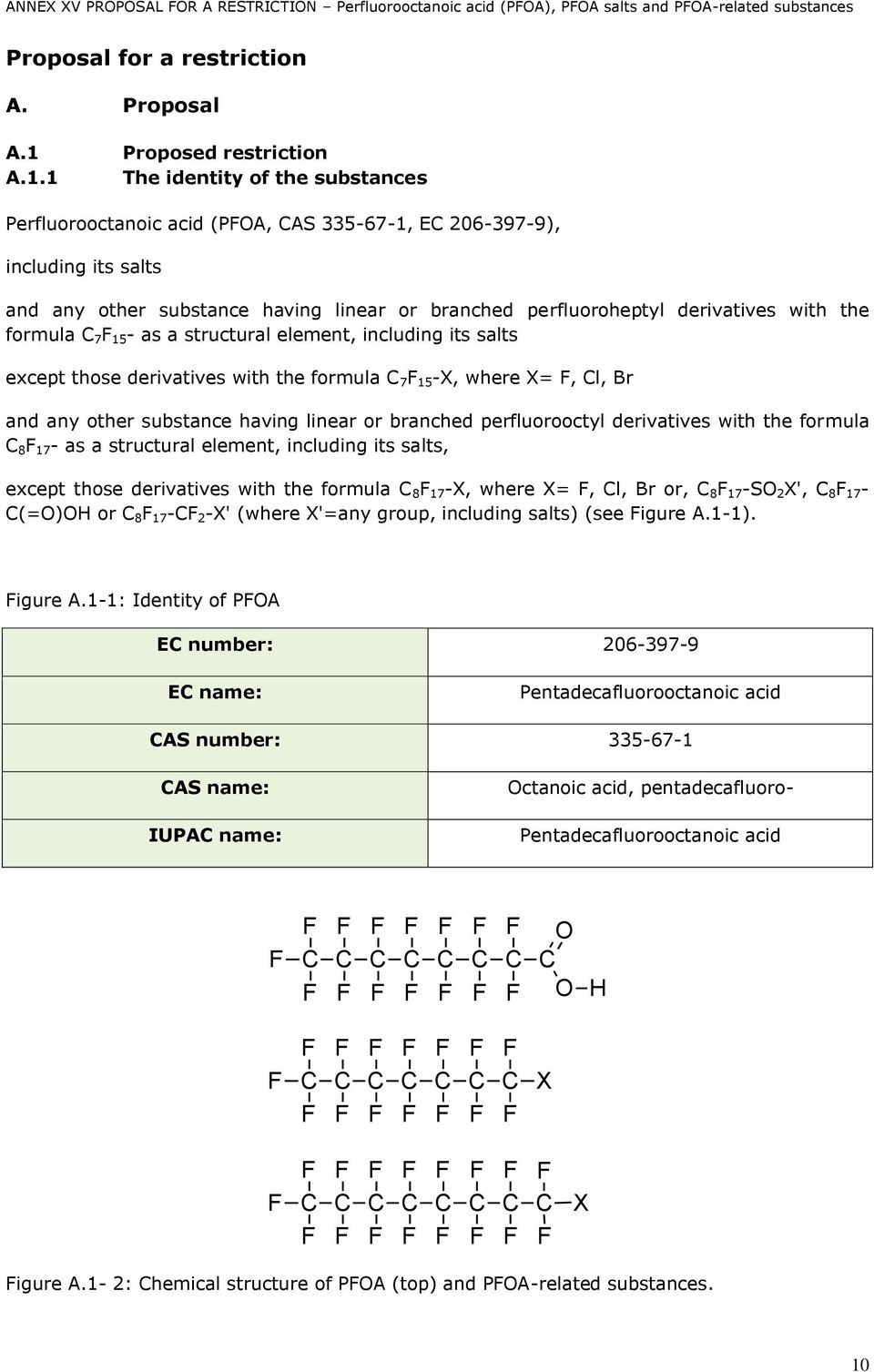
11 Proposal for a restriction A. Proposal A.1 Proposed restriction A.1.1 The identity of the substances Perfluorooctanoic acid (PFOA, CAS , EC ), including its salts and any other substance having linear or branched perfluoroheptyl derivatives with the formula C 7 F 15 - as a structural element, including its salts except those derivatives with the formula C 7 F 15 -X, where X= F, Cl, Br and any other substance having linear or branched perfluorooctyl derivatives with the formula C 8 F 17 - as a structural element, including its salts, except those derivatives with the formula C 8 F 17 -X, where X= F, Cl, Br or, C 8 F 17 -SO 2 X', C 8 F 17 - C(=O)OH or C 8 F 17 -CF 2 -X' (where X'=any group, including salts) (see Figure A.1-1). Figure A.1-1: Identity of PFOA EC number: EC name: Pentadecafluorooctanoic acid CAS number: CAS name: IUPAC name: Octanoic acid, pentadecafluoro- Pentadecafluorooctanoic acid F F C F F C F F C F F C F F C F F F O C C C F F O H F F C F F C F F C F F C F F C F F F C C F F X F F C F F C F F C F F C F F C F F F F C C C F F F X Figure A.1-2: Chemical structure of PFOA (top) and PFOA-related substances. 10
12 A.1.2 Scope and conditions of restriction Perfluorooctanoic acid (PFOA, CAS , EC ), including its salts and any other substance having linear or branched perfluoroheptyl derivatives with the formula C 7 F 15 - as a structural element, including its salts except those derivatives with the formula C 7 F 15 -X, where X= F, Cl, Br and any other substance having linear or branched perfluorooctyl derivatives with the formula C 8 F 17 - as a structural element, including its salts, except those derivatives with the formula C 8 F 17 -X, where X= F, Cl, Br or, C 8 F 17 -SO 2 X', C 8 F 17 -C(=O)OH or C 8 F 17 -CF 2 -X' (where X'=any group, including salts) 1. Shall not be manufactured, used or placed on the market - as substances, - as constituents of other substances in concentrations equal or above 2 ppb of a single substance, - in a mixture in concentrations equal or above 2 ppb of a single substance 2. Articles or any parts thereof containing one of the substances in concentrations equal to or greater than 2 ppb of a single substance shall not be placed on the market. 3. Paragraph 1 and 2 shall apply from (18 months after entry into force). 4. By way of derogation, paragraph 2 shall not apply to the placing on the market of secondhand articles which were in end-use in the European Union when the restriction becomes effective. A.2 Targeting PFOA and its ammonium salts APFO have been identified as a PBT substances under REACH. This proposal is based on the concern that PFOA is a PBT substance, that it is ubiquitous in the environment and in humans as well as on its health risks. For PBT substances the emissions and exposures to humans and the environment should be minimized to the extent possible. In the following the term PFOA refers to PFOA itself as well as to its salts. PFOA-related substances can be degraded to PFOA under environmental conditions. According to REACH, if transformation/degradation products with PBT properties are being generated, the substances themselves must be regarded as PBT substances and treated like PBT substances with regard to emission estimation and exposure control. PFOA-related substances need to be covered by risk management measures as well in order to limit environmental concentrations of PFOA effectively. Numerous uses of PFOA and PFOA-related substances exist. The substances can be released during every lifecycle step (e.g. manufacture, industrial use, use in consumer products, service life and disposal phase). Therefore, the restriction is proposed to cover the manufacture, placing on the market and use of the substances on their own, as constituents of other substances, in mixtures and in articles. Furthermore, articles 11
13 containing PFOA or PFOA-related substances are imported into the EU and need to be targeted by the restriction as well. In general, the risks of PBT/vPvB substances cannot be adequately addressed in a quantitative way, due to the high uncertainties regarding long-term exposure and effects. For the environment no PECs have been calculated and no PNECs derived. In the case of PBT substances a qualitative risk assessment should be carried out. In this dossier information about the use of PFOA and PFOA-related substances, available emission estimates and environmental monitoring data is presented and can be considered as a proxy for unacceptable risk. For human health a quantitative risk characterization has been performed based on the grounds that PFOA is classified as toxic for reproduction (category 1B) and has also a.o. been shown to affect cholesterol levels and may cause cancer in humans. Information about human exposure from the considerable biomonitoring (internal levels) database has been used for the risk characterization for human health. A.3 Summary of the justification A.3.1 Identified hazard and risk PFOA is a persistent, bioaccumulative, and toxic substance. Due to these properties it may cause severe and irreversible adverse effects on the environment and human health. PFOA and its ammonium salt APFO are classified as Carc. 2, Repr. 1B, STOT RE 1 (liver) according to the CLP regulation 1. Based on their PBT and CMR properties, PFOA and APFO have been identified as substances of very high concern (SVHC) under REACH. PFOA-related substances degrade to PFOA under environmentally relevant conditions. Therefore, the hazard profile of PFOA applies to these substances as well. According to REACH, if transformation/degradation products with PBT properties are being generated, the substances themselves must be regarded as PBT substances. PFOA and PFOA-related substances do not occur naturally. However, they are found ubiquitously in the environment also in remote areas since they can be transported over long distances via water and air. This results in findings in rivers, oceans, drinking water, the atmosphere and biota. Moreover, PFOA is present in human blood of the general population. Human exposure takes place via the environment, e.g. consumption of drinking water and food, or from consumer products, e.g. via uptake of contaminated indoor dust. PFOA is transferred to the foetus through the placenta and the infant is exposed to PFOA from breast milk. Some epidemiological data from highly contaminated sites indicate adverse health outcomes. Since PFOA and PFOA-related substances provide special properties, such as high friction resistance, dielectrical properties, resistance to heat and chemical agents, low surface energy, as well as water, grease, oil, and dirt repellency, they are used for various articles, mixtures and applications. PFOA and PFOA-related substances are detected in a wide range of consumer articles and mixtures, which are often imported from outside the EU. The occurrence of these substances is caused by: - the intentional use of PFOA and PFOA-related substances 1 Commission Regulation (EU) No 944/2013 (5 th Adaption to Technical Progress (ATP) to the Regulation (EC) 1272/2008) 12

14 - residues of PFOA or PFOA-related substances in other PFOA-related substances - impurities of PFOA or PFOA-related substances in other PFOA-related substances or in other PFASs. Consequently, it can be distinguished between direct and indirect sources of PFOA. Globally, PFOA manufacture and the use of its salts (e.g. APFO) in fluoropolymer manufacture (e.g. Polytetrafluoroethylene - PTFE) have been identified as the main direct emission sources of PFOA. These direct emission sources have been significantly reduced in the USA, Europe and Japan, due to a voluntary agreement between the US EPA and eight of the largest global fluorochemical manufacturers to phase out PFOA and related substances by the end of However, it is important to note, that the manufacture of fluoropolymers is shifting to countries such as Russia and China, where it is assumed that a large share of fluoropolymers is still produced using PFOA. This can be seen from (PTFE-based) consumer articles containing PFOA as residue (up to 5000 ppm PFOA in PTFE mixtures), which are often imported from outside the EU. The global fluoropolymer market is continuously growing (5-6% per year globally). In Europe, the manufacture of PFOA has ceased and the current use of PFOA in fluoropolymer manufacture is estimated to account for < 20 t/a. Nevertheless, emissions still occur from fluoropolymer manufacture sites as it can be seen from measured data. Indirect PFOA sources are the manufacture, use and disposal of PFOA-related substances. On the one hand, they contain PFOA as impurity, on the other hand they can be degraded to PFOA. PFOA-related substances are manufactured ( t/a) in the EU or imported ( t/a) into the EU. In addition, they enter the EU via imported articles, such as textiles, which are expected to account for significant volumes within the EU PFOA-related substances are used as surfactants and for the manufacture of side-chain fluorinated polymers. An example of the use of PFOA-related substances leading to direct environmental exposure is the use in fire-fighting agents (> t/a), as it can be seen from contaminated sites where such fire-fighting agents have been used. Side-chain fluorinated polymers are commonly used in coating applications, e.g. for textiles (approx. 1,000 t/a, in addition 1,000 10,000 t/a imported within textile articles), paper (> t/a), paints and inks (> t/a). Emissions may arise during every lifecycle step of the substances via different emission pathways (manufacture, downstream user sites, service life, and disposal). The described emission sources cause the observed ubiquitous exposure of humans and the environment to these manmade substances. Due to the PBT-properties PFOA will stay in the environment for years and magnify in food chains. Long-term effects can be foreseen and therefore emissions to the environment need to be avoided by substitution (REACH Article 55). Humans are mainly exposed via the environment, e.g. via drinking water, air and food consumption, and are therefore also affected by the PBT-properties. Humans are also exposed from consumer products e.g. via uptake of contaminated indoor dust. When considering the adverse effects of PFOA on human health, risks (RCRs >1) have been identified for workers at fluorochemical industrial sites, professional skiwaxers and the general population, children in particular. Overall, exposure of humans and the environment to PFOA needs to be avoided by preventing emissions to the environment. This can only be achieved by substitution of PFOA and PFOArelated substances. 13
15 Insufficient operational conditions and risk management measures are in place in the EU targeting emissions of PFOA and PFOA-related substances. Moreover, no community-wide regulations exist contributing to emissions reduction. Only in Norway a ban on the production, import and sale of consumer products containing PFOA is implemented. A.3.2 Justification that action is required on a community-wide basis PFOA is a PBT substance which means that it persists in the environment and may have irreversible adverse effects on the environment and human health in the long run. PFOA has the potential for environmental long-range transport which make emissions of PFOA to a transboundary pollution problem. From contaminated sites such as airports, where fire-fighting foams with PFOA or PFOA-related substances have been used, it can be seen that it is hardly possible or requires considerable effort to remove contaminations with PFOA and PFOA-related substances. These are not isolated cases and are of particular importance when drinking water supply catchment areas are affected, as is the case at several sites, e.g. in Sweden, Germany and the US. Since the uses of PFOA and PFOA-related substances are wide dispersive and consumer articles and mixtures containing these substances are placed on the market in all EU Member States, community-wide action is necessary to eliminate emissions of PFOA and PFOA-related substances. Additionally, emissions occur in every part of the lifecycle, e.g. during production, service life and disposal. Although both contents and emissions of PFOA and PFOA-related substances have been reduced to a large extent by voluntary measures such as the US EPA stewardship program, PFOA and PFOA-related substances are still released from industrial sites and are detected in various consumer products. Therefore, any national regulatory action cannot adequately minimise emissions of PFOA including PFOA-related substances. As a consequence, risk management action needs to be taken on a community-wide basis. The review clause on PFOA and related substances that was included in the former Directive 2006/122/EC regulating PFOS also acknowledges the need to manage the risks of PFOA on a community-wide basis. A.3.3 Justification that the proposed restriction is the most appropriate community-wide measure Effectiveness in reducing the identified risks Since long-term risks from PBT-substances cannot be quantified they are assessed qualitatively considering use and emission patterns. Emissions of PFOA and PFOA-related substances arise during every lifecycle step of the substances, including manufacture, industrial use, use in consumer products, service life and disposal phase. PFOA-related substances significantly contribute to human and environmental exposure of PFOA since they might contain PFOA as a residue or impurity and they can be degraded to PFOA in the environment. Furthermore, imported mixtures and articles, emitting PFOA and PFOA-related substances during the service life, constitute relevant emission sources. They cannot be targeted by other risk management measures than restrictions. 14
16 Voluntary agreements might contribute to emissions reduction. However, as it can be seen from the US EPA stewardship program, this measure is still not fully effective and it is questionable whether voluntary measures can be implemented effectively for companies importing into the EU. A restriction covering all emission sources is considered to be the most appropriate community-wide measure that can effectively reduce emissions of PFOA and PFOA-related substances. The proposed restriction will ban the manufacturing, placing on the market, and use of PFOA after a transitional period of 18 months from the entry into force. The restriction will cover PFOA, its salts and PFOA-related substances on their own, in a mixture or in articles. Following the entry into force of the restriction products containing PFOA and PFOA-related substances will not be manufactured in the EU and will not be placed on the EU market. Proportionality to the risks Short-chain ( C6) PFASs are alternatives that are available on the market and already used as substitutes of PFOA and PFOA-related substances. Overall, the use of short-chain PFASs is increasing, which illustrates a general shift of some parts of the market away from the use of PFOA and PFOA-related substances. In terms of technical feasibility, industry indicated that it is feasible to achieve a similar technical performance with short-chain PFASs compared to PFOA and PFOA-related substances in most applications. However, for some specific uses that require an exceptional technical performance (e.g. strong oil and dirt repellency) or that are niche market products (e.g. photographic films) it might not be possible to substitute PFOA and PFOA-related substances. However, is so far unclear how valid the available information on these uses is. Based on currently available data, short-chain PFASs are considered to be less hazardous compared to PFOA and PFOA-related substances, even though there are concerns about their persistence and mobility in the environment. Apart from the use of short-chain PFASs there are also fluorine-free alternatives that are already used by industry (e.g. to achieve water repellency in sports clothing). The use of short-chain PFASs as well as fluorine-free alternatives will entail costs due to their higher price (compared to PFOA and PFOA-related substances) and/or higher quantities that have to be used to achieve a similar technical performance. The total substitution costs are estimated to be between < million /a with a central estimate of 36 million /a This range reflects the high uncertainties related to the cost estimates, which mainly originate from diverging information received from industry on substitution cost, but also from uncertainties related to the estimated volumes of PFOA and PFOA-related substances. As the actual impact for humans and the environment of reduced PFOA exposure cannot be described in quantitative terms, the overall benefit of the restriction cannot be quantified. However, reduced emissions are used as a proxy of the benefits of the proposed restriction. Based on the cost and emission estimates the cost-effectiveness of the proposal was assessed with central estimates of <1,649 /kg PFOA and 734 /kg PFOA-related substances emissions reduced. The cost-effectiveness of the proposed restriction in reducing the emissions of PFOA and PFOA-related substances is considered to be proportionate to the risk of PFOA and PFOArelated substances taking into account the specific concerns related to these compounds. 15
17 To fully achieve the overall aim of this restriction substitution of PFOA and PFOA-related substances concentrations of PFOA and PFOA-related substances in mixtures and articles need to be zero. A threshold of zero might not be technically feasible because alternatives for PFOA and PFOA-related substances (see chapter C. Available information on alternatives) might also contain traces of PFOA and PFOA-related substances as an impurity. According to the stakeholder consultation, alternatives are available for most uses and substitution is ongoing or has already taken place in the EU. For those uses where industry indicated that no alternatives are available it is currently not possible to judge the validity and to propose specific exemptions based on the information provided. Practicality, including enforceability and monitorability The most effective way to enforce this restriction is to target articles and mixtures. There are analytical methods available for PFOA with quantification limits lower than 2 ppb. For PFOArelated substances either conversion to PFOA or analysis of lead substances is needed. For analysis of certain lead substances analytical methods with a quantification limit of 2 ppb are reported in the literature. Overall, a standardized method would ensure reproducible enforcement. Therefore, PFOA and some PFOA-related substances could be included in the CEN method for the PFOS restriction. Monitoring of the proposed restriction will be conducted through regular enforcement activities. Since the proposed restriction is in line with the US-EPA stewardship program industry has already taken actions to phase out PFOA and related substances until 2015 indicating that the restriction is practicable. A.3.4 Uncertainties Volumes used in the EU and in imported articles Information on amounts of PFOA and PFOA-related substances used in the EU and in imported in articles is limited. Therefore, only rough estimates can be given. Information on emissions Limited data is available on amounts used and environmental emissions, especially from downstream user sites. Therefore, only rough emission estimates will be presented in this restriction proposal. Furthermore, there are uncertainties regarding the degradation rates of some PFOA-related substances to PFOA. Cost estimates Cost estimates were based on limited information on cost differences between PFOA and PFOArelated substances as well as on additional amounts of the alternatives to be used to achieve a comparable technical performance. Threshold The threshold of 2 ppb is derived from - the quantification limit of PFOA and lead substances of PFOA-related substances in analytical methods. 16
18 - information from industry on residues of PFOA and PFOA-related substances in articles and mixtures which are produces without PFOA and PFOA-related substances. PFOA and PFOArelated substances occur in such articles and mixtures in traces as impurity of fluorinated substances which are used as an alternative to PFOA and PFOA-related substances. More information on the last aspect might lead to a revision of the threshold. Exemptions For some uses there are indications that a substitution of PFOA and PFOA-related substances is economically and/or technically not feasible and an exemption might be needed. However, so far there is not enough evidence available in order to propose any specific exemptions. 17
19 B. Information on hazard and risk B.1 Identity of the substances and physical and chemical properties B.1.1 Name and other identifiers of the substances Perfluorooctanoic acid (PFOA, CAS , EC ), and any other linear or branched perfluoroheptyl derivative with the formula C 7 F 15 -X and any linear or branched perfluorooctyl derivative with the formula C 8 F 17 -X (where X=any group, including salts, other than F, Cl, Br), except those derivatives with the formula C 8 F 17 -SO 2 X', C 8 F 17 -C(=O)OH or C 8 F 17 -CF 2 -X' (where X'=any group, including salts) (see Table B.1-1). B PFOA Table B.1-1: Substance identity of PFOA EC name: Pentadecafluorooctanoic acid CAS number (in the EC inventory): CAS number: CAS name: IUPAC name: Index number in Annex VI of the CLP Regulation Octanoic acid, 2,2,3,3,4,4,5,5,6,6,7,7,8,8,8- pentadecafluoro- Pentadecafluorooctanoic acid Molecular formula: C 8 HF 15 O 2 Molecular weight range: g/mol EC number: Synonyms: Perfluorooctanoic Acid; PFOA; Pentadecafluoro-1-octanoic acid; Perfluorocaprylic acid; Perfluoroheptanecarboxylic acid; Perfluoro-n-octanoic acid; Pentadecafluoro-n-octanoic acid; Pentadecafluorooctanoic acid; n-perfluorooctanoic acid 1-Octanoic acid, 2,2,3,3,4,4,5,5,6,6, 7,7,8,8,8-pentadecafluoro F F F F F F F Structural formula: F F F F F F F F COOH PFOA B PFOA-salts In Table B.1-2 examples of PFOA salts are listed. The relevance of these substances is proven by the existence of respective suppliers. 18


20 Table B.1-2: Examples of PFOA salts (Environment Canada Health Canada, 2012; Nielsen, 2012; OECD, 2007, 2011) Name Abbr. Chem. Structure CAS -No. Number of suppliers EU /global/china ( m) 2,2,3,3,4,4,5,5,6,6,7,7,8,8, 8-penta deca fluorooctanoic acid, ammonium salt APFO /29/16 2,2,3,3,4,4,5,5,6,6,7,7,8,8, 8-penta deca fluorooctanoic acid, Na- PFOA /22/7 sodium salt 2,2,3,3,4,4,5,5,6,6,7,7,8,8, 8-penta deca fluorooctanoic acid, potassium salt K- PFOA /2/5 2,2,3,3,4,4,5,5,6,6,7,7,8,8, 8-penta deca fluorooctanoic acid, silver salt /8/3 Octanoic acid, 2,2,3,3,4,4,5,5,6,6,7,7,8,8, 8-pentadecafluoro-, chromium(3+) Ethanaminium, N,N,Ntriethyl-, salt with pentadecafluorooctanoic acid (1:1) B PFOA-related substances Any linear or branched perfluoroheptyl derivative with the formula C 7 F 15 -X, other than PFOA and PFOA salts, and any linear or branched perfluorooctyl derivative with the formula C 8 F 17 -X (where X=any group, other than F, Cl, Br), except those derivatives with the formula C 8 F 17 - SO 2 X', C 8 F 17 -C(=O)OH or C 8 F 17 -CF 2 -X' (where X'=any group) are PFOA-related substances within the scope of this restriction proposal (see chapter A.1.2). 19

21 A few examples are given in Table B.1-3 and further examples can be found in Table A.B.1-1 in the appendix. The relevance of these substances is proven by the existence of respective suppliers, as can be seen in Table A.B.1-1 in the appendix. The reasoning of this approach can be found in chapter B.1.3. Table B.1-3: Selected examples of PFOA-related substances (Buck et al., 2011; Environment Canada Health Canada, 2012; Nielsen, 2012; OECD, 2007, 2011; U.S.EPA, 2006). Name Abbr. Chem. Structure CAS-No. Fluorotelomer alcohols 3,3,4,4,5,5,6,6,7,7,8,8,9,9,10,10,10- Heptadecafluordecan-1-ol Fluorotelomer acrylates 8:2 Fluorotelomer acrylate 8:2 FTOH 8:2 FTAC Polyfluoroalkyl phosphoric acid diesters 8:2 Fluorotelomer phosphate diester 8:2 dipap Polyfluorinated silanes Perfluorodecyldichloromethylsilane C8-PFSi Per- and polyfluorinated phosphonic acids Perfluorooctyl phosphonic acid C8-PFPA Polyfluorinated Iodides 1,1,1,2,2,3,3,4,4,5,5,6,6,7,7,8,8- Heptadecafluoro-10-iododecane Perfluorinated Iodides Perfluorooctyl iodide 8:2 FTI PFOI
22 B.1.2 B Physicochemical properties PFOA Table B.1-4: Overview of physicochemical properties of PFOA Property Value Remarks Physical state at 20 C and kpa Solid (Kirk, 1994) Melting/freezing point Boiling point Vapour pressure Water solubility Partition coefficient n- octanol/water (log value) 54.3 C C 188 C ( hpa) 189 C (981 hpa) 4.2 Pa (25 C) extrapolated from measured data 2.3 Pa (20 C) extrapolated from measured data 128 Pa (59.3 C) measured 9.5 g/l (25 C) 4.14 g/l (22 C) 2.69 at ph7 and 25 C 6.3 (Lide, 2003) (Beilstein, 2005) (Lide, 2003) (Kauck and Diesslin, 1951) (Kaiser et al., 2005; Washburn et al., 2005) (Washburn et al., 2005) (Washburn et al., 2005) (Kauck and Diesslin, 1951) (Prokop et al., 1989) Calculated using Advanced Chemistry Development (ACD/Labs) Software V11.02 ( ACD/Labs). EPI suite (Syracuse_Research_Corporation, ) Both models not validated for PFASs Dissociation constant <1.6, e.g. 0.5 Vierke et al ph-value 2.6 (1 g / L at 20 C) (Merck, 2005) (reliability not assignable) 21
23 B PFOA salts Table B.1-5: Overview of physicochemical properties of APFO Property Value Remarks Physical state at 20 C and KPa APFO is a solid. Kirk-Othmer, 1994 Melting/freezing point Boiling point Relative density Vapour pressure Surface tension Water solubility Partition coefficient n- octanol/water (log value) Dissociation constant APFO: oc (decomposition starts above 105 C) APFO: 130 (decomposition) Decomposition APFO: 0,6-0,7 g/ml, 20 C APFO: Pa (6 x 10⁻⁶) at 20 C, calculated from measured data No information available conc. at sat. (g/l) APFO: > 500 Experimental No data Calculated No data. Dissociation Constants: pk a = 2.80 in 50% aqueous ethanol pk a = 2.5 Lines and Sutcliff, M Company, 1987 Lines and Sutcliff, 1984 (IUCLID 2.2) Griffith and Long, 1980 Washburn et al., 2005 Temperature (oc) 20 C (3M Company, 1987) Brace, 1962 Ylinen et al.,
24 B PFOA-related substances Table B.1-6: Overview of physicochemical properties of 8:2 FTOH Property Value Remark Physical state at 20 C and kpa Melting/freezing point Boiling point Relative density Waxy solid No information available No information available No information available 31 Pa at 25 ºC (Retention time method) 29 Pa at 45ºC (HeadspaceGC/AED method) Vapour pressure seem sensitive to choice of method. Cobranchi et al 2006 Vapour pressure Surface tension Water solubility Partition coefficient n- octanol/water (log value) Dissociation constant 254 Pa ved 25 ºC, volatile, 99.9 % detected mainly in the gassousphase in the atmosphaere kpa 0,023 mmhg No information available 1,4 x 10⁻⁴ g/l or 140 µg/l at 25 C No information available No information available Stock et al Lei et al., 2004 Berti WR DPont EMSE Report No 92-02) Berti WR DPont EMSE Report No
25 B.1.3 Justification for grouping A grouping of substances in the scope of this restriction proposal is needed to eleminate the risks resulting from the exposure of humans and the environment to PFOA. It is known that some PFOA-related substances can be degraded to PFOA under environmentally relevant conditions (D'eon and Mabury, 2011; Wang et al., 2005a). Therefore, these PFOA-related substances also contribute to the exposure of humans and the environment to PFOA. Besides such PFOA-related substances, for which their degradation to PFOA has already been shown in different studies, other substances (for examples see Table B.1-2) show similarities in their molecular structures compared to PFOA and PFOA-related substances for which degradation to PFOA was shown. This similarity and the nature of the chemical binding of the perfluorinated alkyl moiety to other parts of the molecules lead to the hypothesis that degradation is very likely, but has simply not yet been investigated in detail. Besides the substances registered under REACH further PFOA-related substances are known which could be used within the EU and may also be imported into the EU via imported articles (Ministry of Environmental Protection of the People`s Republic of China, 2013). A grouping approach via chemical sum formula is the most appropriate way to cover all relevant substances. Therefore, the chemicals identity in the scope of this restriction proposal is defined as follows: Perfluorooctanoic acid (PFOA, CAS , EC ), including its salts and any other substance having linear or branched perfluoroheptyl derivatives with the formula C 7 F 15 - as a structural element, including its salts except those derivatives with the formula C 7 F 15 -X, where X= F, Cl, Br and any other substance having linear or branched perfluorooctyl derivatives with the formula C 8 F 17 - as a structural element, including its salts, except those derivatives with the formula C 8 F 17 -X, where X= F, Cl, Br or, C 8 F 17 -SO 2 X', C 8 F 17 -C(=O)OH or C 8 F 17 -CF 2 -X' (where X'=any group, including salts) The degradation of PFOA-related substances is described in detail in chapter B PFOArelated substances are degraded biotically and abiotically. The yields of PFOA are in most studies in the range of % (details in chapter B.4.1.2). The duration of the studies varies from 28 days to 90 days. One study was performed with a longer time scale of 7 months. The yield of PFOA in this study was in the range of 10-40% (Wang et al., 2009).This indicates that some of the degradation steps may take some time although the estimated halflife of the PFOA-related substances is in the range of days. Thus, it can be hypothesized that in the environment PFOA yields from PFOA-related substances are much higher than measured in the short time degradation experiments. We further hypothesize that over a long time frame of 5-10 years PFOA yields from PFOA-related substance degradation are around 80% (see chapter B for further details). However, REACH foresees that the substance it self, in this case PFOA-related substances, must be regarded as a PBT-substance if it degrades to a PBTsubstance. Exclusions are necessary for PFNA (C 8 F 17 -C(=O)OH ), PFOS (C 8 F 17 -SO 2 X') and other longer chain PFASs (C 8 F 17 -CF 2 -X'). These substances are not degraded to PFOA and are therefore no PFOA-related substances. The reasons for that are the carboxylic and sulfonic groups. If these groups are connected to a perfluorinated carbon chain, i.e. C 8 F 16 -, an enzymatic reaction to break down the molecule has never been observed (Wang et al., 2005a). An abiotic break 24
26 down of the molecule has not been observed either. A similar approach has been applied in the PFOS restriction (Commission Regulation (EU) No 757/2010) The restricted substances are defined with the description of a structural moiety that covers derivatives of PFOS as well (European Commission, 2010), since these substances may degrade to PFOS: Perfluoroctane sulfonic acid and its derivates (PFOS) C 8 F 17 SO 2 X (X = OH, Metal salt (O-M + ), halide, amide, and other derivates including polymers). B.2 Manufacture and uses The following provides an overview of manufacture (B.2.1) and uses (B.2.2) of PFOA and PFOA-related substances. A summary of volume estimates for PFOA and PFOA-related substances that are used to assess emissions and the cost-effectiveness of the proposed restriction is given in chapter B.2.3. For more detailed information on manufacture and uses please refer to Appendix B.2 and to the confidential Appendix. B.2.1 B Production and import of PFOA and PFOA-related substances in(to) the EU PFOA and its salts PFOA or its salts have not been registered under REACH. The only company known to produce PFOA in the EU (Miteni in Italy (OECD, 2006)) reportedly ceased production and commercialisation of PFOA in 2010 (van der Putte et al., 2010). Hence, it can be concluded that the production of PFOA is located predominantly outside the EU. Accordingly, current EU demand is expected to be covered by imports. Van der Putte et al. (2010) have analysed the market of PFOA and APFO and their use on behalf of the European Commission. In this study, the average market volume in the EU was estimated to be a maximum of 100 t/a for the period Since 2002, a decreasing trend of the production and import of PFOA and APFO in the EU-27 Member States had been observed. Consequently, Van der Putte et al. conclude that the market volume of APFO/PFOA would have been less than 50 t/a in Results of recent consultation with industry (for further information see part G and confidential Appendix) ) in general support the findings of Van der Putte et al. and indicate that current market volumes of PFOA and its salts are likely to be 20 t/a (based on data from 2012), with a decreasing trend since For further calculations, import volumes of 20 t/a PFOA and its salts as substances will be used. PFOA and its salts are also imported into the EU in mixtures, in particular in fluoropolymer dispersions that are imported for further processing (for details please refer to chapter B.2.2.1). The volume of PFOA and its salts in fluoropolymer dispersions depend on several technical (e.g. PFOA-content in the mixture) and market-related variables (e.g. share of fluoropolymers produced with PFOA). For the import of PTFE, it is expected to be within the 25
27 range of 3 to 16 t/a, whereas it is highlighted that also fluoropolymers other than PTFE may contain PFOA (for details see chapter B.2.2.1). For further calculations, import volumes of 10 t/a PFOA and its salts in imported fluoropolymer dispersions will be used. Finally, PFOA and its salts are also imported as residuals or impurities in articles containing fluoropolymers (produced with PFOA and its salts) or PFOA-related substances. As data on PFOA volumes in imported articles are very limited it is not feasible to give robust estimates. Van der Putte et al. (2010) estimate the volume of PFOA and its salts in fluorotelomer-based consumer products to be < 10 t/a, highlighting the considerable uncertainty of this estimate. As a general limitation this estimate does not include PFOA in articles containing fluoropolymers, therefore the actual amount of PFOA might be higher. As no better estimate for the volumes of PFOA and its salts in imported articles can be given 10 t/a will be used for further calculations. B PFOA-related substances Registrations under REACH Based on a search for structures in the ECHA-database four PFOA-related substances registered under REACH have been identified (see confidential Appendix for details): - One substance is registered with a full registration in the tonnage band t/a - Two of the substances are registered as transported isolated intermediates (production volume is confidential) - One substance is registered as on-site intermediate (production volume is confidential) The registered substances are UVCB substances containing polyfluorinated substances with different chain length of at least 8 fluorinated carbon atoms. In the registration dossiers a range of the individual components and a typical concentration is given. The amount of PFOArelated substances was calculated using the ranges (see confidental Appendix). Additionally, PFOA-related substances have been identified as constituents/impurities in other substances (see confidential annex). It is possible that further registered substances contain PFOA-related substances as constituents or impurities and/or that PFOA-related substances are manufactured or imported that have not been registered yet. Therefore, the total current amount of PFOA-related substances manufactured or imported in(to) the EU is likely to be higher than 1000 t/a, also when considering the registration of the intermediates. However, overall the range of t/a has been used for further estimations from registration data. Stakeholder Consultation: The results from the stakeholder consultation (see chapter G. and the confidental Appendix) show that between t/a of PFOA-related substances are imported into the EU (that have not been registered under REACH) with a decreasing trend. This amount is likely to be 26
28 higher because only a limited number of companies provided data and not all importers may have been contacted. Overall, the registrations as well as the industry responses gained in the stakeholder consultation do not properly reflect the total volume of PFOA-related substances manufactured, imported and used in the EU. In particular, the import of PFOA-related substances via articles or mixtures is not included in the volumes reported. However, imported articles are considered to be highly relevant for the total volume of PFOA-related substances in the EU market, especially with regard to textiles. Due to the lack of data no estimate of the total volumes of PFOA-related substances in imported articles and mixtures can be given. For textiles, it was estimated that imported textile articles could contain 1,000-10,000 t/a of PFOA-related substances (see B and Appendix B.2). B Conclusion on EU production and import of PFOA and PFOA-related substances Based on the available information we estimate that: - 40 t/a PFOA and its salts are imported into the EU (20 t/a as substances, 10 t/a in mixtures and 10 t/a in articles) - PFOA-related substances are manufactured in the EU and are present as constituents in UVCB substances in the range of t/a based on registrations. - PFOA-related substances are imported into the EU in volumes of t/a based on the stakeholder consultation. The total volume of PFOA-related substances in imported articles is unknown. For textiles it was estimated that imported textiles could contain 1,000-10,000 t/a of PFOA-related substances. B.2.2 Uses of PFOA and PFOA-related substances PFOA, its salts and PFOA-related substances have some unique properties such as high friction resistance, dielectrical properties, resistance to heat and chemical agents, low surface energy, and are water, grease, oil and soil repellency. Therefore they are used in a wide variety of applications. In the following an overview of common uses of PFOA, its salts and PFOA-related substances is given. 1) PFOA and its salts (further detailed information is provided in chapters B B.2.2.4). There are three known direct applications of PFOA and its salts (van der Putte et al., 2010) - fluoropolymer and fluoroelastomer production (main use) - photographic industry (minor use) - surfactants in the semiconductor industry (minor use) 27
29 2) PFOA-related substances (Further detailed information is provided in chapter B B.2.2.8). PFOA-related substances are used either as non-polymeric substances or as part of side-chain fluorinated polymers, such as fluoroacrylate polymers (OECD, 2013; van der Putte et al., 2010). Non-polymeric uses of PFOA-related substances are applications as surfactants in: - fire-fighting foams - wetting agents - cleaners Side-chain fluorinated polymers are used to provide a water, grease and soil protection, for example in the following applications (FluoroCouncil, 2013; U.S.EPA, 2009; van der Putte et al., 2010): - textiles and leather - paper and cardboard, e.g. in food packaging - paints and lacquers, e.g. exterior and interior architectural paints - other uses o o o o o non-woven medical garments floor waxes and stone/wood sealants thread sealant tapes and pastes adhesives products for apparel Fluorotelomers is a term often used in the literature, perhaps referring to substances produced with the telomerisation process (see Appendix B.2). Fluorotelomers might be PFOA-related substances, if they contain the respective chain length. For fluorotelomers it was reported that 80% are used in polymers and 20% in non-polymeric applications (Telomer Research Program Update, 2002) cited in (Ellis et al., 2003). US-EPA (U.S.EPA, 2009) reports that the world-wide production of fluorotelomers in 2006 was mainly used in - Textiles and apparel (50%) (largest share) - Carpets and carpet care products (second largest share in consumer uses) - Coatings, including those for paper products (third largest category of consumer product uses) 28
30 It is not clear whether that listing is focused on consumer uses only or if industrial applications are also considered. Identified major uses of PFOA-related substances based on stakeholder consultation and literature survey are explained in more detail in the following chapter: - Surface treated textiles (B.2.2.5) - Fire-fighting foam (B.2.2.6) - Surface treated paper (B.2.2.7) - Paints and inks (B.2.2.8) A more detailed list of the uses of PFOA and PFOA-related substances can be found in Appendix B.2. B Use of PFOA in the manufacturing of fluoropolymers The ammonium and sodium salts of PFOA (APFO and Na-PFOA) are used as processing aid in the manufacturing process of several fluoropolymers such as PTFE (Polytetrafluoroethylene), FEP (fluorinated ethylene propylene), PFA (Perfluoroalkoxy alkane) or PVDF (Polyvinylidene fluoride). Fluoropolymer manufacture is the predominant global use of PFOA, although there is no current information on its share of total PFOA production available. In the year 2000, it was estimated that 85% of the total global use of PFOA was in fluoropolymer manufacturing (Prevedouros et al., 2006). The major fluoropolymer manufacturers in the US, Japan and Europe are committed to phase out PFOA and its salts in their operations until the end of 2015 by the US EPA Stewardship Programme. On these grounds, it is concluded that no PFOA or its salts will be used in fluoropolymer manufacture in the EU after However, PFOA and its salts are expected to still be used by manufacturers who are located outside the EU and who are not bound to the Stewardship Programme. As a consequence, it is likely that PFOA will be entering the EU in imported fluoropolymer dispersions in significant amounts (an illustrative calculation is given in Table B.2-1). PTFE is the most important fluoropolymer in terms of volume and accounts for about 60 % of the global market of fluoropolymers. Therefore, the following analysis focusses on the use of PFOA and its salts in the manufacturing of PTFE. Only little information was available of the use of PFOA and its salts in the manufacture of other fluoropolymers. Further details on the manufacturing process and the global market of fluoropolymers can be found in Appendix B.2.2. EU PTFE market and estimation of PFOA volumes in imported PTFE No data on exact total volumes for manufacture or use of fluoropolymers in general in the EU and on the split between the different manufacturing routes (emulsification or suspension) were obtained in the stakeholder consultation (for details please refer to chapter G). The manufacturing route essentially determines the content of PFOA in the PTFE manufactured: 29
31 PFOA is only used to manufacture PTFE via the emulsification process (see Appendix B for details). The concentration of PFOA in the final PTFE mixture depends on its quality (dry or dispersed). The estimation below is based on information on the global fluoropolymer market volume, future growth rates that was provided by industry and on data from literature (see Table B.2-1). Accordingly, the current demand of fluoropolymers in the EU is estimated to be about 53,400 t/a (based on data from 2011) assuming that the EU accounts for 20 % of global demand (see Table B.2-1). The EU demand of PTFE manufactured via the emulsification route is estimated to account for 21,100 t/a. It is assumed that the supply of PTFE in the EU reflects the global market, i.e. 70 % bound to Stewardship Program, 30 % not. Hence, it is assumed that 30% of this amount (~ 6,500 t/a) may contain PFOA since this market share is produced by companies not bound to the US-EPA-stewardship program (see Appendix B 2.1 for details). This amount may increase to more than 9000 t/a in 2018 or even higher values, because the market share of the non-signatory companies is expected to grow (Ebnesajjad, 2013; FluoroCouncil, 2013). The aqueous dispersion fluoropolymers (emulsion route) may contain relatively high levels of PFOA (if PFOA is still used in the manufacturing process). The PFOA content in PTFE ranges from to 0.5 % for emulsion route material (see Table A.B.2-4 in Appendix B.2.2). Table B.2-1: Estimated EU demand of PTFE and volumes of PFOA in imported PTFE mixtures global fluoropolymer demand (year) EU demand (share of global demand) EU demand of PTFE (share of fluoropolymers in total) EU use of PTFE manufactured via the emulsification route (share of total PTFE) PTFE on the EU market which may contain PFOA (market share of manufacturers not bound to US-EPA stewardship program) dry material (powder) PFOA content % dispersed material PFOA content % industry information Scenario 2018 (growth rate 5 %) 267,000 t/a (2011) 380,000 t/a 53,400 t/a (20%) 76,000 t/a (20%) 32,000 t/a (60%) 45,600 t/a (60%) 21,100 t/a (approx. 66%) 30,100 t/a (approx. 66%) 6,550 t/a (31%) 9,330 t/a (31%) 3275 t/a (50%) t PFOA 3275 t/a (50%) 3 16 t PFOA 4665 t/a (50 %) t PFOA 4665 t/a (50 %) 5 23 t PFOA Conclusion: There is a growing market for fluoropolymers worldwide. Considering the fast growing industry and fluoropolymer production capacities in Asia, the market share of PTFE not bound to the US-EPA stewardship program may grow in the future. Whether the non-signatory fluoropolymer manufacturers are using PFOA is not known. There are no indication of the use of PFOA alternatives by these companies. In the worst case scenario all non-signatory manufacturers still use PFOA. As a consequence, the proportion of PTFE containing PFOA 30
32 imported to the EU could remain constant or even grow in the future. It has to be noted that the amount of PTFE in imported articles is uncertain and that it is not possible to give a robust estimate on PFOA amounts from this source. B Use of PFOA and PFOA-related substances in photographic applications PFOA as well as PFOA-related substances (e.g. 8:2 FTOH) are used as surfactants in the manufacture of silver halide photographic film for professional and consumer applications. Professional applications include the use by photographers (e.g. when using traditional black and white film) as well as medical or military photographic imaging where high photosensitivity is needed (e. g. x-ray). Consumer uses, for instance by hobby photographers) are reported to only play a minor role (Stakeholder Consultation, 2013/14). In these uses, PFOA and PFOA-related substances are bound to a coating matrix, which is covered by other layers of the photographic material. The concentration of PFOA in articles is stated to be in the range of µg/cm². The use of PFOA in photographic applications is strongly decreasing owing to the transition to digital techniques. According to industry, < 0.1 t of PFOA and <0.1 t of PFOA-related substances have been used in the EU in These estimates will be used in further calculations. The substances used are already in stock and will according to industry last up to 10 years. Industry representatives contacted expect that the use of PFOA and PFOA-related substances is likely to cease within 10 years when stocks are exhausted and remaining applications will have been replaced by digital techniques. B Use of PFOA in semiconductor industry PFOA and PFOA-related substances are mainly used as surfactants for photoresists and top anti-reflective coatings (TARCs) in photolithography whereby the phase out was planned for 2010 by US companies (International SEMATECH Manufactering Initiative Inc. ISMI, 2009). Significant quantities of PFOA and PFOA-related compounds are also used as surfactants in chemical-mechanical polishing slurries (International SEMATECH Manufactering Initiative Inc. ISMI, 2009). Van der Putte et al. estimate amounts of PFOA and PFOA-related substances used in the EU to be less than 0.05 t/a (van der Putte et al., 2010). B Other uses of PFOA Table A.B.2-7 in the Appendix gives an overview of other uses of PFOA. 31
33 B Use of PFOA-related substances in textiles and leather Side-chain fluorinated polymers are widely used in the surface treatment of textiles and leather to provide water, grease, dirt, and oil repellent properties. These repellents are mainly copolymers of fluoroalkyl acrylates and methacrylate (Lacasse and Baumann, 2004). They are used in numerous textile and leather articles such as sports and outdoor clothing, home textiles and upholstery, carpets as well as medical garments. Apart from finished articles, PFOA-related substances are also used in impregnating agents for consumer use. According to industry, the treatment of textiles constitutes the most important use of PFOArelated substances in terms of volume accounting for about 50 % of total market demand. This is plausible as PFOA-related substances (and PFOA presumably as impurity) are widely found in a large variety of textile and leather articles. However, there is no comprehensive and reliable data available to give a complete picture on the volumes of PFOA-related substances used in textiles and leather in the EU. The estimates in the following paragraphs were derived from industry and registration data (see Appendix B and confidental Appendix for details). PFOA-related substances for textile and leather treatment are produced within the EU as well asimported into the EU. PFOA-related substances in the EU are mainly used in non-apparel applications, e.g. the manufacturing of technical textiles, furniture, home textiles or automotive industry (Stakeholder Consultation, 2013/14). There is little information available on the volumes of PFOA-related substances used in the EU. Based on registration data as well as on information gained in the consultation with industry it is estimated for further calculations that EU market demand of PFOA-related substances for textile and leather treatment is about 1,000 t/a. PFOA-related substances are also imported into the EU in finished textile articles, especially in garments, which are predominately manufactured outside the EU (mainly Asia) for the European market (Danish Environmental Protection Agency, 2013; Stakeholder Consultation, 2013/14). There is very little information on the total volumes of PFOA-related substances in imported textile and leather articles. Based on industry information it is estimated that imported textile articles contain 1,000-10,000 t/a of PFOA-related substances to be used for further calculations. B Use of PFOA-related substances in fire-fighting foams Fluorinated surfactants are used in fire-fighting foams as they are very effective for extinguishing liquid fuel fires at airports, oil refineries etc. Fluorosurfactants are used to reduce surface tension of the aqueous solutions. They are used in concentrations of 1-3 %. Information gathered from industry and literature indicates that PFOA-related substances are still commonly used in fire fighting foams, even though consulted companies confirm the general trend to replace C 8 -based technology with short-chain alternatives. No explicit data on the volumes of PFOA-related substances in fire fighting foams in the EU was obtained. Based on information from industry and data from the Norwegian Product register (see Appendix B for details) it is estimated that t/a of PFOA-related substances are used in fire-fighting agents to be used for further calculations. Due to the data deficiencies pointed out above this estimation is highly uncertain. 32
34 B Use of PFOA-related substances in paper Side-chain fluorinated polymers are used in the surface treatment of paper and packaging to impart grease, oil and water resistant properties, especially for food contact materials (plates, food containers, bags and wraps) but also for non-food applications (folding cartons, containers, carbonless forms and masking papers) (Federal Office for the Environment (FOEN), 2009). According to industry, the content of side-chain fluorinated polymers is about %, depending on the specific purpose of the treated material (stakeholder consultation). Information gathered from industry indicates that PFOA-related substances are still used in significant amounts in the surface treatment of paper. Consultation with industry revealed that short-chain PFASs are used as a replacement of PFOA-related substances. As meaningful and reliable data on the volumes of C 8 -based fluorinated polymers used in paper treatment are lacking, it is estimated that t/a PFOA-related substances are used for paper treatment within the EU based on information received by industrie. This estimate is highly uncertain. B Use of PFOA-related substances in paints and inks PFOA-related substances are used in paints and inks to improve flow, wetting, and levelling. These are mainly water-based paints where a reduction of the surface tension of the paint is needed to achieve wetting of the surface the paint is applied to. Compared to other wetting agents (e.g. silicones) fluorinated compounds more effectively reduce the surface tension of the suspension leading to higher wetting and adhesion of the paint. Surface defects such as craters can therefore be reduced by adding PFOA-related substances. Since fluorosurfactants are much more expensive than other surfactants, they are only used for special purposes where low surface tension is necessary and when other (non-fluorinated) alternatives fail, e.g. in applications where an extremely smooth surface is necessary (Poulsen et al., 2005). Apart from paints PFOA-related substances are also used as surfactants in printing inks, e.g. in inkjet applications for plastic film or photo paper (industry information). The concentration of the fluorinated substances in the paint/ink can be up to 1 %, depending on the specific application. However, in most cases it is considered to be much lower, e.g. within the range of 0.05 %. There is little data on the volumes of PFOA-related substances used in paints and inks. Results from consultation with industry indicate that short-chain PFASs are already commonly used in paint applications. However, there is also evidence that paints and inks still contain PFOArelated substances to some extent. Based on industry information and available data from literature, we estimate that PFOA-related substances are used in paints and inks within the range of t/a within the EU. This estimate is highly uncertain. 33
35 B.2.3 Summary and conclusions on manufacturing, import and use of PFOA and related substances Table B.2-2: Summary of the used annual volumes estimated in previous chapters (B.2) Production into EU PFOA and salts Source of data (level of uncertainty) 0 (B.2.1.1) literature (low) PFOA-related substances t/a (B.2.1.2) Source of data registration data (medium) Import into EU as substance 20 t (B ) based on data from industry (medium) t/a (B.2.1.2) based on data from industry (high) in mixtures and articles 10 t in fluoropolymer formulations (B.2.1.1/B.2.2.1) based on data from industry and literature (high) 1,000-10,000 t/a import in textile articles (estimated) (B.2.2.5) based on data from industry (very high) 10 t in articles (B.2.2.1) literature (very high) Uses in the EU identified < 20 t/a Fluoropolymer manufacture (B.2.2.1) 0.1 t/a Photographic applications (B.2.2.2) 0.05 t/a Semiconductor industry (B.2.2.3) > t/a Other uses (estimated) (Appendix B.2.2.4) based on data from industry (medium) based on data from industry (medium) literature (high) literature, data from industry (very high) Approx t/a for textile treatment (B.2.2.5) > t/a firefighting agents (estimated) (B.2.2.6) > t/a paper treatment (estimated) (B.2.2.7) > t/a paints and inks (estimated) (B.2.2.8) > t/a other uses (Appendix B.2.2.9) based on data from industry (high) based on data from industry (high) based on data from industry (high) based on data from industry (very high) literature, data from industry (very high) It has to be noted that the numbers for PFOA-related substances presented in Table B.2-2 only express the data available for a few substances. Considering that besides 8:2 FTOH there are a number of PFOA-related substances on the market (chapter B.2.1.3), the volumes may be higher than presented in the table. Additionally, PFOA-related substances are present as constituents in short chain fluorinated substances of 0-30 t/a (B.2.1.2). 34
36 B.3 Classification and labelling B.3.1 Classification and labelling in Annex VI of Regulation (EC) No 1272/2008 (CLP Regulation) PFOA and APFO are listed in Annex VI of CLP Regulation as follows (according to Commission Regulation (EU) No 944/2013): Table B.3-1: Harmonized classification of PFOA (Index No ) and APFO (Index No ) under CLP Hazard Class and Category Code(s) Carc. 2 Repr. 1B Lact STOT RE 1 Acute Tox. 4 Acute Tox. 4 Eye dam. 1 Classification Hazard statement Code(s) H351 H360D H362 H372 (liver) H332 H302 H318 Hazard Statement Code(s) H351 H360D H362 H372 (liver) H332 H302 H318 Labelling Pictogr ams GHS07 GHS08 GHS05 Signal Word Code(s) Danger B.3.2 Classification and labelling in classification and labelling inventory/industry s self-classification(s) and labelling The classification and labelling requirements for PFOA and APFO in Commission regulation (EU) No 944/2013 of 2 October 2013 apply from 1 January The following industry self-classification(s) and labelling were publicly available in ECHAs C&L Inventory on 1 July 2014: Table B.3-2: Notified classification and labelling according to CLP criteria for PFOA Classification Labelling Hazard Class and Category Code(s) Hazard Statement Code(s) Hazard Statement Code(s) Pictogr ams Signal Word Code(s) Acute Tox. 4 Skin Corr. 1B H302 H314 H302 H314 GHS07 GHS05 Dgr Skin Corr. 1B H314 H314 GHS05 Dgr Met. Corr. 1 H290 H290 Acute Tox. 4 Skin Corr. 1C Eye Dam. 1 H302 H314 H318 H302 H314 H318 GHS07 GHS05 Dgr Aquatic Chronic 3 H412 H412 35
37 H314 GHS05 Dgr Acute Tox. 4 Skin Corr. 1B Aquatic Chronic 3 H302 H314 H412 H302 H314 H412 GHS07 GHS05 Dgr Acute Tox. 4 Skin Corr. 1A H302 H314 H302 H314 GHS07 GHS05 Dgr Table B.3-3: Notified classification and labelling according to CLP criteria for APFO Hazard Class and Category Code(s) Classification Hazard Statement Code(s) Hazard Statement Code(s) Labelling Pictogr ams Signal Word Code(s) Acute Tox. 4 Eye Irrit. 2 Acute Tox. 4 STOT SE 3 H302 H319 H332 H335 (Not specified) H302 H319 H332 H335 GHS07 Wng Acute tox. 4 Skin Irrit. 2 Eye Irrit. 2 Acute tox. 3 STOT SE 3 H302 H315 H319 H331 H335 (Not provided) H302 H315 H319 H331 H335 GHS06 Dgr Acute tox. 4 Skin Irrit. 2 Eye Irrit. 2 Acute tox. 3 STOT SE 3 H302 H315 H319 H331 H335 (Respiratory Sys.) H302 H315 H319 H331 H335 GHS05 Dgr Acute Tox 4 Eye Irrit. 2 Carc. 2 H302 H319 H351 H302 H319 H351 GHS07 GHS08 Dgr Acute Tox 4 Eye Dam. 1 Acute Tox 4 Carc.2 H302 H318 H332 H351 H302 H318 H332 H351 GHS07 GHS05 GHS08 Dgr 36
38 Repr. 1B H360 (D) H360 (D) Lact H362 H362 STOT RE 1 H372 (Liver) H372 (liver) Acute tox. 4 Eye Irrit. 2 Carc. 2 Repr. 2 STOT RE 2 H302 H319 H351 H361 (Damaging fertil ) H373 (Unknown) H302 H319 H351 H361 (Damaging fertil ) H373 GHS07 GHS08 Wng B.4 Environment B.4.1 B Environmental fate properties Degradation of PFOA/APFO PFOA and APFO were included on the Candidate List as Substances of Very High Concern. PFOA and APFO meet the P and vp-criteria of REACH Annex XV. Details of the PBT/vPvBassessment of PFOA/APFO can be found in the supporting documentation of the listing in the Candidate List (ECHA, 2013). Degradation of the substances does not occur under environmentally relevant conditions. B Degradation of PFOA-related substances PFOA-related substances degrade to PFOA under environmentally relevant conditions, and are therefore included in this proposal. The following text describes how this occurs. According to REACH, if transformation/degradation products with PBT properties are being generated, the substances themselves must be regarded as PBT substances. Therefore, PFOA-related substances are PBT-substances as well. B :2 FTOH Biodegradation of 14 C-labelled 8:2 FTOH has been investigated in mixed bacterial cultures and in activated sludge (Dinglasan et al., 2004; Fasano et al., 2006; Wang et al., 2005a). The results showed that 8:2 FTOH is adsorbed to sludge and degraded. A significant portion of the 8:2 FTOH had volatilized from the solid/aqueous matrix and deposited onto the PTFE septa of the experimental vessels. Eight mass labelled transformation products have been identified (see Figure B.4-1). PFOA, PFHxA and PFHpA have been identified as stable end products. Based on a 14 C mass balance PFOA had a yield of 2.1% after 28 days in activated sludge and 6 % after 90 days in mixed bacterial culture (< 1% for PFHxA) (Wang et al., 2005a; Wang et al., 2005b). Similar degradation pathways were observed in aerobic soil, whereby yields of PFOA were higher in the soil compared to mixed bacterial cultures and activated sludge
39 40 % of 14 C-8:2 FTOH was degraded to form PFOA (steady state after 7 56 days) (Wang et al., 2009). Figure B.4-1: Aerobic degradation pathways of 8:2 FTOH in soil and activated sludge (figure based on Liu and Mejia Avendaño (2013)). The double arrows indicate multiple transformation steps. Defluorination reactions are indicated by release of fluoride ions (F ). Stable and semi-stable compounds are shown inside dashed boxes. 2H-PFOA has been proposed, but it has not been successfully validated as a PFOA degradation product. (Liu and Mejia Avendano, 2013). The percentages of the degradation products refer to studies by (Dinglasan et al., 2004; Wang et al., 2005a; Wang et al., 2009; Wang et al., 2005b). Anaerobic degradation of 8:2 FTOH under methanogenic conditions has been analysed by Zhang et al., (Zhang et al., 2013). Anaerobic digester sludge was incubated dosed with 14 C- 8:2 FTOH for 181 days. PFOA yield was much lower compared with the results of the aerobic sludge and soil studies (0.3 mol% within 181 days). 2H, 2H, 3H, 3H-Perfluordecanic acid (7:3 acid) was detected as a stable degradation product. The results on anaerobic degradation obtained by Zhang may be relevant for conditions such as landfill leachate and anaerobic WTTP sludge. Ellis and co-workers studied the kinetics of the reactions of Cl atoms and OH radicals with a series of fluorotelomer alcohols with differing chain lengths (2:2; 3:2, 4:2 FTOH) in 700 Torr of N2 or air, diluent at 296 +/- 2K. Interestingly, the length of the perfluorinated carbon chain residue had no discernible impact on the reactivity of the molecules. The authors conclude atmospheric life-time of the FTOHs of 20 days by reaction with OH radicals (Ellis et al., 2003). 38
40 Atmospheric degradation was further studied in a smog chamber (Ellis et al., 2004). Experiments were performed in 750 Torr of air at 296 K. Reaction mixtures were subject to 0.5 to 15 min UV radiation leading to a consumption of FTOH in the range of 66 to >98%. It was shown that 8:2 FTOH is oxidized, initiated by Cl atoms which represent OH radicals, and forms PFNA, PFOA (1.5% C mass balance of 8:2 FTOH) and shorter chain PFCAs. The authors stress that the yield of PFOA is small but significant and postulate that FTOH degradation is likely an important source of PFOA and other PFCAs in remote areas. The aqueous phase photo-oxidation of 8:2 FTOH was investigated by Gauthier and Mabury (Gauthier and Mabury, 2005). The major products detected were ~60% 8:2 FTCA (8:2 fluorotelomer carboxylate, C 8 F 17 CH 2 COOH) and ~40% PFOA; 8:2 FTAL (8:2 fluorotelomer aldehyde, C 8 F 17 CH 2 C(H)O) was observed as a short-lived intermediate that underwent further photo-oxidation to PFOA. 8:2 FTCA was shown to undergo aqueous phase photo-oxidation leading to PFOA as the major product. It therefore appears that aqueous phase photooxidation of 8:2 FTOH will result in close to 100% PFOA. Although the study is only of qualitative nature (no rate coefficients reported), it shows that fluorotelomer alcohols and other related compounds will undergo photo-oxidation in aqueous surface layers and in the atmospheric aqueous phases (cloud droplets and deliquescent particles). Since the PFOA yield from 8:2 FTOH photo-oxidation is close to 100% in the aqueous phase (compared to 3-6% in the gas phase), aqueous phase photo-oxidation may turn out to be very important in spite of the low solubility. Any quantitative statements will require multiphase modelling. In conclusion, 8:2 FTOH mainly degrades to PFOA in sludge, soil, water and air. B :2 Fluorotelomer derivatives This chapter describes the degradation of 8:2 fluorotelomer derivates to PFOA. 8:2 fluorotelomer derivates are also listed in Table A.B.1-1 in the Appendix B.1, e.g. fluorotelomer acrylates, fluorotelomer methacrylates, polyfluoroalkyl phosphoric acid monoesters and diesters etc. Fluorotelomer stearate monoester/fluorotelomer citrate triester The biodegradation of 8:2 Fluorotelomer stearate monoester was studied by Dasu et al., in loam soil using laboratory microcosms within 80d. Although the microcosms were closed, the oxygen concentrations were comparable to aerobic conditions. The 8:2 fluorotelomer stearate monoester was degraded with a half-life of 10.3 days. At the end of the experiment 22% of the initially applied mass was detected. The ester bond was hydrolysed and 8:2 FTOH was rapidly formed with a half-life of 2 d. Subsequent degradation was monitored. Similar reaction products as shown Figure B.4-1 were found. PFOA, which was the major terminal product, consistentently increased over time reaching 1.7 mol% by day 80 (Dasu et al., 2012). A similar study was performed with forest soil (Dasu et al., 2013). 8:2 fluorotelomer stearate was degraded with a half-life of 28 days, which was slower than in the previous experiment based on agricultural soil. The major transient metabolite was 7:2 sftoh. The major terminal metabolite was PFOA (4mol% at 94 days). In both studies PFOA concentrations has not reached a plateau. Dasu and co-workers also studied the biodegradation of 8:2 Fluorotelomer citrate in a similar experimental setup (Dasu et al., 2013). The citrate was degraded slower. Only 44% were degraded by the end of the study (218 days). Formation of 8:2 FTOH and secondary metabolites were identical to those shown in Figure B
41 Polyfluoroalkyl phosphoric acid monoesters and diesters (mono-pap, di-pap) Degradation of polyfluoroalkyl phosphates (6:2 dipaps) was studied by Lee and co-workers (2010) using raw wastewater and sewage sludge. It was shown that the ester bonds were cleaved by the formation of monopaps followed by a production of 6:2 FTOH. It can be assumed that the same mechanism occurs to longer chain PAPs, such as 8:2 dipaps (Lee et al., 2010). This was also expected by D'eon and Mabury (2011) who have shown in a study with rats that metabolism of 8:2 dipap in mammals also leads to the formation of 8:2 FTOH, which is then available for oxidation. 8:2 mono- and di-paps are reported to undergo slow hydrolysis at environmental conditions (estimated lifetimes >26 years) resulting in 8:2 FTOH and phosphoric acid (D'eon and Mabury, 2007). It is explicitly noted that the experimental hydrolysis rates cannot be reproduced by existing models (Rayne and Forest, 2010). Mono- and dipaps of 8:2 FTOHs, including their polymers, can therefore be considered as a class of substances leading to release of PFOA by abiotic degradation prosesses. Fluorotelomer ethoxylates Biotransformation of fluorotelomer ethoxylates was reported by Frömel & Knepper (Frömel and Knepper, 2010). WWTP effluent was used under aerobic conditions. Zonyl FSH, a commercial mixture which contains fluorotelomer ethoxylates with perfluorinated chain lengths between four and 12 and a degree of ethoxylation between 0 and 18 was analysed. Fluorotelomer ethoxylates were rapidly degraded (half-life 1d). One significant metabolite was formed within the study duration of up to 48 days: Fluorotelomer ethoxylatecarboxylate. PFOA resulted in a concentration of only 0.3 %. It can be assumed that studies with a longer time frame will result in higher PFOA yields. Fluorotelomer acrylates and methacrylates In general, carboxylic acid esters will undergo hydrolysis resulting in the corresponding alcohols and carboxylic acids. It is reported that hydrolysis of perfluorinated telomer acrylates (and methacrylates) may be fast in landfills, but that they have half-lives in the range of years in marine systems. Hydrolysis of monomeric perfluorinated telomer acrylates may be a significant source to current environmental loadings of FTOHs and the corresponding PFCA. Polymeric perfluorinated telomer acrylates are expected to be hydrolysed more slowly with half-lives from several centuries to millennia (Hilal et al., 2004; Rayne and Forest, 2010). Acrylates and methacryles of 8:2 FTOHs, including their polymers, can therefore be considered as a class of substances leading to release of PFOA. Polyfluorinated silanes No relevant information concerning hydrolytic lifetimes of condensed or polymerized polyfluorinated silanes was found in the open literature. Silanes have appreciable vapour pressures and may in principle evaporate and undergo photooxidation in the atmosphere. It is also conceivable that small siloxanes may partition to the atmosphere and undergo photo-oxidation there. As reaction product PFOA will be formed (for more details see Appendix B.4.1). 40
42 Polyfluorinated olefins The atmospheric lifetimes of polyfluorinated olefins are around 8 days and determined by reaction with OH radicals (Sulbaek Andersen et al., 2005). The major product (around 90 % yield) in the atmospheric photo-oxidation is the corresponding perfluoroalkyl aldehyde (PFAL). The atmospheric lifetimes of PFALs are estimated to be around 90 days with respect to reaction with OH. It is therefore likely that PFALs in part will partition to the atmospheric aqueous phase and undergo photo-oxidation there (see Appendix B.4.1 for reaction equations). 8:2 Fluoortelomer olefins (FTO, F(CF 2 ) 3 CH=CH 2 ), a sub-class of polyfluorinated olefins, can therefore be considered as a class of substances leading to release of PFOA. Polyfluorinated iodides Gas phase photolysis and hydrolysis of 8:2 fluorotelomer iodid will lead to the release of 8:2 FTOH and thus PFOA (see Figure B.4-1) (Rayne and Forest, 2010; Young et al., 2008; Young and Mabury, 2010). Polyfluorinated amides Jackson and Mabury investigated the hydrolysis of the polyfluorinated amides N-ethyl-N-(2- hydroxyethyl)perfluorooctanamide (EtFOA) in 1 M NaOH solution (ph 14), in 5 mm Tris buffer (ph 8.5), and in 50 mm borate buffer (ph 8.5) (Jackson and Mabury, 2013). They found quantitative hydrolysis to PFOA in 1 M NaOH solution. No hydrolysis to PFOA was observed after 8 days at ph 8.5. Rapid degradation was observed in the borate buffer, but not to PFOA unless at ph 14 (after 24 hours at room temperature): C 7 F 15 C(O)NHC 2 H 5 + OH - C 7 F 15 C(O)O - + C 2 H 5 NH 2 The experiments suggest that polyfluorinated amides have long hydrolytic lifetimes at environmental conditions. They do, however, hydrolyse. Jackson et al. studied the atmospheric photo-oxidation of N-ethyl-perfluoro-butyramide (EtFBA, C 3 F 7 C(O)NHCH 2 CH 3 ) as a surrogate for longer chained polyfluorinated amides and identified C 3 F 7 C(O)NH 2 as intermediate, and PFCAs and HNCO (isocyanic acid) as products (Jackson et al., 2013). They presented a general mechanism based on the observed product distribution. Martin et al. studied the atmospheric photo-oxidation of N-Ethyl perfluorobutanesulfonamide (NEtFBSA, C 4 F 9 S(O) 2 NHCH 2 CH 3 ) and identified C 4 F 9 S(O) 2 NHC(O)CH 3, C 4 F 9 S(O) 2 NHCH 2 CHOand C 4 F 9 S(O) 2 NHCHO as intermediates, and SO 2, COF 2 and PFCAs as stable products (Martin et al., 2006). They presented a general mechanism based on the observed product distribution. In conclusion, polyfluorinated amides will undergo slow hydrolysis resulting in the corresponding PFCA. Studies on atmospheric photo-oxidation of short-chain polyfluorinated amides show a release of the corresponding PFCA. Thus, abiotic degradation of polyfluorinated amides will result in release of PFOA. Other potential PFOA precursors and UVCB Other potential PFOA precursors and UVCBs cannot in general be classified as classes of substances leading to release of PFOA. However, substances containing F(CF 2 ) 8 (CH 2 ) 2 -groups 41
43 will result in release of 8:2 FTOHs and can therefore be considered as a class of substances leading to release of PFOA. B N-methyl perfluorooctane sulfonamidoethanol (N-MeFOSE)/ N-ethyl perfluorooctane sulfonamioethanol (N-EtFOSE) There is some evidence that N-MeFOSE and N-EtFOSE are potential sources of PFOA to the global environment (D'eon et al., 2006; Lange, 2000, 2001; Martin et al., 2006). These substances are also PFOS-precursors, thus they are already regulated under EU POPs regulation (Commission Regulation (EU) No. 757/2010). N-MeFOSE and N-EtFOSE will therefore not be assessed further in this proposal. B Polymers The biodegradation potential of a fluoroacrylate polymer product was studied in four aerobic soils over two years (Russell et al., 2008). It was assessed whether the FTOH side chain covalently bonded to the polymer backbone may be transformed to PFOA. The fluoroacrylate polymers contain the polymer itself and also residual raw materials (e.g. FTOH) and impurities. Depending on soil the estimated half-lives of the polymer ranged from 95 to >2000 years (all soils combined 1160 years). The estimated half-lives of residuals (residual raw material and impurities) were 12 to 43 days (all soils combined 27 days). After application of the degradation rate to the estimated total historic fluoroacrylate polymer production, use and disposal, the biodegradation of fluoroacrylate polymer and residuals is calculated to contribute less than 5 tonnes per year (based on 2007) to the global environmental concentration of PFOA. The study from Russell et al. was commented by Renner (Renner, 2008). She noted that the bottles, which were used for the experiment, leaked and may have released degradation products. Furthermore FTOHs that were added to sterile control bottles could not be recovered. Russell et al. justified this with irreversible binding to the soil. However, no evidence exists for this claim. Furthermore, the soil experiments did not maintain mass balance. It is stated that it is very difficult to determine the breakdown rate for the polymer because of the relatively large amount of the residuals. A degradability test with a polymer (also containing fluoroacrylate ester linkage) from another manufacture shows relatively rapid fluorochemical polymer breakdown (Renner, 2008). Therefore, the study from Russell et al. should not be given too much weight. Washington et al. also investigated the degradability of an acrylate-linked fluorotelomer polymer in soil (Washington et al., 2009). The polymer can be degraded in soil through attack on the carbon backbone and/or the ester linkage connecting the backbone to the fluoroalkyl side chains resulting in PFOA via the intermediate 8:2 FTOH. Estimated half-life of the tested coarse-grained polymer ranged from 870 to 1400 years. Modelling indicates much shorter halflives (10-17 years) for more finely grained polymers assuming degradation is surfacemediated. The authors observed degradation of PFOA with an estimated half-life of 130 days. However, this result is contradictory to other studies which stated that PFOA is not degradable in soil (Moody et al., 2003; OECD, 2006). 42
44 In a further study Russell et al. evaluated the formation of PFOA from the biodegradation of a fluorotelomer-based urethane polymer product in four aerobic soils (Russell et al., 2010). The degradation of the polymer begins with the enzymatic cleavage of the fluorotelomer side-chain from the polymer backbone followed by the fractional conversion of fluorotelomer side-chains containing eight fluorinated carbons through a series of intermediates reactions forming PFOA. The maximum concentrations of PFOA (modelled; first-order reaction) formed after two years ranged between 0.5 and 1.3 µmol/kg soil (initial concentration of polymer = 77.6 µmol/kg soil; initial concentration of intermediates and PFOA = µmol/kg soil. The calculated half-lives of the polymer ranged between 79 and 241 years (geomean = 132 years). In contrast to Russell et al the PFOA formation from residuals was negligible in this study. After application of the degradation rate to the estimated total historic production, use and disposal of fluorotelomer-based urethane polymer, the annual potential global formation of PFOA was estimated to be t/a (based on 2007). B Conclusion on degradation of PFOA-related substances Studies of the 8:2 FTOH in biotic degradation studies demonstrate the formation of PFOA and to a lower extent shorter chain PFCAs. The yield of PFOA in most of these studies is rather small. However, studies lasting for several months show a higher yield of PFOA. In a seven months study in aerobic soil, 8:2 FTOH degradation resulted in 10 to 40% PFOA, < 1% PFHpA and 1-4 % PFHxA (Wang et al., 2009). PFOA is created after a cascade of steps. It appears likely that one or two of these degradation steps are rather slow. This indicates that biotic degradation of 8:2 FTOH is an important source of PFOA in the environment. In experimental and modelling studies (Ellis et al., 2004; Wallington et al., 2006) the atmospheric degradation of 8:2 FTOH to PFOA was observed. Even if only a small amount of PFOA was released, atmospheric degradation of 8:2 FTOH is a significant global source of PFOA, especially in remote areas. The aqueous phase photo-oxidation was also investigated (Gauthier and Mabury, 2005). PFOA yield from 8:2 FTOH is close to 100%. Therefore, aqueous phase photo-oxidation may turn out to be very important in spite of the low solubility. It could be assumed that 8:2 FTOH is completely degraded to PFOA and shorter chain PFCAs. The biotic and abiotic (hydrolysis and atmospheric) degradation of 8:2 fluorotelomer derivates (e.g. Fluorotelomer stearate monoester, fluorotelomer (meth)acrylates, polyfluoroalkyl phosphoric acid monoester and diester, polyfluorinated olefins, etc.) was confirmed (Nielsen, 2013). The 8:2 fluorotelomer derivates degrades, mainly via 8:2 FTOH, to PFOA. Side-chain fluorinated polymers degrade very slowly in soil. Estimated half-lives ranged from 49 to 1400 years (Russell et al., 2010; Washington et al., 2009). Modelling data indicates much shorter half-lives (10-17 years) for finely grained polymers (Washington et al., 2009). Nevertheless, PFOA was observed as a degradation product. Therefore, side-chain fluorinated polymers are significant sources of PFOA in the environment. In conclusion, all PFOA-related substances are degraded to PFOA and shorter chain PFCAs by abiotic and biotic processes in the environment. Hence, these substances need to be considered as important sources of PFOA in the environment. Furthermore, they need, according to REACH, be considered as PBT-substances as well. 43
45 B B Environmental distribution Adsorption/desorption PFOA The following studies were already discussed in the OECD SIDS Initial report and were copied here in italic letters (OECD, 2006): The adsorption-desorption of APFO was studied in 25 ml solutions of 14 C-labeled APFO in distilled water with 5 g Brill sandy loam soil for 24 hours at a temperature of ºC. The study reported a K d of 0.21 and a K oc of 14 indicating that PFOA has high mobility in Brill sandy loam soil (3M Co., 1978b). The K OC value, however, is questionable due to the lack of accurate information on the purity of the 14 C-labeled test substance (Boyd, 1993a, b). An adsorption-desorption test according to OECD guideline 106 was made by Association of Plastic Manufactures in Europe (APME) at DuPont, Newark sponsored by Plastics Europe. APFO was tested with four soil and one activated sludge samples (equilibration time 24 h). Quantification (analytics: LC-MS/MS) was made using a calibration curve. The K OM values ranged from 28 l/kg to 133 l/kg (Association of Plastic Manufactures in Europe, 2003). Yu et al. performed a study to measure concentrations of PFOA in the biological units of various municipal sewage treatment plants. The K d was estimated by dividing PFOA concentration in primary sludge or activated sludge by their aqueous concentration in primary effluent or secondary effluent (various full-scale municipal sewage treatments plants). The K d values for PFOA were observed at L/kg (activated sludge) and L/kg (primary sludge). The authors did not observe differences between K d values in primary sludge and activated sludge. Log K OC values were in the range of 2.43 to 2.83 for PFOA (Yu et al., 2009b). In the study of Zhou et al., activated sludge was used to test the adsorption behaviour and of sodium pentadecafluoro octanoate in aqueous solution. Batch experiments including sorption kinetics, sorption isotherms, and the effect of solution ph and temperature were carried out. The sorption equilibrium of PFOA was reached within about 11 h, indicating that the normal hydraulic residence time in actual wastewater treatment plants was enough for PFOA to be adsorbed on activated sludge. However, at ph 5-7 only 50 % of the initial PFOA was sorbed to the aerobic activated sludge. The sorption of PFOA on sludge decreased with increasing ph. At ph 3 85% of the initial PFOA was sorbed to the sludge in comparison to 40 % at ph 9.5. At 25 C the removal percentage of sodium pentadecafluorooctanoate is a little higher than at 15 or 45 C. In the sorption isotherm experiments K d values ranging from 150 to 350 L/kg were observed (Zhou et al., 2010). Arvaniti et al. investigated the sorption of PFOA onto different types of sewage sludge (Arvaniti et al., 2014). To determine the K d and K OC values for primary, secondary and digested sludge, batch experiments were conducted. The sorption equilibrium was reached after 8 h. The K d and K OC values ranged from 162 to 330 L/kg and 470 to 913 L/kg, respectively (depending on type of sludge). The relevant data are summarized in Table B.4-1. It has to be kept in mind that calculations of K OC are in most studies based on total concentrations of PFOA and its conjugate base PFO in water whereas only the neutral acid PFOA is expected to be sorbed onto organic carbon. 44
46 Table B.4-1: Adsorption coefficients for PFOA and its salts Test substance Media Type of adsorption coefficient Value (L/kg) Reliability Reference APFO Soil Activated sludge K d K oc K d K oc (Association of Plastic Manufactures in Europe, 2003; OECD, 2006), Soil K d 0.21 K oc 14 4 (3M. Co, 1978; OECD, 2006) Sodium pentadecafluorooctanoate Activated sludge K d (Zhou et al., 2010) Primary sludge Activated sludge K d K d K oc (Yu et al., 2009b) PFOA Primary sludge K d 330 K oc 707 Secondary sludge K d 329 K oc (Arvaniti et al., 2014) Digested sludge K d 162 K oc 470 8:2 FTOH Sorption studies with 8:2 FTOH have been performed by Liu and Lee and Arp et al. ((Arp et al., 2006; Liu and Lee, 2005) both cited in (Stock et al., 2010)). Liu and Lee determined a log K oc value of 4.13 for 8:2 FTOH by considering five soils (Liu and Lee, 2005). This indicates that adsorption to soil might be relevant. The substance has been found in sludge applied soils (Yoo et al., 2010). Arp et al. measured adsorption coefficients at 15 C on quartz, Al 2 O 3 and CaCO 3 which could be used as laboratory surrogate for natural surfaces such as minerals (Arp et al., 2006). 8:2 FTOH showed the highest K surface/air value on Al 2 O 3 (4.22 x 10⁻¹ ). 45
47 Conclusion PFOA has a low to moderate potential to adsorb on soil and sludge. Sorption onto sludge is stronger than onto soil. Therefore a high mobility of PFOA in soils can be assumed and soil can be a long-term source of PFOA to underlying groundwater. Little information is available on distribution coefficients of PFOA-related substances. However, for 8:2 FTOH which can be regarded as one of the most relevant PFOA-related substances, adsorption to soil and sludge might play an important role. B Volatilisation PFOA The Henry s Law constant (K H ) of PFOA was determined at 298 K by an inert-gas stripping method. A helical plate was used to increase the residence time of the gas bubbles in the solutions (aqueous sulphuric acid solution, aqueous sodium chloride and sulphuric acid mixture). The partial pressures of PFOA (p PFOA ) in the purge gas were determined by means of Fourier-transform infrared spectroscopy. Kutsuna and Hori derived overall gas-to-water partition coefficients by simulating the time-courses of p PFOA and c PFOA (concentrations of PFOA in the test solutions) simultaneously to optimize parameters of the model relating to the partitioning, the aggregation, and the adsorption. The K H values of PFOA at 298 K were determined at atm m³ mol -1 for pk a = 2.8 and atm m³ mol -1 for pk a = 1.3. The pka value of 1.3 seems to be the most probable one. At this pk a most PFOA is present as its conjugate base PFO which is not expected to partition into the gas phase at all at a typical environmental ph of 5-8. However, since the K H of PFOA was relatively small at 298 K, partitioning to air is possible (Kutsuna and Hori, 2008). Li et al. (2007) developed a novel system for the determination of the air-water coefficient (K AW ) for substances that have low K AW and may aggregate in solution, ionize and display surface activity. PFOA is evaporated isothermally from solution through an undisturbed airwater interface at a known gas flow rate, and its concentrations in the water and gas phases are measured. The experimentally determined K AW of PFOA was This K AW corresponds to a K H of atm m³ mol -1 (calculated from K AW, gas constant and T=293K) (Li et al., 2007). The following table shows measured and calculated Henry s law constants from the values for vapour pressure and solubility (Henry s law constant = vapour pressure/solubility). 46
48 Table B.4-2: Henry s Law constant of PFOA and its salts Test substance Vapour pressure [Pa] Solubility [g/l] Henry s Law constant [atm m³ mol - 1 ] Reliability Reference PFOA (measured) (pk a =2.8) (pk a =1.3) 2 (Kutsuna and Hori, 2008) (Li et al., 2007) < < APFO > PFOA * 3* (Hekster et al., 2002) Perfluorheptanoic acid (Hurley et al., 2004) *Recalculation yields a value for Henry s Law = atm m³ mol -1 8:2 FTOH Several studies have measured vapour pressures of FTOHs including 8:2 FTOH. Howeber, the results are variable and differ by considerable orders of magnitude (Stock et al., 2010). Measured air-water partitioning coefficients have been reported by Lei et al. ((Lei et al., 2004), cited in (Stock et al., 2010)) and by Goss et al. (Goss et al., 2006) who additionally calculated a log K AW value of 0.58 for 8:2 FTOH by using the ratio of vapour pressure and water solubility. Due to difficulties with adsorption during experiments, Goss et al. assume the calculated value to be more reliable than the measured one. Conclusion The protonated form of PFOA has sufficient volatility to leave surface and atmospheric water and/or soil, and generate a slow release of PFOA into the atmosphere. The environmental relevance of this release is unknown. While perfluorooctanoate (PFO), the conjugate base, is not volatile, pure PFOA (protonated) is moderately volatile. When dissolved in water, the strong acid PFOA dissociates. The degree of dissociation depends on the ph. Consequently partitioning between environmental media depends on environmental conditions. Although data on vapour pressures and air-water partitioning coefficients are variable it is wellrecognised that FTOHs, including 8:2 FTOH, remain predominantly in the gas phase (Stock et al., 2010). 47
49 B Distribution of PFOA via sewage sludge and effluents from waste water treatment plants (WWTP) A lot of studies estimated an increase of PFOA between the influent and the effluent of a WWTP. The most reliable studies are discussed below: In one study six WWTP (domestic and commercial wastewater as well as domestic and industrial wastewater) were tested (Sinclair and Kannan, 2006). The concentrations in the effluents ranged from ng/l. The highest concentrations of PFOA were detected in two WWTP which had no industrial influence. The authors assumed that high PFOA concentrations result from the commercial wastewater, primarily from the cleaning of products treated with fluorochemicals. Furthermore, Sinclair and Kannan studied the mass loading and fate of PFOA in two of this WWTP (identical treatment processes). They identified no change of the mass flows after primary treatment. But after secondary treatment the mass flows significantly increased (Plant A: influent g/day, primary-treated g/day, effluent g/day; Plant B: influent g/day, primary-treated g/day, effluent g/day). This increase could follow from biodegradation of precursors to PFOA during the activated sludge treatment. Another study compared the PFOA content in wastewater from two different WWTP (Yu et al., 2009a). Plant A received 95 % domestic wastewater and plant B 60 % industrial and 40 % domestic wastewater. The waste water treatment was different in both plants. Whereas plant A was based on a conventional activated sludge process line (CAS), a liquid treatment module (LTM) and a membrane biological reactor (MBR), plant B was only based on a conventional activated process line. Mean mass flow of PFOA increased by 41.6 % in CAS of plant A and 67.0 % in CAS of plant B and 76.6 % in MBR, while remained unchanged after the treatment of LTM. These findings suggest that changes in mass flow of PFOA in secondary sludge treatment may be determined by the presence of precursors and operating sludge retention time of the activated sludge system. In contrast to the study of Sinclair and Kannan (Sinclair and Kannan, 2006), PFOA concentrations of the WWTP with industrial influence were much higher than in the WWTP with mainly domestic wastewater, although there were no known sources of exposure of fluorochemicals. Boulanger et al. investigated a WWTP that receives domestic and industrial wastewater (Boulanger et al., 2005). Also in this study PFOA concentrations increased from influent (>4 ng/l; exact quantitative determination could not be made due to low recoveries of the compound in field spike samples) to effluent (22±2.1 ng/l). Boulanger et al. reported that the transformation of precursors within WWTP is not an important source of these compounds compared to direct use and disposal of products containing residual amounts. Arvaniti et al. evaluated the fate of PFOA in a typical WWTP based on experimentally determined sorption constants (see chapter B ) and the mass of sludge removed per volume of treated sludge (Arvaniti et al., 2014). The typical values for the removal of primary and secondary sludge per volume of treated sludge are 210 g/m³ and 250g/m³, respectively. 6% and 8% of PFOA will be removed with primary sludge and secondary sludge, respectively. 86% of the initial load of PFOA is expected to be discharged into the environment via treated wastewater. The formation of PFOA due to precursors was not quantified in this study. 48
50 B Distribution modelling and long range transport potential of PFOA and related substances Distribution modeling PFOA Distribution modeling is challenging because of the dependence on distribution coefficients. Determination of these coefficients by experimental setups is difficult especially for the conjugate base of PFOA. Reasons for these difficulties are surface active properties and micelle building of PFOA during the experiments. Therefore there is a lack of reliable distribution coefficients under controlled conditions in the laboratory. Nevertheless, a recent study shows that sediment-water distribution coefficients and bioconcentration factors (biota-water distribution) are proportional for PFOA and other perfluoroalkyl acids (Webster and Ellis, 2011). The authors used a measured bioconcentration factor to predict a sediment-water distribution coefficient. The comparison of the predicted versus the measured values showed good agreement (within one order of magnitude). Therefore, the applicability of equilibrium models for PFOA and other perfluoroalkyl acids is validated (Webster and Ellis, 2011). Also, other studies, i.e. focusing on the transport of PFOA used equilibrium models, too (Armitage et al., 2009). For distribution modeling it has to be considered that the conjugate base PFO and the acid PFOA are in equilibrium. This equilibrium in dependence of the ph needs to be included in the models because of the different properties of the PFOA species, i.e. vapour pressure. Therefore, a pk a is needed. Some measured as well as estimated pk a values for PFOA are reported in the literature and are summarized in Table B.4-3. There is a high variance in reported pk a values (up to four log units), whereas highest reported data based on measurements and lower pk a values are estimations from models. Under environmental conditions at ph % of PFOA is present as conjugate base with a pk a of 3.8, whereas with a pk a of 0 > % is present as conjugate base. Because of the dominance of the conjugate base in combination with its high solubility and negligible vapor pressure aqueous phases are expected to be of importance. Table B.4-3: pk a values of PFOA reported in the literature pk a Method Reliability Reference 3.8 Experimental, potentiometrically 2 (Burns et al., 2008) 2.8 Experimental, measured in 50/50 v/v ethanol/water 2 (Brace, 1962; Kissa, 2001) 1.01 Experimental, potentiometric titration 2 (Igarashi and Yotsuyanagi, 1992) 1.3 Experimental, ph measurements 2 (López-Fontán et al., 2005) 2.5 No details provided 3 (Ylinen et al., 1990) 2.3 Experimental data cited from 3.4 others studies Modeled, PM6 2 (Rayne and Forest, 2009) 49
51 0.90 Modeled, COSMOTHERM 2 (Wang et al., 2011) Modeled, SPARC Modeled, COSMO-RS 2 (Goss, 2008) 0 Estimation Modelled, SPARC 2 (Steinle-Darling and Reinhard, 2008) PFOA-related substances As it has been explained in B.1.3 (justification for grouping) and shown in B (degradation of PFOA-related substances), many substances can be degraded to PFOA. However, due to missing data and large uncertainties regarding physical-chemical properties, partitioning behaviour and degradation half-lives makes it difficult to model environmental distribution of PFOA-related substances. Nevertheless, some studies considering global distribution of 8:2 FTOH exist (e. g. Wallington et al., 2006, Stemmler and Lammel, 2009). Although information on environmental distribution of other PFOA-related substances is rare, the substances are notwithstanding found in different environmental media (as it can be seen in Table A.B.4-6 in Appendix). Long-range transport potential The following information (italic) was copied from the OECD SIDS Initial Assessment Report for PFOA (OECD, 2006): PFOA, as the anion perfluorooctanoate, PFO,has been detected in remote areas of the world in monitoring programs involving various abiotic and biotic samples(butt et al., 2010). For example, PFOA has been measured in biota such as polar bears and seals in the Canadian Arctic. Some examples for PFOA concentrations in remote areas are summarized in Table B.4-4 (see more in Table A.B.4-6 in Appendix). Table B.4-4: Concentration of PFOA in remote areas and biota Sample Value Remarks Reference Surface water Canadian Arctic lakes (Armituk Lake, Char Lake, Resolute Lake) ng/l (Stock et al., 2007) Seawater / ice Baydaratskaya Bay (Russian Federation) (±77.2) pg/l (Saez et al., 2008) Greenland Sea pg/l (Theobald et al., 2007) 50
52 Sediment Canadian Arctic lakes (Char Lake and Resolute Lake) 1.7 and 7.5 ng/g dw <1.1 and 2.3 ng/g dw 1.2 and <1.8 ng/g dw Biota 0-1 cm 1-2 cm 2-3 cm (Stock et al., 2007) Polar bear (liver) (East Greenland) Polar bear (liver) (North American Arctic, European Arctic) Ringed seal (liver) (Arviat - Canadian Arctic) ng/g ww ng/g ww ng/g ww ng/g ww (Dietz et al., 2008) (Smithwick et al., 2005) ng/g ww (Butt et al., 2007) No information is available about current or historical use of PFOA or related substances in the Arctic. A possible explanation for this finding is the long-range transport of either PFOA or potential precursors. Two possible transportation pathways include atmospheric and aquatic transport. Atmospheric Transport Due to the relative vapour pressures of APFO, PFOA, and PFO, the chemical form potentially most subject to gas-phase atmospheric transport is PFOA. Franklin suggested that in the presence of water in air (humidity), gaseous PFOA condenses to aerosol particles and dissociates to the corresponding perfluorooctanoate, resulting in a low vapour pressure (Franklin, 2002). The atmospheric lifetime of PFOA (respectively its salts) was calculated in the order of days when emitted from a ground source. Additional sources of PFOA to the atmosphere are the degradation or transformation of precursors, which could lead to indirect environmental releases. Potential precursors include related fluorinated chemicals which are detectable in the atmosphere (e.g., fluorotelomer alcohols, olefins, and perfluoroalkyl sulfonamido substances) which can degrade in the atmosphere or after deposition to the surface to PFOA. Calculations using a three-dimensional global atmospheric chemistry model (IMPACT) indicate that 8:2 fluorotelomer alcohol (widely used in industrial and consumer products) degrades in the atmosphere to give PFOA (Wallington et al., 2006). FTOHs have sufficient vapour pressure to be present in air (Prevedouros et al., 2006). Smog chamber studies prove the potential for FTOHs to react in the atmosphere with ubiquitous OH radicals to yield PFOA (Ellis et al., 2004). Wet deposition of FTOH from the atmosphere was calculated by Ellis et al. taking into account wet deposition as a simple first-order loss process and the assumption that the molecule is in equilibration with water in precipitating stratus for mid latitudes (Ellis et al., 2003). A Henrys law constant of 316 was calculated. According to their results, the expected lifetime of 8:2 FTOH with respect to wet deposition is estimated to be 2.5 x 10⁶ years. Thus, wet deposition is thought to be an insignificant loss mechanism. Ellis et al. concluded a dry deposition rate of 3.78 x 10⁻⁹ s-1 and discuss that dry deposition is not expected to be a significant atmospheric loss mechanism for 8:2 FTOH (Ellis et al., 2003). The authors conclusion was that 8:2 FTOHs were degraded in the atmosphere by reaction with 51
53 OH radicals. Atmospheric life-time of FTOHs was calculated to be 20 d. Moreover, the authors stressed that FTOHs will be transported downwind long distances from its point of emission (up to 7000 km in 20 d by considering a global average wind speed of 13.8 km/h). Piekarz et al. estimated that atmospheric residence times of 6:2 FTOH, 8:2 FTOH and 10:2 FTOH were 50, 80 and 70 days, respectively (Piekarz et al., 2007). The distribution of PFOAs in wet precipitation samples (e.g. rainfall and snow) was investigated by Taniyasu et al. (Taniyasu et al., 2013). For describing local and regional transport samples of fresh surface snow, aged surface snow (4-7 days after snow fall), and rainwater were collected in Japan. The overall PFOA-concentration in aged snow was higher than that in fresh snow and the concentration in aged snow increased remarkably after 4-7 days. The authors suggested that the higher concentration of PFOA in aged snow reflect atmospheric deposition and transformation from precursors (e.g. FTOH). Rainwater shows high fluxes of PFOA in the first 1-mm deposition and decreased gradually from 1 to 5 mm. Approx. 80% of PFOA was scavenged in the first 3-mm deposition indicating that most of the removal from the atmosphere occurred at the beginning of the rainfall. Rain water samples collected from continental location and approximately 1000 km off Japan in the open Pacific Ocean showed the same order of magnitude in fluxes of PFOA. These results suggest that PFOA will be transported via air and clouds by westerly wind from continental Asia to the open Pacific Ocean. Air samples of the Arctic atmosphere were collected during a crossing of the North Atlantic and Canadian Archipelago to investigate air concentrations of 8:2 FTOH (Shoeib et al., 2006). 8:2 FTOH were detected in the range of pg/m³ in the gas-phase and pg/m³ in the particle-phase. The Authors suggested that these findings confirm previous model results that predicted the long-range atmospheric transport and widespread distribution of 8:2FTOH in the Arctic. Aquatic Transport and Marine Aerosols Another possible mechanism for the transport of PFOA to the Canadian Arctic is aquatic transport (Prevedouros et al., 2006). Given PFOA s environmental persistence, high watersolubility and the fact that PFOA and related substances have been emitted to air and water for approximately 50 years and may have accumulated in the oceans, a hypothesis has been presented to suggest ocean water transport as a possible pathway explaining the presence of PFOA in the Canadian Arctic. Currently there is insufficient data to evaluate the significance of this potential pathway. Several researchers have indicated that the timelines involved with transport via ocean currents could not account for what appears to be rapidly increasing levels of perfluorinated substances in certain Arctic biota (Smithwick et al., 2006). While PFOA has been detected in coastal water and seawater even in remote areas (Yamashita et al., 2005), the extent to which this may be due to ocean or atmospheric transport is uncertain. Ocean water transport of perfluorocarboxycyclic compounds is a combination of :a) discharges of PFCAs to surface waters and transport to oceans; b) atmospheric loadings of PFCAs to surface waters and transport to oceans; and c) discharge of precursors to surface waters, transformation to PFCAs and transport to oceans (Prevedouros et al., 2006). In addition to the possible role of aquatic transport via oceans to the Arctic, the possibility of atmospheric transport of PFOA on marine aerosols has been proposed (Prevedouros et al., 2006). Due to its nature as surfactant, PFOA is expected to be enriched on the water surface. 52
54 As hypothesized, marine aerosols may be generated from this PFOA enriched surface through gas-bubble production and collapse through breaking waves and rough sea conditions. The sea surface micro-layer may thus, supply the atmosphere with PFOA-rich particles which undergo atmospheric transport over, at least, short distances. Studies are needed to determine whether and to what extent marine aerosols contain PFOA and contribute to their global transport. The determination of whether perfluorocarboxylic acids are present, and to what extent, in marine aerosols, and whether this contributes to their global transport, is the subject of ongoing scientific investigations (Prevedouros et al., 2006). The following conclusion was drawn by the OECD: Pure PFOA at room temperature has moderate vapour pressure (2.3 Pa). The vapour pressure of APFO is much lower with Pa. APFO or PFOA dissolved in water dissociate to ions. Although the dissociated fraction is not subject to volatilization, depending on the ph, pure PFOA is expected to volatize from water to a certain degree. Due to emissions for more than 50 years, PFOA is distributed worldwide in the marine environment, and hence may be transported to remote areas via the aqueous phase and the atmospheric phase. However, the significance of these sources are not currently known. Both atmospheric and aquatic transport mechanisms are actively being investigated. PFOA and PFOA precursors including fluorotelomer alcohols, olefins and perfluoroalkyl sulfonyl derivates are subject to long range transport. The relative environmental significance of these sources are not known currently. B B Bioaccumulation General Remarks PFOA is listed as a substance of very high concern on the REACH Candidate List. PFOA has been assessed to fulfil the B-criteria of REACH Annex XV and details of that assessment can be found in the supporting documentation of the listing in the Candidate List (ECHA, 2013). B.4.2 Environmental hazard assessment PFOA is a PBT substance. B.4.3 PBT and vpvb assessment B Assessment of PBT/vPvB Properties Comparison with the Criteria of Annex XIII PFOA is listed on the REACH Candidate List as a substance of very high concern (SVHC) due to its PBT-properties. The following chapters (B B ) are copied from the support document for identification of PFOA as a SVHC (ECHA, 2013). As PFOA-related substances degrade to PFOA in the environment, see chapter B , these substances need to be regarded as PBT-substances as well (ECHA, 2008a). 53
55 B Persistence of PFOA The stability of organic fluorine compounds has been described in detail by Siegemund et al. (Siegemund et al., 2000): When all valences of a carbon chain are satisfied by fluorine, the zig-zag-shaped carbon skeleton is twisted out of its plane in the form of a helix. This situation allows the electronegative fluorine substituents to envelope the carbon skeleton completely and to shield it from chemical attack. Several other properties of the carbon-fluorine bond contribute to the fact that highly fluorinated alkanes are the most stable organic compounds. These include polarizability and high bond energies, which increase with increasing substitution by fluorine. The influence of fluorine is greatest in highly fluorinated and perfluorinated compounds. Properties that are exploited commercially include high thermal and chemical stability. Abiotic degradation Under relevant environmental conditions in aqueous media PFOA is hydrolytically stable (DT50 > 92 days) and does not undergo direct photodegradation in natural waters. The estimated DT50 for indirect photolysis is 349 days. Biotic degradation Screening studies indicate that PFOA is not ready biodegradable. The results of biodegradation tests demonstrate that no biodegradation in water, soil and sediment occurs. Due to the high persistency and lack of degradation, no half-lives could be calculated. Conclusion on Persistence All degradation results show, that PFOA is persistent and does not undergo any abiotic or biotic degradation under relevant environmental conditions. According to Annex XIII (chapter 1.1.1), APFO and PFOA meet the criteria for being persistent (P) and very persistent (vp). B Bioaccumulation According to Annex XIII a number of different information can be used to assess the bioaccumulation potential of a compound. In the following, all available information as outlined in of REACH Annex XIII, i.e. bioaccumulation in aquatic and terrestrial species and in humans, was considered together in a weight of evidence approach. The individual results have been considered in the assessment with differing weights depending on their nature, adequacy and relevance. (a) Bioconcentration or bioaccumulation in aquatic species The reported BCFs and BAFs for PFOA and APFO are in the range from 0.9 to 266. Therefore, the numerical criterion of Annex XIII (section 1.1.2) is not met. However, bioconcentration values in gill breathing organisms are not the most relevant endpoint because of the relatively high water solubility of PFOA which may enable gill breathing organisms to quickly excrete the substance via gill permeation. Air breathing and terrestrial species do not have this ability of excretion. Furthermore, PFOA does not bind to lipids but to proteins. 54
56 Therefore, the numerical bioaccumulation (B) criterion defined in the REACH regulation Annex XIII (sections and (a)) is not suitable to assess the bioaccumulation potential of PFOA. (b) Other information on the bioaccumulation potential of the substance Bioaccumulation in terrestrial species PFOA has been found in piscivorous mammals and in high trophic level avian predators (Kannan et al., 2005). In herring gull eggs, e.g. PFOA concentrations were measured in the range from 6.5 to 118 ng/g (ww) (Rüdel et al., 2011). Values in polar bear liver ranged from 3-13 ng/g (Martin et al., 2004) and are similar or even higher compared to very bioaccumulative (vb) long chain PFCAs (Smithwick et al., 2005). The focus of these studies was not to measure the bioaccumulation potential. The fact that PFOA is present in terrestrial species, even in remote areas is of special concern and indicates bioaccumulation potential. In addition, bioaccumulation of PFOA was studied in lichen, caribou, and wolf, living in the remote Canadian environment (Müller et al., 2011). Calculated biomagnification factors (BMFs ) and trophic magnification factors (TMFs ) were >1 clearly indicating bioaccumulation within this relatively simple and well described food web, which suggests a high reliability of the results. Toxicokinetics and bioaccumulation in humans PFOA is well absorbed following oral and inhalation exposure, and to a lesser extent following dermal exposure in laboratory animals. PFOA is present in human blood of the general population and elevated concentrations are seen following specific exposure to PFOA, either environmentally (e.g. contaminated drinking water) or occupationally. PFOA has not been found to be metabolised. The highest concentrations of PFOA are found in blood, liver, kidney and lung. Urine is the primary route of excretion. Humans have a very slow elimination of PFOA compared with other species, with a half-life around 2-4 years. The reason for the differences in elimination is likely that PFOA is a substrate for renal organic anion transporters, regulating active renal reabsorption, and these transporters are differentially expressed between species and sex (Han et al., 2012). PFOA has been shown to be readily transferred to the foetus through the placenta both in laboratory animals and humans. Further, breast milk is an important source of exposure to breast-fed infants and the PFOA exposure for these infants is considerably higher than for adults. Gestational and lactational exposure is of special concern as the foetus and newborn babies are highly vulnerable to exposure to toxic substances. In addition after excreting considerable amounts of PFOA when giving birth and breastfeeding, PFOA is re-accumulating in the mothers blood. The time trend studies show that PFOA levels are significantly associated with the time working as a ski waxer (Freberg et al., 2010; Nilsson et al., 2010a; Nilsson et al., 2010b). The toxicokinetic properties of PFOA and some recent studies, taking into account relevant confounding factors, strongly indicate that PFOA levels increase with age (Brantsaeter et al., 2013; Haug et al., 2011; Haug et al., 2010). Thus, there are strong indications that PFOA bioaccumulates in humans as defined in REACH Annex XIII. This is also as expected based on the toxicokinetic properties of PFOA as illustrated by using the Ritter population PKmodel. 55
57 Detection of elevated levels in biota, in particular in endangered species or in vulnerable populations, compared to levels in their surrounding environment Values in polar bear liver ranged from 3 ng/g to 13 ng/g (Martin et al., 2004). Butt et al. report concentrations of PFOA in polar bears up to 3.4 ng/g ww. Polar bears live in remote regions where PFOA concentrations in the surrounding water are in the pg/l range. Hence, the levels of PFOA analyzed in polar bear tissues and blood indicate uptake and accumulation of PFOA from the surrounding environment and food (Butt et al., 2010). Even if a quantitative description of bioaccumulation cannot be performed with these data, these data show the presence of PFOA in endangered species in line with REACH Annex XIII. (c) Ability of the substance to biomagnify in the food chain For certain predator-prey relationships or whole food chains trophic magnification factors (TMFs) or biomagnification factors (BMFs) greater than one have been reported, indicating biomagnification of PFOA. If gill breathing animals are top predators within the investigated food webs, no bioaccumulation was shown (Kelly et al., 2009; Martin et al., 2004). This can be explained by elimination of PFOA via the gills and shows that accumulation in gill breathing animals is not the most relevant endpoint to consider. There are five studies with high reliability investigating aquatic food webs with air breathing organisms as top predators, which show that biomagnification of PFOA is taking place and which can be considered in accordance with assessment of B or vb properties of REACH Annex XIII: For the food chains walrus (liver)/clam, narwhal (liver)/arctic cod, beluga (liver)/arctic cod, beluga whale (liver)/pacific herring (liver) and Artic cod (liver)/marine artic copepod the BMFs are 1.8, 1.6, 2.7, 1.3 and 2.2 respectively, indicating biomagnification (Tomy et al., 2004; Tomy et al., 2009). BMFs ranging from 1.8 to 13 for seven individual dolphin/prey relationships were stated using recalculated PFOA whole body burdens for dolphin indicating biomagnification of PFOA (Houde et al., 2006). Furthermore, TMFs of 13 for dolphins food web, based on dolphin plasma and of 6.3 for whole body estimates support the biomagnification of PFOA. BMFs in the range of 45 to 125 were derived for polar bears (liver) and ringed seal (Butt et al., 2008). Protein corrected TMFs for the the Canadian Arctic food web of beluga whale was (Kelly et al., 2009). Often samples of these studies originate from different years but the influence is expected to be low when samples are from remote regions with low variability in environmental concentrations. Care has to be taken when TMFs and BMFs are based on tissue specific concentrations, i.e. for liver, because these factors might be overestimated. Nevertheless, these factors prove the bioaccumulation potential of PFOA as well and raise special concern because of PFOA s target organ toxicity to liver. Additionally, a relatively simple and well described terrestrial food chain has also been investigated: Bioaccumulation was studied in lichen, caribou, and wolf, living in the remote Canadian environment. Measured BMFs were in the range from 0.9 to 11 and indicate bioaccumulation. Calculated TMFs were in the range from 1.1 to 2.4, indicating trophic magnification, too (Müller et al., 2011). 56
58 Using the weight of evidence approach the results of the presented studies suggest that PFOA can biomagnify in certain food chains as indicated by biomagnifications factors and trophic magnification factors larger than one. Conclusion on bioaccumulation The numeric criterion as suggested in REACH Annex XIII (sections and 3.2.2(a)) for a bioaccumulative substance is not fulfilled for PFOA. Due to its notable water solubility, PFOA might quickly be excreted via gill permeation. Furthermore, PFOA occurs mainly in protein rich tissues like blood and liver (Kelly et al., 2009; OECD, 2006). Hence, bioconcentration in gill breathing organisms and the accumulation in lipids may not be the most relevant endpoint to consider. Field studies show, that air-breathing organisms are more likely to biomagnify PFOA compared to water breathing organisms. Therefore, the numerical bioaccumulation (B) criterion defined in the REACH regulation Annex XIII (sections and 3.2.2(a)) is not suitable for PFOA to assess its bioaccumulation potential. Annex XIII (section (b)) defines information which should be taken into account when the numerical criterion is not applicable, for example data on the bioaccumulation potential in terrestrial species or in endangered species. PFOA was found in terrestrial species as well as in endangered species as shown for the polar bear and in animals which are likely to become endangered in the near future (narwhale and beluga whale). These findings are of high concern and indicate a bioaccumulation potential. Furthermore Annex XIII (section 3.2.2(b)) allows taking data from human body fluids or tissues and the toxicokinetic behavior of a substance into account. For PFOA a gestational and lactational exposure in humans was shown, which are of special concern as the foetus and newborn babies are highly vulnerable to exposure to toxic substances. On top of that data from human body fluids clearly provide quantitative proof of the bioaccumulation of PFOA: Half-lives in humans are around 2-4 years. In addition, recent studies, taking into account relevant confounding factors, show that PFOA blood concentrations in humans increase with increasing age. Finally Annex XIII (section 3.2.2(c)) foresees that the ability for biomagnifications in food chains of a substance is assessed. For PFOA field studies provide trophic magnification factors (TMFs) or biomagnification factors (BMFs) for PFOA for aquatic and terrestrial food chains. When air breathing organisms are top predators in these food chains biomagnification was quantitatively demonstrated by TMFs and BMFs > 1 for several food chains, for example TMFs in the food chain on wolfs in the food chain of dolphins and (protein corrected) in the food chain of beluga whale. Overall conclusion: 1. PFOA does not accumulate in water breathing animals a.bcfs range from 1.8 to 8.0 b. BAFs range from 0.9 to 266 c. BMFs range from 0.02 to 7.2 whereas most of the data are below 1 d. TMFs range from 0.3 to 0.58 in aquatic piscovorous food webs 57
59 2. There is evidence that PFOA biomagnifies in air-breathing mammals a. BMFs range from for selected predator prey relationships b. TMFs range from 1.1 to 13 for selected food chains 3. PFOA accumulates in humans a. PFOA is present in human blood of the general population b.half-lives in blood range from 2-4 years in humans c. PFOA levels increase with age after adjusting for relevant confounding factors d.elevated levels in human body fluids in population exposed to PFOA contaminated drinking water and in workers in fluorochemical production sites (up to 114,100 ng/ml) e. Mothers excret PFOA via breast milk and transfer PFOA to infants. After giving birth and at the end of breast feeding PFOA is reaccumulating in maternal blood. Overall, taken all available information together in a weight of evidence approach the data from environmental species and humans indicates that PFOA bioaccumulates. Therefore it is considered that the B criterion of REACH Annex XIII is fulfilled. B Toxicity The acute and chronic toxicity of APFO and PFOA to environmental species is considered to be low. There is evidence based on the inclusion of PFOA and APFO in Annex VI of Regulation (EC) No 1272/2008 that the substances meet the criteria for classification as toxic for reproduction category 1B and the criteria for classification as specific target organ toxic after repeated dose cat.1 (STOT RE 1). With this classification PFOA and APFO fulfils the T criterion according to REACH Annex XIII (sections 1.1.3(b) and (c)). B Summary and overall conclusions on the PBT, vpvb properties Based on all available information from degradation experiments PFOA and APFO are not degraded in the environment and therefore fulfill the P- and vp-criteria of REACH Annex XIII (section 1.1.1). Furthermore, it is concluded that PFOA and APFO are bioaccumulative compounds. The bioaccumulative property is proven by studies from aquatic and terrestrial food webs, which clearly indicate accumulation of PFOA and APFO. In addition, human data strongly indicate that PFOA and APFO bioaccumulate in humans. It is of special concern that PFOA and APFO biomagnify in endangered species as shown for the polar bear and in animals which are likely to become endangered in the near future (narwhale and beluga whale). Additionally, human gestational and lactational exposure are of special 58
60 concern as the foetus and newborn babies are highly vulnerable to exposure to toxic substances. Based on a weight of evidence approach, it is considered that the data from environmental species and humans shows that the B criterion of REACH Annex XIII is fulfilled. There is evidence based on the inclusion of PFOA and APFO in Annex VI of Regulation (EC) No 1272/2008 that the substances meet the criteria for classification as toxic for reproduction category 1B and the criteria for classification as specific target organ toxic after repeated dose cat.1 (STOT RE 1). With this classification PFOA and APFO fulfils the T criterion according to REACH Annex XIII (sections 1.1.3(b) and (c). Overall, PFOA and APFO are identified as PBT substances according to Art. 57 (d) of REACH by comparing all relevant and available information listed in Annex XIII of REACH with the criteria set out in the same Annex, partly a weight of evidence determination using expert judgement was applied. The Member State Committe agreed on the PBT-properties of PFOA and PFOA has been listed in the REACH candidate list in Juli As PFOA-related substances degrade to PFOA in the environment, see chapter B.4.1.2, these substances need to be regarded as PBT-substances as well (ECHA, 2008a). B.4.4 Characterisation of environmental releases and exposure Numerous direct and indirect sources of PFOA and PFOA-related substances contribute to the overall environmental emission of PFOA. As described in chapter B.2.2, PFOA and PFOA-related substances are used in many applications and were detected in various consumer products such as textiles, carpets, upholstery, paper, leather, toner, cleaning agents and carpet care solutions, sealants, floor waxes, paints and impregnating agents. The substances are released into the environment during different life cycle steps via various emission pathways. Direct sources include emissions from the manufacture and use of PFOA or its salts and during the life-cycle of products that contain these substances as a constituent, impurity or residue. For example, fluoropolymer-based products such as PTFE contain PFOA as residue when the substance has been used as processing aid. Indirect sources refer to the formation of PFOA from PFOA-related substances (categorisation comparable to that of (Wang et al., 2014). Certain PFOA-related substances, such as 8:2 FTOH, are volatile substances. They are released to air and waste water during manufacture of the substances themselves, from side-chain fluorinated polymers and during use and disposal of consumer articles treated with PFOArelated substances. When emitted to the atmosphere, they can be degraded to PFOA, and deposited on soil or surface waters. They are also washed out from the atmosphere via precipitation. In soil it has been shown that PFOA-related substances can be biotically degraded to PFOA (see chapter B.4.1.2). More details are provided on emissions from specific uses: 1. direct uses of PFOA and 2. uses of PFOA-related substances which are considered the most relevant regarding environmental exposure of PFOA. Although due to the large number it is not possible to elaborate on every 59
61 single use, information on emissions of the selected sources is generally applicable to other uses as well. Data on emissions are available on a global level based on a top-down approach. However, data gaps exist on the downstream user level. PFOA and PFOA-related substances are used in various applications which are wide dispersive. 2 Large variations exist regarding use rates. Contents in mixtures and articles have been changed over time. Therefore, a qualitative approach has been chosen for the description of emission sources and only worst case estimates of environmental emissions are given mainly based on environmental release categories according to ECHA Guidance R.16 (ECHA, 2008b). B Environmental releases from the manufacturing of PFOA and related substances The manufacturing process of PFOA and related substances has been described in Appendix B 2.1. PFOA/APFO The manufacturing of PFOA has been identified as a major direct source of PFOA in the environment (Armitage et al., 2009; Prevedouros et al., 2006). During the manufacturing of PFOA the substance can be emitted into the environment either via waste water or into the air. It was reported that PFOA emissions from the largest ECF production plant, located in the United States were approximately 5-10% of the annual production and about 5% PFOA have been emitted to air and 95 % to water (Prevedouros et al., 2006). Global emissions Prevedorous and co-workers (2006) estimated global PFOA manufacturing emissions: 45 t in 1999, 15 t in 2004, 7 t in (Wang et al., 2014) 3 estimated global cumulated historical emissions and projected future emissions (see Table B.4-5). 2 Federal Office for the Environment (FOEN) (2009) have analyzed the substance flow of PFOA and certain PFOA-related substances in Switzerland for This work is actually the most detailed description based on a bottom-up approach, although showing large uncertainties, e.g., PFOA-related substances have not been considered sufficiently. 3 Wang et al. (2014) have estimated total global annual and cumulative emissions of C4-C14PFCAs from Changes in industrial practices that have occurred over time have been considered, e.g. there has been a shift towards shorter-chain substances, triggered by political efforts as the US EPA stewardship program. Projected emissions in are based on the assumption that long-chain PFCAs and their precursors will not be longer produced in country group I (Japan, Western Europe and the US), but may be still contained in products in these regions due to import. For producers in country group II (Russia, China, India and Poland) only qualitative but no quantitative data on emission reductions was available. Therefore, for this group of countries Wang et al. set up a lower scenario (producers cease production and use of long-chain PFCAs and their precursors in line with global transition trends) and a higher scenario (emissions scenario in 2015 assumed to remain constant until 2030). 60
62 Table B.4-5: Estimated global cumulative emissions of C4-14 PFCAs from PFOA manufacture (in tonnes) according to (Wang et al., 2014). Fraction of PFOA in these emissions is 95 % lower scenario higher scenario lower scenario higher scenario lower scenario higher scenario EU Nowadays, there is no production of PFOA/ APFO in the EU anymore (see chapter B.2.1.1). Therefore, this emission source is not considered a relevant emission source in Europe today. However, the amount of PFOA imported into the EU plays a role regarding emissions from subsequent uses. It is referred to an import volume of 20 t/a (see chapter B.2.1.1), which might be released during subsequent use. PFOA-related substances Environmental release from the manufacture and use of PFOA-related substances can either be direct, i.e. PFOA contained as impurity, or indirect due to degradation of PFOA-related substances. However, the proportion of the fractions released to the different environmental compartments is not known and estimates based on substance properties are challenging. Therefore, the fractions released are summarized in total, i.e. for the manufacture of PFOArelated substances ERC 1 has been assigned (to air: 5%, to water before STP: 6%, to soil: 0.01%), resulting in an overall worst-case emission factor of 11%, when neglecting releases to soil. It is assumed that environmental emissions from the manufacture of PFOA-related substances are lower in reality because general operational conditions, such as sewage treatment plants, and risk management measures stipulated by general emission prevention specifications and regulations (e.g. IED Directive) are in place. For direct emissions of non-polymeric fluorotelomer-based species from production sites Wang et al. (2014) assumed an average emission factor of 0.05% for the period before 2006, 0.025% for the period , and % for the period after 2010 based on the reduction goals described in the US EPA stewardship program. The emission factor of % has been used to estimate releases from the manufacture of PFOA-related substances. However, detailed information on emissions is not available and it is difficult to interpret the data submitted to the US EPA as described below (data are often claimed confidential and emissions from non-us operations are still higher). Moreover, polymeric species (accounting for 80%) have not been considered by Wang et al. at this stage. Global emissions As described in E.1.1, the US EPA publishes annual progress reports of the participating leading fluoropolymer and fluorotelomer manufacturers for US and non-us facilities. Although it is evident that environmental releases occur during manufacturing and that PFOA and PFOArelated substances are contained in fluorotelomer- and fluoropolymer-based products, it is often not specified whether they refer to fluorotelomer or fluoropolymer manufacture. Moreover, data are often not reported or claimed confidential. Therefore, it is hardly possible 61
63 to estimate total global emissions based on the data from the US EPA. Information on emissions in 2011 is given in Appendix B.4.4 (Table A.B.4-1 to Table A.B.4-4). EU For the EU no details on emissions from the manufacture of PFOA-related substances are known but according to registrations the production volume is in the t/a range (for further details see B.2.1.2). From data on global emissions provided within the US EPA stewardship program it can be seen that PFOA and PFOA-related substances are released during manufacturing. It is assumed that relevant amounts of PFOA and PFOA-related substances are emitted during manufacturing and subsequent uses in the EU as well. When using the above described release factor and the production volume of t/a, emissions from the manufacture of PFOA-related substances account for t/a (EF: %). Conclusion Operational conditions and risk management measures are not sufficient to prevent emissions from manufacture of PFOA and related substances. This is indicated by data on emissions from the US stewardship program. Due to large production and import volumes it can be assumed that relevant amounts of PFOA and PFOA-related substances will be released from manufacture and subsequent uses. In the EU, PFOA is not manufactured anymore. PFOA-related substances are manufactured in large amounts. B B Environmental releases from direct uses of PFOA Environmental release from the manufacturing and use of fluoropolymers Environmental release from the manufacture of fluoropolymers The manufacture of fluoropolymers is considered the main direct emission source of PFOA, where it is used as processing aid (Armitage et al., 2009; Prevedouros et al., 2006). From fluoropolymer production sites, PFOA is emitted to air (mainly particle bound) and water, as it can be seen from various measured data (cf. (Barton et al., 2006; Bayerisches Landesamt für Umwelt, 2010; Dauchy et al., 2012; Pistocchi and Loos, 2009). According to ECHA Guidance R.16 environmental emissions from the industrial use of processing aids account for 100% to air, 100% to water (before STP), and 5% to soil (ECHA, 2008b). Without referring to a certain compartment, the worst case overall release is assigned with 100%. This is a very conservative assumption since it is known that measures to reduce emissions are in place, e.g. improved technology to recycle PFOA from wastewater. Wang et al. (2014) have estimated emission factors by considering the efforts of the US EPA stewardship program by assigning additional reduction factors. For Japan, Western Europe and the US they assumed 70% x 0.5 ( ), 70% x 0.15 ( ) and 70% x ( ) being released to the environment whereas for Russia, China, India and Poland they applied a constant emission factor of 80% until Global emissions Prevedouros et al. (2006) estimated global cumulated environmental emissions from fluoropolymer manufacturing to account for t for the time period Wang 62
64 et al. (2014) calculated historic and future emissions from fluoropolymer manufacture as it can be seen in table B.4-6 below. The decreasing trend in the lower scenario is mainly attributed to reduction in releases due to possibilities to capture and recycle APFO as well as PFOA-free alternatives. However, shift of production to countries like China and Russia and their continuing use of PFOA in fluoropolymer production are reflected by emission estimates in the higher scenario. Table B.4-6: Estimated global cumulative C PFCA emissions from fluoropolymer manufacture with PFOA (in tonnes) according to (Wang et al., 2014). Fraction of PFOA in these emissions is 95 % lower scenario higher scenario lower scenario higher scenario lower scenario higher scenario As described in Appendix E.1.1, the global leading fluorchemcial manufacturers report annual emissions to the US EPA. Although it is not possible to estimate total global emissions based on that data, it can be seen that environmental releases occur but that it is also possible to reduce the use of PFOA. When comparing the data reported from US and non-us operation (Table A.B.4-1 to Table A.B.4-4 in Appendix B.4.4) it becomes clear that the non-us facilities, which are also located in Europe, still show higher emissions than the ones in the US. EU It is estimated that in the EU nowadays less than 20 t PFOA are used annually in fluoropolymer production (see B.2.2.1). When using the worst case overall release factor, it is assumed that the total amount of PFOA used will be emitted to the environment. As a lower value the release factor of 70% x assumed by Wang et al. (2014) has been used for emission estimation. This factor would result in emissions of 0.35 t/a. Measured data show that industrial emissions from European fluoropolymer manufacturing sites have a significant influence on the PFOA levels found in European surface waters (Pistocchi and Loos, 2009): Fluoropolymer manufacturer industries were identified in the river basins Po/Tanaro (Italy), Danube/Inn (Germany), Rhone (France), Scheldt (NL), and Wyre (UK). PFOA has been measured in surface waters in the vicinity of fluoropolymer manufacturing facilities, i.e. 337 ng/l in the Po river in Italy (Loos et al., 2008). Dauchy et al. measured PFOA in water bodies near a French fluoropolymer manufacturing plant (Dauchy et al., 2012). Besides other PFASs, PFOA and PFNA were predominant in all studied drinking water resources. Table B.4.7 shows measured PFOA concentrations. 63
65 Table B.4-7: PFOA emissions into water bodies near a fluoropolymer manufacturing plant in France (Dauchy et al., 2012) Sampling site Industrial WWTP Effluent of basin that drains all run-off waters from the industrial site Monitoring wells Raw water supplying drinking water treatment plants downstream of the fluoropolymer manufacturing plant PFOA concentration in water bodies near the fluoropolymer manufacturing plant 9770 ng/l 2770 ng/l ng/l 7-25 ng/l Bayerisches Landesamt für Umwelt (Bayerisches Landesamt für Umwelt, 2010) in Germany analysed ground water samples in monitoring wells near the fluoropolymer manufacturing plant in Gendorf (Bavaria). PFOA values ranged from ng/l. Up to 3 ng/l PFOA were found in different Bavarian ground waters. In the river Alz which was monitored for the uptake of PFOA from the industrial park in Gendorf, values were in the range of µg/l. Particle-bound PFOA has been measured downwind of the fluoropolymer manufacturer. The values were in the range of 0.5 to 1.8 ng/m 3 PFOA. Dry deposition of PFOA nearby the fluoropolymer manufacturer was three magnitudes higher than in urban areas. Compared to the deposition rates of the other fluorochemicals tested, the deposition rate of PFOA was the largest with values in the range of ng/(m 2 *d). Latest information states 30 kg PFOA emissions from that industrial plant in 2013 (Stakeholder Consultation, 2013/14). Environmental release from the use of fluoropolymer dispersions containing PFOA As described in Appendix B there are different types of PTFE mainly depending on the downstream use. Fluoropolymer dispersions are often used to coat metal and fabric surfaces. The coated goods then undergo various levels of heat treatment (Prevedouros et al., 2006). According to Prevedouros et al. 16% are sold as aqueous fluoropolymer dispersions, which still contain APFO. Prevedouros et al. assume a typical APFO content of dispersion products of 2000 ppm, and higher values of up to 7000 ppm. The Fluoropolymer Manufacturing Group (Fluoropolymer Manufactering Group, 2005 cited in Prevedouros et al., 2006) has conducted a mass balance study on the distribution of APFO during dispersion processing. It was found that about 62% was thermally degraded and 38% released to the environment (16% to air, 5% to waste water 5% in solid waste streams, for 12% processed under low temperature the fate was not determined). During dispersion processing temperatures of about 350 to 380 C were reported. Krusic and Roe (Krusic and Roe, 2004) reported that APFO is thermally very unstable at temperatures in the range of C. According to their results APFO is decomposed to hydrofluorocarbon-1-h-perfluoroheptane to > 99% in the upper limit of the temperature range. Krusic and Roe estimate the half-life of APFO to be less than 0.2 s at 305 C. In the study the stability of APFO in the gas phase was analysed. Considering the amounts of PFOA found in processed PTFE it can be concluded that only a part of the APFO present in the PTFE reaches the gas phase. Therefore, it might be still contained in the article. Global emissions 64
66 Prevedouros et al. estimated global emissions of APFO from fluoropolymer dispersion processing to be 20 t/a in 1999, assuming 38% of the PFOA content was released to the environment (Prevedouros et al., 2006). Wang et al. (Wang et al., 2014) estimated global and future emissions as shown in table B.4-8 below. Table B.4-8: Estimated global cumulative C 4-14 PFCA emissions from fluoropolymer dispersion use and disposal (in tonnes) according to (Wang et al., 2014). Fraction of PFOA in these emissions is 95 % lower scenario higher scenario lower scenario higher scenario lower scenario higher scenario EU The consultant Ökopol estimated PFOA emissions from its downstream use in Europe (Ökopol, 2014). Three scenarios have been developed based on different assumptions (for further details see Ökopol, 2014). Table B.4-9: PFOA emissions from PTFE processing in the EU 4 (based on (Ökopol, 2014)). EU share of the global fluoropolymer demand Scenario 1: Worst case 25% ( t/a) 1/3 suspension route (no emissions), Scenario 2: Reasonable worst case (PFOA substituted to a certain degree) 25% ( t/a) 1/3 suspension route (no emissions), Scenario 3: Refined scenario (smaller share manufactured only via emulsification route) t/a 2/3 without PFOA (no emissions), Share of PTFEtype and related PFOA residual contents in PTFE 1/3 emulsification route and processed afterwards (10-50 ppm PFOA), 1/3 emulsification route and sold as dispersed material 2/3 emulsification route, of which 2/3 again are without PFOA (no emissions), 1/2 of the remaining amount with low PFOA content (10-50 ppm) and 1/2 with high PFOA 1/2 of the remaining amount with low PFOA content (10-50 ppm) and 1/2 with high PFOA content ( ppm) 4 The scenarios are based on numbers which are too low. As shown in chapter B global PTFE manufacturing volume accounted for t in 2011 and is estimated to grow to t in
67 PFOA release in Europe ( ppm PFOA) content ( ppm) t/a t/a t/a For all three scenarios, it is assumed that the amount estimated for the EU demand of fluoropolymers is treated like equal to PTFE (no other fluoropolymers), that PFOA is emitted to the environment via untreated off air, and that processing of PTFE ends in articles being more or less free of PFOA (after sintering). According to Ökopol the largest uncertainty is that it is not known to what extent PFOA has already been substituted in PTFE manufacture worldwide. Moreover, it is unknown to what extent emission reduction measures are currently implemented, although nearly all users of PTFE reported to have no measures to reduce their PFOA emissions (Ökopol, 2014). Another approach for emission estimation is to assign the above described emission factor of 38% to the import volume of 10 t/a, which would result in 3.8 t/a being released annually from the processing of imported fluoropolymer dispersions. Environmental release from the use and disposal of fluoropolymer-based products When not emitted during fluoropolymer dispersion processing, PFOA can be emitted during the subsequent use and disposal of consumer articles. Additional environmental emissions arise from the use of imported consumer articles. It has been estimated in chapter B that less than 10 t PFOA are imported into the EU in articles. However, due to various applications it is hardly possible to give estimates on emissions. Moreover, PFOA contained in the articles might also originate from impurities in PFOA-related substances (see chapter B.4.4.3). Conclusion PFOA is emitted to the environment during manufacturing of fluoropolymers even after uses have been drastically decreased. The substance is mainly emitted into water and to a lower extent into air. PFOA has been found in air, ground water, drinking water, soil, and surface water near fluoropolymer manufacturing plants in Europe. When PFOA has been previously used as processing aid in fluoropolymer production, fluoropolymer dispersions contain PFOA as residue, which might be released during subsequent use in consumer articles. Table A.B.2-7 in the Appendix shows a list of applications for the use of fluoropolymers (PTFE) and examples. In Europe, contents of PFOA have been strongly decreased mainly due to substitution to a large extent in the use of fluoropolymer production. However, consumer products imported into the EU show still high levels of PFOA, leading to environmental emissions during the use and disposal phase. B Environmental release from the photo industry Due to the binding of PFOA in the matrix and the covering of the PFOA containing layer by other layers (intended to stay in the film to perform its function; see chapter B.2.2.2), the representatives from photo industry assume that no release will occur during use. However, it cannot be excluded that during application in the manufacturing process and use PFOA will be released to wastewater and air. As a worst case an overall emission factor of 50% (ERC 5: Industrial use resulting in inclusion into or onto a matrix) is used for estimating emissions from 66
68 the use of PFOA in photographic applications resulting in 0.05 t/a. FOEN (2009) estimated that 0.02% PFOA will be emitted to wastewater during manufacture of photographic material. This lower emission factor would give an annual release of t/a for the used amount of 0.1 t/a. For the use phase of photographic material ERC 11a (wide dispersive indoor use of longlife articles) has been assigned. However, emissions during the use phase are considered negligible. Also PFOA-related substances are used in photographic applications. B Environmental release from the semiconductor industry Less than 0.05 t/a of PFOA are used in the semiconductor industry. As for the manufacture of photographic material, an overall worst-case release factor of 50% has been assigned based on ERC5, resulting in t/a. Van der Putte et al. (van der Putte et al., 2010) received information from European Semiconductor Industry Association (ESIA) and the European Electronic Component Manufacturers Association (EECA) where it is reported that PFOA is used in the photolithography process in closed systems. Solvent waste is stated to be collected at the factories and incinerated and exhaust systems with abatement equipment (scrubber) are in place. It has been reported that emissions to wastewater are minimal. Based on an industry figure of usage of less than 0.05 t/a, overall emissions to wastewater are estimated to account for t/a (EF: 12.5%) as a conservative estimation (van der Putte et al., 2010). This value is based on expert engineer knowledge of the process technology and waste stream. Since the substances are enclosed in the product, emissions during the use phase are considered negligible. It is stated that during manufacture of semiconductors measures to prevent emissions are in place (e. g. incineration of solvent waste). However, emissions to air during manufacture of semiconductors and emissions from the end-of-life stage, when electronics are not properly disposed, cannot be excluded. B Environmental release from the use of PFOA-related substances As outlined in chapter B.4.4, the use of PFOA-related substances results in direct (PFOA as impurity) and indirect emissions of PFOA (degradation of PFOA-related substances). Global emissions have been estimated by Prevedouros et al. (Prevedouros et al., 2006) and Wang et al. (Wang et al., 2014). Emissions from impurities in fluorotelomer-based products According to Prevedouros and co-workers estimated historical global emissions from 1974 to 2004 of PFASs to air and/or water from fluorotelomer-based products containing ppm trace levels of PFASs were between t (Prevedouros et al., 2006). These emission estimates comprise emissions from manufacture, use and disposal. Wang et al. (2014) calculated global cumulated historical and future emissions from the use of fluorotelomer products containing PFASs as impurity as shown intable B.4-10 below. Wang et al. (2014) provided data for every homologue, which are not included in the papers. 67
69 Table B.4-10: Estimated global cumulative emissions of PFOA (in tonnes) from impurities in fluorotelomer-based products according to (Wang et al., 2014). Estimates for PFOA are not included in the published paper, but were provided by Wang et al. (pers. comm.). In the papers Wang et al. report cumulative emissions for C 4-14 PFCAs, which are given in brackets lower scenario higher scenario lower scenario higher scenario lower scenario higher scenario 4 (17) 7 (34) 7 (30) 13 (61) 3 (10) 5 (20) Emissions from degradation of fluorotelomer-based products Prevedouros and co-workers assumed that 1-2 wt % FTOH and/or FTOH present per unit Telomer A 5 produced and 1-10% degraded to PFASs, resulted in t emitted globally from (Prevedouros et al., 2006). Wang et al. (2014) obtained notably higher emission estimates from the life-cycle of fluorotelomer-based products (Table B.4-11) compared to Prevedouros et al. (2006), mainly attributed to the fact that further sources and updated degradation yields derived from recent studies have been considered. They predict decreasing emissions due to a global transition trend. Although emission quantification has been improved by Wang et al., there are still relevant data gaps which have been outlined in their uncertainty analysis. Table B.4-11: Estimated global cumulative emissions of PFOA (in tonnes) from degradation of fluorotelomer-based products (in tonnes) according to (Wang et al., 2014). Estimates for PFOA are not included in the published paper, but were provided by Wang et al. In the papers Wang et al. report cumulative emissions for C 4-14 PFCAs, which are given in brackets lower scenario higher scenario lower scenario higher scenario lower scenario higher scenario 1 (9) 166 (1518) 1 (13) 204 (1902) 0 (11) 14 (726) More recent degradation studies show that up to 40% of the initial 8:2 FTOH are degraded to PFOA after 7 months. Therefore it can be assumed that after a longer time period PFOA yield will be even higher than estimated by Wang et al. (Wang et al., 2014) (see also chapter B ). Furthermore, Prevedouros et al. and Wang et al. did not quantify emissions from the degradation of side-chain fluorinated polymers which will be discussed in the following. The importance of indirect sources of PFOA in the environment, in particular atmospheric degradation of residuals in fluorotelomer-based products, has been highlighted by Ellis et al. (Ellis et al., 2004). 5 Fluorotelomer-based raw materials and products are manufactured by a series of steps, beginning with Telomer A (Prevedouros et al. 2006) 68
70 Emissions from the manufacture and use of side-chain fluorinated polymers The manufacture of side-chain fluorinated polymers represents one major industrial use of PFOA-related substances. Russel et al. (2008) estimate that 2% of PFOA-related substances remain unbound in the polymeric material. This number has been considered for the emission of PFOA-related substances from subsequent uses. The degradation of fluorotelomer-based polymeric products represents a potential indirect source of PFASs during use (e.g. laundering of textiles) or disposal (e.g. landfill). The side-chains of the fluorinated polymers are likely not readily degradable, i.e. detached from the backbone consisting of non-fluorinated hydrocarbons (Russell et al., 2008). However, there are large uncertainties regarding degradation half-lives and yields (Russell et al., 2010; Washington et al., 2009). For further details, see chapter B Russell et al. (Russell et al., 2008) analysed the degradability of a fluoroacrylate polymer containing 0.5 wt% residual 8:2 FTOH and 0.013% residual PFOA in aerobic soil for 2 years and calculated a half-life of years, depending on the soil and the regression method used. The authors assume that emissions of residual 8:2 FTOH present in fluoroacrylate polymers contribute to less than 5 tonnes of PFO per year globally (Russell et al., 2008). Van Zelm et al. (van Zelm et al., 2008) estimated the average environmental emission of fluorotelomer acrylate side chains with eight perfluorinated carbon atoms to be about 1150 t/a globally (time period ). About one third of the fluorotelomer acrylate produced were estimated by industry to be released to wastewater and two thirds released to landfills (van Zelm et al., 2008). Van Zelm et al. (2008) moreover estimated the 8:2 FTOH emissions to the environment from fluorotelomer acrylate emissions. Before the production was assumed to stop in 2025 emissions of residual 8:2 FTOH to air and water are assumed to be the dominant sources of 8:2 FTOH in the environment caused by the use of the acrylates. Environmental release from the use of PFOA-related substances in the EU PFOA-related substances are produced ( t/a) and imported ( t/a) in large amounts into the EU. Side-chain fluorinated polymers are manufactured by using PFOA-related substances. No trends are available. PFOA-related substances are considered a relevant emission source of PFOA in the environment. In the following more information is given on certain uses considered relevant regarding environmental emissions in the EU. B Environmental release from fire-fighting foams PFOA-related substances are used in aqueous fire-fighting foams (AFFF), which are mostly directly applied outside, reaching the sewage system or/ and leach into soil and groundwater. The composition of AFFF is diverse and has been changed over time. In chapter B it has been estimated that t/a PFOA-related substances are used for AFFF. PFOA can be contained as unintended by-product. Posner et al. have conducted a study to describe the use and occurrence of PFASs in the Nordic countries (Posner et al., 2013). They report that according to the fire-fighting foam industry that has been contacted during the project, the most common fluorosurfactant used in fire fighting foams since the discontinuation of PFOS based surfactants is the substance C 8 -C 20 -γ-ω-perfluoro telomer thiols with acrylamide (CAS number ). According to industry most of the manufacturers have committed to continue use of this substance until
71 According to ECHA Guidance R.16 releases from the formulation of mixtures results in 2.5% release to air, 2% to water and 0.01% to soil. For the estimated used volumes environmental emissions from the formulation of AFFF would account for about t/a. When AFFF are applied it is assumed that 100% of the remaining amount will be emitted to the environment as a worst case estimate. This assumption seems reasonable since the fire-fighting foam will not be incinerated during an event of fire. FOEN (Federal Office for the Environment (FOEN), 2009) estimated environmental PFOA releases from AFFF in 2007 were kg/a in Switzerland (compared to other applications the share was 33% of total emissions). However, the situation might have changed to a large extent since A lot of data are available on events of damage by PFASs, including the use of fire-fighting foam and (including costs of remediation) for Germany (data from Federal States) 6. The German federal state North Rhine-Westphalia has investigated per- and polyfluorinated surfactants in extinguishing water (Hähnle, 2013). Among others, they found PFOA in concentrations up to 3.8 µg per liter. After an event of fire they detected µg per liter PFOA in the used fire-fighting foam (Hähnle, 2013). Posner et al report that in sediments close to a company that manufactures fire-fighting foams the concentrations of PFCAs were particularly high (Posner et al., 2013). PFOA concentration accounted for 101 ng/g. The important impact of local sources such as the fire-fighting foam used in airports has been proven to contaminate adjacent soils, groundwater and other environmental compartments. In particular, this can be seen in the comparison between background soils close to the major Oslo airports (Norway) and soils from the airport areas. For background soils, in Rygge (Norway) and Gardemoen (Norway), PFCAs were not detected, whereas soils from the airports exhibited higher concentrations, particularly those from Gardemoen. In the latter, concentration of PFOA was around 4 ng/g (Klif Report TA- 2444/2008, cited in (Posner et al., 2013)). Conclusion Although it has been reported that there has been a shift to short-chain chemistry PFOArelated substances are still used in AFFF. Moreover, PFOA might be contained as impurity in aqueous fire-fighting foams. Due to stored volumes in stock, it is assumed that even though the use of PFOA-related substances has decreased, further emissions are expected to occur at a later point, as well. The application of fire-fighting foams will in most cases lead to considerable amounts released to the environment. B Environmental release from surface-treated textiles Side-chain fluorinated polymers are used for example as stain and soil repellents for textiles (for further information on use see chapter B ). 6 It is not always clear, whether concentrations of PFOA and PFOA-related substances in the environment originate from previous or relevant current use 70
72 Treatment of textiles In B it has been estimated that up to 1000 t/a PFOA-related substances are used for textile treatment within the EU. PFOA and PFOA-related substances present in fluorotelomer-based products are likely released to air (Buck et al. cited in Prevedouros et al., 2006) and wastewater during industrial application of fluorotelomer-based products to textiles. According to ECHA Guidance R. 16 ERC 5 (industrial inclusion into or onto a matrix) can be assigned for the treatment of textiles (50% released to air, 50% to water, and 1% released to soil). Since PFOA-related substances are likely released to air, a worst case overall emission factor of 50% has been used which would result in 10 t PFOA-related substances annually released to the environment, when considering 2% are not bound to the side-chain fluorinated polymers. If not emitted during industrial use it is assumed that large amounts of PFOA-related substances are released in subsequent lifecycle steps as it has been shown below. Although no data is available on the degree of fixation during the finishing process, it can be seen from measured data that PFOA is emitted from textile industry. Clara et al. (Clara et al., 2008) have tested two effluents from textile industry. PFOA has been measured in the range of ng/l. However, no measured data are available on PFOA-related substances. Use of textiles Beside the amount of PFOA-related substances used for textile treatment in the EU (10 t/a remaining in textile after finishing), it has been estimated that 1,000-10,000 t/a of these substances are imported annually into the EU in outdoorjackets (see chapter B.2.2.5). It is assumed that amounts of PFOA-related substances have been already emitted during the manufacturing of textiles outside the EU. Here it is estimated as well that 50% of the PFOArelated substances not bound to the polymer matrix remain in the textiles and will be released during service-life, resulting in additional emissions of t/a from imported textiles. During the use of textiles the polymer or textile fibres can be abraded from the textile surface during laundering and are subsequently discharged into wastewater (Russell et al., 2008). However, depending on the type of textile frequency of washing can vary significantly; e. g. clothes are probably washed more often than upholstery or interior textiles in cars (Brooke et al., 2004 cited in Federal Office for the Environment (FOEN), 2009). As treated textiles such as outdoor jackets are worn outside and emissions from textiles in vehicles will be released to outdoor air, it can be considered that all residuals will be emitted to the atmosphere during service life as a reasonable worst case (Federal Office for the Environment (FOEN), 2009). Experiments reveal that considerable amounts of PFOA and FTOHs will be released during service life. It has been shown that the investigated outdoor materials contained PFASs in relatively high concentrations (Kotthoff et al. 2014; Schlummer et al. 2013). 8:2 FTOH was the dominating congener of the analyzed FTOH regarding contents and 8:2 FTOH emissions from 8 products ranged from ng/m³ (see Table A.B.4-5 in the Appendix) % of the initial amounts of the analytes which were originally present in the test desiccator were emitted during 3 hours using a high air exchange rate of 116 per hour. Based on that total FTOH emissions into the environment were calculated to be ng/h. Knepper et al. determined PFASs between μg/m 2 in all Durable Water Repellent (DWR) jackets tested (purchased in 2012) (Knepper et al., 2014). PFOA was contained in all DWR jackets, although at lower concentrations ( μg/m²) compared to FTOHs. Within the same project, evaporation and washing was simulated to assess releases from the jackets, 71
73 including freshly impregnated textiles. 8:2-FTOH was found in all air samples in concentrations from μg/m² after 5 days. Two separate washing experiments were conducted using four different jacket pieces at once each time in order to trace additional releases of PFASs into washing water. Washing experiments revealed highest releases of > 200% for PFOA although internal standards had been applied, when summing up releases from the first and second wash cycle. It was shown that DWR jackets contribute as one particular source among many others to the overall emission of PFOA and PFOA-related substances (Knepper et al., 2014). Also FOEN (2009) estimated that PFOA-related substances are emitted in considerable amounts from textile protection and impregnation agents. They calculated 8:2 FTOH emissions to atmosphere for Switzerland in 2007 from textile protection and impregnation agents to be t/a, respectively. Environmental release of PFOA from washing of textiles has also been shown for professional applications. Clara et al. (Clara et al., 2008) tested two laundry and cleaning sites where PFOA was found in concentrations of ng/l. End-of-life When not emitted during service-life, it is assumed that emissions might also arise from the end-of-life phase of textiles. Textiles are either incinerated or disposed off in landfills. However, insufficient information is available on the behaviour of PFOA and PFOA-related substances during the incineration process (see chapter B ). Moreover large uncertainties exist regarding the degradation of side-chain fluorinated polymers (see chapter B ). Conclusion The treatment of textiles is considered a major use of PFOA-related substances, leading to environmental releases. Moreover, as it can be seen from different experiments and measured product contents surface-treated articles represent a relevant source of PFOA and PFOArelated substances in the environment. B Environmental release from surface-treated paper Treatment of paper Paper and packaging substrates are coated to provide grease, oil and water resistance (Federal Office for the Environment (FOEN), 2009). Fluorotelomer-based polymers are considered to be mainly applied during the paper making process rather than being added to finished paper in subsequent operations (Brooke et al., 2004 cited in Federal Office for the Environment (FOEN), 2009). It has been estimated that t/a PFOA-related substances are used for the treatment of paper in Europe (see chapter B ). The substances might be released to air and waste water during this process. The same approach for emission estimation is used as for surfacetreated textiles. When considering that 2% of the PFOA-related substances are not bound in the polymer matrix and half of this amount is released during the treatment of paper, emissions account for t/a. 72
74 Clara et al. (Clara et al., 2008) investigated one paper industry site which showed highest PFOA emissions of 64 ng/l in the effluent compared to other industrial branches. However, no measured data from paper industry are available on PFOA-related substances. Use of paper PFOA and related substances are present in paper and packaging, including food contact material (Begley et al., 2005). Sinclair et al. (Sinclair et al., 2007) conducted an experiment with popcorn bags cooked in a microwave for 3 minutes which revealed that PFOA and FTOHs can be emitted into the air. 8% of 8:2 FTOH present in the popcorn bags were emitted to air. On one hand, heat conditions were considered to be harsher than for most coated paper resulting in increased vapour pressure of FTOHs. On the other hand, the experiment was carried out over a short period. Hence, emissions could be significantly higher in a longer time period. The latter effect was assumed to be stronger. In general, it is assumed that a large fraction of PFOA-related substances contained in paper and packaging is emitted to atmosphere during service life. It is therefore estimated that the residual amount of t/a PFOA-related substances not bound in the polymer matrix will be released during service-life. Although this is considered a worst case and detailed information is missing on emissions from the service-life of surfacetreated paper, this estimation seems to be reasonable. End-of-life After service life recycling plays an important role regarding the use of paper. Recovered paper might still contain PFOA-related substances when getting repulped. Moreover, it is assumed that PFOA-related substances are also used for paper recycling, which might be released to wastewater and air during production and service life, as well. Conclusion Treatment of paper is a relevant use of PFOA-related substances. During the process the substances might be released to wastewater and air. In addition, use and recycling of the treated paper might be a source of PFOA and PFOA-related substances in the environment. B Environmental release from paints and inks In B it has been estimated that t/a PFOA-related substances are used for the formulation of paints and inks. However, no detailed information is available on used fractions and use patterns (e.g. paints are often used outside, whereas inks are mainly used for printing on paper and plastic). Therefore, only a rough estimation can be given on environmental emissions. It is assumed that 50% of the PFOA-related substances are used as surfactants and 50% in polymers with a residual monomer content of 2%. When used as surfactants it is assumed that the total amount of PFOA-related substances will be emitted to the environment (25-50 t/a). For polymers only the unbound fraction is considered resulting in emissions of t/a. 73
75 B Emissions during the waste management phase Waste consisting of or contaminated with PFOA or PFOA- related substances arises during all different life cycle steps of these chemicals. Therefore, general information is given on waste related aspects in the following. Wastewater treatment plants Industrial wastewater from fluoropolymer manufacturing is the most important point source of PFOA (see chapter B ). In addition, PFOA and other PFASs are emitted from municipal wastewater treatment plants. It is hardly possible to trace back the origin of PFOA and precursor emissions from municipal sewage treatment plants and to estimate the share in overall emissions from different industry sectors and consumer households. Nevertheless, some studies provide indications of relevant industrial branches by monitoring data (e. g. (Bayerisches Landesamt für Umwelt, 2010; Clara et al., 2008; Hohenblum et al., 2003). For examples one German Federal State reports that WWTPs receiving waste water from textile- and photo industry, landfills and electroplating show highest PFOA concentrations (Stakeholder Consultation, 2013/14). Waste water treatment plants do not remove PFOA efficiently (Schultz et al., 2006). According to Bayrisches Landesamt für Umwelt 2010, only 10-20% of PFOA emissions can be retained from current state-of-the-art wastewater treatment plants (Bayerisches Landesamt für Umwelt, 2010). Thus, a large share remains in the water phase and enters surface water bodies. Degradation of precursor substances during the treatment can even lead to higher PFOA emissions (Schultz et al., 2006). As shown by Vierke et al. wastewater treatment plants are also an important source of atmospheric PFASs emissions (Vierke et al., 2011). PFOA can be bound to sewage sludge. The use of sludge from municipal wastewater treatment plants for soil fertilization poses a potential source for PFOA in the environment (van Zelm et al., 2008). Measures in order to reduce emissions from sewage treatment plants and sewage sludge include the use of activated carbon filter (PFOA) and stripping in combination with flue gas scrabbing in sewage treatment plants (volatile fraction) as well as incineration of sewage sludge. However, in general, municipal wastewater treatment plants are not equipped with advanced waste water treatment techniques and application of sewage sludge as soil fertiliser is common in many European countries. Solid waste management Incineration Yamada et al. (Yamada et al., 2005) investigated thermal degradation of a polyester/cellulose fabric substrate treated with a fluorotelomer-based acrylic polymer under laboratory conditions. Typical combustion conditions in a municipal incinerator were used (time, temperature, and excess air level), with an average temperature of at least 1000 C and a residence time of two seconds. The fabric was destroyed by this treatment and no PFOA was detected. The authors concluded that under typical municipal waste incineration conditions no significant amounts of PFOA would be formed by incineration of a textile or paper substrate treated with a fluorotelomer based acrylic polymer, even without consideration of post- 74
76 combustion pollution control equipment for acid gas scrubbing in place. This conclusion is questioned by Poulsen et al. (Poulsen et al., 2005) who underline the fact that actual waste incineration is performed on a larger scale and is inhomogeneous and less controlled. Landfills Landfills also pose a potential source of PFASs in the environment (Bossi et al., 2008; Busch et al. 2010a). In landfills, PFOA and related substances can volatilize and contaminate the atmosphere or they may leach out into soil and groundwater. Since 2005 landfilling of untreated waste is not permitted (Landfill Directive 99/31/EC). However, due to its persistence it is very likely that PFOA will be still contained in the material to be landfilled when not incinerated. Landfill leachates are usually purified in a special treatment process (Bossi et al., 2008). Some of these treatment systems (e.g., active carbon or membrane filtration) are able to remove contaminations of PFASs efficiently from wastewater (Busch et al., 2010a) but the problem with the disposal of sludge and filter remains (Ahrens, 2011). Recycling As outlined in chapter B it is assumed that recycling of wastes contributes to environmental releases due to contamination. The best possibility to prevent emissions of PFOA and related substances during recycling measures is to reduce contents in products. B Measured levels in the environment Various studies demonstrate that PFOA is ubiquitously present in the environment. Table A.B.4-6 in Appendix B contains a selection of studies which report detections of PFOA, 8:2 FTOH and dipaps in several compartments (surface water, deep-sea water, drinking water, wastewater treatment plant, sediment, groundwater, soil, atmosphere, dust, biota, and human) at worldwide sampling locations. Although PFOA has been detected mainly in the lower ng/l-range in surface waters and in ground water, it is frequently found in concentrations exceeding 100 ng/l (cf. Loos et al., 2009; McLachlan et al., 2007; Bayerisches Landesamt für Umwelt, 2010). This can be partly attributed to accidents, inappropriate disposal 7, previous use of the area (e.g. former firetraining area), or industrial point sources. In tap water the substance was found in concentrations up to 84 ng/l (Takagi et al., 2008). Also in sediments PFOA was measured in the lower ng/g (dw)-range up to 203 ng/g (dw). In soil measured concentrations vary widely as well (up to 50 ng/g dw) depending among others on factors as sewage sludge application, influence by industrial plants or fire-training activities etc. Measured data are also available for 8:2 FTOH, which can be mainly found in air in concentrations often exceeding 100 pg/m³ (gas phase), e.g. in Canada 8:2 FTOH was detected around a WWTP and two landfill sites in concentrations up to 10,309 pg/m³ and 17,381 pg/m³, respectively (Ahrens et al., 2011). 7 After a contamination due to the illegal disposal of waste in the Möhne and Ruhr area (Germany) 33,900 ng/l were detected in surface water and up to 519 ng/l in tap water (Skutlarek et al., 2006). 75
77 Moreover, it has been shown that 8:2 dipap is present in surface waters and sediment (Loi et al.,2013). However, it is assumed that the substance will be degraded to 8:2 FTOH under environmental conditions which will be subsequently degraded to form PFOA (see B.4.1.2). As it has been outlined in B PFOA is found frequently in remote areas due to its longrange transport potential. Among others the substance was found in the north-pole region (Saez et al., 2008) and in polar bear liver (Smithwick et al. 2005; Dietz et al., 2008), additionally clearly demonstrating its bioaccumulation potential (see B ). Example Baltic Sea Within the COHIBA project (Control of hazardous substances in the Baltic Sea region) sources and inputs of PFOA in the Baltic Sea region have been analysed (COHIBA Project Consortium, 2012). PFOA analysis in municipal and industrial effluents, landfill leachates, sludge, and storm water from Baltic Sea countries in 2009 to 2010 showed following results (COHIBA Project Consortium, 2012): - 76 municipal WWTP effluent samples were analysed. PFOA was present in 97% of the samples (maximum concentrations ng/l of PFOA) - PFOA was detected in 98% of 51 industrial effluent samples (maximum concentrations ng/l) - PFOA was found in 10 of 11 landfill leachates (maximum concentrations ng/l) - The total discharge of PFOA via waste water treatment plants to the Baltic Sea was estimated to be 200 kg/year. A mass balance of PFOA, calculated with previously published monitoring data, shows that dominant inputs into the Baltic Sea were by river inflow (48-59%) and atmospheric deposition (34-43%; Figure B.4-2). The mass balance indicates that PFOA concentrations are increasing with time in the Baltic Sea: The doubling time for PFOA was estimated in the range of years despite decreasing concentrations in rivers. The authors discussed further that also degradation of precursors might be a relevant source, but did not consider precursor degradation and formation of PFOA (Filipovic et al., 2013). The study by Filipovic and co-workers suggests that oceans (especially the deep sea) and sediments are sinks for PFOA. 76
78 Figure B.4-2: Mass balance of PFOA in the Baltic Sea (based on (Filipovic et al., 2013)) Monitoring trends No large-scale monitoring program has been conducted for PFOA and only limited time trend studies are available. Decreasing trends of PFOA in environmental samples have been reported by Ahrens et al. in harbour seals from the German Bight sampled between 1999 and 2008 (Ahrens et al., 2009b). Decreasing trends were also found in Greenland ringed seals and polar bears (Riget et al., 2013). Decreasing concentrations were found in Lake Trout from Lake Ontario (Myers et al., 2012). However, increasing concentrations were identified for suspended sediment samples of Lake Ontario and Niagara River (Myers et al., 2012). PFOA concentrations increased from 2001 to 2006 (doubling time = 2 years). Furthermore, increasing PFOA trends were found in three sediment cores from western, central, and eastern Lake Ontario (1988 to 2004; doubling time = ~4 years in the western Lake Ontario core) (Myers et al., 2012). Overall, not sufficient information is available to conclude on the trend of environmental concentrations. The few available time trend studies indicate a decreasing trend in biota. As PFOA is not degradable this decreasing trend is not proven by water and sediment samples suggesting that oceans and sediments are sinks of PFOA. B.4.5 Environmental risk characterisation PFOA is listed on the REACH Candidate List as a substance of very high concern due to its PBTproperties (and its toxicity for reproduction). Furthermore, PFOA-related substances can degrade to PFOA and must therefore be considered as PBT substances as well (Regulation No 1907/2006 Annex XIII) (in the same manner as PFOS-related substances have previously been treated under REACH (Regulation No 1907/2006 Annex XVII) and currently in the EU POPs regulation (Commission regulation (EU) No 757/2010)). Derivation of PNECs is not applicable 77
79 to substances with these properties (REACH Article 60 (3) b)). Exposure of the environment (and humans) with these substances should be reduced to the extend possible, and according to Art 55 substitution is the ultimate objective. It was demonstrated above that the environment is exposed to PFOA and PFOA-related substances via various emissions sources (wide dispersive and wide spread uses). Due to the PBT-properties environmental exposure and risks cannot be quantified. Information about the use of PFOA and PFOA-related substances, available emission estimates and environmental monitoring data are a proxy for unacceptable risk. B.5 Human Health Below we present a human health hazard and risk assessment of PFOA based partly upon the end points that lead to the harmonised classification and labelling of the substance, but also taking into account epidemiological data on other endpoints that raise concern about PFOA with respect to human health. Concerning exposure there are many reportings of PFOA-levels in human blood. Based upon results from the hazard assessment we perform a human health risk assessment in chapter B.5.5. B.5.1 Human health hazard assessment Unlike most other persistent and bioaccumulative organic pollutants, PFOA bioaccumulates in blood serum and blood rich organs rather than in fat. PFOA is found in many different consumer products, such as furnitures, carpets, food packaging, clothes and skiwax (see chapter B.2 and humans are typically exposed through drinking water, food and dust. PFOA persists in humans with a half-life of several years and is found in the serum of humans worldwide. The human health hazard assessment in the following sub chapters focuses mainly on the fact that PFOA is toxic for reproduction and that it affects human cholesterol levels. Further, there is a concern for health effects such as testicular cancer and kidney cancer. More information on health effects are presented in Appendix B.5. The assessment of the human health hazards of PFOA is based on toxicological data on ammonium perfluorooctanoate (APFO) and perfluorooctanoate (PFO). The free perfluorooctanoic acid (PFOA) is readily dissociated to the conjugate base, perfluorooctanoate (PFO), under physiological conditions. Consequently, PFOA is measured as PFO in biological samples but referred to as PFOA in the literature reporting human biomonitoring data. The ammonium salt APFO is normally used in animal experiments due to its solubility. In such experiments PFOA is measured as the ionic specie PFO in the biological samples but typically referred to as PFOA or APFO in the literature. B Toxicokinetics (absorption, metabolism, distribution and elimination) PFOA/APFO was identified as a Substance of Very High Concern because of its CMR and PBT properties by the ECHA Member State Committee on 14 June The following conclusion on human toxicokinetics is given in section 4.1 in the Support Document for Identification of PFOA/APFO as a Substance of Very High Concern: In conclusion, PFOA is readily absorbed, not metabolised, distributed to important organs, transferred to the foetus through the placenta 78
80 and infants via breast milk, and have an elimination half-life of 2-4 years in humans. Continued exposure may lead to increasing PFOA levels over time. We refer to the Support Document (ECHA, 2013) for further details. B Acute toxicity This endpoint is not relevant for the human health risk assessment of PFOA in the current dossier. However, data on this endpoint is available in Appendix B.5.1 to this dossier. B Irritation This endpoint is not relevant for the risk assessment of PFOA in the current dossier. However, data on this endpoint is available in Appendix B.5.2 to this dossier. B Corrosivity Not relevant for this dossier. No data available. B Sensitisation This endpoint is not relevant for the risk assessment of PFOA in the current dossier. However, the data on this endpoint is available in Appendix B.5.3 to this dossier. B Repeated dose toxicity PFOA may cause damage to the liver through repeated oral exposure, and is classified as STOT RE 1, H372. Descriptions of the animal studies leading to this conclusion are briefly described in chapter B Further details onb the studies are presented in Appendix B.5.4 to this dossier. The effect of PFOA on lipid metabolism in animals is discussed in chapter B and in humans in chapter B B Non-human information Effects of repeated oral exposure to PFOA have been examined in mice (Loveless et al., 2006; Christopher and Marisa, 1977; Griffith and Long 1980), rats (Metrick and Marisa, 1977; Griffith and Long, 1980, Goldenthal, 1978a, Griffith and Long, 1980; Palazzolo, 1993) and monkeys (Goldenthal, 1978b; Griffith and Long, 1980; Thomford, 2001b; Butenhoff et al., 2002). Mortality was observed at high doses. At lower doses, reduced body weight and increased kidney and liver weight were noted. Hepatocellular hypertrophy, degeneration and/or focal to multifocal necrosis were reported with increased severity at doses between 1.5 to 15 mg/kg bw/day in rats and mice. Hepatocellular hypertrophy was observed in all species. Increased liver weight and hepatocellular hypertrophy was also observed at 0.64 mg/kg bw/day in rats. The overall LOAEL from these studies is 0.64 mg/kg bw/day and the NOAEL is mg/kg bw/day. 79
81 PPARs (peroxisome proliferator-activated receptor) are involved in lipid metabolism and energy homeostasis. Rats have a high PPARα expression in liver and PFOA has been shown to increase gene expression involved in fatty acid oxidation resulting in hypolipidemia and reduced cholesterol (Loveless et al., 2006, Rosen et al 2008). Thus, toxicological studies in rats have shown that PFOA reduces serum lipids while it increases hepatic triglycerides, probably through the activation of PPARα (Haugom and Spydevold, 1992, Bjork JA et al., 2011). A study by Butenhoff and coworkers reported a dose dependent increase in serum triglycerides in monkeys and only a moderate, non significant, reduction in cholesterol with increasing PFOA (Butenhoff et al., 2002). B Human information Probable link reports from C8 Science panel, based on epidemiological data C8 Science Panel and the Science Panel research program gathered information on health status and PFOA exposure through interviews and questionnaires and collected blood samples from about 69,000 people living near the Washington Works plant in West Virginia. DuPont's West Virginia Washington Works Plant in southwest Parkersburg released PFOA into the air and Ohio River from the 1950s until recently. PFOA reached drinking water supplies by entering the groundwater and was detected in six water districts near the DuPont plant in Air emissions have been largely eliminated in the last few years, as well as releases into the Ohio River. A group of independent public health scientists was established in order to assess whether or not there is a probable link between PFOA exposure and disease observed in the community. Based on these large epidemiological studies of people continuously exposed to high levels of PFOA and relevant data from the literature, we will present a summary of what the C8 Science Panel has evaluated as probable links and what has not been evaluated as probable links to PFOA exposure. Criteria used to evaluate the evidence for a probable link included the strength and consistency of reported associations, evidence of a dose-response relationship, the potential for associations to occur as a result of chance or bias, and plausibility based on experiments in laboratory animals. These evaluations were published in 2012 (C8 Science Panel probable link reports, The C8 Science Panel did not find a probable link between exposure to PFOA and the autoimmune diseases rheumatoid arthritis, lupus, type1 diabetes, Crohn s disease and multiple sclerosis. Further, they found no probable links between exposure to PFOA and high blood pressure (hypertension), coronary artery disease, including its manifestations as myocardial infarction, angina, and coronary bypass surgery. However, the C8 Science Panel has found that serum PFOA is positively associated with diagnosed high cholesterol (hypercholesterolemia). They also found that inflammatory bowel disease (combining ulcerative and Crohn`s disease) showed a positive trend of increased risk. We will focus in the following on the association between PFOA and hypercholesterolemia. More details about the reports from the C8 Science panel are elaborated in Appendix B.5.4. The C8 Science panel have also elaborated probable links between exposure to PFOA and different cancers. This will be presented in chapter B and Appendix B.5.6. Probable link reports from C8 Science Panel on elevated cholesterol levels A study conducted by the C8 Science Panel together with West Virginia University (12,000 highly exposed children and adolescents with mean serum PFOA concentration of 69.2 ng/ml (Frisbee et al., 2010) showed an increase in cholesterol (all lipid fractions except HDL-high 80
82 density lipoprotein) with increasing serum PFOA after adjusting for different confounders such as age, BMI, fasting, gender and exercise. Increasing PFOA quintiles were positively associated with an increased risk of abnormal total cholesterol (adjusted odds ratio (OR) of 1.2 (95% CI ) and low density lipoprotein (informally called the "bad cholesterol") (adjusted OR of 1.4 (95% CI ). Abnormal cholesterol level was based on American Heart Associationendorsed cut-off values for borderline or high in children (total-c 170 mg/dl and LDL-C 110 mg/dl). Another human study (Steenland et al., 2009) was conducted by sampling blood and questionnaires from 46,294 community residents from the mid-ohio valley aged 18-years and older who drank water contaminated with PFOA from a chemical plant in West Virginia. The study showed a statistical significant increase in total cholesterol and low density lipid protein (LDL) starting at the 2nd quartile ( ng/ml) after adjustment for relevant confounders. The increase was steeper in the low PFOA concentration area indicating a low dose effect. The predicted increase in cholesterol from the lowest to the highest decile was mg/dl. In addition, supplementary analysis of 10,746 adults taking cholesterol-lowering medication with a mean cholesterol level of 173 mg/dl (vs. 206 mg/dl for those not taking cholesterol medications), showed, in a linear regression analysis, that there was a consistent increasing trend in total cholesterol with increasing PFOA. Thus, the authors suggest an increased risk of hypercholesterolemia associated with higher serum levels of PFOA (Steenland et al., 2009). The odds ratio (OR) for high cholesterol ( 240 mg/dl) by increasing quartile of PFOA were 1.00, 1.21 (95% CI:1.12, 1.31), 1.33 (95% CI: 1.23, 1.43) and 1.40 (95% CI:1.29, 1.51). However, when including all subjects regardless of whether they were taking cholesterol lowering medication or not, the study showed that a lower log PFOA concentration was seen in the subjects taking cholesterol lowering medications but the effect was modest. This could indicate a reverse causality in that a decrease in cholesterol leads to lower PFOA concentration. The studies by Steenland et al. (2009) were cross-sectional and the associations may have alternative explanations. Other undefined chemicals may correlate with both higher maintenance of PFOA in the blood and with higher cholesterol levels, or high lipid contents may increase the retention of PFOA in the body. Other reports on elevated cholesterol levels associated with PFOA exposure A recent longitudinal study by Fitz-Simon et al. (2013) strengthens the hypothesis of a probable link and a causal effect between an increase in PFOA and higher cholesterol. The study analysed a blood sample from 560 adults 4.4 years after the C8 health project measured the first blood sample. The concentration of PFOA in the serum from the participants fell by about one half, from initial geometric mean of 74.8 ng/ml between the two studies. The study group found a tendency for people with greater PFOA decrease to have a greater LDL decrease in a dose dependent manner, such that halving of PFOA predicted a 3.6% ( %) fall in LDL after adjusting for confounders. They also found a similar trend for total cholesterol. The same was found for PFOS as well (Fitz-Simon, N. et al., 2013). Furthermore, a longitudinal study on 454 workers showed an association between PFOA increase of 1 ppm and an increase in total cholesterol of 1.06 mg/dl (Sakr et al., 2007). Also, a mechanistic study exploring transcriptional analysis in 290 randomly selected participants from the C8 health project found an association between PFOA and changes in the expression of genes involved in cholesterol metabolism in humans (Fletcher et al., 2013). This study adds to a possible mode of action for a PFOA-mediated increase in LDL or total cholesterol in human blood, although the participants in this study were not at elevated levels of LDL or total cholesterol. 81
83 A cross-sectional study conducted by Eriksen and co-workers (Eriksen et al., 2013) found a statistically positive correlation between plasma PFOA levels and total cholesterol levels in a middle-aged Danish population of 663 men and 90 women. A small but significant association was found in a low-level exposed general population (mean plasma level of 7.1 ng/ml). Other studies with similar findings have been mainly found in higher exposed populations. Starling et al., 2014a reported that plasma concentrations of the different PFASs in 891 pregnant women in Norway were associated with elevated HDL and total cholesterol. PFOS alone was associated with a statistically significant increase in total cholesterol. A dose-response effect on cholesterol was also noted for PFOA. The study includes pregnant mothers where the concentrations of PFASs are slightly lower than in non-pregnant mothers probably due to an increase in blood volume. The association between PFAS and lipids may also differ in pregnant mothers compared to non-pregnant mothers or the general population. Increased total cholesterol may have adverse health outcomes such as elevated risk for cardiovascular disease (CVD) or increased atherosclerosis leading to heart attack and stroke. Elevated PFOA levels in serum have been positively associated with self-reported CVD in an adult US population (Shankar et a.l 2012), but the author states that these findings are not confirmed and may have a reverse causality. As reported earlier in this chapter, the C8 Science panel concluded that there was no probable link between PFOA and elevated risk for CVD after reviewing the literature. A retrospective study of pregnancy outcomes among women in Ohio and West-Virginia (Savitz et al. 2012) exposed to PFOA-contaminated drinking water showed elevated odds for preeclampsia associated with higher levels of PFOA. Other studies show no relationship between PFOA and preeclampsia (Starling et al., 2014b). For pregnant women, altered plasma lipids, such as elevated triglycerides, have been associated with preeclampsia (Sattar et al., 1997) and pregnancy-induced hypertension (Vrijkotte et al., 2012). In general, elevated triglycerides and certain types of low-density lipoproteins (LDL) may promote oxidative stress and endothelial damage leading to preeclampsia (Llurba et al., 2005). In conclusion, pregnant women may be particularly vulnerable to PFOA-induced increase in total cholesterol but the relationship between elevated PFOA serum levels and preeclampsia is not clearly established. B Summary and discussion of repeated dose toxicity For humans, the C8 science panel found a probable link between PFOA and hypercholesterolemia. Elevated risk of cholesterol levels that needs medical treatment was associated with increased PFOA levels in serum. In addition, they found a probable link between PFOA and ulcerative colitis. Both cross sectional and longitudinal studies support a PFOA-associated increase in total cholesterol and LDL in humans. The epidemiological studies of the general populations report larger shifts in cholesterol per unit change in PFOA compared to the occupational studies. On this basis, there is a trend that low exposed populations show a greater trend in cholesterol increase per unit change in PFOA than high exposed workers. This would indicate a low dose effect. The difference in findings in the working and general population may also be due to different age and sex distributions of the groups studied or the different sizes of the study populations. Although the available studies did not show that the cholesterol increasing effect of PFOA was 82
84 within a range directly associated to a critical adverse health effects, it was at levels that require medical treatment. However, a possible low chronic increase in cholesterol may increase the risk of atherosclerosis and eventually the risk of heart disease, pregnancy induced hypertension or preeclampsia due to the fact that the exposure is of a chronic nature combined with the long half-life of PFOA in humans. The inconsistency in the PFOA-mediated effect on total cholesterol and lipoprotein metabolism between humans and rodents may reflect the much lower PPARα expression in humans. Furthermore, PPARα seems to regulate different genes depending on species (Fletcher et al., 2013). In addition, some animal studies were performed in liver and not from extrahepatic sites such as lymphocytes or macrophages as was done in the human studies. The contradictory results between the animal and human studies may be due to tissue or species differences. Thus, the PPARα-mediated effect on cholesterol seen in rodents may not be relevant to humans. B Mutagenicity This endpoint is not relevant for the risk assessment of PFOA in the current dossier. However, data on this endpoint is available in Appendix B.5.5 to this dossier. B Carcinogenicity We will briefly describe the carcinogenic properties of PFOA in the following text. An assessment of the carcinogenic properties of PFOA from animal and human studies is presented in Appendix B.5.6. PFOA is classified Carc 2 (H351). Animal studies show that PFOA induce liver adenomas, Leydig cell adenomas, and pancreatic acinar cell tumours (PACT) in male Sprague-Dawley rats (Sibinski et al., 1987), and incidences of mammary fibroadenoma in the female rats (Biegel 2001). Even though human PPARα does not seem to be involved in the induction of cell proliferation in the liver (Klaunig et al., 2012), PFOA-induced rat liver tumours cannot be regarded as irrelevant for humans. Further, since available data are insufficient to characterize the mode of action for PFOA-induced Leydig cell adenomas and pancreatic acinar cell tumours, the responses at these sites are presumed to be relevant to humans. From epidemiological studies, the C8 science panel concludes that there is a probable link between exposure to PFOA and testicular cancer and kidney cancer (Vieira et al., 2013, Steenland et al., 2012), but not to any of the other cancers that were considered such as melanoma, thyroid, liver, pancreatic, breast or prostate cancer. Additionally, IARC classified PFOA as possibly carcinogenic to humans on the basis of limited evidence in humans that PFOA causes testicular and renal cancer, and limited evidence in experimental animals (Group 2B) (Benbrahim-Tallaa et al., 2014). B Toxicity for reproduction As presented in chapter B.3, PFOA is classified Repr 1B, H360D "May damage the unborn child". We will focus in the following on the developmental toxicity of PFOA. Studies on fertility are 83
85 presented and discussed in Appendix B.5.7. B Developmental toxicity The National Institute of Environmental Health Sciences (US) recently reviewed the evidence for the effects of perfluorooctanoic acid (PFOA) on foetal growth, both in animals (Koustas et al., 2014) and in humans (Johnson et al., 2014). The authors of this review concluded that developmental exposure to PFOA adversely affects human health, based on sufficient evidence of decreased foetal growth in both human and non-human mammalian species. B Non-human information Animal studies show that PFOA increases the incidence of complete litter loss, postnatal mortality, decreases foetal body weight, delays ossification, changes mammary gland development and delays maturation in several developmental studies in mice (and some in rat) depending on dose, time and length of exposure (Lau et al., 2006; Abbott et al., 2007; Macon et al., 2011; White et al., 2007, 2009, 2011; Wolf et al., 2007; Yang et al., 2009; Zhao et al., 2012; Dixon et al., 2012, Suh et al., 2011). The key animal studies on developmental effects are described below. Supplementary data from animal studies on developmental effects are presented in Appendix B A CD-1 mouse study by Lau and coworkers (Lau et al., 2006) with PFOA (0, 1, 3, 5, 10, 20 and 40 mg/kg bw/day with 17 mice/group) given by daily oral gavage during gestation (GD 1-17) resulted in a statistically significant increase in full litter resorption (5 mg/kg bw/day), a significant decrease in foetal body weight (starting from 3 mg/kg bw/day), marked delay in ossification (starting from 1 mg/kg bw/day), increase in neonatal mortality, delay in eye opening (5 mg/kg bw/day) and, in addition, an earlier onset of sexual maturation of males (1 mg/kg bw/day). The LOAEL of maternal toxicity was 1 mg/kg bw/day based on increased liver weight. In this study the BMDL5 (Benchmark dose level) was estimated to be 0.86 mg/kg bw/day for reduced pup weight at weaning at post natal day 23 (PND 23), and the corresponding maternal serum level was measured to be 15,700 ng/ml at GD 17 (Borg and Håkansson, 2012). A study by Suh and coworkers (Suh et al., 2011) supports a possible mode of action for PFOA and reduced pup weight. They demonstrated that PFOA has indirect inhibitory effect in mice on the expression of the placental prolactin-family hormone genes and hence an impact on placental development and endocrine function. This reduced placental efficiency partly contributed to the foetal growth retardation in the mouse indicating a mode of action for reduced pup weight. Abbott et al. (2007) studied the influence of PPARα on PFOA-induced developmental toxicity using WT and PPARα (KO) mice (129S1/SvlmJ). Timed-pregnant mice were dosed by daily gavage from gestation days 1-17 with water (control) or 0.1, 0.3, 0.6, 1, 3, 5, 10 or 20 mg PFOA /kg bw/day. Endpoints evaluated included maternal weight, embryonic implantation number, pup weight, neonatal survival, and eye opening. PFOA did not affect maternal weight, embryonic implantation, number, or weight of pups at birth. There was a trend across dose for reduced pup weight in both WT and KO mice on several postnatal days, but only WT mice exposed to 1 mg/kg were significantly different from control (PND7 10 and 22). The incidence of full litter resorptions increased at doses of 5 mg/kg bw/day and above in both WT and KO mice. Neonatal survival was reduced in the WT mice starting at the 0.6 mg/kg dose, giving a NOAEL of 0.3 mg/kg bw/day for this endpoint. At PND 22, maternal mice with pups weaning had serum levels at /- 387 ng/ml and those with no pups weaning had serum 84
86 concentration at 10,400 +/-781ng/mL. Eye opening was delayed in WT starting at the 1 mg/kg dose. PFOA significantly increased relative liver weight in both WT and KO adult females and weaned pups. The lowest dose at which relative liver weight was significantly increased was 0.1 mg/kg bw/day in WT pups or 1 mg/kg bw/day in WT adult females and 3 mg/kg bw/day in the KO adults and pups. There was a trend of increased relative liver weights also in KO pups from 0.1 mg/kg bw/day, but the variation seemed to be greater in this group than in WT and adult animals. An additional group of heterozygous litters were produced in WT and KO dams and exposed to PFOA during gestation to study the effects of maternal toxicity on pup survival. Survival was significantly reduced for the heterozygote pups born to both WT and KO dams indicating that pup mortality is caused by a PPARα dependent effect in the exposed foetus. This study indicates that several of the developmental effects in mice are influenced by PPARα (post-natal lethality, delayed eye opening and deficits in postnatal weight gain) although other mechanisms may contribute. In contrast, early pregnancy loss appeared to be independent of PPARα expression. Abbot et al examined the expression of PPARα mrna and protein during human foetal development (Abbot et al., 2009) and found that the receptor is expressed in human foetal tissue. PPARα-mediated developmental effects may therefore be relevant for humans as well. In conclusion, the NOAEL for neonatal survival in WT mice was 0.3 mg/kg bw/day. A meta-analysis of twenty-one animal studies, meeting specific inclusion criterias, concluded that increasing concentrations of PFOA were associated with a decrease in mean pup birth weight (Koustas et al., 2014). The meta-ananlysis was limited to data from mice studies due to the slower elimination rate of PFOA in mice (similar to humans) compared to rats. In two studies by White et al. (White et al., 2007, 2009), the effects of PFOA on the development of mammary gland following gestational exposure was reported. In the former study (2007), timed-pregnant CD-1 mice were orally dosed with 5 mg PFOA /kg bw/day on gestation days (GD) 1 17, 8 17, 12 17, or vehicle on GD PFOA exposure had no effect on maternal weight gain or number of live pups born. Mean pup body weights on PND 1 in all PFOA -exposed groups were significantly reduced. This persisted until weaning. Mammary glands from lactating dams and female pups on PND 10 and 20 were scored based on differentiation or developmental stages. A significant reduction in mammary gland differentiation among dams exposed during GD 1 17 or 8 17 was evident on PND 10. On PND 20, delays in normal epithelial involution and alterations in milk protein gene expression were observed. All exposed female pups displayed stunted mammary epithelial branching and growth at PND 10 and 20. While control litters at PND 10 and 20 had average mammary gland developmental scores of 3.1 and 3.3, respectively, all treated litters had scores of 1.7 or less (using a criteria scale from 1 to 4, adjusting for stage of development and age), with no progression of duct epithelial growth evident over time. Body weight was an insignificant covariate for these effects. In the 2009 study, timed pregnant CD-1 dams received PFOA by oral gavage over various gestational durations. Cross-fostering studies identified the 5 mg/kg bw/day dose, under either lactational- or intrauterine-only exposures, to delay mammary gland development as early as PND 1, persisting beyond PND 63. Intrauterine exposure during the final days of pregnancy caused adverse mammary gland developmental effects similar to that of extended gestational exposures. Macon et al. (2011) showed that PFOA, when exposed in a critical window of susceptibility for mammary gland development (GD 10-17), already at a dose of 0.01 mg/kg bw/day, induces changes in offspring mammary gland development in CD-1 mice. Upon visual observation, all quantitative and qualitative measurements were collectively utilized to determine overall developmental mammary gland scores. In this study, developmental delays in mammary gland 85
87 were most prominent at PND 21, although changes in longitudinal epithelial growth were significantly changed from PND 1 to 14 when exposed to 0.1 mg/kg bw/day and above. The number of terminal end buds (TEB) was significantly reduced in a dose dependent manner at PND 21 after a late gestational exposure (GD 10-17) of 0.1 mg PFOA/kg bw/day. The serum concentration in pups after a late gestation exposure with 0.01 mg PFOA/kg bw/day was measured to be ng/ml at PND1. Increase in liver weight in both female and male offspring occurred at higher doses (0.3 mg/kg bw/day) after full gestational exposure (GD 1-17). Thus, the LOAEL of 0.01 mg /kg bw/day for mammary gland development was identified, corresponding to an internal concentration of ng/ml at PND 1. These studies suggest that there is a window of mammary gland sensitivity in late foetal and early neonatal life and that the effects might be persistent. A study by White et al. (2009) reported that PFOA exposure of P-dams (0, 1 and 5 mg/kg bw/day) during gestation days 1-17 induced delays in mammary gland development and/or lactational differentiation across three generations in CD-1 mice. The same delays were demonstrated in a second group of P-dams exposed to 1 mg/kg bw/day during gestation with a continuous exposure of F1 and F2 generation through drinking water (5 ppb). This chronic low-dose PFOA exposure in drinking water was also sufficient to alter mammary morphological development in mice at concentrations similar to those found in the contaminated human water supplies in France, Germany and the US, see chapter B Delays in mammary gland development did not result in functional deficit when F2 offspring growth and survival was used as proxy measures for nutritional support. Other developmental endpoints were not studied. This study identified a LOAEL of 1.0 mg/kg bw/day for delayed mammary gland development in F1 in addition to altered lactational morphology in P-dams. In addition, chronic low dose exposure of PFOA (5 ppb in drinking water across two generations) reduced mammary gland development in F1 as well as F2. In a study by Yang et al. (2009), the effects of peripubertal exposure (21 through 50 days of age) to PFOA (1 10 mg/kg bw/day) on mammary gland development was examined in two different strains of mice; Balb/c and C57BL/6, 5 mice per group. PFOA treatment caused hepatocellular hypertrophy (at 1 mg/kg bw/day) and delayed vaginal opening (at 5 mg/kg bw/day) in both mouse strains. While Balb/c mice exhibited inhibition of mammary gland and uterine development at the two highest doses (5, 10 mg/kg bw/day), C57BL/6 mice exhibited stimulatory effects in both organs at 5 mg/kg bw/day and inhibition at the highest dose. Another study from the same group (Zhao et al., 2010) elaborates on the mechanisms underlying the effect of PFOA on mammary gland development in C57Bl/6 mice and the possible dependence of this effect of PPARα-activity. The authors report that mammary gland stimulation in C57BL/6 mice by PFOA was observed in both PPARα KO and WT mice. PFOA treatment significantly increased serum progesterone levels in ovary-intact mice and lead to elevated mammary gland levels of several growth factor receptors, growth hormones and proliferation markers in both wild-type and PPARα knockout mice. The results indicate that PFOA stimulates mammary gland development in C57Bl/6 mice by promoting steroid hormone production in ovaries and increasing the levels of a number of growth factors in mammary glands. Palkar and coworkers (Palkar et al., 2010) showed that PPARα agonists gave increased liver weight of dams but did not induce developmental effects or pup survival as PFOA does, this is described in more details in Appendix B Taken together, studies have shown that PFOA decreases pup body weight and impairs offspring development in mice. PFOA-mediated changes in mammary gland development in various mouse-strains such as CD-1 (Macon et al., 2011) and C57Bl/6 wild-type or Balb/c (Zhao et al., 2010; Yang et al, 2009) are reported. PFOA has been shown to delay or stimulate mammary gland development depending on mouse strain and/or the concentration used for 86
88 exposure. The changes seem to be dependent on steroid production in ovaries and independent of PPARα. PFOA has also been reported to alter sexual maturation and pubertal timing in female and male offspring of rats and in multiple strains of mice (York, 2002; Butenhoff et al., 2004b, Yang et al., 2009), indicating a disruption of the normal steroid hormone regulation. B Human information The key human studies on developmental effects are described below. Supplementary data from human studies on developmental effects are presented in Appendix B In humans, an inverse correlation between PFOA and birth weight, ponderal index and head circumference has been reported in several mother-child cohort studies (Fei et al., 2007, Apelberg et al., 2007a, Maisonet et al., 2012; Chen et al., 2012, Wu et al., 2012; Whitworth et al., 2012). One study analysed 293 cord blood samples from Baltimore, USA, with a median PFOA concentration of 1.6 ng/ml and found a statistical significant reduction in birthweight g (95% CI: -213g, 5g) per ln unit or 2.7 fold increase of PFOA after adjusting for gestational age (Apelberg et al., 2007a). Another study with 1400 sample pairs from a Danish National birth cohort with an average maternal PFOA concentration of 5.6 ng/ml found a statistical significant inverse correlation with birth weight when adjusting for relevant cofounders. Infants born to mothers with PFOA levels in the highest quartile had an adjusted average birth weight of 105 grams lower than infants born to mothers in the lowest quartile (Fei et al., 2007). Fei et al. (2008) also reported maternal plasma PFOA levels in early pregnancy to be inversely associated with birth length and abdominal circumference. An inverse association was also seen for placental weight and head circumference, although not statistically significant. A British study (Maisonet et al., 2012) which included 447 singelton girls showed reduced birth weight with increased PFOA concentration (-133 g; 95% CI: -237, - 30 ). Another recent study of 901 women from the Norwegian MoBa study (Withworth et al., 2012) found slightly lower birth weight among infants born to women with the highest vs lowest PFOA levels (-106 g; CI: , 7.2). However, Whitworth et al., 2012 speculate that mothers of lower birth weight babies might experience less plasma volume expansion and therefore reduced clearance of PFOA through glomerular filtration. Increased GFR has been shown to be associated with increased birth weight (Morken et al., 2014). When Morken et al., 2014 adjusted for GFR, the inverse correlation between PFOA and birth weight was partially reduced. The above mentioned studies, among others, were included in a large meta-analysis. A US team tested a systematic literature review methodology they called the navigation guide by reviewing evidence for the effects of perfluorooctanoic acid (PFOA) on foetal growth, both in animals and humans. The meta-analysis looking at human effects included nine human studies (out of eighteen) that met specific inclusion criterias. Through the analysis, the study estimated that a 1ng/mL increase in serum or plasma PFOA was associated with a g (95% CI: -29.8, -7.9) reduction in birth weight. The study group concluded on a weight of evidence approach that there was sufficient human evidence that developmental exposure to PFOA reduces foetal growth (Johnson et al., 2014). As mentioned above, alternative explanation for the association between maternal PFOA concentration and reduced birth weight has been discussed in the literature. The pharmacokinetics of PFOA during pregnancy may be different. Mothers of low birth weight babies might have less plasma volume expansion and therefore reduced clearance of PFOA 87
89 through glomerular filtration. When the study group behind the meta-analysis investigated the possibility for such reverse causation, no evidence was found to conclude such relationship although they cannot disprove this hypothesis (Lam et al., 2014). The conclusion from the meta-analysis differs from the C8-science panel conclusion that found no probable link between PFOA and low birth weight. The explanation for this is probably that the studies included in the C8-science panel analysis primarily examined odds of low birth weight (<2500 grams) rather than a change in birth weight on a continuous scale. In addition, the exposure estimation was less accurate in the studies by the C8 science panel as they were based on residence, retrospective modelling of several parameters or maternal postnatal exposure. In addition, the US-team behind the meta-analysis were able to include more recent publications showing consistent results and an overall reduction in birth weight associated to PFOA (Chen et al., 2012; Maisonet et al., 2012; Whitworth et al., 2012). The data adds to the evidence that PFOA may be associated with reduced birth weight, although a previous review did not find any correlation with birth outcomes (Olsen et al., 2009). B Summary and discussion of developmental effects Taken together, the results suggest that PFOA exposure may reduce foetal growth both in animals and humans. Furthermore, effects on mammary gland development are reported in animal studies. The estimated difference in mean birth weight among children in the highest PFOA-exposed quartile compared with children in the lowest quartile was around 100 grams. In comparison, the reduction in birth weight observed for children exposed in utero to maternal smoking is between 100 to 200 grams (Li et al., 1993). B Other effects A brief summary of other reported effects are presented in the following chapter. More information on other reported effects in both animals and humans are elaborated in Appendix B.5.8. Human epidemiological findings together with animal studies indicate a PFOA-mediated effect on the endocrine system (Yang et al., 2009; Martin et al., 2007; Lopez-Espinosa et al., 2011; Knox et al., 2011a; Halldorsson et al., 2012; C8 Science panel; Melzer et al., 2010). This is described in more details in Appendix B.5.8. There are several studies suggesting that PFOA may alter steroid hormone production (Zhao et al., 2010, 2012; York, 2002; Butenhoff et al., 2004b; Suh et al., 2011) or act indirectly, via ovarian effects, as a mean of endocrine disruption (Dixon et al., 2012). As reported above, several recent studies show PFOA-mediated changes in mammary gland development in mice even at low doses of PFOA. Supplementation of oestrogen or progesterone reversed the PFOA-inhibitory effect on mammary gland in one study (Zhao et al., 2010). Dixon et al. (2012) showed low dose effect on uterus weight and histopathological changes of uterus, cervix and vagina of immature CD-1 mice, this study is further elaborated in Appendix B.5.8. In addition, low dose exposure during a sensitive window of development seems to induce elevated levels of serum leptin and insulin, and overweight in mid-life, giving evidence for metabolic disturbances such as diabetes later in life (Hines et al., 2009). PFOA may thus act as a so-called obesogene similar to other endocrine disruptive compounds (EDCs) that can act directly on ligands for nuclear hormone receptors or affect components in metabolic signalling pathways (Hines et al., 2009; Janesick and Blumberg, 88
90 2011). In addition, a human prospective study cohort showed a correlation between low-dose PFOA exposure of 655 Danish pregnant women and obesogenic effects in their offspring at 20 years of age. Adjusted relative risks comparing the highest with lowest quartile (median: 5.8 vs. 2.3 ng/ml) of maternal PFOA concentration were 3.1 [95% confidence interval (CI): 1.4, 6.9] for overweight or obese (BMI 25 kg/m2) and 3.0 (95% CI: 1.3, 6.8) for waist circumference > 88 cm among female offspring. Maternal PFOA concentrations were positively associated with serum insulin and leptin levels and inversely associated with adiponectin levels in female offspring (Halldorsson et al., 2012). Furthermore, on the basis of several epidemiological studies there seems to be a link between exposure to PFOA and changes in different thyroid hormones leading to altered thyroid function inducing thyroid disease such as hypothyroidism or hyperthyroidism (Lopez-Espinosa et al., 2012; Knox et al., 2011b; Kim et al., 2011a; Meltzer et al., 2010). B Derivation of DNEL(s)/DMEL(s) Previous assessments of DNEL/DMEL for PFOA The CONTAM-panel (Scientific Opinion of the Panel on Contaminants in the Food chain) in EFSA evaluated in 2008 the health effects of PFOA and decided to adopt a BMDL (Bench Mark Dose Level) approach based on liver effects. The lowest NOAEL identified of 0.06 mg/kg bw per day originated from a sub-chronic study in male rats, whereas results from long-term studies indicated higher NOAELs for liver effects. The Panel noted that the 95% lower confidence limit of the benchmark dose for a 10% increase in effects on the liver (BMDL10) values from a number of studies in mice and male rats were in the range of mg/kg bw/day. Therefore, the CONTAM Panel concluded that the lowest BMDL10 of 0.3 mg/kg bw/day was an appropriate point of departure for deriving a TDI (tolerable daily intake). After applying an overall uncertainty factor (UF) of 200 to the BMDL10 (UF of 100 was used for inter- and intraspecies differences and an additional UF of 2 to compensate for uncertainties relating to the internal dose kinetics), the CONTAM Panel established a TDI for PFOA of 1.5 μg/kg bw/day (CONTAM-panel, 2008). Later, a report on Risk assessment of Perfluorooctanoic Acid (PFOA) was performed as part of a strategic partnership between German authorities and industry. The report suggests a DNELapproach using epidemiological data from high exposed male workers based on epidemiological health parameters such as increase in lipids and uric acid (Olsen et al., 2007a) using a modified dose descriptor, LOAEL, of 5 µg/ml serum and an overall assessment factor (AF) of 6.4 (with an intra-species variability of 3.2) giving an internal DNEL of 0.8 µg/ml. The DNEL obtained was back calculated with a defined equation to obtain a DNEL for external values and the estimated external DNEL value of 170 ng/kg bw/day was used for the risk characterisation (DuPont, BAUA et al., 2010). The Swedish Environmental Protection Agency has estimated DNELs based on liver toxicity and mammary gland development effects of PFOA. The DNELs based on liver toxicity in rats were 142 ng/ml and 284 ng/ml for the general population and workers respectively. The DNELs based on reproductive toxicity in mice were calculated to be 628 ng/ml for the general population and 1256 ng/ml for workers. The lowest DNELs adopted, 2 ng/ml serum for the general population and 4 ng/ml for workers, were based on changes in mammary gland development in mice (Borg and Håkansson, 2012). Selection of endpoints for DNEL/DMEL-setting in the current report In the current report we emphasize the importance of assessing mice studies instead of rat 89
91 studies as basis for DNEL-setting when based on animal studies due to the longer half-life of PFOA in mice compared to rats. This difference applies especially for the female sex. Two of the DNELs are based on NOAELs from two separate developmental studies, one on reduced neonatal body weight at weaning (PND 23) (Lau et al., 2006) and one on neonatal survival effects in mice (Abbot et al., 2007), i.e. doses were administered to adult female mice during gestation. Risk calculations for pregnant women and the unborn child are highly relevant as developmental effects are sensitive endpoints for PFOA. Risk calculations for children are also based on these NOAELs and may not be directly relevant for this age group. Since sufficient dose-response studies in animal models mimicking direct exposure of children are lacking, DNELs based on NOAELs of dams are used for toddlers and children, but some uncertainty may be associated with such DNELs. For instance, the prenatal and early postnatal period is most likely the most sensitive period for the effects of PFOA and this could point towards higher NOAELs for children than foetuses and newborns. However, the NOAELs in experimental studies are based on the dose levels given to the dams and are not the dose levels given directly to the foetuses and the newborns. Only a third or half of the concentration is transported across the placenta. This means that internal NOAEL of pups (neonatal) is actually lower than the internal NOAEL of the dams. However, lactating pups seem to receive an overall higher internal concentration depending on lactating efficiency. A DNEL based on mammary gland development changes in offspring mice has also been estimated, in order to highlight possible risk of this low dose effect although the mechanism of action is still not understood. The DNEL is based on internal values measured in the offspring at PND1 and the lowest value with minimal effect (LOAEL) was selected from the study of Macon et al., In addition, many epidemiological studies on PFOA and human health effects have been published. Several of them have been evaluated and summarized in this report. Two of these studies were chosen as basis for DNELs. The study by Steenland et al. (2009), showing a positive association between PFOA and cholesterol increase, was evaluated. The study was chosen in order to estimate a DNEL from internal values, as well as estimating an external DNEL (based on back-calculated values). A study showing an inverse association between PFOA and birthweight has also been evaluated in order to establish an internal and external DNEL (based on back-calculated values) (Fei et al., 2007). This study was selected out of several studies showing a similar trend, due to sample size and robustness of the study. The human data are of high relevance for the risk assessment and should play a central role in the weight of evidence for risk characterisation. Epidemiological data are generally more difficult to evaluate than animal data and it is difficult to reveal causality in epidemiological studies. Nevertheless, the results from the selected epidemiological studies have been supported by other cohorts in other countries and similar results were seen both cross-sectionally and prospectively. In addition, the PFOA-mediated effects on cholesterol or birth weight reduction have been evaluated in a weight of evidence approach. Thus, DNELs based on epidemiological data estimated in this report adds to the discussion on risk characterization of the low dose effects of PFOA. 90
92 The exposure scenarios identified in humans are as follows Long term/life-long oral intake of PFOA from water, diet or dust (general population) Manufacturing products containing PFOA (workers) Based on the identified health effects related to PFOA exposure, and the expected exposure scenarios relevant for the general population or the workers, the following DNELs need to be derived: General population-dnel Workers DNEL First, an overview of selected toxicological studies in animals with respect to type of study, endpoints and the associated LOAEL or NOAELs are given in Table B.5-1. The studies selected for DNEL derivation was scored according to Klimisch and all studies were rated to a score of 2. B Derivation of DNELs from animal studies Table B.5-1: Summary of selected animal studies and the estimated LOAEL and/or NOAEL for PFOA Species and dose LOAEL mg/kg bw/day NOAEL mg/kg bw/day Effect at LOAEL Reference Subchronic studies Male Crl:CD1BR rats per group were fed diets with 0 (0 ppm), 0.06 (1 ppm), 0.64 (10 ppm), 1.94 (30 ppm) and 6.5 (100 ppm) mg/kg bw/day for 90 days. Crl:CD(SU)IGS BR male (m a ) rats, 10 per group, oral gavage at 0, 0.3, 1.0, 3.0 and 30 for 14 days. 0.64, corresponding to serum levels of /-13.0 µg/ml 1.0, corresponding to serum levels of 51+/- 10 µg/ml 0.06 corresponding to serum levels of 7.1+/-1.15 µg/ml 0.3 corresponding to serum levels of 20+/-3.2 µg/l Hepatocellular hypertrophy and increased liver weight Reductions in total cholesterol and triglycerides, increased liver weight Perkins et al., 2004 Loveless et al., 2006 Sprague-Dawley rats (m/f b ), 50 /sex/group 2- year study + 15 rats/sex evaluated after 1 year Oral, 0, 30 and 300 ppm 14.2 (m) 16.1 (f) Chronic study 1.3 (m) 1.6 (f) Developmental and reproductive studies Increased liver weight and hepatic changes (m) Reduced body weight gain and haematological changes (f) Sibinski et al.,
93 Species and dose CD1-mice, GD Oral gavage of 0, 1, 3, 5, 10, 20 or 40 mg/kg bw/day, >17 per treatment group Pregnant mice, WT and PPARα (KO) (129S1/SvlmJ). Oral gavage of 0, 0.1, 0.3, 0.6, 1, 3, 5, 10, and 20 mg/kg bw/day, 8-17 per treatment group Pregnant CD-1 mice, GD1-17. Oral gavage of 0, 0.01, 0.1 and 1.0 mg/kg bw/day, 13 per treatment group CD-1 mice. Oral gavage GD ppb in drinking water of F1 and F2, >7 per treatment group Immature CD-1 mice, PND Oral gavage of 0, 0.01, 0.1 and 1.0 mg/kg bw/day, 8 offspring per group Pregnant CD-1 mice, GD1-17. Oral gavage of 0, 0.01, 0.1, 1.0 and 5 mg/kg bw/day, 7-22 dams per group, 10 pups per dose were followed LOAEL mg/kg bw/day 1 (maternal) 3 (foetal) WT: 0.6 With maternal serum values at PND22:, *5170 ng/ml **17,400 ng/ml PPARα KO: pups serum level at PND1: 285 ng/ml of pups (150 ng/ml at PND 7) 5 µg/l (5 ppb) in drinking water (serum level, 21 ng/ml of pups, PND 22) a) Male b) Female *serum level of adult female with live pups at weaning **serum level of adult female with no pups at weaning NOAEL mg/kg bw/day 1 (foetal) BMDL mg/kg with maternal serum value at GD17: 15,700 ng/ml WT 0.3 With maternal serum values at PND22: *2840 ng/ml **10,400 ng/ml PPARα KO: 3.0 Effect at LOAEL Enlarged liver in dams. Decrease in foetal body weight. No maternal effects at this LOAEL. Reduced neonatal survival in WT but not KO. Early pregnancy loss was apparent in both WT and KO mice. Delay in mammary gland development in pups assessed on PND21 Delay in mammary gland development in F1 pups on PND 22 Histopathologic changes in uterus, vagina, cervix and increased uterine weight on PND21. Obesity, increased insulin and leptin in mid-adulthood Reversible effects Reference Lau et al., 2006 Used for DNEL setting Klimisch score 2 Abbot et al., 2007 Used for DNEL setting Klimisch score 2 Macon et al., 2011 Used for DNEL setting Klimisch score 2 White et al., 2011 Dixon et al., Hines et al.,
94 Studies in mice allow the conclusion that gestational administration of PFOA is sufficient to impair neonatal growth and development and that developmental toxicity is linked to the gestational phase of exposure. Thus, developmental effects are prominent and needs to be considered carefully when estimating the DNEL and performing the risk assessment. Evidence of delayed mammary gland development at low doses of PFOA during foetus development in several mice studies justifies an attempt to develop DNELs based on low dose effects as well. Mechanistic studies using PPARα knock-out mice demonstrated that some effects such as complete litter loss and liver weight increase in dams and pups seem to be independent of PPARα expression (Abbott et al., 2007). Others, such as increased postnatal pup mortality, reduction in pup body weight and postnatal growth and development (delayed eye opening), indicate interference or contribution of PPARα expression. Although the relevance of PPARαmediated liver increase is low for humans compared to rats, much less is known for the relevance of PPARα-related effects in other organs and effects in the offspring and juvenile. mrna expression of PPARα in different organs in rats, mice and humans have been reviewed in Abbot et al In humans, PPARα is expressed in several organs and in the foetus and its effect may be relevant for humans. DNELs based on possible PPARα-mediated effects, such as reduced pup body weight, are therefore justified for humans. Due to the access of large amounts of data on internal PFOA values in workers and the general population the risk evaluation can be performed by comparing internal values in the population and the DNELs calculated from measured internal values. The guidance on information requirements and chemical safety assessment, chapter R.8: Characterisation of dose [concentration]-response for human health has been applied to derive the DNELs (ECHA, version 2.1, 2012). Default values for systemic effects obtained from the ECHA guidance on chemical safety assessment, chapter R.8, Table R.8-3 was used in the following DNEL calculations. 1. Calculating the DNEL based on reduced pup weight in mice (Lau et al., 2006) A CD-1 mice study with PFOA given by oral gavage resulted in a statistically significant decrease in foetal body weight (starting from 3 mg/kg bw/day) and marked delay in ossification (starting from 1 mg/kg bw/day) (Lau et al., 2006). In this study the BMDL5 was estimated to be 0.86 mg/kg for reduced neonatal body weight at weaning (PND 23) and the corresponding maternal serum level was measured to be 15,700 ng/ml measured at GD 17 (German UBA, April 2009, unpublished report; Swedish Environmental Protection Agency, 2012). NOAEL for reduced pup weight: 15,700 ng/ml 93
95 Table B.5-2: Assessment factors and calculation of DNEL on reduced birth weight in WT mice (Lau et al, 2006) Comments Interspecies difference Intraspecies difference Remaining differences: (general population) An allometric scaling factor for toxicokinetics is not justified when using serum levels. Assessment factor value for remaining differences on toxicodynamics is justified: 2.5 An assessment factor of 10 is chosen. This is a default factor for intraspecies differences taking into account the high variety of susceptibility of toxic insult between pregnant mothers at different age and with different biological backgrounds. Duration Sum AFs for the -general population -workers Sub chronic to chronic study 5 (workers) An assessment factor of 5 is default for intraspecies differences among workers and was therefore chosen for this assessment. This factor was chosen due to the short exposure time of this study and because the DNEL is estimated for chronic exposure. The study exposes the foetus every day through the developmental cycle (in utero) between GD 1-17, however the mother (or the father) was not exposed prior to mating or during lactation and the study is therefore considered to be equivalent to a sub-chronic study (default factor 2). In addition an extra AF is added due to the long half-life (accumulation) of PFOA in humans in order to adjust for long term effects later in life according to guideline. Multiplying the AFs for DNEL-calculation. *Default values for systemic effects obtained from the ECHA guidance on chemical safety assessment, Chapter R.8, Table R.8-3 DNEL estimation using internal dose: NOAEL: 15,700 ng/ml (maternal value at GD 17) DNEL general population : 15,700 ng/ml = 75 DNEL workers : 209 ng/ml serum 419 ng/ml serum 2. Calculating the DNEL based on neonatal survival in mice (Abbot et al., 2007) The developmental study by Abbot et al. (2007) was selected to derive a DNEL from the 94
96 NOAEL based on oral exposure of dams during GD 1-17, giving serum levels measured in adult female mice at PND22. The measured internal values in adult female mice with no pups at weaning (thus no lactational clearance) 22 days after the last administered dose was used to derive a DNEL. The reported internal concentration of 10,400 ng/ml is estimated to be two times lower than the actual concentration in female mice right after the last dose given at PND1, due to the half-life of PFOA of days in mice (Lau et al., 2007). Thus, the internal concentration of 10,400 ng/ml may be extrapolated by multiplying the concentration with a factor of 2. The serum concentration in maternal mice at delivery has therefore been modulated to be: NOAEL reprotoxicity: 20,800 ng/ml The different assessment factors were selected by different criteria as described below: Table B.5-3: Assessment factors and calculation of DNEL on neonatal survival in WT mice (Abbot et al., 2007) Interspecies difference Intraspecies difference Remaining differences: (general population) 5 (workers) Comments An allometric scaling factor for toxicokinetics is not justified when using serum levels. Assessment factor value for remaining differences on toxicodynamics is justified: 2.5 An assessment factor of 10 is chosen. This is a default factor for intraspecies differences taking into account the high variety of susceptibility of toxic insult between females at different age and with different biological backgrounds. An assessment factor of 5 is the default factor for intraspecies differences among workers and was therefore chosen for this assessment. Duration Sum AF -general population -workers Sub chronic to chronic study This factor was chosen due to the short exposure time of this study and the DNEL is estimated for chronic exposure. The study exposes the foetus every day through the developmental cycle (in utero) between GD 1-17, however the mother (or the father) was not exposed prior to mating or during lactation and the study is therefore considered to be equivalent to a sub-chronic study. In addition an extra AF is added due to the long half-life in humans of PFOA in order to adjust for long term effects later in life. Multiplying the AFs for DNEL-calculation. 95
97 DNEL estimation using internal dose: NOAEL: 20,800 ng/ml (maternal) DNEL general population : DNEL workers : 20,800 ng/ml = 277 ng/ml serum ng/ml serum 3. Calculating the DNEL based on delayed mammary gland development in mice (Macon et al., 2011) Mammary gland development has shown to be an early sensitive marker for PFOA. Macon et al. (2011) reported stunted mammary gland development up to PND 84 after a full gestational exposure (GD 1-17) to 0.3 mg/kg bw/day of PFOA. In addition, they observed reduced mammary gland development, even at lower doses of PFOA (0.01 mg/kg bw/day) when exposing during the late gestational days The change was most prominent at PND 21 but lasted until PND 84. In the late gestational study the absolute and relative liver weight increased in the highest treatment group (1 mg/kg bw/day) but the effect was not as persistent (up to PND 14) compared to mammary gland changes. Other studies have reported stunted mammary gland development starting at higher doses of exposure and thus the low dose effect in this study could be due to a sensitive CD-1 strain. However, the authors believe that the intraspecies differences are likely due to the timing of exposure, as there are strain differences in timing of puberty. The internal value in female offspring is available at PND 1 and is adopted as the point of departure. Therefore a DNEL on delayed mammary gland development has been derived as follows: LOAEL: 0.01 mg/kg bw/day The corresponding internal dose in offspring at PND 1: LOAEL: 285 ng/ml The different assessment factors were selected by different criteria as described below: Table B.5-4: Assessment factors and calculation of DNEL on delayed mammary gland development (Macon et al., 2011 ) Comments Interspecies difference Intraspecies difference Remaining differences: (general population) An allometric scaling factor for toxicokinetics is not justified when using serum levels. Assessment factor value for remaining differences of 2.5 is justified for toxicodynamic differences An assessment factor of 10 is chosen for intraspecies differences. This factor takes into account the high variety of susceptibility of toxic insult between 96
98 5 (workers) pregnant mothers/foetus with different biological backgrounds. An assessment factor of 5 is the default factor for intraspecies differences among workers and was therefore chosen for this assessment. Duration Sub chronic to chronic study Dose response 3 Sum AF -general population -workers This factor was chosen due to the short exposure time of this study and the DNEL is estimated for chronic exposure. The study exposes the foetus every day through the developmental cycle (in utero) between GD 1-17, however the mother (or the father) was not exposed prior to mating or during lactation and the study is therefore considered to be equivalent to a sub-chronic study. The LOAEL and not NOAEL was obtained as the dose descriptor Multiplying the AFs for DNEL-calculation Internal dose at PND1, mammary gland development: LOAEL: 285 ng/ml (at PND 1)* DNEL general population : 285 ng/ml = 2.0 ng/ml serum 150 DNEL workers: 4.0 ng/ml serum *internal value in offspring B Derivation of DNELs from human studies In order to set a DNEL based on human studies the guideline (REACH Guidance R.8) states: The DNEL may be expressed as internal biomarker values, but this only applies to the limited number of substances where internal values, i.e. biomonitoring data (e.g. biomarkers) are available and have been reliably associated with effects. Combined, several human studies indicate probable links to different health endpoints such as kidney and testis cancer, ulcerative colitis, increase in total cholesterol, thyroid disease and preeclampsia as reported by the Scientific C8 panel. In addition, a meta-analysis concluded that there is sufficient human evidence to conclude that exposure to PFOA during foetal development reduces foetal growth. Hence, DNELs from internal human serum concentrations were derived. An overview of selected and relevant epidemiological studies in humans, with respect to endpoints and the associated LOAEL or NOAEL is given in Table B
99 Table B.5-5: Summary of selected human studies and the estimated LOAEL and/or NOAEL Study Endpoint LOAEL NOAEL Reference C8-health study cohort (46,294 >18 years old) Cross-sectional C8-health study cohort (560 adults) Longitudinal C8-health study cohort (12,476 children 1-18 years old) Cross-sectional 1400 maternal blood sampels A statistical significant increase in total cholesterol and low density lipid protein (LDL) 50% reduction in PFOA levels over a 4.4 year period resulted in a 3.6% reduction in LDL cholesterol Increase in total cholesterol and low density lipid protein (LDL) A reduction in adjusted birth weight of 105 gram between the highest and the lowest quartile of PFOA. 2 nd quartile ( ng/ml) Reduction in PFOA: 74.8 ng/ml to 30.8 ng/ml in 4.4 years 69.2 ng/ml (mean serum concentration) ng/ml Steenland et al., 2009 Used for DNEL setting Fitz-Simon et al., 2013 Frisbee et al.2010 Fei et al., 2007 Used for DNEL setting 422 maternal blood samples Reduced birth weight with increased PFOA concentration from lowest to highest tertile (-133 g; 95% CI: -237, -30) 3.7 ng/ml (median) Maisonet et al., 2007 Meta analysis of 9 human studies out of 18 that met the inclusion criterias. C8-health study cohort 32,254 ) Blood samples were collected in Workers at DuPont chemical plant in West- Virginia (1308 workers) from Suficient human evidence showing an association between PFOA increase and reduced foetal growth. A 1 ng/ml increase in serum or plasma PFOA was associated to a reduction in birth weight of 18.9 gram. Testicular and kidney cancer: hazard ratio (HR) increase with increasing quartiles of PFOA. Kidney cancer: OR of 2.82 at the fourth quartile with a 10-year lag, or 3.67 at the 20- year lag among workers. Chronic renal disease: dose response with OR 9.12 at the 4 th quartile ng/ml (median range of all nine studies) Median serum level among the general population was 24.2 ng/ml and workers was 112.7ng/mL Highest quartile: 1,819 ppmyears*** for the 20 year lag. Average serum level among workers was 350 ng/ml in 2005 Johnson et al., 2014 Barry et al., 2013 Steenland and Woskie
100 * OR: odds ratio **calculated exposure concentration *** 100 ng/ml 0.10 ppm and 100 ppm over 5 years would be 500 ppm-years Available epidemiological reports on elevated cholesterol levels and its association with PFOA shows that there is evidence of a probable link between PFOA and hypercholesterolemia or elevated total cholesterol and LDL cholesterol. The different studies are mostly cross-sectional supported by a few longitudinal studies. Thus, based on the study by Steenland and coworkers (Steenland et al., 2009), the following modified dose descriptor has been adopted as shown below. The second quartile showed a statistical significant increase in hypercholesterolemia and clearly showed a higher level of total cholesterol and LDL in serum compared to the lower quartile groups. Thus the internal LOAEL was estimated to be: 13.2 ng/ml serum. In addition, several human studies have shown an inverse association between PFOA and reduced birth weight. A study by Fei et al. (2007) was selected for DNEL derivation. A reduction in adjusted birth weight of 105 gram between the highest and the lowest quartile of PFOA was shown. The internal LOAEL was measured to be in the range ng/ml of PFOA in plasma. Since in epidemiological studies the internal concentration is available, and for some exposed groups the actual measured exposure is external, the internal DNEL needs to be back calculated in order to estimate an external DNEL. The following equation may be used: (see chapter B.5.3). CP = DP/(kPxVd) CP serum concentration DP daily dose absorbed kp first order elimination rate [ln2/(t ½ in days)] Vd volume of distribution (mass in body/concentration in blood) Vd = 140mL/kg kp = T ½ was set to 2.3 years (828 days) The back calculated exposure concentration for elevated cholesterol effect is therefore: 13.2 ng/ml = DP/([ln2/828] x 140) DP = external LOAEL = 1.55 ng/kg bw/day For birth weight reduction the internal exposure of PFOA is back calculated to give an estimation of external exposure: 5.21 ng/ml = DP/([ln2/828] x 140) DP = external LOAEL = 0.6 ng/kg bw/day The different assessment factors were selected by different criteria as described below: 99
101 Table B.5-6: Assessment factors and calculation of DNEL on increase in total cholesterol and low density lipid protein (LDL) (Steenland et al., 2009) Intraspecies difference 6 (general population) 3 (workers) Comments An assessment factor of 6 for intraspecies differences is used taking into account the high variety of susceptibility of toxic insult between humans of all ages, different health status and different biological backgrounds. Since the study was performed on a large cohort of the general population (> 18 years of age) a lower AF than 10 (default) is justified. An assessment factor of 3 is chosen for workers based on the fact that this subpopulation does not cover the very young, the very old and the very ill. Duration 1 Life-long exposure Dose response 3 A LOAEL and not NOAEL was obtained as the dose descriptor Quality of the data set 1 Large cohort from the general population was studied (46294 adults, >18 years) from a contaminated drinking water district. Sum AF -general population -workers 18 9 Multiplying the AFs for DNELcalculation LOAEL external dose: 1.55 ng/kg bw/day or internal concentration: 13.2 ng/ml External dose DNEL workers : Internal dose DNEL general population : DNEL workers : 1.55 = 0.17 ng/kg/ bw/day = 0.73 ng/ml serum = 1.47 ng/ml serum 9 100
102 Table B.5-7: Assessment factors and calculation of DNEL on decrease in foetal birth weight (Fei et al., 2007) Intraspecies difference 6 (general population) Comments An assessment factor of 6 for intraspecies differences is used taking into account the variety of susceptibility of toxic insult between females at different age and with different biological backgrounds. 3 (workers) Duration 1 Dose response 3 Quality of the data set 1 Sum AF -general population -workers 18 9 An assessment factor of 3 is chosen for workers since this subpopulation is less diverse. Exposure prior and during gestation A LOAEL and not NOAEL was obtained as the dose descriptor Large cohort from the general population was studied (1400 pregnant mothers).. Multiplying the AFs for DNELcalculation LOAEL external dose: 0.6 ng/kg bw/day or internal concentration: 5.21 ng/ml External dose DNEL workers : 0.6 = 0.07 ng/kg/ bw/day 9 Internal dose DNEL general population : 5.21 = 0.3 ng/ml serum 18 DNEL workers : 5.21 =0.6 ng/ml serum 9 B Summary, derivation of DNELs The following DNELs have been calculated and adopted for risk characterisation in chapter B
103 Table B.5-8: Overview of the calculated DNELs for workers DNEL workers (endpoint) Reduced pup weight in mice LOAEL NOAEL Maternal at GD17: 15,700 ng/ml Assessment factors 32.5 Resulting DNELs Internal 419 ng/ml Reference Lau et al., 2006 Reduced neonatal survival in mice Maternal at PND1: 20,800 ng/ml 32.5 Internal 555 ng/ml Abbot et al., 2007 Delay in mammary gland development in mice Increased total cholesterol and LDL in human serum Reduced birth weight in a human study 0.01 mg/kg bw/day ng/ml ng/kg bw/day (calculated external dose) 13.2 ng/ml internal dose 0.6 ng/kg bw/day (calculated external dose) 5.2 ng/ml internal dose Internal 4.0 ng/ml External 0.17 ng/kg bw/day Internal 1.47 ng/ml External 0.07 ng/kg bw/day Internal 0.6 ng/ml Macon et al., 2011 Steenland et al., 2009 Fei et al., 2007 Table B.5-9: Overview of the calculated DNELs for the general population DNEL general population (endpoint) Reduced pup weight in mice LOAEL NOAEL Assessment factors Maternal at GD17: 15,700 ng/ml 75 Resulting DNELs Internal 209 ng/ml Reference Lau et al., 2006 Reduced neonatal survival in mice Maternal at PND1: 20,800 ng/ml 75 Internal 277 ng/ml Abbot et al., 2007 Delay in mammary gland development in 0.01 mg/kg bw/day ng/ml 150 Internal 2.0 ng/ml Macon et al.,
104 mice Increased total cholesterol and LDL in human serum 13.2 ng/ml internal dose 18 Internal 0.73 ng/ml Steenland et al., 2009 Reduced birth weight 5.2 ng/ml internal dose 18 Internal 0.3 ng/ml Fei et al., 2007 DNEL based on internal values in mice or humans is perhaps the most reliable approach as uncertainty factors due to differences in toxicokinetics are avoided. The estimated internal DNEL in this report of 209 ng/ml serum (Lau et al., 2006) or 277 ng/ml serum (Abbot et al., 2007) for the general population is slightly higher than the reported DNEL from the Swedish Environmental Protection agency on liver toxicity (142 ng/ml serum, Perkins et al., 2004) but lower than the DNEL they reported for reproductive toxicity (reduced BW) (628 ng/ml, Lau et al., 2006). Even though the same study was used to estimate the first dose descriptor, a lower DNEL was obtained in this report due to a higher overall assessment factor used. The justification to apply a higher overall AF for the Lau-study in the current report was the uncertainties concerning using a sub-chronic study to derive a DNEL for chronic exposure. In addition a higher AF was used since exposure of the mice only occurred during gestation and not prior to conception or during lactation which could have led to a more severe adverse effect on the pups due to a longer exposure and higher internal PFOA concentration of the dams and the pups. It is noteworthy that the DNEL obtained based on PFOA-induced delay in mammary gland development in mice and the DNEL obtained from the epidemiological studies on reduced birth weight are in the same low range. Mammary gland development has been shown to be a sensitive marker for PFOA and gives a much lower DNEL than the other two mice studies used for DNEL setting. The Swedish Environmental Protection agency estimated the same low DNEL based on the same study on mammary gland development (Macon et al., 2011). Furthermore, the DNEL obtained from epidemiological studies on increased cholesterol is also in the same range. Taken together, these studies indicate that there is a concern for low dose exposures of PFOA. B.5.2 Human health hazard assessment of physico-chemical properties Not relevant for this proposal. B.5.3 B Human health exposure assessment General discussion on the assessment of human exposure Different pathways, such as exposure from food, drinking water, inhalation of air, ingestion of dust as well as dermal exposure, have to be considered for the assessment of human exposure to PFOA. Further, the foetus is exposed to PFOA through transport of PFOA across the placental barrier and breast-fed children are also exposed through consumption of breast milk. In addition, it has also been demonstrated that e.g fluorotelomer alcohols (FTOHs) and polyfluoroalkyl phosphates (PAPs) can be biodegraded to PFOA (Nabb et al., 2007, Butt et al., 2014). Thus, exposure to PFOA can also occur through degradation of PFOA-related 103
105 substances such as FTOHs and PAPs from the various pathways. Therefore the European Commission recommended including these precursors in the overall assessment (Commission regulation 2010/161/EU) on the monitoring of perfluoroalkylated substances in food. There are two ways of performing an exposure assessment: 1. Measure or model concentrations of PFOA in different exposure media (e.g. food, air and drinking water) and combine these concentrations with exposure factors (e.g. inhalation rate and volume/amount consumed). Such intake calculations give information on the external doses we are exposed to. 2. Measure concentrations of PFOA in a suitable biological matrix (e.g. blood or breast milk). The measured concentrations are used to calculate the body burden (total amount in the body) of the chemicals based on knowledge on distribution of PFOA in the human body. Such calculations give information on the internal doses. The internal dose reflects an integrated exposure over time comprising various sources and pathways. Biomonitoring data (e.g. blood concentrations) will also reflect individual differences (e.g. age and gender). However, biomonitoring does not give any information on the relative importance of different exposure pathways, which is of high importance when selecting appropriate actions to minimise exposure. The methods using internal and external doses are therefore considered complementary. Accordingly, for the human health risk characterisation in chapter B.5.4 internal doses (blood concentrations) are used. However, in this chapter external doses reported in the literature are also given, and the internal doses have also been back-calculated to external doses using a pharmacokinetic (PK) model. In this way the estimated external doses can be compared to the back-calculated doses to examine if they are reasonable and similar. Internal doses can be converted to external doses and vice versa using pharmacokinetic (PK) modelling. A one-compartment steady-state pharmacokinetic model has several times been applied to relate internal concentrations of PFOA in humans to estimated daily intakes (Harada et al., 2005, Fromme et al., 2007, Egeghy and Lorber 2010, Vestergren and Cousins 2009). This type of model is thought to be particularly applicable for persistent compounds such as PFOA. The PK model predicts the blood serum concentration as a function of dose, elimination rate and volume of distribution (i.e. the total amount of a PFAS in the body divided by its concentration in the serum). This model is based on an assumption of steady state conditions. CP = DP/(kPxVd) CP serum concentration DP daily dose absorbed kp first order elimination rate [ln2/(t 1/2 in days)] Vd volume of distribution (mass in body/concentration in blood) Humans are very slow eliminators of PFOA compared with other species. The elimination halflife of PFOA was for the first time studied in 26 retired fluorochemical production workers who had high initial serum concentrations (Olsen et al 2007). Depuration followed a first-order kinetic, and geometric means of half-lives were 3.5 years. The half-life range for PFOA found in highly exposed workers was later confirmed in studies of general populations from Germany and the US exposed to PFOA through contaminated drinking water. The median half-life was found to be 2.3 years (Bartell al ) In this report a half-life of 2.3 years has been used for calculations as the exposure level in the latter study is considered more relevant. 104
106 Different distribution volumes (Vd) varying from 140 to 3600 ml/kg have been reported for PFOA in studies involving one-compartment steady-state pharmacokinetic models. The Vd is defined as the total amount of the substance in the body (absorbed dose) divided by its concentration in the serum and the elimination rate (Thompson et al., 2010). Andersen et al. (2006) reported a Vd of 140 ml/kg, and a similar Vd of 170 ml/kg was found by Thompson et al. (2010) using human data. However, a Vd of 3600 ml/kg has also been used in some studies (Butenhoff et al., 2004). Most of the reported Vds of PFOA does not vary significantly between different species suggesting that PFOA is mainly distributed in plasma and in wellperfused tissues such as liver and kidney. PFOA does not significantly bind to tissue. The primary carrier of PFOA in blood is serum albumin (40 g/l albumin) (Han et al., 2012). In this report a conservative value of Vd = 140 ml/kg has been used for the calculated intakes. This gives considerably lower calculated external intakes than if using 3600 ml/kg. B B Occupational exposure Fluoropolymer production workers As described in chapter B.2.3, a major industrial use of PFOA and the ammonium salt APFO, has been as a processing aid in the manufacturing process of several fluoropolymers. Under some workplace conditions its acid form, PFOA, may also be present. Sublimation from surfaces and volatilization from aqueous solutions can be pathways for worker exposure to PFOA (Kaiser et al., 2010). Even when operations are not running, residual material on surfaces in the work area may result in measurable airborne concentrations. Intake using the external dose approach In a study by Kaiser et al. (Kaiser et al., 2010) both measured and modelled results suggest that sublimation from dry surfaces may lead to higher airborne concentrations than volatilization from aqueous solution (Kaiser et al., 2010). Measured average air concentrations of PFOA near the process sumps were in the range to mg/m3 depending on the water content and ph in the sumps. Using an inhalation rate of 1.4 m 3 /hour (US EPAs Exposure factor handbook, Table 6-42, adult, light activity) and working 6 hours per day, the intake from inhalation of occupational air is to 0.55 mg/day or 490 to 7900 ng PFOA/kg bw/day when assuming a body weight of 70 kg. Intake using the internal dose approach Very high serum concentrations of PFOA have been reported in fluoropolymer production workers (see Table B.5-10). Using these data, median concentrations based on the mean and max concentrations reported in the single studies were calculated to be 1750 ng/ml and ng/ml, respectively. Using a one-compartment steady-state pharmacokinetic model as described in chapter B.5.3.1, the intakes back-calculated from the serum concentrations were in the range 0.8 to ng/kg bw/day with an overall mean intake of 298 ng PFOA/kg bw/day. 105
107 Table B.5-10: Serum concentrations of PFOA (ng/ml) in occupationally exposed workers (Fromme et al., 2009) and intakes (ng/kg bw/day) back-calculated using a one-compartment steady-state pharmacokinetic model Location Serum/plasma concentrations, ng/ml Number of samples Year Back-calculated intake, ng/kg bw/day Mean Min Max Mean Min Max (M) (M) Decatur, Al, USA <LOD Antwerp, The Netherlands < LOD < LOD Cottage Grove, MN, USA (M) (M) Washington, WV, USA < LOD: below limit of detection M: male * median *
108 B Professional skiwaxers In winter sports such as cross-country skiing, downhill skiing and biathlon, ski waxes are applied to the skis to increase performance. Professional ski team waxers are exposed to aerosols and to some extent vapours when working in poorly ventilated small cabins during the skiing season from November until March, in particular when applying gliders. Waxes with different chemical characteristics fit different snow and temperature conditions, and can crudely be divided into gliders and grip waxes. The exact composition of gliders is rarely disclosed by the producers. However, modern gliders, available as solid blocks or as powders, consist mainly of petroleum-derived straight-chain aliphatic hydrocarbons with carbon atoms and perfluoro-n-alkanes (PFAs), that is, alkanes with carbon atoms where all hydrogen are substituted by fluorine (Ludwig, 1995, Gambaretto et al., 2003). In a recent study, concentrations of PFOA were determined in 11 different glider powders and 11 fluorinated solid blocks from six different manufacturers (Freberg et al., 2010). Perfluorinated carboxylic acids were detected in all samples. The median concentration of PFOA was 0.68 µg/g product in the solid block gliders and 2.7 µg/g product in the powders. Semifluorinated n- alkanes (SFAs) have also been found in high concentrations in skiwax (Plassmann and Berger, 2010), and these chemicals are hypothesised to degrade to FTOHs and PFCAs in the environment (Plassmann, 2011). Intake using the external dose approach In a study by Freberg et al., 2010, PFOA concentrations were determined in six air samples collected in ski waxing cabins during performance of work tasks resulting in occupational exposures. The instrument used to collect the samples was designed to simultaneously collect the three health related aerosol fractions; the coarser inhalable fraction, the thoracic fraction and the respirable fraction. All perfluoroalkyl carboxylates (PFCAs) with chain lengths from C4 to C14 were found in the samples, and the concentrations were similar in all three fractions. The median (range) concentrations of PFOA were 11 (8-38), 12 (10-44) and 14 (11-52) ng/m 3 in the respirable, thoracic and inhalable fractions. Intermediate scenario, professional skiwaxers Inhalation rate of 1.4 m 3 /hour (EPAs Exposure factor handbook, Table 6-42, adult, light activity) Working around 40 hours per week in the season (mid-november to late March), which results in a mean around 2 hours per day throughout the year (personal communication Baard Freberg) Concentration of PFOA in the respiratory air fraction (the fraction that may penetrate to the alveoli of the lung): 11 ng/m 3 (median value) This gives an intake from inhalation of occupational air is 31 ng/day or 0.44 ng/kg bw/day when assuming a body weight of 70 kg. High exposure scenario, professional skiwaxers Inhalation rate of 3.3 m 3 /hour (EPAs Exposure factor handbook, Table 6-42, adult, heavy activity) 107
109 Working 2 hour per day throughout the year Concentration of PFOA in the respiratory air fraction (the fraction that may penetrate to the alveoli of the lung): 38 ng/m 3 (max value) This gives an intake from inhalation of occupational air of 251 ng/day or 3.6 ng/kg bw/day when assuming a body weight of 70 kg. Intake using the internal dose approach Two Nordic studies have reported elevated concentrations of PFOA in serum from professional skiwaxers with a median concentration of 112 ng/ml whole blood (range ng/ml) in the Swedish study (Nilsson et al., 2010) and 50 ng/ml serum (range ng/ml) in the Norwegian study (Freberg et al., 2010). Since the PFOA concentration measured in whole blood is half of the serum concentration, the published figures in the Swedish study need to be multiplied with two in order to compare with the Norwegian study, giving a median serum concentration of 224 ng/ml (range ng/ml). The average serum concentration in the two ski waxing studies is 137 ng/ml serum ((50+224)/2). Using the PK model as described above, the intakes back-calculated from the serum concentrations (whole blood concentrations multiplied by a factor of two) were in the range 0.46 to 124 ng/kg bw/day with mean intakes of 26 ng/kg bw/day and 5.8 ng/kg bw/day for the Swedish and the Norwegian study, respectively, giving an average of 16 ng/kg bw/day. These back-calculated intakes are in a similar range as those calculated using the external dose approach, indicating that the intakes are reasonable. B Consumer exposure Consumer exposure includes exposure from house dust, indoor air as well as dermal or oral contact with consumer products. PFOA might be leaching from consumer products into house dust as well as both indoor and outdoor air, and thus ingestion of house dust and inhalation of air in both gas and particulate phase are potential exposure sources for PFOA. Exposure to PFOA can also occur through direct contact with consumer products such as all-weather clothing and textiles. When considering risk for the general population, it is the total exposure (exposure from all sources) that is important to compare with the calculated DNELs. For that reason only the total exposure, as opposed to breaking down the exposure in different pathways, has been presented here. For further explanations see chapter B In background exposed populations, exposure to PFOA from air occurs primarily through inhalation of neutral polyfluorinated alkyl substances (PFAS) such as FTOHs (Stock et al., 2010). Concentrations of FTOHs in indoor air usually exceed the concentrations in outdoor air considerably (Harrad et al., 2010). Due to the low concentrations in outdoor air, exposure through inhalation of air is mainly through indoor air. Ingestion of house dust is an exposure source for PFOA. As for indoor air, the concentrations in house dust are quite variable. The distribution pattern is often following a lognormal distribution, with some samples having concentrations far exceeding the mean and median values of the dataset (Harrad et al., 2010). 108
110 Dermal exposure to PFOA can occur through direct contact with consumer products. Use of PFOA-related substances in surface-treated textiles and leather is described in chapter B Three surveys have been conducted in Norway to explore ranges of PFASs in clothing (SFT 2006; Grønn hverdag 2010; Schulze and Norin 2006) and both ionic and neutral PFASs were detected and PFOA were among the ionic PFASs detected. PFOA has also been found in carpets and textiles (Washburn et al., 2005), waxes and paints (Washburn et al., 2005), food contact materials (Begley et al., 2005) and non-stick cookware (Sinclair et al., 2007). The dermal absorption of ionic PFASs has been thought to be low (e.g. the dermal absorption of ammonium perfluorooctanoate was only 0.048% (Fasano et al., 2005), thus this pathway has been thought to give only a minor contribution to the intake of PFASs. In a paper by Trudel et al., 2008, the authors were modelling the importance of different exposure pathways to PFOA. They found that the contribution to the total uptake dose was less than 1% in any of the scenarios for dermal exposure from wearing of treated clothes, from deposition of spray droplets on skin while impregnating, from skin contact with treated carpet and with upholstery, and from deposition of dust on skin. However, a more recent study indicates that the potential for dermal absorption is significant in both mouse and human skin and emphasizes that the extent of dermal absorption of PFOA is dependent on its ionization state. These results raise concern regarding the possibility for dermal exposure in both occupationally exposed individuals and the general population (Franko et al., 2012). B Indirect exposure of humans via the environment Indirect exposure of humans via the environment includes exposure from food and beverages, drinking water and inhalation of outdoor air. In general, food might be polluted with PFASs present in the environment. Meat etc. can also be contaminated through animal feed. Further, it has been demonstrated that PFASs can migrate from food packaging and non-stick cookware which thus represents additional sources of exposure from food (Begley et al., 2005; Sinclair et al., 2007). Both ionic and neutral PFASs have been determined in samples of food as summarised by Egeghy and Lorber (2011), Fromme et al. (2009) and Vestergren and Cousins (2009). Ionic PFASs have in general been found in highest concentrations in samples of fish and shellfish (Ericson et al., 2008a;Tittlemier et al., 2007), while the highest amounts of perfluoroalkyl sulfonamides (FOSAs) have been observed in composite samples of fast food (Tittlemier et al., 2006). In a recent study within the EU project PERFOOD, in total 50 composite samples from 15 food groups collected in four different countries (Belgium, Czech Republic, Italy and Norway) were analysed. PFOA was found above the method quantification limit in 24% of the samples. The concentrations were between 4.99 and 49.5 ng/kg sample with a median concentration of 9.14 ng/kg (Hlouskova et al., 2013). Dietary intakes of PFOA are often estimated by multiplying the consumption (g/day) obtained from questionnaires with the PFOA concentrations in the respective food (e.g. Ericson et al., 2008a, Haug et al., 2010a). But PFOA intakes have also been estimated using concentrations determined in duplicate diet samples (e.g. Fromme et al., 2007, Kärrman et al., 2009). In a recent study within the EU project PERFOOD, the dietary exposure to selected PFAAs (perfluorinated alkyl acids; carboxylates, sulfonates and phosphonates) was estimated in four selected European countries (Belgium, the Czech Republic, Italy and Norway) representing Western, Southern, Eastern and Northern Europe (Klenow et al., 2013). Foods of plant origin (e.g. fruit and vegetables) were the most important for the dietary exposure to PFOA. Mean dietary exposure estimates for PFOA (using an upper bound approach where all values below the LOQ were considered to be equal to LOQ) were calculated between and ng/kg 109
111 bw/day for adults. For children (3-9 years of age), the mean dietary exposure estimates were calculated between and ng/kg bw/day. The European Food Safety Authority (EFSA) has recently published a scientific report on dietary exposure estimates of PFASs for Europeans. For adults, the highest upperbound mean estimate of dietary exposure to PFOA, taking 13 different European countries into account, was 4.3 ng/kg bw/day, while the highest 95% percentile estimate was 7.7 ng/kg bw/day (EFSA, 2012). Few data are available on time trends of PFOA concentrations in food. However, in a recent Swedish study where PFOA was determined in archived food market basket samples, increasing concentrations were observed in the period 1995 to In that study, intakes of 0.348, and ng/kg bw/day were found in the samples from 1999, 2005 and 2010, respectively (Vestergren et al., 2012). Ionic PFASs have been determined in drinking water from several countries, and concentrations of PFOS and PFOA are usually in the low ng range (Mak et al., 2009). However, higher concentrations have been observed in areas with high industrial activity (Ericson et al., 2009), near facilities manufacturing fluoropolymers (Emmett et al., 2006) and in an area where a contaminated soil conditioner had been applied on agricultural land (Hölzer et al., 2008). B B Combined human exposure assessment Intake using the external dose approach The combined human exposure assessment considers exposure from all sources (both sources of consumer exposure and indirect exposure of humans via the environment as described in chapter B and B Based on available exposure data from the literature, total intakes have been estimated for PFOA in general populations (Egeghy and Lorber 2011; Fromme et al., 2009; Trudel et al., 2008; Vestergren and Cousins, 2009; Cornelis et al., 2012). In these studies, intakes have been estimated based on various scenarios by changing the concentrations in the exposure media (e.g. high or low concentration in drinking water) and the exposure factors (e.g. high or low dust ingestion rate). In addition, a Norwegian study by Haug et al. (2011) considers multiple exposure sources on an individual basis (Haug et al 2011). Total intakes from the mentioned studies are presented in table B The various studies listed had different approaches for estimating the total exposure. For instance, Trudel et a.l (2008), estimated intakes based on low, intermediate and high scenarios, while Vestergren and Cousins (2009) estimated intakes based on scenarios which they call background exposure, high drinking water exposure, point source drinking water exposure and occupational exposure. Cornelis et al (2012), estimated average and P95 intake for PFOA from air, dust, soil and diet. However, as complementary studies, the studies in table B.5-11 give a good picture of the variability in exposure that can be expected both in an intermediate/median exposure scenario as well as in a high exposure scenario. Estimates given high drinking water exposure and point source drinking water exposure are considered relevant to include for the high exposure scenario. The rationale behind this is that releases in drinking water might affect large general populations and this is not unlikely to happen, especially since not all sources and uses of PFOA are known. Thus, accidental exposures giving higher serum/plasma concentrations are not neglected in the risk evaluation of a worst case scenario. 110
112 Table B.5-11: Estimated total intakes of PFOA from multiple exposure pathways Trudel et al. (2008) ng/kg bw/day low intermediate high EU infants toddlers children female teens male teens female adults male adults US infants toddlers children female teens male teens female adults male adults Vestergren et al. (2009) ng/kg bw/day background 3.4 high dw conc 4.1 point source dw 13 occupationally 158 median Lorber and Egeghy (2010) ng/day ng/kg bw/day 2 years old bw=10 kg adult bw = 70 kg mean ng/day ng/kg bw/day adult bw = 70 kg Haug et al. (2011) ng/kg bw/day mean median max women scenario sencario scenario mean median max infants, 6mnds scenario sencario scenario Fromme et al. (2009) ng/kg bw/day average high adults ng/kg bw/day Cornelis et al. (2012) average 95- percentile adults Children (3-6 years)
113 A breast fed infant will be exposed to considerable amounts of PFOA during the first months of life. A median daily intake of 4.3 ng PFOA/kg bw/day was estimated for breast-fed infants in a recent Norwegian study, and consumption of breast milk was found to be the major source of exposure for these infants (Haug et al., 2011). The total exposure to PFOA for infants was around 15 times higher than the corresponding estimates for adults. The considerable exposure of infants through breast feeding is also supported by the decreasing concentrations of PFOA in breast milk during the course of lactation, seen in a depuration rate study (Thomsen et al., 2010). In a study from Germany, median PFOA levels in cord blood were reported to be 1.7 ng/ml and in blood of 6 month old infants the corresponding level was 6.9 ng/ml (Fromme et al., 2010). PFOA concentrations in infant serum at 6 months of age were 4.6 times higher than in maternal serum at delivery. Further, for all subjects, increasing PFOA concentrations were seen during the first 6 months of life, and most subjects showed a clear decrease in the following months. Based on the table above, the total exposure estimates for the general population are as follows: Total exposure estimate, intermediate/median scenario Adults: the intakes of PFOA are in the range 0.26 to 6.1 ng/kg bw/day Children 2years and teens: the intakes of PFOA are in the range 2.6 to 20.1 ng/kg bw/day Children < 2 years: the intakes of PFOA are in the range 4.3 to 9.8 ng/kg bw/day Total exposure estimate, high scenario (e.g high drinking water concentration, high dust concentrations) Adults: the intakes of PFOA are in the range 4.1 to 44 ng/kg bw/day Children 2years and teens: the intakes of PFOA are in the range 53 to 72 ng/kg bw/day Children < 2 years: the intakes of PFOA are in the range 83 to 114 ng/kg bw/day Relevance of various exposure pathways Adults Food is generally the major source of exposure for background exposed adults (Egeghy and Lorber 2011; Fromme et al., 2009; Trudel et al., 2008; Vestergren and Cousins 2009, Haug et al., 2011). However, on an individual basis, the indoor environment can account for up to around 50% of the total intake (Haug et al., 2011). Further, drinking water exposure is dominant for populations near sources of contaminated drinking water. The role of PFOArelated substances in the total exposure to PFOA is still not clear. Vestergren et al found that in an intermediate scenario 2-8% of the PFOA exposure could be attributed to exposure from PFOA-related substances, while in a high exposure scenario the PFOA-related substance exposure could be as high as 28-55%. Infants A breast-fed infant will be exposed to considerable amounts of PFASs during the breast-feeding period in the first months of life. However, infants may also ingest considerable amounts of dust by crawling on the floor and by putting toys and other objects in their mouth. Egeghy and Lorber (2011) estimated route specific PFOA intakes for 2-year old children, finding that food and ingestion of dust represented 30 and 50% of the total intake, respectively. In a study by Haug et al., 2011, the exposure to PFOA from multiple exposure pathways on an individual 112
114 basis for infants at six months of age was studied. Based on the median values, breast milk represented more than 83% of the exposure to PFOA. Thus, breast milk seems to be the dominating source of PFOA exposure for exclusively or predominantly breast-fed infants, while the importance of the indoor environment increases after weaning. B Intake using the internal dose approach The internal dose reflects an integrated exposure over time comprising various sources and pathways, and it also takes individual differences into consideration (e.g. age and gender). In Table B.5-12 examples of serum/plasma concentrations in the general European adult population are given, and in Table B.5-13, examples of serum/plasma concentrations of PFOA (ng/ml) in children world-wide are summarised. Further, in Table B.5-14 examples of serum concentrations of PFOA (ng/ml) in cord blood world-wide are reported. All together these data give a good overview of internal doses as well as the prenatal exposure of PFOA in the general population. In year 2000, a phase-out of production of perfluorooctanyl compounds was announced by the main US manufacturer, 3M (3M Company 2000). Subsequently, the US Environmental Protection Agency requested eight manufacturers to voluntarily eliminate their production and use of perfluorooctanoate (PFOA), its precursors and related chemicals (US EPA 2006). These measures were thought to lead to decreasing concentrations of among others PFOA in human blood. Several studies have explored time trends of PFOA concentrations in blood. In some studies a decrease from around year 2000 have been observed e.g. Germany (Schröter-Kermani et al 2013; Yeung et al 2013), Norway (Haug et al., 2009; Nøst et al., 2014), Australia (Toms et al., 2009), Sweden (Glynn et al., 2012; Sundström et al., 2011; Axmon et al., 2014), USA (Calafat et al 2007; Olsen et al., 2008; Olsen et al., 2012; Wang et al., 2011), Japan (Okadaa et al., 2013; Harada et al., 2011). In other studies the blood concentrations of PFOA have been quite stable the last decade e.g. Greenland (Long et al., 2012), Japan (Harada et al., 2007, Harada et al., 2010), USA (Kato et al., 2011), Korea (Harada et al., 2011). In a study by D eon and Mabury (2011) the relatively slow decrease of PFOA concentrations in blood compared to the expected decrease based on the measured intrinsic elimination half-life in humans, is suggested to be caused by continued PFOA exposure, either through direct or indirect exposure. Thus, taking measures to reduce exposure to PFOA is as important today as it was some years ago. Table B.5-12: Examples of serum/plasma concentrations of PFOA (ng/ml) in the general European adult population and back-calculated intakes using a one-compartment steady-state pharmacokinetic model Location Serum/plasma concentrations, ng/ml Number of samples Year Back-calculated intake, ng/kg bw/day Reference Median Min Max Median Min Max Belgium Kannan et al. (2004) Poland Kannan et al. (2004) Spain Ericson et al. 113
115 Location Serum/plasma concentrations, ng/ml Number of samples Year Back-calculated intake, ng/kg bw/day Median Min Max Median Min Max Germany Germany Germany Norway Norway Norway Denmark Denmark Denmark <LOQ The Faroe Islands Sweden* Belgium* pools Belgium* Sweden* 2.1 Sweden* 1.9 Sweden* pools with 10 in each pool 3 pools with 10 in each pool 3 pools with 10 in each pool Germany Germany *:mean Reference (2007) Höltzer et al (2008) Midasch et al. (2006) Fromme et al. (2007) Whitworth et al. (2012) Haug et al. (2010b) Haug et al. (2011a) Halldorsson et al. (2012) Vestergaard et al. (2012) Fei et al. (2007) Grandjean et al. (2012) Kärrman et al. (2006) Cornelis et al. (2012) Cornelis et al. (2012) Glynn et al. (2012) Glynn et al. (2012) Glynn et al. (2012) Schröter- Kermani et al. (2013) Schröter- Kermani et al. (2013) Based on the back-calculated intakes above, the total exposure to PFOA for the general European adult population is between 0.01 to 12 ng/kg bw/day. This is within the range of the intake calculated using the external dose approach, indicating that the intakes are reasonable. 114
116 Locatio n Serum/plasma concentrations, ng/ml Media Min Max n Korea Ag e Table B.5-13: Examples of serum/plasma concentrations of PFOA (ng/ml) in children worldwide Number of samples Samplin g year China China China China 1.23 < Canada 1.6* Texas, USA Texas, USA Texas, USA Texas, USA New York, USA Comment s Reference Ji et al. ( 2012) ,9-4, USA Ohio, USA Greenlan d 68.4* * 4.96 * Norway Norway Norway pool of >10 individual s 1 pool of >10 individual s 1 pool of >10 individual s Germany * geometric mean * arithmetic mean * inter quartile range Zhang et al (2010b) Zhang et al (2010b) Zhang et al (2010b) Zhang et al (2010b) Turgeon et al. (2012) Schecter et al. (2012) Schecter et al. (2012) Schecter et al. (2012) Schecter et al. (2012) Gump et al. (2011) Hoffman et al. (2010) Mondal et al. (2012) Grandjean et al. (2012) Haug et al. (2009) Haug et al. (2009) Haug et al. (2009) Höltzer et al
117 Except for the study from Mondal et al (2012) and Höltzer et al (2008), where the children have been exposed to PFOA through consumption of drinking water, the PFOA concentrations in children s blood world-wide are within the range of serum concentrations for adults. Table B.5-14: Examples of serum concentrations of PFOA (ng/ml) in cord blood world wide Location Serum/plasma concentrations, ng/ml Media n Min Ma x Numb er of sampl es Samplin g year Comment s Reference Italy *ng/g Porpora et al serum (2013) Russia and Hanssen et al Uzbekistan 2002 (2013) Spain and Greece 1.28 < Llorca et al LOQ (2012) Norway Gutzkow et al (2012) USA Arbuckle et al (2013) China Liu et al. (2011) Canada Monroy et al (2008) B Summary and discussion of human health exposure assessment Based on the external dose approach, the total exposure to PFOA for the general adult population in an intermediate/median scenario varied between 0.26 and 6.1 ng/kg bw/day and for children the external dose varied between 2.6 and 20.1 ng/kg bw/day. Similar intakes were also obtained when back-calculating intakes from the measured blood concentrations, with total exposure to PFOA for the general European adult population is between 0.01 to 12 ng/kg bw/day. This indicates that the intakes are reasonable. In a high exposure scenario the intakes for the general European adult population varies between 4.1 and 44 ng/ kg bw/day and for children the range is between 53 and 114 ng/ kg bw/day. This is in the same range as the exposure to professional ski waxers back-calculated from the serum concentrations (0.46 to 124 ng/kg bw/day) with a mean intake of 16 ng/kg bw/day. The back-calculated intakes from serum concentrations for occupationally exposed workers were in the range 0.8 to ng/kg bw/day with an overall mean intake of 298 ng/kg bw/day. The internal serum concentration reflects an integrated exposure over time comprising various sources and pathways, and it also takes individual differences into consideration (e.g. age and gender). The internal concentration is easy to obtain due several different cohorts available, compared to calculating the external exposure as PFOA comes from many different sources. Thus, the internal PFOA serum/plasma concentrations have been used in the risk characterisation. Concentrations of PFOA in occupationally exposed workers have been reported to be in the range of 1750 to ng/ml (Table B.5-10), a mean serum concentration of 137 ng/ml was calculated based on two Scandinavian studies, but concentrations up to 1070 ng/ml was reported (chapter B ). Many studies in Europe as 116
118 well as around the world have measured PFOA concentrations in human serum/plasma of general populations. Concentrations in populations exposed to high drinking water concentrations are considered relevant to include for the high exposure scenario as releases in drinking water might affect large general populations and this is not unlikely to happen, especially since not all sources and uses of PFOA are known. Serum concentrations of PFOA in the European adult population are found in the range from 0.1 to 100 ng/ml (Table B.5-12). Using the data in Table B.5-12, mean concentrations based on the median and max concentrations reported in the single studies were calculated to be 3.5 ng/ml and 21 ng/ml, respectively. Serum levels of PFOA in children world-wide has been reported to be in the range 0.3 to 22 ng/ml (Table B.5-13), with the exception of children that have been drinking heavily contaminated drinking water. In this case the highest serum concentration was 1283 ng/ml. Mean concentrations based on the median and max concentrations reported in the single studies (ttable B.5-13) were calculated to be 6.4 ng/ml and 108 ng/ml, respectively. PFOA concentrations in both cord blood have been measured in a few studies world-wide and the mean concentrations based on the median and max concentrations reported in the single studies (Table B.5-14) were calculated to be 1.3 ng/ml and 4.1 ng/ml, respectively. B.5.4 B Human health risk characterization General introduction on human health risk characterization The risk characterization ratio (RCR) for a chemical is defined as the ratio between exposure level and DNEL (ECHA part E, 2008). The RCR is calculated as the ratio between external or internal exposure estimates as described in chapter B and the external or internal DNEL for PFOA, as described in chapter B There is a vast amount of published data on internal PFOA values in both workers and the general population (children and adults) across Europe and other countries, in addition to measured internal values in the different animal studies used as the dose descriptor. On this basis, internal DNELs were estimated and used in order to evaluate the risk. DNELs from external exposure were not derived for the mice studies, only the human studies on cholesterol effect and decrease in foetal birth weight. The internal values obtained are more reliable for DNEL derivation, as uncertainty factors for interspecies differences are avoided. In addition, the internal values measured in human serum or plasma are the true values and gives a better estimate when calculating the human risk. The RCR obtained using internal values are thus more reliable. RCR = Exposure/DNEL If the RCR > 1, i.e. when exposure or internal PFOA values exceed DNEL, it may be concluded that the risk is not controlled (ECHA part E, 2008). Different DNELs were derived as described in chapter B based on the following: 1) A DNEL of 209 ng/ml for the general population (419 ng/ml for workers) was derived from a developmental study (Lau et al., 2006) taking into account vulnerable individuals such as the foetus and its exposure during a critical period during foetal development. The DNEL was compared to internal dose levels obtained from the different population studies to set the RCR. 2) A DNEL of 277 ng/ml for the general population (555 ng/ml for workers) was derived from a second developmental study (Abbot et al., 2007) and supports the DNEL obtained from the Lau-study. The DNEL was used to estimate the risk against internal PFOA concentration 117
119 obtained from the different population studies. 3) A DNEL of 2 ng/ml for the general population (4 ng/ml for workers) was derived from a study by Macon and co-workers (Macon et al., 2011) showing stunted mammary gland development in the offspring after gestational exposure to PFOA. Several studies indicate a low dose effect, especially of the endocrine system, and a DNEL for such endpoints should be taken into considerations when evaluating the risk of PFOA. 4) A DNEL of 0.73 ng/ml for the general population (1.47 ng/ml for workers) was obtained from internal dose calculations from a human cohort study showing a positive association between PFOA and increased total-cholesterol and LDL cholesterol and a higher risk for hypercholesterolemia (Steenland et al., 2009). Back calculating these values to estimate an external exposure gives a DNEL of 0.17 ng/kg bw/day for workers. The DNEL was based on a cross-sectional study, however the study has been supported by a longitudinal study performed by Fitz-Simon and co-workers (Fitz-Simon et al., 2013) where a reduction in PFOA levels in serum was linked to a reduction in LDL, supporting a causal relationship. The studies were based on large cohorts, increasing the quality and the statistical power of the study. The C8 scientific committee concluded that there is a probable link between PFOA and increased levels of total-cholesterol and LDL. 5) A DNEL of 0.3 ng/ml for the general population (0.6 ng/ml for workers) was obtained from internal dose calculations from a human cohort study showing an inverse association between PFOA and birth weight (Fei et al., 2007). Back calculating these values to estimate an external exposure gives a DNEL of 0.07 ng/kg bw/day for workers. Fei et al (2008) also reported maternal plasma PFOA levels to be inversely associated with birth length and abdominal circumference. An inverse association was also seen for placental weight and head circumference although not statistically significant. In addition, a US team (Johnson et al., 2014) performed a meta-analysis of the available literature and concluded that there is sufficient human evidence that developmental exposure to PFOA reduces foetal growth. The human studies on reduced birth weight are supported by animal studies showing the same effect on foetal growth (Koustas et al., 2014). B B Risk characterisation for workers RCRs calculated using the internal dose approach Fluoropolymer production workers An overview of the different calculated DNELs for workers is presented in Table B.5-8: Overview of the calculated DNELs for workers. Professional fluoropolymer production workers may be exposed to high concentration of PFOA from airborne dust or vapour. There are many epidemiological studies from several different PFOA-producing industries or industries using PFOA as an intermediate that have measured the internal PFOA concentration in the serum of these workers. The internal concentrations in serum were in the range ng/ml with an average value ranging from 840 to 6800 ng/ml (see ttable B.5-10). Taken together, a median value of 1750 ng/ml was obtained from the mean values obtained from the different studies listed in ttable B.5-10 and used in the risk characterisation. 118
120 Table B.5-15: RCR is calculated for fluoropolymer production workers by dividing internal values against the different DNELs Reference and endpoints for DNEL estimation Exposure of fluoropolymer production workers, serum values (ng/ml) PFOA ng/ml DNEL RCR Lau et al., 2006 (reduced mice pup weight) Abbot et al., 2007 (reduced neonatal survival in mice) Macon et al., 2011 (delay mammary gland development in mice) Steenland et al., 2009 (increased total cholesterol and LDL in human serum) Fei et al., 2007 (Reduced birth weight in human offspring) Professional skiwaxers Professional ski waxers have high serum levels of PFOA due to the exposure of PFOA in aerosols and to some extent vapours when working in poorly ventilated small cabins, in particular when applying gliders. The median concentration of PFOA in serum from two Nordic studies gave an average of 137 ng/ml, which was used in the following risk characterisation. A risk evaluation was therefore performed by directly comparing the median value from the internal doses measured in workers or professional skiwaxers against the estimated DNELs listed in table B Table B.5-16: RCR is calculated for professional skiwaxers by dividing internal values against the different DNELs 119
121 Reference and endpoints for DNEL estimation Exposure of professional skiwaxers, serum values (ng/ml) PFOA ng/ml RCR Lau et al., 2006 (reduced mice pup weight) Abbot et al., 2007 (reduced neonatal survival in mice) Macon et al., 2011 (delay mammary gland development in mice) Steenland et al., 2009 (increased total cholesterol and LDL in human serum) Fei et al., 2007 (Reduced birth weight in human offspring) DNEL Summary of RCR for workers and skiwaxers based on internal doses The RCR was calculated for the professional production workers using the internal doses measured in workers and ski waxers in Europe against the DNELs obtained. In the case of fluoropolymer production workers the RCR is above one in all categories and the risk is not controlled for using the adopted internal DNELs. For professional skiwaxers the risk is not controlled for when adopting the DNEL based on stunted mammary gland development, supported by the DNEL obtained from the human studies showing an increased risk for hypercholesterolemia or reduced birth weight for pregnant workers. However, the risk is seemingly controlled for when adopting the DNELs for mice pup survival or body weight reduction. Overall, when considering the high internal values obtained, restrictions or actions are needed in order to reduce serum levels of PFOA in both workers and professional skiwaxers. B RCR calculated using the external dose approach The RCR was also estimated using external exposure values (as described in B and B ) divided by a DNEL estimated from back calculating the internal values to external values from the study by Stenland et al., 2009 and Fei et al., 2007, as described above. Two approaches were used to calculate external intake of PFOA; intake using an external dose approach and intake using an internal dose approach. The first approach calculates intake based on measured PFOA values in the air and the inhalation rate of workers. The calculated exposure range obtained was between 490 and 7900 ng/kg bw/day for fluoropolymer production workers and between 0.44 and 4.9 ng/kg bw/day for skiwaxers. The other approach estimates exposure by back-calculating the measured serum levels of PFOA and the mean exposure value obtained was 298 ng/kg bw/day for fluoropolymer production workers and 16 ng/kg bw/day for skiwaxers. 120
122 Table B.5-17: RCR is calculated for workers by dividing exposure values against the DNELs for external exposure Resulting RCRs Fluoropolymer production workers, calculated from exposure Fluoropolymer production workers, back-calculated exposure from internal values Professional skiwaxers, calculated from exposure Professional skiwaxers, back-calculated from internal values Exposure ng/kg bw/day 298 ng/kg bw/day (mean) ng/kg bw/day 16 ng/kg bw/day (mean) Increased total cholesterol and LDL in human serum (Steenland et al., 2009) External DNEL 0.17 ng/kg bw/day Reduced birth weight in a human study (Fei et al., 2007) External DNEL, 0.07 ng/kg bw/day The RCR value is above one in all cases and the risk is not controlled when using the external dose approach, similar to the internal dose approach (the external DNEL was derived only from the human studies; Steenland et al., 2009; Fei et al., 2007). B B Risk characterisation for consumers and general population Combined exposure The exposure and the risks are calculated for the different population groups: 1) adults 2) children An overview of the different calculated DNELs for the general population is presented in Table B.5-9. RCR calculated using the internal dose approach There are many cohort studies in Europe as well as around the world that have measured internal PFOA concentrations in human serum. The internal serum doses of PFOA in the European adult population range from 0.1 to 100 ng/ml, with an average concentration of 3.5 ng/ml in the median range and an average of 21 ng/ml in the high range as calculated from Table B.5-12 in chapter B The serum levels of PFOA in children world-wide has been measured to be in the range 0.3 to 21.7 ng/ml, with some exceptions where children have been drinking contaminated drinking water and the internal dose ranged from 0.7 to 1283 ng/ml. The mean internal values obtained from the different studies on children were 6.4 ng/ml in the median range and 108 ng/ml in the high range when taking into account that drinking water still may be contaminated with PFOA (Table B.5-13 in chapter B.5.3.5). The PFOA level in both cord blood and infants has been measured in a few studies world-wide 121
123 and reported to be on average 1.3 ng/ml in cord blood in the median range and 4.1 ng/ml in the high range (Table B.5-14 in chapter B.5.3.5). The average concentration of PFOA in blood from 6 months old infants was 6.9 ng/ml (Fromme et al., 2010). An appropriate risk evaluation is therefore performed by comparing the DNELs based on the internal dose obtained from the different developmental studies in mice or from the two human studies, with the actual internal dose range measured in serum from different population studies. Using the adopted internal DNELs, the RCR values in Table B.5-18 are obtained for the adult general population. Table B.5-18: RCR is calculated for internal values measured in the general adult population against the different DNELs obtained General population adults Reference for DNEL estimation PFOA ng/ml Internal serum values PFOA ng/ml DNEL RCR RCR Mean High Mean High Lau et al., Abbot et al., Macon et al., Steenland et al., Fei et al., Table B.5-19: RCR is calculated for internal values measured in children against the different DNELs obtained. Please note that an RCR for children based on reduced birth weight in offspring was not considered relevant General population children Reference for DNEL estimation PFOA ng/ml Internal serum values PFOA ng/ml DNEL RCR RCR Mean High Mean High Lau et al., Abbot et al., Macon et al., Steenland et al., The RCR is below one also in the high range when adopting the DNELs for developmental toxicity from the two mice studies by Lau et al. and Abbot et al. The same was obtained for children although in the worst case scenario where children (or adults) have higher internal average values of PFOA, due to i.e. contaminated drinking water, the RCR is close to one. Further, when adopting the DNEL for mammary gland development the risk is clearly not controlled since RCR is above one for both the mean and high internal serum concentrations. The same is true when adopting the DNEL from the human study on increased risk of hypercholesterolemia where RCR is above one in both categories, mean and high. In addition, 122
124 a DNEL estimated based on reduced birth weight in humans clearly show that for the general population the risk is not controlled. The RCR for external exposure of the general population was not calculated as the internal values from the different population studies are more reliable. The calculated external exposure dose is more uncertain for the general population compared to professional workers where exposure estimates are more reliable. B.5.5 Summary and discussion on human hazard and risk Taken together, when adopting the limit values as described above, the risk is not controlled for and there is clearly a health concern for professional workers and ski waxers for all limit values (DNELs), but also for the general population when adopting the lower limit values. There is a special concern for pregnant mothers as the endpoints used for DNEL setting are mainly on developmental toxicity. The DNEL obtained from the low dose exposure study in mice, resulting in reduced mammary gland development, is supported by other reports on PFOA acting as an endocrine disrupter at low doses of PFOA. These endpoints are of special concern for the developing child, both prior to and after birth, and are important to take into account when assessing risk. The documented risk for hypercholesterolemia is relevant for humans of all ages. The two lowest DNELs obtained are based on two reports based on human studies. The first study reports a probable link between PFOA and hypercholesterolemia on a weight of evidence approach by the C8 Science Panel. It has been shown that lipid metabolism is disturbed by PFOA in animals and humans. Even though the mode of action of PFOA inducing hypercholesterolemia in humans is not established, studies show a PFOA-associated effect at low doses. As discussed previously, there is a concern for chronically elevated cholesterol levels, especially for pregnant mothers, as this may lead to complications during pregnancy and at birth. The second human study shows an inverse association between PFOA and birth weight. This study is supported by several other human studies summarized in a meta-analysis concluding that there is sufficient evidence that foetal developmental exposure to PFOA reduces foetal growth. This effect is also supported by animal studies. Reduced birth weight has been associated to different health problems later in life. In addition, there are several other epidemiological studies showing a probable link between PFOA exposure and other adverse health outcomes such as kidney cancer and testicular cancer at similar serum concentrations of PFOA (Steenland and Woskie, 2012) as seen in the studies showing elevated total-cholesterol and LDL. Taken together, there are strong indications that the risk is not controlled and actions are needed both for workers and the general population. 123
125 C. Available information on alternatives C.1 Identification of potential alternative substances and techniques For most uses of PFOA and PFOA-related substances alternatives exist. These alternatives are mostly short-chain per- and polyfluorinated substances (with less than seven fully fluorinated C-atoms). Industry also stated that non fluorine containing substances are available for some applications, but may not work as well as long-chain PFAS, particularly in situations where extremely low surface tension and/or durable oil- and water-repellence is needed. The table below gives an overview of the concerned branches and available alternatives (Table C.1-1). More details about quality and performance compared to PFOA are listed in Appendix C and the confidential Appendix. Table C.1-1: Overview of available fluorinated and non-fluorinated alternatives for different branches. Industry branch Automotive: Raw material for components such as low-friction bearings & seals, lubricants Biocides / Pesticides active ingredient in ant baits, enhancers in pesticide formulations, pesticides solution Cable & Wiring Construction: Coating of architectural materials (fabric, metals, stone, tiles etc.), additives in paints and coatings Electronics: Insulators, solder sleeves; vapour phase soldering media Energy: Film to cover solar collectors due to weatherability Fire-fighting Fluorinated alternatives Short chain fluorinated alternatives exist No information Short chain fluorinated alternatives exist Short chain fluorinated alternatives exist Short chain fluorinated alternatives exist Short chain fluorinated alternatives exist short chain fluorinated alternatives exist Non-fluorinated alternatives nonfluorinated membranes exist, too (Symathex) No information available No information available Wetting agents in paints and inks: Alternatives available (e.g. Sulfosuccinates, silicone polymers, ) Water repelling agents for rust protection (Aliphatic alcohols (sulphosuccinate and fatty alcohol ethoxylates) No information available No information available Non-fluorinated alternatives exist Reference (Poulsen et al., 2005) (Poulsen et al., 2005) (Poulsen et al., 2005; van der Putte et al., 2010; Walters and Santillo, 2006) (Poulsen et al., 2005) (Poulsen et al., 2005; Stakeholder Consultation, 2013/14; Walters and Santillo, 2006; Wang et 124
126 Food processing Household products: Wetting agent or surfactant in floor polishes and cleaning agents, non-stick coating, water repellent apparel, footwear Medical articles short chain fluorinated alternatives exist short chain fluorinated alternatives exist No information available No information available al., 2013) (Poulsen et al., 2005; Stakeholder Consultation, 2013/14) non-woven medical garments, Surgical patches cardiovascular grafts, raw material for implants in the human body; stain- and water-repellents for surgical drapes and gowns Oil and mining production Photographic and imaging industry Paper and packaging Baking and sandwich papers, food contact paper Personal care products/ Cosmetics Short chain fluorinated alternatives exist No information Probably no alternatives Short chain fluorinated alternatives exist No information No information available No information available No information on fluorine free alternatives No information available (Stakeholder Consultation, 2013/14) (van der Putte et al., 2010) (Stakeholder Consultation, 2013/14; Wang et al., 2013) Semiconductors Probably no alternatives (van der Putte et al., 2010) Skiwax Short chain fluorinated alternatives exist No information on fluorine free alternatives Textiles, leather apparel, footwear Polymerization (emulsion) polymerization processing aids, Outdoor clothing: Short chain fluorinated alternatives exist Alternative Carpets: Short chain fluorinated alternatives exist Alternatives to PFOA exist Outdoor clothing: Fluorine free alternatives exist: e.g. Purtex nonfluorinated membranes exist, too (Sympatex) Carpets: Woolen carpets do not need treatment, because Lanolin is a natural soil repellent Alternative nonfluorinated membranes exist, too (Sympatex) (Greenpeace, 2012; Stakeholder Consultation, 2013/14; Wang et al., 2013; ZDHC P05 Project Team, 2012) (Gordon, 2011; Stakeholder Consultation, 2013/14; van der Putte et al., 2010; Wang et al., 125
127 2013) (EFSA, 2011b) 8 Under REACH 21 fluorinated substances have been registered which most probably can be used as alternatives of PFOA-related substances. The substances were identified by a structural search provided by ECHA. It is not possible to assess all the alternatives for PFOA. It was therefore chosen to divide the alternatives into two groups: short- chain chemistry (chapter C.2) and fluoropolymer polymerisation processing aids (chapter C.3). For the short- chain chemistry one alternative was assessed. For the fluoropolymer polymerisation processing aids three alternatives were assessed. C.2 Assessment of fluorotelomer-based short-chain chemistry C.2.1 Availability of fluorotelomer-based short-chain chemistry Short-chain fluorotelomers are available and are already being used by industry (Stakeholder Consultation, 2013/14). For fluorotelomer-based products (e.g. fluorotelomer-based surfactants or polymers), which are based on 8:2 FTOH, the shorter-chain 6:2 FTOH (CAS: ; EC: ) is used as an alternative. This substance will not degrade to PFOA, but rather to perfluorobutanoic acid (PFBA), perfluoropentanoic acid (PFPeA), perfluorohexanoic acid (PFHxA), and 2H,2H,3H,3Hundecafluoro octanoic acid (5:3 telomeracid) (chapter C.2.3). Other short chain fluorinated alternatives for PFOA-related substances are degraded to these acids as well. C.2.2 Human health risks related to fluorotelomer-based short-chain chemistry According to the registration dossier for 6:2 FTOH on ECHA's webpages, oral and inhalation metabolism studies in rats (supported by a rat, mouse and human hepatocyte study) show that the substance is rapidly (minutes or hours) metabolized into several metabolites, where the most prominent measurable terminal metabolites are 5:3 fluorotelomer acid and the PFCAs (PFBA, PFHxA, and PFHpA)with extensive loss of the mother compound. However, as urine data are lacking, it is presently unclear if the metabolites leave the body in reasonable time without causing harm. One rat gavage metabolism study indicated some fluorine retention in liver and fat. Repeated dose toxicity studies demonstrate liver toxicity (e.g. liver enlargement) and dental effects (e.g. white discoloration of the teeth). Higher concentrations were toxic for reproduction/development, see table below. Few performed 6:2 FTOH studies concern mice, for instance no acute or reproductive toxicity study is available in mice. Also, no carcinogenicity study is available in any species. If 6:2 FTOH has endocrine (oestrogen) disrupting effects needs to be further explored. One in vitro study evaluated proliferation-promoting capacity and oestrogen -responsive genes 8 For use in food contact material: No safety concern for the consumers if the substance is only used in the polymerisation of fluoropolymers that are processed at temperature higher than 300 C for at least 10 minutes. 126
128 in human MCF-7 breast cancer cells using a combination of three in vitro assays (E-screen, cell cycle analysis, and gene expression analysis) (Maras et al., 2006). 6:2 FTOH stimulated proliferation and resting cells to reenter the synthesis phase (S-phase) of the cell cycle and induced a small up-regulation of the oestrogen receptor (Maras et al., 2006). Using flow cytometry, the effect of fluorotelomer alcohols on oestrogen receptor mediated cell proliferation in growth arrested MCF-7 breast cancer cells was studied by the same group. 6:2 FTOH (30 µm) stimulated cells to enter the S-phase of the cell cycle, and addition of the oestrogen receptor antagonist ICI 182,780 completely abolished the oestrogen response (Vanparys et al., 2006). Another in vitro study investigated 6:2 FTOH's interaction towards the human oestrogen receptor α (herα) or β (herβ) using a yeast two-hybrid system. The relative activity of 6:2 FTOH was 3.7x10⁻³ towards herα and 2.5x10⁻³ towards herβ compared to estradiol-17β (E2) for which the activity was set to 100 (Ishibashi et al., 2007). Thus, in this study 6:2 FTOH displayed only a modest oestrogen effect. Two published in vitro studies investigated the metabolism and cytotoxicity of fluorotelomer alcohols (4:2, 6:2, 8:2, and 10:2 FTOHs) in vitro using isolated rat hepatocytes from male Sprague-Dawley rats. In the first study, using HPLC/MS/MS analyses, 6:2 FTOH was found to be metabolized into FTOH-sulfate and FTOH-glucuronide, although the authors find it likely (considering the metabolism of 8:2 FTOH) that also GSH-conjugates and other metabolites are formed (Martin et al., 2005). However, a quantitative estimation of such transformations appears not to have been performed in this study. In the second study, bioactivation of fluorotelomer alcohols (the article mainly concerns 8:2 FTOH) with measurements of cytotoxicity (LC50), protein carbonylation, lipid peroxidation and glutathione depletion in isolated rat hepatocytes was investigated with the aim of elucidating the mode of action. All FTOHs examined were moderately toxic and 6:2 FTOH somewhat less cytotoxic (LC50=3.7 ± 0.54 mm) than 4:2 FTOH (LC50=0.66 ± 0.20 mm) and 8:2 FTOH (LC50=1.4 ± 0.37 mm) (Martin et al., 2009). 6:2 FTOH did not show mutagenic properties in one published non-guideline in vitro study: the umu (bacterial) test, with incubations in the presence or absence of S9 mixes (Oda et al., 2007). 6:2 FTOH was also negative when tested for DNA damage induction in vitro using the Comet assay. Primary testicular cells isolated from Wistar rats exposed to 100 and 300 µm 6:2 FTOH did not significantly increase the number of DNA single strand breaks and alkali labile sites, nor Fpg-enzyme (recognizes oxidative lesions) sensitive sites, over background levels (Lindeman et al., 2012). Table C.2-1: Human related PBT properties of PFOA and 6:2 FTOH PFOA 6:2 FTOH Persistent Bioaccumulating Toxic Yes; t 1/2 = Carc yrs (human); Repr. 1B Yes; is not days (mouse); Lact. metabolized in days STOT RE 1 (liver) vivo (monkey); Acute Tox days (rat) Eye Dam. 1 No, rapid metabolization in vivo (rodents) No, but the fate of all produced metabolites is presently not known. Rapid metabolism in isolated hepatocytes Skin and eye irritant Repeated dose: toxicity (several parameters) observed at 25 mg/kg/day and higher dosages in rats (NOAEL = 5 mg/kg/day). Increased liver weight and decreased 127
129 with T 1/2 : 100 min (human) 30 min (rats) 22 min (mouse) Rapid (within hours) metabolism in rats where 5:3 fluorotelomer acid is one of the major metabolites. motor activity (males only) at 100 ppm (rat inhalation) Genotoxicity: In vitro: 1 positive, 1 equivocal (clastogenic potential), and 8 negative (2 non-guideline) studies. In vivo: 1 negative study Carcinogenicity: no data Reproduction toxicity: i) mothers administrated 125 mg/kg/day before/during lactation gave decreased pup body weights and increased pup mortality (NOAEL = 25 mg/kg/day). ii) Offspring pup mortality and lower mean F1 male and female pup weights of the surviving litters at 225 mg/kg/day (NOAEL 75 mg/kg/day). iii) Administration during pregnancy (gestation day 6 to 20) of 125 and 250 mg/kg/day (not at 5 or 25 mg/kg/day) resulted in increased skeletal variations in foetuses C.2.3 Environment risks related to fluorotelomer-based short-chain chemistry The aerobic biodegradation of 6:2 FTOH was performed in a flow through soil incubation system (Liu et al., 2010a). After 1.3 days 50% of 14 C labelled 6:2 FTOH disappeared from soil, because of microbial degradation and volatilisation. 16% [ 14 C] 5:2 sftoh, 14% [ 14 C] 6:2 FTOH and 6% [ 14 C] CO 2 were measured in the airflow after 84 days. In soil the following stable transformation products were detected after 84 days: 5:3 acid (12%), PFHxA (4.5%), and PFPeA (4.2%). In soil-bound residues the major transformation product was 5:3 acid, which may not be available for further biodegradation in soil. In a further study, the authors investigated the aerobic biodegradation of 6:2 FTOH in soil (closed system) (Liu et al., 2010b). After 180 days the following substances were accounted: 30 % PFPeA, 8% PFHxA, 2% PFBA, 15% 5:3 acid, 1 % 4:3 acid, 3 % 6:2 FTOH, and 7% 5:2 sftoh. 5:2 sftoh, 5-3 acid and the intermediate 5:2 FT ketone were incubated with soil to elucidate the biodegradation pathway. 5:2 FT ketone yielded 5:2 sftoh (78%), PFHxA (4%) and PFHeA (18%) after 90 days. Incubation with 5:2 sftoh for 60 days yielded PFHxA (12%), PFPeA (85%) and small amounts of 5:2 FT ketone (<0.5%). Incubating with 5:3 acid 4:3 acid (2.3±0.4%) was the only metabolite after 60 days. The concentration of the initial 5:3 acid concentration decreased to 63%, this is likely due to the strong adsorption to soil (5:3 acid is becoming non-extractable). Zhao et al. investigated the aerobic biotransformation of 6:2 FTOH in activated sludge of two domestic WWTP (Zhao et al., 2013b). Primary biotransformation was rapid. More than 97 mol% converted within 3 days to at least nine transformation products. The most abundant transformation product was the volatile 5:2s FTOH. After two months 40 mol% of initially dosed 6:2 FTOH (30 mol% in the headspace) was detected. Further major biotransformation products were 5:3 acid (14 mol%), PFHxA (11 mol%), and PFPeA (4.4 mol%). PFBA and PFHpA were not observed within two months.another study investigated the biotransformation of 5:3 acid in activated sludge (Wang et al., 2012). After 90 days the 5:3 acid biotransformation yielded 4:3acid (14.2 mol%), PFPeA (5.9 mol%) and PFBA (0.8 mol%). 128
130 In an aerobic river sediment system similar biotransformation products as in soil and activated sludge were detected (Zhao et al., 2013a). After 100 days 22.4 mol% 5:3 acid, 10.4 mol% PFPeA, 8.4 mol% PFHxA, and 1.5 mol% PFBA were detected. PFHpA was not observed. Most of the 5:3 acid formed bound residues with sediment organic components, which can only be recovered by NaOH and ENVI-Carb carbon. In addition, 5:3 acid can be further degraded to 4:3 acid (2.7 mol%). Major intermediates during biotransformation of 6:2 FTOH were 6:2 FTCA, 6:2 FTUCA, 5:2 ketone, and 5:2 sftoh. Figure C.2-1 illustrates the proposed biodegradation pathway of 6:2 FTOH in aerobic sediment systems. Figure C.2-1: Proposed 6:2 FTOH aerobic biodegradation pathways.the single arrows indicate transformation steps based on observed transformation product and the double arrows indicate multiple transformation steps (based on (Zhao et al., 2013a)). The studies show that 6:2 FTOH will be transformed to perfluorinated carboxylic acids containing three to five fluorinated carbon atoms. These perfluorinated carboxylic acids are structurally very similar to PFOA and differ only in the number of fluorinated carbon atoms. Consequently, the short-chain perfluorinated carboxylic acids are equally persistent in the environment and cannot be degraded under biotic or abiotic conditions. It is expected that the bioaccumulation potential of perfluorinated carboxylic acids (PFCAs) with less than seven fluorinated carbons is lower compared to PFOA (Conder et al., 2008). The following table lists some aquatic toxicity data for 6:2 FTOH /8:2 FTOH and their main metabolites. 6:2 FTOH has a notified classification as Aquatic chronic
131 Table C.2-2: Aquatic toxicity data of 6:2 FTOH, 8:2 FTOH and their main metabolites Substance 6:2 FTOH 5:3 acid PFBA PFPeA PFHxA 8:2 FTOH 7:3 acid PFOA Endpoint 96h LC 50 (fish) 48h LC 50 (daphnia) 72h ErC 50 (algae) 48h LC 50 (daphnia) 72h ErC 50 (algae) Fish not detected 90d NOEC (fish) 21d NOEC (daphnia) 48h LC 50 (daphnia) Fish and algae not detected 96h LC 50 (fish) 48h LC 50 (daphnia) 72h ErC 50 (algae) 96h LC 50 (fish) 48h LC 50 (daphnia) 72h ErC 50 (algae) Result [mg/l] > Reference (ECHA, 2014) (Hoke et al., 2012) No published data > 100 (Hoke et al., 2012) 32 > > 99.2 > 96.5 > 100 (Hoke et al., 2012) (Hoke et al., 2012) 90d NOEC (fish) 10 No published data 96h NOEC (fish) h NOEC (daphnia) 0.16 (Hekster et al., 2003) 72h NOEC (algae) h EC (fish) 48h LC 50 (daphnia) 72h ErC 50 (algae) 96h LC 50 (fish) 48h LC 50 (daphnia) 96h ErC 50 (algae) 85d NOEC (fish) 21d NOEC (daphnia) 96h NOErC (algae) > (Hoke et al., 2012) (OECD, 2006) The available data of short-chain perfluorinated carboxylic acids indicate low toxicity to aquatic organisms (except fish toxicity of PFPeA). 6:2 FTOH is moderate toxic to aquatic organisms but lower toxic than 8:2 FTOH. The metabolites of 6:2 FTOH are expected to be persistent, to have a lower bioaccumulation potential than PFOA and lower toxicity to aquatic organisms. However, there is evidence that short-chain PFCAs are more mobile than PFOA, especially in the aqueous environment, and have the potential to contaminate drinking water (Eschauzier et al., 2013; Gellrich et al., 2012). C.2.4 Technical and economic feasibility of fluorotelomer-based short-chain chemistry The stakeholder consultation shows that many companies are already using C6-based fluorotelomer chemistry to manufacture fluorotelomer based products. This is an indication for the technical and economic feasibility of these alternatives. However, in general C6-based fluorotelomer chemistry is more expensive, i.e. higher volumes must be applied to achieve the same technical performance and costs of C6-based fluorotelomer products are higher (see 130
132 chapter F for details). According to some stakeholders the quality/performance of C6 based products is still not as good as C8 based products, e.g. with regard to oil repellency. C.3 Assessment of alternatives for fluoropolymer polymerisation processing aid Fluoropolymer polymerisation processing aid compounds with similar technical performance as PFOA, but with a more favourable safety/pbt-profile, also considering eventually formed metabolites, is sought. Most companies do not sell the alternatives but use it for their own manufacturing process exclusively and sell the PFOA-free fluoropolymers. Given the broad range of product types using PFOA, it is possible that not just one, but several alternatives will replace PFOA in fluoropolymer production. After communication with industry, three potential PFOA-alternatives that are generally shorter and/or less fluorinated are presented in Table C.3-1. However, several others are under development/testing. Table C.3-1: Identification and notified classification of three potential PFOA-alternatives CAS & EC / List number Synonym Structure/name Notified classifications (CLP) CAS: EC: GenX/C3 Dimer salt/hfpo-ds ammonium 2,3,3,3-tetrafluoro-2- (heptafluoropropoxy)propanoate (IUPAC) Acute Tox. 4 Eye Dam. 1 STOT RE 2 CAS: EC: CAS: EC: None assigned ADONA (ammonium salt of DONA)/Acid 231-H2 EEA-NH4 2,2,3-trifluoro-3-[1,1,2,2,3,3-hexafluoro-3- (trifluoromethoxy)propoxy]propanoic acid (IUPAC) perfluoro[(2-ethyloxy-ethoxy)acetic acid], ammonium salt (EFSA) Met. Corr. 1 Skin Corr. 1A Eye Dam. 1 Acute tox. 4 Eye Dam. 1 Repr. 2 The availability of toxicological studies for the alternatives is presently highly variable. The information provided below was extracted from internet searches including the registration dossiers on ECHA's homepage and scientific literature search engines. The original studies available through ECHA's homepage have not been accessible and no validity checks have been performed. Data on these alternatives indicate faster excretion and/or metabolism than PFOA, but also some degree of toxicity. ADONA decomposes at approximately C and may get thermally destroyed during processing (Gordon, 2011), but there is no available information into what products. 131
133 C.3.1 CAS Ammonium 2,3,3,3-tetrafluoro-2- (heptafluoropropoxy)propanoate (C3 Dimer salt) C Availability of C3 Dimer salt C3 Dimer salt is registered under REACH as a processing aid for polymerisation with a tonnage band of t/a. C Human health risks related to C3 Dimer salt According to the registration dossier for C3 Dimer salt on ECHA's webpages, oral toxicokinetic studies in rats and mice suggest that C3 Dimer salt is rapidly absorbed and fully and rapidly eliminated unmetabolized (no loss of parent compound) into urine. C3 Dimer salt displays modest acute toxicity, has been negative in most mutagenesis tests, but induced tumours at higher concentrations in rats (could be due to PPARα effects). C3 Dimer salt clears more rapidly in females and toxic effects generally occur at lower concentrations in males. Repeated administration resulted in increased liver and kidney weights as well as hepatocellular hypertrophy at 0.5 mg/kg/day in mice (both sexes) and at 10 mg/kg/day in male rats, effects claimed to be non-adverse. Moreover, repeated administration in mice gave incidences of single cell necrosis in livers of males already at 0.5 mg/kg/day (seen in a reproduction toxicity study). Higher concentrations ( 100 mg/kg/day) had developmental effects. The submitted registration dossier argues that the tumour induction (hepatocellular adenoma and carcinoma in females at 500 mg/kg/day; pancreatic acinar and testicular interstitial (Leydig) in males at 50mg/kg/day) as well as hepatocyte hypertrophy observed in a recent (2013) 2-year combined chronic toxicity/carcinogenicity rat study is due to non-genotoxic PPARα effects, and therefore has little relevance to humans. No repeated administration inhalation studies are available for C3 Dimer salt. Table C.3-2: Human related PBT properties of PFOA and C3 Dimer salt Persistent Bioaccumulating Toxic PFOA Yes; is not metabolized in vivo Yes; t 1/2 = 2-4 yrs (human); days (mouse); days (monkey); 1-30 days (rat) Carc. 2 Repr. 1B Lact. STOT RE 1 (liver) Acute Tox. 4 Eye Dam. 1 C3 Dimer salt The toxicokinetic data indicates little or no metabolism, but also rapid excretion Presumably not. Nearly complete unmetabolized renal clearance within: 2-7 days (mouse); h (monkey); 4-48 h (rats). Skin irritant. Damages eyes Repeated dose: liver enlargement/hepatocyte hypertrophy (PPARα agonist), liver cell necrosis at 0.5 mg/kg/day (males), blood anaemia Genotoxicity: In vitro: 1 positive study/2 negative studies. In vivo: 3 negative studies Carcinogenicity: A 2-year rat study gave tumors at higher doses ( 50 mg/kg/day) which may be related to PPARα activities. No tumors at 1 (m)/50 (f) mg/kg/day 132
134 Reproduction toxicity: early delivery and lower mean fetal weights at 100 mg/kg/day C Environment risks related to C3 Dimer salt The following data were taken from the registration dossier: The alternative is hydrolytically stable and not readily biodegradable. 0% biodegradation was observed after 28 days in a ready biodegradability test according to OECD Guideline 301 B. A simulation test was not provided. That means that the substance may be persistent according to Annex XIII of REACH. A log Kow could not be determined by the registrant because of the surface active properties of the substance and its occurance in ionized form. The registrant provided a distribution coefficient log D instead. Log D is defined as the ratio of the sum of the concentrations of all forms of the compound (ionised plus un-ionised) in each of the two phases, typically octanol and water at a given ph. Log D values were determined using ACD labs log D model at 3 different ph values. The estimated log D for the substance is 2.59, 2.58, 2.58 for ph values 4, 7 and 9, respectively. The values were compared with a similar substance (CAS ), but the log D values and other physicochemical properties were not provided. When comparing the estimated log D values with log K OW it could be estimated that the substance has a low potential for bioaccumulation. However, for per- and polyfluorinated substances the log K OW may not be the constant to evaluate the substance s bioaccumulation potential as was shown for the evaluation of the B-criterion for PFOA. PFOA s log K OW is far below the trigger value of 4.5 of Reach Annex XIII. However, protein binding, long half-life times in humans and the enrichment in human blood and excretion via breast milk as well as BMFs and TMFs >1 in terrestrial food chains showed evidence of the bioaccumulation potential of PFOA. The PBT assessment of PFOA showed clearly that the standard data set for registering chemicals is not appropriate to assess the bioaccumulation potential of per- and polyfluorinated chemicals. Those data are presently not available for the PFOA alternative described here. Based on an experimental study it could be expected that the bioaccumulation potential would not be significantly affected by hepatic metabolism in fish. A low potential for adsorption onto sludge and soil is expected with log Koc values of 1.1 and 1.08, respectively. The substance has a low Henry s Law Constant of 4.06E-06 Pa-m 3 /mole was calculated using Equation R.16-4 in Chapter R and measured vapour pressure and water-solubility values. The registrant states that the substance will predominatly be present in the environment as the dissociated ion. The vapour pressure in the dissociated form is zero and thus presence in air is unlikely. The registrants estimate further that the test substance emitted to water is expected to remain in the water phase. The test substance emitted to soil is expected to partition to water and have a high to very high mobility to ground water due to its low volatility and low adsorption to soil (log koc). The test substance emitted to air is expected to partition to water in the air and return to the ground through wet deposition. The substance is probably not acutely toxic (LC/EC 50 > 100mg/L) or chronically toxic (NOEC > 1 mg/l) to aquatic organisms. Taking together all available information a full PBT assessment with consideration of the 133
135 knowledge from the PFOA-PBT assessment cannot be performed. However, the registrant acknowledges in the CSR that the substance fulfils the P and the T criterion based on STOT RE 2. The bioaccumulation potential cannot be refutet based on the lessons learned from the PFOA PBT assessment. However, a high to very high mobility to ground water may lead to a lesser bioaccumulation potential than for PFOA. But PFOA is as well very water soluble and log Koc values are also in the range of 1 to 2.1. Thus, the substance is likely to fulfil the PBT criteria of REACH Annex XIII as well. C Technical and economic feasibility of C3 Dimer salt Most of the surveyed stakeholders stated that there are no technical differences between fluoropolymers produced with the alternative and fluoropolymer manufactured with PFOA, or they do not know whether there are any differences. In the polymerisation process PFOA is used as an emulsifying agent it enables reactants from the aqueous phase and reactants of the hydrophobic phase to get into contact in an emulsion and to react to a polymer. From a technical perspective the shift from fluoropolymers with residual content of PFOA to PFOA-free fluoropolymer does not make any difference because the PFOA residuals do not have a technical function in the mixture (Ökopol, 2014). In the stakeholder consultation fluoropolymer manufactures stated that the production costs for the alternatives varied from none to 20% increase. This increase results from the higher costs of the alternatives as well as higher amounts of the alternatives needed to manufacture one unit of fluoropolymer. Some downstream users reported that no cost effects occurred after substitution of PFOA. C.3.2 EC Ammonium 2,2,3-trifluoro-3-(1,1,2,2,3,3-hexafluoro-3- trifluoromethoxypropoxy)propionate (ADONA) C Availability of alternative for ADONA ADONA is registered under REACH as a processing aid for polymerisation with a tonnage band of 1-10 t/a. C Human health risks related to ADONA ADONA (also called ammonium 4,8-dioxa-3H-perfluorononanoate, 'ammonium salt of DONA', and 'Acid 231-H2' (trade name)) is registered at ECHA. According to the registration on ECHA's webpages, ADONA is well absorbed, not metabolised in rats or mice, and is rapidly (faster in females than males) excreted mainly via urine in rats. Serum half-lives of 5.8 hours were reported for male rats and 0.86 hours for female rats. In mice the reported serum elimination half-lives were 8.1 hours in males and 6.2 hours in females. Very little radioactivity (less than 0.2% of the dose) was found in carcasses on day 28 following a 7-day repeated oral gavage 14C-radiolabeled ADONA rat study. In cynomolgus monkeys, half-lives of 5.7 hours in male and 4,2 hours in females were reported. Serum elimination half-life between 16 and 36 days is reported from a study of 3 occupationally exposed male workers. An acute oral toxicity study reports that the LD50 is between 300 and 2000 mg/kg in female rats. The acute dermal toxicity in rats (both genders) was LD50 greater than 2000 mg/kg. ADONA was found to be 134
136 irritating to eyes and a skin sensitizer. An oral repeated dose study in male and female rats, following OECD guideline 407, reports NOAELs at 10 mg/kg/day in males and 100 mg/kg/day in females. Another oral repeated dose rat study, based on a modified OECD guideline 401, reports NOAEL at 28 mg/kg/day based on histopathological evaluation. An in vitro study in human peripheral lymphocytes (OECD 473) reports that ADONA is clastogenic. However, ADONA was not mutagenic in the bacterial Salmonella typhimurium reverse mutation assay (OECD 471), Escherichia coli reverse mutation assay, nor inat the in vitro Mammalian call gene mutation test (OECD 476) analysing the HPRT locus in Chinese hamster V 79 cells. Moreover, ADONA did not show mutagenic properties in a rat study in rats according to OECD guideline 475 and EEC directive 2000/32/EC, and also not in a mouse study in mice according to OECD 474EC 440/2008/EC. Studies of reproductive toxicity studies are waived. A non-guideline developmental toxicity study in rats reports that the NOAEL for both maternal and developmental toxicity is 30 mg/kg. No inhalation, fertility or chronic studies appear to have been performed. A summary article by the company 3M (Gordon, 2011) describes several toxicological studies (mainly those mentioned above) evaluating ADONA in acute and repeat-dose studies of up to 90-days duration, eye and skin irritation, dermal sensitization, genotoxicity, developmental toxicity studies, as well as a PPARα agonist (4 hepatic mrna levels analyzed) in rats. ADONA was moderately toxic orally and practically non-toxic dermally in acute studies in rats. It was a mild skin irritant and a moderate to severe eye irritant in rabbits. It was a weak dermal sensitizer in local lymph node assays in mice. ADONA was not genotoxic based on five assays. It was not developmentally toxic in rats except at maternally toxic doses. NOAELs in the repeated 28- and 90-day oral studies in rats were 10 mg/kg/day for males and 100 mg/kg/day for females. It is mentioned that ADONA is a possible PPARα agonist in male rats, but overall It is claimed that the findings demonstrate that the toxicity profile for ADONA is acceptable for its intended use and is superior to that of APFO (Gordon, 2011). Still, inhalation studies and some end points (toxicokinetics, carcinogenesis, fertility, etc.) were not included. Gordon writes that 3M has unpublished studies on ADONA pharmacokinetics in mice, rats, Cynomolgus monkeys, and occupationally exposed humans (Gordon, 2011). However, these data appear not to be accessible yet. Some toxicological data from the ADONA manufacturer Dyneon LLC (owned by 3M) are summarized in an EFSA 2011 Scientific Opinion, although it appears that the mentioned studies concerning genotoxicty and developmental toxicity are the same as some of those mentioned aboveincluded in the review by Gordon. However, an additional subchronic oral rat study (length not specified) is mentioned where haemato- and liver toxicity were observed in male rats at 10 mg/kg bw/day and where the NOAEL was 3 mg/kg bw/day. Also, some toxicokinetic information is provided " the substance was well absorbed (90% of the dose) and faster eliminated by female than by male rats. After 5 oral doses the serum half-life in male rats was 44 hours. Additional information suggests that the serum elimination half-life of the substance in three male workers was 559 ± 254 hours." 135
137 Table C.3-3: Human related PBT properties of PFOA and ADONA PFOA ADONA Persistent Bioaccumulating Toxic Yes; t 1/2 = Carc yrs (human); Repr. 1B Yes; is not days (mouse); Lact. metabolized days STOT RE 1 (liver) in vivo (monkey); Acute Tox days (rat) Eye Dam. 1 Yes No; t 1/2 = days (3 male workers); (mouse) hours (monkey) (rat) (self-classification:) Acute Tox. 4 Eye Irrit. 2 Skin Sens. 1B Repeated dose: target organs: liver (m)/kidney (f). NOAEL = 3-10 (m) and 100 (f) mg/kg/day. Possible PPARα agonist in males Genotoxicity: In vitro: 1 positive/2 negative studies. In vivo: 2 negative studies Carcinogenicity: no data Reproduction toxicity: lower pup weights at mg/kg/day (NOAELs = 30 mg/kg/day). Decreased pup survival at 270 mg/kg/day C Environment risks related to ADONA The following data were taken from the registration dossier: The substance is hydrolytically stable and not readily biodegradable. The substance is not readily biodegradable. A simulation test was not provided. That means that the substance may be persistent according to Annex XIII of REACH. A log Kow could not be determined by the registrant. The BCF of ADONA at concentrations of 0.1 and 1.0 mg/l active ingredient for a 34 day uptake period were ± and ± 0.012, respectively. The registrant concludes that there is no substantial risk for bioconcentration in fish. However, for per- and polyfluorinated substances the BCF may not be the criterion to evaluate the substance bioaccumulation potential as was shown for the evaluation of the B-criterion for PFOA. PFOA s BCFs were far below the trigger value of 2000 of Reach Annex XIII. However, protein binding, long half-life times in humans and the enrichment in human blood and excretion via breast milk as well as BMFs and TMFs >1 in terrestrial food chains showed evidence of the bioaccumulation potential of the substance. The PBT assessment of PFOA clearly showed that the standard data set for registering chemicals is not appropriate to assess the bioaccumulation potential of per- and polyfluorinated chemicals. Relevant data for the PFOA alternative described here are currently not available. A low potential for adsorption is expected based on the log Koc value of However, the test medium was not described. The substance is probably not acutely toxic (LC/EC 50 > 100mg/L) or chronically toxic (NOEC > 136
138 1 mg/l) to aquatic organisms. Taking together all available information a full PBT assessment with consideration of the knowledge from the PFOA-PBT assessment cannot be performed. The substance will most probably fulfil the P criterion of REACH Annex XIII. The bioaccumulation potential cannot be refutet based on the lessons learned from the PFOA PBT assessment. Based on the data for environmental toxicity, the substance does not fulfil the T criterion. The registration dossier presently lacks toxicological information relevant to humans. Thus the data are not sufficient to conclude or to refute on the PBT-properties of the substance. C Technical and economic feasibility of ADONA See chapter C.3.1.4, because ADONA is used for fluoropolymer production in the same way as the C3 Dimer salt. There is no information available on differences in their technical and economic feasibility. C.3.3 CAS Ammonium difluoro[1,1,2,2-tetrafluoro-2- (pentafluoroethoxy)ethoxy]acetate (EEA-NH4) C Availability of alternative for fluoropolymer polymerisation processing aid The substance is registered under REACH. It is used as emulsifier for PTFE polymerisation (EFSA 2011b). C Human health risks related to alternative for fluoropolymer polymerisation processing aid According to the the registration dossier for EEA-NH4, 65 % of the substance was eliminated in rat urine 24 hours post-dosing. There was a clear gender difference in distribution, with extensive tissue distribution in female rats whereas in male rats the substance remained mainly in distribution. In Cynomolgus monkeys about 60-65% of the administered dose was recovered in the urine during 7 days post-dosing. The acute oral toxicity study in female Sprague-Dawley CD strain rats showed an LD50 of approximately 500 mg/kg bw. The dermal LD50 in male and female Sprague-Dawley SPF rats was estimated to be higher than 2000 mg/kg bw. The substance was tested for skin and eye irritation and is reported to be nonirritating to the skin, however it caused serious damage to eyes in rabbits. It was not found to be a skin sensitizer in a local nymph node assay in mouse. An oral 28-day sub-acute repeated dose toxicity study showed that EEA-NH4 had effects on the kidney, liver and stomach. The NOAEL of EEA-NH4 in rats in the study conditions was estimated to be 5 mg/kg bw/day since absolute and relative kidney weights were increased in males of the 25 mg/kg bw/day group and more. The registrant does not consider EEA-NH4 to be a genotoxic substance. Negative results were obtained regarding gene mutations. Concerning chromosomal aberrations, while a positive result was obtained in vitro, the available in vivo micronucleus study was negative indicating that EEA-NH4 does not cause chromosomal aberrations in vivo. A reproduction/developmental toxicity screening study resulted in a NOAEL for effects on fertility at 100 mg/kg bw/day. The NOAEL for neonatal toxicity was 5 mg/kg bw/day based on reduced postnatal survival. Reduced pup weight is reported from 25 mg/kg bw/day. NOAEL for systemic toxicity was also 5 mg/kg bw/day based on lower mean body weights, lower body weight gains and lower food consumption during lactation days 1-4 in the 100 mg/kg bw/day group females and higher absolute and relative liver weights in the 25 and 100 mg/kg bw/day 137
139 groups. In an EFSA 2011 Scientific Opinion, a summary on genotoxicity is presented. EEA-NH4 was not mutagenic in bacteria or mammalian cells (L5178Y/TK+/- mouse lymphoma assay), but a chromosomal aberration study with Chinese hamster lung fibroblasts showed clear increases in aberrant cells (mainly chromatid breaks and exchanges). In an in vivo mammalian erythrocyte micronucleus test, the substance showed substantial systemic toxicity but it did not induce micronucleated polychromatic erythrocytes. Thus, the clastogenicity observed in vitro was not expressed in vivo and, therefore the substance was considered to be non-genotoxic. Table C.3-4: Human related PBT properties of PFOA and EEA-NH4 Persistent Bioaccumulating Toxic Yes; t 1/2 = Carc. 2 PFOA Yes; is not metabolized in vivo 2-4 yrs (human); days (mouse); days (monkey); Repr. 1B Lact. STOT RE 1 (liver) 1-30 days (rat) Acute Tox. 4 Eye Dam. 1 Acute tox. 4 (H302) EEA-NH4 Yes No; BCF< 2000 L/kg Eye Dam. 1 (H318) Repr. 2 (H361) C Environment risks related to alternative for fluoropolymer polymerisation processing aid The following data were taken from the registration dossier: The substance is hydrolytically stable and not readily biodegradable. That means that the substance may be persistent according to Annex XIII of REACH. A log Kow of 1.18 was provided. The BCFs of the substance at concentrations of 20 and 2.0 µg/l were 0,59 and 5,8 for Japanese carp respectively. The registrant concludes that there is a low potential for bioconcentration in fish. However, for per- and polyfluorinated substances the BCF may not be the criterion to evaluate the substance bioaccumulation potential as was shown for the evaluation of the B-criterion for PFOA. PFOA s BCFs were far below the trigger value of 2000 of Reach Annex XIII. However, protein binding, long half-life times in humans and the enrichment in human blood and excretion via breast milk as well as BMFs and TMFs >1 in terrestrial food chains showed evidence of the bioaccumulation potential of the substance. The PBT assessment of PFOA 138
140 showed clearly, that the standard data set for registering chemicals is not appropriate to assess the bioaccumulation potential of per- and polyfluorinated chemicals. To date relevant data are not available for the PFOA alternative described here. The substance is probably not acutely toxic (LC/EC 50 > 100 mg/l) to aquatic organisms. Taken together all available information a full PBT assessment with consideration of the knowledge from the PFOA-PBT assessment cannot be performed. The substance will most probably fulfil the P criterion of REACH Annex XIII. The bioaccumulation potential cannot be refutet based on the lessons learned from the PFOA PBT assessment. Based on the data for environmental toxicity, the substance does not fulfil the T criterion. Toxicity data on human health were provided in the registration. The registrant points out that the substance is classified as toxic for reproduction category 2. Thus the substance fulfills the T-criterion of Annex XIII. Thus the substance remains a PBT suspect. Provided data are not sufficien to conclude on not B. C Technical and economic feasibility of alternative for fluoropolymer polymerisation processing aid See chapter C because EEA-NH4 is used for fluoropolymer production in the same way as the C3 Dimer salt. There is no information available on differences in their technical and economic feasibility. 139
141 D. Justification for action on a Community-wide basis D.1 Considerations related to human health and environmental risks There are several considerations with regard to the risks of PFOA and PFOA-related substances that lead to the conclusion that regulatory action on a Community-wide basis is needed. These considerations are described below. PFOA is a PBT-substance. This implies that it persists in the environment and may have irreversible adverse effects on the environment and human health in the long run. In order to prevent these long-term effects, the emissions of PFOA have to be stopped. PFOA-related substances might degrade to PFOA and they need to be regareded as PBT-substances as well.furthermore, PFOA and PFOA-related substances have the potential for long range environmental transport which makes emissions of these substances a transboundary pollution problem. Consequently, they are found in the environment on a global scale, also in remote areas (chapter B.4.4.5). The human risk assessment in chapter B.5 demonstrates that the risk is not controlled neither for workers nor the general population with special emphasis on pregnant woman and their developing children. According to REACH regulation Article 60 (3) the risk to the environment cannot be adequately controlled for PBT substances. No safe concentration, thus no threshold (PNEC), can be determined for PBT substances. A large variety of emission sources contributes to the exposure of humans to PFOA (see chapter B.4.4. Human biomonitoring shows that the whole EU population is exposed to PFOA. Sources of human exposure include food, drinking water, house dust, air and dermal contact to consumer products. Apart from the exposure via the environment, also articles are a significant source of PFOA for direct human exposure. Relevant articles such as carpets, furniture or textile and leather care products are placed on the market and used in all EU Member States. A considerable share of articles containing PFOA or related substances is imported from outside the EU. Therefore, any national regulatory action will not adequately manage the risks of PFOA and PFOA-related substances. Risk management measures need to be taken on a Community-wide basis. This conclusion is in line with the review clause on PFOA and related substances that was included in the former Directive 2006/122/EC regulating PFOS in The review clause implicitly acknowledges the need to manage the risks of PFOA on a Community-wide basis. D.2 Considerations related to internal market In addition to the considerations given above, also market related reasons support that the risks of PFOA are to be addressed on a Community-wide basis. If PFOA and related substances 9 DIRECTIVE 2006/122/EC OF THE EUROPEAN PARLIAMENT AND OF THE COUNCIL of 12 December 2006 amending for the 30th time Council Directive 76/769/EEC regulating PFOS states that "The Commission shall keep under review the ongoing risk assessment activities and the availability of safer alternative substances or technologies related to the uses of perfluorooctanoic acid (PFOA) and related substances and propose all necessary measures to reduce identified risks, including restrictions on marketing and use, in particular when safer alternative substances or technologies, that are technically and economically feasible, are available." 140
142 would be restricted at a national level, the enterprises concerned would face a competitive disadvantage compared to competitors inside and outside the EU. As a consequence, the competitiveness of the internal market in general could be affected. An EU-wide regulation would prevent such market distortions. D.3 Other considerations None D.4 Summary PFOA is a PBT substance with potential for long-range transport. For PBT substances the risk to the environment cannot be adequately controlled, no threshold can be determined. Further, the risk to human health is not adequately controlled. PFOA and PFOA-related substances are substances with wide dispersive use and are ubiquitously detected in the environment. Both indirect exposure via the environment and via consumer products are considerable sources for human exposure to PFOA. These reasons, combined with considerations for the internal market, indicate that the risk cannot be managed by national regulatory action and that measures on a Community-wide basis need to be taken. 141
143 E. Justification why the proposed restriction is the most appropriate Community-wide measure E.1 Identification and description of potential risk management options E.1.1 Risk to be addressed - the baseline PFOA is a PBT substance and since PFOA-related substances can be degraded to PFOA, they are regarded as PBT substances as well (B.4.3). Occurrence of PFOA and PFOA-related substances in the environment (B.4.4.5) and in humans (B ) is widespread and does not show a clear trend. Hence, there is a high potential that ongoing emissions of these substances into the environment will result in long-term human and environmental exposure to PFOA. PFOA and PFOA-related substances are imported into the EU as a substance, in mixtures and articles. PFOA-related substances are also manufactured within the EU. They are used in a wide variety of applications, including consumer products (B.2). Emissions occur during every life cycle step, such as manufacture, use or disposal (B.4). So far the US-EPA 2010/2015 PFOA Stewardship Program (U.S.EPA, 2006) is the only existing measure to reduce emissions of PFOA and PFOA-related substances. It is a voluntary agreement between the major fluorochemical manufacturers from the US, Japan and Europe (Arkema, Asahi, BASF Corporation as successor of Ciba, Clariant, Daikin, 3M/Dyneon, DuPont, Solvay Solexis) and started in 2006 (U.S. EPA, 2006). This voluntary program commits industry to achieve a 100% reduction in facility emissions of PFOA, its precursor chemicals 10 and related higher homologue chemicals as well as in product content levels of these chemicals by 2015 (compared to a year 2000 baseline). The US EPA publishes a yearly progress report which the participating companies have to submit. Since data are often claimed confidential, it is not possible to conclude on the overall actual amount of PFOA and PFOA-related substances still produced or used by the participants. However, the companies demonstrate that overall a significant reduction in emissions and product content of PFOA and PFOA-related substances has been achieved already. Nevertheless, emissions still occur from facilities of participating companies. Measured data (Table A.B.4-1 to Table A.B.4-4 in Appendix B.4.4 ) indicate higher emissions from facilities of non-us companies (partly located in the EU) compared to US companies. In addition to the EPA Stewardship Program, Norway introduced a ban of PFOA in consumer products, which might also have a reducing effect on the PFOA content in consumer products in the EU. These measures are not sufficient to reduce emissions of PFOA and PFOA-related substances in the EU. The current share of companies committed to the Stewardship Program in global production of PFOA and PFOA-related substances was not provided by the respective companies during stakeholder consultation. For fluoropolymers, the global market share of the signatory companies is estimated to be about 70% in This share is likely to decrease in the future, because the increasing market demand of fluoropolymers triggers building of production facilities by companies not bound to the Stewardship Program in countries like China, India or Russia (see chapter B and Appendix B for details). A similar trend is expected for PFOA-related substances. Hence, it is uncertain if the current decreasing trend 10 It is not clear whether all PFOA-related substances as defined in this restriction proposal are covered by the Sewardship Program, e.g. it is not clear whether fluorinated polymers are included. 142
144 triggered by the Stewardship Program in manufacture and use of PFOA and PFOA-related substances will continue in the long run. In Table E.1-1 further information is given on the current situation of manufacturing, import and use as well as on expected trends of PFOA and PFOA-related substances in the EU under the condition that there are no further regulatory measures. These data and discussion on trends show, that without any regulatory measures PFOA will still be used for the manufacturing of fluoropolymers and PFOA-related substances will still be produced and used within the EU after Without further regulation it is expected that emissions will continue and since PFOA is a persistent substance, the amounts emitted to the environment will further accumulate in the environment and in humans. Table E.1-1: Manufacturing and import: Available data on current situation and predicted trend without restriction for PFOA and PFOA-related substances in the EU. Substance Manufacturing of PFOA and its salts in EU Import of PFOA and its salts into EU for all direct uses current volumes (EU) 0 t/a (B.2.1.1) 20 t/a PFOA (B.2.1.1) (Semiconductor industry: < 0.05 t/a Photo industry: 1 t/a Fluoropolymer manufacturing: <20 t/a Other uses: > t/a) Discussion on trend - Use of PFOA in the manufacturing of fluorpolymers: It can be expected that companies participating in the US-EPA Stewardship Program will phase out PFOA from their operations. Therefore it can be expected that use of PFOA for the manufactureing of fluorpolymers will cease completely within the EU. Photographic industry: A strongly decreasing demand is expected due to a shift to digital applications. Semiconductor industry: Uncertain trend. estimated volumes after 2015 (see chapter F.6 for details) 0 t/a <0.1 t/a 0.05 t/a Import of PFOA in articles 10 t/a PFOA in PTFE on EU market (B.2.2.1) The market for fluoropolymers is increasing by 5-6 % annually. Asian manufacturers are prospering and are not bound to the US-EPA Stewardship Program. It is not known whether fluoropolymer manufacturers not bound to the US-EPA Stewardship Program will use alternatives or stick to the use of PFOA salts in the future. 15 t/a 143
145 Substance current volumes (EU) Discussion on trend estimated volumes after 2015 (see chapter F.6 for details) Manufacture of PFOA-related substances in EU 100-1,000 t/a (B.2.1.2) Insufficient information is available to conclude on the trend. If large amounts are used for textile finishing, where substitution with short-chain chemistry is ongoing, then the trend might be decreasing. No information. It is not known whether importing companies follow the US EPA Stewardship Program or not. Based on information from the German outdoor industry a shift to alternatives has been performed already. However, the industry reaction to the ban of PFOA in consumer products in Norway shows that even if industry claims to have substituted PFOA with alternatives, it is not until a regulation appears that they really act. In addition there is the problem of unavoidable trace levels in articles from factories producing textiles with and without PFOA-related substances t/a Import of PFOArelated substances into EU 100-1,000 t/a (B.2.1.2) t/a Import of PFOArelated substances in articles 1,000-10,000 t/a within outdoor jackets (B.2.2.5) Volumes for other articles unknown 300 3,000 t/a E.1.2 Options for restrictions Emissions of PBT-substances into the environment need to be minimised. When assessing possible options for restrictions on PFOA and PFOA-related substances to minimise emissions, the following factors have to be considered: Emission sources of PFOA and PFOA-related substances are diverse, as described in chapter B.4, and include industrial sites (e.g. production and processing sites) as well as consumer products (wide dispersive use). Furthermore, imported articles contain PFOA and PFOA-related substances in significant amounts. Hence, a restriction on only single emission sources, e.g. production or single uses, would not result in sufficient emission reduction. PFOA as well as PFOA-related substances contribute to environmental concentrations of PFOA and are used in significant volumes (B.2 and Table E.1-1). Controlling only the emissions of either PFOA or PFOA-related substances will not result in sufficient emission reduction. For these reasons targeted restriction options are not discussed further. In terms of risk reduction capacity, a total phase out of manufacturing, use and contents in articles and 144
146 mixtures (including imports) is needed. Nevertheless, economic and technical feasibility have to be taken into account when considering different measures to minimise emissions. Therefore, the following two options for restriction will be discussed in chapter E.2: RMO 1a (the proposed restriction): Phase out of PFOA and PFOA-related substances within 18 months RMO 1b: Phase out PFOA and PFOA-related substances within 18 months including possible exemptions RMO 1a (the proposed restriction): Phase out of PFOA and PFOA-related substances within 18 months This option will phase out the manufacturing, placing on the market and use of PFOA and PFOA-related substances 18 months after entry into force. The phase out will cover PFOA, its salts and PFOA-related substances on its own, in mixtures and articles above a content of 2 ppb. It is important that the restriction covers imported articles and imported mixtures in order to effectively reduce human and environmental exposure with PFOA and PFOA-related substances. The restriction will complement the decreasing trend in the use of PFOA and PFOA-related substances triggered by the US-EPA PFOA Stewardship Program (see E.1.1 ). As shown in B.2, PFOA, its salts and related substances are used in many applications. Alternatives are already available on the market and widely used (see chapter C). The proposed restriction does not cover the second-hand market (e.g. textiles) and the market for recycled materials (e.g. paper). Second-hand articles and recycled materials are a continuing source of PFOA and PFOA-related substances emissions. They will either emit PFOA and PFOA-related substances during their service-life (including re-use and recycling) or during disposal. However, to facilitate the sustainable management of resources, reuse and recycling shall not be prohibited. Furthermore, the inclusion of second hand articles and recycled materials would be difficult to enforce. Therefore, it is considered to be not proportionate. This option is further assessed in chapter E.2.1 as regards its effectiveness, practicality and monitorability. RMO 1b: Phase out of PFOA and PFOA-related substances over 18 months including possible exemptions This option for restriction is equal to RMO 1a, but includes possible exemptions for uses where it may technically or economically not be feasible to replace PFOA or PFOA-related substances. During stakeholder consultation industry stated that there are some uses where there are no alternatives available to date. Only scarce information on these uses was provided by a small number of companies. Therefore, the validity of the statements received is difficult to judge, it is not possible at this juncture to define precise exemptions. Final conclusions will be assessed in the following course of the restriction process under REACH, informations provided during the public consultation may be used for a final assessment of the justification of potential exemptions. Areas, for which there are indications that the substitution of PFOA and PFOArelated substances is technically or economically not feasible: 145
147 - Photographic applications - Use in semiconductors - Textiles requiring strong oil repellency (specific examples like fire-proof clothing, medical applications, work wear, military applications and uses in automotive industry) - Certain printing inks (for printing on low surface energy nonporous substrates) - Production of short chain fluorinated alternatives This option is further assessed in chapter E.2.2 as regards its effectiveness, practicality and monitorability. In Regulation (EU) No 10/2011on plastic materials and articles intended to come into contact with food APFO is listed in Appendix I (No 468). E.1.3 Other Union-wide risk management options than restriction Union-wide risk management measures other than restriction are described and discussed in the table below Table E.1-2: Assessment of Community-wide risk management options other than a restriction under REACH Instrument Scope Evaluation Directive on industrial emissions (integrated pollution prevention and control) Directive 2008/1 Directive 2010/75/EU Waste legislation Higher technological standards during production and industrial use of fluoropolymers and sidechain fluorinated polymers Emission reduction during industrial processing e.g. incineration of household waste collection or classification as hazardous waste Might decrease the emissions to the environment during the waste phase. Only emissions during production will be addressed Substances will still be present in articles and diffuse emissions remain There is a large number of different articles. PFOA and related substances will only occur in trace levels. In order to identify products containing PFOA and PFOA-related substances, product labelling (or another means of identifying products containing the substances) would be required. Hazardous waste incineration of all articles containing the substances is not appropriate because of high volume of these articles. It is not clear whether incineration is effectively destroying PFOA and all PFOArelated substances. 146
148 Water Framework Directive Directive 2000/60/EC Voluntary industry agreement Drinking Water Directive (Directive 98/83/EC) Directive 1999/13/EC Volatile Organic Compounds (VOC) Directive Directive 86/278/EEC Sewage Sludge Directive Directive 2002/72/EC EU legislation for food contact plastics Specific releases to the aquatic compartment from point sources, such as WWTP could be decreased. Similar to the US-EPA Stewardship Program, which led to a significant reduction in the production volume of PFOA by the eight participating companies, a voluntary agreement could commit EU industry to phase out PFOA and PFOA-related substances. EU-wide health related indication value (HRIV) for drinking water contaminants between 0.01 and 3 µg/l as suggested by UBA in Germany but has not been adopted by other MS (UBA 2003; 2008; Dieter 2010). Regulates the emissions of VOCs into the atmosphere. Limit values for PFOA and PFOArelated substances in sewage sludge Contains already migration limits for PFOA in plastic materials and articles intended to come into contact with food, Purification of the water via activated charcoal is expensive and would only cover releases from WWTP. Atmospheric deposition is another source of PFOA in surface water which would not be covered by this option. Moreover, only a negligible fraction of volatile PFOArelated substances would be reduced. Many of the relevant companies in the EU are already bound to the Stewardship Programme. Consumer articles containing PFOA, such as textiles are imported in large amounts from China and other countries outside Europe-28 involving numerous manufacturers, importers and downstream users. Under these conditions it would be very difficult to implement such an agreement. Moreover, it would be very difficult to monitor its effectiveness. Could be an additional regulatory measure to the restricition. However, as it would only include drinking water, it would not be suitable to effectively reduce overall emissions. PFOA and PFOA-related susbstance do probably not meet the criteria of VOCs. Could be an additional regulatory measure to the restriction. However, as it would only include sewage sludge, it would not be suitable to effectively reduce overall emissions. Would only include food contact material as a source of emissions of PFOA and related substances to the environment and is therefore not 147
149 Plastic directive Regulation (EU) No 10/2011on plastic materials and articles intended to come into contact with food Stockholm Convention REACH Authorisation process but not for polyfluorinated surfactants, such as DiPAPs which can migrate as well and are PFOA-related substances. APFO is listed in Appendix I of the regulation 10/2011 (No 468) International ban EU users and importers would need an authorisation to use/import PFOA. effective to reduce overall emissions. APFO was identified as CMR (reprotox 1B) and SVHC in Would only include food contact material as a source of emissions of PFOA and related substances to the environment and is therefore not effective to reduce overall emissions. Would be the most effective reduction of environmental concentrations. Relatively long time frames. Should be considered in connection with an EU restriction under REACH. Would not be effective, because articles and mixtures containing PFOA and PFOA-related substances that are imported into the EU would not be covered by authorisation. Furthermore PFOA-related substances would not be covered. 148
150 E.2 Assessment of risk management options E.2.1 Restriction option 1a: Phase out of PFOA and PFOA-related substances over 18 months E Effectiveness E Risk reduction capacity The proposed restriction is considered to be the most effective measure in terms of risk reduction capacity, because it covers all emission sources (apart from the existing stock of PFOA and PFOA-related substances) within the EU. As PFOA and PFOA-related substances are often used in small amounts or occur as impurities, it is necessary to set a low concentration limit to achieve an effective risk reduction (a limit value of 2 ppb is suggested, see E ). Imported articles and mixtures would need to be in line with that limit value. The restriction is expected to influence the global market to shift to the use of alternatives to PFOA and PFOArelated substances as well, because demand in the EU will decrease and it is necessary to phase out those substances in imported products to comply with the proposed restriction. The fluorinated alternatives to PFOA and PFOA-related substances most likely to be used degrade to substances that are still persistent in the environment. This is critical, especially because the alternatives are often used in larger amounts compared to PFOA-related substances. In addition it has to be noted that those substances are more mobile in the environment and will reach rawwater more easily. However, available data indicate that due to their shorter chain length and their low sorption potential their bioaccumulation potential might be lower compared to PFOA. Moreover, the toxicity of the short-chain alternatives seems to be lower than that of PFOA. It can therefore be concluded that those alternatives may not be PBT substances based on the information available today and will lead to an overall risk reduction. In conclusion the restriction will significantly reduce emission of PFOA and PFOArelated substances. It is expected that this will result in a significant reduction in risks to man and the environment. E Changes in the environmental risks/impacts After its implementation the restriction would reduce emissions from all life cycle stages within the European market. Releases from the existing stock (e.g. in articles already in use) would continue. Furthermore, emissions from production and use outside the EU will continue, which effects humans the environment within the EU due to long-range transport. PFOA, its salts and PFOA-related substances have been used for a long time already. Therefore, the stock concentrations in the environment are widespread and will remain over long time periods. Especially ocean water and sediment are long term sinks for PFOA (see chapter B.4.4.5). E Changes in human health risks/impacts Humans are exposed to PFOA mainly via the environment (e.g. food and drinking water) and to some extent via house dust. Reduced releases to the environment will consequently lead to a reduction in human exposure to PFOA. As described in chapter B.5, the current PFOA-levels 149
151 in human blood give rise to concern. There is a concern that the current PFOA-levels result in an increased number of hypercholesterolemia cases, developmental effects (e.g. reduced birth weight) and testicular- and kidney cancer in the EU. The proposed restriction will significantly reduce the sources of new releases of PFOA, it salts and PFOA-related substances to the environment. Studies have shown a decrease in cholesterol levels when the PFOA levels decrease, which implies that the restriction will lead to a direct reduction in the health risks from PFOA, compared to the baseline. Over time, the emission reductions will also lead to a reduction in the environmental stock of PFOA-related substances and of PFOA, and thus a reduction in the overall risk to human health. E Proportionality When assessing the proportionality of the proposed restriction, the cost-effectiveness of the emission reductions (used as a proxy to measure the risk reduction capacity) from different uses gives an indication of the relation of costs and risk reduction achieved. The costeffectiveness is estimated to be <1,649 /kg PFOA and 734 /kg PFOA-related substances (central estimates, see chapter F 2.5 for details). This cost-effectiveness is in the same order of magnitude as the cost-effectiveness of existing regulations for other PBT-(like) substances. In addition, further relevant factors have to be considered when assessing the proportionality of the proposed restriction, such as the uncertain long-term trend in the use of PFOA and PFOA-related substances (chapter E.1.1) the widespread exposure and the persistence of PFOA and PFOA-related substances in the environment (chapter B.4) the long elimination half-life of PFOA in human blood (chapter B.5) the availability of alternatives (chapter C) and the current trend to substitute PFOA and PFOA-related substances in the EU Taking into account the cost-effectiveness estimates as well as the factors listed above, it is concluded that the proposed restriction is a proportionate measure to reduce emissions and environmental concentrations of PFOA. For a number of specific applications, where alternatives may currently not be technically or economically feasible, it was not possible to quantify costs and emissions arising from their inclusion in the proposed restriction (see E.2.2 and F.2). Therefore, it was not possible to conclude on the proportionality of restricting these applications. E Economic feasibility When assessing the proportionality of the proposed restriction, the cost-effectiveness of the emission reductions (used as a proxy to measure the risk reduction capacity) from different uses gives an indication of the relation of costs and risk reduction achieved. The costeffectiveness is estimated to be <1,649 /kg PFOA and 734 /kg PFOA-related substances (central estimates, see chapter F.2.5 for details). This cost-effectiveness is in the same order of magnitude as the cost-effectiveness of existing regulations for other PBT-(like) substances. 150
152 In addition, further relevant factors have to be considered when assessing the proportionality of the proposed restriction, such as the uncertain long-term trend in the use of PFOA and PFOA-related substances (chapter E.1.1) the widespread exposure and the persistence of PFOA and PFOA-related substances in the environment (chapter B.4) the long elimination half-life of PFOA in human blood (chapter B.5) the availability of alternatives (chapter C) and the current trend to substitute PFOA and PFOA-related substances in the EU Taking into account the cost-effectiveness estimates as well as the factors listed above, it is concluded that the proposed restriction is a proportionate measure to reduce emissions and environmental concentrations of PFOA. For a number of specific applications, where alternatives may currently not be technically or economically feasible, it was not possible to quantify costs and emissions arising from their inclusion in the proposed restriction (see E.2.2 and F.2). Therefore, it was not possible to conclude on the proportionality of restricting these applications. E Technical feasibility As shown in chapter C and F there are technically and economically feasible chemical alternatives available, which are already in use. No significant changes to the technical process or equipment are expected to be needed. During the stakeholder consultation some companies reported that there are no alternatives for some minor applications available and that PFOA and related substances are unindentedly prodused during the manusfracturing of short chain fluorinated alternatives. This is reflected and discussed in RMO 1b (see E.2.2). Moreover, for some applications the need for using fluorinated substances with persistent properties (PFOA, PFOA-related substances, short chain fluorinated alternatives) may be questioned. Soil resistant carpets/textiles e.g. could be manufactured by using natural wool containing lanolin which is a natural soil resistant agent. It may moreover be questioned if it is necessary to treat uniforms (for pupils, military, police etc.), table cloth, curtains etc. with fluorochemicals to achieve dirt and grease repellence. The restriction of the manufacturing, placing on the market and use of PFOA and PFOA-related substances refers to concentrations equal to or above 2 ppb of a single substance in mixtures or relevant parts of articles. The threshold of 2 ppb might not be technically feasible for all cases covered by the proposed restriction, because alternatives for PFOA and PFOA-related substances (see chapter C) might contain PFOA and PFOA-related substances as an impurity. Information on impurities provided from stakeholders (mainly textile industry) is sparse and diverse, basically referring to levels ranging from no impurities up to 1500 µg/m 2 for some PFOA-related substances. Summary of all relevant information: no impurities and traces in the ppb-range of PFOA and PFOA-related substances in products containing short chain PFASs, <5 ppb PFOA in articles labeled PFOA- 151
153 free and up to 1500 µg/m 2 of FTOH s (sum of 4:2, 6:2 8:2 and 10:2 FTOH; no information on density of the article) for products supposed to be free of PFASs. Based on this information 2 ppb seems to be technically achievable for some applications. If more specific information is provided during public consultation, this limit value might need revisions. The threshold of 2 ppb is quantitatively derived from analytical possibilities. Analytical methods are available to detect PFOA and lead substances of PFOA-releated substances in articles and mixtures in concentrations of 2 ppb, for details see chapter E E Practicality E Implementability and manageability The proposed restriction is considered to represent an implementable option for the actors involved within the timeframe of 18 months. As described in Chapter C it appears that the necessary technology, techniques and alternatives are available and economically feasible. The RMO is in line with the US-EPA Stewardship Program. Thus, many industry actors are already preparing for using different substances and technologies from 2015 on. E Enforceability The restriction is addressing manufacturing, placing on the market as well as concentrations in articles of PFOA and PFOA-related substances, and all could be targets for enforcement. Enforcement with respect to manufacturing plants does not cover imported articles and placing on the market. Therefore, the most efficient way to enforce the restriction seems to target articles and mixtures. Focusing the enforcement on articles and mixtures has the advantage that all steps within the supply chain of the respective article or mixture is in this way checked for compliance with the restriction. Nevertheless, manufacturing or processing sites (downstream user) have to be monitored as well. Otherwise there might be a chance of emissions to the environment even though PFOA and related substances cannot be found in articles and mixtures. Articles and mixtures to be targeted by sampling for enforcement are listed in chapter B.2. There are no standard analytical methods to measure the content of PFOA, its salts and related substances in articles and mixtures yet, but several methods exist and could be used for standardization. Those methods are presented in Appendix E. Given that methods exist, the absence of an EU standard analytical method is not considered as a hindrance to the enforceability of the proposed restriction. Nevertheless, the establishment of an EU standard method could make the routine implementation of these tests easier, but it would also imply expenditure of time and money. At the same time the efforts for the development of such a standardized method are minimized due to the fact that there is already a standardized method (under development) for the very similar restriction of PFOS. a) PFOA and its salts The overview of methods for analytical determination of PFOA in articles and mixture in Appendix E shows - There are methods available to analyse PFOA in different articles and mixtures 152
154 - Different methods are applied for PFOA analysis in articles and mixtures, there is not yet a standardized method - A standardized method would avoid differences in results. For example different extraction solvents lead to different extraction efficiencies (Mawn et al., 2005). - Mass-labeled standards for PFOA are available and usually used for quality assurance - PFOA can be analysed within one method together with PFOS (e.g. see (Poothong et al., 2013). A standardized method (DIN CEN/TS (DIN SPEC 1038): ) is available for the determination of PFOS in coated and impregnated solid articles, liquids and fire-fighting foams (European Committee for Standardization, 2010). Some, but not all PFOS-derivates are included in the standardized method. Within that method PFOS is analysed in concentrated methanol-extracts of the respective article with liquid chromatography tandem mass spectrometry. Some of the described methods (Appendix E) were developed on the basis of this CEN method (e.g. (Herzke et al., 2009)) or similar methods (e.g. methanol extraction and liquid chromatography mass spectrometry). It is therefore recommended to refine the CEN method and apply it to PFOA as well. The summary of PFOA-methods in Appendix E shows that quantification limits vary dependent on the method, e.g. ranging from 1 ppb to 2000 ppb. For example, quantification limits are influenced by the concentration factor applied in the methods (amount of solvent used to extract a specific amount of sample and further concentration steps, like reducing the solvent volume after extraction and thereby enriching the analyte) or by blank contaminations. For PFOS the CEN method can be applied to extract concentrations of 0.5 µg L -1 to 50 µg L -1 (0.5 ppb to 50 ppb). This should not be equated with concentrations in the extracted article or mixtures, because of variable extraction solvent volumes per unit of article or mixture. 50 ml methanol is foreseen in the standardized method to extract a sample of a minimum of 200 cm 2 or 2 g. To derive an achievable quantification limit for PFOA, information from the PFOS CEN method and results of the study by Mawn et al. are used, because extraction and instrumental method are similar compared to the PFOS CEN method. For an extraction of 2 g samples with 25 ml methanol and a final dilution factor of 2 (addition of water) Mawn et al. report a LOQ of 2.5 ppb based on a lowest calibration standard of 0.1 ng ml -1 (Mawn et al., 2005). The concentration in the lowest calibration standard in the study of Mawn et al. is five times lower compared to the minimum concentration in the PFOS CEN method (0.5 µg L -1 = 0.5 ng ml -1 ). A factor of five seems a reasonable variation in extraction volume, e.g. extraction of 2 g sample with 5 ml methanol instead of 25 ml would lead to five times higher concentrations. Therefore, it is expected that PFOA concentrations of 1 ppb in articles and mixtures can be quantified. This is lower than the limit in articles and mixtures within the scope of this restriction and therefore the restriction is considered enforceable with respect to PFOA. b) PFOA-related substances So far no analytical method is available to cover all PFOA-related substances, especially because not all of them are currently known. One possibility to measure PFOA-related substances without knowing every single substance is the conversion of these substances to PFOA and subsequent analysis of PFOA. For articles and 153
155 mixtures such a method has not been reported so far, but oxidation of PFOA precursors has been performed in water samples (Houtz and Sedlak, 2012). This procedure can be used as a starting point to develop a (extraction) method to analyse PFOA and PFOA-related substances in articles and mixtures. For the instrumental analysis no additional effort is needed, because in the end PFOA can be analysed with the refined PFOS-CEN method as described above. Another possibility is to measure single known substances out of the group of PFOA-related substances. There are methods reported in the literature to analyse some of these substances (Jahnke and Berger, 2009), see Appendix E for a list of methods. It is possible to base the enforcement of this restriction proposal on three lead substances. The concept of lead substances is already used for other groups of substances as well, like polyaromatic hydrocarbons (PAHs) (Yan et al., 2004). PFOA would of course be one of these lead substances. Lead substances can be reviewed after a few years and if needed new lead substances could be defined. Today, 8:2 FTOH is often analysed and found in different articles and mixtures (Table A.B.2-4). As described in Appendix E, methods to analyse 8:2 FTOH are available. Furthermore, 8:2 FTOH are, like other PFOA-precursors, produced with the telomerisation procedure. From the telomerisation procedure it seems most appropriate to analyse PFOI as a lead substance. This is possible with method of Larsen et al. (Larsen et al., 2006) as described in Appendix E. Besides PFOA, 8:2 FTOH and PFOI are proposed to be used as lead substances. As there are only very few methods available for PFOA-related substances so far, it can be assumed that optimization of these methods to achieve low quantification limits is not yet terminated. Especially because measured concentrations of PFOA-related substances were so high that low quantification limits were not needed (e.g. Larsen et al. (2006) analysed fluorotelomer-based raw material). The method from Knepper et al. shows that it is possible to achieve a quantification limit of 2 ppb for 8:2 FTOH. Further optimazations of the methods might lead to even lower detection limits. Therfore, it is expected to be possible to enforce the proposed threshold of 2 ppb with the described method. For 8:2 FTOH is seems possible to include it in the PFOS-CEN-method, because, analysis can be done with LC-MS/MS (see Larsen et al., 2006). Such an inclusion would be similar to the already included PFOS-derivatives. Conclusion In conclusion, the enforcement of this restriction should mainly focus on PFOA in articles and mixtures, applying the CEN method for PFOS. Furthermore, there are two possibilities to include the PFOA-precursors in the enforcement: a) A method to extract all PFOA-related substances out of articles and mixtures and convert these to PFOA. Such a method needs to be developed. b) Analysis of lead substances. Today, besides PFOA, 8:2 FTOH and PFOI seem to be reasonable lead substances, which could partly be included in the PFOS-CEN method as well or new methods need to be developed. After a few years lead substances can be revised and new substances defined, if needed. 154
156 All methods are suitable to analyse extractable analytes within the targeted articles or mixtures. Therefore, results might be a lower bound concentration of what is actually in the sample, especially when analytes are bound to a polymer. The above summarized methods show that it is possible to achieve quantification limits for PFOA and some PFOA-related substances of 2 ppb. The enforceability would potentially involve chemical analysis of the final article/mixture or checking that all steps have been taken by the article/mixture supplier to ensure that he has received the maximum level of information to be able to demonstrate that it complies with the restriction. E Monitorability There are numerous analytical methods reported in the scientific literature to measure PFOA and some PFOA-related substances in almost all environmental media, e.g. water, air, biota, and in humans. Furthermore, at least in Germany, there is a norm (DIN ) for analysing PFOA (and other PFCAs and PFSAs) in water, sewage and sludge (Deutsches Institut für Normung e.v. (DIN), 2011). The method is applicable to concentrations higher than 0.01 µg L -1 in water (0.025 µg L -1 in treated sewage). Within that method unfiltrated water samples are spiked with mass-labeled internal standards and extracted with solid phase extraction. The instrumental analysis should be performed with liquid-chromatography coupled to a mass-spectrometer. Within that standard it is also defined that linear and branched isomers of PFOA are quantified together without having a separation. In the end the concentration is the sum of linear and branched PFOA. Furthermore there is an ISO-standard (ISO 25101:2009 (E)) available for the determination of PFOA (and PFOS) in drinking, ground and surface water (International Organisation for Standardization (ISO), 2009). The method is basically the same as in the DIN standard, also applicable to concentrations >0.01 µg L -1. Water samples are extracted by solidphase extraction followed by solvent elution and then determined by liquid chromatography with tandem mass-spectrometric detection. The presence of branched PFOA in the samples is not addressed within the ISO-standard. Both, the ISO-standard and the DIN-standard foresee that PFOS and other PFSAs as well as PFCAs are extracted and analysed within one method. A possibility to measure PFOA-related substances without knowing every single substance is the conversion of these substances to PFOA and subsequent analysis of PFOA, for example in water samples. Oxidation can be performed with hydroxylradicals (Houtz and Sedlak, 2012). These can be produced in a water sample by thermolysis of persulfate under basic ph conditions. With respect to the monitoring of this restriction proposal the method delevolped by Houtz and Sedlak has two short-comings (Houtz and Sedlak, 2012): - C 8 -sulfonamide containing precursors which are not in the scope of this restriction (but in the scope of the PFOS-restriction), are converted to PFOA - Oxidation of C 8 -fluorotelomer precursors (8:2 dipap) resulted not only in PFOA but also in PFCAs with shorter chain lengths, i.e. PFHxA, PFBA. Nevertheless this method is a good starting point. Besides the availability of analytical methods a sampling strategy is needed to monitor the restriction. There are different possibilities: 155
157 - time trend monitoring - monitoring of emissions For both strategies it has to be kept in mind that PFOA is a persistent substance, which will remain in the environment for ages even if emission to the environment is stopped immediately. In addition there will be continouing emissions from articles in use and from long-range transport from non-eu-countries. A time trend monitoring can be performed with samples from the environment, from animals or from humans. Methods and instruments available in (environmental) specimen banks could be used for such a monitoring. Reductions of emissions of PFOA and PFOA-related substances in the environment should result in decreasing PFOA concentrations in such a trend monitoring. It might be sufficient to measure PFOA on its own in such a trend monitoring, because PFOA-related substance will be degraded to PFOA in the environment. Decreasing trends in emissions will then not be directly measurable in environmental samples, because time is needed for degradation. Furthermore, it has to be kept in mind that release of PFOA from environmental sinks, like sediment, might bias time trend in some cases. E Overall assessment of restriction option 1a The proposed restriction is the most effective measure to reduce the risk of PFOA in the environment and for human health. The restriction proposed is deemed to be proportionate (see chapter E and F.2). Since the proposed restriction is in line with the US-EPA stewardship program, industry has already taken action to phase out PFOA and related substances indicating that the restriction is effective and practicable. The enforcement is possible. Finally, the scope of the restriction is similar to the restriction of PFOS in the POPs regulation. E.2.2 Restriction option 1b: Phase out of PFOA and PFOA-related substances within 18 months including possible exemptions E Effectiveness E Risk reduction capacity The risk reduction capacity of this option would be lower than of the proposed restriction, because some uses (emission scources) would not be covered. However, it is not possible to quantify the difference in emission reduction of RMO 1a and 1b. Information received from industry indicates that the applications requiring an exemption for the use of PFOA, its salts and/or PFOA-related substances are likely to have a comparably low impact on overall emissions, because rather small amounts are used and/or it concerns controlled industrial processes. However, available information is insufficient to conclude on the amounts used and on the contribution in overall emissions. This will be further discussed in E
158 E Changes in the environmental risks/impacts The changes in environmental risks and impacts will be similar to option 1a (E.2.1), but lower due to the exemptions. E Changes in human health risks/impacts The changes in human health risks and impacts will be similar to option 1a (E.2.1), but lower due to the exemptions. E Proportionality E Economic feasibility See option 1a. - Photo imaging processes and products (< 0.1 t PFOA /a) The substances used are already in stock and will according to industry last up to 10 years. Industry representatives contacted expect that the use of PFOA and PFOArelated substances is likely to cease within 10 years when stocks are exhausted and remaining applications will have been replaced by digital techniques. The remaing uses inparticular concern the production and use of conventional photographic film (see chapter F. 2.2 for details). - Uses in semiconductor industry (0.05 t PFOA /a) See chapter E E Technical feasibility See option 1a for uses which are not exempted. Regarding uses for which it has been indicated that exemptions are needed, the information provided is sometimes contradictory. Some companies report that alternatives can be used and others report that there are no alternatives available to achieve the desired/required performance. For example, it may also be possible that industry aims to develop suitable alternatives or alternative techniques before the restriction enters into force. - Uses in semiconductor industry (0.05 t PFOA /a) No information received during stakeholder consultation, in former studies it was identified as potentially critical (van der Putte et al. 2010). The American semiconductor industry reported that they aimed to switch to alternatives to PFOA already by Textiles requiring strong water and/or oil repellency During stakeholder consultation it was indicated by some companies that substitution of PFOA and PFOA-related substances is not yet possible for textile applications requiring high technical performance, e.g. combined high water- and oil-repellency, because with alternatives these demands cannot be fulfilled. Such textiles are used for workers protection clothing, like work wears for oil drilling, fire fighting, military and surgery. Furthermore, for filter materials for oil and fuel filtration it was reported that no 157
159 alternatives are available. At the same time other companies report the availability of alternatives (short chain fluorinated chemicals) in high performance areas, e.g. automobile industry. - Certain printing inks (for printing on low surface energy nonporous substrates) The printing inks industry announced the need to use the substances until 2020 because these inks are especially designed for certain printers. To ensure that the consumer can be supplied with printing inks for the lifetime of the printer a longer transition period was requested. For new generation printers PFOA, its salts and PFOArelated substances are not used anymore in the printing inks. The printing industry stated that a sunset date in 2020 would be necessary to phase out PFOA, its salts and related substances for uses in printer inks. This is mainly to supply the consumer with ink suitable for the particular printer. - Production of short chain fluorinated alternatives PFOA and PFOA-related substances are constituents in short chain fluorinated alternatives due to the nature of the chemical manufacturing method. One company illustrated that an unavoidable fraction of PFOA and PFOA-related substances is created when manufacturing short chain fluorinated alternatives. Thus the restriction (see RMO 1a in E.2.1) may also ban the manufacturing of the fluorinated alternatives if industry is not able to avoid unindented production of PFOA and PFOA-related substances or if no exemption is granted. According to industry information the C8 (and longer chain) residual content in products is less than x% (see confidential appendix). In case an exemption will be implemented for the manufacture of short chain fluorinated alternatives, it needs to be ensured that PFOA and PFOA-related substances will not enter the environment and subsequent life-cycle steps (strictly controlled conditions) and will not be contained in articles and mixtures in concentrations higher than 2 ppb. E Practicality E Implementability and manageability See option 1a. E Enforceability See option 1a. Exemptions for certain uses, e.g. in photo industry, within the scope of the restriction can be considered in the enforcement by excluding articles and mixtures related to these exemptions from the sampling. Production sites of alternatives of PFOA and PFOA-related substances within the EU where PFOA and PFOA-related substances are unintendly produced at the same time needs to be excluded from enforcement measures if such an excemption is part of the restriction. E Monitorability 158
160 See option 1a. It will be difficult to judge whether concentrations derive from historical emissions or from emissions of derogated uses. E Overall assessment of restriction option 1b The restriction proposed is deemed to be proportionate (see chapter F). Restriction option 1b aims to phase out PFOA and PFOA-related substances, but granting exemptions for uses where industry indicated that alternatives are not available. However, it has to be noted that every exemption will lower the risk reduction capacity. Industry confirms that there are alternatives available for most uses and that some substitutions have been made already. For those uses where industry indicated that no alternatives are available, it is not possible to judge the validity to propose exemptions based on the information provided. Since the proposed restriction is in line with the US-EPA Stewardship Program industry has already taken actions to phase out PFOA and related substances indicating that the restriction is practicable. Finally, the scope of the restriction is similar to the restriction of PFOS. E.3 Comparison of the risk management options Since PFOA is a PBT substance the only effective measure to prevent long-term effects is a total stop of PFOA and PFOA-related substances emissions into the environment. RMO 1a is a total ban of PFOA and PFOA-related substances. RMO 1a would lead to a stop of emissions and therefore the highest possible risk and hazard reduction capacity. Due to technical or economical feasibility reasons RMO 1b allows some exemptions from this total ban. Such exemptions would lead to a lesser reduction of risk and hazard reduction capacities compared to RMO 1a. E.4 Main assumptions used and decisions made during analysis The following facts are essential for the analysis: - Emissions of PFOA and PFOA-related substances into the environment need to be stopped because of their PBT-properties (see chapter B.4.3) - The US EPA-Stewardship Program does not lead to sufficient reduction of emissions in the EU (chapter E.1.1) There are uncertatinties on economical and technical feasibility of substituting PFOA and PFOArelated substances in some applications (see excemption in RMO 1b in chapter E.2.2). E.5 The proposed restrictions and summary of the justifications A total ban of PFOA and PFOA-related substances within 18 months is the proposed restriction for the following reasons: - A stop of emissions and therefore the highest possible risk and harzard reduction capacities 159
161 can only be achieved with that RMO. - Information is not sufficient to conclude that exemptions (RMO 1b) are needed. - Imported articles and mixtures are included in the restriction, avoiding imbalances between articles and mixtures produced inside and outside the EU. 160
162 F. Socio-economic Assessment of Proposed Restriction F.1 Human health and environmental impacts F.1.1 Risks of PFOA and PFOA-related substances as PBT substances When assessing the human health and the environmental impacts of the proposed restriction, it is crucial to take the specific concerns of PFOA and PFOA-related substances as PBT substances into account. These concerns are particularly related to the potential of PFOA to persist in the environment, which means that is is not (or only to a small extent) removed from the environment (chapter B ). This means that even if the emissions of PFOA and PFOA-related substances will cease, it will not result in an immediate reduction of environmental concentrations. In addition to its persistence, PFOA is mobile in the environment and has the potential to be distributed over long distances, e.g. via long range atmospheric transport. As a consequence, PFOA is present in the environment on a global scale, also in remote areas where PFOA emissions are negligible (B.4.4.5). This implies that continuous emissions may lead to rising concentrations in the environment and to long-term, large-scale exposure of humans and the environment to PFOA. In combination with the potential of PFOA to accumulate in living organisms as well as its toxicological properties (for details see below and B.5.1), continuous use and emissions of PFOA and PFOA-related substances may lead to adverse effects on human health and the environment arising from long-term exposure. These effects will be very difficult to reverse, once they have occurred. Owing to lack of knowledge and data (in particular of long term effects), the risks of PBT substances are impossible to predict and to quantify by standard risk assessment methods (ECHA, 2008a). This means that the magnitude and extent of the risks of PFOA and PFOArelated substances as PBT substances remain uncertain. Therefore, the risk management of these substances is driven by precautionary action in order to avoid the potentially severe and irreversible impacts resulting from continued emissions. To inform risk management, the risks of PBT substances are qualitatively assessed taking into account the hazards as well as emission patterns and exposure pathways. Against this background, it is evident that also the benefits for human health and the environment of reducing the emissions of PFOA and PFOA-related substances cannot be quantified. Nevertheless, the following chapter F.1.2 gives an overview of the potential impacts of PFOA on human health and the environment, and their socio-economic implications. This assessment includes an estimate of the emissions that are expected to be reduced by the proposed restriction to serve as a proxy of the benefits of the proposed restriction. Complementary, the characteristics of PFOA in the environment and in the population exposed as well as human health impacts are qualitatively discussed. F.1.2 Benefits of reducing emissions of PFOA and PFOA-related substances Estimated reduction of use and emissions The proposed restriction is a total ban of PFOA and related substances. Hence, it will require industry to phase out respective compounds in all applications and sectors, eliminating all significant emission sources (apart from releases originating from the existing stock of PFOA and PFOA-related substances). 161
163 Reduced volume and emission estimates of PFOA and PFOA-related substances are listed in Table F.1-1. As described in E.1.1, the manufacturers of PFOA-related substances in the EU are committed to the US EPA Stewardship Programme and will phase out PFOA from their operations by It is important to highlight that the current decreasing trend in use of PFOA and related substances is expected to continue until the restriction will enter into force. This means that the volumes that will need to be substituted in response to the restriction will be lower than the volumes currently used in the EU, which is reflected in a 'post 2015' scenario (see E.1.1 and Table F.1-1 below). The underlying assumptions of this scenario are explained in chapter F.6. The volume and emission estimates of PFOA and PFOA-related substances, summarised in Table F.1-1, give an indication about the increase in stock (volumes used) and flow (volumes emitted) that will be reduced by the proposed restriction. Furthermore, it shows the significance of imports in mixtures and articles of PFOA (100 %) and PFOA-related substances (more than 80%) in terms of total volume. In this respect, it is important to highlight that during manufacture of the mixtures and articles imported considerable amounts of PFOA and PFOA-related substances are emitted already outside the EU (as it is illustrated in brackets for imported PTFE in Table F.1-1). Even though the size and impact of these emissions for the EU is unclear, it is considered to be relevant for the overall benefit of the proposed restriction due to the long-range transport potential of PFOA and PFOA-related substances. Specific concerns of PFOA in the environment PFOA fulfils the REACH Annex XIII PBT criteria and accordingly emissions of PFOA and PFOArelated substances need to be minimised. On top of this general PBT concern, further characteristics of PFOA are listed below to provide a more detailed description of the concerns related to PFOA: PFOA shows very long half-lives in the environment (half-lives have not been quantified with the running time of usual degradation experiments for environmental media like soil or sediment) PFOA has a potential for long-range transport and is found in top predator species also in remote regions like the Arctic PFOA is not only an environmental pollutant, but also causes adverse effects to human health (see discussion on potential human health impacts below) The general population is widely exposed to PFOA via the environment with long elimination half-lifes (3-4 years) Emissions related to accidents of products (e.g. fire fighting foam) containing PFOA and PFOA-related substances have led to contamination of soil and groundwater as well as drinking water causing high clean up costs. 162
164 Table F.1-1: Estimated annual use volumes and emissions of PFOA (red) and PFOA-related substances (blue) subject to the proposed restriction based on current use (worst case scenario) and post 2015 (more realistic scenario) PFOA and PFOArelated substances in... volume used/imported t/a current use volume used/imported t/a 'post 2015' emission factor % emission estimate t/a 'post 2015' Import of PFOA Fluoropolymers in articles 10 3?? import and use of PTFE mixtures (volume used outside EU) (5 200) (9-280) (80) ( ) Manufacture of PFOArelated substances (central estimate) Textiles 100-1,000 (500) 100-1,000 (500) (1.3) Use in EU 1, Import in articles (central estimate) Fire-fighting foams (central estimate) Paper (central estimate) Paints and inks (central estimate) Photographic applications 1,000 10,000 (5,000) (75) (175) (75) 300 3,000 (1,500) (23) (53) (23) (15) (1) (1.1) (12) 0.1/ / /? /? Semiconductors 0.05/? 0.05/? 12.5/? /? Total PFOA/ PFOA-related substances (central estimate) 40/ 2,250 11,400* (5,300) 18/ 675 3,420* (1,900) > 32/ (1.9) >5.7/ * (36.4) *Please note that total use volumes do not include manufacture of PFOA-related substances to avoid double-counting. The emissions of manufacture are included in total emissions. Potential human health impacts We have demonstrated in chapter B.5 that there is an on-going human exposure to PFOA directly and via PFOA-related substances. PFOA is detected in human blood samples globally and in the EU. Consumers are exposed to PFOA via food, drinking water, house dust, indoor air and also dermal or oral contact with consumer articles. Food is the major source of exposure for the general population. Further, drinking water exposure is dominant for populations near 163
165 sources of contaminated drinking water. For toddlers, intake of dust is also a significant exposure pathway. There are also some high exposure groups, like workers in fluoropolymer production plants 11 and downstream users like skiwaxers, which have high PFOA blood serum levels. Furthermore, the most vulnerable group, like the unborn child, is exposed to PFOA via the umbilical cord blood and via breast milk after birth. Breast milk seems to be the dominating source of PFOA exposure for breast-fed infants, while the importance of the indoor environment increases after weaning. It is also a matter of concern that the PFOA concentration in babies is higher than in their mothers. There are many studies of the toxicological profile of PFOA. We have focused our risk assessments in chapter B.5 on animal studies demonstrating that PFOA is toxic for reproduction, may impair the development of mammary glands and on epidemiological studies demonstrating that PFOA may increase the risk of hypercholesterolemia and reduce birth weight. The hypercholesterolemia reported in chapter B.5 was considered to require medical treatment. The potential public health implications of reduced birth weight may be substantial (Gluckman et al., 2008). Other adverse health outcomes from PFOA exposure like kidney and testicular cancer are also reported. We have demonstrated that recent studies show that the PFOA levels in human blood give rise to concern. We have also demonstrated that there is an uncontrolled health risk, in terms of risks for hypercholesterolemia and developmental toxicity (impairment of mammary gland development and reduced birth weight), both for workers and the general population with special emphasis on pregnant mothers and children. There are uncertainties whether there is a decreasing or a stable trend of human PFOA blood levels, but taking into account the persistency of PFOA and the high human risk characterisation ratios (RCR>>1) for the above mentioned endpoints, there is a need for action. There are considerable costs to society connected with hypercholesterolemia, developmental toxicity and cancer in the EU. These costs will manifest through direct costs such as medical treatment and indirect costs like loss of life quality for the affected individuals. It has not been possible to estimate the share of the overall disease burden, which can be attributed to PFOA and PFOA-related substances. However, the large RCRs imply that there will be significant benefits to human health of restricting PFOA and PFOA-related substances. There are considerably less data available on the toxicological properties of the most suitable alternatives than there are on PFOA. However, based on the analysis of alternatives (Part C) they are expected to pose lower health risks than PFOA and PFOA-related substances. The proposed restriction is therefore expected to result in a net benefit to society in terms of human health impacts. 11 Due to phase out of PFOA in fluoropolymer manufacture in Europe, these workers will mainly be located outside the EU. 164
166 F.2 Economic impacts F.2.1 Overview of supply chains affected Economic impacts of the proposed restriction have been assessed for the uses and supply chains, representing the major current applications of PFOA and PFOA-related substances.the following markets have been assessed (see Figure F.2-1): manufacture of fluoropolymers (PFOA) surface treatment of textiles (PFOA-related substances) surface treatment of paper (PFOA-related substances) manufacture and use of fire-fighting foams (PFOA-related substances) coatings and printing inks (PFOA-related substances) In addition, the potential impact of the proposed restriction on the photographic and the semiconductor industry will be discussed, but no quantitative cost assessment could be carried out for these applications due to the lack of data. PFOA (F.2.2 PFOA-related substances (F.2.3) photographic applications fluoropolymer manufacture semiconductors side-chain fluorinated polymers Figure F.2-1: Supply chains affected by the proposed restriction fire fighting foam paints and inks surface treatment of textiles, paper etc. F. 2.2 Use of PFOA Use of PFOA in the manufacture of fluoropolymers Impacts on the manufacturers of fluoropolymers and the supply chain As described in chapter B.2.2.1, the fluoropolymer market is characterised by a small number of established manufacturers in the US, Europe and Japan accounting for about 70 % of global production and who are committed to the US EPA Stewardship Programme to phase out PFOA from their operations by Accordingly, the proposed restriction will not affect these companies as they will have substituted PFOA from their operations already when the restriction will enter into force. 165
167 The remaining market volume (~30%) is produced by a larger number of manufacturers in China, India and Russia, who are expected to still use PFOA in their processes. Hence, it is expected that these manufacturers will have to substitute PFOA as a processing aid in order to produce fluoropolymers for the EU market that will comply with the proposed restriction. Fluoropolymers are expensive materials with unique technical properties. Hence, it can be expected that the effect of a moderate price increase on the demand for fluoropolymers will be relatively low and that the substitution costs would be passed on along the supply chain. It is uncertain to what extent downstream users of fluoropolymers could afford this price increase. In this respect, it has to be noted that price increases of fluoropolymers have been quite high in the past (e.g. > 100% for virgin PTFE), mainly driven by the lack of supply as global demand is growing steadily and the production capacity was limited (Ökopol, 2014). Taking this into account, price increases triggered by the proposed restriction could be expected to be affordable for downstream users. Substitution costs of PFOA in fluoropolymers Consultation with industry has shown that the main fluoropolymer manufacturers have developed several alternatives to replace the use of PFOA. These alternatives are often exclusively manufactured and used by each company. As a consequence there are usually no market prices available (yet). However, there are some indications on the increase in operating costs, which can be used to assess the costs of the proposed restriction to fluoropolymer manufacturers. Accordingly, it is assumed that the use of alternatives induces a moderate increase in production costs (0-20%). This increase arises from the higher costs and/or the higher amounts of alternatives that will be used. Industry stated that there is no change in quality of the PTFE manufactured with the alternatives compared to using PFOA. In the estimation below, the costs of substituting PFOA in PTFE manufacture are assessed in more detail as sufficient data was available for PTFE. PTFE is dominating the global fluoropolymer market and is therefore considered as representative for the whole sector. However, it must be pointed out that according to industry PFOA may also be used in the manufacture of other fluoropolymers (e.g. PVDF, FEP, PFA) and also of fluoroelastomers (VF2/HFP, VF2/HFP/TFE). Estimation of substitution costs of PFOA in imported PTFE resulting from the proposed restriction As explained in chapter B.2.2.1, PFOA is used in the emulsification manufacturing process of PTFE. From this process either dry (powder) or dispersed PTFE is derived. The EU demand of powder and dispersions of PTFE served by companies that are expected to be still using PFOA in their operations is estimated to be 6,560 t per year (containing 10 t of PFOA). Based on industry information and web search, it is assumed that the price of PTFE will be within the range of 5 to 20 per kg. Considering this range further, it seems more realistic that the price of virgin material, which has not been processed any further, will be within the lower end of this range, i.e per kg. Assuming an increase in production costs per unit of PTFE between 0 and 20 %, will result in a current annual substitution costs of 0 to 26.2 million, with a central estimate of 6.6 million (see Table F.2-1). The EU demand of PTFE is expected to grow until the restriction would enter into force. This is reflected by the estimate for the 'post 2015' scenario indicating 9,340 t of PTFE in 2018 (containing 15 t of PFOA) with annual substitution costs of 0 to 37.4 million, with a central estimate of 9.4 million. 166
168 These estimates only include PTFE containing PFOA that is imported to the EU for further processing. Imported articles containing PTFE are not considered, because there is not sufficient data available to estimate the amount of PTFE used in imported articles. 167
169 Table F.2-1: Estimated substitution costs of PFOA in PTFE manufacture (for imported mixtures) Imported PTFE containing PFOA current use (2011) t/a use post2015 t/a cost increase per unit PTFE price of PTFE 1000 /t substitution costs million current use substitution costs million post 2015 dispersed (central estimate) 3,280 4, % (10%) 5 20 (10) (3.3) (4.7) dry (powder) (central estimate) 3,280 4, % (10 %) 5 20 (10) (3.3) (4.7) sum 6,560 9, (0 26.2) 9.4 (0 37.4) Apart from increased operating costs, industry stated that there have been investment costs connected to switch to alternative processing aids, driven by R&D efforts and capital investment. Companies operating within the EU have already invested these costs, so the proposed restriction will only induce investment costs for companies located outside the EU. Photographic applications of PFOA (and PFOA-related substances) As explained in chapter B.2.2.2, PFOA and PFOA-related substances are used in the manufacture of conventional photographic film. Because of the transition to digital techniques the market demand for photographic film is strongly decreasing. Remaining products are mainly used by professional or hobby photographers or in medical or military applications. According to industry, it can be expected that digital techniques will completely replace traditional photographic film within the coming 10 years. Owing to this strongly decreasing market demand and the significant investment that would be needed to switch to alternatives, it is likely that the manufacture of the photographic film could cease in response to the proposed restriction. The related costs are not possible to estimate due to lack of information. However, it is reasonable to assume that they would be high compared to the volumes of PFOA and PFOA-related substances used given the probability that no traditional photographic film might be available to consumers/downstream users anymore. Use of PFOA in semiconductors No information on the costs of the proposed restriction for the semiconductor industry is available. As it is not clear, if PFOA or PFOA-related substances are still used in the manufacture of semiconductors, no cost estimate could be derived. F.2.3 Use of PFOA-related substances PFOA-related substances such as fluorotelomers are used in manyfold applications, predominately as fluorinated polymers in the treatment of surfaces to achieve water, oil and dirt repellency (see B.2). One major field of application is the finishing of textiles. Based on industry information, it is assumed that textile treatment accounts for about 50 % of the total market volume of PFOA-related substances.apart from textiles, PFOA-related substances are 168
170 also used in the refinement of paper, in architectural coatings, printing inks or fire-fighting foams. As the US EPA Stewardship Programme also covers PFOA-related substances it is expected that it will have a similar decreasing effect in the use of PFOA related compounds, as for PFOA itself. This is important to take into account when assessing the costs of the proposed restriction as reflected by the post 2015 scenario. It was not possible to get specific price levels of the the PFOA-related substances and the respective alternatives with regard to each use(e.g. textiles, fire-fighting foams, paper etc.). Hence, a general price range for PFOA-related substancesbased on information provided by industry as well as web research was used to estimate substitution costs for the use of PFOArelated substances in textiles, fire-fighting foam, paper and coatings/inks (see Table F.2-2 Table F.2-5). It is highlighted that the estimates are afflicted with high uncertainties and should be regarded as an indication of the order of magnitude of the costs. Uncertainties will be discussed in detail in chapter F.7. Surface treatment of textiles and leather Impacts on the manufacturers of fluorinated polymers and the supply chain PFOA-related substances are used to manufacture fluorinated polymers, which are used to treat the surface of textiles and leather to achieve water and oil repellence (further details are provided in chapter B.2). According to industry, the textile sector is the most important downstream user of fluorotelomers (of which C8-fluorotelomers can be assumed to constitute the bulk of PFOA-related substances) accounting for approximately 50 % of global demand. PFOA-related substances are also covered by the US EPA Stewardship Programme, hence it is expected that the participating companies will have phased out long-chain fluorinated polymers for textile and leather treatment from their portfolio by the end of As a consequence, the proposed restriction will mainly affect treatment agents and treated textiles imported from companies not bound to the agreement. There is a general trend in the sportswear industry to phase out PFOA-related substances and even move to fluorine-free alternatives, due to increasing pressure from the public to phase out hazardous substances. The fact that many companies choose to phase out such substances, shows that substitution is technically feasible for most products and applications. Several companies that were consulted indicated that they intend to phase out PFOA-related substances by the end of For other consumer articles like carpets, furniture and technical textiles there is much less information available on the current use of PFOA-related substances and the trend of substitution. However, it is likely that the US EPA Stewardship Programme does put pressure on downstream users to move to alternatives, as some companies stated that the market availability of PFOA-related substances will be limited after For technical textiles the change to alternatives could result in a loss in product quality, which could be decisive for the utility of the respective product. Substitution costs of PFOA-related substances in the treatment of textiles and leather 169
171 Short-chain fluorinated polymers are considered as the most probable alternatives to be used instead of PFOA-related substances. They have a similar performance regarding water repellence. However, a larger amount (10 20 %) of substance is needed to achieve comparable water repellent properties of the fabric/leather. Furthermore, consulted companies stated that overall the oil repellence of textiles treated with short-chain alternatives is poorer. In addition to the increased loading, industry stated that short-chain fluorinated polymers are more expensive to produce owing to extra processing (filtration) to remove impurities. Also, due to the general trend to switch to short-chain PFASs market demand is increasing. Industry indicated that this could lead to higher costs of short-chain fluorinated polymers of up to 20 %. Estimation of substitution costs of PFOA-related substances in the treatment of textiles and leather Owing to the vast number of textile and leather products and applications, in which PFOArelated substances are used, it is not possible to give a robust estimate of substitution costs, which is representative for the entire industry. Therefore, the estimation below is considered to be an illustrative calculation only. The calculation is based on the volumes of PFOA-related substances estimated in chapter B2 and includes textiles treated within the EU as well as imported textile articles treated with PFOA-related substances (see Table F.2-2). It has to be noted that DWR-jackets have been used to provide an indication for the significance of imported textile articles. Other relevant products such as carpets or furniture that are imported have not been assessed due to the lack of data. When assessing the costs of the proposed restriction it has to be highlighted that there is a significant decreasing trend in the use of PFOA-related substances in textile treatment, amongst other factors driven by the US EPA PFOA Stewardship Programme. Hence, as ndicated earlier current use volumes are very likely to be much lower when the restriction will enter into force. This is reflected in the post 2015 estimates as the more realistic scenario. Table F.2-2: Estimated annual substitution costs of PFOA-related substances in textile treatment based on current use (worst case scenario) and projected for the post 2015 scenario (more realistic case) Current use textile treatment in the EU import of textile articles in the EU sum volume t/a 1,000 1,000 10,000 (5,000) 2,000 11,000 (6000) additional amounts of product to be used % (15 %) % (15 %) cost increase per unit 0 20% (10%) 0 20% (10%) price of PFOArelated substances 1000 /t (50) (50) substitution costs million (14) (70) (64) post 2015 textile treatment % 0 20%
172 in the EU (15 %) (10%) (50) (4.2) import of textile articles in the EU sum 300 3,000 (1,500) 600 3, % (15 %) 0 20% (10%) (50) (21) (25.2) Fire-fighting foam The production of fire-fighting foams account for 5 % of the global fluorotelomer market. According to industry, PFOA-related substances are still used in the majority of fluorine-based fire-fighting foams (see chapter B for details). Industry indicated that alternatives most likely to be used are short-chain fluorotelomer products. Stakeholders also stated that these alternatives cost up to 20 % more and require 20 40% more volume to be used to achieve the same performance than PFOA-related substances (see Table F.2-3). Table F.2-3: Estimated substitution costs of PFOA-related substances in fire-fighting foams based on current use (worst case scenario) and projected for post-2015 (more realistic scenario) current use fire-fighting foam post 2015 fire-fighting foam volume t /a (75) (23) additional amounts of product to be used % (30%) % (30%) cost increase per unit 0 20% (10%) 0 20% (10%) price of PFOA-related substances 1000 /t (50) (50) substitution costs million (2.1) (0.4) Surface treatment of paper It is expected that also in the paper industry PFOA-related substances will be replaced by short-chain PFASs. Industry has indicated that apart from C6-compounds also C2-compounds are common alternatives to be used. No information could be obtained on potential additional amounts that would have to be used to achieve the same performance like PFOA-related substances in paper treatment. Therefore, it was assumed that it would be similar as in textile treatment. Table F.2-4: Estimated substitution costs of PFOA-related substances in paper treatment based on current use (worst case scenario) and projected for post-2015 (more realistic case) current use paper treatment post 2015 paper treatment volume t /a (175) (53) additional amounts of product to be used % (15 %) % (15 %) cost increase per unit 0 20% (10%) 0 20% (10%) price of PFOA-related substances 1000 /t (50) (50) substitution costs million (3.3) (0.7) 171
173 Paints and inks Only very little information could be gathered on the use of PFOA-related substances in paints and inks. According to industry, fluorinated products are used in applications that require exceptional technical performance such as industrial coatings. In many coatings siloxanes are commonly used instead, also because fluorine-based additives are comparably expensive. Owing to this lack of information, data from textiles/fire-fighting foam have been used to estimate substitution costs of PFOA-related substances in coatings and inks. Table F.2-5: Estimated substitution costs of PFOA-related substances in coatings and inks based on current use (worst case scenario) and projected for post-2015 (more realistic case) current use coatings and inks volume t /a (75) additional amounts of product to be used % (15 %) cost increase per unit 0 20% (10%) price of PFOA-related substances 1000 /t (50) substitution costs million (1.4) post 2015 coatings and inks (23) % (15 %) 0 20% (10%) (50) (0.4) 172
174 F.2.4 Summary of economic impacts Table F.2-6 summarises the volumes of PFOA and PFOA-related substances that will have to be replaced in response to the proposed restriction ( post 2015 scenario). Table F.2-6: Summary of use volumes and, substitution costs estimates of PFOA (red) and PFOA-related substances (blue) for current use (worst case scenario) and projected for post (more realistic case) PFOA and related substances in... volume used/imported t/a substitution costs million volume used/imported t/a substitution costs million current use post 2015 Import of PFOA in articles 10? 3? Fluoropolymers import and use of PTFE mixtures (central estimate) (6.6) (9.4) Textiles Use in EU 1,000 Import in articles (central estimate) Fire-fighting foams (central estimate) 1,000 10,000 (5,000) (75) (14) (70) (2.1) ,000 (1,500) (4.2) (21) (23) Paper (central estimate) Paints and inks (central estimate) Photographic applications (175) (75) (3.3) (1.4) (53) (23) /0.1? <0.1/<0.1? Semiconductors 0.05/?? <0.05/?? F.2.5 Cost-effectiveness analysis Based on the volume, emission and cost estimates, cost-effectiveness values have been derived to facilitate the assessment of the proportionality of the proposed restriction. Tabel F.2-7 summarised the different estimates. It demonstrates that the range of the costeffectiveness can be considerable. This variation is mainly driven by the uncertainties of the substitution cost estimates. For photographic applications and the use in semiconductors the cost-effectiveness could not be assessed in quantitative terms, because the estimation of substitution cost was not possible 173
175 due to the lack of data. However, for photographic applications it can be concluded that the cost-effectiveness of reducing the emissions of PFOA and PFOA-related substances is likely to be low, because emissions are very low and the cost (cease of production) could be considerable. Table F.2-7: Cost-effectiveness estimates for the proposed restriction with regard to different emission sources/uses based on volumes and emissions reduced of PFOA (red) and PFOArelated substances (blue) PFOA and PFOA-related substances in... volume used/imported t/a post 2015 emission estimate t/a 'post 2015' costs million post 2015 cost effectiveness based on volumes /kg cost effectiveness based on emissions /kg Import of PFOA Fluoropolymers in articles 3?? - - import and use of PTFE mixtures (central estimate) (9.4) 0 2,493 (627) 0 6,561 (1,649) Textiles Use in EU Import in articles (central estimate) Fire-fighting foams (central estimate) Paper (central estimate) Paints and inks (central estimate) Photographic applications 300-3,000 (1,500) (23) (53) (23) <0.1/< (15) (1) (1.1) (12) < /? (4.2) (21) (0.4) (0.7) (0.4)? 2 35 (14) 2 35 (14) 4 53 (17) 2 35 (14) 2 35 (14) potentially low (= high cost + low volumes) 100 1,750 (700) 200 3,533 (1400) (400) 100 1,750 (700) 4 64 (33) potentially very low (= high cost + very low emissions) Semiconductors 0.05/? /???? When considering the total emissions reduced, the cost-effectiveness varies between 0 and 6,600 with a central estimate of <1,649 per kg for PFOA and between 4 and 3,500 with a central estimate of 734 per kg for PFOA-related substances. Moreover cost-effectiveness estimates based on reduced volumes have been calculated, which are within the range of 0 174
176 and 120 per kg. These cost-effectiveness estimates highly depend on the assumptions on substitution costs as well as on emission factors. As the data basis to derive cost as well as emission estimates is very limited, the cost-effectiveness estimates have to be considered as indicative values only. Table F.2-8: Summary of cost-effectiveness estimates of total volumes and emissions of PFOA (red) and PFOA-related substances (blue) reduced volume used/imported t/a post 2015 Emission estimate t/a post 2015 costs million post 2015 cost effectiveness based on volumes /kg cost effectiveness based on emissions /kg PFOA (central estimate) 18 > (9.4) 0 2,493 (627) 0 6,561 (<1,649) PFOA-related substances (central estimate) 775 4,420 (1,900) (36.4) (26.7) 2 53 (14) 4 3,533 (734) These cost-effectiveness estimates are within the same order in magnitude as the costeffectiveness of reducing emissions of other PBT(-like) substances (e.g. Mercury) by recent restrictions under REACH. Taking the specif concerns of PFOA in the environment and the general population into account (see chapter F.1.1), the proposed restriction is considered to be a proportionate risk management measure to reduce the emissions of PFOA and PFOA-related substances. F.3 Social impacts The proposed restriction is not expected to have major effects on employment, because for the vast majority of uses there are alternatives available that are implementable with a reasonable cost. Also, as imported articles and mixtures will also be covered by the restriction relocation of production facilities to outside the EU are not a likely response by the industry concerned. Hence, it is not expected that there will be a significant loss (or gain) in employment in the EU due to the closing down and/or relocation of business activities. F.4 Wider economic impacts The proposed restriction is not expected to lead to wider economic impacts, because the market is already developing towards replacing PFOA and PFOA-related substances. This is reflected by the estimated moderate compliance cost. Furthermore, the proposed restriction is not expected to trigger effects with regard to the competiveness of EU and global industry, because both will equally have to substitute PFOA and PFOA-related substances to comply with the restriction. 175
177 F.5 Distributional impacts It is expected that the proposed restriction will have only minor distributional impacts. The cost of the proposed restriction to EU and non-eu businesses concerned, are likely to be passed on along the supply chain. However, no explicit information on distributional effects of the proposed restriction was received by industry in the preparation of this report. F.6 Main assumptions used and decisions made during analysis Emission estimates The emissions reduced by the proposed restriction have been derived on the basis of the estimated volumes (described in B.2) of as well as of estimated emission factors (described in B.4) for PFOA and PFOA-related substances. Cost estimates No reliable price data on PFOA and PFOA-related substances and short-chain alternatives was available to facilitate the cost assessment presented in F.2. Hence, substitution costs of PFOA and PFOA-related substances have been estimated on the basis of price information provided by industry during stakeholder consultation as well as from search of relevant websites (e.g. Alibaba.com). This price data was used in combination with information on the relative cost increase of using alternatives as well as on additional volumes that have to be applied to achieve the required technical performance. Post 2015 scenario Table F.6-1 provides an overview of the assumptions made to estimate the volumes of PFOA and PFOA-related substances after 2015, i.e. when the proposed restriction will enter into force. Table F.6-1: Underlying assumptions of estimated volumes of PFOA and PFOA-related substances after 2015 (post 2015 scenario) post 2015 scenario Import of PFOA manufacture of fluoropolymers in the EU import and use of fluoropolymer (PTFE) mixtures in the EU Manufacture of PFOA-related substances in the EU Production and import of PFOArelated substances (including textiles, fire-fighting foams, paper, paints and inks) Photographic applications Semiconductors assumption will have ceased will have ceased increasing 5 % per year until 2018 (see chapter B.2.2.1) uncertain (wide range of t), therefore the same range is assumed 70 % reduction (based on an assumed 70% market share of companies committed to the US EPA Stewardship Program, see B and Appendic B.2.2.1) decreasing trend, not quantified uncertain trend 176
178 F.7 Uncertainties Essential assumptions that were used in the estimation of emission and cost estimates are highly uncertain owing to the lack of reliable and representative data: The volume estimates of PFOA and related substances used in and imported to the EU (see chapter B.2). The estimates of the emission factors were mainly derived from generic environmental release categories (ERC), which are usually worst case scenarios meaning that emissions may have been overestimated. On the other hand, the emission factors used do not include emissions occurring during disposal of articles. Hence, it cannot be concluded on the overall adequacy of the emission factors used. The substitution cost estimates are based on very sparse information and have to be considered as indicative values only (illustrated by the ranges given in the assessment). 177
179 G. Stakeholder consultation A questionnaire has been distributed in January Initially, the questionnaire has been send to 153 companies or organizations worldwide. Distribution was performed via post. In addition to that the questionnaire was send by to raise the attention on the questionnaire. It cannot be excluded that the questionnaire has been forwarded to other companies, i.e. by organizations. 55 answers were received. The answers contained 40 filled questionnaires. Appendix G provides the questionnaire and in the (confidential Appendix) the list of initially contacted companied and organization is given. Futhermore, a Call for Evidence was executed in March/April Within this call stakeholder were invited to provide information on uses and quantities of PFOA and PFOArelated substances as well as the availability, technical and economic feasibility of alternatives. 13 answers were received (Appendix G). 178
180 H. Other information 179

181 Appendix B.1 Examples of PFOA-related substances Table A.B.1-1: Examples of PFOA-related substances (Buck et al., 2011; Environment Canada Health Canada, 2012; Nielsen, 2012; OECD, 2007, 2011; U.S.EPA, 2006) Name Abbr. Chem. Structure Fluorotelomer alcohols CAS- No. Number of suppliers EU /global/c hina ( micalbook.com) 3,3,4,4,5,5,6,6,7,7,8,8,9,9,10,10,10- Heptadecafluordecan-1- ol 8:2 FTOH /26/17 Fluorotelomer acrylates 8:2 Fluorotelomer acrylate 8:2 FTAC /22/10 Fluorotelomer methacrylates 8:2 Fluorotelomer methacrylate 8:2 FTMAC /19/16 Polyfluoroalkyl phosphoric acid monoesters 8:2 Fluorotelomer phosphate monoester 8:2 monopap /1/1 Diammonium 4,4,5,5,6,6,7,7,8,8,9,9,1 0,10,11,11,11- heptadecafluoro-2- hydroxyundecyl phosphate
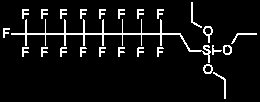
182 8:2 Fluorotelomer phosphate monoester ammonium salt Polyfluoroalkyl phosphoric acid diesters 8:2 Fluorotelomer phosphate diester 8:2 dipap /1/1 Fluorotelomer stearate monoesters 8:2 Fluorotelomer stearate monoester 8:2 FTS Fluorotelomer sitrate triesters 8:2 Fluorotelomer sitrate triester Polyfluorinated silanes (PFSi) Perfluorodecyldichlorome thylsilane /9/8 Perfluorodecyldimethylchl orosilane /9/6 Perfluorooctylethyltrietho xysilane /15/14 181

183 Perfluorodecyltrichlorosil ane Heptadecafluoro-1,1,2,2- tretrahydrodecyl) trimethoxysilane /11/12 3/6/19 Per- and polyfluorinated phosphonic acids Perfluorooctyl phosphonic acid C8-PFPA Not found Per- and polyfluorinated phosphinic acid Bis(perfluorooctyl) phosphinic acid C8/C8- PFPIA Not found Bis(perfluorooctyl) phosphinic acid C6/C8- PFPIA O=P(OH)(C 8 F 17 ) Not found Tris[4- (3,3,4,4,5,5,6,6,7,7,8,8, 9,9,10,10,10- heptadecafluorodecyl)ph enyl]phosphine /2/2 bis[tris(4- (3,3,4,4,5,5,6,6,7,7,8,8, 9,9,10,10,10- heptadecafluorodecyl)ph enyl)phosphine]palladiu m(ii) dichloride /1/2 Polyfluorinated Olefines 8:2 Fluorotelomer olefin 8:2 FTO /21/16 Per- and polyfluorinated Iodides 1,1,1,2,2,3,3,4,4,5,5,6,6,7,7,8,8- Heptadecafluoro-10- iododecane 8:2 FTI /26/16 182
![Perfluorooctyl iodide PFOI 507-63-1 19/25/23 Polyfluorinated Amides 2-carboxyethylbis(2- hydroxyethyl)-3- [(2,2,3,3,4,4,5,5,6,6,7,7, 8,8,8-pentadecafluoro-1- oxooctyl)amino]propylam monium hydroxide](/docs-images/40/20815486/images/184-0.png "3918 6-68- 0 0 N-[3-[bis(2- hydroxyethyl)amino]prop yl]- 2,2,3,3,4,4,5,5,6,6,7,7,8,8,8- pentadecafluorooctanami de 4135 8-63- 8 0 3,4- bis[(2,2,3,3,4,4,5,5,6,6, 7,7,8,8,8- pentadecafluoro-1-")
184 Perfluorooctyl iodide PFOI /25/23 Polyfluorinated Amides 2-carboxyethylbis(2- hydroxyethyl)-3- [(2,2,3,3,4,4,5,5,6,6,7,7, 8,8,8-pentadecafluoro-1- oxooctyl)amino]propylam monium hydroxide N-[3-[bis(2- hydroxyethyl)amino]prop yl]- 2,2,3,3,4,4,5,5,6,6,7,7,8,8,8- pentadecafluorooctanami de ,4- bis[(2,2,3,3,4,4,5,5,6,6, 7,7,8,8,8- pentadecafluoro-1- oxooctyl)amino]benzenes ulphonyl chloride;3,4- Bis(2,2,3,3,4,4,5,5,6,6,7, 7,8,8,8-pentadecafluoro- 1- oxooctylamino)benzenes ulfonyl chloride 1-Propanaminium,N,N,N- trimethyl-3- [(2,2,3,3,4,4,5,5,6,6,7,7, 8,8,8-pentadecafluoro-1- oxooctyl)amino]-, chloride Not found N-(3-aminopropyl)- 2,2,3,3,4,4,5,5,6,6,7,7,8,8,8- pentadecafluorooctanami de;einecs Propanesulfonic acid, 3- [ethyl(2,2,3,3,4,4,5,5,6, 6,7,7,8,8,8- pentadecafluoro-1- oxooctyl)amino] -, Not found 183
![sodium salt others heptadecafluoro-1- [(2,2,3,3,4,4,5,5,6,6,7,7, 8,8,8- pentadecafluorooctyl)oxy ]nonene 8402 9-60- 7 0 Pentadecafluoro-octanoyl fluoride 335-66-0 Pentadecafluoro-octanoic acid methyl](/docs-images/40/20815486/images/185-0.png "ester 376-27-2 Pentadecafluoro-octanoic acid ethyl ester 3108-24-5 2-Propenoic acid, 3,3,4,4,5,5,6,6,7,7,8,8,9,9,10,10,11,11,12,12,12- heneicosafluorododecyl ester, polymer with")
185 sodium salt others heptadecafluoro-1- [(2,2,3,3,4,4,5,5,6,6,7,7, 8,8,8- pentadecafluorooctyl)oxy ]nonene Pentadecafluoro-octanoyl fluoride Pentadecafluoro-octanoic acid methyl ester Pentadecafluoro-octanoic acid ethyl ester Propenoic acid, 3,3,4,4,5,5,6,6,7,7,8,8,9,9,10,10,11,11,12,12,12- heneicosafluorododecyl ester, polymer with 3,3,4,4,5,5,6,6,7,7,8,8,9,9,10,10,10- heptadecafluorodecyl 2- propenoate, alpha-(2- methyl-1-1-oxo-2-2- propenyl)-omega-[(2- methyl-1-oxo-2- propenyl)oxy]poly(oxy-1, 2-ethanediyl), 3,3,4,4,5,5,6,6,7,7,8,8,9,9,10,10,11,11,12,12,13, 13,14,14,15,15,16,16,16 - nonacosafluorohexadecyl 2-propenoate, octadecyl 2-propenoate, 3,3,4,4,5,5,6,6,7,7,8,8,9,9,10,10,11,11,12,12,13, 13,14,14,14- pentacosafluorotetradecy l 2-propenoate and 3,3,4,4,5,5,6,6,7,7,8,8,9 (Copolymer made by a mix where some are PFOA precursors)
186 ,9,10,10,11,11,12,12,13, 13,14,14,15,15,16,16,17,17,18,18,18- tritriacontafluorooctadecy l 2-propenoate Pentadecafluorooctanoic anhydride 2-Decenoic acid, 3,4,4,5,5,6,6,7,7,8,8,9,9,10,10,10- hexadecafluoro- Decanoic acid, 3,3,4,4,5,5,6,6,7,7,8,8,9,9,10,10,10- heptadecafluoro /6/4 UVCBs Fatty acids, C7-13, perfluoro Fatty acids, C7-13, perfluoro, compds. with ethylamine Fatty acids, C6-18, perfluoro, ammonium salts Carboxylic acids, C7-13, perfluoro, ammonium salts Octanoic acid, pentadecafluoro-, mixed esters with 2,2'-[1,4- butanediylbis(oxymethyl ene)]bis[oxirane] and 2,2'-[1,6- hexanediylbis(oxymethyl ene)]bis[oxirane] Fatty acids, C7-19, Not found Not found Not found but according to OECD survey 2009 manufactur ed in
187 perfluoro 8 Amides, C7-19, alphaomega-perfluoro-n,nbis(hydroxyethyl) Carbamic acid, [2- (sulfothio)ethyl]-, C- (gamma-omegaperfluoro-c6-9-alkyl) esters, monosodium salts 1,3-Propanediol, 2,2- bis(.gamma.-.omega.- perfluoro-c4-10- alkyl)thiomethyl derivs., phosphates, ammonium salts 1,3-Propanediol, 2,2- bis(.gamma.-.omega.- perfluoro-c6-12- alkyl)thiomethyl derivs., phosphates, ammonium salts Pentanoic acid, 4,4- bis(.gamma.-.omega.- perfluoro-c8-20- alkyl)thio derivs., compds. with diethanolamine;4,4- Bis[(γ-ω-perfluoro- alkyl(c=8-20))thio]pentanoic acid derivs. compds. with diethanolamine Polymers Poly(oxy-1,2- ethanediyl),a-[2- [2,2,3,3,4,4,5,5,6,6,7,7, 8,8,8-pentadecafluoro-1- oxooctyl)amino]ethyl]-whydroxy 2-Propenoic acid, 2- methyl-, 2,2,3,3,4,4,5,5,6,6,7,7,8,8,8-pentadecafluorooctyl ester, polymer with Not found 0 186
188 propenoic acid Poly(difluoromethylene), α-fluoro-ω-[2- [[2- (trimethylammonio)ethyl ]thio]ethyl]-, methyl sulfate Poly(difluoromethylene),.alpha.,.alpha.- phosphinicobis(oxy-2,1- ethanediyl)bis.omega.- fluoro- Poly(difluoromethylene),.alpha.-fluoro-.omega.- 2-(phosphonooxy)ethyl- Poly(difluoromethylene),.alpha.-fluoro-.omega.- (2-sulfoethyl)
189 Appendix B.2 - Production, import and uses of PFOA, its salts and PFOA-related substances Appendix B 2.1 Production and import of PFOA and PFOA-related substances Appendix B Production process of PFOA and PFOA-related substances There are two manufacturing processes to produce PFOA, its salts and PFOA-related substances: electrochemical fluorination (ECF) and telomerisation (Prevedouros et al., 2006). From 1947 until 2002 the electrochemical fluorination (ECF) process was mainly used to manufacture APFO worldwide (80-90% in 2000). ECF results in a mixture of branched and linear isomers (Prevedouros et al., 2006). Accordingly, the composition of PFOA is 78% linear and 22% branched isomers (Kissa, 2001). The current extent of global ECF manufacturing is unknown. Within the EU, there were at least three production sites using the ECF process 12. However, most of the manufacturers are using the telomerisation process nowadays (Wang et al., 2014). In the telomerisation process, perfluorethylene (CF 2 =CF 2 ) reacts with perfluoroethyl iodide (CF 3 -CF 2 -I) resulting in a straight chain perfluorinated iodine F(CF 2 ) n I (Figure A.B.2-1). These perfluoroalkyl iodides are the building blocks to manufacture perfluorinated carboxylic acids (F(CF 2 ) n-1 CO 2 M) and fluorotelomer iodides (F(CF 2 ) n CH 2 CH 2 I) with varying chain lengths and also PFOA-related substances (which are partly named as fluorotelomers in the literature). It mainly results in linear compounds, although some isopropyl isomers may occur as well (Benskin et al., 2012). During every further step in production residues from the previous step remain. For example: - 2% or less residual fluorotelomer iodide remains unreacted after the transformation from 8:2 FTI to 8:2 FTOH (Prevedouros et al., 2006). Additionally, 2-5 wt % byproduct fluorotelomer olefin (FTO) is formed, depending on the method used. - The reaction of fluorotelomer alcohol to make fluorotelomer acrylate or methacrylate esters leaves wt % unreacted residual FTOH. - Alternatively, acrylate monomers can be manufactured by a reaction of fluorotelomer iodide and acrylic acid salt to form acrylate monomer resulting in 3-8 wt % FTO by product (not shown in Figure A.B.2-1). The FTOHs and FTOs are present in the ultimate sales products unless removed (Prevedouros et al., 2006). 12 3M (Belgium), Bayer (Germany), Miteni (Italy). Miteni states at its webpage that the ECF process is used for the manufacturing of perfluorinated chemicals ( Miteni produces mainly short-chain perfluorinated and fluorinated chemicals. Bayer sold its fluorochemical branch to Lanxess. 188
190 Figure A.B.2-1: Telomerisation process (figure based on (Knepper and Lange, 2012)) This summary of the telomerisation process shows that the C 8 F 17 -moiety is the starting point for the production of PFOA and PFOA-related substances. The fluorotelomer acrylate monomer is a fundamental building block for the side-chain fluorinated polymers. Fluorotelomer-based acrylate polymeric products are prepared by aqueous emulsion polymerisation of fluorotelomer acrylate monomer with other monomers. The polyfluorinated substances are covalently bound to the non-fluorinated backbone. However, up to 2 % of the monomers remain unbound (Russell et al., 2008). The product is an aqueous dispersion comprised of acrylate polymer particles nm in size dispersed with hydrocarbon surfactants in water. The acrylate polymer particles have a high molecular weight (> amu), are water insoluble, and hydrophobic (Russell et al., 2008). Appendix B the global market Production volumes of PFOA and PFOA-related substances on Table A.B.2-1 summarises available estimations on global production volumes of PFOA, PFOAsalts and PFOA-related substances. Details are given in further below. 189
191 Table A.B.2-1: Summary of global production volumes of PFOA, PFOA salts and PFOA-related substances Accumulated PFOA manufacturing (Prevedouros et al., 2006) Annual APFO/NaPFO consumption in fluoropolymer manufacturing (Wang et al., 2014) Annual fluorotelomer acrylates production with eight carbon fluorinated side-chains (van Zelm et al., 2008). Annual fluorotelomerbased products production t (Wang et al., 2014), assumption 30 % PFOArelated substances t t 1995 to to 2145 t Currently t The data show that production takes place and at the same time no full data set on production volumes is available. When looking at the global production volumes the US-EPA 2010/2015 PFOA Stewardship Program (U.S.EPA, 2006) needs to be taken into account, because it is a main driver of the decreasing trend of PFOA manufacture and the manufacture of other C 8 - fluorochemicals in the US, Western Europe and Japan. The voluntary agreement is between the major fluoropolymer and fluorotelomer manufacturers from the US, Japan and Europe (Arkema, Asahi, BASF Corporation as successor to Ciba, Clariant, Daikin, 3M/Dyneon, DuPont, Solvay Solexis), which started in 2006 (U.S.EPA, 2006). This voluntary program commits industry to achieve a 100% reduction in facility emissions of PFOA, precursor chemicals that can break down to PFOA and related higher homologue chemicals as well as in product content levels of these chemicals by 2015, compared to a year 2000 baseline. As a result, manufacture of PFOA and PFOA-related substances has been strongly reduced in North America, Japan and Europe. The US EPA publishes every year a progress report which the participating companies have to submit. Since data are often claimed confidential, it is not possible to conclude on the overall actual amount of PFOA and PFOA-related substances still used by the participants. However, overall the companies demonstrate that a significant reduction in emissions and product content of PFOA and PFOA-related substances has been achieved already. It has to be noted that even if the companies participating in the US EPA stewardship program have substantially reduced their use and emissions of PFOA and PFOA-related substances, they do not represent all manufacturers worldwide. Their current share in global production was not provided by the respective companies during the stakeholder consultation. For fluoropolymers the global market share of the signatory companies is estimated to be 69% in 2011 with a decreasing trend (see Appendix B for details). 190
192 PFOA and its salts Worldwide manufacturing volumes of PFOA in the range of t accumulated for the years 1951 to 2004 were estimated by Prevedouros et al. (Prevedouros et al., 2006). Estimated global historic manufacturing volumes of APFO are presented in the table below. Table A.B.2-2: Estimated Global Historic APFO Manufacture (status 2006) (OECD, 2006; Prevedouros et al., 2006) Time Period Number of Years Estimated Global Average Annual APFO Production (tonnes/year) Estim. Global Average APFO Prod. (cumulative tonnage over the period) From Data not available Data not available * Precise data on the manufacturing volumes of PFOA for recent years are not available and were not reported during the stakeholder consultation. The main use of APFO is the manufacturing of fluoropolymers. The estimated global historic APFO usage for fluoropolymer manufacturing is presented in the table below. Table A.B.2-3: Estimated global historical APFO usage for flouropolymers production (in tonnes) (excl. PVDF) (OECD, 2006) Time Period US Western Europe Japan Totals totals According to estimates by Wang et al., (Wang et al., 2014) the current ( ) annual global consumption of APFO/NaPFO in fluoropolymer manufacture is in the range of 127 and 731 t Wang et al., 2014 differenciate between country group 1 (Japan, Western Europe and the US) and country group 2 (China, India, Poland, Russia). The numbers used in this assessment are the sum of both country groups. 191
193 PFOA-related substances The current global annual production volume of fluorotelomer-based products is estimated to be in the order of magnitude of t. This recent estimate includes fluorotelomers with different chain lengths (Wang et al., 2014). It is uncertain what the fraction of C 8 -homologues in the overall production is. A conservative estimation is that approximately 30% 14 of the fluorotelomers manufactured are PFOA-related substances accounting for t/a. According to Prevodourus (2006) global Fluorotelomer iodideproduction between 2000 and 2002 was between 5000 and 6000 t per year. Telomer A was manufactured at one site in the United States, one site in Germany, and two sites in Japan. It is likely that other smaller manufacturing and processing facilities exist as well (Prevedouros et al., 2006). It is not known which manufacturers are doing this production nowadays globally. The amount of manufactured C 8 -based substances is unknown. Van Zelm et al. estimated the worldwide production of fluorotelomer acrylates with fluorinated side-chains of eight carbon atoms to 1650 to 2145 t per year in the time period from 1995 to 2004 (van Zelm et al., 2008). The OECD survey on the production, use and release of PFASs from 2009 indicated several PFOA-related compounds that are manufactured such as the 8:2 polyfluoro alcohol, 8:2 polyfluoro iodide, 8:2 polyfluoro methacrylate, 8:2 polyfluoro acrylate, and 8:2 polyfluoro olefin. However, the response rate of industry was rather low and it was not possible to derive a robust estimate of total global volumes from the data gained in the survey (OECD, 2011). 15 Appendix B the EU Further information on PFOA and PFOA-related substances in PFOA and its salts According to KEMI, the Swedish chemicals Agency (KEMI, 2006) t of PFOA were imported into Sweden in In a Danish report the PFOA/APFO consumption was t/a 14 This number was estimated based on information presented in chapter B According to information from industry 31% of the fluoropolymer manufacturers (for the year 2011) are not covered by the US-EPA stewardship program (see B c) which is the driving force for the global reduction of the use PFOA and related substances. We therefore conclude that this proportion is equal for the manufacturing of PFOA-related substance. Companies bound to the US-EPA stewardship program committed on a voluntary basis to phase out PFOA and related substances until To date, however, these substances are still used by some of the signatory companies. Thus the estimation of 30% PFOA and related substances is too conservative. 15 The OECD monitors the manufacture and use of per- and polyfluorinated chemicals through surveys conducted every 2-3 years. Within these surveys which have been conducted in 2004, 2006, and 2009, also PFOA and related compounds such as its precursors have been in the focus. The aim of the 2009 survey was to gather information on the environmental loadings of PFOS, PFAS, PFOA and longer chain PFCAs. The survey was sent to 27 companies which were identified by the OECD to manufacture these chemicals and/or products containing these chemicals globally. It has to be mentioned that the response rate was relatively low. Only 9 of the 27 companies responded (33 %), revealing seven companies manufacturing PFOA and/or PFOA-related compounds in four countries globally. Thus, in reality the numbers and production volumes are very likely to be higher than presented in the report. The majority of the reported uses included products containing PFOA and PFCA related chemicals. In the report only the total volume of all PFOA and related compounds is listed and not reported volumes of single compounds OECD, PFCs: Outcome of the 2009 survey: Survey on the production, use and release of PFOS, PFAS, PFOA, PFCA, their related substances and products/mixtures containing these substances. OECD, Paris.(OECD 2011). 192
194 registered in the Danish product register in (Danish Environmental Protection Agency, 2013). PFOA-related substances Based on data from the Norwegian Product Register 0.43 t/a of PFOA-related substances (mostly Thiols, C8-20, perfluoro, telomers with acrylamide CAS ) are imported to Norway with an increasing trend (Stakeholder Consultation, 2013/14). The substance is mainly used for fire-extinguishing agents with a content of < 50,000 ppm in the product. During the Call for Evidence one company reported to export C8-based fluorosurfactants into the EU. In 2012, the company exported 98.1 t of telomer-based fluorosurfactants into the EU. However, no CAS-numbers were provided and the share of C8-based fluorosurfactants was not reported. The substances were used in fire-fighting foams, but also in specialty applications such as paints, adhesives and coatings. Appendix B.2.2 Uses of PFOA and PFOA-related substances Table A.B.2-4: Overview of major uses of PFOA and related substances in alphabetical order (modified from synthesis paper (OECD, 2013)) and relevant studies which measured product contents of PFOA and related substances Industry branch Non-polymers Polymers (fluoropolymers and side chain fluorinated polymers) Summary of examples for analysis of mixtures, articles and products (Detail in tables further below) Aviation, aerospace & defence Insulators, solder sleeves, use in various mechanical components (e.g. semiconductors, wiring, tubing, piping, seals, gaskets, cables) Lubricants Automotive Raw material for components such as low-friction bearings & seals, lubricants 8:2 FTOH was present in 2 of 4 products in concentrations up to µg/l (Fiedler et al., 2010) (Table A.B.2-24). Pesticide solution Biocides / Pesticides Active ingredient in ant baits, enhancers in pesticide formulations PFOA concentration of µg/l in one product tested 193
195 (Fiedler et al., 2010). Cable & Wiring Coating for weathering, flame and soil resistance; - > surface-treatment agent for conserving landmarks Construction Additives in paints and coatings Coating of architectural materials (fabric, metals, stone, tiles etc.), ->additives in paints Insulators, solder sleeves; vapour phase soldering media Electronics Energy Film to cover solar collectors due to weatherability Fire-fighting Film formers in aqueous film-forming foam (AFFF) and film forming fluoroprotein (FFFP) Raw materials for fire-fighting equipment, including protective clothing; fuel repellents for fluoroprotein (FP) foam stabilizers in resistant aqueous film-forming foam (AR-AFFF) and film forming fluoroprotein (FFFP); coatings for firefighting equipment Two samples (sampling 2009) of aqueous film forming foam concentrate (AFFF) were analyzed. PFOA and 8:2 FTOH concentrations of 1880 µg/kg and µg/l were found (Herzke et al., 2012). Fiedler et al. detected 7300 µg/l of PFOA in one product tested (Fiedler et al., 2010). (Table A.B.2-18) Place and Field analyzed ten different AFFF used by the US military (Place and Field, 2012). The authors found new telomerisation-based fluorinated surfactants in the foams. Some of them are PFOA precursors. (Table 194
196 A.B.2-17) Food processing Fabrication materials Impregnating sprays Household products Wetting agent or surfactant in floor polishes and cleaning agents, water repellent apparel, Non-stick coating, water repellent apparel, footwear PFOA was present in all three randomly selected impregnating sprays (sampling in 2010) with media concentration of 15.9 µg/kg (max 28.9 µg/kg). 13 other products were analyzed for FTOH. 8:2 FTOH maedian concentration was µg/kg (max = µg/kg) (Kotthoff et al., 2014). Fiedler et al. detected PFOA and 8:2 FTOH in seven of nine impregnation agents (sampling year was not communicated) in concentrations from n.d.-3.6 µg/ml and n.d. 52 µg/ml, respectively (Fiedler et al., 2010). Herzke et al. analysed five waterproofing agents and lubricants (sampling year: 2009). PFOA was detected in two products with 26 and 208 µg/l, respectively. The other three products contained FTOHs as the major PFAS group with 8:2 FTOH as the main contaminant (54780; and µg/l) (Herzke et al., 2012). (Table A.B.2-16) 195
197 Cleaning agents Six tested cleaning agents (sampling in 2010) contained PFOA at a median concentration of 0.7 µg/kg (max = 1.1 µg/kg). Further eight cleaning agents were analysed for 8:2 FTOH and contained 8:2 FTOH in median concentration of µg/kg (max = µg/kg) (Kotthoff et al., 2014). Liu et al., analysed commercial carpet/fabric-care liquids (Liu et al., 2014b). 9 out of 13 samples contained PFOA in the range of 6.97 to 707 ng/g. (Table A.B.2-21). Non-stick ware Herzke et al. analyzed three pans for PFOA and detected levels up to 436 µg/kg (sampling 2009) (Herzke et al., 2012). Begley et al. measured PFOA concentrations in the range of 4-75 µg/kg in PTFE cookware (Begley et al., 2005)(Table A.B.2-23). Sealant tape In sealant tape PFOA concentration accounted for 1800 µg/kg (Begley et al., 196
198 2005). Four out of fife thread-sealant tape samples contained PFOA (up to 2130 ng/g) (Liu et al., 2014b) and two out of four samples contained FTOH (up to 496 ng/g) (Liu et al., 2014a) (Table A.B.2-25). Medical articles Oil and mining production Photographic and imaging industry Paper and packaging Surfactants in oil well stimulation provide critical antistatic, surfactant, friction control, and dirt repellent properties Surgical patches cardiovascular grafts, raw material for implants in the human body; stainand water-repellents for surgical drapes and gowns Oil and grease repellent Treated non-woven medical garments Nine surgical gows sampled from 2007 to 2011 were analysed. PFOA concentration was <LOD in two samples and ranged from 18.4 to 369 ng/g in the others (Liu et al., 2014b). (Table A.B.2-13) Food contact materials In paper based food contact materials a PFOA concentration (median) of 3.2 mg/kg (max µg/kg) was analysed (Kotthoff et al., 2014). Samples collected in 2007 to 2011 were analysed. PFOA was present in 7 of the 9 samples with concentrations in the range of 1.83 to 4640 ng/g (Liu et al., 197
199 2014b) Further samples were collected in 2011 and 2013 and analysed for 8:2 FTOH. The concentration rang from 374 to 8310 ng/g. FTOH was present in 8 of 9 samples (Liu et al., 2014a). (Table A.B.2-20). Personal Care Products/ Cosmetics PFOA was analyzed in personal care products treated with polyfluoralkyl phosphate esters (PAPs). Some of the PAPs can be degraded to PFOA. In the Japanese study 24 samples were analysed that listed fluorinated compounds. PFOA was found in 13 cosmetic products in the range of 4.1 to 1700 ng/g and in eight sunscreen samples in the range of 3.7 to 5700 ng/g. Commercially available compounding agents, mica and talk, which were also treated with PAPs contained 6000 ng/g and 350 ng/g, respectively (Fujii et al., 2013). It is possible that also personal care products on the European market contain PFOA and 198
200 related substances. Semiconductors Skiing Textiles, leather apparel, footwear Raw material for equipment; working fluids in mechanical vacuum pumps Raw material for highly porous fabrics; oil and water repellent and stain release Ski waxes The analysis of PFOA contents in 13 ski wax samples (sampling 2010) detected a median concentration of 15.5 µg/kg and a max. concentration of µg/kg) ((Kotthoff et al., 2014). Outdoor clothing PFOA median concentration of three products was 6.0 µg/m² (max = 41.0 µg/m 2. Four products were analsed for 8:2 FTOH. The median concentration was 44.2 µg/m² (max = µg/m²) (Kotthoff et al., 2014). PFOA concentration in 15 Outdoor jackets and 1 working jacket (μg/m 2, n=2) were analysed and ranged from μg/m 2. One sample showed a concentration of 171 μg/m 2 PFOA (working jacket). 8:2 FTOH levels ranged from < LOQ to 65.4 µg/m² except for one sample which contained 516 μg/m 2 (Knepper et al., 2014). (Table A.B.2-9) 199
201 Workers protection clothing The following PFOA concentrations were found (Zangl et al., 2012): Workers protection clothing: < μg/m 2 High visibility warning clothing: μg/m 2 Cold protection clothing: < 0,081-5,85 μg/m 2 Rain protection clothing: < μg/m 2 Fleece products: < μg/m 2 Pilot clothing: μg/m 2 Flame retardant clothing: < μg/m 2 Surgical clothing: < μg/m 2. (Table A.B.2-10) Carpets The maximum concentration of 8:2 FTOH in eight carpets was 32.8 µg/m 2 (Kotthoff et al., 2014). Liu et al (Liu et al., 2014b) analysed 9 carpets purchased between 2007 and smples contained PFOA in the range of 3.5 to 226 ng/g. (Table A.B.2-15) Leather Kotthoff et al (Kotthoff et al., 2014) 200
202 Polymerization (emulsion)polymerization processing aids, (co)monomer of side-chain fluorinated polymers measured PFOA in 13 samples with a max. concentration of 12.4 µg/m² (Table A.B.2-14). Membranes for apparel 8 membranes purchased from 2007 to 2011 were analysed. PFOA was present in 7 samples with concentrations in the range of 5.31 to 163. (Liu et al., 2014b). (Table A.B.2-11) Appendix B Use of PFOA in fluoropolymer manufacture Manufacturing process of PTFE In the first step of PTFE manufacturing Fluorspar reacts with sulphuric acid to hydrofluoric acid and calcium sulphate. In subsequent reactions hydrofluoric acid reacts with chloroform to TFE at high temperatures. The final step is the radical polymerisation of tetrafluorethylene (TFE). The reaction is highly exothermic. The following polymerisation processes are used (pro-k Fluoropolymergroup, 2010): - Emulsification (Dispersion method): In the dispersion method, the resulting PTFE is a milky paste which can be processed into a fine powder. In this process PFOA is needed as emulsifier. PTFE from emulsification has very small primary particles of only 200 nm which are arranged in a secondary structure of ~ µm, the so called coagulate. PFOA can be removed from this product and be recycled for further manufacturing rounds. Still, depending on the efficiency of the recycling process and further subsequent treatment processes of the virgin PTFE, like drying and sintering, residual PFOA remains in the PTFE material (Table A.B.2-5 for details). - Suspension: In this method, the TFE is polymerized in water, resulting in grains of PTFE. The grains can be further processed into pellets which can be molded. In this process, normally no PFOA as emulsifier is needed 16. Polymers from suspension reactions are larger (so-called reactor beads size ~2 mm) and have to be processed in several subsequent steps (Grinding to ~ 10 µm followed by agglomeration to particles of ~ µm) to be ready for use by customers. PTFE is sold in different preparations depending on respective downstream use. There are three basic types of preparations: - Dry raw material (Emulsion route manufacturing) 16 Nevertheless, when consulting industry one manufacturer of PTFE reported that historically PFOA was used in his process. He stated that this was not the standard procedure in fact and confirmed that this process has been adapted to be free of PFOA. 201
203 - Dispersed raw material (Emulsion route manufacturing) - Granulated material (suspension route manufacturing) Fluoropolymers are mainly sold as solid granules or pellets where PFOA has either not been used or has been removed by further processing. Prevedorous et al estimated in 2006 that approximately 16% of the PTFE are aqueous dispersions (dispersed raw material) containing PFOA. However, when considering the fields of application (Table A.B.2-5) it seems likely that more than 16% emulsion route PTFE is used. This is supported by recent market analysis indicating granular PTFE to account only for 33% (by volume) of total production in Therefore, it is estimated that 1/3 is granulated material, 1/3 dry and 1/3 dispersed PTFE currently on the market (Ökopol, 2014). The dispersions are used e.g. to coat metal, fabric, and glass surfaces ((Fluoropolymer Manufactering Group, 2005) cited in (Prevedouros et al., 2006)). PFOA (APFO) can in principle be recovered from the process of fluoropolymer production and be reused several times (van der Putte et al., 2010). According to industry approximately 50% of the used PFOA was recycled with a recovery of 80 to 90% (Stakeholder Consultation, 2013/14). PTFE is further processed by downstream users. The material is sintered at temperatures of around C. Thus, PFOA residues may evaporate during the processing. To our knowledge there are no air-filtering systems in place at most downstream users sites (Ökopol, 2014). Table A.B.2-5: Residual PFOA in PTFE (Data based on industry consultation (Ökopol, 2014)) Granulated material (suspension route manufacturing) Emulsion route manufacturing raw material (dry 18 ) Emulsion route manufacturing material (dispersed) PFOA or alternative needed no yes 19 yes yes PFOA concentration in final PTFE < 5 ppm to < 1,000 ppm less than 10 to up to 50 ppm of PFOA ppm Remarks PFOA content is reduced by sintering PFOA content is reduced during drying process One company indicated that dispersed 17 Polytetrafluoroethylene (PTFE) Market Analysis By Application (Industrial Processing, Electronics, Automotive & Transportation) By Product (Granular, Micro-powder, Fine-powder) And Segment Forecasts To 2020, Grand View Research, December 2013, accessed July Boiling Point: C, e.g. Gestis database ( on the basis of safety data sheet by Merck) 19 historical 202
204 process (> 342 C 20 ). material has been reduced in PFOA content down to < 50 ppm after an initial content of < 2,000 ppm. Fields of application seals & gaskets seals & gaskets wire & cable insulation, high purity chemical tubing, high performance membranes, nonstick coatings and architectural fabrics wire & cable insulation, high purity chemical tubing, high performance membranes, nonstick coatings and architectural fabrics Global fluoropolymer market The global demand of fluoropolymers was estimated to be 235,000 to 267,000 t in 2011 (FluoroCouncil, 2013; Jin, 2012) and is expected to grow between 5-6% per year to reach about 317,000 to 379,000 t in 2018 (marketsandmarktes.com, 2013). PTFE accounts for about 60% (by weight) of the total production of fluoropolymers. Other important types of fluoropolymers are PVDF (~15%) and FEP (~10%) and PFA (~5%) (Ebnesajjad, 2013). Approximately 10 kg of PFOA are used for manufacturing of 1 t PTFE (Stakeholder Consultation, 2013/14), Ebnesajjad gives a range of approximately 0.1 3%. In 2010, the global fluoropolymer consumption was dominated by North America (41 %), followed by Asia-Pacific (30%) and Europe (21%) (Ebnesajjad, 2013). The Asian-Pacific region is expected to be the fastest growing market for fluoropolymers in the foreseeable future due to the rapid growth of the industry and the rise in living standards (Ebnesajjad, 2013). The overall decreasing trend in use of PFOA in fluoropolymer manufacture is largely initiated by the US-EPA 2010/2015 PFOA Stewardship Program that commits eight large manufacturers in North America, Japan and Europe to eliminate all PFOA from fluoropolymer production by 2015 (U.S.EPA, 2006). As a consequence, companies are working on chemical substitutes to replace PFOA in the emulsification process 21. The US EPA publishes every year an annual progress report which the participating companies have to submit. In Table A.B.2-6 available data for single companies are summarized. The available data show that PFOA was still present in fluoropolymers in The amounts in the final product are higher in non-us facilities compared with US-facilities. 20 Crystallization temperature, Note: degradation temperature of PFOA in literature > 300 C, e.g. Gestis database ( on the basis of the safety data sheet by Merck 21 It was not indicated in the stakeholder consultation whether and to which degree the 2015 goal would be achieved by a shift to the suspension production processes. 203
205 Table A.B.2-6: Fluoropolymer production 22 - data retrieved from the US-EPA stewardship program Compan y Fluoropolymer production worldwide Content of PFOA, PFOA salts and higher homologues Alternativ e Reference Arkema 2000t (2011) > 5,000-20,000 ppb (dry-weight) in US facilities > 50, ,000 ppb (dry-weight) in non-us facilities ( /pfoa/pubs/stewardship/ar kema2012.pdf). Asahi t (2011) 0 PFOA in US facilities but 50% precursors (PFOA-related substances) 80 ppb (dry weight) ( /pfoa/pubs/stewardship/as ahi2012.pdf). in non-us facilities Clariant 1000t telomer based products 2.6 kg PFOA, PFOA salts and 52 kg direct precursors (PFOArelated substances) in the non-us facilities ( /pfoa/pubs/stewardship/cl ariant2012.pdf). BASF CBI CBI pfoa/pubs/stewardship/ba SF2012.pdf; Daikin CBI CBI pfoa/pubs/stewardship/dai kin2012.pdf; Solvay CBI CBI DuPont CBI CBI pfoa/pubs/stewardship/sol vaysolexis2012.pdf). pfoa/pubs/stewardship/du Pont2012.pdf; 3M Dyneon Goal of phase out reached in 2008 PFOA-free emulsifier ( /pfoa/pubs/stewardship/3 22 Fluoropolymers include the use of side-chain fluorinated polymers. 204
206 M2012.pdf The companies who signed the US-EPA stewardship program, and thus agreed to replace PFOA by 2015, have a global market share of 69% (FluoroCouncil, 2013). The remaining 31% of the global capacity to manufacture fluoropolymers was owned by non-signatory companies in The numbers from the Fluorocouncil are comparable with those presented in Figure A.B.2-2. According to information provided by the Fluorocouncil: All non-signatory capacity was located outside of Europe, U.S. and Japan. 74% of that non-signatory capacity is in China. The remaining was in other countries, primarily Russia and India. The total market demand was estimated at tonnes in HaloPolymer presents the market shares of fluoropolymer manufactures at its website (Figure A.B.2-2). Figure A.B.2-2: Share of different manufacturers in the world market of fluoropolymers (Halopolymer.com, 2012) There are some activities starting in China to reduce the use of PFOA as well. However, no binding dates were reported so far (Wang et al., 2014). Consultation of industry reflects the phase out of PFOA in fluoropolymer manufacture in Europe. All companies that responded to the stakeholder consultation stated that they have recently replaced PFOA and are not using PFOA for the manufacturing of PTFE anymore with reference to the year However, PFOA may still be used in the manufacturing of other fluoropolymers 23. One company reported that the used emulsion type PTFE contains no PFOA. 23 One company responded that is still importing PFOA to be used as emulsifier for the manufacturing of fluoropolymers but clarified in the questionnaire chapter on PTFE that for this polymer there is an alternative in use (so it is assumed that no PFOA is in use for PTFE manufacture but for another fluoropolymer). 205
207 Another company reported PFOA contents of <100 ppm in the PTFE used and <10 ppm PFOA content in the final product. Examples for the use of PTFE A summary of examples for the use of fluoropolymers is provided in Table A.B.2-7. It is not possible to conclude which applications still use PTFE manufactured with PFOA. According to the stakeholder consultation there is no difference in the performance of PTFE manufactured with PFOA and PTFE which was manufactured by using alternatives. Table A.B.2-7: List of applications for the use of fluoropolymers (PTFE) and examples (extracted from Annex II, Table 3 (Ökopol, 2014)) Possible application of fluoropolymers/ elastomers Non-stick coatings for non-adhesive surfaces Anti-corrosive coatings Anti-corrosion coatings Wear-resistant nonstick and traction coatings Areas of application o Food industry o Automotive industry o Packaging industry o Textile and printing industry o Paint and coating industry o Plastic and rubber processing o General chemical industry o Electroplating o Semiconductor industry o Measurement technology o Oil industry o Lamination Examples of use o Rollers o Containers o Hot plates o Coating racks and hooks o Sealing bars o Casting moulds o Screws o Knives o Guide rails o Conveyor units o Containers o Agitators o Shut-off valves o Centrifuges o Fan wheels o Star wheels o Filling level sensors o Inspection glasses o Deflecting rollers 206
208 o Processing of adhesives o Paper processing o Drive rollers o Air beams Dry lubrication Coatings for rubber materials Resistance wire coating PTFE tubing o various o Automotive industry o Electrical industry o Electrical industry o Defence industry o Aerospace industry o Food market o Laboratory (HPLC/analyse) o Automotive (push/pull transfer) o Nozzles o Screws and screw nuts o Reciprocating knives, cutting tools o Friction bearings, connecting rods o Valve seats, cylinder liners o Cogwheels o Chain parts o Safety elements o Springs o Spring dowel pins o Fastening pins, carbon brush holders o Continuously coated welding wire o Improved coating system for heat sealing wire o Sleeves and bushings o Lock parts o Gaskets for switches, O-rings o Cover for truck armatures, gaskets
209 o Electronics (isolation) o Diagnostics/medical devices (catheters/endoscopes/ tubing) o Process industry o Semiconductor industry o Chemical (gas, fluid transport) o PTFE/silicone fabric o Tapes, amongst other zone/duplex o Closed and open fabrics Belts and tapes Consumer Products o Conveyor belts (punched designs) o Metal sealing belts (endless/coated) o PTFE fabric o Film/foils o Apparel, Accessories, Furnishings o Automotive, Marine o Cookware, Bakeware, Small Electrics o Paint Products & Accessories o Personal Care - o Fabric protectors o Wiper blades, o Mixtures for fabric protection and paint sealants -cars o All terrain wheels o Boat paints o cookware and muffin tins o electric pressure cookers, electric fry pans, waffle makers, panini makers, rice cookers, and other small electric appliances used in the kitchen o Outdoor paints o Indoor paints (Poli- Farbe) o Contact lenses o Razors (electric) Appendix B Other uses of PFOA The Aerospace Industries Association reported in the Call for Evidence that PFOA may be present in aerospace materials and processes such as oxygen systems and halogen leak detectors. Further information was not provided. 208
210 One company reported the use of <10 kg PFOA peryear for the use in adhesives during the stakeholder consultation. Table A.B.2-8: Other uses of PFOA Company/ State Volume Use Trends Reference CBI < 10 kg/a imported; ca ppm estimated; adhesive stable Stakeholder consultation estimated domestic consumption in 2007: best guess: 0.05 kg/a range: Waxes and polish decreasing estimated domestic consumption in 2007: best guess: 0.01 kg/a range: Paints and lacquers decreasing Switzerland estimated domestic consumption in 2007: best guess: 4 kg/a range: 1-10 best guess: 1 kg/a; range ; coatings of metals and ceramics consumption in the domestic textile industry decreasing decreasing (Federal Office for the Environment (FOEN), 2009) best guess: 2 kg/a range ; import in textiles and clothing decreasing best guess: 0.001kg/a; range consumption in the domestic leather industry decreasing best guess: 0.2 kg/a range ; import in leather products decreasing best guess:5 kg/a; range ; estimated amounts in imported carpets decreasing best guess: 1 kg/a; range 0 8; Estimated consumption in the domestic decreasing 209
211 carpet industry best guess: 0.5 kg/2007; range: 0.1-1; estimated consumption for paper treatment decreasing The use of PFOA in waxes, polishes, paints, lacquers and coatings of metals and ceramics and the use in textile and leather treatment was described for Switzerland in 2007 (Federal Office for the Environment (FOEN), 2009). The aggregated volume for the consumption of the substance in Switzerland is kg/a and the aggregated import volume 7.2 kg/a. When extrapolating these numbers to the EU (500 million inhabitants vs. 8 million Swiss) 410 kg/a are consumed and 450 kg/a PFOA and its salts are imported for the uses described in Table A.B.2-8. Nevertheless, during the stakeholder consultation no stakeholder indicated uses of PFOA in these branches. On the other hand analyses of leather finishing, carpets upholstery and medical garments confirm that PFOA is present in these products (see available data in Appendix Table A.B.2-9 to Table A.B.2-16). PFOA was also analysed in various paper samples, thread sealant tapes and pastes and in stone or wood sealants (see Table A.B.2-20, Table A.B.2-22 and Table A.B.2-25 in the Appendix for detailed information). In the analyses PFOArelated substances were not considered. It is not clear if PFOA was added intentionally or if it is an impurity. Thus, we estimate that a minimum amount of t/a PFOA may still be used for these applications (paints and lacquer, adhesives, waxes and polishes, metals and ceramics) within the EU. Additionally, a minimum amount of 0.5 to 1.5 t/a PFOA may be imported into the EU in textiles, carpets, paper, and leather. Considering that textiles and leather are mainly imported from Asia into the EU and considering further that PFOA may still be used in this area, the import volumes are very likely to be much higher. PFOA-related substances Appendix B Use of PFOA-related substances in textiles and leather During the finishing process of textiles, the side-chain fluorinated polymers are bound and fixed in a 0.5 to 1 weight%-range to the fiber (Fischer et al., 2006) or 3 to 30g/m 2 side-chain fluorinated polymer is applied to the fibre (Stakeholder Consultation, 2013/14). For permanent antisoiling finish of leather g of side chain fluorinated polymer is applied to 1 m² of the surface of the leather (furniture, car seats, shoes) (1m² leather ~ 1 kg; (Stakeholder Consultation, 2013/14)). The treated textile loses its water repellency with the increasing number of washing cycles. Treating the fabric with impregnating agents that may also contain PFOA-related substances, will enhance again its water and oil/dirt repellency. The wide-dispersive use of PFOA-related substances in the treatment of textiles is proven by several findings of PFOA and PFOA-related substances in outdoor clothing, water protection clothing, membranes for apparel, home textiles and upholstery, treated non-woven medical garments, leather finishing and carpets as well as impregnating sprays and waterproofing agents. Concentrations reported for these articles and mixtures (see Appendix Table A.B.2-9 to Table A.B.2-16) also include residues and impurities. 210
212 During stakeholder consultation only two answers contained quantitative information on PFOA and PFOA-related substances amounts used (presumably mainly import) for textile treatment (3 t/a). Additionally, a textile association reports use of 2000 t/a fluorinated polymers where the fraction of PFOA-related substances is not reported (assumption: 50 % based on industry information below, 1000 t/a PFOA-related substances) (Stakeholder Consultation, 2013/14) A search to generate import data of treated textiles into the EU was done in the Eurostat database. However, for finished textiles no import or export values could be retrieved (ProdCOM codes: ; ; ; ; ). An estimation of 7,000,000 durable water repellent (DWR-) jackets was provided by the Norwegian textile industry. Industry concluded that 50% of these jackets contain PFOA and related substances accounting for 3,500,000 jackets. Considering 5 million inhabitants in Norway and 500 million inhabitants within the EU it can be estimated that 100 times more jackets than calculated for Norway are imported into the EU. This would account for 350,000,000 jackets with a content of PFOA and related substances of e.g. 3 to 30g/m 2 (lower bound for sports wear, higher bound for workers protection wear (Stakeholder Consultation, 2013/14)). With the assumption that one jacket has an area of 1 m 2 this results in 1,000 to 10,000 t import of PFOA and PFOA-related substances into the EU due to outdoorjackets. Table A.B.2-9: Outdoor clothing Year of sampling PFOA (µg/m2) PFOA (µg/kg) 8:2 FTOH (µg/m2) 8:2 FTOH (µg/kg) Reference - - T1 Outdoor textiles (n=5) Gloves (n=3) Teflon table cloth 2010 max = 41.0 median 6.0 (n=3) max = 15.9 median = 9.3 (n=3) max = median = 44.2 (n=4) max = 58.6 median = 53.2 (n=1) (Kotthoff et al., 2014) T2 Teflon table cloth (Herzke et al., 2012) J0 J1 J2 Outdoor jacket Outdoor jacket Outdoor jacket <0.02 < (Knepper et al., 2014) 211
213 J3 J4 J5 J6 J7 J8 J9 J10 J11 J12 J13 J14 Outdoor jacket Outdoor jacket Outdoor jacket Outdoor jacket Outdoor jacket Outdoor jacket Outdoor jacket Outdoor jacket Outdoor jacket Outdoor jacket Outdoor jacket Outdoor jacket Table A.B.2-10: Workers protection clothing Product Year of PFOA (µg/m2) description Number sampling 11G19745 Workers waistcoat, green < G19747 Forestry jacket G19748 Cut protective trousers, blue G19751 High visibility jacket, orange G19753 Multifunctional high visibility shirt, yellow G19782 Fleece gloves < G19787 Pilot jacket G19788 High visibility Pilotjacet G19794 Thermoparka G19796 Offshoreparka G19797 Rain jacket heavy weight < G19798 Rain trousers, yellow < G19801 Profi X-Vest G19808 Workers jacket < G19809 Fleece jacket G19810 Creek Jacket G19811 Norway Jacket G19812 High visibility trousers Reference (Zangl et al., 2012) 212
214 11G19825 Pilot jacket G19832 dungarees G19833 High visibility trousers G19836 Surgical shirt < G19837 Surgical clothing < G19838 Surgical clothing G19839 Surgical clothing G19841 Surgical clothing G19842 Overall G19844 Flame-retardant trousers G19845 Flame-retardant vest < G19847 Norway jacket < G19848 Pilot jacket < G19851 Fire keeper gloves G19852 Fire keeper gloves G22266 Forestry trousers G22267 Waistcoat G22268 Dungarees G22269 Softshell jacket < G22270 Dungarees < G22272 Cut protective dungarees G22273 High visibility dungarees G22274 High visibility dungarees G22275 gloves < G22276 gloves G22277 Pilot jacket G22278 Pilot jacket G22279 Softshell waistcaot G22281 Softshell jacket G22282 Waistcoat G4363 Working jacket G4366 Working jacket G4367 Working jacket G4368 Work shirt J15 Working jacket (Knepper et al., 2014) Table A.B.2-11: Membranes for apparel Sample ID Descritpion Year of sampling PFOA in ng/g I-1-0 Membrane 1 (China) 05/16/ I-1-1 Membrane 1 (Vietnam) 03/30/ I-5-0 Membrane 2 (China) 05/16/ I-5-1 Membrane 2 (China) 03/30/ I-5-2 Membrane 2 03/31/ FTOH in ng/g Reference (Liu et al., 2014b) 213
215 (Indonesia) I-8-0 Membrane 3 (China) 08/17/ I-8-1 Membrane 3 (China) 03/30/2010 <LOD I-8-2 Membrane 3 (China) 03/31/ I-1 Membrane hat 1 (China) 03/31/2011 < LOQ I-2 Membrane hat 2 (China) 06/11/ I-3 I-4 Women s membrane jacket 3 (Vietnam) Men s membrane jacket 4 (Indonesia) 06/11/ /11/ (Liu et al., 2014a) Table A.B.2-12: Treated home textile and upholstery Sample ID Description Year of sampling PFOA in ng/g E-7-0 Mattress pad 1 (USA) 07/10/ E-7-1 Mattress pad 1 (USA) 02/22/ E-7-2 Mattress pad 1 (USA) 03/30/ E-8-0 Mattress pad 2 (USA) 07/10/ E-8-1 Mattress pad 2 (USA) 03/30/ FTOH in ng/g E-8-2 Mattress pad 2 (USA) 03/30/ E-1 Mattress pad 1 (USA) 03/20/ E-2 Mattress pad 2 (in USA from imported) 03/30/ E-3 Mattress pad 3 (in USA from imported) 06/11/2013 < LOQ E-4 Mattress pad 4 (China) 06/11/ E-5 Pillow 1 (USA) 06/11/ Reference (Liu et al., 2014b) (Liu et al., 2014a) Table A.B.2-13: Treated non-woven medical garments Sample ID F-2-0 F-2-1 F-2-2 F-3-0 Description Year of PFOA sampling ng/g Surgical gown 1 (assembled in China 01/30/ with U.S. materials) Surgical gown 1 (China) 05/05/ Surgical gown 1 (China) 03/28/2011 < LOD Surgical gown 2 (China) 01/30/ F-3-1 Surgical gown 2 05/05/ in FTOH ng/g in Reference (Liu et al., 2014b) 214
216 F-3-2 F-4-0 F-4-1 F-4-2 F-1 F-2 F-3 F-4 F-5 (China) Surgical gown 2 (China) Surgical gown 3 (assembled in China with U.S. materials) Surgical gown 3 (China) Surgical gown 3 (China) Surgical gown 1 (assembled in China) Surgical gown 2 (China) Surgical gown 3 (China) Surgical gown 4 (China) Surgical gown 5 (China) 03/28/ /30/ /05/ /28/2011 < LOD 03/28/ /09/ /09/ /09/ /09/ (Liu et al., 2014a) Table A.B.2-14: Leather finishing Sample ID Description Year of sampling - Leather samples (n= 13) 2010 PFOA in µg/m 2 max = 12.4 Reference (Kotthoff et al., 2014) Table A.B.2-15: Carpets Sampl e ID Description Year of sampling - Carpets (n=14) 2010 C1 C2 A-1-0 Carpet Teflon treated carpet Pre-treated carpeting Nylon carpet 1 (USA) /09/200 7 PFOA (µg/ m²) max = 1.1 (n=6) n.d PFOA (ng/g ) 8:2 FTOH (µg/ m²) max = 32.8 (n=8) :2 FTOH (ng/g ) Refere nce (Kotthof f et al., 2014) (Herzke et al., 2012) 10.4 (Liu et al., 215
217 A-1-1 A-1-2 A-1-3 A-2-0 A-2-1 A-2-2 A-9-0 A-9-1 B-1-0 B-1-1 B-1-2 B-3-0 B-3-1 Pre-treated carpeting Nylon carpet 2 (USA) Pre-treated carpeting Nylon carpet 3 (USA) Pre-treated carpeting Nylon carpet 4 (USA) Pre-treated carpeting Corn polymer carpet 1 (USA) Pre-treated carpeting Corn polymer carpet 2 (USA) Pre-treated carpeting Corn polymer carpet 3 (USA) Pre-treated carpeting Polypropylene carpet 1 (USA) Pre-treated carpeting Polypropylene carpet 2 (USA) Commercial carpet/fabric-care liquids Carpet/upholstery protector concentrate 1 (USA) Commercial carpet/fabric-care liquids Carpet/upholstery protector concentrate 1 (USA) Commercial carpet/fabric-care liquids Carpet/upholstery protector concentrate 1 (USA) Commercial carpet/fabric-care liquids Solvent-based fabric protector (USA) Commercial carpet/fabric-care 05/18/ /08/ /08/ /12/ /18/ /18/ /04/ <LOD <LOD <LOD /18/ /19/ /26/ /23/ /19/ /24/ b) 216
218 B-3-2 B-5-0 B-5-1 B-5-2 B-7-0 B-7-1 B-7-2 A-1 A-2 A-3 A-4 liquids Solvent-based fabric protector (USA) Commercial carpet/fabric-care liquids Solvent-based fabric protector (USA) Commercial carpet/fabric-care liquids Carpet/upholstery protector concentrate 2 (USA) Commercial carpet/fabric-care liquids Carpet/upholstery protector concentrate 2 (USA) Commercial carpet/fabric-care liquids Carpet/upholstery protector concentrate 2 (USA) Commercial carpet/fabric-care liquids Ready-to-use carpet protector 1 (USA) Commercial carpet/fabric-care liquids Ready-to-use carpet protector 1 (USA) Commercial carpet/fabric-care liquids Ready-to-use carpet protector 1 (USA) Pre-treated carpeting Nylon carpet 1 (USA) Pre-treated carpeting Nylon carpet 2 (USA) Pre-treated carpeting Olefin carpoet 1 (USA) Pre-treated carpeting Polyester carpet 1 (USA) 02/23/ /19/ /24/ /23/ /19/ /01/ /23/201 1 < LOD <LOD <LOD 09/08/ /08/201 1 < LOQ 06/20/ /20/ (Liu et al., 2014a) 217
219 A-5 B-1 B-2 B-3 Pre-treated carpeting Polyester carpet 2 (USA) Commercial carpet/fabric-care liquids Carpet/upholstery protector concentrate 1 (USA) Commercial carpet/fabric-care liquids Ready-to-use carpet protector 1 (USA) Commercial carpet/fabric-care liquids Carpet/upholstery protector concentrate 2 (USA) 06/20/ /23/ /23/201 1 < LOQ 06/04/ Table A.B.2-16: Impregnating sprays/ waterproofing agents Sample ID - I1 I2 I3 I4 Description Impregnating sprays (n=16) Water proofing agent Kiwi All Protector (Norway) Water proofing agent TF2 lubricant (Norway) Water proofing agent Rainguard, Boston (Norway) Water proofing agent Fiber Protector Year of samplin g PFOA in µg/ml PFOA in µg/kg max = 28.9 median = 15.9 (n=3) 8:2 FTOH (µg/m L) n.d. n.d n.d. n.d. n.d :2 FTOH (µg/kg ) max = median = (n=13) Reference (Kotthoff et al., 2014) (Herzke et al., 2012; Herzke et al., 2009) 218
220 I5 IA1 (Norway) Water proofing agent Granger XT Spray (Norway) IA IA3 Impregnating agents from nine different IA companies (all IA products purchased IA6 n.d. 0.5 in Germany except IA7 one from Brasil) n.d. 33 IA8 0.9 n.d IA9 3.6 n.d. Ecco universal waterproofing spray Armour n.d. n.d. Nikwax TX Direct wash-in Boston Raingard allover Kiwi select all protector 0.1 n.d Imprenex plus n.d. n.d. Nikwax nubuck & mocka proof Springyard Waterproofer n.d. n.d. n.d XT Boston protector n.d Nikwax TX. Direct spray-on n.d. n.d. Atsko Waterguard Collonil classic waterstop (Fiedler et al., 2010) (Norin and Schulz, 2007) cited in (Knepper et al., 2014) Appendix B Use of PFOA-related substances in fire-fighting foams PFOA-related substances may be used in all of the following foams (German Federal Environment Agency (Umweltbundesamt), 2013): Fluoro-protein foams used for hydrocarbon storage tank protection and marine applications. Aqueous film-forming foams (AFFF) developed in the 1960s and used for aviation, marine and shallow spill fires. Film-forming fluoroprotein foams (FFFP) used for aviation and shallow spill fires. 219
221 Alcohol-resistant aqueous film-forming foams (AR-AFFF), which are multi-purpose foams. Alcohol-resistant film-forming fluoroprotein foams (AR-FFFP), which also are multipurpose foams; developed in the 1970s. It was estimated that 3% of the perfluorinated substances manufactured were used in AFFF (Federal Office for the Environment (FOEN), 2009). The Fire-fighting Foam Coalition (FFFC) stated that 5% of fluorotelomer-based products manufactured worldwide were used in firefighting foams (Renner 2007 in (Federal Office for the Environment (FOEN), 2009)). According to an AFFF factsheet provided by the FFFC the majority of the fluorosurfactants used in telomer-based AFFF are based on C6-perfluorinated substances (Fire Fighting Foam Coalition (FFFC), 2014). It is stated that currently some AFFF formulations contain also C8 and longer chemicals. Those substances may be PFOA-related substances. Foam concentrations (6%, 3%, 1%) are mixed with water and the final solution contains usually 0.03 to 0.45 % fluorosurfactants (Sontake and Wagh, 2014). Several studies report findings of PFOA and PFOA-related substances in AFFF: - PFOA was found in four tested AFFF concentrates in the range of to %w.w. (Krop et al., 2008) cited in (Federal Office for the Environment (FOEN), 2009)). - Old generation foam tested contained mainly perfluorinated sulfonates, whereas the new generation foams (bought in 2009) contained mainly telomeric substances and small amounts of perfluorinated carboxylates. One new generation foam contained PFOA as well as 8:2 FTOH (see Table A.B.2-18 for details) (Herzke et al., 2012). - Place and Field (Place and Field, 2012) analysed seven brands of AFFF fire-fighting foam used by US military. PFOA-related substances were found in addition to other PFASs (see Table A.B.2-17 for the identified chemical structures). - D Agostino & Mabury analysed ten fluorinated AFFF concentrates from four manufacturers and found PFOA-related substances (perfluoroalkylamido betaine-related and fluorotelomerthioalkylamido betaine related) which have not been identified previously (D'Agostino and Mabury, 2014). During the stakeholder consultation and the Call for Evidence only few companies responded with regard to the manufacturing of fire-fighting foams. - Two of the responding manufacturers had already shifted the production to shorter chain substances and PFOA was only present in trace levels in the foams. - One company reported to still use C8-fluorosurfactants in fire-fighting foam with a decreasing trend - One company reported to export C8-based fluorosurfactants into EU. In 2012 the company imported about 100 t of telomer-based fluorosurfactant into the EU. However, no CAS-numbers were provided and the share of C8-based fluorosurfactants was not reported. The substances were used in fire-fighting foams, but also in specialty applications such as paints, adhesives and coatings. Based on indications derived in the consultation of industry suggesting that PFOA-related substances are still used in fire fighting agents it is estimated that 20% of these imported fluorosurfactants are still C8-220
222 based which accounts for 20 t/a. Furthermore, we estimate that 10 t/a are used for fire-fighting foams in the EU. Based on data from the Norwegian Product Register 0.43 t/a of PFOA-related substances (mostly thiols, C8-20, perfluoro, telomers with acrylamide CAS ) is used for fire extinguishing agents with a content of < ppm in the product. It is very likely that also other Member States import CAS Thus, when extrapolating the 0.43 t/a (5 million Norwegians) to the number of inhabitants in the EU (500 million) an import volume of 43 t/a of CAS could be estimated with high uncertainty. In the Norden-Report (2013) it was reported that one substance C8-C20-ω-perfluoro telomer thiols with acrylamide (CAS number ) is used in most common fluorosurfactants for the use in fire-fighting foam. According to the industry most of the manufacturers are committed to continuing use of this chemistry until The authors also report that there are currently very few AFFF manufacturers whose products contain only C6 fluorinated chemicals. Thus, only a minor part of the manufacturers is compliant to the US-EPA stewardship program. According to the report the majority of manufacturers including a number of major players have taken a conscious decision to stay with the C6/C8 fluorotelomer mixture on grounds of cost and formulation difficulties. Table A.B.2-17: Substances found in new generation AFFF-fire-fighting foam (Place and Field, 2012) Manufacturing dates of the samples Manufact urer Components Structure C8 perfluoroalkyl sulfonates M Perfluoroalkyl sulphonamides containing carboxylic acid and tertiary amine functionalities Found in todays AFFF (D'Agostino and Mabury, 2014) but with chain length n = 6,8, National Foam AFFF 8:2 fluorotelomer 221
223 Fire Service Plus sulphonamides with dimethyl quaternary amine and carboxylic acid functional groups Ansul AFFF Chemguar d 8:2 fluorotelomer thioether amido sulfonates Found in todays AFFF (D'Agostino and Mabury, 2014) but with chain length n = 4,6,8,10,12, present Angus AFFF 8:2 fluorotelomer thioether with hydroxyl and trimethyl quaternary amine functionalities Chemguar d Longer chain fluorotelomer thioether amido carboxylates 2004-present Buckeye AFFF Fluorotelomer beatines with quaternary amine and carboxylic acid functionalities Found in todays AFFF (D'Agostino and Mabury, 2014) but with chain length n = 5,7,9,11,13 222
224 Found in todays AFFF (D Agostino & Mabury 2014) but with chain length n = 5,7,9,11,13,15 Table A.B.2-18: Fire-fighting agents Sample ID Description Year of sampling PFOA (µg/ml) 8:2 FTOH (µg/ml) Reference AFFF1 AFFF2 AFFF3 FF Aqueous film forming foams Aqueous film forming foams (oldgeneration) Aqueous film forming foams Fire fighting foam n.d n.d (Herzke et al., 2012) n.d. n.d n.d. (Fiedler et al., 2010) Appendix B Use of PFOA-related substances in paper Fluorotelomer-based polymers such as phosphate esters or acrylates used in paper treatment are either very low molecular weight fluorotelomers, which are mixtures of C6-, C8-, C10- and C12-perfluorinated chemicals or high molecular weight polymers with fluorotelomer-based side chains (Begley et al., 2005; D'eon and Mabury, 2007). Further examples of substances used in paper industry are given in the Table A.B Before application onto paper fluorotelomer-based paper coating/additive formulations may have had PFOA content as high as ppm w.w., but during normal application rates this amount of PFOA is diluted by about 300 times on the final paper product. Therefore, the PFOA content on finished paper was in the few hundred ppb range (Begley et al., 2005). The residual concentration of PFOA in polymers used in the manufacture of impregnated paper was < 2 ppm or < 10 ppm d.w. in 2007 in Switzerland (Federal Office for the Environment (FOEN), 2009). PFOA was analysed in baking and sandwich papers, paper baking forms, treated food contact paper and corrugate cardboard paper (see Table A.B.2-20 in the Appendix). PFOA was found in most of the samples. PFOA-related substances were not analysed in all products, but it seems likely, that the measured PFOA concentration rather results from degradation of precursers or is an impurity. It is unlikely that PFOA was used intentionally for those papers (based on information from the stakeholder consultation). It is however possible that fluoropolymers manufactured with PFOA were used to achieve fat proof properties. 223
225 In the stakeholder consultation one company stated a use of 25 t/a perfluoro alkyl acryl copolymer (C8) for paper and cardboard treatment. It is very likely that other companies are using PFOA-related substances as well that were not included or did not respond to the consultation of industry or the call for evidence in preparation of this report. Table A.B.2-19: Substances specified as surface refining and coating agents in the BfR recommendations XXXVI. Paper and board for food contact and recommendation XXXVI/2. Paper and board for baking purposes (German Federal Institut for Risk Assessment, 2013a, b) Compound CAS No. Recomm endation Comment Phosphoric acid ester of ethoxylated perfluoropolyetherdiol XXXVI, XXXVI/2 No information on the chain length. Could potentially contain PFOArelated substances Copolymer of acrylic acid-2-methyl-2 (dimethylamino)ethylester and gamma, omegaperfluoro-(c8-c14)alkyl-acrylate, N-oxide, acetate Copolymer with 2-diethylaminoethylmethacrylate, 2,2'- ethylenedioxydiethyldimethacrylate, 2- hydroxyethylmethacrylate and 3,3,4,4,5,5,6,6,7,7,8,8,8-tridecafluorooctyl methacrylate, acetate and/or malate 2-Propen-1-ol, reaction products with 1,1,1,2,2,3,3,4,4,5,5,6,6-tridecafluoro-6- iodohexane, dehydroiodinated, reaction products with epichlorohydrin and triethylenetetramine with a fluorine content of 54 % (for polymer) (for acetate only) XXXVI XXXVI, XXXVI/2 XXXVI Contains PFOArelated substances May contain impurities of PFOA-related substances May contain impurities of PFOA-related substances Copolymer of 3,3,4,4,5,5,6,6,7,7,8,8,8- tridecafluorooctyl acrylate, 2- hydroxyethyl acrylate, polyethylene glycol monoacrylate and polyethylene glycol diacrylate with a fluorine content of 35.4 % Copolymer with methacrylic acid, 2- hydroxyethylmethacrylate, polyethylene glycol monoacrylate and 3,3,4,4,5,5,6,6,7,7,8,8,8-tridecafluorooctyl acrylate, sodium salt with a fluorine content of 45.1 % Copolymer with methacrylic acid, 2 diethylaminoethylmethacrylate, acrylic acid and 3,3,4,4,5,5,6,6,7,7,8,8,8 tridecafluorooctylmethacrylate, acetate XXXVI XXXVI, XXXVI/2 May contain impurities of PFOA-related substances May contain impurities of PFOA-related substances May contain impurities of PFOA-related substances 224
226 Copolymer of methacrylic acid, 2- dimethylaminoethyl methacrylate and 3,3,4,4,5,5,6,6,7,7,8,8,8-tridecafluorooctyl methacrylate, acetate, with a fluorine content of 45.1 % XXXVI May contain impurities of PFOA-related substances Reaction product of Hexamethylene-1,6- diisocyanate (homopolymer), converted with 3,3,4,4,5,5,6,6,7,7,8,8,8-tridecafluoro-1-octanol with a fluorine content of 48 % XXXVI May contain impurities of PFOA-related substances Copolymer of 2-dimethylaminoethyl methacrylate and 3,3,4,4,5,5,6,6,7,7,8,8,8-tridecafluorooctyl methacrylate, N-oxide, acetate, acetate, with a fluorine content of 45 % XXXVI May contain impurities of PFOA-related substances PFOA-related subtances are used in paper and board for food contact for baking purposes in Germany. The information was provided by the German The Federal Institute for Risk Assessment (BfR). However, there is no information on the volumes available. Table A.B.2-20: Treated paper Sample ID H-3-0 H-3-1 H-3-2 H-4-0 H-4-1 H-4-2 H-5-0 Description Treated food contact paper 1 (USA) Treated food contact paper 1 (USA) Treated food contact paper 1 (USA) Treated food contact paper 1 (USA) Treated food contact paper 1 (USA) Treated food contact paper 1 (USA) Treated food contact paper 3 (USA) Year of sampling PFOA in ng/g 10/15/2007 < LOD 02/22/2010 < LOD 09/07/ /15/ /22/ /07/ /30/ FTOH in ng/g Reference (Liu et al., 2014b) H-5-1 Treated food contact paper 3 02/22/ (USA) H-5-2 Treated food contact paper 3 09/12/ (USA) H-1 Popcorn bag 1 09/07/ (Liu et al., 225
227 H-2 H-3 (USA) 2014a) Popcorn bucket 1 (USA) 09/07/2011 < LOQ Sandwich wrap paper (USA) 06/17/ H-4 Browning microwave bag 06/17/ (USA) H-5 Popcorn bag 2 (liner) (USA) 06/17/ H-6 Popcorn bag 2 (outer bag) (USA) 06/17/ H-7 Popcorn bucket 2 (USA) 06/17/ H-8 Baking cup 1 06/20/ H-9 Baking cup 2 06/20/ Ind. paper based food contact materials Pooled paper based food contact materials 2010 max = median = 3.2 (n=33) max = 14.1 median = 15.7 (n=7) (Kotthoff et al., 2014) Appendix B Use of PFOA-related substances in paints and inks Fluorotelomer-based surfactants are added to latex paints in an amount between 300 and 500 mg of product/kg of paint (Federal Office for the Environment (FOEN), 2009). In 2012, one company exported about 100 t of telomer-based fluorosurfactant into the EU (CAS-numbers and share of PFOA-related substances not provided). The substances were used in fire-fighting foams, but also in specialty applications such as paints, adhesives and coatings. We estimate that 20% of the imported fluorosurfactants are still C8-based which accounts for 20 t/a. We further estimate that 10 t/a are used in specialty applications such as paints, adhesives and coatings in the EU. Washburn et al reported a concentration of PFO (anion of PFOA) in the fluorotelomer based product formulation of mg/l. In the finished consumer article (latex paint) the amount of PFO was estimated in the range of mg/kg article (Washburn et al., 2005). Concentrations of 2800 ppm 8:2 FTOH were found in n-ethoxylated non-ionic fluorosurfactant for the incorportation into caulks, paints, coatings and adhesives (Dinglasan-Panlilio and Mabury, 2006). The Swiss Federal Customs Administration estimated that 40,000 t/a paints, lacquers and inks that potentionally contain PFASs are imported into Switzerland. Water-based acrylic paint made up approximately half of that volume. The consumption of 8:2 FTOH for paints and 226
228 lacquers was estimated to be in the range of kg/a (Federal Office for the Environment (FOEN), 2009). Considering the estimated consumption of 45 kg/a 8:2 FTOH in Switzerland (8 million inhabitants) and extrapolating this number to the EU (500 million inhabitants) a consumption of around 2800 kg/a could be estimated for the use in paints and lacquers. According to the Danish product register 1.9 t of CAS for the use in paints and lacquers were produced and imported to Denmark and 1.3 t are exported in This means that approximately 0.6 t are consumed in Denmark. Considering that there are 5.6 million inhabitants in Denmark an extrapolation to the EU inhabitants would result in a consumption of around 54 t/a of this substance within the EU (Danish Environmental Protection Agency, 2013). Appendix B Other uses of PFOA-related substances During stakeholder consultation and the call for evidence industry reported to use PFOArelated substances as processing aid and surfactant for the manufacturing of ophthalmic lenses. The reported volume was in the low kg range per year, imported into the EU. Data from Switzerland from 2007 indicate that PFOA-related substances were used also in waxes and polishes. The estimated volume for these uses was 2-15 kg/a 8:2 FTOH. PFOA-related substances were analysed in lubricants and cleaning agents (see Table A.B.2-21 and Table A.B.2-24 in the Appendix for further information). In the analyses only 8:2 FTOH was considered. There may be other PFOA-related substances used in those products. However, no information was provided by industry during the stakeholder consultation. In summary, we estimate with high uncertainty that PFOA-related substances in the range of 0.1 to 0.5 t are used annually for these applications. Table A.B.2-21: Cleaning agents Sample ID Description Year of sampling PFOA in ng/g 8:2 FTOH ng/g Reference - Cleaning agents (n=14) 2010 max = 1.1 median = 0.7 (n=6) CA1-CA6 Cleaning agents - n.d C-1-0 C-1-1 C-1-2 C-2-0 Carpet Shampoo 1 (USA) Carpet Shampoo 1 (USA) Carpet Shampoo 1 (USA) Household carpet care 1 (USA) 04/19/ /06/ /28/ /10/ < LOD < LOD < LOD max = median = (n=8) (Kotthoff et al., 2014) (Fiedler et al., 2010) (Liu et al., 2014b) 227
229 C-2-1 C-4-0 C-4-1 C-5-0 C-5-1 C-8-0 C-8-1 C-9-0 C-9-1 C-1 C-2 Household carpet care 1 (USA) Household carpet protector 1 (USA) Household carpet protector 1 (USA) Household carpet protector 2 (USA) Household carpet protector 2 (USA) Household carpet care 2 (USA) Household carpet care 2 (USA) Membrane fabric care 1 (England) Membrane fabric care 1 (England) Household Fabric/upholstery protector 1 (USA) Household Fabric/upholstery protector 2 (USA) 02/23/ /16/ /22/ /16/ /23/ /06/ /26/ /29/ /01/ /23/ /19/201 3 < LOD < LOD < LOD < LOD < LOD < LOQ 372 (Liu et al., 2014a) Table A.B.2-22: Floor waxes and stone/wood sealants Sample ID G-1-0 G-1-1 G-2-0 G-2-1 G-4-0 G-4-1 G-6-0 G-6-1 G-1 Description Household floor wax 1 (USA) Household floor wax 1 (USA) Household floor wax 2 (USA) Household floor wax 2 (USA) Commercial floor wax 1 (USA) Commercial floor wax 1 (USA) Commercial floor wax 2 (USA) Commercial floor wax 2 (USA) Household floor wax 1 (USA) Year of sampling PFOA in ng/g 07/10/ /23/2011 < LOD 07/10/ /30/2011 < LOD 07/10/ /31/ /10/ /31/ FTOH in ng/g Reference (Liu et al., 2014b) 02/23/ (Liu et al., 2014a) G-2 Household floor wax 2 06/10/
230 G-3 G-4 G-5 (USA) Stone cleaner/sealer 1 (USA) Stone cleaner/sealer 2 (USA) Household floor wax 3 (USA) 06/17/ /17/ /17/ Table A.B.2-23: Non-stick ware Sample ID Description Year of sampling PFOA (µg/kg) 8:2 FTOH (mg/l) 8:2 FTOH (µg/m2 Reference Three pans 2009 n.d. to 436 n.d. n.d. PTFE cookware (Herzke et al., 2012) (Begley et al., 2005) Table A.B.2-24: Lubricants Sample ID Description Year of sampling PFOA (µg/l) 8:2 FTOH (µg/l) Reference LU1 Lubricant n.d 76 LU2 Lubricant - n.d. 149 LU3-LU4 Lubricant n.d n.d (Fiedler et al., 2010) Table A.B.2-25: Sealant tapes Sample ID J-1-0 J-1-1 J-1-2 J-6-0 J-6-1 Description Thread-sealant tape 1 (Malaysia) Thread-sealant tape 1 (China) Thread-sealant tape 1 (China) Thread-sealant tape 2 (China) Thread-sealant tape 2 (China) Year of sampling PFOA in ng/g 04/06/2007 < LOD 03/28/ /31/ /17/ /28/2010 Not report due to QA failure FTOH in ng/g Reference (Liu et al., 2014b) Thread-sealant J /31/ tape 2 (China) J-1 Thread seal tape 03/31/2011 < LOQ (Liu et al., 229
231 J-2 J-3 J-4 pink a) Thread seal tape white 1 03/31/2013 < LOQ Thread seal tape white 2 06/17/ Thread seal tape pink 2 06/20/ PTFE sealant tape 1800 (Begley et al., 2005) 230
232 Appendix B.4 Appendix B.4.1 Environment Degradation pathways Degradation of Polyfluorinated silanes Atkinson studied the kinetics of OH reactions with a series of organosilicon compounds including siloxanes and reported atmospheric lifetimes of >10 days (Atkinson, 1991). Tuazon et al. have investigated the products formed in the atmospheric degradation of volatile methylsilicon compounds (Tuazon et al., 2000). For tetramethylsilane the first steps in the photooxidation are reported to be: Si(CH 3 ) 4 + OH (CH 3 ) 3 SiC( )H 2 + H 2 O (CH 3 ) 3 SiC( )H 2 + O 2 [(CH 3 ) 3 SiCH 2 (OO )] (CH 3 ) 3 SiOCH 2 O (CH 3 ) 3 SiOCH 2 O + O 2 (CH 3 ) 3 SiOCHO + HO 2 (CH 3 ) 3 SiOCHO + H 2 O (CH 3 ) 3 SiOH + HC(O)OH For telomer-substituted silanes and/or siloxanes the corresponding reactions will lead to the corresponding FTCA as product. The subsequent gas phase photo-oxidation of CF3(CF2)7CH2C(O)OH will eventually lead to some PFOA. The first steps are expected to be: CF 3 (CF 2 ) 7 CH 2 C(O)OH + OH CF 3 (CF 2 ) 7 C( )HC(O)OH + H 2 O CF 3 (CF 2 ) 7 C( )HC(O)OH + O 2 CF 3 (CF 2 ) 7 C(OO )HC(O)OH CF 3 (CF 2 ) 7 C(OO )HC(O)OH + NO CF 3 (CF 2 ) 7 C(O )HC(O)OH CF 3 (CF 2 ) 7 C(O )HC(O)OH CF 3 (CF 2 ) 6 CF 2 ( ) + CHOC(O)OH The reactions of the perfluoroalkyl radical leading to PFOA are (Wallington et al. 2006): CF 3 (CF 2 ) 6 CF 2 ( ) + O 2 CF 3 (CF 2 ) 6 CF 2 (OO ) CF 3 (CF 2 ) 6 CF 2 (OO ) + NO CF 3 (CF 2 ) 6 CF 2 (O ) CF 3 (CF 2 ) 6 CF 2 (OO ) + CH 3 OO CF 3 (CF 2 ) 6 CF 2 OH + CH 2 O + O 2 CF 3 (CF 2 ) 6 CF 2 OH CF 3 (CF 2 ) 6 CFO + HF CF 3 (CF 2 ) 6 CFO + H 2 O CF 3 (CF 2 ) 6 C(O)OH + HF Established aqueous phase photo-oxidation reactions resemble the above and lead to the same product. Degradation of Polyfluorinated olefins CF 3 (CF 2 ) n CH=CH 2 + OH CF 3 (CF 2 ) n C( )HCH 2 OH CF 3 (CF 2 ) n C( )HCH 2 OH + O 2 CF 3 (CF 2 ) n C(OO )HCH 2 OH CF 3 (CF 2 ) n C(OO )HCH 2 OH + NO CF 3 (CF 2 ) n C(O )HCH 2 OH + NO 2 CF 3 (CF 2 ) n C(O )HCH 2 OH CF 3 (CF 2 ) n CHO + CH 2 OH CF 3 (CF 2 ) n CHO + H 2 O (aq) CF 3 (CF 2 ) n CH(OH) 2(aq) CF 3 (CF 2 ) n CH(OH) 2(aq) + OH (aq) CF 3 (CF 2 ) n C( )(OH) 2(aq) CF 3 (CF 2 ) n C( )(OH) 2(aq) + O (aq)2 CF 3 (CF 2 ) n C(O)OH (aq) 231

233 Appendix B.4.4 Environmental release and exposure Table A.B.4-1: EPA s summary Table for 2012 company progress reports (U.S.EPA, 2006) 232
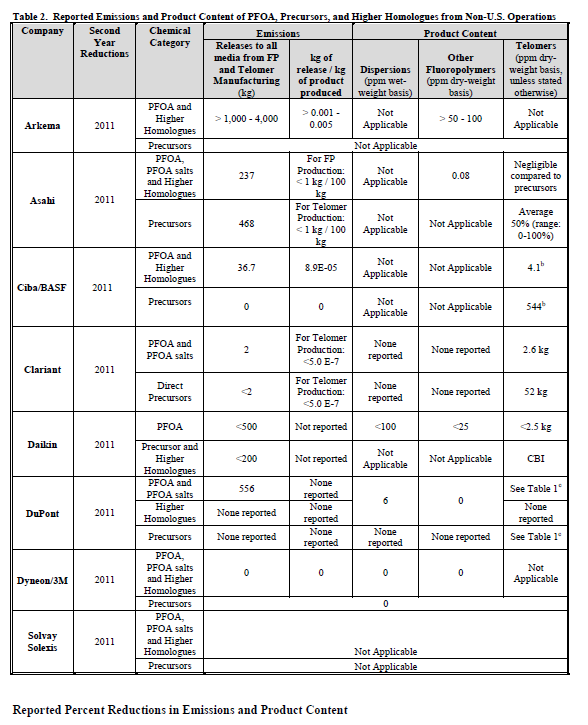
234 Table A.B.4-2: US-EPA: reported emissions and product content of PFOA and related substances (U.S.EPA, 2006) 233
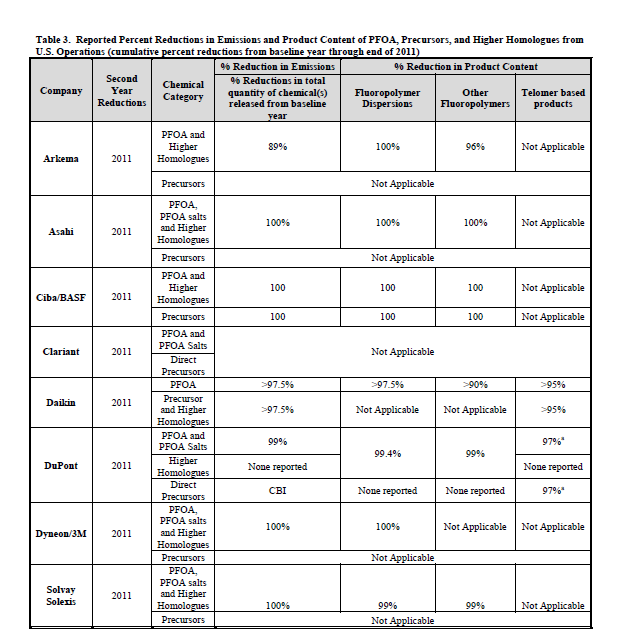
235 Table A.B.4-3: US-EPA: reported percent reductions in emissions and product content of PFOA and related substances from US facilities (U.S.EPA, 2006) 234
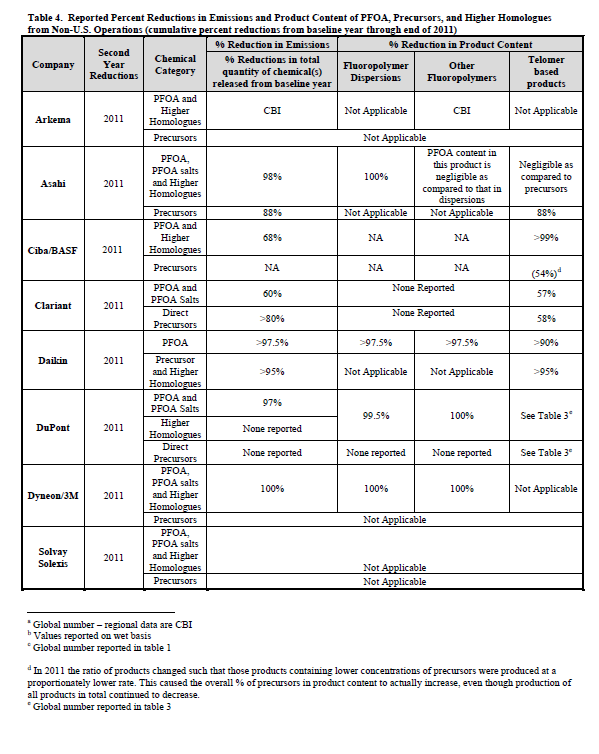
236 Table A.B.4-4: US-EPA: reported emissions and product content of PFOA and related substances from non-us facilities (U.S.EPA, 2006) 235
237 Table A.B.4-5: Emissions from outdoor clothing Sample ID - Description Children rain trouser Year of sampling 8:2 FTOH (ng/m³) - Outdoor jacket Outdoor jacket Outdoor trousers Outdoor jacket Outdoor jacket PFOA Reference (Schlummer et al., 2013) - - J2 J8 J10 J14 J2/J8/J10/J14 Outdoor jacket 5, outer jacket Outdoor jacket 5, inner jacket Outdoor jacket (evaporation) Outdoor jacket (evaporation) Outdoor jacket (evaporation) Outdoor jacket (evaporation) Outdoor jacket (washing) µg/kg (8.76%) 22.9 µg/kg (16.0 %) 21.5 µg/kg (6.51 %) 534 µg/kg 17.6 %) 178 and 197 % (Knepper et al., 2014) 236
238 Table A.B.4-6: Measured levels of PFOA and PFOA-related substances from global sampling points in various compartments Compartmen t Surface water Location River Elbe North Sea German Coast Open Norwegian Coast Baltic Sea Greenland Sea Atlantic Ocean Southern Ocean surface water samples collected on board the research vessel Polarstern (52 N-69 S); Northern Europe Atlantic Southern Ocean surface water samples collected on board the research vessel Polarstern ( N); East Greenland Arctic Ocean > 100 individual water samples from over 100 European rivers from 27 European Countries Samplin Substance Concentrations g year 2007 PFOA ng/l (dissolved phase) major European rivers river samples collected from 41 cities in 15 countries (Asia, Europe, North America) PFOA ng/l (dissolved phase) ng/l (dissolved phase) ng/l (dissolved phase) ng/l (dissolved phase) ng/l < ng/l < ng/l 2008 PFOA < ng/l (dissolved phase) 2009 PFOA < ng/l (in 37 of 38 samples detected) Mean concentration: ± ng/l 2007 PFOA Freguency of detection: 97% (LOD = 1 ng/l) Maximum: 174 ng/l Median: 3 ng/l Reference (Ahrens et al., 2010a) (Zhao et al., 2012) (Ahrens et al., 2010b) (Busch et al., 2010b) (Loos et al., 2009) PFOA < ng/l (McLachlan et al., 2007) PFOA PFOA was detected in all 41 cities in 89% of the samples (industrialized and nonindustrialized) Average in each city: 0.2 1,630.2 ng/l (Kunacheva et al., 2012) Rhine River and selected 2006 PFOA <2 48 ng/l (Skutlarek et 237
239 tributaries, Germany Ruhr area, Germany Moehne River and selected tributaries, Germany Rhine River, Germany Ruhr River, Germany Moehne River, Germany Tokyo Bay Offshore of Japan Coastal area of Hong Kong Coastal area of China Coastal area of Korea Sulu Sea South China Sea Western Pacific Ocean Central to Eastern Pacific Ocean North Atlantic Ocean Mid Atlantic Ocean 26 locations between the Asian and Antarctic regions Shanghai Western Pacific Ocean Pacific Ocean Eastern Indian Ocean Indian Ocean Antarctica Conasauga River, Oostanaula River, Coosa River, Georgia, USA Cornwallis Island, Nunavut, Canadian Arctic Amituk Lake, Char Lake, Resolute Lake, Meretta Lake Winam Gulf of Lake Victoria, Kenya; Sites selected included PFOA PFOA <2 3,640 ng/l <2 33,900 ng/l <10 11 ng/l <10 88 ng/l ng/l ng/l ng/l ng/l ng/l ng/l ng/l ng/l ng/l ng/l ng/l ng/l - PFOA < ± ng/l ± ± ng/l < ± ng/l < ng/l < ± ng/l ± ± ng/l < ng/l al., 2006) (Wilhelm et al., 2010) (Yamashita et al., 2005) (Wei et al., 2007) 2008 PFOA < ng/l (Lasier et al., 2011) 2003, PFOA ng/l (Stock et al., 2007) PFOA < ng/l (Orata et al., 2009) 238
240 Deep-sea water along rivers that flow near industries, residential estates and waste treatment facilities Baydararskaya Bay, North Russian Federation within the North Pole Region (ice-core, surface to 300 cm) Hong Kong :2 dipap 6:2/8:2 dipap 8:2 dipap PFOA Sulu sea (deep water; m) Central to Eastern Pacific Ocean (deep water; m) 2007 PFOA ± ng/l PFOA < ng/l <0.010 ng/l < ng/l ng/l ng/l ng/l (Saez et al., 2008) (Loi et al., 2013) (Yamashita et al., 2005) Drinking water/ tap water Wastewater treatment plant Tarragona Province, Spain (public fountains of Reus, Tarragona, Tortosa, and Valls) Public buildings of the Rhine-Ruhr area, Germany Berlin, Germany Muenster, Germany 26 waterworks along the Ruhr River, Germany 2007 PFOA ng/l 2006 PFOA <1 519 ng/l PFOA 2 ng/l 4 ng/l Maximum: 83 ng/l Median: 23 ng/l (Ericson et al., 2008) (Skutlarek et al., 2006) (Wilhelm et al., 2010) Area of Lake Maggiore, Italy 2007 PFOA ng/l (Loos et al., 2007) Osaka, Japan nine WWTP along the River Elbe between Lauenburg and Cuxhaven, Germany PFOA ng/l Detected in all tap water samples 2007 PFOA Effluent: 12.3± ±0.3 ng/l (Takagi et al., 2008) (Ahrens et al., 2009a) 239
241 (WWTP) Six WWTP (domestic, commercial, and industrial) in New York State, USA Rural WWTP, Kentucky, USA Urban WWTP, Georgia, USA two municipal WWTP in Singapore Plant A:conventional activated sludge process line (CAS) in parallel with liquid treatment module (LTM) and membrane biological reactor (MBR) Plant B: conventional activated sludge process line 2004/20 05 PFOA Effluent: ng/l (Sinclair and Kannan, 2006) 2005 PFOA Influent: ng/l Effluent: ng/l Final solid waste: ng/g dw Influent: 2 30 ng/l Effluent: ng/l Sludge before burning: ng/g dw Sludge after burning: ng/g dw PFOA Influent: 11.1± ±25.3 ng/l Effluent (CAS): 15.8± ±17.4 ng/l Effluent (LTM): 17.0± ±2.6 ng/l Effluent (MBR): 30.4± ±26.6 ng/l Digested sludge: 17.4± ±10.7 ng/g dw LTM sludge: 6.0± ±3.9 ng/g dw MBR sludge: 12.1±2.3 ng/g dw Influent: 36.6± ±87.7 ng/l Effluent: 77.4± ±205.8 ng/l Digested sludge: 46.9± ±12.2 ng/g dw WWTP of Bayreuth, Germany 2007 PFOA River km upstream: < ng/l Effluent: 20 3,900 ng/l River 1 km downstream: ng/l Eight WWTP located in Shanghai, China Waste activated sludge Chemical sludge Activated sludge of aeratin tank 2008 PFOA ng/g dw 75.5 ng /g dw ng /g dw 42.3 ng /g dw (Loganathan et al., 2007) (Yu et al., 2009a) (Becker et al., 2010) (Li et al., 2010) 240
242 Sediment Primary sludge Nine WWTP at different locations in Lagos, Oyo and Ogun state, all in South West Nigeria Domestic WWTP Industrial WWTP Hospital WWTP North Sea (German Bight) Western Baltic Sea Surficial sediments (top 1-5 cm) from the outlets of various rivers and creeks in the San Francisco Bay Area; additional: sediment from the Palo Alto Mudflats and Hayward, California; Baltimore, Maryland; Corvallils, Oregon 2012 PFOA PFOA PFOA ng/g ng/g ng/g µg/kg dw µg/kg dw < ng/g dw (Sindiku et al., 2013) (Theobald et al., 2012) (Higgins et al., 2005) Ariake Sea, Japan (tidal flat) 2004 PFOA ng/g dw (Nakata et al., 2006) (top 0-2 cm) Zhujiang River, Guangzhou, China (13 sites) Huangpu River, Shanghai, China (9 sites) Huangpu River, Shanghai, China Sujhou River, Shanghai, China (note: a PTFE manufacture plant is located in Yangtze River Delta) Cornwallis Island, Nunavut, Canadian Arctic Amituk Lake, Char Lake, Resolute Lake, 2009 PFOA ng/g dw ng/g dw (Bao et al., 2010) 2007 PFOA ng/g dw 20.8 ng/g dw (Li et al., 2010) 2003,200 5 PFOA < ng/g dw (Stock et al., 2007) Hong Kong :2 dipap < ng/g dw (Loi et al., 241
243 Soil Ground water Top soil samples (0-10 cm) around manufacturing facility in Wuhan, Hubei province, China Former manufacturing facility (ceased production of PFASs since 2002); sampling near the plant and along the Yangtze River Shanghai, China Agricultural areas Residential and industrial areas Soil samples (0-15 cm) from: United States Japan Mexico 164 individual ground water samples from 23 European Countries Ground water recharge area, located in the central part of The Netherlands (former landfill and a nearby military base/urban area) Wurtsmith Air Force Base, Michigan, USA (decommissioned in 1993, firetraining area ) Naval Air Statio Fallon, Nevada, USA (1950s-1988 fire-training 6:2/8:2 dipap 8:2 dipap PFOA <0.017 ng/g dw < ng/g dw < ng/g dw 2009 PFOA Average: 50.1 ng/g dw PFOA detected in 17 of 32 soils PFOA <0.05 ng/g dw at sampling points > 2 km distance from plant 2007 PFOA - PFOA < ng/g dw PFOA detected in >50% of soils ng/g dw ng/g dw ng/g dw ng/g dw ng/g dw 2008 PFOA Frequency of detection: 66% (LOD 0.4 ng/l) Maximum: 39 ng/l Median: 1 ng/l 2011 PFOA <0.01 2,060 ng/l after 7-10 years PFOA 3, ,000 ng/l 2013) (Wang et al., 2010) (Li et al., 2010) (Strynar et al., 2012) (Loos et al., 2010) (Eschauzier et al., 2013) (Moody et al., 2003) PFOA <18,000 6,570,000±150,00 ng/l (Moody and Field, 1999) 242
244 activities) Tyndall Air Force Base, Florida, USA ( fire-training activities) of inactivity <18, ng/l 16 ground water and spring samples from 0 to 30 m below, Tokyo 2006 PFOA ng/l (Murakami et al., 2009) Bavaria (51sampling points) Gendorf (fluoropolymers manufaction) - PFOA <1 4.1 ng/l (n= 23 > LOD) ng/l (Bayerisches Landesamt für Umwelt, 2010) Atmosphere Ship-based samples were taken on observation deck of different research vessels during several sampling campaigns along northsouth and east west transects of the Atlantic and Southern Ocean as well as in coastal areas of the Baltic Sea; Northern Hemisphere Southern Hemisphere Longyearbyen Kiel Bremerhaven Cape Town Bremerhaven Cape Town Cape Town Neumayer Station Cape Town Rostock Tallinn Kiel German Bight, North Sea Las Palmas St. John`s Recife - Dakar :2 FTOH 27 pg/m³ (n=66) (gas phase) 0.5 pg/m³ (n=63) (particle-phase) 7.8 pg/m³ (n=39) (gas phase) 0.1 pg/m³ (n=34) (particle-phase) pg/m³ (gas phase) pg/m³ (gas phase) pg/m³ (gas phase) pg/m³ (gas phase) pg/m³ (gas phase) pg/m³ (gas phase) pg/m³ (gas phase) pg/m³ (gas phase) (Dreyer et al., 2009) 243
245 Northern Hemisphere Southern Hemisphere Longyearbyen Kiel Bremerhaven Cape Town Bremerhaven Cape Town Cape Town Neumayer Station Cape Town Rostock Tallinn Kiel German Bight, North Sea Las Palmas St. John`s Recife - Dakar expedition of the icebreaker Oden on the first leg of a cruise from Gothenburg, Sweden to Barrow, Alaska, via the North Atlantic Ocean and Canadian Archipelago ( N) Toronto Hamburg, Germany (urban site) Waldhof, Germany (rural site) Ontario, Canada Air around a WWTP and two landfill sites Ontario, Canada Air around a WWTP and two landfill sites Air samples from Northwest Europe (UK, Ireland, Norway) :2 FTA 1.5 pg/m³ (n=66) (gas phase) 0.0 pg/m³ (n=63) (particle-phase) 0.4 pg/m³ (n=39) (gas phase) 0.0 pg/m³ (n=34) (particle-phase) n.d. 5.2 pg/m³ (gas phase) n.d. 3.5 pg/m³ (gas phase) n.d. n.d. 0.2 pg/m³ (gas phase) n.d. 3.7 pg/m³ (gas phase) pg/m³ (gas phase) pg/m³ (gas phase) n.d. 3.6 pg/m³ (gas phase) 8:2 FTOH pg/m³ (gas phase) pg/m³ (particle pahse) pg/m³ (gas phase) pg/m³ (particle pahse) :2 FTOH pg/m³ pg/m³ :2 FTOH 2009 PFOA (Shoeib et al., 2006) (Jahnke et al., 2007) ,309 pg/m³ pg/m³ (Ahrens et al., 2011) pg/m³ < pg/m³ 8:2 FTOH pg/m³ (gas phase) < pg/m³ (particulate phase) PFOA pg/m³ (particulate phase) (Barber et al., 2007) 244
246 Dust Indoor air and outdoor air in Canada Indoor (homes in Vancouver, Canada) Outdoor (Vancouver, Canada) Microenvironments in Stockholm, Sweden: Houses (n=10) Apartments (n=38) Day care centers (n=10) offices (n=10) cars (n=5) Ohio and North Carolina, USA Homes (n=102) Day care centers (n=10) Ohio and North Carolina, USA Homes (n=102) Day care centers (n=10) :2 FTOH ,080 pg/m³ Median: 2,720 pg/m³ 100% of samples > LOD (LOD = 14 pg/m³) PFOA 3.4 2,570 pg/m³ Median 21 pg/m³ 100% of samples > LOD (LOD = 0.47 pg/m³) 8:2 FTOH pg/m³ Median: 117 pg/m³ 100% of samples > LOD (LOD = 14 pg/m³) PFOA < pg/m³ 67% of samples > LOD (LOD = 0.47 pg/m³) PFOA ng/g; median = 54 ng/g ng/g; median = 93 ng/g ng/g; median = 41 ng/g ng/g; median = 70 ng/g ng/g; median = 33 ng/g PFOA Maximum: 1960 ng/g Median: 142 ng/g 96.4% above LOQ (LOQ = 10.2 ng/g) 8:2 FTOH Maximum: 1660 ng/g Median: 32.9 ng/g 53.6% above LOQ (LOQ = 28.5 ng/g) Homes, Japan (n=16) - PFOA 69 3,700 ng/g Median: 165 ng/g Manufacturing facility (production 2009 PFOA of PFOA), Wuhan, Hubei province, China 1100 and 2790 ng/g (Shoeib et al., 2011) (Bjorklund et al., 2009) (Strynar and Lindstrom, 2008) (Moriwaki et al., 2003) (Wang et al., 2010) 245
247 Office (n=2) Product storage (n=2) Raw material stock room (n=2)) Electrolysis workshop (n=3) Sulfonation workshop (n=3) Laboratory building Road (n=3) 1090 and 1200 ng/g <10 and 2780 ng/g 27, ,630 ng/g 15, ,00 ng/g 19,400 ng/g ng/g Homes, Vancouver, Canada (FTOH n=140; PFOA n=132) :2 FTOH 9.0 4,670 ng/g Median 63 ng/g 100% of samples > LOD (LOD = 0.19 ng/g) PFOA 1.9 1,390 ng/g Median 30 ng/g 100% of samples > LOD (LOD = 1.51 ng/g) (Shoeib et al., 2011) Residential indoor dust (n= 102; Vancouver, Canada) :2 dipap Maximum: 38,206 ng/g Median: 535 ng/g 99% above LOQ (LOQ = 12 ng/g) 8:2/10:2 dipap Maximum: 13,459 ng/g Median: 213 ng/g 99% above LOQ (LOQ = 12 ng/g) (De Silva et al., 2012) 6:2/8:2 dipap Maximum: 130,071 ng/g Median: 614 ng/g 100% above LOQ (LOQ = 9 ng/g) Biota Pooled serum/plasma samples Svalbard reindeer, Svalbard, Norway Reindeer, East-Finmark, Norway Reindeer, West-Finmark, Norway Reindeer, Hardangervidda, Norway PFOA 0.3 ng/g ww 0.1 ng/g ww 0.1 ng/g ww 0.1 ng/g ww 0.03 ng/g ww 0.07 ng/g ww 0.2 ng/g ww 0.4 ng/g ww 0.02 ng/g ww (Norwegian Pollution Control Authority, 2009) 246
248 Reindeer, Sørreisa, Norway Reindeer, Hattfjelldal, Norway Red deer, Stranda, Norway Moose, Ringebu/Øyer, Norway ng/g ww 0.03 ng/g ww <0.1 ng/g ww Polar bear liver, Ittoqqortoormiit, East Greenland PFOA ng/g ww ng/g ww ng/g ww ng/g ww 0.6 ng/g ww ng/g ww ng/g ww ng/g ww ng/g ww ng/g ww ng/g ww ng/g ww ng/g ww ng/g ww ng/g ww ng/g ww ng/g ww ng/g ww ng/g ww (Dietz et al., 2008) Polar bear liver Chukchi Sea, Alaska, USA Northwest Territories, Canada South Baffin Island, Canada High Arctic, Canada South Hudson Bay, Canada East Greenland Svalbard, Norway PFOA < ng/g ww ng/g ww ng/g ww ng/g ww ng/g ww < ng/g ww ng/g ww (Smithwick et al., 2005) Plasma of Bottlenose Dolphins Sarasota Bay, Florida, USA 2003 PFOA ng/g ww (Houde et al., 2005) 247
249 Bermuda Indian River Lagoon, Florida, USA Charleston, South Carolina, USA Delaware Bay, New Jersey, USA Offshore waters of South Carolina, Georgia and Florida Loggerhead sea turtle(plasma) Kemp`s ridley sea turtle(plasma) Cormorant liver, Cabras Lafoon, (Sardinian Sea, Italy) Cormorant eggs from the Baltic Sea, island Heuwiese, Germany Cormorant eggs from the Elbe estuary, site Haseldorf, Germany Rook eggs from Saarlouis, Germany Herring gull eggs (15 colonies) in the Laurentian Great Lakes, North America Lake Trout collected from the Great Lakes, North America 2003 PFOA ng/g ww 1-70 ng/g ww ng/g ww ng/g ww ng/ml ng/ml (Keller et al., 2005) 1997 PFOA ng/g ww (Kannan et al., 2002) 2009 PFOA ng/g ww ng/g ww < ng/g ww 2007 PFOA < ±0.4 ng/g ww (Rüdel et al., 2011) (Gebbink et al., 2009) 2001 PFOA 0.61± ±2.7 ng&g ww (Furdui et al., 2007) 248
250 Appendix B.5 Appendix B.5.1 Human Health Acute toxicity In the study of Glaza and coworkers (Glaza et al.,1997) the lowest LD50 was reported to be between 250 and 500 mg/kg for female rats. Minor clinical signs such as coloured faeces and wet urogenital area were reported in the females at 250 mg/kg, but no other signs of toxicity or mortalities were reported. Moribundity was reported for animals at 500 mg/kg. Details on the used test guideline are not given and it is not known whether there were mortalities. Other limited studies give indications of LD50 in the range mg/kg; also these studies are of limited validity due to lack of information. An LD50 of approximately 250 mg/kg was derived for newborn rats (Du Pont, 1983a). In Guinea pigs the LD50 was below 200 mg/kg (Du Pont, 1981f). Thus, following oral exposure PFOA is considered to be moderately acutely toxic. Guinea Pigs seem to be more susceptible to the test substance than other rodents with LD50 values of 200 mg/kg in males and females. The LD50 values were reported to be between approximately 500 and 1000 mg/kg in male rats, and in female rats between 250 and 1000 mg/kg. New-born rats appeared to be more sensitive to the test substance than adult rats. Following inhalation exposure of PFOA an LC50 of 0.98 mg/l (4 hour exposure), and an LC50 > 18.6 mg/l (1 hour exposure) was reported. Based on the data and according to the Directive 67/548/EEC classification criteria, PFOA is considered to be classified as harmful (Xn; R20; Harmful by inhalation). Following dermal exposure, PFOA (test substance not identified) LD50 values greater than 2000 mg/kg were reported in New Zealand rabbits. Following dermal exposure to PFOA an LD50 value at 4300 mg/kg was reported in male New Zealand rabbits, and an LD50 value of 7000 mg/kg in male rats and an LD50 value greater than 7500 mg/kg in female rats. Appendix B.5.2 Irritation PFOA caused moderate skin irritation in two studies; however, inadequate information was provided regarding the quality of the studies. In one study where the skin irritation was scored according to the Draize method, the primary irritation scores were zero. Due to the equivocal results and limited information available from some of these studies, it is difficult to draw conclusions regarding classification of PFOA for skin irritation (Markoe, 1983; Griffith and Long, 1980; Hazleto 1990). PFOA caused eye irritation in two studies (Griffith and Long, 1980; Kennedy et al 1986). Appendix B.5.3 Sensitisation In a dermal sensitization test (Buhler test) of Guinea pigs PFOA/ was shown to be negative; no clear information was given regarding the identity of the test substance (Moore et al. 2001). 249
251 Appendix B.5.4 Repeated dosed toxicity Non-human information Repeated dose toxicity: oral exposure Table A.B.5-1: Repeated dose toxicity, oral Species Dose and administration (mg/kg/day bw, mg/kg diet, ppm) Duration of treatment Observations and Remarks Ref. Crl:CD(SU)IGS BR rats (10 male) and Crl:CD-(ICR)BR mice (10 male) per group 0, 0.3, 1, 3, 10, and 30 mg/kg bw/day by gavage 14 days LOAEL is 1 mg/kg bw/day for rats based on increased liver weight, peroxisomal β-oxidation activity and decreased cholesterol levels. The NOAEL is 0.3 mg/kg bw/day. For mice, liver weight and peroxisomal β-oxidation activity increased at lowest dose, and hence, the LOAEL is 0.3 mg/kg bw/day Loveless et al., 2006 ChR-CD mice (5/sex/group) 0, 30, 100, 300, 1000, 3000, and ppm APFO through diet, (1.5 to 1500 mg/kg bw/day) 28 days A statistically significant dose-related reduction in mean body weight in all treated groups from 30 ppm. Relative and absolute liver weights were statistically significantly increased in mice fed 30 ppm and above. The LOAEL is 30 ppm based on hepatocellular hypertrophy, hepatocellular degeneration and/or necrosis, cytoplasmic vacuoles, increased absolute and relative liver weight in addition to body weight loss. Christopher and Marisa, 1977; Griffith and Long, 1980 ChR-CD rats (5/sex/group) 0, 30, 100, 300, 1000, 3000, and ppm APFO through diet (1.5 to 1500 mg/kg bw/day) 28 days Body weight gain was reduced with increasing dose from 1000 ppm (males) and 3000 ppm (females). Absolute liver weights were increased in Metrick and Marisa, 1977; Griffith and Long,
252 Species Dose and administration (mg/kg/day bw, mg/kg diet, ppm) Duration of treatment Observations and Remarks Ref. males from 30 ppm and in females from 300 ppm. Treatment-related morphological changes were reported in the livers of all test animals. The severity and degree of tissue involvement were more pronounced in males than in females. LOAEL 30 ppm is based on increased liver weight and hepatocyte hypertrophy ChR-CD rats (5/sex/group) 0, 10, 30, 100, 300 and 1000 ppm APFO ( 0, 0.056, 1.72, 5.64, 17.9 and 63.5 mg/kg bw/day in males and 0, 0.74, 2.3, 7.7, 22.36, mg/kg bw/day in females) through feeding 90 days A decrease in body weight was reported at 1000 ppm (males). The relative kidney weights were significantly increased from 100 ppm (males). However, absolute kidney weights were comparable among groups, and there were no histopathological lesions. Absolute liver weights were significantly increased from 30 ppm (males) and 1000 ppm (females). Relative liver weights were significantly increased from 300 ppm (males) and 1000 ppm (females). Hepatocyte necrosis was in the 30, 100, 300 and 1000 ppm groups (males). The LOAEL is 30 ppm (1.72 mg/kg bw/day) and NOAEL is mg/kg bw/day based on hepatocyte necrosis and increased absolute liver weight in male rats at 30 ppm. Goldenthal, 1978a; Griffith and Long,
253 Species Dose and administration (mg/kg/day bw, mg/kg diet, ppm) Duration of treatment Observations and Remarks Ref. ChR-CD male rats (45-55 per group) 0, 1, 10, 30 and 100 ppm APFO corresponding to 0, 0.06, 0.64, 1.94 and 6.50 mg/kg bw/day. 13 weeks. 8 weeks recovery period. A significant increase in absolute and relative liver weights and hepatocellular hypertrophy were reported at weeks 4, 7 and 13 in the 10, 30 and 100 ppm groups. Hepatic palmitoyl CoA oxidase activity (indicating peroxisome proliferation) was significantly increased at weeks 4, 7, and 13 in the 30 and 100 ppm groups. At 10 ppm, hepatic palmitoyl CoA oxidase activity was significantly increased at week 4 only. These treatment-related liver effects were seemingly reversible. Based on significant increase in absolute and relative liver weights and hepatocellular hypertrophy NOAEL is 1 ppm (0.06 mg/kg bw/day) and LOAEL is 10 ppm (0.64 mg/kg bw/day). Palazzolo, 1993 Rhesus monkeys (2/sex/group) 0, 3, 10, 30 and 100 mg APFO/kg ba/day by gavage. 90 days All monkeys in the 100 mg/kg bw/day, and 3 monkeys in the 30 mg/kg bw/day group died during the study. Clinical signs (anorexia, pale and swollen face, black stools, marked diarrhea) were reported in the 3 and 10 mg/kg bw/day. Absolute and relative organ weight changes were reported in the heart (from 10 mg/kg bw/day in females), brain Goldenthal, 1978b; Griffith and Long,
254 Species Dose and administration (mg/kg/day bw, mg/kg diet, ppm) Duration of treatment Observations and Remarks Ref. (from 10 mg/kg bw/day in females) and pituitary (from 3 mg/kg bw/day in males). However, no morphological changes were reported in the organs. LOAEL 3 mg/kg bw /day Cynomolgus male monkeys (4-6 animals/group) 0, 3, 10 and 30 mg/kg bw/day APFO by oral capsule. 26 weeks At terminal sacrifice at 26 weeks a significant increase in mean absolute liver weights and liver-to-body weight percentages in all dose groups, considered to be treatment-related, and due, in part to hepatocellular hypertrophy. However, there was no evidence of peroxisome proliferatorsactivated receptor alpha activity (PPARα). At recovery sacrifice, no treatment-related effects on terminal body weights or on absolute or relative organ weight were reported, indicating that these effects were reversible over time. A dose dependent increase in triglycerides in blood at each time point was observed. A moderate and non significant effect on reduced cholesterol with increasing PFOA exposure was observed in males. Based on significant increase in liver weights in all dose groups, which was in part due to hepatocellular hypertrophy, without peroxisome proliferators- Thomford, 2001b; Butenhoff et al.,
255 Species Dose and administration (mg/kg/day bw, mg/kg diet, ppm) Duration of treatment Observations and Remarks Ref. activated receptor alpha activity, LOAEL is 3 mg/kg bw /day. Repeated dose toxicity: oral Ten male Crl:CD(SU)IGS BR rats and ten male Crl:CD-(ICR)BR mice per group were given a daily administration of PFOA gavage for 14 consecutive days. The control group was given the same volume of water. The doses given were 0, 0.3, 1, 3, 10, and 30 mg/kg bw/day. This is not a guideline study. For both rats and mice a statistically significantly reduced body weight gain were observed from 10 mg/kg bw/day, while mean food consumption and efficiency were reduced from 30 mg/kg bw. For rats a statistically significant reduction in cholesterol and Non- HDL were found to be dose dependent from 0.3 mg/kg bw/day to 3 mg/kg bw/day, where the levels were at the lowest, but still significantly reduced at higher doses. For mice a statistically significantly reduced HDL level was found from 3 mg/kg bw/day. For rats, the lowest level was found at 3 mg/kg bw/day, as for the mice. At this dose the total cholesterol level was also statistically reduced. The levels of triglycerides in rat sera were statistically significantly reduced from 0.3 mg/kg bw/day, while for the mice the level was increasing from 0.3 mg/kg bw/day compared to the control, except at the highest dose level. A dose dependent increase in triglycerides at each time point was also observed in Cynomolgus monkeys (Butenhof et al., 2002). The liver to body weight was increased for both rats and mice from 1 and 0.3 mg/kg bw/day respectively. The peroxisomal β-oxidation activity was found to be significantly increased at 1 and 0.3 mg/kg bw/day for rats and mice respectively. Taken together, the LOAEL is 1 mg/kg bw/day for rats is based on increased liver weight, peroxisomal β- oxidation activity and decreased cholesterol levels. Thus, the NOAEL is 0.3 mg/kg bw/day. For mice, liver weight and peroxisomal β-oxidation activity increased at lowest dose, and hence, the LOAEL is 0.3 mg/kg bw/day (Loveless et al., 2006). Five ChR-CD mice per sex were given 0, 30, 100, 300, 1000, 3000, and ppm PFOA, corresponding to approximately 1.5 to 1500 mg/kg bw/day in diet for 28 days. All animals in groups given 1000 ppm group and above died before the end of day 9. All animals in the 300 ppm group died within 26 days except one male. One animal in each of the 30 and 100 ppm groups died prematurely. Clinical signs were reported in mice exposed to 100 ppm and higher. There was a statistically significant dose-related reduction in mean body weight in all treated groups from 30 ppm. Relative and absolute liver weights were statistically significantly increased in mice fed 30 ppm and above. Treatment related changes were reported in the livers among all treated animals including enlargement and/or discoloration of one or more liver lobes. Histopathological examination of all surviving treated mice revealed diffuse cytoplasmic enlargement of hepatocytes throughout the liver accompanied by focal to multifocal cytoplasmic lipid vacuoles of variable size which were random in distribution from 30 ppm. The LOAEL is 30 ppm based on hepatocellular hypertrophy, hepatocellular degeneration and/or necrosis, cytoplasmic vacuoles, increased absolute and relative liver weight in addition to body weight loss (Christopher and Marisa, 1977; Griffith and Long, 1980). 254
256 In the second study, five ChR-CD rats per sex were given 0, 30, 100, 300, 1000, 3000, and ppm PFOA corresponding to approximately 1.5 to 1500 mg/kg bw/day in the diet for 28 days. All animals in the and ppm groups died before the end of the first week. There were no premature deaths or unusual behavior reactions in the other groups. Body weight gain was reduced as the dose increased. The reduction in body weight gain was statistically significant for males from 1000 ppm and females from 3000 ppm. Absolute liver weights were increased in males from 30 ppm and in females from 300 ppm. Treatmentrelated morphological changes were reported in the livers of all test animals. These lesions consisted of focal to multifocal cytoplasmic enlargement (hypertrophy) of hepatocytes in animals in the control, 30 and 100 mg/kg bw/day dose groups, and multifocal to diffuse enlargement of hepatocytes among animals exposed to 300, 1000 and 3000 ppm PFOA. The severity and degree of tissue involvement were more pronounced in males than in females. LOAEL 30 ppm is based on increased liver weight and hepatocyte hypertrophy (Metrick and Marisa, 1977; Griffith and Long, 1980). In a 90 days feeding study with ChR-CD rats (5/sex/group) the rats were given 0, 10, 30, 100, 300 and 1000 ppm PFOA corresponding to 0, 0.056, 1.72, 5.64, 17.9 and 63.5 mg/kg bw/day in males and 0, 0.74, 2.3, 7.7, 22.36, mg/kg bw/day in females. One female in the 100 and 300 ppm group died, however, this was not considered to be treatment related. No treatment-related changes in behaviour or appearance were reported. In males a statistically significant decrease in body weight was reported at 1000 ppm. The relative kidney weights were significantly increased in males from 100 ppm. However, absolute kidney weights were comparable among groups, and there were no histopathological lesions. Absolute liver weights were significantly increased in males from 30 ppm and in females at 1000 ppm. Relative liver weights were significantly increased in males from 300 ppm and in females at 1000 ppm. Hepatocellular hypertrophy (focal to multifocal in the centrilobular to midzonal regions) was reported in 4/5, 5/5 and 5/5 males in the 100, 300 and 1000 ppm groups, respectively. Hepatocyte necrosis was reported in 2/5, 2/5, 1/5 and 2/5 males in the 30, 100, 300 and 1000 ppm groups, respectively. The LOAEL is 30 ppm (1.72 mg/kg bw/day) and NOAEL is mg/kg bw/day based on hepatocyte necrosis and increased absolute liver weight in male rats at 30 ppm. (Goldenthal, 1978a; Griffith and Long, 1980). ChR-CD male rats (45-55 per group) were given 0, 1, 10, 30 and 100 ppm PFOA corresponding to 0, 0.06, 0.64, 1.94 and 6.50 mg/kg bw/day. Two control groups were included (a non-pair fed group and a pair-fed group to the 100 ppm dose group). Following 13 weeks exposure, 10 rats/group were fed control diet for an 8-week recovery period. 15 animals per group were sacrificed following 4, 7 and 13 weeks of treatment. 10 animals per group were sacrificed after 13 weeks of treatment and after 8 weeks recovery period. When analysing the data, animals exposed to 1, 10, 30 and 100 ppm were compared to the control animals in the non-pair fed group, while data from the pair-fed control group were compared to animals exposed to 100 ppm. No treatment clinical signs were reported. At 100 ppm a significant reduction in bw was reported compared to the pair-fed control group during week 1 and the non-pair-fed control group during weeks Bw data in the other dosed-groups were comparable to controls. At 100 ppm mean body weight gains were significantly higher than the pair-fed control group during week 1 and significantly lower than the non-pair-fed control group during weeks At 10 and 30 ppm, mean body weight gains were significantly lower than the non-pair-fed control group at week 2. These differences in body weight and body weight gains were not reported during the recovery period. A significant increase in absolute and relative liver weights and hepatocellular hypertrophy were reported at weeks 4, 7 and 13 in the 10, 30 and 100 ppm groups. There was no evidence of any degenerative changes or abnormalities associated with the hypertrophy. Hepatic palmitoyl 255
257 CoA oxidase activity (indicating peroxisome proliferation) was significantly increased at weeks 4, 7, and 13 in the 30 and 100 ppm groups. At 10 ppm, hepatic palmitoyl CoA oxidase activity was significantly increased at week 4 only. During the recovery period none of the liver effects were reported, indicating that these treatment-related liver effects were reversible. Based on significant increase in absolute and relative liver weights and hepatocellular hypertrophy NOAEL is 1 ppm (0.06 mg/kg bw/day) and LOAEL is 10 ppm (0.64 mg/kg bw/day) (Palazzolo, 1993). Rhesus monkeys (2/sex/group) were given 0, 3, 10, 30 and 100 mg PFOA/kg bw/day by gavage administration for 90 days. All monkeys in the 100 mg/kg bw/day, and 3 monkeys in the 30 mg/kg bw/day group died during the study. Clinical signs (anorexia, pale and swollen face, black stools, marked diarrhea) were reported in the 3 and 10 mg/kg bw/day. No changes in bw at 3 and 10 mg/kg bw/day, however, significant reduction in bw in the one male left in the 30 mg/kg bw/day group. Absolute and relative organ weight changes were reported in the heart (from 10 mg/kg bw/day in females), brain (from 10 mg/kg bw/day in females) and pituitary (from 3 mg/kg bw/day in males). However, no morphological changes were reported in the organs. The male from the 30 mg/kg bw/day group that survived had slight to moderate hypocellularity of the bone marrow and moderate atrophy of lymphoid follicles in the spleen. No treatment related lesions were reported in the organs of animals in the 3 and 10 mg/kg bw/day dose groups. (Goldenthal, 1978b; Griffith and Long, 1980). Cynomolgus male monkeys (4-6 animals/group) were given 0 (6), 3 (4), 10 (6) and 30 (6) mg/kg bw/day PFOA by oral capsule for 26 weeks. Dosing of animals in the 30 mg/kg bw/day group was stopped on day due to severe toxicity. From day 22 these animals received 20 mg/kg bw/day, and this group was called the 30/20 mg/kg bw/day dose group. At the end of the 26 weeks treatment period, 2 animals in the control group and 10 mg/kg bw/day groups were observed for a 13-week recovery period. One male from the 30/20 and 3 mg/kg bw/day dose groups were sacrificed in moribund conditions during the study. The cause of the deaths was not determined, but PFOA treatment could not be excluded. Of the 5 remaining animals in the highest dose group only 2 animals tolerated this dose level for the rest of the study. In 3 animals from the highest dose group the treatment was halted on day 43, 66 and 81, respectively. Clinical signs in these animals included low or no food consumption and weight loss. The animals appeared to recover from compound-related effects within 3 weeks after cessation of treatment. At terminal sacrifice at 26 weeks a significant increase in mean absolute liver weights and liver-to-body weight percentages in all dose groups, considered to be treatment-related, and due, in part to hepatocellular hypertrophy. However, there was no evidence of peroxisome proliferators-activated receptor alpha activity (PPARα). At recovery sacrifice, no treatment-related effects on terminal body weights or on absolute or relative organ weight were reported, indicating that these effects were reversible over time. A dose dependent increase in triglycerides at each time point was also observed in Cynomolgus monkeys (Butenhof et al., 2002). Based on significant increase in liver weights in all dose groups, which was in part due to hepatocellular hypertrophy, without peroxisome proliferatorsactivated receptor alpha activity, LOAEL is 3 mg/kg bw /day. (Thomford, 2001b; Butenhoff et al., 2002). Repeated dose toxicity: inhalation 24 males Crl:CD rats were given 0, 1, 8, 84 mg/m3 PFOA (head only exposure) for 6 h/day in 5 days per week, for 2 weeks followed by day recovery. Mortality in two rats was reported in the highest dose group. One rat was killed after the third day of exposure due to 256
258 severe weight loss, respiratory distress and lethargy. The other rat died during the fourth exposure. A statistically significant reduction in body weight was reported on test day 5 that recovered by day 16. A statistically significant increase in absolute and relative liver weight and serum alkaline phosphatase that persisted through 28 days of recovery was reported from 8 mg/m3. Hepatocellular atrophy, and necrosis was reported from 8 mg/m3. These included panlobular and centrilobular hepatocellular hypertrophy and necrosis. Panlobular hepatocellular hypertrophy was reported only in rats killed immediately after the last exposure. The affected livers contained entire lobules with uniformly enlarged hepatocytes. This change was limited to the centrilobular hepatocytes following a 14- or 28-day recovery period and was absent after either 42 or 84 days. Five rats from each group were given a complete histopathologic examination. Focal or multi-focal hepatocellular necrosis was seen in 2/5 rats from the highdose group (one killed on day 0 and one of day 14 of recovery), in 3/5 rats from the mid-dose group (one each on day 0, 42 and 84 of recovery), and in 1/5 control rats (on recovery day 28). The authors of the study considered the hepatocellular necrosis to be treatment related since hepatocellular necrosis rarely is encountered as a spontaneous lesion in young male rats (Kennedy et al., 1986). Table A.B.5-2: Repeated dose toxicity, inhalation Species Conc. mg/l or mg/m 3 Exposure Time (h/day) Duration of treatment Observations and remarks Ref. Crl:CD rats, 24 males 0, 1, 8, 84 mg/m 3 APFO (head only exposure) 6 h/day 5 days per week, for 2 weeks followed by day recovery A statistically significant reduction in body weight was reported on test day 5 that recovered by day 16. A statistically significant increase in absolute and relative liver weight and serum alkaline phosphatase that persisted through 28 days of recovery was reported from 8 mg/m 3. Hepatocellular atrophy and necrosis was reported from 8 mg/m 3. The authors of the study considered the hepatocellular necrosis to be treatment related since hepatocellular necrosis rarely is encountered as a spontaneous lesion in young male rats Kennedy et al., 1986 In conclusion, effects of repeated inhalation of PFOA in rats caused mortality at highest dose. Liver toxicity, hepatocellular hypertrophy and necrosis, was observed from inhalation of 8 mg/m 3 PFOA. Hence, NOAEL is 1 mg/m 3 PFOA and LOAEL is 8 mg/m
259 Repeated dose toxicity: dermal 15 males Crl:CD rats were exposed to mg/kg bw PFOA in 10 dermal applications with 84 days recovery. Duration of exposure was 6 hours/day 5 days/week in 2 weeks. Skin irritation and reversible reduction in bw at doses from 200 mg/kg. Increased liver weight was seen in all groups at the end of treatment, in the two higher groups after 14 day recovery period and at the top dose at 42 days of recovery. Increased AST and ALT, as well as hepatocellular hypertrophy and necrosis was observed from 20 mg/kg. Affected livers contained one or more foci of coagulative necrosis. The Kupffer cells within the foci of hepatocellular necrosis contained large vesicular nuclei and were markedly increased in number. Inflammatory cells were occasionally present within and at the periphery of the necrotizing lesions. All of the treatment-related toxicity findings of clinical pathology resolved during a 42-day recovery period. After 10th treatment of 20, 200 and 2000 mg/kg incidences of rats with liver lesions were 2, 3 and 3 out of 5 rats per group. No data on severity, multifocal appearance or extension of lesions in the liver were reported. The number of animals with liver lesions as reported above decreased during recovery, but was still present in 1 of 5 rats at 20 and 2000 mg/kg. Blood organofluoride concentrations were increased in all test groups with the concentrations decreasing during revovery. 52 ppm was obtained after 10th treatment in rats at 20 mg/kd bw/d PFOA. Based on increased liver weight and AST and ALT levels, as well as hepatocellular hypertrophy and necrosis LOAEL is 20 mg/kg bw (Kennedy, 1985). In a rabbit study, 10 males and females were exposed to 100 mg/kg in 10 dermal applications. The duration of exposure was 6 hours/day 5 days/week for 2 weeks. Recovery period was 2 weeks. Reversible reduction in body weight was observed. The information regarding the identity of the test substance was spare (Riker, 1981). Table A.B.5-3: Repeated dose toxicity, dermal Species Dose mg/kg/day Exposure time (hours/day) Duration of treatment Observations and remarks Ref. Crl:CD Rat, 15 males 20, 200 and 2000 mg/kg APFO, 10 applications dermal and 84 days recovery. 6 2 weeks, 5 days/week Skin irritation and reversible reduction in bw at doses from 200 mg/kg. Increased liver weight, increased AST and ALT, as well as hepatocellular hypertrophy and necrosis from 20 mg/kg. All of the treatment-related toxicity findings resolved during a 42-day recovery period. Kennedy, 1985 Rabbit (10 males/ 100 mg/kg, 10 applications dermal and 14 days 6 2 weeks, 5 days/week Reversible reduction in body weight was observed. The information regarding the identity of the test substance was Riker,
260 females) recovery. spare. Summary and discussion, non-human information In conclusion, after repeated dermal exposure to PFOA in rats, skin irritation, reversible reduced body weight, increased liver weight and hepatocellular hypertrophy and necrosis from 20 mg/kg bw was found. Reversible reduction in body weight was the only reported effects in rabbits after dermal exposure to 100 mg/kg bw. Based on increased liver weight and AST and ALT levels, as well as hepatocellular hypertrophy and necrosis in rats LOAEL is 20 mg/kg bw for dermal exposure to PFOA. Human information The C8 Science panel also investigated the probable link between PFOA exposure and the autoimmune diseases ulcerative colitis, rheumatoid arthritis, lupus, type1 diabetes, Crohn s disease and multiple sclerosis. They found that inflammatory bowel disease (combining ulcerative and Crohn`s disease) showed a positive trend of increased risk with statistically significant increasing cumulative exposure in the main analyses based on 245 cases. The relative risk (RR which can include specific measures such as rate ratios, odds ratios, hazards or standardized mortality ratios) was the primary measure of association that was examined. The RR is a measure of the risk in exposed compared to the risk in the unexposed or lowexposed. Results by quartile of cumulative exposure were RRs of 1.00, 1.74 (95% CI: 14 to 2.65), 1.80 ( ), and 2.20 ( ), respectively. These RRs indicate that those in the top 25% of cumulative exposure to PFOA had a risk of inflammatory bowel disease twice that of the lowest 25%. A test of trend in these RRs were statistically significant (p=0.001). Prospective analyses based on 44 cases, however, showed no positive trend (RRs of 1.0, 0.69, 0.92, and 1.00, respectively). Among the validated inflammatory bowel disease cases, the C8 Science Panel conducted separate analyses for ulcerative colitis (161 cases) and Crohn s disease (96 cases), based on the subject s self-report of the type of inflammatory bowel disease. The positive trend with PFOA exposure was found primarily for ulcerative colitis, for which there was a strong dose-response gradient. RRs by quartile of increasing exposure were 1.0, 1.89 ( ), 2.58 ( ), and 3.18 ( ) (p value test for trend <0.0001) (C8 Science Panel reports Steenland et al., 2013). The analogous RRs for Crohn s disease were 1.0, 1.36, 1.22, and 1.10 (p value for trend 0.39). Prospective analyses (from onwards) were restricted to 30 cases for ulcerative colitis. These analyses also showed a positive although non-statistically significant trend by quartile of increasing exposure, with RRs of 1.0, 1.49, 1.84, 2.18 (p value for trend 0.28). There were too few cases of Crohn s disease (n=14) to do a prospective analysis. For the other autoimmune diseases (rheumatoid arthritis, lupus, type1 diabetes, or multiple sclerosis) no probable link to PFOA exposure was found. For kidney disease, liver disease, osteoarthritis, Parkinson`s disease, infectious diseases, neurodevelopmental disorders in children, respiratory diseases, stroke and diabetes, no probable link was found (C8 Science Panel probable link reports, 259
261 Appendix B.5.5 Mutagenicity PFOA did not induce mutation in either S. typhimurium or E. coli when tested either with or without mammalian activation (Lawlor et al, 1996, Litton et al., 1978). PFOA did not induce gene mutation when tested with or without meta bolic activation in the K-1 line of Chinese hamster ovary (CHO) cells in culture PFOA did not induce chromo somal aberrations in human lymphocytes when tested with and without metabolic activation up to cytotoxic concentrations (Murli et al., 1996a and b, NOT OX,. 2000). PFOA was tested twice for its ability to induce chromosomal aberrations in CHO cells. In the first assay, PFOA induced both chromosomal aberrations and polyploidy in both the presence and absence of metabolic activation. In the second assay, no significant increases in chromosomal aberrations were observed without metabolic activation. However, when tested with metabolic activation, PFOA induced significant increases in chromosomal aberrations and in polyploidy. PFOA was negative in a cell transformation assay in mouse embryo fibroblasts and in the mouse micronucleus assay. Based on the available in vitro and in vivo studies PFOA is considered not mutagenic. Appendix B.5.6 Carcinogenicity Non-human information Carcinogenicity: oral In the two carcinogenicity studies PFOA induced liver adenomas, Leydig cell adenomas, and pancreatic acinar cell tumours in male Sprague-Dawley rats, and mammary fibroadenomas in the female rats (Sibinsky 1987, Biegel 2001). The mammary fibroadenomas reported in the articles above were originally considered equivocal since the incidences were comparable to some historical control data from another laboratory. However, as the Sprague-Dawley rats represent an outbreed rat strain the frequencies of spontaneous tumours will vary considerably from laboratory to laboratory. Thus, it is inappropriate to use historical control data from other laboratories. The most appropriate control group is the concurrent control group. The mammary gland findings in the Sibinski paper from the 1987-study were re-examined by a Pathology Working Group (Hardisty, 2005) who concluded that there were no statistically significant differences in the incidence of fibroadenoma, adenocarcinoma, total benign neoplasms or total malignant neoplasms of the mammary glands between control and treated animals. There was also no significant difference in combined benign and malignant neoplasms between control and treated groups. The main difference between the original reported findings and the Pathology Working Group evaluation involved findings initially reported as lobular hyperplasia which the working group classified as fibroadenoma resulting in incidences of mammary fibroadenoma in the control, low- and highdose groups of 32%, 32%, and 40%, respectively. Regarding liver carcinogenicity, there is evidence to indicate that PFOA is a PPARα agonist and that the liver carcinogenicity (and toxicity) of PFOA is mediated by binding to the PPARα in the liver in rodents. It has been well documented that PFOA is a potent peroxisome proliferator, inducing peroxisome proliferation in the liver of mice and rats (Ikeda et al., 1985; Pastoor et al., 1987; Sohlenius et al., 1992). Due to uncertainties and limitation of the data it can, however, not be concluded that PPARα agonism is the sole mode of action for the rat liver tumour induction. Thus, in contrast to what would be predicted, administration of PFOA, but not the prototype PPARα agonist WY- 260
262 knockout mice, i.e. in mice where PPARα activation was precluded, indicating that the PFOAinduced liver tumours could occur by PPARα independent effects (Yang et al., 2002). Moreover, there is as yet no published evidence that the induction of PPARα by PFOA results in clonal expansion of pre-neoplastic foci which is considered a critical step in the proposed mode of action. However, a recent study shows that the administration of PFOA to rats leads to hepatomegaly observed as hypertrophy and hyperplasia as a result of early increases in cell proliferation (but no inhibition of apoptosis), which ultimately leads to liver tumour formation. These data clearly demonstrate an early hepatocellular proliferative response to PFOA treatment and suggest that the hepatomegaly and tumours observed after chronic dietary exposure of Sprague-Dawley rats to PFOA likely are due to a proliferative response to combined activation of PPARα and CAR/PXR (Elcombe et al., 2010). This mode of action is unlikely to pose a human hepatocarcinogenic hazard as demonstrated in studies utilizing mice humanized with respect to the xenosensor nuclear receptors, since the activation of the human PPARα, CAR, and PXR does not appear to lead to cell proliferation (Cheung et al., 2004; Gonzalez and Shah 2008; Shah et al., 2007; Ross et al., 2010). The modes of carcinogenic action of PFOA induced Leydig cell adenomas and pancreatic acinar cell tumours have not been fully explained. There is insufficient evidence to link these tumours to PPARα. The induction of Leydig cell adenomas may involve a hormonal mechanism whereby PFOA either inhibits testosterone biosynthesis and/or increases serum estradiol via induction of hepatic aromatase activity. The induction of pancreatic acinar cell tumours (PACT) are probably related to an increase in serum level of the growth factor, cholecystokinin in rats (CCK (cholecystokinin-33 in humans), that appears to be secondary to changes in the liver. However, this mechanism may not be relevant to humans (Klaunig et al., 2012). Table A.B.5-4: Summary of relevant animal studies on carcinogenicity Test substance PFOA 0, 30 or 300 ppm PFOA 300 ppm Method Result Score Reference Sprague-Dawley rats, 50 rats/sex/group 2-year study + 15 rats/sex, oral gavage, evaluated after 1 year Sprague-Dawley 76 male rats in the treatment group and 80 rats in the control group, oral gavage, 2-year study. Increased incidence of liver adenomas, Leydig cell adenomas, proliferative pancreatic acinar cell lesions and mammary fibroadenomas. Increased incidence of liver adenomas, Leydig cell adenomas, and pancreatic acinar cell tumours (PACT). 2 2 Sibinski, 1987 Cook et al., 1994; Biegel et al., 2001 Carcinogenicity: inhalation No data available. Carcinogenicity: dermal No data available. 261
263 Human information Two U.S. occupational cohorts and one follow-up study of the general Danish population did not report any clear association between PFOA and liver-, pancreas-, prostate or bladder cancer although there was a suggestive positive trend for prostate cancer (Leonard et a.,l 2008, Lundin et al., 2009). An additional Danish study of 55,053 adults (50-65 years old) found only a modest positive association between PFOA and prostate- and pancreas cancer, while no significant linear trend in general was observed (Eriksen et al., 2009). The C8 Science Panel reported probable links between PFOA and testicular cancer and kidney cancer (Vieira et al., 2013). For testicular cancer, there is evidence of a positive trend in risk across exposure groups, in some analyses. The estimated relative risks range from 3 to over 6 comparing the highest to lowest exposure groups. The high exposure group, where the higher risk was observed, comprises only six cases therefore there remains some uncertainty. The Science Panel notes however that there is experimental evidence of testis cancer being increased in exposed animals (Biegel et al., 2001; Klaunig JE. et al.,2012) and considers observed excesses to indicate a probable link between PFOA and testicular cancer. A recent published study from the C8 Health Project survey showed a dose related increase in both kidney and testicular cancer with PFOA among 32,254 participants. The strongest dose response relationship was seen for testicular cancer with a hazard ratio (HR) of 1.0, 1.04, 1.91 and 3.17 (linear trend test p=0.04) with increasing PFOA exposure quartiles. In this study, 19 validated cases with testicular cancer was included (C8-science panel website, Steenland et al., 2012, Barry et al., 2013). For kidney cancer, a worker mortality study conducted by the Science Panel showed a higher risk in the most exposed group compared to lower exposure groups among the workforce, but the risks were not elevated compared to the US population. In the cohort study, there was a gradient of increasing risk with increasing exposure but most strongly in the analyses that included exposure up to the time of diagnosis. When the 10 years of exposure prior to diagnosis was excluded, the association was less evident. The strongest trend (P = 0.003) was apparent using the 20-year lag, with SMRs (standard mortality ratio) of 1.08, 0.73, 0.41, and 3.54 across cumulative exposure quartiles, respectively. The C8 science panel considered that the excess observed indicate a probable link between PFOA and kidney cancer (Steenland et al., 2012). Appendix B.5.7 Appendix B Appendix B Additional data on toxicity for reproduction Effects on fertility Non-human information York (2002) and Butenhoff et al, (2004b) evaluated the potential effects of PFOA on reproduction and postnatal development across two generations of offspring using Sprague- Dawley rats exposed by oral gavage (1, 3, 10, and 30 mg/kg bw/day). A statistically significant decrease in the weight of epididymis, left cauda epididymis, seminal vesicle, prostate, pituitary, left and right adrenals and thymus at 30 mg/kg bw/day was observed in the P (parental)-generation. However, all indices of reproductive success were normal in the PFOA-exposed rats. Decreased pup weights, increased pup mortality, and delayed sexual maturation in F1-generation offspring were seen at 30 mg/kg bw/day but not at 10 mg/kg bw/day. The overall results of the first and second generation appear to be similar in that there was no apparent increase in adverse outcome(s) in the second generation. The NOAEL for reproductive function in the two-generation reproduction study was 30 mg/kg bw/day for the 262
264 P- and F1-generation and the NOAEL for pup mortality, weight, and sexual maturity was 10 mg/kg for the F1- generation. Consistent with other studies, the NOAEL for body-weight or organ-weight changes was less than 1 mg/kg for male and 10 mg/kg for female rats. In male mice, PFOA-treatment (0, 1 and 5 mg/kg bw/day by oral gavage) for 6 weeks of both wt, PPARα null- or humanized PPARα (hpparα) mice (8-10 mice per group) showed a statistically significant increase (p<0,05) in sperm with morphological abnormalities at both concentrations. An increased incidence of abnormal seminiferous tubules and a statistically significant reduction (p<0,05) in plasma testosterone concentration in the wt mice (at 5 mg/kg bw/day) and the hpparα mice at both concentrations was also observed. None of these effects were observed in the null-mice. In addition, a statistically significant reduction (p<0,05) of the reproductive organ (epididymis and seminal vesicle + prostate gland) weight of the wt PPARα mice treated with the highest concentration was seen. These changes in reproductive organ weights and the sperm abnormalities in the APFO-treated mice may be partially related to the reduction in testosterone, because these phenotypic changes are known to depend heavily on androgen (Li et al., 2011). In conclusion, exposure to PFOA in the 2-generation rat study showed no clear effect on fertility parameters, although statistical significant changes in the weight of some reproductive organs in males or females were seen. In support to the latter findings, a more recent mice study by Li et al., 2011 showed adverse effect of PFOA on the male mice reproductive system. Table A.B.5-5: Summary of relevant studies on fertility Test substance PFOA 0, 1, 3, 10 or 30 mg/kg bw/day PFOA 0, 1 and 5 mg/kg bw/day Method Result Score* Reference Sprague-Dawley rats, 30 rats/group, oral gavage, 2 generations 129/sv wt, nullor humanized PPARα male mice, 8-10 mice/group), oral gavage during 6 weeks Reproductive success was normal in the PFOAexposed rats. Minimal maternal toxicity was observed at 30 mg/kg/day. Sperm morphology abnormalities, significant reduction (p<0,05) of the reproductive organ weight of the wt PPARα mice treated with 5 mg/kg bw/day 1(USEPA) York, 2002, Butenhoff et al., 2004b 3 Li et al., 2011 Appendix B Human information Fei and coworkers (Fei et al., 2009) measured plasma levels of PFOS and PFOA at weeks 4-14 of pregnancy among 1240 women from the Danish National Birth Cohort recruited from 1996 to In this cohort, women reported time to pregnancy (TTP) in five categories (<1, 1-2, 3-5, 6-12 and >12 months prior to pregnancy). Infertility was defined as having a TTP of more than 12 months or received infertility treatment to establish this pregnancy. Longer TTP was associated with higher maternal levels of PFOA and PFOS (P<0.001). Compared with women in 263
265 the lowest exposure quartile, the adjusted odds of infertility increased by % and % among women in the higher three quartiles of PFOS and PFOA, respectively. When all quartiles were included in a likelihood ratio test, the trends were significant for PFOS and PFOA (P = and P < 0.001, respectively). These findings suggest that PFOA and PFOS exposure at plasma levels seen in the general population may reduce fecundity. However, the absence of dose response gradients for fertility across levels suggests the possibility of some effects in the lowest exposure group. Whitworth and colleagues (Whitworth et al., 2012), examined sub-fecundity in relation to PFOS and PFOA. This case-control analysis included 910 women enrolled in the Norwegian Mother and Child Cohort Study in 2003 and Around gestational week 17, women reported their TTP and provided blood samples. Cases consisted of 416 women with a TTP greater than 12 months, considered sub-fecund. The median plasma concentration of PFOA was 2.2 ng/ml (IQR = ng/ml). The relative odds ratio (OR) of sub-fecundity among parous women was 2.1 ( ) for the highest PFOA quartile. Among nulliparous women, the relative odds were 0.5 ( ). Among parous women, increased body burden of PFOA may be due to a long inter-pregnancy interval rather than the cause of a long time to pregnancy. Therefore, data from nulliparous women may be more informative regarding toxic effects of perfluorinated compounds. The results among nulliparous women did not support an association with subfecundity. The course of pregnancy, including risk of miscarriage and preeclampsia, has been addressed in a study of a set of 1845 women in the Mid-Ohio Valley who were exposed to markedly elevated levels of PFOA (mean serum PFOA was 48.8 ng/ml, SD 77.8) (Stein et al., 2009). No association was found between PFOA and miscarriage, whereas a weak association was found for preeclampsia (for above-median exposure to PFOA, odds ratio (OR) = 1.3; 95% CI, ). In another study, birth certificate information was used to address pregnancy complications in women residing in the same area. In the first study by Nolan et al (Nolan et al., 2009) no association between PFOA exposure and gestational age or birth weight was noted. In a later follow up study, Nolan and coworkers (Nolan et al., 2010) expanded their analysis to examine the associations between PFOA, congenital anomalies, labor and delivery complications and maternal risk factors. They concluded that PFOA is not associated with increased risk of congenital anomalies, most labor and delivery complications or maternal risk factors. However, a positive association between PFOA exposure and anemia and dysfunctional labor (such as cervical, foetal or uterine complications) was found although the number of cases was small. Furthermore, a cross-sectional study from the C8-Health Study Cohort (Knox et al., 2011) involving 25,957 women at the age of years with mean PFOA concentrations ranging from 17.6 to 94.9 ng/ml (increasing with age), reported an association between PFOS or PFOA levels and early menopause in women. The data showed that after controlling for age within the group, women of peri-menopausal and menopausal age in this large population are more likely to have experienced menopause if they have high serum concentration of PFOA and PFOS than their counterparts with lower level. Two studies have reported an association between PFOA and male fertility-parameters. One study has looked at semen quality and reproductive hormones in 105 Danish men (Joensen et al., 2009). They reported a decrease in sperm count and number of morphologically normal sperm with higher exposure to the combined level of PFOA and PFOS, but weaker associations with PFOA alone. In addition, a recent prospective study showed an association of in utero exposure to PFOA and human semen quality and reproductive hormones in 169 adult Danish 264
266 men. Maternal PFOA exposure was measured at week 30 of pregnancy, and sperm samples from 169 male offspring 19 to 21 years later was analysed. They showed that PFOA was associated with lower total sperm count and a lower adjusted sperm concentration. PFOA was also associated with higher adjusted levels of luteinizing hormone (LH) and follicle stimulating hormone (FSH), indicating that in utero exposure to PFOA may be contributing to reduced semen quality in adult men (Vested et al., 2013). Appendix B Summary and discussion of effects on fertility In conclusion, in the 2-generation study in rats no PFOA mediated effects on mating or fertility parameters were reported in the P and F1 generation. There were no treatment-related effects for any of the mating and fertility parameters assessed up to and including the highest tested dose level of 30 mg/kg bw/day. In several repeated dose toxicity studies in mice, rats and monkeys with durations up to 90 days, no effects on the male or female reproductive organs were reported. However, a study (Li et al., 2011) in mice has reported a PFOA-mediated increase in abnormalities in sperm morphology, incidence of abnormal seminiferous tubules and reduced plasma testosterone concentration in wt and humanized PPARα mice, but not in the null-mice, at exposure dose of 5 mg/kg bw/day for 6 weeks. Weak associations between PFOA and reduced fertility in humans have been observed, however, a recent prospective study show an association with in utero exposure to PFOA and semen quality in off-spring 20 years later. A few human studies have shown positive but weak associations between PFOA exposure and time to pregnancy, preeclampsia, early menopause and semen quality, while other studies have shown no association with some of these reproductive parameters. Appendix B Appendix B Developmental toxicity Non-human information Earlier developmental studies (Gortner, 1981; Staples et al., 1984) using Sprague-Dawley rats found no significant difference in developmental parameters below maternal toxicity of 5 mg/kg bw/day PFOA in the first study and 1 mg/m3 PFOA in the second. Another study by Gortner (1982) showed a dose-related increase in skeleton variation in rabbits with NOAEL at 5 mg/kg bw/day PFOA while the NOAEL for maternal toxicity was 50 mg/kg bw/day of PFOA. Studies in Sprague-Dawley rats performed by York (2002) and Butenhoff et al., (2004b) cited in chapter B , found no maternal toxicity (NOAEL was 30 mg/kg bw/day PFOA), however, a significant increase in treatment related deaths, reduced body weight and reduced sexual maturation of both F1 male and female offspring was observed. No treatment related adverse clinical signs were reported in the F2-generation. Since these studies were performed in rats they were considered not as relevant for humans as compared to studies in mice, due to the high clearance of PFOA, in particular in female rats. In a study by Palkar et al. (Palkar et al., 2010), exposure to the two PPARα agonists clofibrate or Wy 14,643 did not cause the developmental anomalies observed in comparable developmental studies with PFOA. The authors suggests that the apparent differences between the PPARα -dependent effects observed in the PFOA-studies and the lack of effects in response to clofibrate or Wy-14,643 could be due to a possible difference in the PPARα induced gene expression and/or to differences in bioaccumulation. Clofibrate and Wy-14,643 have significantly shorter half-lives than PFOA. Thus, prenatal exposure could cause an 265
267 accumulation of PFOA in foetal liver that subsequently influences postnatal development due to a sustained PPARα activity. This study demonstrates that the mechanisms of PPARα associated developmental toxicity of PFOA are unclear and that the human relevance cannot be disregarded. Abbott et al. (Abbot et al., 2009) showed that PPARα was highly expressed in the human foetal liver making interaction between PFOA and PPARα in the foetal and newborn liver very likely. Palkar et al. (Palkar et al., 2010) provide additional information on the possible importance of PPARα-mediated, moderate hepatomegaly in dams for developmental effects in offspring. Mice, KO and WT for PPARα were exposed to the high affinity PPARα-agonists clofibrate and WY-14,643 during gestation days 1-18 to examine whether a modest activation of PPARα in dams leads to developmental toxicity. In this study, both agonists increased the relative liver weight of the dams, but they did not induce effects on pup survival and development as seen in the studies with PFOA. This study strongly indicates that the PFOA induced effects on offspring are not secondary to the maternal liver effects seen at the doses leading to developmental toxicity. In a study with CD-1 mice by Wolf et al. (Wolf et al., 2007), the contributions of gestational and lactational exposures and the impact of restricting exposure to specific gestational periods to the developmental toxicity of PFOA was examined. This study used two exposure regiments; a) cross-foster study where pregnant mice were dosed on gestation days (GD) 1 17 with 0, 3, or 5 mg PFOA/kg bw, and pups were fostered at birth to give seven treatment groups: unexposed controls, pups exposed in utero (3U and 5U), lactationally (3L and 5L), or in utero + lactationally (3U + L and 5U + L) and b) a restricted exposure study were pregnant mice received 5 mg PFOA /kg bw from GD7 17, 10 17, 13 17, or or 20 mg on GD In all PFOA -treated groups, the relative liver weight increased. However the dam weight gain, number of implantations, and live litter size were not adversely affected by the PFOAtreatment. Treatment with 5 mg/kg bw on GD1 17 increased the incidence of whole litter loss, and pups in the surviving litters had reduced birth weights. However the effects on pup survival from birth to weaning were only affected in 5U + L litters. In utero exposure (5U), in the absence of lactational exposure, was sufficient to produce postnatal body weight deficits and developmental delay in the pups. In the restricted exposure study, birth weight and survival were reduced by 20 mg/kg bw/day in the GD15 17 group. Birth weight was also reduced by 5 mg/kg bw/day in the GD7 17 and groups. Although all PFOA -exposed pups had deficits in postnatal weight gain, only those exposed on GD7 17 and also showed developmental delay in eye opening and hair growth. In conclusion, these observations suggest that the postnatal developmental effects of PFOA in mice are mainly due to gestational exposure and that exposure earlier in gestation produces stronger responses. If this is due to an accumulative effect of PFOA or whether the exposure happened in a developmentally sensitive period needs to be determined. In a study by Fenton et al (Fenton et al., 2009), the exposure to PFOA in the pregnant and lactating dam and her offspring was studied following a single exposure by oral gavage. Timepregnant CD-1 mice received a single dose of 0, 0.1, 1, or 5 mg PFOA/kg bw (n = 25/dose group) on GD17. Biological samples were collected on PNDs (postnatal days) 1, 4, 8 and 18. Unlike studies using multiple gestational exposures, there was no change in pup body weight, dam liver weight, and dam liver:bw ratios, within the PFOA dose range administered in this study. Pup serum PFOA concentration was evaluated on PNDs 1, 4, 8, and 18. When comparing the average PFOA concentrations in PND1 pups vs. their respective dams, it appeared that circulating pup serum PFOA concentrations were significantly higher than those measured in dams, regardless of dose. PFOA body burden (adjusted for weight) rose through the peak of lactation and had begun to decline by PND18, demonstrating an inverse U-shaped 266
268 curve. The PFOA burden of pups was proposed to increase due to milk-borne PFOA intake. The distribution of milk:serum PFOA varied by dose and time, but was typically higher than Gestational and early life environmental exposure may alter mammary gland development, disrupt lactation and increase susceptibility to breast cancer. This was the conclusion after an expert group joined the Mammary Gland Evaluation and Risk Assessment Workshop in Oakland, California in 2009 (Rudel et al, 2011). Morphological changes in mammary gland such as effects on terminal end buds (TEB) especially, may have implications on outcomes such as lactational insufficiency, altered pubertal timing, preneoplasia or increased susceptibility to carcinogenesis (Fenton et al., 2006). Mammary gland development has shown to be an early and sensitive endpoint for PFOA exposure similar to other environmental contaminants acting as endocrine disruptors (EDCs). Appendix B Human information As described in the Support Document for the identification of PFOA/APFO as Substances of Very High Concern (ECHA, 2013), several human studies have reported detectable concentrations of PFOA and other PFASs in umbilical cord blood and concentrations of PFOA in cord blood were highly correlated with the corresponding concentrations in maternal serum at the time of delivery. In addition, the transfer efficiency of PFASs from maternal to cord serum increases with shorter carbon-chain length (Kim et al., 2011b), and branched isomers pass more easily than their linear counterparts. Hence, PFOA passes the placenta more readily compared to other long chained PFASs (Kim et al., 2011b; Gutzkow et al., 2012). In humans, an inverse correlation between PFOA and birth weight and ponderal index and has been reported in two mother-child cohort studies; one with 293 cord samples from Baltimore, USA, with a median PFOA concentration of 1.6 ng/ml (Apelberg et al., 2007b) and the other with 214 sample pairs from a Danish National birth cohort with an average maternal PFOA concentration of 5.6 ng/ml (Fei et al., 2007). A recent cross-sectional study in China involving 108 mothers from Guiyu (an electronic waste recycling area) and 59 mothers from Chaonan (control area) with median PFOA concentrations of ng/ml and 8.7 ng/ml respectively, showed an association between high maternal PFOA levels (mostly from electronic-waste recycling) and neonatal health outcomes such as reduced gestational age, birth weight and apgar score (Wu et al., 2012). However, other cohorts did not find any correlation with birth outcomes, as reviewed in Olsen and co-workers (Olsen et al., 2009). Several studies have reported effects of PFOA on the human reproductive system most probably induced by hormonal changes indicating an endocrine disrupter effect as discussed below in Appendix B 5.8. A cross-sectional analysis was performed to investigate whether perfluorooctanoic acid (PFOA) and perfluorooctane sulfonate (PFOS) were associated with indicators of sexual maturation in a survey of residents with PFOA water contamination from the Mid-Ohio Valley. Median PFOA and PFOS serum concentrations in the Mid-Ohio Valley population were 28.2 and 20.2 ng/ml respectively. These levels were high compared to the general American population which were 4.2 and 17.5 ng/ml for PFOA and PFOS respectively in serum samples collected during the same period of time ( ). Participants from the mid-ohio Valley were 3076 boys and 2931 girls aged 8-18 years. They were classified as having reached puberty based on either hormone levels (total >50 ng/dl and free >5 pg/ml testosterone in boys and oestradiol >20 pg/ml in girls) or onset of menarche. For boys, there was a relationship of reduced odds of reached puberty (raised testosterone) with increasing PFOS concentration (delay of 190 days between the highest and 267
269 lowest quartile). For girls, higher concentrations of PFOA (>58 ng/ml) or PFOS (>27 ng/ml) were associated with a 130 or 138 days of delay, respectively. The results suggest a delayed onset of puberty by 3 to 6 months across the range of concentrations found in this population for both boys and girls (Lopez-Espinosa et al., 2011). A retrospective study assessed puberty and PFASs in the UK ALSPAC birth cohort. They compared 218 girls with early puberty (reported as <11.5 years) with a similar number with later puberty, in relation to PFAS concentrations (predominantly PFOS (19.8 ng/ml) and PFOA (3.7 ng/ml) median concentration) in serum samples taken from the girls' mothers during pregnancy ( ). In this study the PFAS exposure did not appear to be associated with altered age at menarche, maybe due to the low serum concentrations of PFOA measured in these mothers (Christensen et al., 2011). Appendix B.5.8 Other effects Non-human information The association between PFOA exposure and changes in mammary gland development is discussed above as a change induced by PFOA during development. However, pubertal mammary gland development is mainly controlled by steroid hormones, growth hormones and growth factors and PFOA may thus act as an endocribe disrupter effect. For instance, oestradiol and progesterone produced by the ovaries promote mammary gland development (as reviewed by White et al., 2011). Retardation in mammary gland development may disrupt lactation and potentially reduce important offspring development, but have also been linked to an increased susceptibility to breast cancer. Zhao et al (Zhao et al 2010, 2012) reported in the first paper that PFOA treatment during peripubertal period significantly increased serum progesterone levels in ovary-intact mice and lead to elevated mammary gland levels of several growth factor receptors, growth hormones and proliferation markers. This was seen in both C57Bl/6 wild-type and PPARα knockout mice at 5 mg/kg PFOA treatment, although inhibitory effects was seen at 10 mg/kg. The second paper found PFOA-mediated inhibition of peripubertal mammary gland development in both Balb/c and C57Bl/6 mice, mediated through its effect on ovaries and that PPARα is a contributing factor. Supplementation of oestrogen or progesterone reversed the PFOA-inhibitory effect on mammary gland. PFOA has also been reported to alter sexual maturation and pubertal timing in female and male offspring of rats and in multiple strains of mice (York, 2002; Butenhoff et al., 2004b; Yang et al., 2009) indicating a disruption of the normal steroid hormone regulation. Furthermore, the study by Suh et al. (Suh et al., 2011) described in chapter B , demonstrated that PFOA indirectly inhibited the expression of the placental prolactin-family hormone genes affecting placental development and endocrine function, contributing to the foetal growth retardation in the mouse. Furthermore, exposure to low doses of PFOA (0, 0.01, 0.1, 0.3, 1 and 5 mg/kg/day) of pregnant CD-1 mice (7-22 dams per group) were conducted in order to study latent health effects of the litters (10 pups per litter were followed) (Hines et al., 2009). The study showed that low doses of PFOA ( mg/kg/day) during gestation (GD1-17) significantly increased body weight (8-11%), as well as serum insulin and leptin in mid-life after developmental exposure. At 18 months of age the PFOA effect on body weight were no longer detected. There was no effect on body weight after adult PFOA exposure. The study 268
270 demonstrates an important window of exposure for low-dose effects of PFOA on body weight gain as well as leptin and insulin concentrations in mid-life at a LOAEL of 0.01 mg/kg bw/day. Another recent study adds to the evidence for PFOA to act as an EDC. Dixon et al (Dixon et al., 2012) showed that low doses of PFOA induced histopathological changes in the uterus, cervix and vagina of immature CD-1 mice exposed for three days starting at PND 18. At the LOAEL of 0.01 mg/kg bw/day, uterine wet weight (uww) was significantly increased by nearly 50% over control without any changes in body weight. However this effect was only seen in the case where no oestradiol was added and the effect was not significant at higher doses of PFOA. Minimal, but histopathological changes were observed in a dose dependent manner starting at 0.01 mg PFOA /kg bw/day. Characteristic oestrogenic changes were observed in the uterus, cervix and vagina and these changes indicate that PFOA acts through an oestrogen signalling pathway. No anti-oestrogenic effect of PFOA was observed. The data indicate that the immature reproductive tract may be a target for endocrine disruptive compounds that could result in developmental perturbation or may manifest as an adverse outcome later in life. Furthermore, animal studies have reported an association between PFOA and altered thyroid hormone levels in serum. Experimental studies in male cynomolgus monkeys dosed with PFOA for 6 months found no significant changes in TSH (Thyroid-stimulating hormone), slight decrease in FT4 (free T4 (thyroxin) hormone) or TT4 (total T4); while FT3 (free T3 (triiodothyronine) and TT3 (total T3) decreased over the study period in the highest dosing group (20 mg/kg/day) (Butenhoff et al., 2002), compared to non-exposed controls. A shortterm study of rats administered high doses of PFOA for up to 5 days showed falls in FT4, TT4 and TT3 (Martin et al., 2007). Human information As described above, Lopez-Espinosa et al. (2011) reported an association between PFOA and a delayed puberty onset. Furthermore, Knox et al. (2011a) reports an association between PFOA and an earlier onset of menopause. These effects are most probably induced by hormonal changes indicating that PFOA has an endocrine disrupter effect. Further, three studies of the population of the mid-ohio valley, one of diagnosed thyroid disease based on interviews in , and two of thyroid hormones among adults and children were evaluated by the C8-science panel. The three studies provided inconsistent suggestions for an association between PFOA and thyroid function or disease, however they concluded based on these studies together with animal studies that there is a probable link between PFOA and thyroid disease. The strongest evidence as evaluated by the C8 Science Panel was the study where medically validated thyroid disease (hyperthyroidism in woman and hypothyroidism in men) was associated with cumulative PFOA exposure ( ) in a prospective analysis ( ) (C8 Science Panel study, The NHANES population (a non-occupational population with low exposure levels) (n=3,966) showed an odds ratio (OR) of 2.2 (95% CI: 1.4, 3.7) for thyroid disease in association with the highest versus first and second quartiles of serum PFOA in females (PFOA mean=3.77 ng/ml) (Melzer et al., 2010), which supports the suggestion of an association between PFOA and thyroid disease. However, there is a concern with this study that the age of diagnosis was not given and that the PFOA concentration may not reflect the true value prior to diagnosis. 269
271 There have been several small studies on thyroid hormone levels in workers with occupational exposure to PFOA. They all involve small populations with much higher serum PFOA levels than the average in the community. In the first study (Olsen et al., 1998) TSH was assessed in two populations of 111 and 80 workers and found no clear evidence of an association between levels of TSH and PFOA. In a 2000-study including 518 workers from two chemical plants, PFOA was positively associated with increases in T3. Other measured thyroid hormones, such as TSH, TT4 or FT4 and found no association with PFOA (Olsen et al., 2003). A new crosssectional analysis of data, including a male subsample of the 2000-survey and male workers from another plant (n=506), showed a negative association between PFOA and FT4 and positive with T3, but not with TSH or TT4 (Olsen et al., 2003). In the 2000-study, Olsen and co-workers reported that results were not of clinical relevance since most hormone measurements were within reference ranges (Olsen and Zobel, 2007). A more recent occupational study (Olsen et al., 2012) was longitudinal and showed no association between PFOA and lipids, but was limited in time of follow-up (mean 5.5 years ) and sample size (n=179). Taken together the C8 Science Panel suggests a probable link between PFOA and thyroid disease. Thyroid function regulates a wide array of metabolic parameters, such as lipoprotein metabolism and thus thyroid dysfunction can have an important effect on lipid profile and may influence the overall risk for CVD (cardio vascular disease). Recently the C8 Science Panel also suggested a probable link between exposures to PFOA and diagnosed high cholesterol (hypercholesterolemia) as discussed more in depth in chapter B These observations may be related as cholesterol levels may increase when TSH levels are high or T4 levels are low, a typical situation in patients with hypothyroidism. 270
272 271
273 Appendix C Alternatives Table A.C.1-1: Potential alternatives and technologies Industry Fluoropolymer production; Fluorotelomer manufactering Alternative Name / CAS No. 1H,1H,2H,2H- Perfluorooctanesulfonic acid Use/Product Processing aid Available information about performance/quality (compared to PFOA and PFOA-related substances) Tests are needed at the plant and at customers to approve products made with the alternative Confidential Business Information (see Confidential Appendix) Processing aid - Ammonium difluoro[1,1,2,2- tetrafluoro-2- (pentafluoroalkoxy)alkoxy]acetate Polymerisation aid Confidential Business Information (see Confidential Appendix) Monomer Product quality same Confidential Business Information (see Confidential Appendix) Confidential Business Information (see Confidential Appendix) Polymerisation processing aid Intermediate in telomere manufactering Reference (Stakeholder Consultation, 2013/14) (Stakeholder Consultation, 2013/14) (EFSA, 2011b) 24 (Stakeholder Consultation, 2013/14) (Stakeholder Consultation, 2013/14) (Stakeholder Consultation, 2013/14) 24 EFSA, 2011: For use in food contact material: No safety concern for the consumers if the substance is only used in the polymerisation of fluoropolymers that are processed at temperature higher than 300 C for at least 10 minutes. 272
274 Confidential Business Information (see Confidential Appendix) 3H-perfluoro-3-[(3-methoxypropoxy)propanoic acid], ammonium salt CAS No perfluoro acetic acid, α- substituted with the copolymer of perfluoro-1,2-propylene glycol and perfluoro-1,1-ethylene glycol, terminated with chlorohexafluoropropyloxy groups CAS No Branched fluoro-ethers Intermediate in telomere manufactering Polymerisation processing aid - - (Stakeholder Consultation, 2013/14) (EFSA, 2011a) 25 - (EFSA, 2010) 26 Same or improved performance; Utilization of low emission technology C-6 sidechain acrylate Antisoiling - PTFE-types Antisoiling - (van der Putte et al., 2010) (Stakeholder Consultation, 2013/14) (Stakeholder Consultation, 2013/14) 25 For use in food contact material: No safety concern for the consumers if the substance is used only: a) in the polymerisation of fluoropolymers processed at temperatures higher than 280 C for at least 10 minutes and b) in the polymerisation of fluoropolymers for being processed at levels up to 30% and temperatures higher than 190 C into polyoxymethylene polymer for repeated use articles only. 26 For use in food contact material: No safety concern for the consumer if the substance is to be used only up to 0.5% in the polymerisation of fluoropolymers that are processed at temperatures at or above 340 C and are for repeated use articles. 273
275 ADONA Ammonium 4,8-dioxa-3Hperfluoronoannoate Polymerisation processing aid - (Gordon, 2011) Fire fighting foams Confidential Business Information (see Confidential Appendix) Component of aqueous fire fighting foam (AFFF) (Stakeholder Consultation, 2013/14) C6-fluorocompounds Component of aqueous fire fighting foam (AFFF) (Poulsen et al., 2005) Dodecafluoro-2-methylpentan-3- one(cf 3 -CF 2 -C(O)-CF(CF 3 ) 2 ) Fire-fighting fluid (Poulsen et al., 2005; Walters and Santillo, 2006) Car care Dynasilem F Varnish sealing - (Stakeholder Consultation, 2013/14) NIKWAX TX DIRCT Waterproofing emulsion for fabrics Same product quality as products using PFOA or PFOA-related substances; Durable water repellency would be as good (Stakeholder Consultation, 2013/14) Textile Bionic finish eco (PFC-free) Polybranched dendrimers and polymers Water repellency finish Disadvantages: - No oil resistance; - Max W/R around 3 (compared to 4-5 with Fluorocarbons); (Stakeholder Consultation, 2013/14) - Faster washout; 274
276 - Slightly change the colour of the fabric and the shininess for some fabrics; - Case streak effect on some fabric Bionic finish (C6 chemistry + dendrimers) Water repellency finish Water, oil, and dirt resistance Disadvantages - No dirt resistance; Public consultation SVHC PFOA/APFO, 2013 Asahai FC free finish Water repellency finish - Max W/R around 3 (compared to 4-5 with FC s); - Faster washout; - Slightly change the colour of the fabric and the shininess for some fabrics; (Stakeholder Consultation, 2013/14) - Case streak effect on some fabric Neeoseed/Nikka Water repellency finish Disadvantages - No dirt resistance; - Max W/R around 3 (Stakeholder Consultation, 2013/14) 275
277 (compared to 4-5 with FC s); - Faster Washout; - Slightly change the colour of the fabric and the shininess for some fabrics; - Case streak effect on some fabric Polyurethane Polyester Water repellency finish Water repellency finish No loss in quality and function - (Greenpeace, 2012; Stakeholder Consultation, 2013/14) (Greenpeace, 2012) Good water repellency Paraffins Water repellency finish Disadvantages: - Increased flammability; - No oil repellency; - Not durable to laundering and dry cleaning; (ZDHC P05 Project Team, 2012) - Less permeable by air 276
278 and vapour Waxes Water repellency finish - (ZDHC P05 Project Team, 2012) Water and stain resistance; Durable to repeated home laundering cycles Nano-material Water repellency finish Disadvantages: - Limited health and safety and environmental impact assessment; (ZDHC P05 Project Team, 2012) - Evidence that nanomaterials have toxic properties to human and environment Silicone e.g. Polydimethylsiloxane Water repellency finish High degree of water repellency at relatively low concentrations Disadvantages: - Moderate durability to laundering and dry cleaning; - No oil and soil repellency Public consultation SVHC PFOA/APFO, 2013; (ZDHC P05 Project Team, 2012) Short-chain fluorinated repellent chemistries (C6 or C4) Water repellency Disadvantages: - Not as effective as those (Stakeholder Consultation, 277
279 finish with long-chain chemistries, particularly in repelling oil; - More expensive then C8; - Not applicable for all textile materials; - Applying higher amounts of finishes - Challenges in the production, formulation and technical properties of water and oil-repellent agents based on C4 and C6 chemistry; - A simple 1:1 exchange of the former C8 based fluorocarbon products by C6 and C4 products is not possible. In the leather industry, it seems that these challenges have yet been overcome; - Do not fulfil the sum of all requirements: 2013/14; ZDHC P05 Project Team, 2012) o very high water- 278
280 repellency; o o combined soil, oil and chemical repellency; resistance to abrasion; o suitability for lamination; o o High durability to washing; High effect level in tumbler, or line drying => These requirements all together can at present only be achieved by using fluorocarbon resins or their combination with extender Disadvantages: - Limited water repellency; fluorine-free alternative Water repellency finish - Do not fulfil demand of the customers; - Insufficient or no oil and dirt repellency (repeated impregnation necessary); (Stakeholder Consultation, 2013/14) - Significant rise in price; 279
281 - Increased durability to laundering Stearic acid-melamine Water repellency finish Disadvantage: - Decreased abrasion resistance and fabric tear strength, cause changes in the shade of dyed fabrics and release formaldehyde (ZDHC P05 Project Team, 2012) Extender technology based on e.g. polyisocyanates blocked with 2-butanone oxime as well as 2- butanone oxime-free systems based, amongst others, on hyper branched polyurtheanes Textile (extender technology has not been introduced into the leather industry) Impregnation agent for special performance on textile - Disadvantages: - There is no PFOA-free replacement for a PFOAbased Polymer in some applications; - Replacement do not perform well; (Stakeholder Consultation, 2013/14) (Stakeholder Consultation, 2013/14) - Replacements are not allowed to be used in aerosols due to 280
282 inhalation toxicology Thermoplastic copolyester Breathable membranes - Public consultation SVHC PFOA/APFO, 2013 Polymer containing PFBS C4 Impregnation agent - Polymer containing 83% PFBS same product quality - Polymer containing 17% PFBA poorer product quality (Stakeholder Consultation, 2013/14) Non-stick Cookware Not named Ceramic coating based on silicon cookware cookware - stability of product is lower Vacuum technology Technology Hose (PTFE) - Manufacture ophthalmic lenses Medical technology 3M Fluorad FC-4430 Flow modifier - Tubes/ sealings Membranes/ - Disadvantages: - Sensor technology e.g.: (Stakeholder Consultation, 2013/14) Public consultation SVHC PFOA/APFO, 2013 (Stakeholder Consultation, 2013/14) (Stakeholder Consultation, 2013/14) (Stakeholder Consultation, 2013/14) 281
283 sleeve, cuffs/ seals, sealings/ films, lamination/ molded parts with very specific applications in analytics (sensor technology) and medical technology o o o o Loss of long-term stability; Poisoning of the electrolyte system/ electrodes; Modified product properties; Loss of previous, longtime (many years) product know-how - Medical technology: o Modified biocompatibility properties; o Modified material properties; o Resistance against critical substances as e.g. anesthesia liquids and gases - Additional expenditures may become necessary; - Can imply new animal testing 282
284 Laboratory tubing material, O- rings, gaskets in the production and operation of analyzers Disadvantage: - No other technical and chemical materials exists as an alternative (Stakeholder Consultation, 2013/14) Heavily refined cellulose fibers Grease proof paper without additional surface treatment - Public consultation SVHC PFOA/APFO, 2013 Paper C6 perfluoroalkylacrylcopolymer (PFOA < 5 ppb) or modified vegetable oil Special applications to produce grease resistant papers Disadvantages: - Replace with implication in performance and cost; - C8 polymers cannot be fully phased out yet (Stakeholder Consultation, 2013/14) Photographic industry Fluorotelomers and other per- or polyfluorinates substances Disadvantages: - Still critical application of PFOA were no alternative exist (van der Putte et al., 2010) Semiconductor industry Non-PFOA based alternatives e.g. use as a surfactant, wetting agent Disadvantages: - Still critical application of PFOA were no alternative exist (van der Putte et al., 2010) Paint and coatings industry PFBS or based on different C 4 - perfluoro-compounds Levelling agent, and (Poulsen et al., 2005; van der Putte et al., 2010; Walters 283
285 and Santillo, 2006) CF 3 or C 2 F 5 pendant fluoroalkyl polyethers Surfactant and flow, level and wetting, industrial additive for coating formulations. (Poulsen et al., 2005) Sulfosuccinates Paint and coatings industry: Wetting agents for water based applications, e.g. wood primers (Poulsen et al., 2005) Silicone Polymers Wetting agents in paint and ink industry (Poulsen et al., 2005) Electronics PFBS or based on different C 4 - perfluoro-compounds Electronic coating, (Poulsen et al., 2005) Cleaning agents PFBS or based on different C 4 - perfluoro-compounds commercial cleaning, cleaner for solder flux residue, degreasing (Poulsen et al., 2005) 284
286 applications CF 3 or C 2 F 5 pendant fluoroalkyl polyethers floor polish (Poulsen et al., 2005) Construction, aerospace, cars Propylated aromatics (naphthalenes or biphenyls) Water repelling agents for rust protection systems, marine paints, coatings, etc. (Poulsen et al., 2005) Aliphatic alcohols (sulphosuccinate and fatty alcohol ethoxylates) Levelling and wetting agents (Poulsen et al., 2005) Appendix E Enforceabaility Analytical methods for analysis of PFOA in articles and mixtures There are numerous studies reported in scientific literature where PFOA has been analysed in different articles and mixtures. These studies applied different extraction methods and different instrumental methods. Details of the methods, including their validation, are reported in the literature. An overview of some examples is given in Table E.2-1. Furthermore, Jahnke and Berger reviewed available analytical methods for per- and polyfluoroalkyl substances, also with respect to articles (Jahnke and Berger, 2009). 285
287 Table A.E.2-1: Example of analytical methods for measurement of PFOA in articles and mixtures Matrix/sample media Extraction method Instrumental method Quantification for PFOA limit Reference Textiles, carpets Water, methanol, sweat and salvia simulate Liquid chromatographie tandem mass spectrometry 1 ppb (water), 2.5 ppb (methanol), 1 ppb (sweat), 3 ppb (salvia simulate) (Mawn et al., 2005) personal care products (e.g. sunscreens and cosmetics) Ion-pair extraction and derivatization of analytes gas chromatopraphy mass spectrometry 131 ng g -1 =131 ppb (Fujii et al., 2013) consumer articles and mixtures (water proofing agents, paint, coated fabrics, non-stick ware, electrics and electronics and fire-fighthing agents) methanol and a clean-up with ENVI-Carb and glacial acetic acid liquid chromatography with a quadrupole time of flight high resolution mass spectrometer interfaced with an electrospray ionization source in a negative-ion mode (HPLCESI-(Q)ToF-MS) Not reported (information from one of the authors (Stefan Posner): 0.2 ug m -2 ) (Herzke et al., 2012; Herzke et al., 2009) packaging materials and textiles Pressurized extraction liquid liquidchromatographie spectrometry mass 1.6 ng ml -1 =1.6 ppb (Lv et al., 2009) food packaging pressurized liquid extraction with methanol liquid chromatography mass spectrometry Not reported (Poothong et al., 2013) fluorotelomer-based raw material tetrahydrofuran, water and methanol liquidchromatographie mass spectrometry 2 µg g -1 = 2000 ppb (Larsen et al., 2006) 286
288 Table A.E.2-2: Examples for analytical methods to analyse some PFOA-related substances in articles and mixtures. Matrix/sample media Analyte Extraction method Instrumental method LOQ Reference consumer articles 8:2 FTS and 8:2 FTOH ethylacetate gas chromatography mass spectrometry Not reported (Herzke et al., 2012; Herzke et al., 2009) fluorotelomer-based raw material perfluorooctyl iodide (PFOI), the ester of PFOA and 8:2 FTOH and 8:2 FTOH Tetrahydrofuran gaschromatographie mass spectrometry for PFOI and the ester of PFOA and 8:2 FTOH and liquidchromatographie mass spectrometry for 8:2 FTOH 2 µg g -1 (= 2000 ppb) for PFOI and 8:2 FTOH, respectively, and 1.1 µg g -1 (=1100 ppb) for the ester of PFOA and 8:2 FTOH (Larsen et al., 2006) commercially and industrially available fluorinated materials, e.g. carpet protectors 8:2 FTOH Purging of analytes out of liquid samples by air, trapping on XAD cartridges, extraction with ethyl acetate 25 ng µl -1 (= 2500 ppb) gas chromatography massspectrometry (Dinglasan- Panlilio and Mabury, 2006) DWR-jackets 8:2 FTOH Extraction in a sonication bath with hexane followed by solid-phase extraction liquidchromatography spectrometry mass 2 ng ml -1 = 2 ppb (Knepper et al., 2014) 287
289 ANNEX XV PROPOSAL FOR A RESTRICTION Perfluorooctanoic acid (PFOA), PFOA salts and PFOA-related substances Appendix G Stakeholder consultations G1: Questionnaire to Industry Stakeholder on PFOA, PFOA-related Substances and PTFE Organisation Identification Name: Headquarters: Site Location(s): Address: Contact Person: Telephone: What is the main field of activity of your business? How many employees does your business currently employ? <50 employees <250 employees 250 employees What is your average annual turnover? 10 million <50 million 50 million Please complete the following questionnaire to help us to get a more accurate and realistic picture of the potential impact of a restriction of PFOA and related substances. It is divided in three different parts: A. Manufacture and use PFOA and PFOA-related substances (p 2-4) B. Alternatives of PFOA and PFOA-related substances (p 5-6) and 288
290 ANNEX XV PROPOSAL FOR A RESTRICTION Perfluorooctanoic acid (PFOA), PFOA salts and PFOA-related substances C. Manufacture and use of PTFE (p 7-9) Part A and B refer to PFOA and PFOA-related substances in general, whereas Part C concentrates on the manufacture and use of PTFE specifically. There are questions included addressed to manufacturers/importers as well as to downstream users of PFOA and related substances. Consequently, not all questions might be relevant for your business.as explained in the cover letter a considerable number of compounds are related to PFOA in the environment. You can find a list of these PFOA-related substances attached to this questionnaire. Please complete the questionnaire by 22 February 2013 Thank you very much for your time and cooperation! 289
291 A. Manufacture and Use of PFOA and PFOA-related Substances Manufacture, import and export of PFOA and PFOA-related substances Do you manufacture PFOA or PFOA-related substances? YES NO Do you import PFOA or PFOA-related substances? YES NO Do you export PFOA or PFOA-related substances? YES NO If YES, please give details in the following table: 27 A list of PFOA-related substances can be found attached to this questionnaire. For example, these are substances, which may degrade to/form PFOA in the environment (so-called PFOA precursors). 290
292 PFOA or PFOArelated substance Name / CAS No. manufacturing import export volume (t/year 28 ) trend since 2008 volume (t/year 28 ) trend since 2008 volume (t/year 28 ) trend since 2008 average market price 2012 in /t in uses of the substance stable increasin g decreasin g stable increasin g decreasin g stable increasin g decreasin g stable increasin g stable increasing decreasing stable increasing decreasing stable increasing decreasing stable increasing decreasing stable increasing decreasing stable increasing decreasing stable increasing decreasing stable increasing decreasing 28 Please refer to the most recent data available to you and indicate the respective year. If it is difficult for you to give precise answers, please provide your best estimate, e.g. a range. 291
293 decreasin g stable increasin g decreasin g stable increasing decreasing stable increasing decreasing 292
294 2.Direct use of PFOA and PFOA-related substances Do you manufacture or import products 29 that contain or may contain PFOA or PFOA-related substances? YES NO Do you use PFOA or PFOA-related substances as a processing aid in the manufacturing process? YES NO If YES, please give details in the following table: Do you manufactu function of re or PFOA or PFOA-related the substance Substance (e.g. ingredient, Name / CAS No. processing etc.) aid product type (e.g. impregnatin g agent for textiles) import the product? (tick appropriate box) volume of the substance used (kg/year 30 ) trend in use since 2008 (tick appropriat e box) content of the substan ce in the product (ppm) analyti cal accurac y 31 (tick appropria te box) manufacture import manufacture import stable increasing decreasing stable increasing decreasing measured estimated measured estimated 29 Products as defined here do include mixtures, articles, polymers as well as other substances. 30 Please refer to the most recent data available to you and indicate the respective year. If it is difficult for you to give precise answers, please provide your best estimate, e.g. a range. 31 If measured, please list the appropriate limit of quantification. If estimated, please include a short description for the basis of the estimate. 293
295 Further details/comments: manufacture import manufacture import stable increasing decreasing stable increasing decreasing measured estimated measured estimated 3. Use of products containing PFOA or PFOA-related substances Do you use any products 32 (e.g. fluoropolymers, impregnating agents etc.) that contain or may contain PFOA or PFOA-related substances? YES NO If YES, please give details in the following table: PFOA or PFOArelated substance Name / CAS No. product type (e.g. impregnating agent) uses of the product Import ed from outsid e the EU? volume of the substanc e used (kg/year 33 ) trend in use since 2008 (tick appropriate box) stable increasing substance is an impurity/ unintended byproduct? content of the substance in the product (ppm) analyti cal accurac y 34 (tick appropria te box) measured estimated 32 Products as defined here do include mixtures, articles, polymers as well as other substances. 33 Please refer to the most recent data available to you and indicate the respective year. If it is difficult for you to give precise answers, please provide your best estimate, e.g. a range. 34 If measured, please list the appropriate limit of quantification. If estimated, please include a short description for the basis of the estimate. 294
296 decreasing Further details/comments: stable increasing decreasing stable increasing decreasing stable increasing decreasing measured estimated measured estimated measured estimated 295
297 ANNEX XV PROPOSAL FOR A RESTRICTION Perfluorooctanoic acid (PFOA), PFOA salts and PFOA-related substances B. Alternatives to PFOA and PFOA-related Substances 1. Availability of alternatives Are there any alternative substances or technologies available to replace PFOA or PFOA-related substances in your operations? YES NO DO NOT KNOW If YES, please give details in the following table: Alternative Name / CAS No. Use/Product Do you already use this alternative? Market price (min max in /kg) Market supply sufficient? yes no yes no yes no yes no yes no yes no If NO, please state the use(s) of (products containing) PFOA and PFOA-related substances for which there is/are currently no alternative(s) available in the following table. If possible, please also indicate why the alternative is not available and how long it may take to develop a suitable alternative for the particular use/product: Use/Product Is there a potential alternative? Please give the name/a short description Further details/comments: Why is this alternative not feasible? too expensive lack of supply other, please give details below too expensive lack of supply other, please give details below too expensive lack of supply other, please give details below How do you estimate the time period necessary to develop the alternative? 3 years 5 years > 5 years 3 years 5 years > 5 years 3 years 5 years > 5 years 296
298 ANNEX XV PROPOSAL FOR A RESTRICTION Perfluorooctanoic acid (PFOA), PFOA salts and PFOA-related substances 2. Technical performance of alternatives Would the use of the alternative(s) lead to a change in the overall quality/performance of the respective product compared to using PFOA or PFOA related substances? YES NO DO NOT KNOW If YES, please give details in the following table: Alternative Name / CAS No. Use/Product product quality (tick appropriate box) Details/Comments same better poorer same better poorer same better poorer 3. Cost of alternatives What would be the costs of using the alternative(s) compared to (products containing) PFOA and PFOA-relates substances? Please give an indication of what kind of changes (e.g. in the production process, formulation of products etc.), the extra operating cost and the size of the investment the use of the alternative would entail in the following table: Alternative Name / CAS No. Use/Product changes required to use alternative (e.g. in the production process, formulation of products etc.) extra operating cost per product unit (min max in /kg) total investment cost (min max in ) 297
299 ANNEX XV PROPOSAL FOR A RESTRICTION Perfluorooctanoic acid (PFOA), PFOA salts and PFOA-related substances Further details/comments: 298
300 ANNEX XV RESTRICTION REPORT FORMAT C. PTFE: Manufacture and Use 1. Manufacture of PTFE: Quality, amount and price of PTFE manufactured/imported Do you manufacture or import PTFE in(to) the EU? YES NO If YES, please give details in the following table: PTFE: Amount manufactured /imported (t/year) Manufacturing route (tick appropriate box) PFOA used? Price per kg (min max in /kg) Specific quality (e.g. additives) PTFE special suspension emulsion (dry material) emulsion (suspended material) suspension emulsion (dry material) emulsion (suspended material) suspension emulsion (dry material) emulsion (suspended material) yes no yes no yes no 2. Manufacture of PTFE: Transformation to a PFOA low/pfoa free PTFE manufacturing process Have you implemented process steps in the manufacturing of PTFE to reduce residual PFOA? YES NO If YES, please give details on the process and on the consequences of such steps for the price of PTFE in the following table: PTFE type emulsion type PTFE (dry material ) emulsion type PTFE (suspend PFOA reduction steps implemente d? yes no yes no PFOA content before reducti on Remaini ng average PFOA content (ppm) PFOA alternativ es used? yes no yes no How did substituti on influence production costs? stable increase decrease stable increase decrease Estimate d cost differen ce (%) 299
301 ed material ) 300
302 3. Manufacture of PTFE: Price and availability of alternatives to PFOA in emulsion type PTFE What was the average market price of PFOA and PFOA substitutes in 2012? How do you evaluate the availability of the alternatives to PFOA in the PTFE manufacture via the emulsion route? Please give your answers in the following table: PFOA Market price (average in 2012 in /kg) Share of costs compared to total manufacturing costs (%) Availability of PFOA substitutes short term ok problematic Availability of PFOA substitutes medium term ok problematic PFOA substitutes Further details/comments on manufacture of PTFE: 4. Use of PTFE: Amounts and quality of PTFE used How much PTFE do you use per year? Do you use PTFE in different qualities? Please give your answers in the following table: PTFE type suspension type PTFE emulsion type PTFE (dispersed) Average amount of PTFE used per year ( in kg/a) Quality branded nonbranded branded nonbranded Price (min max in /kg) Details on PTFE quality used (e.g. virgin or already processed material) Shortage of PTFE on the market in 2012? yes no yes no emulsion type branded yes 301
303 PTFE (dry) nonbranded no 302
304 5. Use of PTFE: Type of product For which type of product 35 the PTFE is used? How much PTFE is used for the production of one final product? Please give your answers in the following table: PTFE type Type of product Average amount of PTFE in final product (g/kg product) suspension type PTFE emulsion PTFE type Cost share of PTFE per final product (%) Technical difference of PFOA free PTFE yes no do not know yes no do not know 6. Use of PTFE: Residual PFOA content and PFOA emissions from processing In case emulsion type PTFE is used, is there information available on residual PFOA content in the PTFE used and/or in the final product 35? Please give your answers in the following table: PTFE type emulsion type PTFE (dispersed) Material (Brand / non brand) PFOA content in PTFE used (ppm) PFOA in product (ppm) content final Measured emissions (ppm, air or water) emulsion PTFE (dry)) type Further details/comments on use of PTFE: 35 Products as defined here do include mixtures, articles, polymers as well as other substances. 303
305 D. Additional Information/Comments 304
306 G2: Questionnaire to Call for Evidence 1.1. Do you manufacture or use PFOA, its salts, or related substances? 1.2. Please indicate which substance is used for which purpose? Please indicate the applications where the substances are used. 1.3 How much of the substance do you manufacture and/or use? 1.4. Could you use alternatives, e.g. in case of a restriction? What would be the technical and/or economic implications to you or your clients if you will substitute to alternatives? Please give details, also on which alternatives you would use Are there any applications for which it is not possible to switch to alternatives to PFOA and/or related substances? Why is it not possible? Please give details below Considering the uses of PFOA/APFO, other salts, and related substances which time frame would be needed for your company to switch to alternatives? Please indicate which time frame would be manageable for which use and/or which specific substance(s) and give the reasons for that time frame PFOA can either be manufactured using the ECF method resulting in branched and liner PFOA or using the telomerisation procedure resulting only in linear PFOA. Do you still produce branched PFOA or branched PFOA-related substances? Or do you know whether this production is still ongoing? 1.8. Do you have unintentional manufacturing or uses of PFOA or PFOA-related substances or do you have impurities of PFOA or PFOA-related substances in your products/articles? 2.1. Do you manufacture or use a substance which will not be under the scope of the restriction and which provides water, grease and/or soil repellent properties when applied to surfaces or provides a low friction resistance? Could this substance be used as an alternative to PFOA or PFOA-related substances? Please indicate, whether this substance belongs to the following two groups: - Short-chain per- and/or polyfluorinated substances; - Fluorine-free substances Please specify which substance you use and if it is a registered substance For which application/ industry sector is the substance used? 2.3. Do you manufacture or use a substance which is not under the scope of the restriction proposal and can be used as an emulsifying agent to manufacture PTFE or other fluoropolymers? 2.4. Have you already replaced PFOA and/or related substances and how much did it cost to shift to the alternatives? How much more does the final article cost when using the alternative? 305
307 2.5. Is the performance poorer compared to the use of the substances within the scope of the restriction? If yes, for which application? If no, please give reasons why If you use short chain per- and/or polyfluorinated substances, what is the difference in the amounts needed for different application when comparing PFOA/-related substances to their alternatives and what are the differences in the cost (e.g. for one unit)? 2.7. If you manufacture or use short-chain per- and/or polyfluorinated substances what are the concentration/impurities of PFOA and/or PFOA-related substances. 306
308 References 3M. Co, Environmental Laboratory Technical Report Summary, Adsorption of FC-95 and FC-143 on soil. Environmental Laboratory, 3M Company Project : Fate of Fluorochemicals, Report Number 1. St. Paul, MN. U.S. Environmental Protection Agency Administrative Record Abbott BD,.Wolf CJ, Schmid JE, Das KP, Zehr RD, Helfant L, Nakayama S, Lindstrom AB, Strynar MJ and Lau C Perfluorooctanoic Acid Induced Developmental Toxicity in the Mouse is Dependent on Expression of Peroxisome Proliferator Activated Receptor-alpha. Toxicological sciences 98(2), Abbott BD Review of the expression of peroxisome proliferator-activated receptors alpha (PPAR alpha), beta (PPAR beta), and gamma (PPAR gamma) in rodent and human development. Reprod Toxicol. Jun;27(3-4): Ahrens, L., Polyfluoroalkyl compounds in the aquatic environment: a review of their occurrence and fate. Journal of environmental monitoring : JEM 13, Ahrens, L., Felizeter, S., Sturm, R., Xie, Z., Ebinghaus, R., 2009a. Polyfluorinated compounds in waste water treatment plant effluents and surface waters along the River Elbe, Germany. Marine pollution bulletin 58, Ahrens, L., Gerwinski, W., Theobald, N., Ebinghaus, R., 2010a. Sources of polyfluoroalkyl compounds in the North Sea, Baltic Sea and Norwegian Sea: Evidence from their spatial distribution in surface water. Marine pollution bulletin 60, Ahrens, L., Shoeib, M., Harner, T., Lee, S.C., Guo, R., Reiner, E.J., Wastewater treatment plant and landfills as sources of polyfluoroalkyl compounds to the atmosphere. Environ Sci Technol 45, Ahrens, L., Siebert, U., Ebinghaus, R., 2009b. Temporal trends of polyfluoroalkyl compounds in harbor seals (Phoca vitulina) from the German Bight, Chemosphere 76, Ahrens, L., Xie, Z., Ebinghaus, R., 2010b. Distribution of perfluoroalkyl compounds in seawater from northern Europe, Atlantic Ocean, and Southern Ocean. Chemosphere 78, Andersen ME, Clewell III HJ, Tan YM, Butenhoff JL, Olsen GW Pharmacokinetic modeling of saturable, renal resorption of perfluoroalkylacids in monkeys-probing the determinants of long plasma half-lives. Toxicology 227, Apelberg BJ, Goldman LR, Calafat AM, Herbstman JB, Kuklenyik Z, Heidler J, Needham LL, Halden RU, Witter FR. 2007b. Determinants of foetal exposure to polyfluoroalkyl compounds in Baltimore, Maryland. Environmental Science and Technology 41(11): Arbuckle TE, Kubwabo C, Walker M, Davis K, Lalonde K, Kosarac I, Wen SW, Arnold DL Umbilical cord blood levels of perfluoroalkyl acids and polybrominated flame retardants. Int J Hyg Environ Health. 216(2): Armitage, J.M., MacLeod, M., Cousins, I.T., Modeling the global fate and transport of perfluorooctanic acid and perfluorooctanoate emitted from direct sources using a multipsecies mass balance model. Environ Sci Technol 43, Arp, H.P., Niederer, C., Goss, K.U., Predicting the partitioning behavior of various highly fluorinated compounds. Environ.Sci Technol. 40,
309 Arvaniti, O.S., Andersen, H.R., Thomaidis, N.S., Stasinakis, A.S., Sorption of Perfluorinated Compounds onto different types of sewage sludge and assessment of its importance during wastewater treatment. Chemosphere 111, Association of Plastic Manufactures in Europe, Adsorption/Desorption of Ammonium Perfluoroctanoate to soil (OECD 106). DuPont Central Research & Development, Environmental & Microbiological Sciences & Engineering. Newark, DE. DuPont EMSE Report Number EMSER Atkinson, R., Kinetics of the gas-phase reactions of a series of organosilicon compounds with hydroxyl and nitrate(no3) radicals and ozone at K. Environmental Science & Technology 25, Axmon A, Axelsson J, Jakobsson K, Lindh CH, Jönsson BA Time trends between 1987 and 2007 for perfluoroalkyl acids in plasma from Swedish women. Chemosphere May;102:61-7. doi: /j.chemosphere Epub 2014 Jan 17. Bao, J., Liu, W., Liu, L., Jin, Y., Ran, X., Zhang, Z., Perfluorinated compounds in urban river sediments from Guangzhou and Shanghai of China. Chemosphere 80, Barber, J.L., Berger, U., Chaemfa, C., Huber, S., Jahnke, A., Temme, C., Jones, K.C., Analysis of per- and polyfluorinated alkyl substances in air samples from Northwest Europe. J.Environ.Monit. 9, Barry V, Winquist A, Steenland K Perfluorooctanoic acid (PFOA) exposures and incident cancers among adults living near a chemical plant. Environ Health Perspect. Nov-Dec;121(11-12): Bartell SM, Calafat AM, Lyu C, Kato K, Ryan PB, Steenland K Rate of decline in serum PFOA concentrations after granular activated carbon filtration at two public water systems in Ohio and West Virginia. Environmental Health Perspectives 118(2): Barton, C.A., Butler, L.E., Zarzecki, C.J., Flaherty, J., Kaiser, M., Characterizing perfluorooctanoate in ambient air near the fence line of a manufacturing facility: comparing modeled and monitored values. Journal of the Air & Waste Management Association 56, Bayerisches Landesamt für Umwelt, Bestimmung persistenter, bioakkumulierender Perfluoralkylverbindungen in verschiedenen Umweltmatrices. Bayerisches Landesamt fuer Umwelt (LfU), ETVAL%28artdtl.htm,APGxNODENR:283761,AARTxNR:lfu_all_00085,USERxBODYURL:artdtl.ht m,katalog:stmug,akatxname:stmug,alle:x%29=x. Becker, A.M., Suchan, M., Gerstmann, S., Frank, H., Perfluorooctanoic acid and perfluorooctane sulfonate released from a waste water treatment plant in Bavaria, Germany. Environmental science and pollution research international 17, Begley, T.H., White, K., Honigfort, P., Twaroski, M.L., Neches, R., Walker, R.A., Perfluorochemicals: potential sources of and migration from food packaging. Food Addit.Contam. 22, Beilstein, Handbook of Organic Chemistry (online). request Jaunary 12. Benbrahim-Tallaa L, Lauby-Secretan B, Loomis D, Guyton KZ, Grosse Y a, El Ghissassi F, Bouvard V, Guha N, Mattock H, Straif K, on behalf of the International Agency for Research on Cancer Monograph Working Group Carcinogenicity of perfluorooctanoic acid, tetrafluoroethylene, dichloromethane, 1,2-dichloropropane, and 1,3-propane sultone. The Lancet Oncology 15(9):
310 Benskin, J.P., Ahrens, L., Muir, D.C., Scott, B.F., Spencer, C., Rosenberg, B., Tomy, G., Kylin, H., Lohmann, R., Martin, J.W., Manufacturing origin of perfluorooctanoate (PFOA) in Atlantic and Canadian Arctic seawater. Environ Sci Technol 46, Biegel LB, Hurtt ME, Frame SR, O'Connor JC, Cook Mechanisms of extrahepatic tumor induction by peroxisome proliferators in male CD rats. Toxicol Sci. Mar;60(1): Bjork JA, Butenhoff JL, Wallace KB Multiplicity of nuclear receptor activation by PFOA and PFOS in primary human and rodent hepatocytes. Toxicology Oct 9;288(1-3):8-17. doi: /j.tox Epub 2011 Jun 23. Bjorklund, J.A., Thuresson, K., De Wit, C.A., Perluoroalkyl compounds (PFCs) in indoor dust: concentrations, human exposure estimates, and sources. Environ Sci Technol 43, Borg and Håkansson, Environmental and Health Risk Assessment of Perfluoroalkylated and Polyfluoroalkylated Substances (PFASs) in Sweden Swedish Environmental Protection Agency, report 65, 13 September Bossi, R., Strand, J., Sortkjær, O., Larsen, M.M., Perfluoroalkyl compounds in Danish wastewater treatment plants and aquatic environments. Environment International 34, Boulanger, B., Vargo, J.D., Schnoor, J.L., Hornbuckle, K.C., Evaluation of perfluorooctane surfactants in a wastewater treatment system and in a commercial surface protection product. Environ Sci Technol 39, Boyd, S.A., 1993a. Review of Technical Notebook. Soil Thin Layer Chromatographie. Michigan State University Number 48277, 30. U.S. Environmental Protection Agency Administrative Record a089. Boyd, S.A., 1993b. Review of Technical Report Summary: Adsorption of FC 96 and FC 143 in Soil. Michigan State University. U.S. Environmental Protection Agency Administrative Record Brace, N.O., Long chain alkanoic and alkenoic acids with perfluoroalkyl terminal segments. Journal of organic chemistry, Brantsaeter, A.L., Whitworth, K.W., Ydersbond, T.A., Haug, L.S., Haugen, M., Knutsen, H.K., Thomsen, C., Meltzer, H.M., Becher, G., Sabaredzovic, A., Hoppin, J.A., Eggesbo, M., Longnecker, M.P., Determinants of plasma concentrations of perfluoroalkyl substances in pregnant Norwegian women. Environ Int 54, Brooke, D., Footitt, A., Nwaogu, T.A., Environmental Risk Evaluation Report: Perfluorooctanesulphonate (PFOS). Buck, R.C., Franklin, J., Berger, U., Conder, J.M., Cousins, I.T., de Voogt, P., Jensen, A.A., Kannan, K., Mabury, S.A., van Leeuwen, S.P., Perfluoroalkyl and polyfluoroalkyl substances in the environment: terminology, classification, and origins. Integr Environ Assess Manag 7, Burns, D.C., Ellis, D.A., Li, H., McMurdo, C.J., Webster, E., Experimental pkadetermination for Perfluorooctanoic Acid (PFOA) and the Potential Impact of pkaconcentration Dependence on Laboratory-Measured Partitioning Phenomena and Environmental Modeling. Environmental Science & Technology 42, Busch, J., Ahrens, L., Sturm, R., Ebinghaus, R., 2010a. Polyfluoroalkyl compounds in landfill leachates. Environ Pollut 158,
311 Busch, J., Ahrens, L., Xie, Z., Sturm, R., Ebinghaus, R., 2010b. Polyfluoroalkyl compounds in the East Greenland Arctic Ocean. Journal of environmental monitoring : JEM 12, Butenhoff J, Costa G, Elcomb C, Farrar D, Hansen K, Iwai H, Jung R, Kennedy G, Lieder P, Olsen G and Thomford P Toxicity of ammonium perfluorooctanoate in male cynomolgus monkeys after oral dosing for 6 months. Toxicol. Sci., 69; Butenhoff JL, Kennedy GL, Frame SR, O Conner JC and York RG. 2004b. The reproductive toxicology of ammonium perfluorooctanoate (APFO) in the rat. Toxicology, 196; Butt, C.M., Berger, U., Bossi, R., Tomy, G.T., Levels and trends of poly- and perfluorinated compounds in the arctic environment. Sci Total Environ 408, Butt, C.M., Mabury, S.A., Kwan, M., Wang, X., Muir, D.C., Spatial trends of perfluoroalkyl compounds in ringed seals (Phoca hispida) from the Canadian Arctic. Environ.Toxicol.Chem. 27, Butt, C.M., Muir, D.C., Stirling, I., Kwan, M., Mabury, S.A., Rapid response of Arctic ringed seals to changes in perfluoroalkyl production. Environ.Sci Technol. 41, Butt CM, Muir DC, Mabury SA Biotransformation pathways of fluorotelomer-based polyfluoroalkyl substances: A review. Environ Toxicol Chem. Feb;33(2): doi: /etc Epub 2013 Dec 20. C8 Science Panel probable link reports; Calafat AM, Kuklenyik Z, Reidy JA, Caudill SP, Tully JS, Needham LL Serum concentrations of 11 polyfluoroalkyl compounds in the U.S. population: Data from the National Health and Nutrition Examination Survey (NHANES) Environmental Science and Technology 41(7): Chen MH, Ha EH, Wen TW, Su YN, Lien GW, Chen CY, et al Perfluorinated compounds in umbilical cord blood and adverse birth outcomes. PLoS One 7:e42474; doi: / journal.pone Cheung C, Akiyama TE, Ward JM, Nicol CJ, Feigenbaum L, Vinson C, Gonzalez FJ Diminished hepatocellular proliferation in mice humanized for the nuclear receptor peroxisome proliferator-activated receptor alpha. Cancer Res 64(11): Christensen KY, Maisonet M, Rubin C, Holmes A, Calafat AM, Kato K, Flanders WD, Heron J, McGeehin MA, Marcus M Exposure to polyfluoroalkyl chemicals during pregnancy is not associated with offspring age at menarche in a contemporary British cohort. Environment International 37(1): Christopher B and Marisa AJ day oral toxicity study with FC-143 in albino mice, Final Report, Industrial Bio-Test Laboratories, Inc. Study No , 3M Reference No. T- 1742CoC, Lot 269. Clara, M., Scharf, S., Weiss, S., Gans, O., Scheffknecht, C., Emissions of perfluorinated alkylated substances (PFAS) from point sources-identification of relevant branches. Water Sci Technol. 58, COHIBA Project Consortium, WP4 Background paper: Identification of sources and estimation of inputs to the Baltic Sea. COHIBA Control of hazardous substances in the Baltic Sea region, 4%20Background%20paper%20v2-0.pdf. 310
312 Commission Recommendation 2010/161/EU on the monitoring of perfluoroalkylated substances in food. 17 March Conder, J.M., Hoke, R.A., De, W.W., Russell, M.H., Buck, R.C., Are PFCAs bioaccumulative? A critical review and comparison with regulatory criteria and persistent lipophilic compounds. Environ.Sci Technol. 42, CONTAM panel Opinion of the Scientific Panel on Contaminants in the Food chain on Perfluorooctane sulfonate (PFOS), perfluorooctanoic acid (PFOA) and their salts. EFSA journal 21 July , Cook JC, Hurtt ME, Frame SR and Biegel LB Mechanisms of extrahepatic tumor induction by peroxisome proliferators in Crl:CD BR (CD) rats. Toxicologist, 14; 301 (abstract No. 1169). Cornelis C, D'Hollander W, Roosens L, Covaci A, Smolders R, Van Den Heuvel R, Govarts E, Van Campenhout K, Reynders H, Bervoets L First assessment of population exposure to perfluorinated compounds in Flanders, Belgium. Chemosphere. 86(3): D'Agostino, L.A., Mabury, S.A., Identification of novel fluorinated surfactants in aqueous film forming foams and commercial surfactant concentrates. Environ Sci Technol 48, D'eon, J.C., Hurley, M.D., Wallington, T.J., Mabury, S.A., Atmospheric chemistry of N- methyl perfluorobutane sulfonamidoethanol, C4F9SO2N(CH3)CH2CH2OH: kinetics and mechanism of reaction with OH. Environ.Sci Technol. 40, D'eon, J.C., Mabury, S.A., Production of perfluorinated carboxylic acids (PFCAs) from the biotransformation of polyfluoroalkyl phosphate surfactants (PAPS): exploring routes of human contamination. Environ.Sci Technol. 41, D'eon, J.C., Mabury, S.A., Exploring indirect sources of human exposure to perfluoroalkyl carboxylates (PFCAs): evaluating uptake, elimination, and biotransformation of polyfluoroalkyl phosphate esters (PAPs) in the rat. Environ Health Perspect 119, D'eon JC and Mabury S Is Indirect Exposure a Significant Contributor to the Burden of Perfluorinated Acids Observed in Humans? Environ. Sci. Technol., 2011, 45 (19), pp Danish Environmental Protection Agency, Survey of PFOS, PFOA and other perfluoroalkyl and polyfluoroalkyl substances, Part of the LOUS review, Environmental Project No. 1475, Dasu, K., Lee, L.S., Turco, R.F., Nies, L.F., Aerobic biodegradation of 8:2 fluorotelomer stearate monoester and 8:2 fluorotelomer citrate triester in forest soil. Chemosphere 91, Dasu, K., Liu, J., Lee, L.S., Aerobic soil biodegradation of 8:2 fluorotelomer stearate monoester. Environ Sci Technol 46, Dauchy, X., Boiteux, V., Rosin, C., Munoz, J.F., Relationship between industrial discharges and contamination of raw water resources by perfluorinated compounds. Part I: Case study of a fluoropolymer manufacturing plant. Bull Environ Contam Toxicol 89, De Silva, A.O., Allard, C.N., Spencer, C., Webster, G.M., Shoeib, M., Phosphoruscontaining fluorinated organics: polyfluoroalkyl phosphoric acid diesters (dipaps), perfluorophosphonates (PFPAs), and perfluorophosphinates (PFPIAs) in residential indoor dust. Environ Sci Technol 46,
313 Deutsches Institut für Normung e.v. (DIN), DIN : German standard methods for the examination of water, waste water and sludge Jointly determinable substances (group F) Part 42: Determination of selected polyfluorinated compounds (PFC) in water Method using high performance liquid chromatography and mass spectrometric detection (HPLC/MS-MS) after solid-liquid extraction (F 42). Dietz, R., Bossi, R., Rigét, F.F., Sonne, C., Born, E.W., Increasing Perfluoroalkyl Contaminants in East Greenland Polar Bears (Ursus maritimus): A New Toxic Threat to the Arctic Bears. Environmental Science & Technology 42, Dinglasan-Panlilio, M.J., Mabury, S.A., Significant residual fluorinated alcohols present in various fluorinated materials. Environ.Sci Technol. 40, Dinglasan, M.J., Ye, Y., Edwards, E.A., Mabury, S.A., Fluorotelomer alcohol biodegradation yields poly- and perfluorinated acids. Environ.Sci Technol. 38, Dixon D, Reed CE, Moore AB, Gibbs-Flournoy EA, Hines EP, Wallace EA, Stanko JP, Lu Y, Jefferson WN, Newbold RR, Fenton SE Histopathologic changes in the uterus, cervix and vagina of immature CD-1 mice exposed to low doses of perfluorooctanoic acid (PFOA) in a uterotrophic assay. Reprod Toxicol. Jul;33(4): Dreyer, A., Weinberg, I., Temme, C., Ebinghaus, R., Polyfluorinated Compounds in the Atmosphere of the Atlantic and Southern Oceans: Evidence for a Global Distribution. Environmental Science & Technology 43, Du Pont Company. 1981f. Oral LD50 test in Guinea Pigs. Haskell Laboratory unpublished report, Newark, DE. Du Pont Company. 1983a. Acute oral toxicity of FC-143 as a function of age. Haskell Laboratory, unpublished report. Newark, DE Du Pont de Nemours, Miteni Spa, European Photographic Industry Association, 3M Medical Department, Federal Ministry for the Environment, Nature Conservation, and Nuclear Safety, BAuA (Federal Institute for Occupational safety and Health), BfR (Federal Institute for Risk Assessment), UBA (Federal Environmental Agency) Risk assessment of Perfluorooctanoic acid (PFOA) as part of a strategic partnership between German authorities and industry. Chemical Safety Report according to the provisions of the European REACH Regulation No. 1907/2006. Draft unpublished report. A presentation of the findings is published on internet: Ebnesajjad, S., Introduction to Fluoropolymers - Material, Technology, and Applications. pp32, Elsevier. ECHA, 2008a. Guidance on Information Requirements and Chemical Safety Assessment. Chapter R.11: PBT Assessment. European Chemicals Agency. ECHA, 2008b. Guidance on information requirements and chemical safety assessment: Chapter R.16: Environmental Exposure Estimation. ECHA R Guidance on information requirements and chemical safety assessment. Chapter R.8: Characterisation of dose [concentration]-response for human health. Version 2.1 November 2012 ECHA Guidance on information requirements and chemical safety assessment. Part E: Risk Characterisation. Version 2.0 November
314 ECHA, Support Document for identification of pentadecafluorooctanoic acid (PFOA) as a substance of very high concern because of its CMR and PBT properties, ECHA, Dissemination web site for registered substances, 14-May EFSA, Scientific Opinion on the safety evaluation of the substance perfluoro acetic acid, α-substituted with the copolymer of perfluoro-1,2-propylene glycol and perfluoro-1,1-ethylene glycol, terminated with chlorohexafluoropropyloxy groups, CAS No for use in food contact materials. EFSA Jounal 8(2):1519. EFSA, 2011a. Scientific Opinion on the safety evaluation of the substance, 3H-perfluoro-3-[(3- methoxy-propoxy)propanoic acid], ammonium salt, CAS No , for use in food contact materials. EFSA Journal 9(6):2182. EFSA, 2011b. Scientific Opinion on the safety evaluation of the substance, Perfluoro[(2- ethyloxy-ethoxy)acetic acid], ammonium salt, CAS No , for use in food contact materials. EFSA Journal 9(6):2183, 11 pp. EFSA Scientific Opinion on the safety evaluation of the substance, 3H-perfluoro-3-[(3- methoxy-propoxy)propanoic acid], ammonium salt, CAS No , for use in food contact materials. EFSA Journal 2011; 9(6):2182. EFSA Scientific Opinion on the safety evaluation of the substance, Perfluoro[(2- ethyloxy-ethoxy)acetic acid], ammonium salt, CAS No , for use in food contact materials. EFSA Journal 2011; 9(6):2183. EFSA Scientific report on Perfluoroalkylated substances in food: occurrence and dietary exposure. EFSA Journal 2012;10(6):2743. Egeghy PP, Lorber M.J An assessment of the exposure of Americans to perfluorooctane sulfonate: a comparison of estimated intake with values inferred from NHANES data. Expo Sci Environ Epidemiol. Mar-Apr;21(2): Elcombe CR, Elcombe BM, Foster JR, Farrar DG, Jung R, Chang SC, Kennedy GL, Butenhoff JL Hepatocellular hypertrophy and cell proliferation in Sprague-Dawley rats following dietary exposure to ammonium perfluorooctanoate occurs through increased activation of the xenosensor nuclear receptors PPARα and CAR/PXR. Arch Toxicol 84(10): Ellis, D.A., Martin, J.W., De Silva, A.O., Mabury, S.A., Hurley, M.D., Sulbaek Andersen, M.P., Wallington, T.J., Degradation of fluorotelomer alcohols: a likely atmospheric source of perfluorinated carboxylic acids. Environ.Sci Technol. 38, Ellis, D.A., Martin, J.W., Mabury, S.A., Hurley, M.D., Andersen, M.P., Wallington, T.J., Atmospheric lifetime of fluorotelomer alcohols. Environ Sci Technol 37, Emmet EA, Shofer FS, Zhang H, Freemann D, Desai C, Shaw LM Community exposure to perfluorooctanoate: Relationships between serum concentrations and exposure sources. J Occup Environ Med 48(8): Environment Canada, Environmental Performance Agreement ("Agreement") Respecting Perfluorinated Carboxylic Acids (PFCAs) and their Precursors in Perfluorochemical Products Sold in Canada, (15-Jul-2014). Environment Canada, Ecological Screening Assessment Report. Long-Chain (C9-C20) Perfluorocarboxylic Acids, their Salts and their Precursors. 313
315 Environment Canada Health Canada, Screening assessment perfluorooctanoic acid, its salts, and its precursors. Ericson I, Gómez M, Nadal M, van Bavel B, Lindström G, Domingo JL Perfluorinated chemicals in blood of residents in Catalonia (Spain) in relation to age and gender: a pilot study, Environ Int.;33(5): Ericson, I., Nadal, M., van Bavel, B., Lindstrom, G., Domingo, J.L., Levels of perfluorochemicals in water samples from Catalonia, Spain: is drinking water a significant contribution to human exposure? Environmental science and pollution research international 15, Ericson I, Marti-Cid R, Nadal M, Van BB, Lindstrom G, Domingo JL. 2008a. Human exposure to perfluorinated chemicals through the diet: intake of perfluorinated compounds in foods from the Catalan (Spain) market. J Agric Food Chem 56(5): Ericson I, Domingo JL, Nadal M, Bigas E, Llebaria X, van Bavel B, et al., Levels of Perfluorinated chemicals in municipal drinking water from Catalonia, Spain: Public health implications. Arch. Environ. Contam. Toxicol. 57, Eriksen KT, Raaschou-Nielsen O, McLaughlin JK, Lipworth L, Tjønneland A, Overvad K, Sørensen M Association between plasma PFOA and PFOS levels and total cholesterol in a middle-aged Danish population. PLoS One.;8(2):e Eriksen KT, Sørensen M, McLaughlin JK, Lipworth L, Tjønneland A, Overvad K, Raaschou- Nielsen O Perfluorooctanoate and perfluorooctanesulfonate plasma levels and risk of cancer in the general danish population. Journal of the National Cancer Institute 101(8): Eschauzier, C., Raat, K.J., Stuyfzand, P.J., De Voogt, P., Perfluorinated alkylated acids in groundwater and drinking water: identification, origin and mobility. Sci Total Environ , European Commission, Commission Regulation (EU) No. 757/2010 of 24 August 2010 amending Regulation (EC) No. 850/2004 of the European Parliament and of the Council on persistent organic pollutants as regards Annexes IV and V. European Committee for Standardization, DIN CEN/TS (DIN SPEC 1038): Determination of extractable perfluorooctanesulfonate (PFOS) in coated and impregneted solid articles, liquids and fire fighting foams - Method for sampling, extraction and analysis by LC-qMS or LC-tandem/MS. Fasano WJ, Kennedy GL, Szostek B, Farrar DG, Ward RJ, Haroun L, et al Penetration of ammonium perfluorooctanoate through rat and human skin in vitro. Drug Chem. Toxicol. 28, Fasano, W.J., Carpenter, S.C., Gannon, S.A., Snow, T.A., Stadler, J.C., Kennedy, G.L., Buck, R.C., Korzeniowski, S.H., Hinderliter, P.M., Kemper, R.A., Absorption, distribution, metabolism, and elimination of 8-2 fluorotelomer alcohol in the rat. Toxicol.Sci 91, Federal Office for the Environment (FOEN), Substance flow analysis for Switzerland - Perfluorinated surfactants perfluorooctanesulfonate (PFOS) and perfluorooctanoic acid (PFOA), 22/09. Federal Office for the Environment FOEN, Bern, Fei C, McLaughlin JK, Lipworth L, Olsen J Jan. Maternal levels of perfluorinated chemicals and subfecundity. Hum Reprod 24(5):
316 Fei C, McLaughlin JK, Tarone RE, Olsen J Perfluorinated chemicals and foetal growth: a study within the Danish National Birth Cohort. Environ Health Perspect. Nov;115(11): Fenton SE, Reiner JL, Nakayama SF, Delinsky AD, Stanko JP, Hines EP, White SS, Lindstrom AB, Strynar MJ, Petropoulou SSE Analysis of PFOA in dosed CD-1 mice. Part 2: Disposition of PFOA in tissues and fluids from pregnant and lactating mice and their pups. Reproductive Toxicology 27(3-4): Fiedler, S., Pfister, G., Schramm, K.-W., Poly- and perfluorinated compounds in household consumer products. Toxicological & Environmental Chemistry 92, Filipovic, M., Berger, U., McLachlan, M.S., Mass balance of perfluoroalkyl acids in the Baltic Sea. Environ Sci Technol 47, Fire Fighting Foam Coalition (FFFC), Fact sheet on AFFF fire fighting agents, Fischer, H., Kratke, R., Platzek, T., [Work Group "Textiles": Report on the 12th Meeting of the Work Circle "Health evaluation of textile additives and dyes" of the Work Group "Textiles" of the Federal Institute for Risk Assessment in Berlin on 8 March 2006]. Bundesgesundheitsblatt, Gesundheitsforschung, Gesundheitsschutz 49, Fitz-Simon N, Fletcher T, Luster M I, Steenland K, Calafat A M, Kato K and Armstrong B L Reductions in Serum Lipids with a 4-year Decline in Serum Perfluorooctanoic Acid and Perfluorooctanesulfonic Acid. Epidemiology. 24(4): , July 2013 Fletcher T, Galloway TS, Melzer D, Holcroft P, Cipelli R, Pilling LC, Mondal D, Luster M, Harries LW Associations between PFOA, PFOS and changes in the expression of genes involved in cholesterol metabolism in humans. Environ Int. Jul;57-58:2-10. FluoroCouncil, Personal communication. Fluoropolymer Manufactering Group, Dispersion Processors Mass Balance Report, U.S. EPA E-Docket OPPT , -0901, -0902, -0903, -0904; U.S. Environmental Protection Agency: Washington, DC, Franklin, J., Screening Assessment for the Potential for Long-Range Atmospheric Transport of Perfluorooctanoic Acid. OPPT Franko J, Meade BJ, Frasch HF, Barbero AM, Anderson SE Dermal penetration potential of perfluorooctanoic acid (PFOA) in human and mouse skin. J Toxicol Environ Health A.;75(1): Freberg, B.I., Haug, L.S., Olsen, R., Daae, H.L., Hersson, M., Thomsen, C., Thorud, S., Becher, G., Molander, P., Ellingsen, D.G., Occupational exposure to airborne perfluorinated compounds during professional ski waxing. Environ Sci Technol 44, Frisbee SJ, Shankar A, Knox SS, Steenland K, Savitz DA, Fletcher T, Ducatman AM Perfluorooctanoic acid, perfluorooctanesulfonate, and serum lipids in children and adolescents: results from the C8 Health Project. Arch Pediatr Adolesc Med. Sep;164(9): Frömel, T., Knepper, T.P., Fluorotelomer ethoxylates: sources of highly fluorinated environmental contaminants part I: biotransformation. Chemosphere 80, Fromme H, Mosch C, Morovitz M, Alba-Alejandre I, Boehmer S, Kiranoglu M, et al., Preand postnatal exposure to perfluorinated compounds (PFCs). Environ. Sci. Technol. 44,
317 Fromme H, Schlummer M, Möller A, Gruber L, Wolz G, Ungewiss J, et al., Exposure of an adult population to perfluorinated substances using duplicate diet portions and biomonitoring data. Environ. Sci. Technol. 41, Fromme H, Tittlemier SA, Volkel W, Wilhelm M, Twardella D Perfluorinated compounds - Exposure assessment for the general population in western countries. Int J Hyg Environ Health 212(3): Fujii, Y., Harada, K.H., Koizumi, A., Occurrence of perfluorinated carboxylic acids (PFCAs) in personal care products and compounding agents. Chemosphere 93, Furdui, V.I., Stock, N.L., Ellis, D.A., Butt, C.M., Whittle, D.M., Crozier, P.W., Reiner, E.J., Muir, D.C., Mabury, S.A., Spatial distribution of perfluoroalkyl contaminants in lake trout from the Great Lakes. Environ.Sci Technol. 41, Gambaretto, G.; Conte, L.; Fornasieri, G.; Zarantonello, C.; Tonei, D.; Sassi, A.; Bertani, R Synthesis and characterization of a new class of polyfluorinated alkanes: tetrakis(perfluoroalkyl)alkane. Volume 121, Issue 1, 1 May, Pages Gauthier, S.A., Mabury, S.A., Aqueous photolysis of 8:2 fluorotelomer alcohol. Environ.Toxicol.Chem 24, Gebbink, W.A., Hebert, C.E., Letcher, R.J., Perfluorinated Carboxylates and Sulfonates and Precursor Compounds in Herring Gull Eggs from Colonies Spanning the Laurentian Great Lakes of North America. Environmental Science & Technology 43, Gellrich, V., Stahl, T., Knepper, T.P., Behavior of perfluorinated compounds in soils during leaching experiments. Chemosphere 87, German Federal Environment Agency (Umweltbundesamt), Guide: Environmentally responsible use of fluorinated fire-fighting foams, German Federal Institut for Risk Assessment, 2013a. Recommendation XXXVI. Paper and board for food contact. German Federal Institut for Risk Assessment, 2013b. Recommendation XXXVI/2. Paper and Paperboard for Baking Purposes. Glaza SM Acute oral toxicity study of T-6669 in rats. Corning Hazelton Inc., Study No., CHW , January 10, US EPA AR Gluckman P.D., Hanson M.A., Cooper C. and Thornburg K.L., Effect of In Utero and Early-Life Conditions on Adult Health and Disease. New England Journal of Medicine 359;1 July 3, 2008 Glynn A, Berger U, Bignert A, Ullah S, Aune M, Lignell S,Darnerud PO Perfluorinated Alkyl Acids in Blood Serum from Primiparous Women in Sweden: Serial Sampling during Pregnancy and Nursing, and Temporal Trends Environ. Sci. Technol., 21;46(16): Goldenthal EI. 1978a. Final report, Ninety day sub-acute rat toxicity study on Flurado Fluorochemical FC-143, International Research and development corporation, Study No , 3M Reference No. T-3141, November 6, US EPA AR Goldenthal EI. 1978b. Final report, Ninety day sub-acute Rhesus Monkey toxicity study, International Research and development corporation, Study No , November 10, US EPA AR
318 Gonzalez FJ, Shah YM PPARalpha: Mechanism of species differences and hepatocarcinogenesis of peroxisome proliferators. Toxicology 246(1):2-8. Gordon, S.C., Toxicological evaluation of ammonium 4,8-dioxa-3H-perfluorononanoate, a new emulsifier to replace ammonium perfluorooctanoate in fluoropolymer manufacturing. Regulatory toxicology and pharmacology : RTP 59, Gortner EG Oral teratology study of T-2998CoC in rats. Safety Evaluation Laboratory and Riker Laboratories, Inc. Experiment Number: 0681TR0110. Gortner, E. G Oral teratology study of T-3141CoC in rabbits. Experiment number 681TB0398. St. Paul, MN: Safety Evaluation Laboratory and Riker Laboratories, Inc. Goss, K.U., The pka values of PFOA and other highly fluorinated carboxylic acids. Environ.Sci Technol. 42, Goss, K.U., Bronner, G., Harner, T., Hertel, M., Schmidt, T.C., The partition behavior of fluorotelomer alcohols and olefins. Environ.Sci Technol. 40, Grandjean P, Andersen EW, Budtz-Jørgensen E, Nielsen F, Mølbak K, Weihe P, Heilmann C Serum vaccine antibody concentrations in children exposed to perfluorinated compounds..jama. 25;307(4): Greenpeace, Chemistry for any weather, Griffith FD and Long JE Animal toxicity studies with ammonium perfluorooctanoate. Am. Ind. Hyg. Assoc. J., 41: Grønn hverdag Test av parkdresser Available: [In Norwegian, accessed February 2011] Gump BB, Wu Q, Dumas AK, Kannan K Perfluorochemical (PFC) exposure in children: associations with impaired response inhibition. Environ Sci Technol. 1;45(19): Gützkow KB, Haug LS, Thomsen C, Sabaredzovic A, Becher G, Brunborg G Placental transfer of perfluorinated compounds is selective - A Norwegian Mother and Child sub-cohort study. Int J Hyg Environ Health Feb; 215 (2): Hähnle, J., Perfluorierte und polyfluorierte Tenside in AFFF-Feuerlöschmitteln - Verwendung, Analytik, Umweltrelevanz, Länderübergreifender Erfahrungsaustausch zur PFT- Sanierung, , LANUV NRW, Essen. Halldorsson TI, Rytter D, Haug LS, Bech BH, Danielsen I, Becher G, Henriksen TB, Olsen SF Prenatal exposure to perfluorooctanoate and risk of overweight at 20 years of age: a prospective cohort study. Environ Health Perspect. 120(5): Halopolymer.com, May Han, X., Nabb, D.L., Russell, M.H., Kennedy, G.L., Rickard, R.W., Renal elimination of perfluorocarboxylates (PFCAs). Chemical research in toxicology 25, Han X, Snow TA, Kemper RA, Jepson GW Binding of perfluorooctanoic acid to rat and human plasma proteins. Chem Res Toxicol 16(6):
319 Hanssen L, Dudarev AA, Huber S, Odland JØ, Nieboer E, Sandanger TM Partition of perfluoroalkyl substances (PFASs) in whole blood and plasma, assessed in maternal and umbilical cord samples from inhabitants of arctic Russia and Uzbekistan. Sci Total Environ. 1;447: Harada, K., Koizumi, A., Saito, N., Inoue, K., Yoshinaga, T., Date, C., Fujii, S., Hachiya, N., Hirosawa, I., Koda, S., Kusaka, Y., Murata, K., Omae, K., Shimbo, S., Takenaka, K., Takeshita, T., Todoriki, H., Wada, Y., Watanabe, T., Ikeda, M., Historical and geographical aspects of the increasing perfluorooctanoate and perfluorooctane sulfonate contamination in human serum in Japan. Chemosphere 66, Harada, K., Yang, H.R., Moon, C.S., Hung, N.N., Hitomi, T., Inoue, K., Niisoe, T., Watanabe, T., Kamiyama, S., Takenaka, K., Kim, M.Y., Watanabe, K., Takasuga, T., Koizumi, A., Levels of perfluorooctane sulfonate and perfluorooctanoic acid in female serum samples from Japan in 2008 Korea in and Vietnam in Chemosphere 79, Harada, K.; Inoue, K.; Morikawa, A.; Yoshinaga, T.; Saito, N.; Koizumi, A Renal clearance of perfluorooctane sulfonate and perfluoroctanoate and their species-specific excretion. Environ.Res., 99, Hardisty JF Pathology peer review and pathology working group review of mammary glands from a chronic feeding study in rats with PFOA. PWG report. Experimental Pathology Laboratories, Inc. Research Triangle Park, NC. June 17, Harrad S, de Wit CA, Abdallah MA-E, Bergh C, Björklund JA, Covaci A, Darnerud PO, de Boer J, Diamond M, Huber S, Leonards P, Mandalakis M, Östman C, Haug LS, Thomsen C, Webster TF Apr. Indoor contamination with hexabromocyclododecanes, polybrominated diphenyl ethers, and perfluoroalkyl compounds: An important exposure pathway for people? Environ Sci Technol 44(9): Haug LS, Huber S, Becher G, Thomsen C. 2011a. Characterisation of human exposure pathways to perfluorinated compounds - Comparing exposure estimates with biomarkers of exposure. Environment International 37(4): Haug LS, Salihovic S, Jogsten IE, Thomsen C, Van BB, Lindstrom G, Becher G. 2010a. Levels in food and beverages and daily intake of perfluorinated compounds in Norway. Chemosphere 80(10): Haug LS, Thomsen C, Becher G Time trends and the influence of age and gender on serum concentrations of perfluorinated compounds in archived human samples. Environ Sci Technol 43(6): Haug LS, Thomsen C, Brantsaeter AL, Kvalem HE, Haugen M, Becher G, Alexander J, Meltzer HM, Knutsen HK. 2010b. Diet and particularly seafood are major sources of perfluorinated compounds in humans. Environ Int 36(7): Haug, L.S., Huber, S., Becher, G., Thomsen, C., Characterisation of human exposure pathways to perfluorinated compounds--comparing exposure estimates with biomarkers of exposure. Environ Int 37, Haug, L.S., Thomsen, C., Brantsaeter, A.L., Kvalem, H.E., Haugen, M., Becher, G., Alexander, J., Meltzer, H.M., Knutsen, H.K., Diet and particularly seafood are major sources of perfluorinated compounds in humans. Environ Int 36, Haugom B, Spydevold O The mechanism underlying the hypolipemic effect of perfluorooctanoic acid (PFOA), perfluorooctane sulphonic acid (PFOSA) and clofibric acid. Biochim Biophys Acta. Sep 22;1128(1):
320 Hekster, F.M., de Voogt, P., Pijnenburg, A.M.C.M., Laane, R.W.P.M., Perfluoralkylated substances - aquatic environmental assessment. University of Amsterdam/RIKZ. Report RIKZ/ Hekster, F.M., Laane, R.W., de Voogt, P., Environmental and toxicity effects of perfluoroalkylated substances. Reviews of environmental contamination and toxicology 179, Herzke, D., Olsson, E., Posner, S., Perfluoroalkyl and polyfluoroalkyl substances (PFASs) in consumer products in Norway - A pilot study. Chemosphere 88, Herzke, D., Posner, S., Olsson, E., Survey, screening and analyses of PFCs in consumer products. Swerea IVF, TA-2578/2009 Project report 09/47. Higgins, C.P., Field, J.A., Criddle, C.S., Luthy, R.G., Quantitative Determination of Perfluorochemicals in Sediments and Domestic Sludge. Environmental Science & Technology 39, Hilal, S.H., Karickhoff, S.W., Carreira, L.A., Shrestha, B.P., Estimation of Carboxylic Acid Ester Hydrolysis Rate Constants. QSAR and Combinatorial Science 22, Hines EP, White SS, Stanko JP, Gibbs-Flournoy EA, Lau C, Fenton SE Phenotypic dichotomy following developmental exposure to perfluorooctanoic acid (PFOA) in female CD-1 mice: Low doses induce elevated serum leptin and insulin, and overweight in mid-life. Mol Cell Endocrinol. 25;304 (1-2): Hlouskova V1, Hradkova P, Poustka J, Brambilla G, De Filipps SP, D'Hollander W, Bervoets L, Herzke D, Huber S, de Voogt P, Pulkrabova J Occurrence of perfluoroalkyl substances (PFASs) in various food items of animal origin collected in four European countries. Food Addit Contam Part A Chem Anal Control Expo Risk Assess. 2013;30(11): Hölzer J, Midasch O, Rauchfuss K, Kraft M, Reupert R, Angerer J, et al., Biomonitoring of perfluorinated compounds in children and adults exposed to perfluorooctanate-contaminated drinking water. Environ. Health Perspect. 116, Hoffman K, Webster TF, Weisskopf MG, Weinberg J, Vieira VM Exposure to polyfluoroalkyl chemicals and attention deficit/hyperactivity disorder in U.S. children years of age. Environ Health Perspect. 118(12): Hohenblum, P., Scharf, S., Sitka, A., Perfluorierte anionische Tenside in österreichischen Industrieabwässern. Vom Wasser 101, Hoke, R.A., Bouchelle, L.D., Ferrell, B.D., Buck, R.C., Comparative acute freshwater hazard assessment and preliminary PNEC development for eight fluorinated acids. Chemosphere 87, Houde, M., Bujas, T.A., Small, J., Wells, R.S., Fair, P.A., Bossart, G.D., Solomon, K.R., Muir, D.C., Biomagnification of perfluoroalkyl compounds in the bottlenose dolphin (Tursiops truncatus) food web. Environ.Sci Technol. 40, Houde, M., Wells, R.S., Fair, P.A., Bossart, G.D., Hohn, A.A., Rowles, T.K., Sweeney, J.C., Solomon, K.R., Muir, D.C., Polyfluoroalkyl compounds in free-ranging bottlenose dolphins (Tursiops truncatus) from the Gulf of Mexico and the Atlantic Ocean. Environ Sci Technol 39, Houtz, E.F., Sedlak, D.L., Oxidative conversion as a means of detecting precursors to perfluoroalkyl acids in urban runoff. Environ Sci Technol 46,
321 Hurley, M.D., Sulbaek Andersen, M.P., Wallington, T.J., Ellis, D.A., Martin, J.W., Mabury, S.A., Atmospheric Chemistry of Perfluorinated Carboxylic Acids: Reaction with OH Radicals and Atmospheric Lifetimes. The Journal of Physical Chemistry A 108, Igarashi, S., Yotsuyanagi, T., Homogeneous Liquid-Liquid Extraction by ph Dependent Phase Separation with a Fluorocarbon Ionic Surfactant and Its Application to the Preconcentration of Porphyrin Compounds. Mikrochimica Acta 106, Ikeda T, Aiba K, Fukuda K and Tanaka M The induction of peroxisome proliferation in rat liver by perfluorinated fatty acids, metabolically inert derivatives of fatty acids. J. Biochem., 98; International Organisation for Standardization (ISO), ISO 25101:2009 (E): Water quality - Determination of perfluorooctanesulfonate (PFOS) and perfluorooctanoate (PFOA) - Method for unfiltered samples using solid phase extraction and liquid chromatography/mass spectrometry. International SEMATECH Manufactering Initiative Inc. ISMI, Use of PFAS/PFOA Compounds by U.S. SIA Members in 2008, Ishibashi H, Ishida H, Matsuoka M, Tominaga N and Arizono K Estrogenic effects of fluorotelomer alcohols for human estrogen receptor isoforms alpha and beta in vitro. Biol. Pharm. Bull. 30, Jackson, D.A., Mabury, S.A., Polyfluorinated amides as a historical PFCA source by electrochemical fluorination of alkyl sulfonyl fluorides. Environ Sci Technol 47, Jackson, D.A., Wallington, T.J., Mabury, S.A., Atmospheric oxidation of polyfluorinated amides: historical source of perfluorinated carboxylic acids to the environment. Environ Sci Technol 47, Jahnke, A., Ahrens, L., Ebinghaus, R., Temme, C., Urban versus remote air concentrations of fluorotelomer alcohols and other polyfluorinated alkyl substances in Germany. Environ.Sci Technol. 41, Jahnke, A., Berger, U., Trace analysis of per- and polyfluorinated alkyl substances in various matrices-how do current methods perform? Journal of chromatography. A 1216, Janesick A, Blumberg B Endocrine disrupting chemicals and the developmental programming of adipogenesis and obesity. Birth Defects Res C Embryo Today. Mar;93(1): Ji K, Kim S, Kho Y, Paek D, Sakong J, Ha J, Kim S, Choi K Serum concentrations of major perfluorinated compounds among the general population in Korea: dietary sources and potential impact on thyroid hormones.environ Int. 15;45: Jin, J., Chemistry of Aryl Trifluorovinyl Ethers. Chemistry in New Zealand 76, Joensen UN, Bossi R, Leffers H, Jensen AA, Skakkebaek NE, Jørgensen N Do perfluoroalkyl compounds impair human semen quality? Environ Health Perspect. Jun;117(6): Johnson P, Sutton P, Atchley D, Koustas E, Lam J, Sen S, Robinson K, Axelrad D, Woodruff T The Navigation Guide Evidence-Based Medicine Meets Environmental Health: Systematic Review of Human Evidence for PFOA Effects on Fetal Growth. Environ Health Perspect; DOI: /ehp
322 Kärrman A, Harada KH, Inoue K, Takasuga T, Ohi E, Koizumi A Relationship between dietary exposure and serum perfluorochemical (PFC) levels-a case study. Environ. Int. 35, Kato, K., Kato K, Wong, L.Y., Jia, L.T., Kuklenyik, Z., Calafat, A.M., Trends in exposure to polyfluoroalkyl chemicals in the U.S. population: Environ. Sci. Technol. 45, Kärrman A, van Bavel B, Järnberg U, Hardell L, Lindström G Perfluorinated chemicals in relation to other persistent organic pollutants in human blood. Chemosphere 64, Kaiser MA, Dawson BJ, Barton CA, Botelho MA Understanding potential exposure sources of perfluorinated carboxylic acids in the workplace. Ann Occup Hyg. Nov;54(8): Kaiser, M.A., Larsen, B.S., Kao, C.-P.C., Buck, R.C., Vapor Pressures of Perfluorooctanoic, -nonanoic, -decanoic, -undecanoic, and -dodecanoic Acids. Journal of Chemical & Engineering Data 50, Kannan, K., Corsolini, S., Falandysz, J., Oehme, G., Focardi, S., Giesy, J.P., Perfluorooctanesulfonate and related fluorinated hydrocarbons in marine mammals, fishes, and birds from coasts of the Baltic and the Mediterranean Seas. Environ Sci Technol 36, Kannan K, Corsolini S, Falandysz J, Fillmann G, Kumar KS, Loganathan BG, et al., Perfluorooctanesulfonate and related fluorochemicals in human blood from several countries. Environ. Sci. Technol. 38, Kannan, K., Tao, L., Sinclair, E., Pastva, S.D., Jude, D.J., Giesy, J.P., Perfluorinated compounds in aquatic organisms at various trophic levels in a Great Lakes food chain. Arch.Environ.Contam.Toxicol. 48, Kauck, E.A., Diesslin, A.R., Some properties of perfluorocarboxylic acids. Ind Enf Chem 43, Keller, J.M., Kannan, K., Taniyasu, S., Yamashita, N., Day, R.D., Arendt, M.D., Segars, A.L., Kucklick, J.R., Perfluorinated compounds in the plasma of loggerhead and Kemp's ridley sea turtles from the southeastern coast of the United States. Environ.Sci Technol. 39, Kelly, B.C., Ikonomou, M.G., Blair, J.D., Surridge, B., Hoover, D., Grace, R., Gobas, F.A.P.C., Perfluoroalkyl Contaminants in an Arctic Marine Food Web: Trophic Magnification and Wildlife Exposure. Environmental Science & Technology 43, KEMI, Perfluorinated substances and their uses in Sweden, Report Nr 7/06. Kennedy GL Jr Dermal toxicity of Ammonium Perfluorooctanoate. Toxicol Appl Pharmacol., 81(2): Kennedy GL Jr., Hall CT, Brittelli MR, Barnes JR and Chen HC Inhalation toxicity of ammonium perfluorooctanoate. Food Chem. Toxicol. 24: Kim S, Choi K, Ji K, Seo J, Kho Y, Park J, Kim S, Park S, Hwang I, Jeon J, Yang H, Giesy JP. 2011a Trans-placental transfer of thirteen perfluorinated compounds and relations with fetal thyroid hormones. Environ Sci Technol. Sep 1;45(17): Kim SK, Lee KT, Kang CS, Tao L, Kannan K, Kim KR, Kim CK, Lee JS, Park PS, Yoo YW, Ha JY, Shin YS, Lee JH. 2011b. Distribution of perfluorochemicals between sera and milk from the same mothers and implications for prenatal and postnatal exposures. Environmental Pollution 159(1):
323 Kirk, O., Encyclopaedia of Chemical Technology. 14 th ed. Volumes 1: New York, NY. John Wiley and Sons, 1991-Present., p. V Kissa, E., Fluorinated Surfactants and Reppelents. Marcel Dekker; New York. Klaunig JE, Hocevar BA, Kamendulis LM Mode of Action analysis of perfluorooctanoic acid (PFOA) tumorigenicity and Human Relevance. Reprod Toxicol. Jul;33(4): Review Klenow S, Heinemeyer G, Brambilla G, Dellatte E, Herzke D, de Voogt P Dietary exposure to selected perfluoroalkyl acids (PFAAs) in four European regions. Food Addit Contam Part A Chem Anal Control Expo Risk Assess. 2013;30(12): Knepper, T.P., Froemel, T., Gremmel, C., van Driezum, I., Weil, H., Vestergren, R., Cousins, I.T., Understanding the exposure pathways of per- and polylfuoroalkyl substances (PFASs) via use of PFASs-containing products - risk estimation for man and environment, German Federal Environment Agency (Umweltbundesamt), UBA-Texte 47/2014, Project No. (FKZ) , Report No. (UBA-FB) /E). Knepper, T.P., Lange, F.T., Polyfluorinated Chemicals and Transformation Products, The Handbook of Environmental Chemistry, Vol. 17, Springer Verlag Berlin Heidelberg. Knox SS, Jackson T, Frisbee SJ, Javins B, Ducatman AM. 2011b. Perfluorocarbon exposure, gender and thyroid function in the C8 Health Project. J Toxicol Sci. Aug;36(4): Kotthoff, M., Müller, J., Jürling, H., Schlummer, M., Fiedler, D., Per- and Polyfluorinated Substances in Consumer Products. submitted to Environment International. Koustas E, Lam J, Sutton P, Johnson P, Atchley D, Sen S, Robinson K, Axelrad D, Woodruff T The Navigation Guide Evidence-Based Medicine Meets Environmental Health: Systematic Review of Nonhuman Evidence for PFOA Effects on Fetal Growth. Environ Health Perspect; DOI: /ehp Krop, H., van Oijen, C., Theodori, D., Development of environmental criteria in several voluntary schemes: PFCs in EU ecolabels and sustainable procurement in NL, Fluorinated Surfactants: New Developments, Idstein. Krusic, P.J., Roe, D.C., Gas-phase NMR technique for studying the thermolysis of materials: thermal decomposition of ammonium perfluorooctanoate. Anal Chem 76, Kunacheva, C., Fujii, S., Tanaka, S., Seneviratne, S.T., Lien, N.P., Nozoe, M., Kimura, K., Shivakoti, B.R., Harada, H., Worldwide surveys of perfluorooctane sulfonate (PFOS) and perfluorooctanoic acid (PFOA) in water environment in recent years. Water Sci Technol 66, Kutsuna, S., Hori, H., Experimental determination of Henry's law constant of perfluorooctanoic acid (PFOA) at 298K by means of an inert-gas stripping method with a helical plate. Atmospheric Environment 42, Lacasse, K., Baumann, W., Textile Chemicals - Environmental Data and Facts. Springer- Verlag Berlin Heidelberg New York. Lam J, Koustas E, Sutton P, Johnson PI, Atchley DS, Sen S, et al The Navigation Guide evidence-based medicine meets environmental health: integration of animal and human evidence for PFOA effects on fetal growth. Environ Health Perspect 122: ; doi: / ehp
324 Lange, C.C., The Aerobic Biodegradation of N-EtFOSE Alcohol by the Microbial Activity Present in Municipal Wastewater Treatment Sludge, 3M Project ID: LIMS E Lange, C.C., The 18-Day Aerobic Biodegradation Study of Perfluorooctanesulfonyl-Based Chemistries, Project ID: CA097. Larsen, B.S., Stchur, P., Szostek, B., Bachmura, S.F., Rowand, R.C., Prickett, K.B., Korzeniowski, S.H., Buck, R.C., Method development for the determination of residual fluorotelomer raw materials and perflurooctanoate in fluorotelomer-based products by gas chromatography and liquid chromatography mass spectrometry. Journal of chromatography. A 1110, Lasier, P.J., Washington, J.W., Hassan, S.M., Jenkins, T.M., Perfluorinated chemicals in surface waters and sediments from northwest Georgia, USA, and their bioaccumulation in Lumbriculus variegatus. Environ Toxicol Chem 30, Lau C, Anitole K, Hodes C, Lai D, Pfahles-Hutchens A, Seed J Perfluoroalkyl acids: A review of monitoring and toxicological findings. Toxicol Sci 99(2): Lau C, Thibodeaux JR, Hanson R G, Narotsky MG, Rogers JM, Lindstrom AB and Strynar MJ Effects of Perfluorooctanoic Acid Exposure during Pregnancy in the Mouse. Toxicological Sciences 90(2), Lawlor TE Mutagenicity test with T-6564 in the Salmonella- Escherichia coli/mammalianmicrosome reverse mutation assay with a confirmatory assay. Corning Hazleton Inc., Final report. CHV Study No R. September 13, USA EPA AR Lee, H., D'Eon, J., Mabury, S.A., Biodegradation of polyfluoroalkyl phosphates as a source of perfluorinated acids to the environment. Environ Sci Technol 44, Lei, Y.D., Wania, F., Mathers, D., Mabury, S.A., Determination of Vapor Pressures, Octanol Air, and Water Air Partition Coefficients for Polyfluorinated Sulfonamide, Sulfonamidoethanols, and Telomer Alcohols. Journal of Chemical & Engineering Data 49, Leonard RC, Kreckmann KH, Sakr CJ, Symons JM Retrospective Cohort Mortality Study of Workers in a Polymer Production Plant Including a Reference Population of Regional Workers. Annals of Epidemiology 18(1): Li, F., Zhang, C., Qu, Y., Chen, J., Chen, L., Liu, Y., Zhou, Q., Quantitative characterization of short- and long-chain perfluorinated acids in solid matrices in Shanghai, China. Science of The Total Environment 408, Li, H., Ellis, D., Mackay, D., Measurement of Low Air-Water Partition Coefficients of Organic Acids by Evaporation from Water Surface. Journal of Chemical & Engineering Data 52, Li CQ, Windsor RA, Perkins L, Goldenberg RL, Lowe JB The impact on infant birth weight and gestational age of cotinine-validated smoking reduction during pregnancy. JAMA Mar 24-31; 269(12): Li Y, Ramdhan DH, Naito H, Yamagishi N, Ito Y, Hayashi Y, Yanagiba Y, Okamura A, Tamada H, Gonzalez FJ, Nakajima T Ammonium perfluorooctanoate may cause testosterone reduction by adversely affecting tes Lide, D.R., CRC Handbook of Chemistry and Physics. CRC Press. 323
325 Lindeman B, Maass C, Duale N, Gützkow KB, Brunborg G and Andreassen Å (2012) Effects of per- and polyfluorinated compounds on adult rat testicular cells following in vitro exposure. Reprod. Toxicol. 33, Litton Bionetics Mutagenic evaluation of T-2015 CoC in the Ames Salmonella microsome plate test. Final Report LBI Project No , February US EPA Public Docket AR , Washington DC Liu, J.; Li, J.; Liu, Y.; Chan, H. M.; Zhao, Y.; Cai, Z.; Wu, Y Comparison on 35 gestation and lactation exposure of perfluorinated compounds for newborns. Environ. Int. 36, 37, Liu, J., Lee, L.S., Solubility and Sorption by Soils of 8:2 Fluorotelomer Alcohol in Water and Cosolvent Systems. Environmental Science & Technology 39, Liu, J., Mejia Avendano, S., Microbial degradation of polyfluoroalkyl chemicals in the environment: A review. Environ Int 61, Liu, J., Wang, N., Buck, R.C., Wolstenholme, B.W., Folsom, P.W., Sulecki, L.M., Bellin, C.A., 2010a. Aerobic biodegradation of [14C] 6:2 fluorotelomer alcohol in a flow-through soil incubation system. Chemosphere 80, Liu, J., Wang, N., Szostek, B., Buck, R.C., Panciroli, P.K., Folsom, P.W., Sulecki, L.M., Bellin, C.A., 2010b. 6-2 Fluorotelomer alcohol aerobic biodegradation in soil and mixed bacterial culture. Chemosphere 78, Liu, X., Guo, Z., Folk Iv, E.E., Roache, N.F., 2014a. Determination of fluorotelomer alcohols in selected consumer products and preliminary investigation of their fate in the indoor environment. Chemosphere Article in press. Liu, X., Guo, Z., Krebs, K.A., Pope, R.H., Roache, N.F., 2014b. Concentrations and trends of perfluorinated chemicals in potential indoor sources from 2007 through 2011 in the US. Chemosphere 98, Llorca M, Farre M, Pico Y, Teijon ML, Alvarez JG, Barcelo D Aug. Infant exposure of perfluorinated compounds: levels in breast milk and commercial baby food. Environ Int 36(6): Llurba E, Casals E, Domínguez C, Delgado J, Mercadé I, Crispi F, Martín-Gallán P, Cabero L, Gratacós E Atherogenic lipoprotein subfraction profile in preeclamptic women with and without high triglycerides: different pathophysiologic subsets in preeclampsia. Metabolism. Nov;54(11): Loganathan, B.G., Sajwan, K.S., Sinclair, E., Senthil, K.K., Kannan, K., Perfluoroalkyl sulfonates and perfluorocarboxylates in two wastewater treatment facilities in Kentucky and Georgia. Water Res. 41, Loi, E.I., Yeung, L.W., Mabury, S.A., Lam, P.K., Detections of commercial fluorosurfactants in Hong Kong marine environment and human blood: a pilot study. Environ Sci Technol 47, Long M, Bossi R, Bonefeld-Jørgensen EC Level and temporal trend of perfluoroalkyl acids in Greenlandic Inuit. Int J Circumpolar Health. 2012; 71: /ijch.v71i Loos, R., Gawlik, B.M., Locoro, G., Rimaviciute, E., Contini, S., Bidoglio, G., EU-wide survey of polar organic persistent pollutants in European river waters. Environ Pollut 157,
326 Loos, R., Locoro, G., Comero, S., Contini, S., Schwesig, D., Werres, F., Balsaa, P., Gans, O., Weiss, S., Blaha, L., Bolchi, M., Gawlik, B.M., Pan-European survey on the occurrence of selected polar organic persistent pollutants in ground water. Water Res 44, Loos, R., Locoro, G., Huber, T., Wollgast, J., Christoph, E.H., de, J.A., Manfred, G.B., Hanke, G., Umlauf, G., Zaldivar, J.M., Analysis of perfluorooctanoate (PFOA) and other perfluorinated compounds (PFCs) in the River Po watershed in N-Italy. Chemosphere 71, Loos, R., Wollgast, J., Huber, T., Hanke, G., Polar herbicides, pharmaceutical products, perfluorooctanesulfonate (PFOS), perfluorooctanoate (PFOA), and nonylphenol and its carboxylates and ethoxylates in surface and tap waters around Lake Maggiore in Northern Italy. Anal.Bioanal.Chem. 387, Lopez-Espinosa MJ, Fletcher T, Armstrong B, Genser B, Dhatariya K, Mondal D, Ducatman A, Leonardi G Association of Perfluorooctanoic Acid (PFOA) and Perfluorooctane Sulfonate (PFOS) with Age of Puberty among Children Living near a Chemical. Plant. Environ Sci Technol 45(19): Lopez-Espinosa MJ, Mondal D, Armstrong B, Bloom MS, Fletcher T Thyroid function and perfluoroalkyl acids in children living near a chemical plant.environ Health Perspect Jul;120(7): doi: /ehp Epub 2012 Mar 27. López-Fontán, J.L., Sarmiento, F., Schulz, P.C., The aggregation of sodium perfluorooctanoate in water. Colloid and Polymer Science 283, Lorber M, Egeghy PP Simple intake and pharmacokinetic modeling to characterize exposure of Americans to perfluoroctanoic acid, PFOA. Environ Sci Technol. Oct 1;45(19): Loveless SE, Finlay C, Everds NE, Frame SR, Gillies PJ, O`Connor JC, Powley CR, Kennedy GL Comparative responses of rats and mice exposed to linear/branched, linear, or branched ammonium perfluorooctanoate (APFO). Toxicology 220; Ludwig Sr, F. J Gas chromatography of petroleum-derived waxes and high-molecularmass linear alcohols and acids. J. Chromatogr., 718, Lundin JI, Alexander BH, Olsen GW, Church TR Ammonium perfluorooctanoate production and occupational mortality. Epidemiology. Nov;20(6): Lv, G., Wang, L., Liu, S., Li, S., Determination of Perfluorinated Compounds in Packaging Materials and Textiles Using Pressurized Liquid Extraction with Gas Chromatography-Mass Spectrometry. Analytical Sciences 25, Macon MB, Villanueva LTR, Tatum-Gibbs K, Zehr RD, Strynar MJ, Stanko JP, White SS, Helfant L and Fenton SE Prenatal Perfluorooctanoic Acid Exposure in CD-1 Mice: Low-Dose Developmental Effects and Internal Dosimetry. Toxicological sciences 122(1), Maisonet M, Terrell ML, McGeehin MA, Christensen KY, Holmes A, Calafat AM, et al Maternal concentrations of polyfluoroalkyl compounds during pregnancy and fetal and postnatal growth in British girls. Environ Health Perspect 120: ; doi: /ehp Mak YL, Taniyasu S, Yeung LWY, Lu GH, Jin L, Yang YL, et al., Perfluorinated compounds in tap water from China and several other countries. Environ. Sci. Technol. 43,
327 Maras M, Vanparys C, Muylle F, Robbens J, Berger U, Barber JL, Blust R and De Coen W (2006) Estrogen-like properties of fluorotelomer alcohols as revealed by mcf-7 breast cancer cell proliferation. Environ. Health Perspect. 114, marketsandmarktes.com, Fluoropolymer Market By Type (PTFE, PVDF, FEP, Fluoroelastomers) & Application (Automotive, Electrical & Electronics, Chemical Processing, Industrial) - Global Trends & Forecast to Reports/fluor-polymer-market-497.html, 14-May Markoe DM Primary skin irritation test with T-3371 in albino rabbits. Riker Laboratories, Study No. 0883EB0079, July 13, 1983.US EPA AR Martin JW, Chan K, Mabury SA and O Brien PJ (2009) Bioactivation of fluorotelomer alcohols in isolated rat hepatocytes. Chem.-Biol. Interact., 177, Martin JW, Mabury SA and O Briena PJ (2005) Metabolic products and pathways of fluorotelomer alcohols in isolated rat hepatocytes. Chem.-Biol. Interact., 155, Martin MT, Brennan RJ, Hu W, Ayanoglu E, Lau C, Ren H, Wood CR, Corton JC, Kavlock RJ, Dix DJ Toxicogenomic study of triazole fungicides and perfluoroalkyl acids in rat livers predicts toxicity and categorizes chemicals based on mechanisms of toxicity. Toxicol Sci. Jun;97(2): Martin, J.W., Ellis, D.A., Mabury, S.A., Hurley, M.D., Wallington, T.J., Atmospheric chemistry of perfluoroalkanesulfonamides: kinetic and product studies of the OH radical and Cl atom initiated oxidation of N-ethyl perfluorobutanesulfonamide. Environ Sci Technol 40, Martin, J.W., Whittle, D.M., Muir, D.C., Mabury, S.A., Perfluoroalkyl contaminants in a food web from Lake Ontario. Environ.Sci Technol. 38, Mawn, M.P., McKay, R.G., Ryan, T.W., Szostek, B., Powley, C.R., Buck, R.C., Determination of extractable perfluorooctanoic acid (PFOA) in water, sweat simulant, saliva simulant, and methanol from textile and carpet samples by LC/MS/MS. Analyst. 130, McLachlan, M.S., Holmström, K.E., Reth, M., Berger, U., Riverine Discharge of Perfluorinated Carboxylates from the European Continent. Environmental Science & Technology 41, Melzer D, Rice N, Depledge MH, Henley WE, Galloway TS Association between serum perfluorooctanoic acid (PFOA) and thyroid disease in the U.S. National Health and Nutrition Examination Survey. Environ Health Perspect. May;118(5): doi: /ehp Epub 2010 Jan 7. Merck, Material Safety Data Sheet. Metrick M, Marisa AJ day oral toxicity study with FC-143 in albino Rats Final Report, Industrial Bio-Test Laboratories, Inc. Study No , 3M Reference No. T-1742CoC, Lot 269, September 29, Final Report, Industrial Bio-Test Laboratories, Inc. Study No , 3M Reference No. T-1742CoC, Lot 269, September 29, Midasch O, Schettgen T, Angerer J Pilot study on the perfluorooctanesulfonate and perfluorooctanoate exposure of the German general population. Int J Hyg Environ Health. 209(6): Ministry of Environmental Protection of the People`s Republic of China, Inventory of Exisiting Chemical Substances Produced or Imported in China (IECSC), Notice 2013 No
328 Department of the Ministry of Environmental Protection,, 14-Jan Mondal D, Lopez-Espinosa MJ, Armstrong B, Stein CR, Fletcher T Relationships of perfluorooctanoate and perfluorooctane sulfonate serum concentrations between mother-child pairs in a population with perfluorooctanoate exposure from drinking water. Environ Health Perspect. 120(5): Monroy R, Morrison K, Teo K, Atkinson S, Kubwabo C, Stewart B, Foster WG Sep. Serum levels of perfluoroalkyl compounds in human maternal and umbilical cord blood samples. Environ Res 108(1): Moody, C.A., Field, J.A., Determination of Perfluorocarboxylates in Groundwater Impacted by Fire-Fighting Activity. Environmental Science & Technology 33, Moody, C.A., Hebert, G.N., Strauss, S.H., Field, J.A., Occurrence and persistence of perfluorooctanesulfonate and other perfluorinated surfactants in groundwater at a fire-training area at Wurtsmith Air Force Base, Michigan, USA. J Environ Monit. 5, Moore GE H-24291: Dermal sensitization test-buhler method. Product Safety Labs, Study Moriwaki, H., Takata, Y., Arakawa, R., Concentrations of perfluorooctane sulfonate (PFOS) and perfluorooctanoic acid (PFOA) in vacuum cleaner dust collected in Japanese homes. Journal of Environmental Monitoring 5, Morken N-H, Travlos GS, Wilson RE, Eggesbø M, Longnecker MP Maternal Glomerular Filtration Rate in Pregnancy and Fetal Size. PLoS ONE 9(7): e doi: /journal.pone Müller, C.E., De Silva, A.O., Small, J., Williamson, M., Wang, X., Morris, A., Katz, S., Gamberg, M., Muir, D.C., Biomagnification of perfluorinated compounds in a remote terrestrial food chain: Lichen-Caribou-wolf. Environ Sci Technol 45, Murakami, M., Kuroda, K., Sato, N., Fukushi, T., Takizawa, S., Takada, H., Groundwater Pollution by Perfluorinated Surfactants in Tokyo. Environmental Science & Technology 43, Murli H. 1996a. Mutagenicity test on T-6342 measuring chromosomal aberrations in human whole blood lymphocytes with a confirmatory assay with multiple harvests. Corning Hazleton Inc., Vienna, VA. Study number CO, November 1, US EPA AR Murli H. 1996b. Mutagenicity test on T-6564 measuring chromosomal aberrations in Chinese Hamster ovary (CHO) cells with a confirmatory assay with multiple harvests. Corning Hazleton Inc., Vienna, VA. Study number CO, September 16, US EPA AR 226. Myers, A.L., Crozier, P.W., Helm, P.A., Brimacombe, C., Furdui, V.I., Reiner, E.J., Burniston, D., Marvin, C.H., Fate, distribution, and contrasting temporal trends of perfluoroalkyl substances (PFASs) in Lake Ontario, Canada. Environ Int 44, Nabb DL, Szostek B, Himmelstein MW, Mawn MP, Gargas ML, Sweeney LM, Stadler JC, Buck RC, Fasano WJ In vitro metabolism of 8-2 fluorotelomer alcohol: interspecies comparisons and metabolic pathway refinement. Toxicol Sci. Dec;100(2): Epub 2007 Sep 4. Nakata, H., Kannan, K., Nasu, T., Cho, H.S., Sinclair, E., Takemurai, A., Perfluorinated contaminants in sediments and aquatic organisms collected from shallow water and tidal flat 327
329 areas of the Ariake Sea, Japan: environmental fate of perfluorooctane sulfonate in aquatic ecosystems. Environ.Sci Technol. 40, Nielsen, C.J., PFOA Isomers, salts and precursors - Literature study and evaluation of physico-chemical properties. CTCC, Department of Chemistry, University of Oslo, Klif project no: Nielsen, C.J., Potential PFOA Precursors - Literature study and theoretical assessment of abiotic degradation pathways leading to PFOA. CTCC, Department of Chemistry, University of Oslo, Miljødirektoratet project no: , Precursors/. Nilsson, H., Karrman, A., Rotander, A., van Bavel, B., Lindstrom, G., Westberg, H., 2010a. Inhalation exposure to fluorotelomer alcohols yield perfluorocarboxylates in human blood? Environ Sci Technol 44, Nilsson, H., Karrman, A., Westberg, H., Rotander, A., van Bavel, B., Lindstroem, G., 2010b. A time trend study of significantly elevated perfluorocarboxylate levels in humans after using fluorinated ski wax. Environ Sci Technol 44, Nilsson H, Karrman A, Westberg H, Rotander A, Van BB, Lindstrom G Mar. A time trend study of significantly elevated perfluorocarboxylate levels in humans after using fluorinated ski wax. Environ Sci Technol 44(6): Nolan LA, Nolan JM, Shofer FS, Rodway NV, Emmett EA The relationship between birth weight, gestational age and perfluorooctanoic acid (PFOA)-contaminated public drinking water. Reprod Toxicol Jun;27(3-4): Nolan LA, Nolan JM, Shofer FS, Rodway NV, Emmett EA Congenital anomalies, labor/delivery complications, maternal risk factors and their relationship with perfluorooctanoic acid (PFOA)-contaminated public drinking water. Reprod Toxicol. Apr;29(2): Norin, H., Schulz, P.-E., Fluorerade miljögifter i impregneringsmedel, Naturskyddsföreningen (Swedish Society for Nature Conservation), Rapport Norwegian Pollution Control Authority, Screening of halogenated organic compounds (HOCs) in wild living terrestrial mammals in Svalbard, Norway and Northern Sweden, SPFOreport: 1064/2009. TA-2572/ Nøst TH, Vestergren R, Berg V, Nieboer E, Odland JØ, Sandanger TM Repeated measurements of per- and polyfluoroalkyl substances (PFASs) from 1979 to 2007 in males from Northern Norway: assessing time trends, compound correlations and relations to age/birth cohort. Environ Int Jun;67: doi: /j.envint Epub 2014 Mar 20. NOTOX Evaluation of the ability of T-7524 to induce chromosomal aberrations in cultured peripheral lymphocytes. NOTOX Project Number Hertogenbosch, the Netherlands. Oda Y, Nakayama S, Harada KH and Koizumi A (2007) Negative results of umu genotoxicity test of fluorotelomer alcohols and perfluorinated alkyl acids. Environ. Health Perspect. 12, OECD, SIDS Initial Assessment Report after SIAM 22 - Ammonium Perfluorooctanoate & Perfluorooctanic Acid, pp
330 OECD, Lists of PFOS, PFAS, PFCA, Related compounds and chemicals that may degrade to PFCA. OECD, PFCs: Outcome of the 2009 survey: Survey on the production, use and release of PFOS, PFAS, PFOA, PFCA, their related substances and products/mixtures containing these substances. OECD, Paris. OECD, OECD/UNEP Global PFC Group, Synthesis paper on per- and polyfluorinated chemicals (PFCs). Okadaa E, Kashinoa I, Matsuurab H, Sasakia S, Miyashitac C, Yamamotod J, Ikenoc T, Itoe YM, Matsumurac T, Tamakoshia A, Kishic R Temporal trends of perfluoroalkyl acids in plasma samples of pregnant women in Hokkaido, Japan, Environment International Volume 60, October 2013, Pages Olsen GW, Burris JM, Ehresman DJ, Froehlich JW, Seacat AM, Butenhoff JL, Zobel LR. 2007b. Half-life of serum elimination of perfluorooctanesulfonate, perfluorohexanesulfonate, and perfluorooctanoate in retired fluorochemical production workers. Environ Health Perspect 115(9): Olsen GW, Butenhoff JL, Zobel LR. Perfluoroalkyl chemicals and human fetal development: an epidemiologic review with clinical and toxicological perspectives. Reprod Toxicol Jun;27(3-4): Olsen GW, Ehresman DJ, Buehrer BD, Gibson BA, Butenhoff JL, Zobel LR J Occup Environ Med. Longitudinal assessment of lipid and hepatic clinical parameters in workers involved with the demolition of perfluoroalkyl manufacturing facilities. Olsen GW, Gilliland FD, Burlew MM, Burris JM, Mandel JS, Mandel JH An epidemiologic investigation of reproductive hormones in men with occupational exposure to perfluorooctanoic acid. J Occup Environ Med 40: Olsen GW, Hansen KJ, Stevenson LA, Burris JM, Mandel JH Human donor liver and serum concentrations of perfluorooctanesulfonate and other perfluorochemicals. Environmental Science and Technology 37(5): Olsen GW, Mair DC, Church TR, Ellefson ME, Reagen WK, Boyd TM, Herron RM, Medhdizadehkashi Z, Nobiletti JB, Rios JA, Butenhoff JL and Zobel LR Decline in Perfluorooctanesulfonate and Other Polyfluoroalkyl Chemicals in American Red Cross Adult Blood Donors, Environ. Sci. Technol., 2008, 42 (13), pp DOI: /es800071x Olsen GW, Zobel LR Assessment of lipid, hepatic, and thyroid parameters with serum perfluorooctanoate (PFOA) concentrations in fluorochemical production workers. Int Arch Occup Environ Health. 81(2): Ökopol, Information collection and analysis of possible restriction effects regarding the technical use of PTFE and related fluoropolymers, Project report FKZ , not published yet. Orata, F., Quinete, N., Werres, F., Wilken, R.D., Determination of perfluorooctanoic acid and perfluorooctane sulfonate in Lake Victoria Gulf water. Bull Environ Contam Toxicol 82, Palazzolo MJ Thirteen week dietary study with T-5180, ammonium perfluorooctanoate (CAS No ) in male rats. Final report. Laboratory project Identification HWI Hazelton Wisconsin, Inc. US EPA AR
331 Palkar PS, Anderson CR, Ferry CH, Gonzalez FJ, Peters JM Effect of prenatal peroxisome proliferator- 276(1): Pastoor TP, Lee KP, Perri MA, Gillies PJ Biochemical and morphological studies of ammonium perfluorooctanoate-induced hepatomegaly and peroxisome proliferation. Exp Mol Pathol 47(1): Perkins RG, Butenhoff JL, Kennedy GL Jr, Palazzolo MJ week dietary toxicity study of ammonium perfluorooctanoate (APFO) in male rats. Drug Chem Toxicol. Nov;27(4): Piekarz, A.M., Primbs, T., Field, J.A., Barofsky, D.F., Simonich, S., Semivolatile fluorinated organic compounds in Asian and western U.S. air masses. Environ Sci Technol 41, Pistocchi, A., Loos, R., A map of European emissions and concentrations of PFOS and PFOA. Environ Sci Technol 43, Place, B.J., Field, J.A., Identification of novel fluorochemicals in aqueous film-forming foams used by the US military. Environ Sci Technol 46, Plassman MM, Berger U Trace Analytical Methods for Semifluorinated n-alkanes in Snow, soil, and Air. Anal Chem 82: Plassman MM Environmental occurrence and fate of semifluorianted n-alkanes and perfluorinated alkyl acids present in ski waxes. Thesis. Stockholm University. Poothong, S., Boontanon, S.K., Boontanon, N., Extraction procedure optimization for perfluorooctane sulfonate and perfluorooctanoic acid in food packaging determination by LC- MS/MS. Journal of Environmental Science and Health, Part B 48, Porpora MG, Lucchini R, Abballe A, Ingelido AM, Valentini S, Fuggetta E, Cardi V, Ticino A, Marra V, Fulgenzi AR, Felip ED Placental transfer of persistent organic pollutants: a preliminary study on mother-newborn pairs. Int J Environ Res Public Health. 7;10(2): Posner, S., Roos, S., Brunn Poulsen, P., Jörundsdottir, H.O., Gunnlaugsdóttir, H., Trier, X., Jensen, A.A., Katsogiannis, A.A., Herzke, D., Bonefeld-Jörgensen, E.C., Jönsson, C., Alsing Pedersen, G., Ghisari, M., Per- and polyfluorinated susbtances in the Nordic Countries - use, occurence and toxicology, TemaNord 2013: Poulsen, P.B., Jensen, A.A., Wallström, E., More environmentally friendly alternatives to PFOS-compounds and PFOA. Danish Ministry of the Environment. Prevedouros, K., Cousins, I.T., Buck, R.C., Korzeniowski, S.H., Sources, fate and transport of perfluorocarboxylates. Environ.Sci Technol. 40, pro-k Fluoropolymergroup, Technisches Merkblatt 02 - Einführung in die Verarbeitung von PTFE-Kunststoffen, einfuhrung-in-die-verarbeitung-von-ptfe-kunststoffen-finale-fassung-juli-2010.pdf Prokop, H.W., Zhou, H.J., Xu, S.Q., Wu, C.H., Liu, C.C., Analysis of the products from the electrochemical fluorination of octanoyl chloride. Journal of Fluorine Chemistry 43, Rayne, S., Forest, K., Perfluoroalkyl sulfonic and carboxylic acids: A critical review of physicochemical properties, levels and patterns in waters and wastewaters, and treatment methods. Journal of Environmental Science and Health Part A 44,
332 Rayne, S., Forest, K., Modeling the hydrolysis of perfluorinated compounds containing carboxylic and phosphoric acid ester functions and sulfonamide groups. Journal of environmental science and health. Part A, Toxic/hazardous substances & environmental engineering 45, Renner, R., Do perfluoropolymers biodegrade into PFOA? Environ Sci Technol 42, Riget, F., Bossi, R., Sonne, C., Vorkamp, K., Dietz, R., Trends of perfluorochemicals in Greenland ringed seals and polar bears: Indications of shifts to decreasing trends. Chemosphere 93, Riker Final Report: Repeat application 28-day percutaneous absorption study with T CoC in albino rabbits. Riker Laboratories Report 09790AB0485, March 15, US EPA Public Docket AR , Washington, DC. Rosen MB, Abbott BD, Wolf DC, Corton JC, Wood CR, Schmid JE, Das KP, Zehr RD, Blair ET, Lau C Gene profiling in the livers of wild-type and PPARalpha-null mice exposed to perfluorooctanoic acid. Toxicol Pathol. Jun;36(4): Ross J, Plummer SM, Rode A, Scheer N, Bower CC, Vogel O, Henderson CJ, Wolf CR, Elcombe CR Human constitutive androstane receptor (CAR) and pregnane X receptor (PXR) support the hypertrophic but not the hyperplastic response to the murine nongenotoxic hepatocarcinogens phenobarbital and chlordane in vivo. Toxicol Sci 116(2): Rudel RA, Fenton S., Ackerman J., Euling S.Y., Makris S.L Environmental exposures and mammary gland development: State of the science, Public Health Implications, and Research Recommendations. Environmental Health perspectives, Vol 119 (8) Rüdel, H., Muller, J., Jurling, H., Bartel-Steinbach, M., Koschorreck, J., Survey of patterns, levels, and trends of perfluorinated compounds in aquatic organisms and bird eggs from representative German ecosystems. Environmental science and pollution research international 18, Russell, M.H., Berti, W.R., Szostek, B., Buck, R.C., Investigation of the biodegradation potential of a fluoroacrylate polymer product in aerobic soils. Environ Sci Technol 42, Russell, M.H., Berti, W.R., Szostek, B., Wang, N., Buck, R.C., Evaluation of PFO formation from the biodegradation of a fluorotelomer-based urethane polymer product in aerobic soils. Polymer Degradation and Stability 95, Saez, M., Daura, V.M., Begona, J., van Leeuwen, S., Uncommon PFC-Profile in Arctic Ice Samples from Russia. Organohalogen Compounds 70, Sakr, Leonard RC, Kreckmann KH, Slade MD, Cullen MR Longitudinal study of serum lipids and liver enzymes in workers with occupational exposure to ammonium perfluorooctanoate. J Occup Environ Med. 49(8): Sattar N, Bendomir A, Berry C, Shepherd J, Greer IA, Packard CJ Lipoprotein subfraction concentrations in preeclampsia: pathogenic parallels to atherosclerosis. Obstet Gynecol. Mar;89(3): Savitz DA, Stein CR, Bartell SM, Elston B, Gong J, Shin HM, Wellenius GA Perfluorooctanoic acid exposure and pregnancy outcome in a highly exposed community. Epidemiology. May;23(3):
333 Schecter A, Malik-Bass N, Calafat AM, Kato K, Colacino JA, Gent TL, Hynan LS, Harris TR, Malla S, Birnbaum L Polyfluoroalkyl compounds in Texas children from birth through 12 years of age. Environ Health Perspect. 120(4): Schlummer, M., Gruber, L., Fiedler, D., Kizlauskas, M., Muller, J., Detection of fluorotelomer alcohols in indoor environments and their relevance for human exposure. Environ Int 57-58, Schröter-Kermani C, Müller J, Jürling H, Conrad A, Schulte C Retrospective monitoring of perfluorocarboxylates and perfluorosulfonates in human plasma archived by the German Environmental Specimen Bank. Int. J. Hyg. Environ. Health 216 (2013) Schulze PE, Norin H Fluormiljøgifter i allværsklær. Report 2/2006 from Norges Naturvernforbund. Available: miljogifter_i_allvaersklaer.pdf [In Norwegian, accessed February 2011] Schultz, M.M., Higgins, C.P., Huset, C.A., Luthy, R.G., Barofsky, D.F., Field, J.A., Fluorochemical mass flows in a municipal wastewater treatment facility. Environ Sci Technol 40, SFT Kartlegging av perfluoralkylstoffer (PFAS) i utvalgte tekstiler. Report number TA- 2173/2006, Norwegian Pollution Control Authority, Oslo, Norway. Available: [In Norwegian, accessed February 2011]. Shah YM, Morimura K, Yang Q, Tanabe T, Takagi M, Gonzalez FJ Peroxisome proliferator-activated receptor alpha regulates a microrna-mediated signaling cascade responsible for hepatocellular proliferation. Mol Cell Biol 27(12): Shankar A, Xiao J, Ducatman A.Perfluorooctanoic acid and cardiovascular disease in US adults Arch Intern Med. Oct 8;172(18): Shoeib, M., Harner, T., G, M.W., Lee, S.C., Indoor sources of poly- and perfluorinated compounds (PFCS) in Vancouver, Canada: implications for human exposure. Environ Sci Technol 45, Shoeib, M., Harner, T., Vlahos, P., Perfluorinated chemicals in the arctic atmosphere. Environ Sci Technol 40, Sibinski LJ Final report of a two year oral (diet) toxicity and carcinogenicity study of fluorochemical FC-143 (perfluorooctane ammonium carboxylate) in rats. Vol. 1-4, 3M Company/Riker exp. No. 0281CR0012; 8EHQ , October 16, Siegemund, G., Schwertfeger, W., Feiring, A., Smart, B., Behr, F., Vogel, H., McKusick, B., Fluorine Compounds, Organic, Ullmann's Encyclopedia of Industrial Chemistry. Wiley- VCH Verlag GmbH & Co. KGaA. Sinclair, E., Kannan, K., Mass loading and fate of perfluoroalkyl surfactants in wastewater treatment plants. Environ Sci Technol 40, Sinclair, E., Kim, S.K., Akinleye, H.B., Kannan, K., Quantitation of gas-phase perfluoroalkyl surfactants and fluorotelomer alcohols released from nonstick cookware and microwave popcorn bags. Environ Sci Technol 41, Sindiku, O., Orata, F., Weber, R., Osibanjo, O., Per- and polyfluoroalkyl substances in selected sewage sludge in Nigeria. Chemosphere 92,
334 Skutlarek, D., Exner, M., Farber, H., Perfluorinated surfactants in surface and drinking waters. Environ.Sci.Pollut.Res.Int. 13, Smithwick, M., Mabury, S.A., Solomon, K.R., Sonne, C., Martin, J.W., Born, E.W., Dietz, R., Derocher, A.E., Letcher, R.J., Evans, T.J., Gabrielsen, G.W., Nagy, J., Stirling, I., Taylor, M.K., Muir, D.C., Circumpolar study of perfluoroalkyl contaminants in polar bears (Ursus maritimus). Environ Sci Technol 39, Smithwick, M., Norstrom, R.J., Mabury, S.A., Solomon, K., Evans, T.J., Stirling, I., Taylor, M.K., Muir, D.C., Temporal trends of perfluoroalkyl contaminants in polar bears (Ursus maritimus) from two locations in the North American Arctic, Environ Sci Technol 40, Sohlenius A, Andersson K, DePierre JW The effects of perfluoro-octanoic acid on hepatic peroxisome proliferation and related parameters show no sex-related differences in mice. Biochem J 285(3): Sontake, A.R., Wagh, S.M., The Phase-out of Perfluorooctane Sulfonate (PFOS) and the Global Future of Aqueous Film Forming Foam (AFFF), Innovations in Fire Fighting Foam. Chemical Engineering and Science 2, Stakeholder Consultation, 2013/14. Questionnaire, Call for Evidence and Interviews with Stakeholders on PFOA, PFOA-related Substances and PTFE. Staples RE, Burgess BA, Kerns WD The embryo-fetal toxicity and teratogenic potential of ammonium perfluorooctanoate (APFO) in the rat. Fundam Appl Toxicol 4(3 I): Starling AP, Engel SM, Whitworth KW, Richardson DB, Stuebe AM, Daniels JL, Haug LS, Eggesbø M, Becher G, Sabaredzovic A, Thomsen C, Wilson RE, Travlos GS, Hoppin JA, Baird DD, Longnecker MP. 2014a. Perfluoroalkyl substances and lipid concentrations in plasma during pregnancy among women in the Norwegian Mother and Child Cohort Study. Environ Int. Starling AP, Engel SM, Richardson DB, Baird DD, Haug LS, Stuebe AM, Klungsøyr K, Harmon Q, Becher G, Thomsen C, Sabaredzovic A, Eggesbø M, Hoppin JA, Travlos GS, Wilson RE, Trogstad LI, Magnus P, Longnecker MP. 2014b. Perfluoroalkyl substances during pregnancy and validated preeclampsia among nulliparous women in the Norwegian Mother and Child Cohort Study. Am J Epidemiol. Steenland K, Tinker S, Frisbee S, Ducatman A, Vaccarino V Association of perfluorooctanoic acid and perfluorooctane sulfonate with serum lipids among adults living near a chemical plant. Am J Epidemiol. Nov 15;170(10): Steenland K, Woskie S. Cohort Mortality Study of Workers Exposed to Perfluorooctanoic Acid Am J Epidemiol. Nov 15;176(10): Steenland K, Zhao L, Winquist A, Parks C Ulcerative colitis and perfluorooctanoic acid (PFOA) in a highly exposed population of community residents and workers in the mid-ohio valley. Environ Health Perspect. Aug;121(8): Stein CR, Savitz DA, Dougan M Am J Epidemiol Serum levels of perfluorooctanoic acid and perfluorooctane sulfonate and pregnancy outcome. Oct 1;170(7): Epub 2009 Aug 19. Steinle-Darling, E., Reinhard, M., Nanofiltration for Trace Organic Contaminant Removal: Structure, Solution, and Membrane Fouling Effects on the Rejection of Perfluorochemicals. Environmental Science & Technology 42,
335 Stock, N.L., Furdui, V.I., Muir, D.C., Mabury, S.A., Perfluoroalkyl contaminants in the Canadian Arctic: evidence of atmospheric transport and local contamination. Environ.Sci Technol. 41, Stock, N.L., Muir, D.C.G., Mabury, S., Perfluoroalkyl Compounds, In:Stuart Harrad. Persistent Organic Pollutants. John Wiley and Sons Ltd, p Stock NL, Muir DCG and Mabury SA Perfluoroalkyl compounds. In: Persistent organic pollutants, ed. Harrad S., Wiley, Chichester, UK, page Strynar, M.J., Lindstrom, A.B., Perfluorinated compounds in house dust from Ohio and North Carolina, USA. Environ Sci Technol 42, Strynar, M.J., Lindstrom, A.B., Nakayama, S.F., Egeghy, P.P., Helfant, L.J., Pilot scale application of a method for the analysis of perfluorinated compounds in surface soils. Chemosphere 86, Suh CH, Cho NK, Lee CK, Lee CH, Kim DH, Kim JH, Son BC, Lee JT Perfluorooctanoic acid-induced inhibition of placental prolactin-family hormone and fetal growth retardation in mice. Mol Cell Endocrinol 337(1-2):7-15. Sulbaek Andersen, M.P., Nielsen, O.J., Toft, A., Nakayama, T., Matsumi, Y., Waterland, R.L., Buck, R.C., Hurley, M.D., Wallington, T.J., Atmospheric chemistry of CxF2x+1CH=CH2(x= ;1, 2, 4, 6, and 8): Kinetics of gas-phase reactions with Cl atoms, OH radicals, and O3. Journal of Photochemistry and Photobiology A: Chemistry 176, Sundstrom M., Ehresman D.J., Bignert A., Butenhoff J.L., Olsen G.W., Chang S.C., Bergman A A temporal trend study ( ) of perfluorooctanesulfonate, perfluorohexanesulfonate, and perfluorooctanoate in pooled human milk samples from Stockholm, Sweden. Environ Int 37: Syracuse_Research_Corporation, EPI Suite. Takagi, S., Adachi, F., Miyano, K., Koizumi, Y., Tanaka, H., Mimura, M., Watanabe, I., Tanabe, S., Kannan, K., Perfluorooctanesulfonate and perfluorooctanoate in raw and treated tap water from Osaka, Japan. Chemosphere 72, Taniyasu, S., Yamashita, N., Moon, H.B., Kwok, K.Y., Lam, P.K., Horii, Y., Petrick, G., Kannan, K., Does wet precipitation represent local and regional atmospheric transportation by perfluorinated alkyl substances? Environ Int 55, Telomer Research Program Update, Presentation to USEPA-OPPT, November 25. U.S. Public Docket AR Theobald, N., Caliebe, C., Gerwinski, W., Huhnerfuss, H., Lepom, P., Occurrence of perfluorinated organic acids in the North and Baltic Seas. Part 2: distribution in sediments. Environmental science and pollution research international 19, Theobald, N., Gerwinski, W., Caliebe, C., Haarich, M., Development and validation of a method for the determination of polyfluorinated organic substances in sea water, sediments and biota - Occurence of these Compounds in the North and Baltic Seas. UFOPLAN-Ref. No Thomford PJ. 2001b. 26-week capsule toxicity study with ammonium perfluorooctanoate (APFO) in cynomolgus monkeys. Study performed by Convance Laboratories Inc., Madison Wisconsin for APME ad-hoc APFO Toxicology Working Group. Study No. Covance , Completion date December 18, 2001, 463 pp. US EPA AR a. 334
336 Thompson J, Lorber M, Toms LL-M, Kato K, Calafat AM, Mueller JF Use of simple pharmacokinetic modeling to characterize exposure of Australians to perfluorooctanoic acid and perfluorooctane sulfonic acid. Environ Int;36: Thomsen C, Haug LS, Stigum H, Frøshaug M, Broadwell SL, Becher G Changes in concentrations of perfluorinated compounds, polybrominated diphenyl ethers, and polychlorinated biphenyls in Norwegian breast-milk during twelve months of lactation. Environmental Science and Technology 44(24): Tittlemier SA, Pepper K, Edwards L Concentrations of perfluorooctanesulfonamides in Canadian total diet study composite food samples collected between 1992 and J. Agric. Food Chem. 54, Tittlemier SA, Pepper K, Seymour C, Moisey J, Bronson R, Cao XL, Dabeka RW Dietary exposure of Canadians to perfluorinated carboxylates and perfluorooctane sulfonate via consumption of meat, fish, fast foods, and food items prepared in their packaging. J Agric Food Chem 55(8): Toms LM, Calafat AM, Kato K, Thompson J, Harden F, Hobson P, et al Polyfluoroalkyl chemicals in pooled blood serum from infants, children, and adults in Australia. Environ. Sci. Technol. 43, Tomy, G.T., Budakowski, W., Halldorson, T., Helm, P.A., Stern, G.A., Friesen, K., Pepper, K., Tittlemier, S.A., Fisk, A.T., Fluorinated organic compounds in an eastern Arctic marine food web. Environ.Sci Technol. 38, Tomy, G.T., Pleskach, K., Ferguson, S.H., Hare, J., Stern, G., MacInnis, G., Marvin, C.H., Loseto, L., Trophodynamics of Some PFCs and BFRs in a Western Canadian Arctic Marine Food Web. Environmental Science & Technology 43, Trinkwasserkommission des Bundesminsteriums für Gesundheit beim Umweltbundesamt, Vorläufige Bewertung von Perfluorierten Tensiden (PFT) im Trinkwasser am Beispiel ihrer Leitsubstanzen Perfluoroctansäure (PFOA) und Perfluoroctansulfonsäure (PFOS), Trudel D, Horowitz L, Wormuth M, Scheringer M, Cousins IT, Hungerbuhler K Estimating consumer exposure to PFOS and PFOA. Risk Anal 28(2): Tuazon, E.C., Aschmann, S.M., Atkinson, R., Atmospheric Degradation of Volatile Methyl-Silicon Compounds. Environmental Science & Technology 34, Turgeon O'Brien H, Blanchet R, Gagné D, Lauzière J, Vézina C, Vaissière E, Ayotte P, Déry S Exposure to toxic metals and persistent organic pollutants in Inuit children attending childcare centers in Nunavik, Canada.Environ Sci Technol. 17;46(8): U. S. Environmental Protection Agency. Exposure Factors Handbook; EPA/600/P- 95/002. Washington, DC: EPA; 1997 U.S.EPA, /2015 PFOA Stewardship Program, (15-Jul-2014). U.S.EPA, Long-Chain perfluorinated Chemicals (PFCs) Action Plan, U.S.EPA, Regulatory Action on PFAS/LCPFAS Compounds, (15-Jul-2014). 335
337 van der Putte, I., Murin, M., van Velthoven, M., Affourtit, F., Analysis of the risks arising from the industrial use of Perfluorooctanoic Acid (PFOA) and Ammonium Perfluorooctanoate (APFO) and from their use in consumer articles. Evaluation of the risk reduction measures for potential restrictions on the manufacture, placing on the market and use of PFOA and APFO. European Commission, DG Enterprise and Industry, for the European Commission, DG Enterprise and Industry. Report TOX FR03. van Zelm, R., Huijbregts, M., Russell, M., Jager, T., van de Meent, D., Modeling the environmental fate of perfluorooctanoate and its precursors from global fluorotelomer acrylate polymer use. Environmental Toxicology and Chemistry 27, Vanparys C, Maras M, Lenjou M, Robbens J, Van Bockstaele D, Blust R, De Coen W Flow cytometric cell cycle analysis allows for rapid screening of estrogenicity in MCF-7 breast cancer cells. Toxicol. in vitro, 20, Vested A, Ramlau-Hansen CH, Olsen SF, Bonde JP, Kristensen SL, Halldorsson TI, Becher G, Haug LS, Ernst EH, Toft G Associations of in utero exposure to perfluorinated alkyl acids with human semen quality and reproductive hormones in adult men. Environ Health Perspect. Apr;121(4):453-8, Vestergaard S, Nielsen F, Andersson AM, Hjøllund NH, Grandjean P, Andersen HR, Jensen TK Association between perfluorinated compounds and time to pregnancy in a prospective cohort of Danish couples attempting to conceive. Hum Reprod. 27(3): Vestergren R, Berger U, Glynn A, Cousins IT Dietary exposure to perfluoroalkyl acids for the Swedish population in 1999, 2005 and Environ Int. 15;49: Vestergren R, Cousins IT, Trudel D, Wormuth M, Scheringer M Nov. Estimating the contribution of precursor compounds in consumer exposure to PFOS and PFOA. Chemosphere 73(10): Vestergren R, Cousins IT Tracking the pathways of human exposure to perfluorocarboxylates. Environ Sci Technol 43(15): Vieira VM, Hoffman K, Shin HM, Weinberg JM, Webster TF, Fletcher T Perfluorooctanoic Acid exposure and cancer outcomes in a contaminated community: a geographic analysis. Environ Health Perspect. Mar;121(3): doi: /ehp Epub 2013 Jan 7. Vierke, L., Ahrens, L., Shoeib, M., Reiner, E.J., Guo, R., Palm, W.U., Ebinghaus, R., Harner, T., Air concentrations and particlegas partitioning of polyfluoroalkyl compounds at a wastewater treatment plant. Environmental Chemistry 8, Vrijkotte TG, Krukziener N, Hutten BA, Vollebregt KC, van Eijsden M, Twickler MB Maternal lipid profile during early pregnancy and pregnancy complications and outcomes: the ABCD study. J Clin Endocrinol Metab. Nov;97(11): Wallington, T.J., Hurley, M.D., Xia, J., Wuebbles, D.J., Sillman, S., Ito, A., Penner, J.E., Ellis, D.A., Martin, J., Mabury, S.A., Nielsen, O.J., Sulbaek Andersen, M.P., Formation of C7F15COOH (PFOA) and other perfluorocarboxylic acids during the atmospheric oxidation of 8:2 fluorotelomer alcohol. Environ.Sci Technol. 40, Walters, A., Santillo, D., Uses of perfluorinated substances. Greenpeace, GRL-TN , Greenpeace Research Laboratories Technical Note 06/2006. Wang, N., Buck, R.C., Szostek, B., Sulecki, L.M., Wolstenholme, B.W., :3 Polyfluorinated acid aerobic biotransformation in activated sludge via novel "one-carbon removal pathways". Chemosphere 87,
338 Wang, N., Szostek, B., Buck, R.C., Folsom, P.W., Sulecki, L.M., Capka, V., Berti, W.R., Gannon, J.T., 2005a. Fluorotelomer alcohol biodegradation-direct evidence that perfluorinated carbon chains breakdown. Environ.Sci Technol. 39, Wang, N., Szostek, B., Buck, R.C., Folsom, P.W., Sulecki, L.M., Gannon, J.T., fluorotelomer alcohol aerobic soil biodegradation: pathways, metabolites, and metabolite yields. Chemosphere 75, Wang, N., Szostek, B., Folsom, P.W., Sulecki, L.M., Capka, V., Buck, R.C., Berti, W.R., Gannon, J.T., 2005b. Aerobic biotransformation of 14C-labeled 8-2 telomer B alcohol by activated sludge from a domestic sewage treatment plant. Environ Sci Technol 39, Wang, Y., Fu, J., Wang, T., Liang, Y., Pan, Y., Cai, Y., Jiang, G., Distribution of perfluorooctane sulfonate and other perfluorochemicals in the ambient environment around a manufacturing facility in China. Environ Sci Technol 44, Wang, Z., Cousins, I.T., Scheringer, M., Buck, R.C., Hungerbühler, K., Global Emission Inventories for C4-C14 Perfluoralkyl Carboxylic Acid (PFCA) Homologues from 1951 to 2030, Part I: Production and Emission from Quantifiable Sources. Environment International 70, Wang, Z., Cousins, I.T., Scheringer, M., Hungerbühler, K., Fluorinated alternatives to long-chain perfluoroalkyl carboxylic acids (PFCAs), perfluoroalkane sulfonic acids (PFSAs) and their potential precursors. Environ Int 60, Wang, Z., MacLeod, M., Cousins, I.T., Scheringer, M., Hungerbühler, K., Using COSMOtherm to predict physicochemical properties of poly- and perfluorinated alkyl substances (PFASs). Environmental Chemistry 8, Washburn, S.T., Bingman, T.S., Braithwaite, S.K., Buck, R.C., Buxton, L.W., Clewell, H.J., Haroun, L.A., Kester, J.E., Rickard, R.W., Shipp, A.M., Exposure Assessment and Risk Characterization for Perfluorooctanoate in Selected Consumer Articles. Environmental Science & Technology 39, Washington, J.W., Ellington, J.J., Jenkins, T.M., Evans, J.J., Yoo, H., Hafner, S.C., Degradability of an Acrylate-Linked, Fluorotelomer Polymer in Soil. Environmental Science & Technology 43, Webster, E.M., Ellis, D.A., Equilibrium modeling: a pathway to understanding observed perfluorocarboxylic and perfluorosulfonic acid behavior. Environ Toxicol Chem 30, Wei, S., Chen, L.Q., Taniyasu, S., So, M.K., Murphy, M.B., Yamashita, N., Yeung, L.W., Lam, P.K., Distribution of perfluorinated compounds in surface seawaters between Asia and Antarctica. Mar.Pollut.Bull. 54, White SS, Calafat AM, Kuklenyik Z, Villanueva LT, Zehr RD, Helfant L, Strynar MJ, Lindstrom AB, Thibodeaux JR, Wood C, Fenton SE Gestational PFOA exposure of mice is associated with altered mammary gland development in dams and female offspring. Toxicol Sci 96(1): White SS, Fenton SE, Hines EP Endocrine disrupting properties of perfluorooctanoic acid. J Steroid Biochem Mol Biol 127(1-2): White SS, Kato K, Jia LT, Basden BJ, Calafat AM, Hines EP, Stanko JP, Wolf CJ, Abbott BD, Fenton SE Effects of perfluorooctanoic acid on mouse mammary gland development and differentiation resulting from cross-foster and restricted gestational exposures. Reproductive Toxicology 27(3-4):
339 Whitworth KW, Haug LS, Baird DD, Becher G, Hoppin JA, Skjaerven R, Thomsen C, Eggesbo M, Travlos G, Wilson R, Longnecker MP Perfluorinated compounds and subfecundity in pregnant women. Epidemiology Mar;23(2): Wilhelm, M., Bergmann, S., Dieter, H.H., Occurrence of perfluorinated compounds (PFCs) in drinking water of North Rhine-Westphalia, Germany and new approach to assess drinking water contamination by shorter-chained C4-C7 PFCs. International Journal of Hygiene and Environmental Health 213, Wolf CJ, Fenton SE, Schmid JE, Calafat AM, Kuklenyik Z, Bryant XA, Thibodeaux J, Das KP, White SS, Lau CS, Abbott BD Developmental toxicity of perfluorooctanoic acid in the CD-1 mouse after cross-foster and restricted gestational exposures. Toxicol Sci 95(2): Wu K, Xu X, Peng L, Liu J, Guo Y, Huo X Association between maternal exposure to perfluorooctanoic acid (PFOA) from electronic waste recycling and neonatal health outcomes. Environ Int. Nov 1;48:1-8. Yamada, T., Taylor, P.H., Buck, R.C., Kaiser, M.A., Giraud, R.J., Thermal degradation of fluorotelomer treated articles and related materials. Chemosphere 61, Yamashita, N., Kannan, K., Taniyasu, S., Horii, Y., Petrick, G., Gamo, T., A global survey of perfluorinated acids in oceans. Mar.Pollut.Bull. 51, Yan, J., Wang, L., Fu, P.P., Yu, H., Photomutagenicity of 16 polycyclic aromatic hydrocarbons from the US EPA priority pollutant list. Mutation research 557, Yang C, Tan YS, Harkema JR, Haslam SZ Differential effects of peripubertal exposure to perfluorooctanoic acid on mammary gland development in C57Bl/6 and Balb/c mouse strains. Reproductive Toxicology 27(3-4): Yang Q, Xie Y, Alexson SEH, Nelson BD, DePierre JW Involvement of the peroxisome proliferator-activated receptor alpha in the immunomodulation caused by peroxisome proliferators in mice. Biochem Pharmacol 63(10): Yeung LW, Robinson SJ, Koschorreck J, Mabury SA Part I. A temporal study of PFCAs and their precursors in human plasma from two German cities Environ Sci Technol Apr 16;47(8): doi: /es303716k. Epub 2013 Apr 2. Ylinen, M., Kojo, A., Hanhijarvi, H., Peura, P., Disposition of perfluorooctanoic acid in the rat after single and subchronic administration. Bull Environ Contam Toxicol 44, Yoo, H., Washington, J.W., Ellington, J.J., Jenkins, T.M., Neill, M.P., Concentrations, distribution, and persistence of fluorotelomer alcohols in sludge-applied soils near Decatur, Alabama, USA. Environ Sci Technol 44, York RG Oral (gavage) two-generation (one litter per generation) reproduction study of ammonium perfluorooctanoic (APFO) in rats. Argus Research Laboratories, Inc. Protocol Number: , Sponsor Study Number: T , March 26, US EPA AR Young, C.J., Hurley, M.D., Wallington, T.J., Mabury, S.A., Atmospheric chemistry of 4:2 fluorotelomer iodide (n-c4f9ch2ch2i): kinetics and products of photolysis and reaction with OH radicals and Cl atoms. The journal of physical chemistry. A 112, Young, C.J., Mabury, S.A., Atmospheric perfluorinated acid precursors: chemistry, occurrence, and impacts. Reviews of environmental contamination and toxicology 208,
340 Yu, J., Hu, J., Tanaka, S., Fujii, S., 2009a. Perfluorooctane sulfonate (PFOS) and perfluorooctanoic acid (PFOA) in sewage treatment plants. Water Research In Press, Corrected Proof, Yu, Q., Zhang, R., Deng, S., Huang, J., Yu, G., 2009b. Sorption of perfluorooctane sulfonate and perfluorooctanoate on activated carbons and resin: Kinetic and isotherm study. Water Res 43, Zangl, S., Blepp, M., Marquardt, M., Moch, K., Wirth, O., Homburg, B., Temme, C., Nationale Umsetzung des Stockholmer Übereinkommens zu persistenten organischen Schadstoffen (POPs) - PBDE und PFOS in Erzeugnissen und im Recyclingkreislauf Reprt No. UBA-FB , Project No. FKZ , tockholm_bf.pdf. ZDHC P05 Project Team, Durable water and soil repellent chemistry in the textile industry a research project P05 Water Repellency Project, Zhang, S., Szostek, B., McCausland, P.K., Wolstenholme, B.W., Lu, X., Wang, N., Buck, R.C., :2 and 8:2 fluorotelomer alcohol anaerobic biotransformation in digester sludge from a WWTP under methanogenic conditions. Environ Sci Technol 47, Zhang T, Wu Q, Sun HW, Zhang XZ, Yun SH, Kannan K. 2010b. Perfluorinated compounds in whole blood samples from infants, children, and adults in China. Environ Sci Technol. 1;44(11): Zhao, L., Folsom, P.W., Wolstenholme, B.W., Sun, H., Wang, N., Buck, R.C., 2013a. 6:2 fluorotelomer alcohol biotransformation in an aerobic river sediment system. Chemosphere 90, Zhao, L., McCausland, P.K., Folsom, P.W., Wolstenholme, B.W., Sun, H., Wang, N., Buck, R.C., 2013b. 6:2 Fluorotelomer alcohol aerobic biotransformation in activated sludge from two domestic wastewater treatment plants. Chemosphere 92, Zhao Y, Tan YS, Haslam SZ, Yang C Perfluorooctanoic acid effects on steroid hormone and growth factor levels mediate stimulation of peripubertal mammary gland development in C57BL/6 mice. Toxicol Sci. May;115(1): Zhao Y, Tan YS, Strynar MJ, Perez G, Haslam SZ, Yang C Perfluorooctanoic acid effects on ovaries mediate its inhibition of peripubertal mammary gland development in Balb/c and C57Bl/6 mice. Reprod Toxicol Jul;33(4): doi: /j.reprotox Epub 2012 Mar 5.(b). Zhao, Z., Xie, Z., Moller, A., Sturm, R., Tang, J., Zhang, G., Ebinghaus, R., Distribution and long-range transport of polyfluoroalkyl substances in the Arctic, Atlantic Ocean and Antarctic coast. Environ Pollut 170, Zhou, Q., Deng, S., Zhang, Q., Fan, Q., Huang, J., Yu, G., Sorption of perfluorooctane sulfonate and perfluorooctanoate on activated sludge. Chemosphere 81,
Adipic acid. GPS Safety Summary. Chemical Identity. Applications. Safety Assessment, Exposure and Risk Management Recommendations
 GPS Safety Summary Chemical Identity Adipic acid Brand names Rhodiacid AA - Adipic acid CAS number 124-04-9 Chemical name (IUPAC) Hexanedioic acid Molecular formula C 6 H 10 O 4 Synonyms 1,6-Hexanedioic
Substance name: N,N-Dimethylacetamide (DMAC) EC number: 204-826-4 CAS number: 127-19-5 MEMBER STATE COMMITTEE SUPPORT DOCUMENT FOR IDENTIFICATION OF
 Substance name: N,N-Dimethylacetamide (DMAC) EC number: 204-826-4 CAS number: 127-19-5 MEMBER STATE COMMITTEE SUPPORT DOCUMENT FOR IDENTIFICATION OF N,N-DIMETHYLACETAMIDE (DMAC) AS A SUBSTANCE OF VERY
MEMBER STATE COMMITTEE SUPPORT DOCUMENT FOR IDENTIFICATION OF
 Substance name: 1-methyl-2-pyrrolidone EC number: 212-828-1 CAS number: 872-50-4 MEMBER STATE COMMITTEE SUPPORT DOCUMENT FOR IDENTIFICATION OF 1-METHYL-2-PYRROLIDONE AS A SUBSTANCE OF VERY HIGH CONCERN
Trifluoroacetic acid
 GPS Safety Summary Trifluoroacetic acid Chemical Identity Brand names Trifluoroacetic acid CAS number 76 05 1 Chemical name (IUPAC) 2,2,2 trifluoroacetic acid Molecular formula CF 3 COOH Synonyms TFA;
GPS Safety Summary. Substance Name: ETHOXYLATED TRIMETHYLOLPROPANE TRIACRYLATE
 GPS Safety Summary Substance Name: ETHOXYLATED TRIMETHYLOLPROPANE TRIACRYLATE 1. General Statement SR 454 is a trifunctional low viscosity acrylate monomer for use in ultra violet and electron beam curing
2,2,2 trifluoroethanol
 GPS Safety Summary 2,2,2 trifluoroethanol Chemical Identity Brand names 2,2,2 trifluoroethanol CAS number 75 89 8 Chemical name (IUPAC) 2,2,2 trifluoroethanol Molecular formula CF 3 CH 2 OH Synonyms TFE;
GPS Product Safety Summary
 Document Number: GPSSR-106 SULFONIC ACIDS, C14-17-SEC-ALKANE, SODIUM SALTS GENERAL STATEMENT GPS summary is intended to provide a general overview of the chemical substances in context of ICCA Global Product
GPS Safety Summary DIPROPYLENE GLYCOL DIACRYLATE
 GPS Safety Summary Substance Name: DIPROPYLENE GLYCOL DIACRYLATE 1. General Statement DPGDA is a difunctional acrylate monomer which can be polymerised by free radicals. In particular, DPGDA is designed
GPS Safety Summary HEXANE-1,6-DIOL DIACRYLATE
 GPS Safety Summary Substance Name: HEXANE-1,6-DIOL DIACRYLATE 1. General Statement HDDA is a difunctional acrylic monomer which can be polymerised by free radicals. In particular, HDDA is designed for
Chemical Safety Assessment
 Guidance in a Nutshell Chemical Safety Assessment This document aims to explain in simple terms the main requirements under REACH regarding the Chemical Safety Assessment LEGAL NOTICE This document contains
Hydroquinone. Chemical Identity. Applications. Safety Assessment, Exposure and Risk Management Recommendations
 GPS Safety Summary Contacts Hydroquinone Chemical Identity Brand names Hydroquinone CAS number 123-31-9 Chemical name (IUPAC) benzene-1,4-diol Molecular formula C 6H 6O 2 Synonyms Para-hydroxyphenol; 1,4-dihydroxybenzol;
GPS Safety Summary. ELATUR CH (Cyclohexane-1,2-dicarboxylic acid, diisononyl ester) Cyclohexane-1,2-dicarboxylic acid, diisononyl ester
 Technical information GPS Safety Summary ELATUR CH (Cyclohexane-1,2-dicarboxylic acid, diisononyl ester) Substance name Cyclohexane-1,2-dicarboxylic acid, diisononyl ester CAS-No. 166412-78-8 General Statement
Substance name: Hydrazine EC number: 206-114-9 CAS number: 302-01-2 MEMBER STATE COMMITTEE SUPPORT DOCUMENT FOR IDENTIFICATION OF HYDRAZINE
 Substance name: Hydrazine EC number: 206-114-9 CAS number: 302-01-2 MEMBER STATE COMMITTEE SUPPORT DOCUMENT FOR IDENTIFICATION OF HYDRAZINE AS A SUBSTANCE OF VERY HIGH CONCERN BECAUSE OF ITS CMR PROPERTIES
GPS Safety Summary. Dodecane-12-lactam
 GPS Safety Summary Substance Name: Dodecane-12-lactam 1. General Statement Dodecane-12-lactam is used as a monomer in polymerisation or copolymerisation processes resulting in the manufacture of polyamides.
Guidance on the preparation of an Annex XV dossier for the identification of substances of very high concern
 GUIDANCE Guidance on the preparation of an Annex XV dossier for the identification of Version 2.0 February 2014 2 Guidance on the preparation of an Annex XV dossier for the identification of Version 2.0
REACH and Safety Data Sheets
 This leaflet explains the requirements for safety data sheets and how they will change in the future. What is REACH? REACH (Registration, Evaluation, Authorisation and restriction of Chemicals) is the
REACH Understanding the Risk Assessment Process
 _experience the commitment TM REACH Understanding the Risk Assessment Process Introduction Across virtually every segment of society, we witness how chemicals have delivered significant benefits to society.
REMEDIAL METHODS AND STRATEGIES FOR PFCs. Niklas Törneman* *Sweco Environment, Hans Michelsensgatan 2, 201 22 Malmö, Sweden niklas.torneman@sweco.
 REMEDIAL METHODS AND STRATEGIES FOR PFCs Niklas Törneman* *Sweco Environment, Hans Michelsensgatan 2, 201 22 Malmö, Sweden [email protected] Background Avinor, the Norwegian aviation authority who
Guidance on information requirements and chemical safety assessment. Chapter R.2: Framework for generation of information on intrinsic properties
 Guidance on information requirements and chemical safety assessment Chapter R.2: Framework for generation of information on intrinsic properties Version 2.1 December 2011 1 LEGAL NOTICE This document contains
: Fairy Professional Original Washing Up Liquid 5L
 PROFESSIONAL Fairy Professional Original Washing Up Liquid 5L Date of issue: 17/11/2011 Revision date: Version: 1.0 SECTION 1: Identification of the substance/mixture and of the company/undertaking 1.1.
Authorisation and Restriction Newsletter
 Authorisation and Restriction Newsletter August 2010, N 1 The information contained in this document is intended for guidance only and whilst the information is provided in utmost good faith and has been
GPS Safety Summary. Dicumyl peroxide
 GPS Safety Summary Substance Name: Dicumyl peroxide 1. General Statement Dicumyl peroxide is primarily used in the manufacture of polymers and elastomers. 2. Chemical Identity Name: Brand names: Chemical
GHS - GLOBALLY HARMONIZED SYSTEM
 GHS - GLOBALLY HARMONIZED SYSTEM of Classification and Labelling of Chemicals GHS is a system proposed by the United Nations (UN) for the harmonised world-wide classification and labelling of chemical
TBC (4-tert-butylpyrocatechol)
 GPS Safety Summary Contacts TBC (4-tert-butylpyrocatechol) Chemical Identity Brand names TBC CAS number 98-29-3 Chemical name (IUPAC) 4-tert-butylbenzene-1,2-diol Molecular formula C 10H 14O 2 Synonyms
GPS Safety Summary. Hydrogen Chloride/Hydrochloric Acid. HCl
 GPS Safety Summary Hydrogen Chloride/Hydrochloric Acid This Product Safety Summary is intended to provide a general overview of the chemical substance in the context of ICCA Global Product Strategy. The
GPS Safety Summary. Cyclododeca-1,5,9-triene. Technical information. Substance name. Cyclododeca-1,5,9-triene CAS No. 4904-61-4.
 Technical information GPS Safety Summary Substance name CAS No. 4904-61-4 General Statement This Product Safety Summary is intended to provide a general overview of the chemical substance. The information
SAFETY DATA SHEET Revised edition no : 0 SDS/MSDS Date : 12 / 7 / 2012
 Page : 1 1. Identification of the substance/mixture and of the company/undertaking 1.1. Product identifier Trade name : Product code : Identification of the product : NILE BLUE CHLORIDE CAS No :2381-85-3
REACH&CLP Coffee: REACH Authorisation: My substance is on Annex XIV what to do next?
 REACH&CLP Coffee: : My substance is on Annex XIV what to do next? 1. REACH&CLP Helpdesk LU: Ruth Moeller process for substances of very high concern 2. ECHA: Christina Loukou (Helpdesk Unit) Application
GPS Safety Summary. Tert-butyl 2-ethylhexaneperoxoate
 GPS Safety Summary Substance Name: Tert-butyl 2-ethylhexaneperoxoate 1. General Statement Tert-Butyl peroxy-2-ethylhexanoate is primarily used is in the manufacture of polymers, as a polymerisation initiator.
Safety Data Sheet Avesta Neutralization Agent 502
 Safety Data Sheet Avesta Neutralization Agent 502 This Safety Data Sheet contains information to help users understand the potential hazards relating to this product and provides advice for risk management.
Guidance on information requirements and chemical safety assessment. Part A: Introduction to the Guidance document
 Guidance on information requirements and chemical safety assessment Part A: Introduction to the Guidance document Version 1.1 December 2011 LEGAL NOTICE This document contains guidance on REACH explaining
Stalosan F 2014-01-15. Safety Data Sheet 1. IDENTIFICATION OF THE SUBSTANCE/PREPARATION AND OF THE COMPANY/UNDERTAKING
 Safety Data Sheet 1. IDENTIFICATION OF THE SUBSTANCE/PREPARATION AND OF THE COMPANY/UNDERTAKING 1.1 Identification of the substance or preparation Stalosan F 1.2 Relevant identified uses of the substance
SAFETY DATA SHEET. Section 1: Identification of the substance/mixture and of the company/undertaking. KaVo Everest ZS-Blanks und Ronden
 SAFETY DATA SHEET Section 1: Identification of the substance/mixture and of the company/undertaking Product identifier Trade name or designation of the mixture REACH Registration Number KaVo Everest ZSBlanks
SAFETY DATA SHEET Perfluoro-2-methylpentane
 Revision Date 2702011 1 Revision 1 Supersedes date 27072011 SAFETY DATA SHEET SECTION 1: IDENTIFICATION OF THE SUBSTANCEMIXTURE AND OF THE COMPANYUNDERTAKING 1.1. Product identifier Product name CAS-No.
1236295 - GRIFFON RESIST-3 2MM POT 500G*6 L6
 Page 1/6 1 Identification of the substance/mixture and of the company/undertaking. 1.1 Product identifier.. 1.2 Relevant identified uses of the substance or mixture and uses advised against. Application
Compilation of safety data sheets
 GUIDANCE IN A NUTSHELL Compilation of safety data sheets The document aims to explain in simple terms the main principles and obligations relating to the compilation and provision of safety data sheets
SAFETY DATA SHEET. according to 1907/2006/EC, Article 31. Zenith 2B Machine Rinse Aid (020000, 020100)
 SAFETY DATA SHEET according to 1907/2006/EC, Article 31 Page 1/5 date SECTION 1: Identification of the substance/mixture and of the company/undertaking 1.1. Product identifier Product name Product code
WINDEX ORIGINAL GLASS CLEANER WITH AMMONIA-D
 1. PRODUCT AND COMPANY IDENTIFICATION Product information Product name : WINDEX ORIGINAL GLASS CLEANER WITH AMMONIA- D Recommended use : Hard Surface Cleaner Manufacturer, importer, supplier : S.C. Johnson
Current version : 2.0.1, issued: 29.08.2012 Replaced version: 2.0.0, issued: 07.03.2012 Region: GB
 SECTION 1: Identification of the substance/mixture and of the company/undertaking 1.1 Product identifier Trade name Easy Glide Gleitmittel 1.2 Relevant identified uses of the substance or mixture and uses
Guidance on Information Requirements and Chemical Safety Assessment. Chapter R.11: PBT/vPvB assessment
 Version 2.0 November 2014 1 G U I D A N C E Guidance on Information Requirements and Chemical Safety Assessment Version 2.0 November 2014 2 Version 2.0 November 2014 Legal notice This document aims to
EU chemical regulation- REACH Brief Overview and Q&A
 EU chemical regulation- REACH Brief Overview and Q&A Jytte Syska, 3E Company 1 REACH Regulation (EC) No 1907/2006 of the European Parliament and of the Council of 18 December 2006 concerning the Registration,
Polyvinylidene fluoride (pvdf) Safety Data Sheet. SAFTY DATA SHEET Revision Date: 12/09/2009. 1 PRODUCT AND COMPANY IDENTIFICATION MTI Corporation
 Page 1 of7 SAFTY DATA SHEET Revision Date: 12/09/2009 1 PRODUCT AND COMPANY IDENTIFICATION MTI Corporation EMERGENCY PHONE NUMBERS: 860 South 19th Street Chemtrec: (800) 424-9300 (24hrs) or (703) 527-3887
DISCUSSION NON-PAPER. How to put ideas for cooperation under TTIP into practice a few examples
 1 DISCUSSION NON-PAPER How to put ideas for cooperation under TTIP into practice a few examples Introductory Note: This paper provides descriptions of various processes under REACH and CLP, and is destined
: MR MUSCLE Window & Glass Cleaner
 1. IDENTIFICATION OF THE SUBSTANCE/MIXTURE AND OF THE COMPANY/UNDERTAKING Product information Product identifier : Relevant identified uses of the substance or mixture and uses advised against : Hard Surface
Overview of Key Obligations Under Regulation (EC) No. 1272/2008 on the Classification, Labelling and Packaging of Substances and Mixtures (CLP)
 Overview of Key Obligations Under Regulation (EC) No. 1272/2008 on the Classification, Labelling and Packaging of Substances and Mixtures (CLP) Summary This document examines the key aspects of the CLP
T 465 Bucasan Pino Date of issue: 21. 2. 2014 Page 1 of 10
 Date of issue: 21. 2. 2014 Page 1 of 10 1. Identification of the mixture and of the company / undertaking 1.1. Product identifier 1.2. Relevant identified uses of the mixture and uses advised against Water-dilutable
: Henko all weather comp B
 Revision date: 5-03-2014 : Version: 01.11 SECTION 1: Identification of the substance/mixture and of the company/undertaking 1.1. Product identifier Chemical type Trade name : Mixture Product code : 7236
Introduction. Industry concerns. Table 3.2 (DSD criteria): Reproductive toxicity Category 1; R60-61
 Proposed Lead metal harmonized classification highlights problems with existing regulatory approach in deriving SCL for metals classified as toxic to reproduction Introduction This paper represents the
: FAIRY ORIGINAL DISHWASHER TABLETS
 PROFESSIONAL FAIRY ORIGINAL DISHWASHER TABLETS Date of issue: 25/11/2011 Revision date: Version: 1.0 SECTION 1: Identification of the substance/mixture and of the company/undertaking 1.1. Product identifier
SAFETY DATA SHEET. according to 1907/2006/EC, Article 31. Zenith 6B Toilet Cleaner (072200)
 SAFETY DATA SHEET according to 190/2006/EC, Article 31 Page 1/5 Zenith 6B Toilet Cleaner (02200) SECTION 1: Identification of the substance/mixture and of the company/undertaking 1.1. Product identifier
SAFETY DATA SHEET Revised edition no : 0 SDS/MSDS Date : 12 / 7 / 2012
 Page : 1 1. Identification of the substance/mixture and of the company/undertaking 1.1. Product identifier Trade name : ODIUM Product code : Identification of the product : NICOTINAMIDE ADENINE DINUCLEOTIDE
SAFETY DATA SHEET Revised edition no : 0 SDS/MSDS Date : 13 / 7 / 2012
 Page : 1 1. Identification of the substance/mixture and of the company/undertaking 1.1. Product identifier Trade name : ATE) AR/HPLC Product code : Identification of the product : 1-OCTANE SULFONIC ACID
GPS Safety Summary. Methyl methacrylate
 GPS Safety Summary Substance Name: Methyl methacrylate 1. General Statement Methyl methacrylate is a widely used chemical which readily polymerises if not properly controlled by inhibitors and/or storage
SAFETY DATA SHEET. 1 Identification of the substance/mixture and of the company/undertaking. 2 Hazards identification
 SAFETY DATA SHEET 1 Identification of the substance/mixture and of the company/undertaking 1.1 Product identifier Product Name: Confidence Natural Datasheet Number: CN 1. 5. 0 Chemical Name: Hydrocolloid
Safety data sheet according to 1907/2006/EC, Article 31
 Page 1/6 SECTION 1: Identification of the substance/mixture and of the company/undertaking 1.1 Product identifier Article number: 10049297, 10049299 1.2 Relevant identified uses of the substance or mixture
Guidance on the preparation of dossiers for harmonised classification and labelling
 GUIDANCE Guidance on the preparation of dossiers for harmonised classification and labelling Version 2.0 August 2014 2 Guidance on the preparation of CLH dossiers Version 2.0 August 2014 LEGAL NOTICE This
DIAMOND POWDER - MICRON
 SAFETY DATA SHEET REVISION: 08/28/2015 DIAMOND POWDER - MICRON 1. PRODUCT & COMPANY INFORMATION 1.1 PRODUCT IDENTIFIER(S) PRODUCT NAME: DIAMOND POWDER - MICRON MICRON 5 CARAT PART # 100 CARAT PART# MICRON
Guidance on applications for technical equivalence
 1 guidance Guidance on applications for technical equivalence Guidance on Regulation (EU) No 528/2012 concerning the making available on the market and use of biocidal products Version 1.0 August 2013
SCRUBBING BUBBLES VANISH CONTINUOUS CLEAN DROP- INS
 1. PRODUCT AND COMPANY IDENTIFICATION Product information Trade name : SCRUBBING BUBBLES VANISH CONTINUOUS CLEAN DROP- Use of the : Toilet Cleaner Substance/Mixture Company : S.C. Johnson & Son, Inc. 1525
Safety Data Sheet. Substance. Revision 1.01 modified: 15/03/2011 SECTION 1: Identification of the substance/mixture and of the company
 Safety Data Sheet SECTION 1: Identification of the substance/mixture and of the company 1.1 Product identifier Product Name Product Code CAS # Synonyms / Tradenames IUPAC Name MDL # EINECS # REACH # Yeast
Safety data sheet according to 1907/2006/EC, Article 31
 Page 1/6 SECTION 1: Identification of the substance/mixture and of the company/undertaking 1.1 Product identifier Article number: 1610745, 1610730, 1610731, 1610730EDU, 1610731EDU, 9702651, 9703450, 10017467
Committee for Risk Assessment (RAC) Committee for Socio-economic Analysis (SEAC)
 Committee for Risk Assessment (RAC) Committee for Socio-economic Analysis (SEAC) Opinion on an Application for Authorisation for Bis(2-ethylhexyl) phthalate (DEHP) used in the processing of a stop-off
German proposal for the restriction of PAHs in consumer products
 Federal Institute for Occupational Safety and Health Dortmund, 04/06/2010 German proposal for the restriction of PAHs in consumer products 1. Introduction The government of the Federal Republic of Germany
SAFETY DATA SHEET (REACH regulation (EC) n 1907/2006 - n 453/2010)
 SAFETY DATA SHEET (REGULATION (EC) n 1907/2006 - REACH) Version 1.1 (24/02/2014) - Page 1/7 SAFETY DATA SHEET (REACH regulation (EC) n 1907/2006 - n 453/2010) SECTION 1 : IDENTIFICATION OF THE SUBSTANCE/MIXTURE
REACH Practical Guide on Exposure Assessment and Communication in the Supply Chains Part III: Mixtures under REACH
 REACH Practical Guide on Exposure Assessment and Communication in the Supply Chains Part III: Mixtures under REACH March 2010 Copyright Copyright of CEFIC (AISBL) and VCI e.v., reproduction is authorised,
SAFETY DATA SHEET. Section 1: Identification of the substance/mixture and of the company/undertaking. Section 2: Hazards identification
 Page: 1 Compilation date: 01/03/2012 Revision date: 22/04/2015 Revision No: 5 Section 1: Identification of the substance/mixture and of the company/undertaking 1.1. Product identifier Product name: 1.2.
Safety Data Sheet Deodorant Roll-On Aluminium Free. 1. Identification
 1. Identification 1.1. Product identifier Product Identity Alternate Names Product Code: 754 1.2. Relevant identified uses of the substance or mixture and uses advised against Intended use Deodorant Application
SAFETY DATA SHEET. according to 1907/2006/EC, Article 31. Zenith 6E Glass & Stainless Steel Cleaner (070200, 072600)
 SAFETY DATA SHEET according to 1907/2006/EC, Article 31 Page 1/6 date SECTION 1: Identification of the substance/mixture and of the company/undertaking 1.1. Product identifier Product name Product code
Safety data sheet according to 1907/2006/EC, Article 31
 Page 1/6 1 Identification of the substance/mixture and of the company/undertaking Product identifier CAS Number: 66402-68-4 EC number: 266-340-9 Relevant identified uses of the substance or mixture and
Safety data sheet according to 1907/2006/EC, Article 31. SECTION 1: Identification of the substance/mixture and of the company/ undertaking
 Page 1/5 SECTION 1: Identification of the substance/mixture and of the company/ undertaking 1.1 Product identifier Article number: 89300 1.2 Relevant identified uses of the substance or mixture and uses
Safety Data Sheet. (REACH Regulation (EC) No. 1907/2006 No. 453/2010)
 Safety Data Sheet (REACH Regulation (EC) No. 1907/2006 No. 453/2010) Date of Issue : Nov. 23, 2009 Date of Revision : Apr. 14. 2014 Version : 2 SECTION 1. IDENTIFICATION OF THE SUBSTANCE/MISTURE AND OF
Safety data sheet according to 1907/2006/EC, Article 31
 Page 1/6 SECTION 1: Identification of the substance/mixture and of the company/undertaking 1.1 Product identifier Article number: 12000527, 12000528, 12000529, 12000530, 12000531 1.2 Relevant identified
Magnesium Ascorbyl Phosphate msds
 Material Safety Data Sheet SAFETY DATA SHEET according to Regulation (EC) No.1907/2006 Magnesium Ascorbyl Phosphate msds Version 2.0 Revision Date 12.30.2010 Print Date 5.3.2011 Section 1: Identification
Safety data sheet. Revision: 11-02-2014 Replaces: 19-11-2012 Version: 02.00/GBR
 Safety data sheet Revision: 11-02-2014 Replaces: 19-11-2012 Version: 0200/GBR SECTION 1: Identification of the substance/mixture and of the company/undertaking 11 Product identifier Trade name: LGMT 2
SAFETY DATA SHEET CLEANSHOT SPRAY AND WIPE
 Section: 1. PRODUCT AND COMPANY IDENTIFICATION Product name : Other means of identification : Not applicable. Recommended use : All Purpose Cleaner Restrictions on use : Reserved for industrial and professional
1. Product and Company Identification
 Material Safety Data Sheet Oligonucleotide (unmodified and modified) English 1 / 7 1. Product and Company Identification 1.1 Product identifier Chemical Name / Trade Name: Synthetic Nucleic Acid (Oligonucleotide)
FANTASTIK SCRUBBING BUBBLES ALL PURPOSE CLEANER HEAVY DUTY
 1. PRODUCT AND COMPANY IDENTIFICATION Product information Trade name : FANTASTIK SCRUBBING BUBBLES ALL PURPOSE CLEANER Use of the : Hard Surface Cleaner Substance/Mixture Company : S.C. Johnson & Son,
Safety Data Sheet according to Regulation (EC) No 1907/2006 (REACH)
 Specification No: Page 1 of 20 Revision date: Yellow marked: additional information required for the extended SDS (esds) 1. IDENTIFICATION OF THE SUBSTANCE/PREPARATION AND OF THE COMPANY/UNDERTAKING 1.1
: 3-Chloro-4-methoxybenzoic acid
 1. IDENTIFICATION OF THE SUBSTANCE/MIXTURE AND OF THE COMPANY/UNDERTAKING Product name : 3-Chloro-4-methoxybenzoic acid Product Number : EX-002387 Brand : Exir Company : Exir GmbH Flotowgasse 18-22/2/1
SAFETY DATA SHEET RINSE AID
 SAFETY DATA SHEET SECTION 1: Identification of the substance/mixture and of the company/undertaking 1.1. Product identifier Product name Product number Internal identification A031 EV Janitorial - Catering
SAFETY DATA SHEET Revised edition no : 1 SDS/MSDS Date : 26 / 11 / 2012
 Page : 1 1. Identification of the substance/mixture and of the company/undertaking 1.1. Product identifier Trade name : Product code : 1.2. Relevant identified uses of the substance or mixture and uses
9130 Kallo (Kieldrecht) Houston, TX 77015-6544 Phone: +32 3 570 28 78 Phone : 281-452-5951 Email : [email protected] Fax : 281-457-1128
 Monument Chemical bvba Johann Haltermann Ltd. Haven 1972, Ketenislaan 3 16717 Jacintoport Blvd. 9130 Kallo (Kieldrecht) Houston, TX 77015-6544 Phone: +32 3 570 28 78 Phone : 281-452-5951 Email : [email protected]
Safety data sheet according to 1907/2006/EC, Article 31
 Page 1/6 SECTION 1: Identification of the substance/mixture and of the company/undertaking 1.1 Product identifier Article number: 1431345, 10024513, 9701421 1.2 Relevant identified uses of the substance
ZEISS Lens Cleaner. SAFETY DATA SHEET OSHA HCS (29 CFR 1910.1200) - GHS Classification
 SAFETY DATA SHEET OSHA HCS (29 CFR 1910.1200) - GHS Classification SECTION 1: PRODUCT AND COMPANY IDENTIFICATION Product identifier GHS Product Identifier Chemical Name Trade name CAS No. Not applicable.
Roadmap for SVHC identification and implementation of REACH risk management measures
 of REACH risk management measures 1 Roadmap for SVHC identification and implementation of REACH risk management measures Annual Report 4 April 2016 of REACH risk management measures 2 Roadmap for SVHC
SAFETY DATA SHEET Revised edition no : 0 SDS/MSDS Date : 18 / 7 / 2012
 Page : 1 1. Identification of the substance/mixture and of the company/undertaking 1.1. Product identifier Trade name : Product code : 1.2. Relevant identified uses of the substance or mixture and uses
SAFETY DATA SHEET 3000-1, 3000-2, 3000-3, 3000-4, 3000-5 3000-17, 3000-27, 3000-37, 3000-47, 3000-57
 SAFETY DATA SHEET 1. IDENTIFICATION Product Name Recommended use of the chemical and restrictions on use Identified uses Tape for industrial use Company Identification Customer Information Number Emergency
Safety Data Sheet acc. to OSHA HCS
 Page 1/6 1 Identification Product identifier Article number: KTEC-110 Application of the substance / the mixture Cleaning Agent Details of the supplier of the safety data sheet Manufacturer/Supplier: TEC
SAFETY DATA SHEET Easy Aloe Vera Non-Bio Washing Powder
 Revision Date 04/12/2013 Revision 1 SAFETY DATA SHEET SECTION 1: IDENTIFICATION OF THE SUBSTANCE/MIXTURE AND OF THE COMPANY/UNDERTAKING 1.1. Product identifier Product name Internal Id R1511 Container
SAFETY DATA SHEET ACCORDING TO EC-REGULATIONS 1907/2006 (REACH), 1272/2008 (CLP) & 453/2010
 SAFETY DATA SHEET ACCORDING TO EC-REGULATIONS 1907/2006 (REACH), 1272/2008 (CLP) & 453/2010 1. SECTION 1: IDENTIFICATION OF THE SUBSTANCE/MIXTURE AND OF THE COMPANY/UNDERTAKING 1.1 Product identifier Product
MATERIAL SAFETY DATA SHEET according to the (US) Hazard Communication Standard (29 CFR 1910.1200)
 Revision Date 08/21/2013 Version 1.1 SECTION 1. Identification Product identifier Product number 103753 Product code 103753 Relevant identified uses of the substance or mixture and uses advised against
Bold Lavender & Camomile Liquitabs Safety Data Sheet according to Regulation (EC) No. 453/2010 Date of issue: 28/12/2011 Revision date: Version: 1.
 Date of issue: 28/12/2011 Revision date: Version: 1.0 SECTION 1: Identification of the substance/mixture and of the company/undertaking 1.1. Product identifier Chemical type Trade name Product code : Mixture
Magnesium Carbonate, Lite, Powder USP
 Safety Data Sheet Magnesium Carbonate, Lite, Powder USP 1. PRODUCT AND COMPANY IDENTIFICATION Product Name: Magnesium Carbonate, Lite, Powder USP Synonyms/Generic Names: None Product Number: 3170 Product
: Resin Fibre Discs - Aluminum Oxide, Zirconia Alumina
 Resin Fibre Discs - Aluminum Oxide, Zirconia Alumina SECTION 1: Identification of the substance/mixture and of the company/undertaking 1.1. Product identifier Product name : Resin Fibre Discs - Aluminum
SAFETY DATA SHEET Revised edition no : 0 SDS/MSDS Date : 10 / 7 / 2012
 Page : 1 1. Identification of the substance/mixture and of the company/undertaking 1.1. Product identifier Trade name : T AR Product code : Identification of the product : 1,2-NAPHTHAQUINONE-4-SULFONIC
Safety Data Sheet UNICO 3
 Safety Data Sheet dated 31/1/2011, version 1 SECTION 1: Identification of the substance/mixture and of the company/undertaking 1.1. Product identifier Mixture identification: Trade name: 1.2 Relevant identified
SHOUT TRIPLE-ACTING LAUNDRY STAIN REMOVER
 1. PRODUCT AND COMPANY IDENTIFICATION Product information Trade name : Use of the : Spot & Stain Remover Substance/Mixture Company : S.C. Johnson & Son, Inc. 1525 Howe Street Racine WI 53403-2236 Emergency