
Why disk arrays? CPUs improving faster than disks
|
|
|
- Jeffrey Owen
- 10 years ago
- Views:
Transcription
1 Why disk arrays? CPUs improving faster than disks - disks will increasingly be bottleneck New applications (audio/video) require big files (motivation for XFS) Disk arrays - make one logical disk out of many physical disks More disks results in two benefits - Higher data transfer rates on large data accesses - Higher I/O rates on small data accesses

2 Reliability implications of arrays JBOD array with 100 disks is 100 times more likely to fail! - Each disk 200,000 hours MTBF array 2,000 hours (3 months) [approximately double counts two disks failing] Use redundancy to improve reliability - But makes writes slower, since redundant info must be updated - Raises issues of consistency in the face of power failures
![counts two disks failing] Use redundancy to improve reliability - But makes writes slower,](/docs-images/58/2079052/images/page_2.jpg "since redundant info must be updated - Raises issues of consistency in the face of power")
3 Disk array basics Data striping - balances load across disks Redundancy - improve reliability Many different schemes, depending on - granularity of data interleaving - fine grained high transfer rates for all requests - course grained allow parallel small requests to different disks - method in which redundant information computed & distributed

4 RAID 0 Nonredundant storage (JBOD - just a bunch of disks) - E.g., Stripe sequential 128K logical regions to different disk Offers best possible write performance (only one write per write) Offers best possible storage efficiency (no redundancy) Offers good read performance Use if speed more important that reliability (scientific computing)

5 RAID 1 Mirrored storage Each block stored on two disks Writing slower (twice as many operations) Storage efficiency 1/2 optimal Small reads better than other scheme - can read on disk with shortest seek

6 RAID 2 Use Hamming codes, like ECC memory - Multiply data by generator matrix G = ( I A ) G = D = ( d 1 d 2 d 3 d 4 ) E = G D = d 1 d 2 d 3 d 4 d 1 + d 3 + d 4 d 1 + d 2 + d 4 d 1 + d 2 + d 3

7 hamming codes (continued) Decode by multiplying by H = ( A T I ) H = H E = ( d 1 d 2 d 3 d ) Can recover any two missing bits Can even recover from one incorrect bit! - If one extra bit is 1, it is wrong - If two extra bits are 1, d 2, d 3, or d 4 is wrong - If all 3 extra bits are 1, d 1 is wrong

8 Properties of RAID 2 Small reads about like RAID 0 - Though more contention for data disks Writes must update multiple parity disks Storage more efficient than RAID 1 (uses more than half of disks) Recovers from errors (RAID 1 assumes fail-stop) - Is this overkill? - Most disks are fail-stop

9 RAID 3 Bit interleaved parity Assume fail stop disks, add one parity disk D = (d 1 d 2 d 3 d 4 ) E = (d 1 d 2 d 3 d 4 d 1 + d 2 + d 3 + d 4 ) Any read touches all data disks Any write touches all data disks plus parity disk

10 RAID 4 Block-interleaved parity Interleave data in blocks instead of bits Reads smaller than striping unit can access only one disk Writes must update data and compute and update parity block - Small writes require two reads plus two writes - Heavy contention for parity disk (all writes touch it)

11 RAID 5 Block-interleaved distributed parity - Distribute parity uniformly over all the disks - Want to access disks sequentially when sequentially accessing logical blocks: p p p p p Better load balancing than RAID 4 Small writes still require read-modify-write

12 RAID 6 P+Q Redundancy (rarely implemented) - Have two parity blocks instead of one - With Reed-Solomon codes, can lose any two blocks Now must read-modify-write two parity blocks plus data

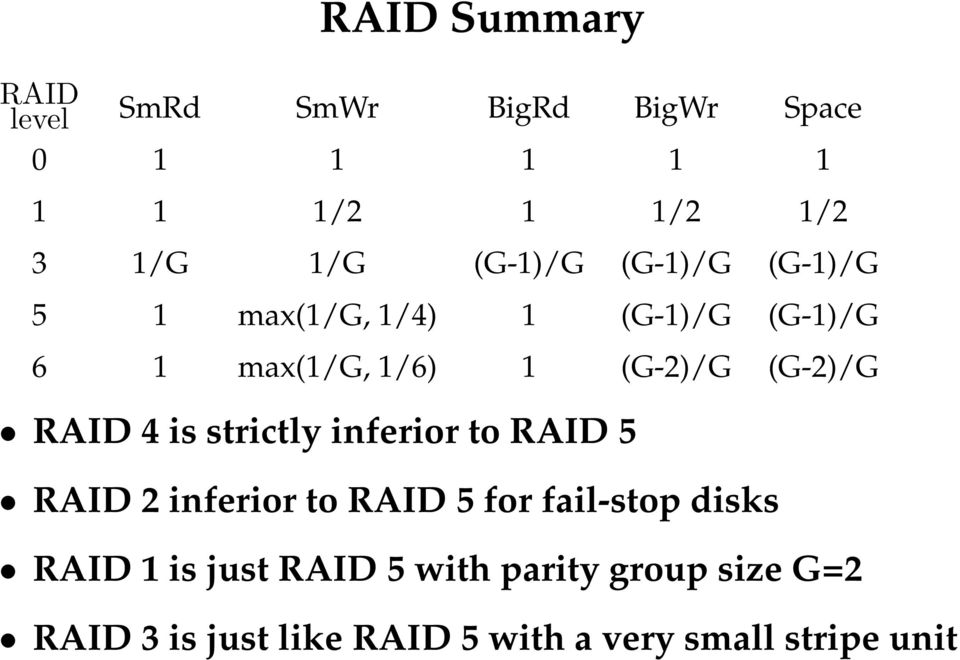
13 RAID Summary RAID level SmRd SmWr BigRd BigWr Space /2 1 1/2 1/2 3 1/G 1/G (G-1)/G (G-1)/G (G-1)/G 5 1 max(1/g, 1/4) 1 (G-1)/G (G-1)/G 6 1 max(1/g, 1/6) 1 (G-2)/G (G-2)/G RAID 4 is strictly inferior to RAID 5 RAID 2 inferior to RAID 5 for fail-stop disks RAID 1 is just RAID 5 with parity group size G=2 RAID 3 is just like RAID 5 with a very small stripe unit
14 When/how do disks fail? Disks can fail very early in their lifetimes (manufacturing errors) Also tend to fail late in their lifetimes (when disk wears out) Systematic manufacturing defect can make entire batch of disks fail early - Beware disks with consecutive serial numbers! Environmental factors can kill a bunch of disks (air conditioning failure) Disks can fail when a bad block is read Bad block may exist for a while before being detected

15 Basic idea: - Add new disk Dealing with failures - Reconstruct failed disk s state on new disk Must store metadata information during recovery - Which disks are failed? - How much of failed disk has been reconstructed? System crashes become very serious in conjunction with disk failure - Parity may be inconsistent (particularly bad for P+Q) - You could lose a block other than the one you were writing - MUST log in NVRAM enough info to recover parity - Makes software-only implementation of RAID risky

16 Maximizing availability Want to keep operating after failure Demand reconstruction - Assumes spare disk immediately (or already) installed - Reconstruct blocks as accessed - Background thread reconstructs all blocks Parity sparing - Replaces parity block with reconstructed data block - Need extra metadata to keep track of this

17 Unrecoverable RAID failures Double disk failures (or tripple, if P+Q redundancy) System crash followed by disk failure Disk failure, then read and discover bad block during reconstruction

18 Parity logging RAID improvements - Log difference of old and new parity blocks - Delay updating actual parity - Further writes may save you from a read Declustered parity - Many parity groups, spread over many disks Parity sparing - Use spare disks to improve performance by spreading load

19 Tuning RAID What is optimal size of data stripe in RAID 0 disk array? (P X(L 1)Z)/N - P - average positioning time - X - disk transfer rate - L - concurrency of workload - Z - request size - N - size of array in disks What about in RAID 5? - Reads - similar to RAID 0 - Writes - optimal is a factor of 4 smaller than for reads (for 16 disks) - Seems to vary WITH #disks, while reads vary inversely! Conclusion: Very workload dependent!

Why disk arrays? CPUs speeds increase faster than disks. - Time won t really help workloads where disk in bottleneck
 1/19 Why disk arrays? CPUs speeds increase faster than disks - Time won t really help workloads where disk in bottleneck Some applications (audio/video) require big files Disk arrays - make one logical
How To Write A Disk Array
 200 Chapter 7 (This observation is reinforced and elaborated in Exercises 7.5 and 7.6, and the reader is urged to work through them.) 7.2 RAID Disks are potential bottlenecks for system performance and
Definition of RAID Levels
 RAID The basic idea of RAID (Redundant Array of Independent Disks) is to combine multiple inexpensive disk drives into an array of disk drives to obtain performance, capacity and reliability that exceeds
Lecture 36: Chapter 6
 Lecture 36: Chapter 6 Today s topic RAID 1 RAID Redundant Array of Inexpensive (Independent) Disks Use multiple smaller disks (c.f. one large disk) Parallelism improves performance Plus extra disk(s) for
Data Storage - II: Efficient Usage & Errors
 Data Storage - II: Efficient Usage & Errors Week 10, Spring 2005 Updated by M. Naci Akkøk, 27.02.2004, 03.03.2005 based upon slides by Pål Halvorsen, 12.3.2002. Contains slides from: Hector Garcia-Molina
File System Design and Implementation
 Transactions and Reliability Sarah Diesburg Operating Systems CS 3430 Motivation File systems have lots of metadata: Free blocks, directories, file headers, indirect blocks Metadata is heavily cached for
Disk Array Data Organizations and RAID
 Guest Lecture for 15-440 Disk Array Data Organizations and RAID October 2010, Greg Ganger 1 Plan for today Why have multiple disks? Storage capacity, performance capacity, reliability Load distribution
Disks and RAID. Profs. Bracy and Van Renesse. based on slides by Prof. Sirer
 Disks and RAID Profs. Bracy and Van Renesse based on slides by Prof. Sirer 50 Years Old! 13th September 1956 The IBM RAMAC 350 Stored less than 5 MByte Reading from a Disk Must specify: cylinder # (distance
Chapter 6 External Memory. Dr. Mohamed H. Al-Meer
 Chapter 6 External Memory Dr. Mohamed H. Al-Meer 6.1 Magnetic Disks Types of External Memory Magnetic Disks RAID Removable Optical CD ROM CD Recordable CD-R CD Re writable CD-RW DVD Magnetic Tape 2 Introduction
Storing Data: Disks and Files
 Storing Data: Disks and Files (From Chapter 9 of textbook) Storing and Retrieving Data Database Management Systems need to: Store large volumes of data Store data reliably (so that data is not lost!) Retrieve
What is RAID? data reliability with performance
 What is RAID? RAID is the use of multiple disks and data distribution techniques to get better Resilience and/or Performance RAID stands for: Redundant Array of Inexpensive / Independent Disks RAID can
RAID. Contents. Definition and Use of the Different RAID Levels. The different RAID levels: Definition Cost / Efficiency Reliability Performance
 RAID Definition and Use of the Different RAID Levels Contents The different RAID levels: Definition Cost / Efficiency Reliability Performance Further High Availability Aspects Performance Optimization
RAID. Storage-centric computing, cloud computing. Benefits:
 RAID Storage-centric computing, cloud computing. Benefits: Improved reliability (via error correcting code, redundancy). Improved performance (via redundancy). Independent disks. RAID Level 0 Provides
Using RAID6 for Advanced Data Protection
 Using RAI6 for Advanced ata Protection 2006 Infortrend Corporation. All rights reserved. Table of Contents The Challenge of Fault Tolerance... 3 A Compelling Technology: RAI6... 3 Parity... 4 Why Use RAI6...
RAID Basics Training Guide
 RAID Basics Training Guide Discover a Higher Level of Performance RAID matters. Rely on Intel RAID. Table of Contents 1. What is RAID? 2. RAID Levels RAID 0 RAID 1 RAID 5 RAID 6 RAID 10 RAID 0+1 RAID 1E
How To Improve Performance On A Single Chip Computer
 : Redundant Arrays of Inexpensive Disks this discussion is based on the paper:» A Case for Redundant Arrays of Inexpensive Disks (),» David A Patterson, Garth Gibson, and Randy H Katz,» In Proceedings
1 Storage Devices Summary
 Chapter 1 Storage Devices Summary Dependability is vital Suitable measures Latency how long to the first bit arrives Bandwidth/throughput how fast does stuff come through after the latency period Obvious
RAID. Tiffany Yu-Han Chen. # The performance of different RAID levels # read/write/reliability (fault-tolerant)/overhead
 RAID # The performance of different RAID levels # read/write/reliability (fault-tolerant)/overhead Tiffany Yu-Han Chen (These slides modified from Hao-Hua Chu National Taiwan University) RAID 0 - Striping
Storage. The text highlighted in green in these slides contain external hyperlinks. 1 / 14
 Storage Compared to the performance parameters of the other components we have been studying, storage systems are much slower devices. Typical access times to rotating disk storage devices are in the millisecond
RAID Level Descriptions. RAID 0 (Striping)
 RAID Level Descriptions RAID 0 (Striping) Offers low cost and maximum performance, but offers no fault tolerance; a single disk failure results in TOTAL data loss. Businesses use RAID 0 mainly for tasks
An Introduction to RAID. Giovanni Stracquadanio [email protected] www.dmi.unict.it/~stracquadanio
 An Introduction to RAID Giovanni Stracquadanio [email protected] www.dmi.unict.it/~stracquadanio Outline A definition of RAID An ensemble of RAIDs JBOD RAID 0...5 Configuring and testing a Linux
Operating Systems. RAID Redundant Array of Independent Disks. Submitted by Ankur Niyogi 2003EE20367
 Operating Systems RAID Redundant Array of Independent Disks Submitted by Ankur Niyogi 2003EE20367 YOUR DATA IS LOST@#!! Do we have backups of all our data???? - The stuff we cannot afford to lose?? How
Input / Ouput devices. I/O Chapter 8. Goals & Constraints. Measures of Performance. Anatomy of a Disk Drive. Introduction - 8.1
 Introduction - 8.1 I/O Chapter 8 Disk Storage and Dependability 8.2 Buses and other connectors 8.4 I/O performance measures 8.6 Input / Ouput devices keyboard, mouse, printer, game controllers, hard drive,
COS 318: Operating Systems. Storage Devices. Kai Li Computer Science Department Princeton University. (http://www.cs.princeton.edu/courses/cos318/)
 COS 318: Operating Systems Storage Devices Kai Li Computer Science Department Princeton University (http://www.cs.princeton.edu/courses/cos318/) Today s Topics Magnetic disks Magnetic disk performance
RAID Overview 91.520
 RAID Overview 91.520 1 The Motivation for RAID Computing speeds double every 3 years Disk speeds can t keep up Data needs higher MTBF than any component in system IO Performance and Availability Issues!
RAID HARDWARE. On board SATA RAID controller. RAID drive caddy (hot swappable) SATA RAID controller card. Anne Watson 1
 RAID HARDWARE On board SATA RAID controller SATA RAID controller card RAID drive caddy (hot swappable) Anne Watson 1 RAID The word redundant means an unnecessary repetition. The word array means a lineup.
RAID 6 with HP Advanced Data Guarding technology:
 RAID 6 with HP Advanced Data Guarding technology: a cost-effective, fault-tolerant solution technology brief Abstract... 2 Introduction... 2 Functions and limitations of RAID schemes... 3 Fault tolerance
Reliability and Fault Tolerance in Storage
 Reliability and Fault Tolerance in Storage Dalit Naor/ Dima Sotnikov IBM Haifa Research Storage Systems 1 Advanced Topics on Storage Systems - Spring 2014, Tel-Aviv University http://www.eng.tau.ac.il/semcom
RAID. RAID 0 No redundancy ( AID?) Just stripe data over multiple disks But it does improve performance. Chapter 6 Storage and Other I/O Topics 29
 RAID Redundant Array of Inexpensive (Independent) Disks Use multiple smaller disks (c.f. one large disk) Parallelism improves performance Plus extra disk(s) for redundant data storage Provides fault tolerant
Today s Papers. RAID Basics (Two optional papers) Array Reliability. EECS 262a Advanced Topics in Computer Systems Lecture 4
 EECS 262a Advanced Topics in Computer Systems Lecture 4 Filesystems (Con t) September 15 th, 2014 John Kubiatowicz Electrical Engineering and Computer Sciences University of California, Berkeley Today
CS161: Operating Systems
 CS161: Operating Systems Matt Welsh [email protected] Lecture 18: RAID April 19, 2007 2007 Matt Welsh Harvard University 1 RAID Redundant Arrays of Inexpensive Disks Invented in 1986-1987 by David Patterson
Introduction Disks RAID Tertiary storage. Mass Storage. CMSC 412, University of Maryland. Guest lecturer: David Hovemeyer.
 Guest lecturer: David Hovemeyer November 15, 2004 The memory hierarchy Red = Level Access time Capacity Features Registers nanoseconds 100s of bytes fixed Cache nanoseconds 1-2 MB fixed RAM nanoseconds
File System & Device Drive. Overview of Mass Storage Structure. Moving head Disk Mechanism. HDD Pictures 11/13/2014. CS341: Operating System
 CS341: Operating System Lect 36: 1 st Nov 2014 Dr. A. Sahu Dept of Comp. Sc. & Engg. Indian Institute of Technology Guwahati File System & Device Drive Mass Storage Disk Structure Disk Arm Scheduling RAID
CS 61C: Great Ideas in Computer Architecture. Dependability: Parity, RAID, ECC
 CS 61C: Great Ideas in Computer Architecture Dependability: Parity, RAID, ECC Instructor: Justin Hsia 8/08/2013 Summer 2013 Lecture #27 1 Review of Last Lecture MapReduce Data Level Parallelism Framework
technology brief RAID Levels March 1997 Introduction Characteristics of RAID Levels
 technology brief RAID Levels March 1997 Introduction RAID is an acronym for Redundant Array of Independent Disks (originally Redundant Array of Inexpensive Disks) coined in a 1987 University of California
Improving Lustre OST Performance with ClusterStor GridRAID. John Fragalla Principal Architect High Performance Computing
 Improving Lustre OST Performance with ClusterStor GridRAID John Fragalla Principal Architect High Performance Computing Legacy RAID 6 No Longer Sufficient 2013 RAID 6 data protection challenges Long rebuild
CS420: Operating Systems
 NK YORK COLLEGE OF PENNSYLVANIA HG OK 2 RAID YORK COLLEGE OF PENNSYLVAN James Moscola Department of Physical Sciences York College of Pennsylvania Based on Operating System Concepts, 9th Edition by Silberschatz,
Price/performance Modern Memory Hierarchy
 Lecture 21: Storage Administration Take QUIZ 15 over P&H 6.1-4, 6.8-9 before 11:59pm today Project: Cache Simulator, Due April 29, 2010 NEW OFFICE HOUR TIME: Tuesday 1-2, McKinley Last Time Exam discussion
GPFS Storage Server. Concepts and Setup in Lemanicus BG/Q system" Christian Clémençon (EPFL-DIT)" " 4 April 2013"
 GPFS Storage Server Concepts and Setup in Lemanicus BG/Q system" Christian Clémençon (EPFL-DIT)" " Agenda" GPFS Overview" Classical versus GSS I/O Solution" GPFS Storage Server (GSS)" GPFS Native RAID
California Software Labs
 WHITE PAPERS FEBRUARY 2006 California Software Labs CSWL INC R e a l i z e Y o u r I d e a s Redundant Array of Inexpensive Disks (RAID) Redundant Array of Inexpensive Disks (RAID) aids development of
Sistemas Operativos: Input/Output Disks
 Sistemas Operativos: Input/Output Disks Pedro F. Souto ([email protected]) April 28, 2012 Topics Magnetic Disks RAID Solid State Disks Topics Magnetic Disks RAID Solid State Disks Magnetic Disk Construction
DELL RAID PRIMER DELL PERC RAID CONTROLLERS. Joe H. Trickey III. Dell Storage RAID Product Marketing. John Seward. Dell Storage RAID Engineering
 DELL RAID PRIMER DELL PERC RAID CONTROLLERS Joe H. Trickey III Dell Storage RAID Product Marketing John Seward Dell Storage RAID Engineering http://www.dell.com/content/topics/topic.aspx/global/products/pvaul/top
COSC 6374 Parallel Computation. Parallel I/O (I) I/O basics. Concept of a clusters
 COSC 6374 Parallel I/O (I) I/O basics Fall 2012 Concept of a clusters Processor 1 local disks Compute node message passing network administrative network Memory Processor 2 Network card 1 Network card
PIONEER RESEARCH & DEVELOPMENT GROUP
 SURVEY ON RAID Aishwarya Airen 1, Aarsh Pandit 2, Anshul Sogani 3 1,2,3 A.I.T.R, Indore. Abstract RAID stands for Redundant Array of Independent Disk that is a concept which provides an efficient way for
RAID Overview: Identifying What RAID Levels Best Meet Customer Needs. Diamond Series RAID Storage Array
 ATTO Technology, Inc. Corporate Headquarters 155 Crosspoint Parkway Amherst, NY 14068 Phone: 716-691-1999 Fax: 716-691-9353 www.attotech.com [email protected] RAID Overview: Identifying What RAID Levels
IBM ^ xseries ServeRAID Technology
 IBM ^ xseries ServeRAID Technology Reliability through RAID technology Executive Summary: t long ago, business-critical computing on industry-standard platforms was unheard of. Proprietary systems were
RAID Performance Analysis
 RAID Performance Analysis We have six 500 GB disks with 8 ms average seek time. They rotate at 7200 RPM and have a transfer rate of 20 MB/sec. The minimum unit of transfer to each disk is a 512 byte sector.
Storage and File Structure
 Storage and File Structure Chapter 10: Storage and File Structure Overview of Physical Storage Media Magnetic Disks RAID Tertiary Storage Storage Access File Organization Organization of Records in Files
RAID Made Easy By Jon L. Jacobi, PCWorld
 9916 Brooklet Drive Houston, Texas 77099 Phone 832-327-0316 www.safinatechnolgies.com RAID Made Easy By Jon L. Jacobi, PCWorld What is RAID, why do you need it, and what are all those mode numbers that
CS 153 Design of Operating Systems Spring 2015
 CS 153 Design of Operating Systems Spring 2015 Lecture 22: File system optimizations Physical Disk Structure Disk components Platters Surfaces Tracks Arm Track Sector Surface Sectors Cylinders Arm Heads
RAID technology and IBM TotalStorage NAS products
 IBM TotalStorage Network Attached Storage October 2001 RAID technology and IBM TotalStorage NAS products By Janet Anglin and Chris Durham Storage Networking Architecture, SSG Page No.1 Contents 2 RAID
Chapter 6. 6.1 Introduction. Storage and Other I/O Topics. p. 570( 頁 585) Fig. 6.1. I/O devices can be characterized by. I/O bus connections
 Chapter 6 Storage and Other I/O Topics 6.1 Introduction I/O devices can be characterized by Behavior: input, output, storage Partner: human or machine Data rate: bytes/sec, transfers/sec I/O bus connections
Striped Set, Advantages and Disadvantages of Using RAID
 Algorithms and Methods for Distributed Storage Networks 4: Volume Manager and RAID Institut für Informatik Wintersemester 2007/08 RAID Redundant Array of Independent Disks Patterson, Gibson, Katz, A Case
CS 6290 I/O and Storage. Milos Prvulovic
 CS 6290 I/O and Storage Milos Prvulovic Storage Systems I/O performance (bandwidth, latency) Bandwidth improving, but not as fast as CPU Latency improving very slowly Consequently, by Amdahl s Law: fraction
EMC DATA DOMAIN DATA INVULNERABILITY ARCHITECTURE: ENHANCING DATA INTEGRITY AND RECOVERABILITY
 White Paper EMC DATA DOMAIN DATA INVULNERABILITY ARCHITECTURE: ENHANCING DATA INTEGRITY AND RECOVERABILITY A Detailed Review Abstract No single mechanism is sufficient to ensure data integrity in a storage
Sonexion GridRAID Characteristics
 Sonexion GridRAID Characteristics Mark Swan Performance Team Cray Inc. Saint Paul, Minnesota, USA [email protected] Abstract This paper will present performance characteristics of the Sonexion declustered
Lecture 23: Multiprocessors
 Lecture 23: Multiprocessors Today s topics: RAID Multiprocessor taxonomy Snooping-based cache coherence protocol 1 RAID 0 and RAID 1 RAID 0 has no additional redundancy (misnomer) it uses an array of disks
HARD DRIVE CHARACTERISTICS REFRESHER
 The read/write head of a hard drive only detects changes in the magnetic polarity of the material passing beneath it, not the direction of the polarity. Writes are performed by sending current either one
RAID for the 21st Century. A White Paper Prepared for Panasas October 2007
 A White Paper Prepared for Panasas October 2007 Table of Contents RAID in the 21 st Century...1 RAID 5 and RAID 6...1 Penalties Associated with RAID 5 and RAID 6...1 How the Vendors Compensate...2 EMA
Dependable Systems. 9. Redundant arrays of. Prof. Dr. Miroslaw Malek. Wintersemester 2004/05 www.informatik.hu-berlin.de/rok/zs
 Dependable Systems 9. Redundant arrays of inexpensive disks (RAID) Prof. Dr. Miroslaw Malek Wintersemester 2004/05 www.informatik.hu-berlin.de/rok/zs Redundant Arrays of Inexpensive Disks (RAID) RAID is
How To Create A Multi Disk Raid
 Click on the diagram to see RAID 0 in action RAID Level 0 requires a minimum of 2 drives to implement RAID 0 implements a striped disk array, the data is broken down into blocks and each block is written
Chapter 10: Mass-Storage Systems
 Chapter 10: Mass-Storage Systems Physical structure of secondary storage devices and its effects on the uses of the devices Performance characteristics of mass-storage devices Disk scheduling algorithms
Database Management Systems
 4411 Database Management Systems Acknowledgements and copyrights: these slides are a result of combination of notes and slides with contributions from: Michael Kiffer, Arthur Bernstein, Philip Lewis, Anestis
Fault Tolerance & Reliability CDA 5140. Chapter 3 RAID & Sample Commercial FT Systems
 Fault Tolerance & Reliability CDA 5140 Chapter 3 RAID & Sample Commercial FT Systems - basic concept in these, as with codes, is redundancy to allow system to continue operation even if some components
COS 318: Operating Systems. Storage Devices. Kai Li and Andy Bavier Computer Science Department Princeton University
 COS 318: Operating Systems Storage Devices Kai Li and Andy Bavier Computer Science Department Princeton University http://www.cs.princeton.edu/courses/archive/fall13/cos318/ Today s Topics! Magnetic disks!
RAID Utility User Guide. Instructions for setting up RAID volumes on a computer with a Mac Pro RAID Card or Xserve RAID Card
 RAID Utility User Guide Instructions for setting up RAID volumes on a computer with a Mac Pro RAID Card or Xserve RAID Card Contents 3 RAID Utility User Guide 3 The RAID Utility Window 4 Running RAID Utility
Surviving Two Disk Failures. Introducing Various RAID 6 Implementations
 Surviving Two Failures Introducing Various RAID 6 Implementations Notices The information in this document is subject to change without notice. While every effort has been made to ensure that all information
RAID Utility User s Guide Instructions for setting up RAID volumes on a computer with a MacPro RAID Card or Xserve RAID Card.
 RAID Utility User s Guide Instructions for setting up RAID volumes on a computer with a MacPro RAID Card or Xserve RAID Card. 1 Contents 3 RAID Utility User s Guide 3 Installing the RAID Software 4 Running
Guide to SATA Hard Disks Installation and RAID Configuration
 Guide to SATA Hard Disks Installation and RAID Configuration 1. Guide to SATA Hard Disks Installation... 2 1.1 Serial ATA (SATA) Hard Disks Installation... 2 2. Guide to RAID Configurations... 3 2.1 Introduction
SSDs and RAID: What s the right strategy. Paul Goodwin VP Product Development Avant Technology
 SSDs and RAID: What s the right strategy Paul Goodwin VP Product Development Avant Technology SSDs and RAID: What s the right strategy Flash Overview SSD Overview RAID overview Thoughts about Raid Strategies
Introduction. What is RAID? The Array and RAID Controller Concept. Click here to print this article. Re-Printed From SLCentral
 Click here to print this article. Re-Printed From SLCentral RAID: An In-Depth Guide To RAID Technology Author: Tom Solinap Date Posted: January 24th, 2001 URL: http://www.slcentral.com/articles/01/1/raid
Comprehending the Tradeoffs between Deploying Oracle Database on RAID 5 and RAID 10 Storage Configurations. Database Solutions Engineering
 Comprehending the Tradeoffs between Deploying Oracle Database on RAID 5 and RAID 10 Storage Configurations A Dell Technical White Paper Database Solutions Engineering By Sudhansu Sekhar and Raghunatha
CSE 120 Principles of Operating Systems
 CSE 120 Principles of Operating Systems Fall 2004 Lecture 13: FFS, LFS, RAID Geoffrey M. Voelker Overview We ve looked at disks and file systems generically Now we re going to look at some example file
Picking the right number of targets per server for BeeGFS. Jan Heichler March 2015 v1.2
 Picking the right number of targets per server for BeeGFS Jan Heichler March 2015 v1.2 Evaluating the MetaData Performance of BeeGFS 2 Abstract In this paper we will show the performance of two different
Maintenance Best Practices for Adaptec RAID Solutions
 Maintenance Best Practices for Adaptec RAID Solutions Note: This document is intended to provide insight into the best practices for routine maintenance of Adaptec RAID systems. These maintenance best
Distribution One Server Requirements
 Distribution One Server Requirements Introduction Welcome to the Hardware Configuration Guide. The goal of this guide is to provide a practical approach to sizing your Distribution One application and
RAID Storage, Network File Systems, and DropBox
 RAID Storage, Network File Systems, and DropBox George Porter CSE 124 February 24, 2015 * Thanks to Dave Patterson and Hong Jiang Announcements Project 2 due by end of today Office hour today 2-3pm in
RAID Technology Overview
 RAID Technology Overview HP Smart Array RAID Controllers HP Part Number: J6369-90050 Published: September 2007 Edition: 1 Copyright 2007 Hewlett-Packard Development Company L.P. Legal Notices Copyright
Copyright 2007 Ramez Elmasri and Shamkant B. Navathe. Slide 13-1
 Slide 13-1 Chapter 13 Disk Storage, Basic File Structures, and Hashing Chapter Outline Disk Storage Devices Files of Records Operations on Files Unordered Files Ordered Files Hashed Files Dynamic and Extendible
Guide to SATA Hard Disks Installation and RAID Configuration
 Guide to SATA Hard Disks Installation and RAID Configuration 1. Guide to SATA Hard Disks Installation...2 1.1 Serial ATA (SATA) Hard Disks Installation...2 2. Guide to RAID Configurations...3 2.1 Introduction
The Advantages of Using RAID
 1 Quick Guide to the SPD Engine Disk-I/O Set-Up SPD Engine Disk-I/O Set-Up 1 Disk Striping and RAIDs 2 Metadata Area Configuration 3 Assigning a Metadata Area 3 Metadata Space Requirements 3 Data Area
Chapter 9: Peripheral Devices: Magnetic Disks
 Chapter 9: Peripheral Devices: Magnetic Disks Basic Disk Operation Performance Parameters and History of Improvement Example disks RAID (Redundant Arrays of Inexpensive Disks) Improving Reliability Improving
Lecture 18: Reliable Storage
 CS 422/522 Design & Implementation of Operating Systems Lecture 18: Reliable Storage Zhong Shao Dept. of Computer Science Yale University Acknowledgement: some slides are taken from previous versions of
NAND Flash Media Management Through RAIN
 Flash Media Management Through RAIN Scott Shadley, Senior roduct Marketing Manager Micron Technology, Inc. Technical Marketing Brief What Is RAIN, and Why Do SSDs Need It? This brief compares redundant
Nutanix Tech Note. Failure Analysis. 2013 All Rights Reserved, Nutanix Corporation
 Nutanix Tech Note Failure Analysis A Failure Analysis of Storage System Architectures Nutanix Scale-out v. Legacy Designs Types of data to be protected Any examination of storage system failure scenarios
RAID Levels and Components Explained Page 1 of 23
 RAID Levels and Components Explained Page 1 of 23 What's RAID? The purpose of this document is to explain the many forms or RAID systems, and why they are useful, and their disadvantages. RAID - Redundant
Chapter 13 Disk Storage, Basic File Structures, and Hashing.
 Chapter 13 Disk Storage, Basic File Structures, and Hashing. Copyright 2004 Pearson Education, Inc. Chapter Outline Disk Storage Devices Files of Records Operations on Files Unordered Files Ordered Files
File System Reliability (part 2)
 File System Reliability (part 2) Main Points Approaches to reliability Careful sequencing of file system opera@ons Copy- on- write (WAFL, ZFS) Journalling (NTFS, linux ext4) Log structure (flash storage)
W4118: RAID. Instructor: Junfeng Yang
 W4118: RAID Instructor: Junfeng Yang References: Modern Operating Systems (3 rd edition), Operating Systems Concepts (8 th edition), previous W4118, and OS at MIT, Stanford, and UWisc RAID motivation Performance
Review. Lecture 21: Reliable, High Performance Storage. Overview. Basic Disk & File System properties CSC 468 / CSC 2204 11/23/2006
 S 468 / S 2204 Review Lecture 2: Reliable, High Performance Storage S 469HF Fall 2006 ngela emke rown We ve looked at fault tolerance via server replication ontinue operating with up to f failures Recovery
Intel RAID Controllers
 Intel RAID Controllers Best Practices White Paper April, 2008 Enterprise Platforms and Services Division - Marketing Revision History Date Revision Number April, 2008 1.0 Initial release. Modifications
Oracle Database 10g: Performance Tuning 12-1
 Oracle Database 10g: Performance Tuning 12-1 Oracle Database 10g: Performance Tuning 12-2 I/O Architecture The Oracle database uses a logical storage container called a tablespace to store all permanent
Technical White paper RAID Protection and Drive Failure Fast Recovery
 Technical White paper RAID Protection and Drive Failure Fast Recovery RAID protection is a key part of all ETERNUS Storage Array products. Choices of the level chosen to meet customer application requirements