
Model Driven Business Architecture. Pete Rivett CTO, Adaptive
|
|
|
- Whitney Rose
- 9 years ago
- Views:
Transcription
1 Model Driven Business Architecture Pete Rivett CTO, Adaptive Copyright Adaptive Ltd. 2001
2 Outline What is business architecture? User needs Information needs (metamodels) Use of standard metamodels Suitability of UML Future Summary Copyright Adaptive Ltd /02/2002 2

3 Adaptive Experience 10+ blue-chip Enterprise Architecture projects Addressing real business pain usually across the IT-business gap Implemented using Adaptive s repositorybased software product set Time-boxed short iterations Common models evolved from projects Provide sound starting point (And a product) Copyright Adaptive Ltd /02/2002 3

4 Why Business Level Architecture? Separation of concerns Outside vs inside Longer-lived structures Reference models and patterns Manage complexity, change and danger Esp. for B2B, outsourcing, mergers Applies to processes, people, objectives, business relationships/contracts Component Based Organizations Copyright Adaptive Ltd /02/2002 4
5 Why Link Business and Software Architectures? Traceability to business goals Prioritisation Impact analysis Dependencies Basis for configurations Two-way communication Cut redundancy/duplication Regulatory governance Copyright Adaptive Ltd /02/2002 5

6 Business Architecture Scope Objectives What We need to do this... Capabilities Benefits & Measurements New / Modified Quantify it... Which means that we need the ability to do these things... Assessments With Principles Analysis Change Propsals (Gap Analysis) These are the detailed things impacted... Business Architectures Business & IT Architectures (Current) Produce It would look like this... Produce IS Architectures Business & IT Architectures (Target) High-level Dependancy Plan Process Architectures This is how it can be achieved... Programmes How (Change Proposals) Goverance Should we do it?/ what priority? / max benefits... Programmes Make it so and keep me posted... Copyright Adaptive Ltd /02/2002 6

7 ENTERPRISE ARCHITECTURE - A FRAMEWORK TM DATA What FUNCTION How NETWORK Where PEOPLE Who When MOTIVATION Why TIME SCOPE (CONTEXTUAL) List of Things Important to the Business List of Processes the Business Performs List of Locations in which the Business Operates List of Organizations Important to the Business List of Events Significant to the Business List of Business Goals/Strat SCOPE (CONTEXTUAL) Planner ENTITY = Class of Business Thing Function = Class of Business Process Node = Major Business Location People = Major Organizations Time = Major Business Event Ends/Means=Major Bus. Goal/ Critical Success Factor Planner ENTERPRISE MODEL (CONCEPTUAL) e.g. Semantic Model e.g. Business Process Model e.g. Business Logistics System e.g. Work Flow Model e.g. Master Schedule e.g. Business Plan ENTERPRISE MODEL (CONCEPTUAL) Owner Ent = Business Entity Reln = Business Relationship Proc. = Business Process I/O = Business Resources Node = Business Location Link = Business Linkage People = Organization Unit Work = Work Product Time = Business Event Cycle = Business Cycle End = Business Objective Means = Business Strategy Owner SYSTEM MODEL (LOGICAL) e.g. Logical Data Model e.g. Application Architecture e.g. Distributed System Architecture e.g. Human Interface Architecture e.g. Processing Structure e.g., Business Rule Model SYSTEM MODEL (LOGICAL) Designer Ent = Data Entity Reln = Data Relationship Proc.= Application Function I/O = User Views Node = I/S Function (Processor, Storage, etc) Link = Line Characteristics People = Role Work = Deliverable Time = System Event Cycle = Processing Cycle End = Structural Assertion Means =Action Assertion Designer TECHNOLOGY MODEL (PHYSICAL) e.g. Physical Data Model e.g. System Design e.g. Technology Architecture e.g. Presentation Architecture e.g. Control Structure e.g. Rule Design TECHNOLOGY MODEL (PHYSICAL) Builder DETAILED REPRESEN- TATIONS (OUT-OF- CONTEXT) Ent = Segment/Table/etc. Reln = Pointer/Key/etc. e.g. Data Definition Proc.= Computer Function I/O = Data Elements/Sets e.g. Program Node = Hardware/System Software Link = Line Specifications e.g. Network Architecture People = User Work = Screen Format e.g. Security Architecture Time = Execute Cycle = Component Cycle e.g. Timing Definition End = Condition Means = Action e.g. Rule Specification Builder DETAILED REPRESEN- TATIONS (OUT-OF CONTEXT) Sub- Contractor Ent = Field Reln = Address Proc.= Language Stmt I/O = Control Block Node = Addresses Link = Protocols People = Identity Work = Job Time = Interrupt Cycle = Machine Cycle End = Sub-condition Means = Step Sub- Contractor FUNCTIONING ENTERPRISE e.g. DATA e.g. FUNCTION e.g. NETWORK e.g. ORGANIZATION e.g. SCHEDULE e.g. STRATEGY FUNCTIONING ENTERPRISE John A. Zachman, Zachman International (810)

8 Users Wide variety of roles Many not technical Many with only casual use Focus on relationships Different levels of abstraction Need for visualization Legacy of representation style and layout Copyright Adaptive Ltd /02/2002 8

9 Simple Business Context Diagram Prospects Competitors Competitive Products Customers Product Order Advertising Market Intelligence Money Invoice Selling Marketing Sales Finance Manufacturing Order Suppliers Materials Pricing Product Spec Executive Tax Direction Budget Company X Government Regulations Copyright Adaptive Ltd /02/2002 9

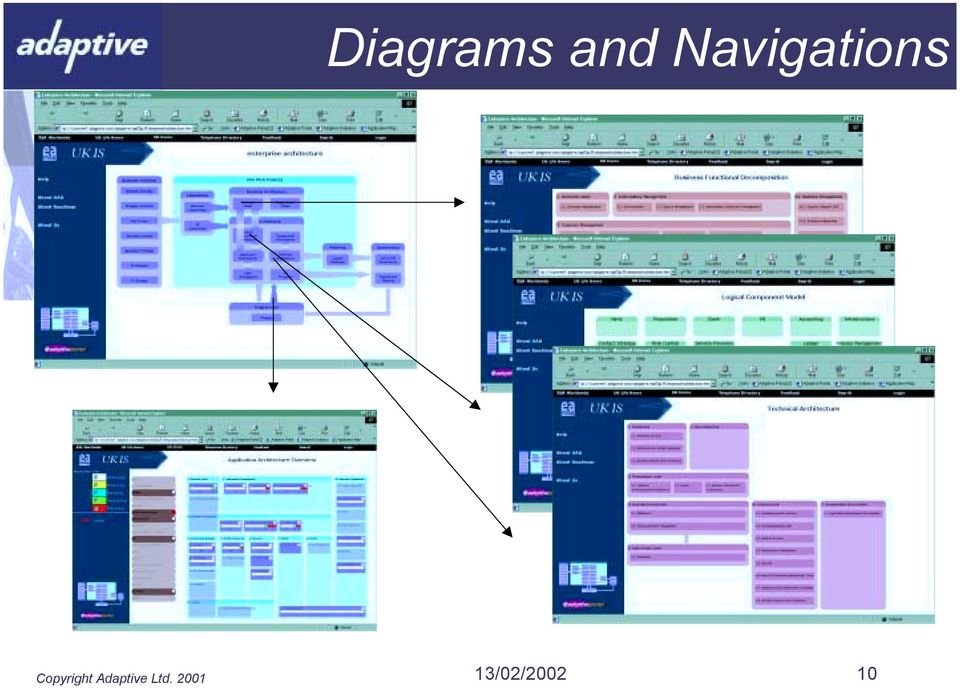
10 Diagrams and Navigations Copyright Adaptive Ltd /02/
11 A model can tell a thousand pictures Copyright Adaptive Ltd /02/

12 UML for Business Architecture Users Tools perceived as: Too technical Hard to learn Expensive (usually) Metamodel perceived as too complex and abstract Profiles give neither simplicity of model nor fitness for purpose Copyright Adaptive Ltd /02/

13 Approach Complex metamodels (e.g. UML) for technical areas where existing data and tool integrations exist Simpler metamodels for new areas Views and navigations to simplify complex models User/role specific Generic Visio-template mapping technology Copyright Adaptive Ltd /02/
14 Business Architecture Metamodels Organization Business Strategy Business Context Process Information Components Operational linked with relevant technical metamodels e.g. UML, CWM Copyright Adaptive Ltd /02/

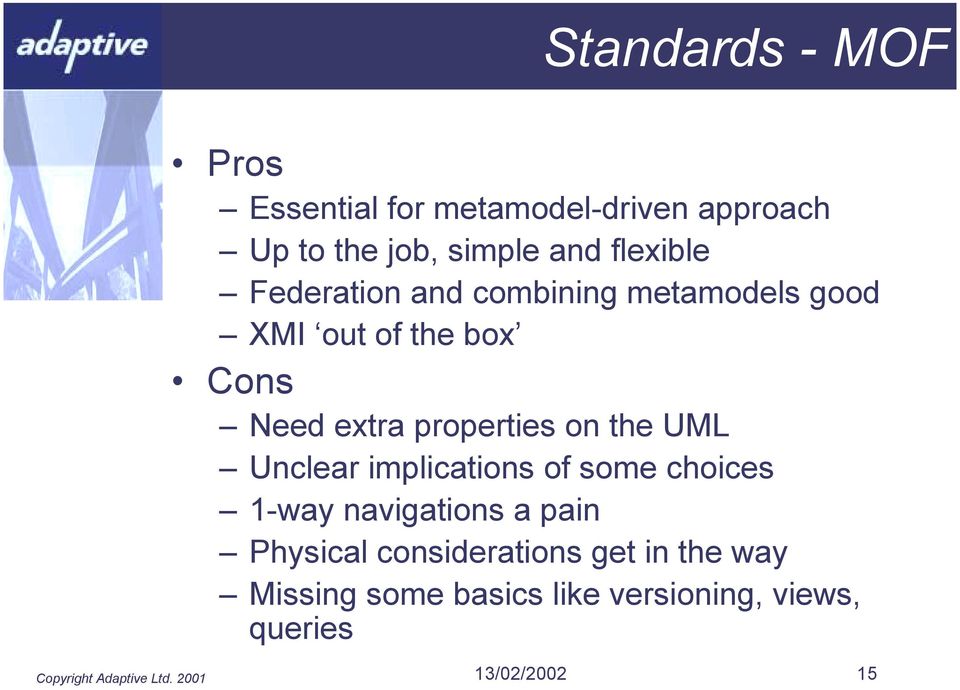
15 Standards - MOF Pros Essential for metamodel-driven approach Up to the job, simple and flexible Federation and combining metamodels good XMI out of the box Cons Need extra properties on the UML Unclear implications of some choices 1-way navigations a pain Physical considerations get in the way Missing some basics like versioning, views, queries Copyright Adaptive Ltd /02/
16 Standards - EDOC Choice of profile or metamodel (with notation) Starts from (business view of) systems not real business Only just adopted so little experience CCA part quite mature Commonality with EAI, ebxml Used successfully for inter-application architecture Copyright Adaptive Ltd /02/

17 Standards - EAI Choice of profile or metamodel Extends EDOC with detail for inter-application integration, e.g. Events Flows Adapters/Connectors Messages (detailed format) Just adopted (in final throes) Needs clearer positioning with EDOC, CWM For business architecture EDOC probably OK Copyright Adaptive Ltd /02/

18 Standards - CWM Mature and at second revision To support warehousing covers many areas including information resources, transformations etc Modular and extensible Good basis for: Information architecture Glossary/nomenclature Software deployment (needs extending) Copyright Adaptive Ltd /02/

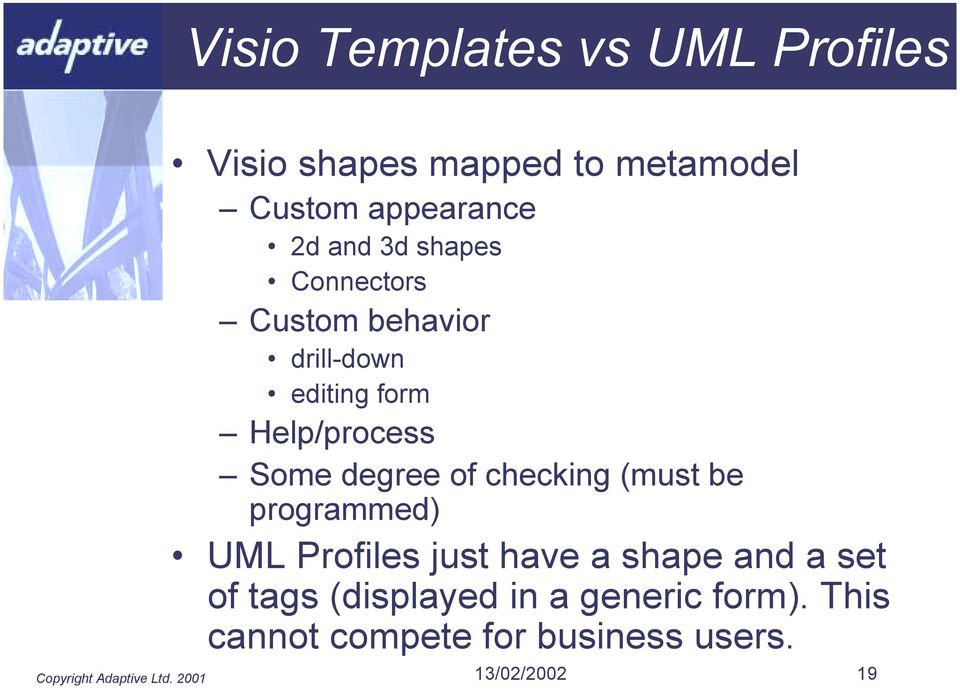
19 Visio Templates vs UML Profiles Visio shapes mapped to metamodel Custom appearance 2d and 3d shapes Connectors Custom behavior drill-down editing form Help/process Some degree of checking (must be programmed) UML Profiles just have a shape and a set of tags (displayed in a generic form). This cannot compete for business users. Copyright Adaptive Ltd /02/
20 UML Suitability (1) Class diagrams OK Instance diagrams Vital but shamefully neglected in common tools Use case diagrams OK as far as they go Diagrams say too little all devolved to the documents Useful if extended to show links to data Copyright Adaptive Ltd /02/

21 UML Suitability (2) Activity diagrams OKish: fit with common process notations UML tool support not Metamodel a complete nightmare Collaboration diagrams Useful at system level Generally need more richness as in EDOC/CCA Copyright Adaptive Ltd /02/
22 UML Suitability (3) Sequence diagrams Too low level in general In some cases useful for processes (cf activity diagrams with swim lanes) Useful for establishing system dependencies State diagrams Not of interest in general Deployment diagrams Far too limited Copyright Adaptive Ltd /02/
23 Other UML Issues Mapping notation to metamodel Too many inherited features Cannot create views Cannot support refinement e.g. an analysis model copy as the start of a design model and keep 2-way traceability Poor package management No global object identity No diagram interchange No control over rigor (when to check) Copyright Adaptive Ltd /02/
24 UML2 Vision Core common to MOF2 and UML2 Build families of languages So can use UML tool as a default with less hassle So can use purpose-specific tools on same data Selectable constraint checking Formal mapping to diagrams Could drive more generic drawing Copyright Adaptive Ltd /02/
25 The Future? Will UML2 remain an analysis and design language? Or a panacea for everything (Universal Modeling Language)? Will it have specifiable notations? Most talk about applying it to business does not understand the issues Copyright Adaptive Ltd /02/
26 Summary Business architecture has a different set of users and needs Puts modeling at the start of the process Requires integrating standard technical and business metamodels OMG has several relevant technical standards in addition to UML UML has limited applicability for business aspects UML2/MOF2 should improve this depending on notation flexibility Copyright Adaptive Ltd /02/
Data Integration Using Universal Data Models and Effective Human Dynamics. Presented by Len Silverston, Universal Data Models, LLC
 Data Integration Using Universal Data Models and Effective Human Dynamics Presented by Len Silverston, Universal Data Models, LLC 2009 Universal Data Models, LLC - All Rights Reserved 1 1 Purpose: Share
Improving your Data Warehouse s IQ
 Improving your Data Warehouse s IQ Derek Strauss Gavroshe USA, Inc. Outline Data quality for second generation data warehouses DQ tool functionality categories and the data quality process Data model types
Developing the Corporate Security Architecture. www.avient.ca Alex Woda July 22, 2009
 Developing the Corporate Security Architecture www.avient.ca Alex Woda July 22, 2009 Avient Solutions Group Avient Solutions Group is based in Markham and is a professional services firm specializing in
Information Management Metamodel
 ISO/IEC JTC1/SC32/WG2 N1527 Information Management Metamodel Pete Rivett, CTO Adaptive OMG Architecture Board [email protected] 2011-05-11 1 The Information Management Conundrum We all have Data
Reducing Network Documentation Effort by Visio Automation. David Cuthbertson
 Reducing Network Documentation Effort by Visio Automation David Cuthbertson Diagrams Are Very Useful! But Not all Diagrams Help! 3 If A Picture Paints a Thousand Words How do we paint a thousand pictures?
The Catalyst CRM Methodology
 95-00 The Catalyst CRM Methodology An overview Developed by Published by The Catalyst Foundation The Catalyst CRM Methodology has been developed jointly by CustomISe, MACS and SalesPathways, organisations
Using UML to Construct a Model Driven Solution for Unified Access to Disparate Data
 Using UML to Construct a Model Driven Solution for Unified Access to Disparate Data Randall M. Hauch VP Development, Chief Architect Metadata Management OMG's Second Workshop on UML for Enterprise Applications:
Common Warehouse Metamodel (CWM): Extending UML for Data Warehousing and Business Intelligence
 Common Warehouse Metamodel (CWM): Extending UML for Data Warehousing and Business Intelligence OMG First Workshop on UML in the.com Enterprise: Modeling CORBA, Components, XML/XMI and Metadata November
The Zachman Framework For Enterprise Architecture: Primer for Enterprise Engineering and Manufacturing
 ***DO NOT DISTRIBUTE*** Book Excerpt for OMG BRWG RFI Version # 1b page 1 Excerpts From The Zachman Framework For Enterprise Architecture: Primer for Enterprise Engineering and Manufacturing By John A.
Background: Business Value of Enterprise Architecture TOGAF Architectures and the Business Services Architecture
 Business Business Services Services and Enterprise and Enterprise This Workshop Two parts Background: Business Value of Enterprise TOGAF s and the Business Services We will use the key steps, methods and
Rotorcraft Health Management System (RHMS)
 AIAC-11 Eleventh Australian International Aerospace Congress Rotorcraft Health Management System (RHMS) Robab Safa-Bakhsh 1, Dmitry Cherkassky 2 1 The Boeing Company, Phantom Works Philadelphia Center
CDC UNIFIED PROCESS PRACTICES GUIDE
 Purpose The purpose of this document is to provide guidance on the practice of Modeling and to describe the practice overview, requirements, best practices, activities, and key terms related to these requirements.
The OMG BPM Standards
 The OMG BPM Standards Derek Miers CEO, BPM Focus +44 (20) 8742 8500 UK Office +44 (7703) 178 500 UK Cell +1 (714) 600 9010 US Cell [email protected] A BPM Definition Business Process Management is primarily
Applying 4+1 View Architecture with UML 2. White Paper
 Applying 4+1 View Architecture with UML 2 White Paper Copyright 2007 FCGSS, all rights reserved. www.fcgss.com Introduction Unified Modeling Language (UML) has been available since 1997, and UML 2 was
Business-Driven Software Engineering Lecture 3 Foundations of Processes
 Business-Driven Software Engineering Lecture 3 Foundations of Processes Jochen Küster [email protected] Agenda Introduction and Background Process Modeling Foundations Activities and Process Models Summary
Model-Driven Data Warehousing
 Model-Driven Data Warehousing Integrate.2003, Burlingame, CA Wednesday, January 29, 16:30-18:00 John Poole Hyperion Solutions Corporation Why Model-Driven Data Warehousing? Problem statement: Data warehousing
Towards a Common Metamodel for the Development of Web Applications
 Towards a Common Metamodel for the Development of Web Applications Nora Koch and Andreas Kraus Ludwig-Maximilians-Universität Munich, Germany Motivation Overwhelming diversity of Web methodologies Goal:
Clarifying a vision on certification of MDA tools
 SCIENTIFIC PAPERS, UNIVERSITY OF LATVIA, 2010. Vol. 757 COMPUTER SCIENCE AND INFORMATION TECHNOLOGIES 23 29 P. Clarifying a vision on certification of MDA tools Antons Cernickins Riga Technical University,
Developing in the MDA Object Management Group Page 1
 Developing in OMG s New -Driven Architecture Jon Siegel Director, Technology Transfer Object Management Group In this paper, we re going to describe the application development process supported by OMG
Linking BPMN, ArchiMate, and BWW: Perfect Match for Complete and Lawful Business Process Models?
 Linking BPMN, ArchiMate, and BWW: Perfect Match for Complete and Lawful Business Process Models? Ludmila Penicina Institute of Applied Computer Systems, Riga Technical University, 1 Kalku, Riga, LV-1658,
SCADE System 17.0. Technical Data Sheet. System Requirements Analysis. Technical Data Sheet SCADE System 17.0 1
 SCADE System 17.0 SCADE System is the product line of the ANSYS Embedded software family of products and solutions that empowers users with a systems design environment for use on systems with high dependability
Revel8or: Model Driven Capacity Planning Tool Suite
 Revel8or: Model Driven Capacity Planning Tool Suite Liming Zhu 1,2, Yan Liu 1,2, Ngoc Bao Bui 1,2,Ian Gorton 3 1 Empirical Software Engineering Program, National ICT Australia Ltd. 2 School of Computer
Dr. Jana Koehler IBM Zurich Research Laboratory
 Precise Modeling of Business Processes with the Business Process Modeling Notation BPMN 2.0 Dr. Jana Koehler IBM Zurich Research Laboratory ZRL BIT at a Glance Computer Science at ZRL: Security/Cryptography
Service Design: Using a GSRM Meta-Model. Ed Buchinski Treasury Board of Canada Secretariat UN/CEFACT TBG-19 Oct. 5 th, 2006
 Service Design: Using a GSRM Meta-Model Ed Buchinski Treasury Board of Canada Secretariat UN/CEFACT TBG-19 Oct. 5 th, 2006 Questions Posed by Management How many programs and services do we have? What
Independent Insight for Service Oriented Practice. An SOA Roadmap. John C. Butler Chief Architect. A CBDI Partner Company. www.cbdiforum.
 Independent Insight for Oriented Practice An SOA Roadmap John C. Butler Chief Architect A CBDI Partner Company www.cbdiforum.com Agenda! SOA Vision and Opportunity! SOA Roadmap Concepts and Maturity Levels!
Overview. Stakes. Context. Model-Based Development of Safety-Critical Systems
 1 2 Model-Based Development of -Critical Systems Miguel A. de Miguel 5/6,, 2006 modeling Stakes 3 Context 4 To increase the industrial competitiveness in the domain of software systems To face the growing
In this Lecture you will Learn: Systems Development Methodologies. Why Methodology? Why Methodology?
 In this Lecture you will Learn: Systems Development Methodologies What a systems development methodology is Why methodologies are used The need for different methodologies The main features of one methodology
To introduce software process models To describe three generic process models and when they may be used
 Software Processes Objectives To introduce software process models To describe three generic process models and when they may be used To describe outline process models for requirements engineering, software
Business Process Modeling and Standardization
 Business Modeling and Standardization Antoine Lonjon Chief Architect MEGA Content Introduction Business : One Word, Multiple Arenas of Application Criteria for a Business Modeling Standard State of the
Enterprise Architecture 101. (Includes numerous samples/ templates produced using TOGAF methodology) Shail Sood
 Enterprise Architecture 101 (Includes numerous samples/ templates produced using TOGAF methodology) Enterprise Architecture Key Question What is Enterprise Architecture? Why Enterprise Architecture? What
MDA Support for Military Medical Crisis Information Systems (MMCIS)
 MDA Support for Military Medical Crisis Information Systems (MMCIS) Ståle Walderhaug Marius Mikalsen Norwegian Joint Medical Service & SINTEF {stale.walderhaug marius.mikalsen} @sintef.no 1 The NATO Military
In this Lecture you will Learn: Development Process. Unified Software Development Process. Best Practice
 In this Lecture you will Learn: Development Chapter 5C About the Unified Software Development How phases relate to workflows in an iterative life cycle An approach to system development Major activities
The role of integrated requirements management in software delivery.
 Software development White paper October 2007 The role of integrated requirements Jim Heumann, requirements evangelist, IBM Rational 2 Contents 2 Introduction 2 What is integrated requirements management?
Business Process Architecture
 Business Process Architecture The Eye of the Hurricane IRMAC Toronto: December 7 2005 Roger T. Burlton The Process Renewal Consulting Group Inc. www.processrenewal.com www.adaptive.com +1-604-945-7352
F-16 Modular Mission Computer Application Software
 F-16 Modular Mission Computer Application Software Achieving Cross-Platform Compatibility with Increased Productivity and Quality using the OMG s Model Driven Architecture Lauren E. Clark Chief Engineer
What is a metamodel: the OMG s metamodeling infrastructure
 Modeling and metamodeling in Model Driven Development Warsaw, May 14-15th 2009 Gonzalo Génova [email protected] http://www.kr.inf.uc3m.es/ggenova/ Knowledge Reuse Group Universidad Carlos III de Madrid
SABSA A Brief Introduction
 SABSA A Brief Introduction Mark Battersby 2013-05-15 Agenda SABSA Overview SABSA Security Architecture SABSA Security Architecture Matrix Operational Security Architecture Matrix SABSA Business Attributes
All you need are models Anneke Kleppe, Klasse Objecten
 Model Driven Architecture All you need are models Anneke Kleppe, Klasse Objecten Contents Limited Vision on MDA Modeling Maturity Levels Models Model Driven Development Model Driven Architecture MDA in
Chap 1. Introduction to Software Architecture
 Chap 1. Introduction to Software Architecture 1. Introduction 2. IEEE Recommended Practice for Architecture Modeling 3. Architecture Description Language: the UML 4. The Rational Unified Process (RUP)
Usage of Business Process Choreography
 Usage of Business Process Choreography Akira Tanaka, Hitachi, Ltd. [email protected] Infrastructures and Standard 1 Agenda Introduction Lifecycle! Design phase! Usage phase! Managing phase Remarks
Business Process Modelling Notation A tutorial
 Business Process Modelling Notation A tutorial Sam Mancarella Chief Technology Officer Sparx Systems [email protected] OMG SOA in Healthcare January 14, 2011 Tutorial Objectives This tutorial
Using UML Part One Structural Modeling Diagrams
 UML Tutorials Using UML Part One Structural Modeling Diagrams by Sparx Systems All material Sparx Systems 2007 Sparx Systems 2007 Page 1 Trademarks Object Management Group, OMG, Unified Modeling Language,
Business Process Modeling Notation. Bruce Silver Principal, BPMessentials [email protected]
 Business Process Modeling Notation Bruce Silver Principal, BPMessentials [email protected] About Me Founder/principal BPMessentials (2007) The leading provider of BPMN training and certification Now expanded
ArchiMate and TOGAF. What is the added value?
 ArchiMate and TOGAF What is the added value? Why use TOGAF next to ArchiMate? ArchiMate provides a (visual) language ArchiMate provides a content framework TOGAF provides a process TOGAF provides a way
Enterprise Security Architecture
 Enterprise Architecture -driven security April 2012 Agenda Facilities and safety information Introduction Overview of the problem Introducing security architecture The SABSA approach A worked example architecture
Business Process Standards and Modeling
 Business Process Standards and Modeling Janne J. Korhonen Helsinki University of Technology STANDARDS Standards Organizations Object Management Group (www.omg.org) Business Process Modeling Notation (BPMN)
A Process is Not Just a Flowchart (or a BPMN model)
 A Process is Not Just a Flowchart (or a BPMN model) The two methods of representing process designs that I see most frequently are process drawings (typically in Microsoft Visio) and BPMN models (and often
Business Modeling with UML
 Business Modeling with UML Hans-Erik Eriksson and Magnus Penker, Open Training Hans-Erik In order to keep up and be competitive, all companies Ericsson is and enterprises must assess the quality of their
WHITE PAPER DATA GOVERNANCE ENTERPRISE MODEL MANAGEMENT
 WHITE PAPER DATA GOVERNANCE ENTERPRISE MODEL MANAGEMENT CONTENTS 1. THE NEED FOR DATA GOVERNANCE... 2 2. DATA GOVERNANCE... 2 2.1. Definition... 2 2.2. Responsibilities... 3 3. ACTIVITIES... 6 4. THE
Development of Enterprise Architecture of PPDR Organisations W. Müller, F. Reinert
 Int'l Conf. Software Eng. Research and Practice SERP'15 225 Development of Enterprise Architecture of PPDR Organisations W. Müller, F. Reinert Fraunhofer Institute of Optronics, System Technologies and
The Role of Enterprise Architecture in Moving to an AIM Environment
 The Role of Enterprise Architecture in Moving to an AIM Environment Pierre Truter Manager ICT Planning Airservices Australia ICAO: Enabling the Net-Centric Information Environment 2 June 2008 1 AIS to
Requirements / Use Case Specification
 Object - Oriented Programming & Design Part IX - UML Use Case Diagrams CSCI 4448 - Spring 2002 Requirements / Use Case Specification Your way of echoing to the customer what you heard him/her say he/she
Key Steps to a Management Skills Audit
 Key Steps to a Management Skills Audit COPYRIGHT NOTICE PPA Consulting Pty Ltd (ACN 079 090 547) 2005-2013 You may only use this document for your own personal use or the internal use of your employer.
SOFT 437. Software Performance Analysis. Ch 5:Web Applications and Other Distributed Systems
 SOFT 437 Software Performance Analysis Ch 5:Web Applications and Other Distributed Systems Outline Overview of Web applications, distributed object technologies, and the important considerations for SPE
i. Node Y Represented by a block or part. SysML::Block,
 OMG SysML Requirements Traceability (informative) This document has been published as OMG document ptc/07-03-09 so it can be referenced by Annex E of the OMG SysML specification. This document describes
Enterprise Architecture Modeling PowerDesigner 16.1
 Enterprise Architecture Modeling PowerDesigner 16.1 Windows DOCUMENT ID: DC00816-01-1610-01 LAST REVISED: November 2011 Copyright 2011 by Sybase, Inc. All rights reserved. This publication pertains to
POLAR IT SERVICES. Business Intelligence Project Methodology
 POLAR IT SERVICES Business Intelligence Project Methodology Table of Contents 1. Overview... 2 2. Visualize... 3 3. Planning and Architecture... 4 3.1 Define Requirements... 4 3.1.1 Define Attributes...
Metadata Management for Data Warehouse Projects
 Metadata Management for Data Warehouse Projects Stefano Cazzella Datamat S.p.A. [email protected] Abstract Metadata management has been identified as one of the major critical success factor
UML TUTORIALS THE COMPONENT MODEL
 UML TUTORIALS THE COMPONENT MODEL www.sparxsystems.com.au Sparx Systems 2004 Page 1/5 The component model illustrates the software components that will be used to build the system. These may be built up
Modeling Business Processes for SOA: Designing the Service Oriented Enterprise
 Modeling Business Processes for SOA: Designing the Service Oriented Enterprise 27 Mar. 03-23-05 2006 March 27, 2006 Fred A. Cummins, EDS Fellow, Chair OMG BMIDTF EDS Technology Policy, Processes and Standards
Business Process Redesign and Modelling
 Business Process Redesign and Modelling The Business Process Redesign the Process Handbook the key idea of the Process Handbook approach is that a richly structured online repository about business processes
Java Metadata Interface and Data Warehousing
 Java Metadata Interface and Data Warehousing A JMI white paper by John D. Poole November 2002 Abstract. This paper describes a model-driven approach to data warehouse administration by presenting a detailed
Software Development Life Cycle (SDLC)
 Software Development Life Cycle (SDLC) Supriyo Bhattacharjee MOF Capability Maturity Model (CMM) A bench-mark for measuring the maturity of an organization s software process CMM defines 5 levels of process
Open Source egovernment Reference Architecture Osera.modeldriven.org. Copyright 2006 Data Access Technologies, Inc. Slide 1
 Open Source egovernment Reference Architecture Osera.modeldriven.org Slide 1 Caveat OsEra and the Semantic Core is work in progress, not a ready to use capability Slide 2 OsEra What we will cover OsEra
Course Syllabus For Operations Management. Management Information Systems
 For Operations Management and Management Information Systems Department School Year First Year First Year First Year Second year Second year Second year Third year Third year Third year Third year Third
White Paper. An Introduction to Informatica s Approach to Enterprise Architecture and the Business Transformation Toolkit
 White Paper An Introduction to Informatica s Approach to Enterprise Architecture and the Business Transformation Toolkit This document contains Confidential, Proprietary and Trade Secret Information (
Sutanu Ghosh, PMP, MCTS
 Sutanu Ghosh, PMP, MCTS Talking Points Why Visio? What makes Visio unique? Using Visio templates Visio and Agile Using Visio in Lean, Kan-ban, Information Radiator and other Agile techniques Visio's recent
Developing an Enterprise Architecture
 21234 21234 21234 21234 21234 21234 21234 21234 21234 21234 21234 21234 21234 BUSINESS PROCESS TRENDS 21234 21234 21234 WHITEPAPER January 2003 Author: Paul Harmon Executive Editor Process Trends Developing
Analysis of the Specifics for a Business Rules Engine Based Projects
 Analysis of the Specifics for a Business Rules Engine Based Projects By Dmitri Ilkaev and Dan Meenan Introduction In recent years business rules engines (BRE) have become a key component in almost every
Software Development in the Large!
 Software Development in the Large! Peter Eeles Executive IT Architect, IBM [email protected] IBM Rational Software Development Conference 2007 2007 IBM Corporation Agenda IBM Rational Software Development
A Model-based Software Architecture for XML Data and Metadata Integration in Data Warehouse Systems
 Proceedings of the Postgraduate Annual Research Seminar 2005 68 A Model-based Software Architecture for XML and Metadata Integration in Warehouse Systems Abstract Wan Mohd Haffiz Mohd Nasir, Shamsul Sahibuddin
An Object Model for Business Applications
 An Object Model for Business Applications By Fred A. Cummins Electronic Data Systems Troy, Michigan [email protected] ## ## This presentation will focus on defining a model for objects--a generalized
An Ontological Approach to Oracle BPM
 An Ontological Approach to Oracle BPM Jean Prater, Ralf Mueller, Bill Beauregard Oracle Corporation, 500 Oracle Parkway, Redwood City, CA 94065, USA [email protected], [email protected], [email protected]
Questions? Assignment. Techniques for Gathering Requirements. Gathering and Analysing Requirements
 Questions? Assignment Why is proper project management important? What is goal of domain analysis? What is the difference between functional and non- functional requirements? Why is it important for requirements
Enterprise Architecture Review
 Enterprise Architecture Review Arquitectura multivapa mediante Ajax y ORM Héctor Arturo Flórez Fernández * Fecha de recepción: octubre 29 de 2010 Fecha de aceptación: noviembre 23 de 2010 Abstract Enterprise
A UML Introduction Tutorial
 A UML Introduction Tutorial 1/27/08 9:55 PM A UML Introduction Tutorial In this tutorial you will learn about the fundamentals of object oriented modelling, the Unified Modelling Language and the software
Design Authorization Systems Using SecureUML
 Design Authorization Systems Using SecureUML By Rudolph Araujo & Shanit Gupta, Foundstone Professional Services February 2005 Overview This whitepaper describes the Foundstone SecureUML template, a Microsoft
Increasing Development Knowledge with EPFC
 The Eclipse Process Framework Composer Increasing Development Knowledge with EPFC Are all your developers on the same page? Are they all using the best practices and the same best practices for agile,
Designing a Semantic Repository
 Designing a Semantic Repository Integrating architectures for reuse and integration Overview Cory Casanave Cory-c (at) modeldriven.org ModelDriven.org May 2007 The Semantic Metadata infrastructure will
The Role of the Software Architect
 IBM Software Group The Role of the Software Architect Peter Eeles [email protected] 2004 IBM Corporation Agenda Architecture Architect Architecting Requirements Analysis and design Implementation
PRE-PROPOSAL GUIDE: MARKETING CAMPAIGN OR PROGRAM
 PRE-PROPOSAL GUIDE: MARKETING CAMPAIGN OR PROGRAM 01 02 03 04 05 06 WHY IT MATTERS GETTING STARTED STRATEGY CONCEPT PLAN TYPICAL INVESTMENT AND TIMEFRAME 01. WHY IT MATTERS When you re revamping a marketing
The Fast Guide to Model Driven Architecture
 WHITEPAPER The Fast Guide to Model Driven Architecture The Basics of Model Driven Architecture By Frank Truyen [email protected] The Fast Guide to Model Driven Architecture The Basics of Model Driven
Concepts of Database Management Seventh Edition. Chapter 9 Database Management Approaches
 Concepts of Database Management Seventh Edition Chapter 9 Database Management Approaches Objectives Describe distributed database management systems (DDBMSs) Discuss client/server systems Examine the ways
Announcements. SE 1: Software Requirements Specification and Analysis. Review: Use Case Descriptions
 Announcements SE 1: Software Requirements Specification and Analysis Lecture 4: Basic Notations Nancy Day, Davor Svetinović http://www.student.cs.uwaterloo.ca/ cs445/winter2006 uw.cs.cs445 Send your group
IT Services Management Service Brief
 IT Services Management Service Brief Service Continuity (Disaster Recovery Planning) Prepared by: Rick Leopoldi May 25, 2002 Copyright 2002. All rights reserved. Duplication of this document or extraction
Use Cases. Massimo Felici. Massimo Felici Use Cases c 2004 2011
 Use Cases Massimo Felici Use Cases 1 Support requirements engineering activities and the requirement process Capture what a system is supposed to do, i.e., systems functional requirements Describe sequences
The leading platform for Model Driven Architecture (MDA) Content:
 The leading platform for Model Driven Architecture (MDA) Content: Models Made for Business... 2 ArcStyler Overview... 2 Main Benefits... 3 ArcStyler Editions... 4 ArcStyler Modules and Tool Architecture...
Aligning IT investment and Business
 IBM Software Group Aligning IT investment and Business The role of requirements management, portfolio management and enterprise architecture Productivity, Governance, Innovation Dr Tariq Aslam 2009 IBM
COMPONENTS in a database environment
 COMPONENTS in a database environment DATA data is integrated and shared by many users. a database is a representation of a collection of related data. underlying principles: hierarchical, network, relational
Enterprise IT Architectures BPM (Business Process Management)
 Dr. Hans-Peter Hoidn Executive Architect, IBM Distinguished IT Architect (Opengroup) Enterprise IT Architectures BPM (Business Process Management) Introduction 2 Agenda of this Part Business Process Management
Introduction to etom. White Paper. 2009 Cisco Systems, Inc. All rights reserved. This document is Cisco Public Information.
 . Introduction to etom White Paper 2009 Cisco Systems, Inc. All rights reserved. This document is Cisco Public Information. Page 1 of 13 Contents Introduction... 3 What Is NGOSS?... 3 History and Context
What is Enterprise Architect? Enterprise Architect is a visual platform for designing and constructing software systems, for business process
 1 2 3 What is Enterprise Architect? Enterprise Architect is a visual platform for designing and constructing software systems, for business process modeling, and for more generalized modeling purposes.
PMLite: An Open Source Solution for Process Monitoring
 PMLite: An Open Source Solution for Process Monitoring Alberto Colombo, Ernesto Damiani, and Fulvio Frati Department of Information Technology - University of Milan via Bramante 65, 26013 Crema (CR) Italy
Semantic Modeling of Mortgage Backed Securities: Case Study. Mike Bennett, Enterprise Data Management Council Yefim Zhuk, Sallie Mae
 Semantic Modeling of Mortgage Backed Securities: Case Study Mike Bennett, Enterprise Data Management Council Yefim Zhuk, Sallie Mae 1 Overview EDM Council Semantics Repository Regulatory challenges Project