
ArcGIS 9 Using ArcGIS 3D Analyst
|
|
|
- Arthur Harrington
- 9 years ago
- Views:
Transcription
1 ArcGIS 9 Using ArcGIS D Analyst

2 Copyright ESRI All rights reserved. Printed in the United States of America. The information contained in this document is the exclusive property of ESRI. This work is protected under United States copyright law and other international copyright treaties and conventions. No part of this work may be reproduced or transmitted in any form or by any means, electronic or mechanical, including photocopying and recording, or by any information storage or retrieval system, except as expressly permitted in writing by ESRI. All requests should be sent to Attention: Contracts Manager, ESRI, 80 New York Street, Redlands, CA , USA. The information contained in this document is subject to change without notice. DATA CREDITS Exercise : Death Valley image data courtesy of National Aeronautics and Space Administration (NASA)/Jet Propulsion Laboratory (JPL)/Caltech. Exercise : San Gabriel Basin data courtesy of the San Gabriel Basin Water Quality Authority. Exercise : Belarus CS7 soil contamination and thyroid cancer data courtesy of the International Sakharov Environmental University. Exercise 4: Hidden River Cave data courtesy of the American Cave Conservation Association. Exercise 5: Elevation and image data courtesy of MassGIS, Commonwealth of Massachusetts Executive Office of Environmental Affairs. Exercise 6: Las Vegas Millennium Mosaic (Year 000 Landsat) and QuickBird images data courtesy of DigitalGlobe. Exercise 7: Ozone concentration raster derived from data courtesy of the California Air Resources Board, Southern California Millennium Mosaic (Year 000 Landsat) image courtesy of DigitalGlobe, Angelus Oaks imagery courtesy of AirPhoto USA, Southwestern U.S. elevation data derived from U.S. National Elevation Data courtesy of the U.S. Geological Survey. CONTRIBUTING WRITERS Steve Bratt, Bob Booth U.S. GOVERNMENT RESTRICTED/LIMITED RIGHTS Any software, documentation, and/or data delivered hereunder is subject to the terms of the License Agreement. In no event shall the U.S. Government acquire greater than RESTRICTED/LIMITED RIGHTS. At a minimum, use, duplication, or disclosure by the U.S. Government is subject to restrictions as set forth in FAR Alternates I, II, and III (JUN 987); FAR (JUN 987) and/or FAR./. (Commercial Technical Data/ Computer Software); and DFARS (NOV 995) (Technical Data) and/or DFARS 7.70 (Computer Software), as applicable. Contractor/ Manufacturer is ESRI, 80 New York Street, Redlands, CA , USA. ESRI, the ESRI globe logo, D Analyst, ArcInfo, ArcCatalog, ArcMap, ArcScene, ArcGIS, GIS by ESRI, ArcGlobe, ArcEditor, ArcView, the ArcGIS logo, and are trademarks, registered trademarks, or service marks of ESRI in the United States, the European Community, or certain other jurisdictions. Portions of this software are under license from GeoFusion, Inc. Copyright 00, GeoFusion, Inc. All rights reserved. Other companies and products mentioned herein are trademarks or registered trademarks of their respective trademark owners.

3 Quick-start tutorial IN THIS CHAPTER Copying the tutorial data Exercise : Draping an image over a terrain surface Exercise : Visualizing contamination in an aquifer Exercise : Visualizing soil contamination and thyroid cancer rates Exercise 4: Building a TIN to represent terrain Exercise 5: Working with animations in ArcScene Exercise 6: ArcGlobe basics The best way to learn D Analyst is to use it. In the exercises in this tutorial, you will: Use ArcCatalog to find and preview D data. Add data to ArcScene. Set D properties for viewing data. Create new D feature data from D features and surfaces. Create new raster surface data from point data. Build a TIN surface from existing feature data. Make animations. Learn how to use ArcGlobe and manage its data content. In order to use this tutorial, you need to have the D Analyst extension and ArcGIS installed and have the tutorial data installed on a local or shared network drive on your system. Ask your system administrator for the correct path to the tutorial data if you do not find it at the default installation path specified in the tutorial. Exercise 7: ArcGlobe layer classification 9

4 Copying the tutorial data First you will copy the tutorial data to a local drive. You will use ArcCatalog to browse to and copy the data.. Click Start, point to Programs, point to ArcGIS, and click ArcCatalog.. Right-click the DAnalyst folder and click Copy. ArcCatalog lets you find and manage your data. The left side of the ArcCatalog window is called the Catalog tree; it gives you a bird s-eye view of how your data is organized and provides a hierarchical view of the geographic data in your folders. The right side of the Catalog window shows the contents of the selected branch of the Catalog tree.. Click in the Location combo box and type the path to the \arcgis\arctutor folder on the drive where the tutorial data is installed. Press Enter. 4. Right-click the local drive where you want to place the tutorial data and click Paste. 4 The ArcTutor folder is now the selected branch of the Catalog tree. You can see its contents in the Contents tab. The folder is copied to your local drive. Now you will make a folder connection to the DAnalyst folder in the Catalog tree. 0 USING ARCGIS D ANALYST

5 5. Click the DAnalyst folder on your local drive and drag it onto the top-level node, Catalog, of the Catalog tree. 5 There is now a folder connection in the Catalog for your local copy of the tutorial data. In the graphics illustrating this tutorial, the ArcCatalog option to use a special folder icon for folders containing GIS data is turned on. That is why the folder GISdata, in the graphic above, looks different from the other folders. You can turn this option on in ArcCatalog, in the Options dialog box, on the General tab. ArcCatalog works faster when this option is turned off, so it is off by default. QUICK-START TUTORIAL

6 Exercise : Draping an image over a terrain surface Viewing a remotely sensed image draped over a terrain surface can often lead to greater understanding of the patterns in the image and how they relate to the shape of the earth s surface. Imagine that you re a geologist studying Death Valley, California. You have collected a TIN that shows the terrain and a satellite radar image that shows the roughness of the land surface. The image is highly informative, but you can add a dimension to your understanding by draping the image over the terrain surface. Death Valley image data was supplied courtesy of NASA/JPL/Caltech.. Check D Analyst. Click Close. Turning on the D Analyst extension You will need to enable the D Analyst extension.. Click Tools and click Extensions. Previewing D data in ArcCatalog Before you drape the image, you will browse to the terrain data and preview it in ArcCatalog.. Navigate to the DAnalyst folder connection in the Catalog tree. USING ARCGIS D ANALYST

7 . Double-click DAnalyst.. Double-click Exercise. 5. Click the Preview tab. You can preview your GIS data in ArcCatalog. With D Analyst installed, you can also preview some data in three dimensions. 6. Click the Preview dropdown arrow and click D View. You see a folder called Data and a TIN layer called Death Valley Terrain. A layer is a shortcut to geographic data. It also stores information about how the geographic data should be drawn on a map or in a D scene. 4. Click Death Valley Terrain Right-click above the preview window and click D View Tools QUICK-START TUTORIAL

8 The preview becomes a D preview, and a new set of tools appears on the D View Tools toolbar. Navigate The data rotates around its center. The Navigate tool also allows you to zoom in and out and pan across the data, depending on the mouse button that you click while dragging in the D preview. 9. Right-click on the D preview and drag down. Zoom In/Out Pan The Navigate tool is active when you first preview data in D. You can see the names of tools by hovering the pointer over the tool. 9 The Navigate tool allows you to rotate D data and change the apparent viewer height by clicking and dragging left and right and up and down, respectively, in the D preview. 8. Click on the D preview and drag to the right. The pointer changes to the Zoom In/Out pointer, and the view zooms in to the data. 0. Click the middle button or both the right and left buttons if you have a two-button mouse and drag to the right. 8 Q 4 USING ARCGIS D ANALYST

9 The pointer changes to the Pan pointer, and the view pans across the data.. Click the Identify button and click on the TIN. The view returns to the full extent of the data. Identify The Identify Results window shows you the elevation, slope, and aspect of the surface at the point you clicked.. Close the Identify Results window. E Now you ve examined the surface data and begun to learn how to navigate in D. The next step is to start ArcScene and add your radar image to a new scene.. Click the Full Extent button. R Starting ArcScene and adding data ArcScene is the D viewer for D Analyst. Although you can preview D data in ArcCatalog, ArcScene allows you to build up complex scenes with multiple sources of data.. Click the ArcScene button on the D View Tools toolbar. ArcScene QUICK-START TUTORIAL 5

10 ArcScene starts. Note that many of the tools on the ArcScene Standard toolbar are the same as the D navigation tools that you see in ArcCatalog.. Click the Add Data button on the ArcScene Standard toolbar.. Click the Death Valley Terrain layer in the Catalog tree and drag it onto the right-hand side of the ArcScene window, then release the mouse button. 4. Navigate to the Data folder for Exercise. 4 The TIN is drawn in the new scene. 6 USING ARCGIS D ANALYST

11 5. Click dvim.tif. 6. Click Add. 7. Uncheck the Death Valley Terrain layer The image is added to the scene. The image is drawn on a plane, with a base elevation value of zero. You can see it above the Death Valley terrain surface where the terrain is below 0 meters elevation (sea level); it is hidden by the terrain surface everywhere else. Now you can see the whole image. The black areas are parts of the image that contain no data and are a result of previous processing to fit the image to the terrain. You have added the image to the scene. Now you will change the properties of the image layer so that the image will be draped over the terrain surface. Draping the image While the surface texture information shown in the image is a great source of information about the terrain, some relationships between the surface texture and the shape of the terrain will be apparent when you drape the image over the terrain surface. In ArcScene, you can drape a layer containing a grid, image, or D features over a surface (a grid or TIN) by assigning the base heights of the layer from the surface. QUICK-START TUTORIAL 7

12 . Right-click dvim.tif in the ArcScene table of contents and click Properties.. Click the option to Obtain heights for layer from surface. Because the TIN is the only surface model in the scene, it appears in the surface dropdown list. 4. Click OK. The layer Properties dialog box appears. You can change how a layer is drawn on a map or in a scene by setting its properties.. Click the Base Heights tab. The image is draped over the terrain surface. Now you will be able to navigate around the image and see the relationship between surface texture, as shown by the image colors, and the shape of the terrain. Exploring the image You will use the navigation tools on the ArcScene Tools toolbar to explore the draped image.. Click the Zoom in button. 4 8 USING ARCGIS D ANALYST

13 . Click and drag a rectangle around the middle of the image. 4. Click on the scene and slowly drag up and to the left. 4 The scene zooms to the middle part of the image. The scene rotates, and the view angle lowers, so it looks as though you are looking down the valley, past the higher land on the left side of the scene. Elevated, rocky area. Click the Navigate button. Alluvial fan Floodplain QUICK-START TUTORIAL 9

14 The elevated land is visibly rougher terrain than the flat valley bottom. The surface texture and therefore the color, in the radar image of this rocky area is different than the fine sediment of the floodplain the yellow and black region in the valley bottom. The rocky area is also a different texture from the gently sloping alluvial fan that runs past it, down onto the valley floor. Draping the radar image over the terrain surface allows you to see the relationship between the general shape of the land surface and the texture of the rocks and sediment that make up the surface. The Scene Properties dialog box lets you set properties that are shared by all of the layers in the scene. These include the vertical exaggeration, the background (sky) color, the coordinate system and extent of the data, and the way that the scene is illuminated (the position of the light source relative to the surface).. Click the General tab. Exaggerating the terrain The valley is a broad area, relative to the height of the terrain, even though the mountains at the edge of the scene are more than,000 meters above the valley floor. In order to enhance the sense of depth in the scene, and to bring out subtle features in the terrain, you will exaggerate the height of the terrain.. Right-click Scene layers in the table of contents and click Scene Properties. 4. Type in the Vertical Exaggeration combo box. 4. Click OK. The apparent height of the terrain is now doubled. 0 USING ARCGIS D ANALYST

15 You can now clearly see how the alluvial fan spreads out onto the valley floor, between the larger rocky area at the center of the scene and the smaller rocky area in the foreground at the left side of the scene.. Click File and click Save As. You have added depth to the radar image, explored the general relationship between the data in the image and the terrain data, and enhanced the scene so that you can perceive more subtle variations in the terrain. Now that you ve built the scene, you will save it so that you can explore it later if you choose. Saving the scene Scenes, also called Scene Documents, are like maps. They contain information about how the layers that are in the scene should be rendered and where the data is located. 4. Navigate to the Exercise folder.. Type Deathvalley. 4. Click Save. The scene will now be available for you to open later. QUICK-START TUTORIAL

16 Exercise : Visualizing contamination in an aquifer Imagine that you work for a water district. The district is aware of some areas where volatile organic compounds (VOCs) have leaked over the years. Scientists from your department have mapped some plumes of VOCs in the aquifer, and you want to create a D scene to help officials and the public visualize the extent of the problem. Some of the data for the scene has already been assembled in the Groundwater scene. You will modify the scene to better communicate the problem. VOC data was supplied courtesy of the San Gabriel Basin Water Quality Authority.. Click Groundwater.sxd. 4 Opening the Groundwater scene document This scene document contains a TIN that shows the shape of the contaminant plume, a raster that shows the concentration of the contaminant, and two shapefiles that show the locations of parcels and wells. You will drape the concentration raster over the plume TIN, extrude the building features and change their color, and extrude the well features so that the wells that are most endangered by the contamination may be more easily recognized.. In ArcScene, click File, then click Open. 4. Click Open. The Groundwater scene opens. You can see the four layers in the table of contents. Showing the volume and intensity of contamination You ll drape the raster of VOC concentration over the TIN of the contaminant plume surface to show the volume and intensity of contamination in the aquifer.. Right-click congrd and click Properties.. Navigate to the Exercise folder. USING ARCGIS D ANALYST

17 . Click the Base Heights tab Click the dropdown arrow and click plume to get the heights from the plume TIN. Now you will change the symbology of the raster to show the intensity of the contamination. 4. Click the Symbology tab. 5. Click the Color Ramp dropdown arrow and click a red color ramp for the raster. 6. Click OK. 7. In the table of contents, uncheck plume. 7 Now it is possible to see the shape of the plume and its intensity in D. QUICK-START TUTORIAL

18 Showing the relationship of the plume to wells You can see that some of the wells are within the area of the plume. However, it is difficult to see which wells are most seriously affected because the contamination is more widespread but less concentrated at greater depths. You will extrude the well features based on their depth attribute in order to see which wells intersect the plume.. Right-click wells and click Properties. You will display the well points as vertical lines equal to the depth of the well. This information is stored in the WELL_DPTH field. 4. Click WELL_DPTH. 4. Click the Extrusion tab. 5. Click OK Click the dropdown arrow to apply the extrusion expression by adding it to each feature s base height. The well depths are expressed as negative values, so they ll be extruded downward Click the Calculate Extrusion Expression button. 7. Click OK. 4 USING ARCGIS D ANALYST

19 You can see the places where the wells intersect, or are close to, the plume. Now you will modify the scene to show the priority of various facilities that have been targeted for cleanup. Showing the facilities with a high cleanup priority Analysts in your department have ranked the facilities according to the urgency of a cleanup at each location. You ll extrude the facilities into D columns and color code them to emphasize those with a higher priority for cleanup.. Right-click facility and click Properties.. Click the Extrusion tab. 5. Type * Click the Calculate Extrusion Expression button. 6. Click OK. The expression you created appears in the Extrusion value or expression box. 4. Click PRIORITY. QUICK-START TUTORIAL 5

20 7. Click the Symbology tab. 8. Click Quantities. 9. Click the Value dropdown list and click PRIORITY.. Click the Save button. W Click OK. The facilities are now extruded in proportion to their priority score. The scene now shows the shape and intensity of the contamination, the wells in relationship to the plume, and the facilities that need to be cleaned up in order to prevent further pollution of the groundwater. Now you ll save your changes to the scene. Q 6 USING ARCGIS D ANALYST

21 Exercise : Visualizing soil contamination and thyroid cancer rates In 986, after the catastrophic accident at the Chernobyl nuclear power plant in Ukraine, a large amount of radioactive dust fell on Belarus. Since then, scientists have studied the aftermath of the accident. One tool for exploring the data is D visualization. In this exercise, you will create two surfaces from point data collected in Belarus. One set of points contains measurements of soil CS7 concentrations. CS7 is one of several radioactive isotopes released by the accident. The other set of points shows the rates of thyroid cancer, aggregated by district, with the sample point placed near the district centers. The CS7 contamination and thyroid cancer data was supplied courtesy of the International Sakharov Environmental University. Viewing the point data First, you will open the Chernobyl scene and view the point data.. Click File and click Open.. Navigate to Exercise and click Chernobyl.. Click Open. The CS7 soil measurements are shown with small point symbols, using a graduated color ramp to show the intensity of the contamination. The districts thyroid cancer rates are shown with larger symbols, using a different color ramp. Creating D point features The soil CS7 samples are D points with some attributes. One way to view D points in D is by setting an extrusion expression, or a base height. You can also incorporate a z-value into a feature s geometry to allow it to be directly viewed in D without the need to set a base height from a surface or an attribute. First, you ll add the D Analyst toolbar to ArcScene. QUICK-START TUTORIAL 7
22 . Click View, point to Toolbars, and click D Analyst.. Click the Input Features dropdown list and click Subsample_994_CS The D Analyst toolbar in ArcScene contains several D analysis and data conversion tools. The ArcMap D Analyst toolbar contains the same tools, plus several additional tools that you can use in ArcMap. Now you will create D point features from the soil CS7 points.. Click D Analyst, point to Convert, and click Features to D Click the Input Feature Attribute button, then click the Input Feature Attribute dropdown list and click CS7_CI_K. 5. Change the output feature name to CS7_D. 6. Click OK. The features are converted to D point features. However, they still seem to be resting on a flat plane because the CS7 concentration values range from 0 to 08.68, which is small relative to the horizontal extent of the data. 8 USING ARCGIS D ANALYST
23 Increasing the vertical exaggeration You will exaggerate the scene to show the new points with their height embedded in the feature geometry.. Click View and click Scene Properties.. Click Calculate From Extent. 4. Click OK. 5. Click the Full Extent button. 5. Click the General tab. Now that you can see the new D points in the scene, you can turn off the original CS7 sample point layer. 6. Uncheck the box in the table of contents beside Subsample_994_CS7 and click the minus sign beside the box to hide the classification. 6 Extruding columns Viewing points in D space is one way to investigate data. Another way is to extrude points into columns. You will extrude the thyroid cancer points into columns to compare them to the contamination data.. Right-click ThyroidCancerRates and click Properties. 4 QUICK-START TUTORIAL 9
24 . Click the Extrusion tab. 6. Click OK on the Expression Builder dialog box. 7. Click OK on the Layer Properties dialog box. Now the district centroid points are shown with columns proportionate to the thyroid cancer rates. If you navigate the scene you will see that the areas with the highest contamination levels also tend to have high thyroid cancer rates, although there are areas with lower CS7 contamination levels that also have high cancer rates.. Click the Calculate Extrusion Expression button. 4. Click INCID000 (the rate of cases per,000 persons). Because the z-values of the phenomena that you are comparing have different ranges, you will multiply the cancer rate by 00 to bring the values into a range similar to that of the CS7 measurements. 5. Type * Creating a surface from point sample data You know what the soil concentrations of CS7 are at the sample point locations, but you do not know what they are at the locations between sample points. One way to derive the information for locations between sample points is to interpolate a raster surface from the point data. There are many ways to interpolate such surfaces, which result in different models of varying accuracy. In this exercise you will interpolate a surface from the samples using the Inverse Distance Weighted (IDW) interpolation technique. IDW interpolation calculates a value for each cell in the output raster from the values of the data points, with closer points given more influence and distant points less influence.. Click D Analyst, point to Interpolate to Raster, and click Inverse Distance Weighted. 0 USING ARCGIS D ANALYST
25 . Click the Input points dropdown list and click Subsample_994_CS7. 6. Click Save. 7. Click OK. 4. Click the Z value field dropdown list and click CS7_CI_K. 4. Click the Browse button. 5. Navigate to the Exercise folder and type CS7_IDW in the Name field. 7 ArcScene interpolates the surface and adds it to the scene. 6 5 QUICK-START TUTORIAL
26 Viewing the interpolated surface Now that the surface has been added to the scene, you can see that there are two areas with very high concentrations of CS7. You will view the surface in perspective, with a new color ramp, to better see its shape.. Right-click CS7_IDW and click Properties. 4. Click the Base Heights tab Click the Symbology tab Click Obtain heights for layer from surface. 6. Click OK. 7. Uncheck CS7_D in the table of contents.. Click the Color Ramp dropdown arrow and click a new color ramp. 7 USING ARCGIS D ANALYST
27 Now you can see the interpolated surface of CS7 contamination, along with the thyroid cancer rate data.. Click Selection and click Select By Attributes.. Click the Layer dropdown arrow and click ThyroidCancerRates. Next, you will select the province centers with the highest rates of thyroid cancer. Selecting features by an attribute Sometimes it is important to focus on a specific set of data or specific features. You can select features in a scene by their location, by their attributes, or by clicking them with the Select Features tool. You will select the province centers by attribute to find the locations with the highest rates.. Double-click INCID000 in the Fields list. QUICK-START TUTORIAL
28 4. Click the >= button. 4 They are drawn in light blue to indicate that they are selected. 6 Viewing the attributes of features You will investigate attributes of the selected locations and find out how many cases of thyroid cancer occurred in these districts.. Right-click ThyroidCancerRates and click Open Attribute Table Type Check the selection expression you ve built. 7. Click Apply. 8. Click Close. The province centers with thyroid cancer rates greater than 0.5 cases per,000 are now selected in the scene. 4 USING ARCGIS D ANALYST
29 . Click the Selected button. 4. Right-click CASES and click Statistics. 4 The table now shows only those features that you selected.. Right-click CASES and click Sort Ascending. The total number of cases in the selected set of province centers is Close the Selection Statistics dialog box. 5 The selected province centers are sorted according to the number of cases. QUICK-START TUTORIAL 5
30 6. Click the Navigate button and click on the scene. You can work in ArcScene while the attribute table is open. 7. Click the Save button. 7 In this exercise you have created D features, extruded point features, and interpolated a raster surface from a set of data points. You ve compared the extruded vector data to the surface data and explored the attributes of the vector data. 6 USING ARCGIS D ANALYST
31 Exercise 4: Building a TIN to represent terrain The town of Horse Cave, Kentucky, is situated above a cave that once served as the source of drinking water and hydroelectric power for the town. Unfortunately, the groundwater that flows in the cave was polluted by household and industrial waste dumped on the surface and washed into sinkholes. Dye tracing studies and a threedimensional survey of the cave revealed the relationship between the cave passages and the town and demonstrated the connection between open surface dump sites and contamination of the groundwater in the cave below. Thanks to the development in 989 of a new regional sewage facility and the joint efforts of the Cave Research Foundation and the American Cave Conservation Association (ACCA), the groundwater is cleaner, and the cave has been restored. It is now operated as a tour cave and educational site by the ACCA. Cave data was provided courtesy of the ACCA. Viewing the cave and the landscape First you will open the BuildTIN scene and view the cave survey and some terrain data layers. You ll use this terrain data to create a TIN and drape some other layers on it to visualize the relationship of the cave to the town.. Click File and click Open.. Navigate to the Exercise4 folder and double-click BuildTIN.sxd. The scene opens, and you can see the location of roads and railroads, some sample elevation points, and a few significant contour lines. In the table of contents, you can see that some layers have been turned off. QUICK-START TUTORIAL 7
32 . Check the box to show the Cavesurvey layer.. Click D Analyst, point to Create/Modify TIN, and click Create TIN From Features.. Check vipoints point Right-click Cavesurvey and click Zoom To Layer. The cave survey data consists of PolylineZ features, which are automatically drawn in D because they have z-values embedded in their geometry. They appear above the rest of the data because all of the other layers are drawn with the default elevation of 0. In the next steps you will build a TIN to provide the base heights for the streets and a photo of the town. Creating a TIN from point data You have a point layer called vipoints point. This coverage consists of points with an attribute called SPOT that contains elevation values taken at these points. You ll create the TIN surface model from these points. The SPOT field name appears in the Height source dropdown list, and the layer will be triangulated as mass points.. Change the default path so that the new TIN will be created in the Exercise 4\Terraindata\ folder. 4. Click OK. 4 8 USING ARCGIS D ANALYST
33 The TIN is created and added to the scene. Note that it is drawn above the Cavesurvey layer; the elevation values in the TIN define its base height.. Click D Analyst, point to Create/Modify TIN, and click Add Feature to TIN.. Check railroad. While this TIN is a fairly good model of the surface, you can make it more accurate by adding some more features. Adding features to a TIN Now you will add hard and soft breaklines and a clip polygon to the TIN. You ll add the railroad features as soft breaklines, so they ll be represented on the surface but won t influence the shape of the surface. You ll add the brklines features as hard breaklines with elevation values to refine the shape of the surface in areas that you re most interested in. Finally, you will add the smclp polygon as a soft clip polygon to more smoothly define the edge of the TIN. 4. Click the Height source dropdown arrow and click <none>. 4. Click the Triangulate as dropdown arrow and click soft line. QUICK-START TUTORIAL 9
34 5. Check brklines. 7. Click the Height source dropdown arrow and click <none>. 8. Click the Tag value field dropdown arrow and click <none>. You have defined the feature layers that you want to add to your TIN and specified how they should be integrated into the triangulation. 5 The Add Features To TIN tool detects that there is an ELEVATION field and uses it for the height source. You will accept the default and triangulate them as hard breaklines. 6. Check smclp Click OK. 40 USING ARCGIS D ANALYST
35 . Click the Base Heights tab. The new features are added to the TIN. You can see that the railroad follows a bed that has been leveled somewhat relative to the surface. 4 Setting features base heights from the TIN Now you will set the base heights for the road and railroad features from the new TIN.. Right-click roads and click Properties.. Click Obtain heights for layer from surface. 4. Click the dropdown arrow and click tin. 5. Click OK. The road features are now draped over the TIN surface that you created. Now you will drape the railroad features over the surface. 6. Right-click railroad and click Properties. 5 QUICK-START TUTORIAL 4
36 7. Click Obtain heights for layer from surface. The railroad features are now draped over the TIN surface that you created. Next you ll drape the aerial photo over the TIN. 6 Setting raster base heights from the TIN Including the aerial photo of the town in the scene makes the relationship between the cave and the town much more evident. You ll drape the raster over the TIN and make it partly transparent so that you ll be able to see the cave beneath the surface.. Right-click photo.tif and click Properties. 8. Click OK USING ARCGIS D ANALYST
37 . Click the Base Heights tab. 6. Type 0 in the Transparent text box. 7. Click OK. 8. Check photo.tif. Now the aerial photo is 0 percent transparent. You can see large patches of the TIN over the photo because the TIN and the photo have the same drawing priority. If you wanted the TIN to be visible below the photo, you could 4 change its drawing priority to 0 (lowest) on the Rendering tab of the TIN s Layer Properties dialog box. You could. Click Obtain heights for layer from surface. also offset the base height of the TIN or the photo by a small amount. 4. Click the dropdown arrow and click tin. 5. Click the Display tab. Cleaning up the scene 6 5 To clean up the scene you ll turn off some layers that are no longer needed and make the cave line symbol larger.. Uncheck vipoints point.. Uncheck brklines.. Uncheck tin. 4. Double-click the line symbol for the Cavesurvey layer. 4 7 QUICK-START TUTORIAL 4
38 5. Type 5 in the Width box.. Click the Launch ArcMap button. 5 ArcMap starts.. Click OK Click OK. Now you can see the three-dimensional passages of the cave, symbolized by thick lines. The surface features and the aerial photo provide context, so you can easily see the relationship of the cave to the town. Creating a profile of the terrain The cave follows the valley floor orientation. To get an understanding of the shape of the valley, you will create a profile across the TIN. In order to create a profile, you must first have a D line (feature or graphic). You will start ArcMap, copy the TIN to the map, and digitize a line to make your profile. Now you will add the D Analyst toolbar to ArcMap. The ArcMap D Analyst toolbar contains a few tools that do not appear on the ArcScene D Analyst toolbar. Two of these are the Interpolate Line tool and the Create Profile Graph tool, which you will use to create your profile of the surface. 44 USING ARCGIS D ANALYST
39 . Right-click on one of the ArcMap toolbars and click D Analyst. 5. Check D Analyst. 6. Click Close. 5 6 The D Analyst toolbar appears. 4. Click Tools and click Extensions. The D Analyst extension is enabled. 7. In the ArcScene table of contents, right-click tin and click Copy. 7 4 QUICK-START TUTORIAL 45
40 8. In the ArcMap table of contents, right-click Layers and click Paste Layer(s).. Click on the upper-left corner of the TIN, drag the line to the lower-right corner, and double-click to stop digitizing. 8 W 9. In the ArcMap table of contents, check tin. 9 You can create a profile along a line with more than one segment, but in this case you ll just make one straight line.. Click the Create Profile Graph button. E 0. Click the Interpolate Line button. Q 46 USING ARCGIS D ANALYST
41 The profile graph is created. You can see the graph on the layout of the map. 5. Click the Data View button to return to data view. You can edit the title, subtitle, and other properties of the graph; you can save, print, or export the graph; you can copy it to the clipboard; and you can show the graph on the layout. You can also simply close the graph.. Right-click on the Profile Graph Title bar and click Show on Layout. 4. Close the profile graph window. R T Y Creating a line of sight on the terrain Another way of understanding the terrain is to create a line of sight. Lines of sight show what parts of a surface are visible and what parts are hidden along a line from an observer point to a target point.. Click the Create Line of Sight button. QUICK-START TUTORIAL 47
42 . Type in the Observer offset text box. The line of sight is calculated. The green segments show areas that are visible from the observer point; the red segments are hidden from the observer. The line of sight will be calculated to show what is visible from the perspective of an observer two meters tall, as the z units for this scene are meters.. Click on the south slope of the higher land in the upperright part of the TIN (the observer point), drag the line to the lower-right part, and release the mouse button (the target point). 4. Close the LineOfSight dialog box USING ARCGIS D ANALYST
43 Lines of sight, like other graphic lines, can be copied from ArcMap to ArcScene. Now you will copy both the lines you ve created into the scene. 5. Click Edit and click Select All Elements. 7. In ArcScene, click Edit and click Paste. 7 The lines are pasted into the scene. 5 Both of the lines you created are selected. 6. Click Edit and click Copy. 6 QUICK-START TUTORIAL 49
44 8. In ArcScene, click the Save button In ArcMap, click File and click Exit. 0. Click No. 9 Q 50 USING ARCGIS D ANALYST
45 Exercise 5: Working with animations in ArcScene Imagine that you wish to create an animated sequence showing the flight of an object over a landscape. You ve created a TIN and have draped images over it to show the area. You also have some data pertaining to a strange phenomenon that has been occurring in the region. You are interested in displaying all the data in a dynamic way, making an animation to tour points of interest, and showing how you made the surface. You would also like to model the phenomenon by moving a layer in the scene. The tutorial data has already been assembled in the scene document named Animation.sxd. You will use ArcScene animation tools to effectively convey the points you want to show. Data was supplied courtesy of MassGIS, Commonwealth of Massachusetts Executive Office of Environmental Affairs. In this exercise, you will play an existing animation in the scene document, Final Animation_A.sxd, and perform the tasks typically used to create the animation.. Navigate to the Exercise5 folder and double-click Final Animation_A.sxd. This scene contains geographic information and recorded special effects that have been combined to make an animation. Opening the Final Animation_A scene document In this section, you will play an animation that demonstrates some of the effects that you can create when you animate a scene.. In ArcScene, click File and click Open. QUICK-START TUTORIAL 5
46 Playing the scene s animation In order to view a scene s animation, you need to turn on the Animation toolbar.. Click View, point to Toolbars, and click Animation. This animation shows the flight of a hypothetical unidentified flying object (UFO) over the terrain.. Click the Play button. The animation plays, illustrating some of the effects you can use in an animated scene. The Animation toolbar appears. Now you ll play the animation.. Click the Open Animation Controls button. In the next section you will work through the steps used to make animations like this one. 5 USING ARCGIS D ANALYST
47 Opening the Animation scene document. In ArcScene, click File and click Open. The scene contains an ortho photo, a scanned topographic map, and other data you need to make your animation.. Navigate to the Exercise 5 folder and double-click Animation.sxd. QUICK-START TUTORIAL 5
48 In this section, you ll use the animation tools to capture keyframes, import tracks, play back your animations, and save them to a scene document. There are three types of keyframes that you can use to build animations. The first is a camera keyframe. A camera keyframe is a snapshot of the view you see in a scene. The second, a layer keyframe, is a snapshot of a layer s properties. The third type is a scene keyframe, which stores properties of a scene. In this section, you will create a simple animation from a set of camera keyframes. Capturing Perspective views as keyframes to make an animation The simplest way to make animations is by capturing views to be stored as keyframes. The captured views are snapshots of camera perspectives in a scene at a particular time. The most fundamental element of an animation is a keyframe. Keyframes are used as snapshots to interpolate between in a track. You ll create a set of keyframes to make a camera track that will show an animation between points of interest in your study area.. Click the Capture View button to create a camera keyframe showing the full extent of the scene. For a camera keyframe, the object is the virtual camera through which you view the scene. Navigating the scene changes camera properties that determine its position. ArcScene interpolates a camera path between keyframes, so you ll need to capture more views to make a track that shows animation.. Right-click on UFO.lyr and click Zoom To Layer.. Click the Capture View button to create a camera keyframe showing the UFO layer. 4. Click the Full Extent button to view all the data USING ARCGIS D ANALYST
49 5. Click Zoom In on the Navigation toolbar and zoom to Goss Heights, located near the center of your view. 8. Zoom to Littleville Lake Click the Capture View button to create a camera keyframe of Goss Heights. 9. Click the Capture View button to capture a view of Littleville Lake Click the Full Extent button Click the Full Extent button. 7 Q QUICK-START TUTORIAL 55
50 The captured views you just made are stored as a set of camera keyframes in a camera track. When the track is played, it shows a smooth animation between the keyframes. Next, you ll play your animation track. Playing back your animation You will play back animations using simple tools that resemble the controls of a video cassette recorder (VCR).. Click the Open Animation Controls button.. Click the Play button. An animation is played back by interpolating the camera position between the keyframes in the track. In this case, the animation shows a virtual tour through the views you captured.. Click the Animation toolbar and drag it to the lower-left corner of the scene so it won t block your view of the tools or data. 56 USING ARCGIS D ANALYST
51 Clearing an animation If you want to start over, you can erase all the tracks you created. In this section, you ll remove the tracks you just created so you can improve your animation.. Click Animation and click Clear Animation. All animation tracks are removed from the scene. Recording navigation Another way to create a camera track for an animation is to record in real time while you navigate in a scene. In this section, you will record your view of the scene while you navigate using the Fly tool.. Click the Fly tool on the navigation toolbar. The Fly tool allows you to fly through your scenes.. Click the Record button to start recording your navigation. ArcScene begins recording as soon as you click the Record button. If you don t navigate right away, your track will reflect this. QUICK-START TUTORIAL 57
52 Exercise 6: ArcGlobe basics Learning how to navigate in ArcGlobe helps you understand how you can explore your data and teaches you how to accomplish fundamental tasks that you will use as your ArcGlobe experience grows. In this exercise you ll learn how to use the ArcGlobe navigation tools and how to set properties that enhance your viewing experience. This exercise assumes that you are using ESRI-supplied default layers. Examining the default layers in ArcGlobe First, you ll open ArcGlobe and learn what kind of data is included with ArcGlobe by default.. Click the Start menu, point to Programs, then ArcGIS, and click ArcGlobe. ArcGlobe opens and its default layers are loaded. Notice the layers that are loaded in the globe by looking at the list in the table of contents.. In the table of contents, click the Type tab. ArcGlobe categorizes layers according to their type. Layers are classified as elevation, draped, or floating. Elevation layers are raster sources with height information. They give the globe surface terrain. Draped layers are features or rasters that use the elevation layers as a source of their base heights. These layers appear draped over the globe surface. Floating layers are features or rasters that float independently of the terrain surface. They appear offset from other layers, either draped on discrete surfaces or set to some constant elevation. Note the way the default layers are categorized. Notice the default layers listed in the Type page of the ArcGlobe TOC. Both layers are draped layers and, therefore, appear draped on the globe surface. Adding more layers Default layers serve as a background to any data that you want to add to ArcGlobe. Next you ll add some local data for the Las Vegas area.. Click the Add Data button. 58 USING ARCGIS D ANALYST
53 . Navigate to the location of the Exercise 6 tutorial data folder.. Click las_vegas_area.img, press Shift, and click las_vegas_strip.img. The layers are multiply selected. Changing a layer s drawing priority in the table of contents Draped layers that have overlapping extents need to have a drawing priority set so one layer gets drawn on top of the other. ArcGlobe makes some guesses to accomplish this, using criteria such as the cell size of a raster layer. Occasionally, you ll need to override the ArcGlobe default drawing priorities. One way to do this is to change the order of draped layers as they appear in the Type page of the table of contents.. Click the Countries layer and drag it so it is just above the World Image layer. A black line indicates where the layer will be placed Click Add. The image layers are added to ArcGlobe as draped layers. You ll explore them later in the exercise.. Release the mouse pointer to drop the layer in its new position. The drawing priority is now set so las_vegas_area.img and las_vegas_strip.img get drawn on top of the Countries layer. QUICK-START TUTORIAL 59
54 Navigating in Globe mode ArcGlobe has two viewing modes: Globe mode and Surface mode. Globe mode allows you to navigate your data in the realm of the whole globe and sets the camera target to the center of the globe. Surface mode lets you work with your data at a lower elevation, allows additional perspective viewing characteristics, and sets the camera target on the surface of the globe. In this section, you ll learn how to navigate in Globe mode. The Navigate tool is active when you start ArcGlobe. You can see the names of other tools on the Tools toolbar by hovering the pointer over the tool. Zoom In/Out. Click the globe, slowly drag up and to the right, then release the mouse. The globe rotates and the view angle lowers, so you gain a different vantage point.. Right-click and drag down. Navigate The pointer changes to the Zoom In/Out pointer, and the view zooms in on the globe. To zoom out, right-click the globe and drag up. 60 USING ARCGIS D ANALYST
55 . Click Full Extent. Using the Spin tools. Click the Spin Clockwise button. The globe displays at full extent. Turning on the Spin toolbar You can use the Spin toolbar to automatically spin the globe clockwise or counterclockwise at any speed you wish.. Right-click in the menu area and click Spin. The globe continuously spins clockwise around the z- axis. You can change the speed at which it spins.. Click the Up arrow on the Speed text box to increase the rate at which the globe spins. The Spin toolbar appears as an undocked toolbar. Continued clicks will incrementally increase the spin rate. You can also type in a value. Click the Down arrow to decrease the rate.. Click the Stop button to stop the globe from spinning. You can also press Esc to stop the globe from spinning. QUICK-START TUTORIAL 6
56 Finding places on the globe If you have an Internet connection, you can find world locations by using the ArcWeb Place Finder in the Find dialog box.. Click the Find button. 4. Click ArcWeb Place Finder.. In the Find place text box, type Las Vegas. 4. Click Find. 5. Right-click on Las Vegas, Nevada, United States and click Zoom and create bookmark. The display zooms to Las Vegas, Nevada In the D Bookmark text box, type Las Vegas Area Click OK. 7 6 USING ARCGIS D ANALYST
57 8. Click Cancel to close the Find dialog box. The display zooms to the Strip area of Las Vegas.. Click the Center on Target button. 8 The Find tool is an easy way of locating almost any place in the world. Use it to locate points of interest, then use bookmarks to save perspectives of these places. Now that you re zoomed close to the globe surface, you ll learn how to navigate in Surface mode. Navigating in Surface mode When you zoom in close to your data, you can switch to Surface mode to make your navigation apply more correctly to your new environment. Switching to Surface mode places the camera target on the globe surface and gives you a sense of gravity while you navigate your data.. In the table of contents, right-click las_vegas_strip.img and click Zoom To Layer.. Click the center of the Fountains of Bellagio. The point you clicked is moved to the center of the display. Centering on a target sets a target on the globe surface and switches to Surface mode. QUICK-START TUTORIAL 6
58 4. Click Zoom to Target and click the central dome of the Bellagio. The globe rotates, and the viewing angle lowers. The horizon becomes visible with a light blue background, and you view the globe in a new perspective. 7. Click the Full Extent button to return the globe to its full extent position. A new target is centered and the display is zoomed to it. 5. Click the Navigate button. 4 7 Setting some preferences You can modify the way ArcGlobe functions at both the globe level and the application level. First, you ll explore some application-level options.. Click Tools and click Options Click the bottom of the display and slowly drag up. 6 The Options dialog box is where you set application-level preferences. The settings will be preserved in all instances of ArcGlobe. 64 USING ARCGIS D ANALYST
59 . Click General.. Check Animate viewer when using tools and commands. 5 The display moves to the Las Vegas bookmark in a smooth, animated transition. Next, you ll examine a document-level option. 4 This option will show smooth transitions from one view to the next when you use tools that change your perspective. This will be the standard behavior every time you open ArcGlobe until you turn off the option. 4. Click OK. 5. Click View, click Bookmarks, and click Las Vegas Area. QUICK-START TUTORIAL 65
60 Setting a document-level option. Double-click Globe layers.. Click the Background tab.. Click the Sky color dropdown arrow and click a color of the morning or evening sky. 66 USING ARCGIS D ANALYST
61 Sky color is the color of the background when you zoom in close to your globe as defined by the lower limit of the transition zone. 4. Click OK. 4 If you switch to Surface mode and lower the viewing angle, you ll notice the background color changing to the color you indicated. Use different background colors to convey different moods. In this exercise you ve learned how to differentiate between ArcGlobe layer types, navigate in Surface and Globe modes, find places, and set some application and globe properties. Now that you ve learned some fundamentals, you can begin to explore other areas of ArcGlobe. In the next exercise, you ll learn how to use data as different layer categories. QUICK-START TUTORIAL 67
62 Exercise 7: ArcGlobe layer classification ArcGlobe classifies layers into three types to help you better manage them: elevation layers, draped layers, and floating layers. In this exercise, you ll learn how to use the classifications to help layers provide the right information to your documents. This exercise assumes that you are using ESRI-supplied default layers. Adding elevation layers Elevation layers provide height information to the globe surface. You ll use rasters with height source information to provide topography to the globe surface, making it a globe terrain.. Click the Start menu, point to Programs, then ArcGIS, and click ArcGlobe.. Right-click Globe layers, point to Add Data, and click Add elevation data. Indicating that you want to add a specific type of data adds layers into that category. 4. Navigate to the location of the Exercise7 folder. 5. Select sw_usa_grid ArcGlobe opens, and its default layers are loaded.. In the TOC, click Type to show the page of the TOC that indicates layer classifications. 6. Click Add. 68 USING ARCGIS D ANALYST
63 The raster is added to the Elevation category and will be used as a source of elevation for the globe surface. Adding draped layers Layers classified as draped are placed on the globe surface and use any elevation data present to show base heights. Next, you ll add some images that will be draped on the globe terrain you created.. Right-click Globe layers, point to Add Data, and click Add draped data. The layers are both selected.. Click Add. 4. Right-click angelus oaks.tif and click Zoom To Layer. 4 Layers you now choose to add will be draped on the globe terrain.. Click angelus oaks.tif, press Ctrl, and click socal_mmosaic.jpg. The display zooms to the extent of the layer. A few moments will pass before the layer is shown at full resolution as the on-demand cache is built. Once the cache is built, you ll be able to revisit the area and display the layer quickly. The Angelus Oaks imagery appears washed out due to the Countries layer being drawn with a higher drawing priority. Next, you ll learn how to change a draped layer s drawing priority. QUICK-START TUTORIAL 69
64 Changing a layer s drawing priority in the table of contents Draped layers that have overlapping extents need to have a drawing priority set so one layer gets drawn on top of the other. ArcGlobe makes some guesses to accomplish this, using criteria such as the cell size of a raster layer. Occasionally, you ll need to override the ArcGlobe default drawing priorities. One way to do this is to change the order of draped layers as they appear in the Type page of the table of contents.. Click the Countries layer and drag it so it is just above the World Image layer. A black line indicates where the layer will be placed.. Release the mouse pointer to drop the layer in its new position. Setting a target to initiate Surface mode. Press Ctrl and click in the middle of the display. You ve initiated Surface mode and set a target at the location on the globe surface where you clicked. The drawing priority is now set so angelus oaks.tif and socal_mmosaic.sid get drawn on top of the Countries layer. 70 USING ARCGIS D ANALYST
65 . Click the bottom of the display and slowly drag up. The globe terrain you created becomes discernible as you investigate the imagery you added. Adding floating layers Floating layers are layers that float independently of the globe surface. Next, you ll add a raster as a floating layer and set it to elevations not connected with the globe surface.. Click Globe layers, point to Add Data, and click Add floating data.. Click o_99x0k.. Click the Full Extent button to return the display to the original view. o_99x0k is a raster showing average annual ozone concentration for 999 in California.. Click Add. The layer is added to the Floating category. QUICK-START TUTORIAL 7
66 Setting elevation properties of floating layers. Right-click o_99x0k and click Properties. 4. Click the Elevation tab.. In the Layer floats independent of the globe surface, draped on dropdown menu, click Elevation values provided by this layer. 4. In the Add a constant elevation offset in meters text box, type USING ARCGIS D ANALYST
67 5. Click Symbology. 5 Setting a vertical exaggeration factor for floating layers. Right-click o_99x0k and click Zoom To Layer In the Color Ramp dropdown menu, select the red to blue color ramp. 7. Check Invert. This inverts the color ramp so that high values will be displayed as red, low values as blue. 8. Click OK. You ve set the raster to use its own values as a source of base heights, offset those heights 5,000 meters from the globe surface, and symbolized the concentration values with color. Next you ll take a look at how this appears in the display and set a vertical exaggeration to accentuate the elevation. 8 The layer is displayed in the view.. Click the Navigation Mode button to change the mode to Surface navigation. QUICK-START TUTORIAL 7
68 . Click the bottom of the display and slowly drag the cursor up. 6. In the Vertical Exaggeration Of floating layers dropdown menu, select or type a value of 0. 5 This will allow you to see the effect of changing the vertical exaggeration. 4. Double-click Globe layers Click the General tab. 7 The floating layer will be exaggerated by a factor of Click OK. 74 USING ARCGIS D ANALYST
69 Examine the floating layer you ve created. You ll see a D raster showing average ozone concentrations in California in 999. The layer floats above the state of California and is a surface that is different from the terrain below. In this exercise, you learned how to differentiate layer types in ArcGlobe, saw the effect they have on the globe, and set properties to improve their display. Explore Exercise7.dd globe document in the Exercise7 folder to discover additional ways to enhance your globe documents. The document contains layers saved with custom settings, bookmarks, globe lighting, and animation tracks. QUICK-START TUTORIAL 75
70
Animation in ArcMap Tutorial
 ArcGIS 9 Animation in ArcMap Tutorial Copyright 2005 2008 ESRI All Rights Reserved. Printed in the United States of America. The information contained in this document is the exclusive property of ESRI.
3D Analysis and Surface Modeling
 3D Analysis and Surface Modeling Dr. Fang Qiu Surface Analysis and 3D Visualization Surface Model Data Set Grid vs. TIN 2D vs. 3D shape Creating Surface Model Creating TIN Creating 3D features Surface
ArcGIS. Image Server tutorial
 ArcGIS 9 ArcGIS Image Server tutorial Copyright 2006, 2007, and 2008 Zanja Technologies, Inc. All rights reserved. The information contained in this work is the property of Zanja Technologies, Inc., under
ArcGIS. Tips and Shortcuts. for Desktop
 ArcGIS Tips and Shortcuts for Desktop Map Navigation Refresh and redraw the display. F5 Suspend the map s drawing. F9 Zoom in and out. Center map. Roll the mouse wheel backward and forward. Hold down Ctrl
WFP Liberia Country Office
 1 Oscar Gobbato [email protected] [email protected] WFP Liberia Country Office GIS training - Summary Objectives 1 To introduce to participants the basic concepts and techniques in using Geographic
Data Visualization. Prepared by Francisco Olivera, Ph.D., Srikanth Koka Department of Civil Engineering Texas A&M University February 2004
 Data Visualization Prepared by Francisco Olivera, Ph.D., Srikanth Koka Department of Civil Engineering Texas A&M University February 2004 Contents Brief Overview of ArcMap Goals of the Exercise Computer
Working with Digital Elevation Models and Digital Terrain Models in ArcMap 9
 Working with Digital Elevation Models and Digital Terrain Models in ArcMap 9 1 TABLE OF CONTENTS INTRODUCTION...3 WORKING WITH DIGITAL TERRAIN MODEL (DTM) DATA FROM NRVIS, CITY OF KITCHENER, AND CITY OF
Welcome to CorelDRAW, a comprehensive vector-based drawing and graphic-design program for the graphics professional.
 Workspace tour Welcome to CorelDRAW, a comprehensive vector-based drawing and graphic-design program for the graphics professional. In this tutorial, you will become familiar with the terminology and workspace
Data Visualization. Brief Overview of ArcMap
 Data Visualization Prepared by Francisco Olivera, Ph.D., P.E., Srikanth Koka and Lauren Walker Department of Civil Engineering September 13, 2006 Contents: Brief Overview of ArcMap Goals of the Exercise
3D-GIS in the Cloud USER MANUAL. August, 2014
 3D-GIS in the Cloud USER MANUAL August, 2014 3D GIS in the Cloud User Manual August, 2014 Table of Contents 1. Quick Reference: Navigating and Exploring in the 3D GIS in the Cloud... 2 1.1 Using the Mouse...
ArcScan Tutorial. Copyright 1995-2010 Esri All rights reserved.
 Copyright 1995-2010 Esri All rights reserved. Table of Contents Exercise 1: Interactive vectorization........................... 3 Exercise 2: Automatic vectorization........................... 12 Copyright
Files Used in this Tutorial
 Generate Point Clouds Tutorial This tutorial shows how to generate point clouds from IKONOS satellite stereo imagery. You will view the point clouds in the ENVI LiDAR Viewer. The estimated time to complete
Create a folder on your network drive called DEM. This is where data for the first part of this lesson will be stored.
 In this lesson you will create a Digital Elevation Model (DEM). A DEM is a gridded array of elevations. In its raw form it is an ASCII, or text, file. First, you will interpolate elevations on a topographic
ArcSDE Database Servers Tutorial
 ArcGIS 9 ArcSDE Database Servers Tutorial Copyright 2004 2008 ESRI All rights reserved. Printed in the United States of America. The information contained in this document is the exclusive property of
Publishing KML Services Tutorial
 Publishing KML Services Tutorial Copyright 1995-2010 Esri All rights reserved. Table of Contents Tutorial: Publishing a KML service............................ 3 Copyright 1995-2010 ESRI, Inc. All rights
Geography 3251: Mountain Geography Assignment III: Natural hazards A Case Study of the 1980s Mt. St. Helens Eruption
 Name: Geography 3251: Mountain Geography Assignment III: Natural hazards A Case Study of the 1980s Mt. St. Helens Eruption Learning Objectives: Assigned: May 30, 2012 Due: June 1, 2012 @ 9 AM 1. Learn
Tutorial 8 Raster Data Analysis
 Objectives Tutorial 8 Raster Data Analysis This tutorial is designed to introduce you to a basic set of raster-based analyses including: 1. Displaying Digital Elevation Model (DEM) 2. Slope calculations
Spatial Analyst Tutorial
 Copyright 1995-2010 Esri All rights reserved. Table of Contents About the ArcGIS Spatial Analyst Tutorial......................... 3 Exercise 1: Preparing for analysis............................ 5 Exercise
Symbolizing your data
 Symbolizing your data 6 IN THIS CHAPTER A map gallery Drawing all features with one symbol Drawing features to show categories like names or types Managing categories Ways to map quantitative data Standard
Quick Start Tutorial Imperial version
 Quick Start Tutorial Imperial version 1996-2006 Cadsoft Corporation. No part of this guide or the accompanying software may be reproduced or transmitted, electronically or mechanically, without written
The following is an overview of lessons included in the tutorial.
 Chapter 2 Tutorial Tutorial Introduction This tutorial is designed to introduce you to some of Surfer's basic features. After you have completed the tutorial, you should be able to begin creating your
Creating a Guided Tour with Google Earth
 Creating a Guided Tour with Google Earth Before creating a tour, first orient yourself to basic Google Earth functions. To start, download Google Earth to your desktop. This is free through earth.google.com.
Adobe Illustrator CS5 Part 1: Introduction to Illustrator
 CALIFORNIA STATE UNIVERSITY, LOS ANGELES INFORMATION TECHNOLOGY SERVICES Adobe Illustrator CS5 Part 1: Introduction to Illustrator Summer 2011, Version 1.0 Table of Contents Introduction...2 Downloading
Quick Start Tutorial Metric version
 Quick Start Tutorial Metric version 1996-2009 Cadsoft Corporation. No part of this guide or the accompanying software may be reproduced or transmitted, electronically or mechanically, without written permission
Spatial Adjustment Tools: The Tutorial
 Spatial Adjustment Tools: The Tutorial By Peter Kasianchuk, ESRI Educational Services In this exercise, you will perform some spatial adjustment and data management operations data to be used in analysis
Activity: Using ArcGIS Explorer
 Activity: Using ArcGIS Explorer Requirements You must have ArcGIS Explorer for this activity. Preparation: Download ArcGIS Explorer. The link below will bring you to the ESRI ArcGIS Explorer download page.
Data source, type, and file naming convention
 Exercise 1: Basic visualization of LiDAR Digital Elevation Models using ArcGIS Introduction This exercise covers activities associated with basic visualization of LiDAR Digital Elevation Models using ArcGIS.
ESRI China (Hong Kong) Limited
 Tips for Creating 3D Graphics in ArcScene 9.x Article ID : 100003 Software : ArcGIS 3D Analyst 9.x Platform : Windows 2000, Windows XP Date : June 28, 2005 Background Prior to ArcGIS Desktop 9.0, we cannot
TABLE OF CONTENTS. INTRODUCTION... 5 Advance Concrete... 5 Where to find information?... 6 INSTALLATION... 7 STARTING ADVANCE CONCRETE...
 Starting Guide TABLE OF CONTENTS INTRODUCTION... 5 Advance Concrete... 5 Where to find information?... 6 INSTALLATION... 7 STARTING ADVANCE CONCRETE... 7 ADVANCE CONCRETE USER INTERFACE... 7 Other important
Autodesk Fusion 360 Badge Guide: Design an F1 in Schools Trophy
 Autodesk Fusion 360 Badge Guide: Design an F1 in Schools Trophy Abstract: Gain basic understanding of creating 3D models in Fusion 360 by designing an F1 in Schools trophy. This badge may be claimed by
Publishing Hosted 3D Feature Layers. An Esri White Paper September 2015
 An Esri White Paper September 2015 Copyright 2015 Esri All rights reserved. Printed in the United States of America. The information contained in this document is the exclusive property of Esri. This work
Online Digitizing and Editing of GIS Layers (On-Screen or Head s Up Digitizing)
 Online Digitizing and Editing of GIS Layers (On-Screen or Head s Up Digitizing) 2011 Charlie Schweik, Alexander Stepanov, Maria Fernandez, Lara Aniskoff Note: This work is licensed under the Creative Commons
Understand the Sketcher workbench of CATIA V5.
 Chapter 1 Drawing Sketches in Learning Objectives the Sketcher Workbench-I After completing this chapter you will be able to: Understand the Sketcher workbench of CATIA V5. Start a new file in the Part
Government 98dn Mapping Social and Environmental Space
 Government 98dn Mapping Social and Environmental Space LAB EXERCISE 5: The Analysis of Fields Objectives of this lab: Visualizing raster data Using Spatial Analyst functions to create new data Analysis
Introduction to Google Earth
 Center for Teaching, Research & Learning Social Science Research Lab American University, Washington, D.C. http://www.american.edu/provost/ctrl/ 202-885-3862 Introduction to Google Earth This tutorial
NetCDF Tutorial. Copyright 1995-2010 Esri All rights reserved.
 Copyright 1995-2010 Esri All rights reserved. Table of Contents About the netcdf Tutorial............................... 3 Exercise 1: Displaying a raster layer from a netcdf file................... 4
Project Setup and Data Management Tutorial
 Project Setup and Heavy Construction Edition Version 1.20 Corporate Office Trimble Navigation Limited Engineering and Construction Division 5475 Kellenburger Road Dayton, Ohio 45424-1099 U.S.A. Phone:
Getting Started with the ArcGIS Predictive Analysis Add-In
 Getting Started with the ArcGIS Predictive Analysis Add-In Table of Contents ArcGIS Predictive Analysis Add-In....................................... 3 Getting Started 4..............................................
Microsoft PowerPoint 2010
 Microsoft PowerPoint 2010 Starting PowerPoint... 2 PowerPoint Window Properties... 2 The Ribbon... 3 Default Tabs... 3 Contextual Tabs... 3 Minimizing and Restoring the Ribbon... 4 The Backstage View...
University of Arkansas Libraries ArcGIS Desktop Tutorial. Section 2: Manipulating Display Parameters in ArcMap. Symbolizing Features and Rasters:
 : Manipulating Display Parameters in ArcMap Symbolizing Features and Rasters: Data sets that are added to ArcMap a default symbology. The user can change the default symbology for their features (point,
Extracting Aerial Images From GIS Based Ortho Photos Using ArcMap 9
 Extracting Aerial Images From GIS Based Ortho Photos Using ArcMap 9 Tutorial Updated August 2006 CP-208 Plan Preparation Studio - Prof. Elizabeth Macdonald 2 In this tutorial we will learn to extract aerial
Applying a circular load. Immediate and consolidation settlement. Deformed contours. Query points and query lines. Graph query.
 Quick Start Tutorial 1-1 Quick Start Tutorial This quick start tutorial will cover some of the basic features of Settle3D. A circular load is applied to a single soil layer and settlements are examined.
ArcGIS 9. Installation Guide: Workgroup for Microsoft SQL Server Express
 ArcGIS 9 Installation Guide: Workgroup for Microsoft SQL Server Express Copyright 2006 ESRI All Rights Reserved. Printed in the United States of America. The information contained in this document is the
Microsoft PowerPoint 2008
 Microsoft PowerPoint 2008 Starting PowerPoint... 2 Creating Slides in Your Presentation... 3 Beginning with the Title Slide... 3 Inserting a New Slide... 3 Slide Layouts... 3 Adding an Image to a Slide...
ERCB/AGS Information Series 136. Digital Mapping and 3D Visualization/ Modelling of Subsurface Geology Using ArcGIS 9.2 and Well Log Data
 ERCB/AGS Information Series 136 Digital Mapping and 3D Visualization/ Modelling of Subsurface Geology Using ArcGIS 9.2 and Well Log Data ERCB/AGS Information Series 136 Digital Mapping and 3D Visualization/Modelling
Getting Started with ArcGIS
 Getting Started with ArcGIS Bob Booth and Andy Mitchell GIS by ESRI Copyright 1999 2001 ESRI. All rights reserved. Printed in the United States of America. The information contained in this document is
Linear Referencing Tutorial
 Copyright 1995-2010 Esri All rights reserved. Table of Contents An overview of the linear referencing tutorial........................ 3 Exercise 1: Organizing your linear referencing data in ArcCatalog...............
Tips & Tricks for ArcGIS. Presented by: Jim Mallard, Crime Analysis Supervisor Arlington, Texas. 2007 IACA Conference Pasadena, Ca
 Tips & Tricks for ArcGIS Presented by: Jim Mallard, Crime Analysis Supervisor Arlington, Texas 2007 IACA Conference Pasadena, Ca Table of Contents Lock & Load Labels for Maximum Speed!...2 Choose your
Introduction to Autodesk Inventor for F1 in Schools
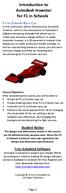 Introduction to Autodesk Inventor for F1 in Schools F1 in Schools Race Car In this course you will be introduced to Autodesk Inventor, which is the centerpiece of Autodesk s digital prototyping strategy
Government 1009: Advanced Geographical Information Systems Workshop. LAB EXERCISE 3b: Network
 Government 1009: Advanced Geographical Information Systems Workshop LAB EXERCISE 3b: Network Objective: Using the Network Analyst in ArcGIS Implementing a network functionality as a model In this exercise,
Using Microsoft Word. Working With Objects
 Using Microsoft Word Many Word documents will require elements that were created in programs other than Word, such as the picture to the right. Nontext elements in a document are referred to as Objects
ArcScan Tutorial. Copyright 1995-2012 Esri All rights reserved.
 Copyright 1995-2012 Esri All rights reserved. Table of Contents Exercise 1: Interactive vectorization........................... 3 Exercise 2: Automatic vectorization........................... 12 Copyright
How to georectify an image in ArcMap 10
 How to georectify an image in ArcMap 10 The University Library has a large collection of historical aerial photos for some North Carolina Counties ( http://www.lib.unc.edu/reference/gis/usda/index.html
Microsoft PowerPoint 2011
 Microsoft PowerPoint 2011 Starting PowerPoint... 2 Creating Slides in Your Presentation... 3 Beginning with the Title Slide... 3 Inserting a New Slide... 3 Adding an Image to a Slide... 4 Downloading Images
Understanding Raster Data
 Introduction The following document is intended to provide a basic understanding of raster data. Raster data layers (commonly referred to as grids) are the essential data layers used in all tools developed
Microsoft Office PowerPoint 2013
 Microsoft Office PowerPoint 2013 Navigating the PowerPoint 2013 Environment The Ribbon: The ribbon is where you will access a majority of the commands you will use to create and develop your presentation.
ArcGIS 3D Analyst. GIS Tutorial 10
 OBJECTIVES Load ArcGIS 3D Analyst extension Create 3D Scenes Create a TIN from contours Drape features onto a TIN Create 3D buildings Set observer and target locations Fly through a scene Create multiple
Importing and Opening an Alignment
 Chapter 6 Alignment Files An alignment defines the route of a road, utility line, water way, etc., and is typically comprised of both horizontal and vertical elements. Also, an alignment may include cross-sectional
Data Interoperability Extension Tutorial
 Data Interoperability Extension Tutorial Copyright 1995-2010 Esri All rights reserved. Table of Contents About the Data Interoperability extension tutorial...................... 3 Exercise 1: Using direct-read
Introduction to Autodesk Inventor for F1 in Schools
 F1 in Schools race car Introduction to Autodesk Inventor for F1 in Schools In this course you will be introduced to Autodesk Inventor, which is the centerpiece of Autodesk s Digital Prototyping strategy
Tutorial for Tracker and Supporting Software By David Chandler
 Tutorial for Tracker and Supporting Software By David Chandler I use a number of free, open source programs to do video analysis. 1. Avidemux, to exerpt the video clip, read the video properties, and save
Using Spreadsheets, Selection Sets, and COGO Controls
 Using Spreadsheets, Selection Sets, and COGO Controls Contents About this tutorial... 3 Step 1. Open the project... 3 Step 2. View spreadsheets... 4 Step 3. Create a selection set... 10 Step 4. Work with
INTRODUCTION to ESRI ARCGIS For Visualization, CPSC 178
 INTRODUCTION to ESRI ARCGIS For Visualization, CPSC 178 1) Navigate to the C:/temp folder 2) Make a directory using your initials. 3) Use your web browser to navigate to www.library.yale.edu/mapcoll/ and
Help Document for WWW.SAGIS.ORG. Step by step, how-to instructions for navigating and using the Savannah Area GIS viewer.
 Help Document for WWW.SAGIS.ORG Step by step, how-to instructions for navigating and using the Savannah Area GIS viewer. 1 SAGIS Savannah Area GIS is focused on providing access to Geospatial data in a
Introduction to Word 2007
 Introduction to Word 2007 You will notice some obvious changes immediately after starting Word 2007. For starters, the top bar has a completely new look, consisting of new features, buttons and naming
Creating Drawings in Pro/ENGINEER
 6 Creating Drawings in Pro/ENGINEER This chapter shows you how to bring the cell phone models and the assembly you ve created into the Pro/ENGINEER Drawing mode to create a drawing. A mechanical drawing
Sharing Presentations, Documents, and Whiteboards
 Chapter 19 19 Sharing Presentations, Documents, and Whiteboards Your user role in an event determines your level of sharing. Whichever role you take, the following table describes the basic tasks associated
House Design Tutorial
 Chapter 2: House Design Tutorial This House Design Tutorial shows you how to get started on a design project. The tutorials that follow continue with the same plan. When we are finished, we will have created
Getting Started With LP360
 Getting Started With LP360 10/30/2014 1 Contents What is LP360?... 3 System Requirements... 3 Installing LP360... 4 How to Enable the LP360 Extension... 4 How to Display the LP360 Toolbar... 4 How to Import
Sweet Home 3D user's guide
 1 de 14 08/01/2013 13:08 Features Download Online Gallery Blog Documentation FAQ User's guide Video tutorial Developer's guides History Reviews Support 3D models Textures Translations Forum Report a bug
Contents. The OWRB Floodplain Viewer. Creating Maps... 8. Helpful Tips... 10
 Contents QUICK START GUIDE... 2-5 Add layers...9 Search for Layers...9 COMPREHENSIVE GUIDE... 6 Navigate the map...6 Locate specific places...6 Add layer from file...9 Add layer from web...9 Display pop-up
HOW TO VIEW AND EDIT PICTURES
 Get started Shutterfly can help you make your pictures look their best. We re going to show you the different ways to view and edit your pictures using our easy-to-use tools. To begin, sign in to your
Excel 2007 Basic knowledge
 Ribbon menu The Ribbon menu system with tabs for various Excel commands. This Ribbon system replaces the traditional menus used with Excel 2003. Above the Ribbon in the upper-left corner is the Microsoft
2013 Getting Started Guide
 2013 Getting Started Guide The contents of this guide and accompanying exercises were originally created by Nemetschek Vectorworks, Inc. Vectorworks Fundamentals Getting Started Guide Created using: Vectorworks
SolidWorks. SolidWorks Teacher Guide. and Student Courseware
 SolidWorks SolidWorks Teacher Guide and Student Courseware SolidWorks Corporation Outside the U.S.: +1-978-371-5011 300 Baker Avenue Fax: +1-978-371-7303 Concord, Massachusetts 01742 USA Email: [email protected]
Plotting: Customizing the Graph
 Plotting: Customizing the Graph Data Plots: General Tips Making a Data Plot Active Within a graph layer, only one data plot can be active. A data plot must be set active before you can use the Data Selector
Publishing Geoprocessing Services Tutorial
 Publishing Geoprocessing Services Tutorial Copyright 1995-2010 Esri All rights reserved. Table of Contents Tutorial: Publishing a geoprocessing service........................ 3 Copyright 1995-2010 ESRI,
Geodatabase Tutorial. Copyright 1995-2010 Esri All rights reserved.
 Copyright 1995-2010 Esri All rights reserved. Table of Contents A quick tour of the Building a geodatabase tutorial..................... 3 Exercise 1: Organizing your data in the Catalog......................
Modeling Fire Hazard By Monica Pratt, ArcUser Editor
 By Monica Pratt, ArcUser Editor Spatial modeling technology is growing like wildfire within the emergency management community. In areas of the United States where the population has expanded to abut natural
Raster: The Other GIS Data
 04-Raster_Tutorial_Arcgis_93.Doc Page 1 of 11 Raster: The Other GIS Data Objectives Understand the raster format and how it is used to model continuous geographic phenomena Understand how projections &
ArcGIS Tutorial: Adding Attribute Data
 ArcGIS Tutorial: Adding Attribute Data Introduction A common need in GIS is to map characteristics, or attributes, of different geographic areas. These maps are called thematic maps. Examples of thematic
Tutorial 3 - Map Symbology in ArcGIS
 Tutorial 3 - Map Symbology in ArcGIS Introduction ArcGIS provides many ways to display and analyze map features. Although not specifically a map-making or cartographic program, ArcGIS does feature a wide
Working with the Raster Calculator
 Working with the Raster Calculator The Raster Calculator provides you a powerful tool for performing multiple tasks. You can perform mathematical calculations using operators and functions, set up selection
Open icon. The Select Layer To Add dialog opens. Click here to display
 Mosaic Introduction This tour guide gives you the steps for mosaicking two or more image files to produce one image file. The mosaicking process works with rectified and/or calibrated images. Here, you
A Workflow for Creating and Sharing Maps
 A Workflow for Creating and Sharing Maps By Keith Mann, Esri What You Will Need Item Source ArcGIS Online for Organizations subscription ArcGIS 10.1 for Desktop (Any license level) ArcGIS Spatial Analyst
Working With Animation: Introduction to Flash
 Working With Animation: Introduction to Flash With Adobe Flash, you can create artwork and animations that add motion and visual interest to your Web pages. Flash movies can be interactive users can click
Image Draping & navigation within Virtual GIS
 Image Draping & navigation within Virtual GIS Draping of Geo Corrected data such as aerial imagery or map data enables virtual 3D field tours to be conducted in an area of interest. This document covers
Web Editing Tutorial. Copyright 1995-2010 Esri All rights reserved.
 Copyright 1995-2010 Esri All rights reserved. Table of Contents Tutorial: Creating a Web editing application........................ 3 Copyright 1995-2010 Esri. All rights reserved. 2 Tutorial: Creating
Use Geodatabase Subtypes and Attribute Domains for Automatic Validation Tutorial
 Use Geodatabase Subtypes and Attribute Domains for Automatic Validation Tutorial By Marnel Taggart and Mike Ridland, ESRI Educational Services Overview This tutorial supplements the article Use Geodatabase
Adding Animation With Cinema 4D XL
 Step-by-Step Adding Animation With Cinema 4D XL This Step-by-Step Card covers the basics of using the animation features of Cinema 4D XL. Note: Before you start this Step-by-Step Card, you need to have
Figure 3.5: Exporting SWF Files
 Li kewhatyou see? Buyt hebookat t hefocalbookst or e Fl ash + Af t eref f ect s Chr i sjackson ISBN 9780240810317 Flash Video (FLV) contains only rasterized images, not vector art. FLV files can be output
Guide to Viewing Maps in Google Earth
 Guide to Viewing Maps in Google Earth The BCT made the decision to provide the GIS (Geographic Information System) resources for Bat Groups in the form of Google Earth maps because they do not require
Welcome to CorelDRAW, a comprehensive vector-based drawing and graphic-design program for the graphics professional.
 Working with layout Welcome to CorelDRAW, a comprehensive vector-based drawing and graphic-design program for the graphics professional. In this tutorial, you will create a poster for an imaginary coffee
Maplex Tutorial. Copyright 1995-2010 Esri All rights reserved.
 Copyright 1995-2010 Esri All rights reserved. Table of Contents Introduction to the Maplex tutorial............................ 3 Exercise 1: Enabling Maplex for ArcGIS and adding the Labeling toolbar............
SpaceClaim Introduction Training Session. A SpaceClaim Support Document
 SpaceClaim Introduction Training Session A SpaceClaim Support Document In this class we will walk through the basic tools used to create and modify models in SpaceClaim. Introduction We will focus on:
Excel -- Creating Charts
 Excel -- Creating Charts The saying goes, A picture is worth a thousand words, and so true. Professional looking charts give visual enhancement to your statistics, fiscal reports or presentation. Excel
Introduction to the TI-Nspire CX
 Introduction to the TI-Nspire CX Activity Overview: In this activity, you will become familiar with the layout of the TI-Nspire CX. Step 1: Locate the Touchpad. The Touchpad is used to navigate the cursor
Government 1008: Introduction to Geographic Information Systems. LAB EXERCISE 4: Got Database?
 Government 1008: Introduction to Geographic Information Systems Objectives: Creating geodatabases Joining attribute tables Attribute and location based queries Spatial joins Creating spatial and attribute
Modifying Colors and Symbols in ArcMap
 Modifying Colors and Symbols in ArcMap Contents Introduction... 1 Displaying Categorical Data... 3 Creating New Categories... 5 Displaying Numeric Data... 6 Graduated Colors... 6 Graduated Symbols... 9