
CONTACT INFORMATION ABOUT THE CATALOG
|
|
|
- Leo Morris
- 10 years ago
- Views:
Transcription
1 i
2 CONTACT INFORMATION Harrisburg University of Science & Technology Additional Location: 326 Market Street 111 S. Independence Mall East, Suite 300 Harrisburg, PA Philadelphia, PA (fax) Admissions Advancement Office Curricular Practical Training Finance & Administration Financial Aid Information Technology Office of the President Professional Development Records and Registration SENCER Student Services Library ABOUT THE CATALOG This University Catalog is updated annually and made available in electronic form on the Harrisburg University website ( The University website at also contains updated lists of courses, course descriptions, textbook adoptions, and other important information. Harrisburg University has made every effort to make this catalog accurate; however, all policies, procedures or charges are subject to change at any time by appropriate action of the faculty, administration, or Board of Trustees. Each edition of the University s catalog is archived in the library. i

3 Harrisburg University Of Science and Technology Catalog The provisions of this Catalog, and its electronic version at are not to be considered as an irrevocable contract between Harrisburg University of Science and Technology and the student. The University reserves the right to change any policy, provision or requirement at any time. This right to change a policy, provision or requirement includes, but is not limited to, the right to revise, reduce or eliminate course offerings in academic programs and to add requirements for graduation. All students are responsible for adhering to the requirements, rules, policies and procedures, whether published in this Catalog, the Student Handbook, or other official media. ii

4 TABLE OF CONTENTS Contact Information i About the Catalog i The University History 5 Mission Statement 5 Accreditation and Approvals 5 Student Responsibility 6 Statement of Community Values 6 Academic Calendar 8 Undergraduate Education Admission 12 Tuition Charges, Refund Policies, and Business Office Policies 18 Student Financial Aid Programs and Policies 23 Student Affairs 29 Academic Policies 34 Curriculum Overview 50 Learning at Harrisburg University 50 Learning Assessment at Harrisburg University 50 Competencies and eportfolio 51 Structure of the Program 51 Outline of the Baccalaureate Degree Program 54 Academic Programs 56 Analytics 56 Biotechnology 58 Computer and Information Sciences 69 Geospatial Technology 74 Interactive Media 76 Integrative Sciences 78 Management and ebusiness 96 Course Descriptions 101 Five-Year Bachelor of Science/Master of Science Programs 152 Admission and Academic Standards 152 Bachelor of Science in Analytics/Master of Science in Analytics with a concentration in Healthcare Analytics 153 Bachelor of Science in Computer and Information Sciences with a concentration in Software Engineering and Systems Analysis/Master of Science in Information Systems Engineering and Management with a concentration in Software Engineering and Systems Development 156 Bachelor of Science in Computer and Information Sciences with a concentration in Cyber Security/Master of Science in Information Systems Engineering and Management with a concentration in Information Security 159 Bachelor of Science in Interactive Media/Master of Science in Learning Technologies 162 Graduate Education Admission 165 Tuition Charges, Refund Policies, and Business Office Policies 168 Student Financial Aid Programs and Policies 172 Student Affairs 173 3

5 Graduate Education (continued) Academic Policies 176 Curricular Practical Training 180 Curriculum Overview 189 Learning at Harrisburg University 189 Learning Assessment at Harrisburg University 189 Competencies and eportfolio 189 Structure of the Program 190 Academic Programs 191 Analytics 191 Information Systems Engineering and Management 194 Learning Technologies 198 Pennsylvania Department of Education Instructional Certificate Program in Instructional Technology K Project Management 203 Course Descriptions 205 Professional and Continuing Education 225 University Administration Board of Trustees 226 Faculty 227 Corporate Faculty 227 Administration 229 University Policies and Disclosures Family Educational Rights Privacy Act (FERPA) Policy 231 Campus Crime and Security Disclosure 232 Electronic Mail Communication Policy 232 Third-Party, Web-Based [Cloud] Computer Records Policy 233 Equal Opportunity Statement 234 Non-Discrimination Grievance Procedure Federal 234 Non-Discrimination Policy - State 234 Emergency Notification System Policy 234 Peer-to-Peer File Sharing Policy 234 Campus OneCard Policy 236 Student Grievance Policy 237 AcceptableUse of Information Technology 238 Credit Card Policy 240 Intellectual Property Policy 240 4

6 Harrisburg University of Science and Technology Catalog THE UNIVERSITY HISTORY The University was incorporated in the Commonwealth of Pennsylvania on December 12, 2001, making it the first science- and technology-focused, non-profit, comprehensive university to be established in Pennsylvania in more than 100 years. Founded to address the Capital Region s need for increased educational opportunities in science, technology, engineering and mathematics (STEM) careers, Harrisburg University represents a major step to attract, educate, and retain Pennsylvania s diverse 21st century knowledge-based workforce. A grand concept that was championed by business leaders, government officials, and the regional news media, Harrisburg University was built from concept to reality in less than a decade. The Pennsylvania Department of Education granted the University its charter in An independent institution, the University offers academic and research programs designed to meet the needs of the region s youth, workforce and businesses. By aligning traditional undergraduate and graduate degrees with science and technology-based experiential learning, the University serves as a catalyst for creating, attracting an expanding economic development and opportunities in Central Pennsylvania. MISSION STATEMENT The Harrisburg University of Science and Technology is an independent educational institution offering innovative academic and research programs in science and technology that respond to the needs of the region and support its economic development, provide educational opportunity for traditionally underserved students in urban environments, and create evidence-based national models. Approved by the Board of Trustees on October 10, ACCREDITATION AND APPROVALS Harrisburg University of Science and Technology is accredited by the Middle States Commission on Higher Education, 3624 Market Street, Philadelphia, PA The Middle States Commission on Higher Education is an institutional accrediting agency recognized by the U.S. Secretary of Education and the Council for Higher Education Accreditation. Program offerings are authorized by the Pennsylvania Department of Education, Bureau of Postsecondary and Adult Education, 333 Market Street, Harrisburg, PA Approved to participate in the federal Title IV, HEA student assistance programs by the U.S. Department of Education, 400 Maryland Avenue, SW, Washington, DC Approved by the Pennsylvania Department of Education for veterans and eligible dependents to obtain education benefits through the Veteran s Administration (VA). 5

7 Harrisburg University of Science and Technology Catalog Approved by the Veterans Administration to participate in the Yellow Ribbon program. Authorized under federal law by the Department of Homeland Security U.S. Immigration and Customs Enforcement (DHS-USCIS) as an eligible institution for the Student and Exchange Visitor Information System (SEVIS) to enroll non-immigrant students. An articulation agreement with another institution of higher education permits students enrolled in certain associate degree programs to transfer credits into specific degree programs at the university. The university has articulation agreement with the following institutions: Harrisburg Area Community College Community College of Baltimore County Lehigh Carbon Community College Hussian School of Art Additional articulation agreements are being pursued with various institutions of higher education. A consortium agreement with another institution of higher education allows a student to remain enrolled at the university while also taking credits at the visiting institution. The university has a consortium agreement for certain nanobiotechnology courses with the following institution: The Pennsylvania State University University Park Campus and, the university has a consortium agreement for certain computer science courses with the following institution: Saint Francis University STUDENT RESPONSIBILITY STATEMENT A student has the responsibility to engage fully in assigned work, make connections, communicate with other members of the university community, and develop professional competencies. The University is new in both thought and ideas. The student should be a partner in this endeavor, now and in the future. It is the student s responsibility to become engaged in the University s community of learners and develop a strong professional and ethical foundation as an individual. Each student is bound by the Student Code of Conduct, which is contained in the Student Handbook. STATEMENT OF COMMUNITY VALUES Underlying the University s mission are the following basic values: the importance of personal integrity, honesty, and ethical decision making; the right of every individual to be treated with respect and dignity as a member of a learning organization; freedom of intellectual inquiry in the pursuit of truth, even if it defies commonly understood theories; acceptance and appreciation of human diversity regarding race, gender, religion, sexual orientation, age, ability, ethnicity, and political views; 6

8 Harrisburg University of Science and Technology Catalog freedom from violence or harassment that would interfere with or disrupt university activities; and recognition that civic engagement is a component of the intellectual development of a student and provides a path for knowledge and personal development in the service of the community. 7

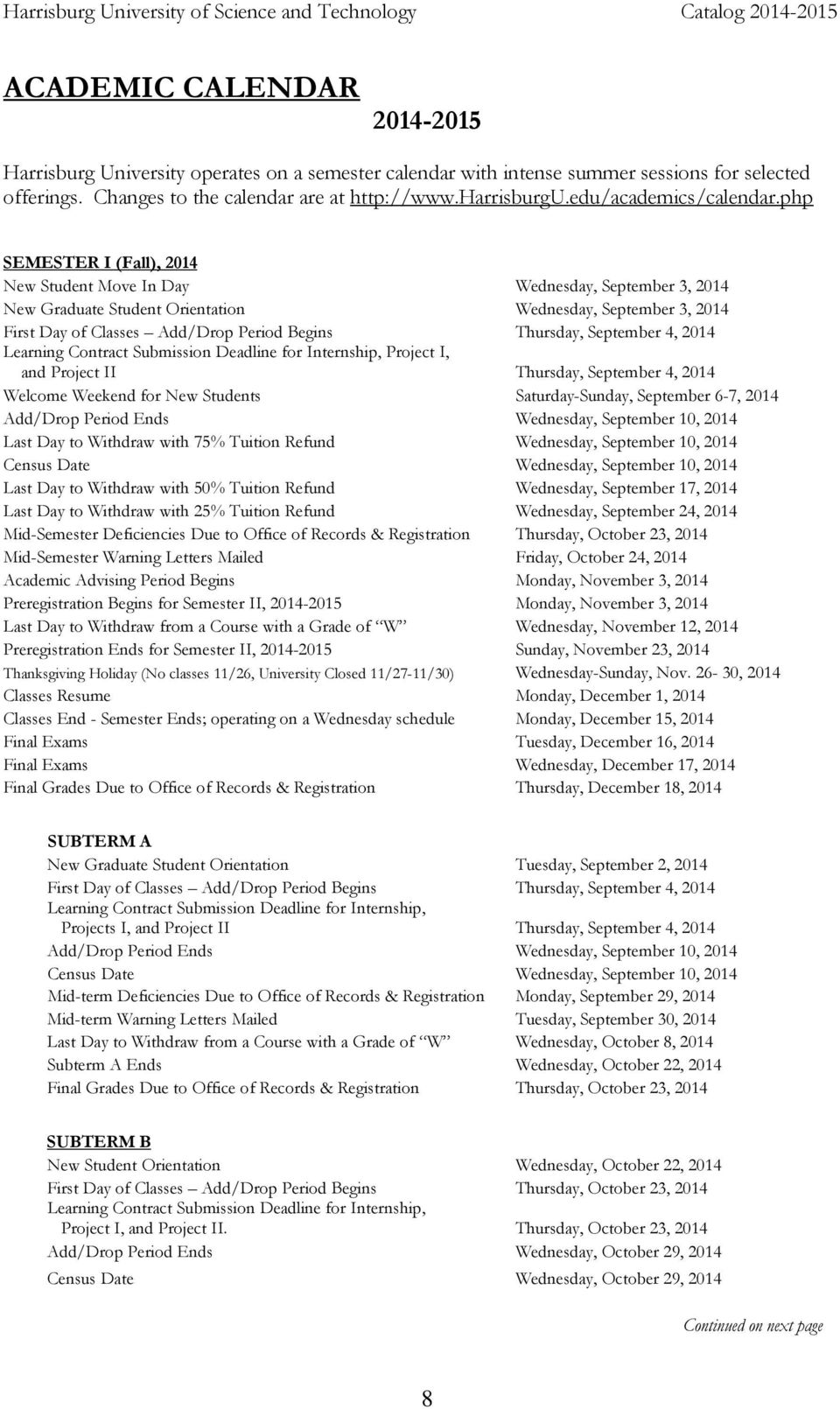
9 Harrisburg University of Science and Technology Catalog ACADEMIC CALENDAR Harrisburg University operates on a semester calendar with intense summer sessions for selected offerings. Changes to the calendar are at SEMESTER I (Fall), 2014 New Student Move In Day Wednesday, September 3, 2014 New Graduate Student Orientation Wednesday, September 3, 2014 First Day of Classes Add/Drop Period Begins Thursday, September 4, 2014 Learning Contract Submission Deadline for Internship, Project I, and Project II Thursday, September 4, 2014 Welcome Weekend for New Students Saturday-Sunday, September 6-7, 2014 Add/Drop Period Ends Wednesday, September 10, 2014 Last Day to Withdraw with 75% Tuition Refund Wednesday, September 10, 2014 Census Date Wednesday, September 10, 2014 Last Day to Withdraw with 50% Tuition Refund Wednesday, September 17, 2014 Last Day to Withdraw with 25% Tuition Refund Wednesday, September 24, 2014 Mid- Deficiencies Due to Office of Records & Registration Thursday, October 23, 2014 Mid- Warning Letters Mailed Friday, October 24, 2014 Academic Advising Period Begins Monday, November 3, 2014 Preregistration Begins for II, Monday, November 3, 2014 Last Day to Withdraw from a Course with a Grade of W Wednesday, November 12, 2014 Preregistration Ends for II, Sunday, November 23, 2014 Thanksgiving Holiday (No classes 11/26, University Closed 11/27-11/30) Wednesday-Sunday, Nov , 2014 Classes Resume Monday, December 1, 2014 Classes End - Ends; operating on a Wednesday schedule Monday, December 15, 2014 Final Exams Tuesday, December 16, 2014 Final Exams Wednesday, December 17, 2014 Final Grades Due to Office of Records & Registration Thursday, December 18, 2014 SUBTERM A New Graduate Student Orientation Tuesday, September 2, 2014 First Day of Classes Add/Drop Period Begins Thursday, September 4, 2014 Learning Contract Submission Deadline for Internship, Projects I, and Project II Thursday, September 4, 2014 Add/Drop Period Ends Wednesday, September 10, 2014 Census Date Wednesday, September 10, 2014 Mid-term Deficiencies Due to Office of Records & Registration Monday, September 29, 2014 Mid-term Warning Letters Mailed Tuesday, September 30, 2014 Last Day to Withdraw from a Course with a Grade of W Wednesday, October 8, 2014 Subterm A Ends Wednesday, October 22, 2014 Final Grades Due to Office of Records & Registration Thursday, October 23, 2014 SUBTERM B New Student Orientation Wednesday, October 22, 2014 First Day of Classes Add/Drop Period Begins Thursday, October 23, 2014 Learning Contract Submission Deadline for Internship, Project I, and Project II. Thursday, October 23, 2014 Add/Drop Period Ends Wednesday, October 29, 2014 Census Date Wednesday, October 29, 2014 Continued on next page 8
10 Harrisburg University of Science and Technology Catalog SUBTERM B (continued) Mid-term Deficiencies Due to Office of Records & Registration Monday, November 17, 2014 Mid-term Warning Letters Mailed Tuesday, November 18, 2014 Last Day to Withdraw from a Course with a Grade of W Wednesday, November 26, 2014 Subterm B Ends; operating on a Wednesday schedule Monday, December 15, 2014 Final Grades Due to Office of Records & Registration Thursday, December 18, 2014 SEMESTER II (Spring), 2015 New Student Orientation Tuesday, January 6, 2015 First Day of Classes Add/Drop Period Begins Wednesday, January 7, 2015 Learning Contract Submission Deadline for Internship, Project I, and Project II Wednesday, January 7, 2015 Add/Drop Period Ends Tuesday, January 13, 2015 Last Day to Withdraw with 75% Tuition Refund Tuesday, January 13, 2015 Census Date Tuesday, January 13, 2015 Martin Luther King, Jr. Birthday (No Classes; University Closed) Monday, January 19, 2015 Last Day to Withdraw with 50% Refund Tuesday, January 20, 2015 Last Day to Withdraw with 25% Tuition Refund Tuesday, January 27, 2015 Mid- Deficiencies Due to Office of Records & Registration Tuesday, February 24, 2015 Mid- Warning Letters Mailed Wednesday, February 25, 2015 Spring Recess Monday-Saturday, March 9-14, 2015 Classes Resume Monday, March 16, 2015 Academic Advising Period Begins Monday, March 23, 2015 Preregistration Begins for III, and I, Monday, March 23, 2015 Last Day to Withdraw from a Course with a Grade of W Tuesday, March 24, 2015 Advising and Preregistration for I, Ends Sunday, April 5, 2015 Classes End - Ends; operating on a Monday schedule Wednesday, April 22, 2015 Final Exams Thursday, April 23, 2015 Final Exams Friday, April 24, 2015 Final Grades Due to Office of Records & Registration Monday, April 27, 2015 Commencement Thursday, May 7, 2015 SUBTERM A New Student Orientation Tuesday, January 6, 2015 First Day of Classes Add/Drop Period Begins Wednesday, January 7, 2015 Learning Contract Submission Deadline for Internship, Project I, and Project II Wednesday, January 7, 2015 Add/Drop Period Ends Tuesday, January 13, 2015 Census Date Tuesday, January 13, 2015 Mid-term Deficiencies Due to Office of Records & Registration Friday, January 30, 2015 Mid-term Warning Letters Mailed Monday, February 2, 2015 Last Day to Withdraw from a Course with a Grade of W Friday, February 6, 2015 Subterm A Ends Tuesday, February 24, 2015 Final Grades Due to Office of Records & Registration Wednesday, February 25, 2015 Continued on next page 9

11 Harrisburg University of Science and Technology Catalog SEMESTER II (Spring), 2015(continued) SUBTERM B New Student Orientation Tuesday, February 24, 2015 First Day of Classes Add/Drop Period Begins Wednesday, February 25, 2015 Learning Contract Submission Deadline for Internship, Project I, and Project II Wednesday, February 25, 2015 Add/Drop Period Ends Tuesday, March 3, 2015 Census Date Tuesday, March 3, 2015 Mid-term Deficiencies Due to Office of Records & Registration Friday, March 20, 2015 Mid-term Warning Letters Mailed Monday, March 23, 2015 Last Day to Withdraw from a Course with a Grade of W Friday, April 3, 2015 Subterm B Ends; operating on a Monday schedule Wednesday, April 22, 2015 Final Grades Due to Office of Records & Registration Monday, April 27, 2015 SEMESTER III (Summer), 2015 New Student Orientation Friday, May 8, 2015 First Day of Classes Add/Drop Period Begins Monday, May 11, 2015 Learning Contract Submission Deadline for Internship, Project I, and Project II Monday, May 11, 2015 Last Day to Withdraw with 75% Tuition Refund Saturday, May 16, 2015 Add/Drop Period Ends Saturday, May 16, 2015 Census Date Saturday, May 16, 2015 Last Day to Withdraw with 50% Tuition Refund Saturday, May 16, 2015 Last Day to Withdraw with 25% Tuition Refund Saturday, May 23, 2015 Memorial Day Holiday (University Closed) Monday, May 25, 2015 New Student Orientation I for I (Fall), Students Friday, June 26, 2015 Mid- Deficiencies Due to Office of Records & Registration Monday, June 29, 2015 Mid- Warning Letters Mailed Tuesday, June 30, 2015 Independence Day Holiday (no classes) Saturday, July 4 - Tuesday, July 7, 2015 Classes Resume Wednesday, July 8, 2015 New Student Orientation II for I (Fall), Students Friday, July 10, 2015 Last Day to Withdraw from a Course with a Grade of W Monday, July 20, 2015 New Student Orientation III for I (Fall), Students Friday, July 24, 2015 Academic Advising Period Reopens for Continuing Students Monday, July 27, 2015 Preregistration Reopens for Continuing Students for I, Monday, July 27, 2015 Advising and Preregistration Period for I Ends Sunday, August 2, 2015 Classes End * - Ends; operating on a Monday schedule Wednesday, August 19, 2015 Final Exams Thursday, August 20, 2015 Final Exams Friday, August 21, 2015 *Last Day of Classes Saturday classes only Saturday, August 22, 2015 Final Grades Due to Office of Records & Registration Monday, August 31, 2015 SUBTERM A New Student Orientation Friday, May 8, 2015 First Day of Classes Add/Drop Period Begins Monday, May 11, 2015 Learning Contract Submission Deadline for Internship, Project I, and Project II Monday, May 11, 2015 Add/Drop Period Ends Saturday, May 16, 2015 Census Date Saturday, May 16, 2015 Mid-term Deficiencies Due to Office of Records & Registration Thursday, June 4, 2015 Mid-term Warning Letters Mailed Friday, June 5, 2015 Last Day to Withdraw from a Course with a Grade of W Wednesday, June 10, 2015 Subterm A Ends Saturday, June 27, 2015 Continued on next page 10

12 Harrisburg University of Science and Technology Catalog SEMESTER III (Summer), 2015 (continued) SUBTERM A Final Grades Due to Office of Records & Registration Monday, June 29, 2015 SUBTERM B New Student Orientation Thursday, June 25, 2015 First Day of Classes Add/Drop Period Begins Monday, June 29, 2015 Learning Contract Submission Deadline for Internship, Project I, and Project II Monday, June 29, 2015 Add/Drop Period Ends Monday, July 6, 2015 Census Date Monday, July 6, 2015 Mid-Term Deficiencies Due to Office of Records and Registration Wednesday, July 22, 2015 Mid-term Warning Letters Mailed Thursday, July 23, 2015 Last Day to Withdraw from a Course with a Grade of W Saturday, August 1, 2015 Subterm B Ends Wednesday, August 19, 2015 Final Grades Due to Office of Records & Registration Thursday, August 20,

13 UNDERGRADUATE EDUCATION ADMISSION The University has a centralized Admissions Office to serve all prospective student applicants undergraduate, graduate and non-degree. This centralized structure honors the University s commitment to lifelong learning and to offer a more fluid and comprehensive service for those seeking access to a quality educational experience. Degree-seeking Admission Philosophy Harrisburg University of Science and Technology seeks to admit students from a variety of backgrounds. Many factors are considered in the review of applicant files. The student s motivation and interest in science or technology and academic potential, which is generally assessed by the courses completed and grades earned in secondary school, are the key elements in considering the applicant for acceptance. The applicant s interest in science and technology is evaluated by reviewing educational records and reading the goal statement that each applicant must submit as part of the application process. Undergraduate Admission Process There is no application deadline. A high school student is encouraged to apply during the fall or early spring of the senior year in high school. An adult learner is encouraged to apply at least two months prior to the start of any semester. This application process allows ample time to be accepted, develop an academic schedule, and to process financial aid applications (if applicable). Undergraduate Admission Requirements Each applicant s candidacy is evaluated once all admissions materials have been received. Offers of admission are made to qualified candidates on a rolling basis. The undergraduate admission process requires the applicant to: complete the application online at or a paper application; submit an official high school transcript or equivalent (required of applicants transferring less than 30 semester hours; encouraged of applicants transferring more than 30 semester hours). A student who has successfully completed the General Educational Development (GED) test may submit an official copy of the scores in lieu of the high school transcript. Documentation of successful completion of high school must be received prior to the end of the first semester of enrollment; submit official college transcript(s), if applicable, for any and all college, university or career/trade schools attended (whether or not academic credit was earned); submit a personal goal statement: I am interested in science and technology because This statement may be handwritten, ed or typed, and should be two to four paragraphs in length, or approximately one full page; and, submit scores from the Test of English as a Foreign Language (TOEFL) or International English Language Testing System (IELTS) when the applicant s native language is not English. For specific score requirements, see TOEFL and IELTS section at the end of this chapter. 12

14 Optional materials: be interviewed - preferably in person during a campus visit or by telephone; submit results of standardized test scores from the SAT or ACT (optional, but recommended for those in high school); and, submit a letter of recommendation (preferably from someone who can attest to the student s work ethic, motivation and strengths, or from a teacher in a subject area tied to the student s academic field of interest). Required Placement Testing In order to give the student the best opportunity for success, completion of the University s placement testing program is required of all new undergraduate students degree-seeking, nondegree-seeking or dual enrollment, regardless of full-time or part-time status. Placement tests are not an entrance examination. The tests measure skills in English, mathematics, and reading. A student who has demonstrated satisfactory achievement via college transcripts or the equivalent is exempt from the placement tests. A non-native speaker of English must substitute completion of the English placement test with the Test of English as a Foreign Language (TOEFL). Non-Degree Admission Philosophy The University offers various non-degree programs at both the undergraduate and graduate levels, in the form of individual courses, a specialized series of courses, and certificates. hours earned become part of the student s academic record and can be applied to a degree as defined by the appropriate policy and program requirements. The University also offers professional development experiences in the form of certificate options, workshops, and seminars which can be taken on a non-credit or audit basis. In some cases, courses may have prerequisites which must be met prior to registration. Undergraduate Non-Degree Admission Process There is no application deadline. An applicant is encouraged to apply at least two months prior to the start of a session or course to allow ample time to develop a finalized course registration. Each applicant s candidacy is evaluated once all admissions materials have been received. The undergraduate non-degree admission process requires the applicant to: complete the non-degree application online at or a paper application; and, submit scores from the Test of English as a Foreign Language (TOEFL) or International English Language Testing System (IELTS) when the applicant s native language is not English. For specific score requirements, see TOEFL and IELTS section at the end of this chapter. If required by a specific certificate or non-degree program, submit official college transcript(s) for any college, university or career/trade schools attended (whether or not academic credit was earned). 13

15 Some non-degree programs may require evidence of completion of an associate or bachelor degree program. A candidate who has not yet earned at least an associate degree may be asked to take and successfully pass the required placement tests. Undergraduate Non-Degree Policies A student may enroll in up to 21 semester hours under the non-degree status when taking individual courses. Beyond 21 semester hours, a student must apply for full degree status. Non-degree admission does not guarantee admission into a degree-seeking program. A non-degree student must maintain a 2.00 grade point average to continue from semester to semester. Dual Enrollment Program A student may enroll in courses at the University to earn college credit while still in high school. This program provides a student the opportunity to be introduced to the college environment, explore majors, and get a head start on a Bachelor of Science degree. Application Timeline An application for acceptance into the Dual Enrollment Program is required. There is no application deadline. Application files are reviewed within two weeks of submission. The applicant is encouraged to apply as soon as possible and coordinate the application with the appropriate high school personnel (often the Guidance Office) prior to high school course selection for the appropriate semester. Dual Enrollment Admission Requirements for a Student from a Sponsoring School District The Dual Enrollment admission process requires the applicant to: complete the application online at or via a paper application; submit an official high school transcript showing a minimum cumulative GPA of 2.75 on a 4.00 scale; successfully complete the placement examination administered by the University, as required; submit consent forms from high school guidance department and parent or legal guardian; and, submit scores from the Test of English as a Foreign Language (TOEFL) or International English Language Testing System (IELTS) when the applicant s native language is not English. For specific score requirements, see TOEFL and IELTS section at the end of this chapter. Dual Enrollment Policies for a Student from a Sponsoring School District A dual enrollment agreement with the sending school district is required. A dual-enrolled student may enroll in as many courses as the sending district approves; however, only 6 semester hours may be taken at the agreed upon dual-enrolled price. hours greater than 6 will be charged at the prevailing semester hour rate. Under the terms of the formal agreement with the school district, the 14
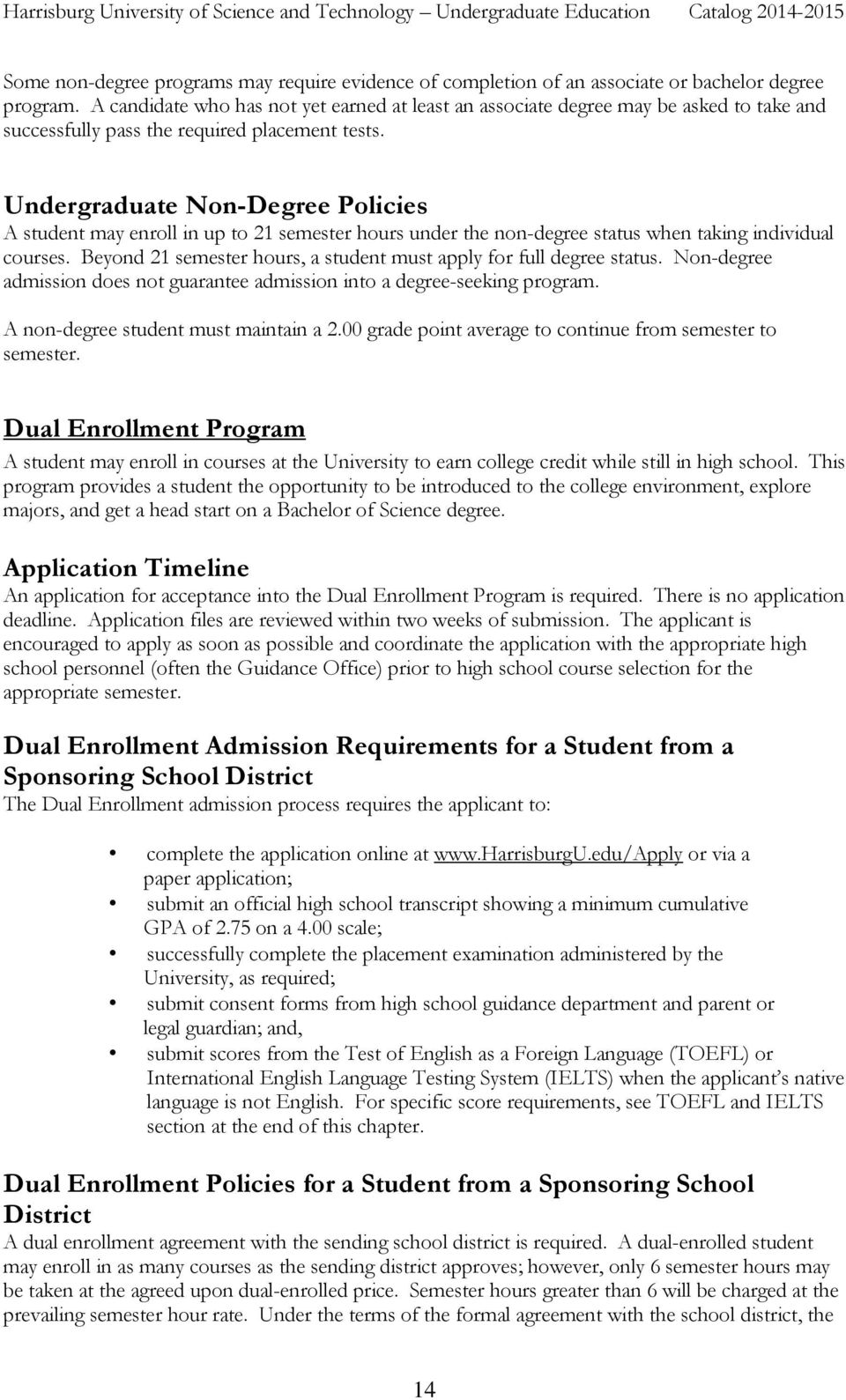
16 district must agree to assume the additional semester hour cost when the student enrolls in more than 6 semester hours. A laptop computer is required for dual enrollment study and the student must also obtain any required textbooks and supplies, if any, prior to the start of the semester. A Parent Consent Form must be signed by the student and a parent or guardian, which provides various required releases protecting the University s interests. An applicant desiring to enroll full-time, 12 or more semester hours, must apply under the Early College Program policy. Dual Enrollment Admission Requirements for a Student Without a Sponsoring School District The Dual Enrollment admission process requires the applicant to: complete the application online at or a paper application; submit an official high school transcript or equivalent showing a minimum cumulative GPA of 2.75 on a 4.00 scale; successfully complete the placement examination administered by the University, as required; submit consent forms signed by a parent or legal guardian; and, submit scores from the Test of English as a Foreign Language (TOEFL) or International English Language Testing System (IELTS) when the applicant s native language is not English. For specific score requirements, see TOEFL and IELTS section at the end of this chapter. Dual Enrollment Policies for a Student Without a Sponsoring School District A dual enrollment agreement with the parent or guardian is required. A dual-enrolled student may enroll in as many courses as the parent or guardian approves; however, only 6 semester hours may be billed at the agreed upon reduced dual-enrolled price. hours greater than 6 will be charged at a semester hour rate. Under the terms of the formal agreement, the parent or guardian must agree to assume the additional semester hour cost when the student enrolls in more than 6 semester hours. A laptop computer is required for dual enrollment study and the student must also obtain any required textbooks and supplies, if any, prior to the start of the semester. A Parent Consent Form must be signed by the student and a parent or guardian, which provides various required releases protecting the University s interests. An applicant wishing to enroll full-time, 12 or more semester hours, must apply under the Early College Program policy. Early College Program (ECP) A high school student who wishes to attend college on a full-time basis prior to receiving a high school diploma must be admitted under the Early College Program policy. The applicant must show 15

17 strong academic preparation and personal maturity as exhibited by the high school transcript, placement test scores, and a personal interview to qualify for the Early College Program. Application Timeline There is no application deadline. Application files are reviewed within two weeks of completion. The applicant is encouraged to apply as soon as possible and coordinate the application with the appropriate high school personnel, often the guidance counselor. Early College Program Requirements The Early College Program admission process requires the applicant to: complete the full-time undergraduate application; submit an official high school transcript showing a minimum cumulative grade point average of 3.30 on a 4.00 scale; successfully complete the placement examination administered by the University. submit written approval from the school district or diploma program describing the required plan of study necessary to complete the high school curriculum by the conclusion of the first two semesters of study at the University; schedule an interview for admission; and, submit a consent form from the high school guidance department endorsed by the parent or legal guardian. Early College Program Policies Participation in the Early College Program is contingent upon results of the placement test and the availability of the course(s) in which the applicant plans to enroll. A student admitted to the Early College Program without a high school diploma is not eligible for Federal and State financial assistance. Tuition funding for the Early College Program may come from a sponsoring school district. In which case, a dual enrollment contract must be completed with the district. The traditional dual enrollment policies and rates apply. An independent student who is not from a sponsoring school district will be billed for 6 semester hours at the dual enrollment rate and the prevailing semester hour tuition rate for semester hours in excess of 6. International Students An international student planning to attend the University on a student (F-1) visa must satisfy the appropriate admissions requirements and procedures, demonstrate proficiency in the English language, and provide an affidavit of financial support. Academic records should include courses studied, grades earned, diplomas, certificates, and results of comprehensive national examinations. A demonstration of English language proficiency is required of any student who is not a United States citizen. Acceptable demonstrations would include one of the following: completing a college degree from a regionally accredited United States institution, earning a score of 4.0 or higher on the Analytical Writing section of the Graduate Record Examination (GRE), earning a TOEFL score of 80 or higher on the web-based version, or 16
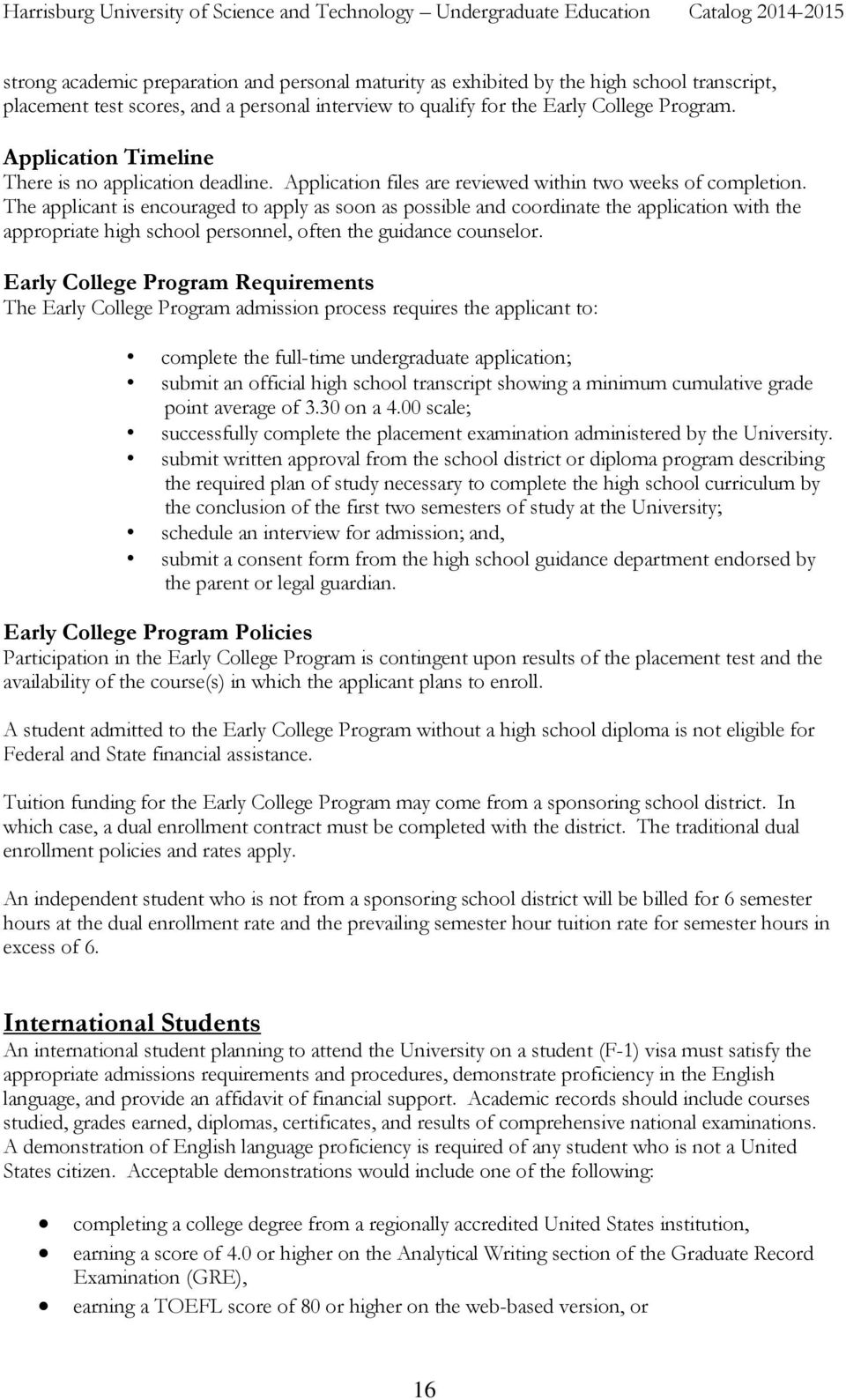
18 earning an IELTS score of 5.0 or higher. Harrisburg University of Science and Technology is approved by the Department of Homeland Security U.S. Customs and Immigration and Enforcement (DHS-USCIS) as an eligible institution for the Student and Exchange Visitor Information System (SEVIS). This approval allows an international student to apply for entry into the United States for study on an F-1 visa only after an Affidavit of Financial Support is deemed sufficient by the university and a tuition deposit payment of at least $1,000 toward the first semester s tuition has been received. A USCIS Form I-20 is then certified and submitted to SEVIS. The SEVIS application fee of $200 is then paid by the student directly to SEVIS. Following entry into the United States and arrival at the university, the student will be required to provide a copy of the passport, I-20 Certificate of Eligibility, and the Form I-94 departure record to confirm all identification information in SEVIS. An international student does not qualify for Federal, State, or institutional aid awards. Private education loans through participating lenders may be available, if eligible. Test of English as a Foreign Language (TOEFL) or International English Language Testing System (IELTS) An applicant whose native language is not English must submit scores from the Test of English as a Foreign Language (TOEFL) or International English Language Testing System (IELTS). Information on the TOEFL can be found at A minimum score of 80 on the Web-based version, or the equivalent (200 computer, 520 paper), must be earned on the TOEFL. Information on the IELTS can be found at A minimum score of 5.0 must be earned on the IELTS. Readmission The Readmission Application Form is available at the Office of Records and Registration and must be completed and submitted to that office. A student who was in good academic standing, had satisfied all financial obligations to the University at the time of withdrawal, and had no disciplinary sanctions imposed will be readmitted. The application of a student who left the University on academic probation or dismissal will be reviewed by the Provost, who will make the readmission decision. 17
19 TUITION CHARGES, REFUND POLICIES AND BUSINESS OFFICE POLICIES All undergraduate tuition, charges and policies listed in this publication are effective as of July 1, 2014 and are subject to change, without notice, by the University s Board of Trustees. Admission Application Charge There is no charge to apply for admission to the University. Tuition Deposit A non-refundable tuition deposit of $150 must be paid in advance of final course registration for the initial semester of attendance. A tuition deposit made for I (Fall) is non-refundable after May 1, A deposit for II (Spring) is non-refundable after November 1, Tuition Schedule Tuition payment or satisfactory arrangement to pay tuition due is required before the first day of class. Tuition is charged at the per semester hour rate shown below. Full-time tuition charges are for 12 to 17 semester hours. A student who registers for more than 17 semester hours is subject to additional tuition costs at the per-semester hour rate (for example, tuition charged for 18 semester hours will be $11,950 + $1,000 or $12,950). A student who registers for 11 semester hours or fewer is charged the per semester hour rate multiplied by the number of registered semester hours. Undergraduate Registration Schedule per Full-Time Tuition (12 17 Hours) Hour Rate (1-11 semester hours or 18 or more) $11,950 $1,000 See the Academic Calendar for withdrawal deadlines. Financial Aid Counseling and Financial Clearance Date The student is encouraged to apply for federal and state grant program funding to determine the student s eligibility. A student seeking federal or state financial aid program assistance is required to contact the Office of Financial Aid at least 30 days prior to the start of a semester to complete the application process, submit all required documents and materials requested, and finalize a financial assistance plan by the end of the Add/Drop Period. A student whose financial assistance plan is not finalized by the end of the Add/Drop Period will not be allowed to attend class. Tuition Payments Payments may be made in the Business Office by cash, check, or money order. A preregistered student can view account information online. Electronic payments must be made online via the Finance page of MyHU. A convenience fee of 2.75% will be added for any credit/debit card transactions involving student tuition payments or other services. Online ACH/electronic check payments will not incur a convenience fee. 18

20 Tuition Payment Plans A monthly, interest-free payment plan is offered to the student and or parent to make four (4) monthly installment payments during the semester. There is an enrollment fee of $50 per semester for this service. A student may enroll in a payment plan via the Finance page of MyHU. Many employers offer employees a tuition reimbursement benefit. Because reimbursement is usually dependent upon the employee s proof of grade completion, an Employee Deferred Payment (EDP) plan permits a student s allowable tuition payment to be deferred until the end of the semester. The service fee for the plan is $50 per semester. The application form is available online at the Finance page of MyHU. Laptop Computer A laptop computer with wireless capability is required for attendance in all programs of study and should be obtained prior to the first day of class. Minimum requirements are listed on the University s website: The cost is approximately $700 to $1,200. Textbooks Textbooks and other supplies (if specified for a course) must be obtained by the student prior to the first day of class. Textbooks may include both hard- and soft-bound books, journals, CDs, or software. Supplies may include a laboratory coat, goggles, gloves or any other required item specified. The estimated cost for textbooks and other supplies per course is $100. Prior Learning Assessment Charge A student who submits an application for prior learning assessment is charged a semester hour amount of $225. This charge is imposed at the time of application. No refund will be made if the application is unsuccessful. Other Charges Tuition Payment Late Charge - A late payment charge of $150 will be assessed if the student fails to make payment arrangements or pay tuition on or before the first day of the semester or term. Returned Check Charge - A charge of $20 will be assessed if a check processed for payment is returned by the issuing bank. OneCard Replacement Charge - Upon enrollment, a student receives, at no cost, a photoimprinted OneCard to be used as an identification badge, as a library card, and for building and elevator access. A student is required to wear the OneCard badge when on campus. If a OneCard is lost or stolen, a charge of $25 is assessed to replace the card. Late Registration Charge A charge of $50 will be assessed if the student registers for a course after the Add/Drop Period has ended. Pay to Print Charge On-campus printing is available to the student. A charge may be assessed depending upon the nature of the print job: paper size, ink color, and quantity. 19

21 Enrollment Status Determination and Financial Aid Payments A student s enrollment status is determined at the end of the Add/Drop Period. The student is charged the applicable tuition rate for the number of semester hours in which the student is enrolled. Federal student financial aid program assistance for which the student may be eligible is then calculated and paid, in accordance with regulations, based on the student s enrollment status. Direct student loans and PLUS loans for first-time students are scheduled for disbursement on or after the 31 st calendar day from the first day of the semester. University merit and need-based grants and scholarships, if any, are credited to the student s account in week 4 or thereafter during the semester. Advance payment of an estimated credit balance resulting from anticipated institutional financial aid awards is prohibited. Refund Policy for Traditional s A student who withdraws from the University prior to the end of the third week of the semester may be due a credit for the unearned portion of the tuition charge. The rate of tuition refund for withdrawal from the University is as follows: prior to the first day of a semester 100% during the first week 75% during the second week 50% during the third week 25% after the third week 0% Tuition Refund Policy Tuition for the semester is considered fully-earned at the end of the third week of classes. For refund purposes, the semester begins on the first day of class for that semester, regardless of the student s first class day of attendance during week one. The period of time used to calculate the tuition refund is the first day of class of the semester to the University s determination date of official or unofficial withdrawal. There will be no refund or additional charges for a student who adds and drops an equal number of semester hours within the same semester prior to the end of the Add/Drop Period. If a student reduces the number of courses and/or semester hours during the published Add/Drop Period, a tuition adjustment for that course or semester hour reduction will be made, except the student maintains full-time enrollment status with 12 semester hours or more. There is no tuition refund when a student withdraws from one or more courses after the Add/Drop Period but remains enrolled in one or more other scheduled courses. A scholarship payment received from a company or organization is applied to the student s tuition balance. The refund policy does not apply separately to the various types of payments credited to the student s account. Official Withdrawal Procedure A student is encouraged to contact the Financial Aid and Business Offices in advance of any decision to withdraw from the University to obtain an explanation of the tuition and financial aid adjustments that will occur, if any, as the result of withdrawal from the program of study. 20
22 A student who intends to officially withdraw is encouraged to contact the Office of Records and Registration by telephone ( ), or in person. It is recommended that a Withdrawal Form be completed or one will be completed for you. The determination date for withdrawal purposes shall either be the actual date of formal notification by the student or some future date specified by the student as the intended last date of attendance. The determination date is used to calculate the tuition refund, if any, and the student financial assistance program refund, if applicable. Unofficial Withdrawal A student who discontinues attendance in all courses during a semester and does not officially withdraw from the University is considered to have unofficially withdrawn. The determination date for unofficial withdrawals shall be the end of the semester, unless other evidence is provided to the Office of Records and Registration. There are serious federal student financial aid program implications for a student who unofficially withdraws, as explained below. Federal Student Financial Aid Program Refund Calculation Refunds are calculated upon official withdrawal from all classes and, if the student was deemed eligible for Title IV, HEA student financial assistance program funds, any refund due will be paid within 45 days from the date the student is determined to have withdrawn. A student who officially withdraws before the 60 percent point in time of the semester will incur an adjustment to the amount of financial aid program funds awarded and/or disbursed for the term based on the percentage of time attended from the first day of class to the University s determination date of withdrawal. If a student officially withdraws during or after week 10 of the 14-week semester, 100 percent of the student s financial assistance program awards are considered earned and will be applied to the total amount of institutional charges due for the term. For a student who unofficially withdraws during a semester, the withdrawal date shall be the end of the semester. The student is then responsible for all tuition charges due resulting from this reduction in awards and/or payments previously credited to the student s account. Institutional Financial Assistance Awards, Payments and Refunds Merit- and need-based financial aid assistance awarded by the University for a semester are earned ratably through week 9 of the 14-week academic term, similar to the federal student assistance program refund calculation described above. While payments of institutional aid may be credited to the student s account on or after week 4 of a semester, the student must remain enrolled through week 9 of the semester to fully earn the award. For example, a student with a merit award of $2,000 who officially withdraws in week 6 of the 14- week semester would only have $800 of institutional financial aid assistance applied toward tuition due for the term [$2,000 x 6/14 = $857]. The difference of $1,143 is rescinded and the student is responsible for any remaining tuition balance due. Refunds for Sub-Terms Course Charge Various courses are offered in 7- or 8-week sessions and the student is charged for only the number of credit hours enrolled for a single course. Where applicable, a student who withdraws from the University prior to the first day of the non-standard term may be due a refund of money paid. 21
23 The rate of refund for withdrawal from the University is based on the amount charged for registered credit hours and is as follows: prior to the first day of a session 100% after the first day of class of a session 0% 22
24 STUDENT FINANCIAL AID PROGRAMS & POLICIES The Office of Financial Aid assists qualified applicants who, without assistance, would otherwise be unable to pursue a post-secondary education. The Free Application for Federal Student Aid (FAFSA) and resulting need analysis is used to apply for federal, state and institutional award consideration for payment of tuition, housing, or other charges. A student must apply each year to renew financial aid eligibility. The amount of financial aid awarded will reflect changes in tuition, housing, or other costs and updates to the financial profile of the student and family. All students are encouraged to apply for federal and state grant program funding to determine the student s eligibility. A student seeking federal or state financial aid program assistance is required to contact the Office of Financial Aid at least 30 days prior to the start of a semester to complete the application process, submit all required documents and materials requested, and finalize a financial assistance plan by the end of the Add/Drop Period. A student whose financial assistance plan is not finalized by the end of the Add/Drop Period will not be allowed to attend class. Financial aid awards are based on the enrollment status of the student during a semester as of the conclusion of the Add/Drop Period, defined as: Full-time Three-quarter time Half-time Less than half-time 12 or more semester hours 9 through 11 semester hours 6 through 8 semester hours 1 through 5 semester hours Required enrollment status for federal, state and university financial aid awards: Program Full-time Half-time Less than Half-time Pell Grant Yes Yes Yes FSEOG Yes Yes Yes Direct Loan Yes Yes Not eligible PA State Grant Yes Yes Not eligible HU Merit Aid Yes No No HU Gift Aid Yes No No Funded Scholarships Yes No No A non-degree or non-credit student is not eligible for financial aid. 23
25 Progress toward a Degree A student is classified based upon the number of semester hours completed and reported to the Office of Records and Registration. The classification is based on credits completed, not attempted, and does not include courses for which one of the following grades has been assigned: I, IP, NR or F. First Year fewer than 25 semester hours earned Second Year greater than or equal to 25 semester hours earned but less than 60 Third Year greater than or equal to 60 semester hours earned but less than 90 Fourth Year greater than or equal to 90 semester hours earned Aid Sources Federal Pell Grant - The Federal Pell Grant is awarded based on a federal formula using the information provided on the Free Application for Federal Student Aid (FAFSA). Awards for a fulltime student vary from $600 - $5,730 for the academic year, depending on financial need. Federal Supplemental Educational Opportunity Grant (SEOG) - A limited amount of funds from the SEOG program are available to supplement a Pell-eligible student with exceptional need. Awards vary depending on need and fund availability. Federal Direct Loan - There are two types of Federal Direct loans: subsidized and unsubsidized. The subsidized loan is interest-free while the student is in school, and is awarded based on financial need. Interest accrues on the unsubsidized loan while the student is enrolled in school. The borrower may opt to pay it as it accrues, or allow it to accrue and capitalize. The unsubsidized loan is a non-need based loan program. The maximum subsidized Direct loan per academic year is $3,500 for first-year students, $4,500 for second-year students, and $5,500 for third-year students and beyond. A dependent student may borrow an additional $2,000 unsubsidized per year. An independent student may borrow an additional $6,000 unsubsidized loan per year as a first-year and second-year student, and an additional $7,000 per year as a third-year student and beyond. Federal Parent Loan for Undergraduate Students (PLUS) Loan - The PLUS is available for parents of an undergraduate student through the Direct Loan program. A parent may borrow up to the cost of attendance less any other financial aid received. Repayment begins 60 days after this loan is fully disbursed. Federal Work-Study An eligible student can seek part-time employment either on-campus or in community service positions off-campus. A student may work up to 20 hours per week during a semester and up to 35 hours per week when classes are not in session. Pennsylvania Higher Education Assistance Agency (PHEAA) State Grants & Special Programs PHEAA State Grants are awarded to eligible Pennsylvania residents based on need. Estimated awards will vary from $200 to $4,200 for the academic year. A student applies for the State Grant by completing the FAFSA. Renewal applicants must apply before PHEAA s May 1 deadline. Information from the FAFSA is automatically submitted to PHEAA. After the initial application is filed, students and parents should respond 24
26 directly to the PHEAA Grant Division if additional information is required to process the state grant award. Other special programs are offered to eligible applicants as determined by PHEAA. An official high school transcript, or equivalent, may be required to evaluate an applicant s eligibility for these programs. Other Programs The following federal, state or private financial aid sources are available to a student based upon the individual s affiliations or experiences. Veterans Administration Education Benefits Pennsylvania Office of Vocational Rehabilitation Job Training Agencies Employer Sponsorship Institutional Grant and Scholarship Programs The University offers a variety of merit- and need-based grant assistance programs for full-time enrollment status during a semester. First-year student merit awards are determined using the record of high school achievement. An official high school transcript, or equivalent, is required to evaluate an applicant s eligibility for these programs. Renewal provisions apply to merit-based awards for subsequent year funding. Need-based grants are awarded to a student who has remaining need after receiving available federal and state grant sources of aid and borrow a Direct loan and/or PLUS loan for the academic year. Award amounts are discretionary and may change from year to year. Although a student may meet the criteria for multiple gift aid grant awards, receiving any particular award is not assured. Several scholarship awards are made through funded programs coordinated by the Office of Financial Aid. Satisfactory Academic Progress for Financial Aid Recipients Satisfactory academic progress (SAP) for federal Title IV, Higher Education Act (HEA) student financial aid program assistance is defined as the minimum progress required toward the completion of a degree, and must be maintained in order to receive federal and institutional financial aid. The Pennsylvania State Grant Program, administered through PHEAA, has different criteria to determine academic progress. Federal regulations require the University to establish standards of academic progress in both of the following areas: the student s cumulative grade point average, the qualitative measure; and, the maximum time limit for completing the program of study, the quantitative measure. Satisfactory academic progress is evaluated at the end of each semester. Financial aid recipients must maintain the standards in both areas, regardless of whether aid was received in the past. A student who does not meet one or both of the standards is not making satisfactory progress until the standards are met. A student who is academically eligible to continue enrollment at the University, but does not meet the standards of academic progress, may remain enrolled without financial aid until eligibility to receive financial aid is reestablished. A student should contact the Office of Financial Aid to discuss 25
27 strategies for meeting the standards and to inquire about options for financial assistance that are not subject to the satisfactory academic progress requirements. Academic Standing and Financial Aid Eligibility (qualitative) - A student with a cumulative grade point average of 2.00 or higher is in satisfactory academic standing. If a student has a cumulative grade point average below 2.00 at the end of a semester, the student has failed to meet the minimum satisfactory academic progress standard and is subject to the warning, probation or dismissal sanction, as applicable, as stated below. If at any time the cumulative grade point average falls below 1.00, the University reserves the right to dismiss the student. Program Pursuit - Maximum Timeframe for Completing the Program of Study (quantitative) - A full-time student must successfully complete a program of study within one- and one-half times the normal time frame in semester hours attempted to continue to receive Title IV, HEA student financial aid program assistance. More simply stated, program pursuit requirements for a normal 4-year, 8 semester program consisting of 120 semester hours must be completed successfully within 6 years (i.e., 12 semesters, 150 semester hours) to maintain eligibility for federal financial aid program assistance throughout the program of study. A student who is enrolled less than full-time will have the policy applied on a pro-rata basis in accordance with enrollment status. The quantitative measure of satisfactory academic progress is measured using the following calculation: Total Earned Hours Total Attempted Hours = a percentage (%) The calculated percentage each semester is compared to the following chart to determine if the student has achieved satisfactory academic standing: Minimum Percentage of Earned Credit Hours Required 1 25% 2 40% 3 40% 4 50% 5 50% 6 60% 7 60% 8 75% 9 75% 10 85% 11 85% % 26
28 This chart shows the need to complete an average of semester hours each semester to complete a full-time 120 semester hour degree program of study within one- and one-half times the normal time frame: Normal Time Frame Number of s Avg. # of Sem. Hrs. Per Maximum Attempted Sem. Hrs. Maximum Number of s Avg. # of Sem. Hrs. Must Be Completed Per Degree Programs: 120 semester hours Failure to Meet One of the Required Satisfactory Academic Progress Standards A student who fails to meet either the qualitative or quantitative measure of satisfactory academic progress at the end of a semester is subject to warning, probation, or dismissal according to the following policy: First Occurrence - Warning A letter shall be issued placing the student on financial aid warning status for the subsequent semester. No appeal is needed, but an academic plan may be required. The student remains eligible for financial aid program assistance during the warning semester. Second Consecutive Occurrence - Probation A letter shall be issued placing the student on probation for the subsequent semester. An academic plan is required during the probationary period. The student remains eligible for financial aid during the probation semester. Third Consecutive Occurrence - Dismissal If a student after three consecutive semesters has a cumulative grade point average that remains below 2.00 or fails to meet the program pursuit percentage, a letter of dismissal will be issued. Federal regulations provide only one remedy to the dismissal action: if evidence is presented showing that the academic plan was successfully executed, the cumulative grade point average has improved, and the required satisfactory progress grade point average can potentially be achieved within the maximum timeframe limitation required by federal regulations, then one second probation period may be granted. Transfer credit hours from another institution that are accepted toward a program of study are counted as both attempted semester hours and earned semester hours in the program pursuit calculation to determine satisfactory academic progress for Title IV, HEA student assistance program purposes. Grades for transfer credit hours are not included in the calculation of the cumulative grade point average. 27
29 hours for a grade of Incomplete (I) are counted in the total attempted semester hours in the program pursuit calculation of satisfactory academic progress for Title IV, HEA student assistance program purposes. hours for a Withdrawal grade (W) are considered attempted semester hours in the calculations of satisfactory academic progress for Title IV, HEA student assistance program purposes. When a course is repeated, the attempted credit hours are used to determine the student s enrollment status for the semester (i.e., full-time, half-time, less-than-half-time), but the repeated hours are not counted a second time as attempted credit hours in the cumulative grade point average calculation. Earned semester hours and quality points for a grade used in the cumulative grade point average calculation for a course repeat are taken from the attempt that earned the highest grade. Academic Standing and Satisfactory Academic Progress Review and Notification The University evaluates academic standing and satisfactory academic progress at the end of each semester. All students who receive federal and state financial aid must meet the standards for satisfactory academic progress in order to establish and retain student financial aid program eligibility. The University may establish academic policies that may be different than the policies governing academic warning, probation, and dismissal for institutional grant and scholarship aid and state student assistance program purposes. Written notification of financial aid ineligibility is mailed to a student at the most recently reported permanent address. Appeals A student who becomes ineligible to participate in the financial aid programs as a result of failure to meet satisfactory academic progress after the Probation period, as defined above, may file an appeal by submitting a letter outlining the nature of the appeal to the Director of Financial Aid. An appeal will be considered only if the student s failure to meet the standards of academic progress is determined to be due to events beyond the student s control. Examples of circumstances for which an appeal may be considered include: military obligation; death of a relative; injury or illness of the student; unusual personal hardship or other extenuating circumstance. Written documentation of the circumstances of why the student failed to make satisfactory progress and what has changed that will allow the student to make satisfactory progress by the next evaluation must be submitted with the appeal and should reference the student s name and student ID number. In addition, evidence must be received documenting that the required academic plan was completed, the cumulative grade point average has improved, and the required satisfactory progress grade point average can potentially be achieved to complete a program of study within the maximum timeframe limitation. Appeals submitted without documentation will not be considered. A timely determination will then be made and documented in the student s file. Re-establishing Eligibility for Federal Student Assistance Programs Following a dismissal action, a student may re-establish eligibility by earning course credit successfully at another institution that will directly transfer into the University s program of study and the required cumulative grade point average and maximum timeframe percentage for minimum satisfactory progress is achieved by the transfer credit and grades accepted. 28
30 STUDENT AFFAIRS Mission Student Services Office provides educational, personal, and professional support to promote student development and success. The Office of Student Affairs, in collaboration with other staff and faculty, enhances the mission of the University by providing an inclusive campus community, promoting leadership opportunities, and facilitating civic engagement through volunteer opportunities, clubs, and organizations. The programming and resources are designed to enhance the University s commitment to competency based learning. Orientation and Welcome Weekend A first-time student is required to participate in Orientation and Welcome Weekend. Orientation provides the student an opportunity to become familiar with the University and housing facilities, technology services, academic support services, and local entertainment, food, and transportation options. Most importantly, it provides the opportunity to meet other new students and other members of the university community Orientation sessions precede each semester. A new student entering in I (Fall) attends orientation during the summer months. A new student entering in II (Spring) or III (Summer) is required to attend an orientation session during the week prior to the start of the semester. Welcome Weekend is a series of events during the first weekend of I (Fall). The weekend includes meetings with faculty, staff and advisors, combined with social events and other activities in preparation for a successful transition to the University. Student Housing There are a variety of housing options available through local housing partners. These facilities vary from the more traditional college-style apartment setting with shared living space to the more independent, fully furnished high-rise apartment. The majority of these facilities are within a few blocks of the University. The Office of Student Affairs can assist the student to find optional housing, if necessary. Student Parking Standard Parking, Inc. (parkharrisburg.com) operates the parking facilities in Harrisburg. Prices vary by facility. Check the website for specifics. Student Activities Student activities promote and enhance leadership, involvement, and engagement with the campus community. The student can create, attend, and lead programs or clubs of specific interest with assistance and guidance of the Office of Student Affairs. Student Government Association (SGA) The SGA serves as the liaison to various campus constituent groups and advocates for the student body. The SGA encourages the student to be more active in the community, to help maintain a positive image for relationships to grow within the community, and to give direction for programs or clubs to prosper. 29
31 Health and Personal Counseling Services Medical and counseling services are not provided on campus. A full-service hospital is located three city blocks from the University. Referral contact information for a student requiring health care assistance or personal counseling services can be obtained from the Office of Student Affairs. Student Concerns and Complaints The Office of Student Affairs offers guidance to the student when uncertainty exists about the appropriate process to address a topic, concern, or problem. A request for assistance may be submitted to obtain clarification of a policy or procedure. The request is then reviewed and a recommended course of action is provided in a timely manner. Disability Support Services Harrisburg University of Science and Technology welcomes diversity among its students and, in accordance to the Americans with Disabilities Act of 1990, seeks to provide reasonable and effective support services. The Americans with Disabilities Act of 1990 and Section 504 of the Rehabilitation Act of 1973 prohibit discrimination on the basis of disability and require the university to make reasonable accommodations for those otherwise qualified individuals with a disability who request accommodations. A reasonable academic accommodation is a modification or adjustment that allows an individual to gain equal access and have equal opportunity to participate in the University s courses, services, activities, and use of the facilities. The University is not obligated to provide an accommodation that requires a substantial change in the curriculum or alteration of any essential elements or functions of a program. The applicant must provide recent documentation (within 3 years) of any disability that may affect learning to ensure that appropriate accommodations are considered. The documentation must be certified by a licensed professional in that field and include a specific diagnosis indicating the severity, a description of how the disability substantially impacts the student, and any suggested accommodation. A student may apply for an accommodation prior to admission with the requested documentation. Academic Success Academic Advising - Academic advising can be a critical component in educational progress. An advisor who is a faculty member in the program of study in which the student is enrolled is assigned to each undergraduate student. The faculty advisor guides the student to explore academic goals and assists in course selection for the academic program. The Office of Student Affairs supports the faculty role in advising; in addition, it also supports the student to access resources and develop strategies when non-academic factors affect a student s ability to achieve. First-Year Experience The first-time undergraduate student is enrolled in many of the same courses as other first-year students in the initial academic year. This creates a learning community in which the student develops a bond with other students and faculty. Additionally, the student obtains the necessary foundational skills needed for academic achievement in the program. SEMR 100 Cornerstone is designed to help the student transition to the university setting and to provide resources and guidance on how to responsibly manage all the major components of University life. One-on-One Advising and Counseling - Individual student advising is provided for the student throughout the period of enrollment. This advising is focused on academic success strategies such as 30
32 time management, study skills, career aptitude, decision making and goal setting. If Student Services staff determine that a student would benefit from personal counseling, referrals are available. A limited number of sessions may be available off-site at no cost to the student. For more information, contact [email protected]. Group Study Sessions - In some courses, when requested by the faculty, a group study session is assigned a student peer leader. Tutoring Program - A student may request the assistance of a tutor to supplement classroom instruction. The tutor usually meets individually with the student, or may be available to answer questions via , Moodle, or other means. A tutor may be requested by contacting the Office of Student Affairs. Additionally, group tutoring sessions are sometimes available; the student can attend without appointment. A student who is interested in becoming a tutor should contact the Office of Student Services. For more information, contact [email protected]. On-line Tutoring - Smarthinking is an online tutoring service that is free to the student. A student may submit an essay to a professional tutor for review or feedback, in advance of a deadline, and receive a timely response. For more information, contact [email protected] Technology Literacy Program - Technology literacy tutorials at are available to a student if technology skill improvement is needed. This site is accessed directly through Moodle, the university s course management system. Textbook Services Textbooks are made available for student purchase through the services of MBS Direct, which has an online store at for new and used textbook purchase or rentals. Textbook information is listed on the student s course schedule at the time of registration and a complete textbook listing is available on Moodle. Textbooks and other supplies (if specified for a course) must be obtained by the student prior to the first day of class. Additional online textbook purchase and rental options are available through companies such as Amazon.com and Chegg.com. Book retailers carry a small selection of texts but also have the ability to process online textbooks orders. University Library The mission of the library is to enhance learning in all academic programs and to support student development in all University competencies, especially information literacy skills to find, evaluate, and use information. Library services include: collaboration between the University Librarian and faculty to integrate information literacy skill development and use of library resources into the curriculum; access to a wide range of information sources selected to enhance course-based and independent learning, such as: o online databases of full-text articles from newspapers, magazines, and scholarly journals; o streaming multimedia such as documentaries and feature films; o o electronic books; and a self-service library located in the Learning Commons offering printed books, games, newspapers, and periodicals; 31
33 research guidance for a student by phone, chat, , or in person; partnership with other regional libraries to provide access to their information sources, free of charge to our students and faculty; and group study rooms; these rooms may be reserved in advance through the University Librarian. For more information including reporting of lost or damaged items, and replacement charges see the Student Handbook. For more information, visit the library s website at Electronic content is available on the website 24 hours a day from on- or off-campus. Off-campus use requires authentication with a valid University network ID and password. Technology Services Information Technology Services is responsible for connecting students, faculty, and staff to technology resources in support of the university s mission. Technology services include: a robust and reliable infrastructure to enable excellence in learning; a required laptop program and an entirely wireless campus to facilitate mobile computing and access to content; high-end classroom technologies to enhance interactivity and the capture and distribution of classroom content; access to enterprise software applications such as our course management system; MyHU; the eportfolio platform is built on MS SharePoint; and many other course-related software programs; the Harrisburg University OneCard services, which enables building access, pay-for-print, and book checkout from the library while serving primarily as the official university identification; and, training, orientation, and support for all university technology services. For more information, contact Helpdesk at [email protected]. Experiential Education Experiential Education Advising - The student should meet with the academic advisor and the Office of Experiential Programs during the first year for information about experiential programs. The student should also obtain a recommended sequence of experiences for the program of study selected. Mentor Program - The peer mentor program begins during the first year of study. The purpose of the mentor program is to successfully transition the student from high school to college and from college to career. First-year students are assigned a peer mentor to aid in successful transition to University life. Peer mentors are returning students who serve as leaders and mentors by guiding a group of new students from Orientation and Welcome Weekend through the first semester by participation in SEMR 100 Cornerstone. Selection of peer mentor candidates is completed during II (Spring) for the upcoming I (Fall) of the new academic year. The student transitions into the business mentor program by participating in a professional development experience when enrolled in SEMR 200 Steppingstone. The purpose of the student s experience is to replicate the employment search process. The student is responsible for researching 32
34 and contacting the prospective company or organization, visiting that location, and conducting an informational interview. The business mentor is a successful professional in the local community who guides the student with career-related advice while assisting the student to build a professional network. The goal of this program is to link student learning in the classroom with practical application. The business mentor may or may not be the same individual with whom the student completed the informational interview. The student must apply for participation in the business mentor program and obtain the approval of the Office of Experiential Programs. For more information, contact [email protected]. Civic Engagement, Teamwork and Collaboration - A student is expected to demonstrate a commitment to community involvement and an interest in community-oriented activities. SEMR 100 Cornerstone, SEMR 200 Steppingstone, and SEMR 300 Keystone are structured to develop these competencies. The student is encouraged to pursue additional volunteer activities as a way to improve competencies and gain rewarding experiences that can be listed as accomplishments on a resume. Career Services Career advising begins during the first year of study. The student obtains career counseling from the academic advisor and the Office of Experiential Programs, through classroom instruction in the seminar courses, in the business mentor program, and on-site experience during the internship and project process. The following services are offered for enrolled students and alumni: career counseling, assessment inventories, career exploration, professional development resources, events and programs, graduate and professional school advising, mock interviews, resume review, and mentoring. All of these efforts are available to encourage the student to begin planning early for eventual entry into the workplace. The University partners with staffing agencies to provide support and resources for the student during a career search. For more information, contact [email protected]. 33
35 ACADEMIC POLICIES Calendar, Credit System and Final Examinations The University operates on a semester calendar and uses the semester hour credit system. There are three semesters per twelve-month period: I (Fall), II (Spring), and III (Summer). Each semester consists of fourteen weeks of classes with final examinations occurring during the two final examination days. Within each semester, there are two subterms listed on the Academic Calendar. Catalog in Effect A new student entering during the academic year is subject to the academic program requirements contained in this Catalog edition unless the student elects to complete a revised set of program requirements published in a future edition of the Catalog. A student who elects to complete a revised set of program requirements must notify the Office of Records and Registration of this intent by completing a Declaration of Program/Catalog Option Form. A student who leaves the University and returns from an absence of one year or more will be subject to the Catalog edition in effect during the year of return. Enrollment Status Student enrollment status is defined as either full-time or part-time. The minimum full-time undergraduate student enrollment is 12 semester hours in a semester. Part-time status is any number of credits fewer than 12 semester hours. The full-time course load is 12 through 17 semester hours. A course load average of 15 earned semester hours is needed to complete the program within 4 years. A course load greater than 17 semester hours requires approval. Part-time status is sometimes defined further using one of the following terms: Three-quarter time fewer than 12 semester hours but greater than or equal to 9 semester hours Half-time fewer than 9 semester hours but greater than or equal to 6 semester hours Less-than-half time fewer than 6 semester hours but greater than none Registration Process Course registration is completed for first-time and transfer students by the Office of Records and Registration. If a student considers a course registration change or increase or reduction in semester hour load, the student should meet with the academic advisor and complete the Add/Drop procedure. For subsequent semesters, the student registers on-line at MyHU/Academics to indicate course selections. The selections are then reviewed by the student s academic advisor and finalized when the student and the advisor agree to the selections. The student is encouraged to complete this process during the preregistration period. The start and end dates appear on the Academic Calendar and Registration Instructions which are posted on MyHU/Academics and 34
36 A student who intends to enroll in an experiential project or internship is required to submit a learning contract to the Office of Experiential Programs in addition to completing the described preregistration process. The deadlines for doing so appear on the Academic Calendar. Add/Drop Period and Course Withdrawals The Add/Drop Period begins on the first day of the semester or subterm and ends after 6 days of classes have occurred (this includes Saturday). A student may make schedule adjustments using an Add/Drop Form available on MyHU, or in the Office of Records and Registration to indicate which course is being added and which course is being dropped. The academic advisor s signature is required for all course changes but is not required for section changes of the same course. No course may be added after the end of this period. If a student withdraws from any course after the conclusion of this period a final grade of W will appear on the permanent record. The withdrawal deadlines appear on the Academic Calendar for both semesters and subterms. Enrollment Status Determination A student s enrollment status is determined at the end of the Add/Drop Period. The student is charged the applicable tuition rate for the number of semester hours in which the student is enrolled as of the census date. Audit Policy The student may choose to participate in a course on an audit basis. The student who elects this option is expected to attend and participate in class regularly and complete all course requirements. The course that is being audited carries no academic credit but is recorded on the student s academic record. The student who wants to audit a course must notify the Office of Records and Registration in writing no later than the end of the Add/Drop Period. The semester hour tuition rate applies to audited courses. Class Attendance Attendance is a critical part of a student s education. The student is expected to attend class regularly and participate fully in the activities of each course. The instructor is responsible to set forth the attendance requirements in the syllabus. Attendance will be taken by instructors during the first two weeks of the semester to determine if the student attended at least one class meeting for federal student aid program purposes. Following that period, instructors may or may not regularly take attendance but instructors are encouraged to engage the student with class participation assignments. If, in the judgment of the instructor, a student is excessively absent from class or fails to complete the requested participatory assignments: 1. the instructor will notify the student of this determination; 2. the student will have one week to meet with the instructor to address the situation; 3. if the student fails to do so, the instructor will notify the Office of Records and Registration to recommend withdrawal of the student from the course; and 4. if after persistent non-attendance or non-response to attempted contacts by the instructor, the Office of Records and Registration will notify the student of this action and may record a grade of W. 35
37 Advanced Standing A student may earn advanced standing at the University in a variety of ways: transfer of credit from another institution, the awarding of credit for armed services training, successful prior learning assessment, or by examination. A student without a degree who has earned advanced standing is classified on the basis of total semester hours accepted by the University. A student who has earned a baccalaureate degree and is working toward a second degree is classified as a fourth-year student. Articulation Agreements or Transfer Credit The maximum number of semester hours that may be transferred to the student s record is 87; no more than 70 may have been earned at a two-year institution. Unofficial or student copies of transcripts may be used to initiate the transfer credit evaluation process. However, official final transcripts from the institution of origin are required before the transfer evaluation process can be finalized by the Office of Records and Registration and academic credit is posted to the student s permanent record. Certain 2-year associate degree programs covered under an existing articulation agreement are accepted into the University s baccalaureate degree programs that satisfy the coursework requirements of the first and second year of study. An unofficial transcript may be used to initiate this transfer credit process. The official final transcript from the institution of origin reflecting the degree name and the date the degree was conferred is required to finalize the awarding of coursework credit or exemption. Domestic In lieu of articulation agreements, academic credit earned at another U.S. higher educational institution for college-level work is awarded when: a final grade of C (not C- ) or higher is earned; a course is a reasonable substitute of a University course; the course is a reasonable substitute for competencies associated with one of the general education requirements; and, the course is considered college-level work, worthy of elective credit in the student s intended program of study and the student has sufficient unsatisfied elective credit requirements to which this course may be applied. International a World Education Services (WES) transcript or American Association of Collegiate Registrars and Admissions Officers (AACRAO) international transcript evaluation is required. If the original evaluation received by the Office of Records and Registration from one of these evaluators deems the student s prior work to be at the college level and the quality of the completed work is assessed to be at the C or higher level, credit is awarded for the courses that apply to the student s intended program of study at Harrisburg University, as indicated above for domestic transfer credit. If the prior work was earned under an educational system that did not assign credit values, the Harrisburg University semester hour value is assigned for each course being accepted. If the student completed courses that are evaluated to be at the college level, but Harrisburg University has no comparable course(s), the student is granted elective credit unless all required elective credit hours have been satisfied. Massive Open Online Courses (MOOC) a massive open online course is an online course targeting large-scale interactive participation and is delivered via open access on the 36
38 web. A MOOC that is successfully completed will be reviewed and considered for transfer credit. Coursework at Other Institutions A student may study at other institutions and transfer the credit to the student s record at Harrisburg University. Process for Approval - The student must complete an Off-campus Coursework form at the Office of Records and Registration notifying the University of the student s intention to enroll on a visiting basis at another higher educational institution. The request will be reviewed by the Office of Records and Registration, which may consult with an appropriate member of the University s faculty. Prior to enrollment, a written response will be sent to the student stating whether or not the proposed course is acceptable. Process for Awarding of Credit The student must arrange for an official transcript from the other college or university to be sent to the Office of Records and Registration. If the approved course was completed with a final grade of C or higher, the semester hours earned from the course will be posted to the student s record. Armed Services Training Programs Under the following conditions, a student may receive academic credit for training programs completed while serving in the U. S. Armed Services: 1) the student must present a copy of the discharge notice (completed DD-214 form); 2) the veteran s military occupational specialty (MOS) designation must appear on the discharge; and, 3) the student s MOS is described in the American Council on Education s Educational Experiences in The Armed Services volumes 1 3. Credit is awarded based upon the ACE recommendation and the closeness of the match between the training program and a University course. Prior Learning Assessment The University may award undergraduate academic credit for prior knowledge, skills and abilities acquired through non-accredited and work-related learning experience equivalent to: the outcomes of a specific course; or, the outcomes of college-level work not currently offered at the University. The experience and evidence provided should have a direct relation to the material taught in a course in the University's curriculum and should extend over a sufficient period to provide substantive knowledge in the relevant area. A baccalaureate degree-seeking student who is in good academic standing, has completed a minimum of 6 semester hours in a program of study at Harrisburg University, and demonstrates the qualities to receive such credit may petition the Provost through the academic advisor for consideration of prior learning assessment. The petition must include the following: a detailed description of the relevant experience; appropriate supporting evidence; the equivalent University program, course number, and title; and, the number of semester hours sought. A student may receive a maximum of 18 semester hours of credit for prior learning however not more than 6 semester hours of that credit may substitute for core courses in the program of study. 37
39 Prior learning assessment for an undergraduate student is coordinated through a unique partnership with Thomas Edison State College, located in Trenton, New Jersey, which has decades of experience with and a proven track record of assessment of demonstrable, college-level learning. The prior learning assessment process is a way to demonstrate to a mentor, who is an expert in the field, college-level knowledge in a particular course area. These college-level skills and knowledge may be from applicable work experience, volunteer activities, training programs, hobbies, religious activities, homemaking skills, prior independent reading or special accomplishments. This process is not independent study. Working with a mentor, the student is guided to develop an online, electronic portfolio to demonstrate prior college-level learning. The student can choose between standard prior learning assessment and individualized prior learning assessment. Standard prior learning assessment is an option when existing course descriptions match the college-level learning that the student wants to demonstrate. Individualized prior learning assessment occurs when the student proposes a course description that does not currently exist in the course catalog for either Harrisburg University or Thomas Edison State College. Prior learning assessment cannot be awarded for physical education courses, field experiences, student teaching, cooperative education, practicum courses, internships, projects, seminars, independent study or laboratories. Approval of prior learning credit must be made in writing from the academic advisor, the appropriate faculty member, and the Provost. A per semester hour charge is incurred by the student for the number of semester hours sought under prior learning assessment. For more information about prior learning assessment, contact the Office of Records and Registration. Credit by Examination A student is limited to earning no more than 18 semester hours of credit via standardized tests: 1) successful performance on an Advanced Placement (AP) examination; 2) successful performance on a College Level Examination Program (CLEP) examination; or 3) successful performance on a challenge examination created by the Harrisburg University faculty. Advanced Placement (AP) a student who participates in the College Entrance Examination Board s program in association with secondary schools may earn college credit for this work by: 1) completing the course offered in the secondary school, 2) sitting for the Advanced Placement examination offered in May of each year, and 3) arranging for an official AP score report from College Entrance Examination Board (CEEB) to be forwarded to the Office of Records and Registration at the University. The required minimum score for each discipline and the University s course equivalencies for which credit may be awarded appear below and on the following page. 38
40 Subject Examinations Minimum Score Harrisburg University Course Granted Curriculum Hours Art History 3 Art history portion of GEND 300 The Cultured Mind 3 Biology 3 BIOL 102 General Biology and BIOL 103 General Biology Laboratory 4 Biology 5 BIOL 102 General Biology and BIOL 103 General Biology Laboratory & biology elective 7 Calculus AB 3 MATH 220 Calculus I 3 Calculus BC 3 MATH 260 Calculus II 3 Chemistry 3 CHEM 151 General Chemistry I Lecture & CHEM 152 General Chemistry I Laboratory 4 Chemistry 5 CHEM 151 General Chemistry I Lecture & CHEM 152 General Chemistry I Laboratory and CHEM 161 General Chemistry II Lecture & CHEM 162 General Chemistry II Laboratory 8 Chinese Language and Culture 4 elective 9 Computer Science A 3 CISC 120 Programming Fundamentals I 4 Economics Macro 3 Macroeconomics portion of GEND 201 The Civic Mind 3 Economics Micro 3 Microeconomics portion of GEND 351 The Organizational Mind or elective 3 English Language 3 ENGL 105 College Composition 3 English Literature 3 ENGL 105 College Composition 3 Environmental Science 3 ENVS 101 Introduction to Environmental Science 4 French Language and Culture 4 elective 3 Geography Human 3 elective 3 German Language and Culture 4 elective 3 Government & Politics-Comparative 3 Political Science/Policy portion of GEND 201 The Civic Mind or elective 3 Government & Politics-US 3 Political Science/Policy portion of GEND 201 The Civic Mind or elective 3 History European 3 History portion of GEND 201 The Civic Mind or elective 3 History US 3 History portion of GEND 201 The Civic Mind and elective 6 History World 3 History portion of GEND 201 The Civic Mind and elective 6 Italian Language and Culture 4 elective 9 Japanese Language and Culture 4 elective 9 Latin 3 elective 3 Music Theory 3 elective 3 Physics B 3 GEND 112 Scientific Mind I 3 Physics C Electricity and Magnetism 3 elective 4 Physics C Mechanics 3 elective 4 Physics 1 3 PHYS 210 General Physics I 4 Physics 2 3 PHYS 260 General Physics II 4 Psychology 3 GEND 102 The Creative Mind I 3 Continued on next page 39
41 Continued from previous page Minimum Score Harrisburg University Course Granted Curriculum College Level Examination Program (CLEP) - The University awards academic credit to a student who has performed satisfactorily on a College Entrance Examination Board CLEP general or subject examination when the test is a reasonable substitute for a requirement of the student s program of study under the following conditions: The optional essay portion of a subject examination has been completed successfully; Hours Subject Examinations Spanish Language and Culture 4 elective 3 Spanish Language and Culture 5 elective 12 Spanish Literature and Culture 4 elective 3 Statistics 3 MATH 280 Introductory Statistics 3 Studio Art 2-D Design 3 elective 3 Studio Art 3-D Design 3 elective 3 Studio Art Drawing 3 Elective 3 For all subjects (with the exception of Level 2 French, German, and Spanish), representing the performance of the student who has earned a grade of C in the corresponding course, a minimum score of 50 per the American Council on Education s (ACE) credit-granting recommendations; and, For Level 2 (four-semester) foreign language examinations representing the performance of the student who has earned a grade of C in the corresponding course: 60 for German language; 59 for French language; and, 63 for Spanish language per the American Council on Education s (ACE) credit-granting recommendations. Official score reports must be sent to the Office of Records and Registration before credit can be awarded. Challenge Examination The University awards academic credit to a student who has performed satisfactorily on a challenge examination created by a member of Harrisburg University s faculty. A student may do so by obtaining a Challenge Examination Form from the Office of Records and Registration, obtain the signature of the sponsoring instructor from the appropriate discipline, pay a fee equal to one-third the normal tuition charge for the course, and return the form to the Office of Records and Registration which will schedule a time and location for the examination. Off-Campus Study Program Pennsylvania Nanofabrication Manufacturing Technology Partnership Capstone This program is comprised of a 6 course, 18 semester hour, one-semester experience at The Pennsylvania State University s Center for Nanotechnology Education and Utilization on the University Park Campus focusing on nanofabrication manufacturing technology. 40
42 Policy - Any science student who is a Pennsylvania resident may choose to participate if the following criteria are met: (1) has earned a minimum of 60 semester hours; (2) has achieved a minimum 2.50 cumulative grade point average; and (3) be in satisfactory financial standing. The student is enrolled at The Pennsylvania State University during the Capstone, so all registration, financial aid awards, and tuition payments must be coordinated with The Pennsylvania State University. If final grades of C or higher are earned at Penn State, the academic credit will be posted to the student s academic record at Harrisburg University. Procedure The student should express an interest to participate in this program at least one semester in advance of the desired semester of attendance. The application form is available on MyHU>Academics>Forms. The student registers for these courses in Harrisburg University s Office of Records and Registration after a letter of acceptance from The Pennsylvania State University has been received. Additional information is available in the Office of Records and Registration. Dual Programs A student may elect to complete a second program while earning the Bachelor of Science degree. The student must satisfy all of the requirements of both programs. One or more courses may simultaneously satisfy requirements of both programs, but the student must complete one additional experiential course, either an Internship or a Project II, in the second program of study. The student is required to notify the Office of Records and Registration in writing of the intention to complete two programs. Dual programs cannot be completed within the minimum 120 semester hours required for a Bachelor of Science degree. Dual Concentrations A student may elect to complete a second concentration within the program of study. The student must complete both the primary and secondary concentration requirements. The student may simultaneously use one or more courses to satisfy requirements of both concentrations, but at least four unique courses must be completed toward the second concentration. The student is required to notify the Office of Records and Registration in writing of the intention to complete two concentrations. Graduation Requirements A student must satisfy all of the following requirements to receive a Bachelor of Science degree: 1. At least 120 semester hours must be successfully completed. 2. A student must successfully complete all of the requirements of the declared program of study for which the degree is to be awarded. 3. A cumulative grade point average of at least 2.00 in all course work completed at the University is required for graduation from an undergraduate certificate program or a baccalaureate degree program. 4. The program required course must be completed with a minimum grade point average of A student must earn a minimum of 33 semester hours in residence toward a baccalaureate degree from Harrisburg University of Science and Technology: 9 semester hours must be completed in experiential courses, 18 semester hours must be completed in required program courses, and 6 other semester hours. The maximum number of semester hours 41
43 that may be transferred to Harrisburg University is 87; no more than 70 may have been earned at a two-year institution. Verification that the student has met these requirements is made by the Office of Records and Registration. A candidate must apply for graduation at least two semesters before the anticipated completion date. Each graduating student is expected to attend Commencement. A candidate for graduation must complete all requirements for the degree to be eligible to participate in Commencement. Grades and Grading Grades are awarded to each student for academic credit completed. A grade is assigned by the instructor responsible for the course in which the student is enrolled, using the following grading scale to indicate the quality of the student s academic work. Grade Description Numerical Value A Superior achievement 4.00 A B B Above average achievement 3.00 B C C Average achievement 2.00 C D D Minimum achievement 1.00 F Fail 0.00 AU Audit Not applicable CR Credit Not applicable I Incomplete Not applicable IP In progress Not applicable LB Laboratory Not applicable NR Not reported Not applicable P Pass Not applicable PLA Prior Learning Assessment Not applicable TR Transfer credit Not applicable TA TA- TB+ Transferred credit earned with superior achievement Not applicable Not applicable Not applicable 42
44 TB TB- TC+ Transferred credit earned with above average achievement Not applicable Not applicable Not applicable TC Transferred credit earned with average achievement Not applicable W Withdrawal Not applicable WA Administrative withdrawal Not applicable WM Medical withdrawal Not applicable Grades of AU, I, IP, NR, P, PLA, TR, TA, TA-, TB+, TB, TB-, TC+, TC, W, WA or WM are not included in the calculation of a student s grade point average (GPA). They are used by the University in circumstances when grades of A through F are not appropriate. Audit (AU) The audit grade is assigned by the instructor when the student has properly registered to audit the course and has met all requirements of the University s course audit policy. Credit (CR) A grade of CR is used to indicate on the student s permanent record that credit has been awarded by the University for military training or successful completion of an examination.while courses with a CR grade are counted toward the student s degree requirements, there are no quality points associated with this grade so there is no impact upon the calculation of the student s grade point average. Incomplete (I) Inability to complete coursework due to documented circumstances beyond the student s control (such as severe illness) may, at the discretion of the instructor, result in a grade of incomplete (I). However, all work must be completed by the end of the Add/Drop Period of the subsequent semester. If all work is not completed by that time, the I grade will convert automatically to a grade of F. It is the responsibility of the student to contact the instructor to make the necessary arrangements for makeup work. A student with 6 semester hours or more of incomplete work will not be permitted to register for a subsequent semester. In Progress (IP) This is a deferred grade assigned by the instructor to be used for research projects, internships, directed study, etc., when it is understood that the course will extend over more than one semester. An IP grade should be accompanied by a written plan and a schedule for completing the course within a specified time period to be no longer than 12 months. Laboratory (LB) This grade is assigned by the Office of Records and Registration at the conclusion of a semester to a student who is enrolled in a non-credit developmental recitation section of a course. This grade and such a course does not appear on the student s transcript. Withdrawal (W) This grade is recorded by the Office of Records and Registration when the student has withdrawn from the course according the policy set forth by the University for withdrawing from a course. 43
45 Administrative Withdrawal (WA) The WA grade can be assigned only by the Provost or other designated official. It is used when it is necessary for a student to leave the University under extenuating circumstances and when the normal withdrawal process is not available to the student. A request for administrative withdrawal with accompanying documentation will be submitted to the Office of Records and Registration. The WA grade can be submitted at any time during the semester. Medical Withdrawal (WM) This grade can be assigned at any time during the semester when a student requests to leave the University for medical reasons and when the normal withdrawal processes are not available to the student. This grade is assigned by the Office of Records and Registration with the approval of the Provost. The student must submit well-documented evidence of the medical condition to be eligible for a medical withdrawal from the University. Transfer (TR) A grade of TR is used to indicate on the student s transcript a block of credit that has been earned at another institution and that will count toward the degree at Harrisburg University. Transfer with Grade Notation (Txx) A grade of Txx is used to indicate on the student s transcript each course that has been successfully completed at another institution and that has been accepted toward the degree at Harrisburg University. Not Reported (NR) The temporary grade of NR is recorded by the Office of Records and Registration when the instructor does not report a grade for the student for the course. The Office of Records and Registration will advise the Provost when an NR grade has been recorded for the student, and will work with the student and the instructor to determine why a grade was not reported. Pass (P) - The P grade is assigned by instructors for a student who successfully completes a course that is designated as a course that will be graded on a Pass/Fail basis. Prior Learning Assessment (PLA) The PLA grade is used to indicate credit that has been awarded by the University for prior learning.although a course completed with a PLA grade is applied toward the student s degree requirements, no quality points are associated with this grade so there is no impact upon the calculation of the student s grade point average. Grade Point Averages A grade point average (GPA) is a statistical calculation of a student s performance in a semester. The semester grade point average summarizes the student s performance during that academic term and the cumulative grade point average (CGPA) summarizes the student s performance during all semesters completed at the University. 44
46 Calculation of the Grade Point Average Course Sem. Hrs. Numerical Quality Grade Attempted Value Points Course A 6 C Course B 4 B Course C 3 B Course D 1 A Total Total Quality Points = 37.66/14 = Compute the quality points earned for each course by multiplying the semester hours attempted for the course by the numerical value of the grade earned in the course. Example: A student registered for a course worth 6 semester hours who earns a final grade of C in that course will earn 12 quality points for that course (6 semester hours x 2.00). 2. Add the quality points earned for each course in which the student is registered in the semester. 3. Add the number of semester hours attempted for all courses in which a grade of A through F was earned. 4. Divide the total number of quality points earned by the total number of semester hours attempted. The result is the grade point average for the semester. The cumulative grade point average (CGPA) is determined in a similar way using the cumulative attempted semester hours and cumulative quality points earned. Mid- Deficiency Letters Each instructor notifies the Office of Records and Registration of a student s poor academic performance in a course by submitting mid-semester deficiencies of C-, D+, D, F or I at the end of the seventh week of classes, as indicated on the Academic Calendar. The student is notified of the deficiency in writing, with a copy to the student s academic advisor. A student who receives a mid-semester deficiency letter is encouraged to consult with the instructor and academic advisor and seek assistance offered from the Office of Student Services. Deferred Examination Policy This section applies to all examinations, including mid-term and take-home examinations, whether or not administered during the final examination period. No Right to Defer No student has a right to defer an examination. A student who fails to take an examination when scheduled will receive a failing grade of F on the examination unless the examination has been deferred according to the procedure outlined in this policy. Policy on Deferral of Examinations Examinations will be deferred only for good cause. Good cause will be determined by the instructor of the course. Examples of good cause include: serious personal injury or illness with appropriate documentation; serious injury, illness or death in the immediate family that can be documented; or, other extenuating mitigating circumstances beyond the student s control. 45
47 Procedure for Requesting Deferred Examination If a student desires to request deferral of an examination, the student shall file a timely request with the instructor. Each student requesting deferral of an examination must provide evidence of the event or situation which the student believes is justification for the deferral request. Specific procedures for requesting deferred examination will be available in the course syllabus. Emergency Deferral of Examination If a student is unable to take an examination for good cause (as defined previously) that arises within 24 hours immediately prior to the examination time, the student may appear in person, communicate by electronic mail, or telephone the instructor to obtain permission to defer an examination. If a student cannot appear in person, communicate by electronic mail, or by telephone, the student may miss the examination and apply for a deferral after the examination date. Such application for deferral must be made to the instructor within 24 hours of the administration of the examination for which the student seeks the deferral. Timing of Make-up Examination The deferred examination will be taken at a time determined by the instructor, in conjunction with the student. The make-up examination must be completed in no more than five (5) business days after the original test date. Illness During an Examination If a student becomes ill during an examination and is unable to continue, the student shall notify the proctor and leave all examination materials with the proctor. The student shall seek medical attention immediately and obtain medical documentation describing the illness that prevented the student from completing the examination. The student will be permitted to complete the exam at a time determined by the instructor, no more than five (5) business days after the original test date. Final Examination Policy Final exams are administered over a two-day period following the last day of the semester. A final exam schedule is distributed during week 8 of the semester, reflecting those courses for which a 2- hour final exam period was requested. Courses not listed on the final exam schedule typically have a project, oral presentation, or term paper as the final grade assessment. Final Grading Process After the conclusion of a semester, each instructor notifies the Office of Records and Registration of a student s academic performance in a course by submitting grades. This office posts the grades to the student s permanent record and releases a grade report to the student. Final Grade Appeal A final grade is assigned by the instructor upon completion of coursework to earn credit during a semester or other term. A student who disagrees with the final grade assigned by the instructor may seek remedy using an evidence-based argument on one of the following grounds: 1. Discrimination: defined as unfair treatment or assignment of grade on the basis of race, religion, national origin, sex, age, ancestry, handicapped status, gender identity, sexual orientation, or political affiliation. 2. Capricious evaluation: defined as significant or unjustified departure from grading procedures outlined in the course syllabus or by the university or arbitrary assignment of grades. Capricious evaluation cannot be claimed if a student merely disagrees with the subjective evaluation of the instructor. 46
48 3. Errors: including clerical errors or errors in grade calculations that can be demonstrated in an objective manner. A student who chooses to appeal a grade must obtain a Final Grade Appeal Form from the Office of Records and Registration. The form must be completed with an explanation forming the basis of the appeal. The student s academic record will be placed in a hold status during the grade appeal process. A final grade appeal must be initiated on or before the tenth (10th) business day following the end of a semester or other term as specified in the Academic Calendar. The instructor must indicate and sign the form to either change the final grade, reaffirm the original grade assigned, or continue with the appeal process. If the original final grade is improved and satisfies the student s appeal, the instructor shall submit a Grade Change Form to the Office of Records and Registration, the grade will be posted, and the academic record hold status will be released. If the original final grade is reaffirmed and both the instructor and student agree with the grade determination, the instructor shall submit a Grade Affirmation Form signed by the student and instructor confirming the original grade to the Office of Records and Registration, the grade will be posted, and the academic record hold status will be released. When a student is unable to meet with the instructor because of personal differences or if the instructor denies the initial appeal (above), the student may choose to pursue a final grade appeal by submitting the completed and endorsed form, with any and all tests, grades, essays or project summaries and a complete explanation as evidence in support of the student s position, to the Office of Student Services requesting a review and determination, with a copy to the Office of the Provost. Additional information may be requested from the student and/or the instructor during this time. A committee consisting of a representative of the Office of Student Services, Office of Compliance, and one faculty member will review the appeal and make a recommendation to the Office of the Provost within five (5) days of receipt. The Provost s decision is final and is not subject to further appeal. The instructor will then receive a final determination letter to change the grade or reaffirm the original grade assigned, with a copy to the student. The Office of Records and Registration will then post the grade and release the academic record hold status. Release of Grades In accordance with the requirements of the Family Educational Rights and Privacy Act (FERPA), reports of the student s grades are not routinely sent to the student s parents or guardians. The parent or guardian of a student under 18 years of age may obtain grades by writing to the Office of the Records and Registration requesting a FERPA Release Form for the student to complete, sign, and submit. The grades of a student over 18 years of age will be sent to the parents only with the written consent of the student. Repeated Courses A student may repeat a course in which a final grade of C- or below was received. The original grade remains on the student s academic record. After a course has been repeated, the most recent grade is used in the calculation of the student s cumulative grade point average. A course may only be repeated once. Academic Honors Honors List A student is eligible for the Honors List at the conclusion of a semester when: 1. the semester grade point average is 3.50 or higher; and, 47
49 2. a minimum of 9 semester hours of course work was completed, excluding those courses in which final grades were earned that are not included in the calculation of the grade point average. Graduation Honors A student who has earned consistently superior grades will be recognized for this achievement at graduation with the designation listed below representing the student s level of achievement. Both the student s diploma and university record will carry the appropriate honors designation as follows: Summa Cum Laude for a cumulative grade point average between 3.95 and 4.00 Magna Cum Laude for a cumulative grade point average between 3.75 and 3.94 Cum Laude for a cumulative grade point average between 3.50 and 3.74 Academic Standing A student with a cumulative grade point average of 2.00 or higher is in satisfactory academic standing. A student who is not in satisfactory academic standing is subject to warning, probation and dismissal according to the following policy: First Occurrence - Warning If a student has a cumulative grade point average below 2.00 at the end of the semester, a letter will be issued placing the student on warning for the subsequent semester. No appeal is needed, but an academic plan may be required. Additional academic requirements and conditions may be imposed at this time. Second Consecutive Occurrence - Probation If a student has a cumulative grade point average that remains below 2.00 at the end of the warning period, a letter will be issued placing the student on probation for the subsequent semester. An academic plan is required during the probationary period. The student remains eligible for financial aid during the probation semester. Third Consecutive Occurrence - Dismissal If a student after three consecutive semesters has a cumulative grade point average that remains below 2.00, a letter of dismissal will be issued. Academic Dismissal The University reserves the right to exclude at any time a student whose academic record is unsatisfactory. If at any time the cumulative grade point average falls below a 1.00 the University reserves the right to dismiss the student. Appeals A student who fails to meet satisfactory academic progress after the Probation period, as defined above, may file an appeal by submitting a letter outlining the nature of the appeal to the Office of Records and Registration. An appeal will be considered only if the student s failure to meet the standards of academic progress is determined to be due to events beyond the student s control. Examples of circumstances for which an appeal may be considered include: military obligation; death of a relative; injury or illness of the student; unusual personal hardship or other extenuating circumstance. Written documentation of the circumstances of why the student failed to make satisfactory progress and what has changed that will allow the student to make satisfactory progress by the next evaluation must be submitted with the appeal and should reference the student s name and student ID number. In addition, evidence must be received documenting that the required 48
50 academic plan was completed, the cumulative grade point average has improved, and the required satisfactory progress grade point average can potentially be achieved to complete a program of study within the maximum timeframe limitation. Appeals submitted without documentation will not be considered. A timely determination will then be made by the Provost and documented in the student s file. Official Withdrawal Procedure A student is encouraged to contact the Financial Aid and Business Offices in advance of any decision to withdraw from the University to obtain an explanation of the tuition and financial aid adjustments that will occur, if any, as the result of withdrawal from the program of study. A student who intends to officially withdraw is encouraged to contact the Office of Records and Registration by telephone ( ), ([email protected]), or in person. It is recommended that a Withdrawal Form be completed or one will be completed for you. The determination date for withdrawal purposes shall either be the actual date of formal notification by the student or some future date specified by the student as the intended last date of attendance. The determination date is used to calculate the tuition refund, if any, and the student financial assistance program refund, if applicable. Withholding of Records Student records may be withheld by the Office of Records and Registration when directed by the appropriate University officials. The release of academic transcripts or a diploma may be held for a period of time. More specifically, an official academic transcript or diploma will not be released if tuition or other charges remain unpaid to the University. The Office of Compliance determines when a student s record should be placed on hold for disciplinary reasons and the Business Office determines when a student s record should be placed on hold for financial reasons. Academic Dishonesty The University expects each student, individually and collectively, to exhibit the highest standards of honesty and integrity. Cheating, plagiarism, stealing, or lying in matters related to any form of academic work is unacceptable. The student is prohibited from giving assistance to or receiving assistance from another person during examinations without instructor authorization. The student shall not give or receive unpermitted aid in classwork or in the preparation of reports or any other work to be graded by an instructor. Disciplinary Dismissal The University reserves the right to exclude at any time a student whose behavior or conduct is found to be detrimental to the orderly functioning of the University. When misconduct may constitute a threat to person or property within the University community or under other circumstances, it may result in disciplinary action. The University assumes the responsibility to regulate the private conduct of the student when such conduct could constitute a hazard to or an infringement on the rights of others, a violation of the law, or a disruption of the legitimate academic and administrative processes of the University. 49
51 CURRICULUM OVERVIEW Learning at Harrisburg University The goal of learning at Harrisburg University is to obtain the relevant knowledge, competence, and experiences to best be prepared for an enriching career. Learning is, therefore, a multi-faceted activity that occurs throughout and across the college experience; it integrates both academic learning (acquiring and applying new knowledge) and student development (learning about oneself). Competency-based learning outcomes with programs that are intentionally designed to be engaging, integrative, and experiential are emphasized. There are four inter-dependent program characteristics that help define the Harrisburg University experience: Highly Available: The University provides learning experiences to meet the student s needs. This is demonstrated through one or more team-taught general education courses, the use of technology inside and outside of the classroom, and the noncurricular or co-curricular learning opportunities available. Highly Collaborative: The student develops knowledge and skills through shared experience, as opposed to learning in isolation or in competition with each other. The faculty is responsible for creating learning environments based upon the premise that knowledge can be gained from everyone. The student has the advantage of learning from the minds and experiences of classmates, business mentors, or future employers. Highly Experiential: The University deliberately ensures that learning is highly linked to both practical and professional experience. This represents a shift from one-way (faculty to student), text-heavy content delivery to a more robust learning model that deliberately values experience, both inside and outside the classroom. Experience is emphasized through Projects I and II for undergraduates and industry-related internships and experiences for the student. Highly Applied: The learning conversation focuses on the practical application of knowledge. The intention is to shift the question from How do I remember this information? to How can I act on this information in order to create knowledge that is both useful and actionable? In this way, learning becomes an exercise in both preparation for career and readiness for life. Learning Assessment at Harrisburg University Harrisburg University s model for the assessment of student learning is structured to support learning goals. The goals of the programs and courses are clearly defined and are relevant to the mission of the University. Course syllabi establish specific learning objectives, articulate the instructor s expectation of the student, and outline the standards against which the student s learning will be measured. Learning assessment of coursework and experiential learning is creative, in that it goes beyond instructor-driven evaluation through examinations and papers in most cases, and is done both inside and outside the classroom by faculty, business and academic professionals. Further, student learning around each of the University competencies is a focus of assessment activities. Student learning assessment is anchored in the use of eportfolios throughout the student s program of study. The University is committed to improve its program offerings by comparing student assessment outcomes to the program and course goals. 50
52 Competencies and eportfolio Competency-Driven and Across-the-Curricula: A hallmark of the Harrisburg University experience is competency-driven education. The student will be expected to demonstrate mastery of eight university-wide competencies: Critical Thinking Communication Teamwork and Collaboration Entrepreneurship Information Literacy Ethical Decision Making Global Awareness Civic Engagement Regardless of the student s program of study, employers and community leaders desire these competencies; they also serve the broader purpose of preparation for life and citizenship. eportfolio Requirement: Harrisburg University defines an eportfolio as an organized, mediarich collection of documents that allows the student to demonstrate competence to a multitude of audiences. The eportfolio will be central in how the student organizes, develops, and reflects upon learning. It will also be a lever for assisting the way in which faculty develop curricula, view teaching, and deliver content. Ultimately, the eportfolio will be a coalescing force for making tangible and visible the university-wide competency program while serving as a key tool in evaluating student success. Structure of the Program The undergraduate program structure is designed to provide the student with basic foundation knowledge, program specific knowledge, opportunities to apply new knowledge, and the flexibility to explore interesting topics. All undergraduate degree programs have the same five structural elements: 1) Foundation courses, 2) General Education courses, 3) Program Requirement courses, 4) Experiential courses, and 5) Elective courses. The number of semester hours covered by the structural elements adds up to the total of 120 semester hours needed for graduation. Each structural element has specific semester hour and course requirements associated with it. Generally, the breakdown of semester hours by structural element is 18 semester hours in Foundation courses, 30 semester hours in General Education courses, semester hours in Program Requirement courses, 13 semester hours in Experiential courses, and 9 19 semester hours in Electives. Foundation The purpose of the Foundation courses is to provide the student with mathematics and communication knowledge and skills that will be used throughout the selected program of study. More importantly, mastery of foundational knowledge and skill is required for success in science and technology careers. Every student must complete 9 semester hours of mathematics courses: MATH 120 College Algebra, MATH 280 Introductory Statistics, and MATH 220 Calculus I (MATH 210 Discrete Mathematics I for the CISC, GSTC, and IMED program student). The student 51
53 completing the Analytics program must satisfy the mathematics requirements by completing MATH 220 Calculus I, MATH 260 Calculus II, and MATH 280 Introductory Statistics. MATH 081 Prealgebra may not be used to satisfy any portion of this requirement because it is a developmental course. The course is included in the student s semester course load, which determines the student s enrollment status. The final grade earned is calculated in the student s term and cumulative grade point averages. The credit value associated with the course is not applicable toward the minimum 120 semester hours needed for graduation. Additionally, every student must complete 9 semester hours of communication including the following topics: composition, speech, and advanced composition and technical writing. General Education The purpose of general education is to offer the undergraduate student a dynamic platform for both foundational and skill-based learning to prepare them for a well-rounded life during which they will make informed decisions, contribute to society, and become lifelong learners. General education is a degree requirement for each undergraduate student. Given the sheer vastness of knowledge and the rate at which new knowledge is developed, the student typically cannot command mastery or deep expertise in the broad areas known as the sciences, social sciences, humanities, or applied knowledge domains such as entrepreneurship or leadership. The purpose of general education is not to produce experts. Instead, the goal is to integrate contributions from multiple fields to give the student more comprehensive explanations and understandings of the world. In essence, general education and all academic work at the University, begins within a framework of applied and selfdirected learning. The Mind courses are cross-disciplinary, applied courses. The student is required to successfully complete at least 30 semester hours of general education, 24 of which must be the Mind courses. Two 2-course sequences totaling 12 semester hours are part of the first-year program. GEND : The Creative Mind I and II GEND : The Scientific Mind I and II Two other Mind courses are 6 semester hours and usually team-taught. GEND 201: The Civic Mind GEND 351: The Organizational Mind The remaining 6 semester hours can be additional Mind courses or General Education (GEND) electives. Experiential Learning The student will complete 13 semester hours of experiential learning. The University is committed to preparing students for careers in science and technology fields. Part of what makes the degree program unique is an emphasis on experiential learning, which includes an internship, two projects, and seminar courses. By connecting the classroom, workplace, and research experiences within the program, the student can gain a range of marketable skills. These skills are linked to the eight competencies at the heart of the university s curriculum. 52
54 The experiential courses are expected to provide the student with an enhanced resume prior to graduation from the University. Seminar Courses - The seminar courses integrate the student s curricular, experiential, and co-curricular activities. These courses provide the student with the support and skill development needed to find and complete an internship, effectively communicate research or workplace results, write a project proposal, and to progress and achieve the University competencies. Additionally, seminars facilitate the creation of the student s eportfolio and emphasize civic engagement, career planning, and professional ethics. The student is required to enroll in one seminar course each academic year. The final experiential component is SEMR 400 Capstone; this is normally completed during the student s last semester. This seminar is designed to facilitate the student s transition into the job market with the completion of an eportfolio that includes evidence of experiential and competencybased learning. Projects Each project challenges the student to identify, investigate and analyze a particular topic or problem in the program of study and concentration. A key objective is to apply skills, methods, and knowledge obtained in previously completed courses with independent thinking and research; the final product represents the successful and purposeful application of knowledge. Projects are undertaken with the close mentorship of a faculty member, and should involve a community partner. Projects can involve scientific-based research or laboratory experiences, needs analyses or development plans for external organizations, the development of software applications, or market studies and business proposals. The student develops a unique plan and contract and establishes individual learning goals in consultation with a member of the faculty. Internships - An internship allows the student to apply classroom experiences to the workplace at an off-site placement, where ideas are tested and competencies and skills are developed. For one semester, the student interacts with professionals in an external organization to explore career options related to the student s program of study. Each student is responsible for finding and completing an internship. The student is provided a list of available opportunities and is guided through the process of obtaining and completing the internship. A student is able to enhance post-graduation career prospects by integrating this external experience into the academic program. Electives The elective component of the curriculum provides the student opportunities: 1) to explore disciplines not included in the foundation, general education, and program requirements; 2) for study beyond the minimum requirements in the program discipline; or 3) to independently pursue an area of interest under the supervision of a faculty member. The number of elective semester hours required for graduation is specified by each program. 53
55 Outline of Baccalaureate Degree Program The curriculum requires a minimum of 120 earned semester hours to fulfill the Bachelor of Science degree requirements. The courses are distributed in the following required areas: foundation, general education, experiential, program, and electives. Each requirement is detailed as follows: Foundation Courses 18 semester hours Mathematics (9 semester hours) MATH 120 College Algebra I, MATH 280 Introductory Statistics, and MATH 220 Calculus I (MATH 210 Discrete Mathematics I for the CISC, GSTC, and IMED program student). The student completing the Analytics program must satisfy the mathematics requirements by completing MATH 220 Calculus I, MATH 260 Calculus II, and MATH 280 Introductory Statistics. English and Communication (9 semester hours) ENGL 105 College Composition or ENGL 106 Advanced Writing and Critical Thinking, COMM 110 Speech, and ENGL 200 Advanced Composition and Technical Writing General Education Courses 30 semester hours All of the following courses - 24 semester hours: GEND 102 The Creative Mind I (3) GEND 103 The Creative Mind II (3) English Literature English Literature Introductory Psychology Introductory Psychology Sociology Sociology GEND 112 The Scientific Mind I (3) GEND 113 The Scientific Mind II (3) Chemistry Earth Sciences Physics Life Sciences Space Sciences GEND 201 The Civic Mind (6) GEND 351 The Organizational Mind (6) U.S. or World History Organizational Theory U.S. or World Politics Microeconomics Macroeconomics Six (6) semester hours chosen from the following: GEND 150 The Learned Mind (6) GEND 104 Our Ocean World (3) Philosophy Literature GEND 225 Cinema Studies (2) GEND 251 The Political Mind (6) GEND 275 Gender and Society (3) International Governing Institutions GEND 325 Consulting 1 (3) Global Health, Energy, Poverty, and Security GEND 400 Entrepreneurial Mind (3) GEND 300 The Cultured Mind (6) GEND 425 Globalization (3) Art World Cultures GEND 450 The Healthy Mind and Body (3) GEND 465 Professional Ethics (3) 1 This course is required by the B.S. in Analytics program. 54
56 Outline of Baccalaureate Degree Program (continued) Experiential Courses 13 semester hours ANLY, BTEC, CISC, MEBA, GSTC, IMED, or INSC (according to program of study) 298 Project I (3) ANLY, BTEC, CISC, MEBA, GSTC, IMED, or INSC (according to program of study) 365 Internship (3) ANLY, BTEC, CISC, MEBA, GSTC, IMED, or INSC (according to program of study) 498 Project II (3) SEMR 100 Cornerstone (1) SEMR 200 Steppingstone (1) SEMR 300 Keystone (1) SEMR 400 Capstone (1) Electives Program Requirements Bachelor of Science Degree 9-19 semester hours semester hours total of 120 semester hours 55
57 ACADEMIC PROGRAMS Bachelor of Science in Analytics Program (ANLY) The Analytics program explores the knowledge and skills that are essential to collect, analyze, interpret and present information obtained from data drawn from multiple, often disparate sources of organizational data. In today's workplace, analytics is essential for keeping an organization running smoothly. Many analytics professionals plan and coordinate all technology-related activity for a business and work beside managers of the company to meet the technological needs of the organization. This degree program of study is designed for the student seeking a greater emphasis on studying informatics and business intelligence. Professionals in analytics use advanced computation and mathematical techniques to solve critical business problems. Computer technology is used to develop quantitative models and create database systems that the student applies to management decision-making. Program Goals Graduates of the Bachelor of Science in Analytics program are able to: Identify and assess the opportunities, needs and constraints for data usage within an organizational context; Integrate information technology and data science to maximize the value of data; Design innovative and creative data analytics solutions; Communicate clearly and persuasively to a variety of audiences; Strengthen state and local economies by meeting the demand for well-educated and skilled data analysis; Lead analytics teams and projects. As part of the Analytics Program, the student completes a professional portfolio as a means for assessing learning outcomes and enhancing personal and professional development. Analytics Requirements This program requires a total of 50 semester hours. The semester hour value of each course appears in parentheses ( ). Complete all of the following courses 50 semester hours: ANLY 400 Analytics Tools and Techniques (4) ANLY 405 Predictive Modeling (3) ANLY 410 Data Warehousing and Mining (3) ANLY 415 Advanced Analytics and Reporting (3) CISC 120 Programming Fundamentals I (4) CISC 160 Programming Fundamentals II (4) CISC 260 Programming Techniques (4) CISC 340 Intellectual Systems and Artificial Intelligence (4) CISC 430 Software Engineering (4) CISC 460 Information Management and Database Design (4) MATH 310 Discrete Mathematics II (3) MATH 380 Mathematical Modeling (4) MEBA 110 Introduction to ebusiness Management (3) GEND 400 The Entrepreneurial Mind (3) 56
58 Recommended Sequence for the Full-time Student Completing the Analytics Program The sequence that appears below was developed based upon the availability of specific courses each semester and the successful completion of course prerequisites. FIRST YEAR I II ENGL 105 College Composition CISC 120 Programming optional or (3) Fundamentals I (4) ENGL 106 Academic Writing and COMM 110 Speech (3) Critical Thinking GEND 103 The Creative Mind II (3) GEND 102 The Creative Mind I (3) GEND 113 The Scientific Mind II (3) GEND 112 The Scientific MATH 260 Calculus II (3) Mind I (3) MATH 220 Calculus I (3) SEMR 100 Cornerstone (1) Total semester hours = 13 Total semester hours = 16 III I CISC 160 Programming Fundamentals II (4) ENGL 200 Advanced Composition and Technical Writing (3) GEND 351 The Organizational Mind (6) MATH 280 Introductory Statistics (3) SEMR 200 Steppingstone (1) Total semester hours = 17 SECOND YEAR II CISC 260 Programming Techniques (4) GEND 201 The Civic Mind (6) MATH 310 Discrete Mathematics II (3) MEBA 110 Introduction to ebusiness Management (3) Total semester hours = 16 III ANLY 298 Project I (3) (or I of the third year) Total semester hours = 3 I ANLY 400 Analytics Tools and Techniques (4) CISC 340 Intellectual Systems and Artificial Intelligence (4) CISC 430 Software Engineering (4) SEMR 300 Keystone (1) Total semester hours = 13 THIRD YEAR II ANLY 405 Predictive Modeling (3) CISC 460 Information Management and Database Design (4) GEND 400 The Entrepreneurial Mind (3) MATH 380 Mathematical Modeling (4) Total semester hours = 14 III ANLY 365 Internship (3) (or II of the third year) Total semester hours = 3 I ANLY 410 Data Warehousing and Mining (3) ANLY 498 Project II (3) GEND electives (3) Electives (3) Total semester hours = 12 FOURTH YEAR II ANLY 415 Advanced Analytics and Reporting (3) GEND 325 Consulting (3) SEMR 400 Capstone (1) Electives (6) Total semester hours = 13 optional III 57
59 Bachelor of Science in Biotechnology Program (BTEC) Biotechnology is a multi-disciplinary program that incorporates the foundations of biology, microbiology, genetics, molecular biology, and chemistry. Biotechnology focuses on the manipulation of living organisms, their products, and their processes to further knowledge, improve quality of life and engineer new tools and applications. Biotechnology is applied to a broad range of industries including the pharmaceutical, chemical, agricultural, food development and manufacturing, to name but a few. Biotechnology has impacted significantly in the fields of medicine, health, environment and new technology and will continue to do so far into the future. Program Goals Graduates of the Bachelor of Science in Biotechnology program are able to: o Demonstrate a broad range of basic laboratory skills and technical competencies applicable to the field of biotechnology and to the workplace. o Develop a broad understanding of foundational concepts, mechanisms and principles which can be applied across the fields of applied biotechnology, molecular and microbial biotechnology, food biotechnology, and nanotechnology. o Demonstrate scientific reasoning and critical thinking skills including the ability to evaluate and integrate multiple sources of information, recognize problems, evaluate data, and draw conclusions. o Model independent and collaborative work environments in the classroom, the laboratory, the field, and the workplace. o Demonstrate the successful ability to communicate scientific information to a variety of audiences and incorporate multiple modes of technology to achieve that goal. o Provide ample experiences to connect the classroom to the world of work through engaging students in multimodal and interdisciplinary learning experiences. 58
60 Biotechnology Requirements This program requires a total of 48 to 55 semester hours: 1) semester hours from Core courses and 2) semester hours completed in one of the following concentrations: Food Safety and Quality Assurance, General Biotechnology, Nanobiotechnology, Nanobiotechnology and Nanofabrication, and Pharmaceutical Design. The semester hour value of each course appears in parentheses ( ). Food Safety and Quality Assurance Concentration 48 semester hours Complete all of the following Biotechnology Core courses 23 semester hours: BIOL 102 General Biology Lecture (3) BIOL 103 General Biology Laboratory (1) BIOL 281 Cell Biology Lecture (3) BIOL 282 Cell Biology Laboratory (1) BTEC 170 Introduction to Biotechnology (3) CHEM 151 General Chemistry I Lecture (3) CHEM 152 General Chemistry II Laboratory (1) CHEM 161 General Chemistry II (3) CHEM 162 General Chemistry II Laboratory (1) CHEM 210 Organic Chemistry I (4) Complete all of the following courses 19 semester hours: BIOL 330 Microbiology (4) BIOL 370 Molecular Biology (4) BTEC 350 Biotechnology Techniques (4) BTEC 361 Food Biotechnology Seminar (1) BTEC 362 General Biotechnology Seminar (1) BTEC 363 Nanobiotechnology Seminar (1) BTEC 371 Food Science and Technology (4) Complete 6 semester hours from the following: BTEC 200 Introduction to Quality and Food Safety (3) BTEC 210 Food and Nutrition (3) BTEC 370 Genetically Modified Foods (3) BTEC 405 Applied Food Microbiology (3) BTEC 420 Food Safety and Quality Assurance (3) INSC 410 Epidemiology (3) 59
61 Recommended Sequence for the Full-time Student Completing the Food Safety and Quality Assurance Concentration The sequence that appears below was developed based upon the availability of specific courses each semester and the successful completion of course prerequisites. I ENGL 105 College Composition or (3) ENGL 106 Academic Writing and Critical Thinking GEND 102 The Creative Mind I (3) FIRST YEAR II BIOL 102 General Biology (3) optional BIOL 103 General Biology Laboratory (1) COMM 110 Speech (3) GEND 103 The Creative Mind II (3) GEND 112 The Scientific Mind I GEND 113 The Scientific Mind II (3) MATH 280 Introductory Statistics (3) (3) MATH 120 College Algebra (3) SEMR 100 Cornerstone (1) Total semester hours = 13 Total semester hours = 16 III SECOND YEAR I II BIOL 281 Cell Biology Lecture (3) CHEM 161 General Chemistry II (3) optional BIOL 282 Cell Biology Laboratory (1) CHEM 162 General Chemistry II BTEC 170 Introduction to Laboratory (1) Biotechnology (3) CHEM 151 General Chemistry I (3) CHEM 152 General Chemistry I Laboratory (1) ENGL 200 Advanced Composition and Technical Writing (3) GEND 201 The Civic Mind (6) MATH 220 Calculus I (3) Food Safety and Quality Assurance SEMR 200 Steppingstone (1) concentration electives (3) Total semester hours = 15 Total semester hours = 16 III THIRD YEAR I II BIOL 370 Molecular Biology (4) BIOL 330 Microbiology (4) optional BTEC 350 Biotechnology BTEC 365 Internship (3) Techniques (4) BTEC 371 Food Science and BTEC 298 Project I (3) Technology (4) CHEM 210 Organic Chemistry I (4) Electives (4) SEMR 300 Keystone (1) Total semester hours = 16 Total semester hours = 15 III I BTEC 498 Project II (3) GEND 351 The Organizational Mind (6) Electives (7) Total semester hours = 16 FOURTH YEAR II BTEC 361 Food Biotechnology Seminar (1) BTEC 362 General Biotechnology Seminar (1) BTEC 363 Nanobiotechnology Seminar (1) GEND electives (6) SEMR 400 Capstone (1) Food Safety and Quality Assurance concentration electives (3) Total semester hours = 13 optional III 60
62 General Biotechnology Concentration 50 semester hours Complete all of the following Biotechnology Core courses 23 semester hours: BIOL 102 General Biology (3) BIOL 103 General Biology Laboratory (1) BIOL 281 Cell Biology Lecture (3) BIOL 282 Cell Biology Laboratory (1) BTEC 170 Introduction to Biotechnology (3) CHEM 151 General Chemistry I Lecture (3) CHEM 152 General Chemistry I Laboratory (1) CHEM 161 General Chemistry II (3) CHEM 162 General Chemistry II Laboratory (1) CHEM 210 Organic Chemistry I (4) Complete all of the following courses 20 semester hours: BIOL 330 Microbiology (4) BIOL 340 Biochemistry I (4) BIOL 370 Molecular Biology (4) BTEC 350 Biotechnology Techniques (4) BTEC 351 Biotechnology Applications (4) Complete 7 semester hours from the following: BIOL 210 Introduction to Bioinformatics (4) BIOL 214 Anatomy and Physiology I (4) BIOL 215 Anatomy and Physiology II (4) BIOL 320 Genetics (3) BIOL 375 Immunology (4) BTEC 100 Nanobiotechnology Explorations (2) BTEC 210 Food and Nutrition (3) BTEC 220 Applied Nanobiotechnology (4) BTEC 222 Emerging Laboratory Techniques (4) BTEC 361 Food Biotechnology Seminar (1) BTEC 362 General Biotechnology Seminar (1) BTEC 363 Nanobiotechnology Seminar (1) BTEC 370 Genetically Modified Foods (3) BTEC 371 Food Science and Technology (4) BTEC 420 Food Safety and Quality Assurance (3) FORS 125 Introduction to Forensic Science (3) PHAR 311 Pharmacology I (3) PHAR 320 Drug Design and Development (3) PHAR 435 Computer-Aided Drug Design (4) PHYS 210 General Physics I (4) 61
63 Recommended Sequence for the Full-time Student Completing the General Biotechnology Concentration The sequence that appears below was developed based upon the availability of specific courses each semester and the successful completion of course prerequisites. I ENGL 105 College Composition or (3) ENGL 106 Academic Writing and Critical Thinking GEND 102 The Creative Mind I (3) GEND 112 The Scientific Mind I (3) MATH 120 College Algebra (3) SEMR 100 Cornerstone (1) Total semester hours = 13 I BIOL 281 Cell Biology Lecture (3) BIOL 282 Cell Biology Laboratory (1) BTEC 170 Introduction to Biotechnology (3) CHEM 151 General Chemistry I (3) CHEM 152 General Chemistry I Laboratory (1) MATH 220 Calculus I (3) SEMR 200 Steppingstone (1) Total semester hours = 15 FIRST YEAR II BIOL 102 General Biology (3) optional BIOL 103 General Biology Laboratory (1) COMM 110 Speech (3) GEND 103 The Creative Mind II (3) GEND 113 The Scientific Mind II (3) MATH 280 Introductory Statistics (3) Total semester hours = 16 SECOND YEAR II CHEM 161 General Chemistry II CHEM 162 General Chemistry II Laboratory (1) ENGL 200 Advanced Composition and Technical Writing (3) GEND 201 The Civic Mind (6) BTEC Concentration electives (3) Total semester hours = 16 optional (3) THIRD YEAR I II BIOL 370 Molecular Biology (4) BIOL 330 Microbiology (4) optional BTEC 350 Biotechnology BTEC 365 Internship (3) Techniques (4) BTEC 351 Biotechnology BTEC 298 Project I (3) Applications (4) CHEM 210 Organic Chemistry I (4) Electives (4) SEMR 300 Keystone (1) Total semester hours = 16 Total semester hours = 15 FOURTH YEAR I II BIOL 340 Biochemistry I (4) SEMR 400 Capstone (1) optional BTEC 498 Project II (3) BTEC Concentration electives (4) GEND 351 The Organizational GEND electives (6) Mind (6) Electives (5) Total semester hours = 13 Total semester hours = 16 III III III III 62
64 Nanobiotechnology Concentration 52 semester hours Complete all of the following Biotechnology Core courses 23 semester hours: BIOL 102 General Biology (3) BIOL 103 General Biology Laboratory (1) BIOL 281 Cell Biology Lecture (3) BIOL 282 Cell Biology Laboratory (1) BTEC 170 Introduction to Biotechnology (3) CHEM 151 General Chemistry I Lecture (3) CHEM 152 General Chemistry I Laboratory (1) CHEM 161 General Chemistry II Lecture (3) CHEM 162 General Chemistry II Laboratory (1) CHEM 210 Organic Chemistry I (4) Complete all of the following courses 25 semester hours: BIOL 340 Biochemistry I (4) BTEC 100 Nanobiotechnology Explorations (2) BTEC 220 Applied Nanobiotechnology (4) BTEC 350 Biotechnology Techniques (4) BTEC 361 Food Biotechnology (1) BTEC 362 General Biotechnology (1) BTEC 363 Nanobiotechnology (1) BTEC 401 Biosensor Technology (4) PHYS 215 Principles of Physics for Nanobiotechnology (4) Complete one of the following courses 4 semester hours: BIOL 370 Molecular Biology (4) or BTEC 351 Biotechnology Applications (4) 63
65 Recommended Sequence for the Full-time Student Completing the Nanobiotechnology Concentration The sequence that appears below was developed based upon the availability of specific courses each semester and the successful completion of course prerequisites. I ENGL 105 College Composition or (3) ENGL 106 Academic Writing and Critical Thinking GEND 102 The Creative Mind I (3) GEND 112 The Scientific Mind I (3) FIRST YEAR II BIOL 102 General Biology (3) optional BIOL 103 General Biology Laboratory (1) COMM 110 Speech (3) GEND 103 The Creative Mind II (3) GEND 113 The Scientific Mind II (3) MATH 120 College Algebra (3) MATH 280 Introductory Statistics (3) SEMR 100 Cornerstone (1) Total semester hours = 13 Total semester hours = 16 III SECOND YEAR I II BIOL 281 Cell Biology Lecture (3) BTEC 298 Project I (3) optional BIOL 282 Cell Biology Laboratory (1) CHEM 161 General Chemistry II (3) BTEC 100 Nanobiotechnology Explorations (2) BTEC 170 Introduction to Biotechnology (3) CHEM 151 General Chemistry I (3) CHEM 152 General Chemistry I Laboratory (1) MATH 220 Calculus I (3) SEMR 200 Steppingstone (1) Total semester hours = 17 CHEM 162 General Chemistry Laboratory II (1) ENGL 200 Advanced Composition and Technical Writing (3) GEND 201 The Civic Mind (6) Total semester hours = 16 III THIRD YEAR I II BTEC 350 Biotechnology BTEC 220 Applied optional Techniques (4) Nanobiotechnology BTEC 401 Biosensor Technology (4) (4) CHEM 210 Organic Chemistry I (4) BTEC 365 Internship (3) PHYS 215 Principles of Physics for GEND electives (6) Nanobiotechnology (4) SEMR 300 Keystone (1) Total semester hours = 16 Total semester hours = 14 III FOURTH YEAR I II BIOL 340 Biochemistry I (4) BTEC 361 Food Biotechnology optional BTEC 498 Project II (3) Seminar (1) GEND 351 The Organizational BTEC 362 General Biotechnology Mind (6) Seminar (1) Electives (3) BTEC 363 Nanobiotechnology Total semester hours = 16 Seminar (1) SEMR 400 Capstone (1) Nanobiotechnology Concentration electives (4) Electives (4) Total semester hours = 12 III 64
66 Nanobiotechnology and NanoFabrication Concentration 55 semester hours Complete all of the following Biotechnology Core courses 23 semester hours: BIOL 102 General Biology Lecture (3) BIOL 103 General Biology Laboratory (1) BIOL 281 Cell Biology Lecture (3) BIOL 282 Cell Biology Laboratory (1) BTEC 170 Introduction to Biotechnology (3) CHEM 151 General Chemistry I Lecture (3) CHEM 152 General Chemistry I Laboratory (1) CHEM 161 General Chemistry II Lecture (3) CHEM 162 General Chemistry II Laboratory (1) CHEM 210 Organic Chemistry I (4) Complete all of the following courses 14 semester hours: BIOL 340 Biochemistry I (4) BTEC 100 Nanobiotechnology Explorations (2) BTEC 350 Biotechnology Techniques (4) PHYS 215 Principles of Physics for Nanobiotechnology (4) Complete all of the 18 semester hours at the University Park Campus of The Pennsylvania State University: NANO 211 Materials, Safety and Equipment Overview for Nanotechnology (3) NANO 212 Basic Nanotechnology (3) NANO 213 Materials in Nanotechnology (3) NANO 214 Patterning for Nanofabrication (3) NANO 215 Materials Modification in Nanotechnology Applications (3) NANO 216 Characterization, Testing of Nanofabricated Structures and Materials (3) 65
67 Recommended Sequence for the Full-time Student Completing the Nanobiotechnology and NanoFabrication Concentration The sequence that appears below was developed based upon the availability of specific courses each semester and the successful completion of course prerequisites. FIRST YEAR I II ENGL 105 College Composition BIOL 102 General Biology (3) optional or (3) BIOL 103 General Biology Laboratory (1) ENGL 106 Academic Writing and COMM 110 Speech (3) Critical Thinking GEND 103 The Creative Mind II (3) GEND 102 The Creative Mind I (3) GEND 113 The Scientific Mind II (3) GEND 112 The Scientific Mind I (3) MATH 280 Introductory Statistics (3) MATH 120 College Algebra (3) SEMR 100 Cornerstone (1) Total semester hours = 13 Total semester hours = 16 III SECOND YEAR I II BIOL 281 Cell Biology Lecture (3) BTEC 365 Internship (3) optional BIOL 282 Cell Biology Laboratory (1) CHEM 161 General Chemistry II (3) BTEC 100 Nanobiotechnology CHEM 162 General Chemistry Laboratory (1) Explorations (2) ENGL 200 Advanced Composition BTEC 170 Introduction to Biotechnology (3) and Technical Writing (3) CHEM 151 General Chemistry I (4) GEND 201 The Civic Mind (6) CHEM 152 General Chemistry I Laboratory (1) SEMR 200 Steppingstone (1) MATH 220 Calculus I (3) ) Total semester hours = 17 Total semester hours = 17 III I BTEC 350 Biotechnology Techniques (4) CHEM 210 Organic Chemistry I (4) PHYS 215 Principles of Physics for Nanobiotechnology (4) Total semester hours = 13 THIRD YEAR II NANO 211 Materials, Safety, and Equipment Overview of Nano-biotechnology (3) NANO 212 Basic Nano-technology SEMR 300 Keystone (1) Processes (3) NANO 213 Materials in Nano-technology (3) NANO 214 Patterning for Nanofabrication (3) NANO 215 Materials Modification in Nanotechnology Applications (3) NANO 216 Characterization, Testing of Nanofabricated Structures and Materials (3) Total semester hours = 18 optional III FOURTH YEAR I II BIOL 340 Introduction to Biochemistry (4) SEMR 400 Capstone (1) optional BTEC 498 Project II (3) GEND electives (6) GEND 351 The Organizational Mind (6) Electives (6) Total semester hours = 13 Total semester hours = 13 III Note: The student completing the BTEC Nanobiotechnology and NanoFabrication concentration may substitute successful completion of NANO 216 for Project I. 66
68 Pharmaceutical Design Concentration 50 semester hours Complete all of the following Biotechnology Core courses 23 semester hours: BIOL 102 General Biology Lecture (3) BIOL 103 General Biology Laboratory (1) BIOL 281 Cell Biology Lecture (3) BIOL 282 Cell Biology Laboratory (1) BTEC 170 Introduction to Biotechnology (3) CHEM 151 General Chemistry I Lecture (3) CHEM 152 General Chemistry I Laboratory (1) CHEM 161 General Chemistry II Lecture (3) CHEM 162 General Chemistry II Laboratory (1) CHEM 210 Organic Chemistry I (4) Complete all of the following courses 22 semester hours: BIOL 210 Introduction to Bioinformatics (4) BIOL 340 Biochemistry I (4) BTEC 351 Biotechnology Applications (4) PHAR 311 Pharmacology I (3) PHAR 320 Drug Design and Development (3) PHAR 435 Computer-Aided Drug Design (4) Complete 5 semester hours from the following: BIOL 214 Anatomy and Physiology I (4) BIOL 215 Anatomy and Physiology II (4) BIOL 320 Genetics (3) BIOL 330 Microbiology (4) BIOL 370 Molecular Biology (4) BIOL 375 Immunology (4) BTEC 100 Nanobiotechnology Explorations (2) BTEC 220 Applied Nanobiotechnology (4) BTEC 222 Emerging Laboratory Techniques (4) BTEC 350 Biotechnology Techniques (4) BTEC 361 Food Biotechnology Seminar (1) BTEC 362 General Biotechnology Seminar (1) BTEC 363 Nanobiotechnology Seminar (1) BTEC 370 Genetically Modified Foods (3) BTEC 420 Food Safety and Quality Assurance (3) CHEM 220 Organic Chemistry II (4) FORS 125 Forensic Science (3) PHYS 210 General Physics I (4) 67
69 Recommended Sequence for the Full-time Student Completing the Pharmaceutical Design Concentration The sequence that appears below was developed based upon the availability of specific courses each semester and the successful completion of course prerequisites. FIRST YEAR I II ENGL 105 College Composition BIOL 102 General Biology (3) optional or (3) BIOL 103 General Biology Laboratory (1) ENGL 106 Academic Writing and COMM 110 Speech (3) Critical Thinking GEND 103 The Creative Mind II (3) GEND 102 The Creative Mind I (3) GEND 113 The Scientific Mind II (3) GEND 112 The Scientific Mind I (3) MATH 280 Introductory Statistics (3) MATH 120 College Algebra (3) SEMR 100 Cornerstone (1) Total semester hours = 13 Total semester hours = 16 III SECOND YEAR I II BIOL 281 Cell Biology (3) BIOL 210 Introduction to optional BIOL 282 Cell Biology Laboratory (1) Bioinformatics (4) BTEC 170 Introduction to Biotechnology (3) CHEM 161 General Chemistry II (3) CHEM 151 General Chemistry I Lecture (3) CHEM 152 General Chemistry I Laboratory (1) CHEM 162 General Chemistry Laboratory (1) ENGL 200 Advanced Composition and Technical Writing (3) MATH 220 Calculus I (3) Electives (2-3) SEMR 200 Steppingstone (1) Total semester hours = 15 Total semester hours = III THIRD YEAR I II PHAR 311 Pharmacology I (3) PHAR 320 Drug Design and optional BTEC 298 Project I (3) Development (3) CHEM 210 Organic Chemistry I (4) BTEC 365 Internship (3) SEMR 300 Keystone (1) GEND electives (6) Electives (3-4) Pharmaceutical Design Concentration electives (3-4) Total semester hours = Total semester hours = III FOURTH YEAR I II BIOL 340 Biochemistry I (4) PHAR 435 Computer-Aided Drug optional BTEC 498 Project II (3) Design (4) GEND 351 The Organizational Mind (6) BTEC 351 Biotechnology Applications (4) Electives (3) SEMR 400 Capstone (1) GEND 201 The Civic Mind (6) Pharmaceutical Design Concentration electives (1-2) Total semester hours = 16 Total semester hours = III 68
70 Bachelor of Science in Computer and Information Sciences Program (CISC) The Computer and Information Sciences Program is a comprehensive study of the latest concepts and techniques in computer programming, database security management, and network security, combined with offerings in graphics and visual computing, encryption, networking and security technologies. Additionally, the student enrolled in this program will gain experience with innovative information technologies and options including information technology project management, computer forensics, and new media design. Program Goals Graduates of the Bachelor of Science in Computer and Information Sciences program are able to: Analyze the local and global impact of computing on individuals, organizations, and society. Understand the processes that support the delivery and management of information systems within a specific application environment. Apply knowledge of computing and mathematics appropriate to the discipline. Analyze a problem and identify and define the computing requirements appropriate to its solution. Ability to design, implement, and evaluate a computer based system, process, component, or program to meet desired needs. Ability to use current techniques, skills and tools necessary for computing practice. Computer and Information Science Requirements This program requires a total of 47 semester hours: 1) 20 semester hours from the core courses listed below and 2) 27 semester hours completed in one of the following concentrations: Cyber Security, New Media Design and Production, or Software Engineering and Analysis. The semester hour value of each course appears in parentheses ( ). Complete all of the following Core courses - 20 semester hours: CISC 120 Programming Fundamentals I (4) CISC 210 Communication Networks (4) CISC 230 Computer and Network Security (4) CISC 240 Operating Systems (4) CISC Elective any CISC course not required by the selected concentration (4) 69
71 The student must also complete at least 27 semester hours in one of the following concentrations. Cyber Security Concentration CISC 280 Encryption Technologies (4) CISC 320 Computer Forensics (4) CISC 350 Database Security Management (4) CISC 370 Ethical Hacking (4) CISC 440 Wireless Security Management (4) CISC 450 Risk Management and Security Analysis (4) MATH 310 Discrete Mathematics II (3) New Media Design and Production Concentration CISC 300 Web Technologies (4) COMM 225 Cinema Studies (2) IMED 170 Visual Design Fundamentals (4) IMED 240 Interactive Media I (4) IMED 250 Video Production I (2) IMED 290 Game Analysis Lab (1) IMED 340 Interactive Media II (4) IMED 385 Game Design (3) MEBA 310 ecommerce & mcommerce (3) Software Engineering and System Analysis Concentration CISC 160 Programming Fundamentals II (4) CISC 260 Programming Techniques (4) CISC 340 Intellectual Systems and Artificial Intelligence (4) CISC 410 Information Technology Project Management (4) CISC 430 Software Engineering (4) CISC 460 Information Management and Database Design (4) MATH 310 Discrete Mathematics II (3) 70
72 Recommended Sequence for the Full-time Student Completing the Cyber Security Concentration The sequence that appears below was developed based upon the availability of specific courses each semester and the successful completion of course prerequisites. I ENGL 105 College Composition or (3) ENGL 106 Academic Writing and Critical Thinking GEND 102 The Creative Mind I (3) GEND 112 The Scientific Mind I (3) MATH 120 College Algebra (3) SEMR 100 Cornerstone (1) Total semester hours = 13 FIRST YEAR II CISC 120 Programming optional Fundamentals I (4) COMM 110 Speech (3) GEND 103 The Creative Mind II (3) GEND 113 The Scientific Mind II (3) MATH 280 Introductory Statistics (3) Total semester hours = 16 III I CISC 210 Communications Networks (4) GEND 351 The Organizational Mind (6) MATH 210 Discrete Mathematics I (3) SEMR 200 Steppingstone (1) Total semester hours = 14 I CISC 240 Operating Systems (4) CISC 350 Database Security Management (4) ENGL 200 Advanced Composition and Technical Writing (3) SEMR 300 Keystone (1) Total semester hours = 12 SECOND YEAR II CISC 230 Computer and Network Security (4) GEND 201 The Civic Mind (6) MATH 310 Discrete Mathematics II (3) Electives (3) Total semester hours = 16 THIRD YEAR II CISC 280 Encryption Technologies (4) CISC 320 Computer Forensics (4) Electives (4) Total semester hours = 12 III CISC 298 Project I (3) (or I of the third year) Total semester hours = 3 III CISC 365 Internship (3) (or II of the third year) Total semester hours = 3 FOURTH YEAR I II CISC 370 Ethical Hacking (4) CISC 450 Risk Management and optional CISC 440 Wireless Security Security Analysis (4) Management (4) CISC Elective (4) CISC 498 Project II (3) GEND electives (6) Electives (5) SEMR 400 Capstone (1) Total semester hours = 16 Total semester hours = 15 III 71
73 Recommended Sequence for the Full-time Student Completing the New Media Design and Production Concentration The sequence that appears below was developed based upon the availability of specific courses each semester and the successful completion of course prerequisites. I ENGL 105 College Composition or (3) ENGL 106 Academic Writing and Critical Thinking GEND 102 The Creative Mind I (3) GEND 112 The Scientific Mind I (3) MATH 120 College Algebra (3) SEMR 100 Cornerstone (1) Total semester hours = 13 FIRST YEAR II CISC 120 Programming optional Fundamentals I (4) COMM 110 Speech (3) GEND 103 The Creative Mind II (3) GEND 113 The Scientific Mind II (3) MATH 280 Introductory Statistics (3) Total semester hours = 16 III SECOND YEAR I II CISC 210 Communications CISC 230 Computer and Network optional Networks (4) Security (4) COMM 225 Cinema Studies (2) ENGL 200 Advanced MATH 210 Discrete Composition Mathematics I (3) And Technical GEND 351 The Organizational Writing (3) Mind (6) GEND 201 The Civic Mind (6) SEMR 200 Steppingstone (1) Electives (3) Total semester hours = 16 Total semester hours = 16 THIRD YEAR I II CISC 240 Operating Systems (4) CISC 298 Project I (3) optional CISC 300 Web Technologies (4) CISC 365 Internship (3) IMED 170 Visual Design CISC Elective (4) Fundamentals (4) IMED 250 Video Production I (2) MEBA 310 ecommerce & IMED 290 Game Analysis Lab (1) mcommerce (3) SEMR 300 Keystone (1) Total semester hours = 16 Total semester hours = 13 I CISC 498 Project II (3) IMED 240 Interactive Media I (4) IMED 385 Game Design (3) Electives (5) Total semester hours = 15 FOURTH YEAR II IMED 340 New Media II (4) optional GEND electives (6) Electives (4) SEMR 400 Capstone (1) Total semester hours = 15 III III III 72
74 Recommended Sequence for the Full-time Student Completing the Software Engineering and System Analysis Concentration The sequence that appears below was developed based upon the availability of specific courses each semester and the successful completion of course prerequisites. I ENGL 105 College Composition or (3) ENGL 106 Academic Writing and Critical Thinking GEND 102 The Creative Mind I (3) GEND 112 The Scientific Mind I (3) MATH 120 College Algebra (3) SEMR 100 Cornerstone (1) Total semester hours = 13 FIRST YEAR II CISC 120 Programming optional Fundamentals I (4) COMM 110 Speech (3) GEND 103 The Creative Mind II (3) GEND 113 The Scientific Mind II (3) MATH 280 Introductory Statistics (3) Total semester hours = 16 III SECOND YEAR I II III CISC 160 Programming CISC 260 Programming CISC 298 Project I (3) Fundamentals II (4) Techniques (4) (or I GEND 351 The Organizational GEND 201 The Civic Mind (6) of the third year) Mind (6) MATH 310 Discrete MATH 210 Discrete Mathematics II (3) Mathematics I (3) Electives (3) SEMR 200 Steppingstone (1) Total semester hours = 14 Total semester hours = 16 Total semester hours = 3 I CISC 210 Communications Networks (4) CISC 340 Intellectual Systems and Artificial Intelligence (4) ENGL 200 Advanced Composition and Technical Writing (3) SEMR 300 Keystone (1) Total semester hours = 12 THIRD YEAR II CISC 230 Computer and Network Security (4) CISC 460 Information Management and Database Design (4) Electives (4) Total semester hours = 12 III CISC 365 Internship (3) (or II of the third year) Total semester hours = 3 FOURTH YEAR I II CISC 240 Operating Systems (4) CISC Elective (4) optional CISC 430 Software Engineering (4) CISC 410 Information Technology CISC 498 Project II (3) Project Management (4) Electives (5) GEND electives (6) SEMR 400 Capstone (1) Total semester hours = 16 Total semester hours = 15 III 73
75 Bachelor of Science in Geospatial Technology Program (GSTC) The Geospatial Technology program prepares the student with a cross-disciplinary education that promotes the development of computer science and geospatial technology competencies through conceptual, experiential and technology-based learning. The student will utilize leading-edge software and hardware tools to current and industry-driven geospatial needs. The student will develop the blended set of geospatial technology, application development and spatial database capabilities that are in highest demand. The program addresses not only the hardware and software tools, but also application development and database skills. Industry partnerships for corporate faculty, substantive internships, and project-based use of resources are a core component of this program and a leading factor in preparing graduates for seamless integration into the workforce. Program Goals Graduates of the Bachelor of Science in Geospatial Technology program are able to: Demonstrate the analytical and mathematical skills needed to succeed in current and emerging geography and geospatial imaging fields. Through experiential work in laboratories and on projects, demonstrate knowledge and application of the state-of-the-art software applications in current and emerging Geospatial Technology related fields. Geospatial Technology Requirements (46 semester hours) Complete all of the following courses 46 semester hours: GSTC 130 Applied Geography (3) GSTC 140 Introduction to GIS (4) GSTC 210 Cartography (3) GSTC 220 Applied Geospatial Technology (4) GSTC 240 GIS/GSI Policy (4) GSTC 340 Advanced Spatial Analysis (4) GSTC 350 Spatial Software and Database Development I (4) GSTC 450 Spatial Software and Database (4) Development II GSTC 460 Satellite Remote Sensing (4) CISC 120 Programming Fundamentals I (4) CISC 160 Programming Fundamentals II (4) CISC 300 Web Technologies (4) 74
76 Recommended Sequence for the Full-time Student Completing the Geospatial Technology Program The sequence that appears below was developed based upon the availability of specific courses each semester and the successful completion of course prerequisites. I ENGL 105 College Composition or (3) ENGL 106 Academic Writing and Critical Thinking GEND 102 The Creative Mind I (3) GEND 112 The Scientific Mind I (3) MATH 120 College Algebra (3) SEMR 100 Cornerstone (1) Total semester hours = 13 I GSTC 130 Applied Geography (3) GSTC 210 Cartography (3) GEND 351 The Organizational Mind (6) SEMR 200 Steppingstone (1) Total semester hours = 13 FIRST YEAR II GSTC 140 Intro to GIS (4) optional COMM 110 Speech (3) GEND 103 The Creative Mind II (3) GEND 113 The Scientific Mind II (3) MATH 280 Introductory Statistics (3) Total semester hours = 16 SECOND YEAR II GSTC 220 Applied Geospatial Technology (4) GSTC 240 GIS Policy (4) CISC 120 Programming Fundamentals I (4) ENGL 200 Advanced Composition and Technical Writing (3) Total semester hours = 15 optional III III THIRD YEAR I II III GSTC 298 Project I (3) GSTC 350 Spatial Software and GSTC 365 Internship (3) GSTC 460 Satellite Remote Sensing (4) Database Development I (4) (or II CISC 160 Programming CISC 300 Web Technologies (4) of the third year) Fundamentals II (4) Electives (6) MATH 210 Discrete Mathematics I (3) SEMR 300 Keystone (1) Total semester hours = 15 Total semester hours = 14 Total semester hours = 3 I GSTC 498 Project II (3) GSTC 340 Advanced Spatial Analysis (4) GSTC 450 Spatial Software and Database Development II (4) GEND electives (6) Total semester hours = 17 FOURTH YEAR II GEND 201 The Civic Mind (6) optional SEMR 400 Capstone (1) Electives (7) Total semester hours = 14 III 75
77 Bachelor of Science in Interactive Media (IMED) Interactive media includes the concepts of new media, interactivity, interaction design, human computer interaction, digital culture, cyber culture and includes areas such as interactive narrative, videogames, social media, virtual reality, and augmented reality wherein user and machine both take on an active role. Interactive media is not limited to electronic media, digital media, game design or digital communications. Program Goals Graduates of the Bachelor of Science in Interactive Media program, which combines media and information technology and platforms, business acumen, and creative expression and prepares students: apply new media theories and practices in a changing digital and media world, combine interactive theory, media production, programming, web design and animation to create multimedia projects and productions, and think innovatively and creatively. Interactive Media Requirements This program requires a total of 47 semester hours. The semester hour value of each course appears in parentheses ( ). Complete all of the following Interactive Media Core courses 41 semester hours: IMED 110 Introduction to Digital Design (2) IMED 170 Visual Design Fundamentals (4) IMED 205 Critical Game Studies (2) IMED 240 Interactive Media I (4) IMED 250 Video Production I (2) IMED 290 Game Analysis Laboratory (1) IMED 300 3D Modeling I (3) IMED 340 Interactive Media II (4) IMED 400 Interactive Studio (4) CISC 120 Programming Fundamentals I (4) COMM 225 Cinema Studies (2) ENGL 310 Creative Writing (3) MEBA 210 Introduction to Internet and Web Technologies (3) PMGT 510 Principles of Project Management (3) Complete one of the following courses: IMED 385 Game Design or (3) IMED 330 Information Visualization Complete one of the following courses: IMED 310 3D Modeling II or (3) MEBA 230 Marketing 76
78 Recommended Sequence for the Full-time Student Completing the Interactive Media Concentration The sequence that appears below was developed based upon the availability of specific courses each semester and the successful completion of course prerequisites. I ENGL 105 College Composition or (3) ENGL 106 Academic Writing and Critical Thinking GEND 102 The Creative Mind I (3) GEND 112 The Scientific Mind I (3) MATH 120 College Algebra (3) SEMR 100 Cornerstone (1) Total semester hours = 13 FIRST YEAR II IMED 110 Introduction to Digital optional Design (2) CISC 120 Programming Fundamentals I (4) COMM 110 Speech (3) GEND 103 The Creative Mind II (3) GEND 113 The Scientific Mind II (3) Total semester hours = 15 SECOND YEAR I II IMED 170 Visual Design IMED 240 Interactive Media I (4) Fundamentals (4) IMED 250 Video Production I (2) IMED 205 Critical Game Studies (2) IMED 290 Game Analysis COMM 225 Cinema Studies (2) Laboratory (1) MATH 280 Introductory Statistics (3) ENGL 200 Advanced Composition MEBA 210 Introduction to Internet and Technical and Web Technologies Writing (3) (3) GEND electives (3) SEMR 200 Steppingstone (1) Total semester hours = 15 Total semester hours = 13 III III IMED 365 Internship (3) (or II of second year) Total semester hours = 3 THIRD YEAR I II IMED 300 3D Modeling I (3) IMED 298 Project I (3) optional ENGL 310 Creative Writing (3) IMED 340 Interactive Media II (4) MATH 210 Discrete Mathematics I (3) IMED 310 3D Modeling II SEMR 300 Keystone (1) or (3) Electives (3) MEBA 230 Marketing III IMED 385 Game Design GEND 201 The Civic Mind (6) or (3) IMED 330 Information Visualization Total semester hours = 16 Total semester hours = 16 FOURTH YEAR I II IMED 498 Project II (3) IMED 400 Interactive Studio (4) optional GEND 351 The Organizational GEND electives (3) Mind (6) SEMR 400 Capstone (1) Electives (3) Electives (6) PMGT 510 (3) Total semester hours = 15 Total semester hours = 14 III 77
79 Bachelor of Science in Integrative Sciences Program (INSC) This program produces a well-prepared student who is able to contribute to the local, regional, and global community on current scientific topics. An environment favorable to interdisciplinary learning in science is provided, and through classroom and experiential learning opportunities, the student is allowed to develop his or her own interests in the areas where the different disciplines overlap. In conjunction with the general education coursework, the student develops the skills to competently communicate with scientists and non-scientists, the motivation to be engaged citizens, the capacity to be sensitive to the needs of local and global communities, and the knowledge in the physical sciences to enter the workforce or graduate school. Program Goals Graduates of the Bachelor of Science in Integrative Sciences program are able to: Demonstrate the basic knowledge and technical skills to work effectively in a crossdisciplinary scientific field by demonstrating the knowledge and skills from more than one of the scientific disciplines. Demonstrate the ability to communicate scientific information, including information that results from laboratory experimentation or field work, in oral and written formats to both scientists and nonscientists. Demonstrate the ability to make effective use of the library and other information resources in an academic area, including finding, conveying and critically evaluating scientific information obtained in scholarly journal articles, as well as sources obtained through an internet search. Demonstrate the ability to make effective use of computers in addition to using technology as a tool in writing, collaborating with a team, illustrating, and data analysis to communicate scientific information. Demonstrate sufficient mathematical and quantitative reasoning skills to perform competently in a professional position in the chosen field or in continuing professional training. Integrative Sciences Requirements - Complete all of the following courses (15 semester hours): INSC 180 Integrative Sciences (3), BIOL 102 General Biology Lecture (3), BIOL 103 General Biology Laboratory (1), CHEM 151 General Chemistry I Lecture (3), CHEM 152 General Chemistry I Laboratory, and PHYS 210 General Physics I (4). Completion of one of the following concentrations is also required: Biology, Biological Chemistry, Chemistry, Environmental Impact of Pharmaceuticals, Environmental Science and Renewable Energy, Forensics, or Pharmaceutical Design and Development. A complete list of the program requirements by concentration follows. 78
80 Biology Concentration - 50 semester hours The following courses comprise the biology concentration of the Integrative Sciences program. The semester hour value of each course appears in parentheses ( ). Complete all of the following courses - 15 semester hours: BIOL 102 General Biology Lecture (3) BIOL 103 General Biology Laboratory (1) CHEM 151 General Chemistry I Lecture (3) CHEM 152 General Chemistry I laboratory (1) INSC 180 Integrative Sciences (3) PHYS 210 General Physics I (4) Complete all of the following courses - 23 semester hours: BIOL 281 Cell Biology Lecture (3) BIOL 282 Cell Biology Laboratory (1) BIOL 302 Principles of Ecology (4) BIOL 320 Genetics (3) BIOL 330 Microbiology (4) CHEM 161 General Chemistry II Lecture (3) CHEM 162 General Chemistry II Laboratory (1) CHEM 210 Organic Chemistry I (4) Complete three of the following courses - 12 semester hours: BIOL 214 Anatomy and Physiology I (4) BIOL 215 Anatomy and Physiology II (4) BIOL 225 Entomology (4) BIOL 305 Evolution (3) BIOL 340 Biochemistry I (4) BIOL 370 Molecular Biology (4) BIOL 375 Immunology (4) BIOL 380 Special Topics in Biology (3) ENVS 350 Ecosystem Management and Restoration (4) FORS 315 Forensic Entomology (4) INSC 310 Conservation Biology (3) INSC 320 Study of Disease (3) INSC 335 Field Studies in Ecology (3) INSC 340 Community Health and Research (3) INSC 350 Animal Behavior (4) 79
81 Recommended Sequence for the Full-time Student Completing the Biology Concentration The sequence that appears below was developed based upon the availability of specific courses each semester and the successful completion of course prerequisites. I ENGL 105 College Composition or (3) ENGL 106 Academic Writing and Critical Thinking GEND 102 The Creative Mind I (3) GEND 112 The Scientific Mind I (3) MATH 120 College Algebra (3) SEMR 100 Cornerstone (1) Total semester hours = 13 FIRST YEAR II BIOL 102 General Biology (3) optional BIOL 103 General Biology Laboratory (1) COMM 110 Speech (3) GEND 103 The Creative Mind II (3) GEND 113 The Scientific Mind II (3) MATH 280 Introductory Statistics (3) Total semester hours = 16 III I BIOL 281 Cell Biology Lecture (3) BIOL 282 Cell Biology Laboratory (1) CHEM 151 General Chemistry I Lecture (3) CHEM 152 General Chemistry I Laboratory (1) MATH 220 Calculus I (3) SEMR 200 Steppingstone (1) Electives (3) Total semester hours = 15 I *BIOL 302 Principles of Ecology (4) CHEM 210 Organic Chemistry I (4) PHYS 210 General Physics I (4) SEMR 300 Keystone (1) Total semester hours = 13 SECOND YEAR II BIOL 320 Genetics (3) optional CHEM 161 General Chemistry II Lecture (3) CHEM 162 General Chemistry II Laboratory (1) ENGL 200 Adv. Composition and Technical Writing (3) INSC 180 Integrative Sciences (3) INSC 298 Project I (3) Total semester hours = 16 THIRD YEAR II BIOL 330 Microbiology (4) optional GEND 201 The Civic Mind (6) INSC 365 Internship (3) Electives (3) Total semester hours = 16 FOURTH YEAR I II SEMR 400 Capstone (1) optional BIOL electives (8) Mind (6) GEND electives (6) INSC 498 Project II (3) GEND 351 The Organizational BIOL Concentration electives (4) Electives (3) Total semester hours = 16 Total semester hours = 15 III III III * If I (Fall) of the third year of the student s program falls in an odd-numbered year, the student will have to defer enrolling in BIOL 302 Principles of Ecology until the fourth year. 80
82 Biological Chemistry Concentration 48 to 50 semester hours The following courses comprise the biological chemistry concentration of the Integrative Sciences program. The semester hour value of each course appears in parentheses ( ). Complete all of the following courses - 15 semester hours: BIOL 102 General Biology Lecture (3) BIOL 103 General Biology Laboratory (1) CHEM 151 General Chemistry I Lecture (3) CHEM 152 General Chemistry I Laboratory (1) INSC 180 Integrative Sciences (3) PHYS 210 General Physics I (4) Complete all of the following courses - 27 semester hours: BIOL 281 Cell Biology Lecture (3) BIOL 282 Cell Biology Laboratory (1) BIOL 340 Biochemistry I (4) CHEM 161 General Chemistry II Lecture (3) CHEM 162 General Chemistry II Laboratory (1) CHEM 200 Environmental Chemistry I (3) CHEM 210 Organic Chemistry I (4) CHEM 220 Organic Chemistry II (4) PHYS 260 General Physics II (4) Complete two of the following courses 6-8 semester hours: BIOL 440 Biochemistry II (4) CHEM 310 Environmental Chemistry II (4) CHEM 320 Bio-Organic Chemistry (4) CHEM 340 Forensic Chemistry (4) CHEM 380 Special Topics in Chemistry (3) CHEM 410 Physical Chemistry (3) CHEM 420 Inorganic Chemistry (3) INSC 401 Nanoscience (3) 81
83 Recommended Sequence for the Full-time Student Completing the Biological Chemistry Concentration The sequence that appears below was developed based upon the availability of specific courses each semester and the successful completion of course prerequisites. I ENGL 105 College Composition or (3) ENGL 106 Academic Writing and Critical Thinking GEND 102 The Creative Mind I (3) FIRST YEAR II BIOL 102 General Biology (3) optional BIOL 103 General Biology Laboratory (1) COMM 110 Speech (3) GEND 103 The Creative Mind II (3) GEND 112 The Scientific Mind I (3) GEND 113 The Scientific Mind II (3) MATH 120 College Algebra (3) MATH 280 Introductory Statistics (3) SEMR 100 Cornerstone (1) Total semester hours = 13 Total semester hours = 16 III SECOND YEAR I II BIOL 281 Cell Biology Lecture (3) CHEM 161 General Chemistry II (3) optional BIOL 282 Cell Biology Laboratory (1) CHEM 162 General Chemistry II CHEM 151 General Chemistry I (3) Laboratory (1) CHEM 152 General Chemistry I ENGL 200 Advanced Composition Laboratory (1) and Technical MATH 220 Calculus I (3) Writing (3) SEMR 200 Steppingstone (1) INSC 180 Integrative Sciences (3) Electives (3) GEND 201 The Civic Mind (6) Total semester hours = 15 Total semester hours = 16 III I CHEM 200 Environmental Chemistry I (3) CHEM 210 Organic Chemistry I (4) INSC 298 Project I (3) PHYS 210 General Physics I (4) SEMR 300 Keystone (1) Total semester hours = 15 THIRD YEAR II CHEM 220 Organic Chemistry II (4) optional INSC 365 Internship (3) PHYS 260 General Physics II (4) Electives (3) Total semester hours = 14 III FOURTH YEAR I II INSC 498 Project II (3) SEMR 400 Capstone (1) Optional BIOL 340 Biochemistry I (4) GEND electives (6) GEND 351 The Organizational Biological Chemistry Mind (6) Concentration electives (3-4) Biological Chemistry Electives (3-4) Concentration electives (3-4) Total semester hours = Total semester hours = III 82
84 Chemistry Concentration 44 to 46 semester hours The following courses comprise the chemistry concentration of the Integrative Sciences program. The semester hour value of each course appears in parentheses ( ). Complete all of the following courses -15 semester hours: BIOL 102 General Biology (3) BIOL 103 General Biology Laboratory (1) CHEM 151 General Chemistry I Lecture (3) CHEM 152 General Chemistry I Laboratory (1) INSC 180 Integrative Sciences (3) PHYS 210 General Physics I (4) Complete all of the following courses - 15 semester hours: CHEM 161 General Chemistry II (3) CHEM 162 General Chemistry II Laboratory (1) CHEM 200 Environmental Chemistry I (3) CHEM 210 Organic Chemistry I (4) PHYS 260 General Physics II (4) Complete semester hours from the following courses: BIOL 340 Biochemistry I (4) BIOL 440 Biochemistry II (4) CHEM 220 Organic Chemistry II (4) CHEM 310 Environmental Chemistry II (4) CHEM 320 Bio-Organic Chemistry (3) CHEM 340 Forensic Chemistry (4) CHEM 380 Special Topics in Chemistry (3) CHEM 410 Physical Chemistry (3) CHEM 420 Inorganic Chemistry (3) INSC 401 Nanoscience (3) 83
85 Recommended Sequence for the Full-time Student Completing the Chemistry Concentration The sequence that appears below was developed based upon the availability of specific courses each semester and the successful completion of course prerequisites. I ENGL 105 College Composition or (3) ENGL 106 Academic Writing and Critical Thinking GEND 102 The Creative Mind I (3) FIRST YEAR II BIOL 102 General Biology (3) optional BIOL 103 General Biology Laboratory (1) COMM 110 Speech (3) GEND 103 The Creative Mind II (3) GEND 112 The Scientific Mind I (3) GEND 113 The Scientific Mind II (3) MATH 120 College Algebra (3) MATH 280 Introductory Statistics (3) SEMR 100 Cornerstone (1) Total semester hours = 13 Total semester hours = 16 III I CHEM 151 General Chemistry I (3) CHEM 152 General Chemistry I Laboratory (1) SECOND YEAR II CHEM 161 General Chemistry II (3) CHEM 162 General Chemistry II Laboratory (1) GEND 201 The Civic Mind (6) PHYS 210 General Physics I (4) PHYS 260 General Physics II (4) MATH 220 Calculus I (3) SEMR 200 Steppingstone (1) Electives (3-4) Total semester hours = Total semester hours = 14 optional III THIRD YEAR I II INSC 180 Integrative Sciences (3) optional INSC 365 Internship (3) SEMR 300 Keystone (1) Chemistry Concentration electives (4) and Technical Writing (3) Electives (3-4) CHEM 200 Environmental Chemistry I (3) CHEM 210 Organic Chemistry I (4) ENGL 200 Advanced Composition INSC 298 Project I (3) Electives (3-4) Total semester hours = Total semester hours = III I GEND 351 The Organizational Mind (6) INSC 498 Project II (3) Chemistry Concentration electives (7-8) Total semester hours = FOURTH YEAR II SEMR 400 Capstone (1) optional Chemistry Concentration electives (3-4) GEND electives (6) Electives (3-4) Total semester hours = III 84
86 Environmental Impact of Pharmaceuticals Concentration 44 semester hours The following courses comprise the Environmental Impact of Pharmaceuticals concentration of the Integrative Sciences program. The semester hour value of each course appears in parentheses ( ). Complete all of the following courses - 15 semester hours: BIOL 102 General Biology Lecture (3) BIOL 103 General Biology Laboratory (1) CHEM 151 General Chemistry I Lecture (3) CHEM 152 General Chemistry I Laboratory (1) INSC 180 Integrative Sciences (3) PHYS 210 General Physics I (4) Complete all of the following Environmental Impact of Pharmaceuticals Core courses 29 semester hours: CHEM 161 General Chemistry II (3) CHEM 162 General Chemistry II Laboratory (1) CHEM 200 Environmental Chemistry I (3) CHEM 210 Organic Chemistry I (4) ENVS 101 Introduction to Environmental Science (4) ENVS 303 Environmental Impact of Agricultural and Industry Pollutants (4) ENVS 402 Field Study of Environmental Pollutants (4) MATH 300 Experiment Design and Analysis (3) PHAR 311 Pharmacology I (3) 85
87 Recommended Sequence for the Full-time Student Completing the Environmental Impact of Pharmaceuticals Concentration The sequence that appears below was developed based upon the availability of specific courses each semester and the successful completion of course prerequisites. I ENGL 105 College Composition or (3) ENGL 106 Academic Writing and Critical Thinking GEND 102 The Creative Mind I (3) FIRST YEAR II BIOL 102 General Biology (3) optional BIOL 103 General Biology Laboratory (1) COMM 110 Speech (3) GEND 103 The Creative Mind II (3) GEND 112 The Scientific Mind I (3) GEND 113 The Scientific Mind II (3) MATH 120 College Algebra (3) MATH 280 Introductory Statistics (3) SEMR 100 Cornerstone (1) Total semester hours = 13 Total semester hours = 16 III SECOND YEAR I II CHEM 161 General Chemistry II (3) optional CHEM 162 General Chemistry Laboratory (1) II Laboratory (1) GEND 201 The Civic Mind (6) INSC 180 Integrative Sciences (3) INSC 365 Internship (3) CHEM 151 General Chemistry I (3) CHEM 152 General Chemistry II ENGL 200 Advanced Composition and Technical Writing (3) ENVS 101Introduction to Environmental Science (4) MATH 220 Calculus I (3) SEMR 200 Steppingstone (1) Total semester hours = 15 Total semester hours = 16 III THIRD YEAR I II CHEM 200 Environmental GEND electives (6) optional Chemistry I (3) INSC 298 Project I (3) CHEM 210 Organic Chemistry I (4) MATH 300 Experiment Design PHAR 311 Pharmacology I (3) and Analysis (3) PHYS 210 General Physics I (4) Electives (4) SEMR 300 Keystone (1) Total semester hours = 15 Total semester hours = 16 III I GEND 351 The Organizational Mind (6) INSC 498 Project II (3) Electives (7) Total semester hours = 16 FOURTH YEAR II ENVS 303 Environ. Impact of Agricultural and Industry Pollutants (4) ENVS 402 Field Study of Environmental Pollutants (4) SEMR 400 Capstone (1) Electives (4) Total semester hours = 13 optional III 86
88 Environmental Science and Renewable Energy Concentration - 50 semester hours - The following courses comprise the Environmental Science and Renewable Energy concentration of the Integrative Sciences program. The semester hour value of each course appears in parentheses ( ). Complete all of the following courses - 15 semester hours: BIOL 102 General Biology (3) BIOL 103 General Biology Laboratory (1) CHEM 151 General Chemistry I Lecture (3) CHEM 152 General Chemistry I Laboratory (1) INSC 180 Integrative Sciences (3) PHYS 210 General Physics I (4) Complete all of the following courses - 11 semester hours: ENVS 101 Introduction to Environmental Science (4) ENVS 211 Introduction to Renewable Energy Systems (3) GSTC 140 Introduction to GIS (4) Complete 24 semester hours from the following courses: BIOL 281 Cell Biology Lecture (3) BIOL 282 Cell Biology Laboratory (1) BIOL 302 Principles of Ecology (4) BIOL 320 Genetics (3) BIOL 330 Microbiology (4) BIOL 340 Biochemistry I (4) BIOL 375 Immunology (4) BIOL 380 Special Topics in Biology (3) BTEC 170 Introduction to Biotechnology (3) BTEC 350 Biotechnology Techniques (4) BTEC 351 Biotechnology Applications (4) CHEM 161 General Chemistry II Lecture (3) CHEM 162 General Chemistry II Laboratory (1) CHEM 200 Environmental Chemistry I (3) CHEM 210 Organic Chemistry I (4) CHEM 220 Organic Chemistry II (4) CHEM 310 Environmental Chemistry II (4) CHEM 320 Bio-Organic Chemistry (3) CHEM 380 Special Topics in Chemistry (3) CHEM 410 Physical Chemistry (3) CHEM 420 Inorganic Chemistry (3) ENVS 104 Our Ocean World (3) ENVS 201 Introduction to Geology (3) ENVS 301 Global Change: Physical Processes and ENVS 302 Human Impact (3) Environmental Regulation and Management (3) ENVS 350 Ecosystem Management and Restoration (4) ENVS 380 Special Topics in Environmental Science (3) ENVS 401 Environmental Modeling (3) GEND 251 The Political Mind (6) Continued on next page 87
89 (continued) INSC 310 Conservation Biology (3) INSC 335 Field Studies in Ecology (3) INSC 401 Nanoscience An Integrative Approach (3) Complete 25 semester hours from the following courses: NANO 211* Materials, Safety and Equipment Overview for Nanotechnology (3) NANO 213* Materials in Nanotechnology (3) NANO 212* Basic Nanotechnology Processes (3) NANO 214* Lithography for Nanofabrication (3) NANO 215* Materials Modification in Nanofabrication (3) NANO 216* Characterization, Testing of Nanofabricated Structures and Materials (3) PHYS 301 Applied Energy Physics (3) * If a student has an interest in nanofabrication, all six courses (18 semester hours) can be completed as an off-campus study program at The Pennsylvania State University s Center for Nanotechnology Education. 88
90 Recommended Sequence for the Full-time Student Completing the Environmental Science and Renewable Energy Concentration The sequence that appears below was developed based upon the availability of specific courses each semester and the successful completion of course prerequisites. I ENGL 105 College Composition or (3) ENGL 106 Academic Writing and Critical Thinking GEND 102 The Creative Mind I (3) FIRST YEAR II BIOL 102 General Biology (3) optional BIOL 103 General Biology Laboratory (1) COMM 110 Speech (3) GEND 103 The Creative Mind II (3) GEND 112 The Scientific Mind I GEND 113 The Scientific Mind II (3) MATH 280 Introductory Statistics (3) (3) MATH 120 College Algebra (3) SEMR 100 Cornerstone (1) Total semester hours = 13 Total semester hours = 16 III SECOND YEAR I II CHEM 151 General Chemistry I (3) ENVS 211 Introduction to optional CHEM 152 General Chemistry I Renewable Energy (3) Laboratory (1) GSTC 140 Introduction to GIS (4) ENGL 200 Advanced Composition INSC 180 Integrative Sciences (3) and Technical Writing (3) Environmental Science and ENVS 101 Introduction to Renewable Energy Environmental Concentration electives (6) Science (4) MATH 220 Calculus I (3) SEMR 200 Steppingstone (1) Total semester hours = 15 Total semester hours = 16 III THIRD YEAR I II INSC 298 Project I (3) GEND 201 The Civic Mind (6) optional PHYS 210 General Physics I (4) INSC 365 Internship (3) SEMR 300 Keystone (1) Electives (4) Environmental Science and Renewable Energy Concentration electives (8) Total semester hours = 16 Total semester hours = 13 III FOURTH YEAR I II INSC 498 Project II (3) SEMR 400 Capstone (1) optional GEND 351 The Organizational GEND electives (6) Mind (6) Environmental Science and Environmental Science and Renewable Energy Renewable Energy Concentration electives (8) Concentration electives (3) Electives (4) Total semester hours = 16 Total semester hours = 15 III 89
91 Recommended Sequence for the Full-time Student Completing the Environmental Science and Renewable Energy Concentration with Nanotechnology Education at The Pennsylvania State University The sequence that appears below was developed based upon the availability of specific courses each semester and the successful completion of course prerequisites. I ENGL 105 College Composition or (3) ENGL 106 Academic Writing and Critical Thinking GEND 102 The Creative Mind I (3) GEND 112 The Scientific Mind I (3) MATH 120 College Algebra (3) SEMR 100 Cornerstone (1) Total semester hours = 13 FIRST YEAR II BIOL 102 General Biology (3) optional BIOL 103 General Biology Laboratory (1) COMM 110 Speech (3) GEND 103 The Creative Mind II (3) GEND 113 The Scientific Mind II (3) MATH 280 Introductory Statistics (3) Total semester hours = 16 III I CHEM 151 General Chemistry I (3) CHEM 152 General Chemistry I Laboratory (1) ENGL 200 Advanced Composition and Technical Writing (3) ENVS 101 Introduction to Environmental Science (4) MATH 220 Calculus I (3) SEMR 200 Steppingstone (1) Total semester hours = 15 SECOND YEAR II ENVS 211 Introduction to Renewable Energy (3) GSTC 140 Introduction to GIS (4) INSC 180 Integrative Sciences (3) Environmental Science and Renewable Energy Concentration electives (7) Total semester hours = 17 optional III 90
92 I INSC 365 Internship (3) PHYS 210 General Physics I (4) SEMR 300 Keystone (1) Electives (5) Total semester hours = 13 THIRD YEAR II NANO 211 Materials, Safety, and Equipment Overview of Nanobiotechnology (3) NANO 212 Basic Nanotechnology Processes (3) NANO 213 Materials in Nanotechnology (3) NANO 214 Patterning for Nanofabrication (3) NANO 215 Materials Modification in Nanotechnology Applications (3) NANO 216 Characterization, Testing of Nanofabricated Structures and Materials (3) Total semester hours = 18 optional III FOURTH YEAR I II GEND 201 The Civic Mind (6) optional SEMR 400 Capstone (1) Mind (6) GEND electives (6) BTEC 498 Project II (3) GEND 351 The Organizational Electives (4) Total semester hours = 16 Total semester hours = 13 III Note: The student completing INSC Environmental Science and Renewable Energy with the Nanotechnology Education at The Pennsylvania State University concentration may substitute successful completion of NANO 216 for Project I. 91
93 Forensics Concentration 43 to 44 semester hours The following courses comprise the Forensics concentration of the Integrative Sciences program. The semester hour value of each course appears in parentheses ( ). Complete all of the following courses - 15 semester hours: BIOL 102 General Biology (3) BIOL 103 General Biology Laboratory (1) CHEM 151 General Chemistry I Lecture (3) CHEM 152 General Chemistry I Laboratory (1) INSC 180 Integrative Sciences (3) PHYS 210 General Physics I (4) Complete all of the following courses - 9 semester hours: FORS 125 Introduction to Forensics (3) FORS 270 Crime Scene Investigation (3) FORS 360 Forensic Case Study (3) Complete six of the following courses 19 to 20 semester hours: CISC 320 Forensic Computing (4) FORS 160 Introduction to Forensic Computing (3) FORS 315 Forensic Entomology (4) FORS 361 Criminal Profiling (3) FORS 362 Medico-Legal Death Investigation (3) FORS 363 Forensic Population Studies (3) FORS 364 Fraud Investigation (3) FORS 365 Crime Scene Management (3) FORS 366 Interrogation Techniques (3) FORS 367 Evidence (3) FORS 380 Special Topics in Integrative Sciences (3) 92
94 Recommended Sequence for the Full-time Student Completing the Forensics Concentration The sequence that appears below was developed based upon the availability of specific courses each semester and the successful completion of course prerequisites. I ENGL 105 College Composition or (3) ENGL 106 Academic Writing and Critical Thinking GEND 102 The Creative Mind I (3) GEND 112 The Scientific Mind I (3) MATH 120 College Algebra (3) SEMR 100 Cornerstone (1) Total semester hours = 13 FIRST YEAR II BIOL 102 General Biology (3) optional BIOL 103 General Biology Laboratory (1) COMM 110 Speech (3) GEND 103 The Creative Mind II (3) GEND 113 The Scientific Mind II (3) MATH 280 Introductory Statistics (3) Total semester hours = 16 III I CHEM 151 General Chemistry I (3) CHEM 152 General Chemistry I Laboratory (1) MATH 220 Calculus I (3) GEND 351 The Organizational Mind (6) SEMR 200 Steppingstone (1) Total semester hours = 14 I INSC 298 Project I (3) PHYS 210 General Physics I (4) SEMR 300 Keystone (1) Forensics Concentration electives (3) Electives (4) Total semester hours = 15 SECOND YEAR II FORS 125 Forensic Science (3) optional INSC 180 Integrative Sciences (3) ENGL 200 Advanced Composition and Technical Writing (3) GEND 201 The Civic Mind (6) Total semester hours = 15 THIRD YEAR II FORS 270 Crime Scene Investigation (3) INSC 365 Internship (3) Forensics Concentration electives (6) Electives (3) Total semester hours = 15 optional FOURTH YEAR I II INSC 498 Project II (3) SEMR 400 Capstone (1) optional GEND electives (6) FORS 360 Forensic Case Study (3) Forensics Concentration Forensics Concentration electives (7) electives (3) Electives (9) Total semester hours = 16 Total semester hours = 16 III III III 93
95 Pharmaceutical Design Concentration 45 semester hours The following courses comprise the Pharmaceutical Design concentration of the Integrative Sciences program. The semester hour value of each course appears in parentheses ( ). Complete all of the following courses - 15 semester hours: BIOL 102 General Biology Lecture (3) BIOL 103 General Biology Laboratory (1) CHEM 151 General Chemistry I Lecture (3) CHEM 152 General Chemistry I Laboratory (1) INSC 180 Integrative Sciences (3) PHYS 210 General Physics I (4) Complete all of the following Pharmaceutical Design and Development Core courses 30 semester hours: BIOL 281 Cell Biology Lecture (3) BIOL 282 Cell Biology Laboratory (1) BIOL 210 Introduction to Bioinformatics (4) BIOL 340 Biochemistry I (4) CHEM 161 General Chemistry II Lecture (3) CHEM 162 General Chemistry II Laboratory (1) CHEM 210 Organic Chemistry I (4) PHAR 311 Pharmacology I (3) PHAR 320 Drug Design and Development (3) PHAR 435 Computer-aided Drug Design (4) 94
96 Recommended Sequence for the Full-time Student Completing the Pharmaceutical Design and Development Concentration The sequence that appears below was developed based upon the availability of specific courses each semester and the successful completion of course prerequisites. I ENGL 105 College Composition or (3) ENGL 106 Academic Writing and Critical Thinking GEND 102 The Creative Mind I (3) GEND 112 The Scientific Mind I (3) MATH 120 College Algebra (3) SEMR 100 Cornerstone (1) Total semester hours = 13 FIRST YEAR II BIOL 102 General Biology (3) optional BIOL 103 General Biology Laboratory (1) COMM 110 Speech (3) GEND 103 The Creative Mind II (3) GEND 113 The Scientific Mind II (3) MATH 280 Introductory Statistics (3) Total semester hours = 16 III SECOND YEAR I II BIOL 281 Cell Biology (3) BIOL 210 Introduction to optional BIOL 282 Cell Biology Laboratory (1) Bioinformatics 4) CHEM 151 General Chemistry I (3) CHEM 161 General Chemistry II (3) CHEM 152 General Chemistry I CHEM 162 General Chemistry Laboratory (1) II Laboratory (1) ENGL 200 Advanced Composition GEND 201 The Civic Mind (6) and Technical Writing (3) INSC 180 Integrative Sciences (3) MATH 220 Calculus I (3) SEMR 200 Steppingstone (1) Total semester hours = 15 Total semester hours = 17 III THIRD YEAR I II PHAR 311 Pharmacology I (3) PHAR 320 Drug Design and optional CHEM 210 Organic Chemistry I (4) Development (3) INSC 365 Internship (3) GEND electives (6) PHYS 210 General Physics I (4) INSC 298 Project I (3) SEMR 300 Keystone (1) Electives (3) Total semester hours = 15 Total semester hours = 15 III FOURTH YEAR I II BIOL 340 Biochemistry I (4) PHAR 435 Computer-Aided Drug optional INSC 498 Project II (3) Design (4) GEND 351 The Organizational SEMR 400 Capstone (1) Mind (6) Electives (8) Electives (3) III Total semester hours = 16 Total semester hours = 13 95
97 Bachelor of Science in Management and ebusiness (MEBA) Management and ebusiness provides a unique opportunity for the student to learn about management and the technical aspects of modern businesses. Instead of separate and isolated courses in technology and business, the core curriculum is designed to integrate management and business principles with the latest etechnologies, such as the Internet, web technologies, social networking, mobile computing and wireless communications. Specifically, the core courses cover business strategy, ebusiness, ecommerce, business management, business analysis and design, information technologies, media design, and the management aspects of marketing, finance and accounting with emphasis on etechnologies (e.g., emarketing and emanagement). Experiential projects and a capstone course on enterprise architectures further serve to develop a practice based integrated view of modern enterprises. The program is designed to prepare the student to lead and engage in business analysis, marketing, finance, project management, entrepreneurships, information technology consulting, information technology management, ecommerce development and business system design. Because the University is located in the state capital, the student has access to a diverse array of government and business sites for suitable opportunities. Program Goals Graduates of the Bachelor of Science in Management and ebusiness program are able to: Demonstrate the ability to integrate emerging information technology knowledge with the business and management skills needed to move companies forward in the digital age. Engage in business analysis, marketing, finance, project management, entrepreneurship, information technology consulting, information technology management, ecommerce development and business system design tasks. Apply knowledge to a diverse array of practical projects in government, healthcare, retail, and other business settings, depending on the student s area(s) of interest. Management and ebusiness Requirements with Individualized Concentration The program requires a total of 40 semester hours: a) 30 semester hours from the required Core courses: MEBA 110, 210, 220, 230, 310, 320, 350, 420, and ISEM 530 and 540; and b) 10 semester hours completed from the list of concentration electives. Individualized Concentration 49 semester hours The following courses comprise the individualized concentration of the Management and ebusiness program. The semester hour value of each course appears in parentheses ( ). Complete all of the following Core courses - 30 semester hours MEBA 110 Introduction to ebusiness and Management (3) MEBA 210 Introduction to Internet and Web Technologies (3) MEBA 220 Principles of Business Management (3) MEBA 230 Marketing in the Digital Age (3) MEBA 310 ecommerce and mcommerce (3) Continued on next page 96
98 (continued) MEBA 320 Financial and Managerial Accounting (3) MEBA 350 Financial Management (3) MEBA 420 International Business and Strategies (3) ISEM 530 Systems Analysis and Design (3) ISEM 540 Enterprise Architecture and Integration (3) Complete 19 semester hours from the following courses: CISC 120 Programming Fundamentals I (4) CISC 160 Programming Fundamentals II (4) CISC 210 Communication Networks (4) CISC 230 Computers and Network Security (4) CISC 300 Web Technologies and Applications (4) CISC 340 Intellectual Issues and Systems (4) CISC 410 Information Technology Project Management (4) CISC 430 Software Engineering (4) CISC 460 Information Management (4) GEND 400 The Entrepreneurial Mind (3) GEND 425 Globalization (3) IMED 110 Introduction to Digital Design (2) IMED 170 Visual Design Fundamentals (4) IMED 240 Interactive Media I (4) IMED 330 Information Visualization (3) MEBA 330 Sales and Sales Management (3) MEBA 360 Introduction to Healthcare Systems (3) MEBA 380 Special Topics in Management and ebusiness (3) MEBA 381 Special Topics in Digital Health (3) MEBA 390 Directed Study (1-3) MEBA 410 Business Entrepreneurship in Practice (3) MEBA 411 Entrepreneurial Investment (3) MEBA 430 Business Law (3) MEBA 440 Leadership and Organizational Behavior (3) MEBA 464 egovernment and mgovernment (3) MEBA 472 Business Intelligence and Decision Support (3) 97
99 Recommended Sequence for the Full-time Student Completing the Individualized Concentration- The sequence that appears below is based upon the availability of specific courses in each semester and the successful completion of course prerequisites. hours are shown in parentheses ( ). I ENGL 105 College Composition or (3) ENGL 106 Academic Writing and Critical Thinking GEND 102 The Creative Mind I (3) GEND 112 The Scientific Mind I (3) MATH 120 College Algebra (3) SEMR 100 Cornerstone (1) Total semester hours = 13 FIRST YEAR II COMM 110 Speech (3) optional GEND 103 The Creative Mind II (3) GEND 113 The Scientific Mind II (3) MATH 280 Introductory Statistics (3) MEBA 110 Introduction to ebusiness and Management (3) Total semester hours = 15 III I MEBA 210 Introduction to Internet and Web Technologies (3) MEBA 220 Principles of Business Management (3) ENGL 200 Advanced Composition and Technical Writing (3) MATH 220 Calculus I (3) SEMR 200 Steppingstone (1) Electives (3) Total semester hours = 16 SECOND YEAR II MEBA 230 Marketing in the Digital optional Age (3) MEBA 298 Project I (3) GEND 201 The Civic Mind (6) Electives (3) Total semester hours = 15 III THIRD YEAR I II MEBA 310 ecommerce and MEBA 350 Financial Management (3) optional mcommerce (3) MEBA 365 Internship (3) MEBA 320 Financial and Managerial MEBA Electives (3) Accounting (3) GEND Electives (3) GEND 351 The Organizational Mind (6) Electives (4) SEMR 300 Keystone (1) MEBA Electives (3) Total semester hours = 16 Total semester hours = 16 III FOURTH YEAR I II MEBA 498 Project II (3) MEBA 420 International Business optional ISEM 530 Systems Analysis and Design (3) and Strategies (3) MEBA Electives (6) ISEM 540 Enterprise Architecture and GEND electives (3) Integration (3) SEMR 400 Capstone (1) MEBA Electives (7) Total semester hours = 15 Total semester hours = 14 III 98
100 Management and ebusiness Requirements with Digital Health Concentration The program requires a total of 50 semester hours: a) 35 semester hours from the required Core courses: MEBA 110, 210, 220, 230, 310, 320, 350, 420, 470, 480, and CISC 410; and b) 15 semester hours completed in Digital Health concentration courses. Digital Health Concentration 50 semester hours The following courses comprise the Digital Health concentration of the Management and ebusiness program. The semester hour value of each course appears in parentheses ( ). Complete all of the following Core courses - 35 semester hours CISC 410 Information Technology Project Management (4) MEBA 110 Introduction to ebusiness and Management (3) MEBA 210 Introduction to Internet and Web Technologies (3) MEBA 220 Principles of Business Management (3) MEBA 230 Marketing in the Digital Age (3) MEBA 310 ecommerce and mcommerce (3) MEBA 320 Financial and Managerial Accounting (3) MEBA 350 Financial Management (3) MEBA 420 International Business and Strategies (3) MEBA 470 Business Analysis, Modeling and Design (4) MEBA 480 Enterprise Architecture and Integration (3) Complete all of the following courses - 15 semester hours MEBA 360 Introduction to Healthcare Systems (3) MEBA 381 Special Topics in Digital Health (6) ISEM 542 Health Informatics and Information Systems (3) ISEM 543 Digital Health (3) 99
101 Recommended Sequence for the Full-time Student Completing the Digital Health Concentration- The sequence that appears below is based upon the availability of specific courses in each semester and the successful completion of course prerequisites. hours are shown in parentheses ( ). FIRST YEAR I II ENGL 105 College Composition COMM 110 Speech (3) or (3) GEND 103 The Creative Mind II (3) ENGL 106 Academic Writing and GEND 113 The Scientific Mind II (3) Critical Thinking MATH 280 Introductory GEND 102 The Creative Mind I (3) Statistics (3) GEND 112 The Scientific Mind I (3) MEBA 110 Introduction to MATH 120 College Algebra (3) ebusiness and SEMR 100 Cornerstone (1) Management (3) Total semester hours = 13 Total semester hours = 15 I MEBA 210 Introduction to Internet and Web Technologies (3) MEBA 220 Principles of Business Management (3) ENGL 200 Advanced Composition and Technical Writing (3) MATH 220 Calculus I (3) SEMR 200 Steppingstone (1) Electives (3) Total semester hours = 16 I MEBA 310 ecommerce and mcommerce (3) MEBA 320 Financial and Managerial Accounting (3) MEBA 360 Introduction to Healthcare Systems (3) GEND 351 The Organizational Mind (6) SEMR 300 Keystone (1) Total semester hours = 16 SECOND YEAR II MEBA 230 Marketing in the Digital Age (3) MEBA 298 Project I (3) GEND 201 The Civic Mind (6) Electives (3) Total semester hours = 15 THIRD YEAR II MEBA 365 Internship (3) MEBA 350 Financial Management (3) MEBA 470 Business Analysis, Modeling and Design (4) GEND electives (6) Total semester hours = 16 optional optional optional III III III FOURTH YEAR I II ISEM 542 Health Informatics and CISC 410 Information Technology optional Information Systems (3) Project Management (4) MEBA 381 Special Topics in ISEM 543 Digital Health (3) Digital Health (6) MEBA 420 International Business MEBA 498 Project II (3) and Strategies (3) Electives (3) MEBA 480 Enterprise Architecture and Integration (3) SEMR 400 Capstone (1) Total semester hours = 15 Total semester hours = 14 III 100
102 Course Descriptions Undergraduate ANALYTICS (ANLY) ANLY 298 Project I (3 semester hours) Prerequisites: SEMR 200, an approved learning contract, permission of the Office of Experiential Programs, designation of an appropriate academic advisor, and a minimum of 40 earned semester hours Description: This first project in the student s experiential program challenges the student to identify, investigate and analyze a particular topic in the program of study or a concentration. A key objective is to apply skills, methods, and knowledge obtained in prior courses with independent thinking and research; the final product represents the successful and purposeful application of knowledge. The project is undertaken with the close mentorship of a faculty member, and may involve a community partner. Projects can involve scientific-based research or laboratory experiences, needs analysis or development plans for external organizations, or market studies and business plan proposals. Offered as needed. ANLY 365 Internship (3 semester hours) Prerequisites: SEMR 300 or permission, an approved learning contract, permission of Office of Experiential Programs, designation of an appropriate academic advisor, and a site supervisor Description: An internship allows the student to put theory into practice. The student applies classroom experiences to the workplace at an off-site placement, where ideas are tested and competencies and skills are developed. Throughout the internship, the student works regularly with a faculty supervisor, the Office of Experiential Programs, and a site supervisor who guides the learning process. The student integrates the collective observations, analyses, and reflections of the experiential team into an internship portfolio that showcases the accomplishments of the experience. The unique portfolio is constructed throughout the internship, and represents the evolutionary and dynamic nature of the learning process. Offered as needed. ANLY 400 Analytics Tools and Techniques (4 semester hours) Prerequisites: MATH 280 and 380 Description: The use of analytics is a common practice in modern business settings. This course introduces the basic concept and practice of analytics and its role in business. The emphasis is on the tools and techniques of analytics with case studies and examples. Topics include: data querying and reporting; data access and management; data cleansing; statistical programming; data mining introduction; relational databases; and, statistical analysis of databases. The student is also introduced to Business Intelligence (BI) and statistical methodology (i.e. clustering, decision tree, etc.) along with using popular analytics packages such as SAS, Google Analytics, Business Objects, Aginity, and others. Offered I(Fall), annually. ANLY 405 Predictive Modeling (3 semester hours) Prerequisites: ANLY 400 Description: The development and implementation of models to predict outcomes based on input data is becoming an essential skill in modern enterprises. The objective of this course is to teach this skill. The course covers the principles of qualitative as well as quantitative models that can be used for predicting outcome based on input data. The predictions may be definitive, based on the assumptions or estimates based on probabilities. The student explores how to prepare input data, 101
103 build predictive models, and assess the models by examining the output produced. Topics include: exploratory data analysis, linear regression, multiple linear regression, regression diagnostics, logistics regression, analysis of variance (ANOVA), time series and forecasting, statistical methods for process improvement, classifiers, and non-linear models. General concepts behind how software packages roll up and how they screen data and produce risk scores on topics such as in-patient probability of readmissions. Offered II (Spring), annually. ANLY 410 Data Warehousing and Mining (3 semester hours) Prerequisites: CISC 460 or permission of instructor Description: Data mining evolved from the disciplines of statistics and artificial intelligence. This course addresses emerging topics to design, build, manage, and evaluate advanced data-intensive systems and applications. Data engineering is defined as the role of data in the design, development, management, and utilization of complex computing or information systems. Topics of interest include: database design; meta-knowledge of the data and its processing; languages to describe data, define access, and manipulate databases; strategies and mechanisms for data access, security, and integrity control; and extracting, transforming and loading data (ETL). Data mining is a rapidly growing field that is concerned with developing techniques to assist managers to make intelligent use of these data repositories. Successful applications have been developed for specialty areas such as credit rating, fraud detection, database marketing, customer relationship management, and stock market investments. Offered I (Fall), annually. ANLY 415 Advanced Analytics and Reporting (3 semester hours) Prerequisites: ANLY 400 and 405 Description: The student is introduced to deterministic and stochastic decision tools used by leading corporations and applied researchers. The student utilizes these tools to solve complex, real-world problems, building on the basic theoretical understanding of optimization, simulation and predictive modeling obtained in prerequisite courses. The student works with commercial decision modeling programs such as Premium Solver professional (linear, integer and non-linear optimization), TreePlan (decision-trees), Crystal Ball (simulation), and OptQuest (optimization under uncertainty). Throughout the course, the importance of outside-the-model considerations, model limitations, and sources of modeling error are stressed while general frameworks for approaching particular problem types are developed. Offered II (Spring), annually. ANLY 498 Project II (3 semester hours) Prerequisites: ANLY 298, an approved learning contract, permission of the Office of Experiential Programs, designation of an appropriate academic advisor Description: This project must be in the student s program of study or concentration(s). It should demonstrate application of the skills, methods, and knowledge of the discipline to solve a problem or answer a question representative of the type to be encountered in the student s profession. As with Project I, this is undertaken with the close mentorship of a faculty member, and may involve a community partner. The ideal project has a clear purpose that builds directly upon the learning that occurs within the student s first project and internship. Offered as needed. 102
104 BIOLOGY (BIOL) BIOL 102 General Biology** (3 semester hours) Prerequisites: None Corequisites: BIOL 103 Description: This course introduces the student to the major themes of biology, including properties of living organisms, comparison of eucaryotes vs. procaryotes, patterns of inheritance, the central dogma, mitosis and meiosis, the diversity of life in both plants and animals, classification of organisms, evolution, metabolism, photosynthesis, cell structures, basic structure of the body, infectious disease, the Hardy-Weinberg principle, biodiversity, ecosystems, and the biosphere. A broad understanding of biology and living organisms in the biosphere is developed through handson, multi-modal engaged learning opportunities in both the classroom and the companion laboratory component. Offered II (Spring) and III (Summer), annually. BIOL 103 General Biology Laboratory** (1 semester hour) Prerequisites: None Corequisites: BIOL 102 Description: Companion laboratory component that demonstrates the major themes of biology presented in BIOL 102. Offered II (Spring) and III (Summer), annually. BIOL 210 Introduction to Bioinformatics (4 semester hours) Prerequisites: MATH 120 and BIOL or BTEC 170 Description: Developing automated ways to deal with vast quantities of scientific information is an essential part of modern research. Bioinformatics aims to link scant pieces of seemingly unrelated information. This discipline seeds the very origins of new lines of scientific research investigations. Bioinformatics is shaping many research disciplines from genetics and molecular biology through to drug discovery, computer science, and even entomology. Offered II (Spring), annually. BIOL 214 Anatomy and Physiology I* (4 semester hours) Prerequisites: BIOL Description: This course discusses the structural and functional makeup of the human body. Medical and anatomical terminology is mastered, and an emphasis is placed on covering the details of development, histology and functioning of the muscular, circulatory, cardiovascular and endocrine systems. Offered I (Fall), even-numbered years. BIOL 215 Anatomy and Physiology II* (4 semester hours) Prerequisites: BIOL , 214 Description: This course studies the immune system, lymphatic system, gastrointestinal tract and digestion, genitourinary system, and the nervous system. An in-depth examination of the five senses is also conducted. Offered II (Spring), odd-numbered years. BIOL 225 Entomology* (4 semester hours) Prerequisites: BIOL Description: This course introduces the biology, ecology and evolution of insects in both naturalistic and human context. Subject matter and course content includes field observation and collection techniques in addition to case studies of evolutionary, economical and historical importance. Offered III (Summer), even-numbered years. 103
105 BIOL 281 Cell Biology Lecture** (3 semester hours) Prerequisites: BIOL Corequisites: BIOL 282 Description: This course examines the foundations of cell biology including the structure, function, differentiation, and growth of the eucaryotic cell. It is primarily concerned with eukaryotic cells from their evolution, organization, differentiation and biosynthesis. The simplicity and complexity of macromolecules in the cell are covered through multi-modal learning technologies on nutrition, energy production, and synthesis of cellular components. The student develops a thorough understanding of the mechanisms underlying mitosis and meiosis, the cell cycle, and cancer. Offered I (Fall), annually. BIOL 282 Cell Biology Laboratory** (1 semester hour) Prerequisites: BIOL Corequisites: BIOL 281 Description: Companion laboratory component that examines the foundations of cell biology including the structure, function, differentiation, and growth of the eucaryotic cell. It is primarily concerned with eukaryotic cells from their evolution, organization, differentiation and biosynthesis. The simplicity and complexity of macromolecules in the cell are covered through multi-modal learning technologies on nutrition, energy production, and synthesis of cellular components. The student develops a thorough understanding of the mechanisms underlying mitosis and meiosis, the cell cycle, and cancer. Offered I (Fall), annually. BIOL 302 Principles of Ecology* (4 semester hours) Prerequisites: BIOL or permission of instructor Description: This course examines theories (including a variety of mathematical, verbal, and graphical models of important ecological processes), techniques of study (both laboratory and fieldbased), and natural history. The student explores: 1) various questions (in a broad sense) asked by ecologists; 2) ideas (theories, models) from which hypotheses are suggested to answer the questions; and 3) ways in which ecologists go about gathering data to refute or support the proposed hypotheses. Specific ecological studies are used to illustrate what has been learned about the natural world. Offered I (Fall), even-numbered years. BIOL 305 Evolution (3 semester hours) Prerequisites: BIOL Description: This course reviews evidence for evolution prior to Darwin s seminal work and follows through to modern neo-darwinist concepts. Natural selection, phenotypic and genotypic variation, population biology, extinction, and speciation are covered. The student examines mechanisms of evolutionary change. Material looks at different scales and perspectives from molecular to ecological, generational changes in populations, as well as observable patterns over millennia. Offered II (Spring), odd-numbered years. BIOL 320 Genetics (3 semester hours) Prerequisites: BIOL , , CHEM , or permission of instructor Description: This course is an introduction to human and population genetics including Mendelian and non-mendelian genetics (DNA replication, transcription, and translation; genetic recombination and mutation), genetic basis of gender (sex-linked and non-sex linked genetic diseases), and emerging areas of genetics research. The student connects facts together to get a whole picture, to apply knowledge, then to solve a problem. Basic genetics introduces the student to the traditional elements of genetic biology and contemporary genetic topics. Offered II (Spring), annually. 104
106 BIOL 330 Microbiology* (4 semester hours) Prerequisites: BIOL , , and CHEM Description: This course is an introduction to microbial cell structure, growth and physiology combined with basic laboratory techniques. The relationship between host and parasite is emphasized, especially as related to human disease, epidemiology and infection control. A broad range of infectious diseases are covered, including etiologic agent identification, modes of transmission and prevention. Offered II (Spring), annually. BIOL 340 Biochemistry I* (4 semester hours) Prerequisites: BIOL and CHEM , , and 210 or permission of instructor Description: This course provides a study of the reactions and molecules of life to understand that biology and chemistry at this level is biochemistry. Particular focus is given to: 1) techniques in biochemistry to separate material; 2) the central dogma; and 3) communication and signal transduction at the cellular level. Offered I (Fall), annually. BIOL 370 Molecular Biology* (4 semester hours) Prerequisites: BIOL , , and CHEM Description: The complicated process that goes on in living cells and organisms, in terms of the law of chemistry and physics, is described. The genetic message is examined, as it is carried in the form of DNA through transcription and translation as well as the biosynthesis of macromolecules. The course is designed to follow chemistry (general and organic) and biology coursework to complete an understanding of life chemistry. Offered I (Fall), annually. BIOL 375 Immunology* (4 semester hours) Prerequisites: BIOL and Corequisites: BIOL 320 Description: This advanced course explores the specific innate and acquired aspects of the immune system. Innate host defenses, which protect humans against disease and foreign contaminants, are examined. Cellular immune response interaction with viral infections, foreign cells, or defective host cells are covered as to how the humoral immune response produces antibodies against foreign antigen and how these immune responses are controlled. Through an understanding of the nature of antibodies, lymphokines and specific cellular reaction, the student discovers the power and limitation of the immune system. This course also includes a significant laboratory component focusing on the analysis of blood cells, enzyme-linked immunosorbent assays (ELISAs), blood typing, and rapid commercial test technologies. Offered III (Summer), even-numbered years. BIOL 380 Special Topics in Biology (3 semester hours) Prerequisites: Consent of the instructor and academic advisor Description: This course covers topics in biology. It is an in-depth study of a selected specialized area of biology and the content varies by semester. Offered as needed. BIOL 440 Biochemistry II* (4 semester hours) Prerequisites: BIOL 340 Description: This course provides a study of the reactions and molecules of life to understand that biology and chemistry at this level is biochemistry. Particular focus is given to: 1) techniques in biochemistry to separate material; 2) the central dogma; and 3) communication and signal transduction at the cellular level. Offered as needed. 105
107 *Three hours of lecture, three hours of laboratory per week. ** Three hours of lecture, three hours of laboratory per week from both portions of companion courses. BIOTECHNOLOGY (BTEC) BTEC 100 Nanobiotechnology Explorations (2 semester hours) Prerequisites: None Description: This is an introductory course to nanobiotechnology, which is the use of existing elements of natural systems to develop new technologies. The concepts of how nano-structures are characterized are defined and a review is conducted of the applications of this new technology. The course includes a laboratory component in addition to lecture component. Offered I (Fall), annually. BTEC 101 Exploring Biotechnology Through Food, Science, and Cooking (2 semester hours) Prerequisites: None Description: This course provides an overview of basic science and technology through the lens of food and cooking. The student explores the importance of biology, physics, and chemistry in creating food flavor, texture, aroma, and consistency. Visiting chefs explain techniques used to create food products in the kitchen while the student engages in interactive, experiential learning activities to understand the related scientific principles. The student is also be introduced to scientific methods used to evaluate food products. Offered III (Summer), annually. BTEC 102 Exploring Nanobiotechnology (2 semester hours) Prerequisites: None Description: This is an introductory course to nanobiotechnology, which is the use of existing elements of natural systems to develop new technologies. The concepts of how nano-structures are characterized are defined and a review is conducted of the applications of this new technology. Includes active learning experiences. Limited to the Dual Enrollment student. Offered III (Summer), annually. BTEC 105 The Art of Genes and Fusion (3 semester hours) Prerequisites: None Description: Investigations using a variety of case studies and contemporary topics in biotechnology and genetic engineering are conducted. The links of diseases and genes, such as leukemia and cancer, are examined. The student is introduced to molecular concepts regarding DNA, genes, proteins, and chromosome mapping to see the importance of biotechnology to help combat human diseases and disorders. Offered as needed. BTEC 170 Introduction to Biotechnology (3 semester hours) Prerequisites: BIOL or permission of instructor Description: Biotechnology explores biological processes to produce raw materials, foodstuffs, and medical treatments for use by humans. The industry is key for generating income worldwide and feeds into the pharmaceutical, textile, food and agricultural industries. The course centers on three main goals: 1) to understand the biological processes involved in biotechnology methods; 2) to 106
108 identify and criticize the benefits and drawbacks of current methods; and 3) to review new emerging technologies that focus on ecological solutions. Offered I (Fall), annually. BTEC 200 Introduction to Quality and Food Safety (3 semester hours) Prerequisites: None Description: Overview of quality and food safety spanning all segments of the food industry. Topics include: meat, dairy, poultry, confectionary, and bakery segments including allied industry involvement. Offered as needed. BTEC 210 Food and Nutrition (3 semester hours) Prerequisites: BIOL Description: This course provides an overview of the diet and nutritional requirements of protein, energy, whole grains, major vitamins and minerals and other food groups that are determinants of health and diseases in human populations. The sources, recommended intake, role of major nutrients, and metabolism are explored, in addition to case studies that address the impact of nutrition on human growth and development of chronic or acute diseases (i.e. cancer, diabetes, heart disease, etc.). Offered II (Spring), annually. BTEC 220 Applied Nanobiotechnology* (4 semester hours) Prerequisites: BTEC 100 or permission of instructor Description: This course addresses applications of nanobiotechnology for various fields such as medicine, drug-delivery, food and environment. The student explores how various nanostructures can be functionalized to perform targeted interactions. The need, application, limitations, and ethical positions for these topics are covered through a multimodal approach of lecture, lab, presentations, group discussions and interactive modules. Offered II (Spring), annually. BTEC 222 Emerging Laboratory Techniques* (4 semester hours) Prerequisites: Either BTEC 170 and/or BIOL , CHEM , BIOL 320 or permission of instructor Description:This course covers the planning, execution and implementation of experimental design, the first step toward independent research. The problem areas covered center primarily on abstract principles that are difficult to convey in the standard lecture format. Accordingly, this course is laboratory intensive 6 laboratory hours per week - with visual and hands-on experiments used to reinforce concepts. Offered as needed. BTEC 235 Applied Cell and Agro Culture* (4 semester hours) Prerequisites: CHEM 210 and BIOL Description: The fields of biology, biochemistry, molecular biology and biotechnology are increasingly dependent on growing and experimenting with cells in culture. This course offers a concise, practical guide to the basic essentials of the techniques used in a modern cell culture laboratory. Offered II (Spring), even-numbered years. BTEC 298 Project I (3 semester hours) Prerequisites: SEMR 200, an approved learning contract, permission of the Office of Experiential Programs, designation of an appropriate academic advisor, and a minimum of 40 earned semester hours 107
109 Description: This first project in the student s experiential program challenges the student to identify, investigate and analyze a particular topic in the program of study or a concentration. A key objective is to apply skills, methods, and knowledge obtained in prior courses with independent thinking and research; the final product represents the successful and purposeful application of knowledge. The project is undertaken with the close mentorship of a faculty member, and may involve a community partner. Projects can involve scientific-based research or laboratory experiences, needs analysis or development plans for external organizations, or market studies and business plan proposals. Offered as needed. BTEC 350 Biotechnology Techniques* (4 semester hours) Prerequisites: CHEM and , BIOL and Description: This course develops the skills, competencies, and fundamentals of research procedures in biotechnology. The student is exposed to a variety of relevant biotechnology techniques in the laboratory at research or commercial centers. Offered I (Fall), annually. BTEC 351 Biotechnology Applications* (4 semester hours) Prerequisites: CHEM , BIOL , and 320 Description: This laboratory-intensive course examines the various applications in the field of biotechnology at a molecular level, which aids the understanding of cellular mechanisms. The power, limitation, proper use and theoretical framework around biotechnology applications are explored. Biotechnology-related workforce growth, and the area corporations involved in this field, provide case study illustrations. Offered II (Spring), annually. BTEC 361 Food Biotechnology Seminar (1 semester hour) Prerequisites: Minimum of 60 earned semester hours Description: This course reviews advances and applications in the field of food biotechnology. Class activities include primary article reviews, internet research, critiquing of research articles and presentations on topics from food biotechnology such as safety and quality issues with the food industry and applications of food technology in the food safety and quality protocols. Offered II (Spring), annually. BTEC 362 General Biotechnology Seminar (1 semester hour) Prerequisites: Minimum of 60 earned semester hours Description: This course reviews newsworthy advances and application in the field of biotechnology. Class activities include primary article reviews, internet research, critiquing of research articles and presentations on topics from general biotechnology, such as the ethics of biotechnology. Offered II (Spring), annually. BTEC 363 Nanobiotechnology Seminar (1 semester hour ) Prerequisites: Minimum of 60 earned semester hours Description: This course reviews newsworthy advances and applications in the field of biotechnology. Class activities include primary article reviews, internet research, critiquing of research articles and presentations on topics from nanobiotechnology and its application. Offered II (Spring), annually. 108
110 BTEC 365 Internship (3 semester hours) Prerequisites: SEMR 300 or permission, an approved learning contract, permission of Office of Experiential Programs, designation of an appropriate academic advisor, and a site supervisor Description: An internship allows the student to put theory into practice. The student applies classroom experiences to the workplace at an off-site placement, where ideas are tested and competencies and skills are developed. Throughout the internship, the student works regularly with a faculty supervisor, the Office of Experiential Programs, and a site supervisor who guide the learning process. The student integrates the collective observations, analyses, and reflections of this experiential team into an internship portfolio that showcases the accomplishments of the experience. The unique portfolio is constructed throughout the internship, and represents the evolutionary and dynamic nature of the learning process. Offered as needed. BTEC 370 Genetically Modified Foods (3 semester hours) Prerequisites: BTEC 170, CHEM , and BIOL , , 320 Description: This course explores the impact of plant and animal biotechnology on food nutrition and provides an understanding of the techniques and methods in genetically-modified food products. The advantages and disadvantages of genetically modified foods are explored, in addition to cultivation, production, processing, and manufacturing concerns that are related to genetically modified foods. A broad knowledge of the current laws governing use of genetically modified foods, ethical discussions surrounding production of these foods, and the global impact of those laws are studied. Offered II (Spring), even-numbered years. BTEC 371 Food Science and Technology* (4 semester hours) Prerequisites: BIOL and CHEM Description: This course explores the fundamental principles of food science including the nature of foods, causes of deterioration, and related advances in technology used in food processing, production, and preservation. The student becomes familiar with the types of micro-organisms that are utilized in the food industry, in addition to the control and prevention of food-borne illnesses through biotechnology and quality-control case studies. Offered as needed. BTEC 380 Special Topics in Biotechnology (3 semester hours) Prerequisites: None Description: This course covers emerging topics in biotechnology. It is an in-depth study of a selected specialized area of biotechnology and the content varies by semester. Offered as needed. BTEC 390 Directed Study (1 to 4 semester hours) Prerequisites: Minimum of 60 earned semester hours Description: This course is designed for the student who demonstrates an interest in an area of study not offered or who wishes to pursue a discipline in greater depth than possible through existing courses. A directed study counts as an elective and may not be used for accelerated or remedial credit. A learning contract between the student and instructor defines the responsibilities of the parties and specifies the learning objectives and standards for successful completion of the project. A calendar of meeting times and deadlines shall be a part of that contract. Offered as needed. 109
111 BTEC 401 Biosensor Technology * (4 semester hours) Prerequisites: Permission of instructor Description: The course covers aspects such as: what is a biosensor, the types of biosensors, and how to develop a specific assay for a specific detection system. Also covered are the major techniques used in developing and functionalizing nanoparticles for specific biosensor assays. Applications of biosensor technology in medical diagnostics, environmental monitoring, bioremediation and quality control in the food industry are reviewed. Offered I (Fall), annually. BTEC 405 Applied Food Microbiology (3 semester hours) Prerequisites: BTEC 200 Description: This course provides insight into the most recent developments of food-borne pathogens, toxins, and contaminants that may occur in a food production plant environment. The course is delivered in classroom and laboratory environments and includes a mixture of theory, demonstrations, and practical sessions on the fundamentals of food microbiology and food safety. Offered as needed. BTEC 420 Food Safety and Quality Assurance (3 semester hours) Prerequisites: BIOL , CHEM or permission of instructor Description: This course explores the fundamental principles of food quality assurance and quality control based on the principles of Safe Quality Foods (SQF) and Hazard Critical Control Point (HACCP) planning. The student becomes familiar with the seven HACCP principles for controlling food safety within the food processing, production, and manufacturing environments. In addition, the student is shown basic and advanced principles for safely managing quality assurance and quality control (QA/QC) within the food industry. Offered II (Spring), annually. BTEC 498 Project II (3 semester hours) Prerequisites: BTEC 298, an approved learning contract, permission of the Office of Experiential Programs, designation of an appropriate academic advisor Description: This project must be in the student s program of study or concentration(s). It should demonstrate application of the skills, methods, and knowledge of the discipline to solve a problem or answer a question representative of the type to be encountered in the student s profession. As with Project I, this is undertaken with the close mentorship of a faculty member, and may involve a community partner. The ideal project has a clear purpose that builds directly upon the learning that occurs within the student s first project and internship. Offered as needed. *Three hours of lecture, three hours of laboratory per week. 110
112 CHEMISTRY (CHEM) CHEM 151 General Chemistry I Lecture** (3 semester hours) Prerequisites: MATH 120 Corequisites: CHEM 152 Description: This course provides a general introduction to atoms and molecules, stoichiometry, states of matter, solutions, reactions, kinetics and equilibrium which serve as a prerequisite for advanced courses. Offered I (Fall), annually. CHEM 152 General Chemistry I Laboratory** (1 semester hour) Prerequisites: MATH 120 Corequisites: CHEM 151 Description: Companion laboratory component that illustrates the general introduction to atoms and molecules, stoichiometry, states of matter, solutions, reactions, kinetics and equilibrium which serve as a prerequisite for advanced courses. Offered I (Fall), annually. CHEM 161 General Chemistry II** (3 semester hours) Prerequisites: C or higher in CHEM or permission of instructor Corequisites: CHEM 162 Description: A study of chemical principles including acid/base chemistry, bonding, thermodynamics and electrochemistry. Offered II (Spring), annually. CHEM 162 General Chemistry II Laboratory** (1 semester hour) Prerequisites: C or higher in CHEM or permission of instructor Corequisites: CHEM 161 Description: Companion laboratory component that illustrates the study of chemical principles including acid/base chemistry, bonding, thermodynamics and electrochemistry. Offered II(Spring), annually. CHEM 200 Environmental Chemistry I (3 semester hours) Prerequisites: C or higher in CHEM or permission of instructor Description: An introductory investigation of current concerns and problems dealing with chemistry of the environment. Chemistry of the atmosphere, biosphere and hydrosphere are examined and discussed. Offered I (Fall), even-numbered years. CHEM 210 Organic Chemistry I* (4 semester hours) Prerequisites: C or higher in CHEM or permission of instructor Description: This course with laboratory is designed as a first-level introduction to the carbon-based reactions involved in life chemistry. The course focuses on the nomenclature, stucture and fundamental basis for reactivity of organic compounds. It sets a background for advanced study in forensic or environmental chemistry and biochemistry. Offered I (Fall), annually. CHEM 220 Organic Chemistry II* (4 semester hours) Prerequisites: C or higher in CHEM 210 or permission of instructor Description: This course builds upon the principles learned in the first course and is designed to provide a foundation in the fundamentals of organic compounds, their structures, reactions, and underlying reaction mechanisms. Offered II (Spring), annually. 111
113 CHEM 310 Environmental Chemistry II* (4 semester hours) Prerequisites: CHEM 200 or permission of instructor Description: This laboratory-intensive course addresses specific topics related to environmental chemistry; specifically, the transport of chemicals and energy amongst soil, air and water phases, rates of movement of solutes, and the chemical impact to biological systems. This is an advanced course specifically tailored for those in the integrative sciences program of study or those with specific interest in environmental chemistry. This course is required for the environmental chemistry concentration. Offered II (Spring), odd-numbered years. CHEM 320 Bio-Organic Chemistry (3 semester hours) Prerequisites: CHEM , , 210, 220 Description: This course is designed as an advanced undergraduate study of the structure and reactivity of carbon-based bio-molecules. Approximately one-half of the course is devoted to a description of the structure and chemical properties of bio-organic compounds. The second half of the course draws upon the concepts from organic and inorganic chemistry in order to investigate enzymatic reactions and metabolism. Offered I (Fall), odd-numbered years. CHEM 340 Forensic Chemistry* (4 semester hours) Prerequisites: CHEM 220 Description: This course surveys the applications of science in a criminal investigation with a laboratory-based examination of themethods and analyses of forensic science from a fundamental chemical perspective. The course focusesprimarily on how physical evidence is located at crime scenes and how evidence samples are processed in the crime lab. Offered II (Spring), evennumbered years. CHEM 380 Special Topics in Chemistry (3 semester hours) Prerequisites: Consent of the instructor and academic advisor Description: This course covers topics in chemistry. It is an in-depth study of a selected specialized area and the content varies by semester. Offered as needed. CHEM 410 Physical Chemistry (3 semester hours) Prerequisites: CHEM 220 Description: Physical chemistry is a demanding interdisciplinary subject in which physics and mathematics are applied to chemical systems. This course covers topics in chemical equilibrium and thermodynamics. Offered II (Spring), odd-numbered years. CHEM 420 Inorganic Chemistry (3 semester hours) Prerequisites: CHEM 210 Description: This course provides the student a general overview of inorganic chemistry. The relationship between structure, bonding and reactivity of transition metals is a primary focus. Offered I (Fall), odd-numbered years. *Three hours of lecture, three hours of laboratory per week. ** Three hours of lecture, three hours of laboratory per week from both portions of companion course. 112
114 COMMUNICATION (COMM) COMM 110 Speech (3 semester hours) Prerequisites: ENGL 105 or ENGL 106 Description: This course builds on the skills acquired in ENGL 105 or ENGL 106. The student continues to study the process of effective communication, based on an understanding of purpose and audience using speaking techniques such as enunciation and modulation. The student builds an understanding of the basic skills needed to communicate across disciplines. Offered each semester, annually. COMM 225 Cinema Studies (2 semester hours) Prerequisites: ENGL 105 or ENGL 106, COMM 110, GEND 102 and 30 or more semester hours Description: This survey course investigates major movies, historical events, schools of thought, and developments in the history of film and mass communication. Through readings, lectures, and independent research, the student focuses on the relationships between history, technology, and media development and explores the impact motion media and mass communication have on society and the economy. I (Fall), annually. COMPUTER AND INFORMATION SCIENCES (CISC) CISC 100 Lego Robotics Programming (3 semester hours) Prerequisites: Two years of high school algebra or equivalent Description: This course provides an introduction to mobile robots and the fundamental concepts of programming by using Lego Mindstorms RCX robots. Lectures are followed by hands-on exercises performed in groups, where creativity is a key component. The primary goal is to obtain both visual and textual programming skills while promoting social aptitudes such as leadership and teamwork. Offered III (Summer), annually. CISC 101 Exploring Lego Robotics (2 semester hours) Prerequisites: None Description: This course provides an introduction to mobile robots and the fundamental concepts of programming using Lego Mindstorms robots. Lectures are followed by hands-on labs where creativity and problem solving are key components. The primary goal is to obtain both visual and textual programming skills while promoting social aptitudes such as leadership and teamwork. Limited to the Dual Enrollment student. Offered III (Summer), annually. CISC 120 Programming Fundamentals I (4 semester hours) Prerequisites: Two years of high school algebra or equivalent Corequisites: Intermediate algebra Description: This course introduces the concepts and techniques of computer programming. Emphasis is placed on developing the student s ability to apply problem-solving strategies to design algorithms and to implement these algorithms in a modern, structured programming language. Topics include fundamental programming constructs, problem solving techniques, simple data structures, Object-Oriented Programming (OOP), program structure, data types and declarations, control statements, algorithm strategies and algorithm development. Offered each semester. 113
115 CISC 160 Programming Fundamentals II (4 semester hours) Prerequisites: CISC 120 Description: This lecture and laboratory course further develops the concepts and techniques of computer programming. Emphasis is placed on structured programming, top-down design, more advanced data structures, and the proper use of the programming language and development tools. Topics include abstract data types (ADTs), sets, records, recursion, problem solving and algorithms, fundamental computing algorithms, searching, introductory sorting, hash tables, basic algorithm analysis, Object-Oriented Programming (OOP), files, linked lists, queues, stacks, and binary trees. Offered I (Fall) and III (Summer), annually. CISC 210 Communication Networks (4 semester hours) Prerequisites: CISC 120 Description: This course introduces the essential terminology, elements and architecture of communication networks, data communication systems, server management, network administration, data integrity and network security. Topics include communication network principles, network administration, web servers, web site management, Internet and network programming, ISO, TCP/IP models, programming web and network applications, introduction to network security, wireless technologies and mobile computing. The student is expected to develop a significant programming project in this area. Offered I (Fall), annually. CISC 230 Computer and Network Security (4 semester hours) Prerequisites: CISC 120 Description: The essential topics in computer (digital) and network security are covered. Areas covered include: viruses, computer crime, web server security, denial of service attacks, authentication protocols, firewalls, Trojan horses, intrusion detection, data encryption methods, public key cryptography (RSA, DES), viruses, attachments, spy ware, digital homeland security in wireless technologies and mobile computing. The student is expected to develop a significant programming project in this area. Offered II (Spring), annually. CISC 240 Operating Systems (4 semester hours) Prerequisites: CISC 120 Description: This course provides an introduction to the design and implementation of operating systems. The student is exposed to different operating systems on various computer platforms and is expected to develop a significant operating system programming project in this area. Topics include operating systems principles, computer architecture, concurrency threads, CPU scheduling and dispatching, memory management techniques, computer security and system administration using Windows XP, Unix and Linux. Offered I (Fall), annually. CISC 260 Programming Techniques (4 semester hours) Prerequisites: CISC 160 Description: This course is a systematic study of programming languages and algorithms organized around the unifying concept of data and code abstraction. Emphasis is placed on ADT-based and object-oriented design, incremental development and testing, and comparison of data structure implementations. Topics include programming paradigms, programming language comparisons, functional programming scripting languages, objects, algorithm design and analysis, trees, graphs, sorting and searching. Offered II (Spring), odd-numbered years and III (Summer), annually. 114
116 CISC 280 Encryption Technologies (4 semester hours) Prerequisites: CISC 120, MATH 210 Description: This course covers the analysis of cryptographic algorithms, cryptanalysis, symmetric key cryptography, public key cryptography, Diffie-Hellman, DES, AES, RSA, Blowfish, Twofish, hash and MAC functions, digital signatures, pseudo-random generators, cryptographic protocols, SSL/TLS and SET. These algorithms represent the actual ciphers used in most standard secure applications. The student is challenged to implement these algorithms using an Object-Oriented Programming Language such as C# or Java. Offered II (Spring), odd-numbered years. CISC 298 Project I (3 semester hours) Prerequisites: SEMR 200, an approved learning contract, permission of the Office of Experiential Programs, designation of an appropriate academic advisor, and a minimum of 40 earned semester hours Description: This first project in the student s experiential program challenges the student to identify, investigate and analyze a particular topic in the program of study or a concentration. A key objective is to apply skills, methods, and knowledge obtained in prior courses with independent thinking and research; the final product represents the successful and purposeful application of knowledge. The project is undertaken with the close mentorship of a faculty member, and may involve a community partner. Projects can involve scientific-based research or laboratory experiences, needs analysis or development plans for external organizations, or market studies and business plan proposals. Offered as needed. CISC 300 Web Technologies (4 semester hours) Prerequisites: CISC 120 or MEBA 210 Description: The student studies, explores and designs a website using static as well as dynamic content. The student experiments with the latest developments in web technologies and web services. Coursework is accomplished both individually and in teams to build, launch, and market a website for a community member or as a university project. This course includes an interactive programming component utilizing an Object-Oriented Programming Language. Offered I (Fall), annually. CISC 320 Computer Forensics (4 semester hours) Prerequisites: CISC 230, 240 Description: This course provides the student with a unique hands-on experience in digital forensics using case studies. Emphasis is placed on computer incident responses and security risk assessments. Technical and legal issues regarding computer evidence are also covered since they have a bearing on both the computer incident response and the investigation. Computer evidence preservation is stressed using cross-validation of forensic tools and the documentation of computer evidence findings. Computer evidence processing methodologies and practices are also reviewed to combat legal challenges against the admissibility of computer-related evidence. Offered II (Spring), odd-numbered years. CISC 340 Intellectual Systems and Artificial Intelligence (4 semester hours) Prerequisites: CISC 260 Description: This course introduces intellectual issues and intelligent systems in the computer field. Topics include: Fundamentals of intelligent systems, artificial intelligence (AI), AI search strategies, knowledge representation, privacy rights and civil liberties, intellectual property, digital copyrights 115
117 and patents, social and ethical issues, intelligent (Internet) agents, intelligent manufacturing systems, and robotics. Offered I (Fall), annually. CISC 350 Database Security Management (4 semester hours) Prerequisites: CISC 230, MATH 210 Description: This course focuses on design principles of trusted computing bases (TCB). Issues regarding authentication, access control and authorization, discretionary and mandatory security policies, secure kernel design, secure operating systems, and secure databases are covered from a systems architecture perspective. Emphasis is placed on the design of security measures for critical information infrastructures. Another focus is on the design and implementation details of secure data storage. Emphasis is also placed on multi-level security in database systems, covert channels, and security measures for relational and object-oriented database systems. Offered I (Fall), even-numbered years. CISC 365 Internship (3 semester hours) Prerequisites: SEMR 300 or permission, an approved learning contract, permission of Office of Experiential Programs, designation of an appropriate academic advisor, and a site supervisor Description: An internship allows the student to put theory into practice. The student applies classroom experiences to the workplace at an off-site placement, where ideas are tested and competencies and skills are developed. Throughout the internship, the student works regularly with a faculty supervisor, the Office of Experiential Programs, and a site supervisor who guide the learning process. The student integrates the collective observations, analyses, and reflections of this experiential team into an internship portfolio that showcases the accomplishments of the experience. The unique portfolio is constructed throughout the internship, and represents the evolutionary and dynamic nature of the learning process. Offered as needed. CISC 370 Ethical Hacking (4 semester hours) Prerequisites: CISC 120, MATH 210 Description: Teaching the student how to hack is a legitimate means of identifying a company s network weaknesses and can be an effective component of computer security. This course introduces the student to the role of an ethical hacker and the essential hacking technologies required. The different phases involved in hacking are exploited. The student is introduced to the techniques of penetration testing, intrusion testing, and red-teaming. The student also reviews of the legal considerations for working as an ethical hacker. Offered I (Fall), odd-numbered years. CISC 380 Special Topics in Computer Science (3 semester hours) Prerequisites: Consent of the Instructor and Academic Advisor Corequisites: 60 credit hours completed Description: This course covers emerging topics in Computer and Information Science. It is an indepth study of a selected specialized area of Computer and Information Science and the content varies by semester. Offered I (Fall), odd-numbered years and III (Summer), annually. CISC 390 Directed Study (1 to 4 semester hours) Prerequisites: CISC 120 and a minimum of 60 earned semester hours Description: This course is designed for the student who demonstrates an interest in an area of study not offered or who wishes to pursue a discipline in greater depth than possible through existing 116
118 courses. A directed study counts as an elective and may not be used for accelerated or remedial credit. A learning contract between the student and instructor defines the responsibilities of the parties and specifies the learning objectives and standards for successful completion of the project. A calendar of meeting times and deadlines shall be a part of that contract. Offered as needed. CISC 410 Information Technology Project Management (4 semester hours) Prerequisites: CISC 260 or MEBA 310 and a minimum of 60 earned semester hours Description: This course introduces the student who has a background in computers and information sciences to a variety of skills and roles of the IT project manager. The basic techniques of project management are explored, from setting goals and objectives through managing selection of IT support products and procurement. Offered II (Spring), even-numbered years. CISC 430 Software Engineering (4 semester hours) Prerequisites: CISC 260 Description: This course introduces object-oriented software engineering concepts, methodologies and tools, requirements analysis and specifications, with the design and implementation of a software development process using UML. Topics include: software design, using API s, software tools and environments, software requirements and specifications, software project management tools, software testing and reliability, and software validation. The student is expected to develop a significant programming project in this area. Offered I (Fall), odd-numbered years. CISC 440 Wireless Security Management (4 semester hours) Prerequisites: CISC 210, 230 and 60 credit hours completed Description: This course exposes the student to authentication, access control, and auditing (the 3As), which are the fundamental mechanisms required in enterprise security management for countering the various types of threats on wireless based systems. The student is presented with an approach to managing enterprise security policies using wireless devices in order to effectively monitor and defend trusted domains. Specifically, the student will describe security architecture for designing and implementing a wireless-enabled solution for enterprise security management. Offered I (Fall), odd-numbered years. CISC 450 Risk Management and Security Analysis (4 semester hours) Prerequisites: CISC 350 Description: This course integrates knowledge accumulated from the prerequisites and serves as a capstone for the concentration in Computer Security. Attention is focused on the techniques for protecting critical information infrastructures and the process of identifying the risk to data and information using case studies, application development, and systems assessment. Offered II (Spring), even-numbered years. CISC 460 Information Management and Database Design (4 semester hours) Prerequisites: CISC 260 Description: This course introduces the physical and logical organization of databases, data retrieval languages, relational database languages, security and integrity, concurrency, distributed databases, and web access to database information. Emphasis is on software design using a relational database management system. Topics include: information systems, database management systems, relational databases, database design, query languages (SQL), data warehousing, data mining, database security, web site architecture and development (with database access.) The student is expected to develop a significant programming project in this area. Offered II (Spring), even-numbered years. 117
119 CISC 498 Project II (3 semester hours) Prerequisites: CISC 298, an approved learning contract, permission of the Office of Experiential Programs, designation of an appropriate academic advisor Description: This project must be in the student s program of study or concentration(s). It should demonstrate application of the skills, methods, and knowledge of the discipline to solve a problem or answer a question representative of the type to be encountered in the student s profession. As with Project I, this is undertaken with the close mentorship of a faculty member, and may involve a community partner. The ideal project has a clear purpose that builds directly upon the learning that occurs within the student s first project and internship. Offered as needed. ENGLISH (ENGL) ENGL 005 College Composition Recitation (0 semester hours) Prerequisites: Placement by assessment Corequisites: ENGL 105 Description: This course is offered as a companion to ENGL 105 for the student that requires improvement of college-level composition skills and serves as an opportunity to develop the foundations necessary to succeed in subsequent courses. Offered each semester, annually. ENGL 105 College Composition (3 semester hours) Prerequisites: Placement by assessment Description: This first-year composition course is an introduction to college-level writing strategies. By reading various writing styles and genres, the student will contemplate how purpose and audience guide the writing process. Writing assignments are to be completed according to a deadline with a goal of improving style, grammar, and diction. Offered each semester, annually. ENGL 106 Academic Writing and Critical Thinking (3 semester hours) Prerequisites: Placement by assessment Description: This course introduces the student to academic writing expectations and techniques for reading critically, researching effectively, and writing persuasively. The student is shown how to use critical thinking as a tool for composition development. Writing assignments are to be completed according to a deadline with a goal of improving expanded thought and technical writing. Offered I (Fall), annually. ENGL 200 Advanced Composition and Technical Writing (3 semester hours) Prerequisites: Minimum of 30 earned semester hours including GEND 102, ENGL 105 or 106 and COMM 110 Description: This course introduces the student to technical communication and prepares the student for designing and producing technical documents. Practice strategies are used for effective professional and technical writing to produce documents in various formats with attention to clarity and design. Offered each semester, annually. 118
120 ENGL 300 English Language Literature (3 semester hours) Prerequisites: ENGL 105 or 106 Description: This course covers original literature written in the English language. The student studies the exemplary works of literary genres, the author(s), elements of the genre, and the historical context within which the genres developed, in order to understand the connection between the works in a genre and that the history of people leads to such a body of work. Offered II (Spring) and III (Summer), annually. ENGL 305 The Art of the Narrative (3 semester hours) Prerequisites: ENGL 105 or 106 and GEND 102 Description: The structure of narrative is studied by exploring some of the many forms a narrative can take. A medieval ballad, a long narrative poem, several works of modern fiction, a contemporary drama, a film, and a work of non-fiction narrative are presented. These works are viewed in the light of four major critical approaches to literary texts. The art of a traditional storyteller is also studied. The elements of the various art forms and the characteristics of different media are examined. Offered II (Spring), as needed. ENGL 310 Creative Writing (3 semester hours) Prerequisites: ENGL 200 and ENGL 300 or 305 Description: The student is familiarized with professional fiction writing through the short story, with a focus on idea generation, scene setting, characterization and plot. Other forms of fiction writing, appropriate to student needs and interests, such as gaming, screenplays, or works of various lengths, are discussed. Offered I (Fall), as needed. ENGL 380 Special Topics (1-6 semester hours) Prerequisites: Placement by assessment Description: This course covers topics related to composition, literature or language arts. It is an indepth study of a selected specialized area and the content varies by semester. Offered as needed. ENVIRONMENTAL SCIENCE (ENVS) ENVS 101 Introduction to Environmental Science* (4 semester hours) Prerequisites: None Description: Environmental science is the study of natural ecosystems, human impacts on the environment, and sustainable management of the Earth's resources. Processes of the physical and biological environment are used as a basis for consideration of current environmental topics. Other areas covered include: energy consumption and global warming, water and air pollution, waste management, impacts of deforestation on biodiversity and other environmental changes occurring on a global scale. Offered I (Fall), annually. ENVS 104 Our Ocean World (3 semester hours) Prerequisites: None Description: This course investigates the historical, geological, physical, chemical, and biological characteristics of the ocean environment. The basic language of marine science, and its underlying 119
121 principles, are explored. The student pursues an understanding of the underwater history of the planet and the importance of the sciences, including the scientific method of research. Offered as needed. ENVS 201 Introduction to Geology (3 semester hours) Prerequisites: ENVS 101 Description: This course is designed to give the student a tour through the planet Earth; from the inside to the outside and from the past to the present. The large-scale structure of the Earth, formation of mountains, explosive processes like volcanoes, earthquakes, and how water, glaciers, and other weather processes can shape the landscape are covered. Offered I (Fall), oddnumbered years. ENVS 211 Introduction to Renewable Energy Systems (3 semester hours) Prerequisites: ENVS 101 Description: This course presents: photovoltaics, solar thermal systems, green building, fuel-cells, hydrogen, wind power, waste heat, biofuels, wave power, tidal power and hydroelectric. Discussions of environment and social policy are integral components of the course. Offered II (Spring), annually. ENVS 301 Global Change: Physical Processes and Human Impact (3 semester hours) Prerequisites: ENVS 101, 211 Description: This course examines the physical processes and potential human impact of global climate change. The physical, chemical and biological cycles contributing to the global environment are covered with the study of the recent explosive growth of the human population, and the impacts on land, air, and water resources and on biological diversity produced by human advances in technology and society. Offered I (Fall), even-numbered years. ENVS 302 Environmental Regulation and Management (3 semester hours) Prerequisites: ENVS 101, 211 Description: This course covers the fundamental approaches of managing, land, air and water resources for environmental protection and pollution control. The course also covers compliance with environmental laws, regulations and policies currently in effect. Offered I (Fall), oddnumbered years. ENVS 303 Environmental Impact of Agricultural and Industrial Pollutants (3 semester hours) Prerequisites: MATH 300 and PHAR 311 Description: The effects of human activities on the surrounding environment and water supplies are discussed from the perspective of pollutants entering water systems. A rational solution to the water supply problem may become an economic and environmental priority in the next 20 to 30 years. Offered II (Spring), as needed. ENVS 350 Ecosystem Management and Restoration* (4 semester hours) Prerequisites: BIOL 302, INSC 310 Description: The student is introduced to ecosystem management through both lecture and field studies, with introductions to impacted, restored and managed areas. This course investigates ideas and concerns of ecosystems through basic theories to discussions of case studies. Local areas of 120
122 consideration and concern are visited and assessed using techniques introduced through course materials. The student is expected to be well-versed to argue for or against various corrective actions, depending on different views and interests. Several protection groups and their goals, both inside and outside of government, are discussed. Successful ecosystem restoration requires a balance between site conditions and needs, as well as human impact and use necessities. The course also includes the human factors of economics, politics and tradition in finding working solutions for management. Offered II (Spring), even-numbered years. ENVS 380 Special Topics in Environmental Science (3 semester hours) Prerequisites: Consent of the instructor and academic advisor Description: This course covers topics in environmental science and renewable energy. It is an indepth study of a selected specialized area and the content varies by semester. Offered as needed. ENVS 401 Environmental Modeling (3 semester hours) Prerequisites: ENVS 101, 211 and MATH 120, 220 Description: This course uses environmental models to examine environmental policies. Topics presented are: basic modeling ideas, including the systems modeling approach, model formulation, prediction and validation. Offered II (Spring), even-numbered years. ENVS 402 Field Study of Environmental Pollutants (3 semester hours) Prerequisites: ENVS 303, MATH 300, and PHAR 311 Description: The course presents the culmination of the environmental impact of pharmaceuticals concentration and cross-discipline exposure. Topical research, specialist knowledge, and sampling to identify the presence of pharmaceutical or agricultural agents from water locally are practiced. Cataloging, reporting, and presenting findings subject the student to meaningful and extensive exposure to scientific methods, troubleshooting, design and execution of environmental sciencebased experiments. Offered II (Spring), as needed. *Three hours of lecture, three hours of laboratory per week. FORENSICS (FORS) FORS 125 Forensic Science (3 semester hours) Prerequisites: None Description: This course explores the science and art of forensic investigations and the identification, proper collection and recognition of evidence. The student looks at a variety of specialty areas such as firearms, tool marks, fiber tracing, hair paint, toxicology and photography. Crime scenes are explored using critical thinking skills to produce alternative strategies by thinking creatively. Experts in forensics are guest presenters. Fundamentals of the science behind the crime are explored. Case studies are presented as group projects and the student is expected to provide several scenarios and evidence for alternative conclusions. Offered II (Spring), annually. 121
123 FORS 160 Introduction to Forensic Computing (3 semester hours) Prequisites: None Description: Computers are increasingly critical to forensic investigations. This course introduces the student to the basics of computer-stored data and methods of hiding, erasing and recovering data from storage media. It also explores the relationship between computer technology and crime scene investigation. Offered II (Spring), odd-numbered years. FORS 270 Crime Scene Investigation (3 semester hours) Prerequisites: None Description: This is a fundamental course in forensic death investigations. The areas of specialized focus include the causes, manner, physical circumstances, and mechanisms of both natural and unnatural deaths. Death scenes are examined and investigations reviewed, with evidence pertaining to how people die. In addition, the course looks at the various legal considerations and methods germane to concluding equivocal death determinations. Offered II (Spring), annually. FORS 315 Forensic Entomology* (4 semester hours) Prerequisites: Minimum of 45 earned semester hours and BIOL 225 or permission of instructor Description: The forensic entomologist can use a number of different techniques including insect species succession, larval weight, length, and technical methods such as the accumulated degree-hour technique. The student is introduced to standard forensic procedures and, when practical, will see and use those procedures. Offered III (Summer), odd-numbered years. FORS 360 Forensic Case Study (3 semester hours) Prerequisites: FORS 125 and FORS 270 Description: This course stresses field work and the application of collected evidence in the sometimes messy real world. The student analyzes several case studies, looking beyond the verdicts or newspaper reports to the actual workings of forensic science s involvement in the prosecution of criminal cases. Offered II (Spring), annually. FORS 361 Criminal Profiling (3 semester hours) Prerequisites: FORS 125 and 270 Description: This course examines the process of profiling during the investigation of a crime. The process of psychological profiling was first institutionally used by the Federal Bureau of Investigation, but there are now multiple models for criminal profiling. The student studies the various models and how they relate both to expert witness standards and scientific methodologies. The course also examines the differences of these models and their application in case studies. Offered I (Fall), annually. FORS 362 Medico-Legal Death Investigation (3 semester hours) Prerequisites: FORS 125, BIOL 214 and 215 Description: This course is a study of the process known as medico-legal death investigation. The course introduces the student to the legal systems surrounding the investigation of the cause and manner of death. The role of forensic pathology and the application of pathology to law are studied in relation to crime scene investigation. Natural, accidental, homicide and suicide deaths are explored in the perspective of the forensic pathologies. Offered I (Fall), annually. 122
124 FORS 363 Forensic Population Studies (3 semester hours) Prerequisites: FORS 125 and 270 and MATH 280 Description: This course utilizes large data sets to discern large scale crime patterns. The student is introduced to crime databases and follows criminal activity patterns correlated to such variables as physical area, time or economics. This course involves research design and statistical analysis and is a group project-driven course. Offered II (Spring), odd-numbered years. FORS 364 Fraud (3 semester hours) Prerequisites: FORS 125 and 270 Description: This course examines all aspects of fraud investigation, including medical and corporate fraud. Case studies are used and guest speakers employed in the field of fraud investigation are presenters. Practical knowledge of investigation techniques and knowledge of the common traits existing in fraud cases are examined. Offered as needed. FORS 365 Crime Scene Management (3 semester hours) Prerequisites: FORS 125 Description: This course provides a practical introduction to criminal investigation and reflects the most recent investigative techniques and technology. The course outlines the fundamentals of inquiry and detail each element of an investigation. The course covers from the outset of an investigation, case preparation, and prosecution. Offered as needed. FORS 366 Interrogation Techniques (3 semester hours) Prerequisites: FORS 125 Description: This course introduces the student to the principles of interview and interrogation by using innovative and effective techniques for obtaining information and detection of deception. The course also develops knowledge necessary to allow the student to understand laws used in dealing with interviews and interrogations. Offered as needed. FORS 367 Evidence (3 semester hours) Prerequisites: FORS 125 Description: This course demonstrates how evidence is maintained for legal integrity and presentation in a court of law. The student studies and applies the Pennsylvania Rules of Evidence in areas such as physical evidence, testimonial evidence (including fact and expert testimony), the procedure to include the introduction of evidence in court, and the scientific standard. Offered as needed. FORS 380 Special Topics in Forensic Science (3 semester hours) Prerequisites: Consent of the instructor and academic advisor Description: This course covers topics in forensic science. It is an in-depth study of a selected specialized area and the content varies by semester. Offered as needed. FORS 390 Directed Study (1 to 4 semester hours) Prerequisites: Minimum of 60 earned semester hours Description: This course is designed for the student who demonstrates an interest in an area of study not offered or who wishes to pursue a discipline in greater depth than possible through existing 123
125 courses. A directed study counts as an elective and may not be used for accelerated or remedial credit. A learning contract between the student and instructor defines the responsibilities of the parties and specifies the learning objectives and standards for successful completion of the project. A calendar of meeting times and deadlines shall be a part of that contract. Offered as needed. GENERAL EDUCATION (GEND) GEND 102 The Creative Mind I (3 semester hours) Psychology, English Literature and Sociology Prerequisites: None Description: This course addresses learning and creativity by drawing from three fields of study: psychology, English literature and sociology. More specifically, learning and creativity are exposed by focusing on the theme of creating self-identity through self-analysis and creating self-identity through interactions with other individuals or small groups. Offered I (Fall), annually. GEND 103 The Creative Mind II (3 semester hours) Psychology, English Literature and Sociology Prerequisites: None Description: This course addresses learning and creativity by drawing from the three fields of study: psychology, English literature and sociology. More specifically, learning and creativity are explored by focusing on the theme of serving a community through involvement with its social policies. Offered II (Spring), annually. GEND 104 Our Ocean World (3 semester hours) Prerequisites: None Description: This course investigates the historical, geological, physical, chemical, and biological characteristics of the ocean environment. The basic language of marine science, and its underlying principles, are explored. The student pursues an understanding of the underwater history of the planet and the importance of the sciences, including the scientific method of research. Offered as needed. GEND 112 The Scientific Mind I (3 semester hours) Physical Science and Chemistry Prerequisites: None Description: The first course of this two-course Scientific Mind sequence presents a broad overview of modern science by integrating basic scientific principles and methodology to various disciplines of the natural and applied sciences. The overall emphasis of the scientific mind series is to begin the development of critical thinking, problem solving, experimental, mathematical, and information research skills that lie at the heart of scientific inquiry. The course emphasizes how the interplay between theory and experiment has led to our current understanding of physical science and chemistry and how this knowledge has found application towards the advancement of technology. Offered I (Fall), annually. 124
126 GEND 113 The Scientific Mind II (3 semester hours) Earth, Space and Life Sciences Prerequisites: None Description: The second course of this two-course Scientific Mind sequence presents topics from the natural sciences with the underlying framework of basic scientific principles and methodologies. This course stresses the interconnectedness of the natural world, demonstrably built on the foundations and building blocks of the basic physical sciences. Classwork includes technology applications for observing and understanding the natural world. The student explores the areas of cosmology and astronomy, earth sciences, and the finally the biological sciences including genetics, ecology, and modern concepts of evolution. A student completing this sequence should have an understanding of scientific thought, advancement and philosophy that prepares them for higherlevel courses. Offered II (Spring), annually. GEND 150 The Learned Mind (6 semester hours) Introduction to Philosophy and English Literature Prerequisites: COMM 110 and ENGL 105 or 106 Description: This course introduces the student to the readings and study of philosophy. This includes reading and reflecting on the great philosophies of modern history and, through a study of the people and their writings (literature), development of an appreciation of the power of the written word. The student is exposed to a large number of writings and learn to carefully critique both the approach and manner of writing. Offered II (Spring), annually and III (Summer), odd-numbered years. GEND 201 The Civic Mind (6 semester hours) U.S. or World History, U.S. or World Politics, and Macroeconomics Prerequisites: GEND 102 Description: This course draws on topics related to American history and government, macroeconomics and ecology. The course demonstrates the interconnection between these fields of study by focusing on the civic responsibility involved with decisions regarding the distribution of the nation's resources. The course provides a historical look at the American democratic system, political institutions, fiscal policy, monetary institutions and the national economy and examines the influence of these structures on public and environmental health. Offered II (Spring), annually and III (Summer), even-numbered years. GEND 225 Cinema Studies (2 semester hours) Prerequisites: ENGL 105 or 106, GEND 102 Description: This survey course investigates major movies, historical events, schools of thought, and developments in the history of film and mass communication. Through readings, lectures, and independent research, the student focuses on the relationships between history, technology, and media development and explore the impact motion media and mass communication have on society and the economy. Offered I (Fall), annually. GEND 251 The Political Mind (6 semester hours) International Governing Institutions and Global Health, Energy, Poverty, and Security Prerequisites: GEND 102 Description: This course introduces the student to a wide spectrum of critical global topics in governance, energy, health, poverty and security. The primary objective of the course is to encourage 125
127 the student to understand international issues that affect global communities at different levels. The role of international institutions, intergovernmental and non-governmental organizations that promote globalization, environmental issues, trade, international finance, peace and human rights are covered. Offered I (Fall), annually. GEND 275 Gender and Society (3 semester hours) Prerequisites: ENGL 105 or 106 Description: This course explains how gender affects people s lives in a variety of ways. Most people consider gender the learned or social differences between girls and boys, and women and men. Gender is a variable, and members of both sexes can vary in the extent to which they conform to gender roles and expectations. The course reviews the impact of gender on education, science, language, employment, history and politics. Offered as needed. GEND 300 The Cultured Mind (6 semester hours) World Cultures and Art Prerequisites: GEND 102 Description: This course integrates the study of culture and art and introduces the student to a global and comparative study of culture as a key to understanding human behavior in different societies. The formation and application of art and culture is studied in relation to the impact of religious belief and tradition in different societies. The course explores similarities and differences in the world s major cultures and attempts to pinpoint the impacts on social institutions and human behavior. Offered III (Summer), annually. GEND 325 Consulting (3 semester hours) Prerequisites: None Description: Consulting is the practice of assisting organizations or individuals through the analysis of existing situations and development of plans and solutions to address problems. The course introduces the principles and practice of consulting in modern settings through case studies, examples, and real-life projects. The course explains different types of consulting models (for internal as well as external users) and covers the consulting life cycle from engagement start to finish. Topics include: business requirements gathering and analysis; teamwork and conflict resolution; consulting skills; problem-solving ; and communications skills. Emphasis is placed on producing deliverables in a timely and professional manner. Offered II (Spring), annually. GEND 351 Organizational Mind (6 semester hours) Organizational Theory, Leadership and Microeconomics Prerequisites: GEND 102 and COMM 110 Description: This course introduces the student to organization, leadership, and decision-making in firms and businesses by drawing from the fields of organizational theory, leadership, and microeconomics. The objective is to encourage the student to understand the significance of organization and leadership in professional, economic and entrepreneurship activities. The role and impact of organizational theory and leadership is also explored in relation to a firm s microeconomic decisions, while attempting to be successful and productive in the marketplace. Offered I (Fall), annually and III (Summer), odd-numbered years. 126
128 GEND 400 The Entrepreneurial Mind (3 semester hours) Business and Social Entrepreneurship Prerequisites: Minimum of 60 earned semester hours Description: The student studies and compares key features of entrepreneurship from two important vantage points: business entrepreneurs and social entrepreneurship. The drive and creativity of individuals who question the status quo and explore new opportunities are examined. The student reads stories, completes case studies, and speaks with community entrepreneurs. Examples are taken from business and others from ordinary people who do remarkable work. The objective of this course is to help the student identify a specific entrepreneurial spirit, set goals, and develop skills in entrepreneurship. Offered II (Spring), annually. GEND 425 Globalization (3 semester hours) Trade and Finance Prerequisites: Minimum of 60 semester hours completed Description: This course explores the significance of trade and finance by investigating the benefits and harms of globalization as it relates to world economic development. The course also probes the role of international organizations that promote well-being and security. Offered I (Fall), even-numbered years. GEND 450 The Healthy Mind and Body (3 semester hours) Personal and Environmental Health Prerequisites: Minimum of 60 earned semester hours Description: This course provides the foundation for a study of various current health issues. The student investigates a topic related to personal, community or environmental health to conduct research, formulate an opinion of the topic, discuss relevant facts, and write about the topic. The projects in this class focus on the development of competence in both oral and written communication and information literacy. Offered I (Fall), annually. GEND 465 Professional Ethics (3 semester hours) Moral, Ethical and Professional Decision-making Prerequisites: Minimum of 60 earned semester hours Description: This course covers contemporary concepts and fundamental values in moral, ethical, and professional decision-making. Through case analysis, the course covers topics such as professional client relations, confidentiality, professional dissent, and professional virtue in a professional setting. The course also concentrates on the theme of corporate social responsibility and probes how companies craft a balance between increasing profit and improving the welfare of society, promoting sustainable economic development, and committing themselves to fair trade. Offered II (Spring), annually. 127
129 GEOSPATIAL TECHNOLOGY (GSTC) GSTC 100 Exploring Geographic Information Systems (2 semester hours) Prerequisites: None Description: This course focuses on the concepts of Geospatial Technology, including topology, projections, data modeling and spatial operations managed by Geographic Information Systems (GIS). The course includes lectures on GIS concepts and usage as well as GIS exercises include data capture, storage, query, analysis, display and output using ArcGIS software. The course also introduces the student to other Geospatial Technology like Global Positioning systems and Remote Sensing. Limited to the Dual Enrollment student. Offered III (Summer), annually. GSTC 130 Applied Geography (3 semester hours) Prerequisites: None Description: This course has three specific ways of looking at the geography of the world: 1) world geography where regions and environments of the world are examined; 2) applied geography - which focuses on applying geography to cultural, economic, political and environmental topics; and 3) how modern geospatial technology is changing the way geographic information is studied and used. Laboratories include mapping and place name exercises for world geography, field work and research for applied geography topics, and spatial data collection and computer analysis for geospatial technology. Offered I (Fall), annually. GSTC 140 Introduction to GIS (4 semester hours) Prerequisites: None Description: This course focuses on the concepts of geospatial technology, which are topology, projections, data modeling and spatial operations managed by geographic information systems (GIS). The course includes lectures on GIS concepts and usage and laboratory exercises designed to introduce the student to the basic functionality of GIS. GIS exercises include data capture, storage, query, analysis, display and output using ArcView software as well as introduce Open Source software alternatives. The course also introduces the student to other geospatial technology, such as global positions systems (GPS) and remote sensing. Offered II (Spring), annually. GSTC 210 Cartography (3 semester hours) Prerequisites: GSTC 140 Description: The presentation of data is both an art and a science. The student uses GIS to produce high-quality maps that expose complex spatial information and relationships in a clear and easy-tounderstand display. Cartographic concepts and techniques, used to create not only hard copy printed maps but also prepare cartographic data for modern devices such as web pages and digital media, are explored. The class emphasizes laboratory work and a final project that uses GIS from an initial map concept, through data collection and analysis, to a final product. Offered II (Spring), annually. GSTC 220 Applied Geospatial Technology (4 semester hours) Prerequisites: GSTC 140 Description: This course bridges the gap between the concepts and tools introduced in GSTC 140 and the more advanced functions of ArcEditor/ArcInfo, including spatial operations and data modeling. The student integrates diverse datasets, creates methodologies for data conversion/migration, and develops guidelines for spatial data quality control. The course continues 128
130 to build competency in alternative GIS software solutions including Open Source GIS. Advanced modules of ArcGIS, including Spatial Analyst and 3D Analyst, are introduced. Offered I (Fall), annually. GSTC 240 GIS Policy (4 semester hours) Prerequisites: GSTC 140 Description: Through the use of geospatial technology examples, the current policy on managing data for public administration and public policy is explored. The student utilizes knowledge and skills in geospatial technology to understand the impact and constraints it places on both public and corporate policies. Knowledge of GIS is used to explore emerging public policy, professional standards, ethics, and future directions of geographic data. Offered II (Spring), annually. GSTC 298 Project I (3 semester hours) Prerequisites: SEMR 200, an approved learning contract, permission of the Office of Experiential Programs, designation of an appropriate academic advisor, and a minimum of 40 earned semester hours Description: This first project in the student s experiential program challenges the student to identify, investigate and analyze a particular topic in the program of study or a concentration. A key objective is to apply skills, methods, and knowledge obtained in prior courses with independent thinking and research; the final product represents the successful and purposeful application of knowledge. The project is undertaken with the close mentorship of a faculty member, and may involve a community partner. Projects can involve scientific-based research or laboratory experiences, needs analysis or development plans for external organizations, or market studies and business plan proposals. Offered as needed. GSTC 340 Advanced Spatial Analysis (4 semester hours) Prerequisites: GSTC 140 and 220 Description: This course focuses on critical evaluation of real-world case studies to determine the appropriate spatial data and advanced-level geospatial technology and tools to analyze, replicate and improve upon past solutions. The student works independently and in teams to develop and apply geospatial problem solving skills to a range of real-world scenarios. The growing requirement for the integration of GIS and 3-D building information modeling (BIM) for use in facilities management and emergency response is explored. Offered II (Spring), odd-numbered years. GSTC 350 Spatial Software and Database Development I (4 semester hours) Prerequisites: CISC 120 and 160 and GSTC 220 Description: This course introduces the student to basic topics in spatial database and software design and creation. Building on skills acquired in prerequisites in both GIS and Computer Science, the student uses industry standard tools and technologies to explore and develop foundational components of a functioning spatial web application and database. The bulk of the classroom time will be spent on a practical project in small groups with guidance from the instructor. The student must demonstrate a final project at the end of the semester. Offered II (Spring), annually. 129
131 GSTC 360 Sub-Artic Geospatial Field Studies (4 semester hours) Prerequisites: GSTC 130 and 140 Description: This course exposes the student to the application of geographic and geospatial technology knowledge in a field studies environment. Learning activities focus on regional and cultural geography, geomorphology, climatology and GPS/GIS field data collection. Exposure to different cultures and environments is intended to provide practical experience with global awareness and a broader, more external, understanding of informational literacy. Offered as needed. GSTC 365 Internship (3 semester hours) Prerequisites: SEMR 300 or permission, an approved learning contract, permission of Office of Experiential Programs, designation of an appropriate academic advisor, and a site supervisor Description: An internship allows the student to put theory into practice. The student applies classroom experiences to the workplace at an off-site placement, where ideas are tested and competencies and skills are developed. Throughout the internship, the student works regularly with a faculty supervisor, the Office of Experiential Programs, and a site supervisor who guide the learning process. The student integrates the collective observations, analyses, and reflections of this experiential team into an internship portfolio that showcases the accomplishments of the experience. The unique portfolio is constructed throughout the internship, and represents the evolutionary and dynamic nature of the learning process. Offered as needed. GSTC 380 Special Topics in Geospatial Technology (3 semester hours) Prerequisites: None Description: This course covers emerging topics in geospatial technology. It is an in-depth study of a selected specialized area and the content varies by semester. Offered II (Spring), evennumbered years. GSTC 390 Directed Study (1 to 4 semester hours) Prerequisites: Minimum of 60 earned semester hours Description: This course is designed for the student who demonstrates an interest in an area of study not offered or who wishes to pursue a discipline in greater depth than possible through existing courses. A directed study counts as an elective and may not be used for accelerated or remedial credit. A learning contract between the student and instructor defines the responsibilities of the parties and specifies the learning objectives and standards for successful completion of the project. A calendar of meeting times and deadlines shall be a part of that contract. Offered as needed. GSTC 450 Spatial Software and Database Development II (4 semester hours) Prerequisites: CISC 160 and 230 and GSTC 220 Description: This course immerses the student into advanced topics in spatial database and software design and creation. Building on skills acquired in prerequisites in both GIS and Computer Science, the student uses industry standard tools and technologies to design and create a functioning spatial web application and database. The bulk of the classroom time will be spent on practical project in small groups with guidance from the instructor. The student must demonstrate a final project at the end of the semester. Offered I (Fall), annually. 130
132 GSTC 460 Satellite Remote Sensing (4 semester hours) Prerequisites: GSTC 140, 220 and a minimum of 60 earned semester hours Description: Remote sensing through the use of satellites and other aircraft is the science of acquiring and analyzing information about feature or phenomena from a distance. Satellite-borne sensors observe, measure and record the electromagnetic spectrum reflected or emitted by the earth and its environment for subsequent analysis and extraction of the information. Applications for satellite remote sensing include military surveillance, oil, insurance, real estate, transportation, city planning, environmental monitoring and other uses. The student works with raster-based satellite and aerial images to manipulate and analyze the electromagnetic signatures gathered from this technology. Offered I (Fall), odd-numbered years. GSTC 498 Project II (3 semester hours) Prerequisites: GSTC 298, an approved learning contract, permission of the Office of Experiential Programs, designation of an appropriate academic advisor Description: This project must be in the student s program of study or concentration(s). It should demonstrate application of the skills, methods, and knowledge of the discipline to solve a problem or answer a question representative of the type to be encountered in the student s profession. As with Project I, this is undertaken with the close mentorship of a faculty member, and may involve a community partner. The ideal project has a clear purpose that builds directly upon the learning that occurs within the student s first project and internship. Offered as needed. INTERACTIVE MEDIA (IMED) IMED 102 Exploring Video Gaming (2 semester hours) Prerequisites: None Description: This course introduces the student to the video game development workflow. The student has an intensive one-week experience working in small teams to develop prototypical game projects. The student leaves the course with a portfolio piece and new skills in programming, game design, graphics arts, public speaking and team building. Limited to the Dual Enrollment student. Offered III (Summer), annually. IMED 105 Introduction to Game Modding (1 semester hour) Prerequisites: Two years of high school algebra or equivalent Description: Many video game companies are actively promoting modding (the modification of) existing video games, a trend sweeping the industry. This course is a mix of game design and game play. Skills needed to create maps, import models, and mod nearly every aspect of the game experience are taught. Once completed, the student leaves with the latest tips and tricks to begin a career path in game design and development. Offered I (Fall), even-numbered years. IMED 110 Introduction to Digital Design (2 semester hours) Prerequisites: None Description: Digital design introduces the essentials of visual computing, graphics, web technologies, and the design disciplines (graphic, information, game, social, and interactive) to the student interested in interactive media. Emphasis is placed on image manipulation, HTML/CSS design, 131
133 crafting interactive experiences, and 3D modeling. By reviewing these fields of interest, the student is more prepared to choose a focus for continued study. Offered II (Spring), annually. IMED 170 Visual Design Fundamentals (4 semester hours) Prerequisites: None Description: This course introduces the basic concepts of design or print and time-based digital media. The principles of composition and color theory, and how these are affected by movement, duration and display, are covered. Vector and bitmap manipulation tools are explored in relation to graphic production across the design fields. Offered I (Fall), annually. IMED 200 Cross-Media Communications (2 semester hours) Prerequisites: None Description: Cross-media communications are integrated, interactive experiences that occur across multiple media, with multiple authors and have multiple styles. This course presents how the audience becomes an active participant in the cross-media experience. Offered as needed. IMED 205 Critical Game Studies (2 semester hours) Prerequisites: ENGL 105 or 106 Description: This course combines approaches from history, literature, media studies, and design. A key goal of critical game studies is to develop and refine a critical vocabulary for articulating the aesthetics of games. This includes both the distinctive features unique to games and those they share with other forms of media and culture. Also included here are: the history of computer and digital games and toys; the construction and critique of a canon of significant and influential games; and game criticism and journalism. Offered I (Fall), annually. IMED 240 Interactive Media I (4 semester hours) Prerequisites: CISC 290 or IMED 170 Description: The fundamental theory and practice of new media is explored in this course. It prepares the student for creative expression and technology application in all aspects of multimedia for effective message communication, whether it is for a specific product, a game or entertainment site, instruction, or ecommerce. New and emerging interactive digital media is used to create, store, transmit and sell products and services. The student may work on a project to enhance a local employer to recruit and expand business. Offered II (Spring), annually. IMED 250 Video Production I (2 semester hours) Prerequisites: COMM 225 Description: This course explores the fundamental theory and practice of creating digital media. It prepares the student for creative expression and technology application in all aspects of media for effective message communication, whether it is for a specific product, a game or entertainment site, instruction, or ecommerce. New and emerging digital media tools are used to create, store, transmitand sell products and services. The student employs these new skills to develop portfolioready pieces. Offered II (Spring), annually. 132
134 IMED 251 Video Production II (2 semester hours) Prerequisites: IMED 250 Description: This course builds on digital video production skill development. The student uses visual design principles, motion graphics, sound design, and creative camera techniques and editing to produce client-based projects. This course also includes considerable training on the use of studio equipment, including its care and maintenance. Offered I (Fall), annually. IMED 290 Game Analysis Laboratory (1 semester hours) Prerequisites: None Description: This laboratory-intensive course examines the various components of game design. The student will examine archetypical games to study the fundamental structure, principles, and methodologies behind the design process. The student is required to maintain a laboratory notebook, documenting the process of empirical research and game genre exploration. Offered II (Spring), annually. IMED 298 Project I (3 semester hours) Prerequisites: SEMR 200, an approved learning contract, permission of the Office of Experiential Programs, designation of an appropriate academic advisor, and a minimum of 40 earned semester hours Description: This first project in the student s experiential program challenges the student to identify, investigate and analyze a particular topic in the program of study or a concentration. A key objective is to apply skills, methods, and knowledge obtained in prior courses with independent thinking and research; the final product represents the successful and purposeful application of knowledge. The project is undertaken with the close mentorship of a faculty member and may involve a community partner. Projects can involve scientific-based research or laboratory experiences, needs analysis or development plans for external organizations, or market studies and business plan proposals. Offered as needed. IMED 300 3D Modeling I (3 semester hours) Prerequisites: None Description: Media arts and animation is used in various industries including architecture, television, advertising, education, and forensics. Skills needed in the media arts and animation industry include design, illustration, compositing, and three-dimensional computer modeling. Additionally, the student improves skills in story development, background and layout design, and special effects. This interactive course utilizes industry-related technology and software. Offered II (Spring), annually. IMED 310 3D Modeling II (3 semester hours) Prerequisites: IMED 300 Description: The creation of rigs and the motion of characters and objects in games and animation are explored, including full character, muscle, facial, and dynamic rigs. Also reinforced are the principles of animation, such as movement and weight. Offered II (Spring), annually. IMED 330 Information Visualization (3 semester hours) Prerequisites: IMED 170 and MATH
135 Description: The increasing amount of data that an individual is exposed to is simultaneously creating an increase in cognitive load. Information Visualization (InfoVis) systems and techniques are intended to aid in dealing with this deluge. Information visualization is the use of interactive interfaces to visually represent abstract data. This course is intended for the student interested in understanding and utilizing information visualization in their own work. Offered I (Fall), annually. IMED 340 Interactive Media II (4 semester hours) Prerequisites: IMED 240 Description: This course focuses on analyzing, managing, producing, and deploying interactive media projects. Topics include: initial planning, proposal writing, information architecture, interface design, project management, user testing, and installation. The student develops various project ideas and presents a final design concept to potential museum, hospitality, theme park or government agency client. Software, hardware, and resources vary based on technical aspects and unique aesthetics of an interactive encounter. Offered II (Spring), annually. IMED 365 Internship (3 semester hours) Prerequisites: SEMR 300 or permission, an approved learning contract, permission of Office of Experiential Programs, designation of an appropriate academic advisor, and a site supervisor Description: An internship allows the student to put theory into practice. The student applies classroom experiences to the workplace at an off-site placement, where ideas are tested and competencies and skills are developed. Throughout the internship, the student works regularly with a faculty supervisor, the Office of Experiential Programs, and a site supervisor who guide the learning process. The student integrates the collective observations, analyses, and reflections of this experiential team into an internship portfolio that showcases the accomplishments of the experience. The unique portfolio is constructed throughout the internship, and represents the evolutionary and dynamic nature of the learning process. Offered as needed. IMED 380 Special Topics in Interactive Media (3 semester hours) Prerequisites: Consent of the Instructor and Academic Advisor Corequisites: 60 credit hours completed Description: This course covers emerging topics in Computer and Information Science. It is an indepth study of a selected specialized area of Computer and Information Science and the content varies by semester. Offered as needed. IMED 385 Game Design (3 semester hours) Prerequisites: ENGL 200 Description: This is a studio course that explores and teaches the principles, mechanics and processes of game design. The student is shown the fundamental philosophies of game design and how to apply them to various entertainment and educational projects. The tips, tools, and techniques taught in this course exist to provide practical resources needed to develop skills and strategies for individuals interested in exploring careers in the game design industry. Offered I (Fall), even-numbered years. IMED 390 Directed Study (1 to 4 semester hours) Prerequisites: IMED 240 and a minimum of 60 earned semester hours Description: This course is designed for the student who demonstrates an interest in an area of study not offered or who wishes to pursue a discipline in greater depth than possible through existing 134
136 courses. A directed study counts as an elective and may not be used for accelerated or remedial credit. A learning contract between the student and instructor defines the responsibilities of the parties and specifies the learning objectives and standards for successful completion of the project. A calendar of meeting times and deadlines shall be a part of that contract. Offered as needed. IMED 400 Interactive Studio (4 semester hours) Prerequisites: IMED 340 Description: This course is an upper-level production course focusing on the creation of innovative, workable prototypes using a variety of interactive techniques and emerging technologies. New media (games, digital simulations, mobile applications, and social experience design) is the latest development genre and are analyzed as cultural artifacts. The aesthetics of user experience, personal interaction, and delivery systems are covered along with an analysis of leadership techniques used in independent and AAA production firms. Offered II (Spring), annually. IMED 485 Game Development (4 semester hours) Prerequisites: IMED 385 Description: As the growth of digital simulations and entertainment continues, this course is an opportunity for the student to examine models and strategies for creating digital games. Through lectures, hands-on labs, and team projects, the student gains experience applying the fundamentals of game design into the development process. Projects are developed using standard game development environments and provide interactive media experiences for the student's eportfolio. Offered as needed. IMED 498 Project II (3 semester hours) Prerequisites: IMED 298, an approved learning contract, permission of the Office of Experiential Programs, designation of an appropriate academic advisor Description: This project must be in the student s program of study or concentration. It should demonstrate application of the skills, methods, and knowledge of the discipline to solve a problem or answer a question representative of the type to be encountered in the student s profession. As with Project I, this is undertaken with the close mentorship of a faculty member, and may involve a community partner. The ideal project has a clear purpose that builds directly upon the learning that occurs within the student s first project and internship. Offered as needed. INTEGRATIVE SCIENCES (INSC) INSC 101 Introduction to Laboratory Sciences I (1 semester hour) Prerequisites: None Description: This course introduces the student to the laboratory environment where the safe handling of material, equipment, and waste is learned. The course includes an introduction to the sciences, specifically organic and inorganic chemistry, bio-molecules, and ecology. Experiments performed by the student using the periodic table to learn about chemical interactions, chemical synthesis and other principles supplement the course content. The biological content focuses on the links between the chemistry learned and how biology relies on controlled chemistry to function at the cellular level. The course culminates at the ecology level on how species are identified and interact with one another. Limited to the Dual Enrollment student. Offered as needed. 135
137 INSC 102 Introduction to Laboratory Sciences II (1 semester hour) Prerequisites: INSC 101 Description: This course is a continuation of the introduction to the sciences, specifically organic and inorganic chemistry, bio-molecules, and ecology. Experiments performed by the student using the periodic table to learn about chemical interactions, chemical synthesis and other principles supplement the course content. The student is shown how to separate, measure, account and record starting materials against what is attained and use equations to predict actual and theoretical yields. Weak acids and bases are also discussed as these principles are extremely relevant to the biomolecules component. The course relies on mastery of techniques from INSC 101 and those within 102 for an extended ecology project that is planned, modified and executed in the field studying a local ecosystem. Limited to the Dual Enrollment student. Offered as needed. INSC 105 Field Studies in Natural Science (3 semester hours) Prerequisites: None Description: The student is introduced to the natural world in this course through discussion, multimedia and field experience. The exploration of the natural world takes the class from shores of the Susquehanna River to stellar nurseries where new stars and planets are born. The journey together builds the foundation for more intensive studies in science and personal ownership of our own discoveries. Offered II (Spring), even-numbered years. INSC 115 The Chemistry of Life (3 semester hours) Prerequisites: None Description: What s Organic about Organic Chemistry? This is one of the many discussions that occurs in the O.C. (Organic Connection). Why is organic chemistry important for a future nurse, lawyer, teacher, scientist or informed citizen? To answer this question, organic chemistry in the context of everyday life is presented. Teamwork and outdoor expeditions keeps the student moving and thinking while studying the chemistry of life. Offered as needed. INSC 120 The Scientific Method and Public Opinion (3 semester hours) Prerequisites: None Description: Public opinion is often dictated by preconceived notions, tradition and superstition. This class uses the power of the scientific method, experimental design and statistics to explore some of the things accepted by the public as givens: lunar cycle effects; life, death and holidays; and superstition and old wives tales. Data-mining techniques are employed, followed by a discussion and application of the appropriate quantitative methods to explore the phenomena under scrutiny. This course has field trips, with one overnight stay. Relations with local hospitals and police officials are developed for access to data. Offered III (Summer), annually. INSC 140 Introduction to Integrative Science (3 semester hours) Prerequisites: None Description: Many things live side-by-side with humans, often remaining hidden from day-to-day life yet thriving among homes and city streets. Humanity s reach has been extended through ceaseless questioning and technology to observe the very large and the very small. Telescopes, microscopes, and swarming satellites overhead all assist to understand both the world around us and our place within it. The student is introduced to the natural world through science and science s tools of observation, and will learn to ask the questions which expand the mind and ignite the innate sense of wonder and curiosity. Offered as needed. 136
138 INSC 180 Integrative Science (3 semester hours) Prerequisites: None Description: The student continues the exploration of the natural world through the use of active, collaborative approaches to help connect mechanisms, ideas, patterns, and numeracy measures amongst fields which are often considered to be distinct and separate. The nature of such vital elements as molecules of life, the earth and cosmos, diversity and biodiversity, evolution, and strategies for successful ecosystems are explored. Offered II (Spring), annually. INSC 200 Applications of Field Ecology (4 semester hours) Prerequisites: CHEM , INSC 180, MATH 120 Description: Organism data is used to understand evolutionary relationships. Field ecologists collect ranges of species samples and specimens. This work is crucial for learning how and where new infections and invasive species evolve. Applied molecular biology is studied and practiced. One to three field trips are required. Offered I (Fall), as needed. INSC 298 Project I (3 semester hours) Prerequisites: SEMR 200, an approved learning contract, permission of the Office of Experiential Programs, designation of an appropriate academic advisor, and a minimum of 40 earned semester hours Description: This first project in the student s experiential program challenges the student to identify, investigate and analyze a particular topic in the program of study or a concentration. A key objective is to apply skills, methods, and knowledge obtained in prior courses with independent thinking and research; the final product represents the successful and purposeful application of knowledge. The project is undertaken with the close mentorship of a faculty member, and may involve a community partner. Projects can involve scientific-based research or laboratory experiences, needs analysis or development plans for external organizations, or market studies and business plan proposals. Offered as needed. INSC 310 Conservation Biology (3 semester hours) Prerequisites: BIOL 305 Description: This course covers the importance of biodiversity, the existence of a wide variety of plant and animal species in their natural environment, and the causes and consequences of its reduction and the efforts at prevention of its loss. The student becomes familiar with the history of conservation efforts and identifies instances of success and failure. Material includes applications of conservation science to single species, communities or ecosystems. Offered II (Spring), odd-numbered years. INSC 320 The Study of Disease (3 semester hours) Prerequisites: BIOL , minimum of 45 earned semester hours, or permission of instructor Description: The human body is studied in health and disease with a focus on the contemporary causes of human pathology. Information on metabolic and infectious disorders that effect major body systems is explained. The study surveys system organ structure and metabolic/genetic aspects of disease, from simple to complex. Offered as needed. 137
139 INSC 335 Field Studies: Estuarial Ecosystems Chesapeake Bay (3 semester hours) Prerequisites: Minimum of 45 earned semester hours or permission of instructor Description: This course introduces the student to a broad range of subject areas in matters associated with the Chesapeake Bay and its watershed. During the week-long field trip, the ecologically-rich area is visited and studied. Historic and economically important sites are also visited. Research methodologies are introduced to the student and participation leads to a better understanding of the environment. A non-refundable deposit of $500 is required in order to preregister for this course. Offered III (Summer), annually. INSC 336 Field Studies: Tropical Ecosystems (3 semester hours) Prerequisites: Minimum of 45 earned semester hours or permission of instructor Description: This course introduces the student to a broad range of subject areas in matters associated with tropical ecosystems. During the week-long field trip, the ecologically-rich area is visited and studied. Historic and economically important sites are also visited. Research methodologies are introduced to the student and participation leads to a better understanding of the environment. A non-refundable deposit of $500 is required in order to preregister for this course. Offered III (Summer), annually. INSC 335 Field Studies: Wetland Ecosystems (3 semester hours) Prerequisites: Minimum of 45 earned semester hours or permission of instructor Description: This course introduces the student to a broad range of subject areas in matters associated with wetland ecosystems. During the week-long field trip, the ecologically-rich area is visited and studied. Historic and economically important sites are also visited. Research methodologies are introduced to the student and participation leads to a better understanding of the environment. A non-refundable deposit of $500 is required in order to preregister for this course. Offered III (Summer), annually. INSC 340 Community Health and Research (3 semester hours) Prerequisites: Minimum of 45 earned semester hours Description: This course provides the foundation for a study into relevant community health topics facing area residents. The course has three important and integrated components: reading and discussion in seminar fashion on a variety of subjects related to community health, environmental health and research practices; the development, investigation and conduct of a community-based research project mentored by the faculty or a business/agency partner; and, the synthesis of the results and implications of the research into a final public and poster presentation. This course stresses both oral and written communication in issues of science and public policy (content, process and competency). Offered II (Spring), odd-numbered years. INSC 350 Animal Behavior* (4 semester hours) Prerequisites: INSC 180 or permission of instructor Description: This course exposes the student to a broad range of topics within the area of animal behavior, from evolutionary and ecological perspectives. Natural selection and adaptation as functions of behavioral ecological and socio-biological processes are the focus. Ethological questions are also addressed. Offered I (Fall), odd-numbered years. 138
140 INSC 365 Internship (3 semester hours) Prerequisites: SEMR 300 or permission, an approved learning contract, permission of Office of Experiential Programs, designation of an appropriate academic advisor, and a site supervisor Description: An internship allows the student to put theory into practice. The student applies classroom experiences to the workplace at an off-site placement, where ideas are tested and competencies and skills are developed. Throughout the internship, the student works regularly with a faculty supervisor, the Office of Experiential Programs, and a site supervisor who guide the learning process. The student integrates the collective observations, analyses, and reflections of this experiential team into an internship portfolio that showcases the accomplishments of the experience. The unique portfolio is constructed throughout the internship, and represents the evolutionary and dynamic nature of the learning process. Offered as needed. INSC 380 Special Topics in Integrative Sciences (3 semester hours) Prerequisites: None Description: This course covers emerging topics in integrative sciences. It is an in-depth study of a selected specialized area and the content varies by semester. Offered as needed. INSC 390 Directed Study (1 to 4 semester hours) Prerequisites: Minimum of 60 earned semester hours Description: This course is designed for the student who demonstrates an interest in an area of study not offered or who wishes to pursue a discipline in greater depth than possible through existing courses. A directed study counts as an elective and may not be used for accelerated or remedial credit. A learning contract between the student and instructor defines the responsibilities of the parties and specifies the learning objectives and standards for successful completion of the project. A calendar of meeting times and deadlines shall be a part of that contract. Offered as needed. INSC 401 Nanoscience (3 semester hours) Prerequisites: CHEM 210, PHYS 210 Description: This course is an inter-disciplinary course in nanoscience, from a first principles perspective. The course also covers societal and environmental impacts of nanotechnology. Offered I (Fall), even-numbered years. INSC 410 Epidemiology (3 semester hours) Prerequisites: Minimum of 60 earned semester hours Description: This course studies how diseases are detected, identified, and distributed within populations. Epidemiology is the study of the distribution and determination of health-related states or events in specific populations and the application of this study to the control of health problems. The student is shown the medical and scientific investigative skills needed to critically think, strategize, and predict new epidemics and control current ones. Mathematics is used to model disease progression. Offered II (Spring), even-numbered years. INSC 498 Project II (3 semester hours) Prerequisites: INSC 298, an approved learning contract, permission of the Office of Experiential Programs, designation of an appropriate academic advisor Description: This project must be in the student s program of study or concentration(s). It should demonstrate application of the skills, methods, and knowledge of the discipline to solve a problem or 139
141 answer a question representative of the type to be encountered in the student s profession. As with Project I, this is undertaken with the close mentorship of a faculty member, and may involve a community partner. The ideal project has a clear purpose that builds directly upon the learning that occurs within the student s first project and internship. Offered as needed. *Three hours of lecture, three hours of lab per week. MANAGEMENT AND ebusiness (MEBA) MEBA 100 Exploring Entrepreneurship (2 semester hours) Prerequisites: None Description: This course focuses on entrepreneurship and innovation. The goal is to improve the participant s understanding, insight, and skill as a potential entrepreneur. The key skill areas addressed are creativity, critical thinking, collaboration and communication. The topic of ethical decision-making as a component of entrepreneurship is also addressed. This course is designed for the student who is interested in defining and transforming a creative, problem solving idea into a sustainable business or program. Limited to the Dual Enrollment student. Offered III (Summer), annually. MEBA 110 Introduction to ebusiness Management (3 semester hours) Prerequisites: None Description: This course introduces the basic concepts of conducting and managing business through a large number of real-life case studies and examples. Modern enterprises and the evolution of those enterprises through adoption of the Internet and Web technologies are examined. The student is exposed to different models such as ebusiness, ecommerce, egovernment, emarketing, emanagement, eprocurement and esupply chains. Offered II (Spring), annually. MEBA 210 Introduction to Internet and Web Technologies (3 semester hours) Prerequisites: None Description: The main objective of this course is to introduce the current as well as emerging Internet and Web technologies that enable and drive the modern enterprises. The student is exposed to the key building blocks (enterprise applications, computing platforms, databases, and networks) of the modern Internet-Web infrastructure. Through experiments and examples, the main ideas of the Internet, the ISPs, wireless networks, Classical Web, Semantic Web, XML, Web 2.0, social networking, wireless web, and mobile apps are explained. The course exposes the student to the main aspects of web-based software development processes through simple hands-on projects. The student is introduced to the basic software concepts by developing simple web sites by using HML5 and CSS3 and then using Javascript, Java applets, XML and XSL to introduce more sophisticated features. The student also has an opportunity to develop a simple web portal that involves simple database queries by using SQL. Offered I (Fall), annually. MEBA 220 Principles of Business Management (3 semester hours) Prerequisites: None Description: The student is provided with analytical tools to understand and synthesize the most current applications of theories and concepts in business management and is exposed to the debate 140
142 on the dynamic of business environment, evolving business models, economic systems, and scale of domestic and global competition in the market place. Offered I (Fall), annually. MEBA 230 Marketing (3 semester hours) Prerequisites: None Description: The student is provided with analytical tools to understand and synthesize the most current applications of theories and concepts in marketing. The student is shown how to design strategic planning for competitive advantage in the marketplace and is encouraged to explore the essence of marketing environment and the global vision for business marketing. Topics such as consumer and business marketing, segmentation, support systems in marketing, product concepts and management, marketing channels and supply chain management are explored. Offered II (Spring), annually. MEBA 298 Project I (3 semester hours) Prerequisites: SEMR 200, an approved learning contract, permission of the Office of Experiential Programs, designation of an appropriate academic advisor, and a minimum of 40 earned semester hours Description: This first project in the student s experiential program challenges the student to identify, investigate and analyze a particular topic in the program of study or a concentration. A key objective is to apply skills, methods, and knowledge obtained in prior courses with independent thinking and research; the final product represents the successful and purposeful application of knowledge. The project is undertaken with the close mentorship of a faculty member, and may involve a community partner. Projects can involve scientific-based research or laboratory experiences, needs analysis or development plans for external organizations, or market studies and business plan proposals. Offered as needed. MEBA 310 ecommerce and mcommerce (3 semester hours) Prerequisites: MEBA 110, 210 or CISC 120; MEBA 210 may be completed concurrently Description: This course studies, analyzes and evaluates the business and technical aspects of ecommerce and mcommerce (mobile commerce). Business strategies to start a business, advertising a business, and selling the business product are covered. Case studies are used to explain the business process that needs to be automated to support the ecommerce and mcommerce initiatives. Economic trends and emerging web and mobile computing technologies are explored to understand the technical, business, and social processes that are shaping the electronic marketplace. Offered I (Fall), even-numbered years. MEBA 320 Financial and Managerial Accounting (3 semester hours) Prerequisites: MEBA 220 and a minimum of 45 earned semester hours Description: This course explores the basic financial and managerial accounting competencies needed to manage a business or product line. The accounting concepts are introduced with a discussion of how general purpose financial statements reflect the business corporation s performance and position for users external to management. The course also examines major elements of the statements such as cash, receivables, inventory, long lived assets, depreciation, payroll, bonds, and other liabilities and stocks. Concepts of financial accounting are applied to management accounting for internal reporting and decision-making. The course emphasizes applications of accounting strategies, decision-making, and evaluation. A conceptual framework is established to enable managers to be profitable and to read and understand ledgers. Accounting 141
143 information systems commonly used (e.g., Quickbooks) are examined by the student. Offered I (Fall), even-numbered years. MEBA 330 Sales and Sales Management (3 semester hours) Prerequisites: MEBA 210, 220 Description: This course examines sales management strategies, approaches and best practices in creating an adaptive sales force. Areas explored include the human dimension of hiring and firing employees, how to look proactively at how to market and sell in a global and technological environment, and identify where people skills and competencies are vitally important. The productivity and assessment of the sales force, through motivation and training, are also explored. Methods to advertise and sell over the Internet are studied. Current events, market trends and areas, and regional associations for the various sales trades are covered. Offered as needed. MEBA 350 Financial Management (3 semester hours) Prerequisites: MEBA 220 and a minimum of 45 earned semester hours Description: This course covers the principles of corporate finance and examines the foundations of tools for successful financial management. Concepts of corporate finance and the basic tools for financial decision making are presented. The student is then exposed to capital budgeting, capital markets and securities, risk and return on investment, dividend policy, derivatives, valuation, cost of capital, capital structure, short and long-term investment decisions, financial implications of mergers and acquisitions, and other recent and relevant topics. Offered II (Spring), odd-numbered years. MEBA 360 Healthcare Systems (3 semester hours) Prerequisites: None Description: This course introduces the business, operational, and management aspects of healthcare. Through case studies and examples, the student is introduced to a wide range of healthcare topics such as healthcare business processes, healthcare clinical systems and services (patient care, physician support systems, healthcare networks), hospital systems, healthcare management, and government regulations. Offered I (Fall), even-numbered years. MEBA 365 Internship (3 semester hours) Prerequisites: SEMR 300 or permission, an approved learning contract, permission of Office of Experiential Programs, designation of an appropriate academic advisor, and a site supervisor Description: An internship allows the student to put theory into practice. The student applies classroom experiences to the workplace at an off-site placement, where ideas are tested and competencies and skills are developed. Throughout the internship, the student works regularly with a faculty supervisor, the Office of Experiential Programs, and a site supervisor who guide the learning process. The student integrates the collective observations, analyses, and reflections of this experiential team into an internship portfolio that showcases the accomplishments of the experience. The unique portfolio is constructed throughout the internship, and represents the evolutionary and dynamic nature of the learning process. Offered as needed. MEBA 380 Special Topics in Management and ebusiness (3 semester hours) Prerequisites: MEBA 110, 210 Description: This course covers emerging topics in management and ebusiness. The topics change as the field evolves but will span management strategies, emerging ebusiness models, next generation 142
144 of digital enterprises, emerging technologies, globalization trends, or a combination of multiple trends. Offered III (Summer), even-numbered years. MEBA 381 Special Topics in Digital Health (3 semester hours) Prerequisites: MEBA 360 and permission of instructor Description: This course covers emerging topics in Digital Health. The topics will change as the field evolves but will span digital healthcare management, security and privacy issues, the role of public policies and regulations in healthcare IT, electronic health records (EHR), and the growing role of information and communication technologies in global health. Offered II (Spring), even-numbered years. MEBA 390 Directed Study (1 to 4 semester hours) Prerequisites: Minimum of 60 earned semester hours Description: This course is designed for the student who demonstrates an interest in an area of study not offered or who wishes to pursue a discipline in greater depth than possible through existing courses. A directed study counts as an elective and may not be used for accelerated or remedial credit. A learning contract between the student and instructor defines the responsibilities of the parties and specifies the learning objectives and standards for successful completion of the project. A calendar of meeting times and deadlines shall be a part of that contract. Offered III (Summer), even-numbered years. MEBA 410 Business Entrepreneurship in Practice (3 semester hours) Prerequisites: GEND 400 Description: This course is designed for the student and working professional with interest in owning, or participating in, a successful startup. The focus of this course is on the principles that are essential to forming a successful startup company and the role of innovation in entrepreneurship. Offered I (Fall), even-numbered years. MEBA 411 Entrepreneurial Investment (3 semester hours) Prerequisites: GEND 400 Description: The principles of investment in entrepreneurship are studied through case studies and example. An understanding of the capital required, the return on investment desired, and the potential for profit in entrepreneurial settings is expected. The student identifies and assess different investment options available to the investors, the risks involved, and how to mitigate risk. The role of foreign direct investment and the management of political risk are highlighted. From an entrepreneurial point of view, techniques for negotiating funding, and managing the investment are discussed. The student is shown how to make the company an attractive investment and positioning the company for rapid growth. Offered I (Fall), odd-numbered years. MEBA 420 International Business and Strategies (3 semester hours) Prerequisites: MEBA 110, 220, 230 Description: This course discusses how global markets impact managerial processes. The questions under investigation are how managers adapt their organizational practices to accommodate global and local cultures and businesses practices in different parts of the world. The course explores the best practices in global strategic management, organizational design, human resource processes and organizational behavior. Also discussed are business strategy, Porter Models, and micro-macro economics in global and extended enterprises. Global supply chains and global operation 143
145 management, with an emphasis on total quality management (TQM), are also examined. Offered II (Spring), even-numbered years. MEBA 430 Business Law (4 semester hours) Prerequisites: MEBA 110, a minimum of 60 earned semester hours, or permission of instructor Description: This course represents a fundamental study of current acceptable practices in business law. The major types of law that pertain to business activities and start-up companies, including the legal environments in which business arise, are covered. The Constitution is discussed and different types of laws are covered, with a focus on cyber law as it applies today. Through readings, class discussions, seminars and case study analysis, the foundation of American business law is derived. Offered II (Spring), odd-numbered years. MEBA 440 Leadership and Organizational Behavior in Modern Settings (3 semester hours) Prerequisites: MEBA 110 and a minimum of 60 semester hours completed Description: Modern organizations are characterized by constant change, market fluctuations, increased automation, and globalization. This course explores and examines the basic framework for leadership styles and focuses on ethical leadership in times of change and crisis through use of case studies and examples. The course examines the behavior of individuals and groups in the modern global settings and concentrates on improving productivity, job satisfaction, team development and continuous improvement practices and experiences. Special attention is paid to introducing organizational change smoothly, humanistic concern for people, and cultural tolerance in a global business world. Topics include theories and case studies concerning the behavior of people in modern business organizations, analysis of the internal organizational structure and managerial roles and functions, examination of theory and design of organizational structure, and the impact of work flow, leadership styles and control systems on human behavior. Offered as needed. MEBA 464 egovernment and mgovernment: Public Administration in the Digital Age (3 semester hours) Prerequisites: MEBA 110, 210 Description: This course examines how egovernment and mgovernment (mobile) are changing the way businesses and citizens interact with government. The course covers principles of public administration and discusses the role of emerging technologies to manage public assets and deliver services to the public. Highlighted are the emerging web and mobile computing technologies (e.g., Web 2.0+, text messaging, location based services, RFID and wireless sensor networks) to improve the government services. Offered as needed. MEBA 470 Business Systems Analysis, Modeling and Design (4 semester hours) Prerequisites: MEBA 110, 210 Description: This course prepares the student to analyze business information systems and to build models and logical designs that can be implemented later. Emphasis is on understanding the business processes and business requirements and building conceptual models that help in the analysis of business requirements. Complex systems and to build designs and architectures that can satisfy the business requirements are discussed. The course emphasizes business process modeling, business patterns, object orientation, design patterns and component-based design approaches. Topics include modern system life cycles, project management, BRODE (buy, rent, outsource, develop, extend) strategies in system building, business system modeling, requirements analysis, conceptual design, architectures, physical design, and design for the modern mobile systems with security and integration considerations. Offered II (Spring), odd-numbered years. 144
146 MEBA 472 Business Intelligence and Decision Support Systems (3 semester hours) Prerequisites: MEBA 110, 210 Description: Modern electronically-enabled enterprises rely increasingly on knowledge that needs to be managed and processed through a variety of intelligent tools. This course covers the vital issue of business intelligence and knowledge management in modern enterprises and discusses how decision support and expert systems tools can be used for effective decision making in organizations. Topics include artificial intelligence in a business context, business intelligence and business analytics, data mining, data warehousing, click stream mining, knowledge management, decision support and expert systems, artificial intelligence principles, neural networks, learning systems, and intelligent agents in a business context. Offered as needed. MEBA 480 Enterprise Architectures and Integration for a Global Economy (3 semester hours) Prerequisites: MEBA 110, 210, 310 Description: Modern digital enterprises are characterized by increased automation, mobile services, extended B2B operations with global business partners, and on-demand business services. The main issue in such enterprises is to architect and integrate a very wide range of services quickly and effectively. This course highlights the role of information and communication technologies, enterprise models, and emerging service oriented architectures (SOA) standards in developing flexible and integrated business architectures. Offered II (Spring), even-numbered years. MEBA 498 Project II (3 semester hours) Prerequisites: MEBA 298, an approved learning contract, permission of the Office of Experiential Programs, designation of an appropriate academic advisor Description: This project must be in the student s program of study or concentration(s). It should demonstrate application of the skills, methods, and knowledge of the discipline to solve a problem or answer a question representative of the type to be encountered in the student s profession. As with Project I, this is undertaken with the close mentorship of a faculty member, and may involve a community partner. The ideal project has a clear purpose that builds directly upon the learning that occurs within the student s first project and internship. Offered as needed. MATHEMATICS (MATH) MATH 081 Prealgebra (3 semester hours) Prerequisite: Placement by assessment Description: This course is offered to the student who needs additional preparation in algebra or who has been away from mathematics for several years. Subject areas to be covered include: arithmetic of whole numbers, fraction and decimals, ratios and percents, and basic algebraic concepts. Math study skills are an integral part of this course.prepares the student for College Algebra. Credit does not count towards graduation requirements. Offered each semester, annually. MATH 082 Prealgebra Recitation (0 semester hours) Prerequisites: IP grade in MATH 081 Description: This course is required for the student who earned a grade of in progress (IP) in MATH 081 in a previous semester. The student has the opportunity to complete topics presented in MATH 081 under the supervision of an instructor on a scheduled basis. Offered as needed. 145
147 MATH 120 College Algebra (3 semester hours) Prerequisites: MATH 081 or by assessment Corequisistes: None Description: This course is designed for the student with an elementary knowledge of algebra. Topics include properties of real numbers, problem-solving using equations and inequalities, algebraic functions, graphing, systems of equations and inequalities, polynomial functions and graphs, exponents and radicals, the binomial theorem, zeros of polynomials, inverse functions, and applications and graphs. Free on-line graphing and calculating utilities are used in lieu of a graphing calculator. This course meets a total of 4 hours per week to permit active learning activities each week driven by student interests or needs. Offered each semester, annually. MATH 210 Discrete Mathematics I (3 semester hours) Prerequisites: MATH 120 or 220 Corequisites: CISC 120 Description: This course provides the computer science student with an understanding of multiple mathematical concepts and methods which shape the foundation of modern information science in a form that is relevant and useful. Discrete mathematics plays a fundamental role for computer science which is similar to that played by calculus for physics and engineering. Many concepts in computer science are best understood from a perspective that requires expertise with mathematical tools and certain reasoning skills associated with mathematical maturity. The topics covered draw on current material from several mathematical disciplines: graph theory, mathematical logic, and set theory. Offered I (Fall), annually. MATH 220 Calculus I (3 semester hours) Prerequisites: MATH 120 Description: This course introduces techniques to evaluate limits and covers continuity, special trigonometric limits, absolute value limits and differentiation of algebraic, trigonometric, and logarithmic functions. The course explores intermediate value theorem, mean value theorem, and extreme value theorem. Other topics for exploration are application and formal definition of derivative average rate of change versus instantaneous rate of change, velocity, and the introduction of the definite integral and its applications. A graphing calculator is required for this course. Offered I (Fall) and II (Spring), annually. MATH 260 Calculus II (3 semester hours) Prerequisites: MATH 220 Description: This course focuses on the exploration of differential calculus, the derivatives of all functions. An emphasis is placed on the rules of differentiation and their proofs. The course analyzes graphs of functions using the concept of derivative and its application and includes an introduction to integral calculus, integration properties, differential equations and notation. Problem solving is learned using elementary integration techniques, elementary trigonometric integration, and hyperbolic functions. A graphing calculator is required for this course. Offered II (Spring) and III (Summer), annually. MATH 261 Calculus III (3 semester hours) Prerequisites: MATH 260 Description: This course develops vector algebra, the calculus of more than one variable; partial derivative; volume; surface and line integrals; the polar, cylindrical and spherical coordinate systems; and the theory of vector fields. It develops the theory of vector calculus and conservative vector 146
148 fields which lead to the conservation laws of nature. In addition, the course fully treats the mathematical framework of defining geometry in three dimensions. Offered as needed. MATH 280 Introductory Statistics (3 semester hours) Prerequisites: MATH 120 Description: This course covers elementary topics from the probability and statistics of both discrete and continuous random variables. Topics include independence and dependence, mean, variance and expectation, and distributions of random variables. Statistics is applied to hypothesis testing. This course provides the student with a broad, general knowledge and understanding of statistics. The emphasis of this course is on the utility and practical application of statistics rather than on the mathematical derivation of statistical principles. Offered each semester, annually. MATH 300 Experiment Design and Analysis (3 semester hours) Prerequisites: MATH 120 or equivalent Description: This course is an introduction to applied design of experiments and the statistical analysis of scientific data. It provides a detailed development of specific parametric and nonparametric statistical procedures and their application to various experimental designs. This course is well-suited for a student to apply sound data analysis technique to experimental data. Key course objectives are: designing experimental procedures to obtain the desired information, application of the statistical procedures consistent with the design, and to draw meaningful inferences from the results. Offered II (Spring), even-numbered years. MATH 310 Discrete Mathematics II (3 semester hours) Prerequisites: MATH 210 or 260 Description: This course ensures that the computer science student reaches the level of mathematical maturity necessary for the study of Computer and Information Science. Topics covered draw on current material from the study of graphs, trees, relations, algorithms and models of computation. Offered II (Spring), annually. MATH 380 Mathematical Modeling (4 semester hours) Prerequisites: MATH 220 Description: This course involves applications of mathematics to real-world problems drawn from industry, research, laboratories, the physical sciences, engineering and scientific literature. Techniques used include parameter estimation, curve fitting, calculus, elementary probability, optimization, computer programming, and ordinary and partial differential equations. People routinely solve problems using estimation, probability, optimization, and simulation or modeling techniques without considering themselves mathematicians. This course broadens and strengthens the exposure of the interested student to applications of mathematics frequently seen in industry, science, and government. Offered I (Fall), annually. 147
149 NANOFABRICATION MANUFACTURING TECHNOLOGY (NANO) NANO 211 Materials, Safety and Equipment Overview for Nanotechnology (3 semester hours) Prerequisites: CHEM and 160, MATH 120, and PHYSICS 210 Description: Nanofabrication processing equipment and materials handling procedures with a focus on safety, environment, and health issues. Course available only at The Pennsylvania State University University Park campus. Offered each semester, annually. NANO 212 Basic Nanotechnology Processes (3 semester hours) Corequisites: NANO 211 Description: Step-by-step description of equipment and processes needed in top-down, bottom-up, and hybrid nanofabrication. Course available only at The Pennsylvania State University University Park campus. Offered each semester, annually. NANO 213 Materials in Nanotechnology (3 semester hours) Corequisites: NANO 211 and 212 Description: The use of materials for nanotechnology as well as the unique material properties available at the nano-scale. Course available only at The Pennsylvania State University University Park campus. Offered each semester, annually. NANO 214 Patterning for Nanofabrication (3 semester hours) Corequisites: NANO 211 and 212 Description: Lithographic process from substrate preparation to exposure; process from development through inspection; advanced optical lithographic techniques. Course available only at The Pennsylvania State University University Park campus. Offered each semester, annually. NANO 215 Materials Modification in Nanotechnology Applications (3 semester hours) Corequisites: NANO 211 and 212 Description: Processing steps used in modifying material properties in nanofabrication. Course available only at The Pennsylvania State University University Park campus. Offered each semester, annually. NANO 216 Characterization, Testing of Nanofabricated Structures and Materials (3 semester hours) Corequisites: NANO 211 and 212 Description: Measurements and techniques essential for controlling device fabrication. Course available only at The Pennsylvania State University University Park campus. May substitute Project I. Offered each semester, annually. PHARMACEUTICAL DESIGN AND DEVELOPMENT (PHAR) PHAR 311 Pharmacology I (3 semester hours) Prerequisites: BIOL and CHEM ; BIOL and BTEC 170 are also encouraged Description: This course studies how specific small molecules can impact and affect body behavior and responses. Small molecules or drugs made by man or from nature can modulate special gates 148
150 and enzymes. These concepts are the first step into the world of pharmacology. The understanding of this course depends heavily on knowing what is considered normal for the body. Consequently, human physiological systems are featured as an integral part of this course. Offered I (Fall), annually. PHAR 320 Drug Design and Development (3 semester hours) Prerequisites: PHAR 311 or permission of instructor Description: New drug discovery is a long process with soaring costs as the level of scientific complexity increases through research. This course is structured to follow the discovery process and is reliant on outside specialists and speakers. Offered II (Spring), annually. PHAR 411 Pharmacology II (3 semester hours) Prerequisites: PHAR 311 Description: This course covers how specific small molecules affect body behavior and response. Various areas of pharmacology are explored, with a special focus on the central nervous system. The drugs covered modulate and alter signals that are in turn interpreted by special gates and enzymes, but pathways and control are typically more complex. These concepts mirror those of other disciplines, in particular biochemistry and molecular genetics, and require critical and procedural thought. A primary component of this course is an understanding of what is considered normal for the body. Accordingly, human physiological systems are studied as an integral part of this course. Offered as needed. PHAR 435 Computer-Aided Drug Design* (4 semester hours) Prerequisites: BIOL 210 and PHAR 311 or CHEM 210 Description: Conducting drug research in a directed and specific manner previously relied on how many small molecules could be tested per unit time. Over recent years, more and more drug design is coordinated with available literature and modern databases containing overwhelming amounts of information. To identify new potential drug molecules, automation has become essential to narrow the field before embarking on a biological screening process. Offered II (Spring), annually. PHYSICS (PHYS) PHYS 210 General Physics I (4 semester hours) Prerequisites: High School Physics and Algebra II Description: This course provides an introductory treatment of classical Newtonian physics and covers kinematics in one and two dimensions, vector forces, Newton s laws of motion, uniform circular motion, work, conservation of energy, momentum and angular momentum, rotational kinematics and dynamics, and simple harmonic motion. Emphasis is placed on the application of basic concepts through mathematical problem-solving. Applications of physics to problems in medicine are presented and medical technology is highlighted throughout the course. Applications of elementary and differential and integral calculus to physics are introduced. Laboratory experiments provide experience with various measurement technologies and reinforce the theoretical concepts developed. Offered I (Fall), annually. 149
151 PHYS 215 Principles of Physics for Nanobiotechnology (4 semester hours) Prerequisites: MATH 120 Corequisites: MATH 220 Description: This course covers selected topics from the primary fields of physics including: Newton s mechanics, electromagnetism, optics, thermodynamics, and modern (atomic) physics with an emphasis on applications to nanobiotechnology. Elementary calculus is used throughout the course. Offered I (Fall), annually. PHYS 260 General Physics II (4 semester hours) Prerequisites: PHYS 210 Description: This course extends the study of classical physics and covers topics in electrostatics, magneto statics, electric circuits, electromagnetic waves, optics, interference and diffraction, and the quantum theories of atomic and nuclear physics. Mathematical problem-solving skills and applied problems in medical technology are emphasized. Applications of elementary and differential and integral calculus to physics are introduced. The course includes laboratory experiments to expose the student to advanced electronic and radiation measurement technologies and enhance the theoretical development of each topic. Offered II (Spring), annually. PHYS 301 Applied Energy Physics (3 semester hours) Prerequisites: CHEM , ; PHYS 210, 260; MATH 220 Description: This course is designed for the student who has an interest to apply knowledge gained in calculus, physics and chemistry to the physics of energy sources, storage, generation, and end-use. The course rolls advanced topics in physics, thermodynamics, quantum mechanics and nuclear physics into one to teach the student how to apply physical principles to energy-related topics that include both renewable and non-renewable energy sources. Offered as needed. UNIVERSITY SEMINARS (SEMR) SEMR 050 Academic Skills (0 semester hours) Prerequisites: None Description: This course improves the student s opportunity for success in college-level work by teaching study habits in ten key areas: anxiety, attitude, concentration, information processing, motivation, selecting main ideas, self-testing, study aids, test strategies, and time management. Limited to the student on academic probation or financial aid appeal. Offered as needed. SEMR 100 Cornerstone (1 semester hour) Prerequisites: None Description: This course meets throughout the semester and offers the mentorship of a faculty member in the transition of a first-year or transfer student. The course focuses on daily life at the university: academic requirements and resources, professional etiquette, student activities, and civic engagement. This course is useful because the student utilizes campus technologies and it informs the student of the many opportunities provided through the Learning Advantage program. Offered I (Fall) and II (Spring), annually. 150
152 SEMR 200 Steppingstone (1 semester hour) Prerequisites: SEMR 100 Description: This course prepares the student for the subsequent components of experiential learning. It develops the depth and range of academic and professional skills in areas such as goal setting, time management, communication, interviewing, career planning, and research. The student focuses on professional involvement, ethics and contemporary topics within a particular field of study. The student is shown the value of and processes to plan and obtain mentorships, projects, and internships. This seminar also emphasizes the development of the civic engagement competency, and advances the planning and construction of the student s eportfolio. At the conclusion of SEMR 200, the student should have a completed proposal for Project I and know how to plan for an Internship. Offered I (Fall) and II (Spring), annually. SEMR 300 Keystone (1 semester hour) Prerequisites: SEMR 200 Description: This course focuses on the refinement of the student s academic and professional identity. It emphasizes the importance of the university competencies, and the ways to measure, apply, and communicate the successful attainment of them. It further prepares the student for the Internship by reviewing the ways in which an external experience fits into the program of study. If needed, the student is guided through the process of securing an internship. Students advance through active learning in the areas of civic engagement and teamwork, and further develop presentation skills. This seminar facilitates the successful completion of many subsequent components in the experiential program. Offered I (Fall) and II (Spring), annually. SEMR 400 Capstone (1 semester hour) Prerequisites: SEMR 300, Internship, Project II Description: The capstone challenges the student to reflect upon and integrate academic, experiential and co-curricular experiences in preparation for the workforce or graduate school. Assignments are designed to create a sense of culmination in the fourth year, and prepare students for the transition to life beyond the university. The student completes the eportfolio to demonstrate the achievement of competencies and the program of study; this is of potential utility to employers or graduate schools as unique and specialized evidence of the individual student s abilities. Offered II (Spring) and III (Summer), annually. 151
153 Harrisburg University of Science and Technology Five-Year Program Catalog Five-Year Bachelor of Science/Master of Science Programs The five-year Bachelor of Science/Master of Science programs are designed to result in a baccalaureate degree in Analytics, Computer and Information Sciences, or Interactive Media and a masters degree in Analytics, Information Systems Engineering and Management, or Learning Technologies, respectively. The student who demonstrates exceptional academic performance in the undergraduate Bachelor of Science program in Analytics, Computer and Information Sciences, or Interactive Media may be eligible to participate in one of the following accelerated dual-degree programs. These programs facilitate the student completing both degree programs in five years rather than the usual six. Bachelor of Science Program Analytics Computer and Information Sciences with a concentration in Software Engineering and Systems Analysis Computer and Information Sciences with a concentration in Cyber Security Interactive Media Master of Science Program Analytics with a concentration in Healthcare Analytics Information Systems Engineering and Management with a concentration in Software Engineering and Systems Development Information Systems Engineering and Management with a concentration in Information Security Learning Technologies The following standards for admission to the program must be met by the end of the first semester of the third year of study: completion of at least 75 semester hours toward the Bachelor of Science degree with a minimum cumulative grade point average of 3.25; a minimum grade point average of 3.50 in all computer and information sciences and mathematics courses attempted; and completion of all computer and information sciences Core requirements for the bachelor of science degree. The student should complete and submit the Graduate Education Application for Admission when 75 semester hours have been earned. Required supporting documents include: current academic transcript and a recommendation from the student s academic advisor. In order to remain in the program, the student must maintain: 1) a minimum 3.25 cumulative grade point average and 2) a minimum 3.50 computer and information science and mathematics grade point average. The Bachelor of Science degree in Analytics, Computer and Information Sciences, or Interactive Media is conferred when the student has completed the undergraduate requirements (expected to be the end of the fourth year). During this four-year period, the student is subject to the undergraduate policies, tuition rates, financial aid regulations, academic policies and eligible for the student services described within the undergraduate education pages of this Catalog. The Master of Science degree in Analytics, Information Systems Engineering and Management, or Learning Technologies is conferred when the student has completed the graduate requirements 152
154 Harrisburg University of Science and Technology Five-Year Program Catalog (expected to be the end of the fifth year). During this period, the student is subject to the graduate policies, tuition rates, financial aid regulations, academic policies, and eligible for the student services described within the graduate education pages of this Catalog. Bachelor of Science in Analytics/Master of Science in Healthcare Analytics The undergraduate hours consist of: 1) 18 semester hours of Foundations courses, 2) 30 semester hours of General Education, 3) 13 semester hours of Experiential Learning, and 4) 50 semester hours of Analytics program courses. The graduate hours consists of: 1) 15 semester hours of ANLY core courses, 2) 6 semester hours of ANLY Experiential Learning, and 3) 15 semester hours of ANLY core and Healthcare Analytics courses. BS Analytics Requirements Complete all of the following courses 50 semester hours: ANLY 400 Analytics Tools and Techniques (4) ANLY 405 Predictive Modeling (3) ANLY 410 Data Warehousing and Mining (3) ANLY 415 Advanced Analytics and Reporting (3) CISC 120 Programming Fundamentals I (4) CISC 160 Programming Fundamentals II (4) CISC 260 Programming Techniques (4) CISC 340 Intellectual Systems and Artificial Intelligence (4) CISC 430 Software Engineering (4) CISC 460 Information Management and Database Design (4) GEND 400 The Entrepreneurial Mind (3) MATH 310 Discrete Mathematics II (3) MATH 380 Mathematical Modeling (4) MEBA 110 Introduction to ebusiness Management (3) MS Analytics Requirements with a Concentration in Healthcare Analytics ANLY 515 Risk Modeling and Assessment (3) ISEM 525 Business Process Modeling and Workflow Systems (3) ISEM 541 Healthcare Systems (3) ISEM 545 Healthcare Data (3) ISEM 542 Health Informatics and Information Systems (3) MGMT 510 Business Strategy and Management Principles (3) PMGT 510 Principles of Project Management (3) ITPM 515 Business and Requirements Analysis Fundamentals (3) GRAD 695 Research Methodology and Writing (3) GRAD 699 Graduate Thesis (3) Graduate Electives (6) 153
155 Harrisburg University of Science and Technology Five-Year Program Catalog Recommended Sequence for the Full-time Student Completing the Analytics Program with the Residency Option in the Five-Year Accelerated Bachelor of Science / Master of Science in Analytics with a Concentration in Healthcare Analytics The sequence that appears below was developed based upon the availability of specific courses each semester and the successful completion of course prerequisites. FIRST YEAR I II ENGL 105 College Composition CISC 120 Programming optional or (3) Fundamentals I (4) ENGL 106 Academic Writing and COMM 110 Speech (3) Critical Thinking GEND 103 The Creative Mind II (3) GEND 102 The Creative Mind I (3) GEND 113 The Scientific Mind II (3) GEND 112 The Scientific MATH 260 Calculus II (3) Mind I (3) MATH 220 Calculus I (3) SEMR 100 Cornerstone (1) Total semester hours = 13 Total semester hours = 16 III I CISC 160 Programming Fundamentals II (4) ENGL 200 Advanced Composition and Technical Writing (3) GEND 351 The Organizational Mind (6) MATH 280 Introductory Statistics (3) SEMR 200 Steppingstone (1) Total semester hours = 17 SECOND YEAR II CISC 260 Programming Techniques (4) GEND 201 The Civic Mind (6) MATH 310 Discrete Mathematics II (3) MEBA 110 Introduction to ebusiness Management (3) Total semester hours = 16 III ANLY 298 Project I (3) (or I of the third year) Total semester hours = 3 I ANLY 400 Analytics Tools and Techniques (4) CISC 340 Intellectual Systems and Artificial Intelligence (4) CISC 430 Software Engineering (4) SEMR 300 Keystone (1) Total semester hours = 13 THIRD YEAR II ANLY 405 Predictive Modeling (3) CISC 460 Information Management and Database Design (4) GEND 400 The Entrepreneurial Mind (3) MATH 380 Mathematical Modeling (4) Total semester hours = 14 III ANLY 365 Internship (3) (or II of the third year) Total semester hours = 3 Continued on next page 154
156 Harrisburg University of Science and Technology Five-Year Program Catalog (continued) I ANLY 410 Data Warehousing and Mining (3) ANLY 498 Project II (3) GEND electives (3) ITPM 515 Business and Requirements Analysis Fundamentals * (3) MGMT 510 Business Strategy and Management Principles * (3) Total semester hours = 15 FOURTH YEAR II ANLY 415 Advanced Analytics and Reporting (3) GEND 325 Consulting (3) ISEM 541 Healthcare Systems * (3) ISEM 525 Business Process Modeling (3) SEMR 400 Capstone (1) Total semester hours = 13 optional III * Graduate courses Bachelor of Science total semester hours = 120 FIFTH YEAR (Graduate Student) I II GRAD 695 Research Methodology ANLY 515 Risk Modeling and optional And Writing (3) Assessment (3) GRAD Elective (3) GRAD Elective (3) ISEM 545 Healthcare Data (3) GRAD 699 Graduate Thesis (3) PMGT 510 Managing Projects (3) ISEM 542 Health Informatics and Information Systems (3) Total semester hours = 12 Total semester hours =12 III Master of Science total semester hours =
157 Harrisburg University of Science and Technology Five-Year Program Catalog BS in Computer and Information Sciences with a Concentration in Software Engineering and Systems Analysis/Master of Science in Information Systems Engineering and Systems Development with a Concentration in Systems Analysis The undergraduate hours consist of: 1) 18 semester hours of Foundation courses, 2) 30 semester hours of General Education, 3) 13 semester hours of Experiential Learning, 4) 20 semester hours of CISC Core courses, and 5) 27 semester hours of Software Engineering and Systems Analysis concentration courses. The graduate hours consist of: 1) 15 semester hours of ISEM core courses, 2) 6 semester hours of ISEM Experiential Learning, and 3) 15 semester hours of ISEM Software Engineering and Systems Development courses. Computer and Information Science Requirements with the Software Engineering and System Analysis Concentration Complete all of the following Core courses - 20 semester hours: CISC 120 Programming Fundamentals I (4) CISC 210 Communication Networks (4) CISC 230 Computer and Network Security (4) CISC 240 Operating Systems (4) CISC Elective any CISC course not required by this selected concentration (4) Software Engineering and System Analysis Concentration: CISC 160 Programming Fundamentals II (4) CISC 260 Programming Techniques (4) CISC 340 Intellectual Systems and Artificial Intelligence (4) CISC 410 Information Technology Project Management (4) CISC 430 Software Engineering (4) CISC 460 Information Management and Database Design (4) MATH 310 Discrete Mathematics II (3) Information Systems Engineering and Management Requirements with the Software Engineering and Systems Development Concentration Complete all of the following Core courses 15 semester hours: ISEM 500 Strategic Information Systems Planning, Engineering & Management (3) ISEM 502 User-Centered Design (3) ISEM 540 Architectures and Integration of Modern Enterprises (3) MGMT 510 Business Strategy and Management Principles (3) MGMT 511 Digital and Global Organizations (3) Continued on next page 156
158 Harrisburg University of Science and Technology Five-Year Program Catalog (continued) Complete the following Experiential courses 6 semester hours: GRAD 695 Research Methodology and Writing (3) and ISEM 699 Applied Project in ISEM or (3) GRAD 699 Graduate Thesis Complete the following concentration courses 15 semester hours: CISC 510 Object-Oriented Software Engineering (3) CISC 520 Data Engineering and Mining (3) CISC 530 Computer Architecture for Software Engineers (3) CISC 540 Agile Software Development (3) CISC 550 Software Engineering in Mobile Computing (3) With the permission of the graduate academic advisor, the student may substitute another CISC or ISEM graduate course for one of the above concentration courses. Recommended Sequence for the Full-time Student Completing the Software Engineering and System Analysis Concentration in the Five- Year Accelerated Bachelor of Science / Master of Science Program The sequence that appears below was developed based upon the availability of specific courses each semester and the successful completion of course prerequisites. FIRST YEAR I II ENGL 105 College Composition CISC 120 Programming optional or (3) Fundamentals I (4) ENGL 106 Academic Writing and COMM 110 Speech (3) Critical Thinking GEND 103 The Creative Mind II (3) GEND 102 The Creative Mind I (3) GEND 113 The Scientific Mind II (3) GEND 112 The Scientific MATH 280 Introductory Statistics Mind I (3) or (3) MATH 120 College Algebra MATH 260 Calculus II or (3) MATH 220 Calculus I SEMR 100 Cornerstone (1) Total semester hours = 13 Total semester hours = 16 III I CISC 160 Programming Fundamentals II (4) ENGL 200 Advanced Composition and Technical Writing (3) GEND 351 The Organizational Mind (6) MATH 210 Discrete Mathematics I (3) SEMR 200 Steppingstone (1) Total semester hours = 17 SECOND YEAR II CISC 230 Computer and Network Security (4) CISC 260 Programming Techniques (4) GEND 201 The Civic Mind (6) MATH 310 Discrete Mathematics II (3) Total semester hours = 17 III CISC 298 Project I (3) (or I of the third year) Total semester hours = 3 157
159 Harrisburg University of Science and Technology Five-Year Program Catalog I CISC 210 Communications Networks (4) CISC 240 Operating Systems (4) CISC 340 Intellectual Systems and Artificial Intelligence (4) SEMR 300 Keystone (1) Total semester hours = 13 THIRD YEAR II CISC 410 Information Technology Project Management (4) CISC 430 Software Engineering (4) CISC 460 Information Management and Database Design (4) Total semester hours = 12 III CISC 365 Internship (3) (or II of the third year) Total semester hours = 3 FOURTH YEAR I II CISC 498 Project II (3) CISC 520 Data Engineering and optional CISC Elective (4) Mining * (3) CISC 510 Object-Oriented Software GEND electives (6) Engineering * (3) GRAD 695 Research Methodology ISEM 500 Strategic Information and Writing (3) Systems Planning, SEMR 400 Capstone (1) Engineering and Management * (3) Total semester hours = 13 Total semester hours = 13 III * Graduate courses Bachelor of Science total semester hours = 120 I CISC 530 Computer Architecture for Software Engineers (3) CISC 540 Agile Software Development (3) ISEM 502 User-Centered Design (3) MGMT 511 Digital and Global Organizations (3) Total semester hours = 12 FIFTH YEAR (Graduate Student) II CISC 550 Software Engineering in optional Mobile Computing (3) ISEM 540 Architectures and Integration of Modern Enterprises (3) MGMT 510 Business Strategy and Management Principles (3) GRAD 699 Graduate Thesis or (3) ISEM 699 Applied Project in ISEM Total semester hours = 12 III Master of Science total semester hours =
160 Harrisburg University of Science and Technology Five-Year Program Catalog BS in Computer and Information Sciences with a Concentration in Cyber Security/Master of Science in Information Systems Engineering and Systems Development with a Concentration in Information Security The undergraduate hours consist of: 1) 18 semester hours of Foundation courses, 2) 30 semester hours of General Education, 3) 13 semester hours of Experiential Learning, 4) 20 semester hours of CISC Core courses, and 5) 27 semester hours of Computer and Information Security concentration courses. The graduate hours consist of: 1) 15 semester hours of ISEM core courses, 2) 6 semester hours of ISEM Experiential Learning, and 3) 15 semester hours of ISEM Information Security courses. Computer and Information Science Requirements with the Computer and Information Security Concentration Complete all of the following Core courses - 20 semester hours: CISC 120 Programming Fundamentals I (4) CISC 210 Communication Networks (4) CISC 230 Computer and Network Security (4) CISC 240 Operating Systems (4) CISC Elective any CISC course not required by this (4) selected concentration Computer and Information Security Concentration: CISC 280 Encryption Technologies (4) CISC 320 Computer Forensics (4) CISC 350 Database Security Management (4) CISC 370 Ethical Hacking (4) CISC 440 Wireless Security Management (4) CISC 450 Risk Management and Security Analysis (4) MATH 310 Discrete Mathematics II (3) Information Systems Engineering and Management Requirements with the Information Security Concentration Complete all of the following Core courses 15 semester hours: ISEM 500 Strategic Information Systems Planning, Engineering & Management (3) ISEM 502 User-Centered Design (3) ISEM 540 Architectures and Integration of Modern Enterprises (3) MGMT 510 Business Strategy and Management Principles (3) MGMT 511 Digital and Global Organizations (3) Continued on next page 159
161 Harrisburg University of Science and Technology Five-Year Program Catalog (continued) Complete the following Experiential courses 6 semester hours: GRAD 695 Research Methodology and Writing (3) and ISEM 699 Applied Project in ISEM or (3) GRAD 699 Graduate Thesis Information Security Concentration: CISC 560 Secure Computer Systems (3) CISC 570 Advanced Database Security (3) CISC 580 Advanced Network Security (3) CISC 590 Information Security Project (3) ISEM 550 Information Security Management (3) With the permission of the graduate academic advisor, the student may substitute another CISC or ISEM graduate course for one of the above concentration courses. Recommended Sequence for the Full-time Student Completing the Computer and Information Sciences Program with a Concentration in Computer and Information Security and the Information Systems Engineering and Management Program with a concentration in Information Security in the Five-Year Accelerated Bachelor of Science / Master of Science Program The sequence that appears below was developed based upon the availability of specific courses each semester and the successful completion of course prerequisites. FIRST YEAR I II ENGL 105 College Composition CISC 120 Programming optional or (3) Fundamentals I (4) ENGL 106 Academic Writing and COMM 110 Speech (3) Critical Thinking GEND 103 The Creative Mind II (3) GEND 102 The Creative Mind I (3) GEND 113 The Scientific Mind II (3) GEND 112 The Scientific MATH 280 Introductory Statistics Mind I (3) or (3) MATH 120 College Algebra MATH 260 Calculus II or (3) MAT 220 Calculus I SEMR 100 Cornerstone (1) Total semester hours = 13 Total semester hours = 16 III 160
162 Harrisburg University of Science and Technology Five-Year Program Catalog I CISC 210 Communications Networks (4) ENGL 200 Advanced Composition and Technical Writing (3) GEND 351 The Organizational Mind (6) MATH 210 Discrete Mathematics I (3) SEMR 200 Steppingstone (1) Total semester hours = 17 I CISC 240 Operating Systems (4) CISC 350 Database Security Management (4) CISC 370 Ethical Hacking (4) SEMR 300 Keystone (1) Total semester hours = 13 SECOND YEAR II CISC 230 Computer and Network Security (4) CISC 280 Encryption Technologies (4) GEND 201 The Civic Mind (6) MATH 310 Discrete Mathematics II (3) Total semester hours = 17 THIRD YEAR II CISC 320 Computer Forensics (4) CISC 450 Risk Management and Security Analysis (4) CISC Elective (4) Total semester hours = 12 III CISC 298 Project I (3) (or I of the third year) Total semester hours = 3 III CISC 365 Internship (3) (or II of the third year) Total semester hours = 3 FOURTH YEAR I II CISC 440 Wireless Security CISC 560 Secure Computer optional Management (4) Systems * (3) CISC 498 Project II (3) GEND electives (6) ISEM 500 Strategic Information GRAD 695 Research Methodology Systems Planning, and Writing (3) Engineering and SEMR 400 Capstone (1) Management * (3) ISEM 550 Information Security Management * (3) III Total semester hours = 13 Total semester hours = 13 * Graduate courses I CISC 570 Advanced Database Security (3) CISC 590 Information Security Project (3) ISEM 502 User-Centered Design (3) MGMT 511 Digital and Global Organizations (3) Total semester hours = 12 FIFTH YEAR (Graduate Student) II CISC 580 Advanced Network optional Security (3) ISEM 540 Architectures and Integration of Modern Enterprises (3) MGMT 510 Business Strategy and Management Principles (3) GRAD 699 Graduate Thesis (3) Total semester hours = 12 III Master of Science total semester hours =
163 Harrisburg University of Science and Technology Five-Year Program Catalog BS in Interactive Media/Masters of Science in Learning Technologies The undergraduate hours consist of: 1) 18 semester hours of Foundation courses, 2) 30 semester hours of General Education, 3) 13 semester hours of Experiential Learning, and 4) 47 semester hours of IMED Core courses. The graduate hours consist of: 1) 15 semester hours of LTMS core courses, 2) 6 semester hours of LTMS Experiential Learning, and 3) 15 semester hours of Graduate elective courses. Interactive Media Requirements - This program requires a total of 47 semester hours. The semester hour value of each course appears in parentheses ( ). Complete all of the following Interactive Media Core courses 47 semester hours: IMED 110 Introduction to Digital Design (2) IMED 170 Visual Design Fundamentals (4) IMED 205 Critical Game Studies (2) IMED 240 Interactive Media I (4) IMED 250 Video Production I (2) IMED 290 Game Analysis Laboratory (1) IMED 300 3D Modeling I (3) IMED 310 3D Modeling II (3) IMED 340 Interactive Media II (4) IMED 385 Game Design (3) IMED 400 Interactive Studio (4) CISC 120 Programming Fundamentals I (4) COMM 225 Cinema Studies (2) ENGL 310 Creative Writing (3) MEBA 210 Introduction to Internet and Web Technologies (3) PMGT 510 Principles of Project Management (3) Learning Technologies Requirements - The following courses comprise the Learning Technologies Master of Science program- 36 semester hours. The semester value of each course appears in parentheses ( ). Complete all of the following Core courses - 15 semester hours LTMS 500 Macro Instructional Design (3) LTMS 510 Learning Technologies and Solutions (3) LTMS 514 Media, Selection, Design and Production (3) LTMS 518 elearning Development (3) LTMS 525 Learning Theories & Instructional Strategies (3) Complete the following Experiential courses - 6 semester hours GRAD 695 Research Methodology and Writing (3) and GRAD 699 Graduate Thesis or LTMS 698 Learning Technologies Internship (3) or LTMS 699 Learning Technologies Applied Project Continued on next page 162
164 Harrisburg University of Science and Technology Five-Year Program Catalog (continued) Concentration courses 15 semester hours Many professionals are generalists in the field and the student may select an individualized general approach to LTMS program via the elective semester hours. As the profession evolves and new techniques and technologies create new opportunities, there are benefits to developing skills in a concentrated area. The Learning Technologies program offers concentrations that allow focus of elective coursework on a specific career outcome. Details on these concentrations can be found in the Master of Science in Learning Technologies in the Graduate Education section of this document. Games & Simulations Instructional Technology Instructional Design Instructional Development Individualized Recommended Sequence for the Five Year Accelerated Bachelor of Science in Interactive Media and the Learning Technologies Master of Science Program- The sequence that appears below was developed based upon the availability of specific courses each semester and the successful completion of course perquisites. FIRST YEAR I II GEND 102 Creative Mind I (3) IMED 110 Digital Design Seminar (2) optional GEND 112 Scientific Mind I (3) CISC 120 Programming ENGL 105 College Composition (3) Fundamentals I (4) Or COMM 110 Speech (3) ENGL 106 Advanced Writing and GEND 103 The Creative Mind II (3) Critical Thinking GEND 113 The Scientific Mind II (3) MATH 120 College Algebra (3) SEMR 100 Cornerstone (1) Total semester hours = 13 Total semester hours = 15 III I COMM 225 Cinema Studies (2) IMED 170 Visual Desgin Fundamentals (4) IMED 205 Critical Game Studies (2) MATH 280 Introduction to Statistics (3) MEBA 210 Intro to Internet and Web Technologies (3) SEMR 200 Steppingstone (1) Total semester hours = 15 SECOND YEAR II IMED 240 Interactive Media I (4) IMED 250 Video Production (2) IMED 290 Game Analysis Lab (1) ENGL 200 Advanced Composition And Technical Writing (3) GEND electives (3) Total semester hours = 13 III IMED 298 Project I (3) (or II of the second year) Total semester hours = 3 163
165 Harrisburg University of Science and Technology Five-Year Program Catalog THIRD YEAR I II IMED 300 3D Modeling (3) IMED 340 Interactive Media II (4) optional IMED 385 Game Design (3) IMED 310 3D Modeling II (3) ENGL 310 Creative Writing (3) IMED 365 Internship (3) MATH 210 Discrete GEND 201 The Civic Mind (6) Mathematics I (3) Electives (3) SEMR 300 Keystone (1) Total semester hours = 16 Total semester hours = 16 III I IMED 498 Project II (3) GEND 351 The Organizational Mind (6) PMGT 510 Principles of Project Management * (3) LTMS 500 Macro Instructional Design * (3) FOURTH YEAR II III IMED 400 Interactive Studio (4) LTMS Concentration Electives (9) GEND elective (3) LTMS 514 Media Selection, Design and Production * (3) LTMS 518 elearning Development * (3) SEMR 400 Capstone (1) * Graduate courses Total semester hours = 15 Total semester hours = 14 Bachelor of Science total semester hours = 120 Total semester hours = 9 I LTMS 525 Learning Theories and Instruction Strategies (3) GRAD 695 Research Methodology and Writing (3) LTMS Concentration Electives (3) Total semester hours =9 FIFTH YEAR (Graduate Student) II LTMS 510 Learning Technologies optional and Solutions (3) GRAD 699 Graduate Thesis Or LTMS 698 Learning Technologies Internship (3) or LTMS 699 Learning Techonlogies Applied Project Total semester hours = 6 III Master of Science total semester hours =
166 Harrisburg University of Science and Technology Graduate Education Catalog GRADUATE EDUCATION ADMISSION The University has a centralized Admissions Office to serve all prospective student applicants undergraduate, graduate and non-degree. This centralized structure honors the University s commitment to lifelong learning and to offer a more fluid and comprehensive service for those seeking access to a quality educational experience. Graduate Admission Philosophy Harrisburg University of Science and Technology seeks to admit graduate program students from a variety of backgrounds. The University considers many factors in the review of applicant files and generally admits the qualified individual who has completed a baccalaureate degree with related undergraduate coursework, or those who have a baccalaureate degree but possess related professional experiences or potential. Graduate education focuses on individualized career advancement in high-growth and high-demand areas of study within science, technology, engineering, management, and mathematics disciplines. This is accomplished by making certain that each student is completely engaged to gain knowledge at an advanced level, is able to specialize or generalize knowledge and skills according to needs and interests, and applies what is learned and researched to both practical and professional experience. This is also accomplished by involving corporate faculty members who bring a practical and academic perspective to the program and courses in the design, development and delivery of graduate education. This program is designed for working professionals focused on career advancement and who need flexibility of access and timeliness of content and delivery. Graduate Admission Process There is no application deadline. Graduate program applicants are encouraged to apply at least two months prior to the start of any semester. This application process allows ample time to be accepted, develop an academic schedule, and to process financial aid applications (if applicable). Graduate Admission Requirements Each applicant s candidacy will be evaluated once all admissions materials have been received. The graduate admission process requires the candidate to: complete the application online at submit final official undergraduate transcript(s) from the college or university at which a baccalaureate degree was conferred, and any other institution of higher education attended (whether or not academic credit was earned); submit a personal goal statement including: o future goals: identify career/professional goals; and, o leadership or group contributions: describe examples of leadership experience in which you have significantly influenced others, helped resolve disputes, or contributed to group efforts over time. submit a hard copy resume or by to [email protected]; and, 165
167 Harrisburg University of Science and Technology Graduate Education Catalog be interviewed - preferably in person during a campus visit or by telephone (optional). International Students An international student planning to attend the University on a student (F-1) visa must satisfy the appropriate admissions requirements and procedures, demonstrate proficiency in the English language, and provide an affidavit of financial support. Academic records should include courses studied, grades earned, diplomas, certificates, and results of comprehensive national examinations. A demonstration of English language proficiency is required of any student who is not a United States citizen. Acceptable demonstrations would include one of the following: competing a college degree from a regionally accredited United States institution, scoring above average on the Analytical Writing section of the Graduate Record Examiantion (GRE), earning a TOEFL score of 80 or higher on the web-based version, or earning an IELTS score of 5.0 or higher. Harrisburg University of Science and Technology is approved by the Department of Homeland Security U.S. Customs and Immigration Enforcement (DHS-USCIS) as an eligible institution for the Student and Exchange Visitor Information System (SEVIS). This approval allows an international student to apply for entry into the United States for study on an F-1 visa only after an Affidavit of Financial Support is deemed sufficient by the university and a tuition deposit payment of at least $1,000 toward the first semester s tuition has been received. A USCIS Form I-20 is then certified and submitted to SEVIS. The SEVIS application fee of $200 is then paid by the student directly to SEVIS. Following entry into the United States and arrival at the university, the student will be required to provide a copy of the passport, I-20 Certificate of Eligibility, and the Form I-94 departure record to confirm all identification information in SEVIS. An international student does not qualify for Federal, State, or institutional financial aid. Private education loans through participating lenders may be available, if eligible. Graduate Non-Degree Students Graduate Non-Degree Status Admission Process Each applicant s candidacy will be evaluated once all admissions materials have been received. Offers of admission are made to qualified applicants on a rolling basis. Complete the non-degree application online at or a paper application. If required by a specific certificate or non-degree program, submit final official undergraduate transcript, providing evidence of completion of a bachelor degree program (no specific discipline required). 166
168 Harrisburg University of Science and Technology Graduate Education Catalog Graduate Non-Degree Status Policies An applicant should enroll under non-degree status when undecided about a graduate-level major or program, not interested in earning a master s degree, interested only in graduate-level professional development courses such as Educator Technology Clinics, or completing work with the intention of transferring the credit earned to another institution. Non-degree applicants must have earned an undergraduate degree from an accredited institution. A student may apply no more than 12 graduate semester hours completed under non-degree status to a graduate degree program at the University. Non-degree status does not guarantee admission into a degree program. A student must maintain a 2.00 cumulative grade point average to remain enrolled. An applicant whose native language is not English must submit his or her scores from the Test of English as a Foreign Language (TOEFL) or International English Language Testing System (IELTS). See following section for specifics. Test of English as a Foreign Language (TOEFL) or International English Language Testing System (IELTS) An applicant whose native language is not English must submit his or her scores from the Test of English as a Foreign Language (TOEFL) or International English Language Testing System (IELTS). Information on the TOEFL can be found at A minimum score of 80 on the Web-based version, or the equivalent (200 computer, 520 paper), must be earned on the TOEFL. Information on the IELTS can be found at A minimum score of 5.0 must be earned on the IELTS. Readmission The Readmission Application Form is available at the Office of Records and Registration and must be completed and submitted to that office. A student who was in good academic standing, had satisfied all financial obligations to the University at the time of withdrawal, and had no disciplinary sanctions imposed will be readmitted. The application of a student who left the University on academic probation or dismissal will be reviewed by the Provost, who will make the readmission decision. 167
169 Harrisburg University of Science and Technology Graduate Education Catalog TUITION CHARGES, REFUND POLICIES AND BUSINESS OFFICE POLICIES All graduate tuition, charges and policies listed in this publication are effective as of July 1, 2014 and are subject to change, without notice, by the University s Board of Trustees. Admission Application Charge There is no charge for application for admission to the University. Tuition Deposit A non-refundable tuition deposit of $150 must be paid in advance of final course registration for the initial semester of attendance. A tuition deposit made for I (Fall) is non-refundable after May 1, A deposit for II (Spring) is non-refundable after November 1, Tuition Schedule Tuition payment or satisfactory arrangement to pay tuition due is required before the first day of class. A graduate student is charged the semester hour rate multiplied by the number of semester hours enrolled. Graduate Tuition Schedule per Program Hour Rate All $800 Financial Aid Counseling and Financial Clearance Date The student is encouraged to apply for federal and state grant program funding to determine the student s eligibility. A student who intends to seek federal financial aid program assistance is required to contact the Office of Financial Aid at least 30 days prior to the start of a semester to complete the application process, submit all required documents and materials requested, and finalize a financial assistance plan by the end of the Add/Drop Period. A student whose financial assistance plan is not finalized by the end of the Add/Drop Period will not be allowed to attend class. Tuition Payments Payments may be made in the Business Office by cash, check, or money order. A preregistered student can view account information online. Electronic payments must be made online via the Finance page of MyHU. A convenience fee of 2.75% will be added for any credit/debit card transactions involving student tuition payments or other services. Online ACH/electronic check payments will not incur a convenience fee. Tuition Payment Plans A monthly, interest-free payment plan is offered to the student and or parent to make four (4) monthly installment payments during the semester. There is an enrollment fee of $50 per semester 168
170 Harrisburg University of Science and Technology Graduate Education Catalog for this service. A student may enroll in a payment plan via the Finance page of MyHU. An Executive Format student is not eligible for the monthly payment plan. Many employers offer employees a tuition reimbursement benefit. Because reimbursement is usually dependent upon the employee s proof of grade completion, an Employee Deferred Payment (EDP) plan permits a student s allowable tuition payment to be deferred until the end of the semester. The service fee for the plan is $50 per semester. The application form is available online at the Finance page of MyHU. An Executive Format student is not eligible for a deferred payment plan. Laptop Computer A laptop computer with wireless capability is required for attendance in all programs of study and should be obtained prior to the first day of class. Minimum requirements are listed on the University s website: The cost is approximately $700 to $1,200. Textbooks Textbooks and other supplies (if specified for a course) must be obtained by the student prior to the first day of class. Textbooks may include both hard- and soft-bound books, journals, CDs, or software. Supplies may include a laboratory coat, goggles, gloves or any other required item specified. The estimated cost for textbooks and other supplies per course is $100. Prior Learning Assessment Charge A student who submits an application for prior learning assessment is charged a semester hour amount of $ for each semester hour being requested. This charge is imposed at the time of application. No refund will be made if the application is unsuccessful. Other Charges Returned Check Charge - A charge of $20 will be assessed if a check processed for payment is returned by the issuing bank. OneCard Replacement Charge - Upon enrollment, a student receives, at no cost, a photoimprinted OneCard to be used as an identification badge, as a library card, and for building and elevator access. A student is required to wear the OneCard badge when on campus. If a OneCard is lost or stolen, a charge of $25 is assessed to replace the card. Late Registration Charge A charge of $50 will be assessed if the student registers for a course after the Add/Drop Period has ended. Pay to Print Charge On-campus printing is an option available to the student.a charge may be assessed depending upon the nature of the print job: paper size, ink color, and quantity. Enrollment Status Determination A student s enrollment status is determined at the end of the Add/Drop Period. The student is charged the applicable tuition rate for the number of semester hours in which the student is enrolled on the census date. Refund Policy for Traditional s A student who withdraws from the University prior to the end of the third week of the semester may be due a credit for the unearned portion of the tuition charge. The rate of tuition refund for withdrawal from the University is as follows: 169
171 Harrisburg University of Science and Technology Graduate Education Catalog prior to the first day of the semester 100% during the first week 75% during the second week 50% during the third week 25% after the third week 0% Tuition Refund Policy Tuition for the semester is considered fully-earned at the end of the third week of classes. For refund purposes, the semester begins on the first day of class for that semester, regardless of the student s first class day of attendance during week one. The period of time used to calculate the tuition refund is the first day of class of the semester to the University s determination date of official or unofficial withdrawal. There will be no refund or additional charges for a student who adds and drops an equal number of semester hours within the same semester prior to the end of the Add/Drop Period. If a student reduces the number of courses and/or semester hours during the published Add/Drop Period, a tuition adjustment for that course or semester hour reduction will be made, except when the student maintains full-time enrollment status with 9 semester hours or more. There is no tuition refund when a student withdraws from one or more courses after the Add/Drop Period but remains enrolled in one or more other scheduled courses. Refunds for Sub-Terms Course Charge Various courses are offered in 7- or 8-week sessions and the student is charged for only the number of credit hours enrolled for a single course. Where applicable, a student who withdraws from the University prior to the first day of the non-standard term may be due a refund of money paid to the University. The rate of refund for withdrawal from the University is based on the amount charged for registered credit hours and is as follows: prior to the first day of a session 100% after the first day of class of a session 0% Refunds for Sub-Terms Program Charge Various programs are offered in 7- or 8-week sessions and the student is charged for the total number of credit hours enrolled for the entire program. Where applicable, a student who withdraws from the University prior to the first day of the non-standard term may be due a refund of money paid. Tuition for each session will be earned ratably for the assigned number of credit hours and, should a student withdraw from the program, a refund will be made for all sessions not yet attempted in the program. The rate of refund for withdrawal from the University is based on the amount charged for the program and is as follows: prior to the first day of class of a session 100% after the first day of class of a session 0% remaining sessions not attempted 100% 170
172 Harrisburg University of Science and Technology Graduate Education Catalog Official Withdrawal A student is encouraged to contact the Financial Aid and Business Offices in advance of any decision to withdraw from the University to obtain an explanation of the tuition and financial aid adjustments that will occur, if any, as the result of withdrawal from the program of study. A student who intends to officially withdraw from the University is encouraged to contact the Office of Records and Registration by telephone ( ), ([email protected]), or in person. It is recommended that a Withdrawal Form be completed or one will be completed for you. The determination date for withdrawal purposes shall either be the actual date of formal notification by the student or some future date specified by the student as the intended last date of attendance. The determination date is used to calculate the tuition refund, if any, and the student financial assistance program refund, if applicable. Unofficial Withdrawal A student who discontinues attendance in all courses during a semester and who does not officially withdraw from the University is considered to have unofficially withdrawn. The determination date for unofficial withdrawals shall be the end of the semester, unless other evidence is provided to the Office of Records and Registration. There are serious federal student financial aid program implications for a student who unofficially withdraws. 171
173 Harrisburg University of Science and Technology Graduate Education Catalog STUDENT FINANCIAL AID PROGRAMS & POLICIES The Office of Financial Aid assists qualified applicants who, without assistance, would otherwise be unable to pursue an advanced degree. The Free Application for Federal Student Aid (FAFSA) and resulting need analysis is used to apply for federal, state and institutional award consideration for payment of tuition, housing, or other charges. A student must apply each year to renew financial aid eligibility. The amount of financial aid awarded will reflect changes in tuition, housing, or other costs and updates to the financial profile of the student and family. Financial aid awards are based on the enrollment status of the student during a semester as of the conclusion of the Add/Drop Period, defined as: Full-time Part-time Less than part-time 9 or more semester hours 6 through 8 semester hours less than 6 semester hours A non-degree student is not eligible for financial aid. Aid Sources Federal Direct Loan - A Federal Direct Loan (FDL) is available to eligible borrowers. Interest accrues on the unsubsidized loan while the student is enrolled. The borrower may opt to pay the interest as it accrues, or allow it to accrue and capitalize. The unsubsidized loan is a non-need based loan program. The maximum Federal Direct Loan per academic year is $10,250 per semester for a degree-seeking graduate student. An international student attending on an F-1 visa or an international student outside the U.S. enrolled in a distance education program are not eligible to borrow a Federal Direct Loan. Federal PLUS Loan for Graduate Students A degree-seeking graduate student may be eligible to borrow under the PLUS Loan Program, up to the cost of attendance minus other estimated financial assistance in the Federal Direct loan (FDL) program. The terms and conditions applicable to Parent PLUS loans also apply to Graduate/Professional PLUS loans. The requirements include a determination that the applicant does not have an adverse credit history. Repayment begins 60 days after the date of graduation, withdrawal, or enrollment status below half-time. The student must have applied for the annual loan maximum eligibility under the Federal Unsubsidized Direct Loan Program before applying for a Graduate/Professional PLUS loan. An international student attending on an F-1 visa or an international student outside the U.S. enrolled in a distance education program is not eligible to borrow a Federal PLUS Loan for Graduate Students. Graduate Opportunity Grant A full-time, degree-seeking student may be eligible for up to $2,000 of non-need based aid assistance. The student must be full time (9 12 credits per semester) and reside in the United States. A student enrolled in the M.S. in ISEM or the M.S. in Analytics degree program is not eligible for this grant. An International Student attending on an F-1 visa is not eligible for this grant. 172
174 Harrisburg University of Science and Technology Graduate Education Catalog STUDENT AFFAIRS New Student Orientation Orientation sessions precede each semester in order for the student to become familiar with the University, technology services, campus policies and procedures, and to obtain an individual course schedule. A new student entering the University is required to attend an orientation session held prior to the first day of the semester. Student Housing The Office of Student Services can assist the student to find housing with the University s local Harrisburg partners. Student Parking Standard Parking, Inc. (parkharrisburg.com) operates the parking facilities in Harrisburg. Prices vary by facility. Check the website for specifics. Health and Personal Counseling Services Medical and counseling services are not provided on campus. A full-service hospital is located three city blocks from the University. Referral contact information for a student requiring health care assistance or personal counseling services can be obtained from the Office of Student Affairs. Disability Support Services Harrisburg University of Science and Technology welcomes diversity among its students and, in accordance to the Americans with Disabilities Act of 1990, seeks to provide reasonable and effective support services. The Americans with Disabilities Act of 1990 and Section 504 of the Rehabilitation Act of 1973 prohibit discrimination on the basis of disability and require the university to make reasonable accommodations for those otherwise qualified individuals with a disability who request accommodations. A reasonable academic accommodation is a modification or adjustment that allows an individual to gain equal access and have equal opportunity to participate in the University s courses, services, activities, and use of the facilities. The University is not obligated to provide an accommodation that requires a substantial change in the curriculum or alteration of any essential elements or functions of a program. The applicant must provide recent documentation (within 3 years) of any disability that may affect learning to ensure that appropriate accommodations are considered. The documentation must be certified by a licensed professional in that field and include a specific diagnosis indicating the severity, a description of how the disability substantially impacts the student, and any suggested accommodation. A student may apply for an accommodation prior to admission with the requested documentation. Textbook Services Textbooks are made available for student purchase through the services of MBS Direct, which has an online store at for new and used textbook purchase or rentals. Textbook information is listed on the student s course schedule at the time of registration and a complete textbook listing is available on MyHU. Textbooks and other supplies (if specified for 173
175 Harrisburg University of Science and Technology Graduate Education Catalog Additional online textbook purchase and rental options are available through companies such as Amazon.com and Chegg.com. Book retailers carry a small selection of texts but also have the ability to process online textbooks orders. University Library The mission of the library is to enhance learning in all academic programs and to support student development in all University competencies, especially information literacy skills to find, evaluate, and use information. Library services include: collaboration between the University Librarian and faculty to integrate information literacy skill development and use of library resources into the curriculum; access to a wide range of information sources selected to enhance course-based and independent learning, such as: o online databases of full-text articles from newspapers, magazines, and scholarly journals; o streaming multimedia such as documentaries and feature films; o electronic books; and o a self-service library located in the Learning Commons offering printed books, games, newspapers, and periodicals; research guidance for a student by phone, chat, , or in person; partnership with other regional libraries to provide access to their information sources, free of charge to our students and faculty; and group study rooms; these rooms may be reserved in advance through the University Librarian. For more information including replacement charges, reporting of lost or damaged items, and replacement charges see the Student Handbook. For more information, visit the library s website at Electronic content is available on the website 24 hours a day from on- or off-campus. Off-campus use requires authentication with a valid University network ID and password. Technology Services Information Technology Services is responsible for connecting the student, faculty, and staff to technology resources in support of the university s mission. Technology services include: a robust and reliable infrastructure to enable excellence in learning; a required laptop program and an entirely wireless campus to facilitate mobile computing and access to content; high-end classroom technologies to enhance interactivity and the capture and distribution of classroom content; access to enterprise software applications such as our course management system; MyHU; the eportfolio platform is built on MS SharePoint; and many other course related software programs; the Harrisburg University OneCard services which enables building access, pay-for-print, and book check-out from the library while serving primarily as the official university identification; and, training, orientation, and support for all university technology services. 174
176 Harrisburg University of Science and Technology Graduate Education Catalog For more information, contact Helpdesk at or with questions. Academic Advising Academic advising can be a critical component of a student s education. Every graduate student is assigned to an academic advisor who is a faculty member. The advisor helps the student explore academic goals and assists in course selection for the academic program. The Office of Student Services supports the faculty role in advising. In addition, it assists the student to access resources and developing strategies when non-academic factors affect a student s ability to succeed. Career Services The student obtains career counseling from the academic advisor and the Office of Experiential Programs. The following services can be obtained by enrolled students and alumni: one-on-one career counseling, assessment inventories, program and career exploration, professional development resources, mock interviews, and resume review. For more information, contact [email protected]. 175
177 Harrisburg University of Science and Technology Graduate Education Catalog ACADEMIC POLICIES Calendar, Credit System and Final Examinations The University operates on a semester calendar and uses the semester hour credit system. There are three semesters per twelve-month period: I (Fall), II (Spring), and III (Summer). Each semester consists of fourteen weeks of classes with final examinations occurring during the two final examination days. Within each semester, there are two subterms listed on the Academic Calendar. Catalog in Effect A new student entering the University during the academic year will be subject to the academic program requirements contained in this Catalog edition unless the student elects to complete a revised set of program requirements published in a future edition of the Catalog. A student who elects to complete a revised set of program requirements must notify the Office of Records and Registration of this intent by completing a Declaration of Programs/Catalog Option Form. A student who leaves the University and returns from an absence of one year or more will be subject to the Catalog edition in effect during the year of return. Enrollment Status Student enrollment status is defined for certification purposes as either full-time or part-time. Fulltime graduate student enrollment is 9 or more semester hours in a semester. Part-time status is assigned to any graduate student enrolled for fewer than 9 semester hours in a semester. Full-time status for a student in a specialized-delivery program such as Curricular Practical Training (CPT) is defined as 6 or more semester hours. A non-degree graduate student must make a decision to remain a non-degree student or become a degree-seeking student after the student has completed 12 semester hours of coursework. A degree-seeking graduate student must complete the degree within 6 years from the date first attended at the University. A student who interrupts study with an interval of less than one year from the last day of the most recent semester or term attended may return to the University without having to apply for readmission. Registration Process New students complete course selection using a paper form, with the help of the academic advisor, and submit it to the Office of Records and Registration. For subsequent semesters, the student registers on-line at MyHU/Academics to indicate course selections. The selections are then reviewed by the student s academic advisor and finalized when the student and the advisor agree to the selections. The student is encouraged to complete this process during the preregistration period. The start and end dates appear on the Academic Calendar and Registration Instructions which are posted on MyHU/Academics and 176
178 Harrisburg University of Science and Technology Graduate Education Catalog A student who intends to enroll in an experiential project is required to submit a learning contract to the Office of Experiential Programs in addition to completing the described preregistration process. The deadlines for doing so appear on the Academic Calendar. Add/Drop Period and Course Withdrawals The Add/Drop Period begins on the first day of the semester or subterm and ends after 6 days of classes have occurred (this includes Saturday). A student may make schedule adjustments using an Add/Drop Form available on MyHUor in the Office of Records and Registration to indicate which course being added and which course is being dropped. The academic advisor s signature is required for all course changes but is not required for section changes of the same course. No course may be added after the end of this period. If a student withdraws from any course after the conclusion of this period a final grade of W will appear on the permanent record. The withdrawal deadlines appear on the Academic Calendar for both semesters and subterms. Enrollment Status Determination A student s enrollment status is determined at the end of the Add/Drop Period. The student is charged the applicable tuition rate for the number of semester hours in which the student is enrolled on the census date. Audit Policy The student may choose to participate in a course on an audit basis. The student who elects this option is expected to attend and participate in class regularly and complete all course requirements. The course that is being audited carries no academic credit but is recorded on the student s academic record. The student who wants to audit a course must notify the Office of Records and Registration in writing no later than the end of the Add/Drop Period. The per semester hour tuition rate applies to audited courses. Class Attendance Attendance is a critical part of a student s education. The student is expected to attend class regularly and participate fully in the activities of each course. The instructor is responsible to set forth the attendance requirements in the syllabus. Attendance will be taken by instructors during the first two weeks of the semester to determine that the student attended at least one class meeting. Following that period, instructors may or may not regularly take attendance but instructors are encouraged to engage the student with class participation assignments. If, in the judgment of the instructor, a student is excessively absent from class or fails to complete the requested participatory assignments: 1. the instructor will notify the student of this determination; 2. the student will have one week to meet with the instructor to address the situation; 3. if the student fails to do so, the instructor will notify the Office of Records and Registration to recommend withdrawal of the student from the course; and 4. if after persistent non-attendance or non-response to attempted contacts by the instructor, the Office of Records and Registration will notify the student of this action and may record a grade of W. 177
179 Harrisburg University of Science and Technology Graduate Education Catalog Advanced Standing A student may earn advanced standing at the University in one of three ways: transfer of credit from another institution, the awarding of credit for military training, or prior learning assessment. The parameters for doing so are: limit to twelve (12) credits of combination between six (6) graduate transfer credits and prior learning assessment (in any combination) limit to six (6) credits of transfer credits and/or prior learning assessment for the core limit to six (6) credits of transfer credits and/or prior learning assessment for electives Armed Services Training Programs Under the following conditions, a student may receive academic credit for training programs completed while serving in the U. S. Armed Services: 1) the student must present a copy of the discharge notice (completed DD-214 form); 2) the veteran s military occupational specialty (MOS) designation must appear on the discharge; and, 3) the student s MOS is described in the American Council on Education s Educational Experiences in The Armed Services volumes 1 3. Credit is awarded based upon the ACE recommendation and the closeness of the match between the training program and a University course. Transfer Credit Unofficial or student copies of transcripts may be used to initiate the transfer credit evaluation process. However, official final transcripts from the institution of origin are required before the transfer evaluation process can be finalized by the Office of Records and Registration and academic credit is posted to the student s permanent record. The following limitations apply: transfer credit is limited to six (6) semester hours from another graduate program; the credit must have been earned with final grades of B or higher; the credit must be reviewed by the student s program advisor and the Office of Records and Registration; the credit must have been earned no more than five (5) years prior to the student s initial enrollment date in Harrisburg University s program; and, a course completed for Continuing Education Units (CEUs) is not eligible for transfer credit consideration. Domestic Academic credit earned for graduate work completed for a minimum grade of B or higher will be awarded if: 1) the course is a reasonable substitute of a University course or 2) the course(s) is considered graduate level work worthy of elective credit in the student s program of study. International A World Education Services (WES) transcript or American Association of Collegiate Registrars and Admissions Officers (AACRAO) international transcript evaluation is required. If the original evaluation received by the Office of Records and Registration from one of these evaluators deems the student s prior work to be at the graduate-level and the quality of the completed work is assessed to be at the B or higher level, credit is awarded for the courses that apply to the student s intended program of study at Harrisburg University as indicated above for domestic transfer credit. If the prior work was earned under an educational system that did not assign credit values, a semester hour value is assigned for each course being accepted. If the student completed courses which are evaluated to be at the graduate-level, but Harrisburg University has no comparable course(s), the student is granted elective credit unless all required elective credit hours have been satisfied. 178
180 Harrisburg University of Science and Technology Graduate Education Catalog Massive Open Online Courses (MOOC) a massive open online course is an online course targeting large-scale interactive participation and is delivered via open access on the web. A MOOC that is successfully completed will be reviewed and considered for transfer credit. Coursework at Other Institutions A student may study at other institutions and transfer the credit to the student s record at Harrisburg University. Process for Approval - The student must complete an Off-campus Coursework Form at the Office of Records and Registration notifying the University of the student s intention to enroll on a visiting basis at another higher educational institution. The request will be reviewed by the Office of Records and Registration who may consult with an appropriate member of the University s faculty. Prior to enrollment, a written response will be sent to the student stating whether or not the proposed course is acceptable. Process for Awarding of Credit The student must arrange for an official transcript from the other college or university to be sent to Harrisburg University s Office of Records and Registration. If the approved course was completed with a final grade of B or higher, the semester hours earned from the course will be posted to the student s record at the University. Prior Learning Assessment The University may award graduate academic credit for prior knowledge, skills and abilities acquired through non-accredited and work-related learning experience equivalent to: the outcomes of a specific course; and, the outcomes of graduate-level work not currently offered at the University. The experience and evidence provided should have a direct relation to the material taught in a course in the University's curriculum and should extend over a sufficient period to provide substantive knowledge in the relevant area. A Master of Science degree-seeking student who is in good academic standing, has completed a minimum of 6 semester hours in a program of study at Harrisburg University, and demonstrates the qualities to receive such credit may petition the Provost through the academic advisor for consideration of prior learning assessment. The petition must include the following: a detailed description of the relevant experience; appropriate supporting evidence; the equivalent University program, course number, and title; and, the number of semester hours sought. A student may not receive more than 6 semester hours related to the program based upon prior learning assessment. The prior learning assessment process is a way to demonstrate to a mentor, who is an expert in the field, graduate-level knowledge in a particular course area. These skills and knowledge may be from applicable work experience, volunteer activities, training programs, hobbies, religious activities, homemaking skills, prior independent reading or special accomplishments. This process is not independent study. 179
181 Harrisburg University of Science and Technology Graduate Education Catalog Working with a mentor, the student is guided to develop an online, electronic portfolio to demonstrate prior graduate-level learning. The student can choose between standard prior learning assessment and individualized prior learning assessment. Standard prior learning assessment is an option when existing course descriptions match the learning that the student wants to demonstrate. Individualized prior learning assessment occurs when the student proposes a course description that does not currently exist in the course catalog for Harrisburg University. Prior learning assessment cannot be awarded for physical education courses, field experiences, student teaching, cooperative education, practicum courses, internships, projects, seminars, independent study or laboratories. Approval of prior learning credit must be made in writing from the academic advisor, the appropriate faculty member, and the Provost. A per semester hour charge is incurred by the student for the number of semester hours sought under prior learning assessment. For more information about prior learning assessment, contact the Office of Records and Registration. Credit by Challenge Examination The University awards academic credit to a student who has performed satisfactorily on a challenge examination created by a member of Harrisburg University s faculty. A student may do so by obtaining a Challenge Examination Form from the Office of Records and Registration, obtain the signature of the sponsoring instructor from the appropriate discipline, pay a fee equal to one-third the normal tuition charge for the course, and return the form to the Office of Records and Registration which will schedule a time and location for the examination. A student is limited to earning no more than 6 semester hours of credit via examination. Curricular Practical Training Curricular practical training (CPT) is defined to be alternative work/study, internship, cooperative education, or any other type of required internship or practicum that is offered by sponsoring employers through cooperative agreements with the school. An F-1 student may be authorized by the DSO to participate in a curricular practical training program that is an integral part of an established curriculum. [8 CFR 214.2(f)(10)(i)] CPT is a practical training option for international students studying in the United States on an F-1 visa. CPT is available to the eligible student only prior to the completion of the graduate degree program and the student must have a job offer at the time of application. CPT may not delay completion of the academic program. The federal requirements of the program are: o o o o o CPT must relate to the student s program of study and the experience must be part of that program of study, When the student enrolls at the graduate level, the University s designated school official (DSO) may authorize CPT during the first semester if the program requires this type of experience, The DSO will provide the student with a new Form I-20, Certificate of Eligibility for Nonimmigrant Student Status, that shows that the DSO has approved the student for this employment, The student can work on CPT either full-time or part-time, CPT requires a signed cooperative agreement or a letter from the student s employer, 180
182 Harrisburg University of Science and Technology Graduate Education Catalog o If the student has had 12 months or more of full-time CPT, the student is ineligible for Optional Practical Training (OPT) but part-time CPT is fine and will not stop the student from doing OPT. Harrisburg University has defined full-time status for a student enrolled using the CPT option as six (6) semester hours of academic credit per semester. A student must be enrolled full-time during CPT. A student enrolled on an F-1 visa using CPT eligibility may not register for more than one (1) online course each semester. A student who holds an H-1B or H-4 visa is permitted to take more than one course online each semester. Not all online courses offered in the graduate program are self-paced. Readings, writing assignments, and testing are often conducted weekly throughout the semester. All courses require 6-8 hours per week of study. Traditional Executive (Hybrid) Graduate Course Delivery Models 42 hours of instruction in class Delivered in 3 hour sessions (14 sessions) 12 hours of instruction in class Delivered over 3 Saturdays (1 day early in the beginning of the semester, 1 day in middle, and 1 day at the end of semester) Asynchronous instructions, assignments, and discussion forum Online Online synchronous discussion sessions (1 hour per week) No in-class sessions Asynchronous instructions, assignments, discussion forums Online synchronous discussion sessions (1 hour per week) CPT within the Graduate Program at Harrisburg University The Master of Science degree programs permit a student to begin Curricular Practical Training (CPT) in the first semester of study for those students who are deemed eligible to do so, as determined by the SEVIS Primary Designated School Official at the time of enrollment. A student s CPT internship experience or employment must relate to the student s program of study and may be parttime (20 or less hours per week) or full-time (21 to 40 hours per week). CPT is an integral part of the program of study. Referred to as experiential learning, work experience permits the student to take lecture and textbook learning and apply that knowledge in a real-world setting to the workplace. A first-time student at the Master degree level may participate in 12 months of (full-time) CPT during the program of study. Upon completion, the student is then eligible to apply for Optional Practical Training (OPT) for an initial period of 12 months and a 17-month extension of OPT for the STEM- 181
183 Harrisburg University of Science and Technology Graduate Education Catalog approved programs offered by the University. A student who has previously completed Optional Practical Training (OPT) at the Master degree level is permitted to complete up to 24 months of CPT during the program of study. Training opportunity requirements: A. Training must meet one of the following criteria: a. Is a degree requirement for all students in the program; b. Is part of a credit-bearing practicum counting towards a degree must appear on plan of study; c. Falls under a cooperative agreement between Harrisburg University and an outside organization. B. Training opportunity must be related to the student s major field of study. C. The opportunity is not regular or permanent in nature. Application and Authorization Procedures: Before accepting a training offer or registering for courses, please discuss your academic training opportunity with an international student services coordinator and/or your academic advisor. To apply for CPT, please submit the following documents to your designated DSO: 1. A completed Curricular Practical Training Verification Form signed by an employer; 2. A copy of the training or employment offer letter; 3. A copy of a cooperative agreement with the employer sponsor for the training. Once approved, you will receive a revised SEVIS Form I-20 which you should present to your training site supervisor upon request. Overview of Harrisburg University Graduate Studies Graduate Education at HU focuses on individualized career advancement in areas of study within science, technology, engineering, and mathematics disciplines. The university s approach is based on an experiential model that allows the student to gain and apply knowledge and skills at an advanced level and to focus on an area of need or interest particular to the student. Faculty combine corporate and academic perspectives in the design, development, and delivery of graduate programs and courses. Programs are designed for working professionals focused on career advancement who can apply what is learned back to their workplace. Therefore, each course has at least one applied, workrelated assignment, and each degree has a practicum requirement of all students. Master Degree programs are offered in the following areas: Information Systems Engineering and Management (ISEM) Project Management (PMGT) Analytics (ANLY) Learning Technologies (LTMS) HU s graduate programs are based on the following model: All MS degrees are granted for 36 semester hours (12 courses) of graduate work. Each MS program has 5 required courses that uniquely define the specific graduate program. 182
184 Harrisburg University of Science and Technology Graduate Education Catalog There are a variety of graduate level courses that the students in any MS program may take as electives. This pool of electives may consist of a wide range of courses from different graduate-level programs (illustrated below). There is a 6-credit capstone/practicum requirement for all graduate degrees at the university. This practicum synthesizes the key concepts of the program and extends/applies these concepts to real life practical problems or research investigations. The capstone consists of two courses: a research methodology and writing course, and a Graduate Thesis or Applied Project. The courses leading up to this practicum experience combined with the practical work experience for students are required to complete the applied project. Students authorized by the university for CPT must take the applied project option within their specific degree program. ISEM Core (Mgmt, IS Enng) ISEM Electives Enterprise Architecture & Integration Internet & Web Technologies HU Pool of Courses Analytics (Big DATA) Analytics Electives Software and Systems Engg IS Security, Privacy & Governance Project Management (PM, Mgmt, IT) Project Management Electives Management & Entrepreneurship ERP Systems LTMS Core (LT, MS) Multimedia & Business Simulations Modeling & Simulation LTMS Electives Capstone (6 Credits) Health Learning Grad 695: Informatics Research & Writing Technologies (3 Credits) ITPM ElectivesGRAD 699: Thesis (3 Credits) or ISEM 699: Applied Project (3 Credits) Graduation Requirements To receive a Master of Science degree, a student must satisfy all of the following requirements. Verification that the student has met the following requirements is made by the Office of Records and Registration. 1. At least 36 semester hours must be successfully completed. 2. A minimum cumulative grade point average of 3.00 is required for graduation from a Master of Science program and graduate certificate programs. 3. In order for any completed course to satisfy the 36 semester hours required, the course must be completed with a grade of C (2.00) or higher. 4. A student must earn a minimum of 30 semester hours in residence toward a Master of Science degree from the University. The number of semester hours that may be transferred from another institution s graduate program is A degree student will demonstrate proficiencies in the field of study and the University s competencies through use of an eportfolio or a similar technology or evidence-based approach. 6. A student must complete all requirements for the Master of Science degree within 6 years from the first day of attendance as a degree-seeking graduate student. A candidate must apply for graduation two semesters before the anticipated graduation date. Each 183
185 Harrisburg University of Science and Technology Graduate Education Catalog graduating student is expected to attend Commencement. A candidate for graduation must complete all requirements for the degree to be eligible to participate in Commencement. Grades and Grading Grades are awarded to each student for academic credit completed at the University. A grade is assigned by the instructor responsible for the course in which the student is enrolled, using the following grading scale to indicate the quality of the student s academic work. Grade Description Numerical Value A Superior achievement 4.00 A B B Above average achievement 3.00 B C C Average achievement 2.00 C D D Minimum achievement 1.00 F Fail 0.00 AU Audit Not applicable I Incomplete Not applicable IP In progress Not applicable LB Laboratory Not applicable NR Not reported Not applicable P Pass Not applicable PLA Prior Learning Assessment Not applicable TR Transfer credit Not applicable TA TA- TB+ Transferred credit earned with superior achievement Not applicable Not applicable Not applicable TB Transferred credit earned with above average achievement Not applicable W Withdrawal Not applicable WA Administrative withdrawal Not applicable WM Medical withdrawal Not applicable 184
186 Harrisburg University of Science and Technology Graduate Education Catalog Grades of AU, I, IP, NR, P, PLA, TR, TA, TA-, TB+, TB, W, WA or WM are not included in the calculation of a student s grade point average (GPA). They are used by the University in circumstances when grades of A through F are not appropriate. Audit (AU) The audit grade is assigned by the instructor when the student has properly registered to audit the course, and has met all requirements of the University s course audit policy. Credit (CR) A grade of CR is used to indicate on the student s permanent record that credit has been awarded by the University for military training or successful completion of an examination. While courses with a CR grade are counted toward the student s degree requirements, there are no quality points associated with this grade so there is no impact upon the calculation of the student s grade point average. Incomplete (I) Inability to complete course work due to documented circumstances beyond the student s control (such as severe illness) may, at the discretion of the instructor, result in a grade of incomplete (I). However, all work must be completed by the end of the Add/Drop Period of the subsequent semester. If all work is not completed by that time, the I grade will convert automatically to a grade of F. It is the responsibility of the student to contact the instructor to make the necessary arrangements for makeup work. A student with 6 semester hours or more of incomplete work will not be permitted to register for a subsequent semester. In Progress (IP) This is a deferred grade assigned by the instructor to be used for research projects, internships, directed study, etc., when it is understood that the course will extend over more than one semester. An IP grade should be accompanied by a written plan and a schedule for completing the course within a specified time period to be no longer than 12 months. Withdrawal (W) This grade is recorded by the Office of Records and Registration when the student has withdrawn from the course according the policy set forth by the University for withdrawing from a course. Administrative Withdrawal (WA) The WA grade can be assigned only by the Provost or other designated official. It is used when it is necessary for a student to leave the University under extenuating circumstances and when the normal withdrawal process is not available to the student. A request for administrative withdrawal with accompanying documentation will be submitted to the Office of Records and Registration. The WA grade can be submitted at any time during the semester. Medical Withdrawal (WM) This grade can be assigned at any time during the semester when a student requests to leave the University for medical reasons and when the normal withdrawal processes are not available to the student. This grade is assigned by the Office of Records and Registration with the approval of the Provost. The student must submit well-documented evidence of the medical condition to be eligible for a medical withdrawal from the University. Prior Learning Assessment (PLA) The PLA grade is used to indicate credit that has been awarded by the University for successful prior learning assessment. Although a course completed with a PLA grade is applied toward the student s degree 185
187 Harrisburg University of Science and Technology Graduate Education Catalog requirements, no quality points are associated with this grade so it has no impact upon the calculation of the student s grade point average. Transfer (TR) A grade of TR is used to indicate on the student s transcript a block of credit that has been earned at another institution and that will count toward the degree at Harrisburg University. Transfer with Grade Notation (Txx) A grade of Txx is used to indicate on the student s transcript each course that has been successfully completed at another institution and that has been accepted toward the degree at Harrisburg University. Not Reported (NR) The temporary grade of NR is recorded by the Office of Records and Registration when the instructor does not report a grade for the student for the course. The Office of Records and Registration will advise the Provost when an NR grade has been recorded for the student, and will work with the student and the instructor to determine why a grade was not reported. Pass (P) - The P grade is assigned by instructors for a student who successfully completes a course that is designated as a course that will be graded on a Pass/Fail basis. Grade Point Averages A grade point average (GPA) is a statistical calculation of a student s performance in a semester. The semester grade point average summarizes the student s performance during that academic term and the cumulative grade point average (CGPA) summarizes the student s performance during semesters completed at the University. Calculation of the Grade Point Average Course Sem. Hrs. Numerical Quality Grade Attempted Value Points Course A 6 C Course B 4 B Course C 3 B Course D 1 A Total Total Quality Points = 37.66/14 = Compute the quality points earned for each course by multiplying the semester hours attempted for the course by the numerical value of the grade earned in the course. Example: A student registered for a course worth 3 semester hours who earns a final grade of A- in that course will earn quality points for that course (3 semester hours x 3.67). 2. Add the quality points earned for each course in which the student is registered in the semester. 3. Add the number of semester hours attempted for all courses in which a grade of A through F was earned. 4. Divide the total number of quality points earned by the total number of semester hours attempted. The result is the grade point average for the semester. The cumulative grade point average (CGPA) is determined in a similar way using the cumulative attempted semester hours and cumulative quality points earned. 186
188 Harrisburg University of Science and Technology Graduate Education Catalog Repeated Courses A graduate student may repeat a course in which a final grade of B- or below has been received. The original grade will remain on the student s academic record. After the course has been repeated, the most recent grade will be used in the calculation of the student s cumulative grade point average. A course may only be repeated once. Academic Standing A graduate student with a cumulative grade point average of 3.00 or higher is in satisfactory academic standing. A student whose cumulative grade point average falls below 3.00 is not in satisfactory academic standing and is placed on academic probation. If the cumulative grade point average is not raised to 3.00 or higher after attempting an additional 6 semester hours, the student is subject to academic dismissal. Final Grade Appeal A final grade is assigned by the instructor upon completion of coursework to earn credit during a semester or other term. A student who disagrees with the final grade assigned by the instructor may seek remedy using an evidence-based argument on one of the following grounds: 1. Discrimination: defined as unfair treatment or assignment of grade on the basis of race, religion, national origin, sex, age, ancestry, handicapped status, gender identity, sexual orientation, or political affiliation. 2. Capricious evaluation: defined as significant or unjustified departure from grading procedures outlined in the course syllabus or by the university or arbitrary assignment of grades. Capricious evaluation cannot be claimed if a student merely disagrees with the subjective evaluation of the instructor. 3. Errors: including clerical errors or errors in grade calculations that can be demonstrated in an objective manner. A student who chooses to appeal a grade must obtain a Final Grade Appeal Form from the Office of Records and Registration. The form must be completed with an explanation forming the basis of the appeal. The student s academic record will be placed in a hold status during the grade appeal process. A final grade appeal must be initiated on or before the tenth (10th) business day following the end of a semester or other term as specified in the Academic Calendar. The student is then asked to meet with the course instructor to discuss the appeal request and present an evidence-based argument supporting the request. The instructor must indicate and sign the form to either change the final grade, reaffirm the original grade assigned, or continue with the appeal process. If the original final grade is improved and satisfies the student s appeal, the instructor shall submit a Grade Change Form to the Office of Records and Registration, the grade will be posted, and the academic record hold status will be released. If the original final grade is reaffirmed and both the instructor and student agree with the grade determination, the instructor shall submit a Grade Affirmation Form signed by the student and instructor confirming the original grade to the Office of Records and Registration, the grade will be posted, and the academic record hold status will be released. When a student is unable to meet with the instructor because of personal differences or if the instructor denies the initial appeal (above), the student may choose to pursue a final grade appeal by submitting the completed and endorsed form, with any and all tests, grades, essays or project summaries and a complete explanation as evidence in support of the student s position, to the Office of Student Services requesting a review and determination, with a copy to the Office of the Provost. Additional information may be requested from the 187
189 Harrisburg University of Science and Technology Graduate Education Catalog student and/or the instructor during this time. A committee consisting of a representative of the Office of Student Services, Office of Compliance, and one faculty member will review the appeal and make a recommendation to the Office of the Provost within five (5) days of receipt. The Provost s decision is final and is not subject to further appeal. The instructor will then receive a final determination letter to change the grade or reaffirm the original grade assigned, with a copy to the student. The Office of Records and Registration will then post the grade and release the academic record hold status. Withholding of Records Student records may be withheld by the Office of Records and Registration when directed by the appropriate University officials. The release of academic transcripts or a diploma may be held for a period of time. More specifically, an official academic transcript or diploma will not be released if tuition or other charges remain unpaid to the University. The Office of Student Services determines when a student s record should be placed on hold for disciplinary reasons and the Business Office determines when a student s record should be placed on hold for financial reasons. Official Withdrawal Procedure A student is encouraged to contact the Financial Aid and Business Offices in advance of any decision to withdraw from the University to obtain an explanation of the tuition and financial aid adjustments that will occur, if any, as the result of withdrawal from the program of study. A student who intends to officially withdraw is encouraged to contact the Office of Records and Registration by telephone ( ), ([email protected]), or in person. It is recommended that a Withdrawal Form be completed or one will be completed for you. The determination date for withdrawal purposes shall either be the actual date of formal notification by the student or some future date specified by the student as the intended last date of attendance. The determination date is used to calculate the tuition refund, if any, and the student financial assistance program refund, if applicable. Academic Dishonesty The University expects each student, individually and collectively, to exhibit the highest standards of honesty and integrity. Cheating, plagiarism, stealing, or lying in matters related to any form of academic work is unacceptable. The student is prohibited from giving assistance to or receiving assistance from another person during examinations without instructor authorization. The student shall not give or receive unpermitted aid in class work or in the preparation of reports or any other work to be graded by an instructor. Disciplinary Dismissal The University reserves the right to exclude at any time a student whose academic record is unsatisfactory or whose behavior or conduct is found to be detrimental to the orderly functioning of the University. When misconduct may constitute a threat to person or property within the University community or under other circumstances, it may result in disciplinary review action. The University assumes the responsibility to regulate the private conduct of the student when such conduct could constitute a hazard to or an infringement on the rights of others, a violation of the law, or a disruption of the legitimate academic and administrative processes of the University. 188
190 Harrisburg University of Science and Technology Graduate Education Catalog CURRICULUM OVERVIEW Learning at Harrisburg University The goal of learning at Harrisburg University is to obtain the relevant knowledge, competence, and experiences to best be prepared for an enriching career. Learning is, therefore, a multi-faceted activity that occurs throughout and across the college experience; it integrates both academic learning (acquiring and applying new knowledge) and student development (learning about one s self). Competency-based learning outcomes with programs that are intentionally designed to be engaging, integrative, and experiential are emphasized. There are four inter-dependent program characteristics that help define the Harrisburg University experience: Highly Available: The University provides learning experiences to meet the student s needs. This is demonstrated, for example, through the use of technology inside and outside of the classroom, and the applied learning opportunities available. Highly Collaborative: The student develops knowledge and skills through shared experience, as opposed to learning in isolation or in competition with each other. The faculty is responsible for creating learning environments based upon the premise that knowledge can be gained from everyone. The student has the advantage of learning from the minds and experiences of classmates, business mentors, or employers. Highly Experiential: The University deliberately ensures that learning is highly linked to both practical and professional experience. This represents a shift from one-way (faculty to student), text-heavy content delivery to a more robust learning model that deliberately values experience, both inside and outside the classroom. Highly Applied: The learning conversation focuses on the practical application of knowledge. The intention is to shift the question from How do I remember this information? to How can I act on this information in order to create knowledge that is both useful and actionable? In this way, learning becomes an exercise in both preparation for career and personal advancement. Learning Assessment at Harrisburg University Harrisburg University s model for the assessment of student learning is structured to support learning goals. The goals of the programs and courses are clearly defined and are relevant to the mission of the University. Course syllabi establish specific learning objectives, articulate the instructor s expectation of the student, and outline the standards against which the student s learning will be measured. Learning assessment of coursework and experiential learning is creative, in that it goes beyond instructor-driven evaluation through examinations and papers in most cases, and is done both inside and outside the classroom by faculty, business and academic professionals. Further, student learning around each of the University competencies is a focus of assessment activities. The University is committed to improve its program offerings by comparing student assessment outcomes to the program and course goals. Competencies Competency-Driven and Across-the-Curricula: A hallmark of the Harrisburg University experience is competency-driven education. The student will be expected to demonstrate mastery of eight university-wide competencies: 189
191 Harrisburg University of Science and Technology Graduate Education Catalog Critical Thinking Communication Teamwork and Collaboration Entrepreneurship Information Literacy Ethical Decision Making Global Awareness Civic Engagement Regardless of the student s program of study, employers and community leaders desire these competencies; they also serve the broader purpose of preparation for life and citizenship. Structure of the Master of Science Degree Program Graduate education focuses on individualized career advancement in areas of study within science, technology, engineering, and mathematics disciplines. The university s approach is based on an experiential model that allows the student to gain and apply knowledge and skills at an advanced level and to focus on an area of need or interest particular to the student. Faculty combine corporate and academic perspectives in the design, development, and delivery of graduate programs and courses. Programs are primarily designed for working professionals focused on career advancement. Master of Science Degree Model The curriculum requires a minimum of 36 earned semester hours to fulfill the Master of Science degree requirements. The courses are distributed in the following required areas: Core, Experiential, and Electives. Each requirement is detailed as follows: Core Courses 15 semester hours Each Master of Science program has Core semester hours that uniquely define the specific program Electives Master of Science Degree programs are offered in the following areas: Analytics (ANLY) Learning Technologies (LTMS) Information Systems Engineering and Management (ISEM) Project Management (PMGT) 15 semester hours Any graduate course (ANLY, GRAD, ISEM, LTMS, PMGT, ITPM) not required by the program may be applied toward the elective requirement. This component of the program may be used to complete a concentration in a specific topic or may be used to individualize the student s program of study. Experiential Courses 6 semester hours The experiential course sequence synthesizes the key concepts of the program extending and applying these concepts to real life practical problems or research investigations. It consists of two courses: a research methodology and writing course, and a Graduate Thesis or Applied Project. Master of Science Degree total of 36 semester hours 190
192 Harrisburg University of Science and Technology Graduate Education Catalog ACADEMIC PROGRAMS Graduate education focuses on individualized career advancement in areas of study within science, technology, engineering, and mathematics disciplines. The university s approach is based on an experiential model that allows the student to gain and apply knowledge and skills at an advanced level and to focus on an area of need or interest particular to the student. Faculty combine corporate and academic perspectives in the design, development, and delivery of graduate programs and courses. Programs are primarily designed for working professionals focused on career advancement. Degree programs are offered in information systems engineering and management, learning technologies, and project management. Master of Science in Analytics (ANLY) This 36 semester hour program immerses the student in a comprehensive and applied curriculum exploring the underlying data science, information technology and business of analytics. Supplemented by industry-supplied projects, graduates are exceptionally well-equipped to harness and communicate the full value of data to the organizations served. This program is a powerful new entrant into the field of data analytics and is critical to developing the next wave of analytics professionals. Businesses today use data mining and analytics to drive pricing, marketing, research and development, finance, operations, logistics, risk management and online activities. The graduate of this program enters the workforce with the skills, confidence and expertise required to succeed in today s information-intensive world. Program Goals ANLY graduates are able to: Identify and assess the opportunities, needs and constraints for data usage within an organizational context; Integrate information technology and data science to maximize the value of data; Design innovative and creative data analytics solutions; Communicate clearly and persuasively to a variety of audiences; and, Lead analytics teams and projects. Graduates become data scientists and analysts in finance, marketing, operations and business intelligence working groups that generate and consume large amounts of data. 191
193 Harrisburg University of Science and Technology Graduate Education Catalog Analytics Requirements - The following courses comprise the Master of Science in Analytics program - 36 semester hours. The semester hour value of each course appears in parentheses ( ). Complete all of the following Core courses 15 semester hours: ANLY 500# Analytics I: Principles and Applications (3) ANLY 505 # Modeling, Simulation and Gamification (3) ANLY 510 # Analytics II: Principles and Applications (3) ANLY 515# Risk Modeling and Assessment (3) CISC 520 Data Mining and Engineering (3) Complete the following Experiential courses 6 semester hours: GRAD 695# Research Methodology and Writing (3) and ANLY 699 Applied Project in ANLY or (3) GRAD 699 # Graduate Thesis Complete 15 semester hours from the following courses: ISEM 500# Strategic Information Systems Planning, Engineering & Management (3) ISEM 501# Information and Communication Technologies (ICT) Principles (3) ISEM 502# User-Centered Design (3) ISEM 525 Business Process Modeling and Workflow Systems (3) ISEM 540 Architectures and Integration of Modern Enterprises (3) ISEM 541 Healthcare Systems (3) ISEM 542 Health Informatics and Information Systems (3) ISEM 545 Healthcare Data (3) ISEM 565 Business Intelligence and Decision Support Systems (3) MATH 510 Allied Statistical Methods (3) MGMT 510 Business Strategy and Management Principles (3) MGMT 511 Digital and Global Organizations (3) PMGT 510# Principles of Project Management (3) # Offered in online mode. 192
194 Harrisburg University of Science and Technology Graduate Education Catalog Recommended Sequence for the One-Year Full-time Student Completing the Master of Science in Analytics Program - The sequence that appears below is based upon the availability of specific courses in each semester and the successful completion of course prerequisites. hours are in parentheses ( ). First Year I (Fall) II (Spring) III (Summer) ANLY 500 Analytics I: Principles and Applications (3) ANLY 510 Analytics II: Principles and ANLY 515 Risk Modeling and Assessment (3) ANLY 505 Modeling, Simulation Applications (3) Program electives (6) and Gamification (3) CISC 520 Data Engineering Program electives (6) And Mining (3) ANLY 699 Applied Project in GRAD 695 Research Analytics Methodology OR (3) and Writing (3) GRAD 699 Graduate Thesis Program electives (3) Total Hours = 12 Total Hours = 12 Total Hours = 12 Recommended Sequence for the Two- to Two-and-One-Half Year Parttime Student Completing the Master of Science in Analytics Program - The sequence that appears below is based upon the availability of specific courses in each semester and the successful completion of course prerequisites. hours are in parentheses ( ). I (Fall) ANLY 500 Analytics I: Principles and Applications (3) ANLY 505 Modeling, Simulation and Gamification (3) Total Hours = 6 I (Fall) CISC 520 Data Engineering and Mining (3) GRAD 695 Research Methodology and Writing (3) First Year II (Spring) ANLY 510 Analytics II: Principles and Applications (3) ANLY 515 Risk Modeling and Assessment (3) Total Hours = 6 Second Year II (Spring) Program electives (6) III (Summer) Concentration electives (6) Total Hours = 6 III (Summer) ANLY 699 Applied Project in ANLY or (3) GRAD 699 Graduate Thesis Total Hours = 6 Total Hours = 6 Program electives (3) Total Hours = 6 193
195 Harrisburg University of Science and Technology Graduate Education Catalog Master of Science in Information Systems Engineering and Management (ISEM) The 36 semester hour graduate program in Information Systems Engineering and Management (ISEM) is designed to educate the leaders who can plan, engineer and re-engineer, and manage the systems needed to support the modern digital enterprises. Graduate studies in ISEM cut across the following three active areas of work: Information Systems latest technologies and approaches (e.g. web-based components, mobile computing and wireless communications, business intelligence, and emerging technologies); Systems Engineering systems thinking and emphasis on systems instead of individual components; enterprise architectures consisting of people, processes and technologies; and, Management business strategies, entrepreneurship, planning integration, security, governance, global enterprises, and agile enterprises. ISEM is a flexible and interdisciplinary program that emphasizes the enterprise architecture, planning and management issues at global levels. An ISEM student may specialize in the following areas: digital government, digital health, entrepreneurship, information security, software engineering and systems development, and an individualized concentration. Program Goals ISEM graduates are able to: Manage and engineer or re-engineer the systems needed to support the current, and next, generation(s) of digital enterprises; Undertake planning integration, security and administrative assignments in modern enterprises; Emphasize interdisciplinary knowledge from three active areas of work (information systems, systems engineering, and management) to address practical problems; and, Be a thought leader in building and managing future systems. 194
196 Harrisburg University of Science and Technology Graduate Education Catalog Information Systems Engineering and Management Requirements- The following courses comprise the Master of Science in Information Systems Engineering and Management program - 36 semester hours. The semester hour value of each course appears in parentheses ( ). Complete all of the following Core courses 15 semester hours: ISEM 500 Strategic Information Systems Planning, Engineering & Management (3) ISEM 502 User-Centered Design (3) ISEM 540 Architectures and Integration of Modern Enterprises (3) MGMT 510 Business Strategy and Management Principles (3) MGMT 511 Digital and Global Organizations (3) Complete the following Experiential courses 6 semester hours: GRAD 695 Research Methodology and Writing (3) and ISEM 699 Applied Project in ISEM or (3) GRAD 699 Graduate Thesis Complete one of the following Concentrations (15 semester hours): Analytics Concentration: ANLY 500 Analytics I: Principles and Applications (3) ANLY 505 Modeling, Simulation and Gamification (3) ANLY 510 Analytics II: Principles and Applications (3) ANLY 515 Risk Modeling and Assessment (3) CISC 520 Data Mining and Engineering (3) Electives (3) Digital Government Concentration: ISEM 560 Digital Governments (3) ISEM 561 Public Administration in the Digital Age (3) ISEM 562 Public Policy (3) Electives (6) Digital Health Concentration: ISEM 541 Healthcare Systems (3) ISEM 542 Healthcare Informatics and Information Systems (3) ISEM 543 Digital Health (3) ISEM 544 Social, Technical and Organizational Issues in Digital Health (3) Electives (3) Entrepreneurship Concentration: MGMT 531 Business Entrepreneurship Principles (3) MGMT 532 Business Entrepreneurship Management (3) MGMT 533 Business and Entrepreneurship Financing (3) Electives (6) 195
197 Harrisburg University of Science and Technology Graduate Education Catalog Information Security Concentration: CISC 560 Secure Computer Systems (3) CISC 570 Advanced Database Security (3) CISC 580 Advanced Network Security (3) CISC 590 Information Security Project (3) ISEM 550 Information Security Management (3) Software Engineering and Systems Development Concentration: CISC 510 Object-Oriented Software Engineering (3) CISC 520 Data Engineering and Mining (3) CISC 530 Computer Architecture for Software Engineers (3) CISC 540 Agile Software Development (3) CISC 550 Software Engineering in Mobile Computing (3) Individualized Concentration: The Master of Science in Information Systems Engineering and Management student can choose courses totaling 15 semester hours of credit from any of the following Master of Science programs: Analytics, Information Systems Engineering and Management, Learning Technologies, or Project Management. Recommended Sequence for the One-Year Full-time Student Completing the Master of Science in Information Systems Engineering and Management Program - The sequence that appears below is based upon the availability of specific courses in each semester and the successful completion of course prerequisites. hours are in parentheses ( ). I (Fall) ISEM 500 Strategic Information Systems Planning (3) ISEM 502 User-Centered Design (3) MGMT 511 Digital and Global Organizations (3) First Year II (Spring) GRAD 695 Research Methodology and Writing (3) ISEM 540 Architectures and Integration of Modern Concentration electives (3) MGMT 510 Business Strategy and Management Principles (3) Graduate electives (3) Total Hours = 12 Total Hours = 12 III (Summer) ISEM 699 Applied Project in ISEM or (3) GRAD 699 Graduate Thesis Enterprises (3) Concentration electives (9) Total Hours =
198 Harrisburg University of Science and Technology Graduate Education Catalog Recommended Sequence for the Two- to Two-and-One-Half Year Parttime Student Completing the Master of Science in Information Systems Engineering and Management Program - The sequence that appears below is based upon the availability of specific courses in each semester and the successful completion of course prerequisites. hours are in parentheses ( ). I (Fall) ISEM 500 Strategic Information Systems Planning (3) Concentration electives (3) Total Hours = 6 First Year II (Spring) MGMT 510 Business Strategy and Management Principles (3) Concentration electives (3) Total Hours = 6 III (Summer) Concentration electives (6) Total Hours = 6 Second Year I (Fall) II (Spring) III (Summer) MGMT 511 Digital and Global ISEM 540 Architectures and ISEM 699 Applied Project in Organizations (3) Integration of ISEM ISEM 502 User-Centered Design Modern or (3) (3) Enterprises (3) GRAD 699 Graduate Thesis GRAD 695 Research Methodology and Writing (3) Concentration electives (3) Total Hours = 6 Total Hours = 6 Total Hours = 6 197
199 Harrisburg University of Science and Technology Graduate Education Catalog Master of Science in Learning Technologies (LTMS) The Learning Technologies Master of Science is a 36 semester hour program that provides the student with leading-edge approaches and skills to aid in the application of existing and emerging learning technologies in a variety of learning environments. The innovative, applied learning technologies program provides the student with immediate career benefits while preparing for anticipated industry needs. The LTMS program supports learning outcome advancements in business and education by cultivating learning leaders with a foundation in instructional design, learning theory, technology application, an understanding of critical issues and an advanced vision for technology-supported learning. Program Goals LTMS graduates are able to: Analyze performance improvement opportunities to determine appropriate solutions; Create engaging learning solutions to improve performance; Evaluate the effectiveness and efficiency of learning solutions; and, Play a role as a thought leader in the integration of technology to improve learning and performance. Learning Technologies Requirements-The following courses comprise the Learning Technologies Master of Science program - 36 semester hours. There are 15 semester hours of required core courses, 15 semester hours of open electives or concentration-based electives and 6 semester hours of an experiential component. The semester hour value of each course appears in parentheses ( ). Complete all of the following Core courses 15 semester hours: LTMS 500 Macro Instructional Design (3) LTMS 510 Learning Technologies and Solutions (3) LTMS 514 Media, Selection, Design and Production (3) LTMS 518 elearning Development (3) LTMS 525 Learning Theories & Instructional Strategies (3) Complete the following Experiential courses 6 semester hours: GRAD 695 Research Methodology and Writing (3) and GRAD 699 Graduate Thesis or LTMS 698 Learning Technologies Internship (3) or LTMS 699 Learning Technologies Applied Project Continued on next page 198
200 Harrisburg University of Science and Technology Graduate Education Catalog (continued) Complete one of the following Concentrations (15 semester hours): Instructional Technology: LTMS 520 Learning Evaluation & Assessment (3) LTMS 530 Managing Technology Resources (3) LTMS 600 Implementing Web 2.0 in the Classroom (3) LTMS 608 Course Management Systems (3) LTMS 615 Coordinating the Learning Technology Infrastructure (3) It is possible to earn an Instructional Certificate in Instructional Technology K 12 while completing the instructional technology concentration of the LTMS master of science program. See the certification requirements at the end of this section. Instructional Design: LTMS 520 Learning Evaluation & Assessment (3) LTMS 614 Social Learning in the Organization (3) LTMS 635 elearning Authoring Systems (3) LTMS 636 Micro Instructional Design (3) LTMS 609 Synchronous Facilitation (3) or LTMS 645 Visual Representation for Learning and Communication (3) Instructional Development: LTMS 611 Extensible Languages for Development (3) LTMS 619 Enterprise Applications for elearning (3) LTMS 625 Learning Management & Content Management Systems (3) LTMS 635 elearning Authoring Systems (3) LTMS 680 Advanced elearning Development (3) Games and Simulations: LTMS 531 Designing Games & Simulations (3) LTMS 532 Developing Games & Simulations (3) LTMS 533 3D Modeling & Design (3) LTMS 534 Development for Virtual Worlds (3) LTMS 611 Extensible Languages for Development (3) Integration and Leadership: PMGT 510 Principles of Project Management (3) LTMS 612 Integrating Learning Technologies with HR Functions (3) or LTMS 530 Managing Technology Resources (3) LTMS 602 Learning Technology Evaluation, Selection and Implementation (3) or LTMS 520 Learning Evaluation and Assessment (3) LTMS 625 Learning Management & Content Management Systems (3) LTMS 613 Data Protection in Learning Solutions (3) 199
201 Harrisburg University of Science and Technology Graduate Education Catalog Individualized Concentration: The Learning Technologies Master of Science student can choose courses totaling 15 semester hours from any of the following Master of Science programs: Analytics, Information Systems Engineering and Management, Learning Technologies, or Project Management. Recommended Sequence for the One-and-One-Half Year Full-time Student Completing the Learning Technologies Program - The sequence that appears below is based upon the availability of specific courses in each semester and the successful completion of course prerequisites. The semester hour value of each course appears in parentheses ( ). I LTMS 500 Macro Instructional Design (3) LTMS 514 Media Selection, Design and Production (3) LTMS 525 Learning Theories and Instructional Strategies (3) Total Hours = 9 First Year II LTMS 510 Learning Technologies and Solutions (3) LTMS 518 elearning Development (3) Concentration electives (3) Total Hours = 9 III GRAD 695 Research Methodology and Writing (3) Concentration electives (6) Total Hours = 9 I GRAD 699 Graduate Thesis optional or LTMS 698 Learning Technologies Internship (3) or LTMS 699 Learning Technologies Applied Project Concentration electives (6) Total Hours = 9 Second Year II optional III 200
202 Harrisburg University of Science and Technology Graduate Education Catalog Recommended Sequence for the Three-and-One-Half Year Part-time Student Completing the Learning Technologies Program - The sequence that appears below is based upon the availability of specific courses in each semester and the successful completion of course prerequisites. The semester hour value of each course appears in parentheses ( ). I LTMS 500 Macro Instructional Design (3) Total Hours = 3 I LTMS 525 Learning Theories and Instructional Strategies (3) Total Hours = 3 First Year II LTMS 510 Learning Technologies and Solutions (3) Total Hours = 3 Second Year II LTMS 514 Media Selection, Design and Production (3) Total Hours = 3 III Concentration electives (3) Total Hours = 3 III Concentration electives (3) Total Hours = 3 Third Year I II III LTMS 518 elearning Concentration electives (3) Concentration electives (3) Development (3) Total Hours = 3 Total Hours = 3 Total Hours = 3 Fourth Year I II Concentration electives (3) GRAD 695 Research Methodology Optional and Writing (3) GRAD 699 Graduate Thesis or LTMS 698 Learning Technologies Internship or (3) LTMS 699 Learning Technologies Applied Project Total Hours = 3 Total Hours = 6 III 201
203 Harrisburg University of Science and Technology Graduate Education Catalog Pennsylvania Department of Education Instructional Certificate Program in Instructional Technology K - 12 The 24 semester hour graduate program in Instructional Technology prepares the student for the Pennsylvania Department of Education s instructional certificate in instructional technology K 12. A student may complete this program as a non-degree graduate student or as a master of science degree-seeking student. Complete all of the following courses 24 semester hours: LTMS 500 Macro Instructional Design (3) LTMS 510 Learning Technologies and Solutions (3) LTMS 514 Media, Selection, Design and Production (3) LTMS 518 elearning Development (3) LTMS 525 Learning Theories and Instructional Strategies (3) LTMS 530 Managing Technology Resources (3) LTMS 615 Coordinating the Learning Technology Infrastructure (3) LTMS 697 LTMS eportfolio (0) LTMS 698 Learning Technologies Internship (3) 202
204 Harrisburg University of Science and Technology Graduate Education Catalog Master of Science in Project Management (PMGT) The 36 semester hour graduate program in Project Management provides each student with a focused, applied and rigorous experience in creating, developing, implementing and assessing projects and the resulting products. To produce a high-quality product or service on time and to the specifications of a client, the skills and knowledge of a typical subject matter expert are not enough. The complexities of modern product development and project management require a professional with specific technical knowledge with strong project management and leadership skills. This program of study leads to a Master of Science degree that prepares the student for career advancement in the field of project management and for positions such as project manager, project coordinator, lead project engineer, enterprise project manager or information technology project manager. Program Goals PMGT graduates are able to: Create, develop, implement, and assess projects and products; Use specific technical knowledge of a domain, as well as strong project management and leadership skills; Emphasize practical insights and experiential aspects of project management in modern settings; and, Be a thought leader in managing future projects. Project Management Requirements Master of Science in Project Management program is a 36 semester hour program that consists of required core courses (15 semester hours), required project or thesis courses (6 semester hours), and electives from a wide range of management and technology courses (15 semester hours). The semester hour value of each course appears in parentheses ( ). Complete all of the following Core courses 15 semester hours: MGMT 520 Professional Communication (3) MGMT 560 Organizational Leadership (3) PMGT 510 Principles of Project Management (3) PMGT 530 Procurement, Contracts & Risk Management (3) PMGT 540 Planning and Executing Projects (3) Complete the following Experiential courses 6 semester hours: GRAD 695 Research Methodology and Writing (3) and PMGT 699 Applied Project in PMGT or (3) GRAD 699 Graduate Thesis Continued on next page 203
205 Harrisburg University of Science and Technology Graduate Education Catalog (continued) Complete one of the following concentrations (15 semester hours): Information Technology Concentration: ITPM 515 Business Analysis Fundamentals (3) ITPM 525 Understanding & Documenting Technology Requirements (3) ITPM 531 System Development Lifecycle Introduction (3) ITPM 535 Business Process and Workflow Modeling (3) ITPM 550 Managing Systems Integration Projects (3) ITPM 551 Survey of Software Development Technologies and Architectures (3) ITPM 570 Improving IT Project Quality (3) Individualized Concentration: The Master of Science in Project Management student can choose courses totaling 15 semester hours from any of the following Master of Science programs: Analytics, Information Systems Engineering and Management, Learning Technologies, or Project Management. Recommended Sequence for the Two-Year Part-time Student Completing the Master of Science in Project Management Program - The sequence that appears below is based upon the availability of specific courses in each semester and the successful completion of course prerequisites. The semester hour value of each course appears in parentheses ( ). I PMGT 510 Principles of Project Management (3) MGMT 520 Professional Communication (3) Total Hours = 6 I GRAD 695 Research Methodology and Writing (3) PMGT 530 Procurement, Contracts & Risk Management (3) First Year II PMGT 540 Planning and Executing Projects (3) MGMT 560 Organizational Leadership (3) Total Hours = 6 Second Year II PMGT 699 Applied Project in Project Management (3) or GRAD 699 Graduate Thesis Concentration electives (3) III Concentration electives (6) Total Hours = 6 III Concentration electives (6) Total Hours = 6 Total Hours = 6 Total Hours = 6 204
206 Harrisburg University of Science and Technology Graduate Education Catalog Graduate Course Descriptions ANALYTICS (ANLY) ANLY 500 Analytics I: Principles and Applications (3 semester hours) Prerequisites: Baccalaureate degree and MATH 220 and 280. Corequisites: MATH 510 or demonstrated competency in mathematics, statistics, and applied statistics at the discretion of the advisor. Description: This course covers the core concepts and applications of analytics in different domains. The student is introduced to the main concepts and tools of analytics (e.g., data querying and reporting, data access and management, data cleaning, statistical programming, data mining introduction, relational databases, and statistical analysis of databases). The student is also introduced to the emerging topics in data sciences such as Big Data, Smart (Semantic) Data, data modeling, and data visualization. The student then applies the principles of analytics/data sciences to different domains such as health, education, public safety, public welfare, transportation, and other public and private sectors. The student is then encouraged to apply the concepts to a domain of interest. ANLY 505 Modeling, Simulation and Gamification (3 semester hours) Prerequisites: Baccalaureate degree and MATH 220 and 280. Description: This course covers the basic principles of mathematical modeling, Monte Carlo simulations, and gamification in modern enterprises. The course draws upon interdisciplinary source material, real-world case studies, and production game environments to identify effective analytical models, strategies, techniques, and metrics for the application of games to business. It also identifies a number of significant pitfalls to the successful implementation of gamification techniques, notably legal and ethical issues, the difficulty of making things fun, and the problems with implementing radical change in established firms. The course s emphasis is on how Big Data can be used to support the analytical models, simulations and games. ANLY 510 Analytics II: Principles and Applications (3 semester hours) Prerequisites: Baccalaureate degree and ANLY 500. Description: This course provides a comprehensive background for the student who wants to engage in advanced analytics projects in the public and private sectors. The student is exposed to descriptive, predictive as well as prescriptive analytics techniques. The course starts with a quick review of the descriptive analytics concepts (i.e., sampling and statistical inferences) covered in ANLY 500 that are used to discover and understand correlations. It then concentrates on predictive analytics techniques such as regression, forecasting, and simulations that can be used to predict future events based on past data. The last part covers the perceptive analytics techniques that attempt to find the best solutions by using linear and non-linear optimization techniques and statistical decision models. The student is strongly encouraged to apply the concepts to domains of interest. ANLY 515 Risk Modeling and Assessment (3 semester hours) Prerequisites: ANLY 405 Description: This course focuses on risk management models and tools and the measurement of risk using statistical and stochastic methods, hedging, and diversification. Examples of this are insurance risk, financial risk, and operational risk. Topics covered include estimating rare events, extreme value 205
207 Harrisburg University of Science and Technology Graduate Education Catalog analysis, time series estimation of external events, axioms of risk measures, hedging using financial options, credit risk modeling, and various insurance risk models. ANLY 699 Applied Project in Analytics (3 semester hours) Prerequisites: GRAD 695 and permission of instructor Description: This course allows the student to pursue an area of interest that is within the broad scope of analytics. A faculty member will supervise this study. COMPUTER AND INFORMATION SCIENCES (CISC) CISC 510 Object-Oriented Software (3 semester hours) Prerequisites: Baccalaureate degree in Computer and Information Sciences with a concentration in Software Engineering and Systems Analysis or the equivalent. Description: This course develops fluency in object-oriented design. The student studies semantics of object-oriented languages, strengths and limitations of the object-oriented approach, processes that can lead to good design outcomes, graphical and textual representations for design including UML, common problems and some of the patterns that can solve them, and refactoring utilizing modern IDEs. The student develops an ability to read and critique designs, and to clearly present and advocate design ideas. CISC 520 Data Engineering and Mining (3 semester hours) Prerequisites: Baccalaureate degree in Computer and Information Sciences with a concentration in Software Engineering and Systems Analysis or the equivalent. Description: This course addresses the emerging issues in designing, building, managing, and evaluating advanced data-intensive systems and applications. Data engineering is concerned with the role of data in the design, development, management, and utilization of complex computing/information systems. Areas of interest include database design; meta knowledge of the data and its processing; languages to describe data, define access, and manipulate databases; and strategies and mechanisms for data access, security, and integrity control. Data mining is a rapidly growing field that is concerned with developing techniques to assist managers to make intelligent use of these data repositories. A number of successful applications have been reported in areas such as credit rating, fraud detection, database marketing, customer relationship management, and stock market investments. The field of data mining has evolved from the disciplines of statistics and artificial intelligence. CISC 530 Computer Architecture for Software Engineers (3 semester hours) Prerequisites: Baccalaureate degree in Computer and Information Sciences with a concentration in Software Engineering and Systems Analysis or the equivalent. Description: Modern computer information systems are ever-increasing in complexity and sophistication. As a result, software engineers must be able to make effective decisions regarding the strategic selection, specification, design, and deployment of information systems. Therefore, this course addresses the topics of architectural design that can significantly improve the performance of computer information systems. The course introduces key architectural concepts, techniques, and guidance to software engineers to enable them to make more effective architectural decisions. CISC 540 Agile Software Development (3 semester hours) Prerequisites: CISC 510, 520 Description: This course addresses what agile methods are, how they are implemented, and their impact on software engineering. A variety of agile methods are described, including but not limited to: Scrum, Extreme Programming, and Crystal Clear. The concerns associated with planning and 206
208 Harrisburg University of Science and Technology Graduate Education Catalog controlling agile projects, along with the implications of agile development on the customerdeveloper dynamic are analyzed. CISC 550 Software Engineering in Mobile Computing (3 semester hours) Prerequisites: CISC 510, 520 Description: Recent years have witnessed the advent of wireless mobile and sensor technologies and the proliferation of application scenarios whereby large numbers of pervasive computing devices are connected to a wireless networking infrastructure in an ad hoc manner. The student is shown how to design, implement, and deploy location/context-aware applications that interact with Service Oriented Architecture (SOA) solutions. Topics to be covered include: basic user interfaces, application design, concurrency, and location-aware and other context-aware programming. CISC 560 Secure Computer Systems (3 semester hours) Prerequisites: ISEM 550 or appropriate work experience and the permission of the instructor Description: This course focuses on the design principles for secure computer systems. Topics regarding authentication, access control and authorization, discretionary and mandatory security policies, secure kernel design, secure operating systems, and secure databases are covered from a systems architecture perspective. Emphasis is on the design of security measures for critical information infrastructures. Upon completion of this course, the student is able to design, implement, and manage secure computer systems through the design of a security awareness program. CISC 570 Advanced Database Security (3 semester hours) Prerequisites: CISC 560 or appropriate work experience and permission of the instructor Description: This course focuses on topics related to the design and implementation of secure data stores. Emphasis is placed on multi-level security in database systems, covert channels, and security measures for relational and object-oriented database systems. This course teaches how to recognize the insecurities present within common database systems and how these flaws can leave a database wide open to attack. The course covers how hackers discover and exploit vulnerabilities to gain access to a data store. CISC 580 Advanced Network Security (3 semester hours) Prerequisites: CISC 560 and ISEM 550 or appropriate work experience and permission of the instructor Description: This course covers fundamental concepts, principles, and practical networking and inter-networking topics relevant to the design, analysis, and implementation of enterprise-level trusted networked information systems. Topics include networking and security architectures, techniques, and protocols at the various layers of the internet model. Security problems in distributed application environments are analyzed and solutions discussed and implemented. CISC 590 Information Security Project (3 semester hours) Prerequisites: CISC 560 or appropriate work experience and permission of the instructor Description: This project course serves as a capstone for the specialization in Information Security. The class focuses on techniques for protecting critical information infrastructures through case studies, application development, and systems assessment, while the project s activities encompass research, development and analysis/synthesis for a particular problem or opportunity. 207
209 Harrisburg University of Science and Technology Graduate Education Catalog GRADUATE STUDIES (GRAD) GRAD 695 Research Methodology and Writing (3 semester hours) Prerequisites: Completion of at least 18 graduate semester hours Description: This course guides the student to develop and finalize a selected research problem and to construct a proposal that effectively establishes the basis for either writing a thesis or launching an experiential capstone project. The course provides an overview of strategies for effective problem investigation and solution proposal. Research methodology is studies and applied as part of suggesting a solution to a problem. Writing and formatting techniques are also explored and applied as a communication tool for cataloging the investigation and recommending the solution. GRAD 699 Graduate Thesis (3 semester hours) Prerequisites: GRAD 695 and the permission of instructor Description: In consultation with the advisor, the student conducts research designed in GRAD 695 to address a problem as identified in the solution proposal. INFORMATION SYSTEMS ENGINEERING AND MANAGEMENT (ISEM) ISEM 500 Strategic Information Systems Planning, Engineering and Management of Enterprises (3 semester hours) Prerequisites: Baccalaureate degree Description: This course introduces the basic principles (systems thinking and quantitative methods) of systems engineering and shows how these principles can be used to strategically plan, integrate, secure and administer the complex information systems that support and drive the current and future digital enterprises. Topics include: digital enterprises, aligning information technology strategy to business strategy, enterprise applications (customer relations management, procurement, supply chain management), ecommerce, decision support, knowledge management, artificial intelligence (AI) applications, cost/benefit analysis and information technology infrastructure. These topics are explained through case studies and examples by using a strategic planning methodology. ISEM 501 Information and Communication Technologies (ICT) Principles (3 semester hours) Prerequisites: Baccalaureate degree, appropriate work experience, or permission of instructor Description: This course provides the basic background in the rapidly advancing field of information and communication technologies (ICTs). It offers a rigorous overview of the current, as well as emerging, ICT building blocks that enable and drive modern enterprises. The first part of the course introduces the student to the key building blocks (enterprise applications, computing platforms, databases, and networks) of the modern IT infrastructure. The emphasis is on the Internet, broadband wired and wireless networks, classical Web, Semantic Web, XML, Web 2.0, social networking, and mobile computing. The second part of the course introduces the student to the main aspects of software development processes through hands-on projects. Basic software concepts are explored within this context by developing simple web sites using HTML and then using Javascript, Java applets and XML to introduce more sophisticated features. The student has an opportunity to learn database technologies and run simple database queries using SQL. ISEM 502 User-Centered Design (3 semester hours) Prerequisites: Baccalaureate degree, appropriate work experience, or permission of instructor Description: A high level of end-user and client involvement is absolutely critical in creating usable and effective software and technology that attracts audiences and/or generates revenue. User- 208
210 Harrisburg University of Science and Technology Graduate Education Catalog centered design (UCD) describes an approach to business analysis and technology development that demands user interaction and user feedback in all stages of the development lifecycle. The UCD process involves a collection of activities and techniques that can be used to create the more usable, intuitive, and effective technology possible. This course covers the full range of UCD methods and demonstrates the importance of these techniques in designing and building interactive technology, focusing mostly on software applications. ISEM 503 Artificial Intelligence Principles and Applications (3 semester hours) Prerequisites: ISEM 500 or appropriate work experience Description: Interdisciplinary presentation of artificial intelligence as a coherent body of knowledge to acquaint the student with the key concepts and applications in business, science and engineering. The course covers models of intelligent behavior, including problem solving, knowledge representation, reason, planning, decision making, learning, perception, pattern recognition, action, communication and interaction. Recent developments in knowledge management, expert systems, computer-aided consulting and integrated intelligent systems are covered through a wide range of case studies, examples and hand-on experiments. ISEM 520 Service Science, Management and Engineering (3 semester hours) Prerequisites: Baccalaureate degree Description: This course addresses Service Science, Management and Engineering (SSME) as a growing discipline that integrates aspects of established fields like computer science, operations research, engineering, management sciences, business strategy, social and cognitive sciences, and legal sciences. ISEM 525 Business Process Modeling and Workflow Systems (3 semester hours) Prerequisites: ISEM 500 or PMGT 510 or appropriate work experience Description: This course introduces the concepts of business process modeling and workflow systems in modern enterprises. In-depth modeling techniques used to capture business processes, workflows and conceptual information models are covered. Emphasis is placed on business modeling techniques such as the Business Process Modeling Notation (BPMN), business-use case modeling, Entity Relationship (ER) modeling, and other selected techniques from the Unified Modeling Language. The emphasis is on concepts and how these concepts are being used in practice by the most recent tools. The student develops business models to reflect case studies and realworld scenarios. ISEM 530 Analysis and Design of Modern Information Systems (3 semester hours) Prerequisites: ISEM 500 or appropriate work experience Description: This course prepares the student to analyze business information systems and to build models and logical designs that can be later implemented. The emphasis is on the business processes and business requirements needed to build conceptual models that help in analysis of business requirements. This course prepares the student to design complex systems and to build applied designs and architectures. ISEM 539 Enterprise Architecture Frameworks (3 semester hours) Prerequisites: Baccalaureate degree and ISEM 500 or equivalent course work and experience Description: This course provides an overview of the common enterprise-wide architectural framework that drives business decisions regarding selection, implementation and management of ICT systems and solutions. In addition, different enterprise architecture frameworks are reviewed and the most commonly used framework TOGAF (The Open Group Architecture Framework) is examined in detail. The course topics include supporting and transforming Global Value Chains; e-business designs; creating an enterprise architecture; and the various methodologies, tools and techniques used in the design and implementation of the enterprise architecture. The course 209
211 Harrisburg University of Science and Technology Graduate Education Catalog encompasses all aspects of information and communications technology, including data networks, applications, operating systems, database systems, telecommunications systems, and hardware components in the context of a total enterprise-wide framework. ISEM 540 Enterprise Architecture and Integration (3 semester hours) Prerequisites: ISEM 500 or appropriate work experience Description: Modern digital enterprises are characterized by increased automation, mobile services, extended B2B operations with global business partners, and on-demand business services. This course presents a systems perspective based on service oriented architecture (SOA) that combines processes, people and technologies, and highlights the role of information and communication technologies, enterprise models, and emerging SOA standards to develop flexible and integrated business architectures. ISEM 541 Healthcare Systems (3 semester hours) Prerequisites: Baccalaureate degree Description: This course covers the basic principles, models and approaches of healthcare systems and introduces healthcare administration topics. The focus of the course is not on technologies but instead on the business and management aspects of healthcare. The course introduces the student to a wide range of healthcare topics such as healthcare business processes and business patterns, healthcare business process re-engineering and integration, healthcare clinical systems and services (patient care, physician support systems, health networks), hospital systems, management concerns, and government regulations. In addition, varied approaches and models of healthcare administration at local, national and international levels are discussed. ISEM 542 Health Informatics and Information Systems (3 semester hours) Prerequisites: ISEM 541 and a basic understanding of modern information systems Description: This course introduces the basic concepts of healthcare information systems and explains the role of information and communication technologies in current and future healthcare systems. The course reviews the role of different players in healthcare: providers, physicians, and insurance companies. Topics covered in healthcare informatics include: health information networks (HINs) at local, regional, national and global levels; information technology systems and applications; standards and interoperability topics; electronic health records (EHR) and EMR; clinical decision support; computer physician order entry (CPOE), and e-prescriptions, privacy and security concerns, financial/administrative systems, and examples of IT infrastructure for healthcare. ISEM 543 Digital Health (3 semester hours) Prerequisites: ISEM 542 Description: This course explains the basic principles of e-health and m (mobile)-health through case studies and examples. The student is shown how to effectively develop and administer e-health systems using web technologies. A wide range of case studies and examples of e-health systems are used. The course also examines how wireless networks and mobile computing applications are used in healthcare informatics. The student investigates the latest developments in the field and identifies research topics of importance. ISEM 544 Social, Technical and Organizational Issues in Digital Health (3 semester hours) Prerequisites: ISEM 542 and permission of instructor Description: This course covers a wide range of socio-technical issues in healthcare information technologies. The focus is on the healthcare workplace as a dynamic system in which people, processes and technologies interact and influence each other. The course focuses on the people, processes and technologies related to important areas such as security and privacy, public policies and regulations, medical decision support systems and knowledge management in healthcare, 210
212 Harrisburg University of Science and Technology Graduate Education Catalog electronic health records (HER), telemedicine systems, wireless sensor networks in healthcare, and others. Case studies and examples are used highlight practical aspects of socio-technical interactions. ISEM 545 Healthcare Data (3 semester hours) Prerequisites: ISEM 541 Description: This course explores various health care specific code sets, such as diagnosis and procedure codes. The history, how code sets are derived, and their primary and secondary purposes are discussed. Proprietary code sets are also explored, as well as their purpose, and the informational and transactional purposes such codes and data fulfill. The course demonstrates, at a basic level, how codes and data are used to construct informational views which then become the basis for analytics. ISEM 550 Information Security Management (3 semester hours) Prerequisites: ISEM 500 or appropriate work experience Description: This course covers the technical and administrative aspects of security, privacy and control that are vital to IS management. A comprehensive overview of security and IT control principles and practices that are needed to satisfy the IS systems integrity, confidentiality and availability requirements are addressed. Topics include security awareness, IS Security and Control Practices, IT audit principles and standards, risk analysis, and process-flow analysis for auditing. ISEM 551 Web-based Software Engineering (3 semester hours) Prerequisites: ISEM 501 and knowledge of programming Description: This course is an introduction to web-based software engineering environments, design patterns, frameworks and key architectural aspects of robust enterprise applications. Topics for software development technologies include development languages and frameworks (e.g.,.net, Java, open-source), various tools used during the development lifecycle, and key components of an application in terms of the data, process and presentation layers. Architectural topics include prevalent design patterns such as model-view-controller (MVC), Web Services, and service-oriented architecture (SOA). The student uses computer-aided software engineering (CASE) environments and develops software architectures of real life enterprise applications. This course is cross-listed with ITPM 551. ISEM 555 Mobile Computing and Wireless Communications (3 semester hours) Prerequisites: ISEM 500 or appropriate work experience Description: This course provides a management overview of wireless networking and mobile computing with a key focus on the building blocks and their inter-relationships. ISEM 560 egovernment and ecommerce (3 semester hours) Prerequisites: ISEM 500 or appropriate work experience Description: egovernment and ecommerce (EG/EC) are changing the landscape of business. This course introduces the basic building blocks of EG/EC with an emphasis on strategies and applications and a brief discussion of the enabling technologies. The course provides a review of EC models and applications such as online purchasing, customer relationship management, electronic marketplaces, application service providers, supply chains, enterprise resource planning, and enterprise portals. ISEM 561 Public Administration (3 semester hours) Prerequisites: MGMT 511 or appropriate work experience Description: This course introduces the concepts of public administration with emphasis on key building blocks such as business processes, leadership, personnel management, budgeting, law enforcement and social welfare. The objective is to examine how public sector organizations work and how administrators can operate in such environments. The course covers the most important functions and processes of government agencies and non-profit organizations. The leadership 211
213 Harrisburg University of Science and Technology Graduate Education Catalog strategies for increased public sector effectiveness through the typical management processes of planning, organizing, monitoring, control and governance are discussed. The sources of public and non-profit revenue and expenditures are examined in the context of budget management. The topics of law enforcement management with public and non-profit managers are briefly reviewed with an emphasis on human resource accounting and personnel management. Public administrators are invited as guest speakers for local and global perspectives on these topics and to compare/contrast public agencies with their private sector counterparts. ISEM 562 Public Policy (3 semester hours) Prerequisites: MGMT 511 or appropriate work experience Description: This course gives an overview of the broad field of public policy and examines the key concepts, theories and practical operational methods of public policy. The course presents with an examination of the core concepts in the formulation, implementation, and impact of public policy and covers the role of administrative law in the formulation, implementation and evaluation of public policy. The ethical arguments inherent in public policy decisions and compliance with legislated ethical standards are examined. The policies, politics and administrative activities of federal, state, and local levels are considered. The interaction of the public sector, the private sector, and citizen groups in the implementation of environmental policy is discussed and the role of planning process as a decision-making tool in the implementation of public policy is examined. The course uses a wide range of national and international policy examples in areas such as housing and community development, social welfare, employment programs, transportation, the internet and telecommunications. ISEM 565 Business Intelligence and Decision Support Systems (3 semester hours) Prerequisites: ISEM 500 or appropriate work experience Description: Modern electronically enabled enterprises rely increasingly on knowledge that needs to be managed and processed through a variety of intelligent tools. This course covers business intelligence and knowledge management in modern enterprises and discusses how the decision support and expert systems tools can be used for effective decision making in organizations. ISEM 568 Aligning Business Strategy with IT Strategy (3 semester hours) Prerequisites: ISEM 500 Description: This course discusses how the information technology (IT) strategy can be aligned with business strategy to compete and become successful. The focus is on the major elements of the business and IT strategic management models and their inter-relationships. Different alignment models such as the Henderson-Venkataraman model are discussed in detail through case studies. ISEM 580 Special Topics in ISEM (3 semester hours) Prerequisites: Graduate standing in ISEM or appropriate work experience Description: This course explores a topic or collection of topics of special interest that is timely and in response to critical or emerging topics in the broad field of information systems engineering and management. ISEM 581 Directed Study (variable credit) Prerequisites: Graduate standing in ISEM or appropriate work experience Description: This course is designed for the student who demonstrates an interest in an area of study not offered or who wishes to pursue a discipline in greater depth than possible through existing courses. A learning contract between the student and instructor defines the responsibilities of the parties and specifies the learning objectives and standards for successful completion of the project. A calendar of meeting times and deadlines shall be a part of that contract. 212
214 Harrisburg University of Science and Technology Graduate Education Catalog ISEM 699 Applied Project in ISEM (3 semester hours) Prerequisites: GRAD 695 and permission of instructor Description: This course allows the student to pursue an area of interest that is within the broad scope of ISEM. A faculty member will supervise this study. INFORMATION TECHNOLOGY PROJECT MANAGEMENT (ITPM) ITPM 515 Business and Requirements Analysis Fundamentals (3 semester hours) Prerequisites: Baccalaureate degree Description: The student is presented with the common tasks performed by business analysts during the lifecycle of a project beginning with initial business case development and project selection. The student is shown foundational elements of enterprise analysis, requirements elicitation, modeling documentation, and project validation. This course provides a comprehensive study of the methods, tools, notations, and validation techniques for the analysis, specification and management of requirements. ITPM 525 Business Process Modeling Techniques (3 semester hours) Prerequisites: PMGT 510 Description: This course introduces the concepts of business process modeling and workflow systems in modern enterprises. The student is shown in-depth modeling techniques used to capture business processes, workflows and conceptual information models. Emphasis is placed on business modeling techniques such as the Business Process Modeling Notation (BPMN), business-use case modeling, Entity Relationship (ER) modeling, as well as other selected techniques from the Unified Modeling Language. The student develops business models to reflect case studies and real-world scenarios. ITPM 531 System Development Lifecycle Introduction (3 semester hours) Prerequisites: Baccalaureate degree Description: The student is introduced to essential topics related to software development methodologies and practices. Key topics include methodology concepts and a history/evolution of methodology practices. The various types of methodologies (e.g. waterfall, iterative, agile) are covered. The course addresses the Unified Process in detail covering the various phases and disciplines. Additionally, the course includes some special topic areas to explain the relationship between a software development methodology and other frameworks and management methodologies such as Project Management Body of Knowledge (PMBOK) and Capability Maturity Model Integration (CMMI). ITPM 535 Advanced Topics in Business Analysis (3 semester hours) Prerequisites: Baccalaureate degree Description: This course focuses on selected and timely advanced areas within the Business Analysis discipline. Topics examined in-depth include enterprise analysis activities (e.g. business architecture, portfolio management, feasibility and alternative analysis), requirements validation and verification techniques (requirements walkthroughs, system and acceptance testing), and requirements management approaches for various SDLC approaches (e.g. Waterfall, Agile, COTS etc.). Other topics are considered based upon changing conditions within the business analysis discipline. 213
215 Harrisburg University of Science and Technology Graduate Education Catalog ITPM 550 Managing System Integration Projects (3 semester hours) Prerequisites: PMGT 510 Description: This course introduces the student to Systems Integration Projects as a class of IT projects and methods that can be used to manage, control, and execute them effectively. It explores the uniqueness of these projects - specifically the concerns that scale can bring to managing them. The PMI Integration processes provide a basis for the studies in this course. The student examines different aspects of system integration projects (e.g., vertical integrations, horizontal integration, business process integration, enterprise application integration, network integration) and investigates the role of service-oriented architecture (SOA) in modern integration projects. ITPM 551 Survey of Software Development Technologies and Architectures (3 semester hours) Prerequisites: ITPM 531 Description: The student is introduced to various technologies encountered within software development projects, lifecycles, and key architectural aspects of robust enterprise applications. Topics for software development technologies include development languages and frameworks (e.g.,.net and Java), various tools used during the development lifecycle, and key components of an application such as the data layer and User Interface. Architectural topics include prevalent patterns such as model-view-controller (MVC) and service-oriented architecture (SOA). The student completes an architectural specification for a project. This course is cross-listed with ISEM 551. ITPM 570 Improving IT Project Quality (3 semester hours) Prerequisites: PMGT 510 and ITPM 550 Description: The information technology product is central to most business systems. Quality of the product is represented by accuracy, reliability, repeatability and specific customer requirement standards. Various techniques to understand the quality control processes and quality assurance measures as demonstrated in industry standards and protocols, are covered. ITPM 580 Special Topics in IT Project Management (3 semester hours) Prerequisites: Baccalaureate degree Description: This course explores a topic of special interest that is timely and in response to a critical topic in the field of technology project management. LEARNING TECHNOLOGIES (LTMS) LTMS 500 Macro Instructional Design (3 semester hours) Prerequisites: Baccalaureate degree or permission of instructor Description: This course focuses on the use of an instructional design process to improve learning outcomes, with an emphasis on the analysis components of instructional design that create a foundation for successful learning solutions. The course explores tools and techniques for analysis, design, development, delivery and evaluation and addresses strategies that can be enhanced by technology integration. The goal of the course is to establish a systematic process for designing instruction and explores trends and technology integration opportunities throughout the process. LTMS 501 Active Learning Planning (1 semester hour) Prerequisites: Baccalaureate degree Description: This course focuses on the research and evidence that supports the role of movement in learning, memory, attention and concentration. A course participant creates an active learning intervention plan for the school setting, which is reviewed by experts in the field. Upon completion, the student receives the Active Learning Specialist certificate. This course is delivered in an online, asynchronous format with new cohorts of students starting the online course each semester with a 214
216 Harrisburg University of Science and Technology Graduate Education Catalog one-month rolling start date. Course completion takes approximately 30 hours over 5 to 10 weeks. Thirty (30) hours of asynchronous contact time equates to 15 hours of standard contact hours or 1 graduate semester hour. This course is intended for current teachers, pre service teachers, administrators, athletic coaches, nutrition experts, and parents serving on a school board. LTMS 510 Learning Technologies and Solutions (3 semester hours) Prerequisites: Baccalaureate degree or permission of instructor Description: This course presents an overview of multiple technology-based solutions to realize learning outcomes. Beyond a survey of learning software, the course challenges the student to think broadly about emerging technology trends that present opportunities. By establishing a systematic decision analysis process, the student is able to assess suitable technology tools for specific environments and learning needs. A broad survey of open source and proprietary solutions are explored, as well as emerging trends in learning technologies. Course topics are examined within a framework of a learning strategy and a learning architecture. LTMS 514 Media Selection, Design and Production (3 semester hours) Prerequisites: Baccalaureate degree or permission of instructor Description: This course focuses on creating media for learning solutions. Selecting appropriate media to meet learning objectives are explored as the student creates graphics, illustrations, audio, video, and animations to support learning. Graphic design fundamentals are addressed, in addition to production skills like media compression and conversion. Industry leading media software and open source options are considered. LTMS 518 elearning Development (3 semester hours) Prerequisites: Baccalaureate degree or permission of instructor Description: This course presents content creation software that can be used for elearning. The student creates elearning modules that focus on navigation, usability and compliance to content standards. Planning and asset management are also explored as elements of efficient elearning development. Industry leading software and open source options are considered. LTMS 520 Learning Evaluation and Assessment (3 semester hours) Prerequisites: LTMS 500 or permission of instructor Description: This course focuses on measuring multi-modal learning and performance with an emphasis on the use of technology as an evaluation and assessment tool. Course evaluation and learner performance are both explored as formative and summative assessment, authentic assessment, subjective and objective assessment, criterion-referenced and norm-referenced assessment, formal and informal assessment, testing and evaluation standards, analytics and metrics, the importance of validity and reliability, and the use of technology in the evaluation and assessment process. LTMS 525 Learning Theories and Instructional Strategies (3 semester hours) Prerequisites: Baccalaureate degree or permission of instructor Description: This course is an in-depth exploration of learning theories including, but not limited to, behavioral modeling, cognitive processing, metacognition, motivation, social learning, constructivism and connectivism. Culture and learning, brain research and the integration of technology to support learning theories are also explored. Theories and practices are examined within the context of creating instructional strategies as part of learning design with a focus on technology-supported learning solutions. 215
217 Harrisburg University of Science and Technology Graduate Education Catalog LTMS 530 Managing Technology Resources (3 semester hours) Prerequisites: LTMS 510 or permission of instructor Description: New technologies are changing instruction and placing new demands on technology professionals that support learning technologies. This course addresses the challenge of providing access to educational technologies while balancing security and resources in learning environments. The course establishes strategies for assessing, planning, implementing, supporting and governing learning technologies with a focus on maximizing the instructional value of technology investments. LTMS 531 Designing Serious Games and Simulations (3 semester hours) Prerequisites: LTMS 500 or permission of instructor Description: This course focuses on applying game and simulation design strategies to increase context, motivation, engagement and learning outcomes. Character development, narrative, user interface, game play, game balancing, principles of level design and feedback in games and simulations are applied as the student designs a game or simulation to achieve a learning goal. The differences and similarities between game and simulation concepts, genres and worlds are examined, in addition to game and simulation intricacies for specific groups and game production and management. LTMS 532 Developing Serious Games and Simulations (3 semester hours) Prerequisites: LTMS 514 and 531 or permission of instructor Description: This course presents tools and techniques for developing serious games and simulations. Programming and scripting languages, simulation systems, programming fundamentals, game architecture, navigation, usability, feedback, data management, artificial intelligence, media programming and developing for multiplayer environments are explored as the student develops the design from the Designing Serious Games & Simulations course. Game production and management with a focus on the game development phase are also discussed. LTMS D Modeling and Design (3 semester hours) Prerequisites: LTMS 514 or permission of instructor Description: This course develops skills in computer-generated 3D modeling and design with a focus on basic 3D concepts, animation concepts and physics, scene management, modeling, mesh, materials and mapping. A focus is given to lighting, physics, and particle emitters as part of object development and animation. 3D rendering options and preferences are also examined. A discussion of 3D production and management requirements is also explored. LTMS 534 Development for Virtual Worlds (3 semester hours) Prerequisites: LTMS 531 and 533 or permission of instructor Description: The course focuses on building engaging, interactive and collaborative experiences in a distributed virtual world environment. Building objects, advanced building techniques, object editing, texturing and lighting, clothing and accessories, animation, filming, scripting and terraforming are explored as virtual world development skills. User experience topics like performance lag, accessibility and interface design are addressed. Virtual world production and management requirements are also explored. LTMS 535 Critical Issues in Biology Education (3 semester hours) Prerequisites: LTMS 500 and LTMS 510 or permission of instructor Description: This course addresses topics in biology education that combine current priorities in science and the need of the society. Topics such as biological knowledge, scientific methods, and career awareness are covered. This course also surveys the biology education landscape to identify topics in K-12, postsecondary and professional biology education that are impacting interest and achievement in STEM education and how interactive learning experiences such as games and 216
218 Harrisburg University of Science and Technology Graduate Education Catalog simulations can address the student motivation and cognition challenges for improved learning outcomes. LTMS 536 Applied ehealth Communication (3 semester hours) Prerequisites: LTMS 500 and LTMS 525 or permission of instructor Description: This course focuses on developing a foundational knowledge of theory-based methods in health communication and the application of those methods to creating health communication products that influence awareness, knowledge, attitude, and behavior within a target audience. The course examines successful case studies in health communication and the stages of health communication product development (audience assessment, product planning, development, testing, revision, and implementation) as they apply to ehealth Communication. LTMS 537 Rapid elearning (3 semester hours) Prerequisites: LTMS 500 and LTMS 514 and LTMS 518 or permission of instructor Description: This course focuses on techniques for designing and developing learning solutions in a reduced time frame. The need to rapidly create learning solutions increases as information, expectations and requirements change quickly in a technology-based, global marketplace. Strategies for reducing the instructional design timeframe and reducing the need for development resources are explored. LTMS 538 Critical Issues in Instructional Design (3 semester hours) Prerequisites: LTMS 500 and LTMS 510 or permission of instructor Description: This course looks at the field of instructional design, including opportunities to advance the field and develop skills in areas of emerging need. The industry-related opportunities and challenges of instructional design commonalities and disparities in various learning environments are also explored. LTMS 539 Using Virtual Worlds for Learning and Collaboration (3 semester hours) Prerequisites: Baccalaureate degree or permission of instructor Description: This course focuses on promoting active learning, impacting learner engagement and improving learning outcomes through distributed learning in a virtual world environment. Concepts are explored throughout the course as the student explores and evaluates virtual world environments. The course promotes active learning solutions based on proven design and development trends and research-based practices for engagement, learning and collaboration using virtual worlds. LTMS 541 Using Mobile Devices for Learning (3 semester hours) Prerequisites: Baccalaureate degree or permission of instructor Description: This course focuses on promoting active learning, impacting learner engagement, improving access and improving learning outcomes through the use of mobile devices. As mobile devices become more abundant, their use as a learning tool is increasing. Mobile learning can increase engagement, enhance access, support differentiated instruction and provide alternate assessment opportunities. Mobile learning opportunities, design considerations, development tools and implementation challenges are explored. LTMS 542 Classroom Technology (3 semester hours) Prerequisites: Baccalaureate degree or permission of instructor Description: Interactive whiteboards, student response systems, mobile devices and other systems for supporting and extending classroom-based learning solutions are explored. Classroom technologies can be used to engage learners, enable formative assessment, capture the learning environment and promote higher level learning in today s classroom. The student designs a learning solution delivered through the use of classroom technology. Open-source and industry leading hardware and software options are both considered. 217
219 Harrisburg University of Science and Technology Graduate Education Catalog LTMS 543 Interactive Media Management (3 semester hours) Prerequisites: Background in interactive media and permission of instructor Description: This course explores the management of interactive media in the modern industry environment. It is designed to give the student an understanding of the factors that influence the structures, policies, programming, and management practices of various interactive media projects. The objective is to integrate relevant social, organizational and political topics related to interactive media management and programming decisions. Topics include a management perspective on the practice of digital video production, including nonlinear editing, graphics creation, multi-channel audio mixing, and streaming video. Special attention is paid to the study of laws and regulations as they pertain to media operations and the internal and external codes that guide media behavior. Discussions include: media ownership and operation, including monopoly and competition, labor relations, industry trends and market relations. LTMS 544 Critical Issues in Teaching Mathematics (3 semester hours) Prerequisites: LTMS 500 and LTMS 510 or permission of instructor Description: This course explores the integration of learning technologies into a math curriculum. Emerging opportunities in learning technologies for active learning, applied math, data visualization, media solutions and assessment are investigated. Promoting math careers and supporting professional development through the use of learning technologies are also explored. LTMS 580 Special Topics in LTMS (3 semester hours) Prerequisites: Baccalaureate degree in field or appropriate work experience Description: This course explores a topic of current interest in the field of learning technology. LTMS 598 Critical Issues in Teaching Science (3 semester hours) Prerequisites: LTMS 500 and LTMS 510 or permission of the instructor Description: This course explores the integration of learning technologies into a science curriculum. Emerging opportunities in learning technologies for active learning, virtual labs, data visualization, media solutions and assessment are investigated. Promoting science careers and supporting professional development through the use of learning technologies are also explored. LTMS 599 Critical Issues in Teaching Technology (3 semester hours) Prerequisites: LTMS 500 and LTMS 510 or permission of the instructor Description: This course explores the integration of learning technologies into a technology curriculum. Emerging opportunities in learning technologies for active learning, virtual computer labs, media solutions and assessment are investigated. Promoting technology careers and supporting professional development through the use of learning technologies are also explored. LTMS 600 Implementing Web 2.0 in the Classroom (3 semester hours) Prerequisites: Baccalaureate degree or permission of instructor Description: This course enables exploration and practice with Web 2.0 learning technologies and investigates how the integration of these technologies in the classroom can impact teaching and classroom dynamics. A variety of tools for managing information, creating content and collaborating for learning are explored. Within a peer learning model, the student designs, implements and evaluates a classroom activity that incorporates one or more Web 2.0 tools. LTMS 602 Technology Evaluation and Selection (3 semester hours) Prerequisites: LTMS 510 or permission of instructor Description: Effectively evaluating and selecting the right technology solution (software, hardware, and services) for myriad complex situations is a necessary skill in the development and management of learning technology projects and initiatives. This course explores the request for proposal (RFP) process for evaluation and selection including evaluating the needs and internal processes of the 218
220 Harrisburg University of Science and Technology Graduate Education Catalog organization along with writing an RFP. Keys to the successful implementation of new technologies and solutions are also explored. LTMS 603 Engaging with Learning Activities, Games and Simulations (3 semester hours) Prerequisites: Baccalaureate degree or permission of instructor Description: This course focuses on promoting active learning, impacting learning engagement and improving learning outcomes with technology-based activities, games and simulations. Concepts are applied throughout the course as the student designs engaging learning experiences using current techniques and technologies. The course promotes active learning solutions based on proven design and development trends and research-based practices in engagement, game and simulation concepts. LTMS 607 Writing for Learning Solutions (3 semester hours) Prerequisites: Baccalaureate degree or permission of instructor Description: This course addresses writing styles, formats and techniques for asynchronous learning solutions. Best practices for technical writing and writing for the web are explored. Storytelling as an instructional strategy is emphasized throughout the course and is examined as an important element for successful learning design. LTMS 608 Course Management Systems (3 semester hours) Prerequisites: Baccalaureate degree or permission of instructor Description: This course addresses the integral role that the course management system (CMS) plays in today s classroom, online instruction, and blended learning environments. As systems advance and become more affordable, educators and learners are embracing the CMS as the hub of educational coordination and activity. The student creates a learning solution that uses a CMS to implement advanced pedagogical approaches to help the student achieve a higher level of learning. Open source and industry leading software options are both considered. LTMS 609 Synchronous Facilitation (3 semester hours) Prerequisites: LTMS 500 or permission of instructor Description: This course is an in-depth discovery of planning, producing and facilitating synchronous face-to-face and online communication and learning events. Classroom facilitation techniques are examined, in comparison and support of developing online facilitation skills. Creating audience engagement with effective content development, media and interactive elements in an online synchronous session are addressed. The producer s role in facilitator and participant preparation, technology validation, logistics, in-session troubleshooting and post-session follow-up is also examined. Industry leading web conferencing and virtual classroom software and open source options are both considered. LTMS 610 Learning Technologies Project (3 6 semester hours) Prerequisites: Permission of instructor Description: The student creates and executes a detailed project plan to use as part of a real-world project that applies concepts and skills previously explored throughout the program. The student s project is customized to a particular area of interest in learning technologies. This experiential course also provides an opportunity to reinforce and demonstrate the eight University competencies, i.e., critical thinking, communication, teamwork and collaboration, entrepreneurship, information literacy, ethical decision making, global awareness, and civic engagement. LTMS 611 Extensible Languages for Development (3 semester hours) Prerequisites: LTMS 518 or permission of instructor Description: This course addresses the need to extend visual authoring and editing tools with scripting and programming to achieve advanced features. Proprietary languages are used along with 219
221 Harrisburg University of Science and Technology Graduate Education Catalog program, platform and device independent languages to create dynamic data display and advanced interactions. Web-based, Windows OS and mobile device environments are considered. LTMS 612 Integrating Learning Technologies with Human Resource Functions (3 semester hours) Prerequisites: LTMS 500 and LTMS 510 or permission of instructor Description: This course investigates the benefits of and opportunities for integrating learning technologies into talent management activities like hiring, onboarding, knowledge management and competency-based employee evaluation and development. Compliance throughout the organization and training employees to utilize human resource tools are explored, as will integrating learning technologies with human resource information systems (HRIS) and enterprise resource planning (ERP) tools. LTMS 613 Data Protection in Learning Solutions (3 semester hours) Prerequisites: LTMS 500 and LTMS 510 or permission of instructor Description: This course explores general privacy and security needs to ensure data protection in learning solutions in addition to specific requirements based on federal, state and industry regulations. Records and information management, export compliance and safe harbor/international trade agreements are also considered in the context of a global audience. Security and privacy strategies for media, access and reporting are examined, as well as developing contingency plans for security and privacy breaches. LTMS 614 Social Learning in the Organization (3 semester hours) Prerequisites: Baccalaureate degree or permission of the instructor Description:This course explores the use of social learning and communication in organizations, the software tools used to enable online social interaction and the challenges of organizational implementation. Social learning technologies enable conversations, content creation, connections and collaboration in the organization. When socially-enabled, these activities can increase productivity, deliver knowledge at the time of need and address time and location challenges that exist in today s organizations. The student identifies a learning or communication opportunity to create a solution using social learning technologies. Open source and industry leading hardware and software options are both considered. LTMS 615 Coordinating the Learning Technology Infrastructure (3 semester hours) Prerequisites: LTMS 530 or permission of instructor Description: This course focuses on identifying, selecting, installing and maintaining a technology infrastructure to support technology-enabled learning solutions. Administrative and educational technology needs along with the need for assistive technology resources to support learners with special needs are specifically addressed within the examination of the overall infrastructure. LTMS 616 Authoring Medical Mannequin Simulations (3 semester hours) Prerequisites: Baccalaureate degree or permission of the instructor Description: This course focuses on creating highly realistic patient simulation training experiences by organizing pre-programmed scenarios, programming custom events, using event handlers to create automatic responses and using trending to create dynamic simulations in a medical mannequin authoring system. LTMS 617 Performance Evaluation for Medical Mannequin Simulations (3 semester hours) Prerequisites: Baccalaureate degree or permission of the instructor Description: This course is a study of debriefing strategies to evaluate performance and enhance learning in medical mannequin simulations. The use of a video debriefing system with synchronized recordings and comment logs is combined with questioning, facilitation and collaboration techniques to increase the effectiveness of medical mannequin simulations. 220
222 Harrisburg University of Science and Technology Graduate Education Catalog LTMS 618 Accessibility Software and Devices (3 semester hours) Prerequisites: LTMS 500 or permission of instructor Description: This course is a study of software and hardware devices that are used to address accessibility requirements. Design fundamentals, built-in accessibility development functions, scripting solutions, accessibility devices and alternative delivery methods are explored in the context of achieving compliance with the 1998 amendment to Section 508 of the Rehabilitation Act of 1973 requiring electronic and information technology accessibility by government and governmentsubsidized organizations for persons with disabilities. LTMS 619 Enterprise Applications for elearning (3 semester hours) Prerequisites: LTMS 518 and 611 or permission of instructor Description: This course explores the options available for elearning design, development and implementation with existing enterprise applications and systems. Leveraging existing enterprise resource planning, asset management, communication and collaboration systems as resources for creating and managing learning solutions can decrease costs and create cross-functional process and technology synergies. The enterprise application landscape, as it applies to the design, development and management of elearning, is examined within the context of creating an elearning solution. Industry leading software and open source options are both considered. LTMS 625 Learning Management and Learning Content Management Systems (3 semester hours) Prerequisites: LTMS 500 and LTMS 518 or permission of instructor Description: The course explores the evolving role and nature of learning management (LMS) and learning content management systems (LCMS) to support learning in organizations. The Shared Content Object Reference Model (SCORM), Content Object Repository Discovery and Registration/Resolution Architecture (CORDRA) and the Aviation Industry CBT (Computer-Based Training) Committee (AICC) standards are examined and applied as part of designing and creating learning objects that can be incorporated into an LCMS and administered by an LMS. Industry leading software and open source software are both examined. LTMS 635 elearning Authoring Systems (3 semester hours) Prerequisites: LTMS 500 and LTMS 518 or permission of instructor Description: Systems built for asynchronous elearning development are explored in a hands-on environment. The storyboarding, content management, asset management and team communication elements of elearning authoring systems are also examined, within the context of analyzing the systems abilities to enhance the instructional design process in a team environment. LTMS 636 Micro Instructional Design (3 semester hours) Prerequisites: LTMS 500, 510, 520, 514, 518, and 525 or permission of instructor Description: An in-depth exploration of instructional design strategies and techniques are explored in a project-based group environment. Selecting media, identifying learning objectives, writing assessment instruments and creating a detailed instructional plan are examined as part of the complete design and development of a learning solution. LTMS 645 Visual Representation for Learning and Communication (3 semester hours) Prerequisites: LTMS 514 or permission of instructor Description: This course explores the benefits of visually representing ideas, concepts and processes to improve the results of learning and communication. The history of visualization for learning and communication, along with the current research and trends in using visuals to improve learning and communication, are explored. Techniques and technologies for brainstorming, mind mapping, creating instructional and curricular design, thinking creatively, planning, creating visuals and 221
223 Harrisburg University of Science and Technology Graduate Education Catalog delivering visual learning and communication are applied in individual and group projects throughout the course. LTMS 680 Advanced elearning Development (3 semester hours) Prerequisites: LTMS 518, 611, 619, 625, 635 or permission of instructor Description: An in-depth exploration of advanced elearning application development is explored in a project-based group environment. Interactivity, personalization, data flow and management and system integration are examined as part of developing an advanced elearning application. LTMS 697 LTMS eportfolio (0 semester hours) Prerequisites: None Corequisites: LTMS 698 Description: A graduate student pursuing the Pennsylvania Department of Education Instructional Technology Specialist (ITS) K-12 instructional certificate is required to create an eportfolio. The eportfolio presents the student s knowledge and performance in the competencies required by the ITS guidelines. LTMS 698 Learning Technologies Internship (1-6 semester hours) Prerequisites: GRAD 695 and permission of advisor Description: The student conducts learning technology-related activities at an organization to apply concepts and skills previously explored throughout the program. This experiential course also provides an opportunity to demonstrate and further develop the eight University competencies, i.e., critical thinking, communication, teamwork and collaboration, entrepreneurship, information literacy, ethical decision making, global awareness, and civic engagement. LTMS 699 Applied Project in LTMS (3 semester hours) Prerequisites: GRAD 695 and permission of advisor Description: This course allows the student to pursue an area of interest that is within the broad scope of learning technologies. A faculty member supervises this study. MANAGEMENT (MGMT) MGMT 510 Business Strategy and Management Principles (3 semester hours) Prerequisites: Baccalaureate degree Description: This course introduces the basic concepts of business strategy and management principles of planning, organizing, staffing, developing, and monitoring/control. The context is global markets and their impact on business strategies and managerial processes. The course explores the best practices in global strategic management, organizational design, human resource processes, and organizational behavior. MGMT 511 Digital and Global Enterprises (3 semester hours) Prerequisites: Baccalaureate degree Description: Modern enterprises are globally dispersed organizations where nearly all significant business processes and relationships with customers, suppliers, and employees are digitally-enabled and key corporate assets are managed through digital means. Such organizations merge the concepts traditionally discussed in ecommerce, ebusiness and egovernment. This course introduces the organizational and operational aspects of such organizations and highlights the role of managing such organizations. Topics include organizational structure and design, learning and agile organizations, and operational concerns such as management of supply chains and B2B trade at a global level. 222
224 Harrisburg University of Science and Technology Graduate Education Catalog MGMT 512 Marketing Principles and Applications (3 semester hours) Prerequisites: MGMT 510 Description: This course introduces the student to the most recent and relevant thinking in marketing in the competitive global marketplace. The student is provided with analytical tools to understand and synthesize the most current applications of theories and concepts in marketing. The student is shown how to design strategic planning for competitive advantage in the marketplace and is encouraged to explore the essence of marketing environment and the global vision for business marketing. MGMT 513 Accounting Principles and Applications (3 semester hours) Prerequisites: MGMT 510 Description: This course explores the basic financial and managerial accounting competencies needed to manage a business or product line. The accounting concepts are introduced with a discussion of how general purpose financial statements reflect the business corporations performance and position for readers external to management. MGMT 520 Professional Communication (3 semester hours) Prerequisites: Baccalaureate degree Description: This course provides training in business writing, interpersonal communication and oral communication to prepare the student to be a more effective professional communicator. The student works on projects in the classroom that offer practical applications of concepts covered in the textbook, including case study examples of poorly executed business communication that the student revises and improves. The student also writes a proposal and a report, and prepares a plan to manage a project team kickoff meeting. MGMT 531 Business Entrepreneurship Principles (3 semester hours) Prerequisites: MGMT 510 or equivalent or permission of instructor Description: This course is designed for the student and working professional with interest in owning, or participating in, a successful business startup. This course focuses on the principles that are essential to forming a successful startup company, and the role of innovation in entrepreneurship. MGMT 532 Business Entrepreneurship Management (3 semester hours) Prerequisites: MGMT 531 Description: This course focuses on the management and planning processes needed for sustained growth of a startup company. Specifically, the course goes beyond the initial idea formulation stages and provides hands-on experience in developing a business plan for a startup. Emphasis is placed on innovation and the management of opportunities rather than to concentrate on the efficient management of ongoing operations. The course is organized around the following themes: management systems for innovative companies, short- and long range planning in owner-managed businesses, measuring economic performance and obtaining information for management decision making, legal and human resource issues, and entrepreneurship and managing growing companies. MGMT 533 Business and Entrepreneurial Financing (3 semester hours) Prerequisites: MGMT 531 Description: This course introduces the student to the fundamentals of business financing with emphasis on financing for entrepreneurship. The course covers topics such as financial theory, risk assessment, and financial reporting systems in modern business settings. Special attention is paid to financing the startups with different options from venture capitals, angels and banks. 223
225 Harrisburg University of Science and Technology Graduate Education Catalog MGMT 560 Organizational Leadership (3 semester hours) Prerequisites: Baccalaureate degree Description: Successful project managers are adept at leading. Leadership, however, is a complex undertaking that requires knowledge and understanding of a number of competencies. This course builds these competencies. Focusing on organizational leadership, the course explores and develops skills and knowledge needed to lead organizational transformation and change, negotiate conflict resolution, build relationships and human capital, and instill business ethics and professional codes of conduct. MGMT 580 Special Topics in MGMT (3 semester hours) Prerequisites: Baccalaureate degree in field or appropriate work experience Description: This course explores a topic of current interest in the field of management. MATHEMATICS (MATH) MATH 510 Applied Statistical Methods (3 semester hours) Prerequisites: Baccalaureate degree Corequistie: None Description: This is an applied statistics course with probability theory being presented but applicable statistics is emphasized. The course covers the statistical methods and models that practitioners require for use in their professions and is an applied course in regression, analysis of variance, and linear models which includes experience with the SAS statistical software package. Topics include descriptive statistics/data summaries, inference in simple and multiple linear regression, residual analysis, estimation and testing of hypothesis, transformations, polynomial regressions, model building with real data, nonlinear regression and linear models. This course is not mathematically advanced, but covers a large volume of material. PROJECT MANAGEMENT (PMGT) PMGT 510 Principles of Project Management (3 semester hours) Prerequisites: Baccalaureate degree Description: This course introduces the student to the variety of skills and roles of the IT project manager. The student is introduced to the techniques of project management from setting goals and objectives through managing the selection of support products and procurement. PMGT 530 Procurement, Contracts, and Risk Management (3 semester hours) Prerequisites: PMGT 510 and Baccalaureate degree Description: Each project from conception of an idea to the bidding and implementation process has both risk and reward. The basics of procurement, contract negotiations, and risk management are covered. Through experiences, readings and case study analysis, the fundamental tenets of procurement and contract sourcing for success are explored in real-world scenarios. Project risk is reviewed and investigated for its role in the process of overall project management. The student is shown how to minimize risk and increase project success through risk management strategies. PMGT 540 Planning and Executing Projects (3 semester hours) Prerequisites: PMGT 510 Description: This course uses Microsoft Project software to schedule and control projects. The student is introduced to, and practices with, the most widely-used project management software 224
226 Harrisburg University of Science and Technology Graduate Education Catalog system available. Functions, monitoring alternative usages and maintaining data are developed as the student builds a project from the ground up. This is a comprehensive, semester-long project budgeting, scheduling and control course where practiced theory is the platform for learning. PMGT 699 Applied Project in Project Management (3 semester hours) Prerequisites: GRAD 695 and permission of instructor Description: This course allows the student to pursue an area of interest that is within the broad scope of project management. A faculty member supervises this study. 225
227 Harrisburg University of Science and Technology Catalog PROFESSIONAL AND CONTINUING EDUCATION Professional and Continuing Education is responsible for all contracted training, non-credit certificates, and professional development offerings for employers and working professionals. The professional development offerings through Harrisburg University provide specific and advanced skills training and certificates within the University s mission of science and technology. The University works with various organizations to develop a wide range of professional development solutions and programs that include: non-credit training events, series, and certificates; on-site, credit-based offerings short of a degree such as workshops, institutes, clinics, concentrations, and specializations; on-site degree program; and academic program evaluation for employer training. The University partners, for example, with various outside agencies including, but not limited to: corporations, government agencies, and school districts to develop customized solutions that contribute to professional development of the existing workforce. In particular, the University s professional development offerings serve: science, technology, and management professionals; educators and administrators; and senior staff responsible for innovation and decision-making. All professional development programs follow the University s commitment to applied, experiential, and competency-based training and education. They focus on enhancing the ability of professionals to apply what they have learned immediately (and over the long term) to their jobs and careers. Because the programs offered are demand-driven and change from year to year, up-to-date information on the current offerings is posted online at For more information on customized trainings or the calendar of upcoming professional development, contact [email protected] or call
228 Harrisburg University of Science and Technology Catalog UNIVERSITY ADMINISTRATION Harrisburg University of Science and Technology is a private, not-for-profit organization providing instruction, research, and service to the community. The university is governed by a Board of Trustees. The immediate regulation and direction of the academic, research, and service activities of the university are delegated by the Board of Trustees to the President and the faculty of the university Board of Trustees Robert M. Scaer, P.E., Chair President and Chief Operating Officer - Gannett Fleming Bennett Chotiner, M.D., F.A.C.S. Medical Director - Memorial Eye Institute Emily Stover DeRocco, Esq. Principal - E3 Robert J. Dolan, ASA Chairman of the Board - Conrad Siegel Actuaries Shawn Farr Director of Finance and Board Secretary - Carlisle Area School District David Figuli Managing Director, University Ventures Carmen Finestra American Producer and Television Writer and Partner - Wind Dancer Productions J. Randall Grespin Managing Direct or - Depository Trust and Clearing Corporation (Retired) Barbara Y. Groce Independent Non-Profit Organization Management Professional Bradley R. Jones President-elect - Harristown Enterprises, Inc. Robert Joyce Chief Operating Officer - BioHitech America Jessica E. Meyers President - The JEM Group Paul J. Navarro President - Navarro & Wright Consulting Engineers Robert A. Ortenzio Chief Executive Officer - Select Medical Corporation Anthony A. Pascotti President - Pascotti Realty and Developers III Mayur Patel Principal - Laughner Patel Developers Thomas G. Paese Partner - Buchanan Ingersoll and Rooney PC Jeff Piccola, Esq. Partner - Boswell, Tintner, Piccola and former member of the Pennsylvania State Senate Stephen R. Reed President and Chief Executive Officer - Reed Strategic Advisors, LLC W. Greg Rothman President and Chief Executive Officer - RSR Realtors Daniel Schwab Co-President - D&H Distributing Mark Singel President - Winter Group and served as 27 th Lieutenant Governor of Pennsylvania Russel S. Swanger Senior Counsel - BAE Systems Robert S. Taylor, Esq. Chairman and Chief Executive Officer - Cameron Companies Cynthia Traeger Chief Executive Officer - Pacific Siren International LLC and President - SI Pacific R. Timothy Weston Partner - K&L Gates Douglas A. Neidich, Trustee Emeritus Chairman - GreenWorks Development David A. Schankweiler, Trustee Emeritus Chief Executive Officer Journal Publications 227
229 Harrisburg University of Science and Technology Catalog Faculty Samuel Benigni Assistant Professor Physics David Burns Professor General Studies Joseph Cannon Professor Computer and Information Sciences Eric Darr Professor Management Laura Dimino Assistant Professor Social Science Christina Dryden Associate Professor Integrative Sciences Robert Furey Professor Integrative Sciences Jay Liebowitz DiSanto Visiting Chair Applied Business and Finance Mehdi Noorbaksh Associate Professor International Affairs Charles Palmer Associate Professor Multimedia Arts Mrunalini Pattarkine Associate Professor Biotechnology Andrej Petroski Assistant Professor Learning Technologies Wouter Popelier Instructor Information Systems Engineering and Management Albert Sarvis Assistant Professor Geospatial Technology and Information Technology Project Management Majid Shaalan Associate Professor Computer and Information Sciences Amjad Umar Professor Management and ebusiness and Information Systems Engineering and Management Corporate Faculty Jacqueline Allen Information Security Management Naveen Allu Information Systems Engineering and Management Christine Altieri English, Composition, and Communication Paul Arendt English, Composition, and Communication Douglas Argall Geospatial Technology Samuel Barnes Project Management James Beeghley Learning Technologies Lucas Blair Learning Technologies Lisa Butler Learning Technologies Shawn Canady Learning Technologies Jodi Christman Learning Technologies Mary Beth Clifton Learning Technologies Chad Cohle Biology Ann Cudworth Learning Technologies Michael Darrin Learning Technologies Charles Davis Computer and Information Sciences JB Davis Learning Technologies Michael Darrin Learning Technologies 228
230 Harrisburg University of Science and Technology Catalog Calvin Deiterich Computer and Information Sciences Michelle DuPree Information Systems Engineering and Management Warren Dutka Project Management Michael Eck Mathematics Steven Else Business Scott Foulkrod English, Composition and Communication Gordon Goodrow Integrative Sciences James Griffith Learning Technologies Karen Griffith Learning Technologies Edgar Harrell Entrepreneur in Residence Carl Heininger Learning Technologies Graham Hetrick Forensic Science Pamela Higgins Biology Stephen Howard Computer and Information Sciences Johnathan Jackson Computer and Information Sciences Richard Jackson Integrative Sciences Daniel Jensen Business Management Aaron Kennelly Learning Technologies Lawrence Knorr Computer and Information Sciences Joseph Kona Geospatial Technologies Richard Kordel Learning Technologies Michelle Krill Learning Technologies Penn Lemmonds Project Management Karen Lubrecht Learning Technologies Jacquelyn Maddox Biology Jared Mader Learning Technologies Christopher Markley Professional Communication Spencer Martin Accounting Ronald McNamara Information Security Management Joseph Minnick Communications Michelle Mont English, Composition, and Communication Jeff Mummert Learning Technologies Kelli Murphy Learning Technologies Derek Newcomber Seminar Benjamin Newton Computer and Information Sciences Erin Pittman Biology Christine Marie Proctor Geospatial Technologies Louis Quackenbush Mathematics Koreen Olbrish Learning Technologies Susan Ranck Biotechnology Charlie Reisinger Learning Technologies Billy Reiter Learning Technologies David Ritter Mathematics Jeffrey Rothenberger Learning Technologies Catherine Santai Integrative Sciences Sarah Saylor Integrative Sciences Jessica See English, Composition, and Communication Mark Singel Political Science 229
231 Harrisburg University of Science and Technology Catalog Caleb Smith Interactive Media Alyce Tapp Learning Technologies Michael Theilacker Mathematics Mary Katherine Tobin Computer and Information Sciences Lynn Tonini Learning Technologies Albert Unrath Learning Technologies Edward Uravic Project Management Vicki Villone English, Composition and Communication Michelle Washko Management Garrick Wagner Information Systems Engineering and Management Glenn Williams Computer and Information Science Kimberly Witzig English, Composition, and Communication Michael Wright Computer and Information Science Administration Jankail Adams Admissions Counselor Christine Altieri Student Services Associate Kimberly Bowman Assistant Director of Student Affairs Jason Brandt Database Engineer Ben Buckley Security Officer David Burns Principal Investigator, SENCER Eric Darr President and Chief Executive Officer Justin Detig Learning Technologies Production Coordinator Elizabeth Fever Site Coordinator, Philadelphia Location Stephanie Foster International Student Coordinator Vincent Frank Director of Financial Aid Christina Dryden Assistant Provost for Budget Keith Green Director of Institutional Research and Compliance Pamela Ibric Director of Consumer Insights Research Laboratory Steven Infanti Associate Vice President for Communications and Marketing and Admissions Nayeem Islam Residence Director Jayme Keller Manager Technology Services Danielle Kraus Program Associate, SENCER Michelle Mafnas Program Coordinator Michelle Martin Security Officer Bilita Mattes Provost and Chief Academic Officer Duane Maun Vice President for Finance and Chief Financial Officer Teri Mickle Associate Director of Admissions Anthony Ortega Production Coordinator Charles Palmer Executive Director of the Center for Advanced Entertainment and Learning Technologies Andrej Petroski Director of Learning Technologies Alex Pitzner Director of Technology Services Jennifer Reiner Director of Strategic Program Management David Runyon University Librarian 230
232 Harrisburg University of Science and Technology Catalog Albert Sarvis Director of the Geospatial Technology Center Jared Savage Senior Admissions Counselor Airis Smallwood Admissions Counselor Karen Scharein Admissions Data & Communications Specialist Amy Schreiber Director of Advancement Megan Smith Admissions Counselor Kim Sprought Manager of Experiential Programs and Career Services Keith Thomas Audio Visual Technician Amjad Umar Director of ebusiness Jeanne Wagner Director of Records and Registration Jeremy Walmer Financial Accounts and Payroll Manager 231
233 Harrisburg University of Science and Technology Catalog UNIVERSITY POLICIES AND DISCLOSURES These are some University policies that guide the conduct of the student, faculty, and staff. Additional details can be found in the Student Handbook, Faculty Handbook, and Employee Handbook. Family Educational Rights Privacy Act (FERPA) Policy The University collects a considerable amount of information about each student during the period of enrollment. Almost all of this information is contained in records protected by the Family Educational Rights Privacy Act (FERPA), a federal statute signed into law in Under this law, a student has the right to review the records and to challenge anything in them that is perceived to be inaccurate or misleading. FERPA regulations also stipulate that the University cannot release information from the student s records to anyone but the student without the student s written consent, except to the extent that the FERPA policy authorizes disclosure without consent. University officials may disclose education records and information to parents or others without consent of the student under certain circumstances: During a health or safety emergency to protect the student or other individuals; Any record to the parent when the student is a dependent for federal income tax purposes; Law enforcement unit records, including outside law enforcement authorities; Parental information when a student under 21 has violated any law or university policy; and, concerning the use or possession of alcohol or a controlled substance Directory Information Policy - The University may disclose directory information about the student unless the student specifically informs the University in writing that this type of information should not be released. Directory information includes: student s name identification number address address telephone number(s) date and place of birth class year, program of study enrollment status dates of attendance degree(s) and/or awards received photograph participation in officially recognized University activities For additional information on the FERPA policy see 232
234 Harrisburg University of Science and Technology Catalog Campus Crime and Security Disclosure The Campus Security Policy and Campus Crime Statistics Act (the Jeanne Clery Act) requires the distribution of an annual security report on or before October 1 to all current faculty, staff, and students and notice of its availability to prospective students, faculty, and staff. The annual security report includes statistics for the previous three years concerning reported crimes that occurred on campus or property owned or controlled by the university, and on public property immediately adjacent to and accessible from the campus. The report also includes institutional policies concerning campus security, such as: crime prevention, the reporting of crimes, sexual assault, timely warning, and other matters. This report is available on the university website or the U.S. Department of Education website at Electronic Mail Communication Policy Policy Statement - Unless otherwise prohibited by law, the University may send official communications to faculty, staff and students by to an account assigned by the University with the full expectation that such s will be read by the recipient on a frequent and consistent basis and in a timely fashion. Reason for Policy - The University must be able to communicate quickly and efficiently with faculty, staff, and enrolled students in order to conduct official University business. is an available and appropriate medium for such communication. Official communications may include policy announcements, registration and billing information, regulatory compliance disclosures, emergency notifications, and other information of a critical or timely nature. Faculty, staff and students may not opt out from receiving official University communications. Assignment of Accounts - Students and employees are assigned an account in the HarrisbugU.edu domain. The account is designated as the "[[email protected] or [Student FiMiLastname]@My.HarrisburgU.edu account. [The addressee protocol may vary slightly in the event of Initials/Name duplication]. The account is generated by the Office of Technology Services and may not be changed without University approval. University communications that are sent by will be sent to the University-supported account. Responsibilities - Faculty, staff, and students are expected to review messages received through the University-supported account on a frequent and consistent basis. Communications may be time-critical. Individuals shall use the account for all University-related communications. Faculty shall use the University-supported account for communication with a student and, conversely, the student shall respond to faculty communications or requests using the University-supported account. Forwarding of An individual who chooses to forward received on a Harrisburg University account to a different address risks loss of data integrity. The University is not responsible for , including attachments, forwarded to any address not supported by the University. 233
235 Harrisburg University of Science and Technology Catalog Third-Party, Web-Based [Cloud] Computer Records Policy Policy Statement - It is the policy of Harrisburg University of Science and Technology that any and all user-generated content developed during the use of third-party, web-based (referred to as cloudbased ) technologies used in the classroom or coursework, which could include cloud-based instructional tools, cloud-based teaching and learning environments, and cloud-based server storage, is the property of the individual faculty, student, or staff who developed the content and that the University is not responsible, and shall be held harmless, for any theft, damage, manipulation or loss that may be incurred as a result of the failure by the third party to properly maintain or safeguard that content. Reason for Policy - The University encourages and supports the use of new instructional tools and emerging technologies in open, digital teaching and learning environments. The use of web-based applications and cloud-based storage also bring new concerns about intellectual property and privacy. The Family Educational Rights and Privacy Act of 1974 (FERPA) (20 U.S.C. 1232g; 34 CFR Part 99) is the federal law that protects the privacy of a student s education records. Generally, any work related to a course or program of study created by the individual is considered a part of the student s education record. Accordingly, any work related to a course or program of study should not include personally identifiable information of the individual. Examples of personally identifiable information are: an individual s full name (if not common), Social Security number, date of birth, birthplace, face or fingerprints, credit card numbers, driver s license number, vehicle registration plate number, digital identity, or grades. Any of these data, when combined with other personal information, may identify an individual. Users of third-party, web-based technologies are strongly cautioned to avoid posting personally identifiable information in any computerized application. A license agreement permits the University to provide access through its servers for the student to utilize the MicroSoft SkyDrive cloud-based computer server storage utility to store the student s eportfolio during the period of enrollment in a program of study. The University requires that each degree-seeking undergraduate student develop an eportfolio. An eportfolio is defined as: An organized, media-rich collection of documents, videos, and other exhibits that allows the student to demonstrate competence to a multitude of audiences. Additionally, faculty, students, or staff are provided access to and use other web-based technologies and social media where user-generated content is stored. The individual user of a third-party, web-based technology application, when establishing an account, is required to agree to the conditions of a Terms of Service or End-User Agreement, whereby the individual user accepts full responsibility for all content maintained in the application. Furthermore, the user agrees to a condition that, in no event will the software manufacturer be liable for any damages, whether direct, indirect, special, incidental, economic, compensatory, or consequential, arising out of the use of or inability to use the software or user documentation. Accordingly, the user is solely and exclusively responsible for any and all content. Action Subsequent to Completion of a Program of Study or Termination of a Period of Employment - Anyand all documents, videos, and other exhibits accumulated in an eportfolio or other file, folder or collection by an individual who utilizes a third-party, cloud-based application or storage utility during a program of study or period of employment will no longer be accessible through the University s servers following the completion of the program of study or termination of a period of employment. Direct access to the materials held by the provider is conditional upon the Terms of Service or End-User Agreement accepted by the individual when the account was established. 234
236 Harrisburg University of Science and Technology Catalog Equal Opportunity The University is committed to assuring equal opportunity to all persons and does not discriminate on the basis of race, creed, color, gender, age, religion, national origin, veteran or handicap status, or sexual orientation in its educational programs, activities, admissions, or employment practices as required by Title IX of the Educational Amendments of 1972, Section 504 of the Rehabilitation Act of 1973, Title VI of the Civil Rights Act of 1964, and other applicable statutes. Inquiries concerning Title IX, Section 504, compliance and information regarding campus accessibility, may be referred to the Americans with Disabilities Act (ADA) Coordinator. Non-Discrimination Grievance Procedure - Federal Title IX of the Education Amendments of 1972 prohibits discrimination based on sex in educational programs and activities that receive federal financial assistance. To ensure compliance with Title IX and other federal and state civil rights laws, Harrisburg University of Science and Technology has developed internal policies that prohibit discrimination and sexual misconduct on the basis of sex, such as sexual misconduct and sexual violence. A copy of the Title IX non-discrimination procedure is available upon request. Non-Discrimination Policy - State The Pennsylvania Fair Educational Opportunities Act provides student access to benefits and services of the University and prohibits discrimination without regard to race, color, gender, religious creed, ancestry, national origin, sexual orientation, age, ancestry, civil union, marital status, veteran status, handicap or disability, perceived handicap or disability, relationship or association with an individual with a handicap or disability, use of a guide or support animal, and/or handling or training of support or guide animals. This commitment includes, but is not limited to, admissions, course offerings, transfer of credit, financial aid, scholarships, student employment, internships, educational and social programs, and student advisement and counseling. Any complaint of an alleged act of discrimination must be filed within 180 days of the incident by contacting the PA Human Relations Commission located at Front Street, 5 th Floor, Harrisburg, PA (717) Emergency Notification System Policy The University's emergency notification service (ENS), the e2campus system, is used to communicate with subscribers through voice, text, and messages, as deemed appropriate in the event of an emergency. All University students, faculty, and staff are strongly encouraged to subscribe. Each subscriber can designate up to three contact numbers and specify text and/or voice messages. The Quick Test feature enables the user to send a test message to your wireless device. The Emergency Notification Service is designed for use with portable devices and is only one aspect of a layered approach to notifying the University community of emergencies. Peer-to-Peer ( P2P ) File Sharing Information Technology Disclosure IntroductionThe Higher Education Act of 1965, as amended, under Title IV, Section 285(a)(1)(P) and Section 487(a)(29), effective August 14, 2008, requires the disclosure to users of information technology resources that Harrisburg University of Science and Technology has developed a plan to combat the unauthorized distribution of copyrighted material (including the use of technology-based deterrents) and will, to the extent practicable, offer alternatives to illegal downloading. The illegal distribution of copyrighted material is prohibited, and may subject an individual to criminal or civil penalties. 235
237 Harrisburg University of Science and Technology Catalog The Digital Millennium Copyright Act of 1998 (DMCA) states that copyrighted information is protected and that it is illegal to download, upload, or distribute that information in any fashion. The provisions of this law specify a process to deal with any claimed infringement. Plans to Effectively Combat Unauthorized Distribution of Copyrighted Material P2P traffic is identified via the Intrusion Prevention System (IPS) that is integrated within the university s Cisco ASA 5500 security appliance. In most cases, a client s connection to the network will be dropped when typical P2P traffic is sensed. This intrusion system covers the known protocols that popular P2P clients - such as Torrents, Limewire, Bearshare, Kazaa, etc. - utilize to establish connections to potentially transfer files containing copyrighted material. Additionally, the ability for the student to pass files over the Wireless LAN between laptops has been shut down. Compliance Harrisburg University reserves the right to capture, preserve, and/or inspect any information transmitted through, stored on, or used on any IT resource. Identification of Copyrighted Material Violation and Action Taken The designated agent to receive notification of a claimed infringement, in accordance with the provisions of the Digital Millennium Copyright Act, is: Keith A. Green Director of Institutional Research & Compliance 326 Market Street Harrisburg, PA (717) [email protected] If an infringement claim is submitted to the university by a complainant, appropriate action will be taken to identify the student, faculty, or staff member involved in the complaint. Written notice to the involved individual via requires the removal of the copyrighted files or documents from the computer containing the material within 72 hours of the formal notice. A reply confirmation is required when corrective action has been taken to remove the illegal files, documents, or other material. Upon receipt of the material removal confirmation, the designated agent notifies the complainant of the institutional resolution. If an individual involved in the complaint fails to take the requested corrective action within 72 hours, access to the Harrisburg University network will be deactivated. Reactivation to the network can only occur at such time that it is confirmed that corrective action was taken. Penalties for Copyright Infringement Copyright infringement is the act of exercising, without permission or legal authority, one or more of the exclusive rights granted to the copyright owner under section 106 of the Copyright Act (Title 17 of the United States Code). These rights include the right to reproduce or distribute a copyrighted 236
238 Harrisburg University of Science and Technology Catalog work. In the file-sharing context, downloading or uploading substantial parts of a copyrighted work without authority constitutes an infringement. Penalties for copyright infringement include civil and criminal penalties. In general, anyone found liable for civil copyright infringement may be ordered to pay either actual damages or "statutory" damages affixed at not less than $750 and not more than $30,000 per work infringed. For "willful" infringement, a court may award up to $150,000 per work infringed. A court can, in its discretion, also assess costs and attorneys' fees. For details, see Title 17, United States Code, Sections 504, 505. Willful copyright infringement can also result in criminal penalties, including imprisonment of up to five years and fines of up to $250,000 per offense. For more information, please see the Web site of the U.S. Copyright Office at especially the FAQ's at Procedure to Update and/or Amend Harrisburg University of Science and Technology reserves the right to update or amend this document to reflect university policy or procedural changes and/or state or federal law. Campus OneCard Policy The OneCard serves as the University s student/faculty/staff ID card, provides access to campus buildings and events, and serves as the Library card. While on campus, the OneCard must be visible at all times and presented upon request to any faculty member, staff, security personnel, or contracted security personnel. The OneCard is the property of Harrisburg University of Science and Technology and all policies and procedures must be observed to retain the privilege of use. The card is not transferable and is only to be used by faculty, staff, a currently-registered student, and other authorized persons. The OneCard must be surrendered to the university upon deactivation. A fee may be assessed for any OneCard that is not returned at the end of the expected period of use. Campus Card Types There are two versions of the OneCard: OneCard: card contains photo identification, student/employee ID number; and, Access-Only OneCard: card without photo identification (typically for the short-term student or visitor). Campus Card Usage The primary purpose of the OneCard is to provide easy identification of the cardholder and to permit access to permitted areas of the university campus. The OneCard also serves as a library card. It is the responsibility of the cardholder to report suspected lost or stolen cards immediately. Campus Card Activation The OneCard is activated for faculty and staff following formal contractual employment or position appointment. The OneCard is activated for a student following admission to the university, payment of the required tuition deposit, and completion of course registration for the semester or other term. 237
239 Harrisburg University of Science and Technology Catalog Campus Card Deactivation The OneCard is deactivated for faculty and staff following formal cancellation of contractual employment or resignation or termination from the position appointment. The OneCard is deactivated for a student following a determination of withdrawal, dismissal, graduation or other completion of a scheduled period of enrollment. Student Grievance Policy A situation, circumstance or incident may occur where a student concludes that they have incurred egregious harm as the direct result of an action caused by a member of the faculty or staff. A student in this circumstance may file a formal grievance against a faculty or staff member of the university to seek administrative redress. Examples of adverse behaviors include, but are not limited to: violation of confidentiality; offensive remarks as a deliberate insult individually, in the company of others, or in the classroom; racist or sexist remarks and/or attitudes; inappropriate sexual contact, not limited to sexual intercourse; or, inappropriate relationships with the student which cause conflict of interest for either the student or faculty or staff. A student who is compelled to submit a grievance must obtain a Student Grievance Form from the Office of Records and Registration. The form must be completed with an explanation of the facts of the allegation, and attach to it any and all documents, testimonies or petitions supporting the student s position as evidence. The completed grievance form should be submitted promptly to the Director of Institutional Compliance. A grievance cannot be filed on behalf of another person. Grievances may not be used to challenge academic or other policies or procedures of general applicability. Additional information may be requested from the student while the grievance is being considered. The alleged faculty or staff person is interviewed and asked to sign an affidavit stating facts relative to the alleged incident. Following consultation with the Office of the Provost, a decision shall be rendered by the Director of Institutional Compliance within five (5) business days of the grievance submission. The student then receives a determination letter. If the student does not receive a satisfactory remedy relative to the grievance, the student may request further review by a Grievance Committee which consists of: the Director of Institutional Compliance, who shall act as the Committee Chair, an administrator designated by the Provost, the Chair of the Faculty of the Whole, a member of the Office of Student Services, and a student representative that has no previous knowledge of the matter to be considered. The request for review by the Grievance Committee must be submitted in writing to the Director of Institutional Compliance. Formal rules of evidence will not apply, and the panel may consider any evidence considered relevant and reliable. A student is permitted to have a representative to assist them during the proceeding; however, the representative may not be an attorney. The student will be advised of the date and time of the Grievance Committee meeting so that he or she may participate. The Committee shall deliberate and reach a decision on the grievance in closed session and render its recommendation regarding the grievance within ten (10) days of its meeting. The student will be notified promptly of the Committee s recommendation. If a student wishes to appeal the decision of the Grievance Committee, he or she must submit a written request to the Provost within five (5) business days after formal notification of the Committee s decision. The Provost s Office will review all of the relevant materials of the matter and notify the student of a final decision within five (5) business days of the appeal submission. Grievances relating to the alleged denial of access to the benefits and services of the University as a result of discrimination on the basis of gender, race, color, creed, religion, national origin, sexual orientation, age, ancestry, disability, civil union, marital or veteran status should be presented in 238
240 Harrisburg University of Science and Technology Catalog writing to the Affirmative Action Officer within 30 days of the alleged discrimination. The Affirmative Action Officer will review the written complaint and meet with the individual filing it. After reviewing all the facts and utilizing legal counsel, if appropriate, the Affirmative Action Officer will determine if corrective action is required. The student bringing the complaint will be promptly notified in writing of the determination. If corrective action is required, it will be initiated within 30 days of the determination of the grievance. Acceptable Use of Information Technology Policy IntroductionHarrisburg University offers comprehensive academic programs that emphasize science and technology. Access to information technology is essential to the pursuit and achievement of the university s instructional, research, administrative and service missions. As such, the use of information technology is a privilege and all members of the university community are expected to be responsible and ethical users of information technology. This policy applies to all technology acquired by or on behalf of Harrisburg University (wherever used) and all technology (however acquired) used on any Harrisburg University resources 1. Purpose This policy: A. Promotes the responsible and ethical use of computing, information resources, and/or communication systems, collectively known as information technology but hereafter known as IT, administered by the Office of Information Services (OIS). B. Defines the rights, responsibilities, and standards of conduct for its faculty, administrators, staff, students, and other authorized users with regard to the use of IT. C. Explains the appropriate procedures for enforcing any and all misuse of the university s IT resources and outlines appropriate disciplinary procedures for violating these rules. Responsibilities D. It is the responsibility of the university faculty, administrators, staff, or student workers to communicate this policy and its contents to any and all users of IT at, or in affiliation with, Harrisburg University. Not being aware of any part of this policy does not excuse the individual from being responsible for its contents. E. The Harrisburg University OIS is responsible for the following: i. Maintaining user accountability requirements including user identification and authentication, account administration, and password integrity. ii. Making every effort to protect the privacy of users and confidentiality of data 2. iii. Ensuring fair access to IT. 1 Computers, computer systems, networks, electronic communications systems, institutional or third-party cloud data storage media, facilities, peripherals, servers, routers, switches, equipment, software, files, or accounts. 2 While Harrisburg University recognizes the importance of (and makes every attempt to achieve) privacy, the university cannot promise privacy of information stored on, or sent through, university-owned systems or resources except for certain information pertaining to student records, research, or other proprietary or patentable materials. 239
241 Harrisburg University of Science and Technology Catalog iv. Developing and implementing security policies and standards. F. All Harrisburg University IT users are responsible for the following: i. Acting in a responsible, ethical, and legal manner in the use of IT. As such, this use of IT implies consent with any and all applicable university policies and regulations. ii. Using IT for authorized university business only. Excessive use of any IT resource for personal use is prohibited. iii. Safeguarding data including personal information and passwords. iv. Recognizing the limitations to privacy afforded by electronic services. v. Respecting other users and their expectation of privacy, confidentiality, and freedom of expression. vi. Taking precautions to prevent the initial occurrence and/or spread of computer viruses. Therefore, network connected resources must utilize university-approved anti-virus software. vii. Avoiding any unauthorized or illegal use of IT. This includes but is not limited to the transmission of abusive or threatening material, spam, or communications prohibited by state or federal laws. viii. Using IT in compliance with applicable license and purchasing agreements.each user is individually responsible for reading, understanding, and adhering to all licenses, notices, and agreements in connection with IT which he or she uses. Compliance G. Harrisburg University reserves the right to capture, preserve, and/or inspect any information transmitted through, stored on, or used on any IT resource without notice but especially when: i. There is reasonable cause a user has violated this policy. ii. A user or an account appears to be engaged in unusual activity. iii. It is necessary to protect the integrity, security, or functionality of IT resources. iv. It is necessary to protect the University from liability. v. It is permitted or required by law. Enforcement and Disciplinary Procedures H. Any user who violates any part of this policy may be subject to the following: i. Suspension or revocation of the user s computer account and/or suspension or revocation of access to the university s IT resources. ii. Disciplinary action as described in Harrisburg University s Student Handbook which may include suspension, dismissal, or expulsion from the university. iii. Disciplinary procedures outlined in Harrisburg University s Faculty Handbook or any other documents outlining conduct for faculty, staff, administration, or student employees which may include termination of employment or other disciplinary action. iv. Civil or criminal prosecution under federal and/or state law. Noncompliance with certain provisions of this policy may incur penalties under such laws which may include fines, orders of restitution, and imprisonment. v. Re-instatement of computer privileges shall be examined on a case-by-case basis. 240
242 Harrisburg University of Science and Technology Catalog Procedure to Update and/or Amend Harrisburg University reserves the right to update and/or amend this document to reflect university policy changes and/or state or federal law. Credit Card Policy The University is in compliance with state requirements for policies related to the marketing of credit cards on campus (Senate bill 157 session 2003 article xx111-a, Section 2301-A). The Board of Trustees of the University adopted the following statement related to credit card solicitation on October 13, 2004: Harrisburg University prohibits the marketing of all forms of credit cards on university property and prohibiting credit card marketers from offering gifts to a student in exchange for completing a credit card application. Intellectual Property PolicyPurpose The policy reflects the following goals: Definitions To create an environment that encourages the generation of new knowledge by faculty, staff, and the student; To facilitate wide transfer of useful inventions, ideas, and writings to society; To motivate the development and dissemination of intellectual property by providing appropriate financial rewards to creators and the university, and administrative assistance to creators; and, To ensure that the financial return from the development of intellectual property does not distort ethical decisions and operations of the university in a manner contrary to the mission of the university. Terms used in this document are defined in this section. These definitions may not necessarily conform to customary usage. Intellectual Property includes any patentable invention, any copyrightable subject matter, or trade secret. It also includes works of art, inventions, discoveries, or creations that might normally be developed on a proprietary basis. University means Harrisburg University of Science and Technology. Student means any full-time or part-time graduate or undergraduate student, regardless of whether the student receives financial aid from the university or from outside sources. It is the responsibility of a student who is also an employee of an outside entity to resolve any conflicts between this policy and provisions of agreements with the employer prior to beginning any undertaking at the University that will involve the development of intellectual property. Faculty means a person employed for pay at the university who has received a teaching appointment, plus instructors who have faculty appointments of various types. Staff means any employee of the university other than students and faculty as defined above. If a student is also a part-time university employee, that person is considered as staff with regard to intellectual property developed as a result of employment, and as a student with regard to other 241
243 Harrisburg University of Science and Technology Catalog intellectual property. A full-time non-faculty employee who is also taking one or more courses is considered to be staff. Visitors to the university who make substantial use of university resources are considered as staff with respect to any intellectual property arising from such use. Creator means any person (or persons) who create an item of intellectual property. Net proceeds to the university means all proceeds received by the university on intellectual property that it assigns, sells or licenses, minus any application, litigation, interference, or marketing costs directly attributable to the intellectual property being licensed. Deducted costs shall be reasonable and fair, and shall be properly disclosed; the sources and amounts of compensation shall also be properly disclosed. Net proceeds to the creator means all proceeds received by the creator from intellectual property owned that is sold, assigned, or licensed, less the costs of application, legal protection, or litigation, interference, travel and other marketing costs directly attributable to the intellectual property being exploited. Such net proceeds do not include compensation legitimately received by the creator for consulting services or interest or other return on invested labor or capital. Deducted costs shall be reasonable and fair, and shall be properly disclosed; the sources and amounts of compensation shall also be properly disclosed. Substantial use of university facilities means extensive unreimbursed use of major university laboratory, computational facilities, or human resources. The use of these facilities must be important to the creation of the intellectual property; merely incidental use of a facility does not constitute substantial use, nor does extensive use of a facility commonly available to all faculty or professional staff (such as libraries and offices), nor does extensive use of a specialized facility for routine tasks. Use will be considered "extensive" and facilities will be considered "major" if similar use of similar facilities would cost the creator more than $5000 (five thousand dollars) if purchased or leased in the public market. Creators wishing to directly reimburse the university for the use of its facilities must make arrangements to do so before the level of facilities usage for a particular intellectual property becomes substantial. Policy Provisions This section states the policies concerning ownership of intellectual property created at the University. In order of precedence, ownership of intellectual property shall be as follows: 1. Externally Sponsored Work Ownership Provisions: Intellectual property created as a result of work conducted under an agreement between an external sponsor and the university that specifies the ownership of such intellectual property shall be owned as specified in said agreement. 2. Internally Sponsored Work Ownership Provisions: When the university provides funds or facilities for a particular project to the extent of substantial use, it may also choose to designate itself as sponsor of that work. The university may declare itself the owner of intellectual property resulting from said work. In such cases the university must specify in advance the disposition of any intellectual property rights arising from the project. If such ownership provisions are not in place, the university will not go into contract with researcher. 3. Individual Agreements Ownership Provisions: Intellectual property, which is the subject of a specific agreement between the university and the creator(s) thereof, shall be owned as provided in said agreement. Such agreements by the university and the faculty are encouraged. 242
244 Harrisburg University of Science and Technology Catalog Intellectual Property Created Within Scope of Employment Ownership Provisions: Intellectual property created by university employees who were employed specifically to produce particular intellectual property shall be owned by the university if said intellectual property was created within the normal scope of employment. Computer programs written on the job by staff computer programmers would fall under this provision. 5. Public Dedication Ownership Provisions: Except when limited by the above, the creator of any intellectual property may choose to place his or her creation in the public domain. In such cases both the creator and the university waive all ownership rights to said property. 6. In General Unless governed by the above, ownership of intellectual property created at the university shall be determined as follows: A. Traditional Rights Retained Ownership Provisions: In keeping with establishing academic traditions at the university, the creator retains all rights to the following types of intellectual property, without limitation: books (including textbooks), educational courseware, articles, pictorial and graphic works, audio-visual works, and sound recordings, regardless of the level of use of university facilities. This provision does not include computer software (other than educational courseware) or databases. B. No Substantial Use of University Facilities Ownership Provisions: The creator owns all intellectual property created without substantial use of university facilities, including intellectual property rights in computer software and databases. C. Substantial Use of University Facilities - No External or Internal Sponsorship Ownership of intellectual property created with substantial use of university facilities, but not directly arising from externally sponsored work, or from work for which the university has declared itself as sponsor, shall be determined as set forth hereinafter depending on whether the creator or the university develops said property. i. Development by Creator Ownership Provisions: The creator originally owns intellectual property created with substantial use of university facilities but no external or internal sponsorship, and retains said ownership by commercial development of said property subject to the following: (i) the university shall receive 15% (fifteen percent) of the net proceeds to the creator above $25,000 (twenty-five thousand dollars) from all sources (in the case of patents and copyrights, this provision shall be limited to the life of the patent or copyright), and (ii) the university shall receive a perpetual, non-exclusive, non-transferable, royalty free license to use said intellectual property. In the case of software, this license includes access by specified university personnel to the source listings, and the university shall require each person to whom a disclosure is made to execute in advance a binding confidentiality agreement in favor of and enforceable by the creator. If the intellectual property is created solely by a student or students, the creator is exempt from the obligation to pay to the university a fraction of his net proceeds, but not from the provision of this paragraph for a non-exclusive license to the University. 243
245 Harrisburg University of Science and Technology Catalog ii. Development by the University Ownership Provisions: When intellectual property is created with substantial use of university facilities, but not directly arising from sponsored research, the creator will originally retain the rights to the property, provided that he desires to commercially develop the property himself or to make it available to the public. If, however, the creator elects not to commercially develop same or fails to show diligence in pursuing such development, then the ownership rights to that property may be acquired by the university. D. Substantial Use of University Facilities - External or Internal Sponsorship Ownership of intellectual property created with substantial use of university facilities and directly arising from work sponsored under an agreement between an external sponsor and the University, or from work for which the university has declared itself a sponsor, but for which neither the external sponsor nor the university have specified the ownership of resulting intellectual property shall be determined as set forth hereinafter depending on whether the creator or the university develops said property. i. Development by University Ownership Provisions: The university originally owns intellectual property created with substantial use of university facilities provided by an external agreement or internal university sponsorship and retains said ownership by commercial development of said property, subject to the following: in all cases, the creator shall receive 50% (fifty percent) of the net proceeds to the university. ii. Development by Creator Ownership Provisions: When intellectual property is created with substantial use of university facilities provided by external or internal sponsorship, the university will originally retain the rights to the property, provided that it desires to commercially develop the property or to make it available to the public. If, however, the university elects not to commercially develop the same or fails to show diligence in such development, the ownership rights to that property may be acquired by the creator. E. Consulting Agreements Ownership Provisions: Work done by individuals as consultants to outside firms is presumed not to involve unreimbursed substantial use of university facilities, and the rights to intellectual property created under consulting agreements are retained by the outside firms or the individual as specified by the terms of the consulting agreement. General Procedures The creator of any intellectual property that is or might be owned by the university under this policy is required to make reasonably prompt written disclosure of the work to the university s Provost, and to execute any document deemed necessary to perfect legal rights in the university and enable the university to file patent applications and applications for copyright registration when appropriate. This disclosure to the Provost should be made at the time when legal protection for the creation is contemplated, and it must be made before the intellectual property is sold, used for profit, or disclosed to the public. Whenever legal protection for intellectual property is anticipated all persons engaged in such creative activity are encouraged to keep regular notebooks and records. Whenever the university undertakes commercial development it shall do so, if possible, in a fashion that provides for the widest possible dissemination, avoiding suppression of inventions from which 244
246 Harrisburg University of Science and Technology Catalog the public might otherwise benefit, providing for non-exclusive licensing at reasonable royalties, and giving consideration to more favorable or royalty-free licensing to non-profit charitable institutions, minority businesses or enterprises in developing countries. The university s share of any proceeds under this policy will be used to reimburse the university for its expenses for commercial development of intellectual property. Any additional return to the university will be used to further the academic purposes of all disciplines of the university community. 245
247 Harrisburg University of Science and Technology Catalog
CONTACT INFORMATION ABOUT THE CATALOG
 CONTACT INFORMATION Harrisburg University of Science & Technology Additional Location: 326 Market Street 111 S. Independence Mall East, Suite 300 Harrisburg, PA 17101 Philadelphia, PA 19106 www.harrisburgu.edu
ADMISSION REQUIREMENTS AND PROCEDURES
 ADMISSION REQUIREMENTS AND PROCEDURES Changes to some admission requirements have occurred, edits are indicated below in red. Santa Fe University of Art and Design is an academically challenging institution
2014-2015 MSSU FINANCIAL AID HANDBOOK
 2014-2015 MSSU FINANCIAL AID HANDBOOK INTRODUCTION Thank you for your interest in the financial aid programs at Missouri Southern State University. This handbook describes various sources of federal Title
POLICY FOR APPLICANTS FOR UNDERGRADUATE ADMISSION: Degree and Non-Degree 11/16/2015. Policy Statement
 OFFICIAL POLICY 12.1.6 POLICY FOR APPLICANTS FOR UNDERGRADUATE ADMISSION: Degree and Non-Degree 11/16/2015 Policy Statement Undergraduate Admissions Policy Statement: In support of the statement of institutional
Laralee Davenport. Students who do not meet one or more of the above requirements may be admitted as non-degree seeking.
 Dixie State University 1 Admissions Assistant Director: Office: Laralee Davenport Phone: (435) 652-7777 FAX: (435) 879-4060 Email: Website: Hours: Level 1, Holland Centennial Commons [email protected]
A Guide to Financing Your Education. How We Calculate Your Financial Need
 Pomona College Office of Financial Aid 333 College Way Claremont, CA 91711 (909) 621-8205 (909) 607-7941 fax [email protected] A Guide to Financing Your Education Pomona College welcomes you to
THE SOLUTION CENTER. Financial Aid Registrar Student Financial Services YOUR GUIDE TO FINANCIAL AID
 THE SOLUTION CENTER Financial Aid Registrar Student Financial Services YOUR GUIDE TO FINANCIAL AID 2016-2017 //////////////////////////////////////////////////////////////////////////////////////// 1 The
Admissions. Campus Visits and Admission Application
 Admissions Campus Visits and Admission Application Several opportunities are available for prospective students to gain a personal view of life on the Hannibal-LaGrange University campus. Tours, entertainment,
Admission to Keystone College
 Admission to Keystone College Keystone College accepts applicants on a rolling admissions basis; however, priority is given to applications received by May 1 for fall semester applications and December
Financial Aid. ROTC Scholarships: Applying for Financial Aid Merit Scholarships: Federal, State, and Institutional Grants: Financial Aid
 Financial Aid Students receive funding for their educational expenses from a variety of government and institutional programs. All undergraduates accepted to academic programs taught at our residential
The on-campus student budget includes tuition, room and board, and an allowance for personal and book expenses.
 Financial Aid Student Financial Services is an important resource for families, whether or not they apply for financial aid. The College participates in a number of parent financing plans and offers a
Coastal Carolina University Catalog 2004/2005 ADMISSIONS
 ADMISSIONS 25 ADMISSION INFORMATION The Office of Admissions is committed to marketing the University and attracting students who seek to attend a comprehensive liberal arts institution. As a team, we
Financing Your Smith Education 2015 16
 Financing Your Smith Education 2015 16 Planning for College Costs Financing a college education can be complicated. This worksheet can help you figure out what you would owe for 2015 16 billed charges
GRADUATE APPLICATION INSTRUCTIONS
 201/201 GRADUATE APPLICATION INSTRUCTIONS All applicants must submit all of the required materials listed below to complete their applications for review. Do not send materials/credentials to departments.
MARIETTA COLLEGE. Application for Undergraduate Admission International Students. admission.marietta.edu
 Application for Undergraduate Admission International Students admission.marietta.edu Note: This application is intended for persons seeking/possessing F-1 student visa status and other visa categories.
Financial Aid @ Austin Grad Overview & Policies
 Financial Aid @ Austin Grad Overview & Policies Financial Aid Director Dave Arthur (512) 476-2772 x 105 [email protected] CONTENTS Financing your Austin Grad Education 2 The FAFSA 3 Helpful websites
Policy Manual. Title: Student Financial Aid
 Page 1 of 5 GENERAL STATEMENT Broward College (the College ) is authorized by the U.S. Department of Education to offer Title IV Student Financial Aid programs as outlined in the College s Federal Program
Quick Guide to Getting Started. Admission. Students Not Seeking Degrees or Certificates. Transfer Students. Credit for Prior Learning
 Getting Started 14 getting started Quick Guide to Getting Started www.clackamas.edu (click on Admissions & Aid) www.clackamas.edu/como_inscribirse.aspx Apply to CCC Apply for financial aid (if applicable)
Please refer to www.ubalt.edu/gradadmission for the current address to which all application supporting materials should be mailed.
 ADMISSION Office of Graduate Admission Academic Center, Room 117 Tel: 410.837.6565, 1.877.ApplyUB (toll free) Fax: 410.837.4793 Email: [email protected] Web: www.ubalt.edu/gradadmission Office of
Master s in Educational Administration K-12 / Tier I Credential Application Checklist
 Master s in Educational Administration K-12 / Tier I Credential Application Checklist Students applying for admission to the dual Master of Arts Degree/Preliminary Administrative Credential Program need
Fees and Financial Aid
 Fees and Financial Aid Student Costs and Student Fees All fees and all policies governing the refund of fees are subject to change by the Board of Regents, State of Iowa. Current information on tuition,
Graduate Programs Manual Shawnee State University
 Graduate Programs Manual Shawnee State University INTRODUCTION The following is a guide to graduate programs at Shawnee State University (SSU). SSU retains the right to change its course offerings, academic
Financial Aid Office
 Wentworth Military Academy and College Financial Aid Office You may contact the Wentworth Financial Aid Office at: (660) 259-2221 or (800) 962-7682 Wentworth Military Academy and College Financial Aid
How to Accept Your Financial Aid Offer
 How to Accept Your Financial Aid Offer A Step-by-Step Guide Office of Financial Aid and Scholarships One University Plaza Youngstown, OH 44555 330-941-3505 [email protected] www.ysu.edu/finaid Dear Student,
2015-16 Academic Year
 2015-16 Academic Year Financial Aid & Scholarships Office This Award Notification Guide is your resource for understanding the types of financial aid offered and action required to accept your aid award,
ADMISSION POLICIES ENROLLMENT MANAGEMENT
 ADMISSION POLICIES ENROLLMENT MANAGEMENT The Division of Enrollment Management exists to identify, enroll, and retain motivated and qualified students who are committed to leadership, the liberal arts,
2015-2016. Your Guide To Financial Aid
 2015-2016 Your Guide To Financial Aid The Solution Center is available to assist all students regarding financial aid, registration, student records, and billing inquires. The Solution Center University
2015 Scholarship Guide
 2015 Scholarship Guide Full Sail University GUIDE PURSUING YOUR EDUCATION At Full Sail University, we understand that deciding where and how to pursue higher education is an important and life-changing
FINANCING YOUR EDUCATION AT DMACC
 FINANCING YOUR EDUCATION AT DMACC Your guide to grants, loans and scholarships www.dmacc.edu/fin_aid 2015 2016 INVEST IN YOURSELF Table of Contents Description. 3 4 Federal and State Grants. 5 7 DMACC
FINANCIAL INFORMATION
 FINANCIAL INFORMATION Section Five A. FEES AND COSTS All fees are payable before the beginning of each semester, and registration is not complete until these fees have been paid. Payment must be made by
Emory College and Oxford College
 CO M M O N A P P L I C AT I O N G U I D E L I N E S Emory College and Oxford College At Emory University you ll find two distinct choices for your first two years of undergraduate education. You can choose
William D. Ford Federal Direct Loan Program Loans made through this program are referred to as Direct Loans. Eligible students
 Frequently Asked Questions 1. How and when to apply for Financial Aid? To apply for financial aid at Northark, you should: Submit the Free Application for Federal Student Aid (FAFSA) at www.fafsa.gov Complete
Guide to Financial Aid at Forsyth Tech
 Important! Keep Your Financial Aid Read This Guide! Guide to Financial Aid at Forsyth Tech 2015-2016 Be aware that this guide is subject to change throughout the year if policies and regulations change.
Financial Aid Award Information Packet Table of Contents
 Financial Aid Award Information Packet Table of Contents How to Read Your Award Notification... 1 What is ROC?... 1 Do You Have to be Full-Time to Receive Financial Aid?... 1 Courses that Do Not Count
Link 1P4-2. Transfer and Admission Guidelines. Transfer students are degree-seeking students who have enrolled in an accredited
 Link 1P4-2 Transfer and Admission Guidelines Transfer students are degree-seeking students who have enrolled in an accredited college or university after graduating from secondary school and have not interrupted
FINANCIAL AID FEDERAL STUDENT AID. Undergraduate Students
 FINANCIAL AID Undergraduate Students FEDERAL STUDENT AID Students applying for Federal Student Aid funds must complete the Free Application for Federal Student Aid (FAFSA) at www.fafsa.gov each academic
Advanced Professional Studies Application Instructions
 Advanced Professional Studies Application Instructions All applicants must submit all of the required materials listed below to complete their applications for review. Do not send materials/credentials
FINANCIAL AID. Experience the Mercy Difference.
 FINANCIAL AID Experience the Mercy Difference. FINANCING YOUR EDUCATION at Mercy College Congratulations on exploring the many educational options at Mercy College of Ohio! Mercy College is committed to
Payment-in-full due for Fall 2012 (ALL Students) LATE REGISTRATION for all students. Consortium Registration
 2012-2013 UNIVERSITY CALENDAR (EXCEPT DENTISTRY, LAW, AND MEDICINE) *Date Policy: Deadlines are listed according to the calendar date on which they fall, even if that date falls on a weekend or is a legal
Admissions ADMISSION REQUIREMENTS
 Admissions Admission to Northwest University is granted to applicants meeting the University admissions requirements without regard to sex, race, color, age, national or ethnic origin, or physical disability.
Admission to the College of Graduate Studies
 30 Admission to the College of Graduate Studies Admission to the College of Graduate Studies The University welcomes applications from individuals qualified for graduate study. Admission to graduate studies
Admissions. Office of Admissions. Admission. When to Apply. How to Apply. Undergraduate Admission Directly from High School
 Iowa State University 2015-2016 1 Admissions Office of Admissions Director Katharine Johnson Suski Admission When to Apply Applicants for the fall semester are encouraged to apply during the fall of the
Admissions. Admissions Application Procedures. Visiting Campus. English Language Competency Requirement for All Applicants
 University of Illinois at Chicago 1 Admissions Mailing Address: Office of Undergraduate Admissions (MC 018) University of Illinois at Chicago Suite 1100 Student Services Building 1200 West Harrison Street
Financial Aid Award Information 2016 17
 Financial Aid Award Information 2016 17 We are pleased to provide this brochure, along with your financial aid Award for the 2016 17 academic year. This booklet contains important information about your
Understanding Your Financial Aid Award
 Important information related to your financial aid award from the University of Richmond is contained in this document, including the terms and conditions of your award package. Please review this information
Financial Aid Guide For adult and graduate online students
 Financial Aid Guide For adult and graduate online students 2015-2016 Table of Contents 2015-2016 Costs... 2-3 Federal & State Grant Programs... 3 Student Loans and Supplemental Loans... 4 How to Obtain
Upper Iowa University. Self-Paced Degree Program Financial Aid Handbook
 Upper Iowa University Self-Paced Degree Program Financial Aid Handbook What is the Self-Paced Degree Program (SPDP)? Upper Iowa University (UIU) offers self-paced correspondence courses as an option for
Admissions and Placement Chapter 3
 Admissions and Placement Chapter 3 Arkansas State University Mid-South 2015-2016 Catalog Page 26 Open Admissions Policy ASU Mid-South admits students without regard to race, color, religion, gender, national
Financial Aid Consumer Information Booklet 2015-2016
 Financial Aid Consumer Information Booklet 2015-2016 FINANCIAL AID CONSUMER INFORMATION BOOKLET 2015-2016 Table of Contents Page I. Conditions Governing Financial Aid Awards...................... 1 II.
Financial Aid Handbook
 Paul D. Camp Community College Financial Aid Handbook It is the policy of Paul D. Camp Community College to maintain and promote educational opportunity without regard to race, color, religion, national
UNDERSTANDING YOUR FINANCIAL AID
 UNDERSTANDING YOUR FINANCIAL AID Understanding Your Award Letter Financial Aid consists of grants, work-study and loans to help meet your educational expenses. You may accept or reject all or part of your
Please contact the Office of International Student and Scholars Services for more information (www.temple.edu/isss/).
 Financial Aid 1 Financial Aid Student Financial Services Craig Fennell, Director Conwell Hall, Ground Floor 215-204-2244 http://sfs.temple.edu/ [email protected] Application Procedures Documents Needed to
A Guide to Your Financial Aid Award >>>
 A Guide to Your Financial Aid Award >>> 2012 2013 Contents 1 3 Important Information for All Students Who to Contact How Your Award Was Determined How to Accept Your Award 3 5 How to Determine Your Bill
An academic adviser is a member of the college who helps and advises a student solely on academic matters.
 Accredited: Accredited refers to the recognition of an education institution by an official agency or professional associate as maintaining certain quality standards. Academic Adviser: An academic adviser
FINANCIAL AID APPLYING FOR FINANCIAL AID ELIGIBILITY FOR FINANCIAL AID. with students by email using our address of [email protected].
 FINANCIAL AID APPLYING FOR FINANCIAL AID Application for student aid administered by the University of Maine at Machias (UMM) is made by completing the Free Application for Federal Student Aid (FAFSA)
Glossary of College Terms
 Glossary of College Terms Academic Advisor: Member of student services who helps and advises students on what classes to take, what major to pursue, etc. He or she also assists students during the registration
Your Financial Aid Package and Guide
 Your Financial Aid Package and Guide 3 SAINT MICHAEL S COLLEGE smcvt.edu What You Need to Know The Office of Student Financial Services at Saint Michael s College has created this guide to explain the
Financial Aid Consumer Information
 Financial Aid Consumer Information In accordance with federal regulations set forth by the Higher Education Act of 1965, as amended, NCE provides this Student Disclosures Schedule as means to disseminate
ADMISSION POLICY. Documents required to start the admission process are:
 ADMISSION POLICY The UAA welcomes applications from students who choose to combine intellectual integrity with spiritual goals in their efforts to obtain a profession. The Admission Committee reviews applications
Admission Information and Requirements
 Admission Information and Requirements Admission Contacting the Office of Admission Office of Admission Butler University 4600 Sunset Ave. Indianapolis, IN 46208-3485 Local: (317) 940-8100 Fax: (317) 940-8150
2004 Fall Semester. 2004-2005 University Calendar
 4 University Calendar Check the Schedule of Classes for any calendar changes that may have been approved after the publication of this Bulletin. February 1 - Sunday Deadline for International, Health Sciences,
COA EFC = Financial Need
 Financial Aid The purpose of student financial aid is to provide funding resources to students who otherwise would be unable to pursue a postsecondary education. The primary responsibility for meeting
Admission of Freshmen or First-Time University Students
 Saint Peter's University 1 Admissions Saint Peter s University admits qualified students regardless of race, color, religion, sex, marital status, national origin, age, physical handicap, sexual orientation,
ACADEMIC REGULATIONS FOR MASTER'S DEGREE PROGRAMS
 Additional Requirements 1. At least six hours of electives must be completed to present a minimum total of 120 semester hours. 2. A cumulative grade point average of 2.0, including a minimum of 2.0 in
FINANCIAL AID OFFICE OF FINANCIAL AID FINANCIAL AID POLICIES AND PROCEDURES ELIGIBILITY REQUIREMENTS FOR FINANCIAL AID APPEALS PROCESS
 FINANCIAL AID OFFICE OF FINANCIAL AID FINANCIAL AID POLICIES AND PROCEDURES ELIGIBILITY REQUIREMENTS FOR FINANCIAL AID APPEALS PROCESS COSTS OF ATTENDANCE AND BUDGETS CREDIT BALANCES ACADEMIC REQUIREMENTS
Undergraduate Admission
 Undergraduate Admission ADMISSION PHILOSOPHY The Office of Undergraduate Admission and University Registrar supports the mission of the University of Kentucky. Consistent with the University s mission
ADMISSION REQUIREMENTS BY PROGRAM
 ADMISSION REQUIREMENTS BY PROGRAM MASTER OF ARTS IN COUNSELING Candidates for admission to the Master of Arts in Counseling program must meet the following criteria: 1. Have earned an undergraduate degree
Labette Community College 200 South 14 th Parsons, KS 67357 (620) 421-6700 www.labette.edu STUDENTS FINANCIAL AID RIGHTS & RESPONSIBILITIES
 Labette Community College 200 South 14 th Parsons, KS 67357 (620) 421-6700 www.labette.edu STUDENTS FINANCIAL AID RIGHTS & RESPONSIBILITIES Students who have applied for financial assistance must READ
DUAL ENROLLMENT ARTICULATION AGREEMENT BETWEEN. NORTH FLORIDA COMMUNITY COLLEGE and HOME EDUCATION STUDENTS
 DUAL ENROLLMENT ARTICULATION AGREEMENT BETWEEN NORTH FLORIDA COMMUNITY COLLEGE and HOME EDUCATION STUDENTS Pursuant to s.1007.271 (13), F.S., the dual enrollment program is available for an eligible home
Financial Aid Guide. School Code: 003732
 Radford University Financial Aid Guide School Code: 003732 Table of Contents The Purpose and Benefit of a Booklet... 2 Getting Started... 2 What is Financial Aid... 2 Cost of Attendance... 3 Financial
FINANCIAL AID TO LOWER THE COST OF HIGHER EDUCATION
 contact us Phone: 281-283-2480 Fax: 281-283-2502 E-mail: [email protected] Web: www.uhcl.edu/finaid University of Houston-Clear Lake Office of Student Financial Aid Student Services and Classroom Bldg.
Financial Aid. Financial Aid. Course Descriptions
 Monmouth University believes that financing a student s education should be a cooperative effort between the student and the institution. To that end, the staff of the Financial Aid Office is available
Financial Aid Handbook
 2014-15 Financial Aid Handbook February 26, 2014 Dear Financial Aid Applicant: The purpose of this manual is to provide you with general guidelines governing financial aid when attending Paul D. Camp Community
The choice is clear. FINANCIAL AID: LOWER THE COST OF HIGHER EDUCATION
 The choice is clear. FINANCIAL AID: LOWER THE COST OF HIGHER EDUCATION HOW TO APPLY FOR FINANCIAL AID The Free Application for Federal Student Aid (FAFSA) serves as the application for all federal, state
Financial Aid Guide. for adult and graduate online students 2014-2015. the catholic franciscan learning place
 Financial Aid Guide for adult and graduate online students 2014-2015 the catholic franciscan learning place 2014-2015 BCU Financial Aid Booklet 1 Table of Contents 2014-2015 Costs... 2-3 Federal & State
Department of Computer Science Academic Policies
 Department of Computer Science Academic Policies Version 4 August 2008 This manual describes the academic policies for the Master of Science Degree in Computer Science, Master of Science Degree in Computer
III ADMISSION TUITION AND FEES FINANCIAL AID
 III ADMISSION TUITION AND FEES FINANCIAL AID Admission AMHERST COLLEGE looks, above all, for men and women of intellectual promise who have demonstrated qualities of mind and character that will enable
Financial Aid. Eligibility Requirements for Federal Student Aid. University of California, Irvine 2015-2016 1. On This Page:
 University of California, Irvine 2015-2016 1 Financial Aid On This Page: Financial Aid Eligibility Requirements for Federal Student Aid UCI Policies on Satisfactory Academic Progress for Financial Aid
Tuition and Fees 2014-2015. Academic and Registration Info
 Tuition and Fees 2014-2015 Academic and Registration Info North Idaho College 31 2014-2015 REGISTRATION Registration is the official process of enrolling in classes. NIC is on a 16-week Fall/Spring Semester,
The Financial Aid Award Guide is a reference to help you through the process of assessing your award and planning your finances for the coming year.
 Award Guide Index The Financial Aid Award Guide is a reference to help you through the process of assessing your award and planning your finances for the coming year. The resources available in this guide
FINANCIAL AID. Applying for Federal Financial Aid. Eligibility for Federal and State Financial Aid
 16 Financial Aid FINANCIAL AID Columbia College s financial aid program exists to make education affordable for all students who qualify. The College believes that if students desire to attend college
LL.M. Admissions (Non-U.S. law school graduates)
 GRADUATE PROGRAMS OFFICE International Students Division LL.M. Admissions (Non-U.S. law school graduates) Frequently Asked Questions (FAQ) 1. INTRODUCTION TO THE LAW SCHOOL 1.1. I did not receive the information
City State Zip Phone. Employment I acknowledge that no representative of Argosy University has guaranteed me employment upon graduation.
 Argosy University, Washington DC Admissions Departmenta 1550 Wilson Blvd, Suite 600, Arlington, VA, 22209 1.703.526.5800 1.866.703.2777 Fax: 703.526.5850 Enrollment Agreement Please Print All Information
Understanding Your Offer of Financial Aid 2015-2016
 Understanding Your Offer of Financial Aid 2015-2016 Understanding Your Offer of Financial Aid Along with your financial aid award, we are pleased to provide this guide to understanding your award as well
Financial Aid Guide Adult Online Students Graduate Students 2012/2013. the catholic franciscan learning place
 Financial Aid Guide Adult Online Students Graduate Students 2012/2013 the catholic franciscan learning place BRIAR CLIFF UNIVERSITY 2012/2013 TUITION & FEES COST PER CREDIT Adult Online Degree Completion
The Financial Aid Application Process and Frequently Asked Questions
 The Financial Aid Application Process and Frequently Asked Questions Step 1 - To apply for financial aid, a student must complete the Free Application for Federal Student Aid (FAFSA) each year. Students
Understanding Your Undergraduate Financial Aid Award 2016 2017
 STUDENT FINANCIAL SERVICES Understanding Your Undergraduate Financial Aid Award 2016 2017 WWW.BABSON.EDU/UGRADAID TABLE OF CONTENTS Financial Aid Checklist... 1 Financial Aid Programs... 3 Financial Aid
STUDENT FINANCIAL SERVICES
 STUDENT FINANCIAL SERVICES Jacksonville State University offers a broad program of financial aid to assist as many qualified students as possible. Since the University cannot meet the financial needs of
This agreement may be amended or renewed from year-to-year by the President of Northwest Florida State College.
 INTER-INSTITUTIONAL EARLY COLLEGE/DUAL ENROLLMENT ARTICULATION AGREEMENT Between NORTHWEST FLORIDA STATE COLLEGE AND THE HOME SCHOOL PARENT OR GUARDIAN This early college/dual enrollment articulation agreement
Regulation of Florida A&M University
 Regulation of Florida A&M University 2.015 Admissions. (1) General Policies. (a) Florida A&M University (FAMU) uses the common application form for undergraduate admission to any one of the state universities.
AWARD LETTER COMPARISON WORKSHEET
 AWARD LETTER COMPARISON WORKSHEET Different schools have different resources, so financial aid offers can vary greatly from school to school. There are several components of an aid offer you should consider:
P RAI RIE VIEW A&M UNIVERSITY A member of the Texas A&M University System. Bachelor of Business Administration Program
 P RAI RIE VIEW A&M UNIVERSITY A member of the Texas A&M University System Bachelor of Business Administration Program at Lone Star College-CyFair 1 College of Business Undergraduate Programs Bachelor of
FINANCING YOUR EDUCATION 2014-2015. Your Guide to Financial Aid www.umuc.edu/finaid APPLY. ATTEND. ACHIEVE.
 FINANCING YOUR EDUCATION 2014-2015 Your Guide to Financial Aid www.umuc.edu/finaid APPLY. ATTEND. ACHIEVE. Introduction to Aid The Financial Aid Office Welcomes You. Returning to school as an undergraduate
Types of Financial Aid
 Types of Financial Aid The Financial Aid Office at SUNY Maritime College assists students in financing their education by offering financial assistance in the form of scholarships, grants, loans and work-study
2016 SCHOLARSHIP GUIDE
 2016 GUIDE FULL SAIL UNIVERSITY GUIDE PURSUING YOUR EDUCATION At Full Sail University, we understand that deciding where and how to pursue higher education is an important and life-changing decision. This