
Observability and Controllability Issues in Conformance Testing of Web Service Compositions
|
|
|
- Barry Lang
- 9 years ago
- Views:
Transcription
1 Observability and Controllability Issues in Conformance Testing of Web Service Compositions Jose Pablo Escobedo 1, Christophe Gaston 2, Pascale Le Gall 3 and Ana Cavalli 1 1 TELECOM & Management SudParis (ex INT) - CNRS SAMOVAR 9 rue Charles Fourier, Évry, France {jose.escobedo, ana.cavalli}@it-sudparis.eu 2 CEA LIST, Point Courrier 94, 91191, Gif-sur-Yvette, France [email protected] 3 Programme d Épigénomique Université d Évry-Val d Essonne, Évry, France Laboratoire MAS, Grande Voie des Vignes, Châtenay-Malabry, France [email protected] Abstract. We propose a model-based black-box testing approach to test conformance of Web Service Compositions (WSC). When a WSC under test makes use of implementations of Web Services, two situations may occur: either communications between the WSC and the Web Services are observable or hidden internal actions. We show by means of an example how to generate test cases whose verdicts are provided with explanations taking into account the status of the Web Services. Keywords: Conformance testing, Web Service composition, observability and controllability, verdict testing report. 1 Introduction Web Services (WS) are available through the network to be accessed by any computer that wants to communicate with them. Web Services Compositions (WSC) are mechanisms to produce new services by making use of already existing WSs. In this paper we address the problem of testing such kind of WSC following a model-based approach like in [4], using Input/Output Symbolic Transition System (IOSTS) to represent WSC specifications. Contrarily to systems considered in [4], the system under test may include not only the WSC system, but also some Web Services interacting with it. As the approach described in [1], the most natural solution to overcome that problem is to reduce it to the case of unit testing case by isolating WSCs from their Web Services so that the tester may directly interact with WSCs. Communication channels with Web Services are then qualified as controllable. However, it may occur that channels used to communicate with Web Services may technically be uncontrollable by the tester. In such cases, two situations may occur: either channels are observable, which means that the tester may observe exchanges of values through them, or they are hidden, and in that case, exchanges of messages through them can

2 only be considered as internal actions. The paper presents a model-based testing approach for testing WSC implementations in the context of a system also containing some Web Services. The paper is structured as follows. The test architecture and a running example are presented in Section 2. In Section 3, we present the key ideas of our approach by illustrating it on the example. 2 The context: Test architecture WS-BPEL stands for Web Services Business Process Execution Language [3], and is a standard for specifying Web Services Compositions in the form of orchestrations (or choreographies), where a central entity guides the composition. Basically, it defines how the interaction between Web Services is coordinated in order to achieve a business goal. Let us introduce the Loan Request example depicted in Fig. 1. Three partners interact in the process: the user (bank s client), the WS-BPEL process (LR- WSC) and the Loan Service (LS, the Web Service). The behavior of the Loan Request WS-BPEL is as follows. The client initiates the process by sending his ID, the amount of money he wants to borrow and the maximal reimbursement duration. The LR-WSC sends this information to the LS, which first decides whether the loan is approved or not. If approved, it returns the minimum duration and the monthly fee and then, the LR-WSC sends the monthly fee to the user. Otherwise, the process ends and the user gets a Good bye reply message. If the duration computed by the bank and the one proposed by the client are the same, the loan is approved by sending a Good bye message to the user. Otherwise, if the duration proposed by the client is greater than the duration computed by the LS, the client can try again by proposing a new value for the duration until the loan is approved or until he decides to finish the process. Fig. 1. Diagram of the Loan Request (LR) example. Following the classification given in the Introduction, a communication channel between the WSC and a WS is said to be (see Figure 2 for an illustration): Controllable, if communications over the channel are controllable by the tester through control points CP. The tester has a complete control over the channel, both for stimulating the System Under Test (SUT) implementing the WSC with inputs and for observing its outputs. If all communication channels are controlled, the WSC becomes an independent component which can be tested according to a classical unit testing framework.
![2 The context: Test architecture WS-BPEL stands for Web Services Business Process Execution Language [3], and is a standard for specifying Web Services Compositions in the form of orchestrations (or](/docs-images/47/19980154/images/page_2.jpg "choreographies), where a central entity guides the composition. Basically, it defines how the interaction between Web Services is coordinated in order to achieve a business goal.")
3 Hidden, if the tester cannot access the communication channel. This is the usual case when using the implementations of Web Services. The SUT is not just the WSC in isolation but a system composed of the WSC providing an interface to the user and of some encapsulated Web Services. Observable, if the tester can only observe the communication channel through observation points OP. Fig. 2. Testing scenarios according to the accessibility to the communication channels. Figure 3 shows the Loan Request example written as an IOSTS [4]. The user is represented by the letter u. IOSTS contain attribute variables useful to store data values. In the case of the LR-WSC, attribute variables are: d, for the (maximal) duration proposed by the client to pay the loan; a, for the amount of money the user wants to borrow; id, for the client s ID; b, for the boolean variable indicating if the user wants to try (if possible) to get another loan proposition with a smaller duration; min, for the minimal duration computed by the LS for the reimbursement period allowed; approve, for the boolean variable used by LS to indicate if the duration proposed by the client is satisfactory or not; and mf, for the monthly fee computed by the LS. Channels are represented, for readability reasons, as EntityName ChannelName OperationName. The initial state is q 0 and the final state is q 9. Transitions of IOSTS are defined by a guard, an action (reception, emission or internal action) and assignments of attribute variables. Transition q 0 q 1 represents the initialization of the WS-BPEL process (LR-WSC). Transitions q 1 q 2, q 2 q 3 represent the first communication between the LR-WSC and the LS to check if the information given by the client is correct. Transition q 4 q 5 represents a positive answer from LS, and transition q 5 q 6 represents the corresponding following information sent by the LR-WSC to the user informing him about the monthly fees. Transition q 4 q 9 represents a negative answer from LS and the corresponding Good bye message sent to the user. Transition

4 q 6 q 9 represents the approval of the loan request and the corresponding Good bye message notifying the user. Transitions q 6 q 7, q 7 q 8 q 8 q 2, q 8 q 9 represent respectively, the case where, if min m, the user is asked to propose a new value for the duration of the reimbursement and start the process again or to finish the loan request process. Fig. 3. The Loan Request example expressed as an IOSTS. 3 Our approach of Conformance testing for WSC Fig. 4. Observable behaviors of LR-WSC, assuming that LS is hidden. Transitions labeled by [1] (resp. [2]) are introduced by applying enrichment by quiescence (resp. by hiding transitions on hidden channels and internal actions reduction).
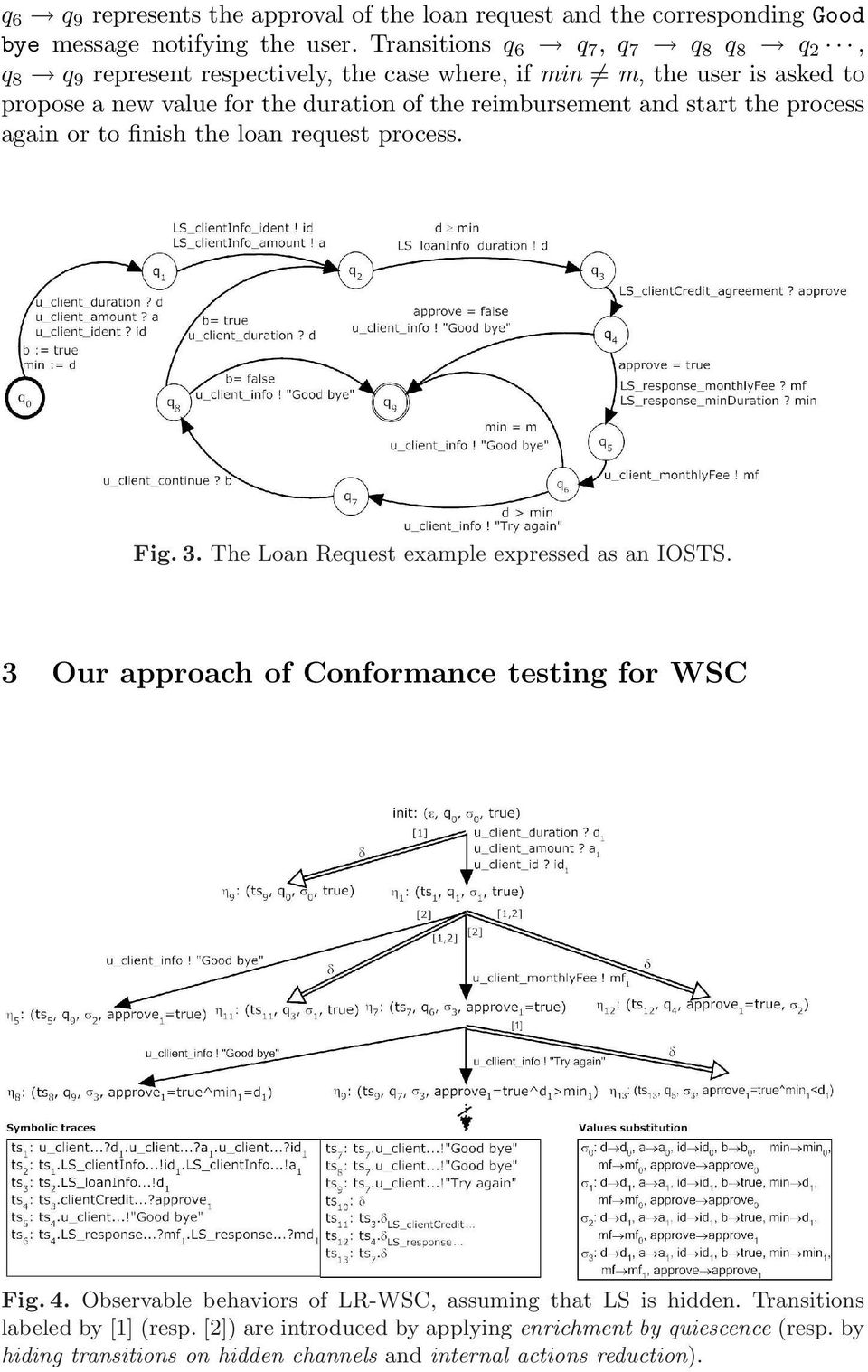
5 The first step consists in symbolically executing the IOSTS representing the WSC under test. The technique uses symbols instead of concrete data and allows us to represent all behaviors in a symbolic execution tree. The tree is then modified to take into account observable and hidden communication channels. The symbolic tree is first enriched by transitions carrying on the quiescence action δ and indicating that the WSC is waiting for a request either from the user or from a WS on an hidden or observable channel. Then, WS requests on observable channels are transformed into special observations (denoted as outputs). Finally, all transitions on hidden channels are translated into internal actions and the resulting symbolic tree is reduced by removing all internal actions which are useless from a testing point of view. Fig. 4 shows the dedicated symbolic execution tree of the LR example with the assumption that the LS s communication channels are all hidden. With the dedicated symbolic execution tree, we adapt the rule-based algorithm of test case generation presented in [4] and defined for the classical ioco conformance relation. In few words, the algorithm consists in a simultaneous traversal of the modified execution tree and a test purpose defined as selected finite paths of the tree, in order to stimulate and observe the SUT in such a way that, as long as possible, the sequence of stimulations and observations corresponds to a trace of the test purpose. In practice, each path of the tree beginning in the initial state and ending in the final one can be used as a test purpose. Each algorithm step involves the computation of constraints issued from the values of messages exchanged in the beginning of the test sequence and the constraints stored in the symbolic states of the tree and of the test purpose. This process is repeated until a verdict is emitted together with a testing report illustrating the trace (exchange of values) and explaining which conditions lead to that verdict. Fig. 5. Verdicts for hidden channels. Fig. 5 shows results when the algorihm is performed with the test purpose characterised as the restriction of the tree in Fig. 4 with η 8 as the (accept)

6 state. In case (a), the tester sends the stimulation u client duration 12, u client amount 1000, u client id 42 and observes δ. The observation belongs to a trace of the execution tree but not of the test purpose. So, we obtain the inconclusive verdict. The report produces the two scenarios as shown in Fig. 6: (1) the LS does not send the approve answer or, (2) the LS sends the approve answer, but does not send the monthly fee and minimum duration. In case (b), the tester stimulates the SUT with the sequence u client duration 12, u client amount 1000, u client id 42 and observes the monthly fee proposed by the LR-WSC, followed by the message Good bye. The algorithm produces the verdict pass with its corresponding scenario report (Fig. 5). In [2], more examples are available. Fig. 6. Two possible scenarios when observing δ after sending the client information. In this article, we have shown an example of how to test a WSC (orchestration) from its specification taking into account that WSs are connected to it during the testing phase. This corresponds to a situation of test in context or embedded testing for which no knowledge is available of the rest of the system (made of WSs invoked by the WSC). The complete formal description can be found in [2]. References 1. L. Bentakouk, P. Poizat, and F. Zaïdi. A Formal Framework for Service Orchestration Testing based on Symbolic Transition Systems. In International Conference TESTCOM/FATES 2009, Eindhoven, the Netherlands, Long version as technical report of LRI, University of Paris-Sud. 2. J. Escobedo, P. Le Gall, C. Gaston, and A. Cavalli. Examples of testing scenarios for web service composition. Technical Report LOR, TELECOM & Management SudParis, 22 pages, A. Alves et al. Web Services Business Process Execution Language Version April C. Gaston, P. Le Gall, N. Rapin, and A. Touil. Symbolic Execution Techniques for Test Purpose Definition. In Proc. of the 18th Int. Conference TestCom 2006, volume 3964 of LNCS, pages Springer-Verlag, 2006.

WSOFT : an automatic testing tool for web services composition
 WSOFT : an automatic testing tool for web services composition Dung Cao, Patrick Félix, Richard Castanet To cite this version: Dung Cao, Patrick Félix, Richard Castanet. WSOFT : an automatic testing tool
Chapter 4 Software Lifecycle and Performance Analysis
 Chapter 4 Software Lifecycle and Performance Analysis This chapter is aimed at illustrating performance modeling and analysis issues within the software lifecycle. After having introduced software and
Test case design techniques II: Blackbox testing CISS
 Test case design techniques II: Blackbox testing Overview Black-box testing (or functional testing): Equivalence partitioning Boundary value analysis Domain analysis Cause-effect graphing Behavioural testing
PETRI NET BASED SUPERVISORY CONTROL OF FLEXIBLE BATCH PLANTS. G. Mušič and D. Matko
 PETRI NET BASED SUPERVISORY CONTROL OF FLEXIBLE BATCH PLANTS G. Mušič and D. Matko Faculty of Electrical Engineering, University of Ljubljana, Slovenia. E-mail: [email protected] Abstract: The
A Framework for the Semantics of Behavioral Contracts
 A Framework for the Semantics of Behavioral Contracts Ashley McNeile Metamaxim Ltd, 48 Brunswick Gardens, London W8 4AN, UK [email protected] Abstract. Contracts have proved a powerful concept
Semantic Description of Distributed Business Processes
 Semantic Description of Distributed Business Processes Authors: S. Agarwal, S. Rudolph, A. Abecker Presenter: Veli Bicer FZI Forschungszentrum Informatik, Karlsruhe Outline Motivation Formalism for Modeling
Model Based Testing for Security Checking. Wissam Mallouli and Prof. Ana Cavalli National Institute of Telecommunications, France November 21, 2007
 Model Based Testing for Security Checking Wissam Mallouli and Prof. Ana Cavalli National Institute of Telecommunications, France November 21, 2007 Outline Introduction Active/Passive Testing Active Testing
Sequence Diagrams. Massimo Felici. Massimo Felici Sequence Diagrams c 2004 2011
 Sequence Diagrams Massimo Felici What are Sequence Diagrams? Sequence Diagrams are interaction diagrams that detail how operations are carried out Interaction diagrams model important runtime interactions
Model-Based Testing of Web Applications using NModel
 Model-Based Testing of Web Applications using NModel Juhan Ernits 1, Rivo Roo 2, Jonathan Jacky 3, and Margus Veanes 4 1 University of Birmingham, UK [email protected] 2 Reach-U Ltd,Tartu, Estonia
Basis Path Test Suite and Testing Process for WS-BPEL
 Basis Path Test Suite and Testing Process for WS-BPEL THEERAPONG LERTPHUMPANYA 1, 2 AND TWITTIE SENIVONGSE 1 1 Department of Computer Engineering, Chulalongkorn University Phyathai Road, Pathumwan, Bangkok
Architecture and Functions of Database Management System for Tracking and Management of Tools
 БЪЛГАРСКА АКАДЕМИЯ НА НАУКИТЕ. BULGARIAN ACADEMY OF SCIENCES КИБЕРНЕТИКА И ИНФОРМАЦИОННИ ТЕХНОЛОГИИ Том 4, 1 CYBERNETICS AND INFORMATION TECHNOLOGIES Volume 4, No 1 София. 2004. Sofia Architecture and
Business Process Modeling
 Business Process Concepts Process Mining Kelly Rosa Braghetto Instituto de Matemática e Estatística Universidade de São Paulo [email protected] January 30, 2009 1 / 41 Business Process Concepts Process
An Automated Model Based Approach to Test Web Application Using Ontology
 An Automated Model Based Approach to Test Web Application Using Ontology Hamideh Hajiabadi, Mohsen Kahani [email protected], [email protected] Computer Engineering Department, Ferdowsi
Making Model-Based Testing More Agile: a Use Case Driven Approach
 Making Model-Based Testing More Agile: a Use Case Driven Approach 1 Oct 23 26, 2006 @ Haifa Verification Conference, Israel Mika Katara and Antti Kervinen Tampere University of Technology, Finland 2 Agenda
UML-based Test Generation and Execution
 UML-based Test Generation and Execution Jean Hartmann, Marlon Vieira, Herb Foster, Axel Ruder Siemens Corporate Research, Inc. 755 College Road East Princeton NJ 08540, USA [email protected] ABSTRACT
Model-based Testing: Next Generation Functional Software Testing
 Model-based Testing: Next Generation Functional Software Testing By Dr. Bruno Legeard Model-based testing (MBT) is an increasingly widely-used technique for automating the generation and execution of tests.
Towards Management of SLA-Aware Business Processes Based on Key Performance Indicators
 Towards Management of SLA-Aware Business Processes Based on Key Performance Indicators Branimir Wetzstein, Dimka Karastoyanova, Frank Leymann Institute of Architecture of Application Systems, University
Personalized e-learning a Goal Oriented Approach
 Proceedings of the 7th WSEAS International Conference on Distance Learning and Web Engineering, Beijing, China, September 15-17, 2007 304 Personalized e-learning a Goal Oriented Approach ZHIQI SHEN 1,
University of Paderborn Software Engineering Group II-25. Dr. Holger Giese. University of Paderborn Software Engineering Group. External facilities
 II.2 Life Cycle and Safety Safety Life Cycle: The necessary activities involving safety-related systems, occurring during a period of time that starts at the concept phase of a project and finishes when
Realizing Enterprise Integration Patterns in WebSphere
 Universität Stuttgart Fakultät Informatik, Elektrotechnik und Informationstechnik Realizing Enterprise Integration Patterns in WebSphere Thorsten Scheibler, Frank Leymann Report 2005/09 October 20, 2005
Agent-based University Library System
 _ Course Number: SENG 609.22 Session: Fall, 2004 Course Name: Agent-based Software Engineering Department: Electrical and Computer Engineering Document Type: Project Report Agent-based University Library
108-C-215 CRITICAL PATH METHOD SCHEDULE. (Revised 03-24-10)
 CRITICAL PATH METHOD SCHEDULE (Revised 03-24-10) The Standard Specifications are revised as follows: SECTION 108, BEGIN LINE 177, INSERT AS FOLLOWS: 108.04.1 Critical Path Method Schedule (a) General Requirements
GOAL-BASED INTELLIGENT AGENTS
 International Journal of Information Technology, Vol. 9 No. 1 GOAL-BASED INTELLIGENT AGENTS Zhiqi Shen, Robert Gay and Xuehong Tao ICIS, School of EEE, Nanyang Technological University, Singapore 639798
Manual. Version: 1.0.0
 Manual Version: 1.0.0 Table of Contents I. INTRODUCTION... 3 II. INSTALLATION... 5 a. System Requirements... 5 b. Installation... 5 c. Configure PayPal IPN... 5 d. Cron Setup... 6 e. Upload Email Logo...
Runtime Enforcement of Timed Properties
 Runtime Enforcement of Timed Properties Srinivas Pinisetty 1,Yliès Falcone 2, Thierry Jéron 1, Hervé Marchand 1, Antoine Rollet 3 and Omer Nguena Timo 3 INRIA Rennes - Bretagne Atlantique, France LIG,
Programming Logic controllers
 Programming Logic controllers Programmable Logic Controller (PLC) is a microprocessor based system that uses programmable memory to store instructions and implement functions such as logic, sequencing,
On the Traffic Capacity of Cellular Data Networks. 1 Introduction. T. Bonald 1,2, A. Proutière 1,2
 On the Traffic Capacity of Cellular Data Networks T. Bonald 1,2, A. Proutière 1,2 1 France Telecom Division R&D, 38-40 rue du Général Leclerc, 92794 Issy-les-Moulineaux, France {thomas.bonald, alexandre.proutiere}@francetelecom.com
How To Test Automatically
 Automated Model-Based Testing of Embedded Real-Time Systems Jan Peleska [email protected] University of Bremen Bieleschweig Workshop 7 2006-05-05 Outline Technologie-Zentrum Informatik Objectives Basic concepts
An Automated Testing Tool Using UI Structure
 , March 12-14, 2014, Hong Kong An Automated Testing Tool Using UI Structure Nutharat Harnvorawong, Taratip Suwannasart, Member, IAENG Abstract Testers usually run a new version of software against existing
Tagging with Hidden Markov Models
 Tagging with Hidden Markov Models Michael Collins 1 Tagging Problems In many NLP problems, we would like to model pairs of sequences. Part-of-speech (POS) tagging is perhaps the earliest, and most famous,
Model checking test models. Author: Kevin de Berk Supervisors: Prof. dr. Wan Fokkink, dr. ir. Machiel van der Bijl
 Model checking test models Author: Kevin de Berk Supervisors: Prof. dr. Wan Fokkink, dr. ir. Machiel van der Bijl February 14, 2014 Abstract This thesis is about model checking testing models. These testing
Service Identifier Comparison module Service Rule Comparison module Favourite Application Server Reinvocation Management module
 Service Broker for Managing Feature Interactions in IP Multimedia Subsystem Anahita Gouya, Noël Crespi {anahita.gouya, noel.crespi @int-evry.fr}, Institut National des télécommunications (GET-INT) Mobile
Data Structures Fibonacci Heaps, Amortized Analysis
 Chapter 4 Data Structures Fibonacci Heaps, Amortized Analysis Algorithm Theory WS 2012/13 Fabian Kuhn Fibonacci Heaps Lacy merge variant of binomial heaps: Do not merge trees as long as possible Structure:
Testing LTL Formula Translation into Büchi Automata
 Testing LTL Formula Translation into Büchi Automata Heikki Tauriainen and Keijo Heljanko Helsinki University of Technology, Laboratory for Theoretical Computer Science, P. O. Box 5400, FIN-02015 HUT, Finland
Exploring Strategic Change
 Julia Balogun, Veronica Hope Hailey, Gerry Johnson, Kevan Scholes FT Prentice Hall 2003 ISBN: 0273683276, 280 pages Theme of the Book The book links into (and develops further) the ideas on strategic change
Run-time Service Oriented Architecture (SOA) V 0.1
 Run-time Service Oriented Architecture (SOA) V 0.1 July 2005 Table of Contents 1.0 INTRODUCTION... 1 2.0 PRINCIPLES... 1 3.0 FERA REFERENCE ARCHITECTURE... 2 4.0 SOA RUN-TIME ARCHITECTURE...4 4.1 FEDERATES...
Space Project Management
 EUROPEAN COOPERATION FOR SPACE STANDARDIZATION Space Project Management Configuration Management Secretariat ESA ESTEC Requirements & Standards Division Noordwijk, The Netherlands Published by: Price:
Business Process Verification: The Application of Model Checking and Timed Automata
 Business Process Verification: The Application of Model Checking and Timed Automata Luis E. Mendoza Morales Processes and Systems Department, Simón Bolívar University, P.O. box 89000, Baruta, Venezuela,
Test Automation Architectures: Planning for Test Automation
 Test Automation Architectures: Planning for Test Automation Douglas Hoffman Software Quality Methods, LLC. 24646 Heather Heights Place Saratoga, California 95070-9710 Phone 408-741-4830 Fax 408-867-4550
Integration of Application Business Logic and Business Rules with DSL and AOP
 Integration of Application Business Logic and Business Rules with DSL and AOP Bogumiła Hnatkowska and Krzysztof Kasprzyk Wroclaw University of Technology, Wyb. Wyspianskiego 27 50-370 Wroclaw, Poland [email protected]
Software Engineering. Software Testing. Based on Software Engineering, 7 th Edition by Ian Sommerville
 Software Engineering Software Testing Based on Software Engineering, 7 th Edition by Ian Sommerville Objectives To discuss the distinctions between validation testing and defect t testing To describe the
Communication Diagrams
 Communication Diagrams Massimo Felici Realizing Use cases in the Design Model 1 Slide 1: Realizing Use cases in the Design Model Use-case driven design is a key theme in a variety of software processes
Test and Validation of Web Services
 University Bordeaux 1 Doctoral school of Mathematics and Computer Science Thesis Test and Validation of Web Services presented by Ti ên Dũng Cao to receive the Doctoral Diploma of Computer Science December,
TM SysAid Chat Guide Document Updated: 10 November 2009
 SysAidTM Chat Guide Document Updated: 10 November 2009 Introduction 2 Quick Access to SysAid Chat 3 Enable / Disable the SysAid Chat from the End User Portal. 4 Edit the Chat Settings 5 Chat Automatic
Progress Report Aspect Oriented Programming meets Design Patterns. Academic Programme MSc in Advanced Computer Science. Guillermo Antonio Toro Bayona
 Progress Report Aspect Oriented Programming meets Design Patterns Academic Programme MSc in Advanced Computer Science Guillermo Antonio Toro Bayona Supervisor Dr. John Sargeant The University of Manchester
RECOMMENDATION ITU-R M.1082-1*, **
 Rec. ITU-R M.1082-1 1 RECOMMENDATION ITU-R M.1082-1*, ** INTERNATIONAL MARITIME MF/HF RADIOTELEPHONE SYSTEM WITH AUTOMATIC FACILITIES BASED ON DIGITAL SELECTIVE CALLING SIGNALLING FORMAT Rec. ITU-R M.1082-1
Survey of Web Testing Techniques
 Survey of Web Testing Techniques Sonal Anand M.Tech (Computer Science) USIT, GGSIPU New Delhi, India Anju Saha Assistant Professor USIT, GGSIPU New Delhi, India ABSTRACT This paper presents a survey of
CPS122 Lecture: State and Activity Diagrams in UML
 CPS122 Lecture: State and Activity Diagrams in UML Objectives: last revised February 14, 2012 1. To show how to create and read State Diagrams 2. To introduce UML Activity Diagrams Materials: 1. Demonstration
Software Service Engineering Architect s Dream or Developer s Nightmare?
 Software Service Engineering Architect s Dream or Developer s Nightmare? Gregor Hohpe Google, 1600 Amphitheatre Parkway, Mountain View, CA 94043 [email protected] Abstract. Architectural principles such
Software Requirements Specification of A University Class Scheduler
 Software Requirements Specification of A University Class Scheduler Deanna M. Needell Jeff A. Stuart Tamara C. Thiel Sergiu M. Dascalu Frederick C. Harris, Jr. Department of Computer Science University
Modeling Agile Manufacturing Cell using Object-Oriented Timed Petri net
 Modeling Agile Manufacturing Cell using Object-Oriented Timed Petri net Peigen Li, Ke Shi, Jie Zhang Intelligent Manufacturing Lab School of Mechanical Science and Engineering Huazhong University of Science
City of Canning. Asset Management Strategy 2015 2018
 City of Canning Asset Management Strategy 2015 2018 Document Control Version No Version Date Description TRIM Reference 1.0 11 December 2012 Asset Management Strategy D12/68776 2.0 23 September 2015 Updated
Dissertation Title: SOCKS5-based Firewall Support For UDP-based Application. Author: Fung, King Pong
 Dissertation Title: SOCKS5-based Firewall Support For UDP-based Application Author: Fung, King Pong MSc in Information Technology The Hong Kong Polytechnic University June 1999 i Abstract Abstract of dissertation
Ontological Identification of Patterns for Choreographing Business Workflow
 University of Aizu, Graduation Thesis. March, 2010 s1140042 1 Ontological Identification of Patterns for Choreographing Business Workflow Seiji Ota s1140042 Supervised by Incheon Paik Abstract Business
Mutual Exclusion using Monitors
 Mutual Exclusion using Monitors Some programming languages, such as Concurrent Pascal, Modula-2 and Java provide mutual exclusion facilities called monitors. They are similar to modules in languages that
Extend Table Lens for High-Dimensional Data Visualization and Classification Mining
 Extend Table Lens for High-Dimensional Data Visualization and Classification Mining CPSC 533c, Information Visualization Course Project, Term 2 2003 Fengdong Du [email protected] University of British Columbia
An Introduction to PRINCE2
 Project Management Methodologies An Introduction to PRINCE2 Why use a Project Methodology and What Does PRINCE2 Enable? PRINCE - PRojects IN Controlled Environments - is a project management method covering
Special Notice. Rules. Weiss Schwarz Comprehensive Rules ver. 1.64 Last updated: October 15 th 2014. 1. Outline of the Game
 Weiss Schwarz Comprehensive Rules ver. 1.64 Last updated: October 15 th 2014 Contents Page 1. Outline of the Game. 1 2. Characteristics of a Card. 2 3. Zones of the Game... 4 4. Basic Concept... 6 5. Setting
An Interactive Visualization Tool for the Analysis of Multi-Objective Embedded Systems Design Space Exploration
 An Interactive Visualization Tool for the Analysis of Multi-Objective Embedded Systems Design Space Exploration Toktam Taghavi, Andy D. Pimentel Computer Systems Architecture Group, Informatics Institute
Supervisor of Banks: Proper Conduct of Banking Business (9/14) [6] Debits by Authorization Page 439-1
![Supervisor of Banks: Proper Conduct of Banking Business (9/14) [6] Debits by Authorization Page 439-1](/thumbs/39/18982324.jpg "Supervisor of Banks: Proper Conduct of Banking Business (9/14) [6] Debits by Authorization Page 439-1") Debits by Authorization Page 439-1 DEBITS BY AUTHORIZATION Introduction (9/14) 1. Debits by Authorization are a method of making payments under which a beneficiary collects funds from the customer via
Debits by Authorization Page 439-1 DEBITS BY AUTHORIZATION Introduction (9/14) 1. Debits by Authorization are a method of making payments under which a beneficiary collects funds from the customer via
Comparison of Request Admission Based Performance Isolation Approaches in Multi-tenant SaaS Applications
 Comparison of Request Admission Based Performance Isolation Approaches in Multi-tenant SaaS Applications Rouven Kreb 1 and Manuel Loesch 2 1 SAP AG, Walldorf, Germany 2 FZI Research Center for Information
Contracting Strategy of a Project
 Page : 1 of 8 KLM Technology www.klmtechgroup.com January 2013 KLM Technology #03-12 Block Aronia, Jalan Sri Perkasa 2 Taman Tampoi Utama 81200 Johor Bahru Malaysia Karl Kolmetz KLM Technology 4 Page 2
(Refer Slide Time: 00:01:16 min)
 Digital Computer Organization Prof. P. K. Biswas Department of Electronic & Electrical Communication Engineering Indian Institute of Technology, Kharagpur Lecture No. # 04 CPU Design: Tirning & Control
Greatest Common Factor and Least Common Multiple
 Greatest Common Factor and Least Common Multiple Intro In order to understand the concepts of Greatest Common Factor (GCF) and Least Common Multiple (LCM), we need to define two key terms: Multiple: Multiples
AN INTELLIGENT TUTORING SYSTEM FOR LEARNING DESIGN PATTERNS
 AN INTELLIGENT TUTORING SYSTEM FOR LEARNING DESIGN PATTERNS ZORAN JEREMIĆ, VLADAN DEVEDŽIĆ, DRAGAN GAŠEVIĆ FON School of Business Administration, University of Belgrade Jove Ilića 154, POB 52, 11000 Belgrade,
Space project management
 ECSS-M-ST-80C Space project management Risk management ECSS Secretariat ESA-ESTEC Requirements & Standards Division Noordwijk, The Netherlands Foreword This Standard is one of the series of ECSS Standards
Chapter 4 Nominal and Effective Interest Rates
 Chapter 4 Nominal and Effective Interest Rates Chapter 4 Nominal and Effective Interest Rates INEN 303 Sergiy Butenko Industrial & Systems Engineering Texas A&M University Nominal and Effective Interest
Automatic Test Data Synthesis using UML Sequence Diagrams
 Vol. 09, No. 2, March April 2010 Automatic Test Data Synthesis using UML Sequence Diagrams Ashalatha Nayak and Debasis Samanta School of Information Technology Indian Institute of Technology, Kharagpur
Software Requirements Specification. Web Library Management System
 Software Requirements Specification For Web Library Management System Version x.xx Prepared by Proposed to Software Requirements Specification for WLMS Page
A Static Analyzer for Large Safety-Critical Software. Considered Programs and Semantics. Automatic Program Verification by Abstract Interpretation
 PLDI 03 A Static Analyzer for Large Safety-Critical Software B. Blanchet, P. Cousot, R. Cousot, J. Feret L. Mauborgne, A. Miné, D. Monniaux,. Rival CNRS École normale supérieure École polytechnique Paris
KWIC Implemented with Pipe Filter Architectural Style
 KWIC Implemented with Pipe Filter Architectural Style KWIC Implemented with Pipe Filter Architectural Style... 2 1 Pipe Filter Systems in General... 2 2 Architecture... 3 2.1 Pipes in KWIC system... 3
A Tool for Generating Partition Schedules of Multiprocessor Systems
 A Tool for Generating Partition Schedules of Multiprocessor Systems Hans-Joachim Goltz and Norbert Pieth Fraunhofer FIRST, Berlin, Germany {hans-joachim.goltz,nobert.pieth}@first.fraunhofer.de Abstract.
Scenario-based Requirements Engineering and User-Interface Design
 Scenario-based Requirements Engineering and User-Interface Institut für Computertechnik ICT Institute of Computer Technology Hermann Kaindl Vienna University of Technology, ICT Austria [email protected]
Software Testing, Mythology & Methodologies
 Software, Mythology & Methodologies Sonali Waje 1, Vandana Gaikwad 2, Pranchal Chaudhari 3 1,3 B.E. Information Technology, 2 B.E.Computer Engineering Abstract - It is generally believed that phases of
Modeling BPMN Diagrams within XTT2 Framework. A Critical Analysis**
 AUTOMATYKA 2011 Tom 15 Zeszyt 2 Antoni Ligêza*, Tomasz Maœlanka*, Krzysztof Kluza*, Grzegorz Jacek Nalepa* Modeling BPMN Diagrams within XTT2 Framework. A Critical Analysis** 1. Introduction Design, analysis
Reduce Mobile Phone Expense with Avaya Unified Communications
 Reduce Mobile Phone Expense with Avaya Unified Communications Table of Contents Section 1: Reduce Inbound Minutes... 2 Section 2: Reduce Outbound Minutes... 3 Section 3: Take Greater Advantage of Free
Excel & Visual Basic for Applications (VBA)
 Excel & Visual Basic for Applications (VBA) The VBA Programming Environment Recording Macros Working with the Visual Basic Editor (VBE) 1 Why get involved with this programming business? If you can't program,
Overview of major concepts in the service oriented extended OeBTO
 Modelling business policies and behaviour based on extended Open edi Business Transaction Ontology (OeBTO) Introduction Model Driven Development (MDD) provides a basis for the alignment between business
Mercy Health System. St. Louis, MO. Process Mining of Clinical Workflows for Quality and Process Improvement
 Mercy Health System St. Louis, MO Process Mining of Clinical Workflows for Quality and Process Improvement Paul Helmering, Executive Director, Enterprise Architecture Pete Harrison, Data Analyst, Mercy
2 SYSTEM DESCRIPTION TECHNIQUES
 2 SYSTEM DESCRIPTION TECHNIQUES 2.1 INTRODUCTION Graphical representation of any process is always better and more meaningful than its representation in words. Moreover, it is very difficult to arrange
1. Process Modeling. Process Modeling (Cont.) Content. Chapter 7 Structuring System Process Requirements
 Content Chapter 7 Structuring System Process Requirements Understand the logical (&physical) process modeling by using data flow diagrams (DFDs) Draw DFDs & Leveling Balance higher-level and lower-level
Automatic Test Data Generation for TTCN-3 using CTE
 Automatic Test Data Generation for TTCN-3 using CTE Zhen Ru Dai, Peter H. Deussen, Maik Busch, Laurette Pianta Lacmene, Titus Ngwangwen FraunhoferInstitute for Open Communication Systems (FOKUS) Kaiserin-Augusta-Allee
FPGA area allocation for parallel C applications
 1 FPGA area allocation for parallel C applications Vlad-Mihai Sima, Elena Moscu Panainte, Koen Bertels Computer Engineering Faculty of Electrical Engineering, Mathematics and Computer Science Delft University
Chapter 3. Technology review. 3.1. Introduction
 Technology review Chapter 3 3.1. Introduction Previous chapter covers detail description about problem domain. In this chapter I will discuss the technologies currently available to solve a problem in
Utilizing Domain-Specific Modelling for Software Testing
 Utilizing Domain-Specific Modelling for Software Testing Olli-Pekka Puolitaival, Teemu Kanstrén VTT Technical Research Centre of Finland Oulu, Finland {olli-pekka.puolitaival, teemu.kanstren}@vtt.fi Abstract
Introduction to Project Management
 L E S S O N 1 Introduction to Project Management Suggested lesson time 50-60 minutes Lesson objectives To be able to identify the steps involved in project planning, you will: a b c Plan a project. You
FP-Hadoop: Efficient Execution of Parallel Jobs Over Skewed Data
 FP-Hadoop: Efficient Execution of Parallel Jobs Over Skewed Data Miguel Liroz-Gistau, Reza Akbarinia, Patrick Valduriez To cite this version: Miguel Liroz-Gistau, Reza Akbarinia, Patrick Valduriez. FP-Hadoop:
THE JOY OF HOME OWNERSHIP FAQ
 THE JOY OF HOME OWNERSHIP FAQ Congratulations. By visiting the JoyofHomeownership.com, you are one step closer to owning your own home. Below are answers to a few Frequently Asked Questions concerning