
Undergraduate Student HandbooK
|
|
|
- Ami Parks
- 10 years ago
- Views:
Transcription
1 1 Undergraduate Student HandbooK for Psychology Bachelor of Arts Degree Students Edition

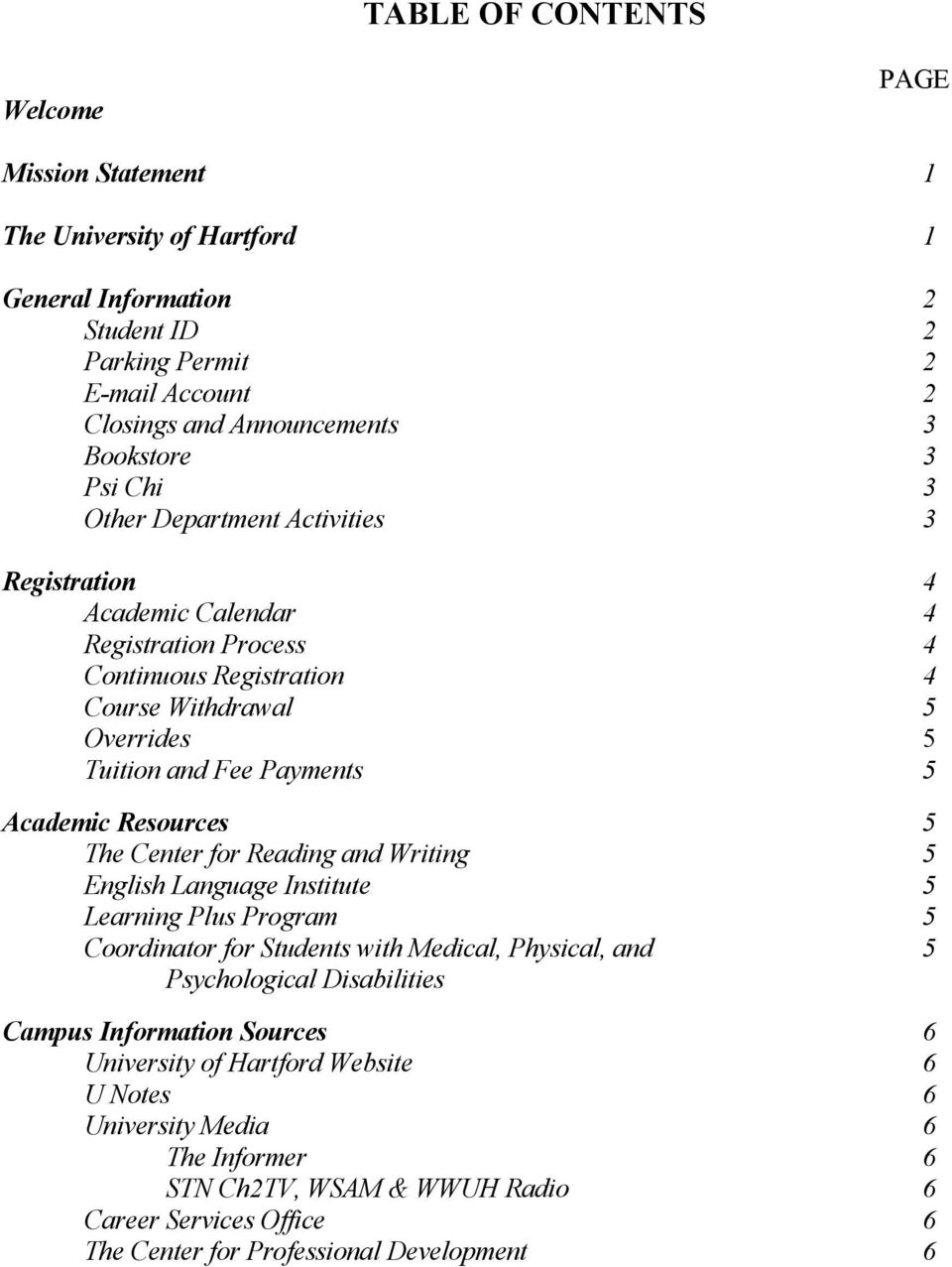
2 2 TABLE OF CONTENTS Welcome PAGE Mission Statement 1 The University of Hartford 1 General Information 2 Student ID 2 Parking Permit 2 Account 2 Closings and Announcements 3 Bookstore 3 Psi Chi 3 Other Department Activities 3 Registration 4 Academic Calendar 4 Registration Process 4 Continuous Registration 4 Course Withdrawal 5 Overrides 5 Tuition and Fee Payments 5 Academic Resources 5 The Center for Reading and Writing 5 English Language Institute 5 Learning Plus Program 5 Coordinator for Students with Medical, Physical, and 5 Psychological Disabilities Campus Information Sources 6 University of Hartford Website 6 U Notes 6 University Media 6 The Informer 6 STN Ch2TV, WSAM & WWUH Radio 6 Career Services Office 6 The Center for Professional Development 6
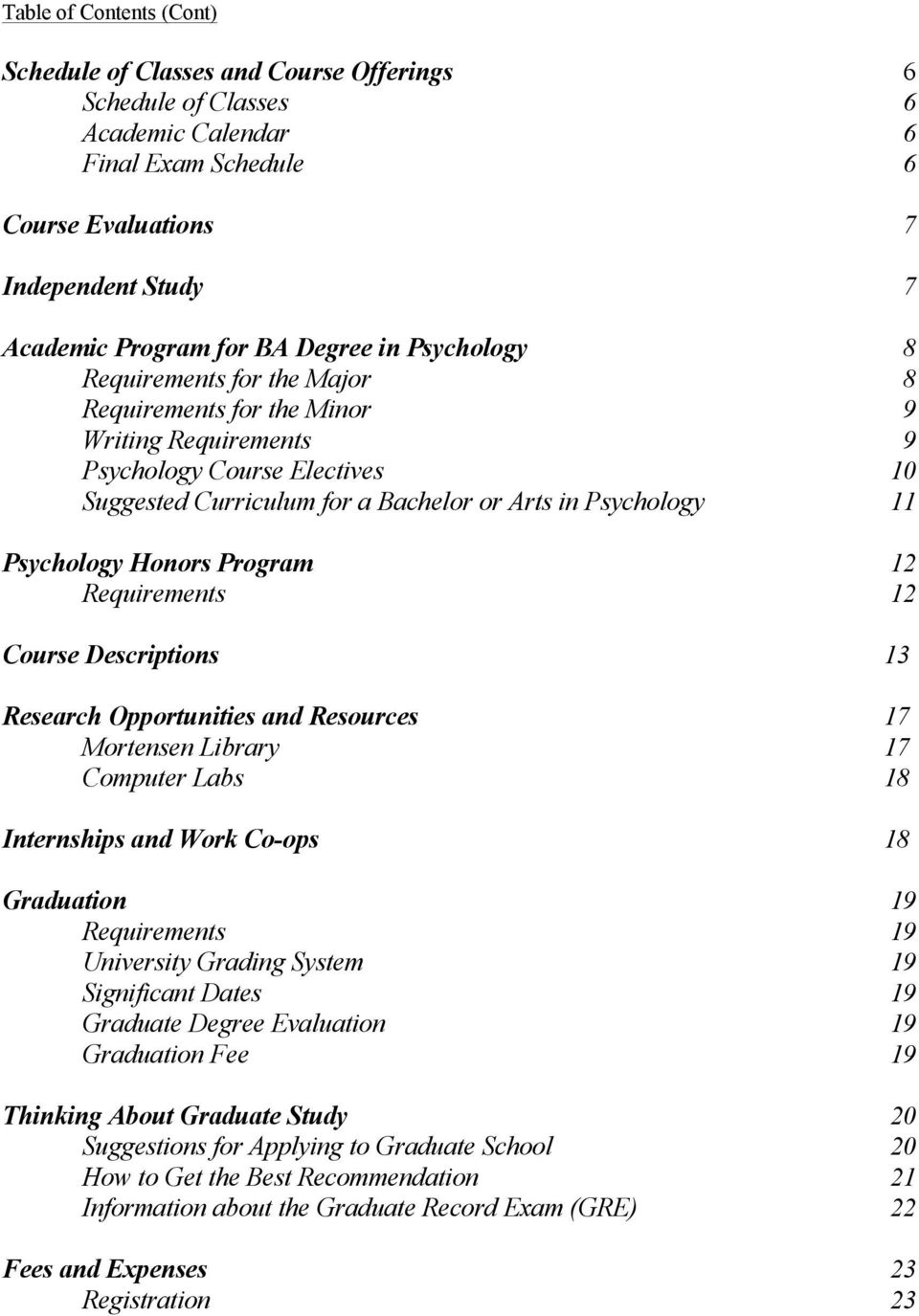
3 3 Table of Contents (Cont) Schedule of Classes and Course Offerings 6 Schedule of Classes 6 Academic Calendar 6 Final Exam Schedule 6 Course Evaluations 7 Independent Study 7 Academic Program for BA Degree in Psychology 8 Requirements for the Major 8 Requirements for the Minor 9 Writing Requirements 9 Psychology Course Electives 10 Suggested Curriculum for a Bachelor or Arts in Psychology 11 Psychology Honors Program 12 Requirements 12 Course Descriptions 13 Research Opportunities and Resources 17 Mortensen Library 17 Computer Labs 18 Internships and Work Co-ops 18 Graduation 19 Requirements 19 University Grading System 19 Significant Dates 19 Graduate Degree Evaluation 19 Graduation Fee 19 Thinking About Graduate Study 20 Suggestions for Applying to Graduate School 20 How to Get the Best Recommendation 21 Information about the Graduate Record Exam (GRE) 22 Fees and Expenses 23 Registration 23
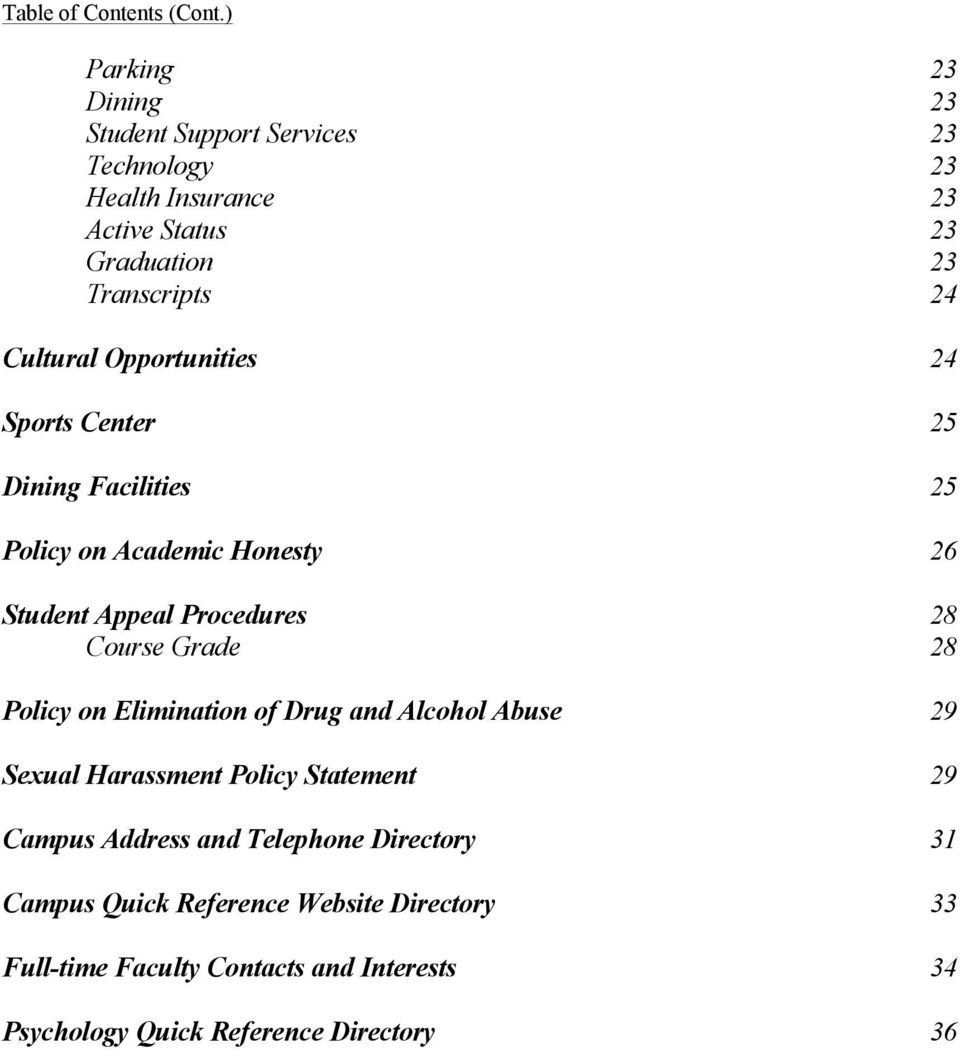
4 4 Table of Contents (Cont.) Parking 23 Dining 23 Student Support Services 23 Technology 23 Health Insurance 23 Active Status 23 Graduation 23 Transcripts 24 Cultural Opportunities 24 Sports Center 25 Dining Facilities 25 Policy on Academic Honesty 26 Student Appeal Procedures 28 Course Grade 28 Policy on Elimination of Drug and Alcohol Abuse 29 Sexual Harassment Policy Statement 29 Campus Address and Telephone Directory 31 Campus Quick Reference Website Directory 33 Full-time Faculty Contacts and Interests 34 Psychology Quick Reference Directory 36
5 WELCOME Welcome to the Department of Psychology at the University of Hartford. You have selected a strong program in your field which places great emphasis on conceptual as well as applied aspects of psychology. We value your contribution to the Department and want you to make full use of the facilities and services that are available. Get to know your faculty, advisors, staff, and fellow students. Attend as many curricular functions as you can. Be connected with your program and, most definitely, learn as much as you can while pursuing your degree. This handbook is intended to be used in conjunction with the University s Undergraduate Bulletin and the Source, published yearly by the University of Hartford. We have attempted to ascertain all of the appropriate regulations, dates, and other information available at the time of publication. It is the responsibility of each student to be fully aware of, and adhere to, the regulations and requirements of both the University of Psychology as presented in the Bulletins. The Bulletin is available on line at Also available is the Source: Student Handbook at

6 1 DEPARTMENT OF PSYCHOLOGY MISSION STATEMENT The Department of Psychology at the University of Hartford is strongly student-centered and committed to engaging students in the understanding of behavior, cognition, emotion, and social interaction. Major emphasis is placed on the development of critical thinking and analytical skills so students become adept at formulating meaningful questions, implementing strategies to enhance growth and development, and solving problems of individual and group behavior. Students are encouraged to understand, appreciate, and embrace diversity and the need for community involvement. The department promotes self-awareness and life-long learning aimed at developing well-rounded, resourceful, ethical, competent, and compassionate graduates at all levels of education. UNIVERSITY OF HARTFORD The University of Hartford is an independent, comprehensive university that provides educational programs in liberal arts and professional disciplines for undergraduate and graduate students. Professional education is designed to provide concentrated knowledge and depth in a field in order to develop entry-level professional skills for productive career outlets and continuing professional growth. The University of Hartford is composed of seven schools and colleges. Graduate programs in psychology are administered within the College of Arts and Sciences, which is committed to being a center of excellence in the teaching and learning of the basic elements of the humanities, social sciences, and physical and natural sciences. The University of Hartford is licensed and accredited by the State of Connecticut to award the following degrees in the Psychology Department: Bachelor of Arts in Psychology Master of Arts in Clinical Practices in Psychology Master of Arts in General Psychology Master of Science in Organizational Psychology Master of Science in School Psychology/Sixth-year Certificate Doctor of Psychology in Clinical Psychology The Department of Psychology, following the general policy of the University of Hartford, admits students without regard to race, gender, creed, color, age, physical ability, sexual orientation, or national or ethnic origin to all rights, privileges, programs, and activities generally accorded or made available to students at the University. It complies with Title VI of the Civil Rights Act of 1964, as amended, and does not discriminate on the basis of race, gender, creed, color, age, physical ability, sexual orientation or national or ethnic origin in the administration of its educational policies, admission policies, or scholarship and loan programs, and athletics and other University-administered programs.

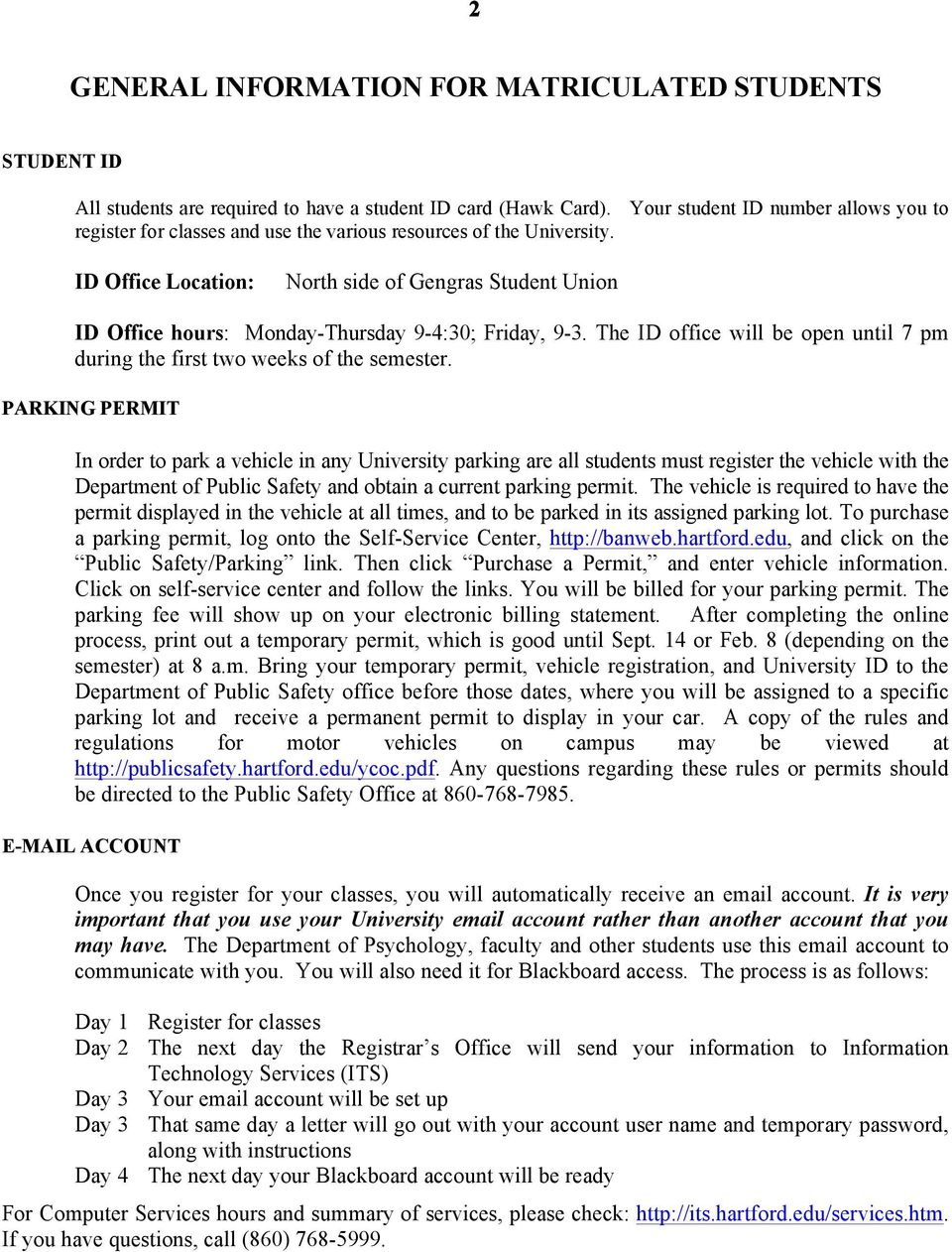
7 2 GENERAL INFORMATION FOR MATRICULATED STUDENTS STUDENT ID All students are required to have a student ID card (Hawk Card). Your student ID number allows you to register for classes and use the various resources of the University. ID Office Location: North side of Gengras Student Union ID Office hours: Monday-Thursday 9-4:30; Friday, 9-3. The ID office will be open until 7 pm during the first two weeks of the semester. PARKING PERMIT In order to park a vehicle in any University parking are all students must register the vehicle with the Department of Public Safety and obtain a current parking permit. The vehicle is required to have the permit displayed in the vehicle at all times, and to be parked in its assigned parking lot. To purchase a parking permit, log onto the Self-Service Center, and click on the Public Safety/Parking link. Then click Purchase a Permit, and enter vehicle information. Click on self-service center and follow the links. You will be billed for your parking permit. The parking fee will show up on your electronic billing statement. After completing the online process, print out a temporary permit, which is good until Sept. 14 or Feb. 8 (depending on the semester) at 8 a.m. Bring your temporary permit, vehicle registration, and University ID to the Department of Public Safety office before those dates, where you will be assigned to a specific parking lot and receive a permanent permit to display in your car. A copy of the rules and regulations for motor vehicles on campus may be viewed at Any questions regarding these rules or permits should be directed to the Public Safety Office at ACCOUNT Once you register for your classes, you will automatically receive an account. It is very important that you use your University account rather than another account that you may have. The Department of Psychology, faculty and other students use this account to communicate with you. You will also need it for Blackboard access. The process is as follows: Day 1 Register for classes Day 2 The next day the Registrar s Office will send your information to Information Technology Services (ITS) Day 3 Your account will be set up Day 3 That same day a letter will go out with your account user name and temporary password, along with instructions Day 4 The next day your Blackboard account will be ready For Computer Services hours and summary of services, please check: If you have questions, call (860)
8 3 CLOSINGS AND ANNOUNCEMENTS BOOKSTORE The University is a highly residential institution, and it is critical that the University maintain its operations and schedules. Generally, the University will not close except under unusual circumstances. In event of an extremely severe storm or other emergency conditions, announcements are made on local TV and radio stations. Recorded information is also available by calling , or go to the University website at Generally, evening closings are not announced until at least 2 P.M. Textbooks are located in the lower level of the bookstore in the Harry Jack Gray Center. The bookstore is open special hours during the first two weeks of each term. Bring your schedule with you in order to get the proper books for your section and class number. Regular Hours: Monday-Thursday, 9:00-7:00; Friday, 9:00-4:00; Saturday, 11:00-4:00; Sunday, Closed Phone: Website: PSI CHI Psi Chi, the International Honor Society in Psychology, has an active chapter at the University. The purpose of the organization is to honor student excellence and to promote psychology on campus. Psi Chi members work actively with Psych Society, the psychology club, to engage students and the greater community to enjoy and explore the exciting field of psychology. Joining Psi Chi requires that the student is at least a second-semester sophomore, has taken three psychology courses, and has a 3.00 GPA or higher in both psychology courses and in cumulative grades. Students who qualify for membership are encouraged to join this association, not only for immediate benefits, but for future professional opportunities especially with regard to graduate school and employment. Membership in Psi Chi may enhance a student s application to graduate school by demonstrating motivation and involvement, and there are intrinsic benefits of interacting with other students in these groups. PSYCH SOCIETY Psych Society, the psychology club, at the University is an active club that works along with Psi Chi to promote psychology awareness on campus. The Psych Society is open to all students and it engages students and the greater community to enjoy and explore the exciting field of psychology through activities, talks, discussions, community service activities, and more. We encourage students to get involved in Psych Society early in their coursework and to connect to the many opportunities available to members. OTHER DEPARTMENT ACTIVITIES The Department sponsors and supports numerous professional and social activities throughout the year. Watch for announcements regarding upcoming events such as brown bag lunches on various topics, colloquia, holiday and commencement celebrations, and others. Scheduled activities will be posted in the student lounge (E 205) across from the Psychology Office. The Department also has its own Facebook page. We post information of interest to students every week, as well as pictures of student events. Appropriate items can be posted through Cheryl Hoffert in the main psychology office, E203, ([email protected]). Our Facebook address is

9 4 REGISTRATION ACADEMIC CALENDAR The academic calendar lists critical dates during each semester for class withdrawals, registration, final exams, etc. This calendar can be found each semester at: REGISTRATION PROCESS Registration for the spring semester takes place during the month of November. Registration for the fall semester takes place during the month of April. The schedule for registering for classes is set by the Registrar s Office. Each student has a specific date to register. The month prior to registering for classes you need to: Review courses online at Schedule an appointment with your advisor close to your registration date. Select alternate as well as primary courses and check online for closed classes Resolve holds on your account before registering: Make payments on past due balances at SASC To discuss a past due balance, contact the Bursar s Office. Register for your courses on your assigned date For returning students, there are two registration options to choose from: You may register in person at the Student Administrative Service Center (SASC) located in the Computer Center (CC), 2 nd Floor. All paper registration forms require both student and advisor signatures. Please call the SASC center at (860) for questions regarding registration or registrar issues. With an online registration PIN obtained from your advisor (matriculated students only), you can register for each semester online. Students can also check grades and schedules of classes, and download needed forms (e.g., transcript request form) through the Self-Service Center at the following site: CONTINUOUS REGISTRATION REQUIREMENTS Degree candidates are expected to maintain continuous registration (excluding summer/winter) until all degree requirements are satisfied. Failing to register for one semester or more breaks the student's registration and requires that the student seek re-admission. A student who is re-admitted after the lapse of one semester may resume the degree requirements listed in the Bulletin. Re-admission requirements must be met, except in special circumstances such as military service or extended illness. A matriculated student may request a one-year leave of absence. For approved off-campus study programs or other personal reasons, a matriculated student may be granted a leave of absence and remain on active status for up to three semesters. In order to do this, the student must secure permission from the faculty advisor and the Dean of the college/school and register each semester for "Active Status" with the code BACT.

10 5 COURSE WITHDRAWAL Once registered in a given semester, students may drop a course, prior to the withdrawal deadline, with the signature of their advisor. OVERRIDES INTO FULL CLASSES The department decided several years ago that part-time faculty should not have the burden of deciding whether or not students could join a class that was already full. Our general policy is that there are no overrides. However, we do make exceptions. If you have students wanting to join your full class you should send them to the Psychology Office in East Hall to request an override into the class. They may or may not receive an override as there are several factors that go into that decision. Elizabeth-Leigh Bradley-Student Services, Jessica Nicklin-Undergraduate Director, Jack Powell-Co- Chair and Mala Matacin-Co-Chair are the only ones authorized to do overrides for undergraduates into classes taught by part-time faculty. We hope this will be helpful to you in your dealings with students. (no one wants to say "no", right?) TUITION AND FEES The Bursar s Office no longer sends a paper statement. All invoices and payments are handled electronically. Information regarding tuition and fees for each academic year can be found on the Bursar s Office website at: ACADEMIC RESOURCES 1. University and program resources for students who need or want to improve writing and language skills include the following: The Center for Reading and Writing: This University Center, located in Auerbach Hall (209) provides professional and peer consultation and individualized assistance with writing and editing skills ( The English Language Institute: The Institute is specifically charged with providing assistance to international students who need to improve their English language skills ( 2. Learning Plus Program: This office provides academic support to students with specific learning disabilities and/or attention deficit disorder. For more information, see 3. Based on appropriate documentation, the Coordinator of Services for Students with Medical, Physical and Psychological Disabilities advocates for this group of students. helps students prepare a letter to be shared with their professors and makes recommendations regarding reasonable accommodations. All services are confidential. Contact or
11 6 CAMPUS INFORMATION SOURCES The University Website is created and maintained by the Office of Communication which highlights campus news and events and is the main source for emergency announcements. UNotes is an on-line newsletter published daily during the school year for the University community. University Media: The Informer is the University s student-run newspaper, published weekly during the academic year. Other student-run media includes STN Channel 2, which produces a live newscast every Friday afternoon, and WSAM radio (610 AM, and FM). WWUH radio (91.3 FM) operates as a community service of the University of Hartford, and is managed by students and community volunteers. University of Hartford Career Services Office (GSU 309, X 4287) provides resume preparation, career information, professional networking information, and assistance in arranging placement interviews. Academic and career counseling is also provided by each student s academic advisor and other faculty in the Department of Psychology. The Center for Professional Development has been providing career development services for women and men across Connecticut for more than three decades. The center offers a wide array of services to individuals, organizations, and corporations expanding over time to meet the ever-changing employment needs of Connecticut residents. Clients gain assistance in career planning, self-assessment, career advancement, skill development, starting their own businesses, continuing education, and coping with transition. SCHEDULE OF CLASSES SCHEDULE OF CLASSES and COURSE OFFERINGS The Schedule of Classes booklet will provide a listing of classes which are being offered each semester. This may be viewed on line at ACADEMIC CALENDAR The University s academic calendar lists critical dates during each semester for such things as class withdrawals, registration, final exams, etc. This calendar can be found each semester at: FINAL EXAM SCHEDULE The University strictly enforces the final exam schedule. You may obtain each semester s exam schedule by going to the Registrar s website at Other information that can be found at that site includes the schedule of classes, the Graduate Bulletin, building codes and campus maps.

12 7 COURSE EVALUATIONS Toward the end of each semester, students will be given the opportunity to complete a written evaluation of each course taken. The evaluation will be distributed and collected by a student in the course and the forms stored in the Psychology Office until the grades for the course have been submitted to the Registrar s Office. This information is then given to instructors to provide valuable feedback. INDEPENDENT STUDY Students who enroll in an independent study must complete the Agreement of Independent Study form available in the Psychology Office. This form requires a brief description as well as the signature of the faculty member who will supervise the project.

13 8 ACADEMIC PROGRAM BACHELOR OF ARTS IN PSYCHOLOGY REQUIREMENTS FOR THE MAJOR (36 Credits) PSY 101 PSY 102 PSY 270W PSY 372 PSY 470W PSY 405 Introductory Psychology: Concepts Introductory Psychology: Applications Research Methods & Statistical Analysis I Research Methods & Statistical Analysis II Research Methods & Statistical Analysis III History and Systems in Psychology PLUS At least Learning Perspectives and and 2 courses must come from the Biological and 2 courses from the Social and Applied Perspectives 2 additional electives Only one course from the experientially based courses can be applied toward the major. These include Student Internship (PSY 384, 385, 484, 485) and Independent Study (PSY ). Experiential courses taken after the first one will be counted as a free elective toward graduation requirements. All courses taken by declared psychology majors to satisfy the major requirements must be taken for a letter grade. They may not be taken on a Pass/No Pass basis. Other psychology courses not counted for the major may be taken on a Pass/No Pass basis. Transfer students majoring in Psychology must meet department core requirements, and must take a minimum of 15 psychology credits above PSY 101 and PSY 102 within the Department of Psychology at the University of Hartford. In order to graduate, a psychology major must earn an overall GPA of 2.25 or better in psychology courses constituting the major. In addition, psychology majors must earn a C- or above in PSY 270W, PSY 372, and PSY 470W. NOTE: PSY 132, 232, 332 and 333 are courses that cannot be counted towards the Psychology Major. Selected first level graduate courses (PSY 500s) may be taken by senior psychology majors with written permission of the Department Chair. An undergraduate who takes a graduate course for undergraduate credit must complete a CHANGE OF COURSE LEVEL IN ACADEMIC HISTORY form available in the Department Office or the A & S Evaluator s Office (H228), and take it to the Registrar for the grade to be processed.

14 9 REQUIREMENTS FOR THE PSYCHOLOGY MINOR (18 Credits) A minor in psychology is often chosen by students to complement training in the health or natural sciences and the professional schools of art, business, education, engineering, and music. PSY 101 Introductory Psychology: Concepts PSY 102 Introductory Psychology: Applications PSY 270W Research Methods & Statistical Analysis I Nine (9) Credits of electives in psychology Only one course from the Experientially based courses can be applied toward the minor. These include Student Internship (PSY 384, 385, 484, 485) and Independent Study (PSY ). If more than one of these courses is taken, it will be counted as a free elective toward graduation requirements. All courses taken by declared Psychology minors to satisfy the minor requirements must be taken for a letter grade. They may not be taken on a Pass/No Pass basis. Other psychology courses not counted for the minor may be taken on a Pass/No Pass basis. Transfer students minoring in Psychology must meet department core requirements, and must take a minimum of 6 credits above PSY 101 and PSY 102 within the Department of Psychology at the University of Hartford. In order to graduate, a psychology minor must earn an overall GPA of 2.25 in the Psychology courses presented for the minor. In addition, psychology minors must earn a C- or above in PSY 270W. NOTE: PSY 132, 232, 332 and 333 are courses that cannot be counted towards the Psychology Minor. Writing Requirement A "W" will appear after the course number to indicate these courses. These courses may be used to fulfill the College's writing requirement.
15 10 PSYCHOLOGY ELECTIVES Biological and Learning Perspectives PSY 210 PSY 222 PSY 311 PSY 320 PSY 323W PSY 425 Physiological Psychology Principles of Learning, Conditioning, and Behavior Brain and Behavior Thinking, Memory and Problem Solving Health Psychology Motivation and Emotion Social and Applied Perspectives PSY 205 PSY 240 PSY 242 PSY 244 PSY 245 PSY 247 PSY 248 PSY 252 PSY 253 PSY 255 PSY 257 PSY 258 PSY 260 PSY 261 PSY 262 PSY 265 PSY 367 PSY 465 Career Development Infant and Child Development Adolescent and Emerging Adult Development Early, Middle, and Late Adult Development Psychological Aspects of Parenting Psychological Aspects of Death and Dying Psychology of Gender Social Psychology Psychology Applied to the Workplace Personality Psychology Multicultural Issues in Psychology Human Sexual Behavior Psychology of Adjustment Stress and Stress Management Abnormal Psychology Sports Psychology Theories of Psychotherapy Clinical and Counseling Psychology Experiential PSY PSY PSY 488 PSY 489 Student Internship (Junior) Student Internship (Senior) Honors Thesis Independent Study Only one course from the Experientially based courses can be applied toward the major, or the minor, although additional courses from this grouping can be counted as electives toward graduation requirements. Other PSY 290-5, Special Topics in Psychology PSY 380 Contemporary Studies in Psychology PSY 487 Honors Seminar NOTE: PSY 132, 232, 332, and 333 cannot be counted as electives towards the major or minor.

16 11 SUGGESTED CURRICULUM FOR A B.A. DEGREE IN PSYCHOLOGY FRESHMAN Fall ( first year) Spring PSY PSY FYS RPW Info tech literacy course 3 Lab Science elective 4 Math course 3 Humanities elective* 3 AUCA or AUCC 3 AUCA or AUCC 3 DIA Fall SOPHOMORE Spring PSY 270W 3 PSY PSY Elective 3 PSY Elective 3 Humanities elective* 3 Humanities elective* 3 AUCW 3 AUCT 4 RPW Social Science elective ** Fall JUNIOR Spring PSY 470W 3 PSY 384/385 3 PSY Elective 3 PSY Elective 3 Social Science elective** 3 Citizenship/community course 3 Arts Elective*** 3 Elective 3 Diversity course 3 Elective Fall SENIOR Spring PSY PSY Elective or 500s**** 3 PSY Elective or 500s**** 3 Electives 9-12 PSY 484/ Electives 6 15 Psychology majors should take the introductory sequence PSY 101 and 102 in order. PSY 270W and PSY 470W satisfy the writing intensive course requirement. At least two PSY electives must come from the Biological and Learning Perspectives listed on the following page, and two PSY electives from the Social and Applied Perspectives. Psychology majors must have an overall GPA of 2.25 in the Psychology courses presented for the major. In addition, Psychology majors must earn a grade of C- (or above) in PSY 270W, PSY 372, and PSY 470W.
17 * Three Humanities electives from three different disciplines from the following list: literature, foreign language, history, philosophy. ** Two social science electives outside the major and from two different disciplines from the following List: economics, politics, sociology. *** One Arts elective from the following list: art history, music, cinema, drama. **** A 500 level course may be taken by seniors who have demonstrated superior performance in courses in the major, and with written permission of the department chair. 12 PSYCHOLOGY HONORS PROGRAM The Psychology Honors Program provides students of proven academic superiority further opportunities to explore topics in depth under the supervision of a faculty member. This program, which is outlined below, acquaints students with current literature on a special topic of interest to the student, enhances research and writing capabilities in the field of psychology, and prepares students to undertake an honors thesis. In addition to completing the requirements for the major in psychology, Honors Program students must complete: 1. PSY 384-Student Internship, or PSY 489- Psychology Independent Study 2. PSY 487 Honors Seminar *3. PSY 488 Honors Thesis and 4. Have an overall GPA of 3.0 and a GPA of 3.0 in psychology The program is a valuable prelude toward graduate study in psychology. Undergraduates planning to attend graduate school who meet the Honors Program admission requirements are strongly encouraged to apply to the Psychology Honors Program. *Students who pursue both psychology honors and University honors must complete PSY 487 Honors Seminar, HON 493-Thesis Research, and HON 494-Honors Thesis Applicants must: 1. Be juniors or first semester senior psychology majors. 2. Have completed at least 15 credits in psychology (including PSY 270W and PSY 372) with an overall GPA of 3.0 and a GPA of 3.0 in psychology. PSY 372 may be taken concurrently with the Honors Seminar. 3. Have the recommendation of a faculty member of the Department and the approval of the Department Chair.
18 13 COURSE DESCRIPTIONS All courses require either PSY 101 or 102 as a prerequisite. Additional prerequisites for particular courses are noted below. PSY 101 Introductory Psychology: Concepts (3) This course focuses on the basic concepts and methods of psychology. Topics include: history; methodology; biological bases of behavior; child, adolescent and adult development; sensation and perception; states of consciousness; learning; memory; and cognition. (Please note that it is a requirement in PSY 101 that all students participate as a subject in at least one experiment within the Department during the semester or discuss an appropriate alternative with the course instructor.) PSY 102 Introductory Psychology: Applications (3) This course focuses on the applications of psychology. Topics include: intelligence; motivation; emotion; personality; abnormal behavior; psychotherapy; health; and psychology applied to the workplace and society. (Please note that it is a requirement in PSY 102 that all students participate as a subject in at least one experiment within the Department during the semester or discuss an appropriate alternative with the course instructor.) PSY 205 Career Development (3) This course examines the theoretical and empirical issues related to personal satisfaction in the choice of work and career. Topics covered include: developmental models of behavior; goal setting and the planning process; the assessment of values; interest, abilities and personality characteristics; job analysis and job description; decision making; the development of self-esteem; and marketing yourself. Emphasis will be divided approximately equally between scholarly work and experiential activities. Prerequisite: PSY 101 or 102. PSY 210 Physiological Psychology (3) This course is an introduction to the physiological bases of behavior in normal psychological functioning. Topics include neuron structure and function, functional neuroanatomy, drugs and behavior, and the physiology of hunger, sex, sleep, emotion, reward/punishment, language, and learning and memory. Prerequisites: PSY 101 or 102 and BIO 110 or 111. PSY 222 Principles of Learning, Conditioning and Behavior (3) Theories of learning focus on how and why behavior changes due to experience. The goal of this course is to present students with an introduction to basic theories and principles of learning with applications in the field of business, parenting, education and psychotherapy. Topics include Pavlovian procedures, reinforcement, vicarious learning, and extinction of behaviors. The focus of the course is on the role of learning in the adaptation of beings to a changing environment. Prerequisite: PSY 101 or 102. PSY 240 Infant and Child Development (3) Child growth and behavior from the prenatal period to puberty are studied. The effects of heredity and environment on the motor, language, social, and emotional development of children. Emphasis is placed on the concept of the developing "self" and its effects on behavior. Prerequisite: PSY 101 or 102. PSY 242 Adolescent and Emerging Adult Psychology (3) The individual during the period of transition from childhood to adulthood. Includes physical changes, mental growth, changes in emotional reaction, personality development, and the changing nature of social relationships. Prerequisite: PSY 101 or 102. PSY 244 Early, Middle, and Late Adulthood Development (3) This course will study the psychological development of adults including, but not limited to, individual development from both physical and psychological perspectives, personal adjustment, and psychological changes which occur throughout adulthood. Prerequisite: PSY 101 or 102.

19 14 PSY 245 Psychological Aspects of Parenting (3) This course will focus on psychological techniques applicable to parenting. A problem solving and problem preventing approach will be emphasized. Some of the topics covered under this general approach include: discipline, sex education, behavior modification techniques, parenting styles, sibling relationships, alcohol and drug education, parenting special needs children, and building self-esteem in children. Prerequisite: PSY 101 or 102. PSY 247 Psychological Aspects of Death and Dying (3) Coming to terms with death is the supreme psychological challenge individuals must face in their personal lives and in the interrelationships within families. This course examines ways in which individuals deal with death and with its consequences of grief and mourning. Subjects to be covered include the "normal" deaths of old age and the special problems of coping with death in the young due to accidents, illnesses, and the modern crisis of AIDS. Prerequisite: PSY 101 or 102. PSY 248 Psychology of Gender (3) Analysis of the roles of physiological, psychological, and social factors in the definition of gender and sex-role related behaviors. Representative theories and research into sex differences and similarities are reviewed. The concepts of masculinity, femininity, and androgyny in today's rapidly changing society are discussed. Prerequisite: PSY 101 or 102. PSY 252 Social Psychology (3) The social and cultural factors affecting human behavior, with particular emphasis on their effects on motivation, personality, attitudes, and opinions. Social interaction processes, including group dynamics, are also studied. Prerequisite: PSY 101 or 102. PSY 253 Psychology Applied to the Workplace (3) The application of the scientific method to human problems in the workplace. Major areas of emphasis include: motivation; job satisfaction; selection; training; evaluation; equipment design; and consumer behavior. Prerequisite: PSY 101 or 102. PSY 255 Personality Psychology (3) Overview of the major theoretical and empirical research in personality and individual differences. Topics include the development and determinants of personality; the consistency of behaviors across situations and over time; the concepts of the self and the unconscious; and psychoanalytic, humanistic trait, existential, behavioral, and social-learning perspectives. Prerequisite: PSY 101 or 102. PSY 257 Multicultural Issues in Psychology (3) A psychological analysis of the impact of multiculturalism on the development of the individual and the implications on personal adjustment and growth. Topics will include ethnic and gender issues as well as other multicultural issues. The course will be structured to permit open discussion and critical reflection grounded on personal experience and scholarly readings. Emphasis will be placed on: clinical practice in multicultural settings; diversity in the workplace; and multiculturalism and education. Prerequisite: PSY 101 or 102. PSY 258 Human Sexual Behavior (3) This course will emphasize the intrapersonal, interpersonal and societal aspects of human sexual behavior. Topics will include, but are not limited to the development of sex roles, sexuality across the age span, sexual attitudes, sexual arousal and dysfunction, variations of sexual orientation, legal and economic issues, and research methods. Prerequisite: PSY 101 or 102. PSY 260 Psychology of Adjustment (3) The human adjustment process. Elements in normal personality development are examined. Reactions to the typical stresses and frustrations in normal living situations are studied with the view toward understanding effective adjustments, as well as defensive behavior. Prerequisite: PSY 101 or 102. PSY 261 Stress and Stress Management (3) This course examines stress in contemporary society and the relationship between stress and well-being. Examines how persons respond to stress, the effect of
20 15 long-term stress, situations and attitudes which lead to stress, and strategies for reducing stress in daily life. Prerequisite: PSY 101 or 102. PSY 262 Abnormal Psychology (3) The characteristics, courses, and treatment of a variety of psychological and related disorders are introduced. A biopsychosocial approach that integrates research on biological, psychological, and social factors in understanding the causes and treatments of abnormal behavior. Case studies are used frequently to illustrate symptoms, causes, and treatments of psychological problems. Prerequisite: PSY 101 or 102. PSY 265 Sports Psychology (3) Sports Psychology, defined as the application of psychological principles to athletic endeavors, focuses on improving athletic performance, maintaining athletes' mental health in the stress of competition, establishing communication within the athletic system, developing effective coaching behavior, and optimizing team performance. Prerequisite: PSY 101 or 102. PSY 270W Research Methods & Statistical Analysis I (3) An introduction to the research process in psychology. This course deals with the topics of research methodology, data collection, descriptive and basic inferential statistics, and report writing. Students learn to use a computer statistical package as part of the course requirements. (Writing intensive course.) Laboratory Fee. Prerequisite: PSY 101 or 102. PSY Special Topics in Psychology (All 3) Selected topics varying from year to year in accordance with the needs of the curriculum and the availability of specialists in such topics. Prerequisite: PSY 101 or 102. PSY 311 Brain and Behavior (3) An introduction to the field of biopsychology with emphasis on the relationship of this specialty to all areas of psychological research. Topics include: brain structure and function; techniques for studying brain/behavior relationships; sensory and motor systems; neurobiology of behavior, including mood, emotion, sleep, learning, memory, language and attention, and biological bases of mental illness. Disorders of the human nervous system are introduced throughout. Prerequisite: One 200-level PSY course and BIO 110 or 111. PSY 320 Thinking, Memory and Problem Solving (3) This course provides an introductory survey of the field of cognitive psychology with emphasis on problems of current interest. Topics include: perception; mental imagery; memory; cognitive skills; problem solving; reasoning; language; creativity; and social cognition. Areas of application of principles (for example, in education, therapy, communications, etc.) are discussed. Prerequisites: PSY 101 or 102 and one 200-level PSY course. PSY 323W Health Psychology (3) An examination of the contributions psychology offers medicine and related health professions with emphasis on the etiology of a recovery from physical illness, as well as the promotion of health. Topics covered will include: pain; cardiovascular disease; smoking; alcohol; eating disorders; exercise and fitness. This course is open to all students and should be particularly relevant to health, business and education majors. (Writing intensive course.) Prerequisites: PSY 101 or 102 and one 200-level PSY course. PSY 367 Theories of Psychotherapy (3) An integration of major theories of personality, with major forms of psychotherapeutic intervention. Psychoanalytic, Existential, Rogerian, Gestalt, Behavioral, and Family Systems approaches are defined and compared with one another. The empirical significance and philosophical assumptions of each approach and personality theory are explored. Prerequisites: PSY 101 or 102 and any one 200-level PSY course. PSY 372 Research Methods & Statistical Analysis II (3). A continued study of the research process in psychology, providing more complex research activities in and out of the laboratory with a focus on ethical issues and control.

21 16 Coverage of statistical topics will be extended to include advanced inferential and correlation methods. Prerequisite: C- or above in PSY 270W, or permission of instructor. Laboratory Fee. PSY 380 Contemporary Studies in Psychology (3) Concentrated studies in contemporary psychology such as: decision making, intervention methods, gender issues, developmental issues, and health issues. Students may repeat this course as the topics meet their individual curricula needs. Prerequisites: PSY 101 or 102 and one 200-level PSY course. PSY 384, 385 Student Internship (Junior Year) (3,3) This course provides supervised work experience for qualified juniors in psychology. The agencies where students will work may include, but are not limited to, alcohol and drug treatment programs, community mental health clinics, mental hospitals, schools for handicapped children, schools for emotionally disturbed children, criminal justice treatment centers, and industrial settings. Graded on a Pass/No Pass basis. Prerequisites: GPA of at least 2.5, both overall and in psychology, five courses in psychology above the introductory level, and permission of the Department's Director of External Training. PSY 405 History and Systems in Psychology (3) A review of the origins of psychology as a science. Major theories of human functioning are presented in connection with the people and events that produced them. Prerequisites: Five courses in psychology above the introductory level. PSY 425 Motivation (3) The phrase "motivational techniques" is being applied to an ever increasing number of activities in areas such as business, personal development, sports, and health. Traditionally, the study of motivation has been concerned with factors that influence the arousal, direction, and persistence of behavior. This course provides an overview of the biological, learned, and cognitive factors that help energize our actions and encourages a critical appraisal of the psychological foundations of popular motivational programs. Prerequisites: Three PSY courses above the introductory level or permission of instructor. PSY 465 Clinical and Counseling Psychology (3) This course is designed to provide an exploration of those theories, principles, and practices involved in the practice of clinical and counseling psychology. The course examines historical foundations, the four major theoretical models in clinical and counseling psychology (e.g. psychodynamic, behavioral and cognitive behavioral, humanistic, and family systems), stages of psychotherapy, areas of specialization, ethical standards, and graduate training and professional practices. Prerequisites: Three courses in PSY above the introductory level. PSY 470W Research Methods & Statistical Analysis III (3) The third course in the research methodology sequence applies the principles of research design to the study of contemporary psychological issues. In this capstone course, independent projects allow students to gain first hand research experience. Prerequisites: C- or above in PSY 372 or permission of instructor. (Writing -intensive course.) Laboratory Fee. PSY 484, 485 Student Internship (Senior Year) (3,3) This course provides supervised work experience for qualified seniors in psychology. The agencies where students work may include, but are not limited to, alcohol and drug treatment programs, community mental health clinics, mental hospitals, schools for handicapped children, schools for emotionally disturbed children, criminal justice treatment centers, and industrial settings. Graded on a Pass/No Pass basis. Prerequisites: GPA of at least 2.5, overall and in psychology, five courses in psychology above the introductory level, and permission of the Department's Director of External Training. PSY 487 Honors Seminar (3) Seminar will focus on selected topics of major contemporary interest in the field. The instructor of record may utilize other faculty members from the Department who have special expertise in the area for presentation to the seminar participants. Prerequisite: Admission to the Honors Program in psychology.
22 17 PSY 488 Honors Thesis (3) Preparation of an honors thesis/project under the supervision of a Departmental advisor and defense of the thesis/project before a Departmental Honors Committee. Prerequisite: PSY 487. PSY 489 Independent Study (1, 2, or 3) For superior students. Projects are selected by the students with permission of the instructor. Emphasis on individual study of the literature, and, where appropriate, research work. A meeting with the faculty advisor is held each week for discussion of methodology, review of recent developments in psychology, and presentation of student progress reports. Prerequisites: Junior or senior standing and permission of instructor. PSY Selected Topics in Psychology (1-3) Selected topics in psychology, varying year to year according to the needs of the curriculum, interest of individual students, and the availability of specialists in such topics. Prerequisites: Three PSY courses above the introductory level. RESEARCH OPPORTUNITIES and RESOURCES The Department encourages students to become involved in a variety of research and other professional activities. Many of the faculty welcome the opportunity for collaboration on studies that they have underway, in addition to developing new joint ventures. Approval of the Scheduling Office of the University must be obtained by students seeking to use classrooms for research projects. Use of the observation rooms on the second floor of East Hall can be scheduled through office staff of the Psychology Department. Students who are interested in the scientific aspects of psychology, or who plan to apply to graduate school in psychology, should seriously consider getting involved in research activities in some fashion. One way to do this is to identify a faculty member who has an interest in an area similar to yours. Our faculty has a wide range of interests. See pages 34 and 35 for a listing of faculty interests. Discuss your common interest and enroll in an independent study course (PSY 489) under her or his supervision. An independent study project can be an empirical study or an integrative literature review. Another way of getting involved in research is to volunteer as an assistant in a faculty member's research. Such an experience may introduce you to areas that you had not previously considered, enable you to experience the satisfaction and excitement of discovery, and hone your research skills. MORTENSEN LIBRARY William H. Mortensen Library, located in the Harry Jack Gray Center. This building features group study rooms for student use on a first-come basis; group work stations, featuring HDTV monitors with multikeyboard input; and also locked study rooms assigned to faculty doing research projects. Mortensen Library is open 8:00 a.m. to 12 midnight, Monday through Thursday; 8:00 a.m. to 6:00 p.m. Friday; 10:00 a.m. to 6:00 p.m., Saturday; 12 noon to 12 midnight, Sunday, during the fall and spring semesters. Special hours are observed during the summer and holidays. The international cooperative library network (OCLC system ) can help locate book and journal titles in libraries around the world and is used in the cataloging, ordering, and interlibrary borrowing of library books and periodicals. Students may consult materials at most college libraries in the Hartford area. Requests are made electronically by filling out the appropriate form under Interlibrary Services on the University Libraries homepage: ( Students may use all state libraries and government depository libraries. They may also register at their local Connecticut library for a library card (Connecticard Program) to take out books from any public library in the State.
23 18 Workstations throughout Mortensen provide access to the University s electronic library system and a network of databases. This system includes: the libraries catalog, which includes books and hardcopy journal subscriptions; its electronic journals list, which indicates the journals that are accessible to UH students online as full text; including PsycInfo and Academic Search Premier, a database containing abstracts to over 8000 periodicals, and access to the Internet. While access to this network and the electronic library system is available to all at designated workstations within the library, students and faculty with a University account may use the databases and electronic reserves from other computers on and off campus. Instructional Technology Services also maintains a large computer lab on the main floor of Mortensen with 36 PCs and 4 imacs for student use. Among the software items mounted on these machines is the Statistical Package for the Social Sciences (SPSS). Mortensen Library also offers wireless access throughout the building. COMPUTER LABS A computer walk-in lab for student use is located on the first floor of East Hall, room 107. If you wish to use the printer you must have your ID card programmed with dollars (Hawk cash). This can be done at the ID office (GSU 135) or Mortensen Library. Additional computer labs are located at Auerbach Hall, room A113; Computer Learning Center, room CC113 & CC114; Mortensen Library, main floor and Dana Hall, room 412. Hours vary per location and are subject to change. Call the computer support line (x5999) for specific hours, or check their website at INTERNSHIPS AND WORK CO-OP The Department encourages students to explore internships and/or work co-op programs because these field experiences broaden and enhance the knowledge obtained in formal psychology classes. Juniors and Seniors with a GPA of at least 2.5, both overall and in psychology, who have five courses in psychology above the introductory level, and who have permission of the Coordinator of Academic Services may participate in this program. For additional information please contact the Department's Coordinator of Academic Services, East Hall, 203C. Only one internship may be applied to the major, but others may be used as free electives toward the bachelor's degree. An internship involves actual work in a professional setting that meets the student's needs (the choice is made jointly by the Coordinator of Academic Services and the student). Requirements include a minimum of 100 hours of work per semester, an evaluative term paper, and a daily log. Internship settings have included: Aetna Insurance Company Connecticut Halfway Houses, Inc. Connecticut Prison Association Hamilton Standard (Division of United Technologies) Traveler s Insurance Company Hartford Hospital Psychiatric Wing Hebrew Home and Hospital Institute of Living - a full service private psychiatric hospital St. Francis/Mt. Sinai Hospital University of Hartford Department of Human Resource and Development University of Hartford Peer Facilitator Program Village for Families and Children
24 19 GRADUATION GRADUATION REQUIREMENTS Graduation requirements in all programs include completion of the indicated total number of credit hours in that program with a GPA of 2.25 or higher. All academic courses applied toward the degree must be taken on a letter-grade basis unless specifically exempted by the Department Chair and the Dean s Office. UNIVERSITY GRADING SYSTEM The assigning of the value of the numerical grade to the letter grade is the responsibility of the individual professor. Grades based on the following system are reported and recorded at the end of each semester. A C 2.00 I Incomplete A C P Pass B D NP.No Pass B D 1.00 W...Withdrawal B D NG.No Grade Issued C F.0.00 NR.No Report from Instructor The policy regarding assigning plus and minus grades, or grades lower than C in graduate programs, is to be determined by the individual school or college. Grades in the A range are excellent; the B range, good; the C range, fair; the D range, poor; F is a failure. SIGNIFICANT DATES FOR STUDENTS PLANNING TO GRADUATE Sat Sept 21 Degrees awarded for those completing requirements in summer Fri Oct 18 Last day to file January degree application Sat Jan 25 Degrees awarded to those completing requirements in the fall term Fri Feb 7 Last day to file May degree application (Must see A&S Evaluator prior to filing; appointments can be made anytime after registering for spring semester Sun May 17 Commencement DEGREE EVALUATION During the summer following the third year in the program, each student should check with their advisor to insure that they are meeting all degree requirements, and to allow time to make any necessary changes in the planned coursework. A written summary of each student s coursework evaluation is sent to the advisor from the Dean s Office and is included in the student s file. GRADUATION FEE A fee of $ is payable with application for a degree and includes cap-and-gown rental. If the candidate has paid the fee and does not graduate at the end of the initial semester of eligibility, the fee will be held and credited as payment for graduation during either of the following two consecutive semesters, including the summer session. If the candidate has not completed degree requirements during this time period, no refund will be granted, and a new fee will be charged. For graduation applications received after submission deadlines, the fee is $225. Additional information about graduation may be found at the Registrar s website:
25 20 THINKING ABOUT GRADUATE STUDY COURSES RECOMMENDED FOR GRADUATE SCHOOL Core Courses - Core courses are required for many graduate schools and are likely to be reflected on the Graduate Record Examination (GRE). PSY Introductory Psychology PSY 270W Research Methods & Statistical Analysis I PSY 372 Research Methods & Statistical Analysis II PSY 470W Research Methods & Statistical Analysis III PSY 405 History and Systems Other Courses - Recommended courses depend upon your personal orientation. It is advisable to select courses from a variety of content areas to provide as broad a perspective of psychology as possible. The courses listed below are suggested by many graduate schools and are likely to be reflected on the Graduate Record Examination. PSY 205 PSY 240 PSY 252 PSY 262 PSY 311 PSY 320 PSY 367 PSY 376 Career Development Infant & Child Development Social Psychology Abnormal Psychology Brain and Behavior Thinking, Memory, and Problem Solving Theories of Psychotherapy Psychological Tests and Measurement It is not necessary to take all the psychology courses to prepare yourself for graduate school. Select your courses wisely. Discuss your interests and goals with your faculty advisor(s). Let her or him help you select appropriate courses and your strategy for applying to graduate school. SUGGESTIONS FOR APPLYING TO GRADUATE SCHOOL 1. Tentatively make some decisions about which degree and what specialty areas you wish to pursue. If you need help with this, consult your advisor and/or the University Career Counseling Center (Gengras Student Union, Room 309, Ext 4287). 2. In your junior year review a current copy of Graduate Study in Psychology and Associated Fields. It may be found in Mortensen Library and can also be purchased from the American Psychological Association, Inc. (approximately $25.00) This excellent document lists all the graduate programs in all areas of psychology in the country. Search out graduate programs that meet your needs in terms of degree, admission standards, specialty areas, geographic limitations, financial demands, etc. About the middle of your junior year, write to these programs for descriptive materials and applications. 3. If possible, it is a good idea to visit the programs you are really interested in while school is in session so that you can talk to current students. Ask people you know and trust (parents, faculty, graduates of the program, etc.) what they think and why.
26 21 4. Decide which programs you wish to apply to and begin filling out the materials during the summer and fall of your senior year. The forms can be complicated and time consuming and you may miss deadlines if you do not start early. 5. Take the Graduate Record Exam. Graduate Record Exam (GRE) applications may be obtained in the Graduate Adult and Academic Services Office. It is best to take the exam in October to allow test results to reach intended graduate schools in time for January or February deadlines. With the new computer test system, it is possible to take the GREs at almost any time. Read Information About the Graduate Record Exams (GRE) on the education testing site: The Miller Analogies Test (MAT) may be taken at any time if required by your chosen schools. 6. Decide which faculty you wish to ask to write letters of recommendation on your behalf. Approach them around October (do not wait until late December and January) and provide them with the appropriate forms from each school, stamped addressed envelopes, and enough information for them to do a good job for you (see the section on How to Get the Best Possible Recommendation on the following page). 7. Request transcripts from the Registrar's Office. For schools which have a January admission deadline, it is generally best to have transcripts sent without your fall semester grades to ensure they arrive on time. You can ask that transcripts to schools with later deadlines be held for fall grades, especially if you anticipate a good semester. 8. Mail the completed applications to the graduate programs of your choice in November. 9. In January (or earlier, if the deadline for completed applications is earlier than January) write to each program to ask if your application is complete (some programs send you a postcard making this step unnecessary). If anything is missing, make sure a substitute is sent. 10. Good Luck! Please keep us advised as to your status with each school. This information is helpful when we advise other students. HOW TO GET THE BEST POSSIBLE RECOMMENDATION 1. Selection of faculty to write letters on your behalf should begin long before the letters are due at the school(s) or job(s) of your choice. After taking a course from a professor you like, or after meeting a professor informally, get to know her or him and let the professor get to know you. Participate in departmental activities (i.e., the Psychology Society, Psi Chi, receptions, parties, etc.), volunteer to help around the office, volunteer to help the professors, and/or just stop and talk during the faculty member's office hours. A recommendation is better if it is not written about a stranger. 2. Provide a resume along with the official recommendation forms (if required) from the employer or graduate school. The resume should include complete vocational (summer, part-time or full-time jobs) and educational (all colleges attended) information. Campus activities, offices held, hobbies and interests should also be included. It is also helpful to provide a copy of your personal statement or cover letter both for feedback and to help the faculty members write a personalized letter. 3. Provide information to the faculty member from whom you wish to obtain a recommendation. To enable the recommender to write more extensively, contents should include: a. how you know the recommender b. how long you have known the recommender c. courses you have taken with the recommender and the grade received in each d. all psychology courses with accompanying grades e. overall GPA
27 22 f. campus and/or community involvement g. any special events or experiences in your life that have influenced you and will make you a better candidate h. personal goals and why you have chosen them i. past/present employment j. special qualities you have that make you more effective 4. Be sure to provide a stamped, addressed envelope for each letter of recommendation. 5. Check to see if your letter of recommendation has been completed or if you need to provide further information. It may also be helpful to contact schools to insure the recommendation has arrived prior to application deadlines. INFORMATION ABOUT THE GRADUATE RECORD EXAMS (GRE) Most graduate programs in psychology require the results from both the general and psychology sections of the GRE. If you intend to apply for September admission to a graduate program you should plan on taking the GRE in the preceding October in order to meet January and February admission deadlines. The tests offered in December should provide ample processing time for later admission deadlines. The general section of the GREs may now be taken at most any time by computer on a walk-in basis at various locations for an additional fee. Obtain a brochure in the Graduate and Adult Academic Services Office (CC 231). The areas listed below have been covered on the GRE psychology exam. Proportionate area coverage will vary slightly from one year to another. Experimental or Natural Science Oriented - 43% Learning Cognitive Perception Physiological Comparative Social or Social Science Oriented - 43% Social Developmental Abnormal Clinical Personality General - 14% History and Systems Measurement Research Design/Statistics Applied Psychology 100%
28 23 FEES and EXPENSES All fees quoted are as of the Fall 2013 semester and are subject to change. REGISTRATION FEE Per term: $ 30, payable at time of registration and subject to change (non-refundable). PARKING Per Year: $470 for full-time on-campus resident students for all lots on campus. DINING PLANS With all mean plans you receive a specified number of guaranteed meals per week each semester based on the plan you select. Meal plans range from approximately $2200 to $2800 per semester. The University of Hartford offers several venues for dining. These are listed on page 25. STUDENT SUPPORT SERVICES Per term: $485. This fee entitles students to health and counseling services at the campus clinic. It also provides 12-month accident insurance and is used to help fund the Student, Residence Hall, Commuter, and Parents Association. TECHNOLOGY FEE The University assesses all students with a technology fee. This fee supports the University of Hartford s ongoing efforts to create and maintain technology infrastructure to promote student learning. Such infrastructure includes, but is not limited to, information networks, electronic information resources, computer laboratories and classrooms, and the development of technologically advanced teaching materials. Students will be charged at the following rates: $230 per term for resident students taking 9 or more credits $210 per term for commuter students taking 9 or more credits All students who are enrolled for at least 3 credit hours, but fewer than 9 credit hours, will be charged. HEALTH INSURANCE Every student is expected to be covered under a comprehensive medical insurance plan as part of a family protection plan or an appropriate equivalent. A group health insurance policy covering medical and surgical hospitalization is available to students on a voluntary basis. Brochure and enrollment card are available at the Student Administrative Services Center. International students will be automatically enrolled in the University of Hartford accident and sickness insurance plan and will be billed for this plan through their student account. Questions regarding the plan or arrangements for subsequent years may be referred to the International Center. ACTIVE STATUS FEE Degree candidates are expected to maintain continuous registration (excluding summer/winter) until all degree requirements are satisfied. Failing to register for one semester or more breaks the student s registration and requires the student seek re-admission. A student who is re-admitted after the lapse of one semester may resume the degree requirements listed in the Bulletin. A matriculated student may request a one-year leave of absence and remain on active status for up to one year. In order to do this, the student must secure permission from the faculty advisor and the Dean of Arts & Sciences and register each semester with the code of BACT. The fee is $65 per semester. GRADUATION FEE A fee of $ is payable with application for a degree and includes cap-and-gown rental. If the candidate has paid the fee and does not graduate at the end of the initial semester of eligibility, the fee
29 24 will be held and credited as payment for graduation during either of the following two consecutive semesters, including the summer session. If the candidate has not completed degree requirements during this time period, no refund will be granted, and a new fee will be charged. For graduation applications received after submission deadlines, the fee is $225. TRANSCRIPT OF ACADEMIC WORK A free transcript will be issued to each member of the graduating class following graduation. Additional transcripts are $4 for the first copy, and an additional $1 for each copy with same order. Rush transcripts are available at a cost of $10 each. Fees are payable in advance. CULTURAL OPPORTUNITIES The University of Hartford has gained a wide reputation for the quality of cultural activities and fine arts exhibitions which take place on campus. Most events are free or discounted to students. Over 400 performances in the form of student and faculty concerts, recitals, and opera productions are presented each year at the Hartt School for the enjoyment of the Greater Hartford public and the University community. The Joseloff Gallery and the Taub Gallery of the Hartford Art School exhibit works by student, faculty, and guest artists and conduct a visiting artist program, present films, workshops, and other special events. University Players, the student theatre group, presents various stage productions on campus during the fall and spring semesters. Outstanding films are screened frequently during the academic year. In addition, the University offers lecture series, debates, seminars, and special exhibitions. A growing African-American Music Program has made it possible for the entire campus to become better acquainted with this music form that has so uniquely enriched the offerings of American musicians. Reservations can be made through the Lincoln Theater box office with your ID card. performance and events calendar can be found at The In addition to on-campus events, there are many cultural activities in and around the greater Hartford area. There are several stage theaters such as the Bushnell, Hartford Stage and Theaterworks. The Bushnell hosts popular New York stage productions as well as concerts. There are also several art museums: The Wadsworth Athenaeum Art Gallery in downtown Hartford is nationally known for their displays of famous artists. The New Britain Museum of American Art has a large offering of artwork and displays of American artists, and the Yale Art Gallery in New Haven is also very well known for its varied collections. SPORTS CENTER The Sports Center encompasses approximately 130,000 square feet of space designed to meet the recreational, intramural, intercollegiate, and fitness needs of the University community. Highlights of the Center include a main competition court with seating for approximately 4,500 spectators, a main arena with four multi-purpose courts and a 25-yard, eight-lane indoor swimming pool with one 3-meter and two 1-meter diving boards. There are extensive facilities with strength and conditioning equipment, a free weight room, four racquetball courts and one squash court, multi-purpose rooms for various activities, and locker rooms
30 25 with saunas. In addition, the Center has a pro-shop, three concession areas, batting and golf practice cages, classroom facilities for sports and leisure studies, and offices for coaches and staff. Adjacent to the building are the Yousuf Al-Marzook Athletic Fields. These multi-purpose fields are used for intercollegiate team practices and competitions. Adjacent fields are used for fitness and leisure classes and intramural sports. The Mary Baker Stanley Pool, a twenty-five meter outdoor swimming pool, and six lighted and screened permaturf surface tennis courts are also available for recreational and athletic use by the University community. Memberships are available for graduate students for under $200 for an individual, and $350 for a family. The membership is good from July through June. Additional information can be found at or the Sports Center Lobby at DINING FACILITIES University Commons is centrally located to all residence halls. This all-you-care-to-eat facility offers a variety of cutting-edge American entrees, ethnically-inspired foods, vegetarian selections, and more. Monday Friday: 7:30am-7:30pm. Gengras Café is a walk-through bistro located in the Gengras Student Union. Visit the Food Court for favorites like Grille Works and Pan Geos Pasta. Bene Pizza serves great pizza specialties, calzones, and its signature Asiago rolls. Also enjoy homemade soups, fresh salads, and sushi to go. Monday-Thursday: 11 am-7pm; Friday 11am-2 pm Club Restaurant, in the Harry Jack Gray Center, offers an upscale buffet menu in a restaurant-style setting. Dining Dollars and Hawk Cash are accepted. Tuesday-Friday: 11:30 am-1:30 pm. Village Market is centrally located in the heart of the campus at Konover Campus Center. They offers a vast array of products, from fresh-baked breads and bulk candy to a full line of dairy products, health and beauty aids, kosher and organic food sections, and more. Monday- Sunday: 11am-1:30am. Market City Deli, located in Konover Center, offers fresh-made soups, hot sandwiches, grinders, and panini. Grab-and-go items as well as premade sandwiches are available. Monday-Sunday 7 pm-1:30 am. Taco Bell Express, located in the Konover Campus Center. Monday-Sunday: 7pm-1:30am. Hawk s Nest, in the lower level of University Commons is our late-night restaurant. It is a popular place for students to socialize with their friends, watch large-screen TV, and enjoy live entertainment. It features Pizza Hut, burgers, chicken sandwiches, fresh salads, Colombo frozen yogurt, and a variety of snacks. Monday Sunday: 5 pm-10:30 pm. Dorothy Goodwin Café, a new and exciting venue in the Mortensen Library features New England s Finest Coffee and espressos. Monday-Thursday: 8 am-11 pm, Friday 8 am-5 pm, Sunday: 2-11 pm. Backstage Café, located in the Handel Performing Arts Center on our Albany Avenue campus. This café serves sandwiches and coffee in a pleasant, comfortable atmosphere. Monday-Friday: 9 am-8 pm, Saturday: 8 am-4 pm.
31 26 THE UNIVERSITY ACADEMIC HONESTY POLICY AS PUBLISHED IN THE SOURCE The purpose of the academic honesty policy is to provide a clear statement to students and faculty of the University's expectations regarding academic honesty and to set forth procedures for the enforcement of that policy. A. Students are expected to complete original work for each course unless their instructor specifically permits otherwise. Additionally, all students are expected to observe generally accepted principles of scholarly writing in all examinations, compositions, papers, essays, tests, quizzes, and reports, whether written in the classroom or outside. Sources of information used by a student in the preparation of work submitted [by him/her] as a basis for credit, or for a grade, shall be clearly indicated in some conventional manner, such as by the use of quotation marks, footnotes, and bibliography. APA Publication Manual will be particularly useful. B. Students are forbidden to submit as their own any project, paper, or creative work which is in whole or part the work of another. C. The use of a term paper writing service. Such services are prohibited by Connecticut law, and are academically dishonest and violate rules of scholarship. D. All examinations and quizzes are to be completed without reference to books or notes, except when the instructor of a course shall have given explicit authorization for an "open-book examination" or some other specified sort of assistance. Except as authorized by the instructor, no student is to give or receive assistance in the completion of an examination or a quiz. E. Other examples of academic dishonesty include the falsification of academic documents such as transcripts, registration materials, withdrawal forms, or grade reports, as well as the unauthorized reading, removing, or copying of any academic document or record maintained by any members of the faculty or administration. If a violation under this section is discovered, it shall be referred directly to the dean of the college in which the accused student is registered and the following procedures commencing at subsection G3 below shall be instituted. F. Any infringement of this policy will result in the student receiving a failing grade for the assignment and/or course. Instructors may seek to adjudicate serious violations according to the procedures outlined in the student handbook "The Source." If an instructor discovers a violation of sections B, C, D, or E, or other dishonest academic action, the following University of Hartford procedures shall be followed. 1. The instructor must present the charge and all evidence to the student in a private conference. This must take place within ten (10) academic days of discovery of the alleged violation. 2. If the situation cannot be resolved in such a conference, a meeting shall be set up with the department chairperson before ten (10) academic days have elapsed. If the situation is not resolved at this meeting, either party may bring the complaint to the dean. If the alleged violation occurs with the department chairperson, the matter shall be brought directly to the dean (subsection G.3. below). 3. If the alleged violation occurred outside the student's college, or if the student is non-matriculated, the complaint shall be heard by the dean of the college in which the alleged violation occurred. The dean shall screen the evidence of the alleged violation and determine within five (5) academic days if the complaint merits further investigation. If the dean decides that the complaint does merit further investigation, the complaint, along with the evidence, shall go to the chairperson of the academic standing committee of the college in which the alleged violation occurred. G. 1. The chairperson shall call a meeting of the academic standing committee within twenty (20) academic days of receiving the report of the alleged violation. 2. All hearings must be completed and a recommendation must be made within fifteen (15) academic days to the appropriate dean.
32 27 H. The vice president for student affairs/dean of students or his/her designate and the college dean shall be invited to attend the meeting(s) with voice, but without vote. I. As soon as the date for the meeting referred to in Section I shall have been set, the chairperson of the committee shall inform the person(s) to be present at the meeting. J. Any student charged with a violation shall be entitled to have as his/her counselor and advocate any person whom he/she may choose to perform the functions. He/she shall be entitled to arrange for other students to testify on his/her behalf. K. After duly investigating the reports received, hearing the statements of the accused and such other persons as may testify, and hearing other relevant evidence, the committee may vote on one or more of the following, or such other action deemed appropriate: 1. to report that the student is considered to be innocent of the alleged violation (a) because the charges were dismissed, (b) because the charges were not substantial, or (c) because evidence established innocence. 2. to report that the student is considered to be guilty of the alleged violation beyond a reasonable doubt, and to recommend one or more of the following: (a) (b) (c) (d) that the student be dropped from the course and/or a grade of "F" be assigned. that the student be suspended (i) for the remainder of the current semester, losing credit for all his/her current academic program, or (ii) for the following semester or year. that the student be dismissed. that the result of the hearing be entered on the student's permanent academic record (transcript original) maintained by the registrar in the case of dismissal. L. If either the dean of the school in which the accused is carrying on his/her specialization or the dean of the school reporting the alleged violation should find unacceptable the recommendation of the committee, with respect to person or dismissal, he/she may make an appeal to the senior vice president for academic affairs and dean of faculty. If the dean concurs with the recommendation, he/she will be responsible for seeing that it is carried out subject to the student's right of appeal set forth in subsection O below. M. Neither the student nor any individuals, except those officially involved, shall be notified of the recommendations of the committee until these have been reviewed by the dean(s) of the college. The dean of the college where the student is enrolled shall then notify the student of the decision and cause appropriate action to be taken. N. Should the student find the action unacceptable, he/she may appeal to the senior vice president for academic affairs and dean of the faculty not later than ten (10) academic days after notification. O. All of the proceedings pursuant to the investigation of an alleged violation shall be carried forward in a confidential manner. There shall be no general announcement of the identity of the persons charged with the violation or of the decision of the committee, except that the advisor of the student shall receive a confidential report of any action taken. P. For the purpose of this section, academic days are defined as those days when the University offers regularly scheduled spring or fall semester course work or final examinations and shall not include Saturdays or Sundays. Summer sessions and vacation periods shall not be included in computing academic days. The review of violations which are alleged to have taken place during the summer sessions or vacation periods, or which are reviewed in part or in whole during these periods, shall be consistent with the procedures set forth in this section and shall be conducted with all reasonable speed, while at the same time consideration is given to the often times unavailability of faculty and staff during said periods.
33 28 Q. Appeals relating to a faculty member's decision in the implementation of an academic policy can be made only on the grounds of discriminatory, unjust or capricious action. The appeals procedure shall normally be as follows: 1. The student shall discuss the matter with the faculty member. 2. If the situation cannot be resolved in such a conference, the student may request a meeting with the department chair. 3. If the situation is not resolved at this meeting, the student may take the appeal to the dean of the college in which the course is taught. The dean shall screen the evidence presented by the student and determine whether the appeal and the evidence shall go to the chair of the academic standing committee of the college. 4. The chair shall call a meeting of the academic standing committee, and the committee shall review the appeal by hearing all the evidence presented by the student and faculty member. 5. The vice president for student affairs and the ombudsperson shall be invited to attend the meeting(s) with voice but without vote. 6. After investigating the appeal, the committee shall submit a detailed report and recommendation(s) to the dean of the college. The committee shall make the determination of the case. 7. The dean of the college shall inform the concerned parties of the decision(s) of the committee. There shall be no further appeal. 8. The entire procedure as described shall take place promptly, and no later than the semester following the student's complaint. STUDENT APPEAL PROCEDURES The Department of Psychology adheres to the Academic Honesty Policy outlined in the Judicial Code of the University of Hartford. Text of this policy is found beginning on page 30 of this document. Plagiarism is sufficient grounds for dismissal from a program. The following procedures have been established for those instances when a student wishes to appeal a final grade assigned for a course. I. COURSE GRADE a. The student must first discuss the grade with her/his instructor. b. If satisfactory resolution of the grade cannot be made with the instructor, the student can appeal the instructor's decision to the Department Chair. c. If the Chair feels that there is justification in the student's appeal, she/he will bring the student and faculty member together in an attempt to resolve the grade issue. If this does not bring resolution, the Chair will select an Ad Hoc Faculty Committee to review the concern. The Department encourages students to become involved in a variety of research and other professional activities. Many of the faculty welcome the opportunity for collaboration on studies that they have underway, in addition to developing new joint ventures. Note the research interests of the faculty beginning on page 39. Approval of the
34 29 Scheduling Office of the University must be obtained by students seeking to use classrooms for research projects. Use of the observation rooms on the second floor of East Hall can be scheduled through office staff of the Psychology Department. POLICY ON ELIMINATION OF DRUG AND ALCOHOL ABUSE The University subscribes to the guidelines recommended by the State of Connecticut Department of Higher Education for the elimination of drug and alcohol abuse in the educational environment. The University also meets the requirements of the Federal Drug-Free Workplace Act of 1988 and the Federal Drug-Free Schools and Communities Amendments of The University will not tolerate the unlawful manufacture, distribution, dispensing, possession, or use of a controlled substance in the workplace. The manufacture, unsanctioned/unlawful distribution, dispensing, possession or use of alcoholic beverages is prohibited on the campus at the University of Hartford. University employees are expected to comply with all laws and regulations governing alcoholic beverages, including laws prohibiting the furnishing or serving of alcoholic beverages to minors. UNIVERSITY OF HARTFORD SEXUAL HARASSMENT POLICY STATEMENT The University of Hartford affirms its commitment to ensure an environment for all employees and students which is fair, humane, and respectful - an environment that supports and rewards employee and student performance on the basis of relevant considerations such as ability and effort. Behaviors which assert sexuality as relevant to employee or student performance are damaging to this environment. Such behaviors are prohibited by federal and state law and violate our policy. Harassment on the basis of sex is a violation of Section 703 of Title VII of the Civil Rights Act of 1964 as well as State of Connecticut law. Unwelcome sexual advances, requests for sexual favors, and other verbal, nonverbal or physical conduct of a sexual nature constitute sexual harassment when: a. submission to such conduct is made either explicitly or implicitly a term or condition of an individual s employment; b. submission to or rejection of such conduct by an individual is used as the basis for employment decisions affecting such individual; or c. such conduct has the purpose or effect of substantially interfering with an individual s work performance or creating an intimidating, hostile or offensive working environment. The University of Hartford applies the same protection to students in the academic learning environment. The Office for Civil Rights, U.S. Department of Education s memorandum "Title IX and Sexual Harassment Complaints" of the U.S. Department of Education, Office for Civil Rights defines sexual harassment as follows: Sexual harassment consists of verbal, nonverbal or physical conduct of a sexual nature, imposed on the basis of sex, by an employee or agent of a recipient that denies, limits, provides different, or conditions the provision of aid, benefits, services, or treatment protected under Title IX. The University of Hartford deplores such conduct as an abuse of authority, and thus it is an official University policy that sexual harassment on or by either employees or students will not be tolerated. The University accepts the proposition that sexual harassment, like any civil rights violation, generates a harmful atmosphere.
35 30 The University will act positively to investigate alleged harassment, and to affect a remedy, including appropriate disciplinary action up to and including termination, when an allegation is determined to have validity. Retaliatory action of any kind taken by an employee of the University of Hartford against any other employee or student of the institution as a result of that person s seeking redress under University procedures or participating in any proceedings under University procedures is prohibited by law as well as University policy. Complaints about sexual harassment should be registered with either the office of Human Resources Development or the Dean of Students. Other options include the Regional Director, Office of Civil Rights, U.S. Department of Education, Boston, MA and the Commission on Human Rights and Opportunities (CHRO), 90 Washington Street, Hartford, CT Filing with the latter must be done within 180 days of the date when the alleged sexual harassment occurred.
36 31 CAMPUS ADDRESS and TELEPHONE DIRECTORY DEPARTMENT LOCATION PHONE EMERGENCY ONLY Public Safety 7777 Admissions Bates House 4296 Arts & Sciences, College of Dean's Office Hillyer Evaluator Hillyer Bookstore HJG Center 4801 Bursar Computer Center Housing Office Complex F 7900 Career Services Gengras Center for Reading & Writing Auerbach Computer Labs Computer Center Room 113 & Auerbach Room 113B 5999 Mortensen Library Main Floor 5089 East Hall Room 107 none Dana Hall Room 412 none Counseling Career Gengras Personal Gengras Dean, Graduate Studies Computer Center Dean of Students (Student Affairs) Gengras English Language Institute Auerbach Financial Aid Information Bates House 4296 Graduate Services Office Computer Center Health Education University Commons Health Services Sports Center 6601 Human Resources & Development FASB (behind Hillyer) 4666 Information Desk (Student) Gengras Lobby 4806 ID Office North side of Gengras 5343 Information Technology Services Computer Center Instructional Media Technology Library Room A 4643
37 32 Campus Telephone Directory (Cont) Institutional Partnerships & Handel Performing Arts Center IA 2434 Sponsored Research Learning Plus Auerbach Mortensen Library Main Desk HJG Center 4264 Reference Desk HJG Center 4142 Parking Permits (Public Safety) Facilities Bldg 7985 Post Office Gengras President's Office Computer Center Psychology Department 2 nd floor office East Hall st floor office East Hall Registrar Computer Center Religious Services Information Gengras Scheduling of Classrooms Computer Center Scholarships & Grants Handel Performing Arts Center 4296 Provost s Office Computer Center Sports Center Sports Center 5070 Students with Disabilities, Coordinator Gengras of Services for Summer Programs Computer Center Telecommunications Computer Center Theater Box Office Lincoln Theater 4228
38 33 CAMPUS QUICK REFERENCE WEBSITE DIRECTORY ACADEMIC Academic Calendar Bookstore Campus Maps Course Book Final Exam Schedule Graduate Bulletin Graduate Programs Commencement Registration, check grades, schedule of classes, forms GENERAL INFORMATION Bursar s Office Closings & Announcements Information Technology Services (ITS) Public Safety / Parking Permits The Source Book University Website UNotes RESOURCES Career Services Center for Reading & Writing English Language Institute Learning Plus Mortensen Library Psychology Department: Master s Programs, Handbook, &Thesis Manual CULTURAL ACTIVITIES Hartt School Performances and Events Calendar Sports Center Things to do Hartford area Things to do- New England Hours and summary of service: Directions to access services from home: g/default plus/
39 34 DEPARTMENT OF PSYCHOLOGY FULL-TIME FACULTY Katherine A. Black, Ph.D. (University of New Hampshire). East Hall, Room 203K, Ext. 4278, Professor. Developmental Psychology, Attachment Relationships throughout the Lifespan, Gender Issues. Alice W. Cheng, Ph.D. (University of Rhode Island). East Hall, Room 203D Ext. 5148, Assistant Professor. Ethnic minority health disparity, Asian- American Mental Health, Alcohol and Substance Use Disorders, Multicultural Competency, Implicit Racism. Caryn Christensen, Ph.D. (Ohio University). East Hall, Room 204A, Ext. 5168, Associate Professor. Director, General Psychology Program. Cognitive Psychology, Research Methodology, Judgment and Decision Making, Expert-Novice Differences in Cognition. Olga L. Clark, Ph.D. (Bowling Green State University). East Hall, Room 203L, Ext. 4045, Assistant Professor. Director, Organizational Psychology Program. Industrial/Organizational Psychology, Job Performance, Occupational Stress, Research Methods. Tony D. Crespi, Ed.D. (University of Massachusetts). East Hall, Room 203G, Ext. 5081, Professor. Child and Family Therapy, Professional Credentialing, Clinical Supervision and Training, School Psychology. Lourdes Dale, Ph.D. (American University). East Hall, Room 117B, Ext. 5187, Associate Professor. Factors Affecting the Self-Regulation and Development of Infants and Young Children, Pediatric Health Psychology, Assessing the Benefits of Yoga. Sarah Ketay, Ph.D. (Stony Brook University). East Hall, Room 203J, Ext. 5906, Assistant Professor. Introductory Psychology, Brain and Behavior, Research Methods and Statistical Analysis, Cultural Psychology, Social Neuroscience, Social Interactions, Stress and Health. Robert M. Leve, Ph.D. (University of Maryland). East Hall, Room 204D, Ext. 5104, [email protected]. Associate Professor. Director, Master s Clinical Practices in Psychology. Clinical Child Psychology, Learning. Mala L. Matacin, Ph.D. (University of Cincinnati). East Hall, Room 204B, Ext. 4541, [email protected]. Associate Professor and Co-chair, Department of Psychology. Director, A&S Psychology Undergraduate Program. Body Image, Behavioral Medicine/Health Psychology, Gender Issues, Stress, Eastern-based Approaches to Health and Stress. Kathy McCloskey, Ph.D. (Columbia Pacific University). Psy.D. (Wright State University), ABPP- Clinical (American Board of Professional Psychology). East Hall, Room 117F, Ext. 4442, E- mail: [email protected]. Professor. Domestic Violence; Multicultural Development; Gay, Lesbian, and Bisexual Issues; Ethics; Forensics; Cognitive-Behavioral Therapy; Research Methodology and Design; Program Evaluation, Clinical Supervision and Consultation; Psy.D. Training Models, Administration, and Program Development; Professional Credentialing and Accreditation.
40 35 John G. Mehm, Ph.D. (University of Iowa). East Hall, Room 117H, Ext. 5224, Director, Graduate Institute of Professional Psychology. Psychological Assessment and Diagnosis, Cognitive-behavioral Therapy, Community Treatment of Serious Mental Illness, Legal Issues in Mental Health. Leonard S. Milling, Ph.D. (University of Connecticut). East Hall, Room 203F, Ext. 4546, Professor. Associate Director, Clinical Practices in Psychology Program. Psychological Methods of Pain Control, Depression, Child Clinical and Pediatric Psychology. Dawn E. Neese, Ph.D. (Purdue University) East Hall, room 117L, Ext. 4874, Visiting Assistant Professor, Clinical Practices in Psychology Program. Licensed Clinical Psychologist. Outpatient Therapy; Cognitive Behavioral Therapy; Clinical Supervision; Adolescent and Young Adult Issues; Eating Disorders; Health Psychology; Military Issues. Jessica M. Nicklin, Ph.D. (University at Albany, SUNY) East Hall, Room 203E, Ext. 5265, Assistant Professor. Director, Undergraduate Psychology Program. Industrial/Organizational Psychologist. Statistics, Work motivation, Organizational Justice and Work-Family Interface. Anne Pidano, Ph.D. (State University of New York, Albany). East Hall, Room 117C, Ext. 5214, Associate Professor. Child and Family Therapy, Clinical Training and Administration, Integration of Behavioral Health and Pediatric Primary Care. Natalie N. Politikos, Ph.D. (University of Northern Colorado). East Hall, Room 203H, Ext. 4545, Associate Professor. Director, School Psychology Program. School Psychology, Intelligence Testing, Clinical Neuropsychology, Clinical Supervision and Training, Child Development. Jack L. Powell, Ph.D. (University of Missouri-St. Louis). East Hall, Room 204C, Ext. 4720, Professor and Co-Chair, Department of Psychology. Social Psychology, Statistics and Research Methodology, Psychology of Religion. Natasha K. Segool, Ph.D. (Michigan State University). East Hall, Room 203I, Ext. 5268, Assistant Professor. Clinical and Counseling Psychology, Childhood Anxiety, Lifespan Development. James E. Vivian, Ph.D. (Boston College). East Hall, Room 204E, Ext. 5230, Associate Professor. Quantitative Methodology, Social Psychology, Substance Abuse. Otto Wahl, Ph.D. (University of Pennsylvania). East Hall, Room 117E, Ext. 5385, Professor. Public Attitudes toward Mental Illness, Mental Illness Stigma. Kelly T. Weber, Psy.D. (University of Hartford). East Hall, Room 117I, Ext. 5227, Associate Director and Assistant Professor, Graduate Institute of Professional Psychology. Peter Weiss, Ph.D. (Long Island University). East Hall, Room 117M, Ext, 4691, Associate Professor. Personality Assessment, Psychopathology, Selfconcept and Self-esteem.
41 36 DEPARTMENT OF PSYCHOLOGY QUICK REFERENCE DIRECTORY FACULTY NAME ROOM NUMBER OFFICE PHONE (East Hall) (768) Katherine A. Black 203 K 4278 KABLACK (@hartford.edu)
42 37 Elizabeth-Leigh Bradley 203 C 5384 BRADLEY Alice W. Cheng 203 D 5148 ACHENG Caryn Christensen 204 A 5168 CHRISTENS Olga L. Clark 203 L 4045 OCLARK Tony D. Crespi 203 G 5081 CRESPI Lourdes Dale 117 B 5187 DALE Sarah Ketay 203 J 5906 KETAY Jennifer Lefebre-McGevna 117 K 4025 LEFEBRE Robert M. Leve 204 D 5104 LEVE Mala L. Matacin 204 B 4541 MATACIN Kathy McCloskey 117 F 4442 MCCLOSKEY John Mehm 117 H 5224 MEHM Leonard S. Milling 203 F 4546 MILLING Dawn E. Neese 117 L 4874 DNEESE Jessica M. Nicklin 203 E 5265 NIC KLIN Anne Pidano 117 C 5214 PIDANO Natalie N. Politikos 203 H 4545 POLITIKOS Jack L. Powell 204 C 4720 JPOWELL Natasha K. Segool 203 I 5268 SEGOOL James E. Vivian 203 D 5230 VIVIAN Otto Wahl 117 E 5385 OWAHL Kelly T. Weber 117 I 5227 WEBER Peter Weiss 117 M 4691 PEWEISS STAFF NAME ROOM OFFICE PHONE NUMBER Cheryl A. Hoffert HOFFERT Sharmon H. Kennedy SHKENNEDY Cindy Oppenheimer OPPENHEIM Bettina Viereck 117 G 5323 VIERECK
Psychology. Mission. Outcomes
 233 Psychology Mission The mission of the psychology department is to assist students in the development of lifelong professional, spiritual, scholarly and scientific talents. Talents in psychology involve
Psychology. Academic Requirements. Academic Requirements. Career Opportunities. Minor. Major. Mount Mercy University 1
 Mount Mercy University 1 Psychology The psychology major presents a scientific approach to the study of individual behavior and experience. The goal of the major is to provide an empirical and theoretical
Psychology. Administered by the Department of Psychology within the College of Arts and Sciences.
 Psychology Dr. Spencer Thompson, Professor, is the Chair of Psychology and Coordinator of Child and Family Studies. After receiving his Ph.D. in Developmental Psychology at the University of California,
Psychology. 42 Credits Complete the requirements shown in the General Education Requirements section of this catalog. Include this specific course.
 Psychology Psychology is the science of behavior and mental processes. Behavior is anything an organism does that we can observe and record; examples include smiling, talking, yelling, and marking a questionnaire.
Department of Psychology
 Colorado State University 1 Department of Psychology Office in Behavioral Sciences Building, Room 201 (970) 491-3799 colostate.edu/depts/psychology (http://www.colostate.edu/depts/ Psychology) Professor
COURSE DESCRIPTIONS 2014-2015
 COURSE DESCRIPTIONS 2014-2015 Course Definitions, Designators and Format Courses approved at the time of publication are listed in this bulletin. Not all courses are offered every term. Refer to the online
College of Arts and Sciences. Psychology
 100 INTRODUCTION TO CHOLOGY. (4) An introduction to the study of behavior covering theories, methods and findings of research in major areas of psychology. Topics covered will include the biological foundations
Graduate Student HandbooK
 1 Graduate Student HandbooK for Psychology Master s Degree Students Edition 2013-2014 2 TABLE OF CONTENTS Welcome PAGE Mission Statement 1 The University of Hartford 1 General Information 2 Student ID
Master of Science in Counseling Psychology
 Emphasis Options Addictions Counseling Psychology Child and Family Counseling Psychology Providing training in professional psychology at the graduate level, the program is designed for those pursuing
Master of Arts, Counseling Psychology Course Descriptions
 Master of Arts, Counseling Psychology Course Descriptions Advanced Theories of Counseling & Intervention (3 credits) This course addresses the theoretical approaches used in counseling, therapy and intervention.
Requirements. Elective Courses (minimum 9 cr.) Psychology Major. Capstone Sequence (14 cr.) Required Courses (21 cr.)
 PSYCHOLOGY, B.A. Requirements Total minimum number of credits required for a major in leading to the B.A. degree 120. Total minimum number of credits for a minor in psychology 18. Total minimum number
Psychology: Course Descriptions
 Psychology Courses-1 Psychology: Course Descriptions PSY 096/Orientation to Psychology PSY 097/Exploring the Psychology Major PSY 098/Exploring the Psychology Profession PSY 099/Psychology Professional
MISSION STATEMENT CURRICULUM
 DEPARTMENT OF PSYCHOLOGY University of Oregon Undergraduate Handbook 2014-2015 1715 Franklin Boulevard, Eugene, OR 97403-1227 (541) 346-4921 Web Page : psychology.uoregon.edu MISSION STATEMENT The mission
THE BACHELOR OF ARTS DEGREE IN PSYCHOLOGY (PSYC)
 themselves in a more efficacious and convincing manner. categorical logic, prepositional logic, and predicate logic. Prerequisite: ENGL 1301 We discuss three systems of logic: Offered: Once Every Two Years
Master of Arts in Psychology
 Master of Arts in Psychology Administrative Unit This program is administered by the Office of Graduate Studies and Research through the faculty of Psychology, Department of Psychology, College of Arts
Master of Science in Counseling Psychology
 Certificates Addictions Counseling Psychology Child and Family Counseling Psychology Providing training in professional psychology at the graduate level, the program is designed for those pursuing further
PSYCHOLOGY. 194 / Psychology. Bachelor of Arts in Psychology Semester Hours. Mission. Bachelor of Science in Psychology
 194 / Psychology PSYCHOLOGY Taylor Hall 206, 4.625.93 Faculty McDermid - Head, Adamopoulos, Cathey, Cochran, A. Cole, C. Cole, Huffman, Kostan Mission The Psychology Department at Missouri Southern provides
MASTER S IN PROFESSIONAL COUNSELING 2007-2008
 MASTER S IN PROFESSIONAL COUNSELING 2007-2008 THE COUNSELING PROFESSION Professional mental health counselors facilitate the growth and development of individuals, families, and groups. The helping relationship
101. General Psychology I. Credit 3 hours. A survey of the science of behavior of man and other animals, and psychology as a biosocial science.
 Head of the Department: Professor Burstein Professors: Capron, McAllister, Rossano Associate Professors: Worthen Assistant Professors: Coats, Holt-Ochsner, Plunkett, Varnado-Sullivan PSYCHOLOGY (PSYC)
Master of Arts in Psychology
 Master of Arts in Psychology Introduction This handbook describes the major milestones, program regulations and requirements that students will encounter as they complete the Master s program in Psychology
Department of Psychology
 402 Phone: (512) 245-2526 Fax: (512) 245-3153 Degree Programs Offered BA, major in Psychology BS, major in Psychology Minors Offered Psychology Forensic Psychology Sports Psychology Department of Psychology
Psychology Courses-1
 Psychology Courses-1 PSY 096/Orientation to Psychology 0 course units phis advising seminar is required for all freshman and external transfer students enrolled as Psychology majors (all double majors
Department of Psychology
 The University of Texas at San Antonio 1 Department of Psychology The Department of Psychology offers the Master of Science Degree in Psychology and the Doctor of Philosophy Degree in Psychology. Master
COPPIN STATE COLLEGE REHABILITATION COUNSELING PROGRAM STUDENT HANDBOOK
 COPPIN STATE COLLEGE REHABILITATION COUNSELING PROGRAM STUDENT HANDBOOK Available in Alternative Formats 2500 West North Avenue, Baltimore, Maryland 21216-9978 (410) 951-3510 (Voice/TTY) * (410) 951-3511
THE BACHELOR OF ARTS DEGREE IN PSYCHOLOGY (PSYC)
 136 / Department of Social and Behavorial Sciences THE BACHELOR OF ARTS DEGREE IN PSYCHOLOGY (PSYC) Psychology is a relevant field of study for many professions and careers in psychology as well as other
Psychology Courses-1
 Psychology Courses-1 Psychology: Course Descriptions PSY 096/Orientation to Psychology PSY 097/Exploring the Psychology Major PSY 098/Exploring the Psychology Profession PSY 099/Psychology Professional
2006 07 PETITION/PROGRAM SHEET Degree: Bachelor of Arts Major: Psychology www.mesastate.edu/schools/shss/sbs/psy/psy.htm
 06 07 PETITION/PROGRAM SHEET Degree: Bachelor of Arts Major: Psychology www.mesastate.edu/schools/shss/sbs/psy/psy.htm About This Major... Students may pursue the Psychology B.A. degree or the Psychology
WINONA STATE UNIVERSITY PROPOSAL FOR A REVISED PROGRAM
 WINONA STATE UNIVERSITY PROPOSAL FOR A REVISED PROGRAM This form is to be used to submit a proposal for a revised undergraduate or graduate major, minor, concentration, or option. Every item on this form
Applied Behavior Analysis, M.S.Ed.
 Applied Behavior Analysis, M.S.Ed. 1 Applied Behavior Analysis, M.S.Ed. COLLEGE OF EDUCATION (http://education.temple.edu) About the Program The mission of the Master of Science in Education program in
M.A. Counseling Psychology 2015 2016 Program Guidebook
 M.A. Counseling Psychology 2015 2016 Program Guidebook NOTE: 1) This guidebook is subject to change. If it does, students will be notified via email and will be provided with the revised version. 2) Policies
Masters of Science in Clinical Psychology: MFT & LPCC Program Information Packet
 Masters of Science in Clinical Psychology: MFT & LPCC Program Information Packet Department of Psychology One Washington Square San Jose CA 95192-0120 psych.sjsu.edu/grad/clinical Dear Prospective Student,
The Masters of Arts Program in Politics The Wilf Family Department of Politics Graduate School of Arts & Science New York University.
 The Masters of Arts Program in Politics The Wilf Family Department of Politics Graduate School of Arts & Science New York University Student Handbook Last Revised August 2014 Welcome to the Wilf Family
Curriculum & Courses. I. General Foundations (all courses required) II. Content Area Foundations (select one course from 4 out of 5 areas)
 Curriculum & Courses The department of psychology offers a major and a minor in psychology. Both of these are designed to expose students to the various branches of psychology (e.g. developmental, social,
Psychology. Forensic Psychology Master of Science (M.S.)
 University of North Dakota 1 Psychology http://www.und.edu/dept/psych/ Bradley, Derenne, De Young, Ferraro, Grabe, Holm, Kehn, Kelly, King, Legerski, Looby, McDonald, Miller, Peters, Petros, Plumm, Poltavski,
Master of Arts in Psychology
 Master of Arts in Psychology Administrative Unit This program is administered by the Office of Graduate Studies and Research through the faculty of Psychology, Department of Psychology, College of Arts
Master of Library and Information Science (MLIS)
 St. Catherine University 1 Master of Library and Information Science (MLIS) Mission The Master of Library and Information Science (MLIS) program at St. Catherine educates students in the principles, practices
MASTER OF SOCIAL WORK
 MASTER OF SCHOOL OF Program Delivery The MSW Program accepts students as full-time or part-time students to begin in fall or spring semesters. Students entering with a degree other than the BSW must complete
MASTER S DEGREE IN PROFESSIONAL COUNSELING 2009-2010 http://pc.ed.utah.edu/
 MASTER S DEGREE IN PROFESSIONAL COUNSELING 2009-2010 http://pc.ed.utah.edu/ UPDATED: JUNE 1, 2009 Professional mental health counselors facilitate the growth and development of individuals, families, and
NATIONAL CATHOLIC SCHOOL OF SOCIAL SERVICE Baccalaureate Study in Social Work Goals and Assessment of Student Learning Outcomes
 NATIONAL CATHOLIC SCHOOL OF SOCIAL SERVICE Baccalaureate Study in Social Work Goals and Assessment of Student Learning Outcomes In keeping with the social teachings and values of the Roman Catholic Church,
Welcome to Psychology at Salem State University. Prepared by: Sophia Evett
 Welcome to Psychology at Salem State University Prepared by: Sophia Evett What is Psychology? Psychology is the scientific study of behavior and mental processes (cognitions and emotions) influenced by
Department of Psychology
 Department of Psychology Tanner Babb, Mary Ruthi The Psychology Department seeks to provide a curriculum that stimulates the necessary knowledge base and skills for participation in a variety of fields
SOCIAL WORK, MASTER OF (M.S.W.) WITH A CONCENTRATION IN CLINICAL PRACTICE
 VCU 1 SOCIAL WORK, MASTER OF (M.S.W.) WITH A CONCENTRATION IN CLINICAL PRACTICE Program accreditation Council on Social Work Education Program goal The VCU School of Social Work offers a graduate professional
Program Overview. General Training Approach and Specialization: Both MA and Ph.D programs have four broad training objectives:
 Program Overview The M.A. and Ph.D. programs in Clinical Psychology at The University of Tulsa train students to do what psychologists actually do in today s society: ethically apply knowledge of psychological
CHILD AND FAMILY STUDIES
 CHILD AND FAMILY STUDIES Spencer K. Thompson, Ph.D. Associate Professor of Psychology Dr. Thompson came to UT Permian Basin from the doctoral program at UCLA and services coordinator of the psychology
JMU Online Orientation Text. Introduction
 JMU Online Orientation Text This file contains the text of the JMU Online Psychology Orientation program, which you completed when you applied to become a fully admitted psychology major at JMU. NOTE:
ADMISSION REQUIREMENTS AND PROCEDURES
 ADMISSION REQUIREMENTS AND PROCEDURES Changes to some admission requirements have occurred, edits are indicated below in red. Santa Fe University of Art and Design is an academically challenging institution
American International College PSYCHOLOGY. Doctor of Education in Educational
 American International College 1 PSYCHOLOGY Doctor of Education in Educational cognition Doctor of Education in Educational Psychology The Doctor of Education in Educational Psychology (EdD) program provides
ADVANCED DIPLOMA IN COUNSELLING AND PSYCHOLOGY
 ACC School of Counselling & Psychology Pte Ltd www.acc.edu.sg Tel: (65) 6339-5411 9 Penang Road #13-22 Park Mall SC Singapore 238459 1) Introduction to the programme ADVANCED DIPLOMA IN COUNSELLING AND
School Psychologist Graduate Program: Frequently Asked Questions by Applicants
 Brooklyn College of the City University of New York Department of School Psychology, Counseling and Leadership School Psychologist Graduate Program Room 1107 James Hall 2900 Bedford Avenue Brooklyn, New
Psychology. Psychology. Contact Information. Full-Time Faculty. Associate Degrees. Associate in Arts Degree
 counseling, marriage and family therapy, clinical social work, school psychology, clinical psychology. Note: Many CSUs and UCs have unique admissions and preparation-for-the-major requirements that are
Psychology Professor Joe W. Hatcher; Associate Professor Kristine A. Kovack-Lesh (Chair) Visiting Professor Jason M. Cowell
 Psychology Professor Joe W. Hatcher; Associate Professor Kristine A. Kovack-Lesh (Chair) Visiting Professor Jason M. Cowell Departmental Mission Statement: The Department of Psychology seeks for its students
Lake-Sumter State College Course Syllabus. Online Office Hours
 Lake-Sumter State College Course Syllabus Course / Prefix Number PSY 2012 Course Title: INTRODUCTION TO PSYCHOLOGY Fall 2015: 8/24/2015 CRN: 10120 Credit: 3 ONLINE Term: 12/12/2015 An introduction to the
Master of Science in Education Counseling
 Program Director Matthew Paylo 3312 Beeghly Hall (330) 941-3264 [email protected] Program Description Master of Science in Education Counseling The counseling program prepares individuals as professional
Carolinas College of Health Sciences General Education Course Syllabus
 Carolinas College of Health Sciences General Education Course Syllabus Course: Instructor: Credit Hours: PSY101(01) General Psychology Blaise Raspanti, MS, MEd 3 (3 class, 0 lab) Placement: Summer 2003
Human Services. The Master's Degree. Professional Development Sequence in Gerontology (blended format)
 University of Illinois Springfield 1 Human Master of Arts Joint Graduate Degree HMS/MPH Graduate Certificate 1 www.uis.edu/humanservices/ Email: [email protected] Office Phone: (217) 206-6687 Office Location:
Graduate Programs Manual Shawnee State University
 Graduate Programs Manual Shawnee State University INTRODUCTION The following is a guide to graduate programs at Shawnee State University (SSU). SSU retains the right to change its course offerings, academic
Dear Parents, We wish your student much success here at Bergen Community College and trust this information is helpful. Sincerely,
 Dear Parents, Making the transition from high school to college may be challenging and sometimes difficult. Students must adjust to new academic standards, make new friends, and make appropriate decisions
M.Ed. COUNSELING AND GUIDANCE School Counseling and Community Counseling
 College of Education M.Ed. COUNSELING AND GUIDANCE School Counseling and Community Counseling The Counseling and Guidance Program prepares qualified counselors who can work with diverse populations and
Behavioral Sciences INDIVIDUAL PROGRAM INFORMATION 2015 2016. 866.Macomb1 (866.622.6621) www.macomb.edu
 Behavioral Sciences INDIVIDUAL PROGRAM INFORMATION 2015 2016 866.Macomb1 (866.622.6621) www.macomb.edu Behavioral Sciences CREDENTIAL TITLE PROGRAM OPTIONS CREDIT HOURS REQUIRED Certificate Behavioral
SPECIAL EDUCATION AND DISABILITY STUDIES
 SPECIAL EDUCATION AND DISABILITY STUDIES GRADUATE Master's programs Master of Arts in Education and Human Development in the field of early childhood special education (http:// bulletin.gwu.edu/education-human-development/mastersprogram/education-human-development-early-childhoodspecial-education)
COURSE APPROVAL GUIDELINES APS COLLEGE OF SPORT PSYCHOLOGISTS
 COURSE APPROVAL GUIDELINES APS COLLEGE OF SPORT PSYCHOLOGISTS Updated October 2000 Page 2 1. General Introduction and Principles The following principles provide the bases and framework for the development
PSYCHOLOGY DEPARTMENT
 PSYCHOLOGY PSYCHOLOGY DEPARTMENT 226 McDonald Bldg. (435) 652-7815 http://dixie.edu/humanities/psychology.php To find faculty & staff phone numbers and email addresses, please consult the University Directory
University of Toledo Catalog 2013 2014 COLLEGE OF ADULT AND LIFELONG LEARNING Rocket Hall 1300/Dean s Office Rocket Hall 1060, Main Campus
 COLLEGE OF ADULT AND LIFELONG LEARNING Rocket Hall 1300/Dean s Office Rocket Hall 1060, Main Campus Administration Dennis Lettman, Dean 419.530.3072 [email protected] Beth Gerasimiak, Senior Director
Psychology. Forensic Psychology Master of Science (M.S.)
 University of North Dakota 1 Psychology http://www.und.edu/dept/psych/ Bradley, Derenne, De Young, Ferraro, Grabe, Holm, Kehn, Kelly, King, Legerski, Looby, McDonald, Miller, Peters, Petros, Plumm, Poltavski,
California State University Dominguez Hills. College of Business Administration & Public Policy 2014-2015. Program website: http://mpa.csudh.
 California State University Dominguez Hills College of Business Administration & Public Policy 2014-2015 Program website: http://mpa.csudh.edu Master of Public Administration Student Handbook Program policies
Master of Arts Programs in the Faculty of Social and Behavioral Sciences
 Master of Arts Programs in the Faculty of Social and Behavioral Sciences Admission Requirements to the Education and Psychology Graduate Program The applicant must satisfy the standards for admission into
Study in psychology provides multiple perspectives
 Psychology Faculty: Kim G. Brenneman (chair) Gregory Koop Judy H. Mullet Major: Psychology Minor: Psychology Study in psychology provides multiple perspectives on understanding persons as individuals and
Stephen F. Austin State University
 Stephen F. Austin State University Department of Human Services School Counselor Education Program Information Packet Revised January 2016 1 THE DEPARTMENT OF HUMAN SERVICES Stephen F. Austin State University,
School Psychology PsyD Program Information for Applicants
 School Psychology PsyD Program Information for Applicants PROGRAM OVERVIEW William James College offers a doctoral degree (PsyD) in school psychology that prepares practitioners to assume leadership roles
Department of Human Services and Behavioral Health (H.S.B.H.) Building 9, Room 217 (937) 512-2845 (800) 315-3000
 Sinclair Community College 444 West Third Street Dayton, Ohio 45402 Applicant Information Packet Department of Human Services and Behavioral Health (H.S.B.H.) Building 9, Room 217 (937) 512-2845 (800)
MASTER OF ARTS IN PSYCHOLOGY (208)
 The Graduate School MASTER OF ARTS IN PSYCHOLOGY (208) Program Coordinator: Dr. Tabitha Holmes Office: Jacobson Faculty Tower, room 210 Phone: 845-257-3955 Email: [email protected] The Psychology Graduate
BACHELOR OF SCIENCE DEPARTMENT OF PSYCHOLOGY Ψ 15 PSYCHOLOGY BUILDING Ψ 614-292-5750
 BACHELOR OF SCIENCE DEPARTMENT OF PSYCHOLOGY Ψ 15 PSYCHOLOGY BUILDING Ψ 614-292-5750 Revised AU09 These major requirements are effective for students entering The Ohio State University AU08 or later. If
WATSON SCHOOL OF EDUCATION UNIVERSITY OF NORTH CAROLINA WILMINGTON. BACHELOR OF ARTS DEGREE IN SPECIAL EDUCATION Adapted Curriculum
 WATSON SCHOOL OF EDUCATION UNIVERSITY OF NORTH CAROLINA WILMINGTON BACHELOR OF ARTS DEGREE IN SPECIAL EDUCATION Adapted Curriculum Program Goals and Objectives The goals and objectives of the Special Education
HARRISBURG AREA COMMUNITY COLLEGE PSYCHOLOGY 101-GENERAL PSYCHOLOGY. Dr. Jaci Verghese. Syllabus for CRN 31755 Meeting Times: Online Instruction
 HARRISBURG AREA COMMUNITY COLLEGE PSYCHOLOGY 101-GENERAL PSYCHOLOGY Dr. Jaci Verghese Syllabus for CRN 31755 Meeting Times: Online Instruction Spring 2015 Professor: Dr. Jaci Verghese Office Phone: 717-468-2619
Counseling Psychology, M.Ed.
 Counseling Psychology, M.Ed. 1 Counseling Psychology, M.Ed. COLLEGE OF EDUCATION (http://www.temple.edu/education) About the Program The Counseling Psychology program offers a 60-credit master's degree
PSYCHOLOGY, BACHELOR OF SCIENCE (B.S.) WITH A CONCENTRATION IN PRE- GRADUATE SCHOOL
 VCU 1 PSYCHOLOGY, BACHELOR OF SCIENCE (B.S.) WITH A CONCENTRATION IN PRE- GRADUATE SCHOOL The Bachelor of Science in Psychology curriculum reflects the discipline s major functions scientific research,
Counselor Education CAREER COUNSELING, CLINICAL MENTAL HEALTH COUNSELING, AND SCHOOL COUNSELING
 Counselor Education CAREER COUNSELING, CLINICAL MENTAL HEALTH COUNSELING, AND SCHOOL COUNSELING Dr. Peggy Whiting, Coordinator Counselor Education Program Program Telephone: (919) 530-6182 Fax: (919) 530-5328
PSYD DEGREE REQUIREMENTS
 Dysfunctional behavior and psychopathology; Historical and philosophical context of psychology; Lifespan development; Professional ethics and standards; Psychological measurement; Social bases of behavior;
Texas A&M University-Commerce Bachelor of Social Work (BSW) Student Handbook
 Texas A&M University-Commerce Bachelor of Social Work (BSW) Student Handbook Department of Social Work P. O. Box 3011 Commerce, TX 75429-3011 (903) 468-8100 www.tamu-commerce.edu/socialwork 1 Texas A&M
PARALEGAL STUDIES PROGRAM
 PARALEGAL STUDIES PROGRAM TO MOVE WITHIN THIS COMPREHENSIVE DOCUMENT, PLEASE USE THE FOLLOWING LINKS: Special Approval > Application Requirements > Download Application > Completion Times > Deadlines and
School of Clinical Psychology LIOS Masters in Psychology: Counseling Specialization Course Descriptions 2013-2014
 School of Clinical Psychology LIOS Masters in Psychology: Counseling Specialization Course Descriptions 2013-2014 Courses for: Fall 2013 Entry Cohort Spring 2014 Entry Cohort Counseling professional courses:
OKLAHOMA STATE UNIVERSITY. School of Applied Health and Educational Psychology. Ed.S. in Education Specialist in School Psychology Program
 OKLAHOMA STATE UNIVERSITY School of Applied Health and Educational Psychology Ed.S. in Education Specialist in School Psychology Program Introduction Thank you for your interest in the School Psychology
Social Work. Career opportunities A bachelor of social work will prepare you to work in settings such as the following:
 Bonnie Holiday, Chair and Director Emily Dixon, Director of Field Instruction Randy Baxter Nathan Foster Jaclyn Caroffino, Adjunct mission The social work program of Spring Arbor University is dedicated
High School GPA: 3.0 on a 4.0 scale SAT: 1000 or Above ACT: 21 or Above
 APPLICATION PROCEDURES The Occupational Therapy Admissions Committee selects students for admission after they have met the general Tuskegee University requirements for admission to the Graduate Program.
SCHOOL PSYCHOLOGY 95. DIRECTOR, SCHOOL PSYCHOLOGY PROGRAM William Robelee, Psy.D. (845) 575-3000, ext. 6016 bill.robelee@marist.
 SCHOOL PSYCHOLOGY 95 DIRECTOR, SCHOOL PSYCHOLOGY PROGRAM William Robelee, Psy.D. (845) 575-3000, ext. 6016 [email protected] MISSION AND OBJECTIVES Today s school psychologists must function as effective
M.A. in School Counseling / 2015 2016
 M.A. in School Counseling / 2015 2016 Course of Study for the Master of Arts in School Counseling Initial License (Pre K 8 or 5 12) Candidates for the degree of Master of Arts in School Counseling are
Department of Psychology
 Department of Psychology If you are planning to major in Psychology or just thinking about the possibility, the Psychology Faculty would welcome the opportunity to meet you individually to talk about your
Academic Program: Doctoral Program in Clinical Psychology. Graduate or Undergraduate: Graduate Date: October 10, 2003
 Academic Program: Doctoral Program in Clinical Psychology Graduate or Undergraduate: Graduate Date: October 10, 2003 Coordinator of the Program: Kenneth W. Sewell Person completing this form: Kenneth W.
Department of Psychology
 Department of Dr. Brian Cronk, Chairperson [email protected] 271-4444 http://www.missouriwestern.edu// The study of psychology provides a better understanding of human nature and of the behavior
Summer Semester, First Year SOPSY 660, Contemporary Social Psychology, is frequently offered during the summer.
 Sequence of Academic Activities Social Psychology* * Students completing a Double Major in Counseling and Social Psychology should also consult the Resources for Counseling Students Fall Semester, First
PSYCHOLOGY. Master of Science in Applied Psychology
 CJ 515 Budgetary Planning in Public Agencies Examines the nature of public budgeting and financial management from the perspective of a public manager. Explores public budgeting from an analytical perspective.
OVERVIEW AND ADMISSION REQUIREMENTS
 PH.D. PROGRAM IN SPECIAL EDUCATION EMPHASIS IN APPLIED BEHAVIOR ANALYSIS AND POSITIVE BEHAVIORAL SUPPORT (ABA/PBS; INCLUDING BCBA) (THIS IS A SPECIAL FEDERALLY FUNDED PROJECT) OVERVIEW AND ADMISSION REQUIREMENTS
August 2014. Doctor of Philosophy Counselor Education and Supervision
 August 2014 Doctor of Philosophy Counselor Education and Supervision Doctor of Philosophy in Counselor Education and Supervision Kansas State University College of Education The official title of this
Master of Arts in Higher Education (both concentrations)
 Higher Education Dickinson Hall, Room 419 (501) 569-3267 Master of Arts and Doctor of Education The Master of Arts in Higher Education is designed for those individuals who are interested in entering or
Department of Psychology
 270 Department of sychology Department of sychology Chairperson: Kazarian, Shahe S. rofessors: Dietrich, Arne; Kazarian, Shahe S. Associate rofessor: Harb, Charles W. Assistant rofessors: El-Jamil, Tima;
UNIVERSITY OF SOUTH ALABAMA PSYCHOLOGY
 UNIVERSITY OF SOUTH ALABAMA PSYCHOLOGY 1 Psychology PSY 120 Introduction to Psychology 3 cr A survey of the basic theories, concepts, principles, and research findings in the field of Psychology. Core