
Sales Forecasts: A Question of Method, Not Magic
|
|
|
- Darlene Clark
- 10 years ago
- Views:
Transcription
1 Sales Forecasts: A Question of Method, Not Magic

2 Table of Contents Foreword... 1 Chapter 1: What is Forecasting? Why is it Important?... 2 Characteristics of Expansion-stage Companies...3 Which Companies Will Benefit Most from This ebook?...4 Understanding Direct Sales Organizations...4 The Prerequisites of a Sound Forecasting Process...5 Chapter 2: Creating a Forecast... 6 The Team: Who Plays a Role in the Forecasting Process?...7 CEO...7 VP of Sales...7 Sales Rep...7 Understanding the Metrics You re Forecasting...8 Building a Forecast...9 Triangulating Your Forecast...11 Other Considerations...12 Renewals...12 Upsells & Repeat Business...12 External Factors...12 Statistical Data...13
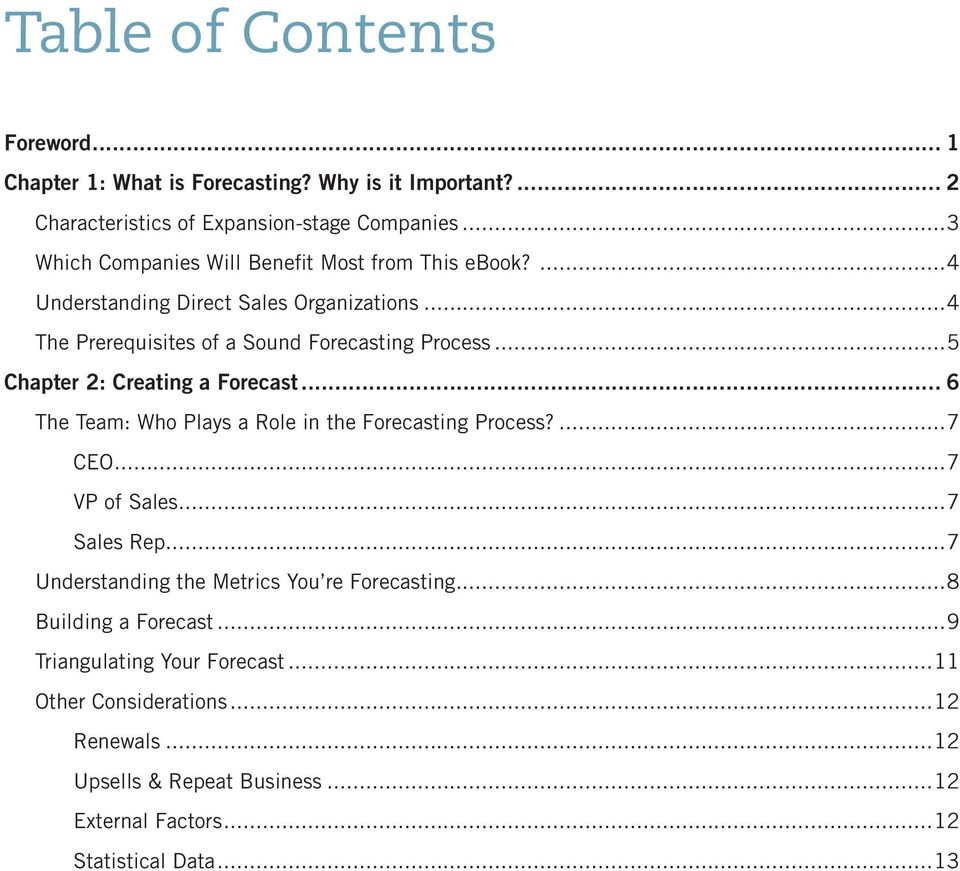
3 Chapter 3: Managing Your Forecasting Process Running a Forecast Review Meeting...16 Tip 1: Prepare in Advance...16 Tip 2: Conduct a Thorough Inspection...17 What Happens When Deals Slip?...19 Tip 3: Invite the Right Meeting Participants...20 Tip 4: Recognize That What You Say and How You Say It Matters...20 Tip 5: Identify the Right Meeting Frequency...21 Why the Pipeline Review Meeting is Not a Forecast Review Meeting...22 Chapter 4: Improving Forecasting Accuracy Under-promising and Over-delivering Is Inaccurate and Won t Help Your Business Scale...25 Put Everything on the Table: Surprises (Even Good Ones) Lead to Inaccuracy...25 Are the Milestones in Your Sales Process Holding You Back from Achieving Accuracy?...26 How Historical Data Can Improve the Accuracy of Your Forecast...26 Using Resources from Your Own Organization Can Improve Accuracy...27 What Do You Do When You Miss a Forecast?...28 What Should You Do with Reps Who Regularly Miss Their Forecasts?...29 Chapter 5: Leveraging Technology in Your Forecasting Leveraging CRM/SFA Technology...31 Managing a Real-time Forecast and Pipeline...31 Managing Forecasts Historically...33 Leveraging Advanced Forecast and Pipeline Analytics...34 Forecasting Technology Providers...34

4 End Note Appendix Glossary of Terms...36 Common Forecasting Challenges and Solutions...37 Checklists for the CEO, VP of Sales, and Sales Reps...39 Checklist for the CEO...39 Checklist for the VP of Sales...39 Checklist for Sales Reps...40 Additional Resources...41

5 Foreword In Boston, the joke goes that if you don t like the weather, just wait 10 minutes and it will change. As a result, people are reluctant to put any real stock in the local weather reporting. But let s disregard that for a minute and imagine that I checked the extended forecast this morning and found the promise of a sunny, 75-degree day two weeks out. Wanting to capitalize on the great weather being forecasted, I plan a big golf outing. Now, what if I were to make a wager on the accuracy of that forecast? If Weather.com were right, the payoff would be enjoying the golf outing. If the forecast were wrong, however, I d stand to lose all of my retirement savings. No rational person would take a bet with such poor odds and returns. Yet when it comes to forecasting, many growing businesses do precisely that. They frequently bet their company s future on inaccurate, unreliable, or nonexistent sales predictions. When those sales forecasts are accurate, they are successful at delivering on their promise and nothing more. But when they are inaccurate (which is frequently the case), the price is much greater, negatively impacting just about every component of their business. Now, that s not to imply that sales forecasts are about achieving perfection. Far from it. But, if you haven t established a sales forecasting process that anticipates, mitigates, and manages forecasting inaccuracies, you re simply treating your company s growth plans like that two-week weather prediction. The good news, however, is that a thoughtful, well-organized sales forecasting process is within your reach. I am proud to share OpenView s latest ebook, Sales Forecasts: A Question of Method, Not Magic, which lays out a comprehensive approach that, whether you are struggling with your existing forecasts, or have never really forecasted at all, can help you turn guessing into predicting. After reading this ebook, I am confident that the process will be demystified and that you will be well on your way to establishing the rigor, discipline, and science that this process demands. Jeff Hoffman President at M.J. Hoffman and Associates, LLC and Creator of YourSalesMBA Sales Forecasts: A Question of Method, Not Magic 1

6 CHAPTER 1 What is Forecasting? Why is it Important? Let s face it, none of us are psychics. We can t look into a crystal ball and see which deals in the pipeline will close in the next X days, which will drag on for the next X months, or which will flame out and never come to fruition. Truthfully, the chances of consistently producing a 100 percent accurate sales forecast are slim at any company, and virtually nonexistent at expansion-stage companies. Sales Forecasts: A Question of Method, Not Magic 2
7 The most reliable way to forecast the future is to try to understand the present. John Naisbitt Thankfully, sales forecasts don t need to be 100 percent accurate to be valuable. In fact, forecasting is simply about identifying a specific sales target in a specific time frame, as accurately as possible. It s about coming up with a number and growing and planning around that number. And, ultimately, forecasting can be an incredibly valuable tool that brings clarity to an entire organization, particularly expansion-stage companies that are in the process of scaling. Of course, that s assuming you do it right. The question that you need to ask is whether your growing company s forecasts are actually helping you plan for expected growth (or, in some cases, inhibiting growth), or if forecasting is just another corporate routine that your sales team doesn t take seriously. Sales Forecasts: A Question of Method, Not Magic is intended for the VP of sales at expansion-stage companies with direct sales organizations that are responsible for ensuring, administering, and reviewing accurate forecasts. The role of the VP of sales at an expansionstage business is focused on driving customer acquisition and renewal, and he or she is often single-handedly responsible for boosting revenue, recruiting and training sales staff, and setting the sales vision and process that will continue to drive growth in the future. Simply put, that person needs to be an expert multi-tasker who can juggle numerous balls at once. Sales forecasts are a critical tool that sales professionals use to assess performance, determine whether sales goals will be met, and anticipate resource utilization. They are essential to determining whether the company will meet its overall plans or goals, and they are used by the CEO/CFO to help set shareholder and market expectations on company performance. For a company to meet its goals, execute its plans, and grow, accurate sales forecasts are critical. David Brock President and CEO, Partners in EXCELLENCE Characteristics of Expansion-stage Companies Distinct from startup and growth companies, expansion-stage companies are generally focused on acquiring new customers and will have: } A history of solid growth } Between $2 million and $20 million in annual revenue } A dedicated sales team (at least two reps, but as many 20) } A core product vision and whole product offering with enough functionality and competitive differentiation that its target market customers are purchasing/using the whole product } A set of happy (or at least satisfied) customers who are willing to be used as references } A core go-to-market strategy that is being executed in a way that gets solid economic results } Adequate organizational and operational methodologies and people who can support additional resources and business Sales Forecasts: A Question of Method, Not Magic 3

8 Rather than pursue perfection which doesn t exist as a VP of sales you should focus on developing a consistent forecasting process that generates accurate results. Doing so will help you to: } Instill in your sales unit a clear understanding of how to achieve its goal } Guide the management team as it makes key business decisions, such as hiring more sales reps, investing more in marketing, or letting people go } Confirm that your sales process matches your customers buying process } Establish how well you re qualifying opportunities } Identify barriers to your product strategy } Clearly grasp whether you will hit your target number } Increase the probability that you ll hit that number WHICH COMPANIES WILL BENEFIT MOST FROM THIS EBOOK? This ebook focuses on direct sales organizations specifically B2B direct sales and provides a practical guide that can help activate change. It explains what forecasting is and why it is important, outlines the components of a forecast and how to create a successful forecasting process through forecast review meetings, and offers tips to help you improve your forecasting accuracy and utilize technology effectively to augment the process. It also focuses heavily on small, but crucial, adjustments you can make to your process to improve the accuracy of your sales forecast over time, especially as your business continues to scale. Understanding Direct Sales Organizations Direct sales organizations are sales teams that sell directly to the client, rather than through a distributor, reseller, retailer, or original equipment manufacturer. They allow businesses to cut out the middleman and go straight to the customers. While it sounds like a simple approach, direct selling presents some unique challenges. It can be costly, time-consuming, and much more difficult especially for B2C companies to forecast. Ultimately, the decision to focus on direct selling versus indirect sales channels depends largely on the product you are selling, the market you are selling into, and your buyer profile. Sales forecasting is an absolutely critical competency that both large and small companies must have. Your ability to deliver on your forecast is a reflection of how well you know your business, and how well you manage your sales organization. Without this competency, the already difficult challenges of scaling a sales organization, raising money, and building a great company become even more difficult. Swayne Hill SVP Global Field Operations, Cloud9 Analytics Sales Forecasts: A Question of Method, Not Magic 4
9 The term forecast gets thrown around a lot in business and can describe any number of different things. This ebook describes direct sales forecasts, which should be used to set an expectation around the new business coming into a company. While there are a number of different approaches to forecasting, the two broadest can be categorized as bottom-up and topdown. In brief, a top-down approach to forecasting is when a statistical analysis of previous performance and expectations, set by upper management, is used to predict the current or upcoming period. This approach is most frequently used at larger organizations that have enough data to generate statistically significant models and predictions. By contrast, a bottom-up approach to forecasting is built piece by piece, first with each individual deal, and then by considering other factors that could impact those deals and applying management judgment before arriving at a final forecast number. This is the approach that should be, and most commonly is, used at early and expansion-stage software companies, and is the primary focus of this ebook. THE PREREQUISITES OF A SOUND FORECASTING PROCESS Sales Forecasts: A Question of Method, Not Magic will help any VP of sales who is struggling with his or her sales organization s forecast. However, the how-to advice this ebook provides will not be effective for a sales organization that does not already have certain processes and best practices in place. Before reading the rest of this ebook, ask the following questions and make sure that you are comfortable answering yes to each of them. Do you have an actual sales team? Do your reps have quotas? Have you defined an opportunity, i.e., the first stage at which a deal should be included in the pipeline? Do you have a documented sales process with clearly defined exit criteria for each stage? Are you holding your reps accountable to managing their opportunity pipeline in some form of a customer relationship management (CRM) or sales force automation (SFA) system? Are you holding your sales reps accountable to their forecasts? If you answered no to any of these questions, we recommend that you take a step back and try to gain some clarity around these issues before implementing or making major changes to your forecasting process. If you answered yes to all of them, it s time to move on to the next chapter. Sales Forecasts: A Question of Method, Not Magic 5

10 CHAPTER 2 Creating a Forecast Like most important business activities, a true forecasting process includes numerous moving parts and requires you to consider some key extraneous factors, all of which influence the potential impact and output of your sales forecasts. Addressing these components first is critical, because they will ultimately fuel the execution of the forecasting process. This chapter covers everything you need to create a sales forecasting process, from key metrics and roles to myriad other considerations such as when and how to use statistical data. After reading this section, you will have a high-level understanding of what you and your team need to consistently deliver to create accurate sales forecasts. Sales Forecasts: A Question of Method, Not Magic 6

11 THE TEAM: Who Plays a Role in the Forecasting Process? There are three primary roles in the forecasting process: the CEO, the VP of sales, and the sales rep. Below are high-level descriptions of the role that each has to play. For the purpose of this ebook, we are assuming that there are no layers between the VP of sales and sales reps and, unless otherwise noted, will refer to the VP of sales rather than a sales manager. CEO The CEO s role in the forecasting process is to stay engaged and to have a clear understanding, in partnership with the VP of sales, of what to expect when forecasts are delivered. Since most CEOs are genuinely interested in how their company s sales are going, engagement is rarely an issue. However, the CEO must be mindful of the role the VP of sales plays in the forecasting process, namely setting the right expectations with the management team first and delivering a number second. The CEO must be open-minded and willing to help where possible, especially if the forecast looks like it is below target. VP of Sales The role of the VP of sales is to manage the entire forecasting process, set expectations with his or her team, and ultimately deliver the most accurate forecasts possible so that he or she can set the right expectations with the management team. The VP of sales should come to all forecast meetings prepared to inspect every deal, ask tough questions, and push the team to deliver the expected results. The VP of sales must also be prepared to present forecasts to management at just about any point in time. That reality underscores how important it is for the VP of sales to have his or her finger on the pulse of the sales organization. Sales Rep The sales rep s role is similar to the VP of sales role, but on a smaller scale that is limited to a specific territory or book of business. Sales reps must be prepared to give a forecast of their own deals at any point in time, must come to all forecast review meetings fully prepared with a list of their deals in the proper template, and be ready to share details and answer questions about any deal in their pipeline. Like the VP of sales, their primary role is to deliver an accurate forecast first, and deliver their quota second. Detailed checklists around the responsibilities of each are included in the Appendix of this ebook on page 39. Sales Forecasts: A Question of Method, Not Magic 7

12 UNDERSTANDING THE METRICS YOU RE FORECASTING Before you can start putting a forecast together, it s important to know exactly what you re trying to forecast. Depending on how your business operates today and which direction you would like it to go in the future, there are a number of different metrics that you can forecast. METRICS } Total revenue } Annual recurring revenue } Monthly recurring revenue } New business bookings } New business and upsell bookings } Services bookings } License and maintenance bookings } Annual contract value CHOOSE METRICS THAT ARE INDICATORS OF GROWTH The key is to choose the one or two metrics that are the most meaningful leading indicators of growth for your business. For early and expansion-stage software as a service (SaaS) companies, new business bookings tend to be that leading indicator of growth. They are defined as the value of a 12-month subscription contract from a new customer. Because early and expansion-stage companies are also typically competing for market share, tracking those bookings from new customers makes a lot of sense. ALIGN YOUR FORECASTING EFFORTS It is also important that you align your forecasting efforts with how you compensate your salespeople. Connecting sales rep quotas with the same metrics that you use for forecasting will save your company significant administrative work and make the forecasting and planning processes easier on everyone. See the glossary on page 36 for definitions of each of these metrics. 3. CONSULT WITH OTHER MEMBERS OF THE EXECUTIVE LEADERSHIP TEAM Finally, you need to consult with other members of the executive leadership team to determine their expectations of the sales forecast. You need to all agree on which metric you will use and the ultimate purpose of the forecast. That way, everyone knows what to expect when the forecast is delivered. Sales Forecasts: A Question of Method, Not Magic 8

13 BUILDING A FORECAST At most expansion-stage companies, the VP of sales is ultimately responsible for developing the bottom-up forecast. But in cases where there is a management hierarchy and several layers may separate the VP of sales from sales reps, each rep and manager needs to be responsible for delivering a bottom-up forecast to the VP of sales. From there, the VP of sales can deliver the final forecast to management. SALES REP Each individual sales rep should be able to forecast his or her business for the next 90 days (though this may vary depending on the length of the sales cycle). That forecast should include at least two critical numbers: } Best Case: The number of sales that will close if everything goes according to plan. The best case forecast should be greater than or equal to the commit number and should contain all of the opportunities that are in the commit forecast. } Commit: The more conservative estimate of the number of sales that will close that the rep is absolutely committed to hitting. In addition to the final forecasted number, sales reps should provide a list of opportunities that make up that forecast. After all, anytime a rep delivers a forecast, it is bound to include a combination of facts and gut feelings. Companies that forecast successfully, however, learn to minimize instinct and maximize the facts supporting the forecast. SALES MANAGERS To truly validate forecasted opportunities, sales managers need to acquire at least four key pieces of information to decide whether an opportunity should be included in a forecast. These are the: } Dollar Amount: How much the deal is worth. } Stage: The point at which the opportunity stands in the sales process. - Your sales process should be broken down into four or five simple stages depending on the business, market, and/or sales methodology. The example on the next page uses a very simple sales process (Discovery, Technical Evaluation, Negotiation). Another classic sales process is the simple four-stage AIDA process (Attention, Interest, Desire, Action). - Regardless of the process that you choose, make sure you define the simple exit criteria required to advance an opportunity from stage to stage. This step ensures that the sales stage is rooted in fact. } Probability: The expected odds that the opportunity will close. - Initially this will be based on instinct, but as you continue to tighten and gather data about your sales process, you will be able to calculate the percentage of deals that will close from each stage, and map stages to a probability accordingly. For example, if you have 10 opportunities and each has a 10 percent probability of closing, then you can expect one out of the 10 will close. } Close Date: The date when the contract is expected to be signed and returned. Sales Forecasts: A Question of Method, Not Magic 9

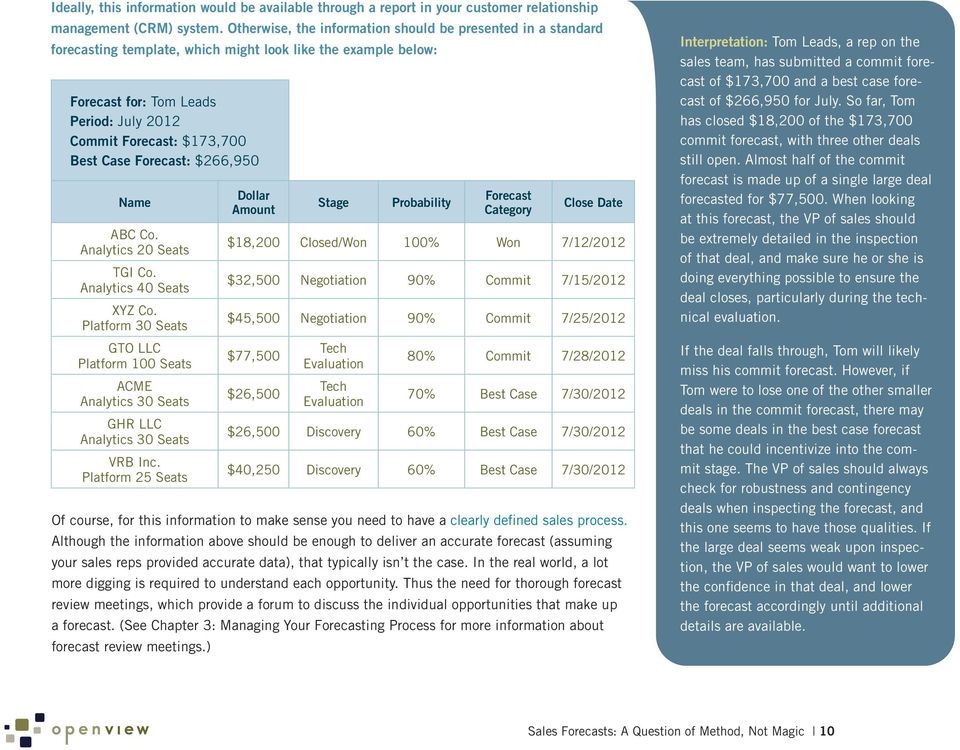
14 Ideally, this information would be available through a report in your customer relationship management (CRM) system. Otherwise, the information should be presented in a standard forecasting template, which might look like the example below: Forecast for: Tom Leads Period: July 2012 Commit Forecast: $173,700 Best Case Forecast: $266,950 Name ABC Co. Analytics 20 Seats TGI Co. Analytics 40 Seats XYZ Co. Platform 30 Seats GTO LLC Platform 100 Seats ACME Analytics 30 Seats GHR LLC Analytics 30 Seats VRB Inc. Platform 25 Seats Dollar Amount Stage Probability Forecast Category Close Date $18,200 Closed/Won 100% Won 7/12/2012 $32,500 Negotiation 90% Commit 7/15/2012 $45,500 Negotiation 90% Commit 7/25/2012 $77,500 $26,500 Tech Evaluation Tech Evaluation 80% Commit 7/28/ % Best Case 7/30/2012 $26,500 Discovery 60% Best Case 7/30/2012 $40,250 Discovery 60% Best Case 7/30/2012 Of course, for this information to make sense you need to have a clearly defined sales process. Although the information above should be enough to deliver an accurate forecast (assuming your sales reps provided accurate data), that typically isn t the case. In the real world, a lot more digging is required to understand each opportunity. Thus the need for thorough forecast review meetings, which provide a forum to discuss the individual opportunities that make up a forecast. (See Chapter 3: Managing Your Forecasting Process for more information about forecast review meetings.) Interpretation: Tom Leads, a rep on the sales team, has submitted a commit forecast of $173,700 and a best case forecast of $266,950 for July. So far, Tom has closed $18,200 of the $173,700 commit forecast, with three other deals still open. Almost half of the commit forecast is made up of a single large deal forecasted for $77,500. When looking at this forecast, the VP of sales should be extremely detailed in the inspection of that deal, and make sure he or she is doing everything possible to ensure the deal closes, particularly during the technical evaluation. If the deal falls through, Tom will likely miss his commit forecast. However, if Tom were to lose one of the other smaller deals in the commit forecast, there may be some deals in the best case forecast that he could incentivize into the commit stage. The VP of sales should always check for robustness and contingency deals when inspecting the forecast, and this one seems to have those qualities. If the large deal seems weak upon inspection, the VP of sales would want to lower the confidence in that deal, and lower the forecast accordingly until additional details are available. Sales Forecasts: A Question of Method, Not Magic 10
15 TRIANGULATING YOUR FORECAST Because sales reps forecasts are never perfect, you need to apply your own judgment to truly determine their accuracy. Although the information gathered in the forecast review meeting will help you build a level of confidence around each forecasted opportunity, it s not always enough. Here are four other factors you should consider when determining a final forecast number: The Sales Rep s Forecasting Style: Different reps have different forecasting styles. Some like to start low and raise their forecast week by week as they gain more clarity on the prospects they are calling. Other reps like to predict the number right off the bat. Some reps tend to be overly optimistic about deals they probably shouldn t be forecasting. Another group of reps will be much more conservative, sometimes even sandbagging their forecasts. As a VP of sales it is your job to learn each rep s style over time. The more you know about those styles, the better you will get at delivering the right guidance early on in the forecasting period. Historical Performance: What was the rep s forecast at this time last month? And at this time the month before that? What was the rep s bookings at this time last month, and the month before that? This is where tracking each rep s forecast, and the total team roll-up forecast, on a weekly basis can be extremely valuable. After a while you will begin to notice patterns about each rep s forecast and overall sales performance. For example, you may notice that some reps (or the team as a whole) close only 10 percent of their business in the first week of the month, and therefore start off the month with a much lower forecast. However, they may in fact be right on track to hit their quota when compared with the prior month s forecasts and the prior month s bookings trends. Over time, you may also notice that some months are slower than others. These data points are great indicators of whether or not you are on track to achieve expectations. Changes Within the Sales Team: Any change to the composition or structure of your As you gather the sales team can impact a forecast. If people left (or if you know people will be leaving), you need to individual forecasts make sure that the deals they were forecasting are covered. Territory shifts or promotions within from each of your sales territories can also influence performance without your reps immediately recognizing it. reps and managers, Sales Productivity Curve: How long does it take for new sales reps to get up to full quota you should take these (90 days? 180 days?) and how much will they deliver before they get there? The VP of sales needs factors into consideration to measure the time it takes each new rep to learn the product, the market, buyer behavior, and the and analyze how they forecasting process. He or she also needs to factor in the time it will take to learn each rep s style and might impact your final individual needs. These are all factors that influence the sales productivity curve and, ultimately, the forecast. sales forecast. Sales Forecasts: A Question of Method, Not Magic 11

16 OTHER CONSIDERATIONS Here are a few other points that you need to factor into your forecasting process. Renewals Every expansion-stage company should have a sales team focused on new customer acquisition. The need for a team focused on renewals, on the other hand, depends largely on the stage your company is in. If the VP of sales is responsible for forecasting renewals, he or she needs to look at all current customers, organize them by renewal date, factor in the historical retention rate, and forecast the projected value of the renewals. That number will serve as a baseline forecast. Regardless, whether a new customer acquisition team or a separate account management team is handling renewals, they should treat them just like they would a new business opportunity documenting the probability of renewal, the date customers might renew, and the dollar amount they might renew for. Upsells & Repeat Business Forecasting upsell opportunities is very similar to forecasting new business, but these should also be more informed opportunities. After all, they are sales to existing clients. Some business models give customers the ability to come back several times during the term of their contract and add new licenses, or increase usage at an additional fee. If your team has insight into these opportunities they should be included in the upsell forecast. Besides the actual opportunities in your sales pipeline, there are additional external factors that may influence your forecasting. Some things to keep an eye on include: External Factors } Changes in the Market: Identify any relevant shifts in the market and how they might affect any deals in the forecast. For example, new low-cost competitors could come into your space and try to undercut your pricing. Or, an existing competitor might lower its price every time it finds out it is competing against you. Your reps should know if you are competing for the deal and how that may affect the outcome. } Changes in the Product: Are any product changes coming that will help you bring in deals or increase their size? For example, that new functionality that many customers have been asking for? You and your reps should be checking every deal to see if such changes can help win it, increase its size, or bring the deal in sooner, as well as to understand how that will affect the forecast. Sales Forecasts: A Question of Method, Not Magic 12

17 Statistical Data Some expansion-stage companies may have enough data to apply some statistically significant analysis to the pipeline to increase the accuracy of the forecast, including: Win rate: The win rate is the number of deals won divided by the total number of deals that closed (won and lost) in a given period. Win rate = won deals / closed deals For the win rate to be relevant you will need data on enough closed deals to be statistically significant, and you will need to be very disciplined around marking deals closed/lost instead of pushing out the closed dates if they don t come in. You should also have additional data on your sales opportunities that will let you determine win rates in your current forecast across different stages, reps, regions, products, or deal size tiers. If the data is statistically significant, applying it to your current forecast will give you another great data point to triangulate the final forecast. Close rate: The close rate is the number of deals that actually closed in a period divided by the number of deals that were forecasted to close in the same period. Close rate = closed deals (actual) / closed deals (forecasted in the defined period) The close rate is an excellent indication of the quality of and compliance to your sales process. The lower your close rate, the less reliable your win rate will be. Many VPs of sales fall victim to thinking that they have high win rates when in fact many of the deals that should have closed are just pushed out to the next forecast period. Low close rates ultimately result in poor pipeline hygiene, and will have implications for overall funnel economics, not just the sales forecast. A consistently high close rate, on the other hand, means that your reps are being disciplined in their opportunity management, and probably also sticking to the sales process. Sales Forecasts: A Question of Method, Not Magic 13

18 Statistical Data Slippage rate: The slippage rate is the percentage of deals that were forecasted to close in a given period, for which the close date was subsequently changed to a future period and the opportunities are still open. Slippage rate = (closed deals (forecasted in the defined period) closed deals (actual)) / closed deals (forecasted in the defined period) Slippage rate is the inverse of the close rate, and will be an indicator of the same qualities (positive or negative). To measure slippage and close rates effectively, you will need to take regular snapshots of the number of deals in the pipeline at the same point in time for every forecast period. This will give you the number of closed deals (forecasted). The length of your sales cycle will help you determine the right interval for taking these snapshots so that you capture the majority of the deals that will in fact be forecasted to close at the end of the forecast period. For example, if your average sales cycle is 30 days, and you take pipeline snapshots in intervals 60 days from the end of the forecast period, it is likely that about half of the opportunities that will close in the forecast period will not even have been created. Instead, take snapshots 15 days from the end of the forecast period, and you will probably catch all of the deals forecasted to close. The sales forecasting process can quickly become complicated if it is not properly developed. Because forecasting can involve a wide universe of factors that all impact accuracy, it s critically important to take a holistic view of the world around you. Whether it is individual reps forecasting styles, unexpected market changes, or specific buyers purchasing behaviors, forecasting involves much more than simple quantitative and probability analysis. In the next chapter, we ll move beyond basic sales forecasting development and into why holding regular, intensive forecast reviews is necessary, and explain the key difference between a forecast review and a pipeline review. Sales Forecasts: A Question of Method, Not Magic 14
19 CHAPTER 3 Managing Your Forecasting Process Now that you ve identified the information that needs to be included in a sales forecast and explored the factors that could potentially impact its accuracy, you should have a solid foundation to build on. However, you can t just stop there. Sales Forecasts: A Question of Method, Not Magic 15
20 It is equally important (if not more so) to develop & execute a forecast management process made up of effective forecast reviews. RUNNING A FORECAST REVIEW MEETING The forecast review meeting is the most important step in the sales forecasting process, providing a forum for an in-depth discussion of the individual opportunities that make up a forecast. The purpose of the meeting is to develop a level of confidence around each forecasted opportunity so that you can deliver the most accurate forecast to management. In this forum, discussions around individual deals can often involve high levels of emotion and personal ownership, by both the rep and VP of sales alike. Strong VPs of sales resist the temptation to allow a forecast review meeting to become too narrative, and instead use pointed questioning to understand each deal. The more pointed your questions are in this meeting, the more confident you will be in the accuracy of each forecasted deal, and the more you will discover about which sales reps are (or aren t) on top of their deals. Having a consistent forecasting process with effective forecast meetings will also provide regular coaching opportunities to help you make good reps better, while weeding out the bad ones. This will allow you to gauge sales reps true confidence on forecasted deals and deliver more accurate forecasts in both the short and long term. But as this chapter will show, pipeline reviews and forecast reviews have key differences and are not equivalent predictors of revenue. TIP 1 Here are five tips to ensure that those meetings are efficient and effective: Prepare in Advance One of the most important factors in running a productive forecast review meeting is preparation. The purpose of the forecast meeting, after all, is to examine every opportunity in the forecast. For the meeting to be productive, the VP of sales must be prepared to ask tough questions about each opportunity, and the sales reps must be prepared to answer those questions. Here is an example of a typical forecast review meeting agenda that would ensure those questions are asked: I. Review the forecasted numbers i.) Best case and commit. ii.) How do they compare to last week s forecast? II. Review opportunities from last week s forecast review i.) What progress was made? ii.) What has changed? III. Review any new opportunities in the forecast IV. Review the pipeline for the next month/quarter Sales Forecasts: A Question of Method, Not Magic 16

21 The sales reps and their VP of sales must come to the meeting prepared to discuss each agenda item. For sales reps, that means bringing the forecast they submitted along with the list of opportunities that make up the best case and commit forecasts. Sales reps should be prepared to discuss the opportunities that they are forecasting, as well as anything else in their pipeline. The VP of sales should come to the meeting with notes from the previous week s forecast review and the sales rep s new forecast. That way, they can accurately follow up on forecasted opportunities from the previous week and confirm that progress is being made. It is also a good practice for sales managers to briefly review other opportunities in the pipeline prior to the meeting, rather than just the opportunities in the forecast. Why is it important to be so prepared? Some sales reps may not be well-trained on your forecasting process, leaving them unaware of what s expected of them at the review meeting. By setting those expectations ahead of time, you can communicate how critical it is that they are met. As a best practice, you should build forecast review meeting training into your new hire onboarding process. Have new reps sit in on multiple forecast review meetings so that they get a feel for the agenda and the kinds of questions you will ask them about their forecast and opportunities. Quite simply, if reps are not prepared going into the forecast review, the meeting will not be productive. If, however, they are prepared, you will ensure that the meetings run efficiently, allowing your reps to spend more time calling prospects and customers. TIP 2 Conduct a Thorough Inspection A quick review of the current forecast and progress being made toward hitting the forecasted number is a great way to start the meeting because it sets the basis for the rest of the conversation. The sales reps should have already sent you their forecast sheet with their best and worst-case numbers and the list of opportunities that they expect will get them to those numbers. Compare that sheet to the one submitted the previous week. If the number has changed, find out why. Once you have a forecast number, work backward through each deal, starting with those in the commit forecast, followed by the best case, and ending with the pipeline, identifying backup deals to cover any deals that may fall out. While conducting the inspection, try to avoid the temptation to describe the opportunity in narrative form. Instead, ask the standard set of questions from the forecast template: These standard questions lead to a series of additional questions on the next page that will help you dive deeper into the opportunity. The goal is to find out what else needs to happen for each deal to close on the forecasted date, and at the forecasted amount. How much is the opportunity worth and why? What stage is it in and why? When is it going to close and why? What is your level of confidence (probability) and why? Sales Forecasts: A Question of Method, Not Magic 17
22 Here are some additional questions that you should be asking: } Who signs off on the deal? } When did you last speak with the decision maker? } Who else can say no? } Do you have the technical win (i.e., are the technical stakeholders sold on the product and have they signed off that it meets the technical requirements of the prospect)? } Do you have the business win (i.e., are the non-technical stakeholders sold on the value that your product will bring them in the form of either cost savings, increased revenue, or preventing the loss of revenue in the future, and have they signed off that it meets their non-technical requirements)? } What is the impending event that is causing the prospect to sign on the anticipated date? } What was the last step? } What is the next step? } Does the deal have to go through legal review? } What is the prospect s procurement process? } What other solutions is the prospect evaluating? } Why does the prospect need to solve the problem at all? } What are the implications to the prospect if they don t solve the problem? } What happens if they don t solve it now? } Why will the prospect choose your solution to solve the problem? Another good tactic to use during the forecast review meeting is negative questioning. Asking these types of questions puts sales reps in your shoes and forces them to think critically about an opportunity. This tactic can also help you and your reps develop contingency plans for different scenarios. Here are some negative questions to consider: } Why wouldn t you win this deal? } What else could get in the way of this deal closing? } Why would the prospect choose the competition over you? } Why wouldn t the deal make it through legal review? } What if the board meeting doesn t happen? (Assuming you were told that the final decision is being made at a board meeting) Sales Forecasts: A Question of Method, Not Magic 18
23 Be rigorous in your inspection of each opportunity. As a best practice, consider calling a prospect during a forecast meeting to get additional clarity and detail. The goal is to feel more comfortable about each opportunity, so you should run through as many questions as it takes to get to that point. As you get through each opportunity, you will develop your own level of confidence as to whether the opportunity belongs in the forecast or not, as well as the probability that you think it will close. With each opportunity, there s one additional question you should always ask: What can I do to help move this deal forward? This is your chance to offer additional support and guidance. You should be listening for opportunities to engage in deals and get other members of the organization involved to help close them. You should also come to an agreement with your sales reps on the right next step for each opportunity. If you ask all of the right questions, you should walk out of each forecast review meeting with the input you need from that rep to incorporate it into your forecast for the team. What Happens When Deals Slip? Forecasts live and breathe, and as a result tend to fluctuate over the life of a forecasting period. A variety of factors can impact a forecast at the last minute, potentially derailing deals that are in their final stages. When that happens, your reps should immediately alert you so that you can step in and provide the necessary support to ensure that the deal closes. One way avoid this pitfall is to make sure that your commit forecast consists only of deals in the final stages of the sales process. If, however, a deal is in the final stages and then takes an unexpected turn for the worse, additional action may be necessary, including: 1. Diagnosing the problem: What needs to happen for a deal to close on a given date? Identify what went wrong so you can take appropriate corrective action. 2. Treating the problem: When problems arise late in the sales process, some salespeople have a knee-jerk reaction to offer discounts, which is not initially advisable. A number of other solutions may work better, without affecting pricing, such as executive involvement, modified payment terms, or opt-out grace periods. You may also consider taking certain incentives off of the table. To find the right solution, it is important to understand what is preventing the deal from closing, who the players are, what is motivating them, and who is creating the bottleneck. 3. Initiating a contingency plan: In some cases, deals cannot be saved, such as when a problem is caused by a misunderstanding, or when it is just too late in the period. In such instances, you need to decide whether to push into the next forecast period or move the deal to close lost for the current period. In either case, you will need to back fill it to maintain the commit forecast or lower your commit forecast. Your best case forecast consists of deals that could potentially come in but are not quite there yet. Review these opportunities thoroughly and identify the best prospects. Apply some additional time and effort toward closing these deals to try to make up for the loss. Sales Forecasts: A Question of Method, Not Magic 19
24 TIP 3 Invite the Right Meeting Participants The forecast review meeting is designed to be a one-on-one session between you and the rep, but in some cases, it may be appropriate to invite other people. In more technical sales, for example, you might invite a sales engineer to the forecast meeting to provide feedback on the technical aspects of the deal or to confirm the technical win. Often times, as your sales team grows, a very well-trained and trusted resource such as a sales engineer can offer valuable insight from the front lines. For instance, the sales engineer may have additional insight into the deals that she has been involved with, or information about new technologies and competitors. Be cautious not to let any other meeting participants undermine a rep s forecast. Reps should own their forecast. If they start to feel like you or someone else is setting it for them, you risk losing their trust. If there s a layer of management between you and your sales reps, such as a sales manager or sales director, those managers should run their own forecast meetings with their reps. When you have a forecast meeting with your sales manager/director, the meeting should follow the same agenda, but you may also want to discuss forecasts rep by rep. Depending on how many reps each director has, there may be too many deals in the forecast to go through every opportunity. A good approach in that case is to focus on specific deals, especially those in the commit forecast, and the deals that are key to hitting it. It is important to note that even though you want your managers running their own forecast review meetings, you will always have questions that you want unfiltered answers to. As a best practice, it s good to sit in on at least a handful of forecast review meetings with the manager and the rep every week. Doing so will give you the opportunity to acquire unfiltered feedback from the reps, while also seeing how your managers run their forecast review meetings. At the end of each meeting, you may want to help or advise a sales rep to engage with other members of the organization and ask for their assistance. That s especially true at early and expansion-stage companies, when some prospects may want to speak with a member of the executive team before committing to a deal. TIP 4 Recognize That What You Say and How You Say It Matters One thing to keep in mind throughout the entire forecasting process is that the goal of forecasting is accuracy, not getting to quota. This is where the art of management becomes very important. The forecast review meeting is an opportunity to hold sales reps accountable and to really analyze their deals. However, you do not want to put them in a situation where they re simply telling you what you want to hear for fear of how you might react if they tell you the truth. Sales Forecasts: A Question of Method, Not Magic 20
25 With sales reps, it is important to establish up front that the ultimate purpose of the forecast review meeting is to improve accuracy. If a sales rep misses his quota, but hits his forecast dead on, that s a better result than if the forecast was wrong altogether. After all, that situation allows you to deliver a more accurate forecast to management, making you look better, and improving management s ability to make informed decisions. Ultimately, your success depends on the success of your reps. When you dig into their deals, it s with their and your best interests in mind. You are keeping them on track with each deal and helping them get better at their jobs. While it is important to ask tough questions, how you ask those questions is just as important. You must ask them in a way that makes the reps realize you are trying to be helpful by encouraging honest answers and accurate forecasts rather than fixating on them hitting the quota. TIP 5 Identify the Right Meeting Frequency The forecast review meeting should be held with every sales rep at least once a week regardless of the length of your sales cycle. Quite simply, unless you are reviewing the business that is closing on a weekly basis, you don t know your business. That s a good philosophy for VPs of sales to live by at expansion-stage companies. If you have a shorter sales cycle with a low average sale price (ASP), you will probably be focusing on the many deals that are closing within the next week. If your sales cycle is longer with a high ASP, there may only be a few deals forecasted to close. That doesn t mean you should have less frequent meetings. Rather, it makes it even more important to stay on top of those deals. Consider a rotation of rep, day, and time. Be mindful that the detail discussed within these meetings can be exhausting for the VP of sales to absorb. Stagger your forecast review meetings throughout the day and week; stacking back-to-back-to-back forecast meetings is never a good idea. Getting it right is not easy, but applying the tips outlined above with focus and discipline will result in more accurate forecasts. You will not know if your process is sound until the end of the forecast period when you see how close your forecast was to the actual number. In the interim, you should feel confident in the accuracy of your forecasts if: } You have visibility into the amount and close date of every deal in your commit and best case forecasts. } Every deal in your commit forecast is in the final stages of the sales process. } Your reps are comfortable giving you a realistic forecast (above or below quota). } Your forecast review meetings are efficient and productive. } Your reps are coming to their forecast review meetings prepared to answer all of your questions. Sales Forecasts: A Question of Method, Not Magic 21
26 WHY THE PIPELINE REVIEW MEETING IS NOT A FORECAST REVIEW MEETING When developing an execution plan for accurate forecasting, it is important to recognize the differences between your organization s pipeline versus its forecast. Although it may appear that they are the same predictors of revenue, these two rulers are actually quite different. Great organizations, particularly at the expansion stage, recognize those differences, isolate them, and ultimately manage them separately. Additionally, expansion-stage companies are often starved for historical data, so tracking and analyzing both measurements separately will often reveal unique details about your sales growth that can quickly be observed and leveraged. While the goal of forecast review meetings is to go through and understand the deals that make up the current period s forecast, the aim of a pipeline review is to monitor the health of the overall pipeline, not just the deals in the current forecast. The pipeline is the strongest indicator of your company s overall health and of your entire book of business. Often, the pipeline review will reveal strengths and gaps that may not be realized for months, or even quarters, but can thankfully afford the VP of sales the critical time needed to make specific corrections. Ultimately, the pipeline will take on a unique shape that will also reveal elements such as your company s sales cycle, resource bottlenecks, and even new hire ramp time. It also provides the VP with the ability to predict when and how to scale the organization. Another distinction of the pipeline review is the public nature of the session, which ensures team-wide ownership of the pipeline, and a more clinical approach to the science of selling that is desperately needed to get to the heart of business. These meetings should be conducted in groups and can take place as often Week 1 as every week. However, if creating Stage Opportunities Amount too many meetings for your reps is a Discovery 19 $724, concern, consider scheduling pipeline review meetings on a bi-weekly Tech Evaluation 12 $457, or monthly basis. Negotiation 3 $114, Week 2 Start the meeting by looking at the Stage Opportunities Amount pipeline in aggregate by the number Discovery 15 $572, and amount of opportunities separated by stage, and compare it to the Tech Evaluation 9 $343, previous week to track the movement. Negotiation 6 $228, The analysis and recommendation for this review might be: The team appeared successful in moving more deals down the pipeline this week. It is likely that the spike in negotiation opportunities was the result of advancing tech evaluation and discovery opportunities over the past week. However, this strong activity was not without its cost. The subsequent overall number of opportunities dropped. Not surprisingly, this was probably due to a lack of attention to the top end of the pipeline last week. Therefore, the recommendation could be for the team to commit to adding net new deals to the discovery stage through focused prospecting and lead follow-up. Sales Forecasts: A Question of Method, Not Magic 22
27 You should also inspect a random sample of five to 10 deals for each rep and ask questions comparable to those you would ask in a forecast review meeting. Instead of asking How do we get the deal to close? ask, How do we get the deal to the next stage in the sales process? This inspection of early stage opportunities can help you gauge the quality and health of the opportunities in the earlier stages that may not make it into the forecast, but are taking up your reps time. The pipeline review meeting is your chance to perform some necessary clean-up and make sure that your reps are working on the right opportunities to help them build a healthy pipeline. For any growing business, uncertainty and change are inevitable. That s one of the big reasons why comprehensive forecast reviews are absolutely critical to ensuring the long-term viability of your overall sales forecasting process. Without performing these reviews, how can you adjust to things like fluctuating market conditions or employee experience, and unearth potential flaws that might be keeping your forecasts from being as accurate as they should be? Forecasting is about accuracy, so that a company can manage its resources, people, and capital. The result is that when it comes to forecasting I don t like surprises, good or bad. At most expansion-stage software companies there usually isn t enough historical sales data to conduct a good statistical top-down forecast. That s why the weekly forecast review meeting is so critical to an accurate forecast. The management judgment that is applied to the forecast is based on the conversations with the reps around each deal. Reps who can t forecast accurately aren t in control of their deals, and sales managers or VPs of sales that are not conducting weekly forecast review meetings are not in control of their business. George Roberts Venture Partner, OpenView Venture Partners Remember, pipeline reviews and forecast reviews are two entirely different processes that work collectively to measure the health of your overall sales organization; don t make the common mistake of confusing them. Sales Forecasts: A Question of Method, Not Magic 23
28 CHAPTER 4 Improving Forecasting Accuracy There is no such thing as a perfect forecast. It is, after all, a prediction even if it is backed by quantitative and qualitative data. According to forecasting resource site PracticalForecasting.com, even the best statisticians place what they call error bands around their forecasts. In essence, they measure the worst-case results that would still qualify as an acceptable outcome. In forecasting, think of the error band as the plus or minus differential between your forecasted number and the actual result. Anything within that error band might be considered a success, i.e., a relatively accurate forecast. Sales Forecasts: A Question of Method, Not Magic 24
29 While it is probably reassuring to know that your sales forecasting doesn t have to be spot-on every time, it is important to make sure that your error band isn t too wide. If it is, your numbers could come within a range that seems reasonably acceptable, but still cost you a significant amount of lost opportunity. Until you are consistently missing a forecast by less than 5 percent, always focus on continuous rapid improvement, because ultimately it will lead to the greater justification of scaling in headcount and capital (taking new investments). At the expansion stage, scaling headcount and resources should be a top priority. So, let s dive a little deeper into how you can continually improve forecasting accuracy and, ultimately, better position your business for growth. UNDER-PROMISING AND OVER-DELIVERING IS INACCURATE AND WON T HELP YOUR BUSINESS SCALE Most salespeople are taught the cliché approach of under-promising and over-delivering. They sandbag forecasts, fudge numbers, and underestimate their potential in order to protect themselves. If they underperform, they still hit their forecast. If they perform as they should, they look like sales superstars. The obvious problem with this philosophy is that it prevents a company s management team from making decisions especially the ones that impact the scaling of important resources based on fact. PUT EVERYTHING ON THE TABLE: SURPRISES (EVEN GOOD ONES) LEAD TO INACCURACY When kicking off a forecast meeting, the most important thing a VP of sales can do with his or her reps is make one thing very clear: I don t like surprises. I won t accept surprises. Whether you are up or down, I want to know the truth. The problem, according to Joe Ruck, President and CEO of BoardVantage, 1 is that sales reps often feel compelled to lie. If their forecast is less than 70 percent of their monthly quota, they fear termination. But it doesn t have to be that way. If a sales rep is under quota the sales manager might be able to help him, assuming there s still enough time. Managers should make sure they give themselves that time by meeting with their reps every week, asking them pointed questions about their forecasted opportunities, and requesting that they be open and honest. Again, the goal is to stress accuracy. Make it absolutely clear that pipedream or sandbagged forecasts are much more damaging than honest ones that don t blow anyone away. Reps that know the business and personal benefits of accurate forecasts are much more likely to deliver them. 1. Ruck, Joe, How to Improve Sales Forecasting, eweek.com. Sales Forecasts: A Question of Method, Not Magic 25
30 ARE THE MILESTONES IN YOUR SALES PROCESS HOLDING YOU BACK FROM ACHIEVING ACCURACY? Faulty forecasts are often the result of a poorly defined sales process. Each stage in your sales process should have some milestone or clearly defined exit criteria that moves that prospect to the next stage. There should be a knowledge transfer between both the sales rep and the manager, as well as the sales rep and the prospect, at every stage of the sales process. That way everyone is kept in the loop and able to understand not guess what to expect next. The first milestone is defining what a forecasted opportunity means. If a salesperson can t say who a decision maker is, what they talked to that person about, why they talked about those things, and how that data will affect the projected close date, then the forecasts will be wrong. Additional key milestones for your business may include a demo or trial. Each of these milestones should have a percentage attached to them that speaks to where they stand relative to close. That percentage needs to come from historical data based on previous deals that have moved through the pipeline. For example, after analyzing your opportunity data you may find that deals with demos have a higher probability of winning than deals without demos, 50 percent versus 25 percent, respectively. In that case, you would want to make the demo a key milestone or stage in your sales process. When you run the forecast you can apply that probability across your pipeline to reflect that any deals that have had demos probably have a 50 percent chance of closing. Conversely, if a sales rep is forecasting a deal that has yet to have a demo at above 50 percent, the forecast may be overly optimistic on that particular deal. HOW HISTORICAL DATA CAN IMPROVE THE ACCURACY OF YOUR FORECAST The larger the deal size, the more difficult it will be to use historical data to improve forecasting accuracy. Why? Because larger deals involve more people and more extraneous factors, all of which make it difficult to detect true historical trends. And since you will typically have fewer large deals, assembling a statistical sample big enough to fairly analyze historical data is very unlikely. On the other hand, if your business relies mostly on lower dollar deals and a shorter sales cycle, you can t afford to ignore historical data and trends. They will help improve your forecasting, and better inform your sales process. Fortunately, historical data is easier to gather than ever, thanks to new technology and applications. Successful forecasting depends on knowing how to analyze and implement what you learn from that data. The key is to understand how certain metrics trend over time, and to interpret what they mean for the future. Companies with a high volume of deals will have plenty of historical data to examine, so it becomes a matter of analyzing the most useful information. Sales Forecasts: A Question of Method, Not Magic 26
31 One common use of historical data is to track seasonality. You ve probably heard, or even said, something like, We always have a lull in the summer, but our fourth quarters are outstanding. Guess what? That s a trend, and it should be taken very seriously. Analyzing historical seasonality data, especially in the expansion stage after your company has produced a few solid years of sales, can have a huge impact on forecast accuracy. USING RESOURCES FROM YOUR OWN ORGANIZATION CAN IMPROVE ACCURACY One of the best resources that sales managers or reps can leverage to improve forecasting is executive sponsorship. The reason is simple: An executive can help push deals along and keep them on track to close around the anticipated date. Who in your organization might serve as an effective executive sponsor? An executive s desirability can vary depending on their willingness and personality, but here are four candidates to consider, and one external possibility: Internal } CEO: If a customer is concerned with the organization s business strategy, stability, scalability, and/or financials, the CEO could bring credibility and validation to the table. } Head of Product Development: If a customer is trying to better understand your product strategy, the head of product development can provide much-needed clarity. } Head of Customer Service: If customers need reassurance that they will get the necessary support to launch your product or service efficiently within their organization, who better to provide it than the person most responsible for that guarantee? External } CFO: If a customer wants to be certain that your company is in good financial standing, the CFO can be an authoritative source without giving away sensitive information. } Venture Partner: If a customer wants to be certain that your company is stable and in good financial standing, a testimonial from an invested partner can t hurt. The key is to understand the customer s needs and, for that matter, your sales rep s potential shortcomings. If you sense that a deal might die because the customer lacks faith in something, don t be afraid to call in the big guns to address it. Sales Forecasts: A Question of Method, Not Magic 27
32 WHAT DO YOU DO WHEN YOU MISS A FORECAST? No one likes missing forecasts, but it s impossible to bat a thousand. That said, if you are the VP of sales and you are consistently missing your forecasts, it s time to take a step back and perform some introspective analysis. Ask the following questions: } What types of deals are you currently losing out on? } What geography are those deals located in? } Where did the rep go wrong? } What stage did the opportunity get hung-up on? Forecasting misses are the result of one or more of the following: There are issues with your sales process and your rep is taking shortcuts, which is leading to inaccuracy. For example, if your sales process stages do not have clear exit criteria, your reps may fool you into thinking that their deals are further along in the sales process than they actually are. When you have the right sales process, skipping steps will lower the probability that a deal will close. Your reps lack control over managing their opportunities through the sales process milestones and are filtering important information from you. Some extraneous events caused a deal to go sour at the last minute. For instance, the prospective company didn t hit its numbers and could not move forward with the close. If you are seeing similar extraneous events occur time after time, are they really that extraneous? You are probably missing something. In the case of the third point, there isn t much you can do to change those circumstances. To a certain extent, extraneous events are out of your hands. However, those situations do not have to undermine your forecast accuracy. What s the key to covering yourself if something out of your control happens? Have backup deals in the pipeline that you can turn to should a forecasted deal crumble. Backup deals are deals in your pipeline with a closing date projected farther out than your current forecast, but that you and your reps are confident could be accelerated because you have the resources and buy-in to move things such as product evaluation, procurement, etc. Sales Forecasts: A Question of Method, Not Magic 28
33 WHAT SHOULD YOU DO WITH REPS WHO REGULARLY MISS THEIR FORECASTS? If a rep is missing a forecast by 5 to 10 percent every now and then, it s not cause for concern. If, however, the rep is missing his forecast by more than 20 percent every month, you have a serious issue on your hands. As a point of reference, in a study by Aberdeen Group, the top-performing technology sales teams in the study had an average accuracy of 68 percent within two months of the close cycle, 75 percent accuracy 30 days from close, and 86 percent accuracy right before the selling period ended. 2 When it comes to forecasting misses, before you start pointing fingers, ask this question: Have you done your job as a manager? If you have any doubts, run through this list: } Have you had weekly meetings to talk about the forecast and update it accordingly? } Have you been asking difficult questions to weed out the deals that shouldn t really be included in a forecast? } When was the last time you joined your reps on a call with a prospective customer that they insisted would be committing before the end of the month? } Have you spoken with your reps about the repercussions of consistently inaccurate forecasts? } Have you pulled out any opportunities that you know should not be in the forecast? If you can answer those questions affirmatively and can look in the mirror and say, I have done what I can and this is still not working, then you know that you really only have one other option. It is never easy to let people go, but in order to scale, you need a team that can manage deals to close and forecast accurately. Remember, your forecasting goal shouldn t be 100 percent accuracy. Perfection does not exist. But if your forecasts are consistently off, review the steps laid out in this chapter to identify flaws in the process or areas where discipline may be lacking. 2. Sales Forecasting Benchmark Assessment, Aberdeen Group, Sales Forecasts: A Question of Method, Not Magic 29
34 CHAPTER 5 Leveraging Technology in Your Forecasting From basic spreadsheets to customer relationship management (CRM) and sales force automation (SFA) applications, there are myriad technologies designed to help sales teams forecast. Regardless of what technology you choose, however, it is important to use it for more than just completing a forecast. It should be a tool that you leverage to manage the forecasting process and, hopefully, improve your accuracy. To make the most of any technology, however, you must first develop an effective process for using it by applying all of the principles laid out in this ebook. Sales Forecasts: A Question of Method, Not Magic 30
35 LEVERAGING CRM/SFA TECHNOLOGY To help you better leverage forecasting technology, this chapter covers how those applications work and outlines the three primary ways they are used. 1. Managing a Real-time Forecast and Pipeline Most CRM/SFA applications work by allowing reps to track deals/opportunities on a page or form with fields for specific information. Those forms then feed into a database table that allows you to report on all of the deals in a spreadsheet format. You can think of the fields on each form as the column headers in the spreadsheet, and each deal as a row in the spreadsheet. Name: ACME Analytics 30 Seats Name Amount State Amount: $18,200 Stage: Discovery ACME Analytics 30 Seats $18,200 Discovery Name: ABC Co. Analytics 20 Seats Amount: $26,500 Stage: Negotiation ABC Co. Analytics 20 Seats $26,500 Negotiation Name: XYZ Co. Platform 30 Seats Amount: $45,500 Stage: Tech Evaluation XYZ Co. Platform 30 Seats $45,500 Tech Evaluation For the purposes of forecasting, all you need to do is make sure the key pieces of information required for the forecast are included in the deal/opportunity form in your system. Then, as long as the reps are filling out the form for each deal, you should be able to easily run a report that generates your forecast for the period. If your system is set up correctly with the key fields mentioned in this ebook, your deal form should look something like this: Name: XYZ Co. Platform 30 Seats Sales Rep: Jill Sass Amount: $45,500 Stage: Tech Evaluation Probability: 70% Close Date: 3/19/12 Forecast Category: Commit Sales Forecasts: A Question of Method, Not Magic 31
36 If your reps diligently fill out these forms for each of their deals, you should be able to easily run a report on all of the deals in the commit and best case categories. Based on the probabilities, that will paint a very clear picture of the deals your reps are forecasting. By having those deals and relevant account level information in the system, you will also be able to look deeper into your reps individual pipelines and examine the deals that they may not be including in their forecast. The resulting report will look something like this: Sales Rep Forecast Category Name Amount Stage Probability Close Date Tom Leads Best Case ACME Analytics 30 Seats $18,200 Discovery 30% 3/30/12 Tom Leads Commit ABC Co. Analytics 20 Seats $26,500 Negotiation 90% 3/5/12 Jill Sass Commit XYZ Co. Platform 30 Seats $45,500 Tech Evaluation 70% 3/19/12 From this report, you can see that in the March 2012 forecast, Tom is committing to $26,500, with a best case of $44,700 (commit + best case). You also know that Jill is committing to $45,500. However, another critical piece of information is that Tom s best case deal is still in the discovery stage with only a 30 percent probability of closing. Depending on the sales process, that may indicate a soft area in his forecast that you should discuss in the forecast review meeting. Going back to Jill, you can see that her deal is in the technical evaluation stage, so you may want to check with your sales engineer to find out how that evaluation is going prior to your forecast review meeting with her. While each rep can easily send this simple report via , it would require a lot of administrative work for a VP of sales to consolidate all of the rep s reports into one view. It would also require your reps to fill out the report and it weekly. Even then, you would only have access to the forecast once the is sent. On the other hand, if you have all of this information in your system, you can access it anytime in real time, via a simple report like the one above. This isn t difficult to do. Once you have the data in your system, it is easy to run different reports to look at your forecast by rep, close date, deal size, or any other key field included on the deal form. If you don t already have your system set up to support your forecasting process, you should adjust it today. If your system is set up but you don t have the data because people aren t using it, that s a different problem altogether. Sales Forecasts: A Question of Method, Not Magic 32
37 One of the best practices for leveraging technology is making sure the leadership team uses it, too. You have to set the example. If the VP of sales and sales managers are not using the forecast reports in the system, then the reps won t have any motivation to put them in there. A simple way to encourage good behavior is to institute a binary rule that, If it isn t in the system, it doesn t exist. Treat the system as reality. If a rep s forecast is off on the system report even if you know that it s off because they are not putting the data in the system ask them why their forecast is off, and don t accept I didn t update the system as an answer. Updating the system is as much a part of a rep s job as forecasting his or her number. 2. Managing Forecasts Historically In addition to tracking deals in the forecast and pipeline in real time, some applications also let you track forecast history. This type of application is typically a bit more advanced and, needless to say, if you don t have basic forecasting down (see above), then you aren t ready for this. Many of the applications that provide real-time sales opportunity tracking will also include a module for tracking forecasts over time. The difference between systems that track forecasts in real time and systems that track forecasts historically is that the latter will track a forecast for each rep every time he or she submits one, sometimes even including the deals in each forecast. Those applications also typically report what the actual achievement was, which lets you look at forecasts from previous periods and see how close you actually came to hitting them. For example, a forecast history report might look something like this: Sales Rep Forecast Period Commit Best Case Actual Accuracy Tom Leads Dec 2011 $45, $52, $43, % Jill Sass Dec 2011 $42, $52, $45, % Manager Dec 2011 $82, $100, $88, % Tom Leads Jan 2012 $43, $50, $42, % Jill Sass Jan 2012 $44, $48, $42, % Manager Jan 2012 $82, $95, $84, % This type of report can be an excellent tool for tracking and improving forecast accuracy over time. It will also help you identify reps who consistently miss the mark. Sales Forecasts: A Question of Method, Not Magic 33
38 3. Leveraging Advanced Forecast and Pipeline Analytics A third option for leveraging technology to manage sales forecasts is to use a tool that provides deep pipeline and forecast analytics. Some of these applications are standalone software applications, while others just plug into your CRM/SFA application and pull data from there. These systems offer a variety of features and benefits that can help you better manage your pipeline and forecast, while some even include delta reports that show you any changes to deals in the forecast since the last time you viewed it. That information makes it really easy to walk into a forecast review meeting, pull up the delta report for a rep, and see any changes to any deals in the forecast. That is valuable and helpful insight for sales leaders, but these systems are certainly not a requirement for effective forecast management, especially at early and expansion-stage companies. However, once you have adopted the fundamental best practices for leveraging technology, these applications can greatly enhance visibility into your pipeline. FORECASTING TECHNOLOGY PROVIDERS For each of the aforementioned three practices, there are a variety of popular vendors that offer excellent technology. Salesforce.com is one of the most popular solutions for real-time pipeline and forecast management solutions, and also the most popular. One of the best features about Salesforce.com is that it is an extensible platform. Once you have the fundamentals down, you can turn on the forecasting module that allows for historical forecast tracking. If you want to go a step further, there are a handful of excellent apps available on the salesforce.com appexchange that plug directly into your implementation, providing the advanced forecasting and pipeline analytics that salesforce.com does not offer out-of-the-box. CRM/SFA VENDORS Some other popular CRM/SFA solutions include: Microsoft CRM Landslide CRM InsideSales.com Sugar CRM For advanced pipeline analytics, some of the popular vendors include: Cloud9 Foretuit Landslide SalesClarity SalesClic Right90 Ultimately, any piece of technology is only as useful as its application. What s the point of having a complex smartphone if you only use it for phone calls? Similarly, CRM and SFA systems can provide a wealth of information about your sales organization s forecasting performance, but only if you know how to use them and implement their use into your forecasting review process. Like each of the previous steps in the forecasting process, it s up to the VP of sales to set an example. Let your team know which CRM forecasting tools they should be using and establish a process for leveraging them. Failing to do that is akin to buying a 60-inch, top-of-the-line TV just to watch basic standard definition programming. Sales Forecasts: A Question of Method, Not Magic 34
39 End Note Like most things worth doing, sales forecasting isn t easy. For a VP of sales, it requires diligence, discipline, and persistence. For sales reps and managers, it requires commitment, honesty, and consistency. And for the sales organization as a whole, accurate forecasts won t happen without teamwork, unity, and a well-defined, iterative forecasting process. As this ebook has shown, sales forecasting is a complex amalgam of people, responsibilities, tools, and tactics that, collectively, produce a reliable, deployable output. If your organization s forecasting practice isn t taking each of these things into account, then it s likely void of critical information that might shine a light on potential flaws. In the end, the benefit of more accurate sales forecasts can be summarized fairly simply. The more you adhere to a rigid process that paints an honest and accurate portrayal of revenue potential (regardless of whether that portrayal is a good one or an ugly one), the better your chances are of closing the gap between what you hope to accomplish and what you re actually able to achieve. Sales Forecasts: A Question of Method, Not Magic 35
40 Appendix GLOSSARY OF TERMS Total revenue: All income received from the sale of goods and services to customer Annual recurring revenue: The portion of a company s revenue that is contracted or highly likely to continue on an annual basis (recognition varies based on model, i.e., term versus subscription) Monthly recurring revenue: The portion of a company s revenue that is contracted or highly likely to continue on a monthly basis (recognition varies based on model, i.e., term versus subscription) Bookings: Generally, the value of accepted term contracts, and changes to such contracts as of either the order date or the effective date of the transaction New business bookings: Bookings from new clients New business and upsell: Bookings from new clients and new products or services sold to existing clients Services bookings: Bookings from services sold to new or existing clients License and maintenance bookings: Bookings from software license and maintenance contracts (commonly used at on-premise software companies) Annual contract value: Usually, the value of a contract in the first year of the term of the contract Sales Forecasts: A Question of Method, Not Magic 36
41 COMMON FORECASTING CHALLENGES AND SOLUTIONS If you re finding that week to week or month to month, your forecasts are off, you re not alone. But that doesn t mean you should let it keep happening. Inaccurate forecasts prevent a company s management team from making fact-based decisions. And sandbagged, fudged, or guesswork-based forecasting is a surefire way to start a tsunami that will tear through every component of your sales process. Faulty forecasts are often the result of companies poorly defining their process. There s a knowledge transfer that needs to take place at every step in the sales process, creating a loop that allows the sales team to understand not guess what to expect from the prospect. At the expansion stage in particular, there are a number of common challenges that tend to hold sales teams back from forecasting excellence. Some of these include: Challenge Solution No clear sales process Implement a simple sales process with no more than five stages. A classic default would be the four-stage AIDA process (Attention, Interest, Desire, Action). Define simple exit criteria required to advance an opportunity from stage to stage. Ensure agreement among the reps on the definitions of these exit criteria and sales stages. Misunderstanding a sales stage and how to forecast it Define simple exit criteria required to advance an opportunity from stage to stage. Ensure agreement among the reps on the definitions of these exit criteria and sales stages. Assign probabilities and forecast categories to each stage. Lack of automation and consistency Configure your CRM/SFA system with the minimum fields required for forecasting as described in this ebook. Then train the team on how to use these fields and set the expectation that the system must always be updated with the most accurate data. Sales Forecasts: A Question of Method, Not Magic 37
42 Challenge Solution A poorly managed or nonexistent forecasting process/methodology Implement a standard forecast review template or CRM/SFA report, and a recurring meeting schedule with each sales rep. Train each rep on how to submit a forecast and what to expect at the forecast review meeting. Conduct thorough forecast review meetings set in fact, not narrative. Holding out hope for opportunities that have little chance of closing Remove from your best case forecast any opportunities that have little chance of closing. Train your reps to qualify better so they aren t counting on longshots to get to their quota and hit the forecast. Forecasts are consistently wrong Start tracking the total forecast, and the forecast for each rep versus what actually closed. Each month, identify which opportunities didn t come in that caused the miss in the forecast. Then think back to your forecast review meeting and identify questions that you should have asked to better understand the condition of those opportunities. Implement the best practices from this ebook at your next forecast review meeting and continue doing so until your forecasts become more accurate. Sales Forecasts: A Question of Method, Not Magic 38
43 CHECKLISTS FOR THE CEO, VP OF SALES, AND SALES REPS Theses checklists are intended to help the three key people in your organization who will be involved in the forecasting process understand their roles. When you are setting up your forecasting process for the first time, or just trying to improve an existing process, make sure the people in each of these positions have each of these boxes checked. Checklist for the CEO I understand that the VP of sales role in the forecasting process is to provide the most accurate guidance to me and the leadership team so that we can make good decisions We have agreed on the metric that the VP of sales will be using to deliver the forecast I have a weekly meeting scheduled with the VP of sales to review the forecast I am ready and willing to help with specific deals where it can help impact the accuracy of the forecast Checklist for the VP of Sales I understand that my role as the VP of sales in the forecasting process is to provide the most accurate guidance to the leadership team so that we can make good decisions We have alignment across the leadership team on the metrics that we will be using to deliver the forecast I have developed a simple sales process with clear exit criteria to move opportunities from stage to stage, and I have agreement with my reps on this process I have developed a forecasting template or CRM/SFA report that my reps will use to submit their forecasts The CRM/SFA has been configured with the proper fields to support sales opportunity management with my defined sales process I have set very clear expectations with my reps on how to submit a forecast and how to prepare for a forecast review meeting Sales Forecasts: A Question of Method, Not Magic 39
44 Checklist for the VP of Sales, cont. I have set the expectation with my reps that I don t want any surprises in the forecast, good or bad I have established an ongoing weekly schedule with each of my reps for one-on-one forecast review meetings I understand that how I say things at the forecast review meeting matters just as much as the words I am saying I am conducting pipeline review meetings with my sales team on regular basis to review changes in the pipeline and opportunities that are not included in the forecast Checklist for Sales Reps I understand that my role as a sales rep in the forecasting process is to provide the most accurate guidance to the sales leadership team so that it can make good decisions I know the metric that I should be using track opportunities and submit my forecast I understand and use the sales process that has been defined by the sales leadership I know how to use the template or CRM/SFA report to submit my forecast I have a weekly meeting scheduled with the VP of sales to review my forecast, and I am clear on what will be expected of me at that meeting so that I can prepare for it Sales Forecasts: A Question of Method, Not Magic 40
45 ADDITIONAL RESOURCES Blog Posts What Most Sales Forecasting Methodologies Are Missing How Better Sales Forecasting Can Improve Your Profits VC Due Diligence: Are Your Forecast and Pipeline Reviews Accurate and Honest? Keep it simple.the forecast review A Good Forecast Review is Simply Keeping it Simple! The Three Types of Forecasters Sales Process Breakdowns: Are Your Forecasts Really Just Guesswork? Was That a Sales Forecast Call or Group-Gaze into a Crystal Ball? How to Follow The Data Trail: Sales Forecast Accuracy Dip Leads to 50% Increase in Win Rates Battle-Tested Method for Creating a Dynamic Selling Process White Papers Cloud9 Learning Center How to Successfully Build Sales Processes Articles Sales Forecasting: The Facts and the Fantasies Sales Forecasting Principles Analyst Report Sales Forecasting How Top Performers Leverage the Past, Visualize the Present and Improve Their Future Revenue Sales Forecasts: A Question of Method, Not Magic 41
The Sales VP s Success Guide to. Quarterly Business Reviews
 The Sales VP s Success Guide to Quarterly Business Reviews Contents Meet the Authors Introduction to Quarterly Business Reviews What are Quarterly Business Reviews? The Role of Quarterly Business Reviews
Dive Deeper into Your Sales Metrics: 4 Ways to Discover Hidden Sales Treasure. Rich Berkman Qvidian
 Dive Deeper into Your Sales Metrics: 4 Ways to Discover Hidden Sales Treasure 2 What you can t see may be killing your sales. It s time to uncover what your current measurements won t show you. If you
DEFINE YOUR SALES PROCESS
 DEFINE YOUR SALES PROCESS TO GROW YOUR BUSINESS Internet Marketing 101: How Small Businesses Can Compete with the Big Guys DEFINE YOUR SALES PROCESS TO GROW YOUR BUSINESS A strong and effective sales team
#1 Salesforce Analytics The Definitive Guide to Data-Driven Sales Forecasting
 #1 Salesforce Analytics The Definitive Guide to Data-Driven Sales Forecasting For Sales VPs and Sales Managers #1 Salesforce Analytics Contents Introduction to Data-Driven Sales Forecasting 4 Barriers
25 Questions Top Performing Sales Teams Can Answer - Can You?
 25 Questions Top Performing Sales Teams Can Answer - Can You? How high growth businesses use Sales Force Automation to drive success The best performing sales teams can answer the sales management questions
Show Me the Money! A Guide to Creating a. Scalable Sales. (http://labs.openviewpartners.com) (http://labs.openviewpartners.
 (http://labs.openviewpartners.com) (http://labs.openviewpartners.com/about/) Home (http://labs.openviewpartners.com) HR & People (/category/hr-people/) Show Me the Money! A Guide to Creating a Scalable
FRAMEWORK. 7 Building Blocks to Success
 The CMI Content MarketING FRAMEWORK 7 Building Blocks to Success Your company is probably already exploring the role that compelling content can play in your own marketing programs just as many other companies
MARKETING AUTOMATION & YOUR CRM THE DYNAMIC DUO. Everything you need to know to create the ultimate sales and marketing tool.
 MARKETING AUTOMATION & YOUR CRM THE DYNAMIC DUO Everything you need to know to create the ultimate sales and marketing tool. Table of Contents Introduction...3 Chapter 1: What Is Marketing Automation?...4
On-Demand CRM Executive Brief
 On-Demand CRM Executive Brief Five Key Measurements to Monitor Sales Productivity Moving from Art to Science www.tatacommunications.com/enterprise/saas/crm.asp For many, the art of selling is just that
DESCRIBING OUR COMPETENCIES. new thinking at work
 DESCRIBING OUR COMPETENCIES new thinking at work OUR COMPETENCIES - AT A GLANCE 2 PERSONAL EFFECTIVENESS Influencing Communicating Self-development Decision-making PROVIDING EXCELLENT CUSTOMER SERVICE
THE CMI CONTENT MARKETING FRAMEWORK. 7 Building Blocks to Success
 THE CMI CONTENT MARKETING FRAMEWORK 7 Building Blocks to Success Your company is probably already exploring the role that compelling content can play in your own marketing programs just as many other companies
Selecting an Email Service Provider
 Why Outsourcing the Process is Your Best Bet RED PILL EMAIL Authored by: Ken Magill Why Outsourcing the Process is Your Best Bet So you ve decided it s time to hire an email service provider or select
Best in Class Referral Programs
 Take your business to the next level Best in Class Referral Programs Lower cost per sale, Higher Retention, Increased Profits Free Sales and Marketing Audit Call 410-977-7355 Best in Class Customer Referral
Competitive Intelligence for B2B Companies
 Competitive Intelligence for B2B Companies As competition in many fields intensifies, with new pressures to differentiate and entirely new types of competitors, competitive intelligence is more important
WHITE PAPER. The Five Fundamentals of a Successful FCR Program
 The Five Fundamentals of a Successful FCR Program April 2012 Executive Summary Industry analysts agree that First Contact Resolution (FCR) is the best way to measure the effectiveness of your contact center.
Sales Process White Paper
 The objective of this white paper is to explain the value of implementing and managing consistent sales processes. The data included in the white paper has been taken from a variety of sources including
How To Get Started With Customer Success Management
 A Forrester Consulting Thought Leadership Paper Commissioned By Gainsight April 2014 How To Get Started With Customer Success Management Table Of Contents Four Actionable Steps To Setting Up Your Customer
How to Build a Dynamic Small Business Sales Team
 How to Build a Dynamic Small Business Sales Team Ten Musts to Take Your Team from Good to Dynamic B uilding a structure and environment that allows average and star salespeople to excel is what will help
Successful Steps and Simple Ideas to Maximise your Direct Marketing Return On Investment
 Successful Steps and Simple Ideas to Maximise your Direct Marketing Return On Investment By German Sacristan, X1 Head of Marketing and Customer Experience, UK and author of The Digital & Direct Marketing
Aviso s Sales Forecasting Maturity Model: Where do you stack up?
 White Paper 2016 Aviso s Sales Forecasting Maturity Model: Where do you stack up? Headquarters : 155 Constitution Drive Menlo Park, CA 94025 (650) 567-5470 Today s Sales Forecasting Process is Broken Sales
5IMPROVE OUTBOUND WAYS TO SALES PERFORMANCE: Best practices to increase your pipeline
 WAYS TO 5IMPROVE OUTBOUND SALES PERFORMANCE: Best practices to increase your pipeline table of contents Intro: A New Way of Playing the Numbers Game One: Find the decision maker all of them Two: Get ahead
Advanced Sales & Sales Management Training for the Experienced Professional. Questions? You may contact Jim at: 800-526-0074 jim@pancero.
 Advanced Sales & Sales Management Training for the Experienced Professional Present Leading (and Tracking) Your Sales Team to Increased Sales Questions? You may contact Jim at: 800-526-0074 [email protected]
Business to business (B2B) corporations with strong cash. Merger and Acquisition Success: The Sales Force Integration Imperative
 S A L ES & M A R K E TING INSIGHTS Merger and Acquisition Success: The Sales Force Integration Imperative Michael B. Moorman and Ladd Ruddell Business to business (B2B) corporations with strong cash reserves
THE OPTIMIZER HANDBOOK:
 THE OPTIMIZER HANDBOOK: LEAD SCORING Section 1: What is Lead Scoring? Picture this: you re selling vehicles, and you have a list that features over two hundred different leads, but you re only allowed
10 Killer Salesforce Reports
 10 Killer Salesforce Reports for Measuring Marketing Performance A Best Practices White Paper for Response Management from Full Circle Insights Full Circle Insights FullCircleInsights.com 650.641.2766
Selecting Enterprise Software
 Selecting Enterprise Software Introduction The path to selecting enterprise software is riddled with potential pitfalls and the decision can make or break project success, so it s worth the time and effort
ROI of Marketing Automation a comprehensive look at how marketing automation delivers exceptional return on investment for users
 ROI of Marketing Automation a comprehensive look at how marketing automation delivers exceptional return on investment for users one CHAPTER ONE The FYI on ROI Of the newest breed of marketing tools, marketing
The 5 Questions You Need to Ask Before Selecting a Business Intelligence Vendor. www.halobi.com. Share With Us!
 The 5 Questions You Need to Ask Before Selecting a Business Intelligence Vendor www.halobi.com Share With Us! Overview Over the last decade, Business Intelligence (BI) has been at or near the top of the
Reducing Customer Churn
 Reducing Customer Churn A Love Story smarter customer contact Breaking up is hard to do The old adage that it s cheaper (and better) to hold onto an existing customer than to acquire a new one isn t just
Your Top Customer Experience Management Question Answered
 Your Top Customer Experience Management Question Answered Improving Response Rates for Email Based Surveys A Guide for Program Managers By Deborah Eastman, Chief Customer Officer, Satmetrix Your Top Customer
IS IT POSSIBLE THAT WHAT YOU LEARNED ABOUT COACHING IS WRONG?
 » WHITE PAPER IS IT POSSIBLE THAT WHAT YOU LEARNED ABOUT COACHING IS WRONG? SOMETIMES DIFFERENT IS BETTER THE TRUTH ABOUT WHO TO COACH & HOW TO ASSESS THEIR PERFORMANCE Tom Stanfill, CEO ASLAN Training
Your Complete CRM Handbook
 Your Complete CRM Handbook Introduction Introduction Chapter 1: Signs You REALLY Need a CRM Chapter 2: How CRM Improves Productivity Chapter 3: How to Craft a CRM Strategy Chapter 4: Maximizing Your CRM
Leads, Appointments and Granfalloons
 viewpoint White Paper Leads, Appointments and Granfalloons Today, too many B2B marketers are generating leads without enough regard to quality and paying a premium for appointments that won t generate
Pay per Click Success 5 Easy Ways to Grow Sales and Lower Costs
 Pay per Click Success 5 Easy Ways to Grow Sales and Lower Costs Go Long! The Benefits of Using Long Tail Keywords clogged sewage line, I ll see a higher conversion How many keywords are in your pay-per-click
Effective Workforce Development Starts with a Talent Audit
 Effective Workforce Development Starts with a Talent Audit By Stacey Harris, VP Research September, 2012 Introduction In a recent survey of CEO s, one in four felt they were unable to pursue a market opportunity
THE TOP 5 RECRUITMENT KPIs
 BETTER DATA, BETTER BUSINESS: THE TOP 5 RECRUITMENT KPIs Jointly written by: COPYRIGHT 2012, BULLHORN + INSIGHTSQUARED, ALL RIGHTS RESERVED. Companies today are increasingly competing in a data-centric
Sales and Marketing Alignment
 INTRODUCTION TO INTEGRATED MARKETING Sales and Marketing Alignment A company s sales and marketing teams often have a complex, sometimes contentious, relationship. On one hand, both sides realize that
7 Steps to Superior Business Intelligence
 7 Steps to Superior Business Intelligence For several years, it has been common knowledge that for growth and profitability, a company must offer pre-eminent customer service and to do so, it requires
Why Marketing Automation is a Must-Have For Every B2B
 Why Marketing Automation is a Must-Have For Every B2B VP of Sales Robert M. Walmsley President and CEO, Tailwind Strategies In the age of Internet marketing there is no salesmarketing alignment issue more
BUSINESS CONSULTING SERVICES Comprehensive practice management solutions for independent investment advisors
 BUSINESS CONSULTING SERVICES Comprehensive practice management solutions for independent investment advisors Insights, tools and resources to help you Accelerate Your Growth, Scale Your Business and Elevate
HOW TO CREATE A KILLER SALES PLAYBOOK
 HOW TO CREATE A KILLER SALES PLAYBOOK INTRODUCTION TO SALES PLAYBOOKS You re a quarterback and you re down by five points. It s fourth and goal at the seven yard line with 13 seconds remaining in the fourth
report in association with: The State of B2B
 2012 report in association with: The State of B2B Lead Generation: 2012 Results WHAT S INSIDE Introduction & Methodology pg 03 Lead Sources & Volumes pg 11 Who s Using CRM pg 04 Lead Response Times, Volumes
Twelve Initiatives of World-Class Sales Organizations
 Twelve Initiatives of World-Class Sales Organizations If the economy were a season, we are looking at an early spring after a long, hard winter. There is still uncertainty that it is here to stay, but
Which Lead Source Created the Most Value in Actual Deals? How Long Does it Take Our Leads to Convert into Opportunities?
 Contents Meet the Authors Foreword 12 Questions Marketing VPs Must Ask Every Week How is Our MQL Flow Growing Over Time to Hit Our Goals? Where Do We Stand Against Our Monthly MQL Goal? Which Lead Source
Increasing Sales Productivity for B2B Sales Organizations
 ceocfointerviews.com All rights reserved! Issue: October 20, 2014 The Most Powerful Name in Corporate News Increasing Sales Productivity for B2B Sales Organizations The goal is not to get butts in seats
What is a Social Media Playbook, and Why Do I Need One?
 What is a Social Media Playbook, and Why Do I Need One? Table of Contents Introduction 03 Start at the Beginning 05 Determine Roles, Responsibilities, and Expectations 06 Decide What Needs a Response 08
A better way to calculate equipment ROI
 page 1 A better way to calculate equipment ROI a West Monroe Partners white paper by Aaron Lininger Copyright 2012 by CSCMP s Supply Chain Quarterly (www.supplychainquarterly.com), a division of Supply
15 Principles of Project Management Success
 15 Principles of Project Management Success Project management knowledge, tools and processes are not enough to make your project succeed. You need to get away from your desk and get your hands dirty.
How to. Create Personas For Your B2B Content Marketing Strategy
 How to Create Personas For Your B2B Content Marketing Strategy Introduction Content marketers are never short on things to do. Whether it s determining the best time to promote to your social media accounts,
10 TIPS FOR ACCELERATING YOUR PIPELINE
 10 TIPS FOR ACCELERATING YOUR PIPELINE Accelerate the Funnel The average sales cycle length has increased 22% over the past five years due to more decision makers being involved in the buying process (SiriusDecisions).
How To Manage A Focused Outreach Lead Generation Initiative
 Focused Outreach Lead Generation to Produce High Quality Leads and Raise Your ROI By Elisa Ciarametaro of Exceed Sales www.exceedsales.com Elisa Ciarametaro and Exceed Sales, Inc. Table of Contents What
Special Report: 5 Mistakes Homeowners Make When Selling A House. And The Simple Tricks To Avoid Them!
 Special Report: 5 Mistakes Homeowners Make When Selling A House And The Simple Tricks To Avoid Them! 1 Special Report: 5 Mistakes Homeowners Make When Selling A House Dear Homeowner, And The Simple Tricks
SAP Executive Insight. Best Practices of the Best-Run Sales Organizations Sales Opportunity Blueprinting
 SAP Executive Insight Best Practices of the Best-Run Sales Organizations Sales Opportunity Blueprinting Why are we talking about blueprints? After all, blueprints are used in the construction of buildings,
Frequency Matters. The keys to optimizing email send frequency
 The keys to optimizing email send frequency Email send frequency requires a delicate balance. Send too little and you miss out on sales opportunities and end up leaving money on the table. Send too much
Cash Flow Exclusive / September 2015
 Ralf Bieler Co-Founder, President, CEO Cash Flow Exclusive, LLC My 2 Cents on The Best Zero-Cost Strategy to Improve Your Business To achieve better business results you don t necessarily need to have
Setting smar ter sales per formance management goals
 IBM Software Business Analytics Sales performance management Setting smar ter sales per formance management goals Use dedicated SPM solutions with analytics capabilities to improve sales performance 2
An Introduction To CRM. Chris Bucholtz
 Chris Bucholtz Contents Executive Summary...3 Introduction...4 Why CRM?...4 The Top 6 Things CRM Can Do For You...5 Creating A Standardized Process...5 No More Weekly Status Reports...5 Automate Your Unique
YOUR COMPLETE CRM HANDBOOK EVERYTHING YOU NEED TO KNOW TO GET STARTED WITH CRM
 YOUR COMPLETE CRM HANDBOOK EVERYTHING YOU NEED TO KNOW TO GET STARTED WITH CRM Introduction WHAT IS CRM? CRM is much more than a buzzy acronym that s been tossed around the business and sales world for
White Paper 7 Questions You Should Be Asking About Your Channel Sales Incentive/Loyalty Program, & The Platform & Services That Power It
 7 Questions You Should Be Asking Sales Incentive/Loyalty A Compelling Case For Optimizing Your Solution Now A Compelling Case For Optimizing Your Solution Now Your current sales incentive and loyalty program
A Simple Guide to Churn Analysis
 A Simple Guide to Churn Analysis A Publication by Evergage Introduction Thank you for downloading A Simple Guide to Churn Analysis. The goal of this guide is to make analyzing churn easy, meaning you wont
A Quicker, Simpler Path to Lead Management ROI
 A Quicker, Simpler Path to Lead Management ROI A Step by Step Guide Lisa Cramer Co-Founder & President LeadLife Solutions [email protected] 770.670.6702 Because marketers are time, budget and resource-constrained,
The Top FIVE Metrics. For Revenue Generation Marketers
 The Top FIVE Metrics For Revenue Generation Marketers Introduction It s an old cliché but true: you manage what you measure. One implication is that when a business changes, measures should change as well.
CRM Integration Best Practices
 CRM Integration Best Practices TABLE OF CONTENTS Introduction... 1 Should every business consider integration?... 1 Methods: Data Integration vs Systems Integration... 2 Data Integration... 2 Systems Integration...
Visit salonbooker.com or Call 1.866.966.9798
 Visit salonbooker.com or Call 1.866.966.9798 What s the Top 5 all about? Welcome curious salon owners and managers! Our years of experience and passion for the beauty industry have left us knowledgeable,
The Comprehensive Interview
 Uncovering the Real Candidate Behind the Interview Persona Janna Mansker Kelly Land www.berkeassessment.com The Comprehensive Interview When sitting across the table from a candidate during an interview,
Measuring the Effectiveness of Your Content Marketing
 Measuring the Effectiveness of Your Content Marketing 1 Measuring the Effectiveness of Your Content Marketing A 5-Step Process to Prove Value and Grow Your Business Measuring the Effectiveness of Your
THE HR GUIDE TO IDENTIFYING HIGH-POTENTIALS
 THE HR GUIDE TO IDENTIFYING HIGH-POTENTIALS What makes a high-potential? Quite possibly not what you think. The HR Guide to Identifying High-Potentials 1 Chapter 1 - Introduction If you agree people are
INTRODUCTION TO INTEGRATED MARKETING SALES AND MARKETING ALIGNMENT
 INTRODUCTION TO INTEGRATED MARKETING SALES AND MARKETING ALIGNMENT A company s sales and marketing teams often have a complex, sometimes contentious, relationship. On one hand, both sides realize that
Guide to Buyer Personas
 Guide to Buyer Personas A primer on creating and using buyer personas. http://breakoutroom.co Breakout Room Contents 3 7 11 What are buyer personas? How to create buyer personas Incorporating buyer personas
GE Capital Measuring success: Creating metrics that deliver the information you need
 Measuring success: Creating metrics that deliver the information you need viewpoint Measuring success: Creating metrics that deliver the information you need Performance metrics can drive accountability
A Modern Sales Roadmap. 7 best practices to drive sales success. tellwise
 A Modern Sales Roadmap 7 best practices to drive sales success tellwise Introduction Whether you re an inside sales rep or the Chief Sales Officer (CSO), you know sales is a demanding field, with countless
How To Build A Successful Channel Management Program
 Sales Benchmark Index 5 Key Components of Channel Management White Paper Unless your company sells exclusively to the End-User of your product, you participate in some degree of Channel Management. Whether
CRM SOFTWARE EVALUATION TEMPLATE
 10X more productive series CRM SOFTWARE EVALUATION TEMPLATE Find your CRM match with this easy-to-use template. PRESENTED BY How To Use This Template Investing in the right CRM solution will help increase
HOW A CRM SOLUTION CAN HELP YOUR BUSINESS Zyprr E-Book Series. www.zyprr.com 1
 HOW A CRM SOLUTION CAN HELP YOUR BUSINESS Zyprr E-Book Series www.zyprr.com 1 Contents 1. Introduction: 1. What is CRM 2. Adoption: How to Succeed 1. Executive Buy-in 2. Establish Measurable Goals 3. Understanding
Sales Performance Management: Integrated System or a Collection Disjointed Practices? Jerome A. Colletti Mary S. Fiss Colletti-Fiss, LLC
 Sales Performance Management: Integrated System or a Collection Disjointed Practices? By Jerome A. Colletti Mary S. Fiss Colletti-Fiss, LLC Performance is your reality. Forget everything else. Harold Geneen,
Does Your Sales Training Measure Up? By Randy Illig Franklin Covey Sales Performance Practice
 Does Your Sales Training Measure Up? By Randy Illig Franklin Covey Sales Performance Practice Measuring ROI in your sales improvement initiatives can mean the difference between success and failure of
COPYRIGHT 2012 VERTICURL WHITEPAPER: TOP MISTAKES TO AVOID WHEN BUILDING A DEMAND CENTER
 COPYRIGHT 2012 VERTICURL WHITEPAPER: TOP MISTAKES TO AVOID WHEN BUILDING A DEMAND CENTER For many B2B organizations, building a demand center is a no-brainer. Learn how to ensure you re successful by avoiding
GUIDEBOOK MAXIMIZING SUCCESS DELIVERING MICROSOFT DYNAMICS
 GUIDEBOOK MAXIMIZING SUCCESS DELIVERING MICROSOFT DYNAMICS Corporate Headquarters Nucleus Research Inc. 100 State Street Boston, MA 02109 Phone: +1 617.720.2000 Nucleus Research Inc. TOPICS Enterprise
Increase Outside Sales Productivity using Mobile Technologies
 White Paper Sponsored by Epicor Software Increase Outside Sales Productivity using Mobile Technologies For most lumber and building materials (LBM) dealers and distributors, their outside sales people
Best in Class Customer Retention
 Take your business to the next level Best in Class Customer Retention A 5% Improvement Can Double Your Bottom Line Profits Free Sales and Marketing Audit Call 410-977-7355 Lead Scoring, Prioritization,
Just Ask: Strategies for Engaging and Retaining Help Desk Professionals
 Just Ask: Strategies for Engaging and Retaining Help Desk Professionals by Beverly Kaye and Sharon Jordan-Evans Help Desk leaders want their talent to stay. And not just stay, but be satisfied, engaged,
How to Design an Employee Engagement Survey
 How to Design an Employee Engagement Survey WITH BEST PRACTICES AND SAMPLE CONTENT by Sarah Marrs, Jordan Menzel Qualtrics Employee Insights SM What will this guide tell me? If you re looking to run an
Would You Like To Earn $1000 s With The Click Of A Button?
 Would You Like To Earn $1000 s With The Click Of A Button? (Follow these easy step by step instructions and you will) This Version of the ebook is for all countries other than the USA. If you need the
HOW TO. to Executives. You know that marketing automation is the greatest thing since sliced bread. After all, what else can help you...
 HOW TO Sell Marketing to Executives Automation You know that marketing automation is the greatest thing since sliced bread. After all, what else can help you... 1 making inroads with the corner office