
CORPORATE SOCIAL AND ENVIRONMENTAL RESPONSIBILITY REPORT
|
|
|
- Robyn Anthony
- 10 years ago
- Views:
Transcription
1 CORPORATE SOCIAL AND ENVIRONMENTAL RESPONSIBILITY REPORT 2012

2 CORPORATE SOCIAL AND ENVIRONMENTAL RESPONSIBILITY REPORT 2012 CAUTIONARY STATEMENTS : Scope : This report concerns La Poste S.A. and Le Groupe La Poste. Since not all Group information is available yet, the scope of the information provided is specified in the body of the report (details in Appendix 2). The report focuses on certain subsidiaries or holdings that are particularly important for the Group, depending on the area covered. Local best practices : To show how Group CSR policy is being put into practice on the ground, certain local practices are described in detail, identified by:

3 Economic Environmental Societal

4 Presentation of Le Groupe la Poste 1. Profile, distinctive features and developments within the Group A major multi-business service group Highlights in the development of the Group s operations The challenges facing the Group The environment and the energy transition Social inclusion The emergence of new visions of the economy CSR policy s central role in Group strategy Le Groupe La Poste s strategy CSR policy Responsible governance Corporate governance Separation of powers The Board of Directors specialised committees The drive for continuous improvement Mixed-representation governance bodies CSR governance Governance bodies CSR in collective objective-setting, roadmaps and the decision-making process Ethics and professional conduct in the Group CSR performance management Performance management at Group level Non-financial performance management at sub-corporate level Mandatory reporting: the management report Monitoring CSR roll-out in the Group Reference guide Diagnosis Translation by the Divisions into Group management reference guides LE GROUPE LA POSTE CORPORATE SOCIAL AND ENVIRONMENTAL RESPONSIBILITY REPORT
5 COMMITMENT 1: Continually strive to make the Group s operations more responsible 7. LONG-TERM PROJECT 1 : more virtuous processes for a more responsible product and service range Factor in CSR considerations right from the product and service design stage Carbon neutrality for all Factor in environmental, social and governance (ESG) criteria when designing La Banque Postale products and services La Banque Postale: signing and overseeing contracts: cautious risk management, regular monitoring and prevention of over-indebtedness Be a responsible employer: the Group s workplace model Respect human rights, international conventions and legal and regulatory obligations Combat discrimination and promote equal opportunities Disability policy A continuous drive to promote equal job opportunities for women and men Provide quality jobs Take steps to eliminate job insecurity Keep working hours under control Skilled labour and jobs for all Responsible remuneration Encourage skills development Exciting career prospects Make quality of life at work a priority Protect the health of the Group s postal workers Responsible change management Shrink the Group s environmental footprint Reduce transport-related impacts Reduce building-related impacts Reduce IT-related impacts Optimise resource usage and waste management Resource usage Promote responsible use of paper Optimise waste management Anticipate climate change and protect ecosystems COMMITMENT 1 CONTINUALLY STRIVE TO MAKE THE GROUP S OPERATIONS MORE RESPONSIBLE 5

6 COMMITMENT 1: Continually strive to make the Group s operations more responsible 8. LONG-TERM PROJECT 2 : Accelerate the adoption of the CSR policy Develop more responsible management Play an active role in supporting managers to achieve more responsible management Dedicated tools to acquire management expertise Turn sales teams into sustainable development ambassadors Support and coaching for sales teams Buyers: promote responsible purchasing Give buyers reference tools Train buyers Responsible communicators Nurture new attitudes among postal workers COMMITMENT 1 CONTINUALLY STRIVE TO MAKE THE GROUP S OPERATIONS MORE RESPONSIBLE 6

7 COMMITMENT 2 : Leave a positive mark on society 9. LONG-TERM PROJECT 3 : promote responsible economic developmenty Drive sustainable development locally Play an active role in local and regional development Take part in local planning and policy making Support local entrepreneurs Work to bring about changes in society Help to finance research Lead the international postal sector Help to develop new industries Sustainable mobility Complete the life cycle of paper Develop personal assistance services Make people more independent : Le Groupe La Poste and postal workers commit to fostering social inclusion Make the Group s products and services more readily accessible Make information easier for customers to find Train customers to use the Group s products and services Adapt procedures to customers with specific requirements Adapt retail outlets Adapt the group s sales outlets COMMITMENT 2 LEAVE A POSITIVE MARK ON SOCIETY 7

8 COMMITMENT 2 : Leave a positive mark on society 10. LONG-TERM PROJECT 4 : work hand-in-hand with stakeholders Organise channels for dialogue Talk to customers: work together to develop products and services Develop tailored product and service lines for key accounts Ask consumers for their opinions Make customers more aware of the environmental impact of the Group s products and services Commit to quality customer relationships Trust and customer commitments Simplify customer relations and boost service innovation Nurture a service-oriented attitude in Group employees Manage customer relationship quality Talk to staff Foster ongoing labour/management dialogue Employee representative bodies at La Poste Formal channels for labour/management dialogue in the Group Get the staff involved Probe postal workers opinions through the national surveys Communication between managers and staff Run a profit-sharing scheme Talk to the authorities Talk to local elected representatives Institutional relations International institutional relations Talk to suppliers Equal opportunities for bidders Build trust-based relations with suppliers Limiting the risk of economic dependence Support and encourage suppliers CSR initiatives Talk to associations Sharing the fruits of the value we create Appendices COMMITMENT 2 LEAVE A POSITIVE MARK ON SOCIETY 8
9 PRESENTATION OF LE GROUPE LA POSTE LE GROUPE LA POSTE CORPORATE SOCIAL AND ENVIRONMENTAL RESPONSIBILITY REPORT 2012

10 Economic Environmental Societal LE GROUPE LA POSTE CORPORATE SOCIAL AND ENVIRONMENTAL RESPONSIBILITY REPORT 2012

11 PRESENTATION OF LE GROUPE LA POSTE 1PROFILE, DISTINCTIVE FEATURES AND DEVELOPMENTS IN THE GROUP 1.1. A MAJOR MULTI-BUSINESS SERVICE GROUP Le Groupe La Poste occupies a special place in France s economy, society and regional development. Its revenue puts it in the top 25 French groups and it is the largest employer in France after the State, with close to 267, 000 employees. Moreover, its operations are governed by a specific law and the State has assigned it major public service missions, which it fulfils through its distribution network - the densest in Europe. Breakdown of revenue by geographic area 83% France International (1) 17% These factors make Le Groupe La Poste one of the leading French service groups. In 2012, the Group generated revenue of 21,658 million, of which 17% was on the international market, yielding an operating profit of 816 million. (1) Revenue from International and France export sales. Breakdown of revenue by Business Sector Banking activities 24,1% Parcels-Express 25,6% Other 0,6% Mail 49,7% As an employer, few French groups can claim to have such a rich workforce in terms of both diversity and skills. The development of Le Groupe La Poste s workplace model, which is grounded on a human resources (HR) policy that respects its people, lends coherence to a structure in which public-sector and private-sector employees covered by different collective-bargaining agreements enjoy a balanced, dynamic coexistence. The French State assigned La Poste four public service missions, which were reasserted in the French postal law of 9 February They include: providing a universal mail and parcel service (delivered to letter boxes six days a week); transporting and delivering the press; contributing to regional development (a retail outlet within a 5km radius); providing access to banking services. These missions are part of its DNA and an integral part of Le Groupe La Poste s operations, strategy and corporate social and environmental responsibility (CSR) approach. LE GROUPE LA POSTE CORPORATE SOCIAL AND ENVIRONMENTAL RESPONSIBILITY REPORT

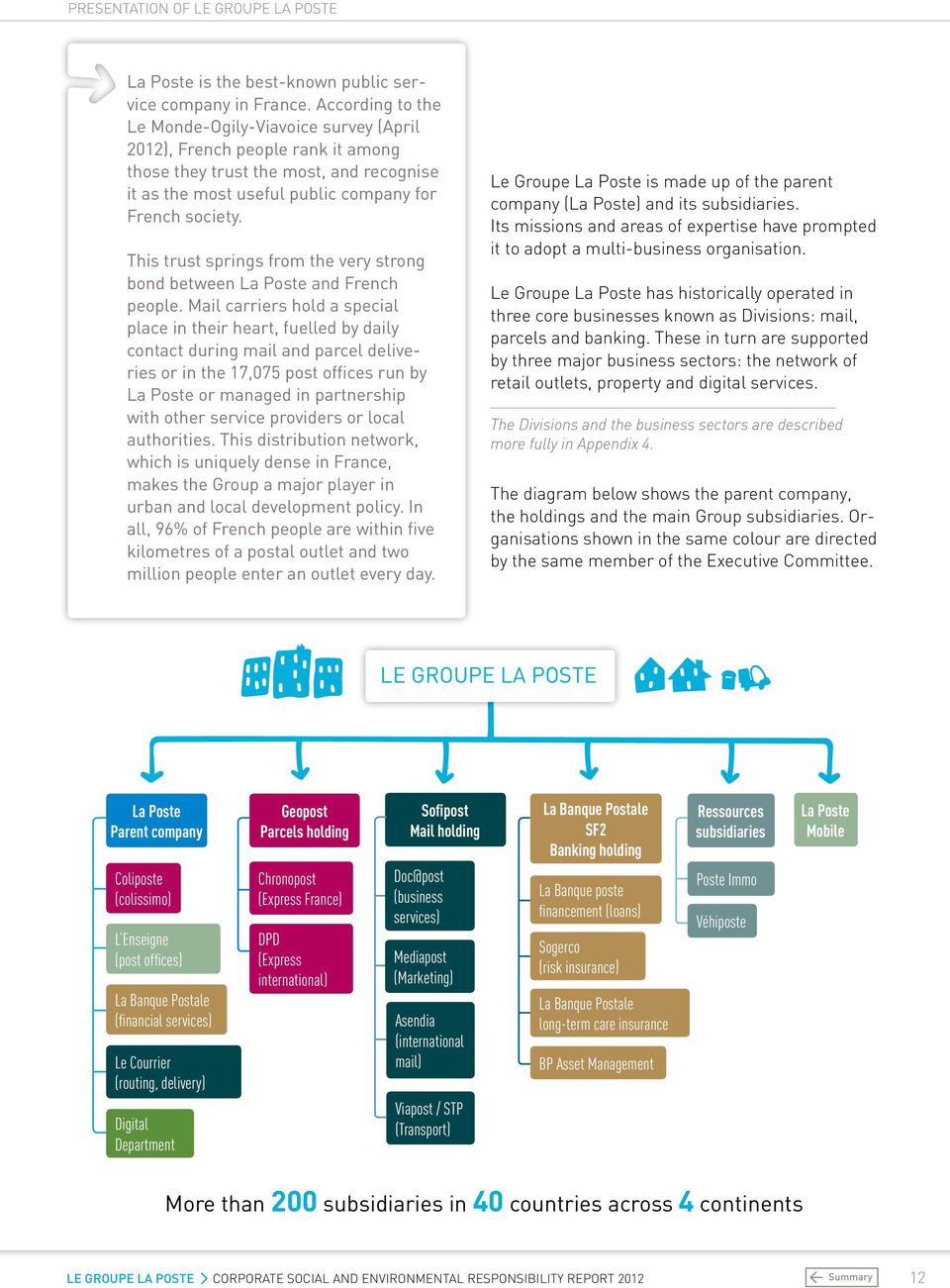
12 PRESENTATION OF LE GROUPE LA POSTE La Poste is the best-known public service company in France. According to the Le Monde-Ogily-Viavoice survey (April 2012), French people rank it among those they trust the most, and recognise it as the most useful public company for French society. This trust springs from the very strong bond between La Poste and French people. Mail carriers hold a special place in their heart, fuelled by daily contact during mail and parcel deliveries or in the 17,075 post offices run by La Poste or managed in partnership with other service providers or local authorities. This distribution network, which is uniquely dense in France, makes the Group a major player in urban and local development policy. In all, 96% of French people are within five kilometres of a postal outlet and two million people enter an outlet every day. Le Groupe La Poste is made up of the parent company (La Poste) and its subsidiaries. Its missions and areas of expertise have prompted it to adopt a multi-business organisation. Le Groupe La Poste has historically operated in three core businesses known as Divisions: mail, parcels and banking. These in turn are supported by three major business sectors: the network of retail outlets, property and digital services. The Divisions and the business sectors are described more fully in Appendix 4. The diagram below shows the parent company, the holdings and the main Group subsidiaries. Organisations shown in the same colour are directed by the same member of the Executive Committee. LE GROUPE LA POSTE La Poste Parent company Coliposte (colissimo) L Enseigne (post offices) La Banque Postale (financial services) Le Courrier (routing, delivery) Digital Department Geopost Parcels holding Chronopost (Express France) DPD (Express international) Sofipost Mail holding Doc@post (business services) Mediapost (Marketing) Asendia (international mail) Viapost / STP (Transport) La Banque Postale SF2 Banking holding La Banque poste financement (loans) Sogerco (risk insurance) La Banque Postale long-term care insurance BP Asset Management Ressources subsidiaries Poste Immo Véhiposte La Poste Mobile More than 200 subsidiaries in 40 countries across 4 continents LE GROUPE LA POSTE CORPORATE SOCIAL AND ENVIRONMENTAL RESPONSIBILITY REPORT
13 PRESENTATION OF LE GROUPE LA POSTE 1.2. HIGHLIGHTS IN THE DEVELOPMENT OF THE GROUP S OPERATIONS Over the past decade, Le Groupe La Poste has undergone major changes while continuing to fulfil the public service missions assigned to it by law. La Poste has been completely reorganised into Divisions and the Group has begun upgrading its industrial and logistics facilities to make them more efficient and raise their quality. New services have been added to its line-up, primarily in the digital sector. The Group has also upgraded its delivery network by pooling resources. It has deployed one of Europe s leading express parcel networks by forming the GeoPost holding. These developments have entailed creating and acquiring subsidiaries in the Group s various operations, making it a major service Group in French legislation on the regulation of postal operations passed on 20 May 2005 enabled La Poste to create La Banque Postale out of La Poste s financial services. This same law clarified the public service missions assigned to La Poste and established the regulation of postal operations, which was assigned to ARCEP, the French telecommunications and postal regulator. The mail-services market was the last of the Group s markets yet to be fully liberalised. This was finalised on 1 January La Poste has since been confronted with the rise of new forms of competition, in addition to the shift to paperless communication under way since the end of the last century. La Poste became a limited company («société anonyme») on 1 March 2010 under French legislation passed on 9 February As a result, it can be allocated registered capital and obtain finance by increasing its capital - a vital step if it is to finance a major investment and development plan. The principles underlying the change of status are laid down by the law: only the French State, legal entities in the public sector and the employees can hold any of the capital. When the capital was increased in April 2011 and April 2012, a new shareholder, the Caisse des Dépôts et Consignations, joined the Group s Board of Directors alongside the State. In 2012, the Group entered a new market : providing finance for local authorities. La Banque Postale began marketing a short-term credit solution in June 2012, a few months before launching a medium to long-term offer in November was also marked by the Major Dialogue on the quality of life at work in the company, launched in March. The Major Dialogue consisted in local meetings held over a period of six months and attended by over 125, 000 postal workers, and a national Commission chaired by Jean Kaspar. The commission was tasked with analysing the situation and issuing recommendations (detailed in Long-term project 4, p 82). A framework agreement on the quality of life at work was signed with the trade unions CFDT, FO, CGC-UNSA and CFTC on 22 January The issues raised by this labour-management survey gave fresh impetus to strategic analysis and planning in the Group. The first outcome was the creation of the Digital Division, charged with guiding and supporting farreaching changes in business and human force pratice. LE GROUPE LA POSTE CORPORATE SOCIAL AND ENVIRONMENTAL RESPONSIBILITY REPORT

14 PRESENTATION OF LE GROUPE LA POSTE 2 THE CHALLENGES FACING THE GROUP Over the period from 2013 to 2018, Le Groupe La Poste will need to tackle the major challenges that lie ahead of it, as well as changes in society itself. The growing scarcity of non-renewable energy resources - and especially oil - together with climate and environmental changes will continue to weigh heavily on the Group s operations. In the social sphere, the behaviours and requirements of all of La Poste s users and customers will become more varied and change more rapidly. Population growth, the consequences of the social crises and changes in the European economy will have a profound impact on both financials and strategy in all of the Group s Divisions. La Poste s stakeholders - customers, key accounts, local authorities, the State, consumers, staff, etc. - expect the Group to provide effective solutions in terms of social and environmental responsibility. For French people, La Poste is a symbolic enterprise whose universal presence and diversity lend it a representative quality. Because of its sheer size and its importance for the population, La Poste cannot disregard the environmental impact or social consequences of its operations. It is duty-bound to become the responsible enterprise of the future: making a profit, maintaining jobs, protecting the environment and satisfying its staff and customers FIRST CHALLENGE: THE ENVIRONMENT AND THE ENERGY TRANSITION France s environmental commitment France supports the EU s objective of achieving a 40% reduction in greenhouse gas (GHG) emissions by 2030 and a 60% reduction by Researchers and manufacturers have been set a 10-year objective of producing vehicles that can travel 100 kilometres on 2 litres of petrol, and lowering the CO 2 emission threshold per vehicle to 5 grams of CO 2 per kilometre. At national level, the French State has put a complete halt to any artificialisation of agricultural and natural areas, in a bid to protect biodiversity and water resources. The aim is also to contain urban sprawl. These political commitments have a major influence on the Group s future operational strategy. Their regulatory consequences will apply directly to the Group s operations: Restrictions on internal combustion vehicles access to town centres, in an effort to reduce GHG emissions, harmful air-borne particles and noise in urban environments; Reductions in GHG emissions from urban logistics and buildings energy consumption. LE GROUPE LA POSTE CORPORATE SOCIAL AND ENVIRONMENTAL RESPONSIBILITY REPORT

15 PRESENTATION OF LE GROUPE LA POSTE The energy transition Both the EU and the French government are currently debating the energy transition. France s goal of achieving energy independence, and the environmental consequences of using fossil fuels, are prompting the government to develop renewable energies and stipulate the proportion of nuclear energy in the energy mix. This will be one of the main topics at the forthcoming environmental conference scheduled for September The regularity of energy costs is crucially important for the Group. Its core businesses depend on stable energy prices for the smooth running of their transport, information systems and buildings. To address the challenges raised by ecological issues, the Group will have to: rethink its transport; rethink the way it services city centres; rethink its property stock; closely monitor the environmental consequences of the growth of the digital business. Le Groupe La Poste s establishment in urban areas and the consequences of its urban logistics operations are therefore of key importance to the Group s CSR goals SECOND CHALLENGE : SOCIAL INCLUSION In this first part of the century, social exclusion is hitting increasingly diverse subsections of the population. Nearly 8 million people in France currently live below the poverty line (i.e. roughly 3.5 million households). A similar number of people are believed to be teetering on the brink of poverty. There are 5 million disabled people. The elderly will make up nearly 30% of the French population in And tens of thousands of newcomers arrive in France every year, with widely varying levels of technical skills and proficiency in French. These people face a growing risk of social exclusion. Being unable to access sources of information or understand their content, no longer being able to access or use society s basic services, or no longer being able to occupy a form of employment are all factors that gradually exclude people from society. As the consequences of the economic crisis become increasingly evident, the authorities held their first ever conference on the subject last December and drew up a plan to combat poverty and promote social inclusion. Le Groupe La Poste was invited to contribute. Given the sheer scale of the economic and social issues at stake, and the varied and changing nature of the constraints and the population groups hit by insecurity, combating exclusion requires that public policy and private initiatives are intertwined, and that the many stakeholders involved work hand-in-hand. Because everyone living in France needs to use the Group s services at one time or another, and because the Group is a major employer, it has been tackling the subject of inclusion for several years now. The Group has become a major player in the drive for social inclusion. Its determination to fulfil its public service missions and support and empower all of its customers is grounded in its values and its anti-discrimination and equal opportunity policies. Working closely with its stakeholders, it strives to help people achieve independence by making its products and services more accessible to everyone living in France. Every customer touch point - reception, sales and aftersales - is involved in this initiative, which is a prime example of Le Groupe La Poste s corporate social and environmental policy. LE GROUPE LA POSTE CORPORATE SOCIAL AND ENVIRONMENTAL RESPONSIBILITY REPORT

16 PRESENTATION OF LE GROUPE LA POSTE 2.3. THIRD CHALLENGE : THE EMERGENCE OF NEW VISIONS OF THE ECONOMY Rising fossil-fuel prices, the economic crisis in the developed world, spreading poverty, scarce financing, deteriorating air and water quality and the changing regional landscape are generating new needs for neighbourhood social and environmental services for citizens and fostering the emergence of new business models. A number of trends from the new «green and social business» are already part of the Group s everyday practices and will be extended to every process : the circular economy, which is based on: - eco-design: factor in product life-cycle impacts right from the product design phase (e.g. ColiPoste packaging); - industrial ecology: business players in the same area work together to optimise flows and trade or pool raw materials or waste (e.g. Kalundborg in Denmark or Vitré in France); - the functional and/or collaborative economy encourages usage rather than possession (e.g. Velib and Autolib bicycle and car-sharing schemes); - re-using second-hand goods; - repairing rather than scrapping; - re-using parts or sections, repairing; - recycling (paper). the social and solidarity economy the only sector showing economic growth in France; - the development of multidisciplinary engineering (sociological, economic and technical) revolving around the notion of sustainable or «responsible» (sustainable city, sustainable mobility, responsible agriculture, etc.). The Greenovia and Mobigreen businesses are prime examples of this trend today; - the emergence of new methods of financing the economy that do not involve the stock market (alternative currencies, tontine, Islamic finance, responsible finance and crowdfunding). Le Groupe La Poste enjoys a unique position on the entire customer relationship cycle and has valuable expertise in managing trade and logistics. Its history, its fine-grained coverage of the country and the group of businesses it runs have given La Poste deep knowledge of logistics and in particular last-mile logistics. Its brand also conveys an image of trust and permanence. The Group therefore has all the cards in hand to become a major player in the reverse logistics of recycling and neighbourhood services, by developing new general-interest product and service lines (green economy, urban logistics, home support) that benefit all of the stakeholders. In light of these three types of challenges, which alter the assumptions underlying the «Ambition 2015» project, and after taking into account the findings of the Kaspar Commission report, the Chairman and Chief Executive Officer decided to launch work on a strategic plan for The result was a list of five major outcomes to be achieved by Le Groupe La Poste by end More specifically, we should be: 1. excellent in customer relationship management; 2. recognised for our innovations and digital transformation; 3. modern in the way we fulfil our public service missions; 4. pioneers in workplace well-being; 5. high achievers, i.e. profitable and responsible. LE GROUPE LA POSTE CORPORATE SOCIAL AND ENVIRONMENTAL RESPONSIBILITY REPORT

17 PRESENTATION OF LE GROUPE LA POSTE 3 CSR POLICY S CENTRAL ROLE IN GROUP STRATEGY In 2003, the Group set up the Sustainable Development Department as one of its governing bodies. Since then, the department has displayed unwavering commitment to giving greater consideration to CSR concerns when drawing up its strategy LE GROUPE LA POSTE S STRATEGY The «Performance and Confidence» strategic project ( ) had already shifted responsible development to the centre of Group strategy. The subsequent «Ambition 2015» project continued along the same lines. Ongoing commitment to the Group s social model and sustainable development were its two guiding principles, and CSR was an integral part of the policies brought in to achieve its objectives. In September 2012, the Chairman announced that the strategic plan would be revised in 2013 around the five major outcomes to be achieved, which are described above. Three of these are right at the centre of the Group s social and environmental responsibility. More specifically, they consist in being : modern in the way we fulfil our public service missions; pioneers in workplace well-being; high achievers, i.e. profitable and responsible. LE GROUPE LA POSTE CORPORATE SOCIAL AND ENVIRONMENTAL RESPONSIBILITY REPORT
18 PRESENTATION OF LE GROUPE LA POSTE 3.2. CSR POLICY A long-standing commitment covering the various aspects of csr ,000 postal workers take part in the Grand Dialogue initiative New Corporate Social and Environmental Responsibility policy La Poste signs the United Nations Global Compact s commitment to gender equality (Women s Empowerment Principles Equality means business).; Obtains «Diversity» certification La Banque Postale Asset Management signs the United Nations Principles for Responsible Investment (PRI) Sustainable development becomes the leitmotif of the «Performance and Confidence» strategic plan Introduces a profit-sharing scheme Signs the French diversity charter and obtains «equal opportunities» certification Signs a framework agreement on equality in the workplace Signs the United Nations Global Compact Signs the United Nations Global Compact Launches the first SRI fund, «Voie Lactée 1» LE GROUPE LA POSTE CORPORATE SOCIAL AND ENVIRONMENTAL RESPONSIBILITY REPORT

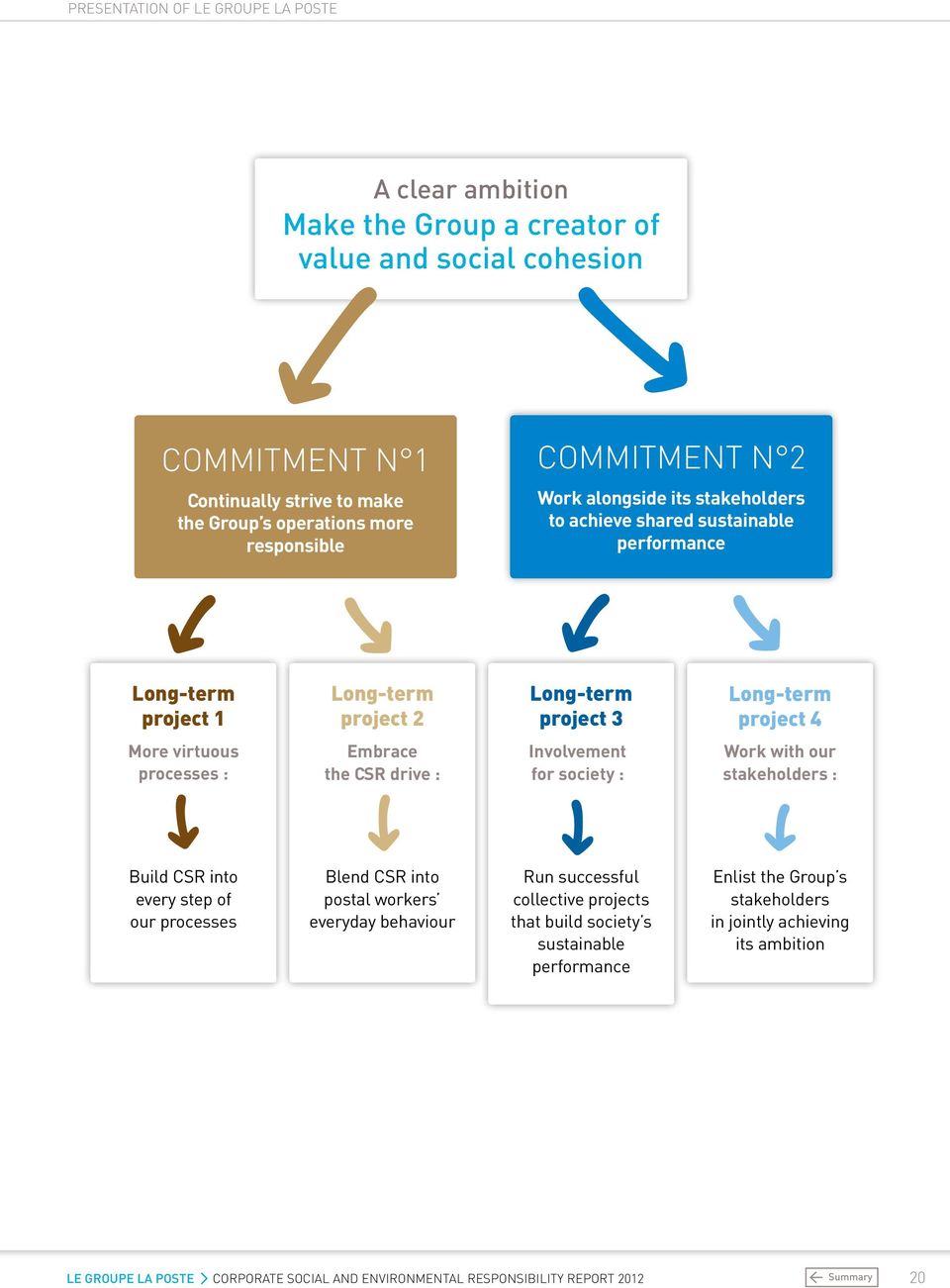
19 PRESENTATION OF LE GROUPE LA POSTE By 2011, Group entities had achieved a sufficient degree of maturity in phasing in social and environmental responsibility initiatives for the Group to be able to clarify its goals, commitments and action priorities for the period up to In early 2011, the Group set up the Division for Social and Environmental Responsibility to ensure that Le Groupe La Poste s strategic decision-making would continue to factor in CSR considerations on a permanent basis. A social and environmental responsibility policy was defined for the Group and approved by the Executive Committee (ExCom) in September A progress report on CSR performance in the Group was presented to the ExCom on 30 September The goal is clear : Make Le Groupe La Poste long-term creators of value and social cohesion for each of our stakeholders. It has been translated into two commitments: constantly strive to make its operations more responsible by incorporating CSR at each step of its processes and in the daily behaviour of postal workers ; work towards sustainable development by harnessing society s stakeholders, running successful collective projects and sharing our ambition with our stakeholders. Both of these commitments have been adopted by each of the Group s Divisions, along with target figures. The Group s objectives are also monitored on a regular basis on the Chairman s management chart. The objectives set for the Divisions are reviewed three times a year as part of analysing the extra-financial results. Since November 2011, this review has been included in the financial performance reviews (when the Chairman and Chief Executive Officer, the Division Directors and the support departments meet to review the performance of each department concerned). Four top-priority long-term projects were launched in the Group in 2011 to help it meet its commitments for 2015 : Long-term project 1 More virtuous processes : build CSR into every step of our processes; Long-term project 2 Embrace the CSR drive : blend CSR into postal workers everyday behaviour; Long-term project 3 Involvement for society : run successful collective projects that build society s sustainable performance; Long-term project 4 Work with our stakeholders : enlist the Group s stakeholders in jointly achieving its ambition. LE GROUPE LA POSTE CORPORATE SOCIAL AND ENVIRONMENTAL RESPONSIBILITY REPORT

20 PRESENTATION OF LE GROUPE LA POSTE A clear ambition Make the Group a creator of value and social cohesion COMMITMENT N 1 Continually strive to make the Group s operations more responsible COMMITMENT N 2 Work alongside its stakeholders to achieve shared sustainable performance Long-term project 1 Long-term project 2 Long-term project 3 Long-term project 4 More virtuous processes : Embrace the CSR drive : Involvement for society : Work with our stakeholders : Build CSR into every step of our processes Blend CSR into postal workers everyday behaviour Run successful collective projects that build society s sustainable performance Enlist the Group s stakeholders in jointly achieving its ambition LE GROUPE LA POSTE CORPORATE SOCIAL AND ENVIRONMENTAL RESPONSIBILITY REPORT
21 PRESENTATION OF LE GROUPE LA POSTE 4 RESPONSIBLE GOVERNANCE La Poste s Board of Directors decided to adopt as its benchmark the provisions of the Corporate Governance Code drawn up by Afep-Medef, which are compatible with the legislative and regulatory provisions applicable to La Poste, and to incorporate the governance principles defined by the ISO standard CORPORATE GOVERNANCE Le Groupe La Poste has a distinctive form of corporate governance: it is democratic, and its stakeholders are represented within its main players Separation of powers Under French legislation passed on 2 July 1990, the Group has a single governance structure with a board of directors. The chairman and the chief executive officer are one and the same person. Mr Jean-Paul Bailly has been Chairman of La Poste s Board of Directors since September His term of office was renewed by a decree dated 14 April 2011, on a proposal by the Board of Directors to the President of the French Republic. The composition of La Poste s Board of directors is defined by law (amended Act No of 2 July 1990) and laid down in its articles. The board includes representatives of its main stakeholders. Board members terms of office run for five years and are aligned on the date of expiry of the employee representatives term of office. Board members terms of office will therefore expire on 20 December Further information can be found in the Registration Document 2012 (Chapter 14). For details of the Board of Directors membership, see Appendix THE BOARD OF DIRECTORS SPECIALISED COMMITTEES To help it fulfil its missions, the Board of Directors has appointed four specialised committees to review specific issues and lay the groundwork for discussions in plenary meetings : Audit Committee; Strategy and Investments Committee; Quality and Sustainable Development Committee; Corporate Governance and Compensation Committee. The committees structure, duties and responsibilities are set out in Appendix THE DRIVE FOR CONTINUOUS IMPROVEMENT Under Article L of the French Commercial Code, the chairman of the board of directors is to describe the preparation and organisation of the board s work and the internal auditing and risk management procedures established by the company, in a report attached to the board of directors management report. A copy of this report can be found in Appendix 1 to the Registration Document Once a year since 2006, the Board of Directors has set aside one item on its agenda for reviewing its own internal operations, including their compliance with the Board s bylaws, and examining ways to improve them. This annual review is now run by the Corporate Governance and Compensation Committee, whose Chair presents an executive summary and a list of pointers for progress to the Board. La Poste has also decided to carry out this review every three years, with the help of an outside firm. The 2012 review of the board s operations was conducted through interviews. Further details of the review are provided in Chapter 16 of the Registration Document LE GROUPE LA POSTE CORPORATE SOCIAL AND ENVIRONMENTAL RESPONSIBILITY REPORT
22 PRESENTATION OF LE GROUPE LA POSTE MIXED-REPRESENTATION GOVERNANCE BODIES La Poste applies the principle of mixed representation in its management bodies. La Poste s Board of Directors has seven women members, who represent 33% of the seats. This is more than the progressive threshold set in the Zimmerman- Copé law on gender balance in board membership, which stipulates that, after the 2014 annual general meetings, there should be at least 20% of board members of each sex. At the same time, the Executive Committee currently has three women members - 25% of its total membership - which is a significant improvement on the 2011 financial year, when 10% of its members were women. Details of the Board of Directors and ExCom memberships are provided in Appendices 5 and 6. running customer satisfaction surveys for La Poste and its Group ; analysing the quality of the services that La Poste and the Group provide for customers ; reviewing best practices that will enhance the services that La Poste and the Group provide for customers ; reviewing best practices in sustainable development and corporate social responsibility. The Board of Directors can give the Committee other assignments in the area of quality and sustainable development. The Committee can also suggest that the Board refer to it any matter it deems necessary or useful. The Quality and Sustainable Development Committee met four times in 2012 ; the average board member attendance rate was 75% CSR GOVERNANCE Le Groupe La Poste s governance processes are rooted in corporate social and environmental responsibility. The Group has opted for a tight-knit structure to ensure that CSR underpins all decision-making processes at every level. In 2012, the Committee reviewed the carbon neutrality initiative, the participatory innovation measures, complaints handling and the quality delivered to La Poste Mobile customers, as well as CSR performance in GOVERNANCE BODIES At the top level, the Board of Directors Quality and Sustainable Development Committee examines strategic moves and monitors developments. The Committee helps the Board of Directors analyse the quality of the services that La Poste and Group companies deliver to their customers, as well as sustainable development within La Poste and Group companies. The Committee is tasked with laying the groundwork for the Board of Directors discussions and submitting any recommendations necessary on questions concerning the quality of customer relations at La Poste or Group companies, and sustainable development. The specific focus areas are : LE GROUPE LA POSTE CORPORATE SOCIAL AND ENVIRONMENTAL RESPONSIBILITY REPORT
23 PRESENTATION OF LE GROUPE LA POSTE The Quality and Sustainable Development Committee (CQDD) is something quite new in Le Groupe La Poste s governance. Alongside the traditional committees found in so many groups (audit, governance and remuneration, strategy), this new body shows just how important La Poste thinks customer service and sustainable development are. But apart from this particular feature, the committee is designed to be an open forum for exchanging information, experience and thoughts about the main quality and sustainable development matters handled by the Group. The Quality and Sustainable Development Committee has considerable latitude to draw up its agendas and usually addresses concerns of its own initiative, whether for regular monitoring (quality dashboard, CO 2 emissions, etc.) or specific objectives (waiting times, mobile phone services, etc.). The committee can also examine corporate social responsibility questions, which are simply an extension of sustainable development issues. This approach allows the committee to take the initiative in mapping out a long-term vision and this is important and useful for the Group. Jean-Michel Hubert, Director of Le Groupe La Poste, Chairman of the Quality and Sustainable Development Committee of the Board of Directors LE GROUPE LA POSTE CORPORATE SOCIAL AND ENVIRONMENTAL RESPONSIBILITY REPORT
24 PRESENTATION OF LE GROUPE LA POSTE The Group s Senior Vice-President is the sustainable development reference authority for the Executive Committee. The Group Corporate Social and Environmental Responsibility Department runs a Divisional CSR Committee (comprised of the Divisions and the tier 1 holdings) and a Corporate CSR Committee with representatives from the Group s key functions. These committees monitor action plan roll-out throughout the Group and factor CSR concerns into work practices across functional sectors. Each Division and the larger subsidiaries have set up a CSR Department to define policy and manage deployment of the operational action plans, so that responsible development becomes an integral part of their processes and management. Each Division has appointed local CSR representatives. They are supported by the 22 Regional Officers, who coordinate actions between the Divisions and subsidiaries local establishments and the local stakeholders. Monitor strategy > Board of Directors > Quality and Sustainable Development Committee Define strategy > Executive Committee Lead and support the initiative Group CSR Department Division CSR Committee Manage and roll out Divisional CSR Department Corporate CSR Committee Corporate cross-functional departments Divisional cross-functional departments Regional Development Officers Regional meetings Divisional CSR Officers Since early 2009, La Banque Postale s CSR governance body has been the Responsible Development Committee, which is one of the 11 committees run by the Management Board. Its purpose is to identify long-term projects, propose and carry out the required projects and secure outcomes that will help responsible development contribute to La Banque Postale s differentiation, performance and earning power. In 2012, the Committee met twice. LE GROUPE LA POSTE CORPORATE SOCIAL AND ENVIRONMENTAL RESPONSIBILITY REPORT
25 PRESENTATION OF LE GROUPE LA POSTE CSR IN COLLECTIVE OBJECTIVE-SETTING, ROADMAPS AND THE DECISION-MAKING PROCESS La Poste already incorporates responsible development criteria into its Group objectives. Indeed, the profit-sharing bonus distributed to La Poste employees since 2010 includes the criterion «improvement in access to Le Groupe La Poste public buildings for people with reduced mobility (PRM)». From the 2010 financial year onwards, some entities started including CSR criteria in managers roadmaps. This is now standard practice for Executive Committee members, managers reporting directly to them and, in some Divisions, for the regional directors in charge of the operational deconcentration level (NOD), the directors of sites specific to each Division and subsidiary and the head office. The Group also takes non-financial criteria into consideration when it assesses investment projects involving large sums or high stakes. It accordingly observes and analyses the operation s impact on the environment, working conditions and the quality of industrial relations. The Retail Brand includes two CSR criteria in the roadmaps for its regional departments (DTELP) at the operational deconcentration level, after setting objectives for strategic managers collective bonus. In 2012, the two criteria that the Retail Brand included in its regional departments roadmaps were the number of disabled workers recruited and the total value of purchases made from sectors that work with the disabled. At Poste Immo, five responsible-development criteria are factored into calculations of the collective profit-sharing bonus (they include disabled access to buildings, new-build environmental standards, renewable and photovoltaic energy, among others). In 2012, the Mail Division began working with its Finance Department to include more CSR objectives in the management cycle that defines and manages the roadmaps for the regional directors in charge of the operational deconcentration level. The annual objectives set for managers in their roadmaps can be broken down into collective bonus and individual bonus, and 30% of each bonus is subject to CSR criteria : For the collective bonus, the «Health at work» indicator is factored into calculations (this is an overall indicator that includes all sick leave taken by all postal workers in the Mail Division, including managers) ; For the individual bonus, the calculations factor in quantitative individual objectives selected from a library of objectives (responsible economy product and service lines, life at work, CO 2, purchases from sectors that work with the disabled). The Group aims to extend this objective-setting system to team leaders. In 2013, an objective concerning the improvement of workplace wellbeing will be set for all team managers. The Group s regional officers have two action programmes for society among their priorities: one concerns the «environmental footprint», the other concerns «regional economic development and equal opportunity». In 2012, the environmental footprint initiatives focused on the following themes: urban logistics; the deployment of business travel plans; regional authorities policies on the climate, air quality and energy; local communication on the new Recy go service line; responsible communication. The initiatives to promote «regional economic development and equal opportunity» focused on: incorporating CSR into managerial practices; communication tools on diversity; anti-discrimination measures; fostering postal workers commitment to solidarity; supporting application of the disability agreement signed in Under these two programmes, 1,005 external initiatives (community involvement for the most part) and 395 internal initiatives (mainly designed to support the disability agreement) were undertaken in LE GROUPE LA POSTE CORPORATE SOCIAL AND ENVIRONMENTAL RESPONSIBILITY REPORT
26 PRESENTATION OF LE GROUPE LA POSTE 5 ETHICS AND PROFESSIONAL CONDUCT IN THE GROUP In April 2011, the Group s Executive Committee adopted measures underpinned by the idea that ethics and professional conduct foster trust in both internal and external stakeholders and, as such, drive company performance. This system, which complements the social and environmental responsibility approach adopted by the company in 2003, relies on five key tools : a Reference Guide to Professional Ethics (see Appendix 5 to the 2011 Registration Document) setting out in full the individual and collective rules of conduct to be followed. This Reference Guide is handed out personally to all Group employees and appended to La Poste s policies and procedures document ; an Ethics Committee chaired by Georges Lefebvre, the Group s Executive Officer. To date, the Committee has comprised the ethics officers for the Group, the Divisions and Poste Immo, the Director of Legal Affairs, the Director of Audits and Risks, the Data Protection Officer and the CSR Director. However, given changes in the Group s organisation, the Director of Human Resources and Employee Relations (DRHRS) will join the Committee in 2013 ; a system of personalised support (or whistleblowing system) to answer employees questions, give them a means of reporting any serious departures from the benchmark guidelines they may have noticed, and request mediation in some cases ; a network of ethics officers, including a Group ethics officer, four Divisional ethics officers and ethics officers from the main subsidiaries ; an awareness-raising programme involving information, communication and training initiatives. Distribution of the Reference Guide to Professional Ethics began in December 2011 and is due to finish in It has already been handed out to the Group s 53,000 managers, along with a letter from the Group s Chairman, Jean-Paul Bailly, and a document produced by the Human Resources Department in consultation with the unions, entitled «Faire vivre nos valeurs. Bonnes pratiques pour les cadres» («Bringing our values to life. Best practices for managers»). It is also available online on La Poste s intranet site and on La Poste s corporate website for outside stakeholders. The Ethics Committee met twice in 2012 to examine ethics questions reported through the whistleblowing systems, launch joint action plans and learn about emerging issues (such as social media). It also received two ethics directors from major companies, to learn about outside policies on the matter. The Group Ethics Centre has also established quarterly meetings with the Divisional Ethics Officers to discuss the matters to be dealt with throughout the year and together build staff awareness-raising tools. The Group has created a performance indicator to measure changes in the ethics climate, and also the extent to which employees understand and personally apply ethics. A questionnaire has been produced in conjunction with the BVA survey institute and the Cercle Éthique des Affaires, and submitted to both a panel of major companies and a panel of Group employees to enable comparison. The first campaign was conducted in September 2012 ; the second will take place in September LE GROUPE LA POSTE CORPORATE SOCIAL AND ENVIRONMENTAL RESPONSIBILITY REPORT
27 PRESENTATION OF LE GROUPE LA POSTE The results showed that 70% of the Group staff polled feel concerned by ethics and professional conduct, compared with 60% of the employees in major companies ; 83% of postal workers and 84% of employees in major companies trust their ethics officers; 55% of postal workers would like to play a larger part in ethics and professional conduct initiatives, as against 44% of their counterparts in major companies ; But while 91% of postal workers think that ethics and professional conduct are useful for conveying a good image of the Group, and 90% for enhancing its partners trust in the Group, only 56% think it is of any use for guaranteeing employees well-being. In 2012, the Group used a number of tools and initiatives to consolidate its employees ethics culture : it set up an Ethics and Professional Conduct intranet site as a platform for information and collaboration. It is accessible to all La Poste employees and provides ready access to reference documents, the network of ethics officers, news on the subject, and best-practice awareness-raising tools ; it launched a monthly newsletter, NewsEthique, in summer Over 550 ethics officers and strategic managers are on the newsletter mailing list and all staff can access it on the intranet ; a quarterly ethics publication with an operational focus, Pratique Éthique, was also created to help managers develop an ethics culture in their teams.pratique Éthique discusses the issues in greater depth and gives managers concrete solutions. In 2012, the first two numbers dealt with conflicts of interest and corruption ; a training course on ethical management was designed and will be rolled out in 2013; to help give the ethics community a more professional grounding, the Group is also sponsoring the cohort of the Law Masters degree in business ethics at the University of Cergy-Pontoise. The Group is also involved in various outside working groups, to stay informed of new issues and acquire new best practices. Its corporate ethics officer was elected to the board of directors of the Cercle Éthique des Affaires (the most representative association of ethics officers in France) in In early 2013, the Group will produce the first annual report on its ethics and professional conduct initiatives for the 2012 financial year. The report will be presented to the Group s Executive Committee, then to the Board of Directors. It will contain the main initiatives conducted by the various Divisions in the field of ethics and professional conduct. To complement distribution of the Group Reference Guide to Professional Ethics, the Retail Brand designed a new e-learning training module («Saison 3», available on the e-campus), which it will continue to roll out in Over the same period, working groups composed of experts and operational staff were formed to address professional ethics issues (taking advantage of vulnerable people, conflicts of interest, etc.) and develop appropriate methods and tools. LE GROUPE LA POSTE CORPORATE SOCIAL AND ENVIRONMENTAL RESPONSIBILITY REPORT
28 PRESENTATION OF LE GROUPE LA POSTE La Banque Postale gives all of its employees training in professional ethics when they enter their job. After that, and throughout their career, staff take continuing professional development courses tailored to each of La Banque Postale s business sectors was marked by a fresh reworking of La Banque Postale s Reference Guide to Professional Ethics, to take into account the boom in communication on social networks and the new business operations linked with financing local authorities. Work is in progress to facilitate access to banking, finance and insurance products for customers who have a disability, are hospitalised or live in a retirement home. In collaboration with the Group s Data Protection Officer, the Group has also begun examining the use of personal data in professional contexts. The main ethics focus for 2013 will be conflicts of interest. The Mail Division has historically been deeply attached to its ethical values (ever since the French Revolution, La Poste s staff have taken a professional oath). It translates the Group s values into its operations and processes. The ethics officer appointed in late 2011 coordinates the dissemination of these values and supports the managers, who ensure that their team members apply them. There are plans to tighten the prevention plan in In the Parcels-Express Division, GeoPost has drawn up a code of business conduct that applies the main principles of the Group s Reference Guide to Professional Ethics and GeoPost s values. The code is available in English and French. It was distributed to all GeoPost employees in October Versions are currently being produced for GeoPost s non-french subsidiaries, incorporating any local regulations on ethics and professional conduct. Poste Immo has been running an ethics initiative since It has consisted in producing an ethics guide and using it to train the entire staff, setting up an Ethics Committee and appointing an ethics representative outside the company. In January 2012, the Corporate Purchasing Department sent out an official, letter-headed briefing note to all of the departments with the Group s Reference Guide to Purchasing Ethics, based on the Group s Reference Guide to Professional Ethics. This reference guide provides a refresher and drives home Le Groupe La Poste s rules of professional conduct, ethical principles and responsible development commitments for everyone involved in purchasing processes. Anti-corruption and anti-money laundering measures The Group has defined an anti-corruption policy based on the OECD s and the UN s international anti-corruption conventions. The Group s Reference Guide to Professional Ethics covers active and passive, direct and indirect corruption on the part of a private individual or a person holding public authority. It is included in full in the professional ethics measures set up by the Group. The reference guide also reminds employees that money laundering is an offence. The majority of employees have taken training courses in professional ethics, and anti-money laundering and counter-terrorist financing measures. La Banque Postale also combats tax evasion by following to the letter the rules and preventive measures in force. Customer operations are monitored for tax compliance as part of the drive to fight money laundering, terrorist financing and fraud. The Group has set up a system to screen international operations between France and «high-risk» countries. LE GROUPE LA POSTE CORPORATE SOCIAL AND ENVIRONMENTAL RESPONSIBILITY REPORT
29 PRESENTATION OF LE GROUPE LA POSTE 6 CSR PERFORMANCE MANAGEMENT The Group has set up a management system that revolves around the priorities defined by the ExCom meeting on 1 October 2012 and includes the requirements of the ISO standard, with a view to continuous improvement PERFORMANCE MANAGEMENT AT GROUP LEVEL The Chairman s management chart, which is prepared every month by the Finance Department, includes the non-financial reporting. The indicators used and their reporting scope are shown in the table below. Each month, the CSR Department also provides an in-depth report on a top-priority or topical aspect of Group CSR policy. Area KPI Scope Reporting frequency Employees Occupational accident La Poste and the main subsidiaries of Geo- Annual frequency rate Post, MediaPost, Docapost and Viapost that publish workforce statistics % of women among senior La Poste and the main French subsidiaries Annual managers % of beneficiaries of mandatory La Poste and the main French subsidiaries Annual employment with over 20 employees(*) % of employees that undertook La Poste and the main French subsidiaries Annual training in the past 2 years that publish a CSR report Environment CO 2 emissions (in tonnes Mail Division, Sofipost, ColiPoste, GeoPost, Annual of carbon) and cost in euros within the scope of offsetting % of Waste Electrical and La Poste and the French subsidiaries Annual Electronic Equipment (WEEE) reused or recycled The objective set concerns WEEE only Customers/responsible % of SRI assets out of total La Banque Postale Annual offers managed assets % of SRI in Group employee Corporate Annual savings scheme within the scope of subsidiaries concerned and La Poste External access to owned buildings Poste Immo Annual for PRMs Tonnes collected by Recy go service Mail Annual LE GROUPE LA POSTE CORPORATE SOCIAL AND ENVIRONMENTAL RESPONSIBILITY REPORT
30 PRESENTATION OF LE GROUPE LA POSTE 6.2. NON-FINANCIAL PERFORMANCE MANAGEMENT AT SUB-CORPORATE LEVEL The non-financial part of performance reviews is included in the performance reviews managed by the Finance Department. The non-financial components comprise the first part of these performance reviews. The Divisions select the indicators to be used, according to what is important to their specific business sector. The indicators chosen reflect both what the Division can contribute to the Group s priority objectives, and what is important to the particular Division for its own management purposes and its commitments to the Chairman and CEO. On the strategic timeline, the period considered spans more than one year, as is done in the financial approach : performance review at the beginning of year N : examine the year N-1 results for the parent company s Divisions and set objectives for the strategic timeline; second-quarter performance review: examine the year N-1 results for the Group by Division, review the action plans drawn up to achieve the objectives and discuss the year-end gateway ; year-end review: examine the new information and update the results for the strategic timeline, based on the evaluation of the action plans MONITORING CSR ROLL-OUT IN THE GROUP After defining a new CSR policy in 2011, Le Groupe La Poste needed to check that CSR had effectively become standard practice in all of its structures and visible to all of its stakeholders. The ISO standard provides guidelines for incorporating CSR into every area of an organisation, based on six core subjects. Using this model as a starting point, the CSR Department and the Divisions drew up the procedure to follow. The first step is to measure the extent of CSR roll-out by analysing the strengths and the points for improvement. The second step is to drive whatever adjustments to actions and behaviours are necessary to achieve the objectives set for CSR roll-out. Two tools were introduced for the purpose : the reference guide and the diagnosis MANDATORY REPORTING : THE MANAGEMENT REPORT In 2012, La Poste fulfilled the regulatory obligation to present non-financial reporting in the management report. The latter is included in the registration document (which is coordinated by the Finance Department in consultation with the various contributors). This presentation concerns the Group scope (cf. Registration Document Chapter 10.1 and Appendix 3). La Banque Postale published its own data in its management report, which was presented to the Supervisory Board ( engagements/developpement_responsable.html ). LE GROUPE LA POSTE CORPORATE SOCIAL AND ENVIRONMENTAL RESPONSIBILITY REPORT
31 PRESENTATION OF LE GROUPE LA POSTE THE REFERENCE GUIDE The six core subjects at the centre of the ISO standard were adapted to Le Groupe La Poste s context and set out in a reference guide, which, for each subject, describes the issues to be checked for CSR roll-out. Subject 1 Employees Issues : working conditions and the work environment; professional development and career mobility; diversity and equal opportunity; social dialogue and consultation; health and safety at work. Subject 4 Customers Issues : responsible product and service lines; responsible customer relationship management; product and service accessibility. Subject 2 The environment Issues : energy and greenhouse gases; other pollutants and nuisances; more efficient use of natural resources. Subject 5 Local communities and regions Issues : involvement in local and regional development projects; commitment to solidarity on the part of La Poste and its employees Subject 3 Suppliers and subcontractors Issues : SUPPLIER 1 - Choice of responsible products and services SUPPLIER 2 - Choice and monitoring of suppliers; SUPPLIER 3 - Responsible behaviour with regard to suppliers. Subject 6 Governance Issues : CSR governance; business ethics and professional conduct; co-construction with stakeholders. LE GROUPE LA POSTE CORPORATE SOCIAL AND ENVIRONMENTAL RESPONSIBILITY REPORT
32 PRESENTATION OF LE GROUPE LA POSTE DIAGNOSIS Diagnosis is based on the reference guide and covers a representative sample of Group entities. It is a dual-level examination that measures the maturity of CSR roll-out for each subject, on a scale of 0 to 3 as follows: 0 UNCERTAINTIES: no action has been formally planned or undertaken; the subject does not come under the entity s «strategic agenda»; 1 FOUNDATIONS : action plans are in place to achieve compliance with regulations or Le Groupe La Poste directives; the entity circulates information about the subject and undertakes isolated initiatives; 2 3 MATURITY : a continuous improvement process is in place, over and above strict regulatory compliance; the issues have been mapped out and a formal diagnosis carried out; the subject is addressed through structured actions and a system of management; INNOVATION : the entity applies best practices and collaborates with the stakeholders concerned; focus on social innovation. First level: core subjects - their maturity is measured from the following viewpoints : Policy : existence of quantified, ambitious commitments ; Roles and responsibilities: roles are defined and set out in job descriptions ; Employee training and awareness-raising : training or awareness courses specifically on the core subject are written into personal development projects ; KPIs: indicators are used to manage the core subject ; Management objective-setting : objectives are set in employees roadmaps. Second level : issues - the maturity of each particular issue is measured directly. The results are also scored on a scale from 0 to 3. The 2012 diagnosis was launched in October 2012 and will finish in April Feedback from the diagnosis will be used to redefine the priorities for CSR roll-out in each of the parent company s Divisions and in the main tier-one holdings. It is the roll-out baseline, against which all subsequent progress in the Group will be analysed. LE GROUPE LA POSTE CORPORATE SOCIAL AND ENVIRONMENTAL RESPONSIBILITY REPORT
33 PRESENTATION OF LE GROUPE LA POSTE TRANSLATION BY THE DIVISIONS INTO GROUP MANAGEMENT REFERENCE GUIDES On top of the two reference guide and diagnosis tools, each Division is free to add other subjects or issues to suit its own specific requirements. Mail The Mail Division decided to incorporate its responsible management system - which is based on the ISO standard - into its EFQM (European Foundation for Quality Management) system. The assessment is carried out over three days by a joint team made up of employees from the Mail Division s Quality Department and EFQM-AFNOR assessors. In March 2012, the Mail Division received the EFQM innovation award for blending ISO into its use of the EFQM model. In making this award, EFQM-AFNOR highlighted the fact that the entity had a thorough grasp of the ISO standard and followed its guidelines for factoring corporate social responsibility into its values and practices. This is a long-term initiative, aimed at achieving blanket roll-out across all of the Mail Division s entities and subsidiaries. The Mail Division has set itself the objective of having all of its Regional Mail Operational Departments assessed by 2014 using this assessment system, which is based on EFQM and the ISO standard and incorporates the Group s reference guide. The Retail Brand The Retail Brand has worked with representatives from different levels of the organisation to personalise the Group reference guide and clarify what is required at each level in each of the practices. In 2013, a feasibility study will be undertaken with the Retail Brand s Quality Department, into the deployment of a managerial approach that incorporates EFQM and ISO requirements through the Group reference guide. ColiPoste ColiPoste is gradually incorporating the reference guide into its quality management system. The latter currently includes ISO 9001 and ISO 14001, which are already the subject of a common audit. All of Mediapost Communication s French entities have been assessed by EFQM-AFNOR. Mediapost was recognised as a «Tier-3 reference» subsidiary. Sogec and Mediaprism were recognised as «Tier-2 committed» subsidiaries. These assessments have defined the entities CSR maturity level and action plans will be drawn up in 2013 to improve these levels. For the recently-acquired Mix- Commerce, Cabestan, Adverline and Vertical Mail, the assessment measured the baseline of their CSR commitments as a starting point for building an action plan for the coming years. LE GROUPE LA POSTE CORPORATE SOCIAL AND ENVIRONMENTAL RESPONSIBILITY REPORT
34 COMMITMENT 1 : CONTINUALLY STRIVE TO MAKE THE GROUP S OPERATIONS MORE RESPONSIBLE Le Groupe La Poste is committed to making its operations friendly to the planet and its inhabitants. In joining the United Nations Global Compact in 2003, it demonstrated its full support for the principles of the United Nations Universal Declaration of Human Rights, the Organisation for Economic Co-operation and Development s Guidelines for Multinational Enterprises, and the International Labour Organization s Fundamental Conventions. The Group s support for these principles has since been written into its Reference Guide to Professional Ethics. To be able to meet its commitments, the Group is striving to reduce its negative externalities by working on both its processes and its staff s behaviour. This first CSR commitment has spawned two long-term projects designed firstly to develop a more responsible product and service range and secondly to help the Group s staff make CSR an integral part of their day-to-day work. LE GROUPE LA POSTE CORPORATE SOCIAL AND ENVIRONMENTAL RESPONSIBILITY REPORT 2012
35 Economic Environmental Societal LE GROUPE LA POSTE CORPORATE SOCIAL AND ENVIRONMENTAL RESPONSIBILITY REPORT 2012
36 LONG-TERM PROJECT 1 MORE VIRTUOUS PROCESSES : A CORPORATE RESPONSIBLE SOCIAL PRODUCT AND AND ENVIRONMENTAL SERVICE RANGE RESPONSIBILITY REPORT LONG-TERM PROJECT 1: MORE VIRTUOUS PROCESSES : A RESPONSIBLE PRODUCT AND SERVICE RANGE To bolster its drive for responsible development, Le Groupe La Poste intends to bring out a future product and service range that is even fairer and more modern, by factoring in CSR right from the design phase. The only way to attain this goal is through standard-setting in-house practices. The staff of each Division and subsidiary will have to be able to provide the 45 million retail customers and the 3.5 million business and professional customers with products and services that are friendlier to not only people but also the environment - and all at market prices, of course. This undertaking, which began several years ago, naturally involves the entire Group. An integrated vision : the customer service area post office : THREE MAIN FOCUS AREAS We have translated out ambition into goals for the three key components of the Retail Brand Responsible management and community-minded involvement Equal opportunities Diversity in our teams EMPLOYEES CUSTOMERS Post offices and other buildings are fully accessible for people with disabilities, and environmentally friendly : energy, waste, paper and facilities (responsible purchasing) Optimised supply chain (transport) PREMISES Blanket accessibility Banking inclusion The customer s interests come first Eco-design Socially Responsible Investment range Factor ESG (1) criteria in when we design savings, credit and insurance products Full carbon offsetting (1) Environmental, social and governance COMMITMENT 1 CONTINUALLY STRIVE TO MAKE THE GROUP S OPERATIONS MORE RESPONSIBLE 36
37 LONG-TERM PROJECT 1 MORE VIRTUOUS PROCESSES : A RESPONSIBLE PRODUCT AND SERVICE RANGE 7.1. FACTOR IN CSR CONSIDERATIONS RIGHT FROM THE PRODUCT AND SERVICE DESIGN STAGE The first action plan entails gradually incorporating environmental, social and community-related concerns into all products and services, and building transparent, responsible customer relations. A «responsible marketing» reference guide has been drawn up for the purpose, for use by marketing teams in the three Divisions - Banking, Mail and Parcels. Today their products and services are assessed against this reference guide, and suggestions for improvement are taken into consideration for drawing up marketing action plans. This approach is now an integral part of bringing new products and services to market, and we are starting to see the results: the Mail Division s «Lettre Verte». This cheaper, more environmentally-friendly option for delivering letters was introduced in October 2011 and ties in with this responsible product and service development drive. The Division liaised closely with stakeholders (consumer associations and NGOs such as WWF in particular) to hone these «green letters» around consumer demand for 90%-reliable D+2 delivery (the target set in the public service contract), while at the same time reducing CO 2 emissions from Mail operations by eliminating air transport in metropolitan France ; eco-designed pre-franked packages. In both Mail and Parcels, the use of paper from sustainablymanaged forests and plant-based inks is catching on and set to become standard practice CARBON NEUTRALITY FOR ALL Le Groupe La Poste customers now enjoy a choice of carbon-neutral products and services for their mail (physical and digital), parcels and express deliveries. This pro-active approach has given Le Groupe La Poste an edge over its competitors. Full carbon neutrality has been the rule since 1 March 2012 for ColiPoste, the Mail Division and its subsi- diaries. A special marking system even lets their customers leverage this initiative in communication with their own customers. For example, ColiPoste has added a new baseline to its logos: «Colissimo/So Colissimo, une livraison neutre en CO 2» («Colissimo/So Colissimo: a carbon-neutral delivery»). Since 1 July 2012, GeoPost has also been running its «Total Zero» programme, which covers the GHG emissions generated by all of the parcels carried by GeoPost subsidiaries in France, Germany, the UK, Belgium, Luxembourg, the Netherlands and Switzerland - at no extra cost to the customer. This is a weighty subject, given that these emissions represent 80% of the volume of CO 2 emitted by GeoPost subsidiaries FACTOR IN ENVIRONMENTAL, SOCIAL AND GOVERNANCE (ESG) CRITERIA WHEN DESIGNING LA BANQUE POSTALE PRODUCTS AND SERVICES In 2009, La Banque Postale introduced a reference guide in the form of a checklist to help designers take ESG criteria into consideration in designing the bank s products and services. It has attached this ESG checklist to all the products it has submitted to the product review board since March In other words, every new product it releases has cleared the 19 fundamental ESG conditions, which span product creation, product distribution and customer assistance. The five funds in La Banque Postale s «Investing to make a difference» line-up once again earned Novethic s SRI label (for socially-responsible investment) in La Banque Postale Asset Management s Responsible Actions Euro (Euro shares) and Responsible Actions Monde (world shares) funds also won Novethic s ESG Indicators special awards. COMMITMENT 1 CONTINUALLY STRIVE TO MAKE THE GROUP S OPERATIONS MORE RESPONSIBLE 37
38 LONG-TERM PROJECT 1 MORE VIRTUOUS PROCESSES : A RESPONSIBLE PRODUCT AND SERVICE RANGE LA BANQUE POSTALE: SIGNING AND OVERSEEING CONTRACTS : CAUTIOUS RISK MANAGEMENT, REGULAR MONITORINGAND PREVENTION OF OVER-INDEBTEDNESS Over-indebtedness and poor financial management can ruin a family. La Banque Postale is especially mindful of its responsibilities to its customers and the need to give all households the guidance and support they need. It is at great pains to tackle these problems and cement a lasting relationship with its retail customers. This is why signing a contract and overseeing it throughout its term are key acts in building a responsible customer relationship. Cautious risk management and regular monitoring of the customer s situation are essential. When they market home loans, La Banque Postale s specialist real estate advisors take a comprehensive approach that includes a personalised study of the real estate transaction and the planned purchase (for example, they consider the income left to live on, and encourage home-savings schemes). As a result of their sound advice and objective analysis of the customer s situation, La Banque Postale still enjoys one of the lowest bad-loan rates on the market (0.37% at 31 December 2012 and 0.34% at 31 December 2011, when the market average at end-2011 was 1.34%), while its managed assets topped 44 billion and loans stood at close to 7 billion in The conditions for obtaining consumer credit are just as stringent, and based on cautious risk management in the customer s interest. For loan applications that are finally turned down, the bank is working on solutions for guiding customers to other, more suitable products, and plans to introduce these guidance solutions in As part of customer relationship management, the bank proposes a budget review meeting at every contract anniversary date, at which the borrower can update details of his/her situation and check whether it is still in line with the loan in progress. These personalised review meetings between the financial advisor and his/her customer provide an opportunity to adjust the customer s budget, update administrative data, restructure the loan or deal with fresh loan requests. Throughout the term of the loan, La Banque Postale maintains ongoing oversight in order to detect signs of financial difficulty as early as possible. Marketing revolving credit responsibly After successful testing in two pilot campaigns, La Banque Postale s revolving credit solution has been on the market since 3 December This new product, which is consistent with the bank s values, clear, well-explained, transparent and responsible, is fully underpinned by the sort of customer knowledge we develop through our banking relationship. One of our core concerns in reinventing this product was to guard against over-indebtedness as a result of revolving credit. We accordingly reserve the product for customers who hold a current account at La Banque Postale, and we will first examine their income and expenses in detail during a meeting at our premises. A first-time user guide describing how revolving loans should, and shouldn t, be used is available for customers. Revolving credit lies between an authorised overdraft and a personal loan, and allows the borrower to cope with staggered cash flow and unexpected expenses, or to keep spending under control. If the current account balance dips below the authorised overdraft, the «extension» option can be activated. This way, the customer avoids the charges associated with returned items, and is entitled to lower rates than the authorised overdraft rate. The charging system is simple and attractive, in line with La Banque Postale s price positioning strategy. Advance repayments can be made at any time, free of charge and with an accelerated repayment schedule, 30% faster than what is required by law. Moreover, the customer is kept fully informed throughout the loan period by a dedicated account statement, real-time information and text or alerts. COMMITMENT 1 CONTINUALLY STRIVE TO MAKE THE GROUP S OPERATIONS MORE RESPONSIBLE 38
39 LONG-TERM PROJECT 1 MORE VIRTUOUS PROCESSES : A RESPONSIBLE PRODUCT AND SERVICE RANGE 7.2 OUR ROLE AS A RESPONSIBLE EMPLOYER : THE GROUP S SOCIAL MODEL Le Groupe La Poste incorporates the ILO s fundamental principles into its human resources management, and ensures that these principles and local legislation are applied. The French subsidiaries are covered by the collective bargaining agreement for their particular industry sector and comply with labour law. As La Poste employs public-sector civil servants and private-sector employees, it makes a point of applying the same or at least comparable HR rules for both. This is vital because civil servants and employees work side by side in the same jobs in every company unit. Article 29 of the French law of 2 July 1990 affords La Poste civil servants a specific status under Law of 13 July 1983 on civil servants rights and responsibilities, and under Law of 11 January 1984 on State-run public services. Article 31 of the Law of 2 July 1990 adds that collective bargaining agreements regulate contract-staff jobs. The coexistence of different employee statuses and collective bargaining agreements complicates the Group s human resources management, especially when it comes to managing careers and staff mobility within the Group. When taking over new companies, the Group promptly upgrades its practices if and as appropriate to achieve compliance. Certain key customer accounts also run on-site audits to ensure the Group s employment contracts and working practices meet regulatory requirements. These factors are also included in the regular diagnosis run by an outside service provider on a representative sample of Group companies. Le Groupe La Poste also cares about its staff s long-term employability, and its top priorities revolve around job quality, skills development, quality of life at work and equal opportunities. Breakdown of employees by continent Oceania 0,0% Europe 99,1% 0,8% Africa Americas 0,1% Asia 0,0% (1) Source: consolidated accounts for La Poste, its subsidiaries and the companies its controls (on a fully-consolidated basis). The workforce is expressed in full-time equivalents. Breakdown of employees in Europe Other Western European countries 5,2% France 92,6% Eastern European countries and Russia 1,3% 97.8% of the Group s workforce is based in Western Europe (1) (1) UNESCO classification : Andorra, Austria, Belgium, Denmark, Finland, Germany, Greece, Iceland, Ireland, Italy, Liechtenstein, Luxembourg, Malta, Monaco, the Netherlands, Norway, Portugal, San Marino, Spain, Sweden, Switzerland, the United Kingdom, Vatican City (plus France, which is in a separate box in the table). COMMITMENT 1 CONTINUALLY STRIVE TO MAKE THE GROUP S OPERATIONS MORE RESPONSIBLE 39
40 LONG-TERM PROJECT 1 MORE VIRTUOUS PROCESSES : A RESPONSIBLE PRODUCT AND SERVICE RANGE RESPECT HUMAN RIGHTS, INTERNATIONAL CONVENTIONS AND LEGAL AND REGULATORY OBLIGATIONS COMBATING DISCRIMINATION AND PROMOTING EQUAL OPPORTUNITIES Taking people into consideration in every decision we make is one of the pillars of responsible development as we see it. And this consideration embraces not only people s freedom but also their differences, quality of life and health. All Group companies have equal-opportunities and anti-discrimination policies and practices as defined in the International Labour Organization s conventions. The same holds for respecting people and upholding the freedom of association, or banning child labour and forced labour. These are integral parts of the Group s CSR reference guide and were analysed during the annual diagnosis completed in The vast majority of Le Groupe La Poste s establishments are located in Western Europe, in countries that have democratic institutions and tools to enforce human rights and the ILO s fundamental principles. However the Group also has operations in a number of countries that are potentially sensitive in human rights and/or corruption issues. They include South Africa (1 business, 1,819 employees), Morocco (3 business, 250 employees), Poland (3 businesses, 1,803 employees), Romania (7 businesses, 921 employees), the Czech Republic (1 business, 255 employees) and Russia (2 businesses, 631 employees). Even though these businesses represent a small percentage of the Group s workforce, they are nevertheless regularly checked by the internal auditors of the Divisions concerned and/or by the companies that do business with them. In 2012, Docapost s subsidiaries in Morocco were inspected by the Group s control bodies. In 2013, there are plans to allow the Group s Moroccan organisations to obtain the CSR quality certification developed by CGPEM (the Moroccan employers professional organisation), on a trial basis, with a view to developing a method for rolling out the Group s CSR approach in sensitive countries. Le Groupe La Poste has given its backing to largescale national initiatives to promote equal opportunities. It signed the Charte de l Apprentissage (Apprenticeships Charter) in 2005, the Charte de la Diversité (Diversity Charter) in 2006, the Charte de l Engagement National Pour l Emploi des Jeunes dans les Quartiers (national drive to provide jobs for youths in sensitive areas) in 2008, the Espoir Banlieues (Hope in the Suburbs) plan, and the Charte de la parentalité (Parenthood Charter) in The Group s goal is to make the diversity of its employees in France reflect the richness and variety of the French population of 18 to 65-yearolds. Honouring these commitments will necessarily mean introducing personnel management processes that are based on an employee s competencies alone (i.e. qualifications, experience and professional conduct), together with the results obtained and job requirements. Combating discrimination and promoting equal opportunities rank high on our list of HR-management priorities. The Group has set up initiatives to promote equal opportunities, revolving around four focus areas: Where human rights issues are concerned, the main areas monitored for compliance are discrimination and equal opportunities, well-being in the workplace (accidents, occupational diseases, musculoskeletal disorders (MSDs) and psychosocial risks) and job quality. COMMITMENT 1 CONTINUALLY STRIVE TO MAKE THE GROUP S OPERATIONS MORE RESPONSIBLE 40
41 LONG-TERM PROJECT 1 MORE VIRTUOUS PROCESSES : A RESPONSIBLE PRODUCT AND SERVICE RANGE Sign the diversity charter and/or obtain diversity certification. La Poste has held equal-opportunities certification since 2006 and was one of the first companies to qualify for diversity certification, which was awarded for all of its operations throughout its entire scope. The certification was renewed at the beginning of La Poste publishes a report on diversity every year. The Diversity and Equal Opportunities Department opened in early 2011 is in charge of furthering La Poste s diversity agenda within its HR policy, running the disability task force at national level, chairing a steering committee encompassing all of the Divisions, and coordinating diversity reference officers in local branches. Mediapost and La Banque Postale have also signed the diversity charter. Uprooting stereotypes The first step towards eradicating discrimination is to help people understand the ingrained mental mechanisms involved, so that they can start changing their behaviour patterns. In 2012, the Group drew up a reference guide on the risk of discrimination, presenting current legislation and jurisprudence in the matter along with examples, for use by the Group s legal officers and human resources managers. La Poste has launched an anti-discrimination campaign. The various agreements concluded with the unions and employee representatives, and the age-management action plan contain commitments to run awareness-raising initiatives for postal workers on the commonest stereotypes likely to result in discriminatory practices. Two communication tools, along with a guide, were made available to all La Poste managers for deployment to their teams in 2011 and The first tool used a quiz completed in the Communication Time Spaces to familiarise staff with the 18 grounds for discrimination. The second tool focused more specifically on gender stereotypes. La Poste has also published a guide to religions entitled «Fait religieux et vie au travail» («Faiths in the workplace»). Mail Division: diversity survey The Mail Division conducted a questionnaire survey in May 2012 to gauge postal workers perception of diversity. The questionnaire was drawn up in collaboration with IMS Entreprendre pour la Cité. Postal workers from three Regional Mail Operational Departments (Bouches-du-Rhône, Ain-Haute- Savoie and Seine-Saint-Denis) and the Telemarketing Department took part in the survey, with a very satisfactory participation rate (67% return rate). The survey s main findings show that : 83% of the postal workers polled think that promoting diversity is an important issue. This confirms La Poste s role as a social integrator and standard-setter for French society; there is a broad consensus on the importance of continuing to promote diversity in our business; age, health and disability are the main grounds for discrimination observed by postal workers; most postal workers (70% of those polled) are familiar with the Group s commitments to promoting equality in the workplace and removing the barriers to disabled employment. COMMITMENT 1 CONTINUALLY STRIVE TO MAKE THE GROUP S OPERATIONS MORE RESPONSIBLE 41
42 LONG-TERM PROJECT 1 MORE VIRTUOUS PROCESSES : A RESPONSIBLE PRODUCT AND SERVICE RANGE Review body, discrimination and moral harassment : Giving everyone a chance, right from day one To combat discrimination and promote equal opportunities, La Poste has a «diversity and disability body» that postal workers can appeal to for help with discrimination and moral harassment. All employees can refer their concerns to the body, but only non-anonymously and only if no other proceedings have already been initiated (litigation or referral to the ombudsman). Direct referral procedure In 2012, 66 complaints were filed by operational, supervisory or management staff. In their complaints, the complainants claim to be subject to harassment or discrimination under one of the 18 grounds for discrimination defined by the law. Grounds cited % Disability and unfitness for work 5% Harassment and discrimination 73% Other 23% Referral by the postal workers support unit, «Soutien postiers» This general-purpose organisation forwards to the review body any requests it receives concerning discrimination or moral harassment. In 2010, 14 complaints were filed through this procedure. Grounds cited % Harassment and discrimination 50% Disability and unfitness for work 21% Other: requests for information, interpersonal problems with superiors, etc. 29% Selection processes and tools have been completely redesigned. The Group s new careers website (laposte.fr/ recrute) uses latest-generation web technology to give candidates practical tools and tips for optimising their application. This website levels the playing field for every candidate applying for a job at La Poste, regardless of the channel used. It also complies with all general accessibility-related rules and regulations for government agencies and offices (RGAA: Référentiel Général d Accessibilité pour les Administrations), allowing all people with disabilities to peruse the entire recruitment area and apply for vacancies. A guide has been distributed to all La Poste recruiters to make firsttime members of selection panels aware of equal opportunities issues. A «skills-based recruitment» professional is also always present on the panel. The Divisions recruitment centres also develop specific recruitment tools, or call on the ANPE or APEC state-run job centres to set up selection processes that maintain equal opportunities. In the same spirit, La Poste uses anonymous CVs and simulation-based recruitment. The Job Centre was completely redesigned in 2012 to comply with the RGAA accessibility rules. Access to the Job Centre will gradually be extended to the French subsidiaries in Managers at Mediapost were given a «guide to employment and mobility» in 2012 to ensure equal opportunities in the selection process for both recruitment and internal mobility. Le Goupe La Poste s participation in events such as job forums gives it an opportunity to gain recognition as a business that is open to everyone and committed to fighting discrimination in any form. This approach is essential. But, by itself, it is not enough to remove the hurdles that people with disabilities or youths from disadvantaged areas face on their paths to jobs. That is why the Group s recruitment policy specifically targets these populations in particularly vulnerable situations. COMMITMENT 1 CONTINUALLY STRIVE TO MAKE THE GROUP S OPERATIONS MORE RESPONSIBLE 42
43 LONG-TERM PROJECT 1 MORE VIRTUOUS PROCESSES : A RESPONSIBLE PRODUCT AND SERVICE RANGE Taking action for youth integration in disadvantaged areas : La Poste and Mediapost have committed to helping youths from disadvantaged areas to achieve social integration through employment with the Espoir Banlieues (Hope in the Suburbs) plan. La Poste takes on interns and apprentices on work-study courses from these areas every year. A thorough review was carried out when the plan finished in Under the Espoir Banlieues plan, in 2012 La Poste gave priority to recruiting youths on work-study courses from disadvantaged urban areas (SUA) and areas covered by social-cohesion urban contracts (USCC). It also continued to give priority to permanent work contracts: 2,275 work-study candidates were given apprenticeship contracts, of whom 546 were from SUA or USCC areas. This equates to 24%, which is 2% higher than in 2011; 3,178 youths were given professional-development contracts («contrats de professionalisation»), of whom 505 were from SUA or USCC areas. This equates to 15.89%, as against 11.48% in 2011; Out of a total of 5, 453 work-study contracts signed with candidates in 2012, 1,051 of them were from SUA or USCC areas, which represents a 19.27% share ; La Poste recruited a total of 5, 211 people on permanent work contracts in 2012, of whom 754 were from SUA or USCC areas. Percentage of recruitment on permanent contracts in SUA/USCC areas (1) 16,3% 14,5% Despite a drop over in the number of people from SUA or USCC underprivileged areas recruited on permanent work contracts, we are continuing our efforts to give jobs to these people, who are often at a disadvantage on the job market. On 22 March 2012, La Poste signed the national commitment to employing people from urban policy priority areas, which took over from the earlier commitment. La Poste is committed to raising general awareness of the company and the jobs its offers, promoting the initiative internally and to its partners, publicising job opportunities in the company and easing access to these jobs for people from areas covered by urban policy measures. This initiative will be reinforced by La Poste s recruitment of 1, 000 young people under the French government s emplois d avenir scheme. SUA : Zone Urbaine Sensible (Sensitive Urban Area) USCC : Contrat Urbain de Cohésion Sociale (Urban Social Cohesion Contract and the areas that have signed them) - Scope: La Poste Le Groupe La Poste also makes a point of reaching out to job-seekers in the most vulnerable situations with information about the job opportunities it provides. It is involved in community job forums, local integration plans, employment organisations (job centres and other local branches) and national initiatives such as the Train pour l Emploi (which the Group has supported for five years now). During the 2012 Train pour l Emploi, 260 postal workers took part in meetings in 13 stations, interviewed 6, 000 candidates and handed out 10,000 brochures presenting the Group s recruitment sites (including a version in Braille). COMMITMENT 1 CONTINUALLY STRIVE TO MAKE THE GROUP S OPERATIONS MORE RESPONSIBLE 43
44 LONG-TERM PROJECT 1 MORE VIRTUOUS PROCESSES : A RESPONSIBLE PRODUCT AND SERVICE RANGE LOCAL BEST PRACTICES Limousin region : recruiting new profiles On a sluggish job market (where candidates are generally under-qualified and disinclined to relocate), La Poste s Divisions - and especially Mediapost - repeatedly have trouble recruiting staff with the required skills. They therefore decided to use new recruitment channels, while still upholding our social commitments (diversity and equal opportunities certification, and CSR policy). To do this, La Poste uses its partner network to circulate our job offers, thereby making them available to FACE, Caps Emploi, the Union régionale des structures d insertion, the Missions Locales, local authorities, the PRITH, Prisme, etc. The aim is also to innovate by looking beyond the traditional framework of profiles normally interested in working for us. Diversity and disability forums are another way of reaching people likely to apply for a job. These initiatives have made it possible to fill all of the positions offered by Mediapost, including five generated by the partnership with the university. They also facilitated the recruitment of 47 people on work-study programmes (older employees, gender balance, people in vulnerable situations), doing training courses ranging from no diploma to the equivalent of five years of higher education, and the recruitment of three recognised disabled workers. Implementing social agreements on gender equality, age management and disability. The agreements have been applied in a wide variety of forms. La Banque Postale produced an information brochure on the progress achieved through the commitments contained in the second disability agreement (signed in November 2010), which was distributed to all employees so that the people concerned could come forward and claim the rights granted to them if they so desired. During National Disabled Workers Week, 45 employees from La Banque Postale produced seven video clips on their vision of disability. Meetings with employees and training courses for recruiters were also organised to get everyone involved in integrating people with disabilities. For Diversity Day on 27 June 2012, conferences on equality in the workplace were organised at head office. For further details, the action plans arising from the social agreements on disability and gender equality are presented below. La Poste will renegotiate the age management agreement in Earlier talks, for want of a social agreement, had brought in an action plan aimed at keeping over 55-year-olds in employment. When the action plan was reviewed in 2012, it was shown to have exceeded its stated objectives. Percentage of over 55-year-olds in the permanent workforce as of 31 December (1) 18,6% 21,6% In 2013, La Poste will begin recruiting under the French government s «emploi-jeune» scheme, in addition to the various other recruitment schemes aimed at helping young people find a job. The percentage of over 55-year-olds in the workforce rose over the period and La Poste is continuing its initiatives to keep people over the age of 55 in employment by developing and promoting their skills in the company. (1) Scope: La Poste. Permanent employees are civil servants or employees on permanent work contracts as of 31 December. COMMITMENT 1 CONTINUALLY STRIVE TO MAKE THE GROUP S OPERATIONS MORE RESPONSIBLE 44
45 LONG-TERM PROJECT 1 MORE VIRTUOUS PROCESSES : A RESPONSIBLE PRODUCT AND SERVICE RANGE DISABILITY POLICY Percentage of Beneficiaries of Mandatory Employment (BME) in 2012 (1) 3,02% 2,88% La Banque Postale La Poste La Poste : an agreement on disabled employment signed in 2012 La Poste recorded a BME rate of 2.88% in 2012, as against 5.78% in This drop is the result of the company s change of status to a société anonyme (S.A.) and the fact that its contributions are now managed by the AGIFIPH association. Up until 31 December 2011, La Poste applied the rules that included employees unfit for work and redeployed. When these employees were no longer included in the BME calculation, the rate automatically fell in On 8 March 2012, La Poste concluded an approved agreement with four trade unions(2) renewing its commitments to employing people with disabilities. The new commitments, which set the bar higher, will apply for three years and have been allocated a budget of 56 million. When La Banque Postale was founded in 2006, the BME rate was virtually non-existent. Since then, it has grown steadily, thanks mainly to the disability task force set up in 2008, reaching 3.02% in The bank signed its second approved agreement on 22 November In 2012, 93% of Mediapost sites employed at least 6% of disabled workers. La Poste management and the trade unions CFDT, CFTC, CGC/UNSA and FO signed another agreement on disabled employment on 8 March The agreement - the fifth on the subject - was approved by the DIRECCTE (Regional Directorate for Companies, Competition, Consumption, Labour and Employment) on 22 May It contains an ambitious action plan for the period, which includes recruiting people with disabilities, and taking steps to keep disabled staff in employment and improve their quality of life at work. It also provides for making greater use of businesses that work with the disabled, and continuing and expanding the policy of partnerships with the various organisations specialised in training disabled workers and helping them find jobs. This fifth agreement confirms that La Poste s policy on diversity and equal opportunities is one of the strategic focus areas of its responsible development and its commitment to society, in keeping with the Group s values. (1) Scope: La Poste, La Banque Postale. (2) CFTC, CGC-UNSA, FO and CFDT. Disability policy is negotiated with the trade unions in the Group s various French entities with over 50 employees, and tailored to the specific features of each. The initiatives taken by the subsidiaries with the largest workforces are presented below. COMMITMENT 1 CONTINUALLY STRIVE TO MAKE THE GROUP S OPERATIONS MORE RESPONSIBLE 45
46 LONG-TERM PROJECT 1 MORE VIRTUOUS PROCESSES : A RESPONSIBLE PRODUCT AND SERVICE RANGE La Banque Postale : the disability task force and equal opportunities in action To attain the objectives set by the agreement unanimously adopted on 22 November 2010, La Banque Postale s disability task force undertook a variety of initiatives and took part in several events in La Banque Postale is strongly committed to recruitment and attended the top six recruitment forums for disabled employment. In 2012, four disabled employees were recruited at La Banque Postale and seven in Financial Services. La Banque Postale and Financial Services currently employ and support 778 disabled employees. In Financial Services, 48 workstations were specially adapted in At Head Office, the disability task force adapted around 10 workstations. This involved adjusting working hours, paying travel expenses for commuting to work, and installing suitable monitors and consoles. In addition, 10 half-days leave were granted to complete administrative formalities or medical procedures associated with their pathologies. The disability task force also ran awareness-raising initiatives for all La Banque Postale employees, aimed at eliminating the barriers and stereotypes associated with disability and its representation. Every year, La Banque Postale takes part in National Disabled Workers Week. The highlights of the 2012 event were a fun introduction to sign language, ping-pong matches between employees and paralympic champions, and the screening of seven video clips produced by teams of employees. At its 2012 health solutions days, La Banque Postale addressed the question of returning to work after a longterm illness (cancer, cardiovascular disease or multiple sclerosis), to inform and raise awareness among employees. Eight employees subsequently requested an interview with the disability task force for further information. At end-2012, Mediapost had 737 disabled employees, which represents an increase of almost 50% in five years. Mediapost was nominated for the Handifférence trophy in La Poste organises this trophy to reward initiatives conducted within the Group and its subsidiaries to promote disabled employment. LOCAL BEST PRACTICES Ile-de-France region : La Poste helps people with disabilities find a job by providing training through its passerelle handicap transition scheme The principle is to identify a recognised disabled person outside the Group who is interested in doing a work-study diploma course, and offer them an internship before they start their course. The first aim is to ensure that the subsequent training phases run smoothly: this means adjusting the workstation or the conditions for accessing the internship, running an internship induction programme, helping the host team understand the constraints associated with the disability, etc. The other objectives are to avoid previously-encountered pitfalls, secure trainees career prospects by raising the success rate of work-study programmes, and remove any barriers that might exist. The scheme involves people and organisations within the Group (Divisional HR managers, regional relations officers, Formaposte Ile-de-France training centre) and outside the Group (departmental Caps Emploi, Ile-de-France regional council). La Poste is continuing and expanding its policy of partnerships with the various organisations specialised in training disabled workers and helping them find jobs. Sixteen interns joined the transition scheme in 2012 and 12 people entered permanent employment following the scheme. COMMITMENT 1 CONTINUALLY STRIVE TO MAKE THE GROUP S OPERATIONS MORE RESPONSIBLE 46
47 LONG-TERM PROJECT 1 MORE VIRTUOUS PROCESSES : A RESPONSIBLE PRODUCT AND SERVICE RANGE National Disabled Workers Week is an opportunity for all Group entities to meet the disabled job-seekers who might join their companies under commitments to disabled recruitment contained in the three-year agreements signed in the Group s French subsidiaries and La Poste. Numerous events are held throughout France, reflecting a strong, long-term commitment on the part of HR and management A CONTINUOUS DRIVE TO PROMOTE EQUAL JOB OPPORTUNITIES FOR WOMEN AND MEN Percentage of women in the Group Percentage of women in the total workforce as of 31 december (1) 51% 51,2% 50,1% LOCAL BEST PRACTICES Alsace region: raising postal workers awareness of disabilities This initiative has four objectives : raise postal workers awareness of disabilities; uproot stereotypes; provide information through a website; encourage purchases from sectors that work with the disabled. This initiative, which has the backing of all of the Divisions, consists in developing a series of questions on disabilities. Every day during National Disabled Workers Week, one of the questions is ed to each postal worker, along with a link to an intranet site. This site records their answers and gives postal workers information about disabilities and responsible purchasing. Of course it also provides the correct answers to the questions asked. The DRG (Group Regional Delegation) and its partner IMS oversee processing of the answers to the questions entered on the IMS site. This educational initiative is fun and effective (videos on the site), and, over time, helps establish a dialogue on the subject. Analysing the answers also helps design appropriate training courses. La Poste 2011 La Poste 2012 Women are very slightly in the majority in the workforce. The percentage of women employees is stable. (1) Scope: La Poste and its 10 main subsidiaries. The total workforce is made up of the civil servants, the employees on permanent work contracts and the employees on fixed-term work contracts in physical persons as of 31 December. Percentage of women in the management committee (1) La Poste and its 10 main subsidiaries ,7% 26% 27% The members of the Management Committee hold strategic positions at La Poste and its French subsidiaries that vote in Board of Directors elections, as defined by the Group s Executive Committee. (1) Scope : Groupe La Poste COMMITMENT 1 CONTINUALLY STRIVE TO MAKE THE GROUP S OPERATIONS MORE RESPONSIBLE 47
48 LONG-TERM PROJECT 1 MORE VIRTUOUS PROCESSES : A RESPONSIBLE PRODUCT AND SERVICE RANGE La Poste is firmly committed to gender equality in the workplace (it signed its second agreement on gender equality in the workplace in 2011 and has held equality certification since 2006), and has endeavoured to promote a sound gender balance at every level of the company and especially in senior management functions. The increase in the percentage of women on the Management Committee is a perfect illustration of the progress accomplished. Similar increases can be seen at every level of the company s management and of its business divisions. By signing the French Ministry of Women s Rights commitment to gender equality in 2013, La Poste is continuing its effort to include women in the senior management bodies. It has committed to taking the percentage of women on the Group s Management Committee to 30% by Pay gap between women and men, to men s advantage (1) 2,7% 3,4% 2010 Employees 1,7% 3,2% 1,3% 3,2% Civil servants The pay gap between women and men narrowed over the period in question for both employee statuses. Through its commitments to equality in the workplace (second equality agreement, and equality certification since 2006, etc.), La Poste is continuing its efforts to narrow the gaps between the two genders. Pays gaps are analysed in greater detail and a sum of money has been set aside for narrowing the gaps in the event of anomaly. (1) Scope: La Poste. The method of calculation was changed in 2012 to include all of the monthly remuneration factors (excluding variable bonuses). The results for 2010 and 2011 have been recalculated accordingly. LBP: on Diversity Day on 27 June 2012, employees were able to listen to talks on equality in the workplace from the point of view of parents. At La Poste, the momentum we have been building since we signed the framework agreement in 2005 and earned equality certification in 2006 (which we have renewed every 18 months since) has led each Division to sign a specific agreement tailored to its particular business sector. La Poste signed a new agreement on 11 April 2011, reasserting the commitments it had made and the principles underlying them in the 2005 agreement, and adding a top-priority action plan to : Cement equality in business sectors, in particular by renewing communication tools ; Run a survey to home in on lingering wage gaps between women and men ; Ease job-related pressure on parents (improve child-care services, communicate on parents rights, survey parents) ; Train all postal workers to raise their awareness of and thereby curb gender-related stereotypes This action plan includes resources and indicators to monitor developments on a regular basis. Unions contribute to indicator analysis on the Equality Commission. An Espace Temps Communication is broadcast to all postal workers, both women and men. It uses sketches to highlight ways in which the Group can take men and women s needs and wants into consideration while continuing to fulfil its missions and maintain the service provided to its customers. COMMITMENT 1 CONTINUALLY STRIVE TO MAKE THE GROUP S OPERATIONS MORE RESPONSIBLE 48
49 LONG-TERM PROJECT 1 MORE VIRTUOUS PROCESSES : A RESPONSIBLE PRODUCT AND SERVICE RANGE The HR bulletin BRH No of 15 November 2012 sets out the provisions of the agreement and explains the impact it will have on current regulations. La Poste has held equality certification since 2006 and has been a signatory to the parenthood charter since In 2002, a unanimously-approved social agreement was signed to introduce paternity leave. One of its flagship measures was to maintain full pay during the period of leave. Today virtually all new fathers take this paternity leave. The French subsidiaries concerned also have either social agreements or action plans on gender equality. For example, in early 2011, Poste Immo signed an agreement on equal opportunities for women and men, which entails : Corporate Parenthood Observatory The Group is a partner in the Corporate Parenthood Observatory. The partnership is defined by the renewed agreement, signed in The Observatory s working committees draw companies together to study and discuss the following subjects : how workers around the world reconcile family life and work life (for example, parenthood in Swedish companies); producing a guide to teleworking; part-time work for men. Appointing a commission on equal job opportunities encompassing the company s representative unions and the HR Director. It will meet at least once a year to discuss any problems involved in applying the agreement, and settle any disputes arising from its application or interpretation ; Taking action on various aspects of employee relations in the company, including equal opportunities in recruitment, career promotion, resuming work after leave of absence (in certain cases), salary increases, work organisation, working conditions, vocational training and employee representative bodies. The signatories to the agreement were intent on taking measures to promote, develop and guarantee the principles of equal opportunities, which Poste Immo and Le Groupe La Poste rank among their core values, and which apply not only during recruitment but also throughout employees subsequent career. These agreements provide for a monitoring committee with the signatory professional organisations; the non-signatory organisations are to be kept informed at least once a year. The monitoring committees met in COMMITMENT 1 CONTINUALLY STRIVE TO MAKE THE GROUP S OPERATIONS MORE RESPONSIBLE 49
50 LONG-TERM PROJECT 1 MORE VIRTUOUS PROCESSES : A RESPONSIBLE PRODUCT AND SERVICE RANGE 7.3. PROVIDE QUALITY JOBS TAKE STEPS TO ELIMINATE JOB INSECURITY Percentage of permanent employees in the total workforce (1) 93,6% La Poste 2011 Percentage of full-time employees among the permanent employees (1) 88,8% La Poste ,2% 93,1% La Poste ,8% 86,2% La Poste 2012 La Poste and its 10 main subsidiaries 2012 La Poste and its 10 main subsidiaries 2012 Le Groupe La Poste s social policy has enabled it to maintain a very high percentage of permanent employees in the total workforce. There has been only a minimal year-on-year change. La Poste has also undertaken to recruit 3,000 employees on a permanent basis from among its employees on fixed-term contracts over the period. The percentage of full-time staff among the permanent employees has remained stable. How businesses can help employees in difficulty Le Groupe La Poste joined forces with a number of business partners (L Oréal, BPCE, MACIF, Schneider Electric and Vinci) in 2012 to identify best practices for supporting employees in social, financial or psychological hardship. A book entitled «Care management, l entreprise accompagne ses salariés fragilisés» («Care management: what businesses can do to support vulnerable employees») discusses the subject and presents best practices in the area. It promoted a number of La Poste s best practices : the trial scheme run with the Fédération Française des Associations CRESUS, which acts preventively by coaching the people concerned in budgeting skills and helping them understand the ins and outs of banking ; over and above the mandatory «1% logement» contribution to financing subsidised housing, La Poste has signed an agreement on its subsidised housing policy with all of its trade unions: it will help new postal workers find housing or obtain a subsidised home loan, grant loans at discounted rates, finance tenantrisk guarantees for landlords who rent to postal workers, run a website for rentals between individuals, or provide emergency assistance; the Amitié La Poste France Télécom association supports staff with an addiction to alcohol or toxic substances. It is helping 900 people, and raises awareness of the problem among thousands of managers and employees every year. (1) Scope: La Poste and its 10 main subsidiaries. The permanent employees include the civil servants and employees on a permanent work contract as of 31 December. COMMITMENT 1 CONTINUALLY STRIVE TO MAKE THE GROUP S OPERATIONS MORE RESPONSIBLE 50
51 LONG-TERM PROJECT 1 MORE VIRTUOUS PROCESSES : A RESPONSIBLE PRODUCT AND SERVICE RANGE KEEP WORKING HOURS UNDER CONTROL La Poste and its subsidiaries comply with local regulations on working hours and weekly rest. La Poste and its French subsidiaries fulfil all French Labour Code requirements regarding the 35-hour working week in France. La Poste has capped working hours in its international subsidiaries at 48 hours a week. La Poste also exceeds French legal requirements on paid leave: it grants staff three extra days off a year (called «repos exceptionnels», i.e. special leave). La Poste allows people who want to work full-time to do so. Working hours and timetables are transparent, and disclosed to staff and their representatives. GeoPost ensures subsidiaries outside France keep working hours and weekly rest within regulatory requirements by monitoring the GeoPost Group s social indicators, such as average working hours and the number of people working part-time and night shifts SKILLED LABOUR AND JOBS FOR ALL All Le Groupe La Poste job descriptions in France are based on public-authority guidelines, and subsidiary job descriptions mirror collective bargaining agreements in the business sector. Every job is listed in the government s official job record. La Poste instigated the collective bargaining agreement in the unaddressed-admail sector, which professional organisations have since signed and which now regulates labour practices in that sector. We meet labour organisations in each business sector to define the precise content of each job, and we use that content to draft standard job descriptions. We also hold negotiations each time key jobs evolve. In 2010, for example, we signed a social agreement on the future of banking jobs in financial centres, and a social agreement on post-office counter-clerk jobs. In 2011, we signed a social agreement on banking-advisor jobs at La Poste, and tendered an agreement on strategic workforce planning at La Poste RESPONSIBLE REMUNERATION Le Groupe La Poste respects all remunerationrelated legal and regulatory requirements in every country hosting its operations. And it pays senior executives reasonable salaries because it believes in equity and in controlled salary scales. Pay levels are partially correlated to non-financial aspects, and are compared to pay levels in SBF 120 companies, based on surveys carried out by specialised research firms. As of 2012, the total annual remuneration paid to executive corporate officers is kept within the 450, 000 ceiling laid down by decree for public-sector companies. In 2012, all executive committee members had a number of CSR objectives in their roadmap, with ramifications on their amount of variable remuneration. The themes revolved around La Poste s «green» products and services, CO 2 emissions, solidarity-based purchasing, gender equality in the workplace, and the quality of life at work. In 2013, there will be a special focus on the quality of life at work. There are plans to open fresh negotiations following the signature in January 2013 of a framework agreement on the quality of life at work. COMMITMENT 1 CONTINUALLY STRIVE TO MAKE THE GROUP S OPERATIONS MORE RESPONSIBLE 51
52 LONG-TERM PROJECT 1 MORE VIRTUOUS PROCESSES : A RESPONSIBLE PRODUCT AND SERVICE RANGE ENCOURAGING SKILLS DEVELOPMENT Developing postal workers skills is at the core of Le Goupe La Poste s social model. The Group liaises with French public employment services, and streamlines vocational guidance, vocational training and jobs in order to match the skills it needs and the training it provides. We do this for two reasons : To contribute to maintaining and promoting employability, skills and qualifications. This entails on the one hand maintaining baseline knowledge and skills, and on the other providing access to training courses that staff can take to earn accredited degrees, certificates and/or qualifications; Because we believe we share responsibility for building men and women postal workers careers ; Training for jobs today and tomorrow: at La Poste, Mediapost and Docapost, the annual performance review process assesses employees current knowledge, know-how and behavioural skills against what they need to do their job. This information is then used to decide what training, manager-coaching or other support is required. The fact that such a large portion of our staff have trained over the past two years shows that La Poste genuinely cares about employability. At La Poste, we are especially intent on keeping people qualified for their jobs. Introducing La Poste Mobile, for instance, was an opportunity to run a training plan for post-office staff EXCITING CAREER PROSPECTS Career plans play a key role in Group human resources management. Fast-moving changes in the Group mean that its employees skills need to be adaptable and developed on an on-going basis. Employees career aspirations have to be matched with the job opportunities in the business. Performance management and review processes include mapping out career plans. At La Poste, 15, 465 postal workers were given promotions in The list of opportunities that postal workers who want to grow can enjoy includes training, internal job vacancies, transition to public service vacancies, help setting up or taking over a business, and help with a project outside the company. At Le Groupe La Poste, we are serious about keeping the choice of in-house vacancies transparent. That is why we post vacancies in a job centre, which was completely redesigned in 2012, and which all postal workers can log onto anytime and anywhere, even at home. On average, it clocks up 5, 000 visits a day. We posted 6,949 job offers in the Group job centre in 2012, and received 28, 390 applications over the course of the year. In 2012 : 16, 588 postal workers were transferred, 77% within a 30km radius and 23% further afield. 2, 700 postal workers transferred to public-service jobs, and 97% say they are satisfied or very satisfied with their career development. 175 postal workers successfully carried out their plans to set up or take over a business, and another 350 were receiving guidance and coaching at end Two-way mobility paths between Divisions : La Poste spurs career development by encouraging two-way mobility between La Banque Postale, the Retail Brand, ColiPoste and the Mail Division. It has, for example, mapped out potential career paths for 56, 000 employees in consulting, management and banking expertise. In 2012, 1, 723 employees transferred between Divisions. COMMITMENT 1 CONTINUALLY STRIVE TO MAKE THE GROUP S OPERATIONS MORE RESPONSIBLE 52
53 LONG-TERM PROJECT 1 MORE VIRTUOUS PROCESSES : A RESPONSIBLE PRODUCT AND SERVICE RANGE 7.4. MAKE QUALITY OF LIFE AT WORK A PRIORITY On 19 March 2012, La Poste decided to launch a sweeping survey - the «Grand Dialogue» - on quality of life at work in the company (see Section ). The initiative was conducted at national and local level simultaneously: 10 measures for immediate action were brought in on 12 April, including allocating a 20 million budget to improving life at work, and recruiting an additional 1, 000 employees in When the survey was finished, the Chairman and CEO opened extensive negotiations with the trade unions on workplace quality of life at La Poste. Framework agreement on workplace quality of life at La Poste A founding agreement on workplace quality of life at La Poste was signed with the trade unions CFDT, FO, CGC/UNSA and CFTC on 22 January The agreement, which follows on from the survey conducted in the company in 2012, makes detailed, innovative commitments to improving life at work. To show that the company and the trade unions are keen to start making real changes straight away, the agreement defines a number of measures for immediate action. They include the following : adapt work and working conditions for older workers (civil servants or employees) by addressing the aspects that cause physical or mental strain; bring in voluntary teleworking; set up a whistleblowing system for employeerelations issues, such as compliance with social dialogue rules and collective-bargaining agreements ; give new managers training as soon as they enter their job ; convert 3, 000 employees currently on fixedterm contracts to open-ended contracts, with improved conditions for maintaining their job seniority. The agreement also provides for significant improvements in work organisation and working conditions (trial five-day work organisations), social dialogue, the HR function s management and development policy, occupational health and safety, and postal workers professional development, which will be on the agenda for negotiations scheduled to begin in January The three-year agreement applies to all La Poste staff, regardless of their status. Poste Immo s quality of life at work action plan : Following its employees participation in the Grand Dialogue survey run by Le Groupe La Poste s management, Poste Immo was keen to launch a permanent, structured initiative to promote wellbeing at work. This initiative has top-level leadership and management by the Chief Executive Officer and the members of the Steering Committee, and is applied throughout the company. The regional departments have also been asked to draw up a site-level project. In addition to running a survey on stress at work in June 2012, in which over 800 Real Estate employees took part (a return rate of around 80%), Poste Immo has brought in a number of measures arising from the Grand Dialogue survey to identify high-risk situations and the employees at risk. More specifically, it has : appointed a local HR manager at Poste Immo head office ; recruited an occupational ergonomist and a social worker ; appointed a working conditions officer in the HR Department ; changed the HR organisation to more effectively address the requirements and issues involved in strategic workforce planning and employee development ; allocated an additional budget specifically to improving working conditions (in the regional departments and at head office); drawn up an in-house communication plan. Alongside these immediate measures, eight action plans will gradually be rolled out in the regional departments in 2013 : management: hone managerial skills at every level of management ; change management: lead change more professionally on every project, at both local and national levels ; COMMITMENT 1 CONTINUALLY STRIVE TO MAKE THE GROUP S OPERATIONS MORE RESPONSIBLE 53
54 LONG-TERM PROJECT 1 MORE VIRTUOUS PROCESSES : A RESPONSIBLE PRODUCT AND SERVICE RANGE HR performance: improve HR policy (training scheme, strategic workforce planning, career paths), give the HR function a more local focus, and make it more responsive and more efficient ; communication: structure and develop in-house communication, and get to know customers better in order to enhance the working relationship ; conditions for doing business : handle the workload in the best possible conditions ; work/life balance: take steps to stop work encroaching on employees personal life ; sociability and work environment : make working conditions and working relationships better and more sociable ; tools : bring in tools that meet user expectations in terms of quality and user-friendliness PROTECT THE HEALTH OF THE GROUP S POSTAL WORKERS Occupational health has been one of Le Groupe La Poste s core concerns since its inception. Absenteeism due to illness (1) The slight increase mirrors a similar increase in the average age, which has gone from 45.4 to 45.9 years. (1) Scope : La Poste. The rate of absenteeism corresponds to the number of days absence due to illness divided by the product of the average monthly workforce in physical persons for the year by the number of days in the year. Lost-time injury frequency rate (1) After a steep drop in the frequency rate in 2011 following the introduction of a workplace health and safety plan, a slight rise in lost-time injuries was observed in This was mainly the result of the bad weather conditions in February. Falls and road accidents during deliveries were the most frequent types of accident. (1) Scope: La Poste. 5,93% 5,92% 6% ,49% 26,08% 26,42% The Group encourages innovation in working tools and equipment, and elicits staff contributions and input from occupational doctors and ergonomists in order to design purpose-engineered, user-friendly equipment. In 2010, La Poste kicked off a new Health and Safety Plan for with a view to stepping up measures to protect staff s physical and mental health at every level in the organisation, in their day-to-day work and in transitional phases. This plan covers every business sector and has five main goals : Heightening support for people who need to deal with significant changes (accommodating individual situations, allowing at least 24 months between two organisational changes, involving workplace health and safety teams as soon as we start working on projects, etc.) ; Involving people more in efforts to forestall occupational health and safety issues (train managers and raise staff awareness of the need to avert risks associated with stress, antisocial behaviour and hostility, asking postal workers to help us analyse causes underlying occupational accidents, etc.) ; Enhancing preventive measures to tackle risks (psychosocial risks, or risks of road accidents, falls or musculoskeletal disorders) ; Boosting management awareness of occupational health issues (regular updates on results and initiatives at every level in the company, annual occupational hazard assessments in each unit, hiring additional occupational doctors, etc.) ; Specific measures to cope with natural disasters in France as part of its public service obligations, together with assistance for postal workers affected by these phenomena. COMMITMENT 1 CONTINUALLY STRIVE TO MAKE THE GROUP S OPERATIONS MORE RESPONSIBLE 54
55 LONG-TERM PROJECT 1 MORE VIRTUOUS PROCESSES : A RESPONSIBLE PRODUCT AND SERVICE RANGE LOCAL BEST PRACTICES Rhône-Alpes region: first-aid training for postal workers As part of the Mecenova Challenges, postal workers from two major sites in Lyon, and the staff and customers of five PIMM publicservice information and mediation centres, were invited to take a training course. With the help of an individual kit (and an explanatory DVD), they learnt how to raise the alert and perform cardiac massage and defibrillation on people who have suffered a cardiac arrest. The training courses are delivered by volunteers from UNASS (the national union of rescue and first-aid workers), the majority of whom are postal workers or Orange staff. Seven training sessions were organised for PIMM centres. A total of 230 people received training. La Banque Postale pursued a variety of ongoing preventive measures linked to either the annual occupational risk-prevention plan or the agreement on employees occupational health and well-being concluded in The ultimate goal is of course employees health and well-being, and the initiatives include screening campaigns (for hearing problems, cholesterol, etc.), basic training in using a defibrillator, treatment of psychosocial risks, and so on. The ongoing application of this agreement at La Banque Postale prompted various other initiatives in One was the deployment of a system for evaluating and monitoring work-related stress. Another initiative set up a managerial training course, which will eventually be delivered to all employees in management positions. Yet another initiative consisted in organising communication on the intranet to inform employees who feel they are under stress or suffering at work of the channels available for seeking help with their situation. Training managers at La Poste : The number of managers trained in the various aspects of occupational health and safety (preventing psychosocial risks or accidents at work, assessing occupational risks, chairing occupational health and safety committees, understanding regulatory obligations) was multiplied by 3.5 between 2011, when 3, 775 managers were trained, and 2012, when 13, 349 managers took training. This training initiative makes it easier for La Poste to fulfil its main commitments in this area : Setting occupational health targets for managers and factoring them into their performance reviews ; Rolling out the Life at Work action plans across local areas, after liaising with postal workers and unions to reach consensus (via local La Poste social dialogue commissions) ; Running awareness campaigns to prevent falls and road accidents ; Seeking new delivery vehicles to replace motorbikes and thereby curb the risk of road accidents ; Mediapost also signed an agreement on psychosocial risks in This agreement provides a general framework to help raise manager awareness of the factors that generate psychosocial risks in all business sectors, pick up warning signs as early as possible, and set up processes and tools to help people in difficulty. It complements earlier measures to prevent psychosocial risks, i.e. training courses for all Mediapost managers, unions and health and safety committees in 2010 and GeoPost ran a large-scale, three-pronged drive to avert psychosocial risks, which involved raising reporting-line awareness, briefings and discussions in the health and safety committees, and opening a 24/7 help-line with a specialised company to take confidential calls from staff going through hard times. COMMITMENT 1 CONTINUALLY STRIVE TO MAKE THE GROUP S OPERATIONS MORE RESPONSIBLE 55
56 LONG-TERM PROJECT 1 MORE VIRTUOUS PROCESSES : A RESPONSIBLE PRODUCT AND SERVICE RANGE 7.5. RESPONSIBLE CHANGE MANAGEMENT Responsible change management in the Group is grounded in a desire for real quality in jobs and life at work, and determination to develop employability as the key to functional mobility. The Group negotiated its organisational change management method in early 2012, then tested it for six months. The method will come into general use in March A whistleblowing system is being developed to report departures from the accepted method. Based on an initial diagnosis, this five-step change management method involves discussing the consequences of the change with the staff, talking about how it will be carried out, and fulfilling the conditions for meaningful social dialogue. The five steps in the change management method follow : 1. launch the project with the stakeholders concerned ; 2. listen to each of the employees concerned individually ; 3. consult and negotiate with the trade unions ; 4. consult the appropriate decision-making bodies ; 5. carry out a mandatory review. motorbikes and thereby curb the risk of road accidents ; The Group s undertaking not to make any further organisational changes for another two years gives the staff the assurance of a period of stability in its functions. To boost employability and ease the changes necessary for the company, career planning is now an integral part of the performance review and management processes, and mobility counsellors are available at various levels of La Poste. A few examples follow : at La Poste, the commitment to providing at least one training course per year and per employee is written into the operational objectives of the various Divisions at all three levels of deconcentration; at the Retail Brand, the recruitment of counter clerks from among the mail carriers has spawned a professional development programme for a population that represents nearly 40% of the workforce. Skills development processes are expanded so that career development is within everyone s reach ; the Mail Division runs impact studies during the project diagnosis stage. «Life at work» impact studies encompass human, organisational, technical and environmental aspects, and call on participants from a range of disciplines (doctors, prevention officers, social workers, staff, members of the health and safety committee, etc.). A support plan was drawn up for managers and project managers, to assist them with carrying out these studies, and practical guides were presented and distributed. The managers training in occupational health and safety basics was rounded off by an in-depth look at impact studies. Impact studies on major national projects are presented to employee representatives in the Mail Division s national occupational health and safety commission; local project managers are asked to do likewise in the health and safety committees; at La Banque Postale, all managers were trained in change management and especially one of its integral components: analysing the human impacts. All employees, including those in Financial Services, meet with their human resources manager or their career counsellor once every 18 months to review their career plan. La Banque Postale s Training Department decided to expand its range of training courses and make it more widely accessible so that all employees can obtain the support they need for their particular situation, throughout their working life. In a broader perspective, for over five years now La Banque Postale, like all the other major banking players, has implemented a policy of certificate courses, with very good results (in each of the diploma courses, several employees obtained the top ranking in their cohort). COMMITMENT 1 CONTINUALLY STRIVE TO MAKE THE GROUP S OPERATIONS MORE RESPONSIBLE 56
57 LONG-TERM PROJECT 1 MORE VIRTUOUS PROCESSES : A RESPONSIBLE PRODUCT AND SERVICE RANGE Mediapost since 2007, over 687 employees (including 85 in 2012) have obtained the general training certificate on completing the certificate course developed by Mediapost. An average 60% of job vacancies have been filled through internal mobility in recent years. In 2009, Mediapost set up a support scheme to help platform managers obtain accreditation of prior experiential learning, so that they could be awarded the «senior technician in logistics methods and operations» vocational diploma. At end-2012, 21 employees had obtained their diploma ; in 2010, Mediapost founded a relationship-marketing school (École du marketing relationnel) in partnership with the IEMD direct marketing institute so that sales teams could obtain a vocational bachelors degree in commerce with a specialisation in direct marketing and multi-channel distance selling. Twenty-four sales staff have graduated to date ; as of end-2012, Mediapost offers HR assistants the opportunity to take a personalised training course and obtain a vocational diploma (equivalent to two years higher education) for HR assistants. Similarly, delivery team leaders can obtain the Direct Delivery branch s «delivery team leader» professional qualification certificate. Ten HR assistants and 13 delivery team leaders are currently undertaking training. COMMITMENT 1 CONTINUALLY STRIVE TO MAKE THE GROUP S OPERATIONS MORE RESPONSIBLE 57
58 LONG-TERM PROJECT 1 MORE VIRTUOUS PROCESSES : A RESPONSIBLE PRODUCT AND SERVICE RANGE 7.6. SHRINKING THE GROUP S ENVIRONMENTAL FOOTPRINT The Group s environmental footprint is the result of its logistics and tertiary operations, or more specifically : transport, the use of buildings, and the waste generated by computer and electronic equipment or tertiary activities. However the Group s main environmental impacts are its energy consumption and GHG emissions, the bulk of which are generated by transport and buildings energy consumption REDUCE TRANSPORT-RELATED IMPACTS Le Groupe La Poste has 13, 861 motorcycles, over 54, 000 light vehicles and 331 heavy goods vehicles, which cover over 1.3 billion kilometres per year (excluding express deliveries and international transport), and is very mindful of its fleet s environmental impacts. Greenhouse Gases emissions 2012 : TCO2e (1) Distances travelled and breakdown by means of transport (data in 000 km) (1) Transport (same scope as in 2011) Buildings % 16% International mail-parcels transport % results for same scope as in 2011: TCO2e Owned or operated fleet Delivery on foot or by bicycle Subcontractors Business travel (1) Scope: Le Groupe La Poste Breakdown of the Group s GHG emissions by holding (1) La Poste 51% (1) Scope: Le Groupe La Poste La Banque Postale and other Group subsidiaries 1% Mail subsidiaries 3% Parcels-Express subsidiaries 45% (1) Scope: Le Groupe La Poste (excluding Parcels-Express) In 2012, Le Groupe La Poste emitted 1, 144, 224 tonnes of greenhouse gases for its transport operations. To reduce its direct CO 2 emissions, La Poste is working on several factors: technology: by gradually adding more eco-friendly vehicles to its in-house fleet; a change in transport modes: by using more eco-friendly means of transport; transport contractors: by demanding better environmental performances from them; logistics: by making its delivery rounds and loads as efficient as possible. COMMITMENT 1 CONTINUALLY STRIVE TO MAKE THE GROUP S OPERATIONS MORE RESPONSIBLE 58
59 LONG-TERM PROJECT 1 MORE VIRTUOUS PROCESSES : A RESPONSIBLE PRODUCT AND SERVICE RANGE Breakdown of the fleet (1) Light vehicles Quads (1) Scope: Le Groupe La Poste (excluding Parcels-Express subsidiaries) Motorcycles Bicycles Heavy goods vehicles The proportion of light vehicles in the Group s fleet is of prime importance. This is why phasing in 10, 000 electric vehicles will make a major contribution to reducing emissions of CO 2 and air pollutants (particles, NOx), and curbing sound pollution. La Poste currently has 2, 148 electric vehicles (cars, quads and motorcycles) and 11, 244 electric bikes. Alongside this change in the composition of the Group s fleet, the fleet of internal-combustion vehicles is steadily being brought into compliance with the Euro 5 standard. In 2012, the Mail Division s Engineering Department contributed to the design stage of the «Moby Post» project, which entails testing a system in which energy produced by solar panels is used to power hydrogen fuel-cell vehicles. In 2013, 10 vehicles and the two associated infrastructures will be tested at the Franche-Comté Regional Mail Operational Department. Developing more ecological modes of transport : La Poste is transferring loads from air to landbased modes of transport, and making greater use of rail transport. The «lettre verte» green letter is gaining ground on the urgent letter in the public service mail range. And because green letters, which have a guaranteed D+2 delivery date, travel by land only, La Poste has been able to cut down on air transport. We opened rail links between Lille and Marseilles, Lille and Lyons, and Lille and Bordeaux in 2010 with a view to transporting 15% of our admail volumes by train by In Germany, DPD has also opted to ship parcels by rail between Hamburg and Nuremberg. The approximately 1, 500 parcels travelling on railway lines every working day cuts CO2 emissions by about 16 tonnes a year. Another project is underway in Zurich: as the area around the train station was invariably congested and drivers had recurring problems finding parking spots, DPD Switzerland has started testing train deliveries to this area. GHG emissions generated by transport, for the same scope as in 2011 and 2010 (1) (data in CO 2 tonne equivalent) : An initiative to renew executive vehicles has also cut back average emissions in the fleet from 180g of CO 2 per km in 2008 to 138g of CO 2 per km in The next step is to bring average emission rates to below 130g of CO 2 per km in (1) Scope: Le Groupe La Poste (excluding international mail and parcels) Road Air Rail COMMITMENT 1 CONTINUALLY STRIVE TO MAKE THE GROUP S OPERATIONS MORE RESPONSIBLE 59
60 LONG-TERM PROJECT 1 MORE VIRTUOUS PROCESSES : A RESPONSIBLE PRODUCT AND SERVICE RANGE GHG emissions generated by transport, for the 2012 extended scope (1) sea TCO2e Rail Road - 83% Air - 17% Sea - 0% Rail - 0% factoring environmental issues including fuel consumption and Euro standards, and other qualitative criteria such as equipment age and training, which account for over 10% of total scores into their subcontractor selection processes for several years now. DPD Belux is encouraging subcontractors to use natural-gas vehicles through a programme it is running with Mercedes Benz and Electrabel. Under this programme, subcontractors that choose NGVs qualify for preferential prices and financial support from DPD BeLux. For the same scope as in 2011, the greenhouse gas emissions generated by Le Groupe La Poste s transport operations increased by 0.6% between 2011 and This change is mainly due to an increase in Geopost s air traffic, and despite a technical update of all of the CO 2 emission conversion factors. Among the most significant events of this year: the commitment to the large-scale roll-out of electric vehicles (over 1,600 light vehicles and quads were brought into circulation in 2012), the ongoing ecodriving training scheme, which has trained 75,000 Group employees since the project began, and the continuing efforts to optimise the company travel plans. The extended reporting scope introduced in 2012 now includes greenhouse gas emissions from transport links to international destinations and the French overseas départements. Since air transport is a major source of greenhouse gas emissions, this move has inflated the share of air transport in total emissions to 17%. (1) Scope: Le Groupe La Poste (transport and delivery of postal items, subcontracting included, staff business travel by air or by rail). Raising carrier awareness : Over and above the projects involving its own vehicle fleet, Le Groupe La Poste is also striving to support its carriers efforts to address environmental concerns, since carriers account for a large share of the transport-related emissions. The Mail Division and ColiPoste have been Ongoing logistics streamlining : For several years now, La Poste has been running programmes to optimise routes and loads in order to shorten distances and reduce the associated emissions. Today, 67% of ColiPoste domestic linehauls deliver in bulk. We successfully tested this delivery method on regional lines (up to delivery offices) in 2011 and 2012, and will be bringing it in on a number of lines in This method also cuts kilometres from routes and accommodates substantial parcel traffic fluctuation, which means we do not need to on-stream additional lorries. We rolled out this delivery method on regional lines (up to delivery offices) in Bulk deliveries on the regional transport line to the ColiPoste branch in Montpellier saved almost 190,000 kilometres over the year for this line alone. The Mail Division is also using double-deck lorries to optimise loads and cut the number of lorries on the roads. At end-2012, 14 double-deckers were already in circulation, and each one replaces two conventional semi-trailers. This has cut CO 2 emissions by a third, and operating Euro 5-compliant tractors has also reduced emissions of air pollutants. DPD Netherlands has been using eco-combi super trucks since These 25-metre-long vehicles can carry up to 60 tonnes in three swap-bodies (instead of two), so using eco-combi lorries reduces both fuel consumption and CO 2 emissions. GeoPost has been systematically delivering crossborder parcels through a partnership between DPD Belgium, DPD Luxembourg and DPD Netherlands since August Pooling and optimising transport routes has slashed up to 30% off the distances they travel and hence their CO 2 emissions. COMMITMENT 1 CONTINUALLY STRIVE TO MAKE THE GROUP S OPERATIONS MORE RESPONSIBLE 60
61 LONG-TERM PROJECT 1 MORE VIRTUOUS PROCESSES : A RESPONSIBLE PRODUCT AND SERVICE RANGE Reducing emissions from staff travel : The Group s business travel policy explicitly encourages staff to limit travel as much as possible, and use audio-conferencing, video-conferencing and web-conferencing instead. The Group is continuing to roll out the technology and train employees in a bid to usher staff into the digital age. Likewise, all employees are asked to travel by train rather than plane. The service provider chosen by La Poste to manage its employees travel arrangements systematically proposes the alternative whenever possible. To take this initiative even further and address all the other forms of business travel, the Group has been encouraging companies to organise corporate travel plans since Le Groupe La Poste was one of the first companies to pay staff allowances to cover part of the price of their public-transport passes, long before doing so became mandatory in 2009, and it has been honing its approach to corporate travel plans step by step since then. These local initiatives encourage staff to use alternatives to the «one person, one car» solution, such as public transport, cycling, walking, car-sharing, short-term car rentals, etc. These alternative modes of transport bring social benefits (fewer road accidents, less stress, and reduced household travel budgets), environmental benefits (lower CO 2 and air-pollutant emissions) and economic benefits (less absenteeism and fewer staff arriving late for transport-related reasons). Though the main component of corporate travel plans is staff commuting, they also include travel by customers, visitors, delivery men and suppliers. Working through local managers and the health and prevention functions, they create a cross-cutting approach that encompasses neighbouring sites, and are an additional tool for improving the quality of life at work. By mid-2012, the Group had 53 active corporate (single-company or inter-company) travel plans, potentially covering over a quarter of all postal workers. Through numerous agreements with local partners, including local authorities and neighbouring businesses (inter-company travel plans), the Group has developed valuable expertise in this area. This expertise is also used to help local authorities map out urban travel plans and local energy and climate plans (see Section ) And finally, for its new-build construction programmes, Poste Immo factors in the notion of consistency between the building erected on the site and local urban development. This review consists in identifying a number of services, including public transport REDUCE BUILDING-RELATED IMPACTS At end-2012, the 12, 058 buildings that Poste Immo manages spanned 6.9 million square metres, and it owned 4.15 million of those square metres. Those buildings account for almost 18% of the Group s total CO 2 emissions, explaining why improving building energy efficiency is a key issue especially since French Grenelle de l Environnement roundtables kick-started moves to tighten regulation, and ensuing deep-reaching changes in the construction sector s practices. Building-related energy consumption (1) (2) and GHG emissions GWh teq CO Energy consumption in GWh : Electricity Gas Fuel oil Urban heating GWh teq CO GWh teq CO COMMITMENT 1 CONTINUALLY STRIVE TO MAKE THE GROUP S OPERATIONS MORE RESPONSIBLE 61
62 LONG-TERM PROJECT 1 MORE VIRTUOUS PROCESSES : A RESPONSIBLE PRODUCT AND SERVICE RANGE The amount of energy consumed by Group buildings declined by 2.3% between 2011 and 2012, mainly due to a more detailed estimation of electricity consumption. Greenhouse gas emissions fell 3.1%; 82% of this change can be attributed to a technical update of the energy conversion factors. A specific programme has been under way in post offices since 2012 to factor sustainable development considerations into post office refurbishments. Post office renovations have to meet specific requirements with regard to ventilation, lighting, comfortable summer temperatures and insulation to achieve more comfortable temperatures in the buildings for customers and staff, but also to improve energy efficiency. The expected energy savings vary with the work done in each post office, but are estimated at around : % for heating and ventilation costs after installing dual-flow ventilation with air recovery; % after fully renovating the lighting in a post office equipped with old lighting fixtures. (1) Scope: Le Groupe La Poste. (2) The electricity consumption and associated GHG emissions for electric vehicles (2,151 light vehicles/quads and 11,244 electric bicycles at end-2012) are included in the total for the relevant post office. Making existing buildings more energy efficient : Becoming more energy efficient is a major stake for the Group. Poste Immo, the Group s property arm, ran two energy audits in 2009 and 2010, covering 50% of the building floor area it owns, i.e. 781 buildings. The results enabled it in 2011 to develop models to assess its property portfolio and thereby home in on the projects that would deliver the most efficient ecological and economical outcomes. This analysis and modelling groundwork was the first and essential step to improve overall efficiency throughout its property portfolio. It put it in a position in 2012 to set targets for improving energy efficiency and cutting greenhouse-gas emissions in the buildings it owns. There are two main channels for achieving better energy efficiency : carrying out renovations and addressing building usage. 1. Poste Immo has blended sustainable-development issues into its large-scale refurbishing and maintenance projects and into the generic specifications for post-office improvement projects. It focused on two areas in Alongside the standard-setting renovation of a handful of sites, Poste Immo is carrying out renovations on its existing building stock, on so called strategic buildings: 1.8 million of work was carried out in 2010, 2.8 in 2011 and an estimated 4.3 million excluding tax in Another way of obtaining recognition for this renovation work is through Energy Savings Certificates (ESCs). On 10 April 2012, Poste Immo signed a partnership with GEO-PLC under which the latter will collect and claim ESCs for the entire Group, for work carried out or transport-related initiatives (900 operations are concerned). For 2012, the energy saved represented 48 GWh of lifetime savings, i.e. onetenth of the target set for For building use and operation, Poste Immo is endeavouring to obtain recognition through certification. The French HQE (high environmental quality) certification scheme awards its quality label to office facilities where the building s intrinsic properties, monitoring and maintenance work, and environmentally-friendly usage combine into positive environmental performance during the building s service life. The Rennes Colombier building cleared the first step towards HQE certification of its operation in July 2012 and is expected to obtain certification in Other certification processes are under way. High-profile renovation operations such as the Louvre building, for example, factor in energy efficiency concerns and are aiming for triple certification: HQE, LEED and BREEAM. COMMITMENT 1 CONTINUALLY STRIVE TO MAKE THE GROUP S OPERATIONS MORE RESPONSIBLE 62
63 LONG-TERM PROJECT 1 MORE VIRTUOUS PROCESSES : A RESPONSIBLE PRODUCT AND SERVICE RANGE Applying the market s most advanced environmental practices during new building construction : The Group has been following the tightest energy-efficiency standards, to stay a step ahead of evolving regulatory requirements, for several years now. As a result, 100% of its new buildings are built to HQE standards and aim for the French BBC low-energy building standard for energy efficiency, qualifying them for «green leases» between Poste Immo and the Division that occupies them. In 2011, Poste Immo handed over two new hubs meeting these three standards, after delivering five platforms and the Banque Postale head office to the same standards in The Mail Division s Rennes Armorique industrial hub was the first in the Group to receive HQE and BBC certifications. GeoPost subsidiaries are also onboard. For example, they started operating a new HQE-certified Exapaq sorting centre in Le Coudray-Mont Montceaux (in Essonne, south of Paris) in January The Mail Division has drafted a set of eco-friendly habits and a self-assessment for all mail-processing operations. This Charter should help managers to assess performance on their sites, prepare action plans accordingly, and contribute to reducing CO 2 emissions based on progress plans at each Regional Mail Operational Department. Suitable operations, maintenance and use accounts for over half of the energy savings we can achieve. Promoting eco-friendly practices : The Group has been phasing in «green leases» to promote eco-friendly practices and closer cooperation between building owners and tenants. (Seven such leases had been signed by end-2012.) The Group was the first mover on this front, ahead of regulatory requirements (Grenelle II Law article 8), which started enforcing these requirements on certain buildings in In compliance with the December 2011 decree, Poste Immo is preparing to apply the environmental annex to the existing buildings concerned (roughly 60 buildings) in the first half of The Retail Brand and the Mail Division have brought in responsible behaviour charters to encourage staff to adopt best practices to curb energy consumption. Using more renewable energies : We systematically assess opportunities to source renewable energies, as is compulsory now on all new construction projects. The mail distribution hub in Boulay (Moselle), for example, uses geothermal energy. All the new Exapaq warehouses, including the one in Rouvignies (Nord), have photovoltaic cells and a windmill to power the outdoor lighting system. The new hub in Lézignan (Hautes- Pyrénées) is clad in solar panels. Renewable sources cover 66% of DPD Ireland s energy requirements. Renewable energy also fuels operations in 85% of DPD UK s warehouses and in four out of five DPD BeLux warehouses. Poste Immo also established Arkasolia, a subsidiary dedicated exclusively to developing photovoltaic projects for Group buildings, in We systematically assess opportunities to source renewable energies on construction projects. In 2012, Poste Immo continued installing photovoltaic units at 22 sites. Phase 2 of the roll-out is scheduled for COMMITMENT 1 CONTINUALLY STRIVE TO MAKE THE GROUP S OPERATIONS MORE RESPONSIBLE 63
64 LONG-TERM PROJECT 1 MORE VIRTUOUS PROCESSES : A RESPONSIBLE PRODUCT AND SERVICE RANGE REDUCE IT-RELATED IMPACTS Important : the indicators for these impacts are currently being prepared and should be available in Le Groupe La Poste has launched a programme to reduce the CO 2 emissions associated with its information and communication systems. The Group s responsible purchasing policy includes requirements to promote Green IT, i.e. eco-friendly information and communication systems, over and above the specifications for the suppliers and subcontractors in question. These requirements in particular prescribe computer and telecom equipment ecological certification and energy efficiency standards. In November 2011, Le Groupe La Poste s Information Systems Department signed an agreement with Dotgreen, an innovative SME, to develop a tool to measure its computer systems carbon footprint. La Poste has had an operational version of this tool since June 2012 and will be using it to that end. This tool is available to CIOs in all of the Divisions, and purchasing officers and computer technicians can use it to run carbon-footprint simulations in order to weigh their options before buying one. Alongside this initiative, we ran a consultation on the choice of energy management solutions for our IT assets at the end of The chosen system has been tested and will initially be set up on our 800 head-office computers in early COMMITMENT 1 CONTINUALLY STRIVE TO MAKE THE GROUP S OPERATIONS MORE RESPONSIBLE 64
65 LONG-TERM PROJECT 1 MORE VIRTUOUS PROCESSES : A RESPONSIBLE PRODUCT AND SERVICE RANGE 7.7. OPTIMISE RESOURCE USAGE AND WASTE MANAGEMENT Percentage of responsible paper consumed RESOURCE USAGE Given that the Group is a service provider, there is no specific consumption of non-renewable resources. Le Groupe La Poste does not use water in its production processes (except for the government postage stamp printer s, which is ISO certified). Any water consumption is associated with occupation of the premises (washrooms, catering services, etc.). Reducing water consumption is written into the cost-cutting plans and into the awareness campaigns on eco-friendly habits. Recycled paper 4% Non-responsible paper 8% ,191 tonnes 92% responsible paper Certified eco-friendly paper 15% Paper from sustainably managed forests 73% Water consumption in dam 3 (1) (1) Scope: Le Groupe La Poste, excluding Parcels-Express subsidiaries PROMOTE RESPONSIBLE USE OF PAPER Because of the amount of paper Le Groupe La Poste uses and transports for its operations, it is a major player on the paper market. Responsible use of paper is a major stake for the Group, as are its GHG emissions. In 2012, the amount of paper consumed by the parent company, La Banque Postale and Mediapost totalled 20, 200 tonnes. All of the entities are pulling together to promote the use of responsible paper for their own consumption (i.e. paper that is recycled, certified eco-friendly or from sustainably-managed forests). In 2012, 92% of the paper used by La Poste, La Banque Postale and Mediapost was responsible paper - a 3.5 point increase on % of the paper required for Le Groupe La Poste s operations in 2012 was responsible, up 13 points on The consumption figures include internal use (reams of paper, enveloppes, paper office supplies), pre-printed documents, cheque books and communication documents. Since 2008, when 62.1% of the Group s paper consumption was responsible paper, the figure has been pushed up 30%, reflecting the Group s efforts to meet its commitment to 100% responsible paper consumption. Over the past two years, the Group has focused its efforts on paper forms, which, technically, are more difficult to source from responsible suppliers. After the declared value and money-order forms in 2011, the Colissimo shipping slips, mail-forwarding labels and rolls of paper for ATMs were switched to responsible paper in (1) Scope: Le Groupe La Poste. Products (stamps, pre-paid envelopes and the other packaging sold), cardboard boxes and articles, such as bubble envelopes, made from a combination of materials are not included in the scope of the indicator. Our purchasing teams have spent the past seven years working on using more responsible paper for post-office print-outs and including more responsible paper in in-house office-supply and stationery catalogues. COMMITMENT 1 CONTINUALLY STRIVE TO MAKE THE GROUP S OPERATIONS MORE RESPONSIBLE 65
66 LONG-TERM PROJECT 1 MORE VIRTUOUS PROCESSES : A RESPONSIBLE PRODUCT AND SERVICE RANGE Increase in responsible paper consumption (1) ,191 tonnes 79% responsible (1) Scope: Le Groupe La Poste 33,191 tonnes 92% responsible Certified eco-friendly paper Paper from sustainably-managed forests Recycled paper Non-responsible paper The Group is actively promoting responsible use of this resource, and protection of forests. That is what Culture Papier, an association founded in January 2010, has set out to do in order to share industry know-how and highlight the benefits of using paper well. Culture Papier s second conference, in 2012, gathered more than 400 people and was geared towards rallying the entire print-media industry to tackle the responsible-paper challenge and reduce illiteracy. Culture Papier consolidated its regional branches that same year, and ran a national awareness campaign in January 2013 to deepen customer awareness, aimed at decisionmakers, opinion leaders and the general public. It drove home the point that paper can be recycled, backing up the Ecofolio public campaign on making a habit of recycling paper STREAMLINING WASTE MANAGEMENT THROUGHOUT THE GROUP Le Groupe La Poste operations generate a wide variety of waste (waste electrical and electronic equipment, paper, cardboard, pallets and plastic, etc.). We are phasing in action plans to sort, process, reuse and recycle that waste. The Mail Division and ColiPoste are gradually making sorting and recycling standard practice on their industrial hubs, where the volumes involved make it possible to optimise waste management. Substantial improvements in waste management at ColiPoste s 15 hubs, which have reduced energy and water consumption and are helping to avert pollution hazards, enabled the company to obtain ISO certification for its environmental management system. La Poste s handling of Waste Electrical and Electronic Equipment (WEEE) meets regulatory requirements. In 2012, we reused or recycled 84% of the 804 tonnes of WEEE we produced (apart from what we donated or sold): the European WEEE Directive sets the threshold at 75%. In May 2011, the Group upgraded its framework agreement with WEEE treatment service providers to include recycling packaging waste (used cardboard, paper and plastic) generated in technical centres, and optional services such as processing ink and toner cartridges separately from the appliances used to provide postal services, and recycling bicycles. In Ile-de-France (Greater Paris), these services are provided by an organisation that helps job-seekers find employment. Waste electrical and electronic equipment (1) (in tonnes) The scope includes computer, security and telecom equipment handled by the specialised recycling sector, or equipment (17 tonnes) that was donated or sold. Since 2011, this indicator has also included recycled secure tills: 90 tonnes in 2011 and 5.76 tonnes in 2012 (total weight, including the electronic component). The recycling rate (84%) is extrapolated for the entire scope from the reporting on the materials making up 56% of the total WEEE handled by the specialised recycling sector. (1) Scope : La Poste, La Banque Postale, Mediapost SAS and Poste Immo. COMMITMENT 1 CONTINUALLY STRIVE TO MAKE THE GROUP S OPERATIONS MORE RESPONSIBLE 66
67 LONG-TERM PROJECT 1 MORE VIRTUOUS PROCESSES : A RESPONSIBLE PRODUCT AND SERVICE RANGE In 2012, the Mail Division launched a pilot scheme to pool waste management. Based on the principle of reverse logistics to a centralised site, the aim is to optimise the sorting and recycling of cardboard boxes, shrink-wrapping and strapping at all mail facilities in Ile-de-France. La Poste s «Recy go» service collects office paper for recycling. Rolled out in early 2012 for SMEs, SOHOs and local authorities, it is now available throughout France and has met promising success. In all, 723 businesses and some of La Poste s in-house facilities have already opted for this Mail Division service, which has collected in excess of 4, 800 tonnes of paper so far. The service is gradually being rolled out within La Poste. Over 100 tonnes were collected in 2012 and the goal is to multiply this figure by at least four by On the strength of these initial results, the Mail Division is considering extending the service to other sectors, such as ink cartridges and work apparel, for example.these advances in managing its own waste and launching a service for its customers bolster the Group s positioning as a player in the circular economy ANTICIPATE CLIMATE CHANGE AND PROTECT ECOSYSTEMS Climate change and ecosystem damage affect Le Groupe La Poste as much as any other company. That is why we are taking an increasing number of measures across our organisation to forestall the weather s impact on our operations, and trying to measure the extent to which our operations depend on and affect ecosystems. Prevention plans for bad weather: La Poste sites adapt their operations according to local weather conditions in order to keep staff working conditions and service quality at satisfactory levels (fitting snow tyres on vehicles, for instance). The Mail Division s 52 tips for your health and safety (Votre santé et votre sécurité en 52 conseils) awareness plan, for example, discusses issues such as running operations during heavy rain or storms. Uncommon weather conditions trigger the bad-weather plans through the industrial network associated with the 24/7 regu- lation system, which relies on 1, 100 Mail transport experts throughout France. La Poste can therefore switch means of transport in real time, and add road connections, reroute lorries, etc. We also take specific measures to help staff deliver mail in the best possible conditions, such as requisitioning cars, issuing non-slip soles, etc. But these measures are also a means of reaching out to the people hardest hit by inclement weather: for example, holding mail and re-dispatching it free of charge as we did for people living in the area wrecked by storm Xynthia. Understanding connections with ecosystems in more depth: Ecosystems provide companies with a number of benefits, which are commonly referred to as «ecosystem services». Companies impact ecosystems and the services they provide, and concurrently depend heavily on both. Shrinking ecosystems can therefore entail a number of risks for company performance but can also open up economic opportunities. At La Poste, we want to on-board this notion and gradually build a genuine approach to tackle the risks and harness the opportunities that are revolving around our dependence and impact on ecosystems. After an exploratory study based on the ESR (Ecosystem Services Review) method, which was conducted on the Marseille-Provence- Alpes Mail industrial hub in 2011, we are pursuing discussions with stakeholders in an effort to give greater consideration to our operations impacts and dependencies on ecosystems (this research is presented at meetings of sustainable development organisations such as EpE, the CDDEEP Club, etc.). On the strength of the initial outcomes, La Poste has decided to gradually upgrade its contracts for postal workers catering services by specifying that, wherever possible, the priority be given to local suppliers of organic or integrated farming produce. Several projects have therefore been developed to back local, more environmentally-friendly agriculture. Company or inter-company cafeterias managed by La Poste are offering diners more and more organic food, and there are occasional or regular operations to deliver organic and/or local food to workplaces. In a broader perspective, the Group is looking into the possibility of offering its staff «eco-friendly services». COMMITMENT 1 CONTINUALLY STRIVE TO MAKE THE GROUP S OPERATIONS MORE RESPONSIBLE 67
68 LONG-TERM PROJECT 1 MORE VIRTUOUS PROCESSES : A RESPONSIBLE PRODUCT AND SERVICE RANGE Protecting biodiversity : In 2012, Poste Immo brought in a biodiversity-themed initiative aimed at identifying the biodiversity issues related to real estate. To do this, the initiative was organised into three phases : map all postal buildings in France in relation to areas of ecological interest : audit a number of target buildings for their impacts on biodiversity ; produce a guide to best practices in «biodiversity and buildings» for use by Group stakeholders whose profession is likely to be concerned by these issues (guide to be released in 2013). Apart from these property-related practices that will gradually be rolled out, numerous local initiatives are emerging in the Group s various business sectors as part of site-level projects. For instance, a number of La Poste buildings are now home to urban bee hives, in partnership with expert beekeepers. In 2012, La Banque Postale installed hives on the roofs of its Paris head office, thereby doing its bit to promote pollination and protect biodiversity. The Louvre post office enlisted interested staff to install an apiary, and a team of volunteer postal workers are now receiving regular training from a beekeeper. With the new awareness gained by staff and customers comes a feeling of pride that helps create a sociable, friendly atmosphere in the post office. COMMITMENT 1 CONTINUALLY STRIVE TO MAKE THE GROUP S OPERATIONS MORE RESPONSIBLE 68
69 CORPORATE SOCIAL AND ENVIRONMENTAL RESPONSIBILITY REPORT LONG-TERM PROJECT 2 : ACCELERATE THE ADOPTION OF THE CSR POLICY The review of CSR roll-out in the Group begun in 2011 continued into The Group has a very clear, complete idea of what it is trying to achieve. In time, the Group s CSR should shine through in everything postal workers do in their day-to-day work, at every level of the organisation chart and in every business sector. But for this to become a reality, CSR has to be incorporated into the decision-making process, from laying the groundwork through to acting on decisions and reviewing the outcomes. The main levers here are to include CSR in the operational objectives (as discussed above in Section of the introduction to the Group), and provide training and decision-support tools. The most important single move for embracing Le Groupe La Poste s CSR policy is to train the Group s strategic managers in corporate social and environmental policy. La Poste created an operational training course for the purpose in 2012, made up of a one-day introduction to sustainable development and a half-day workshop specifically focused on practical examples. In 2012, 61 newly-promoted or newly-recruited strategic managers were trained, taking to 251 the total number of strategic managers trained since the programme s inception. But apart from the managers, everyone will need to learn how CSR applies, in practice, to their everyday work, whatever their position or function in Le Groupe La Poste. This is why each functional sector (purchasing, marketing, communication, etc.) has developed its own tools for making CSR an integral part of its everyday operations (see Section 6.4.) DEVELOP MORE RESPONSIBLE MANAGEMENT The concept of «responsible management», which was developed to guide managers, encompasses the following four notions : managers identity: managers are both productive and responsible for the consequences of their decisions. They are innovative and loyal to the Group s values, cooperative and considerate of others, respectful of women and men, and bold when necessary; decisions should be based on the full spectrum of economic, social, environmental and community considerations, and try to strike the most satisfactory balance between them; decisions should be made when the time is right; special care should be taken to balance the benefits among the stakeholders affected by the change. COMMITMENT 1 CONTINUALLY STRIVE TO MAKE THE GROUP S OPERATIONS MORE RESPONSIBLE 69
70 LONG-TERM PROJECT 2 ACCELERATE THE ADOPTION OF THE CSR POLICY Manager involvement is the cornerstone of our CSR drive. Managers are there to ensure that the Group s CSR drive is applied consistently, energetically and on a lasting basis, and is a core focus in everyone s work. Responsible management therefore implies a new way of handling the contradictory demands with which managers are faced every time a decision has to be made. To bring these new managerial practices to life, the Group ran 12 «responsible development conferences» for its operational managers between 2011 and They were an opportunity to look at how managerial decisionmaking has changed since the incorporation of CSR and «the art of time». The conferences took place in two phases : 1) stepping back to get an impartial wide-angle view, with input from philosopher Yves Michaud, environmental experts, sociologists, economists and representatives from companies outside the Group; 2) discussions on current practices and what needs to be developed or changed. On the whole, the participants were very happy with the way the conferences had been organised (75-95% satisfaction rate). The lively debate and the aptness of the suggestions made at the conferences reflected strategic managers enthusiasm and real need to discuss the subject of applying CSR in their day-to-day management. The conferences also inspired Yves Michaud to write a book on responsible management («Qu est-ce que le management responsable?»), which Editions Eyrolles will publish in the first half of The members of the Kaspar Commission took a keen interest in these conferences, which prompted research into the quality of life at work and led to the establishment of the Group s management institute. The latter will take over the management forum s activities in Since its inception in 2003, the management forum has been guiding and supporting members of the management community (currently nearly 500 of the Group s main managers) through the company s transformations. It gives managers a place to meet and discuss management issues they have in common across the Group. Every year, the management community focuses on a specific management issue. It looked at well-being in the workplace in 2010 and management innovation in In 2012, it looked at how to involve postal workers as a whole in the company s drive - a core discussion focus for the management forum. Talks are in progress with the managers concerned in 2013 to define what the management institute should be and what it should be offering managers. To contribute efficiently and effectively to putting the Group s CSR policy into practice and to steer attitudes in the same direction, managers need to sharpen their skills in a number of areas, including professional ethics, curbing discrimination and promoting diversity, enhancing health and safety at work, and environmental management. We run these specific courses on a regular basis in the various units to help managers grasp the new issues and to effectively pass on the Group s commitments to staff. Developing responsible managerial practices as a preventive measure has become one of the main focuses of La Poste s workplace health and safety plan. The number of managers trained in the various aspects of occupational health and safety (preventing psychosocial risks or accidents at work, assessing occupational risks, chairing occupational health and safety committees, understanding regulatory obligations) was multiplied by 3.5 between 2011, when 3,775 managers were trained, and 2012, when 13,349 managers took training. COMMITMENT 1 CONTINUALLY STRIVE TO MAKE THE GROUP S OPERATIONS MORE RESPONSIBLE 70
71 LONG-TERM PROJECT 2 ACCELERATE THE ADOPTION OF THE CSR POLICY PLAY AN ACTIVE ROLE IN SUPPORTING MANAGERS TO ACHIEVE MORE RESPONSIBLE MANAGEMENT Managers play a key role in rolling out the Group s CSR policy. This implies taking appropriate training courses that will help them understand the issues at stake, pass on the fundamentals of CSR policy and be equipped to make positive changes in the way they and their staff operate. La Banque Postale has been running a managerial development programme since April To date, 1,200 managers have honed their management practices to aim for more responsible management of their staff. By the end of June 2013, all 2,200 managers at La Banque Postale will have completed the same programme. In addition to this programme, the training department has created a new range of training solutions for banking or financial services managers. The new courses revolve around the four key managerial skills in Avancées 2012 and are designed to support managers in their roles and responsibilities. The courses can also be built around a specific theme, if the managers or the organisation have identified a particular need. The Mail Division delivered a «managing diversity» course to three categories of managers: diversity officers, members of the management committees in the Regional Mail Operational Departments, and managers at Mail sites. The course is geared towards understanding the issues, assessing the legal risks associated with discrimination, and supporting managers dealing with diversity in their day-to-day work. The product of a joint effort by the training provider Altidem and the Mail Division University, the courses were delivered between December 2011 and December 2012 to 1, 089 regional managers and 2, 527 local managers. Mediapost s extended management committee, the 300 managers in its head office and network, and its HR managers, took a course in diversity under that company s strategic project to Turn diversity into our employer brand ( Faire de la diversité la marque employeur») The objective of training 100% of managers in this area in 2012 was attained by training team managers too. The course on «promoting diversity and preventing discrimination» had an innovative format, with a blend of classroom sessions and an e-learning module. Thanks to this training course, managers should now be familiar with the right way to behave in relation to the topic covered. At ColiPoste, all hub directors, all staff reporting directly to them and all team managers are now trained in site environmental management under the company s ISO certification. All managers and staff at SEUR, GeoPost s subsidiary in Spain, were trained in environmental management (reducing resource and energy consumption) DEDICATED TOOLS TO ACQUIRE MANAGEMENT EXPERTISE The legal framework The corporate CSR Department and the Legal Affairs and Compliance Department put the finishing touches to Le Groupe La Poste s CSR legal framework in This framework provides an up-to-date summary of the main texts on corporate social, environmental and community responsibility likely to apply to La Poste s operations. More specifically, it incorporates the new reporting requirements instituted by Decree No of 24 April 2012, regarding companies transparency obligations in social and environmental matters. The framework sets out the obligations applicable to La Poste and its French subsidiaries in each social, environmental and community area, organised by theme, along with the undertakings made by La Poste of its own volition and the penalties incurred in the event of failure to apply the texts. The framework also quotes the standards and texts applicable in international and national law. Regular information CSR is one of the most prominent issues in inhouse communication to managers, and is very often highlighted in all media targeting them. A large number of articles, interviews, chats, success stories, feedback reports and more longterm, forward-looking stories are published year-round on i-media (the channel for strategic managers) or Ligne Managers (the intranet site for all Group managers). COMMITMENT 1 CONTINUALLY STRIVE TO MAKE THE GROUP S OPERATIONS MORE RESPONSIBLE 71
72 LONG-TERM PROJECT 2 ACCELERATE THE ADOPTION OF THE CSR POLICY 8.2. TURN SALES TEAMS INTO SUSTAI- NABLE DEVELOPMENT AMBASSADORS If we are to retain our market shares, it is absolutely essential to make CSR an integral part of our marketing and sales teams work practices. Today, social and environmental criteria are written into the procurement contracts awarded by publicsector customers and the requests for proposals issued by private-sector companies. Consumers, for their part, have very specific expectations of La Poste in terms of fulfilling its public service missions and ensuring service accessibility. Sales staff should be trained to meet these demands sincerely and transparently, and work the customer benefits provided by our commitments into their sales approach. Similarly, they need to have the right tools for their new role as ambassadors of the Group s CSR policy SUPPORT AND COACHING FOR SALES TEAMS A different approach to customer relations has emerged in Le Groupe La Poste. It is focused on providing quality of service and addressing specific social responsibility issues, such as accessible banking and postal services, eco-designed products and services, and carbon offsetting. Sales teams have a fundamental role to play in promoting these responsible products and services to customers, and their sales pitches are accordingly based on simple, transparent facts and sound advice. The Group develops specific training courses and information packs to that end. The Group s regional officers give the sales staff backup, answering their questions, making them aware of what is happening in their region and keeping them informed. The Retail Brand s Marketing and Sales Department has upgraded some of its tools to train sales teams in the environmental and community benefits of its products and services, including its banking services, so that they can be used as additional selling points with its customers. Business account managers now have a «sales pitch» document that sets out the environmental benefits of each product. There are also two specific fact sheets, one on carbon neutrality and the other on product eco-design. In addition, a freely-available presentation on the sales intranet explains in detail how our products are more responsible; As part of its «Customer Service Area» initiative, the Retail Brand trains its staff in coaching different categories of customer to help them understand and use the range of postal products and services. It also guides and supports vulnerable customers for whom tailored reception is a sensitive subject. Special educational kits have been developed for the purpose. The «service-oriented attitude» complements these initiatives. It is a model for customer service management, built in partnership with the Group s customers and employees, and passed on to all categories of staff through training. We delivered 100,000 such courses in Course content revolves around reception, listening and efficiency, between staff and customers, between managers and between Divisions. For further details, see Section COMMITMENT 1 CONTINUALLY STRIVE TO MAKE THE GROUP S OPERATIONS MORE RESPONSIBLE 72
73 LONG-TERM PROJECT 2 ACCELERATE THE ADOPTION OF THE CSR POLICY 8.3. BUYERS : PROMOTE RESPONSIBLE PURCHASING With 32, 800 active suppliers, La Poste is strongly committed to controlling its supply chain. It uses a battery of tools to include in its purchasing processes - and for all of the purchasing families handled - responsible criteria for selecting the products and services it purchases. It applies this approach in all purchasing areas, from company catering services to equipment maintenance, including paper, office supplies and furniture, IT services and equipment, transport, buildings, vehicles and grounds maintenance GIVE BUYERS BENCHMARK REFERENCE TOOLS We use a Responsible Purchasing self-assessment the result of a two-year project that involved every Group purchasing department to review purchases in light of CSR concerns and to monitor the share of responsible purchases in La Poste s total purchases over the long run. Le Groupe La Poste started rolling out the Provigis platform in May 2012 to streamline and strengthen the process that it uses to ensure its suppliers do not employ illegal workers. Several large corporate customers have joined forces on this platform, and use it to gather and review suppliers mandatory submissions in relation to illegal work. The Group also gives buyers 42 responsible purchasing fact sheets, which list the CSR criteria and concerns for each of the Group s purchasing families (data on the environmental, social and community concerns for each family, the regulations, environmental certifications, and the CSR maturity of their supplier market). This allows buyers to share their experiences and best practices TRAIN BUYERS Alongside its courses for sales teams, the Group runs specific courses to train buyers in using these tools and focus everyone involved in the purchasing process on the associated CSR issues. At the end of 2012, 93% of the 300 purchasers targeted had taken the two-day training course on responsible purchasing. This course uses real-life examples to help buyers come to grips with the tools provided for responsible purchasing. In 2012, a specific training course gave 23 purchasing managers the tools they need to lead their teams, communicate with in-house specifiers and draw up CSR strategies for each purchasing family. The course equipped them to : Map out purchasing strategies that accommodate sustainable-development issues; Get decision-makers, buyers and users on board; Roll out responsible purchasing drives with teams and internal customers. The Purchasing function also has its own Reference Guide to Professional Ethics, which mirrors the Le Groupe La Poste Reference Guide to Professional Ethics (see Section 5.) and establishes the connections between the Group s values, compliance and professional conduct. Every purchasing officer at the La Poste head office has received this Reference Guide, and all potential decision-makers in procurement processes are aware of it. COMMITMENT 1 CONTINUALLY STRIVE TO MAKE THE GROUP S OPERATIONS MORE RESPONSIBLE 73
74 LONG-TERM PROJECT 2 ACCELERATE THE ADOPTION OF THE CSR POLICY 8.4. RESPONSIBLE COMMUNICATION Le Groupe La Poste has placed trust at the core of its brand image and service relationship. And it embraced responsible communication as early as 2009 to protect and grow the trust it has earned. This initiative involves factoring CSR concerns into every communication medium that the Group creates or releases, and setting up structures to prevent any and all instances of greenwashing or socialwashing, which could hurt the brand s reputation. The first step was to draw up a Reference Guide to Responsible Communication with all Group and Division communication teams, based on communication staff s everyday practices. Its aim was to incorporate eco-design and accessibility principles into all Group media. The Guide sets out the environmental and accessibility criteria to be taken into account for each major type of communication medium (events, print media, broadcast media, etc.). For instance, it prescribes responsible paper and plant-based ink, certified suppliers (ISO 14001, Imprim vert, etc.) or suppliers that work with the disabled, recycling media that are no longer used, and choosing accessible event venues. The reference guide is gradually being rolled out in each communication function. The regional communication agency network (ANCI) represents the Group s communication department throughout France and is serving as the initiative s operational lab. It has been using this tool on an everyday basis since 2011, will be compiling feedback at the end of 2012, and will be using that feedback to hone the Group s subsequent commitments in this area. The Group is also blending CSR into its web-based communication. The responsible communication initiative on this front is principally focused on accessibility. A 2012 review of the programme showed that the eco-design trials yielded a number of outcomes : They developed skills in eco-designing communication tools in the corporate communication function, and especially in the ANCI network. This skill needs to be further developed, though, since it was not sufficiently tested in the trial phase. Even so, 75% of corporate communication staff now use this skill, i.e. a quarter of all communication staff in the Group. The Group can use the know-how acquired by the ANCI network to make eco-design standard practice throughout the function. Moreover, eco-design has now been included in Le Groupe La Poste s skills framework. They eco-designed 95% of the national and regional corporate projects managed by the ANCI agencies in 2012 ; They helped establish the conditions necessary for rolling out this programme to the Group s entire communication function. The review of the trial scheme was given to outside stakeholders for comment and comparison. Dominique Candelier, communication and sustainable development director at the UDA (the organisation that represents advertisers in France), hailed «a sweeping vision and a life-size field trial that helped identify realistic and understandable performance indicators for production teams». She also pointed to «the co-construction and robustness of tools that have been tried and tested in the field». Gildas Bonnel, head of the sustainable development commission at AACC (a French association of communication agencies), said «This level of dedicated involvement is quite rare in the communication business» The review will be discussed by all Group communication departments in early 2013 and presented to the ExCom to define a Group-wide commitment. Over and above using responsible vessels to convey its messages, the Group is intent on ensuring the messages themselves are responsible. We have been watching communication Francewide, to identify and observe the main cases of greenwashing and socialwashing, for several years now. This watch has put the Group in a position to analyse the main emerging communication trends and the way in which civil society has sharpened its skills in areas revolving around social and environmental issues. We brief every communication director in the Group on these issues in order to ensure that every message from Le Groupe La Poste is as responsible as possible. The Group is also active in several responsiblecommunication think-tanks. It has for example been partnering the Assises de la Communication pour le Développement Durable (a roundtable on communication for sustainable development), organised by ACIDD (an association for communication and information on sustainable development) for several years now. COMMITMENT 1 CONTINUALLY STRIVE TO MAKE THE GROUP S OPERATIONS MORE RESPONSIBLE 74
75 LONG-TERM PROJECT 2 ACCELERATE THE ADOPTION OF THE CSR POLICY 8.5. NURTURE NEW ATTITUDES AMONG POSTAL WORKERS For the Group s CSR policy to become an integral part of everyday behaviour for employees in every job and in every Business Sector, it must become automatic. For the past six years, Le Groupe La Poste has carried out an annual survey to find out what its employees think of, and expect from, its CSR commitment. The findings are used to define action priorities and guide initiatives to raise awareness and foster staff involvement in improving CSR roll-out on the ground. In 2012, because of the Grand Dialogue survey, which polled all postal workers on their view of the Group s situation and their own situation, it was decided not to run the annual survey. It will now take place in the first half of 2013, in conjunction with a consumer survey on the same topics. A large number of awareness-raising modules are available to help employees make changes in their everyday behaviour, especially in the areas of non-discrimination, eco-driving, car-sharing and energy savings. These modules are presented to employees during «Espaces Temps Communication» meetings between managers and their teams. Le Groupe La Poste has a long-standing involvement in and commitment to participatory innovation. This managerial approach draws on company staff talent, and the collective ability to recognise and develop it. This approach goes back almost a century: the first suggestion boxes appeared in 1921 at La Poste. In 2008, the Group signed a commitment charter with Innov acteurs, an association that promotes participatory innovation in France and Europe. La Poste has been an Innov acteurs partner member since it was established, and indeed chairs it today. This drive is structured around the participatory innovation baseline and the Group generates over 10, 000 ideas a year. A powerful operational lever, participatory innovation continued to develop in every Division in 2012, around intranets dedicated to submitting and disseminating ideas, and through challenges focused on applying the key attitudes of the service-oriented attitude. Over 12, 129 ideas were put forward in Every year a jury selects the most outstanding ideas, and the members of the Group Executive Committee and the senior management of each Division present the owners with an award at the «Qualiades Trophies» ceremony. COMMITMENT 1 CONTINUALLY STRIVE TO MAKE THE GROUP S OPERATIONS MORE RESPONSIBLE 75
76 LONG-TERM PROJECT 2 ACCELERATE THE ADOPTION OF THE CSR POLICY Le Groupe La Poste is also actively involved in France s main sustainable-development highlights. We support Sustainable Development Week, Mobility and Road Safety Week, and Jobs for People with Disabilities Week, to name just a few. These national communication highlights ripple through post offices with a wide variety of national and local communication initiatives, ranging from simple information or awareness campaigns to operations directly involving the Group, such as the Handifférences Trophies. Collecting best practices : Handifférences Spurred on by the positive lessons learnt from the first edition, the CSR Department launched a second edition of the Handifférences Trophies in November 2011, aimed at commending, encouraging and guiding Group employees actively involved in supporting their disabled colleagues. The Group Regional Delegations, actively backed by the ANCI agencies, once again threw their weight behind the initiative and even stepped up their involvement, with the result that they collected 71 submissions - more than for the first edition. Every single region presented a submission to the national jury in The awards ceremony was once again an opportunity to highlight the winning teams cohesion and share their emotion. A new handbook of best practices, containing all those collected in 2011 and 2012, was distributed to line management. A total of 125 initiatives have been identified and divided into six themes: change management, induction programmes, communication, workstation adaptation, accessibility and social support. The handbook comes with a booklet that presents the award-winners in the first two editions of the Handifférences Trophies. Each Division also organises awareness campaigns around its own challenges and achievements, such as the following: The Retail Brand ran a vast in-house communication drive in 2011 covering eight topics: solidarity-based customer relations, accessibility for people with disabilities, premises management, waste management, responsible purchasing, responsible paper, civic engagement and sustainable mobility ; Following the sweeping «Monsieur Pass au Vert» (roughly Sir goes green ) campaign in 2011, the Mail Division launched a new awareness-raising campaign on eco-friendly habits in 2012 for the 160, 000 employees of the Mail Division and its subsidiaries. The aim was to support the «Reduce our CO 2 emissions» component of the carbon neutrality initiative. The campaign will give the Mail Division additional means to continue and measure the reduction in CO 2 emissions generated by employees activities ; For the second year in a row, Mediapost raised its staff s awareness of CSR issues, this time by updating a responsible development charter. The themes covered this year included using paper and admail responsibly (especially by circulating guides on media eco-design), enhancing job quality, promoting equal opportunities and diversity, caring for the well-being of the 13, 000 people who work for the company, creating local jobs to boost local economies and protecting resources. This charter rallied staff around responsible-development commitments within the company, and addressed stakeholder expectations customer expectations in particular outside the company. The Group also uses every in-house channel it has to nurture staff awareness of CSR issues and associated practices. This includes in-house magazines, Group and Division intranet sites, and La Lettre du Développement Durable (a weekly sustainable-development newsletter). COMMITMENT 1 CONTINUALLY STRIVE TO MAKE THE GROUP S OPERATIONS MORE RESPONSIBLE 76
77 COMMITMENT 2 : LEAVE A POSITIVE MARK ON SOCIETY Le Groupe La Poste is intent on harnessing its socioeconomic muscle and its extensive presence in every French region to play a pivotal role in nurturing collective projects that will foster French society s sustainable development. To achieve this, the Group has initiated two long-term projects : promote responsible economic development; work more closely with its stakeholders. LE GROUPE LA POSTE CORPORATE SOCIAL AND ENVIRONMENTAL RESPONSIBILITY REPORT 2012
78 Economic Environmental Societal LE GROUPE LA POSTE CORPORATE SOCIAL AND ENVIRONMENTAL RESPONSIBILITY REPORT 2012
79 CORPORATE SOCIAL AND ENVIRONMENTAL RESPONSIBILITY REPORT LONG-TERM PROJECT 3 : PROMOTE RESPONSIBLE ECONOMIC DEVELOPMENT The human capital represented by its 267, 000 employees, the sheer number of customers it serves, its deep regional roots and the variety of business sectors it encompasses give Le Groupe La Poste a key role in shaping environmental, economic and community change in France. As we are aware of the responsibility that this position entails, we are keen on playing our role in driving new business models that embrace the principles of sustainable development DRIVE SUSTAINABLE DEVELOPMENT LOCALLY Le Groupe La Poste s history, public-service missions intertwining with people s daily lives and calling to honour its corporate social responsibility contribute substantially to regional social and economic cohesion. Beyond its public-service commitments, however, the Group is intent on teaming up with regions to further sustainable development by sharing its expertise with all local authorities and economic players concerned by its operations CONTRIBUTE TO LOCAL AND REGIONAL DEVELOPMENT Strong local postal coverage Besides keeping social bonds alive, La Poste is fuelling local economic development. The post-office modernisation programmes in rural communities are generating substantial revenue for local businesses. The French regional equalization fund (fonds national de péréquation territoriale) channels roughly 25 million towards revamping post offices every year. This provides work for the local contractors that La Poste works with on a regular basis. Partner retail outlets also help. Post offices managed in partnership with other service providers or in partnership with local authorities help maintain a wider range of public services and local businesses in villages and small communities. The fact that some people are nevertheless still isolated elderly people, for instance has prompted La Poste to blaze a new trail and broaden its range of services once again. For them, mail carriers are trusted people who come by homes six days a week. They are the vital link between the service community and these populations. They deliver anything from medication to books, fit DTTV set-top boxes, and read gas or electricity meters. Sometimes they just drop in to check everything is ok. That is all included in the Facteurs Services Plus range of services to bring isolated or hard-to-reach areas closer in touch. La Poste s network counts more than 17, 000 retail outlets and spans France. The new regional postal presence contract that we signed with the French government and the Association of French Mayors has cemented our presence throughout France, even in the most isolated rural communities, disadvantaged urban areas and overseas departments. We have almost 4,000 post offices and more than 7, 000 partner retail outlets covering these areas, to ensure the people there have access to the full range of postal services. COMMITMENT 2 LEAVE A POSITIVE MARK ON SOCIETY 79
80 LONG-TERM PROJECT 3 PROMOTE RESPONSIBLE ECONOMIC DEVELOPMENT TAKE PART IN LOCAL PLANNING AND POLICY MAKING The Group s operations and geographical coverage give it considerable influence in local and regional affairs. That is why we are actively involved in regional think-tanks and efforts to map out the policies that will shape regions for years to come, such as regional climate, air and energy plans, climate plans, Agenda 21s, urban planning and local accessibility plans. La Poste has a wealth of experience to share in transporting goods and people. It is heavily involved in rolling out company and inter-company travel plans (mid-2012, it had 53 active plans). In so doing, it helps implement local and regional projects underlying future development, and adapts its own business operations. The Group can contribute in several ways : 1/ By contributing its expertise, Le Groupe La Poste is actively involved in the Alpes-Maritimes Climate Plan, for example. At the latest annual forum, we spoke about what we had learned about electric vehicles and responsible mobility, and about how both had tangibly reduced local CO 2 emissions; 2/ By organising multi-stakeholder think-tanks, we initiate local consultations such as the ones we organised with Sciences Po Aix or Nantes University to spur broad-based exchanges between public-sector institutions, regional development planners, academic researchers and logistics specialists, with a view to homing in on new pointers to promote sustainable freight transport in cities. LOCAL BEST PRACTICES Bordeaux : a more people-centred approach to tomorrow s cities Community consultations initiated by the Bordeaux Urban Community in 2009 resulted in 12 major cross-cutting projects being defined within a broader metropolitan project, voted in by the community council in Among these 12 major projects - which complement the largescale development projects - was the «quarter-hour city» project. The aim is give residents access to everyday services or community-spirited places (small shops, public services, etc.) within 15 minutes of their home, workplace or an intermodal transport hub using soft modes of transport (i.e. cycling or walking). Le Groupe La Poste in Aquitaine, which has 87 customer contact points and 579 mail carriers in Greater Bordeaux, emerged as an essential player for leading the work entailed in this project. With the Bordeaux Urban Community and the A Urba urban planning agency, Le Groupe La Poste is working on anticipating changes in the population s service requirements by looking for new forms of local presence. It was decided to work on pooling public spaces or setting up neighbourhood multi-service hubs around locations that draw a lot of traffic, in the same spirit as the draft agreement between its subsidiary Pickup Services (a network of parcel pickup points) and the solidarity-based multi-service hub Club Service Sud Ouest in the Ginko district of Bordeaux. This solidarity-based multi-service hub offers local business employees and local residents around 100 everyday services, including a parcel pickup point, ironing, fresh produce deliveries, cleaning, baby-sitting, etc. Its creator, Sylvain Lepainteur, had this to say about the future parcel pickup service: «It s a new way to bring postal services to local neighbourhoods, in addition to post office services. It s reassuring to see that large groups are thinking about the role they should be playing in maintaining neighbourhood services». COMMITMENT 2 LEAVE A POSITIVE MARK ON SOCIETY 80
81 LONG-TERM PROJECT 3 PROMOTE RESPONSIBLE ECONOMIC DEVELOPMENT 3/ Testing innovative practices through collective schemes, such as in Grenoble, for example, where Coliposte, Chronopost and Exapaq are involved in urban logistics trials. Another example concerns projects in Greater Paris or the Nantes Saint-Nazaire eco-city, where the Group puts forward innovative ideas as part of regional development initiatives including sustainable development policies ; 4/ By actively contributing to joint efforts to hone new and seminal local policies, Le Groupe La Poste is also involved in discussions building up to urban travel plans, atmosphere protection plans, and local energy and climate plans. These initiatives implement regulatory provisions that have an impact on freight transport and delivery. We are helping to map out the transport action plans within the atmosphere protection plan in the Provence-Alpes-Côte d Azur region, and drafting new city-centre driving and parking regulations with shopkeeper federations and logistics companies for the new urban travel plan in Nantes ; joint projects to protect and promote their heritage and thereby further sustainable development. The agreement binds both networks to take shared initiatives, in particular on four fronts: transport; products and services; renewable energies and realty; and communication. Through its subsidiary Greenovia, La Poste ran a survey to probe parks interest in working with the Group on these issues and where we could fit into their plans. We bundled their feedback into a set of proposals that we submitted to French natural parks in the first quarter of The agreement between the Federation of regional natural parks and Le Groupe La Poste confirms the four focus areas and undertakes to continue the initiatives in progress. Today the stated aim is to more effectively cascade the agreement down to the various regional parks. 5/ Making commitments to local and regional areas. For example, since early 2012, Le Groupe La Poste has been a member of the partnership action plan that Greater Lyon launched to involve local stakeholders in carrying out its climate plan. Working hand in hand with regions on their initiatives puts La Poste in a position to stay a step ahead of evolving climate, air and energy policy and the impacts it will entail, and to steer its own and its subcontractors operations around them in order to keep its economic and social model responsible and efficient. Since 2009, the Group has been working on a partnership with regional natural parks under a cooperation agreement with the French national federation, which cascades down into agreements with regional park authorities. We renewed the agreement on 10 October The French Federation encompasses 47 regional natural parks spanning 7 million hectares (15% of France). These parks are inhabited rural areas that have earned their national status on account of their outstanding heritage and landscape, and work together on COMMITMENT 2 LEAVE A POSITIVE MARK ON SOCIETY 81
82 LONG-TERM PROJECT 3 PROMOTE RESPONSIBLE ECONOMIC DEVELOPMENT SUPPORT LOCAL ENTREPRENEURS Le Groupe La Poste is endeavouring to ease access to its procurement contracts for very small to medium-sized businesses, and for organisations specialised in helping the long-term unemployed and the disabled find and keep jobs. Buyers are taking special steps to get to know very small to medium-sized businesses better, and more effectively target and manage them (in terms of the visibility of spending in the purchasing information systems) and, in short, work better with them. La Poste is also rolling out dedicated means of communication to more easily keep SMEs informed about its RFPs and processes. SMEs The Group has been supporting SMEs for many years. It renewed its support in December 2012 by signing a charter in which, like SNCF, GDF Suez, Areva and France Télécom before it, it undertakes to boost innovation and support innovative SMEs in its sector. The Group also founded the «Pacte PME» association, alongside 10 professional organisations, in June The association has set out to create dynamic ecosystems that serve the mutual interests of both key accounts - who need to rely on sound suppliers and partners - and SMEs, who will then be able to develop into midsized businesses. Since June 2012, La Banque Postale has been offering business microcredit loans in partnership with ADIE, to help people set up or take over a business. It started marketing loans in 2012 and has launched a factoring service for SMEs. La Banque Postale brought out a new short and medium-long-term credit solution for local authorities (see the Banking Operations appendix). The solution comprises a range of simple, cash-backed credit facilities with transparent pricing and a responsible approach to financial advice and risk. introducing means to optimise SMEs access to procurement contracts : Since February 2012, Pacte PME s website - which is an essential meeting point for SMEs and large companies - has been automatically passing on the RFPs published by buyers at La Poste and some of its subsidiaries on the Group s website: «laposte.fr». This way, La Poste makes it easier for SMEs to see the business opportunities for which they can tender. improving contractual relationships with SMEs La Poste has made its terms and conditions of purchase freely available for downloading from the «Suppliers» section of its website: www. laposte.fr By standardising the contracts for each purchasing area, La Poste has set out to simplify the contract process and give as many SMEs as possible ready access to its contracts. This initiative is aimed at making the Group s processes easier for its suppliers - and especially SMEs - to interpret, since they seldom have permanent legal counsel. In the same move to simplify the procedures for suppliers and especially SMEs, Le Groupe La Poste set up the Provigis platform in May 2012, on which suppliers can more easily transmit their social and tax declarations. This move to simplify contracts yielded very tangible results in 2012, since the share of purchases made by La Poste and Poste Immo from SMEs amounted to 22.3% ( 765 million, excluding tax). In 2012, the Purchasing Departments continued implementing the Group s commitments to SMEs, which entail : COMMITMENT 2 LEAVE A POSITIVE MARK ON SOCIETY 82
83 LONG-TERM PROJECT 3 PROMOTE RESPONSIBLE ECONOMIC DEVELOPMENT The vocational integration sector La Poste purchases certain services directly from organisations that help the long-term unemployed find jobs: they include waste treatment, logistics services and minor property maintenance and repairs. When it needs temporary workers, it also calls on temping agencies in the vocational integration sector. La Poste has also formed partnerships with some of the suppliers in the sector to develop new services, such as the Recy go project. La Poste compiled a reference guide to the sector s suppliers in 2012, so that it could track purchases from the vocational integration sector in its information system. In 2012, it made purchases to the value of 2.3 million (excluding tax) from organisations that work with the longterm unemployed. The supported and sheltered employment sector The value of purchases from the supported and sheltered employment sector in 2012 came to 8.55 million for La Poste, 806,346 for La Banque Postale and 441,000 for Mediapost. After signing the disability agreement in May 2012, La Poste stepped up its action and actually exceeded its target, notching up purchases to the value of 8.55 million in 2012 when the target was 7.8 million. In 2012, it replaced its tools for raising buyers and managers awareness of purchasing from the supported and sheltered employment sector, and provided an updated guide containing over 20 best practices and a DVD containing five films presenting examples of purchases made within the Group. It supported initiatives for meetings between suppliers and Group buyers (for instance, it took part in the «Osez nos compétences» trade show for sheltered and supported employment in November 2012). It smoothed the way to working with these sectors by providing a GESAT/HAN- DECO framework agreement for project feasibility studies. Lastly, it approached the Handirect firm to collect and process declarations from La Poste units working with the sector. Part of La Poste employees variable remuneration is indexed on their entity s attainment of the targets for purchases from the supported and sheltered employment sector, and several entities have made this action a criterion in managers objective setting. In 2011, Docapost signed an agreement with Amploi, a company in the supported-employment sector that performs subcontracting or co-contracting services on Docapost s behalf, and assists it with drawing up and applying its disabled policy. The Group is a founding member of the Pas@Pas association: a group of large companies keen to promote the supported and sheltered employment sector and take part in its initiatives. The Group jointly built the Pas@Pas association s common Internet platform, which puts buyers from the member companies in direct contact with 4, 000 businesses in the sectors that work with the disabled and the long-term unemployed. COMMITMENT 2 LEAVE A POSITIVE MARK ON SOCIETY 83
84 LONG-TERM PROJECT 3 PROMOTE RESPONSIBLE ECONOMIC DEVELOPMENT LOCAL BEST PRACTICES LOCAL BEST PRACTICES Viapost / STP: the Chilly Mazarin site of STP (a Viapost subsidiary that handles the printed press) For several years now, it has for several years now been running a manual sorting workshop in which disabled staff (deaf, mute) and non-disabled staff work side by side.the workshop is situated on a mezzanine floor to ensure safe working conditions. Up to eight disabled employees have worked there at any one time. Under certain circumstances, the workshop also employs disabled workers from temping agencies. La Poste: Nord-Pas-de-Calais region : the parcel platform calls on the services of workers from the sheltered and supported-employment sector. When the workshop reorganised its non-mechanizable parcel-handling facilities, the Mail Division took the opportunity to forge a partnership with the supported and sheltered-employment sector. The 18-month project dealt with the problem from beginning to end, which entailed : finding the right partner; involving the partner in the project; raising awareness among the parcel platform s staff; involving the stakeholders, the trade unions and the occupational doctor; reorganising the facilities to make them easier to understand, with a simple, clear, precise organisation. Two companies working with the disabled seconded 14 workers, who now work alongside the parcel platform staff. Numerous meetings were held to clearly define each party s role and responsibilities. The functional collaboration runs smoothly. The project helps change the way people see disability and all of the parties have gained from the experience.agencies. COMMITMENT 2 LEAVE A POSITIVE MARK ON SOCIETY 84
85 LONG-TERM PROJECT 3 PROMOTE RESPONSIBLE ECONOMIC DEVELOPMENT 9.2. WORK TO BRING ABOUT CHANGES IN SOCIETY The Group and its many partners are committed to developing more responsible behaviours. On a global scale, La Poste signed the United Nations Global Compact in February In that same vein, the Chairman and CEO signed the CEO com- LOCAL BEST PRACTICES Auvergne region: promoting gender equality in the workplace. Le Groupe La Poste is an active partner in the «Club des 1000», a group of companies that banded together to promote social innovation within its sphere. The initiative in question entailed setting up a multi-service hub. A number of institutions are co-financing the operation, including the EU, the Regional Council and several companies, including La Poste. Apart from Le Groupe La Poste, GDF-Suez, Adia and Euromaster are already future customers. The multiservice hub has two defining features : it is a virtual platform that puts employees directly into contact with the service providers; it is managed by an organisation that helps the long-term unemployed find employment, with a specific objective in sight: help women reconcile their career and their private life. After 18 months spent laying the groundwork (legal aspects, IT tool, communication, etc.), the inter-company multi-service hub will enter its pilot phase on 1 January The services available through the platform will include a laundry, shoe repairs, vegetable boxes, meal trays, and so on. Some of these services will be provided by organisations that work with the long-term unemployed. mitment to promoting equal opportunities for men and women in La Poste is also signatory to a number of French charters - on diversity, the national drive to provide jobs for youths in sensitive areas, parenthood - and the French public company commitment for sustainable development. Le Groupe La Poste is duty-bound to play its part in the changes shaping society. Its commitment has prompted a strong involvement in a variety of benchmark CSR policy-making bodies. It is actively contributing to efforts at ORSE, Comité 21, Entreprise pour l Environnement, IMS Entreprendre pour la Cité, ANVIE, Entreprise et Handicap, the Observatoire de la Parentalité, Paris Dauphine University Management and Diversity Chair, Women s Tribune, European Network Against Racism, and CSR Europe. Zero emission products and services for everyone : Le Groupe La Poste Chairman, Jean-Paul Bailly, announced on 14 February 2012 that the Group was embracing a carbonneutral approach for its mail, parcels and express operations. The Group will offset whatever greenhouse gas emissions from fuel and energy consumption it has not been able to reduce. All products and services marketed by the Mail Division (paper, hybrid and digital) and ColiPoste have complied with this commitment since 1 March, and GeoPost items since 1 July, with Exapaq and Chronopost in France and the DPD network on the international market. As part of its carbon neutrality initiative, Le Groupe La Poste plans to finance a variety of projects in France and climate solidarity projects in developing countries. These programmes meet the most stringent standards on the market, namely the Gold Standard and the Verified Carbon Standard. COMMITMENT 2 LEAVE A POSITIVE MARK ON SOCIETY 85
86 LONG-TERM PROJECT 3 PROMOTE RESPONSIBLE ECONOMIC DEVELOPMENT FUELLING RESEARCH For the Group, investing in CSR-related research is one way of opening up new options or opportunities to adjust to changes in its environment meaning human, organisational or technological changes faster and more effectively. And, as La Poste is involved in a variety of business sectors and works with the full general-public spectrum, researchers in several fields see it as an interesting lab for experiments. Incorporating CSR into managerial practices The Group has partnered several large research projects that are exploring ways of blending CSR into managerial practices. Since 2007, the Group has been a founding member of the «Managers Responsables» network set up by the Euromed Marseille management school. Every month, sustainable-development and diversity chief executives from leading companies meet, and this think-tank disseminates academic concepts and exemplary practices for the benefit of the academic and professional community as a whole. La Poste is a founding member and on the steering committee of the management and diversity chair at Paris Dauphine University. The latter focuses on three areas: research, teaching on diversity, and promoting the initiatives undertaken with the other partners (Club XXI ème siècle, Association Française des Managers de la Diversité (AFMD), GDF SUEZ, MACIF and SFR). A dozen strategic and senior managers, including the main Divisional and Corporate diversity officers, have obtained the Paris-Dauphine diversity certificate. Through its active participation in the working groups run by OBSAR (the responsible purchasing observatory), Le Groupe La Poste had a hand in drawing up the first operational version of the ISO standard for the purchasing domain, when the AFNOR responsible purchasing standard was published in July Le Groupe La Poste contributed to a special edition on purchasing from the supported and sheltered-employment sector, published by Dalloz in December In September 2012, La Banque Postale organised the first «Innovation Day» at the bank s head office. The programme featured presentations by outside professionals and bloggers, roundtables, presentations of innovative prototypes, etc. It was an opportunity to propose and discuss models for tomorrow s bank. Lastly, La Poste s Chairman and Chief Executive Officer is a member of the Board of Directors of ANVIE, and has been chairman of the IMS since October These two employer associations are very active in ethnological and sociological research for companies, and disseminate their research findings widely. The energy transition Poste Immo, Urbasolar and Omnes Capital signed a partnership agreement to develop renewable energies in The aim is to study, organise and implement projects that are technically, legally and economically feasible, especially on the Group s property stock. Poste Immo set up a subsidiary, Arkasolia, for developing photovoltaic projects in partnership with industry players Urbasolar and Omnes Capital. Since 2012, the first batch of 22 installations has been delivered, which represents the annual electricity consumption of around 200 post offices. Poste Immo has a partnership with the sustainable real estate chair at the ESSEC Business School. This partnership allows Poste Immo employees to be internship supervisors for students in this branch and have them do research on sustainable real estate issues (such as energy efficiency, smart grids, sustainable cities, etc.). There is another partnership with ENSAV (the national architecture school in Versailles). In 2012, it led to the production of an inventory of «Heritage post offices in the Paris metropolitan area» in cooperation with Leav (the research laboratory at the national architecture school in Versailles) and with the help of 75 students from the Masters course in «cultural and social history of architecture and its territories». COMMITMENT 2 LEAVE A POSITIVE MARK ON SOCIETY 86
87 LONG-TERM PROJECT 3 PROMOTE RESPONSIBLE ECONOMIC DEVELOPMENT LEAD THE INTERNATIONAL POSTAL SECTOR In 2012, Le Groupe La Poste assumed leadership of the Sustainable Development Project Group at the UPU (Universal Postal Union, the United Nations specialised agency for the postal sector, which has 192 member countries). The Group actively contributed to producing and leading seminars, by continent, to raise Posts awareness of sustainable development and help them build their strategy on the subject. These seminars yielded a sustainable development action plan for each Post concerned. Since 2004, the Group has financed and led seven seminars in every world region. At the last UPU Postal Congress held in Doha (Qatar) in autumn 2012, the postal operators of 192 countries adopted a French proposal to set up an industry-specific carbon offsetting scheme. The scheme will become operational between late 2013 and early It is the first time in the world that a business sector is setting up a carbon offset fund - an operation usually undertaken by States. The Group s «international sustainable development» hub has also continued its bilateral talks with various postal operators on the subject of sustainable development. As a result, in 2012 the Group trained the Ecuadorean Post in sustainable development and sent a person for one year to guide and support Correos, the Costa Rican Post, as it rolled out its sustainable development action plan. We renewed the Memorandum of Understanding (MOU) with Japan Post Services for a threeyear period in Two meetings/seminars were held this year in connection with the MOU, with a special focus on the electric vehicles project. A MOU with Correios do Brazil, the Brazilian Post, was signed in 2012 in the presence of the French President, François Hollande, and the Brazilian President, Dilma Roussef. The two parties will begin talks on sustainable development in We signed a Memorandum with the Moroccan Post in March 2012 to exchange practices, more specifically on gender equality and electric vehicles. COMMITMENT 2 LEAVE A POSITIVE MARK ON SOCIETY 87
88 LONG-TERM PROJECT 3 PROMOTE RESPONSIBLE ECONOMIC DEVELOPMENT 9.3. HELP TO DEVELOP NEW INDUSTRIES Recent developments and changes in Le Groupe La Poste s operations are driving the emergence and growth of other related economic, social and environmental business operations, which the Group is committed to supporting and maintaining through its CSR policy SUSTAINABLE MOBILITY In an unprecedented move to get an electric vehicle industry off the ground, Le Groupe La Poste is making a name for itself as an innovative player in the future of sustainable mobility. In April 2012, AVERE and OVE gave Le Groupe La Poste an award for its role in pioneering eco-mobility. Today Le Groupe La Poste has a range of electric vehicles, including over 2, 000 light utility vehicles and quads, 13, 000 electric bikes (700 of them purchased in 2012) and 1, 000 electric trolleys. A call for tenders is currently under way for the forthcoming purchase of three-wheeled electric vehicles to add to the range of electric vehicles used at La Poste. Alongside UGAP and AVERE, Le Groupe La Poste is taking part in the Tour de France for electric vehicles, presenting its expertise and experience in sustainable mobility and the use of electric vehicles in the different French regions. By placing an order with Renault for 10, 000 electric vehicles worth around 200 million for delivery between 2011 and 2015, Le Groupe La Poste confirmed its long-standing keen interest in this sustainable mobility option. The order was undeniably a powerful driver for the industry, helping it gain a foothold on the market. With the Infini Drive consortium, Le Groupe La Poste now has a chance to go even further. By joining forces with ERDF and gathering a total of 8 experts from industry, services and the academic and research community, Le Groupe La Poste has the opportunity and the will to define the EV charging station infrastructure that will become the benchmark and standard for businesses and local authorities running a fleet of electric vehicles. The model will have to be intelligent, high-capacity and perfectly compatible with network upgrades and environmental issues. The project is coordinated by Greenovia, the subsidiary specialised in transport and eco-friendly mobility solutions. The Docapost BPO subsidiary is involved in the IT side of the project. A green paper on EV charging station infrastructures for business and local authority fleets will be produced in In 2012, the Mail Division s Engineering Department contributed to the design stage of the «Moby Post» project, which entails testing a system in which energy produced by solar panels is used to power hydrogen fuel-cell vehicles. In 2013, 10 vehicles and the two associated infrastructures will be tested at the Franche-Comté Regional Mail Operational Department. Le Groupe La Poste s determination to encourage the development of new forms of mobility can be seen in Greenovia, a Viapost subsidiary dedicated to consulting services in responsible transport and mobility. With the Group s know-how in fleet management and its consultants expertise, Greenovia guides and supports businesses and local authorities in their transformation project by, for example, optimising their vehicle fleet, helping them introduce electric vehicles, drawing up travel plans and innovative solutions (short-term vehicle rentals, car-sharing, etc.). COMMITMENT 2 LEAVE A POSITIVE MARK ON SOCIETY 88
89 LONG-TERM PROJECT 3 PROMOTE RESPONSIBLE ECONOMIC DEVELOPMENT Mobigreen, another Viapost subsidiary, initially focused on training staff in eco-driving but is now branching out into introductory training in electric vehicles and road safety - training courses now featured in the catalogue available through UGAP, a government procurement cooperative. LOCAL BEST PRACTICES Bourgogne region: electric mobility, a tool for social integration Electric mobility can also help to develop responsible practices in France. For instance, it can provide the basis for local community projects that create jobs: an organisation specialised in helping the longterm unemployed has set up a vehicle rental and maintenance service. The service provides solutions for people in difficulty, such as lending electric bikes to young job-seekers. It is an opportunity to create jobs by taking a new approach to traditional businesses, such as tourist visits to the old city centre, or electric boat rentals for trips on the Yonne river. This innovation is the brainchild of an association of over 40 regional institutions and businesses, exchanging information and devising common projects together. The association, which is recognised by AVERE, also runs alternative-mobility awarenessraising events. All of these projects tie in with discussions under way on urban logistics, to usher in tomorrow s sustainable mobility in last-mile logistics COMPLETE THE LIFE CYCLE OF PAPER In 2012, the Mail Division launched Recy go, a new business line that collects paper from very small to medium-sized businesses and local authorities for recycling. It is La Poste s contribution to setting up a regional industry that recycles office paper for the benefit of the local community, establishing a lasting, profitable business model that creates local jobs. The Mail Division is developing Recy go in partnership with stakeholders in the social and solidarity economy. The service is part of the «Innovate» programme in the «2015, Reinventing the Mail Sector» strategic plan. La Poste uses the Mail Division s industrial resources and the professionalism of its mail carriers, who, after delivering mail to a business, take away its office paper for recycling. Mail carriers collect paper on their way back from their rounds, so the service does not require any extra equipment or routes. Combining mail delivery and paper collection for recycling optimises transport connections. To complete the necessary infrastructure, in 2011 La Poste bought a vocational-integration company specialised in recycling office paper, Nouvelle Attitude, some of whose jobs were covered by contracts with the State and the French job centre network. It has since become a subsidiary of the Mail Division. During the first year, 880 customers used La Poste s service, generating total revenue of 1.1 million. In 2013, the Recy go range will be extended to include paper collections from networked companies and the collection of other products, such as office ink cartridges. COMMITMENT 2 LEAVE A POSITIVE MARK ON SOCIETY 89
90 LONG-TERM PROJECT 3 PROMOTE RESPONSIBLE ECONOMIC DEVELOPMENT DEVELOP PERSONAL ASSISTANCE SERVICES In an effort to address the full spectrum of their customers needs (and especially for their most isolated and vulnerable customers), La Banque Postale and the Mail Division have developed a range of home services designed to make life easier for families, the elderly and the neediest members of the community and their assistants. La Banque Postale offers a quick and easy, turnkey range of quality services to address families everyday concerns. It finds the right service provider, bills the hours used and issues the tax receipt, so service beneficiaries have an integrated service managed by a single contact ; Since 2011, elderly customers of La Banque Postale have been able to subscribe to a range of remote assistance services that will help them continue to live in their own home, and reassure their family. The package includes installation of the remote-assistance equipment, access to a 24/7 monitoring centre, and a range of personal services ; Lastly, inspired by its core values of closeness, service and responsibility, La Banque Postale launched the community website vivreenaidant. fr in 2011, dedicated to the six million people in France who assist a disabled, aged or ill family member. The website is a source of information and a forum for discussion, and has already been visited by over 200,000 online users. It provides practical advice and clear answers to these people s needs, whether material or moral. medication or cultural goods (books, CDs, DVDs, etc.) for libraries. Mail carriers also call in on needy people at home to check that everything is OK, especially during heat waves - a monitoring and prevention service performed for local authorities or pension funds. Today La Poste is testing innovative new services, such as collecting documents and information. For example, in 2012, La Poste collected job sheets from recruiters for government-run youth support centres. This made it easier to match young job-seekers to recruiters requirements. La Poste is looking into the possibility of using its neighbourhood presence and the trust it enjoys to develop personal services in connected homes in the medium term. This latest project, called Newton, will also be an opportunity to use the digital skills acquired by the Group. In 2012, the Mail Division continued to expand its involvement in local support projects for people in need, mainly through its mail carriers. Launched in November 2009, the «Facteurs Services +» range of neighbourhood services is available to businesses, associations and local authorities. Mail carriers have already performed a wide variety of services, such as reading meters for energy utilities, installing DTTV set-top boxes, delivering COMMITMENT 2 LEAVE A POSITIVE MARK ON SOCIETY 90
91 LONG-TERM PROJECT 3 PROMOTE RESPONSIBLE ECONOMIC DEVELOPMENT 9.4. MAKE PEOPLE MORE INDEPENDENT : LE GROUPE LA POSTE AND POSTAL WORKERS COMMIT TO FOSTERING SOCIAL INCLUSION Signature in 2012 of an agreement with the state as part of the emplois d avenir scheme On 30 October 2012, La Poste signed an agreement committing it to introduce «emplois d avenir» - «jobs for the future» - in the Group. The purpose of the scheme is to provide a real job for young people aged (or up to 30 for young people officially recognised as disabled workers) with little or no qualifications, preferably from disadvantaged urban areas, rural revival areas or French overseas departments and overseas territorial authorities. The young people concerned are recruited on a fixed-term contract. After six to nine months, when they have met the criteria for the job for which they were trained, they will be offered a permanent contract. La Poste will then run a training course for them. The young people will have personalised management and supervision from a local manager, a designated tutor, a volunteer staff member who is a specialist in his/her profession, and a local HR officer. La Poste is following government policy on jobs and opening up real job prospects for young people in difficulty. This reflects its commitment to promoting employment and combating discrimination. The Executive Committee has defined a framework for Group staff to get involved in solidarity. The initiatives carried out jointly by the Group (patronage and facilitation of employees commitment) and volunteer postal workers are aimed at building social cohesion and promoting regional development. They revolve around access to money, facilitating social diversity, access to information, and entering or returning to the workforce.in 2012, La Banque Postale resolutely refocused its patronage policy, bringing it closer to Le Groupe La Poste s community values and addressing the people in need of support. This commitment is embodied in Envol, the campus set up by La Banque Postale in This non-profit association was set up to help talented pupils from modest backgrounds (urban or rural) complete secondary school and higher education. After spotting their abilities in lower secondary school, the association gives them financial and cultural support through upper secondary school and on to their entry in a highlevel course. Fifty young people are already being sponsored by postal workers. La Banque Postale works through its partner Frateli, an expert in equal opportunities, to conduct this project. Postal workers community involvement is also reflected in their desire to help vulnerable people find work, by informing vulnerable young people and job-seekers about the Group s business operations and the diversity of its job offers. The initiative relies on postal workers taking part in job fairs run by local authorities, and local employment plans, in partnership with employment stakeholders (government-run youth support centres and job-search centres). For instance, La Poste took part in the «train pour l emploi et l égalité des chances» operation to promote jobs and equal opportunities, and in specific job fairs for people with disabilities, alongside the ADAPT association. COMMITMENT 2 LEAVE A POSITIVE MARK ON SOCIETY 91
92 LONG-TERM PROJECT 3 PROMOTE RESPONSIBLE ECONOMIC DEVELOPMENT Through «Sciences Po Accessible», a patronage agreement signed in 2012 with the Institut d études politiques de Paris, La Banque Postale assists students with disabilities by financing the employment of assistants and specially-adapted equipment during their year of study abroad. The disability task force, for its part, presented La Banque Postale s commitment to promoting diversity and combating discrimination, and led a workshop on sexual orientation for students at the partner school, Audencia. The Group - and in particular one of its subsidiaries, Docapost - signed a partnership agreement in December 2012 with the association «Nos Quartiers ont des Talents», whose members include over 550 partners committed to equal opportunities. Under this partnership, Docapost employees with proven professional experience in an area of expertise and significant management experience can sponsor recent graduates and let them draw on their professional network. Sponsors can coach their designated graduate in the skills they need to conduct their job search and recruitment interviews. The first review, carried out three months after the programme got under way, is positive : around 20 Docapost employees are now involved in the initiative and five young people have found a job. Le Groupe La Poste supports its employees involvement in communityminded initiatives abroad by providing funding to two partner associations: Planète Urgence (since 2006) and France Volontaires (since 2008). In 2012, 75 Group employees took solidarity leave. In total, more than 450 employees have given their time and skills to undertake educational and socio-economic projects. In every French region, community-minded initiatives are organised every year by Le Groupe La Poste entities, reflecting the vitality of local commitment : LOCAL BEST PRACTICES Aquitaine regional delegation: facilitate blanket access to digital technology La Poste gives its decommissioned computer equipment to towns and cities, free of charge, under precisely-defined conditions. The legal terms and conditions are set out in an agreement; the technical and practical conditions (especially for data erasure) are described in another agreement with the Support and Maintenance Department. Local authorities can make the donated items available for use by public-interest organisations or organisations applying a policy of community solidarity, such as schools and associations. This way, La Poste helps bring new technologies within the reach of everyone. To date, seven agreements have been signed, five are pending and, in all, between 150 and 200 computers have been or will be donated. Local authorities keen to develop these new tools with people in financial hardship have expressed strong interest in this civic engagement on the part of the Group ; LOCAL BEST PRACTICES Mediapost s community-minded initiative in Brétigny-sur-Orge The company ran a skills patronage scheme in partnership with the EPIDE (defence vocational integration establishment) in Brétigny-sur-Orge in Over 70 young people on a vocational reintegration programme received coaching and did recruitment interview simulation exercises, which 14 head-office staff members took turns leading. COMMITMENT 2 LEAVE A POSITIVE MARK ON SOCIETY 92
93 LONG-TERM PROJECT 3 PROMOTE RESPONSIBLE ECONOMIC DEVELOPMENT LOCAL BEST PRACTICES LOCAL BEST PRACTICES Alsace region : sponsor young job-seekers The Mecenova challenge week provided an opportunity to conduct a three-pronged initiative with IMS Alsace: visit a sheltered workshop, visit a project site for the long-term unemployed, and launch a sponsorship group. This is a group of volunteer postal workers who sponsor young unemployed people managed by the government-run youth support centre and who are carrying out a vocational integration project. The sponsors are there to contribute insights from their experience of the working world. The sponsorship lasts for six to nine months and involves two or three face-to-face or telephone meetings. It is carried out in conjunction with qualified partners, such as the CRAPT resources and support centre and the CARRLI centre for combating illiteracy. La Poste uses this scheme to sponsor young people looking for work. Twentyone postal workers, managers and senior managers from Regional Mail Operational Departments, La Poste Retail Brand Regional Departments, the ANCI network and Mediapost, as well as the Group Regional Delegation, are involved in this project. At the same time, a project is currently under way to set up a social network specifically for sponsors, so that they can more easily discuss their sponsorship experience. Brittany region La Poste is backing the «Voguez jeunesse» project, held in conjunction with the Tonnerres de Brest 2012 international maritime festival, to support young people from disadvantaged areas. Brest Métropole Habitat organises projects for young people as a means of helping young people from disadvantaged areas fit into society and find a place in the workforce. The aim is to allow young people to finance a project with the fruit of their work. Under the supervision of local coordinators and the staff of Brest Métropole Habitat, these 25 young «journalists» were able to work with a director, a photographer, a writer and a communication team. The France 3 television channel and students from the University of Brittany s Image and Sound course decided to put their skills to good use. Each of the groups formed produced a report on either a company or a boat. After doing some research (interview techniques, document creation, etc.), the young people went to meet people who make their living from the sea to learn about their jobs. Twenty-five young people between the ages of 14 and 17 produced reports on professions that revolve around the sea. The initiative was an opportunity for the regional officer to showcase the Group s investment in concrete initiatives to help people in difficulty enter the workforce. Eight films were produced. One of them spotlights the young people s efforts and involvement in the project. The outcomes were presented at an exhibition to which the press, the networks and the partners were invited. COMMITMENT 2 LEAVE A POSITIVE MARK ON SOCIETY 93
94 LONG-TERM PROJECT 3 PROMOTE RESPONSIBLE ECONOMIC DEVELOPMENT La Poste Foundation and illiteracy One of the areas in which La Poste Foundation is actively involved is working with people with poor or non-existent writing skills. The Foundation firmly believes that being able to write is a means of socialisation as well as an open door to culture, especially for isolated or needy people. The Foundation therefore stepped up its initiatives and went from supporting 18 projects in 2011 to 30 projects in The written expression that La Poste Foundation encourages is aimed not only at learning to write, which can take a variety of forms, but also at developing everyone s ability and pleasure in expressing themselves (filling out a form correctly, writing a letter, or putting their personality, aspirations and experience down in writing). It also strives to associate writing with other forms of expression, with removing inhibitions, the desire and ability to communicate, and the willingness and ability to take action with others. Alsace regions LOCAL BEST PRACTICES The Foundation contributes to operations such as: «L Apprenti Bus», which encourages young people in Lyon interested in sport to write; «Les lettres à...», organised throughout France by the National Gerontology Foundation, which invites elderly people to write; «Le plaisir d écrire», conducted and organised in Alsace by CRAPT and CARRLI, and which promotes language and culture for everyone by helping to develop writing workshops at the crossroads between welfare and culture. In addition to its writing workshops for children, the Foundation has supported the «Ensemble» project led by the Bouches à Oreilles association, which put down into writing the stories told by the residents of the Cour du Languedoc housing estate in the Metz Borny area. LOCAL BEST PRACTICES Champagne-Ardenne region : combating illiteracy Since 2010, La Poste Foundation and the Group Regional Delegation have been teaming up with the Initiales association to support the Festival de l Ecrit (written word festival). This association works with 250 very diverse organisations, including community centres, social and cultural mediation associations for women, remand centres and psychiatric hospitals. Every year, a panel selects texts written by the scheme s learners, which will receive awards at the Festival de l Ecrit. This year, La Poste decided to give the partnership an even more down-to-earth focus by including visits to work sites (e.g. Chaumont Saint Saëns) to explain forms or the rules for writing addresses. The aim is also to give La Poste managers pointers for detecting people with reading difficulties. The partnership will continue into 2013 and the Initiales association will take part in the convention on the health of the mail sector and in a Mail Division Steering Committee meeting. There are plans to publish articles in Jourpost to tell postal workers in the Champagne-Ardenne region about the initiative. COMMITMENT 2 LEAVE A POSITIVE MARK ON SOCIETY 94
95 LONG-TERM PROJECT 3 PROMOTE RESPONSIBLE ECONOMIC DEVELOPMENT 9.5. MAKE THE GROUP S PRODUCTS AND SERVICES MORE READILY ACCESSIBLE Le Groupe La Poste is very much aware of its position in French society and does everything it can to make it easier for the most vulnerable sections of the population (the disabled, migrants, people in financial difficulty, people who have difficulty reading and writing, etc.) to use its services. The Group s stated objective is to foster social inclusion in its post offices throughout the customer relationship (from the initial sales contact to aftersales service) and using every means of communication (face to face, online or phone communication). The Group has identified five ways of making its products and services easier for people to use, whatever their situation : 1. improve customer access to information; 2. train customers to use the Group s products and services; 3. adapt procedures to customers with specific requirements; 4. adapt the Group s products and services; 5. adapt the Group s sales outlets IMPROVE CUSTOMER ACCESS TO INFORMATION : In the lead-up to the national conference on fighting poverty and promoting social inclusion in 2012, La Banque Postale s Reflex project was recognised as one of the best practices in combating banking exclusion. The aim of the project is to advise people in financial difficulty, refer them to the CCAS local social welfare centres, and help them balance their finances again. La Banque Postale s financial centres in Montpellier and Grenoble have already referred around 100 people. Five more financial centres will bring in this approach in The multi-channel approach is a key component of the Group s blanket access policy. It is at great pains to continue making its websites accessible to everyone, including people with disabilities and elderly people. Dedicated IT accessibility officers have been appointed in each Division, and since September 2012 they have been able to use a purpose-built tool to check the level of accessibility. Using a jointly developed protocol, the officers will be able to assess and communicate about the level of accessibility of Group websites. And since autumn 2012, the Group has been running training courses for everyone working on projects. Over 200 people will have taken these courses by spring Lastly, an accessibility awarenessraising film for sales and IT teams was distributed in November Taking examples from Group websites, it sets out to show the difficulties, annoyances and frustrations experienced by people who cannot navigate comfortably and independently on these websites. COMMITMENT 2 LEAVE A POSITIVE MARK ON SOCIETY 95
96 LONG-TERM PROJECT 3 PROMOTE RESPONSIBLE ECONOMIC DEVELOPMENT TRAIN CUSTOMERS TO USE THE GROUP S PRODUCTS AND SERVICES The Retail Brand renewed its partnership with the PIMM public-service information and mediation centres and is now active in nearly 30 PIMM centres. The Retail Brand has active partnerships with four national non-profits: the French Red Cross, FNARS (a national federation of associations working to promote social inclusion), Unis- Cité and FACE (a foundation working to combat exclusion). In partnership with these associations, their local branches and local associations, the Retail Brand has taken steps to support vulnerable customers and show them how to use postal products and services (how to fill in forms, write letters, etc.). Familiarising customers with the automated postal machines, for instance, is one aspect of this support. In all, 145 partnerships have been established. Support can be provided through mediation programmes (which may or may not take place in post offices) or workshops to learn about the Group s products and services. In 2012, La Banque Postale also ran a trial programme of workshops on budgeting (how to manage a budget, how to use a bank account, how to make sound use of loans and savings) with government-run youth support centres and young people doing voluntary community service. The trial scheme was run with nine youth support centres and nine people doing voluntary community service, who were recruited by the youth support centres then trained and coached by La Banque Postale. The trial will be repeated and extended to over 50 youth support centres in LOCAL BEST PRACTICES Corsica region : form partnerships with associations that work with vulnerable customers in sensitive urban areas The CDPPTs (local postal coverage departmental commissions) in Corsica have set up three partnerships with local associations to support vulnerable customers in sensitive urban areas. The partners in question are ALPHABastia, which runs educational, socio-educational and socio-cultural initiatives, FALEP 2A, which is specialised in lifelong learning for everyone and in community-minded involvement, and ATLAS Ajaccio, which works in social mediation. They provide a person to assist customers in the post office (especially when social welfare allowances are paid), run coaching workshops in their premises, provide learning workshops, and provide an interpreter in post offices. The aims are to give customers fuller information on products and services, provide more extensive coaching (focus on a specific product or service, or on everyday formalities, for example), develop mediation and conflict-prevention, provide interpreting services and more explanations of products and services in languages other than French. The local media spotlight these partnerships. There has been less anti-social behaviour in post offices since the initiative began. The customers in question have a better grasp of postal products and services, so their requests are handled in a shorter time frame. Automated postal machines are used more, and more efficiently. COMMITMENT 2 LEAVE A POSITIVE MARK ON SOCIETY 96
97 LONG-TERM PROJECT 3 PROMOTE RESPONSIBLE ECONOMIC DEVELOPMENT LOCAL BEST PRACTICES Picardy region: develop a fun training approach on banking and postal services for people living in disadvantaged areas. La Poste decided to produce an educational comic book in partnership with the «On a marché sur la bulle» association, which created the comic book festival in Amiens («RV de la bande dessinée d Amiens»). This partnership comes on top of the ties already formed with various local associations, with a view to helping post offices more adequately cater to the needs of people living in insecurity. The artists worked with operational postal officers in the field, the associations, and the staff of post offices located in sensitive urban areas. The approach is light-hearted, but serves an educational purpose. The project, called «La Poste en toute franchise», was approved by the CDPPT. The published comic book tells nine everyday stories about using cash money orders, the correct way to write addresses, how to use automated postal machines, how to deposit a cheque, common terms used in banking and postal services, the multichannel network, etc. It was presented at a special event attended by urban policy stakeholders. Designed for people living in insecurity, the comic book will be made available through associations ADAPT PROCEDURES TO CUSTOMERS WITH SPECIFIC REQUIREMENTS As part of its loan marketing procedures, La Banque Postale set up a comprehensive system in 2006 to prevent the risk of over-indebtedness. When they market home loans, La Banque Postale s specialist real estate advisors take a comprehensive approach that includes a personalised study of the real estate transaction (for example, they consider the income left to live on, and encourage home-savings schemes, etc.). La Banque Postale also set up one of the most comprehensive systems on the market to screen consumer credit applications, which was brought in when the offer was placed on the market. It applies more stringent criteria for granting loans than those current on the market, constantly monitors for signs of financial difficulties and activates targeted, graded measures when necessary (customer advisors are trained to listen and detect early warning signs) ADAPT THE GROUP S PRODUCTS AND SERVICES La Poste takes the full spectrum of its customers potential difficulties into consideration in an effort to adapt its products and services as satisfactorily as possible. For example, the Group opened a dedicated area on its consumer website for people who are deaf or hearing-impaired in March Visitors to the website are greeted by a video in which a deaf postal worker explains how the website works in French sign language. They can also send in questions through laposte.fr. A deaf postal worker, familiar with the vocabulary and syntax used by deaf people, answers their questions in liaison with experts from each Business Sector. In 2013, the interaction with website visitors will become fully interactive. COMMITMENT 2 LEAVE A POSITIVE MARK ON SOCIETY 97
98 LONG-TERM PROJECT 3 PROMOTE RESPONSIBLE ECONOMIC DEVELOPMENT La Banque Postale is charged with fulfilling the public service mission of access to banking services. This means that anyone residing in France, even the most destitute person, is entitled to basic banking services at La Poste, i.e. to have their income paid into an account at La Poste, withdraw cash and issue a payment order. This mission is an integral part of La Banque Postale s business operations and has been recognised by law in the «Livret A» passbook savings account. Under French legislation passed on 9 February 2010 regarding Le Groupe La Poste s change of status, La Banque Postale is also committed to combating and preventing over-indebtedness, and promoting microcredit. Since June 2012, La Banque Postale has been marketing business microcredit loans in partnership with ADIE. In October 2012, government welfare stakeholders, associations that combat exclusion and La Banque Postale decided to form a think-tank called «initiative against banking exclusion», to develop new ways of meeting the needs of customers in financial insecurity. The aim is to help people in financial difficulty and banking service providers to get to know each other better; to learn together in order to design and test products, services and practices that address what these customers really want and need; and to promote and defend the most suitable co-engineered solutions to the public authorities. The «initiative against banking exclusion» is currently made up of ADIE, ATD Quart-Monde, Crésus, the French Red Cross, La Banque Postale, Restos du Cœur, Secours catholique, Secours populaire and Union nationale des centres communaux d action sociale. For customers that experience difficulties during their contract, a support service is available if their situation takes a rapid downturn. La Banque Postale Financement has formed a novel partnership with the Crésus association, specialised in budgetary and financial support. To meet the needs of lower-income customers, La Banque Postale created a service dedicated to subsidised first-home ownership. The model, which is based on partnerships with subsidised housing stakeholders, aims to secure loans by taking measures to protect borrowers. Under the scheme, La Banque Postale will be able to set aside 1 billion in home loans for lower-income customers. An example of Group policy in action : helping asylum-seekers access Following on from its action with France Terre d Asile, La Poste signed a partnership with OFII (the French immigration and integration office) in September 2012 to ease access to banking and mail/parcel services for migrants. La Poste published an information brochure on its products and services, which was distributed by OFII platforms and the partner associations. It will help migrant customers prepare their visit to the post office and use the most commonly-used services, such as opening an account, withdrawing money or sending a recorded-delivery letter. The Retail Brand and La Banque Postale have revised their processes to cater for the requirements of this particular customer segment, and counter clerks training has been expanded and presented in a new webinar delivery format to speed up the learning process. COMMITMENT 2 LEAVE A POSITIVE MARK ON SOCIETY 98
99 LONG-TERM PROJECT 3 PROMOTE RESPONSIBLE ECONOMIC DEVELOPMENT LOCAL BEST PRACTICES Champagne-Ardenne region : Since 2010, La Poste Foundation and the The Group Regional Delegation for the Champagne-Ardenne region gathered the stakeholders together to look for ways to solve asylum-seekers problems. More specifically, asylum-seekers under the priority procedure who are refused entry have trouble each month withdrawing their interim cash allowance. Pôle Emploi (the French government job centre) gives them a cheque in letter form. The Group Regional Delegation, in a bid to coordinate and support the Division and the Retail Brand, gathered the stakeholders concerned to find solutions to the problem. A meeting was held with the Immigration Department of the Marne Prefecture, the Asylum Department of the French Red Cross s Welfare Centre, Pôle Emploi, the local OFII delegation and the CSR Department. The meeting approved a procedure for withdrawing cash in post offices, on presentation of the cheque letter and the prefect s order bearing the photo and embossed seal. The post office managers, who had been faced with difficult situations, are happy with the new procedure. In 2013, the Group will use another tactic: changing staff behaviours by raising their awareness and giving customer-facing postal workers specific training. An assessment will also be carried out for all of the stakeholders (postal workers, associations, local authorities and beneficiaries) to encourage swift uptake of the operations most beneficial for society. Alongside these initiatives, the Group is continuing to study and analyse needy population segments. La Poste is taking part in the action research project led by the IMS (solidarity patronage institute) on the issues raised by vulnerable (i.e. base of the pyramid) customers. The project is being conducted in partnership with companies (Danone, EDF, GDF Suez, BNP Paribas) and non-profits (the French Red Cross, Emmaus, Defi, ATD quart Monde). As part of this project, Credoc and Cresge did a literature review on vulnerable customers in Another study in progress since September 2012 is looking at the solutions set up by people with limited resources through online social networks. The Group hopes to get ideas from this for its community action on social inclusion through employment and access to online, postal and banking services. At the national conference to combat poverty and promote social inclusion held on 10 and 11 December 2012, La Banque Postale was actively involved in the working group led by François Soulage on banking inclusion and combating overindebtedness. It guided the government s considerations and shared its knowledge and expertise to draw up fresh operational proposals for combating banking exclusion. COMMITMENT 2 LEAVE A POSITIVE MARK ON SOCIETY 99
100 LONG-TERM PROJECT 3 PROMOTE RESPONSIBLE ECONOMIC DEVELOPMENT ADAPT THE GROUP S SALES OUTLETS The Group has a plan for making its public buildings - and specifically its post offices - fully accessible to the public, which plots progress in this area through to 1 January Within the framework of its operations, Poste Immo is in charge of the external accessibility of public buildings. In 2012, nearly 70% of the buildings owned by the Group were accessible to people with reduced mobility. We have upgraded 1,052 post offices to comply with reduced-mobility standards since 2007, including 271 in For the buildings leased by the Group, disabled access audits had been carried out at 85% of the sites on 31 December A working group has been formed to deal with any non-compliant leased public buildings for which the lessors will not carry out the necessary work by 1 January 2015, and decide what action to take. For these leased buildings, Poste Immo has developed an information and awareness-raising plan for lessors, including an obligation to carry out the necessary work by 1 January new amenities and especially the tailored human reception. They felt there was insufficient on-site customer information about the amenities provided and how reception was tailored to the specific requirements of different disabilities. We will therefore be distributing an awareness-raising brochure in 2013, to be handed out at post office counters. The Divisions are bringing in action plans, over and above those run by Poste Immo, as part of their responsibility as building occupants. For example, over the past four years the Retail Brand has been making sweeping changes to upgrade its network of post offices into modern service areas (Customer Service Areas), and factoring CSR concerns into every aspect: accessibility, eco-designed materials, reduced energy consumption, reception, service efficiency and quality of advice. In addition, as of 2010, 2,600 post offices are equipped to receive customers with sensory disabilities (priority signs, tele-loops, tactile bands and guides, and in some cases audio-enabled terminals, etc.). Before starting improvement work on all of its post offices, the Group conducted a qualitative survey in 2011 to find out whether customers thought the work done effectively catered for their requirements. When polled about three types of post office (post offices with no disabled access, post offices that complied with disabled-access regulations, and post offices with dedicated amenities), customers with sensory and motor disabilities said they appreciated the upgraded areas, the COMMITMENT 2 LEAVE A POSITIVE MARK ON SOCIETY 100
101 CORPORATE SOCIAL AND ENVIRONMENTAL RESPONSIBILITY REPORT LONG-TERM PROJECT 4 : WORK HAND-IN-HAND WITH STAKEHOLDERS Le Groupe La Poste sets great store by its dialogue with stakeholders, and this ongoing dialogue is an integral part of the way the company works. This can be seen in the composition of the Group s Board of Directors, for example, where the main stakeholders can play a top-level role. Shareholders, consumers, local elected representatives and employees are directly involved in the Group s decision-making process ORGANISE CHANNELS FOR DIALOGUE La Poste is one of the few groups to allow representatives of the various stakeholders to sit on its board of directors. It has 12 members representing shareholders, seven employee representatives, one user representative and one member representing municipalities and groups of municipalities. See Appendix 5 for details of the Board of Directors membership. We have set up a structured dialogue mechanism with the Group s main stakeholders to exchange on the issues, expectations and perceptions revolving around the Group s CSR drive. Our many discussions with Group stakeholders have shown that CSR concerns are coming to the fore at every level : Customers and consumers are extremely keen on products and services packed with added social and/or environmental value ; Key accounts and municipalities are increasingly including CSR requirements in their RFPs; Postal workers are acknowledging the company s efforts on the CSR front and want to get involved in meaningful down-to-earth initiatives in their entities; A growing number of elected officials are expecting La Poste to contribute to regional CSR policy. COMMITMENT 2 LEAVE A POSITIVE MARK ON SOCIETY 101
102 LONG-TERM PROJECT 4 WORK HAND-IN-HAND WITH STAKEHOLDERS The table below provides an overview of stakeholder expectations and dialogue channels. It is not, however, exhaustive. The main direct stakeholders The main channels for dialogue The main identified requirements Shareholders The Board of Directors and Board Commissions, including the Quality and Sustainable Development Commission. Customers and consumer bodies Employees and their representatives Local elected representatives, local authorities Suppliers and subcontractors Associations (NGOs and other partners) Ad hoc meetings with employee board members prior to the board meeting. Group mediator. Produces an annual report on matters submitted by consumers. Structured consensus-building with consumer associations. Surveys and indicators. Employee representative bodies and bilateral contacts with the trade unions. Social indicators. Various surveys, qualitative and quantitative groups, including SD indicators. «Espaces Temps Communication» meetings between managers and their teams. Intranet (laposte.fr), online forum, forum newsletters and Jourpost, specialised newsletters for each business sector. Representative on the Board of Directors. Departmental Commissions on Local Postal Presence (CDPPT), bilateral contacts at every level. Group Regional Delegations annual contact plan. Surveys and indicators. Postéo newsletter. Purchasing charter, purchasing specifications. Co-construction of equipment with certain suppliers and the staff. Partnership structured by agreements, bilateral contacts, participation in events. Financial performance and a business model that stands the test of time (creating value over the long term); Manage the risks that might impact the company s reputation, especially social risks; Contribute to the government s sustainable-development commitments (comply with regulatory requirements and set an example, especially in social issues). Listen to requirements; available, prompt and sensitive advice based on consideration for customers and their interests; An after-sales service that listens, is efficient and easy to contact; Transparent information about products, services and pricing; Ability to innovate; easy to access and use; Products and services available to all, including the most vulnerable; Products and services with added environmental and/or social value, at market prices. Quality of the job, working conditions and work relationships (health and safety, quality of life); Develop employability and provide career guidance and support; Equal opportunities (on recruitment and throughout career); Transparent social dialogue and governance; Acknowledge efforts and expertise; Group involvement in CSR; Opportunities to get involved in tangible CSR or solidarity drives. Respect public-service commitments and regulatory requirements; Strong local presence, including sensitive areas; Accept all customers, including the most vulnerable ones; Get involved in projects to promote sustainable development (Climate Plans, Agenda 21s); Contribute to their policy of employing vulnerable people. Long-term business ties; Respect contract terms and pay on time; Contract award conditions that give everyone a chance and promote CSR; Support for efforts to develop more responsible products and services; Support for innovation to anticipate regulatory requirements; An open door to dialogue and cooperation; Transparent practices and communication; Guarantees of regulatory compliance and ethical conduct; Access to postal and banking services for all; Contribute to furthering CSR, as well as national and local community-minded initiatives. COMMITMENT 2 LEAVE A POSITIVE MARK ON SOCIETY 102
103 LONG-TERM PROJECT 4 WORK HAND-IN-HAND WITH STAKEHOLDERS TALK TO CUSTOMERS : WORK TOGETHER TO DEVELOP PRODUCTS AND SERVICES In nurturing an ongoing dialogue with its many customers, Le Groupe La Poste is keen to involve them even more closely in the process of adapting and creating products and services that meet their wants and needs while furthering the Group s strategic objectives DEVELOP TAILORED PRODUCTS AND SERVICES FOR KEY ACCOUNTS Le Groupe La Poste has begun constructing its product and service line-ups in partnership with its key accounts, through regular consultations and collaboration on defining tailored products and services. For example, ColiPoste invited a panel of business customers to select one of its two «flagship» carbon offsetting projects at a special event. In 2012, the Mail Division wanted to upgrade its charter of commitments to strategic key accounts, so had its sales representative meet with each one of them to talk about their requirements, especially regarding the various services for sending and receiving mail, customer relations, after-sales service, online services and environmental protection. This survey revealed three main expectations : To have an Internet portal dedicated to relations between La Poste s Mail Division and its customers ; To examine with customers - depending on their needs and wants - the possibility of offering tailored products and services that are industry-specific and customised; To facilitate meetings and discussions with other customers to share expertise or identify synergies. In 2013, the Mail Division is planning to follow Coli- Poste s example and ask its customers to pick one of the carbon-offsetting projects ASK CONSUMERS FOR THEIR OPINIONS La Poste has been holding consultations with consumer associations since The Group mediator chairs the consultation with the 17 accredited national consumer associations, which belong to three main movements: the family movement, the union movement, and the consumer and specialist movement. These associations are involved in a number of working groups and meetings. We run consultation on two levels: National level : with national correspondents from the accredited associations (two plenary meetings with the Group Chairman and CEO, two plenary meetings with the Chairman of La Banque Postale s Executive Board, focus meetings on specific topics and site visits, and working group meetings). The consumer associations, Business Sector Divisions and Mediator can select the topics and the task forces; Local level : each Group regional officer organises at least one meeting a year in each French département or region, depending on the association s representation in the area. National associations play a decisive role, via their members and contributions to the company s various discussions. For example, we convene one focus meeting a year co-chaired with the Group Quality Department and gathering all the Business Sectors, La Banque Postale, Chronopost and national consumer associations to jointly analyse results and action plans on managing complaints from the general public. Following the discussions, we take the suggestions put forward by the consumer associations into consideration when we upgrade our complaint-handling system. For example, we made changes to the paper complaints form and simplified the «Customer Service» area on The associations have an opportunity to visit a number of operational sites, such as the customer service call centre, the TGV (high-speed train) postal hub, and Parcel or Mail hubs. In 2012, the national consumer associations were consulted about drawing up the agenda for the year s consultations. COMMITMENT 2 LEAVE A POSITIVE MARK ON SOCIETY 103
104 LONG-TERM PROJECT 4 WORK HAND-IN-HAND WITH STAKEHOLDERS We organised one or more local consultation meetings in 94 départements in La Poste representatives liaise with associations to decide whether to organise meetings in a given region or in several départements, in light of association representation in the area MAKE CUSTOMERS MORE AWARE OF THE ENVIRONMENTAL IMPACT OF THE GROUP S PRODUCTS AND SERVICES The Group is mindful of the environmental impact of its products and services, and takes it upon itself to inform all of its customers and users of this impact so that they too can act as responsibly as possible. La Poste has developed an eco-calculator decision-support tool for Mail and ColiPoste services that makes it easier to eco-design existing or new products and services, meet customer expectations and anticipate new legislative provisions (e.g. displaying the CO 2 data for transport services, environmental labelling of products and services, etc.). The tool was approved by Bureau Veritas in 2011 and has gradually caught on in the sales, marketing and logistics teams, where it is used to answer requests from key accounts. GeoPost has developed a carbon tool to assist with managing eco-design in the business units and answering customer requests for information. To allow members of the general public to assess the carbon footprint of the mail they send, the Mail Division has designed a fun, educational tool that calculates the CO 2 emissions for a mail item, from the time La Poste receives it to when the mail carrier delivers it. Accessible through the website CO 2, the eco-calculator works for physical mail, hybrid mail and digital mail. ColiPoste provides a multi-criteria comparison tool for the general public through its website The tool estimates the main environmental impacts of a purchase over the Internet and compares them with the same purchase in a «brick-and-mortar» store COMMIT TO QUALITY CUSTOMER RELATIONSHIPS Excellent service relationships and trust are the driving forces behind the Group s service goals. This is why the Group s quality policy places customer relations at the centre of its service project with the Ambition for Service programme. The programme comprises the following projects : build trust by making commitments to customers; simplify customer relations by developing a Group multi-channel network and boosting service innovation; adopt a service-oriented attitude with an individual and collective commitment on the part of all staff; bring in customer-oriented leadership and management at every level in the Group TRUST AND CUSTOMER COMMITMENTS Trust is La Poste s hallmark and the key component in its service relationships. According to the IPSOS reputation survey, 73.9% of French people think La Poste is «a company that inspires confidence». And French people spontaneously place it at the top of their list of most trusted companies (Top Com TNS Sofres). To maintain and strengthen this relationship of trust, in 2009 Le Groupe La Poste began making ongoing commitments to customers : Send customers information about its services every year ; Provide access to information about mail delivery conditions ; Deliver registered letters a second time, at no extra cost, if addressees ask us to ; Improve the way we handle complaints : acknowledge receipt of the complaint within 48 hours of its submission and commit to replying within a certain time frame, mainly by setting up a multi-channel Customer Service ; Shorten waiting times in the 1,000 busiest post offices to under 5 minutes for quick operations such as picking up or dropping off mail and parcels. The results have been very positive and steadily improved between 2009 and COMMITMENT 2 LEAVE A POSITIVE MARK ON SOCIETY 104
105 LONG-TERM PROJECT 4 WORK HAND-IN-HAND WITH STAKEHOLDERS In November 2012, waiting times in the 1,000 busiest post offices had been reduced to 2.01 minutes for picking up or dropping off parcels and mail, and 89% of customers were served in under five minutes (MV2 Conseil quality inspections, November 2012). In over 95% of cases, Mail delivery commitments were met (and non-compliance automatically triggers customer compensation). Complaints-handling commitment targets were once again attained in 2012, thanks to action plans in the Divisions (ongoing training in the quality of replies, extra team members, simpler internal complaint forms, etc.). The Divisions have been steadily reinforcing the policy of customer commitments since After an initial nationwide survey of all of its customer segments in 2010 and the publication of four customer commitment charters on 2 January 2011, each covering its specific customer segments, the Mail Division launched another customer survey in 2012 in preparation for fresh customer commitments in Based on a benchmark list of service commitments compiled by Group staff and customers, La Poste Retail Brand had nearly 1,300 post offices certified to the AFNOR «service commitments» standard in late This makes La Poste Europe s largest network of «service commitment» certified branches. In a similar vein, in early 2011 La Poste launched a programme to publish local commitment charters in the certified post offices. In November 2012, 1,115 post offices had put a local commitment charter on display, drawn up by the postal workers with their customers SIMPLIFY CUSTOMER RELATIONS AND BOOST SERVICE INNOVATION To facilitate relations with its general public customers, La Poste set up the Group s multi-channel customer service network. The network is a very simple and direct way for customers to use all of La Poste s services. To submit a complaint, for example, customers can call a single short-code number (3631), visit the customer service area prominently displayed on the homepage of the Group s website ( or write to a single postal address: Service Consommateurs LA POSTE. Today, traffic volumes show that the service is very popular and meets real demand from La Poste consumers. The 3631 short-code number receives over 700,000 calls a month, close to 100,000 unique visitors view the customer service area of the website every month, and over 25,000 paper complaint forms are sent in to the service by mail. After being awarded the «Customer service of the year 2010» trophy in its first year, the Group s Customer Service obtained NF Service «Customer Relationship Centre» certification in November 2011 for its Mail component and in November 2012 for its Retail Brand component. A number of service innovation projects were carried out in customer relations in 2012: the Group created a dedicated Internet access for deaf and hearing-impaired people, it ran trials of naturallanguage reception on the 3631 voice server, and it ran continuous automated measurement of the accessibility of online forms. Since July 2012, a team of call centre advisors from Customer Service has been working alongside the Group s community manager on the social media to answer requests for customer service and complaints posted on the Group s Facebook page or sent via the Twitter Regarding customer relations in post offices, over 1,300 post offices were upgraded in late 2012, based on an innovative reception model in which the counter has been replaced by a «customer service area» that allows for more personalised relations and drastically reduces waiting times. COMMITMENT 2 LEAVE A POSITIVE MARK ON SOCIETY 105
106 LONG-TERM PROJECT 4 WORK HAND-IN-HAND WITH STAKEHOLDERS The Group s commitment to quality customer relations was recognised on 6 June 2012 when it obtained first place for customer relations in the «Service Company» category. This trophy, which is organised by the survey firms TNS Sofres and BearingPoint, is awarded on the basis of the opinion of customers themselves, interviewed in a survey of a representative sample of 4,000 consumers. At the Retail Brand, managers are learning about customer satisfaction in real time, and over 11,300 counter clerks have completed the Service gagnant course to learn about service-oriented attitudes, banking advice and multi-channel uses. At La Banque Postale, quality of service is the top priority of the strategic plan «L intérêt du client d abord : prouvons la différence», which urges staff to stand out by putting the customer first. Staff are becoming more attentive to customers needs, especially at local level, making customers the focus of everything they do and getting involved at a «hands-on» level. Everyone is rallying around concrete objectives in a bid to improve customer satisfaction in every area: easier access to the Bank through all of the channels (post office, telephone, website, mobile, ATM), shorter waiting times, e.g. a shorter wait for an appointment with a customer advisor, constant improvements in processes, such as a shorter lead time for cheques to be paid into accounts, or constant enhancements in products and services to meet customer requirements NURTURE A SERVICE-ORIENTED ATTI- TUDE IN GROUP EMPLOYEES The «service-oriented attitude» is a management model for service relationships. It is a set of key attitudes and skills that, backed by La Poste s values, build quality long-term customer relations underpinned by postal workers professionalism and commitment. The content of the «serviceoriented attitude» is constructed with the Group s customers and employees, and structured around reception, attentiveness and efficiency. Based on the principle of symmetry in relationship quality, the «service-oriented attitude» deploys these attitudes at the three levels of the service relationship: between staff and customers, between managers and staff, and between Business Sectors. For the «service-oriented attitude» to catch on across the Group, we will need to get managers onboard, train managers and staff, and provide managerial support. The Group has made a significant commitment to training: over 100,000 «service-oriented attitude» training courses were delivered in 2012 to all categories of staff. The Group regularly holds regional meetings on rolling out the «service-oriented attitude». Known as «instants qualiades», they are a combination of feedback and success stories from companies and participation in workshops. In 2012, over 600 operational managers from every Business Sector took part in these meetings MANAGE CUSTOMER RELATIONSHIP QUALITY The measurements of how well the Group honours its customer commitments are fed into dashboards at every level in the company. They are monitored every month by the Executive Committee and regularly presented to the Board of Directors Quality and Sustainable Development Committee and the consumer associations, at plenary meetings and working groups dealing with customer relations and especially complaints handling. Alongside the customer commitments, internal service standards have been defined for post offices and Mail sites, on the main points of the customer journey (cleanliness of the public areas, customer information, availability of the automated postal machines, waiting times, etc.). These service standards are guided by the 40,000 mystery-customer visits carried out every year in the 2,000 largest post offices (two monthly visits each). In 2012, the Group Quality Department published a monthly dashboard with the help of over 20 departments in the Divisions and Corporate. The dashboard covers contacts by phone, by fixed and mobile internet and through the social media; for complaints, the volumes, grounds and channels through which they were sent in; and general public multi-channel customer relations in each of the Group s Divisions and main subsidiaries. The customer commitment to reducing waiting times in post offices is a key information item used to calculate employee profit-sharing returns for all La Poste staff. COMMITMENT 2 LEAVE A POSITIVE MARK ON SOCIETY 106
107 LONG-TERM PROJECT 4 WORK HAND-IN-HAND WITH STAKEHOLDERS TALK TO STAFF All La Poste entities strive to involve staff in local, national or international changes in the Group, over and above strict compliance with the legal and regulatory obligations to inform, consult and negotiate with employee representatives and the unions. Labour/management negotiation is very active in the Group and a number of social agreements are submitted for signature every year. National agreements signed at La Poste in 2012 : review clause added to Article 6 of the 2011 wage agreement (FO, CFDT, CFTC, CGC/UNSA), signed on 30 January; wage agreement for 2012 (FO, CFDT, CFTC, CGC/UNSA), signed on 9 February; agreement on the employment of people with disabilities, (FO, CFDT, CFTC, CGC/UNSA), signed on 8 March; profit-sharing agreement at La Poste, (FO, CFDT, CFTC, CGC/UNSA), signed on 18 June; amendment to the social agreement on the profession of post office counter clerk (FO, CFDT, CFTC, CGC/UNSA), signed on 10 December FOSTER ONGOING LABOUR/MANAGEMENT DIALOGUE Negotiations with staff representatives have deep, long-standing roots in Le Groupe La Poste s culture. Over and above legal requirements and compliance with the ILO fundamental principles such as freedom of association and collective bargaining, we make a point of creating forums for constructive dialogue with employee unions in all the countries we serve EMPLOYEE REPRESENTATIVE BODIES AT LA POSTE Some years ago, La Poste and the trade unions became aware of an important situation. Although the employee representative bodies established under the civil service law protected employees individual rights, they needed to be upgraded to accommodate industrial relations and employees collective representation. The employee representative bodies, as they stood, were not suited to organising sustained labour/management dialogue in a company that is in competition on all of its markets. That was what led La Poste and the unions to sign an agreement on labour/management dialogue methods and principles on 21 June This agreement also establishes the forums for labour/management negotiation and dialogue that are not addressed in civil service provisions, namely La Poste s commission for strategy talks (CESP) and La Poste s commission for labour/management dialogue (CDSP). These new channels were consolidated by French legislation passed on 20 May Act of 9 February 2010 on public companies and postal activities did not amend earlier provisions on staff status. The employee representative bodies at La Poste are therefore largely based on civil-service legislation. The health and safety committees are the only exception, because the provisions regulating these committees were transferred to the French Labour Code on 16 November The fact that La Poste s status switched from établissement public (public-company) to société anonyme (limited-company) in 2010 has not altered the employee representative bodies. From an employee representation perspective, employing staff in two distinct categories at the same time requires ensuring that the company works seamlessly nonetheless. As regards individual staff representation, setting up Joint Administrative Commissions (CAPs) for civil servants and public-sector contract staff entailed setting up Joint Advisory Commissions (CCPs) for private-sector employees. These commissions are elected every four years, in the same way as civil service CAPs. Members elected to these CAPs are asked to issue opinions on individual situations touching on mobility, assessments, discipline, careers and so forth. COMMITMENT 2 LEAVE A POSITIVE MARK ON SOCIETY 107
108 LONG-TERM PROJECT 4 WORK HAND-IN-HAND WITH STAKEHOLDERS New collective bodies (technical committees - CTs - and CHSCT health and safety committees) were appointed following the last staff elections on 18 October That day, postal workers elected their CT, CAP and CCP representatives under the 5 July 2010 law on modernising labour/management dialogue in the civil service and the 7 September 2011 decrees on La Poste CTs and CAPs. That was the first time staff were directly elected to serve four-year terms on CTs by all La Poste staff, regardless of status. Union representation is moreover commensurate with CT election results at each level. Employee representatives on CTs examine substantive issues such as department organisation and operation, statutory rules, training, skills development and professional qualifications, equality in the workplace, parity, anti-discrimination measures, etc. The over 76% participation rate in the 2011 elections consolidates this representativeness. The latest CT elections to appoint representatives for the new CHSCTs, which have been up and running since 16 November 2011, were similarly legitimate and representative. These new CHSCTs were therefore set up in 2011 under Section 4 of the French Labour Code and Decree of 31 May 2011 on workplace health and safety at La Poste. These texts apply to all La Poste staff, whether they are civil servants or private-sector employees FORMAL CHANNELS FOR LABOUR/MANA- GEMENT DIALOGUE IN THE GROUP Le Groupe La Poste s efforts to step up labour/ management dialogue led it to establish a Grouplevel forum to share information and discuss matters with trade unions, known as the CESG (commission for discussion of Le Groupe La Poste strategy), on 22 December The CESG does not replace the forums already in place at La Poste or other Group companies, and their roles and prerogatives do not overlap. The CESG is there to circulate information about Le Groupe La Poste s strategic moves between Group management and staff representatives. This group was created to exchange viewpoints, and is therefore briefed on the Group s business prospects for the year to come. Its job is to discuss the key strategic developments involving Le Groupe La Poste subsidiaries with head offices in France, including the subsidiaries that do not elect staff representatives to La Poste s Board of Directors. At European level, GeoPost s European Works Council (EWC) comprises the Group subsidiaries present in the following countries: France, Germany, England, Ireland, Spain, Poland, Portugal, the Czech Republic, the Netherlands, Estonia, Latvia and Lithuania. The EWC has around 15 members in all, comprising elected employee representatives (the number varies according to the number of employees in each country), company representatives, the CEO and the Group Director of Human Resources. It convenes several times a year for committee meetings or plenary meetings, during which the CEO presents the Group s business results and outlook and European industrial-relations KPIs; it may also meet during a training sessions for EWC members GET THE STAFF INVOLVED Besides discussions with the employee representative bodies, the Group uses a variety of options to listen to and exchange with all its staff, including industrial relations surveys or participatory innovation schemes, such as the «service-oriented attitude» ideas challenge run in each Division (see Section ). Besides liaising with the employee representatives, La Poste has a series of channels to listen to and discuss with all postal workers. La Poste and Espaces Temps Communication : Espaces Temps Communication (ETCs) are times set aside for managers and their team members to pass on information and listen to their colleagues. These meetings last at least one hour a month (duration varies depending on the Business Sector). We use them to : Update staff on the news in the Business Sector and Group; Raise their awareness of Group issues (in particular ethics, the service-oriented attitude and CSR); Discuss problems in the team and the organisation. COMMITMENT 2 LEAVE A POSITIVE MARK ON SOCIETY 108
109 LONG-TERM PROJECT 4 WORK HAND-IN-HAND WITH STAKEHOLDERS THE GRAND DIALOGUE In March 2012, Le Groupe La Poste ran an initiative called the «Grand Dialogue» in the company on well-being and the quality of life in the workplace. After listening to what employees had to say, the Group brought out two publications, which it distributed to all of the company s managers : a summary of the local discussions and the report by the Grand Dialogue Commission, presented by Jean Kaspar on 11 September Each La Poste site held meetings at which postal workers could put forward their views, discuss the issues and suggest action during a thorough examination of the quality of life at work. Over 12,000 meetings were held and 125,000 postal workers took part in them. This round of meetings to listen to the staff unfolded over six months, at local and national levels simultaneously. All of the company s stakeholders were involved (postal workers, trade unions and senior management), in all of the parent company s entities (Divisions, head office and cross-functional departments). The local dialogue revolved around six themes : work itself; working conditions; occupational health and prevention; career development; change management; workplace relations. It was also decided to set up a national commission, composed of a representative from each representative trade union at La Poste, company managers and qualified personalities, and chaired by Jean Kaspar. The commission was tasked with analysing the situation of the company and its employees with regard to the quality of life at work. After five months work and numerous on-site visits, Jean Kaspar submitted the commission s report to Jean-Paul Bailly on 11 September. The main recommendations include rebalancing the company s management, ring-fencing the staffing levels allocated to training and labour/management dialogue, upgrading the company s social model, and making substantial use of labour/ management dialogue. The report s stated goal is to make La Poste a «trailblazer in workplace wellbeing». Jean Kaspar identifies four priorities and recommends opening eight long-term projects, notably in training, labour/management dialogue, work organisation, health and safety. The four priorities : rebalance company management; ease staffing restrictions; change the social model to more effectively secure employees future employment; develop synergies between the stakeholders. The eight long-term projects : labour/management dialogue and social regulation; management; work organisations and change management; occupational health and safety; social model; redeployment; HR function; strategic workforce planning. In response to the findings of the Grand Dialogue, the Chairman announced his ambition to make La Poste a trailblazer in workplace well-being. He decided to open an all-embracing negotiation with the unions on the following topics: labour/management dialogue and social regulation, unfitness for work, absenteeism, work organisation, change management, the social model, the HR function, strategic workforce planning, and redeployment. He also took a number of immediate measures: application of the change management method tested over the past six months, the guarantee that each postal worker would be able to take one training course per year, the recruitment of 5,000 young people under the French government s «emplois jeunes» scheme by 2014, the undertaking to fill vacant counter clerk positions with mail carriers, the introduction of local HR officers, the renovation of problem points in post office premises, and the creation of a management institute. During the Grand Dialogue, postal workers also said they wanted to be involved in defining company strategy. In September 2012, Le Groupe La Poste decided to involve all of the postal workers in the parent company and its subsidiaries in constructing the Group s new strategic plan for The initiative will begin on 1 March 2013 and last roughly three months. 109
110 LONG-TERM PROJECT 4 WORK HAND-IN-HAND WITH STAKEHOLDERS PROBE POSTAL WORKERS OPINIONS THROUGH THE NATIONAL SURVEYS The Group is gradually setting up social surveys in its various entities to keep tabs on staff expectations and satisfaction levels, and thereby stretch dialogue to all postal workers. Le Groupe La Poste introduced an in-house reputation survey in July 2010, and has asked an independent survey company to run it twice a year since then. Every six months, 2,000 staff are polled to analyse and monitor their opinions about the company, its strategy, where it is heading, and working conditions. The questions concern issues such as pride in working at La Poste, confidence in La Poste s and postal workers futures, perceptions on the pace at which change is unfurling and the extent to which staff are embracing it, and the mood and atmosphere at work. Survey findings are presented to company management and lead to action plans, in particular to make the Group s strategy clearer for staff. Le Groupe La Poste is also in the habit of periodically gathering its staff s opinions through recurrent surveys. One of these is an in-house half-yearly survey of postal workers opinions, conducted by the Communication Department and the Human Resources and Employee Relations Department. In November 2012, it polled 2,200 postal workers in the parent company and La Banque Postale. This quantitative survey of how the industrial relations climate is perceived within the Group was shared with the senior management teams in the Divisions. The survey will be conducted again in May At La Poste and in the Mail sector, the De Vous à Nous ( From You to Us ) survey we have been running every year for the past five years provides postal workers with opportunities to have their say on all the issues revolving around well-being in the workplace. The fact that 56% of staff replied to this fifth survey, in 2012, shows that postal workers are keen on this initiative. Postal workers contributions to this survey and their feedback are highlights in each unit, and stretch to joint efforts to carve out each site s project together, which is the cornerstone of the decentralisation drive COMMUNICATION BETWEEN MANAGERS AND STAFF Le Groupe La Poste believes that good dialogue between managers and team members is vital, and has built its management model around meaning, support and employee monitoring. It advocates regular bilateral meetings to support and monitor team members, «Espaces Temps Communication» meetings to exchange information and give meaning to the site s business operations, showing how they contribute to the Group s stakes and especially its CSR. On an individual level, postal workers can write in to a dedicated «postal worker support» address to say what they are not happy about in their working life in the company. The Group strongly encourages its sites to draw up a specific project in liaison with their staff. For example, rolling out the large-scale projects to modernise the Mail sector involved allowing managers plenty of latitude to carve out their own projects for their organisations, concurrently accommodating local issues and staff expectations, around the three dimensions of the Mail Division s strategy, namely development, quality of life at work and performance. The projects that managers and staff built together are at the core of the change-management drive in several respects : they help postal workers in the various Mail organisations operations sites and support services to understand the challenges in the Mail sector and how they affect their local environment in more depth; they provide each organisation with a project that the staff themselves developed, and which they will therefore embrace; they provide the «backbone» for all continuous improvement initiatives in the organisation; they map out milestones to monitor developments and provide opportunities to fine-tune the project on a regular basis in order to maintain momentum. COMMITMENT 2 LEAVE A POSITIVE MARK ON SOCIETY 110
111 LONG-TERM PROJECT 4 WORK HAND-IN-HAND WITH STAKEHOLDERS RUN A PROFIT-SHARING SCHEME LOCAL BEST PRACTICES At the mail preparation and delivery hub in Perpignan, for example, workplace support groups meet every quarter with a member from each team who brings in all his or her peers requests. Then, the requests that the group clears are added to the monitoring chart and monitored until they are up and running. The initiatives in an organisation s project can vary. At the industrial mail hub in Marseille Provence-Alpes, which has put responsible management at the core of its project, initiatives might include systematically analysing the causes of accidents and absenteeism, supporting professional projects by rolling out the Mon Projet (My Project) tool, learning to say yes to requests for leave of absence whenever possible, providing vocational guidance in fourth-year secondary-school classes, and taking in youths on community service. La Poste has signed a new profit-sharing agreement for In a particularly gloomy economic context, La Poste and the unions were keen to negotiate a new profit-sharing agreement that strengthens the principle of sharing out the profits fairly. The agreement was signed with the trade unions CFDT, CFTC, CGC/UNSA and FO on 18 June 2012 for a three-year term (2012, 2013 and 2014). The agreement contains substantial changes. It is now based on an economic criterion that is directly linked to the amount of net profit, with further adjustments according to the achievement of quality, non-financial performance and responsible development criteria. Each indicator affects the amount of the basic bonus by between -3% and +8%. A mean has been created, which increases the amount of the bonus by 4%, even if the result falls short of the upper objective set. The quality and performance indicators include the quality of service of letters within the same department with D+1 delivery, the quality of service of Colissimo D+2 deliveries (all types: dropped off at the post office counter or in the company), the number of active customers of La Banque Postale, the national percentage of customers who wait less than 10 minutes to carry out their operation in all post offices, and - for the first time - the number of customers sponsored under La Banque Postale s «postal ambassadors» operation. Two indicators were selected for the responsible development criterion: access to post offices for people with reduced mobility, and a new indicator concerning La Poste s carbon footprint (applicable in 2013). Profit-sharing payments under this agreement amounted to 110 million in 2012, i.e. 429 per postal worker. COMMITMENT 2 LEAVE A POSITIVE MARK ON SOCIETY 111
112 LONG-TERM PROJECT 4 WORK HAND-IN-HAND WITH STAKEHOLDERS TALK TO THE AUTHORITIES Over and above its legal obligations in the area of regional planning and development, Le Groupe La Poste is very keen for its relations with elected representatives, regional government representatives and institutions to be based on dialogue and consultation. But this commitment to dialogue and consultation extends well beyond the borders of France and the Group intends to be a driving force in international postal relations TALK TO LOCAL ELECTED REPRESENTATIVES The organisations set up for discussions with elected representatives, including the Departmental Commissions on Regional Postal Presence (CDPPTs) and the National Postal Presence Observatory (ONPP), have grown into genuine forums for discussion and mutual trust. They have enabled elected representatives and Le Groupe La Poste to work together on building solutions that will guarantee a balanced, fair postal presence throughout France. In 2012, nearly 300 CDPPT meetings were held across all of the French départements. These meetings are attended by the local elected representatives (mayors, general and regional councillors), the State, represented by the Prefect or his/ her representative, and La Poste (the Group s regional officers, representatives from each département and directors of the various business operations). It is during these meetings that elected officials and La Poste representatives negotiate equalisation fund and expenditure allocation. The new postal presence agreement that the State, the French Association of Mayors and La Poste signed in January 2011 afforded CDPPTs a more prominent role. The commissions now monitor postal presence with a view to keeping postal services consistent in each département, mainly by maintaining a sound balance between post offices and postal contact points (managed in partnership with other service providers or in partnership with local authorities). Every year for the past 13 years, La Poste s Chairman and CEO has gathered CDPPT chairs in Paris to brief them on Group strategy and discuss issues touching on local and regional development. On a national level, La Poste s Chairman and CEO invites all French Members of Parliament to breakfasts with Executive Committee members at the Group s head office every month. During those meetings, La Poste s Chairman and CEO updates them on the company s strategy and developments in La Poste s four business sectors. MPs are welcome to ask questions, report possible problems and discuss the ways in which strategies are cascading down to local level. La Poste has also appointed a representative to defend its interests at the French Parliament. That way, MPs and Board members have a single, designated contact to convey all the necessary information for parliamentary discussions related to the company and its public service missions. La Poste has also partnered national organisations representing elected officials and local and regional authorities (Mairie 2000, ARF, ADGCF, AMGVF, AMRF, ANEM, APVF, FVM, etc.). La Poste s Chairman and CEO meets the elected officials on these organisations boards once a year for discussions, and La Poste attends their conventions to contribute to their discussions and provide guidance for their projects. Lastly, La Poste s Chairman and CEO has appointed a Group representative in each French region and département to liaise with elected officials. True to its values of local presence and transparency, La Banque Postale strengthened its ties with local public sector stakeholders by setting up a local finance steering committee composed of elected representatives, former MPs and experts. The committee is responsible for long-term forecasting, observation and advisory services (risk assessment, intelligence, proposals for new services, etc.). In early 2013, the Bank will continue meeting with the local public sector and will approach elected representatives throughout France to present its financing solutions for local authorities. All these channels keep elected officials abreast of the company s projects and provide ample opportunities to build consensus. They have in particular upgraded La Poste s industrial capacity and postal presence, contributed to pooling public services, upheld postal workers social model, clarified our public service missions and secured better compensation for La Poste s local and regional development mandate ( 170 million a year from 2011 onwards, instead of 135 million before). COMMITMENT 2 LEAVE A POSITIVE MARK ON SOCIETY 112
113 LONG-TERM PROJECT 4 WORK HAND-IN-HAND WITH STAKEHOLDERS INSTITUTIONAL RELATIONS The overarching institutional-relations issue in 2012 was sustainable mobility and governance. This entailed completing the group order for electric vehicles led by Le Groupe La Poste and starting to roll out the 10,000 electric vehicles, organising the Electric-Vehicle Tour de France (UGAP, La Poste, AVERE), recommending innovative research and development projects involving mobility, and launching the Infini Drive consortium as part of the «investissement d avenir» (investing for the future) programme. The framework agreement between La Poste, ADEME (the French Government s Environment and Energy Management Agency) and the Sustainable Development Ministry expired in 2012, with very positive results for the transport component; The institutional cooperation with ADEME and the Ministry are continuing in other settings, such as the CDDEEP sustainable development club for public-sector establishments and companies. The CDDEEP, which was set up in October 2006, has around 60 members. Its purpose is to promote strategic planning and the practical application of sustainable development in public bodies. Its action is guided by the commitments made at the Grenelle de l Environnement roundtables to public authorities exemplary in the matter. The club s notoriety is growing, and 61 public-sector establishments and companies have joined the club to date. Day-long discussion meeting with the CDDEEP s peers In 2013, a discussion meeting with the CDDEEP s peers will be devoted to Le Groupe La Poste. The purpose of the peer review is to structure the sharing of best practices and mutual learning. Participation is voluntary, and entails presenting the specific experiences of each public body. At the end of the meeting, participants analyse the strengths, weaknesses and progress factors, identify concrete avenues for improvement and select best practices to share. LOCAL BEST PRACTICES Poitou-Charentes region: organise a tour of the industrial mail hub with the regional Prefect and the regional delegate for women s rights After the regional delegation for women s rights established ties with La Poste, and La Poste committed to plans for the cleaning services to work a continuous shift, the regional delegation for women s rights wanted to feature La Poste as a standard-setting company during the regional Prefect s communication campaign on the launch of the strategic regional plan for gender equality. The operation took place at a Mail site, the Poitiers-Auxances mail sorting hub, which is directed by a woman and where all the supervisory jobs reflect a total gender balance. The site tour was followed by a discussion meeting between the regional Prefect, the regional delegate for women s rights, female employees of the mail sorting hub, the director of the mail sorting hub, and the Mail director for Poitou-Charentes. Combining a tour of an operations site, a round table discussion between State representatives and postal workers, and a press conference was a good way of linking strategy and the practical application of the strategy at a postal site. It is widely recognised that La Poste supports all of the government s projects on gender equality in the workplace. The director of the mail sorting hub was invited to register on a regional site presenting the careers of women and men, and promoting gender equality in all professions. She entitled her career: «director of an industrial hub: woman or man, it s the same job».. COMMITMENT 2 LEAVE A POSITIVE MARK ON SOCIETY 113
114 LONG-TERM PROJECT 4 WORK HAND-IN-HAND WITH STAKEHOLDERS Le Groupe La Poste has signed the CDDEEP s sustainable development charter, so takes part in the club s plenary meetings and working groups. More specifically, Le Groupe La Poste contributes to the «governance and sustainable development» working group launched in The CSR Department has been involved in the governance working group since the outset. This working group, which is chaired by Ineris (the national institute of the industrial environment and risks), looks at public establishment governance with a view to defining its scope, building methodologies and creating tools, especially performance indicators. The outcome of its work will be published in 2013 in the form of three operational guides : a guide to implementing CSR principles, visions and values; a guide to dialogue with stakeholders; a guide to sustainable development indicators for public-organisation governance. Poste Immo is also heavily involved in marketplace and government reflections on regulations for the renovation of tertiary buildings. The aim is to enable the Group to significantly reduce its environmental footprint, while ensuring that any regulatory decisions made are operable and financially feasible. Poste Immo is actively involved in the working groups that are drawing up the future regulations (sustainable building plan, RBR 2020, etc.). La Banque Postale is publicly in favour of introducing the «fichier positif» (a national register listing all people who have one or more credits in progress). Such a register, by listing all of the credits taken out, would provide an exhaustive view of a customer s indebtedness. Without supplanting the other checks necessary, it would protect customers from problem debt before they reach the stage of over-indebtedness. This sort of register, which already exists in the vast majority of countries, has proved its worth as a key tool in marketing responsible credit INTERNATIONAL INSTITUTIONAL RELATIONS Le Groupe La Poste has a permanent representative office in Brussels in charge of monitoring developments and institutional relations with the European Commission and Parliament. Among other things, the office publishes a newsletter, «Veille des dossiers européens», to keep Group decision-makers informed of changes in European governance and EU projects that could affect La Poste, so that they can put forward La Poste s point of view and promote its achievements to European institutions. Within the framework of Post Europe s CSR committee, which is tasked with sharing best practices in training, health, labour/management dialogue and environmental issues in the postal sector, the permanent representative office applied for the «Leonardo Da Vinci Partnership» education and training programme. This is how the «Training partnership for a changing Post» was formed, with four main objectives : set up a network of experts on training in the postal sector ; identify the sector s critical and crucial jobs up to 2015 ; share training best practices to ease change management in an industry undergoing far-reaching, even revolutionary changes ; run multiple information campaigns for partner organisations and their stakeholders. For the purposes of the project, a questionnaire was produced to collect field information from all of the partner organisations. The information was then used to identify each partner s crucial and critical jobs, and reveal industry trends. The second part of the project consisted in five multilateral visits to share the training best practices identified at the kick-off meeting. The programme ended in July COMMITMENT 2 LEAVE A POSITIVE MARK ON SOCIETY 114
115 LONG-TERM PROJECT 4 WORK HAND-IN-HAND WITH STAKEHOLDERS TALK TO SUPPLIERS Le Groupe La Poste strives to build long-term trust-based relations with its suppliers under its responsible purchasing policy and purchasing code of conduct EQUAL OPPORTUNITIES FOR BIDDERS Along with equal treatment for bidders and transparent procedures, free access to the Group s procurement contracts is one of the pillars of purchasing principles and rules. Any purchasing transaction worth over 100,000 is systematically published on La Poste s corporate website. In addition, to encourage small and medium-sized companies to bid, since February 2012 all purchasing opportunities published on laposte.fr have been forwarded directly to the Pacte PME website ( This way, La Poste makes it easier for SMEs to see the business opportunities for which they can tender. Buyers can also publish calls for tenders intended more specifically for the sheltered or supported-employment sector, or for the vocational-integration sector, on the pas@ pas website. Lastly, La Poste also systematically publishes information about purchase volume, scope and time frames on its calls for tenders to provide suppliers with clear information about the project. By joining the United Nations Global Compact in February 2003 and signing the Inter-company Relations Charter of 28 June 2010, Le Groupe La Poste has committed itself to abiding by and promoting principles concerning human rights, labour rights, the environment, anti-corruption measures and responsible purchasing. Since January 2008, Le Groupe La Poste has asked its suppliers to make a commitment and join in its action by signing the responsible purchasing charter, in which they undertake to comply with the 10 Global Compact principles, the eight ILO Fundamental Conventions, environmental and social regulations, and take all necessary steps to ensure that these principles are followed throughout the Group s supply chain. In addition to committing both the Group and its supplier to abide by the fundamental texts and international rules, the charter encourages signatories to exchange CSR best practices and sometimes to write progress plans into contracts. Since 2008, the Group has systematically proposed the responsible purchasing charter when its signs a contract, and 96% of the suppliers under contract have signed it (12,692 charters had been signed at end-2012). An English version of the charter has been available for international suppliers since November BUILD TRUST-BASED RELATIONS WITH SUPPLIERS As a member of the Pacte PME association, Le Groupe La Poste is committed to fuelling a network of innovative SMEs by including them in its calls for tenders. In June 2010, Le Groupe La Poste signed the French «Charte des relations interentreprises», a charter governing relations between key accounts and SMEs. It has also signed the «Charte de la médiation du crédit et de la CDAF (Compagnie des dirigeants et acheteurs de France)», containing 10 commitments for responsible purchasing. This charter, which was signed on 21 December 2012 by 315 major purchasing groups, aims to promote the emergence and development of French SMEs. In signing the charter, La Poste shows its determination to apply best practices in customer-supplier relations and to honour its responsibility by nurturing mutual trust with suppliers in general and SMEs in particular. SMEs, and indeed all other companies, are also welcome to ask La Poste s Mediator to amicably settle disputes they are unable to resolve through their usual contacts at La Poste. This charter, which governs relations between major purchasing groups and SMEs, is brought to buyers attention in the Reference Guide to Professional Ethics in Purchasing. In the same move to simplify the procedures for suppliers and especially SMEs, Le Groupe La Poste set up the Provigis platform in May 2012, on which suppliers can more easily transmit their social and tax declarations. COMMITMENT 2 LEAVE A POSITIVE MARK ON SOCIETY 115
116 PRESENTATION OF LE GROUPE LA POSTE LIMITING THE RISK OF ECONOMIC DEPENDENCE Group purchasing officers watch suppliers economic dependence on La Poste extremely carefully. The Group has decided to cap purchases at 20% of each supplier s revenue, and considers that exceeding that threshold jeopardises suppliers. When purchases from a supplier exceed that threshold set by La Poste, purchasing offices warn suppliers of the risks associated with their economic dependence, and start monitoring their share in its purchases while encouraging it to look for other customers. Moreover, when La Poste wants to run a new competitive bidding process to source products or services, it sets up a process to anticipate withdrawal from dependent suppliers and to do so step by step. The payment time frames in La Poste contracts meet French Economic Modernisation Act (Loi de Modernisation Économique) requirements and we have reviewed our purchasing terms and conditions accordingly. La Poste pays suppliers 60 calendar days after invoice issue dates, unless otherwise required by law. Le Groupe La Poste also honours all specific legal requirements pertaining to postal transport with its 850 providers. La Poste pays for these services 30 days after receiving invoices SUPPORT AND ENCOURAGE SUPPLIERS CSR INITIATIVES Over and above assessing suppliers under its responsible purchasing initiative, the Group makes a point of helping them to address their own CSR issues. When we run purchases involving high economic, environmental and/or social stakes, we meet suppliers to discuss issues such as mutual respect for contract terms and conditions, working conditions, deliverables and progress on the CSR front. The goal, there, is to establish long-term dialogue and to home in on shared pointers for progress. For example, La Poste talks to officefurniture suppliers to decide whether purchasing or leasing furniture (i.e. switching to a functional approach to economics) makes more sense. In September 2012, the cleaning staff at a site in Nantes switched to daytime working hours, starting their day s work no earlier than 7.30am and finishing no later than 7.00pm. This initiative, which was conducted entirely in partnership with the service provider, has been beneficial for all those involved. The cleaning staff have improved working conditions ; the service provider has seen a steep drop in absenteeism ; and the Group has seen an improvement in the quality of service since the change. Other major sites, including the head office, will switch to these new working hours in Purchasing staff influence partner firms by steering their innovative drives towards solutions that meet the Group s requirements. Innovation, here, can involve technology, social or environmental innovation, or indeed streamlining processes. Supplier reviews and product steering committee meetings are especially appropriate opportunities for these discussions. For example, the contract for the design and logistics of eco-designed stands for the Group s Communication Department now includes carbon offsetting for the service. The supplier optimises the transport from one site to another by designing stand furniture that takes up as little space as possible, so can be carried in smaller-capacity vehicles that generate less pollution. LE GROUPE LA POSTE CORPORATE SOCIAL AND ENVIRONMENTAL RESPONSIBILITY REPORT
117 LONG-TERM PROJECT 4 WORK HAND-IN-HAND WITH STAKEHOLDERS TALK TO ASSOCIATIONS Le Groupe La Poste s values and regional network, and its postal workers dedication, explain its close relationships with associations. These relationships include national and local partnerships, and involve working on a large number of initiatives. There are concrete examples throughout this report of active partnerships working on enhancing our range of products and services, and helping consumers and job seekers. (See Sections ) Le Groupe La Poste also forges partnerships with NGOs and employer groups in a bid to expand the scope of companies action in the various areas of CSR. A few examples follow. Entreprises pour l environnement (EpE) Le Groupe La Poste has been a member of Entreprises pour l environnement (EpE) - an association of environmentally-conscious companies - since It takes part in commissions and working groups, depending on their themes. The Group is an active member of the «climate change» commission and several of its thematic working groups. The latest of these is called «mobility in sustainable cities». It revolves around three focus areas: vehicles, uses, and developing urban space. Its scope is the city, and it encompasses the environmental and social impacts of climate change, pollution and noise. Another working group addresses the question of adapting to climate change. In late 2012, EpE published a brochure on «enterprise climate initiatives», containing around 100 fact sheets on what EpE members have achieved in practice, in all categories of emissions. The Group provided three fact sheets on the following subjects: training in eco-driving, reductions in the emissions generated by employee commuting, and carbon neutrality. Comité 21 (French Committee for the Environment and Sustainable Development) La Poste has been a member of the Comité 21 Board of Directors since it joined in Over 60 employees are subscribed to the committee s publications and regularly take part in the conferences it organises in Paris or other regions. In 2012, a number of national CSR officers from the Divisions and subsidiaries took part in a working group led by Comité 21 and the association «Orée (Entreprises, territoires et environnement)» on logistics and sustainable transport. Association française des managers de la diversité (AFMD) Le Groupe La Poste is working alongside the AFMD association of diversity managers. It is a member of the board of directors and the committee, and is very active in the working committees. AFMD s objective is to provide concrete, down-toearth solutions and disseminate innovative ideas for initiatives to change managerial practices. It draws heavily on feedback and learning from the experiences of member companies in a spirit of co-production, knowledge transfer and training. The academic community is at the centre of this action/research/teaching initiative. Today the association has 110 members, including companies, government agencies, top higher-education establishments and universities. It strengthens its presence by acting as a benchmark interface with the institutional and policy-making community. In its five years of existence, it has led over 20 working committees and discussion workshops, published nine reference books, organised or co-organised over 100 events and participated in numerous others. The association co-designed an e-learning module with the CJD, available to everyone through the AFMD website, to raise SME managers awareness of diversity issues and train them to handle them. COMMITMENT 2 LEAVE A POSITIVE MARK ON SOCIETY 117
118 LONG-TERM PROJECT 4 WORK HAND-IN-HAND WITH STAKEHOLDERS Partnership with the European Network Against Racism (ENAR) ENAR is an EU-wide network of over 700 NGOs in all European Union Member States, aimed at promoting human rights in Europe, equal treatment and rights, fostering cooperation in combating racism, facilitating research and projects, and the exchange of information about European developments on these issues. Le Groupe La Poste is involved in the work of this group of European experts on discrimination in employment in EU Member States, with the support of the EU programme for employment and solidarity (PRO- GRESS). WWF The Mail Division and the World Wide Fund for Nature (WWF) signed their first partnership agreement in After many joint achievements, Nicolas Routier, CEO of the Mail Division, and Serge Orru, CEO at WWF, signed the renewal of their collaboration on 29 June During the period, the Mail Division and WWF set out to jointly develop and promote responsible uses of paper (mainly by making Mail Division postal workers and Group buyers more aware of responsible ways to use paper). The two partners also launched the drive to eco-design the products and services distributed by La Poste. One such example is the WWF pre-paid envelope: it is made of 100% FSC paper, has the NF Environment quality label, and clocked-up sales of 14,000 envelopes. The partnership has been extended to include digital products and services for this type of initiative. Since 2011, La Poste and WWF have also been working together to run initiatives for postal workers in the Mail Division. Entreprise et Pauvreté La Poste also supports Action Tank Entreprise et Pauvreté, a non-profit NGO set up to encourage companies to develop experimental projects that will help reduce poverty and exclusion in France, and which are suitable for large-scale roll-out. COMMITMENT 2 LEAVE A POSITIVE MARK ON SOCIETY 118
119 Sharing the fruits of the value we create LE GROUPE LA POSTE NET CASH FLOW INCOMING CASH FLOWS Non-banking EBITDA from industrial and commercial operations Dividends received from La Banque Postale and equity associates 915 million 193 million Capital increase million Miscellaneous 43 million Change in WCR 73 million OUTGOING CASH FLOWS Net cash flows from investing activities 728 million Net interest expense 164 million Dividends paid to La Poste shareholders 144 million Other flows 154 million DIFFERENCE Reduction in net debt million LE GROUPE LA POSTE CORPORATE SOCIAL AND ENVIRONMENTAL RESPONSIBILITY REPORT
120 APPENDICES LE GROUPE LA POSTE CORPORATE SOCIAL AND ENVIRONMENTAL RESPONSIBILITY REPORT 2012
121 APPENDIX 1 SUMMARY OF INFORMATION (...) IN FAVOUR CORPORATE OF SUSTAINABLE SOCIAL DEVELOPMENT AND ENVIRONMENTAL RESPONSIBILITY REPORT 2012 APPENDIX 1: SUMMARY OF INFORMATION PERTAINING TO SOCIAL AND ENVIRONMENTAL CONSEQUENCES OF THE BUSINESS ACTIVITIES, CORPORATE COMMITMENTS IN FAVOUR OF SUSTAINABLE DEVELOPMENT Excerpt from the 2012 registration document (appendix 3) Articles L , L , R and R of the French Commercial Code Since 2003, the year that it joined the United Nations Global Compact, Le Groupe La Poste has shown the continuity of its commitment for Environmental and Social Responsibility. The ambition Make Le Groupe La Poste a value creator and a long-term social partner, currently hinges on two commitments: always perform our business activities more responsibly by integrating social and environmental responsibility to each stage of the process and in the everyday behaviour of postal workers, be an invested player in shared sustainable performance by encouraging the players in our company with goals to achieve to succeed in collective projects and share our ambition with our stakeholders. The Group has published a sustainable development report, or CSR report, since 2004, and summarises its main commitments in its annual report. Since 2010, it has integrated the summary of the information regarding the social and environmental consequences of its business activities in its registration document and management report. The Group s CSR Department (DRSE) is responsible for preparing the reporting. The list of indicators is finalised in the Business Line Committee, the CSR deployment and management authority in the Group. A decision by the Executive Committee, once per year, defines the indicators according to the legal and regulatory provisions and the CSR policy defined by the Group. For 2011 reporting, it pertains to RD No. 397 dated 20 December 2012 following the Executive Committee of 1 October. The analysis of the annual reporting and the regular progress updates of the Group s CSR policies allow the Group to define the Group s targets, which are subject to regular monitoring in the Chairman s dashboard (approved annually by the Executive Committee) and those which are set by the CEO of the Business Lines. Those are subject to reviews three times per year as part of an analysis of the non-financial results which have been included into the financial performance reviews since November 2011 (meetings between the Chairman and Chief Executive Officer, the Business Lines directors, and the Support Departments to review the performance of each department concerned). Since 2010, the Group has started a voluntary process to verify its extra-financial indicators. It is gradually expanding to both the scope of indicators published and the scope of verification. SCOPE AND METHODOLOGY OF REPORTING For this first year applying the Grenelle II Act, the time lines necessary to prepare and verify the indicators, as well as their calculation method based primarily on the calendar year, have not allowed for the scope to be expanded beyond La Poste SA, La Banque Postale, Mediapost S.A.S. APPENDICES CORPORATE SOCIAL AND ENVIRONMENTAL RESPONSIBILITY REPORT
122 APPENDIX 1 SUMMARY OF INFORMATION (...) IN FAVOUR OF SUSTAINABLE DEVELOPMENT The three companies taken into account, La Poste SA, La Banque Postale et Mediapost S.A.S., represent 87% of FTE (Full Time Equivalent) employees and 77% of the Group s operating revenue (ratios made on the scope of fully consolidated companies). The social indicators are developed in accordance with the methodology used for the social report. The environmental indicators are based on the G3 guidelines for sustainability reporting by the Global Reporting Initiative, the methodology of the Bilan Carbone tool of Ademe, emission or consumption factors provided by certain transport operators and the International Electricity Agency. All of the indicators are described in a reporting protocol prepared at the Group level, which specifies their definitions, information collection methods, the audits performed, and the collection and validation responsibilities. SOCIAL INFORMATION Employment Total headcount of the group Le Groupe La Poste s total headcount, in fulltime equivalents, amounted to 266,618 people on average in 2012, a 0.8% decrease compared to 2011 and 265,247 people for La Poste, its subsidiaries and the companies it controls. This change resulted from normal natural departures, partially replaced. The workforce is divided up as follows : Breakdown of the Group s workforce in full-time equivalents, by continent Oceania 0,0% 0,8% Africa Americas 0,1% Asia 0,0% Total workforce in Europe Other Western European countries 5,2% France 92,6% Eastern European countries and Russia 1,3% (b) Unesco classification: Andorra, Austria, Belgium, Denmark, Finland, Germany, Greece, Iceland, Ireland, Italy, Liechtenstein, Luxembourg, Malta,Monaco, Netherlands, Norway, Portugal, San Marino, Spain, Sweden, Switzerland, United Kingdom, the Holy See, as well as France which is separate in the table. Breakdown of the Group s workforce in full-time equivalents, by company (1) 97.8% of the Group s workforce is based in Western Europe (1) Parent company La Poste SA(2) 83.7% Subsidiaries consolidated La Banque Postale 3.8% in the social indicators and Mediapost S.A.S. Scope covered by social indicators(3) 87.4% Other subsidiaries 11.6% TOTAL 100% (1) Source: consolidated financial statements for La Poste, its subsidiaries, and the companies it controls (under full consolidation) the workforce is expressed in full-time equivalents. (2) Including the employees made available to La Banque Postale under the form of a shared resources unit (6.4% of the Group s employees). (3) Unless otherwise specified in the indicator level. Europe 99,1% APPENDICES CORPORATE SOCIAL AND ENVIRONMENTAL RESPONSIBILITY REPORT
123 APPENDIX 1 SUMMARY OF INFORMATION (...) IN FAVOUR OF SUSTAINABLE DEVELOPMENT Breakdown and change in physical workforce as of 31 december 2012 La Poste SA La Poste SA, La Banque Postale and Mediapost SAS Indicators Total physical workforce as of 31/12/ , , , ,008 Employees with fixed-term contracts 13,700 15,770 16,491 16,749 Women 51.3% 51.0% 51.2% 50.62% Men 48.7% 49.0% 48.8% 49.38% Breakdown of workforce by age Under 25 years 4.4% 4.7% 4.8% 4.7% years old 7.0% 6.8% 6.5% 6.6% years old 20.1% 20.0% 19.6% 19.6% years old 31.4% 30.1% 28.6% 28.3% years old 35.5% 36.2% 37.5% 36.9% 60 and older 1.6% 2.2% 3% 3.9% Average number of full-time employees 236, , , ,558 Number of recruits on permanent contracts 2,873 5,123 5,211 8,559 Number of layoffs/dismissals 1,279 1, ,707 (a) The indicator is now calculated based on the gross fixed remuneration. The amounts for 2010 and 2011 were updated as a result. (b) La Poste SA and some subsidiaries such as Mediapost S.A.S. are members of the Group savings plan (PEG) and the Group s collective retirement savings plan (PERCO). La Banque Postale has its own employee savings schemes (PEG and PERCO). Remunerations and their change La Poste SA, La Poste SA La Banque Postale and Mediapost SAS Indicators Average gross annual salary (a) 26,843 27,578 28,094 28,107 Change n/n % +2.7% +1.9% +1.9% Amount paid for profit-sharing from the previous year 56.9 million 54.3 million 95.3 million million Number of employees with a Group savings plan (PEG) and/or a Collective Retirement Savings - 56,666 59,341 69,629 Plan (PERCO) (b) Net contribution paid by the Company million 14.0 million 16.4 million Percentage of socially responsible investments in the PEG/PERCO assets % 57% 53% (a) The indicator is now calculated based on the gross fixed remuneration. The amounts for 2010 and 2011 were updated as a result. (b) La Poste SA and some subsidiaries such as Mediapost S.A.S. are members of the Group savings plan (PEG) and the Group s collective retirement savings plan (PERCO). La Banque Postale has its own employee savings schemes (PEG and PERCO). APPENDICES CORPORATE SOCIAL AND ENVIRONMENTAL RESPONSIBILITY REPORT
124 APPENDIX 1 SUMMARY OF INFORMATION (...) IN FAVOUR OF SUSTAINABLE DEVELOPMENT Organisation of work Work organisation in the Group s three companies complies with French labour laws and is based on a weekly average of 35 hours for day workers and 32 hours for night workers. Night work does not concern Mediapost and La Banque Postale. La Poste SA, La Poste SA La Banque Postale and Mediapost SAS Indicators Percentage of part-time employees among permanent staff in full-time equivalent (a) as of 31 December NA NA 7.96% 9.70% Percentage of employees working night shift among permanent staff in full-time equivalent (a) 3.25% 2.92% 2.49% 2.49% Number of days of absence due to sickness (calendar days) 5,269,233 5,033,430 4,978,614 5,223,413 (a) Only La Poste SA is concerned by night work (working hours from 9 pm and 6 am or which includes a 9-hour consecutive interval between 9 pm and 7 am in the morning). Social relations The organisation of social dialogue meets the requirements of the French Employment Code placed on La Poste and its French subsidiaries. Its organisation is subject to negotiation periodically. At La Poste, after the negotiations, a memorandum specifies the particular conditions of this dialogue, particularly the bodies, their role and the resources given to unions. GeoPost s European Works Council (CEE) groups together the subsidiaries of the Group present in the following countries: France, Germany, England, Ireland, Spain, Poland, Portugal, Czech Republic, Netherlands, Estonia, Latvia, and Lithuania. The CEE has a total of approximately fifteen members: representatives of elected personnel (the number of which varies according to the country s employee headcount), company representatives, as well as the Chairman and the HR Director of the Group. La Poste and the subsidiaries in its scope negotiate on all of the themes set forth by the French Employment Code and have required social agreements or action plans. In 2012, La Poste signed four social agreements, including the disabled agreement and the renewal of the profitsharing agreement. Mediapost signed five agreements and La Banque Postale signed a unanimous corporate agreement on 11 December The agreements allow for commissions to be held to regularly monitor the companies to ensure with the unions that the commitments made are being carried out. Health and safety Health and safety conditions at work are defined for La Poste and its French subsidiaries under the French Employment Code. In 2010, La Poste launched a new Health and Safety at Work Plan for the period. It s objective: bolster actions to protect the physical and mental health of its employees, at all levels of the organisation, daily and in changes. An agreement based on health and well-being at work was signed in 2010 at La Banque Postale. Negotiations on this theme were continued in Built from, in particular, La Banque Postale s agreement pertaining to health and well-being at work signed in 2010, La Banque Postale s annual prevention programme was built with the Health, Safety and Work Conditions Committee. No collective agreement in the area of health and safety was signed in Nevertheless, a social dialogue was led in 2012 and ended in the signing of an agreement on quality of life at work on 22 January APPENDICES CORPORATE SOCIAL AND ENVIRONMENTAL RESPONSIBILITY REPORT
125 APPENDIX 1 SUMMARY OF INFORMATION (...) IN FAVOUR OF SUSTAINABLE DEVELOPMENT La Poste SA, La Poste SA La Banque Postale and Mediapost SAS Indicators Number of days of absence due to workplace or route accidents or occupational illness 808, , ,959 Workplace accidents with time off : (a) Frequency Severity (a) (a) For La Poste, the method of calculating work accident severity has been revised since 2011 to take into account all absences irrespective of the year the accident occurred. The 2010 rate was updated with this same calculation method. Training Considering the rapid changes in its Business Lines and the Group s transformation, the Group s training policy prioritises two axes: maintaining the qualifications of its staff; developing professional projects to motivate employees and maintain employment. La Poste is particularly attentive to maintaining the qualification of its staff in their business line. In 2012, La Poste committed that each postal worker would receive at least one training during the year starting in La Poste SA, La Poste SA La Banque Postale and Mediapost SAS Indicators Total number of training hours 4,084,549 4,210,752 4,129,997 4,337,762 Percentage of employees who have not received training in the past two years 20.4% 22.8% 25.3% 25.4% Equal treatment La Poste and its concerned French subsidiaries regularly negotiate social agreements outlining the measures taken to promote gender, disabled and age equality (see Chapter 5, Sections and ). Indicators Percentage of senior executives belonging to the Management Committee who are women 25.72% 25.96% 26.97% The members of the Management Committee are those who hold strategic positions in La Poste and its French subsidiaries participating in the elections of the Board of Directors, as defined by the Group s Executive Committee. The portion of women markedly increased in 2012, reflecting La Poste and its subsidiaries continued efforts to grow the diversity to the highest level. The goal is to have 30% of women in the Committee by APPENDICES CORPORATE SOCIAL AND ENVIRONMENTAL RESPONSIBILITY REPORT
126 APPENDIX 1 SUMMARY OF INFORMATION (...) IN FAVOUR OF SUSTAINABLE DEVELOPMENT La Poste SA, La Poste SA La Banque Postale and Mediapost SAS Indicators Gender pay inequality (a) State employees -3.4% -3.2% -3.2% -3.2% Employees -2.7% -1.7% -1.3% -2.2% (a) All state employees are within La Poste SA. Promotion and adherence to stipulations in the International Labour Organisation s fundamental agreements La Poste is a signatory of the Global Compact and the CEO commitment for gender equality in the world and each year publishes a progress report of its commitment. ENVIRONMENTAL INFORMATION General environmental policy Due to the change in legislative and regulatory provisions (resulting notably from the Grenelle Environmental Act), Le Groupe La Poste is leading an action to monitor and analyse the obligations that could impact its business activities. These obligations could affect customers or territories on which Le Groupe La Poste is present and requires the Group to adjust (see Chapter 5.2, Section 5.2.6). La Poste regularly makes new managers aware of environmental challenges, and those challenges are integrated in the reference guide measuring the regional roll-out of actions. The targets defined at the Group level and by each business line are monitored and updated during the financial performance reviews; the resources dedicated to preventing environmental risks and pollution are detailed below, but were not subject to consolidated valuation at the Group level in The commitment in the environmental certification process comes from the Group s business line policies : The Imprimerie nationale des timbres postes (National Postal Stamp Printing Office), ColiPoste (the head office, the 5 regional operational departments and 15 Parcels Platforms) and certain Geo- Post entities (including Chronopost and Exapaq) are ISO certified. In 2012, La Poste s business activities did not give rise to a need for environment-related contingency coverage or provisions, or give rise to court decisions or legal actions in this field. APPENDICES CORPORATE SOCIAL AND ENVIRONMENTAL RESPONSIBILITY REPORT
127 APPENDIX 1 SUMMARY OF INFORMATION (...) IN FAVOUR OF SUSTAINABLE DEVELOPMENT Pollution and waste management Prevention and repair measurements for water and soil waste or affecting the environment are detailed in the paragraphs sustainable use of resources and climate change. The business activities performed by Le Groupe La Poste essentially generate three types of waste: electric and electronic equipment waste, paper and packaging waste cardboard, palettes and plastic and household waste. The electric and electronic equipment waste is put under national contracts for their recuperation and recycling and can also be sold or given away. For other wastes, the Group is gradually rolling out action plans for sorting, processing and material recovery. Air emissions (other than gases and greenhouse), water and soil emissions are not monitored. Nevertheless, by their nature, the Group s business activities do not generate substantial quantities of polluting elements other than those related to the use of internal combustion vehicles or land use, and represent a very minor risk of water and soil pollution. Noise pollution inherent to the Group s logistics activities are addressed by three significant types of action: regularly upgrading the internal fleet to the latest European standards, developing alternative means of transportation (other than air transport); for example, combining air/rail transportation and acquiring a large number of electric vehicles. Le Groupe La Poste is, due to its business activities, a consumer and transporter of paper, which weighs on this market. Launched at the beginning of 2012 for micro-businesses, SMEs and local authorities, the office paper collection and recycling offer named Recy go is now rolled-out throughout France. 786 tonnes were collected by mail carriers in 2012, in addition to the 4,084 tonnes collected by the subsidiary, Nouvelle Attitude. La Poste SA, La Poste SA, La Banque Postale La Banque Postale and Mediapost SAS Indicators Waste electrical and electronic equipment (WEEE) (tonnes)(a) 812 1, Recovery rate of this waste (excluding gifts and sales)(b) 84% 81% 84% 84% (a) Scope including computer, safety/security and telecommunications equipment that were processed by the specialised subsidiary, or that were donated or sold, the case for 17 tonnes. Since 2011, this indicator also integrates, up to 90 tonnes in 2011 and 5.76 tonnes in 2012, the recycling set up for the secured cash registers (total weight including the electronic portion). (b) The recovery rate is extrapolated for the entire scope through reporting the materials representing 56% of the total WEEE processed per specialised subsidiary. APPENDICES CORPORATE SOCIAL AND ENVIRONMENTAL RESPONSIBILITY REPORT
128 APPENDIX 1 SUMMARY OF INFORMATION (...) IN FAVOUR OF SUSTAINABLE DEVELOPMENT Sustainable use of resources The primary raw material used in the Group s processes is paper. Therefore, since 2007 the Group has started a process of responsible monitoring and purchasing with the goal of reaching 100% responsible paper (recycled, eco-labelled or from sustainably managed forests). The portion of responsible paper consumed continues to grow in 2012 to 94.1%, versus 90.6% in 2011, i.e. 3.5 points after an 11 point increase the previous year. This increase now results from converting the last printing materials, such as the Colissimo shipping or re-shipping labels and the rollers for cash machines. Energy consumption is a challenge for the Group as a significant line item in its operating costs. Action plans to reduce this consumption are centred on optimising its vehicle fleet and its buildings (reducing volumes and transforming material). An identical discussion is being led on information systems. In addition, replacing the combustible engine vehicles with electric vehicles is taking place, as well as resorting to renewable energy sources for buildings (since May 2012, 22 solar power stations have been put in operation in some of Poste Immo buildings as part of a partnership). Le Groupe La Poste consumes water in its service buildings or for its cafeterias and not for consumption for industrial purposes. The supply comes from the general distribution network managed by regional authorities and is not subject to specific local constraints. Consumption declines regularly (-0.7% between 2012 and 2011 and -9% between 2011 and 2010 under the scope of La Poste SA, La Banque Postale and Mediapost S.A.S.). Several Group locations have an impact in terms of using soil, as to surface occupied in particular, but it was not possible to measure the impact in La Poste SA, La Poste SA, La Banque Postale La Banque Postale and Mediapost SAS Indicators Paper consumption (tonnes)(a) 21,869 21,897 19,874 20,204 Percentage of environmentally responsible paper(a) 79% 90.5% 94.3% 94.1% Building energy consumption (GWh)(b) 1,487 1,200 1,151 1,166 Water consumption (dm3) 1,845 1,675 1,672 1,686 (a) Products (stamps, ready-to-ship, other commercialised packaging), cardboard boxes, and mixed items such as padded envelopes are not included in the scope of the indicator. (b) The reporting is most often based on invoiced consumption and excludes buildings that have been disposed of during the year. It includes electricity consumption of electric vehicles. Climate change To anticipate the consequences of climate change, Le Groupe La Poste participates in several projects, such as, for example, that of OEET (Observatoire Energie Environnement Transport Energy, Environment, Transportation Observatory) in collaboration with the Ministry of Ecology, Sustainable Development and Energy and Ademe on displaying CO 2 emitted during transport services. These action areas essentially rely on reducing CO 2 emissions (transport, buildings, IT equipment) and have been completed in 2012 by Mail, ColiPoste and GeoPost s commitment on carbon compensation for residual emissions related to their offerings. APPENDICES CORPORATE SOCIAL AND ENVIRONMENTAL RESPONSIBILITY REPORT
129 APPENDIX 1 SUMMARY OF INFORMATION (...) IN FAVOUR OF SUSTAINABLE DEVELOPMENT Greenhouse gas emissions associated with transport have declined 5% on a like-for-like basis in 2012, excluding export mail. Part of this decrease comes from updating emissions factors. This change is the fruit of the efforts made over the last few years: renewing the fleet and ordering 10,000 electric vehicles, training 74,969 employees on eco-driving, developing alternative transports to air transport, optimising transport plans. Greenhouse gas emissions linked to buildings have also diminished (-7% compared to 2011), including partially, the updating of emissions factors. They do not include losses of refrigerant gases, as the number of buildings managed (12,058 for the only Real Estate subsidiary, Poste Immo) makes it difficult to measure locations. The Group is in the process of developing a model to measure greenhouse gas emissions tied to IT equipment. Indicators Greenhouse gas emissions tied to transportation, in equivalent tonnes of CO 2 (a) (b) La Poste SA La Poste SA, La Banque Postale and Mediapost SAS Scope of the 2011 management report 515, , , ,048 Expanded scope Corsica, overseas departments and territories and export mail , ,291 CO 2 emissions associated with buildings, in equivalent tonnes of CO 2 239, , , ,933 (a) Shipping and delivery of items, including subcontracting, subcontracted employee commuting. In 2011, this indicator did not include rented airline and maritime capacities to foreign destinations and French overseas departments, Europ Airpost aside, and subcontracted road transport in Corsica and the French overseas departments. Work vehicles or Company cars (1.7% of the internal fleet) as well as work travel performed by employees with their own vehicles are excluded from the scope of the indicator. Greenhouse gas emissions for the international air links and to overseas departments and territories are calculated through distances provided by international references, but do not take stopovers into account. (b) Consumption of electricity and greenhouse gas emissions associated with electric vehicles (2,148 light vehicles/ quadricycles and 11,244 electric bicycles at the end of 2012) were recognised at the building level. Protection of biodiversity Potential impacts of the Group s business activities on biological balance, nature, protected animal species and plants are due to greenhouse gas emissions and energy consumption, for which active policies have been implemented to reduce consumption. Regarding Real Estate assets, in 2012, the Group s Real Estate Company, Poste Immo, began a process structured around three phases : making a map of its buildings compared to ecological interest zones; auditing a few targeted buildings to assess their impact on biodiversity; creating a biodiversity and buildings best practices guide for players in the Group that are likely to have these issues. APPENDICES CORPORATE SOCIAL AND ENVIRONMENTAL RESPONSIBILITY REPORT
130 APPENDIX 1 SUMMARY OF INFORMATION (...) IN FAVOUR OF SUSTAINABLE DEVELOPMENT INFORMATION PERTAINING TO CORPORATE COMMITMENTS IN FAVOUR OF SUSTAINABLE DEVELOPMENT Territorial, economic, and social impact from the Company s business activities Through its business activities, the Group plays a major role in the heart of its territories. In particular, it contributes to local economic development through services its renders to economic and institutional players. Its regional planning public service obligation requires sustained dialogue with regional authorities. Moreover, it is often the first employer in the territory. Several actions are being developed in deprived urban areas as part of the city s policy, and in rural areas as demonstrated by its partnership with regional parks. (For more information, see Chapter 5, Section ) Relations maintained with people or organisations interested in the Company s business activities, notably the integration organisations, teaching institutions, environmental defence organisations, consumer associations, and local residents Partnerships or sponsorships Shareholders Customers and consumer associations Employees and their representatives Local elected officials, authorities A and commissions of the CA of which quality and sustainable development commission Group Mediator Structured dialogue with nonprofit consumer associations Surveys and barometers Personnel representation authorities Social barometers Various surveys, qualitative and quantitative groups, of which DD barometers Space Tim Communication Representative within the CDPPT (Departmental Commissions for Regional Postal Presence) Board of Directors Surveys and barometers Financial and sustained performance of the economic model (longterm value creation) Controlling risks that can impact the company s reputation Contribution to the achievement of the French government s commitments (regulatory compliance and exemplary nature) in terms of sustainable development Listening to needs, proximity and reactivity of advice based on customer consideration and interests Information transparency on offers and rate policy Capacity for innovation Accessibility of offers for everyone and including the most vulnerable Products and services with environmental and/or social gains Quality of work and working conditions (health-security, well-being) Development of employability and professional project support Equal opportunity in employment access and career paths Transparency in employee relations and governance Recognition of efforts and know-how Company involvement in favour of CSR Willingness to be involved in the deployment of definitive actions in favour of CSR or solidarity Compliance with public service and regulatory commitments Strong presence in the territory, including sensitive neighbourhoods Welcome all customers, including the most vulnerable Involvement in their sustainable development projects (Climate Plan, Agenda 21) Contribution to their vulnerable person employment policy Long-term economic collaboration APPENDICES CORPORATE SOCIAL AND ENVIRONMENTAL RESPONSIBILITY REPORT
131 APPENDIX 1 SUMMARY OF INFORMATION (...) IN FAVOUR OF SUSTAINABLE DEVELOPMENT Partnerships or sponsorships Suppliers and subcontractors Procurement charter, purchasing specifications. Co-building of materials with suppliers and staff Long-term economic collaboration Compliance with contractual commitments and payment time lines Market access conditions giving everyone their opportunity and enhancing CSR commitments Support in the development of more responsible offers Supporting innovation to anticipate regulatory changes Association partners (NGOs or other non-profit associations) Structured partnership through agreements Opening up to dialogue and cooperation Transparency in practices and communication Regulatory and ethical compliance guarantees Postal and banking service accessibility to everyone Contributing to the progress of CSR and national and local humanitarian actions La Poste, La Banque Postale and Mediapost donated 8,906,370 million in sponshorship to their various partners in La Poste foundation developped actions for a budget of 825,000. Sub-contracting and suppliers La Poste takes into account social and environmental challenges in its purchasing contracts and takes into consideration its social and environmental responsibility with its relationships with suppliers and sub-contractors. It drafted a Market Code starting from 1.5 billion excluding taxes for the intellectual services market and 10 million excluding tax for other markets; the market commissions review a priori the consistency of the supplier s selection procedure. Loyalty of practices and other actions committed in favour of human rights In April 2011, the Group Executive Committee adopted an ethics plan. The Group, in particular, identified different forms of corruption. This code was developed in the different Group companies and translated into English for the companies abroad. The measures taken in favour of consumer health and safety aim to ensure their safety in the locations open to the public (prevention of attacks and respecting ERP standards) and the security of shipments. APPENDICES CORPORATE SOCIAL AND ENVIRONMENTAL RESPONSIBILITY REPORT
132 PRESENTATION OF LE GROUPE LA POSTE STATUTORY AUDITORS DECLARATION OF PRESENCE OF INFORMATION ON SOCIAL, ENVIRONMENTAL AND CORPORATE RESPONSIBILITY IN THE MANAGEMENT REPORT Following the request made to us, and as Le Groupe La Poste Statutory Auditors, we have drawn up this declaration on the social, environmental and corporate responsibility information presented in the management report prepared for the financial year ended 31 December 2012 in accordance with the provisions of Article L of the French Commercial Code. Responsibility of Management It is the responsibility of Le Groupe La Poste Board of Directors to prepare a management report that includes social, environmental and corporate responsibility information as defined by Article R of the French Commercial Code (hereafter referred to as Information ), drawn up pursuant to Le Groupe La Poste s 2012 DRSE Reporting Protocol, which is available in the Corporate Social Responsibility Department. Independence and quality control Our independence is defined by regulatory texts, the auditors code of ethics, as well as the provisions defined in Article L of the French Commercial Code. Additionally, we have put in place a quality control system, which includes the documented policies and procedures that aim to ensure compliance with ethical rules, professional standards and applicable legal and regulatory texts. Responsibility of the Statutory Auditors It is our responsibility, based on our work, to certify that the information required is present in the management report or, in the event of an omission, is subject to an explanation, pursuant to the third paragraph of Article R of the French Commercial Code and of the Decree No dated 24 April We have called upon our corporate responsibility experts to assist us in carrying out our work. Type and extent of work We have conducted the following work in accordance with the standards of professional practice applicable in France : We have compared the information presented in the management report with the list set forth by Article R of the French Commercial Code. We have verified that the information covered the consolidated scope, i.e. the Company as well as its subsidiaries within the sense of Article L and the companies it controls within the sense of Article L of the French Commercial Code within the limitations presented in the note of information pertaining to social and environmental consequences of the business activities, corporate commitments in favour of sustainable development of this document. In the event that certain consolidated information is omitted, we have verified that the explanations were provided pursuant to the provisions of the Decree No dated 24 April Based on this work, we certify the presence of the required information in the management report. Paris La Défense and Courbevoie, 12 March 2013 The Statutory Auditors KPMG Audit Département de KPMG S.A. Philippe Arnaud Partner Head of the Climate Change and Sustainable Development Department François Caubrière Partner Mazars Emmanuelle Rigaudias Partner Head of the CSR and Sustainable Development Department Dominique Muller Partner LE GROUPE LA POSTE CORPORATE SOCIAL AND ENVIRONMENTAL RESPONSIBILITY REPORT
133 PRESENTATION OF LE GROUPE LA POSTE CORPORATE SOCIAL AND ENVIRONMENTAL RESPONSIBILITY REPORT 2012 APPENDIX 2: REPORTING METHODS AND PERCENTAGE OF SCOPE COVERED 2012 RESPONSIBLE DEVELOPMENT REPORTING CAMPAIGN Sustainable development reporting is based on a protocol for measuring and reporting on the Group s sustainable development indicators. The protocol outlines the rules for collecting, calculating and consolidating indicators, their scope, the checks to be carried out and the corresponding parameters in the IT tool which has been used since the 2009 campaign. It is intended to be used by representatives from Business Sectors, support divisions and subsidiaries who contribute to the reporting and it acts as the Group s benchmark for internal and external checks. The main methodological principles and emission factors given in the protocol are based on national and international benchmarks: GRI Version 3.1, Bilan Carbone V7 carbon auditing tool methodology or the Guide des facteurs d émission V6.1 guide to emission factors by ADEME, GHG Protocol, studies carried out by the international organisations or the suppliers, where appropriate. SCOPE COVERED The general reporting scope is broken down as follows : Parent company: La Poste S.A. La Poste includes the Mail, Parcels and Retail Brand Divisions, the cross-divisional corporate functions and the support divisions. Social and diversity-related indicators also include the majority of La Banque Postale staff, who continue to report to the parent company (89% in man-year equivalents). La Banque Postale La Banque Postale subsidiaries are not currently included in the scope of reporting, except for the indicator on socially responsible investment (La Banque Postale Asset Management). Mail subsidiaries Mail subsidiaries are included under the Sofipost holding company. They include Mediapost, STP and Docapost, among others. Parcels-Express subsidiaries Parcels-Express subsidiaries are included under the GeoPost holding company (Chronopost, Exapaq, DPD, etc.). Almost all the Group s operations at international level are included within this scope. LE GROUPE LA POSTE CORPORATE SOCIAL AND ENVIRONMENTAL RESPONSIBILITY REPORT
134 APPENDIX 2 REPORTING METHODS AND PERCENTAGE OF SCOPE COVERED The scopes published in this report and the percentage of the Group scope that they represent are shown below: Report scope % of consolidated revenue % of Group staff (full-time equivalents) La Poste S.A. 52.9% 83.8% La Poste S.A., La Banque Postale, Mediapost SAS (scope of the 2012 management report) 76.6% 87.4% Le Groupe La Poste excl. Parcels-Express subsidiaries 79.2% 90.2% La Poste S.A. and its 10 main subsidiaries (La Banque Postale, Mediapost S.A.S., Poste Immo, Chronopost SA, Neolog, S.T.P., 82.7% 91.0% Exapaq, Docapost BPO, Docapost BPO-IS, Docapost DPS.) Le Groupe La Poste 96.3% 97.4% APPENDICES CORPORATE SOCIAL AND ENVIRONMENTAL RESPONSIBILITY REPORT
135 PRESENTATION OF LE GROUPE LA POSTE CORPORATE SOCIAL AND ENVIRONMENTAL RESPONSIBILITY REPORT 2012 APPENDIX 3: GRI CROSS-REFERENCE TABLE Self declaration corresponding to application level B of the Global Reporting Initiative G3.1 guidelines. Referenced documents : RD : Le Groupe La Poste 2012 Registration Document CSR : Le Groupe La Poste detailed Corporate Social and Environmental Responsibility report 2012 Category Area Indicator Description X-ref Chapter/ Paragraph Profile information Strategy and analysis 1.1 Statement from the most senior decision-maker CSR 3.1, 3.2 of the organisation on the 9.2 relevance of sustainable development RD for the organisation and its strategy 1.2 Description of key impacts, risks, and CSR Entire document opportunities. RD 5.5, , notes Appendix 1 Organisational profile 2.1 Name of the organisation. CSR Cover RD Cover, Primary brands, products, and/or RD 5, 10 services. Complete LE GROUPE LA POSTE CORPORATE SOCIAL AND ENVIRONMENTAL RESPONSIBILITY REPORT
136 APPENDIX 3 GRI CROSS-REFERENCE TABLE Category Area Indicator Description X-ref Chapter/ Paragraph Complete Organisational profile 2.3 Operational structure of the organisation, including main divisions, operating companies, subsidiaries, and joint ventures. RD 5, 6 Appendix Location of organisation s headquarters. RD Number of countries where the organisation operates, and names of countries with either major operations or that are specifically relevant to the sustainability issues covered in the report. CSR RD , 5.2, 6, 7 20 note 47 pages Appendix Nature of ownership and legal form. RD 4, 18, Markets served (including geographic breakdown, sectors served, and types of customers/beneficiaries). 2.8 Scale of the reporting organisation, including: Number of employees; Net revenues; Number of operations; Total capitalization broken down in terms of debt and equity; Quantity of products or services provided. RD 5, 6 Appendix 3 RD 3.3.2, 5, , 20.1 Appendix Significant changes during the reporting period regarding size, structure, or ownership including: The location of, or changes in operations, including facility openings, closings, andexpansions; and Changes in the share capital structure and other capital formation, maintenance, and alteration operations. CSR RD , , , Awards received in the reporting period. CSR RD , , Indicator complete Indicator partially complete N/A : Not applicable for Le Groupe La Poste APPENDICES CORPORATE SOCIAL AND ENVIRONMENTAL RESPONSIBILITY REPORT
137 APPENDIX 3 GRI CROSS-REFERENCE TABLE Category Area Indicator Description X-ref Chapter/ Paragraph Report Report 3.1 Reporting period for information provided. CSR Cover parameters profile RD Cover Pages 1, Date of most recent previous report (if any). RD Cover 3.3 Reporting cycle (annual, biennial, etc.) CSR Cover RD Cover 3.4 Contact point for questions regarding the CSR Back cover report orits contents. RD Appendices 3, 24 Back cover Report 3.5 Process for defining report content, CSR 2, 3, 10.1 scope and including: RD Appendix 3 boundary Determining materiality; Prioritising topics within the report ; Identifying stakeholders likely to use the report. 3.6 Boundary of the report (countries, CSR Entire document divisions,subsidiaries, leased facilities, RD 5, 20, 22, outsourced operations, and other entities Appendix 3 that can significantly affect comparability from period to period and/or between organisations). 3.7 State any specific limitations on the scope CSR Page 2 or boundary of the report. 1, Appendix Basis for reporting on joint ventures, RD subsidiaries, leased facilities, outsourced operations, and other entities that can Appendix 3 significantly affect comparability from period to period and/or between organisations. 3.9 Data measurement techniques and the CSR bases of calculations, including assumptions RD 5.2, 20.2 pages and techniques underlying estima tions applied to the compilation of the Appendix 3 Indicators and other information in the report Explanation of the effect of any re-statements RD 10.2 of information provided in earlier reports, and the reasons for such re-statement (e.g. mergers/acquisitions, change of base years/periods, nature of business, measurement methods) Significant changes from previous reporting CSR 7.6.1, periods in the scope, boundary, or RD 20, 22 measurement methods applied in the report. Complete Indicator complete Indicator partially complete N/A : Not applicable for Le Groupe La Poste APPENDICES CORPORATE SOCIAL AND ENVIRONMENTAL RESPONSIBILITY REPORT
138 APPENDIX 3 GRI CROSS-REFERENCE TABLE Category Area Indicator Description X-ref Chapter/ Paragraph Complete Report parameters GRI content index 3.12 Table identifying the location of the Standard Disclosures in the report. Identify the page numbers or web links where GRI information can be found. CSR RD Contents, Appendix 3 External assurance 3.13 Policy and current practice with regard to seeking external assurance for the report. RD Contents, Appendix 3 Governance, commitments and engagement Governance 4.1 Governance structure of the organisation, including committees under the highest governance body responsible for specific tasks, such as setting strategy or organisational oversight. CSR RD 4 14, 16 Appendix Indicate whether the Chair of the highest governance body is also an executive officer (and, if so, their function within the organization s management and the reasons for this arrangement). RD 4.2, For organisations that have a unitary board structure, state the number and gender of members of the highest governance body that are independent and/or non-executive members. CSR RD , Appendix Mechanisms for shareholders and employees to provide recommendations or direction to the highest governance body. CSR Linkage between compensation for members of the highest governance body, senior managers, and executives (including departure arrangements), and the organisation s performance (including social and environmental performance). 4.6 Processes in place for the highest governance body to ensure conflicts of interest are avoided. CSR RD CSR RD , , 20.3 Appendix , 14.3 Appendix Process for determining the composition, qualifications, and expertise of the members ofthe highest governance body and its committees, including any consideration of gender and other indicators of diversity. RD Appendix 1 Indicator complete Indicator partially complete N/A : Not applicable for Le Groupe La Poste APPENDICES CORPORATE SOCIAL AND ENVIRONMENTAL RESPONSIBILITY REPORT
139 APPENDIX 3 GRI CROSS-REFERENCE TABLE Category Area Indicator Description X-ref Chapter/ Paragraph Complete Governance, commitments and engagement Governance 4.8 Internally developed statements of mission or values, codes of conduct, and principles relevant to economic, environmental, and social performance and the status of their implementation. CSR RD 3, 4.2, Appendices 1, Procedures of the highest governance body for overseeing the organisation s identification and management of economic, environmental, and social performance, including relevant risks and opportunities, and adherence or compliance with internationally agreed standards, codes of conduct, and principles. CSR RD 4.1.2, , , 16.5 Appendix Processes for evaluating the highest governance body s own performance, particularly with respect to economic, environmental, and social performance. CSR RD , 16.3 Appendix 1 Commitments to external initiatives 4.11 Explanation of whether and how the precautionary approach or principle is addressed by the organisation. CSR RD 7, , Appendix Externally developed economic, environmental, and social charters, principles, or other initiatives to which the organisation subscribes or endorses. CSR RD 7, Appendix Memberships in associations (such as industry associations) and/or national/ international advocacy organisations in which the organisation : Has positions in governance bodies; Participates in projects or committees; Provides substantive funding beyond routine membership dues; or Views membership as strategic CSR RD 2.1.1, , , 5.2 Appendix 3 Indicator complete Indicator partially complete N/A : Not applicable for Le Groupe La Poste APPENDICES CORPORATE SOCIAL AND ENVIRONMENTAL RESPONSIBILITY REPORT
140 APPENDIX 3 GRI CROSS-REFERENCE TABLE Category Area Indicator Description X-ref Chapter/ Paragraph Complete Governance, commitments and engagement Stakeholder engagement 4.14 List of stakeholder groups engaged by the organisation Basis for identification and selection of stakeholders with whom to engage. CSR RD CSR RD 2.1.2, Appendix , Appendix Approaches to stakeholder engagement, including frequency of engagement by type and by stakeholder group. CSR RD , Key topics and concerns that have been raised through stakeholder engagement, and how the organisation has responded to those key topics and concerns, including through its reporting. CSR RD 6.4, , Indicator complete Indicator partially complete N/A : Not applicable for Le Groupe La Poste APPENDICES CORPORATE SOCIAL AND ENVIRONMENTAL RESPONSIBILITY REPORT
141 APPENDIX 3 GRI CROSS-REFERENCE TABLE Category Area Indicator Description X-ref Managerial approach and performance indicators Chapter/ Paragraph Complete Managerial approach and performance indicators Environmental DMA EN Environmental Materials, Energy, Water, Biodiversity, Emissions, Effluents and Waste, Products and Services, Compliance, Transport, Overall. CSR RD 1, , , Appendix 3 Human Rights DMA HR Human Rights Investment and Procurement Practices, Non-discrimination, Freedom of Association and Collective Bargaining, Child Labour, Prevention of Forced and Compulsory Labour, Security Practices, Indigenous Rights, Assessment, Remediation. CSR RD 5, , , , , , 17.6 Appendix 3 Labour practices and decent work DMA LA Labour practices and decent work Employment, Labour/Management Relations, Occupational Health and Safety, Training and Education, Diversity and Equal Opportunity, Equal remuneration for women and men. CSR RD 3.1, 5 7.2, , , , , , note 24.8 page 397 Appendix 3 Society DMA SO Society Local Communities, Corruption, Public Policy, Compliance. CSR RD , , note p Appendices 3 and 5 Indicator complete Indicator partially complete N/A : Not applicable for Le Groupe La Poste APPENDICES CORPORATE SOCIAL AND ENVIRONMENTAL RESPONSIBILITY REPORT
142 APPENDIX 3 GRI CROSS-REFERENCE TABLE Category Area Indicator Description X-ref Managerial approach and performance indicators Chapter/ Paragraph Complete Managerial approach and performance indicators Product responsibility DMA PR Product responsibility Customer Health and Safety, Product and Service Labelling, Marketing Communications, Compliance. CSR RD note pages Economic DMA EC Economic Economic Performance, Market Presence, Indirect Economic Impacts. CSR RD , Indicator complete Indicator partially complete N/A : Not applicable for Le Groupe La Poste APPENDICES CORPORATE SOCIAL AND ENVIRONMENTAL RESPONSIBILITY REPORT
143 APPENDIX 3 GRI CROSS-REFERENCE TABLE Category Area Indicator Description X-ref GRI indicators Environment Materials EN1 Materials used by weight or volume. CSR RD EN2 Percentage of materials used that are CSR recycled input materials. RD Indicator complete Energy EN3 Direct energy consumption by primary energy source. EN4 Indirect energy consumption by primary source. EN5 Energy saved due to conservation and efficiency improvements. Indicator partially complete EN6 EN7 N/A : Not applicable for Le Groupe La Poste Initiatives to provide energy-efficient or renewable energy based products and services, and reductions in energy requirements as a result of these initiatives. Initiatives to reduce indirect energy consumption and reductions achieved. CSR CSR CSR RD CSR RD CSR Water EN8 Total water withdrawal by source. CSR RD Biodiversity EN12 Description of significant impacts of activities, products and services on biodiversity in protected areas and areas of high biodiversity value outside protected areas. EN14 Strategies, current actions, and future plans for managing impacts on biodiversity Emissions, effluents and waste EN16 EN17 EN18 Total direct and indirect greenhouse gas emissions by weight (MtCO²e). Other relevant indirect greenhouse gas emissions by weight (MtCO²e). Initiatives to reduce greenhouse gas emissions and reductions achieved. RD Chapter/ Paragraph 7.7 Appendix Appendix (Graph) 7 (Graph) Appendix 3 7.6, , Appendix 3 RD 5.2.6, Appendix 3 CSR RD CSR RD CSR RD CSR RD 7.6, Appendices 1 and Appendix Appendix , Appendix 3 Complete APPENDICES CORPORATE SOCIAL AND ENVIRONMENTAL RESPONSIBILITY REPORT
144 APPENDIX 3 GRI CROSS-REFERENCE TABLE Category Area Indicator Description X-ref GRI indicators Environment Human rights Labour practices and decent work Emissions, effluents and waste Products and services EN22 EN24 EN26 Total weight of waste by type and disposal method. Weight of transported, imported, exported, or treated waste deemed hazardous (kg or t). Initiatives to mitigate environmental impacts of products and services, and extent of impact mitigation. Compliance EN28 Monetary value of significant fines and total number of non-monetary sanctions for non-compliance with environmental laws and regulations. Transport EN29 Significant environmental impacts of transporting products and other goods and materials used for the organisation s operations, and transporting members of the workforce. Investment HR1 Percentage and total number of and procurement significant investment agreements practices and contracts that include clauses incorporating human rights concerns, or that have undergone human rights screening. HR2 Percentage of significant suppliers, contractors, and other business partners that have undergone human rights screening, and actions taken. Employment LA1 Total workforce by employment type, employment contract, and region. Labour/ management relations LA2 LA4 LA5 Total number and rate of employee turnover by age group, gender, and region. Percentage of employees covered by collective bargaining agreements. Minimum notice period(s) regarding operational changes, including whether it is specified in collective agreements. CSR RD Chapter/ Paragraph Appendix 3 RD 5.2 Appendix 3 page 478 RD CSR RD Appendix 3 RD CSR 10.5 RD 17, Appendix 3 RD 17, Appendix 3 CSR Table: CSR RD Complete N/A Indicator complete Indicator partially complete N/A : Not applicable for Le Groupe La Poste APPENDICES CORPORATE SOCIAL AND ENVIRONMENTAL RESPONSIBILITY REPORT
145 APPENDIX 3 GRI CROSS-REFERENCE TABLE Category Area Indicator Description X-ref GRI indicators Labour practices and decent work Society Occupational health and safety Training and education LA7 LA8 LA10 LA12 Rates of injury, occupational diseases, lost days, and absenteeism, and total number of work-related fatalities, by region and by gender. Education, training, counselling, prevention, and risk-control programs in place to assistworkforce members, their families, or community members regarding serious diseases. Average hours of training per year per employee by gender, and by employee category. Percentage of employees receiving regular performance and career development reviews, by gender. Diversity and equal opportunity LA13 Composition of governance bodies and breakdown of employees per employee category according to gender, age group, minority group membership, and other indicators of diversity. Equal remuneration LA14 Ratio of basic salary and remunera- for tion of women to men by employee women and category. men Local communitiemented SO1 Percentage of operations with imple- local community engagement, impact assessments, and development programs. Corruption SO3 Percentage of employees trained in organisation s anti-corruption policies and procedures. SO4 Actions taken in response to incidents of corruption. Chapter/ Paragraph RD 17.8, Appendix 3 CSR RD Appendix 3 RD 17.3, 17.8 Appendix 3 CSR RD RD 17, Appendix 1 CSR RD (Graph) Appendix 3 page 477 RD RD RD Appendix 5 Complete Public polic SO5 Percentage of employees trained in organisation s anti-corruption policies and procedures. N/A SO6 Total value of financial and in-kind contributions to political parties, politicians, and related institutions by country. N/A Indicator complete Indicator partially complete N/A : Not applicable for Le Groupe La Poste APPENDICES CORPORATE SOCIAL AND ENVIRONMENTAL RESPONSIBILITY REPORT
146 APPENDIX 3 GRI CROSS-REFERENCE TABLE Category Area Indicator Description X-ref GRI indicators Product responsibility Economic Customer health and safety Product and service labelling PR1 PR3 PR5 Life cycle stages in which health and safety impacts of products and services are assessed for improvement, and percentage ofsignificant products and services categories subject to such procedures. Type of product and service information required by procedures, and percentage ofsignificant products and services subject to such information requirements. Practices related to customer satisfaction, including results of surveys measuring customer satisfaction. Compliance PR9 Monetary value of significant fines for non-compliance with laws and regulations concerning the provision and use of products and services. Economic EC1 Direct economic value generated performance and distributed, including revenues, operating costs, employee compensation, donations and other community investments, retained earnings, and payments to capital providers and governments. EC2 Financial implications and other risks and opportunities for the organisation s activities due to climate change. EC4 Significant financial assistance received from government. Chapter/ Paragraph RD CSR RD RD RD 10.2 CSR RD CSR RD CSR RD page Appendix 3 page p 370 Complete Market presence EC6 Policy, practices, and proportion of spending on locally-based suppliers at significant locations of operation. CSR RD 8.3 Appendix 3 Indirect economic impacts EC8 Development and impact of infrastructure investments and services provided primarily for public benefit through commercial, in-kind, or pro bono engagement. RD EC9 Understanding and describing significant indirect economic impacts, including the extent of impacts. CSR RD 9, Indicator complete Indicator partially complete N/A : Not applicable for Le Groupe La Poste APPENDICES CORPORATE SOCIAL AND ENVIRONMENTAL RESPONSIBILITY REPORT
147 CORPORATE SOCIAL AND ENVIRONMENTAL RESPONSIBILITY REPORT 2012 APPENDIX 4: THREE DIVISIONS, THREE BUSINESS SECTORS THREE DIVISIONS: Mail The Mail Division is built around the Mail routing and delivery operations of the parent company and its subsidiaries, hosted by the Sofipost holding company under common management. The parent company handles all addressed-mail sales and delivery operations. The Sofipost holding company is organised into four clusters : 1. The Mediapost cluster handles all the operations that address the new relationshipmarketing requirements of advertisers and consumers. Following the 2012 acquisitions, Mediapost became Mediapost Communication, which now spans the entire relationship-marketing value chain. Mediapost Communication holds all of the off-line and online expertise needed to support local, national and international advertisers, from delivering advertising leaflets to display campaigns (online advertising, including buying advertising space and using graphic or visual items). The Mediapost cluster is made up of seven business units : 1.1. Mediapost, the original subsidiary, offers neighbourhood communication solutions such as advertising leaflets; 1.2. Régie Mediapost Publicité consolidates admail in advertisers media strategies and develops home media solutions (advertising coupons and mail, mail-shots, and text message campaigns); 1.3. Sogec, an expert in promotional marketing and customer relations, maintains relationship continuity between brands and their consumers in physical or online sales outlets; 1.4. Mediaprism, a comprehensive communication consultant, has joined the Group with two strong areas of expertise: in-depth customer knowledge, and strategic and creative consulting In 2012, three major players on the digital communication market joined the Mediapost Communication to bring the Group s multichannel strategy to life : MixCommerce, an e-commerce agency in charge of all of the brands online operations; Groupe Adverline, an expert in monetizing online audiences, with a set of complementary businesses, including Internet advertising management, micropayment, publishing, website hosting and BtoB relationship marketing through its subsidiary Vertical-Mail; Cabestan, a platform for managing multi-channel marketing campaigns, including all the functionalities necessary to build an interactive customer relationship. 2. The Docapost cluster has all of the solutions and services needed to address the main stakes involved in business communication. Docapost improves customer relationship management, optimises internal business processes and manages complex BtoB communication. The Docapost cluster is made up of four business units : 2.1. Docapost BPO streamlines document flows and customer relationship management processes; 2.2. Docapost EBS guarantees the value and security of electronic communication, publishes desktop publishing software, automates BtoB communication, and industrialises and groups single-piece mail; 2.3. Docapost DPS handles all types of documents, sending them in multi-channel mode or securely archiving them, whatever the medium; 2.4. Docapost Conseil offers end-to-end solutions for handling the entire chain of BtoB communication. APPENDICES CORPORATE SOCIAL AND ENVIRONMENTAL RESPONSIBILITY REPORT
148 APPENDIX 4 THREE DIVISIONS, THREE BUSINESS SECTORS 3. The Viapost cluster spans all of Sofipost s logistics and transport operations. Viapost is made up of three core businesses: 3.1. press handling operations: handling subscriber press for the parent company, and making local day or night-time deliveries of multi-title subscriber press; 3.2. logistics operations: sorting services for mail transport and supply logistics, e-logistics tailored to the specific requirements of online retailers, and recycling logistics to accommodate the Recy go service launched in 2012; 3.3. eco-mobility operations: consulting services and optimisation of the use of electric vehicles in company fleets, and the development of eco-driving tools and training courses. 4. The Asendia cluster created in 2012 comprises the international mail handling and routing operations for La Poste and Swiss Post. Parcels La Poste operates in the parcels market through ColiPoste (a division of La Poste parent company), and in the express market through GeoPost, a wholly-owned subsidiary of La Poste comprising all of the express subsidiaries in Europe and worldwide : 1. ColiPoste, specialised in the rapid delivery of parcels weighing up to 30kg to consumers (BtoC and CtoC) in France; 2. GeoPost, which caters mainly to the BtoB express market, with its core business being parcels weighing up to 30kg. It is also developing BtoC. GeoPost owns all of the French and foreign subsidiaries of Le Group La Poste operating in the express business. Banking operations The Group s banking operations are handled by La Banque Postale, which was founded on 31 December The bank caters for various target customers, namely private individuals, legal entities and local authorities. La Banque Postale offers private-individual customers all of the banking and insurance services traditionally marketed by this type of establishment: current accounts, savings accounts, means of payment, home loans, consumer credit, life insurance, property and casualty insurance, long-term care insurance and health insurance. The service line-up for legal entities, which was launched in September 2011, comprises the following services : accounts, means of payment, investment, advisory services, financing, and insurance. On 25 May 2012, La Banque Postale was authorised to grant loans to the local public sector. La Banque Postale now offers local authorities a range of short-term loans in the form of a treasury line of credit usable by drawdowns (for a maximum of 364 days), and a range of medium to long-term loans. In March 2011, the Group launched a MOBILE PHONE business under the brand name La Poste Mobile. This line is not yet quite the Group s fourth core business, but operates in synergy with the other Business Sectors. La Poste Telecom, a joint venture 51% owned by Le Groupe La Poste and 49% by the operator SFR, was launched under the brand La Poste Mobile. In March 2011, it bought out the company Debitel (290,000 customers), whose Simplicime offer was taken off the market once La Poste Mobile was launched to retail customers in May La Poste Telecom is what is known as a mobile virtual network operator (MVNO), meaning that it does not have a network of its own but operates entirely through its host operator s network. APPENDICES CORPORATE SOCIAL AND ENVIRONMENTAL RESPONSIBILITY REPORT
149 APPENDIX 4 THREE DIVISIONS, THREE BUSINESS SECTORS THREE BUSINESS SECTORS: La Poste retail brand: La Poste Retail Brand is the Group s multi-business operational structure. It distributes the products and services produced by the Group s Business Sectors to consumer and business customers. The Retail Brand is in charge of managing and coordinating Europe s densest distribution network, with 17,075 retail outlets across France, and 56.5% of them in municipalities with fewer than 2,000 inhabitants. French legislation passed on 9 February 2010 set the number of outlets at 17,000 to ensure that 90% of the population had a postal outlet within a 5km radius and within a 20 minute drive from their home. This network is the symbolic meeting ground for the public and La Poste s Businesses. Its accessibility is therefore one of the Retail Brand s principle strengths, along with its ability to meet its customers needs by constantly adapting its products, services and geographic coverage to their changing habits and lifestyles. And its multi-channel strategy means that customers today can choose how they want to contact Le Groupe La Poste. Real estate: Le Groupe La Poste s real estate assets are distributed throughout France and form the secondlargest national property stock in France after the government s. The Group s widespread assets reflect, and serve, La Poste s public service mission to contribute to regional planning and development. There is nothing typical about the property stock: it is a diverse collection of extensive industrial hubs, small to mid-sized retail premises and office space. Its 6.9 million sq. m of surface area, of which 60% is owned by the Group, represent 25,000 leases to manage. Lastly, its 12,058 buildings receive 2 million visitors every day. Quite apart from these aspects, though, the Group s real estate assets represent huge financial stakes. Real estate is not only the Group s second-largest expense (rent and rental charges) but also the largest item on the balance sheet, valued at 4 billion in the 2012 financial statements. Poste Immo was founded in 2005 to turn real estate into a value creation tool for the Company and underpin the performance of the Business Sectors. Poste Immo, which handles all of the Group s property requirements, focuses its comprehensive service offer on four lines of business: real estate solutions and agency, asset management, facilities management, and development management. With its 12 regional departments, Poste Immo is ideally placed to play a key role in relations between the Group and stakeholders in rolling out CSR. Internet: As the channel used for both sales and customer relations, the Internet represents a vital stake for Le Groupe La Poste. Today the Group is developing an ecosystem of three specific, converging environments - fixed Internet, mobile Internet, and social media - in a bid for simplicity, convenience and customisation that will complement its offline services. La Poste s fixed Internet presence is accessible through four main web portals: laposte.fr, laposte. net, labanquepostale.fr and colissimo.fr. These websites offer the Group s vast range of physical, paperless or hybrid products and services, such as parcel and mail tracking, sending a registered letter, printing custom stamps, transferring money, and so on. Visitors have one-click access to the products and services they need, depending on whether they are consumers, businesses, professionals or online retailers. APPENDICES CORPORATE SOCIAL AND ENVIRONMENTAL RESPONSIBILITY REPORT
150 APPENDIX 4 THREE DIVISIONS, THREE BUSINESS SECTORS Mobile Internet (i.e. on mobile phones, smartphones and tablets) is the multi-channel Internet solution for delivering Le Groupe La Poste s services to customers and French people generally, wherever and whenever they need them. The Group s smartphone applications were downloaded nearly 3.6 million times to locate a post office, find a price, or view an account with La Banque Postale. These services are available on ios (Apple), Android (Google) and Windows 7 (Microsoft). page, Twitter and Google + accounts to spread information about the Group and its offerings, provide services (e.g. tracking postal items) and strike up a dialogue with customers that is consistent and convergent across the various digital ways of reaching the Group. It is also present on the Dailymotion and Youtube video platforms. La Poste s institutional relations and role in regional development are conducted by a specific organisation led by the Group s Regional Delegations. Social media is the third pillar of the Group s online presence, reflecting Le Groupe La Poste s service-oriented attitude and attentiveness to its customers on a day-to-day basis. The Group follows online opinion (through blogs, discussion forums, social networks) and uses its Facebook APPENDICES CORPORATE SOCIAL AND ENVIRONMENTAL RESPONSIBILITY REPORT
151 CORPORATE SOCIAL AND ENVIRONMENTAL RESPONSIBILITY REPORT 2012 APPENDIX 5: MEMBERSHIP OF THE BOARD OF DIRECTORS OF LA POSTE 12 directors appointed by the General Meeting: At the proposal of the French government and Caisse des Dépôts et Consignations, Mr Jean-Paul Bailly ; At the proposal of the French government, Messrs Emmanuel Berthier, Olivier Bourges, Pascal Faure, Ms Laurence Franceschini, Messrs Guillaume Gaubert, Jean-Michel Hubert, Philippe Lemoine and Ms Françoise Malrieu ; Two directors appointed by decree: Mr Jacques Pélissard, representative of local authorities; Ms Élyane Zarine, representative of consumers. Seven directors elected by staff : Mr Régis Blanchot, Ms Florence Derouard, Mr Bernard Dupin, Ms Sylvie Feola, Mr Michel Lersy, Ms Marie-Pierre Liboutet and Mr Michel Pesnel. At the proposal of Caisse des Dépôts et Consignations, Caisse des Dépôts et Consignations represented by Mr Jean-Pierre Jouyet, Ms Loraine Donnedieu de Vabres-Tranié and Ms Sabine Schimel. APPENDICES CORPORATE SOCIAL AND ENVIRONMENTAL RESPONSIBILITY REPORT
152 APPENDIX 4 THREE DIVISIONS, THREE BUSINESS SECTORS CORPORATE SOCIAL AND ENVIRONMENTAL RESPONSIBILITY REPORT 2012 APPENDIX 6: MEMBERSHIP OF THE EXECUTIVE COMMITTEE OF LA POSTE Jean-Paul Bailly Chairman and Chief Executive Officer Georges Lefebvre Executive Officer Philippe Bajou Senior Vice President Managing Director of La Poste Retail Brand Paul-Marie Chavanne Senior Vice President Director of Parcels Chairman of GeoPost Nicolas Routier Senior Vice President Managing Director of Mail Chairman of Sofipost Philippe Wahl Senior Vice President Chairman of the Management Board of La Banque Postale Marc-André Feffer Senior Vice President in charge of strategy, innovation, international development, regulations, legal affairs and Real Estate Chairman of Poste Immo Sylvie François Senior Vice President Director of Human Resources and Labour Relations Xavier Girre Senior Vice President Chief Financial Officer Dominique Blanchecotte Head of the Office of the Chairman and Chief Executive Officer Mediator of work life Vincent Relave Director of Communications Nathalie Andrieux Senior Vice President in charge of digital technology Chairperson of Mediapost APPENDICES CORPORATE SOCIAL AND ENVIRONMENTAL RESPONSIBILITY REPORT
153 CORPORATE SOCIAL AND ENVIRONMENTAL RESPONSIBILITY REPORT 2012 APPENDIX 7: SPECIALISED COMMITTEES WITHIN THE BOARD OF DIRECTORS As of 31 December 2012, the Audit Committee comprises five board members representing the shareholders. It is responsible for drawing up risk-management strategy. The duties of the Audit Committee, are to assist the Board of Directors with the analysis of the financial statements and key financial information, the mapping of major risks, the policy to manage these risks and the internal control systems for all Group companies The Strategy and Investments Committee comprises eight members: six members representing the shareholders and two members representing the staff. This committee reviews proposed acquisitions or disposals worth over 30 million, the multi-year business plan, and analyses the Group s strategic development goals. The Quality and Sustainable Development Committee comprises the consumer representative, four shareholder representatives and two staff representatives. This committee helps the Board of Directors analyse the quality of the services provided by La Poste and Group companies to their clients, as well as sustainable development within La Poste and Group companies. It also helps the board examine proposed strategic agreements, oversee partnerships and monitor the broad outlines of the public service contract entered into with the French government. As of 31 December 2012, the Remuneration and Governance Committee comprises four board members representing the shareholders. In 2013, it will have a staff board member. This committee makes recommendations regarding the remuneration of La Poste s corporate officers, and issues an opinion on any proposals concerning the general principles of remuneration policy. It also issues an opinion on any planned capital increase reserved for employees, or any bonus share allocation. Lastly, it directs the annual appraisal of the Board of Directors. APPENDICES CORPORATE SOCIAL AND ENVIRONMENTAL RESPONSIBILITY REPORT
154 GLOSSARY Accountability: The state of being answerable for decisions and activities to the organization s governing bodies, legal authorities and, more broadly, its stakeholders (ISO 26000). Afep-Medef: Association Française des Entreprises Privées - Mouvement Des Entreprises de France = Association of French Private-Sector Companies - French Business Confederation. ANCI: Agences nationales de communication et d information, Le Groupe La Poste s network of communication & information agencies. ARCEP: Autorité de régulation des communications électroniques et des postes, the French telecom regulator. Area: Geographic zone of any size from a municipality to the entire planet. BBC: Bâtiment basse consommation, the French low-energy building standard. BOE: Bénéficiaire de l obligation emploi, person employed under mandatory employment provisions. CAP: Commission administrative paritaire, La Poste s joint administrative commission for civil servants and public-sector contract staff. CCAS: Centre communale d action sociale, local social welfare centre. CCP: Commission consultative paritaire, La Poste s joint advisory commission. CCP: Compte courant postal, Post Office current account. CDD: Contrat à durée déterminée, fixed-term work contract. CDDEEP: Club développement durable des établissements et entreprises publics, sustainable development club for public-sector establishments and companies. CDI: Contrat à durée indéterminée, permanent work contract. CDPPT: Commission départementale de présence postale territoriale, departmental commission on local postal presence. CDSP: Commission de dialogue social de La Poste, La Poste s commission for social dialogue. CEI: Call for expression of interest. CESP: Commission d échange stratégique de La Poste, La Poste s commission for strategy talks. CFDT: Confédération Française Démocratique du Travail, a French trade union confederation. CFTC: Confédération Française des Travailleurs Chrétiens, a French trade union confederation. CGC: Confédération Générale des Cadres, a French trade union confederation. Chairman and CEO: Chairman and Chief Executive Officer. CHSCT: Comité d hygiène, de sécurité et des conditions de travail, roughly equivalent to an occupational health and safety committee. Codir: Comité de direction, Management Committee. Community-minded commitment: The completion of active solidarity initiatives jointly by La Poste and postal workers, following on from La Poste s business operations and its public service missions. Consultation: Process of obtaining firsthand, indepth, information as to the attitude of a person or organisation on a certain question or situation. Consumer: Individual member of the general public purchasing or using property, products or services for private purposes (ISO 26000). LE GROUPE LA POSTE CORPORATE SOCIAL AND ENVIRONMENTAL RESPONSIBILITY REPORT
155 GLOSSARY Customer: Organization or individual member of the general public purchasing property, products or services for commercial, private or public purposes (ISO 26000). CSR: Corporate Social and Environmental Responsibility. The European Commission defines CSR as follows: «A concept whereby companies integrate social and environmental concerns in their business operations and in their interaction with their stakeholders on a voluntary basis.» DCOM: Direction de la communication, Communication Department. DOTC: Direction Opérationnelle Territoriale Courrier, Regional Mail Operational Department. DRHRS: Direction des ressources humaines et des relations sociales, Human Resources and Employee Relations Department. DSEM: Direction du support et de la maintenance, Support and Maintenance Department. DTELP: Direction Territoriale de l enseigne La Poste, La Poste Retail Brand Regional Department. DTTV: Digital terrestrial television. EFQM: European Foundation for Quality Management. Employee: An individual in a relationship recognized as an «employment relationship» in national law or practice (ISO 26000). Environment: Natural surroundings in which an organisation operates, including air, water, land, natural resources, flora, fauna, people, outer space and their interrelationships (ISO 26000). ERP: Etablissement recevant le public, public building. ESG: Environment, society and corporate governance. ETC: Espaces Temps Communication, meetings between managers and their teams. ETI: Entreprise de taille intermédiaire, mid-sized business. EWC: European Works Council. EXCOM: Le Groupe La Poste s Executive Committee. FO: Force Ouvrière (a French trade union federation). Functional sector: The set of benchmark functions and positions in one of the company s main Functions (sales & marketing, production, IT, human resources, purchasing, communication, etc.). GHG: Greenhouse gases. GPEC: Gestion Prévisionnelle des Emplois et des Compétences, strategic workforce planning. Green IT: Known variously as green IT, green computing or green ICT. Tries to reduce the ecological, economic and social footprint of information and communication technology. The aim is to reduce the harmful effects generated by the production and end-of-life disposal of computer equipment (pollution, non-renewable resource depletion) and their useful lifetime (energy consumption). HQE: Haute qualité environnementale, France high environmental quality building standard. HR: Human Resources. HRD: Human Resources Department. ILO: International Labour Organization. INSEE: Institut National de la Statistique et des Etudes Economiques, France s national statistics office. MOU: Memorandum of Understanding. NOD: Niveau opérationnel de déconcentration, operational deconcentration level. LE GROUPE LA POSTE CORPORATE SOCIAL AND ENVIRONMENTAL RESPONSIBILITY REPORT
156 GLOSSARY OECD: Organisation for Economic Co-operation and Development. OFII: Office français de l immigration et de l intégration, the French immigration and integration office. ONPP: Observatoire national de la présence postale, national postal presence observatory. Organisation: Entity or group of people and facilities with an arrangement of responsibilities, authorities, relationships and identifiable objectives (ISO 26000). Organisational governance: System by which an organization makes and implements decisions in pursuit of its objectives (ISO 26000). PDE: Plan de déplacement entreprise, corporate travel plan. PDU: Plan de déplacements urbains, urban travel plan. PIC: Plate-forme industrielle courrier, mail-sorting hub. PIMM: Point information médiation multiservices, public-service information and mediation centre. PMR: Personne à mobilité réduite, person with reduced mobility. Postal workers: Includes all Le Groupe La Poste employees. Product: Article or substance that is offered for sale or is part of a service delivered by an organisation (ISO 26000). Responsible communication: Communication that takes into account the environmental, social and societal consequences of the means it uses and the messages it produces. Wherever possible, it uses eco-designed, accessible means. It uses environmental, social and/or societal arguments only when justified, and refuses to promote behaviours that would have a negative impact on the quality of our environment and our social relations. It assesses and manages its own impacts. Responsible development: Manner in which Le Groupe La Poste intends to conduct its economic development, by factoring in each component of corporate social responsibility. Responsible management: Type of management that factors managerial identity (managers are both productive and responsible for the consequences of their decisions, innovative and loyal to the Group s values, cooperative and considerate of others, respectful of women and men) into all aspects of the decision-making process - economic, social, environmental and societal - and tries to strike the best balance. Responsible marketing: Aimed at incorporating environmental, social and societal concerns into the marketing segment process to gradually improve the environmental and social performance of all Group products and services and help promote responsible consumption to as many people as possible. Responsible purchasing: «Responsible purchases are purchases of products or services that integrate social, environmental and economic responsibility throughout the sourcing process, are based on the principles of sustainable development, promote fair trade, and ensure optimum transparency» (Source: AFNOR). SBF 120 (for Société des bourses françaises): French stock market index. ISIN Code: International securities identification number: a 12 digit code consisting of numbers and letters that distinctly identify securities: FR Mnemonic code: PX4. SDD: Sustainable Development Department. SEPH: Semaine pour l emploi des personnes handicapées, national disabled workers week in France. Service: Action of an organisation to meet a demand or need (ISO 26000). LE GROUPE LA POSTE CORPORATE SOCIAL AND ENVIRONMENTAL RESPONSIBILITY REPORT
157 GLOSSARY SME: Small and medium-sized enterprises. Social responsibility of organisations (ISO 26000): The responsibility of an organisation for the impacts of its decisions and activities on society and the environment, through transparent and ethical behaviour that contributes to sustainable development, including health and the welfare of society; takes into account the expectations of stakeholders; is in compliance with applicable law and consistent with international norms of behaviour; and is integrated throughout the organisation and practised in its relationships. (Relationships refer to an organization s activities within its sphere of influence.) rights or otherwise enjoy equal opportunities (ISO 26000). WEEE: Waste Electrical and Electronic Equipment. Worker: Person who performs work, whether an employee or someone who is self-employed (ISO 26000). ZUS: Zone Urbaine Sensible, sensitive urban area. Sphere of influence: Range/extent of political, contractual, economic or other relationships through which an organisation has the ability to affect the decisions or activities of individuals or organisations (ISO 26000). SRI: Socially-responsible investment. Stakeholder: Individual or group that has an interest in any decision or activity of an organization (ISO 26000). Sustainable development: «Meets the needs of the present without compromising the ability of future generations to meet their own needs» (ISO 26000). An essential concept and objective at global level. TPE: Très petite entreprise, very small business. UN: United Nations UNSA: Union Nationale des Syndicats Autonomes, national union of autonomous unions. Value chain: Entire sequence of activities or parties that provide or receive value in the form of products or services (ISO 26000). Vulnerable group: Group of individuals who share one or several characteristics that are the basis of discrimination or adverse social, economic, cultural, political or health circumstances, and that cause them to lack the means to achieve their LE GROUPE LA POSTE CORPORATE SOCIAL AND ENVIRONMENTAL RESPONSIBILITY REPORT
158 Designed and edited by Gilles Leroux and Le Groupe La Poste CSR management Production : ANCI Pôle-Créa-Sud Est Design : Guillaume Jacquet / ANCI - Photography : Luis Louro / Fotolia.com NOM DE LA DIRECTION CP V 000 ADRESSE VILLE CEDEX 00 Tél. : +33 (0) Fax : +33 (0)
PRESS RELEASE Paris, 20 February 2014
 DIRECTION DE LA COMMUNICATION SERVICE DE PRESSE PRESS RELEASE Paris, 20 February 2014 LE GROUPE LA POSTE 2013 2 ANNUAL RESULTS Consolidated revenue: 22,084 million up 2 % (+1 % at constant structure and
Co-operatives for Europe: Moving forward together
 Co-operatives for Europe: Moving forward together 3 In Finland, 75% of the population are members of a co-operative enterprise. In Belgium, when you enter a pharmacy, there is a 1 in 5 chance that you
THE L ORÉAL SUSTAINABILITY COMMITMENT
 THE L ORÉAL SUSTAINABILITY COMMITMENT OUR SHARING BEAUTY WITH ALL COMMITMENT TOGETHER WE WILL MAKE BEAUTY SUSTAINABLE. TOGETHER WE WILL MAKE SUSTAINABILITY BEAUTIFUL. We want to bring beauty to all people.
General Corporate Social Responsibility Policy 20/10/15
 General Corporate Social Responsibility Policy 20/10/15 CONTENT GENERAL CORPORATE SOCIAL RESPONSIBILITY POLICY 3 OBJECTIVES 3 1. Objectives of the General Corporate Social Responsibility Policy 3 PRINCIPLES
January GROUP CODE OF CONDUCT
 January 2013 GROUP CODE GROUP COMMITMENT 1 GROUP COMMITMENT Through its retail and corporate & investment banking networks, and through all its business lines based on insurance, investor services, specialised
What it examines. Business Working Responsibly CR/Sustainability Governance Section
 Business Working Responsibly CR/Sustainability Governance Section 1. Corporate Responsibility/ Sustainability Governance What it examines The Corporate Responsibility (CR)/Sustainability Governance area
Sustainability in Global Supply Chains Information and Guidance for Companies
 Sustainability in Global Supply Chains Information and Guidance for Companies econsense Discussion Paper Publisher/Editor: econsense Forum for Sustainable Development of German Business Oberwallstraße
An introduction to the. Principles for Responsible Investment
 An introduction to the Principles for Responsible Investment Message from the UN Secretary-General The Principles have quickly become the global benchmark for responsible investing. Launched in April 2006,
A Guide to Corporate Governance for QFC Authorised Firms
 A Guide to Corporate Governance for QFC Authorised Firms January 2012 Disclaimer The goal of the Qatar Financial Centre Regulatory Authority ( Regulatory Authority ) in producing this document is to provide
Kingfisher Global Reporting Initiative Index
 Kingfisher Global Reporting Initiative Index Our report contains some standard disclosures from the Global Reporting Initiative Sustainability Reporting Guidelines. This Index is intended to aid comparison
SCP Issues for Business and Industry
 SCP Issues for Business and Industry Introduction Business and industry are key players in the SCP agenda. They are at the core of production and are also key organizational consumers. As the most important
How To Be A Responsible Leader
 LVMH GROUP CODE OF CONDUCT I II III FOREWORD PRINCIPLES IMPLEMENTATION AND COMPLIANCE 1 I. FOREWORD The LVMH Group ( LVMH ) aims to be the undisputed leader of the luxury goods sector. Its growth and long-term
City and County of Swansea. Human Resources & Workforce Strategy 2013-2017. Ambition is Critical 1
 City and County of Swansea Human Resources & Workforce Strategy 2013-2017 Ambition is Critical 1 Delivering quality services for a safer, greener, smarter, fairer, healthier, richer Swansea Executive Summary
3. Operational Highlights
 . 50 Corporation 2015 Annual Report translation.1 Key Accounts in the Past Two Years.1.1 Key Suppliers 2014 2015 purchase (%) with Unit NT$ thousands purchase (%) with 1 Cowin Worldwide Corp. 12,878,95
Total Zero Answering Your Questions
 What is Total Zero? Total Zero is the new carbon neutrality commitment from parcel and express service provider DPD in its six major markets from July 2012. In an industry first DPD will ensure that every
Corporate Governance. Coca-cola amatil limited annual report 2009 7
 Corporate Governance At Coca-Cola Amatil (CCA), the Board of Directors is committed to achieving the highest standards in the areas of corporate governance and business conduct. This Corporate Governance
Notion VTec Berhad (Company No. 637546-D) Board Charter
 1. Introduction In achieving the objectives of transparency, accountability and effective performance for Notion VTec Berhad ( Notion or the Company ) and its subsidiaries ( the Group ), the enhancement
Environmental commitment and social responsibility
 Environmental commitment and social responsibility Environmental Commitment and Social Responsibility Holcim s ambition is to create value for all relevant stakeholders in a sustainable manner. Therefore,
CODE OF ETHICS renaul DrIVE THE CHanGE
 CODE OF ETHICS renault DRIVE THE CHANGE Contents page INTRODUCTION FROM THE CHAIRMan 1 1 2 3 4 5 PREAMBLE 2 PROTECTION OF EMPLOYEES 3 PROTECTION OF ASSETS 4 PROTECTION OF CUSTOMERS 5 PROTECTION OF SHAREHOLDERS
COMMITTING TOGETHER FOR SUSTAINABLE GROWTH AND DEVELOPMENT
 COMMITTING TOGETHER FOR SUSTAINABLE GROWTH AND DEVELOPMENT "Global framework agreement on social, societal and environmental responsibility between the Renault Group, the Renault Group Works' Council and
SECOND PARTY* OPINION ON SUSTAINABILITY OF ABENGOA S SUSTAINABLE GREEN BOND
 SECOND PARTY* OPINION ON SUSTAINABILITY OF ABENGOA S SUSTAINABLE GREEN BOND VIGEO OPINION SCOPE Vigeo was commissioned to provide an independent opinion on the sustainable credentials of Abengoa s Green
Corporate Governance Statement 2015. REA Group Corporate Governance Statement 2015 1
 Corporate Governance Statement 2015 REA Group Corporate Governance Statement 2015 1 2 REA Group Corporate Governance Statement 2015 Corporate Governance Statement 2015 Introduction REA Group is committed
It s not just about the environment
 Supply Chain Consultancy It s not just about the environment Sustainable Supply Chains Paul Goose discusses the need to take a wider, more integrated view of operations to ensure long term growth. A great
AB Volvo, 405 08 Göteborg, Sweden. Ref No 953810003, August 2009. The Volvo Way
 AB Volvo, 405 08 Göteborg, Sweden Ref No 953810003, August 2009 The Volvo Way index Preface Our mission Customers first Customer focus Clear objectives Quality, safety, environmental care Continuous improvements
Nomination, Remuneration and Human Resources Committee Charter
 Nomination, Remuneration and Human Resources Committee Class Limited (ACN 116 802 054) As approved by the Board on 6 October 2015 1. Purpose of this The purpose of this is to specify the authority delegated
Reference framework for european sustainable cities (RFSC)
 march 2014 Reference framework for european sustainable cities (RFSC) The RFSC: a tool for dialogue and exchange amongst urban development stakeholders The Reference Framework for European Sustainable
CSR / Sustainability Governance and Management Assessment By Coro Strandberg Principal, Strandberg Consulting www.corostrandberg.
 Introduction CSR / Sustainability Governance and Management Assessment By Coro Strandberg Principal, Strandberg Consulting www.corostrandberg.com June 2015 Companies which adopt CSR or sustainability 1
Financial sector leadership on natural capital
 Financial sector leadership on natural capital The Natural Capital Declaration A commitment by financial institutions to mainstream natural capital in financial products and in accounting, disclosure and
Our governance framework for sustainability Applying best practice in the interest of Sasol and its stakeholders
 Our governance framework for sustainability Applying best practice in the interest of Sasol and its stakeholders We began driving sustainable development as a group-wide strategic business objective in
CORPORATE GOVERNANCE. 1 Introduction. 2 Board composition and conduct
 CORPORATE GOVERNANCE 1 Introduction The club comprises members from the international shipping community and seeks to follow good governance principles that would be generally recognised throughout world
13 ENVIRONMENTAL AND SOCIAL MANAGEMENT SYSTEM
 13 ENVIRONMENTAL AND SOCIAL MANAGEMENT SYSTEM This ESIA has identified impacts (both positive and negative) to the physical, natural and socio-economic environments, as well as to community and worker
Documents and Policies Pertaining to Corporate Governance
 Documents and Policies Pertaining to Corporate Governance 3.1 Charter of the Board of Directors IMPORTANT NOTE Chapter 1, Dream, Mission, Vision and Values of the CGI Group Inc. Fundamental Texts constitutes
Corporate Social Responsibility Practice Guidelines
 Corporate Social Responsibility Practice Guidelines I. General Principles A. Purposes 1. In order to practice and fulfill the corporate social responsibility, and to promote economic, environmental and
Joint conclusions of the Spanish Presidency EU Youth Conference youth employment and social inclusion, Jerez, Spain 13-15 April 2010
 Joint conclusions of the Spanish Presidency EU Youth Conference youth employment and social inclusion, Jerez, Spain 13-15 April 2010 Youth Employment is the common theme of the three EU Youth Conferences
Progress The EU programme for employment and social solidarity 2007-2013
 Progress The EU programme for employment and social solidarity 2007-2013 Ensuring the Community can play its part to support Member States commitments to create more and better jobs and offer equal opportunities
Corporate Governance. Approach to Governance. Principle 1 Lay solid foundations for management and oversight. ASX Best Practice Recommendations
 Approach to Governance Tap is committed to conducting business in accordance with a high standard of corporate governance. This statement outlines the key principles and practices the Board has adopted
Asset Management. Enabling effective estates strategies >
 Asset Management Enabling effective estates strategies Enabling effective estates strategies In these challenging times, we help our clients deliver strategies that contribute to the overall performance
Renault-Nissan CSR Guidelines for Suppliers
 Renault-Nissan CSR Guidelines for Suppliers May, 2010 Renault S.A.S. Nissan Motor Co., Ltd. Contents Introduction Highlights 1. Renault-Nissan Purchasing Way 2. CSR Guidelines for Suppliers (A) Overview
Governance Guideline SEPTEMBER 2013 BC CREDIT UNIONS. www.fic.gov.bc.ca
 Governance Guideline SEPTEMBER 2013 BC CREDIT UNIONS www.fic.gov.bc.ca INTRODUCTION The Financial Institutions Commission 1 (FICOM) holds the Board of Directors 2 (board) accountable for the stewardship
Notice of Establishment of Basic Policy for Corporate Governance
 URL:http://www.ty-top.com/ For Immediate Release Notice of Establishment of Basic Policy for Corporate Governance At its Board meeting held on November 26, 2015, the company established a Basic Policy
Business Improvement Solutions
 Business Improvement Solutions THINKING BUSINESS > DRIVING IMPROVEMENT > ACHIEVING EXCELLENCE Assisting organizations to develop their capability to continuously improve performance in a sustainable manner.
Principal risks and uncertainties
 Principal risks and uncertainties Our risk management approach We have a well-established risk management methodology which we use throughout the business to allow us to identify and manage the principal
Corporate Governance Guidelines
 Corporate Governance Guidelines 1. Introduction Entra ASA ( Entra ), and together with its subsidiaries, ( the group ) will be subject to the reporting requirements on corporate governance set out in 3
JASON INDUSTRIES, INC. CORPORATE GOVERNANCE GUIDELINES
 JASON INDUSTRIES, INC. CORPORATE GOVERNANCE GUIDELINES Jason Industries, Inc. (the Company ) is committed to developing effective, transparent and accountable corporate governance practices. These Corporate
Capacity Building in the New Member States and Accession Countries on Further Climate Change Action Post-2012
 Capacity Building in the New Member States and Accession Countries on Further Climate Change Action Post-2012 (Service Contract N o 070402/2004/395810/MAR/C2) 29 November 2007 Almost all New Members States
CHARLES STURT UNIVERSITY WORKFORCE PLANNING FRAMEWORK 2007 2011
 CHARLES STURT UNIVERSITY WORKFORCE PLANNING FRAMEWORK 2007 2011 1. DEFINITION... 1 2. CONTEXT... 1 3. STRATEGIC ALIGNMENT AND DRIVERS... 1 4. VALUES... 2 5. PRINCIPLES OF PRACTICE... 2 6. PERFORMANCE INDICATORS...
Rolls Royce s Corporate Governance ADOPTED BY RESOLUTION OF THE BOARD OF ROLLS ROYCE HOLDINGS PLC ON 16 JANUARY 2015
 Rolls Royce s Corporate Governance ADOPTED BY RESOLUTION OF THE BOARD OF ROLLS ROYCE HOLDINGS PLC ON 16 JANUARY 2015 Contents INTRODUCTION 2 THE BOARD 3 ROLE OF THE BOARD 5 TERMS OF REFERENCE OF THE NOMINATIONS
Business Principles September 2014
 Business Principles September 2014 1. INTRODUCTION 2. BUSINESS PRINCIPLES 2.1 Core Principle We behave honestly, fairly and with integrity 2.2 Overarching Principle We manage risk and seek to continually
The firm. of the future. Accelerating sustainable progress. Your business technologists. Powering progress
 The firm of the future Accelerating sustainable progress Your business technologists. Powering progress At Atos we strive to create the firm of the future. We believe that bringing together people, technology
Climate Change and. Environment Position. Statement. and 2017 Action Plan. action. Statement. Action Plan. September 2014
 1 action September 2014 Westpac Group has a long-standing commitment to operating sustainably. 3 Helping future generations For us, this is about helping future generations live better lives in a healthy
Risks and uncertainties
 Risks and uncertainties Our risk management approach We have a well-established risk management methodology which we use throughout the business to allow us to identify and manage the principal risks that
Sustainable & Responsible Investment Policy
 Sustainable & Responsible Investment Policy Local Government Superannuation Scheme Effective date: 1/05/2015 Purpose of policy The Local Government Superannuation Scheme (LGS) is established under a multi-division
PEOPLE AND ORGANISATION DEVELOPMENT STRATEGIC FRAMEWORK FOR LOCAL GOVERNMENT IN NORTHERN IRELAND
 PEOPLE AND ORGANISATION DEVELOPMENT STRATEGIC FRAMEWORK FOR LOCAL GOVERNMENT IN NORTHERN IRELAND DRAFT JULY 2011 PEOPLE AND ORGANISATION DEVELOPMENT STRATEGIC FRAMEWORK FOR LOCAL GOVERNMENT IN NORTHERN
ASF: The French Association of Specialised Finance Companies
 ASF: The French Association of Specialised Finance Companies Created under the regulatory framework of the banking act of 24 January 1984, the ASF (the French Association of Specialised Finance Companies)
Corporate Social Responsibility Policy
 Corporate Social Responsibility Policy 2 Content 1 Motivation 3 1.1 What do we want to achieve? 3 2 Definition and policy 4 2.1 What is our ambition 4 2.2 Stakeholders 4 3 Delineation and scope 5 4 Ambitions
Responsible Procurement Policy
 The Tata Steel vision & sustainability principles The Tata Steel vision is to be the world steel benchmark for value creation and corporate citizenship. In order to achieve this vision, we have implemented
CORPORATE GOVERNANCE. Attendance of current directors at board and committee meetings during the year ended 31 December 2004
 CORPORATE GOVERNANCE The Tongaat-Hulett Group is committed to the attainment and maintenance of high standards of corporate governance incorporating the principles of openness, integrity, accountability,
corporategovernance twothousandfourteen
 corporategovernance twothousandfourteen 2014 1 Corporate governance This Corporate Governance Statement for IOOF Holdings Limited (IOOF) sets out as required by the ASX Listing Rules details of IOOF s
CEEweb s position for limiting non-renewable energy use in Europe
 CEEweb for Biodiversity Széher út 40. 1021 Budapest, Hungary Phone: +36 1 398 0135 Fax: +36 1 398 0136 [email protected] www.ceeweb.org CEEweb s position for limiting non-renewable energy use in Europe
OMRON Corporate Governance Policies
 This document has been translated from the Japanese original for reference purposes only. Where there are any discrepancies between the Japanese original and the translated document, the original Japanese
GRI Content Index (CSR Report 2005)
 GRI Content Index (CSR ) This report uses GRI Sustainability Reporting Guidelines 2002 as a reference. Toshiba requested Shinnihon Integrity Assurance Inc. (SIAI) to conduct an independent thirdparty review
How To Promote A Green Economy In The European Constitution
 Informal Meeting of EU Environment Ministers Background document Session Green growth: greening the European Semester and the EU 2020 Strategy 1) Introduction Milan, 16July 2014-15.00-18.00 The European
Leading Experts in Employment Law, Industrial Relations and best practice Human Resource Management in Ireland
 Leading Experts in Employment Law, Industrial Relations and best practice Human Resource Management in Ireland Who We Are Established in 2003, we are one of Ireland s best-known and respected providers
SOCIAL AND ETHICAL CHARTER FOR OUR SUPPLIERS
 SOCIAL AND ETHICAL CHARTER FOR OUR SUPPLIERS CARREFOUR S COMMITMENT FOR RESPONSIBLE TRADE. 4 SOCIAL AND ETHICAL CHARTER FOR OUR SUPPLIERS CARREFOUR SOCIAL AND ETHICAL RESPONSIBILITY The Carrefour group,
THE GROUP S CODE OF CORPORATE GOVERNANCE
 THE GROUP S CODE OF CORPORATE GOVERNANCE REVISED SEPTEMBER 2012 CONTENTS INTRODUCTION..... p. 4 A) RULES OF OPERATION OF UNIPOL GRUPPO FINANZIARIO S.p.A. s MANAGEMENT BODIES....... p. 6 A.1 BOARD OF DIRECTORS....
SHAFTESBURY PLC STATEMENT OF GRI COMPLIANCE FOR YEAR ENDED 30 SEPTEMBER 2013
 SHAFTESBURY PLC STATEMENT OF GRI COMPLIANCE FOR YEAR ENDED 30 SEPTEMBER 2013 The Global Reporting Initiative (GRI) is the leading voluntary sustainability reporting standard and this year we have benchmarked
Case study: developing an internal communications and engagement strategy
 Case study: developing an internal communications and engagement strategy Writing an internal communications and engagement strategy that works isn t easy, but essential if you re going to focus on achieving
Contents 1 Editorial Policy 2 Overview of Honda 3 Message from the President and CEO 4 Special Feature 5 Sustainability Management
 Performance Report 1 Environment 2 Safety 3 Quality 4 Human Resources 5 Social Activity Supply Chain 7 8 Assurance 9 Financial Data General Standard Disclosures 7 Strategy and Analysis Organizational Profile
EUROPEAN COMMISSION Employment, Social Affairs and Equal Opportunities DG COMMUNITY PROGRAMME FOR EMPLOYMENT AND SOCIAL SOLIDARITY (PROGRESS)
 EUROPEAN COMMISSION Employment, Social Affairs and Equal Opportunities DG Directorate-General General Coordination, Interinstitutional Relations Brussels, 21 December 2006 01/FB D(2006) PROGRESS/003/2006
EUA Aarhus Declaration 2011. Investing Today in Talent for Tomorrow
 EUA Aarhus Declaration 2011 Investing Today in Talent for Tomorrow European Commission President José Manuel Barroso told conference participants that universities have a key role to play in helping Europe
UITP COMMISSION ON BUSINESS AND HR MANAGEMENT MISSION, ROLE AND ACTIVITIES
 COMMISSION ON BUSINESS AND HR MANAGEMENT MISSION, ROLE AND ACTIVITIES Rio November 2014 Joe Kenny Chair of the Commission on BHRM [email protected] 1 AGENDA 1. Background & Work Framework 2. Observatory
Formulating an energy management action plan
 Formulating an energy management action plan Eskom Energy Management Information Pack: Brochure 1 Index Formulating an energy management action plan 1 Structuring an energy management action plan Sample:
Regulatory Standards of Governance and Financial Management
 Regulatory Standards of Governance and Financial Management 5. Regulatory Standards of Governance and Financial Management Introduction 5.1. This section sets out our Regulatory Standards of Governance
Business Plan 2012/13
 Business Plan 2012/13 Contents Introduction 3 About the NFA..4 Priorities for 2012/13 4 Resources.6 Reporting Arrangements.6 Objective 1 7 To raise the profile and awareness of fraud among individuals,
January 2016. Communications Manager: Information for Candidates
 January 2016 Communications Manager: Information for Candidates Thank you for expressing interest in the role of Communications Manager. We have compiled this information pack to tell you more about The
CORPORATE GOVERNANCE FRAMEWORK
 CORPORATE GOVERNANCE FRAMEWORK January 2015 TABLE OF CONTENTS 1. INTRODUCTION... 3 2. CORPORATE GOVERNANCE PRINCIPLES... 4 3. GOVERNANCE STRUCTURE... 5 4. THE BOARD S ROLE... 5 5. COMMITTEES OF THE BOARD...
STRATEGIC PRIORITIES 2013-2018
 STRATEGIC PRIORITIES 2013-2018 ADOPTED BY THE EXTRAORDINARY GENERAL ASSEMBLY BRUSSELS, BELGIUM 22 APRIL 2012 1 INTRODUCTION A strategy is a combination of the goals for which an organisation strives and
Adapting Northern Adelaide - Submission towards the new Climate Change Strategy for South Australia
 16 October 2015 Adapting Northern Adelaide Project City of Salisbury and City of Playford Polaris Innovation Centre Mawson Lakes SA 5095 Climate Change Team, GPO Box 1047 Adelaide SA 5001 [email protected]
A9. What is the total number of employees worldwide including Denmark by headcount?
 SURVEY OF EMPLOYMENT PRACTICES OF MULTINATIONAL COMPANIES OPERATING IN DENMARK Home-based English version Please select a language: SECTION A: INTRODUCTION English... 1 Danish... 2 First page: EMPLOYMENT
Corporate Governance Statement
 Corporate Governance Statement The Board of Directors of APN Outdoor Group Limited (APO) is responsible for the overall corporate governance of APO, including establishing the corporate governance framework
Appendix 14 CORPORATE GOVERNANCE CODE AND CORPORATE GOVERNANCE REPORT
 Appendix 14 CORPORATE GOVERNANCE CODE AND CORPORATE GOVERNANCE REPORT The Code This Code sets out the principles of good corporate governance, and two levels of recommendations: code provisions; and recommended
OFFICE FOR HARMONIZATION IN THE INTERNAL MARKET (TRADEMARKS AND DESIGNS) Quality Management Department. The Quality Management System Manual
 The Quality Management System Manual TABLE OF CONTENTS 1. MESSAGE FROM THE PRESIDENT OF THE OFFICE (THE OHIM QUALITY POLICY)... 3 2. INTRODUCTION... 4 2.1 MISSION OF THE OFFICE FOR HARMONIZATION IN THE
Inventec Corporation Corporate Social Responsibility Best Practice Principles
 Inventec Corporation Corporate Social Responsibility Best Practice Principles (This English version is a translation based on the original Chinese version. Where any discrepancy arises between the two
Energy Union. Integrated, Interconnected, Resilient and Secure
 Energy Union Integrated, Interconnected, Resilient and Secure 1 «I want to reform and reorganise Europe s energy policy in a new European Energy Union. Jean Claude Juncker 2 Energy in the EU Results achieved
UK experience of the Renewable Transport Fuel Obligation (RTFO) and policies to promote the development of waste-derived and advanced biofuels
 UK experience of the Renewable Transport Fuel Obligation (RTFO) and policies to promote the development of waste-derived and advanced biofuels European Biofuels Technology Platform 6 th Stakeholder Plenary
21 PROGRESSIVE PROPOSALS FOR COP21 approved by the PES Presidency on 9 October, to be adopted by PES Leaders on 21 October in Paris
 21 PROGRESSIVE PROPOSALS FOR COP21 approved by the PES Presidency on 9 October, to be adopted by PES Leaders on 21 October in Paris The world community will have the unique opportunity to tackle dangerous
CHARTER OF THE BOARD OF DIRECTORS
 SUN LIFE FINANCIAL INC. CHARTER OF THE BOARD OF DIRECTORS This Charter sets out: 1. The duties and responsibilities of the Board of Directors (the Board ); 2. The position description for Directors; 3.