
ACADEMIC CATALOG OFFICIAL WEB VERSION / EFFECTIVE JANUARY
|
|
|
- Elijah McCoy
- 9 years ago
- Views:
Transcription
1 ACADEMIC CATALOG OFFICIAL WEB VERSION / EFFECTIVE JANUARY 2006 Nonprofit Established Heald

2 CONTENTS Board of Trustees 2 Charters, Accreditation, 2 and Approvals Articulation Agreements 3 Career-Focused Curriculum 4 General Education Philosophy 5 General Education Requirements 5 Program Descriptions Agribusiness Administration 6 Business Accounting 7 Business Administration Business Administration 8 Accounting 9 Agribusiness 10 Criminal Justice 11 Hospitality and Tourism 12 Legal Assisting 13 Sales and Marketing 14 Software Technologies 15 Computer Systems and Network Security 16 Criminal Justice Administration 17 Dental Assisting 18 Electronics Technology 19 Fiber Optic Technology 20 Health Information Technology 21 Information Technology Fiber Optics 22 Network Security 23 Network Systems Administration 24 Marketing and Sales 25 Medical Administrative Assistant 26 Medical Assisting 27 Medical Office Administration 28 Networking Technology Cisco Systems 29 Advanced Cisco Systems 30 Emerging Technologies 31 Microsoft Windows 2003 Systems Administration 32 Office Skills 33 Web Design and Administration Web Design 34 Associate of Arts 35 Course Descriptions 36 Heald College Faculty 49 Administration and Campus Operations 54 Academic Calendar 55 Corporate and Campus 56 Locations HEALD COLLEGE ACADEMIC CATALOG Education to last a lifetime Everything at Heald College is designed to help you fulfill your dreams for a better life. Our focused curriculum, academic support services, and caring instructors are all part of our plan to help you succeed, both in school and in the workplace. Whether you want to pursue a career in business, technology, or healthcare, you ll find a program that fits your interests and your goals. We ll help you every step of the way, so that when you leave Heald, you ll have more than just a degree. You ll have the confidence to pursue the career and lifestyle you ve always wanted.

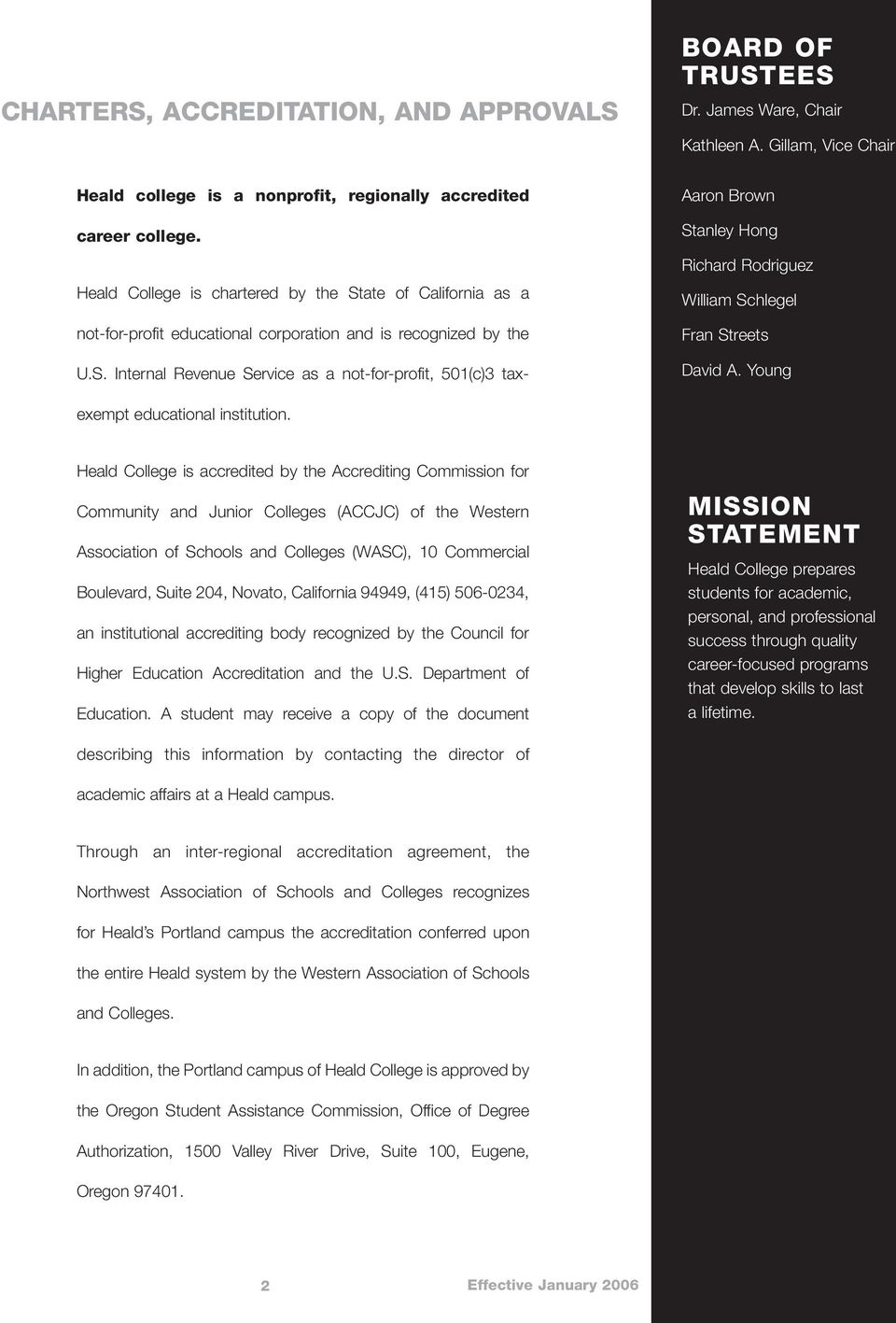
3 CHARTERS, ACCREDITATION, AND APPROVALS BOARD OF TRUSTEES Dr. James Ware, Chair Kathleen A. Gillam, Vice Chair Aaron Brown Stanley Hong Richard Rodriguez William Schlegel Fran Streets David A. Young Heald college is a nonprofit, regionally accredited career college. Heald College is chartered by the State of California as a not-for-profit educational corporation and is recognized by the U.S. Internal Revenue Service as a not-for-profit, 501(c)3 taxexempt educational institution. Heald College is accredited by the Accrediting Commission for Community and Junior Colleges (ACCJC) of the Western Association of Schools and Colleges (WASC), 10 Commercial Boulevard, Suite 204, Novato, California 94949, (415) , an institutional accrediting body recognized by the Council for Higher Education Accreditation and the U.S. Department of Education. A student may receive a copy of the document MISSION STATEMENT Heald College prepares students for academic, personal, and professional success through quality career-focused programs that develop skills to last a lifetime. describing this information by contacting the director of academic affairs at a Heald campus. Through an inter-regional accreditation agreement, the Northwest Association of Schools and Colleges recognizes for Heald s Portland campus the accreditation conferred upon the entire Heald system by the Western Association of Schools and Colleges. In addition, the Portland campus of Heald College is approved by the Oregon Student Assistance Commission, Office of Degree Authorization, 1500 Valley River Drive, Suite 100, Eugene, Oregon
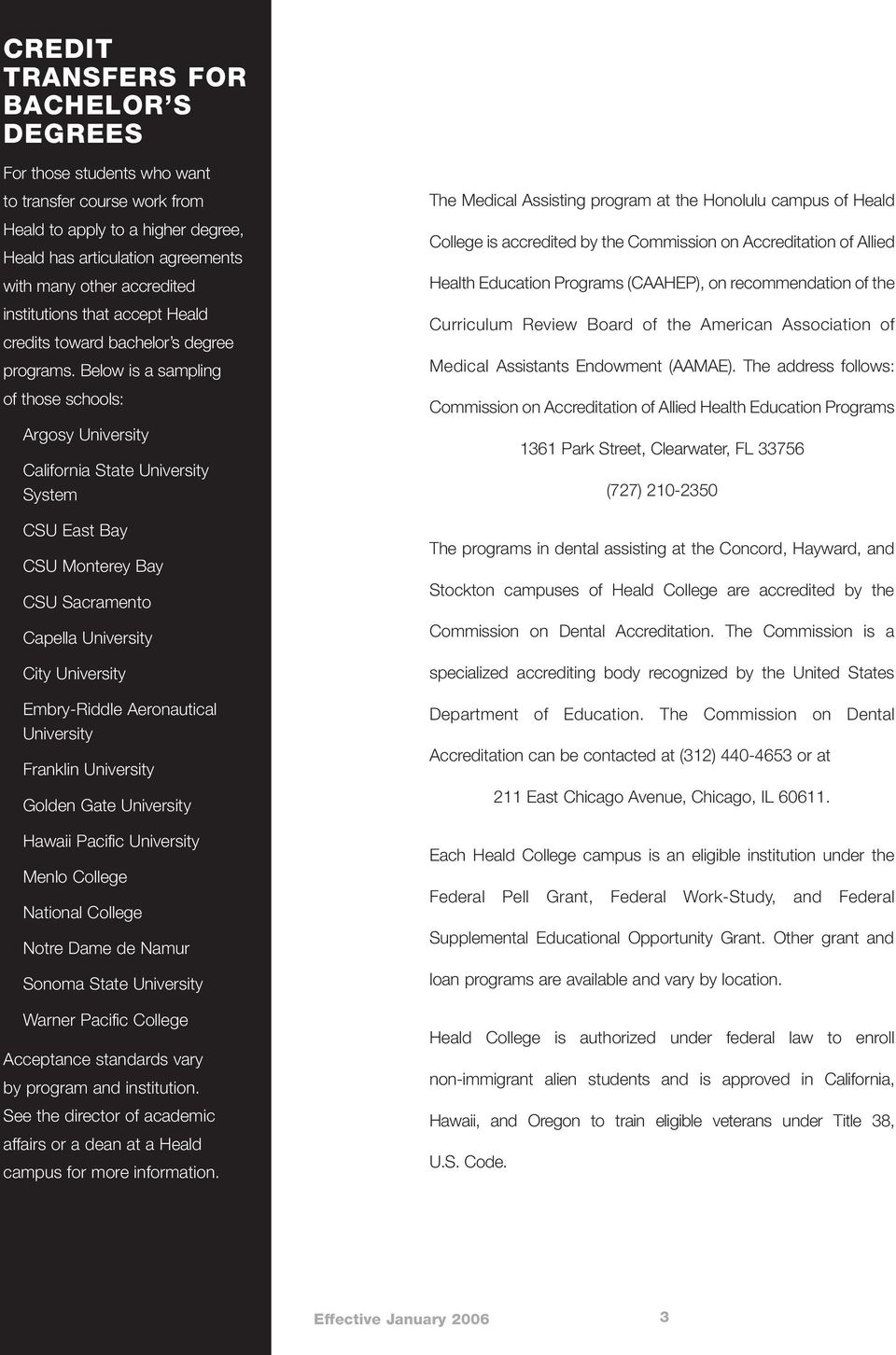
4 CREDIT TRANSFERS FOR BACHELOR S DEGREES For those students who want to transfer course work from Heald to apply to a higher degree, Heald has articulation agreements with many other accredited institutions that accept Heald credits toward bachelor s degree programs. Below is a sampling of those schools: Argosy University California State University System CSU East Bay CSU Monterey Bay CSU Sacramento Capella University City University Embry-Riddle Aeronautical University Franklin University Golden Gate University Hawaii Pacific University Menlo College National College Notre Dame de Namur Sonoma State University Warner Pacific College Acceptance standards vary by program and institution. See the director of academic affairs or a dean at a Heald campus for more information. The Medical Assisting program at the Honolulu campus of Heald College is accredited by the Commission on Accreditation of Allied Health Education Programs (CAAHEP), on recommendation of the Curriculum Review Board of the American Association of Medical Assistants Endowment (AAMAE). The address follows: Commission on Accreditation of Allied Health Education Programs 1361 Park Street, Clearwater, FL (727) The programs in dental assisting at the Concord, Hayward, and Stockton campuses of Heald College are accredited by the Commission on Dental Accreditation. The Commission is a specialized accrediting body recognized by the United States Department of Education. The Commission on Dental Accreditation can be contacted at (312) or at 211 East Chicago Avenue, Chicago, IL Each Heald College campus is an eligible institution under the Federal Pell Grant, Federal Work-Study, and Federal Supplemental Educational Opportunity Grant. Other grant and loan programs are available and vary by location. Heald College is authorized under federal law to enroll non-immigrant alien students and is approved in California, Hawaii, and Oregon to train eligible veterans under Title 38, U.S. Code. 3
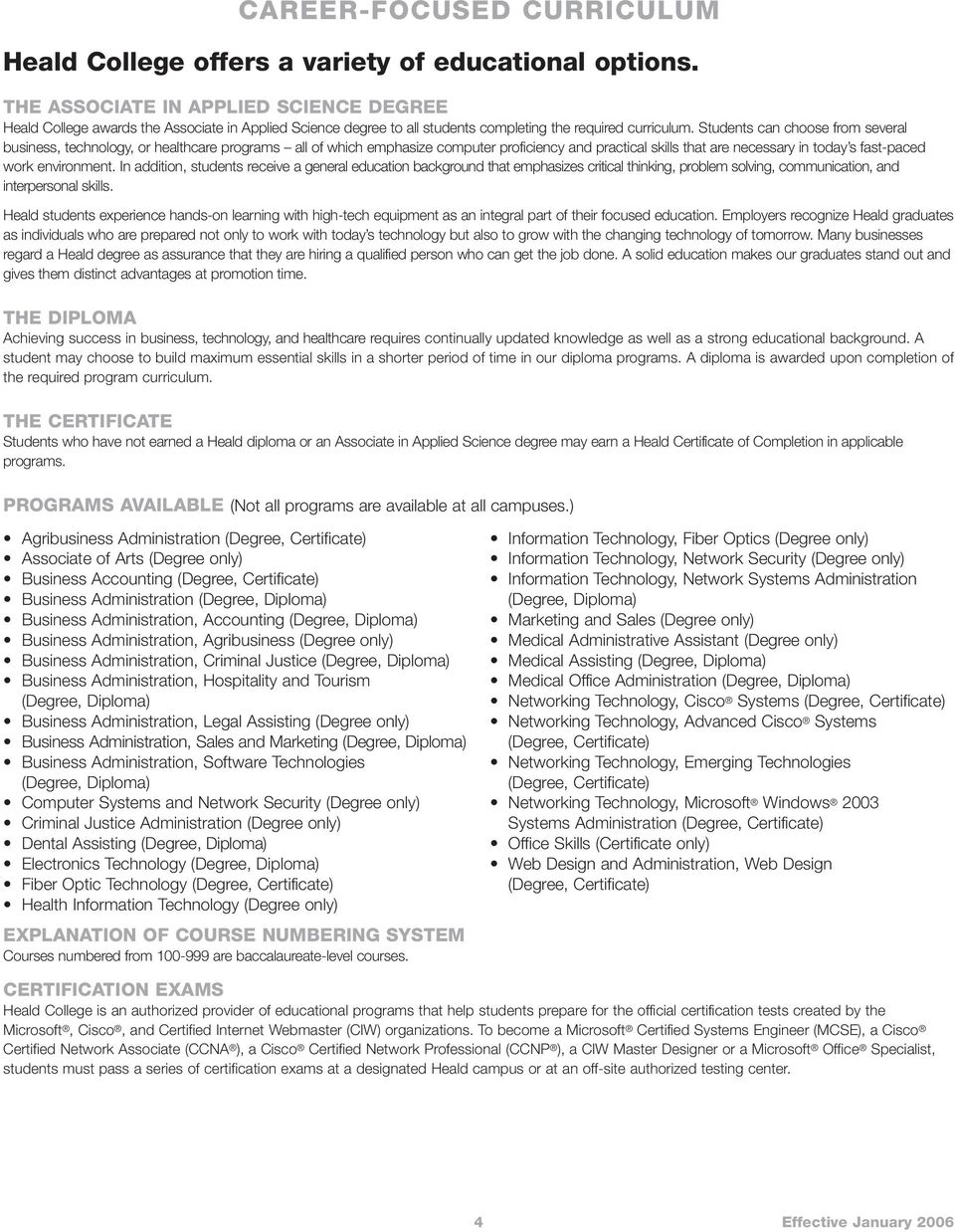
5 CAREER-FOCUSED CURRICULUM Heald College offers a variety of educational options. THE ASSOCIATE IN APPLIED SCIENCE DEGREE Heald College awards the Associate in Applied Science degree to all students completing the required curriculum. Students can choose from several business, technology, or healthcare programs all of which emphasize computer proficiency and practical skills that are necessary in today s fast-paced work environment. In addition, students receive a general education background that emphasizes critical thinking, problem solving, communication, and interpersonal skills. Heald students experience hands-on learning with high-tech equipment as an integral part of their focused education. Employers recognize Heald graduates as individuals who are prepared not only to work with today s technology but also to grow with the changing technology of tomorrow. Many businesses regard a Heald degree as assurance that they are hiring a qualified person who can get the job done. A solid education makes our graduates stand out and gives them distinct advantages at promotion time. THE DIPLOMA Achieving success in business, technology, and healthcare requires continually updated knowledge as well as a strong educational background. A student may choose to build maximum essential skills in a shorter period of time in our diploma programs. A diploma is awarded upon completion of the required program curriculum. THE CERTIFICATE Students who have not earned a Heald diploma or an Associate in Applied Science degree may earn a Heald Certificate of Completion in applicable programs. PROGRAMS AVAILABLE (Not all programs are available at all campuses.) Agribusiness Administration (Degree, Certificate) Associate of Arts (Degree only) Business Accounting (Degree, Certificate) Business Administration (Degree, Diploma) Business Administration, Accounting (Degree, Diploma) Business Administration, Agribusiness (Degree only) Business Administration, Criminal Justice (Degree, Diploma) Business Administration, Hospitality and Tourism (Degree, Diploma) Business Administration, Legal Assisting (Degree only) Business Administration, Sales and Marketing (Degree, Diploma) Business Administration, Software Technologies (Degree, Diploma) Computer Systems and Network Security (Degree only) Criminal Justice Administration (Degree only) Dental Assisting (Degree, Diploma) Electronics Technology (Degree, Diploma) Fiber Optic Technology (Degree, Certificate) Health Information Technology (Degree only) EXPLANATION OF COURSE NUMBERING SYSTEM Courses numbered from are baccalaureate-level courses. Information Technology, Fiber Optics (Degree only) Information Technology, Network Security (Degree only) Information Technology, Network Systems Administration (Degree, Diploma) Marketing and Sales (Degree only) Medical Administrative Assistant (Degree only) Medical Assisting (Degree, Diploma) Medical Office Administration (Degree, Diploma) Networking Technology, Cisco Systems (Degree, Certificate) Networking Technology, Advanced Cisco Systems (Degree, Certificate) Networking Technology, Emerging Technologies (Degree, Certificate) Networking Technology, Microsoft Windows 2003 Systems Administration (Degree, Certificate) Office Skills (Certificate only) Web Design and Administration, Web Design (Degree, Certificate) CERTIFICATION EXAMS Heald College is an authorized provider of educational programs that help students prepare for the official certification tests created by the Microsoft, Cisco, and Certified Internet Webmaster (CIW) organizations. To become a Microsoft Certified Systems Engineer (MCSE), a Cisco Certified Network Associate (CCNA ), a Cisco Certified Network Professional (CCNP ), a CIW Master Designer or a Microsoft Office Specialist, students must pass a series of certification exams at a designated Heald campus or at an off-site authorized testing center. 4
6 INTERNSHIPS AND EXTERNSHIPS Heald College's internships and externships provide opportunities for Heald's A.A.S. degree students to have on-the-job training while earning school credit. Students interview for internship and externship positions, and assignments are agreed upon by the College, student, and company. Internships are optional and may not be provided by all campuses each quarter. Internship positions are unpaid. Externships are required in Medical Assisting, Dental Assisting, and Health Information Technology programs, and are also unpaid. Internships and externships are usually available during the day, Monday through Friday. GENERAL EDUCATION PHILOSOPHY Heald College programs include both professional and general education courses, which together allow students to experience the integration of knowledge and skills. The general education courses offer students breadth in their experiences by introducing them to certain major areas of knowledge, thus expanding their understanding of the world and cultures around them. Furthermore, these courses foster a spirit of inquiry and provide for students development of the skills, knowledge, and intellectual habits necessary to support their personal, professional, and public lives. In particular, the general education curriculum provides the means by which students can develop their skills in the following areas: Literacy Competence in reading, writing, speaking, listening, and mathematics Critical Thinking Competence in analysis, synthesis, problem solving, decision making, and creative exploration Personal and Social Responsibility Competence in working with others, and an awareness of and responsiveness to diversity and commonality among cultures, multiplicity of perspectives, ethical behaviors, and wellness issues Resource Proficiency Effective use of computers and information technology, ability to locate and use information resources, and appreciation of lifelong learning options GENERAL EDUCATION REQUIREMENTS (A.A.S.) BUSINESS PROGRAMS Communication Skills College Composition and Research Computational Skills Modern Business Mathematics Social Science Introduction to Psychology Natural Science Introduction to Environmental Science Foundations of Agricultural Science Humanities/Fine Arts Contemporary Literature: Cultural Perspectives TECHNOLOGY PROGRAMS Communication Skills College Composition and Research Computational Skills Intermediate Algebra Social Science Introduction to Psychology Natural Science Introduction to Physics Humanities/Fine Arts Contemporary Literature: Cultural Perspectives HEALTHCARE PROGRAMS Communication Skills College Composition and Research Computational Skills Modern Business Mathematics Intermediate Algebra Social Science Introduction to Psychology Natural Science Fundamentals of Anatomy and Physiology Humanities/Fine Arts Contemporary Literature: Cultural Perspectives 5

7 Associate in Applied Science Degree in Agribusiness Administration Graduates of the following Heald College Associate in Applied Science degree programs may earn an additional A.A.S. degree by successfully completing the Agribusiness Administration program: Business Administration Business Administration with an emphasis in Accounting Business Administration with an emphasis in Criminal Justice Business Administration with an emphasis in Legal Assisting Business Administration with an emphasis in Office Technologies Business Administration with an emphasis in Sales and Marketing Business Administration with an emphasis in Software Technologies Business Software Applications Computer Business Administration Major Courses AGRIBUSINESS ADMINISTRATION 15 units AGRIBUS 105 Introduction to Agribusiness 3 AGRIBUS 115 Agribusiness Principles 3 AGRIBUS 120 Fundamentals of Agricultural Marketing 3 AGRIBUS 125 Agricultural Sales and Marketing 3 FRN LANG 120 Conversational Spanish 3 Business Courses 3 units BUS ADMIN 150 Introduction to Project Management* 3 General Education Courses 6 units AGRIBUS 130 Foundation of Agricultural Science 6 Total Required for Degree Varies + *If a graduate of a Heald College AAS degree programs has completed BUS ADMN 150, substitute a Campus Designated Course.** **The regional director of academic affairs and/or dean of educational programs will schedule additional courses as needed to complement the student s program. + The A.A.S. in Agribusiness Administration is available only as an additional Heald A.A.S. degree. The total number of units required depends on those required for the first A.A.S. degree. Please note that programs may vary depending on campus. AGRIBUSINESS Because agriculture is in the process of evolving into a more technical-savvy industry, opportunities abound for candidates who are skilled at streamlining processes. According to the Bureau of Labor Statistics, employment in selected geographic areas for this occupation is projected to increase significantly. The diversification of resources has prompted agriculture professionals to take advantage of technological advancements. In order to operate efficiently, agriculture businesses need highly motivated employees that can come up with value-added solutions for promoting agricultural goods. In this program, you ll get a broad overview of the agribusiness industry, studying everything from business models to financial operations. We ll give you an in-depth understanding of how agribusinesses operate, allowing you to get experience collaborating with a team. Graduates of Heald s Agribusiness program are equipped with a wide range of business skills that can serve them well in a variety of agricultural settings. You can pursue professional positions at cooperatives, food production or packaging plants, distribution companies, harvesting farms, and government agencies. 6

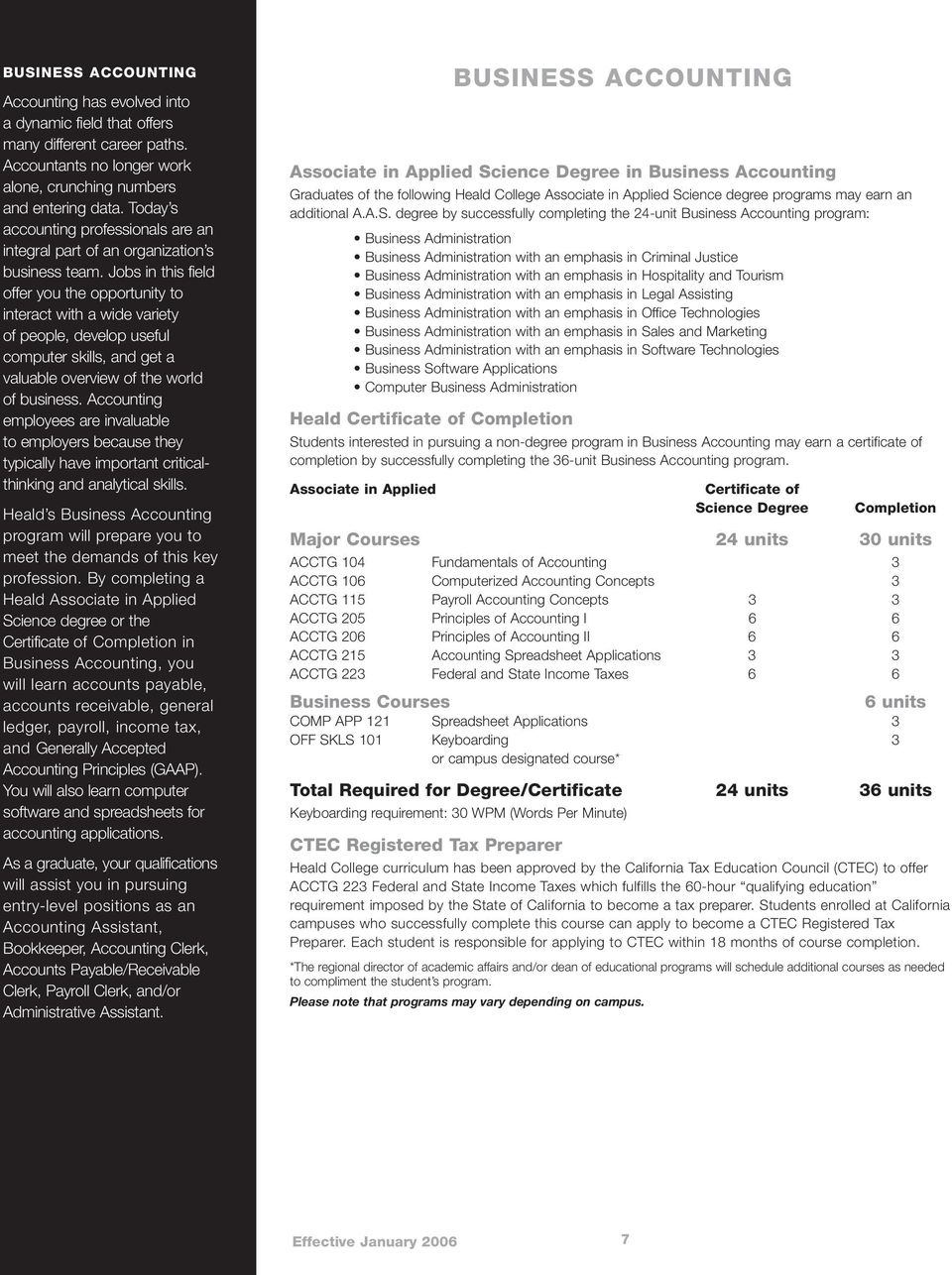
8 BUSINESS ACCOUNTING Accounting has evolved into a dynamic field that offers many different career paths. Accountants no longer work alone, crunching numbers and entering data. Today s accounting professionals are an integral part of an organization s business team. Jobs in this field offer you the opportunity to interact with a wide variety of people, develop useful computer skills, and get a valuable overview of the world of business. Accounting employees are invaluable to employers because they typically have important criticalthinking and analytical skills. Heald s Business Accounting program will prepare you to meet the demands of this key profession. By completing a Heald Associate in Applied Science degree or the Certificate of Completion in Business Accounting, you will learn accounts payable, accounts receivable, general ledger, payroll, income tax, and Generally Accepted Accounting Principles (GAAP). You will also learn computer software and spreadsheets for accounting applications. As a graduate, your qualifications will assist you in pursuing entry-level positions as an Accounting Assistant, Bookkeeper, Accounting Clerk, Accounts Payable/Receivable Clerk, Payroll Clerk, and/or Administrative Assistant. Associate in Applied Science Degree in Business Accounting Graduates of the following Heald College Associate in Applied Science degree programs may earn an additional A.A.S. degree by successfully completing the 24-unit Business Accounting program: Business Administration Business Administration with an emphasis in Criminal Justice Business Administration with an emphasis in Hospitality and Tourism Business Administration with an emphasis in Legal Assisting Business Administration with an emphasis in Office Technologies Business Administration with an emphasis in Sales and Marketing Business Administration with an emphasis in Software Technologies Business Software Applications Computer Business Administration Heald Certificate of Completion Students interested in pursuing a non-degree program in Business Accounting may earn a certificate of completion by successfully completing the 36-unit Business Accounting program. Associate in Applied Certificate of Science Degree Completion Major Courses 24 units 30 units ACCTG 104 Fundamentals of Accounting 3 ACCTG 106 Computerized Accounting Concepts 3 ACCTG 115 Payroll Accounting Concepts 3 3 ACCTG 205 Principles of Accounting I 6 6 ACCTG 206 Principles of Accounting II 6 6 ACCTG 215 Accounting Spreadsheet Applications 3 3 ACCTG 223 Federal and State Income Taxes 6 6 Business Courses 6 units COMP APP 121 Spreadsheet Applications 3 OFF SKLS 101 Keyboarding 3 or campus designated course* Total Required for Degree/Certificate 24 units 36 units Keyboarding requirement: 30 WPM (Words Per Minute) CTEC Registered Tax Preparer BUSINESS ACCOUNTING Heald College curriculum has been approved by the California Tax Education Council (CTEC) to offer ACCTG 223 Federal and State Income Taxes which fulfills the 60-hour qualifying education requirement imposed by the State of California to become a tax preparer. Students enrolled at California campuses who successfully complete this course can apply to become a CTEC Registered Tax Preparer. Each student is responsible for applying to CTEC within 18 months of course completion. *The regional director of academic affairs and/or dean of educational programs will schedule additional courses as needed to compliment the student s program. Please note that programs may vary depending on campus. 7
9 BUSINESS ADMINISTRATION Diploma Associate in Applied Science Degree Major Courses 15 units 21 units BUS ADMN 115 Principles of Business Management 3 3 BUS ADMN 216 Principles of Human Resources 3 3 COMP APP 101 Word Processing Essentials 3 3 COMP APP 121 Spreadsheet Applications 3 3 COMP APP 221 Database Management 3 3 OFF SKLS 225 Integrated Office Projects 6 Business Courses 33 units 43 units ACCTG 104 Fundamentals of Accounting 3 3 ACCTG 106 Computerized Accounting Concepts 3 3 BUS ADMN 220 E-Commerce 3 BUS ADMN 235 Business Law and Ethics 3 BUS ADMN 250 Portfolio 1 BUS ADMN 281/282 Business Administration Internship 3 or 4 ** COMP APP 100 Introduction to Software Applications 3 3 COMP APP 215 Professional Document Production 3 3 ENGL 10 Essential Language Skills 3 3 ENGL 105 Composition and Reading 4 4 ENGL 212 Principles of Public Speaking 4 4 MATH 10 Essential Math 3 3 MATH 103 Elementary Algebra 4 4 OFF SKLS 101 Keyboarding 3 3 PROF DEV 226 Professional Career Development 3 WORKSHOP 10 Workshop (if required) 0 0 General Education Courses 8 units 20 units ENGL 155 College Composition and Research 4 4 ENV SCI 225 Introduction to Environmental Science 4 4 HUMNS 205 Contemporary Literature: Cultural Perspectives 4 MATH 205 Modern Business Mathematics 4 PSYCH 220 Introduction to Psychology 4 Campus Designated Courses* 9 units 15 units Total Required for Diploma/Degree 65 units 99 units Keyboarding requirement: 40 WPM (Words Per Minute) Actual number of Math and English courses required is dependent on the Entrance/Placement COMPASS scores. * The regional director of academic affairs and/or dean of educational programs will schedule additional courses as needed to complement the student s program. ** Business Administration Internship 281 (3 units) or 282 (4 units) may be taken in the student s last two quarters as a Campus Designated Course. Internships are optional and may not be available at all campuses each quarter. Internships are usually available during the day, Monday through Friday. Please note that programs may vary depending on campus. BUSINESS ADMINISTRATION No business succeeds today without a solid infrastructure of capable employees who can multi-task to meet a variety of challenges. Heald s Business Administration program provides students with a well-rounded exposure to the professional business environment which will help them develop general proficiencies appropriate for a wide range of careers. The program teaches basic business concepts related to business management, accounting, human resources, Internet marketing, and other areas relevant to the business world. Students explore ways to manage human, financial, and material resources, which are key components of the global economy. A foundation in general education enables students to develop strong critical-thinking, problem-solving, and interpersonal skills. Emphasis is also placed on developing computer skills. After graduation from this program, many students pursue certification as a Microsoft Office Specialist in Microsoft Word, Excel, Access, and PowerPoint. The Business Administration program will qualify grads to pursue entrylevel support positions such as Administrative Assistant, Office Assistant, Office Manager, Management Trainee, and Customer Service Representative. 8

10 ACCOUNTING The field of accounting today is full of job opportunities that combine financial recordkeeping and the use of computers to calculate and record data. The Bureau of Labor Statistics reports there are about two million jobs in this field, so job opportunities are plentiful.* An Associate Degree in Business Administration with an emphasis in Accounting from Heald College will prepare you to be an immediate asset to the financial department of just about any kind of business. In the field, accountants prepare, examine, analyze, and interpret accounting data in order to give advice and prepare financial statements. Other duties may include recording receipts and disbursements and preparing state and federal reports. An accounting clerk maintains accounting records, reconciles bank statements, posts details of business transactions, and prepares vouchers, invoices, and other records. Heald s program will introduce you to financial accounting, tax preparation, business and Internet law, communications, and computerized systems. After completing the Accounting program, your qualifications will assist you in pursuing a variety of positions, including Accounting Specialist, Accounts Payable/Receivable Specialist, and Payroll Processor. *Bureau of Labor Statistics Diploma Associate in Applied Science Degree Major Courses 15 units 27 units ACCTG 104 Fundamentals of Accounting 3 3 ACCTG 115 Payroll Accounting Concepts 3 3 ACCTG 205 Principles of Accounting I 6 6 ACCTG 206 Principles of Accounting II 6 ACCTG 207 Principles of Accounting III 6 COMP APP 121 Spreadsheet Applications 3 3 Business Courses 36 units 49 units ACCTG 106 Computerized Accounting Concepts 3 3 ACCTG 215 Accounting Spreadsheet Applications 3 ACCTG 223 Federal and State Income Taxes 6 BUS ADMN 115 Principles of Business Management 3 3 BUS ADMN 250 Portfolio 1 BUS ADMN 281/282 Business Administration Internship 3 or 4 ** COMP APP 100 Introduction to Software Applications 3 3 COMP APP 101 Word Processing Essentials 3 3 COMP APP 221 Database Management 3 3 ENGL 10 Essential Language Skills 3 3 ENGL 105 Composition and Reading 4 4 ENGL 212 Principles of Public Speaking 4 4 MATH 10 Essential Math 3 3 MATH 103 Elementary Algebra 4 4 OFF SKLS 101 Keyboarding 3 3 PROF DEV 226 Professional Career Development 3 WORKSHOP 10 Workshop (if required) 0 0 General Education Courses 12 units 20 units ENGL 155 College Composition and Research 4 4 ENV SCI 225 Introduction to Environmental Science 4 4 HUMNS 205 Contemporary Literature: Cultural Perspectives 4 MATH 205 Modern Business Mathematics 4 4 PSYCH 220 Introduction to Psychology 4 Campus Designated Courses* 3 units 3 units Total Required for Diploma/Degree 66 units 99 units Keyboarding requirement: 40 WPM (Words Per Minute) Ten-key requirement: 150 NSPM (Net Strokes Per Minute) CTEC Registered Tax Preparer BUSINESS ADMINISTRATION WITH AN EMPHASIS IN ACCOUNTING Heald College curriculum has been approved by the California Tax Education Council (CTEC) to offer ACCTG 223 Federal and State Income Taxes which fulfills the 60-hour qualifying education requirement imposed by the State of California to become a tax preparer. Students enrolled at California campuses who successfully complete this course can apply to become a CTEC Registered Tax Preparer. Each student is responsible for applying to CTEC within 18 months of course completion. Actual number of Math and English courses required is dependent on the Entrance/Placement COMPASS scores. * The regional director of academic affairs and/or dean of educational programs will schedule additional courses as needed to complement the student's program. ** Business Administration Internship 281 (3 units) or 282 (4 units) may be taken in the student s last two quarters as a Campus Designated Course. Internships are optional and may not be available at all campuses each quarter. Internships are usually available during the day, Monday through Friday. Please note that programs may vary depending on campus. 9

11 Associate in Applied Science Degree Major Courses 15 units AGRIBUS 105 Introduction to Agribusiness 3 AGRIBUS 115 Agribusiness Principles 3 AGRIBUS 120 Fundamentals of Agricultural Accounting 3 AGRIBUS 125 Agricultural Sales and Marketing 3 FRN LANG 120 Conversational Spanish 3 Business Courses 58 units ACCTG 104 Fundamentals of Accounting 3 ACCTG 106 Computerized Accounting Concepts 3 BUS ADMN 115 Principles of Business Management 3 BUS ADMN 150 Introduction to Project Management 3 BUS ADMN 216 Principles of Human Resources 3 BUS ADMN 235 Business Law and Ethics 3 BUS ADMN 250 Portfolio 1 BUS ADMN 281/282 Business Administration Internship 3 or 4** COMP APP 100 Introduction to Software Applications 3 COMP APP 101 Word Processing Essentials 3 COMP APP 121 Spreadsheet Applications 3 COMP APP 215 Professional Document Production 3 COMP APP 221 Database Management 3 ENGL 10 Essential Language Skills+ 3 ENGL 105 Composition and Reading+ 4 ENGL 212 Principles of Public Speaking 4 MATH 10 Essential Math+ 3 MATH 103 Elementary Algebra+ 4 OFF SKLS 101 Keyboarding 3 PROF DEV 226 Professional Career Development 3 WORKSHOP 10 Workshop (if required) 0 Campus Designated Courses** General Education Courses 3 units 22 units AGRIBUS 130 Foundations of Agricultural Science 6 ENGL 155 College Composition and Research 4 HUMNS 205 Contemporary Literature: Cultural Perspectives 4 MATH 205 Modern Business Mathematics 4 PSYCH 220 Introduction to Psychology 4 Total Required for Degree BUSINESS ADMINISTRATION WITH AN EMPHASIS IN AGRIBUSINESS 98 units + Actual number of Math and English courses required is dependent on the Entrance/Placement COMPASS scores. * Business Administration Internship 281 (3 units) or 282 (4 units) may be taken in the student s last two quarters as a Campus Designated Course. Internships are optional and may not be available at all campuses each quarter. Internships are usually available during the day, Monday through Friday. **The regional director of academic affairs and/or dean of educational programs will schedule additional courses as needed to complement the students program Please note that programs may vary depending on campus. AGRIBUSINESS Because agriculture is in the process of evolving into a more technical-savvy industry, opportunities abound for candidates who are skilled at streamlining processes. According to the Bureau of Labor Statistics, employment in selected geographic areas for this occupation is projected to increase significantly. The diversification of resources has prompted agriculture professionals to take advantage of technological advancements. In order to operate efficiently, agriculture businesses need highly motivated employees that can come up with value-added solutions for promoting agricultural goods. In this program, you ll get a broad overview of the agribusiness industry, studying everything from business models to financial operations. We ll give you an in-depth understanding of how agribusinesses operate, allowing you to get experience collaborating with a team. Graduates of Heald s Agribusiness program are equipped with a wide range of business skills that can serve them well in a variety of agricultural settings. You can pursue professional positions at cooperatives, food production or packaging plants, distribution companies, harvesting farms, and government agencies. 10

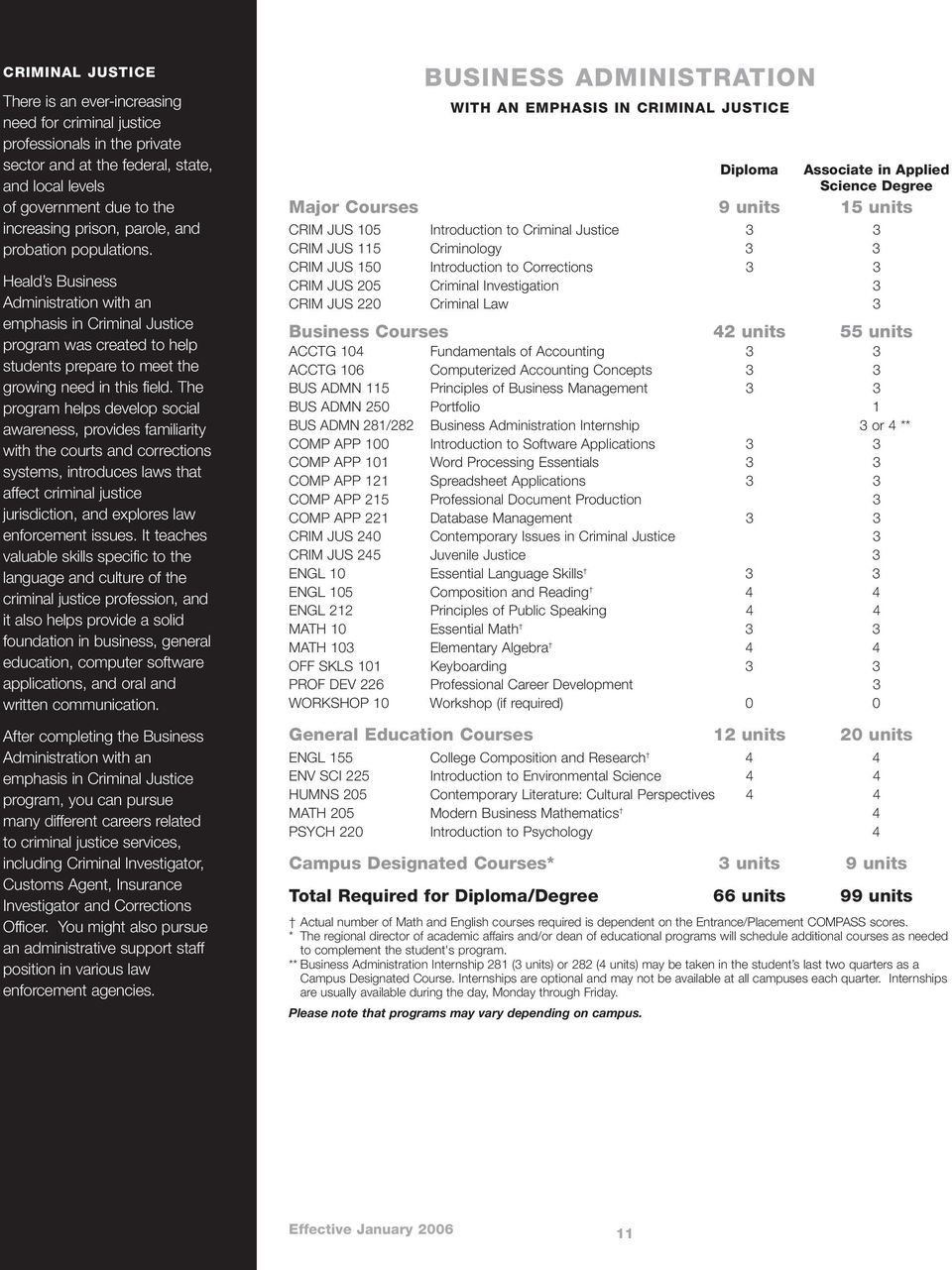
12 CRIMINAL JUSTICE There is an ever-increasing need for criminal justice professionals in the private sector and at the federal, state, and local levels of government due to the increasing prison, parole, and probation populations. Heald s Business Administration with an emphasis in Criminal Justice program was created to help students prepare to meet the growing need in this field. The program helps develop social awareness, provides familiarity with the courts and corrections systems, introduces laws that affect criminal justice jurisdiction, and explores law enforcement issues. It teaches valuable skills specific to the language and culture of the criminal justice profession, and it also helps provide a solid foundation in business, general education, computer software applications, and oral and written communication. After completing the Business Administration with an emphasis in Criminal Justice program, you can pursue many different careers related to criminal justice services, including Criminal Investigator, Customs Agent, Insurance Investigator and Corrections Officer. You might also pursue an administrative support staff position in various law enforcement agencies. BUSINESS ADMINISTRATION WITH AN EMPHASIS IN CRIMINAL JUSTICE Diploma Associate in Applied Science Degree Major Courses 9 units 15 units CRIM JUS 105 Introduction to Criminal Justice 3 3 CRIM JUS 115 Criminology 3 3 CRIM JUS 150 Introduction to Corrections 3 3 CRIM JUS 205 Criminal Investigation 3 CRIM JUS 220 Criminal Law 3 Business Courses 42 units 55 units ACCTG 104 Fundamentals of Accounting 3 3 ACCTG 106 Computerized Accounting Concepts 3 3 BUS ADMN 115 Principles of Business Management 3 3 BUS ADMN 250 Portfolio 1 BUS ADMN 281/282 Business Administration Internship 3 or 4 ** COMP APP 100 Introduction to Software Applications 3 3 COMP APP 101 Word Processing Essentials 3 3 COMP APP 121 Spreadsheet Applications 3 3 COMP APP 215 Professional Document Production 3 COMP APP 221 Database Management 3 3 CRIM JUS 240 Contemporary Issues in Criminal Justice 3 CRIM JUS 245 Juvenile Justice 3 ENGL 10 Essential Language Skills 3 3 ENGL 105 Composition and Reading 4 4 ENGL 212 Principles of Public Speaking 4 4 MATH 10 Essential Math 3 3 MATH 103 Elementary Algebra 4 4 OFF SKLS 101 Keyboarding 3 3 PROF DEV 226 Professional Career Development 3 WORKSHOP 10 Workshop (if required) 0 0 General Education Courses 12 units 20 units ENGL 155 College Composition and Research 4 4 ENV SCI 225 Introduction to Environmental Science 4 4 HUMNS 205 Contemporary Literature: Cultural Perspectives 4 4 MATH 205 Modern Business Mathematics 4 PSYCH 220 Introduction to Psychology 4 Campus Designated Courses* 3 units 9 units Total Required for Diploma/Degree 66 units 99 units Actual number of Math and English courses required is dependent on the Entrance/Placement COMPASS scores. * The regional director of academic affairs and/or dean of educational programs will schedule additional courses as needed to complement the student's program. ** Business Administration Internship 281 (3 units) or 282 (4 units) may be taken in the student s last two quarters as a Campus Designated Course. Internships are optional and may not be available at all campuses each quarter. Internships are usually available during the day, Monday through Friday. Please note that programs may vary depending on campus. 11
13 Diploma Associate in Applied Science Degree Major Courses 23 units 32 units FRN LANG 264 Conversational Japanese Language I 4 4 FRN LANG 265 Conversational Japanese Language II 4 4 HOSPTOUR 100 Introduction to Hospitality and Tourism 3 3 HOSPTOUR 102 Travel Procedures 6 6 HOSPTOUR 103 Hotel Operations 6 6 HOSPTOUR 104 Food Service 6 HOSPTOUR 107 Hospitality and Tourism Field Experience 3 Business Courses 33 units 46 units ACCTG 104 Fundamentals of Accounting 3 ACCTG 106 Computerized Accounting Concepts 3 BUS ADMN 115 Principles of Business Management 3 3 BUS ADMN 250 Portfolio 1 BUS ADMN 281/282 Business Administration Internship 3 or 4 ** COMP APP 100 Introduction to Software Applications 3 3 COMP APP 101 Word Processing Essentials 3 3 COMP APP 121 Spreadsheet Applications 3 3 COMP APP 221 Database Management 3 ENGL 10 Essential Language Skills 3 3 ENGL 105 Composition and Reading 4 4 ENGL 212 Principles of Public Speaking 4 4 MATH 10 Essential Math 3 3 MATH 103 Elementary Algebra 4 4 OFF SKLS 101 Keyboarding 3 3 PROF DEV 226 Professional Career Development 3 WORKSHOP 10 Workshop (if required) 0 0 General Education Courses 12 units 20 units ENGL 155 College Composition and Research 4 4 ENV SCI 225 Introduction to Environmental Science 4 HUMNS 205 Contemporary Literature: Cultural Perspectives 4 4 MATH 205 Modern Business Mathematics 4 PSYCH 220 Introduction to Psychology 4 4 Campus Designated Courses* BUSINESS ADMINISTRATION WITH AN EMPHASIS IN HOSPITALITY AND TOURISM 3 units Total Required for Diploma/Degree 68 units 101 units Keyboarding requirement: 40 WPM (Words Per Minute) Actual number of Math and English courses required is dependent on the Entrance/Placement COMPASS scores. * The regional director of academic affairs and/or dean of educational programs will schedule additional courses as needed to complement the student's program. ** Business Administration Internship 281 (3 units) or 282 (4 units) may be taken in the student s last two quarters as a Campus Designated Course. Internships are optional and may not be available at all campuses each quarter. Internships are usually available during the day, Monday through Friday. Please note that programs may vary depending on campus. HOSPITALITY AND TOURISM If you enjoy interacting with people and are interested in travel, a career in hospitality and tourism may be for you. Opportunities in this field are continually growing as millions of tourists visit Hawaii annually. Travel and Tourism is the number one industry of Hawaii, and it accounts for 25% of total employment for the state.* With this program, you will graduate with a general understanding of the travel industry including hotel and food service operations. You will learn valuable computer skills such as airline reservations systems, word processing, database management, and spreadsheets. You ll also learn conversational Japanese. Students may opt for an on-thejob internship to get a better idea of what their future holds. Once you re on the job, you may work in many different businesses, from hotels to travel agencies to airlines. Because people travel around the clock, jobs in this profession generally have more flexible hours than other industries. Best of all, your personality and professionalism can shine with guests and customers, since you most likely will be the first contact for the establishment you represent. Upon completing the program, you may work as a Travel Agent, Reservationist, Tour Coordinator, Administrative Assistant, Events Coordinator, Catering Assistant, or Front Desk Clerk. Since promotions are usually from within, this career path offers a world of opportunity with good potential for advancement. *State of Hawaii, Hawaii Tourism Authority 12

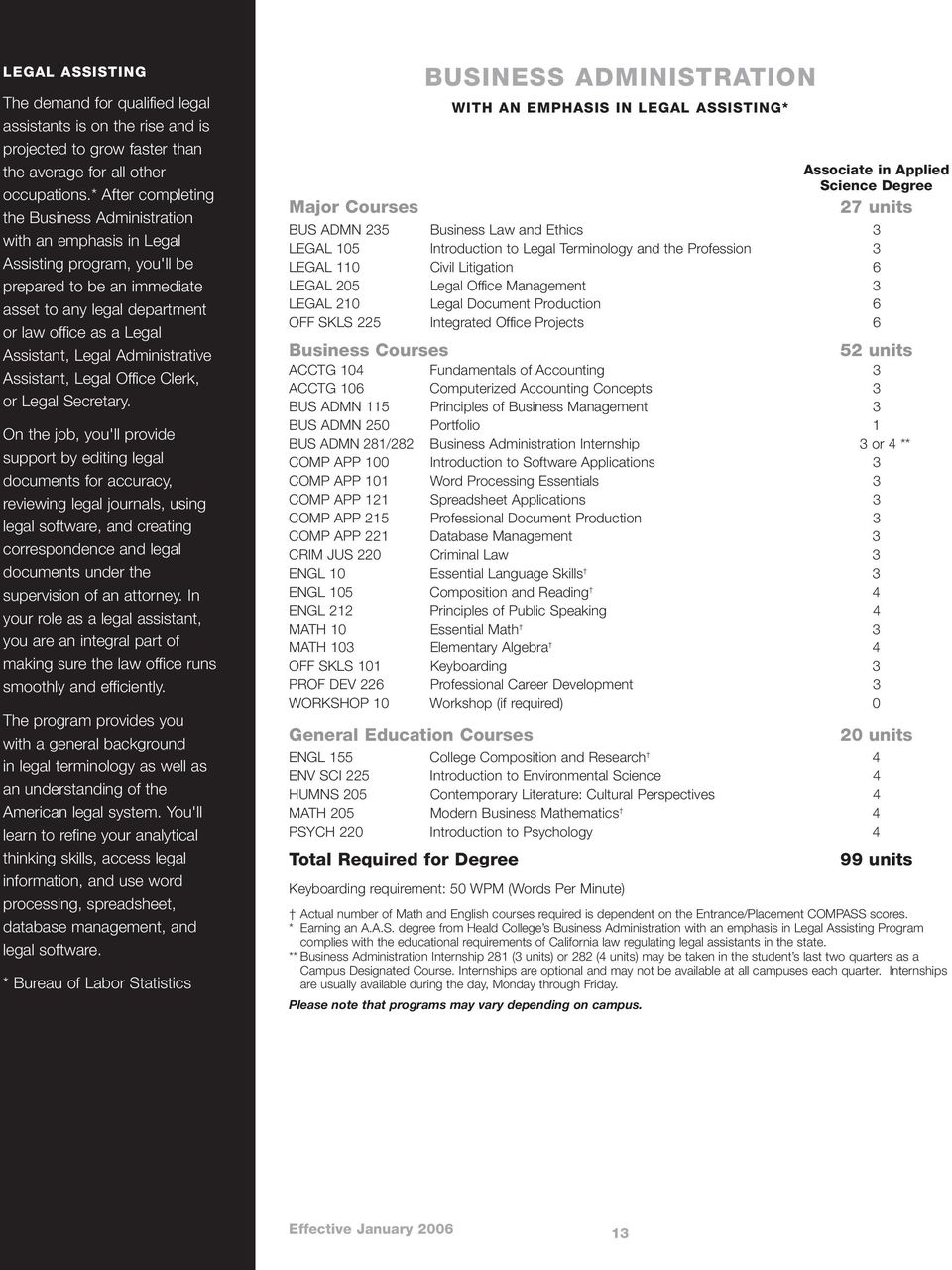
14 LEGAL ASSISTING The demand for qualified legal assistants is on the rise and is projected to grow faster than the average for all other occupations.* After completing the Business Administration with an emphasis in Legal Assisting program, you'll be prepared to be an immediate asset to any legal department or law office as a Legal Assistant, Legal Administrative Assistant, Legal Office Clerk, or Legal Secretary. On the job, you'll provide support by editing legal documents for accuracy, reviewing legal journals, using legal software, and creating correspondence and legal documents under the supervision of an attorney. In your role as a legal assistant, you are an integral part of making sure the law office runs smoothly and efficiently. The program provides you with a general background in legal terminology as well as an understanding of the American legal system. You'll learn to refine your analytical thinking skills, access legal information, and use word processing, spreadsheet, database management, and legal software. * Bureau of Labor Statistics Major Courses Associate in Applied Science Degree 27 units BUS ADMN 235 Business Law and Ethics 3 LEGAL 105 Introduction to Legal Terminology and the Profession 3 LEGAL 110 Civil Litigation 6 LEGAL 205 Legal Office Management 3 LEGAL 210 Legal Document Production 6 OFF SKLS 225 Integrated Office Projects 6 Business Courses 52 units ACCTG 104 Fundamentals of Accounting 3 ACCTG 106 Computerized Accounting Concepts 3 BUS ADMN 115 Principles of Business Management 3 BUS ADMN 250 Portfolio 1 BUS ADMN 281/282 Business Administration Internship 3 or 4 ** COMP APP 100 Introduction to Software Applications 3 COMP APP 101 Word Processing Essentials 3 COMP APP 121 Spreadsheet Applications 3 COMP APP 215 Professional Document Production 3 COMP APP 221 Database Management 3 CRIM JUS 220 Criminal Law 3 ENGL 10 Essential Language Skills 3 ENGL 105 Composition and Reading 4 ENGL 212 Principles of Public Speaking 4 MATH 10 Essential Math 3 MATH 103 Elementary Algebra 4 OFF SKLS 101 Keyboarding 3 PROF DEV 226 Professional Career Development 3 WORKSHOP 10 Workshop (if required) 0 General Education Courses 20 units ENGL 155 College Composition and Research 4 ENV SCI 225 Introduction to Environmental Science 4 HUMNS 205 Contemporary Literature: Cultural Perspectives 4 MATH 205 Modern Business Mathematics 4 PSYCH 220 Introduction to Psychology 4 Total Required for Degree BUSINESS ADMINISTRATION WITH AN EMPHASIS IN LEGAL ASSISTING* Keyboarding requirement: 50 WPM (Words Per Minute) 99 units Actual number of Math and English courses required is dependent on the Entrance/Placement COMPASS scores. * Earning an A.A.S. degree from Heald College s Business Administration with an emphasis in Legal Assisting Program complies with the educational requirements of California law regulating legal assistants in the state. ** Business Administration Internship 281 (3 units) or 282 (4 units) may be taken in the student s last two quarters as a Campus Designated Course. Internships are optional and may not be available at all campuses each quarter. Internships are usually available during the day, Monday through Friday. Please note that programs may vary depending on campus. 13
15 BUSINESS ADMINISTRATION WITH AN EMPHASIS IN SALES AND MARKETING Diploma Associate in Applied Science Degree Major Courses 9 units 18 units BUS ADMN 140 Salesmanship 3 3 BUS ADMN 145 Marketing Principles 3 3 BUS ADMN 230 Advertising 3 BUS ADMN 240 Product Development 3 BUS ADMN 255 Technical Sales 3 COMP APP 215 Professional Document Production 3 3 Business Courses 42 units 46 units ACCTG 104 Fundamentals of Accounting 3 3 ACCTG 106 Computerized Accounting Concepts 3 3 BUS ADMN 115 Principles of Business Management 3 3 BUS ADMN 250 Portfolio 1 BUS ADMN 281/282 Business Administration Internship 3 or 4 ** COMP APP 100 Introduction to Software Applications 3 3 COMP APP 101 Word Processing Essentials 3 3 COMP APP 121 Spreadsheet Applications 3 3 COMP APP 221 Database Management 3 3 ENGL 10 Essential Language Skills 3 3 ENGL 105 Composition and Reading 4 4 ENGL 212 Principles of Public Speaking 4 4 MATH 10 Essential Math 3 3 MATH 103 Elementary Algebra 4 4 OFF SKLS 101 Keyboarding 3 3 PROF DEV 226 Professional Career Development 3 WORKSHOP 10 Workshop (if required) 0 0 General Education Courses 8 units 20 units ENGL 155 College Composition and Research 4 4 ENV SCI 225 Introduction to Environmental Science 4 4 HUMNS 205 Contemporary Literature: Cultural Perspectives 4 MATH 205 Modern Business Mathematics 4 PSYCH 220 Introduction to Psychology 4 Campus Designated Courses* 6 units 15 units Total Required for Diploma/Degree 65 units 99 units Actual number of Math and English courses required is dependent on the Entrance/Placement COMPASS scores. * The regional director of academic affairs and/or dean of educational programs will schedule additional courses as needed to complement the student's program. ** Business Administration Internship 281 (3 units) or 282 (4 units) may be taken in the student s last two quarters as a Campus Designated Course. Internships are optional and may not be available at all campuses each quarter. Internships are usually available during the day, Monday through Friday. Please note that programs may vary depending on campus. SALES AND MARKETING Sales and marketing are increasingly important to businesses as they battle for consumers attention in today s complex communications environment. Heald s Business Administration with an emphasis in Sales and Marketing program was created to provide students with the skills and knowledge to help employers face those challenges. The program is perfect for those who enjoy interacting with others, developing strategies to reach goals, and finding ways to promote or highlight a product or company s strengths. You ll learn about the basics of business management, with specific emphasis on salesmanship, marketing, advertising, and product development. You ll practice professional selling techniques, plan an advertising strategy, and use your creative and criticalthinking skills to develop a marketing plan. You ll expand your thinking to include the local, national, and global commerce market, while honing your verbal and written communication skills. Students pursuing this program will also become versed in many of the computer software applications used in business. Job opportunities for graduates of this program typically include entry-level positions such as Sales Consultant, Retail Sales Associate, Customer Service Representative, Marketing Coordinator, Client Service Representative, and Call Center Representative. 14

16 SOFTWARE TECHNOLOGIES Computers are now vitally important in all types of occupations. As a result, skilled computer users are increasingly in demand. Companies look for employees who have current computer training. Employees who also have the ability to help other users function with computers have an added advantage in the job market. You can earn a degree in Business Administration with an emphasis in Software Technologies that will give you that edge. On the job, graduates may perform a variety of administrative and computer support tasks. You might create presentation materials or troubleshoot problems with computer software and hardware. You will receive a foundation in general office skills with computer application knowledge that will help you perform a wide variety of tasks. Jobs you might pursue include Software Specialist, Computer Support Specialist, Technology Coordinator, Help Desk Operator, Customer Service Representative, or Administrative Assistant. As computers and software become more complex, computer support specialists are more in demand to provide technical assistance to users. In fact, computer specialists are projected to be among the fastest-growing occupations through 2010.* Diploma Associate in Applied Science Degree Major Courses 18 units 24 units COMP APP 101 Word Processing Essentials 3 3 COMP APP 121 Spreadsheet Applications 3 3 INFOTECH 110 Networking Foundations 0 6 INFOTECH 115 Core Hardware Technologies 6 6 INFOTECH 125 Operating System Technologies 6 6 Business Courses 36 units 46 units ACCTG 104 Fundamentals of Accounting 3 3 ACCTG 106 Computerized Accounting Concepts 3 3 BUS ADMN 115 Principles of Business Management 3 3 BUS ADMN 250 Portfolio 1 BUS ADMN 281/282 Business Administration Internship 3 or 4 ** COMP APP 100 Introduction to Software Applications 3 3 COMP APP 215 Professional Document Production 3 COMP APP 221 Database Management 3 ENGL 10 Essential Language Skills 3 3 ENGL 105 Composition and Reading 4 4 ENGL 212 Principles of Public Speaking 4 4 INFOTECH 105 Introduction to Networking Concepts 3 3 MATH 10 Essential Math 3 3 MATH 103 Elementary Algebra 4 4 OFF SKLS 101 Keyboarding 3 3 PROF DEV 226 Professional Career Development 3 WORKSHOP 10 Workshop (if required) 0 General Education Courses 12 units 20 units ENGL 155 College Composition and Research 4 4 ENV SCI 225 Introduction to Environmental Science 4 4 HUMNS 205 Contemporary Literature: Cultural Perspectives 4 4 MATH 205 Modern Business Mathematics 4 PSYCH 220 Introduction to Psychology 4 Campus Designated Courses* BUSINESS ADMINISTRATION WITH AN EMPHASIS IN SOFTWARE TECHNOLOGIES 9 units Total Required for Diploma/Degree 66 units 99 units Keyboarding requirement: 40 WPM (Words Per Minute) Actual number of Math and English courses required is dependent on the Entrance/Placement COMPASS scores. * The regional director of academic affairs and/or dean of educational programs will schedule additional courses as needed to complement the student's program. ** Business Administration Internship 281 (3 units) or 282 (4 units) may be taken in the student s last two quarters as a Campus Designated Course. Internships are optional and may not be available at all campuses each quarter. Internships are usually available during the day, Monday through Friday. Please note that programs may vary depending on campus. In addition, your education will provide a foundation for pursuing certification as a Microsoft Office Specialist in Microsoft Word, Excel, Access, and PowerPoint, and for CompTIA A+ certification. *Bureau of Labor Statistics 15

17 COMPUTER SYSTEMS AND NETWORK SECURITY Graduates of the following Heald College Associate in Applied Science Degree programs may earn an additional A.A. S. degree by successfully completing the Computer Systems and Network Security program: Business Administration with an emphasis in Software Technologies Computer Information Technology Computer Technology Major Courses Business Administration Software Technology Computer Technology/ Computer Information Technology INFOTECH 260 Introduction to Computer Security Concepts 3 3 INFOTECH 285 Disaster Recovery 3 3 INFOTECH 290 Computer Forensics 6 6 INFOTECH 295 Defensive Countermeasures 3 3 Technical Courses INFOTECH 215 Advanced Networking 6 0 INFOTECH 270 Introduction to Routing Concepts 3 3 OFF SKLS 101 Keyboarding or Campus Designated Course** 0 3* Campus Designated Courses* 0 3 units Total Required for Degree 24 units Varies*** *Students who test out of OFF SKLS 101 Keyboarding must be assigned a Campus Designated Course. **The regional director of academic affairs and/or dean of educational programs will schedule additional courses as needed to complement the student's program. ***The A.A.S in Computer System and Network Security is available only as an additional Heald A.A.S degree. The total number of units required depends on those required for the first A.A.S degree Please note that programs may vary depending on campus. COMPUTER SYSTEMS AND NETWORK SECURITY The security of data handled by computer networks continues to be of utmost importance for organizations all over the world. The unauthorized access to computer systems and Web sites and the theft of data cause major blows to the reputation of companies. The spread of viruses and worms disrupts services and contributes to loss of productivity and revenues. Heald College's Computer Systems and Network Security program provides you with the knowledge and skills necessary to function as a valuable member of the information technology team. You learn how to secure computer networks through the installation and configuration of firewalls and intrusion detection systems. In addition, you learn how to acquire and preserve digital evidence through computer forensics analysis and to create plans and procedures for disaster recovery. Heald College's program also introduces students to information included on certification examinations related to network security positions. As a graduate of this program, you can pursue a career as an Information Security Specialist, Database Security Specialist, or Web Application Security Specialist. 16

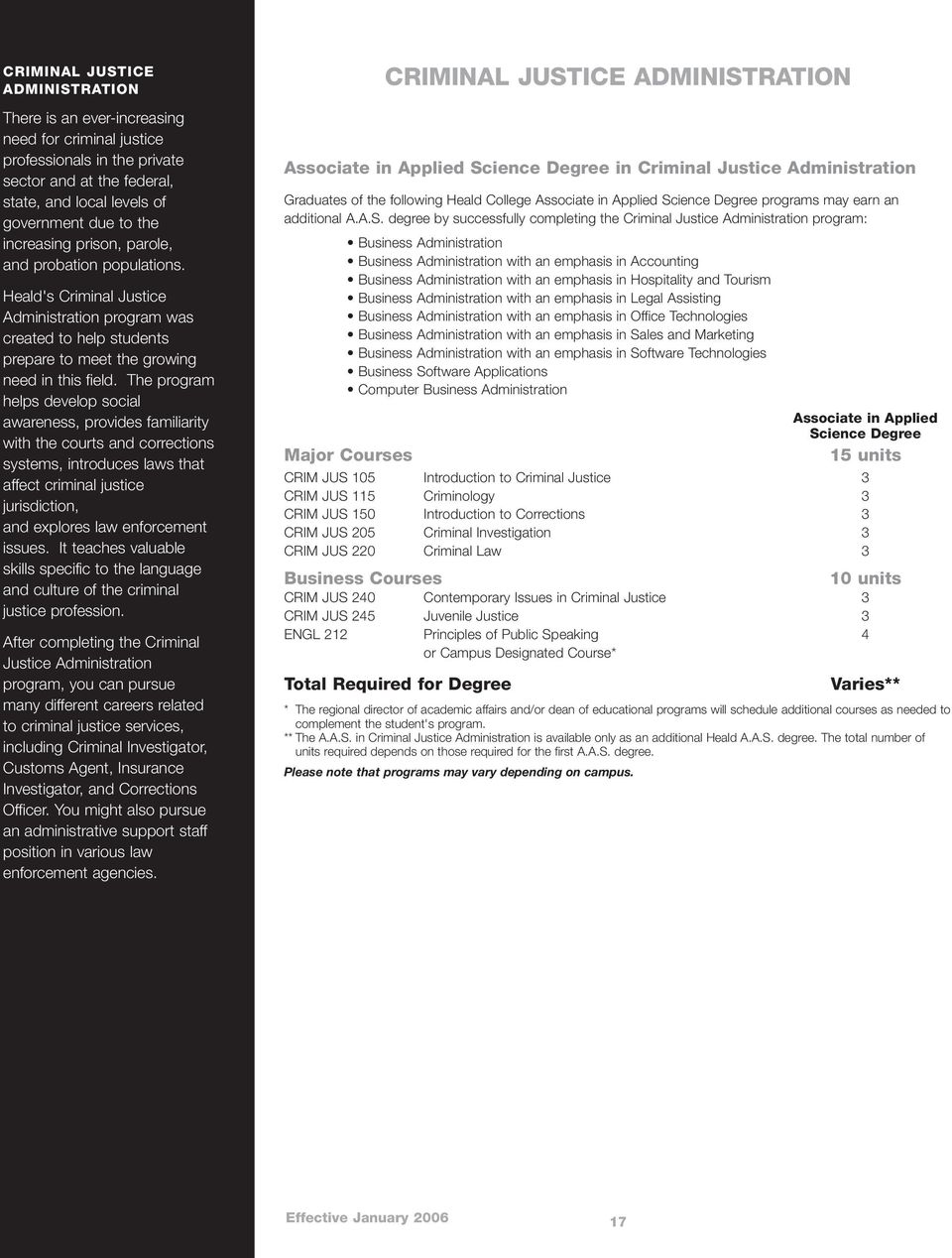
18 CRIMINAL JUSTICE ADMINISTRATION There is an ever-increasing need for criminal justice professionals in the private sector and at the federal, state, and local levels of government due to the increasing prison, parole, and probation populations. Heald's Criminal Justice Administration program was created to help students prepare to meet the growing need in this field. The program helps develop social awareness, provides familiarity with the courts and corrections systems, introduces laws that affect criminal justice jurisdiction, and explores law enforcement issues. It teaches valuable skills specific to the language and culture of the criminal justice profession. After completing the Criminal Justice Administration program, you can pursue many different careers related to criminal justice services, including Criminal Investigator, Customs Agent, Insurance Investigator, and Corrections Officer. You might also pursue an administrative support staff position in various law enforcement agencies. CRIMINAL JUSTICE ADMINISTRATION Associate in Applied Science Degree in Criminal Justice Administration Graduates of the following Heald College Associate in Applied Science Degree programs may earn an additional A.A.S. degree by successfully completing the Criminal Justice Administration program: Business Administration Business Administration with an emphasis in Accounting Business Administration with an emphasis in Hospitality and Tourism Business Administration with an emphasis in Legal Assisting Business Administration with an emphasis in Office Technologies Business Administration with an emphasis in Sales and Marketing Business Administration with an emphasis in Software Technologies Business Software Applications Computer Business Administration Major Courses Associate in Applied Science Degree 15 units CRIM JUS 105 Introduction to Criminal Justice 3 CRIM JUS 115 Criminology 3 CRIM JUS 150 Introduction to Corrections 3 CRIM JUS 205 Criminal Investigation 3 CRIM JUS 220 Criminal Law 3 Business Courses 10 units CRIM JUS 240 Contemporary Issues in Criminal Justice 3 CRIM JUS 245 Juvenile Justice 3 ENGL 212 Principles of Public Speaking 4 or Campus Designated Course* Total Required for Degree Varies** * The regional director of academic affairs and/or dean of educational programs will schedule additional courses as needed to complement the student's program. ** The A.A.S. in Criminal Justice Administration is available only as an additional Heald A.A.S. degree. The total number of units required depends on those required for the first A.A.S. degree. Please note that programs may vary depending on campus. 17
19 DENTAL ASSISTING Diploma* Associate in Applied Science Degree Major Courses 37 Units 37 units DENTASST 100 Dental Anatomy 3 3 DENTASST 105 Dental Sciences 3 3 DENTASST 106 Biomedical Sciences 3 3 DENTASST 110 Dental Materials 6 6 DENTASST 120 Pharmacology and Office Emergencies 3 3 DENTASST 205 Chairside Assisting I 6 6 DENTASST 211 Dental Office Management 3 3 DENTASST 215 Chairside Assisting II 3 3 DENTASST 216 Coronal Polishing 1 1 DENTASST 230 Radiology I 3 3 DENTASST 235 Radiology II 3 3 Business Courses 24 Units 42 units COMP APP 100 Introduction to Software Applications 3 3 COMP APP 101 Word Processing Essentials 0 3 DENTASST 250 Dental Assisting Externship I 5* 5* DENTASST 251 Dental Assisting Seminar I 1 1 DENTASST 255 Dental Assisting Externship II 5* 5* DENTASST 256 Dental Assisting Seminar II 1 1 ENGL 10 Essential Language Skills 3 3 ENGL 105 Composition and Reading 0 4 ENGL 212 Principles of Public Speaking 0 4 MATH 10 Essential Math 3 3 MATH 103 Elementary Algebra 0 4 OFF SKLS 101 Keyboarding 3 3 PROF DEV 226 Professional Career Development 0 3 WORKSHOP 10 Workshop (if required) 0 0 General Education Courses 4 Units 20 units ANATPHYS 215 Fundamentals of Anatomy and Physiology 4 4 ENGL 155 College Composition and Research 0 4 HUMNS 205 Contemporary Literature: Cultural Perspectives 0 4 MATH 205 Modern Business Mathematics 0 4 PSYCH 220 Introduction to Psychology 0 4 Total Required for Diploma/Degree 65 Units 99 units Actual number of Math and English courses required is dependent on the Entrance/Placement COMPASS scores. ** Externships are available only during the day, Monday through Friday. Please note that programs may vary depending on campus. DENTAL ASSISTING Dental Assisting is projected to be one of the fastest growing occupations through the year 2012.* This growth is fueled by an increasing population and greater retention of natural teeth by middle-aged and older people. In addition, with increasing workloads, dentists are expected to hire more assistants to perform routine tasks. A Dental Assistant works as an integral member of the dental team, performing many clinical tasks and procedures. These include assisting with examinations and fillings, preparing tray setups with the required instruments, handing materials and instruments to the dentist, and using suction devices to keep the patients' mouths dry. This fast-moving profession also involves sterilizing instruments and equipment, taking, developing and mounting x-rays, and applying topical anesthetics as directed by the dentist. Additional tasks include making casts of teeth, trimming and finishing dental impressions, providing dental health education, and assisting with administrative tasks in the front office, all of which make for a challenging and everchanging career. After completing Heald College's Dental Assisting program, you'll be qualified to pursue entry-level positions such as Dental Assistant, Chairside Assistant, Dental Receptionist, Dental Secretary- Bookkeeper, Office Manager, Dental Supply Salesperson, or Dental Insurance Specialist. *Bureau of Labor Statistics 18

20 ELECTRONICS TECHNOLOGY As everything in our world becomes more automated, it is virtually impossible to escape daily contact with the technology of electronics. From computers to telephones, job opportunities for specialized employees are available. Heald s Electronics Technology program allows you to obtain the high-tech skills and knowledge that link scientific theory with the direct use of electronic equipment. You will take classes in electronics, math, physics, programming, computer technology, and communications. You will learn the basics of a local area network (LAN), a wide area network (WAN), and Internet communications systems. There are many types of electronics technicians, so your equipment and tasks will vary greatly, depending on where you work. Technicians frequently work with television, radar, industrial equipment controls, computers, telephone systems, or medical diagnostic equipment. They install, repair, test, and calibrate equipment and support a variety of engineering, test, and research functions. Graduates of this program often work in a variety of jobs, including Electronics Technician, Field Service Technician, and Manufacturing Technician. ELECTRONICS TECHNOLOGY Diploma Associate in Applied Science Degree Major Courses 24 units 36 units ELECTR 106 Introduction to Electronics and Electronics Math 6 6 ELECTR 116 Digital Electronics Principles 6 6 ELECTR 117 DC and AC Electronics Principles 6 6 ELECTR 226 Semiconductor Electronics Principles 6 6 ELECTR 227 Analog Electronics 6 ELECTR 237 Industrial Electronics and Troubleshooting 6 Technical Courses 28 units 37 units COMP APP 100 Introduction to Software Applications 3 3 ELECTR 236 Telecommunications and Networks 6 ENGL 10 Essential Language Skills 3 3 ENGL 105 Composition and Reading 4 4 INFOTECH 105 Introduction to Networking Concepts 3 3 INFOTECH 115 Core Hardware Technologies 6 6 INFOTECH 125 Operating System Technologies 6 6 INFOTECH 130 Introduction to Programming Concepts 3 3 INFOTECH 280/ Technology Internship 2, 3, or 4* 281/282 PROF DEV 226 Professional Career Development 3 General Education Courses 12 units 20 units ENGL 155 College Composition and Research 4 4 HUMNS 205 Contemporary Literature: Cultural Perspectives 4 MATH 121 Intermediate Algebra 4 4 PHYSICS 270 Introduction to Physics 4 4 PSYCH 220 Introduction to Psychology 4 Campus Designated Courses** 0 units 3 units Total Required for Diploma/Degree 64 units 96 units Actual number of English courses required is dependent on the Entrance/Placement COMPASS scores. * Internships are optional and may not be available at all campuses each quarter. If available, the student may earn additional units. INFOTECH 211 and 212 Graduation Project may be substituted for INFOTECH 280, 281, or 282 Technology Internship. Likewise, INFOTECH 280, 281 or 282 may be substituted for INFOTECH 211 and 212 Graduation Project. Internships are usually available during the day, Monday through Friday. ** The regional director of academic affairs and/or dean of educational programs will schedule additional courses as needed to complement the student's program. Please note that programs may vary depending on campus. 19

21 Graduates of the following Heald College Associate in Applied Science Degree programs may earn an additional A.A. S. degree by successfully completing the Fiber Optic Technology program: Major Courses FIBER OPTIC TECHNOLOGY Computer Information Technology* Computer Technology* Information Technology, Network Security Information Technology, Network Systems Administration Certificate Associate in Applied Science Degree INFOTECH 140 Fiber Optics Theory & Fundamentals 3 3 INFOTECH 145 Optical Fiber Installation & Techniques 3 3 INFOTECH 150 Fiber Optic Network Testing 3 3 INFOTECH 155 Introduction to Plastic Optical Fiber 3 3 INFOTECH 210 FTTH/PON Fundamentals 3 3 INFOTECH 230 RoF Technologies in Mobile Networks 3 3 INFOTECH 250 Advanced Fiber Optics 6 6 Total Required for Certificate/Degree 24 units Varies** *Graduates of Computer Technology and Computer Information Technology must be able to successfully complete the keyboarding speed requirement for OFF SKLS 101 Keyboarding or successfully complete that course. **The A.A.S. in Fiber Optic Technology is available only as an additional Heald A.A.S. degree. The total number of units required depends on those required for the first A.A.S. degree. Heald Certificate of Completion Students who have equivalent training or experience in the field, but who have not earned a Heald Associate in Applied Science degree, may earn a certificate of completion by successfully completing the Fiber Optic Technology program. Please note that programs may vary depending on campus. FIBER OPTIC TECHNOLOGY The demand for fast and reliable data communication continues to grow. This need for quick, reliable and highcapacity data transmission has led to widespread installation of fiber optic cables worldwide. In Heald College's Fiber Optic Technology program, you learn to apply the basic principles of fiber optics and fiber optic systems, become familiar with the international standards governing fiber optics, and practice procedures and techniques used when installing fiber optic cable systems. You will test and troubleshoot fiber optic systems and perform tasks such as cable pulling, termination, fusion-splicing, and optical loss testing. Government agencies, telephone providers, cable companies, the aerospace industry, and the U.S. military are the main sources of employment for fiber optic professionals. Graduates of Heald's program may pursue jobs such Fiber Optic Test and Measurement Technician, Fiber Optic Cable Technician, Fiber Optic Installation Technician, and Fiber Optic Connector Splicing Technician. 20
22 HEALTH INFORMATION TECHNOLOGY Health information technicians play a critical role in healthcare organizations by maintaining accurate records and protecting patient health information. Because healthcare organizations are being held to higher standards, opportunities for health information technicians are plentiful. Health Information Technology is the perfect major for people who want to contribute to quality patient care from behind the scenes. Individuals in this area enjoy working with healthcare professionals and computer technology. As a professional in this field, your responsibilities would likely involve collecting, maintaining, and analyzing the data that doctors, nurses, researchers, and other healthcare staff use to treat patients. You would specialize in administering healthcare information systems, managing medical records, and coding diagnoses and procedures for reimbursement and research purposes. Health information technicians work for a variety of healthcare organizations, including hospitals, managed care organizations, home health care, ambulatory care facilities, insurance companies, or even government agencies. After completing the Health Information Technology major, you can pursue jobs with titles such as health data analyst, patient information coordinator, clinical coding specialist, or insurance claims analyst. Major Courses Associate in Applied Science Degree 42 units HLTH 100 Healthcare Delivery Systems 3 HLTH 140 Legal and Ethical Issues in Healthcare 3 HLTH 150 Disease Pathology 3 HLTH 170 Healthcare Management & Supervision 3 HTH INFO 101 Introduction to Diagnostic Coding 3 HTH INFO 102 Introduction to Procedural Coding 3 HTH INFO 110 Healthcare Records and Data Structure 3 HTH INFO 160 Healthcare Statistics 3 HTH INFO 180 Healthcare Computing 3 HTH INFO 203 Advanced Coding 6 HTH INFO 205 Reimbursement Methodologies 3 MED ADMN 120 Fundamentals of Medical Terminology 3 MED ASST 235 Pharmacology & Dosage Calculations 3 Business Courses HEALTH INFORMATION TECHNOLOGY 44 units COMP APP 100 Introduction to Software Applications 3 COMP APP 101 Word Processing Essentials 3 COMP APP 121 Spreadsheet Applications 3 COMP APP 221 Database Management 3 ENGL 10 Essential Language Skills 3 ENGL 105 Composition and Reading 4 ENGL 212 Principles of Public Speaking 4 HTH INFO 220 Health Information Technology Practicum 3 HTH INFO 260 Health Information Technology Externship 5 MATH 10 Essential Math 3 MATH 103 Elementary Algebra 4 OFF SKLS 101 Keyboarding 3 PROF DEV 226 Professional Career Development 3 WORKSHOP 10 Workshop (if required) 0 General Education Courses 20 units ANATPHYS 215 Fundamentals of Anatomy and Physiology 4 ENGL 155 College Composition and Research 4 HUMNS 205 Contemporary Literature: Cultural Perspectives 4 MATH 121 Intermediate Algebra 4 PSYCH 220 Introduction to Psychology 4 Total Required for Diploma/Degree 106 units Actual number of Math and English courses required is dependent on the Entrance/Placement COMPASS scores. Please note that programs may vary depending on campus. 21
23 Major Courses Associate in Applied Science Degree 24 units INFOTECH 140 Fiber Optics Theory & Fundamentals 3 INFOTECH 145 Optical Fiber Installation & Techniques 3 INFOTECH 150 Fiber Optic Network Testing 3 INFOTECH 155 Introduction to Plastic Optical Fiber 3 INFOTECH 210 FTTH/PON Fundamentals 3 INFOTECH 230 RoF Technologies in Mobile Networks 3 INFOTECH 250 Advanced Fiber Optics 6 Technical Courses 52 units COMP APP 100 Introduction to Software Applications 3 ENGL 10 Essential Language Skills 3 ENGL 105 Composition and Reading 4 INFOTECH 105 Introduction to Networking Concepts 3 INFOTECH 110 Networking Foundations 6 INFOTECH 115 Core Hardware Technologies 6 INFOTECH 211 Graduation Project, Planning Phase 1 INFOTECH 212 Graduation Project, Completion Phase 1 INFOTECH 215 Advanced Networking 6 INFOTECH 260 Introduction to Computer Security Concepts 3 INFOTECH 270 Introduction to Routing Concepts 3 INFOTECH 280/ Technology Internship 2, 3, or 4* 281/282 MATH 10 Essential Math 3 MATH 103 Elementary Algebra 4 OFF SKLS 101 Keyboarding 3 PROF DEV 226 Professional Career Development 3 WORKSHOP 10 Workshop (if required) 0 General Education Courses 20 units ENGL 155 College Composition and Research 4 HUMNS 205 Contemporary Literature: Cultural Perspectives 4 MATH 121 Intermediate Algebra 4 PHYSICS 270 Introduction to Physics 4 PSYCH 220 Introduction to Psychology 4 Campus Designated Courses** Total Required for Degree INFORMATION TECHNOLOGY WITH AN EMPHASIS IN FIBER OPTICS 3 units 99 units Actual number of Math and English courses required is dependent on the Entrance/Placement COMPASS scores. * Internships are optional and may not be available at all campuses each quarter. If available, the student may earn additional units. INFOTECH 211 and 212 Graduation Project may be substituted for INFOTECH 280, 281, or 282 Technology Internship. Likewise, INFOTECH 280, 281 or 282 may be substituted for INFOTECH 211 and 212 Graduation Project. Internships are usually available during the day, Monday through Friday. ** The regional director of academic affairs and/or dean of educational programs will schedule additional courses as needed to complement the student's program. Please note that programs may vary depending on campus. FIBER OPTICS The demand for fast and reliable data communication continues to grow. This need for quick, reliable and highcapacity data transmission has led to widespread installation of fiber optic cables worldwide. In Heald College's Information Technology with an emphasis in Fiber Optics program, you learn to apply the basic principles of fiber optics and fiber optic systems, become familiar with the international standards governing fiber optics, and practice procedures and techniques used when installing fiber optic cable systems. You will test and troubleshoot fiber optic systems and perform tasks such as cable pulling, termination, fusion-splicing, and optical loss testing. Government agencies, telephone providers, cable companies, the aerospace industry, and the U.S. military are the main sources of employment for fiber optic professionals. Graduates of Heald's program may pursue jobs such Fiber Optic Test and Measurement Technician, Fiber Optic Cable Technician, Fiber Optic Installation Technician, and Fiber Optic Connector Splicing Technician. 22
24 NETWORK SECURITY The security of data handled by computer networks continues to be of utmost importance for organizations all over the world. The unauthorized access to computer systems and Web sites and the theft of data cause major blows to the reputations of companies. The spread of viruses and worms disrupts services and contributes to loss of productivity and revenues. Heald College's Information Technology with an emphasis in Network Security program provides you with the knowledge and skills necessary to function as a valuable member of the information technology team. You learn how to secure computer networks through the installation and configuration of firewalls and intrusion detection systems. In addition, you learn how to acquire and preserve digital evidence through computer forensics analysis and to create plans and procedures for disaster recovery. Also, you learn basics such as how to install hardware and software, configure and maintain basic network functions, and enable security protocols. Heald College's program also introduces students to information included on certification examinations related to network security positions. As a graduate of this program, you can pursue a career as an Information Security Specialist, Database Security Specialist, or Web Application Security Specialist. Major Courses Associate in Applied Science Degree 27 units INFOTECH 115 Core Hardware Technologies 6 INFOTECH 125 Operating System Technologies 6 INFOTECH 260 Introduction to Computer Security Concepts 3 INFOTECH 285 Disaster Recovery 3 INFOTECH 290 Computer Forensics 6 INFOTECH 295 Defensive Countermeasures 3 Technical Courses 49 units COMP APP 100 Introduction to Software Applications 3 ENGL 10 Essential Language Skills 3 ENGL 105 Composition and Reading 4 INFOTECH 105 Introduction to Networking Concepts 3 INFOTECH 110 Networking Foundations 6 INFOTECH 211 Graduation Project, Planning Phase 1 INFOTECH 212 Graduation Project, Completion Phase 1 INFOTECH 215 Advanced Networking 6 INFOTECH 220 Introduction to Linux 6 INFOTECH 270 Introduction to Routing Concepts 3 INFOTECH 280/ Technology Internship 2, 3, or 4* 281/282 MATH 10 Essential Math 3 MATH 103 Elementary Algebra 4 OFF SKLS 101 Keyboarding 3 PROF DEV 226 Professional Career Development 3 WORKSHOP 10 Workshop (if required) 0 General Education Courses 20 units ENGL 155 College Composition and Research 4 HUMNS 205 Contemporary Literature: Cultural Perspectives 4 MATH 121 Intermediate Algebra 4 PHYSICS 270 Introduction to Physics 4 PSYCH 220 Introduction to Psychology 4 Campus Designated Courses** Total Required for Degree INFORMATION TECHNOLOGY WITH AN EMPHASIS IN NETWORK SECURITY 3 units 99 units Actual number of Math and English courses required is dependent on the Entrance/Placement COMPASS scores. * Internships are optional and may not be available at all campuses each quarter. If available, the student may earn additional units. INFOTECH 211 and 212 Graduation Project may be substituted for INFOTECH 280, 281, or 282 Technology Internship. Likewise, INFOTECH 280, 281 or 282 may be substituted for INFOTECH 211 and 212 Graduation Project. Internships are usually available during the day, Monday through Friday. ** The regional director of academic affairs and/or dean of educational programs will schedule additional courses as needed to complement the student's program. Please note that programs may vary depending on campus. 23
25 INFORMATION TECHNOLOGY WITH AN EMPHASIS IN NETWORK SYSTEMS ADMINISTRATION Diploma Associate in Applied Science Degree Major Courses 24 units 36 units INFOTECH 110 Networking Foundations 6 6 INFOTECH 115 Core Hardware Technologies 6 6 INFOTECH 125 Operating System Technologies 6 6 INFOTECH 215 Advanced Networking 6 6 INFOTECH 220 Introduction to Linux 6 INFOTECH 265 Advanced Database Concepts 6 Technical Courses 29 units 40 units COMP APP 100 Introduction to Software Applications 3 3 COMP APP 221 Database Management 3 3 ENGL 10 Essential Language Skills 3 3 ENGL 105 Composition and Reading 4 4 INFOTECH 105 Introduction to Networking Concepts 3 3 INFOTECH 130 Introduction to Programming Concepts 3 3 INFOTECH 211 Graduation Project, Planning Phase 1 INFOTECH 212 Graduation Project, Completion Phase 1 INFOTECH 260 Introduction to Computer Security Concepts 3 INFOTECH 270 Introduction to Routing Concepts 3 INFOTECH 280/ Technology Internship 2, 3, or 4* 281/282 MATH 10 Essential Math 3 3 MATH 103 Elementary Algebra 4 4 OFF SKLS 101 Keyboarding 3 3 PROF DEV 226 Professional Career Development 3 WORKSHOP 10 Workshop (if required) 0 0 General Education Courses 12 units 20 units ENGL 155 College Composition and Research 4 4 HUMNS 205 Contemporary Literature: Cultural Perspectives 4 4 MATH 121 Intermediate Algebra 4 4 PHYSICS 270 Introduction to Physics 4 PSYCH 220 Introduction to Psychology 4 Campus Designated Courses** 0 3 units Total Required for Diploma/Degree 65 units 99 units Actual number of Math and English courses required is dependent on the Entrance/Placement COMPASS scores. * Internships are optional and may not be available at all campuses each quarter. If available, the student may earn additional units. INFOTECH 211 and 212 Graduation Project may be substituted for INFOTECH 280, 281, or 282 Technology Internship. Likewise, INFOTECH 280, 281 or 282 may be substituted for INFOTECH 211 and 212 Graduation Project. Internships are usually available during the day, Monday through Friday. ** The regional director of academic affairs and/or dean of educational programs will schedule additional courses as needed to complement the student's program. Please note that programs may vary depending on campus. 24 NETWORK SYSTEMS ADMINISTRATION Network administration is critical to almost every kind of business today. Job growth in this field will continue to be driven by rapid gains in computer and data processing services, which is projected to be the fastest-growing industry in the U.S. economy.* In Heald s Information Technology with an emphasis in Network Systems Administration program, you ll be instructed in how to install hardware and software, troubleshoot basic programming issues, configure and maintain basic network functions, support Windows and Linux networks, enable security protocols, create and implement databases, and configure routers. Typically, network systems administrators use these skills to generate reports, implement and configure customer support databases, install and maintain servers, recommend hardware and software, and monitor network performance. Many network systems administrator positions now require a higher level of knowledge of Windows networking, Linux, security, and databases than ever before. As a graduate of this program, you can pursue a career as a LAN Administrator, WAN Administrator, Junior Network Administrator, Technical Support Specialist (Tier II and Tier III), or Network Support Technician. You can also pursue the following certifications: CompTIA A+, Network+, Linux+, Security+, or Microsoft Certified Professional (MCP). *Occupational Outlook Quarterly
26 MARKETING AND SALES Marketing and sales are increasingly important to businesses as they battle for consumers' attention in today's complex communications environment. Heald's Marketing and Sales program provides students with the skills and knowledge to help employers face those challenges. The program is perfect for those who enjoy interacting with others, developing strategies to reach goals, and finding ways to promote or highlight a product or company's strengths. You'll learn about the basics of business management, with specific emphasis on salesmanship, marketing, advertising, and product development. You'll practice professional selling techniques, plan an advertising strategy, and use your creative and critical-thinking skills to develop a marketing plan. You'll expand your thinking to include the local, national, and global commerce market, while honing your verbal and written communication skills. Job opportunities for graduates of this program typically include entry-level positions such as Sales Consultant, Retail Sales Associate, Customer Service Representative, Marketing Coordinator, Client Service Representative, and Call Center Representative Associate in Applied Science Degree in Marketing and Sales Graduates of the following Heald College Associate in Applied Science degree programs may earn an additional AAS degree by successfully completing this 24-unit Marketing and Sales program: Accounting* Business Administration with an emphasis in Accounting* Business Software Applications* Computer Business Administration* Computer Information Technology Computer Technology Electronics Technology Information Technology with an emphasis in Computer Support Information Technology with an emphasis in Fiber Optics Information Technology with an emphasis in Network Security Information Technology with an emphasis in Network Systems Administration Information Technology with an emphasis in Technical Support Major Courses Associate in Applied Science Degree 18 units BUS ADMN 140 Salesmanship 3 BUS ADMN 145 Marketing Principles 3 BUS ADMN 230 Advertising 3 BUS ADMN 240 Product Development 3 BUS ADMN 255 Technical Sales 3 COMP APP 215 Professional Document Production 3 Business Courses 7 units COMP APP 121 Spreadsheet Applications 3 ENGL 212 Principles of Public Speaking 4 Total Required for Degree MARKETING AND SALES Varies** * Some graduates of these A.A.S. programs may have completed the following courses or their equivalent: COMP APP 121, COMP APP 215 and ENGL 202 or ENGL 212. For those students, substitute Campus Designated Courses (scheduled by the regional director of academic affairs and/or dean of educational programs). ** The A.A.S. in Marketing and Sales is available only as an additional Heald A.A.S. degree. The total number of units required depends on those required for the first A.A.S. degree. Please note that programs may vary depending on campus. 25
27 MEDICAL ADMINISTRATIVE ASSISTANT Associate in Applied Science Degree in Medical Administrative Assistant Graduates of the following Heald College Associate in Applied Science Degree programs may earn an additional A.A.S. degree by successfully completing the Medical Administrative Assistant program: Business Administration Business Administration with an emphasis in Accounting Business Administration with an emphasis in Criminal Justice Business Administration with an emphasis in Legal Assisting Business Administration with an emphasis in Hospitality and Tourism Business Administration with an emphasis in Office Technologies Business Administration with an emphasis in Sales and Marketing Business Administration with an emphasis in Software Technologies Business Software Applications Computer Business Administration Computer Information Technology Computer Technology Business Software Applications / Computer Business Computer Business Information Administration Administration Technology Programs Major Courses 21 units 21 units 21 units MED ADMN 101 Medical Office Procedures MED ADMN 120 Fundamentals of Medical Terminology MED ADMN 201 Medical Billing and Coding MED ADMN 230 Medical Computerized Office MED ADMN 245 Introduction to Medical Transcription Business Courses 5 units 11 units 4 units ANATPHYS 215 Fundamentals of Anatomy and Physiology BUS ADMN 250 Portfolio 1 1 COMP APP 101 Word Processing Essentials 3 MED ADMN 281/282 Healthcare Internship 3 or 4 3 or 4 3 or 4 OFF SKLS 101 Keyboarding 3 WORKSHOP 10 Workshop (if required) Campus Designated Courses* 6 units Total Required for Degree Varies** 38 units Varies** Keyboarding requirement: 40 WPM (Words Per Minute) * The regional director of academic affairs and/or dean of educational programs will schedule additional courses as needed to complement the student's program. ** The A.A.S. in Medical Administrative Assistant is available only as an additional Heald A.A.S. degree. The total number of units required depends on those required for the first A.A.S. degree. Healthcare Internship 281 (3 units) or 282 (4 units) may be taken in the student s last two quarters as a Campus Designated Course. Internships are optional and may not be available at all campuses each quarter. Internships are usually available during the day, Monday through Friday. MEDICAL ADMINISTRATIVE ASSISTANT If you'd like to get involved in a field that allows you to work with others, a career in a medical facility as a medical administrative assistant could be perfect for you. The healthcare field is growing rapidly and this growth will mean new job opportunities for administrative support in physicians' offices, group practices, clinics, and other healthcare facilities. Medical administrative assistants have become an important part of the healthcare team, with expanding job responsibilities. Working in the medical office, you are often responsible for greeting patients, scheduling appointments, filing records, and purchasing supplies and equipment. Other duties may include patient admissions and insurance billing and coding. Regardless of the size of the office you work for, you will use medical terminology and enter and access important patient information through the computer. Graduates of this program often work in a variety of jobs, including Medical Office Assistant, Medical Administrative Assistant, Patient Representative, and Administrative Assistant. Please note that programs may vary depending on campus. 26
28 MEDICAL ASSISTING Medical assistants are an integral part of the healthcare team, and medical assisting is one of the fastest-growing occupations. In fact, employment of medical assistants is expected to grow much faster than the average for all occupations through the year 2010 a projected increase of at least 57%.* Heald s Medical Assisting program provides skills that enable you to be as capable in the office as you are in the examining room. On the job, you will likely perform both clinical and administrative tasks. Clinical tasks include taking medical histories, recording vital signs, preparing patients for examinations, and assisting physicians during examinations. You may also perform basic procedures on the premises, including drawing blood, administering injections, and performing ECGs. Administrative tasks include updating and filing patient records, handling insurance forms and correspondence, scheduling appointments, and assisting with billing and bookkeeping. You will learn software for the preparation of medical documents and reports, essential medical terminology, patient scheduling, medical billing and coding, medical laws and ethics, and filing patient records. The program grooms you for positions such as Medical Assistant, Clinical Medical Assistant, Lab Assistant, or Patient Services Representative. *Occupational Outlook Quarterly MEDICAL ASSISTING Diploma* Associate in Applied Science Degree Major Courses 30 units 33 units MED ADMN 101 Medical Office Procedures 6 6 MED ADMN 120 Fundamentals of Medical Terminology 3 3 MED ADMN 201 Medical Billing and Coding 6 6 MED ADMN 230 Medical Computerized Office 3 3 MED ADMN 245 Introduction to Medical Transcription 3 3 MED ASST 204 Laboratory Procedures and Pharmacology 6 0 MED ASST 220 Medical Laboratory Procedures 0 6 MED ASST 235 Pharmacology and Dosage Calculations 0 3 MED ASST 240 Medical Clinical Procedures 3 3 Business Courses 24 units 44 units BUS ADMN 115 Principles of Business Management 0 3 COMP APP 100 Introduction to Software Applications 0 3 COMP APP 101 Word Processing Essentials 3 3 COMP APP 121 Spreadsheet Applications 0 3 ENGL 10 Essential Language Skills 3 3 ENGL 105 Composition and Reading 4 4 ENGL 212 Principles of Public Speaking 0 4 MATH 10 Essential Math 3 3 MATH 103 Elementary Algebra 0 4 MED ASST 260 Medical Assisting Externship 5** 5** MED ASST 263 Medical Assisting Special Project 3 3 OFF SKLS 101 Keyboarding 3 3 PROF DEV 226 Professional Career Development 0 3 WORKSHOP 10 Workshop (if required) 0 0 General Education Courses 8 units 20 units ANATPHYS 215 Fundamentals of Anatomy and Physiology 4 4 ENGL 155 College Composition and Research 0 4 HUMNS 205 Contemporary Literature: Cultural Perspectives 0 4 MATH 205 Modern Business Mathematics 0 4 PSYCH 220 Introduction to Psychology 4 4 Total Required for Diploma/Degree 62 units 97 units Keyboarding requirement: 40 WPM (Words Per Minute) Actual number of Math and English courses required is dependent on the Entrance/Placement COMPASS scores. * Not available at all campuses **Externships are usually available during the day, Monday through Friday. Please note that programs may vary depending on campus. 27
29 MEDICAL OFFICE ADMINISTRATION Diploma Associate in Applied Science Degree Major Courses 15 units 21 units MED ADMN 101 Medical Office Procedures 6 6 MED ADMN 120 Fundamentals of Medical Terminology 3 3 MED ADMN 201 Medical Billing and Coding 6 6 MED ADMN 230 Medical Computerized Office 3 MED ADMN 245 Introduction to Medical Transcription 3 Business Courses 36 units 46 units BUS ADMN 115 Principles of Business Management 3 3 BUS ADMN 216 Principles of Human Resources 3 BUS ADMN 250 Portfolio 1 COMP APP 100 Introduction to Software Applications 3 3 COMP APP 101 Word Processing Essentials 3 3 COMP APP 121 Spreadsheet Applications 3 3 COMP APP 215 Professional Document Production 3 COMP APP 221 Database Management 3 3 ENGL 10 Essential Language Skills 3 3 ENGL 105 Composition and Reading 4 4 ENGL 212 Principles of Public Speaking 4 4 MATH 10 Essential Math 3 3 MATH 103 Elementary Algebra 4 4 MED ADMN 281/282 Healthcare Internship 3 or 4* OFF SKLS 101 Keyboarding 3 3 PROF DEV 226 Professional Career Development 3 WORKSHOP 10 Workshop (if required) 0 General Education Courses 12 units 20 units ANATPHYS 215 Fundamentals of Anatomy and Physiology 4 4 ENGL 155 College Composition and Research 4 4 HUMNS 205 Contemporary Literature: Cultural Perspectives 4 MATH 205 Modern Business Mathematics 4 PSYCH 220 Introduction to Psychology 4 4 Campus Designated Courses** 3 units 12 units Total Required for Diploma/Degree 66 units 99 units Keyboarding requirement: 40 WPM (Words Per Minute) Actual numberr of Math and English courses required is dependent on the Entrance/Placement COMPASS scores. * Healthcare Internship 281 (3 units) or 282 (4 units) may be taken in the student s last two quarters as a Campus Designated Course. Internships are optional and may not be available at all campuses each quarter. Internships are usually available during the day, Monday through Friday. **The regional director of academic affairs and/or dean of educational programs will schedule additional courses as needed to complement the student's program. Please note that programs may vary depending on campus. MEDICAL OFFICE ADMINISTRATION If you d like to get involved in a field that allows you to work with others, a career in medical office administration could be perfect for you. The healthcare field is growing rapidly and this growth will mean new job opportunities for administrative support in physicians offices, group practices, clinics, and other healthcare facilities. Medical office assistants have become an important part of the healthcare team, with expanding job responsibilities. As a medical office administrator, you are often responsible for greeting patients, scheduling appointments, filing records, and purchasing supplies and equipment. Other duties may include patient admissions and insurance billing and coding. Regardless of the size of the office you work for, you will use computers to enter and access important patient information. An associate degree from Heald will prepare you for a valuable, professional position in virtually any type of medical facility. You will learn the skills for the job, including patient scheduling, medical billing and coding, medical laws and ethics, and filing patient records. You will also learn specialized software you will encounter on the job, as well as medical terminology and office practices. Graduates of this program often work in a variety of jobs, including Medical Office Assistant, Medical Administrative Assistant, Patient Representative, and Administrative Assistant. 28
30 CISCO SYSTEMS The American economy runs on information technology, yet there is a shortage of workers who have the expertise to handle the intricacies of the latest hardware and software. Through certification training, you can obtain higher-level job skills. This program will provide you with the foundation to pursue certification as a Cisco Certified Network Associate (CCNA ). You will gain an overview of the industry, including the basic knowledge and skills necessary for network design and maintenance. You will also learn to configure and implement local area network (LAN) and wide area network (WAN) router configurations, including basic router setup, routing and routed protocols, access control lists, Basic Rate ISDN, and Frame Relay configuration. Job titles for graduates include Help Desk Technician, Field Technician, Network Administrator, Network Engineer, and Customer Service Technician. Associate in Applied Science Degree in Networking Technology Graduates of the following Heald College Associate in Applied Science degree programs may earn an additional A.A.S. degree by successfully completing the 24-unit Networking Technology with an emphasis in Cisco Systems program: Business Administration with an emphasis in Software Technologies Business Software Applications Computer Information Technology Computer Technology Electronics Technology Information Technology with an emphasis in Computer Support Information Technology with an emphasis in Fiber Optics Information Technology with an emphasis in Network Security Information Technology with an emphasis in Network Systems Administration Information Technology with an emphasis in Technical Support Graduates of other Heald A.A.S. degree programs may be required to take prerequisite courses before entering this program. Major Courses Certificate Associate in Applied Science Degree NET TECH 700 Cisco Networking Fundamentals 6 6 NET TECH 710 Routing Fundamentals 6 6 NET TECH 810 Advanced Routing 6 6 NET TECH 850 WAN Technologies 6 6 Total Required for Certificate/Degree 24 units Varies* Certification Exams NETWORKING TECHNOLOGY To become a Cisco Certified Network Associate (CCNA), the student must pass a certification exam. This exam may be taken at designated Heald College campuses or at off-site authorized testing centers. Heald Certificate of Completion WITH AN EMPHASIS IN CISCO SYSTEMS Students who have equivalent training or experience in the field, but who have not earned a Heald Associate in Applied Science degree, may earn a certificate of completion by successfully completing the Networking Technology with an emphasis in Cisco Systems program. *The A.A.S. in Networking Technology with an emphasis in Cisco Systems is available only as an additional Heald A.A.S. degree. The total number of units required depends on those required for the first A.A.S. degree. Please note that programs may vary depending on campus. 29
31 Associate in Applied Science Degree in Networking Technology Graduates of the Heald College Networking Technology with an emphasis in Cisco Systems degree program may earn an additional A.A.S. degree by successfully completing the 30-unit Networking Technology with an emphasis in Advanced Cisco Systems program. Prerequisites Before entering this program, the student must have a valid Cisco Certified Network Associate (CCNA) certification or must provide an official Cisco transcript indicating successful completion of Cisco semesters 1 4. Major Courses Certificate Associate in Applied Science Degree NET TECH 901 Advanced Routing Configuration 6 6 NET TECH 911 Remote Access Networks 6 6 NET TECH 921 Multi-layer Switching 6 6 NET TECH 931 Network TroublÏeshooting 6 6 Total Required for Certificate/Degree 24 units Varies* Certification Exams NETWORKING TECHNOLOGY WITH AN EMPHASIS IN ADVANCED CISCO SYSTEMS To become a Cisco Certified Network Professional (CCNP ), the student must pass a series of four certification exams. These exams may be taken at designated Heald College campuses or at off-site authorized testing centers. Heald Certificate of Completion Students who have equivalent training or experience in the field, but who have not earned a Heald Associate in Applied Science degree, may earn a certificate of completion by successfully completing the Networking Technology with an emphasis in Advanced Cisco Systems program. * The A.A.S. in Networking Technology with an emphasis in Advanced Cisco Systems is available only as an additional Heald A.A.S. degree. The total number of units required depends on those required for the first A.A.S. degree. Please note that programs may vary depending on campus. ADVANCED CISCO SYSTEMS As computer networks and systems become more sophisticated every day, employers continue to demand workers with advanced technical training. This program will provide you with the foundation to pursue certification as a Cisco Certified Network Professional (CCNP ), one of the most valuable certifications in business today. You ll gain the basic knowledge and skills necessary to build scalable routed networks, use multilayer switching technologies, improve traffic flow, and troubleshoot an environment that uses Cisco routers and switches for multiprotocol client hosts and services. Before entering this program, you must have a valid Cisco Certified Network Associate (CCNA ) certification or must provide an official Cisco transcript indicating successful completion of Cisco semesters 1 4. Graduates of this program can pursue careers as Network Administrators, Level II Support Engineers, Level II Systems Engineers, Network Technicians, and Deployment Engineers. 30
32 EMERGING TECHNOLOGIES Emerging technologies refers to any cutting edge technology that automates systems in the home or workplace. As automated systems become an increasingly vital part of virtually every household and business, the evolving technologies and the people who understand them take on even greater importance. According to Sammy Saloum, Director of Business Development at CompUSA, Inc., The most desirable technician of the future will be one that possesses broad knowledge of all the systems that are installed in a home or business. This program will introduce you to new and emerging technologies, including Convergence Technology, Home Technologies Integration and Radio Frequency Identification (RFID). You ll learn how to install, integrate and troubleshoot both business technologies and residential systems. And, our hands-on approach will allow you to practice on real-world equipment, while exposing you to scenarios you re likely to encounter in the field. Graduates of Heald s Emerging Technologies program pursue rewarding careers in a variety of positions, including Customer Service Technician, Home Technologies Integration Technician, Telecommunications Technician, and Home Technologies Sales Consultant. Professionals in this field are typically responsible for installing and integrating business technologies or residential systems. They are also tasked with troubleshooting and inspecting equipment that malfunctions. Associate in Applied Science Degree in Networking Technology Graduates of the following Heald College Associate in Applied Science degree programs may earn an additional A.A.S. degree by successfully completing the 24-unit Networking Technology with an emphasis in Emerging Technologies program: Computer Information Technology Computer Technology Electronics Technology Information Technology with an emphasis in Computer Support Information Technology with an emphasis in Fiber Optics Information Technology with an emphasis in Network Security Information Technology with an emphasis in Network Systems Administration Information Technology with an emphasis in Technical Support Graduates of other Heald A.A.S. degree programs may be required to take prerequisite courses before entering this program Major Courses Certificate Associate in Applied Science Degree INFOTECH 271 Emerging Technologies 3 3 EMRGTECH 110 Telephony Networking 6 6 EMRGTECH 115 HTI Residential Systems 6 6 EMRGTECH 210 VoIP and Network Convergence 3 3 EMRGTECH 215 HTI System Infrastructure 3 3 EMRGTECH 220 Introduction to RFID 3 3 Total Required for Certificate/Degree 24 units Varies* Certification Exams NETWORKING TECHNOLOGY WITH AN EMPHASIS IN EMERGING TECHNOLOGIES To become a Certified Technologies Professional, the student must pass the CTP certification test. To become a Home Technology Integrator, students must pass the CompTIA HTI+ exam which consists of two tests: Residential Systems and Systems Infrastructure and Integration. Heald Certificate of Completion Students who have equivalent training or experience in the field, but who have not earned a Heald Associate in Applied Science degree, may earn a certificate of completion by successfully completing Networking Technology with an emphasis in Emerging Technologies. * The A.A.S. in Emerging Technologies is available only as an additional Heald A.A.S. degree. The total number of units required depends on those required for the first A.A.S. degree. Please note that programs may vary depending on campus. 31
33 Associate in Applied Science Degree in Networking Technology Graduates of the following Heald College Associate in Applied Science degree programs may earn an additional A.A.S. degree by successfully completing the 24-unit Networking Technology with an emphasis in Microsoft Windows 2003 Systems Administration program: Business Administration with an emphasis in Software Technologies Business Software Applications Computer Information Technology Computer Technology Electronics Technology Information Technology with an emphasis in Computer Support Information Technology with an emphasis in Network Security Information Technology with an emphasis in Network Systems Administration Information Technology with an emphasis in Technical Support Graduates of other Heald A.A.S. degree programs may be required to take prerequisite courses before entering this program. Major Courses Certificate Associate in Applied Science Degree NET ADMN 780 Windows 2003 Networking l NET ADMN 880 Windows 2003 Networking ll Total Required for Certificate/Degree 24 units Varies* Certification Exams NETWORKING TECHNOLOGY WITH AN EMPHASIS IN MICROSOFT WINDOWS 2003 SYSTEMS ADMINISTRATION To become a Microsoft Certified Professional (MCP), a Microsoft Certified Systems Administrator (MCSA), and a Microsoft Certified Systems Engineer (MCSE), the student must pass the required certification exams. These exams may be taken at a Heald testing site (there is one at each campus) or at off-site authorized testing centers. Heald campuses reserve the right to teach the books and material used in this program in any order. Heald Certificate of Completion Students who have equivalent training or experience in the field, but who have not earned a Heald Associate in Applied Science degree, may earn a certificate of completion by successfully completing the Networking Technology with an emphasis in Microsoft Windows Systems Administration program. * The A.A.S. in Networking Technology with an emphasis in Microsoft Windows 2003 Systems Administration is available only as an additional Heald A.A.S. degree. The total number of units required depends on those required for the first A.A.S. degree. Please note that programs may vary depending on campus. MICROSOFT WINDOWS SYSTEMS ADMINISTRATION As the world becomes more and more connected, networking technology continues to be one of the fastest growing fields, providing many career opportunities for people with the proper background and expertise. Heald College's program in Networking Technology with an emphasis in Microsoft Windows 2003 Systems Administration provides a foundation to pursue certification as a Microsoft Certified Systems Engineer (MCSE). You learn about operating systems and configurations, network repair, and software installation and customization. You also gain experience with local area network (LAN) and wide area network (WAN) technology. Specifically, you learn the features of Windows 2003, including administrative tools, TCP/IP, network architecture, and physical network devices. You also learn to install, configure, support, and troubleshoot Windows 2003 services. In addition, you design a Windows 2003 network and gain the skills necessary to upgrade or migrate Windows NT to Windows Job titles for graduates include Network Administrator, Network Engineer, Customer Service Technician, and LAN Administrator. 32
34 OFFICE SKILLS Familiarity with computers and software applications can give job applicants a distinct competitive edge. Because the business world is so reliant on computers, employers need to be assured of a prospective employee s skill level in working with typical hardware and software. Industryrecognized certification such as Microsoft Office Specialist ensures that an applicant has the skills necessary to be productive on the job. Heald s Office Skills Certificate of Completion program addresses workplace skills and organizational environments. You ll learn about how computers and technology are used in the workplace, and how to structure and transmit data related to the Internet. Its special focus on Microsoft Word, Excel, Access, and PowerPoint will help you develop the desktop application skills needed to take the Microsoft Office Specialist exams. The Office Skills program will help you prepare for a wide variety of jobs, including Administrative Assistant, Office Support, and Secretary. This certification program is appropriate for someone entering the workplace for the first time, someone reentering the workplace, or a current jobholder who wants to upgrade skills. Heald Certificate of Completion OFFICE SKILLS Students interested in pursuing a non-degree program which includes training in Microsoft Office Specialist certification may earn a certificate of completion by successfully completing the 24-unit Office Skills program. Major Courses Certificate 15 units COMP APP 100 Introduction to Software Applications 3 COMP APP 101 Word Processing Essentials 3 COMP APP 121 Spreadsheet Applications 3 COMP APP 215 Professional Document Production 3 COMP APP 221 Database Management 3 Business Courses 6 units ACCTG 104 Fundamentals of Accounting 3 OFF SKLS 101 Keyboarding 3 or Campus Designated Course WORKSHOP 10 Workshop (if required) 0 Campus Designated Courses* Total Required for Certificate of Completion Keyboarding requirement: 35 WPM (Words Per Minute) Certification Exams 3 units 24 units To become a Microsoft Office Specialist, the student must pass one or more of the Microsoft Office Specialist Core certification exams. These exams may be taken at designated Heald College campuses or at off-site authorized testing centers. * The regional director of academic affairs and/or dean of educational programs will schedule additional courses as needed to complement the student's program.. Please note that programs may vary depending on campus. 33
35 WEB DESIGN AND ADMINISTRATION Associate in Applied Science Degree in Web Design and Administration Graduates of the following Heald College Associate in Applied Science degree programs may earn an additional A.A.S. degree by successfully completing the 24-unit Web Design and Administration with an emphasis in Web Design program: Business Administration, Software Technologies Business Software Applications Computer Information Technology Computer Technology Electronics Technology Information Technology, Network Systems Administration Information Technology, Technical Support Graduates of other Heald A.A.S. degree programs may be required to take prerequisite courses before entering this program. Associate in Applied Major Courses Certificate Science Degree WEB TECH 725 Network and Internet Fundamentals 4 4 WEB TECH 735 Web Page Authoring Fundamentals 4 4 WEB TECH 746 Introduction to Active Server Pages 4 4 WEB TECH 825 Web Design Methodology and Technology 4 4 WEB TECH 835 E-Commerce Strategies 4 4 WEB TECH 845 E-Commerce Practices 4 4 Total Required for Certificate/Degree 24 Units Varies* Certification Exams To become a Certified Internet Webmaster (CIW) Associate, a CIW Professional, and a CIW Master Designer, the student must pass a series of four certification exams. These exams may be taken at designated Heald College campuses or at off-site authorized testing centers. Heald Certificate of Completion WITH AN EMPHASIS IN WEB DESIGN Students who have equivalent training or experience in the field, but who have not earned a Heald Associate in Applied Science degree, may earn a certificate of completion by successfully completing the Web Design and Administration with an emphasis in Web Design program. *The A.A.S. in Web Design and Administration with an emphasis in Web Design is available only as an additional A.A.S. degree. The total number of units required depends on those required for the first A.A.S. degree. Please note that programs may vary depending on campus. WEB DESIGN The web is a vital part of every aspect of our society. As web users become more sophisticated, websites must provide more than just information; they must be entertaining, easy-to-use, well organized, and up-to-date. Heald's Web Design and Administration program can help prepare you to become a web professional with the skills to meet these challenges. In this Web Design program, you'll concentrate on web fundamentals, including the creation and function of effective websites. You'll design a website, use web authoring tools, and implement web management strategies. This program will provide a foundation for those who wish to pursue various official certifications from Certified Internet Webmaster (CIW), a recognized leader in the certification of web professionals. As a CIW Authorized Academic Partner, Heald provides official CIW curriculum and CIW-certified instructors to help prepare you for certification exams. After completing the program, you can seek certification as a CIW Associate, a CIW Professional, and a CIW Master Designer. Graduates can pursue careers as Web Page Designers, Website Developers, and Webmasters. 34
36 ASSOCIATE OF ARTS The Associate of Arts degree provides students who have completed an A.A.S. degree an opportunity to take additional general education courses that broaden their perspective and knowledge in new areas of study. You take interesting and challenging courses in communications, the arts, mathematical reasoning, sciences, and history to name a few. As you add breadth to your knowledge base, you also complete courses that are designed to fit the general education subject areas identified by some institutions of higher learning. For example, some courses fall under California State University s required Subject Areas A, B, C, and D. You took the first step in completing an A.A.S. degree. Now you can further your education by taking the next step, an Associate of Arts degree. Its completion will mean a well-rounded education that adds to your effectiveness in your career and provides opportunities for further education. Associate of Arts Degree Graduates of the following Heald College Associate in Applied Science degree programs may earn an A.A. degree by successfully completing the Associate of Arts program: Business Administration Business Administration with an emphasis in Accounting Business Administration with an emphasis in Agribusiness Business Administration with an emphasis in Criminal Justice Business Administration with an emphasis in Hospitality and Tourism Business Administration with an emphasis in Legal Assisting Business Administration with an emphasis in Sales and Marketing Business Administration with an emphasis in Software Technologies Dental Assisting Electronics Technology Health Information Technology Information Technology with an emphasis in Fiber Optics Information Technology with an emphasis in Network Security Information Technology with an emphasis in Network Systems Administration Medical Assisting Medical Office Administration Graduates of other Heald A.A.S. degree programs (i.e. Computer Business Administration, Business Software Administration, Computer Technology, Computer Information Technology) may be required to take prerequisite courses before entering this program. Major Courses ASSOCIATE OF ARTS Business Healthcare Technology ANATPHYS 215 Fundamentals of Anatomy & Physiology+ 4 4 ART 205 Art, Film, and Media ENGL 203 Advanced Public Speaking * 1 1 ENGL 212 Principles of Public Speaking+ 4 ENGL 255 Advanced Composition and Critical Thinking ENV SCI 225 Introduction to Environmental Science+ 4 4 HIST 221 History of the United States (1865-Present) LAB 200 Physical and Life Science Laboratory MATH 121 Intermediate Algebra 4 4 MATH 230 Introduction to Statistics MUSIC 205 History of Music: From Chants to Rap PHYSICS 270 Introduction to Physics+ 4 4 Total Required for Degree 34 units 34 units 33 units +Indicated courses have been approved as CSU General Education Breadth Certification Courses. *Students who satisfactorily completed ENGL 202 Public Speaking (3 units) will need to take ENGL 203 Advanced Public Speaking (1 unit). Students who have not previously completed ENGL 202 must be scheduled for ENGL 212 Principles of Public Speaking. Students enrolled in the Associate of Arts degree program complete general education courses in the following CSU GE-Breadth Subject Areas: A1 Oral Communication Principles of Public Speaking A2 Written Communication College Composition and Research A3 Critical Thinking Advanced Composition and Critical Thinking B1 Physical Science Introduction to Physics B2 Life Science Fundamentals of Anatomy and Physiology B3 Laboratory Activity Physical and Life Science Laboratory C1 Arts Art, Film, and Media History of Music, from Chants to Rap C2 Humanities Contemporary Literature: Cultural Perspectives D6 History History of the United States (1865 Present) D7 Interdisciplinary Social or Behavioral Science Environmental Science D8 Psychology Introduction to Psychology 35
37 COURSE DESCRIPTIONS ACCTG 104 Fundamentals of Accounting 3 units Students are introduced to terms, concepts, and applications of double-entry accounting for a proprietary service business. Topics covered include cash transactions, preparation of general journal entries, and posting. The completion of the accounting cycle, including end-of-period adjustments, preparation of financial statements, and closing entries, is also covered. ACCTG 106 Computerized Accounting 3 units Concepts Students apply accounting concepts and principles in a computer environment using integrated commercial accounting software. They get hands-on experience inputting a new company setup, entering data, preparing computerized forms and reports, and troubleshooting. Prerequisite: ACCTG 104 Fundamentals of Accounting ACCTG 115 Payroll Accounting Concepts 3 units Students cover the basic rules and procedures for calculating, recording, and reporting payroll. An overview of federal and state laws affecting payroll, such as the Fair Labor Standards Act, is included. Emphasis is on employer and employee payroll taxes, including income taxes, Social Security and Medicare (FICA), and federal and state unemployment taxes; and the forms required to report and pay those taxes to the proper government entities. ACCTG 205 Principles of Accounting I 6 units Students apply generally accepted accounting principles as developed by the Financial Accounting Standards Board (FASB) in a merchandising environment. Topics include the use of special journals and subsidiary ledgers, inventory methods, deferrals and accruals, internal control, and accounting for the acquisition, depreciation, and disposal of fixed assets. Prerequisite: ACCTG 104 Fundamentals of Accounting ACCTG 206 Principles of Accounting II 6 units Students continue the study of accounting principles with emphasis on their application to partnerships and corporations. Topics include stock and bond transactions, preparation of corporate statements of income, stockholders equity, retained earnings, calculation of earnings per share, cash flow, and statement analysis. Prerequisite: ACCTG 205 Principles of Accounting I ACCTG 207 Principles of Accounting III 6 units Students expand their study of accounting principles to a manufacturing environment. Topics include job cost and process costing methods, budgeting, managerial accounting concepts such as break-even analysis, and other management concerns including ethical and global issues. Prerequisite: ACCTG 206 Principles of Accounting II ACCTG 215 Accounting Spreadsheet 3 units Applications Students apply spreadsheet skills and accounting knowledge to solve accounting problems. A variety of accounting cases and models are included. Topics covered include formula development, model building, and what if analysis. Prerequisite: COMP APP 121 Spreadsheet Applications Prerequisite or Co-requisite: ACCTG 205 Principles of Accounting ACCTG 223 Federal and State Income 6 units Taxes This course includes instruction in and application of current federal and state income tax laws related to the preparation of personal income taxes. Emphasis is on the 1040 and related forms and schedules for the preparation of income taxes for individuals, including itemized deductions, credits, rental income, capital gains/losses, and business income and expenses including the calculation of depreciation. AGRIBUS 105 Introduction to Agribusiness 3 units Students cover the basic principles of agribusiness including commodity markets, regulatory issues, economic principles and the management of an agribusiness. AGRIBUS 115 Agribusiness Principles 3 units Students explore the agricultural market structures, international trade, government policy and factors that affect prices, supply, demand and allocation of farm commodities. OSHA and personnel management issues related to agribusiness are covered. AGRIBUS 120 Fundamentals of Agricultural 3 units Accounting Students apply the basic rules of record keeping for agribusinesses including inventory depreciation, cash and accrual, tax reporting, credit and finance, and investments. Prerequisite or Co-requisite: AGRIBUS 105 Introduction to Agribusiness AGRIBUS 125 Agricultural Sales and Marketing 3 units Students explore selling and marketing agricultural products and public relations in agriculture. Sales presentations on agricultural equipment, supplies, and products are included. AGRIBUS 130 Foundations of Agricultural 6 units Science This course explores the science of soil, the interrelationships of plants and society, the environment, pest management, animal science, and the biological and chemical foundations of agricultural science. ANATPHYS 215 Fundamentals of Anatomy 4 units and Physiology Students are introduced to the structure and function of the human organ systems. The course is designed to provide a basic understanding of the human body and associated terminology. (CSU area B2) ART 205 Art, Film, and Media 4 units Students are introduced to the study of visual arts in different mediums such as drawing, painting, sculpture, photography, film, and graphic design. The evolution of the visual arts from prehistoric times to the modern era is covered, and attention is given to wetern as well as nonwestern art forms, including those from the Islamic world, Asia, and Africa. The course culminates with students's critical analysis of visual art at a local museum. (CSU area C1) Prerequisite or Co-requisite: ENGL 155 College Composition and Research 36
38 COURSE DESCRIPTIONS BUS ADMN 115 Principles of Business 3 units Management Students explore the theory and application of management concepts and organizational and financial structures in business enterprises. Case analysis and problem-solving techniques are used to examine the planning and organization of workflow, delegation, leadership styles, decision making, stress and time management, and employee relations. BUS ADMN 140 Salesmanship 3 units This course focuses on the development of professional selling skills. Students analyze the sales process and learn techniques used to effectively communicate with customers. BUS ADMN 145 Marketing Principles 3 units Students learn and apply the basic concepts of marketing. Subjects included are marketing planning and information, buyer behavior, product and service strategy, pricing and distribution, and marketing in special settings. BUS ADMN 150 Project Management 3 units Students develop skills needed for effective project management. Project management stages are covered from initiation to completion. Strengths and weaknesses of various project management tools are included. BUS ADMN 216 Principles of Human Resources 3 units Students examine the traditional and contemporary concerns of personnel departments in business enterprises. Emphasis is placed on how organizations obtain, maintain, and retain their human resources. Topics include equal employment opportunities, staffing, training, and development. BUS ADMN 220 E-Commerce 3 units Students explore how business is conducted over the Internet. Students work in teams to create a proposal for an Internet-based business considering such issues as security, online transactions and payments, and sales and marketing. Students present their e-commerce business to the class. BUS ADMN 230 Advertising 3 units Students examine the exciting and fast-moving world of advertising and promotion. Emphasis is on the big picture: methods and media for communication, motivation and appeal, advertising objectives, copywriting, federal regulations, and competition. BUS ADMN 235 Business Law and Ethics 3 units Students explore the laws applicable to business institutions and their operations. The course presents a basic overview of the concepts and terminology essential to understanding the field of business law. An examination of ethics in regard to the law, business, and society is included. BUS ADMN 240 Product Development 3 units Students develop and strategize a marketing plan for a new product. All marketing principles are incorporated into the marketing project, including examination of the market and advertising required for promotion of the product. Students present their marketing plan to the class. Prerequisites: BUS ADMN 145 Marketing Principles BUS ADMN 230 Advertising BUS ADMN 250 Portfolio 1 unit Students learn how to prepare and present a portfolio. They organize documents and projects created during their program of study into an appealing, professional product. Portfolio is taken in the final quarter of the A.A.S. degree program. BUS ADMN 255 Technical Sales 3 units Students focus on the sales of technical products from the aspect of the salesman and the retailer. Students develop techniques for effective selling of high-tech equipment in addition to acquiring foundational knowledge of the principles and practices of retail store operations. BUS ADMN 281 Business Administration 3 units Internship BUS ADMN units Students gain work experience through on-the-job training situations relevant to their major field of study. Business Administration Internships give students the opportunity to put theory into practice and to apply the knowledge and skills they have learned at Heald to actual work situations. Prerequisite: Successful completion of four quarters of study in a Heald A.A.S. degree program COMP APP 100 Introduction to Software 3 units Applications Students acquire introductory skills in major software applications used in professional environments: word processing, spreadsheets, presentation, database, and electronic communications. Additionally, computer operating systems, the World Wide Web, data storage, and file management are addressed. COMP APP 101 Word Processing Essentials 3 units Students learn how to apply word processing features and concepts. This class explores the concepts and features of word processing through projects emphasizing formatting, proper business style, and the development of written communication skills. Prerequisite: COMP APP 100 Introduction to Software Applications COMP APP 121 Spreadsheet Applications 3 units This course focuses on the operations and features of spreadsheet software. Students analyze and apply spreadsheet solutions to business problems in the areas of finance, information tracking, reporting, and presentation. Real-world business situations are explored through the use of creative thinking and problem-solving techniques. Prerequisite: COMP APP 100 Introduction to Software Applications COMP APP 215 Professional Document 3 units Production Students develop skills to create a multimedia presentation using presentation software. They incorporate graphics, fonts, styles, layout techniques, and online resources in electronic presentations. 37
39 COURSE DESCRIPTIONS In addition, they use desktop publishing functions and features to create pieces, such as flyers, brochures, and business cards, that communicate with an audience. Prerequisite: COMP APP 100 Introduction to Software Applications COMP APP 221 Database Management 3 units The course is an introduction to the use of a database management program. Students learn about database structure, how to access, edit, and search files; and best practices in designing and producing reports and labels. Prerequisite: COMP APP 100 Introduction to Software Applications CRIM JUS 105 Introduction to Criminal 3 units Justice Students explore the American system of justice, including various subsystems. The roles of criminal justice agents and their interrelationships in society are included. CRIM JUS 115 Criminology 3 units Students are introduced to the major types of crime and criminal behavior. Other topics covered are crime statistics, crime patterns, the social causes of crime, and treatments and preventative measures. Social structure and inequality are emphasized by exploring issues of social class, gender, race, and ethnicity. CRIM JUS 150 Introduction to Corrections 3 units Students acquire knowledge about the history and trends of adult and juvenile corrections with an emphasis on the modern correction process, legal issues, and specific laws. Focus is also on the impact of deviant behavior, police roles and responsibilities, jails and the prison system, the courts, and probation. CRIM JUS 205 Criminal Investigation 3 units Students focus on the fundamentals of criminal investigations including crime scene search and recording. Students learn how to collect, record, and transport physical evidence using scientific aids. Interviewing skills are developed along with how to fill out required forms and reports. CRIM JUS 220 Criminal Law 3 units Students explore the subject of criminal law, including the legal system, criminal courts, and basic constitutional law. Emphasis is on legal definitions and classifications of crime. Students acquire an understanding of how criminal justice professionals function in the legal environment. CRIM JUS 240 Contemporary Issues 3 units in Criminal Justice Students research crimes of the times and discuss how the nation s legal policies affect them. Teamwork on case studies is included. A written and oral presentation on a current criminal justice issue is a requirement of the course. CRIM JUS 245 Juvenile Justice 3 units Students explore all facets of the juvenile justice system in the United States. They learn about the nature of delinquency, classifications of juvenile offenders, juvenile courts, and juvenile rights. Other topics include the history of juvenile justice, youth processing and detention, and the major issues confronting the juvenile justice system today. DENTASST 100 Dental Anatomy 3 units In this course, students learn about the oral structures in the human body. They become familiar with the bones, muscles, tissues, and glands in the head and neck. They study the life cycle of a tooth and gain experience charting teeth. Students are introduced to facial landmarks and explore the common disorders associated with the head and neck. In addition, they learn to use terminology common to the dental profession. DENTASST 105 Dental Sciences 3 units This course focuses on oral health and pathology (diseases in the oral cavity). Topics include the principles of nutrition, dental diseases, oral hygiene, and preventive procedures such as brushing, flossing and topical fluoride. Students also learn to recognize abnormal oral conditions and how to advise patients on oral health. Prerequisite or Co-requisite: DENTASST 100 Dental Anatomy DENTASST 106 Biomedical Sciences 3 units This course introduces infection and biohazard control procedures necessary for the safe practice of dentistry. Topics include microbiology, chemical disinfectants, infectious diseases, OSHA standards, and applicable state laws. Students practice aseptic techniques and Universal Precautions, and they process and sterilize instruments. Prerequisite or Co-requisite: DENTASST 100 Dental Anatomy DENTASST 110 Dental Materials 6 units Students are introduced to a variety of dental materials. They learn to use restorative materials such as amalgam, composite resins, and tooth-whitening products. Students mix and transfer dental materials as well as work with dental liners, bases, and bonding systems. Students prepare dental materials for dental procedures, and they mix and pour dental plaster prior to trimming and finishing dental models. Prerequisite or Co-requisite: DENTASST 100 Dental Anatomy DENTASST 120 Pharmacology and Office 3 units Emergencies Students focus on pharmacology, learning about the classification of drugs, actions and interactions of drugs, and the effects of commonly prescribed drugs. Students become proficient in cardiopulmonary resuscitation (CPR) and practice basic first aid techniques. They learn to take and read vital signs along with how to recognize, prevent, and manage medical emergencies in the dental office. DENTASST 205 Chairside Assisting I 6 units Students are introduced to the dental operatory. They prepare the operatory and tray setups and practice providing the supplies, instruments, and dental materials for the dentist. Students learn the correct and efficient ways to transfer instruments, handpieces, and accessories, using four-handed and single-handed techniques. Techniques practiced are for a general dentistry practice. Prerequisites: DENTASST 106 Biomedical Sciences Prerequisite or Co-requisite: DENTASST 110 Dental Materials 38
40 COURSE DESCRIPTIONS DENTASST 211 Dental Office Management 3 units Students are introduced to the dental office and the required business and clinical record keeping. Making dental appointments, acquiring patient data, conducting business on the telephone, composing business correspondence, and managing inventory are included. Students learn how to fill out dental forms, update insurance authorization, and complete third-party reimbursement forms. HIPAA standards, OSHA guidelines, and the legal and ethical aspects of dentistry are also covered. Prerequisite: DENTASST 205 Chairside Assisting I DENTASST 215 Chairside Assisting II 3 units Students continue to practice dental assisting techniques in support of the dentist in the operatory. Assisting techniques used in dental specialty practices are introduced. Prerequisite: DENTASST 205 Chairside Assisting I DENTASST 216 Coronal Polishing 1 unit Students learn how to perform coronal polishing to clinical proficiency. Prerequisite or Co-requisite: DENTASST 205 Chairside Assisting I DENTASST 230 Radiology I 3 units In this course, students gain knowledge of radiation safety measures. They learn how to produce diagnostic x-rays using manikins and then practice a variety of techniques taking dental x-rays for patients. Prerequisite or Co-requisite: DENTASST 100 Dental Anatomy DENTASST 235 Radiology II 3 units Students continue to use radiation safety measures while exposing x-rays on patients. They prepare the equipment and supplies needed and produce x-rays using standard dental techniques. Students develop competency in processing and mounting radiographs. Prerequisite: DENTASST 230 Radiology I DENTASST 250 Dental Assisting Externship I 5 units Students gain practical work experience with the opportunity to perform various clinical and administrative procedures in a supervised program for a minimum of 160 hours (150 hours in a dental facility and 10 hours at the Heald campus). Prerequisites: DENTASST 205 Chairside Assisting I DENTASST 230 Radiology I DENTASST 251 Dental Assisting Seminar I 1 Unit This class is held in conjunction with Dental Assisting Externship I. It offers students an opportunity to discuss their experiences during the externship. In addition, students continue to expand their knowledge of dental concepts, terminology, and procedures to meet professional requirements. Co-requisite: DENTASST 250 Dental Assisting Externship I DENTASST 255 Dental Assisting Externship II 5 units Students gain practical work experience with the opportunity to perform various clinical and administrative procedures in a supervised program for a minimum of 160 hours (150 hours in a dental facility and 10 hours at the Heald campus). Prerequisite: DENTASST 250 Dental Assisting Externship I DENTASST 256 Dental Assisting Seminar II 1 Unit This class is held in conjunction with Dental Assisting Externship II. It offers students an opportunity to discuss their experiences during the externship. In addition, students continue to expand their knowledge of dental concepts, terminology, and procedures to meet professional requirements. Co-requisite: DENTASST 255 Dental Assisting Externship II ELECTR 106 Introduction to Electronics 6 units and Electronics Math Students explore voltage, current, power, and resistance, and apply these concepts to simple series and parallel circuits. Students use test equipment, schematics, and basic electronics components. Students learn circuit analysis through the use of Ohm s Law. Students review basic mathematics concepts and are introduced to the tools they will need for the study and application of electronics. Mathematics topics include decimal number systems, scientific notation, logarithms, and algebraic expressions. ELECTR 116 Digital Electronics Principles 6 units Students examine basic building blocks of digital electronic circuits, from discrete gates, counters, multiplexers, flip-flops, and registers, through the more complex digital circuitry used in microprocessors. Students perform lab experiments that involve computer simulations, breadboarding, testing, and troubleshootinga variety of digital circuits. Topics include the binary and hexadecimal number systems, Boolean algebra, and digital circuit simplification techniques. Prerequisite: ELECTR 106 Introduction to Electronics and Electronics Math ELECTR 117 DC and AC Electronics 6 units Principles Students learn the principles of DC electronics, including electromagnetism, inductance and capacitance, and apply Kirchhoff s Laws to circuit analysis. Students are introduced to basic AC concepts, including reactance, impedance, and resonance. Students use trigonometry and the Pythagorean Theorem to analyze AC circuits. Students perform lab experiments that demonstrate computer-aided circuit analysis, breadboarding, testing circuits, and soldering and desoldering techniques. Prerequisite: ELECTR 106 Introduction to Electronics and Electronics Math ELECTR 226 Semiconductor Electronics 6 units Principles Students examine the operation of PN junctions and common semiconductor components. Semiconductor components covered include diodes, bipolar junction transistors, field effect transistors, and optical devices. Students apply course concepts to power supplies, amplifiers, and switching circuits. Students complete lab experiments that demonstrate computer-aided circuit analysis, breadboarding, and the testing and troubleshooting of analog and switching circuits. Prerequisite: ELECTR 117 DC and AC Electronics Principles ELECTR 227 Analog Electronics 6 units Students learn about linear electronic circuits, including operational amplifiers, filters, oscillators, and voltage regulators. Op-amps are studied along with amplifiers, comparators, oscillators, and active filters. Other topics include sensors, electromechanical devices, and A to D and D to A conversion. Students carry out lab experiments in computer-aided circuit analysis, breadboarding, and testing and 39
41 COURSE DESCRIPTIONS troubleshooting of various circuits. Prerequisite: ELECTR 117 DC and AC Electronics Principles ELECTR 236 Telecommunications and 6 units Networks Students examine a wide range of telecommunications topics, including telephone and computer networks. Students study signaling, switching, and voice processing techniques used in telephone networks, and the types of LAN and WAN technologies used in computer networks. Other topics include an examination of the OSI model as it applies to all networks and the TCP/IP protocol. Prerequisite: ELECTR 117 DC and AC Electronics Principles ELECTR 237 Industrial Electronics 6 units and Troubleshooting Students explore the architecture of common microcontrollers and how to interface them with other circuits. Students program microcontrollers and learn their applications. This class emphasizes troubleshooting complex analog and digital circuits. Students discuss systematic approaches to identifying problems and apply that knowledge through lab experiments. Students demonstrate a mastery of the use of test equipment and other troubleshooting tools. Prerequisites: ELECTR 116 Digital Electronics Principles INFOTECH 130 Introduction to Programming Concepts Co-requisites: ELECTR 226 Semiconductor Electronics Principles ELECTR 227 Analog Electronics INFOTECH 271 Emerging Technologies 3 units This course introduces new and emerging technologies in the information technology field. The current focus is on the equipment, standards, and protocols necessary to implement wireless networking. Prerequisite: INFOTECH 110 Networking Foundations EMRGTECH 110 Telephony Networking 6 units This course covers telephony standards and best practices for North America. Students learn basic telephony concepts, including groundstart and loop-start trunks, and PBX elements. They learn how voice and data are routed across the public service telephone network, practice placing standard and plenum cabling, use common troubleshooting tools and techniques, and wire analog and digital lines. EMRGTECH 115 HTI Residential Systems 6 units This Home Technologies Integrator (HTI) course covers the core competencies required to install, integrate, and troubleshoot the entertainment subsystems of the automated home. Students install and configure sub-systems including home security, audio/video, computer networks, electrical wiring, HVAC control systems, cable/satellite, broadband, and telecommunications. EMRGTECH 210 VoIP and Network 3 units Convergence Students learn the fundamental concepts, standards, and practices that combine telephony and data networks into convergence networks. Topics covered are industry standards and protocols, Voice over Internet Protocol (VoIP), network convergence, Quality of Service (QoS) issues, bandwidth concerns, and planning convergent networks. EMRGTECH 215 HTI System Infrastructure 3 units This Home Technologies Integrator (HTI) course covers structured wiring cabling. Students identify and describe the specific characteristics, uses, and limitations of low and high voltage wiring. They design, implement, and maintain low and high voltage structured wiring schematics. Students troubleshoot and diagnose technical issues with system user interfaces and/or control processors, and apply consistent standards and practices in connected home system integration design. EMRGTECH 220 Introduction to RFID 3 units This course introduces students to the basics of RFID, a technology used to store and retrieve data remotely. They learn about the history and types of RFID tags, the components of an RFID system, regulation and standardization of the technology, and security concerns. Current and potential uses of RFID are also discussed. ENGL 10 Essential Language Skills 3 units This course explores an integrated approach to the mechanics of communication, emphasizing the practical application of reading, writing, listening, and speaking. Instruction in sentence structure, verb-tense agreement, and punctuation strengthens the student s written and oral communication skills. ENGL 105 Composition and Reading 4 units Students enhance writing skills through the process of prewriting, organizing, drafting, revising, and editing of expository and argumentative essays. The course includes a review and further development of sentence writing and editing skills for the development of a college writing style. Various texts are analyzed to develop critical-thinking skills. Prerequisite: ENGL 10 Essential Language Skills ENGL 155 College Composition 4 units and Research Students acquire college-level writing skills: research and editing techniques, persuasive writing, audience analysis, and language sensitivity. Problem-solving communication skills are developed through group discussion, panel debates, selected readings, and written and oral presentations. Special emphasis is placed on analysis of readings. Students write a minimum of 5,000 words in a number of essays and a final research project. (CSU area A2) Prerequisite: ENGL 105 Composition and Reading ENGL 203 Advanced Public Speaking 1 unit Students develop skills in the preparation and delivery of oral presentations in a workplace environment. Students select appropriate topics, analyze material, and organize information for public speaking. Students prepare written critical assessments of speeches. (CSU area A1) Prerequisite: ENGL 202 Public Speaking ENGL 212 Principles of Public Speaking 4 units Students develop skills in listening, speech preparation, and oral presentation in a workplace environment. Students apply oral composition skills through a process of topic selection, research, analysis, organization of information, written analysis, and delivery of presentations. (CSU area A1) Prerequisite or Co-requisite: ENGL 105 Composition and Reading 40
42 COURSE DESCRIPTIONS ENGL 255 Advanced Composition 4 units and Critical Thinking Students study the principles of argument as they apply to written, visual, and oral texts (both fiction and non-fiction), and apply them with increasing sophistication to their own research-based persuasive writing. Critical thinking will be developed through analysis of rhetorical strategies and Toulmin's argument structure as well as through examination of common logical fallacies. Advanced composition topics include primary research, advanced prose style, syntax analysis, cohesive strategies, audience analysis, and tone. Students write a minimum of 8,000 words. (CSU area A3) Prerequisite: ENGL 155 College Composition and Research ENV SCI 225 Introduction to 4 units Environmental Science Students explore contemporary environmental issues within a global context. Topics covered include energy, ecosystems, resource management, and population impact. Students explore scientific, ethical, political, economic, and social implications of environmental science to develop an understanding of current environmental issues. (CSU area D7) Prerequisite: ENGL 105 Composition and Reading FRN LANG 120 Conversational Spanish 3 units Students learn and apply basic conversational Spanish. Emphasis is placed on practical applications of vocabulary, pronunciation, and grammar. FRN LANG 264 Conversational Japanese 4 units Language I Students are introduced to the language, culture, and customs of Japan. Students learn to formulate and give basic responses in the Japanese language and develop a basic Japanese vocabulary. Through discussion and class activities, they converse using basic sentence patterns and commonly used expressions. FRN LANG 265 Conversational Japanese 4 units Language II Students continue the study of the Japanese language, culture, and customs. Students increase their ability to converse in Japanese and develop an expanded vocabulary of words and commonly used expressions. Students use increasingly complex sentence structure which provides confidence in their ability to communicat e in the Japanese language. Prerequisite: FRN LANG 264 Conversational Japanese Language I HIST 221 History of the United States 3 units (1865-Present) This is a survey course that covers the development of the United States after the civil war to the present. Through a review of chronological topics, students analyze the political, economic,social, geographic, and cultural impacts upon American life. Topics include reconstruction, development of the west, industrialization, Progressivism, empire building, World War I & II, the Depression, the Cold War, and modern political events. (CSU area D6) Prerequisite or Co-requisite: ENGL 155 College Composition and Research HLTH 100 Healthcare Delivery Systems 3 units Students learn about the current structure, organization, activities and future direction of hospitals, mental health and ambulatory care facilities, nursing homes, and hospices in the United States. Students also explore government regulations, medical ethics, healthcare financing, and the responsibilities of healthcare professionals. HLTH 140 Legal and Ethical 3 units Healthcare Issues Students study current legal and ethical issues applicable to the healthcare industry. They are introduced to health information and the health record as a legal document. Topics included are patient confidentiality and privacy, patient rights and release of information, informed consent, advance directives, compliance, fraud and abuse, HIPAA, and e-health. HLTH 150 Disease Pathology 3 units This course focuses on the definition, cause, signs and symptoms, diagnosis, and treatment of specific diseases. Pharmacotherapy and alternative treatments are covered. Prerequisites : ANATPHYS 215 Fundamentals of Anatomy and Physiology MED ADMN 120 Fundamentals of Medical Terminology HLTH 170 Healthcare Management 3 units & Supervision Management principles used in healthcare organizations are covered, including supervision, budgeting, and policies and procedures. Emphasis is also on communication within the organization and problem solving. HOSPTOUR 100 Introduction to Hospitality 3 units and Tourism Students focus on the history, current trends, and organizational structure of the hospitality industry. Emphasis is placed on the relationship of hotels, tourism, and travel to the local and national economy. Students explore the many career opportunities within the industry and may be required to attend certain class sessions off campus. HOSPTOUR 102 Travel Procedures 6 units Students study the services and operating procedures of travel agencies. They explore both manual and computerized processes applied to airline reservations and ticketing. This course includes tour and vacation packaging, travel counseling, and ticketing. Hands-on learning incorporates use of APOLLO or SABRE airline reservation systems and introduces travel documents, local area tourism sites, and destination geography. HOSPTOUR 103 Hotel Operations 6 units This course covers hotel front office and facilities operations. Students examine all stages of guest pre-arrival, stay over, and departure. Students learn aspects of reservations, reception, telecommunications, housekeeping, and security. This course examines interpersonal dynamics of staff and guests. HOSPTOUR 104 Food Service 6 units Students learn about food service operations from purchasing to presentation. This course includes menu planning, selecting and purchasing food, basic food preparation tools and techniques, and 41
43 COURSE DESCRIPTIONS dining room service procedures. Students may participate in event planning by budgeting, designing, and presenting campus functions. HOSPTOUR 107 Hospitality and Tourism 3 units Field Experience Students demonstrate ability to budget, plan, and arrange travel by coordinating a class trip. By experiencing the hospitality industry as a consumer, the student develops perspective on the value of industry quality and service. Prerequisite: HOSPTOUR 102 Travel Procedures HTH INFO 101 Introduction to Diagnostic 3 units Coding Students are introduced to ICD-9-CM and Diagnosis Related Groups (DRGs) coding. They learn the rules, methodology and sequencing, data sets, documentation requirements, coding ethics, and basic reimbursement methodologies. Prerequisites: ANATPHYS 215 Fundamentals of Anatomy and Physiology MED ADMN 120 Fundamentals of Medical Terminology HTH INFO 102 Introduction to Procedural 3 units Coding Students learn the basics of procedural coding (CPT-4) and Ambulatory Patient Classifications (APCs). Fraud and abuse, coding compliance, and compliance programs are also emphasized. Prerequisites: ANATPHYS 215 Fundamentals of Anatomy and Physiology MED ADMN 120 Fundamentals of Medical Terminology HTH INFO 110 Healthcare Records and 3 units Data Structure Students become familiar with the design, development, and handling of health information data. They learn how information is stored, retained, and retrieved in accordance with ethical, legal and voluntary rules, regulations and standards. Numbering and filing systems, documentation and form requirements, screen designs and content, use and structure of health data sets, and how these components relate to primary and secondary record systems are covered. HTH INFO 160 Healthcare Statistics 3 units Students study the principles of healthcare statistics including sources, definitions, collection, reporting, presentation, and analysis of data. They learn the process of abstracting data from medical records and how to interpret reports. Vital statistics and healthcare registries are also examined. Prerequisites: HLTH INFO 110 Healthcare Records and Data Structure MATH 103 Elementary Algebra HTH INFO 180 Healthcare Computing 3 units Students learn how computers and technology are used in various healthcare settings and about software applications that are specific to health information technology. Security, privacy, electronic healthcare records, electronic data, and technology implementation issues are also covered. Prerequisites: COMP APP 100 Introduction to Software Applications HTH INFO 203 Advanced Coding 6 units Students continue their study of diagnostic and procedural coding. The purpose and use of Healthcare Common Procedure Coding System (HCPCS) and Resource-Based Relative Value Scales (RBRVS) are covered. Students practice coding using advanced scenarios, patient records, and computerized coding systems. Prerequisites : HTH INFO 101 Introduction to Diagnostic Coding HTH INFO 102 Introduction to Procedural Coding HTH INFO 205 Reimbursement Methodologies 3 units Students become familiar with health insurance terminology and the processing cycle of health insurance claims. The billing systems for various healthcare organizations including federal, Veterans Affairs, state, private, and managed care health insurance plans, etc. are introduced. Legal issues and regulations related to reimbursement are covered. HTH INFO 220 Health Information Technology 3 units Practicum Students gain practical experience in the field of health information technology. They have the opportunity to complete a research project in a specialty area of the discipline, report on experiences at alternative healthcare sites, and/or complete additional medical coding and abstracting simulations. Prerequisites: Successful completion of at least five quarters of study HTH INFO 260 Health Information Technology 5 units Externship Students gain work experience through on-the-job training situations in the health information technology department. Health Information Technology externships give students the opportunity to put theory into practice and to apply the knowledge and skills they have learned at Heald to actual work situations. Prerequisites: Successful completion of at least six quarters of study. HUMNS 205 Contemporary Literature: 4 units Cultural Perspectives Students examine selected readings of fiction, essays, and novels by important contemporary writers with an emphasis on social and cultural issues. The course takes a humanities approach in the exploration of culture and its origins, values, and changing status. Discussions, essays, group projects, presentations, and peer critiques assist students in developing the skills to present sensitive and controversial topics to an audience. Students write a minimum of 5,000 words in essays, response papers, and a final research project. (CSU area C2) Prerequisite: ENGL 155 College Composition and Research INFOTECH 105 Introduction to Networking 3 units Concepts Students create peer-to-peer networks from inception. Topics include measuring and assembling the cabling, connecting computers to each other, installing necessary services, and sharing data. Students learn the basics of networking through lecture and hands-on activities. INFOTECH 110 Networking Foundations 6 units This course covers the foundations of designing, building, and maintaining a network. Topics include the OSI Networking Model, network architectures, physical and logical topologies, network media 42
44 COURSE DESCRIPTIONS and connectivity devices, network standards and protocols, LAN installation, and WAN basics. Students install and configure basic client/server environments and troubleshoot connectivity issues. Prerequisite: INFOTECH 105 Introduction to Networking Concepts INFOTECH 115 Core Hardware Technologies 6 units Students add and remove replaceable components within desktop computers. Topics include identifying common peripheral ports, associated cabling, and their connectors; following procedures for installing and configuring hard drive devices; troubleshooting desktop components by examining error codes; and learning how to perform preventative maintenance. Additional instruction is given on memory types, printing, and basic networking concepts. INFOTECH 125 Operating System 6 units Technologies Students explore operating systems and how they incorporate memory, file storage, file systems, utility programs, upgrades, and partitioning into their structure. Topics include how basic system boot sequences work, how to install drivers, how to interpret error codes, and how to resolve common problems. Basic network protocols, connectivity issues, and utilities are covered. INFOTECH 130 Introduction to 3 units Programming Concepts Students examine programming concepts that are universal to all programming languages. Topics include how to use variables, IF statements, and loops. Students apply each concept to multiple programming languages and compare and contrast how the same concept is used in each language. INFOTECH 140 Fiber Optics Theory and 3 units Fundamentals This course provides a real-world perspective on the fundamentals of fiber optic technology and optical communications. A thorough analysis of the inner-workings of fiber is presented, along with the international standards governing fiber optics. Fiber safety is also included. INFOTECH 145 Optical Fiber Installation 3 units and Techniques This course emphasizes the procedures and techniques used for installing fiber optic cable systems, including testing and troubleshooting. Students practice cable end preparation, connector installation, splicing, and testing, and they learn how to handle fiber optics safely. Co-requisite: INFOTECH 140 Fiber Optics Theory and Fundamentals INFOTECH 150 Fiber Optic Network Testing 3 units This hands-on course focuses on basic testing methods of fiber optic networks. Students learn about the three basic components of a fiber optic communication system, including light source testing and loss measurements. This course emphasizes practical real-world testing and measurement techniques. Prerequisite: INFOTECH 140 Fiber Optics Theory and Fundamentals INFOTECH 155 Introduction to Plastic 3 units Optical Fiber This course introduces the exciting new field of plastic optical fiber (POF), also referred to as the consumer optical fiber. Students gain knowledge of the physical principles of this new technology, the manufacturing process of plastic fibers, and the construction of plastic fiber cables. They are involved in examining the use and installation of POF in areas such as data communications, home networks, car networks, and the illumination market. Co-requisite: INFOTECH 140 Fiber Optics Theory and Fundamentals INFOTECH 210 FTTH/PON Fundamentals 3 units This course introduces the theory behind Fiber-To-The-Home (FTTH) and Passive Optical Networks (PON). Students install a PON in a laboratory setting. Prerequisite: INFOTECH 140 Fiber Optics Theory and Fundamentals Co-requisite: INFOTECH 145 Optical Fiber Installation and Techniques INFOTECH 211 Graduation Project, 1 Unit Planning Phase Students begin the process of identifying and selecting topics for their final graduation projects, develop preliminary plans and timelines, and petition for approval by the assigned project advisor. Students also complete an Internship Exploraton packet. Prerequisite: Successful completion of 3 quarters of study in a Heald A.A.S. program. INFOTECH 212 Graduation Project, 1 Unit Completion Phase Students develop and complete the graduation project approved by the project advisor. The completed final project emphasizes demonstration of technical knowledge, research and analytic processes, time and project management, and creativity. Prerequisite: INFOTECH 211 Graduation Project, Planning Phase INFOTECH 215 Advanced Networking 6 units Students expand their networking knowledge to focus on server services and utilities. Students learn how to perform attended and unattended server installation methods, monitor system performance, troubleshoot network connections, and implement server security. Prerequisite: INFOTECH 110 Networking Foundations INFOTECH 220 Introduction to Linux 6 units Students design, install, and configure Linux environments. Basic management of users, file systems, services, and devices is presented. Students learn to monitor and maintain network interfaces, system logs, security, and backup processes. INFOTECH 230 RoF Technologies in 3 units Mobile Networks This course provides a thorough introduction to Radio-over-Fiber (RoF) systems. Students explore low-cost fiber optic links for cellular networks and fiber optic radio networks. They are introduced to RoF multiple-service wireless communication systems. Prerequisite: INFOTECH 140 Fiber Optics Theory and Fundamentals 43
45 COURSE DESCRIPTIONS Co-requisite: INFOTECH 145 Optical Fiber Installation and Techniques INFOTECH 250 Advanced Fiber Optics 6 units In this advanced hands-on course, students are exposed to fiber optic network tasks, including safety, cable pulling and installation, and termination. Also included are fusion splicing and connectorization, optical loss testing, and troubleshooting. Students cover documentation, OTDR theory and operation, and fiber acceptances tests. Prerequisites: INFOTECH 145 Fiber Optics Installation and Techniques INFOTECH 150 Fiber Optic Network Testing INFOTECH 260 Introduction to Computer 3 units Security Concepts Students study basic security concepts. Topics include and Internet security, infrastructure security, remote access security, and server security. The basics of cryptography are discussed along with encryption, disaster recovery, security policy, and risk identification. Prerequisite: INFOTECH 215 Advanced Networking INFOTECH 265 Advanced Database Concepts 6 units Students design, install, configure, and maintain an advanced database system. Topics include relational database design, advanced queries, and report generation. Prerequisite: COMP APP 221 Database Management INFOTECH 270 Introduction to Routing 3 units Concepts Students study routing concepts including common routing protocols, Transmission Control Protocol/Internet Protocol (TCP/IP), route types, and routing architectures. Students use software routers to divide LANs into segments. The complete communication channel from client computer to the Internet is discussed. Prerequisite: INFOTECH 215 Advanced Networking INFOTECH 271 Emerging Technologies 3 units This course introduces new and emerging technologies in the information technology field. The current focus is on the equipment, standards, and protocols necessary to implement wireless networking. Prerequisite: INFOTECH 110 Networking Foundations INFOTECH 275 Technical Customer Support 3 units Students practice responding to end-user requests in a simulated technical support environment. Topics include following trouble tickets from entering them into a database, solving the issue, and generating meaningful reports. Students prepare to interface with the public on the job. INFOTECH 278 Supporting Desktop 3 units Applications This is an introductory course designed to provide information on how to troubleshoot applications running a Microsoft Windows client operating system. Students acquire the knowledge and skills necessary to troubleshoot basic problems end users face related to configuring and maintaining applications that run on a Microsoft Windows platform. Prerequisite: INFOTECH 105 Introduction to Networking Concepts INFOTECH 279 Supporting Desktop 3 units Operating Systems Students gain the knowledge and skills necessary to troubleshoot basic problems end users face while running Microsoft Windows XP Professional in a network environment. This is an introductory course designed to provide an overview of operating system concepts and how to troubleshoot Windows XP. Prerequisite: INFOTECH 105 Introduction to Networking Concepts INFOTECH 280 Technology Internship 2 units INFOTECH units INFOTECH units Students gain work experience through on-the-job training situations in the technology industry. Technology Internships give students the opportunity to put theory into practice and to apply the knowledge and skills they have learned at Heald to actual work situations. Technology Internships are optional and may not be available at all campuses each quarter. Students must meet eligibility requirements to be assigned to a Technology Internship. Prerequisite: Successful completion of four quarters of study in a Heald A.A.S. degree program INFOTECH 285 Disaster Recovery 3 units Students gain a foundation in disaster recovery principles, including preparation of a disaster recovery plan, assessment of risks in the enterprise, development of policies and procedures, and an understanding of the roles and relationships of various members of an organization. The course takes an enterprise-wide approach to developing a disaster recovery plan. Students learn how to create a secure network by putting policies and procedures in place, and how to restore a network in the event of a disaster. Prerequisite: INFOTECH 260 Introduction to Computer Security Concepts INFOTECH 290 Computer Forensics 6 units In this course students learn how to acquire and analyze digital evidence from computers that have been used for unlawful activities. They use computer forensic tools and methods to conduct investigations. Hands-on projects are included. Prerequisites: INFOTECH 110 Networking Foundations INFOTECH 115 Core Hardware Technologies INFOTECH 125 Operating System Technologies INFOTECH 295 Defensive Countermeasures 3 units Students learn the basics of network security by studying current intrusion technologies, and basic firewall installation techniques and troubleshooting. Topics include packet filtering, encryption and firewalls, and securing routers and servers. Prerequisite: INFOTECH 260 Introduction to Computer Security Concepts LAB 200 Physical and Life Science 1 unit Laboratory Students develop quantitative and critical thinking skills through scientific research using hands-on data collection, field trips, analysis, and preparation of laboratory reports. Laboratory experiments focus on areas pertinent to physical and life sciences. (CSU area B3) Prerequisites or Co-requisites`: ANATPHYS 215 Fundamentals of Anatomy and Physiology PHYSICS 270 Introduction to Physics 44
46 COURSE DESCRIPTIONS LEGAL 105 Introduction to Legal 3 units Terminology and the Profession Students are introduced to legal terminology with a major focus on accuracy in defining and spelling legal terms. They become familiar with the law and the legal system in the United States, including criminal law, the trial, workers compensation, bankruptcy, administrative law, family law, probate, and the terminology specific to each. LEGAL 110 Civil Litigation 6 units Students are introduced to the civil litigation process including civil procedure, discovery, and appeal. Through case practice sets, students learn procedures for preparing and filing legal documents. Emphasis is placed on legal terminology, format, grammar, and punctuation. Prerequisite: LEGAL 105 Introduction to Legal Terminology and the Profession LEGAL 205 Legal Office Management 3 units Students develop skills in calendaring, billing, filing, and other important law office administrative tasks. Ethics, professionalism, teamwork, and quality control are highlighted. Increasing typing speed and accuracy are also emphasized. LEGAL 210 Legal Document Production 6 units Students are introduced to the production of legal documents including contracts, motions, agreements, wills, and court documents. Students also develop skills in legal transcription and focus on keyboarding speed and accuracy. Emphasis is on the proper use of legal terminology, document format, and English grammar. Prerequisite: LEGAL 105 Introduction to Legal Terminology and the Profession MATH 10 Essential Math 3 units Students learn the fundamental concepts of arithmetic, including whole numbers, fractions, ratios, proportions, percentages, and signed numbers. A brief introduction to algebra is included. MATH 103 Elementary Algebra 4 units Students practice fundamental algebraic operations on integers, rational numbers, polynomials, and algebraic expressions. This course also explores problems involving factoring, exponents, and scientific notation. Additionally, students apply mathematics concepts to real-world contexts. Prerequisite: MATH 10 Essential Math MATH 121 Intermediate Algebra 4 units Students learn algebraic simplification of polynomial, rational, exponential, and radical expressions. Students practice solving equations and inequalities involving absolute value, polynomial, rational, exponential, and radical expressions, and the graphing of lines and parabolas. Prerequisites: MATH 103 Elementary Algebra or ELECTR 106 Introduction to Electronics and Electronics Math MATH 205 Modern Business 4 units Mathematics Students explore applications of mathematics in economic and business contexts. Specific topics include functions and related business formulas, tables and graphs, and finance (including interest). The basic tools of quantitative analysis, emphasizing data presentation, measures of central tendency, and measures of variation and skewness, are also covered. This course includes an introduction to basic theory of random variables, probability theory, sampling, and sampling distributions. Prerequisite: MATH 103 Elementary Algebra MATH 230 Introduction to Statistics 4 units Students perform statistical computations in a wide range of topics, including descriptive analysis, probability, statistical inference, normal and chi-square distribution, and hypothesis testing. Additionally, students present data in various formats (tables, graphs, charts) and apply statistical analysis to real-world data to assess statistical validity. Prerequisite: MATH 121 Intermediate Algebra MED ADMN 101 Medical Office Procedures 6 units This course covers the development of business administration skills important to the effective management of a medical office. Procedures and topics examined include pegboard accounting, ethics, appointment scheduling, medical records, and patient interactions. Focus is on development of the organizational skills utilized by the medical receptionist. MED ADMN 120 Fundamentals of Medical 3 units Terminology Students are introduced to the language used in a healthcare setting. Students learn medical terminology, concentrating on prefixes, suffixes, and roots common to diseases and the medical field. Pronunciation, identification, and spelling are stressed. MED ADMN 201 Medical Billing and Coding 6 units Students learn the fundamentals of medical insurance billing, including billing and collection procedures, insurance claim filing, procedural and diagnostic coding, and collection law. Emphasis is placed on accuracy in completing forms for major health plans. Students use standard procedural and diagnostic coding references. Prerequisite: ANATPHYS 215 Fundamentals of Anatomy and Physiology MED ADMN 120 Fundamentals of Medical Terminology MED ADMN 230 Medical Computerized Office 3 units Students develop skill in entering, editing, analyzing, and retrieving patients data using specialized medical software. This course also includes hands-on use of the software for insurance billing, coding of diseases, medical records, and related medical information. Prerequisites: ANATPHYS 215 Fundamentals of Anatomy and Physiology MED ADMN 120 Fundamentals of Medical Terminology MED ADMN 245 Introduction to Medical 3 units Transcription Students practice transcribing recorded dictation of medical 45
47 COURSE DESCRIPTIONS documents and reports using transcription machines with wordprocessing software. They apply the principles of English grammar, punctuation, spelling, and medical terminology as they transcribe healthcare documents. Prerequisites: COMP APP 101 Word Processing Essentials MED ADMN 120 Fundamentals of Medical Terminology MED ADMN 281 Healthcare Internship 3 units MED ADMN units Students gain work experience through on-the-job training situations in the healthcare industry. Healthcare internships give students the opportunity to put theory into practice and to apply the knowledge and skills they have learned at Heald to actual work situations. Prerequisite: Successful completion of four quarters of study in a Heald A.A.S. degree program MED ASST 204 Laboratory Procedures 6 units and Pharmacology Students practice laboratory techniques, including the collection of routine specimens, the preparation and examination of samples for diagnostic purposes, and the recognition of normal laboratory values and abnormal limits. Students develop skills in injection, venipuncture, and other methods of blood collection. The areas of urology and endocrinology are studied, including the structure and function of the lymphatic, renal, and reproductive systems. Electrocardiograms are introduced, and students learn to recognize serious deviations on the ECG. Students are trained to recognize emergency situations and supply lifesaving measures through the study of CPR (cardiopulmonary resuscitation). This course includes the study and identification of commonly administered drug groups, their uses, and their effects on the body. Abbreviations and terminology relating to pharmaceuticals are studied, as well as ethical standards for administering and dispensing drugs. Prerequisites: ANATPHYS 215 Fundamentals of Anatomy and Physiology MED ADMN 120 Fundamentals of Medical Terminology MED ASST 220 Medical Laboratory 6 units Procedures Students practice laboratory techniques, including the collection of routine specimens, the preparation and examination of samples for diagnostic purposes, and the recognition of normal laboratory values and abnormal limits. Students develop skills in injection, venipuncture, and other methods of blood collection. The areas of urology and endocrinology are studied, including the structure and function of the lymphatic, renal, and reproductive systems. Electrocardiograms (ECG) are introduced, and students learn to recognize serious deviations on the ECG. Students are trained to recognize emergency situations and supply lifesaving measures through the study of CPR (cardiopulmonary resuscitation). Prerequisites: ANATPHYS 215 Fundamentals of Anatomy and Physiology MED ADMN 120 Fundamentals of Medical Terminology MED ASST 235 Pharmacology and Dosage 3 units Calculations Students acquire basic knowledge of pharmacology and drug dosage calculations. The pharmacology component includes drug classifications, action/kinetics, side effects, drug interactions, and desired outcomes. Dosage calculations emphasize the use of Roman numerals, percents, ratios, metric conversions, apothecary, and household measurement systems. Prerequisites: ANATPHYS 215 Fundamentals of Anatomy and Physiology MATH 10 Essential Math MED ADMN 120 Fundamentals of Medical Terminology MED ASST 240 Medical Clinical Procedures 3 units Students practice the basic clinical care skills and procedures necessary to perform routine patient care in a clinic or office setting. Recognition of basic office routines and diagnostic procedures, including vital signs, patient preparation and positioning, aseptic technique, and the fundamentals of microbial control are emphasized. Students are trained to recognize and respond to emergency situations through the study of the principles of First Aid. Prerequisites: ANATPHYS 215 Fundamentals of Anatomy and Physiology MED ADMN 120 Fundamentals of Medical Terminology MED ASST 260 Medical Assisting Externship 5 units Students gain practical work experience with the opportunity to perform various clinical and administrative procedures in a supervised program for a minimum of 160 hours in a medical facility. This required externship is taken concurrently with a seminar/project course to correlate patient care principles and concepts with the hands-on experience of patient care situations as presented in the externship. Externships are taken in the final quarter of the degree/diploma program. Prerequisites: MED ASST 220 Medical Laboratory Procedures MED ASST 240 Medical Clinical Procedures MED ASST 263 Medical Assisting 3 units Special Project This class is scheduled in conjunction with the Medical Assisting Externship. It offers students the opportunity to discuss their experiences during externship. They review the clinical and administrative concepts, procedures and skills required of a Medical Assistant and the opportunities available for Medical Assistants. Using their technical knowledge, medical terminology, and the research and analytical skills gained throughout the program, students complete a final project. Co-requisite: MED ASST 260 Medical Assisting Externship MUSIC 205 History of Music: 4 units From Chants to Rap Students survey the evolution of western music from the middle ages to the present by identifying and analyzing musical compositions. The course explores basic elements of music, including structure of musical compositions as well as orchestral instrumentation. For each musical period, students explore styles, characteristics, and major composers. Emphasis is placed on becoming a knowledgeable and discerning listener. (CSU area C1) Prerequisite or Co-requisite: ENGL 155 College Composition and Research 46
48 COURSE DESCRIPTIONS NET ADMN 780 Windows 2003 Networking l 12 units This course and the NET ADMIN 880 Windows 2003 Networking II course map to the Microsoft Official Academic Course curriculum and includes material from the following Microsoft courses: Implementing, Managing, and Maintaining a Microsoft Windows Server 2003 Network Infrastructure Planning, Implementing, Managing, and Maintaining a Microsoft Windows Server 2003 Active Directory Infrastructure Managing and Maintaining a Microsoft Windows Server 2003 Environment Planning and Maintaining a Microsoft Windows Server 2003 Network Infrastructure Installing, Configuring, and Administering Microsoft Windows XP Professional Implementing and Administering Security in a Microsoft Windows Server 2003 Network Designing a Microsoft Windows Server 2003 Active Directory and Network Infrastructure Heald campuses reserve the right to teach this material in any order. Prerequisite: Specified Heald A.A.S. degree or industry experience NET ADMN 880 Windows 2003 Networking ll 12 units This course and the NET ADMIN 780 Windows 2003 Networking I course map to the Microsoft Official Academic Course curriculum and includes material from the following Microsoft courses: Implementing, Managing, and Maintaining a Microsoft Windows Server 2003 Network Infrastructure Planning, Implementing, Managing, and Maintaining a Microsoft Windows Server 2003 Active Directory Infrastructure Managing and Maintaining a Microsoft Windows Server 2003 Environment Planning and Maintaining a Microsoft Windows Server 2003 Network Infrastructure Installing, Configuring, and Administering Microsoft Windows XP Professional Implementing and Administering Security in a Microsoft Windows Server 2003 Network Designing a Microsoft Windows Server 2003 Active Directory and Network Infrastructure. Heald campuses reserve the right to teach this material in any order. Prerequisite: Specified Heald A.A.S. degree or industry experience NET TECH 700 Cisco Networking 6 units Fundamentals This course is the first course in the Cisco Networking Academy curriculum. The course provides an introduction to network standards, concepts, topology and terminology including LANs, WANs, the OSI model, cabling, IP addressing, subnet masking and network design, and various protocols. Project learning experiences include designing networks and installation of network premise cabling. NET TECH 710 Routing Fundamentals 6 units This course is the second of four courses in the Cisco Networking Academy curriculum. Students explore routing fundamentals including WANs and routers, the router Command Line Interface, router components, router startup and setup, router configurations, and the router IOS. Students also study TCP/IP, IP addressing, routing protocols, and network troubleshooting. NET TECH 810 Advanced Routing 6 units This course is the third of four courses in the Cisco Networking Academy curriculum. Students review the OSI model and study LAN design, LAN switching, and VLANs. Interior Gateway Routing Protocol, and network management are also covered. NET TECH 850 WAN Technologies 6 units This course is the fourth of four courses in the Cisco Networking Academy curriculum. This course covers various WAN services, including LAPB, Frame Relay, ISDN, HDLC, PPP, and DDR. Students configure Frame Relay LMIs, map, and subinterfaces on a Cisco router. NET TECH 901 Advanced Routing 6 units Configuration Students are provided with an advanced view of today's scalable inter-networks by learning about variable length subnetting. Students learn to configure the OSPF, EIGRP, and BGP routing protocols. Students receive hands-on experience configuring Cisco routers in a lab environment and have the concepts learned in class reinforced via case-study scenarios. NET TECH 911 Remote Access Networks 6 units Students build upon the concepts they have learned from the WAN portion of the CCNA program. Topics covered include identifying Cisco products for remote connectivity, assembling and cabling WAN components, configuring asynchronous connections with modems, accessing a central site with Windows, configuring PPP, and controlling access with PAP and CHAP. Students learn how to use ISDN and DDR to enhance remote connectivity, optimize the DDR interface, configure a Cisco 700 series router, and troubleshoot a remote access network. Students receive hands-on experience configuring Cisco routers in a lab environment throughout the course. NET TECH 921 Multi-layer Switching 6 units Students build upon the concepts they have learned from the switching portion of the CCNA program. Topics include the usage, placement, and troubleshooting of Cisco Catalyst switches in a network. Students receive hands-on experience configuring Cisco switches in a lab environment throughout the course. NET TECH 931 Network Troubleshooting 6 units To learn how to troubleshoot a Cisco network, students employ Cisco troubleshooting tools, use a workgroup discovery lab and CCO, develop a troubleshooting methodology, track log-ins and connections, use the show and debug commands as a troubleshooting tool, and diagnose and correct TCP/IP problems. Students receive hands-on experience configuring Cisco routers in a lab environment and have the concepts reinforced via case-study scenarios. OFF SKLS 101 Keyboarding 3 units Students develop touch control of the keyboard. They build speed and accuracy through skill building exercises and keyboarding timings. Emphasis is placed on proper typing techniques. Students practice keying primary business documents such as letters and memos. OFF SKLS 225 Integrated Office Projects 6 units Students demonstrate their ability to integrate a variety of software applications into business documents and projects. The 47
49 COURSE DESCRIPTIONS importance of error-free documentation is stressed. Students complete office simulations and participate in a group project. Prerequisites: COMP APP 101 Word Processing COMP APP 121 Spreadsheet Applications COMP APP 221 Database Management Prerequisite or Co-requisite: COMP APP 215 Professional Document Production PHYSICS 270 Introduction to Physics 4 units Students explore a variety of topics in the field of physics: mechanics, momentum, properties of matter, heat, sound, electricity, magnetism, and light. (CSU area B1) Prerequisite: MATH 121 Intermediate Algebra PROF DEV 226 Professional Career 3 units Development Students focus on career search strategies, including resume writing, interviewing, and employment research. Students explore career and industry opportunities, use job-search tools, and prepare business and technical documents such as reports, memos, and step-by-step processes. This is a required graduation preparation course taken by all associate degree students, preferably in the next-to-last quarter of their program of study. Prerequisite: Successful completion of four quarters of study in a Heald A.A.S. degree program PSYCH 220 Introduction to Psychology 4 units Students learn theories and concepts of behavior, perception, and personality. Topics include biological, physiological, and cognitive processes, learning and motivation, emotion, lifespan development, social behavior, and applied psychology. (CSU area D9) Prerequisite: ENGL 105 Composition and Reading SUCCESS 20 Student Success 0 units This course introduces principles that lead to success in college, at work, and in life. It includes time management, effective study habits, career and academic planning, and other beneficial topics. Students will be actively involved in practicing techniques that promote success. WEB TECH 225 Web Page Development 3 units Students are introduced to the basics of Hypertext Markup Language (HTML) programming. They learn how to develop simple web pages, post and list their website with various search engines, and edit HTML code using editing software. Students also analyze performance and usability issues, as well as issues affecting cost such as server space and website traffic. They plan a website using a team development approach and project management skills. WEB TECH 725 Network and Internet 4 units Fundamentals Students explore the Internet and its wide array of useful resources including how to use key Internet technologies such as web browsers, , newsgroups, File Transfer Protocol (FTP), Telnet, and search engines. Students use a variety of web-based search engines to conduct advanced searches and learn the basics of e- commerce and security issues. Additional topics include network architecture and standards, networking protocols, TCP/IP, Internet servers, server-side scripting and database connectivity, and security. WEB TECH 735 Web Page Authoring 4 units Fundamentals Students create and author web pages in this course using a text editor and a graphical user interface (GUI) editor. Students learn how to use Cascading Style Sheets (CSS) and study the basics of Extensible Hypertext Markup Language (XHTML), JavaScript, Dynamic HTML (DHTML), and the Document Object Model (DOM). After completing this course, students are able to create simple web pages containing text, graphics, hyperlinks, tables, forms, and frames. WEB TECH 746 Introduction to Active 4 units Server Pages Students learn about database-driven websites, specifically how Active Server Pages (ASP) function. Students also explore how to add functionality to a website utilizing design and web authoring programs. WEB TECH 825 Web Design Methodology 4 units and Technology Students create and manage websites with tools such as Macromedia Dreamweaver and Flash, Microsoft FrontPage, DHTML, and various multimedia and CSS standards. Students implement the latest strategies to develop third-generation websites, evaluate design tools, discuss future technology standards, and explore the incompatibility issues surrounding current browsers. Students study and apply theory, design, and web construction, along with information architecture concepts, web project management, scenario development, and web performance evaluations. WEB TECH 835 E-Commerce Strategies 4 units Students learn how to conduct business online and how to manage the technological issues associated with constructing an e-commerce website. Students implement a genuine transactionenabled business-to-consumer website, examine strategies and products available for building e-commerce sites, examine how such sites are managed, and explore how they can complement an existing business infrastructure. WEB TECH 845 E-Commerce Practices 4 units Students create an e-commerce site, online catalogs, and provide transaction security. Students get hands-on experience implementing the technology to engage cardholders, merchants, issuers, payment gateways, and other parties in electronic transactions. In addition, students learn about website management and performance testing. WORKSHOP 10 Workshop (if required) 0 units Workshop is an instructor-guided laboratory providing additional practice, application, tutoring, and skill development in subject areas where additional instruction is needed. Workshops support student success in every program by assisting students in meeting course and program requirements in accounting, math, English, computer applications, keyboarding, electronics, or any other topic requiring additional work. 48
50 HEALD COLLEGE FACULTY CONCORD CAMPUS Regional Director of Academic Affairs Kevin Kenny, M.A. San Francisco State University Mokhtar Maussaoui, M.A. San Diego Hany Nasrallah, B.S. Ain Shams University Deans Jenny Saechao, B.S. Fresno Michael Newton, M.A. Fresno Joy Lawrence, M.F.A. Fresno Michael Lipson, B.A. Southern California Institute of Architecture Deans Patrick Buffington, M.S. Golden Gate University Ekbal Fahkoury, M.D. Ain Shams University Faculty Lorraine Baskin, B.S. University of the Witwatersrand Yolanda Beavers, B.A. Pacific University Erin Bittman, M.F.A. St. Mary s College David Brown, M.A. Chapman University Janmarie Crabbe, A.A.S. Heald College Alicia Crawford, M.F.A. University of San Francisco Liduvina Delfin-Icatar, D.M.D. Centro Escolar University Jeffery Dewlaney, M.S. Golden Gate University William Eisley, M.S. Golden Gate University David Feustel, J.D. John F. Kenndy University Candy Francis, B.A. Chico Marguerite Harris, M.F.A. San Francisco Art Institute Cletia Hart, M.A. University of Phoenix Monika Hartmann, B.A. Gesamthochschule Essen Robert Hollis, Ph.D. Walden University Jaimee Karroll, M.A. Mills College Lyn Leighton, J.D. John F. Kennedy University Craig Lindstrom, B.A. Brigham Young University Ghazanfar Mahmood, M.B.B.S. King Edward Medical College William Nguyen, D.M.D. Centro Escolar University Jon Nolan, M.S. University of Pittsburg Maria Pardorla, B.A. University of Hawaii Ross Reinman, M.A. Fuller Theological Seminary George Salamy, B.A. University of Nevada Kin Kin Sandhu, B.A. Government College for Women John Sauerland, M.B.A. Santa Clara Univeristy Rodolfo Scarpati, M.S. University of Memphis Elizabeth Smith, M.S. Lamar University Majella Smith, Ph.D. University of Southern California Valerie Sullivan, B.A. University of Iowa David Swan, M.S. University of Washington Joan Thomasson, M.Ed. San Francisco State University Phing Thong, M.B.A. Golden Gate University Daniel Wever, M.B.A. Saint Mary s College David Wright, B.A.. Exelsior College Olga Zaychykova, M.S. National Technical University of Ukraine FRESNO CAMPUS Regional Director of Academic Affairs Dale Spjute, M.A. University of San Francisco Dean of Educational Programs Sandy Lamba, M.B.A. National University Program Coordinator JoLynn Dowell Faculty Michelle Alexander, B.S. Fresno Joanne Allen, M.A. National University Elaine Anes, B.S. Fresno Christopher Brannan, B.S. Cal State Polytech University, San Luis Thomas Carter, B.S.E.E. San Luis Obispo Daniel Chase, M.S. Fresno Kathaleen Corless, M.B.A. National University Daniel Curtis, B.S. Fresno Sandra Cusak, M.A. Fresno Gail Ann Eastep, B.A. Fresno Patrick Farnsworth, A.A. Fresno City College Glenda Finley, B.S. Fresno Michael Galindo, B.S. Fresno Darren Giacomini, B.S. Fresno Vernon Gillispie, B.S. American InterContinental University Krista Hall, M.A. Fresno Steven Jackson II, B.A. Fresno William Kissee Jr., B.S. National University Jill Lane, B.A. Fresno Michael Mar, B.S University Of the Pacific Christine Nijjer, J.D. San Joaquin College of Law Randey Porter, M.A. Talbot School of Theology Cynthia Puckett, A.A. Fresno City College Richard Roberts, B.S. Fresno Mike Robison, M.A. National University Daniel Robles, B.S. Fresno Cindy Rogers, M.A. Fresno Ron Rudolph, B.S. Fresno Karol Seabolt-Goldstein, B.S. National University Christine Stout, M. A. American InterContinental University Michael Tumbiolo, B.S. Fresno Kathleen Villareal, M.A.Ed. University of Phoenix HAYWARD CAMPUS Director of Educational Programs Geraldine Alcid, M.A. San Francisco State University Deans Mark Hunter, B.S.N. Chico Lisa Ratto, B.A. Hayward Faculty Frank Bautista, M.D. Francisco Q. Duque Medical Foundation David Berkompas, B.S. Central Michigan University 49
51 HEALD COLLEGE FACULTY Michael Campbell, B.A. Hayward Gina Carter, B.S. University of Toronto Bobby Crawford, B.S.E.E. Heald Engineering College Frederick Dator, D.M.D. Centro Escolar University Cynthia Davenport, M.A. Kent State University Edward Dorsey, M.A. University of San Francisco James Drummond, B.A. San Francisco State University Pamela Fenenbock, M. Ed. University of Texas Lynnette Garetz, M.S. Golden Gate University Monica Green, Ph.D. University of San Francisco Michael Guerrero, M.A. University of San Francisco Kimberly Hoelscher, B.A. University of California, Irvine Stanley Hom, M.S. Golden Gate University Norma Hunting, M.S. Hayward Roel Inovero, D.M.D Centro Escolar University Lynn Klein, M.B.A. Hayward Emily Lane, B.B.A. Cleary University, Michigan Julio Mateo, J.D. University of Minnesota Herbert McGee, B.A. San Francisco State University Sheldon Mullins, M.B.A. San Francisco State University Ahmad Nasraty, M.S. Centre Habitat et Développement Carl Ogden, M.B.A. Golden Gate University Harold Orner, M.Ed. Hayward Assad Rahimi, B.S. University of Kabul David Rising, D.D.S. Temple University Vickie Saling, M.Ed. American InterContinental University Robert Saxby, D.O.D. Princeton Seminary Kurt Schneider, M.A. Hayward Samantha Segale, M.A. San Francisco State University Roy Shurtliff, B.A. Brigham Young University Pamela Stoker, M.A. San Francisco State University Clelen Tanner, D.D.S. Temple University Evangeline Tenchavez, B.S. St. Jude College Julius Willis, B.A. Manuel L. Quezon University HONOLULU CAMPUS Regional Director of Academic Affairs Merrill W. Cutting, M.Ed. University of Hawaii Deans Thomas C. Simon, M.B.A. Santa Clara University Sherry L. Fieser, M.S. Western Illinois University Primo D. Castro, Jr., M.A.O.M. University of Phoenix Faculty Omar Abing, B.Ed. University of Hawaii Frances Acoba, M.Div. Trinity International University John Akutagawa, M.S. University of Hawaii Karen Antill, B.A. Hunter College June Beaumont, M.A. University of California, Riverside Charles Bohe, B.A. Chaminade University Gloria Brooks, B.S. University of Tennessee Rock Cheng, M.B.A. University of Southern California Douglas Choy, M.B.A. Hawaii Pacific University Jay Chun, B.A. University of Hawaii Michael Dane, M.A. University of Utah Richard De Pretto, M.B.A. Fairleigh Dickinson University Casey Delaney, B.S. Wayland Baptist University Manuel Domingo, B.S. Chaminade University Richard Esteron, B.S. University of Phoenix Dale Gibler, M.S. University of Phoenix Harriet Gumban, M.Ed. American InterContinental University Jon Ishii, M.A. Gonzaga University George Keltos, M.B.A. University of St. Thomas Lynette Kim, M.Ed. University of Hawaii David Lulker, M.B.A. University of Phoenix Bruce Mirante, B.S. University of Maryland William Morrow, M.S.A. Central Michigan University Angeline Nelson, M.Ed University of Hawaii Gregory Nelson, B.S. University of Oregon Zachary Oliver, B.A. University of California, Berkeley Brent Pocker, B.A. University of California, Santa Barbara Xiaodong Qiao, Ph.D. Beijing Normal University Jennifer Raff, M.A. Saybrook Graduate School Stephanie Randa-Van Lear, M.Ed. University of Hawaii Duiana Saidy, M.Ed. University of Hawaii Perfecto Salvador, B.S. Hawaii Pacific University William Sharp, M.A. Harvard University Sus Shawhan, M.A. Antioch University James Siebert, Ph.D. California Institute Integral Studies Gerald Sparks, M.A.S. John Hopkins University George Stillman, B.B.A. University of Hawaii Sarah Suzuki, M.B.A. University of Phoenix Keiko Tanaka, M.Ed. University of Hawaii Mercelita Uy, D.D.S. Unciano Paramedical College Greg Walker, M.A. George Washington University PORTLAND CAMPUS Dean Matthew Scotten, B.A. University of Oregon Program Coordinator Daniel Kelley, M.S. Pacific University Faculty Albert Caris, M.A. University of Phoenix Ken Chesler, B.S. Brigham Young University Christina Egeland, A.A. Portland Community College Steve Erickson, M.S.E.E. University of California, Davis Wade Hopkins, B.S. Portland State University Daniel Kelley, M.S. Pacific University 50
52 HEALD COLLEGE FACULTY Brian Klotz, B.S. Portland State University Chris Panell, M.Ed. St. Martin s College Syd Shewchuk, M.S. Naval Postgraduate School Dave Zagorodney, M.B.A. Embry-Riddle Aeronautical University RANCHO CORDOVA CAMPUS Dean of Educational Programs Lynn Macias, M.S. National University Deans Philip Maggard, B.A. Sonoma State University Trisha Mahon, B.A. University of Phoenix Program Coordinator Darleen Kinner, M.A. University of California, Davis Faculty Richard Alexander, B.S. Hayward Sandra Ballou, B.S. University of Southern Maine Martha Bruns Veronica Busby, J.D. University of Detroit William Campbell, B.S. College of Steubenville Lynne Fowler, M.S. Brigham Young University Patti Fujita, B.A. Sacramento Donald Gloor, M.A. Sacramento Donald Husmann, B.S. Sacramento Gale Inglett, M.S. University of Nebraska Kathleen Johnson, B.A. San Diego State University Robert Johnston, M.Div. Trinity Evangelical Divinity School Stacy Leitner, B.S. Utah State University Jennifer Leyden, M.A. Sacramento Joanna Murray, M.A. Sacramento James Menges, B.S. Illinois Institute of Technology John Paul, M.Ed. Boston University Reneau Peurifoy, M.A. University of San Francisco Francis Pizza, B.S. Fordham University Maryanne Racette, B.A. University of Detroit Cynthia Smith, M.S. National-Louis University Mansour Taheri, M.S. Sacramento Roger Westrup, B.A. Sacramento Charles Wiggins, M.B.A. Golden Gate University ROSEVILLE CAMPUS Regional Director of Academic Affairs Deborah J. Oberlander, M.A. Chapman University Deans Dean Reed, M.B.A. University of Phoenix Dawn Moultrie, M.A. University of Phoenix Program Coordinator Darleen Kinner, M.A. University of California, Davis Faculty Laurel Aagaard, B.S. Sacramento Al Ahmadi, M.S. Golden Gate University Michael Babich, Ph.D. University of Kentucky Robert Bonacci, B.A. Sacramento Peter Boyum, M.S. Chapman University Leonard Brown, B.S. Union Institute & University Joseph Buckwalter, M.B.A. Golden Gate University William Burmeister, M.S. College of Notre Dame Darren Butterfield, M.A. University of Phoenix Lisa Dunne, M.A.. Regent University Thomas Gerber, B.S. University of the Pacific Nancy Hovis, M.A. John F. Kennedy University Dale Johnson, B.S.E.E. University of California, Santa Barbara Robert Johnston, M.Div. Trinity Evangelical Divinity School Harris Levin, M.B.A. University of California, Los Angeles James Menges, B.S. Illinois Institute of Technology Michael Mercier, M.S. Clemson University Claire Moore, M.A. Chico Richard Nodlinski, M.S. National University Mechel Portis, B.S. University of South Alabama James Schenk, J.D. McGeorge Law Cynthia Smith, M.S. National Louis University Irene Wellington, B.S. Sonoma State University Charles Wiggins, M.B.A. Golden Gate University Jeni Woessner, M.Ed. University of Laverne SALINAS CAMPUS Director of Educational Programs Shelly Donati, M.A. Golden Gate University Dean Nina Solomita, B.A. Lesley University Faculty Kelly Agbayani, A.A.S. Heald College Tina Broderick, B.A. West Coast University Sonia Bryan-Rorabaugh, M.A. University of California, Davis Leonard Chriss, M.S. San Jose State University Christopher Cobb, J.D. Saratoga University Arleicka Conley, B.S. Golden Gate University Memory Froncek, M.A. Mills College Paul Hansman, B.A. University of California, Santa Cruz Candace McCann, M.S.W. San Diego State University Maria Osiadacz, M.A. Monterey Institute of International Studies Errol Osteraa, B.S. University of California, Davis Liza Rosa, M.S. Naval Postgraduate School Susan Runyon, B.A. University of California, Los Angeles Shelly Smith, M.A. Golden Gate University Don Stanley, D.C. Cleveland Chiropractic College Thomas Starks, B.A. San Francisco State University Joseph Strang, M.A. St. John s University Pedram Taher, M.D. Azad University Medical School 51
53 HEALD COLLEGE FACULTY Kimberly Taylor, M.A. Los Angeles Bruce Walker, B.S.E.E. University of Minnesota SAN FRANCISCO CAMPUS Director of Educational Programs Doreen Pawski, M.A. Lone Mountain College Dean Ginger Maradiaga, M.A. San Francisco State University Faculty Coretta Alexander, B.A. San Jose State University Ronald Angeldones, B.S. University of Phoenix Patrick Bender, B.S. Sacramento Penny Carpenter, B.A. Hayward Jane Davis, J.D. Whittier College Jack Doyle, M.B.A Univeristy of California, Berkeley William El Masry, B.S. Western Michigan University Robertson Erskine, M.A. University of Arkansas Dean Farwood, M.S. Nova Southeastern University Jorge Garcia, B.S. Adamson University Edwin Johnson, M.B.A. Hayward Farbod Karimi-Shirazia, M.A. San Francisco State University Francis Ko, B.A. University of California, Berkeley Shukhan Lau, M.P.A. Golden Gate University John Lehnen, M.B.A. University of Arkansas Wesley Leung, M.B.A. University of California, Berkeley Leo Mestayer, B.S. San Francisco State University Deborah Metzger, M.A. Kent State University Mariette Peterse, B.A. Catholic College for Social Work Carol Qare, D.P.M. California College of Podiatric Medicine Peggy Thomsen, Ph.D. University of California, Berkeley Tina Williams, M.S. Spertus College SAN JOSE / MILPITAS CAMPUS Director of Educational Programs Nils Sedwick, M.B.A. Santa Clara University Deans Patty Lev, M.A. San Jose State University Michael Pike, M.S. National University Program Coordinator Nelly Mangarova, M.D. University of Medicine, Bulgaria Faculty Sonia Ahuja, M.D. Amravati University Isaac Ayankojo, B.S. University of Lagos Ahmed Banafa, M.S. Lehigh University John Briggs, Ed.D. Nova Southeastern Unniversity Cheng-Tung Chang, B.S. University of Tennessee David Chang, B.S. University of California, San Diego Sujata Chohan, M.A. University of Bombay Roxana Cook, M.A. University of Oregon Richard Crawford, A.A.S. Heald College Murray Davis, B.A. San Diego State University Joel Farson, M.A. University of California, San Diego Earl Fleischli, M.A. San Jose State University Nina Goloubeva, M.D. Tomsk Medical University Dennis Gurski, M.S. New York University Dorenda Haynes, B.S. San Francisco State University Okezie Iroz-Nnanta, B.A. Principea College Arthur Javaras, J.D. Lincoln Law School Lisa Landers, M.A. Western Illinois University Yvonne Lee, M.A. Standfor University David Lewis, B.S. San Jose State University P. Stephen Mann, M.P.A. Hayward Josephine Nanquil, M.A. University of Phoenix Rheal Paquette, B.S. Cambrian College Sarita Pereira, M.A. University of Bombay Dietra Prater, M.S. Hayward James Proctor, B.A. Georgia State University Seyed Saatchi, B.S. Oklahoma State University Ismael Sandoval, M.Ed. Hayward Paul Shahin, M.B.A. University of Phoenix Grace Wong, M.S. Florida Atlantic University STOCKTON CAMPUS Director of Educational Programs Robert Bechill, M.A. Naval Post Graduate School Deans Deveron Long, B.A. Stanislaus Ron Guider, B.A. University of California, Davis Program Coordinator Ruth Brown, M.S.N. University of Rochester, New York Faculty Tanya Anderson, B.A. National University Ali Anwar, M.B.A University of Phoenix Chester Armellino, M.S. Santa Clara University Charles Black, M.B.A. Stanislaus Emily Brienza-Larsen, B.A. University of the Pacific Ruth Brown, M.S.N. Unversity of Rochester, New York Chantel Ceffaratti, M.A. Sacramento Louis Chiu, J.D. Humphreys College Pamela Dorsey Hector Escalante, M.A. University of the Pacific Diane Fender, M.A. University of the Pacific Tom Gerber, M.S. University of the Pacific Kendra Hall, B.S.N. Sacramento Anicia Hibdon, M.B.A. California State Polytechnic University Felicia Jones-Williams, B.S. University of Phoenix Zulfiqar Malik, M.B.A. National University James Mazza, M.B.A. Stanislaus Kathleen McKilligan, B.A. Stanislaus 52
54 HEALD COLLEGE FACULTY Darlin Miller, B.S. Hayward Marcus Minkler, M.S. Friends University Timothy Knute Nelson, J.D. UC Hastings College of the Law Carmelita Omran, M.B.A. University of Phoenix Victor Picinich, M.B.A. Saint Peter s College Levy Pineda, D.M.D. University of the East Barbara Scott, B.A. Governors State University Brent Thayne, M.P.A. Stanislaus Carrie Vance, M.S.N. Columbia Pacific University Medabeth Vaughn, B.A. Fresno Jane Wagner-Tyack, M.A. Sacramento Valenteena Warda, B.B.A. Pace University 53
55 ADMINISTRATION AND CAMPUS OPERATIONS Amy McCombs, M.A. President and Chief Executive Officer Mark Murray, B.S., CPA Senior Vice President, Chief Financial Officer Guy Belle, B.A. Senior Vice President, Campus Operations Jean Hastie, M.B.A. Senior Vice President, Chief Academic Officer Jonathan Stowe, B.A. Senior Vice President, Chief Information Officer Michelle Kwait, B.A. Senior Vice President, Human Resources Eric Rajasalu, M. Ed. Senior Vice President, Admissions Jerri Meacham, B.S. Senior Vice President, Marketing Carolyn Kovalski, M.B.A. Senior Vice President of Campus Operations Michael Mallory, B.S. Senior Vice President of Campus Operations Evelyn Schemmel. B.S. Senior Vice President of Campus Operations Shirley Llafet, B.A. Executive Director of Campus Operations Concord Barbara Gordon, B.A. Executive Director of Campus Operations Hayward Joan Hayward, M.A., A.B.D. Senior Director of Campus Operations Portland Guy Adams, M.A. Executive Director of Campus Operations Sacramento Region Jason Ferguson, M.B.A. Senior Director of Campus Operations Salinas John Luotto, M.B.A. Executive Director of Campus Operations San Jose Elaine Calhoun, B.S. Director of Campus Operations San Francisco Last revision: 02/
56 ACADEMIC CALENDAR JANUARY QUARTER Orientation January 24, 2006 January 23, 2007 January 29, 2008 First Day of Instruction January 25, 2006 January 24, 2007 January 30, 2008 Last Day to Add a Class January 31, 2006 January 30, 2007 February 5, 2008 Last Day to Adjust Course Load February 7, 2006 February 6, 2007 February 12, 2008 Without Financial Penalty President s Day - Holiday February February 19, 2007 February 18, 2008 Last Day to Drop a Class February 28, 2006 February 27, 2007 March 4, 2008 Without a Failing Grade Final Exams April 5-6, 2006 April 4-5, 2007 April 9-10, 2008 Last Day of Instruction April 6, 2006 April 5, 2007 April 10, 2008 APRIL QUARTER Orientation April 18, 2006 April 17, 2007 April 22, 2008 First Day of Instruction April April 18, 2007 April 23, 2008 Last Day to Add a Class April 25, 2006 April 24, 2007 April 29, 2008 Last Day to Adjust Course Load May 2, 2006 May 1, 2007 May 6, 2008 Without Financial Penalty Last Day to Drop a Class May 23, 2006 May 22, 2007 May 28, 2008 without a Failing Grade Memorial Day - Holiday May 29, 2006 May 28, 2007 May 26, 2008 No Classes May 30, 2006 May 29, 2007 May 27, 2008 Kamehameha Day* June 12, 2006 June 11, 2007 June 11, 2008 Independence Day July 4, 2006 Final Exams July 5-6, 2006 July 2-3, 2007 July 2-3, 2008 Last Day of Instruction July 6, 2006 July 3, 2007 July 3, 2008 JULY QUARTER Orientation July 25, 2006 July 24, 2007 July 29, 2008 First Day of Instruction July 26, 2006 July 25, 2007 July 30, 2008 Last Day to Add a Class August July 31, 2007 August 5, 2008 Last Day to Adjust Course Load August 8, 2006 August 7, 2007 August Without Financial Penalty Last Day to Drop a Class August 29, 2006 August 28, 2007 September 2, 2008 without a Failing Grade Labor Day - Holiday September 4, 2006 September 3, 2007 September 1, 2008 Final Exams October 4-5, 2006 October 3-4, 2007 October 8-9, 2008 Last Day of Instruction October 5, 2006 October 4, 2007 October 9, 2008 OCTOBER QUARTER Orientation October 17, 2006 October 23, 2007 October 21, 2008 First Day of Instruction October 18, 2006 October 24, 2007 October 22, 2008 Last Day to Add a Class October 24, 2006 October 30, 2007 October 28, 2008 Last Day to Adjust Course Load October 31, 2006 November 6, 2007 November 4, 2008 Without Financial Penalty Veterans Day Holiday November 10, 2006 November 12, 2007 November 11, 2008 Last Day to Drop a Class November 21, 2006 November 27, 2007 November 25, 2008 without Failing Grade Thanksgiving - Holiday November 23-24, 2006 November 22-23, 2007 November 27-28, 2008 No Classes December 18-29, 2006 December 24, 2007 December 22, 2008 January 4, 2008 January 2, 2009 Classes Resume January 3, 2007 January 7, 2008 January 5, 2009 Final Exams January 10-11, 2007 January 16-17, 2008 January 14-15, 2009 Last Day of Instruction January 11, 2007 January 17, 2008 January 15, 2009 Honolulu Campus 55 August 2005 Heald College. All Rights Reserved.
57 HEALD COLLEGE ADMINISTRATIVE OFFICE AND CAMPUS LOCATIONS CENTRAL ADMINISTRATIVE OFFICE 670 Howard St., San Francisco, CA Phone (415) F ax(415) [email protected] CALIFORNIA CAMPUSES Concord 5130 CommercialCircle, Concord, CA Phone (925) Fax (925) [email protected] Salinas 1450 N. Main Street, Salinas, CA Phone (831) Fax (925) [email protected] Fresno 255 West Bullard Avenue, Fresno, CA Phone (559) Fax (559) [email protected] San Francisco 350 Mission Street, San Francisco, CA Phone (415) Fax (415) [email protected] Hayward Industrial Boulevard, Hayward, CA Phone (510) Fax (510) [email protected] San Jose 341 Great Mall Parkway, Milpitas, CA Phone (408) Fax (408) [email protected] Rancho Cordova 2910 Prospect Park Drive, Rancho Cordova, CA Phone (916) Fax (916) [email protected] Stockton 1605 East March Lane, Stockton, CA Phone (209) Fax (209) [email protected] Roseville 7 Sierra Gate Plaza, Roseville, CA Phone (916) Fax (831) [email protected] HAWAII CAMPUS Honolulu 1500 Kapiolani Boulevard, Honolulu, HI Phone (808) Fax (808) [email protected] OREGON CAMPUS Portland 625 S.W. Broadway, Suite 200, Portland, OR 97205, Phone (503) Fax (503) [email protected] 56
58 Education to last a lifetime Rich history Nonprofit Career-focused
How To Transfer A Course At Heald College
 William Jessup University - Registrar's Office - Course Transfer Guide Heald College 2008 College Catalog Transfer Guide The following is a list of courses that transfer by category or course equivalent
Heald College Transfer Guide
 What Next? A Guide to Post-Graduation Education Opportunities Table of Contents Introduction... 1 Choosing a college or university for your bachelor s degree... 2 Factors that impact the transfer of Heald
MINNESOTA CATALOG 2013-14
 MINNESOTA CATALOG 2013-14 MISSION Rasmussen College is dedicated to serving our communities by recognizing the diverse needs of individuals. We encourage personal and professional development through respect,
Criminal Justice. Criminal Justice, Computer Forensics. Program Description
 , Computer Forensics Criminal Justice This program is designed to prepare the student for employment as a computer forensics investigator. It includes a mix of several disciplines of study that, when combined,
2014-2015 ACADEMIC CATALOG ILLINOIS
 2014-2015 ACADEMIC CATALOG ILLINOIS MISSION Rasmussen College is an institution of higher learning dedicated to global enrichment and meeting the evolving needs of our diverse communities. With an emphasis
Accounting ACCOUNTING. 2015-16 Sacramento City 37 College Catalog 37. Degree: A.S. Accounting
 ACCT Degree: A.S. Certificates of Achievement: Clerk Full Charge Bookkeeper Associate in Science Degree The degree is designed for students planning to seek accounting positions in business, industry,
Associate of Applied Science Degrees
 Associate of Arts & Sciences Degrees Business Administration General Studies Specialization: Human Services Specialization: Recreation, Parks, & Leisure Studies Specialization: Visual Arts Specialization:
Criminal Justice. Criminal Justice, Computer Forensics
 , Computer Forensics Criminal Justice This program is designed to prepare the student for employment as a computer forensics investigator. It includes a mix of several disciplines of study that, when combined,
The College of Business Administration
 The College of Business Administration Success in today s complex business world requires employees who are computer literate, understand office dynamics, are familiar with basic office support functions,
BLACKHAWK TECHNICAL COLLEGE TRANSFER GUIDE 2015-2016 CATALOG
 HORTICULTURE/LANDSCAPE TECHNICIAN (001) AGRIBUSINESS (006) FARM BUSINESS & PRODUCTION MGT (090) ACCOUNTING (101) 102 Office Accounting 3 Does not transfer 105 Accounting Spreadsheets 3 Elective 109 Financial
Computer Security and Investigations
 Computer Security and Investigations Program Locations: Program Code: Coordinator: Credential: Peterborough CSI Blair Brown Ontario College Advanced Diploma Start Dates: September 06, 2016 January 09,
Business. Degree and Certificate Programs
 GAVILAN COLLEGE CATALOG 2013-2015 Completion of the core courses and the additional requirements in a selected area will qualify students for an Associate s degree or Certificate of Achievement in. 1.
SPRING 2013. Dear Prospective Paralegal Student:
 PARALEGAL PROGRAM Office 281 756 3642 Fax 281 756 3741 Dear Prospective Paralegal Student: Thank you for your interest in Alvin Community College's Paralegal Program. Paralegals work under the supervision
Business Programs. Accounting Associate in Arts Degree
 Business Programs The Business Department offers transfer programs and non-transfer occupational programs leading to Associate Degrees and Certificates in several business areas. A student who wishes to
The College of Information and Computer Technology
 The College of Information and Computer Technology The College of Information and Computer Technology prepares graduates for a variety of challenging and rewarding careers in today s diverse and rapidly
Luna Community College 2012-2015
 Luna Community College 2012-2015 Accounting Curriculum Profile CONTENT Program Goals Degree/Certificate Requirements Course Descriptions and Outcomes Assessment Standard Requirements for Course Syllabus
Business Administration Bachelor of Science. (Day and Evening Classes)
 Baccalaureate Programs Business Administration Bachelor of Science. (Day and Evening Classes) Siba s Bachelor of Science in Business Administration program is designed to provide graduates with a comprehensive
How To Get A Criminal Justice Degree
 MICRO TECHNICIAN BOOKKEEPER CERTIFICATE OF PROFICIENCY CAREER/TECHNICAL (MAJOR CODE: 02320) Designed for those students with no prior accounting or computer experience and who want to learn how to use
COMPUTER SCIENCE & INFORMATION TECHNOLOGY
 ST. JOHNS RIVER STATE COLLEGE COMPUTER SCIENCE & INFORMATION TECHNOLOGY Computer Information Technology Computer Network Engineering Technology Computer Programming and Analysis Computer Programmer Computer
Business Administration. Transferring toward Business Administration, AA Degree
 Business Administration Transferring toward Business Administration, AA Degree Students considering a bachelor s degree in the areas of Accounting, Business Administration, Management, Marketing, and Management/Computer
ECONOMICS. What can I do with this major?
 ECONOMICS What can I do with this major? ECONOMICS Specialties Include: Micro Macro and Monetary Financial International Industrial Organizational Demographic or Labor Natural Resource and Environmental
Bachelor of Science Degree in Business Administration (123 Credit Hours Estimated Completion Time: 41 months)
 Program Description The Bachelor of Science in Business Administration program prepares qualified students for leadership positions in the 21st century global marketplace. Such leaders will need to balance
Medical Assisting and Office Management Program (to be renamed Medical Assisting Program)
 Community College of Philadelphia Proposal for a Revision to the Medical Assisting and Office Management Program (to be renamed Medical Assisting Program) Writer: Deborah D. Rossi Facilitator: Pete Watkins
How To Get A Degree From Brownmackie College
 CAAL 2/05/2009 Agenda Item 3 February 5, 2009 MEMORANDUM To: From: Dr. Bettie Rose Horne, Chair, and Members, Committee on Academic Affairs and Licensing Dr. Gail M. Morrison, Director of Academic Affairs
Networking and Information Security
 Networking and Information Security College of Engineering & Information Sciences Careers That Fit You Build a career around your interests and talents Do you like figuring out how things work? Solving
SUMMER 2014. Dear Prospective Paralegal Student:
 PARALEGAL PROGRAM Office 281 756 3642 Fax 281 756 3741 Dear Prospective Paralegal Student: Thank you for your interest in Alvin Community College's Paralegal Program. Paralegals work under the supervision
MEDICAL OFFICE ASSISTANT
 Diploma Program Length: 34 Weeks Microsoft Office Applications Microsoft Word Microsoft Excel Business Communication Microsoft Outlook Microsoft PowerPoint Career Management Accounting and Applications
How To Support Yourself
 FLORIDA CATALOG 2013-14 MISSION Rasmussen College is dedicated to serving our communities by recognizing the diverse needs of individuals. We encourage personal and professional development through respect,
Business. OCtech. Orangeburg-Calhoun Technical College. Business
 OCtech Orangeburg-Calhoun Technical College Business ASSOCIATE DEGREE IN APPLIED SCIENCE MAJOR IN ACCOUNTING 69 SEMESTER HOURS According to the U.S. Bureau of Labor Statistics, a growing economy is expected
900 Clock Hours 90 Quarter Credits
 Medical Office Management Associate of Applied Science Degree 900 Clock Hours 90 Quarter Credits Course # CouRSE clock Hours Credits MBAS101 Introduction to Medical Administrative Duties 40 4.0 MBAS103
College of Business. Role and Mission. Idaho Falls Programs. EITC/Idaho State University Program. Undergraduate Curriculum Learning Goals.
 2015-16 Idaho State University Undergraduate Catalog 1 College of Business Faculty Dean Thomas Ottaway, Ph.D. Associate Dean for Information Assurance Corey Schou, Ph.D. Associate Dean Joanne Tokle, Ph.D.
Medical Assisting Admissions Requirements
 Medical Assisting Admissions Requirements 2014-2015 2 HEALTH PROGRAMS ADMISSIONS REQUIREMENTS Below are the general admissions requirements for all health programs followed by the program specific requirements.
Luna Community College Criminal Justice Program Associate of Arts Degree 2012 2015
 Luna Community College Criminal Justice Program Associate of Arts Degree 2012 2015 Curriculum Profile Content Page Program Goals 2 Approvals 3 Degree / Certificate Requirements 4 & 5 Course Descriptions
Luna Community College 2012-2015. office administration Curriculum Profile
 Luna Community College 2012-2015 office administration Curriculum Profile CONTENT Program Goals Degree/Certificate Requirements Course Descriptions and Outcomes Assessment Standard Requirements for Course
Department of Political Science and Criminal Justice
 Department of and Department of and Department Chair: G. Michael Stathis General Classroom 406 ~ (45) 586-5429 [email protected] Administrative Assistant: Sandi Levy General Classroom 406 ~ (45) 586-5429
ORTHOPEDIC TECHNOLOGY PROGRAM
 ORTHOPEDIC TECHNOLOGY PROGRAM Admission Packet CENTRAL GEORGIA TECHNICAL COLLEGE Macon Campus 3300 Macon Tech Drive Macon, GA 31206 478-757-3403 www.centralgatech.edu Revised June 2015 Introduction Orthopaedic
http://www.bls.gov/oco/ocos151.htm Secretaries and Administrative Assistants
 http://www.bls.gov/oco/ocos151.htm Secretaries and Administrative Assistants * Nature of the Work * Training, Other Qualifications, and Advancement * Employment * Job Outlook * Projections Data * Earnings
Business Careers. Find yourself here ORGANIZATION
 Find yourself here Business Administration Business Management Business Operations Business Specialist Marketing Office Specialist Office Support ORGANIZATION Business Careers Office Administration Legal
Online Undergraduate Courses
 SPRING 2015 Undergraduate Schedule Online Undergraduate Courses ACC 1010 Accounting Principles EOL51 EOL71 MA 1000 (C or better) ACC 1010 Accounting Principles EOL61 MA 1000 (C or better) ACC 2140 Managerial
2015-2016 Articulation Manual
 2015-2016 Articulation Manual Ringling College of Art and Design For more information please visit: www.ringling.edu Mission Ringling College of Art and Design recognizes that artists and designers play
Computer Information Technology
 Computer Information Technology Business and Social Sciences Division, Room A44, (847) 543-04 The Computer Information Technology degree programs provide five specialty options with a common core of general
BUSINESS-- CAREER/TECH DEPT
 ACCOUNTING 1 - Semester Course Course #: 0201 Elective Grades 10-12 Course Description Accounting 1 is for the students who desire beginning vocational preparation for accounting careers; or, for students
PHARMACY TECHNOLOGY PROGRAM Offered on the Macon Campus Admission Packet Criteria
 PHARMACY TECHNOLOGY PROGRAM Offered on the Macon Campus Admission Packet Criteria CENTRAL GEORGIA TECHNICAL COLLEGE Warner Robins Campus 80 Cohen Walker Drive, Warner Robins, GA 31088 (478)988-6850 Macon
Justice Studies - Criminal Justice Associate in Applied Science Degree (A.A.S.)
 Berkeley College Overview Academic Programs Admissions and Finances Administration, Faculty, and Staff Contact Us Justice Studies - Criminal Justice Associate in Applied Science Degree (A.A.S.) Course
COURSE CATALOG 2014-2015
 COURSE CATALOG 2014-2015 Programs and policies described here pertain to the College of Professional Studies. For a more complete description of the university s offerings and policies, please consult
International Baccalaureate
 Preparation for International Baccalaureate Camdenton High School 2007-2008 Frequently Asked Questions Who should attempt to earn the IB Diploma? Students seeking the International Baccalaureate should
Second Associate Degree Certificate of Achievement Certificate of Training Graduation Requirements 1. Competency Requirements a. Reading and Writing
 APPENDIX B: MPC's Associates in Arts & Science, Certificate of Achievement, Certificate of Training, and IGETC & CSU general education program requirements as published in the College Catalog & sample
Section 4 GRADUATION AND DEGREE REqUIREMENTS
 Section 4 GRADUATION and DEGREE Requirements 42 Catalog Rights marin.edu Catalog Rights The catalog sets forth graduation requirements for achieving an associate degree, and these requirements may change
COLLEGE OF BUSINESS AND ECONOMICS
 COLLEGE OF BUSINESS AND ECONOMICS DEAN OF THE COLLEGE OF BUSINESS AND ECONOMICS OFFICE OF THE DEAN MISSION VALUES PROGRAMMATIC ACCREDITATION MAJOR DEGREE PROGRAMS MINORS DISCIPLINES (FIELDS OF STUDY) ACADEMIC
COMPUTER AND INTERNETWORKING TECHNOLOGIES
 COMPUTER AND INTERNETWORKING TECHNOLOGIES COMPUTER AND INTERNETWORKING TECHNOLOGIES These days it s almost impossible to find any area of life not impacted by technology. As existing and emerging technologies
rasmussen.edu 2013 EDITION FLORIDA CATALOG
 rasmussen.edu 2013 EDITION FLORIDA CATALOG RASMUSSEN COLLEGE florida MISSION Rasmussen College is dedicated to serving our communities by recognizing the diverse needs of individuals. We encourage personal
Finance, International Business and Marketing
 304 Finance, International Business and Marketing Finance, International Business and Marketing Degrees, Certificates and Awards Associate in Arts: Finance Associate in Arts: International Business Associate
Choosing a Major in the Harrison College of Business
 Choosing a Major in the Harrison College of Business Considerable information for this document was provided by the Bureau of Labor Statistics, U.S. Department of Labor, Occupational Outlook Handbook,
Career Opportunities. The Accounting certificate includes courses required for Intermediate Accounting - Part II...4
 Area: Business & Computer Science Dean: Dr. Derrick Booth Phone: (916) 484-8361 Counseling: (916) 484-8572 DEGREES AND CERTIFICATES Accounting Degree This degree focuses on preparation for careers in various
Computer Information Systems
 Computer Information Systems Technology 93 Computer Information Systems Location: Patterson Campus - Bldg. E Program Information The Computer Information Systems department at is progressive and innovative
Accounting Bachelor of Business Administration Degree (B.B.A.)
 Berkeley College Overview Academic Programs Admissions and Finances Administration, Faculty, and Staff Contact Us Accounting Bachelor of Business Administration Degree (B.B.A.) Course Requirements MAJOR
Approval of New Programs under the Postsecondary Authorization Act
 T N N S S H I G H R D U C A T I O N C O M M I S S I O N DAT: April 24, 2008 SUBJCT: Agenda Item: I.D.3. Approval of New Programs under the Postsecondary Authorization Act ACTION RCOMMNDD: Approval BACKGROUND
Diablo Valley College Catalog 2014-2015
 ADJUS Obed Vazquez, Dean Social Sciences Division Faculty Office Building, Room 136 Possible career opportunities Law enforcement study prepares students for a career as a police officer, sheriff s deputy,
Business Administration
 Business Administration Mihaylo College of Business and Economics INTRODUCTION This major prepares students for beginning professional-level positions in business and administration in the private and
Requirements for Associate Degrees
 Requirements for Associate Degrees Associate Degrees are conferred to students who fulfill the requirements prescribed by the Board of Governors of the California Community Colleges and the West Kern Community
INFORMATION TECHNOLOGY
 INFORMATION TECHNOLOGY INFORMATION TECHNOLOGY AT PRAIRIE STATE COLLEGE Information technology plays a critical role in all major industries as well as being a distinct industry on its own. Whether you
Graduation Requirements
 Graduation Requirements PROGRAMS OF INSTRUCTION The Lone Star College System offers courses and programs to suit the needs of individual students. In keeping with the mission of a community college, the
South University Transfer Credit Policy
 Revision Effective Date 7/16/15 South University Transfer Credit Policy --------------------------------------------------------------------------------------------------------------------- The Policy:
Online Undergraduate Courses
 Spring 2014 Undergraduate Schedule Online Undergraduate Courses ACC 1010 Accounting Principles EOL51 EOL71 MA 1000 (C or better) ACC 1010 Accounting Principles EOL61 MA 1000 (C or better) ACC 2140 Managerial
PHCC AS/AAS PROGRAMS OUTCOMES SUMMARY. Program Purpose Goal/Outcome Title Goal/Outcome Description Business Administration/ Bus Ad Industrial Quality
 Business Administration/ Bus Ad Industrial Quality Computer Programming in supervisory and management positions within the business community; to include the areas of planning, organizing, directing and
MEDICAL RECORDS OFFICE ASSISTANT AS A CAREER Program Instructor/Advisor: Darrelyn Miller, (360) 538-4161 [email protected]
 MEDICAL RECORDS OFFICE ASSISTANT AS A CAREER Program Instructor/Advisor: Darrelyn Miller, (360) 538-4161 [email protected] http://www.ghc.edu/voc/med.pdf For more information about our graduation
ABOUT FISHER COLLEGE AND CORPORATE ADVANTAGE PROGRAM
 ABOUT FISHER COLLEGE AND CORPORATE ADVANTAGE PROGRAM Fisher College is an accredited fouryear college located in Boston s historic Back Bay. Our Division of Accelerated and Professional Studies provides
William Paterson University Bachelors Program at MCCC
 William Paterson University Bachelors Program at MCCC Early Childhood Education P-3 and K-6 Dual Certification Liberal Studies Liberal Studies Majors Must Complete any two of the following tracks: English,
NGTC Course Catalog / Student Handbook 2014 2015 PROGRAMS OF STUDY COMPUTER INFORMATION SYSTEMS COMPUTER INFORMATION SYSTEMS
 COMPUTER INFORMATION SYSTEMS Internet Specialist Web Application Development AAS Degree (IS43) Entrance Date... Fall, Spring, Summer Length of Program... 5 Terms Credit Hours Required for Graduation...
Business Subject Matter Requirements. Part I: Content Domains for Subject Matter Understanding and Skill in Business
 Business Subject Matter Requirements Part I: Content Domains for Subject Matter Understanding and Skill in Business Domain 1. Business Management Candidates demonstrate an understanding of the purpose
Human Services. 2015-2016 Southeastern Technical College Catalog. Human Services
 Degrees Criminal Justice Technology Associate of Applied Science Degree Program Early Childhood Care and Education Associate of Applied Science Degree Program Diplomas Cosmetology Diploma Program Criminal
Business Degrees and Certificates
 Business Degrees and Certificates All information subject to change. For the latest course information, access MY LFCC online at http://www.lfcc.edu. Information contained in this publication is current
ARTICULATION AGREEMENT
 ARTICULATION AGREEMENT Between Southern Regional Technical College Associate of Science Degree Criminal Justice and Thomas University Bachelor of Science Criminal Justice September 2015 ARTICULATION AGREEMENT
LAKELAND BUSINESS ENGINEERING TECHNOLOGIES. Opportunity. and. starts HERE COMMUNITY COLLEGE. www.lakelandcc.edu
 LAKELAND COMMUNITY COLLEGE BUSINESS Accounting Business Management Information & Computer Science Media Paralegal Studies and ENGINEERING TECHNOLOGIES Civil Engineering Computer Integrated Manufacturing
CATALOG ADDENDUM: 2013 CATALOG WITH EFFECTIVE DATE OF JANUARY 1, 2013- DECEMBER 31, 2013
 CATALOG ADDENDUM: 2013 CATALOG WITH EFFECTIVE DATE OF JANUARY 1, 2013- DECEMBER 31, 2013 The 2013 General Catalog contains The Los Angeles Film School official degree and program requirements, as well