
Cisco Nexus 7000 Series NX-OS Layer 2 Switching Command Reference, Release 4.2
|
|
|
- Alfred Bond
- 9 years ago
- Views:
Transcription
1 Cisco Nexus 7000 Series NX-OS Layer 2 Switching Command Reference, Release 4.2 February 27, 2010 Americas Headquarters Cisco Systems, Inc. 170 West Tasman Drive San Jose, CA USA Tel: NETS (6387) Fax: Text Part Number:
2 THE SPECIFICATIONS AND INFORMATION REGARDING THE PRODUCTS IN THIS MANUAL ARE SUBJECT TO CHANGE WITHOUT NOTICE. ALL STATEMENTS, INFORMATION, AND RECOMMENDATIONS IN THIS MANUAL ARE BELIEVED TO BE ACCURATE BUT ARE PRESENTED WITHOUT WARRANTY OF ANY KIND, EXPRESS OR IMPLIED. USERS MUST TAKE FULL RESPONSIBILITY FOR THEIR APPLICATION OF ANY PRODUCTS. THE SOFTWARE LICENSE AND LIMITED WARRANTY FOR THE ACCOMPANYING PRODUCT ARE SET FORTH IN THE INFORMATION PACKET THAT SHIPPED WITH THE PRODUCT AND ARE INCORPORATED HEREIN BY THIS REFERENCE. IF YOU ARE UNABLE TO LOCATE THE SOFTWARE LICENSE OR LIMITED WARRANTY, CONTACT YOUR CISCO REPRESENTATIVE FOR A COPY. The Cisco implementation of TCP header compression is an adaptation of a program developed by the University of California, Berkeley (UCB) as part of UCB s public domain version of the UNIX operating system. All rights reserved. Copyright 1981, Regents of the University of California. NOTWITHSTANDING ANY OTHER WARRANTY HEREIN, ALL DOCUMENT FILES AND SOFTWARE OF THESE SUPPLIERS ARE PROVIDED AS IS WITH ALL FAULTS. CISCO AND THE ABOVE-NAMED SUPPLIERS DISCLAIM ALL WARRANTIES, EXPRESSED OR IMPLIED, INCLUDING, WITHOUT LIMITATION, THOSE OF MERCHANTABILITY, FITNESS FOR A PARTICULAR PURPOSE AND NONINFRINGEMENT OR ARISING FROM A COURSE OF DEALING, USAGE, OR TRADE PRACTICE. IN NO EVENT SHALL CISCO OR ITS SUPPLIERS BE LIABLE FOR ANY INDIRECT, SPECIAL, CONSEQUENTIAL, OR INCIDENTAL DAMAGES, INCLUDING, WITHOUT LIMITATION, LOST PROFITS OR LOSS OR DAMAGE TO DATA ARISING OUT OF THE USE OR INABILITY TO USE THIS MANUAL, EVEN IF CISCO OR ITS SUPPLIERS HAVE BEEN ADVISED OF THE POSSIBILITY OF SUCH DAMAGES. CCDE, CCENT, CCSI, Cisco Eos, Cisco HealthPresence, Cisco IronPort, the Cisco logo, Cisco Lumin, Cisco Nexus, Cisco Nurse Connect, Cisco Pulse, Cisco StackPower, Cisco StadiumVision, Cisco TelePresence, Cisco Unified Computing System, Cisco WebEx, DCE, Flip Channels, Flip for Good, Flip Mino, Flipshare (Design), Flip Ultra, Flip Video, Flip Video (Design), Instant Broadband, and Welcome to the Human Network are trademarks; Changing the Way We Work, Live, Play, and Learn, Cisco Capital, Cisco Capital (Design), Cisco:Financed (Stylized), Cisco Store, and Flip Gift Card are service marks; and Access Registrar, Aironet, AllTouch, AsyncOS, Bringing the Meeting To You, Catalyst, CCDA, CCDP, CCIE, CCIP, CCNA, CCNP, CCSP, CCVP, Cisco, the Cisco Certified Internetwork Expert logo, Cisco IOS, Cisco Press, Cisco Systems, Cisco Systems Capital, the Cisco Systems logo, Cisco Unity, Collaboration Without Limitation, Continuum, EtherFast, EtherSwitch, Event Center, Explorer, Fast Step, Follow Me Browsing, FormShare, GainMaker, GigaDrive, HomeLink, ilynx, Internet Quotient, IOS, iphone, iquick Study, IronPort, the IronPort logo, Laser Link, LightStream, Linksys, MediaTone, MeetingPlace, MeetingPlace Chime Sound, MGX, Networkers, Networking Academy, Network Registrar, PCNow, PIX, PowerKEY, PowerPanels, PowerTV, PowerTV (Design), PowerVu, Prisma, ProConnect, ROSA, ScriptShare, SenderBase, SMARTnet, Spectrum Expert, StackWise, The Fastest Way to Increase Your Internet Quotient, TransPath, WebEx, and the WebEx logo are registered trademarks of Cisco Systems, Inc. and/or its affiliates in the United States and certain other countries. All other trademarks mentioned in this document or website are the property of their respective owners. The use of the word partner does not imply a partnership relationship between Cisco and any other company. (0908R) Any Internet Protocol (IP) addresses used in this document are not intended to be actual addresses. Any examples, command display output, and figures included in the document are shown for illustrative purposes only. Any use of actual IP addresses in illustrative content is unintentional and coincidental Cisco Systems, Inc. All rights reserved.

3 CONTENTS New and Changed Information 1vii Preface ix Audience ix Organization ix Document Conventions Related Documentation ix x Cisco NX-OS Layer 2 Commands L2-1 clear mac address-table dynamic L2-2 clear spanning-tree counters L2-4 clear spanning-tree detected-protocol L2-5 clear vlan counters L2-7 feature private-vlan L2-8 feature vtp L2-10 instance vlan L2-11 mac-address L2-13 mac address-table aging-time L2-15 mac address-table static L2-17 media ethernet L2-19 name (VLAN configuration) L2-20 name (mst configuration) L2-21 private-vlan L2-23 private-vlan association L2-25 private-vlan mapping L2-27 private-vlan synchronize L2-29 revision L2-31 show forwarding consistency l2 L2-32 show hardware mac address-table L2-34 show interface mac-address L2-37 show interface private-vlan mapping L2-39 show interface vlan L2-41 iii

4 Contents show interface vlan counters L2-44 show mac address-table L2-47 show mac address-table aging-time L2-50 show running-config spanning-tree L2-51 show running-config vlan L2-53 show running-config vtp L2-54 L2-55 active L2-60 bridge L2-63 brief L2-65 detail L2-67 interface L2-69 mst L2-72 root L2-75 summary L2-77 vlan L2-79 show startup-config vlan L2-82 show startup-config vtp L2-83 show vlan L2-84 show vlan counters L2-87 show vlan dot1q tag native L2-89 show vlan id L2-90 show vlan private-vlan L2-92 show vtp status L2-94 shutdown (VLAN configuration) L2-96 spanning-tree bpdufilter L2-98 spanning-tree bpduguard L2-100 spanning-tree bridge assurance L2-102 spanning-tree cost L2-104 spanning-tree guard L2-106 spanning-tree link-type L2-107 spanning-tree loopguard default L2-108 spanning-tree mode L2-109 spanning-tree mst configuration L2-111 spanning-tree mst cost L2-113 iv

5 Contents spanning-tree mst forward-time L2-115 spanning-tree mst hello-time L2-116 spanning-tree mst max-age L2-117 spanning-tree mst max-hops L2-118 spanning-tree mst port-priority L2-119 spanning-tree mst pre-standard L2-120 spanning-tree mst priority L2-121 spanning-tree mst root L2-122 spanning-tree mst simulate pvst L2-124 spanning-tree mst simulate pvst global L2-126 spanning-tree pathcost method L2-128 spanning-tree port type edge L2-130 spanning-tree port type edge bpdufilter default L2-132 spanning-tree port type edge bpduguard default L2-134 spanning-tree port type edge default L2-136 spanning-tree port type network L2-138 spanning-tree port type network default L2-140 spanning-tree port-priority L2-142 spanning-tree vlan L2-144 state L2-146 switchport mode private-vlan host L2-147 switchport mode private-vlan promiscuous L2-149 switchport private-vlan host-association L2-151 vlan (global configuration mode) L2-153 vtp domain L2-155 vtp mode transparent L2-156 vtp version L2-157 v
6 Contents vi

7 New and Changed Information This chapter provides release-specific information for each new and changed feature in the Cisco Nexus 7000 Series NX-OS Layer 2 Switching Command Reference, Release 4.2. The latest version of this document is available at the following Cisco website: d_ref.html To check for additional information about Cisco NX-OS Release 4.2, see the Cisco Nexus 7000 Series NX-OS Release Notes, Release 4.2 available at the following Cisco website: ote.html Table 1 summarizes the new and changed features for the Cisco Nexus 7000 Series NX-OS Layer 2 Switching Command Reference, Release 4.2. Table 1 New and Changed Information for Release 4.2 Feature Change Description Changed in Release VTP commands added The commands for the VLAN Trunking Protocol (VTP) were added. 4.1(2) Layer 2 consistency check A command to check the consistency of the MAC addresses on the 4.1(2) module and the supervisor was added. MAC address table The MAC address table show commands were enhanced to display 4.1(3) virtual port channel (vpc) information. Spanning Tree Protocol display The STP show commands were enhanced to display when a part is part 4.1(3) of a vpc. Static MAC address on Layer 3 interface A command to add a static MAC address to a Layer 3 interface was added. 4.2(1) vii
8 New and Changed Information viii

9 Preface This preface describes the audience, organization, and conventions of the Cisco Nexus 7000 Series NX-OS Layer 2 Switching Command Reference, Release 4.2. It also provides information on how to obtain related documentation. This chapter includes the following sections: Audience, page ix Organization, page ix Document Conventions, page ix Related Documentation, page x Obtaining Documentation and Submitting a Service Request, page xi Audience This publication is for experienced users who configure and maintain NX-OS devices. Organization This reference is organized as follows: Chapter and Title Chapter 1, Cisco NX-OS Layer 2 Commands Description Describes the Cisco NX-OS Layer 2 commands. Document Conventions Command descriptions use these conventions: Convention Description boldface font Commands and keywords are in boldface. italic font Arguments for which you supply values are in italics. [ ] Elements in square brackets are optional. ix

10 Preface [ x y z ] Optional alternative keywords are grouped in brackets and separated by vertical bars. string A nonquoted set of characters. Do not use quotation marks around the string or the string will include the quotation marks. Screen examples use these conventions: screen font boldface screen font Terminal sessions and information that the switch displays are in screen font. Information you must enter is in boldface screen font. italic screen font Arguments for which you supply values are in italic screen font. < > Nonprinting characters, such as passwords, are in angle brackets. [ ] Default responses to system prompts are in square brackets.!, # An exclamation point (!) or a pound sign (#) at the beginning of a line of code indicates a comment line. This document uses the following conventions: Note Means reader take note. Notes contain helpful suggestions or references to material not covered in the manual. Caution Means reader be careful. In this situation, you might do something that could result in equipment damage or loss of data. Tip Means the following information will help you solve a problem. Related Documentation Cisco NX-OS includes the following documents: Release Notes Cisco Nexus 7000 Series NX-OS Release Notes, Release 4.2 NX-OS Configuration Guides Cisco Nexus 7000 Series NX-OS Getting Started with Virtual Device Contexts, Release 4.2 Cisco Nexus 7000 Series NX-OS Fundamentals Configuration Guide, Release 4.2 Cisco Nexus 7000 Series NX-OS Interfaces Configuration Guide, Release 4.2 Cisco Nexus 7000 Series NX-OS Layer 2 Switching Configuration Guide, Release 4.2 Cisco Nexus 7000 Series NX-OS Quality of Service Configuration Guide, Release 4.2 x
11 Preface NX-OS Command References Other Software Document Cisco Nexus 7000 Series NX-OS Unicast Routing Configuration Guide, Release 4.2 Cisco Nexus 7000 Series NX-OS Multicast Routing Configuration Guide, Release 4.2 Cisco Nexus 7000 Series NX-OS Security Configuration Guide, Release 4.2 Cisco Nexus 7000 Series NX-OS Virtual Device Context Configuration Guide, Release 4.2 Cisco Nexus 7000 Series NX-OS Software Upgrade and Downgrade Guide, Release 4.2 Cisco Nexus 7000 Series NX-OS Licensing Guide, Release 4.2 Cisco Nexus 7000 Series NX-OS High Availability and Redundancy Guide, Release 4.2 Cisco Nexus 7000 Series NX-OS System Management Configuration Guide, Release 4.2 Cisco Nexus 7000 Series NX-OS XML Management Interface User Guide, Release 4.2 Cisco NX-OS System Messages Reference Cisco Nexus 7000 Series NX-OS MIB Quick Reference Cisco Nexus 7000 Series NX-OS Command Reference Master Index, Release 4.2 Cisco Nexus 7000 Series NX-OS Fundamentals Command Reference, Release 4.2 Cisco Nexus 7000 Series NX-OS Interfaces Command Reference, Release 4.2 Cisco Nexus 7000 Series NX-OS Quality of Service Command Reference, Release 4.2 Cisco Nexus 7000 Series NX-OS Unicast Routing Command Reference, Release 4.2 Cisco Nexus 7000 Series NX-OS Multicast Routing Command Reference, Release 4.2 Cisco Nexus 7000 Series NX-OS Security Command Reference, Release 4.2 Cisco Nexus 7000 Series NX-OS Virtual Device Context Command Reference, Release 4.2 Cisco Nexus 7000 Series NX-OS System Management Command Reference, Release 4.2 Cisco Nexus 7000 Series NX-OS Troubleshooting Guide, Release 4.x Obtaining Documentation and Submitting a Service Request For information on obtaining documentation, submitting a service request, and gathering additional information, see the monthly What s New in Cisco Product Documentation, which also lists all new and revised Cisco technical documentation, at: Subscribe to the What s New in Cisco Product Documentation as a Really Simple Syndication (RSS) feed and set content to be delivered directly to your desktop using a reader application. The RSS feeds are a free service and Cisco currently supports RSS version 2.0. xi

12 Preface xii

13 Cisco NX-OS Layer 2 Commands This chapter describes the Cisco NX-OS Layer 2 commands. L2-1
14 clear mac address-table dynamic Cisco NX-OS Layer 2 Commands clear mac address-table dynamic To clear the dynamic address entries from the MAC address table in Layer 2, use the clear mac address-table dynamic command. clear mac address-table dynamic [[address mac_addr] [vlan vlan_id] [interface {type slot/port port-channel number}] Syntax Description address mac_addr vlan vlan_id interface {type slot/port port-channel number}] (Optional) Specifies the MAC address to remove from the table. Use the format XXXX.XXXX.XXXX. (Optional) Specifies the VLAN from which the MAC address should be removed from the table. The range of valid values is from 1 to (Optional) Specifies the interface. Use either the type of interface, the slot number, and the port number, or the port-channel number. Defaults None Command Modes Any command mode Supported User Roles network-admin vdc-admin Command History Release Modification 4.0 This command was introduced. Usage Guidelines Use the clear mac address-table dynamic command with no arguments to remove all dynamic entries from the table. To clear static MAC addresses from the table, use the no mac address-table static command in configuration mode. If the clear mac address-table dynamic command is entered with no options, all dynamic addresses are removed. If you specify an address but do not specify an interface, the address is deleted from all interfaces. If you specify an interface but do not specify an address, the device removes all addresses on the specified interfaces. This command does not require a license. Examples This example shows how to clear all the dynamic Layer 2 entries from the MAC address table: switch(config)# clear mac address-table dynamic L2-2
![clear mac address-table dynamic [[address mac_addr] [vlan vlan_id] [interface {type slot/port port-channel number}] Syntax Description address mac_addr vlan vlan_id interface {type slot/port](/docs-images/44/19495934/images/page_14.jpg "port-channel number}] (Optional) Specifies the MAC address to remove from the table. Use the format XXXX.XXXX.XXXX. (Optional) Specifies the VLAN from which the MAC address should be removed from the table.")
15 Cisco NX-OS Layer 2 Commands clear mac address-table dynamic switch(config) # This example shows how to clear all the dynamic Layer 2 entries from the MAC address table for VLAN 20 on port 2/20: switch(config)# clear mac address-table dynamic vlan 20 interface ethernet 2/20 switch(config)# Related Commands Command Description show mac Displays the information about the MAC address table. address-table L2-3

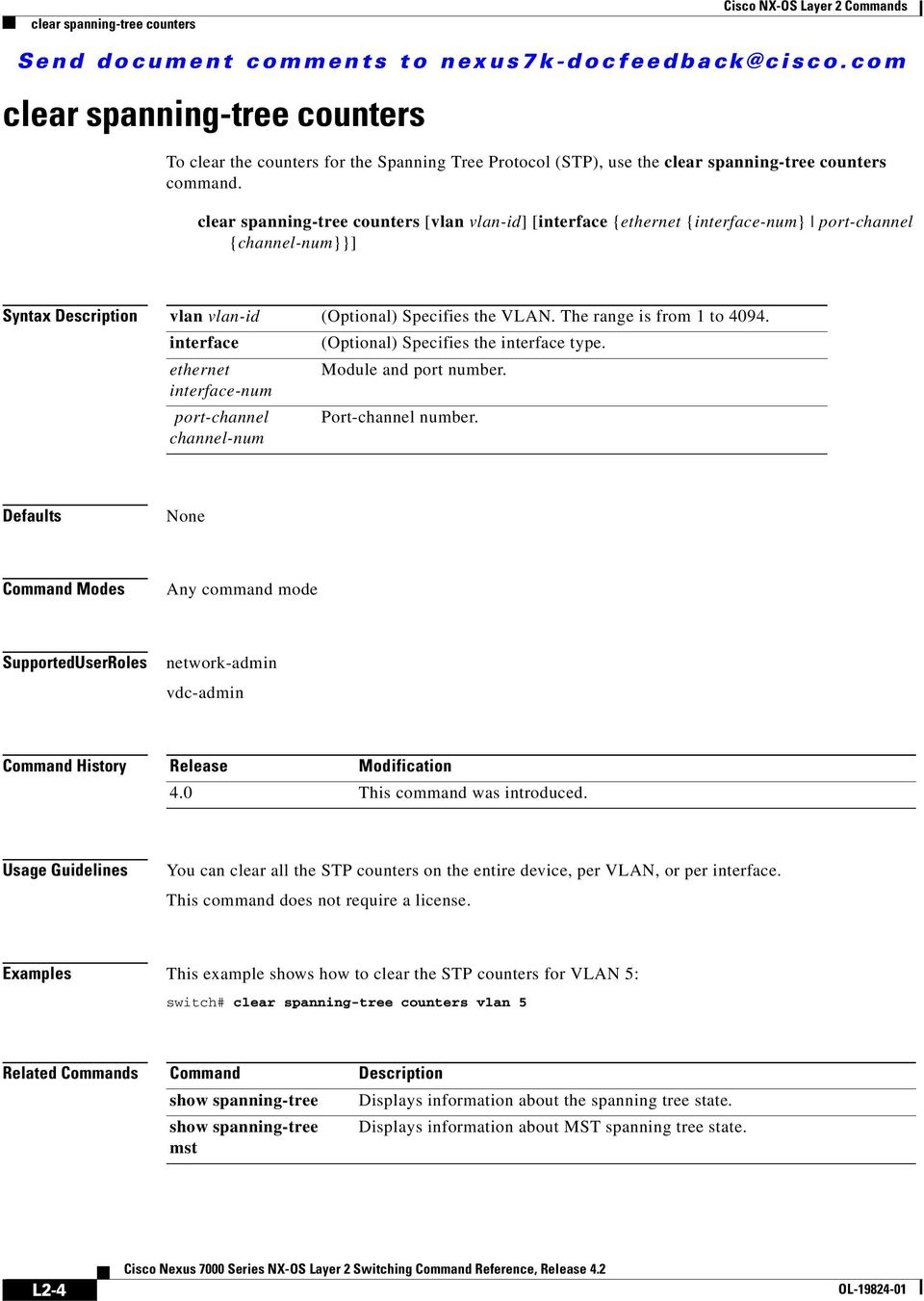
16 clear spanning-tree counters Cisco NX-OS Layer 2 Commands clear spanning-tree counters To clear the counters for the Spanning Tree Protocol (STP), use the clear spanning-tree counters command. clear spanning-tree counters [vlan vlan-id] [interface {ethernet {interface-num} port-channel {channel-num}}] Syntax Description vlan vlan-id (Optional) Specifies the VLAN. The range is from 1 to interface ethernet interface-num port-channel channel-num (Optional) Specifies the interface type. Module and port number. Port-channel number. Defaults None Command Modes Any command mode Supported User Roles network-admin vdc-admin Command History Release Modification 4.0 This command was introduced. Usage Guidelines You can clear all the STP counters on the entire device, per VLAN, or per interface. This command does not require a license. Examples This example shows how to clear the STP counters for VLAN 5: switch# clear spanning-tree counters vlan 5 Related Commands Command mst Description Displays information about the spanning tree state. Displays information about MST spanning tree state. L2-4
17 Cisco NX-OS Layer 2 Commands clear spanning-tree detected-protocol clear spanning-tree detected-protocol To restart the protocol migration, use the clear spanning-tree detected-protocol command. clear spanning-tree detected-protocol [interface {ethernet {interface-num} port-channel {channel-num}}] Syntax Description interface ethernet interface-num port-channel channel-num (Optional) Specifies the interface type. Module and port number. Port-channel number. Defaults None Command Modes Any command mode Supported User Roles network-admin vdc-admin Command History Release Modification 4.0 This command was introduced. Usage Guidelines Rapid per VLAN Spanning Tree Plus (Rapid PVST+) and Multiple Spanning Tree (MST) have built-in compatibility mechanisms that allow them to interact properly with other versions of IEEE spanning tree or other regions. For example, a bridge running Rapid PVST+ can send 802.1D bridge protocol data units (BPDUs) on one of its ports when it is connected to a legacy bridge. An MST bridge can detect that a port is at the boundary of a region when it receives a legacy BPDU or an MST BPDU that is associated with a different region. These mechanisms are not always able to revert to the most efficient mode. For example, a Rapid PVST+ bridge that is designated for a legacy 802.1D bridge stays in 802.1D mode even after the legacy bridge has been removed from the link. Similarly, an MST port assumes that it is a boundary port when the bridges to which it is connected have joined the same region. To force the MST port to renegotiate with the neighbors, enter the clear spanning-tree detected-protocol command. If you enter the clear spanning-tree detected-protocol command with no arguments, the command is applied to every port of the device. This command does not require a license. L2-5

18 clear spanning-tree detected-protocol Cisco NX-OS Layer 2 Commands Examples This example shows how to restart the protocol migration on a specific interface: switch# clear spanning-tree detected-protocol interface gigabitethernet5/8 Related Commands Command Description mst Displays information about the spanning tree state. Displays information about MST spanning tree state. L2-6

19 Cisco NX-OS Layer 2 Commands clear vlan counters clear vlan counters To clear the counters for a specified VLAN or all VLANs, use the clear vlan counters command. clear vlan [id {vlan-id}] counters Syntax Description id vlan-id (Optional) VLAN ID you want to clear. Valid values are from 1 to VLAN that you want to clear. Defaults None Command Modes Any command mode Supported User Roles network-admin vdc-admin Command History Release Modification 4.0 This command was introduced. Usage Guidelines If you do not specify a VLAN ID, the system clears the counters for all the VLANs, including private VLANs. This command does not require a license. Examples This example shows how to clear the counters for VLAN 50: switch# clear vlan 50 counters Related Commands Command show vlan counters show interface counters Description Displays information on statistics for all VLANs or the specified VLAN. Displays information about the statistics for the specified VLANs. L2-7

20 feature private-vlan Cisco NX-OS Layer 2 Commands feature private-vlan To enable private VLANs, use the feature private-vlan command. To return to the default settings, use the no form of this command. feature private-vlan no feature private-vlan Syntax Description This command has no arguments or keywords.17 Defaults Disabled Command Modes Global configuration Supported User Roles network-admin vdc-admin Command History Release Modification 4.0 This command was introduced. Usage Guidelines You must use this command to enable private VLAN functionality. You must enable private VLANs before the private VLANs are visible to the user. When private VLANs are disabled, all of the configuration on the feature is removed from the interfaces. You cannot apply the no feature private-vlan command if the device has any operational ports in private VLAN mode. You must shut down all operational ports in private VLAN mode before you use the no feature private-vlan command. After you shut down the interfaces and enter the no feature private-vlan command, these port return to the default mode. This command does not require a license. Examples This example shows how to enable private VLAN functionality on the device: switch(config)# feature private-vlan switch(config)# Related Commands L2-8
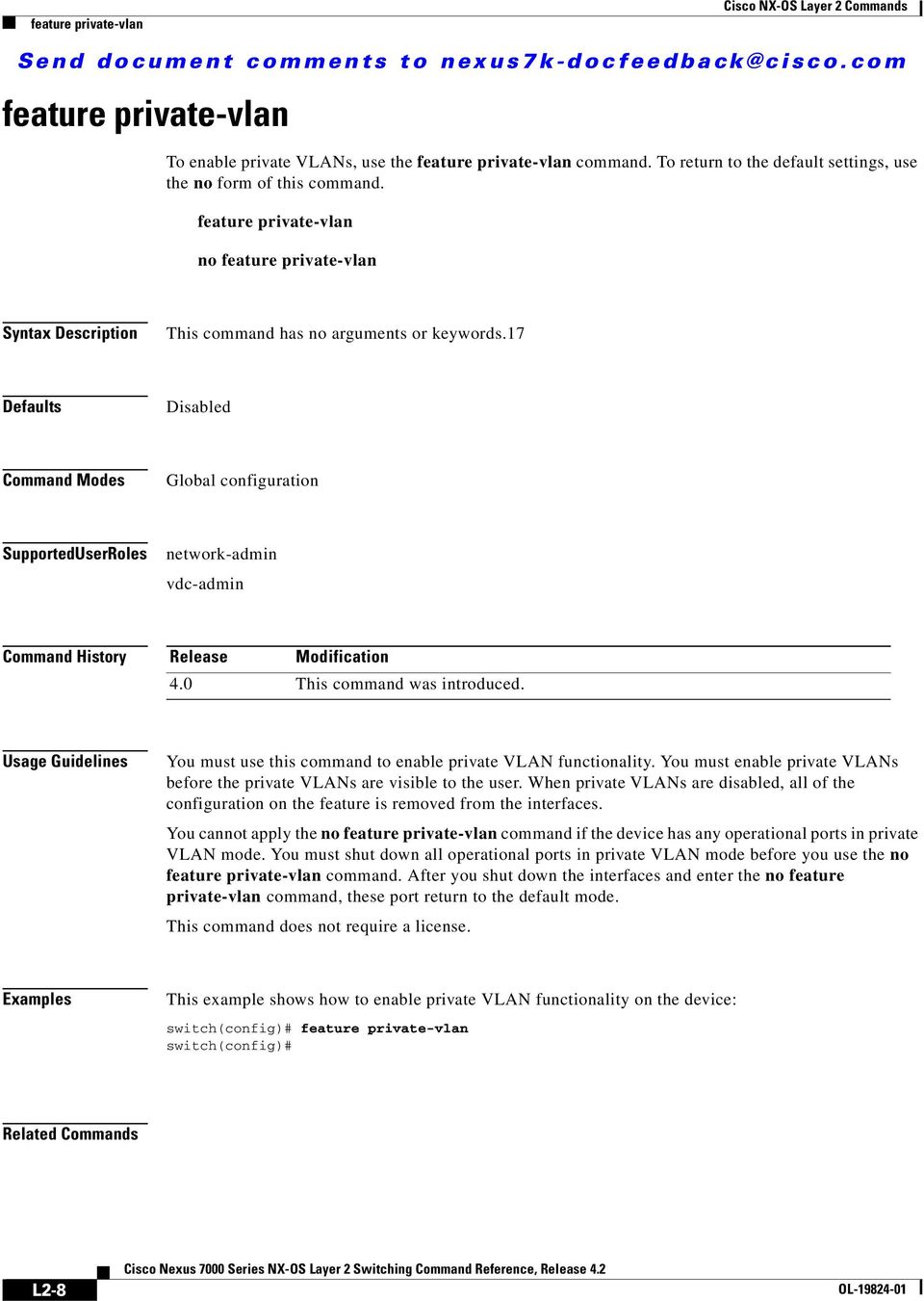
21 Cisco NX-OS Layer 2 Commands feature private-vlan Command show feature show vlan private-vlan Description Displays whether the feature is enabled or disabled. Displays information on private VLANs. If the feature is not enabled, this command returns an error. L2-9
22 feature vtp Cisco NX-OS Layer 2 Commands feature vtp To enable VTPs, use the feature vtp command. To return to the default setting, use the no form of this command. feature vtp no feature vtp Syntax Description This command has no arguments or keywords. Defaults Disabled Command Modes Global configuration Supported User Roles network-admin vdc-admin Command History Release Modification 4.1(2) This command was introduced. Usage Guidelines You must use this command to enable private VTP functionality. You must enable private VTP before you can configure or use any of the functionality. Note When you disable the VTP feature, all of the VTP configurations are lost. This command does not require a license. Examples This example shows how to enable VTP functionality on the device: switch(config)# feature vtp switch(config)# Related Commands Command show feature Description Displays whether the feature is enabled or disabled. L2-10
23 Cisco NX-OS Layer 2 Commands instance vlan instance vlan To map a VLAN or a set of VLANs to a Multiple Spanning Tree instance (MSTI), use the instance vlan command. To delete the instance and return the VLANs to the default instance (CIST), use the no form of this command. instance instance-id vlan vlan-id no instance instance-id vlan vlan-id Syntax Description5 instance-id vlan-id Instances to which the specified VLANs are mapped; the range of valid values is from 0 to Number of the VLANs that you are mapping to the specified MSTI; the range of valid values is from 1 to Defaults No VLANs are mapped to any MST instance (all VLANs are mapped to the CIST instance). Command Modes mst configuration submode Supported User Roles network-admin vdc-admin Command History Release Modification 4.0 This command was introduced. Usage Guidelines The vlans vlan-range is entered as a single value or a range. You cannot map VLANs 3968 to 4047 or 4094 to an MST instance. These VLANs are reserved for internal use by the device. The mapping is incremental, not absolute. When you enter a range of VLANs, this range is added to or removed from the existing instances. Any unmapped VLAN is mapped to the CIST instance. Caution When you change the VLAN-to-MSTI mapping, the system restarts MST. This command does not require a license. Examples This example shows how to map a range of VLANs to MSTI 4: switch(config)# spanning-tree mst configuration L2-11
24 instance vlan Cisco NX-OS Layer 2 Commands switch(config-mst)# instance 4 vlan switch(config-mst)# Related Commands Command Description Displays information about the MST protocol. mst configuration spanning-tree mst configuration Enters MST configuration submode. L2-12
25 Cisco NX-OS Layer 2 Commands mac-address mac-address To configure a static MAC address for a Layer 3 interface, use the mac address command. To return to the default settings, use the no form of this command. mac-address mac-address no mac-address mac-address Syntax Description mac-address MAC address for the Layer 3 interface. Use the format XXXX.XXXX.XXXX. Defaults VDC MAC address Command Modes Interface configuration Supported User Roles network-admin vdc-admin Command History Release Modification 4.2(1) This command was introduced. Usage Guidelines You can specify a MAC address for all Layer 3 interfaces: Layer 3 interfaces Layer 3 port channels Layer 3 subinterfaces VLAN network interface You cannot configure static MAC addresses on tunnel interfaces. You cannot use this command on Layer 2 interfaces or individual members of a port channel. See the Cisco Nexus 7000 Series NX-OS Interfaces Command Reference, Release 4.2 for information on configuring Layer 3 interfaces. You cannot configure a static group MAC address to these interfaces. This command does not require a license. Examples This example shows how to configure a static MAC address on a Layer 3 interface: switch(config)# interface ethernet 7/3 switch(config-1f)# mac-address 02c4.1e42.a3b2 L2-13
26 mac-address Cisco NX-OS Layer 2 Commands Related Commands Command Description show interface Displays information about the interface. interface show running-config Displays information about current configuration. L2-14
27 Cisco NX-OS Layer 2 Commands mac address-table aging-time mac address-table aging-time To configure the aging time for entries in the Layer 2 table, use the mac address-table aging-time command. To return to the default settings, use the no form of this command. mac address-table aging-time seconds [vlan vlan_id] no mac address-table aging-time [vlan vlan_id] Syntax Description seconds Aging time for MAC table entries for Layer 2. The range is from 120 to seconds. The default is 1800 seconds. Entering 0 disables the aging time. vlan vlan_id (Optional) Specifies the VLAN to apply the changed aging time. Defaults 1800 seconds Command Modes Global configuration Supported User Roles network-admin vdc-admin Command History Release Modification 4.0 This command was introduced. Usage Guidelines Enter 0 seconds to disable the aging process. The age value may be rounded off to the nearest multiple of 5 seconds. If the system rounds the value to a different value from that specified by the user (from the rounding process), the system returns an informational message. When you use this command in the global configuration mode, the age values of all VLANs for which a configuration has not been specified are modified and those VLANs with specifically modified aging times are not modified. When you use the no form of this command without the VLAN parameter, only those VLANs that have not been specifically configured for the aging time reset to the default value. Those VLANs with specifically modified aging times are not modified. When you use this command and specify a VLAN, the aging time for only the specified VLAN is modified. When you use the no form of this command and specify a VLAN, the aging time for the VLAN is returned to the current global configuration for the aging time, which may or may not be the default value of 300 seconds depending if the global configuration of the device for aging time has been changed. Aging time is counted from the last time that the switch detected the MAC address. This command does not require a license. L2-15
28 mac address-table aging-time Cisco NX-OS Layer 2 Commands Examples This example shows how to change the length of time an entry remains in the MAC address table to 500 seconds for the entire device: switch(config)# mac address-table aging-time 500 switch(config)# Related Commands Command Description show mac Displays information about the MAC address table. address-table clear mac address-table aging-time Displays information about the MAC address aging time. L2-16
29 Cisco NX-OS Layer 2 Commands mac address-table static mac address-table static To configure a static entry for the Layer 2 MAC address table, use the mac address-table static command. To delete the static entry, use the no form of this command. mac address-table static mac-address vlan vlan-id {[drop interface {type slot/port port-channel number]} no mac address-table static {address mac_addr} {vlan vlan_id} Syntax Description mac-address vlan vlan-id drop type slot/port port-channel number Specifies the MAC address to add to the table. Use the format XXXX.XXXX.XXXX. Specifies the VLAN to apply static MAC address; valid values are from 1 to Drops all traffic that is received from and going to the configured MAC address in the specified VLAN. (Optional) Specifies the interface. Use the type of interface, the slot number, and the port number. (Optional) Specifies the interface. Use the port-channel number. Defaults None Command Modes Global configuration Supported User Roles network-admin vdc-admin Command History Release Modification 4.0 This command was introduced. Usage Guidelines You cannot apply the mac address-table static mac-address vlan vlan-id drop command to a multicast MAC address. The output interface specified cannot be a VLAN interface or a Switched Virtual Interface (SVI). Use the no form to remove entries that are profiled by the combination of specified entry information. This command does not require a license. L2-17
30 mac address-table static Cisco NX-OS Layer 2 Commands Examples This example shows how to add a static entry to the MAC address table: switch(config)# mac address-table static e8d.6400 vlan 3 interface ethernet 2/1 switch(config)# Related Commands Command Description show mac Displays information about MAC address table. address-table L2-18
31 Cisco NX-OS Layer 2 Commands media ethernet media ethernet Note You can have only Ethernet VLANs on the DC-OS. Although the media ethernet command appears on the device, it does not apply to any configuration. To set the media type for a VLAN to Ethernet, use the media ethernet command. Use the no form of this command to return to the default value. media ethernet no media Syntax Description This command has no arguments or keywords. Defaults Ethernet is the only media type supported. Command Modes VLAN configuration submode Supported User Roles network-admin vdc-admin Usage Guidelines The media ethernet command is not supported in 4.0. This command does not require a license. Examples This example shows how to set the media type to Ethernet for VLAN 2: switch(config)# vlan 2 switch(config-vlan)# media ethernet switch(config-mst)# Related Commands Command Description show vlan Displays VLAN information. L2-19
32 name (VLAN configuration) Cisco NX-OS Layer 2 Commands name (VLAN configuration) To set the name for a VLAN, use the name command. To remove the user-configured name from a VLAN, use the no form of this command. name vlan-name no name Syntax Description vlan-name Name of the VLAN; you can use up to 32 alphanumeric, case-sensitive characters. Note The name must be unique within each VDC. Defaults The vlan-name argument is VLANxxxx where xxxx represent four numeric digits (including leading zeroes) equal to the VLAN ID number. Command Modes VLAN configuration submode Supported User Roles network-admin vdc-admin Command History Release Modification 4.0 This command was introduced. Usage Guidelines The name must be unique within the VDC, and the same name can be reused in a separate VDC. You cannot change the name for the default VLAN, VLAN 1, or for the internally allocated VLANs. This command does not require a license. Examples This example shows how to name VLAN 2: switch(config)# vlan 2 switch(config-vlan)# name accounting switch(config-mst)# Related Commands Command show vlan Description Displays VLAN information. L2-20
33 Cisco NX-OS Layer 2 Commands name (mst configuration) name (mst configuration) To set the name of a Multiple Spanning Tree (MST) region, use the name command. To return to the default name, use the no form of this command. name name no name name Syntax Description name Name to assign to the MST region. It can be any string with a maximum length of 32 alphanumeric characters. Defaults None Command Modes mst configuration submode Supported User Roles network-admin vdc-admin Command History Release Modification 4.0 This command was introduced. Usage Guidelines Two or more devices with the same VLAN mapping and configuration version number are considered to be in different MST regions if the region names are different. Caution Be careful when using the name command to set the name of an MST region. If you make a mistake, you can put the device in a different region. The configuration name is a case-sensitive parameter. This command does not require a license. Examples This example shows how to name a region: switch(config)# spanning-tree mst configuration switch(config-mst)# name accounting switch(config-mst)# L2-21
34 name (mst configuration) Cisco NX-OS Layer 2 Commands Related Commands Command Description Displays information about the MST protocol. mst configuration spanning-tree mst configuration Enters MST configuration submode. L2-22
35 Cisco NX-OS Layer 2 Commands private-vlan private-vlan To configure private VLANs, use the private-vlan command. To return the specified VLAN(s) to normal VLAN mode, use the no form of this command. private-vlan {isolated community primary} no private-vlan {isolated community primary} Syntax Description isolated community primary Designates the VLAN as an isolated secondary VLAN. Designates the VLAN as a community secondary VLAN. Designates the VLAN as the primary VLAN. Defaults None Command Modes VLAN configuration submode Supported User Roles network-admin vdc-admin Command History Release Modification 4.0 This command was introduced. Usage Guidelines You must enable private VLANs by using the feature private-vlan command before you can configure private VLANs. The commands for configuring private VLANs are not visible until you enable private VLANs. Note Before you configure a VLAN as a secondary VLAN, either community or isolated, you must shut down the VLAN interface, or Switched Virtual Interface (SVI), for that VLAN. If you delete either the primary or secondary VLAN, the ports that are associated with the VLAN become inactive. When you enter the no private-vlan command, the VLAN returns to the normal VLAN mode. All primary and secondary associations on that VLAN are suspended, but the interfaces remain in private VLAN mode. However, when you reconvert the specified VLAN to private VLAN mode, the original associations are reinstated. If you enter the no vlan command for the primary VLAN, all private VLAN associations with that VLAN are lost. However, if you enter the no vlan command for a secondary VLAN, the private VLAN associations with that VLAN are suspended and return when you recreate the specified VLAN and configure it as the previous secondary VLAN. You cannot configure VLAN1 or the internally allocated VLANs as private VLANs. L2-23
36 private-vlan Cisco NX-OS Layer 2 Commands A private VLAN is a set of private ports that are characterized by using a common set of VLAN number pairs. Each pair is made up of at least two special unidirectional VLANs and is used by isolated ports and/or by a community of ports to communicate with routers. An isolated VLAN is a VLAN that is used by isolated ports to communicate with promiscuous ports. An isolated VLAN s traffic is blocked on all other private ports in the same VLAN. Its traffic can only be received by standard trunking ports and promiscuous ports that are assigned to the corresponding primary VLAN. A promiscuous port is defined as a private port that is assigned to a primary VLAN. A community VLAN is defined as the VLAN that carries the traffic among community ports and from community ports to the promiscuous ports on the corresponding primary VLAN. A primary VLAN is defined as the VLAN that is used to convey the traffic from the routers to customer end stations on private ports. Multiple community and isolated VLANs are allowed. If you enter a range of primary VLANs, the system uses the first number in the range for the association. Examples This example shows how to remove a private VLAN relationship from the primary VLAN. The associated secondary VLANs are not deleted. switch(config-vlan)# no private-vlan association switch(config-vlan)# Related Commands Command Description show vlan show vlan private-vlan [type] Displays information about VLANs. Displays information about private VLANs. L2-24
37 Cisco NX-OS Layer 2 Commands private-vlan association private-vlan association To configure the association between a primary VLAN and a secondary VLAN on a private VLAN, use the private-vlan association command. To remove the association, use the no form of this command. private-vlan association {[add] secondary-vlan-list remove secondary-vlan-list} no private-vlan association Syntax Description add secondary-vlan-list remove Associates a secondary VLAN to a primary VLAN. Number of the secondary VLAN. Clears the association between a secondary VLAN and a primary VLAN. Defaults None Command Modes VLAN configuration submode Supported User Roles network-admin vdc-admin Command History Release Modification 4.0 This command was introduced. Usage Guidelines You must enable private VLANs by using the feature private-vlan command before you can configure private VLANs. The commands for configuring private VLANs are not visible until you enable private VLANs. Note Before you configure a VLAN as a secondary VLAN, either community or isolated, you must shut down the VLAN interface, or switched virtual interface (SVI), for that VLAN. If you delete either the primary or secondary VLAN, the ports that are associated with the VLAN become inactive. When you enter the no private-vlan command, the VLAN returns to the normal VLAN mode. All primary and secondary associations on that VLAN are suspended, but the interfaces remain in private VLAN mode. However, when you reconvert the specified VLAN to private VLAN mode, the original associations are reinstated. If you enter the no vlan command for the primary VLAN, all private VLAN associations with that VLAN are lost. However, if you enter the no vlan command for a secondary VLAN, the private VLAN associations with that VLAN are suspended and return when you recreate the specified VLAN and configure it as the previous secondary VLAN. L2-25
38 private-vlan association Cisco NX-OS Layer 2 Commands The secondary-vlan-list argument cannot contain spaces. It can contain multiple comma-separated items. Each item can be a single secondary VLAN ID or a hyphenated range of secondary VLAN IDs. The secondary-vlan-list parameter can contain multiple secondary VLAN IDs. A private VLAN is a set of private ports that are characterized by using a common set of VLAN number pairs. Each pair is made up of at least two special unidirectional VLANs and is used by isolated ports and/or by a community of ports to communicate with routers. Multiple community and isolated VLANs are allowed. If you enter a range of primary VLANs, the system uses the first number in the range for the association. Isolated and community VLANs can only be associated with one primary VLAN. You cannot configure a VLAN that is already associated to a primary VLAN as a primary VLAN. See the Cisco DC-OS Layer 2 Switching Configuration Guide for additional configuration guidelines. This command does not require a license. Examples This example shows how to create a private VLAN relationship between the primary VLAN 14, the isolated VLAN 19, and the community VLANs 20 and 21: switch(config)# vlan 19 switch(config-vlan)# private-vlan isolated switch(config)# vlan 20 switch(config-vlan)# private-vlan community switch(config)# vlan 21 switch(config-vlan)# private-vlan community switch(config)# vlan 14 switch(config-vlan)# private-vlan primary switch(config-vlan)# private-vlan association This example shows how to remove isolated VLAN 18 and community VLAN 20 from the private VLAN association: switch(config)# vlan 14 switch(config-vlan)# private-vlan association remove 18,20 switch(config-vlan)# Related Commands Command Description show vlan show vlan private-vlan [type] Displays information about VLANs. Displays information about private VLANs. L2-26
39 Cisco NX-OS Layer 2 Commands private-vlan mapping private-vlan mapping To create a mapping between the primary and the secondary VLANs so that both VLANs share the same Layer 3 VLAN interface, or switched virtual interface (SVI), use the private-vlan mapping command under the SVI. To remove all private VLAN mappings from the Layer 3 VLAN interface, use the no form of this command. private-vlan mapping {[add] secondary-vlan-list remove secondary-vlan-list} no private-vlan mapping Syntax Description add secondary-vlan-list remove Maps the secondary VLAN to the primary VLAN. VLAN ID of the secondary VLANs to map to the primary VLAN. Removes the mapping between the secondary VLAN and the primary VLAN. Defaults None Command Modes Interface configuration Supported User Roles network-admin vdc-admin Command History Release Modification 4.0 This command was introduced. Usage Guidelines You must enable private VLANs by using the feature private-vlan command before you can configure private VLANs. The commands for configuring private VLANs are not visible until you enable private VLANs. The private-vlan mapping command is valid in the interface configuration mode of the primary VLAN. The secondary-vlan-list argument cannot contain spaces. It can contain multiple comma-separated items. Each item can be a single secondary VLAN ID or a hyphenated range of secondary VLAN IDs. Note You must enable VLAN interfaces, or SVIs, before you can configure the SVI. Use the feature interface-vlan command to enable VLAN interfaces. See the Cisco NX-OS Interfaces Configuration Guide for information on creating and configuring VLAN interfaces. Traffic that is received on the secondary VLAN is routed by the SVI of the primary VLAN. L2-27
40 private-vlan mapping Cisco NX-OS Layer 2 Commands When you configure VLANs as secondary private VLANs, the SVIs of those existing VLANs do not function and are considered as down after you enter this command. You can map a secondary VLAN to only one primary SVI. If you configure the primary VLAN as a secondary VLAN, all the mappings that are specified in this command are suspended. You must first associate all secondary VLANs with the primary VLAN using the private-vlan command. If you configure a mapping between two VLANs that do not have a valid Layer 2 association, the mapping configuration does not take effect. See the private-vlan command for more information about primary and secondary VLANs. This command does not require a license. Examples This example shows how to map the interface of VLAN 20 to the Layer 3 VLAN interface, or SVI, of VLAN 18: switch(config)# interface vlan 18 switch(config-if)# private-vlan mapping 20 switch(config-if)# This example shows how to permit routing of secondary VLAN-ingress traffic from private VLANs 303 through 307, 309, and 440: switch# configure terminal switch(config)# interface vlan 202 switch(config-if)# private-vlan mapping add ,309,440 switch(config-if)# end This example shows how to remove all private VLAN mappings from the SVI of VLAN 19: switch(config)# interface vlan 19 switch(config-if)# no private-vlan mapping switch(config-if)# Related Commands Command Description show interface private-vlan mapping Displays information on secondary private VLAN mapping to VLAN interface. L2-28
41 Cisco NX-OS Layer 2 Commands private-vlan synchronize private-vlan synchronize To map the secondary VLANs to the same MST instance as the primary VLAN, use the private-vlan synchronize command. private-vlan synchronize Syntax Description This command has no keywords or arguments. Defaults This command has no default settings. Command Modes mst configuration submode Supported User Roles network-admin vdc-admin Command History Release Modification 4.0 This command was introduced. Usage Guidelines If you do not map secondary VLANs to the same MST instance as the associated primary VLAN when you exit the MST configuration submode, the device displays a warning message that lists the secondary VLANs that are not mapped to the same instance as the associated VLAN. The private-vlan synchronize command automatically maps all secondary VLANs to the same instance as the associated primary VLANs. This command does not require a license. Examples This example assumes that a primary VLAN 2 and a secondary VLAN 3 are associated to VLAN 2, and that all VLANs are mapped to the CIST instance 1. This example also shows the output if you try to change the mapping for the primary VLAN 2 only: switch(config)# spanning-tree mst configuration switch(config-mst)# instance 1 vlan 2 switch(config-mst)# exit These secondary vlans are not mapped to the same instance as their primary: -> 3 This example shows how to initialize PVLAN synchronization: switch(config-mst)# private-vlan synchronize switch(config-mst)# L2-29
42 private-vlan synchronize Cisco NX-OS Layer 2 Commands Related Commands Command Description Displays information about the MST protocol. mst configuration spanning-tree mst configuration Enters MST configuration submode. L2-30
43 Cisco NX-OS Layer 2 Commands revision revision To set the revision number for the Multiple Spanning Tree (MST) region configuration, use the revision command. To return to the default settings, use the no form of this command. revision version no revision version Syntax Description version Revision number for the MST region configuration; the range of valid values is from 0 to Defaults 0 Command Modes mst configuration submode Supported User Roles network-admin vdc-admin Command History Release Modification 4.0 This command was introduced. Usage Guidelines Two or more devices with the same VLAN mapping and name are considered to be in different MST regions if the configuration revision numbers are different. Caution Be careful when using the revision command to set the revision number of the MST region configuration because a mistake can put the device in a different region. This command does not require a license. Examples This example shows how to set the revision number of the MST region configuration: switch(config)# spanning-tree mst configuration switch(config-mst)# revision 5 switch(config-mst)# Related Commands Command mst Description Displays information about the MST protocol. L2-31
44 show forwarding consistency l2 Cisco NX-OS Layer 2 Commands show forwarding consistency l2 To display information about discrepant, missing, or extra MAC addresses between the supervisor and the module, use the show forwarding consistency l2 command. show forwarding consistency l2 {module} Syntax Description module Specifies the module number that you are comparing with the supervisor MAC address table. Defaults None Command Modes Any command mode. Supported User Roles network-admin vdc-admin Command History Release Modification 4.1(2) This command was introduced. Usage Guidelines Optimally, all the MAC address tables on each module exactly match the MAC address table on the supervisor. This command does not require a license. Examples This example shows how to display hardware information about all the MAC addresses VLAN 1 on module 2: switch# show forwarding consistency l2 9 Legend: * - primary entry, G - Gateway MAC, (R) - Routed MAC age - seconds since last seen Missing entries in the MAC Table VLAN MAC Address Type age Secure NTFY Ports G bad7.e115 static - False False sup-eth1(r) * static - False False Eth9/25G bad7.e115 static - False False sup-eth1(r)g bad7.e115 static - False False sup-eth1(r) Extra and Discrepant entries in the MAC Table VLAN MAC Address Type age Secure NTFY Ports G bad7.dc15 static - False False sup-eth1(r) * static - False False Eth9/25 Related Commands L2-32
45 Cisco NX-OS Layer 2 Commands show forwarding consistency l2 Command show mac address-table Description Displays information about the MAC address table. L2-33
46 show hardware mac address-table Cisco NX-OS Layer 2 Commands show hardware mac address-table To display information about the hardware MAC addresses, use the show hardware mac address-table command. show hardware mac address table {module} [address {mac-address} {[interface {ethernet slot/port port-channel channel-number}] [vlan vlan-id]] [dynamic [address {mac-address}] [interface {ethernet slot/port port-channel channel-number}] [vlan vlan-id]] [interface {ethernet slot/port port-channel channel-number}] [address {mac-address}] [vlan vlan-id]] [static [address {mac-address}] [interface {ethernet slot/port port-channel channel-number}] [vlan vlan-id]] [vlan {vlan-id} [address mac-address] [interface {ethernet slot/port port-channel channel-number}] Syntax Description module address {mac-address} ethernet {slot/port port-channel number}] vlan {vlan-id} dynamic static Specifies the module number. (Optional) Specifies the MAC address in the format of X.X.X, XX-XX-XX-XX-XX-XX, XX:XX:XX:XX:XX:XX, XXXX.XXXX.XXXX. (Optional) Specifies the interface. Use either ethernet with the slot number and the port number, or the port-channel number. (Optional) Specifies the VLAN number. (Optional) Specifies dynamic entries only. (Optional) Specifies static entries only. Defaults None Command Modes Any command mode. Supported User Roles network-admin vdc-admin Command History Release Modification 4.0 This command was introduced. L2-34
47 Cisco NX-OS Layer 2 Commands show hardware mac address-table Usage Guidelines The fields are as follows: Valid Entry is valid in hardware. PI Primary entry. BD bridge domain. MAC MAC address. Index Destination index; identifies the port on which MAC was learned. Static Statically configured entry.hardware will not modify this entry. This entry will not be aged by the line card process. SW 3-bit software value associated with this entry. Modified MAC entry was modified by hardware since last notification. This is set when index value changes. Age byte Age timer value when last packet arrived with this entry s MAC as source MAC. Tmr sel Age timer used for updating the age for this entry. Based on aging value configured for the VLAN, one of the four timers will be used for updating the age. GM Specifies gateway MAC or not. Secure Secured MAC. TRAP When this bit is set, the system drops any packet received with this source MAC as this entry s MAC. NTFY Notify. When Secured and Notify bits are both set, the system redirects packets to the supervisor when hardware updates the index value. RM Router MAC. RMA Router MAC active. Note The RM and RMA fields are not supported on the Nexus Capture When this bit is set, any packet sent to this destination will be copied by setting CAP1 bit. Fld Flood bit. When this bit is set, any packet sent to this destination MAC will cause the flood bit to be set in the result. Always learn Always learn. When this bit is set, the hardware modifies the index value irrespective of whether this entry is marked static or not. This command does not require a license. Examples This example shows how to display hardware information about all the MAC addresses VLAN 1 on module 2: switch# show hardware mac address-table 2 vlan 1 Valid PI BD MAC Index Stat SW Modi Age Tmr GM Sec TR NT RM RMA Cap Fld Always ic fied Byte Sel ure AP FY TURE Learn cff.fffe 0x L2-35
48 show hardware mac address-table Cisco NX-OS Layer 2 Commands Related Commands Command Description show mac Displays information about the MAC address table. address-table L2-36
49 Cisco NX-OS Layer 2 Commands show interface mac-address show interface mac-address To display information about the MAC address and the burned-in MAC address, use the show interface mac-address command. show interface [type slot/port] mac-address Syntax Description type slot/port (Optional) Type of interface, slot number, and port number. Defaults None Command Modes Any command mode. Supported User Roles network-admin vdc-admin Command History Release Modification 4.0 This command was introduced. Usage Guidelines If you do not specify the interface, the system displays all the MAC addresses. This command displays both the burned-in MAC address and the configured MAC address. This command does not require a license. Examples This example shows how to display information about all the MAC addresses for the device: switch# show interface mac-address Interface Mac-Address Burn-in Mac-Address mgmt c.1a c.1a78 Ethernet2/ c.4dac Ethernet2/ c.4dad Ethernet2/ c.4dae Ethernet2/ c.4daf Ethernet2/ c.4db0 Ethernet2/ c.4db1 Ethernet2/ c.4db2 Ethernet2/ c.4db3 Ethernet2/ c.4db4 Ethernet2/ c.4db5 Ethernet2/ c.4db6 Ethernet2/ c.4db7 Ethernet2/ c.4db8 L2-37
50 show interface mac-address Cisco NX-OS Layer 2 Commands Ethernet2/ c.4db9 Ethernet2/ c.4dba Ethernet2/ c.4dbb Ethernet2/ c.4dbc Ethernet2/ c.4dbd Ethernet2/ c.4dbe Ethernet2/ c.4dbf Ethernet2/ c.4dc0 Ethernet2/ c.4dc1 Ethernet2/ c.4dc2 Ethernet2/ c.4dc3 Ethernet2/ c.4dc4 Ethernet2/ c.4dc5 Ethernet2/ c.4dc6 Ethernet2/ c.4dc7 Ethernet2/ c.4dc8 Ethernet2/ c.4dc9 Ethernet2/ c.4dca Ethernet2/ c.4dcb Ethernet2/ c.4dcc Ethernet2/ c.4dcd Ethernet2/ c.4dce Ethernet2/ c.4dcf Ethernet2/ c.4dd0 Ethernet2/ c.4dd1 Ethernet2/ c.4dd2 Ethernet2/ c.4dd3 Ethernet2/ c.4dd4 Ethernet2/ c.4dd5 Ethernet2/ c.4dd6 Ethernet2/ c.4dd7 Ethernet2/ c.4dd8 Ethernet2/ c.4dd9 Ethernet2/ c.4dda Ethernet2/ c.4ddb port-channel port-channel port-channel port-channel Related Commands Command Description show mac Displays information about the MAC address table. address-table mac address-table static Adds static entries to the MAC-address table or configures a static MAC address with IGMP snooping disabled for that address. L2-38
51 Cisco NX-OS Layer 2 Commands show interface private-vlan mapping show interface private-vlan mapping To display information about the private VLAN mapping for the primary VLAN interfaces, use the show interface private-vlan mapping command. show interface private-vlan mapping Syntax Description This command has no arguments or keywords. Defaults None Command Modes Any command mode Supported User Roles network-admin vdc-admin Command History Release Modification 4.0 This command was introduced. Usage Guidelines You can use this command to display the primary and secondary VLAN mapping that allows both VLANs to share the VLAN interface of the primary VLAN. This command does not require a license. Examples This example shows how to display information about the primary and secondary private VLAN mapping: switch# show interface private-vlan mapping switch(config)# show interface private-vlan mapping Interface Secondary VLAN Type vlan isolated vlan community Related Commands Command private-vlan mapping Description Creates a mapping between the primary and secondary VLANs so that both VLANs share the same primary VLAN interface. L2-39
52 show interface private-vlan mapping Cisco NX-OS Layer 2 Commands show interface switchport show vlan private-vlan show vlan Displays information about the switchports, including those in private VLANs. Displays information about all private VLANs on the device. Displays summary information about all VLANs. L2-40
53 Cisco NX-OS Layer 2 Commands show interface vlan show interface vlan To display information about specified VLANs, use the show interface vlan command. show interface vlan vlan-id [brief description private-vlan mapping status] Syntax Description vlan-id Number of the VLAN. The range of values is from 1 to brief description private-vlan mapping status (Optional) Displays a brief description about a specified VLAN. (Optional) Displays a detailed description about a specified VLAN. (Optional) Displays information about the private VLAN mapping, if any, for specified VLAN. (Optional) Displays information about the status for a specified VLAN. Defaults None Command Modes Any command mode Supported User Roles network-admin vdc-admin Command History Release Modification 4.0 This command was introduced. 4.2(1) Display of configured static MAC address for Layer 3 port channels added. Usage Guidelines You can use this command to display information about a specified VLAN, including the private VLANs. The information is gathered at 1-minute intervals. When you specify a primary VLAN, the device displays all secondary VLANs mapped to the specified primary VLAN. The device displays the output for the private-vlan mapping keyword only when you specify a primary private VLAN. If you specify a secondary private VLAN and enter the private-vlan mapping keyword, the output is blank. Note To display more statistics for the specified VLAN, use the show interface vlan counters and show vlan counters commands. To display more information about private VLANs, see the show interface private-vlan commands. L2-41
54 show interface vlan Cisco NX-OS Layer 2 Commands You can configure a VLAN network interface with a static MAC address, and this command will display that configured MAC address. See the mac-address command for information on configuring a VLAN network interface with a static MAC address. This command does not require a license. Examples This example shows how to display information about the specified VLAN. This command displays statistical information gathered on the VLAN at 1-minute intervals: switch# show interface vlan 5 Vlan5 is administratively down, line protocol is down Hardware is EtherSVI, address is MTU 1500 bytes, BW Kbit, DLY 10 usec, reliability 255/255, txload 1/255, rxload 1/255 Encapsulation ARPA, loopback not set Keepalive not supported ARP type: ARPA Last clearing of "show interface" counters 01:21:55 1 minute input rate 0 bytes/sec, 0 packets/sec 1 minute output rate 0 bytes/sec, 0 packets/sec L3 Switched: input: 0 pkts, 0 bytes - output: 0 pkts, 0 bytes L3 in Switched: ucast: 0 pkts, 0 bytes - mcast: 0 pkts, 0 bytes L3 out Switched: ucast: 0 pkts, 0 bytes - mcast: 0 pkts, 0 bytes This example shows how to display a brief description for a specified VLAN. This displays shows the secondary VLAN and type, if configured, and the status: switch# show interface vlan 5 brief Interface Secondary VLAN(Type) Status Reason Vlan5 -- down none This example shows how to display the description for a specified VLAN: switch# show interface vlan 100 description Interface Description Vlan100 This example shows how to display information about the private VLAN mapping, if any, for a specified VLAN: switch# show interface vlan 200 private-vlan mapping Interface Secondary VLAN vlan This example shows how to display the status for a specified VLAN: switch# show interface vlan 5 status Interface Status Protocol L2-42
55 Cisco NX-OS Layer 2 Commands show interface vlan Vlan5 admin down shut Related Commands Command Description show interface switchport show interface vlan counters show vlan show vlan private-vlan Displays information about the switchports, including those configured for private VLANs, Displays the statistics for VLANs. Displays summary information for all VLANs. Displays summary information for all private VLANs. L2-43
56 show interface vlan counters Cisco NX-OS Layer 2 Commands show interface vlan counters To display the statistics for a specified VLAN, use the show interface vlan counters command. show interface vlan {vlan-id} counters [detailed [all] snmp] Syntax Description vlan-id detailed all snmp VLAN or range of VLANs for which you want to display statistics. The range is from 1 to (Optional) Displays nonzero counters for the specified interface. (Optional) Displays all the detailed information for the particular VLAN, including statistics per byte. (Optional) Displays the MIB values. Defaults None Command Modes Any command mode Supported User Roles network-admin vdc-admin Command History Release Modification 4.0 This command was introduced. Usage Guidelines You can use this command to display information about the received octets, unicast packets, multicast packets, and broadcast packets as well as the transmitted octets, unicast packets, multicast packets, and broadcast packets for all VLANs, including private VLANs. This command does not require a license. Examples This example shows how to display the statistics for a specified VLAN: switch# show interface vlan 9 counters Port InOctets InUcastPkts InMcastPkts InBcastPkts Vlan Port OutOctets OutUcastPkts OutMcastPkts OutBcastPkts Vlan L2-44
57 Cisco NX-OS Layer 2 Commands show interface vlan counters This example shows how to display only the nonzero counters for a specified VLAN: switch# show interface vlan 2 counters detailed Vlan2 counters: l3_average_input_bits l3_average_input_packets l3_routed_bytes_in l3_routed_pkts_in l3_ucast_bytes_in l3_ucast_pkts_in This example shows how to display all detailed statistics for a specified VLAN: switch(config)# show interface vlan 9 counters detailed all Vlan9 counters: 0. l3_ipv4_ucast_bytes_in = 0 1. l3_ipv4_ucast_pkts_in = 0 2. l3_ipv4_mcast_bytes_in = 0 3. l3_ipv4_mcast_pkts_in = 0 4. l3_ipv6_ucast_bytes_in = 0 5. l3_ipv6_ucast_pkts_in = 0 6. l3_ipv6_mcast_bytes_in = 0 7. l3_ipv6_mcast_pkts_in = 0 8. l3_ipv4_ucast_bytes_out = 0 9. l3_ipv4_ucast_pkts_out = l3_ipv4_mcast_bytes_out = l3_ipv4_mcast_pkts_out = l3_ipv6_ucast_bytes_out = l3_ipv6_ucast_pkts_out = l3_ipv6_mcast_bytes_out = l3_ipv6_mcast_pkts_out = l3_average_input_bytes = l3_average_input_packets = l3_average_output_bytes = l3_average_output_packets = l3_routed_bytes_in = l3_routed_pkts_in = l3_ucast_bytes_in = l3_ucast_pkts_in = l3_mcast_bytes_in = l3_mcast_pkts_in = l3_routed_bytes_out = l3_routed_pkts_out = l3_ucast_bytes_out = l3_ucast_pkts_out = l3_mcast_bytes_out = l3_mcast_pkts_out = 0 This example shows how to display the MIB values for a specified VLAN: switch(config)# show interface vlan 9 counters snmp Port InOctets InUcastPkts InMcastPkts InBcastPkts Vlan Port OutOctets OutUcastPkts OutMcastPkts OutBcastPkts Vlan Ethernet2/ c.4dc7 L2-45
58 show interface vlan counters Cisco NX-OS Layer 2 Commands Ethernet2/29 Ethernet2/ c.4dc c.4dc9 Related Commands Command Description clear counters Clears counters on the interfaces. L2-46
59 Cisco NX-OS Layer 2 Commands show mac address-table show mac address-table To display the information about the MAC address table, use the show mac address-table command. show mac address-table [num] [dynamic static] [address mac-address count interface {type slot/port port-channel number} vlan vlan-id] Syntax Description num dynamic static address mac-address count interface {type slot/port port-channel number}] static vlan vlan-id (Optional) MAC address table for a specified module. Note When you use this argument, the system displays all the entries on that module as specified by any of the following optional arguments. When you do not use this argument, the system displays only the primary entries on all modules. (Optional) Displays information about the dynamic MAC address table entries only. (Optional) Displays information about the static MAC address table entries only. (Optional) Displays information about the MAC address table for a specific MAC address. (Optional) Displays number of MAC address entries for dynamic and static. (Optional) Specifies the interface. Use either the type of interface, the slot number, and the port number, or the port-channel number. (Optional) Displays information about the static MAC address table entries only. (Optional) Displays information for a specific VLAN only; the range of valid values is from 1 to Defaults None Command Modes Any command mode Supported User Roles network-admin vdc-admin Command History Release Modification 4.0 This command was introduced. Usage Guidelines A primary entry is a MAC address learned on that interface. L2-47
60 show mac address-table Cisco NX-OS Layer 2 Commands Note Use the show mac address-table command without the num argument to display only the primary entries on all modules. When you use the num argument, the device displays all the entries on that module as specified by additional optional arguments. The device maintains static MAC address entries saved in the startup-config file across reboots and flushes the dynamic entries. The MAC address table for each virtual device context (VDC) is separate and distinct. Note To display the MAC address for the VDC, use the show vdc command. This command does not require a license. Examples Note In the following examples, NTFY means notify. This example shows how to display the information about the entries for the Layer 2 MAC address table: switch# show mac address-table Legend: * - primary entry, G - Gateway MAC, (R) - Routed MAC age - seconds since last seen VLAN MAC Address Type age Secure NTFY Ports G bad8.3fbd static - False False sup-eth1(r) * dd56.ee89 static - False False Eth2/1 This example shows how to display the information about the entries for the Layer 2 MAC address table for a specific module: switch# show mac address-table 2 Legend: * - primary entry, G - Gateway MAC, (R) - Routed MAC age - seconds since last seen VLAN MAC Address Type age Secure NTFY Ports G bad8.3fbd static - False False sup-eth1(r) * dd56.ee89 static - False False Eth2/ bd.4fda dynamic 70 False False Eth1/1 This example shows how to display the information about the entries for the Layer 2 MAC address table for a specific MAC address: switch# show mac address-table address 0018.bad8.3fbd Legend: * - primary entry, G - Gateway MAC, (R) - Routed MAC age - seconds since last seen VLAN MAC Address Type age Secure NTFY Ports G bad8.3fbd static - False False sup-eth1(r) L2-48
61 Cisco NX-OS Layer 2 Commands show mac address-table This example shows how to display the information about the dynamic entries for the Layer 2 MAC address table: switch# show mac address-table dynamic Legend: * - primary entry, G - Gateway MAC, (R) - Routed MAC age - seconds since last seen VLAN MAC Address Type age Secure NTFY Ports * fcbc.3fbd dynamic 1265 False False Eth2/12 * dd56.ee89 dynamic 850 False False Eth2/1 This example shows how to display the information about the Layer 2 MAC address table for a specific interface: switch# show mac address-table interface ethernet 2/13 Legend: * - primary entry, G - Gateway MAC, (R) - Routed MAC age - seconds since last seen VLAN MAC Address Type age Secure NTFY Ports * dd56.ee89 dynamic 0 False False Eth2/13 This example shows how to display the static entries in the Layer 2 MAC address table: switch# show mac address-table static Legend: * - primary entry, G - Gateway MAC, (R) - Routed MAC age - seconds since last seen VLAN MAC Address Type age Secure NTFY Ports G bad8.3fbd static - False False sup-eth1(r) * dd56.ee89 static - False False Eth2/1 This example shows how to display the entries in the Layer 2 MAC address table for a specific VLAN: switch# show mac address-table vlan 3 Legend: * - primary entry, G - Gateway MAC, (R) - Routed MAC age - seconds since last seen VLAN MAC Address Type age Secure NTFY Ports * dd56.ee89 static - False False Eth2/1 Related Commands Command Description mac address-table static Adds static entries to the MAC address table or configures a static MAC address with IGMP snooping disabled for that address. L2-49
62 show mac address-table aging-time Cisco NX-OS Layer 2 Commands show mac address-table aging-time To display information about the timeout values for the MAC address table, use the show mac-address-table aging-time command. show mac address-table aging-time [vlan vlan-id] Syntax Description vlan vlan-id (Optional) Displays information for a specific VLAN only; the range of valid values is from 1 to Defaults None Command Modes Any command mode Supported User Roles network-admin vdc-admin Command History Release Modification 4.0 This command was introduced. Usage Guidelines You can configure the MAC address aging time per VLAN or for the entire device. The valid range is from 120 to , Entering 0 disables MAC aging time. This command does not require a license. Examples This example shows how to display MAC address aging times: switch# show mac address-table aging-time Vlan Aging Time Related Commands Command mac address-table aging-time Description Configures the aging time for entries in the Layer 2 table. L2-50
63 Cisco NX-OS Layer 2 Commands show running-config spanning-tree show running-config spanning-tree To display the running configuration for the Spanning Tree Protocol (STP), use the show running-config spanning-tree command. show running-config spanning-tree [all] Syntax Description all (Optional) Displays current STP operating information including the default settings. Defaults None Command Modes Any command mode Supported User Roles network-admin vdc-admin Command History Release Modification 4.0 This command was introduced. Usage Guidelines This command provides information about the Spanning Tree Protocol. Note The display output differs slightly depending on whether you are running Rapid Per VLAN Spanning Tree (Rapid PVST+) or Multiple Spanning Tree (MST). This command does not require a license. Examples This example shows how to display information about the running STP configuration when you are running MST: switch# show running-config spanning-tree spanning-tree mode mst This example shows how to display detailed information about the running STP configuration when you are running MST: switch# show running-config spanning-tree all spanning-tree mode mst no spanning-tree port type edge default no spanning-tree port type network default spanning-tree bridge assurance no spanning-tree loopguard default L2-51
64 show running-config spanning-tree Cisco NX-OS Layer 2 Commands spanning-tree mst simulate pvst global no snmp-server enable traps bridge topologychange no snmp-server enable traps bridge newroot no snmp-server enable traps stpx inconsistency no snmp-server enable traps stpx loop-inconsistency no snmp-server enable traps stpx root-inconsistency spanning-tree mst hello-time 2 spanning-tree mst forward-time 15 spanning-tree mst max-age 20 spanning-tree mst max-hops 20 spanning-tree mst 0 priority spanning-tree mst configuration name revision 0 instance 0 vlan configure interface Ethernet8/1 spanning-tree port-priority 128 Related Commands Command Description Displays information about STP. L2-52
65 Cisco NX-OS Layer 2 Commands show running-config vlan show running-config vlan To display the running configuration for a specified VLAN, use the show running-config vlan command. show running-config vlan {vlan-id} Syntax Description vlan-id Number of VLAN or range of VLANs. Valid numbers range from 1 to Defaults None Command Modes Any command mode Supported User Roles network-admin vdc-admin Command History Release Modification 4.0 This command was introduced. Usage Guidelines This command provides information about the specified VLAN, including private VLANs. The display varies with your configuration. If you configure the name, shutdown status, or suspended status, these are also displayed. This command does not require a license. Examples This example shows how to display the running configuration for VLAN50: switch(config)# show running-config vlan 50 version 4.0(1) vlan 50 Related Commands Command show vlan Description Displays information about all the VLANs on the device. L2-53
66 show running-config vtp Cisco NX-OS Layer 2 Commands show running-config vtp To display the running configuration for the VLAN Trunking Protocol (VTP), use the show running-config vtp command. show running-config vtp Syntax Description This command has no arguments or keywords Defaults None Command Modes Any command mode Supported User Roles network-admin vdc-admin Command History Release Modification 4.1(2) This command was introduced. Usage Guidelines This command provides information about VTP. This command does not require a license. Examples This example shows how to display the running configuration for VLAN50: switch(config)# show running-config vtp version 4.1(2) feature vtp vtp mode transparent vtp domain accounting Related Commands Command show vtp status Description Displays information about VTP on the device. L2-54
67 Cisco NX-OS Layer 2 Commands To display information about the Spanning Tree Protocol (STP), use the command. [blockedports inconsistentports pathcost method] Syntax Description blockedports inconsistentports pathcost method (Optional) Displays the alternate ports blocked by STP. (Optional) Displays the ports that are in an inconsistent STP state. (Optional) Displays whether the short or long path-cost method is used, Note Differs for Rapid Per VLAN Spanning Tree (Rapid PVST+) and Multiple Spanning Tree (MST): - With Rapid PVST+, this value is configurable and the default is short. - With MST, this value is nonconfigurable and the operational value is always long. Defaults None Command Modes Any command mode Supported User Roles network-admin vdc-admin Command History Release Modification 4.0 This command was introduced. 4.1(3) This command was enhanced to display when a port is part of a virtual port channel (vpc). Usage Guidelines The STP port type displays only when you have configured the port as either an STP edge port or an STP network port. If you have not configured the STP port type, no port type displays. Note The display output differs slightly depending on whether you are running Rapid PVST+ or MST. This command does not require a license. Examples This example shows how to display STP when you are running Rapid PVST+: switch# VLAN0001 L2-55
68 Cisco NX-OS Layer 2 Commands Spanning tree enabled protocol rstp Root ID Priority Address 000d.eca3.9f01 Cost 4 Port 4105 (port-channel10) Hello Time 2 sec Max Age 20 sec Forward Delay 15 sec Bridge ID Priority (priority sys-id-ext 1) Address Hello Time 2 sec Max Age 20 sec Forward Delay 15 sec Interface Role Sts Cost Prio.Nbr Type Po10 Root FWD (vpc peer-link) P2p Po20 Desg FWD (vpc) P2p Po30 Root FWD (vpc) P2p VLAN0002 Spanning tree enabled protocol rstp Root ID Priority Address 000d.eca3.9f01 Cost 4 Port 4105 (port-channel10) Hello Time 2 sec Max Age 20 sec Forward Delay 15 sec Bridge ID Priority (priority sys-id-ext 2) Address Hello Time 2 sec Max Age 20 sec Forward Delay 15 sec Interface Role Sts Cost Prio.Nbr Type Po10 Root FWD (vpc peer-link) P2p Po20 Desg FWD (vpc) P2p Po30 Root FWD (vpc) P2p VLAN0003 Spanning tree enabled protocol rstp Root ID Priority Address 000d.eca3.9f01 Cost 4 Port 4105 (port-channel10) Hello Time 2 sec Max Age 20 sec Forward Delay 15 sec Bridge ID Priority (priority sys-id-ext 3) Address Hello Time 2 sec Max Age 20 sec Forward Delay 15 sec Interface Role Sts Cost Prio.Nbr Type Po10 Root FWD (vpc peer-link) P2p Po20 Desg FWD (vpc) P2p Po30 Root FWD (vpc) P2p VLAN0004 Spanning tree enabled protocol rstp Root ID Priority Address 000d.eca3.9f01 Cost 4 Port 4105 (port-channel10) Hello Time 2 sec Max Age 20 sec Forward Delay 15 sec L2-56
69 Cisco NX-OS Layer 2 Commands Bridge ID Priority (priority sys-id-ext 4) Address Hello Time 2 sec Max Age 20 sec Forward Delay 15 sec Interface Role Sts Cost Prio.Nbr Type Po10 Root FWD (vpc peer-link) P2p Po20 Desg FWD (vpc) P2p Po30 Root FWD (vpc) P2p This example shows how to display STP information when you are running MST: switch# MST0000 Spanning tree enabled protocol mstp Root ID Priority Address 0018.bad8.fc150 Cost 0 Port 258 (Ethernet 2/2) Hello Time 2 sec Max Age 20 sec Forward Delay 15 sec Bridge ID Priority (priority sys-id-ext 0) Address 0018.bad8.239d Hello Time 2 sec Max Age 20 sec Forward Delay 15 sec Interface Role Sts Cost Prio.Nbr Type Eth2/1 Altn BKN Network, P2p BA_Inc. Eth2/2 Root FWD Edge, P2p Eth3/48 Desg FWD P2p This example shows how to display the blocked ports in spanning tree: switch(config)# blockedports Name Blocked Interfaces List VLAN0001 Eth8/2 VLAN0002 Eth8/2 VLAN0003 Eth8/2 VLAN0004 Eth8/2 VLAN0005 Eth8/2 VLAN0006 Eth8/2 VLAN0007 Eth8/2 VLAN0008 Eth8/2 VLAN0009 Eth8/2 VLAN0010 Eth8/2 This example shows how to determine if any ports are in any STP-inconsistent state: switch# inconsistentports Name Interface Inconsistency MST0000 Eth8/1 Bridge Assurance Inconsistent MST0000 Eth8/2 Bridge Assurance Inconsistent This example shows how to display the path-cost method when you are running Rapid PVST+: switch(config)# pathcost method L2-57
70 Cisco NX-OS Layer 2 Commands Spanning tree default pathcost method used is short This example shows how to display the path-cost method when you are running MST: switch(config)# pathcost method Spanning tree default pathcost method used is short (Operational value is long) Table 1-1 describes the fields that are shown in the examples. Table 1-1 Field Role Sts Type Command Output Options Definition and Options Current port STP role. Valid values are as follows: Desg (designated) Root Altn (alternate) Back (backup) Current port STP state. Valid values are as follows: BLK (blocking) DIS (disabled) LRN (learning) FWD (forwarding) Status information; valid values are as follows: P2p/Shr The interface is considered as a point-to-point (resp. shared) interface by the spanning tree. Edge The port is configured as an STP edge port (either globally using the default command or directly on the interface) and no BPDU has been received. Network The port is configured as an STP network port (either globally using the default command or directly on the interface). *ROOT_Inc, *LOOP_Inc, *PVID_Inc, *BA_Inc, and *TYPE_Inc The port is in a broken state (BKN*) for an inconsistency. The port would be Root inconsistent, Loopguard inconsistent, PVID inconsistent, Bridge Assurance inconsistent, or Type inconsistent. Related Commands Command mst active bridge Description Displays information about the MST STP. Displays information about the STP active interfaces only. Displays the bridge ID, timers, and protocol for the local bridge on the device. L2-58
71 Cisco NX-OS Layer 2 Commands Command brief detail interface root summary vlan Description Displays a brief summary of STP information. Displays detailed information about STP. Displays the STP interface status and configuration of specified interfaces. Displays the status and configuration of the root bridge for the STP instance to which this device belongs. Displays summary information about STP. Displays STP information about specified VLANs. L2-59
72 active Cisco NX-OS Layer 2 Commands active To display Spanning Tree Protocol (STP) information on STP-active interfaces only, use the show spanning-tree active command. active [brief detail] Syntax Description brief detail (Optional) Displays a brief summary of STP interface information. (Optional) Displays a detailed summary of STP interface information. Defaults None Command Modes Any command mode Supported User Roles network-admin vdc-admin Command History Release Modification 4.0 This command was introduced. Usage Guidelines This command does not require a license. Examples This example shows how to display STP information on the STP active interfaces: switch# active VLAN0001 Spanning tree enabled protocol rstp Root ID Priority Address 000d.eca3.9f01 Cost 4 Port 4105 (port-channel10) Hello Time 2 sec Max Age 20 sec Forward Delay 15 sec Bridge ID Priority (priority sys-id-ext 1) Address Hello Time 2 sec Max Age 20 sec Forward Delay 15 sec Interface Role Sts Cost Prio.Nbr Type Po10 Root FWD (vpc peer-link) P2p Po20 Desg FWD (vpc) P2p Po30 Root FWD (vpc) P2p L2-60
73 Cisco NX-OS Layer 2 Commands active VLAN0002 Spanning tree enabled protocol rstp Root ID Priority Address 000d.eca3.9f01 Cost 4 Port 4105 (port-channel10) Hello Time 2 sec Max Age 20 sec Forward Delay 15 sec Bridge ID Priority (priority sys-id-ext 2) Address Hello Time 2 sec Max Age 20 sec Forward Delay 15 sec Interface Role Sts Cost Prio.Nbr Type Po10 Root FWD (vpc peer-link) P2p Po20 Desg FWD (vpc) P2p Po30 Root FWD (vpc) P2p VLAN0003 Spanning tree enabled protocol rstp Root ID Priority Address 000d.eca3.9f01 Cost 4 Port 4105 (port-channel10) Hello Time 2 sec Max Age 20 sec Forward Delay 15 sec Bridge ID Priority (priority sys-id-ext 3) Address Hello Time 2 sec Max Age 20 sec Forward Delay 15 sec Interface Role Sts Cost Prio.Nbr Type Po10 Root FWD (vpc peer-link) P2p Po20 Desg FWD (vpc) P2p Po30 Root FWD (vpc) P2p VLAN0004 Spanning tree enabled protocol rstp Root ID Priority Address 000d.eca3.9f01 Cost 4 Port 4105 (port-channel10) Hello Time 2 sec Max Age 20 sec Forward Delay 15 sec Bridge ID Priority (priority sys-id-ext 4) Address Hello Time 2 sec Max Age 20 sec Forward Delay 15 sec Interface Role Sts Cost Prio.Nbr Type Po10 Root FWD (vpc peer-link) P2p Po20 Desg FWD (vpc) P2p Po30 Root FWD (vpc) P2p L2-61
74 active Cisco NX-OS Layer 2 Commands Related Commands Command Description Displays information about the MST STP. mst Displays information about STP. bridge brief detail interface root summary vlan Displays the bridge ID, timers, and protocol for the local bridge on the device. Displays a brief summary of STP information. Displays detailed information about STP. Displays the STP interface status and configuration about specified interfaces. Displays the status and configuration of the root bridge for the STP instance to which this device belongs. Displays summary information about STP. Displays STP information about specified VLANs. L2-62
75 Cisco NX-OS Layer 2 Commands bridge bridge To display the status and configuration of the Spanning-Tree Protocol (STP) local bridge, use the show spanning-tree bridge command. bridge [address brief detail forward-time hello-time id max-age priority [system-id] protocol] Syntax Description address brief detail forward-time hello-time id max-age priority system-id protocol (Optional) Displays the MAC address for the STP local bridge. (Optional) Displays a brief summary of the status and configuration for the STP bridge. (Optional) Displays a detailed summary of the status and configuration for the STP bridge. (Optional) Displays the STP forward delay interval for the bridge. (Optional) Displays the STP hello time for the bridge. (Optional) Displays the STP bridge identifier for the bridge. (Optional) Displays the STP maximum-aging time for the bridge. (Optional) Displays the bridge priority for this bridge. (Optional) Displays the bridge priority with the system ID extension for this bridge. (Optional) Displays which STP protocol is active, Rapid Per VLAN Spanning Tree (Rapid PVST+) or Multiple Spanning Tree (MST) on the device. Defaults None Command Modes Any command mode Supported User Roles network-admin vdc-admin Command History Release Modification 4.0 This command was introduced. Usage Guidelines This command does not require a license. Examples This example shows how to display STP information for the bridge: switch(config)# bridge L2-63
76 bridge Cisco NX-OS Layer 2 Commands Hello Max Fwd MST Instance Bridge ID Time Age Dly Protocol MST (32768,0) 0018.bad7.fc mstp Related Commands Command Description Displays information about the MST STP. mst Displays information about STP. Displays information about the STP active interfaces only. active Displays a brief summary of STP information. brief Displays detailed information about STP. detail interface Displays the STP interface status and configuration of specified interfaces. root summary vlan Displays the status and configuration of the root bridge for the STP instance to which this device belongs. Displays summary information about STP. Displays STP information about specified VLANs. L2-64
77 Cisco NX-OS Layer 2 Commands brief brief To display a brief summary of the Spanning Tree Protocol (STP) status and configuration on the device, use the brief command. brief [active] Syntax Description active (Optional) Displays information about the STP active interfaces only. Defaults None Command Modes Any command mode Supported User Roles network-admin vdc-admin Command History Release Modification 4.0 This command was introduced. Usage Guidelines This command does not require a license. Examples This example shows how to display a brief summary of STP information: switch(config)# brief VLAN0001 Spanning tree enabled protocol rstp Root ID Priority Address 000d.eca3.9f01 Cost 4 Port 4105 (port-channel10) Hello Time 2 sec Max Age 20 sec Forward Delay 15 sec Bridge ID Priority (priority sys-id-ext 1) Address Hello Time 2 sec Max Age 20 sec Forward Delay 15 sec Interface Role Sts Cost Prio.Nbr Type Po10 Root FWD (vpc peer-link) P2p Po20 Desg FWD (vpc) P2p Po30 Root FWD (vpc) P2p VLAN0002 L2-65
78 brief Cisco NX-OS Layer 2 Commands Spanning tree enabled protocol rstp Root ID Priority Address 000d.eca3.9f01 Cost 4 Port 4105 (port-channel10) Hello Time 2 sec Max Age 20 sec Forward Delay 15 sec Bridge ID Priority (priority sys-id-ext 2) Address Hello Time 2 sec Max Age 20 sec Forward Delay 15 sec Interface Role Sts Cost Prio.Nbr Type Po10 Root FWD (vpc peer-link) P2p Po20 Desg FWD (vpc) P2p Po30 Root FWD (vpc) P2p Related Commands Command Description Displays information about the MST STP. mst Displays information about STP. active Displays information about the STP active interfaces only. bridge detail interface root summary vlan Displays the bridge ID, timers, and protocol for the local bridge on the device. Displays detailed information about STP. Displays the STP interface status and configuration of specified interfaces. Displays the status and configuration of the root bridge for the STP instance to which this device belongs. Displays summary information about STP. Displays STP information about specified VLANs. L2-66
79 Cisco NX-OS Layer 2 Commands detail detail To display detailed information on the Spanning Tree Protocol (STP) status and configuration on the device, use the detail command. detail [active] Syntax Description active (Optional) Displays information about the STP active interfaces only. Defaults None Command Modes Any command mode Supported User Roles network-admin vdc-admin Command History Release Modification 4.0 This command was introduced. Usage Guidelines This command does not require a license. Examples This example shows how to display detailed information about the STP configuration: switch(config)# detail VLAN0001 is executing the rstp compatible Spanning Tree protocol Bridge Identifier has priority 32768, sysid 1, address Configured hello time 2, max age 20, forward delay 15 Current root has priority 32769, address 000d.eca3.9f01 Root port is 4105 (port-channel10), cost of root path is 4 Topology change flag not set, detected flag not set Number of topology changes 1 last change occurred 20:24:36 ago from port-channel10 Times: hold 1, topology change 35, notification 2 hello 2, max age 20, forward delay 15 Timers: hello 0, topology change 0, notification 0 Port 4105 (port-channel10, vpc Peer-link) of VLAN0001 is root forwarding Port path cost 2, Port priority 128, Port Identifier Designated root has priority 32769, address 000d.eca3.9f01 Designated bridge has priority 32769, address Designated port id is , designated path cost 2 Timers: message age 16, forward delay 0, hold 0 Number of transitions to forwarding state: 1 Link type is point-to-point by default L2-67
80 detail Cisco NX-OS Layer 2 Commands BPDU: sent 36729, received Port 4115 (port-channel20, vpc) of VLAN0001 is designated forwarding Port path cost 1, Port priority 128, Port Identifier Designated root has priority 32769, address 000d.eca3.9f01 Designated bridge has priority 32769, address Designated port id is , designated path cost 2 Timers: message age 0, forward delay 0, hold 0 Number of transitions to forwarding state: 0 Link type is point-to-point by default BPDU: sent 0, received 0 Port 4125 (port-channel30, vpc) of VLAN0001 is root forwarding Port path cost 1, Port priority 128, Port Identifier Designated root has priority 32769, address 000d.eca3.9f01 Designated bridge has priority 32769, address 000d.eca3.9f01 Designated port id is , designated path cost 0 Timers: message age 0, forward delay 0, hold 0 Number of transitions to forwarding state: 0 Link type is point-to-point by default BPDU: sent 0, received 0 Related Commands Command Description Displays information about the MST STP. mst Displays information about STP. active Displays information about the STP active interfaces only. bridge brief interface root summary vlan Displays the bridge ID, timers, and protocol for the local bridge on the device. Displays brief summary information about STP. Displays the STP interface status and configuration about specified interfaces. Displays the status and configuration of the root bridge for the STP instance to which this device belongs. Displays summary information about STP. Displays STP information about specified VLANs. L2-68
81 Cisco NX-OS Layer 2 Commands interface interface To display information about the Spanning Tree Protocol (STP) interface status and configuration of specified interfaces, use the interface command. interface {ethernet {slot/port} port-channel {channel-number}} [active [brief detail] brief [active] cost detail [active] edge inconsistency priority rootcost state] Syntax Description ethernet {slot/port} port-channel {channel-number} active brief detail cost edge inconsistency priority rootcost Sts Enters the interface that you want to display. (Optional) Displays information about the STP active interfaces only on the specified interfaces. (Optional) Displays a brief summary about the specified STP interfaces. (Optional) Displays detailed information about the specified STP interfaces. (Optional) Displays the STP path cost for the specified interfaces. (Optional) Displays the STP-type edge port information for the specified interfaces. (Optional) Displays the port STP inconsistency state for the specified interfaces. (Optional) Displays the STP port priority for the specified interfaces. (Optional) Displays the path cost to the root for specified interfaces. Current port STP state. Valid values are as follows: BLK (blocking) DIS (disabled) LRN (learning) FWD (forwarding) Defaults None Command Modes Any command mode Supported User Roles network-admin vdc-admin Command History Release Modification 4.0 This command was introduced. L2-69
82 interface Cisco NX-OS Layer 2 Commands Usage Guidelines The STP port type displays only when you have configured the port as either an STP edge port or an STP network port. If you have not configured the STP port type, no port type displays. If you specify an interface that is not running STP, the device returns an error message. When you are running MST, this command displays the PVST simulation setting. Note If you are running MST, use the mst command to show more detail on the specified interfaces. This command does not require a license. Examples This example shows how to display STP information about a specified interface when you are running Rapid PVST+: switch(config)# interface ethernet 8/2 Vlan Role Sts Cost Prio.Nbr Type VLAN0001 Altn BLK P2p VLAN0002 Desg FWD P2p This example shows how to display STP information about a specified interface when you are running MST: switch(config)# interface ethernet 2/50 Mst Instance Role Sts Cost Prio.Nbr Type MST0000 Desg FWD P2p This example shows how to display detailed STP information about a specified interface when you are running Rapid PVST+: switch(config)# interface ethernet 8/1 detail Port 1025 (Ethernet8/1) of VLAN0001 is alternate blocking Port path cost 20000, Port priority 128, Port Identifier Designated root has priority 28672, address 0018.bad8.239d Designated bridge has priority 28672, address 0018.bad8.239d Designated port id is , designated path cost 0 Timers: message age 15, forward delay 0, hold 0 Number of transitions to forwarding state: 1 Link type is point-to-point by default The port type is network by default. BPDU: sent 4657, received 188 Port 1025 (Ethernet8/1) of VLAN0002 is designated forwarding Port path cost 20000, Port priority 128, Port Identifier Designated root has priority 32770, address 0018.bad7.fc15 Designated bridge has priority 32770, address 0018.bad7.fc15 Designated port id is , designated path cost 0 Timers: message age 0, forward delay 0, hold 0 Number of transitions to forwarding state: 1 Link type is point-to-point by default The port type is network by default. BPDU: sent 4838, received 0 L2-70
83 Cisco NX-OS Layer 2 Commands interface This example shows how to display detailed STP information about a specified interface when you are running MST: switch(config)# interface ethernet 10/1 detail Port 1281 (Ethernet10/1) of MST0000 is designated forwarding Port path cost 20000, Port priority 128, Port Identifier Designated root has priority 28672, address 0018.bad8.239d Designated bridge has priority 28672, address 0018.bad8.239d Designated port id is , designated path cost 0 Timers: message age 0, forward delay 0, hold 0 Number of transitions to forwarding state: 1 Link type is point-to-point by default, Internal PVST Simulation is enabled by default BPDU: sent 290, received 0 This example shows how to display detailed STP information about a specified port-channel interface when you are running vpc: switch(config)# interface port-channel 10 Vlan Role Sts Cost Prio.Nbr Type VLAN0001 Root FWD (vpc peer-link) P2p VLAN0002 Root FWD (vpc peer-link) P2p VLAN0003 Root FWD (vpc peer-link) P2p VLAN0004 Root FWD (vpc peer-link) P2p Related Commands Command Description Displays information about the MST STP. mst Displays information about STP. active Displays information about the STP active interfaces only. bridge brief detail root summary vlan Displays the bridge ID, timers, and protocol for the local bridge on the device. Displays brief summary information about STP. Displays detailed information about STP. Displays the status and configuration of the root bridge for the STP instance to which this device belongs. Displays summary information about STP. Displays STP information about specified VLANs. L2-71
84 mst Cisco NX-OS Layer 2 Commands mst To display information on MST status and configuration, use the mst command. mst [instance-id [detail interface {ethernet {slot/port} port-channel {channel-number}} [detail]]] [configuration [digest]] [detail] [interface {ethernet {slot/port} port-channel {channel-number}} [detail]] instance-id detail ethernet [slot/port] port-channel [channel-number] configuration digest (Optional) MST instance that you want to display. (Optional) Displays detailed MST information. Enter the interface or range of interfaces that you want to display. (Optional) Displays current MST regional information. Displays VLAN-to-instance mapping of all VLANs. (Optional) Displays information about the MD5 digest. Defaults None Command Modes Any command mode Supported User Roles network-admin vdc-admin Command History Release Modification 4.0 This command was introduced. Usage Guidelines If you are not running in Spanning Tree Protocol (STP) Multiple Spanning Tree (MST) mode, but are running in STP Rapid Per VLAN Spanning Tree (Rapid PVST+) mode, when you enter this command, the device returns the following message: ERROR: Switch is not in mst mode See Table 1-1 for information on valid values for fields. This command does not require a license. Examples This example shows how to display STP information about MST instance information for the VLAN ports that are currently active: switch# mst ##### MST0 vlans mapped: Bridge address 0018.bad7.fc15 priority (32768 sysid 0) L2-72
85 Cisco NX-OS Layer 2 Commands mst Root this switch for the CIST Regional Root this switch Operational hello time 2, forward delay 15, max age 20, txholdcount 6 Configured hello time 2, forward delay 15, max age 20, max hops 20 Interface Role Sts Cost Prio.Nbr Type Eth8/1 Desg FWD P2p Eth8/2 Desg FWD P2p This example shows how to display STP information about a specific MST instance: switch)# mst 0 ##### MST0 vlans mapped: Bridge address 0018.bad7.fc15 priority (32768 sysid 0) Root this switch for the CIST Regional Root this switch Operational hello time 2, forward delay 15, max age 20, txholdcount 6 Configured hello time 2, forward delay 15, max age 20, max hops 20 Interface Role Sts Cost Prio.Nbr Type Eth8/1 Desg FWD P2p Eth8/2 Desg FWD P2p This example shows how to display detailed STP information about the MST protocol: switch)# mst detail ##### MST0 vlans mapped: Bridge address 0018.bad7.fc15 priority (32768 sysid 0) Root this switch for the CIST Regional Root this switch Operational hello time 2, forward delay 15, max age 20, txholdcount 6 Configured hello time 2, forward delay 15, max age 20, max hops 20 Eth8/1 of MST0 is designated forwarding Port info port id priority 128 cost Designated root address 0018.bad7.fc15 priority cost 0 Design. regional root address 0018.bad7.fc15 priority cost 0 Designated bridge address 0018.bad7.fc15 priority port id Timers: message expires in 0 sec, forward delay 0, forward transitions 1 Bpdus sent 1379, received 3 Eth8/2 of MST0 is designated forwarding Port info port id priority 128 cost Designated root address 0018.bad7.fc15 priority cost 0 Design. regional root address 0018.bad7.fc15 priority cost 0 Designated bridge address 0018.bad7.fc15 priority port id Timers: message expires in 0 sec, forward delay 0, forward transitions 1 Bpdus sent 1380, received 2 This example shows how to display STP information about specified MST interfaces: switch)# mst interface ethernet 8/2 Eth8/2 of MST0 is designated forwarding Port Type: normal (default) port guard : none (default) L2-73
86 mst Cisco NX-OS Layer 2 Commands Link type: point-to-point (auto) bpdu filter: disable (default) Boundary : internal bpdu guard : disable (default) Bpdus sent 1423, received 2 Instance Role Sts Cost Prio.Nbr Vlans mapped Desg FWD This example shows how to display information about the MST configuration: switch)# mst configuration Name: [mst-bldg-sj6/3] Revision: 1 Instances Configured: 3 Instance Vlans mapped This example shows how to display the MD5 digest included in the current MST configuration: switch)# mst configuration digest Name [mst-config] Revision 10 Instances configured 25 Digest 0x40D5ECA178C657835C83BBCB Pre-std Digest 0x27BF112A75B72781ED928D9EC5BB4251 Related Commands Command Description active bridge brief detail interface root summary vlan Displays information about STP. Displays information about the STP active interfaces only. Displays the bridge ID, timers, and protocol for the local bridge on the device. Displays brief summary information about STP. Displays detailed information about STP. Displays the STP interface status and configuration of specified interfaces. Displays the status and configuration of the root bridge for the STP instance to which this device belongs. Displays summary information about STP. Displays STP information about specified VLANs. L2-74
87 Cisco NX-OS Layer 2 Commands root root To display the status and configuration of the Spanning Tree Protocol (STP) root bridge, use the show spanning-tree root command. root [address brief cost detail forward-time hello-time id max-age port priority [system-id]] Syntax Description address brief cost detail forward-time hello-time id max-age port priority system-id (Optional) Displays the MAC address for the STP root bridge. (Optional) Displays a brief summary of the status and configuration for the the root bridge. (Optional) Displays the path cost from the root to this bridge. (Optional) Displays detailed information about the status and configuration for the root bridge. (Optional) Displays the STP forward delay interval for the root bridge. (Optional) Displays the STP hello time for the root bridge. (Optional) Displays the STP bridge identifier for the root bridge. (Optional) Displays the STP maximum-aging time for the root bridge. (Optional) Displays which port is the root port. (Optional) Displays the bridge priority for the root bridge. (Optional) Displays the bridge identifier with the system ID extension for the root bridge. Defaults None Command Modes Any command mode Supported User Roles network-admin vdc-admin Command History Release Modification 4.0 This command was introduced. Usage Guidelines This command does not require a license. Examples This example shows how to display information for the root bridge: switch(config)# root L2-75
88 root Cisco NX-OS Layer 2 Commands MST Instance Root ID Cost Time Age Dly Root Port MST bad7.fc This bridge is root Related Commands Command Description Displays information about the MST STP. mst Displays information about STP. active Displays information about the STP active interfaces only. bridge brief detail interface summary vlan Displays the bridge ID, timers, and protocol for the local bridge on the device. Displays a brief summary about STP information. Displays detailed information about STP. Displays the STP interface status and configuration of specified interfaces. Displays summary information about STP. Displays STP information about specified VLANs. L2-76
89 Cisco NX-OS Layer 2 Commands summary summary To display summary Spanning Tree Protocol (STP) information on the device, use the show spanning-tree summary command. summary [totals] Syntax Description totals (Optional) Displays totals only of STP information. Defaults None Command Modes Any command mode Supported User Roles network-admin vdc-admin Command History Release Modification 4.0 This command was introduced. Usage Guidelines The display output for this command differs when you are running Rapid Per VLAN Spanning Tree (Rapid PVST+) or Multiple Spanning Tree (MST). This command does not require a license. Examples This example shows how to display a summary of STP information about the device when you are running Rapid PVST+: switch(config)# summary Switch is in rapid-pvst mode Root bridge for: VLAN0002 Port Type Default is disable Edge Port [PortFast] BPDU Guard Default is disabled Edge Port [PortFast] BPDU Filter Default is disabled Bridge Assurance is enabled Loopguard Default is disabled Pathcost method used is short Name Blocking Listening Learning Forwarding STP Active VLAN VLAN vlans L2-77
90 summary Cisco NX-OS Layer 2 Commands This example shows how to display a summary of STP information about the device when you are running MST: switch(config)# summary Switch is in mst mode (IEEE Standard) Root bridge for: MST0000 Port Type Default is disable Edge Port [PortFast] BPDU Guard Default is disabled Edge Port [PortFast] BPDU Filter Default is disabled Bridge Assurance is enabled Loopguard Default is disabled Pathcost method used is long PVST Simulation is enabled Name Blocking Listening Learning Forwarding STP Active MST mst Related Commands Command Description Displays information about the MST STP. mst Displays information about STP. active Displays information about the STP active interfaces only. bridge brief detail interface root vlan Displays the bridge ID, timers, and protocol for the local bridge on the device. Displays a brief summary about STP information. Displays detailed information about STP. Displays the STP interface status and configuration of specified interfaces. Displays the status and configuration of the root bridge for the STP instance to which this device belongs. Displays STP information about specified VLANs. L2-78
91 Cisco NX-OS Layer 2 Commands vlan vlan To display Spanning Tree Protocol (STP) information for specified VLANs, use the vlan command. vlan {vlan-id} [active [brief detail] blockedports bridge [address] brief detail forward-time hello-time id max-age priority [system-id] protocol} brief [active] detail inconsistentports interface {ethernet {slot/port} port-channel {channel-number}} [active [brief detail]] brief [active] cost detail [active] edge inconsistency priority rootcost state]] root [address brief cost detail forward-time hello-time id max-age port priority [system-id]] summary} Syntax Description vlan-id VLAN or range of VLANs that you want to display. The range is from 1 to active (Optional) Displays information on STP VLANs and active ports. brief (Optional) Displays a brief summary of STP information for the specified VLANs. detail (Optional) Displays detailed STP information for the specified VLANs. blockedports (Optional) Displays the STP alternate ports in the blocked state for the specified VLANs. bridge (Optional) Displays the status and configuration of the bridge for the specified VLANs. address (Optional) Displays the MAC address for the specified STP bridge for the specified VLANs. forward-time (Optional) Displays the STP forward delay interval for the bridge for the specified VLANs. hello-time (Optional) Displays the STP hello time for the bridge for the specified VLANs. id (Optional) Displays the STP bridge identifier for the specified VLANs. max-age (Optional) Displays the STP maximum-aging time for the specified VLANs. priority (Optional) Displays the STP priority for the specified VLANs. system-id (Optional) Displays the bridge identification with the system ID added for the specified VLANs. protocol (Optional) Displays which STP protocol is active on the device inconsistentports (Optional) Displays the ports that are in an inconsistent STP state for specified VLANs. ethernet [slot/port] port-channel [channel-number] Enter the interface for the specified VLANs that you want to display. L2-79
92 vlan Cisco NX-OS Layer 2 Commands cost edge inconsistency priority rootcost state port summary (Optional) Displays the STP path cost for the specified VLANs. (Optional) Displays the STP-type edge port information for the specified interface for the specified VLANs. (Optional) Displays the STP port inconsistency state for the specified interface for the specified VLANs. (Optional) Displays the STP priority for the specified VLANs. (Optional) Displays the path cost to the root for specified interfaces for the specified VLANs. Current port STP state. Valid values are as follows: BLK (blocking) DIS (disabled) LRN (learning) FWD (forwarding) (Optional) Displays information about the root port for the specified VLANs, (Optional) Displays summary STP information about the specified VLANs. Defaults None Command Modes Any command mode Supported User Roles network-admin vdc-admin Command History Release Modification 4.0 This command was introduced. Usage Guidelines This command does not require a license. Examples This example shows how to display STP information about VLAN 4: switch# vlan 4 VLAN0004 Spanning tree enabled protocol rstp Root ID Priority Address 000d.eca3.9f01 Cost 4 Port 4105 (port-channel10) Hello Time 2 sec Max Age 20 sec Forward Delay 15 sec Bridge ID Priority (priority sys-id-ext 4) Address L2-80
93 Cisco NX-OS Layer 2 Commands vlan Hello Time 2 sec Max Age 20 sec Forward Delay 15 sec Interface Role Sts Cost Prio.Nbr Type Po10 Root FWD (vpc peer-link) P2p Po20 Desg FWD (vpc) P2p Po30 Root FWD (vpc) P2p Related Commands Command Description Displays information about the MST STP. mst Displays information about STP. active Displays information about the STP active interfaces only. bridge brief detail interface root summary Displays the bridge ID, timers, and protocol for the local bridge on the device. Displays brief summary information about STP. Displays detailed information about STP. Displays the STP interface status and configuration of specified interfaces. Displays the status and configuration of the root bridge for the STP instance to which this device belongs. Displays summary information about STP. L2-81
94 show startup-config vlan Cisco NX-OS Layer 2 Commands show startup-config vlan To display VLAN configuration information in the startup configuration, use the show startup-config vlan command. show startup-config vlan {vlan-id} Syntax Description vlan-id Number of VLAN or range of VLANs. Valid numbers range from 1 to Defaults None Command Modes Any command mode Supported User Roles network-admin vdc-admin Command History Release Modification 4.1(2) This command was introduced. Usage Guidelines This command does not require a license. Examples This example shows how to display the VLAN information in the startup configuration: switch(config)# show startup-config vlan version 4.1(2) vlan 1 ip arp inspection vlan 1 Related Commands Command show vlan Description Displays information about all the VLANs on the device. L2-82
95 Cisco NX-OS Layer 2 Commands show startup-config vtp show startup-config vtp To display VLAN Trunking Protocol (VTP) configuration information in the startup configuration, use the show startup-config vtp command. show startup-config vtp Syntax Description This command has no arguments or keywords. Defaults None Command Modes Any command mode Supported User Roles network-admin vdc-admin Command History Release Modification 4.1(2) This command was introduced. Usage Guidelines This command does not require a license. Examples This example shows how to display the VLAN information in the startup configuration: switch(config)# show startup-config vtp version 4.1(2) feature vtp vtp mode transparent vtp domain accounting Related Commands Command show vtp status Description Displays information about VTP on the device. L2-83
96 show vlan Cisco NX-OS Layer 2 Commands show vlan To display VLAN information, use the show vlan command. show vlan [all-ports brief {name name} summary] Syntax Description all-ports brief name name summary (Optional) Displays all ports on VLANs. (Optional) Displays only a single line for each VLAN, naming the VLAN, status, and ports. (Optional) Displays information about a single VLAN that is identified by the VLAN name; valid values are an ASCII string from 1 to 32 characters. (Optional) Displays the number of existing VLANs on the device. Defaults None Command Modes Any command mode Supported User Roles network-admin vdc-admin Command History Release Modification 4.0 This command was introduced. Usage Guidelines This command displays information for all VLANs, including private VLANs, on the device. Each access port can belong to only one VLAN. Trunk ports can be on multiple VLANs. Note Although a port can be associated with a VLAN as an access VLAN, a native VLAN, or one of the trunk allowed ports, the display under Ports for this commands lists only access VLANs. If you shut down a VLAN using the state suspend or the state active command, these values appear in the Status field: suspended The VLAN is suspended. active The VLAN is active. If you shut down a VLAN using the shutdown command, these values appear in the Status field: act/lshut The VLAN status is active but shut down locally. sus/lshut The VLAN status is suspended but shut down locally. L2-84
97 Cisco NX-OS Layer 2 Commands show vlan If a VLAN is shut down internally, these values appear in the Status field: act/ishut The VLAN status is active but shut down internally. sus/ishut The VLAN status is suspended but shut down internally. If a VLAN is shut down locally and internally, the value that is displayed in the Status field is act/ishut or sus/ishut. If a VLAN is shut down locally only, the value that is displayed in the Status field is act/lshut or sus/lshut. Examples This example shows how to display information for all VLANs on the device: switch# show vlan VLAN Name Status Ports default active Eth2/5, Eth2/7, Eth2/8, Eth2/9 Eth2/10, Eth2/15, Eth2/47 Eth2/48 5 VLAN0005 active 6 VLAN0006 active 7 VLAN0007 active 8 test active 9 VLAN0009 active 10 VLAN0010 active 50 VLAN0050 active Eth2/6 100 trunked active VLAN Type enet 5 enet 6 enet 7 enet 8 enet 9 enet 10 enet 50 enet 100 enet Remote SPAN VLANs Primary Secondary Type Ports This example shows how to display the VLANs and all ports for each VLAN: switch# show vlan all-ports VLAN Name Status Ports default active Po5, Po37, Po50, Eth2/1, Eth2/2 Eth2/3, Eth2/5, Eth2/7, Eth2/8 Eth2/9, Eth2/10, Eth2/15 Eth2/21, Eth2/22, Eth2/23 Eth2/24, Eth2/25, Eth2/26 Eth2/27, Eth2/28, Eth2/46 Eth2/47, Eth2/48 5 VLAN0005 active 6 VLAN0006 active 7 VLAN0007 active L2-85
98 show vlan Cisco NX-OS Layer 2 Commands 8 test active 9 VLAN0009 active 10 VLAN0010 active 50 VLAN0050 active Eth2/6 100 trunked active 200 VLAN0200 active 201 VLAN0201 active 202 VLAN0202 active This example shows how to display the VLAN name, status, and associated ports only: switch# show vlan brief VLAN Name Status Ports default active Eth2/5, Eth2/7, Eth2/8, Eth2/9 Eth2/10, Eth2/15, Eth2/47 Eth2/48 5 VLAN0005 active 6 VLAN0006 active 7 VLAN0007 active 8 test active 9 VLAN0009 active 10 VLAN0010 active 50 VLAN0050 active Eth2/6 100 trunked active. This example shows how to display the VLAN information for a specific VLAN by name: switch# show vlan name test VLAN Name Status Ports test active VLAN Type enet Remote SPAN VLAN Disabled Primary Secondary Type Ports This example shows how to display information about the number of VLANs configured on the device: switch# show vlan summary Number of existing VLANs : 9 Number of existing user VLANs : 9 Number of existing extended VLANs : 0 Related Commands Command Description show interface switchport show vlan private-vlan Displays information about the switch ports, including those switch ports in private VLANs, Displays private VLAN information. L2-86
99 Cisco NX-OS Layer 2 Commands show vlan counters show vlan counters To display statistic for a specified VLAN or for all VLANs, use the show vlan counters command. show vlan [id {vlan-id}] counters Syntax Description id (Optional) VLAN ID you want to clear. Valid values are from 1 to vlan-id VLAN that you want to clear. Defaults None Command Modes Any command mode Supported User Roles network-admin vdc-admin Command History Release Modification 4.0 This command was introduced. Usage Guidelines This command displays the counters for all the VLANs, including the private VLANs, on the device. If you omit the VLAN ID, the system displays statistics for all the VLANs on the device. This command displays: Transmitted and received unicast, multicast, and routed packets and octets Information about Layer 2, IPv4, and IPv6 unicast, multicast, and unknown packets and octets Separate VLAN ranges with a hyphen, and separate VLANs with a comma and no spaces in between. For example, you can enter the following: switch# show vlan id 1-4,3,7,5-20 This command does not require a license. Examples This example shows how to display statistics for VLAN 9: switch(config)# show vlan id 9 counters Vlan Id :10 L2 IPv4 Unicast Octets :0 L2 IPv4 Unicast Packets :0 L2 IPv4 Multicast Octets :0 L2 IPv4 Multicast Packets :0 L2 IPv6 Unicast Octets :0 L2-87
100 show vlan counters Cisco NX-OS Layer 2 Commands L2 IPv6 Unicast Packets :0 L2 IPv6 Multicast Octets :0 L2 IPv6 Multicast Packets :0 L2 Unicast Octets : L2 Unicast Packets : L2 Multicast Octets :0 L2 Multicast Packets :0 L2 Broadcast Octets : L2 Broadcast Packets : L2 Unknown Unicast Octets : L2 Unknown Unicast Packets : L3 Routed Octets In :0 L3 Routed Packets In :0 L3 Routed Octets Out :0 L3 Routed Packets Out :0 L3 Multicast Octets In :0 L3 Multicast Packets In :0 L3 Multicast Octets Out :0 L3 Multicast Packets Out :0 L3 Unicast Octets In :0 L3 Unicast Packets In :0 L3 Unicast Octets Out :0 L3 Unicast Packets Out :0 Related Commands Command Description clear vlan counters Clears the counters for all or specified VLANs on the device. L2-88
101 Cisco NX-OS Layer 2 Commands show vlan dot1q tag native show vlan dot1q tag native To display the status of tagging on the native VLANs, use the show vlan dot1q tag native command. show vlan dot1q tag native Syntax Description This command has no arguments or keywords. Defaults None Command Modes Any command mode Supported User Roles network-admin vdc-admin Command History Release Modification 4.0 This command was introduced. Usage Guidelines This command does not require a license. Examples This example shows how to display the status of native VLAN tagging on the device: switch# show vlan dot1q tag native vlan dot1q native tag is disabled Related Commands Command vlan dot1q tag native Description Enables 802.1Q tagging for all the VLANs in a trunk on the device. L2-89
102 show vlan id Cisco NX-OS Layer 2 Commands show vlan id To display information and statistics for an individual VLAN or a range of VLANs, use the show vlan id command. show vlan id [counters] Syntax Description id Number of VLAN or range of VLANs. Valid numbers are 1 to counters Statistics about specified VLANs. Defaults None Command Modes Any command mode Supported User Roles network-admin vdc-admin Command History Release Modification 4.0 This command was introduced. Usage Guidelines Use this command to display information and statistics about an individual VLAN or a range of VLANs, including private VLANs. When you use the counters argument, this command displays the following statistics for the individual VLAN or range of VLANs: Transmitted and received unicast, multicast, and routed packets and octets Information on Layer 2, IPv4, and IPv6 unicast, multicast, and unknown packets and octets Note You can also display information about individual VLANs using the show vlan name command. This command does not require a license. Examples This example shows how to display information for VLAN 50: switch# show vlan id 50 VLAN Name Status Ports VLAN0050 active Eth2/6 L2-90
103 Cisco NX-OS Layer 2 Commands show vlan id VLAN Type enet Remote SPAN VLAN Disabled Primary Secondary Type Ports # This example shows how to display statistics for VLAN 10: switch(config)# show vlan id 10 counters Vlan Id :10 L2 IPv4 Unicast Octets :0 L2 IPv4 Unicast Packets :0 L2 IPv4 Multicast Octets :0 L2 IPv4 Multicast Packets :0 L2 IPv6 Unicast Octets :0 L2 IPv6 Unicast Packets :0 L2 IPv6 Multicast Octets :0 L2 IPv6 Multicast Packets :0 L2 Unicast Octets : L2 Unicast Packets : L2 Multicast Octets :0 L2 Multicast Packets :0 L2 Broadcast Octets : L2 Broadcast Packets : L2 Unknown Unicast Octets : L2 Unknown Unicast Packets : L3 Routed Octets In :0 L3 Routed Packets In :0 L3 Routed Octets Out :0 L3 Routed Packets Out :0 L3 Multicast Octets In :0 L3 Multicast Packets In :0 L3 Multicast Octets Out :0 L3 Multicast Packets Out :0 L3 Unicast Octets In :0 L3 Unicast Packets In :0 L3 Unicast Octets Out :0 L3 Unicast Packets Out :0 Related Commands Command Description clear vlan counters Clears the counters for all or specified VLANs on the device. show vlan Displays information about VLANs on the device. L2-91
104 show vlan private-vlan Cisco NX-OS Layer 2 Commands show vlan private-vlan To display private VLAN information, use the show vlan private-vlan command. show vlan [id {vlan-id}] private-vlan [type] Syntax Description vlan-id type (Optional) Private VLAN information for the specified VLAN. The range is from 1 to (Optional) Displays the private VLAN type (primary, isolated, or community). Defaults None Command Modes Any command mode Supported User Roles network-admin vdc-admin Command History Release Modification 4.0 This command was introduced. Usage Guidelines This command does not require a license. Examples This example shows how to display information about all private VLANs on the device: switch(config)# show vlan private-vlan Primary Secondary Type Ports isolated Eth2/26, Eth2/ community Eth2/26, Eth2/28 This example shows how to display information for a specific private VLAN: switch(config)# show vlan id 202 private-vlan Primary Secondary Type Ports community Eth2/26, Eth2/28 This example shows how to display information about the types of all private VLANs on the device: switch(config)# show vlan private-vlan type Vlan Type L2-92
105 Cisco NX-OS Layer 2 Commands show vlan private-vlan 200 primary 201 isolated 202 community This example shows how to display information on the type for the specified private VLAN: switch(config)# show vlan id 202 private-vlan type Vlan Type community Related Commands Command Description show interface switchport show interface private-vlan mapping show vlan Displays information about the switch ports, including those in private switch ports VLANs. Displays information about the private VLAN mapping between the primary and secondary VLANs so that both VLANs share the same primary VLAN interface. Displays information about all the VLANs on the device. L2-93
106 show vtp status Cisco NX-OS Layer 2 Commands show vtp status To display VTP information, use the show vtp status command. show vtp status Syntax Description This command has no keywords or arguments. Defaults None Command Modes Any command mode Supported User Roles network-admin vdc-admin Command History Release Modification 4.1(2) This command was introduced. Usage Guidelines This command is not available if VTP is not enabled. Note You cannot enable or configure VTP pruning or V2 modes. This command does not require a license. Examples This example shows how to display information about VTP on the device: switch(config)# show vtp status VTP Version : 1 Configuration Revision : 0 Maximum VLANs supported locally : 1005 VTP Operating Mode : Transparent VTP Domain Name : accounting VTP Pruning Mode : Disabled VTP V2 Mode : Disabled VTP Traps Generation : Disabled L2-94
107 Cisco NX-OS Layer 2 Commands show vtp status Related Commands Command Description feature vtp Enables VTP on the device. vtp domain Configures the VTP domain name. vtp version Configures the VTP version. L2-95
108 shutdown (VLAN configuration) Cisco NX-OS Layer 2 Commands shutdown (VLAN configuration) To shut down the local traffic on a VLAN, use the shutdown command. To return a VLAN to its default operational state, use the no form of this command. shutdown no shutdown Syntax Description This command has no arguments or keywords. Defaults no shutdown Command Modes VLAN configuration submode Supported User Roles network-admin vdc-admin Command History Release Modification 4.0 This command was introduced. Usage Guidelines You cannot shut down, or disable, VLAN 1 or VLANs 1006 to Once you shut down a VLAN, the traffic ceases to flow on that VLAN. Access ports on that VLAN are also brought down; trunk ports continue to carry traffic for the other VLANs allowed on that port. However, the interface associations for the specified VLAN remain, and when you reenable, or recreate, that specified VLAN, the device automatically reinstates all the original ports to that VLAN. To find out if a VLAN has been shut down internally, check the Status field in the show vlan command output. If a VLAN is shut down internally, one of these values appears in the Status field: act/lshut VLAN status is active and shut down internally. sus/lshut VLAN status is suspended and shut down internally. Note If the VLAN is suspended and shut down, you use both the no shutdown and state active commands to return the VLAN to the active state. This command does not require a license. L2-96
109 Cisco NX-OS Layer 2 Commands shutdown (VLAN configuration) Examples This example shows how to restore local traffic on VLAN 2 after you have shut down, or disabled, the VLAN: switch(config)# vlan 2 switch(config-vlan)# no shutdown switch(config-vlan)# Related Commands Command Description show vlan Displays VLAN information. L2-97
110 spanning-tree bpdufilter Cisco NX-OS Layer 2 Commands spanning-tree bpdufilter To enable BPDU Filtering on the interface, use the spanning-tree bpdufilter command. To return to the default settings, use the no form of this command. spanning-tree bpdufilter {enable disable} no spanning-tree bpdufilter Syntax Description enable disable Enables BPDU Filtering on this interface. Disables BPDU Filtering on this interface. Defaults The setting that is already configured when you enter the spanning-tree port type edge bpdufilter default command. Command Modes Interface configuration Supported User Roles network-admin vdc-admin Command History Release Modification 4.0 This command was introduced. Usage Guidelines Caution Be careful when you enter the spanning-tree bpdufilter enable command on specified interfaces. Explicitly configuring BPDU Filtering on a port this is not connected to a host can cause a bridging loop because the port will ignore any BPDU that it receives, and the port moves to the STP forwarding state. Entering the spanning-tree bpdufilter enable command to enable BPDU Filtering overrides the spanning tree edge port configuration. That port then returns to the normal spanning tree port type and moves through the normal spanning tree transitions. Use the spanning-tree port type edge bpdufilter default command to enable BPDU Filtering on all spanning tree edge ports. This command does not require a license. Examples This example shows how to enable BPDU Filtering on this interface: switch(config-if)# spanning-tree bpdufilter enable switch(config-if)# L2-98
111 Cisco NX-OS Layer 2 Commands spanning-tree bpdufilter Related Commands Command Description Displays information about the spanning tree state. summary L2-99
112 spanning-tree bpduguard Cisco NX-OS Layer 2 Commands spanning-tree bpduguard To enable BPDU Guard on an interface, use the spanning-tree bpduguard command. To return to the default settings, use the no form of this command. spanning-tree bpduguard {enable disable} no spanning-tree bpduguard Syntax Description enable disable Enables BPDU Guard on this interface. Disables BPDU Guard on this interface. Defaults The setting that is already configured when you enter the spanning-tree port type edge bpduguard default command. Command Modes Interface configuration Supported User Roles network-admin vdc-admin Command History Release Modification 4.0 This command was introduced. Usage Guidelines BPDU Guard prevents a port from receiving BPDUs. If the port still receives a BPDU, it is put in the error-disabled state as a protective measure. Caution Be careful when using this command. You should use this command only with interfaces that connect to end stations; otherwise, an accidental topology loop could cause a data-packet loop and disrupt the device and network operation. When you enable this BPDU Guard command globally, the command applies only to spanning tree edge ports. See spanning-tree port type edge bpduguard default for more information on the global command for BPDU Guard. However, when you enable this feature on an interface, it applies to that interface regardless of the spanning tree port type. This command has three states: spanning-tree bpduguard enable Unconditionally enables BPDU Guard on the interface. spanning-tree bpduguard disable Unconditionally disables BPDU Guard on the interface. no spanning-tree bpduguard Enables BPDU Guard on the interface if it is an operational spanning tree edge port and if the spanning-tree port type edge bpduguard default command is configured. L2-100
113 Cisco NX-OS Layer 2 Commands spanning-tree bpduguard Typically, this feature is used in a service-provider environment where the network administrator wants to prevent an access port from participating in the spanning tree. This command does not require a license. Examples This example shows how to enable BPDU Guard on this interface: switch(config-if)# spanning-tree bpduguard enable switch(config-if)# Related Commands Command Description summary Displays information about the spanning tree state. L2-101
114 spanning-tree bridge assurance Cisco NX-OS Layer 2 Commands spanning-tree bridge assurance To enable Bridge Assurance on the device, use the spanning-tree bridge assurance command. To disable Bridge Assurance, use the no form of this command. spanning-tree bridge assurance no spanning-tree bridge assurance Syntax Description This command has no arguments or keywords. Defaults Enabled Command Modes Global configuration Supported User Roles network-admin vdc-admin Command History Release Modification 4.0 This command was introduced. Usage Guidelines Use this command to enable Bridge Assurance on the device. Bridge Assurance is active only on spanning tree network interfaces. To configure an interface as a spanning tree network interface, use either the spanning-tree port type network command or the spanning-tree port type network default command. Note Bridge Assurance works only on point-to-point links. You must configure this feature on both ends of the link. When Bridge Assurance is enabled on network ports, all ports send BPDUs. When a Bridge Assurance-enabled network port does not receive any BPDUs for a specified period, that interface moves into the blocking state. After the network port receives a BPDU again, the port begins its normal spanning tree transitions. An interface that is connected to a Layer 2 host and misconfigured as a spanning tree network port moves into the blocking state. Note Bridge Assurance is configured globally only. This command does not require a license. L2-102
115 Cisco NX-OS Layer 2 Commands spanning-tree bridge assurance Examples This example shows how to enable Bridge Assurance on the device: switch(config)# spanning-tree bridge assurance switch(config)# Related Commands Command Description Displays information about the spanning tree state. summary L2-103
116 spanning-tree cost Cisco NX-OS Layer 2 Commands spanning-tree cost To set the path cost of the interface for Spanning Tree Protocol (STP) calculations, use the spanning-tree cost command. To return to the default settings, use the no form of this command. spanning-tree [vlan vlan-id] cost {value auto} no spanning-tree [vlan vlan-id] cost Syntax Description vlan vlan-id value (Optional) Lists the VLANs on this trunk interface for which you want to assign the path cost. You do not use this parameter on access ports. The range is from 1 to Value of the port cost. The available cost range depends on the path-cost calculation method as follows: short The range is 1 to long The range is 1 to 200,000,000. auto Sets the value of the port cost by the media speed of the interface (see to Table 1-2 for the values). Defaults auto Command Modes Interface configuration Supported User Roles network-admin vdc-admin Command History Release Modification 4.0 This command was introduced. Usage Guidelines The STP port path cost default value is determined from the media speed and path-cost calculation method of a LAN interface (see Table 1-2). See the spanning-tree pathcost method command for information on setting the pathcost calculation method for Rapid PVST+. Table 1-2 Default Port Cost Bandwidth Short Path-Cost Method Port Cost Long Path-Cost Method Port Cost 10 Mbps 100 2,000, Mbps ,000 L2-104
117 Cisco NX-OS Layer 2 Commands spanning-tree cost Table 1-2 Default Port Cost (continued) Bandwidth Short Path-Cost Method Port Cost 1 Gigabit Ethernet 4 20, Gigabit Ethernet 2 2,000 Long Path-Cost Method Port Cost When you configure the value, note that higher values indicate higher costs. On access ports, assign the port cost by port. On trunk ports, assign the port cost by VLAN; you can configure all the VLANs on a trunk port as the same port cost. The port channel bundle is considered a single port. The port cost is the aggregation of all the configured port costs assigned to that channel. Note Use this command to set the port cost for Rapid PVST+. Use the spanning-tree mst cost command to set the port cost for MST. This command does not require a license. Examples This example shows how to access an interface and set a path cost value of 250 for the spanning tree VLAN that is associated with that interface: switch(config)# interface ethernet 2/0 switch(config-if)# spanning-tree cost 250 switch(config-if)# Related Commands Command Description Displays information about the spanning tree configuration. L2-105
118 spanning-tree guard Cisco NX-OS Layer 2 Commands spanning-tree guard To enable or disable Loop Guard or Root Guard, use the spanning-tree guard command. To return to the default settings, use the no form of this command. spanning-tree guard {loop root none} no spanning-tree guard Syntax Description loop root none Enables Loop Guard on the interface. Enables Root Guard on the interface. Sets the guard mode to none. Defaults Disabled Command Modes Interface configuration Supported User Roles network-admin vdc-admin Command History Release Modification 4.0 This command was introduced. Usage Guidelines You cannot enable Loop Guard if Root Guard is enabled, although the device accepts the command to enable Loop Guard on spanning tree edge ports. This command does not require a license. Examples This example shows how to enable Root Guard: switch(config-if)# spanning-tree guard root switch(config-if)# Related Commands Command summary Description Displays information about the spanning tree state. L2-106
119 Cisco NX-OS Layer 2 Commands spanning-tree link-type spanning-tree link-type To configure a link type for a port, use the spanning-tree link-type command. To return to the default settings, use the no form of this command. spanning-tree link-type {auto point-to-point shared} no spanning-tree link-type Syntax Description auto point-to-point shared Sets the link type based on the duplex setting of the interface. Specifies that the interface is a point-to-point link. Specifies that the interface is a shared medium. Defaults auto Command Modes Interface configuration Supported User Roles network-admin vdc-admin Command History Release Modification 4.0 This command was introduced. Usage Guidelines Fast transition (specified in IEEE 802.1w) works only on point-to-point links between two bridges. By default, the device derives the link type of a port from the duplex mode. A full-duplex port is considered as a point-to-point link while a half-duplex configuration is assumed to be on a shared link. If you designate a port as a shared link, you cannot use the fast transition feature, regardless of the duplex setting. This command does not require a license. Examples This example shows how to configure the port as a shared link: switch(config-if)# spanning-tree link-type shared switch(config-if)# Related Commands Command interface Description Displays information about the spanning tree state. L2-107
120 spanning-tree loopguard default Cisco NX-OS Layer 2 Commands spanning-tree loopguard default To enable Loop Guard as a default on all ports of a given bridge, use the spanning-tree loopguard default command. To disable Loop Guard, use the no form of this command. spanning-tree loopguard default no spanning-tree loopguard default Syntax Description This command has no arguments or keywords. Defaults Disabled Command Modes Global configuration Supported User Roles network-admin vdc-admin Command History Release Modification 4.0 This command was introduced. Usage Guidelines Loop Guard provides additional security in the bridge network. Loop Guard prevents alternate or root ports from becoming the designated port because of a failure that could lead to a unidirectional link. Loop Guard operates only on ports that are considered point-to-point links by the spanning tree, and it does not run on spanning tree edge ports. When you enter the Loop Guard command for the specified interface, that spanning-tree guard loop command overrides this command. This command does not require a license. Examples This example shows how to enable Loop Guard: switch(config)# spanning-tree loopguard default switch(config# Related Commands Command summary Description Displays information about the spanning tree state. L2-108
121 Cisco NX-OS Layer 2 Commands spanning-tree mode spanning-tree mode To switch between Rapid per VLAN Spanning Tree Plus (Rapid PVST+) and Multiple Spanning Tree (MST) Spanning Tree Protocol (STP) modes, use the spanning-tree mode command. To return to the default settings, use the no form of this command. spanning-tree mode {rapid-pvst mst} no spanning-tree mode Syntax Description rapid-pvst mst Sets the STP mode to Rapid PVST+. Sets the STP mode to MST. Defaults Rapid PVST+ Command Modes Global configuration Supported User Roles network-admin vdc-admin Command History Release Modification 4.0 This command was introduced. Usage Guidelines You cannot use both Rapid PVST+ and MST in a single VDC. You can, however, use Rapid PVST+ in one VDC and MST in another VDC. Caution Be careful when using the spanning-tree mode command to switch between Rapid PVST+ and MST modes. When you enter the command, all STP instances are stopped for the previous mode and are restarted in the new mode. Using this command may cause the user traffic to be disrupted. This command does not require a license. Examples This example shows how to switch to MST mode: switch(config)# spanning-tree mode mst switch(config-mst)# This example shows how to return to the default mode (Rapid PVST+): switch(config)# no spanning-tree mode switch(config)# L2-109
122 spanning-tree mode Cisco NX-OS Layer 2 Commands Related Commands Command Description Displays the information about the spanning tree configuration. summary L2-110
123 Cisco NX-OS Layer 2 Commands spanning-tree mst configuration spanning-tree mst configuration To enter the Multiple Spanning Tree (MST) configuration submode, use the spanning-tree mst configuration command. To return to the default settings, use the no form of this command. spanning-tree mst configuration no spanning-tree mst configuration Syntax Description This command has no keywords or arguments. Defaults The default value for the MST configuration is the default value for all its parameters: No VLANs are mapped to any MST instance (all VLANs are mapped to the CIST instance). The region name is an empty string. The revision number is 0. Command Modes Global configuration Supported User Roles network-admin vdc-admin Command History Release Modification 4.0 This command was introduced. Usage Guidelines The MST configuration consists of three main parameters: Instance VLAN mapping See the instance vlan command. Region name See the name (mst configuration) command. Configuration revision number See the revision command. The abort and exit commands allow you to exit mst configuration submode. The difference between the two commands depends on whether you want to save your changes or not. The exit command commits all the changes before leaving mst configuration submode. The abort command leaves mst configuration submode without committing any changes. If you do not map secondary VLANs to the same instance as the associated primary VLAN, when you exit mst configuration submode, the following warning message is displayed: These secondary vlans are not mapped to the same instance as their primary: -> 3 See the switchport mode private-vlan host command to fix this problem. L2-111
124 spanning-tree mst configuration Cisco NX-OS Layer 2 Commands Changing an mst configuration submode parameter can cause connectivity loss. To reduce service disruptions, when you enter mst configuration submode, make changes to a copy of the current MST configuration. When you are done editing the configuration, you can apply all the changes at once by using the exit keyword, or you can exit the submode without committing any change to the configuration by using the abort keyword. In the unlikely event that two users commit a new configuration at exactly at the same time, this warning message displays: % MST CFG:Configuration change lost because of concurrent access This command does not require a license. Examples This example shows how to enter MST-configuration submode: switch(config)# spanning-tree mst configuration switch(config-mst)# This example shows how to reset the MST configuration (name, instance mapping, and revision number) to the default settings: switch(config)# no spanning-tree mst configuration switch(config)# Related Commands Command Description instance vlan name (mst configuration) revision mst Maps a VLAN or a set of VLANs to an MST instance. Sets the name of an MST region. Sets the revision number for the MST configuration. Displays the information about the MST protocol. L2-112
125 Cisco NX-OS Layer 2 Commands spanning-tree mst cost spanning-tree mst cost To set the path-cost parameter for any Multiple Spanning Tree (MST) instance (including the common and internal spanning tree [CIST] with instance ID 0) use the spanning-tree mst cost command. To return to the default settings, use the no form of this command. spanning-tree mst instance-id cost {cost auto} no spanning-tree mst instance-id cost Syntax Description instance-id Instance ID number; the range of valid values is from 0 to cost Port cost for an instance; the range of valid values is from 1 to 200,000,000. auto Sets the value of the port cost by the media speed of the interface. Defaults auto 10 Mbps 2,000, Mbps 200,000 1 Gigabit Ethernet 20, Gigabit Ethernet 2,000 Command Modes Interface configuration Supported User Roles network-admin vdc-admin Command History Release Modification 4.0 This command was introduced. Usage Guidelines The port cost depends on the port speed; the faster interface speeds indicate smaller costs. MST always uses long path costs. Higher cost values indicate higher costs. When entering the cost, do not include a comma in the entry; for example, enter 1000, not 1,000. The port-channel bundle is considered a single port. The port cost is the aggregation of all the configured port costs assigned to that channel. This command has no licensing requirements. L2-113
126 spanning-tree mst cost Cisco NX-OS Layer 2 Commands Examples This example shows how to set the interface path cost: switch(config-if)# spanning-tree mst 0 cost switch(config-if)# Related Commands Command Description Displays the information about the MST protocol. mst [detail] L2-114
127 Cisco NX-OS Layer 2 Commands spanning-tree mst forward-time spanning-tree mst forward-time To set the forward-delay timer for all the instances on the device, use the spanning-tree mst forward-time command. To return to the default settings, use the no form of this command. spanning-tree mst forward-time seconds no spanning-tree mst forward-time Syntax Description seconds Number of seconds to set the forward-delay timer for all the instances on the device; the range of valid values is from 4 to 30 seconds. Defaults 15 Command Modes Global configuration Supported User Roles network-admin vdc-admin Command History Release Modification 4.0 This command was introduced. Usage Guidelines This command does not require a license. Examples This example shows how to set the forward-delay timer: switch(config)# spanning-tree mst forward-time 20 switch(config)# Related Commands Command mst [detail] Description Displays the information about the MST protocol. L2-115
128 spanning-tree mst hello-time Cisco NX-OS Layer 2 Commands spanning-tree mst hello-time To set the hello-time delay timer for all the instances on the device, use the spanning-tree mst hello-time command. To return to the default settings, use the no form of this command. spanning-tree mst hello-time seconds no spanning-tree mst hello-time Syntax Description seconds Number of seconds to set the hello-time delay timer for all the instances on the device; the range of valid values is from 1 to 10 seconds. Defaults 2 Command Modes Global configuration Supported User Roles network-admin vdc-admin Command History Release Modification 4.0 This command was introduced. Usage Guidelines If you do not specify the hello-time value, the value is calculated from the network diameter. Note We recommend that you configure the hello time to be 4 seconds when you are working with virtual port channels (vpcs). This command does not require a license. Examples This example shows how to set the hello-time delay timer: switch(config)# spanning-tree mst hello-time 3 switch(config)# Related Commands Command mst [detail] Description Displays the information about the MST protocol. L2-116
129 Cisco NX-OS Layer 2 Commands spanning-tree mst max-age spanning-tree mst max-age To set the max-age timer for all the instances on the device, use the spanning-tree mst max-age command. To return to the default settings, use the no form of this command. spanning-tree mst max-age seconds no spanning-tree mst max-age Syntax Description seconds Number of seconds to set the max-age timer for all the instances on the device; the range of valid values is from 6 to 40 seconds. Defaults 20 Command Modes Global configuration Supported User Roles network-admin vdc-admin Command History Release Modification 4.0 This command was introduced. Usage Guidelines This parameter is used only by Instance 0 or the IST. This command does not require a license. Examples This example shows how to set the max-age timer: switch(config)# spanning-tree mst max-age 40 switch(config)# Related Commands Command mst [detail] Description Displays the information about the MST protocol. L2-117
130 spanning-tree mst max-hops Cisco NX-OS Layer 2 Commands spanning-tree mst max-hops To specify the number of possible hops in the region before a bridge protocol data unit (BPDU) is discarded, use the spanning-tree mst max-hops command. To return to the default settings, use the no form of this command. spanning-tree mst max-hops hop-count no spanning-tree mst max-hops Syntax Description hop-count Number of possible hops in the region before a BPDU is discarded; the range of valid values is from 1 to 255 hops. Defaults 20 Command Modes Global configuration Supported User Roles network-admin vdc-admin Command History Release Modification 4.0 This command was introduced. Usage Guidelines This command does not require a license. Examples This example shows how to set the number of possible hops: switch(config)# spanning-tree mst max-hops 25 switch(config)# Related Commands Command mst [detail] Description Displays the information about the MST protocol. L2-118
131 Cisco NX-OS Layer 2 Commands spanning-tree mst port-priority spanning-tree mst port-priority To set the port-priority parameters for any Multiple Spanning Tree (MST) instance including the common and internal spanning tree (CIST) with instance ID 0 use the spanning-tree mst port-priority command. To return to the default settings, use the no form of this command. spanning-tree mst instance-id port-priority priority no spanning-tree mst instance-id port-priority Syntax Description instance-id Instance ID number; valid values are from 0 to priority Port priority for an instance; the range of valid values is from 0 to 224 in increments of 32. Defaults priority is 128. Command Modes Interface configuration Supported User Roles network-admin vdc-admin Command History Release Modification 4.0 This command was introduced. Usage Guidelines Higher port-priority priority values indicate smaller priorities. The priority values are 0, 32, 64, 96, 128, 160, 192, and 224. All other values are rejected. Examples This example shows how to set the interface priority: switch(config-if)# spanning-tree mst 0 port-priority 64 switch(config-if)# Related Commands Command mst [detail] spanning-tree port-priority Description Displays the information about the MST protocol. Configures port priority for default STP, which is Rapid PVST+. L2-119
132 spanning-tree mst pre-standard Cisco NX-OS Layer 2 Commands spanning-tree mst pre-standard To force the specified interface to send pre-standard, rather than standard, MST messages, use the spanning-tree mst pre-standard command. To return to the default setting, use the no form of this command. spanning-tree mst pre-standard no spanning-tree mst pre-standard Syntax Description This command has no keywords or arguments. Defaults None Command Modes Global configuration Supported User Roles network-admin vdc-admin Command History Release Modification 4.0(2) This command was introduced. Usage Guidelines You can set the bridge priority in increments of 4096 only. When you set the priority, valid values are 0, 4096, 8192, 12288, 16384, 20480, 24576, 28672, 32768, 36864, 40960, 45056, 49152, 53248, 57344, and You can set the priority argument to 0 to make the device root. You can enter the instance-id argument as a single instance or a range of instances, for example, 0-3,5,7-9. This command does not require a license. Examples This example shows how to set the bridge priority: switch(config)# spanning-tree mst 0 root priority 4096 switch(config)# Related Commands Command mst [interface {interface}] [detail] Description Displays detailed information about the MST protocol for the specified interface. L2-120
133 Cisco NX-OS Layer 2 Commands spanning-tree mst priority spanning-tree mst priority To set the bridge priority, use the spanning-tree mst priority command. To return to the default setting, use the no form of this command. spanning-tree mst {instance-id} priority priority-value no spanning-tree mst {instance-id} priority Syntax Description instance-id Instance identification number; the range of valid values is from 0 to priority-value Bridge priority; see the Usage Guidelines section for valid values and additional information. Defaults priority-value default is Command Modes Global configuration Supported User Roles network-admin vdc-admin Command History Release Modification 4.0 This command was introduced. Usage Guidelines You can set the bridge priority in increments of 4096 only. When you set the priority, valid values are 0, 4096, 8192, 12288, 16384, 20480, 24576, 28672, 32768, 36864, 40960, 45056, 49152, 53248, 57344, and You can set the priority argument to 0 to make the device root. You can enter the instance-id argument as a single instance or a range of instances, for example, 0-3,5,7-9. This command does not require a license. Examples This example shows how to set the bridge priority: switch(config)# spanning-tree mst 0 root priority 4096 switch(config)# Related Commands Command mst [detail] Description Displays the information about the MST protocol. L2-121
134 spanning-tree mst root Cisco NX-OS Layer 2 Commands spanning-tree mst root To designate the primary and secondary root and set the timer value for an instance, use the spanning-tree mst root command. To return to the default settings, use the no form of this command. spanning-tree mst {instance-id} root {primary secondary} [diameter dia [hello-time hello-time]] no spanning-tree mst {instance-id} root Syntax Description instance-id Instance identification number; the range of valid values is from 0 to primary Specifies the high priority (low value) that is high enough to make the bridge root of the spanning-tree instance. secondary Specifies the device as a secondary root, should the primary root fail. diameter dia (Optional) Specifies the timer values for the bridge that are based on the network diameter. hello-time hello-time (Optional) Specifies the duration between the generation of configuration messages by the root device. The range is from 1 to 10 seconds; the default is 2 seconds. Defaults spanning-tree mst root has no default settings. Command Modes Global configuration Supported User Roles network-admin vdc-admin Command History Release Modification 4.0 This command was introduced. Usage Guidelines You can enter the instance-id argument as a single instance or a range of instances, for example, 0-3,5,7-9. The diameter dia and hello-time hello-time keywords and arguments are available for instance 0 (IST) only. If you do not specify the hello-time argument, the argument is calculated from the network diameter. You must first specify the diameter dia keyword and argument before you can specify the hello-time hello-time keyword and argument. This command does not require a license. L2-122
135 Cisco NX-OS Layer 2 Commands spanning-tree mst root Examples This example shows how to designate the primary root: switch(config)# spanning-tree mst 0 root primary switch(config)# This example shows how to set the priority and timer values for the bridge: switch(config)# spanning-tree mst 0 root primary diameter 7 hello-time 2 switch(config)# spanning-tree mst 5 root primary switch(config)# Related Commands Command Description Displays the information about the MST protocol. mst [detail] L2-123
136 spanning-tree mst simulate pvst Cisco NX-OS Layer 2 Commands spanning-tree mst simulate pvst To prevent specific Multiple Spanning Tree (MST) interfaces from automatically interoperating with a connecting device running Rapid per VLAN Spanning Tree (Rapid PVST+), use the spanning-tree mst simulate pvst disable command. To return specific interfaces to the default settings that are set globally for the device, use the no form of this command. To reenable specific interfaces to automatically interoperate between MST and Rapid PVST+, use the spanning-tree mst simulate pvst command. spanning-tree mst simulate pvst no spanning-tree mst simulate pvst spanning-tree mst simulate pvst disable Syntax Description This command has no keywords or arguments. Defaults Enabled. By default, all interfaces on the device interoperate seamlessly between MST and Rapid PVST+. See spanning-tree mst simulate pvst global to change this behavior globally. Command Modes Interface configuration Supported User Roles network-admin vdc-admin Command History Release Modification 4.0 This command was introduced. Usage Guidelines Note The interfaces must be in Layer 2 port mode to use this command. MST interoperates with Rapid PVST+ with no need for user configuration. The PVST simulation feature enables this seamless interoperability. However, you may want to control the connection between MST and Rapid PVST+ to protect against accidentally connecting an MST-enabled port to a Rapid PVST+-enabled port. When you use the spanning-tree mst simulate pvst disable command, specified MST interfaces that receive a Rapid PVST+ (SSTP) BPDU move into the STP blocking state. Those interfaces remain in the inconsistent state until the port stops receiving Rapid PVST+ BPDUs, and then the port resumes the normal STP transition process. L2-124
137 Cisco NX-OS Layer 2 Commands spanning-tree mst simulate pvst Note To block automatic MST and Rapid PVST+ interoperability for the entire device, use no spanning-tree mst simulate pvst global command, which can be used in interface command mode. This command is useful when you want to prevent accidental connection with a device running Rapid PVST+. To reenable seamless operation between MST and Rapid PVST+ on specific interfaces, use the spanning-tree mst simulate pvst command. This command does not require a license. Examples This example shows how to prevent specified ports from automatically interoperating with a connected device running Rapid PVST+: switch(config-if)# spanning-tree mst simulate pvst disable switch(config-if)# Related Commands Command Description spanning-tree mst simulate pvst global Enables global seamless interoperation between MST and Rapid PVST+. The default is enabled. L2-125
138 spanning-tree mst simulate pvst global Cisco NX-OS Layer 2 Commands spanning-tree mst simulate pvst global To prevent the Multiple Spanning Tree (MST) device from automatically interoperating with a connecting device running Rapid per VLAN Spanning Tree (Rapid PVST+), use the no spanning-tree mst simulate pvst global command. To return to the default settings, which is seamless operation between MST and Rapid PVST+ on the device, use the spanning-tree mst simulate pvst global command. spanning-tree mst simulate pvst global no spanning-tree mst simulate pvst global Syntax Description This command has no keywords or arguments. Defaults Enabled. By default, the device interoperates seamlessly between MST and Rapid PVST+. Command Modes Global configuration Interface configuration Supported User Roles network-admin vdc-admin Command History Release Modification 4.0 This command was introduced. Usage Guidelines MST does not require user configuration to interoperate with Rapid PVST+. The PVST simulation feature enables this seamless interoperability. However, you may want to control the connection between MST and Rapid PVST+ to protect against accidentally connecting an MST-enabled port to a Rapid PVST+-enabled port. When you use the no spanning-tree mst simulate pvst global command, the device running in MST mode moves all interfaces that receive a Rapid PVST+ (SSTP) bridge protocol data unit (BPDU) into the Spanning Tree Protocol (STP) blocking state. Those interfaces remain in the inconsistent state until the port stops receiving Rapid PVST+ BPDUs, and then the port resumes the normal STP transition process. You can also use this command from the interface mode, and the configuration applies to the entire device. Note To block automatic MST and Rapid PVST+ interoperability for specific interfaces, see the spanning-tree mst simulate pvst command. This command is useful when you want to prevent accidental connection with a device not running MST. L2-126
139 Cisco NX-OS Layer 2 Commands spanning-tree mst simulate pvst global To return the device to seamless operation between MST and Rapid PVST+, use the spanning-tree mst simulate pvst global command. This command does not require a license. Examples This example shows how to prevent all ports on the device from automatically interoperating with a connected device running Rapid PVST+: switch(config)# no spanning-tree mst simulate pvst global switch(config)# Related Commands Command Description spanning-tree mst simulate pvst Enables seamless interoperation between MST and Rapid PVST+ by the interface. The default is enabled. L2-127
140 spanning-tree pathcost method Cisco NX-OS Layer 2 Commands spanning-tree pathcost method To set the default path-cost calculation method, use the spanning-tree pathcost method command. To return to the default settings, use the no form of this command. spanning-tree pathcost method {long short} no spanning-tree pathcost method Syntax Description long short Specifies the 32-bit based values for port path costs. Specifies the 16-bit based values for port path costs. Defaults short Command Modes Global configuration Supported User Roles network-admin vdc-admin Command History Release Modification 4.0 This command was introduced. Usage Guidelines Note This command applies only to the Rapid PVST+ spanning tree mode, which is the default mode. When you are using MST spanning tree mode, the device uses only the long method for calculating path cost; this is not user-configurable for MST. The long path-cost calculation method uses all 32 bits for path-cost calculations and yields valued in the range of 2 through 2,00,000,000. The short path-cost calculation method (16 bits) yields values in the range of 1 through This command has no licensing requirements. Examples This example shows how to set the default pathcost method to long: switch(config)# spanning-tree pathcost method long switch(config)# L2-128
141 Cisco NX-OS Layer 2 Commands spanning-tree pathcost method Related Commands Command Description Displays information about the spanning tree state. summary L2-129
142 spanning-tree port type edge Cisco NX-OS Layer 2 Commands spanning-tree port type edge To configure an interface connected to a Layer 2 host as an edge port, which automatically transitions the port to the spanning tree forwarding state without passing through the blocking or learning states, use the spanning-tree port type edge command. To return the port to a normal spanning tree port, use the no spanning-tree port type command or the spanning-tree port type normal command. spanning-tree port type edge [trunk] no spanning-tree port type spanning-tree port type normal Syntax Description trunk (Optional) Configures the trunk port as a spanning tree edge port. Defaults The default is the global setting for the default port type edge that is configured when you entered the spanning-tree port type edge default command. If you did not configure a global setting, the default spanning tree port type is normal. Command Modes Interface configuration Supported User Roles network-admin vdc-admin Command History Release Modification 4.0 This command was introduced. Usage Guidelines You can also use this command to configure a port in trunk mode as a spanning tree edge port. Caution You should use this command only with interfaces that connect to end stations; otherwise, an accidental topology loop could cause a data-packet loop and disrupt the device and network operation. When linkup occurs, spanning tree edge ports are moved directly to the spanning tree forwarding state without waiting for the standard forward-time delay. Note This is the same functionality that was previously provided by the Cisco-proprietary PortFast feature. When you use this command, the system returns a message similar to the following: Warning: portfast should only be enabled on ports connected to a single host. Connecting hubs, concentrators, switches, bridges, etc... to this interface when portfast is enabled, can cause temporary bridging loops. L2-130
143 Cisco NX-OS Layer 2 Commands spanning-tree port type edge Use with CAUTION When you use this command without the trunk keyword, the system returns a message similar to the following: %Portfast has been configured on GigabitEthernet2/8 but will only have effect when the interface is in a non-trunking mode. To configure trunk interfaces as spanning tree edge ports, use the spanning-tree port type trunk command. To remove the spanning tree edge port type setting, use the spanning-tree port type normal command. The default spanning tree port type is normal. This command does not require a license. Examples This example shows how to configure an interface connected to a Layer 2 host as an edge port, which automatically transitions that interface to the forwarding state on linkup: switch(config-if)# spanning-tree port type edge switch(config-if)# Related Commands Command Description interface {type/slot} edge Displays information about the spanning tree state. L2-131
144 spanning-tree port type edge bpdufilter default Cisco NX-OS Layer 2 Commands spanning-tree port type edge bpdufilter default To enable BPDU Filtering by default on all spanning tree edge ports, use the spanning-tree port type edge bpdufilter default command. To disable BPDU Filtering by default on all edge ports, use the no form of this command. spanning-tree port type edge bpdufilter default no spanning-tree port type edge bpdufilter default Syntax Description This command has no keywords or arguments. Defaults Disabled Command Modes Global configuration Supported User Roles network-admin vdc-admin Command History Release Modification 4.0 This command was introduced. Usage Guidelines To enable BPDU Filtering by default, you must do the following: Configure the interface as a spanning tree edge port, using the spanning-tree port type edge or the spanning-tree port type edge default command. Enable BPDU Filtering. Use this command to enable BPDU Filtering globally on all spanning tree edge ports. BPDU Filtering prevents a port from sending or receiving any BPDUs. Caution Be careful when using this command. Using this command incorrectly can cause bridging loops. You can override the global effects of this spanning-tree port type edge bpdufilter default command by configuring BPDU Filtering at the interface level. See the spanning-tree bpdufilter command for complete information on using this feature at the interface level. Note Be careful when enabling BPDU Filtering. The feature s functionality is different when you enable it on a per-port basis or globally. When enabled globally, BPDU Filtering is applied only on ports that are operational spanning tree edge ports. Ports send a few BPDUs at a linkup before they effectively filter L2-132
145 Cisco NX-OS Layer 2 Commands spanning-tree port type edge bpdufilter default outbound BPDUs. If a BPDU is received on an edge port, that port immediately becomes a normal spanning tree port with all the normal transitions and BPDU Filtering is disabled. When enabled locally on a port, BPDU Filtering prevents the device from receiving or sending BPDUs on this port. This command does not require a license. Examples This example shows how to enable BPDU Filtering globally on all spanning tree edge operational ports by default: switch(config)# spanning-tree port type edge bpdufilter default switch(config)# Related Commands Command Description Displays the information about the spanning tree configuration. summary spanning-tree Enables BPDU Filtering on the interface. bpdufilter spanning-tree port type edge Configure an interface as a spanning tree edge port. L2-133
146 spanning-tree port type edge bpduguard default Cisco NX-OS Layer 2 Commands spanning-tree port type edge bpduguard default To enable BPDU Guard by default on all spanning tree edge ports, use the spanning-tree port type edge bpduguard default command. To disable BPDU Guard on all edge ports by default, use the no form of this command. spanning-tree port type edge bpduguard default no spanning-tree port type edge bpduguard default Syntax Description This command has no keywords or arguments. Defaults Disabled Command Modes Global configuration Supported User Roles network-admin vdc-admin Command History Release Modification 4.0 This command was introduced. Usage Guidelines To enable BPDU Guard by default, you must do the following: Configure the interface as spanning tree edge ports by entering the spanning-tree port type edge or the spanning-tree port type edge default command. Enable BPDU Guard. Use this command to enable BPDU Guard globally on all spanning tree edge ports. BPDU Guard disables a port if it receives a BPDU. Global BPDU Guard is applied only on spanning tree edge ports. You can also enable BPDU Guard per interface; see spanning-tree bpduguard command for more information. Note We recommend that you enable BPDU Guard on all spanning tree edge ports. This command does not require a license. L2-134
147 Cisco NX-OS Layer 2 Commands spanning-tree port type edge bpduguard default Examples This example shows how to enable BPDU Guard by default on all spanning tree edge ports: switch(config)# spanning-tree port type edge bpduguard default switch(config)# Related Commands Command Description Displays the information about the spanning tree configuration. summary spanning-tree Enables BPDU guard on the interface. bpduguard spanning-tree port type edge Configure an interface as a spanning tree edge port. L2-135
148 spanning-tree port type edge default Cisco NX-OS Layer 2 Commands spanning-tree port type edge default To configure all access ports that are connected to Layer 2 hosts as edge ports by default, use the spanning-tree port type edge default command. To restore all ports connected to Layer 2 hosts as normal spanning tree ports by default, use the no form of this command. spanning-tree port type edge default no spanning-tree port type edge default Syntax Description This command has no arguments or keywords. Defaults Disabled Command Modes Global configuration Supported User Roles network-admin vdc-admin Command History Release Modification 4.0 This command was introduced. Usage Guidelines Use this command to automatically configure all interfaces as spanning tree edge ports by default. This command will not work on trunk ports. Caution Be careful when using this command. You should use this command only with interfaces that connect to end stations; otherwise, an accidental topology loop could cause a data-packet loop and disrupt the device and network operation. When a linkup occurs, an interface configured as an edge port automatically moves the interface directly to the spanning tree forwarding state without waiting for the standard forward-time delay. (This transition was previously configured as the Cisco-proprietary PortFast feature.) When you use this command, the system returns a message similar to the following: Warning: this command enables portfast by default on all interfaces. You should now disable portfast explicitly on switched ports leading to hubs, switches and bridges as they may create temporary bridging loops. You can configure individual interfaces as edge ports using the spanning-tree port type edge command. The default spanning tree port type is normal. This command does not require a license. L2-136
149 Cisco NX-OS Layer 2 Commands spanning-tree port type edge default Examples This example shows how to globally configure all ports connected to Layer 2 hosts as spanning tree edge ports: switch(config)# spanning-tree port type edge default switch(config)# Related Commands Command Description Displays information about the spanning tree configuration. summary spanning-tree port type edge Configure an interface as a spanning tree edge port. L2-137
150 spanning-tree port type network Cisco NX-OS Layer 2 Commands spanning-tree port type network To configure the interface that connects to a Layer 2 switch or bridge as a network spanning tree port, regardless of the global configuration, use the spanning-tree port type network command. To return the port to a normal spanning tree port, use the spanning-tree port type normal command. spanning-tree port type network no spanning-tree port type spanning-tree port type normal Syntax Description This command has no arguments or keywords. Defaults The default is the global setting for the default port type network that is configured when you entered the spanning-tree port type network default command. If you did not configure a global setting, the default spanning tree port type is normal. Command Modes Interface configuration Supported User Roles network-admin vdc-admin Command History Release Modification 4.0 This command was introduced. Usage Guidelines Use this command to configure an interface that connects to a Layer 2 switch or bridge as a spanning tree network port. Bridge Assurance runs only on Spanning Tree Protocol (STP) network ports. Note If you mistakenly configure ports connected to Layer 2 hosts as STP network ports and enable Bridge Assurance, those ports will automatically move into the blocking state. Note Bridge Assurance is enabled by default, and all interfaces configured as spanning tree network ports have Bridge Assurance enabled. To configure a port as a spanning tree network port, use the spanning-tree port type network command. To remove this configuration, use the spanning-tree port type normal command. When you use the no spanning-tree port type command, the software returns the port to the global default setting for network port types. L2-138
151 Cisco NX-OS Layer 2 Commands spanning-tree port type network You can configure all ports that are connected to Layer 2 switches or bridges as spanning tree network ports by default by entering the spanning-tree port type network default command. The default spanning tree port type is normal. This command does not require a license. Examples This example shows how to configure an interface connected to a Layer 2 switch or bridge as a spanning tree network port: switch(config-if)# spanning-tree port type network switch(config-if)# Related Commands Command Description interface {type/slot} detail Displays information about the spanning tree configuration per specified interface. L2-139
152 spanning-tree port type network default Cisco NX-OS Layer 2 Commands spanning-tree port type network default To configure all ports as spanning tree network ports by default, use the spanning-tree port type network default command. To restore all ports to normal spanning tree ports by default, use the no form of this command. spanning-tree port type network default no spanning-tree port type network default Syntax Description This command has no arguments or keywords. Defaults Disabled Command Modes Global configuration Supported User Roles network-admin vdc-admin Command History Release Modification 4.0 This command was introduced. Usage Guidelines Use this command to automatically configure all interfaces that are connected to Layer 2 switches or bridges as spanning tree network ports by default. Then, you can use the spanning-tree port type edge command to configure specified ports that are connected to Layer 2 hosts as spanning-tree edge ports. Note If you mistakenly configure ports connected to Layer 2 hosts as Spanning Tree Protocol (STP) network ports and Bridge Assurance is enabled, those ports will automatically move into the blocking state. If you have enabled Bridge Assurance on the device, all network ports will automatically run that feature. To enable Bridge Assurance, see the spanning-tree bridge assurance command. Configure only the ports that connect to other Layer 2 switches or bridges as network ports because the Bridge Assurance feature causes network ports that are connected to Layer 2 hosts to move into the spanning tree blocking state. You can identify individual interfaces as network ports using the spanning-tree port type network command. The default spanning tree port type is normal. This command does not require a license. L2-140
153 Cisco NX-OS Layer 2 Commands spanning-tree port type network default Examples This example shows how to globally configure all ports connected to Layer 2 switches or bridges as spanning tree network ports: switch(config)# spanning-tree port type network default switch(config)# Related Commands Command Description Displays information about the spanning tree configuration. summary L2-141
154 spanning-tree port-priority Cisco NX-OS Layer 2 Commands spanning-tree port-priority To set an interface priority when two bridges compete for position as the root bridge, use the spanning-tree port-priority command. The priority you set breaks the tie. To return to the default settings, use the no form of this command. spanning-tree [vlan vlan-id] port-priority value no spanning-tree [vlan vlan-id] port-priority Syntax Description vlan vlan-id (Optional) Specifies the VLAN identification number; the range of valid values is from 0 to value Port priority; valid values are from 1 to 224 in increments of 32. Defaults value is 128. Command Modes Interface configuration Supported User Roles network-admin vdc-admin Command History Release Modification 4.0 This command was introduced. Usage Guidelines Note Use this command to configure the port priority for Rapid PVST+ spanning tree mode, which is the default STP mode. To configure the port priority for MST spanning tree mode, use the spacing-tree mst port-priority command. Do not use the vlan vlan-id parameter on access ports. The software uses the port priority value for access ports and the VLAN port priority values for trunk ports. The priority values are 0, 32, 64, 96, 128, 160, 192, and 224. All other values are rejected. This command does not require a license. Examples This example shows how to increase the likelihood that the spanning tree instance on access port interface 2/0 is chosen as the root bridge by changing the port priority to 32: switch(config-if)# spanning-tree port-priority 32 switch(config-if)# L2-142
155 Cisco NX-OS Layer 2 Commands spanning-tree port-priority Related Commands Command Description Displays information about the spanning tree state. spanning-tree interface priority Displays information on the spanning tree port priority for the interface. L2-143
156 spanning-tree vlan Cisco NX-OS Layer 2 Commands spanning-tree vlan To configure Spanning Tree Protocol (STP) parameters on a per-vlan basis, use the spanning-tree vlan command. To return to the default settings, use the no form of this command. spanning-tree vlan vlan-id [forward-time value hello-time value max-age value priority value [root {primary secondary} [diameter dia [hello-time hello-time]]]] no spanning-tree vlan vlan-id [forward-time hello-time max-age priority root] Syntax Description vlan-id VLAN identification number; the range of valid values is from 0 to forward-time value hello-time value (Optional) Specifies the STP forward-delay time; the range of valid values is from 4 to 30 seconds. (Optional) Specifies the number of seconds between the generation of configuration messages by the root device; the range of valid values is from 1 to 10 seconds. max-age value (Optional) Specifies the maximum number of seconds that the information in a bridge protocol data unit (BPDU) is valid; the range of valid values is from 6 to 40 seconds. priority value (Optional) Specifies the STP-bridge priority; the valid values are 0, 4096, 8192, 12288, 16384, 20480, 24576, 28672, 32768, 36864, 40960, 45056, 49152, 53248, 57344, or All other values are rejected. root primary (Optional) Forces this device to be the root bridge. root secondary diameter dia (Optional) Forces this device to be the root switch if the primary root fails. (Optional) Specifies the maximum number of bridges between any two points of attachment between end stations. Defaults The defaults are as follows: forward-time 15 seconds hello-time 2 seconds max-age 20 seconds priority Command Modes Global configuration Supported User Roles network-admin vdc-admin Command History Release Modification 4.0 This command was introduced. L2-144
157 Cisco NX-OS Layer 2 Commands spanning-tree vlan Usage Guidelines Caution When disabling spanning tree on a VLAN using the no spanning-tree vlan vlan-id command, ensure that all switches and bridges in the VLAN have spanning tree disabled. You cannot disable spanning tree on some switches and bridges in a VLAN and leave it enabled on other switches and bridges in the same VLAN because switches and bridges with spanning tree enabled have incomplete information about the physical topology of the network. Caution We do not recommend disabling spanning tree even in a topology that is free of physical loops. Spanning tree is a safeguard against misconfigurations and cabling errors. Do not disable spanning tree in a VLAN without ensuring that there are no physical loops present in the VLAN. When setting the max-age seconds, if a bridge does not see BPDUs from the root bridge within the specified interval, it assumes that the network has changed and recomputes the spanning-tree topology. The spanning-tree root primary alters this device s bridge priority to If you enter the spanning-tree root primary command and the device does not become the root, then the bridge priority is changed to 4096 less than the bridge priority of the current bridge. The command fails if the value required to be the root bridge is less than 1. If the device does not become the root, an error results. If the network devices are set for the default bridge priority of and you enter the spanning-tree root secondary command, the software alters this device s bridge priority to If the root device fails, this device becomes the next root switch. Use the spanning-tree root commands on the backbone switches only. Note We recommend that you configure the hello time to be 4 seconds when you are working with virtual port channels (vpcs). This command does not require a license. Examples This example shows how to enable spanning tree on VLAN 200: switch(config)# spanning-tree vlan 200 switch(config)# This example shows how to configure the device as the root switch for VLAN 10 with a network diameter of 4: switch(config)# spanning-tree vlan 10 root primary diameter 4 switch(config)# This example shows how to configure the device as the secondary root switch for VLAN 10 with a network diameter of 4: switch(config)# spanning-tree vlan 10 root secondary diameter 4 switch(config)# Command Description Displays information about the spanning tree state. L2-145
158 state Cisco NX-OS Layer 2 Commands state To set the operational state for a VLAN, use the state {active suspend} command. To return a VLAN to its default operational state, use the no form of this command. state {active suspend} no state Syntax Description active suspend Specifies that the VLAN is actively passing traffic. Specifies that the VLAN is not passing any packets. Defaults active Command Modes VLAN configuration submode Supported User Roles network-admin vdc-admin Command History Release Modification 4.0 This command was introduced. Usage Guidelines You cannot suspend the state for VLAN 1 or VLANs 1006 to VLANs in the suspended state do not pass packets. This command does not require a license. Examples This example shows how to suspend VLAN 2: switch(config)# vlan 2 switch(config-vlan)# state suspend switch(config-mst)# Related Commands Command show vlan Description Displays VLAN information. L2-146
159 Cisco NX-OS Layer 2 Commands switchport mode private-vlan host switchport mode private-vlan host To set the interface type to be a Layer 2 host port for a private VLAN, use the switchport mode private-vlan host command. switchport mode private-vlan host Syntax Description This command has no keywords or arguments. Defaults None Command Modes Interface configuration Supported User Roles network-admin vdc-admin Command History Release Modification 4.0 This command was introduced. Usage Guidelines You must first use the switchport command on the interface before you can use the switchport mode private-vlan host command. When you configure a port as a host private VLAN port and one of the following applies, the port becomes inactive: The port does not have a valid private VLAN association configured. The port is a Switched Port Analyzer (SPAN) destination. The private VLAN association is suspended. If you delete a private VLAN port association, or if you configure a private port as a SPAN destination, the deleted private VLAN port association or the private port that is configured as a SPAN destination, that port becomes inactive. Note We recommend that you enable spanning tree BPDU Guard on all private VLAN host ports. This command does not require a license. Examples This example shows how to set a port to host mode for private VLANs: switch(config-if)# switchport mode private-vlan host switch(config-if)# L2-147
160 switchport mode private-vlan host Cisco NX-OS Layer 2 Commands Related Commands Command Description show interface Displays information on all interfaces configured as switchports. switchport L2-148
161 Cisco NX-OS Layer 2 Commands switchport mode private-vlan promiscuous switchport mode private-vlan promiscuous To set the interface type to be a Layer 2 promiscuous port for a private VLAN, use the switchport mode private-vlan promiscuous command. switchport mode private-vlan promiscuous Syntax Description This command has no keywords or arguments. Defaults None Command Modes Interface configuration Supported User Roles network-admin vdc-admin Command History Release Modification 4.0 This command was introduced. Usage Guidelines You must first use the switchport command on the interface before you can use the switchport mode private-vlan promiscuous command. When you configure a port as a promiscuous private VLAN port and one of the following applies, the port becomes inactive: The port does not have a valid private VLAN mapping configured. The port is a Switched Port Analyzer (SPAN) destination. If you delete a private VLAN port mapping, or if you configure a private port as a SPAN destination, the deleted private VLAN port mapping or the private port that is configured as a SPAN destination, that port becomes inactive. See the private-vlan command for more information on promiscuous ports. This command does not require a license. Examples This example shows how to set a port to promiscuous mode for private VLANs: switch(config-if)# switchport mode private-vlan promiscuous switch(config-if)# L2-149
162 switchport mode private-vlan promiscuous Cisco NX-OS Layer 2 Commands Related Commands Command Description show interface Displays information on all interfaces configured as switchports. switchport L2-150
163 Cisco NX-OS Layer 2 Commands switchport private-vlan host-association switchport private-vlan host-association To define a private VLAN association for an isolated or community port, use the switchport private-vlan host-association command. To remove the private VLAN association from the port, use the no form of this command. switchport private-vlan host-association {primary-vlan-id} {secondary-vlan-id} no switchport private-vlan host-association Syntax Description primary-vlan-id secondary-vlan-id Number of the primary VLAN of the private VLAN relationship. Number of the secondary VLAN of the private VLAN relationship. Defaults None Command Modes Interface configuration Supported User Roles network-admin vdc-admin Command History Release Modification 4.0 This command was introduced. Usage Guidelines There is no run-time effect on the port unless it is in private VLAN-host mode. If the port is in private VLAN-host mode but neither of the VLANs exist, the command is allowed but the port is made inactive. The port also may be inactive when the association between the private VLANs is suspended. The secondary VLAN may be an isolated or community VLAN. See the private-vlan command for more information on primary VLANs, secondary VLANS, and isolated or community ports. This command does not require a license. Examples This example shows how to configure a Layer 2 host private VLAN port with a primary VLAN (VLAN 18) and a secondary VLAN (VLAN 20): switch(config-if)# switchport private-vlan host-association switch(config-if)# L2-151
164 switchport private-vlan host-association Cisco NX-OS Layer 2 Commands This example shows how to remove the private VLAN association from the port: switch(config-if)# no switchport private-vlan host-association switch(config-if)# Related Commands Command Description show vlan private-vlan Displays information on private VLANs. [type] L2-152
165 Cisco NX-OS Layer 2 Commands vlan (global configuration mode) vlan (global configuration mode) To add a VLAN or to enter the VLAN configuration mode, use the vlan command. To delete the VLAN and exit the VLAN configuration mode, use the no form of this command. vlan {vlan-id vlan-range} no vlan {vlan-id vlan-range} Syntax Description vlan-id Number of the VLAN; the range of valid values is from 1 to vlan-range Note You cannot create, delete, or modify VLAN1 or any of the internally allocated VLANs. Range of configured VLANs; see the Usage Guidelines section for a list of valid values. Defaults None Command Modes Global configuration Note You can also create and delete VLANs in the VLAN configuration submode using these same commands. Supported User Roles network-admin vdc-admin Command History Release Modification 4.0 This command was introduced. Usage Guidelines When you enter the vlan vlan-id command, a new VLAN is created with all default parameters and causes the CLI to enter VLAN configuration submode. If the vlan-id argument that you entered matches an existing VLAN, nothing happens except that you enter VLAN configuration submode. You can enter the vlan-range using a comma (,), a dash (-), and the number. VLAN 1 parameters are factory configured and cannot be changed; you cannot create or delete this VLAN. Additionally, you cannot create or delete VLAN 4095 or any of the internally allocated VLANs. When you delete a VLAN, all the access ports in that VLAN are shut down and no traffic flows. On trunk ports, the traffic continues to flow for the other VLANs allowed on that port, but the packets for the deleted VLAN are dropped. However, the system retains all the VLAN-to-port mapping for that VLAN, and when you reenable, or recreate, that specified VLAN, the device automatically reinstates all the original ports to that VLAN. L2-153
166 vlan (global configuration mode) Cisco NX-OS Layer 2 Commands This command does not require a license. Examples This example shows how to add a new VLAN and enter VLAN configuration submode: switch(config)# vlan 2 switch(config-vlan)# This example shows how to add a range of new VLANs and enter VLAN configuration submode: switch(config)# vlan 2,5,10-12,20,25,4000 switch(config-vlan)# This example shows how to delete a VLAN: switch(config)# no vlan 2 switch(config)# Related Commands Command Description show vlan Displays VLAN information. L2-154
167 Cisco NX-OS Layer 2 Commands vtp domain vtp domain To configure the VTP domain name, use the vtp domain command. To remove the VTP domain name, use the no form of this command. vtp domain domain-name no vtp domain domain-name Syntax Description domain-name Name of the VTP domain. The default is blank. Defaults None Command Modes Global configuration Supported User Roles network-admin vdc-admin Command History Release Modification 4.1 (2) This command was introduced. Usage Guidelines This command is not available if VTP is not enabled. A network device can be in only one VTP domain. A VTP domain is made up of one or more network devices that share the same VPT domain name and that are inconnected with trunk interfaces. This command does not require a license. Examples This example shows how to configure the VTP domain name: switch(config)# vtp domain acconting switch(config)# Related Commands Command show vtp status Description Displays VTP information. L2-155
168 vtp mode transparent Cisco NX-OS Layer 2 Commands vtp mode transparent To configure the VTP mode, use the vtp mode command. vtp mode transparent Syntax Description This command has no keywords or arguments. Defaults None Command Modes Global configuration Supported User Roles network-admin vdc-admin Command History Release Modification 4.1 (2) This command was introduced. Usage Guidelines This command is not available if VTP is not enabled. This command is optional because VTP runs only in transparent mode. This command does not require a license. Examples This example shows how to configure the VTP mode: switch(config)# vtp mode transparent switch(config)# Related Commands Command show vtp status Description Displays VTP information. L2-156
169 Cisco NX-OS Layer 2 Commands vtp version vtp version To configure the VTP version you want to employ, use the vtp version command. To return to default values, use the no vtp version command. vtp version {1 2} no vtp version Syntax Description 1 Specifies VTP version 1. 2 Specifies VTP version 2. Defaults 1 Command Modes Global configuration Supported User Roles network-admin vdc-admin Command History Release Modification 4.1 (2) This command was introduced. Usage Guidelines This command is not available if VTP is not enabled. Note VLAN 1 is required on all trunk ports used for switch interconnects if VTP is supported in the network. Pruning VLAN 1 from any of these ports prevents VTP from functioning. This command does not require a license. Examples This example shows how to configure the VTP version: switch(config)# vtp version 2 switch(config)# Related Commands Command show vtp status Description Displays VTP information. L2-157
170 vtp version Cisco NX-OS Layer 2 Commands L2-158
Accessibility Guidelines for Cisco Unified Contact Center Management Portal
 Accessibility Guidelines for Cisco Unified Contact Center Management Portal Release 8.0(1) February 2010 Corporate Headquarters Cisco System s, Inc. 170 West Tasman D riv e San Jose, CA 95134-1706 USA
Transferring Files Using HTTP or HTTPS
 Transferring Files Using HTTP or HTTPS First Published: May 5, 2005 Last Updated: May 14, 2009 Cisco IOS Release 12.4 provides the ability to transfer files between your Cisco IOS software-based device
Cisco Registered Envelope Recipient Guide
 September 8, 2008 Americas Headquarters Cisco Systems, Inc. 170 West Tasman Drive San Jose, CA 95134-1706 USA http://www.cisco.com Tel: 408 526-4000 800 553-NETS (6387) Fax: 408 527-0883 Text Part Number:
Release Notes for Cisco IronPort Email Security Plug-in 7.1
 Release Notes for Cisco IronPort Email Security Plug-in 7.1 Revised: December 10, 2010 Contents These release notes contain information critical to upgrading and running the Cisco IronPort Email Security
Configuring Cisco Unified Communications Manager for the NovaTec TransNova S3 Voice Gateway
 Configuring Cisco Unified Communications Manager for the NovaTec TransNova S3 Voice Gateway This document describes how to configure Cisco Unified Communications Manager systems to use the NovaTec TransNova
Cisco Director Class SAN Planning and Design Service
 Cisco Director Class SAN Planning and Design Service Improve data center infrastructure for accessing, managing, and protecting growing information resources. Mitigate risk and accelerate the deployment
Release Notes for Cisco IronPort Email Security Plug-in 7.2
 Release Notes for Cisco IronPort Email Security Plug-in 7.2 Revised: October 12, 2011 Contents These release notes contain information critical to installing and running the Cisco IronPort Email Security
Cisco Data Center Virtualization Assessment Service
 Cisco Data Center Virtualization Assessment Service Prepare for End-to-End Virtualization of Your Data Center A proactive approach to virtualization helps maintain the application performance, security,
Hardware and System Software Specification for Cisco Unified Web and E-Mail Interaction Manager
 Hardware and System Software Specification f Cisco Unified Web and E-Mail Interaction Manager F Unified Contact Center Express Release 4.2(5) October 2009 Americas Headquarters Cisco Systems, Inc. 170
Terminal Services Overview
 Terminal Services Overview This chapter provides an overview of Cisco IOS terminal services and includes the following main sections: Cisco IOS Network Access Devices Line Characteristics and s Asynchronous
Data Center Infrastructure Design Guide 2.1 Readme File
 Data Center Infrastructure Design Guide 2.1 Readme File Corporate Headquarters Cisco Systems, Inc. 170 West Tasman Drive San Jose, CA 95134-1706 USA http://www.cisco.com Tel: 408 526-4000 800 553-NETS
Cisco Unified Attendant Console Backup and Restore Guide
 Cisco Unified Attendant Console Backup and Restore Guide Revised: January 28, 2013, 2011, This document describes how to back up Cisco Unified Attendant Console server Version 9.0 (all Editions), and restore
Cipher Suites and WEP
 Cipher Suites and WEP This module describes how to configure the cipher suites required for using Wireless Protected Access (WPA) and Cisco Centralized Key Management (CCKM); Wired Equivalent Privacy (WEP);
Cisco IronPort Encryption Appliance 6.5.5 Release Notes
 Cisco IronPort Encryption Appliance 6.5.5 Release Notes Published: August 30, 2011 Contents These release notes contain important information about running the latest version of the IronPort Encryption
System Message Logging
 System Message Logging This module describes how to configure system message logging on your wireless device in the following sections: Understanding System Message Logging, page 1 Configuring System Message
Cisco Smart Care Services Questions and Answers About the Voice Quality Monitor Service
 Cisco Smart Care Services Questions and Answers About the Voice Quality Monitor Service For Qualified Cisco Partners October 2008 Americas Headquarters Cisco Systems, Inc. 170 West Tasman Drive San Jose,
Cisco Unified Wireless IP Phone 7925G Accessory Guide
 Cisco Unified Wireless IP Phone 7925G Accessory Guide This guide describes the accessories that you can order for your Cisco Unified Wireless IP Phone 7925G. Contents This document contains these sections:
Cisco Data Center Architecture Assessment Service
 Cisco Data Center Architecture Assessment Service Align networks, computer systems, and storage devices. Increase the efficiency, adaptability, and scalability of your data center by deploying Cisco Data
Installation Guide for Cisco Unified ICM/Contact Center Enterprise and Hosted Release 9.0(1)
 Installation Guide for Cisco Unified ICM/Contact Center Enterprise and Hosted Release 9.0(1) First Published: June 21, 2012 Americas Headquarters Cisco Systems, Inc. 170 West Tasman Drive San Jose, CA
Cisco Unified Wireless IP Phone 7925G Accessory Guide
 Cisco Unified Wireless IP Phone 7925G Accessory Guide This guide describes the accessories that you can order for your Cisco Unified Wireless IP Phone 7925G. Contents This document contains these sections:
Cisco UCS Director Payment Gateway Integration Guide, Release 4.1
 First Published: April 16, 2014 Americas Headquarters Cisco Systems, Inc. 170 West Tasman Drive San Jose, CA 95134-1706 USA http://www.cisco.com Tel: 408 526-4000 800 553-NETS (6387) Fax: 408 527-0883
Medical Data Exchange A New Approach to Healthcare Interoperability
 Medical Data Exchange A New Approach to Healthcare Interoperability Introduction The healthcare industry has reached a tipping point. Costs have escalated at an unprecedented rate in the United States
Cisco 100-Megabit Ethernet SFP Modules Compatibility Matrix
 Cisco 100-Megabit Ethernet SFP Modules Compatibility Matrix This document contains information about the Cisco platforms and software versions that support the 100-Megabit Ethernet Small Form-Factor Pluggable
PCI Compliance: Improve Payment Security
 PCI Compliance: Improve Payment Security The latest Payment Card Industry (PCI) Data Security Standards (DSS) for customer data give you more ways to address an evolving risk environment and meet PCI compliance
Cisco Virtual Desktop Infrastructure Planning and Design Service
 Cisco Virtual Desktop Infrastructure Planning and Design Service Reduce IT costs and increase application availability, scalability, and manageability with a virtualized desktop solution The Cisco Virtual
Constraining IP Multicast in a Switched Ethernet Network
 Constraining IP Multicast in a Switched Ethernet Network This module describes how to configure routers to use the Cisco Group Management Protocol (CGMP) in switched Ethernet networks to control multicast
Cisco Unified Reporting Administration Guide
 This guide provides an overview of the Cisco Unified Reporting web application, describes how to use the application, and provides procedures for completing various reporting tasks. The guide, which serves
Connecting Cisco Serial High-Speed WAN Interface Cards
 Connecting Cisco Serial High-Speed WAN Interface Cards Revised: April 5, 008, Overview This document describes Cisco serial and high-speed WAN interface cards (HWICs) and how to connect them to a network.
Cisco Aironet Dual Band MIMO Low Profile Ceiling Mount Antenna (AIR-ANT2451NV-R)
 Cisco Aironet Dual Band MIMO Low Profile Ceiling Mount Antenna (AIR-ANT2451NV-R) This document outlines the specifications for the AIR-ANT2451NV-R dual band MIMO low profile ceilng mount antenna and provides
Configuring the SA 500 for Active Directory Authentication of VPN Clients 2. Establishing a SSL VPN Connection By Using a Different Port Number 35
 Application Note Configuring a Cisco SA 500 for Active Directory Authentication of SSL VPN Clients This application note document provides information on how to enable the authentication of SSL VPN Clients
Connecting Cisco Fast Ethernet ISDN PRI Network Modules to the Network
 Connecting Cisco Fast Ethernet ISDN PRI Network Modules to the Network Revised: May 1, 2008, OL-12808-01 This guide describes how to connect Cisco Fast Ethernet Integrated Services Digital Network (ISDN)
Cisco Network Planning Solution 2.0.2 Documentation Guide and Supplemental License Agreement
 Cisco Network Planning Solution 2.0.2 Documentation Guide and Supplemental License Agreement June 2007 This documentation guide contains the End User Supplemental License Agreement for Cisco Systems Network
Cisco Smar t Busines s Communications System IP Phone Por tfolio
 Cisco Smar t Busines s Communications System IP Phone Por tfolio Rich voice conversations, stylish appearance, and support for business applications. The Cisco Smart Business Communications System (SBCS)
User Guide for Cisco Unified MeetingPlace Web Conferencing
 User Guide for Cisco Unified MeetingPlace Web Conferencing Release 6.0 July 15, 2009 Americas Headquarters Cisco Systems, Inc. 170 West Tasman Drive San Jose, CA 95134-1706 USA http://www.cisco.com Tel:
Cisco Data Center Business Continuity Planning Service
 Cisco Data Center Business Continuity Planning Service Build a Comprehensive Business Continuity Strategy with Cisco Technology and Expertise. The Cisco Data Center Business Continuity Planning Service
Upgrading to the Cisco ubr7246vxr Universal Broadband Router
 Upgrading to the Cisco ubr7246vxr Universal Broadband Router This document outlines the process for upgrading an existing Cisco ubr7246 universal broadband router to a Cisco ubr7246vxr chassis, along with
Best Practices for Monitoring Cisco Unity Devices with Cisco Unified Operations Manager
 . Best Practices for Monitoring Cisco Unity Devices with Cisco Unified Operations Manager Copyright 2010 Cisco Systems, Inc. This document is Cisco Public Information. Page 1 of 16 Contents Introduction...
Cisco Data Center Infrastructure Design Guide 2.1 Release Notes
 Cisco Data Center Infrastructure Design Guide 2.1 Release Notes Corporate Headquarters Cisco Systems, Inc. 170 West Tasman Drive San Jose, CA 95134-1706 USA http://www.cisco.com Tel: 408 526-4000 800 553-NETS
Integrating CAD with Thin Client and Virtual Desktop Environments
 Integrating CAD with Thin Client and Virtual Desktop Environments CAD for Cisco Unified Contact Center Express, releases 6.2 10.5 CAD for Cisco Unified Contact Center Enterprise, releases 7.0 10.0 First
Release Notes for Cisco Support Tools Release 2.4(1)
 Release Notes for Cisco Support Tools Release 2.4(1) July 2009 Contents Introduction, page 1 System Requirements, page 2 New Features, page 4 Limitations and Restrictions, page 4 Important Notes, page
Authentication on the Cisco IronPort Web Security Appliance
 Cisco IronPort Web Security Appliance White Paper Authentication on the Cisco IronPort Web Security Appliance Executive Summary Table of Contents 1 Executive Summary 2 Introduction 2 Authentication Protocals
Cisco Registered Envelope Recipient Guide
 February, 2012 Americas Headquarters Cisco Systems, Inc. 170 West Tasman Drive San Jose, CA 95134-1706 USA http://www.cisco.com Tel: 408 526-4000 800 553-NETS (6387) Fax: 408 527-0883 Text Part Number:
L2TP Dial-Out Load Balancing and Redundancy
 L2TP Dial-Out Load Balancing and Redundancy The L2TP Dial-Out Load Balancing and Redundancy feature enables an L2TP network server (LNS) to dial out to multiple L2TP access concentrators (LACs) When the
Cisco Registered Envelope Service 4.3 Recipient Guide
 Cisco Registered Envelope Service 4.3 Recipient Guide December 6, 2014 Americas Headquarters Cisco Systems, Inc. 170 West Tasman Drive San Jose, CA 95134-1706 USA http://www.cisco.com Tel: 408 526-4000
Cisco Unified Contact Center Express Port Utilization Guide
 Cisco Unified Contact Center Express Utilization Guide Cisco Unified Contact Center Express and Cisco Unified IP IVR Release 7.0(1) April 2009 Americas Headquarters Cisco Systems, Inc. 170 West Tasman
Cisco Small Form-Factor Pluggable Modules for Gigabit Ethernet Applications
 Cisco Small Form-Factor Pluggable Modules for Gigabit Ethernet Applications The industry-standard Cisco Small Form-Factor Pluggable (SFP) Gigabit Interface Converter is a hotswappable input/output device
Cisco Unified Communications Manager SIP Line Messaging Guide (Standard)
 Cisco Unified Communications Manager SIP Line Messaging Guide (Standard) For Cisco Unified Communications Manager Release 8.5(1) These materials are made available by Cisco as a courtesy to provide certain
Cisco Registered Envelope Service 4.4 Recipient Guide
 Cisco Registered Envelope Service 4.4 Recipient Guide March 21, 2015 Americas Headquarters Cisco Systems, Inc. 170 West Tasman Drive San Jose, CA 95134-1706 USA http://www.cisco.com Tel: 408 526-4000 800
Cisco IronPort M-Series Security Management Appliance
 Cisco IronPort M-Series Security Management Appliance Flexible management and complete security control at the network gateway The Cisco IronPort M-Series security management appliance is the perfect complement
Getting Started. Cisco Desktop Product Suite 4.5 (ICD)
 Getting Started Cisco Desktop Product Suite 4.5 (ICD) Corporate Headquarters Cisco Systems, Inc. 170 West Tasman Drive San Jose, CA 95134-1706 USA http://www.cisco.com Tel: 408 526-4000 800 553-NETS (6387)
Analog Channel Re-Creation Using the Digital Service Access Node
 Analog Channel Re-Creation Using the Digital Service Access Node The All-Digital Network Migration Challenge Broadband service providers are under constant pressure to provide the bandwidth required to
Cisco OC-3/OC-12/OC-48 SFP Transceiver Modules Compatibility Matrix
 Cisco OC-3/OC-12/OC-48 SFP Transceiver Modules Compatibility Matrix This publication contains information about the Cisco platforms and software versions that support the OC-3/OC-12/OC-48 Small Form-Factor
This feature was introduced. This feature was integrated in Cisco IOS Release 12.2(11)T.
 BGP Link Bandwidth The Border Gateway Protocol (BGP) Link Bandwidth feature is used to advertise the bandwidth of an autonomous system exit link as an extended community. This feature is configured for
Technology Comparison: Cisco Overlay Transport Virtualization and Virtual Private LAN Service as Enablers of LAN Extensions
 Technology Comparison: Cisco Overlay Transport Virtualization and Virtual Private LAN Service as Enablers of LAN Extensions What You Will Learn Geographically dispersed data centers provide added application
Cisco Unified Web and E-Mail Interaction Manager Knowledge Base Author s Guide
 Cisco Unified Web and E-Mail Interaction Manager Knowledge Base Author s Guide For Unified Contact Center Enterprise Release 9.0(1) January 2013 Americas Headquarters Cisco Systems, Inc. 170 West Tasman
Cisco IP Phone 7961G/7961G-GE and 7941G/7941G-GE Enhancements
 Enhancements The purpose of this document is to provide a summary of some of the feature behavior enhancements on the new, and how they differ from the Cisco IP Phone 7960G/7940G. Complete information
Cisco Aironet 5-GHz MIMO 6-dBi Patch Antenna (AIR-ANT5160NP-R)
 Cisco Aironet 5-GHz MIMO 6-dBi Patch Antenna (AIR-ANT5160NP-R) This document outlines the specifications for the Cisco Aironet 5-GHz MIMO 6-dBi Patch Antenna (AIR-ANT5160NP-R) and provides instructions
Design Guide for the Cisco Unified Videoconferencing Solution Using Desktop Component Release 7.1
 Design Guide for the Cisco Unified Videoconferencing Solution Using Desktop Component Release 7.1 May 2010 Americas Headquarters Cisco Systems, Inc. 170 West Tasman Drive San Jose, CA 95134-1706 USA http://www.cisco.com
Implementation Note for NetFlow Collectors
 This document describes the implementation details for NetFlow collectors for the ASA 5580 adaptive security appliance, and includes the following sections: Event-Driven Data Export Bidirectional Flows
Installation and Configuration Guide Cisco Unified CRM Connector for SAP
 Installation and Configuration Guide Cisco Unified CRM Connector for SAP Release 1.0(x) December 2009 Corpora te Headquarters Cisco System s, Inc. 170 West Tasman Drive San Jo se, CA 95134-1706 USA htt
ADMINISTRATION GUIDE Cisco Small Business
 ADMINISTRATION GUIDE Cisco Small Business WAP200 Wireless-G Access Point with Power Over Ethernet and Rangebooster CCDE, CCENT, CCSI, Cisco Eos, Cisco HealthPresence, Cisco Ironport, the Cisco logo, Cisco
White Paper: Active Directory Capacity Planning (Cisco Unity Versions 4.x, 3.1, and 3.0(3) and Later with Microsoft Exchange)
 White Paper: Active Directory Capacity Planning (Cisco Unity Versions 4.x, 3.1, and 3.0(3) and Later with Microsoft Exchange) Revised August 10, 2007 Purpose This document provides capacity planning recommendations
Cisco 10-Gigabit Ethernet Transceiver Modules Compatibility Matrix
 Cisco 10-Gigabit Ethernet Transceiver Modules Compatibility Matrix This publication contains information about the Cisco platforms and software versions that support the 10-Gigabit Ethernet transceiver
Cisco TelePresence Solutions
 Cisco TelePresence Solutions To excel in today s economy you have to collaborate with colleagues, partners, and customers around the globe at a moment s notice. You must continuously innovate and focus
Configuring Port Security
 CHAPTER 62 This chapter describes how to configure the port security feature. For complete syntax and usage information for the commands used in this chapter, see the Cisco IOS Master List, at this URL:
Cisco Unified Web and E-Mail Interaction Manager Knowledge Base Author s Guide
 Cisco Unified Web and E-Mail Interaction Manager Knowledge Base Author s Guide For Unified Contact Center Enterprise Release 4.3(1) May 2012 Americas Headquarters Cisco Systems, Inc. 170 West Tasman Drive
Cisco Collaboration with Microsoft Interoperability
 Cisco Collaboration with Microsoft Interoperability Infrastructure Cheatsheet First Published: June 2016 Cisco Expressway X8.8 Cisco Unified Communications Manager 10.x or later Microsoft Lync Server 2010
Chapter 7 10 Gigabit Ethernet Connectivity with Microsoft Windows Servers
 Chapter 7 10 Gigabit Ethernet Connectivity with Microsoft Windows Servers 2010 Cisco Systems, Inc. All rights reserved. This document is Cisco Public Information. Contents Server Connectivity Technology...3
Cisco ACE Web Application Firewall User Guide
 Cisco ACE Web Application Firewall User Guide Software Version 6.1 Americas Headquarters Cisco Systems, Inc. 170 West Tasman Drive San Jose, CA 95134-1706 USA http://www.cisco.com Tel: 408 526-4000 800
Cisco WAP4410N Wireless-N Access Point: PoE/Advanced Security Cisco Small Business Access Points
 Cisco WAP4410N Wireless-N Access Point: PoE/Advanced Security Cisco Small Business Access Points Advanced, High-Performance Wireless Access for the Small Business Highlights Supports high-bandwidth applications
Cisco IPICS Dispatch Console User Guide
 Cisco IPICS Dispatch Console User Guide Cisco IPICS Release 4.0 Americas Headquarters Cisco Systems, Inc. 170 West Tasman Drive San Jose, CA 95134-1706 USA http://www.cisco.com Tel: 408 526-4000 800 553-NETS
Cisco IOS Flexible NetFlow Command Reference
 Americas Headquarters Cisco Systems, Inc. 170 West Tasman Drive San Jose, CA 95134-1706 USA http://www.cisco.com Tel: 408 526-4000 800 553-NETS (6387) Fax: 408 527-0883 THE SPECIFICATIONS AND INFORMATION
User Guide for Cisco Unified MeetingPlace Web Conferencing
 User Guide for Cisco Unified MeetingPlace Web Conferencing Release 5.4 Revised August, 2007 Americas Headquarters Cisco Systems, Inc. 170 West Tasman Drive San Jose, CA 95134-1706 USA http://www.cisco.com
FXO, FXS, and E&M Voice Interface Card Support on Cisco 1700 Series Routers
 FXO, FXS, and E&M Voice Interface Card Support on Cisco 1700 Series Routers This document describes the support on the Cisco 1751 and Cisco 1760 routers for the following new voice interface cards (VICs):
How To Create A Security Solution For Retail Banking
 Cisco Physical Security for Retail Banking Enabling a Collaborative Customer Experience What You Will Learn Physical security systems that effectively protect your assets, customers, and employees are
Cisco UCS B200 M1 and UCS B250 M1 Blade Servers. Table 1 compares the features of the Cisco UCS B-Series Blade Servers.
 Data Sheet Cisco UCS B-Series Blade Servers Cisco Unified Computing System Overview The Cisco Unified Computing System is a next-generation data center platform that unites compute, network, storage access,
Cisco Cius Development Guide Version 1.0 September 30, 2010
 Cisco Cius Development Guide Version 1.0 September 30, 2010 Americas Headquarters Cisco Systems, Inc. 170 West Tasman Drive San Jose, CA 95134-1706 USA http://www.cisco.com Tel: 408 526-4000 800 553-NETS
Danish Train Operator Gets Customer Service Back On Track
 Danish Train Operator Gets Customer Service Back On Track Danish Rail uses Cisco Unified Communications to sharpen its customer focus and revitalise its call centre operation EXECUTIVE SUMMARY Customer
Cisco WebEx Enabled TelePresence Configuration Guide
 Cisco WebEx Enabled TelePresence Configuration Guide April 30, 2013 Americas Headquarters Cisco Systems, Inc. 170 West Tasman Drive San Jose, CA 95134-1706 USA http://www.cisco.com Tel: 408 526-4000 800
Cisco 10-Gigabit Ethernet Transceiver Modules Compatibility Matrix
 Cisco 10-Gigabit Ethernet Transceiver Modules Compatibility Matrix This publication contains information about the Cisco platforms and software versions that support the 10-Gigabit Ethernet transceiver
How to Register, Start, and Access a Cisco Online Exam
 How to Register, Start, and Access a Cisco Online Exam Lifecycle Services and SMB Exams The process for registering and taking a Cisco online exam is different from the process for registering and taking
How To Use The Cisco Cisco Uu 560 (Cisco U560) For A Phone Or Computer (Cio 560)
 Cisco Unified Communications 500 Series Model 560 for Small Business Platform Reference Guide 2010 Cisco Systems, Inc. All rights reserved. This document is Cisco Public Information. Contents Product Overview
Cisco IronPort Hosted and Hybrid Hosted Email Security Services
 FAQ Cisco IronPort Hosted and Hybrid Hosted Email Security Services Cisco IronPort Hosted and Hybrid Hosted Email Security services provide industry-leading anti-spam efficacy, capacity assurance, a dedicated
Cisco TelePresence VCR MSE 8220
 Cisco TelePresence VCR MSE 8220 Getting started 61-0008-05 Contents General information... 3 About the Cisco TelePresence VCR MSE 8220... 3 Port and LED location... 3 LED behavior... 4 Installing the VCR
ICM Administration Guide for Cisco Unified ICM/Contact Center Enterprise & Hosted
 ICM Administration Guide for Cisco Unified ICM/Contact Center Enterprise & Hosted Release 7.5(1) July 2008 Americas Headquarters Cisco Systems, Inc. 170 West Tasman Drive San Jose, CA 95134-1706 USA http://www.cisco.com
Release Notes for the Cisco WAN Modeling Tools, Release 15.4.00 Patch 1
 Release Notes for the Cisco WAN Modeling Tools, Release 15.4.00 Patch 1 June 2007 Rev. A0 These release notes are for use with the Cisco WAN Modeling Tools, which includes the following subsystems: NMT
Installation and Configuration Guide Cisco Unified CRM Connector for SAP
 Installation and Configuration Guide Cisco Unified CRM Connector for SAP Release 1.0(1) September 2009 Cor pora te Headquar ters Cisco Syst em s, Inc. 170 West Tasman Drive San Jo se, CA 95134-1706 USA
Installation Guide for Cisco Unified Videoconferencing Manager Release 7.1
 Installation Guide for Cisco Unified Videoconferencing Manager Release 7.1 February 2010 Americas Headquarters Cisco Systems, Inc. 170 West Tasman Drive San Jose, CA 95134-1706 USA http://www.cisco.com
Cisco Unified Communications Express Historical Reporting Client Configuration Guide
 Cisco Unified Communications Express Historical Reporting Client Configuration Guide October 2007 Americas Headquarters Cisco Systems, Inc. 170 West Tasman Drive San Jose, CA 95134-1706 USA http://www.cisco.com
Cisco Unified Communications Self Care Portal User Guide, Release 10.5(1)
 Cisco Unified Communications Self Care Portal User Guide, Release 10.5(1) Unified Communications Self Care Portal 2 Unified Communications Self Care Settings 2 Phones 4 Additional Settings 12 Revised:
Calling Name Delivery (CNAM)
 Calling Name Delivery (CNAM) Document Release History Publication Date June 25, 2007 Comments Initial version of the document. Feature History Release Modification 9.7(3) The Calling Name Delivery (CNAM)
QoS: CBQoS Management Policy-to- Interface Mapping Support Configuration Guide, Cisco IOS XE Release 3S (Cisco ASR 1000)
 QoS: CBQoS Management Policy-to- Interface Mapping Support Configuration Guide, Cisco IOS XE Release 3S (Cisco ASR 1000) Americas Headquarters Cisco Systems, Inc. 170 West Tasman Drive San Jose, CA 95134-1706
How To Install A Cisco Cisco Cs3.3.2.3 (Windows) On A Hard Drive With A Harddrive (Windows 3.3) On An External Hard Drive (Windows 2003) On Your Computer (Windows 2007)
 Cisco UCS B-Series Blade Servers Windows Installation Guide October 06, 2010 Americas Headquarters Cisco Systems, Inc. 170 West Tasman Drive San Jose, CA 95134-1706 USA http://www.cisco.com Tel: 408 526-4000
Cisco Unified CME B-ACD and Tcl Call-Handling Applications
 Cisco Unified CME B-ACD and Tcl Call-Handling Applications December 2008 Americas Headquarters Cisco Systems, Inc. 170 West Tasman Drive San Jose, CA 95134-1706 USA http://www.cisco.com Tel: 408 526-4000