
Philander Smith College
|
|
|
- Dina June Ellis
- 9 years ago
- Views:
Transcription
1 Philander Smith College College Catalogue

2 ACCREDITATION Philander Smith College is Accredited By: The Higher Learning Commission of NCA 230 South LaSalle Street, Suite Chicago, Illinois (312) Accreditation Council for Business Schools and Programs (ACBSP) Formerly Association of Collegiate Business Schools and Programs West 119 th Street Overland Park, Kansas (913) Council for the Accreditation of Educator Preparation (CAEP) Formerly National Council for the Accreditation of Teacher Education 2010 Massachusetts Ave. NW, Ste. 500 Washington, DC (202) Council on Social Work Education 1701 Duke Street, Ste. 200 Alexandria, Virginia (703) And is approved by: Arkansas Department of Education #4 Capitol Mall, Room 403-A Little Rock, Arkansas (501) University Senate of the United Methodist Church 1001 Nineteenth Avenue South P.O. Box 871 Nashville, Tennessee (615) Philander Smith College is an Equal Opportunity/Affirmative Action institution. The College, in compliance with the Higher Education Act of 1965 and other civil rights laws, offers equal opportunity for admission and employment. In addition, all programs and activities of the College are provided to all students without regard to race, color, gender, national origin, religion, age, physical disability, Vietnam era veteran or special disabled veteran status, or sexual Colloquium. Questions or concerns regarding affirmative action can be directed to the Human Resources Office, Philander Smith College, (501) The faculty and students are responsible for keeping informed regarding the information contained in this catalog and other official communications issued by the College regarding regulations, policies, and requirements affecting the employee and the student s status at the College. The College reserves the right to change, without notice, any charges, courses, or regulations given in this catalog.

3 TABLE OF CONTENTS ACADEMIC CALENDAR i HISTORY AND MISSION History Mission Purpose and Philosophy Students with Disabilities Drug-Free Campus Sexual Harassment General Harassment Location The Campus DIVISION OF ENROLLMENT MANAGEMNT Mission and Goals 7 Admission and Recruitment Incoming Freshmen Required Documents for Admittance to PSC 8 Credit by Examination Home Schooling Freshman Placement Test Dual Enrollment Re-Admission Transfer Exception to Transfer Grade Policy Special Students Post Baccalaureate 10 Transient Students Audit Continuing Studies When to Apply U.S. Citizens International Students Registration Students with Disabilities Revocation of Admission or Academic Scholarship Registrar Cancellation of Classes Withdrawal from the College Release of Transcripts and Diplomas Transcripts Diplomas Change in Class Schedule Academic Load Tuition and Fees General Policies Tuition and Fees Schedule Tuition and Fees Schedule Table Special Notes.15 Deferred Payment Arrangements..15 Payment Schedule Room and Board Food Services Bookstore Policy Veterans International Students Tuition Refund Policy Fiscal Termination Policy Conditions Warranting Termination

4 Effects of Fiscal Termination Policy Financial Aid Priority Deadline Dates for Applying for Financial Aid Fall Priority Deadline Fall Deadline Spring Deadline General Requirements and Regulations Grants Employment Loans Federal Stafford Loans Interest Rate Borrower s Rights and Responsibilities Stafford Loan Borrowing Limits Lifetime/Career Borrowing Limits Repaying Your Stafford Loan Other Loans Withdrawal From the College Official/Unofficial Withdrawals Policy.. 21 Veterans Educational Benefits Scholarships Guidelines Scholarships/Grants Available Include Renewal Criteria Endowed/Non-Endowed Awards Consumer Information Satisfactory Academic Progress Component 1: Qualitative Measure Component 2: Quantitative Measure Component 3: Maximum Time Frame Evaluation Periods Cancellation of Aid. 24 Appeal Process DIVISION OF STUDENT AFFAIRS The Philander Smith College Spirit The Division of Student Affairs.. 27 Office of the Vice President for Student Affairs The Office of the Vice President for Student Affairs Student Conduct and Community Standards 27 The Center for Student Services..27 Career/Volunteer Services...27 First Year Experience Peer Mentoring Program...27 First Year Advising Program...27 New Student Colloquium (NSO) 28 Disability Support Service 28 Student Involvement, Leadership and Greek Affairs Residential Life Health Services Office of Religious Life..29 New Student Colloquium Program 29 First Year Seminar..29 Student Government Association (SGA) Academic Organizations 29 Safety and Security..29 ACADEMIC AFFAIRS General Information Definitions of Terms Policies Responsibility for Meeting Graduation Requirements Requirements for Graduation

5 Academic Advising Freshmen, Undeclared Majors and Transfers Declared Majors Repetition of a Course Change of Grade Class Attendance Excused Absence Academic Grievance Appealing a Grade Appealing Perceived Unfair Treatment Process for Filing Academic Complaints OTHER POLICIES OF THE COLLEGE Credit by Examination and the College Level Examination Program (CLEP) Course Waivers General Education Requirements Major Requirement Minor Requirement Mid-Term and Final Examinations Academic Dishonesty Scholastic Honors The President s List The Dean s List Academic Standing and Academic Probation Exception to the Transfer Grade Policy Grades and Grading System Academic Probation Waiver of Academic Probation Academic Warning Re-admission Following Academic Suspension Academic Clemency Policy Majors and Minors Double Major Second Baccalaureate Degree Independent Study Classification of Students McKinley Newton Honors Academy Library Services Teacher Education Laboratory Academic Success Center Test and Assessment Academic Success Center Mandatory Tutoring Academic Success Center Courses Developmental Reading Developmental English Developmental Mathematics Evaluation and Assessment Programs Freshman Examinations Measurement of Academic Proficiency and Progress (MAPP) Test Junior Examinations Senior Examinations PRAXIS II (Content Area and Pedagogy) Degree Programs Curricula Schedule Abbreviations Course Numbering System General Education Requirements General Education Courses General Education Suggested Sequence DIVISION OF BUSINESS AND ECONOMICS
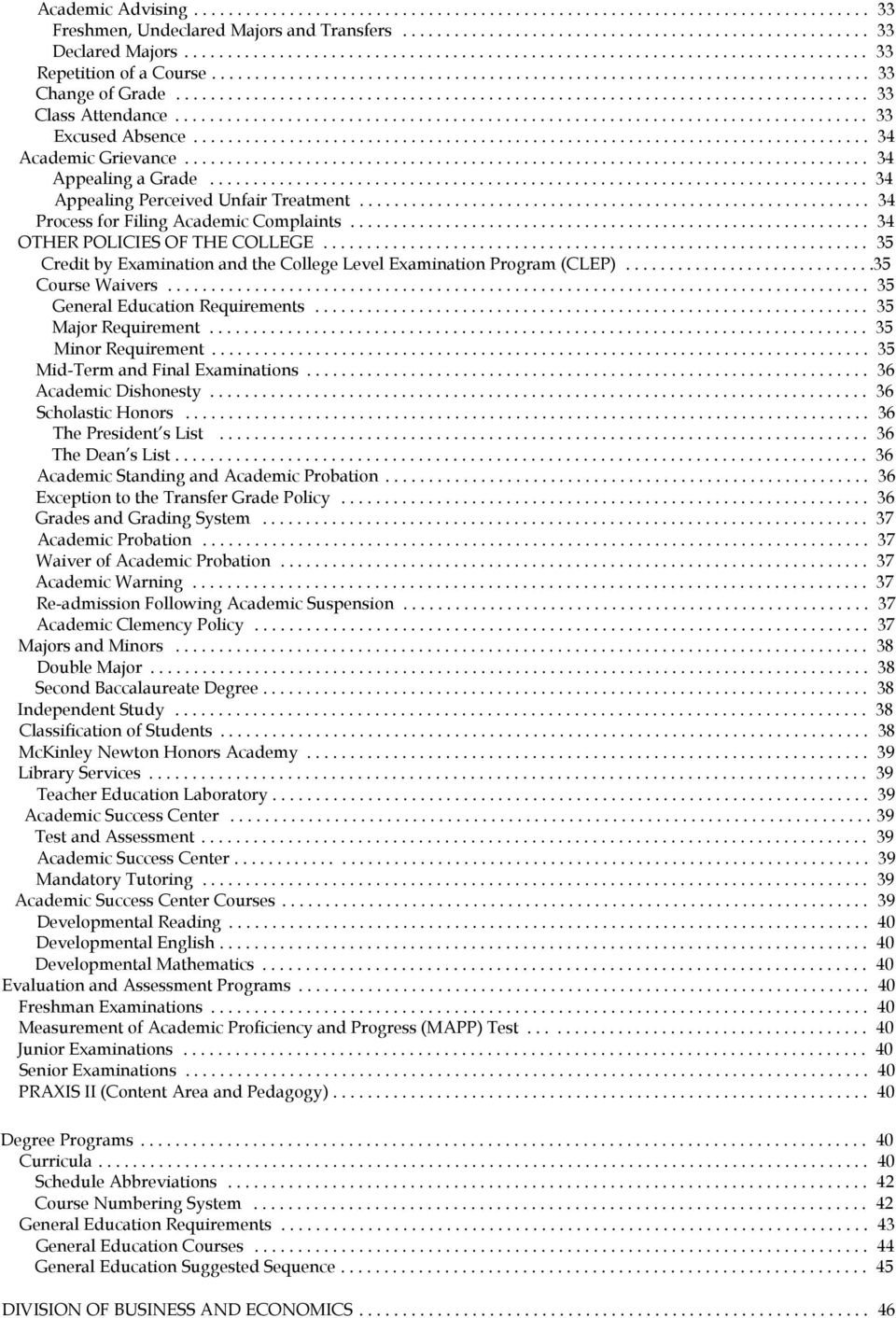
6 Core Requirements Admission to the Business Division Retention Requirements Graduation Requirements Philander Smith Management Institute Purpose The Curriculum Registration Guidelines 48 Admission Requirements Conditional Admission Retention Requirements Exit Requirements The Major in Business Administration (Suggested Sequence) The Major in Business Administration Concentration in Accounting (Suggested Sequence) The Major in Business Administration Concentration in Office Systems (Suggested Sequence) The Major in Organizational Management (PSMI) (Suggested Sequence) The Social Justice Institute 53 CENTER FOR CONTINUING EDUCATION AND PROFESSIONAL STUDIES The Weekend College Weekend College Overview Goals Advantages Registration Instructions DIVISION OF EDUCATION Mission of the Division of Education Conceptual Framework Teacher Education Programs Admission to the Teacher Education Program Acceptance to the Teacher Education Program Retention in the Teacher Education Program Admission to Directed Teaching Exit Procedures (Graduation) LICENSURE PROGRAMS Early Childhood Education (P-4) Middle Level Education (Generalist) (MCEA 4-8) Vocational Education/Business Technology (VOBT 7-12) Program NON-LICENSURE PROGRAM Physical Education (Non-Licensure) Retention in Physical Education (Non-Licensure) Exit Procedures (Graduation) Physical Education (Non-Licensure) Bachelor of Science in Early Childhood Education Leading to Initial Teacher Licensure (Suggested Sequence) Bachelor of Science in Middle Level Education (Generalist) (MCEA 4-8) Leading to Initial Teacher Licensure (Suggested Sequence) The Major in Physical Education (Non-Licensure) (Suggested Sequence) Bachelor of Science in Vocational Education/Business Technology Leading to Initial Teacher Licensure (Suggested Sequence) DIVISION OF HUMANITIES Language and Letters; Music; Philosophy and Religion The Department of Language and Letters The Major in English Requirements The Minor in English The Music Department The Department of Philosophy and Religion Required Courses for a Major in Philosophy and Religion The Minor in Philosophy and Religion Required Courses for a Minor in Philosophy and Religion
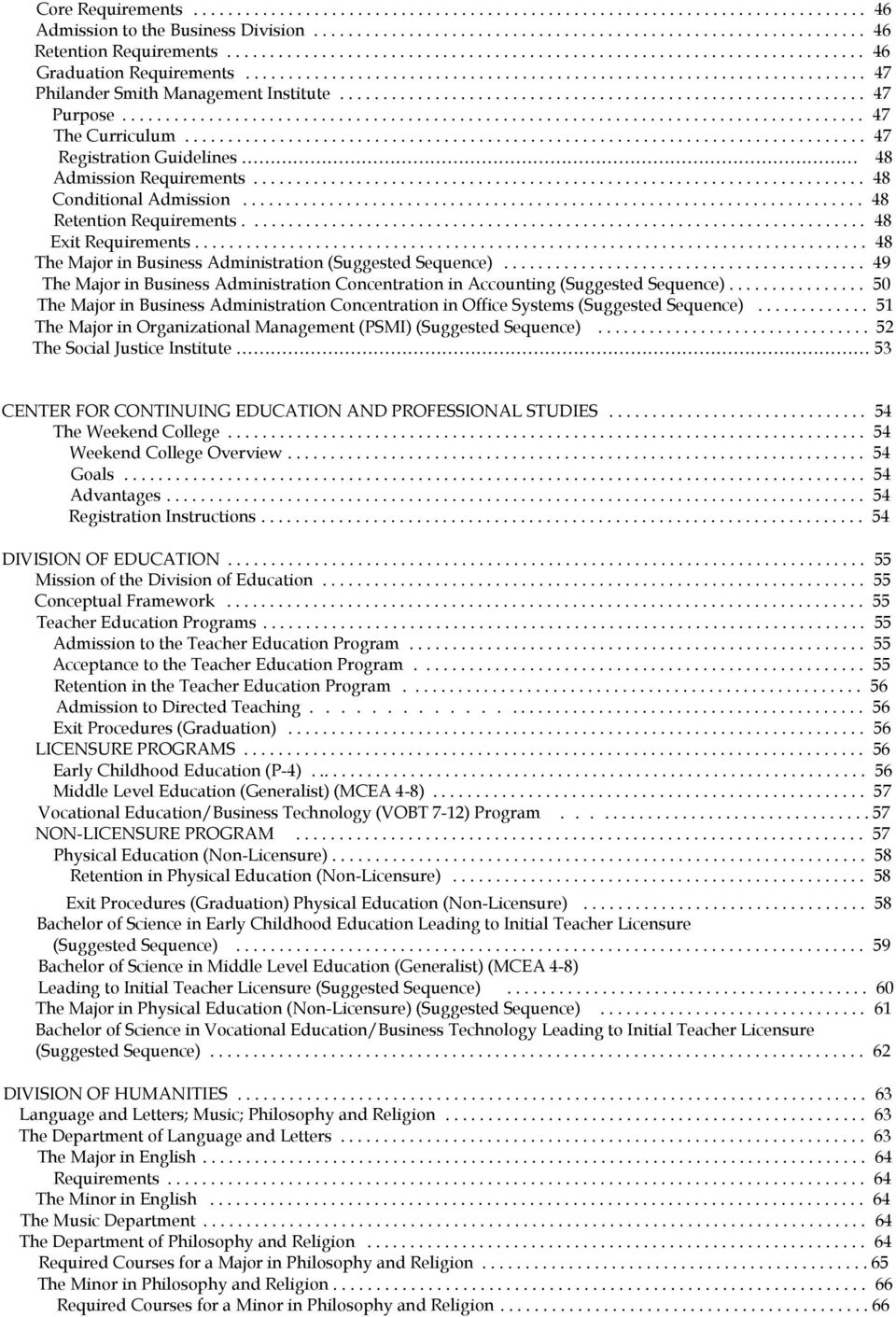
7 The Minor in Social Justice and Religious Education The Major in English Bachelor of Arts (Suggested Sequence) The Major in Philosophy and Religion Bachelor of Arts (Suggested Sequence) DIVISION OF NATURAL AND PHYSICAL SCIENCES The General Science Degree Program Department of Biology Department of Chemistry Department of Applied Mathematics and Computer Science Mission Statement. 74 Vision Statement. 74 Core Values.. 74 The Major in Biology (Suggested Sequence) The Major in Biology General Science (Suggested Sequence) The Major in Pre-Nursing (Suggested Sequence) The Major in Pre-Pharmacy (Suggested Sequence) The Major in Chemistry (Suggested Sequence) The Major in Computer Science (Suggested Sequence) The Major in Mathematics (Suggested Sequence) DIVISION OF SOCIAL SCIENCES Division Requirements for Graduation Black Family Studies History Political Science The Major in Political Science The Minor in Political Science The Minor in Pre-Law 84 Psychology The Major in Psychology The Minor in Psychology Social Work Sociology The Major in Sociology The Minor in Sociology The Major in Political Science (Suggested Sequence) The Major in Psychology (Suggested Sequence) The Major in Social Work (Suggested Sequence) The Major in Sociology (Suggested Sequence) COURSE DESCRIPTIONS Accounting Art Biology Black Family Studies Business Administration Chemistry Computer Science Drama Early Childhood Education Economics English Environmental Science French History Honors Management Institute PSMI Mathematics Middle Childhood/Early Adolescence Music Applied Piano Applied Voice
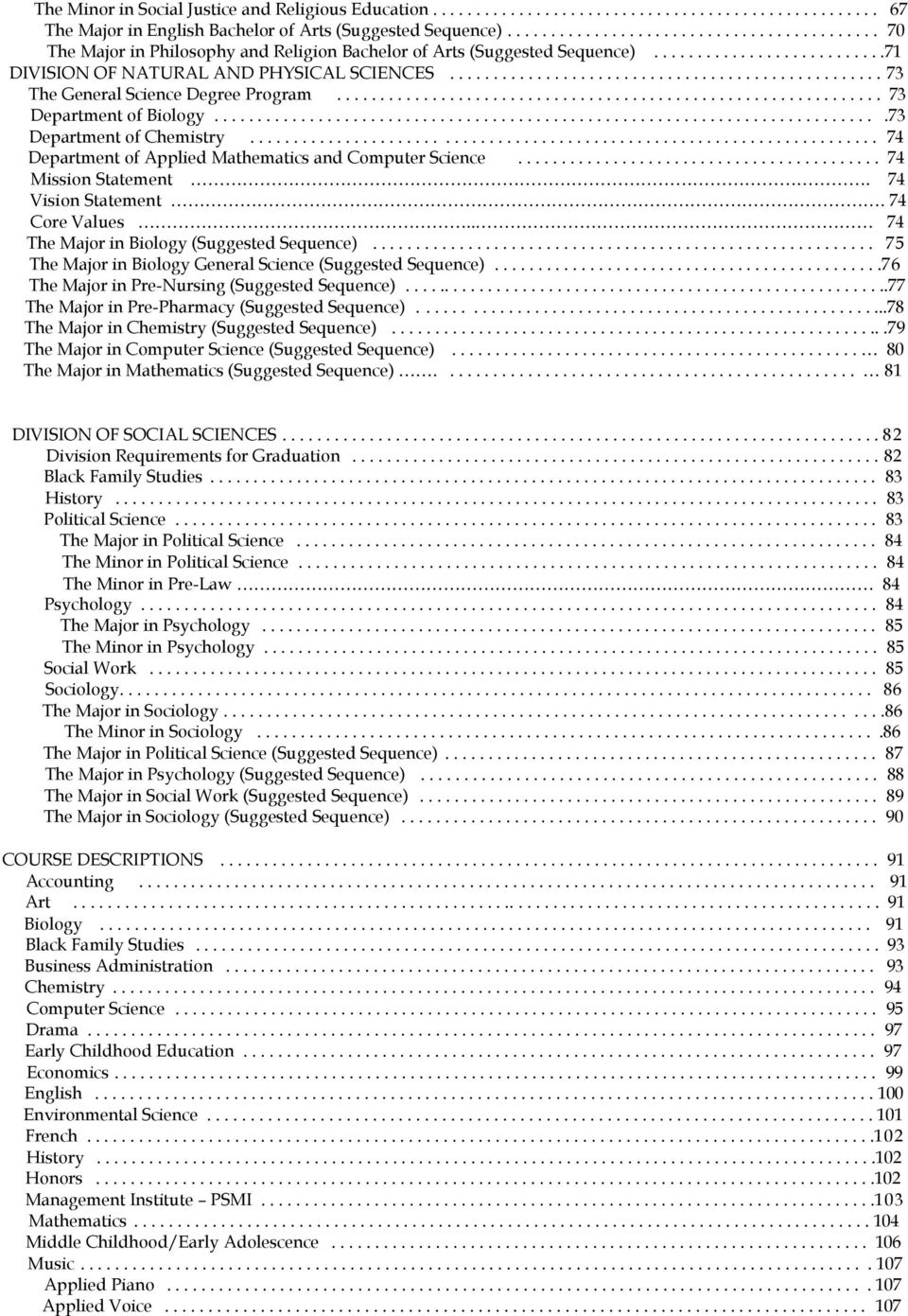
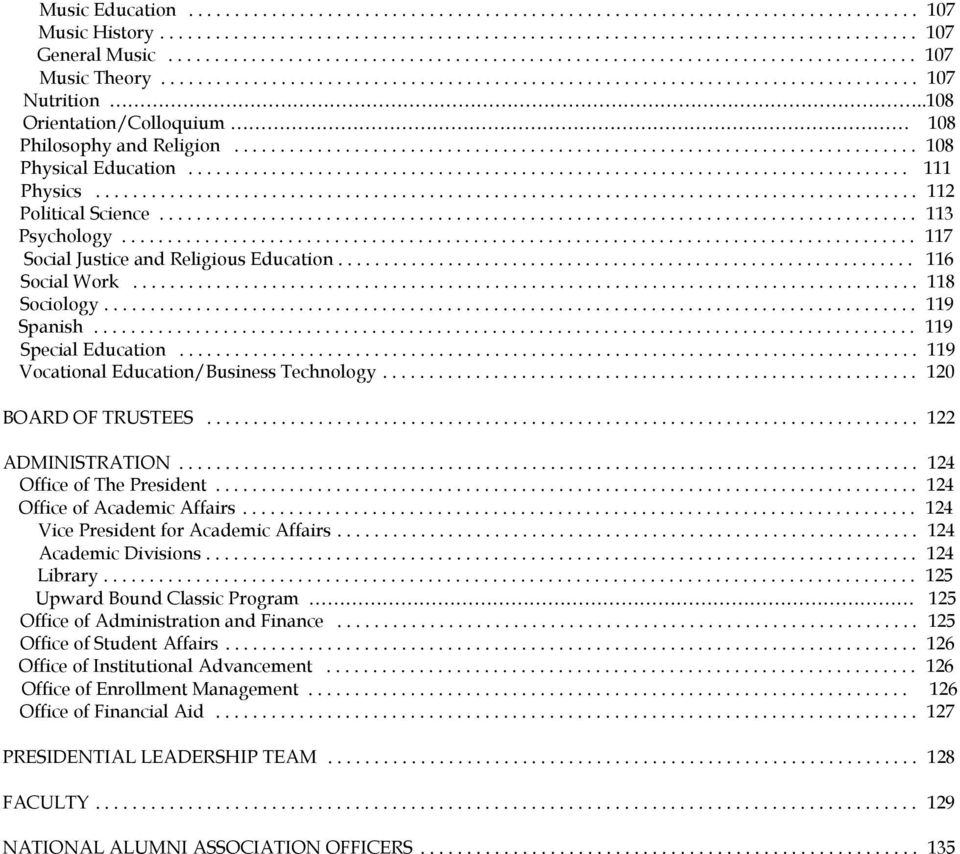
8 Music Education Music History General Music Music Theory Nutrition..108 Orientation/Colloquium 108 Philosophy and Religion Physical Education Physics Political Science Psychology Social Justice and Religious Education Social Work Sociology Spanish Special Education Vocational Education/Business Technology BOARD OF TRUSTEES ADMINISTRATION Office of The President Office of Academic Affairs Vice President for Academic Affairs Academic Divisions Library Upward Bound Classic Program 125 Office of Administration and Finance Office of Student Affairs Office of Institutional Advancement Office of Enrollment Management Office of Financial Aid PRESIDENTIAL LEADERSHIP TEAM FACULTY NATIONAL ALUMNI ASSOCIATION OFFICERS
9 ACADEMIC CALENDAR FOR AUGUST August Thursday Faculty Institute, 8:30 a.m. 9 Friday Residence Halls Open for New Students Only, 9:00 a.m. 10 Saturday New Students and Parents Welcome Saturday-Tuesday New Student Colloquium 12 Monday Freshman Advising and Registration, 1:00 p.m.-5:00 p.m. 12 Monday Graduation Date for Summer Graduates 13 Tuesday Residence Halls Open for Returning Students, 9:00 a.m. 13 Tuesday Pre-registration Ends for Fall Semester 14 Wednesday Fall 2013 Classes Begin 15 Thursday Weekend College 1 st Eight Week Classes Begin 22 Thursday President s Chapel 10:00 a.m.-12:00 p.m. 23 Friday Last Day for Registration/Schedule Changes 23 Friday Observation of International Day for the Remembrance of the Slave Trade and its Abolition 27 Tuesday Enrollment Verification Due by 5:00 p.m. September Monday Labor Day: No Classes 2 Monday Residence Halls Remain Open during Labor Day Recess 3 Tuesday Classes Resume October Saturday Weekend College 1 st Eight Week Classes End 7-12 Monday-Saturday Mid-Term Examinations 10 Thursday Weekend College 2 nd Eight Week Classes Begin 11 Friday National Coming Out Day 11 Friday Last Day for Faculty Administrative Withdrawals From Course(s) 11 Friday Last Day for Students to Withdraw From Course(s) 23 Wednesday Observance of Merger of George R. Smith and Philander Smith College November Tuesday Pre-registration for Spring 2014 Begins (From November 5, 2013-January 3, 2014) 7 Thursday Observance of Philander Smith College Founders Day 15 Friday Deadline for Applying for Spring 2014 Graduation 15 Friday Rising Junior Exam 16 Saturday Rising Junior Exam Monday-Wednesday Fall Break Thursday-Friday Thanksgiving Recess Residence Halls remain open during Fall Break and Thanksgiving Recess 30 Saturday Weekend College 2 nd Eight Week Classes End December Sunday Observance of World Aids Day 2 Monday Classes Resume 2 Monday Last Day to Withdraw from Fall 2013 Semester Classes 3 Tuesday Last Day for Fall Semester Classes 4-7 Wednesday-Saturday Final Examinations 7 Saturday Christmas Recess for Students Begins After Last Exam 7 Saturday Residence Halls Close at 12:00 p.m. 10 Tuesday Final Grades Due to Registrar by 5:00 p.m. (Recess for Faculty Begins After Grades Are In.) 13 Friday Christmas Recess for Staff Begins, 5:00 p.m. January 2014

10 2 Thursday Faculty and Staff Return 2 Thursday Faculty Institute, 8:30 a.m. 3 Friday New Student Colloquium 3 Friday Residence Halls Open for ALL Students, 9:00 a.m. 3 Friday Pre-registration for Classes Ends 6 Monday Classes for Spring 2014 Begin 6 Monday Graduation Date for Fall 2013 Graduates 9 Thursday Weekend College 1 st Eight Week Classes Begin 10 Friday Last Day for Registration/Schedule Changes 14 Tuesday Enrollment Verification Due by 5:00 p.m. 20 Monday Observance of Dr. Martin Luther King, Jr. s Birthday: No Classes 21 Tuesday Classes Resume February 1-28 Observance of Black History Month 20 Thursday Observance of World Day of Social Justice 28 Friday Weekend College 1 st Eight Week Classes End March Saturday Weekend College 2 nd Eight Week Classes Begin 3-8 Monday-Saturday Mid Term Examinations 7 Friday Last Day for Faculty Administrative Withdrawals From Course(s) 7 Friday Last Day for Students to Withdraw From Course(s) 8 Saturday Observance of International Women s History Day 20 Thursday Honors Convocation 22 Saturday Residence Halls Close for Spring Break Recess, 12:00 p.m Monday-Saturday Spring Break 30 Sunday Residence Halls Open after Spring Break Recess, 9:00 a.m. 31 Monday Classes Resume April Monday Pre-registration for Summer and Fall 2014 Semesters Begin (April 7, 2014-August 12, 2014) 11 Friday Rising Junior Exam 12 Saturday Rising Junior Exam 18 Friday Good Friday: No Classes 20 Sunday Easter Sunday Wednesday-Friday Senior Final Exams 25 Friday Final Grades for Seniors Due to Registrar by 5:00 p.m. 25 Friday Last Day for Spring 2014 Semester Classes 26 Saturday Weekend College 2 nd Eight Week Classes End 26-May 2 Saturday-Friday Final Exams May Friday Baccalaureate Service M. L. Harris Auditorium 3 Saturday Graduation Exercises 3 Saturday Residence Halls Close at 12:00 p.m. 6 Tuesday All Grades Due to Registrar by 5:00 p.m. 11 Sunday Mother s Day 15 Thursday Weekend College Summer Classes Begin (8 Weeks) 18 Sunday Residence Halls Open for Summer I Classes, 9:00 a.m. 19 Monday Summer I 2014 Classes Begin 26 Monday Residence Halls Remain Open during Memorial Day Recess 26 Monday Memorial Day: No classes 27 Tuesday Classes Resume 28 Wednesday Enrollment Verification Due to Registrar by 5:00 p.m.

11 June Friday Summer I 2014 Classes End 13 Friday Residence Hall Close after Summer I Classes, 12:00 p.m. 17 Tuesday Summer I 2014 Grades Due to Registrar by 5:00 p.m. 22 Sunday Residence Halls Open for Summer II Classes, 12:00 p.m. 23 Monday Summer II 2014 Classes Begin 24 Tuesday Enrollment Verification Due by 5:00 p.m. July Thursday-Friday Independence Day Observed: No Classes 5 Saturday Weekend College Summer Classes End (8 Weeks) 7 Monday Classes Resume 18 Friday Summer II 2014 Classes End 18 Friday Residence Halls Close after Summer II Classes, 12:00 p.m. 22 Tuesday Summer II 2014 Grades Due to Registrar by 5:00 p.m.

12 ACADEMIC CALENDAR FOR AUGUST August Thursday Faculty Institute, 8:30 a.m. 8 Friday Residence Halls Open for New Students Only, 9:00 a.m. 9 Saturday New Students and Parents Welcome 9-12 Saturday-Tuesday New Student Colloquium 11 Monday Freshman Advising and Registration, 1:00 p.m.-5:00 p.m. 11 Monday Graduation Date for Summer Graduates 12 Tuesday Residence Halls Open for Returning Students,9:00 a.m. 12 Tuesday Pre-registration Ends for Fall Semester 13 Wednesday Fall 2014 Classes Begin 14 Thursday Weekend College 1 st Eight Week Classes Begin 21 Thursday President s Chapel 10:00 a.m.-12:00 p.m. 22 Friday Last Day for Registration/Schedule Changes 23 Saturday Observation of International Day for the Remembrance of the Slave Trade and its Abolition 26 Tuesday Enrollment Verification Due by 5:00 p.m. September Monday Labor Day: No Classes 1 Monday Residence Halls Remain Open during Labor Day Recess 2 Tuesday Classes Resume October Saturday Weekend College 1 st Eight Week Classes End 6-11 Monday-Saturday Mid-Term Examinations 9 Thursday Weekend College 2 nd Eight Week Classes Begin 10 Friday Last Day for Faculty Administrative Withdrawals From Course(s) 10 Friday Last Day for Students to Withdraw From Course(s) 11 Saturday National Coming Out 23 Thursday Observance of Merger of George R. Smith and Philander Smith College November Tuesday Pre-registration for Spring 2015 (From November 4, 2014-January 9, 2015) 14 Friday Deadline for Applying for Spring 2015 Graduation 14 Friday Rising Junior Exam 15 Saturday Rising Junior Exam Monday-Wednesday Fall Break Thursday-Friday Thanksgiving Recess Residence Halls Remain Open during Fall Break and Thanksgiving Recess December Monday Classes Resume 1 Monday Last Day to Withdraw from Fall 2014 Semester Classes 2 Tuesday Last Day for Fall Semester Classes 3-6 Wednesday-Saturday Final Examinations 6 Saturday Weekend College 2 nd Eight Week Classes End 6 Saturday Christmas Recess for Students Begins After Last Exam 6 Saturday Residence Halls Close at 12:00 p.m. 9 Tuesday Final Grades Due to Registrar by 5:00 p.m. (Recess for Faculty Begins After Grades Are In.) 12 Friday Christmas Recess for Staff Begins, 5:00 p.m. v

13 January Monday Faculty and Staff Return 8 Thursday Faculty Institute, 8:30 a.m. 9 Friday Residence Halls Open for ALL Students 9 Friday New Student Colloquium 9 Friday Pre-Registration for Classes Ends 12 Monday Classes for Spring 2015 Begin 12 Monday Graduation Date for Fall 2014 Graduates 15 Thursday Weekend College 1 st Eight Week Classes Begin 16 Friday Last Day for Registration/Schedule Changes 19 Monday Observance of Dr. Martin Luther King, Jr. s Birthday: No Classes 20 Tuesday Classes Resume 21 Wednesday Enrollment Verification Due by 5:00 p.m. February 1-28 Observance of Black History Month 20 Thursday Observance of World Day of Social Justice March Thursday Weekend College 1 st Eight Week Classes End 7 Saturday Weekend College 2 nd Eight Week Classes Begin 8 Sunday Observance of International Women s History Day 9-14 Monday-Saturday Mid Term Examinations 13 Friday Last Day for Faculty Administrative Withdrawals From Course(s) 13 Friday Last Day for Students to Withdraw From Course(s) 18 Thursday Honors Convocation.21 Saturday Residence Halls Close for Spring Break, 9:00 a.m Monday-Saturday Spring Break 29 Sunday Residence Halls Open after Spring Break, 9:00 a.m. 30 Monday Classes Resume April Friday Good Friday: No Classes 5 Sunday Easter Sunday 6 Monday Pre-registration for Summer and Fall 2015 Semesters Begin (April 6, 2015-August 14, 2015) 10 Friday Rising Junior Exam 11 Saturday Rising Junior Exam Wednesday-Friday Senior Final Exams 24 Friday Final Grades for Seniors Due to Registrar by 5:00 p.m. 24 Friday Last Day for Spring 2015 Semester Classes 25 Saturday Weekend College 2 nd Eight Week Classes End 25-May 1 Saturday-Friday Final Exams May Friday Baccalaureate Service M. L. Harris Auditorium 2 Saturday Graduation Exercises 2 Saturday Residence Halls Close at 12:00 a.m. 5 Tuesday All Grades Due to Registrar by 5:00 p.m. 10 Sunday Mother s Day 17 Sunday Residence Halls Open for Summer I Class, 9:00 a.m. 18 Monday Summer I 2015 Classes Begin 14 Thursday Weekend College Summer Classes Begin (8 Weeks) vi

14 25 Monday Memorial Day: No classes 26 Tuesday Classes Resume 27 Wednesday Enrollment Verification Due to Registrar by 5:00 p.m. June Friday Summer I 2015 Classes End 12 Friday Residence Halls Close following Summer I classes, 12:00 p.m. 16 Tuesday Summer I Grades due to Registrar by 5:00 p.m. 21 Sunday Residence Halls Open for Summer II Class, 9:00 a.m. 22 Monday Summer II 2015 Classes Begin 30 Tuesday Enrollment Verification Due by 5:00 p.m. July Thursday-Friday Independence Day Observed: No Classes 6 Monday Classes Resume 6 Monday Weekend College Summer Classes End (8 Weeks) 17 Friday Summer II 2015 Classes End 17 Friday Residence Halls Close after Summer II Classes, 12:00 p.m. 21 Tuesday Summer II 2015 Grades Due to Registrar by 5:00 p.m. vii

15 Academic Calendar Fall 2015 July 9-10: Early Registration and Advisement for New Students July 16-17: Early Registration and Advisement for New Students August 7: New Student Orientation (only). Residential Life Center opens for new students only, 9:00 a.m. August 10: Faculty Returns August 10: Graduation Day for Summer Graduates August 10 14: New Student Orientation; Returning Students. RLC opens at 9:00 a.m. Pre-Registration for Fall 2015 (April 8, 2015 August 13, 2015) August 13: Staff & Faculty Retreat (9:00 am-12:00 pm); Faculty Retreat (1:00pm - 4:30pm ); August 14: Faculty Retreat (9:00 am 4:30 pm) August 14: RLC opens for returning students, 9:00 a.m. Student Fiscal Clearance Student Payment Plan: First Installment Due August 16: Dining Hall First Meal: Dinner August 17: Classes Begin August 21: Final Registration August 31: Enrollment Verification by 12:00pm August 20 October 10: Session 1-Weekend College September 3: Opening Convocation September 7: Labor Day September 15: Student Payment Plan: Second Installment Due October 12 16: Mid Term Examinations October 15: Student Payment Plan: Third Installment Due December 5: Session 2-Weekend College October 16: Last day for Administrative Withdrawals and Course Withdrawals November 3 January 8: Pre-Registration for Spring 2016 November 13: Deadline for Applying for Spring Graduation November 13-14: Rising Junior Examination November 15: Student Payment Plan: Fourth Installment Due November 25 27: Thanksgiving Break; Residence Halls will remain opened December 5: Classes end December 7 11: Final Examinations December 12: Residence Halls close December 15: Fall Grades Due December 16: Assessment Day; Recess for Faculty begins at 5PM December 18: Winter Break begins at 5:00 p.m.; Residence Halls close viii

16 Spring 2016 January 4: College opens January 7: Faculty and Staff Retreat (9:00 am-12:00 pm); Faculty Retreat (1:00pm - 4:30pm); January 8: Faculty Retreat (9:00 am 4:30 pm) January 8: New Student Orientation Residence Halls open for all students, 9:00 a.m. Student Fiscal Clearance Student Payment Plan: First Installment Due January 10: Dining Hall: First Meal - Dinner January 11: Classes Begin January 14 March 5: Session 1-Weekend College January 15: Final Registration January 18: Martin Luther King, Jr. Holiday January 26: Enrollment Verification by 12:00 pm February 15: Student Payment Plan: Second Installment Due March 10-April 30: Session 2-Weekend College March 14 18: Mid Term Examinations March 15: Student Payment Plan: Third Installment Due March 18: Last Day for Administrative Withdrawals and Course Withdrawals March 17: Honors Convocation March 21 25: Spring Break (Faculty & Students); Staff (March 23-25); Residence Halls will remain opened April 14 : Faculty & Staff Appreciation Day April 15: Student Payment Plan: Fourth Installment Due April 21: Renaissance Award Banquet May 2 7: Final Examinations May 6: Baccalaureate May 7: Commencement Residence Halls close for Spring 2016, 12:00 p.m. Summer 2016 May 23 June 16: Summer Session I May 31: Enrollment Verification by 5:00 pm June 21: Summer I Grades Due June 26: Summer II Residence Halls open, 9:00 a.m. June 27 July 21 : Summer Session II July 5: Enrollment Verification by 5:00 pm July 7-8: Registration and Advisement for New Students July 14-15: Registration and Advisement for New Students July 22: Summer II Residence Halls close, 12:00 p.m. July 26: Summer II Grades Due ix
17 PHILANDER SMITH COLLEGE HISTORY and MISSION History Officially founded in 1877, Philander Smith College is the result of the first attempt west of the Mississippi River to make education available to freedmen (former African-American slaves). The forerunner of the College was Walden Seminary, named in honor of Dr. J. M. Walden, one of the originators and the first Corresponding Secretary of the Freedmen s Aid Society. Miss Helen Perkins served as Principal of the institution during the early years. In 1876, the General Conference of The Methodist Episcopal Church authorized the creation of an annual conference for Negro preachers in the state of Arkansas with the power to promote schools. The new body was named the Little Rock Annual Conference (later the Southwest Annual Conference). In 1877, this annual conference designated Walden Seminary as its official educational institution. The Seminary was located at Eighth Street and Broadway in the Wesley Chapel Methodist Church. The first Conference Trustees of the new school, elected in 1878, were ministers I. G. Pollard, W. O. Emory, G. W. Sams, W. H. Crawford, A. J. Phillips, L. W. Elkins and Laymen A. L. Richmond, William La Porte and Frank Carland. During the administration of the College s first president, the Reverend Thomas Mason, there was steady and substantial growth along many lines. The Seminary was moved from Eighth and Broadway on January 1, 1879 to Tenth and Center Streets in a suite of rooms on the second floor of Kendrick Hall. The first floor of the hall was used as a store. In 1882, Dr. G. W. Gray, president of Little Rock University, the institution for the Arkansas Annual Conference, met Mrs. Adeline Smith, widow of Mr. Philander Smith of Oak Park, Illinois, while soliciting funds. The late Mr. Philander Smith had been a liberal donor to Asiatic Missions and had developed an interest in the work of the church in the South. In making her gift to Dr. Gray, Mrs. Smith designated $10,500 for Walden Seminary. The trustees accepted the gift and gave it special recognition by changing the name of the struggling Walden Seminary to Philander Smith College. A new site for the school had already been purchased at Eleventh and Izard Streets. The gift made by Mrs. Smith was a significant contribution toward the construction of Budlong Hall, the first brick building on the new site. Philander Smith was chartered as a four-year college on March 3, The trustees at the time were ministers Bishop J.W. Wiley, L.W. Elkins, W.O. Emory, S. Johnson, Thomas Mason, I.G. Pollard, R.S. Rust, and G.W. Sams, and Laymen Frank Carland, William La Porte, and K.L. Richmond. The cornerstone for Budlong Hall was laid in May of 1883 and the building was dedicated on September 2, In the same year, a manual training department was added. In 1884, a new dormitory for girls was built on the southeast corner of Eleventh and Izard Streets, and named Adeline Smith Hall, in honor of Mrs. Smith. On May 14, 1890, the cornerstone was laid for a large addition to Budlong Hall. The first baccalaureate degree was conferred in The outstanding representative of this class was Dr. Rufus C. Childress, who was for many years assistant supervisor of Negro schools in Arkansas. Dr. Childress also served as secretary of Philander Smith College s Board of Trustees for some 30 years. During the later part of President Mason s administration, Philander Smith College included the Grammar School, the Preparatory School, the Normal School (to train teachers for public schools), the College (offering the degrees of Bachelor of Arts, Bachelor of Philosophy, Bachelor of Science, and Master of Arts), the School of Music, and the Department of Carpentry and Printing. All departments except the College Department were gradually dropped. The only honorary degree conferred was the Master of Arts degree. The Reverend Thomas Mason resigned in He was succeeded by a member of the faculty of the College, the Reverend James Monroe Cox, Professor of Ancient Languages. During the administration of President Cox ( ), the physical plant was expanded and the academic program was improved. The expansion of the physical plant included the completion of the north wing of Budlong Hall and the purchase of property on the northeast corner of Tenth and Izard Streets on which a girls dormitory was erected. The new dormitory was named Webb Hall in honor of the Webb family of Oak Park, Illinois. Forty acres in the Fulk Addition to the city were purchased at the cost of $42,000 for a new site for the institution. This property was later sold. Dr. Cox retired from the presidency of the College in 1924, and was succeeded by the Reverend George Collins Taylor, a graduate of the College, who had been serving as Dean. Dr. Taylor served as president from 1924 to Under his administration there was further expansion of the physical facilities and the quality of the academic program continued to improve. The primary grades were dropped in 1924 and the high school department was dropped in

18 In 1925, George R. Smith College of Sedalia, Missouri, burned. In 1933, its interests were formally merged with Philander Smith College through joint action of the Board of Education of the Methodist Episcopal Church, the Trustees of the Southwest and Central West Annual Conferences, and the Trustees of Philander Smith College. The transaction was formally ratified in a joint executive session, May 23, 1933, and the merger celebration was held October 23 of the same year. In May, 1936, Dr. Marquis LaFayette Harris succeeded Dr. Taylor as president of the College. During the administration of Dr. Harris, the campus area was greatly enlarged. The old buildings were renovated, new buildings were erected, and the academic program was strengthened. In July, 1948, the site of the Little Rock Junior College, adjacent to the south end of Philander Smith s campus, was purchased. This site comprised one city block on which was located an administration building containing classrooms, a library, a gymnasium, and a chemistry laboratory. On March 30, 1949, after an extensive program of academic improvement, Philander Smith College was fully accredited by the North Central Association of Colleges and Schools. In 1951, Kelly Hall was dedicated as the official President s residence. Construction was completed in February, 1952, and it was occupied on March 3, A new science building was also constructed and occupied in An academic study in 1957 revealed that a financial outlay of $3,500,000 was needed for sustaining a high quality undergraduate educational program at the College. On March 12, 1958, a $3,500,000 capital funds campaign was officially launched. Of this amount it was estimated that $1,500,000 would be needed to purchase new land and to construct and furnish new buildings. The remaining $2,000,000 would be needed to enlarge the endowment of the College. In 1958, the College purchased 2 ½ city blocks of Urban Renewal property adjacent to the campus for further expansion of the physical plant. In September, 1959, the College completed and placed in use a new dormitory for men, a new dormitory for women, a student union, a cafeteria, and a dining hall. In 1959, construction was begun on the M. L. Harris Library and Fine Arts Center. In 1960, the College took steps to acquire additional city blocks of Urban Renewal property adjacent to the campus to enlarge the main campus. Dr. Harris was succeeded by Dr. Roosevelt David Crockett, a graduate of the institution. Dr. Crockett took office on June 1, During his administration notable improvements were made in the physical plant and the academic program. The M. L. Harris Library and Fine Arts Center was completed and placed in use in January, Progress was made toward the acquisition of the six blocks of Urban Renewal property. The College, through Village Square, Inc., constructed and placed in use in 1963 a $3,000,000 housing project and shopping center. Village Square consisted of five three-story brick buildings containing 240 apartments and a two-story brick building which served as a shopping center for the area. These buildings covered approximately three city blocks south of the main campus. Dr. Crockett resigned as president of the College in August, He was succeeded by Dr. Ernest Thomas Dixon, Jr. Dr. Dixon, Philander Smith s sixth president, took office January 1, During his administration notable improvements were made in the physical plant and the academic program. The final payment was made for the additional land adjacent to the campus. With this purchase, the College owns more than 10 city blocks of land. Dr.Dixon resigned as president of the College effective March 1, Dr. Dixon was succeeded by Dr. Walter R. Hazzard. Dr. Hazzard took office as the seventh president of the College on July 1, Under Dr. Hazzard s administration significant improvements were made in the academic program, the physical plant, strengthening of the faculty, and improvement of student services, including the addition of eight new classrooms in the M. L. Harris Fine Arts Building; a new addition to the women s dormitory which includes the Kresge Foundation Health Center, faculty offices, living quarters and a student lounge; renovations in the administration building; a new maintenance building; a new office complex including offices for faculty persons; air conditioning of all offices, classrooms, and the library; and the erection of the new Mabee-Kresge Science Building, completed on May 6, Dr. Hazzard was succeeded by Dr. Grant S. Shockley. Dr. Grant S. Shockley took office as the eighth president of Philander Smith College on January 1, Under the leadership of Dr. Shockley, significant progress was made in strengthening the academic program, strengthening the faculty, increasing the number of library volumes and services, expanding student services, enhancing the physical plant, and cultivating a closer and more meaningful relationship between the College, the local community and other organizations. Dr. Shockley was succeeded by Dr. Hazo W. Carter, Jr. Dr. Hazo W. Carter. Jr., elected unanimously July 19, 1983 by the Board of Trustees, took office August 20, Under the leadership of President Carter, the College s first Cluster Program, involving the support of business and industry of greater Little Rock and the state of Arkansas, was organized. The regional accreditation by the North Central Association of Colleges and Schools was retained and the Teacher Education Program was approved by the Arkansas State Department of Education. Significant progress was made in student recruitment, business-industry-college relations, and community relations. The quest for academic excellence, faculty development, student and faculty morale, institutional advancement, physical plant improvement, long-range planning and implementation of a capital fund drive was a high priority. 2
19 Dr. Carter resigned the presidency of Philander Smith College in August He was succeeded by Dr. Myer L. Titus, a 1954 graduate of the institution. Dr. Myer L. Titus was elected unanimously November 24, 1987 by the Board of Trustees, and took office in February, He made significant progress in every facet of the College to the end that it continues to grow as a viable institution of higher education. Following his investiture, Dr. Titus focused his efforts on strengthening the faculty and curriculum and establishing the Philander Smith Management Institute (PSMI); increasing enrollment and faculty and staff salaries and benefits; fund-raising for capital improvements and increasing the endowment; retaining accreditation by the North Central Association of Colleges and Schools (NCA) ; achieving accreditation of the Teacher Education Program by the National Council for the Accreditation of Teacher Education (NCATE) in 1993; accreditation of the Division of Business and Economics by the Accreditation Council of Business Schools and Programs, formerly the Association of Collegiate Business Schools and Programs (ACBSP) in June, 1997; erecting new physical facilities, including a Multi- Purpose Building consisting of a gymnasium and physical education and business buildings; erecting a campus security house; securing funds to erect a new academic building; erecting a security fence around the campus; renovating existing buildings and improving the campus grounds; improving institutional management through computer technology, including construction of a technology center in the Library; and enhancing student life, campus security, college, church and community relations; establishing closer relationships with key business leaders in downtown Little Rock through the Capital Development Campaign drive; and establishing the Philander Smith College Community Development Corporation, Inc. (CDC) in He improved the image of the College on the local, state and national levels as an institution of quality higher education, and retired as President on June 30, The Board of Trustees appointed Dr. J. D. Scott Interim President as follows: August 1960 to May 1961; August 1964 to December 1964; and January 1969 to May The Board of Trustees appointed Dr. Crawford J. Mims Interim President in June 1978, to January 1979; June 1983 to August 1983; and August 1987 to January Dr. Scott and Dr. Mims maintained the integrity of the College in every respect and made improvements in various areas of the College s endeavors. Dr. Trudie Kibbe Reed was elected by the Board of Trustees in February, 1998 as the eleventh and first female President of Philander Smith College. Her theme, Building Traditions of Excellence, paid tribute to the College s legacy and signaled a raising of the bar for academic excellence. Under Dr. Reed s guidance, the College built new residence halls, increased scholarships, and developed a Computer Information Center to enhance campus technology and to infuse technology into classroom learning. From , the College conducted a Capital Campaign that totaled $30 million in gifts and pledges. As a result, the college built the Donald W. Reynolds Library and Technology Center which opened for use in the Spring of In addition, the Harry R. Kendall Science and Mission Center was opened in the Spring of In the summer of 2004, Dr. Julius Scott was appointed by the Board of Trustees to serve as the interim president while the College completed a national search for the next president. In October of 2004, the Board announced the selection of Dr. Walter M. Kimbrough as the 12 th president of Philander Smith College. He took office on December 13, 2004 and served until May 31, His administration focused on a Renaissance of the college- bringing it back into prominence by strengthening the student body and academic program. During his tenure, the college increased average high school GPAs and ACT scores of new students, while retention and graduation rates significantly increased as well. Kimbrough s leadership team helped develop a new strategic plan which called for the creation of a unique identity. In February of 2007, the Board of Trustees voted to approve a social justice emphasis for the college. In the fall of 2007, the College officially launched the new emphasis with a new logo and tag line. Dr. Johnny M. Moore became Philander Smith College s 13 th President on July 1, He graduated from his alma mater in May President Johnny M. Moore is charting a new course for Philander Smith College. Dr. Moore s vision for academic excellence builds off the historic foundation laid by Dr. M. Lafayette Harris, 4 th President of Philander Smith College, A college-wide strategic planning committee was instituted to assess the current status of the institution, review the former strategic plan, and develop a new five-year strategic plan. President Moore has designed a projected time line for the completion and further implementation of the academic restructuring, and academic performance of the college. Philander Smith College has a rich Christian heritage. It has maintained a close relationship with the church across the years. It acknowledges a definite obligation to The United Methodist Church. The College receives funding from The General Board of Higher Education and Campus Ministry of The United Methodist Church. Philander Smith strives to instill the desire to serve in its faculty and students. This desire is at the core of its educational philosophy. Across the years, it has earned the designation as a College of Service and Distinction. Mission Philander Smith College s mission is to graduate academically accomplished students who are grounded as advocates for social justice, determined to intentionally change the world for the better. (Adopted by the Board of 3
20 Trustees, February 15, 2007) Purpose and Philosophy At no time in history has the challenge to the academic community s creative ability been greater than it is today. The academic community must be committed to helping students develop their best potentialities, helping them make a good living, and encouraging others in their pursuit of life, liberty, and happiness. Philander Smith College was created in 1877 by the Methodist Episcopal Church for five good reasons: To help persons face the vexing experiences of conflict and social change. To develop leadership for the African-American community. To educate and help disadvantaged persons. To enhance the dignity of persons. To facilitate the achievement of justice and to advance human welfare. These distinctive aims of the founders are still used as guidelines in the planning of curricular offerings for students of all races and classes who enter the College with a hunger for knowledge, a quest for truth, and a desire for a better life. Durung the early stages of the development of Philander Smith College, higher education was restricted by conformity and religious constraint. Today, the College community is characterized by academic freedom and responsibility, critical analysis and creative research, meaningful dialogue, and free communication. These distinctive aims of the founders are still used as guidelines in the planning of curricular offerings for students of all races and classes who enter the College with a hunger for knowledge, a quest for truth, and a desire for a better life. During the early stages of the development of Philander Smith College, higher education was restricted by conformity and religious constraint. Today, the College community is characterized by academic freedom and responsibility, critical analysis and creative research, meaningful dialogue, and free communication. Philander Smith College is a student-centered college that aims to help students: To think critically, creatively, quantitatively, and qualitatively. To develop a sound moral and spiritual foundation for their personal life, social involvement, and responsible living in a democratic society. To become community leaders. To develop their greatest potential as human beings, citizens, and children of God. To be workers who are proud of their work. To live up to the highest and best they know. Many educators are willing to invite academically gifted students to participate in the learning process. Philander Smith College welcomes both the academically prepared as well as those students who may need the help of special services to maintain satisfactory academic progress at the College. The full evaluation of a student is not based solely on his or her report card or what he or she may be at the moment. In addition to these factors, the president, the faculty, and staff consider what each student may become if given a fair chance for growth and development. All instructional, administrative, and material resources of the College are directed toward providing an environment for progressive learning and meaningful experiences that are consistent with the high aims of the College. The College offers quality education through five major divisions: Education, Humanities, Natural and Physical Sciences, Business and Economics, and Social Sciences. The liberal, specialized, and religious components of the curriculum of the College are appropriately balanced and integrated to produce a well-rounded person. The sequences of courses for each curriculum is designed to help students to develop maximum proficiency in their academic studies in various fields. As of 2011, Philander Smith has had 134 years of experience in helping people become empowered through education. Higher education is the key to economic, social, political, and personal empowerment. It is the foundation for reconciliation in our world. Because we have a glimpse of tomorrow s college, we are building the future academic community today. In our present and future academic community: Students will be given more recognition and more opportunities for significant involvement in leadership development. The faculty will play a major, vital role in determining the structure and strength of the academic community. Channels of communication will be kept open to assure better understanding, more meaningful relationships, and greater cooperation. Students with Disabilities It is the policy of Philander Smith College to accommodate students with disabilities, pursuant to federal and state law, and to provide equal educational opportunities. Any student with a disability who needs accommodation, for example, in seating placement or in arrangements for examinations, should inform the instructor at the beginning of the course. The Chair of the Division offering the course is also available to assist with accommodations. 4
21 Drug-Free Campus In February 1999, the Philander Smith College Board of Trustees designated Philander Smith College as a Drug- Free Campus. The policy includes a prohibition against bringing and using alcoholic beverages on the campus. Sexual Harassment It is against College policy to sexually harass or to discriminate against any member of the College community on the basis of sex. Such actions are prohibited not only by the College, but also by Section 703, Title VII of the Civil Rights Act of 1963 and Title IX of the Education Amendments Act of Violation of these Acts may subject the College and/or individuals to disciplinary action and may have legal consequences. Sexual harassment shall be defined as unwelcome sexual advances, requests for sexual favors, and other verbal or physical conduct of a sexual nature where: Submission to such conduct is made, explicitly or implicitly, a term or condition of an individual s employment or classroom evaluation; or Submission to or rejection of such conduct by an individual is used as the basis for employment or academic decisions affecting the status of the individual; or Such conduct has the purpose or effect of unreasonably interfering with an individual s work or classroom performance, or creating an intimidating, hostile, or offensive working or academic environment. The College seeks to encourage the prompt reporting of such harassment and its resolution through either informal or formal procedures. In addition, the College will take steps toward and encourage the development of employee/student rights to be free from sexual harassment and the procedures available for reporting. Programs will also be developed and aimed at preventing sexual harassment. Any individual who wants to report an incident of sexual or other unlawful harassment should promptly report the matter to his or her supervisor, the Vice President for Academic Affairs, and/or the Director of Human Resources. General Harassment It is against Philander Smith College s policy to harass any person because of race, color, gender, religion, national origin, ancestry, age, marital status, disability, sexual Colloquium, unfavorable discharge from the military, or status as a disabled veteran or a veteran of the Vietnam Era, and to comply with all federal and state nondiscrimination, equal opportunity and affirmative action laws, orders, and regulations. The College intends to provide an environment that is pleasant, healthful, comfortable, and free from intimidation, hostility, or other offenses. Harassment of any sort, whether verbal, physical, visual, or sexual, will not be tolerated. Harassment is a very serious offense that can result in the imposition of severe disciplinary measures, including suspension, expulsion, and termination. Harassment is a form of persecution that can cause anguish and humiliation and is incompatible with our Christian heritage. It is unacceptable under any circumstances and will not be tolerated. Harassment can take many forms. It may include, but is not limited to, the use of words, signs, jokes, pranks, intimidation, physical contact, or violence. Harassment is not necessarily sexual in nature. Speech or other expression constitutes harassment if it: is intended to insult or stigmatize an individual, or an identifiable group of college-related individuals on the basis of age, ancestry, disability, national or ethnic origin, race, religion, gender, or sexual Colloquium; is addressed directly to (although not necessarily in the presence of) the individual(s) whom it insults or stigmatizes, and makes use of words or nonverbal symbols that convey hatred or contempt for human beings on the basis of age, ancestry, national or ethnic origin, race, religion, gender, or sexual Colloquium. Harassment may also include nonverbal acts that would also be punishable as, for example, vandalism, physical assault, or destruction of property. Other examples of harassment include insults or jokes referring to an individual s group-based attributes; placement of offensive written or visual material in another person s work or living area; offensive messages sent through voice or ; and undesired physical contact, physical violence, or threat of physical violence. Such actions are prohibited not only by the College, but also by Section 703, Title VII of the Civil Rights Act of 1963 and Title IX of the Education Amendments Act of 1972, and so may have legal consequences. Cases of harassment involving students will be handled by the Disciplinary Committee. Location The Philander Smith College campus is located on the edge of downtown Little Rock, in the historic Quapaw Quarter. The twenty-five acre campus is bounded by Interstate 630 and Daisy Gatson Bates Streets on the north and south, respectively, and by Gaines and Chester on the east and west, respectively. There are many opportunities for cultural and intellectual growth and development in the Little Rock community. Two graduate and professional schools located in Metropolitan Little Rock are the University of Arkansas at Little 5
22 Rock and the University of Arkansas Medical Sciences Campus. Metropolitan Little Rock provides some of the best cultural opportunities available anywhere in this region. In addition to the magnificent Arkansas Arts Center, there is the Little Rock Zoo, the Historic Arkansas Museum, the Central Arkansas Library, the Clinton Library, the Decorative Arts Museum, the Little Rock River Market, the Museum of Discover and many other points of interest. The Campus The Philander Smith College campus is composed of approximately 25 acres in the heart of Little Rock, Arkansas. Little Rock, the capital city of Arkansas, is located at the foothills of the beautiful Ozark Mountains and on the south bank of the Arkansas River. The city is served by airlines, trains, bus lines, the Arkansas River Inland Waterways, and both interstate and state highways. Buildings on campus include: The James Monroe Cox Administration Building: A three-story National Register brick structure housing the Administrative offices of the College, the Collegiate Choir, as well as classrooms, and faculty offices. The Donald W. Reynolds Library and Technology Center: This facility opened in January, The building consists of the College s main library and a separate technology center. Within the library are additional spaces for the Archives, Faculty Development, Teacher Education Lab, Children s Collection, Music Listening Lab, Multi-Media collection, Distance Learning Lab, and a Conference Center. The building is completely wired and contains over 100 computers for student use. The facility contains an art collection, consisting of works by African American artists. Harry R. Kendall Science and Health Mission Center: This facility opened in One side of the building contains science labs, research labs and a large lecture hall. The other side contains the Office of the President, the Mission Center (meeting facilities, kitchen facility) and the offices of the Arkansas Conference of the United Methodist Church. Student Residential Life Center: This facility, housing its first student residents in fall 2003, has three floors and houses 260 students. Each room consists of a private bath and two sleep/study areas. There is a common study room, lounge area, TV room and exercise room. Each floor also has washers and dryers for student use. Residential Suites A : Apartment style student housing built in 2010 houses 60 upper-class students. Twelve (12) suites contain 5 single occupancy bedrooms. Residents in each suite share bath accommodations. Each suite contains a washer/dryer and a common lounge/kitchenette. Residential Suites B : Apartment style student housing built in 2011 houses 55 upper-class students. Eleven (11) suites contain 5 single occupancy bedrooms. Residents in each suite share bath accommodations. Each suite contains a washer/dryer and a common lounge/kitchenette. The building also contains a live-in manager (Assistant Director of Housing), office space and a conference room for student use. Sherman Tate Recreational Center: A one-story brick structure on the National Register of Historic Places. The building was restored in The Kresge-Mabee Science Building: A two-story brick structure providing faculty offices, classrooms, lecture hall, laboratories, and other facilities for biology, chemistry, mathematics, computer science and physics. Tennis Court: An asphalt tennis court used for Physical Education classes and recreation. Student Services Center: A building housing offices of the Vice President for Student Affairs, the offices of Religious Life and the Integrated Counseling Center. The building also contains the Post Office, a Snack Bar, the Cafeteria and activity rooms for group meetings and recreational rooms. Campus Security Office and Fence: A brick structure erected in 1993 along with a brick column and wrought iron security fence erected around the perimeter of the campus. Myer L. Titus Academic Center: This facility contains fourteen classrooms. It houses three academic divisions of the College (Education, Humanities, and Social Sciences), the Social Work Program, Academic Computing Center, the Computer Aided Instruction Lab and the College Bookstore. It also features a 100+seat sub-dividable auditorium. The Barracks Honor Hall: A two-story, former military barracks building on the historical register was restored in The building currently houses 19 students with a common lounge area and a computer lab. Kelly Hall: A two-story brick Colonial structure which formerly served as the residence of Presidents of the College and named after Bishop Edward Kelly. The building houses the offices for the Vice President for Institutional Advancement, Donor Relations, Marketing and Alumni Affairs. M.L. Harris Fine Arts Center: Contains a Fine Arts Auditorium with a seating capacity of approximately 650. The building also houses offices for the federally sponsored TRiO Programs. Arkansas Memorial to Dr. M.L. King, created by Dr. Carey Wynn III and donated to the College on October 16, Since 1995, the College has hosted the Martin Luther King Jr. Vigil each January that begins outside at the memorial. Maintenance Building: A one-story brick structure with storage and workshop facilities and office space for maintenance personnel. Erected in Multi-Purpose Complex: This 40,000 square-foot building contains the Dr. Crawford J. Mims Gymnasium, the Department of Physical Education Wing (including a jogging track, a regulation racquetball court, and a 100-seat auditorium), and the Ottenheimer Business Center, which houses the Division of Business and Economics and 6
23 includes the Philander Smith Management Institute. Wesley Chapel Parsonage: This is the residence for the Pastor of Wesley Chapel and for other Church related activities. Dormitory Parking: A 165-space parking lot for the College s students who reside on campus. Division of Enrollment Management MISSION AND GOALS The Enrollment Management Division is committed to providing outstanding student services through three organizational departments. By utilizing an integrated information systems and a reporting environment, EM provides ongoing analysis of the characteristics and behaviors of current, prospective, and former students in order to help the campus achieve the following goals: To attract, admit, enroll and retain a desirable student body for the campus, in accordance with academic policies and initiatives and campus priorities; To create and manage a campus schedule of course offerings; to register students; maintain the permanent academic record; issue transcripts, grades, certifications, and diplomas; To administer federal, state, and institutional financial aid and scholarship programs; To facilitate proper student transition to Philander Smith College that leads to positive adjustment, academic success, and student persistence; To counsel students and families in order to ensure access, choice, and a diverse student body that is representative of a Philander Smith College student; To facilitate proper student transition to Philander Smith College that leads to positive adjustment, academic success, and student persistence; To facilitate the development, implementation and monitoring of academic policies, practices and procedures, and to assist the academic units in implementing such policies in order to meet their goals; To promote Philander Smith College and the pursuit of higher education; To play a leadership role in the development, implementation, maintenance, and assessment of effectiveness/efficiency of student information systems for the campus. Admission and Recruitment Admission to Philander Smith College (PSC) is open to all persons who show potential for college-level work and who meet our admission requirements. To be considered for admission to PSC, students must have earned a high school diploma from a regionally accredited high school, have passed a state issued General Education Diploma (GED) test, or completed a state approved home school program. PSC admits new students in the fall, spring, and summer terms. Admissions to college programs and activities are offered to students regardless of race, national origin, religion, physical disability, age or sexual Colloquium. Academic factors are of primary importance in gaining admission to PSC; however, these are not the only factors considered by the Office of Admissions. PSC seeks academically promising students who possess character, personality, and leadership potential, as we feel these students are capable of making a real contribution to our 7
24 academic community. We also seek students that are in line with our current mission which is to: graduate academically ambitious students, grounded in social justice, to prepare them to courageously lead activist lives, intentionally changing the world for the better. In determining the eligibility of prospective students for admission, primary consideration will be given to previous academic records. Other items that may be considered include standardized test scores [ACT (preferred) or SAT]. Philander Smith College reserves the right to deny admission to applicants who do not meet any of the eligibility requirements. Prospective students are encouraged to tour the PSC campus and visit with admissions counselors and faculty to discuss their educational objectives. Campus tours may be scheduled in advance by calling the Office of Admissions at or toll free at Incoming Freshmen First-time college students and those who have earned less than 30 credit hours from an accredited college or university are admitted to PSC as freshmen. Full regular admission will be offered to individuals who have earned a diploma from a regionally accredited high school program with a grade point average (GPA) of at least 2.5 (on a closed scale of 4.0) and a 19 composite score (or 800 combined Critical Reading and Math scores on the SAT), or to those individuals who have earned a passing score on a states issued General Equivalency Diploma (GED) exam or completed a state issued and approved home school program. Successful candidates for admissions will have satisfactorily completed the following core requirements: English (4 units), Math (3 units), Lab Sciences (2 units), Social Sciences (2 units) and Free Electives (6 units). Students admitted with a GED are strongly encouraged to enroll in the Student Support Services (SSS) program. Incoming freshmen who do not meet academic eligibility with a GPA of at least 2.0 may be considered for admission and placed on academic probation. This decision process will only be granted after an official interview and personal essay are submitted with all other official documents. Students who are admitted on probation must achieve and maintain a GPA of at least 2.0 for two consecutive semesters, beginning with the first semester of enrollment. Philander Smith College reserves the right to deny admission to applicants who do not meet eligibility requirements. Students seeking admission into one of our continuing education programs must meet all entrance requirements at the time of application. It shall be the applicant s responsibility to provide official documentation of all hours or coursework earned at previously attended accredited institutions. Students may also be required to furnish course catalogs or course descriptions to verify completed coursework. It should be noted that only credits or hours earned at institutions that are accredited and recognized by one of the nationally recognized accrediting agencies of the U.S. Department of Education will be accepted. Required Documents for Admittance to PSC 1. Official high school transcript (upon graduation) or GED. 2. Official college transcript (if you have taken any college classes). 3. Official ACT or SAT scores. 4. Immunizations records (showing date of (2) measles and (1) rubella inoculations). 5. Nonrefundable application processing fee of $25. A student failing to submit any of the above mentioned items prior to the last date of registration (as published in the Academic calendar) is subject to an administrative withdrawal from the college. Credit by Examination Students that have taken Advanced Placement or International Baccalaureate courses may have the opportunity to have these courses replace introductory level classes. Students that have achieved scores of three (3) or higher on official Advanced Placement (AP) tests or 5 or higher on International Baccalaureate (IB) courses may qualify. Students must submit official test results to the Office of Admissions with their official final transcript and before their first 8
25 registration. Final determination of credit acceptance will be based on approval by the department head or designee of said classes and the Office of the Registrar. Home Schooling Candidates that have completed a program of home instruction or home schooling instead of an accredited secondary school must present the following credentials: 1. Secondary school record if it exists 2. GED test scores 3. Official verification by state or regional public official of completion of approved home instruction/ home schooling program. 4. Official results of standardized tests used for evidence of achievement or copy of annual achievement progress report submitted to an official in charge of state or regional home instruction/home schooling supervision. 5. The official results of the ACT or SAT College entrance examination. Freshman Placement Test Students enrolling with less than 30 earned credit hours are required to take the ACT/SAT or the ACT COMPASS residual test prior to registering for classes. At Philander Smith College we use your ACT/SAT scores to identify proper placement in courses your first semester. The ACT cut off score for placement in general education classes is 19. If your ACT scores in English, Reading, or Math are below a 19, you will be placed in courses according to the following guidelines: a. Students scoring 18 and below in English and/or Reading will be placed in Developmental English or Reading, respectively. b. Students scoring 19 or above in Math, will be placed in College Algebra. c. Students scoring 17 or 18 in Math will be placed in College Math. d. Students scoring 16 or below in Math will be placed in Developmental Math. Note: SAT scores are converted to ACT equivalents using the ACT-SAT Concordance. Dual Enrollment High school seniors who have maintained a GPA of at least 3.0 (on a scale of 4.0) may be permitted to enroll in college-level courses while in high school. Students seeking early admission must be recommended by a high school counselor or other appropriate school official and submit an official essay detailing why they want to attend Philander Smith College. Generally students should have at least a B average and show promise to complete course work on the collegiate level. Re-Admission All previously enrolled PSC students must reapply for admission and pay the current non-refundable processing fee. Readmitted students will be required to complete the degree requirements of the current catalog. Transfer A transfer student is defined as any student who has been officially enrolled at another college or university. All transfer students must be in good standing with all schools previously attended and complete all admission requirements. Students must have a cumulative GPA of at least 2.0. Any student who has earned fewer than 30 credit hours will be admitted as freshman. Semester credit hours of all courses earned at an accredited four year institution will be accepted and added to credit hours earned at PSC. It is the student s responsibility to get all department and registrar approvals before classes are added to the official transcript. In addition, only 62 semester credit hours for courses passed at an accredited two year college will be accepted and added to credit hours earned at PSC. Transfer students are required to maintain satisfactory academic progress and must complete 22 of the last 32 credit hours at PSC. Only grades earned at PSC will be used to calculate the GPA (except as noted in catalog pertaining to graduation honors and organizations; see below). 9
26 Students currently on academic probation from another institution of higher learning may be admitted to PSC on a probationary basis. These students may not enroll for more than 12 credit hours per semester until satisfactory academic progress is achieved, and must maintain a GPA of at least 2.0 for two consecutive semesters, beginning with the first semester of enrollment. Students that achieve satisfactory academic progress are removed from probationary status and may enroll in a degree-seeking program. Students who have been placed on academic suspension or who have been separated from another institution for academic reasons are not eligible for immediate admissions to PSC. Students must enroll at another accredited institution and earn a cumulative GPA of at least 2.0. Exception to the Transfer Grade Policy When calculating cumulative grade point average (CGPA) for the Alpha Kappa Mu Honor Society and for honors conferred at graduation, all grades received from all institutions will be used. Special Students Students who are unclassified and not seeking a degree can enroll in classes at PSC. Special students must submit an Application for Admission, along with the non-refundable processing fee. Special students are not eligible for financial aid. Students who have completed a course program of study and have been awarded a degree from PSC are allowed to re-enter PSC as special students. Students classified as special should note that they will not be issued another diploma certificate and will have the new or additional course work listed on their official transcript. Post Baccalaureate A Post-Baccalaureate student is a student who has a baccalaureate degree, but is still enrolled in undergraduate coursework. Post Baccalaureate students are not eligible for federal grant funds. Loan eligibility depends on the amount and type of loan(s) previously borrowed at the undergraduate level. Federal aid recipients must be a degree or certification seeking student at Philander Smith College. In order to receive federal aid as a post baccalaureate student, the student and his/her advisor must complete the post baccalaureate certification form and return it to financial aid office. At that time, the financial aid counselor will determine if the student is eligible for loans at the undergraduate level. Transient Students Students who are currently enrolled at another college or university may elect to enroll at PSC to take concurrent hours or attend summer school. Transient students must submit an Application for Admission, along with the nonrefundable processing fee, and a transient form or letter of good standing from the school in which they are enrolled. Prior approval of courses must be obtained from the home and visiting school Registrars as well as department approvals to ensure transferability. The total number of hours enrolled at all institutions may not exceed the maximum acceptable in a PSC term. A Transient Student Form must be filed with the Office of the Registrar. Transient students are not eligible for financial aid through PSC. The aid must be awarded through the home institution. Audit Students may enroll for classes on a non-credit basis as an audit by paying the per hour audit fee. Any student who attends a class as an audit may not, at any time, petition for credit through a proficiency or special examination for that class. However, the student may, at a later time, register as a regular student in that course. Students registered in credit courses may be granted permission to change from credit to audit, if the change is made prior to mid-term. No refunds will be granted for changing from credit to audit. 10
27 Continuing Studies Nontraditional students who meet the program requirements may elect to enroll in the Philander Smith Management Institute or any of PSC s certificate programs. Students must meet all admissions criteria to be eligible for these programs. When to Apply Students seeking to enroll in Philander Smith College are strongly encouraged to complete all admission requirements (including the submission of all requested documents) by the following dates: Fall March 1 Spring December 1 Summer I May 1 Summer II June 1 U.S. Citizens United States citizens seeking admissions to Philander Smith College must submit the following items to be considered for admissions: 1. Official high school transcript (upon graduation) or GED. 2. Cumulative GPA must be 2.0 or above. 3. Official college transcript (if you have taken any college classes). 4. ACT or SAT scores. 5. Immunizations records (showing date of (2) measles and (1) rubella inoculations). 6. Nonrefundable application processing fee of $25. A student failing to submit items 1 or 3 thru 5 prior to the last date of registration (as published in the Academic calendar) is subject to an administrative withdrawal from the college. International Students International students who are seeking admission into the United States to study at Philander Smith College must submit all the required documents for admissions in enough time to meet the May 1 st deadline. International students will not be admitted to Philander Smith College after May 1 st for the next fall term. In addition, prior to the I-20 document being issued to the admitted student, Philander Smith College must have in hand 100% of a student s tuition, fees, books, room and board for one semester after any scholarships awarded are subtracted. The full years costs are suggested however. The I-20 is needed to schedule an appointment with the Consulate s Office in the student s home country. The letter of admission to Philander Smith College and the I-20 form will be necessary in order to obtain a student visa. Prospective students from foreign countries are required to have a School Certificate or General Certificate of Education. In addition students from Non-English speaking countries must present a TOEFL (Test of English as a Foreign Lange) score of at least 500 (paper-based) or 173 (computerized), or a Certificate of Completion from an Intensive Language Program (IELP) or English as a Second Language (ESL) program at a regionally accredited American College or University. International Students must submit the following original documents before they can be accepted to the college: 1. An official college application along with the $75.00 non-refundable application fee. 2. School Certificate or General Certification of Education. 3. TOEFL score report or IELP or ESL Certificate of Completion (if applicable). 4. A statement of Embassy Sponsorship or an Affidavit of Support with one semesters full costs received by May 1 st The following requirements can be met after you arrive on campus: 1. An ACT or COMPASS score. 2. Immunization Record showing date of two (2) measles and rubella inoculations. 3. A Tuberculosis (TB) skin test 11
28 Registration All students that have been unconditionally accepted into PSC will receive an acceptance letter. Students accepted on probation must follow all regulations as written in their letters. Students are expected to register for classes during the published registration period for each semester or term. Upon successful registration, a tuition and fee statement will be generated showing the courses for which a student has registered and will be charged for. It is important to note that these charges remain in place unless the student officially withdraws from the college prior to the first day of classes for the semester or term. Students withdrawing after the beginning of classes will be refunded according to the published refund schedule in the current catalog. After registration ends, the student is considered enrolled and will be responsible for all charges applicable. If the student elects to not continue his/her education, they are required to follow the withdrawal procedures. Failure to do so will result in being responsible for all applicable charges. It is the students responsibility to properly and officially withdraw from the College. To begin the official process the student must visit the Academic Success Center on the second floor of the M.L. Auditorium. Students with Disabilities It is the policy and practice of Philander Smith College to comply with the Americans with Disabilities Act, Section 504 of the Rehabilitation Act, and state and local requirements regarding students with disabilities. Under these laws, no qualified individual with a disability shall be denied access to or participation in services, programs, and activities of Philander Smith College. Academic accommodations are provided to students with documented learning disabilities so that optimum performance is achieved within the College s academically competitive environment. A learning disability is generally defined as a significant discrepancy between achievement and ability or an intracognitive discrepancy attributable to other handicapping conditions, or to environmental deprivation. The term disability is divided into three parts. An individual must satisfy at least one of these parts in order to be considered disabled under the law: (1) have a physical or mental impairment that substantially limits one or more of that person's major life activities, (2) have a record of such impairment, or (3) be regarded by the covered entity as having such impairment. The college does not provide testing for disabilities. Students are responsible for their own testing and for providing the documentation to the college. The college highly recommends that students present their documentation prior to the first day of classes to the Office of Disability Services to ensure timely implementation of accommodations if they are deemed necessary. Since assessment constitutes the basis for determining reasonable accommodations, it is in the student's best interest to provide recent and appropriate documentation. This will serve as the basis for decision-making about the student's need for accommodations in the college environment. Documentation verifying a learning disability should: A. Be prepared by a professional qualified to diagnose a learning disability (i.e. a licensed psychologist, learning disabilities specialist, and neurophysiologist). Experience in working with an adult population is essential. Collaboration with speech and language clinicians, reading specialists and other educational professionals may be appropriate and necessary for a comprehensive assessment of a student's needs. However, these professionals are not generally considered qualified to diagnose a learning disability. B. Include background information about the individual and descriptions of the testing procedures followed, instruments used, test results, interpretation, and recommendations. C. Include test results in the following areas: IQ, reading, mathematics, spelling, written language, and language and cognitive processing skills. D. Include a clear diagnostic statement based on the test results and personal history. E. Be dated no more than three years prior to admission or the request for services by undergraduates, five years for adult returning students. F. Include test scores/data. This is important since certain college policies and procedures (i.e. petitioning for permission to substitute courses) require actual data to substantiate eligibility. The following instruments are generally accepted as appropriate for the diagnosis of a learning disability in adults: WAIS-R, Woodcock-Johnson Psycho educational Battery, Parts 1 and 2, Halsted-Reitan Neuropsychological Test Battery for Adults, Bender Visual Motor Gestalt Test, Detroit Tests of Learning Aptitude, Nelson-Denny Reading Test, Test of Written Language (TOWL), Wide Range Achievement Test, and Stanford Diagnostic Reading Test. There must be clear and specific evidence of a learning disability. Individual "learning styles" and "learning differences" alone do not constitute a learning disability. Once a disability has been verified, accommodations will be provided on an individual basis pending availability. 12
29 Revocation of Admission or Academic Scholarship Philander Smith College reserves the right to withdraw offers of admissions or any institutional based scholarship for violation of academic policy, student conduct, or misrepresentation of information as initiated by student. It shall be the duty of all students to become fully aware and familiar with the Code of Conduct outlined in the student handbook and the scholarship renewal policy located in the Financial Aid Office. Registrar Cancellation of Classes Students enrolled in cancelled classes will be notified by the Division so that they may select an alternate course during the drop/add period. Withdrawal From The College Students withdrawing from PSC are required to file a Notice of Withdrawal from College. This form may be obtained from the Office of the Registrar and must be properly signed by all signatories required on the withdrawal form. The form must be signed by the Registrar and must be returned to the Office of the Registrar. Properly submitted forms will be signed within two business days and the date the process is started will serve as the official withdrawal date. If a student withdraws from PSC during the first five weeks of classes (the refund period), all courses will be dropped from the student s record and the student may receive a tuition and fees refund in accordance with the refund schedule. If the withdrawal dates follows the refund period, a grade of W will be permanently recorded on the transcript for all classes the student was enrolled in at the time of withdrawal. Students who fail to secure, complete, and return the Notice of Withdrawal from College to the Office of the Registrar will be required to pay all fees and charges incurred during the semester. Release of Transcripts and Diplomas Philander Smith College will release transcripts and diplomas only to students who are not indebted to the college. Students requesting transcripts and diplomas who are indebted to PSC will be notified that the documents cannot be released due to indebtedness. Transcripts To request the release of transcripts, the student must complete and return a Request for Transcript to the Office of the Registrar. Students are required to pay the fees associated for transcripts and requests will be processed in 3-5 working days. Telephone requests are not accepted. Diplomas To request the release of a diploma, the student must complete the return the Request for Diploma to the Office of the Registrar. There is a fee for the replacement of a diploma and it is required prior to processing your request. Telephone requests are not accepted. Change in Class Schedule All class schedule changes must have the written approval of the advisor and the Registrar. No credit will be given for courses which have not been officially processed by the Registrar. Course substitutions must be completed within the published dates of the academic calendar for the appropriate semester or term. A course dropped within the official change period and during the published refund period will not appear on the student s transcript. If a course is dropped after the refund period and before mid-term, a grade of (W) Withdrawn will be recorded. There is no charge for schedule changes. Academic Load A full semester academic load is considered hours. Students who maintain a grade point average of 3.00 or more may take a maximum of 18 hours with approval from the major advisor and the Vice President for Academic Affairs. Working students may be advised to take a maximum of 12 credit hours. A full summer academic load is six or seven credit hours for each summer term. The maximum load for students with less than a 3.50 cumulative 13
30 grade point may not exceed 18 hours per semester or six or seven for a summer term, except for senior students, who will be permitted to carry a one-hour overload during the last enrollment period if the one-hour overload will complete Graduation Requirements. Students with a cumulative grade point of at least 3.50 may request permission of the chairperson of their Division to schedule up to 21 hours in a semester and six or seven hours in each summer term. To receive permission to register for these overloads, students must complete a form available in the Office of Academic Affairs, which must be signed by the student s advisor, Division Chairperson, and Vice President or Associate Vice President of Academic Affairs. Students may only apply to take a course overload when the student is attending classes five days per week. At no time may students enroll in more than 21 hours during a given semester, or seven hours during a five-week term. The total academic load resulting from concurrent enrollments at Philander Smith College and other institutions shall not exceed the maximum listed above. Independent studies are to be included when computing the academic load for a student during each enrollment period. Tuition and Fees General Policies Regardless of any anticipated financial aid, scholarship, or third party support, it is the sole responsibility of students to ensure that all of their financial obligations have been met. Student accounts are considered to be delinquent when they fail to make the required payments according to the pre-arranged schedule. The established fiscal policies under which Philander Smith College operates, state that all student accounts are due and payable before the first day of class. ALL STUDENTS MUST RECEIVE FISCAL CLEARANCE (EACH SEMESTER AND EACH SUMMER SESSION) FROM THE BUSINESS OFFICE BEFORE ATTENDING CLASS. A LATE REGISTRATION FEE WILL BE CHARGED TO THE STUDENT S ACCOUNT FOR THOSE WHO HAVE NOT BEEN CLEARED PRIOR TO THE START OF CLASSES. Students MUST clear in person at the Business Office. If a student s account is not covered 100% by financial aid, the student may elect to pay at least forty percent (40%) of the balance before the first day of classes for the Fall and Spring Semester Terms and defer the balance over a three-month period, with the account paid in full prior to the Final Exams. Students whose accounts are not paid in full may not be allowed to take final examinations, receive transcripts, participate in graduation ceremonies, or enroll in another semester until the balance has been paid off. All remittances for student accounts must be made by cashier s or certified check or money order made payable to Philander Smith College, a major credit card (Master Card, Visa, American Express), or by cash. Any mail correspondence regarding financial matters should be addressed to the attention of the Business Office. Tuition and Fees Schedule 1,2 Trustees of the college reserve the right to change tuition, fees, and other charges at any time. Please note that all students on the Deferred Plan may be required to pay $100 in cash up front, regardless of any loans or grants being received. If the payment of this $100 results in a credit balance, a refund will be made. Tuition and Fees Schedule All financial arrangements should be made before registration for classes. Classification Hours Cost Full-Time Students Hours $5, Part-Time Students 1-11 Hours $ (Per Hour) 3 Overload Courses Above 16 Hours $ (Per Hour) 3 Audit Courses Per Hour $40.00 PSMI/Weekend College Tuition Hours $5, PSMI/Weekend College Per Hour $ Summer School Per Hour $ Room and Board 14
31 Room Charge (RLC, Barracks) Full-Time Students $2, Per Semester** Room Charge (Suites) Full-Time Students $2, Per Semester Board (Meal) Charges Full-Time Students $ /$ Semester5 Summer $ Per Session Designated Fees Activity Fee $ per semester Freshman Colloquium Fee $ (First Semester only) Technology Fee $ per semester Health Services $100.00/Semester Application Fee $25.00 Lab Fee (Math, Science) $75.00 Deferred Payment Fee $ per semester Late Registration $ Directed Teaching $ PE Fee (Golf, Bowling) $25.00 Duplicate Student ID Card $25.00 Replacement Debit Card $35.00 Graduation Fee $75.00 Room Reservation Fee $ Internat l Students App. Fee* $75.00 Room Key Fee* $35.00 Internat l Student $ per semester Transcript Fee $5.00 each *Denotes Refundable Charges **Based on Double Occupancy Please keep in mind that students may incur other fees such as course overload, laboratory fees, private music lesson fees, and so forth, which may not be determined until the day of Registration. 1 The Board of Trustees reserves the right to change these rates at any time without notice. 2The fees listed above reflect the costs associated with the Academic Year 3 The tuition noted above reflects the costs for freshmen and transfer students. The tuition for students enrolled as of the Spring 2011, is as follows: Full-time (12-16 Hours) - $4,750 Per Semester, Part-time (1-11 Hours) - $400 Per Hour, Overload Courses (Above 16 Hours) - $400 Per Hour. 4 The Room Reservation Fee is non-refundable and non-transferrable. 5 $50.00 Panther Bucks Special Notes Students may incur other fees, such as Course Overload, Lab, Private Music, etc., which may not be determined until Registration. Students will not be allowed to register or to receive grades or transcripts if they owe the College money from a previous semester. All financial arrangements should be made before attempting to register. Although fixed charges for tuition and fees are kept to a minimum, the College reserves the right to alter any of these charges with or without prior notice. Deferred Payment Arrangements Full payment of all charges is due at registration. However, if a student has a balance after 100% of Financial Aid had been applied, the student may elect to pay forty percent (40%) of the balance at registration and defer the balance plus a deferment fee by making three monthly installments according to the table below. Payment Schedule Fall Semester Spring Semester 40% Due Day of Registration 40% Due Day of Registration 15
32 20% Due by September 15 th 20% Due by February 15 th 20% Due by October 15 th 20% Due by March 15 th 20% Due by November 15 th 20% Due by April 15 th Students must complete a promissory note for the deferment and are expected to honor the terms enclosed. The deferred payment schedule does not apply to Summer Sessions. There are no deferred pay arrangement plans for the summer. No student s registration is complete until all necessary financial arrangements have met the requirements of the business office. Philander Smith College reserves the right to cancel the registration or administratively withdraw any student who fails to pay any indebtedness to the institution. Room and Board Room and Board Fees are expected to be paid in full at the beginning of each semester. Students living on campus are required to sign a one year contract. If the student moves off campus at any time during that year, the student will still be responsible for the room charges for the entire year provided the student remains enrolled. All students on campus are required to have a meal plan. A meal ticket will not be issued to a student who has a delinquent account. Food Services The campus food service provider ensures that residential students are offered a well-balanced diet of wholesome and nutritional meals daily in the College dining hall. The menu offers a wide selection of choices during each meal. Under the supervision of the Food Services Manager and in consultation with the Vice President for Student Affairs and the Vice President for Fiscal Affairs, the College dining hall provides healthy, wholesome food at a minimum cost to students. Food is served cafeteria-style in a modern dining room which is located in the Student Campus Center. It has a seating capacity of approximately 250 students. Bookstore Policy The Philander Smith College Bookstore is partnered with Text Book Brokers. Books can be purchased with a check, credit or debit card, cash or book voucher. A book voucher is only available to those students who have excess financial aid. The bookstore also sells snacks, cold drinks, greeting cards, school apparel, school supplies, and study aids. Stamps and envelopes can also be purchased at the checkout counter in the bookstore. The bookstore accepts Visa, MasterCard, and American Express. The College reserves the right to modify, cancel, substitute, or otherwise make alternative arrangements for the purchase of and payment for books. The textbook rental policy applies to all Presidential Scholars. It is the responsibility of the Scholar to become familiar with the rental policy located within the PSC scholarship policy. Veterans Veterans are expected to pay Tuition and Fees on Registration Day in the same manner as other students. For assistance in processing Veterans Administration applications, a veteran should confer with the Registrar s Office as early as possible. International Students An international student entering Philander Smith College must place on deposit with the College s cashier an amount not less than five thousand four hundred and 44 dollars ($5,444) ( Six thousand two hundred sixty two dollars $6, for residential students), before registering for classes. Thereafter, students must maintain an account balance at $2,000.00/$4, at the time of registration for any fall/spring session. This policy is based on the delay in receiving international students funds. The College will aid the international student in obtaining tuition and living expenses by submitting official requests to the proper parties. In order for the College to submit the request, the student must be enrolled as a regular full-time student at the College and have an Immigration Form I-20 on file in the Registrar s Office. 16
33 Tuition Refund Policy Students are held responsible for all charges for each semester from the time of registration. Refunds are granted only to students who officially withdraw or drop within the first five (5) weeks of a semester. (See the Pro Rata Refund Table in section 6a below). Refunds are granted only to students who officially withdraw during the first five (5) days of either Summer Term. (See the Pro Rata Refund Table in section 6b below). Refund of tuition is made on the basis of an official notice of withdrawal filled out by the student. The withdrawal procedure is as follows: 1. Secure a withdrawal form from the Academic Success Center and complete it. 2. This form must be signed by the Registrar, the Vice President for Academic Affairs, the Dean of Students, the Financial Aid Director, the Librarian, and the Business Office to be valid. 3. A student who withdraws from the College and does not follow the proper procedure will not be eligible for a refund. 4. No refund will be made to a student who is suspended. 5. Charges for rooms are made by the semester, and no refund is given if a student moves from the dormitory to the city during the semester. 6. Refunds a. Fall and Spring semesters Within the first two (2) weeks 80% Between two (2) and three (3) weeks 60% Between three (3) and four (4) weeks 40% Between four (4) and five (5) weeks 20% Thereafter 0% b. Summer Sessions I and II Within the first two (2) days 80% Between two (2) and three (3) days 60% Between three (3) and four (4) days 40% Between four (4) and five (5) days 20% Thereafter 0% Any registered student who finds it necessary to make a schedule change can do so from the time of registration through the last day of registration. The full fee will be charged for courses added. Refund for courses will be based on the above schedule. There will be no refunds or additional charges for schedule changes if the changes do not affect the student s status as a full-time student taking between 12 to 16 credit hours. Fiscal Termination Policy A student may be terminated from the college if, after due notice, he or she fails to satisfy an overdue financial obligation, or to comply with certain administrative requirements of Philander Smith College. Conditions Warranting Termination Any of the following conditions may warrant administrative termination of students: 1. Failure to comply with administrative requirements: Specifically, a. Failure to satisfy an overdue financial obligation to the College, including tuition, loans, room and board, library charges, or other such fees established. b. Failure to comply with other administrative requirements as designated by the College. Examples are in the Student Handbook and College Catalog. Effects of Fiscal Termination Policy 1. The student is administratively terminated (withdrawn) by the last day of registration, if he or she fails to meet the criteria in category The student returns his or her identification card and all other property belonging to the College currently in his or her possession. 3. The College reserves the right to collect the money from students. 17
34 Financial Aid Financial aid, simply defined, is money which helps students pay for their educational costs. Aid may be in the form of grants, scholarships, employment opportunities, loans or a combination of all of these. A wide variety of financial aid packages are available to students who wish to attend Philander Smith College. These funds are made available from federal, state and local sources. However it is important to know that the primary responsibility for financing a student s education rests with the student and their family. The Office of Student Financial Aid is primarily responsible for the processing of federal Title IV aid and coordinating federal aid with other funds, such as scholarships and grants. Title IV aid includes Federal Pell Grants, Federal Supplemental Educational Opportunity Grants, Federal College Work Study, the Federal Family Education Loan Program (subsidized and unsubsidized) and the PLUS (parent) loans. Various departments and agencies on and off campus are responsible for determining the recipients of their scholarships and/or grants. The Financial Aid Office is a good resource for questions concerning these or other types of aid. To be eligible for any form of financial aid, a student must be fully admitted to Philander Smith College, enrolled in the appropriate number of credit hours and making satisfactory progress toward a degree according to the Satisfactory Progress Policy, a copy of which can be obtained from the Office of Student Financial Aid. To apply for financial assistance, a new or transfer student must complete the Free Application of Federal Student Aid (FAFSA). Returning students may complete the Renewal Free Application for Federal Student Aid. Both applications are available online at or Applications for financial aid should be filed by March 1st for the next academic year. Early contact and application is recommended. Priority Deadline Dates for Applying for Aid The following dates are set to assure that the student's funds will be available upon registration and verification of attendance in class. Students must be prepared to pay for tuition and fees from other personal sources (checking, savings, credit card) if their financial aid is not ready to disburse upon verification of attendance. Fall Priority Deadline: March 1 st. Students who have a complete and accurate financial aid file by this date are more likely to receive certain funds that are limited in nature, such as the Supplemental Educational Opportunity Grant, Arkansas Workforce Improvement Grant (specific to age), and Federal Work Study. Fall Deadline: July 1 st. Students who have their Financial Aid file complete and accurate by this date are more likely to have funds available by the College's payment deadline. Spring Deadline: November 1 st. Students who have their Financial Aid file complete and accurate by this date are more likely to have funds available by the College's payment deadline. All types of aid have their limitations as to the amount of total funds that can be awarded. Where choices are necessary, students with the greatest proven academic potential will be given preference. Scholarships given by the College are non-refundable and will be credited to the balance of the student's account after all other financial aid has been applied. Student accounts will be credited after the close of registration and the enrollment verification process. Once funds are credited to the students account, a refund will be issued to the student within the normal refund timeframe if applicable. Contact the Business Office for more information on student refunds. General Requirements and Regulations To apply for financial aid you (student) must be a U.S. citizen or eligible non-citizen. For most aid you must be enrolled full time unless otherwise noted by the awarding program. To qualify for a Stafford loan you must be enrolled at least half time when the loan funds arrive on campus (at disbursement). You must maintain Satisfactory Academic Progress (SAP) to remain eligible for most federal, state and institutional aid. Visit the PSC website for a detailed explanation of SAP or visit the SAP section at the end of this section. Grants 18
35 Pell Grant. This is the basic grant available to undergraduate students who have demonstrated an exceptional financial need on the FAFSA and have not earned a bachelor or professional degree. Awards for the 2013/2014 academic year range from $574 up to $5,645. Supplemental Educational Opportunity Grant (SEOG). This is a federal supplemental grant available to students who demonstrate the highest financial need as defined by the school. The College receives a limited amount each year. The maximum award is $4,000 a year. Employment Federal College Work-Study Program. Under this federally supported program, a student is provided part-time work on or off campus. Eligibility for this program is determined by completing the FAFSA and based on need. Strong priority is given to those who complete the FAFSA by March 1 st. Loans William D. Ford Direct Loan Program. Federal Stafford Loans are low-interest loans made to students attending school at least half time. There are two types of Federal Stafford Loan: the Subsidized Stafford Loan and the Unsubsidized Stafford Loan. You must repay this loan. Before receiving the loan, each Student will be required to complete a Master Promissory Note and Entrance Loan Counseling. Both requirements can be done at Federal Stafford Loans There are two types of Federal Stafford loans: subsidized and unsubsidized. Subsidized: If you are offered a subsidized Stafford loan to attend PSC, the federal government pays the interest on your loan during eligible in-school, grace, and deferment periods. Subsidized Stafford loans are need-based. Unsubsidized: Unlike a subsidized Stafford, if you are offered an unsubsidized Stafford loan to attend PSC, you will be responsible for paying the interest during your in-school, grace, and deferment periods. If you want to pay the interest during your in-school period (while you attend PSC), you should complete Item #12 on your MPN. If you do not want to make the interest payments during your in-school period, the interest will, periodically, be added to the principal of your loan through a process known as capitalization. Unsubsidized Stafford loans are not need- based. Interest Rate Direct Subsidized Loans: Undergraduate students 1. The interest rate on subsidized loans first disbursed to undergraduate students between July 1, 2012 and June 30, 2013 will be fixed at 3.4%. Direct Unsubsidized Loans the interest rate is fixed at 6.8% for all borrowers (undergraduate and graduate). Direct PLUS Loans for Parents - The interest rate is fixed at 7.9%. Interest is charged from the date of the first disbursement until the loan is paid in full. Borrower's Rights and Responsibilities Because you may accrue debt with each year of your education, you should be certain that you truly need the full amount of your education loan each year. You can decline or reduce your loan at any time prior to the disbursement of funds listed on the PSC award letter. You are required to repay education loans even if you do not finish your academic program here at PSC or your academic program does not meet your expectations. You must use money received from your Stafford loan(s) for education related expenses only. 19
36 You must notify your lender in writing of: Name/address changes, failure to enroll at PSC, failure to enroll at least half time for the loan period certified, withdraw officially or unofficially from PSC, transfer to another college or university, and graduation. Stafford Loan Borrowing Limits Dependent Students (Except Students Base Additional unsubsidized loan Whose Parents Cannot Borrow PLUS) Amount Prior to July 1, 2008 Effective July 1, 2008 Freshman 0-30 hours $3500 $0 $2000 Sophomore hours $4500 $0 $2000 Juniors hours $5500 $0 $2000 Seniors 91 + hours $5500 $0 $2000 Independent Undergraduate Students Base Additional unsubsidized loan and Dependent Students Whose Amount Prior to July 1, 2008 Effective July 1, 2008 Parents Cannot Borrow a PLUS Loan Freshman $3500 $4000 $6000 Sophomore hours $4500 $4000 $6000 Juniors hours $5500 $5000 $7000 Seniors 91 + hours $5500 $5000 $7000 Life-time/Career Limit: Undergraduate Dependent Students: $31,000 (no more than $23,000 of which can be subsidized) Undergraduate Independent Students: $57,500 (no more than $23,000 of which can be subsidized) Note: A student, who exceeds his/her limit of $31,000 or $57,500, is ineligible for any Title IV aid. Repaying Your Stafford Loan You are required to begin repaying your Stafford loan six months after you graduate, leave school, or drop below half-time attendance. Generally, you'll have ten years to repay your Stafford loan. Additionally, lenders offer flexible repayment options that will allow you to increase your payments gradually over time, tie the size of your monthly payments to your income, or even spread your repayments over more than ten years via consolidation. You can learn more about all of your repayment options by contacting your lender or accessing Other Loans Federal Family Education PLUS (Parent) Loan Program. Parents of dependent students can take out loans to supplement their children's aid packages. The Federal Parent Loan for Undergraduate Students (PLUS) allows creditworthy parents to borrow money to cover any costs not already covered by the student's financial aid package. Once the credit check is performed and the PLUS is denied, the student is then eligible for an additional Unsubsidized loan. United Methodist Student Loan Program. Available to students who are active full members of a United Methodist Church for at least one year prior to the application. For additional information or application contact the Office of Financial Aid. Private Loans Private loans are available to bridge the gap when all other aid sources have been exhausted. Private loans allow students and parents to borrow at competitive interest rates with flexible repayment terms. Approval is based on credit and the ability of the student and cosigner to repay. Families can borrow as little as $500 and up to the cost of attendance less any other financial aid, if applicable. Visit the Financial Aid office or for the latest information regarding the availability of private loans. Withdrawal from the College 20
37 The Higher Education Amendments of 1998 changed the way federal funds are handled when a federal financial aid recipient withdraws from school. On October 7, 2000, a Federal Return of Title IV Funds Policy was effective. These laws assume that you earn your financial aid based on the period of time you remain enrolled and attending. If you withdraw or stop attending all of your classes before completing 60% of the term, the unearned federal financial aid (Title IV funds), other than work-study, must be repaid by you. If you remain enrolled beyond the 60% point you earn all aid for the semester/term. The amount of federal aid that you must repay is determined by the Federal Formula for Return of Title IV funds (Section 484B of the Higher Education Act). The full text is available at: In the event the student decides to withdraw, the student must start the withdrawal process in the Academic Success Center located in M. L. Harris on the 2 nd floor. The Notice of Withdrawal form must be signed and returned to the Academic Success Center. The date the student signs the form and initiates the withdrawal is the date the school will use that the student withdrew for Title IV return calculations. At the time the student notifies the school of their intention; the student should complete an Exit Interview in the financial aid office and be notified of any outstanding financial obligation to the school. Official/Unofficial Withdrawals Policy: Under no circumstance should a student just walk away from college. There is a withdrawal policy and procedure and it is described above. However, in the event a student walks away, the professor should notify the Academic Success Center timely so that notification and a possible preventive measure take place. If you totally withdraw or stop attending all classes before completing more than 60% of the term a portion of the total federal aid you received, excluding Federal Work Study earnings may need to be repaid immediately. Students should monitor their grades closely at the end of each semester and respond as soon as possible to the unofficial withdrawal notice to avoid unnecessary processing, billing and registration delays. If you receive all F s (grades) for a term you will be considered an unofficial withdrawal. After grades are posted, you will be notified that you are being considered an unofficial withdrawal. The College is required to begin the Return to Title IV Repayment calculation and billing process and assume you unofficially withdrew at the 50% point of that term within 30 days after the end of the semester. To ensure your Last Date of Attendance is documented correctly, the class Professor will submit a Last Date of Attendance on their grade form that is issued to the Registrar s office. The calculation will be revised to include the new date and the amount you owe may be revised. You will be notified of the result of our review. The amount of federal aid that you must repay is determined via the Federal Formula for Return of Title IV funds. You may be required to make a repayment when credit balances have been disbursed from financial aid funds, in excess of the amount of aid that you earned (based on the date of your total withdrawal) during the term. The amount of Title IV aid earned is determined by multiplying the total Title IV aid (other than FWS) for which you qualified by the percentage of time during the term that you were enrolled. If less aid was disbursed than was earned, you may submit a request to receive a late disbursement for the difference. If more aid was disbursed than was earned, the amount of Title IV aid that you must return (i.e. not earned) is determined by subtracting the earned amount from the amount actually disbursed. The responsibility for returning unearned Title IV aid is shared between the Philander Smith College and you. It is allocated according to the portion of disbursed aid that could have been used to cover charges, and the portion that could have been disbursed directly to you once those charges were covered. Philander Smith will distribute the unearned aid back to the Title IV programs, as specified by law. You will be notified if you owe a repayment due to an official/unofficial withdrawal within 30 days of the date the determination of the withdrawal is made. You will be billed for the amount that you owe to the Title IV programs, as well as any amount due to the College, as a result of Title IV funds that were returned that would have been used to cover charges. If you are eligible for a post-withdrawal disbursement, you have 14 days from the date of the notice to request the disbursement. Post Withdrawal disbursements may take 4-6 weeks to process. For more specific information, contact the Business Office, the Financial Aid Office or the Registrar s Office. Veterans Educational Benefits Philander Smith College is an approved institution for assistance to veterans and veterans' beneficiaries. Veterans, dependent children, and others entitled to educational assistance payments from the Veterans Administration (VA) may contact the Office of the Registrar for detailed information and application forms. Students classified as Special are not eligible to receive Title IV aid or Veterans Administration benefits. Scholarships 21
38 The College s scholarship and grant program is designed to recognize academic achievements and special talents of students. Scholarship candidates are selected from the pool of admitted applicants who complete a scholarship application. Eligibility in no way guarantees awarding. These awards are based upon both academic merit and demonstrated financial need. Both factors are essential in the awarding of institutional aid. For some students, a merit or talent award will perfectly match their accomplishments. Others will find a variety of ways a combination of merit-based, talent-based, and need-based awards to make the Philander Smith education affordable. Institutional scholarships and grant refund are available to assist students with their direct cost of education. The direct cost includes tuition, fees, room, and board. Most awards are not designed to cover personal, miscellaneous expenses, or for students to make a financial profit (refund). There are some awards that are designed to cover books. In order to use limited resources to support the needs of all students, Philander Smith College (PSC) reserves the right to replace institutional aid with other sources in the same amount. Endowed and non-endowed scholarship awards will be used to support the general institutional scholarship pool. In the event the College identifies that the student is an eligible candidate for an outside scholarship (i.e., UNCF) please note that you are expected to complete that application process in its entirety prior to its prescribed deadline. Hence, PSC may replace the institutional award with the outside award when the outside award covers the same costs as the college s scholarship award. PSC reserves the right to adjust certain awards based on the availability of funds. The guidelines (scholarship policy) are as follows: Books Effective Fall 2010 for all new and continuing Presidential Scholars. Students are required to return their books to the PSC Bookstore no later than Noon on the Friday of finals week during each fall and spring semester. Any student wishing to keep their books at the end of the semester can purchase their books at the reduced buy back value from the book store. A student who fails to return the books at the end of the semester will not be issued books for the next enrolled scholarship semester. PSC will supply each scholar with the required text books only. Supplemental or optional text books will be the responsibility of the student. Lost or stolen books will be the responsibility of the scholar and replacement fees will be incurred to the scholar. All institutional scholarship or grant recipients must complete the Free Application for Federal Student Aid (FAFSA) (international students excluded). The preferred deadline for receipt of this application is March 1st of each school year. The scholarship or grant award will not appear on the Financial Aid Award Notification Letter until the FAFSA has been completed. All scholarships are renewable annually for eight semesters of continuous enrollment. While we encourage every student to strive toward academic excellence, a student cannot receive the next level scholarship based on their performance. Should a student want additional scholarships, he/she is encouraged to seek outside scholarships through agencies such as UNCF. The value of the scholarship will increase based on that years current tuition value. Institutional aid is not transferable when a student elects to participate in a study abroad program or an exchange program with another university with exception of a PSC sponsored study abroad program. While the institution encourages participation in these programs they are not a requirement for graduation, thus the scholarship funds will not transfer. Outside scholarships designated for tuition, fees, room & board, or other miscellaneous fees will first be used to satisfy the student s outstanding financial obligation in the following order: tuition, room & board, fees, books & supplies. Outside scholarships combined with the Academic Scholarship will equal the value of the students Academic Scholarship. Pell Grant awards will be used along with institutional funds to meet direct costs for those students who qualify for Academic or Athletic scholarship awards. The Pell Grant combined with the Academic Scholarship 22
39 will equal the value of the students Academic Scholarship. Academic Scholarships or Grant awards are not offered during the summer enrollment period. All students enrolled at Philander Smith College, especially those who are receiving institutional aid are bound and subject to all rules and regulations as set forth in the PSC Student Handbook and the Scholarship Student Morality Clause. Institutional aid includes, Academic, Athletic and Grant In Aid funded by Philander Smith College. A student on disciplinary probation or suspension will forfeit their opportunity to receive institutional aid. See the PSC Student Handbook and the Scholarship Morality Clause for additional information Philander Smith College reserves the right to review and adjust at any time any award to maintain compliance with federal, state, and institutional regulations. In all cases the scholarship offer letter supersedes the information printed here within. Scholarships/Grants available include: President s Scholar (Tuition, Fees, Room & Board & Books up to $500/semester) Thomas Mason Scholar (Tuition & Fees) George C. Taylor Grant (Half-Tuition) Transfer Scholarship ($2500 annual value for four semesters(2 years) only) Talent-Based Scholarship Athletic Scholarship Endowed/Non-Endowed Scholarships United Methodist Scholarship United Negro College Fund Scholarships Renewal Criteria To maintain eligibility, all institutional aid recipients must earn a minimum of 30 semester hours each academic year and maintain the following cumulative grade point average: President s Scholar 3.4 GPA Thomas Mason Scholar 3.2 GPA George C. Taylor Grant 3.0 GPA Transfer Scholarship 3.0 GPA In all cases the scholarship offer letter supersedes the information printed here within. Endowed/Non-Endowed Awards Philander Smith College is thankful to a select number of friends that have established Endowed and Non-Endowed awards. In the event the scholarship generates enough funds to be awarded, Philander Smith College will award a scholarship to an eligible student. The minimum award will be $500. If the fund does not generate enough funds, no award will be given. Contact the Financial Aid Office for more information. Endowed and Non-Endowed funds are non refundable and when possible first consideration will be given to those students who have an outstanding balance to Philander Smith College. Due to the fluctuation in the dollar value generated in each award in each year, please visit the Financial Aid Office to see a current active list of Endowed/Non-Endowed awards. These awards are offered toward the end of the academic year. Information regarding eligibility and/or applying for the following list of scholarships is available from the Office of Financial Aid or can be viewed via the scholarship section within the financial aid website at Consumer Information 23
40 Philander Smith College makes available consumer information via publications, mailings, or electronic media sent directly to individuals. Should you wish to you can visit the following offices in person to receive this information, the Athletic Department, Human Resources, Student Affairs, or the Registrar. For convenience, however, Philander Smith College will make available the following information at Click on Consumer Information to view the information. Campus Security Statistics Graduation Rates FERPA Information Athletic Program Participation Rates Drug & Alcohol Prevention Information SATISFACTORY ACADEMIC PROGRESS (SAP) Satisfactory Academic Progress (SAP) for financial aid is defined as passing a required number of hours and achieving a required grade point average during any semester or academic year. The minimum progress standards will be reviewed once per academic year, usually at the end of the spring semester for every student enrolled. All semesters attended must be considered in making a satisfactory progress determination without regard to whether or not the student received aid in a given semester. Also, Academic Appeals and Financial Aid Appeals are independent and separate from each other. Please note that there is a difference between Financial Aid Probation and Academic Probation. Please see the Office of Academic Affairs for the policy on Academic Probation. The three components of Philander Smith College s policy are described below: Component 1: Qualitative Standard All students should work to obtain a 2.0 cumulative GPA at the end of each academic year. Regardless of hours attempted and earned, every student must have earned a cumulative 2.00 grade point average by the end of his or her second academic year. See the SAP section of the College s website for up to date GPA requirements. Component 2: Quantitative Measure Each student must successfully pass a minimum of 70% of their credit hours attempted during the preceding fall and spring semesters at the College (rounded to the next highest number). Drops, Withdrawals, Incompletes, Failures, repeated course, non-credit remedial coursework and hours attempted for change of majors will be counted towards the hours attempted. Transfer work must be reflected on the PSC transcript at the time of the SAP review and will be considered for purposes of financial aid eligibility. Component 3: Maximum Time Frame Students must not exceed 150% of the required program hours to graduate from any one degree program. Example - Students requiring 124 credits to graduate from a program may not attempt more than 186 [124 x 1.50] hours and still receive financial aid. In the event a student elects to change their major, all attempted hours will be counted in the evaluation of the 150% timeframe when determining if a student has maximized his Title IV eligibility. Evaluation Periods Philander Smith College will evaluate SAP standards at the end of each academic year (Spring semester). For those who attend summer school, we will evaluate at the end of their summer terms. 24
41 Cancellation of Aid Students who fail to meet the above SAP requirements at the end of each year will not be eligible for financial aid and all aid for future terms will be cancelled. The student will be required to appeal for continued Title IV eligibility. Appeal Process The appeal process is as follows: 1) Submit the SAP appeal form 2) Statements must be typed and include documentation to support questions 6 & 7 Examples of accepted documentation: Official documents from an agency, letters on official letterhead, notarized letters, medical records, etc. 3) Include a degree audit for students who have earned 60+ hours. A counselor will review your appeal and return a written decision of either approved or denied. APPROVED APPEALS A counselor will review the appeal and if approved, the student will be placed on SAP Probation and the following must be in place: Evidence that the student can return to SAP standards by the end of the approved semester, or An academic plan (in conjunction with the student advisor) is developed that ensures a return to SAP standards While on SAP Probation, students will be allowed to continue receiving financial aid. Students will only have that one semester to meet the above SAP requirements to retain eligibility after the SAP Probation semester. Students on probation will be closely monitored and expected to adhere to the terms of their probation. The terms of their probation during this SAP Probation semester will be detailed in their written SAP Probation notice. While on SAP Probation, the student will be expected to at a minimum, meet with the ICC Academic Counselor twice a month, visit with their Academic Advisor to monitor their academic plan, and complete all courses registered. Student s, who fail to meet the SAP requirements listed above by the end of their SAP Probation semester, will have their Title IV eligibility suspended for the next enrolled term and until they have obtained satisfactory SAP status. DENIED APPEALS A counselor will review the appeal and if denied, the student will not be able to receive Title IV aid eligibility until such time they regain their SAP eligibility status. How to regain Title IV Eligibility To regain SAP eligibility the student must: 1) Meet with their academic advisor and construct an academic plan that would create a pace of progression to ensure completion within the maximum time frame (within 186 attempted or earned credit hours). 2) Submit a copy of the academic plan to the Financial Aid Office for monitoring 25
42 3) Enroll in PSC and follow the academic plan created by the advisor without Title IV assistance. The student must utilize other sources to satisfy financial responsibility. 4) When the student has completed the academic plan, notify the Financial Aid Office. The student s file will be reviewed to confirm that ALL requirements have been met. If all components of the SAP policy have been met, the student will regain eligibility and Title IV aid will be reinstated. Notification will be issued in writing to the students regardless of decision. Please contact the Financial Aid Office for a more detailed SAP policy. Disclaimer The information provided within the financial aid section is true and accurate as of the date of printing this document. For the most recent updated information, please visit the Financial Aid Office or the website at 26
43 DIVISION of STUDENT AFFAIRS The Philander Smith College Spirit Across the years there has emerged a fine tradition known as the Philander Smith Spirit. It is a code of honor with which every real Philanderian is imbued. This Spirit provides the basic foundation and guide in all matters of student conduct. It is presumed that every student enrolled at Philander Smith College is a lady or a gentleman in all matters of personal conduct. Each student is dealt with as such, as long as he or she remains a member of the College community. Real Philanderians esteem themselves worthy of the name. They perform their duties without reservation to the best of their abilities. The real Philanderian assumes that honor, personal integrity, and loyalty to his or her institution and its traditions are fundamental characteristics essential to the expressions of their best selves. Real Philanderians assume full responsibility for the maintenance of high standards, and the elimination of any of those characteristics which are found unworthy. They endeavor to prove themselves worthy of family, friends, and the institution which they represent. They are strictly honest at all times in all relations, and their work may be implicitly relied upon. They will not lie, steal, or cheat. They will adhere to the Drug-Free Campus policy. Their integrity carries that high degree of confidence which forms the basis for all dealings. They have faith in themselves and in others. They endeavor to make their College community better, and use their influence in helping others to do likewise. They recognize that in doing this they are performing a solemn duty, protecting individual liberties and the reputation of the student body and their institution. They know that, in making their contribution in this way, they are helping to keep alive a most precious heritage of freedom and responsibility. The Division of Student Affairs The Division of Student Affairs provides co-curricular services and programs to students that seek to enhance their academic, leadership, service, and social endeavors. The following departments and services make up the division and are located in M.L. Harris and Residential Life Center. The Office of the Vice President for Student Affairs/Dean of Students: This area is responsible for planning, coordinating, and implementing services within this Division. One of the primary goals is to assist students in their growth and development by providing opportunities to exercise their sense of responsibility, leadership potential, and interpersonal relationship abilities. Student Conduct and Community Standards: The Dean of Student Life guides the student conduct and community standards process at Philander Smith College. The Code of Conduct promotes academic achievement and a tradition of excellence regarding student behavior and citizenship. The student disciplinary system has three primary purposes/goals: to change and redirect unacceptable student behavior, protect the college environment, and protect the rights of students involved in the disciplinary process. While intellectual growth and positive citizenship are promoted and encouraged, the College also strives to ensure that acceptable standards of behavior are communicated, understood, and upheld by the students of Philander Smith College. The Center for Student Services: This activity assists Philander Smith College (PSC) in addressing the needs of students through a variety of student services such as: Career/Volunteer Services; Disability Support Services First Year Advising, Residential Education, First Year Experience (FYE) Peer Mentoring Program; Leadership; New Student Colloquium; and the Residential Life Living/Learning Initiatives. The Center for Student Services is dedicated to employing a collaborative approach to meeting the needs of the students by helping them to connect to other areas of the campus. Career/Volunteer Services: Information and learning experiences will be provided for students through a series of activities that include workshops, career and graduate school fairs, volunteer/community service projects, assessment and internships. This activity will offer programming that provides leadership development and personal growth experiences for PSC students. First Year Experience Peer Mentoring Program: The purpose of the First Year Experience Peer Mentoring Program is to assist first-year students in their social, personal academics, and leadership development while helping them successfully transition to Philander Smith College. First Year Advising Program: This Program is designed to address the needs of the students in the crucial first year. The main goal of the freshman Advising Program is to provide first-year students with the assistance they need to successfully complete the first year and positively impact their chances for remaining in college. 27
44 New Student Colloquium (NSO): This activity will provide direct programs and services for incoming students and their families that address the process of transition introduce them to the broad spectrum of curricular and co-curricular opportunities available at PSC. Disability Support Services: In compliance with section 504 of the Rehabilitation Act of 1973, as Amended, and with the Americans with Disabilities Act of 1990 (ADA), Philander Smith College recognizes that qualified students who have diagnosed or identified learning, physical and emotional disabilities are entitled to the same benefits from the educational programs of the college. Philander Smith College is committed to providing access to the full range of educational programming and activities Eligibility for these services is determined individually based on documentation of need. On September 25, 2008, President Bush signed into law the Americans with Disabilities Act (ADA) Amendments Act of 2008 which became effective on January 1, 2009, and clarifies and expands the definition of disability. In addition, the Act expands the definition of individuals who will be eligible for protection under the ADA of Disability services at Philander Smith College are focused on facilitating opportunities to stimulate and create a barrier free environment, eliminating academic, social and physical obstacles which impede students access to a higher education. To receive disability related accommodations and services, students must first register the Disability Support Services office and provide current and appropriate medical and/or psycho-educational documentation which identifies the specific nature and extent of a qualifying disability, including the functional limitations currently imposed by the disability. Hours of operation for disability services through Disability Support Services are Monday through Friday, 8:30 a.m. until 5:00 p.m. Assistance and accommodations will be provided on an individual basis and will be determined by the student s disability documentation. Appropriate accommodations should be requested by the student once verification of his or her disability is received. Students with disabilities should contact: Disability Support Services, Philander Smith College, Student Involvement, Leadership and Greek Affairs: Student Involvement, Leadership and Greek Affairs, located in the Student Services Center, is responsible for co-curricular leadership development of students through the management of programming. SIAL promotes all aspects of the Student Leadership Development Program; advises the Panther Programming Council and Greek Council; and oversees, advises and provides assistance to student organizations through the development, planning, and administering of programs, activities, and services related to student involvement. Residential Life (Housing): The Residential Life Center supports and is a component of the educational mission and services of the College. Its primary responsibility is to provide students who live in the residence hall with a variety of opportunities for personal growth and development. All freshmen students who live more than a thirty (30) mile radius from the college must live on campus. The exceptions are: Students with children Non-traditional students (age 24 or older, or married) Students with extenuating circumstances (ex. severe medical illness, taking care of an ailing parent, serving as guardian to minor siblings, etc.---to be judged on an individual basis) The College will house upper-class students on the basis of room reservations as they are received. In the event of a lack of space in the residence centers, students who reside in the city will be placed on a waiting list for accommodation in the residence center. At the end of each semester, rooms will be assigned to students residing off-campus as space permits. Upper-class students whose homes are not located within a daily commuting distance may secure housing offcampus. Off-campus housing is the responsibility of the student, his parents or guardians and the resident owner. The Student Affairs staff will assist all students who request such assistance in finding off-campus housing. New students who desire residency should submit a residential housing application to reserve a room at least six weeks prior to registration. A non-refundable/non-transferable fee of $ must be sent to the College as a commitment to reserve a residential space. All students should have their room reservation fee in the Business Office on or before June 1 for the first semester and December 1 for the second semester. The room fee is refundable only when space is not available. Each resident student must sign a housing contract agreement. Health Services: Philander Smith College provides a comprehensive health care program to all enrolled students. The Health Services Clinic, located in the Residential Life Center, is staffed with an Advanced Practice Nurse (APN) who provides preventive healthcare information, promotes healthcare maintenance and supplies medical treatment for minor accidents and illnesses. In addition, the college is contracted with a local physician who collaborates with the APN to broaden the health services available for the students. The following policies govern the Health Services Clinic: All emergencies caused by illness, occurring after hours of operation should be reported at once to the Residential Life Center Director, who will telephone security if required for hospital emergency care. 28
45 Students should care for their needs through the Health Services Clinic during office hours, which will be posted and advertised at the beginning of the school year. When a student is too ill to have meals in the cafeteria, medical permission must be obtained from the Health Services Clinic to have the meal taken to the student. The roommate may come for the meal. On days when the office is closed, the residential life director will provide this service. Philander Smith College has secondary accident and health insurance policies. Your primary health insurance would be any policy you have with your parent(s). In case of an accident on or off campus, contact the Health Services Clinic. Medical (shot) records are required of each student upon their admittance to Philander Smith College. Medical forms must be completed before admission to the residence halls. Office of Religious Life: The vision of the Office of Religious Life is to complement the academic discipline by engaging each member of the Philander Smith College Community in the enhancement and development of spiritual leadership, integrity, and responsibility that witnesses to the life of Jesus Christ as we go forth to aid in the social, cultural, and moral transformation of this community and the world. The Office of Religious Life also oversees the planning of weekly Chapels that serves as religious services or informational assemblies (all first-year students are required to attend Chapel as part of their Freshmen Colloquium Course). In addition, The Religious Life Council collaborates with the Chaplain on Bible studies, prayer services, mission outreach, ministerial internships, and spiritual growth of the students. New Student Colloquium Program: The New Student Colloquium Program is designed to provide entering students with skills and information that will facilitate their adjustment to our College community and help them to pursue their career goals while attending Philander Smith College. The program provides a conventional Colloquium component. During the first week of school, the Colloquium usually includes the following activities: a welcome center; a special Colloquium program for the parents of new students; the administration of various educational tests; academic advising; an introduction to the faculty, staff and student leaders; greetings from various College officials; information about the history, tradition, and aims of the College; directions on completing registration and participation in various social-cultural activities, etc. Peer leaders are chosen to assist in the Colloquium process. The Center for Student Services provides continual counseling and advising to all freshmen students throughout their first year at Philander Smith College. This intense support is aimed at ensuring that our students receive the necessary support to matriculate through a degree program successfully. There are occasions when a student s ability to function successfully in their academic, social and personal environments may become impaired. The guidance provided by the Center for Student Services offers assistance in identifying problem areas in student s lives and developing an individualized plan of action that will equip them with specific coping skills to address their particular needs. Students can also acquire or expand interpersonal skills that will help them communicate and relate to others more effectively as well as improve their ability to make decisions that will benefit their overall well-being. First Year Seminar: First Year Seminar is a two-semester requirement for all incoming first year and transfer students. The purpose of the course is to acclimatize students to college life; assist students on discovering who they are, their purpose, and greater role with their historical moment; orientate students on the traditions, legacies, and history of Philander Smith College, and introduce them to the concept of justice and how they can become an advocate for social justice. Student Government Association (SGA): The agency of student government at Philander Smith College is the Student Government Association (SGA). Officers are elected by students. Some aims of the SGA are to promote a sense of personal responsibility in student life; to promote wholesome relationships among students, between students and faculty, and with the administration; and to stimulate student interest and activities toward constructive efforts which will enrich the life of the College community. Its supreme end is always to help make a better and greater institution through the creatively constructive contributions of students. Academic Organizations: To help stimulate personal growth, various clubs are sponsored by the academic divisions of the College. A current listing of these organizations can be found in Academic Affairs. Safety and Security: The purpose of Campus Security is to provide 24-hour staffing to insure the safety and security of all persons and property on campus and to assure compliance with code and college regulations. Security Officers have the authority to take appropriate action when violations of the regulations occur. Depending on the violation, this action may include a warning, filing a charge with the Student Affairs Office, taking students into custody and/or calling for assistance from local law enforcement agencies Campus Security Officers, as well as any official of the college, are hired and are 29
46 empowered to enforce these regulations and all applicable laws on campus and properties owned, rented, or leased by the college. Security Officers have the power to stop, identify, and interrogate individuals as well as to use handcuffs when necessary; and the power to issue parking tickets, detain. The following are general rules and regulations. In addition to these general rules and regulations stated below, students are encouraged to obtain and familiarize themselves with the following: College Course Catalog, Motor Vehicle Regulations, Residential Life Center Regulations, Financial Aid Regulations, and all other governing policies and procedures of the College. Students of Philander Smith College are expected to comply with the laws of the State of Arkansas, policies, procedures, and regulations of the college, and accepted customs of civilized society in their conduct. As a student at Philander Smith College, you have an obligation: (a) to be fully acquainted with published regulations and to comply with them in the interest of an orderly and productive community; (b) of knowing that one's conduct reflects not only upon self but also upon the institution and its citizenry; (c) to follow the tenets of common decency and acceptable behavior commensurate with the aspiration implied by a college education; and (d) to respect the rights and property of others. All rules of Philander Smith College will apply to any student currently enrolled at Philander Smith College and/or representing the college in any capacity. 30
47 ACADEMIC AFFAIRS GENERAL INFORMATION Definitions of Terms Academic Clemency. Forgiveness of the requested semester(s) failing grades after a specified period of years. Academic Probation. The academic standing of a student whose cumulative GPA does not meet the standards of the Satisfactory Academic Progress Policy. Academic Suspension. The academic standing of a student currently on Academic Probation whose cumulative GPA does not meet the standards of the Satisfactory Academic Progress Policy. A student on suspension will not be allowed to enroll during the next full academic term and cannot enroll in a summer session until the period of suspension has been served. Add. The process of enrolling in one (1) or more courses during a registration/schedule change period. Advisee Details. A document that allows the online reader to access academic records, advising information, and registration information. Advising Work Sheet. An unofficial working document (map) outlining all the General Education requirements, major or core requirements, minor requirements, and course elective requirements. This document is used as an advisement tool. This document shows if a course is complete or incomplete in those areas of study and issued by the Registrar s Office. Commencement. The formal ceremony during which bachelors degrees are awarded to graduating seniors and honorary degrees are bestowed. Declaration of Major. The process of formally filing with the Registrar s Office and the major department and/or division, an intent to pursue a degree in a specific subject area. Degree. The rank granted any student who completes the required course of study for a given major as well as all general education courses required by the College and/or major. Degree Audit. A document that allows the reader to determine what courses have been met in general education and in the major field when accessing online registration. Degree Plan. Students are encouraged to contact their major advisor immediately after declaring intent to major in a particular field. However, after a student completes 59 semester hours, he or she is required to consult with a major advisor to develop a Degree Plan. Failure to consult with an advisor can delay a student s graduation. The major advisor, the Division Chair, and the Registrar must approve the Degree Plan. The chairperson of the department and/or his or her designee becomes the student s advisor after the student has selected a major. The advisor will outline the minimum course requirements for the major field. From this point, the student becomes responsible for charting his or her own course under the direction of his or her advisor. Course substitutions or waivers in General Education requirements must be made by the Registrar in consultation with the Vice President for Academic Affairs. The major advisor, in consultation with the Division Chair, must approve substitutions or waivers made in the major program. A major may be changed at any time; however, all requirements of the new major field must be met. Degree Suggested Sequence Grid. An outline published in the College Catalog of those courses a student must complete for graduation. The Degree Suggested Sequence Grid for a particular major will include the General Education requirements, major program requirements, and course elective requirements. Diploma. The certificate issued by the College indicating a student s completion of all requirements for a degree. Drop. The process of removing one or more courses from a student s schedule during the registration-schedule change period. Courses can be dropped only during the Refund Period. Dropped courses do not appear on the transcript. Elective. A course chosen by the student for credit toward his or her degree which satisfies neither a general education or major requirement. The number of electives taken will vary depending upon the student s major. Electives may also be limited by or required by the major. Enrolled. Student has registered and satisfied financial obligations to the College. Extended Probation. The academic standing granted to a student who is currently on academic probation and whose cumulative GPA does not meet the standards of the Satisfactory Academic Progress Policy, but who earns at least a 2.0 GPA for the current semester while carrying twelve (12) semester hours. The student is permitted to continue academic study on probation for an additional semester. Grade Point Average (GPA). The grade point average is found by dividing the total number of quality points earned by the total number of hours attempted. Graduation. The receipt of a diploma and an official transcript which indicates that the student has completed all requirements for graduation from the College. (No official transcript or diploma will be issued until the student s account is paid in full.) Graduating Senior. A student who has eighteen (18) or fewer credit hours to complete for graduation at the end of the semester in which he or she is enrolled. Major. A series of courses prescribed by a department and/or division that is required to complete a degree in a subject area. (Required for graduation.) 31
48 Major Advisor. A faculty member who assists individual students during the progression of their academic programs. The advisor assists the student in reviewing his or her career options, preparing his or her individual degree plan, course of study, and semester schedules. A student must have a major advisor s approval to register for classes, to change his or her schedule, and to declare a major. Minor. A series of courses leading to a concentration in an area, different from one s major, which will broaden the student s perspective while buttressing his or her major. Minor Advisor. A faculty member who assists the student in preparing and progressing through his or her individualized plan for completing a minor. The faculty member must be a member of the department in which the student is seeking his or her minor. Quality Points. Quality points are calculated by multiplying the number of credit hours a course is worth by the numerical value assigned to the letter grade received for that course. On a four-point scale, letter grades are translated as follows: an A is equal to 4.0, a B is equal to 3.0, a C is equal to 2.0, and a D is equal to 1.0. No quality points are awarded for grades of F or I. (See Grades and Grading System.) Registered. Student has met with an advisor, selected courses, and the courses have been entered into the registration system. Register Online. A one-stop registration system that helps students to prepare their schedules for classes each semester, in consultation with their advisor, as well as access their unofficial transcripts. Register Online is located on Philander Smith College s homepage. Transcript. An official document of all courses taken. It also includes courses from other accredited institutions that are transferable. This document includes current term attempted, earned, points divisor, and grade point average (GPA) as well as cumulative attempted hours, earned hours, points, divisor, and GPA. Transfer Evaluation. The process of assessing the transcripts of students transferring from other institutions, in order to determine the number of, and specific credits which Philander Smith College will accept to meet graduation requirements. General education requirements are assessed by the Registrar s Office. Major and elective requirements are assessed by the major advisor, and minor requirements are assessed by the minor advisor. Withdrawal from College. The act of removing oneself from the College by completing a Withdrawal from College form. The form must be signed by all appropriate offices and returned to the Registrar s Office. A student who enrolls and fails to officially withdraw will be liable for all charges incurred for the semester. A student may withdraw from the College at any point during the semester up to and including the last day of classes, but not after final exams begin. Withdrawal from a Course. The act of removing oneself from a class after the schedule change and refund periods are over, by completing a Withdrawal From Course form in the Office of the Registrar. The course will appear on the transcript with a grade of W. The Friday of the 9 th week of the semester is the last day that a student may withdraw from a course. Students should study the catalogue thoroughly and become completely familiar with the organization, policies, and regulations of the College. Students should also meet regularly with their major advisors in order to keep abreast of any program changes which might affect graduation requirements. Failure to do this may result in serious mistakes for which the student shall be held fully responsible. POLICIES Responsibility for Meeting Graduation Requirements Through a system of academic advising, Philander Smith College assists each student in planning academic programs, developing course schedules, anticipating graduation requirements, and making decisions affecting their academic growth and development. Students are urged to review, with their major advisor, policies and degree requirements once each registration period at a minimum. Major advisors attempt to provide such assistance in a timely and accurate manner, but meeting requirements for graduation is the responsibility of the student. Requirements for Graduation Candidates for graduation are expected to be fully acquainted with the requirements for graduation as detailed in the College Catalogue in effect when they entered Philander Smith College. Students seeking graduation must: 1. Satisfy all general education requirements under the direction of the Registrar. Some majors require varied general education requirements. The student must complete those courses required by the major. 2. Complete the requirements for a major field of study under the direction of a major advisor. 3. Complete a minimum of 124 degree hours with a cumulative GPA of 2.0. Some majors require a higher GPA and more degree hours for graduation. Candidates for graduation must meet the GPA and degree hour requirements of the major. The major GPA and degree hour requirements supersede the minimum requirements of the College. 4. Complete 22 of the last 32 semester hours at Philander Smith College. 5. In majors which require it as an exit requirement, take the appropriate Professional Area Exam (such as the Graduate Record Examination, GMAT, LSAT, PRAXIS II, etc.) in the semester prior to, or the semester of, the planned graduation, and have the scores forwarded to the Registrar s Office. Teacher Education graduation candidates must take and pass the content and pedagogy areas of the PRAXIS II instead of the Graduate Record 32
49 Exam. PRAXIS II scores must be forwarded to the Division of Education as well as the Registrar s Office. 6. Apply for graduation by completing the following procedure: a. Complete an Application for Graduation form from the Registrar s Office. b. Pay the graduation fee in the Business Office and return the receipt and the completed application to the Office of the Registrar. c. Assure that the Application for Graduation is returned to the Office of the Registrar by these dates 1 : For Graduation in May August December Application Due November 15 th April 15 th April 15 th If any of these dates falls on a Saturday or Sunday, the form may be filed on the following Monday. d. Request current Academic and Degree Audit Transcripts from the Office of the Registrar and review degree plan with the major advisor. Have major advisor sign the Advising Work Sheet, indicating any major or elective course waivers and/or substitutions and return it to the Registrar s Office. e. Review completed general education requirements with the Registrar. f. Obtain official letter from the Registrar listing those graduation requirements which must be completed before a diploma can be awarded. 7. Be approved for graduation by the Faculty Senate and the Board or Trustees of Philander Smith College. ACADEMIC ADVISING Freshmen, Undeclared Majors and Transfers The Freshman Advisor is responsible for the advisement of all freshmen, undeclared majors and transfer students with less than thirty (30) hours. Declared Majors Departments and Divisions under the authority of the Office of Academic Affairs, are responsible for the advisement of students who have more than thirty (30) hours and who have declared a major. Declared Majors, who have thirty (30) or more hours should be assigned to a major advisor by the department/division chairperson, and the student, under the guidance of his or her major advisor, should file a Declaration of Major form in the Office of the Registrar. All students, decided or undecided, are urged to make full use of the assistance provided by their advisors. However, the student is expected to be acquainted with the College Catalogue because he or she is ultimately responsible for the decisions he or she makes. 1 Students who fail to file their application by the dates given above will be processed for the next graduation period. Repetition of a Course A student may repeat a course for semester hour credit in which grades of D or F were earned. Only the repeated course will be used in computing the quality point average. It is recommended that the student consult with his or her advisor or the Registrar before he or she elects to repeat a course for which he or she has received a passing grade already. Change of Grade The final grade for the semester is not to be changed after the grade has been submitted to the Registrar except for the correction of actual errors or omissions. The final grade cannot be changed on the basis of a new examination or additional work undertaken or completed after the final grade has been submitted. An I must be removed by the end of the semester immediately following the semester in which the grade was received or the grade will automatically change to F. Class Attendance Students are expected to attend all classes as scheduled. Unexcused absences from a class for a total exceeding the equivalent of three times the number of class meetings per week will result in the student s being withdrawn from that class by the instructor. The instructor may make an exception to this policy if unusual or extenuating circumstances, presented in writing by the student, warrant this action. If excessive absences occur during the first nine weeks of the semester, the instructor shall withdraw the student from the class and shall record a grade of WP or WF as determined by the student s progress at the time. After nine weeks, the instructor shall record a grade of F. The grade shall not be finalized until one week has passed from the date of notification. During this time the student may appeal to the Vice President for Academic Affairs for reinstatement if he or she feels unusual circumstances were involved in the absences. The student may continue in class during the appeal. Under conditions of prolonged illness, active military duty and other severe hardship cases, a student, through consultation with the instructor(s), may be allowed to continue 33
50 his or her class work if it is felt that he or she can complete the work successfully. The student may receive a grade of I and must complete the work within the same time line allowed for all incomplete grades. It is the student s responsibility to initiate the process of requesting such permission from the instructor. It shall be the responsibility of faculty members to advise students in their classes, in writing on the course syllabus, of this attendance policy. Specific attendance policies for each course may be established within these guidelines, at the discretion of the instructor. Students who are dropped from a class due to absences in the first five weeks of classes shall receive refunds according to established refund policies. Financial aid awards will also be adjusted according to already-established policies. Excused Absence A student and/or student activity advisor may request that an absence be excused, provided that the absence is caused by one of the items listed below: 1. Death or serious illness in the immediate family. 2. Illness of the student, certified by the College Nurse or the Vice President for Students Affairs, by whose orders the student is confined to his or her room; or by the student s attending physician or general practitioner. 3. Class field trips which are required as class assignments, properly cleared with the Vice President for Academic Affairs, and scheduled in advance. 4. Trips sponsored or sanctioned by the College, which are authorized as official business. Must be approved by the instructor first. 5. Travel required by Armed Services or the Veterans Administration. 6. Local emergencies requiring the immediate attention of designated students. To obtain an excused absence, the student must request permission from his or her instructor. The request must be supported by appropriate evidence to support the absence request. A request for an excused absence must be filed within one week after the occurrence of the absence. Otherwise, it will be considered an unexcused absence. If a student is granted an excused absence, the instructor will provide an opportunity for the student to make up all academic work missed. All work missed by virtue of an excused absence may be made up for full credit. Such credit is established through the initiative of the student in accomplishing the work to the full satisfaction of the instructor. Each student requesting an excused absence should consult with his instructor for class assignments. Each instructor s attendance policy, detailed on the course syllabus, states policies and procedures for making-up all missed work. The student is responsible for initiating the steps to complete his or her work. Tardiness, defined as entering a class after it has begun, may be recorded as an absence at the discretion of the instructor. Students late for any period may be excluded from the class. An instructor s syllabus may also specify a particular policy for tardiness. ACADEMIC GRIEVANCE Appealing a Grade If a student is dissatisfied with the grade recorded by an instructor, he or she shall follow these steps: 1. The student and the instructor shall discuss the grade in question. 2. If a satisfactory resolution is not achieved in Step 1, the student may seek resolution with the chairperson of the academic division in which the course is taught. 3. If a satisfactory resolution is not achieved in Step 2, the student may appeal to the Vice President for Academic Affairs, whose decision shall be final on the matter. NOTE: At appeal Steps 2 and 3, the student shall make the appeal in writing, copies of which shall be given to the instructor, the division chairperson, and the Vice President for Academic Affairs. Appealing Perceived Unfair Treatment If a student has evidence that he or she has been treated unfairly by an instructor, the student shall follow Steps 1, 2, and 3 as given above for Appealing a Grade. Process for Filing Academic Complaints Students who have already followed steps 1 and 2 in Appealing a Grade and Appealing Perceived Unfair Treatment who wish to appeal to the Vice President for Academic Affairs will submit a one-page summary of their complaint to the Vice President. The official date of the complaint will be stamped on the document and a copy given to the student. Within 30 days, the Vice President for Academic Affairs will provide a written response and final decision. In the meantime, the Vice President may meet with the student to gather additional information. Communication from third parties will not be accepted unless requested by the Vice President for Academic Affairs. The Vice President may also request information from other parties as deemed necessary. Within the written complaint, the student will provide the following information: 1. A concise statement of the nature of the academic complaint; 2. A time line to illustrate key points in the complaint; 3. A specific request regarding an expected resolution; and 4. Any additional information to be considered in the grievance, including attached documentation. 34
51 In cases in which the Vice President for Academic Affairs considers it necessary, the Vice President for Academic Affairs may convene an ad hoc academic grievance advisory committee composed of faculty and staff who are not a part of the complaint. This committee will provide a written response to the Vice President for Academic Affairs within 30 days, unless the complainant is informed that more time is needed to gather information. In such cases, the President will receive a progress report. As the sections above indicate, the decision of the Vice President for Academic Affairs regarding an academic grievance appeal will be final. An appeal may be made to the President only for the following reasons: 1. Perceived violations of college polices versus practices; or 2. Threats to safety of students. At the President s discretion, the President may convene a hearing between the student and other identified parties to provide additional information. During this time, the student may bring up to two persons to the hearing, neither of whom shall be legal counsel. These persons will not have voice, but can be present to support the complainant. The President reserves the right to establish a process for the hearing in order to interpret the college s policies and to gather additional information. During this grievance process, the President and Vice President for Academic Affairs will direct all inquiries to the student filing the complaint. The college s response to correspondence from parents and other parties will be held until the conclusion of a hearing when a decision has been rendered. All decisions of the President are final. OTHER POLICIES OF THE COLLEGE No course substitutions may occur without written approval of the Office of Academic Affairs. Credit for internships will not be granted through the Career Center. The College cannot change grades or grant credit that is not earned by the student. Complaints from students will not be processed within fourteen (14) days of graduation. Academic and harassment grievances will be handled separately. Please refer to the catalogue (p. 5) for the process for filing a harassment grievance. The College is not responsible for problems in academic advising. Each student bears the responsibility to seek a degree plan and to follow the prescribed courses listed in the catalogue for graduation under a degree plan. Students graduate under the catalogue of the year they first enter Philander Smith College. Credit by Examination and the College Level Examination Program (CLEP) In recognition of the varying needs of students, the College will award credit for examination through the Advanced Placement Program, the College Level Examination Program (CLEP), International Baccalaureate, or other appropriate standardized examination program. No more than thirty (30) semester hours may be earned through examination. Students may earn semester hour credits by taking CLEP tests. This policy applies both to entering students and students previously enrolled. The College adheres to the standard formulated in 2001 by the American Council of Education, which recommends that students be given CLEP credit for course work when they score 50 or above on the present CLEP grading scale of A list of courses for which CLEP credit may be earned is available through the Office of Academic Affairs. As this list indicates, the normal credit given for a course for which a student may earn CLEP credit is three (3) semester hours. A student may earn up to, but not more than, thirty (30) semester hours by examination. Any student wishing to apply for CLEP credit should contact the Vice President for Academic Affairs. The Vice President for Academic Affairs will have the right to make the final judgment, on a case-by-case basis, about whether CLEP credit has been earned for any given course. Information about taking CLEP examinations will also be available through the Office of Academic Affairs. In order to receive credit for a course for which a CLEP examination has been taken, a certified copy of scores for that test must be presented to the Vice President for Academic Affairs, when CLEP credit is requested. Course Waivers General Education Requirements. Students who have attained proficiency in a general education requirement, either through experience or courses taken at another accredited college, may petition the Vice President for Academic Affairs to waive that general education requirement. The major advisor, the division chairperson, the Registrar, and the Vice President for Academic Affairs must approve any changes made in the original Degree Plan. Major Requirement. Students who have attained proficiency in a major requirement either through previous courses or experience, may petition their major advisor to waive that major requirement. The major advisor will evaluate the student s proficiency level in the course, and, with the approval of the major division chairperson and the Vice President for Academic Affairs, may decide to waive or not waive the course. The major advisor, the division chairperson, the Registrar, and the Vice President for Academic Affairs must approve changes made in the original Degree Plan. Minor Requirement. Students who have attained proficiency in a minor requirement, either through previous courses or experiences, may petition their minor advisor to waive that minor requirement. The minor advisor will evaluate the student s proficiency level in the course, and, with the approval of the minor division chairperson and the Vice President for Academic Affairs, may decide to waive or not waive the course. The minor advisor, the division chairperson, the 35
52 Registrar, and the Vice President for Academic Affairs must approve changes made in the original Degree Plan. Upon deciding to waive a course, the major and/or minor advisor should submit to the Registrar, under the signature of the division chairperson and the Vice President for Academic Affairs, his or her decision in writing. The course will then be listed on the permanent record as having been waived with no credit given. Waiving a course does not affect the total number of hours necessary for graduation. A minimum of 124 credit hours must be completed in addition to any waived course. Mid-Term and Final Examinations Students are expected to take mid-term and final examinations at the regularly scheduled times, unless they are prevented by emergency conditions beyond their control. If this does occur, students must contact the instructor at the earliest possible time, and make mutually satisfactory arrangements for a make-up test. The teacher may choose not to accept a make-up examination if an emergency situation did not exist. Thus, students who are absent without an excuse may receive an F for the examination with no make-up test being given. Academic Dishonesty The College reserves the right to withdraw any student who fails to or refuses to abide by the rules and regulations governing student life at the College. Other guidelines on student conduct are given in the Student Handbook. The information in the Student Handbook is available on the Philander Smith College website at Additionally, the Student Handbook/planner can be purchased through the PSC Bookstore. Academic dishonesty in academic work includes, but is not limited to, misconduct during testing periods and inadequate acknowledgment of source materials of term papers and other materials that show evidence of plagiarism. When an instructor has evidence that a student has been dishonest in any academic work, he or she will take one of the following actions and inform the Vice President for Academic Affairs in writing: 1. Give the student a failing grade on the Academic Work related to the dishonesty; and/or 2. Suspend the student from that class. A student accused of misconduct in a class, and who received either of the penalties, may appeal the decision by following the steps outlined in the Academic Grievance Policy (When the student is dropped or suspended from a class for disciplinary reasons, fees paid will not be refunded). Scholastic Honors The President's List. Those students, taking at least twelve (12) semester hours, who achieve a minimum grade average of The Dean's List. Those students taking at least twelve (12) semester hours, who achieve a minimum grade point average of: Freshman year: 3.0 Sophomore year: 3.3 Junior year: 3.4 Senior year: 3.5 Academic Standing and Academic Probation In addition to completing courses prescribed by their major and by the general education requirements, students must meet established scholarship standards for continuation in the college. In order to remain in the college, students must maintain the minimum cumulative grade point average (CGPA) listed on the following page: At the end of 30 semester hours (earned or attempted) 1.50 At the end of 60 semester hours (earned or attempted) 1.75 At the end of 75 semester hours (earned or attempted) 2.00 At the end of 90 semester hours (earned or attempted) 2.00 For graduation 2.00 In addition to satisfying this requirement, students receiving federal and institutional student financial aid must satisfy the requirements of the Satisfactory Academic Progress Policy found in the Philander Smith College Student Financial Aid Guide. Honors conferred at graduation include cum laude (given for a cumulative average of 3.00 or greater), magna cum laude given for a cumulative average of 3.50 or greater), and summa cum laude (given for a cumulative average of 3.75 or greater). Graduation with Distinction in Field is conferred on students earning at least a 3.65 cumulative average in the courses of their major field. Exception to the Transfer Grade Policy When calculating the CGPA for the Alpha Kappa Mu honor society and for honors to be conferred at graduation, all grades received from all institutions will be used. 36
53 Grades and Grading System Students receive official grade reports at the end of each semester and each summer term in which they are enrolled. Philander Smith College uses a four-point (4.0) grading scale which includes permanent letter grades and grade point values as follows: Grade Rating Grade Point Grade Rating Grade Point A Excellent 4 I Deferred Credit NA B Good 3 TR Credit NA C Average 2 W Withdrawn NA D Passed 1 WF Withdrawn Failing 0 F Failure 0 WP Withdrawn Passing NA Philander Smith College awards an I grade when students are unable to complete all course requirements for reasons beyond their control, and when students are unable to meet their financial obligations to the institution during the semester in which they are enrolled. In cases where the incomplete grade is given for academic reasons, the I grade must be removed by the end of the semester immediately following the semester in which the grade was received. Failure to do so will result in the I grade automatically changing to an F grade. Academic Probation The student s academic progress will be evaluated at the end of each regular academic semester. A student who fails to achieve the academic standing as indicated above will be placed on academic probation for one semester. During the next semester for which the student enrolls, his or her course load will be limited to twelve (12) semester hours. Transfer students shall be required to maintain the level of academic standing stated above. The transfer student s term of probation shall remain in effect until it is removed by policies defined herein. If the student on probation is a veteran, or is attending College under VA Educational Benefits, he or she will be eligible for VA Educational Benefits for only one semester, in compliance with the Veterans Administration s minimum standards of achievement. If, after the probationary period ends, the student attains the academic standing indicated above, the probationary status will be removed. If the student earns a 2.0 GPA and twelve (12) semester hours, he or she may continue his or her academic study on probation for another semester. If, at the end of the extended probationary period, the student has not attained the academic standing indicated in the above table, he or she will be placed on academic suspension for one semester. Waiver of Academic Probation A student who has been placed on Academic Probation may appeal to the Vice President for Academic Affairs who will convene an ad hoc committee on Academic Probation and Suspension. The committee makes recommendations to the Vice President for Academic Affairs. The decision of the Vice President for Academic Affairs is final. Academic Warning A student will receive, in writing, an Academic Warning regarding his or her academic standing at the end of any enrollment period when his or her cumulative grade point average is below the minimum requirements for retention in the College as listed above. Academic probations and suspensions may be appealed to the Vice President for Academic Affairs, who will convene an ad hoc committee on Academic Probation and Suspension. The committee makes recommendations to the Vice President for Academic Affairs. The decision of the Vice President for Academic Affairs is final. Re-admission Following Academic Suspension A student returning from suspension will be on probation. Failure to earn a minimum of twelve (12) credit hours with an average of 2.0 in the returning semester after suspension will result in suspension for a period of one calendar year. Failure to earn at least a 2.0 average and twelve (12) semester hours in the next returning semester will result in an indefinite suspension. A student suspended from the College because of academic deficiencies should consult with a faculty advisor for suggestions of activities which may be pursued during the period of suspension, which may enable him or her to be more successful upon re-entry into the College. Credits earned at other colleges and universities while on suspension will not count toward a degree at Philander Smith College. Academic Clemency Policy Any student who has previously attended Philander Smith College and whose attendance at Philander Smith College 37
54 has been interrupted for a period of at least five years may qualify to request academic clemency providing he or she meets all of the criteria specified below. Under this policy a student may apply to have grades and credits earned at Philander Smith College previous to the separation removed from his or her grade point average. Approval of a request for clemency requires the signature of the student s advisor and the Vice President for Academic Affairs. After re-entering Philander Smith College following the separation, a student may request academic clemency at the Office of the Registrar. The student shall specify the term(s) for which clemency is desired. The request will be forwarded, along with appropriate permanent record information, to the student s advisor for approval. The advisor shall forward the request to the Vice President for Academic Affairs. Clemency shall cover all credits earned during the term(s) for which clemency is requested. A student who requests and receives academic clemency is ineligible to graduate with honors. The student s complete record will remain on the transcript with the added notation of academic clemency received. The student s grade point average and hours completed will be recalculated from the date that academic clemency is received. Any petition for academic clemency must be requested and granted prior to the awarding of a degree. Once the degree is awarded, the record is closed and the academic clemency policy cannot be invoked. Academic clemency may be approved only once. For purposes of degree requirements, a student who receives clemency must follow the provisions of the College catalogue in effect at the time of re-enrollment. Majors and Minors All degree programs require students to complete an academic major. Additionally, students may choose to complete an academic minor. Students are encouraged to take their minor outside of the department in which they are seeking their major. Major and minor requirements and restrictions are set and enforced by departments and divisions. Therefore, students are urged to seek the advice of their major and minor advisors on a regular basis. Requirements for academic majors and minors are listed as departmental and divisional programs in the Course Descriptions portion of this catalogue. Courses taken to fulfill requirements in the general education program may not be counted to satisfy any major or minor requirements. Courses counted toward completion of requirements in any major may not be counted toward completion of any minor. Double Major Students seeking a double major must meet the requirements of both majors being sought as they are detailed in the catalogue in effect during the time the student enrolled in residence. The student must complete a minimum of eighteen (18) credit hours for the second (2nd) major that were not counted to meet the requirements for the first major. Second Baccalaureate Degree Students seeking a second baccalaureate degree must, in consultation with a major advisor, plan their second degree under the provisions of the catalogue in effect at the time they re-entered Philander Smith College. In addition, students must complete a minimum of thirty (30) credit hours of undergraduate course work in residence at Philander Smith College. Residence hours counted for the first degree may not be counted to meet this requirement. Independent Study A student who plans to graduate at the completion of the semester in which he or she is enrolled, and who needs hours to complete all academic requirements for graduation, may request permission to take a course overload of 1-3 credit hours through independent study. The student must have a 3.50 cumulative grade point average and the permission of his or her major advisor, the chairperson of the division in which he or she is seeking a degree, and the Vice President for Academic Affairs, to register for an independent study that will result in a course overload. A student who plans to graduate at the completion of the semester in which he or she is enrolled, and needs courses that are not offered that semester, may request permission to take up to six (6) credit hours of independent study, as long as the independent study credit hours do not exceed a total of 18 credit hours. A student must have a GPA of 3.50 to enroll in more than 18 credit hours per semester. Classification of Students Beginning students are classified as freshmen, students with hours of credit as sophomores, students with hours of credit as juniors, and students with 90 or more hours of credit as seniors. Regular Full-Time Students are those students who are degree-seeking and carry a minimum of twelve (12) credits hours per semester. Regular Part-Time Students are those students who are degree-seeking and carry eleven (11) or fewer credit hours per semester. Special/Unclassified Students are those students who are taking courses at Philander Smith College but are not pursuing a degree. If a student decides to become a degree-seeking student at a later date, no more than 12 credit hours (taken as a special/unclassified student) will be counted toward the degree. Students seeking certification in a specific area that does not lead to a degree are classified as Special/Unclassified students. 38
55 McKinley Newton Honors Academy The McKinley Newton Honors Academy was founded in 2001 and named for one of the College s most distinguished and admired teacher-administrators. Although all PSC students may attain college-wide or departmental honors within the regular curriculum, those who participate in the Honors Academy receive an enriched academic and extra-curricular experience in this special program. They enroll as a cohort in a team-taught, integrated course curriculum in their freshman year, and are given priority enrollment in special seminars each succeeding year. Field trips, travel to honors conferences, attendance at off-campus events, internships, and other opportunities for personal and intellectual growth are provided. Incoming freshmen with an ACT of 25+ and a high school GPA of 3.5+ are automatically invited; others with slightly lower scores (ACT of 20+) and averages (GPA of 3.2+) will be accepted if space is available. Continuing PSC students may also apply if they have attained a 3.2 GPA at the College, present a letter of recommendation from a fulltime faculty member, and write an essay explaining why they wish to participate. Library Services The Donald W. Reynolds Library and Technology Center is open seven days a week during the fall and spring semesters, with evening hours Sunday through Thursday. The library is open to the public, but only PSC students, faculty, and staff may check out materials or use the Technology Center. The Library maintains collections of books, periodicals (in print and microform), and audio-visual material to support the academic programs of the College. Special African-American History and Computer collections are maintained for the convenience of students. The PSC Archives collects, organizes and preserves materials covering the history of the College and the history of African-Americans in Arkansas and in the Methodist Churches of the region. A wide range of electronic resources are available through the Library and Technology Center Network, including the Library s on-line catalog, several subscription databases, and resources of the Internet and World Wide Web. The Library staff provides reference service in person or over the phone. Instruction in the use of the Library and its resources are available on an individual or group basis. An interlibrary loan service is also available. Teacher Education Laboratory The Teacher Education Laboratory, located on the second floor of the Donald W. Reynolds Library & Technology Center, provides instructional support for faculty, staff, and students. The Lab houses materials that can be used to enhance teaching/learning experiences of students who are teacher education candidates. These resources are available to increase the student s understanding of multi-cultural education, cooperative learning, reflective learning, classroom management, critical thinking, information processing, and other knowledge bases. They may also use the Lab s resources to strengthen their academic weaknesses, broaden and increase their understanding of course content, prepare for professional examinations, and to gain personal enrichment. Also accessible to patrons are 16 computer terminals and a children s literature collection (which includes award-winning titles). Academic Success Center The mission of the Academic Success Center is to increase students basic skills, motivation, retention, and academic success. Students who have scored below l9 on their ACT are placed in the Academic Success Center, which provides developmental courses such as Developmental Reading, Developmental English, and Developmental Math. The developmental courses prepare students to manage college-level work successfully. The students must satisfactorily complete these courses before being placed into a higher-level course such as Composition I and College Math. Since these are preparatory courses, credit earned in developmental courses will not count toward meeting graduation requirements. Students will receive two hours credit for each of the classes. The Academic Success Center will have computer-assisted software programs on English, mathematics, and reading skills. The lessons include a pretest for each skill, a series of lessons, and a post test to determine the mastery of each skill. Test and Assessment All students enrolled in Developmental courses will take the ACT/Compass diagnostic and placement test at the beginning of the semester to ensure better placement and a full assessment of skills. At the end of the semester, the students must complete the course work and satisfy the Compass placement exam to pass the course. Waivers from the Academic Success Center are based on the following: ACT/SAT scores, previous academic records, and ACT/Compass scores. Mandatory Tutoring All students in the Academic Success Center must attend one hour of tutoring per week for each developmental course. Participation in tutoring is required, and since it is part of the course work, it will reflect in the students grade. The tutors are well trained in assisting and preparing students needing assistance in developmental course work. The instructors will assign tutoring assignments and exercises. Academic Success Center Courses 39
56 The following classes are required for students who have academic deficiencies as determined by the entrance exam: Developmental Reading (2 credits). Strengthens and develops the fundamental learning and study skills which undergird personal adjustment and academic success in college. Developmental English (2 credits). Systematic review and reinforcement of the essential skills necessary for basic writing, short reports, research, and oral presentations, which are requisites for the successful performance of the verbal and written tasks in college studies. Developmental Mathematics (2 credits). Basic arithmetic course covering essential skills necessary for a general comprehension and application of mathematical concepts and skills. Evaluation and Assessment Programs The Entrance Evaluation Program is designed to assess proficiency of entering students in the basic skills of reading, mathematics, and language so that appropriate instructional programs may be prescribed; and to provide information necessary to guide students at each stage of their College career. In addition to providing information that will guide student academic programs, the EEP provides information to students, counselors, and advisors to help students solve their academic, vocational, and personal problems. Students are tested on a continuing basis according to class status. The Assessment Program is designed to assess the progress students make during and through their courses at Philander Smith College. The intent of the program is to derive information to help guide the academic quality assurance efforts of the Office of Academic Affairs. From the information derived through assessment, the College can decide how best to adapt, change, and/or improve the curricula to serve the largest number of our students in the best way possible. Both the Evaluation and Assessment Programs are part of Philander Smith College s commitment to providing the best and most effective instruction possible. Freshman Examinations Prior to registration, entering students take a battery of tests. International students are required to take the Test of English as a Foreign Language (TOEFL: proficiency test in English); other students are required to take a battery of standardized achievement tests in Language/Communication skills and math skills. Students who do not make basic cutoff scores on these tests will be required to take a course in Developmental English, Developmental Reading and/or Developmental Math. They are allowed to carry no more than 12 hours per semester while enrolled in Developmental English. Tests are also used to gather information about attitudes, aspirations, interests, background and future plans. Measure of Academic Proficiency and Progress Test The Proficiency Profile Exam (Rising Junior Exam) will be administered to all students who have completed between 45 and 60 credit hours. Proficiency Profile is a standardized test to assess student competency in the foundational skills of writing, reading, math, science reasoning, and critical thinking. The student must also have completed the general education curriculum Comp I, Comp II, College Algebra, Biology, Physical Science, and Humanities and Social Science reading courses. Because it measures academic performance after 2 or more years of college work, it allows the college to assess our curriculum, and to make curricula changes that better enable the college to meet student needs. The examination is given each semester to assess learning in the general education core and will be used to improve the general education curriculum. Junior Examinations Special examinations are arranged as requested by departments. Senior Examinations All seniors whose major requires a Professional Area Exam as part of the major s exit criteria are must take the appropriate Professional Area Exam (such as the Graduate Record Examination, GMAT, LSAT, PRAXIS II, etc.) in the semester prior to, or the semester of the planned graduation, and have the scores forwarded to the Registrar s Office. PRAXIS II (Content Area and Pedagogy) Candidates who are preparing for careers in teaching are required to take and pass the PRAXIS II (Content Area and Pedagogy) before graduating. PRAXIS II is required by the State of Arkansas for Teacher Licensure. DEGREE PROGRAMS Curricula Philander Smith College s curricula are offered through five academic divisions. Each division includes one or more departments and/or programs. Majors, minors and support curricula are offered through the divisions. All degree programs require students to complete an academic major. Additionally, students may choose to complete academic minors. A major program leading to a degree is indicated by the numeral 1 in parentheses below. A Teacher Education Program on the Secondary level leading to a degree, including courses adequate for State licensure for teaching on the secondary school level, is indicated by the numeral 2 in parentheses below. A supportive program offering a limited number of courses that assists degree programs in satisfying the degree requirements is indicated by the numeral 3 in parentheses on the next page. 40
57 41
58 Schedule Abbreviations Division of Business and Economics Business Administration 1 BADM Office Systems 1 BADM Accounting 1 ACCT Philander Smith Management Institute Organizational Management 1 PSMI Division of Education Early Childhood Education 1 ECED Middle Childhood Education 1, 2 MCEA Physical Education 1 PHED Vocational Education/Business Tech. 2 VOBT Division of Humanities Art 3 ART English 1 ENG French 3 FREN Music 3 MUS Philosophy and Religion 1, 3 PHRE Spanish 3 SPAN Center for Continuing Education and Professional Studies Weekend College 3 Division of Natural and Physical Sciences Biology 1, 3 BIO Chemistry 1, 3 CHM Computer Science 1, 3 CSCI General Science 1 SCI Mathematics 1, 3 MTH Physics 3 PHY Division of Social Sciences Black Family Studies 3 BFS History 3 HIST Political Science 1, 3 POSC Psychology 1, 3 PSYC Social Work 1, 3 SOSW Sociology 1, 3 SOCG Course Numbering System Each course is designated by a number composed of three digits which carry the following information: 1. The first digit indicates the course level. A 0 indicates a Developmental level course that offers no degree credit. A 1 indicates Freshman level credit. A 2 indicates Sophomore credit. A 3 indicates Junior credit. And 4 indicates Senior credit 2. The second digit indicates the semester in which the course is usually offered. A zero indicates that the course may be offered in any semester. An odd numeral usually indicates the fall semester. An even numeral usually indicates the spring semester. 3. The third digit indicates the number of credit hours given for the course. A zero as the third number indicates that credit is flexible and the credit hours may range from 0-3 credit hours, depending on the kind and amount (time spent on) of work to be completed for the course. No more than three credit hours per semester and six credit hours per year may be given for 100x, 200x, 300x, or 400x courses. 42
59 NOTE: Depending upon a student s ACT scores, students may be required to take one or more of the following courses: Developmental Reading ENG 042, 2 credit hours Developmental English ENG 012, 2 credit hours Developmental Mathematics MTH 012, 2 credit hours General Education Requirements To graduate from Philander Smith College, students must complete a minimum of 124 semester hours, including the 49-hour general education core, major and possibly minor requirements, and any special degree requirements. Developmental courses, in the following subject areas, which do not count towards graduation requirements are required if the ACT subject score is 18 or below: reading; writing; and algebra. The following courses may be used only once to satisfy a general education requirement. Some majors require specific general education courses. Higher-level courses may substitute for some general education courses, provided those higher level courses are NOT part of the student s major. For more information, consult your academic advisor. 43
60 General Education Courses Freshman College hours ORI 111 Freshman Colloquium I ORI 121 Freshman Colloquium II Humanities Division 21 hours Language & Letters (12 hours) Required of all students (9 hours): ENG 103 Speech Communication ENG 113 Composition I ENG 123 Composition II Select any one of the following (3 hours): ENG 203 Advanced Composition ENG 213 Masterpieces I ENG 223 Masterpieces II ENG 313 American Literature I ENG 323 American Literature II ENG 253 African American Literature I ENG 403 African American Literature II Arts (3 hours) Select any one of the following (3 hours): MUS 103 Music Appreciation ART 153 Art Fundamentals DRA 113 Introduction to Drama Philosophy & Religion (6 hours) Required of all students (3hours): PHRE 203 Ethics in Society Select any one of the following (3 hours): PHRE 223 Critical and Affective Thinking PHRE 233 Survey of the Biblical Traditions PHRE 243 Introduction to Philosophical Traditions PHRE 253 Survey of World Religious Traditions Education Division 3 hours Physical Education (3 hours) Select one of the following (1 hour): PHED 111 Physical Fitness PHED 121 Phy Ed/Motor Skills Select one of the following (2 hours): PHED 112 Mental, Personal & Community Health PHED 122 First Aid & Safety PHED 142 Beginning Bowling PHED 152 Beginning Golf PHED 202 Beginning Tennis Business and Social Science Divisions--9 hours Select any three of the following (9 hours): Psychology PSYC 103 General Psychology PSYC 253 Developmental Psychology Political Science POSC 103 Political Science Sociology SOCG 113 Intro to Sociology Economics ECON 113 Economics History HIST 203 History U. S. Institutions 3 Natural and Physical Sciences Division 14 hours Mathematics (3 hours) Select any one of the following (3 hours): MTH 133 College Algebra MTH 143 College Trigonometry MTH 215 Calculus I (5 hours) Biological Science (4 hours) Select any one of the following (4 hours, lab is included): BIO 104 General Biology BIO 114 General Biology I (Biology majors only) BIO 124 General Biology II (Biology majors only) Physical Science (4 hours) Select any one course (4 hours, lab is included): CHM 134 College Chemistry CHM 174 Basic Chemistry PHY 104 Physical Science PHY 214 General Physics (prerequisites: MTH 133, MTH 143; corequisite: MTH 215) PHY 234 University Physics (prerequisite: MTH 215) Computer Science (3 hours) Select any one of the following (3 hours): CSCI 113 Microcomputer Apps CSCI 123 Programming I (prerequisite: CSCI 103 or faculty permission) CSCI 133 COBOL Programming (prerequisite: CSCI 103 or faculty permission) 2 Transfer students with more than 30 hours are exempt.` 3 All education majors must take HIST 103, Arkansas History, for three hours of their nine-hour social sciences requirements. 44
61 General Education Suggested Sequence These course groupings are a template for advisement purposes, but may not reflect actual course offerings for each semester. Students are not guaranteed they will graduate in four years. Please consult your Advisor and/or the Registrar s Office for your Degree Plan or Audit. Freshman Year (First Semester) 15 Hours Freshman Year (Second Semester) 10 Hours ORI 111 ENG 103 ENG 113 Freshman Colloquium Speech Communication English Composition I Choose ONE of the Following Biological Science Courses (4 hours): BIO 104 General Biology OR BIO 114 General Biology I OR BIO 124 General Biology II OR Choose ONE of the Following Mathematics Courses (3 hours): MTH 133 College Algebra OR MTH 143 College Trigonometry OR MTH 215 Calculus I Choose 1 of the Following Physical Education Courses (1 hour): PHED 111 Physical Fitness OR PHED 121 Motor Skills ORI 121 ENG 123 Freshman Colloquium English Composition II Choose ONE of the Following Physical Education Courses (2 hours): PHED 112 Mental, Personal, Community Health OR PHED 122 First Aid & Safety OR PHED 142 Beginning Bowling OR PHED 152 Beginning Golf OR PHED 162 Beginning Tennis Choose ONE of the Following Physical Sciences Courses (4 hours): CHM 134 College Chemistry I OR CHM 174 Basic Chemistry I OR PHY 104 Physical Science OR PHY 214 General Physics I OR PHY 234 University Physics Sophomore Year (First Semester) 12 Hours Sophomore Year (Second Semester) 12 Hours PHRE 203 PHRE 203 Ethics in Society Choose ONE of the Following Philosophy/Religion Courses (3 hours): PHRE 223 Critical and Affective Thinking OR PHRE 233 Survey of Biblical Traditions OR PHRE 243 Introduction to Philosophical Traditions OR PHRE 253 Survey or World Religious Traditions Choose ONE of the Following Computer Science courses (3 hours): CSCI 113 Microcomputer Applications OR CSCI 123 Programming I OR CSCI 133 COBOL Programming Choose ONE of the Following Humanities courses (3 hours): ART 153 Art Fundamentals OR DRA 113 Drama OR MUS 103 Music Appreciation Choose THREE of the Following Social Sciences courses (9 hours): POSC 103 Political Science OR PSYC 103 General Psychology OR PSYC 253 Developmental Psychology OR SOCG 113 Introduction to Sociology OR ECON 113 Economics OR HIST 203 History of US Institutions Choose ONE of the Following Language & Letters Courses (3 hours): ENG 203 Advanced Composition OR ENG 213 Masterpieces I OR ENG 223 Masterpieces II OR ENG 253 Contemporary African-American Literature* OR ENG 313 American Literature I* OR ENG 323 American Literature II* OR ENG 403 African American Literature* TOTAL 49 Hours 45
62 DIVISION of BUSINESS and ECONOMICS The Division of Business and Economics prepares students for professional careers in business and/or success in graduate school. The division seeks students who strive for success and gives them the tools necessary for becoming successful. The division s graduates are well rounded technically, socially, and ethically, and are well prepared to become leaders in their professions and to facilitate social and economic justice in the global community. The Division of Business and Economics offers the Bachelor of Business Administration with concentrations in General Business, Accounting and Office Systems. In addition, the DBE offers a special program of study designed for busy professionals who are already have a minimum of 56 semester credit hours. This program is called the Philander Smith Management Institute (PSMI) and results in a degree in Organizational Management. PSMI requirements are shown later. The holistic curriculum to which the DBE s graduates are exposed prepares them to be good citizens and serves as a foundation for success in a professional business career. The curriculum for business majors consists of 49 hours of general education courses (including three hours of economics), 51 hours of business core courses and 12 hours of specialty courses in general business or 18 hours of specialty courses in accounting. In addition, business majors must complete enough elective hours to complete the 124 hour requirement for graduation. A list of the general education courses can be found in the catalog. Core Requirements: ACCT 373 Principles of Acct. I ACCT 383 Principles of Acct. II ACCT 423 Managerial Finance BADM 203 Bus. Organization & Mgmt. BADM 213 Business Math I BADM 223 Business Math II BADM 303 Principles of Marketing BADM 313 Business Law BADM 383 Production and Operations Management BADM 333 Business Communications BADM 343 Money & Banking BADM 363 International Business BADM 400X Business Policy BADM 403 Quantitative Methods BADM 443 Management Information Systems BADM 453 Business Ethics Requirements for General Business: BADM 413 Human Resource Management BADM 423 Principles of Real Estate BADM 353 Entrepreneurship BADM 463 Investments Requirements for Accounting: ACCT 433 Intermediate Acct. I ACCT 443 Intermediate Acct. II ACCT 333 Federal Income Tax ACCT 453 Advanced Acct. I ACCT 493 Advanced Acct. II ACCT Auditing Admission to the Business Program Admission to the College does not automatically admit the student to degree programs within the Division of Business and Economics. To be considered for admission to the Business Program, students must provide proof of the following to the Business Program s Admission Committee: 1. Complete a minimum of thirty credit hours of the general education core with a minimum cumulative GPA of Attain a minimum grade of C in Composition I and II (ENG 113 and 123) and College Algebra (MTH 133). 3. Complete a Declaration of Major form in the Registrar s Office and the Division of Business and Economics. 4. Meet with an advisor and complete a degree plan. The Admissions Committee will interview qualified applicants during April and October of each year. Students will be notified of admission decisions in writing prior to the start of the fall and spring semesters and registration for Business Program major core courses. Retention Requirements Business students must maintain good standing in the business program. The following are the retention requirements: 1. Students must maintain a cumulative GPA of 2.5 in all courses with a grade of C or better in all major area courses. A student who falls below a 2.5 for one semester will be placed on probation in the Division of Business and Economics. A student who fails to maintain a 2.5 average for more than two semesters will be suspended from the program with stated conditions for reinstatement. 46
63 2. Candidates must achieve a grade of C or better in all major area courses. Courses in which a grade less than C is earned in major area courses must be repeated. Graduation Requirements 1. Complete all major area courses with a minimum cumulative GPA of Take the major field test. 3. At least 22 of the last 32 credit hours must be completed at Philander Smith College. Philander Smith Management Institute In the fall of 1991, Philander Smith College launched the Philander Smith Management Institute (PSMI). PSMI offers adults the opportunity to finish their college degree with a major in Organizational Management. PSMI students attend class one night a week for a minimum of 18 months to complete the core requirements for the major in Organizational Management (48 credit hours). Additionally, all PSMI students must complete Philander Smith College s general education requirements and general elective hours which may result in the student remaining in college beyond the minimal 18-month period. The major advisor should be consulted to complete this process. Purpose With the rapid increase in the number of adult learners and persons returning to college to complete their degree, PSMI demonstrates a continued commitment on the part of Philander Smith College to diversity. PSMI also enables the College to fulfill its mission to provide quality education while meeting the changing needs of the community. The College has developed PSMI to meet the educational needs of persons who: 1. Want to complete their degree in the evenings, 2. Have completed at least two (2) years of College, 3. Are 23 years of age or older, 4. Are working full time with full-time family responsibilities, and 5. Want to complete their degree in a Christian setting, working with faculty and staff who are sincerely interested in their future. The Curriculum 1 st Semester PSMI 393 PSMI 373 PSMI 323 PSMI 413 PSMI 423 PSMI 343 Leadership Concepts Issues in Management Financial Accounting Managerial Accounting Business Communication Business Mathematics 2 nd Semester PSMI 493 PSMI 313 PSMI 363 PSMI 463 PSMI rd Semester PSMI 303 PSMI 433 PSMI 443 PSMI 453 PSMI 483 PSMI 403 Personal Values and Organization Ethics Business Statistics Group Organization and Dynamics Managerial Finance Managerial Marketing Legal Environment in Business Human Resources Management Information Systems Entrepreneurial Strategy Strategic Planning Production and Operations Management 47
64 Registration Guidelines: Students seeking to register at PSMI Program: 1. Student must post a Zero balance from any previous semester and their night of registration be prepared to pay at least 40% of the upcoming semester s tuition. 2. Complete all transaction with the Business Office and/ or Financial Aid as soon as possible and/or prior to the night of registration. 3. WARNING! If item #2 is not complete within 48 hours following the posted registration date, the student will not be registered by the Registrar s Office and therefore will not receive credit hours towards the degree. 4. Students will not be permitted to attend class if their names are not posted to the official class rosters issued by the Office of the Registrar. Admission to the College does not automatically admit the student to degree programs within the Division of Business and Economics and PSMI. To be considered for admission to the PSMI program, students must provide the following to the PSMI Admission Committee: Admission Requirements: 1. Complete a minimum of 56 credit hours with a minimum GPA of Minimum age of Completion of application form and payment of the $25.00 application fee.. 4. Submission of official transcripts from all Colleges attended. 5. Attain a grade of C in Composition I and II (ENG 113 and 123) and College Algebra (MTH 133). 6. Complete a Declaration of Major form in the Registrar s Office and the Division of Business and Economics. 7. Meet with an advisor and complete a degree plan. Conditional Admissions: Applicants who fail to meet full admission requirements, but show potential for academic success in the PSMI Program may apply for conditional admission to the program. The applicant who is granted conditional admission into the program must remove all deficiencies noted in their conditional admission before starting the second semester of the PSMI Program. Failure to meet these requirement may result in probation or suspension until these deficiencies are met. All students granted conditional admission must be granted a waiver by the Director of PSMI. The Admissions Committee will interview qualified applicants during April and October. Students will be notified of admission decisions in writing prior to the start of the fall and spring semesters and registration for PSMI. Retention Requirements: 1. Maintain a GPA of 2.5 or better in PSMI major courses. A student who falls below 2.5 for one semester will be placed on probation in the Division of Business and Economics (PSMI). A student who fails to maintain a 2.5 average for more than two semesters will be suspended from the program with stated conditions. 2. Candidates must achieve a grade of C or better in all PSMI major courses. Courses in which a grade less than C is earned must be repeated. Exit Requirements: 1. Complete Philander Smith College General Core curriculum 2. Complete PSMI Organization Management requirements 3. Complete the Rising Junior exam (MAPP) 4. Complete all major area courses with a minimum GPA of Take the major field test. 6. At least 22 of the last 32 credit hours must be completed at Philander Smith College. These requirements apply to all students declaring Business Organization Management (PSMI) as a major as of the Fall 2010 semester. Students declaring majors prior to that time may change to the new course schedule with only the exit requirements applying. 48
65 The Major in Business Administration General Business (Suggested Sequence) These course groupings are a template for advisement purposes, but may not reflect actual course offerings for each semester. Please consult your Advisor and/or the Registrar s Office for your Degree Plan or Audit. Freshman Year (First Semester) 15 Hours Freshman Year (Second Semester) 15 Hours BIO 104 BADM 203 ENG 103 ENG 113 ORI 111 General Biology Business Organization and Management Speech Communication English Composition I Freshman Colloquium I Choose ONE of the Following Physical Education Courses (1 hour): PHED 111 Physical Fitness OR PHED 121 Motor Skills CSCI 113 BADM 313 ECON 123 ENG 123 MTH 133 ORI 121 Microcomputer Applications International Business Principles of Economics II English Composition II College Algebra Freshman Colloquium II Choose ONE of the Following Physical Education Courses (2 hours): PHED 112 Mental, Personal, Community Health OR PHED 122 First Aid & Safety OR PHED 142 Beginning Bowling OR PHED 152 Beginning Golf OR PHED 162 Beginning Tennis Sophomore Year (First Semester) 18 Hours Sophomore Year (Second Semester) 16 Hours ACCT 373 ECON 113 BADM 213 Principles of Accounting I Principles of Macroeconomics Business Math I Choose ONE of the Following Language & Letters Courses (3 hours): ENG 203 Advanced Composition OR ENG 213 Masterpieces I OR ENG 223 Masterpieces II OR ENG 253 Contemporary African-American Literature OR ENG 313 American Literature I OR ENG 323 American Literature II OR ENG 403 African American Literature Choose ONE of the Following Philosophy/Religion Courses (3 hours): PHRE 203 Ethics In Society PHRE 223 Critical and Affective Thinking OR PHRE 233 Survey of Biblical Traditions OR PHRE 243 Introduction to Philosophical Traditions OR PHRE 253 Survey or World Religious Traditions ACCT 383 ECON 123 BADM 223 Principles of Accounting II Principles of Macroeconomics Business Mathematics II Choose ONE of the Following Social Sciences courses (6 hours): POSC 103 Political Science OR PSYC 103 General Psychology OR PSYC 253 Developmental Psychology OR SOCG 113 Introduction to Sociology OR HIST 203 History of US Institutions Junior Year (First Semester) 16 Hours Junior Year (Second Semester) 15 Hours BADM 303 BADM 313 BADM 373 Principles of Marketing Principles of Business Law I Word Processing Choose ONE of the following Humanities Courses: ART 153 Art Fundamentals OR DRA 113 Drama OR MUS 103 Music Appreciation Choose ONE of the Physical Science Course: CHM 134 College Chemistry I OR CHM 174 Basic Chemistry I OR PHY 104 Physical Science OR PHY 214 General Physics I OR PHY 234 University Physics BADM 323 BADM 333 BADM 343 BADM 353 Corporate Law Business Communication Money and Banking Entrepreneurship Choose ONE Elective (3hours) Choose ONE of the Social Science Courses: POSC 103 Political Science OR PSYC 103 General Psychology OR PSYC 253 Developmental Psychology OR SOCG 113 Introduction to Sociology OR HIST 203 History of US Institutions Senior Year (First Semester) 15 Hours Senior Year (Second Semester) 15 Hours ACCT 423 BADM 403 BADM 413 BADM 423 BADM 453 Managerial Finance Basic Statistics Human Resource Management Principles of Real Estate Business Ethics BADM 400X BADM 443 Business Policy Management Information Systems Choose TWO Elective courses (6 hours) Choose ONE of the Philosophy/Religion Courses: PHRE 223 Critical and Affective Thinking OR PHRE 233 Survey of Biblical Traditions OR PHRE 243 Introduction to Philosophical Traditions OR PHRE 253 Survey of World Religious Traditions TOTAL 126 Hours 49
66 The Major in Business Administration Concentration in Accounting (Suggested Sequence) These course groupings are a template for advisement purposes, but may not reflect actual course offerings for each semester. Please consult your Advisor and/or the Registrar s Office for your Degree Plan or Audit. Freshman Year (First Semester) 15 Hours Freshman Year (Second Semester) 15 Hours BIO 104 BADM 203 ENG 103 ENG 113 ORI 111 General Biology Business Organization Management Speech Communication English Composition I Freshman Colloquium Choose ONE of the Following Physical Education Courses (1 hour): PHED 111 Physical Fitness OR PHED 121 Motor Skills CSCI 113 BADM 313 ENG 123 MTH 133 ORI 121 Microcomputer Applications International Business English Composition II College Algebra Freshman Colloquium Choose ONE of the Following Physical Education Courses (2 hours): PHED 112 Mental, Personal, Community Health OR PHED 122 First Aid & Safety OR PHED 142 Beginning Bowling OR PHED 152 Beginning Golf OR PHED 162 Beginning Tennis Sophomore Year (First Semester) 18 Hours Sophomore Year (Second Semester) 16 Hours ACCT 373 ECON 113 BADM213 Principles of Accounting I Principles of Macroeconomics Business Math I Choose ONE of the Following Language & Letters Courses (3 hours): ENG 203 Advanced Composition OR ENG 213 Masterpieces I OR ENG 223 Masterpieces II OR ENG 253 Contemporary African-American Literature OR ENG 313 American Literature I OR ENG 323 American Literature II OR ENG 403 African American Literature Choose ONE of the Following Philosophy/Religion Courses (3 hours): PHRE 203 Ethics In Society PHRE 223 Critical and Affective Thinking OR PHRE 233 Survey of Biblical Traditions OR PHRE 243 Introduction to Philosophical Traditions OR PHRE 253 Survey or World Religious Traditions Choose ONE of the Following Humanities courses (3 hours): ART 153 Art Fundamentals OR DRA 113 Drama OR MUS 103 Music Appreciation ACCT 123 ACCT 383 Principles of Macroeconomics Principles of Accounting II Choose ONE of the Following Social Sciences courses (3 hours): POSC 103 Political Science OR PSYC 103 General Psychology OR PSYC 253 Developmental Psychology OR SOCG 113 Introduction to Sociology OR HIST 203 History of US Institutions Choose ONE of the Following Humanities courses (3 hours): ART 153 Art Fundamentals OR DRA 113 Drama OR MUS 103 Music Appreciation Junior Year (First Semester) 18 Hours Junior Year (Second Semester) 15 Hours BADM 303 ACCT 313 BADM 333 BADM 353 Principles of Marketing Intermediate Accounting I Business Communication Managerial Finance Choose ONE of the Physical Science Courses: CHM 134 College Chemistry I OR CHM 174 Basic Chemistry I OR PHY 104 Physical Science OR PHY 214 General Physics I OR PHY 234 University Physics ACCT 443 BADM 343 BADM 413 BADM 453 Intermediate Accounting II Money and Banking Human Resource Management Business Ethics Choose ONE Elective (3hours) Choose ONE of the Social Science Courses: POSC 103 Political Science OR PSYC 103 General Psychology OR PSYC 253 Developmental Psychology OR SOCG 113 Introduction to Sociology OR HIST 203 History of US Institutions Senior Year (First Semester) 15 Hours Senior Year (Second Semester) 15 Hours ACCT 333 ACCT 453 BADM 353 BADM 423 BADM 433 Federal Taxation Advanced Accounting I Entrepreneurship Principles of Real Estate Production and Organization Management ACCT 463 ACCT 493 BADM 400X BADM 443 Auditing Advanced Accounting II Business Policy Management Information Systems Choose ONE Business Elective course (3 hours) Choose ONE of the Philosophy/Religion Courses: PHRE 223 Critical and Affective Thinking OR PHRE 233 Survey of Biblical Traditions OR PHRE 243 Introduction to Philosophical Traditions OR PHRE 253 Survey of World Religious Traditions TOTAL 128 Hours 50
67 The Major in Business Administration Concentration in Office Systems (Suggested Sequence) These course groupings are a template for advisement purposes, but may not reflect actual course offerings for each semester. Please consult your Advisor and/or the Registrar s Office for your Degree Plan or Audit. Freshman Year (First Semester) 15 Hours Freshman Year (Second Semester) 15 Hours BIO 104 ECON 113 ENG 103 ENG 113 ORI 111 General Biology Principles of Economics I Speech Communication English Composition I Freshman Colloquium Choose ONE of the Following Physical Education Courses (1 hour): PHED 111 Physical Fitness OR PHED 121 Motor Skills CSCI 113 ECON 123 ENG 123 MTH 133 ORI 121 Microcomputer Applications Principles of Economics II English Composition II College Algebra Freshman Colloquium Choose ONE of the Following Physical Education Courses (2 hours): PHED 112 Mental, Personal, Community Health OR PHED 122 First Aid & Safety OR PHED 142 Beginning Bowling OR PHED 152 Beginning Golf OR PHED 162 Beginning Tennis Sophomore Year (First Semester) 18 Hours Sophomore Year (Second Semester) 16 Hours BADM 193 BADM 203 BADM 213 Keyboarding Applications Business Organization and Management Business Math I Choose ONE of the Following Language & Letters Courses (3 hours): ENG 203 Advanced Composition OR ENG 213 Masterpieces I OR ENG 223 Masterpieces II OR ENG 253 Contemporary African-American Literature OR ENG 313 American Literature I OR ENG 323 American Literature II OR ENG 403 African American Literature Choose ONE of the Following Philosophy/Religion Courses (3 hours): PHRE 203 Ethics In Society PHRE 223 Critical and Affective Thinking OR PHRE 233 Survey of Biblical Traditions OR PHRE 243 Introduction to Philosophical Traditions OR PHRE 253 Survey or World Religious Traditions BADM 223 Business Mathematics II Choose TWO of the Following Social Sciences courses (6 hours): POSC 103 Political Science OR PSYC 103 General Psychology OR PSYC 253 Developmental Psychology OR SOCG 113 Introduction to Sociology OR HIST 203 History of US Institutions Choose ONE of the Following Physical Sciences Courses (4 hours): CHM 134 College Chemistry I OR CHM 174 Basic Chemistry I OR PHY 104 Physical Science OR PHY 214 General Physics I OR PHY 234 University Physics Choose ONE of the Following Humanities courses (3 hours): ART 153 Art Fundamentals OR DRA 113 Drama OR MUS 103 Music Appreciation Junior Year (First Semester) 15 Hours Junior Year (Second Semester) 15 Hours ACCT 373 BADM 303 BADM 313 BADM 343 CSCI 103 Principles of Accounting I Principles of Marketing Principles of Business Law I Money & Banking Introduction to Computer Sciences ACCT 383 BADM 323 BADM 333 BADM 353 BADM 373 Principles of Accounting II Principles of Business Law II Business Communication Entrepreneurship Word Processing Senior Year (First Semester) 15 Hours Senior Year (Second Semester) 15 Hours ACCT 423 BADM 413 BADM 443 BADM 433 Managerial Finance Human Resource Management Management Information Systems Production and Operations Management Choose ONE Elective courses (3 hours) BADM 400X BADM 403 Business Policy Basic Statistics Choose THREE Elective courses (9 hours) TOTAL 124 Hours 51
68 The Major in Organizational Management (PSMI)* (Suggested Sequence) These course groupings are a template for advisement purposes, but may not reflect actual course offerings for each semester. Please consult your Advisor and/or the Registrar s Office for your Degree Plan or Audit. Organizational Management majors must maintain a C (2.0) or above in their major course of study. Freshman Year (First Semester) 15 Hours Freshman Year (Second Semester) 13 Hours BIO 104 ENG 103 ENG 113 ORI 111 General Biology Speech Communication English Composition I Freshman Colloquium Choose ONE of the Following Mathematics Courses (3 hours): MTH 133 College Algebra OR MTH 143 College Trigonometry OR MTH 215 Calculus I Choose ONE of the Following Physical Education Courses (1 hour): PHED 111 Physical Fitness OR PHED 121 Motor Skills ENG 123 ORI 121 English Composition II Freshman Colloquium Choose ONE of the Following Physical Education Courses (2 hours): PHED 112 Mental, Personal, Community Health OR PHED 122 First Aid & Safety OR PHED 142 Beginning Bowling OR PHED 152 Beginning Golf OR PHED 162 Beginning Tennis Choose ONE of the Following Computer Science Courses (3 hours): CSCI 113 Microcomputer Applications OR CSCI 123 Programming I OR CSCI 133 COBOL Programming Choose ONE of the Following Physical Science Courses (4 hours): CHM 134 College Chemistry I OR CHM 174 Basic Chemistry I OR PHY 104 Physical Science OR PHY 214 General Physics I OR PHY 234 University Physics Sophomore Year (First Semester) 12 Hours Sophomore Year (Second Semester) 12 Hours PHRE 203 Ethics and Society Choose ONE of the Following Philosophy/Religion Courses (3 hours): PHRE 223 Critical and Affective Thinking OR PHRE 233 Survey of Biblical Traditions OR PHRE 243 Introduction to Philosophical Traditions OR PHRE 253 Survey or World Religious Traditions Choose ONE of the Following Humanities courses (3 hours): ART 153 Art Fundamentals OR DRA 113 Drama OR MUS 103 Music Appreciation Choose ONE Elective Course (3 hours): Choose ONE of the Following Language & Letters Courses (3 hours): ENG 203 Advanced Composition OR ENG 213 Masterpieces I OR ENG 223 Masterpieces II OR ENG 253 Contemporary African-American Literature OR ENG 313 American Literature I OR ENG 323 American Literature II OR ENG 403 African American Literature Choose THREE Social Science Courses (9 hours) Junior Year (First Semester) 18 Hours Junior Year (Second Semester) 15 Hours PSMI 323 PSMI 373 PSMI 413 PSMI 423 PSMI 393 PSMI 343 Financial Accounting Issues in Management Managerial Accounting Business Communication Leadership Concepts Business Mathematics PSMI 313 PSMI 363 PSMI 473 PSMI 463 PSMI 493 Business Statistics Group Organization & Dynamics Managerial Marketing Managerial Finance Personal Values and Organization Ethics Senior Year (First Semester) 18 Hours Senior Year (Second Semester) 24 Hours PSMI 303 PSMI 433 PSMI 443 PSMI 453 PSMI 483 PSMI 403 Legal Environment in Business Human Resources Management Information Systems Entrepreneurial Strategy Strategic Planning Production Operations and Management Any remaining general education requirements or electives. TOTAL 127 Hours *Effective Fall
69 The Social Justice Institute The mission of the Social Justice Institute (SJI) is to cultivate consciousness, provide intellectual activities, and serve as a champion for social justice cause on the campus of Philander Smith College that will have an impact locally, nationally and internationally. The vision is to create a culture where social justice is a permanent part of the institutional makeup by engendering a community of consciousness, academic and community engagement, and advocacy ground in justice. As such the SJI provides direction and alignment for all social justice activities at Philander Smith College. The SJI has four critical objectives: 1) to provide academic opportunities for faculty, staff, and students to deepen their knowledge about social justice; 2) to serve as an intellectual think tank by hosting campus, local and national conference on salient social justice issues facing society; 3) to conduct and provide research opportunities for faculty and students on social justice issues in the African American community; and 4) to serve as an advocate by championing social justice issues by collaborating with individuals and organization. The SJI is an extension of the Office of the President and therefore works closely with all Vice Presidents and directors to make sure social justice is institutionalized at the college. SJI strategic objectives are fulfilled through executing programming relating to Black Male Engagement, Body Justice, service learning, first year seminar, conducting the annual social justice audit and all other community engagement activities. 53
70 CENTER for CONTINUING EDUCATION and PROFESSIONAL STUDIES In the realization that demands are increasing for continuing professional education for the professional careers, and in order to serve the community better, Philander Smith College has established the Center for Continuing Education and Professional Studies. The Center will seek to meet the specific demands of the community by offering courses to satisfy the on-going needs of college graduate professionals who wish to continue their professional growth in a formal, classroom setting. The Center will also pursue possible certification programs which may be needed by professionals in a variety of professions and career areas. The Weekend College Philander Smith understands that a large number of people want to complete their degrees at an accredited institution while maintaining their full-time employment and family responsibilities. The Weekend College is especially attractive to adult learners who bring vast professional and personal experiences to the classroom as a foundation for learning. By enrolling in the Weekend College, adult learners may fulfill their dreams of working toward a college degree, developing their leadership and technical skills, and preparing for greater opportunities in their careers and in areas of service to their communities. Small groups start every eight weeks and the program is year round. This program opens doors for students to finish what they started. Weekend College Overview In the fall of 2002, Philander Smith College launched the Philander Smith Weekend College. The Weekend College extends convenient, high quality weekend and evening college courses year round to assist students of all ages in achieving educational goals while balancing academic commitments with family and job responsibilities and time constraints. Students seeking to enroll in the Weekend College must contact Division Chairs who are responsible for recommending course offerings to the Vice President for Academic Affairs. Goals Philander Smith College has developed the Weekend College to meet the unique educational needs of adults who: Wish to enroll in courses on the weekends and evenings in an accelerated program; Can schedule their time carefully and discipline themselves to meet the rigorous demands of this program; Want to pursue their educational goals in a spiritual setting where the faculty and staff are sincerely interested in students and their future; and Want to develop their potentials for leadership in their careers and communities. Advantages Advantages of attending the Philander Smith Weekend College include: Academic excellence; An individualized learning experience with outstanding and committed PSC faculty and classes; A weekend schedule that meets student preferences and life circumstances; A campus-based learning community with real college atmosphere, convenient to Interstate I-630; Free parking and state-of-the art facilities; Financial aid, tuition reimbursement, and payment plans for qualified students, making Philander Smith College an affordable option; A new Library and Technology Center. Registration Instructions Persons wishing acceptance to the Philander Smith Weekend College should: 1. Contact the Admissions Office at (501) to secure an application. 2. Complete program application and pay non-refundable $25 application fee at the time of application. 3. Forward official transcripts from high school, as well as all colleges and universities, to the Office of Admissions. 4. Provide current immunization record. 5. Complete a federal financial aid packet. 6. Pay the appropriate tuition and fees depending on courses selected. 7. Contact Division Chairs for advisement 54
71 DIVISION of EDUCATION The Division of Education builds upon the College s philosophy as well as human, physical, and financial resources for the implementation of its programs and services. Further, the Division is committed to providing outstanding educators who will become community, national, and world leaders committed to life-long learning. Education candidates are prepared for both school and non-school settings. Each program is designed to foster positive change that leads to an improved quality of life for students, their families, the community, and the global society. Mission of the Division of Education The mission of the Division of Education and Teacher Education Unit is consistent with the mission of Philander Smith College. The Division of Education builds upon its philosophy, as well as human, physical, and financial resources for the implementation of its programs and services. Furthermore, the Division of Education is committed to providing outstanding educators who will become community, national, and world leaders committed to life-long learning. Each program is designed to support the college s mission to graduate academically accomplished students who are grounded as advocates for social justice, determined to intentionally change the world for the better. Conceptual Framework The theme of the conceptual framework for the program is The Teacher as the FORCE in the Teaching/ Learning Process. The framework s underlying principles are: Facilitator, Organizer, Reflector, Collaborator, and Energizer. Each principle is aligned with Pathwise four domains, Arkansas Standards, and Specialty Professional Association Standards (SPA). Teacher Education Programs The Division of Education offers Teacher Education licensure programs in Early Childhood Education (ECED, grades P-4), Middle Level Generalist (MCEA, grades 4-8; candidates must choose one of two concentrations: either English/Language Arts/Social Studies or Math/Science), Vocational Education/Business Technology (VOBT, grades 7-12) and a non-licensure program in Physical Education (PHED). Each program is built upon a sound liberal arts foundation, an appropriate content area foundation, and is designed to enable candidates to acquire knowledge, skills, and dispositions that are crucial to effective teaching. All education majors interested in pursuing a Teacher Education Degree leading to licensure must meet Philander Smith College graduation and Arkansas Licensure requirements. Admission to the Teacher Education Program Admission to the College does not automatically admit the education major to the Teacher Education Program. Education majors must meet the following published guidelines for each program. Acceptance to the Teacher Education Program Acceptance into the Teacher Education Program (as a candidate) is based on the following criteria: 1. Education majors must complete all general education course requirements and earn grades of C or better in ENG 113 English Composition I, ENG 123 English Composition II, ENG 103 Speech Communication, and MTH 133 College Algebra; 2. Education majors must file a Declaration of Major Form in the Registrar s office and the Division of Education. 3. Education majors must meet with their assigned advisor to confirm a course of study; 4. Education majors must pass EDUC 203 Introduction to Education with a grade of C or better and complete a minimum of 30 clock hours of Level I Field Experience in an approved education setting; 5. Education majors must pass PRAXIS I/Computerized Pre-Professional Skills Test (CPPST) before taking junior and senior level courses; 6. Candidates must have a minimum GPA of 2.50 in all courses. 7. Education majors must pass an admission to the Division of Education Interview and obtain a minimum rating of acceptable ; 8. Education majors must fulfill all above criteria before taking junior and senior level courses; 9. Education majors must be a member of Student Arkansas Education Association (SAEA); 10. Education majors who wish to become candidates must take the Rising Junior Test (MAAP). 55
72 Retention in the Teacher Education Program Retention in the Division of Education as a candidate is based on the following criteria: 1. Advisors and candidates will conference during initial enrollment in order to confirm the candidate s course of study, and to determine the candidate s GPA from the preceding semester. The point of reference will be the candidate s Degree Audit. 2. Candidates must maintain a minimum GPA of 2.50 in all professional and content courses with a grade of C or better. Any courses in which the candidate earns a grade lower than a C must be repeated. 3. Candidates having a GPA of less than 2.50 or a grade lower than a C in all professional and/or content courses will be placed on probationary status with the Division and given the benefit of advising to help meet Division retention requirements. Candidates failing to meet these requirements will be administratively withdrawn from the program; 4. Candidates must take the Rising Junior Test (MAAP). Admission to Directed Teaching Admission to Directed Teaching is based on the following criteria: 1. Candidates must apply for Directed Teaching through their major advisor by March 15 to enroll in directed teaching in the Fall Semester, and by October 15 to enroll in Directed Teaching in the Spring Semester; 2. Candidates must be recommended to the Teacher Education Committee by their major advisor; 3. Candidates must submit a professional portfolio for review by the Teacher Education Committee prior to the interview (Guidelines for preparing the portfolio are outlined in Field Experience Handbooks); 4. Candidates must have a minimum cumulative GPA of 2.50 in the appropriate Teacher Education Program, with no grade less than C in any professional and/or content course; 5. Candidates must have no more than 18 hours to complete in the major (Directed teaching, plus 3 course hours); 6. Candidates must be interviewed by members of the Teacher Education Committee and obtain a minimum rating of acceptable ; 7. Candidates must pass PRAXIS II (Content) prior to Directed Teaching; 8. Candidates must complete a criminal background check, child abuse screening, and a Tuberculosis test; 9. Candidates must be a member of Student Arkansas Education Association (SAEA). Exit Procedures (Graduation) Exiting the Teacher Education Program is based on the following criteria: 1. Candidates must have completed all General Education and major requirements with a minimum 2.50 GPA; 2. Candidates must have completed all Professional and Content area courses with a minimum 2.50 GPA; 3. Candidates must have completed 22 of the last 32 semester hours at Philander Smith College; 4. Candidates must have met all College requirements, including attaining at least the minimum passing scores on the PRAXIS II: Principles of Learning and Teaching and the appropriate Content area assessment; 5. Candidates must have completed a written application for graduation by the deadline date as set forth by the Registrar s Office and stated in the Philander Smith College Catalog; 6. Candidates must have obtained approval for graduation from the Division Chairperson and major advisor; 7. Candidates must pass an Exit Interview by members of the Teacher Education Committee and obtain a minimum rating of acceptable ; 8. Candidates must have obtained a minimum rating of acceptable on his or her professional portfolio. LICENSURE PROGRAMS Early Childhood Education (P-4) Early childhood is the period of human development from birth to age eight. During this time, they have distinct physical, social, emotional, and intellectual needs. Recent evidence from medical science, psychology, and other areas has confirmed that this period is a critical time in human development. The Early Childhood Education Program is designed to prepare teachers of young children from birth to age eight, in early grades pre-kindergarten to 4 th grade, in both self-contained and departmentalized classrooms. The teacher emerging from an Early Childhood Program will be the force in the teaching/learning process with an understanding of human growth and development, a repertoire of effective teaching strategies appropriate for young children, knowledge of the reform movement, and the capacity to implement developmentally appropriate, integrative, and interdisciplinary early childhood curriculum. Key components and goals of the program that bind the courses together to achieve the philosophy and purpose are: 1. An in-depth study of young children s development and the implications for Early Childhood Teachers; 2. Professional, content, and technology courses designed exclusively for prospective Early Childhood Teachers; 3. Integrated content courses designed and team-taught so students take content area courses (e.g. English) while 56
73 simultaneously taking content courses to learn how to teach that content to early childhood students; 4. Internships taken concurrently with the content courses provide a strong emphasis in this program. The Early Childhood Program at Philander Smith College provides numerous and varied opportunities for teacher candidates to apply their knowledge of the developmental needs and characteristics of young children to their own beliefs about the teaching and learning process. In order to become an effective teacher, one must not only have a knowledge of teaching, but also be able to take knowledge and develop a belief system which he/she can act upon. Middle Level Generalist (MCEA) Middle Level is the period of human development experienced in children from the ages During this time, they have distinct physical, social, emotional, and intellectual needs. Recent evidence from medical science, psychology, and other areas has confirmed that this period is a critical time in human development. It is a time when dramatic changes occur in appearance, self-concept, and intellectual development. The Middle Level Generalist Program is designed to prepare teachers of young adolescents (ages 9 to14) in middle grades 4-8 in both self-contained and departmentalized classrooms. The teacher emerging from a Middle Level Generalist Program will be a reflective practitioner with an understanding of human growth and development, a repertoire of effective teaching strategies appropriate for young adolescents, knowledge of the middle level reform movement, and the capacity to implement developmentally appropriate, integrative and interdisciplinary middle level curriculum. Key components of the program include: 1. An in-depth study of middle childhood/early adolescent development and the implications for middle childhood/early adolescence curriculum; 2. Professional, content and technology courses designed exclusively for prospective middle level generalist teachers; 3. Integrated content courses designed and team-taught so candidates take content area courses (e.g. English) while simultaneously taking content courses to learn how to teach that content to middle level students; 4. Internships taken concurrently with the content courses provide a strong emphasis in this program. The Middle Level Generalist Program at Philander Smith College provides numerous and varied opportunities for candidates to apply their knowledge of the developmental needs and characteristics of middle childhood and young adolescents to their own beliefs about the teaching and learning process. In order to become an effective teacher, one must not only have knowledge of teaching, but also be able to take knowledge and develop a belief system upon which he/she can act. Vocational Education/Business Technology (VOBT) The main purpose of the major in Vocational Education/Business Technology (VOBT) program is to prepare highly qualified teachers of vocational education/business technology for grades seven through twelve. The degree also qualifies the graduate for employment in business and/or graduate studies. All candidates interested in pursuing a Vocational Education/Business Technology degree and teacher licensure must meet Philander Smith College graduation and Arkansas Teacher Licensure requirements. Key components of the program include: 1. An in-depth study of young children s development and the implications for vocational education/business technology teachers; 2. Professional, content, and technology courses designed exclusively for prospective vocational education/business technology teachers: 3. Integrated content courses designed and team-taught so candidates take content area courses (e.g. vocational education/business technology) while simultaneously taking content courses to learn how to teach that content to vocational education/business technology students; 4. Internships taken concurrently with the content courses provide a strong emphasis on this program. The Vocational Education/Business Technology Program at Philander Smith College Provides numerous and varied opportunities for candidates to apply their knowledge of the developmental needs and characteristics of adolescents (grades 7-12) to their own beliefs about the teaching and learning process. In order to become an effective teacher, one must not only have knowledge of teaching, but also be able to take knowledge and develop a belief system upon which he/she can act. NON-LICENSURE PROGRAM The Division of Education offers a non-teaching degree in Physical Education. 57
74 Physical Education (Non-Licensure) The Physical Education non-teaching degree is grounded in a broad liberal arts program designed to provide the candidates with opportunities to explore varied career opportunities. Course content in the non-teaching degree program offers candidates information needed to make informed decisions about a professional career. Physical Education majors who wish to pursue a degree in the program must meet the following entry level requirements: 1. Pass all General Education courses with a grade point average of 2.00 or better; 2. Pass ENG 113 English Composition, ENG 123 English Composition II, ENG 103 Speech Communication, MTH 133 College Algebra, EDUC 100X Level I Field Experience, EDUC 203 Introduction to Education and SPED 213 The Exceptional Learner with a grade of C or better. Retention in Physical Education The requirements for retention in the Physical Education Program: 1. Successfully participate in the course of study, all prescribed workshops, seminars, symposiums, field experiences within the Physical Education (non-teaching) curriculum; 2. Maintain a GPA of 2.00 or more in the content and professional curriculum; 3. Successfully fulfill all requirements. Exit Procedures (Graduation) Physical Education (Non-Licensure) Requirements for Admission for Graduation: Majors in the Physical Education Program must: 1. Complete all major requirements with an overall grade point of 2.00 or better. 2. Complete all Content and Professional course requirements with a grade of C or better. 3. Complete a written application for graduation by the deadline date as set forth by the Office of the Registrar and stated in the current Philander Smith College Catalog. 4. Obtain approval for graduation from the Division Chairperson and major advisor. 58
75 Bachelor of Science in Early Childhood Education Leading to Initial Teacher Licensure (Suggested Sequence) Freshman Year (First Semester) 15 Hours Freshman Year (Second Semester) 16 Hours BIO 104 ENG 103 ENG 113 MTH 133 ORI 111 Biology Speech Communication English Composition College Algebra Freshman Colloquium I Choose ONE of these courses (1 hour): PHED 111 Physical Fitness OR PHED 121 Motor Skills ENG 123 CSCI 113 ORI 121 PHED 122 English Composition II Microcomputer Applications Freshman Colloquium II First Aid & Safety Choose ONE of these courses (3 hours): ART 153 Art Fundamentals OR DRA 153 Drama OR MUS 103 Music Appreciation Choose ONE of these courses (4 hours): CHEM 134 College Chemistry I OR CHEM 174 Basic Chemistry I OR PHY 104 Physical Science OR PHY 204 General Physics I Sophomore Year (First Semester) 15 Hours Sophomore Year (Second Semester) 15 Hours ENG 203 EDUC 203 EDUC 100X POSC 203 PSYC 253 Advanced Composition Introduction to Education Field Experience (30 clock hours) American National Government Developmental Psychology HIST 103 PHRE 203 EDUC 323 EDUC 313 EDUC 373 Arkansas History Ethics and Society Instructional Media and Technology Introduction to Mathematics Foundations of Literacy Choose ONE of these courses (3 hours): PHRE 223 Critical and Affective Thinking OR PHRE 233 Survey of Biblical Traditions OR PHRE 243 Introduction to Philosophical Traditions OR PHRE 253 Survey of World Religious Traditions Junior Year (First Semester) 18 Hours Junior Year (Second Semester) 16 Hours EDUC 303 EDUC 363 ECED 343 SPED 213 ART 303 MED 313 Assessment Foundations of Early Childhood Educ. Child Development Exceptional Learner Art for Young Children Music Education ECED 311 ECED 333 EDUC 353 ECED 353 ECED 373 ECED 483 PRAXIS II Content (1 hour) Developmentally Appropriate Practices Educational Psychology Pre-Kindergarten Practicum Children s Literature/Social Studies Children and Families in a Diverse Society Senior Year (First Semester) 16 Hours Senior Year (Second Semester) 15 Hours ECED 411 ECED 363 ECED 473 ECED 443 ECED 493 SPED 423 PRAXIS II PLT (1 hour) Guiding Young Children Integrated Math and Science for Young Children Primary Practicum Literacy/Language Arts Methods and Materials for Persons with Mild Disabilities ECED 401 ECED 417 ECED 427 Directed Teaching Seminar Directed Teaching Pre-Kindergarten Directed Teaching Primary TOTAL 126 Hours 59
76 Bachelor of Science in Middle Level Generalist (Grades 4-8) Leading to Initial Teacher Licensure (Suggested Sequence) These course groupings are a template for advisement purposes, but may not reflect actual course offerings for each semester. Please consult your Advisor and/or the Registrar s Office for your Degree Plan or Audit. Freshman Year (First Semester) 15 Hours Freshman Year (Second Semester) 16 Hours ORI 111 ENG 103 ENG 113 MTH 133 BIO 104 Freshman Colloquium I Speech Communication English Composition I College Algebra General Biology ORI 121 ENG 123 PHED 122 PHY 104 HIST 103 CSCI 113 Freshman Colloquium II English Composition II First Aid & Safety Physical Science Arkansas History Computer Science Choose ONE of these courses (1 hour): PHED 111 Physical Fitness OR PHED 121 Motor Skills Sophomore Year Summer I or II HIST 111 History of Western Civilization I OR HIST 123 History of Western Civilization II 3 Hours Sophomore Year (First Semester) 15 Hours Sophomore Year (Second Semester) 16 Hours EDUC 203 EDUC 100X POSC 203 PSYC 103 Introduction to Education Field Experience (30 clock hours) American National Government General Psychology EDUC 213 BIO 224 EDUC 323 EDUC 373 Introduction to Mathematics Earth Science Instructional Media & Technology Foundations of Literacy Choose ONE of these courses (3 hours): PHRE 223 Critical and Affective Thinking OR PHRE 233 Survey of Biblical Traditions OR PHRE 243 Introduction to Philosophical Traditions OR PHRE 253 Survey of World Religious Traditions Choose ONE of these courses (1 hour): ART 153 Art Fundamentals OR DRA 113 Drama OR MUS 103 Music Appreciation Choose ONE of these courses (3 hours): HIST 333 World Geography OR HIST 213 US History I OR HIST 223 US History II OR HIST 233 History of Africa Junior Year (First Semester) 18 Hours Junior Year (Second Semester) 15 Hours PHRE 203 EDUC 303 EDUC 333 MTH 323 MTH 373 ENG 433 Ethics and Society Assessment Educational Psychology Teaching Middle School Mathematics Geometry Writing, Editing, and Usage MCEA 333 MCEA 413 MTH 333 MCEA 463 Teaching Diverse Learners Internship I (Grades 4-5) Probability/Statistics Middle Level Curriculum/Pedagogy Choose ONE of these courses (3 hours): ENG 213 World Literature I OR ENG 463 Young Adult Literature OR ENG 453 Argument and Debate OR ENG 403 African American Literature Senior Year (First Semester) 16 Hours Senior Year (Second Semester) 15 Hours MCEA 353 MCEA 473 MCEA 483 MCEA 423 MCEA 493 MCEA 411 Managing the Learning Environment Teaching Middle Level Science Teaching Literacy at the Middle Level Internship II Clinical Experience (Grades 6-8) English/Language Arts/Social Studies Methods PRAXIS II PLT (1 hour) MCEA 401 MCEA 417 MCEA 427 Directed Teaching Seminar Directed Teaching I (Middle Childhood) Directed Teaching II (Early Adolescence) TOTAL 129 Hours 60
77 The Major in Physical Education (Non-Licensure) (Suggested Sequence) Freshman Year (First Semester) 17 Hours Freshman Year (Second Semester) 16 Hours BIO 104 ENG 103 ENG 113 MTH 133 ORI 111 PHED 111 Biology Speech Communication English Composition College Algebra Freshman Colloquium I Physical Fitness ENG 123 HIST 103 ORI 121 PHED 112 English Composition II Arkansas History Freshman Colloquium II Mental, Personal, and Community Health Choose ONE of these Courses (3 hours): Choose ONE of these Courses (2 hours): PHED 142 Beginning Bowling OR PHED 152 Beginning Golf OR PHED 162 Beginning Tennis ART 153 Art Fundamentals OR DRA 153 Drama OR MUS 103 Music Appreciation Choose ONE of these Courses (4 hours): CHEM 134 College Chemistry I OR CHEM 174 Basic Chemistry I OR PHY 104 Physical Science OR PHY 204 General Physics I Sophomore Year (First Semester) 16 Hours Sophomore Year (Second Semester) 17 Hours CSCI 113 PHRE 203 ENG 203 PHED 121 PSYC 103 POSC 203 Microcomputer Applications Ethics In Society Advanced Composition Physical Motor Skills General Psychology American National Government EDUC 100X EDUC 203 PHED 113 PHED 122 PSYC 253 SPED 213 Field Experience (30 clock hours) Introduction to Education Theory and Practice of Basketball First Aid and Safety Developmental Psychology The Exceptional Learner Choose ONE of these courses (3 hours): PHRE 223 Critical & Affective Thinking OR PHRE 233 Survey of Biblical Traditions OR PHRE 243 Introduction to Philosophical Traditions OR PHRE 253 Survey of World Religious Traditions Junior Year (First Semester) 16 Hours Junior Year (Second Semester) 14 Hours PHED 123 PHED 132 PHED 102 PHED 203 PHED 213 PHED 303 History & Principles of Physical Education Concepts of Wellness Bowling and Golf for Physical Education Majors Theory & Practice of Baseball Theory & Practice of Volleyball Methods & Materials of Physical Education PHED 202 PHED 223 PHED 233 PHED 273 PHED 323 Fundamentals of Tennis Adapted & Corrective Physical Education Theory & Practice of Football Gymnastics, Rhythmic Activities & Lead Up Games Physiology of Exercise Senior Year (First Semester) 15 Hours Senior Year (Second Semester) 16 Hours PHED 283 PHED 313 PHED 243 PHED 343 PHED 353 Community, Recreational & Park Management Applied Anatomy & Kinesiology Nature and Needs or Motor Skills and Pattern Development Track and Field Fundamentals of Modern Dance PHED 212 PHED 312 PHED 403 PHED 413 PHED 433 Racquet Ball Badminton & Archery Evaluation & Assessment of Physical Education Organization & Administration of Physical Education Coaching & Officiating TOTAL 124 Hours 61
78 Bachelor of Science in Vocational Education/Business Technology (Secondary Grades 7-12) (Suggested Sequence) Freshman Year (First Semester) 15 Hours Freshman Year (Second Semester) 15 Hours BIO 104 ENG 103 ENG 113 ECON 113 ORI 111 Biology Speech Communication English Composition I Economics I Freshman Colloquium I Choose ONE of these Courses (1 hour): PHED 111 Physical Fitness OR PHED 121 Motor Skills ENG 123 CSCI 113 ORI 121 MTH 133 English Composition II Microcomputer Applications Freshman Colloquium II College Algebra Choose ONE of these Courses (3 hours): ART 153 Art Fundamentals OR DRA 153 Drama OR MUS 103 Music Appreciation Choose ONE of these Courses (4 hours): PHED 112 Mental/Personal/Com. Health OR PHED 122 First Aid and Safety OR PHED 142 Beginning Bowling OR PHED 152 Beginning Golf OR PHED 162 Beginning Tennis Sophomore Year (First Semester) 16 Hours Sophomore Year (Second Semester) 15 Hours CSCI 123 PHRE 203 ENG 203 PSYC 103 Computer Programming Ethics In Society Advanced Composition General Psychology Choose ONE of these Courses (4 hours): CHEM 134 College Chemistry I OR CHEM 174 Basic Chemistry OR PHY 104 Physical Science OR PHY 204 General Physics I EDUC 100X EDUC 203 SPED 213 PSYC 253 BADM 193 Field Experience (30 clock hours) Introduction to Education The Exceptional Learner Developmental Psychology Keyboard Applications Choose ONE of these courses (3 hours): PHRE 223 Critical & Affective Thinking OR PHRE 233 Survey of Biblical Traditions OR PHRE 243 Introduction to Philosophical Traditions OR PHRE 253 Survey of World Religious Traditions Junior Year (First Semester) 18 Hours Junior Year (Second Semester) 16 Hours ACCT 373 BADM 213 BADM 303 BADM 373 EDUC 323 EDUC 353 Principles of Accounting I Business Mathematics I Principles of Marketing Word Processing Instructional Media & Technology Educational Psychology ACCT 383 BADM 333 POSC 203 VOBT 343 VOBT 353 VOBT 311 Principles of Accounting II Business Communication American National Government Internship I Methods & Materials in Vocational/Business Technology PRAXIS II Content Senior Year (First Semester) 16 Hours Senior Year (Second Semester) 15 Hours BADM 313 VOBT 363 VOBT 403 VOBT 413 VOBT 443 VOBT 411 Principles of Business Law I Foundations of Business Technology Administrative Office Systems Organization & Admin. Of Cooperative Educ. Programs Internship II PRAXIS II PLT VOBT 401 VOBT 417 VOBT 427 Directed Teaching Seminar Directed Teaching Middle School/Jr. High Directed Teaching Senior High TOTAL 126 Hours 62
79 DIVISION of HUMANITIES Language and Letters; Music; Philosophy and Religion The Division of Humanities offers majors and minors in English, Philosophy and Religion, as well as a minor in Social Justice and Religious Education. In addition, courses are offered in the areas of Music, Art, and Drama. As its mission and in support of the College s Mission, the Division of Humanities promises to provide the tools, skills, values, and practices necessary for its majors and minors to graduate as academically accomplished Social Justice advocates, determined to change the world for the better. For its vision, each department of the Division of Humanities not only supplements the other as well as the total academic program of the College, but also offers students opportunities for entrepreneurships, internships, scholarships, performance, mentorships, and graduate/law school preparation. These opportunities are found in the PSC Collegiate Choir, Student Departmental Organizations, curriculum, faculty, campus partnerships, and community/global partnerships. The Division of Humanities has as its core values: Compassion: We believe in creating an environment where everyone is treated with respect, regardless of gender, race, religion, ethnicity, abilities, and/or creed. Integrity: We believe that maintaining a code of truth, honor, respect, and trust are essential in the progression of equal rights for all. Transformation: We believe that everyone is capable of the transformation of her or his expression, imagination, skills, and self to each individual s evolution to his or her greatest individuality. Empowerment: We believe in empowering everyone to set higher and higher intentions for her or him to attain her or his highest level of achievement, instead of competing with others. Department of Language and Letters The Department of Language and Letters offers a major and minor in English. In addition, courses are offered in art, composition, drama, film, French, literature, Spanish, and speech communication. The department supplements the total academic program and mission of the College. As its vision, Language and Letters presents and opens a way of viewing, understanding, and expressing thoughtful responses to the world humanity shares. Our curriculum focuses on local, national, and global issues of social justice, such as discrimination, inequities, sexism, classism, racism, and bigotry in individual and institutional life, to educate and elevate PSC students into advocates for social justice. The Department seeks to facilitate the development of students as mature, caring, knowledgeable individuals who, as reflective, critical, and socially aware humane persons, not only comprehend but appreciate pluralistic values while maintaining their individuality. The goals of the department are to assist the student to: 1. Acquire and practice the tools necessary for intellectual inquiry and successful communication in a multicultural context; 2. Develop the critical and reflective thinking skills of intellectual life in order to live with integrity in a complex society; 3. Experience, understand, and appreciate the diversity of human expression found in the creations of the performing, graphic, and literary arts; 4. Understand and appreciate human experience and expression by creating works of performing, graphic, and literary arts; and 5. Strengthen humane values and heighten social justice awareness through understanding and appreciating the diversity of humanity across cultures and throughout time. The Department of Language and Letters offers courses in art, composition, drama, foreign language, literature, and speech communication. The outcomes of the Department are to enable students to: Appreciate the ability of the spoken and written language to express ideas and emotions, Read easily and fluently, Write clearly and cogently, Comprehend the scope of written expression in its historical and/or cultural contexts, Appreciate individual works in terms of style and substance, Synthesize ideas drawn from diverse cultures separated by time and space, Create original responses to texts in a variety of written, oral, and visual forms, 63
80 Appreciate the variety of forms of communication. The Major in English Applicants for the major in English should declare intent no later than the start of the junior year. By their junior year, they must have completed three-quarters of their general education requirements. Transfer students should contact the department chairperson immediately for approval of transfer courses, placement, and program counseling. Requirements All English majors must successfully pass ENG 213, ENG 223, ENG 233, ENG 243, ENG 263, ENG 313, ENG 323, and ENG 400. Students must complete 12 hours of English electives and two years of a foreign language for a total of 48 credit hours. English majors are required to have 18 hours in an approved emphasis area, which could be a minor in another field, and 12 hours of general electives. General electives may include additional classes in the English department or may come from any discipline on campus. Consult with your English advisor for approval. English majors must maintain a 2.5 grade point average in the major. Students whose grade point average falls below 2.5 will be granted one semester s probation in which to raise their average. Students who fail to bring their average up during probation will be dismissed from the major and will not be granted re-admittance. English majors must have portfolios completed during their senior year and submitted to the Department chair. The Minor In English The minor in English requires 18 hours beyond the general education requirements in the 200, 300, and 400 course levels as approved by the student s advisor and the Language and Letters department chair. The Music Department The purposes of the Department of Music are to prepare the student to: Understand the ways, means, methods and materials of music and musicians; Appreciate the forms, types, styles and genres of music; Recognize basic qualities and elements of music; Understand the ways through which emotion is conveyed through music; Appreciate the value of musical expression in every culture; Develop the ability to read, sing, and play music to a high skill-level. Music Education. Students wishing to enroll in the Music Education course (MED 313) must have prior approval of the Teacher Education Division Chairperson and must meet the prerequisites and co-requisites for the Teacher Education Program as stated by the Division of Education. Performance Ensembles. Acceptance into a vocal performance group, such as the Philander Smith Collegiate Choir and/or the Philander Smith College Chamber Singers, is based on audition/interview along with permission from the instructor. Ensemble classes may involve extra-curricular performances away from campus. Students should be prepared to meet these extra requirements. Students Receiving Choir Scholarships. There are some scholarships available to students enrolled in choral ensembles. These scholarships are competitive and audition-based. Students receiving choir scholarships will be required to enroll in voice lessons and will also be required to take sight-singing classes. The Department of Philosophy and Religion The purpose of the Department of Philosophy and Religion is to assist students better Appreciate the similar and divergent value expressions and orientations found in world cultures; Develop skills and abilities for expressing ideas clearly; Develop skills and abilities to think analytically, critically and justly; Understand and appreciate the value of differing opinions; 64
81 Appreciate the diversity of thought and action through exposure to ideas and worldviews of other cultures Develop abilities to analyze, criticize, synthesize and appreciate divergent ideas and values. Develop attitudes, abilities and skills to advocate for sustainable social justice. The Philosophy and Religion Department offers an integrated curriculum to enable students to develop needed reasoning skills for critical reflection and responsible moral decision making; to acquire an appreciation of the rich heritage of values, ideas, and intellectual satisfaction found in the disciplines of philosophy and religious studies; to recognize and appreciate the diversity and richness of the human intellectual endeavor in searching for meaning and purpose in and for life; and to foster in students an awareness of how philosophical and religious reflection enhances their own conceptual thinking and intellectual development to become skillful advocates of social justice. A degree in philosophy is often the best route in preparation for many professional careers including pastoral ministry, law, public service, social justice advocacy, civil service and non-governmental agencies. A degree in philosophy and religious studies provides students with the essential intellectual tools to think systematically, clearly, and critically. Students who wish to pursue a degree in Philosophy and Religion must meet or exceed the following prerequisites: Complete and pass all general education requirements with a grade point average of 2.5 or better. Pass Composition I and II with a grade of 2.5 or better. Philosophy and Religion Majors must maintain at least a 2.5 GPA or higher in their major course work. Students whose GPA falls below that level may be granted one semester s probation in which to raise their average. Students who fail to bring their grade point average up during probation may be dismissed from the program and may not be granted readmission. 1 Required Courses for a Major in Philosophy and Religion (30hrs) In order to complete the course of study for a major in Philosophy and Religion, students may chose courses from the following list: Three of the following: (9hrs) PHRE 103 Philosophy and Education (recommended for majors) PHRE 213 The Nature of Existence: Introduction to Metaphysics PHRE 243 Introduction to Philosophical Traditions (recommended for Majors) PHRE 263 Introduction to Epistemology PHRE 273 Social and Political Philosophy PHRE 283 The Nature of Beauty: An Introduction to Aesthetics Two of the following: (6hrs) PHRE 313 Logic PHRE 333 Philosophy of Religion PHRE 353 Applied Ethics PHRE 383 African-American Religion Three of the following: (9hrs) PHRE 413 History of the Interpretation of the Bible PHRE 423 Religious Institutions PHRE 453 Advanced Studies in World Religions PHRE 463 Advanced Studies in Philosophy PHRE 483 Senior Colloquium (Senior Seminar-Thesis Required for all Majors) Two additional electives from the philosophy and religion core courses [300 3n 400 Level]: (6hrs) PHRE 323 Philosophy of Science 1At the discretion of the Department faculty. 65
82 PHRE 343 Philosophy of Mind PHRE 363 Philosophies of India PHRE 373 Philosophies of China and Japan PHRE 393 In Another Voice: Feminist Philosophy PHRE 413 History of the Interpretation of the Bible PHRE 433 Introduction to Christology PHRE 443 Introduction to Theology PHRE 473 Formative Spirituality The Minor in Philosophy and Religion The Minor in Philosophy may include any eighteen hours of courses in the 200, 300, and 400 series as approved by the advising professor and the Chair of the Department of Philosophy and Religion beyond the general education requirements. Required Courses for a Minor in Philosophy and Religion (15hrs) In order to complete the course of study for a minor in Philosophy and Religion, students must take four required courses for a minor in Philosophy and Religion, including: One of the following (3 hrs): PHRE 213 The Nature of Existence: Introduction to Metaphysics PHRE 263 Introduction to Epistemology PHRE 273 Social and Political Philosophy PHRE 283 The Nature of Beauty: An Introduction to Aesthetics Two of the following: (6hrs) PHRE 313 Logic PHRE 333 Philosophy of Religion PHRE 353 Applied Ethics PHRE 383 African-American Religion Three of the following: (9hrs) PHRE 413 History of the Interpretation of the Bible PHRE 423 Religious Institutions PHRE 453 Advanced Studies in World Religions PHRE 463 Advanced Studies in Philosophy PHRE 483 Senior Colloquium (Senior Seminar-Thesis Required for all Majors) Two additional electives from the philosophy and religion core courses [300 3n 400 Level]: (6hrs) PHRE 323 Philosophy of Science PHRE 343 Philosophy of Mind PHRE 363 Philosophies of India PHRE 373 Philosophies of China and Japan PHRE 393 In Another Voice: Feminist Philosophy PHRE 413 History of the Interpretation of the Bible PHRE 433 Introduction to Christology PHRE 443 Introduction to Theology PHRE 473 Formative Spirituality The Minor in Philosophy and Religion The Minor in Philosophy may include any eighteen hours of courses in the 200, 300, and 400 series as approved by the advising professor and the Chair of the Department of Philosophy and Religion beyond the general education requirements. 66
83 Required Courses for a Minor in Philosophy and Religion (15hrs) In order to complete the course of study for a minor in Philosophy and Religion, students must take four required courses for a minor in Philosophy and Religion, including: One of the following (3 hrs): PHRE 213 The Nature of Existence: Introduction to Metaphysics PHRE 263 Introduction to Epistemology PHRE 273 Social and Political Philosophy PHRE 283 The Nature of Beauty: An Introduction to Aesthetics One of the following (3 hrs): PHRE 313 Logic PHRE 333 Philosophy of Religion PHRE 353 Applied Ethics PHRE 383 African-American Religion One of the following (3 hrs): PHRE 413 History of the Interpretation of the Bible PHRE 423 Religious Institutions PHRE 453 Advanced Studies in World Religions PHRE 463 Advanced Studies in Philosophy Two elective from the philosophy and religion core (300 or 400 level) course offerings (6 hrs): PHRE 323 Philosophy of Science PHRE 343 Philosophy of Mind PHRE 363 Philosophies of India PHRE 373 Philosophies of China and Japan PHRE 393 In Another Voice: Feminist Critique PHRE 413 History of the Interpretation of the Bible PHRE 433 Introduction to Christology PHRE 443 Introduction to Theology PHRE 473 Formative Spirituality A Minor in Social Justice and Religious Education offered though the Department of Philosophy and Religion (Course work enabling social justice advocacy) Informed by the Wesleyan tradition of the social justice, religious education is founded upon critical thinking, moral reasoning, accurate religious knowledge and social advocacy. Social entrepreneurship is a field of study and activity enabling students to creatively design, implement and implement sustainable strategies to solve social problems. The skills sets students develop become an essential foundation of moral agency and intellectual stability they will bring to their career choices. A Social Justice and Religious Education Minor is a formative study enabling students to become immersed in and to internalize religious values with an entrepreneurial spirit in an undergraduate educational environment. Through skills of critical thinking, systematic planning, moral agency, effective mediation, and social justice advocacy, entrepreneurship develops competent leadership and role modeling of social justice values and insight for others that entrepreneurship develops competent leadership and role modeling of social justice values and insight for others that is focused on seventh generational equity for all stakeholders rather than shareholder quarterly returns. Students in the area concentration of Social Justice and Religious Education are encouraged to develop and practice the following critical and humane skills: self-awareness and fair-mindedness; critical thinking; empathy; theoretical and practical knowledge of the subject; effective communication; 67
84 a commitment to life-long self-improvement; moral agency as exemplars expressing life affirming religious values; social justice, mediation and effective advocacy. Social Justice and Religious Education is a collaborative endeavor involving the student in a maturing process which incorporates the spiritual, physical, social, and intellectual abilities of students, faculty, with collaborative secular and religious agencies (such as local churches, church related service agencies, community-based service agencies, churchrelated youth programs and community-sponsored youth programs and other NGOS). This collaborative feature of the program facilitates an interactive relationship of theory from the classroom with the practical "living" of a field experience. This interactive dynamic of theory into practice as well as practice challenging theory can bring to the student necessary intellectual and "life" skills to succeed in a religious vocation and social justice advocacy in a variety of settings. Students are encouraged to develop the knowledge of how religious revelation and values globally inform the arts, science, and technology. Through their words and actions, students are to argue effectively how religious ethics and morals that are present or absent from the arts, science, and technology. Students are encouraged to develop their inner resources spiritually through participation in focused formative spirituality practices. Such practices will be an integral part of a student's educational experience in religious education and will be suited to each undergraduate student with regard to their intention, motivation, and capacity. Students are expected to demonstrate an understanding and appreciation of ethnic, religious, and cultural diversity. They are expected to identify similarities of thought and practice among a variety of religious cultures with regard to religious revelation and heritage while respecting the uniqueness of religious cultural expressions. Admission to a Minor in Social Justice and Religious Education Interested persons make application with the Chair of the Department of Philosophy and Religious Studies. Transfer, post graduates, returning students, and all those with course work or degrees from international institutions should consult the Chair of the Department of Philosophy and Religious Studies. Students wishing to pursue course work Social Justice and Religious Education are required to meet the following entry level requirements: Declare an interest in Social Justice and Religious Education Complete all developmental courses with a grade of C or better. Complete all and general education requirement with C or better. Complete and earn a grade of C or better in English Composition I and II, ENG 113 and 123; Speech, ENG 103; and Ethics in Society, PHRE 203. Have an all-over G.P.A. of 2.5 for all course work in their major. A Minor in the Area of Social Justice and Religious Education Social Justice and Religious Education (core courses, 9 hrs) PRCE 113 PRCE 123 PRCE 133 Social Justice, Democracy and Morality Mediation Seminars Social Justice and Entrepreneurship Social Justice and Religious Education (possible electives, depending on the career choices of students, 9 hrs) PRCE 233 History of Religious Education PRCE 243 Theological Foundations of Religious Education PRCE 333 Religious Nurture of Children and Youth I 68
85 PRCE 343 Religious Nurture of Youth PRCE 353 Religious and Moral Development PRCE 363 The Spiritual Life and Religious Nurture PRCE 383 Ethnicity and Cultural Pluralism in Religious Education PRCE 473 Religious Nurture of Adults and Families PRCE 463 Religious Nurture of Elders PRCE 483 Religious Education in the United Methodist Church 69
86 The Major in English Bachelor of Arts (Suggested Sequence) These course groupings are a template for advisement purposes, but may not reflect actual course offerings for each semester. Please consult your Advisor and/or the Registrar s Office for your Degree Plan or Audit. Freshman Year (First Semester) 15 Hours Freshman Year (Second Semester) 15 Hours BIO 104 ENG 103 ENG 113 ORI 111 General Biology Speech Communication Composition I Choose ONE of the Following Mathematics Courses (3 hours): MTH 133 College Algebra OR MTH 143 College Trigonometry OR MTH 215 Calculus I Freshman Colloquium I Choose ONE of the Following Physical Education Courses (1 hour): PHED 111 Physical Fitness OR PHED 121 Motor Skills ENG 123 ORI 121 Composition II Freshman Colloquium II Choose ONE of the Following Physical Education Courses (2 hours): PHED 112 Mental, Personal, Community Health OR PHED 122 First Aid & Safety OR PHED 142 Beginning Bowling OR PHED 152 Beginning Golf OR PHED 162 Beginning Tennis Choose ONE of the Following Physical Sciences Courses (4 hours): CHM 134 College Chemistry I OR CHM 174 Basic Chemistry I OR PHY 104 Physical Science OR PHY 214 General Physics I OR PHY 234 University Physics Choose ONE of the Following Social Sciences courses (3 hours): POSC 103 Political Science OR PSYC 103 General Psychology OR PSYC 253 Developmental Psychology OR SOCG 113 Introduction to Sociology OR ECON 113 Economics OR HIST 203 History of US Institutions Sophomore Year (First Semester) 18 Hours Sophomore Year (Second Semester) 15 Hours ENG 213 ENG 233 ENG 263 PHRE 203 Choose ONE of the Following Computer Science courses (3 hours): CSCI 113 Microcomputer Applications OR CSCI 123 Programming I OR CSCI 133 COBOL Programming Choose ONE of the Following Humanities courses (3 hours): ART 153 Art Fundamentals OR DRA 113 Drama OR MUS 103 Music Appreciation Masterpieces of World Literature I Survey of English Literature I Advanced Comp for English Majors Ethics In Society ENG 223 ENG 243 Masterpieces of World Literature II Survey of English Literature II Choose ONE English Elective Choose TWO of the Following Social Sciences courses (6 hours): POSC 103 Political Science OR PSYC 103 General Psychology OR PSYC 253 Developmental Psychology OR SOCG 113 Introduction to Sociology OR ECON 113 Economics OR HIST 203 History of US Institutions Choose ONE of the Following Philosophy/Religion Courses (3 hours): PHRE 223 Critical and Affective Thinking OR PHRE 233 Survey of Biblical Traditions OR PHRE 243 Introduction to Philosophical Traditions OR PHRE 253 Survey or World Religious Traditions Junior Year (First Semester) 18 Hours Junior Year (Second Semester) 15 Hours ENG 313 American Literature I Choose ONE Foreign Language course (3 hours): FREN 113 Elementary French OR SPAN 113 Elementary Spanish Choose THREE Electives: ONE from English *18 hours of electives must be in emphasis area ENG 323 American Literature II Choose ONE Foreign Language course (3 hours): FREN 123 Elementary French II OR SPAN 123 Elementary Spanish II Choose THREE Elective Courses: ONE from English Senior Year (First Semester) 15 Hours Senior Year (Second Semester) 15 Hours ENG 400 Senior Project Choose ONE Foreign Language course (3 hours): FREN 213 Intermediate French I OR SPAN 213 Intermediate Spanish I Choose THREE Electives: ONE from English Choose ONE Foreign Language course (3 hours): FREN 223 Intermediate French II SPAN 223 Intermediate Spanish II Choose FOUR Electives TOTAL 124 Hours 70
87 The Major in Philosophy & Religion Bachelor of Arts (Suggested Sequence) These course groupings are a template for advisement purposes, but may not reflect actual course offerings for each semester. Please consult your Advisor and/or the Registrar s Office for your Degree Plan or Audit. Freshman Year (First Semester) 15 Hours Freshman Year (Second Semester) 16 Hours BIO 104 ENG 103 ENG 113 PHRE 103 ORI 111 General Biology Basic Speech Communication English Composition I PHRE Philosophy and Education (Recommended for Major) Choose ONE of the Following Mathematics Courses (3 hours): MTH 133 College Algebra OR MTH 143 College Trigonometry OR MTH 215 Calculus I Freshman Colloquium Choose ONE of the Following Physical Education Courses (1 hour): PHED 111 Physical Fitness OR PHED 121 Motor Skills ENG 123 ORI 121 PSYC 103 Choose ONE of the Following Computer Science courses (3 hours): CSCI 113 Microcomputer Applications OR CSCI 123 Programming I OR CSCI 133 COBOL Programming English Composition II Freshman Colloquium Choose ONE of the Following Physical Education Courses (2 hours): PHED 112 Mental, Personal, Community Health OR PHED 122 First Aid & Safety OR PHED 142 Beginning Bowling OR PHED 152 Beginning Golf Or PHED 162 Beginning Tennis General Psychology Choose ONE of the Following Physical Sciences Courses (4 hours): CHM 134 College Chemistry I OR CHM 174 Basic Chemistry I OR PHY 104 Physical Science OR PHY 214 General Physics I OR PHY 234 University Physics Sophomore Year (First Semester) 15 Hours Sophomore Year (Second Semester) 15 Hours PHRE 203 PHRE 273 Choose ONE of the Following Humanities courses (3 hours): ART 153 Art Fundamentals OR DRA 113 Drama OR MUS 103 Music Appreciation Choose ONE of the Following Language & Letters Courses (3 hours): ENG 203Advanced Composition OR ENG 213 Masterpieces I OR ENG 223 Masterpieces II OR ENG 253 Contemporary African-American Literature* OR ENG 313 American Literature I* OR ENG 323 American Literature II* OR ENG 403 African American Literature* Ethics and Society Social and Political Philosophy Choose ONE of the Following Philosophy/Religion Courses (3 hours): PHRE 223 Critical and Affective Thinking OR PHRE 233 Survey of Biblical Traditions OR PHRE 243 Introduction to Philosophical Traditions OR PHRE 253 Survey or World Religious Traditions PHRE 213 PHRE 263 PHRE 283 The Nature of Existence: Introduction to Metaphysics Introduction to Epistemology The Nature of Beauty: An Introduction to Aesthetics Choose Two of the Following Social Sciences courses (6 hours): POSC 103 Political Science OR PSYC 253 Developmental Psychology OR SOCG 103 Introduction to Sociology OR ECON 113 Economics OR HIST 203 History of US Institutions Junior Year (First Semester) 15 Hours Junior Year (Second Semester) 18 Hours PHRE 313 PHRE 333 Choose ONE Language & Letters courses (3 hours) Choose ONE Language & Letters courses (3 hours) Logic Philosophy of Religion Choose ONE Philosophy & Religion or Christian Education elective course (3 hours) PHRE 353 PHRE 383 Choose ONE Business or Social Sciences elective course (3 hours) Choose ONE Business or Social Sciences elective course (3 hours) Applied Ethics African-American Philosophy Choose ONE Philosophy & Religion or Christian Education elective course (3 hours) Choose ONE Philosophy & Religion or Christian Education elective course (3 hours) Senior Year (First Semester) 15 Hours Senior Year (Second Semester) 15 Hours PHRE 413 PHRE 453 Choose ONE Language & Letters elective course (3 hours) Choose ONE Language & Letters elective course (3 hours) History of the Interpretation of the Bible Advanced Studies in World Religions Choose ONE Philosophy & Religion or Christian Education elective course (3 hours) PHRE 423 PHRE 463 Choose ONE Business or Social Sciences elective course (3 hours) Choose ONE Business or Social Sciences elective course (3 hours) Religious Institutions Advanced Studies in Philosophy Choose ONE Philosophy & Religion or Christian Education elective course (3 hours) TOTAL 124 Hours 71
88 72
89 DIVISION of NATURAL and PHYSICAL SCIENCES The Division of Natural and Physical Sciences strives to provide information about the major fields of science broad enough to serve as a framework into which additional knowledge may be placed. From this knowledge base, students will be able to successfully compete in graduate and professional school and in the work place. The division is also committed to providing students with an appreciation for the field of science and its application to the needs of society. The Division of Natural and Physical Sciences requires graduating seniors to pass a comprehensive examination in their proposed major field and/or to take the GRE (Graduate Record Exam) or an equivalent pre-professional exam i.e. MCAT, PCAT, DCAT, etc. prior to graduation. The Division offers degree programs in General Science, Biology, Chemistry, Mathematics, and Computer Science. Students seeking careers in Dentistry, Medicine, Medical Technology, Nursing or Pharmacy should register as a biology major but follow the suggested curricular and sequence for the careers. The General Science Degree Program This degree plan is designed for students desiring a Bachelor of Science in General Science without the teaching component. This program requires courses in Biology, Chemistry, Physics, Mathematics and Computer Science to reflect a comprehensive general science base. See Division Head and Degree Program Schedule. Department of Biology The Department strives to develop and maintain an academic, cultural and spiritual environment that is conducive to learning in any area of biology. The study of biology affords the students a greater understanding and appreciation for research and experiences related to the chemical and physical basis of biology. These programs will enable the students interested in biology to become outstanding contributors in their area of emphasis and in society at large. The objectives of the Biology Department are: To present a broad course of study and experiences with living organisms using experimental methods of inquiry including the skills of investigating scientific phenomena, interpreting findings and communicating results. To present sequential courses and experiences to effect competency in using processes of science common to all scientific disciplines reflecting global awareness and multiculturalism. To provide knowledge and experiences to enable the student to graduate with academic preparation to successfully compete in the job market, enter graduate school or pursue professional studies. To prepare pre-service teachers to become instructional leaders, effective communicators, systematic planners and evolving professionals. NOTE: Physical Science 104 is not required for the Biology, Chemistry, Computer Science, Mathematics, or the General Science Majors. Students may need five years to complete a major in Biology. Majors should consult the Division or Department Chairperson for any changes or substitutions. A comprehensive examination is required upon completion of major course work. MISSION The Department of Biology seeks to enable students in Biology to become outstanding contributors in their areas of interest and in society at large. The objectives of the Biology Department are: To engage in research and service-based learning To emphasize the principles that govern biological systems To produce graduates who can successfully compete in the job market, enter graduate school or pursue professional studies. To prepare educators to become instructional leaders, effective communicators, systematic planners and evolving professionals. NOTE: Physical Science 104 is not required for Biology majors. Majors should consult the Department Chairperson for any changes or substitutions. 73
90 Department of Chemistry The Department of Chemistry strives to train students in chemistry to a level of competency which will enable them to enter graduate study or to work in industry as a junior level chemist. It also strives to develop a mature attitude in chemistry students so that they achieve the most out of life. Major Requirements: Chemistry Courses 134, 144, 222, 242, 311, 313, 321, 323, 300V, 400V, 404, 431, 433, 441, 443 plus six additional hours at least three of which must be senior courses. Recommended Minors: Mathematics, Physics or Biology. A. The Department of Applied Mathematics and Computer Science The Department of Applied Mathematics and Computer Science offers Bachelor of Science degrees in Applied Mathematics and Computer Science and has an articulation agreement with the University of Arkansas at Fayetteville (UARK) for the completion of a Bachelor of Science degree in Chemical Engineering, Civil Engineering, Computer Engineering, Electrical Engineering, Industrial Engineering, or Mechanical Engineering through the 3/2 Program. Students wishing to complete an engineering degree may do so by choosing a science degree (Biology, Chemistry, Computer Science and Mathematics) at Philander Smith College (PSC) and one of the engineering degrees (listed above) from UARK. By spending three years (3) at PSC and two years (2) at UARK, the student may complete two degrees in five years. These years need not be contiguous. Based upon the student s academic ability and the degree program requirements, some programs may take longer than five years to complete. Although the student may choose any science degree, it is recommended (for five year completion) that the student majors in Mathematics at PSC. For specific admission requirements, curricula, and additional information, students should contact the department chair for Applied Mathematics and Computer Science. 1. Mission Statement The Department of Applied Mathematics and Computer Science at Philander Smith College is committed to being academically distinct in meeting the educational needs and improving the quality of life through cutting-edge curricula, partnerships and community involvement. B. 2. Vision Statement The Department of Applied Mathematics and Computer Science premier educational community and partner, with student learning and success being our highest priority. We will measure our success by retaining and graduating academically accomplished students. 3. Core Values Caring - We believe creating an environment where people treat each other with a sense of dignity and self-worth and where people convey genuine concern for helping others to achieve their goals will add value to student learning experience. Commitment - We believe acting with a sense of purpose, vigor, and passion and merging of our personal and work values will enable us to fulfill our pledge to provide opportunities, which encourage students to reach their full potential. Challenge - We believe articulating and promoting academic and personal standards focused on raising selfexpectations in striving for excellence will provide an environment, which leads to success. 74
91 The Major in Biology (Suggested Sequence) These course groupings are a template for advisement purposes, but may not reflect actual course offerings for each semester. Additionally, the number of hours required for this degree may take more than four years to complete. Please consult your Advisor and/or the Registrar s Office for your Degree Plan or Audit. Freshman Year (First Semester) 15 Hours Freshman Year (Second Semester) 16 Hours BIO 114 ENG 113 MTH 133 ORI 111 SOCG 113 General Biology I Composition I College Algebra Freshmen Colloquium Introduction to Sociology Choose one of the following PHED 111 Physical Fitness or PHED 121 Physical Education Motor Skills BIO 124 ENG 123 MTH 143 ORI 121 PHED 122 General Biology Composition II College Trigonometry Freshmen Colloquium First Aid and Safety Choose one of the following ART 153 Art Fundamentals or DRA 113 Drama or MUS 103 Music Appreciation Sophomore Year (First Semester) 15 Hours Sophomore Year (Second Semester) 15 Hours BIO 214 CHM 134 ENG 103 PHY 214 Zoological Comparative Anatomy College Chemistry I Speech Communication General Physics I BIO 204 CHM 144 PHY 214 Genetics College Chemistry II General Physics II Choose one of the following PHRE 223 Critical and Affective Thinking or PHRE 233 Survey of Biblical Traditions or PHRE 243 Introduction to Philosophical Traditions or PHRE 253 Survey in World Religious Traditions Junior Year (First Semester) 18 Hours Junior Year (Second Semester) 16 Hours CHM 311 CHM 313 PHRE 203 Choose one of the following BIO 334 Animal Parasitology or BIO 464 Neuroscience Experimental Organic Chemistry I Organic Chemistry I Ethics and Society Choose one of the following (3) PSYC 103 General Psychology or HIST 213 History of the United States Choose ONE Elective course (4 hours) BIO 324 BIO 334 CHM 321 CHM 323 Microbiology Botany Experimental Organic Chemistry II Organic Chemistry II Choose one of the following BIO 301 Immunology or BIO321 Membraneology Choose one of the following ECO 113 Principles of Economics I or PSOC 103 Introduction to Political Sciences Senior Year (First Semester) Hours Senior Year (Second Semester) 15 Hours BIO 314 BIO 400x ENG 203 Biological Techniques) Undergraduate Research Seminar (3-4 hours) Advanced Composition Choose one of the following BIO 304 Cell Biology or BIO 414 Histology BIO 424 BIO 444 Vertebrate Embryology Human Physiology Choose one of the following CSCI 103 Micro computer Application or CSCI 113 Introduction to Computer Science Choose ONE Elective course (4 hours) TOTAL 124 Hours Additionally, students interested in pursuing professional areas (e.g. Medicine, Dentistry, Pharmacy, Physical Therapy, and Veterinary Medicine must complete the following: MTH 215 Calculus I MTH 225 Calculus II CHM 404 Biochemistry Bio 464 Neuroscience 75
92 Biology Suggested Program for General Science Degree These course groupings are a template for advisement purposes, but may not reflect actual course offerings for each semester. Additionally, the number of hours required for this degree may take more than four years to complete. Please consult your Advisor and/or the Registrar s Office for your Degree Plan or Audit. Freshman Year (First Semester) Hours Freshman Year (Second Semester) 16 Hours BIO 114 ENG 113 MTH 133 ORI 111 General Biology I Composition I College Algebra Freshman Colloquium Choose ONE of the following Social Science courses (3 hours): POSC 103 Political Science OR SOCG 113 Introduction to Sociology Choose ONE of the following Math courses (3 hours): MTH 114 College Math OR MTH 133 College Algebra Choose ONE of the following Physical Education courses (1 hour): PHED 111 Physical Fitness OR PHED 121 Physical Education Motor Skills BIO 124 ENG 123 MTH 143 ORI 121 PHED 122 General Biology II Composition II Choose ONE of the following Social Science courses (3 hours) ECON 113 Principles of Economics OR HIST 203 History of U.S. Institutions College Trigonometry Freshman Colloquium First Aid and Safety Sophomore Year (First Semester) 14 Hours Sophomore Year (Second Semester) 15 Hours BIO 384 ENG 213 CHM 134 Environmental Science World Literature College Chemistry Choose ONE of the following Languages courses (3 hours): FREN 113 Elementary French I OR SPAN 113 Elementary Spanish I BIO 204 CHM 144 BIO 334 Genetics College Chemistry II Parasitology Choose ONE of the following Languages courses (3 hours): FREN 123 Elementary French II OR SPAN 123 Elementary Spanish II Sophomore Year (Summer I) 3 hours Sophomore Year (Summer II) 3 Hours Choose ONE of the following Psychology courses (3 hrs): PSYC 103 General Psychology OR PSYC 253 Developmental Psychology MTH 333 Probability & Statistics Junior Year (First Semester) 15 Hours Junior Year (Second Semester) 15 Hours BIO 334 CHM 311 CHM 313 PHY 214 PHRE 203 Botany Experimental Organic Chemistry I Organic Chemistry I General Physics I Ethics in Society BIO 324 CHM 321 PHY 224 Microbiology Experimental Organic Chemistry Lab Choose ONE of the following Chemistry courses (3 hrs): CHM 323 Organic Chemistry II OR CHM 404 Biochemistry General Physics II Choose ONE of the Following Humanities courses (3 hrs): ART 153 Art Fundamentals OR DRA 113 Drama OR MUS 103 Music Appreciation Senior Year (First Semester) 16 Hours Senior Year (Second Semester) 14 Hours BIO 234 BIO 314 BIO 414 BIO 400 Anatomy & Physiology Biological Techniques Vertebrate Histology Undergraduate Research I BIO 444 BIO 400X CSCI 113 ENG 103 Human Physiology Undergraduate Research II Microcomputer Applications Speech Communication TOTAL 127 Hours 76
93 C. Program for Pre-Nursing Curriculum These course groupings are a template for advisement purposes, but may not reflect actual course offerings for each semester. Additionally, the number of hours required for this degree may take more than four years to complete. Please consult your Advisor and/or the Registrar s Office for your Degree Plan or Audit. Freshman Year (First Semester) 15 Hours Freshman Year (Second Semester) 17 Hours ENG 113 CHM 174 PHRE 203 SOCG 113 MTH 133 English Composition I Basic Chemistry I Ethics in Society Introduction to Sociology College Algebra ENG 123 CHM 184 HIST 203 BIO 104 NUTR 123 English Composition II Basic Chemistry II History of American Institutions General Biology Nutrition* Sophomore Year (First Semester) Sophomore Year (Second Semester) Hours 16 Hours ENG 203 PSYC 103 BIO 234 BADM 403 Advanced Composition General Psychology Anatomy and Physiology Statistics Electives (3 Hrs.) ENG 103 BIO 324 PSYC 253 SOCG 323 Speech Communication Microbiology Developmental Psychology Cultural Anthropology Electives (5-6 Hrs.) Program for Pre-Pharmacy Curriculum These course groupings are a template for advisement purposes, but may not reflect actual course offerings for each semester. Additionally, the number of hours required for this degree may take more than four years to complete. Please consult your Advisor and/or the Registrar s Office for your Degree Plan or Audit. Freshman Year (First Semester) 16 Hours Freshman Year (Second Semester) 17 Hours ENG 113 MTH 133 CHM 134 SOCG 113 ORI 111 Composition I College Algebra College Chemistry I Choose one of the following language courses (3 hrs): FREN 113 Elementary French I OR 4. SPAN 113 Elementary Spanish I Introduction to Sociology Freshman Colloquium I ENG 123 MTH 143 CHM 144 BIO 104 ORI 121 Composition II College Trigonometry College Chemistry II Choose one of the following language courses (3 hrs): FREN 113 Elementary French I OR 5. SPAN 113 Elementary Spanish I General Biology Freshman Colloquium II Sophomore Year (first Semester) Sophomore Year (Second Semester) Hours 16 Hours CHM 313 PHY 214 MTH 215 ACCT 373 Organic Chemistry I w/lab Physics Calculus I Principles of Accounting I Electives (3 Hrs.) CHM 323 BIO 344 HIST 203 ENG 103 Organic Chemistry II w/lab Botany History U. S. Institutions3 Speech Communication Electives (5-6 Hrs.) 77
94 PROGRAM FOR PRE-PHARMACY CURRICULUM CORE Courses Area/ semester hours required Mathematics 3-5 hrs required Chemistry 16 hrs, 12 hrs lecture, 4 hrs lab Biology 12 hrs, 9 hrs lecture, 3 hrs lab Physics 4 hrs, 3 hrs lecture, 1 hr lab NON-CORE Courses Area/semester hours required English/Communication 9 hrs Economics/Accounting 3 hrs Recommended electives 9 hrs, minimum 3 classes Humanities Electives (to total 69 hrs of pre-pharmacy) Courses No more than 8 semester hours of CLEP, AP credit or credit by examination which must appear as credit on the transcript will be accepted to meet the CORE pre-pharmacy course requirements. It is recommended that CORE courses are taken during the regular academic year. MTH 215 Calculus I CHM 134 Gen Chem I and lab CHM 144 Gen Chem II and lab CHM 313,311 Organic Chem I and lab CHM 323,321 Organic Chem II and lab BIO 114 Gen Biology I and lab BIO 124 Gen Biology II and lab BIO324 Microbiology and lab Phys 214 Physics I and lab Courses No more than 12 semester hours of CLEP, AP credit, or credit by examination which must appear as credit on the transcript will be accepted to meet the NON-CORE pre-pharmacy course requirements. Choose from: Eng 113 and/or 123 Comp I and II Eng 1033 or higher, any course Eng 103 Speech Communication Choose from: Econ 113 or 123 Prin of Econ I or II Acct 373 Prin of Acct Choose from: Chm 222,242 Analytical Chem and lab MTH 225 Calculus II MTH 333 Probability and Statistics Bio 234 Anatomy and Physiology Bio 214 Zool Comp Anatomy Bio 444 Human Physiology Bio 204 Genetics and lab Bio 304 Cell Biology and lab CHM 404 Biochem PHRE 313 Logic Phys 224 Gen Phys II and lab Choose from: Survey courses in Art, Music, Theater, Literature, Philosophy, Religion, Foreign or Sign Language (Spanish is recommended if available), Psychology, Sociology, Anthropology, Geography, US or World History, Political Science or Ethics. NOTE: The above schedule supplies the requirements of the University of Arkansas College of Pharmacy. If you wish to go to another School of Pharmacy, you must learn about the requirements of that school, as there is some variation. 78
95 The Major in Chemistry (Suggested Sequence) These course groupings are a template for advisement purposes, but may not reflect actual course offerings for each semester. Please consult your Advisor and/or the Registrar s Office for your Degree Plan or Audit. Freshman Year (First Semester) 15 Hours Freshman Year (Second Semester) 16 Hours BIO 114 CHM 134 ENG 113 MTH 133 ORI 111 General Biology I College Chemistry I English Composition I College Algebra Freshman Colloquium BIO 124 CHM 144 ENG 123 MTH 143 ORI 121 General Biology II College Chemistry II English Composition II College Trigonometry Freshman Colloquium Choose 1 of the Following Physical Education Courses (1 hour): PHED 111 Physical Fitness OR PHED 121 Motor Skills Freshman Year (Summer I) 3 Hours Freshman Year (Summer II) 3 hours ENG 103 Speech Communication PHRE 203 Ethics In Society Sophomore Year (First Semester) 16 Hours Sophomore Year (Second Semester) 16 Hours CHM 222 CHM 242 MTH 215 PHY 214 Analytical Chemistry Analytical Chemistry Lab Calculus I General Physics I Choose ONE of the Following Philosophy/Religion Courses (3 hours): PHRE 223 Critical and Affective Thinking OR PHRE 233 Survey of Biblical Traditions OR PHRE 243 Introduction to Philosophical Traditions OR PHRE 253 Survey or World Religious Traditions CHM 202 CHM 263 MTH 225 History of Chemistry Inorganic Chemistry Calculus II Choose ONE of the Following Humanities courses (3 hours): ART 153 Art Fundamentals OR DRA 113 Drama OR MUS 103 Music Appreciation Choose ONE of the Following Computer Science courses (3 hours): CSCI 113 Microcomputer Applications OR CSCI 123 Programming I OR CSCI 133 COBOL Programming Junior Year (First Semester) 16 Hours Junior Year (Second Semester) 16 Hours CHM 313 CHM 311 MTH 313 Organic Chemistry I Experimental Organic Chemistry I Calculus III Choose THREE of the Following Social Sciences courses (9 hours): POSC 103 Political Science OR PSYC 103 General Psychology OR PSYC 253 Developmental Psychology OR SOCG 113 Introduction to Sociology OR ECON 113 Economics OR HIST 203 History of US Institutions CHM 321 CHM 323 MTH 363 Experimental Organic Chemistry II Organic Chemistry II Choose ONE of the Following Language & Letters Courses (3 hours): ENG 203Advanced Composition OR ENG 213 Masterpieces I OR ENG 223 Masterpieces II OR ENG 253 Contemporary African-American Literature* OR ENG 313 American Literature I* OR ENG 323 American Literature II* OR ENG 403 African American Literature* Differential Equations Choose ONE of the Following Physical Education Courses (2 hours): PHED 112 Mental, Personal, Community Health OR PHED 122 First Aid & Safety OR PHED 142 Beginning Bowling OR PHED 152 Beginning Golf OR PHED 162 Beginning Tennis General Physics II Senior Year (First Semester) 13 Hours Senior Year (Second Semester) 13 Hours CHM 300 V CHM 431 CHM 433 Chemistry Research I Experimental Physical Chemistry I Physical Chemistry I Choose ONE Foreign Language course (3 hours): FREN 113 Elementary French I OR SPAN 113 Elementary Spanish I Choose ONE Elective (3 hours) CHM 400 V CHM 441 CHM 443 Chemistry Research II Experimental Physical Chemistry II Physical Chemistry II Choose ONE Foreign Language Course (3 hours): FREN 123 Elementary French II SPAN 123 Elementary Spanish II Choose ONE Elective Course (3 hours) TOTAL 127 Hours 79
96 The Major In Computer Science (Suggested Sequence) These course groupings are a template for advisement purposes, but may not reflect actual course offerings for each semester. Students are not guaranteed they will graduate in four years. Please consult your Advisor and/or the Registrar s Office for your Degree Plan or Audit. Freshman Year (First Semester) 16 Hours Freshman Year (Second Semester) 16 Hours ENG 113 CSCI 123 CSCI 143 MTH 133 ORI 111 English Composition I Programming I Applied Computer Science College Algebra Freshman Colloquium Choose ONE of the Following Humanities courses (3 hours): ART 153 Art Fundamentals OR DRA 113 Drama OR MUS 103 Music Appreciation ENG 123 CSCI 153 CSCI 202 MTH 143 ORI 121 ENG 103 English Composition II Programming II Internet Resources College Trigonometry Freshman Colloquium Speech Communication Sophomore Year (First Semester) 16 Hours Sophomore Year (Second Semester) 17 Hours CSCI 203 CSCI 243 MTH 215 Data Structures Object-Oriented Programming Calculus I Choose ONE of the Following Language & Letters Courses (3 hours): ENG 203 Advanced Composition OR ENG 213 Masterpieces I OR ENG 223 Masterpieces II Choose ONE of the Following Physical Education Courses (3 hours): PHED 112 Mental, Personal, Community Health OR PHED 122 First Aid & Safety OR PHED 142 Beginning Bowling OR PHED 152 Beginning Golf OR PHED 162 Beginning Tennis CSCI 403 CSCI 223 MTH 225 PHRE 203 Introduction to Database Introduction to Computer System Calculus II Ethics in Society Choose ONE of the Following Philosophy/Religion Courses (3 hours): PHRE 223 Critical and Affective Thinking OR PHRE 233 Survey of Biblical Traditions OR PHRE 243 Introduction to Philosophical Traditions OR PHRE 253 Survey or World Religious Traditions Junior Year (First Semester) 17 Hours Junior Year (Second Semester) 17 Hours CSCI 303 CSCI 333 MTH 353 BIO 104 Operating Systems Computer Organization I Discrete Mathematics General Biology Choose ONE of the following Physical Science Courses (4 hours): CHM 134 College Chemistry I OR PHY 214 General Physics I CSCI 353 CSCI 323 MTH 303 Software Engineering Algorithm Analysis and Design Linear Algebra Choose ONE of the following Physical Science Courses (4 hours): CHM 144 College Chemistry II OR PHY 224 General Physics II Choose ONE of the Following Social Sciences courses (3 hours): POSC 103 Political Science OR PSYC 103 General Psychology OR PSYC 253 Developmental Psychology OR SOCG 113 Introduction to Sociology OR ECON 113 Economics OR HIST 203 History of US Institutions Choose 1 of the Following Physical Education Courses (1 hour): PHED 111 Physical Fitness OR PHED 121 Motor Skills Senior Year (First Semester) 15 hours Senior Year (Second Semester) 12 Hours CSCI 413 CSCI 433 Networking Programming Languages Choose ONE Computer Science Elective course (3 hours) Choose ONE of the following Foreign Language courses (3 hours): SPAN 113 Spanish I OR FREN 113 French I Choose ONE of the Following Social Sciences courses (3 hours): POSC 103 Political Science OR PSYC 103 General Psychology OR PSYC 253 Developmental Psychology OR SOCG 113 Introduction to Sociology OR ECON 113 Economics OR HIST 203 History of US Institutions CSCI 453 Computer Science Research Choose ONE Computer Science Elective course (3 hours) Choose ONE of the following Foreign Language courses (3 hours): SPAN 123 Spanish II OR FREN 123 French II Choose ONE of the Following Social Sciences courses (3 hours): POSC 103 Political Science OR PSYC 103 General Psychology OR PSYC 253 Developmental Psychology OR SOCG 113 Introduction to Sociology OR ECON 113 Economics OR HIST 203 History of US Institutions TOTAL 126 Hours 80
97 The Major in Mathematics (Suggested Sequence) These course groupings are a template for advisement purposes, but may not reflect actual course offerings for each semester. Please consult your Advisor and/or the Registrar s Office for your Degree Plan or Audit. Freshman Year (First Semester) 15 Hours Freshman Year (Second Semester) 16 Hours ORI 111 ENG 103 ENG 113 MTH 215 Freshman Colloquium Speech Communication English Composition I Calculus I Choose 1 of the Following Physical Education Courses (1 hour): PHED 111 Physical Fitness OR PHED 121 Motor Skills Choose ONE of the Following Physical Education Courses (2 hours): PHED 112 Mental, Personal, Community Health OR PHED 122 First Aid & Safety OR PHED 142 Beginning Bowling OR PHED 152 Beginning Golf OR PHED 162 Beginning Tennis BIO 104 ENG 123 ORI 121 MTH 225 General Biology English Composition II Freshman Colloquium Choose ONE of the Following Humanities courses (3 hours): ART 153 Art Fundamentals OR DRA 113 Drama OR MUS 103 Music Appreciation Calculus II Sophomore Year (First Semester) 16 Hours Sophomore Year (Second Semester) 15 Hours PHRE 203 MTH 313 Choose ONE of the Following Computer Science courses (3 hours): CSCI 113 Microcomputer Applications OR CSCI 123 Programming I OR Ethics In Society Calculus III Choose ONE of the Following Philosophy/Religion Courses (3 hours): PHRE 223 Critical and Affective Thinking OR PHRE 233 Survey of Biblical Traditions OR PHRE 243 Introduction to Philosophical Traditions OR PHRE 253 Survey or World Religious Traditions Choose ONE of the Following Physical Sciences Courses (4 hours): CHM 134 College Chemistry I OR CHM 174 Basic Chemistry I OR PHY 104 Physical Science OR PHY 234 University Physics MTH 303 Choose ONE of the Following Language & Letters Courses (3 hours): ENG 203 Advanced Composition OR ENG 213 Masterpieces I OR ENG 223 Masterpieces II OR ENG 253 Contemporary African-American Literature* OR ENG 313 American Literature I* OR ENG 323 American Literature II* OR ENG 403 African American Literature* Linear Algebra Choose THREE of the Following Social Sciences courses (9 hours): POSC 103 Political Science OR PSYC 103 General Psychology OR PSYC 253 Developmental Psychology OR SOCG 113 Introduction to Sociology OR ECON 113 Economics OR HIST 203 History of US Institutions Junior Year (First Semester) 16 Hours Junior Year (Second Semester) 16 Hours MTH 333 PHY 214 Choose ONE Foreign Language course (3 hours): FREN 113 Elementary French I OR SPAN 113 Elementary Spanish I Probability and Statistics General Physics I Choose ONE Elective course (3 hours) Choose ONE Elective course (3 hours) MTH 363 MTH 413 PHY 224 Choose ONE Foreign Language course (3 hours): FREN 123 Elementary French II SPAN 123 Elementary Spanish II Differential Equations Modern Algebra General Physics II Choose ONE Elective course (3 hours) Senior Year (First Semester) 17 Hours Senior Year (Second Semester) 15 Hours MTH 463 MTH 443 MTH 462 PHRE 213 Transitional Mathematics Advanced Calculus Mathematics Seminar Logic Choose ONE Elective course (3 hours) Choose ONE Elective course (3 hours) ENG 363 Technical Writing Choose ONE Computer Science course (3 hours) Choose ONE Arts/Humanities course (3 hours) Choose ONE Mathematics course (3 hours) Choose ONE Mathematics course (3 hours) TOTAL 126 Hours 81
98 82 DIVISION of SOCIAL SCIENCES The Division of Social Sciences is committed to upholding the mission of Philander Smith College. It does this by creating, maintaining and embellishing a community of scholars in which the constant and persistent search for truth, beauty and goodness will dominate conceptual and intellectual dialogue. We believe these activities will contribute immensely to the development of substantively challenging academic experiences necessary for students and faculty to continue along the path of enlightenment in the following areas: Intellectual Skills: knowledge, comprehension, application, analysis, evaluation, and synthesis. Communication Skills: including the ability to acquire and preserve information from both oral and written sources, ability to communicate effectively the knowledge and information acquired with the utilization of other skills, ability to communicate effectively in time and circumstances. To fulfill this role and function, the Division offers degree programs in Political Science, Psychology, Sociology, and Social Work, as well as a minor in Black Family Studies, and standard courses in History. These programs and courses require and demand from all involved, extensive and prolonged experience in critical thinking, in knowledge, intellectual curiosity and practical reasoning. In addition, the curricula are designed to develop a comprehensive understanding of human society, and at the same time, to provide enough flexibility for students to pursue areas of individual vocational or personal interest. Consequently, a variety of practical field experiences, internships, and interdisciplinary programs have been employed to assist students and faculty in achieving the specific goals to which they aspire, as well as an understanding of the cultural traditions that they represent in the world. The goals and objectives of the Division of Social Sciences include, but are not limited to: 1. Providing courses of instruction and degree programs in the areas of Political Science, Psychology, Sociology, and Social Work, as well as courses in History. 2. Providing advice and counsel to students seeking careers in whatever area of studies in the Social Sciences that would be beneficial to them. 3. Encouraging and promoting student involvement in their local community affairs. 4. Assisting the Philander Smith College Division of Education in the preparation of classroom teachers and administrators. 5. Developing among students a greater appreciation and awareness of the Social Sciences as instruments for problem solving. 6. Acquainting students with and encouraging the development of skills in the research and analysis of social problems. 7. Providing instruction and advice to students preparing to enter graduate and professional schools. 8. Offering curricula and related programs which will enable students to understand the international nature of education, and the interrelatedness of cultures and people. 9. Enabling students to understand that accelerating growth, environmental pollution, dwindling resources and new multi-national systems are creating demands for professionals who are sensitive to the new political, social and psychological aspects of life in our world. 10. Enabling students to understand that the historian portrays human behavior under the most varied circumstances, and as such, explains the motives and influences propelling humanity to its modern status. History, then, orients students to the modern world, and can aid them in making decisions about their immediate future. 11. Enabling students to understand the systematic study of government and politics, the structures of political systems as well as power and decision-making, and that knowledge of the affairs of state is deemed essential for all educated citizens. 12. Promoting an understanding of today s complex society to help understand why people behave as they do, and to help students achieve their potential. 13. Emphasizing the study of human behavior, recognizing that any comprehensive understanding of the complexities of that behavior requires the crossing of traditional disciplinary lines. Division Requirements for Graduation All students with majors in the respective Social Science areas must successfully complete a written and oral comprehensive examination in their field (e.g., Political Science, Sociology, Social Work, Psychology) in order to
99 fulfill the division requirement for graduation. These examinations will be offered in the fall (if there are potential fall graduates) and in the spring of each year. The dates and times for each exam will be announced by the Division by the third week of each semester. Students are encouraged to check with their major professor for all the necessary information relative to time, place, form and substance of each examination. ADMISSION STANDARDS FOR DIVISION OF SOCIAL SCIENCES DEGREE PROGRAMS The standards for admission into degree programs in the Division of Social Sciences are listed below. These standards will be applicable to all majors unless otherwise dictated by the respective departments. Generally speaking, Category A: 1. Students will be required to demonstrate consistency in class attendance. (previous class attendance ) 2. Students will be required to demonstrate the ability to write a term paper. (i.e. English Comprehension). 3. Students should be able to identify career goals. 4. Students should by their study habits should display appreciation for learning. 5. Students should be prepared to function in an atmosphere of academic integrity. 6. Students should be prepared to demonstrate an aura of professionalism. Example: manner of dress; behavioral conduct; communication and due diligence in completing assignments in a timely manner. 7. Students should demonstrate some knowledge of and participation with community groups, e.g. interest groups, political parties, community service and academic groups. (College Democrats/ Republicans, N.A.A.C.P.) SPECIFIC CRITERIA FOR ADMISSION TO DEGREE PROGRAMS Category B: 1. Completed application form. 2. Prepare and submit an essay indicating their reasons for desiring a major in the respective area. 3. Successfully participating in an interview with faculty members from the division. 4. An official transcript that indicates a cumulative GPA of 2.5 or higher. 5. A minimum GPA of 2.75 in social science courses. 6. Demonstrate basic understanding of computer skills and technology. 7. Students will be eligible to apply at the end of their sophomore year. Black Family Studies Black Family Studies is an academic inquiry into the African-American family system and its adaptation throughout American history. The study of the Black Family will reflect a symbiotic relationship between the family as a household and the family as a community construct. This field of study will reflect the many contributions of Black community elders within African-American communities in laying the foundation of an essential infrastructure for liberation, survival, and empowerment of the Black Family. This academic concentration is offered as a minor. To obtain a minor in this field, students must take a minimum of twelve semester hours from: BFS 300 (Introduction to Black Family Studies), BFS 301 (Socialization of the Black Child), BFS 302 (Social and Political Issues for the Black Family), BFS 303 (Theory and Method in the Study of Black Families), BFS 304 (Gender Dynamics), BFS 305 (Selected Issues in Black Family Studies), and BFS 443 (Field Practicum). History The area of History offers courses to meet General education requirements, to support students and majors, and meet special student interests. Political Science The study of political science at Philander Smith College offers students the knowledge and necessary skills to understand both the theory and practice of local, state, national politics in the United States as well as international politics. Students are required to apply for admission into the department by the end of their sophomore year in order to be declared an official major. Students majoring in political science at PSC will study the presidency, legislative and judicial systems, political parties, interest groups and elections, political thought, international relations, conflict, war and other political processes. The political science curriculum places directed emphasis on the 83
100 political experiences of Black communities domestic and abroad, as well as women. It also seeks, nonetheless, to develop a global understanding of political behavior; however, all instruction will begin its inquiry from the vantage point of Black communities and women. Additionally, majors will be taught how to conduct research and produce a senior paper as a requirement for graduation. Our department offers experiential learning opportunities such as our internship and service-learning programs that provides opportunities for students to experience where theory and practice meet in the political world through placements and collaboration with government agencies, law firms and nonprofit agencies throughout the Little Rock metro area. The department s student organization, the Political Science Academy, meets monthly meetings to discuss timely topics of patterning to politics. Occasionally, guest speakers are invited to weigh in on the topics relating to the discipline. Program Learning Outcomes Students completing the requirements for a B.A. degree in Political Science will be able to: 1. To demonstrate comprehensive knowledge on the major theories and concepts in all of the major sub-fields of political science by taking a departmental approved comprehensive exam; 2. To demonstrate critical, analytical, and strategic thinking, including the ability to form an argument, detect fallacies, and martial evidence on contemporary political issues; 3. To explain and differentiate between domestic, international and law/public policy matters; 4. To describe the role that race, ethnicity, gender and political economy plays in the political world. 5. To administer research by recognizing assumptions and devise basic research designs, test questions, arguments, and hypotheses with qualitative and/or quantitative methods; 6. To position students to advocate, propose, and formulate possibilities for social justice change in the larger world as engaged and informed citizens; 7. To analyze political and policy problems and formulate policy options; 8. To develop high caliber student writing to prepare them for graduate/law school 9. To demonstrate competency in the use of traditional library and other research resources to analyze national, state, local and international events; and deliver thoughtful and well-articulated presentations of research findings. Political Science Minor To obtain a minor in Political Science students must earn a total of 18 hours credit hours (i.e. take POSC 103, POSC 200 and 15 additional hours in Political Science). At least six of the 18 hours in Political Science must be at the 300- level and/or 400-level; students must also earn a minimum grade point average of 2.00 in Political Science. The Minor in Pre-Law A minor in pre-law consists of twelve (12) hours of course work in Political Science 103, 203, 363 and 383 are required; The remaining twelve (12) hours are to be selected from the following courses: ENG 203, 453, and PHRE 313, 223 Psychology The Department of Psychology provides students with a liberal arts background, preparation for professional training and opportunities for personal insight. The courses are geared toward understanding the complex problems and vital issues of human thought and behavior. The undergraduate psychology program is oriented toward the scientific and applied areas of graduate study leading toward the master s or doctoral degree for professional employment. 84
101 Completion of an undergraduate major in psychology prepares a student to pursue studies in such related fields as social work, counseling and guidance, special education, rehabilitation counseling, psychiatric nursing, teaching at the elementary and secondary levels, law or other related fields. The Department of Psychology offers the degree of Bachelor of Arts in Psychology and requires a minimum of 127 hours of course work. General Psychology 103 is a prerequisite for all other department courses. English Composition I and II are required for all 300 and 400 level courses. The course requirements for the Bachelor of Arts in Psychology fall under the following categories: 1. General education and institutional requirements 2. Psychology required courses 3. Psychology Electives. Electives may be chosen from outside the Department to satisfy career objectives. The Major in Psychology A major in Psychology requires the following department courses: 103, 213, 223, 233, 243, 253,313, 323, 333, 353, 413, 415, 443, and 463. In addition, SOCG 113, SOCG 233, SOCG 463 and SOCG 483 are required for the B.A. in Psychology. All candidates for the B.A. degree must successfully complete six hours of Foreign Language. Consultation with the major advisor is required to coordinate course work with future career goals. Psychology majors are also required to pass a comprehensive examination during their senior year in order to graduate with a Bachelor of Arts Degree. The Minor in Psychology The minor in psychology requires Social Psychology 223, Psychology of Personality 313, and Abnormal Psychology 323, as well as any three additional psychology specialty courses for a total of eighteen hours. Consult with the chairperson of the Department of Psychology to coordinate course work with future career goals. Social Work The Bachelor s of Social Work (BSW) Program prepares generalist social workers for entrant level professional practice within the varied social systems and organizations of central Arkansas, the rest of the state, and the nation. Any student admitted to PSC and interested in majoring in social work is encouraged to make this interest known as part of initial registration. Students who plan to major in social work will be academically advised by a social work faculty member, who will provide guidance in selecting required liberal arts and social work foundation courses. Besides fulfilling PSC s general education requirements, social work majors must complete a course of study that includes social work major core and liberal arts courses. While any student interested in studying social work is welcome to take the introductory course (SOSW 203, Introduction to Social Work), all students who wish to major in social work must apply for admission to the program by March 31st of the spring semester of their sophomore year. Application to the program is a necessary process for assessing students potential for completing the program s learning goals and objectives. To be considered for admission to the BSW Program, students must provide the following to the program s Admissions Committee: 1. A completed application form. 2. An official transcript that indicates a cumulative GPA of 2.3 or higher and the completion of at least 62 hours, including the College s General education requirements. 3. Grades of C or higher in all social work courses. 4. Evidence that a 20-hour monitored social welfare agency experience has been completed while enrolled in SOSW 203 Introduction to Social Work. 5. A GPA of 2.75 or higher for social work and liberal arts required courses. 6. An appropriate written response to two social work scenarios, emphasizing values and ethics. 7. A signed statement indicating an awareness of the need and purpose to abide by the National Association of Social Workers (NASW) and National Association of Black Social Workers (NABSW) codes of ethics. 8. Two reference statements, one of which must be a satisfactory reference statement from the social welfare professional who monitored the student s agency experience, which should highlight the student s qualities for social work practice and academic preparedness. 85
102 9. An autobiographical statement to indicate the reason(s) for wanting to major in social work. The Admissions Committee will interview qualified applicants during April and May. Students will be notified of admissions decisions in writing prior to the start of the fall semester and registration for social work major core courses. The Philander Smith College BSW Program, offers equal opportunity to all students without regard to race, color, gender, national origin, religion, age, disability, political orientation, Vietnam-era Veterans or special-disabled Veteran status, or sexual orientation. Sociology Sociology is the study of rules, roles, and relationships; that is, it is the science of society. It offers students a better understanding of their society and the consequences of social interaction. Undergraduate courses in sociology or social work prepare students for graduate work or provide further preparation for careers in law, nursing, counseling, business, the ministry, civil service, human services, industrial relations, social or cultural research, or teaching. The Department of Sociology offers the degree of Bachelor of Arts in Sociology. 124 hours of course work are required for the completion of the degree, 54 of which include the general education requirements of the College. Major requirements for each degree are listed below. Sociology 113 is a prerequisite to all other departmental courses. The course requirements for the Bachelor of Arts in Sociology include the following categories: 1. General education and institutional requirements. 2. Sociology required courses. 3. Sociology Electives. Electives may be chosen from outside the department to satisfy career objectives. Social Psychology, PSYC 223; Political Thought I, POSC 273; Political Thought II, POSC 283; The Bureaucracy, POSC 323; Public Relations, POSC 393; and Law and Society, POSC 443 are acceptable electives. However, the student must be careful in planning his or her program, since many of these courses have prerequisites. Prior consultation with departmental advisors is recommended. The Major in Sociology The major in sociology requires the following departmental courses: 113, 123, 233, 303, 313, 333, 343, 413, 423, 433, 443, 463, and 483. Consult with the chairperson of the Department of Sociology to coordinate course work with future career goals. The Minor in Sociology A minor in sociology consists of eighteen (18) hours of course work. Sociology 113, 123, and 233 are required. The remaining nine (9) hours are to be selected from courses numbering 300 and above. NOTE: Students may need more than four years to complete any particular sequence of courses leading to a degree. Students should NOT assume that they will graduate within four years. The College does not guarantee or warrant openly or implicitly that any course of studies can or will be completed within four years time. 86
103 The Major in Political Science Bachelor of Arts (Suggested Sequence) These course groupings are a template for advisement purposes, but may not reflect actual course offerings for each semester. Please consult your Advisor and/or the Registrar s Office for your Degree Plan or Audit. Freshman Year (First Semester) 15 Hours Freshman Year (Second Semester) 15 Hours BIO 104 ENG 103 ENG 113 MTH 133 ORI 111 General Biology Speech Communication English Composition I College Algebra Freshman Orientation I Choose One of the Following Physical Education Courses (1 hour): PHED 111 Physical Fitness OR PHED 121 Motor Skills ENG 123 HIST113 ORI 121 PHY 104 POSC 103 English Composition II Western Civilization Freshman Orientation II Choose ONE of the Following Physical Education Courses (2 hours): PHED 112 Mental, Personal, Community Health OR PHED 122 First Aid & Safety OR PHED 142 Beginning Bowling OR PHED 152 Beginning Golf OR PHED 202 Beginning Tennis Physical Science Introduction to Political Science Sophomore Year (First Semester) 15 Hours Sophomore Year (Second Semester) 18 Hours POSC203 POSC200 Choose ONE of the Following Computer Science courses (3 hours): CSCI 113 Microcomputer Applications OR CSCI129 Programming OR Choose ONE of the Following Humanities courses (3 hours): ART 153 Art Fundamentals OR DRA 113 Drama OR MUS 103 Music Appreciation Choose ONE of the Following Philosophy/Religion Courses (3 hours): PHRE 223 Critical and Affective Thinking OR PHRE 233 Survey of Biblical Traditions OR PHRE 243 Introduction to Philosophical Traditions OR PHRE 253 Survey or World Religious Traditions American National Government Writing in Political Science ECON 113 ENG 203 POSC 223 POSC283 PHRE 203 SOCG 113 Principles of Economics I Advanced Composition State And Local Government Women & Politics Ethics In Society Introduction to Sociology Junior Year (First Semester) 12 Hours Junior Year (Second Semester) 15 Hours POSC 253 POSC 303 POSC413 Choose one of the following Foreign Language courses (3 hours): FREN 113 Elem. French I SPAN 113 Elementary Spanish I Political Thought I Black Politics Comparative Politics POSC 263 POSC 383 POSC 343 POSC 433 Choose one of the following Foreign Language courses (3 hours): FREN 123 Elem. French II SPAN 123 Elementary Spanish II Political Thought II Constitutional Law Government & Public Administration International Relations Senior Year (First Semester) 15 Hours Senior Year (Second Semester) 15 Hours POSC 463 POSC 453 POSC 433 Scope & Methods of Political Inquiry Political Economy Law & Society Choose TWO Political Science Electives (6 hours) POSC 423 POSC503 Government Internship Senior Paper Choose THREE Political Science Electives (9 hours) TOTAL 120 Hours 87
104 The Major in Psychology Suggested Sequence These course groupings are a template for advisement purposes, but may not reflect actual course offerings for each semester. Please consult your Advisor and/or the Registrar s Office for your Degree Plan or Audit. Freshman Year (First Semester) 15 Hours Freshman Year (Second Semester) 16 Hours BIO 104 ENG 103 ENG 113 ORI 111 General Biology Speech Communication English Composition I Choose ONE of the Following Mathematics Courses (3 hours): MTH 133 College Algebra OR MTH 143 College Trigonometry OR MTH 215 Calculus I OR Freshman Colloquium Choose ONE of the Following Physical Education Courses (1 hour): PHED 111 Physical Fitness OR PHED 121 Motor Skills ENG 123 ORI 121 PSYC 103 English Composition II Freshman Colloquium Choose ONE of the Following Physical Education Courses (2 hours): PHED 112 Mental, Personal, Community Health OR PHED 122 First Aid & Safety OR PHED 142 Beginning Bowling OR PHED 152 Beginning Golf OR PHED 162 Beginning Tennis Choose ONE of the Following Humanities courses (3 hours): ART 153 Art Fundamentals OR DRA 113 Drama OR MUS 103 Music Appreciation Choose ONE of the Following Physical Sciences Courses (4 hours): CHM 134 College Chemistry I OR CHM 174 Basic Chemistry I OR PHY 104 Physical Science OR PHY 214 General Physics I OR PHY 234 University Physics General Psychology Sophomore Year (First Semester) 15 Hours Sophomore Year (Second Semester) 15 Hours ENG 203 PHRE 203 PSYC 253 Choose ONE of the Following Computer Science courses (3 hours): CSCI 113 Microcomputer Applications OR CSCI 123 Programming I OR CSCI 133 COBOL Programming Advanced Composition Ethics In Society Choose ONE of the Following Philosophy/Religion Courses (3 hours): PHRE 223 Critical and Affective Thinking OR PHRE 233 Survey of Biblical Traditions OR PHRE 243 Introduction to Philosophical Traditions OR PHRE 253 Survey or World Religious Traditions Developmental Psychology PSYC 213 PSYC 243 SOCG 113 Ethics in Psychology Applied Psychology Introduction to Sociology Choose ONE of the following Courses (3 Hours) HIST 333 World Geography OR POSC 203 American National Government OR POSC 103 Political Science Choose ONE of the following Social Science courses (3 hours) ECON 113 Economics OR HIST 203 History of US Institutions Sophomore Year (Summer I) 3 hours Sophomore Year (Summer II) 3 Hours Choose ONE of the following History courses (3hours): HIST 113 Western Civilization I OR HIST 123 Western Civilization II Choose ONE Elective Course (3 hours) Junior Year (First Semester) 15 Hours Junior Year (Second Semester) 15 Hours PSYC 223 PSYC 233 PSYC 313 PSYC 323 PSYC 353 Social Psychology Multicultural Psychology Psychology of Personality Abnormal Psychology Theories Of Learning PSYC 333 PSYC 453 PSYC 443 SOCG 233 SOCG 463 Counseling Theories & Practice Topics History & Systems of Psychology Marriage & Family Social Science Statistics Senior Year (First Semester) 13 Hours Senior Year (Second Semester) 17 Hours PSYC 413 Choose ONE of the following Foreign Language courses (3 hours): FREN 113 Elementary French I SPAN 113 Elementary Spanish I Psychological Testing & Assessment Experimental Psychology Choose ONE Elective Course (3 hours) PSYC 415 PSYC 463 SOCG 483 Choose ONE of the following Foreign Language courses (3 hours) FREN 123 Elementary French II SPAN 123 Elementary II Practicum Senior Seminar Social Science Research Choose ONE Elective Course (3 Hours) TOTAL 124 Hours 88
105 The Major in Social Work (Suggested Sequence) These course groupings are a template for advisement purposes, but may not reflect actual course offerings for each semester. Please consult your Advisor and/or the Registrar s Office for your Degree Plan or Audit. Freshman Year (First Semester) 15 Hours Freshman Year (Second Semester) 13 Hours BIO 104 ENG 103 ENG 113 ORI 111 MTH 133 General Biology Speech Communication English Composition I Freshman Colloquium College Algebra Choose ONE of the Following Physical Education Courses (1 hour): PHED 111 Physical Fitness OR PHED 121 Motor Skills CSCI 113 ENG 123 ORI 121 PHED 112 PHY 104 Microcomputer Applications English Composition II Freshman Colloquium Mental, Personal, Community Health Physical Science Freshman Year (Summer I) 3 hours Freshman Year (Summer II) 3 hours SOSW 203 Introduction to Social Work Choose ONE Social Work or Liberal Arts Elective course (3 hours) Sophomore Year (First Semester] 15 Hours Sophomore Year (Second Semester) 15 Hours PHRE 203 SOCG 113 Ethics In Society Introduction to Sociology Choose ONE of the Following Humanities courses (3 hours): ART 153 Art Fundamentals OR DRA 113 Drama OR MUS 103 Music Appreciation Choose ONE of the Following Philosophy/Religion Courses (3 hours): PHRE 223 Critical and Affective Thinking OR PHRE 233 Survey of Biblical Traditions OR PHRE 243 Introduction to Philosophical Traditions OR PHRE 253 Survey or World Religious Tradition Choose ONE Social Work or Liberal Arts Elective course (3 hours) ECON 113 POSC 103 PSYC 103 SOCG 313 Principals of Economics Choose ONE of the Following Language & Letters Courses (3 hours): ENG 203 Advanced Composition OR ENG 213 Masterpieces I OR ENG 223 Masterpieces II OR ENG 253 Contemporary African-American Literature* OR ENG 313 American Literature I OR ENG 323 American Literature II OR ENG 403 African American Literature Political Science General Psychology Sociological Problems Sophomore Year (Summer I) 3 hours Sophomore Year (Summer II) 3 hours Choose ONE Social Work or Liberal Arts Elective course (3 hours) Choose ONE Social Work or Liberal Arts Elective course (3 hours) Junior Year (First Semester) 15 Hours Junior Year (Second Semester) 15 Hours SOSW 303 SOCG 463 SOSW 313 SOSW 333 SOSW 353 Professional Decision-Making Social Science Statistics Social Welfare Policy I Human Behavior in the Social Environment I Generalist Social Work Practice I SOCG 433 SOCG 483 SOSW 323 SOSW 343 SOSW 363 Social Stratification Social Science Research Social Welfare Policy II Human Behavior in the Social Environment II Generalist Social Work Practice II: Groups & Families Senior Year (First Semester) 14 Hours Senior Year (Second Semester) 11 Hours SOCG 233 SOSW 413 SOSW 433 SOSW 455 Marriage and Family Generalist Practice III: Communities and Organizations Field Practicum Seminar I Field Practicum I SOSW 443 SOSW 465 Field Practicum Seminar II Field Practicum II Choose ONE Social Work or Liberal Arts Elective course (3 hours) TOTAL 124 Hours 89
106 The Major in Sociology (Suggested Sequence) These course groupings are a template for advisement purposes, but may not reflect actual course offerings for each semester. Please consult your Advisor and/or the Registrar s Office for your Degree Plan or Audit. Freshman Year (First Semester) 15 Hours Freshman Year (Second Semester) 13 plus 3] 16 Hours BIO 104 ENG 103 ENG 113 MTH 133 ORI 111 General Biology Speech Communication English Composition I College Algebra Freshman Colloquium I Choose 1 of the Following Physical Education Courses (1 hour): PHED 111 Physical Fitness OR PHED 121 Motor Skills ENG 123 HIST 113 ORI 121 PHY 104 SOCG 113 English Composition II Western Civilization I Freshman Colloquium II Choose ONE of the Following Physical Education Courses (2 hours): PHED 112 Mental, Personal, Community Health OR PHED 122 First Aid & Safety OR PHED 142 Bowling OR PHED 152 Golf OR PHED 202 Fundamentals of Tennis Physical Science Introduction to Sociology Sophomore Year (First Semester] 15 Hours Sophomore Year (Second Semester) 15 Hours PHRE 203 SOCG 123 Choose ONE of the Following Computer Science courses (3 hours): CSCI 113 Microcomputer Applications OR CSCI 123 Programming I OR CSCI 133 COBOL Programming Choose ONE of the Following Humanities courses (3 hours): ART 153 Art Fundamentals OR DRA 113 Drama OR MUS 103 Music Appreciation Ethics In Society Choose ONE of the Following Philosophy/Religion Courses (3 hours): PHRE 223 Critical and Affective Thinking OR PHRE 233 Survey of Biblical Traditions OR PHRE 243 Introduction to Philosophical Traditions OR PHRE 253 Survey or World Religious Traditions Introduction to Sociological Theory HIST 203 POSC 203 Choose ONE of the Following Language & Letters Courses (3 hours): ENG 203 Advanced Composition OR ENG 403 African American Literature* History of American Institutions Choose ONE of the Following History courses (3 hours): HIST 123 Western Civilization II OR HIST 333 World Geography American National Government Choose ONE of the Following Social Sciences courses (6 hours): POSC 103 Political Science OR PSYC 103 General Psychology OR ECON 113 Economics Junior Year (First Semester) 15 Hours Junior Year (Second Semester) 15 Hours PSYC 253 SOCG 233 SOCG 303 Choose one of the following Foreign Language courses (3 hours): FREN 113 Elem. French I SPAN 113 Elementary Spanish I Developmental Psychology Marriage and Family Human Factors Choose ONE Sociology elective course (3 hours) PSYC 323 SOCG 313 SOCG 323 SOCG 333 Choose one of the following Foreign Language courses (3 hours): FREN 123 Elem. French II SPAN 123 Elementary Spanish II Abnormal Psychology Sociological Problems Cultural Anthropology Social Welfare Institutions Senior Year (First Semester) 15 Hours Senior Year (Second Semester) 18 Hours HIST 333 SOCG 343 SOCG 413 SOCG 423 SOCG 463 World Geography Group Dynamics Problems of Aging Criminology Social Statistics SOCG 400X SOCG 433 SOCG 443 SOCG 483 Topics Seminar/Research Social Stratification Sociology Internship/Field Instruction Research for the Social Sciences Choose TWO Sociology Electives (6 hours) TOTAL 124 Hours 90
107 COURSE DESCRIPTIONS Accounting ACCT 333. Federal Taxation. Tax regulations pertaining to individuals and business enterprises with emphasis on tax determination and planning. ACCT 373. Principles of Accounting I. Elements of accounting, bookkeeping, analysis, interpretation of profit and loss, income and balance sheet statements. ACCT 383. Principles of Accounting II. Continuation of ACCT 373. ACCT 413 Financial Statement Analysis. Financial Statement Analysis is about financial information: how it is derived, how it is used, how it can be appropriately altered to get a better view of the current performance and future prospects of for-profit companies. Financial statement analysis is the application of analytical tools and techniques to general-purpose financial statements and related data to derive estimates and inferences useful in business analysis. (3 hours) Prerequisites ACCT 373, ACCT 383. ACCT 433. Intermediate Accounting I. Nature and form of the basic financial reports; accounting problems related to property, liability, proprietorship, measurement for profit and loss. Prerequisites: ACCT 373 and ACCT 383. ACCT 443. Intermediate Accounting II. Continuation of ACCT 433. ACCT 453 Advanced Accounting I. This course applies financial accounting theory to problems and cases involving mergers and acquisitions, liquidations, consolidated financial statements, multinational organizations and nonprofit and governmental units. Prerequisite: ACCT 383 and ACCT 423. ACCT 463. Auditing. The general overview of auditing, including the audit environment, review, test and evaluation of internal control and audit reports. Prerequisite ACCT 443. ACCT 493. Advanced Accounting II. This course emphasizes managerial cost control, organizational performance, cost management practices and cost analysis techniques. Prerequisite: ACCT 383 and ACCT 423. Art ART 153. Art Fundamentals. This survey course will cover a variety of topics that will introduce the student to the basics of art. Sessions will be devoted to art appreciation, art history, art education, art criticism, museum studies, and studio art, and will include studies in both two- and three-dimensional design as well as color theory. ART 213. Basic Drawing. This course is an introduction to two-dimensional design. Students will experience the character of a variety of drawing materials. Sessions will be structured around the creation of images and the expression of ideas through the manipulation of line, shape, form, space, texture, color, and composition. ART 303 Art for Young Children. A study of arts and crafts designed especially to meet the needs of the early childhood school teacher. ART 313. Basic Painting. A course designed to develop basic techniques in various water color media, transparent water color, gouache, and casein. Biology BIO 104. General Biology BIO 104. General Biology (non-stem majors).. One-semester course for non-science majors. Offered every semester. This course is a study of molecular, cellular and organismic concepts related to plants and animals, including humans. Emphasis placed on process skills with investigative laboratory exercises. Lecture-discussion three hours. Laboratory three hours (4 credit hours). No prerequisite. BIO 114/124. General Biology I and II. 114 offered Fall Semester; 124 offered Spring Semester. Biological principles and concepts emphasizing all levels of organization and historical aspects. Laboratory investigations and biotechnological approaches are inquiry and problem-solving based. Lecture-discussion three hours. Laboratory three hours (4 credit hours). BIO 114. Biology for Majors I. This course focuses on the chemical basis of life, cellular and molecular biology, cellular respiration, photosynthesis, and principles of inheritance. An inquiry-based laboratory component emphasizes tools, techniques, and topics of modern experimental biology. Lecture-discussion is three hours. Laboratory is three hours (4 credit hours). BIO 124. Biology for Majors II. This course focuses on taxonomic and the systematic approach to living organisms, animal and plant physiology, principles of evolution, and ecology. An inquiry-based laboratory component emphasizes tools, techniques, and topics of modern experimental biology. Lecture-discussion is three hours. Laboratory is three hours (4 credit hours). BIO 204. Genetics. Basic principles of genetics: Mendelian inheritance; molecular biology of the cell and chemical nature of the gene, DNA and RNA; linkage and cross over; gene regulation; changes in chromosome structure 91
108 and number. Lecture three hours. Laboratory three hours. Problem solving and assigned reading (4 credit hours). Prerequisites: BIO 114/124. BIO 114 and BIO 124 BIO 214. Zoological Comparative Anatomy. Development and morphology of anatomical systems of vertebrates. Lecture three hours. Laboratory three hours. Dissection of shark and cat (4 credit hours). Prerequisites: BIO 114/124. A comparative analysis of developmental and adult anatomy of vertebrates (including human). Emphasis is placed on phylogenetic relationships between form, function and evolution. Multiple representative vertebrate dissections with emphasis on mammalian anatomy in comparison with other forms. The etiology and life cycles, significance in evolution, comparative morphology and taxonomy of the vertebrates are studied in the laboratory. (4 credit hours). Prerequisites: BIO 114 and BIO 124. BIO 224. Earth Science. Presents principles and concepts related to the study of Earth, its history, changes, and its place in the universe. This geological, meteorological, oceanographic, and astronomical approach will incorporate a hands-on laboratory component with historical and current space science emphasis as well as coverage of social issues. Three hours lecture-discussion and three hours of laboratory are required. There are no prerequisites for this course. BIO 234. Anatomy and Physiology. This basic human anatomy and physiology course is oriented toward nursing, other allied health professions, nutrition and physical education students. The course covers microscopic and gross structure, and function of major organs and systems (nervous, muscular, skeletal, circulatory, respiratory, excretory, digestive and endocrine). Three hours lecture and three hours laboratory per week (4 credit hours). BIO 114/124 or 104 is the only prerequisites but CHM 174 is highly recommended. BIO 300X. Test-Taking Skills. This course is designed to present strategies involved in improving the students skills in taking tests. Emphasis is placed on the GRE, MCAT, NTE and other specific tests based on the need of the student (1 credit hour). No prerequisites. BIO 301. Immunology. Covers the following areas: Definitions and relationships of antigens and antibodies; hostantigen interaction; bursal and thymic influences on lymphoid cells; humoral and cellular responses relationship. Lecture with at least four lab exercises. This course satisfies the prerequisite of Immunology for every student entering a school of Medical Technology. Essential for understanding research in cancer, genetics and membraneology (1 credit hour). BIO 304. Cell Biology. An in-depth study of cell structure, function and metabolism. Lecture three hours, lab three hours (4 credit hours). Prerequisites: BIO 114/124. BIO 114 and 124 are prerequisites but CHM 174 is highly recommended. BIO 314. Biological Techniques. This course is designed to relate historical concept developments and to develop skills in microslide preparation, micrometry, spectroscopy, chromatography, electraphoresis, photomicrography, physiological instrumentation, and other biotechnological approaches. Each technique is demonstrated with an open-ended, inquiry-based investigation with constructed explanations and communications. Lecture one hour and laboratory five hours (4 credit hours). Prerequisties: BIO 114, BIO 124, BIO 204, CHM 311, and CHM 313. BIO 321. Membraneology. This is a study of the recently revealed structure and function of the plasma membrane and the membranes of cell organelles, such as chloroplast, mitochondria, endoplasmic reticulum, nucleus and Golgi apparatus. New membrane physiology of special animal cell types will be emphasized. Lectures and four laboratory sessions (1 credit hour). BIO 324. Microbiology. Basic morphology, physiology, genetics and classification industry; elements of immunology. Laboratory exercises include basic staining and culture techniques, physiology and identification of microorganisms. The course is designed for pre-professional students, including medical, paramedical, nutrition, health, teaching and environmental fields. Lecture three hours and laboratory three hours (4 credit hours). Prerequisites: BIO 114/124 BIO 114 and 124 and four hours of Chemistry, preferably 174. BIO 334. Animal Parasitology. Parasitic protozoa, helminths, especially those of medical importance with special emphasis on biological aspects such as life cycles, control and host-parasite relationships. Lecture three hours and laboratory three hours (4 credit hours). Prerequisites: BIO 114/124 BIO 114 and 124. BIO 344. Botany. This course presents advanced principles and concepts, both historical and current, concerning plant life; general taxonomy, life cycles, environmental relationships, and biotechnology. Lecture, discussion, demonstrations: three hours; inquiry-based laboratory: three hours (4 hours credit). Prerequisites: BIO 114 and BIO 124, BIO 204, CHM 134. BIO 384. Environmental Science. Presents an up-to-date interdisciplinary treatment of concepts related to the environment. Teaching strategies include an analytical study of topics of modern civilization as well as relationships within the environment. This course integrates the natural sciences, anthropology, economics, history, sociology, psychology, and philosophy in the study of the environment. Critical thinking is evidenced in 92
109 analyzing key-themes as threads of inquiry and in the use of case studies in a cooperative fashion. BIO 400X. Undergraduate Research. Basic research experience is required of all students seeking a degree in biology. The course is designed to help students develop abilities and understanding of scientific inquiry through original, independent research. Each student, with the assistance of a faculty advisor, is expected to identify questions and design methods and procedures to solve scientific problems using current biological and mathematical investigative techniques. Data collection will be followed by quantitative logical analysis, revision, argument construction, and effective written and oral communication of results. Students will defend their constructed arguments for their proposed explanations or models to the Biology Department and/or state, regional, or national audiences. Prerequisites: BIO 114/124 General Biology, BIO 114 and 124, BIO 204 Genetics, BIO 314 Biological Techniques, CHM 134/144 College Chemistry, MTH 113/123 College Algebra and Trigonometry, MTH 215 Calculus I. BIO 414. Vertebrate Histology. Microscopic anatomy of normal vertebrate tissues. This course focuses upon a correlation between tissue structure and function. Lecture three hours and lab three hours (4 credit hours). Prerequisites: BIO 114/124, BIO 114 and 124, 214, 314. BIO 424. Vertebrate Embryology. Early stages of vertebrate development with emphasis on frog, chick and pig embryos. Lecture three hours and laboratory three hours (4 credit hours). Prerequisites: BIO 114/124 BIO 114 and 124 and 214 or instructor s consent. BIO 444. Human Physiology. Fundamental biochemical and biophysical processes related to the proper functioning of component systems of the human body are presented in this course. Neurophysiology, cardiovascular, respiratory, gastrointestinal, muscle physiology, endocrine function and water and electrolyte metabolism are stressed. Lecture three hours and lab three hours (4 credit hours). Prerequisites: BIO 114/124 BIO 114 and 124, 214, 414, eight hours of chemistry and eight hours of physics recommended, or instructor s consent. BIO 464. Neuroscience. An introduction to the structure and function of the mammalian nervous system. In addition to basic structural organization and function, the student will explore recent advances in neurophysiology, physiological psychology and neurochemistry. The student will also be exposed to high gain electronic recording techniques as applied to neurologic and neuromuscular processes. Lecture three hours per week and lab three hours per week (4 credit hours). Prerequisites: BIO 114/124 BIO 114 and 124, 214; CHM 404 (Elementary Biochemistry) or equivalent 321 and 323 (Organic Chemistry) or instructor s consent. Black Family Studies BFS 300. Introduction to Black Family Studies. A history of the Black family in America, chronicling characteristics, contributions, and challenges to the family system from slavery to the present post-modern society. Introduction to the theory of family studies and cross-cultural perspectives of the Black Family. This course is a prerequisite for all BFS courses. BFS 301. Socialization of the Black Child. A historical and social perspective on the development of Black youth in American society. An analysis of the social, political, economic factors that influence family values and individual assimilation into multiple cultures. Prerequisite: BFS 300. BFS 302. Social and Political issues for the Black Family. Economic and cultural dynamics impacting the Black family, with implications for social policy development. A critical analysis of race and class in societal social stratification. Prerequisite: BFS 300. BFS 303. Gender Dynamics. An overview of gender roles and dynamics in the Black community will be examined and analyzed from slavery to present times. Prerequisite: BFS 300. BFS 304. Selected Issues in Black Family Studies. Specialized topics to be announced. Students will petition to focus on critical issues and needs within the Black community and family systems. Prerequisite: BFS 300. BFS 400. Theory and Method in the Study of Black Families. An introduction to qualitative and quantitative research methodology for research on Black Families and exploration into theory of the Black Family. Prerequisite: BFS 300. BFS 443. Field Practicum. The practicum will link theory to practice. Students will integrate family theory with cultural dynamics that impact the family system and the community. The practicum will orient students to the social, political, and economic conditions that impact the present and future of Black families in America. Prerequisite: BFS 300. Business Administration BADM 193. Keyboarding Applications. This course is designed to ensure mastery of formatting skills. Activities include learning the basic computer functions of creating, editing, and formatting documents in a windows environment. Exercises included in this course are timed writings, work place topics, and multi-cultural and global supplements. The course utilizes the touch system for accuracy, speed studies and rhythmic software. Skill building and capstone projects are included. 93
110 BADM 203. Business Organization and Management. Kinds of businesses; the place of business in contemporary society. BADM 214. Business Mathematics I. Three business fundamentals: Interest credit, taxes, and insurance. The purpose of the lab course is to augment the Business Math I Lecture with hands-on problem solving and further concept explanation. This includes basic concepts linear algebra, calculus, and geometry. (4 hours) BADM 224 Business Mathematics II. The purpose of the lab is to augment the Business Math II Lecture with hands-on problem solving and further concept explanation. This includes advance concepts in linear algebra, calculus, and geometry ( 4 hours) BADM 301. Real Estate Law Review. A review of Arkansas real estate license law, regulations and the overview of real estate principles (1 credit hour). BADM 303. Principles of Marketing. The nature of marketing in contemporary society. An understanding of the consumer market. Product, price and promotional policies, purchasing, and the government s role in marketing. BADM 313. Principles of Business Law I. Business and its relationship to law and society; concepts of law and its relationship to property and property rights; contracts, including formation, essentials, performance, rights and remedies of parties; contracts between principals and agencies. BADM 323. Corporate Law. Negotiable instruments; law of business organizations; personal property; security relations and real property; mechanics lien laws. Prerequisite: BADM 313. BADM 333. Business Communications. This course is a practical study of the construction, form, and uses of the different types of business letters and reports used in businesses and industry. It involves communication situations common to business, report, and resume writing. Oral reporting, interviewing, nonverbal communication, and small group theory. BADM 353. Entrepreneurship. A study on actual tasks and activities of the entrepreneur, from researching venture feasibility, to launching the venture, and managing growth. BADM 363. International Business. A study of the economic development and international business in modern times, with an examination of current U.S. trade relations with other nations. Attention will be focused on the impact of foreign trade and the industry s contributions to economic development. BADM373. Word Processing. This course introduces hardware and software for microcomputer as well as techniques for creating, formatting, editing, and printing a variety of documents on the microcomputer. Prerequisite: None, but typewriting skills will be helpful. BADM 400X. Business Policy. Students are exposed to the strategic planning process with opportunities to justify decisions and recommendations through oral and written communication drawing from their knowledge of accounting, economics, finance and marketing. The student will be able to make strategic decisions both as an individual and as a member of a team (Credit may vary from 0-3 hours). BADM 403. Basic Statistics. An introduction to the theory and application of statistics covering distribution and dispersion, sampling, regression and correlation analysis, time series analysis, and index numbers. The course is designed particularly for students in the Social Sciences and Business. BADM 413. Human Resource Management. This course examines the overall personnel function in business including acquisition, utilization, maintenance, and development of human resources. BADM 423. Principles of Real Estate. Contracts, deeds, abstracts, transfers and ownership relative to real property. BADM 433. Production and Operations Management. This course examines the principles of production and operations in small and large businesses. This includes logistics and management decisions associated with product and service distribution. Prerequisite: BADM 203 BADM 443. Management Information Systems. An introductory course that considers the design of management information systems relative to various organizational needs. The student will develop familiarity with computer hardware and software packages. The student will also learn to construct, write, execute, and integrate programs commonly found in a management information system. BADM 453. Business Ethics. In-depth examination of ethics for business students with no background in philosophy. Deals with issues from a macro level, looking at competing economic systems and the nature of the corporation. BADM 463. Research/Internship. This course is a cooperative internship between industry and education and is designed to integrate the student s technical studies with industrial experience. Students work with their advisor and internship employer to develop an educational plan with meaningful learning objectives based on their program of study. Students may also choose to complete an applied research project instead. Should a student choose the research project, he/she will work closely with their faculty advisor to research, plan, and present their findings to a review committee of faculty, staff, and industry personnel. Prerequisites: graduating senior status or prior approval from advisor and chair. Chemistry 94
111 CHM 134, 144. College Chemistry I and II. Emphasizes an introduction to physical concepts, including stoichiom- etry, gas law, atomic and molecular structure, thermochemistry, chemical bonding, liquids and solutions, equilibrium, chemical kinetics and electrochemistry. Lecture three hours and laboratory three hours per week (4 credit hours). CHM 174. Basic Chemistry I. Basic principles of inorganic and physical chemistry with biological and clinical applications. For students in nursing, home economics and non-science major programs. Also recommended for students lacking high school chemistry. Lecture three hours and laboratory two hours per week (4 credit hours). CHM 184. Basic Chemistry II. A descriptive study of organic substances. Includes basic principles, nomenclature and biological and clinical applications. For students in nursing, home economics and nonscience major programs. Lecture three hours per week and laboratory two hours per week (4 credit hours). Prerequisite: CHM 174. CHM 202. History of Chemistry. A course designed to give the student a better understanding of the logical structure of chemistry through a study of its origins and its development to the 20th century. The growth of chemical thought will be studied both as a separate branch of science and in its relationships with other sciences. Lecture two hours per week (2 credit hours). Prerequisite: CHM 144. CHM 222. Analytical Chemistry. The basic theories and practices of analytical chemistry. Lecture two hours per week (2 credit hours). Prerequisite: CHM 144. CHM 242. Analytical Chemistry Laboratory. Volumetric and gravimetric methods of quantitative analysis. Laboratory six hours per week (2 credit hours). Corequisite: CHM 222. CHM 263. Inorganic Chemistry. Atomic structure, periodic relations, chemical bonding, nomenclature, coordination, aqueous and non-aqueous chemistry. Lecture three hours per week. Prerequisite: CHM 144. CHM 300V, 400V. Chemistry Research. Research projects for juniors and seniors considered capable of handling research problems. Credit will vary from one to three hours per semester. Up to a total of six hours for the year, depending upon the amount of work undertaken. Prerequisite: Consent of instructor. CHM 303. Advanced Analytical Chemistry. Principles and methods of chemical analysis with emphasis on instrumental methods. Lecture three hours per week. Prerequisite: CHM 222 and CHM 242. CHM 311, 321. Experimental Organic Chemistry. Selected experiments in organic chemistry to emphasize techniques, properties and preparation of organic compounds. Laboratory three hours per week (1 credit hour). Corequisite: CHM 313, CHM 323. CHM 313, 323. Organic Chemistry. This course involves structural theory, chemical transformations of aliphatic and aromatic compounds, elementary mechanistic theory of reaction, elementary synthesis, determination of structure by classical and spectroscopic means and a brief introduction to biochemistry including carbohydrates, amino acids and peptides, heterocyclic compounds and nucleic acids and mechanism of selected biochemical reactions. Lecture three hours per week. Prerequisite: CHM 144. CHM 400X. Special Courses and Topics. Courses in Biochemistry, Radiochemistry, Advanced Organic, Chemical Literature and other areas of special interest may be offered on demand (credit may vary from 0-3 hours). CHM 404. Biochemistry. Contributions of biochemistry toward an understanding of the structure and function of organisms, tissues and cells. General topics covered: structure and function of proteins; energetic and catalysis of biochemical reactions; intermediary metabolism, including oxidative phosphorylation and photosynthesis; biochemical control mechanisms. Lecture three hours, and laboratory three hours (4 credit hours). Prerequisite: BIO 114/124 and CHM 311 and CHM 313. CHM 431, 441. Experimental Physical Chemistry. Introduction to physiochemical measurements; familiarizes the student with the more common types of apparatuses and helps him or her achieve competence in simple techniques of experimental chemistry (1 credit hour). Laboratory three hours per week. Co-requisite: CHM 433 and CHM 443. CHM 433, 443. Physical Chemistry. A mathematical and physical study of the law underlying chemical phenomena. Thermodynamics, chemical kinetics, chemical equilibrium, electrochemistry, atomic structure, etc. Lecture three hours per week. Prerequisite: CHM 144, PHY 224, MTH 313. Computer Science CSCI 103. Introduction to Computer Science. Overview of topics in computer science: computer organization, number systems, problem solving, algorithm development, system and application software and programming. Prerequisite: MTH 113 or consent of instructor. CSCI 113. Microcomputer Applications. Introductory course in microcomputer applications using current word-processing, spreadsheet, and database applications. Prerequisite: none CSCI 123. Programming I. Fundamentals of computer programming, algorithm development, program 95
112 definitions, loops, arrays, strings, file I/O. The language used will be chosen by the department. Prerequisite: CSCI 103 or consent of Instructor. CSCI 133. COBOL Programming I. An introduction to COBOL (Common Business Oriented Language). Structured programming, decision making, loops, tables and arrays, basic File I/O, report generation, and interactive processing. Prerequisite: CSCI 103 or consent of Instructor. CSCI 143. Applied Computer Science. Students enrolled in this course will become familiar with software applications and tools. Topics include using PowerPoint, understanding and using , remote file transfer and remote login using Secure Shell, building Websites using tools such as Windows basics, and Linux basics, using Integrated Development Environments. Co-requisite: CSCI 123 CSCI 153. Programming II. a study of advanced programming techniques including a formal introduction to structures, abstract data types and a basic introduction to object-oriented concepts. Prerequisite: CSCI123 or consent of Instructor. CSCI 202. Internet Resources. Study of the basics of the Internet. Searches and search engines. Design and implementation of home pages using HTML, CGI, JavaScript or current scripting language. Study also includes basic use of (2 credit hours). Prerequisite: consent of Instructor. CSCI 203. Data Structures. includes a study of data structures in computer science. These concepts include arrays, stacks, queues, linked lists, trees, graphs and hash tables. A basic introduction to search and sorting algorithms will be introduced. CSCI 213. PC Resources. In-depth laboratory experience toward the understanding of the components of a personal computer; topics will include number systems, identification and organization of CPU, memory, and peripherals; cache technology; bus technology; upgrading, troubleshooting, and maintaining a personal computer. Three hours lecture per week. Three credit hours. CSCI 223. Introduction to Computer Systems. Study of machine organization and instruction interpretation. Includes machine addressing, number systems, instruction set, and assembly language programming. Prerequisite: CSCI 123 or consent of Instructor. CSCI 233. File Processing. Organization and representation of data on secondary storage devices using files. Sequential, indexed sequential, and direct files, file creation and maintenance using advanced features of COBOL file management. Prerequisite: CSCI 133 and CSCI 203 or consent of Instructor. CSCI 243. Object-Oriented Programming. An introduction to Java programming and object-oriented concepts. Students who have previously completed Programming I/II will receive a comprehensive overview of programming concepts in Java and cover topics such as: objects, classes, encapsulation, inheritance and polymorphism. CSCI 303. Operating Systems. Fundamental concepts of modern operating systems. Process, CPU, memory, I/O, deadlock, concurrency, protection. Prerequisites: CSCI 203 and 233 or consent of Instructor. CSCI 313. File Structures. This course explores the physical structures and organization of file storage devices, structure of files: Sequential, Indexed sequential and Direct files, file creation and maintenance. Prerequisite CSCI 203 or consent of instructor. CSCI 323. Algorithm Analysis and Design. Emphasizes the understanding of data structures and algorithms from an analytical perspective. The concepts presented allow discussion of the efficiency of an algorithm. Topics in this course include: Big O Notation, Brute Force Algorithms, Divide-and-Conquer, Greedy Algorithms, and Computational Complexity. CSCI 333. Computer Organization I. Basic digital circuits, combinational logic, and digital arithmetic; structure of bus, memory, CPU, and I/O devices; and instruction set. Prerequisite: CSCI 223 or consent of instructor. CSCI 353. Software Engineering. Design of structured, modularized, and efficient applications. Study of software engineering paradigms. Design, coding, testing, and maintenance of application systems. Prerequisite: CSCI 203 and 233 or consent of Instructor. CSCI 400V. Special Topics. Topics in areas of current interest in computer science. Topics may vary. Consult printed schedule for exact topic for each semester. Prerequisite: junior or senior standing in computer science and consent of instructor. (Credit may vary from 0-6 hours). CSCI 403. Introduction to Data Base. Introduction to relational databases. Topics include: relational model, normalization, views, protection, Structured Query Language (SQL), and embedded SQL. Prerequisite: CSCI 233 or consent of Instructor. CSCI 413. Introduction to Networking. Basic elements of computer networking: transmission modes, network architecture including local area network (LAN), wide area network (WAN), metropolitan area network (MAN). Prerequisite: CSCI 303 and 333 or consent of instructor. CSCI 433. Programming Languages. Study of different programming paradigms. Concepts of syntax and semantic, translation and interpretation, representation and implementation of programming structures. Prerequisite: CSCI 203 or consent of Instructor. CSCI 443. Computer Organization II. Advanced computer system design. Reduced instruction set computers 96
113 (RISC), superscalar processors, control unit operations and microprogramming, and parallel organization. Prerequisite: CSCI 333. CSCI 453. Computer Science Research. This course is intended primarily for senior-level students. It provides a student an opportunity to do in-depth investigation on a computer science related topic of his or her own special interest. The project is selected and executed in consultation with a faculty advisor (Credit may vary from 0-6 hours). Prerequisite: Senior standing and completion of all core courses below the 400 level and consent of instructor. Drama DRA 103: Principles of Directing. This course acquaints students with the aspects of theater that prepares them to direct a one-act play. In this course, the student takes on the role of director, engaging in all aspects of the theater, to embody the directorial types of all dramatic phases. DRA 113: Drama I. A survey course designed to familiarize students with the history of drama. It provides students with the necessary class experiences, so they can differentiate between various periods of drama and their origins. DRA 123: Drama II. A survey course designed to familiarize students with the history of drama. It provides students with the necessary class experiences, so they can differentiate between various periods of drama and their origins. DRA 203: Dramatic Interpretation. The purpose of this course is to develop the skills necessary to read literary selections of various styles with an intellectual, emotional, and aesthetic sensitivity. It invokes the creative reading process, which involves both the vocal and visual versatilities appropriate for each literary selection. DRA 213: Theory and Technique of Acting. This course familiarizes students with basic acting skills and teaches them methods for developing concentration and sensory perception for characterization. DRA 403. Playwriting. This course familiarizes students with the fundamental principles and theories of dramatic writing. Early Childhood Education (ECED) ECED 311. Praxis II: Content Knowledge. The purpose of this course is to provide structured support to early childhood level candidates as they prepare for successful completion of the Praxis II Content Knowledge licensure assessment. Early childhood candidates will participate in review, analysis and synthesis of pertinent content knowledge they have obtained in the preparation program in subject areas that are considered central to early childhood teacher preparation. Prerequisite: PRAXIS I ECED 333. Developmentally Appropriate Practices. A study of developmentally appropriate practice for young children, birth through age 9. This course is an integrated curricular study of appropriate early childhood curriculum, materials, environments, assessments, expectations, instructional strategies, and considerations for early childhood educators. Candidates will build the competencies necessary to meet state licensure standards and NAEYC guidelines for appropriate practices. Prerequisite: PRAXIS I ECED 353. Pre-kindergarten Practicum. This clinical experience provides candidates with a variety of preschool teaching experiences with young children ages 0-3. Candidates will spend one day each week for ten weeks (60 clock hours) experience in a pre-kindergarten classroom. They will be oriented to the structure of the school, the classroom setting, and various approaches to teaching, organizing instruction based on learning theory and developmentally appropriate activities and materials. Prerequisite: PRAXIS I ECED 363. Guiding Young Children. Emphasis is placed on the guidance and management of young children ages 3-9 years, individually and in groups. The course will focus on developmentally appropriate practices in multicultural setting which encourage the positive potential inherent in children to become self-regulated learners. Creation of context for positive discipline and building self-esteem and social competence will be explored. Different guidance models and strategies for handling difficult behaviors are presented. Prerequisite : PRAXIS I ECED 373. Children s Literature/Social Studies. This course is designed to prepare candidates to teach children s literature and social studies in pre-kindergarten through fourth grade. Candidates will be provided with varied opportunities to use knowledge and skills needed to effectively organize instruction. Emphasis on planning, teaching, and assessing children s literature and social studies to meet the need of diverse learners. Prerequisite: PRAXIS I ECED 401. Directed Teaching Seminar. This course offers interdisciplinary faculty guided seminars designed to support candidates during directed teaching. Seminar topics address the knowledge, skills, and dispositions essential to the teaching/learning process. Prerequisite: PRAXIS II Content ECED 411. Praxis II: Principles of Teaching and Learning. The purpose of this seminar is to provide structured 97
114 support to early childhood level candidates as they prepare for successful completion of the Praxis II Principles of Learning and Teaching licensure requirement. Early childhood candidates will participate in review, analysis, and synthesis of pertinent pedagogical knowledge and learning theory they have obtained in the teacher preparation program in areas that are considered central to early childhood preparation such as assessment, classroom management and behavior guidance, and developmentally appropriate instructional strategies and environments. Prerequisite: PRAXIS I ECED 417. Directed Teaching Pre-Kindergarten. Directed teaching in pre-kindergarten deals with the application of theory to teaching situations in the pre-kindergarten classroom. The candidate begins by observation and participation and gradually assumes complete responsibility for the classroom. The candidate will use a broad array of approaches in teaching that will address exceptionalities and grouping procedures. They will also determine how to organize instruction based on knowledge of students learning theory and how to manage the learning environment. Candidates are expected to use technology throughout the teaching/learning process. Prerequisite: PRAXIS I Content ECED 427. Directed Teaching Primary. Directed teaching in primary deals with the application of theory to teaching situations in the primary classroom. The candidate begins by observation and participation and gradually assumes complete responsibility for the classroom. The candidate will use a broad array of approaches in teaching that will address exceptionalities and grouping procedures. They will also demonstrate how to organize instruction based on knowledge of students learning theory and how to manage the learning environment. Candidates are expected to use technology throughout the teaching/learning process. Prerequisite: PRAXIS II Content ECED 443. Primary Practicum (clinical experience). This clinical experience will acquaint the candidates with primary school settings. Candidates will spend one day a week for ten weeks (60 clock hours) in a primary school classroom. The candidate will use a broad array of approaches in teaching that will address exceptionalities and grouping procedures. They will also demonstrate how to organize instruction based on knowledge of students learning theory and how to manage the learning. Candidates are expected to use technology throughout the teaching/learning process. Prerequisite: PRAXIS I ECED 473. Integrated Math and Science for Young Children. The course focuses on children s mathematical and science learning pre-kindergarten through fourth grade. The student applies knowledge of child development to the child s understanding and development of mathematics and science knowledge and skills. With NAEYC, NSES, and NCTM standards as guides, the student learns about math content, developmentally appropriate teaching strategies, materials, and integrated applications for early childhood classrooms. Students explore literacy linkages to mathematics and science as well as the use of technology, processes, and manipulatives to teach math and science content. Prerequisite: PRAXIS I ECED 483. Children and Families in a Diverse Society. A study of the characteristics of young children with developmental disabilities in the contexts of family theory and intervention. Particular emphasis will be places on how these characteristics impact the child s family and educational needs. Parents as partners in education will be the focus of the course. Parent/teacher conferences, parent participation, and advocacy will be examined. Community agencies which support the development of children and families will be reviewed and resources identified on particular issues related to children and families. This course will explore the teacher s role in embracing and supporting the range of diversity found in young children and their families. Prerequisite: PRAXIS I ECED 493. Literacy/Language Arts. This course combines theory and practice in literacy instruction and the integration of children s literature in pre-kindergarten through fourth grade. Major emphasis is on current research, methods, strategies, and assessment that are essential for implementing a balanced literacy and language arts program. This course addresses diversity in the classroom that includes, but not limited to, cognitive abilities, culture, English Language Learners (ELL), and socioeconomic background. Prerequisite: PRAXIS I ECED, MCEA, and VOBT Professional Education EDUC 100X Level I Field Experience. Designed to provide candidate, before admission to the teacher education program, the opportunity to observe and become involved on a limited basis, with teachers and students in a school setting. Concurrent enrollment in EDUC 203 Introduction to Education is required. 30 clock hours of observation and the development of a portfolio that journals their experiences are requirements of the Level I Field Experience. EDUC 203 Introduction to Education. A survey course of the history, philosophy, organization, and administration of school in the United States. The course also includes: principles of learning, multi-cultural education, and materials of instruction. This course must be taken concurrently with EDUC 100X Level I Field Experience. EDUC 303 Assessment. This course includes the study of formal and informal assessment strategies to evaluate and to ensure the continuing intellectual, social, and physical development of students. The use of assessment technologies (e.g., observation, portfolios, teacher-designed tests, performance tests, projects, student self- 98
115 assessment, peer assessment, and standardized tests) to enhance knowledge of individual learners, evaluate students progress and performance, and modify teaching and learning strategies; and to collaborate with specialists to accommodate the needs of students with exceptionalities will be stressed. Prerequisite :PRAXIS I EDUC 313 Introduction to Mathematics Education. In this course, candidates become acquainted with the basic theories, research, and principles underlying the math curriculum for early childhood. Consideration will be given to the development of students understanding of mathematical concepts and skills appropriate for the early childhood curriculum, as well as the appropriate use of manipulatives and hands-on experiences for young children. EDUC 323 Instructional Media and Technology. This course introduces the student to the concepts of instructional technology, communication, instructional design, and visual literacy. Emphasis will be placed on the application of an instructional design model to the study of a wide variety of instructional media. Prerequisite: PRAXIS I EDUC 343 Child Development. This course is the study of environmental and hereditary effects on the cognitive, affective, psychomotor and sociolinguistic development of typically and atypically developing children from conception to 4 th grade. The candidates will be introduced to strategies to observe and evaluate children s development and recognize possible delays in development. Practical application of theory is provided through a variety of hands-on experiences and observation. Prerequisite: PRAXIS I EDUC 353 Educational Psychology. Psychological theories and principles that govern education in the United States will be studies by students in this course. A survey and analysis of developmental and learning theories and how they apply to the teaching-learning process will be examined. Prerequisite: PRAXIS I EDUC 363 Foundations of Early Childhood Education. An introduction to the early childhood profession including historical and social foundations, awareness of relevant issues and trends, ethical and legal issues, programming, staff relations, and the importance of becoming an advocate and resource for children and families. This course will explore the history, philosophy, and theories related to quality early childhood education. Prerequisite :PRAXIS I EDUC 373 Foundations of Literacy. Candidates in this course will gain an understanding of literacy development for birth through early adolescence. Emphasis is placed on theories about the reading process, concepts of print, principles that have been developed over the last three decades, ways to provide a literate environment as well as various approaches for literacy teaching and learning. Economics ECON 113. Principles of Macroeconomics I. A study of the principles of macroeconomics, price, value, and distribution, international economics; alternative economic systems. ECON 123. Principles of Microeconomics II. Institutional and technological aspects of economic life. Production, exchange and distribution of prices, allocation of resources and employment. ECON 203. International Economics. This course presents rudiments in trade theory and open macroeconomics. The emphasis will be on the interactions between rigorous economic thinking an concrete policy issues in developing countries. (3 hours) Prerequisites ECON 113, ECON 123 ECON 213. Political Economics. This course addresses economic policy and affects on the overall economy as well as individual markets. This course starts by introducing the tools of political economics and social choice, and concludes by discussing recent research on political economics. (3 hours) ECON 223. Financial Economics. This course is an introduction to financial economics. It covers the analytical tools and finance theory necessary to make good investment decisions and to understand the paradigm of security valuation. Important themes in the course include individual decision making, risk and return, arbitrage, and market equilibrium. Financial economics is a quantitative subject, and will include calculus and statistics, as well as the analytical tools developed during the course. Prerequisites ECON 113, ECON 123, BADM 203, BADM 223 ECON 323. Introduction to Econometrics. The course provides an elementary but comprehensive introduction to the practice of econometrics. It deals with applications of statistical methods to the testing and estimation of economic relationships. The main topics covered include review of probability and statistical inference, the linear regression model, extensions of the basic linear regression model, and problems that arise when analyzing cross section and time series data by means of regression models. (3 hours) Prerequisites BADM 203, BADM 223 ECON 303. Intermediate Economics. This course will explore the decision making of economic agents (consumers and firms). It will also examine how different market mechanisms operate to allocate resources. How all markets interact in the Economy and how the Macroeconomy is shaped by markets. (3 hours) Prerequisites ECON 113, ECON 123 ECON 413. Seminar in Economic Issues. The seminar course will use current events in Economics as basic for teaching students how to systematically solve problems. The senior level course will require writings and presentations specific to topics from the student s perspective. (3 hours) Prerequisites: graduating senior status. ECON 423. Monetary & Fiscal Policy. The purpose of this course is to introduce students to current issues in macroeconomic policy. It will explore both the theoretical debates and the practical issues faced by 99
116 policymakers. It will cover a wide range of monetary and fiscal policy topics. English ENG 103. Speech Communication. Designed to help students develop their competence in public speaking skills and improved listening and reading skills according to the theories that apply to the principles of speaking. Other basic communication skills and activities complete the required six to eight graded speech performances as well as tests and quizzes. ENG 042. Developmental Reading. A reinforcement course which strengthens and develops reading skills and reading comprehension skills, which is necessary to succeed in college studies. ENG 012. Developmental English. A systematic review and reinforcement of the essential skills necessary for basic writing, short reports, research, and oral presentations, which are requisites for the successful performance of verbal and written tasks in college studies. ENG 163. Introduction To Film Studies. In this course, students will be introduced to the themes, evolution, and techniques of film making via viewing films, discussing themes/history, and being introduced to the process of film making. The instructor may choose to focus the course on one particular theme or history. No Prerequisites. ENG 113. Composition I. Designed to develop students writing skills through expository and argumentative writing using various rhetorical strategies, such as Narration, Description, Illustration, Definition, Comparison and Contrast, Process, and Argument. It will help students write purposeful, well-organized, and developed essays in standard written English, which will reflect their understanding of their concepts of purpose, audience, and thesis. Revision is emphasized. Minimum of four to six essays. Thematic Issues. Prerequisite: ENG 002 or an acceptable score on the ACT or SAT. ENG 123. Composition II. Designed to develop effective communication skills in a literature-based writing class, including such components as short story, poem, drama, essay, literary criticism, and research. The course will develop students abilities to think clearly, analyze and interpret written texts. The interpretations will be expressed persuasively in four to six purposeful, well-organized, standard written English essays. Prerequisite: ENG 113. ENG 143. Composition I, International. Writing skills are emphasized, from the sentence to the essay. For International Students only. ENG 153. Composition II, International. Continued practice in written communication skills; writing of expository and argumentative papers. Introduction of basic research techniques. For International Students only. Prerequisite: ENG 143. ENG 203. Advanced Composition. Designed to develop the skills for completing a research project. Various types of papers will be required, such as reference reports, hypotheses, proposal, interview (questionnaire or survey), annotated bibliography, literature review, outline, abstract, and final research paper. Prerequisite: ENG 123. ENG 213. World Literature I. Study of Western and Non-Western literary traditions. Texts come from antiquity and the Medieval and Renaissance eras. Prerequisite: ENG 123. ENG 223. World Literature II. Designed to examine a wide variety of works from ca AD to the present to facilitate the development of thoughtful responses to literature on a global scale and the diversity of human values it represents. Prerequisite: ENG 123. ENG 233. Survey of English Literature I. Encompasses English literature from Beowulf to 1660 AD; includes social, genre, thematic and linguistic considerations. Required for all English majors. Prerequisite: ENG 123. ENG 243. Survey of English Literature II. Part II extends from the Restoration period of English literature to the present. Required for all English majors. Prerequisite: ENG 123. ENG 253. Contemporary African-American Literature. A survey of African-American literature, emphasizing African-American writers since Prerequisite: ENG 123. ENG 263. Advanced Composition for English Majors. A course on the literary analysis essay, supported by literary criticism. The writing requirements will be an abstract, annotated bibliography, and literary analysis paper, culminating in a 14 page research paper with proper MLA documentation. Required of all English majors, and open to English Majors ONLY. Prerequisite: C or better in Composition II. ENG 313. American Literature I. A survey of American writers correlated with cultural history from the Colonial Period to the 1850 s, including Native American, African-American, and European American. Pre-Colonial literature will be considered, including both African and European. Prerequisite: ENG 123. ENG 323. American Literature II. A survey of American writers correlated with cultural history from the 1850's to the present. Required for all English majors. Prerequisite: ENG 123. ENG 333. History of the English Language. Surveys the history, development, and distribution of the English language. Prerequisite: ENG 123. ENG 393. Special Topics: Authors. This course focuses on an individual author. The author s biography, works, and critical interpretations of those works will be considered. Authors may be primarily playwrights, novelists, 100
117 poets, essayists, or short story writers such as Toni Morrison, Zora Neale Huston, etc.. Requisite: Junior standing or permission of the instructor. ENG 300x. Special Topics: Genres/Themes. This course focuses on a particular theme or genre in literature. Topics, among others, may include the social justice issues found Women in Memoir, Social Justice in Hip Hop, Science Fiction, Film, Social Media, Journalism, or the Novel, etc.. Requisite: Junior standing or permission of the instructor. ENGL 363. Technical Writing. An in-depth approach to the various skills and requirements of writing in the workplace; current writing trends in the workplace that include writing trends, publishing on the Web as well as writing strategies and presentations. This course is designed to develop technical writing abilities, approaching the professional level. Students will learn research methods, audience considerations, style, drafting/revision techniques, how to work in a collaborative environment, and more. A variety of media and formats will be studied, including web sites, s, proposals, memos, and instructions. Prerequisite: ENG 123. ENG 300x1. Literature of the South. This course is a study of Southern Literature from the Colonial period to the present. The emphasis of the course will be on the Southern Renaissance Writers. Prerequisite: Junior standing or permission of the instructor. ENGL 383. Literary Criticism. An upper-division course that probes the aesthetic, theoretical, critical approaches of literature by examining classical as well as critical theories from Plato to Reader Response. Prerequisite: Junior Standing. ENG 400. Senior Project. In this course. English majors will select an English faculty member to meet with weekly to design, implement, and execute a Senior Project as a capstone project to their degree program. The Senior Project will serve as a stepping stone to their next step out of college. It may entail a lengthy research paper, internship, and/or performance, as approved by the English Faculty by Enrollment Verification. If not submitted and approved by that due date, the student will be dropped to re-enroll the following academic year semester. It is recommended to take this course in the Fall of the student s senior year. Requisite: Senior standing. ENG 403. African-American Literature. A survey of African-American literature with emphasis on American works from Wheatley through the Civil Rights Movement. Prerequisite: Senior standing or permission of instructor ENG 423. Creative Writing. A course in techniques, content, and publication of poetry and prose. Prerequisite: Senior Standing or instructor permission. ENG 443. Voice and Diction. Designed to afford practice in a simulated laboratory setting the theories and five principles of effective voice and diction. Projects outline each of these principles, including aspects of vocal quality and projection, dialects, articulation, expressiveness, vocabulary enrichment, pronunciation exercises with DMS and IPA method. Prerequisite: Junior-to-Senior standing. ENG 453. Argumentation and Debate. Introduces argumentation as the major form by which debating skills are taught and practiced. Formal language is stressed as advocates participate in the required four major debates judged by selected jurors. Prerequisite: Junior-to-Senior standing. ENG 463. Young Adult Literature. A survey of young adult literature, this class is designed to introduce young adult literature, literature often written for and read by those who are between 12 years and 18 years old, to adult readers, especially students whose goal is to teach English at the secondary school level. The course considers the historical development, current trends, and enduring characteristics of the genre and teaches students to apply selected information from the disciplines of adolescent psychology and popular culture to a collection of materials for young adult readers. The course includes film reviews. Prerequisites: Junior class standing or permission of instructor. ENG 473. Introduction to Shakespeare. The life and times of William Shakespeare and an overview of his work with critical study of selected poetry and plays. Recommended for all English majors. Prerequisite: Senior standing or permission of instructor. ENG 483. Special Topics: Genres/Themes. This course focuses on a particular theme or genre in literature that will include a research project/paper. Topics, among others, may include social justice issues located in Literature and Sexuality, Native American Studies, Asian Studies, Incarceration Discourse, Film, etc. Requisite: Senior standing or permission of the instructor. Environmental Science ENSC 384. Environmental Science. Presents an up-to-date interdisciplinary treatment of concepts related to the environment. Teaching strategies include an analytical study of topics of modern civilization as well as humans role in problem-solving. This course integrates the natural sciences, anthropology, economics, history, sociology, psychology, and philosophy into the study of the environment. Critical thinking is evidenced in analyzing key- themes as threads of inquiry, and in the use of case studies in a cooperative fashion. Discussions, debates, presentations: three hours; inquiry-based laboratory: three hours (4 credit hours). Prerequisites: BIO 114, BIO 124, BIO 204, BIO 314, CHM 134, CHM 144, MTH 113, MTH
118 French FREN 113. Elementary French I. Basic grammar, pronunciation, simple conversation, and graded readings. FREN 123. Elementary French II. Basic grammar, pronunciation, simple conversation, and graded readings. Prerequisite: FREN 113. FREN 213. Intermediate French I. Review of grammar, intensive drill of practical conversation, graded readings, study of the cultural content of some famous French texts. Prerequisite: FREN 123 FREN 223. Intermediate French II. Review of grammar, intensive drill of practical conversation, graded readings, study of the cultural content of some famous French texts. Prerequisite: FREN 213 FREN 313. French Classical Age. Works and masterpieces of the Seventeenth Century. Malherbes, Descartes, Corneille, Racine, LaFontaine. Survey of French drama. FREN 323. Survey of French Civilization and Literature I. The 19 th century, recent, and modern literary movements. FREN 413. Survey of French Civilization and Literature II. Origin of cultural developments to the literature of the 18 th century. Prerequisite: FREN 213, 223, or equivalent. FREN 423. From Romanticism to Realism. Writings of Chateaubriand, Lamartine, Musset, Vigny, Victor Hugo, and Honore de Balzac. History HIST 103. Arkansas History. This course covers the history of the State of Arkansas from prehistoric times to the present. Particular emphasis is devoted to the political, economic, and social development of Arkansas from its establishment as a territory to contemporary events. HIST 113. History of Western Civilization I. The evolution of civilization through 1715 and its impact on society. HIST 123. History of Western Civilization II. Development, expansion and growth of civilization since Prerequisite: HIST 113. HIST 203. History of American Institutions. A survey of American history from the colonial period to the present with an emphasis on the development of American democratic institutions. HIST 213. History of the United States I. A general survey of American history through the Civil War. HIST 223. History of the United States II. A general survey of American history from the Civil War to the present. Prerequisite: HIST 213. HIST 233. History of Africa. A survey of developments on this continent, but stressing the sub-saharan region and roughly the last one hundred years. HIST 333. World Geography. The geography of regions of the world; emphasis on physical and cultural environment which influences human being s activities. HIST 383. African-American History. The story of the African-American people and their African background and heritage. The purpose is to give a balanced account of the African-American as a participant in our nation s history. It attempts to identify the major historical forces which have influenced the Afro-American community and to describe that community s impact upon broader national and international development. Prerequisite: HIST 213. HIST 400X. Topics Research/Seminar. Prerequisite: Must have completed 90 credit hours or more. Honors HONR 400. Single-Author Study. Dependent upon the interests of Honors students and availability of faculty, these courses will focus on the body of the work by a single author (e.g., Milton, Moliere, Morrison). The entire semester will, therefore, be devoted to an examination of one writer s life, work, and times. HONR 401. Myth and Symbol. Joseph Campbell s important work in human symbols and mythology laid the groundwork for further study into the universal use of certain images, motifs, patterns, etc. This course will examine in some detail the phenomenon of symbolic correspondence and mythic similarities in diverse cultures. HONR 402. Aesthetics. Team-taught by one member of the Department of Philosophy and Religion and one member of the Department of Language and Letters, this course will introduce students to the formal, philosophical examination of theories of art and the imagination. HONR 403. Oriental Humanities. Focusing entirely on the history and culture of the Orient, this course will facilitate students comprehension of China, Japan, Korea, and the Far East as a whole through a careful examination of the language, literature, and music of these lands. HONR 404. Literature and Music of the Opera. Students interested in the music of classical opera (Italian, German, French) and who desire a comprehension of libretti, the written text which accompanies the musical scores, will find this course particularly enlightening. HONR 405. Literature and Music of the South. Students interested in the music of the South (gospel, folk, 102
119 and country) will find this course a fascinating introduction into traditional composition both written and aural in these forms as they have evolved in the southern American states. HONR 406. Contemporary African-American Art and Artists. The Reynolds Library and Technology Center is the repository of one of the finest collections of African-American art in the United States. Students who enroll in this course will conduct a detailed examination of these works, as well as the artists lives. HONR 407: Fiction Writing. An introduction to the writing of the short story and the novel, this course will give students an opportunity to learn to create original prose in a workshop environment. They will also be introduced to both techniques for desktop publishing and publication in literary journals. HONR 408. Poetry as Performance. This course is conducted in a workshop environment, similar to many others in creative writing; however, students in this course will also be expected to perform their work publicly and will learn that the physical presentation of the written word requires special skills. HONR 400X: Special Topics (Independent Study / contract work). Independent studies will be open to those Honors students who are interested in pursuing a subject under the direction of one faculty member with expertise in the field. Students are required to contact the faculty member with whom they intend to work well in advance of the semester in which they will conduct their research. Management Institute PSMI PSMI 303. Legal Environment in Business (3 weeks, 5 weeks). Business and its relationship to law and society; concepts of law and its relationship to property and property rights; contracts, including formation, essentials, performance, rights and remedies to parties; contracts between principles and agencies. PSMI 313. Business Statistics (3 credits, 5 weeks). An introduction to the theory and application of statistics covering distribution and dispersion, sampling, regression and correlation analysis, and index numbers. The course is designed particularly for students in the Social Sciences and Business. Prerequisite PSMI 343 Business Math I. PSMI 314. An Introduction to Research and Analysis Using Statistics (4 credits, 7 weeks). An introduction to research and its tools for the adult learner as both a consumer and producer of statistics and research. This module has specific emphasis upon helping the adult learner to complete the Action Research Project and understand managerial decision-making processes. PSMI 323. Financial Accounting (3 credits, 5 weeks). This course is the first of two principles of Accounting courses with a focus on principles of accounting, analysis, interpretation of profit and loss, income and balance sheet statements. PSMI 331. Organizational Communication (3 credits, 5 weeks). This course investigates the role of communication in creating a productive organizational environment. It aids adult learners in developing and strengthening their communication skills by focusing on interpersonal, group, and presentation skills. PSMI 333. Social Problems and Their Impact on the Workplace (3 credits, 5 weeks). This module presents an analysis of major contemporary social problems, especially in the United States. Particular attention is given to the problems of poverty, racism, sexism, drug and alcohol abuse, and illiteracy, and their impact on the contemporary workplace. Consideration is given to diverse sociological perspectives regarding the causes, consequences, and solutions to these problems. PSMI 343. Business Mathematics (3 credits, 5 weeks). Fundamentals of algebra, mathematics of finance, and linear programming, as applied to business problems and cases. Prerequisite: MTH 133, College Algebra. PSMI 353. Adult Development and Life Assessment (3 credits, 6 weeks). This module introduces adult learners to adult development theory and links these concepts to life through a process of individual reflection. Both classical and contemporary adult development theories are examined. These theories then provide the paradigm for self- analysis and life assessment. PSMI 363. Group and Organizational Dynamics (3 credits, 5 weeks). This module is a study of group behavior and how group functioning affects organizational effectiveness with emphasis on decision-making and conflict resolution. Adult learners develop strategies for efficient and productive group management and determine which tasks are handled by groups or by individuals. PSMI 373. Issues in Management (3 credits, 5 weeks). In this module adult learners examine management control functions, strategic planning, and organizational structure and design. Also studied are motivational theory and its application to individual and group functioning in work and home situations. Leadership styles related to particular circumstances are analyzed. Negotiation concepts and skills are covered through readings and class practice, with an analysis of the effect on productivity. Total Quality Management (TQM) is contrasted with Management by Objectives (MBO). PSMI 383. A Systems Approach to Organizational Change (3 credits, 5 Weeks). Adult learners examine the formal and informal functions of organizations and analyze an agency or organization based on a systems model. Adult learners also analyze and solve organizational problems using, a step-by-step method. This analysis will be applied to adult learners' work-related Action Research Projects. PSMI 393. Leadership Concepts (3 credits, 5 weeks). Concepts of leadership and its relationship to management. 103
120 Prepares the student with leadership and communication skills needed to motivate and identify individual leadership styles as related to self and others; distinguish differences between leadership and management. PSMI 403. Production and Operations Management. This course is a study of the planning, control and implementation of the processes used to transform inputs into finished goods and services. Prerequisites: BADM 223. PSMI 413. Managerial Accounting (3 credits, 5 weeks). In this course the adult learner will build on the fundamentals covered in earlier, introductory accounting courses. Topics covered at the introductory level will be taken to a greater depth and new dimensions will be added. Also, new topics are introduced and explored. Adult learners are constantly challenged to develop relevant accounting-related skills and to integrate accounting knowledge with broader business issues. PSMI 414. Business Law (4 credits, 7 weeks). This module examines the history, background, sources, and influences of our modern-day law as it pertains to the business activities of individuals, corporations, and other legal entities, with particular emphasis upon business litigation, legal liabilities, alternative dispute resolution techniques, and the laws governing contracts, creditors' rights, secured transactions, bankruptcy, agency, partnerships, and corporations. PSMI 423. Business Communication. (3 credits, 5 weeks). This course is a practical study of the construction, form, and uses of the different types of business letters and reports used in businesses and industry. It involves communication situations common to business, report, and resume writing. Oral reporting, interviewing, nonverbal communications, and small group theory. Emphases are placed on national and global dimensions of business. PSMI 433. Human Resource Management (3 credits, 5 weeks). Through assigned readings, simulations, case studies, and class discussions, adult learners explore the values and perceptions of selected groups affecting social and economic life through an analysis of policies and practices of recruitment, selection, training, development, and compensation of employees. PSMI 463. Managerial Finance (3 credits, 5 weeks). This module first covers the organization-wide use of financial planning within the firm. The adult learner then explores the financial tools available for planning and analysis, as well as how those tools are utilized to manage cash flow and financial resources, and to evaluate future investment opportunities. Next, three primary topics in corporate finance are developed. These topics include the importance of short-term finance for current operations, the use of capital budgeting tools for investment analysis, and the foundation of long-term finance for defining the organization's cost of capital and optimal capital structure. PSMI 473. Managerial Marketing (3 credits, 5 weeks). Through assigned readings, simulations, case studies, and class discussions, adult learners are exposed to basic marketing theory and terminology. They are given the opportunity to apply this newly acquired knowledge to analyzing real-world cases exploring domestic and international marketing opportunities and problems. This exploration provides adult learners with the skills and confidence to identify and evaluate critical marketing data. Adult learners learn to use data to develop workable and successful programs to solve problems nationwide and globally and capitalize on opportunities. PSMI 483. Strategic Planning (3 credits, 5 weeks). This module introduces adult learners to various management planning models and techniques and applies these to business cases. It stresses the concepts of strategic planning and strategic management. PSMI 493. Personal Values and Organizational Ethics (3 credits, 5 weeks). In this module, adult learners discover and define their own beliefs, values, purpose, moral philosophy, and ethical principles. No particular view or perspective will be prescribed. Because expressing and hearing disagreement are essential team skills, the module also provides adult learners with opportunities to practice skills that will transfer to the work-place. PSMI 412. Action Research Project (4 credits, program-wide). The Action Research Project is a major research effort designed to apply the action research model to adult learners' work-locations. This module serves as the capstone to the Organizational Management Program by providing a platform for application of knowledge and skills acquired within an organization's changing environment. This module enhances knowledge in an area related to one s work or community, improves one s writing and presentation skills, and develops research skills to assist in decision-making. PSMI 443. Management Information Systems (3 credits, 5 weeks). An introductory course that considers the design of management information systems relative to various organizational needs. The student will develop familiarity with computer hardware and software packages. The student will also lean to construct, write, excuse, and integrate programs commonly found in a management information system. PSMI 453. Entrepreneurial Strategy (Capstone Project) (3 credits, 5 weeks). A study on actual tasks and activities of the entrepreneur, from researching venture feasibility, to launching the venture, and managing growth. (Capstone Project II). 104
121 Mathematics MTH 012. Developmental Mathematics. A basic arithmetic course covering essential skills necessary for a general comprehension and application of mathematical concepts and skills. MTH 103. Intro to Engineering: This course is designed to provide an introduction to the practice of engineering, engineering method and design process, reverse engineering, and the various career paths within engineering. The course prepares students for success through the integration of teamwork, problem solving, written and oral communication, interpersonal skills, ethical decision-making and the use of different computer application. MTH 113. Intermediate Algebra. The real number system, operations on real numbers, polynomials, factoring polynomials and special products, operation on rational expressions, first-degree equations and inequalities in one variable, linear relations, functions and variation. MTH 114. College Mathematics. An exploration of interdependence of mathematical notions that makes application to real world problems and employs technology in the process, College Mathematics seeks to adequately prepare the student for the successful completion of College Algebra. This course emphasizes divergent thinking, understanding and applying concepts, building models from stated mathematical situations. Ultimately, it is expected that mathematical solutions will be expressed using discrete data, accompanied by graphical and algebraic representations. Emphasis is placed on using a Computer Algebra System [TI-83] to explore and model mathematics. Prerequisite: C or better in MTH 012 Developmental Mathematics or ACT Score of 17. MTH 133. College Algebra. Polynomials, factoring, exponents, radicals, simplifying algebraic expressions, logarithms, ratios, equation solving, word problems, graph reading, trigonometry, complex numbers, arithmetic and geometric series. Students enrolled in MTH 133 will have to submit to three diagnostic tests (beginning of semester, midterm, and during final). If student progress in College Algebra is not on track with successful performance, student will be recommended a plan of action to remove deficiencies. Prerequisite: C or better in MTH 114 or ACT Score of 19. MTH 143. College Trigonometry. Triangular ratios and circular definitions of trigonometric functions, angles, graphs, identities, equations and formulas. Applications including the laws of sine and cosine. DeMoivres Theorem, nth roots of complex numbers, vectors and polar coordinates. Prerequisite: MTH 133 or consent. (4 credit hours) MTH 213. History of Mathematics. Traces the development of mathematics principles, concepts and theorems through an historical perspective, relating the historical/social milieu within which specific people contributed to the increasing sophistication of mathematical thought. MTH 215. Calculus I. Differentiation and integration of algebraic and non-algebraic functions with applications including and related to rates, maxima and minima, and volumes; plane analytical geometry with study of the straight line, circles, conics and transformation of axes and polar coordinates. (5 credit hours) Prerequisite: MTH 143, consent of instructor, or appropriate score on Placement Test. MTH 143 may be taken concurrently. MTH 225. Calculus II. A continuation of MTH 215. Prerequisite: MTH 215. MTH 303. Linear Algebra. A study of matrices, determinants, vector spaces and linear transformations, and orthonality. Prerequisite: MTH 143 or consent of the instructor. MTH 313. Calculus III. Three-dimensional and Eigen conditions, vectors, additional techniques of integration, partial differentiation, multiple integrals and applications, sequences, series, and power series. Prerequisite: MTH 215, MTH 225. MTH 323. Mathematics for Middle Level. This course is designed to provide candidates with an in-depth study of the basic principles, theories, and research underlying the mathematics curriculum for middle childhood/early adolescence. Emphasis will be given to the appropriate materials and content for the middle childhood/early adolescence grades. MTH 333. Probability and Statistics. Mathematical theory of probability with an introduction to statistics. Prerequisite: MTH 133 or consent of instructor. MTH 353. Discrete Mathematics. The study of discrete structures, sets, Boolean algebra, function (mapping and transformation), algebraic structure and Graph Theory (directed and undirected graphs). Prerequisite: MTH 133 and CSCI 113. MTH 363. Differential Equations. Elementary methods for solution of ordinary differential equations with applications. Prerequisite: MTH 313. MTH 373. College Geometry. A study of Euclidean and non-euclidean geometry, logic constructions, similarity, bisection, transversal, projections and mappings. Prerequisite: MTH 225 or consent of the instructor. MTH 400X. Selected Topics. The careful study of a topic which is of interest to the student and instructor. Such topics might be in topology, real analysis, complex variables or Banach and Hilbert spaces (credit may vary from 1-5 hours). Prerequisite: Consent of instructor. MTH 413. Modern Algebra. A study of abstract structures, groups, rings, integral domains and fields. Proofs and expositions are required. Basic and general theorems of modern abstract algebra are explored. 105
122 Prerequisite: MTH 225. MTH 443. Advanced Calculus. Continuity, integration and differentiation of functions of one and several variables; infinite series; line integral; Greens and Stokes Theorems. Prerequisite: MTH 313. MTH 462. Mathematics Seminar. Designed to consider mathematical topics outside of the normal course offering. Students are expected to write and present papers. Prerequisite: Consent of instructor. MTH 463. Transitional Mathematics. This course is designed to cover selected topics and mathematical concepts in Algebra, Set Theory and Real Analysis. Prerequisite: Consent of instructor. Middle Childhood/Early Adolescence (MCEA) This course should be deleted. We no longer offer this course for Middle Level. MCEA 311. Praxis II (Content). The purpose of this course is to provide structured support to middle childhood level candidates as they prepare for successful completion of the Praxis II Content Knowledge licensure assessment. Middle childhood candidates will participate in review, analysis, and synthesis of pertinent content knowledge they have obtained in the preparation program in subject areas that are considered central to middle childhood teacher preparation. MCEA 333. Teaching Diverse Learners. This course explores both the foundations of diversity and a variety of cultural groups while providing practical strategies and methodologies for shaping and implementing multicultural curriculum. The course will assist teacher candidates to identify various cultural groups in order to help them better understand the background and multiple needs of these diverse students. Primary foci for the course include planning a multicultural curriculum, using the most effective instructional strategies with diverse learners, working successfully with diverse learners, and collaborating with school personnel and administrators to order to implement an effective multicultural curriculum. This change matches the course number in the grid MCEA 413. Internship I (Grades 4-5) Candidates will spend one day per week for ten weeks (60 clock hours) in a middle school classroom. This field experience will acquaint candidates with a variety of experiences in a middle school classroom. Candidates will be oriented to the structure of a school district, the school, and the classroom setting. All concurrent courses in the block will include assignments or specific tasks to be completed by candidates during the classroom placement in the clinical experience. MCEA 353. Managing the Learning Environment. The primary purpose of this course is to introduce candidates to the concepts of 1) organizing the learning environment, 2) promoting an optimal learning environment, 3) promoting student self-management, 4) developing strategies for managing behavior, and 5) promoting parental involvement. The course will prepare candidates to develop a philosophy about behavior management based on educational, psychological, and common sense principles. Candidates will examine effective strategies to prevent problems, deal with misbehavior problems without escalating situations, and to safely manage the out-of-control student. MCEA 401. Directed Teaching Seminar. This course offers interdisciplinary faculty-guided seminars designed to support candidates during directed teaching. Seminar topics address the knowledge, skills, and dispositions essential to the teaching/learning process. MCEA 411. Praxis II: Principles of Teaching and Learning. The purpose of this seminar is to provide structured support to middle childhood level candidates as they prepare for successful completion of the Praxis II Principles of Learning and Teaching licensure assessment. Middle childhood candidates will participate in review, analysis and synthesis of pertinent pedagogical knowledge and learning theory they have obtained in the teacher preparation program in areas that are considered central to middle childhood preparation such as assessment, classroom management and behavior guidance, and developmentally appropriate instructional strategies and environments. MCEA 417. Directed Teaching I (Middle Childhood). Directed teaching in middle childhood deals with the application of theory to teaching situations in the middle childhood classroom. The candidate will use a broad array of approaches in teaching that will address exceptionalities and grouping procedures. They will also demonstrate how to organize instruction based on knowledge of students learning theory and how to manage the learning environment. Candidates are expected to use technology throughout the teaching/learning process. MCEA 427. Directed Teaching II (Early Adolescence). Directed teaching in the middle level classroom deals with the application of theory to teaching situations in early adolescence language arts/social studies. The candidate begins by observation and participation and gradually assumes complete responsibility for the classroom. The candidate will use a broad array of approaches in teaching that will address exceptionalities and grouping procedures. They will also demonstrate how to organize instruction based on knowledge of students learning theory and how to manage the learning environment. Candidates are expected to use technology throughout the teaching/learning process. This change matches the course number in the grid 106
123 MCEA 423. Internship II (Grades 6-8 Clinical Experience). Candidates will spend time one day a week for ten weeks (60 clock hours) in an early adolescence Language Arts/Social Studies classroom. This clinical experience will focus on working with students in large and small groups. This clinical experience will acquaint the candidates with middle school settings. Candidates will spend one day a week for ten weeks (60 clock hours) in a middle level English/Language Arts/Social Studies or a Math/Science classroom. The candidate will use a broad array of approaches in teaching that will address exceptionalities and grouping procedures. They will also demonstrate how to organize instruction based on knowledge of students learning theory and how to manage the learning environment. Candidates are expected to use technology throughout the teaching/learning process. MCEA 463. Middle Level Curriculum and Pedagogy. This course is designed to prepare pre-service middle level teachers in planning and implementing effective and efficient models of middle school curricula. The candidate will examine curriculum integration, multidisciplinary planning, interdisciplinary curricula, and standards-based Military Science (Special Programs at the end of all courses) MUSIC Music -Applied Piano MAP 111. Applied Piano I. Introduction to piano playing and score reading. Instructor may teach individually or in groups. Music major student will get private instruction. Certain amount of daily practice is required in order to pass this course. Open to all students. Prerequisite: instructor permission. MAP 121. Applied Piano II. Elementary level of piano playing and score reading. Instructor may teach individually or in groups. Music major student will get private instruction. Certain amount of daily practice is required in order to pass this course. Open to all students. Prerequisite: MAP 111. Music - Applied Voice MAV 111. Voice I. Basic vocal fundamentals for non-majors and first semester freshman music majors. MAV 121. Voice II. Instruction in vocal production at the elementary level. MAV 211, 221. Voice III and IV. Instruction in vocal production at the elementary and intermediate levels. MAV 202, Diction for Singers I: This course will instruct students in the proper pronunciation and singing of the Italian and German languages using the International Phonetic Alphabet and song literature. Offered once a year. MAV 302, Diction for Singers II: This course will instruct students in the proper pronunciation and singing of the English and French languages using the International Phonetic Alphabet and song literature. Offered once a year. Music Education MED 313 Music Education. An introductory course in music that is designed for non-music majors. The course focuses upon music in education and offers experiences designed for successful music learning and teaching. Prerequisite: consent of instructor. Offered on demand. Music History MUH 223. World Music. Designed to explore the musical practices of other cultures outside Western Classical music traditions. Offered on demand. General Music MUS 013. Fundamentals of Music I. A study of the science of musical sounds, pitches, scales and harmonies, and the acoustical and mathematical science that governs their relationships and behavior within a given key. The course includes a study of elementary acoustics, and the expression by numerical ratio between the tones of intervals commonly used in music composition, as well as the frequencies contained in the first sixteen partials of the overtone series. The international 440 Hz frequency as the pitch A will be used. Also included in the course are studies of vibration, intensity and amplitude of sound, measured in units of decibels. The science of timbre will be studied. The course also covers the mathematical and scientific rudiments of rhythm, meter, time, and rhythm relationships and notation. Covers all areas of Major and Minor scales, triads, key signatures and intervals, with emphasis on the scientific and mathematical relationships of these factors. Offered in the Fall semester only. Prerequisite: Evaluation exam in rudiments of music and/or permission of instructor. MUS 103. Music Appreciation. For non-music majors. Practical and informative course with emphasis on various types of music and musical experience. Designed to create an awareness of the importance of music in all cultures as well as insight into its place in the fields of education and healing. Includes basic rudiments of music as well as listening and historical information. MUS 201X. Collegiate Choir. A performing group, with emphasis on learning music of various styles. Enrollment by audition/interview only. MUS 301. Vocal Ensemble. Open to all students by audition. This small performance group consists of students selected for their high skill-level of musicianship and sight-reading. Music Theory 107
124 MUT 111. Sight-singing I. Elementary level of sight-singing in treble and bass clefs with emphasis on melodies in major scale in simple and compound meters utilizing scale degree numbers and Solfege syllables. Dictation in melodic intervals will be required. MUT 121. Sight-singing II. Sight singing in treble and bass clefs in all major keys. Various types of rhythmic subdivision and anacrusis will be discussed. Dictation in melodic and harmonic intervals, and short melodic lines will be required. Nutrition NUTR 123 An integration of nutrition sciences with its application to diet and health. This course is designed to cover the basic fundamental principles and application of human nutrition. Students will explore topics on the chemical structure, dietary sources, requirements, functions, digestion, absorption, transportation, utilization, and excretion of essential nutrients and other substances throughout the life cycle. Students will be required to conduct an analysis of their own diets. (3 credit hours) No pre-requisites. Orientation/Colloquium ORI 111. This course is an introduction for new students and transfers with less than 30 semester hours to Philander Smith College. It is designed to acclimatize students to college life; assist students on discovering who they are, their purpose, and greater role for their historical moment; orientate students on the traditions, legacies, and history of Philander Smith College. This course will also introduce them to the concept of justice and how they can become an advocate for social justice. ORI 121. This course is a continuation of ORI 111. Philosophy and Religion PHRE 103. Philosophy and Education. This course is an introduction into the nature of why and how an education is important not only for making a living, but how to live a just life while making a living. Through selected readings and discussions the course explores such questions as to: What is education? How does education lead a person to a meaningful life or a life well lived? The discussion will turn to a consideration of habits of mind and attitudes promoting education as well as those that work counter to education. Employing learning styles models, critical thinking skills, and contemporary studies in the physiology of learning students will be introduced to methods on how to reduce stress, test anxiety, and emotional reactivity. Finally, we will consider why the study of philosophy supports and cultivates the basic themes of social justice, compassion, and a love of learning will have a lifelong effect on learning in both an informal and formal setting as well as addressing perennial human questions: Where do we come from? Why am I here? And for what purpose? And where am I going? PHRE 203. Ethics in Society. Drawing from philosophical and faith based ethical theories and systems, this course addresses the analysis and evaluation of selected controversies in law, politics, and medicine. Ethical theories to be surveyed include the virtue ethics of the Greeks, ethics and virtues in Christianity, natural law theories, social contract theories, Kantian ethics, utilitarian ethics, pluralistic ethical theory, the ethics of caring, and case-based ethics. Issues and controversies where application of theories and systems of ethics will be addressed include the following issues: poverty, world hunger, racism, the death penalty, civil disobedience, civil rights, freedom of religious expression, institutional ethics in the private and public sector, privacy, abortion, reproductive and genetic technologies, genomonics, termination of medical treatment, and just allocation of limited medical resources. This course is offered every semester and is required for all students. Prerequisite: successful completion of ENG 113 Composition I and ENG 123 Composition II. PHRE 213. The Nature of Existence: Introduction to Metaphysics. Metaphysics is a systematic study of the most basic and essential features of existence. This introductory survey will study major super-naturalistic and naturalistic formulations found in the key writings of the Western, Middle Eastern, and Asian philosophical traditions. Prerequisite: successful completion of ENG 113 Composition I and ENG 123 Composition II. Recommended for philosophy and religion majors. PHRE 223. Critical and Affective Thinking. Critical thinking is a course in logical thinking and reasoning that is offered by the Department of Philosophy and Religion. The student can come to a course in critical thinking with the expectation of spending most of his/her time examining the logical nature of thought as expressed through statements and arguments. General philosophical topics will be discussed over the course of the semester (e.g.: What is thinking? What is an inference? What is belief? How do we acquire and justify our beliefs?), but the primary focus of the course will be on the analysis of statements and arguments. Over the course of the semester, 108
125 the student will examine how language is used to create arguments and he/she will also learn how to categorize and assess the value of such arguments. Special skills (i.e., the use of symbolic notations) will be developed to assist in argument analysis. The course breaks down into three main sections: i) propositional reasoning, ii) categorical reasoning, and iii) the informal fallacies. The course is offered every fall and spring semester. It is recommended for majors in the Social Sciences, Natural and Physical sciences, and Philosophy and Religion. Prerequisite: Successful completion of ENG113 and ENG 123. PHRE 233. Survey of the Biblical Traditions. An introduction to the Biblical traditions as recorded in both the Old and New Testaments. This course offering is a survey of the major texts, themes, and history of the Old and New Testaments employing the tools of modern Biblical scholarship. The course of study will examine the history and culture of the ancient Israel, Mesopotamia and Egypt, and their contribution to the development of Greco-Roman religions, early and later Judaism, and early Christianity. This survey will introduce students to a process of critical biblical interpretation enabling students to think more effectively about how the Bible is used as a political/cultural tool in western culture. Offered every spring semester. Pre-requisite: successful completion of ENG 113 Composition I and ENG 123 Composition II. PHRE 243. Introduction to Philosophical Traditions. An introduction to the philosophical traditions, methods, ideas, and conceptual development strategies often associated with philosophical reflection and thinking. The importance of philosophical reflection, methodology, and conceptual development is outlined as essential processes shaping and transforming human lives coming to terms with perennial questions facing humanity. Both Western and Asian philosophical traditions will be surveyed in this introduction to the philosophical traditions. Offered every fall semester. Pre-requisite: successful completion of ENG 113 Composition I and ENG 123 Composition II.. PHRE 253. Survey of World Religious Traditions. An introduction to world religions in a global context, this course offering will introduce students to the essential perspectives and practices of non-traditional religions, Hinduism, Buddhism, Daoism, Confucianism, Judaism, Christianity, and Islam. The course will enable the student to identify shared characteristics found in all religious traditions as well as to identify the unique qualities and strengths particular to each religious tradition. Offered ever Spring semester. Prerequisite: successful completion of ENG 113 Composition I and ENG 123 Composition II. PHRE 263. Introduction to Epistemology: What can we know? How can we know? This introduction to epistemology will survey readings, historical developments and methodological issues in the theory of knowledge, with special attention to the scientific revolution of the 17 th -18 th centuries. Students will engage such issues as whether the experiential method of Western science is the only reliable way of knowing, or whether knowledge is socially constructed influenced by gender, race, or class. This survey will explore whether scientific knowledge can best be understood as a relatively objective and value-neutral structure of verified truths about the natural world or is scientific knowledge an ongoing research program constructing an ever-changing world-view or paradigm. Recommended for majors in social science, natural and physical science, and philosophy and religion. PHRE 273. Social and Political Philosophy. Social and political philosophy is a course of study surveying the most influential writers and core texts in Western and Asian social political theory. Students will examine differing concepts of justice, power, law and citizenship in these influential writings in conjunction with more recent social, feminist writers and theorists. Recommended for majors in Social Sciences and Philosophy and Religion. PHRE 283. The Nature of Beauty: An Introduction to Aesthetics. The quest for beauty/truth is a path toward liberation and joy. Here aesthetics refers to how someone with a love of beauty or the fine arts goes about his or her business, e.g., sensing, feeling, imaging, thinking and interacting. The concern for beauty and truth has a long history in human activity and was identified and became most prominent in the founder of philos sophia originating with Socrates. This survey will introduce the student to the major writing in Western and Non- Western philosophy concerning this quest. Recommended for majors in the Arts and Philosophy and Religion. PHRE 313. Logic. Logic is a course in formal logic that is offered by the Department of Philosophy and Religion. The main objective of this course is to make the student familiar with two basic branches of deductive logic: propositional logic and predicate logic. The course deals primarily with necessary reasoning and attempts to make students familiar with the meanings of logical words (like if, and and or ), and various valid argument forms (like modus tollens and disjunctive syllogism). The course involves a good deal of symbol manipulation; the student will be required to translate statements of natural language into the symbolic languages of propositional and predicate logic, and then derive certain symbolic formulas from other formulas via a set of valid inference rules (natural deduction). It is recommended for majors in the Social Sciences, Natural and Physical sciences, and Philosophy and Religion. Prerequisite: PHRE223 Critical Thinking. PHRE 323. Philosophy of Science. An introduction into how scientific knowledge is acquired. What can be known in science? How is valid scientific knowledge acquired? How can we know with certainty what is valid in science? 109
126 These questions and others become the focus of a philosophy of science pertaining to how science generates knowledge and how this knowledge is organized into valid theories. Philosophical issues related to science and the scientific method with readings from Hempel, Popper, Kuhn, and others. Recommended for majors in Social Sciences, Natural and Physical Sciences, and Philosophy and Religion. Pre-requisite: Junior standing or instructor s permission. PHRE 333. Philosophy of Religion. A survey of how religious and faith traditions are a foundation for philosophical inquiry. This survey includes both western, non-western, classical, and contemporary writers of philosophical reflection on religious themes, such as religious experience, theistic arguments, the problem of evil, and miracles, the meaning of death to name only a few of the subjects to be covered. Recommended for majors in Philosophy and Religion. Prerequisite: Junior standing or permission of the instructor. PHRE 343. Philosophy of Mind. This course of study focuses on a survey and an evaluation of classical and modern philosophical theories concerning the status of the mind and contemporary theories in transpersonal and consciousness studies. Subjects to be addressed may include mind only theories, aspects of property dualism, reductive materialism, functionalism, and eliminative materialism. Recommended for majors in Social Sciences, Natural and Physical Sciences, and Philosophy and Religion. Pre-requisite: Junior standing or instructor s permission. PHRE 353. Applied Ethics. In this course of study the student is introduced to moral reasoning and ethical theories guiding moral reflection in Western and Non-Western philosophical traditions. The focus of this study is to assist students to develop and refine moral reasoning skills. Emphasis is in the development, application, and formulation of a consistent humane ethical stance regarding human value questions arising from the impact of technology, economics, business, politics, religion, and biomedicine on human life in the 21 st century. Recommended for majors in Social Sciences, Natural and Physical Science, and Philosophy and Religion. Prerequisite: Junior standing or instructor s permission. PHRE 363. Philosophies of India. A survey of the major philosophies of the Indian subcontinent in their historic and cultural context. Readings from the Vedic and Epic periods as well as the philosophic systems in Jainism, Buddhism, Nyaya, Vaishesika, Samkhya, Yoga, and Vedanta will be surveyed to discover the variety, richness and complexity of these philosophical traditions. Recommended for majors in Social Sciences and Philosophy and Religion majors. Prerequisite: Junior standing or instructor s permission. PHRE 373. Philosophies of China and Japan. This course offering examines the major philosophies of China in its historic and cultural context with a focus on the dynamic and complex interaction of Confucian, Taoist, and Buddhist philosophy. These Chinese traditions also found a unique cultural expression in Japan. This course will survey and examine the unique cultural expressions as they are exhibited in China and Japan. Recommended for majors in Social Sciences and Philosophy and Religion. Prerequisite: Junior standing or instructor s permission. PHRE 383. African-American Religion. An examination and analysis of the role of religion in the African-American community, along with a survey of key themes in the religious thought of African-Americans from the AnteBellum period to the present, giving special attention to the perspectives of Martin Luther King, Jr., Howard Thurman, James Cone, and Malcolm X. Recommended for majors in Social Sciences, Black Family Studies and Philosophy and Religion. On demand. Prerequisite: Junior standing or instructor s permission. PHRE 393. In Another Voice: Feminist Philosophy. An historical-thematic survey of influential writings and issues in modern philosophical feminism from its origins in liberal social contract political theory in the 18 th century through its development in the American Abolitionist/Civil Rights Movements of the 18 th, 19 th, and 20 th centuries, including its reformulation in the continental/existential philosophy of Simone de Beauvoir. Students may investigate such issues as the different voice critique of Kohlberg s moral psychology, the potential for the development of a feminist ethic of care, and the implications of feminist theories for epistemology, philosophy of science, philosophy of religion, and social-political philosophy. Recommended for majors in Social Sciences and Philosophy and Religion. Prerequisite: Junior standing or instructor s permission. PHRE 413. History of the Interpretation of the Bible. The history of the interpretation of the Bible is a dynamic and complex narrative. In the course of the history of the Church, many methods were used to interpret the revelation of God as written in the Biblical record. This course examines the cultural history, selected documents, methods, and social forces impacting the interpretation of this most widely read book. Recommended for majors in Philosophy and Religion. Prerequisite: Senior standing or instructor s permission. PHRE 423. Religious Institutions. Religious institutions play a vital role in communicating cultural and religious values. This course examines the role of religious institutions in major religions. In this examination, the historical and cultural roots of religious institutions will be surveyed and identified. Recommended for majors in Philosophy and Religion. Prerequisite: Senior standing or instructor s permission. PHRE 433. Introduction to Christology. Who was Jesus of Nazareth? How did Jesus conceive his relationship to God and his mission to the world? How did the early church envision Jesus' life and mission? Were there differences between Jesus' understanding of himself and that of the early church? The exploration of these questions has engendered some of the greatest debates in biblical scholarship. This course of study will survey 110
127 these and other questions about the nature, mission, and office of Jesus of Nazareth. Recommended for majors in Philosophy and Religion. On demand. Prerequisite: Senior standing or instructor s permission. PHRE 443. Introduction to Theology. This course is an exploration into theology, studying the facts about God s work as revealed in the Biblical tradition and other traditions. These stories of revelation are brought together in a coherent and inter-related manner in order to instruct, encourage and guide people of faith. This introductory course offering will familiarize students with the history, methods, and content involved in the bringing together a coherent presentation about the works of God. Recommended for majors in Philosophy and Religion. On demand. Prerequisite: Senior standing or instructor s permission. PHRE 453. Advanced Studies in World Religions. This advanced study is focused treatment of one religious tradition. The goal of this study is to gain a deeper understanding of this faith tradition; worldview, beliefs, practices, values and spirituality. Students may choose to examine in depth one of the following on an alternating bases: PHRE 453 A Religions of China (Taoism, Chinese Buddhism, Confucianism); PHRE 453 B Hinduism; and PHRE 453 C Islam. Recommended for majors in Philosophy and Religion. May be taken more than once as topics will vary. On demand. Prerequisite: Senior standing or instructor s permission. PHRE 463. Advanced Studies in Philosophy. Selected studies of a major philosopher or philosophical topic and/or concerns to be researched and studied in depth. Such topics will be selected in consultation with the philosophy faculty. PHRE 463 A Ancient Greece and Roman Empire; PHRE 463 B Ancient Middle East; PHRE 463 C Ancient Eastern; PHRE 463 D Middle Ages; PHRE 463 E Renaissance; PHRE 463 F 17 th -18 th Century; PHRE 463 G 19 th Century; PHRE 463 H 20 th Century. Recommended for majors in Philosophy and Religion. On demand. Prerequisite: Senior standing or instructor s permission. PHRE 473. Formative Spirituality. This course, an introduction to the processes and disciplines of Formative Spirituality, will include a survey of selected classical and contemporary writings on Formative Spirituality found in Western and Non-Western traditions. A major focus of this course will be on the practices of spiritual formation and the creation of spiritual autobiographies. Recommended for majors in philosophy and religion. On demand. Prerequisite: Senior standing or instructor s permission. PHRE 483. Senior Colloquium (Senior Seminar-Thesis). Topics for Senior Colloquium are chosen by the Philosophy and Religion students enrolled in consultation with the Philosophy and Religion faculty. This course is both didactic and experiential with each student presenting their findings to their peers and other invited faculty. Prerequisites: graduating senior status or permission from the philosophy and religion faculty. Physical Education PHED 102 Bowling & Golf For Physical Education Majors. An activity course designed to teach the fundamentals of these sports. One lecture and one laboratory session per week. PHED 111 Physical Fitness. Warm up exercises; develop proficiency in conditioning exercise, marching, isometrics, self-testing, rough games, soccer, and volleyball. PHED 112 Mental, Personal, and Community Health. This course covers information on mental problems common to daily life, to inform students of the personal and community health problems that will debilitate health and to teach the whats, hows, and whys of good health habits lectures, visual aids, discussions. PHED 113 Theory and Practice of Basketball. Fundamental skills and techniques in basketball practice. Students will acquire knowledge of the history and development of basketball as a team sport. PHED 121 Physical Education Motor Skills. Skills, strategies, and drills in fundamentals of basketball 4 lessons, track & field, softball, tumbling stunts, trampoline, bars, heavy apparatus demonstration to be given at the end of the term. PHED First Aid & Safety Education. The skills and techniques that are useful for personal relief and assistance to the injured or ill until medical aid is given, safety for personal, group living for the home, industry, school, traffic, and pedestrian safety education. PHED 123 History and Principles of Physical Education. Will introduce students to the history, philosophy, and overall foundations of the Physical Education profession. Emphasis will also be placed on current issues or trends in the field of Physical Education. PHED 132 Concepts of Wellness in Physical Education. A course designed to give the students concise and factual information relative to the hows, whats, and whys of physical activities and major health and wellness concepts. PHED 142 Beginning Bowling. An activity course designed to teach the fundamentals of bowling. One lecture and one laboratory per week. PHED 152 Beginning Golf. An activity course designed to teach the fundamentals of golf. One lecture and one laboratory per week. PHED 162 Beginning Tennis. An activity course designed to teach the fundamentals of tennis. One lecture and one laboratory per week. PHED 202 Fundamentals of Tennis. Skills, rules, techniques, and terminology of tennis. 111
128 PHED 203 Theory and Practice of Baseball. Fundamental skills and techniques in the practice of baseball. Students will acquire knowledge of the history and development of baseball as a team sport in the United States. PHED 212 Theory and Practice of Racquetball. Fundamental skills and techniques in racquetball practice. Students will acquire knowledge and skills in playing racquetball. PHED 213 Theory and Practice of Volleyball. Fundamental skills and techniques in volleyball practice. Students will acquire knowledge of the history and development of volleyball as a team sport. PHED 223 Adapted and Corrective Physical Education. This course is designed to acquaint students with the principles, techniques, and philosophy pertinent to assisting individuals in adapting to their specific physical conditions. Students will also examine content for adapting the teaching of physical activities for exceptional individuals. PHED 233 Theory and Practice of Football. Fundamental skills and techniques in football. Students will acquire knowledge of the history and development of football. PHED 243 Nature and Needs of Motor Skills and Pattern Development. This course provides students with a systematic study of motor skill and pattern development in people from birth to old age. PHED 273 Gymnastics, Rhythmic Activities, and Lead-Up Games. Designed to provide theory and practice through warm-up exercises, stunts, self-testing activities, the use of heavy apparatus, tumbling, and trampolining exhibition. PHED 283 Community Recreation and Park Management. This course is a study of the organization and administration of recreational activities for parks, playgrounds, community centers, and other recreation and park activities. Students will examine finance, promotion, staff relationships, areas and facilities, programming, and the scope and significance of community and park recreation programs. PHED 303 Content and Materials of Physical Education. This course is designed for the pre-service physical education teacher candidate to learn and demonstrate content, procedures, and technology utilized in teaching in a global society, in a culturally diverse society, in a culturally diverse environment, as well as in the exceptional environment. PHED 312 Theory and Practice of Badminton and Archery. Designed to provide the fundamental knowledge, skill, and practice of badminton and archery. PHED 313 Applied Anatomy and Kinesiology. This course is a study of the human body s structure, skeletal system, joints, and muscular system as they apply to physical activity. Students will study the relationship of these systems to the teaching and participation in all levels of physical activities. PHED 323 Physiology of Exercise. The study of changes which accompany muscular activity. Emphasis is given to the fatigue cycle, physical fitness, the chronic effects of exercise and training content. Required for licensure. Prerequisite: PHED 313 Anatomy and Kinesiology. PHED 333 Physical Education for Teacher Licensure Candidates. A study of the characteristics of elementary school age children with implications for physical education. Learners will explore program content, material, and teaching techniques. A ten hour field experience is required for Early Childhood and Middle Childhood/Early Adolescence Education majors. PHED 343 Theory and Practice of Track and Field. Fundamental techniques, rules, regulations, and practice of track and field. PHED 353 Fundamentals of Modern Dance. The focus is on basic knowledge, skills, and techniques of modern dance and basic rhythm. The social and physical benefits of elementary and contemporary dance patterns will be explored. PHED 403 Evaluation and Assessment in Physical Education. This course is designed to provide students with a study of norm- and criterion-referenced tests. Standardized and teacher-made assessment devices and content of selecting, administering, and interpreting tests in the field of physical education. Students will utilize test results in developing lessons for individual students. PHED 413 Organization and Administration of Physical Education. Students will gain an overview of organizational patterns, policies, administrative processes, and problems confronting those who administer physical education, recreation, and athletic programs. Students will have simulated or actual experiences in program planning, scheduling, purchasing, maintenance of equipment, and public relations activities. A study of current research on administration and staff relations will be covered. PHED 433 Coaching and Officiating. Football, basketball, track, and field fundamentals, strategy in the coaching of different systems, treatment of athletic injuries, and techniques in officiating. The students must stage intramural activities on campus as well as coach and officiate games. PHED 463 Recreation Leadership & Laboratory Experience. A course designed to explore the theories, techniques, and recurrent problems of leadership in recreation; and the role of leadership in planning, organizing, and conducting recreation programs. Physics 112
129 PHY 104. Physical Science. Deals with the interrelationship of astronomy, physics and chemistry in our daily lives. Lecture three hours per week and laboratory two hours per week. PHY 214, 224. General Physics I, II. Elementary mechanics, heat, magnetism, electricity, light, sound and modern physics. Lecture three hours per week. Laboratory three hours per week. Prerequisites: MTH 133, 143. Students are advised to have studied one semester of calculus. PHY 234. University Physics I. An introductory course in mechanics, heat and sound. Calculus-oriented. Lecture three hours per week and two hours of laboratory per week. Co-requisite or prerequisite: MTH 215. PHY 244. University Physics II. A continuation of University Physics I. It is a study of electricity, magnetism and light. Lecture three hours per week. Laboratory two hours per week. Co-requisite or prerequisite: MTH 215. PHY 304. Optics. Light and its spectra, includes interference reflection, diffraction, reflection, polarization and absorption phenomena. Lecture three hours per week and laboratory two hours per week. Prerequisites: PHY 224 and MTH 215. PHY 403. Thermodynamics. The law of thermodynamics, transformation of heat and the relationship between heat, work and entropy are emphasized. Prerequisites: PHY 224 and MTH 225. PHY 503. Statics. The subject of statics deals with forces acting on rigid bodies at rest covering coplanar and noncoplanar forces, concurrent and non-concurrent forces, friction forces, hydrostatic forces, centroid and moments of inertia. Much time will be spent finding resultant forces for a variety of force systems, as well as analyzing forces supporting those bodies. Students will develop critical thinking skill necessary to formulate appropriate approaches to problem solutions. This course is designed as a Physics supplement to aid in the preparation of students seeking degrees in Physics and/or Engineering. Calculus II and a first course in Physics are recommended as minimal preparation for PHY 503. However, the course can be taken concurrently with Calculus II. Political Science POSC 103. Introduction to Political Science. The origin and nature of the discipline; consideration of the tools of political analysis; an introduction to the major concern of the discipline, including voting behavior, administration, comparative government, international relations, and political theory. POSC 203. American National Government. An examination of the structure, powers, and operation of the Federal Government, Congress, the President, and Supreme Court; elections, political parties, and pressure groups. (A comprehensive view of the American Political Order from the standpoint of the National Government, focusing on constitutional forms, political dynamics, and contemporary political problems.). POSC 200. Writing in Political Science. An introductory course that acquaints students with the proper approach towards thinking, writing, and researching in political science. This course prepares students to conduct assignments, study for tests, and major approaches and problems in the discipline. POSC 213. Politics & Social Justice. This course examines the role governments play in addressing contemporary social justice issues through advancement or marginalization in law and/or policies. POSC 223. State and Local Government. An examination of the major institutions of policy and procedure making in the state and local government; the processes of politics and policy making in the state and local government; the processes of politics and policy making, emphasizing the dynamics of public policy formation in these governmental systems and their relationship to the overall United States governmental system. Prerequisite: POSC. POSC243. Black Politics. This course explores the history of political participation of African Americans in the American political system. This course will examine the role of mass movements, political parties, and interest groups and how they expanded or contracted black political influence and/or power. Prerequisites POSC and POSC POSC 253. Political Thought I. A study of political theory that dates from the Ancient World up to the Middle Ages. Prerequisite: POSC POSC 263. Political Thought II. A study of political theory that dates from the Middle Ages to the present. Prerequisites: POSC and POSC. POSC273. Black Political Thought. A comprehensive seminar that explores the contours of black political thought starting in America and continuing throughout the African Diaspora. POSC 283. Women & Politics. This course will explore the role of women in American political process by examining the historical role of patriarchy has played in politics, policy, law, and gendered specific issues. POSC 293. Civil Liberties & Civil Rights. A course designed to delineate to students the role civil liberties and civil rights play in the political and legal process in America. POSC300. Policy Analysis. This course is designed to introduce students to the process of policy 113
130 making and implementation. Additionally, the course will explore the various techniques, approaches, and methods for analyzing the impact of policy and program outcomes in both public and private institutions. POSC 303. Seminar: Arkansas Politics. This seminar will be directed towards but not limited to the following areas: Arkansas political history and current behavioral patterns, the natural function and scope of Arkansas government, and issues of interest relating to personalities and groups in the state of Arkansas. Politicians present and past, journalists, and other qualified observers will be asked to bring their particular points of view to our discussions and students will be asked to spend a significant amount of time visiting and observing the Arkansas General Assembly when it is in session. POSC313. The Legislative Process. This course analyzes the U.S. Congress in terms of its make-up, executive relations, constituency relations, the process of making law, and international congressional conflicts. POSC 323. American Presidency. This course will examine the central institutions in both domestic and abroad politics. Particular attention will be on factors influencing Presidential decision making, in domestic and international policy. Also, the sources of Presidential power and role of chief executive in development, passage, and implementation of public policy will be examined. POSC 343. Government and Public Administration. This course covers basic principles and processes of policy making, organizational problems and the relationships between government and personnel and public relations. Systematic aspects of levels of governmental structure will be examined. Prerequisites: POSC 103 and POSC. POSC353. American Foreign Policy. This course focuses on the formulation and execution of American foreign policy throughout the world. The scope of the course covers the impact of American foreign policy domestically and abroad. Prerequisites POSC POSC 363. The Judicial Process. This course will provide students with insight into the judicial branches of national, state, and local levels of government in terms of organization, officers, jurisdictions and decisionmaking. Prerequisites: POSC and POSC. POSC 373. Urban Administration. An examination of the political and administrative processes which effect the delivery of urban public services. Prerequisites: POSC and POSC. POSC 383. Constitutional Law. An examination of the role of the Supreme Court in the American political system. Focus is placed on the principles of constitutional interpretation though a review of landmark cases in our legal heritage. Prerequisites: POSC and POSC. POSC393. African Politics. This course offers an introduction to the historical and contemporary political problems that exist in African states. Issues of democratization, colonialism, political violence, post colonialism, and political economy will be explored in selective African states. Prerequisites POSC POSC 400X. Topics Seminar/Research. POSC403. LSAT Prep. This course is designed to assist students in preparing for the Law School Aptitude Test by developing skills in logic, reason, writing, and test taking. Prerequisites POSC and POSC. POSC. Gender Issues in Politics. This course addresses the complexity of gender roles in politics through political socialization and public policy. This course will explore issues involving misandry, misogyny, and LGBT communities. POSC 423. Government Internship. An arrangement between the College and a Federal or State governmental agency in which the student will work eight hours per week to observe governmental processes as well as preparing the student for public employment. Prerequisites: POSC and POSC. POSC 413. Comparative Politics. Analysis of the major world governmental ideologies, structures, and functions. Prerequisites: POSC and POSC. POSC 433. International Relations. The study of the world community in transition. The focus is on the nature and operation of the nation-state system. Prerequisites: POSC and POSC. POSC 443. Law and Society. A study of the legislative system in American society, and various individual, group and social interests, protected and affected by it. The judicial process is stressed, but some attention is given to the part played by legislators, administrators and lawyers. The response of minorities and the poor to the legal system is also discussed. Prerequisites: POSC and POSC. POSC. The Developing World. This course will introduce students to the politics of the developing world by analyzing the historical, economic and political institutions in Africa, Asian and Latin American countries. Different definitions of development will be examined. 114
131 POSC453. Political Economy. This course is designed to critically examine the role that economics plays in political systems. The approach will be both structuralist and post-structuralist in order to identify the limitations and/or utility of capitalism, socialism, and communism in modern political systems. Prerequisites POSC and POSC POSC463. Scope & Method of Political Inquiry. This is an advanced course that explores the major approaches, techniques, and methods when conducting political science research. Prerequisites: POSC and SOSG. POSC. International Organizations. This course examines the role of Multinational Organizations, Intergovernmental Organizations and Non-Governmental Organizations and the role they play among states. Prerequisites POSC POSC. Contemporary Political Thought. This is a seminar course that surveys current discourses in modern political thought in real time while discerning its applicability and sustainability for future generations. Issues involving preemption in war, post-racism, and terrorism are issues that will be explored. Prerequisites POSCand POSC. POSC. Senior Paper. This is an independent formatted course where students are paired with a faculty member to research, write, and defend a senior paper. Prerequisites POSC and POSC Psychology PSYC 103. General Psychology. Principles of human behavior and experience, including growth and development, motivation, emotional adjustment, learning patterns, perception, and individual analysis. PSYC 213. Ethics in Psychology. Examines major professional problems and ethics involving the psychology profession. Prerequisite: PSYC 103. PSYC 223. Social Psychology. A study of interactions between individuals and society in relation to symbolic interaction, social interaction, group behavior, social norms, and cultural impact. Prerequisite PSYC 103. PSYC 233. Multi-Cultural Psychology. Focuses on methods and techniques for therapeutic relations with diverse populations with emphasis on the cultural context for symptoms and causes of psychological disorders. Prerequisite: PSYC 103. PSYC 243. Applied Psychology. A study of the application of psychology in various fields to include, clinical, experimental, industrial organization, personnel, environment, consumerism and marketing, community, education, medicine and health, law and religion. Students will explore Post-baccalaureate degree options within these various areas. Prerequisite: PSYC 103. PSYC 253. Developmental Psychology. A study of the developmental process from childhood to adulthood with emphasis on the major developmental stages and adjustment capacities. The developmental stages of study will include physical, language, social, emotional and cognitive. Prerequisite PSYC 103. PSYC 313. Psychology of Personality. A study of the organization, development, dynamics and appraisal of personality. Prerequisite PSYC 103. PSYC 323. Abnormal Psychology. A study of the major forms of emotional and mental disorders, and deviant behavior. Emphasis is given to the symptoms, etiology and treatment from the theoretical models. Prerequisites: PSYC 103 and PSYC 253. PSYC 333. Counseling Theories and Practice. Emphasis on counseling theories and psychotherapeutic techniques, with concentration on reviewing and analyzing concepts, practices, applications, and relevant issues involved in the helping relationship both with individual and group interventions. Prerequisites: PSYC 103, PSYC 213, PSYC 323. PSYC 353. Theories of Learning. A study of the theories and principles of learning. Prerequisites: PSYC 103, 253. PSYC 413. Psychological Testing and Assessment. A survey of the major tests of intelligence, vocational interest, aptitude, achievement, personality, projective and non-projective tests employed in psychological evaluations Prerequisites: PSYC 103, PSYC 253 and PSYC 323. PSYC 415. Practicum. Arranged with approved local mental health and social service facilities, the course will introduce the structure and function of psychiatric, mental health, rehabilitation, or other relevant work settings to students in a supervised setting. Supervision will also be provided by a psychology faculty member. Students are required to spend 10 hours a week in an approved facility and to participate in weekly class discussions. Prerequisites: Junior/Senior standing, at least 18 hours in psychology to include PSYC 103, 221, 253, 333, and 323. PSYC 443. History and Systems of Psychology. A scientific study of historical system developments in the field of psychology. Prerequisite: Junior/Senior standing. PSYC 453. Topics. Special areas of relevance in the field of psychology will be studied with emphasis on library research. Context varies to meet student needs and trends in the discipline. Prerequisite: Junior/Senior Standing. 115
132 PSYC 463. Senior Seminar. Designed to offer basic psychology course topics not dealt with in the regular curriculum. Students will explore the options of graduate training and employment opportunities and learn how to prepare for both. Students will apply knowledge obtained in psychology to assist in making career goals. This course will also serve as preparation for the departmental comprehensive examination. Prerequisite: Senior standing. Social Justice and Religious Education 116
133 PRCE 113. Social Justice, Democracy and Morality The challenge of this course for the student will be to understanding and apply his or her comprehension of the deep dynamic interdependent relationship of humanities education, democracy, religious morality, as it finds expression in social justice advocacy. The course of study is divided into three sections: Humanities education as a primary request for establishing awareness and sensitivity to what is necessary in the creation democratic ideals. Religious ethical ideals from the world s most influential faith traditions as these traditions very often foster social equity and justice. The Third section deals with social justice as it is being expressed in social entrepreneurship that is reflective of the best that is found in the humanities and in the wisdom traditions of the world s religious teaching of morality. PRCE 123 Mediation Seminars. This course builds on a model of peace-building developed in South Africa. The course will introduce key concepts and skills of conflict transformation as well as provide an overview of its application for select purposes (e.g., mediation and restorative justice efforts). The intent is to equip individuals to deal constructively with conflict in their own lives, institutions and communities PRCE 133 Social Justice and Entrepreneurship This course introduces students to the most effective methods of social change. We look at the innovators, visionaries, and social entrepreneurs who are coming up with new methods of solving society s problems. We contrast traditional methods of activism with a new approach combining pragmatic approaches of social entrepreneurs with compassionate, collaborative engagement of transformative action. Specifically, today s cutting edge movements tend to be less ideological, less adversarial, more locally specific and more solutionsoriented than in the past. We will look at examples of how social entrepreneurs assist in creating equity, justice and environmental renewal through and with community. We then tackle the question of how to create social enterprises that are truly based on our deepest social values: inclusion, diversity, and opportunity for everyone. PRCE 233. History of Religious Education. A critical investigation of Religious Education and its historical development within the major faith traditions. PRCE 243. Theological Foundations of Religious Education. An introduction to the dynamic interplay of theological reflection and teaching methodologies of religious nurture within the life and mission of a community of faith. PRCE 333. Religious Nurture of Children and Youth I. Religious nurture of children and youth is an introduction to religious nurturing of children and youth. The course has at its focus a considers the foundations, religious development theories, goal setting, teaching, learning, curriculum, and leadership of religious and social justice education. PRCE 343. Religious Nurture of Youth II. Religious nurture of youth is a study of adolescence with special attention given to strategies, models, and resources for working with junior and senior high youth. The focus is on youth in the context of their own unique cultures in relationship to the major culture issues such as pluralism, violence, materialism, sexual identity, and generational conflicts. PRCE 353. Religious and Moral Development. Religious and moral development is a critical theological investigation of moral and ethical development theories of Dewey, Kohlberg, Fowler, and Perry and their implications for religious education in the church and society. PRCE 363. The Spiritual Life as Religious Nurture. Spiritual life as religious nurture is an introduction to a variety of spiritual disciplines practiced in religious communities. These disciplines of formative spirituality can lead to the development of a personal spiritual life. PRCE 383. Ethnicity and Cultural Pluralism in Religious Education. Approaching religious education in culturally diverse contexts is the objective of this course. This survey course introduces students to the cultural values, practices, and strategies of the ministry and religious education in culturally specific, cross-cultural, and multi-cultural settings. PRCE 463 Religious Nurture of Elders. Religious nurture of elders is an exploration of the strategies of religious nurture toward aging and older persons. An introduction to the gifts and needs older adults bring to the church; evaluation of resources; development of models for religious nurturing with, by, and for older persons. 117
134 PRCE 473 Religious Nurture of Adults and Families. Religious Nurture of Adults and Families is an introductory study of the religious nurture of adults and families. The focus is on the ways adults learn, examine faith issues, choose lifestyles, cope with generational issues, as well as how they express and develop role expectations for themselves and family members. Models and resources of Christian nurturing will be examined regarding adults and families in light of the Gospel and changing cultural values. PRCE 483 Religious Education in the United Methodist Church. Religious Education in the United Methodist Church outlines and describes the history, polity, administration, and development of a global social justice educational mission within the Wesley Tradition Social Work SOSW 203. Introduction to Social Work. This course introduces the student to generalist social work as a helping profession. The course addresses a wide range of social problems, issues and needs of individuals, families, groups, organizations and communities, with goals focused on improving the quality of lives, emphasizing the use of an Afrocentric perspective. A 20-hour non-paid social service agency experience is required. Required for social work majors. SOSW 303. Professional Decision Making. This course introduces the student to generalist approach as a helping professional and its mission to address a wide range of social problems, issues and needs of individuals, families, groups, organizations and communities to improve the quality of life from an Afrocentric perspective. An overview is provided of generalist social work, its purpose, goals, functions, common base knowledge, values, skills, and principles that guide competent practice. Emphasis is placed on appreciation and respect for human diversity and the social worker s commitment to promote social and economic justice for persons in marginalized groups. This course is designed to present a candid look at various issues that impact the social work profession, which will enable the student to evaluate and resolve ethical dilemmas in the social work profession. Prerequisite: SOSW 203. Required for social work majors. SOSW 313. Social Welfare Policy I. This core course, offered in a two-part sequence, examines the historical evolution of social welfare, social welfare policy and the social work profession in the United States. The course further explores how social, racial, political, and economic forces have shaped the development of social welfare in this country and how social justice issues, such as oppression, racism and discrimination, have traditionally affected marginalized groups. Prerequisites: SOSW 203, ECON 113. Required for social work majors. SOSW 323. Social Welfare Policy II. The follow-up course in the sequence brings into focus the most central issues of social problems and social welfare policies, programs, and services designed to address major areas of needs for diverse populations, with an emphasis on Afrocentricism. Prerequisites: SOSW 203, ECON 113, SOSW 313. For social work majors only. SOSW 333. Human Behavior in the Social Environment I. The first course offered in a two-part sequence that examines the interrelatedness of environmental, bio-psycho-social, economic, and cultural factors that impact human development and behavior over the life cycle. Alternative theories related to ethnic, racial, gender, and other diverse groups will be included. Prerequisites: PSYC 103, BIO 104, SOCG 113, SOSW 203. Required for social work majors. SOSW 343. Human Behavior in the Social Environment II. The second course offered in a two-part sequence that builds upon the knowledge of bio-psycho-social theories that influence generalist social work practice. Alternative theories and paradigms will be included. Prerequisites: PSYC 103, BIO 104, SOCG 113, SOSW 203, SOSW 333. For social work majors only. SOSW 353. Practice I: Introduction to Generalist Practice. This is the first course in a series of three that introduces students to the knowledge, values, skills, and empowering processes of generalist social work practice, from an Afrocentric approach, emphasizing work on the micro (individual) level. Special attention will be paid to interventions with marginalized and oppressed peoples. Prerequisites: SOSW 203. For social work majors only. SOSW 363. Practice II: Family & Group Systems. As the second course in the generalist practice sequence, this course builds upon the knowledge and skills introduced in SOSW 353. The focus will be on the development of knowledge, values, skills, and empowering processes of generalist social work practice on the mezzo (families and groups) level, from an Afrocentric approach. Group leadership skills will be introduced. Prerequisites: SOSW 203, SOSW 353. For social work majors only. SOSW 413. Practice III: Organizational & Community Systems. As the final course in the generalist practice sequence, this course focuses on the use of generalist social work knowledge, values, skills, and empowering processes on the macro (organizational and community) level, using an Afrocentric approach and emphasizing the promotion of social change. Special attention will be given to understanding the dynamics of power, economics, politics, religion, and social policies on social organizations and communities, especially those that represent the most oppressed and marginalized people. Prerequisites: SOSW 203, SOSW 353, SOSW 363. For social work majors only. SOSW 433. Practicum Seminar I. The first of two seminars offered concurrently with the Field Practicum. This course is designed to begin the process of integrating content from courses with actual social work practice from a 118
135 generalist perspective in an Afrocentric paradigm. Prerequisites: SOSW 203, SOSW 313, SOSW 323, SOSW 333, SOSW 343, SOSW 353, SOSW 363, SOCG 483. Corequisites: SOSW 413, SOSW 455. For social work majors only. SOSW 443. Practicum Seminar II. This capstone course enables social work majors to integrate the theory, knowledge, values, skills, ethics, and ethno-cultural competence of generalist social work practice using an Afrocentric approach. Prerequisites: SOSW 203, SOSW 313, SOSW 323, SOSW 333, SOSW 343, SOSW 353, SOSW 363, SOCG 483, SOSW 433, SOSW 413, SOSW 455, SOCG 463. Corequisite: SOSW 465. For social work majors only. SOSW 455. Field Practicum I. The first of two courses that provide social work majors with supervised laboratory learning experiences in selected social welfare agencies. 225 clock hours of field practicum are required. Prerequisites: SOSW 203, SOSW 313, SOSW 323, SOSW 333, SOSW 343, SOSW 353, SOSW 363, SOCG 483, SOCG 463. Corequisite: SOSW 433, SOSW 413. For social work majors only. SOSW 465. Field Practicum II. The second of two courses that provide social work majors with supervised laboratory learning experiences in selected social welfare agencies. 225 clock hours of field practicum are required. Prerequisites: SOSW 203, SOSW 313, SOSW 323, SOSW 333, SOSW 343, SOSW 353, SOSW 363, SOCG 483, SOSW 455, SOSW 433, SOSW 413, SOCG 463. Co-requisite: SOSW 443. For social work majors only. SOSW 300X. Topics in Social Work. This course offers an in-depth look at significant issues in the field of social work. Refer to the semester class schedule for the specific topic to be addressed. Prerequisites: SOSW 203 OR SOCG 113. Required for social work majors. SOSW 400X. Topics in Social Work. This course offers an in-depth look at significant issues in the field of social work. Refer to the semester class schedule for the specific topic to be addressed. Prerequisites: SOSW 203 OR SOCG 113. Required for social work majors. Sociology SOCG 113. Introduction to Sociology. An overview of the principal concepts and methods of sociology and sociological investigation. Covers societal problems, culture and cultural changes, human groupings and social processes, personality formation and development. SOCG 123. Introduction to Sociological Theory. An examination of sociological theory, with an emphasis on the application of theory to science, social analysis, and the profession. Prerequisite: SOCG 113. SOCG 233. Marriage and Family. An overview of life-styles and issues relative to marital and family relationships and processes. Prerequisite: SOCG 113. SOCG 303. Human Factors in Organizational Settings. An examination of the relationship between the individual and the organization, with an emphasis on the contribution of personality to the work environment. Prerequisite: SOCG 113 and SOCG 123. SOCG 313. Sociological Problems. An overview of the application of sociological theory to the interpretation of data relative to contemporary social problems including deviant behavior, problems of inequality, and problems resulting from social change. Prerequisite: SOCG 113. SOCG 323. Cultural Anthropology. A comparative examination of cultures in terms of cultural relativity and universals, continuity, and processes of cultural change. Prerequisite: SOCG 113 and SOCG 123. SOCG 333. Social Welfare Institutions. A study of the services provided by local, state, federal, public, and private social welfare agencies as they relate to clients, history, eligibility, funding, and functions. The emphasis is on the historical development of current social welfare institutions. Prerequisite: SOCG 113 and SOCG 123. SOCG 343. Group Dynamics. A study of theory, practice, and research into group dynamics and group behavior, including the concepts of leadership, cohesion, and group development. Prerequisite: SOCG 113 and SOCG 123. SOCG 400X. Topics Seminar/Research. A seminar course offered to graduating seniors. Content varies to meet student needs and interests, and trends in the discipline. Prerequisite: SOCG 113, SOCG 123, and permission of the instructor. SOCG 413. Problems of Aging. A study of the multidimensional implications of the aging process, and societal responses to the aged. Prerequisite: SOCG 113 and SOCG 123. SOCG 423. Criminology. An examination of the nature and multiple causative factors of crime and delinquency, including study of custody and rehabilitation. Prerequisite: SOCG 113. SOCG 433. Social Stratification: Effects on Minorities. An analysis and comparison of class and caste in different societies with emphasis on American society. Theories concerning the origins, persistence, and consequences of stratification are examined. Prerequisite: SOCG 113. SOCG 443. Sociology Internship. Arranged in conjunction with local social service agencies, this course is an introduction to the structure and function of social service agencies, and to the duties of sociology practitioners. Students are expected to spend eight (8) hours weekly in the field and to participate in a one-hour discussion period on campus. Permission of instructor is required for registration. Prerequisite: SOCG 113 and SOCG 123, Junior standing, and permission of the instructor. SOCG 463. Statistics for the Social Sciences. A skill-oriented approach to the analysis and interpretation of research data, including the application of descriptive, parametric, and non-parametric statistics to social sciences research. Required of both sociology major. Prerequisite: SOCG 113. SOCG 483. Research for the Social Sciences. A study of the principal methods of sociological investigation with emphasis on the critique of current research. A student research project is required. Prerequisite: SOCG 113, SOCG 123, and SOCG
136 Spanish SPAN 113. Elementary Spanish I. Essentials of grammar, simple conversation, aural-oral comprehension, graded readings. SPAN 123. Elementary Spanish II. Essentials of grammar, simple conversation, aural-oral comprehension, graded readings. SPAN 213. Intermediate Spanish I. Review of grammar, pronunciation, and intensive drill of conversation in order to develop the student s ability to understand simple Spanish prose. SPAN 223. Intermediate Spanish II. Review of grammar, pronunciation, and intensive drill of conversation in order to develop the student s ability to understand simple Spanish prose. SPAN 313. Survey of the Literary and Intellectual History of Spain and Latin America I. A survey of the literary and intellectual history of Spain and Latin America from the Middle Ages through the 18 th Century. SPAN 323. Survey of the Literary and Intellectual History of Spain and Latin America II. A survey of the literary and intellectual history of Spain and Latin America from the Middle Ages through the 18 th Century. SPAN 413. Survey of the Literature and Intellectual History of Spain and Latin America. III. A survey of the literary and intellectual history of Spain and Latin America through the 19 th and 20 th centuries. Special Education SPED 213 The Exceptional Learner. An introductory course presenting the philosophy, practices, and issues related to the field of special education. Concurrent enrollment in EDUC 203 Introduction to Education is required. SPED 423 Methods and Materials for Persons with Mild Disabilities. This course is designed to offer the candidates an opportunity to develop materials and practice content based upon theories and principles of effective instruction for persons with mild disabilities. Candidates will develop a broad array of approaches to teaching that will address exceptionalities. Vocational Education/Business Technology VOBT 311 Praxis II (Content). The purpose of this course is to provide structured support to vocational education/business technology level candidates as they prepare for successful completion of the Praxis II Content Knowledge licensure assessment. Vocational education/business technology candidates will participate in review, analysis and synthesis of pertinent content knowledge they have obtained in the preparation program in subject areas that are considered central to vocational education/business technology teacher preparation. VOBT 343 Internship I. Students will spend two days per week in a middle/junior high and/or senior high school classroom. This field experience will acquaint candidate with a variety of middle/junior and senior high experiences in a middle/junior and senior high classroom. Students will be oriented to the structure of a school district, the school, and the classroom setting. All concurrent courses in the block will include assignments or specific tasks to be completed by candidates during the classroom placement in this field experience. VOBT 353 Methods and Instructional Materials in Vocational Business Technology. This course is designed to prepare business teachers for the task of teaching economics education, basic business, marketing and vocational business technology. The course centers on the discussion and microteaching. Emphasis is placed on behavioral objectives, group and self-instructional methods and materials, course outlines, and evaluations. The course involves the study of the curriculum and methods common to the business and vocational business programs and research behind its development. Prerequisite: Admission to Teacher Education. VOBT 363 Foundations of Vocational Business Technology. This course emphasizes historical, economic, sociological, political, and psychological foundations of vocational and business education technology. The course focuses on basic business, vocational business and vocational marketing, and the forces, including legislation, that shape instruction and curriculum developments in these areas. VOBT 401 Directed Teaching Seminar. An inter-disciplinary faculty-guided seminar designed to support student teachers during their student teaching experiences. Seminar topics are designed to address the knowledge, skills, and professional dispositions relevant to the systematic planning, effective communication, instructional leadership, and professional development. VOBT 403 Administrative Office Information Systems. This course centers on administration of office functions, the role of information processing, information processing concepts and careers, information processing skills (basic and advanced), and systems for information processing. VOBT 411 Praxis II: Principles of Teaching and Learning. The purpose of this seminar is to provide structured support to vocational education/business technology level candidates as they prepare for successful completion of the Praxis II Principles of Learning and Teaching licensure assessment. Vocational education/business technology candidates will participate in review, analysis, and synthesis of pertinent pedagogical knowledge and learning theory they have obtained in the teacher preparation program in areas that are considered central to vocational education/business technology preparation such as assessment, classroom management and behavior guidance, and developmentally appropriate instructional strategies and environments. VOBT 413 Organization and Administration of Vocational Cooperative Education. This course is a detailed study of the program structure and composition of vocational education program areas (business technology, marketing, 120
137 trade and industrial education, etc.). It examines the principles and procedures for initiating and teaching cooperative vocational and business technology programs, including the development of cooperative education and relationships with business, industry, and other institutions. VOBT 417 Directed Teaching Middle School/Junior High. This course deals with the application of theory to teaching situations in middle school/junior high facilities and schools. The candidate begins by observation and participation and gradually assumes complete responsibility for the classroom. The candidate will plan, teach, and reflect on the experience. The candidate will prepare for children with special needs. He/she is expected to use all the resources of the school and to exhibit competence with technology. VOBT 427 Directed Teaching Senior High. This course deals with the application of theory to teaching situations in senior high facilities and schools. The candidate begins by observation and participation and gradually assumes complete responsibility of the classroom. The candidate will prepare for children with special needs. He/she is expected to use available resources of the school and exhibit competence with technology. VOBT 443 Internship II. Students will spend two days per week in a middle/junior and senior high school classroom working with students. This field experience will focus on working with students in large and small groups. Students will be expected to complete assignments related to their on-campus courses during the classroom placement. During this field placement, students will continue to develop their professional skills to their specialty area of education. Military Science Special Academic Programs Since 2014, Philander Smith College has offered courses in Military Science through a cooperative program with the University of Central Arkansas. The following purpose and general information is provided with permission from the Course Catalog of the University of Central Arkansas: [1] Purposes The Department of Military Science and Leadership commissions the future officer leadership of the United States Army. The Reserve Officers Training Corps (ROTC) offers each student the opportunity to serve in the US Army on Active duty or remain in Arkansas and serve in the Army National Guard or the US Army Reserve while pursuing a civilian career after graduation. Regardless of the career choice, success in life today demands more than ever the right preparation. Education is essential, but the growing proportion of Americans going to college has lessened the diploma's role as an automatic entré to the best jobs. Employers are demanding something more. Army ROTC provides hands-on, performanceoriented leadership and management training. Army ROTC is the competitive edge for the success-oriented college student. [2] General Information Registration. Registration for military science is accomplished at the same time and in the same manner as other courses. There is no additional tuition cost for full-time students. All required books and equipment are provided at no cost to the student. Military Service Obligation. There is no military obligation for students taking freshman and sophomore military science courses. (Freshman and sophomore military science students attending college on Army ROTC scholarships are obligated by their contracts.) Scholarships. Four-year scholarships are available on a competitive basis to high school seniors who plan to enroll in Army ROTC. In addition, two and three-year scholarships are available on a competitive basis to UCA students. These scholarships pay tuition, fees, $1,200 per year for books, and up to $500 per month ($300 - freshmen, $350 - sophomores, $450 - juniors, $500 - seniors, tax free, for ten months during the school year). A limited number of room and board grants are also available. 121
138 Advanced Course Students. Contracted advance course students receive up to $4,000 during the school year. The subsistence allowance is paid in addition to the Montgomery GI Bill or other benefits an individual may receive. Additionally, members of the Army Reserve and National Guard may continue to receive their drill pay and are promoted to Sergeant (E-5) for pay purposes while participating in the Simultaneous Membership Program. [3] Basic Course The basic course (taken by freshmen and sophomores) consists of MILS 1101, 1102, 2201 and MILS 1101 and 1102 meet one hour in class and two hours for a leadership lab which consists of practical applications of current leadership topics, as well as learning to rappel and other military or survival skills. Basic course students can participate in many activities throughout the year sponsored by the military science department. These activities include rappelling, rifle marksmanship, color guard, ranger challenge team, military ball, field-training exercises, awards ceremony, physical conditioning programs, and many more. [4] Advanced Course The advanced course consists of MILS 3301, 3302, 4301, 4302, 4303 and 4304 and a five-week ROTC leadership camp between the junior and senior years. To enroll in the advanced course, students must meet eligibility and age requirements, be physically qualified, have two academic years to complete before graduation or reception of a graduate degree, have a grade point average of 2.0 or better, be accepted by the professor of military science, and be a US citizen. D. [4.1] Eligibility for the Advance Course To be eligible for the advanced course, a student must meet one of the following: 1. Have completed the basic course, 2. Have completed the Leaders Training Course at Ft. Knox (five weeks prior to junior year), 3. Have completed four years of high school Junior ROTC experience, 4. Be a veteran, or 5. Be a member of the National Guard or Reserve and have completed basic training. NOTE: Each contracted cadet must meet certain professional military education requirements prior to commissioning. Each cadet must complete a semester or semester equivalent course in written communications, human behavior, military history, computer literacy, and mathematical reasoning. [5] Leaders Training Course The Leader's Training Course is a five-week summer leadership and training exercise that satisfies all ROTC requirements in lieu of the basic course. Completion of this camp enables eligible students to enter the advanced course. Registration is through the military science department during the spring semester. Students are paid while at this camp. See the military science department for eligibility requirements. [6] Minor in Military Science (18 hours) The minor in Military Science requires 18 hours, including the following courses: MILS 3301, 3302, 4301, 4302; HIST 3381; plus 3 hours of computer science courses (CSCI 1300 or higher). Prerequisites for acceptance into the Military Science Minor program are: 1. Successful completion of the ROTC Basic Course (4 semesters) with a Military Science GPA of 3.0 as a minimum. (Other initial military training may be accepted on a case by case basis by the Department Chair.) 2. Completion of WRTG 1310 or higher level course, completion of MATH 1360 or higher level course. 122
139 Courses in Military Science and Leadership (MILS) 1] Courses in Military Science and Leadership (MILS) - Basic 1101 FOUNDATIONS OF OFFICERSHIP Part of the basic course program and required for all students without Junior ROTC credit, basic military training credit, or prior military service. The course examines the unique duties and responsibilities of officers. Students discuss the organization and role of the Army, review basic life skills pertaining to fitness and communication, and analyze Army values and expected ethical behavior. Students are introduced to the leadership development program and small unit tactics in discussion and laboratory. Prerequisite: None. Fall BASIC LEADERSHIP Part of the basic course program and required for all students without Junior ROTC credit, basic military training credit, or prior military service. The course presents fundamental leadership concepts and doctrine. Students practice basic skills that underlie effective problem solving, apply active listening and feedback skills, examine factors that influence leader and group effectiveness, and examine the officer experience. Students will participate in basic map reading and small group day land navigation in discussion and laboratory. Prerequisite: MSL 1101, equivalent credit, or instructor approval. Spring INDIVIDUAL LEADERSHIP STUDIES Part of the basic course program and required for all students without Junior ROTC credit, basic military training credit, or prior military service. The course develops knowledge of self, selfconfidence, and individual leadership skills. Students develop problem-solving and critical-thinking skills and apply communication, feedback, and conflict-resolution skills. The course further develops leadership theory and techniques discussed in MSL 1102 in discussion and laboratory. Prerequisite: MSL 1102, equivalent credit, or instructor approval. Fall LEADERSHIP AND TEAMWORK Part of the basic course program and required for all students without Junior ROTC credit, basic military training credit, or prior military service. The course focuses on self-development guided by knowledge of self and group processes. A continuation of MLS 2201, the course challenges current beliefs, knowledge, and skills and provides equivalent preparation for the ROTC Leadership Development and Assessment course (LDAC) as the Leaders Training Course. Students study military tactical missions, planning considerations, and patrol base activities in discussion and laboratory. Prerequisite: MSL 2201, equivalent credit, or instructor approval. Spring. [2] Courses in Military Science and Leadership (MILS) - Advanced 3301 LEADERSHIP AND PROBLEM SOLVING Part of the advanced course program and required of all students pursuing a commission in the US Army. The course examines basic skills that underlie effective problem solving. Students analyze the role officers played in the transition of the Army from Vietnam to the 21st Century and review the features and execution of the Leadership Development Plan. Students are placed in leadership positions on campus and in field environments and analyze missions, plan military operations, and execute squad battle drills in laboratory. Emphasis is placed on physical conditioning and stamina. Prerequisite: Completion of all basic courses or equivalent. Fall LEADERSHIP AND ETHICS Part of the advanced course program and required of all students pursuing a commission in the US Army. The course probes leader responsibilities that foster an ethical command climate. Students develop cadet leadership competencies, prepare for success at the Leadership Development and Assessment course (LDAC), recognize leader responsibility to accommodate subordinate spiritual needs, and apply principles and techniques of effective written and oral communication. Laboratories include planning and executing tactical missions in a field environment, day and night land navigation, intensive physical training, and leadership evaluation. Prerequisite: MSL Spring LEADERSHIP AND MANAGEMENT Part of the advanced course program and required of all students pursuing a commission in the US Army. The course builds on Leadership Development and Assessment course (LDAC) experience to solve organizational and staff problems. Students discuss staff organization, functions, and processes, analyze counseling responsibilities and methods, examine principles of subordinate motivation and organizational change, and apply leadership and problem-solving principles to a complex case study/simulation. Laboratories include mission planning, small unit tactics, and reporting. Prerequisite: MSL Fall OFFICERSHIP Part of the advanced course program and required of all students pursuing a commission in the US Army. Capstone course designed to explore topics relevant to second lieutenants entering the Army. Students describe legal aspects of decision making and leadership, analyze Army organization for operations from the tactical to 123
140 strategic level, assess administrative and logistics management functions, discuss reporting and permanent change of station (PCS) process, perform platoon leader actions, and examine leader responsibilities that foster an ethical command climate. Laboratories include land navigation and small unit tactics. Prerequisite: MSL 4301 or instructor approval. Spring ADVANCED OFFICERSHIP I Advanced Officership I is a course of independent research and analysis on professional military topics specifically related to the branches of the US Army. Personal and professional goals for officers as well as military history will be the emphasis of the course. Prerequisite: MSL 3301 or Fall, spring ADVANCED OFFICERSHIP II Advanced Officership II is a course of independent research and analysis on professional military topics specifically related to the branches of the US Army. Personal and professional goals for officers as well as military history and branch-related tactics involved in military history will be the emphasis of the course. Prerequisite: MSL 3301 or Fall, spring. 124
141 PSC BOARD OF TRUSTEES ( ) Rev. Artee Williams, Chairman (2017)* Sherwood, AR Ms. Lynda Byrd, Vice Chair (2014)#r San Antonio, TX Dr. Frances R. Harris, Secretary (2017)* Little Rock, AR Mr. Bob Birch (2016)* Regional President Centennial Bank Little Rock, AR Dr. Emanuel Cleaver, III (2014)* St. James United Methodist Church Kansas City, MO Dr. Charles Donaldson (2014)r Little Rock, AR Mr. C. J. Duvall (2015)* Little Rock, AR Mr. Barnett Grace (2014)#r A Little Rock, AR MG (Ret.) Harold Gwatney (2017)* Saturn of Germantown Memphis, TN Rush F. Harding III (2015)* Little Rock, AR Dr. Cynthia Bond Hopson Assistant General Secretary General Board of Higher Education & Ministry The Black College Fund Nashville, TN Jim Kincannon (2017)* AHBI Consolidated, INC North Little Rock, AR Mrs. Pat Lile (2016)* Little Rock, AR Mr. Arthur Montgomery (2016)* Batesville, AR Bishop Gary Mueller Arkansas Area Bishop Little Rock, AR Mr. Ronald Newsome Columbus, OH Rev. Mark Norman Pine Bluff, AR Mr. Don Riggin (2013)* Little Rock, AR Rev. Larry Ross (2014)# Presiding Elder East District CME Church Sherwood, AR Dr. Jessie M. Trice Westminster, CA Dr. Christy Walker, MD(2015)* Pine Bluff, AR Ms. Davne McCleary (Ex-Officio) SGA President Philander Smith College 125
142 Dr. Adrian Price (Ex-Officio) Faculty Senate Representative Philander Smith College Dr. Johnny M. Moore (Ex-Officio) President Philander Smith College (as of 5/3/13) (*) first term (#) second term (r ) replacement 126
143 ADMINISTRATION Office of The President Interim President Liaison to the President Assistant to the President Associate Vice President for Institutional Effectiveness and Planning and Associate Professor of Business Director of Institutional Research and Assessment Dr. Lloyd E. Hervey Michael Hutchinson Anita Hatley Dr. Annie Winkler Williams Kayla N. Sapkota Human Resources Executive Director, Human Resources HR/Payroll Administrator Computer Information Services Interim Director, Computer Information Services Equipment Management/Audio Video Database Manager Officer Manager/CISCO Unified Call Manager Webmaster Social Justice Executive Director, Social Justice Program Coordinator Administrative Assistant Chris Newton Amanda Robinson Brian Clay Fred Hurt Brian Clay Latosha Pugh Reginald Lambert Dr. Joseph Jones Dr. Jonathan Hutchins Vacant Office of Academic Affairs Vice President for Academic Affairs Executive Assistant Administrative Assistant Director of Academic Success Center Dean of the H. R. Kendall Health and Science Mission Center Academic Divisions Division of Natural and Physical Sciences Administrative Assistant Division of Arts and Humanities Executive Assistant Division of Education Administrative Assistant Division of Social Sciences Administrative Assistant Division of Business and Economics Administrative Assistant Philander Smith Management Institute Dr. Hazel Arnett Ervin Vacant DesRee Ellison Rashunda Johnson Dr. Cynthia Burroughs Dr. Samar Swaid, Chairperson Eraneisha Gibson-Grant Dr. Lia Steele-Marcell, Chairperson Vacant Dr. Betty Dickson, Interim Chairperson Donna Collins Daniel Egbe, Chairperson Vacant Mr. Bruce James, Interim Chairperson Vacant 127
144 Director Library Head Librarian Reference Librarian Library Technician, Circulation and Exhibits Library Technician, Acquisition and Media Resources Gaither Library Technician, Circulation/Periodicals Digital Librarian/Archivist Bruce James Teresa Ojezua Joyce Campbell Lydia Isbell La Venna Pompy- Lucille Curruth Elonda Clay Office of Administration and Finance Vice President for Fiscal Affairs and Chief Financial Officer Controller Senior Accountant Accounts Payable Clerk Student Accounts Representative Director of Special Events Bookstore Manager Sales Associate/Mail Services Director of Physical Plant and Maintenance Director of Physical Plant and Maintenance Physical Plant Supervisor Maintenance Team Terry C. Wallace LaTonya Hayes Jennifer Davis Britne Williams Dr. Collea McKinney Tracy Buchanan-Smith Vacant Alvin Harris Robert Young Jeff Wentz Bruce Trice Washington Humphrey Elmer Steward Food Service Athletics and Recreation Director, Athletics Men s Basketball Assistant Men s Basketball Women s Basketball Assistant Women s Basketball Volleyball Athletic Trainer Sports Information Director Track and Field Administrative Assistant Fresh Ideas Thurlon Sam Weaver Thurlon Sam Weaver Anton McKinney, Jr. Brandon Greenwood James Acklin Lexis Lowe Vacant Dr. Collea McKinney Ambrea Brimmage Jazmine Green Office of Student Affairs Vice President for Student Affairs/Dean of Students Kevin Hamilton Center for Student Services Assistant Dean of Students and Director for the 128
145 Center for Student Services and Student Conduct Officer Coordinator for Disability Services Rhonda Lovelace Brenda Martin Coordinator for Career/Volunteer & Leadership Development/ Greek Life Advisor Coordinator of First Year Experiences and Living Learning Initiatives Coordinator of Sophomore Student Engagement Program Angela Woods Holly Rockingham Reginald Lambert TRiO/Upward Bound Director Office Manager Administrative Assistant Health and Wellness College Nurse Psychotherapist Kim Alexander Consuelo Whitney LaShunna Stovall Martha Savage Dr. Antimoore Jackson Campus and Residential Life Assistant Director for Campus and Residential Life Office Manager/Assignments Coordinator Coordinator of First Year Experience and Living Learning Initiatives Religious Life Chaplain and Director Program Coordinator Campus Safety and Security Director of Security Sergeant Adrian Tharpe Juanita Wilkins Holly Rockingham Rev. Ronnie Miller-Yow Vacant Vacant St. Donald Walter Office of Institutional Advancement Vice President for Institutional Advancement Director of Alumni Affairs Advancement Analyst Production Coordinator Director of Development Development Officer Title III Program Director Assistant Director Mr. C. J. Duvall Yvonne Alexander Rosalyn Hudson Dan Pierce Rodney Parks Gemessia Ford Alvin Anglin Christine Watson Office of Enrollment Management Vice President for Enrollment Management Office of Recruitment and Admissions Director of Recruitment and Admissions Damien N. Williams Vacant. 129
146 Assistant Director of Admissions Assistant Director of Recruitment Administrative Assistant/Office Manager Gregory Douthard Paul Person Cathy Young Financial Aid Financial Aid Director Assistant Director Scholarship Abroad Initiative Coordinator Administrative Assistant Kisa Hinton Lyndsay Williams-Johnson Vacant Vacant Registrar Registrar Assistant Registrar Administrative Assistant Bertha Owens Alexander Ingram Shirley James 130
147 PRESIDENTIAL LEADERSHIP TEAM (The year following the name indicates the date of initial appointment at Philander Smith College.) Dr. Lloyd E. Hervey (2007) Interim President, Chief Executive Officer Assistant Professor of Education B.A., Philander Smith College M.S., University of Central Arkansas Ed.D., University of Memphis Dr. Hazel Arnett Ervin (2013) Vice President for Academic Affairs AB Guilford College MA N.C. A&T State University PhD Howard University Mr. Terry C. Wallace (2005) Vice President for Fiscal Affairs Chief Financial Officer BSBA University of Arkansas - Fayetteville Rev. C. J. Duvall Vice President of Institutional Affairs BA Missouri Baptist University MS Purdue School of Science MTS Eden Theological Seminary Mr. Kevin B. Hamilton (2011) Vice President for Student Affairs BA Lyon College MEd Azusa Pacific University ABD Azusa Pacific University Mr. Damien N. Williams (2013) Vice President for Enrollment Management BA Dallas Baptist University MA Dallas Baptist University Dr. Joseph Jones (2011) Executive Director, Social Justice BA Philander Smith College MA Clark Atlanta University PhD Clark Atlanta University Mr. Chris Newton (2011) Executive Director, Human Resources Director, Human Resources BSBA Henderson State University MA Gonzaga University Mr. Michael R. Hutchinson (2003) Liaison to the President BA University of Arkansas Little Rock 131
148 132
149 FACULTY Mr. Orville Abrams (2008) Instructor of Accounting B.B.A., University of Central Arkansas M.B.A., Webster University Ms. Bettye Brown Assistant Professor of Psychology B.A., Case Western Reserve University M.A., University of California at Los Angeles Ph.D., University of California at Los Angeles Ms. Adria Allen (2012) Instructor of Developmental Reading B.A., University of Arkansas at Little Rock M.Ed., University of Arkansas at Little Rock Ms. Sonya Baker (1998) Instructor of Biology B.S., Philander Smith College M.S., Arkansas State University Dr. Cynthia Burroughs (2000) Associate Professor of Biology (Tenured) B.A., Talladega College M.A., University of California, Berkeley Ph.D., University of California, Berkeley Dr. Learmond Chapman (1992) Associate Professor of Sociology B.A., Oakwood College M.B.A., Alabama A and M University M.A., Vanderbilt University Ph.D., Vanderbilt University Shannon M. Clowney (2012) Interim Director McKinley Newton Honors Academy Instructor of English B.A., Wellesley College M.P.A., University of Arkansas at Little Rock M.A., University of Arkansas at Little Rock Dr. Daniel Egbe (2007) Division Chair, Division of Social Sciences and Social Work Assistant Professor of Political Science B.A., University of Missouri M.A., University of Missouri Ph.D., University of Missouri Dr. Kriste K. Flowers (2011) Assistant Professor of Business B.S., Hampton University M.P.A., Jackson State University Ph.D., Jackson State University Ms. Shade Davis Instructor of Mathematics M.S., Purdue University, West Lafayette, IN B.S. Philander Smith College, Little Rock, AR Dr. Betty Dickson (1997) Interim Chair, Division of Education Professor of Education (Tenured) B.S.E., University of Arkansas at Pine Bluff M.Ed., University of Arkansas at Fayetteville Ed.D., University of Arkansas at Fayetteville Mr. Sylvester Egwim (2001) Assistant Professor of Mathematics B.S., Philander Smith College M.A., Webster University M.Ed., University of Arkansas Dr. George J. Hammons (1977) Professor of Chemistry (Tenured) B.S., Philander Smith College Ph.D. Harvard University 133
150 Dr. Frank Hahn, Ph.D. (2009) Associate Professor of Chemistry B.S., Hanyang University, Seoul, S. Korea M.P.H., Univ. of Massachusetts Ph.D., University of Akron Mr. Bruce James (2006) Interim Chair, Division of Business and Economics Assistant Professor of Finance Director, PSMI B.B.A., University of Arkansas at Little Rock M.B.A., University of Arkansas at Little Rock Dr. Frank James (1974) Professor of Mathematics and Computer Sciences (Tenured) B.A., Philander Smith College M.A., University of Arkansas, Fayetteville Ph.D., New York University Ms. Nova Goosby (2004) Instructor of Biology B.S., Philander Smith College M.S., Arkansas State University Dr. Jesse James Hargrove (1999) Assistant Professor of Education/Spanish B.A., Dillard University M.A., University of Illinois at Urbana Ph.D., University of Illinois at Urbana Dr. Lloyd E. Hervey (2007) Interim President Assistant Professor of Education B.A., Philander Smith College M.S., University of Central Arkansas Ed.D., University of Memphis Dr. Joseph Jones (2011) Director, Social Justice Initiative Founding Executive Assistant Professor of Political Science B.A., Philander Smith College M.A., Clark Atlanta University Ph.D., Clark Atlanta University Mr. Jonathan Hutchins (2012) Jonathan Hutchins Assistant Director Social Justice Institute and Assistant Professor of History B.S., Florida A&M University M.A.S.S., Florida A&M University Ph.D., University of Mississippi (ABD) Dr. Natassia Jones Assistant Professor of Biology B.S., Albany State University M.S., Southern Illinois University, Carbondale Ph. D., Southern Illinois University, Carbondale Dr. Melanie J. Kennon (2007) Assistant Professor of Education B.A., Rhodes College M.Ed., University of Arkansas at Little Rock Ed.D., University of Memphis Dr. Raphael O. Lewis (1966) Professor of Political Science (Tenured) B.A., Philander Smith College M.A., American University Ph.D., Pacific Western University Mr. Anton McKinney (2011) Assistant Professor of Physical Education and Health Assistant Coach, Men s Basketball B.A., Drury University M.S., Henderson State University Dr. Anthony Newkirk (2008) Assistant Professor of History B.A., Cabrini College, Radnor M.A., Temple University, Philadelphia Ph.D., Temple University, Philadelphia 134
151 Ms. Carolyn Parham (2008) Field Trainer/Assistant Professor of Social Work B.A., Philander Smith College M.S.W., University of Arkansas at Little Rock Ms. Teresa Ojezua (2004) Head Librarian B.S.C., University of Lagos, Nigeria M.L.S., Case Western Reserve University Dr. Inyong Park (2008) Associate Professor of Physics B.S., Seoul National University M.S., Brown University Ph.D., Yang Institute for Theoretical Physics Mr. Jeffrey Parker (2011) B.M., Ouachita Baptist University M.M., Southwestern Baptist Theological Seminary D.M.A., University of South Carolina Ms. Angela Sanders (2001) Assistant Professor of Social Work B.S., Henderson State University M.S.W., University of Arkansas at Little Rock Dr. Lia Steele (2002) Chair, Division of Humanities (Tenured) Assistant Professor of Language and Letters B.A., University of Arkansas at Little Rock M.A., Marquette University Ph.D., Saint Louis University Mr. Timothy Tucker (2002) Assistant Professor of Music (Tenured) B.M., University of North Texas M.M., University of North Texas Dr. Robert Walker (2005) B.S., Alcorn State University M.S., Southern Illinois University-Carbondale Ph.D., University of Tennessee Health Science Center Mrs. Joyce Wesley (2009) Field Specialist/Assistant Professor of Social Work B.A., University of Arkansas at Pine Bluff M.S.W., University of Arkansas at Little Rock Mrs. Teresa Jan Young (1999) Assistant Professor of Language and Letters B.A., Henderson State University M.A., Louisiana State University Mrs. Lillian W. Ross (2008) Chair, Department of Language and Letters Associate Professor of Language and Letters (Tenured) B.A., Philander Smith College M.S., University of Central Arkansas Dr. James E. Rush (1976) Chair, Division of Philosophy and Religion Professor of Philosophy and Religion (Tenured) B.S., Geneva College M. Div., Crozer Theological Seminary Ph.D., Hartford Seminary Foundation Mr. William G. Schlientz (1995) Assistant Professor of Language and Letters B.A., University of Texas at Arlington M.A., University of Central Arkansas Dr. Samar Swaid (2007) Chair, Division of Natural and Physical Sciences Associate Professor of Computer Science (Tenured) B.S., Kuwait University Ph.D., University of Arkansas at Little Rock Mr. Angelo Thomas (1991) Director, Teacher Education Lab Assistant Professor of Education B.A., Southern Arkansas University M.S., University of Central Arkansas Dr. Annie Winkley Williams (1967) Associate Professor of Institutional Effectiveness and Planning and Associate Professor of Business (Tenured) B.A., Philander Smith College M.S., University of Wisconsin at Madison Ed.D., University of Arkansas at Fayetteville Dr. Chuanlei Zhang Assistant Professor of Computer Science B.S., Donghua University (Shanghai China) Ph. D., University of Arkansas at Little Rock 135
152 136
153 137
154 NATIONAL ALUMNI ASSOCIATION OFFICERS OFFICERS ROSTER Executive Board NATIONAL OFFICERS Ronald W. Newsome, President Herman L. Davis, Vice President Clemmie F. Hill, Recording Secretary Shirley J. Brown, Financial Secretary Johnnie M. Branch, Treasurer REGIONAL PRESIDENTS Jearlene Miller, Central America Rev. Sterling King, Jr., Eastern Rev. Dr. Emery Washington, Sr., Midwestern Vivian Hines, Far Western Yvonne C. Alexander, Dir. Alumni Affairs 138
155 NOTES 139
156 NOTES 140
CLARK ATLANTA UNIVERSITY ACADEMIC CALENDAR FALL SEMESTER 2013
 CLARK ATLANTA UNIVERSITY ACADEMIC CALENDAR FALL SEMESTER 2013 AUGUST 2013 2 Academic Departments Submit Approved Theses and Dissertations for December 2013 Graduating Candidates to School Deans 2 Cancellation
BALL STATE UNIVERSITY GRADUATE CATALOG
 BALL STATE UNIVERSITY GRADUATE CATALOG 2005 2007 BALL STATE UNIVERSITY BULLETIN (USPS 040-660) Volume LXXX, Number 2 Spring 2005 Ball State University Bulletin published four times a year by Ball State
2015-2016 ACADEMIC CALENDAR (Except Dentistry, Law, and Medicine)
 HOWARD UNIVERSITY 2015-2016 ACADEMIC CALENDAR (Except Dentistry, Law, and Medicine) FALL (FIRST) SEMESTER 2015 March 16, Monday Fall 2015 Payment Plan opens with zero down payment option. (Installment
College of Liberal Arts. Dr. Christina Murphy, Dean Dr. Samuel L. Dameron, Associate Dean www.marshall.edu/cola [email protected]
 College of Liberal Arts Dr. Christina Murphy, Dean Dr. Samuel L. Dameron, Associate Dean www.marshall.edu/cola [email protected] MISSION OF THE COLLEGE The College of Liberal Arts is committed to excellence
Coastal Carolina University Catalog 2004/2005 ADMISSIONS
 ADMISSIONS 25 ADMISSION INFORMATION The Office of Admissions is committed to marketing the University and attracting students who seek to attend a comprehensive liberal arts institution. As a team, we
UNIVERSITY OF NORTH DAKOTA COLLEGE OF NURSING INFORMATION AND APPLICATION TO THE COLLEGE OF NURSING DISTANCE DELIVERY RN TO BSN PROGRAM
 UNIVERSITY OF NORTH DAKOTA COLLEGE OF NURSING INFORMATION AND APPLICATION TO THE COLLEGE OF NURSING DISTANCE DELIVERY RN TO BSN PROGRAM INTRODUCTION The RN/BSN Option is an upper division completion program
2004 Fall Semester. 2004-2005 University Calendar
 4 University Calendar Check the Schedule of Classes for any calendar changes that may have been approved after the publication of this Bulletin. February 1 - Sunday Deadline for International, Health Sciences,
International Students, 68 admission of, 75 tuition rate schedule for 47 Intramural and Recreational Activities, 66
 Academic Records, release of, 92 Standing, 85 Accommodations, Living, for students, 66 Accounting and Information Systems Division of, 122 Accounting, course descriptions, 123 Master of Professional Accounting
OUTDATED. 1. A completed University of Utah admission application and processing fee.
 Policy 9-6 Rev 12 Date October 14, 2002 Subject: FACULTY REGULATIONS - Chapter VI UNDERGRADUATE ADMISSION SECTION 1. APPLICATION FOR ADMISSION All prospective undergraduate students must apply through
Payment-in-full due for Fall 2012 (ALL Students) LATE REGISTRATION for all students. Consortium Registration
 2012-2013 UNIVERSITY CALENDAR (EXCEPT DENTISTRY, LAW, AND MEDICINE) *Date Policy: Deadlines are listed according to the calendar date on which they fall, even if that date falls on a weekend or is a legal
Holidays Faculty Deadlines Financial Aid Fall 2014: Classes Begin: August 25, 2014 August 25 - December 13, 2014
 Holidays Faculty Deadlines Financial Aid Fall 2014: Classes Begin: August 25, 2014 August 25 - December 13, 2014 Final Week of the Semester: December 8-13, 2014 March 17 Monday students for Summer 2014
IDOs, Squad Leaders, and Corpsmen Report for INDOC Training (1200-1600) Mon August 8. Faculty Academic Year Obligation Begins Mon August 8
 FALL SEMESTER -- 2016 IDOs, Squad Leaders, and Corpsmen Report for INDOC Training (1200-1600) Mon August 8 Faculty Academic Year Obligation Begins Mon August 8 Fourth Class Cadets Report -- INDOCtrination
Table of Contents. Academic Calendar 2015 2016... 2 Index... 11
 Table of Contents Academic Calendar 2015 2016... 2 Index... 11 i ACADEMIC CALENDAR 2015 2016 Fall 2015 NOTE: Classes for FALL LONG SESSION run the full term beginning in the first week and ending in the
ACADEMIC CALENDAR 2016-2017 June 2016
 ACADEMIC CALENDAR 2016-2017 June 2016 1 2 3 4 5 6 7 8 9 10 11 12 13 14 15 16 17 18 19 20 21 22 23 24 25 26 27 28 29 30 6 Monday Classes of Regular Summer Session begin. 10 Friday DEGREE APPLICATION DEADLINE
Index. A Academic Consistency 64. Art Education (B.F.A.) 108. Art and Design, Department of 107. Academic Honesty 18. Arts Management (B.F.A.
 A Academic Consistency 64 Academic Honesty 18 Academic Honors graduation 64 Merit list/dean s list 62 Academic Information and Programs 68 Academic Standing graduate 261 undergraduate 62 Academy Administration
GIRNE AMERICAN UNIVERSITY TEACHING AND EXAMINATION BY LAW FOR ASSOCIATE AND BACHELOR S DEGREES
 GIRNE AMERICAN UNIVERSITY TEACHING AND EXAMINATION BY LAW FOR ASSOCIATE AND BACHELOR S DEGREES Name 1. This by law is referred to as the Girne American University Teaching and Examination By law for Associate
BARBARA R. ALLEN, Dean
 1 THE COLLEGE OF GENERAL STUDIES BARBARA R. ALLEN, Dean THE COLLEGE of GENERAL STUDIES offers a baccalaureate and associate degree in General Studies for students who desire a plan of study not found in
College Calendar 2015-2016
 May 2015 1 Deadline to apply for Fall Semester 2015 graduation. 7 Last day of regular Spring Semester classes. 8 Curriculum Day. Classes that meet at 4 p.m. or later are in session. 11-14 Final exams.
Official Census Dates. Official Drop and Withdrawal Dates
 Official Census Dates The information below was provided by Records and Registration for census dates per THECB. Fall/Spring Terms Summer Terms Length of Term (weeks) Census Date (class day) Length of
The Final Assessment of A Framework to Foster Diversity at Penn State: 1998-2003. The Smeal College of Business Administration
 The Final Assessment of A Framework to Foster Diversity at Penn State: 1998-2003 The Smeal College of Business Administration A Framework to Foster Diversity at Penn State: 1998-2003 The Smeal College
POLICY FOR APPLICANTS FOR UNDERGRADUATE ADMISSION: Degree and Non-Degree 11/16/2015. Policy Statement
 OFFICIAL POLICY 12.1.6 POLICY FOR APPLICANTS FOR UNDERGRADUATE ADMISSION: Degree and Non-Degree 11/16/2015 Policy Statement Undergraduate Admissions Policy Statement: In support of the statement of institutional
Will apply content knowledge, decision-making skills and sound judgments inherent in the learning and teaching process.
 TEACHER INTERN PROGRAM DESIGN The Teacher Intern Program focuses on a way of thinking about teaching that includes planning and preparation, classroom management, instruction and professional responsibilities.
Official Census Dates. Official Drop and Withdrawal Dates
 Official Census Dates The information below was provided by Records and Registration for census dates per THECB. Fall/Spring Terms Summer Terms Length of Term (weeks) Census Date (class day) Length of
registration time and day. Priority registration available on http://my.fiu.edu Fall Registration Open for Degree-Seeking Students
 Faculty Deadlines Financial Aid Fall 2015: Classes Begin: August 24, 2015 August 24 - December 12, 2015 Final Week of the Semester: December 7-12, 2015 March 10 Tues March 24 - April 26 Tues - Sun April
Academic Calendar. Spring Semester 2016 ends. January 18, 2016 May 14, 2016
 October 19, 2015 (M) November 19, 2015 (TH) Academic Calendar Spring Semester 2016 January 18, 2016 May 14, 2016 Spring Semester 2016 On-Time Registration begins Readmission Deadline for Academic Dismissal
Academic Calendars. Term I (20081) Term II (20082) Term III (20083) Weekend College. International Student Admission Deadlines
 Academic Calendars Term I (20081) Term II (20082) Academic Calendars Term III (20083) Weekend College International Student Admission Deadlines Final Examination Schedule Broward Community College Catalog
Northeast Alabama Community College
 Alabama Community College 2009-2010 Catalog Student Handbook Alabama Community College 2009-2010 CATALOG Volume 44 June 2009 Published annually by Northeast Alabama Community College. Entered as third
Tuition and Fees 2014-2015. Academic and Registration Info
 Tuition and Fees 2014-2015 Academic and Registration Info North Idaho College 31 2014-2015 REGISTRATION Registration is the official process of enrolling in classes. NIC is on a 16-week Fall/Spring Semester,
AFFIRMATION OF COMMUNITY RESPONSIBILITY
 AFFIRMATION OF COMMUNITY RESPONSIBILITY Illinois College is committed to the development and welfare of every member of our community: students, faculty, staff, and administration. To achieve the working
Fees and Financial Aid
 Fees and Financial Aid Student Costs and Student Fees All fees and all policies governing the refund of fees are subject to change by the Board of Regents, State of Iowa. Current information on tuition,
Glossary of College Terms
 Glossary of College Terms Academic Advisor: Member of student services who helps and advises students on what classes to take, what major to pursue, etc. He or she also assists students during the registration
Admissions. Office of Admissions. Admission. When to Apply. How to Apply. Undergraduate Admission Directly from High School
 Iowa State University 2015-2016 1 Admissions Office of Admissions Director Katharine Johnson Suski Admission When to Apply Applicants for the fall semester are encouraged to apply during the fall of the
Fall Semester 2014. October S M T W T F S 1 2 3 4 5 6 7 8 9 10 11 12 13 14 15 16 17 18 19 20 21 22 23 24 25 26 27 28 29 30 31
 August 1 2 3 4 5 6 7 8 9 10 11 12 13 14 15 16 17 18 19 20 21 22 23 24 25 26 27 28 29 30 31 September 1 2 3 4 5 6 7 8 9 10 11 12 13 14 15 16 17 18 19 20 21 22 23 24 25 26 27 28 29 30 October 1 2 3 4 5 6
2005-2007. Admission. View from main gate
 Admission View from main gate 23 Wofford College admits, on a competitive basis, men and women of good character who demonstrate the potential for successful academic work at Wofford. The college seeks
Admissions. Campus Visits and Admission Application
 Admissions Campus Visits and Admission Application Several opportunities are available for prospective students to gain a personal view of life on the Hannibal-LaGrange University campus. Tours, entertainment,
LIFE UNIVERSITY ACADEMIC CA
 1269 BARCLAY CIRCLE MARIETTA, GA 30060 770.426.2884 WWW.LIFE.EDU LIFE UNIVERSITY ACADEMIC CATALOG 2015-2017 2015-2017 ACADEMIC CATALOG SECTION ONE TABLE OF CONTENTS Table of Contents 1 Academic Calendar
Building Blocks to a Baccalaureate Degree
 Building Blocks to a Baccalaureate Degree Smart Start The University of Delaware s Associate in Arts Program offers Delawareans all the strengths of a traditional Liberal Arts education and the prestige
COPPIN STATE COLLEGE REHABILITATION COUNSELING PROGRAM STUDENT HANDBOOK
 COPPIN STATE COLLEGE REHABILITATION COUNSELING PROGRAM STUDENT HANDBOOK Available in Alternative Formats 2500 West North Avenue, Baltimore, Maryland 21216-9978 (410) 951-3510 (Voice/TTY) * (410) 951-3511
GRADUATE PROGRAM IN THEOLOGY MASTER OF ARTS IN CATHOLIC THEOLOGY
 GRADUATE PROGRAM IN THEOLOGY MASTER OF ARTS IN CATHOLIC THEOLOGY The Theology Program at Our Lady of Holy Cross College offers a Master of Arts in Catholic Theology (MACT). This degree is designed to be
AUGUST 2014 S M T W T F S 1 2 3 4 5 6 7 8 9 10 11 12 13 14 15 16 17 18 19 20 21 22 23 24 25 26 27 28 29 30 31
 AUGUST 2014 17 18 19 20 22 23 SEPTEMBER 2014 5 6 OCTOBER 2014 26 27 ACADEMIC CALENDAR 2014-2015 Fall Semester 2014 AUGUST 18 First Day for Faculty 22 Opening Convocation Payment Deadline, 5 pm 25 Classes
How To Get Into Lancaster College
 P r i o r i t y A d m i s s i o n s A P P l i c A t i o n Lynchburg College UNDERGRADUATE ADMISSION PROCEDURES Application Instructions Freshman Early Decision Applicants The Early Decision option is strongly
ADMISSION POLICIES ENROLLMENT MANAGEMENT
 ADMISSION POLICIES ENROLLMENT MANAGEMENT The Division of Enrollment Management exists to identify, enroll, and retain motivated and qualified students who are committed to leadership, the liberal arts,
IMPORTANT DATES FOR STUDENTS 2015-2016
 Fall 2015 August 4, Tuesday August 26, Wednesday IMPORTANT DATES FOR STUDENTS 2015-2016 Fall 2015 payment due. New transfer student check-in and orientation. Opening day for new students. New student check-in
MOREHEAD STATE UNIVERSITY ACADEMIC ADVISING RESOURCES
 MOREHEAD STATE UNIVERSITY ACADEMIC ADVISING RESOURCES General Advising Resources Academic Bankruptcy: http://www.moreheadstate.edu/advising/index.aspx?id=7747 Academic Grievance: http://www.moreheadstate.edu/advising/index.aspx?id=8407
b. Course requirements and minimal academic performance
 Policy Number: 2004-02 Last Revised: 09/29/2014 ADMISSION TO THE UNIVERSITY Undergraduate Admission A. Freshmen a. Required documents i. The Common Application, including personal statement and SU Writing
Nursing Admission Information
 Nursing Admission Information www.worwic.edu Table of Contents Introduction 3 Accreditation 3 Costs 3 CPN Program 4 Description 4 Admission Requirements 4-5 Drug Testing and Background Checks 5 GPA Admission
ASSOCIATE OF ARTS TEACHING DEGREE EARLY CHILDHOOD EDUCATION P-4 2013-2014
 ASSOCIATE OF ARTS TEACHING DEGREE EARLY CHILDHOOD EDUCATION P-4 2013-2014 The students will have a final grade point average of at least 2.65. The students will pass Praxis I, which is an academic skills
Registration Information. and. Schedule of Classes
 Registration Information and Schedule of Classes Summer 2011 Pineville, Louisiana 71359 Summer Calendar 2011 Dorms Open... May 16 Registration for May Term (Registrar s Office) **... May 16 (see instructions)
UNDERGRADUATE APPLICATION AND REQUIREMENTS
 www.nku.edu E-Mail: [email protected] Office of Admissions, Lucas Administrative Center 400 Nunn Drive, Highland Heights, KY 41099 UNDERGRADUATE APPLICATION AND REQUIREMENTS Northern Kentucky University
PUR: Public Relations
 PUR: Public Relations Valencia College (http://catalog.valenciacollege.edu/) About Valencia College (http://catalog.valenciacollege.edu/aboutvalenciacollege) Economic Development (http://catalog.valenciacollege.edu/aboutvalenciacollege/economicdevelopment)
An academic adviser is a member of the college who helps and advises a student solely on academic matters.
 Accredited: Accredited refers to the recognition of an education institution by an official agency or professional associate as maintaining certain quality standards. Academic Adviser: An academic adviser
Applying for admission at Arkansas Baptist College
 All application documents Should be mailed to: Arkansas Baptist College Office of Admissions 1621 Martin Luther King Drive, Little Rock, AR 72204 1-866-920-4222 www.arkansasbaptist.edu Applying for admission
Please refer to www.ubalt.edu/gradadmission for the current address to which all application supporting materials should be mailed.
 ADMISSION Office of Graduate Admission Academic Center, Room 117 Tel: 410.837.6565, 1.877.ApplyUB (toll free) Fax: 410.837.4793 Email: [email protected] Web: www.ubalt.edu/gradadmission Office of
Table of Contents. Summer 2015 Calendar
 Table of Contents Important Dates: Summer 2015 Semester.......................... 2 Advising and Registration Information............................. 3 Adding and Dropping Courses...................................
NORWIN SCHOOL DISTRICT 105. CURRICULUM PROCEDURES OPTIONS TO ACHIEVING CREDITS
 NORWIN SCHOOL DISTRICT 105. CURRICULUM PROCEDURES OPTIONS TO ACHIEVING CREDITS The Board recognizes the need to allow students flexibility to accelerate through courses and has established the following
LOYOLA UNIVERSITY NEW ORLEANS
 LOYOLA UNIVERSITY NEW ORLEANS is a Catholic institution that emphasizes the Jesuit tradition of contributing to the liberal education of the whole person. LOYOLA UNIVERSITY NEW ORLEANS UNDERGRADUATE 1
College of Education. Introduction. Degree Requirements. Semester Hour Requirement. Course Requirements. General Education Core
 University of Illinois at Chicago 1 College of Education Contact Information: Campus Location: 3004 Education, Theatre, Music, and Social Work (ETMSW) (312) 996-5641 www.education.uic.edu Administration:
COLLEGE OF CHARLESTON WHO DOES WHAT?
 Item Listing Phone Number Absences for Class Assoc Dean of Students/Student Affairs 3-3390 Academic Dismissal Undergraduate Academic Services 3-5674 Academic Policies Faculty Academic Affairs 3-5527 Student
Walla Walla College Masters Degree Programs
 Walla Walla College Masters Degree Programs Master of Arts in Education Specializations: Curriculum and Instruction Educational Leadership Literacy Instruction Students-at-Risk Master of Arts in Counseling
The University of Louisiana at Monroe
 i The University of Louisiana at Monroe Online Doctoral Program in Marriage and Family Therapy: Concentration in Creative Systemic Studies Doctor of Philosophy Degree Program Handbook Policies and Procedures
Admissions and Placement Chapter 3
 Admissions and Placement Chapter 3 Arkansas State University Mid-South 2015-2016 Catalog Page 26 Open Admissions Policy ASU Mid-South admits students without regard to race, color, religion, gender, national
ACADEMIC MEETINGS DURING THE FALL AND SPRING SEMESTERS* *(unless otherwise specified)
 ACADEMIC MEETINGS DURING THE FALL AND SPRING SEMESTERS* *(unless otherwise specified) Faculty s are held on the first Wednesday* of each month. School/Division s are held on the second Wednesday* of each
School of Business Administration and Economics
 School of Business Administration and Economics Accreditation Business programs are accredited by The Association to Advance Collegiate Schools of Business (AACSB International). Vision The vision of the
Procedures of Policy No. (3) - Undergraduate Registration and Enrollment
 Undergraduate Registration and Pages of these Procedures 1 of 10 Procedures of Policy No. (3) - Undergraduate Registration and 1. Eligibility a) Students who have not been admitted to the University are
2015-2016 ACADEMIC CALENDAR
 OFFICIAL BGSU FIRELANDS 2015-2016 ACADEMIC CALENDAR 2 0 15 F A L L S E M E S T E R August 24 thru December 19, 2015 September 7, 2015 (Monday) October 12 & 13, 2015 (Mon. /Tues.) November 11, 2015 (Wednesday)
IMPORTANT DATES FOR STUDENTS 2013-2014
 IMPORTANT DATES FOR STUDENTS 2013-2014 Fall 2013 August 5, Monday August 22, Thursday August 22-25, Thursday-Sunday August 25, Sunday August 26, Monday August 28, Wednesday August 30, Friday Fall 2013
Master s in Educational Administration K-12 / Tier I Credential Application Checklist
 Master s in Educational Administration K-12 / Tier I Credential Application Checklist Students applying for admission to the dual Master of Arts Degree/Preliminary Administrative Credential Program need
COLLEGE OF ARTS AND SCIENCES
 COLLEGE OF ARTS AND SCIENCES 77 COLLEGE OF ARTS AND SCIENCES 217 VARNER HALL (248) 370-2140 Fax: (248) 370-4280 Dean: David J. Downing Office of the Dean: William A. Macauley, associate dean; Mary A. Papazian,
ACADEMIC POLICIES AND PROCEDURES
 ACADEMIC POLICIES AND PROCEDURES Governing Catalog The college catalog is the official document that describes the policies, academic programs and requirements for students attending Valencia College.
Administration and Professional Index Staff INDEX
 Administration and Professional Index Staff A ABOUT THE COLLEGE 5 ACADEMIC HONESTY 29 ACADEMIC RENEWAL (FORMER STUDENTS) 29 ACADEMIC SCHOOLS AND CONTINUING EDUCATION 27 ACADEMIC STANDING 29 ACCOUNTING
Undergraduate Catalog
 Undergraduate Catalog Contents This is the Introduction, Degree Program/Majors Directory, General Information, and Policies sections of the 2002-2004 Undergraduate Catalog for the University of Minnesota,
Missy Bender, Plano ISD Trustee
 Missy Bender, Plano ISD Trustee Missy Bender was elected to the Plano ISD Board of Trustees in May 2006 and re-elected in 2009. She is serving her third year as Secretary of the Board. Ms. Bender is the
FALL 2015 ACADEMIC CALENDARS
 1 FALL 2015 ACADEMIC CALENDARS FALL 2015 (August 24, 2015-December 17, 2015) I June 13, Saturday II July 1, Wednesday Employer Paid Students Spring Balance Due in Full Summer Balances Due in Full August
Transfer Student Admission Guide
 TEXAS SOUTHERN UNIVERSITY http://www.em.tsu.edu Transfer Student Admission Guide 290 I-10 610 59 TEXAS SOUTHERN UNIVERSITY 3100 Cleburne Street Houston, Texas 77004 713-313-7071 www.em.tsu.edu I-45 59
TITLE TERM GRADE COMMENT CREDIT
 Associate of Arts General Education 60/61 credit hours required 2013-2014 35 Hours of General Education Core Courses 8/9 Hours of Institutional Requirements 17 Hours of Directed Electives Name Anticipated
Regulation of Florida A&M University
 Regulation of Florida A&M University 2.015 Admissions. (1) General Policies. (a) Florida A&M University (FAMU) uses the common application form for undergraduate admission to any one of the state universities.
Master of Public Administration Student Handbook
 Master of Public Administration Student Handbook TABLE OF CONTENTS Introduction 1 Mission 2 What is a Master of Public Administration Degree? 2 Why Public Administration? 3 The Core Foundations of Public
Admissions Information and Requirements
 Admissions Information and Requirements Admission to Prairie View A&M University is open to qualified individuals, regardless of race, color, religion, gender, national origin, or educationally unrelated
ADMISSIONS Mr. Walter Peacock Director of Admissions and Enrollment Management 1413 North Patterson Street
 ADMISSIONS Mr. Walter Peacock Director of Admissions and Enrollment Management 1413 North Patterson Street The admission policy of Valdosta State University is designed to admit those students whose academic
Academic Calendar 2015-2016
 SUMMER EXTENDED SESSION May 16 August 9 Academic Calendar 2015-2016 SUMMER 2015 May 16-17 Saturday- Track A & C classes begin; Official first day of Weekend Program May 18 Monday Students and Faculty should
2015-2016 Articulation Manual
 2015-2016 Articulation Manual Ringling College of Art and Design For more information please visit: www.ringling.edu Mission Ringling College of Art and Design recognizes that artists and designers play
LA SALLE UNIVERSITY Academic Calendar 2015-16. Memorial Day Holiday May 25 (M) May 25 (M) May 25 (M)
 LA SALLE UNIVERSITY Academic Calendar 2015-16 Summer 2015 Undergraduate and Graduate Summer I and Full Summer Courses Begin 1 May 18 (M) May 18 (M) May 18 (M) Undergrad Summer I Online Courses Begin RN-BSN
Enrollment Guide. www.tri-c.edu/schedule. View credit class schedule ONLINE. Register for Spring/Summer 2015
 Enrollment Guide Spring/Summer 2015 View credit class schedule ONLINE www.tri-c.edu/schedule Register for Spring/Summer 2015 Spring Classes 2015 Full-Term Session: January 12 May 10 First 8-week Session
May 31, 2016 July 7, 2016
 Woodstock Community Unit School District 200 May 31, 2016 July 7, 2016 D200 High School Summer Courses at Creekside Middle School 3201 Hercules Road Woodstock, IL 60098 Patricia Williams Summer School
Mercy College A to Z
 Mercy College A to Z Academic Integrity: The moral code or ethical policy at an academic institution. This includes values such as avoidance of cheating or plagiarism, the act of using another person s
Admission to Keystone College
 Admission to Keystone College Keystone College accepts applicants on a rolling admissions basis; however, priority is given to applications received by May 1 for fall semester applications and December
A Guide to Bridgewater College. For International Students
 A Guide to Bridgewater College For International Students The Town The 1.2 km 2 campus is located in Bridgewater, Virginia. The town (approximate population of 5,300) is about a two-hour drive from Washington,
SUMMER SEMESTER 2016 CALENDAR. June 7 Tuesday (3:30 p.m.) Last Day to add 8-week classes and last day to drop 1 st 4-week classes for a partial refund
 TABLE OF CONTENTS Building Abbreviations....1 Summer 2016 Calendar....1 General Enrollment Procedures. 2 Entrance Requirements....2 Late Enrollment and Late Payment...2 Refund Policy.. 3 Precautions and