
RESIDENT SERVICE COORDINATOR MANUAL
|
|
|
- Austen McDonald
- 10 years ago
- Views:
Transcription
1 RESIDENT SERVICE COORDINATOR MANUAL

2

3

4

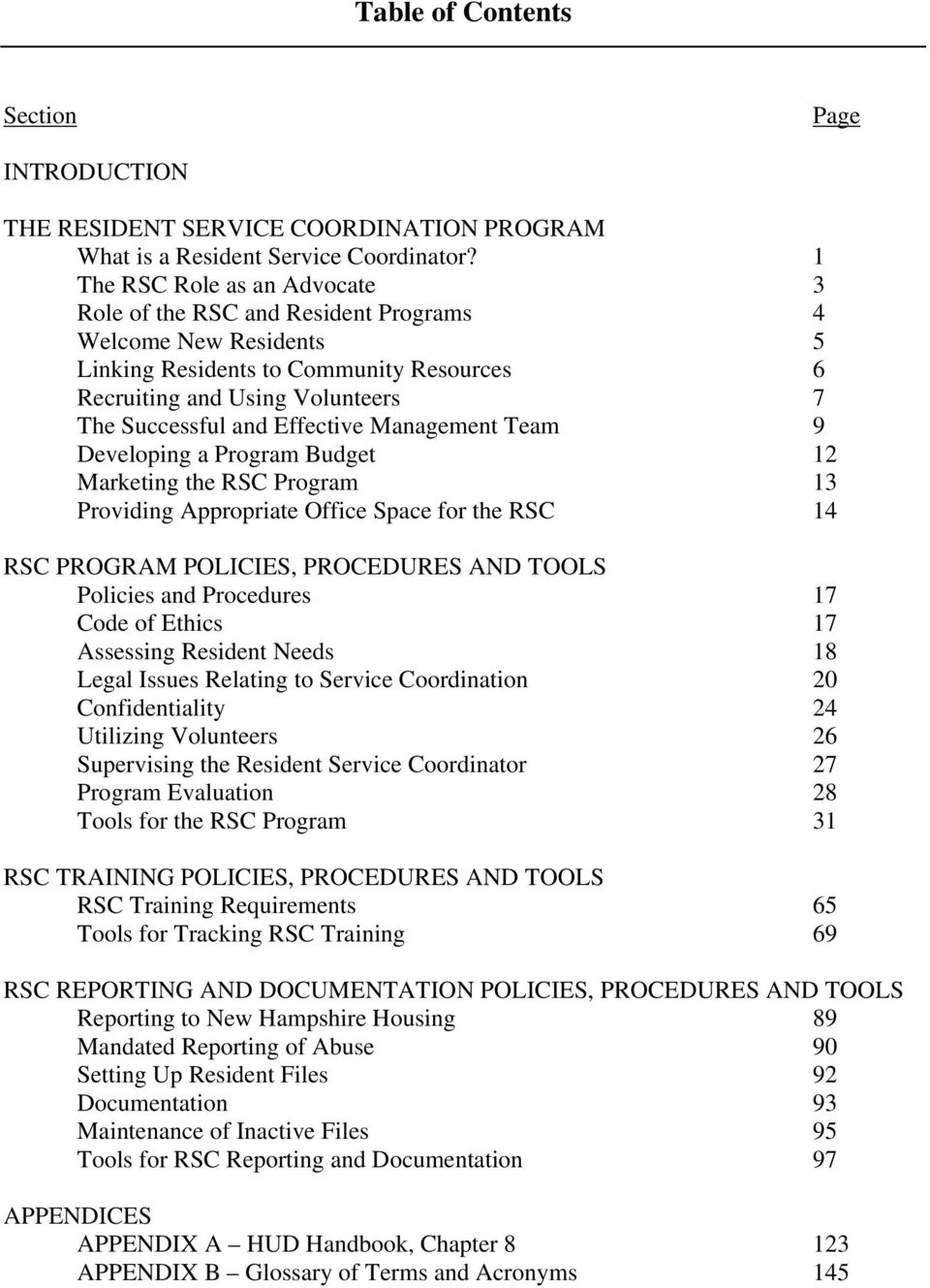
5 Table of Contents Section Page INTRODUCTION THE RESIDENT SERVICE COORDINATION PROGRAM What is a Resident Service Coordinator? 1 The RSC Role as an Advocate 3 Role of the RSC and Resident Programs 4 Welcome New Residents 5 Linking Residents to Community Resources 6 Recruiting and Using Volunteers 7 The Successful and Effective Management Team 9 Developing a Program Budget 12 Marketing the RSC Program 13 Providing Appropriate Office Space for the RSC 14 RSC PROGRAM POLICIES, PROCEDURES AND TOOLS Policies and Procedures 17 Code of Ethics 17 Assessing Resident Needs 18 Legal Issues Relating to Service Coordination 20 Confidentiality 24 Utilizing Volunteers 26 Supervising the Resident Service Coordinator 27 Program Evaluation 28 Tools for the RSC Program 31 RSC TRAINING POLICIES, PROCEDURES AND TOOLS RSC Training Requirements 65 Tools for Tracking RSC Training 69 RSC REPORTING AND DOCUMENTATION POLICIES, PROCEDURES AND TOOLS Reporting to New Hampshire Housing 89 Mandated Reporting of Abuse 90 Setting Up Resident Files 92 Documentation 93 Maintenance of Inactive Files 95 Tools for RSC Reporting and Documentation 97 APPENDICES APPENDIX A HUD Handbook, Chapter APPENDIX B Glossary of Terms and Acronyms 145
6

7

8

9 INTRODUCTION Resident Service Coordinators (RSCs) are a valuable resource and an important member of the management team. RSCs link residents to existing services and resources in the community, assist residents to build an informal support network among themselves, encourage residents to be proactive in meeting their social, psychological and physical needs, provide conflict resolution assistance as appropriate and seek out assistance with existing community resources when needed. RSCs increase the ability of residents to uphold their lease obligations such as paying rent on time, taking proper care of their units and ensuring quiet enjoyment of the property for all residents and surrounding neighbors. RSCs are an integral part of the management team addressing the needs and difficulties of residents that can jeopardize tenancy. They promote effective partnerships among housing providers, property managers and service providers to improve a project s financial viability/stability, benefiting current and future residents and ultimately the community at large. RSCs are usually the management company s main link to the larger community in which a complex is located. They support efforts that enhance a resident s quality of life and build healthy communities through the active participation and cooperation of onsite management, neighborhood agencies and residents. The RSC s ability to work with community agencies on behalf of the residents goes a long way in enhancing good will and the position of the complex as a resource in the community rather than as a drain on community resources. This manual is a resource for RSCs and property management of both multifamily and elderly properties to use and refer to when setting up RSC programs as well as when issues arise. The entire manual and appendices are available online at or by calling ext Many of the forms in the manual are available in a fillable MS Word format. The policies, procedures and guidelines that are cited in this manual were developed based on HUD RSC procedures and the American Association of Service Coordinator s Code of Ethics with input from New Hampshire RSCs. We strongly recommend that RSC programs in housing that are administered and/or financed through New Hampshire Housing conform to these policies and procedures. The forms and resources at the end of the manual are samples of recommended tools. RSCs are free to use them as is, edit them to meet specific site and program needs, or use other similar documents as long as they address the requirements of these policies and procedures. Technical assistance in establishing an RSC program or in integrating these policies and procedures into an existing program is available for New Hampshire Housing financed or administered properties by contacting our Housing Services group.

10

11 THE RESIDENT SERVICE COORDINATION PROGRAM What is Resident Service Coordination History of Service Coordination Resident Service Coordination became recognized as an important part of property management through successful demonstration programs in the early 1990s sponsored by the Robert Wood Johnson Foundation, the National Association of State Housing Authorities, the U.S. Administration on Aging and the ongoing funding of this position by the U.S. Department of Housing and Urban Development. The American Association of Service Coordinators (AASC) was founded in AASC is a leader in advocating for service coordination to be recognized as a profession and for HUD funding of Resident Service Coordinators (RSCs) in elderly properties. They hold an annual conference and have developed a Standards of Practice and Code of Ethics booklet, a policies and procedures manual, on-line courses that meet HUD training requirements and a webbased data management system for RSCs reporting. For more information visit their website at RSCs and Social Work In many ways RSCs and social workers share a common goal: to assist people in need to access the resources and services they need to survive and thrive in their lives. In developing the standards of practice and code of ethics, AASC drew heavily from the National Association of Social Workers materials. Like the social worker, the RSC is committed to working with people in a way that is nonjudgmental, nonintrusive and confidential, and in promoting resident empowerment and autonomy. However, social work often takes the form of assessing a person s need and making recommendations for his/her care and this is where the RSC field diverges. It is often a social workers role to assess a situation and make a recommendation based on his/her expertise as to what the person/family needs. Recommendations made by social workers often have life altering impact on an individual and his/her family. The role of the social worker is to advocate for what he/she believes to be in the best interest of the person/family. It is not a part of the RSCs role to make these kinds of assessments and determinations. The role of the RSC is to enable residents to live as independently and self-sufficiently as possible by informing them of available services and assisting them in obtaining the services they choose to use, including advocating for the resident when necessary. The RSC s assessment of a resident s needs focuses on what the RSC can objectively see, what third parties have reported and what the resident reports. With this assessment the RSC provides the resident information on services and resources that may help and assist with linking residents with the services they want. The RSC also provides residents (and their families, as appropriate) with information on the potential consequences of the choices they are 1
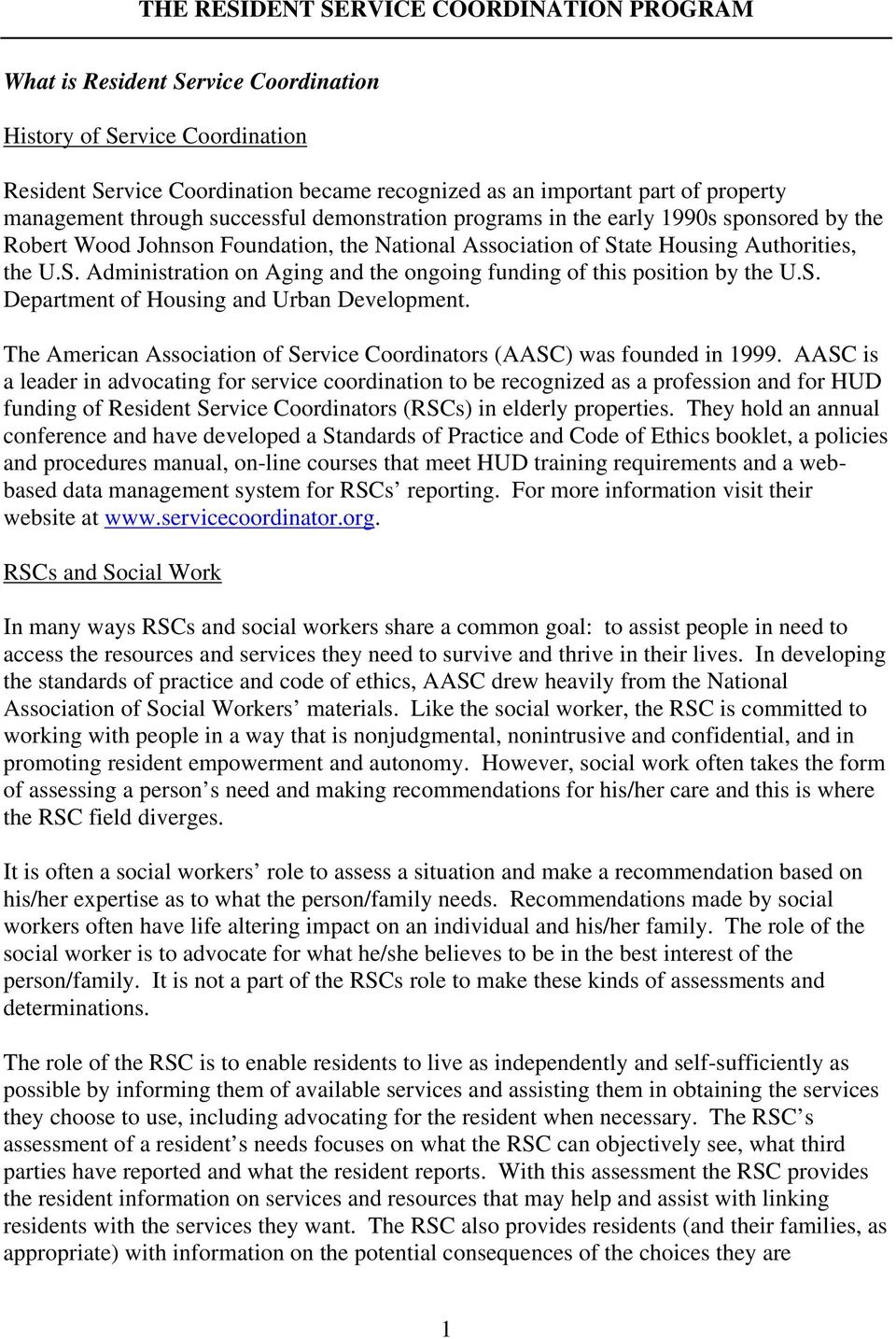
12 considering, including the RSC s need to file a Protective Services report for some outcomes. The RSC makes referrals to appropriate professionals, including social workers, for more indepth and hands-on assessments. Residents choice and the freedom to make their own decisions is the bottom line, even if their choice is considered poor from the RSC s professional viewpoint. As important as the RSC s work with individuals, the RSC s work to promote safe living environments and encourage the growth of the community is equally important. The RSC networks and collaborates with agencies and community groups to bring resources into the housing community for the benefit of many of the residents. When hiring an RSC, her/his personal attributes, knowledge and skills are vitally important, more so than her/his educational level. The following essential attributes, knowledge, skills, education and experience provides the foundation for an effective RSC. A sample job description for the RSC is provided at the end of Section II, RSC Program Policies, Procedures and Tools. Personal Attributes Has a sense of humor. Has a positive, open, caring, non-judgmental and non-patronizing demeanor. Has a positive self-esteem. Behaves ethically and sets appropriate boundaries. Is willing and able to continue learning through formal and informal education. Is open to suggestions and positive criticism. Is responsive and flexible. Is a team player and consensus builder. Develops positive professional relationships for peer support and networking. Knowledge Base Understands family life cycle issues. Understands human relations. Understands group processes. Understands housing rules and regulations such as Fair Housing, the Americans with Disabilities Act and reasonable accommodation. Understands disability issues and adaptive devices. Understands entitlement programs and other federal, state and community resources. Understands confidentiality and disclosure requirements. Skills Excels at listening. Possesses excellent written and oral communication skills. Establishes trust quickly. Excels at addressing individual and group conflicts. Excels at motivating individuals of varying ages and abilities. 2

13 Flexibly handles situations as they arise. Excels at time management and organization. Sets limits and boundaries effectively. Treats all residents fairly and equitably. Remains calm in crisis situations. Networks with community agencies to access programs for residents. Advocates effectively for residents when needed. Excels at problem solving. Education, Training and Experience A Bachelor of social work or related degree or an equivalent combination of education and experience. A minimum of 36 hours of training prior to hiring or within the first 12 months on the job covering all of the following areas: o Aging process (if serving the elderly) o Elder services (if serving the elderly) o Strategies for dealing with cognitive impairments (if serving the elderly/disabled) o Economic development and employment opportunities (if serving families) o Domestic violence, elder abuse and child abuse o Building safe communities o Disability services o Eligibility for and procedures of federal and applicable state entitlement programs o Legal liability issues relating to providing service coordination o Drug and alcohol use and abuse o Mental health issues o Strategies for communicating effectively in difficult situations A minimum of 12 hours of continuing education each year (see Section III, RSC Training Policies, Procedures and Tools). Two to three years of experience in social service delivery with senior citizens, non-elderly disabled, low-income families and/or children depending on the resident population. Supervisory and management experience if the RSC oversees others. Demonstrated working knowledge of entitlement programs, supportive services and other resources for the resident population they are being hired to serve. The RSC Role as an Advocate To advocate is to act in support of a cause or proposal. Often times it is working to access services, benefits, or other necessary supports. Advocacy is an important skill for RSCs, as many residents (family or elderly) may not feel empowered to advocate for themselves. Whether teaching residents to advocate for themselves or advocating on their behalf, it is essential to gain the resident s permission before acting. 3

14 Advocacy can be on behalf of a group of residents or for one resident. It may include the following: Advocating for services or increased services from a local agency or provider. Advocating a resident s cause with an entitlement agency, for example the resident s need for a home visit, waiver of rules or other reasonable accommodation. Working with the manager to approve reasonable accommodation requests. Working with care providers to take advantage of economies of scale by providing services onsite. Problem solving with community agencies. Providing education and information to service providers or state agencies about residents needs or lack of resources. Encouraging Resident Self-Advocacy: Organizing skill development workshops on topics such as empowerment and assertiveness so residents can learn self-advocacy. Assisting residents with documenting problems effectively. Offering letter writing assistance. Offering support for family or agency meetings. Role-playing with residents to demonstrate how they can assert their needs or wishes with service providers and others. Essentials for modeling advocacy for residents: Respecting confidentiality. Acting responsibly and teaching residents to act responsibly by observing rules and regulations of all programs. Using diplomacy, courtesy and respect encourage residents to do the same when writing or speaking to management or outside agencies. Documenting the problem and the response of those contacted. Seeking out the problem solver and coming to the table as a problem solver (not a complainer) when dealing with other organizations. Asking questions to gather information without being argumentative. Role of the RSC and Resident Programs According to HUD s Chapter 8 on Service Coordination, a Service Coordinator links residents in subsidized housing to supportive services or medical services provided by public agencies or private practitioners within the general community. HUD also states that the Service Coordinator should not be assigned responsibility as the project s recreational or activities director, nor provide support services directly (except in emergency situations). The Service Coordinator cannot assist with other administrative work normally associated with the project(s) operating budget. 4

15 Outlined below are acceptable roles for the RSC to be involved in and some to avoid entirely. Appropriate RSC Activities: Welcome new residents within two weeks of move in, letting them know of the RSC role in the management team. Develop a directory of local services. Work with management to develop a house or community rules handbook. Provide referrals for services. Educate residents and assist them in accessing entitlement programs and other federal, state and community resources. Advocate for services and programs on behalf of individual residents and the residential community as a whole. Survey residents to learn about their unmet needs and program interests (see Section II, RSC Program Policies, Procedures and Tools). Encourage and help residents organize activities like support groups, skill building workshops and social events. Coordinate monthly or bi-monthly onsite programs and services for the resident community related to increasing the residents independence or self-sufficiency such as healthcare, finances, career development or benefits. Coordinate collaborative efforts with community groups (i.e., girl or boy scouts, churches, civic groups, schools, self-help groups), community agencies and volunteers to provide onsite social and support activities and services; i.e., congregate meals, after school programs, day care or computer education. Produce a monthly newsletter and/or calendar of events. Inappropriate RSC Activities (find an agency, other staff or volunteer to perform these activities): Running errands for residents. Providing personal care or housekeeping services. Calling bingo games. Facilitating support groups. Assessing resident s mental or physical level of functioning. Collecting rent. Administrative duties for the management company or owner. Welcome New Residents Moving to a new community can be a stressful time for residents. Providing information on the property s service program and the RSC s role and responsibilities to every new resident prior to move in will alleviate some of the resident s stress and help him/her adjust to their new community more quickly. Follow-up by the RSC within two weeks of move-in 5
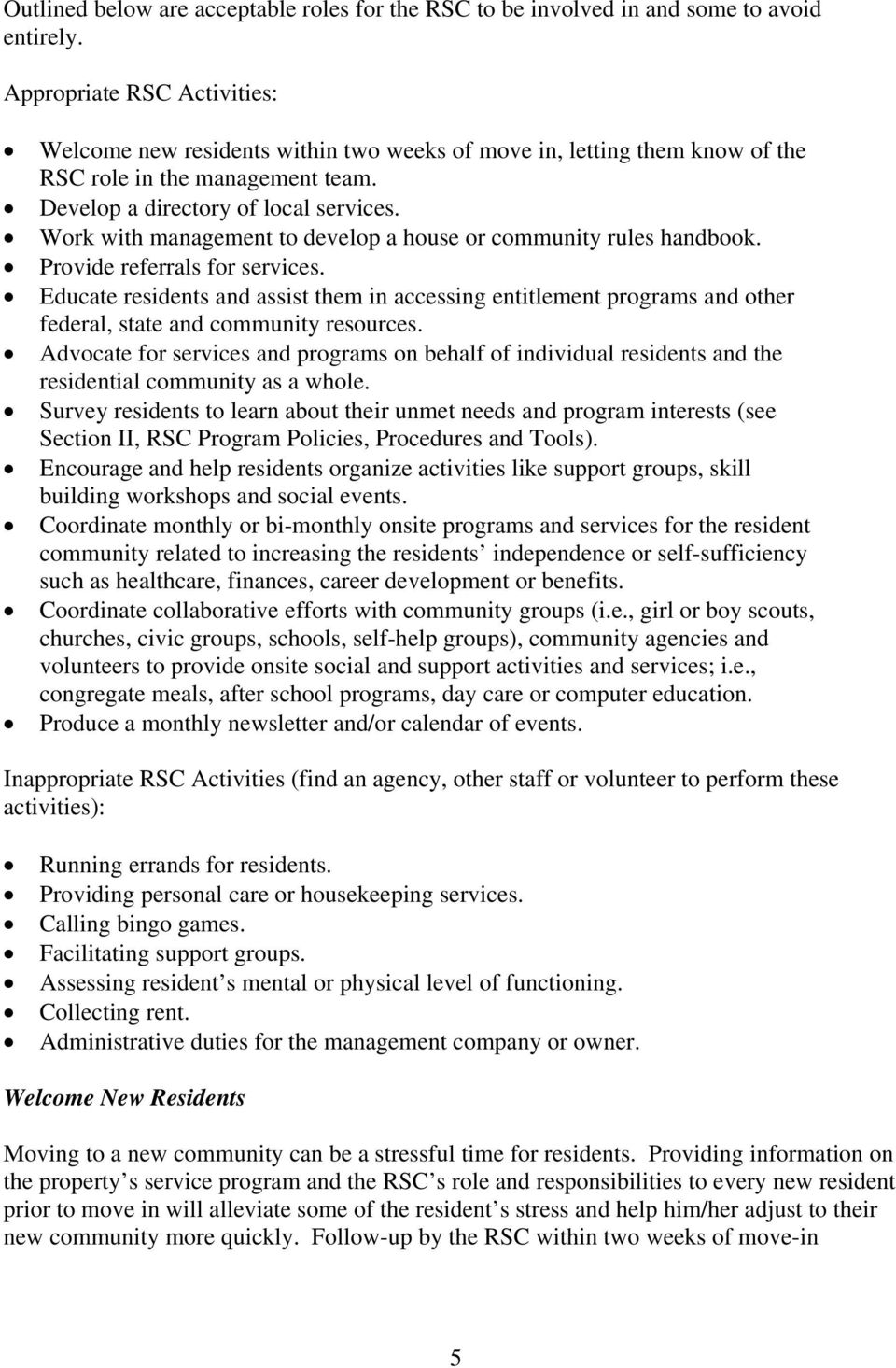
16 whenever possible is an effective way to begin a good relationship with each resident and to identify service needs and make appropriate referrals before a crisis happens. A plan to make new residents aware of service coordination needs to be established and consistently followed to be effective. An information sheet for new residents that includes the RSC s role, name and contact numbers, office hours and the location of the office is recommended. Ideally the manager will notify the RSC as soon as possible when a new resident is moving in and provide the new resident with a brochure or flyer about the RSC/services program. When the RSC meets with the new resident, it is recommended that a folder of information be provided that includes: Flyers and pamphlets from local agencies A list of supportive services offered in the area, such as: o Pharmacies that deliver o Churches, synagogues, mosques o Child care providers, after school programs o Meal sites and nutrition services o Transportation programs. Examples of the services the RSC can refer to and assist in obtaining, such as: o Medicare, Medicaid o Understanding insurances statements and medical bills o Food stamps, commodity foods, WIC o Home care, housekeeping services o Parenting resources o Career counseling and job search assistance o Credit counseling and money management The property s monthly newsletter or calendar A written explanation of how: o You and the manager work together and independently o Confidentiality works (this is an appropriate time to have the resident sign the Release of Confidential Information Form found in Section II, RSC Program Policies, Procedures and Tools An Emergency Information Sheet (it is not recommended for RSCs to keep copies of the emergency information sheets in their files, because the material can become quickly outdated without the RSC knowing; encourage the resident to update annually or sooner as information changes and to put in a place known to local EMTs) Linking Residents to Community Resources A key role of the RSC is the linking of the resident to community resources. In order for an RSC to be effective, they must be knowledgeable in area resources. 6
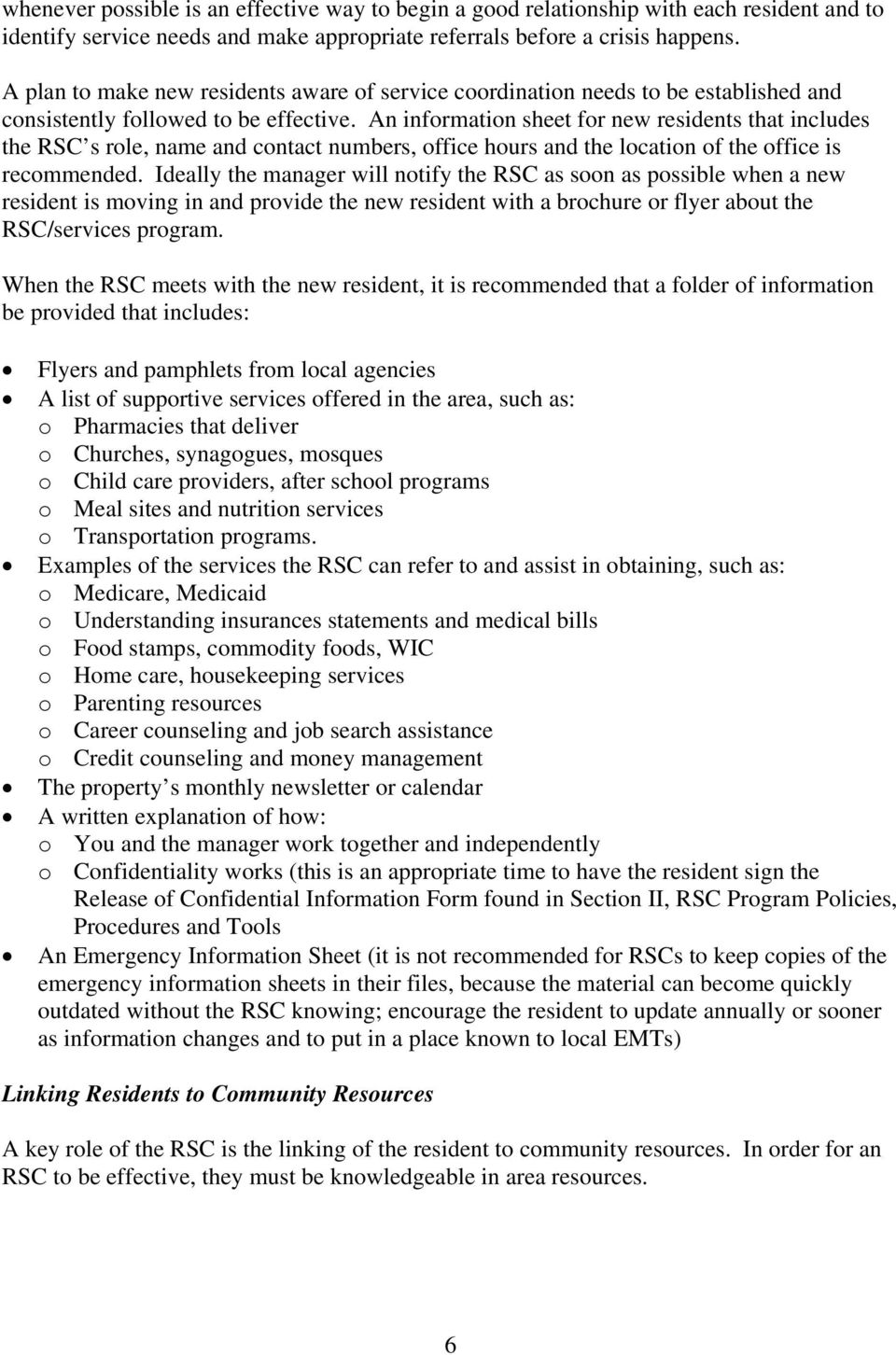
17 Strategies for developing and staying up to date with community resources: Create opportunities for networking with other service providers. Learn the complexities of each local agency and get to know agency representatives on a personal basis. Attend area human service provider meetings several times a year and get on their mailing list for agendas and minutes. Collect brochures of state and community agencies Develop a resource database. RSCs need to have on file a list of resources where residents can get food stamps, home health services, mental health services, food banks, Medicaid, meals, transportation, domestic violence services, substance abuse services, career development services, credit counseling, parenting resources, to list a few. Don t re-create the wheel; check to see if United Way, ServiceLink or another agency has an updated resource list for your area. Use New Hampshire Housing s online directory at or contact ServiceLink at Create a file for each agency listing the services they offer. This can be a computerized or a paper file. Be sure to collect information that includes telephone numbers, contact people, details about eligibility, restrictions on services, benefits and office hours. Linkage to community services is not just for meeting the health care needs of residents. Successful linking may include: o Knowing the religious leaders who may be able to meet the spiritual needs of an individual or the resident community. o Visiting the local library to initiate a book delivery program. o Connecting with a local theater to inquire about free or reduced ticket prices for residents. o Seeking out volunteer programs for residents to participate in or receive services from. o Provide space for skill building workshops, support groups, after school programs, a computer center, and social events. Formal or informal, professional or volunteer, usual and unusual programs and agencies are available to be sought out to help meet the needs of the residents. By doing this the RSC accomplishes two things. First, it brings important and useful information to the residents. Second, it provides an opportunity to share information about the needs of the resident community and the role of the RSC to the service provider. Recruiting and Using Volunteers Volunteer services can be used to augment or fill gaps in services. Volunteers can be recruited by using existing volunteer programs such as RSVP, Interfaith Volunteer Caregivers, Big Brothers/Big Sisters, Voluntary Action Program, Literacy Volunteers, AARP, AmeriCorps, Foster Grandparents and Senior Companion to name a few. A list of volunteer groups and opportunities may be found through local information and referral center, ServiceLink, NH Helpline and United Way. Volunteers recruited from wellestablished volunteer programs have job descriptions and receive supervision by the volunteer agency with the RSC providing onsite monitoring. 7
18 Many RSCs have been successful working with service clubs to access volunteers and others have found success in working with faith congregations or schools. Another important source of volunteers is the residents in your community. The RSC needs to know how to manage liability risk when using volunteers that are not through a volunteer agency (see Section II, RSC Program Policies, Procedures and Tools). Below are a few ideas of how volunteers can enhance existing services. Volunteers can help individual residents by: Providing simple companionship, either in person or phone visitation. Providing respite to a caregiver of a disabled child or adult. Providing support to parents. Mentoring youth. Tutoring and helping with homework. Helping with household chores and/or teaching housekeeping skills. Taking pets to the veterinarian. Providing transportation to shopping, medical, educational and employment related activities. Assisting the sight or cognitive impaired resident with paying bills or reading. Assisting with errands or shopping. Assisting with reduction of clutter by organizing photo albums, mementoes, sorting through clothing, books and newspapers, mending, organizing cupboards and closets. Teaching technological operations and skills such as operating VCRs, DVDs, computers, answering machines, cell phones, etc. Reminiscing and assisting with life reviews, writing autobiographies, memoirs and stories. Helping to write letters, cards, etc. Taking residents for cemetery visits or clean-up, to visit friends and family in nursing homes. Taking residents on trips, such as fall foliage rides. Screening for home safety (throw rugs, candles, extension cords, lighting, clutter, child safety locks, electrical outlet safety plugs, etc.). Volunteers can help with group activities like: Calling bingo. Providing youth activities. Providing skill-building workshops (i.e. parenting, career related, budgeting/debt management, assertiveness, grief management, cooking, etc.). Facilitating weekly coffee hours and resident networking groups. Facilitating social activities (coffees, potlucks, card games, chess and checkers). Raising funds for activities. 8

19 Facilitating hobby groups (knitting, crocheting, sewing, scrap booking, crafts, holiday decorations, etc.). Facilitating self-help and support groups. Residents can also volunteer to: Organize "get to know your neighbors" activities. Help with after-school activities (reading, games, etc.). Share/teach a hobby or skill. Write articles for the newsletter. Distribute the newsletter/flyers. Maintain the bulletin board. Set up for activities/groups. Water plants in community areas. Plant flowers in gardens. Welcome new residents. Daily telephone reassurance calls. Essentials for working with volunteers: Provide a description of duties, limitations and protocols for even the smallest of tasks. Provide orientation for duties and monitor volunteer activities regularly. Provide on-going support and training. Recognize volunteers frequently in a variety of low-cost ways. Recognize volunteers formally each year. Hospitals, churches, schools, and libraries are great places for residents to volunteer. Place notices about volunteer opportunities for residents on the community bulletin board. The Successful and Effective Management Team: The RSC and the Property Manager The work of the RSC and property manager will compliment each other s role in a successful and effective management team. The key to a successful relationship is based upon the understanding and clarity of each person s role and responsibility as well as the willingness and commitment to a collaborative team approach. It is critical that both parties have open communication and regularly update each other. Successful Management Teams: Are committed to the team approach and to the mission of the housing complex. Educate and orient all staff and residents regarding the role and responsibilities of the RSC and property manager. Establish and work toward common goals. Work to improve policies and procedures within the housing complex. 9

20 Have mutual respect for one another s professional boundaries, roles and areas of expertise. Understand and recognize the benefits of one another s roles and responsibilities. Establish an RSC referral process and form. (See Section VI, RSC Reporting and Documentation Policies, Procedures and Tools.) Establish maintenance and management request forms and process. Communicate processes, policies and procedures to residents. Support one another and present a united team approach to residents, to the rest of the staff and to the community at large. Communicate effectively by providing, seeking and valuing feedback from one another. Establish a team process for problem and conflict resolution. Share knowledge of training and networking opportunities. Attend joint training opportunities. Respect and maintain resident confidentiality. Respond to each other in a timely, courteous and respectful manner. Share relevant written materials, memos, lease violations, notices and updates on a regular basis. Meet and communicate regularly to review challenges and successes, and to address problems and create solutions. Consider developing and using a meeting report form. Consider reviewing and co-signing appropriate communication to residents and staff to promote team effort. Follow the same policy regarding the acceptance of gifts. The Role of the RSC on the Management Team is to: Provide outreach to residents regarding entitlement programs and services available to assist them. Link residents with services and resources to address their needs. Provide support and referrals to residents to assist them in remedying lease violations to help prevent evictions and decrease resident turnover. Support problem-solving and mediation between residents. Identify potential resident problems (health-related, interpersonal, etc.) and intervene before a situation becomes a crisis. Coordinate with property manager on issues related to the health and safety of residents and building/unit maintenance. Coordinate the delivery of prevention programs for residents such as: home injury, safety prevention and other wellness and safety programs, social and recreational activities, and support groups. Develop and support resident leadership and participation in resident programs and activities. Maintain documentation of interactions and interventions with residents. Work to empower residents to advocate for themselves; to be independent and selfsufficient. Advocate for services for residents as appropriate. Promote community-building activities. 10
21 Promote partnerships with community groups, neighborhood-based resources and organizations. Provide data and information for budget planning and grant applications. The Role of the RSC is NOT to: Provide social activities for residents (coordinating activities is acceptable). Assess resident s level of functioning (assessing service needs is acceptable). Provide transportation. Provide medical services, diagnoses or medical advice. Provide direct services or hands-on care. Perform front office administrative tasks. The Role of the Property Manager on the Management Team is to: Assure the physical maintenance of the housing complex. Assure the safety and security of the complex and its residents. Manage the property. o Handle new admissions. o Market the housing complex. o Promote resident retention. o Collect rent, manage occupancy issues, enforce the lease and deal with compliance issues. Monitor the budget and be responsible for other financial management. Provide information and referrals to the RSC. Assist and participate in the planning of activities and services and coordinates activities with service providers as needed. Adhere to and comply with government and funding source regulations and requirements. Supervise property staff (sometimes this includes the RSC). The Dual Role of RSC and Property Manager Sometimes a property manager is asked to take on the additional role of service coordination. While this is not a common practice around the country, there are quite a few property managers in New Hampshire that are also the RSC for the property. This can be an acceptable way of bringing service coordination to a property that cannot afford a separate RSC position; however, it is important to be aware of potential conflicts and dilemmas that may arise and to be prepared to respond appropriately. Balancing the duties of both positions within the allocated time is often difficult management issues often appear pressing and time sensitive and may push out the seemingly less urgent service coordination responsibilities until the issues become critical. 11
22 Being a successful manager and a successful RSC require similar but somewhat different knowledge bases and skill sets. One individual may not have all the requirements to be successful in both positions. Attending trainings specific to each field is important. Alternating hats as needed may be confusing to the residents. Where possible set up specific times for residents to come to you for assistance with services that are not urgent. When handling a difficult resident situation utilize community resources to give yourself and the resident as much support from others as possible. Developing a Program Budget While someone in finance or management generally develops the RSC budget, it s important to know that there is a bottom-line impact on the company for providing service coordination to the residents. The management and financial people in your company are very aware of how much it costs. Generally, only the RSC knows how much the service coordination they provide saves the management company and owner in other costs such as damaged property, turnover expenses and eviction costs. The following will provide you with a general idea about the budget process and what role you may be able to play. A budget details all expenses including salary, fringe benefits, overhead (building operating and maintenance costs, operations, management and support costs) and other direct expenses planned for the year. A good budget is one that balances the anticipated expenses against the anticipated revenues, including earned and grant income generated during the course of the year. The management agent is generally responsible for all aspects of the site budget; however the RSC can assist the manager with the budget planning process by providing budget information about the RSC program. This is particularly important when applying for grant funds. Along with a program plan and narrative, grant makers look for a financial picture of the organization. Funders, whether they are grantors or owners, are interested in data to justify dollar requests. Tracking the number of people served, the type of service provided and the number of hours of service each year will help the RSC determine the cost per unit of service. Cost per unit of service is figured by dividing the cost of the RSC program by the total number of people served or hours of service. In addition, they want to see the in-kind offerings of individuals and agencies quantified in dollar amounts. For example, what the dollar value of the home health agency staff s time is when they do a blood pressure clinic at your complex. What are the steps in the budget process? Review previous year s budget comparing projected figures to actual and note any onetime or unusual events that impacted the actual figures for the year. Review goals and objectives for the coming year. Determine activities and associated costs to reach those goals and objectives. Include costs for any special programs or events. 12
23 Account for potential changes such as personnel changes. Include costs related to training and conferences. Evaluate office needs and costs for computer, equipment and supplies. Budget for income as well as expenses. Marketing the RSC Program: Promoting the Profession Although service coordination is a relatively new field it is increasingly recognized as a vital and integral part of a successful and effective management team. To ensure that the residents and their families understand the role of the RSC it is important to provide written information to them during the leasing process. It also continues to be important for the RSC to actively engage in activities that educate not only residents and management but also service providers and the community at large about their housing and resident service coordination to increase the linkage between the residents and the larger community. The following ideas will help the RSC promote the critical role she/he plays in the service provider network: Regularly remind residents of the services and programs that the RSC can provide. Use your job description as a guide to develop a brochure or flyer about the RSCs role. Ask management to include the brochure or flyer and a welcome letter from you in the move-in packet and hand out or mail to residents families and service providers. Meet with new residents within two weeks of their move-in date, whenever possible, to share with them the programs offered at the complex and to identify any service needs. Publish a newsletter, sending copies to community agencies to keep them abreast of services and activities that take place at your site. Attend area health and human service provider meetings and network with colleagues. Collaborate with area service providers. For example, invite the home health agency to have a community flu shot clinic at your site. Get to know residents and their families by inviting them to an open house let them know how you can help their family member stay independent. Have an open house for service providers; give a tour of the building, have them meet the manager, and talk about your role and the residents needs. Invite people from local business, health and human service agencies, residents family members, residents, and site staff to meet as a group to identify ways to improve service delivery. If you have extra space, invite a service provider to use that space on a regular basis. Extra office space could be used for health clinics or as a consultation room for off-site service providers. If you have a computer learning center for residents, open it up to seniors and/or kids in the community one or two days a week. Computer classes for older adults or classes to increase job skills for younger adults can also be used as a tool to market service coordination. 13
24 Administer a resident satisfaction survey yearly (see Section II, RSC Program Policy, Procedures and Tools); often just asking questions about services helps to market the program. This list is not exhaustive as each community is unique. Use it as a starting point to create your own plan. Creating multiple marketing opportunities increases the effectiveness of your RSC program. Providing Appropriate Office Space for the RSC Planning for and providing office space for an RSC in existing housing can be a challenge as it usually means the manager or maintenance person may have to give up some of their space. The HUD How-To Guide for Service Coordination states that the RSC should not share space with anyone else on the management team. The reasons for this and how to prepare a space are outlined below. Private office space is needed for: Confidential phone conversations Confidential meetings with residents or families Maintaining and organizing confidential records Problem solving complicated issues. Ways to address the challenges of no office space and options for developing new office space are discussed below. RSCs can use residents apartments for private meetings; however this may present confidentiality and liability problems. Keep in mind that not all residents are comfortable inviting the RSC into their apartment. If someone else is in the apartment, the RSC needs to ask the resident privately whether he/she is comfortable talking with the person there. Including the person on the Release of Confidentiality form is the best way to handle the situation. Be sensitive to the resident s feelings and the nature of the discussion when talking with a resident in front of someone else, even if it s an adult child, other family member or a service provider. Enclosing an area in the community room may offer potential space. Consideration can also be given to taking an apartment off-line and converting it to an office and/or community space if no other space is available. (Such an option needs approval from the HUD contract administrator.) Submit a grant to HUD to cover the costs of developing office space. 14
25 If absolutely no space is available onsite consider forming a partnership with a community provider who may be located in the neighborhood. While it may not be possible to create private office space at all sites it is essential that the RSC has a place to discuss confidential issues with residents without others hearing. Essential office equipment: Office furniture: desk, chairs, file cabinet with lock. Phone, fax, copier and a cell phone. Computer with Internet access and printer. RSCs use computers for writing reports, record keeping, documentation, communicating with service providers, searching for resident services, searching for funding of services. RSCs with multiple sites may want to consider a laptop computer. General office supplies. 15
26 16
27 RSC PROGRAM POLICIES, PROCEDURES AND TOOLS Policies and Procedures Policy It is critical for management companies to have policies and procedures developed for RSCs to follow when they are hired that reflect those contained in this manual and the ethics and standards of care of the RSC profession as detailed in the American Association of Service Coordinators (AASC) Code of Ethics. This is in addition to the standard policies and procedures of the management company such as grievance policies, emergency plans, review process for termination or denial of services, etc. Policies and procedures provide RSCs with the foundation they need to do their job well and protect the company by establishing performance expectations for the RSC. Procedure Management companies are responsible for ensuring that the RSCs they hire or contract with are provided with policies and procedures. The policies and procedures contained in this manual may be adapted and used by the management company or the management company may create its own policies and procedures using this manual as a guide. Policies and procedures addressing the following need to be in place prior to hiring the RSC. Code of Ethics Assessing Residents Needs Legal Issues Confidentiality Using Volunteers Supervising the RSC Evaluating the RSC Program Training Reporting to New Hampshire Housing Mandated Reporting Of Abuse, Neglect and Exploitation Setting Up Resident Files Documentation Maintenance of Files Code of Ethics Policy The RSC has a responsibility to a variety of stakeholders, including residents, family members, housing management, other funders and, sometimes, outside organizations. The RSC s behavior with all of these stakeholders must be in accordance with the ethical standards of their profession in order to ensure quality service and reduce liability concerns. 17
28 New Hampshire Housing requires that RSCs and their organizations adhere to the AASC Code of Ethics to guide the RSC in their actions and decision making. Procedure The AASC Standards of Practice Committee (on which New Hampshire Housing had representation) developed a code of ethics for service coordination for RSCs, managers and owners to follow in the provision of service coordination. The AASC Code of Ethics is available online at The AASC Code of Ethics is a resource for RSCs and managers to help guide the development and implementation of their housing services program and the RSC s work and role with the residents and within the management company. Assessing Resident Needs Policy The RSC s role in assessing a resident s need for services is limited to what she/he observes, third-party reports and information provided by the resident. Clinical assessments, when needed, including functional assessments of the resident s abilities and limitations need to be referred to an appropriate agency/practitioner. If a management company chooses to allow their RSC to perform functional assessments of residents, the management company is responsible for ensuring that they have adequate insurance coverage to perform the assessment and that they are performing the assessments in compliance with all applicable state and federal statutes and regulations. Procedure While HUD still uses the term resident needs assessment in its materials for RSCs, including on the RSC Semi-Annual Report, New Hampshire Housing uses the term service needs assessment to reduce confusion regarding the nature of appropriate resident needs assessments by RSCs in independent housing. The Service Needs Assessment involves the RSC completing the following to assist the resident in determining what service, if any, is appropriate to meet the resident s needs. 1. Discussing with the resident what the resident wants and needs for services or other assistance. 2. Discussing with the resident what the RSC objectively knows about the resident s need for services, such as seeing the resident fall, unsupervised children, unsanitary living conditions, conflicts the RSC has witnessed the resident have with other residents, etc. 18
29 3. Discussing with the resident any third-party information or concerns related to the resident s need for services as appropriate, such as, the resident being brought back to the complex by someone who found her/him wandering downtown; the housekeeper finding the stove left on three times; or a neighbor seeing children throwing rocks at cars in the parking lot. 4. Discussing with the resident the services and resources available to address the resident s service needs, including the eligibility requirements, cost of services, and the benefits and limitations of each service as known by the RSC. 5. Allowing the resident to choose the service that he/she believes will best meet his/her needs, to choose an alternative solution, or to choose not to have any service. 6. Advising the resident of potential consequences of not accepting services, such as eviction, protective services referral, bill for damages, etc. 7. Assisting the resident in contacting any service provider or agency the resident chooses, to the extent they need and request assistance. Encouraging the resident to be as independent as possible. 8. Providing collateral information to the referral agency as permitted and/or requested by the resident. 9. Following-up with the resident to ensure that the services were received and met the service need. 10. Continuing to work with the resident until the service need is met or the resident refuses further assistance. The Service Needs Assessment does NOT involve the RSC in any of the following. 1. Making a subjective determination of the resident s need for services. 2. Completing a functional assessment of the resident s abilities or limitations. 3. Listing or inquiring about the resident s medical conditions, medical or non-medical treatments, or prescription or over-the-counter medications. 4. Referring the resident to any service the resident does not want unless it is for protective services (see Section VI, RSC Reporting and Documentation, Policies, Procedures and Tools). 5. Evaluating the success of any service provided. 6. Ensuring that the service the resident wants is the best match for the resident s need. 19
30 7. Ensuring the quality of the service provided. 8. Ensuring the follow-through of the resident regarding the service. Legal Issues Relating to Service Coordination Policy The RSC will create strategies to reduce the risk of legal liability by doing what is legally responsible, ethically correct and following the guidelines of their job description, their company s policies and procedures and the standards of care of the RSC profession. Potential areas of legal risk: Negligence Injury Discrimination Conflict of Interest Acceptance of Gifts Handling Residents Money Procedure The following information is meant to inform RSCs about legal issues related to service coordination that may arise in the course of their work. While it is the responsibility of the manager to assess risk and manage potential liability as a part of the management team it is critical for the RSC to be knowledgeable in these issues particularly as they may arise in the provision of service coordination. RSCs are in the front line and need to be aware of what kinds of actions and statements may put themselves and their management company at risk of a lawsuit. The procedures following each quote are intended to provide guidance to RSCs in minimizing exposure to liability due to negligence, injury and discrimination in their daily work. They consist of generally accepted best practices for RSCs and are not intended to replace the advice of an attorney. New Hampshire Housing advises management companies to consult a knowledgeable attorney when developing and implementing policies and procedures for risk management. Negligence The following quotes were excerpted from an article on negligence in West's Encyclopedia of American Law. A person has acted negligently if he or she has departed from the conduct expected of a reasonably prudent person acting under similar circumstances 20
31 Communicate clearly in writing to residents what your role and responsibilities are as their RSC so that residents, families and service providers know what to expect. This can be included in the welcome packet and reviewed with residents annually and as needed. In general implementing a consumer-driven model of supportive services not only enhances resident autonomy, self-determination and independence it has the added benefit of reducing exposure to negligence and injury lawsuits because the responsibility for decision making remains with the resident. o o Help residents identify what they need for services, provide them with information regarding the service and contact information for the providers of the service. Make referrals only as needed. However the final decision regarding whether to use services, what services to use and which providers to contract with is the choice and the responsibility of the resident. When performing an assessment to determine a resident s needs explore with the resident what he/she feels is needed and provide the resident with objective information. If the resident needs a formal assessment, refer him/her to agencies that provide that service. It is important to note that once the RSC has learned of a resident problem she/he is responsible for appropriately following up. Conduct must be judged in light of a person's actual knowledge and observations Document objectively what you actually see, hear and do. Avoid documenting subjective comments and hearsay. Practice good documentation be detail oriented, consistent, neat, objective and record follow-up activities. NEVER use white out or corrective tape in records. Neatly cross through any error, initial and date. (See Section VI, RSC Reporting and Documentation, Policies, Procedures and Tools.) If a person engages in an activity requiring special skills, education, training, or experience the standard by which his or her conduct is measured is the conduct of a reasonably skilled, competent, and experienced person who is a qualified member of the group authorized to engage in that activity Stay current with the standards of care of service coordination through memberships with professional associations such as the New Hampshire Association of Professional Service Coordinators (NHAPSC), the American Association of Service Coordinators (AASC), the National Association of Social Workers (NASW), and the Association of Homes and Services for the Aging (AHSA). These policies and procedures and the AASC Code of Ethics constitute standards to which RSCs will be held. If you are also a social worker you may be held to NASW standards as well. Do not perform functions, such as assessments, outside of what you have been trained to perform. The learner, beginner, or trainee in a special skill is held to the standard of conduct of persons who are reasonably skilled and experienced in the activity. 21
32 Know and follow your job description, your organization s policies and procedures, and AASC s Code of Ethics. When in doubt ask questions of your supervisor and others in the field as to what the RSC s role is in a given situation. Regular supervision needs to be provided to every RSC; however it is especially critical to new employees. (See the subsection on supervision in this Section.) The reasonable person anticipates, and takes precautions against, foreseeable emergencies. Included in the management company s policies and procedures should be procedures outlining potential emergencies and how to respond to them. Every site needs to have an emergency plan. Familiarize yourself with it so that you can help management implement it in case of emergency. Service plans for residents need to address potential emergency situations as well and outline the course of action to be taken if the emergency does arise. Finally, the reasonable person takes into account the conduct of others and regulates his or her own conduct accordingly. A reasonable person must even foresee the unlawful or negligent conduct of others if the situation warrants. The RSC needs to discuss with the resident the impact of factors that are beyond their control when they develop the service plan. Such factors include the possibility that care providers may not arrive as scheduled or at all. The resident needs to have and consider such information when making an informed decision about their service plan. Injury Negligence must lead to injury for a lawsuit to have merit. To establish negligence, a plaintiff must prove that the defendant had a duty to the plaintiff, the defendant breached that duty by failing to conform to the required standard of conduct, the defendant's negligent conduct was the cause of the harm to the plaintiff, and the plaintiff was, in fact, harmed or damaged. Never provide hands-on care. If someone falls, don t help them up. Moving them may further injure them; call 911. Do not provide transportation without adequate insurance coverage. Follow your company s transportation policy. Discrimination Even though discrimination in housing is generally a management issue, RSCs need to be aware of issues surrounding discrimination and how even unintended discrimination may place the organization at risk of a lawsuit. For example, if the RSC discusses a potential resident s disability with a service provider it may give the perception that the management company is using information about the person s disability in their decision about resident selection, which is illegal. This type of information gathering is fine after the person has 22
33 been accepted as a resident as long as confidentiality is maintained and the RSC has the resident s written permission. Federal and state fair housing laws promote equal housing opportunities. These laws make it illegal to treat a person differently in housing based on that person's race, color, national origin, disability, sex, religion or familial status (children). New Hampshire law also protects its residents against housing discrimination based on an individual's age, marital status and sexual orientation. To encourage open communities, Fair Housing laws prohibit certain practices. It is unlawful for housing owners, landlords, housing managers, realtors and others involved directly or indirectly in the rental or sale of housing or housing lots to discriminate in: The advertising of an available apartment, home or housing lot. The rental, sale or negotiation for the rental or sale of housing. The provision of home financing or real estate brokerage services. Additional information can be found at the HUD website FHLaws/index.cfm and through The National Fair Housing Advocate Online at and through New Hampshire Legal Assistance s Fair Housing Project at The following information on the Americans with Disabilities Act (ADA) and reasonable accommodation was excerpted from the New Hampshire Commission for Human Rights website. For more information visit them at Both New Hampshire law and federal laws protect persons with disabilities against discrimination under certain circumstances. New Hampshire law protects against discrimination on the basis of disability in housing, public accommodations and employment. If you have questions about your rights under state law call the Commission for Human Rights at The Americans with Disabilities Act, a federal law, protects individuals with disabilities in employment, transportation, public accommodations and communications services. Various agencies enforce the different Titles of this Act which deal with the separate areas of employment, transportation, etc Regularly attend trainings on Fair Housing and ADA to keep abreast of new court cases and standards for reasonable accommodation. Consider fair housing and ADA issues when implementing services. Discuss any fair housing, ADA and reasonable accommodation issues and requests with the property manager before responding to ensure that they are consistently handled in accordance with the management company s policies and procedures. 23
34 Conflict of Interest The RSC must take care to avoid any real or perceived conflict of interest. An example of conflict of interest would be serving on the board of an agency that competes with other agencies to provide contracted services to residents of the property. Acceptance of Gifts It is strongly recommended that RSCs do not accept any gifts from residents or their families. Other residents may perceive the acceptance of even small gifts as favoritism toward the gift giving resident. A written policy established by the management company is the best way of handling this issue. It is helpful to provide this policy in the materials provided to residents at move-in and review at the RSC s first visit to avoid later embarrassment to the resident. Suggest to residents and family members who feel offended by your refusal that a gift that benefits the residents as a whole would be acceptable. Having this policy in effect also reduces the risk that a resident will forget that they gave something as a gift and accuse the RSC of stealing. Handling Residents Money RSCs should make every effort to encourage residents to have a trusted family member or friend help them manage their money as the need arises. If there is no one that s acceptable to them a referral to a service or volunteer agency is in order. Do not handle residents money. The risks include being accused of mishandling funds if money is lost or unaccounted for or of taking advantage of your position of authority as a part of the management team to unfairly influence the resident. You may know and trust your residents; however in the early stages of dementia people are forgetful and may often have paranoid thoughts about others leading to false accusations. The RSC must never accept any money from the resident or family for performing any service. The RSC is always a part of the management team and volunteering to perform services outside of that position raises serious ethical and legal liability questions. Note: Following the above procedures will not eliminate legal risk. New Hampshire Housing recommends seeking professional legal advice and review of all policies and procedures. Confidentiality Policy Confidential information about a resident is to be treated respectfully and with great concern for the resident s privacy. However, the RSC is a part of a larger management team and the files belong to the management company and may be accessed by other members of the management team on a need-to-know basis. There are several reasons why a manager would need to access the files, such as for supervision and to follow-up on issues in the absence of 24
35 the service coordinator, so it is essential that the RSC inform residents that the manager and other staff of the management company have access to files on this need-to-know basis and to explain to the resident the reasons why this is necessary. Residents also need to be informed that the files need to be available for quality assurance reviews by state and/or federal agencies. Confidential information regarding a resident may be released to other parties when there is a signed and dated release of confidential information form in the file. (See the Tools at the end of this Section.) It is also important to let residents know that confidentiality may be broken in the event of an emergency and will be broken when there is a lease violation, suspected fraudulent activity, suspected abuse or neglect, if they present a clear and present danger to themselves or others, or if the information is subpoenaed by a court of law. Procedure It is the RSC s responsibility to assist residents in fully understanding the protection and limitations of the Release of Confidential Information form. At resident move-in. and at least annually thereafter, it is recommended that RSCs have residents sign a Release of Confidential Information form and explain how confidentiality is handled with the manager and regulatory agencies. At the same time, the RSC can explain to residents what information the RSC will keep confidential and when the RSC may be required by law (either Federal or State) to share confidential information. It is also important to let the resident know what information needs to be kept in their file and what information does not. Section VI, RSC Reporting and Documentation Policies, Procedures and Tools provides a list of the information that may be in a resident file. The Release of Confidential Information form is used when the RSC needs to share resident information with outside agencies, family members or other informal caregivers or friends and neighbors. It is important for the RSC to explain to residents what information is to be shared, how the information will be used and to whom the information will be shared. The form is signed and dated by the resident and a copy placed in the resident file. The Release of Confidential Information form is good for up to one year before another one needs to be executed; however, any additional people/agencies the RSC needs to contact on behalf of the resident must be added and initialed by the resident on the existing form or on a new form before they can be contacted. The RSC needs to take care to avoid accidental breaches of confidentiality by being sure that sensitive information is discussed only behind closed doors. It is recommended that faxes with confidential information are used for urgent situations only and that precautions are taken to be sure that the intended recipient is at the other fax machine to receive the information. When using to send resident information, it is best if the RSC removes any identifying information to protect the resident. 25
36 Health Insurance Portability and Accountability Act (HIPAA) In response to questions from RSCs about HIPAA rules related to confidential information, we are including the following from the Centers for Medicare and Medicaid Services website (as of October, 2005) for your convenience: The Administrative Simplification standards adopted by HHS under the Health Insurance Portability and Accountability Act of 1996 (HIPAA) apply to any entity that is: o o o a health care provider that conducts certain transactions in electronic form (called here a "covered health care provider") a health care clearinghouse a health plan In addition, if a the person, business, or agency does not furnish, bill or receive payment for health care in the normal course of business it is not a covered agency. Health care services include: 1. Preventive, diagnostic, rehabilitative, maintenance, or palliative care, and counseling, service, assessment, or procedure with respect to the physical or mental condition, or functional status, of an individual or that affects the structure or function of the body; and 2. Sale or dispensing of a drug, device, equipment, or other item in accordance with a prescription. See 45 C.F.R Utilizing Volunteers Policy Using residents as volunteers to assist with recreational activities, such as calling Bingo and convening craft or hobby groups, or assisting with the community newsletter is encouraged. Using volunteers from established volunteer agencies for other activities is recommended because they generally have job descriptions, policies and procedures and insurance coverage for the volunteers they place. It is critical to have the volunteer follow the placement agency s policies and procedures while onsite, especially when working directly with the residents. Procedure The RSC needs to manage potential liability by training and orienting every volunteer in what they can and cannot do as a part of their volunteer work with the residents. Important areas to cover are whether it is acceptable to provide transportation or to provide hands-on assistance, such as helping someone in and out of a chair or changing a baby s diapers. Both of these responsibilities may incur additional liability for the property and it is important for 26
37 there to be adequate insurance to cover any problems that may arise. Insurance coverage can be through the property s insurance, the volunteer agency s insurance policy, the volunteer s automobile insurance or a combination. The best way to know if you ll be adequately covered is to discuss potential volunteer services with your property s insurance agent. Tools for managing liability for volunteers include specific and detailed job descriptions, ongoing training, supervision, and monitoring of every volunteer s work and hours. It is also important to monitor that volunteers do not take on staff responsibilities or they may be able to demand pay, retroactively, for that work even though they were initially brought in as a volunteer. Supervising the Resident Service Coordinator Policy Proper supervision of the RSC role requires a person who has the knowledge, skills and expertise to supervise the RSC s work. The property manager or other management company staff may effectively perform programmatic and administrative supervision, however if this person does not have the qualifications to effectively provide quality assurance oversight of the RSC s work with residents, it is strongly recommended that a consultant be hired to provide coaching for the RSC in this area. HUD allows between eight and 10 percent of the RSC s salary for this purpose. Minimum Recommended Qualifications for the RSC Supervisor: A Master s Degree in social work or a related field; or A Bachelor s Degree in a social work or a related field with two or more years experience as an RSC in elderly and/or family housing; or Four or more years experience as an RSC in elderly and/or family housing; and Excellent working knowledge of federal and state services and programs and the ability to research services and resources locally; and Excellent written and verbal communication skills. Prior supervisory experience preferred. Procedure The RSC Supervisor: Provides training and orientation to new RSCs, including reviewing the job description, management company policies and procedures, file maintenance and New Hampshire Housing training and reporting requirements. Clearly defines and communicates the role of the RSC position to others involved in the property management team. Develops target outcomes with the RSC using the Logic Model or similar format. (See Tools at the end of this Section.) 27
38 Implements quality assurance monitoring of the RSC program, including but not necessarily limited to: o Monthly monitoring of the Service Needs Assessments and resident files during the first year and quarterly thereafter. o An annual program evaluation. Assures compliance with HUD and New Hampshire Housing training and reporting requirements. Advises the RSC in the development of programs. Directs the RSC in the development of a resource directory. Evaluates the RSC yearly. New Hampshire Housing s Housing Services staff may be used as a resource when difficult housing issues arise. They can provide technical assistance and consultation on an as needed basis to RSCs and Supervisors. REAP Counselors are also available to provide consultation about specific resident issues. To access REAP services call ServiceLink at x Program Evaluation Policy Program evaluation is an integral part of any successful program. In addition, residents needs generally change over time and on-going programs need to be regularly updated to remain effective. An annual survey of residents needs regarding their satisfaction with the service coordination and supportive services available onsite is critical to ensuring the ongoing success of the RSC/service program. Gathering additional input from local service providers and families is also highly recommended. In addition to the subjective information provided by the surveys, it is important to establish outcome-based measures annually. Outcome measures show the impact of providing service coordination, programs and activities on the residents. HUD now uses a Logic Model to determine the effectiveness of the majority of the programs they fund (see the Tools section) and similar information is now required for state funded programs. Using the Logic Model to target the RSC s activities toward generating specific outcomes, provides an important way to measure which activities are effectively meeting the residents needs and the management company s goals. Procedure A tool and instructions for using a Logic Model to establish outcome-based measures for evaluating the effectiveness of current programs is at the end of this Section. For outcomebased measures, determine the goals and objectives that will guide the RSC s work during the year and then identify appropriate activities. Estimate the outputs that the activities will generate as well as the anticipated outcomes and how the data will be measured. Outputs include data such as, the number of people attending a program or participating in an event; percent decrease in evictions for non-payment of rent. Outcomes are those things that 28
39 happen as a result of participation, such as the number of people who changed a behavior as the result of information provided at the program or event. New Hampshire Housing s Housing Services staff is available to provide technical assistance with the evaluation process as needed. A sample Resident Satisfaction Survey is in the Tools at the end of this Section. Customize the Resident Satisfaction Survey to address specific programs or issues at each complex, explain to residents the importance of giving honest feedback and give them a deadline by which to return the survey. It s important to allow residents the option of remaining anonymous when returning the survey and to emphasize that individual answers will be confidential, but that a compilation of the survey answers may be discussed. It is also helpful if the survey is returned to someone other than the RSC. If residents tend not to return surveys, think of ways to make it more fun or rewarding. Hold a drawing for a donated gift certificate to a local store or restaurant for everyone who returns the survey by the deadline. Hold a kick-off coffee to hand out the survey. After the surveys have been returned and the results compiled, schedule a follow-up meeting/coffee to discuss the results with residents. If residents responses to the surveys show that everything is fine, but your experience doesn t support that conclusion, use this meeting to dig deeper. Hold a focus group yourself or enlist the assistance of other professionals or volunteers. Discuss potential changes to programs with residents to get their buy-in. Usually some residents welcome change while others resist it. Work with the residents to establish consensus whenever possible. Tweaking existing ways of doing things is usually more successful than a complete overhaul. Breaking change into smaller steps and getting resident input at each step can lead to successful programs. Reaching out to quieter residents ensures their needs will also be met by program changes. Getting buy-in from the most resistant residents is sometimes possible by having them assist with the planning of new programs. Use the survey results and outcome-based measures to highlight program successes and/or show a need for additional resources when applying for grants or discussing funding needs with management. Maintain a written compilation of the results of the survey and outcomebased measures with an action plan for the following year. The action plan is especially useful in making a smooth transition when a there is a change in RSC. Compare the survey results and outcome-based measures from year to year to see program trends and direction. Include questions on the next survey to help in understanding trends. Select outcome measures to define changing trends. 29
40 30
41 Tools for the RSC Program 1. Resident Service Coordinator Position Description 2. Service Needs Assessment 3. Release of Confidential Information Form 4. RSC Annual Evaluation Form 5. Resident Satisfaction Survey 6. Logic Model Outcome Measurement Form 31
42 32
43 1. Resident Service Coordinator Position Description The Resident Service Coordinator is a valuable resource and an important member of the property management team. Every position of the management team requires a job description to provide clear delineation of duties and responsibilities a guide as to who does what. The RSC job description is a valuable tool and reference not only for the RSC to understand role responsibilities, but also serves as a tool to educate other members of the team as to what responsibilities fall under the umbrella of the RSC program. Included is a generic job description. A customized job description should be developed for the Resident Service Coordination position to more accurately reflect the policies and procedures of the management company as well as the appropriate lines of supervision. 33
44 34
45 Resident Service Coordinator Position Description Mission The Resident Service Coordinator s (RSC) mission is to enable residents to live as independently and self-sufficiently as possible while maintaining their dignity and autonomy by informing them of available resources, assisting them in obtaining the services they choose to use and advocating for the resident when necessary. The RSC is committed to working with people in a way that is nonjudgmental, non-intrusive, confidential and that promotes resident empowerment, autonomy and dignity. The RSC promotes safe living environments and encourages the growth of community to better meet the needs of individual residents in housing communities. Goals Following established professional standards of practice and code of ethics, the RSC works to: Increase the ability of residents to uphold lease obligations (timely rent payment, proper unit maintenance and quiet and peaceful enjoyment of the property for residents and neighbors). Support efforts that enhance a resident s quality of life, empower them and promote the resident s independence and self-sufficiency. Build healthy communities through the active participation and cooperation of the management team, community agencies and residents. Facilitate the provision of program support and/or intervention to stabilize families in need through coordination with community resources. Responsibilities The RSC as appropriate to the resident population and setting: 1. Welcomes new residents and explains the RSC program as well as appropriate and available community resources, programs and services. 2. Identifies need for assistance; educates on available resources; links and connects residents with appropriate programs and services as requested. 3. Develops linkages with community service organizations and programs. 4. Keeps current regarding available community resources, federal, state and local programs and fulfills required education and training requirements. 5. Works with the management team to identify residents who need assistance; supports resident retention; promote educational and wellness activities for residents; provides a safe community; foster and build sense of community. 6. Advocates for residents and acts as liaison between residents and management as well as with the community. 7. Encourages residents self-advocacy and empowerment in meeting their social, psychological, physical, economic and other self-sufficiency needs. 35
46 8. Follows mandated reporting requirements according to adult and child protective state statutes. 9. Maintains appropriate resident files with proper documentation of information in a secure location to ensure privacy and confidentiality. 10. Follows-up appropriately with residents. 11. Evaluates the outcomes of the RSC program annually. 12. Fulfills timely reporting requirements for state and federal agencies. Qualifications Bachelor s Degree in Human Services or a related field, or an equivalent combination of education and experience. Proven experience in social service delivery, problem solving and advocacy for and with low-income people. Proven ability to work with people of all walks of life, individually and in groups. Excellent oral and written communication, organization and time management skills. Knowledgeable about services available to assist people with a disability, housing, drug or alcohol abuse, domestic violence or mental health issue. Knowledgeable about eligibility requirements, application procedures and benefits of federal and state entitlement programs. Ability to work well with minimal direction. Ability to use a computer to maintain resident files, search for services and file required reports. 36
47 2. Service Needs Assessment The Service Needs Survey is recommended to be used as an assessment of a resident s service needs. Ideally this tool will be used at move-in and updated annually. Both the introductory letter and the survey may be customized for each property. 37
48 38
49 Service Needs Resident Letter Dear Resident: As your Resident Service Coordinator at, helping you get your needs met is important to me. I ll provide you with information about services and programs that can help you and link you with the services and support you choose. To better serve you, I need to know what services you currently need or believe you may need in the future. The following Service Needs Survey will help me collect this information and will be kept confidential in accordance with our policies. If you need assistance in completing this survey or have any questions about service coordination or available services, please visit me [WHERE CAN YOU BE FOUND] during [INSERT HOURS HERE] or call me at [INSERT PHONE #] to set up an appointment. Please return survey to: Please return survey by: at: Sincerely, Resident Service Coordinator 39
50 Service Needs Resident Survey Please check the programs, or write in others, that you or other residents would find helpful. Information on Entitlement Programs: Medicare/Medicaid/Healthy Kids SSA/SSI/SSDI (Social Security Benefits) Veteran Benefits TANF (Temporary Aid for Needy Families) APTD (Aid for the Permanently and Totally Disabled) Food Stamps Food Commodities (free basic food) WIC (Women, Infant, and Children) Child Support Enforcement Fuel/Utility Assistance Vocational Rehabilitation Services Legal Assistance Other Assistance with Personal/Family Needs: Adaptive Equipment Personal Emergency Response Systems Housekeeping/Personal Care Choosing a Childcare Provider Credit Counseling Budgeting/Money Management Parents Supporting Parents Group Single Parent Support Group Drug Awareness/Prevention Domestic/Family Violence and Abuse Health Screenings ServiceLink, NH Helpline, Info & Referral Other Personal Development Training: Assertiveness Training Interpersonal Communication Conflict Resolution/Problem Solving Nutritional Planning on a Budget Smart Shopping Storytelling/Reading to Your Child Learning About Your Child s Behavior Self-Help Support Groups Other Education Programs: Career Development Homeownership Readiness English as a Second Language GED Preparation Computer Learning Center Adult Learning Opportunities Other Recreational/Fun Activities: Special Interest/Hobby Groups Multi-Cultural Programs Game Nights Pot Luck Dinners Intergenerational Programs Trips Other Youth Programs and Activities: After School Programs DARE Programs Boys and Girls Club Playgroups Computer Classes Babysitting Classes Boy/Girl Scouts Teen Activities Sports/Games Homework Club Mentoring Adopt a Grandparent Other Assistance with Housing Issues: Being a Good Tenant Housekeeping/Organization Home Injury Prevention Neighborhood Safety Building a Better Community Other To help plan or put on activities or programs, please provide your name and contact information: Name: Apt. #: Phone: Thank you your help is appreciated! 40
51 3. Release of Confidential Information Form Confidential information regarding a resident may be released to other parties when there is a signed and dated Release of Confidential Information form in the file. It is also important to let residents know the reasons that confidentiality may be broken. This form fulfills both of these needs. It is recommended that the RSC have the resident sign this form at their first meeting and at least annually thereafter. Be sure to have the resident initial and date each agency they are authorizing you to talk with. This form may be accepted by the agencies listed as a release that allows their staff to share pertinent resident information with you as well. 41
52 42
53 Release of Confidential Information Form I hereby authorize, the Resident Service Coordinator of housing complex, to receive and provide information for the specific purpose of assisting me to get and maintain the benefits and/or services I have requested. This authorization will remain in effect for one year and expires on understand that I have the right to revoke this consent at any time.. I My initials authorize these agencies to release confidential information for the above purpose: Agency Name Initials/Date I understand that confidential information will only be shared with those agencies and/or individuals involved in the delivery of services I request and with State or Federal Agencies who may need this information to monitor the quality of services provided to me. The exceptions to this are: 1. The RSC is required by law to report anyone who is a danger to themselves or someone else. 2. The RSC may be ordered by a court of law to reveal information I have shared if it relates to a case before the court. 3. The RSC is responsible to report lease violations to the manager. Print Name of Resident (or Legal Guardian) Date Signature of Resident (or Legal Guardian) Date 43
54 44
55 4. Resident Service Coordinator Annual Evaluation Form The RSC evaluation form is a guide and may be used in a variety of ways: as a selfevaluation tool by the RSC; by the RSC Supervisor as part of the RSC s annual performance review; or as needed at other times. This tool was originally developed by National Church Residences, Inc. for their RSC program in elderly housing and has been adapted and reprinted here with their permission. With some small adjustments, this tool would work equally as well with RSCs in family properties. 45
56 46
57 RESIDENT SERVICE COORDINATOR ANNUAL EVALUATION FORM Housing RSC Name: Complex(s): Date of Hire: Reports to: Reviewer: Date of Review: 47 PERFORMANCE EVALUATION Key: 4=Exceeds All Requirements 3=Meets All Requirements 2=Meets Some Requirements 1=Unsatisfactory N=Not Applicable DUTIES AND RESPONSIBILITIES Completes all assigned tasks in a timely manner as instructed by supervisor. Maintains orderly and consistent system of files and record keeping. Resident files are kept in a locked filing cabinet. Works as a team member with manager in serving residents. Follows up on resident situations the manager believes may need supportive services. Creates and maintains an atmosphere of warmth, personal interest and positive emphasis, as well as, a calm environment. Treats residents, family members, visitors and fellow employees with courtesy, respect and dignity. Meets with supervisor on a regular basis to assist in identifying and correcting problem areas and/or improving services. Meets acceptable attendance requirements and gives notice when late arrival to or absence from work according to established policy. Total Points This Page: Date: Job Specific Orientation 90 Day Evaluation; Competency ( = demonstrated competency) Date: Evaluation/ Competency Date: Evaluation/ Competency Date: Evaluation/ Competency Date:
58 48 PERFORMANCE EVALUATION Key: 4=Exceeds All Requirements 3=Meets All Requirements 2=Meets Some Requirements 1=Unsatisfactory N=Not Applicable DUTIES AND RESPONSIBILITIES (continued) Adheres to established employee policy. Maintains confidentiality regarding corporate and resident matters. RESIDENT RIGHTS Assists residents in building informal support networks among themselves and with family members and friends. Alerts resident before entering their apartments. Reports all grievances and complaints made by residents to management. Responds to complaints within 5 days. Encourages residents to be pro-active in meeting their social, psychological and physical needs. Avoid creation of unhealthy dependence. Assists residents in understanding lease and tenancy obligations. Acts as a liaison between residents and management company. Reports all allegations of resident abuse to proper authorities. CORE PERFORMANCE Meets with new or prospective resident/families to make them aware of available services and RSC program. Total Points This Page: Date: Job Specific Orientation 90 Day Evaluation; Competency ( = demonstrated competency) Date: Evaluation/ Competency Date: Evaluation/ Competency Date: Evaluation/ Competency Date:
59 49 PERFORMANCE EVALUATION Key: 4=Exceeds All Requirements 3=Meets All Requirements 2=Meets Some Requirements 1=Unsatisfactory N=Not Applicable CORE PERFORMANCE (continued) Assists and advises residents and families of the services which may be necessary to maintain a self-reliant life style. Promotes wellness activities for residents. Monitors the delivery of services to resident to ensure they are appropriate, timely and satisfactory and may also manage such services when appropriate. Provides limited case management (i.e. evaluation of social, psychological and physical needs and development of a service plan) for a resident when the local community is not providing such a service. Meets with service providers as needed and appropriate. Educates residents concerning consumer fraud and abuse. Provides Medicare and Medicaid education for residents, families and staff. Assembles a directory of community services and makes it available to residents, families and staff. Provides educational/informational programs for residents. Plans annual safety talks for residents. Completes time sheets and monthly reports in a timely manner. Encourages socialization and social activities among residents in conjunction with the Resident Council if applicable. Performs other related duties as required. Total Points This Page: Date: Job Specific Orientation 90 Day Evaluation; Competency ( = demonstrated competency) Date: Evaluation/ Competency Date: Evaluation/ Competency Date: Evaluation/ Competency Date:
60 50 PERFORMANCE EVALUATION Key: 4=Exceeds All Requirements 3=Meets All Requirements 2=Meets Some Requirements 1=Unsatisfactory N=Not Applicable WORK RELATIONS/TEAM WORK Understands the relationship of this job to the organization s values and mission and to the other jobs in the organization. Willingly works with co-workers, supervisors and staff to solve problems and to improve processes and services. Networks with other social service providers. Develops and maintains good working relationships with social service and health care providers in the communities surrounding housing sites. Works cooperatively with staff to develop a positive work atmosphere. Participates in regular (weekly) staff meetings. Identifies and acts on opportunities to help and support work efforts of co-workers. Asks for help and support of own work efforts when appropriate. PERSONAL RESPONSIBILITY/ACCOUNTABILITY AND MISSION SUPPORT Instances of absences and tardiness are within acceptable levels. Willingness to work overtime when asked is demonstrated. Total Points This Page: Date: Job Specific Orientation 90 Day Evaluation; Competency ( = demonstrated competency) Date: Evaluation/ Competency Date: Evaluation/ Competency Date: Evaluation/ Competency Date:
61 51 PERFORMANCE EVALUATION Key: 4=Exceeds All Requirements 3=Meets All Requirements 2=Meets Some Requirements 1=Unsatisfactory N=Not Applicable PERSONAL RESPONSIBILITY/ACCOUNTABILITY AND MISSION SUPPORT (continued) Ways to improve work processes, efficiency and quality are identified and discussed with the supervisor and other appropriate staff members. Consistent effort and attention to work results in quality services and performance. RESIDENT, GUEST AND INTERNAL CUSTOMER FOCUS Sensitivity to emotional, spiritual and practical needs of residents, families, guests and staff members is demonstrated in all interactions. Positive feedback and comments about the quality of work and effort have been offered by residents, families and co-workers. Priorities, schedules and efforts are adjusted to meet specific customer needs. Problems related to safety, cleanliness and comfort of resident and work areas are reported to appropriate personnel. SAFETY Follows established infection control precautions and procedures. Wears and/or uses safety equipment and supplies when indicated. Total Points This Page: Date: Job Specific Orientation 90 Day Evaluation; Competency ( = demonstrated competency) Date: Evaluation/ Competency Date: Evaluation/ Competency Date: Evaluation/ Competency Date:
62 52 PERFORMANCE EVALUATION Key: 4=Exceeds All Requirements 3=Meets All Requirements 2=Meets Some Requirements 1=Unsatisfactory N=Not Applicable SAFETY (continued) Uses only equipment trained to use. Demonstrates job-specific knowledge of fire and disaster preparedness during drills or actual situations. Operates all equipment in a safe manner. Total Points This Page: Total Points From Page 1 Total Points From Page 2 Total Points From Page 3 Total Points From Page 4 Total Points From Page 5 Total Points From Page 6 TOTAL POINTS FOR ALL SECTIONS Date: Job Specific Orientation 90 Day Evaluation; Competency ( = demonstrated competency) Date: Evaluation/ Competency Date: Evaluation/ Competency Date: Evaluation/ Competency To determine the PERFORMANCE RATING, divide the TOTAL POINTS FOR ALL SECTIONS by the total number of items scored in all sections (i.e. of the 83 or more items listed an employee may receive 240 total points divided by 70 items scored = Please remember that some employees will be scored on fewer or more items depending on their job duties in your center). The resulting score rounded to the nearest 10 th (i.e = 3.50, 2.75 = 2.80) is used to determine the employees PERFORMANCE RATING as outlined below. NOTE: If the resulting performance rating is 2.50 or less, the supervisor must initiate a formal Performance Improvement Plan and follow-up with the employee to ensure goals are being met. PERFORMANCE RATING: 4=Exceeds All Requirements 3=Meets All Requirements 2=Meets Some Requirements 1=Unsatisfactory N=Not Applicable Date:
63 RSC Name: Date: Please list area for improvement and performance improvement measures to be taken: Supervisor comments: 53 Employee comments (please attach an additional sheet if necessary):
64 54
65 5. The Resident Satisfaction Survey It is strongly recommended that a Resident Satisfaction Survey be conducted by property managers or RSCs at least annually and as needed for quality assurance to ensure that residents are satisfied with the resident service coordination program. The most reliable information will be given by the residents when someone other than the RSC collects the information. Customize the letter and survey according to the services provided at the property. 55
66 56
67 Resident Satisfaction Survey Letter Dear Resident: Date: Please take a moment to complete the following satisfaction survey regarding the Resident Service Coordinator (RSC) and the available services and activities at. Your responses will be used to help us make the program the best it can be. All responses will be kept confidential in accordance with our policies., your Resident Service Coordinator will not see individual surveys, so if you need help with something, please contact her directly at. Return the survey to. Thank you for your time. Sincerely, 57
68 Resident Satisfaction Survey 1. Do you know how to contact, your Resident Service Coordinator? Yes No 2. In the last year how many times have you talked with or requested assistance from the Resident Service Coordinator? Never or more 3. Please rate the following statements based on your experience: The Resident Service Coordinator is. a. Available and approachable to me and others by phone or in person Not True Somewhat True Very True b. Professional, polite and courteous to me and others. c. Knowledgeable about services in the community. d. Responds to requests in a timely manner. 4. Have you attended one or more resident activities in the past six months? Favorite activity Least favorite activity 5. Do you receive a monthly newsletter? Yes Yes No No Do you find the information in your monthly newsletter useful? 6. Are there any additional services / activities that you would like to see available? Please List: Yes No Additional Comments? If you have any questions or suggestions regarding services and activities, please contact your Resident Service Coordinator at. She/he will not see this survey. 58
69 6. Logic Model Outcome Measurement Form The Logic Model is being used more and more by funding agencies at the state and federal levels, as well as by private foundations, as a way to ensure that the programs being funded are creating the intended outcomes. The Logic Model Outcome Measurement Form was adapted from HUD Form to be more applicable to the RSC program. 59
70 60
71 Logic Model Form (adapted from HUD Form 96010) RSC s Name: Complex(s) Name: Strategic Goals Problem, Need or Situation Service or Activity Benchmarks Outcomes Measurement Tools Targeted Output Targeted End Results Output(s) Results Outcome(s) Policy Planning Intervention Impact Accountability Short Term Evaluation Process 61 Intermediate Term Long Term
72 62
73 Logic Model Instructions Column 1: Strategic Goals: It is important to specify goals for the RSC to meet on an annual basis. Examples: to ensure that 95% of the residents know how to contact their RSC when they need assistance finding services; to reduce evictions by 50%. Column 2: Problem, Need, or Situation: Provide a general statement of need that provides the rationale for the proposed service or activity. Column 3: Service or Activity: Identify the activities or services that you are undertaking in your work plan, which are crucial to the success of your program. Not every activity or service yields a direct outcome. Column 4: Benchmarks/Targeted Outputs: Set quantifiable output goals, including timeframes. These should be products or interim products, which will allow you to monitor and assess your progress in achieving your program workplan. Column 5: Benchmarks/Output Results: Report the actual result of the service or activity. The actual result could be the number of activities provided, the number of people attending a program, or the number of people assisted. Outputs may be short, intermediate or longterm. Column 6: Targeted Outcomes: Identify the outcomes that resulted in broader impacts for individuals, families/households, and/or the community. For example, the program may seek to increase tenant knowledge of available services or increase the assets of a low-income family. Indirect Outcome(s): Often direct measurement of the intended outcome is difficult or even impossible to measure. In these cases, use an indirect measure that corresponds with the desired outcome. For example, improving quality of life in the complex could be measured by a decrease in resident conflicts as well as an increase in resident participation in activities at the complex. Activities and programs might be measured by the participant s increased knowledge or reported behavior change. Column 7: Outcomes/Actual Results: Identify specific achievements of outcomes listed in Column 6 after the activity or service has been completed. Column 8: Measurement Tools: List the tools used to track output or outcome information (survey instrument, attendance log, case report, pre/post test, waiting list, etc.). Identify the place where the data is maintained (central database, individual case records, specialized Access database). Identify the location of the information (onsite, management company s office). Column 9: Evaluation Process: Identify the methodology you will periodically use to assess your success in meeting your targeted output goals, output results and outcomes associated with the achievement of the overall goals, as well as the impact that the work has made on the individuals assisted, the community, and the management company. If you are not meeting the goals and results projected, use the evaluation process as a tool to ensure that you can adjust schedules, timing, or business practices to ensure that goals are met. 63
74 64
75 RSC TRAINING POLICIES, PROCEDURES AND TOOLS RSC Training Requirements Policy HUD requires RSCs of HUD-assisted elderly properties to adhere to the training requirements of Chapter 8, Section 8.9 of The Management Agent Handbook, HUD Handbook , REV-2, CHG-2, (See Appendix A). Although HUD does not mandate training for projects serving families they recommend it. RSCs of New Hampshire Housing-administered elderly and family properties are required to complete an initial 36 hours of basic training prior to or during the first year of employment and 12 hours of continuing classroom education annually thereafter. The training must be classroom training to fulfill basic training or continuing education requirements. Procedure Basic Training The 36-hour basic training requirements may be met through education received prior to becoming an RSC or the RSC must meet this requirement during the first year of employment by attending workshops or classes. The 36 hours of training must cover all nine of the following required subject areas. A minimum of four hours of training is recommended in each subject area. Required Subject Areas for Elderly: The Aging Process Elderly Services Strategies for Dealing with Cognitive Impairments Required Subject Areas for Family: Economic Development and Employment Opportunities Domestic Violence, including Child Abuse Building Safe Communities Required Subject Areas for Both Populations: Disability Services Federal and Applicable State Entitlement Programs Legal Liability Related to Providing Service Coordination Medication/Substance Abuse Mental Health Issues Strategies for Communicating Effectively in Difficult Situations 65
76 Continuing Education After the first year, twelve hours of continuing education is required each year. The twelve hours of training must be in one or more of the following topics. Supportive Services for the Aging/Elder Services Issues for the Single Head of Household Supportive Service needs of Non-elderly People with Disabilities The Role of the RSC Youth Services Motivation Educational Opportunities Outreach Strategies Cultural Diversity Networking Creative Strategies in Service Provision Ethics/Confidentiality Record Keeping and Reporting Federal Programs and Requirements State-Administered Programs and Requirements/Entitlement Programs Legal Liability HUD s Service Coordinator Program Locally-Administered Programs and Requirements Working with Resident Organizations Support Networks for Residents Peer Networks Working with Volunteers Working with Aides Working with Management Agents Communicating Effectively in Difficult Situations Negotiation and Brokering Counseling Advocacy Teamwork/Consensus Building An Aging Population/Aging Process Medication/Substance Abuse Mixed Populations The Disabled Population Other Health Problems Among the Aging Crime and Self Protection Death and Loss Living Wills/Trusts Guardianship/Power of Attorney Identifying Service Needs and Availability Technology and Service Coordination Neighborhood Violence Monitoring and Evaluating Services Effectiveness, Adequacy and Need for Change Training Documentation Requirements It is critical for the RSC to document training activities. College transcripts and/or certificates from trainings, as well as registration receipts, can be used as documentation. Documentation for both basic training and continuing education needs to include: topic, date, hours and sponsoring organization. See the Tools at the end of this Section. Documentation that the training meets New Hampshire Housing s basic training requirements in the nine subject areas is required to be submitted within the first 12 months of employment as an RSC in a New Hampshire Housing administered property. Upon review, the RSC will receive a letter from New Hampshire Housing stating that he/she has met the basic training requirements. 66
77 Documentation of continuing education is to be kept by the RSC with a copy given to the housing manager for New Hampshire Housing staff to review during their regular site visits. New Hampshire Housing also requires that RSCs and the management company certify annually that the RSC has met New Hampshire Housing s continuing training requirements (see Tools at the end of this Section). This certification is to be completed and submitted by January 31 st of each year. Training Resources To assist RSCs in meeting their training requirements, New Hampshire Housing offers 20 to 30 hours of training each year in a variety of required and recommended subject areas. Visit for a current listing of training opportunities. Numerous local, regional and national opportunities to meet HUD and New Hampshire Housing education requirements also exist including: The New Hampshire Association of Professional Service Coordinators (NHAPSC) offers educational sessions at their quarterly and annual meetings. Contact Judy Vallari at The Granite State Managers Association (GSMA) offers workshops and an annual conference for all management staff ( The New England Resident Service Coordinators, Inc. (NERSC) offers an annual conference held each year in the spring (visit The American Association of Service Coordinators (AASC) offers an annual conference in the fall, regional training and online courses (visit The New Hampshire Chapter of the National Association of Social Workers (NASW) offers regular workshops throughout the year ( [email protected]). Additionally, RSC s can find local training opportunities in required subjects through local hospitals, nursing homes, home health agencies, ServiceLink Resource Centers, district Bureau of Elderly and Adult Services (BEAS), NH Legal Assistance, Governor s Commission on Disability, Disability Rights Center and local community colleges and universities. It s only a matter of getting on various mailing lists. In addition to receiving information on local workshops, networking with local providers and resources helps to develop and establish important collaborative relationships. 67
78 68
79 Tools for the RSC Training 1. RSC Basic Training Documentation Tracking Form Elderly 2. RSC Basic Training Documentation Tracking Form Family 3. RSC Annual Training Documentation Tracking Form Both 4. RSC Annual Training Certification Form 69
80 70
81 1. RSC Basic Training Documentation Tracking Form - Elderly HUD and New Hampshire Housing require RSCs of elderly properties to complete an initial 36 hours of basic training prior to or during the 12 months of employment. The 36 hour training requirement may be met through education received prior to becoming an RSC or by attending formal workshops or classes in the first year of employment. The 36 hours of training must cover the following topics and a minimum of four hours training is recommended each of the following nine subject areas. The Aging Process Elder Services Strategies For Dealing With Cognitive Impairments Disability Services Federal & Applicable State Entitlement Programs Legal Liability Issues Related to Providing Service Coordination Medication/Substance Abuse Mental Health Issues Strategies for Communicating Effectively in Difficult Situations The Basic Training Documentation Tracking Form is provided to facilitate the tracking process and to help identify subject areas needing to be met. Required information includes; the name of the training or class, the sponsoring organization, location of the training, the number of hours and the date of training. RSCs in properties administered by New Hampshire Housing and funded by operating funds or residual receipts, need to complete a Basic Training Documentation Tracking Form and provide copies of transcripts and/or certificates of attendance to Housing Services staff within 12 months of beginning her/his job as an RSC. A letter verifying that the RSC has completed the basic training requirements will then be. All documentation of training must also be on file at the RSC s or management agent s office. 71
82 72
83 Subject Area Name of Training Minimum Training Recommendation (4 hours in each topic) RSC Basic Training Tracking Form - Elderly Sponsoring Organization & Location Hours Date of Training The Aging Process Elderly Services Disabilities Services 73 Federal & Applicable State Entitlement Programs Legal Liability Issues Related to Providing Service Coordination Medication/Substance Abuse Mental Health Issues Strategies for Communicating Effectively in Difficult Situations Strategies For Dealing with Cognitive Impairments RSC: Housing Complex(s): Date Completed:
84 74
85 2. RSC Basic Training Documentation Tracking Form Family New Hampshire Housing requires RSCs in family properties to complete an initial 36 hours of basic training prior to or during the first 12 months of employment. This 36 hour training requirement may be met through education received prior to becoming an RSC or by attending formal workshops or classes in the first year of employment. The 36 hours of training must cover all of the topics below and a minimum of four hours training or education is recommended for each of the following nine subject areas. Economic Development and Employment Opportunities Domestic Violence, including Child Abuse Building Safe Communities Disability Services Federal and Applicable State Entitlement Programs Legal Liability Related to Providing Service Coordination Medication/Substance Abuse Mental Health Issues Strategies for Communicating Effectively in Difficult Situations The Basic Training Documentation Tracking Form is provided to facilitate the tracking process and to help identify subject areas needing to be met. Required information includes; the name of the training or class, the sponsoring organization and location of the training, the number of hours and date of the training. RSCs in properties administered by New Hampshire Housing and funded by operating funds or residual receipts, need to complete a Basic Training Documentation Tracking Form and provide copies of transcripts and/or certificates of attendance to Housing Services staff within 12 months of beginning her/his job as an RSC. A letter verifying that the RSC has completed the basic training requirements will then be. All documentation of training must also be on file at the RSC s or management agent s office. 75
86 76
87 RSC Basic Documentation Tracking Form - Family Subject Area Name of Training Sponsoring Organization & Location Hours Date of Training Minimum Training Requirements (4 hrs. each) Economic Development & Employment Opportunities Family Violence (Domestic; Child Abuse) Building Safe Communities Disability Services 77 Federal & Applicable State Entitlement Programs Legal Liability Issues Related to Providing Service Coordination Medication/Substance Abuse Mental Health Issues Strategies for Communicating Effectively in Difficult Situations RSC: Housing Complex(s): Date Completed:
88 78
89 3. RSC Annual Training Documentation Tracking Form - Both RSCs will find this form helpful for tracking all of the information required by HUD and New Hampshire Housing for the annual training requirements. The information is easily transferable to semi-annual reports and may be used for training verification for management reviews. It is still required, however, that transcripts, certificates of attendance, or other verification be on file at the RSC s or management agent s office in addition to this form. 79
90 80
91 RSC Annual Training Documentation Tracking Form - Both 81 Subject Area The Role of the Service Coordinator HUD s Service Coordinator Program Basic Policy and Procedures Identifying Service Needs and Availability On-Line Service Coordination Monitoring and Evaluating Services, Effectiveness, Adequacy and Need for Change Name of Training Sponsoring Organization & Location Hours Date of Training Networking Creative Strategies For Service Provision Ethics/Confidentiality Record Keeping and Reporting Federal Programs and Requirements State Administered Programs & Requirements/Entitlement Programs Locally Administered Programs & Requirements
92 Subject Area Name of Training Sponsoring Organization & Location Hours Date of Training Educational Opportunities Employment Opportunities Policies and Procedure Cultural Diversity Youth Services Child Care Mixed Populations 82 An Aging Population/Aging Process Motivation Counseling Issues for the Single Head of Household The Disabled Population Other Health Problems Among the Aging Crime and Self-Protection Death and Loss Living Wills/Trusts
93 Subject Area Guardianship/Power of Attorney Technology and Service Coordination Name of Training Sponsoring Organization & Location Hours Date of Training Neighborhood Violence Resident Selection and Termination Occupancy Issues Emergency Procedures 83 Basics of Financing/ Accounting Working with Resident Organizations Support Networks for Residents Peer Networks Working with Volunteers Working with Aides Working with Property Management Agents Administration/Project Management Advocacy Teamwork/Consensus Building
94 Subject Area Name of Training Sponsoring Organization & Location Hours Date of Training Negotiation and Brokering Outreach Strategies Current Issues: 84 RSC: Housing Complex(s): Date:
95 4. RSC Annual Training Certification Beginning the year after the RSC completes her/his basic training requirements, New Hampshire Housing requires this Certification of Resident Service Coordinator Training Form to be completed and submitted annually, by January 31, to Housing Services for any Resident Service Coordinator being paid for with project operating funds or residual receipts. The RSC is responsible for tracking and documenting the required annual training in accordance with the policies and procedures outlined earlier in this section. 85
96 86
97 Certification of Resident Service Coordinator Training A. I have read and understand HUD s basic and continuing training requirements for Resident Service Coordinators (HUD H95-16) and hereby attest that: for Resident Service Coordinator Housing Complex(s) whose first date of employment in this position was Date has completed HUD s Basic training requirements on. Date Unless a letter from New Hampshire Housing stating that the above RSC has met these requirements is on file Attach documentation of meeting New Hampshire Housing s basic training requirements. Continuing education requirements for the year 200_. B. I further certify that documentation of the above training, as specified in New Hampshire Housing s Resident Service Coordinator s Manual, is on file at the RSC s or management agent s office and available for review on request. Resident Service Coordinator (Print Name) Company Name Resident Service Coordinator (Signature) Address Date City, State and Zip Code Management Agent (Print Name) Company Name Management Agent (Signature) Address Date City, State, Zip Code Mail by January 31 to: New Hampshire Housing, Attn: Housing Services, PO Box 5087, Manchester, NH
98 88
99 RSC REPORTING AND DOCUMENTATION POLICIES, PROCEDURES AND TOOLS Reporting to New Hampshire Housing Policy RSCs whose properties receive fiscal oversight by New Hampshire Housing and RSC positions that receive funds from New Hampshire Housing are required to complete, and electronically submit to New Hampshire Housing, the HUD Semi-Annual Performance Report and the training certification form. The HUD Semi-Annual Performance Report is due July 31 and January 31 covering the prior six months and the training certification form is due January 31 for the prior calendar year. This schedule is intended to match the fiscal year for the property. If the property is on a different fiscal year, contact Housing Services to modify the reporting dates. Some RSCs also serve HUD-administered properties. HUD requires the same performance reports; however, they are due to HUD on April 30 and October 30. Contact HUD for more information. If New Hampshire Housing administers the property and a HUD grant pays for the RSC position, send documentation of meeting training requirements and the semi-annual performance reports to HUD, not to New Hampshire Housing. Electronically fillable reports may be obtained by sending an request to [email protected] or by calling extension Send reports to New Hampshire Housing, Attention: Housing Services Program Assistant, PO Box 5087, Manchester, NH 03108, on or before the due date. Procedure As this is a semi-annual report, an RSC needs to develop a strategy for gathering information on a daily basis. One strategy is to make a copy of the semi-annual report form and at the end of a workday make hash marks to document the number of activities. Another strategy is to use a daily log sheet and tally all activities monthly. AASC now offers a web-based data management system for a fee. Whatever strategy you use or develop, it is important to be consistent in your data collection. New Hampshire Housing tracks when reports are received and notifies the RSC, management company and the New Hampshire Housing Asset Manager for that property of any overdue reports. Complete and timely reports are necessary for continued approval to use project funds for resident service coordination. The HUD Semi-Annual Performance Report meets two requirements: one, it satisfies a New Hampshire Housing and HUD requirement; two, it helps to gather outcome-based data that can be used for grant writing, program management and development, and statistical analysis. Although properties funded by HUD and New Hampshire Housing are required to 89
100 submit forms, it is strongly recommended that all RSCs address accountability issues by collecting and reporting data regularly to management agents and owners. Technical assistance for completing this reporting requirement is available to RSCs, managers, and owners who report to New Hampshire Housing by contacting New Hampshire Housing s Housing Services staff. Mandated Reporting of Abuse Policy RSCs are required to report neglect and abuse in accordance with New Hampshire state laws. If you have reason to suspect neglect or abuse based on a third-party report, you are also required to report it. If in doubt, make a report to the appropriate agency; the agency will determine the credibility of the report and act accordingly. We strongly recommend that reports of abuse and neglect also be reported to the RSC s supervisor. Reporting suspected abuse or neglect to a supervisor does not release RSCs from their responsibility to report it to Bureau of Elderly and Adult Services (BEAS), Division for Children, Youth and Families (DCYF), or the police. If at anytime you believe someone is in imminent danger, call 911. Procedure To report abuse or neglect of incapacitated adults or elderly persons call the BEAS office in your local area or toll-free at Contact the DCYF Central Intake at to report abuse or neglect of children. Contact the police to file a report after hours. If someone is in imminent danger, call 911. The reporting statutes below were in place as of April 15, Incapacitated Adults (includes the elderly) New Hampshire Statute Title XII, Public Safety & Welfare, RSA 161-F: is specific to Protective Services To Adults and provides definitions of protective services, abuse, physical abuse, sexual abuse, neglect, exploitation, serious bodily injury, self-neglect and incapacitated adults. Section 161-F:46, Reports of Adult Abuse; Investigations (2002), states: Any person, including, but not limited to, physicians, other health care professionals, social workers, clergy, and law enforcement officials, suspecting or believing in good faith that any adult who is or who is suspected to be incapacitated has been subjected to abuse, neglect, selfneglect, or exploitation or is living in hazardous conditions shall report or cause a report to be made as follows: I. An oral report, by telephone or otherwise, shall be made immediately, followed by a written report, if so requested, to the commissioner or his authorized representative. 90
101 When oral reports are made after working hours of the department, or on weekends or holidays, such reports shall be made to the police department of the appropriate political subdivision, or to the sheriff of the county, in which the alleged abuse, neglect or exploitation occurred. Law enforcement officials receiving reports under this paragraph shall notify the commissioner within 72 hours of receipt of such reports. Section 161-F:47, Immunity from Liability (2002) states: Any person or agency, other than an alleged perpetrator, participating in good faith in the making of a report of an alleged incident of adult abuse, neglect or exploitation, providing information relative to such incident or following a reporting protocol developed jointly with the department shall have immunity from any liability, civil or criminal, that might otherwise be incurred or imposed. Any person or agency providing information in good faith, including materials requested by the department pursuant to RSA 161-F:56, shall have the same immunity with respect to participation in any investigation by the commissioner or his authorized representative or in any judicial proceeding resulting from such report. Section 161-F: 50, Penalty for Violation (1990) states: Any person who knowingly fails to make any report required by RSA 161-F:46 shall be guilty of a misdemeanor. Children New Hampshire Statute Title XII, Public Safety & Welfare, RSA 169-C:1-40 is specific to the Child Protection Act. Section 169-C:2, Purpose, states, this chapter seeks to coordinate efforts by state and local authorities, in cooperation with private agencies and organizations, citizens' groups, and concerned individuals, to: a) Protect the safety of the child. b) Preserve the unity of the family whenever possible. c) Provide assistance to parents to deal with and correct problems in order to avoid removal of children from the family. d) Take such action as may be necessary to prevent abuse or neglect of children. e) Provide protection, treatment and rehabilitation, as needed, to children placed in alternative care. Chapter 169-C Reporting Law sections are below: Section 169-C:29, Persons Required to Report (1979), states: Any physician, surgeon, county medical examiner, psychiatrist, resident, intern, dentist, osteopath, optometrist, chiropractor, psychologist, therapist, registered nurse, hospital personnel (engaged in admission, examination, care and treatment of persons), Christian Science practitioner, teacher, school official, school nurse, school counselor, social worker, day care worker, any other child or foster care worker, law enforcement official, priest, minister, or rabbi or any other person having reason to suspect that a child has been abused or neglected shall report the same in accordance with this chapter. 91
102 Section 169-C:30, Nature and Content of Report (1995), states: An oral report shall be made immediately by telephone or otherwise, and followed within 48 hours by a report in writing, if so requested, to the department. Such report shall, if known, contain the name and address of the child suspected of being neglected or abused and the person responsible for the child's welfare, the specific information indicating neglect or the nature and extent of the child's injuries (including any evidence of previous injuries), the identity of the person or persons suspected of being responsible for such neglect or abuse, and any other information that might be helpful in establishing neglect or abuse or that may be required by the department. Section 169-C:31, Immunity from Liability (1995), states: Anyone participating in good faith in the making of a report pursuant to this chapter is immune from any liability, civil or criminal, that might otherwise be incurred or imposed. Any such participant has the same immunity with respect to participation in any investigation by the department or judicial proceeding resulting from such report. Section 169-C:39, Penalty for Violation (1979) states: Anyone who knowingly violates any provision of this subdivision shall be guilty of a misdemeanor. The reporting of known or suspected abuse or neglect is a difficult process for the RSC as well as the resident. It is recommended that RSCs read and understand the law long before they are in a position of having to make a report to officials. A copy of the laws, their purpose and definitions are available at The appropriate handling of suspected neglect and abuse is a valuable way to utilize clinical supervision before, during and after a specific incident. RSCs may also find it beneficial to meet with the Adult Protective and/or Child Protective Services social workers to discuss protective services before the need to make a report arises. Setting Up Resident Files Policy RSCs are required by HUD and New Hampshire Housing to maintain resident files. It is important that RSCs set up administrative procedures that ensure quality and reduce liability. Sample forms for intake, confidentiality, service needs and progress notes are included in the Tools at the end of this Section. They may be used as is or adapted to meet your specific requirements. Maintenance of the following is required: Documentation of referral Confidential Information Release form Service needs assessment, where appropriate Progress notes Documentation of abuse 92
103 Documentation of follow-up Documentation of all meetings with resident, family members and agencies Avoid including the following: Detailed medical information such as diagnoses, medicines, etc., unless it is specifically relevant to your work with the resident. Sensitive personal information unless specifically relevant to your work with the resident. Procedure Consistent recordkeeping and documentation helps to reduce liability in the event someone questions an action you may or may not have taken. The general rule is: if it s not written down it didn t happen. Start a file promptly after meeting with a resident to perform a Service Needs Assessment or upon receiving a referral. Include a Confidential Information Release form in all active resident files if the RSC will be sharing confidential information with outside agencies, family members, or anyone else outside of their management company. Document action steps to be taken and follow-up done. It is important to remember that each resident situation is unique and not all files will contain the same forms. For example, a resident who requests assistance with transportation may not need to have a Service Needs Assessment completed, however the file would have progress notes regarding the resident s request and phone calls made for the transportation service. RSC files need to be kept in a secure location in accordance with their management company s policies. Documentation Policy Documentation is required for contacts made to address the resident s need and/or request for services, including meetings and phone conversations with the resident, management, family members and services providers. Documentation needs to include the status of ongoing and unresolved situations and refusal of services. Documentation of incidental conversations with or regarding a resident is not required. 93
104 Procedure It is recommended that RSCs log all referrals received on a daily log sheet for follow-up purposes (see the Tools at the end of this Section). Referrals can then be recorded and dated in the resident files. Documentation may be written or electronic. Documentation must be kept confidential in either a locked file cabinet or, in the case of e-files, password protected. Remember, the RSC supervisor needs to be able to access files in the event that the RSC is not available. Each file entry needs to have the date of entry as well as the date of service and, preferably, the time of occurrence. Initials need to be at end of each entry. For example: 11/30/05, 11:00 a.m., met with Mrs. Jones to review home care service options. She stated that the home care worker did not show up yesterday. She does not want home health services at this time. I reminded her of the difficulty she has had with bathing herself and the risk of falling she faces by doing it alone. She asked me to call and let them know not to come back and I encouraged her to make the phone call while I was there to assist her. a.b.c. Proper documentation in a resident file objectively describes the event that is being recorded and the subjective information supplied by the resident. See the Tools at the end of this Section for the DAP and SOAP styles of note taking. Finding a format that works for you and using it consistently will help you to organize the information you collect and help you follow-up. Keeping notes updated daily while the information is fresh in your mind is critical. If it is not written down it did not happen! Never include personal judgments or opinions in documentation. In the above example, don t record your judgment about whether or not you think Mrs. Jones is making a good choice; do record your discussion with Mrs. Jones about the risks she may face by refusing services. Making clinical judgments, diagnoses or assessments is beyond the scope of the RSC position and raises liability issues. Refer to an appropriate agency or medical provider when an assessment or diagnosis is indicated. Document what is relevant to meeting the resident s needs and requests. Residents may share details of their life stories with the RSC in the same visit that they discuss a need or make a request. Be respectful of the resident s right to privacy when determining what is relevant. Good documentation: Documents substantive communication with or regarding a resident relative to their service needs and requests. Is consistent, factual and based on objective observations. Provides specific details about the content of the communication. Documents the RSCs good judgment. 94
105 Documents the agreed upon plan of action. Shows follow-through on plan of action. Shows follow-up on concerns and problems. Is legible and easy to read. Draws a line through errors and initials the error. Documents facts and observations about resident concerns. Includes acceptance of services as well as refusal of services. Good documentation never: Is sporadic or vague with gaps, contradictions or inconsistencies. Documents a problem without notes on actions taken. Attempts to cover-up errors with White Out or corrective tape. Contains subjective information. Maintenance of Inactive Files Policy The resident s file shall include the reason for termination and the resident s destination if he/she moved; i.e., into a nursing home, in with family, into homeownership, or another residence. Any contacts regarding the resident s termination of RSC services after the move need to be documented in the file before it is inactivated. New Hampshire Housing recommends that the management company keep all inactive resident files in a secure area for a period of three to seven years, depending on the company s policy, unless otherwise required by HUD. When disposed of, all confidential information in the files must be destroyed or shredded. Procedure Files on residents who have moved out need to include progress notes that record the moveout date, reason for move-out and, if known, the location of the new home when applicable. Include any permission given by the resident or family to share information about a move, illness, or death, or the new address of the resident. For example: 2/1/05, 1:00 p.m., Bessie Ingerson moved out of ABC House on 2/1/05. She is now residing at XYZ Nursing Home, Anytown, USA. Bessie stated that she would like her new address provided to other residents who request it. A.B.C. In the case of death, progress notes need to document the date and location of death, conversations with family and any calls to service providers canceling services. 95
106 96
107 Tools for RSC Reporting and Documentation 1. HUD Semi-Annual Report 2. Resident Service Coordinator Referral Form 3. Daily Resident/Agency Contact Log 4. Documentation Forms and Formatting 97
108 98
109 1. HUD Semi-Annual Report The HUD Semi-Annual Report is required by New Hampshire Housing for RSCs in properties funded by operating funds, residual receipts, or New Hampshire Housing grant funds. RSCs funded with HUD grants provide this report directly to HUD according to the terms of their grant award. 99
110 100
111 101
112 102
113 103
114 104
115 2. Resident Service Coordinator Referral Form The Resident Service Coordinator Referral Form may be used as is or customized specifically to the needs of the property management team and to the population of the property it serves. It encourages and facilitates referrals from all members of the management team (property manager, maintenance and other staff), tracks and documents service or intervention needs, serves as an action plan for the RSC, and documents follow-up and outcomes. It can also easily be inserted in the resident file. Additionally, it can serve as yet another educational tool for new or existing management staff regarding the RSC program. 105
116 106
117 Resident Service Coordinator Referral Form Property: Referred by: Date: Title: Resident: Apt. #: Referral Reason: Lease violation: Housekeeping/home management Safety (falls/injury prevention; smoking hazards; unsupervised children; drug/alcohol; parenting issues, etc.) Resident to resident conflict/issues Health care/medical issues Suspected abuse/domestic violence/exploitation Noticeable change in Transportation Education/job training Child care/after school care Other: Comments/Description of Reason for Referral: Signature: RSC Follow-Up: RSC Signature: Date: 107
118 108
119 3. Daily Resident/Agency Contact Log Since the semi-annual report requires the RSC to track the total the number of residents who utilize Resident Service Coordination during a reporting period and the type of services performed, a tracking log is essential. Tracking can be done daily by resident or by services performed. A fillable HUD Semi-Annual Report form may also be helpful when used daily to track services. 109
120 110
121 Daily Resident/Agency Contact Log # DATE TIME CONTACT REASON FOLLOW-UP RESULTS
122
123 4. Documentation: Progress Notes Consistent recordkeeping and documentation helps to reduce liability in the event someone questions an action you may or may not have taken. Objective, thorough and concise documentation is also helpful to recall activity and for monitoring and follow-up. Documentation is required for all relevant contacts made to address the resident s need/request including meetings and phone conversations with the resident, management, family members and service providers that are pertinent to the service needs of the resident. Documentation needs to include the status of ongoing and unresolved situations and of refusal of services. Documentation of incidental conversations with or regarding a resident is not required. The general rule is: If it s not written down it didn t happen or leave a paper trail. Documentation may be handwritten or the entered on a computer. Using a format, such as the DAP or SOAP Notes is a useful tool to write down all relevant objective information and to develop a plan of action and follow-up. Using a note taking format consistently also allows for information to be readily retrieved when needed. Refer to the documentation section of this manual for additional guidelines. 113
124 114
125 Progress Notes Resident: Telephone: Apt. #: DATE NOTES 115
126 116
127 Visit Sheet Name: Phone #: Complex: Apt. #: Date: Reason for visit: Services provided: Date: Reason for visit: Services provided: Date: Reason for visit: Services provided: 117
128 118
129 Example of DAP Notes Description On October 24, 2005, the manager called to say that maintenance and residents are complaining of an obnoxious smell coming from Apartment 112. This is the third time this month a smell has been reported the manager suspects a litter box. Assessment Visited Ms. Doe at her apartment on October 24, There is definitely a bad smell coming from the apartment. Ms. Doe greets me with a welcoming hug, there is a noticeable odor about her, but there is still another horrible smell in the apartment. Ms. Doe is confused, not sure why I am there, and said her mother was coming to give her a bath. The litter box did not seem to be the cause of the odor problem. Plan After checking to be sure that the release of information is current, I need to contact: Division of Elderly and Adult Services Social Worker to inform them of changes in behavior and living environment. Home health agency to have a homemaker come in and clean out food areas and a personal care provider to help with regular baths. Volunteer involved with Ms. Doe to let the volunteer know about changes in behavior and living environment. See if the volunteer has noticed other problems. Family to inform them of changes in behavior and living environment. Manager to let her know about how the problem will be remedied. Mental health provider to ask if they feel this person needs a mental health evaluation. 119
130 Example of SOAP Notes Subjective Mrs. Harris came to me today and said that Mr. Jones had tried to enter her apartment last night about 7 p.m. and she was afraid that something was wrong with him. Objective I met with Mr. Jones this afternoon in his apartment. He did not remember trying to enter Mrs. Harris apartment and said he had gone to sleep early, but was quite upset that she would accuse him of such a thing. He had difficulty remembering recent events, including what he had eaten for lunch. He had nine prescription containers lined up on his table. He had trouble identifying how often he was supposed to be taking them. He did say he had several new ones that he was just getting used to taking. Assessment Mr. Jones appears to be confused and to have some difficulties with short-term memory. I am concerned that he may be over medicated or having an adverse medication interaction given the number of medications he is taking and his difficulty in tracking how often he takes them. He may also be in the early stages of Alzheimer s disease or have other cognitive impairment. Given Mr. Jones history of being a good tenant, I believe that his attempt to enter Mrs. Harris apartment was due to his confusion. Plan I discussed with Mr. Jones about contacting: His doctor about his confusion and to set up a medication and cognitive evaluation. He made the call while I was still with him and has an initial appointment for Thursday. His daughter to help him set up a system to take his medications at the right times. He asked me to call her, which I did later that afternoon and she agreed to help him. I will visit him next week to see how he is doing. He will call me if he needs anything else. 120
131 APPENDICES APPENDIX A HUD Handbook, Chapter 8 APPENDIX B Glossary of Terms and Acronyms 121
132 122
133 APPENDIX A HUD Handbook, Chapter , REV-2, CHG GENERAL It is the Department's finding that service coordinators are necessary to coordinate supportive services for the elderly, disabled, and families residing in eligible housing projects. Service coordinators are needed to link the elderly or disabled residents residing in the projects to the supportive services necessary for them to remain independent and in their own homes. Families living in assisted housing have various unmet social needs, which are difficult for management agents to work with and resolve effectively. These unresolved social needs have a devastating impact on individual families and in turn directly impact the management of the project. In some properties, resourceful owners and agents alone and/or in conjunction with public or private organizations have addressed these problems. These solutions, in the form of a service coordinator, who is part of the management team, have benefited individual tenants who in turn have assisted in building community within the housing project. Problem solving, which promotes active communication between residents and the management team, makes management's job easier, improves the lives of the tenants, and builds community in the process. Due to the limited amount of funds available to date less than half of all project owners have funded a service coordinator. However, HUD permits rent increases and the use of residual receipts to fund service coordinators in eligible projects with HUD approval. Projects may also utilize the services of an "On-line Service Coordinator" (OLSC), to work with a project's "Computerized Learning Center" (CLC). (See Chapter 9 for further information.) 8.2 ELIGIBILITY a. Projects Serving the Elderly or Disabled. Various Appropriations Acts for the Departments of Veterans Affairs and Housing and Urban Development, may provide funds for grants for service coordinators for elderly or disabled families in housing projects serving the elderly or disabled participating in the following programs: Section 8 New Construction, Substantial Rehabilitation, Section 202, State Agency, Farmers Home, and Loan Management Set-Aside and Property Disposition, where contract rents are adjusted based on the AAF (as opposed to budget-based rents). HUD will publish a separate Notice concerning specific funds appropriated for service coordinators, when necessary. 123
134 An owner/borrower of an eligible project must first apply for grant funds designated for service coordinators if available, prior to requesting approval for a rent increase described in this Chapter. Once these special grant funds are exhausted, projects owners may apply under paragraph B below. b. Projects Serving Families, the Elderly or Disabled. HUD may approve requests for the use of residual receipts, budget-based rent increases or special adjustments to fund service coordinators or OLSCs (see Chapter 9). Requests to fund a service coordinator will be evaluated under the criteria within this notice, but must also be consistent with availability of funds in a changing regulatory environment. Owners must exhaust funds in the projects residual receipt account prior to the Area Office's approval of a rent increase (except under Section 202, see paragraph 8.5(a)below). To qualify for eligibility for either the use of the residual receipts or a rent increase, a 202 loan must have closed. In addition, since there may be isolated cases in other programs where the loan has not closed or been endorsed, the requirement that the loan has closed or been endorsed applies to all project owners. Also, in some cases under the Section 202 program, the project's reserves for replacement and residual receipts are located in one account. In order for these projects to be approved, the sponsor must agree to provide separate accounts for the residual receipts and reserve for replacements from the time of approval forward. In the following Section 8 programs project owners are eligible to apply for a special adjustment in rents for service coordinators in accordance with the requirements outlined in this chapter: Section 8 New Construction, Substantial Rehabilitation, Section 202, State Agency, Farmers Home, and Loan Management Set-Aside/Property Disposition Set-Aside, where contract rents are adjusted based on the AAF (as opposed to budget-based rents). These adjustments are also available for OLSCS. In all cases, rent increases may be affected by rents policy in effect that Fiscal Year. 8.3 AUTHORITY Authority for eligible costs for service coordinators for elderly or disabled families in eligible housing projects is addressed in Sections 671, 672, 674, 676 and 677 of the Housing and Community Development Act of 1992 (42 U.S.C and 13632). Authority for the use of residual receipts for 202 projects is addressed in Section 202(j) of the Housing Act of 1959 (12 U.S.C. 1701q(j)) as amended by Section 602(e) of the Housing and Community Development Act of Authority for the special adjustments is addressed in Section 8(c)2(B) of the United States Housing Act of 1937, as amended, which reads in part: "The contract shall further provide for the Secretary to make additional adjustments in the maximum monthly rent for units under contract to the extent he determines such adjustments are necessary to reflect increases in the actual and necessary expenses of owning and maintaining the units which have resulted from substantial general increases in real property 124
135 taxes, utility rates, or similar costs which are not adequately compensated for by the adjustment in the maximum monthly rent authorized by subparagraph A..." There is no specific statutory authority for service coordinators within projects other than elderly or disabled families. 8.4 SERVICE COORDINATOR FUNCTIONS AND QUALIFICATIONS The service coordinator and the OLSC normally reports to the project administrator, executive director or director of management in a management company. The coordinator will also consult with tenant organizations and resident management corporations, where appropriate. A service coordinator links tenants within the project to supportive services or medical services provided by public agencies or private practitioners within the general community. The service coordinator may assess service needs, determine eligibility for public services, and work with the CLC or the OLSC (see Chapter 9). THE SERVICE COORDINATOR SHOULD NOT BE ASSIGNED RESPONSIBILITY AS THE PROJECT'S RECREATIONAL OR ACTIVITIES DIRECTOR, NOR PROVIDE SUPPORT SERVICES DIRECTLY (EXCEPT IN EMERGENCY SITUATIONS). THE SERVICE COORDINATOR, ALSO, CANNOT ASSIST WITH OTHER ADMINISTRATIVE WORK NORMALLY ASSOCIATED WITH THE PROJECT(S) OPERATING BUDGET. a. Eligible Housing Project Serving the Elderly or Disabled. The service coordinator hired by the owner of a project for the elderly or disabled must meet the requirements of paragraph 1, 2 and 3 below. (1) Qualification of a service coordinator: A. Bachelor of Social Work or degree in Gerontology, Psychology or Counseling is preferable; a college degree is fully acceptable. However, individuals without a degree, but with appropriate work experience may be hired. Supervisory experience may be necessary in some team situations in which a professional supervises a number of nonprofessional or paraprofessional "aides". B. Training in the aging process, elder services, disability services, eligibility for and procedures of Federal and applicable State entitlement programs, legal liability issues relating to providing service coordination, drug and alcohol use and abuse by the elderly, and mental health issues. NOTE: This requirement is not a prerequisite for hiring. The Owner/borrower must certify that training requirements, if not met at the point of hiring, will be satisfied within one year. 125
136 C. Two to three years experience in social service delivery with senior citizens and nonelderly disabled. Some supervisory or management experience may be desirable. D. Demonstrated working knowledge of supportive services and other resources for Senior citizens and non-elderly disabled in the area served by the project. E. Demonstrated ability to advocate, organize, problem-solve and provide results for the elderly and disabled served. In situations where the management of a buildings) wants to create a services "team" in which a service coordinator supervises one or more "aides" (nonprofessional persons - see item 2. below), the coordinator should have appropriate professional staff experience AND prior supervisory or management experience. (2) Aides working with a service coordinator: A. It is desirable, but not required, that aides have a college degree; they should, however, have appropriate experience in working with the elderly and/or disabled. B. Options for structuring an "aide" situation: - set up an internship or work study program with local colleges and universities to assist in carrying out some of the functions noted under paragraph 4(a)(1)(D) above; or, - use local college and university programs to provide planning guidance to project staff or provide program evaluation/assessment functions. (3) The major functions of the service coordinator are: A. Provides general case management (including intake) and referral services to all residents needing such assistance. B. May provide formal case management (i.e., evaluation of health, psychological and social needs, development of an individually tailored case plan for services and periodic reassessment of the resident's situation and needs) for a resident when such service is not available through the general community. (This will probably occur in rural areas.) NOTE: There may be times when there will be difficulty in linking up residents with a community assessment agency in a timely manner. Therefore, the project may want to consider setting up a Professional Assessment Committee (PAC) to work with the Service Coordinator to perform initial assessments. A PAC would be composed of at least three members, one of which must be a qualified medical professional, with all members professionally competent to assess frailty and functional independence. For projects wanting to consider setting up a PAC, see the guidance given in the CHSP regulations, 24 CFR Section
137 A. PAC member shall NOT be paid for his/her services with Section 8 funds. B. Establishes linkages with all agencies and service providers in the community; shops around to determine/develop the best "deals" in service pricing to assure individualized, flexible and creative services for the involved residents). C. Sets up a directory of providers for use by both project staff and residents. D. Refers and links the residents of the project to service providers in the general community; these are, for example, case management, personal assistance, homemaker, meals-on-wheels, transportation, counseling, occasional visiting nurse, preventive health screening/wellness and legal advocacy. E. Educates residents on service availability, application procedures, client rights, etc., providing advocacy as appropriate. F. May develop case plans in coordination with assessment services in the community or with a PAC. G. Monitors the ongoing provision of services from community agencies and keeps the case management and provider agency current with the progress of the individual. H. Manages the provision of supportive services where appropriate. I. May set up volunteer support programs with service organizations in the community. J. Helps the residents build informal support networks with other residents, family and friends. K. May provide training to project residents in the obligations of tenancy or coordinate such training. L. May educate other staff on the management team on issues related to aging in place and service coordination, to help them to better work with and assist the residents. M. May serve part-time as an OLSC (see paragraph 9.5 (g)). b. Eligible Housing Projects Serving Families. The following is guidance which the owner should follow when hiring a service coordinator and in developing a job description. (1) Qualification of a service coordinator in family projects: A. A Bachelor of Social Work or degree in Psychology or Counseling is preferable. B. Supervisory experience may be necessary in some situations. 127
138 C. Two to three years experience in social service delivery with families. D. Demonstrated working knowledge of supportive services and other resources in the area served by the project. E. Demonstrated ability to advocate, organize, problem-solve and provide results for families. (2) Functions of a service coordinator in family projects: The following provides a list of functions a service coordinator may perform. The exact role for the service coordinator shall be designed to meet the needs of the project's community. A. Provides general case management, which includes intake, education (services available and application procedures) and referral of residents to service providers in the general community. These social services may include job-training, drug and alcohol counseling, preventive health screening, and other family services. B. Sets up Service Agency Listing for Self-Referral. This directory may include a listing of State and/or local service providers that residents can contact for assistance (e.g., services to families, children, individuals who are elderly, persons with disabilities, emergency assistance). In many cases State and local government can also provide a listing of the nonprofit agencies with which they contract for services. C. Sponsors educational events which may include subjects relating to health care, job search seminars, life skills training, etc. D. Facilitates the formation of Self-Help Groups within the project's community if a particular need is evident. The formation of small groups will assist in fostering a sense of community and encourage residents' efforts to support and assist each other. E. Monitors the ongoing provision of services from community agencies and keeps the case management and provider agency current with the progress of the individual. Manages the provision of supportive services where appropriate. F. Sets up volunteer support programs with service organizations in the community. G. Helps the residents build informal support networks with other residents, family and friends. H. Provides training to project residents in the obligations of tenancy or coordinates such training. I. May serve part-time as an OLSC. 128
139 8.5 QUALITY ASSURANCE Management must assure that the service coordinator function is effectively implemented. Therefore, quality assurance is an allowable administrative expense. A project may propose a cost of 8-10 percent of the service coordinator salary to provide limited monitoring oversight of the service coordinator by a qualified third party. The project must provide a written justification along with the budget. Current salaries of in-house staff may not be augmented for this purpose. 8.6 OWNER'S SUBMISSION REQUIREMENTS The following provides guidance to the owner regarding submission requirements for the use of residual receipts and rent increases. These funding mechanisms may be used alone or in conjunction with one another. For example, if the residual receipts are not sufficient to cover the entire cost of a service coordinator, the owner may request to use the remaining residual receipts in addition to requesting a rent increase. However, residual receipts shall be exhausted prior to requesting a rent increase. a. Use of Residual Receipts Accounts in Project for the Elderly or Disabled. If the project has funds in the residual receipts account, it shall use these funds for a service coordinator prior to requesting HUD approval of a rent increase. An exception to the use of all residual receipts is in the case of Section 202 projects. Section 602(e) of the HCDA of 1992, limits the use of residual receipts, by amending Section 202(j) of the Housing Act of If approved by HUD, the owner of a Section 202 project may use any residual receipts held for the project in excess of $500 per unit to provide a service coordinator. (1) Requests for the release of funds from the residual receipts account shall be made in writing to the HUD State or Area Office. The request shall provide a detailed description of the proposed use of the funds, in accordance with Handbook , Rev-1, Multifamily Asset Management and Project Servicing, Chapter 25, Residual Receipts. (2) Owners should also analyze the amounts in the Reserve for Replacements Fund in light of anticipated replacement needs. They should rely on their own personal knowledge of the physical condition of the project, evaluations made by their managing agents, and physical inspection reports furnished by HUD. After reviewing this information owners should project how much money needs to be on deposit in the Reserve Fund at specific points in the future. They also need to consider whether funds should be transferred from the residual receipts account to cover real or potential shortfalls. See Handbook , Rev-1, Multifamily Asset Management and Project Servicing, Chapter 4, Reserve Fund for Replacements. Based on the size of a project and the amount of the available funds, significant withdrawals from the residual receipts account should be discussed with the Asset Management staff in the HUD Area Office before making the written request. Disbursements from this fund may be made only after receipt of written consent from HUD. The Asset Management Branch 129
140 Chief will make every reasonable effort to review and act upon the owner's request within 30 days of its receipt. (3) Owners using residual receipts for this purpose must submit an annual report to the HUD Area Office describing the uses of the residual receipt funds. (4) Owners shall meet the requirements of paragraphs 8.4.(a). b. Use of the Residual Receipts Account in Family Projects. Requests for the release of funds from the residual receipts account must be made in writing to the HUD Area Office. The request must provide a detailed description of the proposed use of the funds, in accordance with Handbook , Rev-1, Multifamily Asset Management and Project Servicing, Chapter 25, Residual Receipts. The disbursements from this account may be made only after receipt of written consent from HUD. Owners may follow requirements in paragraph 8.4(b). c. Budget-Based Rent Increase Process for Projects Serving the Elderly, Disabled or Family Projects. If a project's residual receipts account has been exhausted, the project owner may request a budget-based rent increase. In cases where the project does not have a residual receipt account (this is true for some 202 projects), the owner must agree to separate the reserves for replacement from the residual receipt account from this point forward. (1) Requests for a budget-based rent increase must follow the guidance in , REV-1, Chapter 7. (2) Owners of projects for the Elderly must meet the requirements in paragraphs 8.4(a). (3) Owners of Family projects may meet the requirements in paragraph 8.4(b). Rent adjustments must be consistent with rents policy in effect at the time of request. d. Special Rent Adjustments. Once a project's residual receipts account has been exhausted, the project owner may request a Special Rent Adjustment to cover the cost of a service coordinator. Very-low income families living in assisted housing have various unmet social needs. These unmet social needs place a high level of stress on the individual family unit. This stress results in a dysfunctional system of relating to others within the family unit, the project, and those within the larger community. The result of this impacts the management and the physical condition of the project. Section 8(c)(2)(B) of the United States Housing Act of 1937 provides: "The contract shall further provide for the Secretary to make additional adjustments in the maximum monthly rent for units under contract to the extent he determines such adjustments are necessary to reflect increase in the actual and necessary expenses of owning and maintaining the units which have resulted from substantial general increase in real property taxes, utility rates, or 130
141 similar costs which are not adequately compensated for by the adjustment in the maximum rents... "(emphasis added). Owners whose costs meet these three standards, will satisfy the legal requirements for consideration for special rent adjustments. In addition, requests must meet the following requirements: Pursuant to this provision and in order to determine whether costs qualify for consideration for a special adjustment under the "or similar costs" provision of the statute the costs have to meet the following standards: (1) Are the cost items "similar" to those identified in the statute and regulations, i.e., necessary expenses of owning and maintaining the units within the project. (2) Has there been a "substantial and general increase, in the cost at issue? In the case of service coordinators for families, is there a causal relationship between the "dysfunctional family" and the increased cost? (3) Has the increase been "general"? For example, has this increase been experienced by owners of other than the immediate project and particularly projects other than merely Section 8 assisted projects (e.g. 236's or 221(d)(3) BMIRs)? (4) Calculations for the special adjustment shall be made on Form HUD-9833B: Section 8 Annual Contract Rent Adjustment Worksheet, Part G, and Special Adjustments for Taxes, Insurance or Utility Cost Increases. This form is located in Handbook , Rev-1, Chapter 34, Appendix 2. Owners are instructed to add an entry for "Other" (to cover "similar cost" language in the statute and regulations) in the blank space on the right side of the form next to the entries for "Taxes, Insurance," and "Utilities" and specify that the special adjustment is for a service coordinator. (5) In the case of an elderly project, owners shall meet the requirements in paragraphs 8.4(a)(1) and (2). However, in the case of family projects, owners may follow, but are not required to adhere to the guidance in paragraph 8.4(b)(1) and (2). Rent adjustment must be consistent with rents policy in effect at the time of request. e. Elderly Projects Constructed Under the 202 Capital Advance Program. Projects constructed under this program must submit an operating budget for HUD review and approval. In cases when an owner did not initially propose a service coordinator, the owner may request an amendment to the Project Rental Assistance Contracts (PRAC). The approval of this request will be based on the availability of funds. The sponsor shall follow the procedures below: (1) Submit a request for an increase in PRAC along with supporting documentation. This request must certify that at least 25% of the residents are frail and at risk, and otherwise be consistent with the requirements of Notice H and its successors. (2) Owners shall meet the requirements in paragraphs 8.4(a)(1) and (2). 131
142 8.7 AREA OFFICE/CONTRACT ADMINISTRATOR PROCESSING INSTRUCTIONS a. Residual Receipts. (1) Section 202 projects. A. The Asset Management Branch Chief can require when necessary a complete physical inspection of the project. The inspection will determine pending and future repairs and replacements, based on the age and condition of the project. B. Based on the physical inspection and information obtained from the project owner, an Asset Manager shall analyze the Reserve for Replacements Account to assure that it is sufficiently funded to cover pending replacements. If the Reserve Account is insufficiently funded, a transfer of funds from the residual receipts account to the Reserve for Replacement Account will be required to cover the shortfall. This shall be done before authorizing release of any of the residual receipts. (2) All other projects (except for Section 202) shall follow the Handbook , REV-1, Multifamily Asset Management and Project Servicing, Chapter 25 Residual Receipts. b. Budget Based Rent Increase. Review the request for a budget-based rent increase in accordance with , REV-1, Chapter 7, and current rents policy, if appropriate. c. Special Rent Adjustment. (1) Owners must meet the legal requirements for consideration of a special rent adjustment as stated in paragraph 8.5(d). However, such requests for special rent adjustments for service coordinators for families should also include a review of specific circumstances for each case in applying these requirements. (2) Area Offices/Contract Administrators will need to review the project's contract authority to determine if it is adequate to meet the projected demands for housing assistance for the remaining incremental terms of the contract because it will be paid out of the project's contract/budget authority. If contract authority is inadequate to meet projected demands, a request for additional funding may be forwarded to Headquarters, Office of Multifamily Housing Management, Program Support Branch, for Contract Amendments. (3) Review of Form HUD-9833B, Section 8 Annual Contract Rent Adjustment Worksheet, Part G, "Special Adjustments." (4) Area Offices/Contract Administrators are instructed to follow existing instructions in Handbook , Chapter 34 for processing special rent adjustment. In particular, paragraphs 34-6 through 34-8 provide general processing instructions, including a walkthrough of how to compute the actual dollar amount of the special adjustment to approve applicable "back out" procedures. The instructions and requirements contained therein are incorporated here by reference. 132
143 The expiration of a special adjustment does not constitute a "reduction in rent." This point is especially relevant to Section 142(d) of the Housing and Community Development Act of 1987, which limited reductions in Section 8 contract rents to specific causes. Reductions for other reasons are prohibited unless agreed to by the owner. The owner, by accepting the special adjustment, agrees to this reduction when the need for the rent increase no longer can be justified. Field Office should also consider adjustments in terms of current rents policy. d. Elderly Projects Constructed Under the 202 Capital Advance Program: (1) The HUD Area Office will request and ask for additional information as necessary and approve it as appropriate. (2) Approved requests will be forwarded to the Director of Funds Management Division. Project funding will be based on the availability of dollars at the time the request is submitted to Headquarters. 8.8 APPEALS OF SPECIAL RENT INCREASE DECISIONS Owner appeals will follow existing procedures as set forth in HUD Handbook , Subsidy Contract Administration and Field Office Monitoring, Section 2. The requirements of that part are incorporated here by reference. In summary, the first level of appeal is to the HUD Area Office or Contract Administrator, which issued the contested decision. This appeal to the Area Office/Contract Administrator is at least one administrative level above the level which made the final decision on the owner's original submission. 8.9 TRAINING GUIDELINES FOR SERVICE COORDINATORS a. General. This Section provides guidance for training of service coordinators working in HUD-assisted projects serving residents who are elderly or have disabilities, including those funded under the Congregate Housing Services Program (CHSP). It also provides guidance for multifamily properties serving families and the On-Line Service Coordinator (OLSC). While the statute mandates training requirements for service coordinators in housing serving elderly or residents with disabilities, it does not mandate training in projects serving families or the OLSC. In the case of HUD-assisted projects serving families, owner/agents must follow guidance in chapter six ("Training Costs for Front-Line Staff"), prior, and Subparagraph 8(f), page 8-28, below, which provides suggested training areas for family projects with service coordinators. The training guidelines enhance the service coordinator's current level of knowledge and skills, which will improve his/her effectiveness in working with residents. The guidelines offer a general framework for developing training programs to meet the needs of service 133
144 coordinators; they also allow flexibility in training design and delivery by vendors outside the Department. b. Authority. Statutory authority for training guidelines for service coordinators serving projects for the elderly or people with disabilities is found in Sections 671 and 672 of the Housing and Community Development Act Amendments of 1992 (HCDA) (41 USC 8011). Section 671 requires training for service coordinators serving projects for the elderly or people with disabilities. Section 672 of the HCDA states the minimum requirements as: "Such qualifications and standards shall include requiring each service coordinator to be trained in the aging process, elder services, disability services, eligibility for and procedures of Federal and applicable State entitlement programs and legal liability issues relating to providing service coordination, drug and alcohol use and abuse by the elderly and mental health issues." Training for service coordinators for families and the OLSC's are not a statutory requirement. c. Implementation - Projects With Service Coordinators Serving The Elderly Or People With Disabilities. (1) Eligibility. Training for service coordinators qualifies as an eligible project expense if the proposed training relates to the guidelines herein, i.e., to enhance the service coordinators knowledge and skills in the identified subject areas. Associated costs of the training activity (including travel and lodging) considered reasonable and customary in accordance with HUD travel requirements are also allowable. (2) Minimum Training Requirements. All service coordinators serving the elderly and people with disabilities must have met a minimum of 36 training hours of classroom/seminar time before hiring, OR will complete these minimum training requirements within 12 months of initial hiring. The 36 hours MUST, cover ALL nine of the following subject areas: The first seven of these are statutory: 1. The Aging Process - see subparagraph 8.8(d)(5)(a). Note 1: Group Homes and Independent Living Complexes serving non-elderly residents with disabilities need only address this issue as necessary and consistent with their resident population. 2. Elder Services - see subparagraph 8.8(d)(1)(a). Note 2: See Note 1, above. 3. Disability Services - see subparagraphs 8.8(d)(1)(b) and 8.8(5)(d). 134
145 4. Federal and Applicable State Entitlement Programs covering both the elderly and people with disabilities - see subparagraphs 8.8(d)(2)(a) and (b). 5. Legal Liability Issues Relating to Providing Service Coordination - see subparagraphs 8.8(d)(2)(c) and (d). 6. Medication/Substance Abuse - see subparagraph 8.8(d)(5)(b). 7. Mental Health Issues see subparagraphs 8.8 (d) (5) (c) and (e). The last two are additional areas considered critically important for service coordinators serving the elderly or people with disabilities. Strategies for Communicating Effectively in Difficult Situations - see subparagraph 8.8(d)(4)(a). Strategies for Dealing with Cognitive Impairments - see subparagraphs 8.8(d)(5)(e). Service Coordinators must meet the statutory requirements before requesting approval for additional training in other core subject areas. (3) Continuing Education. After completion of statutory training requirements, all service coordinators serving the elderly or people with disabilities should attend at least 12 hours of training annually. Continuing education is necessary in order to be an effective professional. At a minimum, service coordinators must remain current on changing statutes at all levels and current practices in aging and/or disability issues. (4) Documentation. Project managers must document conformance with training requirements by listing the subject matter, length of time of the course covered (e.g., 6 hours), sponsoring organization, date(s) and cost. Such information must be available to HUD staff on management reviews of the project site, if requested (see subparagraph 8.8(e)). d. General Guidelines - Service Coordinators Serving Projects With Elderly or People with Disabilities. There are five categories, or "core areas" of service coordinator training: The Professional Service Coordinator; Government Programs and (Legal) Requirements; Community Relations; Communications; and, Current Issues. Each core area encompasses a broad array of related skills, knowledge and abilities in which training can be provided. Also, each core area can be broken down into "skills areas," from which a training course, seminar, symposium, etc. can be tailored. While training can be developed based on one or a combination of the skills areas, the method of presentation and exact content of training material is up to the training provider or vendor. Additionally, project management is encouraged to provide an orientation regarding general project management functions to the coordinator (see subparagraph 8(d)(6), following). 135
146 Note 3: The areas listed below that have an asterisk (*) denote those in which there are statutory minimum requirements for service coordinators serving elderly/ disabled populations, as discussed under subparagraph 8(c)(2). The Office of Housing encourages the involvement of other members of the property management team in service coordinator training as appropriate and necessary to that specific property. The more service coordinators and other members of the property management teams understand each other s roles, functions and responsibilities, the smoother the operation of the project. Training may be approved as an eligible project expense in the following areas: (1) The Professional Service Coordinator. This core area addresses the concept of service coordination, the role of the service coordinator in relation to the residents of the community and the other staff of the property, and administrative aspects of service coordination. It also focuses on the resident population being served, specifically addressing and meeting their needs through supportive service provision. Eligible training includes: The following statutory subjects: A. Supportive Services for the Aging/Elder Services * The network and array of services available to the senior community for independent/assisted living. Note 4: See Note 1, page 8-18, prior. B. Supportive Service Needs of Non-Elderly People with Disabilities * The network and array of services available to people with disabilities for independent/assisted living. The following subjects are optional: C. Role of Service Coordinator The purpose, responsibilities and functions of the service coordinator. D. Identifying Service Needs and Availability The methodology for identifying needs of residents and service availability to meet those needs including case management and consumer research techniques; may involve cultural diversity issues. E. Monitoring and Evaluating Services, Effectiveness, Adequacy and Need for Changes 136
147 The maintenance of established services plans (also known as case plans or care plans) and how to evaluate their effectiveness, adequacy and need for changes. F. Networking The process of establishing linkages with service providers and tapping resources to enhance service provision. G. Creative Strategies in Service Provision The examination of alternatives to traditional approaches in service provision. H. Ethics/Confidentiality Ethical considerations in performing the service coordinator job with sensitivity and professionalism. I. Record keeping, and Reporting Techniques for keeping organized records and files to achieve service coordinator record keeping and reporting goals; development of useful forms for effective reporting purposes. (2) Government Programs and Legal Requirements. This core area encompasses the knowledge necessary to administer service coordination in accordance with federal, State and local laws and program requirements. Eligible training includes: The following subjects are statutory: A. Federal Programs & Requirements* Federal laws and associated requirements, which impact the service coordinator's job, including, but not limited to: The Older Americans Act, Community Services Block Grants, the Fair Housing Act, Section 504 of the Rehabilitation Act, the Americans with Disabilities Act, the Developmental Disabilities Act, and appropriate Civil Rights statutes. B. State-Administered Programs & Requirements/Entitlement Programs* State-specific requirements which impact service coordinators, including, e.g., entitlement programs such as State-administered Medicaid or other supportive service programs. C. Legal Liability * Issues of legal liability for the service coordinator. The following subjects are optional: 137
148 D. HUD's Service Coordinator Program Basic policy and procedures on HUD's Service Coordinator Program. E. Locally-Administered Programs Requirements. Local government and other program requirements, which impact service coordinators, e.g.; the non-governmental network; geriatric assessment services; availability of locally funded services (e.g., homemaker, meals-on-wheels, disability counseling); area agencies on aging. (3) Community Relations. This core area addresses skills needed to promote good relations between and among residents, staff, and the broader community. The following subjects are optional: A. Working with Resident Organizations Strategies to develop and maintain resident interest in fostering community spirit and supporting service provision; may include strategies to address cultural diversity issues within the project. B. Support Networks for Residents Identifying the various support networks available to residents (family, community service programs, other residents, self-advocacy groups, etc.) and ways to enhance those networks. C. Peer Networks Creating one's own network as a service coordinator; effective vehicles for sharing/learning information from one's peers. D. Working with Volunteers Tapping into the local volunteer network; establishing a formal volunteer program. E. Working with Aides How to structure an aide or paraprofessional arrangement to assist the service coordinator, and associated Supervision needed. F. Working with Management Agents Owners whose costs meet these three standards, will satisfy the legal requirements for consideration for special rent adjustments. In addition, requests must meet the following requirements: 138
149 (4) Communications. This area focuses on the interpersonal skills needed to establish and maintain a successful service coordination program. Eligible training subjects include: The following subject is required: A. Communicating Effectively in Difficult Situations * Ways to promote conflict resolution, community harmony and positive attitudes; methods to deal with uncooperative or unresponsive individuals receptivity to others, including service providers. The following subjects are optional: B. Negotiation/Brokering Techniques on effective negotiation and bartering for services; identifying resources/assets in exchange for services. C. Counseling Skills in counseling residents and families; effective listening to facilitate problem-solving. May involve dealing with cultural diversity issues. D. Advocacy Effective ways to be an advocate for the resident population and service coordination. E. Teamwork/Consensus-Building Group dynamics skills in achieving consensus, teambuilding. F. Motivation Strategies in helping residents to realize they can make their own choices and take effective action. May involve cultural diversity issues. G. Outreach Strategies Effective ways to tap resources (residents, services, funds) to market your service coordination efforts. (5) Current Issues. This core area addresses issues and problems in serving residents, who are elderly or people who have disabilities, in HUD projects as they operate in contemporary society. Eligible training includes: 139
150 The following subjects are statutory: A. An Aging Population/Aging Process * The physical, mental and social changes associated with the aging process; the aging of America's population. Note 5: See Note 1, page 8-18, prior. B. Medication/Substance Abuse * The use/abuse of medications, alcohol and any other substance by the elderly or people who have disabilities. C. Mixed Populations * The issues confronting service coordinators and managers in serving populations that include both elderly and people with disabilities and methods to work effectively with such populations. D. The Disabled Population * Examination of the physical, mental and social changes associated with the aging process for residents who have disabilities; more general examination of the types of disabilities and how to best coordinate service needs. The following subject is required: E. Strategies for Dealing with Cognitive Impairments * The signs and symptoms of mental illness or depression among the elderly and people with disabilities; how to serve populations with Alzheimer's disease, dementia and other forms of cognitive impairment. The following subjects are optional: F. Other Health Problems Among the Aging The common health problems experienced as one ages (e.g. arthritis, osteoporosis/bone fractures). G. Crime and Self-protection Common crimes committed against residents who may be elderly or people who have disabilities; how to serve the elderly or people with disabilities in making them aware of crime and how to protect themselves. H. Death and Loss 140
151 Helping the residents who are elderly or who have disabilities in dealing with death of loved one (e.g. spouse, friend, roommate). May involve cultural diversity issues. I. Living Wills/Trusts Fundamentals of living wills and establishing trusts; how to introduce these instruments to your residential population. J. Guardianship/Power of Attorney Legal fundamentals of working with residents and families to assign power of attorney and guardianships, where appropriate. K. On-Line Service Coordination Fundamentals of computers, including distance learning, if appropriate, local computer resources and use of the worldwide web (see Chapter 9, following). (6) Administration/Project Management. This sub area deals with a basic understanding of the property in which the service coordinator operates. The service coordinator needs general understanding, awareness and appreciation of the basics of project management, and should be attuned to issues concerning others on the management staff. Thus, for the following subjects, appropriate members of the project's or the property management team should provide an orientation sufficient for the service coordinator's needs. Training costs in the following subject areas are not normally approvable. A. Resident Selection and Termination The interviewing/intake process for new residents, the termination process and other related procedures. B. Occupancy Issues The examination of occupancy problems/violations and identifying associated service needs (e.g. good Neighbor programs). Also, provide a general understanding in plain language and reasonable accommodation practices. C. Emergency Procedures The fundamentals of safe crisis handling; fires; CPR; first aid; conduct in different emergency situations. 141
152 D. Basics of Finance/Accounting An introduction to fundamentals of bookkeeping/accounting procedures; essential components of a financial statement; understanding budgeting. State/Area Office Management Review. When doing an onsite management review of projects for the elderly or people with disabilities subject to Handbook ,Chapter 6, include a check of whether or not there is documentation that the coordinator has met the Training requirements or is in the process of receiving appropriate training. Any findings should be written in narrative format as an addendum to Form HUD-9834B, Management Review Questionnaire" and summarized on the Form HUD-9834, "Management Review Report", under Section VI, General Management Practices, which is sent to the project manager. E. Guidelines - Service Coordinators Serving Family Projects. There are no minimum training requirements for service coordinators in family projects. The Office of Housing is offering general guidance to assist owners of family projects address training needs of coordinators, as appropriate, either upon hiring or to meet needs which arise during their tenure. Training for family projects is an eligible project expense under this Handbook; see page The subject areas noted below are EXAMPLES of current issues, which may be useful for coordinators working in family projects; they are NOT all-inclusive. Family project owners may use discretion in determining training needs for coordinators. Training areas could include: (1) Single Head of Households - Issues and service needs confronting one-parent families; (2) Spousal Abuse - Signs of spousal abuse; how to deal with it, including coordinating professional help and counseling; (3) Child Abuse - Signs of child abuse and how to deal with such situations coming to light, including facilitating intervention of legal authorities and professional counseling; (4) Child Care - locating and providing child care (e.g. day care) on/off-site; (5) Building Safe Communities - Identifying strategies to increase safety in the project(s) (e.g. public/private partnerships, neighborhood watch groups); (6) Economic Development and Employment Opportunities - Strategies and training associated with developing economic development opportunities for the residents, both on and off-site e.g. small business development, job-training programs, how to get and hold a job, etc.);- (7) Educational Opportunities - Existing programs (e.g. community colleges, GED Program) enabling residents to set and pursue educational goals; 142
153 (8) Drug/Alcohol Abuse - Types of common drugs/alcohol abuse and associated behavioral patterns. Getting emergency support and learning what the local referral process for professional treatment is; (9) Neighborhood Violence - Exploring causes of violence, including gang violence, and successful ways to combat it; (10) Youth Services - Approaches for tapping into existing or creating new programs and services for youth (e.g. boys'/girls' clubs, sports clubs, recreation centers) as ways of facilitating community building, positive peer relationships and alternatives to resorting to crime; (11) Disability Issues - Approaches for working with residents with different types of disabilities; understanding relevant programs and statutes; (12) Cultural Diversity - Approaches for working with religious, racial and ethnic differences among resident groups and conflict resolution, where appropriate; and (13) On-Line Service Coordination - Approaches to dealing with establishing and administering a computerized learning center in a project, including, but not limited to: Networking skills and educational techniques, training methodologies and facilitating skills, computer skills, distance learning equipment (if appropriate), and use of the World Wide Web. (See Chapter 9 for further information.) (14) Other subject areas deemed necessary. (15) Project management is also encouraged to provide in-house cross training for family service coordinators in areas noted in subparagraph 8(d)(6), above. 143
154 144
155 APPENDIX B Glossary of Terms and Acronyms AASC ADA ADL APTD BEAS DAP DCYF DHHS e-file EMTs GSMA HUD NASW NERSC American Association of Service Coordinators, Inc. Americans with Disabilities Act HUD's definition of an activity of daily living (ADL) is an activity regularly necessary for personal care, including eating, bathing, grooming, dressing, transferring and performing household management activities. Aid for the Permanently and Totally Disabled New Hampshire Bureau of Elderly and Adult Services Description, Assessment, Plan method of notetaking New Hampshire Division of Child, Youth and Family Services New Hampshire Department of Health and Human Services An electronically kept file, usually on a computer or disc Emergency Medical Technicians Granite State Managers Association U. S. Department of Housing and Urban Development National Association of Social Workers New England Resident Service Coordinators, Inc. NHAPSC New Hampshire Association of Professional Service Coordinators REAP Referral, Education, Assistance and Prevention Program for people 60 years old or older. RSC Resident Service Coordinator SOAP SSA SSDI SSI TANF WIC Subjective, Objective, Assessment, Plan method of note taking Social Security Administration Supplemental Security Disability Income Supplemental Security Income Temporary Assistance for Needy Families Women, Infant and Children Program 145
Excerpted from HUD s Management Agent Handbook 4381.5 REV-2, CHG-2
 Excerpted from HUD s Management Agent Handbook 4381.5 REV-2, CHG-2 8.9 TRAINING GUIDELINES FOR SERVICE COORDINATORS a. General. This Section provides guidance for training of service coordinators working
2014 CPRP Knowledge, Skills & Abilities
 2014 CPRP Knowledge, Skills & Abilities The CPRP examination is designed for practitioners who work transition-aged youth and adults within the behavioral health system. The exam consists of 150 multiple-choice
P. O. Box 1520 Columbia, South Carolina 29202. Effective date of implementation: January 1, 2005. Domestic Violence
 SOUTH CAROLINA DEPARTMENT OF SOCIAL SERVICES P. O. Box 1520 Columbia, South Carolina 29202 STANDARDS OF CARE FOR BATTERERS TREATMENT Effective date of implementation: January 1, 2005 Domestic Violence
CALIFORNIA ASSOCIATION FOR ALCOHOL/DRUG EDUCATORS CODE OF ETHICS. Certified Addictions Treatment Counselor (CATC, CATC-I, REGISTRANT, CPS, CCS)
 CALIFORNIA ASSOCIATION FOR ALCOHOL/DRUG EDUCATORS CODE OF ETHICS Certified Addictions Treatment Counselor (CATC, CATC-I, REGISTRANT, CPS, CCS) The following Code of Ethics applies to the following individuals:
Making Home Care Work For You
 New York City Chapter Making Home Care Work For You 360 Lexington Avenue, 4th Floor New York, NY 10017 24-hour Helpline 1-800-272-3900 www.alz.org/nyc 1 Table of Contents Making Home Care Work For You
PURPOSE: To inform the Bureau Staff of a new apprenticeable occupation:
 BULLETIN 2002-02 Date: November 28, 2001 U.S. Department of Labor Employment and Training Administration Office of Apprenticeship Training, Employer and Labor Services Washington, D.C. 20210 Symbols: DSNIP/DMc
THE CHILD ABUSE ASSESSMENT:
 THE CHILD ABUSE ASSESSMENT: A Guide for Foster Parents Iowa Foster and Adoptive Parents Association Acknowledgements This publication was developed under the guidance of an advisory committee comprised
HOUSING AUTHORITY OF THE CITY OF AUSTIN. Community Service and Self Sufficiency Requirement
 HOUSING AUTHORITY OF THE CITY OF AUSTIN Community Service and Self Sufficiency Requirement Effective: 3/1/2011 OVERVIEW The Department of Housing and Urban Development (HUD) regulations pertaining to the
Community and Social Services
 Developing a path to employment for New Yorkers with disabilities Community and Social Services Mental Health and Substance Abuse Social Workers... 1 Health Educators... 4 Substance Abuse and Behavioral
Care Team. Ministry Module
 Care Team This Mission Module is provided through a Partnership with The Care Communities, a registered DBA of The Interfaith Care Alliance, of Austin, TX and Caregiving Ministries, a division of FamilyCare
The Allegheny County Department of Human Services Office of Children, Youth and Families, your child and you information about rights and
 The Allegheny County Department of Human Services Office of Children, Youth and Families, your child and you information about rights and responsibilities Allegheny County Department of Human Services
What is Geriatric Care Management?
 What is Geriatric Care Management? Printed in USA Arcadia Home Care & Staffing www.arcadiahomecare.com What is Geriatric Care Management and Why is it Important? As a health care service, geriatric care
A GUIDE TO CHILD WELFARE SERVICES
 A GUIDE TO CHILD WELFARE SERVICES State of Hawaii Department of Human Services Social Services Division Child Welfare Services Branch Revised March 2013 NEIL ABERCROMBIE GOVERNOR PATRICIA McMANAMAN DIRECTOR
GOVERNOR S CRIME COMMISSION FUNDAMENTAL SERVICE ELEMENTS
 GOVERNOR S CRIME COMMISSION FUNDAMENTAL SERVICE ELEMENTS The Fundamental Service Elements (FSEs) are the minimum standards to which all domestic violence and sexual assault programs shall adhere in order
Parent s Handbook Information About Rights and Responsibilities
 A Parent s Handbook Information About Rights and Responsibilities Your Caseworker Name Phone Caseworker s Supervisor Name Phone Erie County Office of Children and Youth Main Switchboard Phone: (814) 451-6600
Preamble. B. Specialists strive to be proficient in brain injury rehabilitation and in the delivery of services.
 CODE OF ETHICS For Certified Brain Injury Specialists and Trainers Adopted by the American Academy for the Certification of Brain Injury Specialists (AACBIS) Board of Governors on 10/26/07 Preamble This
PROPOSED REGULATION OF THE STATE BOARD OF NURSING. LCB File No. R105-14. July 31, 2014
 PROPOSED REGULATION OF THE STATE BOARD OF NURSING LCB File No. R105-14 July 31, 2014 EXPLANATION Matter in italics is new; matter in brackets [omitted material] is material to be omitted. AUTHORITY: 1
Children s Protective Services Program
 A Parent s Guide to Working with Children s Protective Services Children s Protective Services Program Michigan Department of Human Services Dear Parent: We know that every parent wants to do the best
Magellan Behavioral Care of Iowa, Inc. Provider Handbook Supplement for Iowa Autism Support Program (ASP)
 Magellan Behavioral Care of Iowa, Inc. Provider Handbook Supplement for Iowa Autism Support Program (ASP) 2014 Magellan Health Services Table of Contents SECTION 1: INTRODUCTION... 3 Welcome... 3 Covered
Ryan White Part A Quality Management
 Ryan White Part A Quality Management Medical Case Management Service Delivery Model Palm Beach County Table of Contents Statement of Intent 3 Service Definition..3 Practitioner Definition...3 Practitioner
Code of Professional Conduct and Ethics for Social Workers. Bord Clárchúcháin na noibrithe Sóisialta Social Workers Registration Board
 Code of Professional Conduct and Ethics for Social Workers Bord Clárchúcháin na noibrithe Sóisialta Social Workers Registration Board 1 Code of Professional Conduct and Ethics for Social Workers Contents
Standards and Scope of Practice for the Licensed Registered Nurse
 Adapted from Scope of Practice for RNs: State of Oregon, USA Standards and Scope of Practice for the Licensed Registered Nurse (1) Purpose of Standards and Scope of Practice: (a) To establish acceptable
Expanding Sources of Support in the Workplace: Introducing EAPs to Community Mental Health Care Providers of Vocational Services
 Expanding Sources of Support in the Workplace: Introducing EAPs to Community Mental Health Care Providers of Vocational Services GOAL: The goal of this training is to help community mental health care
Seniors and Senior Housing What Every Elder Law Attorney Needs to Know
 Seniors and Senior Housing What Every Elder Law Attorney Needs to Know 2013 ELDER LAW INSTITUTE October 30, 2013 Barb Blumer Barb Blumer Law, P.A. 651-454-7838 [email protected] Overview Types and
Consumer Guide. Assisted living and residential care facilities
 OREGON DEPARTMENT OF HUMAN SERVICES: Seniors and People with Disabilities Oregon Consumer Guide Assisted living and residential care facilities PAGE ii CONSUMER GUIDE for Assisted Living and Residential
Crosswalk of the New Colorado Principal Standards (proposed by State Council on Educator Effectiveness) with the
 Crosswalk of the New Colorado Principal Standards (proposed by State Council on Educator Effectiveness) with the Equivalent in the Performance Based Principal Licensure Standards (current principal standards)
Certified Peer Support Specialists TRAINING APPLICATION
 Certified Peer Support Specialists TRAINING APPLICATION A. ELIGIBILITY & PRIORITY A Certified Peer Support Specialist (CPSS) candidate is a person with a mental illness and/or substance use disorder who
HOARDING: KNOW YOUR RIGHTS. Legal help is available for people who struggle with hoarding, clutter, and home maintenance problems.
 HOARDING: KNOW YOUR RIGHTS Legal help is available for people who struggle with hoarding, clutter, and home maintenance problems. Effective February 2013 2 Table of Contents I. Hoarding A. What is hoarding?......................................
Protocol to Support Individuals with a Dual Diagnosis in Central Alberta
 Protocol to Support Individuals with a Dual Diagnosis in Central Alberta Partners David Thompson Health Region Canadian Mental Health Association, Central Alberta Region Persons with Developmental Disabilities
CHAPTER 53. STANDARDS AND CRITERIA FOR CERTIFIED PEER RECOVERY SUPPORT SPECIALISTS SUBCHAPTER 1. GENERAL PROVISIONS
 CHAPTER 53. STANDARDS AND CRITERIA FOR CERTIFIED PEER RECOVERY SUPPORT SPECIALISTS SUBCHAPTER 1. GENERAL PROVISIONS 450:53-1-1. Purpose This Chapter implements 43A O.S. 3-326, which authorizes the Board
NM Counseling and Therapy Practice Board Code of Ethics
 TITLE 16 CHAPTER 27 PART 18 OCCUPATIONAL AND PROFESSIONAL LICENSING COUNSELORS AND THERAPISTS CODE OF ETHICS 16.27.18.1 ISSUING AGENCY: Regulation and Licensing Department Counseling and Therapy Practice
16.27.18.1 ISSUING AGENCY: Regulation and Licensing Department Counseling and Therapy Practice Board [16.27.18.1 NMAC- Rp 16 NMAC 27.14.
 TITLE 16 CHAPTER 27 PART 18 OCCUPATIONAL AND PROFESSIONAL LICENSING COUNSELORS AND THERAPISTS CODE OF ETHICS 16.27.18.1 ISSUING AGENCY: Regulation and Licensing Department Counseling and Therapy Practice
Certified Prevention Specialist Manual
 Certified Prevention Specialist Manual I. Overview Certified Prevention Specialist I (CPS I) Certified Prevention Specialist II (CPS II) Purpose for Certification The Tennessee Certification Board strives
How To Be Evicted From Your Home
 Chapter 8: Introduction to the Eviction Process A. What do I do if I am facing eviction? You should take the following steps: Get legal help as soon as possible. If you have a lease agreement, a document
Child Abuse, Child Neglect. What Parents Should Know If They Are Investigated
 Child Abuse, Child Neglect What Parents Should Know If They Are Investigated Written by South Carolina Appleseed Legal Justice Center with editing and assistance from the Children s Law Center and the
Sec. 17-136d page 1. Department on Aging TABLE OF CONTENTS
 Department on Aging Sec. 17-136d page 1 TABLE OF CONTENTS An Act Creating a Nursing Home Ombudsman Office Purpose... 17-136d- 1 Nursing home ombudsman office... 17-136d- 2 Complaints and reports of abuse,
Frontline Supervisor Assessment
 National Frontline Supervisor Competencies Frontline Supervisor Assessment April, 2013 Research & Training Center on Community Living Institute on Community Integration (UCEDD) Published April, 2013 Authors:
Minnesota Nursing Home Bill of Rights
 Minnesota Nursing Home Bill of Rights Tubman Elder Care & Rights Center gratefully acknowledges funding from the Minnesota Board on Aging for its work with Resident and Family Advisory Council Education.
SUPPORTIVE HOUSING OPTIONS NYC
 SUPPORTIVE HOUSING OPTIONS NYC A guide to supportive housing models for people living with mental illness. 2012 EDITION Center for Urban Community Services (CUCS) Residential Placement Management System
Great Bay Mental Health Associates, Inc. Notice to Clients and Consent to Mental Health Treatment Agreement Courtney A. Atherton, MA, LCMHC, MLADC
 Great Bay Mental Health Associates, Inc. Notice to Clients and Consent to Mental Health Treatment Agreement Courtney A. Atherton, MA, LCMHC, MLADC Patient Name (please print): Welcome to the therapy services
Resident Management Corporations; Resident Councils Cross References: PIH Notice 2009-48
 U.S. Department of Housing and Urban Development Office of Public and Indian Housing Special Attention of: Notice PIH-2015-12 (HA) Public Housing Agency Directors; Public Housing Hub Office Directors;
The Federal Work Study FWS Program
 The Federal Work Study FWS Program INTRODUCTION The Federal Work Study (FWS) program is a federally funded part-time employment program used to assist students in meeting their financial obligations to
... and. Uses data to help schools identify needs for prevention and intervention programs.
 Rubric for Evaluating North Carolina s School Psychologists Standard 1: School psychologists demonstrate leadership. School psychologists demonstrate leadership by promoting and enhancing the overall academic
Code of Practice Revised Edition 2014
 Code of Practice Revised Edition 2014 A CODE OF PRACTICE FOR ADVOCATES 1 Contents Page 1. Introduction... 3 2. The Advocacy Charter... 5 3. The Code of Practice... 7 4. References... 19 A CODE OF PRACTICE
Child Abuse, Child Neglect:
 Child Abuse, Child Neglect: What Out of Home Caregivers Should Know if They Are Investigated Written by South Carolina Appleseed Legal Justice Center With editing and assistance from the Children s Law
Code Of Ethics and Practice
 Code Of Ethics and Practice of the Association for Counsellors in Australia Page 1 Version 8 - July 2012 1. Preamble (a) The Australian Counselling Association ("the ACA (Inc)") has been established to;
SECTION.0500 - ETHICAL PRINCIPLES OF CONDUCT FOR THE SUBSTANCE ABUSE PROFESSIONAL
 SECTION.0500 - ETHICAL PRINCIPLES OF CONDUCT FOR THE SUBSTANCE ABUSE PROFESSIONAL 21 NCAC 68.0501 PURPOSE AND SCOPE (a) The ethical principles governing the credentialed substance abuse professional are
Syracuse University. Office of Field Instruction. School of Social Work. Program Competencies, Resulting Practice Behaviors & Examples of Field Tasks
 Syracuse University School of Social Work Office of Field Instruction Program Competencies, Resulting Practice Behaviors & Examples of Field Tasks Program Competency Resulting Practice Behavior Example
Service Coordination Core Training Module Component 1
 Service Coordination Core Training Module Component 1 It is important to remember that the purpose of this training program is to provide general information about case management services for eligible
Certified Alcohol & Drug Counselor (CADC) Appendix B. Code of Ethical Standards
 Certified Alcohol & Drug Counselor (CADC) Appendix B Code of Ethical Standards Certified Alcohol & Drug Counselor (CAC) Code of Ethical Conduct Principle 1: Non-Discrimination The counselor shall not discriminate
NorthWest Senior and Disability Services. Directory of Services
 NorthWest Senior and Disability Services Directory of Services 2 Table of Contents About Us 4 Our Vision and Mission 5 Our Core Values 6 Help with Your Questions 7 Financial and Medical Help 9 In-Home
Community Involvement
 40 Hour Community Involvement Involvement Information Manual A SECONDARY SCHOOL GRADUATION REQUIREMENT Building Tomorrow Together WINDSOR-ESSEX CATHOLIC DISTRICT SCHOOL BOARD Learning together in faith
Parent s Guide. to Child Protective Services (CPS) Children s. Administration. Division. of Children. and Family. Services
 Parent s Guide to Child Protective Services (CPS) Children s Administration Division of Children and Family Services Table Of Contents Topic Page What Is Child Protective Services (CPS)?... What Is Child
APPROVED Consolidated Community Funding Pool (CCFP) Priority Areas for Fiscal Years 2007-2008 Approved by the Fairfax County Board of Supervisors
 APPROVED Consolidated Community Funding Pool (CCFP) Priority Areas for Fiscal Years 2007-2008 Approved by the Fairfax County Board of Supervisors July 25, 2005 Approved CCFP Priority Areas for FY 2007-2008
Model Policy for a Law Enforcement Agency s use of Social Networking
 Model Policy for a Law Enforcement Agency s use of Social Networking Disclaimer: This is a model policy was designed to provide a guide to writing a policy related to social networking use. This model
ACCESS TO MASSACHUSETTS REHABILITATION COMMISSION (MRC) SERVICES
 ACCESS TO MASSACHUSETTS REHABILITATION COMMISSION (MRC) SERVICES Prepared by the Mental Health Legal Advisors Committee January 2012 INTRODUCTION TO THE MASSACHUSETTS REHABILITATION COMMISSION What is
Rights for Individuals in Mental Health Facilities
 HANDBOOK Rights for Individuals in Mental Health Facilities Admitted Under the Lanterman-Petris-Short Act C A L I F O R N I A D E P A R T M E N T O F Mental Health How to Reach Your Patients Rights Advocate
NORTH CAROLINA PROFESSIONAL SCHOOL SOCIAL WORK STANDARDS
 NORTH CAROLINA PROFESSIONAL SCHOOL SOCIAL WORK STANDARDS Every public school student will graduate from high school globally competitive for work and postsecondary education and prepared for life in the
Program Plan for the Delivery of Treatment Services
 Standardized Model for Delivery of Substance Use Services Attachment 5: Nebraska Registered Service Provider s Program Plan for the Delivery of Treatment Services Nebraska Registered Service Provider s
Best practice guidelines are not ethics, per se, but do recommend practice standards that professional counselors should strive to uphold.
 Ethical and Legal Issues in Counseling Ethical Standards and Laws Each professional counselor has an enormous responsibility to uphold the public trust and must seek high levels of training, education,
MODULE 13 CASE MANAGEMENT
 MODULE 13 CASE MANAGEMENT Module 13: Case Management Table Of Contents TABLE OF CONTENTS... II MODULE 13: CASE MANAGEMENT...... 1 BACKGROUND.. 1 Emergency needs... 2 Case management needs 2 INTRODUCTION...
REASONABLE ACCOMMODATION. and REASONABLE MODIFICATIONS. Under the FAIR HOUSING ACT. (Self-Help Packet)
 REASONABLE ACCOMMODATION and REASONABLE MODIFICATIONS Under the FAIR HOUSING ACT (Self-Help Packet) An Austin Tenants Council Fair Housing Program Publication 2001 Austin Tenants Council Reasonable Accommodation
NORTH CAROLINA PROFESSIONAL SCHOOL SOCIAL WORK STANDARDS
 NORTH CAROLINA PROFESSIONAL SCHOOL SOCIAL WORK STANDARDS Every public school student will graduate from high school globally competitive for work and postsecondary education and prepared for life in the
The Peer Specialist Certification Process in New York State
 The Peer Specialist Certification Process in New York State Office of Consumer Affairs Webinar Series May 6, 2014 Joseph Swinford, Deputy Director NYS OMH Office of Consumer Affairs What is Peer Specialist
SAMPLE Standard Operating Procedure for Recovery Community Centers
 SAMPLE Standard Operating Procedure for Recovery Community Centers 1 Our mission is to provide a comprehensive array of crisis, behavioral health, trauma and recovery services that contribute to the well-being
Jason S Berman, PhD, PLLC; Licensed Psychologist; 12830 Hillcrest, Suite 111 Dallas, Texas 75230; (214) 929-9244 PROFESSIONAL SERVICES CONTRACT
 PROFESSIONAL SERVICES CONTRACT Welcome to my practice. This document contains important information about my professional services and business policies. Please read it carefully and jot down any questions
Service Delivery Guideline for Service Providers: Creating Effective Welcoming Spaces
 Service Delivery Guideline for Service Providers: Creating Effective Welcoming Spaces March 2012 Table of Contents Background... 2 1. Service Standards... 4 Guiding Principles Welcoming Clients Needs Assessment
Workplace Values Manual. Workplace Values
 Workplace Values Manual Workplace Values 1 Respect 2 Clear Expectations and Feedback 3 Friendly and Caring 4 Professionalism 5 Teamwork 6 Staff Development and Professional Growth 7 Fun and Relaxed 8 Flexibility
What Happens Next? A PARENTS' A PARENTS GUIDE TO NEW YORK STATE CHILD PROTECTIVE SYSTEM
 What Happens Next? A PARENTS' A PARENTS GUIDE TO NEW YORK STATE CHILD PROTECTIVE SYSTEM Revised: April 2012 Adapted by Prevent Child Abuse New York, Inc. from a piece of the same name by Margo Hittleman,
DEPARTMENT OF HUMAN RESOURCES FAMILY INVESTMENT ADMINISTRATION TEMPORARY CASH ASSISTANCE MANUAL COMAR 07.03.03.07 SUPPORTIVE SERVICES 1300
 1309.1 GENERAL REQUIREMENTS A. The TCA case manager may refer any assistance unit member for social services, which include, but are not limited to: 1. Adult Services 2. Child Protective Services 3. Family
Assessments and the Care Act
 factsheet Assessments and the Care Act Getting help in England from April 2015 carersuk.org factsheet This factsheet contains information about the new system of care and support that will come into place
10 steps to planning for Alzheimer s disease & other dementias A guide for family caregivers
 10 steps to planning for Alzheimer s disease & other dementias A guide for family caregivers Caring for a person with memory loss or dementia can be challenging. The following ten steps can help caregivers
Code of Ethical Conduct
 Ethics Supplement for Administrators 1 naeyc Code of Ethical Conduct Supplement for Early Childhood Program Administrators A Position Statement Supplement of the National Association for the Education
Compliance Program and HIPAA Training For First Tier, Downstream and Related Entities
 Compliance Program and HIPAA Training For First Tier, Downstream and Related Entities 09/2011 Training Goals In this training you will gain an understanding of: Our Compliance Program elements Pertinent
Federal Work-Study Student Handbook
 Federal Work-Study Student Handbook suny empire state college federal work-study student handbook 1 Table of Contents PROGRAM BASICS.... 2 Program Overview.... 2 FWS Award Earning Limits and Award Periods....
Easing the Transition: Moving Your Relative to a Nursing Home
 Easing the Transition: Moving Your Relative to a Nursing Home Alzheimer s Association, New York City Chapter 360 Lexington Avenue, 4th Floor New York, NY 10017 24-hour Helpline 1-800-272-3900 www.alz.org/nyc
HOW A GERIATRIC CARE MANAGER CAN HELP
 HOW A GERIATRIC CARE MANAGER CAN HELP As a widow living alone, my health problems began interfering with my ability to handle many personal care needs. Without the help of a geriatric care manager I wouldn
FAIR HOUSING AND REASONABLE ACCOMMODATION
 Fair Housing FAIR HOUSING AND REASONABLE ACCOMMODATION As a part of the property management team, it is important for Service Coordinators to know the rights and obligations residents and housing providers
COMPLAINTS IN RETIREMENT HOMES
 COMPLAINTS IN RETIREMENT HOMES This article was originally published in ACE s Spring/Summer 2013 Newsletter which is available at www.acelaw.ca Conflicts may arise in any type of housing. Retirement homes
UNITED STATES DEPARTMENT OF AGRICULTURE AGRICULTURAL MARKETING SERVICE DIRECTIVE 4300.5 4/6/04 EQUAL EMPLOYMENT OPPORTUNITY PROGRAM
 UNITED STATES DEPARTMENT OF AGRICULTURE AGRICULTURAL MARKETING SERVICE DIRECTIVE 4300.5 EQUAL EMPLOYMENT OPPORTUNITY PROGRAM I. PURPOSE This Directive establishes policy, procedures and responsibilities
UNDER DEVELOPMENT CLASS TITLE: Social Work Support Technician (currently Youth Residential Worker 1)
 OCCUPATIONAL GROUP: Social Services CLASS FAMILY: Social Work CLASS FAMILY DESCRIPTION: This family of positions includes those whose purpose is to provide social services to various populations, including
Key essential skills are: Critical Thinking, Oral Communication, Problem Solving. Level 1. Level 2
 NOC: 4152 Occupation: Social Worker Occupation Description: Responsibilities include providing counselling, therapy and assistance to residents and family as appropriate. Social workers may also act as
SCHOOL NURSE COMPETENCIES SELF-EVALUATION TOOL
 Page 1 of 12 SCHOOL NURSE COMPETENCIES SELF-EVALUATION TOOL School Nurse School Date Completed School Nurse Supervisor Date Reviewed The school nurse competencies presume that some core knowledge has been
Assisted Living: What A Guardian Needs To Know
 Assisted Living: What A Guardian Needs To Know Course level: Intermediate Writer: Holly Robinson, JD is associate staff director of ABA Commission on Law and Aging, where she directs the Older Americans
YOUR RIGHTS RESPONSIBILITIES TO OUR PATIENTS. Patients and families come first. We are here to serve with respect, compassion, and honesty.
 TO OUR PATIENTS YOUR RIGHTS & RESPONSIBILITIES Patients and families come first. We are here to serve with respect, compassion, and honesty. We will try to do our best today, and do better tomorrow. We
Stearns County, MN Repeat Felony Domestic Violence Court
 Stearns County, MN Repeat Felony Domestic Violence Court Planning and Implementation Best Practice Guide How can a community come together to change its response to domestic violence crimes? Can a court
Self-Help Guide for a Prosecutorial Discretion Request
 Self-Help Guide for a Prosecutorial Discretion Request In June 2011, Immigration and Customs Enforcement ( ICE ) announced it would not use its resources to deport people it considers low priority and
Legal Rights of Nursing Home Residents. Consumer Pamphlet Series
 Legal Rights of Nursing Home Residents Consumer Pamphlet Series The State Bar of Georgia has provided this pamphlet to inform people about some of their legal rights regarding nursing home residency. It
AFL QUEENSLAND YOUTH MANAGEMENT POLICY
 AFL QUEENSLAND YOUTH MANAGEMENT POLICY GUIDELINES FOR MANAGING YOUTH AFL TEAMS Any person who will manage and supervise the AFL Queensland staff and/or community volunteers involved in an AFL youth team
A Guide for Larimer County Parents
 Services Child Protection A Guide for Larimer County Parents This booklet was prepared by the Program Committee of the Larimer County Child Advocacy Center in consultation with the Larimer County Department
Certified Substance Abuse Counselor (CSAC) Code of Ethics Principle 1: Non-Discrimination Principle 2: Responsibility Principle 3: Competence
 Certified Substance Abuse Counselor (CSAC) Code of Ethics (Adopted from the Code of Ethics of the National Association of Alcoholism and Drug Abuse Counselors - Revised 5/20/95) Principle 1: Non-Discrimination
OREGON CASCADES WEST SENIOR & DISABILITY SERVICES
 OREGON CASCADES WEST SENIOR & DISABILITY SERVICES DIRECTORY OF SERVICES for Linn, Benton & Lincoln Counties 1 WHERE CAN YOU TURN FOR ANSWERS TO YOUR QUESTIONS ABOUT AGING OR DISABILITY? Oregon Cascades