
Better Practice Guide Maintaining & Returning Injured Workers to Work
|
|
|
- Cori Dean
- 9 years ago
- Views:
Transcription
1 Better Practice Guide Maintaining & Returning Injured Workers to Work March 2013 This Better Practice Guide examines the key drivers for achieving favourable rehabilitation and return to work outcomes including: Early intervention Immediate medical treatment Key stakeholders Care and support for the injured workers family Sourcing suitable duties Use of professional rehabilitation providers Communication and consultation Rehabilitation programs

2 1. Introduction Bis Industries is committed to preventing injury and disease in the workplace. Should any of the company s employees be injured in the course of their employment, the company will ensure that appropriate treatment is obtained in a timely manner in accordance with established policies and procedures. Legislative requirements set out under the Safety, Rehabilitation and Compensation Act 1988 (SRC Act) shall form the minimum standard. Following a serious incident at a Bis Industries site, the Workers Compensation Insurances Services (WCIS) took the opportunity to reflect on the existing injury management practises. Drawing on this experience and in consultation with other licensees and members of the Safety, Rehabilitation and Compensation Licensees Association, Bis Industries developed this Better Practice Guide for Maintaining and Returning Injured Workers to Work. The document has been prepared as a practical tool for improving injury management and seeks to add to the existing body of literature in this area for practitioners in the Commonwealth jurisdiction. It examines eight elements which are considered to be key in achieving favourable outcomes in the return to work and injury management process. The goal is to have the reader reflect on their existing practices and experiences in order to implement continual improvement within their organisation. 2

3 2. Why Rehabilitation Matters There is a general acceptance that early access to rehabilitation, injury management and return to work leads to improved outcomes for the injured worker and the workers compensation system. A rehabilitation framework with clear policies and procedures is crucial in delivering optimal results in the return to work process, and most importantly, equity of outcome for injured workers. When rehabilitation is done well, everyone shares the benefits; Injured workers feel supported and their chance of a timely recovery and return to their lifestyle is maximised, Injured workers families feel supported and part of the recovery process; Does your organisation understand the benefits of having an effective injury management system? Employers enjoy costs savings as productivity is restored sooner, expenses such as incapacity payments are contained, business disruptions are minimised and legal obligations are met; and Overall staff can see the commitment of the organisation to providing a safe workplace and helping injured workers, this has a positive effect on workplace culture and morale. 3. Injury Management 3.1 Early Intervention Early intervention is most successful when it occurs prior to absence from the workplace, at the first sign of, or report of injury or illness. A strong focus on early intervention in all cases of workplace injury is an important element of any injury management system. Early intervention does not always mean getting the injured worker back to work early. Rather, it is about early and immediate support to the worker as soon as possible after the injury. How does your organisation demonstrate immediate support Early intervention is beneficial because it: for an injured worker? Demonstrates support and commitment from management and interest in the injured worker s wellbeing; Prevents long-term absence from the workplace; 3

4 Ensures treatment is obtained immediately, contributing to a more timely recovery; Is financially favourable to the organisation; Contributes to a more durable return to work. When examining the issue of early intervention, consideration should be given to: The development of an early intervention policy and procedures which aligns with your organisations core values; Will the early intervention program treat non-work and work related injuries and illnesses the same; Ongoing education and training of the policy and relevant procedures to all stakeholders; and Monitoring and measurement of compliance to procedures and overall performance. 3.2 Immediate Medical Treatment If medical treatment is required, the injured worker should be supported to seek treatment from a suitably qualified person. Depending on the nature and location of your organisation, a suitably qualified person may be a first aid officer, on-site medic, general pracitioner, ambulance officer, Royal Flying Doctors Services (RFDS) or local hospital. How does your organisation Providing immediate treatment and support post injury encourage an environment of ensures the workers injury is stabilised as quickly as possible early reporting and early and contributes to a more timely recovery for the injured treatment? worker. It can also aid with maintaining an injured worker in the workplace, particularly where suitable duties can be readily sourced. However, the provision of timely treatment is solely dependent on the injured worker reporting the injury to management or other relevant stakeholder within the organisation. When examining the issue of immediate medical treatment, consideration should be given to: What is the process established for reporting workplace injuries; Does your organisation have a culture of late reporting and how can this be changed; Is the process for injury reporting known and understood; 4

5 What first-aid should be delivered and by whom; How will the injured worker access initial medical treatment; and What medical / treatment facilities are available in the case of an emergency. 3.3 Injury Management Stakeholders Rehabilitating an injured worker back to health requires a collective approach. There are many stakeholders involved and various stages. Stakeholders may include, but are not limited to: the injured employee RTW / Injury Management Coordinator Supervisor / Manager Claims Manager Rehabilitation Manager General Practitioner Treating Specialist Consultant Specialists Allied health professionals Approved Rehabilitation Provider (ARP) Given the many number of internal and external stakeholders that can be involved in the process, it is important that the roles and responsibilities of each key stakeholder are clearly defined and communicated from the Who are the key injury outset. This will ensure that each party is accountable for their management stakeholders area of responsibility and reduces the risk of issues that require within your organisation? actioning falling through the gaps. It also helps the injured worker know who to direct their queries to e.g. issues about liability should be directed to the Claims Manager. When examining the issue of stakeholders, consideration should be given to: Who are the relevant stakeholders; How are internal stakeholders appointed; Are the roles and responsibilities of each stakeholder clearly defined and understood; How are the various stakeholder holder roles and responsibilities communicated to an injured worker; and What training is provided to maintain skills and expertise of stakeholders. 5

6 3.4 Care and Support for the Family Unit When a person is injured in the workplace, it is important to understand the affect the injury can have on the family life of the individual. Research has demonstrated that family and friends can be deeply impacted which may eventually lead to problems within these relationships. Care and support of the injured worker s family unit is important and it demonstrates the level of commitment the company has for the injured worker s wellbeing. This in turn contributes to high morale and engagement of family members in the process, while adding another layer of support which assists greatly in the injured worker s motivation to recover and return to their usual way of life. 6
7 When examining the issue of care and suport for the family of an injured worker, consideration should be given to: Under what circumstances should a company representative make contact with the injured workers family e.g. serious incident; Who should be responsible for maintaining contact with the injured workers family; What happens if the injured workers has no immediate family and lives independently; How does your organisation demonstrate care and support for the family of an injured worker? When is the right time to conduct an assessment of activities of daily living (ADL assessments) where an injured worker lives independently, or is unable to perform particular tasks; In serious cases, such as severe injuries warranting hospitalisation, would your organisation consider funding the costs of travel and accommodation for the family to the visit the injured employee in hospital and to stay close by; If immediate family members also worked within your organisation would you consider offering shift / roster changes and /or paid leave to allow greater support whilst at work; and Do you have an Employee Assistance Program (EAP) and is this service available to employees well as their immediate family including spouses and children. 3.5 Sourcing Suitable Duties When an employee is injured, the focus should be on maintaining them in the workplace provided it is safe to do and has been supported by their treating medical practitioner. In most cases, this outcome will be reliant upon being able to identify alternative, modified or restricted duties within the organisation. The identification of suitable duties is also important where a serious injury may have occurred and the injured worker requires assistance and support to return to work on a graduated basis The provision of suitable duties is beneficial to both the injured worker and the organisation because: Maintains the focus for all stakeholders on maintenance or return to work; Allows the organisation to retain skills, knowledge and experience; Allows the organisation to reduce costs; 7

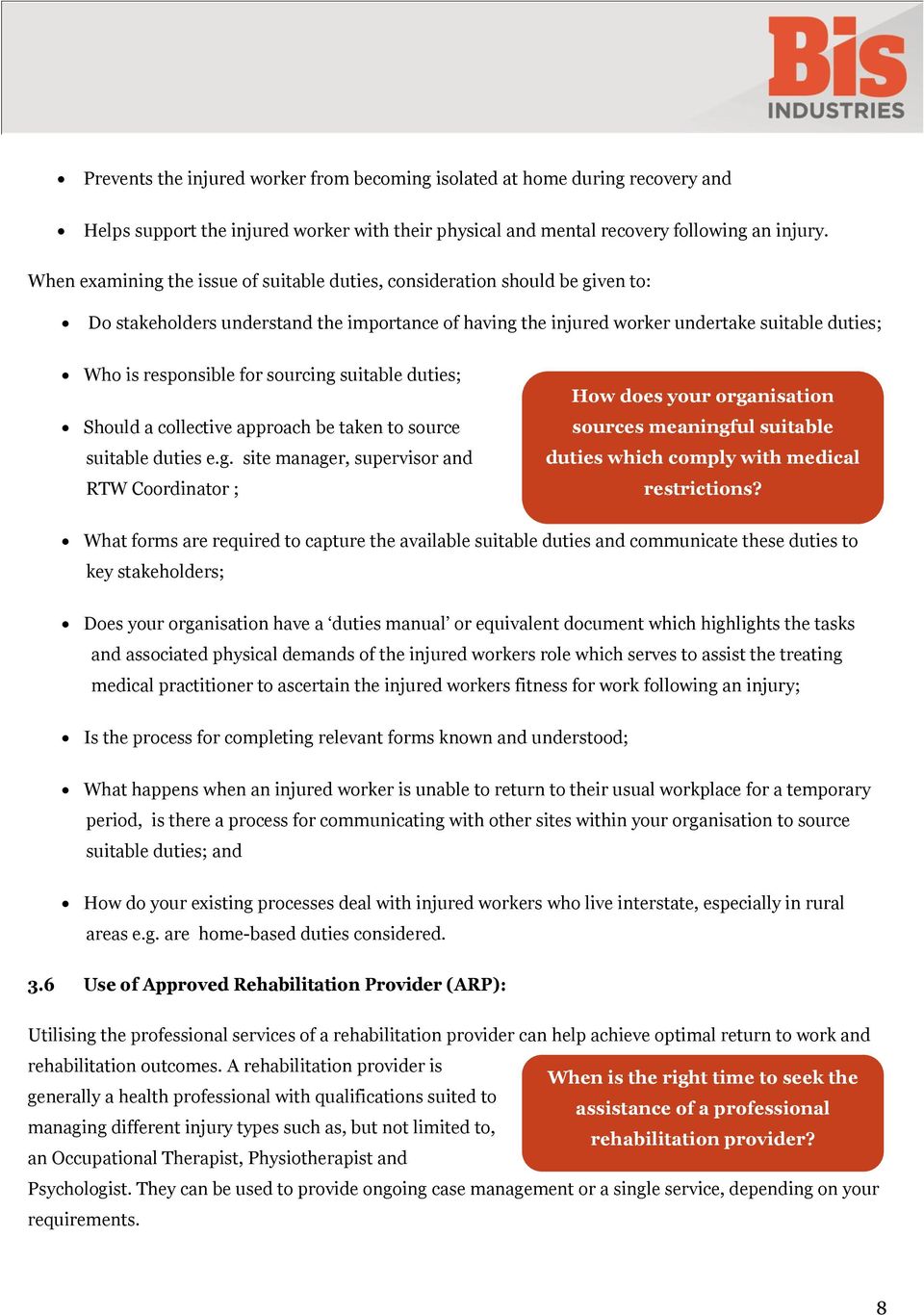
8 Prevents the injured worker from becoming isolated at home during recovery and Helps support the injured worker with their physical and mental recovery following an injury. When examining the issue of suitable duties, consideration should be given to: Do stakeholders understand the importance of having the injured worker undertake suitable duties; Who is responsible for sourcing suitable duties; Should a collective approach be taken to source suitable duties e.g. site manager, supervisor and RTW Coordinator ; How does your organisation sources meaningful suitable duties which comply with medical restrictions? What forms are required to capture the available suitable duties and communicate these duties to key stakeholders; Does your organisation have a duties manual or equivalent document which highlights the tasks and associated physical demands of the injured workers role which serves to assist the treating medical practitioner to ascertain the injured workers fitness for work following an injury; Is the process for completing relevant forms known and understood; What happens when an injured worker is unable to return to their usual workplace for a temporary period, is there a process for communicating with other sites within your organisation to source suitable duties; and How do your existing processes deal with injured workers who live interstate, especially in rural areas e.g. are home-based duties considered. 3.6 Use of Approved Rehabilitation Provider (ARP): Utilising the professional services of a rehabilitation provider can help achieve optimal return to work and rehabilitation outcomes. A rehabilitation provider is When is the right time to seek the generally a health professional with qualifications suited to assistance of a professional managing different injury types such as, but not limited to, rehabilitation provider? an Occupational Therapist, Physiotherapist and Psychologist. They can be used to provide ongoing case management or a single service, depending on your requirements. 8
9 The use of a rehabilitation provider is especially important when managing complex injuries e.g. psychological injuries, injuries which have resulted from a traumatic event, multiple injuries, permanent injuries and chronic long-term conditions. Stakeholders should monitor claims for any indicators which may prompt a referral to a rehabilitation provider e.g. issues sourcing suitable duties, the nature and severity of the injury, issues with the injured workers capacity and any other relevant return to work barrier. When examining the issue of professional rehabilitation providers, consideration should be given to: Does your organisation have a process for referring for rehabilitation services; How are rehabilitation providers selected and monitored; What are the triggers for referring a claim for rehabilitation services; and What happens if an injured worker does not like the appointed rehabilitation provider. 3.7 Communication and Consultation: Return to work and rehabilitation outcomes often depend on how well the stakeholders can work together and support the injured worker. This relies upon the stakeholders taking a consultative approach with open, two-way communication. Communication and consultation is important from the moment an injury occurs and throughout the process of claims and injury management. Post injury, the focus should be on communicating with the medical practitioner about the nature and extent of the injuries, relevant treatment and available suitable duties. Additionally, the workers compensation process should be explained to the injured worker e.g. lodging a claim, reimbursments, treatment and expectations about participation in the return to work process. Without effective communication between all key stakeholders, progress with the injured worker s rehabilitation can become stagnant. When examining the issue of commuication and consultation, consideration should be given to: How does your organisation maintain good communication with stakeholders in the injury management process? What is the preferred method of communication for the relevant stakeholders e.g. , phone, fax; Does your organisation have guidelines on communication between stakeholders; 9

10 How regularly should follow ups be conducted with injured workers and should this differ depending on whether the employee is at work or at home unfit; How regularly should you be contacting the medical practitioner, treatment providers, specialist etc; and What steps should be taken to address poor communication or a breakdown in communication. 3.8 Rehabilitation Programs A rehabilitation program includes elements of both medical and occupational rehabilitation which together provide for an effective return to work program for an injured workers. A rehabilitation program included return to work goals, stakeholder responsibilities, key dates, expected outcomes and costs. A written plan is important to maintain an outcomes-based focus and keep all stakeholders on task. What information should be contained in a rehabilitation program? The development of a rehabilitation program should be a collective process engaging all relevant stakeholders, especially the injured worker. If the injured worker is not engaged in this process, they will be less likely to actively participate in the program and this will delay recovery. Evidence of consultation should be included the program. When examining the issue of rehabilitation programs, consideration should be given to: Appropriateness of the duties that form the program, having regard to the injured workers restrictions and capabilities; Ensuring that all parties, including the injured worker, are aware of the obligations of those involved; Ensuring that the injured worker is aware of their right to request a reconsideration should they not agree; Ensuring that a collective approach has been taken in developing the program; Ensuring that the conditions of the program are reasonable; and Ensuring that the rehabilitation goal is measurable, achievable and realistic. 10
11 4. Further Information Bis Industries Workers Compensation Insurance Services (WCIS) Department Level 5, 146 Arthur Street North Sydney NSW 2060 Locked Bag 2143 North Sydney NSW 2060 T: (02) F: (02) E: 11
ACT PUBLIC SECTOR Managing Injury and Illness in the Workplace
 ACT PUBLIC SECTOR Managing Injury and Illness in 1. PURPOSE This document outlines the ACT Government policy for the care, recovery and support of ACTPS staff with work related and non-work related injuries
SUITABLE DUTIES ABOUT THIS FORM WHY USE THIS FORM? PRIVACY INFORMATION AUTHORISATION AND DECLARATION
 SUITABLE DUTIES ABOUT THIS FORM A key element to achieve an early and successful return to work (or maintenance at work) for an employee with a workplace injury or disease is for the workplace to be proactive
Rehabilitation and Return to Work Policy. Overview. Purpose. Scope. Policy
 Rehabilitation and Return to Work Policy Overview At NBN Co we are safe, disciplined and reliable. We act on our responsibilities to identify and remove potential and recognised risk to a healthy and safe
An Introduction to Workplace Rehabilitation
 An Introduction to Workplace Rehabilitation OUTLINE Definition of workplace rehabilitation Goals of workplace rehabilitation Obligations Who may be involved in rehabilitation Your employer s process for
UNISA INJURY/ILLNESS MANAGEMENT HANDBOOK A GUIDE FOR UNISA EMPLOYEES AND THEIR MANAGERS
 Introduction The University of South Australia, a self insured employer under the Return to Work Act 2014 (the Act), is committed to providing a sound injury/illness management program for all employees.
RETURN TO WORK PROGRAM
 RETURN TO WORK PROGRAM CONTENTS Contents... 1 1 Introduction... 2 2 Aim... 2 3 Overview... 2 4 What is workplace injury management?... 3 5 Guiding principles... 3 5.1 Contacts... 4 5.2 Workplace Rehabilitation
Workplace rehabilitation providers and WorkCover
 Workplace rehabilitation providers and WorkCover What to expect from your workplace rehabilitation provider This guide aims to provide workers and employers with information regarding the role of WorkCover
Rehabilitation Guidelines for Employers. Issued under section 41 of the Safety, Rehabilitation and Compensation Act 1988
 Rehabilitation Guidelines for Employers Issued under section 41 of the Safety, Rehabilitation and Compensation Act 1988 Publication details These guidelines are issued under section 41 of the Safety, Rehabilitation
Employer s Guide to. Best Practice Return to Work for a Stress Injury
 Employer s Guide to Best Practice Return to Work for a Stress Injury Employers Guide to Best Practice Return to Work for a Stress Injury 1. Early Intervention 2. Claim Lodged 3. Claim Acceptance 4. Return
The Role of the Workplace Rehabilitation Provider
 The Role of the Workplace Rehabilitation Provider The Role of the Workplace Rehabilitation Provider 1 Please note This information is for guidance only and is not to be taken as an expression of the law.
GUIDELINES FOR WORKERS COMPENSATION & INJURY MANAGEMENT
 GUIDELINES FOR WORKERS COMPENSATION & INJURY MANAGEMENT The purpose of this document is to describe the University s procedures in relation to the management of staff injury and illness and workers compensation
Service Provision and Service Descriptions (standards) for Approved Workplace Rehabilitation Providers
 Service Provision and (standards) for Approved Providers Service Provision and (standards) for Approved Workplace Rehabilitation Providers Service delivery requirements for Providers relating to the principles
About injury management and staying at or returning to work
 About injury management and staying at or returning to work Returning to work after an injury is an essential part of rehabilitation and can help you improve the health and wellbeing of staff. It can also
Injured Worker s Guide to. Best Practice Return to Work for a Stress Injury
 Injured Worker s Guide to Best Practice Return to Work for a Stress Injury The best practice return to work guidelines for a stress injury were developed by the Australian Services Union with the support
A guide for injured workers. Returning to work. April 2011
 A guide for injured workers Returning to work April 2011 Contents 1. Getting back to work 1 Ideas to help you return to work 2 Staying positive 2 Your employer s legal obligations 3 Anti-discrimination
Early Intervention, Injury Resolution & Sustainable RTW Outcomes. Presented by: Mr. Fred Cicchini, Chief Operations Manager September 2013
 Early Intervention, Injury Resolution & Sustainable RTW Outcomes. Presented by: Mr. Fred Cicchini, Chief Operations Manager September 2013 Session Objectives Early Intervention in the RTW Context Injury
INJURY AND ILLNESS MANAGEMENT POLICY 2015
 INJURY AND ILLNESS MANAGEMENT POLICY 2015 The Vice-Principal (Operations), as delegate of the Senate of the University of Sydney, adopts the following policy. Dated: 16 December 2014 Position: Vice-Principal
REHABILITATION PROVIDERS AND WORKCOVER. WorkCover. Watching out for you. WHAT TO EXPECT FROM YOUR REHABILITATION PROVIDER. New South Wales Government
 REHABILITATION PROVIDERS AND WORKCOVER WHAT TO EXPECT FROM YOUR REHABILITATION PROVIDER WorkCover. Watching out for you. New South Wales Government REHABILITATION PROVIDERS Accredited rehabilitation providers
Return to Work/Injury Management Plan
 Return to Work/Injury Management Plan (Incorporating initial assessment and subsequent reviews of RTW or IM Plans) Type of plan please 4 Return to Work Plan (RTWP) Injury Management Plan (IMP) Worker details
Signed:... (worker or representative) Guidelines for Claiming Compensation Benefits September 2013 Page 46 of 46
 8 October 2013 SPECIAL SUPPLEMENT 4385 Additional Reports or Documents Please list and provide copies of all further information, reports and documents in support of this application for review................
CRITERIA AND OPERATIONAL STANDARDS FOR WORKPLACE REHABILITATION PROVIDERS 2015
 Safety, Rehabilitation and Compensation Act 1988 Sections 34D and 34E CRITERIA AND OPERATIONAL STANDARDS FOR WORKPLACE REHABILITATION PROVIDERS 2015 Pursuant to sections 34D and 34E of the Safety, Rehabilitation
Policy and Procedure. Managing Attendance. Policy and Procedure
 Managing Attendance Policy and Procedure Agreed at CNG on 25 th April 2007 Managing Attendance Policy and Procedure Table of contents: TABLE OF CONTENTS Section 1 The Policy 3 Aim of the Process 3 Key
Workers guide to workers compensation Guide
 Workers guide to workers compensation Guide www.worksafe.nt.gov.au Disclaimer This publication contains information regarding workers rehabilitation and compensation. It includes some of your obligations
DECS REHABILITATION RETURN TO WORK POLICY PROCEDURES
 DECS REHABILITATION & RETURN TO WORK POLICY & PROCEDURES FOREWORD The Department of Education and Children s Services (DECS) is committed to safe work practices that support the wellbeing of all employees.
BIOPSYCHOSOCIAL INJURY MANAGEMENT. Introduction. The traditional medical model
 BIOPSYCHOSOCIAL INJURY MANAGEMENT Introduction This paper outlines HWCA s position on a biopsychosocial approach to injury management and recognises work undertaken by Workers Compensation Authorities
Guidelines for Employers. Return-to-Work. April 2003. WorkCover. Watching out for you.
 Guidelines for Employers Return-to-Work Programs April 2003 WorkCover. Watching out for you. Published by WorkCover NSW First published November 1987 Revised November 1993, December 1994, May 1997, March
About us. Your injured worker s recovery and return to work is a team effort. It involves you, your WorkSafe Agent, your worker and their doctor.
 1. About us Your injured worker s recovery and return to work is a team effort. It involves you, your WorkSafe Agent, your worker and their doctor. About WorkSafe Victoria WorkSafe Victoria (WorkSafe)
GIO Workers Compensation Australian Capital Territory
 GIO Workers Compensation Australian Capital Territory Injury Management Program ACT Injury Management Program This document is a guide for employers and workers to understand the framework of Injury Management
A glossary for injured workers Who s who in the claims process
 A glossary for injured workers Who s who in the July 2013 Who s who in the A glossary for injured workers About us 1 Talking your language service 2 Key contacts during the 3 About the roles in the 4 Allied
Service Level Commitment to Insured Employers
 Service Level Commitment to s Hotel Employers Mutual Ltd ABN 34124091470 Hotel Employers Mutual Limited(HEM) is the specialised insurer for the hospitality industry and it is our objective to provide our
SELF-INSURANCE OF WORKERS COMPENSATION
 SELF-INSURANCE OF WORKERS COMPENSATION Information for: STAFF Page 2 SUPERVISORS & MANAGERS Page 5 TREATING DOCTORS Page 7 REPORTING PROCEDURE Page 8 Self-Insurance of Workers Compensation Revised February
A workers compensation guide for employers
 A workers compensation guide for employers When a worker is injured 1 C CONTENTS PURPOSE OF THIS GUIDE 4 NSW workers compensation system 4 Your obligations 5 The evidence for recovery at work 5 The benefits
Australian Postal Corporation
 Injury Management System Supplementary Audit Report Australian Postal Corporation 2-4 December 2009 Commercial-in-Confidence Disclaimer This report is supplied on the terms and understanding that Comcare
Regulatory Impact Statement: Overview of required information
 Regulatory Impact Statement: Overview of required information Regulatory Impact Statement Amending references to health practitioners in five pieces of legislation Agency Disclosure Statement This Regulatory
INJURY MANAGEMENT AND RETURN-TO-WORK PROGRAMS
 INJURY MANAGEMENT AND RETURN-TO-WORK PROGRAMS WHAT IS INJURY MANAGEMENT? Injury management is about ensuring the prompt, safe and durable return-towork of an injured worker. It includes treatment of the
Workplace Rehabilitation Policy and Procedures for
 Workplace Rehabilitation Policy and Procedures for Workplace Rehabilitation Policy and Procedures Stay At Work/Return to Work Policy statement Our Company recognises that helping workers to stay at work
Policy Number: 022 Injury Management and Return to Work
 Policy Number: 022 Injury Management and Return to Work July 2015 Policy Details 1. Owner Manager, Business Operations 2. Compliance is required by Staff, contractors and volunteers 3. Approved by The
Injury Management. Making it Work. Injury Management Making it Work 1
 Injury Management Making it Work Injury Management Making it Work 1 Please note This information is for guidance only and is not to be taken as an expression of the law. It should be read in conjunction
Workers Compensation Claims Services Favorable Outcomes for Employers and Employees
 Workers Compensation Claims Services Favorable Outcomes for Employers and Employees Medical Case Management Resources Preferred Medical Provider Networks Nurse Case Managers Pharmacy Benefit Management
Rehabilitation of employees back to work after illness or injury Policy and Procedure
 Rehabilitation of employees back to work after illness or injury Policy and Procedure Document reference number HSAG 2011/3 Document developed by Revision number 4.13 Document approved by Approval date
CIRCULAR HEAD COUNCIL
 CIRCULAR HEAD COUNCIL RETURN TO WORK AND REHABILITATION MANAGEMENT PLAN RETURN TO WORK & REHABILITATION MANAGEMENT PLAN 1 TABLE OF CONTENTS RETURN TO WORK & REHABILITATION POLICY... 3 DEFINITIONS... 4
Nurse Practitioner Frequently Asked Questions
 HEALTH SERVICES Nurse Practitioner Frequently Asked Questions The Frequently Asked Questions (FAQs) have been designed to increase awareness and understanding of the Nurse Practitioner role within the
CHEMSKILL RETURN TO WORK AND RISK MANAGEMENT PROTOCOL (This document can be found under the Contractor s Section at www.chemskill.com.au.
 CHEMSKILL RETURN TO WORK AND RISK MANAGEMENT PROTOCOL (This document can be found under the Contractor s Section at www.chemskill.com.au.) ChemSkill is committed to providing a safe and healthy work environment
GUIDANCE NOTE FOR BEST PRACTICE REHABILITATION MANAGEMENT OF OCCUPATIONAL INJURIES AND DISEASE [NOHSC:3021(1995)]
![GUIDANCE NOTE FOR BEST PRACTICE REHABILITATION MANAGEMENT OF OCCUPATIONAL INJURIES AND DISEASE [NOHSC:3021(1995)]](/thumbs/24/3579764.jpg "GUIDANCE NOTE FOR BEST PRACTICE REHABILITATION MANAGEMENT OF OCCUPATIONAL INJURIES AND DISEASE [NOHSC:3021(1995)]") GUIDANCE NOTE FOR BEST PRACTICE REHABILITATION MANAGEMENT OF OCCUPATIONAL INJURIES AND DISEASE [NOHSC:3021(1995)] APRIL 1995 The National Occupational Health and Safety Commission has adopted a Guidance
GUIDANCE NOTE FOR BEST PRACTICE REHABILITATION MANAGEMENT OF OCCUPATIONAL INJURIES AND DISEASE [NOHSC:3021(1995)] APRIL 1995 The National Occupational Health and Safety Commission has adopted a Guidance
Injury Management. Making it Work. Injury Management Making it Work 1
 Injury Management Making it Work Injury Management Making it Work 1 Please note This information is for guidance only and is not to be taken as an expression of the law. It should be read in conjunction
Guideline scope Workplace health: support for employees with disabilities and long-term conditions
 NATIONAL INSTITUTE FOR HEALTH AND CARE EXCELLENCE Guideline scope Workplace health: support for employees with disabilities and long-term conditions Short title Workplace health: employees with disabilities
Submission to the Finance and Administration Committee Queensland Parliament. Inquiry into the Operation of Queensland s Workers Compensation Scheme
 Submission to the Finance and Administration Committee Queensland Parliament Inquiry into the Operation of Queensland s Workers Compensation Scheme August 2012 Authorised by: Cherie Hearn Queensland Branch
Insurer audit manual
 Insurer audit manual Disclaimer This publication may contain work health and safety and workers compensation information. It may include some of your obligations under the various legislations that WorkCover
WORKERS COMPENSATION DIVISION INDUSTRY REFERENCE GROUP REPORT
 WORKERS COMPENSATION DIVISION INDUSTRY REFERENCE GROUP REPORT February/March 2009 Amendments to Workers Compensation Legislation The Workers Compensation Legislation Amendment (Benefits) Act 2008 introduced
A guide for injured workers. Introducing WorkSafe
 A guide for injured workers Introducing WorkSafe September July 2013 2011 Contents 1. About us 1 2. Weekly payments (income entitlements) 2 3. Services to help you get better 4 4. Getting back to work
CLAIMS MANAGEMENT CHECKLIST
 CLAIMS MANAGEMENT CHECKLIST FORWARD ALL CLAIMS AND PAPERWORK TO WORKCOVER AGENT GALLAGHER BASSETT: Gallagher Bassett Workers Compensation Pty Ltd (GB) Locked Bag 2570 GPO Melbourne VIC 3001 Facsimile 03
How To Manage A Return To Work
 Policy Number: CS-1302-2013 Policy Title: Return to Work Occupational & Non-Occupational Absences due to Medical Reasons Policy Policy Owner: Chief Human Resources Officer Effective Date: March 27, 2013
Contents. Before you begin. How to work through this learner guide Assessment
 Contents Contents Before you begin How to work through this learner guide Assessment Introduction: Assisting with claims management, rehabilitation and return-to-work programs v v vi 1 Chapter 1: Assisting
RETURN TO WORK HANDBOOK
 RETURN TO WORK HANDBOOK CONTENTS Occupational Rehabilitation Programs..P3 What is injury management?...p3 Responsibilities of employer to Injury management...p4 What is a Return to Work Program?...P5 Injured
INFORMATION SHEET 1: Leave Matters for the NSW Health Service - Better Practice Guidelines for Sick Leave Management
 INFORMATION SHEET 1: Leave Matters for the NSW Health Service - Better Practice Guidelines for Sick Leave Management Sick leave must be managed in accordance with the Policy Directive Leave Matters for
REHABILITATION PROGRAM ALTERATION
 REHABILITATION PROGRAM ALTERATION Under section 37 of the Safety, Rehabilitation and Compensation Act 1988 INFORMATION FOR EMPLOYEES Changes to your rehabilitation program If your original rehabilitation
How To Get Back To Work After You Have Been Injured At Work
 Information for injured workers Disclaimer This publication may contain work health and safety and workers compensation information. It may include some of your obligations under the various legislations
SCHEDULE A Practice Guidelines for Psychologists
 SCHEDULE A Practice Guidelines for Psychologists 1. Introduction The intent of this document is to set out the WCB service provider guidelines for Psychologists providing the following services to WCB
BODY STRESSING INJURIES. Key messages for rehabilitation providers
 BODY STRESSING INJURIES Key messages for rehabilitation providers CONTENTS BACKGROUND 4 DELAYS IN PROVIDING REHABILITATION OR RETURN TO WORK ASSISTANCE TO EMPLOYEES INJURED AT WORK 6 DELAYS IN LODGING
BODY STRESSING INJURIES. Key messages for rehabilitation providers
 BODY STRESSING INJURIES Key messages for rehabilitation providers CONTENTS BACKGROUND 4 DELAYS IN PROVIDING REHABILITATION OR RETURN TO WORK ASSISTANCE TO EMPLOYEES INJURED AT WORK 6 DELAYS IN LODGING
SECTION 2: Support to Employees HEALTH AND SAFETY POLICY: WORKPLACE SAFETY AND INSURANCE BOARD (WSIB)
 Page 1 of 5 POLICY 1. Community Living Quinte West shall take all reasonable precautions to protect all employees from illness and injury. 2. The employer shall work cooperatively with employees, the bargaining
Group Income Protection Technical Guide
 For commercial customers and their advisers only Group Income Protection Technical Guide Reference BGR/4019/OCT12 Contents Page Its aims Employers your commitment Risk factors How does the policy work?
Comcare, the Safety, Rehabilitation and Compensation Commission, and the Seafarers Safety, Rehabilitation and Compensation Authority
 Comcare, the Safety, Rehabilitation and Compensation Commission, and the Seafarers Safety, Rehabilitation and Compensation Authority Agency Resources and Planned Performance COMCARE, THE SAFETY, REHABILITATION
The Physiotherapy Pilot. 1.1 Purpose of the pilot
 The Physiotherapy Pilot 1.1 Purpose of the pilot The purpose of the physiotherapy pilot was to see if there were business benefits of fast tracking Network Rail employees who sustained injuries whilst
Employers have certain obligations under the Workplace Injury Management and Workers Compensation Act 1998. These include:
 INFORMATION FOR EMPLOYERS Employer s Obligations Employers have certain obligations under the Workplace Injury Management and Workers Compensation Act 1998. These include: o Forwarding claims to CMI 48
If a worker has an accepted claim with WorkCover, they may access a range of entitlements including:
 Support for injured and ill employees The Queensland Health Workplace Rehabilitation Policy commits to consistent support of workplace rehabilitation and return to work programs for all employees in the
REHABILITATION MANAGEMENT SYSTEM AUDIT TOOL
 REHABILITATION MANAGEMENT SYSTEM AUDIT TOOL Reviewing rehabilitation management systems and compliance under the Safety, Rehabilitation and Compensation Act 1988 and Guidelines for Rehabilitation Authorities
THE INSURANCE REHABILITATION ASSOCIATION OF FINLAND (VKK): FINLAND
 THE INSURANCE REHABILITATION ASSOCIATION OF FINLAND (VKK): FINLAND 1. Organisations involved Insurance Rehabilitation Association of Finland (VKK) Finnish Motor Insurers Centre Federation of Accident Insurance
WORKERS COMPENSATION AND REHABILITATION QUESTIONS AND ANSWERS
 WORKERS COMPENSATION AND REHABILITATION QUESTIONS AND ANSWERS The Work Health & Safety Unit has responsibility for the management of workers compensation claims and the rehabilitation of injured employees.
Managing Absence Procedure
 Managing Absence Procedure Human Resources 1 Introduction 1.1 The University is committed to maintaining the health, safety and wellbeing of its most important asset its workforce, and will seek to adopt
Statistical Bulletin 2008/09. New South Wales Workers Compensation
 Statistical Bulletin 2008/09 New South Wales Workers Compensation This publication is available for download from the WorkCover website: http://www.workcover.nsw.gov.au The WorkCover Assistance Service
Independent Multidisciplinary Injury & Vocational Rehabilitation
 Independent Multidisciplinary Injury & Vocational Rehabilitation Life Improving Solutions Life Improving Solutions About Us Medicess is a nationwide Injury & Vocational Rehabilitation Company. We help
Mr Bruce Cooper General Manager Intelligence, Infocentre and Policy Liaison Branch [email protected]. Dear Mr Cooper
 Mr Bruce Cooper General Manager Intelligence, Infocentre and Policy Liaison Branch [email protected] Dear Mr Cooper The Australian College of Mental Health Nurses (ACMHN) would like to provide feedback
Contents. Union Representatives Workers Compensation Handbook
 Contents Introduction......................................................... 4 Union Representative s role........................................ 4 Workers Compensation a new approach................................
Avoiding 10 Common Workers Compensation Pitfalls. Presented by Peter P. Greaney, M.D. Medical Director and CEO, WorkCare, Inc.
 Avoiding 10 Common Workers Compensation Pitfalls Presented by Peter P. Greaney, M.D. Medical Director and CEO, WorkCare, Inc. Session Overview Improve understanding of workers comp Identify/correct weaknesses
WorkCover Guidelines for Claiming Compensation Benefits
 4340 SPECIAL SUPPLEMENT 8 October 2013 WorkCover Guidelines for Claiming Compensation Benefits Workers Compensation Act 1987 Workplace Injury Management and Workers Compensation Act 1998 I, Julie Newman,
Fit for Work. Guidance for employers
 Fit for Work Guidance for employers For details on when referrals to the Fit for Work assessment can be made in your area please visit: www.gov.uk/government/collections/fit-for-work-guidance Fit for
Guide: Nationally consistent approval framework for workplace rehabilitation providers. August 2015
 Guide: Nationally consistent approval framework for workplace rehabilitation providers August 2015 Contents 1. INTRODUCTION 2 1.1 HEADS OF WORKERS COMPENSATION AUTHORITIES 2 2. NATIONALLY CONSISTENT APPROVAL
SCHEDULE 3 Generalist Claims 2015
 SCHEDULE 3 Generalist Claims 2015 Nominal Insurer And Schedule 3 (Claims) Page: 1 of 23 Contents Overview... 3 1. Scope of Services... 4 1.1 Claims Services... 4 1.2 Claims Process... 5 1.3 Assessment
DRAFT Sickness Absence Management Policy and Procedure
 DRAFT Sickness Absence Management Policy and Procedure 1. Scope The Council s Sickness Absence Management Policy and Procedure (SAMP) applies to all employees and forms part of the contract of employment.
Work Health Safety & Injury Management Procedure
 Date of Adoption: 09 / 07 / 2013 The process outlined by this Procedure will meet the minimum requirements to assist you and the Local Government Association Workers Compensation Scheme (LGAWCS) meet legislative
Intermediate care and reablement
 Factsheet 76 May 2015 About this factsheet This factsheet explains intermediate care, a term that includes reablement. It consists of a range of integrated services that can be offered on a short term
in the Northern Territory
 23 JUNE 2011 WORKERS COMPENSATION BEST PRACTICE GUIDELINES for APPROVED INSURERS and SELF INSURERS in the Northern Territory Workers Compensation NT WorkSafe is the administrative arm of the Work Health
Workcover Guidelines on Injury Management Consultants
 4210 SPECIAL SUPPLEMENT 28 September 2012 Workcover Guidelines on Injury Management Consultants Workplace Injury Management and Workers Compensation Act 1998 I, Julie Newman, the Acting Chief Executive
Human Resources ATTENDANCE MANAGEMENT POLICY AND PROCEDURE. Agreed June 2013
 Human Resources ATTENDANCE MANAGEMENT POLICY AND PROCEDURE Agreed June 2013 To be reviewed 2015 Contents Page 1. Scope and Policy 3 2. Accountability 3 3. Learner Involvement 3 4. Process 4.1 Rules for
WORKPLACE RETURN TO WORK PROCEDURE
 Date of Adoption: 25/6/2015 The process outlined by this Procedure will meet the minimum requirements to assist the Local Government Association Workers Compensation Scheme (LGAWCS) meet legislative compliance.
CFAMLE6 Ensure health and safety requirements are met in your area of responsibility
 Ensure health and safety requirements are met in your area of Overview This unit is concerned with managing the overall health and safety process in your area of. It is intended to go beyond meeting health
Procedure SO:1.28 Rehabilitation
 SO:1.28 Policy Workplace Health and Safety Document Control Responsible Officer: Chief Operations Officer Contact Officer: Workplace health and safety officer Effective Date: 8 June 2012 Procedure Number: