
Department of Physics Third Year Handbook 2014/15
|
|
|
- Gyles Brown
- 10 years ago
- Views:
Transcription


1 Department of Physics Third Year Handbook 2014/15 6CCP3131 Third Year Project in Physics 6CCP3132 Literature Review in Physics 6CCP3133 University Ambassadors Scheme
2 Contents Introduction... 3 Assessment and Timetables CCP3132 Literature Review Timetable CCP3131 Project Timetable CCP3133 UAS Timetable... 5 Late Submissions... 5 Written Reports, Talks and Posters... 6 Examination Regulations... 6 Guidelines for Writing Reports... 6 The Marking Scheme and Guidelines used by your Examiners... 7 Undergraduate Marking Criteria 2014/ Submission of Reports Oral Presentations Poster Presentations CCP3132 Literature Review in Physics Organisation Topic Research Assessment Topic Descriptions Topics in Experimental Biophysics & Nanotechnology Topics in Theory & Simulation of Condensed Matter Topics in Theoretical Particle Physics & Cosmology Topics in History of Physics CCP3131 Third Year Project in Physics Organisation Assessment Work Timetable Project Descriptions Projects in Experimental Biophysics & Nanotechnology Projects in Theory & Simulation of Condensed Matter Projects in Theoretical Particle Physics & Cosmology CCP3133 University Ambassadors Scheme Important Note Description Module Aims Learning Outcomes Module Content Organisation Work Timetable Assessment College statement on plagiarism How to avoid plagiarism Third year project/literature review selection form
3 Introduction An important aspect of your third year is project work. In the Physics Department we have three modules designed to facilitate this and each of these modules is explained in this booklet. The modules are: 6CCP3131 Third Year Project in Physics; 6CCP3132 Literature Review in Physics; 6CCP3133 University Ambassadors Scheme (UAS). Each of these 15 credit modules has a duration of one semester. The Literature Review runs in semester 1, while the project and UAS run in semester 2. Students must take a minimum of ONE of the modules but you have the OPTION of choosing more than one if you wish. You may not, however, take the same module twice for example you could choose to do UAS and a Literature Review, but you may not do two Literature Reviews. Thus there are seven possible combinations of options for third year students: Project (semester 2) Literature Review (semester 1) UAS (semester 2) Project and Literature Review Project and UAS Literature Review and UAS Literature Review, Project and UAS 3
4 Assessment and Timetables 6CCP3132 Literature Review Timetable There will be an introductory session at 14:00 on 22 nd September in room S You must hand in your literature review preferences to the UG Programme Office by 4pm on Friday 26 th September 2014 Literature Reviews will be allocated on Monday 29 th September and work on them will start by arrangement with the project supervisor. The electronic copy of your written report must be submitted by 12 noon on Friday 12 th December 2014 via Turnitin on KEATS. Any reports submitted after this time will be regarded as late. In addition two hard copies of the written report and a signed plagiarism declaration must be submitted to the Department Office by 4pm on Friday 12 th December Oral presentations will take place within the week beginning 6 th January A timetable will be available nearer the time. Assessment The report counts for 70% of the final mark. The oral presentation counts for 30%. 6CCP3131 Project Timetable There will be an introductory session at 14:00 on 22 nd September in room S You must hand in your project preferences to the UG Programme Office by 4pm on Friday 26 th September. Projects will be allocated on Monday 29 th September. The project itself will start week beginning 12 th January 2015 or by arrangement with the project supervisor. The electronic copy of the written report must be submitted by 12 noon 27 th March 2015 via Turnitin on KEATS. Any reports submitted after this time will be regarded as late. In addition two hard copies of the written report must be submitted to the Department Officer by 4pm on 27 th March Posters will be presented in revision week (week beginning 27 th April 2015). A timetable will be available nearer the time. Oral presentations will take place in the revision or exam period (beginning 27 th April 2015). A timetable will be available nearer the time. Assessment The report and supervisor s assessment count for 70% of the final mark. The oral presentation counts for 20% of the final mark. The poster counts for 10% of the final mark. 4
5 6CCP3133 UAS Timetable There will be an introductory session at 14:00 on 22 nd September in room S-2.08, followed by interviews with Prof. Sarkar which will take place from 13:00 on 24th September 2014 in room S3.39 which you MUST attend. The UAS placement itself will start on week beginning 12 th January 2014 or by arrangement with the UAS co-ordinator (Prof. Sarkar) or the school in which you are placed. The electronic copy of the written report must be submitted by 12 noon 27 th March 2014 via Turnitin on KEATS. Any reports submitted after this time will be regarded as late. In addition two hard copies of the written report must be submitted to the UG Programme Office by 4pm on 27 th March Oral presentations will take place in the revision or exam period (beginning 27 th April 2015). A timetable will be available nearer the time. Assessment The report counts for 70% of the final mark. The oral presentation counts for 30%. Late Submissions Reports that are submitted late; within twenty four hours of the electronic submission deadline will be capped at 40%. Reports that are submitted late; after twenty four hours from the electronic submission deadline will receive a mark of zero. Where mitigating circumstances mean that you will be unable to submit your report on time, an Extension Request Form should be used to request an extension to a deadline as soon as you become aware of the problem. You can submit the form, along with appropriate documentary evidence, any time before the deadline. 5

6 Written Reports, Talks and Posters Examination Regulations The following is an extract from the regulations for students: Where the Regulations for any qualification provide for part of an examination to consist of work written in the candidate s own time, the work submitted by the candidate must be his [or her] own and any quotation from the published or unpublished work of other persons must be acknowledged. Copying without acknowledgement from any source including books, journals, the internet and other students is plagiarism, which is regarded by the Board of Examiners as a very serious matter. It will result in deduction of marks and may lead to formal disciplinary action. For more information see: ml Guidelines for Writing Reports Reports should normally be about words, but you should discuss this with your supervisor. You should find that this is the right length to describe your work without being either too brief or too verbose. Discuss with your project supervisor if you feel that you must go outside this range. Any supporting material, e.g., listings of computer programs, should be presented in appendices and should not be included in the word count. You should keep copies of your reports as those submitted will be retained for inspection by the Visiting Examiners. All reports must be prepared using a word processing package with 1½ line spacing, printed on A4 paper and bound in simple folders. The style should conform to that of published scientific papers (Day, 1989), i.e., the report should consist only of text (with appropriate headings and sub-headings), figures (all graphs, diagrams and photographs are figures and must be referred to as such) and tables. All figures and tables must be numbered, have descriptive captions (by convention, figure captions go below the figure while table captions go above the table) and be referred to in the text. References to published work consulted during the project must be given in the text, using either the Harvard system, i.e., name (year) or (name, year) as in the example earlier in this paragraph, or the numerical system by (1) or [1] with the references numbered in the order in which they appear. A complete list of references must be given at the end of the report (see section 2.6), alphabetical in the Harvard system or numbered in the numerical system. Pages must be numbered and the report must be divided into numbered sections and, where appropriate, sub-sections. The report should include: a title page with the course number and title, the project title, authors names, supervisor s name and an abstract, which must contain brief summaries of the objectives and main results; 6

7 an introduction setting the project work in perspective; a discussion of any background, e.g., theoretical, materials; a description of the work actually done; analysis and presentation of the results of the work, including errors (see, e.g., Taylor, 1997); a discussion of the significance of the results; a final summary and conclusions and possible future research; a complete list of references. Although the project is undertaken as a group, each member of that group should be assigned a specific role if in any doubt ask your supervisor. This specific role should form the basis of your report. However, your examiners will be looking for evidence in your report that you are aware of the work of other group members and that you are informed about the project in its entirety. You should also be able to demonstrate an understanding of the project in its wider scientific context. The Marking Scheme and Guidelines used by your Examiners This is a general and not exhaustive list of points that will be used to assess your work. The Written Report [70% of the total mark for the module] 1) Student performance and initiative. [20% of the total mark for the report, this mark is decided by the supervisor] Did the student attend and contribute to the tutorial classes? Did the student play an active role in the group? Did the student show great skill & initiative or did s\he require a lot of help and guidance? Did the student plan the project well? Should the student have been able to achieve more in the available time? How well did the student acquire new experimental, computational or theoretical skills? How well did the student handle any unexpected difficulties? 2) Presentation of the report. [10% of the total mark for the report, marked independently by both the supervisor and second examiner]. Is the report neat & does the style conform to that required of published work? Are the grammar & spelling good? Is the report divided into appropriate sections & sub-sections arranged in a logical order? Is the quality of graphical & other figures acceptable? Are all the equations, figures & tables numbered? Do the figure and tables have appropriate captions? Is a complete list of references given in a logical style, at the end of the report? 7

8 . 3) Content of the Report. [70% of the total mark for the report, marked independently by both the supervisor and second examiner]. Is the significance of the project explained? What is the scientific interest in this work? Has the project been placed in a wider context? Is the particular aim of the project made clear? Are there sufficient references to earlier work, and is there evidence of a successful literature search? Is the theory discussed clearly and concisely, with all symbols explained? Is it sufficient for the reader to understand the theory to be used? Are the (experimental, computational or theoretical) techniques described adequately? In experimental work, are the equipment & samples described? Are all the techniques used justified? Are the results presented in a comprehensible manner? Is the quality of the results good? Is the quantity of the results sufficient? Are errors & uncertainties in the data & methods discussed adequately? Have any cross checks been made to verify the data? Have the data been checked against any existing similar data? Is the analysis appropriate? Could further conclusions have been drawn from the student s data? Are the results summarised concisely? Are directions for future work suggested? 4) Oral presentation [30% of the total mark for the Literature Review or UAS module; 20% of the total mark for the Project module. Jointly agreed upon by both the supervisor and second examiner] Were the descriptions of the aims clear and results of the project given? Were the graphs and diagrams legible, comprehensive and explained well? Was a confident knowledge of the subject apparent? Were questions answered correctly and completely? Was good use made of the allotted time? 5) Poster presentation [10% of the total mark for the Project module. Jointly agreed upon by both the supervisor and second examiner] Was a clear description of the aims & results of the project given? Were the graphs and diagrams legible, comprehensive & explained well? Was the poster visually interesting? In discussions with each member of the group: Was a confident knowledge of the subject apparent and were questions answered correctly & completely. 8
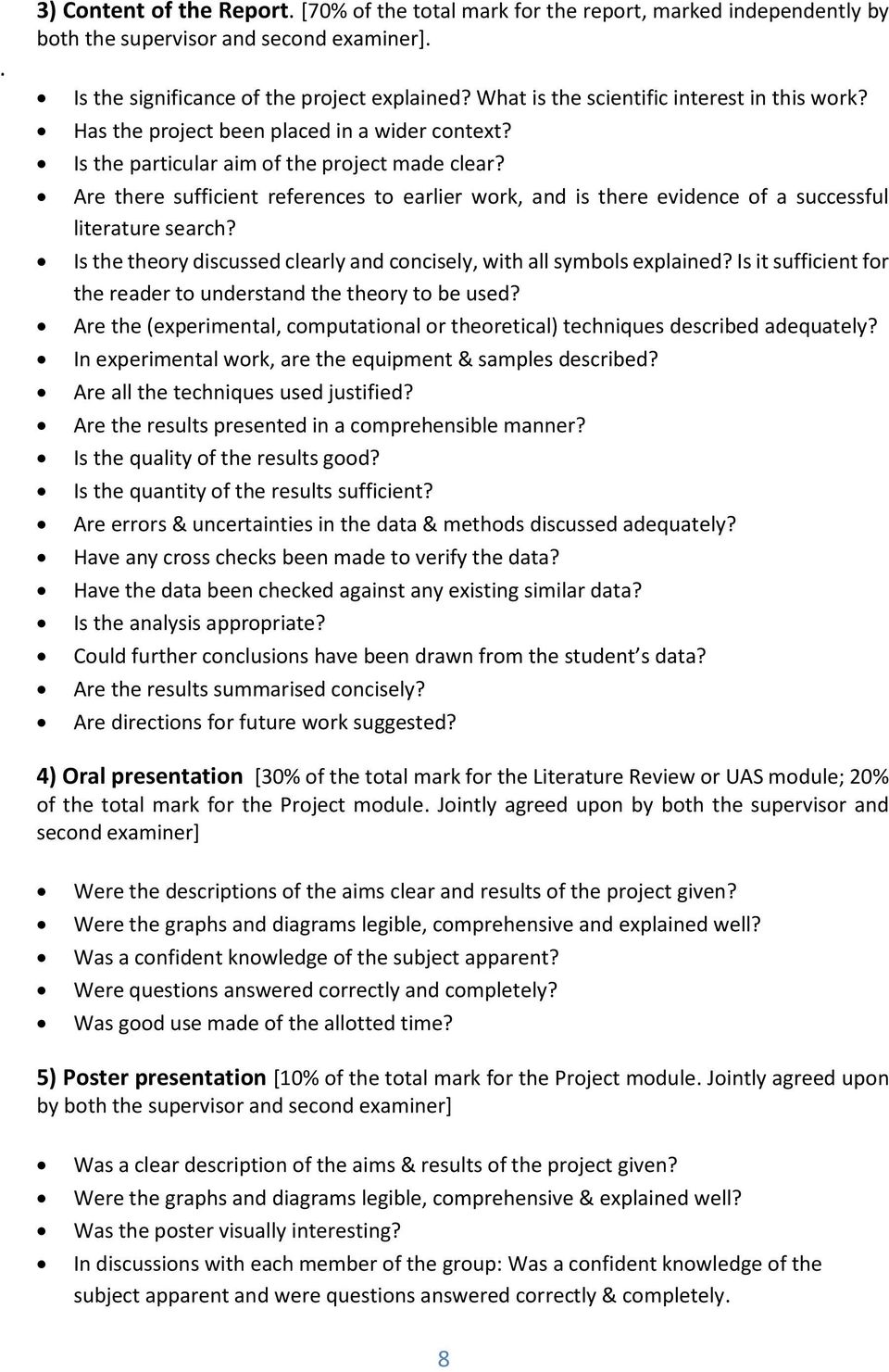
9 Undergraduate Marking Criteria 2014/15 The guidelines below are applicable to all levels of study within an undergraduate degree programme. FIRST CLASS A++ >90% Written Examinations Practical Work & Oral Examinations Reports & Essays Understanding: Able to analyse critically, Exceptionally well prepared, displaying a A complete systematic and accurate account with arguments soundly based, and fully systematic and carefully planned approach with a of the assignment; exceptionally well supported by relevant facts. Able to apply comprehensive understanding of the material and organised and clearly presented. correct methods to complex problem-solving methodology. An outstanding record of the aims and tasks and to reach an essentially complete Able to work independently, or to take a leading methods of the work. answer. Exceptional evidence of an original role in a group. Data manipulation and analysis carried out or creative approach. Outstanding presentational skills showing an thoroughly, correctly and with evidence of Selection and coverage of material: accurate and fluent analysis of the topic or originality. Questions answered accurately and with problem. Critical, comparative and constructive insight, demonstrating a comprehensive Answers questions thoughtfully and accurately with comments on all observations, with no loose knowledge of the topic and an outstanding independent ideas. ends (unexplained observations or unjustified mastery of relevant skills. 1. Able to reach valid/relevant/perceptive claims and speculations). Structure and presentation: Logical and wellorganised conclusions and to suggest logical and original Considerable evidence of extended reading flow of content, clearly expressed. extensions of the work. and original or innovative thinking. FIRST CLASS A % FIRST CLASS A 70-79% Understanding: Able to analyse critically, with arguments soundly based, and very well supported by relevant facts. Able to apply correct methods to complex problem-solving tasks and obtain a largely correct answer. Strong evidence of an original or creative approach. Selection and coverage of material: Questions answered accurately and with insight, demonstrating a thorough knowledge of the topic and a clear mastery of relevant skills. Structure and presentation: Logical and wellorganised flow of content, clearly expressed. Understanding: Able to analyse critically, with arguments soundly based and well supported by relevant facts. Able to apply correct methods to problem-solving tasks. Evidence of an original or creative approach. Selection and coverage of material: Questions answered accurately and with insight, demonstrating a well-informed knowledge of the topic and a mastery of relevant skills. Structure and presentation: Logical and wellorganised flow of content, clearly expressed. Excellently prepared, displaying a systematic and carefully planned approach with a thorough understanding of the material and methodology. Able to work independently or to participate effectively in a group. Excellent presentational skills showing an accurate and fluent analysis of the topic or problem. Answers questions thoughtfully and accurately with independent ideas. 2. Able to reach valid/relevant/perceptive conclusions and to suggest logical and appropriate extensions of the work. Very well prepared, displaying a systematic and carefully planned approach with a clear understanding of the material and methodology. Able to work independently or to participate constructively in a group. Very good presentational skills showing an accurate and fluent analysis of the topic or problem. Answers questions thoughtfully and accurately with independent ideas. 3. Able to reach valid/relevant conclusions and to suggest logical extensions of the work. A comprehensive systematic and accurate account of the assignment; exceptionally well organised and clearly presented. An excellent record of the aims and methods of the work. Data manipulation and analysis carried out thoroughly, correctly and with insight. Critical and comparative comments on all observations, with no loose ends. Considerable evidence of extended reading and some original or innovative thinking. A wide-ranging systematic and accurate account of the assignment; exceptionally well organised and clearly presented. A very clear record of the aims and methods of the work. Data manipulation and analysis carried out thoroughly and correctly. Critical comments on all observations, with no loose ends. Evidence of extended reading and original or innovative thinking.
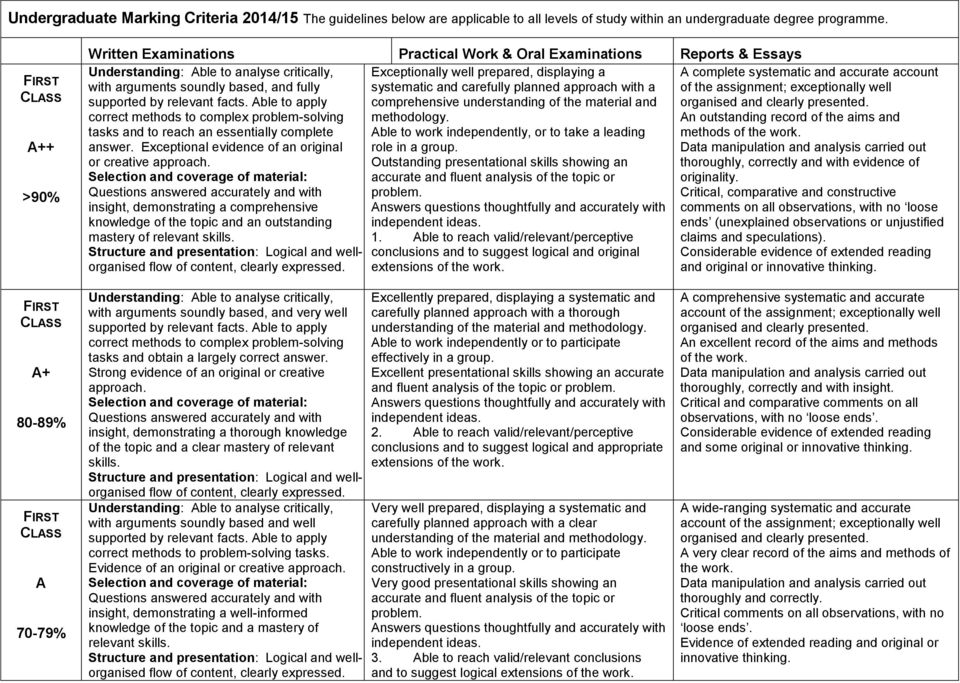
10 UPPER SECOND CLASS B+ (65-69) B (60-64) 60 69% LOWER SECOND CLASS C 50 59% Understanding: Able to analyse critically, with sound arguments, supported by relevant facts. Able to apply correct methods to problem-solving tasks. Some evidence of an original or creative approach. Selection and coverage of material: Questions answered largely correctly, demonstrating an informed knowledge of the topic and good facility with the relevant skills. Structure and presentation: Logical flow of content, clearly expressed. Understanding: Attempts to analyse critically, with arguments supported by some relevant facts. Familiar with the correct methods needed for problem-solving tasks but with some difficulties in their use. Little evidence of an original or creative approach. Selection and coverage of material: Questions answered incompletely, but demonstrating some knowledge of the topic and some capability with the relevant skills. Well prepared, displaying a systematic approach and a good understanding of the material and methodology. Able to work independently or to participate actively in a group. Good presentational skills showing a fluent analysis of the topic or problem. Answers questions thoughtfully with some independent ideas. Able to reach valid/relevant conclusions and to suggest some logical extensions of the work. Adequately prepared, displaying a reasonably systematic approach and some understanding of the material and methodology. Able to work independently or to participate in a group. Adequate presentational skills showing a credible analysis of the topic or problem. Answers questions with some wider understanding of the key ideas. Able to reach valid conclusions and to suggest extensions of the work. A systematic and largely accurate account of the assignment; well organised and presented. A clear record of the aims and methods of the work. Data manipulation and analysis carried out correctly. 4. Reasonable comments on all observations, and only a few loose ends Evidence of some extended reading and some original or innovative thinking. A systematic account of the assignment, reasonably presented. 5. An adequate record of the aims and methods of the work. Data manipulation and analysis contains few inaccuracies or omissions. Comments on most observations, mainly reasonable, but with several loose ends. Little evidence of extended reading or of any original or innovative thinking. THIRD CLASS D 40-49% Structure and presentation: Logical flow of content with reasonable clarity of expression. Understanding: Some capacity to analyse critically, but arguments not always supported by relevant facts. Familiar with some of the methods needed for problem-solving tasks but unable to apply them routinely. No evidence of an original or creative approach. Selection and coverage of material: Questions answered incompletely, demonstrating a patchy knowledge of the topic and limited capability with the relevant skills. Disorganised preparation, displaying an unsystematic approach, and only partial understanding of the material and methodology. Has difficulty in working independently or participates only passively in a group. Inadequate presentational skills showing a confused analysis of the topic or problem. Answers to questions show limited understanding of the key ideas. Able to reach some valid conclusions but unable to suggest appropriate extensions of the work. An unsystematic account of the assignment/task. An incomplete record of the aims and methods of the work. Data manipulation and analysis contains some inaccuracies or omissions. Few comments on the observations with many loose ends. No evidence of extended reading. Structure and presentation: Logical flow of content but with poor clarity of expression. 10
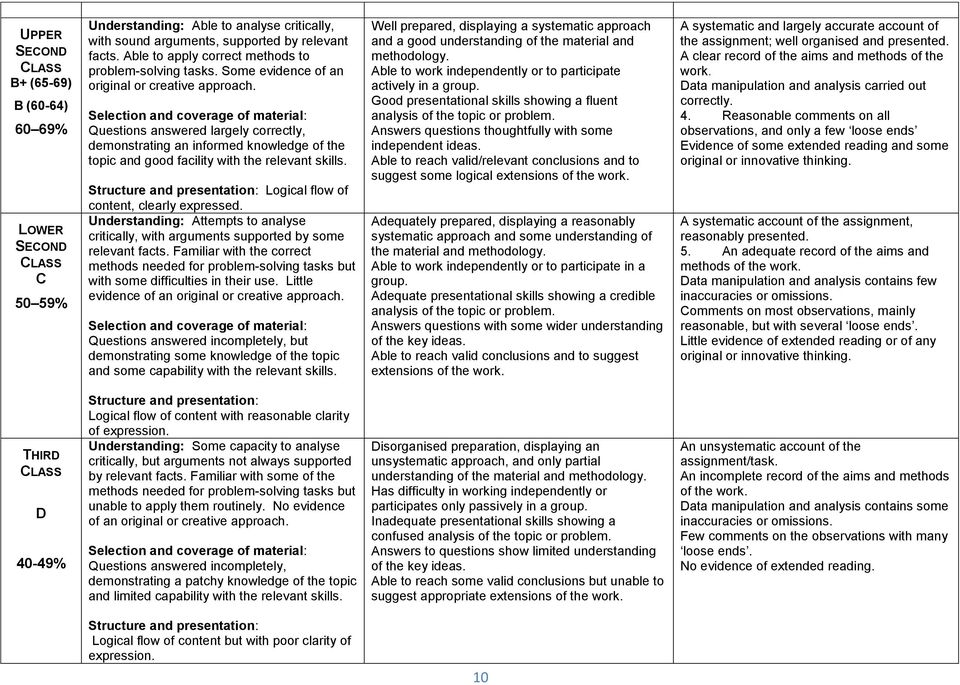
11 FAIL F 30-39% Understanding: Some attempts to analyse critically, with unconvincing arguments unsupported by relevant facts. Familiar with only a few methods needed for problemsolving tasks but unable to apply them routinely. No evidence of an original or creative approach. Selection and coverage of material: Questions answered incompletely, demonstrating neither breadth nor depth of knowledge. Answers with key skills rarely deployed when tackling problems. Poor preparation, displaying an unsystematic approach and very limited understanding of the material and methodology. Has difficulty in working independently or participates ineffectively in a group. Poor presentational skills showing a confused analysis of the topic or problem. Answers to questions show little understanding of the key ideas. Unable to reach valid conclusions or to suggest appropriate extensions of the work. An unsystematic or incomplete account of the assignment. A sketchy record of the aims and methods of the work. Data manipulation and analysis contains significant inaccuracies or omissions. Very few comments on the observations with many loose ends. No evidence of further reading. FAIL F 20-29% FAIL F 10-19% Structure and presentation: Disorganised flow of content with poor clarity of expression. Understanding: Limited attempts to analyse critically, with suspect arguments unsupported by relevant facts. Unfamiliar with most methods needed for problem-solving tasks and unable to apply them routinely. No evidence of an original or creative approach. Selection and coverage of material: Questions answered incompletely, demonstrating neither breadth nor depth of knowledge. Answers often irrelevant, with key skills inappropriately deployed when tackling problems. Structure and presentation: Disorganised flow of content, with poor clarity of expression. Understanding: Almost no attempt to analyse critically, with unsound arguments unsupported by relevant facts. Unfamiliar with basic methods needed for problem-solving tasks and unable to apply them routinely. No evidence of an original or creative approach. Selection and coverage of material: Inadequate attempt to answer the question asked with largely irrelevant or unacceptably brief material. Limited preparation, displaying an unsystematic approach and little understanding of the material and methodology. Has difficulty in working independently or participates ineffectively in a group. Very poor presentational skills showing a very confused analysis of the topic or problem. Answers to questions show very little understanding of the key ideas. Unable to reach valid conclusions or to suggest appropriate extensions of the work. Very limited preparation with no understanding of the material and methodology. Has great difficulty in working independently or unable to work in a group. Almost no presentational skills with no analysis of the topic or problem. Answers to questions show almost no understanding of the subject. Unable to reach any relevant conclusions. An unsystematic, incomplete and inaccurate account of the assignment. A sketchy record of the aims and methods of the work. Data manipulation and analysis contains numerous inaccuracies or omissions. Very few comments on the observations with many loose ends. No evidence of further reading. An unsystematic, incomplete and inaccurate account of the assignment. No record of the aims and methods of the work. Almost no evidence of data manipulation and analysis. No comments on the observations. No evidence of further reading. Structure and presentation: Totally disorganised flow of content with no clarity of expression. 11

12 FAIL F < 10% Understanding: No attempt to analyse critically, with no relevant arguments. No awareness of problem-solving methods. No evidence of an original or creative approach. Selection and coverage of material: No serious attempt to answer the question asked. Structure and presentation: No discernible structure. No effective preparation. Cannot work independently or in a group. Absence of presentational skills. Unable to answer questions on the subject. No meaningful account provided. 12

13 Submission of Reports One electronic copy of the report must be submitted via Turnitin by the deadline given earlier. Two hard copies of your report should be given to the UG Programme Officer by the deadline stated earlier. The electronic and hard copies must of course be identical. You will be given the opportunity to submit drafts of your report to Turnitin from about two weeks before the deadline. This will allow you to learn how plagiarism can be detected and to understand how to present information gleaned from the literature. The time and date of submission will be noted. You should not assume that a late submission will automatically be marked unless there is a medical or other extenuating reason for lateness, supported by an appropriate medical certificate or documentation. Each student should retain a copy of their report as the copies submitted will be retained for inspection by the External Examiners. Oral Presentations These presentations are part of the examination process and students must be available to attend them at the specified times. For the Literature Review, students will be required to give an individual oral presentation of no more than 10 minutes duration plus 5 minutes for questions. The topic of your presentation must be discussed and agreed with you supervisor in advance. The oral presentation is worth 30% of the final mark. For the Project, the group oral presentation will last for a maximum of 25 minutes, followed by 20 minutes of questions from the panel of examiners. Each student should speak for around 5 minutes, concentrating on their particular role in the project. There should be a general introduction and conclusion as well. For UAS, see the UAS section later in this booklet. For all Oral Presentations, in order to be sure that you keep to the allotted times, you are strongly advised to practice your talk before the actual presentation. Talks should be prepared for computer presentation, for example Powerpoint. You must either use the computer provided or ensure beforehand that your own computer is compatible with the projector to ensure that there are no connection problems.
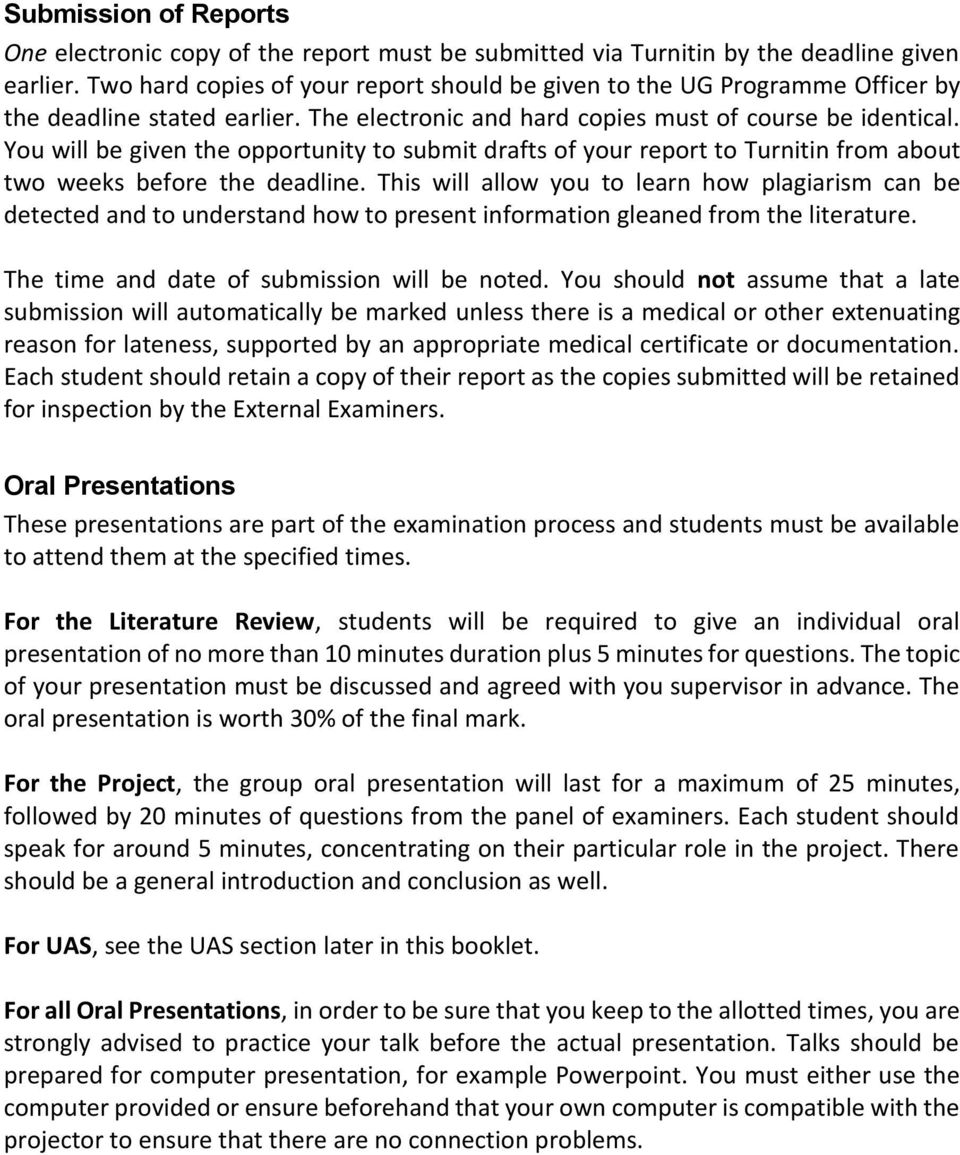
14 All the examiners (normally two or three) in attendance at the oral examination will award a mark based on the following criteria; as always, the criteria outlined in the departmental handbook will be used to assign appropriate marks. Was a clear description of the aims and results of the project given? Were the graphs and diagrams legible, comprehensive and explained well? Was a confident knowledge of the subject apparent? Were questions answered correctly and completely? Was good use made of the allotted time? Poster Presentations The poster, its presentation and design must be undertaken by the entire group. The poster presentations for all the projects will take place simultaneously, in the Revision Period a timetable will be distributed nearer the time. All students must attend the poster session, where they will be questioned by panels of examiners. The session will be open to all members of the Department, and there will be a small prize for the best poster. Posters should occupy a space no larger than an A0 sheet of paper (10978cm), and it is recommended that posters are prepared using PowerPoint and the DesignJet A0 printer at the Maugham Library ( In assessing the posters the examiners will award marks based on the following criteria. The visual impact of the poster. How easy it is to understand the aims and results of the project. The scientific content of the poster. How well the questions were answered. One electronic (PDF) copy per group should be ed to the UG programme officer no later than the date of the Poster presentation session. A short talk on how to prepare and present posters will be given in semester 2; attendance is not compulsory, but each group is advised to send at least one representative. References Day RA 1989 How to Write and Publish a Scientific Paper (Cambridge: Cambridge University Press) Taylor JR 1997 An Introduction to Error Analysis (Sausalito: University Science Books) 14
15 6CCP3132 Literature Review in Physics This module aims to provide an insight to some physics areas of current interest. The module is taught using tutorials/seminars backed up with essays, literature reviews and problem sheets. In particular, students are encouraged to research the literature themselves to gain an in-depth understanding of a topic. There is no final written examination and assessment is through coursework. The module is intended for those with an interest in current research in science and technology and with the selfmotivation for self-study. Organisation Descriptions for a number of topics proposed by different research groups within the department are listed in this booklet. Each topic is a self-contained programme over one semester on an area of physics of current interest. Students will be able to make a choice of areas of research of interest and will be allocated an appropriate topic. Students will work in groups, the sizes of the groups depending on the number of students taking this option. A session on information retrieval will be held at the beginning of the term, date and venue as in the Work Timetable below; attendance is compulsory for students taking 6CCP3132. A central component of the module is researching the literature relevant to the topic and so full awareness of the available tools for literature searches and retrieval of material is essential. Supervisors will organise with their topic group times for tutorials for the topic; students will see their tutor every one or two weeks, the details to be arranged between the tutor and the group. Tutors will in some cases direct you towards relevant reading, set tasks, set problem sheets and give general instructions and advice. This will depend on the topic chosen. All students taking 6CCP3132 are required to attend the tutorials. Students should expect to spend about 150 hours on this module, including attending the tutorials, their own reading and study, writing the report and preparing for the oral examination. Topic Research A key objective of this module is to provide students with the opportunity to research for themselves a topical area of physics, under guidance from the topic supervisor. To this end, students are expected to perform literature searches, using tools such as the Web of Science, and tracing the development of an area through citations in research articles. At the beginning of each topic, students will be expected to have performed some initial research into the topic (guided, e.g., by a set of introductory questions) before the first tutorial. Students are expected to refer extensively to peer-reviewed research articles published in research journals. They should NOT rely on obtaining material from the Internet, although this can be a useful resource for finding background information. Students are 15
16 encouraged to work together for the research of a topic; however, all assessed material should be each student s own work (unless explicitly directed otherwise). The demonstration of a successful literature search forms an important element of the assessment of this module. Assessment Report Each student must submit an individual written report on some specific aspect of the topic. Each report should be of no more than words, and should be submitted (two copies) by the deadline indicated in the Work Timetable below. The report is worth 70% of the final mark. Oral Presentation: Students will be required to give individual oral presentations of no more than 10 minutes plus 5 minutes for questions (see Work Timetable below). The presentation should be on some specific issue associated with the topic, as discussed with and agreed by your supervisor in advance. The oral presentation is worth 30% of the final mark. Work Timetable (dates are given in the Introduction to this booklet) All reports must be handed in by the deadlines, unless otherwise communicated by e- mail. 14:00 on 22 nd September in room S-2.08: There will be an introductory session explaining how projects and Literature Reviews work and what topics are offered. Project booklets and topic selection forms will be handed out at this session so it is very important that you attend. 26 September 2014: You must hand in your topic preferences to the UG Programme Officer; copies of this form can be found at that back of this booklet and will also be distributed during the introductory session. The Literature Reviews will start (or on a date specified by your supervisor. Reading Week: Students give the supervisor a short written progress report in which they assess their own and their peers contribution where appropriate. 12 noon on Friday 12 December 2014: The electronic copy of your written report must be submitted via Turnitin. Any reports submitted after this time will be regarded as late. 4pm on Friday 12 December 2014: The (two) hard copies of the written report must be submitted to the UG Programme Officer. Week beginning 5 January 2015: Oral presentations will take place. A timetable will be available nearer the time. 16

17 Topic Descriptions Projects are organised and taught by research groups within the Department. You have a choice of doing a Literature Review in the following areas: Experimental Biophysics & Nanotechnology Theory and Simulation of Condensed Matter Theoretical Particle Physics & Cosmology History of Physics There are several potential literature reviews available in each group and these will be allocated as appropriate by the head of that research group and the project co-ordinator. The descriptions in the following pages are brief outlines of the literature reviews on offer. They are not meant to describe in detail exactly what is to be done; students are encouraged to explore interesting lines of work which arise during the course of the project, so that the work carried out may differ from that originally envisaged. Students are asked to state their preferences between categories of research topics. Each category includes several possible topics, and could be supervised by any one of a small group of supervisors. In some cases the initials of the probable supervisor is listed in brackets after the topic title but again, this is subject to change. You must be aware that some topics will be much more popular than others, and only some will run. Therefore, you have three choices, and we will try to ensure that you are allocated one of these. Students are encouraged to investigate the various research categories and the specific topics to see what interests them and then to list their preferences on the form at the back of this booklet. 17
18 Topics in Experimental Biophysics & Nanotechnology Dr. Wayne Dickson Room S7.33 Metamaterials Since their conception in the late 20 th Century to the first experimental realization in the early 21 st Century, electromagnetic metamaterials have promised to revolutionize the field of optics and the host of disciplines that rely on optics for advanced applications. Demonstrating unique and eye catching phenomenon, such as optical cloaking and negative refraction, these materials have delivered extraordinary optical properties not found in any natural materials. Based on the construction of artificial materials, comprised of elements that are separated by distances much smaller than the incident radiation wavelength, early work considered electromagnetic radiation in the microwave regime making material construction relatively simply, despite the complex calculations required for their design. Recent research has moved this field ever downwards in wavelength and currently into the optical regime and now fabrication challenges, materials responses at such small scales and optical design are paramount considerations. This review will assess the historical origins of the field, the technological progress to date, the current applications of such materials and their future prospects. The project requires background knowledge of optics and electromagnetism Prof. Samjid Mannan Room S7.11 Maxwell s demon; historical and current interpretations Originally presented as a thought experiment probing the limits of the second law of thermodynamics, interpretation of Maxwell s demon requires careful analysis of the interplay between thermodynamics, quantum measurement theory and information theory. The group will analyze recent theoretical developments and experiments linked to Maxwell s demon. They will also chart both historical misinterpretations and criticisms of the current commonly agreed explanation, based on Landauer s principle, of why any experimental implementation of Maxwell s demon cannot lead to violations of the second law. Dylan Owen Room S3.07 Super-resolution fluorescence microscopy for bioimaging Fluorescence microscopy is a widely used tool in biology to study the structure of cells. It is non-invasive and can show the locations of specific molecules in real time. However, the resolution of a fluorescence image is limited by diffraction within the microscope to be of the order of 200nm. Many cellular structures are smaller than this and there has recently been a push to break this diffraction limit barrier. In 2008, Nature Methods hailed Super-resolution fluorescence microscopy as a key up-and-coming technology. Here we will review the literature concerning the development of the three main super-resolution fluorescence microscopy techniques: Stimulated emission depletion microscopy (STED), 18
19 Photoactivated localization microscopy (PALM) and structures illumination microscopy (SIM) and how they have impacted the field of bioimaging. Dr. Shahriar Sajadi Room S3.12 Review on Droplet Size Predictions in Droplet Microfluidics Microfluidics is a technique which can deliver uniform drops in emulsions. Emulsions are dispersions of one phase in another with the aid of a surfactant. In a microfluidic emulsification process, a liquid phase is pressed through a capillary to form droplets. The size of droplets is governed by the forces acting on droplets. In this research, a comprehensive and critical literature review on analytical methods available in the literature to predict the size of simple as well as core-shell droplets in vertical and horizontal microfluidic devices is sought. Prof. Anatoly Zayats Room S7.10 Photonic crystal fibres Optical communication systems rely on the use of fibres to transfer optical signals. In addition to conventional optical fibres, the recent advances in photonic band-gap materials has allowed development of new types of fibres, the so-called Photonic Crystal Fibres (PCF), with various unique properties not available in conventional fibres. This literature review will involve researching publications on the subject of photonic crystal fibres and describing the basic physical phenomena behind the PCF concept, main differences between PCFs and conventional fibres, and the main advantages and applications of PCFs. Topics in Theory & Simulation of Condensed Matter Dr Evgeny Kozik Room S4.02.e Optical Lattice Emulators Theoretical understanding of some of the most fascinating properties of modern materials has proven extremely difficult due to intricate quantum-mechanical behavior of interacting constituting elections. Recent dramatic developments in cooling and manipulating individual quantum particles have given birth to the idea of constructing an artificial material whose behavior is governed by the same underlying mathematical description as that of electrons in solids. Construction, control, and measurement of properties of these artificial materials, called Optical Lattice Emulators (OLE), is expected to enable profound advances in fundamental understanding of such technologically promising phenomena as high-temperature superconductivity. This literature review is focused on underlying physics of OLE, their achievements and promises. 19
20 Dr. Chris Lorenz Room S7.27 Molecular biophysics of disease This literature review project will focus on the molecular interactions that govern the cause and/or treatment of various diseases i.e. influenza, Alzheimer s, African sleeping sickness. The student will be allowed to choose a disease/illness that they are most interested in. The resulting literature review will provide an overview of the current state of the understanding of the molecular cause of the given disease and the state-of-the-art as far as trying to prevent/treat the disease. Prof. Mark Van Schilfgaarde RoomS4.02.a Meta-materials Negative refractive index materials; invisibility and superlenses applications; electromagnetic bandgap materials; acoustic metamaterials. Topics in Theoretical Particle Physics & Cosmology Dr. Bobby Acharaya Room S7.22 The theory and discovery of the Higgs boson You will study the basic theory behind the Higgs mechanism -- which is a key part of the Standard Model of Particle Physics and is responsible for giving quarks, leptons and some gauge bosons mass. You will develop a basic picture of the Standard Model, particularly of the interactions between elementary particles. You will then go on to study how the Higgs boson as discovered at experiments at the Large Hadron Collider (LHC). This will involve developing an overview of the LHC and particle detectors, how a Higgs boson can be produced in a collision between two protons, what happens to it once it is produced and how it is detected from its decay products. This project is most suited to students that have taken the symmetries course, two quantum mechanics courses and are taking the 3rd year particle physics course Dr. Eugene Lim Room S7.20 The Standard Model for Cosmology In this project, you will undertake a literature review on the current state of our understanding of Cosmology its composition, its origins, and its possible future. Prof. Mairi Sakellariadou Room S7.18 Cosmological inflation We will study the shortcomings of the hot big bang model and introduce the paradigm of cosmological inflation. We will then examine different inflationary models and their predictions in particular on the cosmic microwave background temperature anisotropies and on reheating. 20
21 Prof. Sarben Sarkar Room S7.19 Supersymmetric Quantum Mechanics Supersymmetry in quantum field theory offers a great deal of control of the behaviour of quantum fluctuations. It is also provides a powerful tool for the analysis of quantum mechanical models. The literature review will explain the basic concepts and formulations of supersymmetric quantum mechanics. Prerequisites: This project will require good skills in quantum mechanics. Topics in History of Physics These topics are suitable for those with an interest in how physics has influenced the way that history has developed. The literature is wide, so a great deal of critical analysis will be required to construct a narrative from the sources, supported by them. Both the physics and the historical context of the science will have to be understood and explained. Dr. Paul Le Long Room S7.08 The History of Physics at King's In this literature review, each student will write a biography of one of the Department's distinguished alumni - Wheatstone, Maxwell, Appleton, Richardson, Barkla, Wilkins, Franklin. The written report will be a biography written in the style and according to the conventions of, a piece of work in the discipline of History. In the oral presentation students will be asked to present some aspect of the science behind their biographical study. Students taking this Literature Review will learn to work in a different discipline and this will provide transferrable skills while also challenging them to approach analytical methods in a different way history is a far more subjective discipline than Physics. At the end of the course students will have learned to think in a different way and to apply their knowledge in constructive a discursive report. They will also gain an appreciation of the history of Physics by having to focus on the science undertaken by their chosen alumnus. This Literature Review will be of most benefit to those students unused to writing reports and essays or to giving oral presentations. The course focusses on teaching transferable skills writing, presentation and independent research. Prof. Klaus Suhling Room S3.11 Nuclear Fission and the development of the Nuclear Bomb Nuclear fission was discovered in Nazi Germany in This literature project will cover the events following this ground-breaking discovery, inside and outside of Germany, until the explosion of the first nuclear bombs in In particular, the question of why Germany did not develop nuclear weapons will be discussed. 21
22 6CCP3131 Third Year Project in Physics Organisation Projects take place on Tuesdays or Fridays, or at other times as arranged in consultation with your supervisor, in semester 2. The project is worth 15 credits. A project will typically involve 60 hours of laboratory or equivalent work, plus a great deal more to write up the report and prepare the oral presentation and poster, giving a total of ~150 hours for the 15 credit module. Students work in groups throughout the project and will each specialise in different aspects of the project. Groups will usually consist of five or six students. Students must write individual reports concentrating on their particular part of the project. Oral presentations will also concentrate on a student s particular role in the project, although in both the written report and oral presentations examiners will be looking for an understanding of the project in its entirety and in a wider context. Posters will be produced as a group effort by the whole group. At the mid-point of the semester students will complete a Peer Assessment Form this ranks all members of the group according to effort, input, team work and contribution made to the group project. This will not be for credit but will help supervisors direct their efforts towards those students that require it. Assessment Assessment is by one individual report of words, one group oral presentation of no longer than 25 minutes followed by 20 minutes of questions, and one group poster. Notebooks should be kept according to the practice adopted in the first and second year laboratory classes. Two written copies of project reports and each student s individual laboratory notebooks must be handed in by the deadline One copy of your report should be submitted via Turnitin by the due date. Each group will give an oral presentation in revision week at the beginning of the summer term and the group will present a joint poster the following week. Work Timetable 14:00 on 22 nd September in room S-2.08: There will be an introductory session explaining how projects and Literature Reviews work and what topics are offered. Project booklets and topic selection forms will be handed out at this session so it is very important that you attend. 26 September 2014: You must hand in your project preferences to the UG Programme Officer. You should express a preference for a project as well as potential partners see the project selection form on the last page of this booklet; copies of this form will also be distributed during the introductory session. Week beginning 12 January 2014 (or by arrangement with your supervisor(s): Projects start 22
23 Friday 13 th February: Students submit their peer assessment forms to their supervisors. Midday on 27 March 2015: The electronic copy of the written report must be submitted via Turnitin. Any reports submitted after this time will be regarded as late. 4pm on 27 March 2015: The (two) hard copies of the written report must be submitted to the UG Programme Officer. Week beginning 27 April 2015 Posters will be presented. Week beginning 27 April 2015: Oral presentations will take place. A timetable will be available nearer the time. Project Descriptions Projects are organised and taught by research groups within the Department. You have a choice of doing a project in the following areas: Experimental Biophysics & Nanotechnology Theory and Simulation of Condensed Matter Theoretical Particle Physics & Cosmology There are several potential projects available in each group and these will be allocated as appropriate by the head of that research group and the project co-ordinator. The descriptions in the following pages are brief outlines of the projects on offer. They are not meant to describe in detail exactly what is to be done; students are encouraged to explore interesting lines of work which arise during the course of the project, so that the work carried out may differ from that originally envisaged. Students are asked to state their preferences between categories of research topics. The details of the final topics will be determined by the project co-ordinator and head of the respective research groups in the department, but will be within the category listed here. Each category includes several possible topics, and could be supervised by any one of a small group of supervisors (their initials are listed after each subject). You must be aware that some projects are much more popular than others, and only some will run. Therefore, we are giving you three choices, and will try to ensure that you are allocated one of these. Students are encouraged to investigate the various research categories and the specific topics to see what interests them and then to list their preferences on the form at the back of this booklet. 23
24 Projects in Experimental Biophysics & Nanotechnology Dr. Patrick Mesquida Room S4.02G A macroscale, instructional model of an AFM cantilever Scientists who are not experts in Atomic Force Microscopy (AFM) often have difficulties visualising and understanding the functioning of AFM. As most AFM modes require a dynamic view of the device, and because AFM cantilevers are too small to be seen by the human eye, a macroscopic model of an AFM would be very helpful. The objective of this project is to design, build and test such a model. Students will also have the opportunity to learn to operate a real, state-of-the-art AFM in the lab, which will provide valuable practical expertise for those students intending to embark on a career in experimental physics. Prerequisites: Passion for hands-on work in the lab Dylan Owen Room S3.07 Fluorescence microscopy of cell membrane in live cells This project involves imaging the cell membrane in living cells. You will first learn to culture live cells in a sterile environment and stain their membranes using fluorescent markers. You will learn fluorescence microscopy techniques to image the cells and learn about excitation and emission spectra, signal-to-noise and imaging resolution. You will then compare imaging on state-of-the art systems including those based on total internal reflection and confocal imaging from which a 3D model of the cell will be created. If time allows, you will gain experience in some important super-resolution fluorescence methods. Dr. Shahriar Sajjadi Room S3.12 A Study (Experimental and Theoretical) of Contact Angle Advanced fabrication techniques employed in the field of microfluidics have revived interests in the contact angle and interfacial tensions. Contact angle is a quantitative measure of the wetting of a solid by liquid, and is the angle at which the liquid/vapour interface meets the solid surface. A water droplet will completely spread out on the solid surface if strongly attracted (contact angle =0 ). Less strongly hydrophilic solids will have a contact angle up to 90. This project aims to study the significance of contact angle, how it can be measured (directly or indirectly), and manipulated to produce interesting structures. Dr. Riccardo Sapienza Room S7.17 Realisation of an optical interferometer for waves detection The project encompasses the design, realisation and experimental validation of an optical interferometer capable of detecting the acoustic analogue of a supernova. You will design and realise an experimental setup, with the same detection scheme of the VIRGO experiment for gravitational waves detection, and you will measure the finger print of an 24
25 acoustic wave. The project will be structured like a real scientific consortium (management, theory, experiment setup, data collection, analysis, website, press release). The project requires detailed knowledge of optics, electromagnetism, basic electronics and signal processing. Dr. Gregory Wurtz Room S7.12 Realisation and study of a high-finesse optical cavity: application to the observation of quantum entanglement. The project is to design and study a Fabry-Perot (FP) cavity for the observation of quantum entanglement, an effect reminiscent to quantum electrodynamics, which won the 2012 Nobel Prize in Physics to Serge Haroche and David Wineland. In this project you will design and realize an experimental setup to measure the FP resonances of an optical cavity. You will study the mode structure for both longitudinal and transverse modes and their selective excitation/annihilation by insertion of filters within the cavity. As an application to quantum entanglement, the coupling of the cavity modes with the emission spectrum of a dye will be studied. The project will be structured like a real scientific consortium (management, theory, experiment setup, data collection, analysis, website, press release). Projects in Theory & Simulation of Condensed Matter Prof A De Vita Room S7.26 Modelling the van der Waals bonding of supported borazine molecules Building structures at the nanoscale is a challenging task for many aspects. In particular, achieving production in macroscopic (gram) quantities implies producing a huge number of replicas of the nano-sized fabricated structures within feasible times and costs. This rules out direct manipulation (e.g., by STM techniques) as a fabrication strategy. However, recent developments in the field of nanoscience have indicated that self-assembly is a promising route to nanofabrication, where individual brick units (typically, small organic molecules) can be designed to link to a substrate (typically, a metal surface) and/or to each other, thus yielding large scale structures with interesting properties (e.g., chemical, electrical, optical, or magnetic), without any outside intervention. A very important interaction force yielding close packed two-dimensional organic supramolecular assembly is the short-ranged van der Waals (vdw) interaction, which is the subject of this project. After some necessary bibliographic research, the project will investigate the coveragetemperature phase diagram of intermolecular vdw bonding, starting from a unit dimer element, and eventually address some further features of vdw interactions, affecting 2D supramolecular clustering. Calculations will use metropolis Monte Carlo techniques, implemented in software written in the Python language. In particular, the students will be expected to develop and use a modelling tool based on a 2D triangular lattice in period boundary conditions for this scope. The model will be tuned to a realistic molecular 25
26 system such as borazine (B3N3H3) derivatives adsorbed on transition metal substrates. Numeric experiments and simple chemical equilibrium theory will directly address the entropic contributions to the stability of the vdw borazine-borazine bonding. Some clustering modalities of borazine assembly will be also simulated and rationalized if time allows. The laws of Quantum Mechanics, besides the classical laws of Statistical Mechanics and Electromagnetism, are important at this scale, thus the notions apprehended through the 5CCP2240, 6CCP3212, and 5CCP2380 courses are useful as a basis for working on this project. Prof Lev Kantorovich Room S7.25 Introduction into Scanning Tunnelling Microscopy: 1D models In this project the students will be able to learn the basic physics behind the Scanning tunnelling microscopy (STM) in some detail. They will be using 1D models of potential barriers to derive and simulate the STM current and discuss its main features, e.g. distance and temperature dependence, using scattering theory and quantum tunneling. If time permits, more complicated models (e.g. the based on Green s functions) may be tried. During the course of the project, students will have to solve analytically the 1D Schrodinger equation to obtain the propagating right/left solutions for a number of cases. These will then be employed to derive current expressions within the non-interacting electron gas approximation. They will then have to write a short computer code to simulate the STM current for a model system using various models for the potential barrier. Projects in Theoretical Particle Physics & Cosmology Dr. Bobby Acharaya Room S7.22 The theory and discovery of the Higgs boson. You will study the basic theory behind the Higgs mechanism -- which is a key part of the Standard Model of Particle Physics and is responsible for giving quarks, leptons and some gauge bosons mass. You will develop a basic picture of the Standard Model, particularly of the interactions between elementary particles. You will then go on to study how the Higgs boson was discovered at experiments at the Large Hadron Collider (LHC). This will involve developing an overview of the LHC and particle detectors, how a Higgs boson can be produced in a collision between two protons, what happens to it once it is produced and how it is detected from its decay products. This project is most suited to students that have taken the symmetries course, two quantum mechanics courses and are taking the 3rd year particle physics course. 26
27 Dr. Malcolm Fairbairn Room S7.29 KCL telescope. The Physics Department have installed a new telescope on the roof of the King's building. This third year project will be to use the telescope, to start to find out what can and cannot be achieved from Central London in terms of imaging and spectroscopy and to design protocol to operate the telescope (instruction manual) as well as seeing if it is possible to design a future experiment for 2nd year lab which can take place using the telescope. Students will have to be flexible in being able to come in at night in order to use the telescope at irregular times due to the weather. Recent experience is showing that one doesn't get much notice when there will be a clear period (so for example if you have a part time evening job where this will be an issue, you should talk to your employer before signing up to the project. If you sign up for the project then miss observing sessions for logistical/social reasons you will lose marks.) Prof. Nick E. Mavromatos Room S7.21 Inflationary models: a critical study Studies of Inflationary models has recently acquired a boost due to unprecedented accuracy of astrophysical data based on measurements of cosmic microwave background radiation from Planck and BICEP2 collaborations. Several models can be now excluded if one believes the data from the BICEP2 collaboration. The project will deal with a critical study of models of inflation and their (crude) comparison with data. Basic knowledge of general relativity and simple scalar field theory are required. References: Basic books on Cosmology (such as Modern cosmology Scott Dodelson (Fermilab & Chicago U.) pp.published in Amsterdam, Netherlands: Academic Pr. (2003) 440 p ISBN as well as the reference from SPIRES arxive Encyclopaedia Inflationaris Jerome Martin, Christophe Ringeval, Vincent Vennin Published in Phys.Dark Univ. (2014) DOI: /j.dark e-print: arxiv: Prof Mairi Sakellariadou Room S7.18 Cosmological inflation We will study the shortcomings of the hot big bang model and introduce the paradigm of cosmological inflation. We will then examine different inflationary models and their predictions in particular on the cosmic microwave background temperature anisotropies and on reheating. 27
28 6CCP3133 University Ambassadors Scheme Important Note There are a limited number of school placements for UAS so not everyone who applies will be placed in a school. If you are not placed you will have to do either a project or literature review instead. With that in mind you must attend the Project Induction talk on Monday 22 nd September 2014 at 2pm Room S Prof. Sarkar will conduct interviews for all students who have applied to do UAS these interviews will take place on Wednesday 24 rd September 2014 from 13:00 in Room S3.39. Successful candidates will be placed in a school, unsuccessful ones will have to choose a project or literature review instead, which is why you should attend the briefing for that before your UAS interview. The results of the interview will be made known to you the same day in order to give you as much time as possible to make alternative plans. Description This module provides an opportunity for final year students to gain first hand experience of physics education through a mentoring scheme with physics teachers in local schools. Each student will work with one class for half a day every week for a full semester of about 10 weeks. It is hoped that you will be able to be involved in a class at level of key stage 2 to sixth form. Students will be selected for their commitment and suitability for working in schools, and will be given a range of responsibilities from classroom assistance to selforiginated special projects. Module Aims To help you gain confidence in communicating your subject and develop strong organisational and interpersonal skills that will be of benefit to you in employment and in life. To enable you to understand how to address the needs of individuals and devise and develop science projects and teaching methods appropriate to engage the relevant age group they are working with. To allow you to act as an enthusiastic role-model for pupils interested in science and to offer you a positive experience of working with pupils and teachers. Learning Outcomes On completion of this module, you will have gained substantial experience of working in a challenging and unpredictable working environment. You will also have gained a broad understanding of many of the key aspects of teaching science in schools. The specific and transferable skills they will have attained include: Understanding the needs of individuals. Interpersonal skills when dealing with colleagues. Staff responsibilities and conduct. 28
29 Standard teaching methods. Preparation of lesson plans and teaching materials. Handling difficult and potentially disruptive situations. Public speaking and communication skills. You will have gained experience of answering questions about your subject and will be able to assess and devise appropriate ways to communicate a difficult principle or concept. You will develop your communication skills, both in a one to one situation and when speaking to an audience. You will be able to use these skills to address some of the problems specific to science education such as the need to breakdown stereotypes of science and scientists that pupils may have. Module Content Training and basic skills: You will be given an initial introduction to relevant elements of the National Science Curriculum and its associated terminology, (eg Key Stage 2 etc.). You will receive basic training in working with children and conduct in the school environment, and will be given a chance to visit the school you will be working in before commencement of the module. Classroom observation and assistance: Initial contact with the teacher and pupils will be as a classroom assistant, watching how the teacher handles the class, observing the level of science taught and the structure of the lesson, and offering practical support to the teacher in lab or administrative work. Teaching assistance: The teacher will assign you with actual teaching tasks, which will be dependent on specific needs. This could include offering problem-solving coaching to a smaller group of pupils, or taking the last ten minutes of the lesson for the whole class. Special project: You will devise a special project on the basis of their own assessment of what will interest or be of most use to the particular pupils they are working with. You will have to show that you can analyse a specific teaching problem and devise and prepare appropriately targeted teaching materials, practical demonstrations and basic tests. Extra-curricular projects: You may be supervised by the teacher in running an out-oftimetable activity (if appropriate), such as an after-school science club or special coaching periods for higher ability students. You will have to demonstrate an ability to formulate interesting ways to illustrate more difficult or stimulating scientific concepts. Written reports: You will be required to keep a journal of their progress in working in the classroom environment and to write a critical report based on this journal. The special project materials will also be submitted, some of which may be written. 29
30 Teaching Methods: There are no formal lectures associated with this course. An initial one day of training will provide you with an introduction to working with children and the level of science teaching they will be participating in. A competitive interview system will be used to match students with appropriate schools and a specific teacher in the local area. This teacher will then act as a mentor and assessor to you during the course. The teacher will offer guidance to you during their weekly interaction, and through feedback and liaison with a Department tutor will individually determine the level of responsibility and pupil interaction to be expected of you. Organisation Work Timetable (dates are given in the Assessment and Timetables section at the start of this booklet) All reports must be handed in by the deadlines, unless otherwise communicated by e- mail. 14:00 on 22 nd September in room S-2.08: Induction talk for 3rd year project students 24 th September 2014 starting at 13:00 Room S3.39: UAS interviews Week beginning 12 January 2015 (or by arrangement with Prof. Sarkar or the school concerned: Placements start Midday on 27 March 2015: The electronic copy of the written report must be submitted via Turnitin. Any reports submitted after this time will be regarded as late. 4pm on 27 March 2015: Two hard copies of the written report must be submitted to the Department Office. Week beginning 27 April 2015: Oral presentations will take place. A timetable will be available nearer the time. Assessment Report Each student must submit an individual written report focussing on the work that you undertook during your placement and the experience gained, problems you encountered and how you overcame them. Each report should be of no more than words. The electronic copy must be submitted via Turnitin by noon on 27 th March You have until 4pm on the same day to submit two hard copies of your report to the UG Programme Officer. Oral Presentation Students will be required to give an individual oral presentation of no more than 15 minutes duration plus 10 minutes for questions, normally held week beginning 27 th April The presentation should be on some specific issue associated with the topic. The marking criteria will be interpreted as appropriate for each UAS presentation. For example, if you have introduced the school students to a new piece of physics, then the criterion Was a confident knowledge of the subject apparent? will be interpreted as 30
31 How did you choose your approach to teaching the material, how did you develop your teaching strategy for that lesson, and how would you give the lesson the next time? It is not necessary to cover all the material in your written report. You may prefer to give an introductory Powerpoint slide showing the full range of work that you were involved with, say that a full account is in your report, and then focus on one particular area of the work. If you were asked by the school to carry out some specific task, tell us how you worked out the best response to that task. If there were constraints on what you could do, then you may wish to tell us, since the constraints determined what other things you could do. Did the work had some measurable impact? Perhaps there was a distinct end product that the school would not have had without your involvement: if so, tell the panel. You will be primarily judged on the basis of your presentation. Have informative slides, but use bullet points not text (maximum of 6 lines to each slide). In 15 minutes you have time for a total of about 8 slides. Try to give the talk without reading from notes, be totally familiar with everything you are presenting, and enjoy telling us what you did. 31
32 College statement on plagiarism Plagiarism is the taking of another person s thoughts, words, results, judgments, ideas, etc, and presenting them as your own. Plagiarism is a form of cheating and a serious academic offence. All allegations of plagiarism will be investigated and may result in action being taken under the College s Misconduct Regulations. A substantiated charge of plagiarism will result in a penalty being ordered ranging from a mark of zero for the assessed work to expulsion from the College. Collusion is another form of cheating and is the unacknowledged use of material prepared by several persons working together. Students are reminded that all work that they submit as part of the requirements for any examination or assessment of the College or of the University of London must be expressed in their own words and incorporate their own ideas and judgments. Direct quotations from the published or unpublished work of others, including that of other students, must always be identified as such by being placed inside quotation marks with a full reference to the source provided in the proper form. Paraphrasing using other words to express another person s ideas or judgments must also be acknowledged (in a footnote or bracket following the paraphrasing) and referenced. In the same way, the authors of images and audiovisual presentations must be acknowledged. Plagiarism is cheating. Any work guilty of plagiarism will be punished severely, so it is important to be on your guard to attribute statements to those who made them. How to avoid plagiarism Make sure when you take notes that any direct quotations (even of phrases) from the books you read are within inverted commas. This way you will know which words are the author s and which are yours. In essays, if you copy the language of someone else (a book, another person s essay or notes, lecture discussion etc.), you should put all such language within inverted commas and indicate the source, either in a footnote or in brackets in the text. ( Language includes parts of sentences if the phrasing is distinctive, tables of statistics etc.) If you omit the inverted commas, you are passing another s work off as your own. If you have borrowed an idea from a book and restate it in your own language, you do not need to use inverted commas. However, it is best still to indicate the source, either in a footnote, in brackets (Jones, Avoiding Plagiarism, p 134), or within the text itself. For example you could write, As Jones has argued in Avoiding Plagiarism... or I agree with Jones point that..., etc. This will have the added benefit of showing your tutors that you have consulted the literature. On every essay, provide a full bibliography of the works you consulted for the essay. Using Turnitin will help you avoid inadvertent plagiarism. 32
33 Third year project/literature review selection form NAME STUDENT NUMBER Preferences Choose four topics that you would wish to do from those listed in the third year handbook. Please give the name of the supervisor for each of your preferences in the boxes below. 6CCP3131 Project: 6CCP3132 Literature Review: 6CCP3133 University Ambassadors Scheme: Please tick this box if you are applying for a UAS placement Every effort will be made to ensure that every student is assigned one of their preferences. However in exceptional circumstances this may not be possible, and an alternative project may need to be allocated instead, should this situation arise students will be consulted before any allocation is made. This form must be returned to the Department Office (room S7.03) before 4pm Friday 26 th September Students that do not submit this selection form on time will be allocated a project at random by the Project co-ordinator. 33
2. SUMMER ADVISEMENT AND ORIENTATION PERIODS FOR NEWLY ADMITTED FRESHMEN AND TRANSFER STUDENTS
 Chemistry Department Policy Assessment: Undergraduate Programs 1. MISSION STATEMENT The Chemistry Department offers academic programs which provide students with a liberal arts background and the theoretical
Programme Specification (Undergraduate) Date amended: 28 August 2015
 Programme Specification (Undergraduate) Date amended: 28 August 2015 1. Programme Title(s) and UCAS code(s): BSc Mathematics and Actuarial Science (including year in industry option) 2. Awarding body or
Programme Specification
 LOUGHBOROUGH UNIVERSITY Programme Specification Information Technology & Physics Please note: This specification provides a concise summary of the main features of the programme and the learning outcomes
Cleveland College of Art & Design BA (Hons) Fashion Enterprise Programme Handbook 2013-2014 1
 Cleveland College of Art & Design BA (Hons) Fashion Enterprise Programme Handbook 2013-2014 1 BA (Hons) Fashion Enterprise Programme Handbook 2013-2014 Your Programme Handbook provides you with a range
Economics and Business Management. BA Programme Handbook 2015 2016
 Economics and Business Management BA Programme Handbook 2015 2016 Contents The Degree Programme: Aims, Objectives and Outcomes The Degree Programme Structure The Degree Programme Regulations Strategies
School of Social Work and Human Services. Assessment Policies
 School of Social Work and Human Services Assessment Policies Introduction:... 2 General Principles... 3 University Policy... 3 Grammar... 3 Number... 3 Course-specific assessment requirements... 3 Length...
BIRKBECK, UNIVERSITY OF LONDON Department of Earth and Planetary Sciences
 BIRKBECK, UNIVERSITY OF LONDON Department of Earth and Planetary Sciences BSc Earth Science Project (SCES017D6); BSc Environmental Geology Project (SCES020D6); BSc Geology field-based project (SCES021D6)
King s College London - FILM STUDIES 6AAQS400 INDEPENDENT STUDY GUIDELINES 2013-14 for final year students
 King s College London - FILM STUDIES 6AAQS400 INDEPENDENT STUDY GUIDELINES 2013-14 for final year students Convenors: Mark Betz (through summer 2013, then from 1 January 2014) Belén Vidal (1 September
4E2 Electronic and Electrical Engineering Project. Assist. Prof. Nicola Marchetti ([email protected]) As agreed with Coordinator
 Module Title: Code: Level: 4E2 Electronic and Electrical Engineering Project EE4E2 Senior Sophister (Mandatory module) Credits: 15 Co-Ordinator: Supervisor: Assist. Prof. Nicola Marchetti ([email protected])
H103: General Engineering
 H103: General Engineering Undergraduate BEng 2016 Essentials UCAS code Degree Professional accreditation Mode of study Duration Location A-Level International Baccalaureate Department(s) Website Email
1. Awarding Institution: Imperial College London. 2. Teaching Institution: Imperial College London
 Programme Specification for the MSc in Mathematics and Finance PLEASE NOTE. This specification provides a concise summary of the main features of the programme and the learning outcomes that a typical
2. Basis for computing design and implementation at all levels through OS, distributed systems, human interface and computer graphics.
 School of Science 1 Awarding institution Bangor University 2 Teaching institution Bangor University 3 Programme accredited by BCS 4 Final award BSc (Hons) 5 Programme Science 6 UCAS code G400 7 QAA subject
LOUGHBOROUGH UNIVERSITY
 LOUGHBOROUGH UNIVERSITY Programme Specification Computer Science Please note: This specification provides a concise summary of the main features of the programme and the learning outcomes that a typical
UNDERGRADUATE PROGRAMME SPECIFICATION
 UNDERGRADUATE PROGRAMME SPECIFICATION Programme Title: Awarding Body: Teaching Institution: Final Awards: BSc(Hons) Aeronautical Technology Staffordshire University Staffordshire University BSc(Hons) Aeronautical
PROGRAMME SPECIFICATION UNDERGRADUATE PROGRAMMES. Programme name BEng Electrical & Electronic Engineering with Foundation Year
 PROGRAMME SPECIFICATION UNDERGRADUATE PROGRAMMES KEY FACTS Programme name BEng Electrical & Electronic Engineering with Foundation Year Award BEng (Hons) School School of Engineering and Mathematical Sciences
BEng Biomedical Engineering / BEng Biomedical Engineering with Placement
 PROGRAMME SPECIFICATION KEY FACTS Programme name Award School Department or equivalent UCAS Code BEng Biomedical Engineering / BEng Biomedical Engineering with Placement BEng (Hons) School of Mathematics
Programme Specification
 Programme Specification 1 Awarding institution: University of Newcastle upon Tyne 2 Teaching institution: University of Newcastle upon Tyne 3 Final award: B.Sc. (Hons) 4 Programme title: Financial Mathematics
CHEMICAL SCIENCES REQUIREMENTS [61-71 UNITS]
![CHEMICAL SCIENCES REQUIREMENTS [61-71 UNITS]](/thumbs/39/18644108.jpg "CHEMICAL SCIENCES REQUIREMENTS [61-71 UNITS]") Chemical Sciences Major Chemistry is often known as the central science because of the key position it occupies in modern science and engineering. Most phenomena in the biological and Earth sciences can
Chemical Sciences Major Chemistry is often known as the central science because of the key position it occupies in modern science and engineering. Most phenomena in the biological and Earth sciences can
Programme Specification (Undergraduate) Date amended: August 2012
 Programme Specification (Undergraduate) Date amended: August 2012 1. Programme Title(s) and UCAS code(s): BSc Biological Sciences C100 BSc Biological Sciences (Biochemistry) C700 BSc Biological Sciences
3. Programme accredited by Currently accredited by the BCS. 8. Date of programme specification Students entering in October 2013
 PROGRAMME SPECIFICATION FOR MSc IN COMPUTER SCIENCE 1. Awarding institution/body University of Oxford 2. Teaching institution University of Oxford 3. Programme accredited by Currently accredited by the
Programme Specification and Curriculum Map for BSc Honours Information Technology
 Programme Specification and urriculum Map for Sc Honours Information Technology 1. Programme title Sc Honours Information Technology 2. warding institution Middlesex University 3. Teaching institution
PROGRAMME SPECIFICATION UNDERGRADUATE PROGRAMMES
 PROGRAMME SPECIFICATION UNDERGRADUATE PROGRAMMES KEY FACTS Programme name BEng Electrical & Electronic Engineering / BEng Electrical & Electronic Engineering with Placement Award BEng (Hons) School School
Programme name Civil Engineering, Civil Engineering with Industrial Placement
 PROGRAMME SPECIFICATION KEY FACTS Programme name Civil Engineering, Civil Engineering with Industrial Placement Award BEng (Hons) School School of Mathematics, Computer Science and Engineering Department
value equivalent value
 PROGRAMME APPROVAL FORM SECTION 1 THE PROGRAMME SPECIFICATION 1. Programme title and designation MRES Clinical Research TMRS1KTCNR TMRS2KTCNR 2. Final award Award Title Credit ECTS Any special criteria
Religion Studies. 2. Annual Programme of Assessment for Religious studies Grade 12. 3. Number and Forms of Assessment Required for Grade 12
 Religion Studies 1. Portfolio Teacher Learner 2. Annual Programme of Assessment for Religious studies Grade 12 3. Number and Forms of Assessment Required for Grade 12 4. Moderation Processes and Tools
MEng Engineering Management
 MEng Engineering Management PROGRAMME SPECIFICATION COURSE TITLES: MEng Engineering Management with DPP (6614) BEng Hons Engineering Management with DPP (Exit Award) AB Engineering Management with or without
Programme Specification Date amended: January 2010
 Programme Specification Template Programme Specification Date amended: January 2010 1. Programme Title(s) and UCAS code(s): The Engineering Department offers degree programmes in six different disciplines:
Masters in Photonics and Optoelectronic Devices
 Masters in Photonics and Optoelectronic Devices www.st-andrews.ac.uk/physics/msc The primary aim of this twelve-month, full-time is to provide specialist postgraduate training in modern optics and semiconductor
Final Award. (exit route if applicable for Postgraduate Taught Programmes) D991 JACS Code
 Programme Specification (2014-15) A programme specification is required for any programme on which a student may be registered. All programmes of the University are subject to the University s Quality
THE UNIVERSITY OF EDINBURGH. PROGRAMME SPECIFICATION M.A. Honours in Psychology and Business Studies1
 THE UNIVERSITY OF EDINBURGH PROGRAMME SPECIFICATION M.A. Honours in Psychology and Business Studies1 1) Awarding Institution: University of Edinburgh 2) Teaching Institution: University of Edinburgh 3)
Programme name Mathematical Science with Computer Science Mathematical Science with Computer Science with Placement
 PROGRAMME SPECIFICATION KEY FACTS Programme name Mathematical Science with Computer Science Mathematical Science with Computer Science with Placement Award BSc (Hons) School School of Mathematics, Computer
9 th Grade Physical Science Springfield Local Schools Common Course Syllabi. Course Description
 9 th Grade Physical Science Springfield Local Schools Common Course Syllabi Course Description The purpose of the Physical Science course is to satisfy the Ohio Core science graduation requirement. The
KEELE MANAGEMENT SCHOOL
 KEELE MANAGEMENT SCHOOL PROGRAMME SPECIFICATION POSTGRADUATE TAUGHT PROGRAMME: ACCOUNTING AND FINANCIAL MANAGEMENT This programme specification is the definitive document summarising the structure and
Programme name Mathematical Science with Computer Science Mathematical Science with Computer Science with Placement
 PROGRAMME SPECIFICATION KEY FACTS Programme name Mathematical Science with Computer Science Mathematical Science with Computer Science with Placement Award MMath School School of Mathematics, Computer
Programme Specification and Curriculum Map for MA TESOL
 Programme Specification and Curriculum Map for MA TESOL 1. Programme title MA TESOL 2. Awarding institution Middlesex University 3. Teaching institution Middlesex University 4. Programme accredited by
Value equivalent. ECTS equivalent. Value 120 60 N/A
 PROGRAMME APPROVAL FORM SECTION 1 THE PROGRAMME SPECIFICATION 1. Programme title and designation Computer Science Single honours Joint Major/minor 2. Final award Award Title Credit ECTS Any special criteria
Programme Specification Date amended: April 8, 2008
 Programme Specification Template Programme Specification Date amended: April 8, 2008 1. Programme Title(s) and UCAS code(s): Computing (G405); Computing with a year in Europe (G406); Computing with a year
1. Programme title and designation Advanced Software Engineering
 PROGRAMME APPROVAL FORM SECTION 1 THE PROGRAMME SPECIFICATION 1. Programme title and designation Advanced Software Engineering 2. Final award Award Title Credit Value MSc Advanced Software Engineering
Programme Specification Date amended: April 8, 2008
 Programme Specification Date amended: April 8, 2008 1. Programme Title(s) and UCAS code(s): Computing with Management (G4N1); Computing with Management with a year in Europe (G4NF); Computing with Management
Valid from: September 2016 Faculty of Technology Design & Environment/ Solihull College
 Programme Specification BSc Honours Electronic Engineering (Final Year Programme) Valid from: September 2016 Faculty of Technology Design & Environment/ Solihull College SECTION 1: GENERAL INFORMATION
Mode of Study The MPH course will be delivered full-time and part-time on campus at the Kedleston Road site
 PROGRAMME SPECIFICATION DOCUMENT SECTION ONE: GENERAL INFORMATION Programme Title/ Subject Title: Master of Public Health Award title and Interim awards: Postgraduate Certificate in Public Health Postgraduate
SCIENCE. Introducing updated Cambridge International AS & A Level syllabuses for. Biology 9700 Chemistry 9701 Physics 9702
 Introducing updated Cambridge International AS & A Level syllabuses for SCIENCE Biology 9700 Chemistry 9701 Physics 9702 The revised Cambridge International AS & A Level Biology, Chemistry and Physics
Programme Specification (Postgraduate) Date amended: 25 th March 2015
 Programme Specification (Postgraduate) Date amended: 25 th March 2015 1. Programme Title(s): MSc/PGDip in Advanced Engineering with Management MSc in Advanced Engineering with Management and Industry Engineering
Master of Business Administration MBA
 For more information Newcastle University Business School 5 Barrack Road Newcastle upon Tyne NE1 4SE UK Master of Business Administration MBA Programme Handbook 2015 2016 Telephone: 0191 208 1500 www.ncl.ac.uk/nubs
Study, Internship, and Examination Regulations. Academy Profession and Bachelor Degrees INTERNATIONAL BUSINESS COLLEGE MITROVICA
 Study, Internship, and Examination Regulations Academy Profession and Bachelor Degrees INTERNATIONAL BUSINESS COLLEGE MITROVICA These study and examination regulations apply for the two year Academy Profession
London School of Commerce. Programme Specification for the. Cardiff Metropolitan University. Bachelor of Arts (Hons) in Business Studies
 London School of Commerce Programme Specification for the Cardiff Metropolitan University Bachelor of Arts (Hons) in Business Studies 1 Contents Page 1. Aims and Objectives 3 2. Programme Learning Outcomes
MEng Aeronautical Engineering (H401)
 Programme Specification (Undergraduate) MEng Aeronautical Engineering (H401) This document provides a definitive record of the main features of the programme and the learning outcomes that a typical student
04.3 GUIDANCE ON ASSESSMENT MARKING
 04.3 GUIDANCE ON ASSESSMENT MARKING 1 CARDIFF METROPOLITAN UNIVERSITY GUIDANCE ON ASSESSMENT MARKING 1. Introduction 1.1 This section is intended to provide guidance for academic staff and students in
Knowledge and Understanding
 PROGRAMME SPECIFICATION 1 Awarding Institution Newcastle University 2 Teaching Institution Newcastle University 3 Final Award MSc 4 Programme Title Computer Security and Resilience 5 UCAS/Programme Code
PROGRAMME SPECIFICATION
 PROGRAMME SPECIFICATION KEY FACTS Programme name Master of Public Health Award Master of Public Health (MPH) School Health Sciences Department or equivalent Health Services Research and Management Programme
PROGRAMME SPECIFICATION UNDERGRADUATE PROGRAMMES
 PROGRAMME SPECIFICATION UNDERGRADUATE PROGRAMMES KEY FACTS Programme name Electrical & Electronic Engineering/ Electrical & Electronic Engineering with Placement Award MEng School School of Engineering
continue to advance their Manufacturing Management knowledge and understanding, and develop new skills to a high level;
 PROGRAMME SPECIFICATION COURSE TITLES: PgD Manufacturing Management MSc Manufacturing Management PgC Engineering (Exit award only) PLEASE NOTE: This specification provides a concise summary of the main
PROGRAMMME SPECIFICATION FOR MA in LEADERSHIP AND MANAGEMENT (HEALTH AND SOCIAL CARE SERVICES)
 PROGRAMMME SPECIFICATION FOR MA in LEADERSHIP AND MANAGEMENT (HEALTH AND SOCIAL CARE SERVICES) MA in LEADERSHIP AND MANAGEMENT (HEALTH AND SOCIAL CARE SERVICES) 1. Award 2. Route Management (Health and
1. Programme title and designation Biochemistry. For undergraduate programmes only Single honours Joint Major/minor
 PROGRAMME APPROVAL FORM SECTION 1 THE PROGRAMME SPECIFICATION 1. Programme title and designation Biochemistry For undergraduate programmes only Single honours Joint Major/minor 2. Final award Award Title
Venue: Department of Physics, via Madonna delle Carceri 9, tel (+39) 0737 402529, fax (+39) 0737 402853
 Class LM-17 Physics Venue: Department of Physics, via Madonna delle Carceri 9, tel (+39) 0737 402529, fax (+39) 0737 402853 Web address: https://didattica.unicam.it/esse3/corsodistudio.do?cod_lingua=ita&cds_id=67
Programme Specification Mphys (Hons) Physics with Astronomy
 Programme Specification Mphys (Hons) Physics with Astronomy 1 Awarding Institution 2 Teaching Institution 3 Programme Accredited by 4 Final Award 5 Programme title 6 UCAS Code 7 QAA Subject Benchmark 8
UNDERGRADUATE PROGRAMME SPECIFICATION
 UNDERGRADUATE PROGRAMME SPECIFICATION Programme Title: HNC in Applied Technologies Awarding Body: Teaching Institutions: Staffordshire University Barnsley College Shrewsbury College of Arts and Technology
KEY SKILLS IN RESEARCHING AND WRITING YOUR MASTERS DISSERTATION
 KEY SKILLS IN RESEARCHING AND WRITING YOUR MASTERS DISSERTATION Simon Lee Key Skills Coordinator [email protected] The Purpose and Value of Your Dissertation Researching and writing your 15000 word dissertation
MSc Computer Security & Resilience 2015-16. Steve Riddle Degree Programme Director
 MSc Computer Security & Resilience 2015-16 Steve Riddle Degree Programme Director Welcome! 1. Computer Security & Resilience 2. Computing Science at Newcastle our School 3. Principles of Study at MSc Level
Course Specification. MSc Audio Engineering 2016-17 (MSADE) www.leedsbeckett.ac.uk LEEDS BECKETT UNIVERSITY
 LEEDS BECKETT UNIVERSITY Course Specification MSc Audio Engineering 2016-17 (MSADE) Our courses undergo a process of review periodically, in addition to annual review and enhancement. Course Specifications
UNIVERSITY OF ULSTER: COLERAINE PROGRAMME SPECIFICATION. COURSE TITLE: B.Sc. (HONS) SOCIAL PSYCHOLOGY/ B.Sc. (HONS) SOCIAL PSYCHOLOGY with DPP
 25 UNIVERSITY OF ULSTER: COLERAINE PROGRAMME SPECIFICATION COURSE TITLE: B.Sc. (HONS) SOCIAL PSYCHOLOGY/ B.Sc. (HONS) SOCIAL PSYCHOLOGY with DPP PLEASE NOTE: This specification provides a concise summary
Henley Business School at Univ of Reading. Postgraduate Pre-Experience Board of Studies
 MSc in Accounting and Financial Management For students entering in 2012/3 Awarding Institution: Teaching Institution: Relevant QAA subject Benchmarking group(s): Faculty: Programme length: Date of specification:
PROGRAMME SPECIFICATION UNDERGRADUATE PROGRAMMES KEY FACTS. School of Arts and Social Sciences Department or equivalent Department of Psychology
 PROGRAMME SPECIFICATION UNDERGRADUATE PROGRAMMES KEY FACTS Programme name Psychology Award BSc (Hons) School School of Arts and Social Sciences Department or equivalent Department of Psychology UCAS Code
Guidelines for Master of Public Health Master's Essay
 Guidelines for Master of Public Health Master's Essay Department of Public Health The University of Tennessee 1914 Andy Holt Avenue (390 HPER) Knoxville, Tennessee 37996-2710 (865) 974-5041 http://publichealth.utk.edu
PROGRAMME APPROVAL FORM SECTION 1 THE PROGRAMME SPECIFICATION. Any special criteria Accounting, Accountability MSc. value Equivalent. Credit.
 PROGRAMME APPROVAL FORM SECTION 1 THE PROGRAMME SPECIFICATION 1. Programme title and designation MSc Accounting, Accountability & Financial Management 2. Final award Award Title Credit value ECTS Equivalent
Nottingham Trent University Course Specification
 Nottingham Trent University Course Specification 1. 2. 3. 4. 5. Basic Course Information Awarding Institution: School/Campus: Final Award, Course Title and Modes of Study: Normal Duration: UCAS Code: Nottingham
PROGRAMME SPECIFICATION POSTGRADUATE PROGRAMME
 PROGRAMME SPECIFICATION POSTGRADUATE PROGRAMME KEY FACTS Programme name Advanced Computer Science Award MSc School Mathematics, Computer Science and Engineering Department or equivalent Department of Computing
Programme Specification (Undergraduate) Date amended: 27 February 2012
 Programme Specification (Undergraduate) Date amended: 27 February 2012 1. Programme Title(s) and UCAS code(s): BSc/BA/MMath Mathematics (Including year abroad) (G100/G102/G105) 2. Awarding body or institution:
Handbook for M.S. Students. Department of Physics and Astronomy University of Missouri-Kansas City
 Handbook for M.S. Students Department of Physics and Astronomy University of Missouri-Kansas City June, 2015 Checklist for M.S. Students in Physics This checklist outlines the steps a physics graduate
PROGRAMME SPECIFICATION POSTGRADUATE PROGRAMMES. Programme name MSc Project Management, Finance and Risk
 PROGRAMME SPECIFICATION POSTGRADUATE PROGRAMMES KEY FACTS Programme name MSc Project Management, Finance and Risk Award MSc School School of Mathematics, Computer Science and Engineering Department or
MSc Financial Risk and Investment Analysis
 School of Business, Management and Economics Department of Business and Management MSc Financial Risk and Investment Analysis Course Handbook 2013/14 2013 Entry Table of Contents School of Business, Management
BSc (Hons) in Business with Human Resource Management
 School of Business, Management and Economics Department of Business and Management BSc (Hons) in Business with Human Resource Management Course Handbook 2015/16 2013 Entry Table of Contents School of Business,
The Distance Learning Centre
 The Distance Learning Centre STUDENT ASSESSMENT SHEET SUBJECT: Physics UNIT TITLE: Introduction to Physics: Solving Problems in Basic Physics LEVEL: 3 Formative Assessment (Ungraded) CREDITS: 3 How to
UNIVERSITY OF ULSTER PROGRAMME SPECIFICATION. PgCert/PgDip/MSc in Healthcare informatics
 UNIVERSITY OF ULSTER PROGRAMME SPECIFICATION PgCert/PgDip/MSc in Healthcare informatics PLEASE NOTE: This specification provides a concise summary of the main features of the course and the learning outcomes
Post-graduate Programmes in Construction. Chartered Institute of Building; Royal Institution of Chartered Surveyors
 MSc Construction Management (full-time) For students entering in 2014/5 Awarding Institution: Teaching Institution: Relevant QAA subject Benchmarking group(s): Faculty: Programme length: Date of specification:
UNDERGRADUATE PROGRAMME HANDBOOK
 UNDERGRADUATE PROGRAMME HANDBOOK 2013 2014 ECONOMICS BSc (Econ) Banking and Finance (N300) BSc (Econ) Banking and Finance with a European Language (French) (N3R9) / (German) (N3R2) / (Spanish) (N3R4) BSc
PROGRAMME SPECIFICATION UNDERGRADUATE PROGRAMMES. Programme BEng Computer Systems Engineering/BEng Computer Systems Engineering with Placement
 PROGRAMME SPECIFICATION UNDERGRADUATE PROGRAMMES KEY FACTS Programme BEng Computer Systems Engineering/BEng name Computer Systems Engineering with Placement Award BEng (Hons) School School of Engineering
BUSI0019 Intermediate Accounting I ACCT2102 Intermediate Financial Accounting I. Course Outline
 BUSI0019 Intermediate Accounting I ACCT2102 Intermediate Financial Accounting I Course Outline First Semester, 2014/2015 Faculty of Business and Economics School of Business The University of Hong Kong
General syllabus for third-cycle studies in Electrical Engineering TEEITF00
 1 Faculty of Engineering/LTH General syllabus for third-cycle studies in Electrical Engineering TEEITF00 The syllabus was approved by the Board of the Faculty of Engineering/LTH 22 March 2013 and most
UNIVERSITY OF TRIESTE UNIVERSITY OF UDINE ACADEMIC REGULATIONS MASTER DEGREE PROGRAMMEME IN PHYSICS. Master Degree Programme Section LM-17
 UNIVERSITY OF TRIESTE UNIVERSITY OF UDINE ACADEMIC REGULATIONS MASTER DEGREE PROGRAMMEME IN PHYSICS Master Degree Programme Section LM-17 DM 270/2004, art.12 R.D.A. art. 5 1 Art. 1 General rules and objectives
Programme Specification for the MSc in Computing Science
 Programme Specification for the MSc in Computing Science PLEASE NOTE. This specification provides a concise summary of the main features of the programme and the learning outcomes that a typical student
Course Specification
 LEEDS BECKETT UNIVERSITY Course Specification MSc Sport and Exercise Science 2016-17 (SEMSC) Our courses undergo a process of review periodically, in addition to annual review and enhancement. Course Specifications
BIOLOGY 3IR3 / MOLECULAR BIOLOGY 3I03 Independent Research Project 2014-15
 BIOLOGY 3IR3 / MOLECULAR BIOLOGY 3I03 Independent Research Project 2014-15 Course Coordinator: Ana Campos ([email protected]) LSB-541, Ext. 23095 Course Administrator: Rebecca Woodworth ([email protected])
University of Cambridge: Programme Specifications
 University of Cambridge: Programme Specifications Every effort has been made to ensure the accuracy of the information contained in this programme specification. At the time of publication, the programme
Programme Specification. MRes Developmental Psychology. Valid from: September 2012 Faculty of Health & Life Sciences
 Programme Specification MRes Developmental Psychology Valid from: September 2012 Faculty of Health & Life Sciences SECTION 1: GENERAL INFORMATION Awarding body: Teaching institution and location: Final
Mart325 Services Marketing COURSE OUTLINE
 COURSE OUTLINE Semester One, 2012 Table of Contents Paper Description and Aims... 3 Learning Outcomes... 3 Teaching Staff... 3 Course Delivery... 4 Expectations and Workload... 5 Course Materials and Course
COMPREHENSIVE EXAMINATION. Adopted May 31, 2005/Voted revisions in January, 2007, August, 2008, and November 2008 and adapted October, 2010
 COMPREHENSIVE EXAMINATION Adopted May 31, 2005/Voted revisions in January, 2007, August, 2008, and November 2008 and adapted October, 2010 All students are required to successfully complete the Comprehensive
QAA Subject Benchmarking Group: Business and Management (2007)
 MSc in Facilities Management (for External Students) For students entering in 2012 Awarding Institution: The University of Reading Teaching Institution: The College of Estate Management QAA Subject Benchmarking
Programme Specification: MA Education: Leadership, Management and Change
 Programme Specification and Curriculum Map Programme Specification: MA Education: Leadership, Management and Change 1. Awarding institution Middlesex University 2. Teaching institution Middlesex University
PROGRAMME SPECIFICATION UNDERGRADUATE PROGRAMMES KEY FACTS. School of Arts and Social Sciences Department or equivalent Department of Psychology
 PROGRAMME SPECIFICATION UNDERGRADUATE PROGRAMMES KEY FACTS Programme name Psychology Award BSc (Hons) School School of Arts and Social Sciences Department or equivalent Department of Psychology UCAS Code
BCMB 496: BIOCHEMISTRY/MOLECULAR BIOLOGY SENIOR RESEARCH
 BCMB 496: BIOCHEMISTRY/MOLECULAR BIOLOGY SENIOR RESEARCH Course Description Biochemistry/Molecular Biology senior research is a two-semester long independent research project that culminates in the submission