
AxioVision. Perform to Perfection
|
|
|
- Christiana Campbell
- 10 years ago
- Views:
Transcription
1 Microscopy from Carl Zeiss AxioVision Perform to Perfection The Microscope Software for Industrial Applications from Image Acquisition to Image Analysis, It s in a Dimension of Its Own. 1
2 A New Way of Thinking Whether you are responsible for quality assurance in the aerospace industry or for the development of new materials, whether you work in traditional fields such as materialography and geosciences or in the solar industry, these days digital microscope systems form the crucial basis for your applications. Carl Zeiss is driving this process with new solutions that are continually setting new standards. A major component is AxioVision, the microscope software from the microscope specialist. Thanks to its unique modular architecture, it is suitable for novices and experts alike. Application-specific modules and tailored software packages offer attractive total solutions for defined tasks in science and industry. The AxioVision philosophy is uncompromising: the highest possible performance, easy operation, extreme flexibility, and seamless integration into the Carl Zeiss system world. A homogeneous solution. 2

3 Table of Contents An Easy Decision 4 An Overview of All Modules 6 Basic Program 8-11 Image Acquisition Modules Image Processing Module 15 Image Analysis Modules Topography Module 18 Archiving Module 19 Configuration Modules Materials Packages 22 Application Modules Overview

4 An Easy Decision Developed in close collaboration with users, AxioVision microscope software impresses with its practical relevance. Highly functional even in the entry-level version, it can be extended by modules available for sophisticated applications, thus satisfying in every detail. Easy start AxioVision allows you to achieve outstanding results in digital microscopy and documentation. From image acquisition to processing, measuring, and annotating, to archiving and reporting, you can follow the process from beginning to end. Easy to use AxioVision offers you a convincing operating concept: from the basic functions to the highly specialized analysis modules, it is simple and comprehensible. My AxioVision allows you to adapt user interfaces and functions to your individual needs, configure your own toolbars, and combine frequently recurring work steps in new dialogs. AxioVision transforms functional diversity and complexity into something quite simple for the user. Easy ZVI ZVI is the name of the image format that stores your image data together with image number, acquisition date, microscope settings, exposure data, size and scale data, contrasting techniques used, etc. The advantages are obvious the image information is available at any time. No annotations are lost and nothing is forgotten. A crucial point to note is that the annotations are not permanently burned in the image, but are stored in a file together with the image data. The image can be reproduced even years later under identical conditions. 4

5 Easy economy Offering the entire performance spectrum for contemporary digital microscopy at an outstanding price-performance ratio, AxioVision also excels from an economic standpoint. The fact that you can expand the system module by module in line with your own requirements means that you only invest in the functions that you really need, while enjoying the security of being at the forefront of technological developments. With AxioVision LE, you even have a universal image viewer for simple image analysis tasks at your disposal that is free of charge. 5

6 An Overview of All Modules HDR Imaging Extension of the acquired dynamic range Layer Thickness Measurement Measurement of simple and complex layers Graphite Analysis of graphite in cast iron Panorama Formation of overview images Calotte Grinding Measurement Coating thickness measurement according to DIN V ENV 1071 Grains Measurement of grain sizes MosaiX Automatic scanning of large surfaces Mark&Find Recording and relocation of positions TIC Measurement Optical height measurement in the nanometer range Multiphase Automatic measurement of phases Extended Focus Calculation of a sharp image from several focus planes Time Lapse Flexible acquisition of image series over time AutoMeasure Creation of easy measurement programs with measurement wizard AutoMeasure Plus Segmentation, Binary image processing, Automatic measurement Autofocus Automatic focusing Z-Stack Acquisition of image series from different focus planes Imaging Plus Image enhancement, Gray morphology, Image transformation Interactive Measurement Expanded interactive measurement techniques Online Measurement Interactive measurements in live image Image Acquisition Imaging with digital cameras, microscope control Image Processing Text and graphics, plus filter techniques and sharpness Analysis Interactive measurement with standard parameters 6

7 Comparative Diagrams Comparison of images with comparative diagrams Growing possibilities The world of materials sciences is constantly changing and evolving and hence requires a software package that can change and evolve with it. AxioVision is very flexible in its design, because with every update and every expansion, Carl Zeiss is at the cutting edge of innovative software developments. In addition, the user interface is customizable. This gives users the ability to make it easy to understand and use for their specific applications. The functions of the basic program imaging, processing, annotations, archiving, reporting, and microscope control can be quickly expanded to meet your growing needs by adding further modules. Moreover, new solutions for specific applications are continually being developed. They include additional functions for image processing, interactive measuring, and automated image analysis as well as control modules for light path and motorized stages. Topography Height and roughness measurements NMI Measurement of nonmetallic inclusions according to international standards VBA Integrated development environment Particle Analyzer Projects Measurement of particles Asset Archive Cataloguing and archiving of images, data sets, etc. Documentation Image archiving and reporting Commander Recording/Automatic execution of AxioVision commands Configuration Customization of user interface The decision for the basic AxioVision program is a sound investment in digital imaging. The 100 % compatible system solution can be adapted at any time to your changing requirements and demands. A decision that not only protects your investment but guarantees you enormous flexibility. 7

8 Basic Program Impressive Range of Functions You will be amazed at the wealth of functions of the entry-level microscope software offered by Carl Zeiss. Even the basic version delivers a powerful image processing and analysis system and meets all the key requirements of contemporary digital microscopy. Efficient microscope control AxioVision allows you to control all motorized microscopes from Carl Zeiss both automatically and interactively. Of course you can use manual standard microscopes as well. One of the advantages of software control is that you can store desired microscope parameters quickly and easily, ensuring repeatability for subsequent analyses. In addition scaling factors and complex workflows can be recalled during analysis. Microscope control Digital camera 8

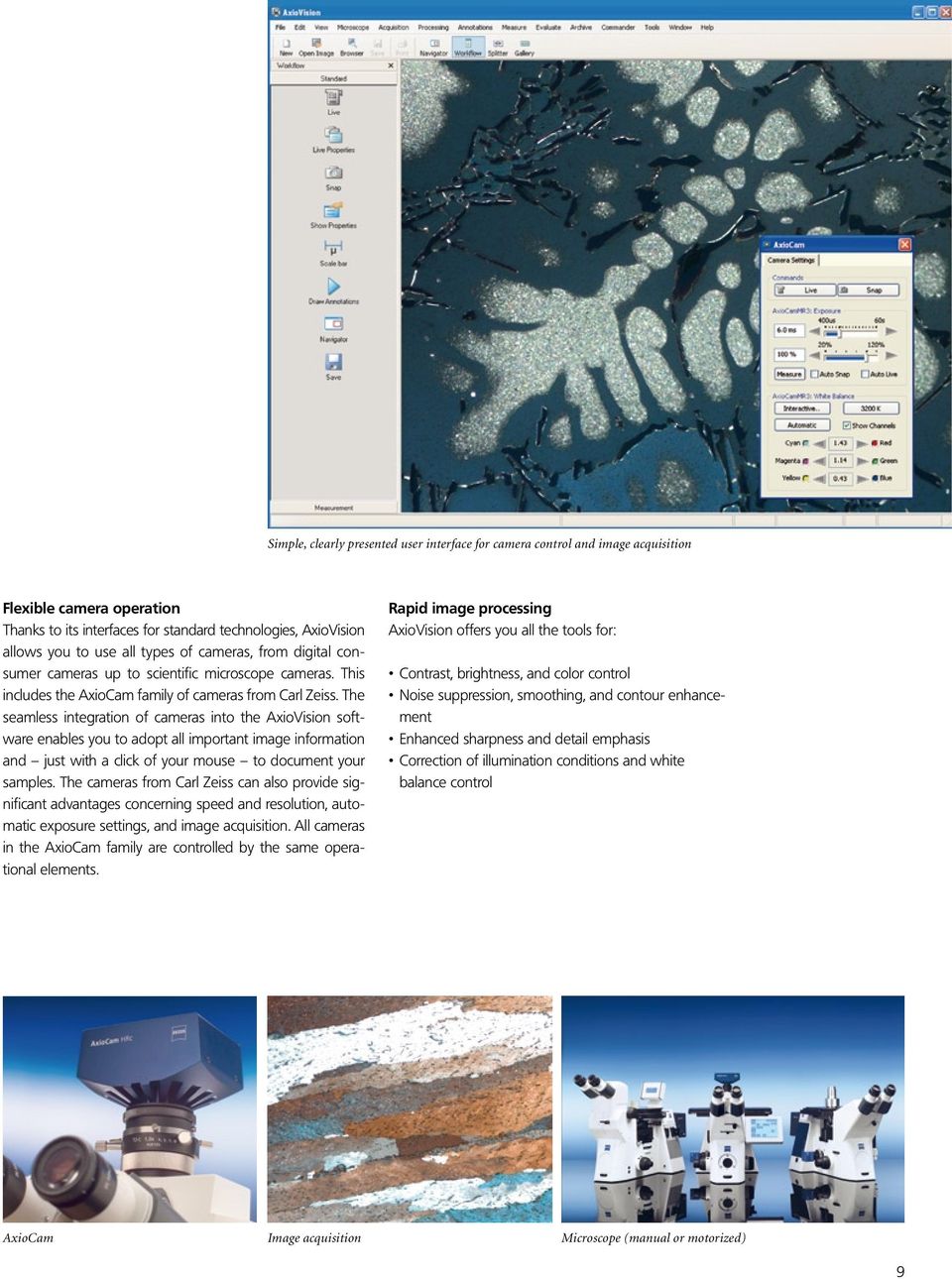
9 Simple, clearly presented user interface for camera control and image acquisition Flexible camera operation Thanks to its interfaces for standard technologies, AxioVision allows you to use all types of cameras, from digital consumer cameras up to scientific microscope cameras. This includes the AxioCam family of cameras from Carl Zeiss. The seamless integration of cameras into the AxioVision software enables you to adopt all important image information and just with a click of your mouse to document your samples. The cameras from Carl Zeiss can also provide significant advantages concerning speed and resolution, automatic exposure settings, and image acquisition. All cameras in the AxioCam family are controlled by the same operational elements. Rapid image processing AxioVision offers you all the tools for: Contrast, brightness, and color control Noise suppression, smoothing, and contour enhancement Enhanced sharpness and detail emphasis Correction of illumination conditions and white balance control AxioCam Image acquisition Microscope (manual or motorized) 9
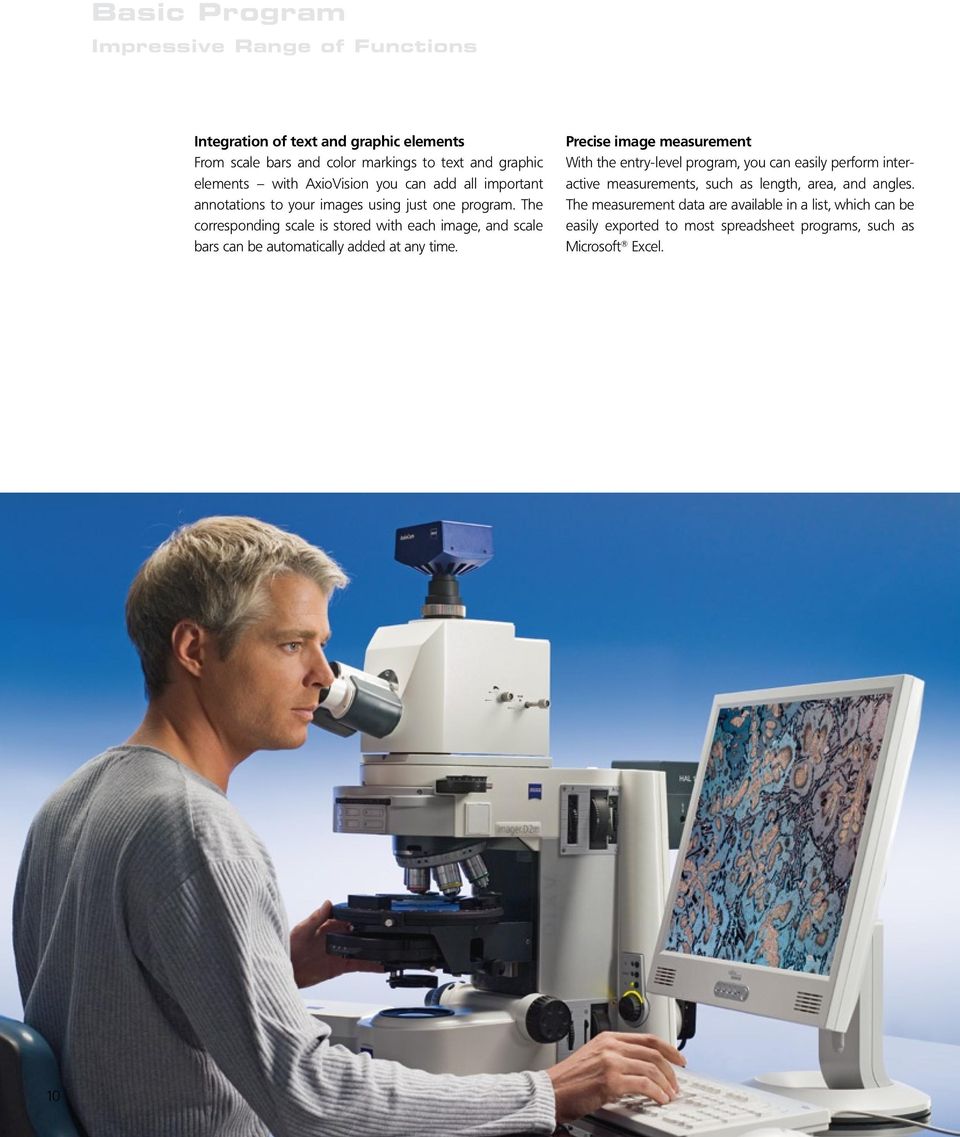
10 Basic Program Impressive Range of Functions Integration of text and graphic elements From scale bars and color markings to text and graphic elements with AxioVision you can add all important annotations to your images using just one program. The corresponding scale is stored with each image, and scale bars can be automatically added at any time. Precise image measurement With the entry-level program, you can easily perform interactive measurements, such as length, area, and angles. The measurement data are available in a list, which can be easily exported to most spreadsheet programs, such as Microsoft Excel. 10
11 Image processing: correction of illumination error (left: with shading, right: corrected) Text and graphic elements: labeling of defects Image measurement: area measurement Perfect report generation Whether using individually formatted or predefined layouts, AxioVision gives you all the options you need to generate effective reports or documentations. All information, such as measurement values, analysis results, tables, charts, and images, can be conveniently arranged using predefined layouts or formatting defined by the user simply at the push of a button. 11

12 Image Acquisition Modules Enhanced Performance in Imaging The results of your analyses are only as good as the quality of your acquired images. AxioVision offers you the perfect basis for achieving the required quality with highperformance additional modules, from MosaiX and Autofocus to Z-Stack and HDR Imaging. These modules save the additional information in your images, which is so often crucial. Autofocus The Autofocus module calculates the optimal focal position for a sample. The system is calibrated for each objective, hence the software focuses accurately every time or it automatically makes use of default parameters to achieve the correct focusing. In addition, with images that are acquired as a time lapse or at different positions, the system automatically refocuses. The Autofocus module works with all cameras that are directly controlled by AxioVision, provided that a microscope with motorized focus drive is used. MosaiX Developed to acquire images of large surfaces, MosaiX scans your samples image by image and then combines these individual images to form a single MosaiX image. In addition, uneven samples can be acquired without difficulty thanks to the option of automatic focus adjustment. Prerequisites for this are a motorized focus drive and stage. Any loss in image quality caused by the overlapping of individual image tiles is avoided due to an intelligent mechanism that determines either automatically or interactively the position of individual image tiles on the basis of the image content, corrects their position and combines them to form a MosaiX image. The image you obtain preserves the high resolution of each individual image. As a result, it is not only suitable for navigating around the sample, but also forms the ideal basis for further analyses. Large objects, such as nonmetallic inclusions, can be measured and the number of particles on a filter can be documented with the same ease. Now you are no longer restricted by the limits of an individual image. MosaiX image of a gear-wheel, 15x20 tiles Detailed view: individual tile of the MosaiX image Images of a printed circuit board on the left, a single image and, on the right, an HDR image 12

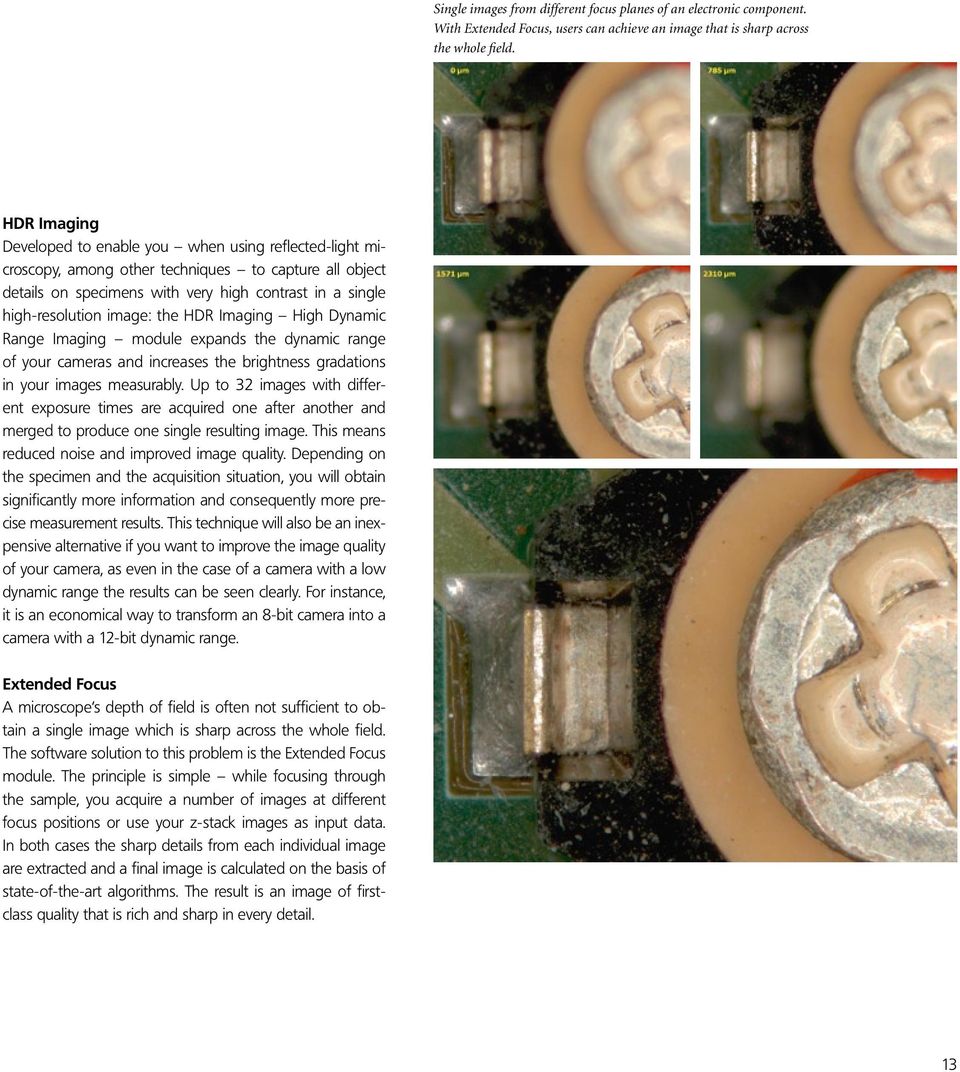
13 Single images from different focus planes of an electronic component. With Extended Focus, users can achieve an image that is sharp across the whole field. HDR Imaging Developed to enable you when using reflected-light microscopy, among other techniques to capture all object details on specimens with very high contrast in a single high-resolution image: the HDR Imaging High Dynamic Range Imaging module expands the dynamic range of your cameras and increases the brightness gradations in your images measurably. Up to 32 images with different exposure times are acquired one after another and merged to produce one single resulting image. This means reduced noise and improved image quality. Depending on the specimen and the acquisition situation, you will obtain significantly more information and consequently more precise measurement results. This technique will also be an inexpensive alternative if you want to improve the image quality of your camera, as even in the case of a camera with a low dynamic range the results can be seen clearly. For instance, it is an economical way to transform an 8-bit camera into a camera with a 12-bit dynamic range. Extended Focus A microscope s depth of field is often not sufficient to obtain a single image which is sharp across the whole field. The software solution to this problem is the Extended Focus module. The principle is simple while focusing through the sample, you acquire a number of images at different focus positions or use your z-stack images as input data. In both cases the sharp details from each individual image are extracted and a final image is calculated on the basis of state-of-the-art algorithms. The result is an image of firstclass quality that is rich and sharp in every detail. 13
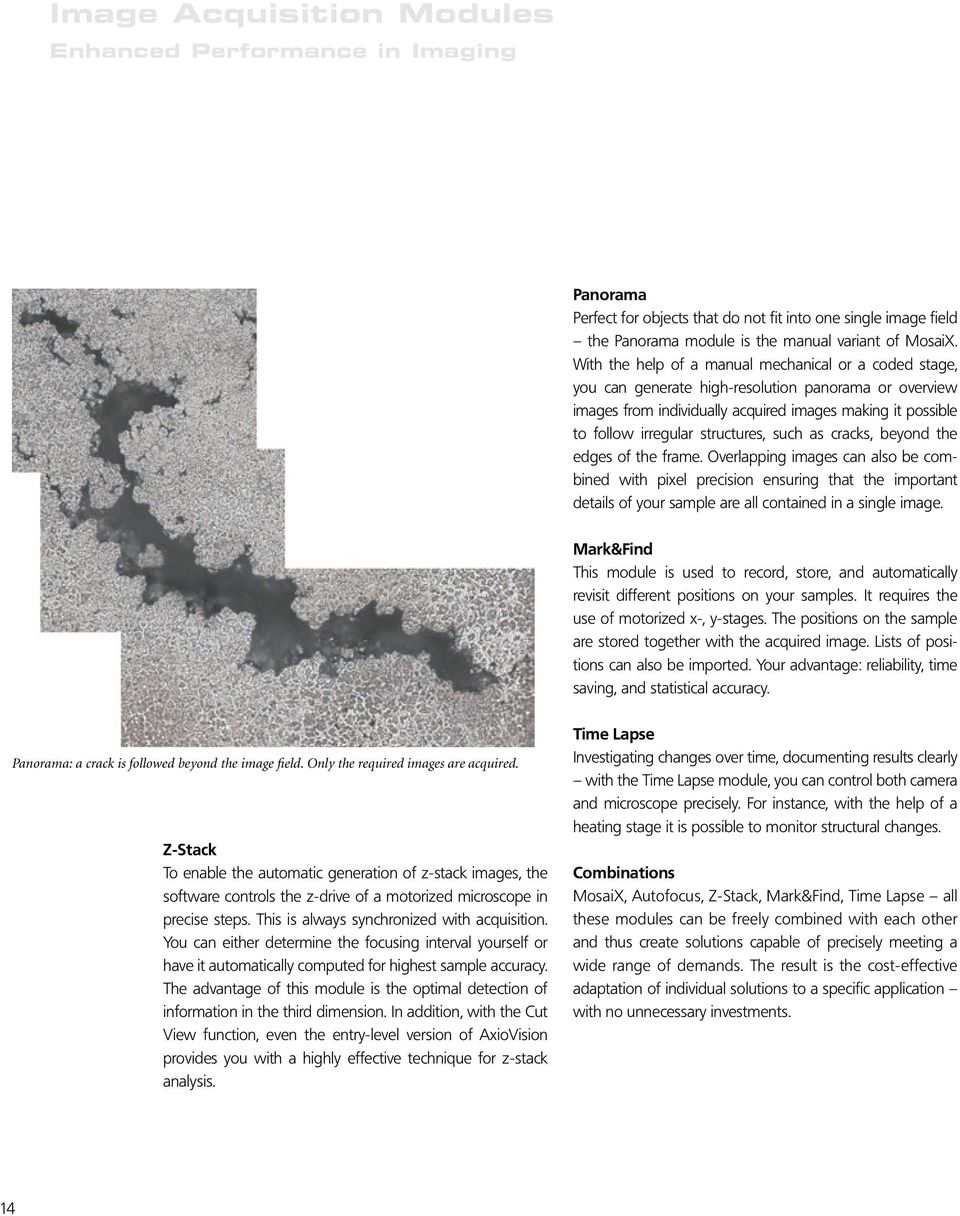
14 Image Acquisition Modules Enhanced Performance in Imaging Panorama Perfect for objects that do not fit into one single image field the Panorama module is the manual variant of MosaiX. With the help of a manual mechanical or a coded stage, you can generate high-resolution panorama or overview images from individually acquired images making it possible to follow irregular structures, such as cracks, beyond the edges of the frame. Overlapping images can also be combined with pixel precision ensuring that the important details of your sample are all contained in a single image. Mark&Find This module is used to record, store, and automatically revisit different positions on your samples. It requires the use of motorized x-, y-stages. The positions on the sample are stored together with the acquired image. Lists of positions can also be imported. Your advantage: reliability, time saving, and statistical accuracy. Panorama: a crack is followed beyond the image field. Only the required images are acquired. Z-Stack To enable the automatic generation of z-stack images, the software controls the z-drive of a motorized microscope in precise steps. This is always synchronized with acquisition. You can either determine the focusing interval yourself or have it automatically computed for highest sample accuracy. The advantage of this module is the optimal detection of information in the third dimension. In addition, with the Cut View function, even the entry-level version of AxioVision provides you with a highly effective technique for z-stack analysis. Time Lapse Investigating changes over time, documenting results clearly with the Time Lapse module, you can control both camera and microscope precisely. For instance, with the help of a heating stage it is possible to monitor structural changes. Combinations MosaiX, Autofocus, Z-Stack, Mark&Find, Time Lapse all these modules can be freely combined with each other and thus create solutions capable of precisely meeting a wide range of demands. The result is the cost-effective adaptation of individual solutions to a specific application with no unnecessary investments. 14
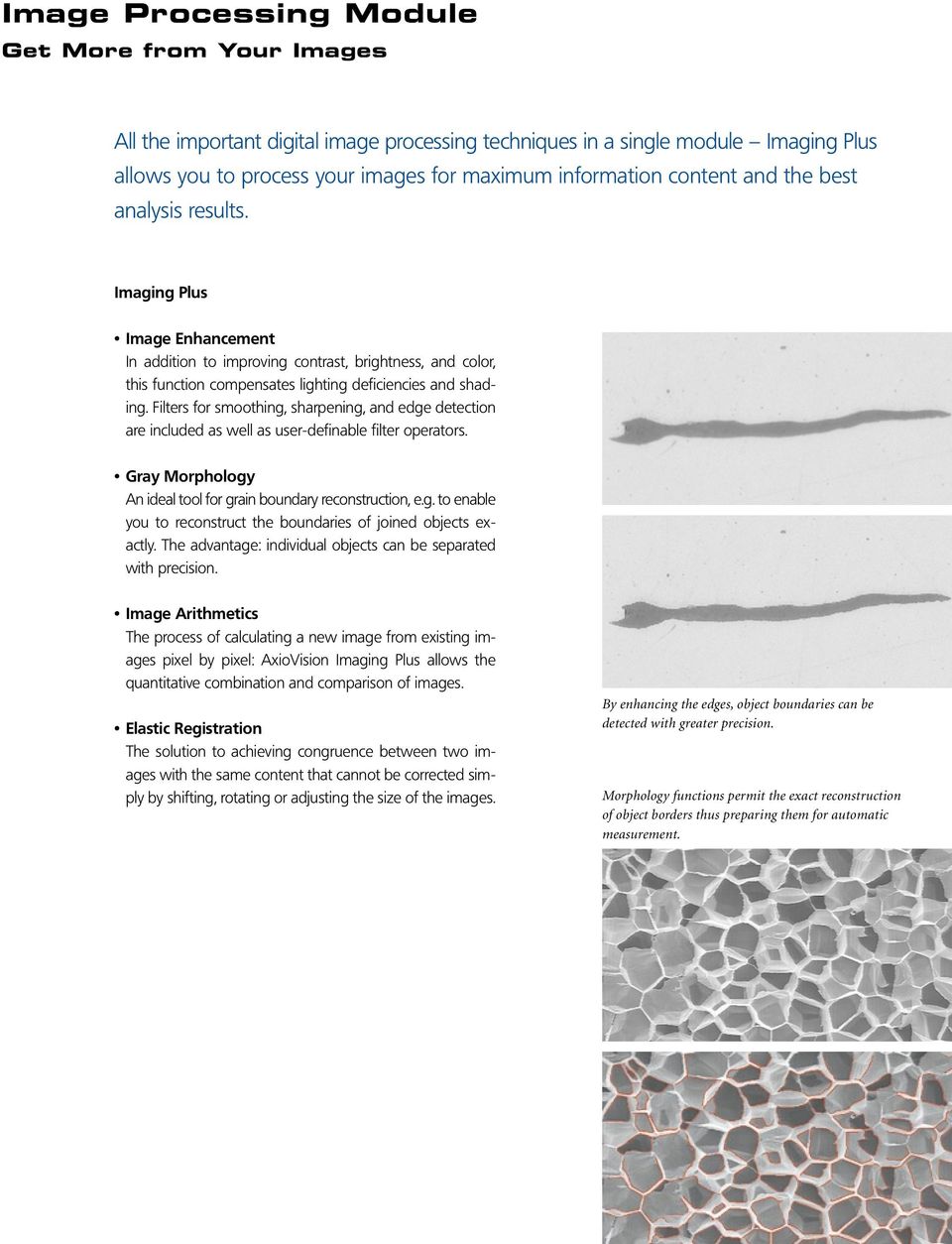
15 Image Processing Module Get More from Your Images All the important digital image processing techniques in a single module Imaging Plus allows you to process your images for maximum information content and the best analysis results. Imaging Plus Image Enhancement In addition to improving contrast, brightness, and color, this function compensates lighting deficiencies and shading. Filters for smoothing, sharpening, and edge detection are included as well as user-definable filter operators. Gray Morphology An ideal tool for grain boundary reconstruction, e.g. to enable you to reconstruct the boundaries of joined objects exactly. The advantage: individual objects can be separated with precision. Image Arithmetics The process of calculating a new image from existing images pixel by pixel: AxioVision Imaging Plus allows the quantitative combination and comparison of images. Elastic Registration The solution to achieving congruence between two images with the same content that cannot be corrected simply by shifting, rotating or adjusting the size of the images. By enhancing the edges, object boundaries can be detected with greater precision. Morphology functions permit the exact reconstruction of object borders thus preparing them for automatic measurement. 15
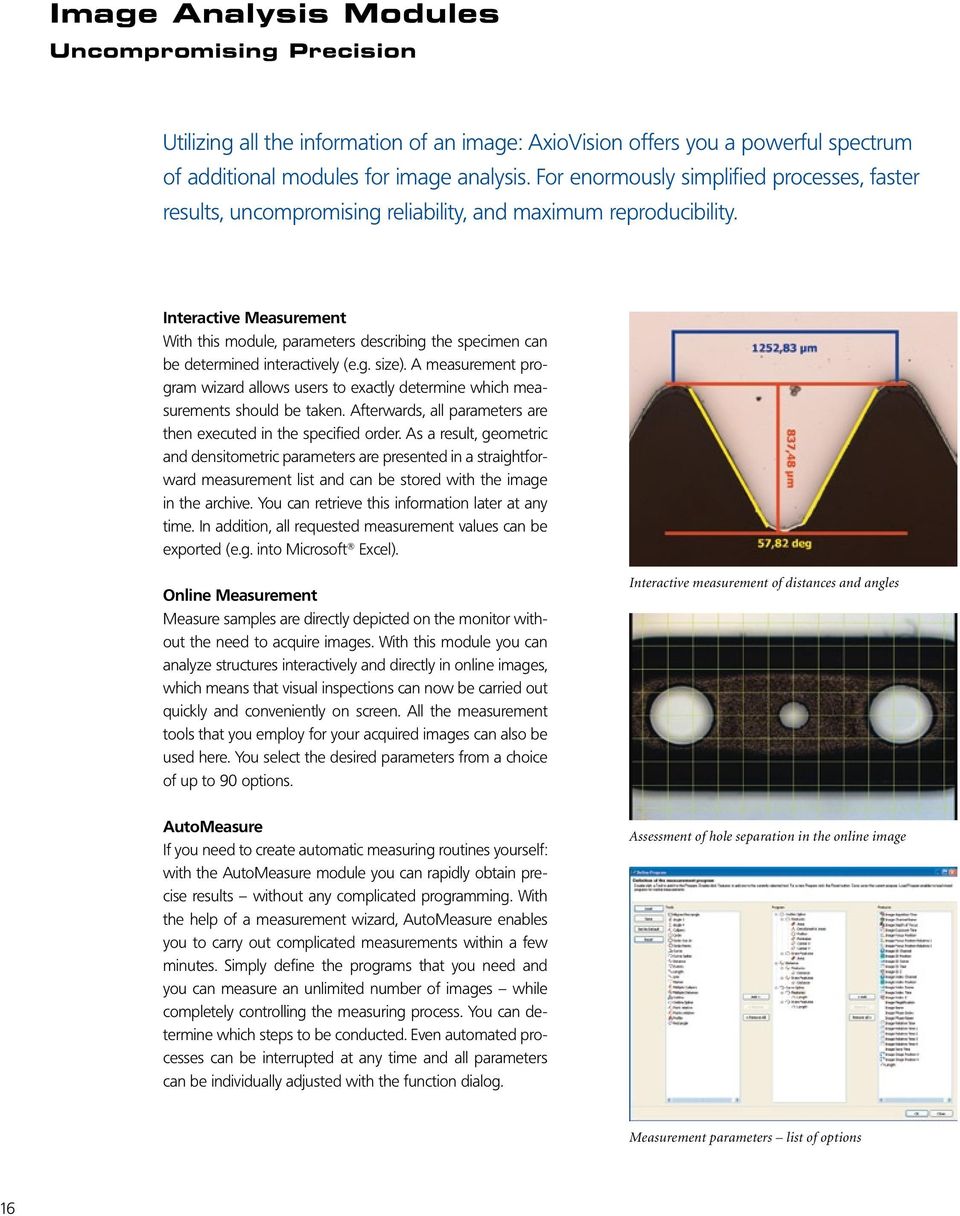
16 Image Analysis Modules Uncompromising Precision Utilizing all the information of an image: AxioVision offers you a powerful spectrum of additional modules for image analysis. For enormously simplified processes, faster results, uncompromising reliability, and maximum reproducibility. Interactive Measurement With this module, parameters describing the specimen can be determined interactively (e.g. size). A measurement program wizard allows users to exactly determine which measurements should be taken. Afterwards, all parameters are then executed in the specified order. As a result, geometric and densitometric parameters are presented in a straightforward measurement list and can be stored with the image in the archive. You can retrieve this information later at any time. In addition, all requested measurement values can be exported (e.g. into Microsoft Excel). Online Measurement Measure samples are directly depicted on the monitor without the need to acquire images. With this module you can analyze structures interactively and directly in online images, which means that visual inspections can now be carried out quickly and conveniently on screen. All the measurement tools that you employ for your acquired images can also be used here. You select the desired parameters from a choice of up to 90 options. Interactive measurement of distances and angles AutoMeasure If you need to create automatic measuring routines yourself: with the AutoMeasure module you can rapidly obtain precise results without any complicated programming. With the help of a measurement wizard, AutoMeasure enables you to carry out complicated measurements within a few minutes. Simply define the programs that you need and you can measure an unlimited number of images while completely controlling the measuring process. You can determine which steps to be conducted. Even automated processes can be interrupted at any time and all parameters can be individually adjusted with the function dialog. Assessment of hole separation in the online image Measurement parameters list of options 16
17 Automatic analysis of a polymer sample (fig. 1): threshold segmentation (fig. 2), correction of the binary image and automatic separation of objects (fig. 3), overlaid display of the measurement in the resulting image (fig. 4) AutoMeasure Plus Capturing the entire structure of the image automatically now possible in a single measurement step with this module. The result: fast, precise and reproducible quantitative analyses. Further advantages are: the direct access to all functions via the menu and the option to combine with the automatic processing module Commander. It enables you to merge the results of repetitive work steps in a single command ideal for the automatic processing and reproduction of standard lab assignments. The module consists of three functionality groups: AutoMeasure Plus Segmentation This function offers threshold operators for monochrome and color images that are necessary to identify your objects. The objects can also be identified with a mouse click using Region Growing. These two methods are supplemented by complex methods for segmentation, including dynamic and automatically generated threshold values as well as edge detection. The result is a binary image in which all specimen pixels are white and all background pixels black. AutoMeasure Plus Automatic measurement This function makes it possible to determine morphometric measurement parameters from the contour of the specimen. The binary image is used as a mask to calculate geometric and densitometric parameters from the original image. The results can be imported into Microsoft Excel ideal for generating statistical information about specimen details. TIC Measurement The TIC module (TIC Total Interference Contrast only in combination with the TIC slider from Carl Zeiss) allows the precise, contact-free and therefore extremely simple determination of the optical height and thickness of object structures over a range from just a few nanometers to several micrometers. The advantage of the TIC interferometric method lies in the combination of short measurement and analysis times with a high degree of accuracy. The use of circularly polarized light makes the orientation of the structures on the sample irrelevant and eliminates the need for stage rotation. It is even possible to analyze samples with large surface areas. AutoMeasure Plus Binary image processing Functions for linking, masking, and filling holes ensure that the binary image is optimally prepared for measurement. Artifacts are removed and contours smoothed. 17

18 Topography Module Surface Analysis Using Digital Height Data Whether you are dealing with height measurements for production control in the automotive industry, roughness measurements or 3D reconstructions for the optical assessment of production tolerances the Topography module generates height maps of your samples automatically or interactively using a contact-free and nondestructive method. Functionality Your work with this module is based on z-stack images of your samples, interactively acquired images from various focus planes or stereo image pairs acquired via both ports of a stereomicroscope. From these, the Topography module generates the following for you: 3D topographies from various perspectives with texture, grid or surface shading Roughness measurements in accordance with EN ISO 4287 Height measurements The measurements are performed along a profile line that you have drawn into the topographic image using a measurement tool. Several profiles can be drawn in and simultaneously selected. The measurement results are displayed in a table. The parameters of the primary profile, waviness or roughness are displayed on the basis of the cut-off wavelength (lambda) selected. The module also offers a wide range of functions from the display of sharp regions like a texture image and dynamic flooding in the height image to the possibility of modifying projections and height images via look-up tables. All height information is stored in the image and is available at any time. Integrated guidelines The AxioVision Topography module calculates the following roughness parameters in accordance with EN ISO 4287: R a : arithmetic mean of the profile ordinates R q : quadratic mean of the profile ordinates R sk : skewness of the profile R ku : steepness of the profile R v : depth of the greatest profile valley R p : height of the greatest profile peak R t : total height of the profile Roughness measurement in accordance with EN ISO 4287 along a user-selected profile 3D topography (texture projection) of a gauge block Height profile measurement in a topographic image 18

19 Archiving Module Well-conceived Data Management Maintain an overview of your images, measurement results, and reports AxioVision allows you to manage all your data simply, transparently, and completely. Asset Archive The powerful AxioVision Asset Archive module allows you to archive not just your images, but also all the associated image data, measurement results, and reports of your analyses in an extremely simple way under a single project number. This makes the process of finding your way around a large number of data sets significantly easier and quicker. The up-to-date image management software offers a range of benefits: Fast, flexible search functions: search by projects carried out for a certain customer/client, by projects carried out within the last week/month, by image or sample name, by date, labels, etc. Clear display of all key data acquired with the image Logically organized, hierarchical structure: Customer/client Project/assignment Asset Management of customer data/contacts/projects Asset Archive: structured storage of related images, measurement results, and reports in one project 19

20 Configuration Modules Automatically Faster With My AxioVision even the entry-level version of AxioVision offers you all kinds of methods for creating individual operating windows. These possibilities can be expanded almost infinitely with the help of two additional modules, and even offers you the opportunity to develop your own programs within AxioVision. My AxioVision My AxioVision is the design concept behind the AxioVision architecture. It forms the basis for the almost unlimited freedom that AxioVision gives you for adapting the powerful microscope software to your own particular requirements or for several different users. AxioVision stands out thanks to the unique range of options it offers for designing customized user interfaces and functions. It is perfectly suited for simplifying, optimizing and increasing the efficiency of your digital microscopy using comprehensible workflows. Even in the entry-level version the Carl Zeiss software offers you plenty of scopes to structure your individual work environment: you can configure your own toolbars and combine relevant elements for camera and microscope control in your own new dialogs. Elements can be removed or added depending on what you require for your work process. Commander The Commander module allows you to record subsequent steps of your workflow, edit and refine these steps, set parameters, and make all this available under a single command. The benefits are impressive: automatic processing of typical lab assignments and complete reproducibility of the results in addition to fast adaptation to new requirements. User-defined dialog for operating the microscope and camera 20

21 VBA Perhaps you need more functions than the wide range AxioVision provides. In this case it is possible to increase and extend the performance of the Carl Zeiss software and adapt it to your needs with VBA (Visual Basic for Applications), the programming language Carl Zeiss uses for AxioVision functions. VBA provides a completely integrated development environment that is familiar to programmers. Since VBA is directly integrated into the host application, it offers the advantages of fast internal cooperation as well as the opportunity to develop solutions without additional programs. The results look and act just like AxioVision. The major advantage of this module is that the users of your individually developed software require only a minimum of training time ) Commander window for recording work steps for automatic procedures 2) User-defined toolbar with daily workflow 21
22 Materials Packages Highly Versatile Compact and economical: with the materials packages, AxioVision offers you complete solutions that can be put into practice for your routine tasks in industry immediately at an all-inclusive price. They can be used with any microscope, are easily upgraded, and are delivered fully preconfigured from image acquisition to analysis, evaluation, and software archiving. Three packages for three different performance requirements The materials packages combine the strengths and performance of important AxioVision modules, starting with the functions of the basic program to modules such as AutoMeasure Plus or MosaiX. Three tailored packages are available: Materials Core: for routine applications Image Analysis upgrade: for advanced measurement tasks Motorization upgrade: for automatic acquisition using motorized microscopes and stages Moreover, as you would expect from Carl Zeiss, it is possible to upgrade these packages easily and economically to gain access to the next performance class. You can therefore be confident that even with the compact solution you will be able to respond flexibly to new performance requirements at any time. What the materials packages offer Image Acquisition Extended Focus Panorama Autofocus Z-Stack MosaiX Image Processing Imaging Plus Image Analysis Interactive Measurement Online Measurement AutoMeasure AutoMeasure Plus Documentation Asset Archive Configuration My AxioVision Materials Core Image Analysis Upgrade Motorization Upgrade X X X X X X X X X X X X X X X X X X X X X X X X X X X X X X X X X X X X X X X X X AxioVision Basic program AxioVision module 22
23 Application Modules Greater Efficiency in All Routine Tasks Whether for particle analysis or grain size analysis the AxioVision application modules offer complete application solutions for industrial practice. They have been developed to allow reproducible results to be achieved with as little interaction as possible. The transparent system design is identical for virtually all application modules. This is realized by using fully automated processes making your routine tasks faster, more efficient and more reliable. Operating modes The AxioVision application modules have been systematically developed for use in practice and are focused on two key requirements: flexibility and security. This flexibility means being able to add in-house test specifications and new standards independently at any time without external assistance or additional programming. Another benefit is the security of knowing that there is no possibility of careless changes to settings leading to incorrect measurement results. The operating concept of all application modules is therefore based on two functional areas: all key settings for the measurement routines are defined in administrator mode. Measurements are then carried out in user mode in a simple way via a transparent user interface. The administrator will have defined in advance whether and to what extent users can change measurement parameters here. System operation is incredibly easy and was designed to allow reproducible results to be achieved with as little interaction as possible. The performance of a measurement can be automated to such an extent that only the project data need to be entered the entire analysis process runs automatically. 23
24 Particle Analyzer System Particle Analysis with No Limits Nowadays, guidelines and standards place numerous sectors under an obligation to guarantee and document the cleanliness of their products in a verifiable way. For instance, the pharmaceutical industry is subject to FDA Regulation 21 CFR Part 11 and the automotive industry to the standard VDA Volume 19. These require the analysis of complete samples and the standard-compliant acquisition of images of even the smallest particles. Functionality Analyzing residual dirt on filter membranes, examining lubricants, identifying defects in die cast components, inspecting distributions of active substances in crystalline form in ointments, detecting, separating and measuring plaques in microtiter plates behind the AxioVision module Particle Analyzer Projects stands an integrated total system for a versatile range of applications. Tailored to industrial practice, this system impresses with its performance and ease of operation. It automatically sets classes and boundaries and selects the measurement parameters. The particles can be classified on the basis of various types (reflective, non-reflective, fibers, etc.). Measurement results are presented clearly in an image gallery and can be edited. It is also possible to relocate, further process, delete or reclassify particles an important function that enables you to control and correct your measurement results at any time. The key to the system s convenience and operational reliability is the fact that, on the basis of the motorized microscope platform, the entire measurement procedure is performed fully automatically from image acquisition and particle detection to analysis and report generation. For microscopy you can reliably reproduce. Integrated guidelines The Particle Analyzer system supports all national and international key standards: e.g. ISO 4406, ISO and VDA Volume 19. The corresponding classes and class boundaries are set automatically and the relevant measurement parameters are selected. Within the context of GxP projects as an option Carl Zeiss can also supply with AxioVision GxP* the necessary software and documentation. A certifiable calibration standard is also available as an option for system inspection. The analysis system is configurable and you can easily add new standards to the existing system yourself without having to wait for new software. * Module not available in all countries The system variants of the Particle Analyzer based on SteREO Discovery.V12 and Axio Imager.Z2m Active substances in crystalline form in ointments 24
25 NMI System Determining Non-metallic Inclusions in Steel Current and new industry standards define a wide range of requirements for determining the content of non-metallic inclusions in steel. NMI is integrated into a total system with a practical orientation and enables you to determine the content of non-metallic inclusions reliably and with absolute precision in accordance with established steel standards. Functionality Developed in collaboration with experienced users involved in the production and application of steel, NMI offers a powerful analysis method that allows you to respond reliably to and comply with the requirements of even the latest industry standards. With NMI you control all system components fully automatically via the software. Workflows are automated with the help of test specifications, which can be adapted individually. Once it has been set up, the system scans the surfaces of your steel samples independently and analyzes them. Inclusions will be captured in full even if they are larger than the field of view of your camera. Supported standards NMI supports the following standards in a measurement: Results display and data management The results display in NMI sets the standard with regard to transparency and depth of information. A wide range of options is available for displaying the measurement values from the results view in image and tabular form to the selection of various gallery views offering all measurement and classification data, elimination of artifacts, etc. Reports are generated automatically according to the requirements of the selected standard and can be modified individually. All measurement data, such as tables, images, and reports, but also the test specifications are saved and managed in an Asset Archive. The archive features search and filter functions ensuring that the data can be easily found and called up again at any time. EN DIN ASTM E45 ISO 4967 JIS G 0555 The system variants of NMI based on Axio Imager.Z2m and Axio Observer.Z1m Results view with gallery of largest inclusions 25
26 Grains On the Trail of Structures A standard-compliant and flexible solution for analyzing grain sizes in materialographic samples Grains offers you an easy-to-use analysis tool for determining grain sizes in accordance with the requirements of international standards. Fully automatically or interactively and with high precision and reproducibility. Functionality Three measurement modes are available for analyzing grain sizes: Comparison, a purely interactive method for comparing micrographs with comparative diagrams; the semiautomatic intercept method; and the automatic method, which automatically reconstructs grain boundaries for you and determines the individual grain size. You decide which method is appropriate with a click of your mouse depending on the characteristics of the sample. Supported standards Grains supports the following standards: ASTM E 112 ASTM E 1382 DIN EN ISO 643 Additional standards for the Comparison method: ASTM Plate I, Plate II, Plate III, Plate IV SEP BS 4990 Automatic grain size analysis Resulting image for intercept method 26
27 Multiphase Greater Flexibility for Phase Analyses Multiphase analyzes the phase distribution in your samples for you. Phases are precisely measured on the basis of parameters such as size, shape or orientation and documented clearly in terms of the percentage of the area they represent, like classified particle sizes or in the form of a comparison quickly, precisely, and reliably. Functionality With Multiphase you decide whether you want to determine the percentage of the area that the selected phases represent or the size of the individual particles of a phase. The measurement values are then classified to provide you with a better overview. Complete flexibility is offered thanks to the free definition of parameters: individual class boundaries, linear or logarithmic classification, weighting on the basis of area or number. The parameters for the measurement can be drawn freely from the complete range of AxioVision measurement functions and even user-defined parameters are possible. If the standard steps prove insufficient experienced users will have the option of tailoring the image processing steps to meet their individual requirements. The results are then displayed in a clearly structured report the standard reports supplied can be modified individually. Multiphase analysis: results view Ferrite and perlite 27
28 Layer Thickness Measurement Precision in All Layers Convenient and economical: Layer Thickness Measurement is a powerful tool for determining layer thicknesses in your samples from simple to complex layers and from individual layers to several layers. Functionality Layer Thickness, which can be used universally to meet your specific requirements, offers you a choice of different methods for detecting the individual layers of your samples. In the first step, the layers are identified on the basis of the color or gray value or drawn in interactively. The module then automatically calculates the course of the measurement chords, depending on the layer gradient present. It does this precisely and individually for each layer and independently of the number of layers. How the measurement will be performed is always your decision. You choose the number of measurement chords or the distance between the measurement chords and therefore determine the accuracy of the result. This forms a clearly structured report containing sample data and measurement values, such as the maximum and minimum chord lengths, mean, and standard deviation. In addition, a distribution of the chord lengths can also be displayed graphically. If you wish so, you can also use all the other statistical analyses available in AxioVision, which is another important advantage. Chord Length [µm] Description Distance [µm] Minimum Maximum Mean Std.Dev Range No of Chords Cross-section polish of a coated screw Coating with measuring chords 28
29 Comparative Diagrams Assessing Structural Parameters Assessing structural parameters conveniently on screen, generating comparative diagrams yourself Comparative Diagrams introduces a new level of quality to the interactive comparison of defined parameters and replaces the previous method involving the use of comparative diagram charts. It is a powerful tool for metallographers, materials scientists, and quality assurance professionals. Functionality Comparative Diagrams, which serve as an aid for the comparison of samples under the microscope, are collections of images that have been assigned certain characteristics to e.g. structural characteristics or good/bad preparation. Comparative Diagrams displays the micrographs of the samples you wish to examine together with the comparative diagrams on screen and thus makes interactive comparison possible. The result is a table containing the comparative diagram numbers relating to each image and a table containing statistical analyses. You can also have a micrograph displayed with an overlaid comparative diagram. User-generated: the image of the sample is flanked by two comparative diagrams Integrated standards It is possible to generate your own comparative diagrams with no additional costs and no waiting time: using the wizard function you can adapt the comparative diagrams simply to your own requirements. The comparative diagrams of the following standards are included in the software package: EN ISO 643 ASTM E 112 ASTM E 1382 BS 4990 SEP EN DIN Comparative view with eight comparative diagrams 29
30 Graphite Classifying Graphite Particles Whether you need to determine the size and shape of graphite particles in cast iron in accordance with EN ISO 945 or the nodularity of vermicular graphite according to SAE J 1887, with this application module you can measure graphite particles fully automatically and with consistent analysis quality. Functionality Developed for the efficient measurement of graphite with practice in mind, the Graphite module analyzes your samples in accordance with the applicable standards. The graphite particles are classified automatically by shape and size. With both methods the results are analyzed according to the specifications of the standards, archived, and documented in appropriate test reports. The Graphite module offers the following methods: Cast iron with lamellar graphite Determination of shape and size according to EN ISO 945 Nodularity of vermicular graphite according to SAE J 1887 Spheroidal graphite Vermicular graphite 30
31 Overview Functions Basic program Image Acquisition Function Contents/Description Image Formats: Image Import zvi, bmp, tif, jpg, j2k, jp2, gif, tga, png, psd, cmp, pct, ras, eps, wmf, mac, msp, img, czi, lsm, vgi, rek, raw, avi, zvhi Image Export avi, bmp, j2k, jp2, jpg, Ism, mov, pct, pcx, png, psd, tga, tif, wmf Camera Control: Exposure Time Adjustment Manual adjustment, exposure time measurement, automatic mode Automatic Exposure Time Adjustment of exposure time in live image Target Value for Exposure Time Definition of the sensitivity level of the sensor during an exposure measurement Focus/Exposure Frame Optional measurement frame as a focus aid and for spot measurement of the exposure time Live Image Frame Rate Selection: fast/medium/slow for best possible display of the live image Resolution Selection of Microscanning resolution modes (AxioCam HR) Binning Increased camera sensitivity by combining the signals of adjacent pixels Color Adjustment Manual adjustment of the color balance Color Saturation Adjustment of the level of color saturation Frame Interactive selection of an image sensor sub frame White Balance Interactive or automatic adjustment of optimum neutral balance of the color channels 3200K Default value for white balance, optimized for halogen light source at 3200K Gray Value Scaling Adjustment of dynamic range (retain original, convert to 8 bit, convert to 16 bit) Histogram Intensity distribution histogram for all three color channels Black Reference Generation of correction image for long exposure times (dark current compensation) Shading Correction Generation of correction image to compensate for optical inhomogeneities Image Orientation Rotation and mirroring of image orientation for optimum image display B/W or Color Mode Conversion of color images into monochrome images during acquisition Digital Gain Adjustment of digital signal amplification Analog Gain Analog signal amplification prior to digitization NIR Mode for B/W Cameras Mode for further increased sensitivity in near IR for monochrome AxioCam cameras EMCCD Gain Adjustment of signal amplification for cameras with EMCCD sensor CCD Port Selection of amplifier port for cameras with several read-out amplifiers Offset Adjustment of basic brightness value Mode Selection of different, manufacturer-dependent special modes Unsharp Masking Sharpening of images immediately during acquisition Trigger Input Triggering of acquisition by means of TTL signal Trigger Output Triggering of a trigger signal, e.g. to control an external shutter Image Processing Annotate: Annotation Addition of text, marking elements (arrows, scale bars, etc.) Adjust: Brightness/Contrast/Gamma Adjustment of brightness, contrast and gamma Color Balance Manual adjustment and readjustment of color rendition Hue/Lightness/Saturation Adjustment of hue and saturation Shading Correction Correction of uneven illumination Z-Stack Correction Correction of bleaching effects in z-stack fluorescence images Transfer display attributes Transfer of display settings (brightness, contrast, gamma) to other images Adjust display attributes Adjustment of display settings (brightness, contrast, gamma) to pre-defined values White Balance Change of white balance in a color image 31
32 Overview Functions Geometric Shift xyz shift of images Transformation: Rotate 90 Rotation of an image to 90 Z-Stack Alignment Alignment of the individual planes of a z-stack image which for instance has been acquired using a stereomicroscope OrthoView Generation of projections along orthogonal axes in 3D images Image Smoothing: Gauss, Sigma Image smoothing using Gauss or Sigma filter Image Sharpening: Enhance Contour Enhancement of image sharpness by the intensification of contours Unsharp Masking Intensification of image sharpness by the enhancement of contrast for small structures and edges Utilities: Resample Reduce/enlarge the size of an image Copy Image Copy an image and image information that can be selected Load Look-up table Load a pseudo-color table Export Image Export image into other formats Convert Pixel Format Change the pixel format of an image Create Image Subset Generate a subset from a multi dimensional image Add Channels Combine images with the same dimensions (z-stack, time lapse) into multichannel images Reset Indices Re-indexing of image dimensions in ascending order Image Analysis Interactive Measurement Tools and Parameters: Magnetic Cursor Scalings Automatic Scaling Create/Append Table Length, Line Outline/Outline (Spline) Angle 3, Angle 4 Circle Events Profile Evaluate The cursor detects edges, which facilitates the process of finding them, e.g. when measuring lengths Scaling in geometric units Automatic detection of pixel size Generation/attachment of a data table based on the measurement tools drawn in Definition using 2 points Measurement of diameter, area, perimeter, length and width of the circumscribing rectangle, radius, center of gravity, mean density of gray value, standard deviation of mean density of gray value Definition using 3 or 4 points Measurement of diameter, area, perimeter, length and width of the circumscribing rectangle, radius, center of gravity, mean density of gray value, standard deviation of mean density of gray value Counting of events Gray value profile along a line Functions for the processing and statistical analysis of data tables Documentation Gallery Info View Cut View Gallery View Splitter Display Printing of Images/Data Reports Clear presentation of loaded images as thumbnails Display of all information of the image Display of z-stack images in 3 orthogonal section views (x,y - x,z - y,z) Clear presentation of multidimensional images Comparison of up to 12 images, also multidimensional; generation of comparison as new image document for presentation purposes Print of images Creation of user-definable reports My AxioVision Toolbars/Dialogs/Workflows Shortcut Icons Microscope Creation of individual toolbars, dialogs, and workflows Allocation of AxioVision functions to keyboard combinations Allocation of symbols to AxioVision functions Allocation of AxioVision functions to up to 10 microscope softkeys 32
33 Overview Functions Image Acquisition modules Z-Stack Acquisition of image series from different focus positions Focus Control Automatic adjustment of the minimum possible step size according to microscope type Z-Stack Configuration Definition of start and stop position (or center position) and interval between individual z-planes Nyquist Criterion Automatic calculation of the optimal z-interval Navigation Precise stepwise navigation through defined z-stack or to the start, stop or center position Experiment Saving of z-stack definitions as experiment for exact reproduction of an experimental set-up ReUse Extraction of z-stack definitions from previously acquired images for the exact reproduction of an experimental set-up Time Lapse Flexible acquisition of image series over time Time Configuration Definition of interval as well as number of cycles or total time Exposure Time Automatic measurement of the correct exposure time for the first time point Image Information Acquisition time point as annotation in image Autosave High data security during long time lapse acquisitions thanks to Autosave function Image Size Acquisition of images as large as required depending on experimental conditions ( > 2 GB) Time Lapse Processing - Gliding Average Calculation of average values from time lapse images - Time Differential Calculation of first and second derivative from time lapse images - Time Concatenate Combination of two time lapse images to form a new time lapse image - Image Ratio Division of two time lapse images - Time Lapse Alignment Alignment of the individual time points of a time lapse image - Time Stitching Stitching of heterogeneous ZVI time lapse images to generate one contiguous sequence to enable movie creation from Smart Experiment results Experiment Saving of time lapse configurations as experiment for exact reproduction of an experimental set-up ReUse Extraction of time lapse settings from previously acquired images for the exact reproduction of an experimental set-up Smart Experiments Free combination of different types of experiments to create a Smart Experiment which can be used to acquire heterogeneous multidimensional images Mark&Find Recording and relocating positions Database Mark Interactively Classify Select Visualize Focus Position Import/Export Calibrate Management of projects involving different types of slides in a database (slides, multiple specimen holders, Petri dishes, multiwell plates) Color assignment of sample positions in the database Assignment of colors and allocation of names for object positions Activation/deactivation of individual positions Visualization of the selected points on a graphic slide, relocation by clicking on the colored marker Repositioning with optional use of stored focus position Import and export of position lists in a file format compatible with Microsoft Excel Calibration using a HOME Calibration slide MosaiX Automatic scanning of large surfaces Execute Focus Correction Stitching Convert Combinability Scanning of the entire surface of a sample (motorized stage required) Correction of the focus position in the case of uneven sample Correct alignment of tiles to each other Conversion of tile images into a composite image MosaiX can be freely combined with all multidimensional image acquisition modules 33
34 Overview Functions Extended Focus Calculation of sharp images from several focus positions Acquisition/Computation from z-stack Generation of an image with extended depth of focus from single images acquired from different focus positions directly from the camera or from an acquired z-stack Alignment Correction of the alignment of single images during acquisition with a stereomicroscope Autofocus Automatic focusing Methods Calibrate Focus Choice between autofocus with calibration and parameter options and autofocus that is always calibrated and does not require parameterization Calibration by specifying the optimum focus position using the current microscope setting with motorized microscopes Automatic calculation of the optimum focus plane at the touch of a button. Suitable for transmittedlight, reflected-light as well as brightfield, darkfield, and fluorescence Panorama Formation of overview images Acquisition Import from Files Stitching Convert Generation from individually acquired camera images Generation from images that have been saved previously Correct alignment of tiles to each other Conversion of tile images into a composite image HDR Imaging (High Dynamic Range) Acquisition method for extending the available dynamic range of digital cameras HDR Snap Generation and processing of an HDR image using pre-set parameters HDR Series Generation of an HDR raw data image using different exposure times HDR Merge Processing of an HDR raw data image to create an HDR image with offset correction HDR Setup Basic setting for activating HDR acquisition for all imaging techniques Image Processing modules Inside4D Visualization in 3D Volume Display Shadow Projection Transparency Rendering Surface Rendering Maximum Projection Mixed Mode Spatial Interaction 3D Inside View Annotations Animations Maximum Rendering Speed Clipping Planes Volume display of z-stack images with up to 8 channels with selective switching between different channels or view in merged pseudo-color mode Creation of animations with strong sense for spatial conditions Presentation of transparent structures Enhancement of individual structures Ideal for prints and publication Simultaneous display of surface and transparency-rendered data, simplifies display of small objects within the context of larger structures Free positioning of the 3D volume in space (with free choice of angles for x, y and z; lateral position and zoom factor) Orientation within a volume Optional display of volume edges, color coding, and scaling of axes Generation of animations as rendered image series with export options in popular video formats (AVI, QuickTime) Acceleration of rendering methods by modern graphic boards (support of OpenGL standard) Exposure of interesting structures by means of up to three freely movable and configurable clipping planes 34
35 Overview Functions Imaging Plus Image Improvement, Gray Morphology, Fourier Transformation, Color Transformation Adjust - Contrast Contrast enhancement using interactive/automatic histogram adaptation - Negative Calculation of inverted image (negative) - Gray Transformation Adjustment of gray values using transformation tables Geometric Transformations - Rotate Rotation around an axis - Mirror Mirror along horizontal or vertical axis - Alignment Affine transformation - Elastic Registration / Warping Alignment using a reference image Smoothing - Denoising Denoising using wavelet transformation - Lowpass Lowpass filter (gliding average) - Median Median filter (non-linear method) - Rank General rank operator - Gauss Anisotropic Anisotropic Gauss filter with selectable Sigma values Sharpening - Edge Enhancement Enhancement of edges Edges - Sobel Edge detection using Sobel filter - Laplace Laplace filter - Highpass Highpass filter - Local Variance Edge detection filter calculating the local variance of each pixel in relation to its neighborhood Morphology - Gray Erode, Gray Dilate Erosion or dilation of objects - Gray Open, Gray Close Erosion followed by dilation or dilation followed by erosion - Tophat White Removal of bright regions - Tophat Black Accentuation of dark regions - Gray Gradient Morphological gradient to detect contours - Watersheds Watersheds algorithm for separation/reconstruction Arithmetics - Add, Subtract Addition or subtraction of two images - Add Constant Addition of a constant value - Multiply, Divide Multiplication or division of two images - Multiply Constant Multiplication with a constant value - Average Average of two images - Maximum, Minimum Maximum or minimum of two images - Square, SquareRoot Square or square root of an image - Logarithm, Exponential Logarithm or exponent of an image - Combine Linear combination of two images FFT - Transform Fourier transformation on an image - Spectrum Calculation of power or phase spectrum - Filter Filtering in the frequency domain using a defined filter - Inverse Inverse Fourier transformation 35
36 Overview Functions Utilities - Copy Region Copying of image regions - Color Model Transformation of RGB color space into HLS color space and vice versa - Split RGB Extractions Splitting of a RGB image into single color channels - Combine RGB Extractions Combination of single color channels to form a color image - User Filter Filtering of an image with user-defined filter matrix - Generate Noise Superimposing an image with predefined noise Time Lapse Processing - Gliding Average Calculation of average values from time lapse images - Time Differential Calculation of first and second derivative from time lapse images - Time Concatenate Combination of two time lapse images to create a new time lapse image - Image Ratio Division of two time lapse images - Time Lapse Alignment Alignment of the individual time points of a time lapse image - Time Stitching Stitching of heterogeneous ZVI time lapse images to generate one contiguous sequence to enable movie creation from Smart Experiment results Image Analysis modules Interactive Measurement Expanded interactive measurement techniques Distance, Calipers Measurement of length Multiple Calipers/Distance Measurement of the length of multiple lines perpendicular to a base line Curve, Curve (Spline) Measurement of the drawn curve s length Aligned rectangle or free orientation Measurement of geometric and densitometric object features Circle (Radius), Circle (Points) Drawing of a radius to the center, clicking on contour points Marker x- and y-coordinates of a point Points, Relative Points x- and y-coordinates of one or more points with free definition of the coordinate system Interactive Measurement Program Wizard Guided generation of a program for interactive measurement Interactive Measurement Programs Loading and execution of interactive measurement programs Online Measurement Interactive measurements in online images Activate Online Measurement Execution of interactive measurements in an online image Layer Predefined and individual grids can be displayed in the online image AutoMeasure Creation of Measurement Programs Creation of easy measurement programs with a measurement wizard Automatic Measurement Program Wizard Guided generation of a program for automatic measurement Image Enhancement Contrast, brightness, gamma, noise reduction (Sigma), shading correction, improvement of edges Segmentation Global or local definition by clicking or circumscribing objects, specification of thresholds using the image histogram, definition of multiple phases Binary Image Clean-up Deletion of artifacts, filling of holes Automatic Object Separation Erosion and dilation, watersheds Editing of the Measurement Mask Drawing of separation lines, deletion of objects, addition of objects Selection of Measurement Parameters Region-specific, field-specific, geometric, and annotation parameters, user-defined parameters Definition of Measurement Conditions ( object filter ) Definition of a Measurement Frame Measurement Documentation Data Storage Logical concatenation (and/or) of region-specific parameters, definition by simple clicking on reference objects Rectangle, circle, freehand Measurement of geometric and densitometric features for single objects or the entire image Marking of measured objects and display of freely selectable measurement parameters in the graphics plane Saving of measurement data in a Microsoft Excel compatible file format (CSV, XML) 36
37 Overview Functions Execution of Measurement Programs Image Acquisition Control of Program Program Information Image acquisition via camera, all images of a folder, all loaded images Activation/deactivation as well as the changing of functional parameters during execution of the program List of executed functions with parameter settings AutoMeasure Plus Segmentation, binary image processing, automatic measurement Segmentation - Thresholds Interactive adjustment of thresholds with histogram support and specification of fixed values - Region Growing Detection of associated regions (gray values within user-defined tolerance range) - Multiphase Adjustment of thresholds for several phases of an image with histogram support - Automatic Automatic determination of thresholds using a histogram - Dynamic Technique for threshold detection using size information - Valleys Detection of dark lines (valleys) in images with bright background - Canny Edge detection considering steepness of edges - Marr Detection of edges and associated regions Binary Functions - Erode, Dilate Erosion or dilation of binary objects - Ultimate Erode Erosion of binary objects while keeping the smallest structures - Open, Close Erosion followed by dilation or dilation followed by erosion - Clean Up Binary Image Filling of holes, removal of artifacts - Mark Regions Marking of regions using a mask image - Object Separation Automatic separation of touching regions - Binary Image Editor Interactive subsequent editing (separating, combining) of binary images - AND, OR, XOR, NOT Bit-by-bit logic operations - Distance Transformation Generation of a distance map, indicating the distance of each pixel to the object border Skeletonizing of Binary Images - Thinning Thinning of binary objects to lines 1 pixel wide ( skeleton ) - Skeleton Skeletonization of the image background Selection of Measurement Parameters Region-specific, field-specific, geometric, and annotation parameters, user-defined parameters - Definition of Measurement Conditions ( object filter ) Logical concatenation (and, or) of region-specific parameters, definition by simple clicking on reference objects - Definition of a Measurement Frame Rectangle, circle, freehand - Measurement Automatic measurement of geometric and densitometric object features, drawing of measurement values into the graphics plane of the image 3D Measurement Measurement of three-dimensional structures and parameters Interactive Measurement in 3D Space Drawing of lines, angles, markers, and curves in rendered 3D views Segmentation Interactive adjustment of thresholds in rendered 3D view and with specification of fixed values Binary Image Editor Interactive subsequent editing (separating, combining) of 3D binary images Measurement Automatic measurement of geometric and densitometric object features, drawing of measurement values in the graphics plane of the image 37
38 Overview Functions Particle Analyzer Projects Measurement of particles System solution Coordinated components: microscope, camera, PC, software Automatic classification Supported standards, e.g. VDA 19, ISO 16232, user-defined adjustment of standards - Particle classification Reflective particles, non-reflective particles, fibers User modes - Administrator Definition of the measurement procedure using test specifications - User Execution of the measurement Data management Based on Asset Archive, selection of the data to be saved Results display - Results view Display of the classification results for each standard and method - Gallery of the largest inclusions View the largest inclusions, relocate the inclusions under the microscope, remove artifacts, various galleries Report Issue of standard-compliant reports, modification possible NMI Determination of the content of non-metallic inclusions in rolled steel System solution Coordinated components: microscope, camera, PC, software Multiple samples Acquisition and analysis of several samples during a single measurement Simultaneous analysis of all supported standards EN 10247, DIN 50602, ASTM E 45, JIS G 0555, ISO 4967 User modes - Administrator Definition of the measurement procedure using test specifications - User Execution of the measurement Data management Based on Asset Archive, selection of the data to be saved Results display - Results view Display of the classification results for each standard and method - Gallery of the largest inclusions View the largest inclusions, relocate the inclusions under the microscope, remove artifacts, various galleries Report Issue of standard-compliant reports, modification possible Grains Determination of grain size Measurement modes - Comparison Comparison using comparative diagrams ASTM Plate I, Plate II, Plate III, Plate IV, SEP , BS Intercept Intercept method supporting DIN EN 623, ASTM E 112, ASTM E 1382, various line patterns - Automatic Automatic reconstruction of grain boundaries supporting DIN EN 623, ASTM E 112, ASTM E 1382, additional measurement parameters possible User modes - Administrator Definition of the measurement procedure using test specifications - User Execution of the measurement Data management Based on Asset Archive Report Issue of standard-compliant reports, modification possible Multiphase Analysis of multiphase samples Phase components as a percentage, classification of particle sizes, free choice of measurement Measurement parameters User modes - Administrator Definition of the measurement procedure using test specifications - User Execution of the measurement 38
39 Overview Functions Data management Report Based on Asset Archive Issue of reports, modification possible Graphite Analysis of graphite particles in cast iron Measurement modes - Shape and size Determination of shape and size in accordance with EN ISO SinterCast Determination of nodularity in accordance with SAE J Lamellar Determination of the size of lamellar graphite in accordance with EN ISO Spherolyte Determination of the size of spheroidal graphite in accordance with EN ISO 945 User modes - Administrator Definition of the measurement procedure using test specifications - User Execution of the measurement Data management Based on Asset Archive Report Issue of standard-compliant reports, modification possible Comparative Diagrams Interactive comparison of comparative diagrams with micrographs Display Comparison with one, two, four or eight comparative diagrams Wizard Creation of user-defined comparative diagrams User modes - Administrator Definition of the measurement procedure using test specifications - User Execution of the measurement Data management Based on Asset Archive Report Display of images, data tables, and statistical analysis, modification possible Layer Thickness Measurement of layer thickness Layer detection Gray or color value segmentation or interactive detection Measurement Individual or several layers, straight or curved layers User modes - Administrator Definition of the measurement procedure using test specifications - User Execution of the measurement Data management Based on Asset Archive Report Issue of results, modification possible Calotte Grinding Measurement of layers in accordance with DIN V ENV 1071 (calotte grinding method) Drawing in of measurement circles Drawing in of measurement circles for single or multilayer Analysis Automatic calculation of layer thickness, display of measurement results in image, generation of report TIC Optical height measurement with Total Interference Contrast TIC settings Correction of phase shift and objective aperture Automatic TIC measurement Measurement of fringe displacement in the interference image 39
40 Overview Functions Topography Height and roughness measurement in 3D topographies Generation of topographies - Calculation from stereo image pairs Calculation of the topographic image from a stereoscopic image pair - Calculation from z-stack images Generation of the topographic image from a z-stack by means of surface recognition - Composition from texture image and height map Generation of the topographic image from a texture image and a specified height map Topographic views - Texture Display of the structure of the detected surface - Height image Display of the height map in gray value or pseudo-color coding - 3D projections 3D display of the topography in gray value or pseudo-color coding, texture projection, grid or surface projection - Anaglyph Display of the topography as a stereogram that can be viewed using anaglyph glasses Measurements - Profile measurement Measurement and display of height profiles of lines, polygons, and curves - Roughness measurement in accordance with EN ISO 4287 Calculation of roughness statistics from primary, roughness, and waviness profiles - Cut-off wavelength Setting of the cut-off wavelength for measuring roughness and waviness - Flood height Setting of a flood height for displaying regions of equal height Generation of views Each topographic view can be saved as an image Generation of measurement value lists - Height profiles Height profiles can be saved as a graph or a data list - Roughness statistics The roughness statistics of the drawn-in profile lines can be saved as a data list Documentation and Configuration modules Asset Archive Archiving of images, measurement data, and reports Structured Archiving of Assets Allocation of assets to projects, contacts, and categories Search Keyword search and freely definable search queries on the basis of field content Value Lists Data entry using adaptable value lists Local Management of Archives Single-user system, storage location for the database may be selected Commander Recording/execution of steps Record, Save Start Edit Recording of work steps and saving of scripts Automatic execution of recorded scripts Subsequent editing of scripts VBA Integrated development environment Visual Basic Editor VBA environment with full access to AxioVision functionalities 40
41 Overview Region-specific Measurement Parameters Region-specific parameters Geometric parameters Entry-level Materials Packages Interactive Measurement AutoMeasure 3D Measure X X X AcpX, AcpY x- and y-coordinates of the first object point of a region X AcpZ z-coordinate of the first object point of a 3D region X X X X Area Area of the region in scaled and unscaled units X X Area convex, Area filled Area of the convex shell of the region and of the filled region X Area to area sum Area of the region in relation to the total area of all regions X Area to Frame area Area of the region in relation to the area of the measurement frame X Surface, SurfaceFilled Surface content of the 3D region and of the filled 3D region X Volume Volume of the 3D region in scaled and unscaled units X Volume filled Volume of the filled 3D region X Volume to volume sum Volume of the 3D region in relation to the total volume of all 3D regions X Volume to Frame Volume Volume of the 3D region in relation to the volume of the measurement frame X X Count of inner parts Number of holes and regions within holes X X X X X CenterX, CenterY x- and y-coordinates of the geometric center of gravity of the region X CenterZ z-coordinate of the geometric center of gravity of the 3D region X X X Ellipse major, Ellipse minor Length of the main axis and the secondary axis of the ellipse with the same geometric moment of inertia as the region/3d region X Ellipse Semi-Medial Axis Length of the middle axis of the ellipse with the same geometric moment of inertia as the 3D region X X X Ellipse angle Angle of the main axis of the ellipse with the same moment of inertia X X X X Perimeter Perimeter of the region X X Perimeter convex Perimeter of the convex shell of the region X X Perimeter filled Perimeter of the filled region X X Perimeter Crofton, Perimeter Crofton filled Perimeter of the region and perimeter of the filled region according to Crofton X X Perimeter X, Perimeter Y x- and y-projection of the perimeter X X Perimeter XF, Perimeter YF x- and y-projection of the perimeter of the filled region X X Perimeter XY, Perimeter XYF Diagonal projection of the perimeter and the perimeter of the filled region X X X X Bound left, Bound top, Bound right, Bound bottom x- and y-coordinates of the bounding box/the bounding cuboid of a 3D region X Bound front, Bound back z-coordinates of the bounding cuboid of a 3D region X X X X X Bound width, Bound height Width and height of the bounding box/the bounding cuboid of a 3D region X Bound depth Depth of the bounding cuboid of a 3D region X X Area Frame Area of the measurement frame in scaled and unscaled units X Volume Frame Volume of the measurement frame in scaled and unscaled units X X X X Feret minimum, Feret maximum Minimum and maximum feret of the region 41
42 Overview Region-specific and Field-specific Measurement Parameters Region-specific parameters Geometric parameters Entry-level Materials Packages Interactive Measurement AutoMeasure 3D Measure X X Feret Min. Angle, Feret Max. Angle Angle of the minimum and the maximum feret of the region X Feret Min. Azimut, Feret Max. Azimut Horizontal orientation of the minimum and the maximum feret of the 3D region X Feret Min. Elevation, Feret Max. Elevation Vertical orientation of the minimum and the maximum feret of the 3D region X X X X Feret Ratio Ratio of the ferets (Feret Min/Feret Max) X X X X X Diameter, Radius Diameter, radius of the circle with equivalent area/sphere with equivalent volume X X X X Form circle, Form sphere Circular shape factor of the region/spherical shape factor of the 3D region X X Fibre length Length of a fiber-like thin region X X X Index/ID Explicit characteristic of the region, of the squares X X X X Distance, Length Distance between 2 points, length of a line X X Distances Mean Mean distance of multiple distances X X X X Angle Measurement Angle in degrees Densitometric parameters X X X X Mean Densitometric mean value of the region (gray and color values) X X X X X Standard Deviation Standard deviation of the densitometric values of the region (gray and color values) X X X Minimum, Maximum Minimum and maximum densitometric value (gray and color values) X X X Sum Sum of the densitometric values of the region X X Sum Square Sum of the squares (gray and color values) Field-specific parameters Geometric parameters X Area sum Area of all regions in scaled and unscaled units X Area sum filled Area of all filled regions X Area percent Percentage area of all regions in the measurement frame X X Number of regions Number of the measured regions X Perimeter sum Sum of all region perimeters X Surface sum Surface content of all 3D regions X Volume sum Volume of all 3D regions in scaled and unscaled units X Volume sum filled Volume of all filled 3D regions X Volume percent Percentage volume of all 3D regions in the measurement cuboid 42
43 Overview Field-specific and Image-specific Measurement Parameters Field-specific parameters Densitometric parameters Entry-level Materials Packages Interactive Measurement AutoMeasure 3D Measure X X Mean Densitometric mean value of all regions (gray and color values) X X Standard Deviation Densitometric value standard deviation in all regions (gray and color values) X X Minimum, Maximum Minimum and maximum densitometric value in all regions (gray and color values) Further parameters X X X X Count Number of objects clicked on X X Marker x- and y-coordinates of an object X X X Gray/Color Value Profiles Gray value/color value along a profile line X X User Parameter Parameter that can be defined by the user Image-specific parameters X X X X X Name Name of the image X X X X X Acquisition Time Time point at which the image was acquired X X X X X Exposure Time Exposure time of the image X X X X X Focus Position Focus position of the image X X X X X Microscope Magnification Microscope magnification set during image acquisition X X X X X Date Saved Date on which the acquired image was saved X X X X X Stage Position X, Y x- and y-stage position at which the image was acquired X X X X Channel Name Name of the channel for multichannel images X X X X Phase Name/Index Phase name/index for multiphase images X X X X Index/ID Channel Index/ID of the channel of the multichannel image X X X X Index/ID z-plane Z-index/ID for z-stack images X X X X Index/ID Time Time index/id for time lapse images Statistical parameters Minimum, Maximum, Mean, Count, Sum, Standard Deviation, Range, Sum of squares, Variance, 25-Quartile, 50-Quartile (Median), 75-Quartile, 10-Percentile, 90-Percentile, 1-Percentile, 99-Percentile, Kurtosis, Skewness 43
44 44 Carl Zeiss Microscopy GmbH Jena, Germany Materials Information subject to change. Printed on environmentally friendly paper bleached without cholorine /e printed 08.10
Takeoff Guide Tutorial to get started with the AxioVision Imaging System (Based on Release 4.7.2 December 2008)
 Takeoff Guide Tutorial to get started with the AxioVision Imaging System (Based on Release 4.7.2 December 2008) This Takeoff Guide has been prepared for Carl Zeiss by Imaging Associates Ltd. www.imas.co.uk
8.0. The most complete image analysis solution CLEMEX VISION PE. Intelligent systems designed for multiple or complex applications
 The most complete image analysis solution CLEMEX VISION PE Intelligent systems designed for multiple or complex applications Customized to meet your needs Difficult applications made simple Our staff's
The How Do Guide to AxioVision. Author: Brian Svedberg Image Analysis Specialist Carl Zeiss MicroImaging, Inc.
 The How Do Guide to AxioVision Author: Brian Svedberg Image Analysis Specialist Carl Zeiss MicroImaging, Inc. How do I grab a single image? How do I grab a single image? Click on the Camera icon to switch
Fast Z-stacking 3D Microscopy Extended Depth of Field Autofocus Z Depth Measurement 3D Surface Analysis
 Cam CANIMPEX CPX-SOLUTIONS 3D Digital Microscope Camera FAST PRECISE AFFORDABLE 3D CAMERA FOR MICROSCOPY Fast Z-stacking 3D Microscopy Extended Depth of Field Autofocus Z Depth Measurement 3D Surface Analysis
AxioCam HR The Camera that Challenges your Microscope
 Microscopy from Carl Zeiss AxioCam HR The Camera that Challenges your Microscope Documentation at the edge of the visible The Camera for Maximum Success: AxioCam HR Low light fluorescence, live cell imaging,
AxioCam MR The All-round Camera for Biology, Medicine and Materials Analysis Digital Documentation in Microscopy
 Microscopy from Carl Zeiss AxioCam MR The All-round Camera for Biology, Medicine and Materials Analysis Digital Documentation in Microscopy New Dimensions in Performance AxioCam MR from Carl Zeiss Both
Zeiss 780 Training Notes
 Zeiss 780 Training Notes 780 Start Up Sequence Do you need the argon laser, 458,488,514nm lines? No Turn on the Systems PC Switch Turn on Main Power Switch Yes Turn on the laser main power switch and turn
IMAGING SOFTWARE. Image-Pro Insight Image Analysis Made Easy. Capture, Process, Measure, and Share
 IMAGING SOFTWARE Image-Pro Insight Image Analysis Made Easy Capture, Process, Measure, and Share Image-Pro Insight Image Analysis Made Easy Capture, Process, Measure, and Share Image-Pro Insight, the latest
OPERATING INSTRUCTIONS Nikon TiE Deconvolution Microscope CCRB 1-220G
 OPERATING INSTRUCTIONS Nikon TiE Deconvolution Microscope CCRB 1-220G Conventions Through these notes bold font refers to a software button and italics refer to a hardware switch. The software makes extensive
AxioVision. Perform to Perfection
 Microscopy from Carl Zeiss AxioVision Perform to Perfection The Microscope Software for Life Sciences from Image Acqusition Through to Image Analysis, It s in a Dimension of Its Own. 1 A New Way of Thinking
MetaMorph Software Basic Analysis Guide The use of measurements and journals
 MetaMorph Software Basic Analysis Guide The use of measurements and journals Version 1.0.2 1 Section I: How Measure Functions Operate... 3 1. Selected images... 3 2. Thresholding... 3 3. Regions of interest...
Image Analysis Using the Aperio ScanScope
 Image Analysis Using the Aperio ScanScope Allen H. Olson, PhD Algorithm Development Engineer Aperio Technologies INTRODUCTION Why should I choose the Aperio ScanScope over competing systems for image analysis?
NIS-Elements Viewer. User's Guide
 NIS-Elements Viewer User's Guide Publication date 10.09.2013 v. 4.20.00 Laboratory Imaging, s. r. o., Za Drahou 171/17, CZ - 102 00 Praha 10 No part of this publication may be reproduced or transmitted
3D Viewer. user's manual 10017352_2
 EN 3D Viewer user's manual 10017352_2 TABLE OF CONTENTS 1 SYSTEM REQUIREMENTS...1 2 STARTING PLANMECA 3D VIEWER...2 3 PLANMECA 3D VIEWER INTRODUCTION...3 3.1 Menu Toolbar... 4 4 EXPLORER...6 4.1 3D Volume
Imaging and Bioinformatics Software
 Imaging and Bioinformatics Software Software Overview 242 Gel Analysis Software 243 Ordering Information 246 Software Overview Software Overview See Also Imaging systems: pages 232 237. Bio-Plex Manager
OmniMet Solutions for Image Aquisition & Analysis
 OmniMet Solutions for Image Aquisition & Analysis Solutions for Materials Preparation, Testing and Analysis Manual Interactive Measurements Measure image features interactively using point-and-click tools.
Graphic Design. Background: The part of an artwork that appears to be farthest from the viewer, or in the distance of the scene.
 Graphic Design Active Layer- When you create multi layers for your images the active layer, or the only one that will be affected by your actions, is the one with a blue background in your layers palette.
MI Software. Innovation with Integrity. High Performance Image Analysis and Publication Tools. Preclinical Imaging
 MI Software High Performance Image Analysis and Publication Tools Innovation with Integrity Preclinical Imaging Molecular Imaging Software Molecular Imaging (MI) Software provides high performance image
MACHINE VISION MNEMONICS, INC. 102 Gaither Drive, Suite 4 Mount Laurel, NJ 08054 USA 856-234-0970 www.mnemonicsinc.com
 MACHINE VISION by MNEMONICS, INC. 102 Gaither Drive, Suite 4 Mount Laurel, NJ 08054 USA 856-234-0970 www.mnemonicsinc.com Overview A visual information processing company with over 25 years experience
Adobe Certified Expert Program
 Adobe Certified Expert Program Product Proficiency Exam Bulletin Adobe Photoshop CS4 Exam # 9A0-094 ACE Certification Checklist The checklist below will help guide you through the process of obtaining
GelAnalyzer 2010 User s manual. Contents
 GelAnalyzer 2010 User s manual Contents 1. Starting GelAnalyzer... 2 2. The main window... 2 3. Create a new analysis... 2 4. The image window... 3 5. Lanes... 3 5.1 Detect lanes automatically... 3 5.2
// SUPER technology for precise web viewing: SUPER HANDYScan 4000. Be inspired. Move forward.
 // SUPER technology for precise web viewing: SUPER HANDYScan 4000. Be inspired. Move forward. // QUALITY: RELIABLY PROTECTED. PRODUCTIVITY: SUSTAINABLY INCREASED. Web viewing that sets standards: BST SUPER
How To Use Trackeye
 Product information Image Systems AB Main office: Ågatan 40, SE-582 22 Linköping Phone +46 13 200 100, fax +46 13 200 150 [email protected], Introduction TrackEye is the world leading system for motion
Image Digitization Using PHODIS SC/SCAI
 'Photogrammetric Week '97' D. Fritsch D. Hobbie, Eds., Wichmann Verlag, Heidelberg, 1997. Vogelsang 25 Image Digitization Using PHODIS SC/SCAI ULRICH VOGELSANG, Oberkochen ABSTRACT With PHODIS SC Carl
product overview pco.edge family the most versatile scmos camera portfolio on the market pioneer in scmos image sensor technology
 product overview family the most versatile scmos camera portfolio on the market pioneer in scmos image sensor technology scmos knowledge base scmos General Information PCO scmos cameras are a breakthrough
ZEISS Axiocam 506 color Your Microscope Camera for Imaging of Large Sample Areas Fast, in True Color, and High Resolution
 Product Information Version 1.0 ZEISS Axiocam 506 color Your Microscope Camera for Imaging of Large Sample Areas Fast, in True Color, and High Resolution ZEISS Axiocam 506 color Sensor Model Sensor Pixel
IncuCyte ZOOM Whole Well Imaging Overview
 IncuCyte ZOOM Whole Well Imaging Overview With the release of the 2013B software, IncuCyte ZOOM users will have the added ability to image the complete surface of select multi-well plates and 35 mm dishes
Ovation Operator Workstation for Microsoft Windows Operating System Data Sheet
 Ovation Operator Workstation for Microsoft Windows Operating System Features Delivers full multi-tasking operation Accesses up to 200,000 dynamic points Secure standard operating desktop environment Intuitive
User Manual. cellsens LIFE SCIENCE IMAGING SOFTWARE
 User Manual cellsens LIFE SCIENCE IMAGING SOFTWARE Any copyrights relating to this manual shall belong to Olympus Soft Imaging Solutions GmbH. We at Olympus Soft Imaging Solutions GmbH have tried to make
CULTURAL HERITAGE USER GUIDE
 Capture One CULTURAL HERITAGE USER GUIDE Capture One Cultural Heritage edition is a Raw work-flow application based on the Capture One DB solution and features exclusive new tools expressly designed to
HCImage Live Getting Started Guide
 HCImage Live Getting Started Guide Release 4.3.5 May 2016 2016 Hamamatsu Corporation FCD-0332-HCILQ4516 This guide, as well as the software described in it, is covered under license agreement and may be
Microsoft Picture Manager. Picture Manager
 Picture Manager Picture Manager allows you to easily edit and organize the pictures on your computer. Picture Manager is an application that was included with Microsoft Office suite for Windows 2003 and
Automotive Applications of 3D Laser Scanning Introduction
 Automotive Applications of 3D Laser Scanning Kyle Johnston, Ph.D., Metron Systems, Inc. 34935 SE Douglas Street, Suite 110, Snoqualmie, WA 98065 425-396-5577, www.metronsys.com 2002 Metron Systems, Inc
APPLICATION NOTE. Basler racer Migration Guide. Mechanics. www.baslerweb.com. Flexible Mount Concept. Housing
 62 62 APPLICATION NOTE www.baslerweb.com Basler racer Migration Guide This paper describes what to consider when replacing the Basler L100 Camera Link or the Basler runner Gigabit Ethernet (GigE) line
Cytell Cell Imaging System
 Cytell Cell Imaging System Simplify your cell analysis and start changing tomorrow today www.gelifesciences.com/cytell The Cytell Cell Imaging System is an intuitive cell analysis instrument that streamlines
The Concept(s) of Mosaic Image Processing. by Fabian Neyer
 The Concept(s) of Mosaic Image Processing by Fabian Neyer NEAIC 2012 April 27, 2012 Suffern, NY My Background 2003, ST8, AP130 2005, EOS 300D, Borg101 2 2006, mod. EOS20D, Borg101 2010/11, STL11k, Borg101
Applying a circular load. Immediate and consolidation settlement. Deformed contours. Query points and query lines. Graph query.
 Quick Start Tutorial 1-1 Quick Start Tutorial This quick start tutorial will cover some of the basic features of Settle3D. A circular load is applied to a single soil layer and settlements are examined.
MIRAX SCAN The new way of looking at pathology
 Microscopy from Carl Zeiss MIRAX SCAN The new way of looking at pathology Greater reliability. Greater efficiency. Virtual microscopy for research & analysis. Better. More efficient. Quality as the basis
imc FAMOS 6.3 visualization signal analysis data processing test reporting Comprehensive data analysis and documentation imc productive testing
 imc FAMOS 6.3 visualization signal analysis data processing test reporting Comprehensive data analysis and documentation imc productive testing imc FAMOS ensures fast results Comprehensive data processing
Anime Studio Debut vs. Pro
 vs. Animation Length 2 minutes (3000 frames) Unlimited Motion Tracking 3 Points Unlimited Audio Tracks 2 Tracks Unlimited Video Tracks 1 Track Unlimited Physics No Yes Poser scene import No Yes 3D layer
Encoders for Linear Motors in the Electronics Industry
 Technical Information Encoders for Linear Motors in the Electronics Industry The semiconductor industry and automation technology increasingly require more precise and faster machines in order to satisfy
Software-based three dimensional reconstructions and enhancements of focal depth in microphotographic images
 FORMATEX 2007 A. Méndez-Vilas and J. Díaz (Eds.) Software-based three dimensional reconstructions and enhancements of focal depth in microphotographic images Jörg Piper Clinic Meduna, Department for Internal
imc FAMOS 6.3 visualization signal analysis data processing test reporting Comprehensive data analysis and documentation imc productive testing
 imc FAMOS 6.3 visualization signal analysis data processing test reporting Comprehensive data analysis and documentation imc productive testing www.imcfamos.com imc FAMOS at a glance Four editions to Optimize
A new dimension of sound and vibration analysis
 A new dimension of sound and vibration analysis HEAD Gallery Innovative functions built upon cutting-edge technology The ArtemiS suite is an integrated software solution from HEAD acoustics that allows
Manual for simulation of EB processing. Software ModeRTL
 1 Manual for simulation of EB processing Software ModeRTL How to get results. Software ModeRTL. Software ModeRTL consists of five thematic modules and service blocks. (See Fig.1). Analytic module is intended
Basic 3D reconstruction in Imaris 7.6.1
 Basic 3D reconstruction in Imaris 7.6.1 Task The aim of this tutorial is to understand basic Imaris functionality by performing surface reconstruction of glia cells in culture, in order to visualize enclosed
Asset Track Getting Started Guide. An Introduction to Asset Track
 Asset Track Getting Started Guide An Introduction to Asset Track Contents Introducing Asset Track... 3 Overview... 3 A Quick Start... 6 Quick Start Option 1... 6 Getting to Configuration... 7 Changing
Introduction to Autodesk Inventor for F1 in Schools
 Introduction to Autodesk Inventor for F1 in Schools F1 in Schools Race Car In this course you will be introduced to Autodesk Inventor, which is the centerpiece of Autodesk s digital prototyping strategy
FSI Machine Vision Training Programs
 FSI Machine Vision Training Programs Table of Contents Introduction to Machine Vision (Course # MVC-101) Machine Vision and NeuroCheck overview (Seminar # MVC-102) Machine Vision, EyeVision and EyeSpector
MicroStrategy Analytics Express User Guide
 MicroStrategy Analytics Express User Guide Analyzing Data with MicroStrategy Analytics Express Version: 4.0 Document Number: 09770040 CONTENTS 1. Getting Started with MicroStrategy Analytics Express Introduction...
Instructions for Creating a Poster for Arts and Humanities Research Day Using PowerPoint
 Instructions for Creating a Poster for Arts and Humanities Research Day Using PowerPoint While it is, of course, possible to create a Research Day poster using a graphics editing programme such as Adobe
The Image and Document Management System for Microscopy
 The Image and Document Management System for Microscopy Image and Document Management at a Glance The Image and Document Management System ImageAccess is a Windows based software tool for acquisition,
Creating Interactive PDF Forms
 Creating Interactive PDF Forms Using Adobe Acrobat X Pro Information Technology Services Outreach and Distance Learning Technologies Copyright 2012 KSU Department of Information Technology Services This
AMS Suite: Machinery Health Manager v5.4
 S-NSF033010 October 2010 AMS Suite: Machinery Health Manager v5.4 The AMS Machinery Manager v5.4 release is the result of user input collected during plant visits and documented by our customer support
Solid Edge structural frames and weldments
 Solid Edge structural frames and weldments White Paper Intelligent, process-specific applications that speed time to manufacturing. White Paper Solid Edge structural frames and weldments 2 Contents Solid
Introduction. www.imagesystems.se
 Product information Image Systems AB Main office: Ågatan 40, SE-582 22 Linköping Phone +46 13 200 100, fax +46 13 200 150 [email protected], Introduction Motion is the world leading software for advanced
Machine Tool Control. Besides these TNCs, HEIDENHAIN also supplies controls for other areas of application, such as lathes.
 Machine Tool Control Contouring controls for milling, drilling, boring machines and machining centers TNC contouring controls from HEIDENHAIN for milling, drilling, boring machines and machining centers
TABLE OF CONTENTS. INTRODUCTION... 5 Advance Concrete... 5 Where to find information?... 6 INSTALLATION... 7 STARTING ADVANCE CONCRETE...
 Starting Guide TABLE OF CONTENTS INTRODUCTION... 5 Advance Concrete... 5 Where to find information?... 6 INSTALLATION... 7 STARTING ADVANCE CONCRETE... 7 ADVANCE CONCRETE USER INTERFACE... 7 Other important
ONYX. Preflight Training. Navigation Workflow Issues Preflight Tabs
 ONYX Preflight Training Navigation Workflow Issues Preflight Tabs Preflight Module Tool Bar Tabs Tab Options Preview Area Information Open in Preflight Recommended Workflow Highlight Printer File > Open
Fluorescent Array Imaging Reader
 Fluorescent Array Imaging Reader Multiplex Enabled For 2-Color Fluorescent Microarrays Extended Dynamic Range Automated Spot Analysis Compact and Affordable Microarray Analysis With FLAIR FLAIR Sensovation
multimodality image processing workstation Visualizing your SPECT-CT-PET-MRI images
 multimodality image processing workstation Visualizing your SPECT-CT-PET-MRI images InterView FUSION InterView FUSION is a new visualization and evaluation software developed by Mediso built on state of
Basler. Line Scan Cameras
 Basler Line Scan Cameras High-quality line scan technology meets a cost-effective GigE interface Real color support in a compact housing size Shading correction compensates for difficult lighting conditions
ART 170: Web Design 1
 Banner Design Project Overview & Objectives Everyone will design a banner for a veterinary clinic. Objective Summary of the Project General objectives for the project in its entirety are: Design a banner
MAVIparticle Modular Algorithms for 3D Particle Characterization
 MAVIparticle Modular Algorithms for 3D Particle Characterization version 1.0 Image Processing Department Fraunhofer ITWM Contents Contents 1 Introduction 2 2 The program 2 2.1 Framework..............................
Protocol for Microscope Calibration
 Protocol for Microscope Calibration A properly calibrated system is essential for successful and efficient software use. The following are step by step instructions on how to calibrate the hardware using
Mainly there are two fields for image processing: correction and optimization of the acquired image data.
 Q QKN fã~öé=mêçåéëëáåö= déåéê~ä= Mainly there are two fields for image processing: correction and optimization of the acquired image data. Often digital image processing functions have to be used to overcome
Visualization of 2D Domains
 Visualization of 2D Domains This part of the visualization package is intended to supply a simple graphical interface for 2- dimensional finite element data structures. Furthermore, it is used as the low
Software Manual. IDEA The Software Version 1.0
 Software Manual IDEA The Software Version 1.0 > Open Technologies srl Rezzato 2014 1 Index 1 IDEA the application for Scan in a box...3 2 Application Interface...3 2.1.1 Project management panel...4 2.1.2
Sharing Files and Whiteboards
 Your user role in a meeting determines your level of file sharing. The type of files you can share include documents, presentations, and videos. About Sharing Files, page 1 Changing Views in a File or
Understand the Sketcher workbench of CATIA V5.
 Chapter 1 Drawing Sketches in Learning Objectives the Sketcher Workbench-I After completing this chapter you will be able to: Understand the Sketcher workbench of CATIA V5. Start a new file in the Part
1 ImageBrowser Software User Guide
 1 ImageBrowser Software User Guide Table of Contents (1/2) Chapter 1 Try It! ImageBrowser Chapter 2 What is ImageBrowser? Chapter 3 Starting ImageBrowser... 4 Downloading Images to Your Computer... 9 Printing
Klaus Goelker. GIMP 2.8 for Photographers. Image Editing with Open Source Software. rocky
 Klaus Goelker GIMP 2.8 for Photographers Image Editing with Open Source Software rocky Table of Contents Chapter 1 Basics 3 1.1 Preface....4 1.2 Introduction 5 1.2.1 Using GIMP 2.8 About This Book 5 1.2.2
Sweet Home 3D user's guide
 1 de 14 08/01/2013 13:08 Features Download Online Gallery Blog Documentation FAQ User's guide Video tutorial Developer's guides History Reviews Support 3D models Textures Translations Forum Report a bug
Creating Drawings in Pro/ENGINEER
 6 Creating Drawings in Pro/ENGINEER This chapter shows you how to bring the cell phone models and the assembly you ve created into the Pro/ENGINEER Drawing mode to create a drawing. A mechanical drawing
Navigate your workflow
 Océ Document Management Tool 2.2 Navigate your workflow Digital document workflow software that streamlines productivity Put convenience and productivity at your fingertips Gain control over your document
Atomic Force Microscope and Magnetic Force Microscope Background Information
 Atomic Force Microscope and Magnetic Force Microscope Background Information Lego Building Instructions There are several places to find the building instructions for building the Lego models of atomic
Twelve. Figure 12.1: 3D Curved MPR Viewer Window
 Twelve The 3D Curved MPR Viewer This Chapter describes how to visualize and reformat a 3D dataset in a Curved MPR plane: Curved Planar Reformation (CPR). The 3D Curved MPR Viewer is a window opened from
Copyright 2007 Casa Software Ltd. www.casaxps.com. ToF Mass Calibration
 ToF Mass Calibration Essentially, the relationship between the mass m of an ion and the time taken for the ion of a given charge to travel a fixed distance is quadratic in the flight time t. For an ideal
SEMTech Solutions. Leaders in Refurbished SEMs. SEMTech Solutions Windows 7 SOFTWARE CONTROL SYSTEM
 SEMTech Solutions Leaders in Refurbished SEMs SEMTech Solutions Windows 7 SOFTWARE CONTROL SYSTEM Recertification Process Our Goal: Value Added Technologies Demo Outgoing Inspection Can Include: New PC
The following is an overview of lessons included in the tutorial.
 Chapter 2 Tutorial Tutorial Introduction This tutorial is designed to introduce you to some of Surfer's basic features. After you have completed the tutorial, you should be able to begin creating your
Welcome to CorelDRAW, a comprehensive vector-based drawing and graphic-design program for the graphics professional.
 Workspace tour Welcome to CorelDRAW, a comprehensive vector-based drawing and graphic-design program for the graphics professional. In this tutorial, you will become familiar with the terminology and workspace
CXQuotes Doors and Windows Quotation software. Cogitrix
 CXQuotes Doors and Windows Quotation software Cogitrix Table of content TABLE OF CONTENT... 2 TABLES OF PICTURES... 6 SOFTWARE FEATURES... 7 QUICK...7 REDUCING ERRORS...7 PRINT QUALITY...7 PRICES COMPARISON...7
// ipq-view Digital web viewing for your quality assurance. Be inspired. Move forward.
 // ipq-view Digital web viewing for your quality assurance. Be inspired. Move forward. // EXCELLENT PRESENTATION. RELIABLE QUALITY. Competition in the printing industry is hard, and the requirements are
Plotting: Customizing the Graph
 Plotting: Customizing the Graph Data Plots: General Tips Making a Data Plot Active Within a graph layer, only one data plot can be active. A data plot must be set active before you can use the Data Selector
siemens.com/mobility Sitraffic Office The integrated workstation for traffic engineers
 siemens.com/mobility Sitraffic Office The integrated workstation for traffic engineers A single software system for use by the traffic engineer, the operator and the service technician? Welcome to the
High Resolution Planetary Imaging Workflow
 High Resolution Planetary Imaging Workflow Fighting the Atmosphere Getting out of the Atmosphere Adaptive Optics Lucky Imaging Lucky Imaging is the process of capturing planets using a CCD video camera.
14.1. bs^ir^qfkd=obcib`qflk= Ñçê=emI=rkfuI=~åÇ=léÉåsjp=eçëíë
 14.1 bs^ir^qfkd=obcib`qflk= Ñçê=emI=rkfuI=~åÇ=léÉåsjp=eçëíë bî~äì~íáåö=oéñäéåíáçå=ñçê=emi=rkfui=~åç=lééåsjp=eçëíë This guide walks you quickly through key Reflection features. It covers: Getting Connected
High Resolution Planetary Imaging
 High Resolution Planetary Imaging Fighting the Atmosphere Getting out of the Atmosphere Adaptive Optics Lucky Imaging Lucky Imaging is the process of capturing planets using a CCD video camera. A software
ROBOTRACKER A SYSTEM FOR TRACKING MULTIPLE ROBOTS IN REAL TIME. by Alex Sirota, [email protected]
 ROBOTRACKER A SYSTEM FOR TRACKING MULTIPLE ROBOTS IN REAL TIME by Alex Sirota, [email protected] Project in intelligent systems Computer Science Department Technion Israel Institute of Technology Under the
inform V2.0.2 User's Manual
 inform ADV ANCED IMAGE ANALYSIS SOFTWARE inform V2.0.2 User's Manual Notice The information in this document is subject to change without notice and should not be construed as a commitment by PerkinElmer,
Adobe Illustrator CS5 Part 1: Introduction to Illustrator
 CALIFORNIA STATE UNIVERSITY, LOS ANGELES INFORMATION TECHNOLOGY SERVICES Adobe Illustrator CS5 Part 1: Introduction to Illustrator Summer 2011, Version 1.0 Table of Contents Introduction...2 Downloading
The fastest and intuitive 2D/3D/4D imaging solution for data of nearly unlimited size. Features & Modules arivis Vision4D Version 2.10.
 we are ready for terabyte images The fastest and intuitive 2D/3D/4D imaging solution for data of nearly unlimited size. Features & Modules arivis Vision4D Version 2.10.2 Data Handling nearly unlimited
Introduction to Autodesk Inventor for F1 in Schools
 F1 in Schools race car Introduction to Autodesk Inventor for F1 in Schools In this course you will be introduced to Autodesk Inventor, which is the centerpiece of Autodesk s Digital Prototyping strategy
Micro Cam Software. User Manual V1.3
 Micro Cam Software User Manual V1.3 CONTENT CHAPTER 1: MICRO CAM SOFTWARE INSTALLATION AND CONNECTION... - 1-1.1 SOFTWARE MICRO CAM INSTALLATION... - 1-1.2 WIRED DEVICE CONNECTION... - 4-1.3 SOFTWARE OPERATION
About the Render Gallery
 About the Render Gallery All of your completed rendered images are available online from the Render Gallery page. Images in the gallery are grouped in collections according to the source document (RVT
CadSoft EAGLE Version 7
 CadSoft EAGLE Version 7 System Requirements EAGLE is a powerful graphics editor for designing PC-board layouts and schematics. In order to run EAGLE the following is required: Windows 7, or newer Linux
Central Management Software CV3-M1024
 Table of Contents Chapter 1. User Interface Overview...5 Chapter 2. Installation...6 2.1 Beginning Installation...6 2.2 Starting the CMS software...10 2.3 Starting it from the Start menu...10 2.4 Starting