
INTERNATIONAL DISTANCE EDUCATION AT TOKYO TECH
|
|
|
- Marcia Barton
- 10 years ago
- Views:
Transcription
1 INTERNATIONAL DISTANCE EDUCATION AT TOKYO TECH Akinori Nishihara 1 1 Center for Research and Development of Educational Technology, Tokyo Institute of Technology, Ookayama, Meguro-ku, Tokyo, Japan, , [email protected] Abstract Invited paper This paper introduces distance education activities at Tokyo Institute of Technology. The Center for Research and Development of Educational Technology (CRADLE), being its key player, has been using commercial satellite, testbed network, and normal internet connections for international distance education. We have been conducting formal higher education at graduate level, and accumulated knowledge to improve the effectiveness of distance education, if not compatible to face-to-face education. Information and communication technology can further improve distance education by transmitting better quality video or by assisting teachers and learners using a learning management system and other useful tools. Keywords: Distance Education, Educational Technology, Satellite Communication, Internet, International Collaboration Introduction Mobility of university students across country borders is very important for students to have rich experiences and for universities to have diversity. So many universities encourage their students to study abroad and accept foreign students. To study abroad, however, you need a lot of preparation including scholarships and it is not possible for everybody. International distance education can be an option to study from overseas professors while you are in your home country. Information and communication technology can suitably help conducting international distance education. Tokyo Tech (Tokyo Institute of Technology) started distance education between Ookayama campus in Tokyo and Nagatsuda (now it is called Suzukakedai) campus in Yokohama in Two campuses are separated by 26.4km, but could suitably connected using single-mode optical fibers along Tokyu railway lines, thanks to NTT Corporation and Tokyu Corporation for their supports. In 1996 ANDES (Academic Network for Distance Education by Satellite) was installed, and used for recurrent education for workplace engineers. The ANDES system first used analog format, but we introduced a digital format compatible with DVB standard in We first targeted Japanese domestic people only, but in 2002 we started international distance education in collaboration with Asian Institute of Technology (AIT), Bangkok, Thailand, and King Mongkut s Institute of Technology Ladkrabang (KMITL), Bangkok, Thailand. The internet has been rapidly growing, and now we also use internet for international distance education. Satellite and internet have their own advantages and disadvantages, and we have to choose them according to the needs and budget. Tokyo Institute of Technology Established in 1881 as Tokyo Vocational School, Tokyo Tech celebrates its 130 th anniversary this year. The number of foreign students has been increasing, and at present about 13% of the total 10,000 students are from abroad. Tokyo Tech started International Graduate Program in 1993, in which students can take entrance examinations, lecture 31
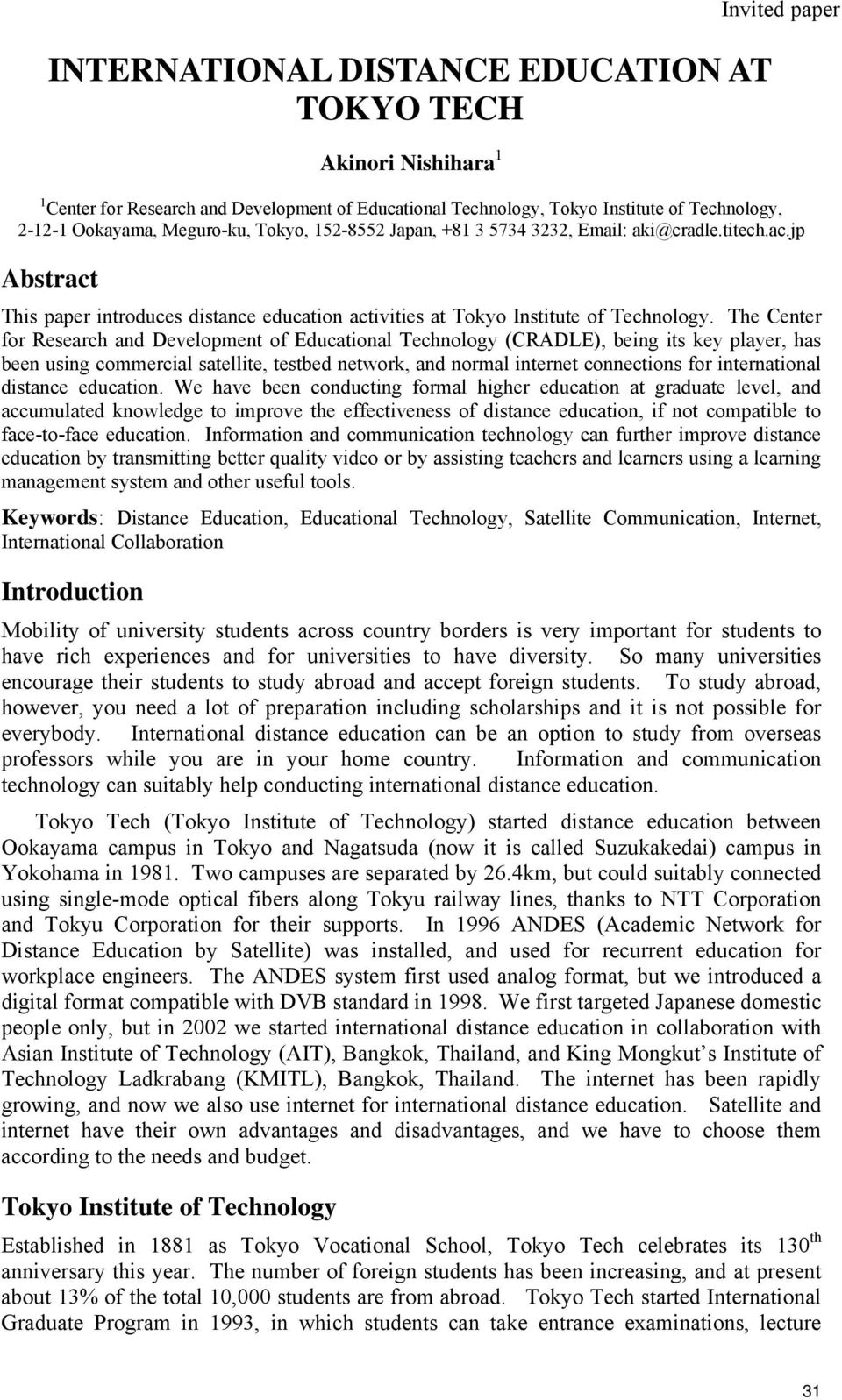
2 courses, and seminars in English. Students are enrolled in October, unlike regular enrollment in April. More than 100 courses are currently taught in English. The program now makes it possible for qualified students with little or no knowledge of Japanese language to pursue a full degree-course of advanced study in this country. Tokyo Tech has overseas offices in Bangkok, Manila, and Beijing, and promote collaboration with those areas. Since May 2002 we have been transmitting real-time graduate courses using satellite communication. Although face-to-face lectures are basic in education, technology support is necessary to overcome the physical distance, and support by local lecturers and teaching assistants is also important. Course lecturers are encouraged to visit at least once in a term to have a face-to-face session to improve students' motivation. Tokyo Tech provides free access to course materials for users around the world aiming at releasing the Tokyo Tech's high-level educational resources on science and technology as the world's public property. Tokyo Tech OCW is one of the core materials of the Webbased electronic knowledge system. Starting in May 2005, Tokyo Tech OCW covers 3,500 undergraduate and graduate courses, for which course outlines are shown. Lecture materials are shown for more than 920 courses at this moment, and we will cover almost all the courses in the future.[1] ANDES System In addition to inter-campus distance education, CRADLE set up the ANDES system in 1996, for the use in lecture deliveries via commercial communication satellite. The ANDES system was used for lecture exchange with Hitotsubashi University, a top national university in social science, open lecture delivery to workplace engineers, and high-school university collaboration in which undergraduate lecture courses are transmitted to highschool students all over Japan who are interested in science and technology. Since 2002 some of the courses taught in English in the International Graduate Program are transmitted to Thailand using ANDES system [2]. We use 3Mbps or 6Mbps MPEG2-DVB for video transmission to guarantee good video quality, while internet was used for Q and A. The lectures were received by National Science and Technology Development Agency (NSTDA), AIT, and KMITL. Figure 1 shows ANDES antenna. Figure 1. ANDES 4.5m Antenna To manage the international distance education and research collaboration, Tokyo Tech Office (Thailand) was established in 2002 in the NSTDA building in the Thailand Science Park. In 2005 Tokyo Tech Office (Philippines) opened at De La Salle University, Manila, and Tokyo Tech Office (China) opened at Tsinghua University in Beijing in Those offices act as communication hubs for people in those areas. Through these offices remote 32
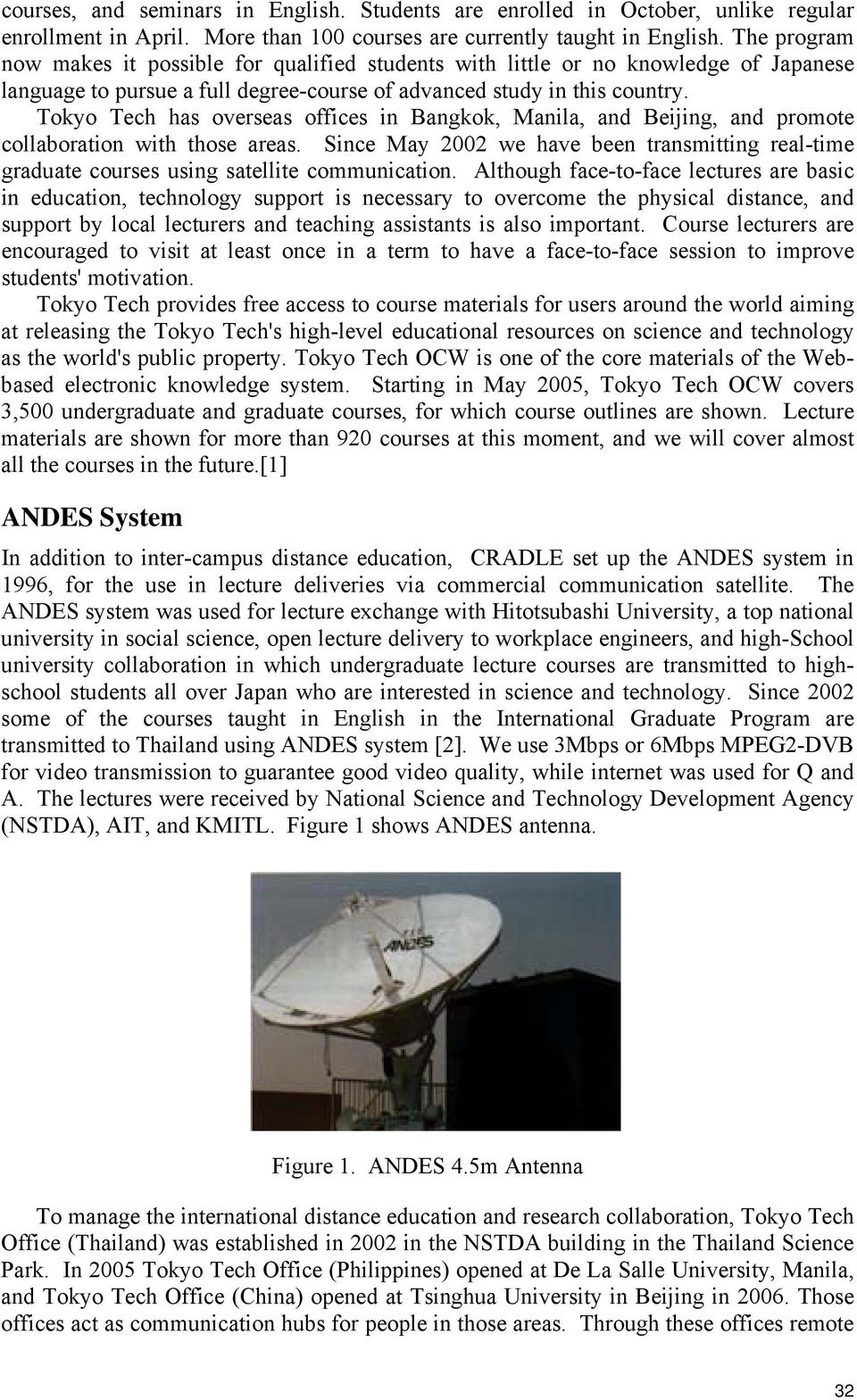
3 students are taken care of. The Offices also handle research partnerships and information about studying at Tokyo Tech, and offer guidance for academic-industrial collaboration. Figure 2. Lecturer in the Philippines In addition to lecture delivery from Tokyo Tech, we also received lectures from abroad using Internet. Technical Writing course was transmitted from our Tokyo Tech Office (Philippines) and received in a classroom in Ookayama campus. The lecturer shown in Figure 2 was very encouraging and students enjoyed the course very much. The internet connection was not always good enough between Tokyo and Manila, but that made the students more careful to listen to the lecturer. TAIST Tokyo Tech In 2007, based on MOU with NSTDA and Thai universities, we established a new joint graduate program named Thailand Advanced Institute of Science and Technology (TAIST)-Tokyo Tech. TAIST is based on the idea of collaboration among Tokyo Tech, NSTDA and partner universities to develop human resources. TAIST serves as a virtual institution and focal point. NSTDA provides researchers to act as adjunct professors, research projects and scholarships for graduate students. Tokyo Tech provides world class background, expertise and experience, academic instruction and research advice. Thai universities provide academic framework, academic staff to oversee and guide students, and degrees for the successful candidates. The viability of the idea is nicely demonstrated by the creation of TAIST Tokyo Tech. The main objective of TAIST-Tokyo Tech is to establish an institution for human resource development to foster and support world-class researchers and high-level engineers through a combination of advising from Tokyo Tech professors, excellent facilities and research staff in NSTDA, and established resources of Thai universities. The participating Thai universities are King Mongkut s Institute of Technology Ladkrabang (KMITL), Sirindhorn International Institute of Technology (SIIT), Kasetsart University (KU), and King Mongkut s University of Technology Thonburi (KMUTT). Master s Degree Program in Automotive Engineering started in 2007, and then Master s Degree Program in Information and Communication Technology for Embedded Systems (ICTES) followed in Master s Degree Program in Environmental Engineering is expected to start in Each program accepts 30 students every year. In the first year students take many lecture courses mainly taught by Tokyo Tech faculty members and co-lectured by Thai university members. In the second year, research for master thesis is carried out mainly in NSTDA s various laboratories with NSTDA 33

4 researchers acting as supervisors or co-supervisors. In addition to taking courses, all the students are required to do research and write their master theses. Each student is assigned to a laboratory in NASDA in the second semester. In the thesis project (2nd year) the students perform research under the supervision of Thai University staff (advisors), NSTDA staff (co- advisors) and Tokyo Tech staff (co-advisors). Advisors and coadvisors compose a thesis committee. Figure 3. Distance Education Control Room Figure 4. Lecture room in Thailand Each TAIST ICTES lecture course is taught by a team of Tokyo Tech professor as a main lecturer and a Thai faculty member as a co-lecturer. Co-lecturers supplement the course taught by main lecturers and undertake exercises. In 2008 among 18 courses 7 were 1-week intensive face-to-face lectures given by Tokyo Tech professors who traveled to Bangkok, 7 courses were completely delivered from Ookayama campus in Tokyo or Suzukakedai campus in Yokohama of Tokyo Tech using Internet, and the rest were combination of face-to-face and distance education. In 2009 and 2010, the situations are almost the same, but in 2011 in order to save electricity consumption especially in summer, we encouraged Tokyo Tech faculty members to travel to Bangkok rather than giving lectures over internet. Distance lectures are given as shown in Figure 3, and it is transmitted to Bangkok by H.323 with about 500kbps bandwidth and shown to the students as in Figure 4. The connection is bidirectional, and the lecturer can also see and talk with the students. Lecture materials and other important information are put on a Learning Management System (LMS) named ELITE (E-Learning for IT Education) in advance. ELITE is operated using a hosting service of Tokyo Tech TSUBAME super computer For 34

5 some courses, lectures are recorded and the videos are put on the ELITE site together with the lecture materials as shown in Figure 5, so that students can review the courses later. Figure 5. Learning Management System Comparison of Face-to-face and Distance Education Every semester, we analyze students grades and questionnaire survey results. For 2008 and 2009 we did not find any big differences between face-to-face and distance courses [3]. Figure 6 shows the average grades of the courses taught in 2010, which does not show any significant difference between face-to-face and distance courses. Since average grades differ very much (maximum is 88.5 and minimum is 59.6) for the courses, we normalize the scores so that the mean is 50 and standard deviation is 10 in each course. The results for all 29 students are shown in Table 1, and Figure 7 shows their normalized average scores. Then students average scores of face to-face and distance education courses have correlation of 0.67 with enough significance (p<0.01). For each student the numbers of courses are not so many, but there are two students who have significantly higher scores for face-to-face courses, and two students who have significantly higher scores for distance education. There are three students who show marginal significance for high face-toface scores, and one student who shows marginal significance for high distance education sores. For other 21 students we find no significant differences. n.s. Figure 6. Comparison of Average Scores 35

6 Figure 7. Normalized Average Scores for 29 Students Table 1 Comparison of Standardized Average Scores student Face-to-Face Distance Education difference mean s.d. mean s.d n.s < * n.s > * n.s n.s n.s < n.s > n.s n.s n.s > > n.s < * n.s n.s n.s n.s n.s > * n.s n.s n.s n.s n.s n.s p<0.1, * p<

7 ELITE system shown in Figure 5 is also used as a student evaluation system using 4 Lickert scale questionnaires. Some of the results are shown in Figure8. Averages for distance education are slightly lower, but no significant differences are found. With all things considered, we conclude that distance education has no significant difference with face-to-face courses. It is probably worth mentioning that those results cannot be obtained without close collaboration among participating members and institutions. Figure 8. Student Questionnaire Survey Results JGN2, JGN2plus, and JGN-X Since 2006 we used a Japan-Thailand link of Japan Gigabit Network 2 (JGN2, it is JGN2plus since 2008, and JGN-X since 2011), an open testbed network environment for research and development, which is operated by National Institute of Information and Communications Technology (NICT) [4]. JGN is an ultra-high-speed testbed networks for research and development collaboration among industry, academia, and the government with the aim of promoting a broad spectrum of research and development projects, ranging from fundamental core research and development to advanced experimental testing, in areas including the advancement of network-related technologies for the next generation and diverse range of network application technologies. When we use JGN, we reserve a certain bandwidth at JGN Center, so that we are sure that the bandwidth for high-definition video transmission is guaranteed. The problem is, however, the bandwidth in the domestic networks in Thailand, and it is not easy to steadily transmit high-definition video signals. We believe that high-definition video is more suitable for distance education [5], and will continue to explore new tools, new environment, and new technologies to have better distance education [6]. KIZUNA (WINDS) A geostationary satellite KIZUNA (WINDS, Wideband InterNetworking engineering test and Demonstration Satellite) was launched by an H-IIA rocket on 23 February 2008 by JAXA (Japan Aerospace Exploration Agency) in cooperation with the NICT (National Institute of Information and Communications Technology) to establish the world's most advanced information and telecommunications network. KIZUNA satellite communication system allows a maximum speed of 1.2 Gbps communication. The project aims not only to establish Japanese domestic communication but also to construct ultra high-speed international Internet access, especially with Asian Pacific countries and regions that are more closely related to Japan. 37

8 Figure 9. The author s lecture distributed by KIZUNA with high-definition video to HU and UP KIZUNA (WINDS) has been used not only for basic experiments by JAXA and NICT but also 53 projects chosen by open applications. Those projects include distance education, remote medical care, disaster mitigation, etc. KIZUNA (WINDS) is expected to remove the digital divide by providing high-speed Internet service in areas where the terrestrial communication infrastructure is poor. Distance education and telemedicine are especially important from that point of view. The author s group at Tokyo Tech has been cooperating with Chulalongkorn University, National Telecommunication Commission, the University of the Philippines, and Hokkaido University to utilize KIZUNA (WINDS) for distance education using highdefinition video transmission. As shown in Figure 9, lectures can be transmitted using high-definition video. We also succeeded in seamlessly connecting satellite multicast and IP multicast in transmission of video streams, so that by sending one video stream several locations can receive the signal with minimum bandwidth usage as a whole. Conclusions Distance education activities conducted at Tokyo Tech is introduced with recent assessment data, which show no significant difference between face-to-face and distance education. Other than lecture delivery mode, however, there are many factors which affect the quality and effectiveness of education, such as course contents, course design, lecturer s skill, student attitudes, etc. So it is difficult to compare face-to-face and distance education in general [7], but we are at least satisfied so far with the results that our distance education can reach to our students in Thailand without any significant problems. Although the author believes face-to-face lectures are essential in education, information and communication technology can properly be used to overcome physical and mental distance between teachers and learners. We are also trying to develop useful tools to assist stakeholders to have even better educational environments. Acknowledgements The author is indebted to members of TAIST Steering Committee, Global Scientific Information and Computing Center, and Center for Research and Development of Educational Technology, of Tokyo Tech for their cooperation and assistance to the distance education activities. 38

9 References [1] Tokyo Tech OCW, [2] Tokyo Tech ANDES, [3] A. Nishihara, Tokyo Tech Graduate Program Allied with Thailand - TAIST (Thailand Advance Institute of Science and Technology) - Tokyo Tech, IEEE EDUCON 2010, pp , 2010 [4] JGN-X, [5] A. Nishihara, Y. Watanabe, and Y. Kammei, Why We Should Use High-Definition Video in Distance Education, ED-MEDIA 2009, AACE. pp , 2009 [6] D. A. Harris and C. Krousgrill, Distance Education: New Technologies and New Directions, Proceedings of. IEEE, Vol.96, No.6, pp , 2008 [7] M. Shachar, Meta-Analysis: The preferred method of choice for the assessment of distance learning quality factors, International Review of Research inopen and Distance Learning, Vol.9 (3),
![nict.go.jp/english/ [5] A. Nishihara, Y. Watanabe, and Y. Kammei, Why We Should Use High-Definition Video in Distance Education, ED-MEDIA 2009, AACE. pp.1441-1446, 2009 [6] D. A. Harris and C.](/docs-images/41/1816987/images/page_9.jpg "Krousgrill, Distance Education: New Technologies and New Directions, Proceedings of. IEEE, Vol.96, No.6, pp.917-929, 2008 [7] M.")
A DESIGN AND DEVELOPMENT OF E-LEARNING CONTENT FOR MULTIMEDIA TECHNOLOGY USING MULTIMEDIA GAME
 A DESIGN AND DEVELOPMENT OF E-LEARNING CONTENT FOR MULTIMEDIA TECHNOLOGY USING MULTIMEDIA GAME Thongchai Kaewkiriya Faculty of Information Technology, Thai-Nichi Institute of Technology, Bangkok, Thailand
National Education Network in Thailand. Dr.Panjai Tantatsanawong Deputy Director of UniNet Chair of ThaiREN
 National Education Network in Thailand Dr.Panjai Tantatsanawong Deputy Director of UniNet Chair of ThaiREN Agenda Introduction to UniNet and ThaiREN From UniNet to NEdNet Research and Education Activities
Dual Degree Program. Akihiko Morita, Ph.D International Coordination Planner Tokyo Institute of Technology
 Dual Degree Program Akihiko Morita, Ph.D International Coordination Planner Tokyo Institute of Technology 1 Around the Definitions In USA and UK, to be enrolled in two degree programs simultaneously or
KIZUNA (WINDS) (Wideband InterNetworking engineering test and Demonstration Satellite) (Launched by H-IIA F14)
 KIZUNA (WINDS) (Wideband InterNetworking engineering test and Demonstration Satellite) (Launched by H-IIA F14) WINDS Project Team, Office of Space Applications Japan Aerospace Exploration Agency Objectives
The Effectiveness and the Comparison of e-learning Lessons Efficiency on the Principles of Digital Photography in Technology of Photography Course
 The Effectiveness and the Comparison of e-learning Lessons Efficiency on the Principles of Digital Photography in Technology of Photography Course Paramaporn Suksai Abstract The purpose of the research
Saku University, School of Nursing
 Saku Educational Institutes Saku University, School of Nursing Administrative Office Tel: +81-267-68-6680 Fax: +81-267-68-6687 E-mail: [email protected] http://www.saku.ac.jp/ Address: 2384 Iwamurada,
Tokyo Institute of Technology and the World
 Tokyo Institute of Technology and the World ~ toward the creation of a university of science and technology to lead the world ~ Tokyo Institute of Technology Policy Paper on Internationalization July 2003
Tokyo Medical and Dental University (TMDU) becomes the first. university in Japan allowed to establish an international joint
 Press Release To whom it may concern November 26 2015 Tokyo Medical and Dental University Tokyo Medical and Dental University (TMDU) becomes the first university in Japan allowed to establish an international
The Joint Japan/World Bank Graduate Scholarship Program and The Public Finance Program
 The Joint Japan/World Bank Graduate Scholarship Program and The Public Finance Program YUICHIRO YOSHIDA Director, the Public Finance Program National Graduate Institute for Policy Studies The Mission The
AUN/SEED-Net Project
 ASEAN University Network Southeast Asia Engineering Education Development Network AUN/SEED-Net Implementation Guidelines and Application Forms for Master s Degree Program For the Japanese Fiscal Year 2013
Top Global University Project
 Top Global University Project Briefing Session for Students December 2014 1 2 Project Overview HU was selected as one of Japan s top 13 universities (Top Type) Selected Institutions * in alphabetical order
Asian Institute of Technology Center in Pakistan (AITCP) Business Plan. Table of Content
 Asian Institute of Technology Center in Pakistan (AITCP) Business Plan Table of Content No. Description Page I. EXECUTIVE SUMMARY 1 1.1 Objectives 1.2 Mission 1.3 Key to Success II. BRIEF DESCRIPTION OF
How to obtain a College Student Visa
 How to obtain a College Student Visa The applicants who live overseas (A) and the applicants who live in Japan (B) or (C) need to take the following visa application procedures, respectively. (A) Applicant
2.12 DISTANCE EDUCATION OR EXECUTIVE DEGREE PROGRAMS
 Criterion 2.12 DISTANCE EDUCATION OR EXECUTIVE DEGREE PROGRAMS If the school offers degree programs using formats or methods other than students attending regular on-site course sessions spread over a
Human Resource Forecast and Development Plan to Support Logistics Infrastructure Improvement
 Human Resource Forecast Development Plan to Support Logistics Infrastructure Improvement P. Indranoi N. Kecharananta Abstract Logistics has become an important tool for improving efficiency of operation,
Background. Numbers of International Students graduated from the International Graduate Program from 1992 2007:
 Outline The International Collaborative Graduate Program on Civil and Environmental Engineering offered by the Department of Civil and Environmental Engineering at Saitama University has been selected
Video Conferencing as an Engineering Education System
 Video Conferencing as an Engineering Education System V. Trajkovik 1, E. Caporali 2 1 Faculty of Electrical Engineering and Information Technologies, Ss Cyril and Methodius University,, R.Macedonia, [email protected],
International Journal of Managing Value and Supply Chains (IJMVSC) Vol. 5, No. 4, December 2014
 Conceptual Framework of Supply Chain Management - Information System for Curriculum Management Based on Thailand Qualifications Framework for Higher Education Artaphon Chansamut 1 *, Asst. Prof. Dr. Pallop
Strategy Knowledge Management for Developing Capabilities in King Mongkut s Institute of Technology Ladkrabang
 Strategy Knowledge Management for Developing Capabilities in King Mongkut s Institute of Technology Ladkrabang Thitiwuth sunnanon 1 Dr. Jirasek Trimethsunthorn 2 Associate Professor Dr. Reveewan Chinatrekul
THE APPROPRIATENESS OF AUTOMOTIVE TECHNOLOGY EDUCATION CURRICULAR CONTENT THROUGH COMPETENCIES AS PERCEIVED BY TRAINING INSTRUCTORS
 118 THE APPROPRIATENESS OF AUTOMOTIVE TECHNOLOGY EDUCATION CURRICULAR CONTENT THROUGH COMPETENCIES AS PERCEIVED BY TRAINING INSTRUCTORS Weerayute SUDSOMBOON 1), Boonsong HEMWAT 2), Tawee SEEHAMAT 3), and
The Effect of Web-Based Learning Management System on Knowledge Acquisition of Information Technology Students at Jose Rizal University
 The Effect of Web-Based Learning Management System on Knowledge Acquisition of Information Technology Students at Jose Rizal University Ryan A. Ebardo Computer Science Department, Jose Rizal University
Challenge of Mechanical and Automotive Engineering Program in Thailand to Support Thailand s Automotive Industry
 Challenge of Mechanical and Automotive Engineering Program in Thailand to Support Thailand s Automotive Industry Yossapong Laoonual, PhD Committee, Thai Society of Mechanical Engineers (TSME) Assistant
The University of North Carolina. White Paper on e-learning. July 21, 2003
 The University of North Carolina White Paper on e-learning July 21, 2003 Many of the campuses of the University of North Carolina have made major strides in providing access to citizens of North Carolina
Distance Education in Library and Information Science in Thailand. Chutima Sacchanand
 Distance Education in Library and Information Science in Thailand Chutima Sacchanand 176 177 Distance Education in Library and Information Science in Thailand Chutima Sacchanand Abstract This paper presents
INU Double Degree Program Global Citizenship and Peace Call for Applications
 INU Double Degree Program Global Citizenship and Peace Call for Applications Applies to students enrolled in the Graduate Schools of Education, Social Sciences, or International Development and Cooperation,
EFL LEARNERS PERCEPTIONS OF USING LMS
 EFL LEARNERS PERCEPTIONS OF USING LMS Assist. Prof. Napaporn Srichanyachon Language Institute, Bangkok University [email protected] ABSTRACT The purpose of this study is to present the views, attitudes,
The Master s Degree Program in Electrical and Computer Engineering
 The Master s Degree Program in Electrical and Computer Engineering M. Lee Edwards and Dexter G. Smith The Master s of Science in Electrical and Computer Engineering, the first Johns Hopkins degree to be
The University of Hong Kong. Master of Sports Administration (2008 / 2009) (Course No. HS 29-818-00/81) Subject to Approval
 The University of Hong Kong Master of Sports Administration (2008 / 2009) (Course No. HS 29-818-00/81) Subject to Approval Master of Sports Administration HS 29-818-00/81 The Master of Sports Administration
Exploring Learner s Patterns of Using the Online Course Tool in University Classes. Yoshihiko Yamamoto and Akinori Usami
 Exploring Learner s Patterns of Using the Online Course Tool in University Classes Yoshihiko Yamamoto and Akinori Usami 54 Abstract Online course tools such as WebCT or Manaba+R are popularly used in university
Acquisition and Deployment of Technology in Academic Library Environment : Experience in Thailand
 Acquisition and Deployment of Technology in Academic Library Environment : Experience in Thailand Sujin Butdisuwan Faculty of Informatics Division of Library and Information Sciences Mahasarakham University,
JICA Knowledge Co-Creation Program (Long-Term Training) 2015-2016
 August 2015 JICA Knowledge Co-Creation Program (Long-Term Training) 2015-2016 General Information for All Applicants on Master s Degree and Internship Program of African Business Education Initiative for
Rules governing masters studies at the Reykjavík University School of Law
 Rules governing masters studies at the Reykjavík University School of Law Article 1 Masters Degree in Law The Reykjavík University School of Law confers the academic title of Master of Legal Studies (
Master of Engineering in Logistics and Supply Chain Systems Engineering (LSCSE) (International Program)
 Sirindhorn International Institute of Technology Thammasat University 19 MASTER OF ENGINEERING PROGRAM IN LOGISTICS AND SUPPLY CHAIN SYSTEMS ENGINEERING Curriculum title Master of Engineering in Logistics
THE EFFECTIVENESS OF USING LEARNING MANAGEMENT SYSTEMS AND COLLABORATIVE TOOLS IN WEB-BASED TEACHING OF PROGRAMMING LANGUAGES
 THE EFFECTIVENESS OF USING LEARNING MANAGEMENT SYSTEMS AND COLLABORATIVE TOOLS IN WEB-BASED TEACHING OF PROGRAMMING LANGUAGES Nadire Cavus 1, Huseyin Uzunboylu 2, Dogan Ibrahim 3 1 Computer Information
Ekachai Naowanich, Namon Jeerungsuwan. King Mongkut's University of Technology North Bangkok, Thailand. The Asian Conference on Education 2013
 A Development of Management Model Using Business Intelligence Methodology for Higher Education Students to Enter the Occupation Internationally Ekachai Naowanich, Namon Jeerungsuwan King Mongkut's University
ENHANCING BIOMEDICAL ENGINEERING EDUCATION WITH INTERNSHIPS. P.H. Tan*, C.S. Gwee* and K.S. Tang**
 ENHANCING BIOMEDICAL ENGINEERING EDUCATION WITH INTERNSHIPS P.H. Tan*, C.S. Gwee* and K.S. Tang** * Ngee Ann Polytechnic/School of Engineering, ECE Division, Singapore ** Ngee Ann Polytechnic/School of
SCHOOL OF ENGINEERING BACHELOR S DEGREE IN AEROSPACE ENGINEERING
 SCHOOL OF ENGINEERING BACHELOR S DEGREE IN WELCOME TO UNIVERSIDAD EUROPEA DE MADRID Welcome to Universidad Europea de Madrid, a young, dynamic institution, fully prepared to meet the challenges of today
Keio University (Private)
 Keio University Field of Study International Relations University Keio University (Private) Graduate School URL of University URL of Graduate School Program name Degrees Credit and years needed for graduation
Awarding Institution: Institute of Education, University of London. Teaching Institutions: Institute of Education, University of London
 PROGRAMME SPECIFICATION MA Education and Technology Awarding Institution: Institute of Education, University of London Teaching Institutions: Institute of Education, University of London Name of final
Thai Students Ethical Behaviors on Playing Game
 2012 International Conference on Management and Education Innovation IPEDR vol.37 (2012) (2012) IACSIT Press, Singapore Thai Students Ethical Behaviors on Playing Game Sumalee Chanchalor 1+ and Papimol
Tokyo Tech Education Reform
 Tokyo Tech Education Reform For prospective graduate s Program Overview Main points of education reform Q & A 1 Goal of Education Reform 国 立 大 学 法 人 東 京 工 業 大 学 教 育 改 革 のお 知 らせ We will cultivate s with
CTS2134 Introduction to Networking. Module 07: Wide Area Networks
 CTS2134 Introduction to Networking Module 07: Wide Area Networks WAN cloud Central Office (CO) Local loop WAN components Demarcation point (demarc) Consumer Premises Equipment (CPE) Channel Service Unit/Data
New Education System Begins in April 2016
 New Education System Begins in April 2016 Outline of Education Reform at Tokyo Tech June, 2015 Why Education Reform Now? We will cultivate students with the drive to excel and the vision to contribute
 pressrelease NTT Communications and PLDT to Provide Data Center Services in Philippines New partnership model will expand global footprint of Nexcenter TM data centers Tokyo, Japan / Makati, Philippines,
Tokyo Tech Education Reform
 Tokyo Tech Education Reform For current s continuing degree programs in 2016 Program Overview Main points of education reform Q & A 1 Goal of Education Reform 国 立 大 学 法 人 東 京 工 業 大 学 教 育 改 革 のお 知 らせ We
THE UIS MODEL FOR ONLINE SUCCESS
 THE UIS MODEL FOR ONLINE SUCCESS Bill Bloemer, Ph.D. Research Associate, Center for Online Learning, Research and Service University Of Illinois Springfield ABSTRACT This case study describes the philosophy
Universities in Thailand that offer International Programs
 Universities in Thailand that offer International s 1 At present, there are a lot of universities in Thailand that offer international programs, both public and private universities. Here are some samples
How Nontraditional Bachelor of Science Degree Technology Students Perceive Distance Learning
 How Nontraditional Bachelor of Science Degree Technology Students Perceive Distance Learning Dale E. Thompson, Betsy Orr and Cecelia Thompson This is a report of a questionnaire survey of 27 students.
Distance Education Moves into the 21 st Century: A Comparison of Delivery Methods. Anita L. Callahan, Paul E. Givens, Russell G.
 Session 2542 Distance Education Moves into the 21 st Century: A Comparison of Delivery Methods Anita L. Callahan, Paul E. Givens, Russell G. Bly Industrial and Management Systems Engineering/University
Internet-Based Learning Tools: Development and Learning Psychology (DLP) Experience
 Internet-Based Learning Tools: Development and Learning Psychology (DLP) Experience José Tavares Ana Paula Cabral Isabel Huet Silva Rita Carvalho Anabela Pereira Isabel Lopes Educational Sciences Department,
VClass: e-learning application
 VClass: e-learning application TOPICS Virtual Classroom (VClass) Objectives History VClass Components Learning Environments in VClass Examples usage: CanalAVIST Virtual Education Project of Pakistan UniChannel
ADSL or Asymmetric Digital Subscriber Line. Backbone. Bandwidth. Bit. Bits Per Second or bps
 ADSL or Asymmetric Digital Subscriber Line Backbone Bandwidth Bit Commonly called DSL. Technology and equipment that allow high-speed communication across standard copper telephone wires. This can include
Improve learning achievement in Engineering Metallurgy Course by Online Asynchronous learning
 Improve learning achievement in Engineering Metallurgy Course by Online Asynchronous learning S. NANSAARNG * a, S. KAEWKUEKOOL a, S. SIRIPATTANAKUNKAJORN b a Department of Production Technology Education
MASTER OF ARTS DEGREE PROGRAMS
 COLLEGE OF VISUAL ARTS AND DESIGN Department of Art Education and Art History MASTER OF ARTS DEGREE PROGRAMS Master of Arts in Art Education Master of Arts in Art History REQUIRED ACADEMIC BACKGROUND The
Interior Design. Master of Interior Design. Graduate Catalog 2011-2012 College of Architecture and The Arts 79. Ownership of Student Work
 Graduate Catalog 2011-2012 College of Architecture and The Arts 79 Interior Design Janine King, Associate Professor and Chair Philip Abbott, Associate in Design Katie Rothfield, Associate in Design Sarah
Earn your degree. online.
 Earn your degree online. The University of Wisconsin-Milwaukee (UWM) educates nearly 30,000 students representing 50 states and 80 nations in 14 UWM schools and colleges. Each of the university s 180+
Factors affecting teaching and learning of computer disciplines at. Rajamangala University of Technology
 December 2010, Volume 7, No.12 (Serial No.73) US-China Education Review, ISSN 1548-6613, USA Factors affecting teaching and learning of computer disciplines at Rajamangala University of Technology Rungaroon
Distance Learning through Satellite
 Chapter 4 Distance Learning through Satellite - 44 - Distance Learning through Satellite 4.1 - Introduction 4.2 - Distance Learning and Internet 4.3 - Satellites for Education 4.4 - Distance Learning through
Using Online Video Lectures to Enhance Engineering Courses
 4 Using Online Video Lectures to Enhance Engineering Courses Yacob Astatke, Farzad Moazzami, Craig Scott, Ladeji-Osias [email protected], [email protected] Morgan State University, Baltimore,Maryland
An Investigation on Learning of College Students and the Current Application Situation of the Web-based Courses
 2011 International Conference on Computer Science and Information Technology (ICCSIT 2011) IPCSIT vol. 51 (2012) (2012) IACSIT Press, Singapore DOI: 10.7763/IPCSIT.2012.V51.127 An Investigation on Learning
How To Become A Dba In Thailand
 Supol s Doctorate 1. My Background My academic track record and experience has been a source of personal pride and achievement. I had done well in high school as a result of hard work, good teachers and
Veera Bhatiasevi (Assistant Professor) Office Telephone: 0-24410648-9, Ext 1213 E-mail: [email protected]
 Veera Bhatiasevi (Assistant Professor) Office Telephone: 0-24410648-9, Ext 1213 E-mail: [email protected] EDUCATION PhD in Management Area of Specialization: Management of Technology Institution:
BJTU Master Program of Traffic and Transportation. Engineering (Railway Operation and Management) in English Medium
 BJTU Master Program of Traffic and Transportation Engineering (Railway Operation and Management) in English Medium I. Program Overview The Master Program of Traffic and Transportation Engineering of Beijing
A Research on the English for Engineering Students Course Based on Needs Analysis in Korea
 A Research on the English for Engineering Students Course Based on Needs Analysis in Korea Hyun Hyo Kim Kongju National University, Korea [email protected] Abstract. As Korea has been implementing export-oriented
ME Ph.D. Program: Revised Rules and Requirements
 Graduate Handbook Supplement ME Ph.D. Program: Revised Rules and Requirements I. Introduction This document presents procedures and criteria for the Ph.D. degree in mechanical engineering at Texas Tech
The design of the AFTRS Curriculum is based on the following principles:
 CURRICULUM POLICY Introduction The Australian Film, Television and Radio School (AFTRS) is an elite specialist and selfaccrediting higher education institution that provides excellence in education through
Master in School Leadership
 Education with specialist streams in Literacy and Numeracy Australia n China n India n Italy n Malaysia n South Africa www.education.monash.edu Become a transformational leader with the Faculty of Education
Trends and Forces for elearning in Thailand
 Phongchai Sirinaruemitr Trends and Forces for elearning in Thailand Dr. Phongchai Sirinaruemitr Vice President Ericsson (Thailand) Limited INTRODUCTION 10 to 15 years ago, when learners were not within
NEW YORK UNIVERSITY S C H O O L O F C O N T I N U I N G M A S T E R O F S C I E N C E I N
 NEW YORK UNIVERSITY S C H O O L O F C O N T I N U I N G AND PROFESSIONAL STUDIES M A S T E R O F S C I E N C E I N TRANSLATION M A S T E R O F S C I E N C E I N TRANSLATION As globalization continues to
Analysis of the Effectiveness of Online Learning in a Graduate Engineering Math Course
 The Journal of Interactive Online Learning Volume 1, Number 3, Winter 2003 www.ncolr.org ISSN: 1541-4914 Analysis of the Effectiveness of Online Learning in a Graduate Engineering Math Course Charles L.
Memorandum of Understanding. between
 Memorandum of Understanding between The Department of Physics, University of Texas at Austin, Austin, Texas, USA and The School of Physics, Peking University, Beijing, China regarding Dual Degree Ph.D.
The Impact of Web-Based Lecture Technologies on Current and Future Practices in Learning and Teaching
 The Impact of Web-Based Lecture Technologies on Current and Future Practices in Learning and Teaching Case Study Four: A Tale of Two Deliveries Discipline context Marketing Aim Comparing online and on
M.S. in Curriculum and Instruction 31-36 credit hours
 M.S. in Curriculum and Instruction 31-36 credit hours College of Education Kansas State University Preparing Educators to Be Knowledgeable, Ethical, Caring Decision Makers in a Diverse World The Mission
The Japan Council of Local Authorities for International Relations (CLAIR), Singapore
 The Japan Council of Local Authorities for International Relations (CLAIR), Singapore 一 般 財 団 法 人 自 治 体 国 際 化 協 会 シンガポール 事 務 所 About CLAIR The Council of Local Authorities for International Relations (CLAIR)
Relationship of the Online English Teachers Competencies to Selected Variables: Implications to Online English Teaching
 Relationship of the Online English Teachers Competencies to Selected Variables: Implications to Online English Teaching Ivan Perry B. Mercado Centro Escolar University Makati Campus, Philippines Abstract
Level III Accredited Teacher Education Programs of State Universities and Colleges in Region I: A Case Study
 Level III Accredited Teacher Education Programs of State Universities and Colleges in Region I: A Case Study ABSTRACT Adelina D. Ancheta College of Education Don Mariano Marcos Memorial State University