
The Architectural Profession in Europe
|
|
|
- Gabriella Casey
- 9 years ago
- Views:
Transcription
1 The Architectural Profession in Europe - A Sector Study Commissioned by the Architects Council of Europe PART ONE F I N A L 18 December 2008

2 Mirza & Nacey F I N A L The Architectural Profession in Europe Contents page: Section 1: Results Survey Background 2 Summary 6 1: Architects in Europe 8 The Number of Architects in Europe Profile of the Profession The Profession s Reputation 2: Architecture the Market 28 The Construction Market in Europe The Architectural Market in Europe Future Prospects 3: Architecture the Practice 40 Profile of Architectural Practices Practice Revenue Practice Costs and Profits 4: Architects the Individual 54 Earnings Retirement Hours Worked Career Satisfaction Section 2: Country Factsheets 68 Appendix I - Methodological notes 104 Appendix II - Survey questionnaire 106 Final Report 18 December 2008 Architects Council of Europe (ACE/CAE) 2008 Mirza & Nacey Ltd Southdown House Ford, Arundel West Sussex BN18 0DE Tel: The Architectural Profession in Europe - Final, 18/12/08 Page 1

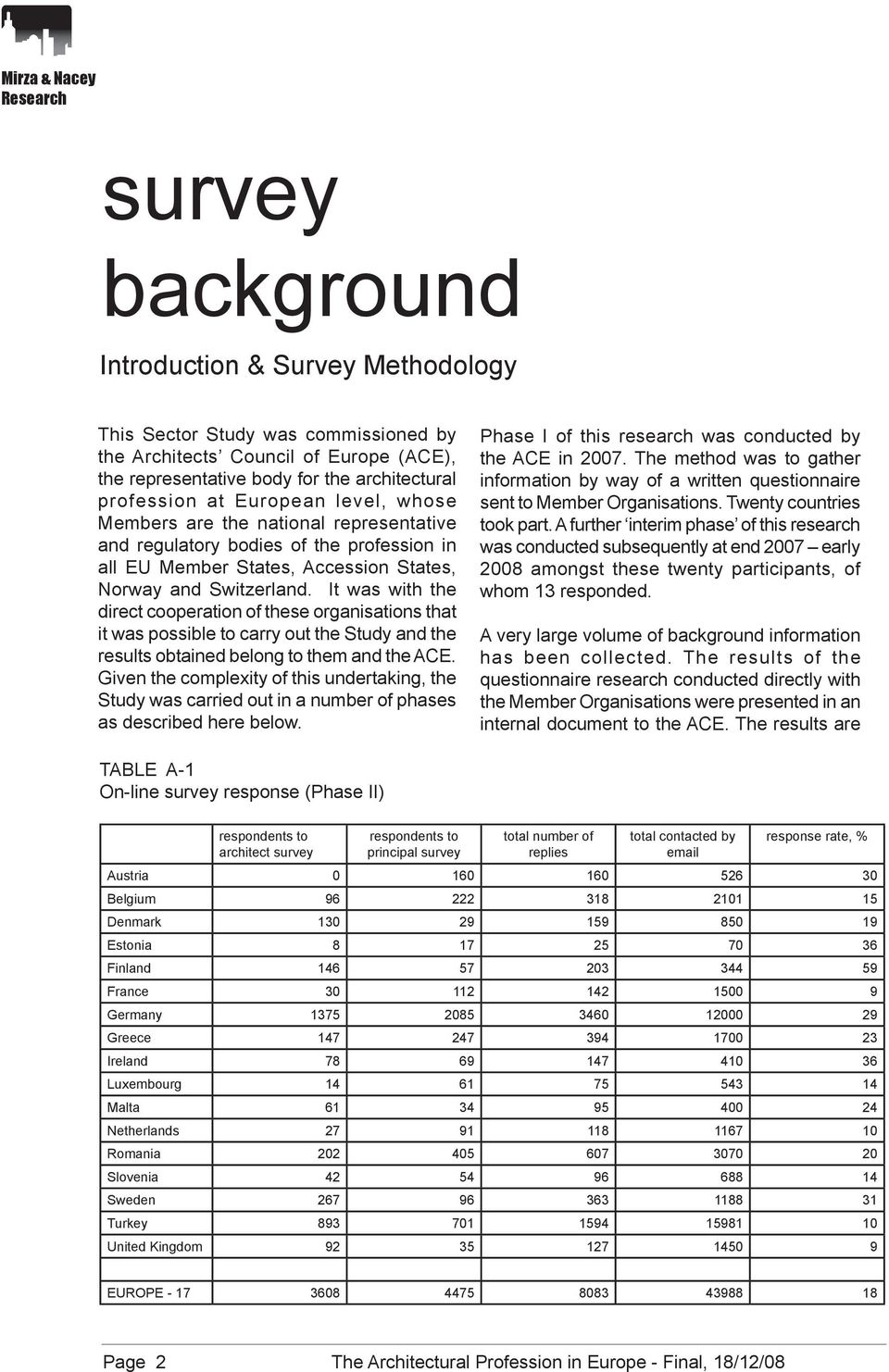
3 survey background Introduction & Survey Methodology This Sector Study was commissioned by the Architects Council of Europe (ACE), the representative body for the architectural profession at European level, whose Members are the national representative and regulatory bodies of the profession in all EU Member States, Accession States, Norway and Switzerland. It was with the direct cooperation of these organisations that it was possible to carry out the Study and the results obtained belong to them and the ACE. Given the complexity of this undertaking, the Study was carried out in a number of phases as described here below. Phase I of this research was conducted by the ACE in The method was to gather information by way of a written questionnaire sent to Member Organisations. Twenty countries took part. A further interim phase of this research was conducted subsequently at end 2007 early 2008 amongst these twenty participants, of whom 13 responded. A very large volume of background information has been collected. The results of the questionnaire research conducted directly with the Member Organisations were presented in an internal document to the ACE. The results are TABLE A-1 On-line survey response (Phase II) respondents to architect survey respondents to principal survey total number of replies total contacted by response rate, % Austria Belgium Denmark Estonia Finland France Germany Greece Ireland Luxembourg Malta Netherlands Romania Slovenia Sweden Turkey United Kingdom EUROPE Page 2 The Architectural Profession in Europe - Final, 18/12/08
4 very useful and much of the raw data has been used to inform and check against the statistics gathered in Phase II. Our observation is that the responses to the Phase I questionnaire are in many cases unclear and need cleaning. Figures do not always add to 100 per cent, some figures are inconsistent, and there is an issue in the interpretation of the questions. The research appears to have been assembled by many different individuals who may have made various different assumptions and have different understandings about what has been asked. To move this project on we proposed an ambitious research survey. We felt the ACE was seeking data which simply did not exist in many countries. So rather than continue to approach Member Organisations for information they might only be able to guess at, our approach was to gather this information directly from architects. The results of Phase II therefore are based on an on-line questionnaire survey, which was conducted in five languages amongst the architect members of seventeen ACE Member Organisations. At least one Member Organisation in each of the 32 ACE countries was invited to participate. The methodology was as follows: 1. Member Organisations were asked to select a sample of their architect members generally one in five of members for whom an address was available. Organisations with small numbers of architects were asked to select one in two architects. 2. Member Organisations constructed and sent out to the sample an which included a link to the on-line questionnaire. Two reminder s were sent out to architects who did not respond. CHART A-1 On-line survey (Phase II) timetable and when countries joined the survey start first period: seven countries participate summer break, no new mailings or reminders, few responses second period: ten more countries participate end 2500 Estonia Greece Ireland Malta Romania Sweden Slovenia Austria Finland France Germany Netherlands Turkey Belgium Luxembourg Denmark United Kingdom number of respondents Jun 30-Jun 07-Jul 14-Jul 21-Jul 28-Jul 04-Aug 11-Aug 18-Aug 25-Aug 01-Sep 08-Sep 15-Sep 22-Sep 29-Sep The Architectural Profession in Europe - Final, 18/12/08 06-Oct 13-Oct 20-Oct 27-Oct 03-Nov 10-Nov 17-Nov 24-Nov 01-Dec Page 3

5 3. architects were guided to the on-line survey form which could be read and completed in any one of five different languages. The information they provided was submitted electronically to the research team, no-one at either the Member Organisation or the ACE saw the personal reply. 4. all data was aggregated and analysed by the research team. The fieldwork stage of this research was undertaken in two periods, either side of the summer holiday. The first Member Organisations began sending out s in June 2008; most of whom had completed the two reminders by July. The remaining countries began their mailout in September and October 2008, with all countries having completed their reminders by November. The UK Member Organisation was only able to send out one to its Members so no reminders were sent. Substantial work by the Member Organisations was undertaken in identifying the sample CHART A-2 Countries participating in the on-line survey (Phase II) TABLE A-2 Statistical validity: Accuracy of results, plus or minus xx per cent at the 95% confidence level accuracy within range of plus or minus: (%) * Austria 8 Belgium 5 Denmark 8 Estonia 19 Finland 7 France 8 Germany 2 Greece 5 Ireland 8 Luxembourg 11 Malta 9 Netherlands 9 Romania 4 Slovenia 10 Sweden 5 Turkey 2 United Kingdom 9 EUROPE * this means we are 95 per cent confident that the results are accurate to within + or - 1 per cent overall, or within + or - xx per cent for each individual country Sweden Finland Estonia participant Ireland United Kingdom Belgium Luxembourg France Denmark Netherlands Germany Austria Slovenia Romania non-participant Turkey Malta Greece NB: Malta has been enlarged on all maps to aid visibility - it is not to scale Page 4 The Architectural Profession in Europe - Final, 18/12/08

6 and subsequently organising the contact with their members; we are very grateful indeed for all the help and support these 17 Member Organisations have provided. A number of Member Organisations in other countries spent considerable time in attempting to participate, ultimately without success; we thank them too. Responses to the survey were received electronically, a total of 8,083 architects replied. The overall response rate is 18 per cent, and both figures are well above expectations. Turkey and Germany sent out the largest number of survey invitations and produced the largest numbers of respondents; over half of all respondents came from these two countries. Countries with very high response rates are Finland (59 per cent); Estonia (36 per cent); Ireland (36 per cent); Austria (30 per cent) and Sweden (31 per cent). In these, and several other countries, the response rates are outstanding. Only in the Netherlands, UK and France were response rates around 10 per cent, possibly due in part to questionnaire fatigue. (The UK was unable to send out any reminder s) The response is considered satisfactory for the level of analysis undertaken. The statistical validity of these results is tabulated left; overall, the results are accurate to within + / - 1 per cent at the 95 per cent confidence level. The accuracy varies for each individual country and these + / - levels should be regarded very carefully when making comparisons between countries. We are most grateful to the Member Organisations who helped with this research. Without them nothing could have been achieved; their willingness and enthusiasm to support this research was remarkable. We are furthermore extremely grateful to the thousands of architects who participated in this survey. The on-line questionnaire did ask for a lot of information, and we were originally concerned we might dampen response by asking for too much. The fact that over 8,000 architects participated, most of whom completed all sections of the questionnaire, is remarkable and again displays an enthusiasm within the profession for this study. The huge response to this survey is well beyond our expectations, and ensures the results have statistical significance. Definitions Architects Persons who are professionally and academically qualified and generally registered / licensed / certified to practice architecture in the jurisdiction in which he or she resides and who are responsible for advocating the fair and sustainable development, welfare, and cultural expression of society s habitat in terms of space, forms and historical context. Architectural students Full-time or part-time students following a recognised course of architectural studies leading to a qualification listed in Annexe V7 of the Qualifications Directive (2005/36/EC). Architectural Staff Comprises Principals, Partners & Directors; Associates: Architects; Technical staff. Architectural Practices The form of structure through which architects practice the architectural profession. It includes sole principals, partnerships, and limited companies. Sole Principal An Architect, working independently, who provides a full range of architectural services to clients. Revenue The total income earned, through the provision of services, by an architectural practice in a tax year. Not Economically Active Not engaged in the practice of architecture or any directly associated activity such as research or teaching. Include architects who are retired and who are unemployed. Freelance Architect An architect who contracts his/her services to an architectural practice or organisation and does not accept commissions directly from clients. Statistical Definitions Confidence Level The likelihood that the results are real and repeatable, and have not occurred randomly If the Confidence Level is 50% then the results would be random, We select a Confidence Level of 95% which suggests if you repeat this exercise there is a 95% chance you will achieve similar results Accuracy of Results The range of accuracy of the findings, at a given Confidence Level. So table A-2 shows that the Europe 17 totals are accurate to within plus or minus 1 per cent, at the 95% Confidence Level. This means that, for example, the proportion of architects who are women is quoted as being 37 per cent, but we can be 95% certain that the true figure lies between 36 and 38 per cent. Accuracy of results for each country differs. Taking Sweden as an example, its results are accurate to within +/- 5 %. The quoted figure (table 1-4) is 51 per cent of architects are women, the true proportion of women architects in Sweden lies between 46 and 56 per cent. Mean A type of average, where individual data are added together and then divided by the number of pieces of data, Median A type of average calculated by placing all individual data in order of magnitude and selecting the middle value. Quartile An indication of the bottom or top quarter of the sample, calculated by placing all individual data in order of magnitude. The Lower Quartile is the value one quarter the way up and the Upper Quartile is the value three quarters the way up this list of data. Mirza & Nacey The Architectural Profession in Europe - Final, 18/12/08 Page 5

7 Summary number of countries in Sector Study: 32 = Europe - 32 number of countries participated in on-line survey: 17 = Europe - 17 number of countries that provided relevant national surveys: 3 total number of respondents to on-line survey: 8083 response rate: 18 per cent estimated number of architects in Europe - 32: 483,000 estimated number of architects in Europe - 17: 255,850 estimated size of construction industry in Europe - 32: 1,650 billion estimated size of architectural market in Europe - 32: 22 billion number of architectural practices in Europe - 17: 69,800 average earnings of architects: 36,686 per cent women architects: 37 per cent per cent economically active (working full or part-time): 84 per cent of whom: per cent Freelance architects: 9 per cent per cent Sole Principals: 24 per cent per cent architects aged under 40: 42 per cent per cent architects aged 40 to 54: 40 per cent per cent architects aged 55 and over: 18 per cent per cent working or resident in the same country as they are registered: 93 per cent per cent who think architects are viewed quite highly or very highly by the general public: 37 per cent by fellow professionals: 53 per cent Page 6 The Architectural Profession in Europe - Final, 18/12/08

8 Summary: Top Five Countries Largest number of architects Italy 123,000 Germany 95,000 Spain 45,000 Turkey 32,000 UK 32,000 Note: Italy and Spain did not participate in this survey but did provide relevant national surveys* that allowed the research team to include information on these countries in this section only of the report Highest proportion male architects Netherlands 86% Austria 85% Estonia 84% Malta 81% UK 79% Highest proportion female architects France 56% Greece 52% Sweden 51% Finland 50% Denmark 49% Highest average earnings Ireland 65,000 Netherlands 54,000 Denmark 53,720 Luxembourg 50,000 UK 49,650 Highest proportion of architects working outside own country Ireland 18% Malta 14% Austria 13% Luxembourg 11% France 8% Largest architectural market Italy 5700m Germany 4000m UK 2800m France 1100m Turkey 700m Highest level of satisfaction (Quality of Life rating, 1 to 10) Denmark 7.9 Sweden 7.8 Netherlands 7.7 Finland 7.5 Ireland 6.7 * Sources: CRESME / CNAPPC, 2008, Il mercato della progettazione architecttonica in italia, p. 82 Cabral et al, Lisbon University for Portugese Order of Architects, 2006, Profession Report, Architect. Consejo Superior de los Colegios de Arquitectos de Espan / Fundacion caja de arquitectos, 2007, Informe Arquitectos 2007 The Architectural Profession in Europe - Final, 18/12/08 Page 7
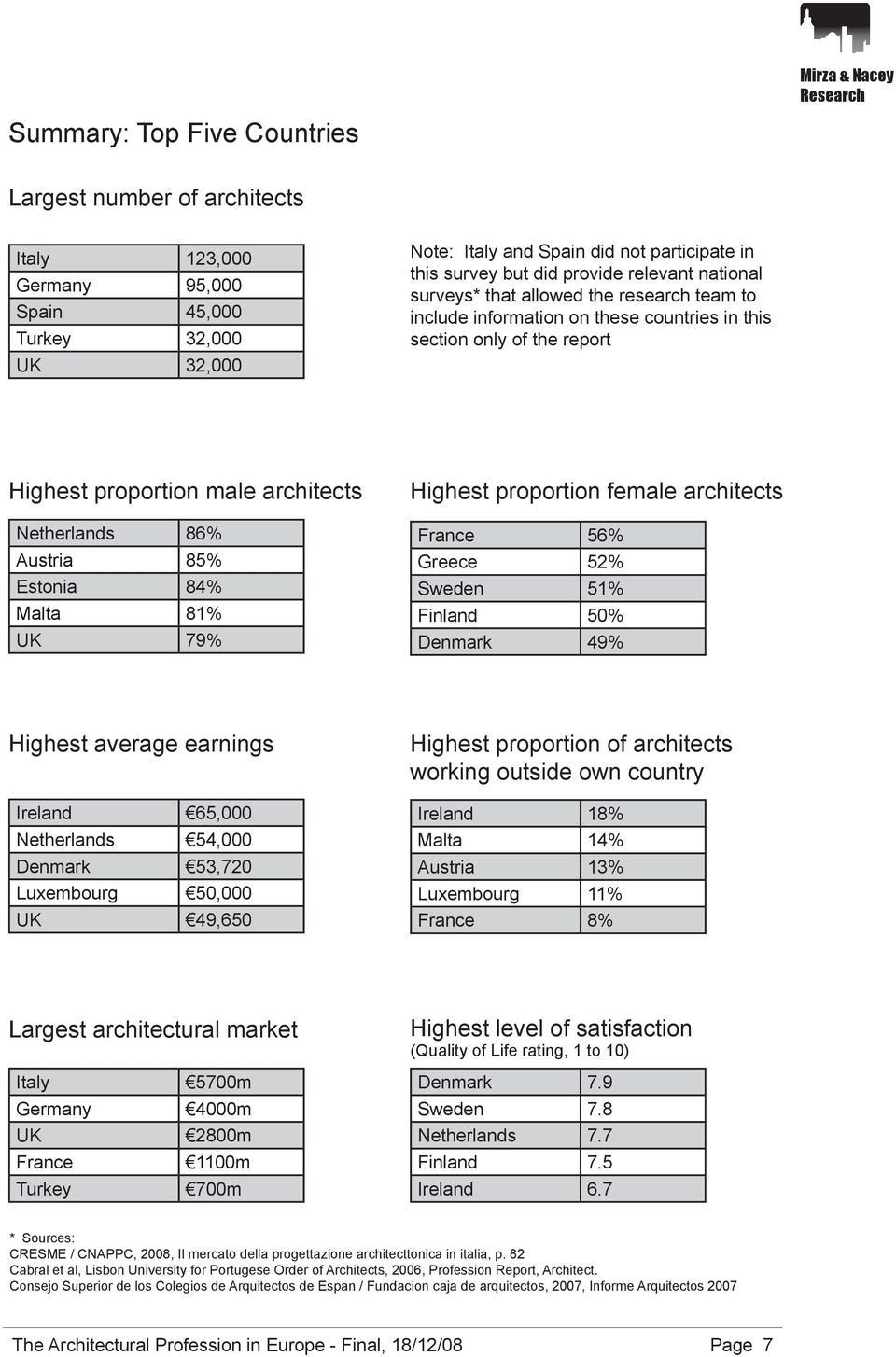
9 1 Architects in Europe The Sector Study was aimed at 32 countries: Austria Belgium Bulgaria Croatia Cyprus Czech Republic Denmark Estonia Finland France FYROM Germany Greece Hungary Ireland Italy Latvia Lithuania Luxembourg Malta Netherlands Norway Poland Portugal Romania Slovakia Slovenia Spain Sweden Switzerland Turkey United Kingdom The number of Architects in Europe Europe - 32 has an estimated 483,000 architects. One quarter (25 per cent) of architects are based in just one country; Italy. The second highest number of architects is recorded in Germany, accounting for 20 per cent to of the Europe total. Third highest is Spain, with 45,000 architects and three countries - Turkey, the UK and France have around 30,000 architects each (between 6 and 7 per cent of the Europe total). So these six countries together account for 74 per cent of all of Europe s architects. Comparing the number of architects with the general population is another way of examining country variations. There are approximately 0.8 architects per 1000 of Europe s population. The highest density of architects occurs in Italy (2.1 architects per 1000 population), FYROM and Portugal. The lowest density of architects is recorded in Eastern Europe Slovakia, Latvia, Czech Republic and Romania, each recording 0.3 or fewer architects per 1000 population. The range in the density statistic across Europe is huge; in Italy there is one architect for every 485 people while in Slovakia the ratios nearly ten times lower at one architect for every 4155 people. In this report, when data refers to all of these countries it is labelled EUROPE Seventeen of these countries participated in the on-line survey. Totals for all survey country participants are labelled EUROPE Page 8 The Architectural Profession in Europe - Final, 18/12/08

10 TABLE 1-1 Estimated number of architects in each country and number of architects per 1000 population number of architects population architects per 1000 population Austria 3,800 8,331, Belgium 11,500 10,666, Bulgaria 3,500 7,640, Croatia 3,000 4,435, Cyprus , Czech Republic 3,000 10,381, Denmark 7,000 5,475, Estonia 700 1,340, Finland 3,600 5,300, France 29,400 63,753, FYROM 3,000 2,045, Germany 95,000 82,221, Greece 15,000 11,214, Hungary 4,000 10,045, Ireland 3,500 4,419, Italy 123,000 59,618, Latvia 700 2,270, Lithuania 2,000 3,366, Luxembourg , Malta , Netherlands 9,100 16,404, Norway 3,600 4,737, Poland 13,500 38,115, Portugal 16,300 10,617, Romania 5,500 21,528, Slovakia 1,300 5,400, Slovenia 1,350 2,025, Spain 45,000 45,283, Sweden 5,400 9,182, Switzerland 5,300 7,591, Turkey 32,300 70,586, United Kingdom 31,600 61,185, EUROPE , ,877, Population source: Eurostat, population as at 1 January 2008, copyright (c) Eurostat Architects source: Various sources, the starting point was the research publication produced by COAC - Architectural Practice Around the World research by the ColClegi d Arquitectes de Catalunya (COAC), based on information supplied by national institutes and associations of architects of the individual countries. Further data was collected by ACE in Phase I of this research, we attempted to verify all figures using a mixture of primary and secondary sources including Member Organisations websites, telephone / . Very often different sources produced conflicting figures, sometimes substantially different. Final figures are our best estimates based on these several different sources. All figures are latest available. The Architectural Profession in Europe - Final, 18/12/08 Page 9

11 CHART 1-1 Number of architects per 1000 population number of architects per 1,000 population under to to and over CHART 1-2 Estimated number of architects in each European country Italy Germany Spain Turkey United Kingdom France Greece Poland Portugal Belgium Netherlands Denmark Romania Sweden Switzerland Hungary Austria Finland Norway Ireland Bulgaria Czech Republic Croatia FYR Macedonia Lithuania Slovenia Slovakia Estonia Latvia Luxembourg Malta Cyprus number of architects, 000's Page 10 The Architectural Profession in Europe - Final, 18/12/08

12 Where architects work Mirza & Nacey The vast majority 93 per cent of architects work or reside in the same country as they are registered in. The highest proportions of architects working / resident outside their home country are in Ireland (18 per cent), Malta (14 per cent of architects work outside Malta), Austria (13 per cent) and Luxembourg (11 per cent). CHART 1-3 Proportion of architects working in another country TABLE 1-2 Proportion of architects working / resident in a different country from the one in which they are registered per cent architects working / resident in different country from the one in which registered (%) Austria 12.5 Belgium 4.2 Denmark 3.3 Estonia <1 Finland <1 France 8.3 Germany 7.9 Greece 6.0 Ireland 18.2 Luxembourg 11.1 Malta 14.3 Netherlands 6.7 Romania 6.3 Slovenia <1 Sweden 5.9 Turkey 6.4 United Kingdom 6.3 EUROPE - 17* 7.0 * EUROPE - 17 figure is a weighted average and takes account of the number of architects in each participating country proportion of architects working in another country under 5% 5% to 9% 10% to 14% over 15% no response The Architectural Profession in Europe - Final, 18/12/08 Page 11

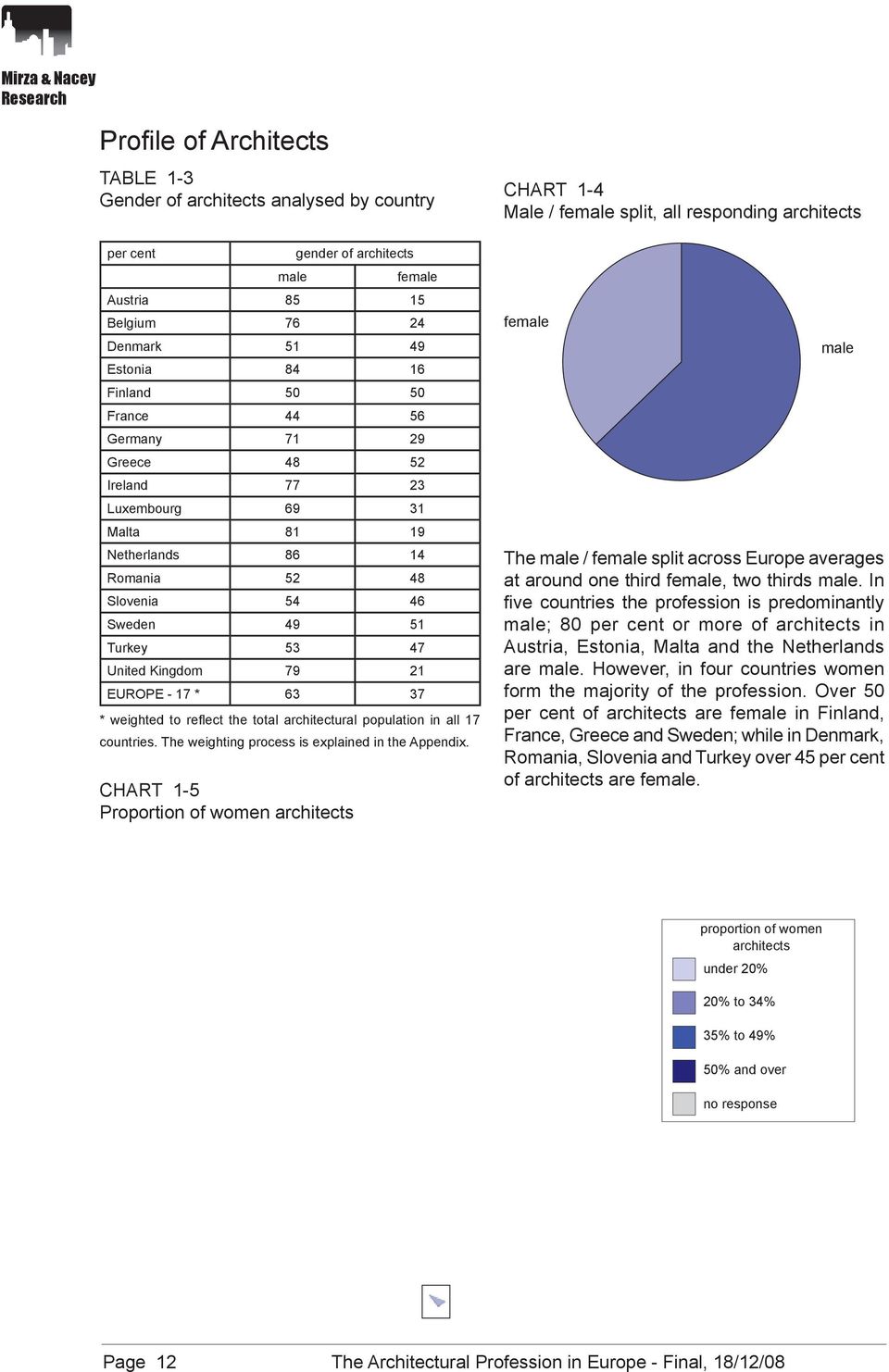
13 Profile of Architects TABLE 1-3 Gender of architects analysed by country per cent male gender of architects CHART 1-5 Proportion of women architects female Austria Belgium Denmark Estonia Finland France Germany Greece Ireland Luxembourg Malta Netherlands Romania Slovenia Sweden Turkey United Kingdom EUROPE - 17 * * weighted to reflect the total architectural population in all 17 countries. The weighting process is explained in the Appendix. CHART 1-4 Male / female split, all responding architects female male The male / female split across Europe averages at around one third female, two thirds male. In five countries the profession is predominantly male; 80 per cent or more of architects in Austria, Estonia, Malta and the Netherlands are male. However, in four countries women form the majority of the profession. Over 50 per cent of architects are female in Finland, France, Greece and Sweden; while in Denmark, Romania, Slovenia and Turkey over 45 per cent of architects are female. proportion of women architects under 20% 20% to 34% 35% to 49% 50% and over no response Page 12 The Architectural Profession in Europe - Final, 18/12/08
14 Employment Status TABLE 1-4 Employment status of architects analysed by country per cent working full-time working part-time not economically active Austria Belgium Denmark Estonia Finland France Germany Greece Ireland Luxembourg Malta Netherlands Romania Slovenia Sweden Turkey United Kingdom EUROPE Mirza & Nacey CHART 1-6 Employment status of architects working part-time not economically active Seventy seven per cent of architects are working full-time, 8 per cent working part-time. The highest level of part-time working is in Luxembourg (12 per cent) and Denmark (11 per cent), closely followed by Germany, the Netherlands and Sweden each with 10 per cent. 16 per cent of all architects in Europe are not economically active - retired, unemployed, or not working for other reasons. working full-time The original survey results have been amended using data collected for Phase I of this study to take account of a perceived under-reporting of retired and not economically active respondents. See the Appendix for a further explanation. The Architectural Profession in Europe - Final, 18/12/08 Page 13

15 Years Qualified as an Architect TABLE 1-5 Number of years qualified as an Architect, analysed by country per cent number of years qualified as an architect to 5 6 to 9 10 to to to Austria Belgium Denmark Estonia Finland France Germany Greece Ireland Luxembourg Malta Netherlands Romania Slovenia Sweden Turkey United Kingdom EUROPE - 17 * * weighted to reflect the total architectural population in all 17 countries. Almost a quarter of architects (23 per cent) have been fully qualified as an Architect for 25 years or more. Another 25 per cent have been qualified for between 15 and 24 years. Eighteen per cent have been qualified for five years or less. The highest levels of the most experienced architects are recorded in Estonia (36 per cent have been qualified for 25 or more years), Finland (32 per cent), Sweden (33 per cent) and Romania (30 per cent). The highest proportion of architects qualified for five years or less are recorded in Belgium (23 per cent), Greece (31 per cent), Malta (28 per cent), Sweden (26 per cent), Turkey (29 per cent) and the UK (32 per cent). Interestingly, Sweden emerges as having high proportions architects at both ends of the experience range. CHART 1-7 Number of years architects have been qualified Page 14 The Architectural Profession in Europe - Final, 18/12/08

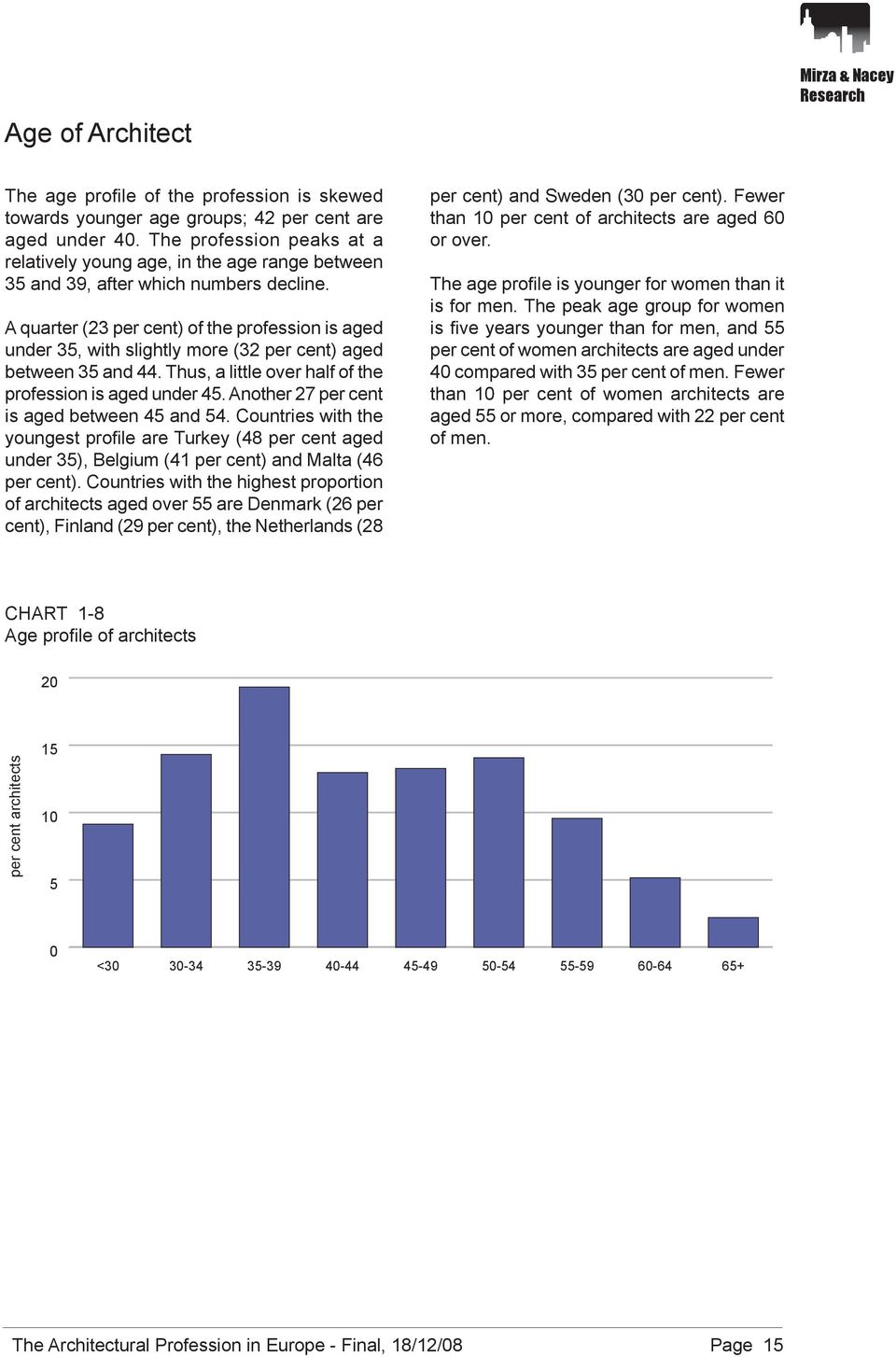
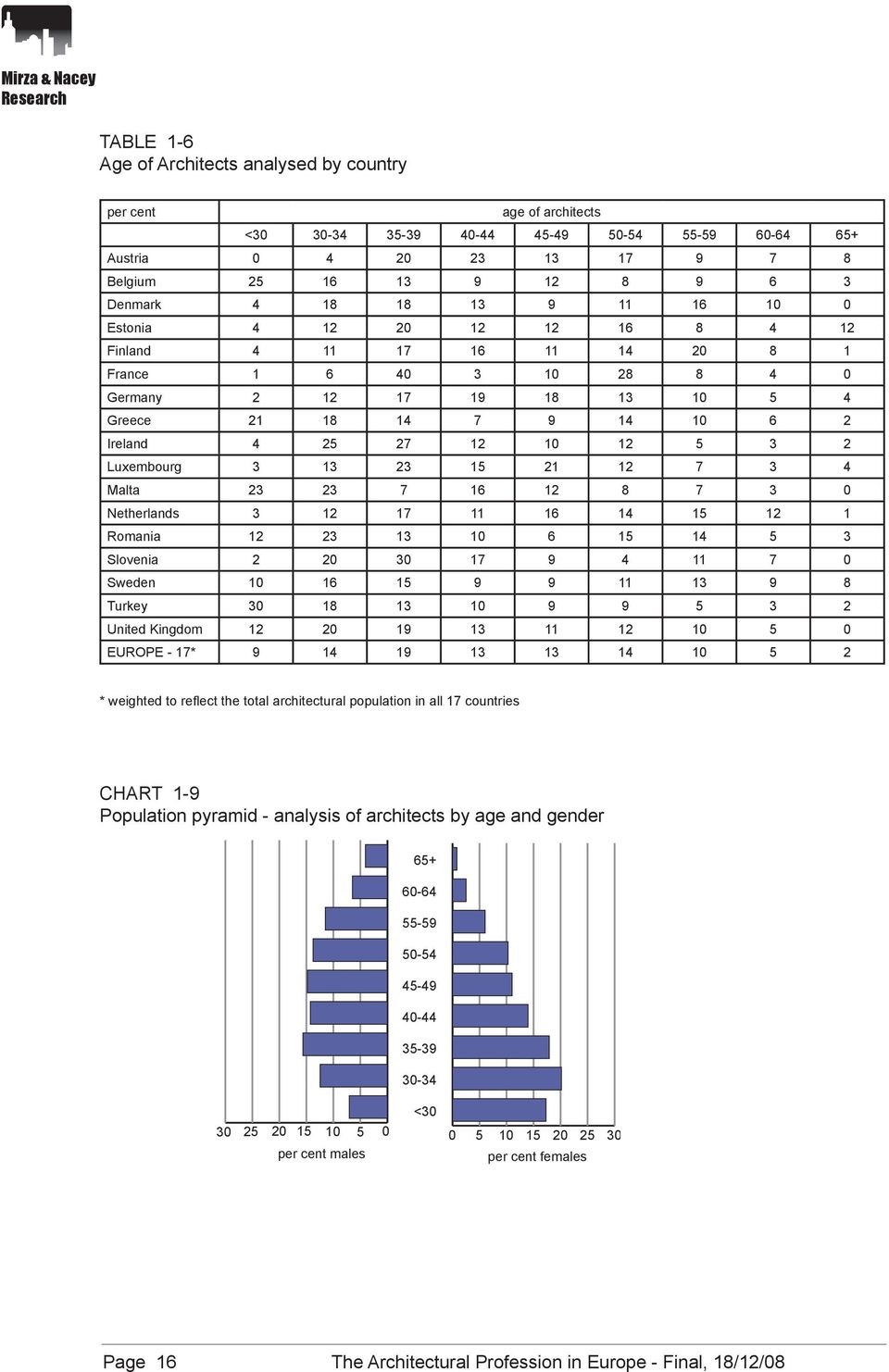
16 Age of Architect Mirza & Nacey The age profile of the profession is skewed towards younger age groups; 42 per cent are aged under 40. The profession peaks at a relatively young age, in the age range between 35 and 39, after which numbers decline. A quarter (23 per cent) of the profession is aged under 35, with slightly more (32 per cent) aged between 35 and 44. Thus, a little over half of the profession is aged under 45. Another 27 per cent is aged between 45 and 54. Countries with the youngest profile are Turkey (48 per cent aged under 35), Belgium (41 per cent) and Malta (46 per cent). Countries with the highest proportion of architects aged over 55 are Denmark (26 per cent), Finland (29 per cent), the Netherlands (28 per cent) and Sweden (30 per cent). Fewer than 10 per cent of architects are aged 60 or over. The age profile is younger for women than it is for men. The peak age group for women is five years younger than for men, and 55 per cent of women architects are aged under 40 compared with 35 per cent of men. Fewer than 10 per cent of women architects are aged 55 or more, compared with 22 per cent of men. CHART 1-8 Age profile of architects 20 per cent architects < age The Architectural Profession in Europe - Final, 18/12/08 Page 15
17 TABLE 1-6 Age of Architects analysed by country per cent age of architects < Austria Belgium Denmark Estonia Finland France Germany Greece Ireland Luxembourg Malta Netherlands Romania Slovenia Sweden Turkey United Kingdom EUROPE - 17* * weighted to reflect the total architectural population in all 17 countries CHART 1-9 Population pyramid - analysis of architects by age and gender per cent males 0 < per cent females Page 16 The Architectural Profession in Europe - Final, 18/12/08
18 CHART 1-10 Proportion of architects aged under 45 proportion of architects aged under 45 40% to 49% 50% to 59% 60% to 69% 70% and over no response The Architectural Profession in Europe - Final, 18/12/08 Page 17

19 Field of Employment CHART 1-11 Field of Employment other public education local authority / government other private freelance in house / agency salaried private practice associate sole principal partner / director TABLE 1-7 Field of Employment of Architects per cent architects working sole principal 24 partner / director 16 associate 5 private practice salaried 22 in - house 3 agency 6 freelance 9 other private 4 local authority - municipal 5 local authority - regional 1 central government 1 education 2 health <1 other public 3 chef de project <1 EUROPE - 17 * 100 * weighted to reflect the total architectural population in all 17 countries A significant proportion of architects operate alone as Sole Principals (24 per cent) and Freelancers (9 per cent) which is typical of the liberal professions. Including Sole Principals, private practice dominates and accounts for more than two thirds of the profession (67 per cent). One quarter (27 per cent) of architects work in private practice as salaried architects (including Associates), while the remainder are Principals, Partners or Directors, with an equity stake in the practice. Outside private practice, the principal employer is Government and Local Authorities. Five per cent of architects work for a Municipal Local Authority, 1 per cent for a Regional Local Authority and 1 per cent for Central Government or its agencies. Taken together, the public sector employs 13 per cent of the profession. Private practice is the largest employment field in most countries. The highest level of architects employed in private practices is in Austria (99 per cent). The highest proportion of architects who are Sole Principals is in Austria (66 per cent) and Germany (40 per cent), while the lowest proportions are in Malta (9 per cent), Sweden (8 per cent) and the UK (8 per cent). The concept of a Freelance architect varies significantly between countries, with many reporting zero per cent while others as many as one in four architects. Highest levels of Freelance architects are in Belgium (22 per cent), France (25 per cent) and Greece (23 per cent). Fewer architects are employed in the public sector than the private sector in all countries. But here too there are significant variations between the countries. Local Authorities account for a very similar proportion (21 or 22 per cent) in each of Denmark, Finland and Sweden. Local Authority employment in each of these three Scandinavian countries is not only at a remarkably consistent level but is also well above the levels recorded in any other country. Only in Malta, where 13 per cent of architects work in Central Government, is there a noticeably higher public sector presence than anywhere outside Scandinavia. Page 18 The Architectural Profession in Europe - Final, 18/12/08

20 TABLE 1-8 Architects field of employment by country per cent sole principal partner director associate private practice salaried in-house agency freelance other private local authority central govt education other public Austria Belgium Denmark Estonia Finland France Germany Greece Ireland Luxembourg Malta Netherlands Romania Slovenia Sweden Turkey United Kingdom EUROPE - 17 * * weighted to reflect the total architectural population in all 17 countries CHART 1-12 Main employment fields by country sole principal partner / director other private other public private practice salaried freelance local & central government Austria Estonia Netherlands United Kingdom Ireland Germany Romania Turkey Slovenia Luxembourg Malta Finland Sweden Denmark Greece France Belgium per cent respondents The Architectural Profession in Europe - Final, 18/12/08 Page 19

21 The Profession s Reputation This section of the survey reports on how architects believe they are perceived by others. This data is architects rating themselves. Architect respondents feel they are regarded quite highly or very highly by about half (48 per cent) of their clients, but by only 37 per cent of the public, and by 31 per cent of others in the construction industry. Fifty three per cent believe their fellow professionals rate them quite or very highly, while only 32 per cent believe they are rated quite or very highly by public authorities. And 6 per cent of respondents believe they are perceived very poorly by public authorities the highest negative score recorded. The profession believes its public regard is highest in the Scandinavian countries and the Netherlands, while the lowest regard emerges in Slovenia, France and Estonia. CHART 1-13 How well architects think they are regarded - summary chart, ranked, highest first very poorly quite poorly neutral quite highly very highly fellow professionals clients the public public authorities others in construction industry per cent respondents CHART 1-14 (right) How well architects think they are regarded by the general public per cent respondent architects who think they are viewed quite or very highly by the general public below 30% 30% to 49% 50% to 69% 70% and over no response Page 20 The Architectural Profession in Europe - Final, 18/12/08
22 TABLE 1-9 How well Architects think they are regarded by the general public - country analysis per cent perception of architects very poorly quite poorly neutral quite highly very highly Austria Belgium Denmark Estonia Finland France Germany Greece Ireland Luxembourg Malta Netherlands Romania Slovenia Sweden Turkey United Kingdom EUROPE CHART 1-15 How well Architects think they are regarded by the general public - ranked, highest first very poorly quite poorly neutral quite highly very highly Denmark Sweden Netherlands Finland Luxembourg United Kingdom Romania Greece Germany Malta Austria Turkey Ireland Belgium Slovenia France Estonia per cent respondents The Architectural Profession in Europe - Final, 18/12/08 Page 21
23 TABLE 1-10 How well Architects think they are regarded by fellow professionals - country analysis per cent perception of architects very poorly quite poorly neutral quite highly very highly Austria Belgium Denmark Estonia Finland France Germany Greece Ireland Luxembourg Malta Netherlands Romania Slovenia Sweden Turkey United Kingdom EUROPE CHART 1-16 How well Architects think they are regarded by fellow professionals - ranked, highest first very poorly quite poorly neutral quite highly very highly Denmark Sweden Luxembourg Estonia Finland Ireland Romania Netherlands Austria United Kingdom Germany Malta France Greece Belgium Slovenia Turkey per cent respondents Page 22 The Architectural Profession in Europe - Final, 18/12/08
24 CHART 1-17 How well architects think they are regarded by fellow professionals per cent respondent architects who think they are viewed quite or very highly by fellow professionals below 30% 30% to 49% 50% to 69% 70% and over no response CHART 1-18 How well architects think they are regarded by others in the construction industry per cent respondent architects who think they are viewed quite or very highly by others in construction below 30% 30% to 49% 50% to 69% 70% and over no response The Architectural Profession in Europe - Final, 18/12/08 Page 23
25 TABLE 1-11 How well Architects think they are regarded by others in the construction industry - country analysis per cent perception of architects very poorly quite poorly neutral quite highly very highly Austria Belgium Denmark Estonia Finland France Germany Greece Ireland Luxembourg Malta Netherlands Romania Slovenia Sweden Turkey United Kingdom EUROPE CHART 1-19 How well Architects think they are regarded by others in the construction industry - ranked, highest first very poorly quite poorly neutral quite highly very highly Malta Luxembourg Denmark Romania Ireland Finland Estonia Netherlands Greece Austria Belgium Germany Turkey United Kingdom France Sweden Slovenia per cent respondents Page 24 The Architectural Profession in Europe - Final, 18/12/08
26 TABLE 1-12 How well Architects think they are regarded by clients - country analysis per cent perception of architects very poorly quite poorly neutral quite highly very highly Austria Belgium Denmark Estonia Finland France Germany Greece Ireland Luxembourg Malta Netherlands Romania Slovenia Sweden Turkey United Kingdom EUROPE CHART 1-20 How well Architects think they are regarded by clients - ranked, highest first very poorly quite poorly neutral quite highly very highly Denmark Finland Luxembourg Netherlands Austria Sweden France Estonia Ireland Germany United Kingdom Romania Malta Belgium Greece Slovenia Turkey per cent respondents The Architectural Profession in Europe - Final, 18/12/08 Page 25
27 CHART 1-21 How well architects think they are regarded by clients per cent respondent architects who think they are viewed quite or very highly by clients below 30% 30% to 49% 50% to 69% 70% and over no response CHART 1-22 How well architects think they are regarded by public authorities per cent respondent architects who think they are viewed quite or very highly by public authorities below 30% 30% to 49% 50% to 69% 70% and over no response Page 26 The Architectural Profession in Europe - Final, 18/12/08
28 TABLE 1-13 How well Architects think they are regarded by public authorities - country analysis per cent perception of architects very poorly quite poorly neutral quite highly very highly Austria Belgium Denmark Estonia Finland France Germany Greece Ireland Luxembourg Malta Netherlands Romania Slovenia Sweden Turkey United Kingdom EUROPE CHART 1-23 How well Architects think they are regarded by public authorities - ranked, highest first very poorly quite poorly neutral quite highly very highly Denmark Finland Austria Sweden Netherlands Germany Luxembourg Ireland Malta Belgium France United Kingdom Estonia Romania Greece Slovenia Turkey per cent respondents The Architectural Profession in Europe - Final, 18/12/08 Page 27
29 2 Architecture - the Market The Construction Market in Europe The total value of the European construction market ( Europe - 32 ) is estimated to be worth in excess of 1,650 billion per year. This includes civil engineering and infrastructure work. There are four significant players, who together account for 54 per cent of total construction output: the UK, France, Germany and Italy. Construction output has been growing in each of the last ten years. The estimated figure for 2007 is an all-time peak value, up by 4 per cent since the previous year. Construction output measured per head of the general population works out at 2826 per person. The highest output per head is in Luxembourg, Norway and Ireland - each is over 7,000 per person. CHART 2-1 Value of Construction Output, average per head 2007 Construction Output per head population under 2,000 2,000 to 3,999 4,000 to 5,999 6,000 and over no data available Page 28 The Architectural Profession in Europe - Final, 18/12/08
30 TABLE 2-1 Size of construction market Millions of Euros (or ECU up to ) millions Austria 26,487 27,037 27,834 28,590 28,211 28,591 30,510 31,622 32,669 34,973 37,544 Belgium 30,368 30,691 33,761 35,862 36,688 36,394 37,680 40,126 42,659 48,680 52,987 Bulgaria 738 1,205 1,396 1,507 1,727 1,813 2,088 2,866 3,999 5,321 n/a Croatia n/a n/a n/a n/a n/a n/a n/a n/a n/a n/a n/a Cyprus 1,103 1,149 1,192 1,234 1,324 1,453 1,599 1,834 2,117 2,273 n/a Czech Republic 11,805 12,426 12,182 12,880 14,255 17,011 17,904 18,686 21,101 25,665 27,934 Denmark 18,167 18,997 19,553 20,550 21,408 21,550 22,492 23,337 25,140 28,552 n/a Estonia 819 1, ,058 1,252 1,352 1,503 1,992 2,569 n/a Finland 11,922 13,665 15,099 17,077 17,709 17,457 17,667 18,859 20,867 22,665 26,077 France n/a n/a 141, , , , , , , ,674 n/a FYROM n/a n/a n/a n/a n/a n/a n/a n/a n/a n/a n/a Germany 232, , , , , , , , , , ,890 Greece 14,033 14,900 16,327 21,214 23,107 24,331 27,295 29,244 30,247 31,263 32,969 Hungary 4,258 4,130 4,553 5,430 6,592 8,177 8,021 8,892 9,776 9,948 10,436 Ireland n/a n/a n/a 17,587 19,926 21,294 23,820 27,595 31,556 n/a n/a Italy 122, , , , , , , , , , ,428 Latvia ,047 1,224 1,426 1,627 1,841 2,575 3,167 4,607 6,533 Lithuania 1,192 1,484 1,396 1,348 1,465 1,713 2,131 2,434 2,897 3,873 5,338 Luxembourg 2,041 2,311 2,559 2,810 3,067 3,511 3,671 3,701 4,007 4,290 4,585 Malta Netherlands 47,043 49,839 55,027 60,287 64,656 64,880 63,650 63,675 66,284 72,085 78,648 Norway 15,942 16,251 17,220 18,154 19,291 21,625 20,663 21,921 25,847 29,448 35,003 Poland 20,925 25,513 27,084 31,790 34,928 31,244 26,164 27,280 35,680 43,749 n/a Portugal 19,056 20,848 22,019 24,376 26,226 26,912 25,708 27,167 27,940 27,260 n/a Romania n/a 4,226 3,671 4,491 5,486 6,171 6,811 8,114 11,319 15,882 n/a Slovakia 4,018 3,969 3,127 3,939 4,012 4,605 4,774 5,318 6,300 6,613 8,401 Slovenia 3,209 3,353 3,980 3,741 3,645 3,972 4,346 4,716 5,191 8,947 10,718 Spain 81,376 88,001 98, , ,380 n/a n/a n/a n/a n/a n/a Sweden 15,970 16,217 17,240 18,981 19,143 19,842 20,148 22,097 n/a n/a n/a Switzerland 25,147 25,689 26,649 28,585 29,730 31,912 31,181 32,289 33,944 34,534 n/a Turkey (1) n/a 1,478 3,096 5,301 13,440 24,802 33,858 39,182 45,590 66,696 70,156 United Kingdom 147, , , , , , , , ,458 n/a n/a EUROPE ,092 1,219 1,287 1,326 1,347 1,415 1,475 1,596 1,658 (2) source of all data except Turkey: Eurostat, National Accounts by 31 branches - aggregates at current prices Copyright Eurostat. All Rights Reserved. (1) Source: Derived from raw data sourced from TurkStat, the Turkish Statistical Institute. Raw data (not reproduced here) is Copyright (c) TURKSTAT. Raw data converted from New Turkish Lira to Euros using conversion rates as at each year. NB, conversion rates changed significantly over the period 1997 to 2001, more stable since (2) Note: some countries which provided data for previous years are marked n/a for 2007 (and occasionally for 2005 and 2006) so the total figure has been adjusted to include the latest available figure for those missing years. Data for Spain is n/a since 2002, here too the latest (2001) figure has been added to Europe total figure for those missing years. It was decided to use latest available data sourced from Eurostat rather than to research missing data direct from national statistical offices, as it proved hard to reconcile data between different sources. Construction output includes civil engineering and infrastructure work. The Architectural Profession in Europe - Final, 18/12/08 Page 29
31 CHART 2-2 Size of Construction Market, Europe United Kingdom France Germany Italy Spain Netherlands Turkey Belgium Poland Austria Norway Switzerland Greece Ireland Denmark Czech Republic Portugal Finland Sweden Romania Slovenia Hungary Slovakia Latvia Lithuania Bulgaria Luxembourg Estonia Cyprus Malta Croatia FYROM n/a n/a million, current prices Base: all 32 European countries Source: compiled from Eurostat and Turkstat data, 2007 data where available, the latest available annual data elsewhere CHART 2-3 Trends in European Construction Output, 1997 to millions current prices Base: all 32 European countries Source: compiled from Eurostat and Turkstat data, 2007 data where available, the latest available annual data elsewhere Page 30 The Architectural Profession in Europe - Final, 18/12/08
32 TABLE 2-2 Estimated size of construction market, 2007 (or latest available year) by country, and comparative values construction output ( m s) population (number as at ) construction output per head of population ( s) architects (est. number) Austria 37,544 8,331,930 4,506 3,800 Belgium 52,987 10,666,866 4,967 11,500 Bulgaria 5,321 7,640, ,500 Croatia n/a 4,435,383 n/a 3,000 Cyprus 2, ,580 2, Czech Republic 27,934 10,381,130 2,691 3,000 Denmark 28,552 5,475,791 5,214 7,000 Estonia 2,569 1,340,935 1, Finland 26,077 5,300,484 4,920 3,600 France 228,674 63,753,140 3,587 29,400 FYROM n/a 2,045,177 n/a 3,000 Germany 212,890 82,221,808 2,589 95,000 Greece 32,969 11,214,992 2,940 15,000 Hungary 10,436 10,045,000 1,039 4,000 Ireland 31,556 4,419,859 7,140 3,500 Italy 203,428 59,618,114 3, ,000 Latvia 6,533 2,270,894 2, Lithuania 5,338 3,366,357 1,586 2,000 Luxembourg 4, ,799 9, Malta ,584 1, Netherlands 78,648 16,404,282 4,794 9,100 Norway 35,003 4,737,171 7,389 3,600 Poland 43,749 38,115,641 1,148 13,500 Portugal 27,260 10,617,575 2,567 16,300 Romania 15,882 21,528, ,500 Slovakia 8,401 5,400,998 1,555 1,300 Slovenia 10,718 2,025,866 5,291 1,350 Spain 146,380 45,283,259 3,233 45,000 Sweden 22,097 9,182,927 2,406 5,400 Switzerland 34,534 7,591,414 4,549 5,300 Turkey 70,156 70,586, ,300 United Kingdom 245,458 61,185,981 4,012 31,600 EUROPE ,658, ,877,058 2, ,480 source: Construction output and population data - Eurostat Copyright Eurostat. All Rights Reserved. Construction output includes civil engineering and infrastructure work. The Architectural Profession in Europe - Final, 18/12/08 Page 31
33 The Architectural Market in Europe The total value of the architectural market in the 17 surveyed countries is estimated to be 11.6 billion. This relates to the total value of the revenue generated by the profession. This figure is very much of an estimate and relies on survey data from which it has been grossed up; we are not aware of any other published data on the size of the European architectural market with which to compare so this estimate is very much a first attempt at establishing the market size and will be refined in future years. If we were to gross up this figure to reflect all 32 European countries, the total estimated value of the architectural market in Europe is 22 billion. Two countries emerge as having the largest markets: Germany and the UK. Those two countries alone account for more than half of the total market of the countries surveyed. Analysed per architect, the highest values are recorded by architects in Ireland, the Netherlands and the UK. The average market size per architect in these three countries is 95,000 or more. By comparison, the average market size per architect is under 25,000 in Finland, Greece, Romania and Turkey. CHART 2-4 Value of Architectural Market, average per head Size of Architectural Market per architect under 25,000 25,000 to 49,999 50,000 to 74,999 75,000 and over no data available Page 32 The Architectural Profession in Europe - Final, 18/12/08
34 TABLE 2-3 Estimated size of architectural market, by country, and comparative values market size ( 000 s) value per architect ( s) value per 1000 population ( s) architectural market as per cent construction Austria 296,789 78,102 35, Belgium 327,108 28,444 30, Denmark 356,228 50,890 65, Estonia 27,524 39,320 20, Finland 42,580 11,828 8, France 1,103,778 37,543 17, Germany 3,988,103 41,980 48, Greece 294,149 19,610 26, Ireland 408, ,816 92, Luxembourg 31,828 53,047 65, Malta 13,320 26,641 32, Netherlands 901,558 99,072 54, Romania 112,659 20,484 5, Slovenia 40,501 30,001 19, Sweden 145,073 26,865 15, Turkey 726,778 22,501 10, United Kingdom 2,800,042 88,609 45, EUROPE ,616,874 45,405 31, Market size refers to the architectural market as measured as the sum of the revenues earned by private architectural practices in each country. Data refers to The market size has been estimated, see Appendix I for an explanation of the methodology used. CHART 2-5 Estimated value of Architectural Market Germany United Kingdom France Netherlands Turkey Ireland Denmark Belgium Austria Greece Sweden Romania Finland Slovenia Luxembourg Estonia Malta millions The Architectural Profession in Europe - Final, 18/12/08 Page 33
35 The Architectural Market analysed by building sector The largest single sector of the market is work to individual houses. These account for an estimated 31 per cent of the architectural market. Other private housing work which will include flats and housing developments account for a further 14 per cent. So in total 45 per cent of the architects market is private housing. Add in the public housing share and housing in total accounts for 49 per cent. Eighteen per cent of the market is commercial work, while public works (including public housing) accounts for 24 per cent. Over half of work in Belgium, Greece, Luxembourg, the UK and Turkey is private housing (including individual houses). The highest proportion of public sector work is in Austria and France. Commercial and other private is highest in Malta, Romania, Estonia and Finland. Not only is private housing the dominant source of revenue; more architectural practices are involved in private housing than in any other sector. Seventy six per cent of architectural practices have, in the past 12 months, derived revenue from work on individual houses; while 48 per cent have undertaken other private housing work. Forty two per cent have been involved in the office sector. CHART 2-6 Proportion of market by building sector public housing education other public individual houses health other private industrial leisure retail offices private housing TABLE 2-4 Comparison of proportion of the market accounted for different building sectors, and the proportion of practices involved in those building sectors per cent of market per cent of practices involved individual houses other private housing offices retail 5 26 leisure and the arts 3 14 industrial 8 32 health 4 14 education 6 22 public housing 4 13 other private 7 29 other public Page 34 The Architectural Profession in Europe - Final, 18/12/08
36 TABLE 2-5 Proportion of work undertaken by building sector, analysed by country per cent individual houses private housing offices retail leisure industrial health education public housing other private other public TOTAL Austria Belgium Denmark Estonia Finland France Germany Greece Ireland Luxembourg Malta Netherlands Romania Slovenia Sweden Turkey United Kingdom EUROPE CHART 2-7 Proportion of work undertaken for each main building sector, ranked in order of highest private housing work private housing commercial & other private public Belgium Greece Luxembourg Turkey United Kingdom Malta Romania Germany Ireland France Slovenia Sweden Netherlands Denmark Austria Estonia Finland per cent total market The Architectural Profession in Europe - Final, 18/12/08 Page 35
37 The Architectural Market analysed by type of client Private individuals are architects principal client type, accounting for almost half (47 per cent) of architectural practices revenue. This clearly mirrors the importance of individual housing as the largest market sector. Public sector clients account for 22 per cent of revenue while 10 per cent of revenue comes from developers and 14 per cent from private companies. CHART 2-8 Proportion of market by client type government other public others private individual local authority limited company developer TABLE 2-6 Proportion of work undertaken for different clients, analysed by country per cent individuals developer limited company PLC (public limited company) central government local government other public other private TOTAL Austria Belgium Denmark Estonia Finland France Germany Greece Ireland Luxembourg Malta Netherlands Romania Slovenia Sweden Turkey United Kingdom EUROPE Page 36 The Architectural Profession in Europe - Final, 18/12/08
38 The Architectural Market analysed by type of service Mirza & Nacey Building design is very clearly the principal revenue generating activity, accounting for two thirds (66 per cent) of the total market. The only other significant service type is interior design, which accounts for 9 per cent of the total architectural revenue. The remainder of the market is split between several types of service, each of which accounts for 5 per cent or less of the total. CHART 2-9 Proportion of market by type of service planning others project management feasibility studies interior design building design landscape design TABLE 2-7 Proportion of work undertaken for each service type per cent building design landscape design interior design feasibility studies project management planning other service TOTAL Austria Belgium Denmark Estonia Finland France Germany Greece Ireland Luxembourg Malta Netherlands Romania Slovenia Sweden Turkey United Kingdom EUROPE The Architectural Profession in Europe - Final, 18/12/08 Page 37
39 Future Prospects The results of this question provide one of the more dramatic trend charts in this research. During the five month survey period, the unprecedented volatility in financial markets has massively changed the economic climate, plunging Europe very rapidly into a recession. When the first architects responded to this question in June and July, optimism was strong and significantly outweighed pessimism. Asked how do you anticipate your practice s workloads will change in the next 12 months a majority reported they expected an increase. Subtracting those who predict a decrease from this creates the balance statistic, which is analysed in the chart (right) and map (below). The chart records balance statistics in June and July of up to +47. But by September this had fallen to just below zero, plummeting to 50 by the end of the survey period. Such extreme volatility over the survey period unfortunately means comparisons in architects optimism between countries the original reasons for asking this question cannot be analysed in a meaningful way. CHART 2-10 Workload predictions for 2009 architects workload predictions, 2009 increase by over 5% no change (-5% to +%5) decrease by over 5% no response Page 38 The Architectural Profession in Europe - Final, 18/12/08
40 CHART 2-11 Changes in the optimism of respondents during the survey period Jun 30-Jun 07-Jul 14-Jul 21-Jul 28-Jul 04-Aug 11-Aug 18-Aug too few respondents replying to create a week-by-week analysis 25-Aug 01-Sep 08-Sep 15-Sep 22-Sep 29-Sep 06-Oct 13-Oct 20-Oct 27-Oct 03-Nov 10-Nov too few replies 17-Nov 24-Nov 01-Dec TABLE 2-8 Future workload prospects for 2009, analysed by country per cent of Principals who expect their practice workloads to change over the coming 12 months balance response period per cent up no change down start month Austria September Belgium October Denmark October Estonia June Finland September France September Germany September Greece June Ireland June Luxembourg October Malta June Netherlands September Romania June Slovenia July Sweden June Turkey September United Kingdom October EUROPE The Architectural Profession in Europe - Final, 18/12/08 Page 39
41 3 Architecture - the Practice Profile of Architectural Practices There are an estimated 69,800 private architectural practices in the 17 responding countries. This figure has been estimated by creating a model and then inserting data from the survey. The model is described in Appendix I. Grossing-up this figure to reflect all 32 European countries produces an estimate of 130,000 private architectural practices in Europe. More than half (54 per cent) of these practices are one person firms. A further 35 per cent have between 2 and 5 architectural staff. Eight CHART 3-1 Average size of architectural practices per cent of practices have between 6 and 10 architectural staff and 3 per cent have 11 to 30. Only 1 per cent of architectural practices have more than 30 staff. So architectural practices are skewed very heavily towards small firms ( micro-enterprises ). But large firms employ a significant number of architects. We estimate that in Europe -17 countries, 12 per cent of the total private practice workforce, is employed in firms of more than 50 architectural staff. So 19,000 architects are employed in 350 firms. At the other end of the scale, the 37,000 one person firms employ 21 per cent of all private practice architects. average size of architectural practices under 2 staff 2 to 2.9 staff 3 to 3.9 staff 4 and more staff no response Page 40 The Architectural Profession in Europe - Final, 18/12/08
42 TABLE 3-1 Estimated number and size of architectural practices number (estimate) size of architectural practice (number of architectural staff) 1 staff 2 staff 3 to 5 staff 6 to 10 staff 11 to 30 staff 31 to 50 staff over 50 staff TOTAL Austria ,773 Belgium 2, ,894 Denmark Estonia Finland France 4,900 1, ,157 Germany 18,970 6,470 4,283 1, ,311 Greece 1, ,821 Ireland Luxembourg Malta Netherlands 1, ,304 Romania ,275 Slovenia Sweden Turkey 2,136 1,229 1, ,497 United Kingdom 2, ,655 EUROPE ,369 13,489 10,868 5,318 2, ,851 per cent of practices architectural staff includes principals, partners & directors; associates; salaried architects; technical staff CHART 3-2 Practices analysed by size CHART 3-3 Proportion of architects employed in practices of different sizes 1 staff 2 staff 3 to 5 staff 6 to 10 staff 11 to 30 staff 31 to 50 staff over 50 staff 1 staff 2 staff 3 to 5 staff 6 to 10 staff 11 to 30 staff 31 to 50 staff over 50 staff per cent architectural practices per cent architects employed The Architectural Profession in Europe - Final, 18/12/08 Page 41
43 Legal Formation of Practices The information in this section is based on the questionnaires completed by Principals. These include Sole Principals, Freelancers, and Partners & Directors in Private Practice. Over half of Principals work in practices they classify as Independent Architect. This may include Freelance architects and architects working on their own as a Sole Principal. The Independent Architect practices model is most common in Austria, Belgium France, Germany and Luxembourg. In each of these countries it accounts for over 50 per cent of architectural practices. cent are Directors in limited companies. The highest proportion of Principals working in partnerships is to be found in Estonia (44 per cent), Greece (35 per cent). Limited companies are the preferred legal formation in the UK (57 per cent), Turkey (56 per cent) and Ireland (49 per cent). PLC s are significant only in Finland (52 per cent), Estonia (19 per cent) and Sweden (11 per cent). The highest prevalence of the EIG (Economic Interest Group) business type is in Sweden (18 per cent), Greece (16 per cent) and Malta (13 per cent). Eighteen per cent of Principals work in partnerships, and rather more 22 per CHART 3-4 Type of architectural businesses Economic Interest Grouping Corporation Public Limited Company Limited Liability Company Independent Architect Partnership Page 42 The Architectural Profession in Europe - Final, 18/12/08
44 TABLE 3-2 Legal formation of architectural practices - based on type of practice in which Principals work per cent independent architect partnership limited company PLC (public limited company) corporation economic interest group Austria Belgium Denmark Estonia Finland France Germany Greece Ireland Luxembourg Malta Netherlands Romania Slovenia Sweden Turkey United Kingdom EUROPE CHART 3-5 Proportion of architectural practices which are limited companies / PLC s / corporations proportion of practices which are companies under 20% 20% to 34% 35% to 49% 50% or more no response The Architectural Profession in Europe - Final, 18/12/08 Page 43
45 Practice Revenue The survey asked Principals to provide details of their revenue in the calendar year 2007, or the most recent 12 month accounting period. Average revenue rises in line with practice size, with an average of 59,389 for one person practices almost doubling to 117,827 for two person firms. The average for a 3 to 5 person practices is 201,693, less than half that of a 6 to 10 person practice. The averages for larger sizes of firm are only indicative as the staff intervals are large and there can be a very high variation in revenues reported. Geographically, highest average revenues per practice (measured for practices up to 10 staff, for which there is least variation) are recorded in France, the UK and Denmark. Lowest average revenues are recorded in Turkey, Greece and Romania. TABLE 3-3 Average revenue per practice analysed by country and practice size s size of practice (number of architectural staff) to 5 6 to to to Austria 67, , , ,591 1,530,625 n/a n/a Belgium 33,457 88, , , ,375 1,750,000 n/a Denmark 72, ,700 n/a 566,330 n/a n/a n/a Estonia n/a n/a 231, ,500 n/a n/a n/a Finland 42,376 70,000 98, ,000 62,500 n/a 600,000 France 48, , , ,573 n/a n/a n/a Germany 43,604 88, , ,027 1,139,455 1,745,167 3,768,279 Greece 29,018 33,612 55, , ,708 n/a 1,328,750 Ireland 72, , , ,453 1,580,107 4,650,000 n/a Luxembourg 61,335 n/a 216, ,778 1,502,042 n/a n/a Malta 46,171 83,375 64, , ,725 n/a n/a Netherlands 84, , , ,909 1,401,228 2,910,834 n/a Romania 39,555 39,680 72, , ,301 n/a n/a Slovenia 27,506 51, , , , ,000 Sweden 54, ,250 n/a 304, ,629 n/a 1,542,654 Turkey 17,028 38,556 57, , ,851 n/a 1,261,888 United Kingdom 52, , , ,258 n/a n/a n/a EUROPE , , , ,563 1,282,563 3,156,907 4,563,556 Figures are averages (means) The minimum number of responses to give a reliable answer is 10. But for smaller countries we have extended this to 5 and in very exceptional cases to 4. Where there are fewer than four responses, or where the figure varies excessively from the mean, we mark the data as n/a Calculated as the sum of the average of each of four practice sizes. Where data for a practice size is n/a the All average for that size has been applied but grossed up or down dependant upon the grossing factor calculated for available data for that country Page 44 The Architectural Profession in Europe - Final, 18/12/08
46 CHART 3-6 Average revenue per practice for small and medium-sized practice, size 1 to 10 staff average revenue per small and medium sized practice below 125, ,000 to 199, ,000 to 299, ,000 or more no response How Practices Charge for their Services The most common method of calculating charges is as a percentage of the total contract value. A majority of jobs currently being undertaken by architects are being charged using this method. Next most popular (23 per cent) is a charge agreed after an estimate of time required; while TABLE 3-4 How charges are calculated per cent current jobs 16 per cent base their charge on an hourly rate. Six per cent of jobs appear to be undertaken at risk where there has been no agreement on charges. Calculating charges as a percentage of the value is the most popular method in all countries except Denmark, Finland, Greece, the Netherlands, Sweden and the UK. method of calculating charge per cent of contract value lump sum hourly charge no charge agreed (effectively at risk ) Austria Belgium Denmark Estonia Finland France Germany Greece Ireland Luxembourg Malta Netherlands Romania Slovenia Sweden Turkey United Kingdom EUROPE The Architectural Profession in Europe - Final, 18/12/08 Page 45
47 Hourly charge-out rates The Europe-17 average hourly charge-out rate for Principals is 63 per hour. This is the average rate which Principals charge clients for an hour of their work, before tax. This is 21 per cent more than the average rate at which Architects are charged out by private practices ( 50 per hour), technical staff are charged-out at an average of 40 per hour. Average hourly charge-out rates vary considerably between the 17 surveyed countries. We have attempted to adjust this data to take account of different price levels between the countries, using a Purchasing Power Parity (PPP) index. The PPP hourly charge-out rates (table 3-5) are highest for Principals in Ireland and the Netherlands. Lowest hourly rates are recorded in Romania and Turkey. The pattern is very similar for architects and for technical staff. The unadjusted, as reported, figures are presented in table 3-6. TABLE 3-5 Average hourly charge-out rates ADJUSTED to take account of Purchasing Power Parity s average hourly charge-out rates ADJUSTED to take account of Purchasing Power Paraties (PPP), Euros principals architects technologists Austria Belgium Denmark Estonia Finland France Germany Greece Ireland Luxembourg Malta Netherlands Romania Slovenia Sweden Turkey United Kingdom Data is expressed in Euros but each country s figure has been adjusted using an index of Purchasing Power Parity (PPP). This index takes account of price level differences across countries. We have used an index sourced from Eurostat, whose Comparative Price Level Indices assess the price level of each country in the comparison with all 27 EU member countries. Thus EU 27 = 100, and for example other indices are: Ireland 124, France 108, Germany 103, Greece 89, Turkey 71, Romania 61. Each country s average hourly rates figure is divided by the country s index value to create the PPP adjusted figure. Page 46 The Architectural Profession in Europe - Final, 18/12/08
48 CHART 3-7 Average hourly charge-out rates for Principals, adjusted for Purchasing Power Parity Ireland Netherlands United Kingdom Luxembourg Malta Austria Estonia France Denmark Sweden Belgium Germany Finland Slovenia Greece Romania Turkey average rates, 's, adjusted for PPP TABLE 3-6 Average hourly charge-out rates, unadjusted s average hourly charge-out rates, Euros principals architects technologists Austria Belgium Denmark Estonia Finland France Germany Greece Ireland Luxembourg Malta Netherlands Romania Slovenia Sweden Turkey United Kingdom EUROPE The Architectural Profession in Europe - Final, 18/12/08 Page 47
49 Practice Costs & Profits Profits expressed as a percentage of revenue decline in line with the size of an architectural practice. So while the pre-tax profits of a one person practice is 52 per cent of revenue, this falls to 31 per cent for a practice of size 6 to 10 staff, and further to 17 per cent for one of 31 to 50 staff. Only in the very largest size does the per cent profit figure rise, to 26 per cent. The general pattern is repeated in all countries although there may be variations in the definition of profits so inter-country comparisons should be considered with caution. The level of costs is around 50 per cent of revenue for 1 or 2 person firms, rising to between 73 and 83 per cent for firms with more than ten staff. TABLE 3-7 Proportion of revenue which is costs, pre-tax and post-tax profits, analysed by practice size per cent per cent of practice revenue costs pre-tax profits profits after tax 1 staff staff to 5 staff to 10 staff to 30 staff to 50 staff over 50 staff CHART 3-8 Costs, profits (after tax) and tax paid on profits profits taxation costs 1 staff 2 staff 3 to 5 staff 6 to 10 staff 11 to 30 staff 31 to 50 staff over 50 staff per cent practice revenue Page 48 The Architectural Profession in Europe - Final, 18/12/08
50 TABLE 3-8 Average pre-tax profits as a per cent of total revenue, analysed by country and practice size per cent size of architectural practice (number of architectural staff) 1 staff 2 staff 3 to 5 staff 6 to 10 staff 11 to 30 staff 31 to 50 staff over 50 staff Austria n/a 13 Belgium n/a Denmark n/a n/a n/a Estonia n/a n/a n/a n/a Finland n/a n/a France n/a n/a n/a Germany Greece Ireland n/a Luxembourg n/a n/a Malta n/a 22 Netherlands Romania Slovenia 35 n/a n/a Sweden Turkey United Kingdom n/a 18 n/a n/a n/a EUROPE The Architectural Profession in Europe - Final, 18/12/08 Page 49
51 TABLE 3-9 Break-down of costs analysed by practice size per cent size of architectural practice (number of architectural staff) to 5 6 to to to rent utilities staff travel & motor bank insurance legal & financial promotion other costs TOTAL costs The break-down of costs is explored above. Costs and profits are expressed as a percentage of practice revenue. The largest cost element is staff, accounting for 50 per cent or more of costs in all practices with more than two architectural staff. Rent and utilities account for between 10 and 15 per cent, travel is between 5 and 10 per cent for all but one person practices. Professional Indemnity Insurance averages at between 3 and 5 per cent of total costs across most practice sizes although is higher for small practices (12 per cent of costs for 1 person practices and 7 per cent for the largest practices); banking charges are around 3 per cent for medium and large practices. Legal and accounting charges range between 3 and 12 per cent of costs, while between 2 and 7 per cent of costs is accounted for by promotion and marketing. The highest proportion of costs spent on promotion is recorded by the largest practices. It is remarkable how little difference there is in the break-down of cost elements for practices of size group 3 to 5 upwards. We have not attempted to break this data down by country, as the quantity of the data would not support this. CHART 3-9 Main cost elements analysed by practice size staff costs rent & utilities other costs 1 staff 2 staff 3 to 5 staff 6 to 10 staff 11 to 30 staff 31 to 50 staff over 50 staff per cent practice costs Page 50 The Architectural Profession in Europe - Final, 18/12/08
52 Revenue from outside own country Mirza & Nacey Approximately 6 per cent of practice revenues are generated by work undertaken outside the country in which the architectural practices is based. This proportion is highest in Denmark (12 per cent), Turkey (9 per cent), Luxembourg (8 per cent), Romania and Malta (both 7 per cent). The relatively low average figure suggests that the architectural profession remains very localised, preferring to generate most of its revenue from within its own national boundaries. Further, it suggests the profession is cautious in its approach to pan-european working, and that the Single Market model has not been harnessed. CHART 3-10 Source of revenue work outside country TABLE 3-10 Proportion of practice revenue derived from outside the country, analysed by country domestic work per cent turnover derived from outside the country Austria 4.2 Belgium 3.2 Denmark 12.4 Estonia 4.2 Finland 3.9 France 3.9 Germany 3.4 Greece 1.5 Ireland 5.3 Luxembourg 7.6 Malta 7.3 Netherlands 3.4 Romania 7.4 Slovenia 5.3 Sweden 6.3 Turkey 9.2 United Kingdom 5.8 EUROPE The Architectural Profession in Europe - Final, 18/12/08 Page 51
53 Associations A minority of architectural practices have a formal association with another architectural practice. Twelve per cent say they do have such an arrangement with another architectural practice in their own country, 3 per cent have an association with an architectural practice in another country. But there are significant differences between countries. In Germany only 6 per cent have a formal association. By contrast more than a third of architectural practices in Greece, Romania and Slovenia have a formal association with another architectural practices in their own country, while in Finland the proportion soars to 63 per cent. The highest level of association with a firm in another country is recorded in Ireland (15 per cent). TABLE 3-11 Proportion of practices who have a formal association with another practice per cent no formal association have a formal association with architect / practice in same country with architect / practice in another country Austria Belgium Denmark Estonia Finland France Germany Greece Ireland Luxembourg Malta Netherlands Romania Slovenia Sweden Turkey United Kingdom EUROPE CHART 3-11 Proportion of practices who have a formal association with another practice Finland Romania Slovenia Greece Malta Sweden Estonia Ireland United Kingdom Denmark Netherlands Luxembourg Belgium Austria Turkey France Germany practice has an association with another in... same country other country per cent practices Page 52 The Architectural Profession in Europe - Final, 18/12/08
54 Branch Offices Mirza & Nacey The question do you work in a branch or subsidiary office provides a clue as to how many offices an architectural practice might have, So in the UK, which has the highest proportion of architects working in branch offices, this might imply that practices in the UK are more likely to have multiple offices. Data relating to the number of offices was not explicitly collected. Other countries in which a relatively high proportion of architects work in branch offices are Denmark (15 per cent), Romania (15 per cent) and Turkey (14 percent). In general, however, the proportion of architects working in branch offices is low, at 9 per cent. The head office of those practices which operate branch offices is usually (in 71 per cent of cases) located in the same country. Only in Greece, Ireland, Malta, Romania and Sweden are head offices in most cases located in a different country. TABLE 3-12 Proportion of architects working in a branch office per cent work in branch office Austria 3 Belgium 4 Denmark 15 Estonia 5 Finland 6 France 1 Germany 5 Greece 10 Ireland 7 Luxembourg 5 Malta 11 Netherlands 9 Romania 15 Slovenia 6 Sweden 9 Turkey 14 United Kingdom 18 EUROPE TABLE 3-13 Location of branch office s Head Office per cent same country as where branch office is located head office is located in... same country as where architect is registered Austria Belgium Denmark Estonia Finland France Germany Greece Ireland 9 82 Luxembourg Malta 7 86 Netherlands Romania Slovenia Sweden Turkey United Kingdom EUROPE The Architectural Profession in Europe - Final, 18/12/08 Page 53
55 4 Architects - the Individual Earnings Architects in Europe earn an average of 36,686 before tax. However, there is a substantial variation in this average across Europe. We have attempted to adjust the average earnings to take account of differing price levels in the 17 surveyed countries, adjusting each country s average earnings figure by its purchasing power parity (PPP) index. These adjusted figures show average earnings are highest in the Netherlands and Ireland closely followed by Austria, the UK and Luxembourg. Average adjusted earnings are lowest in Romania and Turkey. CHART 4-1 Average earnings, all full-time architects, ADJUSTED for Purchasing Power Parity (PPP) Netherlands Ireland Austria United Kingdom Luxembourg Denmark Germany Estonia Malta France Finland Slovenia Sweden Belgium Greece Romania Turkey average earnings, 's, adjusted for PPP Page 54 The Architectural Profession in Europe - Final, 18/12/08
56 TABLE 4-1 Average earnings of full-time Architects analysed by country s average earnings adjusted for PPP unadjusted Austria 47,337 48,000 Belgium 28,222 30,000 Denmark 39,012 53,720 Estonia 36,084 25,800 Finland 32,327 39,600 France 33,241 36,000 Germany 38,797 40,000 Greece 26,846 24,000 Ireland 52,209 65,000 Luxembourg 44,484 50,000 Malta 34,447 25,250 Netherlands 52,224 54,000 Romania 22,748 13,990 Slovenia 31,491 24,500 Sweden 29,990 35,178 Turkey 20,486 14,648 United Kingdom 45,014 49,650 EUROPE - 17* 35,570 36,686 * EUROPE - 17 unadjusted figure is a weighted average and takes account of the number of architects in each participating country CHART 4-2 Range of average earnings (all full-time architects), unadjusted average (median) annual earnings, unadjusted below 30,000 30,000 to 39,999 40,000 to 49,999 50,000 or more no response The Architectural Profession in Europe - Final, 18/12/08 Page 55
57 Earnings by Field of Employment TABLE 4-2 Average earnings analysed by country and field of employment (unadjusted) s sole principal partner/ director ALL Principals private practice salaried freelance other private ALL private local / central gov t other public ALL public Austria 50,000 40,000 48,000 n/a n/a n/a 47,460 n/a n/a n/a Belgium 30,600 24,000 30,000 24,000 30,000 31,000 30,000 28,500 n/a 33,734 Denmark 67,150 53,720 67,150 53,720 n/a 46,736 53,720 53,720 30,218 53,720 Estonia 41,280 25,800 27,735 n/a n/a n/a 25,800 n/a n/a n/a Finland 35,000 49,250 42,000 36,000 n/a 36,500 39,800 45,000 42,500 45,000 France 29,000 42,000 30,000 46,800 35,000 37,200 35,500 n/a n/a 39,585 Germany 40,000 46,300 40,000 36,000 35,000 48,000 40,000 45,000 50,500 47,000 Greece 30,000 30,000 30,000 18,000 20,000 22,500 24,000 21,500 30,083 26,000 Ireland 75,000 80,000 77,500 60,000 n/a 72,500 65,000 70,000 60,000 66,000 Luxembourg 57,000 45,000 50,000 90,000 n/a 50,000 50,000 n/a n/a n/a Malta 51,000 42,000 42,000 20,000 25,000 n/a 25,250 n/a n/a 25,000 Netherlands 45, ,500 72,500 42,000 n/a n/a 52,000 n/a n/a n/a Romania 16,788 26,889 22,384 11,472 14,943 10,912 13,990 11,192 11,836 11,514 Slovenia 33,000 26,000 30,000 16,500 12,000 15,600 24,000 17,000 n/a 34,000 Sweden 38,376 44,772 42,640 34,347 31,980 5,010 35,178 34,538 43,706 35,178 Turkey 26,366 26,366 26,366 13,988 17,577 11,952 14,648 14,062 10,546 11,718 United Kingdom 50,992 58,373 56,360 46,966 n/a 67,095 49,650 n/a n/a n/a EUROPE - 17* 38,227 44,847 40,292 34,047 20,641 37,927 36,953 25,124 25,266 30,742 * EUROPE - 17 figure is a weighted average and takes account of the number of architects in each participating country Earnings data converted from local currencies to Euros, exchange rate as at CHART 4-3 Earnings by field of employment (unadjusted) average earnings, 's sole principal partner / director salaried private practice freelance other private local authority / government other public Page 56 The Architectural Profession in Europe - Final, 18/12/08
58 The highest earning group of architects is Partners / Directors. Their average earnings, at 44,847, is 17 per cent higher than that of the second highest earners, Sole Principals. Salaried Architects in private practice earn an average of 34,047, some 24 per cent below that of Partners & Directors. The average earnings of architects in Local Central Government, at 25,124, is 26 per cent lower than that of Salaried Architects in private practice. This relative pattern of earnings Is not repeated in every country. Although sample sizes mean data should be considered with caution, there are several countries Austria, Belgium, Denmark, Estonia, Luxembourg, Malta and Slovenia where the average earnings of Sole Principals is greater than that of Partners & Directors. And in Denmark the average earnings of architects in Local Authorities and Central Government are the same as Partners & Directors in private practice. Mirza & Nacey all public CHART 4-4 Comparisons of average earnings of all Principals and all Public Architects (unadjusted) Ireland all principals Netherlands public n/a all private Denmark all public United Kingdom public n/a Luxembourg Austria public n/a public n/a Sweden Finland Malta Germany Belgium France Greece Slovenia Estonia Turkey public n/a Romania average earnings, 's The Architectural Profession in Europe - Final, 18/12/08 Page 57
59 Earnings by Age Average earnings clearly rise in line with an architect s age. In fact the relationship between earnings and age is so strong that earnings rise in all but one age group, to reach a peak value at age Average earnings are lowest for architects aged below 30, and 65 or over. The differential in the average earnings comparing the age group 30 to 34 with age group 60 to 64 is 36 per cent. TABLE 4-3 Average earnings analysed by age (unadjusted) lower quartile MEDIAN upper quartile <30 3,250 12,655 23, ,800 35,000 48, ,000 40,000 55, ,000 40,000 60, ,436 42,000 64, ,000 46,007 70, ,875 42,650 63, ,000 47,500 86, ,512 28,480 39,343 CHART 4-5 Average earnings by age (unadjusted) average earnings, 's under and over Page 58 The Architectural Profession in Europe - Final, 18/12/08
60 Earnings by Gender Mirza & Nacey The survey results show a dramatic difference in the earnings between men and women. Male full-time architects record average earnings across all employment types and across all countries of 39,600. For female architects, the full-time average is 23,436. This is a differential between men and women of 41 per cent. There is also a substantial, though smaller, differential among part-time architects. Here, the difference between men and women is 14 per cent. The average earnings figures here take account of the number of hours worked, so part-time working has been converted to full-time equivalent (FTE) before reaching the average figure. CHART 4-6 Average earnings of male and female Architects (unadjusted) average earnings, 's male female TABLE 4-4 Average earnings analysed by gender and full-time or part-time working (unadjusted) s lower quartile MEDIAN upper quartile Full time male 22,800 39,600 60,000 female 10,546 23,436 40,000 Part time FTE male 17,271 31,250 55,179 female 15,000 26,786 42,262 Part time NOT FTE male 10,000 20,072 35,038 female 7,073 16,000 27,000 full-time equivalent (FTE) based on converting part-time earnings to an average working week of 37.5 hours The Architectural Profession in Europe - Final, 18/12/08 Page 59
61 Retirement TABLE 4-5 At what age Architects expect to retire, analysed by country per cent under or over Austria Belgium Denmark Estonia Finland France Germany Greece Ireland Luxembourg Malta Netherlands Romania Slovenia Sweden Turkey United Kingdom EUROPE never CHART 4-7 Age at which Architects expect to retire per cent respondents under or over Never Page 60 The Architectural Profession in Europe - Final, 18/12/08
62 TABLE 4-6 Whether Architects will continue to work as an Architect until they retire per cent definitely yes probably yes not sure probably no definitely no Austria Belgium Denmark Estonia Finland France Germany Greece Ireland Luxembourg Malta Netherlands Romania Slovenia Sweden Turkey United Kingdom EUROPE CHART 4-8 Likelihood of continuing to work as an Architect until retirement not sure definitely no probably no definitely yes The highest proportion of architects expect to retire between the ages of 65 and 69. Thirty nine per cent say they expect to retire at this age. Half as many, 20 per cent, plan to retire earlier at age Fourteen per cent expect to retire younger than 60, while 16 per cent expect to remain working until they are at least 70. However, 12 per cent one in eight architects - say they will never retire. Most architects will definitely or probably remain working as an architect until they retire. Thirteen per cent are not sure, while 6 per cent will probably or definitely change career before retiring. probably yes The Architectural Profession in Europe - Final, 18/12/08 Page 61
63 Hours Worked TABLE 4-7 Average number of hours worked per week, analysed by country and field of employment per cent sole principal partner / director private practice salaried freelance other private local / central government other public Austria n/a n/a n/a n/a Belgium Denmark Estonia n/a 40.0 n/a n/a Finland France Germany Greece Ireland Luxembourg Malta Netherlands Romania Slovenia Sweden Turkey United Kingdom n/a EUROPE The highest number of hours worked is recorded by Sole Principals (51 hours per week) closely followed by Partners & Directors (50 hours per week). Their salaried colleagues in private practice work an average of 46 hours per week. Architects working in the public sector have a shorter working week than in the private sector, although average hours are still 42 (Local Authorities and Central Government) or 43 hours (other public). The longest working hours per week for Partners & Directors are recorded in Belgium (58 hours) and Malta (54 hours); longest working hours for private practice salaried architects are in Belgium, Austria, France and Turkey (each over 48 hours). Architects in all employment areas report they work longer hours than their contract demands. Freelance architects report the highest mismatch, working 7 hours longer per week than they are contracted to; Other Private architects work 6 hours longer than contracted. Salaried TABLE 4-8 Difference between average hours contracted to work and average hours worked, by field of employment number of hours difference between contracted and worked hours per week private practice salaried +4.6 freelance +7.1 other private +6.0 local / central government +2.7 other public +4.2 EUROPE Architects in private practice work 5 hours longer. Public sector architects work 3 hours (Local Authority / Central Government ) and 4 hours ( other public) longer than contracted to. Page 62 The Architectural Profession in Europe - Final, 18/12/08
64 Career Satisfaction Architects were invited to rate their satisfaction with four professional areas: career; pay; business environment and quality of life. Respondents selected their satisfaction level on a scale of 0 (totally dissatisfied) to 10 (totally satisfied). The greatest satisfaction is recorded for the choice of architecture as a career; the average score here is 7.7 out of 10. Next highest is satisfaction with the business environment colleagues, fellow professionals, public planning bodies and so on. Quality of life scores 5.9 on the scale, while least satisfaction of any criteria measured with a score of 4.7 is the amount architects are paid. In answers to all questions, the highest satisfaction levels are recorded by public sector architects, and the lowest by Principals / Directors in private practice. Geographically, architects in the Scandinavian countries and the Netherlands consistently record the highest satisfaction levels. For example, quality of life is rated between 7.7 and 7.9 in Denmark, Sweden and the Netherlands; well above the average 5.9 across Europe. Architects in no single country consistently report lowest satisfaction ratings, but those in Germany and Turkey have the lowest quality of life rating (5.5). Least satisfaction with pay is reported in Germany, Austria and Belgium. CHART 4-9 Professional satisfaction, ranked, highest first satisfaction with... choice of career as an architect business environment quality of life amount of pay respondents' average rating <<< less satisfied more satisfied >>> The Architectural Profession in Europe - Final, 18/12/08 Page 63
65 TABLE 4-9 Satisfaction with choice of career as an Architect, analysed by country and field of employment score, 0 to 10 field of employment ALL principal / director other private public Austria n/a 8.2 Belgium Denmark Estonia n/a 8.3 Finland France Germany Greece Ireland Luxembourg Malta Netherlands Romania Slovenia Sweden Turkey United Kingdom EUROPE CHART 4-10 Satisfaction with choice of architecture as a career satisfaction with choice of career - score out of 10 below to to and over no response Page 64 The Architectural Profession in Europe - Final, 18/12/08
66 TABLE Satisfaction with the amount you are paid analysed by country and field of employment score, 0 to 10 field of employment ALL principal / director other private public Austria n/a 4.2 Belgium Denmark Estonia n/a 6.0 Finland France Germany Greece Ireland Luxembourg Malta Netherlands Romania Slovenia Sweden Turkey United Kingdom EUROPE CHART 4-11 Satisfaction with amount paid satisfaction with pay - score out of 10 below to to and over no response The Architectural Profession in Europe - Final, 18/12/08 Page 65
67 TABLE 4-11 Satisfaction with your quality of life analysed by country and field of employment score, 0 to 10 field of employment ALL principal / director other private public Austria n/a 6.0 Belgium Denmark Estonia n/a 6.6 Finland France Germany Greece Ireland Luxembourg Malta Netherlands Romania Slovenia Sweden Turkey United Kingdom EUROPE CHART 4-12 Satisfaction with quality of life satisfaction with quality of life - score out of 10 below to to and over no response Page 66 The Architectural Profession in Europe - Final, 18/12/08
68 TABLE 4-12 Satisfaction with the business environment in which you work - including your colleagues, your fellow professionals, public planning bodies etc. - analysed by country and field of employment score, 0 to 10 field of employment ALL principal / director other private public Austria n/a 6.1 Belgium Denmark Estonia n/a 6.7 Finland France Germany Greece Ireland Luxembourg Malta Netherlands Romania Slovenia Sweden Turkey United Kingdom EUROPE CHART 4-13 Satisfaction with the business environment satisfaction with business environment - score out of 10 below to to and over no response The Architectural Profession in Europe - Final, 18/12/08 Page 67
Labour Force Survey 2014 Almost 10 million part-time workers in the EU would have preferred to work more Two-thirds were women
 75/2015-27 April 2015 Labour Force Survey 2014 Almost 10 million part-time workers in the EU would have preferred to work more Two-thirds were women Among the 44.1 million persons in the European Union
Statistical Data on Women Entrepreneurs in Europe
 Statistical Data on Women Entrepreneurs in Europe September 2014 Enterprise and Industry EUROPEAN COMMISSION Directorate-General for Enterprise and Industry Directorate D SMEs and Entrepreneurship Unit
13 th Economic Trends Survey of the Architects Council of Europe
 13 th Economic Trends Survey 13 th Economic Trends Survey of the Architects Council of Europe 13 th Economic Trends Survey Breakdown of responses COUNTRY ANSWERS France 1464 Belgium 399 Spain 365 Italy
First estimate for 2014 Euro area international trade in goods surplus 194.8 bn 24.2 bn surplus for EU28
 30/2015-16 February 2015 First estimate for 2014 Euro area international trade in goods surplus 194.8 bn 24.2 bn surplus for EU28 The first estimate for the euro area 1 (EA18) trade in goods balance with
1. Perception of the Bancruptcy System... 2. 2. Perception of In-court Reorganisation... 4
 Bankruptcy Systems and In-court Reorganisation of Firms, 2010 Content: 1. Perception of the Bancruptcy System... 2 2. Perception of In-court Reorganisation... 4 3. Perception of Creditor Committees, Fast
INNOBAROMETER 2015 - THE INNOVATION TRENDS AT EU ENTERPRISES
 Eurobarometer INNOBAROMETER 2015 - THE INNOVATION TRENDS AT EU ENTERPRISES REPORT Fieldwork: February 2015 Publication: September 2015 This survey has been requested by the European Commission, Directorate-General
THE ROLE OF PUBLIC SUPPORT IN THE COMMERCIALISATION OF INNOVATIONS
 Flash Eurobarometer THE ROLE OF PUBLIC SUPPORT IN THE COMMERCIALISATION OF INNOVATIONS REPORT Fieldwork: January February 2014 Publication: May 2014 This survey has been requested by the European Commission,
How To Calculate Tax Burden In European Union
 The Tax Burden of Typical Workers in the EU 28 2015 James Rogers Cécile Philippe Institut Économique Molinari, Paris Bruxelles TABLE OF CONTENTS Abstract 2 Background 2 Main Results 3 On average, a respite
The Tax Burden of Typical Workers in the EU 28 2014 Edition. James Rogers & Cécile Philippe May 2014. (Cover page) Data provided by
 (Cover page) The Tax Burden of Typical Workers in the EU 28 2014 Edition NEW DIRECTION Page 1 of 17 James Rogers & Cécile Philippe May 2014 New Direction aims to help shift the EU onto a different course
SMEs access to finance survey 2014
 EUROPEAN COMMISSION MEMO Brussels, 12 November 2014 SMEs access to finance survey 2014 This memo outlines the results of a survey undertaken by the European Commission to provide policy makers with evidence
INNOVATION IN THE PUBLIC SECTOR: ITS PERCEPTION IN AND IMPACT ON BUSINESS
 Flash Eurobarometer INNOVATION IN THE PUBLIC SECTOR: ITS PERCEPTION IN AND IMPACT ON BUSINESS REPORT Fieldwork: February-March 22 Publication: June 22 This survey has been requested by the European Commission,
Energy prices in the EU Household electricity prices in the EU rose by 2.9% in 2014 Gas prices up by 2.0% in the EU
 92/2015-27 May 2015 Energy prices in the EU Household electricity prices in the EU rose by 2.9% in 2014 Gas prices up by 2.0% in the EU In the European Union (EU), household electricity prices 1 rose by
INVESTING IN INTANGIBLES: ECONOMIC ASSETS AND INNOVATION DRIVERS FOR GROWTH
 Flash Eurobarometer INVESTING IN INTANGIBLES: ECONOMIC ASSETS AND INNOVATION DRIVERS FOR GROWTH REPORT Fieldwork: January February 213 Publication: May 213 This survey has been requested by the European
Alcohol Consumption in Ireland 1986-2006 A Report for the Health Service Executive
 Alcohol Consumption in Ireland 1986-2006 A Report for the Health Service Executive Prepared by Dr. Ann Hope This report should be referenced: Hope, A. (2007). Alcohol consumption in Ireland 1986-2006.
193/2014-15 December 2014. Hourly labour costs in the EU28 Member States, 2012 (in )
 193/2014-15 December 2014 Labour Cost Survey 2012 in the EU28 Labour costs highest in the financial and insurance sector Three times higher than in the accommodation and food sector In 2012, average hourly
168/2014-4 November 2014. At risk of poverty or social exclusion 2 rate in the EU28, 2008-2013 (% of total population)
 168/2014-4 November 2014 At risk of poverty or social exclusion in the EU28 More than 120 million persons at risk of poverty or social exclusion in 2013 Almost 1 out of every 4 persons in the EU in this
Pan-European opinion poll on occupational safety and health
 PRESS KIT Pan-European opinion poll on occupational safety and health Results across 36 European countries Press kit Conducted by Ipsos MORI Social Research Institute at the request of the European Agency
EUROPEAN AREA OF SKILLS AND QUALIFICATIONS
 EUROPEAN AREA OF SKILLS AND QUALIFICATIONS REPORT Fieldwork: April - May 2014 Publication: June 2014 This survey has been requested by the European Commission, Directorate-General for Education and Culture
RETAIL FINANCIAL SERVICES
 Special Eurobarometer 373 RETAIL FINANCIAL SERVICES REPORT Fieldwork: September 211 Publication: March 212 This survey has been requested by Directorate-General Internal Market and Services and co-ordinated
RETAIL FINANCIAL SERVICES
 Special Eurobarometer 373 RETAIL FINANCIAL SERVICES REPORT Fieldwork: September 211 Publication: April 212 This survey has been requested by the European Commission, Directorate-General Internal Market
ERASMUS+ MASTER LOANS
 ERASMUS+ MASTER LOANS Erasmus+ Master Loan: opening up access to more affordable lending for cross-border studies The Erasmus+ programme makes it possible for students who want to take a full Masters level
HOW COMPANIES INFLUENCE OUR SOCIETY: CITIZENS VIEW
 Flash Eurobarometer HOW COMPANIES INFLUENCE OUR SOCIETY: CITIZENS VIEW REPORT Fieldwork: October-November 2012 Publication: April 2013 This survey has been requested by the European Commission, Directorate-General
COMMUNICATION FROM THE COMMISSION
 EUROPEAN COMMISSION Brussels, 17.9.2014 C(2014) 6767 final COMMUNICATION FROM THE COMMISSION Updating of data used to calculate lump sum and penalty payments to be proposed by the Commission to the Court
EUROPEAN YOUTH: PARTICIPATION IN DEMOCRATIC LIFE
 Flash Eurobarometer EUROPEAN YOUTH: PARTICIPATION IN DEMOCRATIC LIFE REPORT Fieldwork: April 2013 Publication: May 2013 This survey has been requested by the European Commission, Directorate-General for
ERASMUS+ MASTER LOANS
 Ref. Ares(2015)660570-17/02/2015 ERASMUS+ MASTER LOANS Erasmus+ Master Loan: opening up access to more affordable lending for cross-border studies The Erasmus+ programme makes it possible for students
NERI Quarterly Economic Facts Summer 2012. 4 Distribution of Income and Wealth
 4 Distribution of Income and Wealth 53 54 Indicator 4.1 Income per capita in the EU Indicator defined National income (GDP) in per capita (per head of population) terms expressed in Euro and adjusted for
187/2014-5 December 2014. EU28, euro area and United States GDP growth rates % change over the previous quarter
 187/2014-5 December 2014 This News Release has been revised following an error in the data for Gross Fixed Capital Formation. This affects both the growth of GFCF and its contribution to GDP growth. All
Computing our Future Computer programming and coding in schools in Europe. Anja Balanskat, Senior Manager European Schoolnet
 Computing our Future Computer programming and coding in schools in Europe Anja Balanskat, Senior Manager European Schoolnet ABOUT THE SURVEY What do Ministries currently think about the topic? Curricula
EUROPEAN CITIZENS DIGITAL HEALTH LITERACY
 Flash Eurobarometer EUROPEAN CITIZENS DIGITAL HEALTH LITERACY REPORT Fieldwork: September 2014 Publication: November 2014 This survey has been requested by the European Commission, Directorate-General
Size and Development of the Shadow Economy of 31 European and 5 other OECD Countries from 2003 to 2015: Different Developments
 January 20, 2015 ShadEcEurope31_January2015.doc Size and Development of the Shadow Economy of 31 European and 5 other OECD Countries from 2003 to 2015: Different Developments by Friedrich Schneider *)
The Tax Burden of Typical Workers in the EU 27 2013 Edition
 (Cover page) The Tax Burden of Typical Workers in the EU 27 2013 Edition James Rogers & Cécile Philippe May 2013 Data provided by NEW DIRECTION Page 1 of 16 The Tax Burden of Typical Workers in the EU
Adult Education Survey 2006, European comparison
 Education 2009 Adult Education Survey 2006, European comparison Adults in the Nordic countries actively participate in education and training Persons aged 25 to 64 who live in the Nordic countries (Finland,
4 Distribution of Income, Earnings and Wealth
 4 Distribution of Income, Earnings and Wealth Indicator 4.1 Indicator 4.2a Indicator 4.2b Indicator 4.3a Indicator 4.3b Indicator 4.4 Indicator 4.5a Indicator 4.5b Indicator 4.6 Indicator 4.7 Income per
99/2015-9 June 2015. EU28, euro area and United States GDP growth rates % change over the previous quarter
 2005Q1 2005Q2 2005Q3 2005Q4 2006Q1 2006Q2 2006Q3 2006Q4 2007Q1 2007Q2 2007Q3 2007Q4 2008Q1 2008Q2 2008Q3 2008Q4 2009Q1 2009Q2 2009Q3 2009Q4 2010Q1 2010Q2 2010Q3 2010Q4 2011Q1 2011Q2 2011Q3 2011Q4 2012Q1
Monitoring the social impact of the crisis: public perceptions in the European Union (wave 6) REPORT
 Eurobarometer Monitoring the social impact of the crisis: public perceptions in the European Union (wave 6) REPORT Fieldwork: December 2011 Publication: April 2012 This survey has been requested by Directorate-General
The Tax Burden of Typical Workers in the EU 27
 The Tax Burden of Typical Workers in the EU 27 James Rogers Cécile Philippe Institut Économique Molinari, Paris-Bruxelles TABLE OF CONTENTS Objective of the Study 2 Study Interest 2 Main Results 3 Definitions
REPORT FROM THE COMMISSION TO THE EUROPEAN PARLIAMENT AND THE COUNCIL
 EUROPEAN COMMISSION Brussels, 25.9.2014 COM(2014) 592 final REPORT FROM THE COMMISSION TO THE EUROPEAN PARLIAMENT AND THE COUNCIL on the implementation in the period from 4 December 2011 until 31 December
NEW PASSENGER CAR REGISTRATIONS BY ALTERNATIVE FUEL TYPE IN THE EUROPEAN UNION 1 Quarter 4 2015
 NEW PASSENGER CAR REGISTRATIONS BY ALTERNATIVE FUEL TYPE IN THE Quarter 4 2015 Alternative fuel vehicle (AFV) registrations: +20.0% in 2015; +21.1% in Q4 In the fourth quarter of 2015, total alternative
41 T Korea, Rep. 52.3. 42 T Netherlands 51.4. 43 T Japan 51.1. 44 E Bulgaria 51.1. 45 T Argentina 50.8. 46 T Czech Republic 50.4. 47 T Greece 50.
 Overall Results Climate Change Performance Index 2012 Table 1 Rank Country Score** Partial Score Tendency Trend Level Policy 1* Rank Country Score** Partial Score Tendency Trend Level Policy 21 - Egypt***
How To Understand Factoring
 EIF Project "Jeremie" General Report on Factoring 1 Market analysis on Factoring in EU 25+2 prepared by International Factors Group (IFG) for European Investment Fund (EIF) project JEREMIE Preliminary
EUROPE 2020 TARGET: TERTIARY EDUCATION ATTAINMENT
 EUROPE 2020 TARGET: TERTIARY EDUCATION ATTAINMENT Low tertiary or equivalent education attainment levels create skills bottlenecks in knowledgeintensive economic sectors and hamper productivity, innovation
YOUNG PEOPLE AND DRUGS
 Eurobarometer YOUNG PEOPLE AND DRUGS REPORT Fieldwork: June 2014 Publication: August 2014 This survey has been requested by the European Commission, Directorate-General for Justice and co-ordinated by
SURVEY ON THE TRAINING OF GENERAL CARE NURSES IN THE EUROPEAN UNION. The current minimum training requirements for general care nurses
 SURVEY ON THE TRAINING OF GENERAL CARE NURSES IN THE EUROPEAN UNION This survey serves as a background document for the discussion of the Commission's legislative proposal to modernize the minimum requirements
International Hints and Tips
 International Hints and Tips Content Q: What is the cut off time for processing International payments? A: International payments must be submitted and fully approved within the cut off time indicated
ERASMUS+ MASTER LOANS
 ERASMUS+ MASTER LOANS Erasmus+ Master Loan: opening up access to more affordable lending for cross-border studies The Erasmus+ programme makes it possible for students who want to take a full Master's-level
EUROPEANS SATISFACTION WITH RAIL SERVICES
 Flash Eurobarometer 382a EUROPEANS SATISFACTION WITH RAIL SERVICES SUMMARY Fieldwork: September 2013 Publication: December 2013 This survey has been requested by the European Commission, Directorate-General
WOMEN IN DECISION-MAKING POSITIONS
 Special Eurobarometer 376 WOMEN IN DECISION-MAKING POSITIONS REPORT Fieldwork: September 2011 Publication: March 2012 This survey has been requested by Directorate-General Justice and co-ordinated by Directorate-
EUF STATISTICS. 31 December 2013
 . ESTIMATES OF EU TURNOVER VOLUMES. Turnover volumes by product, allocation and notification (Estimates of EU s, Millions of ) Estimate of the EU % on Turnover Significance of the sample on total turnover
Family benefits Information about health insurance country. Udbetaling Danmark Kongens Vænge 8 3400 Hillerød. A. Personal data
 Mail to Udbetaling Danmark Kongens Vænge 8 3400 Hillerød Family benefits Information about health insurance country A. Personal data Name Danish civil registration (CPR) number Address Telephone number
Waste. Copenhagen, 3 rd September 2014. Almut Reichel Project Manager Sustainable consumption and production & waste, European Environment Agency
 Waste Copenhagen, 3 rd September 2014 Almut Reichel Project Manager Sustainable consumption and production & waste, European Environment Agency Waste and material resources MAWP Strategic Area 1.9 Objective
EXECUTIVE SUMMARY. Measuring money laundering at continental level: The first steps towards a European ambition. January 2011 EUROPEAN COMMISSION
 MONEY LAUNDERING IN EUROPE Measuring money laundering at continental level: The first steps towards a European ambition EXECUTIVE SUMMARY January 2011 EUROPEAN COMMISSION DG HOME AFFAIRS FIGHT AGAINST
Responsible Research and Innovation (RRI), Science and Technology
 Special Eurobarometer 401 Responsible Research and Innovation (RRI), Science and Technology REPORT Fieldwork: April - May 2013 Publication: November 2013 This survey has been requested by the European
McDonald s Economic Footprint in Europe: Did you know that...
 McDonald s Economic Footprint in Europe: Did you know that... 1 Introduction Introducing our report McDonald s salaries Salaries and wages paid by McDonald s Europe and its franchisees are partly reinvested
Regional characteristics of foreignborn people living in the United Kingdom
 Regional characteristics of foreignborn people living in the United Kingdom By Alice Reid and Caroline Miller, Office for National Statistics Abstract This article examines the characteristics of foreign-born
EBA REPORT ON THE BENCHMARKING OF DIVERSITY PRACTICES. EBA-Op-2016-10 08 July 2016
 EBA REPORT ON THE BENCHMARKING OF DIVERSITY PRACTICES EBA-Op-2016-10 08 July 2016 BENCHMARKING OF DIVERSITY PRACTICES AT THE EU LEVEL Benchmarking of diversity practices at the European Union level List
User language preferences online. Analytical report
 Flash Eurobarometer 313 The Gallup Organization Flash Eurobarometer European Commission User language preferences online Analytical report Fieldwork: January 2011 Publication: May 2011 This survey was
Survey on the access to finance of enterprises (SAFE) Analytical Report 2014
 Survey on the access to finance of enterprises (SAFE) Analytical Report 2014 Written by Sophie Doove, Petra Gibcus, Ton Kwaak, Lia Smit, Tommy Span November 2014 LEGAL NOTICE This document has been prepared
Application Form: Receptionist / PA to the Senior Leadership Team
 Application Form: Receptionist / PA to the Senior Leadership Team This application form is written in BLACK ink. Please answer the questions in dark blue and return electronically to Lesley Starkes, Finance
RETAILERS ATTITUDES TOWARDS CROSS- BORDER TRADE AND CONSUMER PROTECTION
 Eurobarometer RETAILERS ATTITUDES TOWARDS CROSS- BORDER TRADE AND CONSUMER PROTECTION REPORT Fieldwork: September - October 2012 Publication: June 2013 This survey has been requested by the European Commission,
The structure of the European education systems. schematic diagrams. Eurydice Highlights. Education and Training
 What is Eurydice The Eurydice Network provides information on and analyses of European education systems and policies. It consists of 40 national units based in all 36 countries participating in the EU's
THE EVOLUTION AND THE FUTURE ROLE OF THE BRANCH IN DISTRIBUTION OF THE BANKING PRODUCTS AND SERVICES
 Annals of the University of Petroşani, Economics, 11(3), 2011, 15-22 15 THE EVOLUTION AND THE FUTURE ROLE OF THE BRANCH IN DISTRIBUTION OF THE BANKING PRODUCTS AND SERVICES CĂTĂLIN NICOLAE BULGĂREA * ABSTRACT:
72/2015-21 April 2015
 72/2015-21 April 2015 Provision of deficit and debt data for 2014 - first notification Euro area and EU28 government deficit at 2.4% and 2.9% of GDP respectively Government debt at 91.9% and 86.8% In 2014,
BUSINESS-TO-BUSINESS ALTERNATIVE DISPUTE RESOLUTION IN THE EU
 Flash Eurobarometer BUSINESS-TO-BUSINESS ALTERNATIVE DISPUTE RESOLUTION IN THE EU REPORT Fieldwork: March-April 22 Publication: November 22 This survey has been requested by Directorate-General for Justice
The coverage rate of social benefits. Research note 9/2013
 Research note 9/2013 SOCIAL SITUATION OBSERVATORY INCOME DISTRIBUTION AND LIVING CONDITIONS APPLICA (BE), EUROPEAN CENTRE FOR THE EUROPEAN CENTRE FOR SOCIAL WELFARE POLICY AND RESEARCH (AT), ISER UNIVERSITY
Trends in the European Investment Fund Industry. in the First Quarter of 2016
 Quarterly Statistical Release May 2016, N 65 This release and other statistical releases are available on Efama s website (www.efama.org) Trends in the European Investment Fund Industry in the First Quarter
CCBE LAWYERS STATISTICS 2015 Total n of women lawyer members of the Bar Austria 31/12/2014 5.940 1.210 80
 Austria 31/12/2014 5.940 1.210 80 Belgium (OBFG) 01/12/2014 7.756 Pas de statistiques par sexe Belgium (OVB) 01/12/2014 10.418 (5.907 male s + 24 on B-list; 4.472 s + 15 on B-list). 4.472 s + 15 on B-list
COMMISSION STAFF WORKING DOCUMENT. Situation of young people in the EU. Accompanying the document
 EUROPEAN COMMISSION Brussels, 15.9.2015 SWD(2015) 169 final PART 2/6 COMMISSION STAFF WORKING DOCUMENT Situation of young people in the EU Accompanying the document Communication from the Commission to
COMPANIES ENGAGED IN ONLINE ACTIVITIES
 Flash Eurobarometer 413 COMPANIES ENGAGED IN ONLINE ACTIVITIES SUMMARY Fieldwork: January-February 2015 Publication: May 2015 This survey has been requested by the European Commission, Directorate-General
Cash machine withdrawal in the EU (+Norway and Iceland)
 Cash machine withdrawal in the EU (+Norway and Iceland) Country Is it free of charge to go to a cash machine from a different bank than consumers own to withdraw money? If withdrawal is not free of charge,
Youth football. the average age when mixed football ends. WU13 WU15 WU17 age categories with the most organised youth leagues in Europe
 Women s Football across the national associations 2015-2016 Contents Infographics - Overview 3 - Domestic football 4 - National teams 5 - Coaching and Refereeing 6 - Media, TV and attendances 7 - Finance
Reported Road Accident Statistics
 Reported Road Accident Statistics Standard Note: SN/SG/2198 Last updated: 24 October 2013 Author: Matthew Keep & Tom Rutherford Social and General Statistics Section This Note provides a range of data
Expenditure and Outputs in the Irish Health System: A Cross Country Comparison
 Expenditure and Outputs in the Irish Health System: A Cross Country Comparison Paul Redmond Overview This document analyzes expenditure and outputs in the Irish health system and compares Ireland to other
Trends in the European Investment Fund Industry. in the Fourth Quarter of 2015. Results for the Full Year of 2015
 Quarterly Statistical Release February 2016, N 64 This release and other statistical releases are available on Efama s website (www.efama.org) Trends in the European Investment Fund Industry in the Fourth
PREFERENCES OF EUROPEANS TOWARDS TOURISM
 Eurobarometer PREFERENCES OF EUROPEANS TOWARDS TOURISM REPORT Fieldwork: January 2014 Publication: February 2014 This survey has been requested by the European Commission, Directorate-General for Enterprise
Introduction. Fields marked with * are mandatory.
 Questionnaires on introducing the European Professional Card for nurses, doctors, pharmacists, physiotherapists, engineers, mountain guides and estate agents(to competent authorities and other interested
The education system and lifelong learning in Finland. October 2015 Petri Haltia
 The education system and lifelong learning in Finland October 2015 Petri Haltia FINLAND Population: year 2012: 5,421,827 density: 16/km 2 Area: total 338,424 km 2 water 10 % GDP (nominal) 2011 estimate:
Support for continued data collection and analysis concerning mobility patterns and career paths of researchers
 Support for continued data collection and analysis concerning mobility patterns and career paths of researchers Deliverable 5 Higher Education Sector Report (Indicator report) Prepared for: European Commission
Special Eurobarometer 390 CYBER SECURITY REPORT
 Special Eurobarometer 390 CYBER SECURITY REPORT Fieldwork: March 2012 Publication: July 2012 This survey has been requested by the European Commission, Directorate-General Home Affairs and co-ordinated
Replacement Migration
 Population Division Department of Economic and Social Affairs United Nations Secretariat Replacement Migration United Nations ST/ESA/SER.A/206 Population Division Department of Economic and Social Affairs
CO1.2: Life expectancy at birth
 Definitions and methodology CO1.2: at birth at birth is the average number of years a newborn can expect to live if he or she experienced the age-specific mortality rates prevalent in a particular year.
The structure of the European education systems 2012/13: schematic diagrams
 What is Eurydice The Eurydice Network provides information on and analyses of European education systems and policies. It consists of 38 national units based in all 34 countries participating in the EU's
Ownership transfer Critical Tax Issues. Johan Fall, Anders Ydstedt March, 2010
 Ownership transfer Critical Tax Issues Johan Fall, Anders Ydstedt March, 2010 Ownership transfer Critical Tax Issues 1 Ownership transfer Critical Tax Issues INTRODUCTION In tough economic times family
Family Law. Analytical Report
 Flash Eurobarometer European Commission Family Law Analytical Report Fieldwork: June 2006 Report: October 2006 Flash Eurobarometer 188 The Gallup Organization This survey was requested by Directorate-General
IMMIGRATION TO AND EMIGRATION FROM GERMANY IN THE LAST FEW YEARS
 IMMIGRATION TO AND EMIGRATION FROM GERMANY IN THE LAST FEW YEARS Bernd Geiss* Germany, Destination for Migrants Germany is in the middle of Europe and has common borders with nine countries. Therefore,
The Community Innovation Survey 2010 (CIS 2010)
 The Community Innovation Survey 2010 (CIS 2010) THE HARMONISED SURVEY QUESTIONNAIRE The Community Innovation Survey 2010 FINAL VERSION July 9, 2010 This survey collects information on your enterprise s
ERMInE Database. Presentation by Nils Flatabø SINTEF Energy Research. ERMInE Workshop 2 - Northern Europe Oslo, 1. November 2006
 ERMInE Database Presentation by Nils Flatabø SINTEF Energy Research ERMInE Workshop 2 - Northern Europe Oslo, 1. November 26 Overview Content of the Ermine Database Electronic Questionnaire RTD&D Data
CONSUMERS ATTITUDES TOWARDS CROSS- BORDER TRADE AND CONSUMER PROTECTION
 Eurobarometer CONSUMERS ATTITUDES TOWARDS CROSS- BORDER TRADE AND CONSUMER PROTECTION REPORT Fieldwork: September 2011 Publication: May 2012 This survey has been requested by the European Commission, Directorate-General
Measles and rubella monitoring
 SURVEILLANCE REPORT Measles and rubella monitoring February 213 Measles and rubella are targeted for elimination in Europe by 215. ECDC closely monitors progress towards interruption of endemic transmission
ATTITUDES OF EUROPEANS TOWARDS BUILDING THE SINGLE MARKET FOR GREEN PRODUCTS
 Flash Eurobarometer 367 ATTITUDES OF EUROPEANS TOWARDS BUILDING THE SINGLE MARKET FOR GREEN PRODUCTS SUMMARY Fieldwork: December 2012 Publication: July 2013 This survey has been requested by the European
Health and long-term care in the European Union
 Special Eurobarometer European Commission Health and long-term care in the European Union Fieldwork: May June 2007 Publication: December 2007 Report Special Eurobarometer 283/ Wave 67.3 TNS Opinion & Social
Trends in the European Investment Fund Industry. in the Second Quarter of 2014. Results for the first half of 2014
 Quarterly Statistical Release September 2014, N 58 This release and other statistical releases are available on efama s website (www.efama.org) Trends in the European Investment Fund Industry in the Second
UEFA Futsal EURO 2013/14 Preliminary & Main Rounds Draw Procedure
 UEFA Futsal EURO 2013/14 Preliminary & Main Rounds Draw Procedure UEFA Futsal EURO 2013/14 Preliminary & Main Round Draw Procedure Date: Tuesday, 4 December 2012 Time: Location: 14.00 hours CET UEFA Headquarters,
SEPA. Changes in the Payment System Implementation of the European SEPA Regulations for Kuna and Euro Payments
 SEPA Changes in the Payment System Implementation of the European SEPA Regulations for Kuna and Euro Payments SEPA The Single Euro Payments Area (SEPA) stands for a European Union (EU) payments integration
Special Eurobarometer 431 DATA PROTECTION REPORT
 Special Eurobarometer 431 DATA PROTECTION REPORT Fieldwork: March 2015 Publication: June 2015 This survey has been requested by the European Commission, Directorate-General for Justice and Consumers and