
BOMA BEST Application Guide
|
|
|
- Jasmin Shields
- 9 years ago
- Views:
Transcription
1 BOMA BEST Application Guide Revised March 2016
2 Table of Contents 1. The BOMA BEST Program: An Introduction Registration to Certification: A Step-by-Step Guide Overview Registration Registering a building in the Portfolio Program Recertification Completing the assessment BEST Practices Verifier Report Report Quick Tips for Using the BOMA BEST Online Platform Verification Certification Awarding BOMA BEST Certification BOMA BEST Verification Process Overview of the Verification process About the Verifier Scheduling the On-Site Visit Security Clearance Required Supporting Documentation Prior to On-Site Visit On-Site Verification Attendees (Required) Building tour Documentation review Meeting Technical Clarification Requests requirements Missing documentation Additional Verification Costs Communicating the Certification Status BOMA BEST Application Guide (Revised March 2016) Page 1
3 3.13. Security Clearance Confidentiality BEST Practices Introduction BEST Practices: Energy BEST Practices: Water BEST Practices: Waste Reduction BEST Practices: Emissions and Effluents BEST Practices: Indoor Environment BEST Practices: Environmental Management Systems Module Definitions and Performance Benchmarks Office Enclosed Shopping Centres Open Air Retail (Retail Plazas) Light Industrial (Workshops and Warehouses) Multi-Unit Residential Buildings (MURBs) Health Care Facilities Technical Clarification Requests Helpful Resources Schedule A: BOMA BEST Program Policies Introduction BOMA BEST Program policies Schedule B: BOMA BEST Application Fees Introduction BOMA BEST Application Fees BOMA BEST Application Guide (Revised March 2016) Page 2

4 About this Guide The Building Owners and Managers Association of Canada (BOMA Canada) is pleased to present this comprehensive Application Guide for its BOMA BEST Version 2 assessment and certification program for existing buildings. In this Guide you will learn about the certification process including policies, pricing categories, and timelines for completing an application. Further, this Guide includes information about the BOMA BEST assessment surveys (or questionnaires) specific to building types, for example, what to expect as you work through your application and where to find additional helpful resources. For users familiar with the previous version of the BOMA BEST program, the Guide to BEST Practices previously a stand-alone document is now a chapter within this Guide for a more complete and convenient reference document. We hope you will find this BOMA BEST Application Guide helpful and look forward to your feedback and suggestions on how BOMA Canada may improve future iterations of this document. Please send your feedback and/or questions to: [email protected] or call: BOMA BEST Application Guide (Revised March 2016) Page 3

5 1. The BOMA BEST Program: An Introduction BOMA BEST Application Guide (Revised March 2016) Page 4

6 1.1 About BOMA BEST Overview BOMA BEST (Building Environmental Standards) is Canada s largest environmental assessment and certification program for existing buildings in Canada. It is a unique, voluntary program designed by industry for industry; it provides owners and managers with a consistent framework for assessing the environmental performance and management of existing buildings of all sizes. BOMA BEST certification recognizes excellence in energy and environmental management and performance in commercial real estate. The Program is managed by the Building Owners and Managers Association of Canada (BOMA Canada) 1 and delivered by the eleven Local BOMA Associations throughout Canada. BOMA BEST Evolution BOMA BEST is the next generation (or iteration) of the former Go Green and Go Green Plus" Programs (originally launched in 2005). The full program, under the name BOMA BEST was adopted and formally launched by BOMA Canada nationally in Assessing environmental management and performance One of the BOMA BEST Program s central objectives is to facilitate the continuous improvement of building operation and maintenance through the use of a questionnaire or survey-based assessment. This survey provides a consistent framework for owners, managers and building operators to critically assess six key areas of environmental performance and management: Energy; Water; Waste & Site; Emissions & Effluents; Indoor Environment; and Environmental Management System. 1 BOMA Canada is the voice of the Canadian commercial real estate industry. A national not-for-profit association, with associations in each region in Canada, BOMA Canada is comprised of over 3200 members, representing close to 2.1 billion square feet of commercial space in the country. Members include building owners, managers, developers, facilities managers, asset managers, leasing agents and brokers, investors, and service providers. For more information, please visit BOMA BEST Application Guide (Revised March 2016) Page 5
7 BEST Practices The BEST Practices serve as the foundation of the BOMA BEST program. Originally ten questions, the fourteen (14) BEST Practices originated with BOMA British Columbia and establish the industry standard for good building management practices. The BEST Practices are divided into six (6) sections covering the same key areas listed above and must be completed in order to obtain any level of certification. Verification Every building that completes the online assessment must undergo an on-site verification conducted by a third-party to ensure the validity of information entered online, as well as evaluate on-site knowledge and implementation of environmental management practices. On-site verification must occur before the final score and certification can be awarded. For more information on verification see section 2. Registration to Certification of this Guide. BOMA BEST Application Guide (Revised March 2016) Page 6
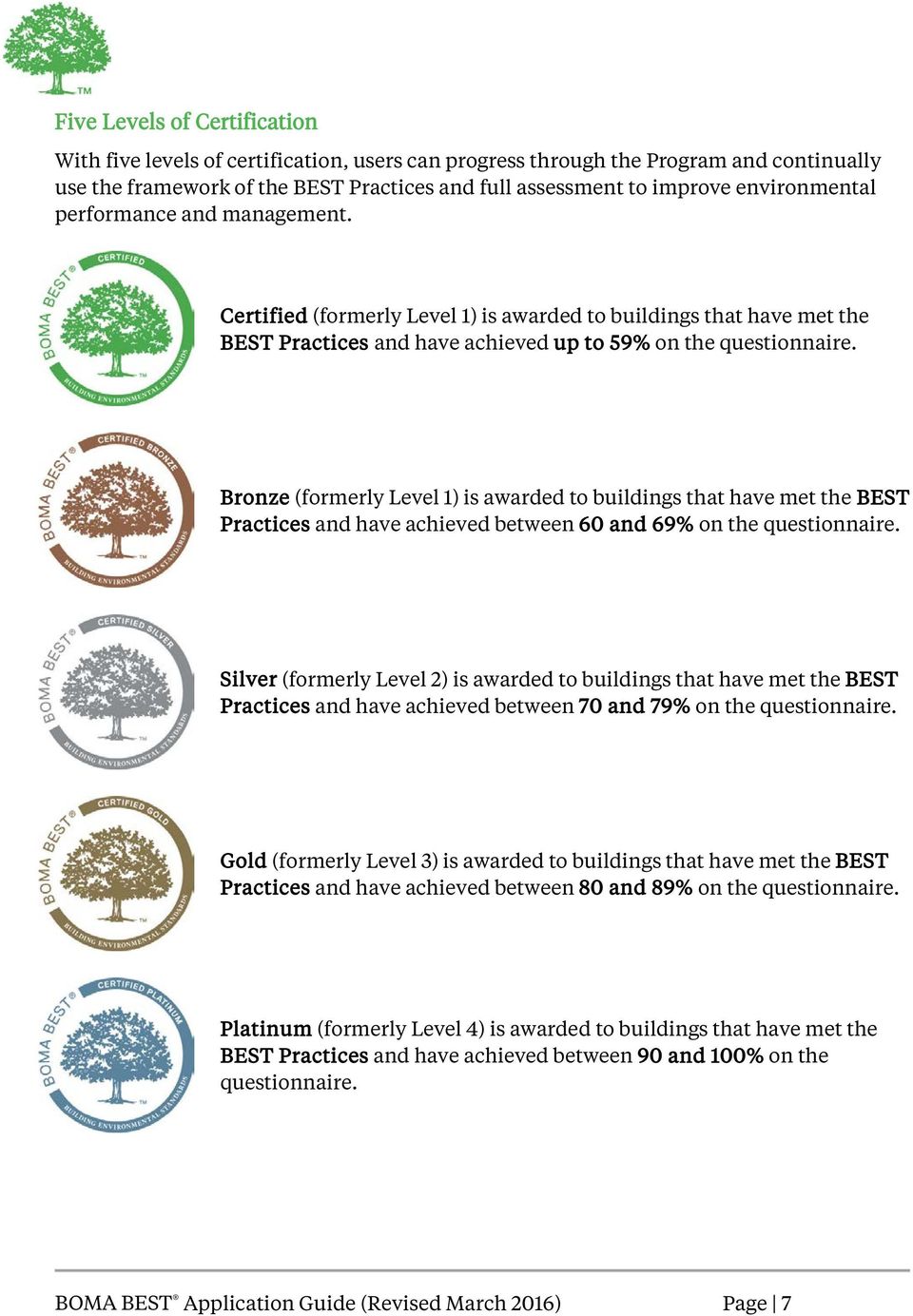
8 Five Levels of Certification With five levels of certification, users can progress through the Program and continually use the framework of the BEST Practices and full assessment to improve environmental performance and management. Certified (formerly Level 1) is awarded to buildings that have met the BEST Practices and have achieved up to 59% on the questionnaire. Bronze (formerly Level 1) is awarded to buildings that have met the BEST Practices and have achieved between 60 and 69% on the questionnaire. Silver (formerly Level 2) is awarded to buildings that have met the BEST Practices and have achieved between 70 and 79% on the questionnaire. Gold (formerly Level 3) is awarded to buildings that have met the BEST Practices and have achieved between 80 and 89% on the questionnaire. Platinum (formerly Level 4) is awarded to buildings that have met the BEST Practices and have achieved between 90 and 100% on the questionnaire. BOMA BEST Application Guide (Revised March 2016) Page 7
9 Timeline for completing the assessment Applicants have up to six (6) months to enter their data and may ask for an extension (provided at the sole discretion of the Local BOMA Association). Verification and subsequent certification is coordinated by a regionally designated Local BOMA Association. Note that the 14 BEST Practices must be met, regardless of the final score, for a building to achieve certification. Certification validity BOMA BEST certification is valid for a three (3) year period; returning users have the option to recertify buildings and view past assessments using their original Login ID and Password. For detailed step by step instructions of the Application and Certification processes, see section 2. Registration to Certification of this Guide. For more information about the BOMA BESt program including its history and governance, please visit our website at BOMA BEST Application Guide (Revised March 2016) Page 8

10 1.2 BOMA BEST Version 2 In January 2012, BOMA Canada was pleased to announce the arrival of BOMA BEST Version 2. This updated version includes revised assessment modules for five types of commercial properties: Office, Enclosed Shopping Centres, Light Industrial, Open Air Retail, and Multi-Unit Residential Buildings. The Health Care module was introduced in August Version 2 also contains updated references, expanded tips for each question to better explain requirements, and a host of other user-friendly features. New modules: Multi-Unit Residential Buildings (MURBs) and Health Care Facilities. Enhanced user-friendly features: Recertification capability for all previously certified BOMA BEST buildings: Static information about the building incorporated into new assessments to reduce the amount of information that must be re-entered at time of recertification). Numbered questions to improve ease of reference. Transparent scoring: Thanks to the Verifier Report users can see how many points each question is worth. Expanded tip language for many questions including updated references to standards, research, and external links. Ability to enter consumption data in whatever units appear on utility bills. Assessment survey content changes/upgrades: Updated energy and water benchmarking scales to better reflect industry performance. Innovation questions added to all assessment modules. Additional questions on existing building commissioning, site enhancement, commuting and effluent management. Revised BEST Practices: clarified questions, updated tips and references. What Remains the Same? Overall look and feel of the online assessment. User-friendly questionnaire (or survey) format for assessing building performance. BOMA BEST remains an educational tool for continuous improvement. National Program management, delivery through Local BOMA Associations. Delivery in both English and French. Several questions remain unchanged from original version of BOMA BEST. BOMA BEST Application Guide (Revised March 2016) Page 9

11 2. Registration to Certification: A Step-by- Step Guide BOMA BEST Application Guide (Revised March 2016) Page 10
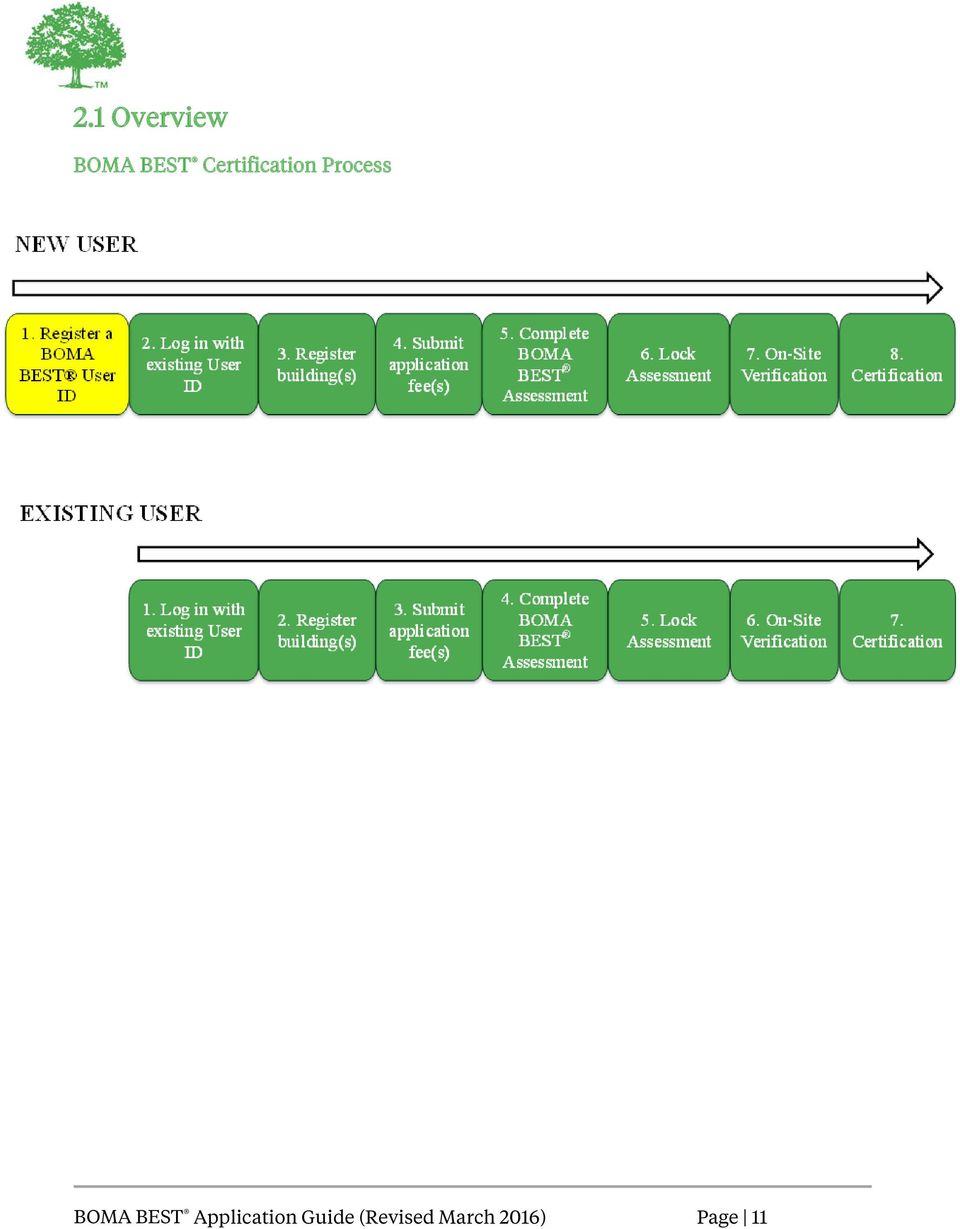
12 2.1 Overview BOMA BEST Certification Process BOMA BEST Application Guide (Revised March 2016) Page 11
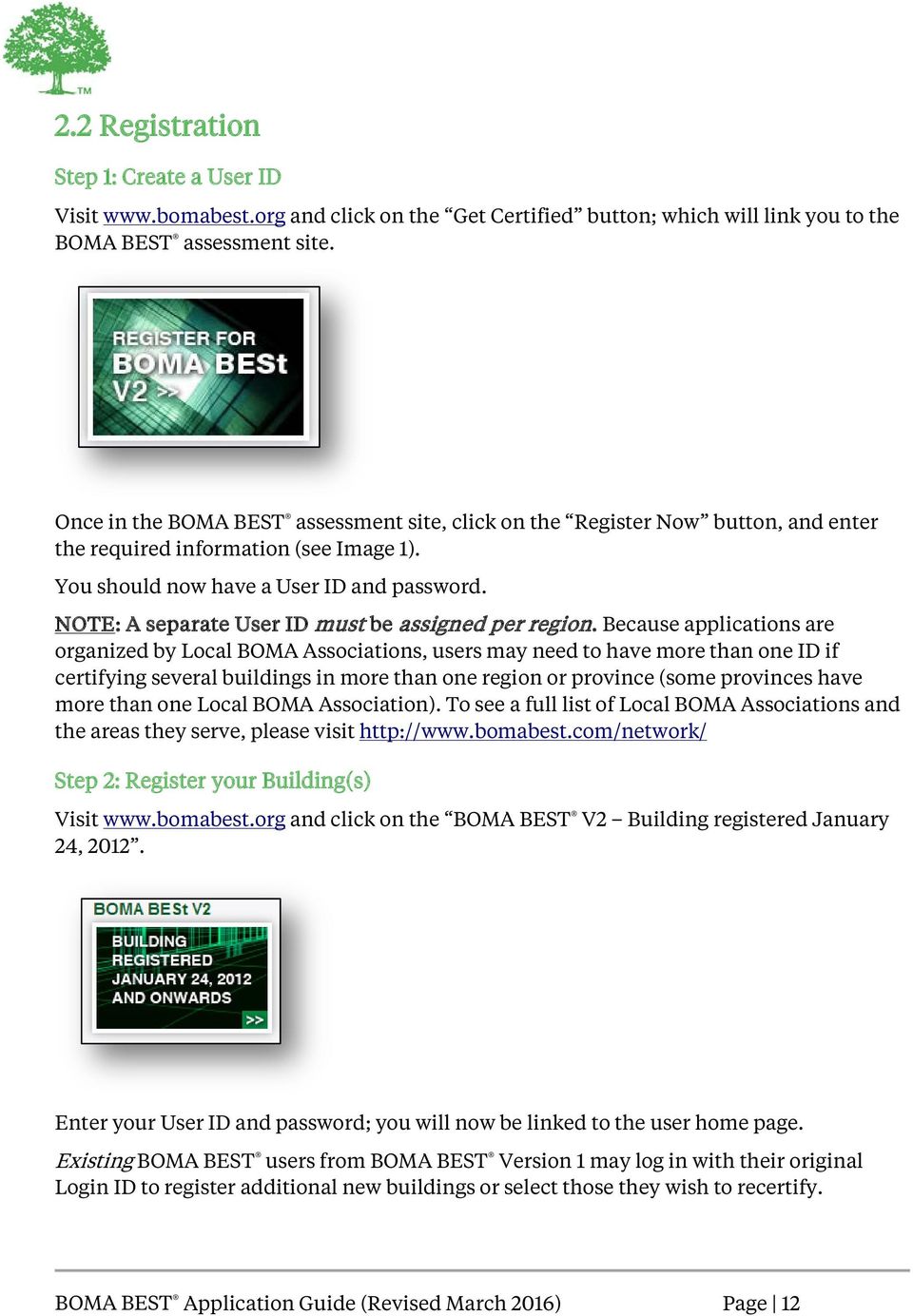
13 2.2 Registration Step 1: Create a User ID Visit and click on the Get Certified button; which will link you to the BOMA BEST assessment site. Once in the BOMA BEST assessment site, click on the Register Now button, and enter the required information (see Image 1). You should now have a User ID and password. NOTE: A separate User ID must be assigned per region. Because applications are organized by Local BOMA Associations, users may need to have more than one ID if certifying several buildings in more than one region or province (some provinces have more than one Local BOMA Association). To see a full list of Local BOMA Associations and the areas they serve, please visit Step 2: Register your Building(s) Visit and click on the BOMA BEST V2 Building registered January 24, Enter your User ID and password; you will now be linked to the user home page. Existing BOMA BEST users from BOMA BEST Version 1 may log in with their original Login ID to register additional new buildings or select those they wish to recertify. BOMA BEST Application Guide (Revised March 2016) Page 12
14 User Home Page Menu option to register a New Building OR Recertify Building Users have the option to register a New Building, or Recertify Building from the left side menu. Please note the recertification option is only available to those who certified their buildings using BOMA BEST (v1) and must use the same Login ID that was assigned at the time of prior BOMA BEST certification. Buildings certified with Go Green/Go Green Plus do not qualify to use the recertification feature. This does not mean, however, that recertification cannot be achieved; applicants who wish to re-certify buildings certified with Go Green/Go Green Plus may apply as a new building application. BOMA BEST Application Guide (Revised March 2016) Page 13

15 When registering a New Building you will be required to complete the online form, which includes information on the name and address of the building(s), size, ownership, etc. Select your form of payment online using a credit card or invoice payment by cheque then click submit. For Office Complexes, Light Industrial Parks or Multi-Unit Residential Complexes users will be required to enter the name and address of each building (extra fields are provided when Complexes or Parks are selected using the drop-down menu provided at time of registration). NOTE: complexes/parks require individual building assessments to be completed; the oneapplication format is to capture site management information and for pricing purposes. 2.3 Registering a building in the Portfolio Program BOMA Canada is proud to introduce our new Portfolio Program for Light Industrial and/or Open Air Retail properties. In response to extensive consultation undertaken with BOMA members, the program has been designed to provide a cost-effective yet rigorous method for continuous BOMA BEST certifications of large portfolios of light industrial and/or open air retail buildings at all levels of certification. The benefits of the program include: Continuous certification, replacing recertification every three years. Cost effective annual program fee, allowing for better budgeting at the property level. Fees based on square footage rather than on a building-by-building basis. Allows our BOMA members to add (and remove) properties from their portfolios due to changes in ownership or management company. Annual sampling verification program based on the requirements of ISO 17021:2011 to provide a more frequent review of building performance. Enables Owners and/or Managers to decide which properties they wish to include in a certification pool at any given time. Properties can be included from different geographic regions of Canada. Properties can be added (or removed) at different times. For more information on the Portfolio Program including registering buildings, pricing and verification, please consult the BOMA BEST Portfolio Program Guide. BOMA BEST Application Guide (Revised March 2016) Page 14

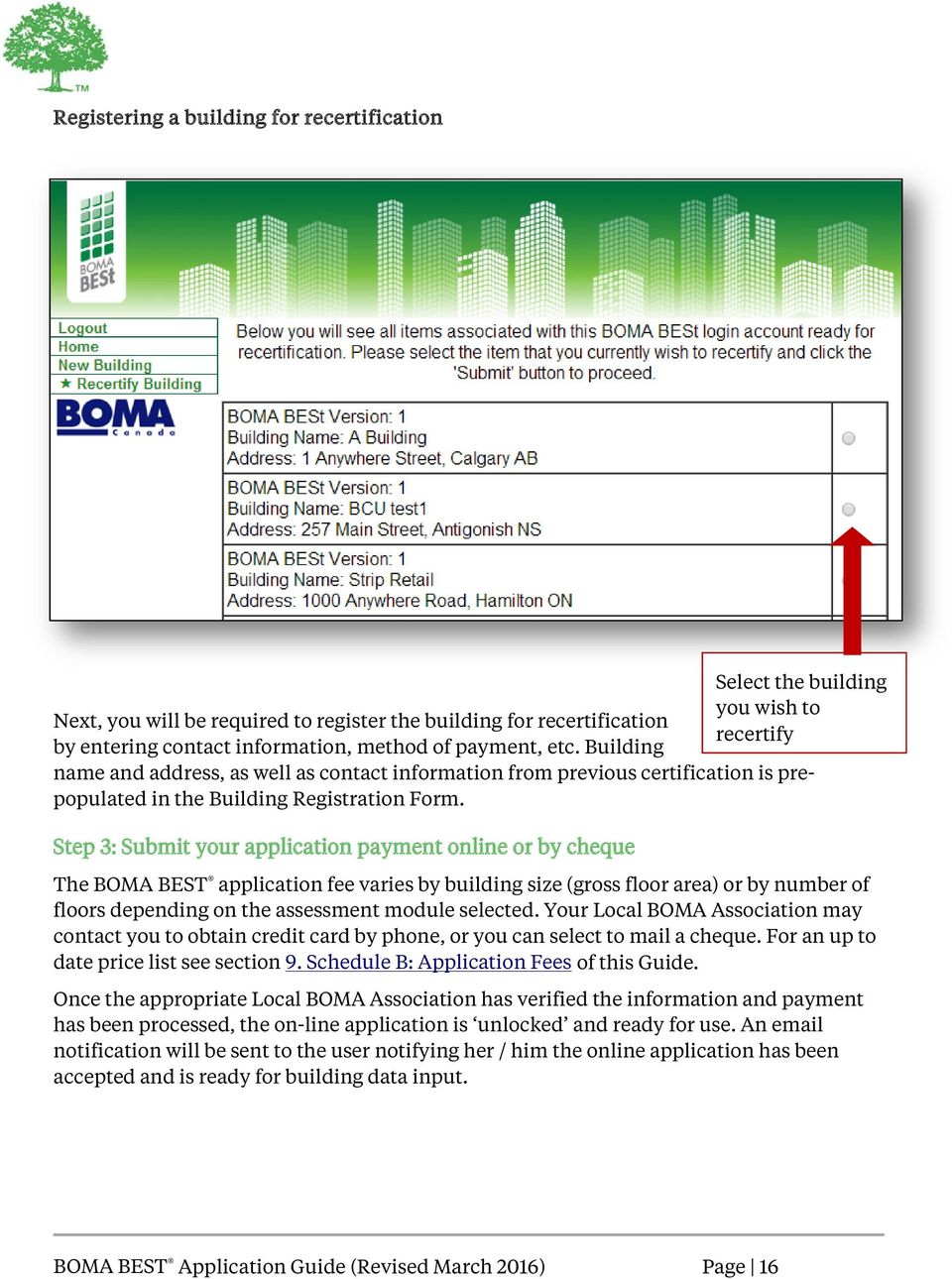
16 2.4 Recertification To register for a recertification, simply click on the Recertify Building button. You will then be presented with a list of your BOMA BEST buildings which will enable you to select the one that you are interested in recertifying. Select the building you with to recertify and click submit. NOTE: only buildings registered to your specific Login ID will be listed; and only buildings that are or were previously certified with BOMA BEST (not Go Green/Go Green Plus). Recertification assessment surveys for buildings previously certified under the BOMA BEST program (Versions 1 and 2), will be automatically titled as [building name] Recertification [year], and can be found listed in the user home page with other buildings registered under a specific Login ID. The on-line assessment will include non-performance, static information from previous certification cycles (e.g. building size, HVAC equipment, policies in place, etc.; excluding utility bills). New questions are also included as part of the BOMA BEST Version 2 assessment, and are therefore a required component of recertification. Updated utilities information for energy and water must also be inputted into the recertification form. NOTE: Carefully review ALL information to ensure it is up to date, and relevant for the BOMA BEST Version 2 recertification assessment survey. Should you wish to maintain certification for your building(s), it is recommended that you apply for recertification several months before the building s certification is set to expire. If you are unsure when a building s certification is going to expire, please contact your Local BOMA Association. A list of contacts for each Association can be found at: BOMA BEST Application Guide (Revised March 2016) Page 15

17 Registering a building for recertification Next, you will be required to register the building for recertification by entering contact information, method of payment, etc. Building name and address, as well as contact information from previous certification is prepopulated in the Building Registration Form. Step 3: Submit your application payment online or by cheque Select the building you wish to recertify The BOMA BEST application fee varies by building size (gross floor area) or by number of floors depending on the assessment module selected. Your Local BOMA Association may contact you to obtain credit card by phone, or you can select to mail a cheque. For an up to date price list see section 9. Schedule B: Application Fees of this Guide. Once the appropriate Local BOMA Association has verified the information and payment has been processed, the on-line application is unlocked and ready for use. An notification will be sent to the user notifying her / him the online application has been accepted and is ready for building data input. BOMA BEST Application Guide (Revised March 2016) Page 16
18 2.5 Completing the assessment User home page The BOMA BEST home page for each applicant includes a complete list of buildings registered under a specific Login ID. The list of buildings is colour coded to denote status (e.g. editing, locked, certified ), as well as to provide access to the online assessment survey and unique building report. View Assessment Questionnaire View Summary Report Asset Type (e.g. O2 is office fee category 2) Building Name Step 4: Proceed with BOMA BEST Assessment Log in using the assigned User ID and password created. You will see one or more buildings registered under your User ID. Click on Revise Survey for the specific building you wish assessed, and begin entering information into the online survey. The BOMA BEST assessment survey s Basic Information page will be pre-populated with the building name, address and other information collected in the Building Registration form. BOMA BEST Application Guide (Revised March 2016) Page 17

19 In the Basic Information section, ensure that Building Name and Management Company is entered correctly and as you would like it to appear online as part of the BOMA BEST Certified Building list made publicly available at: Instructions are provided on the first page of the assessment and can be viewed at any time by navigating through the menu found on the left side of the screen. On this first page, you will also find a link to download the assessment survey in PDF format, with questionby-question numbering and scoring. Download the PDF of the questionnaire. BOMA BEST Application Guide (Revised March 2016) Page 18

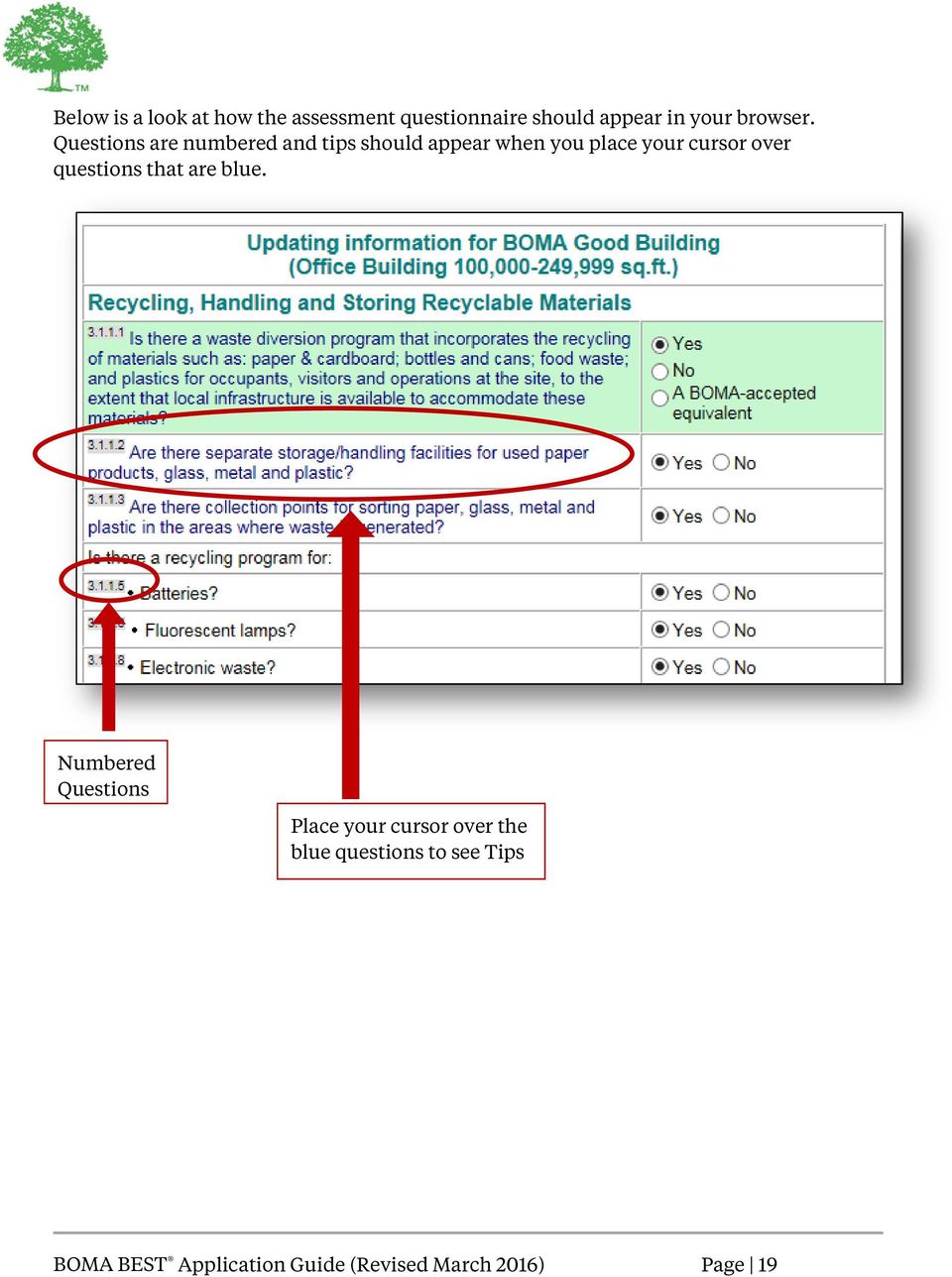
20 Below is a look at how the assessment questionnaire should appear in your browser. Questions are numbered and tips should appear when you place your cursor over questions that are blue. Numbered Questions Place your cursor over the blue questions to see Tips BOMA BEST Application Guide (Revised March 2016) Page 19
21 2.6 BEST Practices All buildings undergoing the BOMA BEST assessment must complete the BEST Practices. You will, therefore, be required to answer the BEST Practices form (14 questions) prior to continuing to the full assessment survey. Once the BEST Practices have been completed, you will have the option to submit and lock the information OR continue through the full BOMA BEST assessment specific to the type of building you registered. Applicants that undergo the full assessment will be able to see the BEST Practices highlighted throughout the survey. Completing the BEST Practices first allows all building types including those that do not qualify for a specific assessment module to benefit from the BEST Practices. NOTE: To be eligible for BOMA BEST certification levels Bronze, Silver, Gold and Platinum, applicants must complete the full BOMA BEST assessment survey in addition to the BEST Practices. To learn more about the BEST Practices, as well as what is required to successfully meet all requirements, see section 4. BEST Practices section of this Guide. BOMA BEST Application Guide (Revised March 2016) Page 20
22 2.7 Verifier Report Use the Verifier Report for a quick glance at how you are performing as you move through the questionnaire. This page can also be saved as a PDF (using your internet Tools menu) as an easy reference guide to your answer selections. View Verifier Report to see your scores Verifier Report Page Sample Improvements to the Verifier Report under BOMA BEST Version 2 include: Numbered questions for easy reference by both applicant and verifier; A column showing total available and achieved points per sub-section; and A cleaner, more readable layout of the assessment questions for greater ease of reference. Numbered Questions Question Scoring NOTE: the above noted improvements are only applicable to applications where the full BOMA BEST assessment has been completed (e.g. section scores and sub-scores will NOT be displayed unless the full assessment has been completed). BOMA BEST Application Guide (Revised March 2016) Page 21
23 2.8 Report A unique report is generated for each building assessed using the BOMA BEST program. The report is a key tool toward continuous improvement a central tenet of the BOMA BEST program of building management practices towards greater energy and water efficiency and overall environmental performance. The Report provides a visual representation of total score achieved along with a breakdown of scoring for each of the six (6) key sections of the BOMA BEST assessment. Further, the Report provides a summary of inputted information along with appropriate recommendations for improvement. Users are encouraged to refer to the report throughout the three-year certification period and work towards incorporating some or all of its recommendations. This report can be downloaded in PDF version to facilitate implementing those improvements while the building is certified, and prior to recertification. NOTE: A full report with scoring is NOT available for buildings certified with BEST Practices only. A report may be generated; however, it will include a summary of the BEST Practices information only. The report provides a summary of scores achieved in each section as well as the overall score. Remember, this score is still contingent on the results of the Verification. BOMA BEST Application Guide (Revised March 2016) Page 22
24 Step 5: Lock Your Building Assessment Data Applicants are required to lock the online survey data within six (6) months of having access to the BOMA BEST assessment. For more information, see section 8. Schedule A: BOMA BEST Program Policies for more information. To lock your building, visit the Report page. Before locking your building assessment survey data, view your interim overall and section scores in the Report, as well as determine whether you have met the BEST Practices. If the Report confirms that the building meets all of the BEST Practices, click on Lock Building Data and Submit for Certification. NOTE: Once data is locked the UPDATE button will change to NEXT. You may still review the data inputted, but you will no longer be able to make any changes. Only a Local BOMA Association administrator can unlock an assessment once it has been locked. Ready to lock your assessment? 1. Once satisfied with all answers, click on Report. 2. Click on Lock Building Data and Submit for Certification. BOMA BEST Application Guide (Revised March 2016) Page 23
25 2.9 Quick Tips for Using the BOMA BEST Online Platform Consult the this Guide, the BOMA BEST Version 2 Application Guide frequently for details about the application process, verification process, the BEST Practices, fee schedules and BOMA BEST policies. Download the PDF of the questionnaire. This version provides users with all pertinent information at the same time: the questions, tips, and points attributed to each question. Use the Verifier Report for a quick glance at how you are performing as you move through the questionnaire. This page can also be saved as a PDF (using your internet Tools menu) as an easy reference guide to your answer selections. The recommended web browser for the BOMA BEST online assessment is Internet Explorer. The pop-out functionality of the tips will not work in other browsers. Click the Update button at the bottom of each assessment survey page to save your information. If Update is not selected, your data will not be saved and will, therefore, have to be re-entered. If there is an error on the page (for example if a required field has not been correctly completed), you will be notified with a message at the top of the page. You must correct this error for your data to be saved. Information on the type of error will be provided. Run-out time on web server: the BOMA BEST platform is a highly secure website. There is a 60 minute runtime limitation on the BOMA BEST website; however, each company s web connection may have a stricter runtime limitation for security purposes. You will be required to log in if no activity occurs (i.e. clicking Update ) within a specified time, dictated by your company s web connection. Always use the navigation menu and buttons within the application for all navigation (as opposed to the browser s back and forward options). It is highly recommended that only one application be worked on at a time. Working on two (in two different tabs) may lead to one questionnaire overwriting the other. Use the Report for recommendations on how to improve your building before your next certification. Questions? Find your Local BOMA Association s contact information here: BOMA BEST Application Guide (Revised March 2016) Page 24
26 2.10 Verification Step 6: On-Site Verification A comprehensive description of the verification process along with details about the Applicant s responsibilities is provided in Section 3. BOMA BEST Verification Process Certification Step 7: Certification Achieved or More Work Required Within approximately five (5) business days of receiving final verifier recommendations, your Local BOMA Association will inform you of the final results of the verification, and inform whether the building qualifies for certification and if so, the BOMA BEST certification level achieved. Where missing documentation and / or a second site visit is required please consult section 8. Schedule A: BOMA BEST Program Policies found in this Guide and online. Communication is typically done by . At any time, BOMA BEST applicants are encouraged to connect with their Local BOMA Association for updates, clarification, and any other question or concern regarding the certification procedures Awarding BOMA BEST Certification A BOMA BEST certificate includes the name and address of the building, certification level achieved, and date of certification. Depending on the Local BOMA Association, the certificate may be mailed, or presented to the property management team as part of a quarterly or semi-annual event. Contact your Local BOMA Association for more information on the awarding of BOMA BEST certificates. Online Certified Building List Currently certified BOMA BEST buildings are listed on the BOMA BEST program website typically updated at the end of each month. Contact your Local BOMA Association if you do not see your building listed. Many Local BOMA Associations also post currently certified buildings on their sites so please check for your building to be listed there as well. NOTE: Once a building s certification has expired, it is automatically removed from the national list of certified buildings even if recertification of the building is being sought. BOMA BEST Application Guide (Revised March 2016) Page 25
27 Communicating your BOMA BEST Certification Applicants are encouraged to communicate their achievement to tenants, occupants, investors and the industry at large. BOMA Canada and its local associations are pleased to provide currently certified buildings with exclusive access to BOMA BEST recognition material available through PosterOne The material includes BOMA BEST customized recognition posters, banners and plaques, and BOMA BEST decals and labels. From time to time, BOMA Canada may post other ways to make the most of your certification and/or how best to communicate the benefits of certification to stakeholders on the BOMA BEST program website ( BOMA BEST to qualify for BOMA AWARDS Qualification for BOMA local, regional (national) or international awards (e.g. Earth Award) may require a current BOMA BEST certification, and may require that a specific level of certification be achieved. If you are interested in pursuing local, regional (national) or international awards, please contact your Local BOMA Association (for local awards), BOMA Canada for regional (national) awards, and BOMA International for international awards qualification requirements. BOMA BEST Application Guide (Revised March 2016) Page 26
28 3. BOMA BEST Verification Process BOMA BEST Application Guide (Revised March 2016) Page 27
29 3.1. Overview of the Verification process Once the online assessment survey has been completed, the applicant must lock the assessment via the Report page. The Local BOMA Association will be automatically notified of this status change. The Local BOMA Association program administrator, or its appointed third-party verifier, will contact the Applicant to set up an on-site visit of your building. BOMA BEST Applicants are verified by a third-party assessor, retained by Local BOMA Associations for verification in their region. The purpose of on-site verification is to confirm not only the information submitted via the online survey, but also to ensure the assessment is an accurate reflection of the building s environmental management practices and performance. The on-site visit includes a building tour and a documentation review. The duration of this on-site visit is approximately two to four (2-4) hours, though this can vary by building size and/or number of buildings (e.g. in the case of Complexes and/or Parks). Prior to the on-site visit, the Applicant must provide documentation demonstrating compliance with all 14 BEST Practices About the Verifier A Verifier is a third-party, contracted by the Local BOMA Association, expected to perform an on-site verification to confirm that the BOMA BEST requirements have been met and assess the level of BOMA BEST certification achieved. Verifiers are not hired to act as consultants to the building manager, nor are they to provide their expert advice. Rather a Verifier s job is to confirm the validity of information submitted Scheduling the On-Site Visit Applicants will be contacted by either the Local BOMA Association program administrator or the third-party verifier to schedule the on-site visit. The site visit will typically be scheduled within 30 days of an assessment being locked. Scheduling must involve a property contact person who is authorized to access the BOMA BEST assessment for that property. If buildings are part of a complex, and are located close to one another, it is expected that the Verifier will schedule the verification for all buildings on the same day. In these situations, applicants should expect a lengthier verification visit. For verification of buildings in locations outside the metropolitan area of the Local BOMA Association office, the applicant will be notified of estimated additional travel costs (as BOMA BEST Application Guide (Revised March 2016) Page 28
30 directed in BOMA BEST Program Policy 1.6 On-Site Verification: Additional Verification Costs) Security Clearance If some manner of security clearance is required for the Verifier to perform the site visit, the applicant must inform the Local BOMA Association or the Verifier as early into the assessment process as possible so that appropriate steps can be taken to gain clearance. The Verification cannot proceed if the Verifier is not able to access critical areas of the building (namely, the mechanical room, storage tanks, a typical tenant space, waste disposal facilities, etc.) Required Supporting Documentation Prior to On-Site Visit Documentation supporting and demonstrating compliance with the 14 BEST Practices must be provided to the Verifier no later than 5 working days prior to the scheduled visit to allow time for review. Documentation can either be printed or sent electronically. Documentation must be organized in a comprehensive and cohesive manner, which mimics the organization and layout of the questionnaire. For example, if done electronically, the files can be arranged in sub-sections, with each section representing the key areas of assessment (energy, water, etc.), and with subsequent documentation arranged in order of the questions. If documentation demonstrating compliance with the BEST Practices is considered inadequate, Applicants will be informed of this oversight to ensure that the missing pieces are provided prior to the on-site visit. Until such time as the documentation is provided, the visit cannot proceed. A thorough description of the documentation required to meet all 14 BEST Practices is described in section 4. BEST Practices. BOMA BEST Application Guide (Revised March 2016) Page 29
31 Documentation Required Prior to Verification Energy Management Energy Assessment Energy Assessment (no older than 3 years at verification) Energy Management Monitoring and Targeting Energy Management Reduction Plan Preventive Maintenance Program for HVAC Water Water Conservation Policy Water Assessment (no older than 3 years at verification) Waste Reduction and Site Waste Diversion Program Renovation/Construction Waste Reduction Policy Emissions and Effluents Ozone Depleting Substances Management Plan Phase-out plan for Ozone-Depleting Refrigerants Hazardous Building Materials Survey and Use-Related Chemical Inventory (may be 1 or 2 documents) Hazardous Products Management Plan Indoor Environment Documented Complaints Policy for Indoor Air Quality Environmental Management Systems Environmental Selection Policy for Building Materials Communications Work Plan BOMA BEST Application Guide (Revised March 2016) Page 30
32 3.6. On-Site Verification Attendees (Required) To assist with the verification, the following team members must be present (or available) during the visit: An individual familiar with the BOMA BEST questionnaire; AND An individual responsible for the building s on-site management practices; AND An individual responsible for the building s operations. The verification will typically begin with a walking tour of the building, followed by a return to the meeting room to review the supporting documentation Building tour Below are some examples of specific areas which the Verifier will be expected to review during the on-site visit. The following areas/features must be accessible (if applicable) during the site visit. Typical tenant space Heating plant Cooling plant Generator rooms Building envelope, elevator shafts, windows, awnings etc. Lighting fixtures Plumbing fixtures Irrigation Facility for storage and handling waste Composting facility for organic waste Floor and roof drains Storage tanks Hazardous materials storage site Air inlets and cooling towers Filtration systems Housekeeping (MSDS sheets) Building Automation System (BAS) Emergency response equipment site (e.g. spill control kits etc.) Environmentally significant areas BOMA BEST Application Guide (Revised March 2016) Page 31
33 3.8. Documentation review Documentation is required to support all answers. Documentation must be organized in a comprehensive and cohesive manner, which mimics the organization and layout of the questionnaire. For example, if done electronically, the files can be arranged in sub-sections, with each section representing the key areas of assessment (energy, water, etc.), and with subsequent documentation arranged in order of the questions. The information provided to the Verifier must be representative of the practices and operations of the entire building (not just leasable space, or partial tenant information). BOMA BEST requires complete building information in order to assess the building s performance Meeting Technical Clarification Requests requirements Once or twice a year BOMA Canada will update certain questions with clearer guidelines in response to completed Technical Clarification Requests (TCRs). These are announced via the BOMA BEST Newsletter (subscribe) or through the Local BOMA Association. They can also be found under the Completed TCR section of the website. Once the TCRs have gone into effect, all buildings verified after that time are expected to comply with the modifications including those in the process of completing an assessment. Typically, at least three months notice is given before TCRs take effect Missing documentation Should additional documentation be required before the assessment can be considered complete, Applicants can submit the missing documentation as per BOMA BEST Program Policy 1.5 On-Site Verification: Missing Documentation. a) An Applicant shall have up to thirty (30) days to provide the requested documentation and/or information and resubmit to the designated Local BOMA Association and/or the BOMA BEST Verifier as agreed upon; and b) The Verifier may help the applicant understand what is missing and whether or not newly provided documentation meets the requirement. However, in order to be respectful of the Verifier s time, there can be no more than two interactions focused on clarifying a question s intent following the on-site verification. Applicants are instructed to carefully review all BOMA BEST Tip language and the information found in the Application Guide to understand what is required. Additional document review beyond the two interactions will incur an additional verification cost. BOMA BEST Application Guide (Revised March 2016) Page 32
34 c) Should the BOMA BEST Verifier require a second on-site visit, the applicant will be required to pay all applicable verifier costs. Notwithstanding the above clause 1; the relevant Local BOMA Association, upon consultation with the BOMA BEST Verifier, may, at its sole discretion, grant an Applicant an extension of thirty (30) days to provide missing documentation and/or information Additional Verification Costs The Applicant is expected to have diligently completed the questionnaire and supporting documentation prior to the verification. It is possible (and indeed expected) that the Verifier will uncover some questions that were incorrectly answered in the questionnaire in light of the walk through or documentation review. It is the Verifier s responsibility to take note of these errors and correct them in the online questionnaire following the Verification. The Verifier will notify the Applicant that these changes are being made. A Verifier may amend up to twelve (12) answers within the questionnaire. If more questions require modifications this will incur an additional verification cost. For more information on these and other possible additional costs, please see BOMA BEST Program Policy 1.6 On-Site Verification: Additional Verification Costs Communicating the Certification Status Following the on-site visit, the Applicant s online assessment will be amended by the Verifier or the Local BOMA Association as needed to reflect the changes discussed during the verification visit. Scoring may be adjusted higher or lower depending on the verification tour and whether the appropriate back-up information is provided. Following this amendment, the Verifier will issue a Final Report to the Local BOMA Association summarizing the changes that have been made to the online assessment, the final overall score and certification Level achieved by the Applicant. The Local BOMA Association will notify the Applicant of the building s certification status and Level achieved within a reasonable delay Security Clearance If some manner of security clearance is required for the Verifier to perform the site visit, the applicant must inform the Local BOMA Association or the Verifier as early into the assessment process as possible so that appropriate steps can be taken to gain clearance. The Verification cannot proceed if the Verifier is not able to access critical areas of the building (namely, the mechanical room, storage tanks, a typical tenant space, waste disposal facilities, etc.). BOMA BEST Application Guide (Revised March 2016) Page 33
35 3.14. Confidentiality All information viewed received by the Verifier is confidential to the building. The Verifier shall retain only his or her notes from the building site visit, and shall destroy any records or information belonging to the building. BOMA BEST Application Guide (Revised March 2016) Page 34
36 4. BEST Practices BOMA BEST Application Guide (Revised March 2016) Page 35
37 4.1. Introduction Purpose The purpose of this portion of the BOMA BEST Version 2 Application Guide is to identify the BEST Practices and provide additional guidance on meeting requirements for on-site verification. Format The 14 BEST Practices will be presented by section: question with tip language, and an outline of required information to meet each BEST Practice. About the BEST Practices The fourteen (14) BEST Practices are divided into six (6) sections representing the key areas of energy and environmental assessment at the centre of the BOMA BEST program: Energy; Water; Waste Diversion & Site; Emissions & Effluents; Indoor Environment; and Environmental Management System. All buildings undergoing the BOMA BEST assessment must first complete and meet the BEST Practices. Applicants are provided with the BEST Practices form prior to continuing to the full assessment survey. The BEST Practices are applicable to all buildings types, even those that fall outside of the scope of the specific building assessments for Office, Shopping Centres, Light Industrial, Open Air Retail, Multi-Unit Residential Buildings, and Health Care Facilities. BOMA BEST Application Guide (Revised March 2016) Page 36
38 4.2. BEST Practices: Energy Q.1 Has the building had an energy assessment within the past three years that included recommendations with costs, savings and a payback period? Tip: This is a prerequisite to achieve BOMA BEST certification. A minimum of an ASHRAE Level 1 Walk-through audit or equivalency is required that includes: Utility billing analysis with benchmarking observations; Summary of major equipment and type of lighting systems in the buildings; and List of potential energy conservation opportunities, estimated savings, and simple payback based on walk-through audit of the facility. ENERGY The assessment report must identify low-cost improvements and potential capital improvements as well as red flag issues for a future more-detailed audit. In particular situations, where the building meets criteria set out in the BOMA BEST Application Guide for an acceptable equivalent, mark A BOMA-accepted equivalent. Buildings that have been occupied for less than 2 (two) years may utilize an energy study report that was prepared during the design of the building in lieu of a post-construction energy audit report. This report must have shown simulated energy consumption for different design scenarios, and identify which options were chosen for the actual construction. Applicants must be able to demonstrate that these energy-reduction features were incorporated in the building. Q.2 Is there a building-specific Energy Management (reduction) Plan to address issues raised in the energy assessment? Tip: This is a prerequisite to achieve BOMA BEST certification. The Energy Management Plan should identify and document measures to improve building energy efficiency and reduce demand. These measures should be based on a clearly identified energy performance target, identified through the energy assessment or by the operational staff. The Plan should show allocated resources along with estimated payback, and implementation timelines for specific energy efficiency improvements. These energy projects must be building-specific and must address issues highlighted in the most recent energy assessment. In situations where the building meets criteria set out in the BOMA BEST Application Guide for an acceptable equivalent, mark BOMA-accepted equivalent. BOMA BEST Application Guide (Revised March 2016) Page 37
39 Q.3 Is there a preventive maintenance program for the HVAC (heating, ventilating, air-conditioning)? Tip: This is a prerequisite for BOMA BEST. Preventive maintenance differs from regular maintenance in that it takes into account that certain systems components require overhauling or replacement after a certain age or at certain intervals or due to certain specific causes. The preventive maintenance program should include both review and corrective actions to be done monthly, quarterly, semi-annually, yearly and at five-year intervals. Q1. Energy Assessment An energy assessment report must be presented for on-site verification. Requirements are outlined in the tip language and must include the following information: 1. Owner/manager information; 2. Building name and address; 3. Building description; 4. Energy assessment (walk-through, analysis); 5. Utility billing analysis with benchmarking observations (e.g. a comparison of building performance indices such as MJ/m²/yr or kwh/ft²/yr for each energy source); 6. Summary of major equipment and type of lighting systems in the building; and 7. List of potential energy conservation opportunities, estimated savings, and simple payback based on walk-through audit of the facility. IMPORTANT NOTES: I. The Energy Assessment may be completed by in-house technical staff or by a third party consultant (e.g. professional engineer or other appropriate energy consultant). II. Assessments are evaluated based on meeting the requirements outlined in the question tip language. Energy assessments MUST BE DATED and SIGNED by the person responsible for conducting the work. BOMA BEST verifiers will look for signature and date. An Energy Assessment must have been conducted within the last three (3) years of the date the BOMA BEST verification assessment was conducted. BOMA BEST Application Guide (Revised March 2016) Page 38
40 BOMA-Accepted Equivalents 1. Energy Study Report Buildings that have been occupied for less than two (2) years may utilize an energy study report that was prepared during the design of the building in lieu of a post-construction energy audit report. This report must have shown simulated energy consumption for different design scenarios, and identify which options were chosen for the actual construction. Applicants must be able to demonstrate that these energy-reduction features were incorporated in the building. 2. Energy Communications Plan Where 75% or more of the building s energy is purchased directly by tenants (e.g. most Light Industrial and Open Air Retail buildings), applicants may prepare an Energy Communication Plan in lieu of an Energy Study Report. This communication plan must document means of encouraging energy conservation initiatives by occupants. For example, the communication plan may include the following offerings by the landlord/ management company: Providing walk through energy audit or assessment services. Delivery of energy conservation tips brochures to occupants. Energy conservation seminars for tenants / occupants. Other communication tools: posters, turn it off stickers, etc. Evidence of implementation may include the following: Agendas and notes from tenant-building management meetings. Copies of marketing materials used to promote energy conservation within the building. Copies of communication to tenants/occupants regarding energy conservation. Copies of energy assessments or audits performed in tenant spaces. IMPORTANT NOTES: I. Applicants must make available the communication plan and evidence of its implementation to the verifier, as part of the on-site tour. BOMA BEST Application Guide (Revised March 2016) Page 39
41 Q2. Energy Management Plan The Energy Management Plan should identify and document building-specific measures to improve energy efficiency and reduce demand. These measures should be based on a clearly identified performance target (using quantifiable performance indicators), identified through the energy audit or the operational staff. All actions must be evaluated for their technical feasibility and expected results (estimated energy savings and pre-feasibility study) as well as financial feasibility (through an economic cost/benefit analysis such as simple payback or ROI). These actions mush be integrated into a timeline. A documented plan for implementing energy conservation strategies is illustrated in the table below as an example of minimum requirements. A more detailed table is strongly encouraged, especially one which allows for continuous energy tracking. Energy Management Plan Sample Form No. Proposed Measure Budget Fiscal Year(s) Expected Return on Investment (Payback) Responsible Person(s) 1 Day time cleaning (reduces lighting requirements at night) $ years Joe Smith 2 Re-commissioning feasibility study $ months Jane Smith These practices are clearly stated as minimal best practices according to the 2011 ASHRAE Handbook HVAC applications (chapter 36; chapter 41). If the energy reduction plan is done through an ESCO project, energy savings should be measured according to EVO Standards (Efficiency Valuation Organization) and ASHRAE guideline Measurement of energy and demand savings. BOMA-Accepted Equivalent Buildings that have been occupied for less than two (2) years can meet this BEST Practice by demonstrating that an Energy Commissioning Plan has been put into place. The intent of this BOMA-accepted equivalent is to ensure that the building s major systems and equipment are being optimized/fine-tuned for specific seasonal requirements, occupancy variability, etc. BOMA BEST Application Guide (Revised March 2016) Page 40
42 The Energy Commissioning Plan must clearly demonstrate that the following actions have been considered and implemented in the previous twelve (12) months as per 2011 ASHRAE Handbook HVAC applications (chapter 36; chapter 41): 1. An energy measurement or assessment plan for major operating systems and equipment AND an energy bill evaluation and follow up plan; 2. If a deficiency report has been generated (from the construction process) in regards to building systems, plans to addresses these deficiencies must be included in the Energy Commissioning Report. 3. A person identified as responsible for the building energy performance; 4. Training for operations staff on performing the above. IMPORTANT NOTES: The Energy Commissioning Plan may be created and implemented by an inhouse operational staff or by a third party consultant (e.g. professional engineer or other appropriate energy consultant). The energy measurement or assessment plan for major systems and equipment shall include all operating systems and equipment that represent the greatest proportion of energy consumption in the building (e.g. heating system; cooling system, etc). It is not always possible to assess the operations of major operating systems and equipment through the ongoing review of energy bills. Other methods of assessment include: tenant satisfaction surveys, control sequence review, etc. The Energy Commissioning Plan must specifically identify the individuals responsible for the energy measurement of major operating systems and equipment, as well as those individuals responsible for energy bill review. One person must be identified as being responsible for the overall energy commissioning plan. BOMA BEST Application Guide (Revised March 2016) Page 41
43 Q.3 Preventative Maintenance Program It is necessary to undertake preventative maintenance in order to maintain optimal performance of the building s mechanical, electrical, and ventilation systems and their components. The building systems require periodic maintenance throughout their life cycle in addition to the need for overhauling, or replacement, at a certain age or interval, or due to specific issues or causes. These must be outlined specifically in a Preventative Maintenance Program. The Preventive Maintenance Program must include the methodology and record for all actions that are necessary to maintain the optimal functioning of the building s systems and their components. The required maintenance procedures will be unique to each property and the systems within these facilities. The Preventative Maintenance Program must contain the following: 1. An inventory of which system or component must be reviewed and the type of action that is required (e.g. by room or by equipment type); 2. Guidelines on how frequently these actions must be taken (e.g. monthly, quarterly, yearly, etc.). These guidelines should be based on standards such as manufacturer specifications, code requirements and industry best practices; 3. Documentation that these actions have been taken (e.g. via signature and date); 4. Confirmation that follow-up action has been taken when warranted; and 5. Record updates as new equipment is added or removed. In addition to manual recording of this information many buildings may have online tracking software that outlines and tracks the Maintenance Program. These are acceptable as long as the software can monitor and track items 1-5, listed above. The following is an example of a Preventative Maintenance Program. The items listed below constituted a sample only. System Component Action Taken Annually HVAC Outdoor Air Intakes Clear obstructions, bird droppings, standing water, proximity to cooling towers, trash compactors, exhausts and other pollutant sources. HVAC Ventilation Minimum outdoor air damper setting. HVAC VAV Box Minimum VAV box settings. HVAC Ventilation Duct and terminal coil cleanliness. Date Completed Signature Comments BOMA BEST Application Guide (Revised March 2016) Page 42
44 HVAC Duct insulation liner Check for cleanliness, adhesion, and coating. HVAC Cooling towers Water treatment functioning as intended. FIRE Fire Systems Open fire dampers HVAC/ ELEC ELEC. HVAC Measurement Devices and Sensors Controls (digital, pneumatic) Outdoor Air Intakes Calibration of sensors (temperature, humidity, pressure, occupancy, photocell etc.) Ensure the proper functioning of all controls systems Clear obstructions, bird droppings, standing water, proximity to cooling towers, trash compactors, exhausts and other pollutant sources. HVAC Ventilation Minimum outdoor air damper setting. HVAC VAV Box Minimum VAV box settings. HVAC Ventilation Duct and terminal coil cleanliness. HVAC Duct insulation liner Check for cleanliness, adhesion, and coating. HVAC Cooling towers Water treatment functioning as intended. Semi-annually HVAC Building Equipment Floor and equipment drain traps properly sealed. HVAC HVAC Air quality measurements in select occupied areas of the building. Quarterly ELEC Controls (digital, pneumatic) Operation of outdoor damper actuators. ELEC Lighting Ensure all emergency lighting is functioning properly Monthly HVAC Ventilation Air filter loading. ELEC. Lighting Change lamps as required. ELEC. Generator Generator testing BOMA BEST Application Guide (Revised March 2016) Page 43
45 4.3. BEST Practices: Water Q.4 Is there a written policy intended to minimize water use, and encourage water conservation? Tip: This is a prerequisite to achieve BOMA BEST certification. A water conservation policy should express a commitment to reduce demand for water and to establish goals and strategies to reduce water consumption. Q.5 Has a water assessment been completed within the last three years? WATER Tip: This is a prerequisite to achieve BOMA BEST certification. The water assessment report must include: Water billing analysis including cost and consumption history; Water intensity benchmarks; Water-using equipment inventory and end-use analysis; List of potential water conservation measures including maintenance procedures and retrofit measures; Estimated costs, savings and payback times for recommended measures The water assessment report may be incorporated into the energy assessment report. In particular situations, where the building meets criteria set out in the BOMA BEST Application Guide for an acceptable equivalent, mark A BOMA-accepted equivalent. Buildings that have been occupied for less than two (2) years or have no water meter may submit a Water-using Equipment Inventory Report. Buildings where 75% or more of the water is purchased directly by tenants may prepare a water communication plan. Q.4 Water conservation Policy A water conservation policy should express a commitment to reduce demand for water and to establish goals and strategies to reduce water consumption. The water conservation policy may be a national, corporate policy for all buildings managed by a single company. However, to meet this BEST Practice, building management must demonstrate its awareness of the policy, and is implementing specific measures in accordance with its strategic guidance. BOMA BEST Application Guide (Revised March 2016) Page 44
46 IMPORTANT NOTES: I. For on-site verification applicants must make available: A copy of the required policy; Examples of how the policy is being implemented on-site by property management; and Documents demonstrating the policy s implementation must be dated. II. Policy should be an official document on a company s website (internal and/or external); and/or printed on company s letterhead with appropriate management signature. Q.5 Water Assessment A Water Assessment report must be reviewed by the verifier. Requirements are outlined in the tip language (noted in the BEST Practice questions table) and must include the following information: Building Information Owner/manager information; Building name and address; Building description; Date of water assessment Water Use Analysis Water billing analysis including cost and consumption history compiled from utility bills; Water intensity benchmarking which includes a calculation of annual water use divided by building area; Water-using equipment inventory and end-use analysis compared with consumption, such as: o Domestic water fixtures (faucets, toilets, urinals); o Water using appliances (dishwasher, washing machine etc.); o Cooling equipment including cooling towers, equipment once-through cooling and customized tenant cooling equipment; o Landscape irrigation equipment; o Water use for humidification equipment; o Water use from heating equipment (boiler blowdown, steam production and condensate management); o Any specialized equipment (including production use). Recommended Measures: o List of identified retrofit and operation and maintenance water conservation measures; BOMA BEST Application Guide (Revised March 2016) Page 45
47 o o IMPORTANT NOTES: Estimated costs, savings and payback period of measures; Explore sub-meter opportunities for large water-using tenants. I. The Water Assessment may be completed by in-house technical staff or by a third party consultant (e.g. professional engineer or other appropriate energy/water consultant). II. Assessments are evaluated based on meeting the requirements outlined in the tip language and by date. Water assessments MUST BE DATED and SIGNED by the person responsible for conducting the work. BOMA BEST verifiers will look for signature and date. A Water Assessment must have been conducted within the last three (3) years of the date the assessment was conducted. III. The Water Assessment report may be combined with the Energy Assessment report. BOMA-Accepted Equivalents 1. Water-using equipment inventory Buildings that have been occupied for less than two (2) years OR have buildings with no water meter may submit a Water-using Equipment Report which can be created with information contained in the building s Operation and Maintenance Manual, As Built Drawings and Commissioning Report. The Water-using Equipment Report must include the following information: Building Information Owner/manager information; Building name and address; Building description; Date of equipment inventory. Water-using Equipment Information Inventory/survey of all water consuming equipment on facility premises and their locations throughout the building, such as: o Domestic water fixtures (faucets, toilets, urinals); o Water using appliances (dishwasher, washing machine etc.); o Cooling equipment including cooling towers, equipment once-thru cooling and customized tenant cooling equipment; o Landscape irrigation equipment; o Water use for humidification equipment; o Water use from heating equipment (boiler blowdown, steam production and condensate management); BOMA BEST Application Guide (Revised March 2016) Page 46
48 o Any specialized equipment (including production use). Baseline consumption of this equipment based on data from the building automation system and water sub-meters OR based on equipment performance estimates informed by manufacturer specifications PLUS an estimated calculation of the equipment s annual consumption, such as: o Sinks and faucets: aerator output multiplied by estimation of annual use; o Toilets and urinals: flush output multiplied by estimation of annual use; o Showerhead: output of the showerhead multiplied by estimation of annual use; o Cooling towers: estimate make-up water required to compensate for losses due to evaporation, drift and splash-out, leaks and overflow, and bleed or blowdown. Evaporation: Directly related to heat transfer and operational management. Assume approximately 1.8 gph (centrifugal) or 3.7 gph (absorption) per ton of cooling multiplied by the load percentage. Bleed/blowdown: Losses represent a non-linear function of the concentration cycles (purity of make-up water over the purity of the recirculating water). Higher cycles mean fewer blowdowns are needed. Drift and splash-out: Losses are not significant for well-maintained towers under normal conditions. Assume approximately gph per ton of cooling or about 0.008% of recirculating water. Leaks and overflows: These are difficult to measure or estimate and losses are not significant in well-maintained towers. Visual inspection for leaks should be performed. o Irrigation system: output of the sprinklers multiplied by operating hours. Recommended Measures: o o o o o List of identified retrofit and operation and maintenance water conservation measures; Estimated costs, savings and payback period of measures; Establish water reduction target. Explore feasibility of installing base building meter if not present Explore sub-meter opportunities for the cooling tower make-up line. BOMA BEST Application Guide (Revised March 2016) Page 47
49 2. Water Communications Plan Where 75% or more of the building s water is purchased directly by tenants (e.g. most Light Industrial and Open Air Retail buildings), applicants may prepare a Water Communication Plan in lieu of a Water Assessment report. This communication plan must document means of encouraging water conservation initiatives by occupants. For example, the communication plan may include the following offerings by the landlord/ management company: Providing walk through water audit or assessment services of tenant spaces. Delivery of water conservation tips brochures to occupants. Water conservation seminars for tenants/occupants. Other communication tools: posters, shut-it-off stickers, etc. Evidence of implementation may include the following: Agendas and notes from tenant-management team meetings. Copies of marketing materials used to promote water conservation measures. Copies of communication to tenants/occupants regarding water conservation tips/opportunities. Copies of water use assessments or audits done in tenant spaces. IMPORTANT NOTES: I. Applicants must make available the communication plan and evidence of its implementation for review to the verifier, as part of the on-site tour. BOMA BEST Application Guide (Revised March 2016) Page 48
50 4.4. BEST Practices: Waste Reduction Q.6 Is there a waste diversion program that incorporates the recycling of materials such as: paper & cardboard; bottles and cans; food waste; and plastics for occupants, visitors and operations at the site, to the extent that local infrastructure is available to accommodate these materials? WASTE REDUCTION Tip: This is a prerequisite to achieve BOMA BEST certification. The property must have an active recycling program. A BOMA-accepted equivalent may suffice in particular situations as per the conditions and criteria set out in the BOMA BEST Version 2 Application Guide. Q.7 Is there a written policy intended to minimize construction waste being sent to landfill? Tip: This is a prerequisite to achieve BOMA BEST certification. Construction and demolition waste - which accounts for about 30% of Canada's landfill - can be reduced by implementing a source separation and recycling program on-site. The program should meet the minimal requirements of the jurisdiction (e.g. 3R Code of Practice). The waste specifications should address recycling of corrugated cardboard, metals, concrete blocks, clean dimensional wood, plastic, glass, gypsum board and carpet. Q.6 Waste Diversion Program To meet this sixth BEST Practice, applicants must implement a waste diversion program that aims to reduce total volume of waste generated, and divert as much volume of materials from landfill as possible. Waste minimization and diversion is done through a reuse and recycling program available on-site to all building occupants. Waste diversion programs should strive to achieve high diversion rates of standard fibre and container streams, as well as hazardous materials such as toner cartridges, fluorescent lamps and electronic equipment. Composting of organic material, either on site or through an off-site contractor, should also be included in this program, where possible. BOMA-Accepted Equivalents 1. Tenant Coordinated Waste Diversion Where tenants are directly managing their own waste removal (typically applicable for Light Industrial and Open Air Retail properties), the building applicant must confirm tenant(s) waste diversion efforts. In the absence of tenant material recycling/reuse, the applicant must demonstrate it has made an effort to provide recycling facilities. BOMA BEST Application Guide (Revised March 2016) Page 49
51 For example, in retail plazas, each individual tenant (retail unit) may produce a small volume of recyclables; the property manager may provide a common recycling area for tenants as a value-added service (and to make recycling more cost-effective). 2. Lack of Recycling Facilities Where recycling facilities may not available, the applicant must provide a confirmation letter from the local municipality, provincial government, or other appropriate body as evidence. Where recycling facilities are available but the local municipality does not collect recyclables, the applicant must demonstrate that reasonable efforts to contract a commercial hauler were made. Q.7 Construction Waste Policy The construction waste policy must clearly identify the applicant s commitment to reducing construction and demolition waste from being sent to landfill. The Policy should meet the minimal requirements of the jurisdiction (e.g. 3R Code of Practice) by implementing a source separation and recycling program on-site. The waste specifications should address recycling of corrugated cardboard, metals, concrete blocks, clean dimensional wood, plastic, glass, gypsum board and carpet. The Construction Waste Policy may be a national, corporate policy for all buildings managed by a single company. However, to meet this BEST Practice, building management must demonstrate awareness of the policy and show that it is implementing specific measures in accordance with its strategic guidance. IMPORTANT NOTES: 1.1 For on-site verification, applicants must make available: A copy of the required policy; Sample specification must be made available for review and specification may include: Documentation of a recent renovation contract that specifies materials for reuse, resale and diversion. Tenant design guidelines that specify materials for reuse, resale and diversion. Corporate or on-site program specifications for the diversion of demolition, construction and renovation materials. Examples of how the Policy is being implemented on-site by property management; and Documents demonstrating the Policy s implementation must be dated. The Policy should be an official document on a company s website (internal and/or external); and/or printed on company s letterhead with appropriate management. BOMA BEST Application Guide (Revised March 2016) Page 50
52 4.5. BEST Practices: Emissions and Effluents Q.8 Is there a documented management plan for Ozone Depleting Substances (ODS) that includes: Tip: This is a prerequisite to achieve BOMA BEST certification. Maintenance of the refrigeration system can reduce operating costs by improving the chiller performance, avoiding costly repairs, and reducing the need for refrigerant replacement. If there are no ODS, mark not applicable. i) Inventory of refrigerants and records? EMISSIONS & EFFLUENTS Tip: Tip: Inventory should show the present ODS and records should show the historical quantities of ODS. ii) iii) Maintenance reports, loss reports, and leak test results? Operational staff training Environmental awareness courses should include course content on Refrigerant Control or CFC Handling that has been developed by the Heating, Refrigeration and Air Conditioning Institute of Canada (HRAI) and Environment Canada. These courses are typically one day in length. When the maintenance of the equipment is outsourced, the contractor should provide evidence of meeting the staff training requirements. iv) Periodic leak testing? Q.9 Is there a phase-out plan for ozone-depleting refrigerants? Tip: This is a prerequisite to achieve BOMA BEST certification. Until December 31, 2009, charging a chiller with CFCs following an overhaul was still allowed if the owner agreed to convert or replace the system within 12 months after it had been charged so that it no longer contained CFCs. Effective January 1, 2015, operating or allowing the operation of a chiller containing CFCs will be prohibited. If there are no ODS, mark Not Applicable. BOMA BEST Application Guide (Revised March 2016) Page 51
53 Q.10 Has a hazardous building materials survey and a use-related chemical inventory been completed within the last three years? Tip: This is a prerequisite to achieve BOMA BEST certification. A Hazardous Materials Survey should include only building-related hazardous materials and must indicate, at a minimum, whether the following four hazardous building materials are present in the building: Asbestos-containing materials (e.g., insulation coverings, putties and caulking, older equipment); Polychlorinated biphenyls (PCBs) (e.g., old fluorescent lighting ballasts, transformers); Lead (e.g., lead in paint); and Mercury (e.g., thermostats, lighting). The survey must indicate the type of hazardous materials present in the building, its location, the quantity, its condition, and a list of recommended actions to meet province-specific regulatory requirements with respect to maintenance, inspection, training and abatement. In addition, a Hazardous Chemicals or Use-Related Products Inventory must also be conducted and include pesticides, at a minimum. This Inventory must include a list of chemicals or use-related products brought into the building for use, handling and storage; location, Material Safety Data Sheets for each chemical or use-related product; approximate quantities; and a live index of the chemicals or use-related products including the chemical name and page reference for easy access to Material Safety Data Sheets (MSDS) and other relevant information related to each chemical. Q.11 Is there a Hazardous Products (hazardous chemicals) Management Plan? Tip: This is a prerequisite to achieve BOMA BEST certification. A hazardous products management plan should indicate how controlled products are received at the facility, how they are to be used and safe disposal procedures. It should also include the provision of WHMIS sheets for all products identified in the inventory. Chemicals used in buildings that are classified as hazardous include oils, biocides, solvents, insecticides, pesticides and herbicides. They should be stored in rooms with proper ventilation, controlled temperatures, drain protection and adequate shelf space. Containers should be capped to avoid possible spills and fumes, properly labelled and kept in securely locked areas. BOMA BEST Application Guide (Revised March 2016) Page 52
54 Q.8 Management Plan for Ozone Depleting Substances Ozone Depleting Substances (ODS) may be found in buildings and include CFCs, HCFCs, halons and other substances used in refrigerants, fire extinguishing systems and chemicals (sterilizing agents and solvents). Applicants must present a management plan for ODS that includes the following: 1. Inventory of refrigerants and records; 2. Maintenance reports, loss reports, and leak test results; 3. Operational staff training; and 4. Periodic leak testing. Applicants may opt to implement the elements of their ODS management plan using either in-house staff or using third-party contractors. Personnel (in-house or third-party) performing any ODS related work must be appropriately trained to manage associated risks. Q.9 Phase-Out of Ozone Depleting Refrigerants Applicants must be able to provide an implementation plan that demonstrates a phase-out of ozone depleting refrigerants in accordance with Canada's Strategy to Accelerate the Phase-Out of CFC and Halon Uses and to Dispose of the Surplus Stocks (Phase-Out Strategy). Federal regulations under the Canadian Environmental Protection Act (CEPA) Ozonedepleting Substances Regulations, 1998 (SOR/99-7) specify a complete phase-out of CFCs in all refrigeration and chillers by Canada's Phase-Out Strategy is part of the on-going process to fulfill Canada's commitment to protect the earth's ozone layer. To learn more about the Phase-Out Strategy: download the official document at the following link: IMPORTANT NOTES: I. Applicants must make reference to the Canadian federal regulation with regards to phasing out of all ODS by For more information see Environment Canada s Ozone Depleting Substances webpage: II. A plan to use HCFCs such as refrigerant R-123 is acceptable as an interim solution, until a viable substitute with zero ozone depletion potential becomes available. BOMA BEST Application Guide (Revised March 2016) Page 53
55 Q.10 Hazardous Building Materials Survey and Hazardous Chemicals or Use-Related Products Inventory 1. Hazardous Materials Survey A survey of hazardous building materials present at the facility should include only building-related hazardous materials. As a minimum requirement for meeting this BEST Practice, the hazardous materials survey must indicate whether the following are present: Asbestos-containing materials (e.g., insulation coverings, putties and caulking, older equipment); Polychlorinated biphenyls (PCBs) (e.g., old fluorescent lighting ballasts, transformers); Lead (e.g., lead in paint); or Mercury (e.g., thermostats, lighting). Hazardous Materials Survey Requirement: The survey for hazardous building materials are performed typically room by room, or by area. Samples may be required to confirm presence of hazardous building materials. All building owners or tenants must verify sampling requirements with the province specific regulation governing sampling methodology for hazardous building materials. A comprehensive survey should have the following information at a minimum for BOMA BEST verification purposes: Type of hazardous materials present in the building; Location of the hazardous materials; The extent of the hazardous material within the building; The approximate quantity of hazardous material in each area; The condition or state of the hazardous material (i.e. poor, fair, good); and A list of recommended actions to meet province specific regulatory requirements with respect to maintenance, inspection, training and abatement. The survey should be reviewed at least annually and updated as necessary. IMPORTANTE NOTES: i. If the hazardous materials survey was done at the time of acquisition and, if no other hazardous building materials were brought into the building, or found, and, if no changes in building materials have been implemented since the original survey, then a formal statement to this effect will be sufficient for verification purposes. The statement must clearly reference the previous hazardous materials survey and the policies that have been put in place to ensure that no additional hazardous materials have been brought into the building and that existing building materials have not been replaced. BOMA BEST Application Guide (Revised March 2016) Page 54
56 ii. Buildings with multiple tenants must have a Hazardous Building Materials Survey that includes all tenant spaces. Building owners are responsible for ensuring that the building in its entirety is represented in the Hazardous Building Materials Survey. iii. The following criteria is applied by BOMA Canada to establish competency with respect to the person(s) or organization (internal or external to the building), that has completed the Hazardous Building Materials Survey: Has a good working knowledge and understanding of the legislation surrounding hazardous materials (i.e. training certificates or educational background in hygiene, occupational health and safety, environmental engineering, building science or similar); Has at least one year of work experience conducting hazardous building materials surveys; and Has led the completion of at least five Hazardous Building Materials Surveys. 2. Hazardous Chemicals or Use-Related Products Inventory Every building that uses hazardous chemicals or use-related products shall keep and maintain a record of the chemicals or use-related products in the work place that are used, handled, or stored in the building. A use-related product is defined as anything that is brought into the building and can include a hazardous chemical. A hazardous chemical is defined as a dangerous good which could be a solid, liquid, or gas that can harm people, other living organisms, property, or the environment. As a minimum requirement for meeting this BEST Practice, the Hazardous Chemicals or Use-Related Products Inventory must indicate whether the following is present: Pesticides Hazardous Chemicals or Use-Related Products Inventory Requirement: Although not required in this BEST Practice, best management practices dictate that all other Hazardous Chemicals or Use-Related Products brought into or used in the building should also be included in this Inventory. The hazardous chemical or use-related product inventory must include at a minimum the following information for BOMA BEST verification purposes: A list of chemicals or use-related products brought into the building for use, handling and storage; The location where the chemical(s) or use-related products are used, handled and stored; BOMA BEST Application Guide (Revised March 2016) Page 55
57 Material Safety Data Sheets for each chemical or use-related product used, handled and stored; The approximate quantities of each chemical or use-related product stored on site; and A live index of the chemicals or use-related products including the chemical name and page reference for easy access to Material Safety Data Sheets (MSDS) and other relevant information related to each chemical. The inventory should be reviewed at least annually and updated as necessary. IMPORTANTE NOTES: i. A Material Safety Data Sheet (MSDS), as required by this BEST Practice, is a document that contains information on the potential hazards (health, fire, reactivity and environmental) and how to work safely with the chemical product. It is an essential starting point for the development of a complete health and safety program. It also contains information on the use, storage, handling and emergency procedures related to the hazards of the material. ii. iii. Tenants, as well as building owners, are required to have an up-to-date Hazardous Chemical or Use-Related Product Inventory. It is the responsibility of every tenant to provide the Building Owner with an up-to-date Use-Related Product Inventory records for Pesticides only (for the purposes of this BEST Practice). It is the responsibility of every Building Owner to provide the most up-to-date building operations Use-Related Product Inventory records for Pesticides only to BOMA BEST verifiers. It is an industry best management practice for building owners to keep an up-to-date record of all tenant Hazardous Chemical or Use-Related Product Inventories; however it is not necessary to meet this requirement. There are no specific competency requirements for compiling a Hazardous Chemical or Use-Related Product Inventory however, the individual conducting the inventory must have good working knowledge and understanding of the applicable regulatory requirements, including at a minimum, WHMIS. BOMA BEST Application Guide (Revised March 2016) Page 56
58 Q.11 Hazardous Products Management Plan A Hazardous Products Management Plan should indicate how controlled products are received at the facility, how they are to be used and safe disposal procedures. It should also include the provision of Workplace Hazardous Materials Information System (WHMIS) sheets for all products identified in the inventory. Chemicals used in buildings that are classified as hazardous include oils, biocides, solvents, insecticides, pesticides and herbicides. Hazardous products should be stored in rooms with proper ventilation, controlled temperatures, drain protection and adequate shelf space. Containers should be capped to avoid possible spills and fumes, properly labelled and kept in securely locked areas. Additional Information and Resources: BOMA BEST is a leader in building management and has identified this technical requirement as a best management practice. Its completion does not preclude users from understanding and meeting their legal responsibilities regarding compliance with federal, provincial or municipal legislation. The rights and responsibilities of workers, responsibilities of employers and supervisors are similar in all jurisdictions across Canada. However, the details of the OH&S legislation and how the laws are enforced vary from one jurisdiction to another. In addition, provisions in the regulations may be "mandatory", "discretionary" or "as directed by the Minister. More information on where to find province specific regulatory requirements and guidance documents can be found on province specific Occupational Health and Safety websites or through the various Ministries of Labour. BOMA BEST encourages building managers and owners to understand and apply province specific OH&S regulatory requirements as they apply to hazardous materials and hazardous chemicals management. BOMA BEST Application Guide (Revised March 2016) Page 57
59 4.6. BEST Practices: Indoor Environment Q.12 Does building management have in place a documented means for addressing tenant/occupant concerns regarding indoor air quality (such as a complaint form and incident log)? INDOOR ENVIRONMENT Tip: This is a prerequisite to achieve BOMA BEST certification. Building management must have in place a documented means for addressing tenant/occupant concerns regarding indoor air quality. Complaint logs can provide evidence of occupant dissatisfaction and its causes. Trends in complaint rates over time may indicate occupant reactions to changes in building operation. The incident log should provide fields to capture the following information: Incident log number; Form completed by [Date]. Occupant Name; Company & Department; Location in Building. Date complaint was received; Description of Complaint; Suggested cause; Summary of problem. Actions completed; date of occupant interview. CO 2 measurements; ventilation rate assessment (if required); ventilation system inspection; airborne contaminant sampling (if required). Remedial action report completed. Occupant advised of actions taken. Q.12 Indoor Air Quality 1. To meet this BEST Practice follow the specific tip instructions specifying what an incident log for tenant/occupant indoor air quality concerns must capture. 2. Refer to occupational health and safety regulations that may be in effect in your jurisdiction. 3. It is suggested that the building manager develop standards and specifications for controlling indoor air quality during construction activities. Remedial procedures for water damage are also suggested to reduce the risk of molds. 4. It is recommended that an integrated approach to indoor air quality be implemented by involving service technicians, building operators, consulting professionals and tenants. BOMA BEST Application Guide (Revised March 2016) Page 58
60 4.7. BEST Practices: Environmental Management Systems Q.13 Does building management have a written policy for the selection of building materials that attempts to reduce any potential negative impact on the environment? ENVIRONMENTAL MANAGEMENT SYSTEM Tip: This is a prerequisite to achieve BOMA BEST certification. The policy committing the organization to using low environmental impact building materials and equipment in its facilities should be part of the tenant construction guidelines or in an appendix to a lease where tenant improvement restrictions are mentioned. Examples of low impact building materials include materials with high recycled content or low off-gassing carpeting and furnishings. See section 5.6 Indoor Air Quality - Control of Pollutants at Source referring to the checklist of items to be discussed with architects etc. Consider the following criteria: Avoiding materials that will result in excessive scrap material because of sizing needs; Salvaging reusable materials during demolition; Selecting materials that have recycled content; Selecting renewable materials; and Selecting materials with low embodied energy and low maintenance requirements. Management should be able to demonstrate that the policy is actually implemented and put into practice in projects. Q.14 Has a documented Communications Work Plan been developed and/or updated for tenants/occupants regarding environmental initiatives and practices in the building within the past 12 months? Tip: This is a prerequisite to achieve BOMA BEST certification. Building management must have in place a building-specific Communications Work Plan, which must include evidence of communication strategies, activities, responsibilities and timelines for implementation. Tenants should be provided with information, and should have a forum or hotline to discuss their environmental concerns and to coordinate their activities. The key aspects of effective communication are frequency, accuracy, comprehensiveness and inclusiveness. To ensure that building occupants work together with building owners to achieve environmental goals, there must be frequent communication. Please see the Application Guide (BEST BOMA BEST Application Guide (Revised March 2016) Page 59
61 Practices section) for details on the core components of a Communications Work Plan required by this BEST Practice. Q.13 Policy on Selection of Building Materials The policy committing the organization to using low environmental impact building materials and equipment in its facilities should be part of the tenant construction guidelines or in an appendix to a lease where tenant improvement restrictions are mentioned. Examples of low environmental impact building materials include materials with high recycled content and/or low off-gassing carpeting and furnishings. Consider the following criteria: Avoiding materials that will result in excessive scrap material because of sizing needs. Salvaging reusable materials during demolition. Selecting materials that have recycled content. Selecting renewable materials. Selecting materials with low embodied energy and low maintenance requirements. Management should be able to demonstrate that the policy is being implemented and put into practice in various projects. IMPORTANT NOTES: I. For on-site verification applicants must make available: A copy of the required policy; Examples of how the policy is being implemented on-site by property management; and Documents demonstrating policy s implementation must be dated. II. Policy should be an official document on a company s website (internal and/or external); and/or printed on company s letterhead with appropriate management. BOMA BEST Application Guide (Revised March 2016) Page 60
62 Q.14 Tenant Communications Building management must have in place a Communications Work Plan for communicating with tenants/occupants on environmental issues specific to the building to comply with this BEST Practice. The core components of this work plan include communication strategies, activities, responsibilities and timelines for implementation. Evidence of each of these components must be clear in the Communications Work Plan. The components of the Communications Work Plan must have been put into place in the last 12 months and evidence of this implementation must be available. The core components include the following: 1. Communication strategies: clearly describe the communication strategies that will be used with tenants/occupants. 2. Activities: clearly describe the activities/events that will be communicated to tenants/occupants (ex: Earth Day event or energy awareness campaigns with turn off your monitor stickers). 3. Responsibilities: clearly describe who will be responsible for each aspect of the Communications Work Plan. 4. Timeline for implementation: clearly describe the timeline for implementation of all activities, events, and strategies put in place in the context of the Communications Work Plan. The key aspects of effective communication are: frequency, accuracy, comprehensiveness and inclusiveness. To ensure that building occupants work together with building management to achieve environmental goals, regular communication must be executed. Applicants must be able to provide copies of the environmental Communications Work Plan and samples of the material provided to tenants/occupants as part of the plan. If materials are provided by corporate head-office and are generic to be used nationally, the on-site building management is expected to demonstrate how the environmental communications plan and generic materials, if any, are specifically targeted to building tenants/occupants and integrated to address building-specific environmental issues. A well-understood system for communicating with tenants/occupants on environmental issues specific to the building can include a combination of the following techniques (the table below should be used for guidance purposes only): BOMA BEST Application Guide (Revised March 2016) Page 61
63 Possible Communications Techniques Initial Environmental Program Development Initial Program Launch Relaying Management's Activities and Results Possible Implementation Ideas Create a Management-Tenant task force or Green Team. Designate one or more of the Management Team to be the property s Environmental Ambassador to lead the program. Develop a calendar that highlights the year s planned engagement opportunities with tenants or building occupants. Send an announcement letter to each tenant. Hold tenant meetings to educate them about the new environmental program. Establish an awareness program explaining the benefits of green operation for the occupants and the environment. Create new events or coincide events with existing environmental celebrations. Examples include: o Sweater Day in February o Earth Hour in March o Earth Day and Earth Week in April o Energy Conservation Week in May o Waste Reduction Week in October Post and/or distribute and/or notices of audit results, new environmental programs and policies, performance summaries (for building energy or water consumption). Create a building website highlighting the environmental performance of the building. Consider active and passive communications, as available, and discern their frequency. Examples include: o Newsletters, enewsletters, Memos o Green Team Meetings o Lobby/Common Area Posters, Screens or central Communications Board o Elevator Messaging (e.g. ENN) o Website and Social Media (e.g. Twitter, Facebook) o Tenant-Landlord Collaboration Opportunities (e.g. Natural Resource Canada Sustainability Initiatives-metering reporting) BOMA BEST Application Guide (Revised March 2016) Page 62
64 New Tenants/Occupants Modify lease agreements to include green lease considerations. Provide continuing education in environmental awareness. Create a tenant handbook/manual which highlights environmental awareness. Modify Tenant Fit Up Manual/Design Criteria to include green building considerations (e.g., low VOC paint, energy STAR appliances, etc). BOMA BEST Application Guide (Revised March 2016) Page 63
65 5. Module Definitions and Performance Benchmarks BOMA BEST Application Guide (Revised March 2016) Page 64
66 5.1. Office Definition The following definition for Office Building is adopted from: NAIOP Terms & Definitions: U.S. Office and Industrial Market, Prepared for The National Association of Industrial and Office Properties Research Foundation, 2005 (Page 11). Office Building: A property providing environments conducive to the performance of management and administrative activities, accounting, marketing, information processing, consulting, human resources management, financial and insurance services, educational and medical services and other professional services. At least 90 percent (90%) of the interior space is designed and finished to accommodate office usage but the space may include other usage. Office Building Types: Low-rise: fewer than seven stories above ground level. Mid-rise: Between seven and 25 stories above ground level. High-rise: Higher than 25 stories above ground level. BOMA BEST Scoring by Assessment Section Office Module BOMA BEST Assessment Section Weight (%) Energy 35 Water 8 Waste Diversion and Site Enhancement 11 Emissions & Effluents 17 Indoor Environment 18 Environmental Management Systems 11 BOMA BEST Application Guide (Revised March 2016) Page 65
67 BOMA BEST Energy and Water Performance Benchmarking See BOMA BEST Energy Benchmarking Methodology or BOMA BEST Water Benchmarking Methodology for more details. Energy Benchmarking Matrix Office Water Benchmarking Matrix Office Energy Use Intensity Points Water Use Intensity Points < 36 kwh/ft²/yr 8 < 32 kwh/ft²/yr 16 < 28 kwh/ft²/yr 24 < 24 kwh/ft²/yr 32 < 20 kwh/ft²/yr 40 < 18 kwh/ft²/yr 48 < 1.2 m 3 /m 2 /year (112 Litres/ft 2 ) 5 < 1.0 m 3 /m 2 /year (93 Litres/ft 2 ) 10 < 0.8 m 3 /m 2 /year (75 Litres/ft 2 ) 15 < 0.6 m 3 /m 2 /year (56 Litres/ft 2 ) 20 < 0.4 m 3 /m 2 /year (37 Litres/ft 2 ) 25 < 0.2 m 3 /m 2 /year (19 Litres/ft 2 ) 30 < 16 kwh/ft²/yr 56 < 14 kwh/ft²/yr 64 < 12 kwh/ft²/yr 72 < 10 kwh/ft²/yr 80 BOMA BEST Application Guide (Revised March 2016) Page 66
68 5.2. Enclosed Shopping Centres Definition The following definition for Shopping Centre and Mall is quoted from: ICSC Canadian Retail Real Estate Standard: A Framework for Shopping Centre and Other Retail, by Global Research Network, International Council of Shopping Centers, December 2010 (pages 1, 3). Canadian shopping centre as a retail property that is planned, built, owned and managed as a single entity, comprising commercial rental units (CRU) and common areas, with a minimum size of 10,000 square feet (Gross Leasable Area or GLA) and a minimum of three CRUs. On-site parking is also generally provided. * Enclosed Shopping Centre module types include but are not limited to: Regional Mall. Super-Regional Mall. * For full definitions of Regional Mall and Super-Regional Mall see: ICSC Canadian Retail Real Estate Standard: A Framework for Shopping Centre and Other Retail, by Global Research Network, International Council of Shopping Centers, December BOMA BEST Scoring by Assessment Section Enclosed Shopping Centre Module BOMA BEST Assessment Section Weight (%) Energy 35.5 Water 8 Waste Diversion and Site Enhancement 11 Emissions & Effluents 17 Indoor Environment 13 Environmental Management Systems 15.5 BOMA BEST Application Guide (Revised March 2016) Page 67
69 BOMA BEST Energy and Water Performance Benchmarking See BOMA BEST Energy Benchmarking Methodology or BOMA BEST Water Benchmarking Methodology for more details. Energy Benchmarking Matrix Enclosed Shopping Centres Energy Use Intensity < 30 kwh/ft²/yr 8 < 28 kwh/ft²/yr 16 < 26 kwh/ft²/yr 24 < 24 kwh/ft²/yr 32 < 22 kwh/ft²/yr 40 < 20 kwh/ft²/yr 48 < 18 kwh/ft²/yr 56 < 16 kwh/ft²/yr 64 < 14 kwh/ft²/yr 72 < 12 kwh/ft²/yr 80 Points Water Benchmarking Matrix Enclosed Shopping Centres Water Use Intensity Points < 0.007m³/visitor/year (or 7 Litres or gal) 18 < 0.004m³/visitor/year (or 4 Litres or gal) 24 < 0.001m³/visitor/year (or 1 Litres or gal) 30 BOMA BEST Application Guide (Revised March 2016) Page 68
70 5.3. Open Air Retail (Retail Plazas) Definition The following definition for Shopping Centre and Mall is adapted from: 1. ICSC Canadian Retail Real Estate Standard: A Framework for Shopping Centre and Other Retail, by Global Research Network, International Council of Shopping Centers, December ICSC Shopping Center Definitions: Basic Configurations and Types for the United States, by International Council of Shopping Centers, Open Air Retail refers to configurations where there is no indoor common space, and stores may be unconnected or attached in a strip or row type of fashion. Possible configurations include: linear, with an attached row of stores or service outlets owned and managed as a unit and with parking in the front ( ) or (...) laid out in an L, U or Z shape, depending on the site and design. * Open Air Retail Types include but are not limited to: Neighbourhood Centre. Power Centre. Lifestyle Centre. * For full definitions of Regional Mall and Super-Regional Mall see: ICSC Canadian Retail Real Estate Standard: A Framework for Shopping Centre and Other Retail, by Global Research Network, International Council of Shopping Centers, December BOMA BEST Scoring by Assessment Section Open Air Retail Module BOMA BEST Assessment Section Weight (%) Energy 32 Water 10 Waste Diversion & Site Enhancement 14 Emissions & Effluents 16 Indoor Environment 11 Environmental Management Systems 17 BOMA BEST Application Guide (Revised March 2016) Page 69
71 BOMA BEST Energy and Water Performance Benchmarking See BOMA BEST Energy Benchmarking Methodology or BOMA BEST Water Benchmarking Methodology for more details. Energy Benchmarking Matrix Open Air Retail Full Tenant Data Office Retail Warehouse Points < 36 kwh/ft²/yr < 30 kwh/ft²/yr < 30 kwh/ft²/yr 3.8 < 32 kwh/ft²/yr < 28 kwh/ft²/yr < 28 kwh/ft²/yr 7.6 < 28 kwh/ft²/yr < 26 kwh/ft²/yr < 26 kwh/ft²/yr 11.4 < 24 kwh/ft²/yr < 24 kwh/ft²/yr < 24 kwh/ft²/yr 15.2 < 20 kwh/ft²/yr < 22 kwh/ft²/yr < 22 kwh/ft²/yr 19 < 18 kwh/ft²/yr < 20 kwh/ft²/yr < 20 kwh/ft²/yr 22.8 < 16 kwh/ft²/yr < 18 kwh/ft²/yr < 18 kwh/ft²/yr 26.6 < 14 kwh/ft²/yr < 16 kwh/ft²/yr < 16 kwh/ft²/yr 30.4 < 12 kwh/ft²/yr < 14 kwh/ft²/yr < 14 kwh/ft²/yr 34.2 < 10 kwh/ft²/yr < 12 kwh/ft²/yr < 12 kwh/ft²/yr 38 BOMA BEST Application Guide (Revised March 2016) Page 70
72 5.4. Light Industrial (Workshops and Warehouses) Definition The following definition for Office Building is adopted from: NAIOP Terms & Definitions: U.S. Office and Industrial Market, Prepared for The National Association of Industrial and Office Properties Research Foundation, 2005 (Page 12). Industrial Building is a facility in which the space is used primarily for research, development, service, production, storage or distribution of goods and which may also include some office space. Industrial buildings are further divided into three primary classifications: manufacturing, warehouse and flex buildings. BOMA BEST Scoring by Assessment Section Light Industrial Module BOMA BEST Assessment Section Weight (%) Energy 30 Water 10 Waste Diversion & Site Enhancement 15 Emissions & Effluents 17 Indoor Environment 11 Environmental Management Systems 17 BOMA BEST Application Guide (Revised March 2016) Page 71
73 BOMA BEST Energy and Water Performance Benchmarking See BOMA BEST Energy Benchmarking Methodology or BOMA BEST Water Benchmarking Methodology for more details. Energy Benchmarking Matrix Light Industrial Energy Use Intensity Full tenant data Office Workshops / Garages Warehouses Points < 36 kwh/ft²/yr < 47 kwh/ft²/yr < 30 kwh/ft²/yr 3.8 < 32 kwh/ft²/yr < 44 kwh/ft²/yr < 28 kwh/ft²/yr 7.6 < 28 kwh/ft²/yr < 41 kwh/ft²/yr < 26 kwh/ft²/yr 11.4 < 24 kwh/ft²/yr < 38 kwh/ft²/yr < 24 kwh/ft²/yr 15.2 < 20 kwh/ft²/yr < 35 kwh/ft²/yr < 22 kwh/ft²/yr 19 < 18 kwh/ft²/yr < 32 kwh/ft²/yr < 20 kwh/ft²/yr 22.8 < 16 kwh/ft²/yr < 29 kwh/ft²/yr < 18 kwh/ft²/yr 26.6 < 14 kwh/ft²/yr < 26 kwh/ft²/yr < 16 kwh/ft²/yr 30.4 < 12 kwh/ft²/yr < 23 kwh/ft²/yr < 14 kwh/ft²/yr 34.2 < 10 kwh/ft²/yr < 20 kwh/ft²/yr < 12 kwh/ft²/yr 38 Water Benchmarking Matrix Light Industrial Water Use Intensity Full tenant data Points < 15 m 3 / employee /year (or gal) 18 < 10 m 3 / employee /year (or gal) 24 < 5 m 3 / employee /year (or gal) 30 BOMA BEST Application Guide (Revised March 2016) Page 72
74 5.5. Multi-Unit Residential Buildings (MURBs) Definition The following definition has been partially adopted from Natural Resources Canada s definition for the ecoenergy program: A Multi-Unit Residential Building (MURB): is a building comprised of a common entrance and separate units that are also known as apartments constructed for dwelling purposes. Multi-Unit Residential Buildings must have one primary exterior door access, with each of the apartments connected by an interior door. All of the units must connect to each other (or a central corridor) by some interior door for purposes of a blower door test. BOMA BEST categories for MURBs include: Low Rise (2 to 3) building must comprise of two (2) floors above ground, and four (4) apartment (dwelling) units. Mid Rise (4 to 9). High Rise (10 +). BOMA BEST Scoring by Assessment Section Multi-Unit Residential Building Module BOMA BEST Assessment Section Weight (%) Energy 35 Water 8 Waste Diversion & Site 11 Emissions & Effluents 17 Indoor Environment 18 Environmental Management Systems 11 BOMA BEST Application Guide (Revised March 2016) Page 73
75 BOMA BEST Energy and Water Performance Benchmarking See BOMA BEST Energy Benchmarking Methodology or BOMA BEST Water Benchmarking Methodology for more details. Energy Benchmarking Matrix Multi-Unit Residential Buildings Energy Use Intensity Points < 23 kwh/ft²/yr 8 < 22 kwh/ft²/yr 16 < 21 kwh/ft²/yr 24 < 20 kwh/ft²/yr 32 < 19 kwh/ft²/yr 40 < 18 kwh/ft²/yr 48 < 17 kwh/ft²/yr 56 < 16 kwh/ft²/yr 64 < 15 kwh/ft²/yr 72 < 14 kwh/ft²/yr 80 Water Benchmarking Matrix Multi-Unit Residential Buildings Water Use Intensity Point s < 0.5 m³/occupant/day (or 500 Litres or gal) 18 < 0.4 m³/occupant/day (or 400 Litres or gal) 24 < 0.35 m³/occupant/day (or 350 Litres or gal) 30 BOMA BEST Application Guide (Revised March 2016) Page 74
76 5.6. Health Care Facilities For more information on the Health Care module, consult the BOMA BEST Health Care Companion Guide. It is primarily a technical guide to using the BOMA BEST certification tool, complete with building definitions, tips on question interpretation and information about benchmarking. In addition to this, it also describes the benefits of certifying to the BOMA BEST Health Care standard and details about module development. Definition The following definitions have been partially adopted from Natural Resources Canada s ENERGY STAR Portfolio Manager for Health Care Facilities. Hospital The Hospital designation applies to general medical and surgical hospitals, critical access hospitals, and children s hospitals. These facilities provide acute care services intended to treat patients for short periods of time including emergency medical care, physicians office services, diagnostic care, ambulatory care, surgical care, and limited specialty services such as rehabilitation and cancer care. To qualify as a Hospital, the following requirements must be met: More than 50% of the gross floor area of all buildings must be used for general medical and surgical services; AND More than 50% of the licensed beds must provide acute care services; AND These facilities must operate on a 24/7 basis. Facilities that use more than 50% of the gross floor area for long-term care, skilled nursing, specialty care, and/or ambulatory surgical centers OR that have less than 50% of their beds licensed for acute care services are not considered eligible hospitals under this definition. Medical Office Building A Medical Office Building designation applies to buildings that meet the following requirements: More than 50% of total facility space is used primarily to provide diagnosis and treatment (no major surgery) for medical, dental, or psychiatric outpatient care; These facilities do not operate on a 24/7 basis. BOMA BEST Application Guide (Revised March 2016) Page 75
77 Long term care facilities Also called acute inpatient health care facilities, these facilities are certified as acute care hospitals and provide patients with acute care for extended inpatient stays of an average of 25 days or more. A Long Term Care facility designation applies to buildings that meet the following requirements: More than 50% of the total facility space is used primarily for long term acute care, cancer care, rehabilitation, and/or psychiatric care; These facilities operate on a 24/7 basis. Facilities where more than 50% of the space is not dedicated to long term acute care, such as retirement homes or assisted living facilities, are not considered eligible under this definition. BOMA BEST Scoring by Assessment Section Health Care Module BOMA BEST Assessment Section Weight (%) Energy 31.5 Water 11.5 Waste Diversion & Site Enhancement 15 Emissions & Effluents 10 Indoor Environment 18 Environmental Management Systems 14 BOMA BEST Application Guide (Revised March 2016) Page 76
78 BOMA BEST Energy and Water Performance Benchmarking See BOMA BEST Energy Benchmarking Methodology or BOMA BEST Water Benchmarking Methodology for more details. Energy Benchmarking Matrix Hospitals Zone 5 Zone 6 Zone 7 Zone 8 Points < 80 ekwh/ft²/yr 80.2 ekwh/ft²/yr 80.4 ekwh/ft²/yr 80.6 ekwh/ft²/yr 7 < 76 ekwh/ft²/yr 76.2 ekwh/ft²/yr 76.4 ekwh/ft²/yr 76.6 ekwh/ft²/yr 14 < 72 ekwh/ft²/yr 72.2 ekwh/ft²/yr 72.4 ekwh/ft²/yr 72.6 ekwh/ft²/yr 21 < 68 ekwh/ft²/yr 68.2 ekwh/ft²/yr 68.4 ekwh/ft²/yr 68.6 ekwh/ft²/yr 28 < 64 ekwh/ft²/yr 64.2 ekwh/ft²/yr 64.4 ekwh/ft²/yr 64.6 ekwh/ft²/yr 35 < 60 ekwh/ft²/yr 60.2 ekwh/ft²/yr 60.4 ekwh/ft²/yr 60.6 ekwh/ft²/yr 42 < 56 ekwh/ft²/yr 56.2 ekwh/ft²/yr 56.4 ekwh/ft²/yr 56.6 ekwh/ft²/yr 49 < 52 ekwh/ft²/yr 52.2 ekwh/ft²/yr 52.4 ekwh/ft²/yr 52.6 ekwh/ft²/yr 56 < 48 ekwh/ft²/yr 48.2 ekwh/ft²/yr 48.4 ekwh/ft²/yr 48.6 ekwh/ft²/yr 63 < 44 ekwh/ft²/yr 44.2 ekwh/ft²/yr 44.4 ekwh/ft²/yr 44.6 ekwh/ft²/yr 70 Energy Benchmarking Matrix Medical Offices Zone 5 Zone 6 Zone 7 Zone 8 Points < 34 ekwh/ft²/yr 34.2 ekwh/ft²/yr 34.4 ekwh/ft²/yr 34.6 ekwh/ft²/yr 7 < 32 ekwh/ft²/yr 32.2 ekwh/ft²/yr 32.4 ekwh/ft²/yr 32.6 ekwh/ft²/yr 14 < 30 ekwh/ft²/yr 30.2 ekwh/ft²/yr 30.4 ekwh/ft²/yr 30.6 ekwh/ft²/yr 21 < 27 ekwh/ft²/yr 27.2 ekwh/ft²/yr 27.4 ekwh/ft²/yr 27.6 ekwh/ft²/yr 28 < 24 ekwh/ft²/yr 24.2 ekwh/ft²/yr 24.4 ekwh/ft²/yr 24.6 ekwh/ft²/yr 35 BOMA BEST Application Guide (Revised March 2016) Page 77
79 < 21 ekwh/ft²/yr 21.2 ekwh/ft²/yr 21.4 ekwh/ft²/yr 21.6 ekwh/ft²/yr 42 < 18 ekwh/ft²/yr 18.2 ekwh/ft²/yr 18.4 ekwh/ft²/yr 18.6 ekwh/ft²/yr 49 < 15 ekwh/ft²/yr 15.2 ekwh/ft²/yr 15.4 ekwh/ft²/yr 15.6 ekwh/ft²/yr 56 < 12 ekwh/ft²/yr 12.2 ekwh/ft²/yr 12.4 ekwh/ft²/yr 12.6 ekwh/ft²/yr 63 < 9 ekwh/ft²/yr 9.2 ekwh/ft²/yr 9.4 ekwh/ft²/yr 9.6 ekwh/ft²/yr 70 Energy Benchmarking Matrix Long Term Care Zone 5 Zone 6 Zone 7 Zone 8 Points < 59 ekwh/ft²/yr 59.2 ekwh/ft²/yr 59.4 ekwh/ft²/yr 59.6 ekwh/ft²/yr 7 < 54 ekwh/ft²/yr 54.2 ekwh/ft²/yr 54.4 ekwh/ft²/yr 54.6 ekwh/ft²/yr 14 < 51 ekwh/ft²/yr 51.2 ekwh/ft²/yr 51.4 ekwh/ft²/yr 51.6 ekwh/ft²/yr 21 < 48 ekwh/ft²/yr 48.2 ekwh/ft²/yr 48.4 ekwh/ft²/yr 48.6 ekwh/ft²/yr 28 < 45 ekwh/ft²/yr 45.2 ekwh/ft²/yr 45.4 ekwh/ft²/yr 45.6 ekwh/ft²/yr 35 < 42 ekwh/ft²/yr 42.2 ekwh/ft²/yr 42.4 ekwh/ft²/yr 42.6 ekwh/ft²/yr 42 < 39 ekwh/ft²/yr 39.2 ekwh/ft²/yr 39.4 ekwh/ft²/yr 39.6 ekwh/ft²/yr 49 < 36 ekwh/ft²/yr 36.2 ekwh/ft²/yr 36.4 ekwh/ft²/yr 36.6 ekwh/ft²/yr 56 < 33 ekwh/ft²/yr 33.2 ekwh/ft²/yr 33.4 ekwh/ft²/yr 33.6 ekwh/ft²/yr 63 < 30 ekwh/ft²/yr 30.2 ekwh/ft²/yr 30.4 ekwh/ft²/yr 30.6 ekwh/ft²/yr 70 BOMA BEST Application Guide (Revised March 2016) Page 78
80 Water Benchmarking Matrix Health Care Facilities Hospital Medical Office Long Term Care Points < 0.28 m³/ft²/yr 0.15 m³/ft²/yr 0.18 m³/ft²/yr 5 < 0.24 m³/ft²/yr 0.13 m³/ft²/yr 0.16 m³/ft²/yr 10 < 0.20 m³/ft²/yr 0.11 m³/ft²/yr 0.12 m³/ft²/yr 15 < 0.16 m³/ft²/yr 0.09 m³/ft²/yr 0.10 m³/ft²/yr 20 < 0.12 m³/ft²/yr 0.07 m³/ft²/yr 0.08 m³/ft²/yr 25 < 0.08 m³/ft²/yr 0.05 m³/ft²/yr 0.06 m³/ft²/yr 30 BOMA BEST Application Guide (Revised March 2016) Page 79
81 6. Technical Clarification Requests (TCRs) BOMA BEST Application Guide (Revised March 2016) Page 80
82 6.1. Introducing the BOMA BEST Technical Clarification Request Process All Completed Technical Clarification Requests can be viewed in the Completed Technical Clarification Request (TCR) section on the BOMA BEST website. BOMA Canada is committed to the continuous evolution and improvement of the BOMA BEST Certification Program. As such, BOMA Canada has created a transparent process through which ongoing modifications can be made to the BOMA BEST program content to ensure the program remains clear, up-to-date and on the cutting edge of industry best practices. This new process, called the Technical Clarification Request (TCR) process, allows requests for content review and clarification to be assessed and resolved by the BOMA BEST Technical Committee. Please see the About BOMA BEST Technical Clarification Requests (TCRs) section below for more details about this new process and its implications. Completed TCRs will be publicly available to all BOMA BEST users and stakeholders. Please see the Completed Technical Clarification Requests (TCRs) section for more information. BOMA BEST Newsletter BOMA BEST users who wish to be kept up to date regarding Completed TCRs may subscribe to the electronic newsletter, the BOMA BEST Bulletin. Subscribers to this newsletter will also receive occasional updates regarding the BOMA BEST program. BOMA BEST Application Guide (Revised March 2016) Page 81
83 6.2. About BOMA BEST TCRs Definitions A TCR may be: 1. A request for a formal review of the intent behind an assessment question. These TCRs will contribute towards creating a BOMA BEST program that is up-todate with industry best practices for environmental performance and management. 2. A request for additional clarity. These TCRs will contribute towards ensuring that BOMA BEST language is clear and concise through the creation of additional user resources. 3. A request for scoring interpretation including regional-based amendments. These TCRs will bring greater specificity to the tool, allowing it to become a truly Canadian tool which is ultimately sensitive to regional differences. TCR Submissions All BOMA BEST users may submit a TCR. Before submitting a TCR: Review the tip language provided in the online assessment. Consult the BOMA BEST Version 2 Application Guide. Review Completed TCRs. Consult your Local BOMA Association for a discussion surrounding the issue at hand. Once all the above recommendations have been exhausted, and should a TCR still be deemed warranted, contact BOMA Canada at [email protected] for next steps. Assessment Process TCRs are presented to the Technical Committee during monthly meetings. Volunteer teams with relevant subject-matter expertise are created to address each TCR in turn. The BOMA BEST Technical Committee was created in December 2012 with a mandate to address stakeholder inquiries about specific content in the BOMA BEST tool in addition to providing insight into emerging trends and areas of interest that affect the Program. This volunteer committee is composed of industry experts from across Canada with specific experience in each of the tool s critical areas of assessment (energy, water, waste reduction and site, emissions and effluents, indoor environment, and environmental management systems). BOMA BEST Application Guide (Revised March 2016) Page 82
84 TCR Resolution Once a TCR has been resolved, a TCR Resolution Summary will be posted on the Completed TCRs section of the BOMA BEST website for public reference. A TCR may or may not result in modification to the tool. In all cases, a rationale for the decision will be included in the TCR Resolution Summary. All resolutions will be final. Programming Implications TCRs may result in programming requirements that will alter Version 2 assessments. Modifications may include any of the following: modification of assessment questions; modification of assessment tips; modification of scoring (very rarely); addition or removal of a question. These details will be clearly communicated in the TCR Resolution Summary available in the Completed Technical Clarification Request (TCR) section on the BOMA BEST website. All modifications that impact users (such as question modification or refined requirements) will be communicated to users at least 90 days prior to implementation, at which time compliance to the new language will be mandatory. All users with an incomplete application (not certified) will be affected. The date these modifications will permanently come into effect will be clearly communicated in the Completed TCR s Briefing Note. Completed TCRs will be communicated through the following means: Local Association communications Completed TCR section of the BOMA BEST website BOMA BEST Bulletin Verification Implications Third-party BOMA BEST Verifiers will be informed of resolutions as they are released. Regular communication with BOMA BEST Verifiers will ensure that question interpretations remain consistent across the country. BOMA BEST Application Guide (Revised March 2016) Page 83
85 7. Helpful Resources BOMA BEST Application Guide (Revised March 2016) Page 84
86 7.1.BOMA BEST Program Resources The BOMA BEST website provides a host of resources for applicants and prospective program users including: Program Documents, a list of Frequently Asked Questions, Useful Links on the energy and environmental management of buildings, Marketing and Communications materials and Education resources such as BOMA BEST learning courses. BOMA BEST users who wish to be kept up to date regarding the program may subscribe to the electronic newsletter, the BOMA BEST Bulletin. Visit the website regularly as resources are updated from time to time BOMA BEST Program Contacts Your Local BOMA Association BOMA BEST is administered and delivered by eleven (11) Local BOMA Associations across Canada. Local BOMA Associations are equipped with unique market-focused its own set of resources to help applicants. Call your Local BOMA Association for questions about your application or the Program in general. See the Network page of the BOMA BEST website for Local BOMA Association designated person(s) and contact information: BOMA CANADA BOMA BEST is managed nationally by BOMA Canada. BOMA Canada is responsible for the design, development and ongoing management of the Program. For more information, or to contact the Manager of Environmental Standards and / or the Director of Energy and Environment, please visit and BOMA BEST Application Guide (Revised March 2016) Page 85
87 8. Schedule A: BOMA BEST Program Policies BOMA BEST Application Guide (Revised March 2016) Page 86
88 8.1. Introduction The following BOMA BEST program policies are presented as a reference to all applicants and interested parties who may wish to participate in the BOMA BEST program. Applicants and prospective applicants are encouraged to review the enclosed program policies prior to submitting an application. Questions not addressed in this Schedule A or the BOMA BEST Application Guide may be addressed to staff at a Local BOMA Association. To contact your Local BOMA Association visit: IMPORTANT NOTE: BOMA Canada reserves the right to make changes to any and all BOMA BEST program policies without notice. BOMA Canada will endeavour to the best of its ability to communicate new and/or revised policies to applicants and the general public by updating the BOMA BEST Application Guide, posting notice of change on the BOMA BEST program website: where possible, and through the Local BOMA Associations. BOMA BEST Application Guide (Revised March 2016) Page 87
89 8.2. BOMA BEST Program policies BOMA BEST Program Policy 1.0 Application Fees BOMA BEST application fees are listed as per section 9. Schedule B: BOMA BEST Application Fees and on-line. Where application fees are based on size of building by square footage, the following conditions must be adhered to: 1. Total size of building shall be determined as the total Gross Floor Area (GFA): Gross floor area includes all floor area measured to the outside of the exterior walls including the aggregate floor area of the building, all tenant spaces and common areas, as well as all supporting functions such as: stairways, connecting corridors between buildings, heated parking facilities*, lobbies, atria, cafeterias, storage areas, and elevator shafts. Note the following: Existing atriums must only include the base floor area that they occupy (no virtual floors); Interstitial (plenum) space between floors must not be included in total; Gross floor area is not the same as leasable space. Leasable space is a subset of gross floor area. Underground or closed indoor parking serviced by mechanical ventilation must be included in the gross floor area of the building. Outdoor or open-air parkades must be excluded from the gross floor area of the building. This definition is consistent with ANSI/BOMA Standard Z Where applicants apply under an incorrect category, the appropriate Local BOMA Association reserves the right to deny an applicant s building registration form; or, if accepted, notify the applicant of building size category change as deemed appropriate. BOMA Canada reserves the right to change the Application Fees from time to time. BOMA Canada and its Local BOMA Associations shall endeavour to communicate to BOMA Members and other BOMA BEST stakeholders prior to application fee change, but cannot guarantee a specific time period for such notice. The above also applies to buildings in the Portfolio Program. BOMA BEST Program Policy 1.1 Application Fee Refund Applicants may obtain a refund for an application fee within the first thirty (30) days of the building s registration provided verification has not been completed for the building. Beyond the thirty (30) day period, no refunds will be provided. In the event where a building is sold to another company, the application fee remains with the building itself, not the management or owner company that originally registered it. The new management BOMA BEST Application Guide (Revised March 2016) Page 88
90 or owner companies may continue the building s certification process at no additional costs provided the online application period is compliant with BOMA BEST Program Policy 1.3 Online Application Period. An application fee cannot be transferred to another building. In all cases, no refund for an application fee shall be granted for the purpose of compensation where BOMA BEST certification was not achieved or where the desired level was not achieved after pursuing a Score Upgrade. The above also applies to buildings in the Portfolio Program. BOMA BEST Program Policy 1.2 Building Qualifications Buildings shall be deemed qualified to participate in the BOMA BEST certification program if all of the following conditions are met at the time of application: 1. A building must be at least one (1) year old; 2. A building must have a minimum of 70% average occupancy for a minimum of one (1) year (12 consecutive months); and 3. An applicant must proceed with the appropriate building application type in accordance with the following: a. Application for a building that qualifies for a BOMA BEST building type module may complete a full assessment survey and qualify for certification Levels 1 to 4. i. Where qualified for BOMA BEST building type module, applicants may only proceed with the appropriate assessment survey for the building type (e.g. Office, Enclosed Shopping Centre, Light Industrial, Open Air Retail, Multi-Unit Residential Building, and Health Care Facilities). ii. Building type qualification is based on definitions listed in section 5. Module Definitions and Performance Benchmarks of this Guide. b. Application for a building that does not qualify for a BOMA BEST building type assessment survey may proceed through the BEST Practices component only and may achieve Level 1 certification. i. Notwithstanding clause b, an applicant may seek exemption from the appropriate Local BOMA Association to qualify for a full BOMA BEST assessment module, and certification Levels 2 to 4. BOMA Canada and its Local BOMA Associations reserve the right to decline request for exemption. ii. A building that has been given permission to seek Levels 2 to 4, and that does not qualify for a BOMA BEST building type, is not eligible to pursue points associated with energy or water consumption BOMA BEST Application Guide (Revised March 2016) Page 89
91 performance. Consumption data must not be entered in the questionnaire. iii. A building that does not qualify for a BOMA BEST building type must use the Office module questionnaire (regardless of which Level is being pursued). Notwithstanding clause 3.b, the above also applies to buildings in the Portfolio Program. BOMA BEST Program Policy 1.3 Online Application Period Applicants will have a period of up to six (6) months to complete the BOMA BEST online assessment survey beginning on the date access has been granted to the online questionnaire. If the building is not ready for verification after the six (6) month period, the Applicant can contact the Local BOMA Association for an application period extension. Up to six (6) months can be given as an extension. If no extension is requested, the designated Local BOMA Association reserves the right to render the file inactive based on its best judgement but not before attempts are made to communicate with the Applicant. Should an application become inactive due to an elapsed period of six (6) to twelve (12) months, the Applicant must contact the designated Local BOMA Association to discuss reactivation. In all cases, after twelve (12) months have elapsed from the date access was granted to the online assessment the file will be rendered permanently inactive. The Local BOMA Association may do so without prior contact with the Applicant. Applicants wishing to continue pursuing a BOMA BEST certification after the twelve (12) month period has elapsed on their original application will be required to pay a new BOMA BEST Application Fee, as per section 9. Schedule B: BOMA BEST Application Fees, for reactivation of the existing application. The Applicant may be required to use the most recent version of the BOMA BEST questionnaire. Refunds for incomplete assessments cannot be issued, as per BOMA BEST Program Policy 1.1 Application Fee Refund. BOMA BEST Program Policy 1.4 Energy and Water Consumption Data For Office buildings and Health Care facilities, consumption data must represent energy and water consumption for the building s entire gross floor area (including all tenant spaces, etc.). If the Applicant does not have energy or water consumption data that is representative of the entire building, data must not be entered into the questionnaire and no points can be awarded for consumption performance. BOMA BEST Application Guide (Revised March 2016) Page 90
92 For Light Industrial, Multi-Unit Residential Buildings, Enclosed Shopping Centres and Open Air Retail buildings, Applicants with incomplete data must select the answer option that correctly identifies the scope of data provided. For all asset classes, estimated data will not be accepted. See BOMA BEST Energy Benchmarking Methodology or BOMA BEST Water Benchmarking Methodology for more details. The above also applies to buildings in the Portfolio Program. BOMA BEST Program Policy 1.5 On-Site Verification: Missing Documentation Where a building application has been reviewed as part of an on-site verification tour and is not recommended for certification due to missing documentation and / or information; and whereby the BOMA BEST verifier conducting the on-site verification provides recommendations to meet the certification, then: 1. An applicant shall have up to thirty (30) days to provide the requested documentation and/or information and resubmit to the BOMA BEST verifier as agreed upon; and 2. Should the BOMA BEST verifier require a second on-site visit, the applicant shall be required to pay all applicable verifier costs for such visit (see BOMA BEST Program Policy 1.6). Notwithstanding the above clause 1; the designated Local BOMA Association (or BOMA Canada), upon consultation with the BOMA BEST verifier, may, at its sole discretion, grant an applicant an extended period to gather required documentation and/or information by another thirty (30) days, if required, for a total of sixty (60) days following the on-site verification. The above also applies to buildings in the Portfolio Program. BOMA BEST Program Policy 1.6 On-Site Verification: Additional Verification Costs Travel Costs Where, for the purposes of an on-site verification tour, an applicant s building(s) is located at a considerable distance from a designated Local BOMA Association Office, the applicant will be responsible for the payment of all applicable BOMA BEST verifier travel costs. The definition of considerable distance shall be determined by the designated Local BOMA Association. Travel costs may include: flight, gas, car rental fees, accommodation and meals where applicable. Please consult with the Local BOMA Association office prior to registering a building if there is concern that a building may be located at a considerable distance from a Local BOMA Association office. BOMA BEST Application Guide (Revised March 2016) Page 91
93 Questionnaire revision It is expected that the Verifier will have to amend some answers prior to finalizing the certification score as a result of the on-site visit and documentation review. A Verifier may amend up to twelve (12) answers within the questionnaire. If more than twelve questions require modification, this will incur an additional verification cost. Additional Review Following the verification, the Verifier can assist the Applicant in understanding what documentation is still required to achieve certification. However, there can be no more than two (2) interactions with the Verifier focused on clarifying a question s intent. Additional document review beyond the two (2) interactions will incur an additional verification cost. Second on-site visit In the event where a second on-site verification visit is required, this will incur an additional verification cost. For more information on additional verification costs, please contact your Local BOMA Association. The above also applies to buildings in the Portfolio Program. The Applicant is instructed to contact BOMA Canada for details. BOMA BEST Program Policy 1.7 Appeals Process Following the BOMA BEST verification, Applicants may launch a formal appeals process to contest a decision made by the Verifier in regards to the Applicant s questionnaire. To launch the appeals process, the Applicant must file a formal complaint or appeal with the Local BOMA Association via . The issue will be reviewed and resolved locally at the discretion of the Local BOMA Association. BOMA Canada may become involved. It is possible that the issue is submitted as a Technical Clarification Request. If necessary, the Applicant will be granted an extension to the thirty day verification period deadline (See BOMA BEST Program Policy 1.5 On-Site Verification: Missing Documentation). The decision will be communicated directly to the Applicant. All decisions are final. BOMA BEST Program Policy 1.8 Period of Certification The Certification Period shall begin upon the successful completion of the BOMA BEST assessment as approved by the Verifier in the Verifier Certification Report to the Local BOMA Association. The exact date will be communicated to users through the BOMA Local Associations upon recognition of certification. The certification will remain active for a period of three (3) years at which time the building will no longer be certified. BOMA BEST Application Guide (Revised March 2016) Page 92
94 An example certification period is December 1 st, 2015 to November 30 th, The above also applies to buildings in the Portfolio Program. BOMA BEST Program Policy 1.9 Certification Credentials BOMA BEST certification is registered by building (property) not by its owner and/or Management Company (i.e. by Applicant). If the ownership and/or management of a BOMA BEST certified building changes, it is the responsibility of the existing or new owner and/or management companies to advise the designated Local BOMA Association of such a change. The above also applies to buildings in the Portfolio Program. BOMA BEST Program Policy 2.0 Certification Score Upgrade Certified buildings may apply for a score upgrade at any time during the certification period, in accordance with the following terms and conditions: 1. BOMA BEST Applicant shall submit a written request to the designated Local BOMA Association; a. Request must include the following: i. Login ID and building name ii. A copy of current Verifier and Building Report (in PDF). 2. A payment for the score upgrade must be submitted; a. Required payment is fifty percent (50%) of the original fee paid at time of certification. 3. Once payment has been received by the designated Local BOMA Association, the applicant s assessment will be unlocked and the appropriate changes may be inputted. An on-site verification tour will be required as part of the upgrade*; and 4. The original certification period shall remain the same**. Buildings in the Portfolio Program wishing to obtain a score upgrade are instructed to contact BOMA Canada for details. * Certification Score Upgrade fee includes on-site verification tour, but does not include travel costs where applicable, as per Policy 1.6 On-Site Verification: Verifier Travel Costs. ** Expiry date will not be extended from the original certification date. BOMA BEST Program Policy 2.1 Recertification An applicant may recertify a building in accordance with the following terms: 1. Recertification fees shall be in accordance with section 9. Schedule B: BOMA BEST Application Fees*; and 2. On-site verification is required for recertification. BOMA BEST Application Guide (Revised March 2016) Page 93
95 * Recertification fees are the same as certification fees. Please visit the Certification Process and Fees section of the BOMA BEST website for a list of current fees. This is also true of buildings in the Portfolio Program. Buildings in the Portfolio Program wishing to recertify are instructed to contact BOMA Canada for details. BOMA BEST Program Policy 2.2 Portfolio Program Buildings may register using the Portfolio Program provided they meet the following requirements: 1. The buildings meet the definition for Open Air Retail or Light Industrial; 2. All buildings in the Portfolio operate under a common management company, using common management policies; 3. The minimum size of the portfolio is 3 million square feet. Buildings in a single Portfolio Program registration may be located across the country. They do not need to be within the same geographical space, nor be represented by the same Local BOMA Association. Each building within the Portfolio will be assessed with its own questionnaire. Verification will be based on sampling, as per ISO 17021:2006. In the case where a building does not meet the Level identified during registration, the verifier will select a wider sampling of buildings to verify, as per ISO 17021:2006. All additional verification costs will be billed at an hourly rate plus disbursements such as travel costs. Certification will be applied to the Portfolio as a whole and to the individual properties. Certification will remain valid as long as the annual Portfolio Program fee has been paid in full. In the case where fees are not submitted within 60 days of the registration anniversary, BOMA Canada reserves the right to render all buildings within the Portfolio inactive. These buildings may be returned to Certified status once the fee has been collected. Certification is valid for three (3) years. For more information on the Portfolio Program, please consult the BOMA BEST Portfolio Program Guide. BOMA BEST Program Policy 2.3 Purpose of BOMA BEST Certification The BOMA BEST program is a voluntary energy and environmental assessment and certification program, and therefore does not constitute a guarantee of a building s performance and value for insurance, or valuation purposes. BOMA Canada does not take responsibility for any undue representation of a building s performance and/or asset value made on the basis of its achieved BOMA BEST certification. BOMA BEST Application Guide (Revised March 2016) Page 94
96 9. Schedule B: BOMA BEST Application Fees BOMA BEST Application Guide (Revised March 2016) Page 95
97 9.1. Introduction The following Schedule B: BOMA BEST Application Fees is provided to applicants, prospective applicants, and other interested parties for information purposes only. Application Fees may change from time to time and this Schedule B does not bind BOMA Canada or its Local BOMA Associations to charge fees as shown in this Schedule B should there be a change in fees. Fees are subject to terms and conditions listed in this Schedule B and in Schedule A BOMA BEST Program Policies, available in the BOMA BEST Version 2 Application Guide and online at: Price list guidelines: 1. Application fees listed in this Schedule B include on-site verification fees, excluding travel where building(s) location is at a considerable distance from designate Local BOMA Association as per BOMA BEST Program Policy 1.6 On-Site Verification: Additional Verification Costs. 2. Application fees do not include applicable taxes. 3. See important conditions beneath each Assessment Module price table. 4. Application fees are effective January 1, 2016 unless otherwise stated. 5. Further information: contact your Local BOMA Association. BOMA BEST Application Guide (Revised March 2016) Page 96
98 9.2. BOMA BEST Application Fees Office Assessment Module: Fee Schedule Building size BOMA Member Fee Non-Member Fee Under 100,000 ft² $ 2,600 $ 4, , ,999 ft² $ 3,300 $ 4, , ,999 ft² $ 4,300 $ 5, , ,999 ft² $ 5,800 $ 7,300 1,000,000 1,499,999 ft² $ 7,800 $ 9,300 1,500,000 1,999,999 ft² $ 9,800 $ 11,300 Over 2,000,000 ft² $ 12,300 $ 13,800 Applicants must ensure building assessment module is in accordance with the BOMA BEST program definition for asset type. For more information see section 5. Module Definitions and Performance Benchmarks of this Guide. BOMA BEST Application Guide (Revised March 2016) Page 97
99 Enclosed Shopping Centre Assessment Module: Fee Schedule Building size BOMA Member Fee Non-Member Fee Under 100,000 ft² $ 2,600 $ 4, , ,999 ft² $ 3,100 $ 4, , ,999 ft² $ 4,100 $ 5, , ,999 ft² $ 5,400 $ 6,900 1,000,000 1,499,999 ft² $ 6,700 $ 8,200 Over 1,500,000 ft² $ 8,000 $ 9,500 Applicants must ensure building assessment module is in accordance with the BOMA BEST program definition for asset type. For more information see section 5. Module Definitions and Performance Benchmarks of this Guide. Open Air Retail Assessment Module: Fee Schedule Building size BOMA Member Fee Non-Member Fee Under 100,000 ft² $ 2,600 $ 4, , ,999ft² $ 3,100 $ 4, , ,999 ft² $ 3,800 $ 5, , ,999 ft² $ 4,600 $ 6,100 Over 1,000,000 ft² $ 5,900 $ 7,400 Applicants must ensure building assessment module is in accordance with the BOMA BEST program definition for asset type. For more information see section 5. Module Definitions and Performance Benchmarks of this Guide. BOMA BEST Application Guide (Revised March 2016) Page 98
100 Light Industrial Assessment Module: Fee Schedule Building size BOMA Member Fee Non-Member Fee Under 100,000 ft² $ 2,600 $ 4, , ,999ft² $ 3,100 $ 4, , ,999 ft² $ 3,800 $ 5, , ,999 ft² $ 4,600 $ 6,100 Over 1,000,000 ft² $ 5,900 $ 7,400 Applicants must ensure building assessment module is in accordance with the BOMA BEST program definition for asset type. For more information see section 5. Module Definitions and Performance Benchmarks of this Guide. Multi-Unit Residential Building Assessment Module: Fee Schedule Category (no. floors) BOMA Member Fee Non-Member Fee Low Rise (2 to 3) $ 2,400 $ 3,900 Mid Rise (4 to 9) $ 2,700 $ 4,200 High Rise (10 +) $ 3,100 $ 4,600 Applicants must ensure building assessment module is in accordance with the BOMA BEST program definition for asset type. For more information see section 5. Module Definitions and Performance Benchmarks of this Guide. Low-Rise buildings must have at minimum two (2) floors above ground and four (4) dwelling units. BOMA BEST Application Guide (Revised March 2016) Page 99
101 Health Care Assessment Module: Fee Schedule Building size BOMA Member Fee Non-Member Fee Under 100,000 ft² $ 2,100 $ 3, , ,999 ft² $ 2,800 $ 4, , ,999 ft² $ 3,500 $ 4,900 Over 500,000 ft² $ 4,200 $ 5,600 Applicants must ensure building assessment module is in accordance with the BOMA BEST program definition for asset type. For more information see section 5. Module Definitions and Performance Benchmarks of this Guide. BOMA BEST Application Guide (Revised March 2016) Page 100
102 Portfolio Program (Light Industrial / Open Air Retail): Fee Schedule Annual Fee: $ /square foot (i.e. $5.50 per 1,000 square feet) Fees are invoiced each calendar year. Minimum fee per property may apply. Fees will be capped on a per building basis if the portfolio meets certain minimum eligibility requirements as determined by BOMA Canada. Firm prices will be provided by BOMA Canada for each property. Examples 20,000 sq. ft. property = $ /year 100,000 sq. ft. property = $ /year Additional Certifications Properties may be added to an existing, certified portfolio at any time. However, depending the number and nature of properties added, some incremental properties may be more easily added on demand, while others may be more easily added on the anniversary date of certification, when the annual fee is assessed. Please contact BOMA Canada for further details. Verification The cost for verification is included within the annual fee except for: Additional review required of documentation or properties that does not meet BOMA BEST program requirements, in order to ensure the integrity of the BOMA BEST program and the levels of the certification for individual buildings. Additional verification costs will be billed at an hourly rate plus disbursements such as travel costs. For more information on the Portfolio Program please review the BOMA BEST Portfolio Program Guide. BOMA BEST Application Guide (Revised March 2016) Page 101
103 Disclaimer: This BOMA BEST Application Guide is for informational purposes only and is subject to change from time to time without notice. This BOMA BEST Application Guide is protected by copyright pursuant to copyright laws and international conventions. Any reproduction, modification, creation of derivative works from or redistribution or reproducing of the policies or any portion thereof is prohibited without the express written consent of Building Owners and Managers Association (BOMA) of Canada by BOMA Canada. All rights reserved.
BOMA BESt Assessment Overview
 BOMA BESt Assessment Overview BOMA Building Environmental Standards OFFICE Module August 2013 The Voice of the Commercial Real Estate Industry in Canada The Building Owners and Managers Association of
Industrial Green Building Retrofit 101 Opportunities and Challenges. Light Industrial Green Building Retrofits. Why Green Retrofit?
 Industrial Green Building 101 Opportunities and Challenges Joanne Sawatzky Senior Project Manager, Light House Sustainability at Work Re-visioning a Sustainable False Creek Flats Light Industrial Green
A Guide to Online Filings for Annual Reports
 A Guide to Online Filings for Annual Reports 1 Table of Contents General Information on Process... 3 Who is authorized to execute/electronically file an annual report to be filed at the NC Department of
Alaska Commercial Energy Audit Program 2013 Program Guidelines
 Alaska Commercial Energy Audit Program 2013 Program Guidelines November 1, 2013 Application Deadline: December 20, 2013 (4:30 pm) Introduction The Alaska Energy Authority initiated a commercial energy
BOMA BESt AND LEED EBOM COMPARISON
 BOMA BESt AND LEED EBOM COMPARISON INTERNATIONAL FACILITY MANAGEMENT ASSOCIATION James Furlong, CET, LEED AP - Senior Associate, Stantec Consulting Ltd. BOMA BESt BOMA - Building Owners and Managers Association
National Energy Benchmarking Framework: Report on Preliminary Working Group Findings
 National Energy Benchmarking Framework: Report on Preliminary Working Group Findings January 2016 Prepared by: Contact: Sundeep Virdi, MES, SBA Manager, Advocacy & Policy Canada Green Building Council
Energy Audits. Who needs one? Why it is needed? So many choices. Which one is right for my home? My business? My community?
 Webinar Set Up All lines are muted If you have a question you can type it into the Question/Chat box in your Go to Webinar tool bar Webinar is being recorded Energy Audits Who needs one? Why it is needed?
AHP Online: Guide for Project Management
 AHP Online: Guide for Project Management Table of Contents Introduction...3 Section 1: How to Change a Contact Purpose/Overview...1:1 Sponsor Procedures...1:2 Sponsor Contact Changes to an Application...1:2
Electronic Audit Tool User Guide. Version 1.0
 Electronic Audit Tool User Guide Version 1.0 TABLE OF CONTENTS INTRODUCTION... 1 REQUESTING THE E-AUDIT TOOL PACKAGE... 2 SAVING THE USER GUIDE... 3 SAVING THE WORKING FILE... 4 COMPATIBILITY AND PROGRAM
Vendor Registration Quick Start Guide
 Vendor Registration Quick Start Guide ColoradoVSS Help Desk 303-866-6464 [email protected] www.colorado.gov/vss Overview This guide provides an overview for vendor registration in ColoradoVSS. This guide
SECTION V COMPLIANCE MONITORING PROCEDURES
 SECTION V COMPLIANCE MONITORING PROCEDURES This section of the manual outlines CTCAC s procedures for monitoring all projects receiving credit. Monitoring is designed to determine if the owner is in compliance
user guide the conference call people Simple Effective Collaboration
 user guide the conference call people Simple Effective Collaboration Introduction MeetingZone is a fully automated conferencing service that lets you set up and manage audio and web conferences. Your MeetingSpace
FEDERAL LEADERSHIP IN HIGH PERFORMANCE and SUSTAINABLE BUILDINGS MEMORANDUM OF UNDERSTANDING
 FEDERAL LEADERSHIP IN HIGH PERFORMANCE and SUSTAINABLE BUILDINGS MEMORANDUM OF UNDERSTANDING PURPOSE: With this Memorandum of Understanding (MOU), signatory agencies commit to federal leadership in the
Getting Started ONLINE APPLICATION. Access the online certification application system
 Online Application This instruction guide is for currently certified firms seeking renewal and firms applying for the first time. The information presented is drawn from example scenarios and may not exactly
SENIOR COMMUNITY SERVICE EMPLOYMENT PROGRAM (SCSEP) DATA VALIDATION HANDBOOK
 UNITED STATES DEPARTMENT OF LABOR Division of Older Worker Programs SENIOR COMMUNITY SERVICE EMPLOYMENT PROGRAM (SCSEP) DATA VALIDATION HANDBOOK Revision 5 (February 2012) CONTENTS Chapter Page I. INTRODUCTION...1
Scheme Document. How could it be used to assess a multi-tenanted asset?
 Page: 1 of 21 1 DOCUMENT DETAILS Scope To formalise BREEAM In-Use operating procedures between BRE Global Ltd, BREEAM In- Use Clients and BREEAM In-Use Auditors. This document is applicable to UK and International
Document Services Online Customer Guide
 Document Services Online Customer Guide Logging in... 3 Registering an Account... 3 Navigating DSO... 4 Basic Orders... 5 Getting Started... 5 Attaching Files & Print Options... 7 Advanced Print Options
American Society of Heating Refrigeration and Air Conditioning Engineers (ASHRAE) Procedures for Commercial Building Energy Audits (2004)
 Excerpt from: American Society of Heating Refrigeration and Air Conditioning Engineers (ASHRAE) Procedures for Commercial Building Energy Audits (2004) 2004 American Society of Heating, Refrigerating and
Radford University. Indoor Air Quality Management Plan
 Radford University Indoor Air Quality Management Plan Spring 2015 Introduction Concerns with Indoor Air Quality (IAQ) have increased since energy conservation measures were instituted in office buildings
State of Nevada Unemployment Insurance. Guide to Online Claimant Self Service
 State of Nevada Unemployment Insurance Guide to Online Claimant Self Service Table of Contents Guide to Online Claimant Self Service Getting Started... 3 Introduction... 3 Getting Help... 3 Basic System
Message from the Chair
 Message from the Chair Since 2008, I ve had the privilege of serving as Chair of the BOMA BESt Strategic Committee; a Committee responsible for providing oversight and strategic direction for this national
Instructions for using Eastpointe s Electronic Systems (Waiver Version)
 Instructions for using Eastpointe s Electronic Systems (Waiver Version) Updated 11/05/2012 Instruction Manual on the MCO and Service Provider Electronic System Processes Eastpointe - 1 - Contents ProviderConnect
Operating Sustainable Facilities
 Operating Sustainable Facilities Introduction... 1 Chapter 1: Energy Topic 1: Energy and Sustainable Facilities... 8 Topic 2: Energy Metrics... 11 Topic 3: Sustainable Facility Energy Initiatives... 20
The Key to Energy Efficiency in Buildings
 The Key to Energy Efficiency in Buildings ASHRAE s Response to the McKinsey Report Unlocking Energy Efficiency in the U.S. Economy Energy Efficiency offers a vast, low-cost energy resource for the U.S.
Green Globes for New Construction Pre-Assessment Checklist for Project Managers
 1 Green Globes for New Construction Pre-Assessment Checklist for Project Managers What is Stage I assessment? As the design phase draws to a close, and your Green Globes questionnaire is completed through
How to Benchmark Your Building. Instructions for Using ENERGY STAR Portfolio Manager and Southern California Gas Company s Web Services
 How to Benchmark Your Building Instructions for Using ENERGY STAR Portfolio Manager and Southern California Gas Company s Web Services This document is a quick-start guide for entering your property into
Worship Facility Matching Grant Program 2010 Program Manual
 Worship Facility Matching Grant Program 2010 Program Manual Chapter 1 Introduction TABLE OF CONTENTS 1 1 INTRODUCTION 4 1.1 DEFINITIONS... 4 1.2 PROGRAM GOALS... 4 1.3 PROGRAM PARTICIPANTS... 5 1.3.1 PROGRAM
ENERGY STAR Data Verification Checklist
 ENERGY STAR Data Verification Checklist 86 ENERGY STAR Score 1 Sample Property Primary Function: Office Gross Floor Area (ft²): 200,000 Built: 1980 For Year Ending: 04/30/2013 Date Generated: 06/28/2013
From Page 1 of form:
 The following instructions are provided to aid you in filling out the Income and Expense Questionnaire form for Office, Retail and Industrial properties. If you have any questions, please call our office
Michigan Saves Business Energy Financing
 Michigan Saves Business Energy Financing Guidelines for Authorized Contractors August, 2015 Version 2.1 Contents Overview... 1 Financing Products and Incentives... 1 Financing Process (Key Steps)... 1
This procedure is used by the Staff Member to certify their monthly time statement.
 Purpose This procedure is used by the Staff Member to certify their monthly time statement. Reference Factsheets contain additional information on the different eligibility and documentation requirements
LEARNING MANAGEMENT SYSTEM MANAGER GUIDE
 LEARNING MANAGEMENT SYSTEM MANAGER GUIDE Social Work Workforce Development 2 Training Team updated 20-10-14 CONTENTS CONTENTS... 3 MANAGEMENT AREA... 4 VIEW REQUESTS CALENDAR... 4 APPLICANT REQUESTS...
User Guide. A guide to online services available through Sircon for Education Providers. DOC CX 08/13/10 02/02 v5
 User Guide A guide to online services available through Sircon for Education Providers DOC CX 08/13/10 02/02 v5 Contents Contents Contents... 2 Introduction... 4 About this Guide... 4 Getting Started...
Nessus Perimeter Service User Guide (HTML5 Interface) March 18, 2014 (Revision 9)
 Nessus Perimeter Service User Guide (HTML5 Interface) March 18, 2014 (Revision 9) Table of Contents Introduction... 3 Nessus Perimeter Service... 3 Subscription and Activation... 3 Multi Scanner Support...
Energy Audits. Good energy management begins with an energy audit
 Energy Audits Good energy management begins with an energy audit Effective management of energy-consuming systems can lead to significant cost and energy savings as well as increased comfort, lower maintenance
Customer Management Services (CMS)
 Customer Management Services (CMS) Customer User Manual Version 1.2 April 2009 Page 1 of 23 Table of Contents 1 AN INTRODUCTION TO CMS... 3 2 GETTING STARTED WITH CMS... 4 ONLINE HELP... 4 ACCESSING CMS...
BCA-IDA Green Mark for Existing Data Centres Version EDC/1.0
 BCA-IDA Green Mark for Existing Data Centres Version EDC/1.0 To achieve GREEN MARK Award Pre-requisite Requirement All relevant pre-requisite requirements for the specific Green Mark Rating are to be complied
ACT State Testing Online Services Tutorial
 ACT State Testing Online Services Tutorial Back-up Test Supervisor Version Released July, 2009 2009 by ACT, Inc., All rights reserved. Back-up Test Supervisor Online Profile Form Introduction The Back-up
FINRA DR Portal. User Guide for Arbitration and Mediation Case Participants
 FINRA DR Portal for Arbitration and Mediation Case Participants December 2015 Disclaimer These materials are for training and instructional purposes only. No part of this publication may be reproduced,
AiM User Guide Property Module
 AiM User Guide 2010 AssetWorks Inc. 1777 NE Loop 410, Suite 1250 San Antonio, Texas 78217 (800) 268-0325 Table of Contents AiM User Guide INTRODUCTION... 4 CHAPTER 1: PROPERTY PROFILE SCREEN... 5 CHAPTER
PENNSYLVANIA HOUSING FINANCE AGENCY (2015 UNDERWRITING APPLICATION) Tab 34 Physical/Capital Needs Assessment & Energy Audit
 Tab 34 Physical/Capital Needs Assessment & Energy Audit All Preservation developments must submit both of the following: A. Physical/Capital Needs Assessment A Physical/Capital Needs Assessment must be
Agency Manager Professional Software Manual
 Agency Manager Professional Software Manual Table Of Contents Navigation Pane... 4 Management Console... 5 Company Details... 5 Company Bank Details... 6 VAT Rate... 6 Currency Setting... 7 Database Users...
Child Care Financial Assistance Program
 Child Care Financial Assistance Program Provider Handbook Agency of Human Services 1 Table of Contents What is the Child Care Financial Assistance Program... 3 What is BFIS (Bright Futures Information
Online Certification Portfolio
 Online Certification Portfolio Welcome to the Online Certification Portfolio system. This document will provide you with an overview of how to navigate the site, submit your Continuing Professional Education
From Page 1 of form:
 The following instructions are provided to aid you in filling out the Income and Expense Questionnaire form for Office, Retail and Industrial properties. If you have any questions, please call our office
Florida Market Assistance Plan Online Referral Agent Guide
 Florida Market Assistance Plan Online Referral Agent Guide Contents WELCOME FMAP AGENT GUIDE FMAP Data WELCOME FMAP The Florida Market Assistance Plan (FMAP) is a program authorized by the Florida Legislature
FNIS Set Up and Data Entry For State Agencies
 S T A T E W I D E F O R E I G N N A T I O N A L T A X C O M P L I A N C E P R O G R A M FNIS Set Up and Data Entry For State Agencies O f f i c e o f t h e S t a t e C o n t r o l l e r S t a t e o f N
The aims of ACCA s Approved Learning Partner programme are to:
 Contents Introduction Levels of approval Benefits of approval Becoming an Approved Learning Partner Application process and progression Approval ACCA Tuition Provider Directory Fees Introduction ACCA s
Lease and Owned Property Contract Management User Guide
 IBM TRIRIGA Version 10.2 Lease and Owned Property Contract Management User Guide Copyright IBM Corp. 2011 i Note Before using this information and the product it supports, read the information in Notices
Compliance Document Manager User Guide
 Compliance Document Manager User Guide CONTENTS Overview...2 System Requirements...2 Log In...3 Navigation...4 Navigating Compliance Manager...4 Screen Vendors...5 Manage Oversight...6 My Calendar...6
Medical Professional Liability Insurance Claims Online User Manual
 Medical Professional Liability Insurance Claims Online User Manual Missouri Department of Insurance, Financial Institutions and Professional R egistration Contents Summary... 1 Site Address... 1 Account
Getting Started with Web Service Tools for Whole Building Analysis
 Autodesk Ecotect Analysis 2010 Getting Started with Web Service Tools for Whole Building Analysis Customers who add subscription to their Autodesk Ecotect Analysis license can access 1 whole building energy,
GREEN SCHOOL DESIGN (Revision no.1, Dated 07/14/2010)
 I. Introduction: GREEN SCHOOL DESIGN (Revision no.1, Dated 07/14/2010) Public school facilities must be designed and constructed to be efficient, effective, and sustainable for their expected building
Registration Guide. Step 4 Confirmation
 StockPlan Connect Morgan Stanley s StockPlan Connect website allows you to access and manage your equity plans online. Follow the easy step-by-step instructions in this guide to register your account and
NC General Statutes - Chapter 143 Article 8C 1
 Article 8C. Performance Standards for Sustainable, Energy-Efficient Public Buildings. 143-135.35. Findings; legislative intent. The General Assembly finds that public buildings can be built and renovated
Onboarding for Administrators
 Welcome! This resource will walk you through the quick and easy steps for configuring your Paylocity Onboarding module and managing events. Login Launch Events Complete Tasks Create Records Configure Events
Building Energy Management: Using Data as a Tool
 Building Energy Management: Using Data as a Tool Issue Brief Melissa Donnelly Program Analyst, Institute for Building Efficiency, Johnson Controls October 2012 1 http://www.energystar. gov/index.cfm?c=comm_
APX VCS Registry Operating Procedures. September 2012
 APX VCS Registry Operating Procedures September 2012 Table of Contents 1 INTRODUCTION... 1 1.1 ABOUT THE APX VCS REGISTRY... 1 1.2 GEOGRAPHIC SCOPE... 1 2 ACCOUNTS AND USER REGISTRATION... 2 2.1 PARTICIPATION
Wisconsin Medicaid Electronic Health Record Incentive Program for Eligible Hospitals
 P-00358D Wisconsin Medicaid Electronic Health Record Incentive Program for Eligible Hospitals User Guide i Table of Contents 1 Introduction... 1 2 Before You Begin... 2 2.1 Register with Centers for Medicare
NYS OCFS CMS Contractor Manual
 NYS OCFS CMS Contractor Manual C O N T E N T S CHAPTER 1... 1-1 Chapter 1: Introduction to the Contract Management System... 1-2 CHAPTER 2... 2-1 Accessing the Contract Management System... 2-2 Shortcuts
ADP Workforce Now Security Guide. Version 2.0-1
 ADP Workforce Now Security Guide Version 2.0-1 ADP Trademarks The ADP logo, ADP, and ADP Workforce Now are registered trademarks of ADP, Inc. Third-Party Trademarks Microsoft, Windows, and Windows NT are
Intellect Platform - The Workflow Engine Basic HelpDesk Troubleticket System - A102
 Intellect Platform - The Workflow Engine Basic HelpDesk Troubleticket System - A102 Interneer, Inc. Updated on 2/22/2012 Created by Erika Keresztyen Fahey 2 Workflow - A102 - Basic HelpDesk Ticketing System
Stewart Secure Email User Guide. March 13, 2015
 Stewart Secure Email User Guide March 13, 2015 Table of Contents Introduction... 1 What is secure email?... 1 Why secure email?... 1 What is personal, non-public information?... 1 How is my data protected?...
Learning Management System. Department Administrator User Guide. March 24, 2015
 Learning Management System Department Administrator User Guide March 24, 2015 Table of Contents Glossary... 0 Overview... 1 Accessing Learn@Work... 1 Logging In... 1 Navigating the Home Page... 1 Featured
WebFile Guide For Claimants
 COMMONWEALTH OF VIRGINIA WORKERS COMPENSATION COMMISSION WebFile Guide For Claimants Instructional Guide for WebFile System SEPTEMBER 2009 EDITION PREFACE This Guide is designed to assist Claimants with
Guide for Electronic Registration of Money Services Businesses
 Guide for Electronic Registration of Money Services Businesses Guide for Electronic Registration of Money Services Businesses April 2010 This replaces the previous version of the Guide for Electronic Money
Time & Attendance Supervisor Basics for ADP Workforce Now. Automatic Data Processing, LLC ES Canada
 Time & Attendance Supervisor Basics for ADP Workforce Now Automatic Data Processing, LLC ES Canada ADP s Trademarks The ADP Logo, ADP, ADP Workforce Now and IN THE BUSINESS OF YOUR SUCCESS are registered
The Economics of LEED for Existing Buildings. Michael Arny President, Leonardo Academy
 The Economics of LEED for Existing Buildings Michael Arny President, Leonardo Academy 1 Introduction to Leonardo Academy A Charitable (501c3) nonprofit organization Mission: advancing sustainability A
Apple Bank Online Banking Guide
 Apple Bank Online Banking Guide 24/7 Banking Financial Management Funds Transfer Bill Payment Convenient, Easy to Use Secure Table of Contents Online Banking Overview - Convenient, Easy, Secure 1 Registration
User Manual. Rate and Benefits Information System
 Centers for Medicare & Medicaid Services Center for Consumer Information and Insurance Oversight Rusty Shropshire 7501 Wisconsin Avenue Bethesda, MD 20814 Rate and Benefits Information System User Manual
Green Garage Certification Program Guide
 Green Garage Certification Program Guide Version 1.4: 6.1.2015 www.greenparkingcouncil.org The Green Parking Council (GPC) is a national 501(c)(3) organization developing and dispersing green parking practices
Choosing estatements is a smart, safe and environmentally-friendly way to receive and manage your monthly account information.
 U.S. Online Banking Frequently Asked Questions How do I enroll in estatements? Choosing estatements is a smart, safe and environmentally-friendly way to receive and manage your monthly account information.
S. 3591, Commercial Building Modernization Act Reforms the 179D Tax Deduction for Energy Efficient Commercial and Multifamily Buildings
 S. 3591, Commercial Building Modernization Act Reforms the 179D Tax Deduction for Energy Efficient Commercial and Multifamily Buildings What is the 179D tax deduction? The tax deduction at Section 179D
MSGCU SECURE MESSAGE CENTER
 MSGCU SECURE MESSAGE CENTER Welcome to the MSGCU Secure Message Center. Email is convenient, but is it secure? Before reaching the intended recipient, email travels across a variety of public servers and
mywcb Online User Guide
 WCB REV NOVEMBER, 2014 mywcb Online User Guide for Employers ebusiness Support Team Phone: 780-498-7688 Fax: 780-498-7866 Email: [email protected] Hours: 8:00 a.m. to 4:30 p.m., Monday through
Support Admin Tool Operation Manual and How-to Guide
 Support Admin Tool Operation Manual and How-to Guide Welcome! This is the Dealer Operation Manual for the Trade-In Marketplace Admin Tool. Here you will find detailed information about all of the features
CrossPointe.net Employee Portal User Guide For Employees
 CrossPointe.net Employee Portal User Guide For Employees May 2012 v 1.0 Table of Contents Overview... 4 Logging In to the Portal... 5 Changing Your PIN... 6 Forgot Your PIN/Password?... 7 Navigating the
UCB erequest IIS Requestor - Quick Reference Guide
 UCB erequest - CONTENTS 1 INTRODUCTION... 3 2 HOW TO REGISTER AND LOG-IN... 3 2.1 REGISTER TO RECEIVE AN EXTERNAL REQUESTOR USER ID AND PASSWORD... 3 2.2 LOGIN WITH USER ID AND PASSWORD... 5 3 HOW TO SUBMIT
Time & Attendance for ADP Workforce Now. Automatic Data Processing, LLC. ES Canada
 Time & Attendance for ADP Workforce Now Automatic Data Processing, LLC. ES Canada ADP s Trademarks The ADP Logo, ADP, ADP Workforce Now and IN THE BUSINESS OF YOUR SUCCESS are registered trademarks of
Nationwide Marketing Storefront Guide
 Nationwide Marketing Storefront Guide Table of Contents I. Introduction... 2 Marketing Storefront Overview... 2 Benefits of Marketing Storefront... 2 Features of Marketing Storefront... 2 Accessing Marketing
Real Estate Investment Funds Regulations
 Real Estate Investment Funds Regulations Contents Part 1 : Preliminary Provisions Article 1 : Preliminary... 5 Article 2 : Definitions... 5 Part 2 : Authorization Article 3 : Authorization Requirements...
7.1 Transfers... 7.2 Cancellations & Refunds.. 8 - Net Rate Module for Agent Processing...
 OPERATOR USER MANUAL 2008 TABLE OF CONTENTS 1- Registration 1.1 Open Website... 1.2 Registration Type. 1.3 Welcome Page. 1.4 Log In Page.. 1.5 Company Information Page 1.6 Registration Confirmation Page.
Checkpoint Learning Tax Research Certificate Program
 Checkpoint Learning Tax Research Certificate Program Powered by CPEasy and LearnLive platforms, part of the Checkpoint Learning portfolio Firm Admin & User s Guide Develop and Enhance Foundational Tax
Electronic Plan Submittal Division of Industry Services SharePoint Instructions for Plan Submitters Last Revised: 5/27/15
 Electronic Plan Submittal Division of Industry Services SharePoint Instructions for Plan Submitters Last Revised: 5/27/15 In order to access the Division of Industry Services eplan Review Site submitters