
DOC. NO.: MX4SGN-OL-E0305B
|
|
|
- Morris Morris
- 10 years ago
- Views:
Transcription
1 MX4SG-N / MX4SG-L DOC. NO.: MX4SGN-OL-E0305B 1 Overview Hardware Installation Drivers & Utilities AWARD BIOS Setup Glossary Troubleshooting & Technical Support

2 What s in this manual MX4SG-N / MX4SG-L...1 What s in this manual... 2 You Must Notice... 8 Before You Start... 9 Overview Feature Highlight...11 Quick Installation Procedure Motherboard Map Block Diagram Hardware Installation...19 About User Upgrade Optional and Manufacture Upgrade Optional CPU Installation CPU Over-current Protection Enlarged Aluminum Heatsink Full-range Auto-detect CPU Core Voltage CPU and System Fan Connector (with H/W Monitoring) DIMM Sockets ATX Power Connector

3 AC Power Auto Recovery IDE and Floppy Connector Serial ATA Supported Connecting Serial ATA Disk Front Panel Connector AGP (Accelerated Graphic Port) 8X Expansion Slot IrDA Connector Support 10/100 Mbps(MX4SG-N) and 10/100/1000Mbps(MX4SG-L) LAN onboard Support Front USB 2.0 Ports Color Coded Back Panel Super 5.1 Channel Audio Effect Front Audio Connector S/PDIF (Sony/Philips Digital Interface) Connector CD Audio Connector AUX-IN Connector Case Open Connector JP14 Clear CMOS Data JP28 Keyboard/Mouse Wake-up Jumper STBY LED (Standby LED)

4 AGP Protection Technology and AGP LED Resetable Fuse Low ESR Capacitor AOpen Watch Dog ABS Phoenix-AWARD BIOS...59 About BIOS Function Description How To Use Phoenix-Award BIOS Setup Program How To Enter BIOS Setup BIOS Upgrade under Windows environment Vivid BIOS technology Driver and Utility...66 Auto-run Menu from Bonus CD Installing Intel Chipset Software Installation Utility Installing Intel Extreme Graphic Driver Installing LAN Driver (for MX4SG-N) Installing LAN Driver (for MX4SG-L) Installing Audio Driver Installing USB2.0 Driver AOConfig Utility

5 Installing Hardware Monitoring Utility Glossary...87 AC97 CODEC ACPI (Advanced Configuration & Power Interface) ACR (Advanced Communication Riser) AGP (Accelerated Graphic Port) AMR (Audio/Modem Riser) ATA (AT Attachment) BIOS (Basic Input/Output System) Bluetooth CNR (Communication and Networking Riser) DDR (Double Data Rate) RAM ECC (Error Checking and Correction) EEPROM (Electronic Erasable Programmable ROM) EPROM (Erasable Programmable ROM) EV6 Bus FCC DoC (Declaration of Conformity) FC-PGA (Flip Chip-Pin Grid Array) FC-PGA2 (Flip Chip-Pin Grid Array)

6 Flash ROM Hyper Threading IEEE Parity Bit PCI (Peripheral Component Interface) Bus PDF Format PnP (Plug and Play) POST (Power-On Self Test) PSB (Processor System Bus) Clock RDRAM (Rambus Dynamic Random Access Memory) RIMM (Rambus Inline Memory Module) SDRAM (Synchronous DRAM) SATA (Serial ATA) SMBus (System Management Bus) SPD (Serial Presence Detect) USB 2.0 (Universal Serial Bus) VCM (Virtual Channel Memory) Wireless LAN b ZIP file

7 Troubleshooting...98 Technical Support Product Registration How to Contact Us
8 You Must Notice Adobe, the Adobe logo, Acrobat is trademarks of Adobe Systems Incorporated. AMD, the AMD logo, Athlon and Duron are trademarks of Advanced Micro Devices, Inc. Intel, the Intel logo, Intel Celeron, Pentium II, Pentium III and Pentium 4 are trademarks of Intel Corporation. Microsoft, Windows, and Windows logo are either registered trademarks or trademarks of Microsoft Corporation in the United States and/or other countries. All product and brand names used on this manual are used for identification purposes only and may be the registered trademarks of their respective owners. All of the specifications and information contained in this manual are subject to change without notice. AOpen reserves the right to revise this publication and to make reasonable changes. AOpen assumes no responsibility for any errors or inaccuracies that may appear in this manual, including the products and software described in it. This documentation is protected by copyright law. All rights are reserved. No part of this document may be used or reproduced in any form or by any means, or stored in a database or retrieval system without prior written permission from AOpen Corporation. Copyright , AOpen Inc. All Rights Reserved. 8

9 Before You Start This Online Manual will introduce to the user how this product is installed. All useful information will be described in later chapters. Please keep this manual carefully for future upgrades or system configuration changes. This Online Manual is saved in PDF format, we recommend using Adobe Acrobat Reader 4.0 for online viewing, it is included in Bonus CD or you can get free download from Adobe web site. Although this Online Manual is optimized for screen viewing, it is still capable for hardcopy printing, you can print it by A4 paper size and set 2 pages per A4 sheet on your printer. To do so, choose File > Page Setup and follow the instruction of your printer driver. Thanks for the help of saving our earth. 9
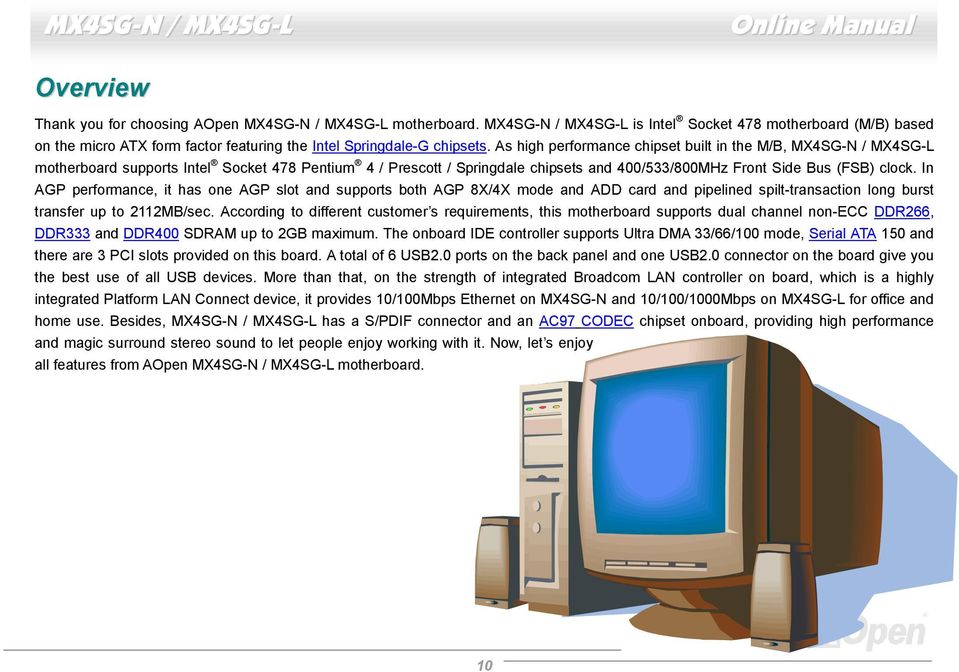
10 Overview Thank you for choosing AOpen MX4SG-N / MX4SG-L motherboard. MX4SG-N / MX4SG-L is Intel Socket 478 motherboard (M/B) based on the micro ATX form factor featuring the Intel Springdale-G chipsets. As high performance chipset built in the M/B, MX4SG-N / MX4SG-L motherboard supports Intel Socket 478 Pentium 4 / Prescott / Springdale chipsets and 400/533/800MHz Front Side Bus (FSB) clock. In AGP performance, it has one AGP slot and supports both AGP 8X/4X mode and ADD card and pipelined spilt-transaction long burst transfer up to 2112MB/sec. According to different customer s requirements, this motherboard supports dual channel non-ecc DDR266, DDR333 and DDR400 SDRAM up to 2GB maximum. The onboard IDE controller supports Ultra DMA 33/66/100 mode, Serial ATA 150 and there are 3 PCI slots provided on this board. A total of 6 USB2.0 ports on the back panel and one USB2.0 connector on the board give you the best use of all USB devices. More than that, on the strength of integrated Broadcom LAN controller on board, which is a highly integrated Platform LAN Connect device, it provides 10/100Mbps Ethernet on MX4SG-N and 10/100/1000Mbps on MX4SG-L for office and home use. Besides, MX4SG-N / MX4SG-L has a S/PDIF connector and an AC97 CODEC chipset onboard, providing high performance and magic surround stereo sound to let people enjoy working with it. Now, let s enjoy all features from AOpen MX4SG-N / MX4SG-L motherboard. 10
11 Feature Highlight CPU Supports Intel Socket 478 Pentium 4 (Northwood / Prescott) 1.6GHz~3.06GHz+ with 400/533/800MHz Front Side Bus (FSB) designed for Socket 478 technology. Chipset Springdale is a Graphics Memory Controller Hub (GMCH) designed for use with the Pentium 4 processor with 512-KB L2 cache on 0.13 micron processor and Prescott processor. It provides CPU, DDR, AGP, Hub, CSA Interfaces and integrated graphics with display interfaces. The CPU interface supports Pentium 4 processor subset of the Extended Mode of the Scalable Bus Protocol. The GMCH memory interface supports a up to two channels of DDR, and the AGP interface supports 0.8V/1.5V signaling with 8X/4X data transfers and 8X/4X AGP Fast Writes. The integrated graphics controller provides 3D, 2D, and display capabilities while using a portion of system memory for graphics memory (UMA) to provide a cost effective, high performance graphics solution. The Springdale platform supports the fifth generation I/O Controller Hub (ICH5). The ICH5 integrates an Ultra ATA 100 controller, two Serial ATA host controllers, one EHCI host controller and four UHCI host controllers supporting eight external USB2.0 ports, LPC interface controller, flash BIOS interface controller, PCI interface controller, AC 97 digital controller, integrated LAN controller, an ASF controller and a hub interface for communication with the Springdale GMCH. Memory Provides two 184-pin DDR SDRAM DIMM sockets that support up to 2GB of dual channel non-ecc DDR266 (PC2100), DDR333 (PC2700) and DDR400 (PC3200) compliant SDRAM (Synchronous Dynamic Random Access Memory). 11

12 Expansion Slots Including three 32-bit/33MHz PCI and one AGP 8X/4X slots. The PCI local bus throughput can be up to 132MB/s. Of three PCI slots provided, all of them are master PCI slots with arbitration and decoding for all integrated functions and LPC bus. MX4SG-N / MX4SG-L motherboard includes one AGP expansion slot for a bus mastering AGP or ADD graphic card. The Accelerated Graphics Port (AGP) specification provides a new level of video display sophistication and speed. The AGP video cards support data transfer rate up to 2112MB/s. AGP Protection Technology With AGP Protection Technology implemented, this motherboard will automatically detect the voltage of AGP card and prevent your chipsets from being burnt out. Watch Dog ABS Includes AOpen Watch Dog ABS function that can auto-reset system in 4.8 seconds when you fail the system overclocking. 1MHz Stepping CPU Frequency Adjustment Provides 1MHz Stepping CPU Frequency Adjustment function in the BIOS. This magic function allows you to adjust CPU FSB frequency from 100~248MHz by 1MHz stepping adjustment, and helps your system get maximum performance. 12

13 LAN Port MX4SG-N: On the strength of Intel ICH5 on board and Broadcom LAN chip, it provides 10/100 Mbps Ethernet for office and home use. MX4SG-L: The Broadcom LAN chip implemented on this motherboard is a fully integrated 10/100/1000BASE-T Gigabit Ethernet Media Access Control and Physical Layer Transceiver solution for high-performance network applications. It combines triple-speed, IEEE compliant media access controller (MAC), PCI bus interface, on-chip buffer memory, and integrated physical layer transceiver in a single device. Ultra DMA 33/66/100 Bus Mater IDE Comes with an on-board PCI Bus Master IDE controller with two connectors that support four IDE devices in two channels, supports Ultra DMA 33/66/100, PIO Modes 3 and 4 and Bus Master IDE DMA Mode 5, and supports Enhanced IDE devices. Serial ATA Integrated in ICH5 that contains independent DMA operation on two ports. The SATA controllers are completely software transparent with the IDE interface, while providing a lower pin count and higher performance. The ICH5 SATA interface supports data transfer rates up to 150MB/s. On-board AC 97 Sound MX4SG-N / MX4SG-L uses RealTek AC97 sound chip. This on-board audio includes a complete audio recording and playback system. 13

14 Eight USB2.0 Ports Provides six ports on the back panel and one USB connector on the board, providing a total of eight USB2.0 interface devices such as mouse, keyboard, modem, scanner, etc. S/PDIF Connector S/PDIF (Sony/Philips Digital Interface) is the newest audio transfer file format, which provides impressive quality through optical fiber and allows you to enjoy digital audio instead of analog audio. Power Management/Plug and Play Supports the power management function that confirms to the power-saving standards of the U.S. Environmental Protection Agency (EPA) Energy Star program. It also offers Plug-and-Play, which helps save users from configuration problems, thus making the system much user-friendlier. Hardware Monitoring Management Supports CPU or system fans status, temperature and voltage monitoring and alert, through the on-board hardware monitor module. Enhanced ACPI Fully implement the ACPI standard for Windows 98/ME/2000/XP series compatibility, and supports Soft-Off, STR (Suspend to RAM, S3), STD (Suspend to Disk, S4) and S5 features. 14
15 Super Multi-I/O Provides two high-speed UART compatible serial ports and one parallel port with EPP and ECP capabilities. UART can also be directed from COM1 to the Infrared Module for the wireless connections. 15

16 Quick Installation Procedure This page gives you a quick procedure on how to install your system. Follow each step accordingly. 1. Installing CPU and Fan 2. Installing System Memory (DIMM) 3. Connecting Front Panel Cable 4. Connecting IDE and Floppy Cable 5. Connecting ATX Power Cable 6. Connecting Back Panel Cable 7. Power-on and Load BIOS Setup Default 8. Setting CPU Frequency 9. Reboot 10. Installing Operating System (such as Windows XP) 11. Installing Driver and Utility 16
17 Motherboard Map Front Audio Connector AC 97 CODEC AUX-IN Connector CD-IN Connector S/PDIF Connector SYSFAN3 Connector 32-bit PCI Expansion Slot x3 USB2.0 Connector Colored Back Panel Resetable Fuse JP28 Keyboard/Mouse Wakeup Jumper Low ESR Capacitors 4-pin 12V. ATX Power Connector AGP 8x Expansion Slot 478-pin CPU socket (Northwood/Prescott) with Voltage and Frequency Auto-detection that supports Intel Pentium 4 1.6~3.06GHz+ CPU Springdale-G/ICH5 Chipsets SATA Connector x 2 Front Panel Connector SYSFAN2 Connector 184-pin DIMMx2 support dual channel DDR400/333/266 SDRAM maximum up to 2GB ATX Power Connector CPUFAN1 connector IrDA Connector JP14 CMOS Clear Jumper 17 Case Open Connector FDD Connector ATA66/100 IDE Connector x2

18 Block Diagram DDR400/333/266 Dual Channel SDRAM Up to 2GB 32-bit PCI Slot x3 DIMM Socket x2 PCI Bus Socket 478 Intel Pentium 4 CPU (Northwood / Prescott) 400/533/800MHz System Bus 2 Serial ATA Ports 150MB/s SATA1 SATA2 Intel Springdale-G ATA 66/100 Primary Channel IDE Drive x4 AGP 8X Slot Secondary Channel LAN connect Component ICH5 RealTek AC97 CODEC USB Port Floppy Disk Drive x2 USB Port x8 USB Port USB Port USB Port 4Mbit Flash EEPROM Parallel Port Serial Port VGA Port 18

19 Hardware Installation This chapter describes jumpers, connectors and hardware devices of this motherboard. Note: Electrostatic discharge (ESD) can damage your processor, disk drives, expansion boards, and other components. Always observe the following precautions before you install a system component. 1. Do not remove a component from its protective packaging until you are ready to install it. 2. Wear a wrist ground strap and attach it to a metal part of the system unit before handling a component. If a wrist strap is not available, maintain contact with the system unit throughout any procedure requiring ESD protection. 19

20 About User Upgrade Optional and Manufacture Upgrade Optional When you read this online manual and start to assemble your computer system, you may notice that some of the functions are marked as User Upgrade Optional or Manufacture Upgrade Optional. Although all of AOpen s motherboards have included many amazing and powerful features, sometimes not every user is familiar with these powerful features. As a result of this we define features that can be upgraded by users as User Upgrade Optional. You can upgrade these functions by purchasing additional devices. As for functions that cannot be upgraded by users, we define them as Manufacture Upgrade Optional. If need be, you can contact our local distributors or resellers to purchase Manufacture Upgrade Optional components, and again you are also welcome to visit our official website at english.aopen.com.tw for detail information. 20

21 CPU Installation This motherboard supports Intel Pentium 4 Socket 478 series CPU (Willamette / Northwood). Be careful of CPU orientation when you plug it into CPU socket. 1. Pull up the CPU socket lever and up to 90-degree angle. 2. Locate Pin 1 in the socket and look for mark on the CPU upper interface. Match Pin 1 and cut edge, then insert the CPU into the socket. CPU socket Lever CPU pin 1 and cut edge CPU cut edge Note: Those pictures are for example only; they may not look the same with the motherboard you purchased. 21
22 3. Press down the CPU socket lever and finish CPU installation. CPU cut edge Note: If you do not match the CPU socket Pin 1 and CPU cut edge well, you may damage the CPU. Note: This socket supports Micro-FC-PGA2 package CPU, which is the latest CPU package developed by Intel. Other forms of CPU package are impossible to be fitted in. Note: This picture is for example only; it may not look the same with the motherboard you purchased. 22
23 CPU Fan Installation This motherboard comes with a retention module attached on the CPU socket when shipped, we strongly recommend you to install AOpen special designed CPU Fan as shown below on the retention module for better heat dissipation. Please install the CPU Fan correctly as the following pictures shown. 1. Gently put the CPU Fan down on the retention module with clips aligning correctly to the four corners. 2. Pressing down the four clips with force one by one on the retention module. Clip 23
24 CPU Over-current Protection The Over Current Protection is a popular implementation on ATX 3.3V/5V/12V switching power supply. However, the new generation CPU uses different voltage with a regulator to transfer 12V to CPU voltage (for example, 2.0V), and thus makes 5V over current protection useless. This motherboard is with switching regulator onboard supporting CPU over-current protection; in conjunction with 3.3V/5V/12V power supply provide the full line over-current protection. 3.3V (Protected by power supply) ATX Switching Power Supply 5V (Protected by power supply) 12V (Protected by power supply) Onboard Power Regulator Over-Current Protection Circuit CPU Core Voltage Note: Although we have implemented protection circuit and tried to prevent any human operating mistake, certain risks might still happen when CPU, memory, HDD or add-on cards installed on this motherboard is damaged due to component failure, human operating error or other unknown natural reasons. AOpen cannot guarantee that the protection circuit will always work perfectly. 24
25 Enlarged Aluminum Heatsink Cool down CPU and Chipset are important for system reliability. Enlarged aluminum heat sink provides better heat consumption especially when you are trying to over-clock the CPU. 25
26 Full-range Auto-detect CPU Core Voltage This function is dedicated to overclockers and supports auto-detect CPU Core Voltage from 1.10V to 1.85V. You don t have to manually adjust it. However, this motherboard can also automatically detects CPU VID signal and generates proper CPU core voltage. Setting CPU Frequency BIOS Setup > Frequency/Voltage Control > CPU Clock Setting This motherboard is CPU jumper-less design, you can set CPU frequency in BIOS; no jumpers or switches are needed. The default setting is "table select mode". You can adjust the FSB from "CPU Host/SDRAM/PCI Clock" for overclocking. Core Frequency = CPU FSB Clock * CPU Ratio PCI Clock = CPU FSB Clock / Clock Ratio AGP Clock = PCI Clock x 2 CPU Ratio CPU FSB (By Manual) 8x, 10x 21x, 22x, 23x, 24x 100~248MHz by 1MHz stepping adjustment 26
27 Northwood CPU CPU Core Frequency FSB Clock System Bus Ratio Pentium 4 1.6G 1600MHz 100MHz 400MHz 16x Pentium 4 1.6G 1600MHz 133MHz 533MHz 12x Pentium 4 1.7G 1700MHz 133MHz 533MHz 13x Pentium 4 1.8G 1800MHz 100MHz 400MHz 18x Pentium 4 2.0G 2000MHz 100MHz 400MHz 20x Pentium 4 2.2G 2200MHz 100MHz 400MHz 22x Pentium 4 2.2G 2200MHz 133MHz 533MHz 16x Pentium G 2260MHz 133MHz 533MHz 17x Pentium 4 2.4G 2400MHz 100MHz 400MHz 24x Pentium 4 2.4G 2400MHz 133MHz 533MHz 18x Pentium G 2530MHz 133MHz 533MHz 19x Pentium 4 2.6G 2600MHz 200MHz 800MHz 13x Pentium G 2660MHz 133MHz 533MHz 20x Warning: Intel Springdale-G chipset supports maximum 800MHz (200MHz*4) system bus and 66MHz AGP clock; higher clock setting may cause serious system damage. Pentium 4 2.8G 2800MHz 133MHz 533MHz 21x Pentium 4 2.8G 2800MHz 200MHz 800MHz 14x Pentium 4 3.0G 3000MHz 200MHz 800MHz 15x Pentium G 3060MHz 133MHz 533MHz 23x 27
28 CPU and System Fan Connector (with H/W Monitoring) Plug in the CPU fan cable to the 3-pin CPUFAN1 connector. If you have chassis fan, you can also plug it on SYSFAN2 or SYSFAN3 connector. SYSFAN3 Connector GND +12V SENSOR CPUFAN1 Connector Note: Some CPU fans do not have sensor pin, so that they cannot support SYSFAN2 Connector SENSOR +12V GND hardware monitoring function. 28
29 DIMM Sockets This motherboard has two 184-pin DDR DIMM sockets that allow you to install 128-bit dual channel DDR400, DDR333 or DDR266 memory up to 2GB. Only non-ecc DDR RAM is supported. Please install suitable modules; otherwise serious damage may occur on memory sockets or you RAM modules. Please note that when you install DDR333 memory module and have your CPU FSB set at 800MHz, the memory can only run with the speed of DDR320. It is limitation of Intel. For other limitation of CPU types, please see the table below. DDR266 DDR333 DDR400 CPU FSB 400MHz V X X CPU FSB 533MHz V V X CPU FSB 800MHz V V V DIMM1 DIMM2 Warning: This motherboard supports DDR RAM. Please do not install the SDRAM on the DDR RAM sockets; otherwise it will cause serious damage on memory sockets or SDRAM module. 29 Note: To run dual channel speed, you have to use the same type memory modules installed on two DIMMs. If you install two different sized modules, the system can only run single channel mode and with the speed of that lower memory module.
30 How to Install Memory Modules Please follow the procedure as shown below to finish memory installation. 1. Make sure the DIMM module s pin face down and match the socket s size as depicted below. Pin 1 52 pins 40 pins 2. Insert the module straight down to the DIMM slot with both hands and press down firmly until the DIMM module is securely in place. Tab Key Pin 1 3. Repeat step 2 to finish additional DIMM modules installation. 30 Note: The tabs of the DIMM slot will close-up to hold the DIMM in place when the DIMM touches the slot s bottom.
31 ATX Power Connector This motherboard comes with a 20-pin and 4-pin ATX power connector. Make sure you plug in the right direction. We strongly recommend you to connect the 4-pin 12V ATX connector before connecting the 20-pin ATX power connector and use standard power supply specially designed for Pentium 4 system. AC Power Auto Recovery A traditional ATX system should remain at power off stage when AC power resumes from power failure. This design is inconvenient for a network server or workstation, without an UPS, that needs to keep power-on. This motherboard implements an AC Power Auto Recovery function to solve this problem. 31
32 IDE and Floppy Connector Connect 34-pin floppy cable and 40-pin IDE cable to floppy connector FDD and IDE connector. Be careful of the pin1 orientation. Wrong orientation may cause system damage. Secondary Slave (4th) Secondary Master (3rd) IDE 2 (Secondary) IDE 1 (Primary) Pin 1 Primary Slave (2nd) Primary Master (1st) ATA 66/100 IDE Connector FDD Connector Pin 1 32
33 IDE1 is also known as the primary channel and IDE2 as the secondary channel. Each channel supports two IDE devices that make a total of four devices. In order to work together, the two devices on each channel must be set differently to Master and Slave mode. Either one can be the hard disk or the CDROM. The setting as master or slave mode depends on the jumper on your IDE device, so please refer to your hard disk and CDROM manual accordingly. Tip: 1. For better signal quality, it is recommended to set the far end side device to master mode and follow the suggested sequence to install your new device. Please refer to above diagram 2. To achieve the best performance of Ultra DMA 66/100 hard disks, a special 80-wires IDE cable for Ultra DMA 66/100 is required. Warning: The specification of the IDE cable is a maximum of 46cm (18 inches); make sure your cable does not exceed this length. 33
34 Serial ATA Supported Intel ICH5 integrates two Serial ATA host controllers that provide you an even faster transfer rate of 150 Mbytes/second. The traditional parallel ATA specification has defined the standard storage interface for PCs with its original speed of just 3 Mbytes/second since the protocol was introduced in the 1980s. And the latest generation of the interface, Ultra ATA-133, has been developed further with a burst data transfer rate of 133 Mbytes/second. However, while ATA has enjoyed an illustrious track record, the specification is now showing its age and imposes some serious design issues on today s developers, including a 5-volt signaling requirement, high pin count, and serious cabling headaches. The Serial ATA specification is designed to overcome these design limitations while enabling the storage interface to scale with the growing media rate demands of PC platforms. Serial ATA is to replace parallel ATA with the compatibility with existing operating systems and drivers, adding performance headroom for years to come. It reduces voltage and pins count requirements and can be implemented with thin and easy to route cables. Note: Please note that only under Windows XP and Windows.Net environment can you install the total of 2 Parallel ATA and 2 Serial ATA disks. 34
35 Connecting Serial ATA Disk To connect a Serial ATA disk, you have to have a 7-pin Serial ATA cable. Connect two ends of the Serial ATA cable to the Serial ATA header on the motherboard and the disk. Like every other traditional disk, you also have to connect a power cable. Please note that it is a jumper free implement; you don t need to set jumpers to define a master or slave disk. When connecting two Serial ATA disks, the system will automatically take the one connected to Serial ATA 1 header as a master disk. Serial ATA Cable Comparison between Parallel ATA and Serial ATA Parallel ATA Serial ATA Bandwidth 100/133 MB/Secs 150/300/600 MB/Secs Volts 5V 250mV Pins 40 7 Length Limitation 18 inch (45.72cm) 1 meter (100cm) Cable Wide Thin Ventilation Bad Good Peer-to-Peer No Yes Note: This picture is for example only; it may not exactly be the same motherboard. 35
36 Adjusting Your Hard Disk Except its original 2 sets of parallel IDE, this motherboard also supports the latest Serial ATA hard disk. If you are unable to find your newly installed Serial ATA hard disks on your operating system after you install them, the problem mainly lies in the BIOS setting. You can simply adjust BIOS settings to have them work properly. After having properly installed your hard disks, you can directly go to the BIOS setting screen for adjustment. Simply choosing Integrated Peripherals OnChip IDE Device On-Chip Serial ATA, you can set your preferable mode. If you have no intention to change its original setting, the default setting is Auto. 36
37 If you intend to change the default setting, simply press Enter for a list of selection: 1. Disabled: You may choose this item if you re sure that only traditional IDE hard disks are installed on your system. Disabling this item may also cancel the detection to Serial ATA hard disk during POST, which theoretically, could speed up your boot-up timing a bit; however, please remember to re-adjust the settings here if you intend to use Serial ATA hard disk later. 2. Auto: This is the factory default setting of your motherboard. Basically, if your system works properly, it s not necessary to change it. The system will automatically recognize the first hard disk on IDE1 as the first boot device. Note: Please be informed that when you are using Windows98/ME with six hard disks fully installed, Auto mode will not function properly, it s just because Windows98/Me cannot recognize Enhanced Mode to detect all hard disks. 3. Combined Mode: If you install traditional IDE hard disks and Serial ATA hard disks at the same time, then you can choose this Combined Mode. Under this mode, you may randomly choose either IDE hard disks or Serial ATA had disk as your first boot device. But please aware that Serial ATA will exist with IDE in a mapping way, which means it will occupy one of the IDE Channel and leave you with one IDE Channel only. 4. Enhanced Mode: If you use the latest operating system (say, WindowsXP, Windows.NET Server), it is highly recommended that you set Enhanced Mode. The system is able to detect all six devices (traditional IDE x4, Serial ATA x 2) and functions perfectly under this mode. But please note that it is defaulted with using traditional IDE as the first boot device. Note: From our practical lab tests, we found no obvious problem or mistakes happened under Windows2000 operating system, but, however, it doesn t confirm to the regulation recommended by Intel. 5. SATA Only: You may select this SATA Only mode if you install Serial ATA hard disks only. It allows you to select booting sequence from Port0 (SerialATA1) or Port1 (SerialATA2). 37
38 Front Panel Connector Attach the power LED, Keylock, speaker, power and reset switch connectors to the corresponding pins. If you enable Suspend Mode item in BIOS Setup, the ACPI & Power LED will keep flashing while the system is in suspend mode. Locate the power switch cable from your ATX housing. It is 2-pin female connector from the housing front panel. Plug this connector to the soft-power switch connector marked SPWR. Suspend Type Power on Suspend (S1) or Suspend to RAM (S3) Suspend to Disk (S4) ACPI LED Flashing for every second The LED will be turned off 1 1 Pin1 IDE LED Speaker SPWR ACPI & PWR LED ACPI LED (BLUE) Reset NC NC +5V IDE LED IDE LED +5V +5V GND NC SPEAKER 5VSB SPWR ACPI LED- GND ACPILED NC ACPI_B GND RESET GND 38
39 AGP (Accelerated Graphic Port) 8X Expansion Slot MX4SG-N / MX4SG-L provides an AGP 8x slot. The AGP 8x is a bus interface targeted for high-performance 3D graphic. AGP supports only memory read/write operation and single-master single-slave one-to-one only. AGP uses both rising and falling edge of the 66MHz clock, for 4X AGP, the data transfer rate is 66MHz x 4bytes x 4 = 1056MB/s. AGP is now moving to AGP 8x mode, which is 66MHz x 4bytes x 8 =2.1GB/s. This AGP expansion slot is for 1.5V-1.6V AGP or DVO ADD card only. 39
40 IrDA Connector The IrDA connector can be configured to support wireless infrared module, with this module and application software such as Laplink or Windows 95 Direct Cable Connection, the user can transfer files to or from laptops, notebooks, PDA devices and printers. This connector supports HPSIR (115.2Kbps, 2 meters) and ASK-IR (56Kbps). Install the infrared module onto the IrDA connector and enable the infrared function from BIOS Setup, UART Mode, make sure to have the correct orientation when you plug in the IrDA connector. NC +5V IR_TX 1 KEY GND IR_RX IrDA Connector Pin 1 40
41 Support 10/100 Mbps(MX4SG-N) and 10/100/1000Mbps(MX4SG-L) LAN onboard On the strength of Broadcom Gigabit LAN controller (MX4SG-L) or Broadcom 10/100Mbps LAN controller (MX4SG-N) on board, which is a highly integrated platform LAN connect device, it provides gigabits or 10/100Mbps Ethernet for office and home use. The Ethernet RJ45 connector is located on top of USB connectors. The right-hand side LED on RJ45 connector indicates active mode; It shows yellow whenever accessing to network. The left-hand side LED on RJ45 connector indicates connecting mode; it lights in orange when 100Mbps LAN is connected (no light while 10Mbps is connected), and lights in green when gigabits LAN is connected. To enable or disable this function, you can simply adjust it in BIOS. Left: Connecting Orange (100Mbps) Green (Gigabit) Right: Active (Yellow) 41
42 Support Front USB 2.0 Ports This motherboard provides eight USB ports to connect USB devices such as mouse, keyboard, modem, printer, etc. There are one USB connector on the board for you to connect two USB devices and six other ports on the back panel. You can use proper cables to connect USB devices from back panel or connect the front USB connector to the front panel of chassis. Compared to traditional USB 1.0/1.1 with the speed of 12Mbps, USB 2.0 has a fancy speed up to 480Mbps which is 40 times faster than the traditional one. Except for the speed increase, USB 2.0 supports old USB 1.0/1.1 software and peripherals, offering impressive and even better compatibility to customers. On this motherboard, all six ports support USB 2.0 function. +5V SBD2- SBD2+ GND KEY 1 +5V SBD3- SBD3+ GND NC USB2 Connector Pin 1 Note: Please note that if you would like to use USB devices (Example: keyboard, mouse etc.) under DOS environment, you must install driver that comes with the devices to make it work. 42
43 Color Coded Back Panel The onboard I/O devices are PS/2 Keyboard, PS/2 Mouse, RJ-45 LAN Connector, COM1, VGA port, Printer, USB, AC97 sound and game ports. The view angle of drawing shown here is from the back panel of the housing. PS/2 Mouse Connector USB2.0 Ports SPP/EPP/ECP Parallel Port RJ-45 LAN Connector Line-In Speaker Out MIC-In PS/2 Keyboard Connector COM 1 Port VGA Port USB2.0 Ports PS/2 Keyboard: For standard keyboard, which is using a PS/2 plug. PS/2 Mouse: For PC-Mouse, which is using a PS/2 plug. USB Port: Available for connecting USB devices. Parallel Port: To connect with SPP/ECP/EPP printer. COM1 Port: To connect with pointing devices, modem or others serial devices. RJ-45 LAN connector To connect Ethernet for home or office use. VGA Connector: To connect with PC monitor. Speaker Out: To External Speaker, Earphone or Amplifier. Line-In: Comes from the signal sources, such as CD/Tape player. MIC-In: From Microphone. MIDI/Game Port: For 15-pin PC joystick, game pad or MIDI devices. 43
44 Super 5.1 Channel Audio Effect This motherboard comes with an ALC650F CODEC, which supports high quality of 5.1 Channel audio effects, bringing you a brand new audio experience. On the strength of the innovative design of ALC650F, you're able to use standard line-jacks for surround audio output without connecting any external module. To apply this function, you have to install the audio driver in the Bonus Pack CD as well as an audio application supporting 5.1 Channel. Picture bellow represents the standard location of all speakers in 5.1 Channel sound tracks. Please connect the plug of your front speakers to the green Speaker out port, rear speakers plug to the blue Line in port and both of the center and subwoofer speakers to the red MIC in port. 44
45 Front Audio Connector If the housing has been designed with an audio port on the front panel, you ll be able to connect onboard audio to front panel through this connector. By the way, please remove the jumper cap from the Front Audio Connector before you connect the cable. Do not remove this yellow jumper cap if your housing doesn t have an audio port on the front panel. Pin AUD_MIC AUD_MIC_BIAS AUD_FPOUT_R NC AUD_FROUT_L 9 10 AUD_GND AUD_VCC AUD_RET_R KEY AUD_RET_L Note: Please remove the jumper cap from the front audio connector before you connect the cable. Do not remove this yellow jumper cap if your housing doesn t have an audio port on the front panel. 45
46 S/PDIF (Sony/Philips Digital Interface) Connector S/PDIF (Sony/Philips Digital Interface) is a latest audio transfer file format that provides impressive quality through optical fiber and allows you to enjoy digital audio instead of analog. Normally there are two S/PDIF outputs as shown, one for RCA connector, the most common one used for consumer audio products, and the other for optical connector with a even better audio quality. Through a specific audio cable, you can connect the S/PDIF connector to a S/PDIF audio module bearing S/PDIF digital output. However, you must have a S/PDIF supported speaker with S/PDIF digital input to make the most of this function. 1 +5V NC SPDIFOUT GND 5 SPDIFIN Pin 1 S/PDIF OUT S/PDIF IN S/PDIF OUT S/PDIF IN (Optical) S/PDIF Cable S/PDIF Connector S/PDIF Module (User Upgrade Optional) 46
47 CD Audio Connector This connector is used to connect CD Audio cable from CDROM or DVD drive to onboard sound. R GND GND L CD-IN Note: Though some of the latest versions of Windows support Digital Audio through IDE bus. However, in order to use Open Jukebox player, which is driven under BIOS, it is a MUST to connect audio cable to CD-IN connector on the motherboard. 47
48 AUX-IN Connector This connector is used to connect MPEG Audio cable from MPEG card to onboard sound. R GND GND L AUX-IN 48
49 Case Open Connector The CASE OPEN header provides chassis intrusion-monitoring function. To make this function works, you have to enable it in the system BIOS, connect this header to a sensor somewhere on the chassis. So, whenever the sensor is triggered by lights or by the opening of the chassis, the system will beep to inform you. Please be informed that this useful function only applies to advanced chassis, you may purchase an extra sensor, attach it on your chassis, and make a good use of this function. 1 Sensor GND Pin 1 49
50 JP14 Clear CMOS Data You can clear CMOS to restore system default setting. To clear CMOS, follow the procedure below. 1. Turn off the system and unplug the AC power. 2. Remove ATX power cable from connector PWR2. 3. Locate JP14 and short pins 2-3 for a few seconds. 4. Return JP14 to its normal setting by shorting pin 1 & pin Connect ATX power cable back to connector PWR2. Pin Normal (default) Clear CMOS Tip: When should I Clear CMOS? 1. Boot fail because of overclocking 2. Forget password 3. Troubleshooting 50
51 JP28 Keyboard/Mouse Wake-up Jumper This motherboard provides PS2 keyboard / mouse wake-up function. You can use JP28 to enable or disable this function, which could resume your system from suspend mode with keyboard or mouse. The factory default setting is set to Disable (1-2), and you may enable this function by setting the jumper to 2-3. Pin Disable (Default) Enable 51
52 STBY LED (Standby LED) STBY LED is AOpen s considerate design that we aim at providing you friendly system information. The STBY LED will light up when power is provided to the motherboard. This is a convenient indication for you to check the system power status in many circumstances such as power on/off, stand-by mode and RAM power status during Suspend to RAM mode. STBY LED Warning: Do not install or remove the DIMM module or others devices when the STBY LED lights on. 52
53 AGP Protection Technology and AGP LED With the outstanding R&D ability of AOpen and its specially developed circuit, this motherboard implements a blend new technology to protect your motherboard from being damaged by over-voltaging of AGP card. When AGP Protection Technology is implemented, this motherboard will automatically detect the voltage of AGP card and prevent your chipsets from being burnt out. Please note that if you install a AGP card with 3.3V, which is not supported by Intel Springdale-G, the AGP LED on the motherboard will light up to warn you the possible damage of the exceeding voltage. You may contact your AGP card vendor for further support. AGP LED Warning: It is strongly recommended not to install a 3.3V AGP card, which is not supported by Intel Springdale-G. When you do so, the AGP LED on the motherboard will light up to warn you the possible damage. 53
54 Battery-less and Long Life Design This Motherboard implements a Flash ROM and a special circuit that provide you no batter power consumption of current CPU and CMOS Setup configurations. The RTC (real time clock) can also keep running as long as the power cord is plugged. If you lose your CMOS data by accident, you can just reload the CMOS configurations from Flash ROM and the system will recover as usual. ATX Stand-by Power Battery Auto Switch RTC (Real Time Clock) 00:00:00 Auto switching to ATX standby power as long as AC power line is plugged. This smart design increases battery life if you still plug battery on motherboard. Flash ROM CMOS Backup by EEPROM 54
55 Resetable Fuse Traditional motherboard uses fuses to prevent Keyboard and USB port from over-current or shortage. These fuses are soldered onboard that when it is broken (function to protect motherboard), user cannot replace them and result in malfunction of motherboard. With expensive Resetable Fuse, the motherboard can be resumed back to normal function even after the fuse had done its protection job. Resetable Fuse 55
56 Low ESR Capacitor The quality of low ESR capacitor (Low Equivalent Series Resistance) during high frequency operation is very important for the stability of CPU power. The idea of where to put these capacitors is another know-how that requires experience and detail calculation. Not only that, MX4SG-N / MX4SG-L implements 2200μF capacitors, which is much larger than normal capacitor (1000 & 1500μF) and it provides better stability for CPU power. 56
57 The power circuit of the CPU core voltage must be checked to ensure system stability for high speed CPUs (such as the new Pentium III, or when overclocking). A typical CPU core voltage is 2.0V, so a good design should control voltage between 1.860V and 2.140V. That is, the transient must be below 280mV. Below is a timing diagram captured by a Digital Storage Scope, it shows the voltage transient is only 143mv even when maximum 60A current is applied. Note: This diagram for example only, it may not be exactly the same as the motherboard you purchased. 57
58 AOpen Watch Dog ABS AOpen provides a special and useful feature on this motherboard for overclockers. When you power-on the system, the BIOS will check last system POST status. If it succeeded, the BIOS will enable Watch Dog ABS function immediately, and set the CPU FSB frequency according to user s settings stored in the BIOS. If system failed in BIOS POST, the Watch Dog Timer will reset the system to reboot in five seconds. Then, BIOS will detect the CPU s default frequency and POST again. With this special feature, you can easily overclock your system to get a higher system performance without removing the system housing and save the hassle from setting the jumper to clear CMOS data when system hangs. Enable/Disable Signal from BIOS BIOS AOpen Watch Dog ABS Reset Signal Clock Generator Countdown about 5 seconds if fails in POST CPU CPU ID Signal 58
59 Phoenix-AWARD BIOS System parameters can be modified by going into BIOS Setup menu, this menu allows you to configure the system parameters and save the configuration into the 128 bytes CMOS area, (normally in the RTC chip or in the main chipset). Phoenix-Award BIOS installed in the Flash ROM of the motherboard is a custom version of an industry standard BIOS. The BIOS provides critical low-level support for standard devices such as hard disk drives, serial and parallel ports. Most BIOS settings of MX4SG-N / MX4SG-L have been optimized by AOpen s R&D engineering team. But, the default setting of BIOS still can t fine-tune the chipset controlling entire system. Therefore, the rest of this chapter intends to guide you the process of configuring your system setup. To enter to BIOS setup menu, press <Del> when POST (Power-On Self Test) screen is shown on your monitor. Note: Because the BIOS code is the most often changed part of the motherboard design, the BIOS information contained in this manual may be different with actual BIOS that come with your motherboard. 59
60 About BIOS Function Description AOpen always dedicates to give user a more friendly computer system. Now, we include all function descriptions of BIOS setup program into the BIOS Flash ROM. When you select one function of BIOS setup program, the function description will appear at the right side of screen. Therefore, you don t need to read this manual while you change BIOS settings. Menu Items Select Window Item Function Description Window 60
61 How To Use Phoenix-Award BIOS Setup Program Generally, you can use arrow keys to highlight items that you want to choose, then press <Enter> key to select, and use the <Page Up> and <Page Down> key to change setting values. You can press <Esc> key to quit Phoenix-Award BIOS setup program. The following table provides details about how to use keyboard in the Phoenix-Award BIOS setup program. Alternatively, it's strongly recommended to install AOpen s newest WinBIOS Utility to get more detailed description, further powerful functions and advanced setting of BIOS. Key Page Up or + Page Down or - Enter Description Changing setting to next value or increase the value. Changing setting to previous value or decrease value. Select the item. Esc 1. In main menu: Quit and don t save any change. 2. In sub menu: Exit current menu to main menu. Up Arrow Down Arrow Left Arrow Right Arrow F6 F7 F10 Highlight previous item. Highlight next item. Move the light bar to left side of menu. Move the light bar to right side of menu. Load fail-save setting value from CMOS. Load turbo setting value from CMOS. Save changed setting and exit setup program. 61
62 How To Enter BIOS Setup After you finish jumper settings and connect correct cables, power on and enter the BIOS Setup. Press <Del> during POST (Power-On Self Test) and choose "Load Setup Defaults" for recommended optimal performance. Del Warning: Please avoid of using "Load Turbo Defaults", unless you are sure your system components (CPU, DRAM, HDD, etc.) are good enough for turbo setting. 62
63 BIOS Upgrade under Windows environment With outstanding R&D ability of AOpen, we now bring you a whole new BIOS Flash wizard ---- EzWinFlash. With an eye to users convenience, EzWinFlash combines the BIOS binary code and flash module together, so the only thing you have to do is just clicking on the utility you downloaded from web and let it helps you complete the flash process automatically. EzWinFlash detects your motherboard and checks the BIOS version cleverly to prevent your system from any possible failure. Moreover, EzWinFlash has been taken into consideration to go with any windows platform you might be using, no matter if you re using Windows 95/98, 98SE/ME, NT4.0/2000, or even the latest Windows XP. In the meanwhile, in order to provide a much more user-friendly operating environment, AOpen EzWinFlash is natively designed to have multi-language function to provide easier way for users usage in changing BIOS setting. Caution: By updating your motherboard, you are taking a risk of BIOS flash failure. If your motherboard is working stable, and there are no major bugs that had been fixed by a latter BIOS revision, we recommend that you DO NOT try to upgrade your BIOS. If you intent on upgrading, PLEASE BE SURE to get the right BIOS revision for the right motherboard model to avoid any possibility failure. 63
64 You may accomplish BIOS upgrade procedure with EzWinFlash by the following steps, and it s STRONGLY RECOMMENDED to close all the applications before you start the upgrading. 1. Download the new version of BIOS package zip file from AOpen official web site. (ex: 2. Unzip the download BIOS package (ex: WMX4SGN102.ZIP) with WinZip ( in Windows environment. 3. Save the unzipped files into a folder, for example, WMX4SGN102.EXE & WMX4SGN102.BIN. 4. Double click on the WMX4SGN102.EXE, EzWinFlash will detect the model name and BIOS version of your motherboard. If you had got the wrong BIOS, you will not be allowed to proceed with the flash steps. 5. You may select preferred language in the main menu, then click [Start Flash] to start the BIOS upgrade procedure. 6. EzWinFlash will complete all the process automatically, and a dialogue box will pop up to ask you to restart Windows. You may click [YES] to reboot Windows. 7. Press <Del> at POST to enter BIOS setup, choose "Load Setup Defaults", then Save & Exit Setup. Done! It is strongly recommended NOT to turn off the power or run any application during FLASH PROCESS. Warning: The new BIOS upgrade will permanently replace your original BIOS s settings when flashing. You may need to reconfigure your BIOS setting so that your system can go back to work as normal. 64
65 Vivid BIOS technology Have you been fed up with the conservative and immutable POST screen? Let s rule out the tradition idea that POST screen are stiff and frigid, and let AOpen show you the newly developed VividBIOS to experience the lively vivid colourful POST screen! Unlike earlier graphic POST screen which could occupy the whole screen and mask text information during POST, AOpen VividBIOS deals with graphics and texts separately, and makes them running simultaneously during POST. With this innovative design, VividBios now brings you a beautiful and sleek 256 colours screen without missing any important information shown on POST screen. In addition, the limited space of BIOS ROM is another big issue. When all of the traditional BIOS can only show space-consuming and uncompressed Bitmap, AOpen has considerately tuned the BIOS to next generation, to recognize the smaller-sized GIF format and even dynamic-showing GIF animation. Vivid BIOS shares the same fundamental technology with Open JukeBox CD Player, you may use the same EzSkin utility to change your Vivid BIOS screen or to download your favourite Open JukeBox skin. If you see this little logo shown beside your model name on the BIOS download page, it is assured that your motherboard supports this innovative feature! 65
66 Driver and Utility There are motherboard drivers and utilities in AOpen Bonus CD. You don t need to install all of them to boot your system. But after you finish the hardware installation, you have to install your operation system first (such as Windows 2000) before you install any drivers or utilities. Please refer to your operation system s installation guide. Auto-run Menu from Bonus CD You can use the auto-run menu of Bonus CD. Choose the utility and driver and select model name. 66
67 Installing Intel Chipset Software Installation Utility The Intel(R) Chipset Software Installation Utility installs to the target system the Windows* INF files that outline to the operating system how the chipset components will be configured. It is recommended that the Intel(R) Chipset Software Installation utility be installed onto the target system prior to the installation of other drivers. Some Windows systems cannot recognize newer chipsets that release later than those systems, therefore? marks may appear on Device manager page. Intel Springdale-G cannot support systems earlier than Windows 95 and 98 first version. As for other later Windows systems, you can install Intel INF Update Utility from Bonus Pack CD auto-run menu to eliminate the? marks. 67
68 Installing Intel Extreme Graphic Driver You can download Intel Extreme graphic driver from the Bonus Pack CD. 68
69 Installing LAN Driver (for MX4SG-N) MX4SG-N uses BCM4401 LAN chip. You can download this LAN Driver from the Bonus Pack CD. For Windows XP and Windows 2000: 69
70 For Windows ME and Windows 98: Please follow the procedure below to install your LAN driver. 1. Open the Device Manager and check if there is a "PCI Enthernet Controller" in "Other devices". 2. Insert the supplied "Bonus CD " 70
71 3. Click "PCI Enthernet Controller ", and " Driver ", "Update Driver" and select "Install the software automatically (ReCommended) " And then click "Next". 4. When prompted, insert the media to be searched into your CD-ROM drive, type the path to the driver, and select OK. Example:D:\Driver\Lan\BCM
72 Where "D:\Driver\Lan\BCM4401" is the designation of the driver on your system. 5. In the Driver Files Search Results window, verify that the correct path to the driver software is shown, then click Next. OS will request to insert the Bonus CD into CD-ROM Drive 72
73 6. Type the path of the BroadCom Enthernet driver and select " OK " Example: e:\driver\lan\bcm4401 Where "e:\driver\lan\bcm4401" is the designation of the " bcm4sbe5.sys " on your Bonus CD. 7. BroadCom Enthernet driver installation is finished. 73
74 For Windows NT, please follow the procedure below to install your LAN driver. 1. Verify that the Windows NT system is upgraded with Service Pack 4 or later. 2. Start your Windows NT system and log in. You must have System Administrator privileges to install the driver software. 3. Open the Control Panel. 4. In the Control Panel, double-click the Network icon. 5. When the Network window opens, select the Adapters tab. 6. Click Add to install a new adapter. All previously installed drivers are listed under Network Adapters. 7. When the Select Network Adapter window opens, click "Have Disk" When screen is prompted, insert the driver installation media, or choose a location to install the driver from. Type the path to the driver, and click "OK". 74
75 For example, to install the adapter driver software for Windows NT, type D:\Driver\Lan\BCM4401 in the Insert Disk location box (where "d:\driver\lan\bcm4401" is the designation of the Lan driver on Bonus CD). 9. With "Gigabit Ethernet Controller" highlighted in the Select OEM Option window, click "OK". 10. After the adapter files are installed, the Network window will display the newly installed adapter. Click "Close", then the Microsoft TCP/IP Properties window will appear. Configure the TCP/IP protocol and click "OK". 75
76 11. When a screen prompted to ask for restarting your computer, click "Yes". 76
77 Installing LAN Driver (for MX4SG-L) MX4SG-L uses BCM5705 LAN chip. You can download this LAN Driver from the Bonus Pack CD. For Windows XP and Windows 2000: For Windows 98, ME and Windows NT, please refer to MX4SG-N LAN installation procedure. The installation procedures are the same. 77
78 Installing Audio Driver This motherboard comes with AC97 CODEC. This audio driver supports Windows 98SE and upper Windows OS; you can find the audio driver from the Bonus Pack CD auto-run menu. 78
79 Installing USB2.0 Driver Windows 2000 Installation Guide *************************************************** Installing Drivers During Windows 2000 Installation *************************************************** The following details the installation of the USB 2.0 driver while installing Windows 2000 (with the USB 2.0 controller is enabled already). 1. After enabling the USB 2.0 controller, install Windows 2000 normally. 2. After installation, go the "Start" menu and choose "Settings." 3. From the "Settings" menu, choose "Control Panel." 4. In the "Control Panel" window, double-click on the "System" icon. 5. In the "System" window, choose the "Hardware" tab. 6. Press the "Device Manager..." button in the "Hardware" window. 7. In the hierarchical display under "Other Devices" is a listing for "Universal Serial Bus (USB) Controller". Choose it and then press the mouse right button and click "Properties". 79
80 8. Choose the "Driver" tab in the "Properties" window, choose "Update Driver," and then press "Next." 9. Choose "Search for a suitable driver for my device (Recommended)". From the list, and then press "Enter". 10. Choose "Specify a location." and then press "Next" 11. Insert the Bonus CD in CD-ROM. 12. Type "[CD-ROM]:\Driver\Intel\USB2.0\Win2000" in the text box that appears. Press " OK ". Click "Next." A message informing you that Windows has found "Intel PCI to USB Enhanced Host Controller - ICH5" should appear. 13. Click "Next", then Finish. 80
81 ************************************************* Installing Driver in Existing Windows 2000 System ************************************************* After enabling the USB 2.0 controller and rebooting your system, Windows 2000 setup will show a "New Hardware Found" dialog box. Under Windows 2000, "Universal Serial Bus (USB) Controller" will be displayed. 1. Choose "Search for a suitable driver for my device (Recommended)". from the list, and then press "Enter". 2. Choose "Specify a location." and then press "Next" 3. Insert the Bonus CD in CD-ROM. 4. Type "[CD-ROM]:\Driver\Intel\USB2.0\Win2000" in the text box that appears. Press " OK ". 5. Click on "Next." A message informing you that Windows has found "Intel PCI to USB Enhanced Host Controller - ICH5" should appear. 6. Click on "Next," and then on "Finish." ************************************ Confirming Windows 2000 Installation ************************************ 1. From Windows 2000, open the Control Panel from "My Computer" followed by the System icon. 2. Choose the "Hardware" tab, and then click the "Device Manager" tab. 3. Click the "+" in front of "Universal Serial Bus controllers". "Intel PCI to USB Enhanced Host Controller - ICH5" should appear. 81
82 Windows 98SE Installation Guide *************************************************** Installing Drivers During Windows 98SE Installation *************************************************** Please refer to Windows 2000 USB2.0 installation guide. The installation procedures are the same. ********************************************* Installing Drivers with Existing Windows 98SE ********************************************* The following section details the installation of USB 2.0 driver on a system that has Windows 98SE already installed. 1. Enable the USB 2.0 controller and boot Windows. 2. The "Add New Hardware Wizard" will appear, informing you that it has found a "PCI Universal Serial Bus." 3. Click on "Next," and from the generated list box, choose "Search for best driver for your device (Recommended)". 4. Insert the "Bonus CD" in CD-ROM. 5. Click on "Next," and from the generated choices, choose "Specify a location." 6. Type "[CD-ROM]:\Driver\Intel\USB2.0\Win98ME" in the text box that appears. 7. Click on "Next." A message informing you that Windows has found "Intel USB 2.0 Enhanced Host Controller" should appear. 8. Click on "Next," and then on "Finish." ********************************************** Confirming Driver Installation in Windows 98SE ********************************************** To confirm that the driver has been properly loaded in Windows 98SE, perform the following steps: 1. Choose "Settings" from the "Start" menu. 2. Choose "Control Panel," and then double-click on the "System" icon. 3. Choose the "Device Manager" tab, and then click the "+" in front of "Universal Serial Bus Controllers." "Intel USB 2.0 Enhanced Host Controller" should appear. 82
83 Windows Me Installation Guide ************************************************* Installing Drivers During Windows Me Installation ************************************************* Please refer to Windows 2000 USB2.0 installation guide. The installation procedures are the same. ************************************************** Installing Drivers with Existing Windows Me System ************************************************** The following section details the installation of USB 2.0 driver on a system that has Windows Me already installed and running. 1. After installing the USB 2.0 controller, boot system. 2. The "Add New Hardware Wizard" will appear, informing you that it has found a "PCI Universal Serial Bus." 3. Click on "Next," and from the generated list box, choose "Specify the location of the driver (Advanced)." 4. Click on "Next," and from the generated choices, choose "Specify a location." 5. Insert the Bonus CD in CD-ROM. 6. Type "[CD-ROM]:\Driver\Intel\USB2.0\Win98ME" in the text box that appears. 7. Click on "Next." A message informing you that Windows Me has found "Intel USB2.0 Enhanced Host Controller" should appear. 8. Click on "Next," and then on "Finish." ******************************************** Confirming Driver Installation in Windows Me ******************************************** To confirm that the driver has been properly loaded in Windows Me, perform the following steps: 1. Choose "Settings" from the "Start" menu. 2. Choose "Control Panel," and then double-click on the "System" icon. 3. Choose the "Device Manager" tab, and then click the "+" in front of "Universal Serial Bus Controllers." "Intel USB2.0 Enhanced Host Controller" should appear. 83
84 AOConfig Utility AOpen always dedicated to provide users a much friendly computer environment. We now bring you a comprehensive system detection utility. AOConfig is a Windows based utility with user-friendly interface that allows users to obtain information of the operation system and hardware such as motherboard, CPU, memory, PCI devices and IDE devices. The powerful utility also displays the version of BIOS and firmware for your convenience of maintenance. Moreover, AOConfig allows users to save information in *.BMP or *.TXT format which users may collect the system information in detail and send them to AOpen directly for technical support or for further diagnose of system problems. 1. The system page shows the detailed information of the motherboard, operating system, processor, and BIOS version. 2. The PCI device page shows the configurations of all PCI devices installed in your motherboard. 84
85 3. This page presents the IDE device information, such as serial number, manufacturer, firmware version, and capacity. 4. From this page, users can obtain the technical support information of AOpen. Moreover, detailed information could be saved in.bmp or.txt format. NOTE: AOConfig can be used under Windows 98SE/ME, NT4.0/2000, or even the latest Windows XP. Please also note that AOConfig can only be operated in a system equipped with an AOpen motherboard. Before running AOConfig, all applications must be closed. 85
86 Installing Hardware Monitoring Utility You can install Hardware Monitoring Utility to monitor CPU temperature, fans and system voltage. The hardware monitoring function is automatically implemented by BIOS and utility software. No hardware installation is needed. 86
87 Glossary AC97 CODEC Basically, AC97 CODEC is the standard structure of PCI sound card. As we know, computer is digital-based, but music is based on analog-based. Therefore, there must be a process to turn digital into analog during the last stage processing of sound in computer. Hence, the component on sound card that play this important task is what we called CODEC. Audio CODEC 97 (briefly called AC97) is the specification regulated by Intel, and it s about the structure of audio conversion. The special place about CODEC is that it is separated from sound card (CODEC is an independent chipset). Therefore, PCI sound card could possess with 90db and do other application process as well. We called CODEC that meets this structure AC97 CODEC. ACPI (Advanced Configuration & Power Interface) ACPI is the power management specification of PC97 (1997). It intends to save more power by taking full control of power management to operating system and bypass BIOS. The chipset or super I/O chip needs to provide standard register interface to operating system (such as Windows 98). This is a bit similar as the PnP register interface. ACPI defines ATX momentary soft power switch to control the power state transition. ACR (Advanced Communication Riser) Building on the PC motherboard riser architecture, ACR slot is backward compatible with AMR but beyond the limitation of it. The ACR specification is designed to support modem, audio, Local Area Network (LAN) and Digital Subscriber Line (DSL). 87
88 AGP (Accelerated Graphic Port) The main function of AGP simply put is to tell monitor what screen information had to be shown, a visual transmission device actually. With the rapid developing of AGP card, we can see that it had been developed from single colorful AGP card to 2D and 3D graphic. AGP supports only memory read/write operation and single-master single-slave one-to-one only. Though AGP and PCI share the same algorithm of 32-bit, its frequencies are 66MHz and 33MHz respectively. AGP interface had been developed from 2X to 8x. 1X AGP, data transfer rate is 66MHz x 4byte x 1 = 264MB/s 2X AGP, data transfer rate is 66MHz x 4byte x 2 = 528MB/s 4X AGP, data transfer rate is 66MHz x 4byte x 4 = 1056MB/s. 8X AGP, data transfer rate is 66MHz x 4byte x 8 = 2112MB/s. AMR (Audio/Modem Riser) The CODEC circuit of AC97 sound/modem solution can be put on motherboard or put on a riser card (AMR card) that connects to motherboard through AMR connector. ATA (AT Attachment) Before talking about ATA (AT Attachment), we must understand DMA (Direct Memory Access), which allows devices to skip the CPU devices and access memory directly. DMA specification could not only eliminate the workload of CPU, but also accelerate the transmission of data. DMA begins with a data transfer rate of 16.6MB/Sec, but afterward developed to new data rate of 33.3MB/Sec, which is twice the data rate and we called it Ultra DMA. ATA details power and data signals between the drive and integrated drive controller and the computer's motherboard. Two drives (master and slave) are supported. The ATA specification allows the 88
89 drive to connect directly to the ISA bus on the computer. ATA transfer rate then had been developed to 133MHz/Sec and would come out with fastest rate later (please refer to Serial ATA). DMA, data transfer rate is 16.6MHz/s. Ultra DMA, data transfer rate is 16.6MHz x 2 = 33MB/s. ATA/66, data transfer rate is 16.6MHz x 4 = 66MB/s. ATA/100, data transfer rate is 16.6MHz x 6 = 100MB/s. ATA/133, data transfer rate is 16.6MHz x 8 = 133MB/s. (ATA/133 uses both rising edge and falling edge as ATA/66 but clock cycle time is reduced to 30ns.) BIOS (Basic Input/Output System) BIOS, is a set of assembly routine/program that reside in EPROM or Flash ROM. BIOS controls Input/output devices and other hardware devices of motherboard. In general, to provide hardware independent portability, operation system and drivers is required to access BIOS without directly access hardware devices. Bluetooth Bluetooth is a wireless transferring technology that enables short-range wireless connections between desktop and laptop computers, personal digital assistants (PDAs), cellular phones, printers, scanners, digital cameras and even home appliances. The principle of Bluetooth (a chipset) is to transfer information and voices at the frequency of ISM Band. Every Bluetooth technology devices do come with a standard address for you to connect one-to-one or one-to-seven (to form a Pico-net), with transferring range up to 10 meters (100 meters to follow), using low power radio. Bluetooth do not only possess high transfer rate of 1MB/s, it also could be encrypted with pin code. With hopping rate of 1600 hops per second, it s difficult to be intercepted and are less 89
90 interrupted by electromagnetic wave. CNR (Communication and Networking Riser) The CNR specification provides the PC industry the opportunity to deliver a flexible and cost reduced method of implementing LAN, home networking, DSL, USB, wireless, audio and modem subsystems widely used in today's "connected PCs". The CNR specification is an open industry specification and is supported by OEMs, IHV card manufacturers, silicon supplier and Microsoft. DDR (Double Data Rate) RAM DDR RAM utilizes the existing SDRAM (For ex, PC-100, PC-133) infrastructure and technology while doubling the nominal bandwidth available to systems in an easy to design and simple to adopt way. Based on FSB frequency, DDR RAM on the market are DDR200, DDR266 and DDR333 with more coming around soon. DDR200, transfer bandwidth up to 200x64/8=1600MB/s (PC1600) DDR266, transfer bandwidth up to 266x64/8=2100MB/s (PC2100) DDR333, transfer bandwidth up to 333x64/8=2700MB/s (PC2700) DDR400, transfer bandwidth up to 400x64/8=3200MB/s (PC3200) ECC (Error Checking and Correction) The ECC mode needs 8 ECC bits for 64-bit data. Each time memory is accessed; ECC bits are updated and checked by a special algorithm. The ECC algorithm has the ability to detect double-bit error and automatically correct single-bit error while parity mode can only detect single-bit error. 90
91 EEPROM (Electronic Erasable Programmable ROM) Also known as E 2 PROM. Both EEPROM and Flash ROM can be re-programmed by electronic signals, but the interface technology is different. Size of EEPROM is much smaller than flash ROM. EPROM (Erasable Programmable ROM) Traditional motherboard stores BIOS code in EPROM. EPROM can only be erased by ultra-violet (UV) light. If BIOS has to be upgraded, you need to remove EPROM from motherboard, clear by UV light, re-program, and then insert back. EV6 Bus EV6 Bus is the technology of Alpha processor from Digital Equipment Corporation. EV6 bus uses both rising and falling clock edge to transfer data, similar as DDR RAM or ATA/66 IDE bus. EV6 Bus Speed = CPU external bus clock x MHz EV6 bus, 200MHz = 100 MHz external bus clock x 2 FCC DoC (Declaration of Conformity) The DoC is component certification standard of FCC EMI regulations. This standard allows DIY component (such as motherboard) to apply DoC label separately without a shielding of housing. 91
92 FC-PGA (Flip Chip-Pin Grid Array) FC means Flip Chip, FC-PGA is a package of Intel for Pentium III for 0.18µm process CPU, which can be plugged into SKT370 socket. FC-PGA2 (Flip Chip-Pin Grid Array) After FC-PGA, FC-PGA2 is the package for 0.13µm process CPU developed by Intel, which can be plugged into SKT423/478 socket as well. Flash ROM Flash ROM can be re-programmed by electronic signals. It is easier for BIOS to upgrade by a flash utility, but it is also easier to be infected by virus. Because of increase of new functions, BIOS size is increased from 64KB to 512KB (4M bit). Hyper Threading Hyper-Threading technology is an innovative design from Intel that enables multi-threaded software applications to process threads in parallel within each processor resulting in increased utilization of processor execution resources. As a result, an average improvement of ~40% in CPU resource utilization yields higher processing throughput. IEEE 1394 IEEE 1394, which also called Firewire, is a serial data transfer protocol and interconnection system. The main feature of the Firewire that assures its adoption for the digital video and audio (A/V) consumer application is its low cost. Fire wire interface is 92
93 capable of supporting various high-end digital A/V applications, such as consumer A/V device control and signal routing, Digital Video (DV) editing, home networking, and more than 32 channels of digital mixing. Gone are those days of expensive video capture cards. Firewire allows for video capture from both newer DV camcorders with Firewire ports and older analog equipment using A/V to Firewire converters. The advantages of the IEEE1394: High data transfer rate Start from 400 Mbps, (with 800/1600/3200 Mbps coming soon), which is about 30 times faster than USB 1.1. Supports up to 63 devices (16 - daisy chained) with cable length up to about 4.5 m (14 feet). Hot-pluggable (like USB). No need to turn of your device to connect or disconnect, and you don't need to reboot your PC. Also, it is a plug-and-play bus. IEEE1394 is very easy to connect (Like USB1.1/2/0). Parity Bit The parity mode uses 1 parity bit for each byte, normally it is even parity mode, that is, each time the memory data is updated, parity bit will be adjusted to have even count "1" for each byte. When next time, if memory is read with odd number of "1", the parity error is occurred and this is called single bit error detection. PCI (Peripheral Component Interface) Bus Developed by Intel, Peripheral Component Interconnect (PCI) is a local bus standard. A bus is a channel used to transfer data to (input) and from (output) a computer and to or from a peripheral device. Most PCs have a PCI bus usually implemented at 32-bits providing a 33 MHz clock speed with a throughput rate of 133 MBps. 93
94 PDF Format With PDF file, it is easy to do universal document exchange. Virtually any document may be converted in Portable Document Format (PDF). Contents in PDF documents are exactly the same as the original file, including fonts and graphics, and they can be distributed by or stored on the World Wide Web, an intranet, a file system, or a CD-ROM for other users to view on any platforms. You may download Acrobat Reader in order to read PDF file from its website ( PnP (Plug and Play) Oversimplified, Plug-and-Play automatically tells the software (device drivers) where to find various pieces of hardware (devices) such as modems, network cards, sound cards, etc. Plug-and-Play's task is to match up physical devices with the software (device drivers) that operates them and to establish channels of communication between each physical device and its driver. POST (Power-On Self Test) The BIOS self-test procedure after power-on, sometimes, it is the first or the second screen shown on your monitor during system boot. PSB (Processor System Bus) Clock PSB Clock means the external bus clock of CPU. CPU internal clock = CPU PSB Clock x CPU Clock Ratio 94
95 RDRAM (Rambus Dynamic Random Access Memory) A DRAM technology developed by Rambus Corporation*, to achieve high speed of memory through the use of multiple channels in parallel by 16-bits. Basically, RDRAM uses new structure of Multibank, which is quite different from FPM, EDO, SDRAM. Using different memory module as well, RDRAM uses RIMM with transfer rate of 600/700/800MHz, providing bandwidth as high to 1.6GB. RIMM (Rambus Inline Memory Module) 184-pin memory module that supports RDRAM memory technology. A RIMM memory module may contain up to maximum of 16 RDRAM devices. SDRAM (Synchronous DRAM) SDRAM is one of the DRAM technologies that allow DRAM to use the same clock as the CPU host bus (EDO and FPM are asynchronous and do not have clock signal). It is similar as PBSRAM to use burst mode transfer. SDRAM comes in 64-bit 168-pin DIMM and operates at 3.3V, and have been gradually replaced by DDR RAM. SATA (Serial ATA) The Serial ATA specification is designed to overcome speed limitations while enabling the storage interface to scale with the growing media rate demands of PC platforms. Serial ATA is to replace parallel ATA with the compatibility with existing operating systems and drivers, adding performance headroom for years to come. It is developed with data transfer rate of 150 Mbytes/second, and 300M/bs, 600M/bs to come. It reduces voltage and pins count requirements and can be implemented with thin and easy to route cables. 95
96 SMBus (System Management Bus) SMBus is also called I 2 C bus. It is a two-wire bus developed for component communication (especially for semiconductor IC). For example, set clock of clock generator for jumper-less motherboard. The data transfer rate of SMBus is only 100Kbit/s, it allows one host to communicate with CPU and many masters and slaves to send/receive message. SPD (Serial Presence Detect) SPD is a small ROM or EEPROM device resided on the DIMM or RIMM. SPD stores memory module information such as DRAM timing and chip parameters. SPD can be used by BIOS to decide best timing for this DIMM or RIMM. USB 2.0 (Universal Serial Bus) A Universal Serial Bus (USB) is an external bus (an interconnection) standard that supports data transfer rates of 12 Mbps. A single USB port can be used to connect up to 127 peripheral devices, such as mouse, modems and keyboards. Introduced in 1996, USB has completed replaced serial and parallel ports. It also supports plug-and-play installations and hot plugging Plug-and-play is the ability to add and remove devices to a computer while the computer is running and have the operating system automatically recognize the change. USB 2.0, which supports data transfer rates of 480 Mbps, has been widely used in motherboard these days. VCM (Virtual Channel Memory) NEC s Virtual Channel Memory (VCM) is a new DRAM core architecture that dramatically improves the memory system s ability to service multimedia requirements. VCM increases memory bus efficiency and performance of any DRAM technology by providing a set of fast static registers between the memory core and I/O pins. Using VCM technology results in reduced data access latency 96
97 and reduced power consumption. Wireless LAN b is a specification developed by IEEE and Wireless LAN technology, which is an interface between a wireless client and a base station or between two wireless clients family includes the following specifications and with more coming: = 1 or 2 Mbps transmission in the 2.4 GHz band, using either frequency hopping spread spectrum (FHSS) or direct sequence spread spectrum (DSSS)) a = 54 Mbps in the 5GHz band, using orthogonal frequency division multiplexing) b (11 Mbps transmission in the 2.4 GHz band, using direct sequence spread spectrum (DSSS). ZIP file A compressed file format to reduce file size. To unzip file, run shareware PKUNZIP ( for DOS and other operating system or WINZIP ( for windows environment. 97
98 Troubleshooting If you encounter any trouble to boot you system, follow the procedures accordingly to resolve the problem. Start Turn off the power and unplug the AC power cable, then remove all of the add-on cards and cables, including VGA, IDE, FDD, COM1, COM2 and printer. Make sure if all jumper settings are correct. Clear CMOS Next 98
99 Continue Install the VGA card. Then connect your monitor and keyboard. Turn on the power Yes and check if the power supply and CPU fan work properly. No Next The problem is probably caused by power supply or motherboard failure. Please contact your reseller or local distributor for repairing. 99
100 Continue Check if there is display? Yes No Perhaps your VGA card or monitor is defective. Press <Ctrl> and <Alt> key at the same time, hold them and then press <Del> to reboot the system. Check if the system reboots? Yes No It is very possible that your keyboard is defective. Next 100
101 Continue During system rebooting, press <Del> to enter BIOS setup. Choose Load Setup Default. Turn off the system and re-connect IDE cable. Check if the system can reboot successfully? Yes No The problem should be caused by the IDE cable or HDD itself. Re-install the operating system such as Windows 98. End 101
102 Technical Support Dear Customer, Thanks for choosing AOpen products. To provide the best and fastest service to our customer is our first priority. However, we receive numerous s and phone-calls worldwide everyday, it is very hard for us to serve everyone on time. We recommend you follow the procedures below and seek help before contact us. With your help, we can then continue to provide the best quality service to more customers. Thanks very much for your understanding! AOpen Technical Supporting Team Online Manual: To download manual, please log on and then select your preferred language. Under Type directory, choose Manuals to go to our manual database. You can also find the manual and EIG in AOpen Bonus Pack. Test Report: We recommend you to choose board/card/device from the compatibility test reports for assembling your PC. It may prevent incompatibility problems. FAQ: Here we list problems that users often encounter and FAQ (Frequently Asked Questions). You may select your preferred language after log on and find a solution to your problem. Download Software: After log on and having language selected, you may get the latest updated BIOS/utility and drivers you need under Type directory. In most case, newer versions of drivers and BIOS have solved earlier bugs or compatibility problems
103 5 6 7 eforum: AOpen eforum is provided to discuss our products with other users, in which your problem probably had been discussed before or will be answered. After log on, you may select your preferred language under Multi-language. Contact Distributors/Resellers: We sell our products through resellers and integrators. They should know your system configuration very well and should be able to solve your problem efficiently and provide important reference for you. Contact Us: Please prepare detail system configuration and error symptom before contacting us. The part number, serial number and BIOS version are also very helpful. Part Number and Serial Number The Part Number and Serial number are printed on bar code label. You can find this bar code label on the outside packing, on ISA/CPU slot or on component side of PCB. For example: Part No. Serial No. Part No. Serial No. P/N: is part number, S/N: KN73 is serial number. 103
104 Model name and BIOS version Model name and BIOS version can be found on upper left corner of first boot screen (POST screen). For example: - MX4SG-N R1.20 Mar AOpen Inc. Award Plug and Play BIOS Extension v1.0a Copyright 2003, Award Software, Inc. MX4SG-N is model name of motherboard; R1.20 is BIOS version. 104
105 Product Registration Thank you for choosing AOpen product. AOpen encourages you to spend few minutes in completing the following product registration. To register your product will ensure the high quality of services from AOpen. After the registration, you will: Have opportunities to play online slot machine and win a prize from AOpen by accumulating your bonuses for later prize exchange. Be upgraded to gold membership of Club AOpen program. Receive notification about product safety alerts. Its purpose is to alert consumers quickly and conveniently when products contain technical issues. Receive notification about latest product's announcements. Be able to personalize your AOpen web pages. Receive notification about latest BIOS/Driver/Software release information. Have opportunities to participate special product promotional programs. Enjoy higher service priority to receive technical assistance provided by AOpen specialists worldwide. Be able to join the discussions of web-based news groups. AOpen makes sure that the information you provide is encrypted, so that it cannot be read or intercepted by other people or companies. Further, AOpen will not disclose any of information you submitted under any conditions. Please consult our online privacy policy for further information on our company policy. Note: If registering products purchased from different dealers/retails and/or purchased on different dates, please submit a separate form for each product. 105
106 How to Contact Us Please do not hesitate contact us if you have any problem about our products. Any opinion will be appreciated. Pacific Rim AOpen Inc. Tel: Fax: Europe AOpen Computer b.v. Tel: Fax: America AOpen America Inc. Tel: Fax: China 艾 爾 鵬 國 際 貿 易 ( 上 海 ) 有 限 公 司 Tel: Fax: Germany AOpen Computer GmbH. Tel: Fax: Japan AOpen Japan Inc. Tel: Fax: Web Site: Send us by going through the contact form below. English Japanese Chinese German Simplified Chinese 106
(AOpen reserves the right to revise all the specifications and information contained in this document which is subject to change without notice.
 (AOpen reserves the right to revise all the specifications and information contained in this document which is subject to change without notice.) PS/2 Mouse Connector USB2.0 Ports SPP/EPP/ECP Parallel
PS/2 Keyboard Connector
 PS/2 Mouse Connector SPP/EPP/ECP Parallel Port RJ45 LAN Jack (for AX45F-4DL, AX45F-4DN and AX45F-4D Max) Line-In USB 2.0 Ports Speaker Out MIC-In Realtek Gigabit LAN chip (for AX45F-4D Max and AX45F-4DL)
Red: MODEM-CN Connector Green: AUX-IN Connector Black: CD-IN Connector
 PS/2 Mouse RJ-45 LAN Connector Connector (Optional) SPP/EPP/ECP Parallel Port MIDI/Game Port PS/2 Keyboard Connector USB Port COM 1 Port COM 2 Port Red: MODEM-CN Connector Green: AUX-IN Connector Black:
85MIV2 / 85MIV2-L -- Components Locations
 Chapter Specification 85MIV2 / 85MIV2-L -- Components Locations RJ45 LAN Connector for 85MIV2-L only PS/2 Peripheral Mouse (on top) Power PS/2 K/B(underside) RJ45 (on top) +2V Power USB0 (middle) USB(underside)
System Installation. 3-1 Socket 370 Celeron/Pentium-III Processor. Installing S370 CPU. Removing CPU. Configuring System Bus
 System Installation This chapter provides you with instructions to set up your system. The additional information is enclosed to help you set up onboard PCI device and handle WDT operation in software
Chapter 6. Inside the System Unit. What You Will Learn... Computers Are Your Future. What You Will Learn... Describing Hardware Performance
 What You Will Learn... Computers Are Your Future Chapter 6 Understand how computers represent data Understand the measurements used to describe data transfer rates and data storage capacity List the components
Chapter 5 Cubix XP4 Blade Server
 Chapter 5 Cubix XP4 Blade Server Introduction Cubix designed the XP4 Blade Server to fit inside a BladeStation enclosure. The Blade Server features one or two Intel Pentium 4 Xeon processors, the Intel
Mother Board Component
 Mother Board Component Explain Introduction Mother Board Component 1.Clock Generator 2. CPU socket 3. Memory Socket Memory error checking 4. ROM Bios 5. CMOS Ram 6. Battery 7. Chipset 8. Expansion Slot
Getting Started. Chapter 1
 Chapter 1 Getting Started Thank you for choosing the 7728 v2.x Series Micro-ATX mainboard. The 7728 v2.x Series mainboards are based on Intel H61 chipsets for optimal system efficiency. Designed to fit
A+ Guide to Managing and Maintaining Your PC, 7e. Chapter 1 Introducing Hardware
 A+ Guide to Managing and Maintaining Your PC, 7e Chapter 1 Introducing Hardware Objectives Learn that a computer requires both hardware and software to work Learn about the many different hardware components
USB 2.0 VGA ADAPTER USER MANUAL
 USB 2.0 VGA ADAPTER USER MANUAL CONTENTS INTRODUCTION... 3 FEATURES... 3 SYSTEM REQUIREMENTS... 3 PACKAGE CONTENTS... 3 SUPPORTED COMMON DISPLAY RESOLUTION... 4 TECHNICAL SPECIFICATIONS... 4 INSTALLATION
Chapter 1. Getting Started Getting Started
 Getting Started Chapter 1. Getting Started Getting Started Thank you for purchasing the MD-8080 M-ATX mainboard. The MD-8080 is based on Intel 865PE & Intel ICH5 chipsets for optimal system efficiency.
Getting Started. Chapter 1
 Chapter 1 Getting Started Thank you for choosing the 7667 v2.2 Series (MS-7667) Micro-ATX mainboard. The series mainboards are based on Intel P67 chipsets for optimal system efficiency. Designed to fit
Serial ATA RAID PCI. User's Manual
 Serial ATA RAID PCI User's Manual Chapter 1 Introduction Table of Contents 1-1 Features and Benefits. 1 1-2 System Requirements. 1 Chapter 2 RAID Arrays 2-1 RAID Overview.. 2 2-1.1 RAID 0 (striping)...
Electronic Emission Notices
 1 Electronic Emission Notices Federal Communications Commission (FCC) Statement This equipment has been tested and found to comply with the limits for a Class B digital device, pursuant to Part 15 of FCC
Ultra Thin Client TC-401 TC-402. Users s Guide
 Ultra Thin Client TC-401 TC-402 Users s Guide CONTENT 1. OVERVIEW... 3 1.1 HARDWARE SPECIFICATION... 3 1.2 SOFTWARE OVERVIEW... 4 1.3 HARDWARE OVERVIEW...5 1.4 NETWORK CONNECTION... 7 2. INSTALLING THE
PTM800Pro MAINBOARD MANUAL
 PTM800Pro MAINBOARD MANUAL DOC No. : M0590040 Rev. : A0 Date : 3, 2006 Part No. : 25-13031-00 Table of Contents Chapter 1. Overview... 1-2 Package Checklist...1-3 The PTM800Pro Mainboard...1-4 Main Features...1-5
M266A. User Manual. Version 3.0 Published July 2003 Copyright 2003 ASRock INC. All rights reserved.
 M266A User Manual Version 3.0 Published July 2003 Copyright 2003 ASRock INC. All rights reserved. 1 Copyright Notice: No part of this manual may be reproduced, transcribed, transmitted, or translated in
FCC Information and Copyright
 FCC Information and Copyright This equipment has been tested and found to comply with the limits of a Class B digital device, pursuant to Part 5 of the FCC Rules. These limits are designed to provide reasonable
The Motherboard Chapter #5
 The Motherboard Chapter #5 Amy Hissom Key Terms Advanced Transfer Cache (ATC) A type of L2 cache contained within the Pentium processor housing that is embedded on the same core processor die as the CPU
LB-IPC. High Performance, Ultra Low Noise Low Power Consumption. Features. Applications
 LB-IPC High Performance, Ultra Low Noise Low Power Consumption Features Support Intel Pentium M and Celeron M 400/533 FSB Processor up to 2.13GHz Intel 915GM / ICH 6M Thermal Control Technology On-board
AP480-S Motherboard layout reference Contents
 AP80-S Motherboard layout reference Contents Specifications summary Motherboard layout Rear panel connectors Function selectors Internal connectors JUL 2008 Specifications summary CPU Chipset Front Side
Getting Started. Chapter 1
 Chapter 1 Getting Started Thank you for choosing the 7681 v3.2 Series (MS7681) ATX mainboard. The series mainboards are based on Intel P67 chipsets for optimal system efficiency. Designed to fit the advanced
K7S8XE. User Manual. Version 1.0 Published April 2003 Copyright 2003 ASRock INC. All rights reserved.
 K7S8XE User Manual Version 1.0 Published April 2003 Copyright 2003 ASRock INC. All rights reserved. 1 Copyright Notice: No part of this manual may be reproduced, transcribed, transmitted, or translated
Using AORUS Notebook for the First Time
 V2.0 Congratulations on your purchase of the AORUS Notebook! This Manual will help you to get started with setting up your notebook. For more detailed information, please visit our website at http://www.aorus.com.
OPERATION MANUAL. MV-410RGB Layout Editor. Version 2.1- higher
 OPERATION MANUAL MV-410RGB Layout Editor Version 2.1- higher Table of Contents 1. Setup... 1 1-1. Overview... 1 1-2. System Requirements... 1 1-3. Operation Flow... 1 1-4. Installing MV-410RGB Layout
EVGA Z97 Classified Specs and Initial Installation (Part 1)
 User Guide EVGA Z97 Classified Specs and Initial Installation (Part 1) - 1 - Table of Contents Before you Begin 3 Parts Not in the kit.4 Intentions of the kit 4 Motherboard Specifications 5 Unpacking and
AwardBIOS Setup Utility
 AwardBIOS Setup Utility Modifications to the BIOS Setup settings should be performed by advanced users only. Setting items to incorrect values may cause your system to malfunction. Introducing BIOS Setup...2
Motherboard P4SD-LA. ( Oxford ) User Guide
 ( Oxford ) User Guide Motherboard Checklist Contents specifications summary... iii 1. Motherboard layout... 1 2. Central Processing Unit (CPU)... 2 3. System memory... 3 Memory configurations... 3 Installing
Communicating with devices
 Introduction to I/O Where does the data for our CPU and memory come from or go to? Computers communicate with the outside world via I/O devices. Input devices supply computers with data to operate on.
Motherboard Specifications, A8M2N-LA (Naos)
 HP Customer Care > Compaq Presario SR2010NX Desktop PC Motherboard Specifications, A8M2N-LA (Naos) Support details» Motherboard specifications table» Motherboard layout and photos» Clearing the BIOS settings»
Computer Components Study Guide. The Case or System Box
 Computer Components Study Guide In this lesson, we will briefly explore the basics of identifying the parts and components inside of a computer. This lesson is used to introduce the students to the inside
SATA+Ultra ATA RAID CONTROLLER RC212. User Manual
 SATA+Ultra ATA RAID CONTROLLER RC212 Contents Feature and benefits Package contents System requirement Magic Switch introduction and jumper setting Hardware installation Important message for user RAID
Executive Series. Intel Desktop Board DB75EN Executive Series MicroATX Form Factor
 Intel Desktop Board DB75EN MicroATX Form Factor product brief Built for Business: Intel Desktop Board DB75EN maximizes employee productivity, PC performance, and data security with Intel Small Business
Z97-PRO GAMER Especificaciones
 Z97-PRO GAMER Especificaciones CPU Intel Socket 1150 for the 5 th /New 4 th /4 th Generation Core i7/core i5/core i3/pentium /Celeron Processors Supports Intel 22 nm CPU Supports Intel Turbo Boost Technology
USA Notice. Any changes or modifications not expressly approved by the grantee of this device could void the user s authority to operate the device.
 Safety and Regulatory Information USA Notice FCC Part 15:This equipment has been tested and found to comply with the limits for a class B digital device, pursuant to Part 15 of the FCC Rules. These limits
Ultra ATA 133 RAID PCI Pro
 Ultra ATA 133 RAID PCI Pro 1-1 Introduction Quick Installation Guide This ultra high-speed dual channel Ultra ATA/133 RAID controller is designed to support RAID 0, 1, 0+1 and JBOD. RAID configurations
A7V8X-LA Kamet 2. User Guide. Motherboard
 A7V8X-LA Kamet 2 User Guide Motherboard Checklist Contents A7V8X-LA specification summary... iv 1. Motherboard layout... 1 2. Central Processing Unit (CPU)... 2 Installing the CPU... 2 3. System memory...
EUCIP - IT Administrator. Module 1 - PC Hardware. Version 2.0
 EUCIP - IT Administrator Module 1 - PC Hardware Version 2.0 Module 1 Goals Module 1 The PC Hardware module requires the candidate to know and recognise the basic physical make-up of a personal computer
XTreme Files OS & Data Backup/Restore User Manual Please read the Instruction manual before using the XTreme Files (F Series) 1.
 XTreme Files OS & Data Backup/Restore User Manual Please read the Instruction manual before using the XTreme Files (F Series) 1. The suggested interface for your computer is USB2.0 to have better speed
Operating Guide EPIA EX-Series Mini-ITX Mainboard
 Operating Guide EPIA EX-Series Mini-ITX Mainboard January 16, 2007 Version 1.01 Table of Contents Table of Contents... i VIA EPIA EX-Series Overview... 1 VIA EPIA EX-Series Layout... 2 VIA EPIA EX-Series
Chapter 1. Getting Started Getting Started
 Getting Started Chapter. Getting Started Getting Started Thank you for purchasing the MS-700 v.x Micro ATX mainboard. The MS-700 is based on VIA K8T800 North Bridge & VT837 South Bridge and provides eight
USB FLASH DRIVE. User s Manual 1. INTRODUCTION...1 1.1. FEATURES...1 1.2. SPECIFICATIONS...2 1.3. PACKAGE CONTENTS...2 1.4. SYSTEM REQUIREMENTS...
 Table of Contents 1. INTRODUCTION...1 1.1. FEATURES...1 1.2. SPECIFICATIONS...2 1.3. PACKAGE CONTENTS...2 1.4. SYSTEM REQUIREMENTS...2 2. INSTALLATION PROCEDURE...3 2.1. INSTALL USB FLASH DRIVE ON WINDOWS
Serial ATA PCI Quick Installation Guide
 Serial ATA PCI Quick Installation Guide Introducing the Serial ATA PCI The Serial ATA PCI is an ultra high-speed dual channel Serial ATA controller board for use in Pentium-class computers. It achieves
P4SD-LA (Yale) User Guide. Motherboard
 (Yale) User Guide Motherboard Checklist Contents specifications summary... iii 1. Motherboard layout... 1 2. Central Processing Unit (CPU)... 2 3. System memory... 3 Memory configurations... 3 Installing
ZOTAC ZBOX User s Manual
 ZOTAC ZBOX User s Manual No part of this manual, including the products and software described in it, may be reproduced, transmitted, transcribed, stored in a retrieval system, or translated into any language
IPN73-BA Motherboard layout reference Contents
 IPN73-BA Motherboard layout reference Contents Specifications summary Motherboard layout Rear panel connectors Function selectors Status indicators Internal connectors February 2008 Specifications summary
The UltraATA 133 PCI is an ultra high-speed dual channel Ultra ATA/133 controller board for use in Pentium-class computer.
 UltraATA 133 PCI Quick Installation Guide Introducing the UltraATA 133 PCI The UltraATA 133 PCI is an ultra high-speed dual channel Ultra ATA/133 controller board for use in Pentium-class computer. Features
Chapter 1. Getting Started Getting Started
 Getting Started Chapter 1. Getting Started Getting Started Thank you for purchasing the MD-5000 M-ATX mainboard. The MD-5000 mainboard is based on SiS 648 North Bridge & 963 South Bridge chipsets for optimal
Specifications for the Gateway M1300 Tablet PC
 Specifications for the Gateway M1300 Tablet PC Specifications are subject to change without notice or obligation. Processor and Core Logic Processor options Chipset Processor packaging Level 2 cache Core
K7S8X. User Manual. Version 1.0 Published January 2003 Copyright 2003 ASRock INC. All rights reserved.
 K7S8X User Manual Version 1.0 Published January 2003 Copyright 2003 ASRock INC. All rights reserved. 1 Copyright Notice: No part of this manual may be reproduced, transcribed, transmitted, or translated
P4I45D. User Manual. Published October 2002 Copyright 2002 ASRock INC. All rights reserved.
 P4I45D User Manual Published October 2002 Copyright 2002 ASRock INC. All rights reserved. 1 Copyright Notice: No part of this manual may be reproduced, transcribed, transmitted, or translated in any language,
EUCIP IT Administrator - Module 1 PC Hardware Syllabus Version 3.0
 EUCIP IT Administrator - Module 1 PC Hardware Syllabus Version 3.0 Copyright 2011 ECDL Foundation All rights reserved. No part of this publication may be reproduced in any form except as permitted by ECDL
H97M-E/CSM. Chipset. Memory. Graphic. Expansion Slots. Storage
 H97M-E/CSM Intel Socket 1150 for the 5 th /New 4 th /4 th Generation Core i7/core i5/core i3/pentium /Celeron Processors Supports Intel 22 nm CPU Supports Intel Turbo Boost Technology 2.0 * The Intel Turbo
Intel Desktop Board D925XECV2 Specification Update
 Intel Desktop Board D925XECV2 Specification Update Release Date: July 2006 Order Number: C94210-005US The Intel Desktop Board D925XECV2 may contain design defects or errors known as errata, which may cause
2.5" XTreme Files OS & Data Backup/Restore User Manual Please read the Instruction manual before using the XTreme Files (X Series) 1.
 2.5" XTreme Files OS & Data Backup/Restore User Manual Please read the Instruction manual before using the XTreme Files (X Series) 1. The suggested interface for your computer is USB2.0 to have better
IPMIP-GS Series Motherboard layout reference
 IPMIP-GS Series Motherboard layout reference Contents Specifications summary Motherboard layout Rear panel s Internal s This manual is meant as a general reference guide. Refer to the product itself for
Data Lifeguard Tools. Software Manual
 Data Lifeguard Tools Software Manual WD Data Lifeguard Tools User Manual Information furnished by WD is believed to be accurate and reliable; however, no responsibility is assumed by WD for its use nor
Corsair Flash Voyager USB 2.0 Flash Drive UFD Utility User s Manual
 Corsair Flash Voyager USB 2.0 Flash Drive UFD Utility User s Manual Contents For AP v2.10.0.0 Release For Windows 98/ME/2000/XP Version 1.1B (08/27/2004) Contents...1 Introduction...1 Features & Specifications...2
PCI Sound Card Genius Sound Maker Value Series User Manual
 TABLE OF CONTENTS PCI Sound Card Genius Sound Maker Value Series User Manual Overview 2 Installing the sound card..4 Appendix A. Hardware Information 8 FCC and CE Radiation Norm FCC This equipment has
Computer Setup (F10) Utility Guide Evo Desktop Family Evo Workstation Family
 b Computer Setup (F10) Utility Guide Evo Desktop Family Evo Workstation Family Document Part Number: 215867-004 May 2002 This guide provides instructions on how to use Computer Setup. This tool is used
Chapter 1. Getting Started Getting Started
 Getting Started Chapter 1. Getting Started Getting Started Thank you for purchasing the MD-8088 v1.x M-ATX mainboard. The MD-8088 is based on Intel 865PE & Intel ICH5 chipsets for optimal system efficiency.
Product Specifications. Shuttle Barebone D10. Shuttle Mini-PC with 7" Touchscreen. Feature Highlight. www.shuttle.com
 Shuttle Mini-PC with 7" The embedded touchscreen display delivers the simplest operation by giving you the multiple functions beyond your image. In addition, you can spread your work or entertainment over
User s Guide for version 5 Page
 Network Management Interface Catalog VPi 32.15E For use with these ATS products: 7000 & 4000 Series (Group 5 Controller) Series 300 (Group 1 Controller), and 940, 962, 436, 434, 447, 448 (Group 6A/7A Control
AXIS Camera Station Quick Installation Guide
 AXIS Camera Station Quick Installation Guide Copyright Axis Communications AB April 2005 Rev. 3.5 Part Number 23997 1 Table of Contents Regulatory Information.................................. 3 AXIS Camera
Intel Matrix Storage Manager 8.x
 Intel Matrix Storage Manager 8.x User's Manual January 2009 Revision 1.0 Document Number: XXXXXX INFORMATION IN THIS DOCUMENT IS PROVIDED IN CONNECTION WITH INTEL PRODUCTS. NO LICENSE, EXPRESS OR IMPLIED,
Table of Contents. Chapter1. Introduction...1. 1.1 Before Installation... 1 1.2 System Requirements... 1
 Table of Contents Chapter1. Introduction...1 1.1 Before Installation... 1 1.2 System Requirements... 1 Chapter2. IVS-110 1-Channel Internet Video Server...2 2.1 Package Content... 2 2.2 Physical Installation...
EVGA X99 Classified Specs and Initial Installation (Part 1)
 User Guide EVGA X99 Classified Specs and Initial Installation (Part 1) - 1 - Table of Contents Before you Begin 3 Parts Not in the kit.4 Intentions of the kit 4 Motherboard Specifications 5 Unpacking and
ZOTAC ZBOX nano User s Manual
 ZOTAC ZBOX nano User s Manual No part of this manual, including the products and software described in it, may be reproduced, transmitted, transcribed, stored in a retrieval system, or translated into
TS500-E5. Configuration Guide
 TS500-E5 Configuration Guide E4631 Second Edition V2 March 2009 Copyright 2009 ASUSTeK COMPUTER INC. All Rights Reserved. No part of this manual, including the products and software described in it, may
Home Theater PC Chassis
 Home Theater PC Chassis Model: HTPC 180 BA & SA Color: Black & Silver Quick Installation Guide (U.S. & Canada Only) Version 1.0 DISCLAIMER No warranty or representation, either expressed or implied, is
ESATA PCI CARD. User s Manual
 ESATA PCI CARD User s Manual Introduction... 3 System Requirements... 3 RAID Introduction... 3 BIOS Configuration Utility... 5 Configuring Arrays... 5 RAID Mode Definitions... 5 BIOS Configuration Utility...
Fujitsu LifeBook S Series
 Fujitsu LifeBook S Series BIOS Guide LifeBook S Series Model: S7220 Document Date: 07/08/2008 Document Part Number: FPC58-1920-01 FUJITSU COMPUTER SYSTEMS CORPORATION 1 LifeBook S Series BIOS S Series
Quick Start Turning on the Tablet PC for the First Time
 User s Manual DL46 Getting Started Congratulations on your purchase of a Tablet PC. The Tablet PC is a fully functional PC with built-in LAN, and wireless connectivity. With your Tablet PC you will be
Using GIGABYTE Notebook for the First Time
 Congratulations on your purchase of the GIGABYTE Notebook! This Manual will help you to get started with setting up your notebook. For more detailed information, please visit our website at http://www.gigabyte.com.
3.5 EXTERNAL NETWORK HDD. User s Manual
 3.5 EXTERNAL NETWORK HDD User s Manual Table of Content Before You Use Key Features H/W Installation Illustration of Product LED Definition NETWORK HDD Assembly Setup the Network HDD Home Disk Utility
Genesi Pegasos II Setup
 Freescale Semiconductor Application Note AN2666 Rev. 0, 07/2004 Genesi Pegasos II Setup by Maurie Ommerman CPD Applications Freescale Semiconductor, Inc. Austin, TX This application note is the first in
Intel RAID Controller Troubleshooting Guide
 Intel RAID Controller Troubleshooting Guide A Guide for Technically Qualified Assemblers of Intel Identified Subassemblies/Products Intel order number C18781-001 September 2, 2002 Revision History Troubleshooting
English. Configuring SATA Hard Drive(s)
 Configuring SATA Hard Drive(s) To configure SATA hard drive(s), follow the steps below: (1) Install SATA hard drive(s) in your system. (2) Configure SATA controller mode and boot sequence in BIOS Setup.
PV530-ITX. www.asrock.com. Product Brief. Detail Specification. VIA PV530 CPU + VX900 Chipset
 Detail Specification Platform - Mini-ITX Form Factor: 6.7-in x 6.7-in, 17.0 cm x 17.0 cm - Solid Capacitor for CPU power CPU Chipset Memory - VIA PV530 Processor (1.8 GHz) - Supports FSB800 MHz - Supports
IS7 Series (IS7-G, IS7, IS7-E, IS7-E2, IS7-E2G, IS7-E2V, IS7-M, IS7-V2)
 IS7 Series (IS7-G, IS7, IS7-E, IS7-E2, IS7-E2G, IS7-E2V, IS7-M, IS7-V2) Intel Pentium 4 System Board Socket 478 User s Manual 4200-0375-11 Rev. 1.06 Copyright and Warranty Notice The information in this
E2437. Motherboard. Troubleshooting Guide Q & First Edition September 2006 Copyright 2006 ASUSTeK COMPUTER INC. All Rights Reserved.
 E2437 Motherboard Troubleshooting Guide Q & A First Edition September 2006 Copyright 2006 ASUSTeK COMPUTER INC. All Rights Reserved. 15G063644020 Motherboard troubleshooting This guide provides some solutions
Using GIGABYTE Notebook for the First Time
 Congratulations on your purchase of the GIGABYTE Notebook P7! This Manual will help you to get started with setting up your notebook. For more detailed information, please visit our website at http://www.gigabyte.com.
EPSON Scan Server & EPSON TWAIN Pro Network
 EPSON Scan Server & EPSON TWAIN Pro Network EPSON Scan Server & EPSON TWAIN Pro Network SCANNER UTILITY PROGRAMS All rights reserved. No part of this publication may be reproduced, stored in a retrieval
ENLTV-FM3. PCI TV Tuner Adapter with FM Radio. User s Guide
 ENLTV-FM3 PCI TV Tuner Adapter with FM Radio User s Guide User s Notice No part of this manual, including the products and software described in it, may be reproduced, transmitted, transcribed, stored
Taurus - RAID. Dual-Bay Storage Enclosure for 3.5 Serial ATA Hard Drives. User Manual
 Dual-Bay Storage Enclosure for 3.5 Serial ATA Hard Drives User Manual v1.0 August 23, 2007 EN Table of Contents CHAPTER 1 - INTRODUCTION 1 CHAPTER 3 - SYSTEM SET UP 9 ICON KEY 1 THE TAURUS RAID 1 AVAILABLE
Trademarks. IBM, PC/AT, and PC/XT are trademarks of International Business Machines Corporation.
 The information presented in this publication has been carefully checked for reliability; however, no responsibility is assumed for inaccuracies. Specifications are subject to change without notice. Trademarks
Intel ESB2 SATA RAID Setup Guidelines
 Intel ESB2 SATA RAID Setup Guidelines Intel ESB2 SATA RAID Setup Guidelines After all the hardware has been installed, you must first configure Intel ESB2 SATA RAID Settings before you install the Windows
XPC Bios User Guide. For the : SZ77R5
 XPC Bios User Guide For the : SZ77R5 Shuttle XPC Installation Guide 2012 by Shuttle Inc. All Rights Reserved. Copyright No part of this publication may be reproduced, transcribed, stored in a retrieval
Chapter 5 Busses, Ports and Connecting Peripherals
 Chapter 5 Busses, Ports and Connecting Peripherals 1 The Bus bus - groups of wires on a circuit board that carry information (bits - on s and off s) between computer components on a circuit board or within
Fujitsu LIFEBOOK T Series
 Fujitsu LIFEBOOK T Series BIOS Guide LIFEBOOK T Series Model: T731 Document Date: 6/23/2011 Document Part Number: FPC58-2898-01 FUJITSU AMERICA, INC. 1 LIFEBOOK T731 BIOS T Series BIOS BIOS SETUP UTILITY
Intel Rapid Storage Technology
 Intel Rapid Storage Technology User Guide August 2011 Revision 1.0 1 Document Number: XXXXXX INFORMATION IN THIS DOCUMENT IS PROVIDED IN CONNECTION WITH INTEL PRODUCTS. NO LICENSE, EXPRESS OR IMPLIED,
Getting Started. rp5800, rp5700 and rp3000 Models
 Getting Started rp5800, rp5700 and rp3000 Models Copyright 2011 Hewlett-Packard Development Company, L.P. The information contained herein is subject to change without notice. Microsoft, Windows, and Windows
Products. CM-i586 Highlights. Página Web 1 de 5. file://c:\documents and Settings\Daniel\Os meus documentos\humanoid\material_o...
 Página Web 1 de 5 The Home of the World's Best Computer-On-Module's Products Computer- On-Module's CM-X270 CM-X255 CM-iGLX CM-F82 CM-i686M CM-i686B CM-iVCF CM-i886 CM-i586 PC/104+ & ATX boards SBC-X270
2-Serial/1-Parallel Port PCI Adapter RC303 User Manual
 Overview This PCI I/O card is a dual UART with 1284 printer interface port controller with PCI bus interface and uses an all-in-one solution from NeMos Technology, which provides superior performance and
Onboard-RAID. Onboard-RAID supports striping (RAID 0), mirroring (RAID 1), striping/mirroring (RAID 0+1), or spanning (JBOD) operation, respectively.
 1. Introduction Onboard-RAID IEI s Onboard-RAID is designed with Promise IDE RAID controller to provide a cost-effective, high performance RAID that adds performance and/or reliability to systems using
Intel X58 Express Chipset
 Product Brief Intel X58 Express Chipset Highest performing desktop platform for extreme gamers and demanding enthusiasts Desktop PC platforms based on the Intel X58 Express Chipset and Intel Core i7 processor
CX Series. Video Recording Server. Quick Start Guide CX784 / CX788 / CX7816. Version 1.05.00
 CX Series Video Recording Server CX784 / CX788 / CX7816 Quick Start Guide Version 1.05.00 Contents 1.Introduction...1 1.1.Packages Contents...1 1.2.Hardware Features...2 1.3.Functional Features...4 1.4.Hard
Using GIGABYTE Notebook for the First Time
 P34 V6.0 Congratulations on your purchase of the GIGABYTE Notebook. This manual will help you to get started with setting up your notebook. The final product configuration depends on the model at the point
DGE-528T Gigabit Ethernet PCI Adapter User Manual
 D-Link DGE-528T Gigabit Ethernet PCI Adapter User Manual Rev.4.0 1 Table of Contents 1. Introduction... 3 System Requirement...3 Features...4 Driver Support...4 2. Installation... 5 Unpack and Inspect...5