
IBM Security QRadar SIEM Version MR1. Vulnerability Assessment Configuration Guide
|
|
|
- Caren Webster
- 9 years ago
- Views:
Transcription
1 IBM Security QRadar SIEM Version MR1 Vulnerability Assessment Configuration Guide

2 Note: Before using this information and the product that it supports, read the information in Notices and Trademarks on page 133. Copyright IBM Corp All Rights Reserved US Government Restricted Rights - Use, duplication or disclosure restricted by GSA ADP Schedule Contract with IBM Corp.
3 CONTENTS ABOUT THIS GUIDE Intended audience Conventions Technical documentation Contact customer support Statement of good security practices OVERVIEW Configuring vulnerability assessment scanner overview Installing a scanner manually Viewing configured scanners MANAGE BEYOND SECURITY AVDS SCANNERS Adding a Beyond Security AVDS scanner Editing a Beyond Security AVDS scanner Deleting a Beyond Security AVDS scanner MANAGE IBM SECURITY APPSCAN ENTERPRISE SCANNERS Configuring IBM AppScan Enterprise Creating a custom user type Enabling AppScan and QRadar integration Creating an Application Deployment Map Publishing vulnerability reports for QRadar Configuring an IBM AppScan Enterprise scanner in QRadar Adding an AppScan Enterprise scanner Editing an AppScan Enterprise scanner Deleting an AppScan Enterprise scanner MANAGE IBM GUARDIUM SCANNERS Adding an IBM Guardium scanner Editing an IBM Guardium scanner Deleting an IBM Guardium scanner MANAGE IBM SITEPROTECTOR SCANNERS Adding an IBM SiteProtector scanner

4 Editing an IBM SiteProtector scanner Deleting an IBM SiteProtector scanner IBM TIVOLI ENDPOINT MANAGER SCANNER Add an IBM Tivoli Endpoint Manager scanner Editing an IBM Tivoli Endpoint Manager scanner Deleting an IBM Tivoli Endpoint Manager scanner MANAGE NCIRCLE IP360 SCANNERS Add an ncircle IP360 scanner Editing an ncircle IP360 scanner Deleting an ncircle IP360 scanner Exporting ncircle scan reports MANAGE NESSUS SCANNERS Add a Nessus scanner Adding a Nessus Scheduled Live Scan Adding a Nessus Scheduled Results Import Adding a Nessus Scheduled Live Scan using the XMLPRC API Adding a Nessus Completed Report Import using the XMLRPC API Editing an Nessus scanner Deleting a Nessus scanner MANAGE NMAP SCANNERS Adding an Nmap Remote Live Scan Adding an Nmap Remote Results Import scan Editing an Nmap scanner Deleting an Nmap scanner MANAGE QUALYS SCANNERS Configuring a Qualys Detection scanner Adding a Qualys Detection scanner Editing a Qualys Detection scanner Deleting a Qualys Detection scanner Configuring a Qualys Scanner Adding a Qualys Scheduled Live Scan Report Adding a Qualys Scheduled Import Asset Data Report Adding a Qualys Scheduled Import Scan Report Editing a Qualys Scanner Deleting a Qualys scanner MANAGE FOUNDSCAN SCANNERS Adding a FoundScan scanner Editing a FoundScan scanner Deleting a FoundScan scanner

5 Configuring certificates Obtaining a Certificate Importing certificates to QRadar MANAGE JUNIPER NETWORKS NSM PROFILER SCANNERS Adding a Juniper Networks NSM Profiler scanner Edit a Juniper Networks NSM Profiler scanner Deleting a Juniper Networks NSM Profiler scanner MANAGE RAPID7 NEXPOSE SCANNERS Importing Rapid7 NeXpose vulnerability data using the API Configuring a Rapid7 NeXpose scanner Troubleshooting a Rapid7 NeXpose API scan import Importing Rapid7 NeXpose vulnerabilities from a local file Editing a Rapid7 NeXpose scanner Deleting a Rapid7 NeXpose scanner MANAGE NETVIGILANCE SECURESCOUT SCANNERS Adding a SecureScout scanner Editing a SecureScout scanner Deleting a SecureScout Scanner MANAGE EEYE SCANNERS Configure the SNMP protocol for eeye scanners Adding an SNMP eeye scanner configuration Installing the Java Cryptography Extension Configure the JDBC protocol for eeye scanners Before you begin Adding an eeye JDBC scanner configuration Editing an eeye scanner Deleting an eeye scanner MANAGE PATCHLINK SCANNERS Adding a PatchLink scanner Editing a PatchLink scanner Deleting a PatchLink scanner MANAGE MCAFEE VULNERABILITY MANAGER SCANNERS Adding a McAfee Vulnerability Manager Scanner Configuring a Remote XML Import Configuring an OpenAPI scan Editing a McAfee Vulnerability Manager scanner Deleting a McAfee Vulnerability Manager scanner Configuring certificates Generating certificates

6 Processing certificates Importing Certificates MANAGE SAINT SCANNERS Configuring a SAINTwriter report template Adding a SAINT scanner Editing a SAINT scanner Deleting a SAINT scanner MANAGE AXIS SCANNERS Adding an AXIS scanner Editing an AXIS scanner Deleting an AXIS scanner MANAGE TENABLE SECURITYCENTER SCANNERS Adding a Tenable SecurityCenter scanner Installing the Java Cryptography Extension Editing a Tenable SecurityCenter scanner Deleting a Tenable SecurityCenter scanner MANAGING SCAN SCHEDULES Viewing scheduled scans Scheduling a scan Editing a scan schedule Deleting a scan schedule SUPPORTED SCANNERS A NOTICES AND TRADEMARKS Notices Trademarks INDEX
7 ABOUT THIS GUIDE The provides you with information on managing vulnerability scanners and configuring scan schedules to work with QRadar. Unless otherwise noted, all references to QRadar can refer to the following products: IBM Security QRadar SIEM IBM Security QRadar Log Manager IBM Security QRadar Network Anomaly Detection Intended audience This guide is intended for the system administrator responsible for setting up vulnerability scanners to work with QRadar in your network. This guide assumes that you have QRadar administrative access, knowledge of your corporate network, and access to scanner appliances in your network. Conventions The following conventions are used throughout this guide: Note: Indicates that the information provided is supplemental to the associated feature or instruction. CAUTION: Indicates that the information is critical. A caution alerts you to potential loss of data or potential damage to an application, system, device, or network. WARNING: Indicates that the information is critical. A warning alerts you to potential dangers, threats, or potential personal injury. Read any and all warnings carefully before proceeding.

8 2 ABOUT THIS GUIDE Technical documentation For information on how to access more technical documentation, technical notes, and release notes, see the Accessing IBM Security QRadar Documentation Technical Note. ( Contact customer support For information on contacting customer support, see the Support and Download Technical Note. ( Statement of good security practices IT system security involves protecting systems and information through prevention, detection and response to improper access from within and outside your enterprise. Improper access can result in information being altered, destroyed, misappropriated or misused or can result in damage to or misuse of your systems, including for use in attacks on others. No IT system or product should be considered completely secure and no single product, service or security measure can be completely effective in preventing improper use or access. IBM systems, products and services are designed to be part of a comprehensive security approach, which will necessarily involve additional operational procedures, and may require other systems, products or services to be most effective. IBM DOES NOT WARRANT THAT ANY SYSTEMS, PRODUCTS OR SERVICES ARE IMMUNE FROM, OR WILL MAKE YOUR ENTERPRISE IMMUNE FROM, THE MALICIOUS OR ILLEGAL CONDUCT OF ANY PARTY.

9 1 OVERVIEW Vulnerability assessment integration enables QRadar to build vulnerability assessment profiles. Vulnerability assessment profiles use correlated event data, network activity, and behavioral changes to determine the threat level and vulnerabilities present on critical business assets in your network. QRadar integration with vulnerability assessment tools allows you to schedule scans to keep your vulnerability assessment data up-to-date. Note: You must have the proper permissions to access networks containing CIDR addresses you schedule for vulnerability assessment scans. Note: Information found in this documentation about configuring scanners is based on the latest RPM files located at Configuring vulnerability assessment scanner overview To configure vulnerability assessment scans in QRadar, you must: 1 Install the scanner RPM, if necessary. For more information, see Installing a scanner manually. 2 Configure your scanner using the following list of supported scanners: Manage IBM Security AppScan Enterprise Scanners Manage ncircle IP360 Scanners Manage Nessus Scanners Manage Nmap Scanners Manage Qualys Scanners Manage FoundScan Scanners Manage Juniper Networks NSM Profiler Scanners Manage Rapid7 NeXpose Scanners Manage netvigilance SecureScout Scanners
10 4 OVERVIEW Manage eeye Scanners Manage McAfee Vulnerability Manager Scanners Manage SAINT Scanners Manage AXIS Scanners Manage Tenable SecurityCenter Scanners The scanner determines the tests performed during the scanning of a host. The selected scanner populates your asset profile data including the host information, ports, and potential vulnerabilities. Note: If you add, edit, or delete a scanner, you must click Deploy Changes on the Admin tab for the changes to be updated. Configuration changes do not interrupt scanners with scans in progress, as changes are applied when the scan completes. 3 Schedule a vulnerability scan to import the data in to QRadar. For more information, see Managing Scan Schedules. The results of the scan provides the operating system and version on each CIDR, server, and version of each port. Also, the scan provides the known vulnerabilities on discovered ports and services. Installing a scanner manually Step 3 Step 4 Step 5 Step 6 Step 7 To update or install a new scanner, you must either configure QRadar to automatically download and install scanner rpm files using the Auto Updates icon on the Admin tab or install the scanner rpm manually. Download the scanner rpm file from the following website: Copy the file to your QRadar. Using SSH, log in to your QRadar as a root user. Username: root Password: <password> Navigate to the directory that includes the downloaded file. Type the following command: rpm -Uvh <filename> Where <filename> is the name of the downloaded file. For example: rpm -Uvh VIS-nCircleIP rpm Log in to QRadar. Address> Where <IP Address> is the IP address of the QRadar. Click the Admin tab.

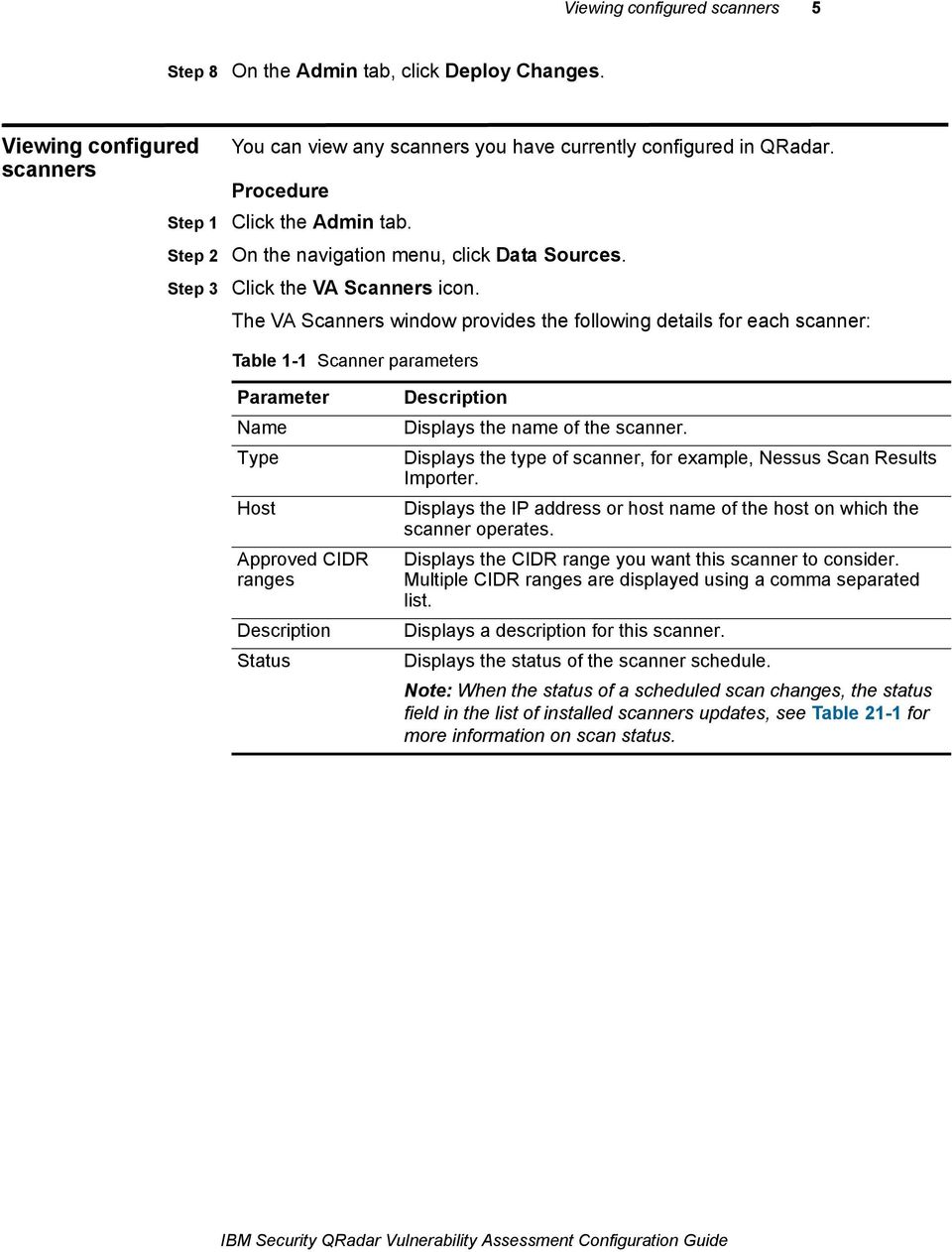
11 Viewing configured scanners 5 Step 8 On the Admin tab, click Deploy Changes. Viewing configured scanners Step 3 You can view any scanners you have currently configured in QRadar. Click the Admin tab. On the navigation menu, click Data Sources. Click the VA Scanners icon. The VA Scanners window provides the following details for each scanner: Table 1-1 Scanner parameters Name Type Host Approved CIDR ranges Status Displays the name of the scanner. Displays the type of scanner, for example, Nessus Scan Results Importer. Displays the IP address or host name of the host on which the scanner operates. Displays the CIDR range you want this scanner to consider. Multiple CIDR ranges are displayed using a comma separated list. Displays a description for this scanner. Displays the status of the scanner schedule. Note: When the status of a scheduled scan changes, the status field in the list of installed scanners updates, see Table 21-1 for more information on scan status.
12

13 2 MANAGE BEYOND SECURITY AVDS SCANNERS The Beyond Security Automated Vulnerability Detection System (AVDS) appliance uses the Asset Export Information Source (AXIS) XML file format to collect vulnerabilities for IBM Security QRadar. To successfully integrate a Beyond Security AVDS vulnerabilities with QRadar, you must configure your Beyond Security ADVS appliance to publish vulnerability data to an AXIS formatted XML results file. The XML vulnerability data must be published to a remote server that is accessible to QRadar using SFTP. The term remote server refers to a system or 3rd party appliance or network storage location, reachable using SFTP that can host the published XML scan results. The most recent XML results containing Beyond Security AVDS vulnerabilities are imported to QRadar when a scan schedule is launched by QRadar. Scan schedules allow you to determine the frequency with which QRadar requests data from an AXIS-compatible scanner, such as Beyond Security AVDS. After you add your Beyond Security AVDS appliance to QRadar, you can then add a scan schedule to retrieve your vulnerability information. Vulnerabilities for assets in your network are displayed on the Assets tab of QRadar. Adding a Beyond Security AVDS scanner Step 3 Step 4 Step 5 You must add a scanner to QRadar to before you can schedule a scan to collect vulnerabilities from a Beyond Security AVDS scanner in QRadar. Click the Admin tab. On the navigation menu, click Data Sources. Click the VA Scanners icon. Click Add. Configure values for the following parameters: Table 2-1 Beyond Security AVDS scanner parameters Scanner Name Type the name you want to assign to this scanner. The name can be up to 255 characters in length.

14 8 MANAGE BEYOND SECURITY AVDS SCANNERS Table 2-1 Beyond Security AVDS scanner parameters (continued) Managed Host Type Remote Hostname Login Username Enable Key Authorization Login Password Remote Directory File Name Pattern Private Key File Max Report Age (Days) Type a description for this scanner. The description can be up to 255 characters in length. From the list box, select the managed host you want to use to configure the scanner. From the list box, select Beyond Security AVDS Scanner. Type the hostname or IP address of the remote server. Type the username used by QRadar to authenticate the connection. Select this check box to enable private key authorization for the server. If the check box is selected, the authentication is completed using a private key and the password is ignored. The default value is disabled. Selecting this option enables the Private Key File field in the scanner configuration. If Enable Key Authentication is disabled, you must type the password corresponding to the Login Username parameter that QRadar uses to authenticate the connection. If Enable Key Authentication is enabled, the Login Password parameter is ignored. Type the directory location of the scan result files. Type a regular expression (regex) required to filter the list of files specified in the Remote Directory. All matching files are included in the processing. For example, if you want to list all files ending with XML, use the following entry:.*\.xml Use of this parameter requires knowledge of regular expressions (regex). For more information, see the following website: Type the directory path to the file that contains the private key information. If you are using key-based authentication, QRadar uses the private key to authenticate the connection. The default is /opt/qradar/conf/vis.ssh.key. However, by default, this file does not exist. You must create the vis.ssh.key file or type another file name. This parameter is mandatory if the Enable Key Authentication check box is selected. If the Enable Key Authentication check box is clear, this parameter is ignored. Type the maximum file age to include when importing your XML vulnerabilities file during a scheduled scan. By default, the value is 7 days. Files that are older than the specified days and timestamp on the report file are excluded from the scheduled import.

15 Editing a Beyond Security AVDS scanner 9 Table 2-1 Beyond Security AVDS scanner parameters (continued) Ignore Duplicates Select this check box to track files that have already been processed and you do not want the files to be processed a second time. Note: If a result file is not seen for 10 days, it is removed from the tracking list and is processed the next time the file is discovered. Step 6 Step 7 Step 8 To configure the CIDR ranges you want this scanner to consider: a b In the text field, type the CIDR range you want this scanner to consider or click Browse to select the CIDR range from the network list. Click Add. Click Save. On the Admin tab, click Deploy Changes. Editing a Beyond Security AVDS scanner You can edit your Beyond Security ADVS scanner to update any configuration parameters. Click the Admin tab. On the navigation menu, click Data Sources. Step 3 Click the VA Scanners icon. Step 4 Select the scanner you want to edit. Step 5 Click Edit. Step 6 Update parameters, as necessary. See Table 2-1. Step 7 Click Save. Step 8 On the Admin tab, click Deploy Changes. The scanner configuration is updated. Any configuration parameters associated with existing scheduled scans are updated when you deploy the changes.
16 10 MANAGE BEYOND SECURITY AVDS SCANNERS Deleting a Beyond Security AVDS scanner Step 3 Step 4 Step 5 Step 6 Step 7 You can delete a Beyond Security ADVS scanner to remove the scanner configuration from QRadar. Click the Admin tab. On the navigation menu, click Data Sources. Click the VA Scanners icon. Select the scanner you want to delete. Click Delete. Click OK. On the Admin tab, click Deploy Changes. The scanner configuration is removed. Any scheduled scans associated with the scanner are removed when you deploy the changes.
17 3 MANAGE IBM SECURITY APPSCAN ENTERPRISE SCANNERS IBM Security QRadar can import scan results from IBM Security AppScan Enterprise report data, providing you a centralized security environment for advanced application scanning and security compliance reporting. Importing IBM Security AppScan Enterprise scan results allows you to collect asset vulnerability information for malware, web applications, and web services in your deployment. QRadar retrieves AppScan Enterprise reports using the Representational State Transfer (REST) web service to import vulnerability data and generate offenses in QRadar for your security team. To integrate AppScan Enterprise with QRadar, you must: 1 Generate scan reports in AppScan Enterprise. For more information on generating scan reports, see your AppScan Enterprise vendor documentation. 2 Configure AppScan Enterprise to grant QRadar access to report data. 3 Configure your AppScan Enterprise scanner in QRadar. 4 Create a schedule in QRadar to import AppScan Enterprise results. Configuring IBM AppScan Enterprise A member of the security team or your AppScan Enterprise administrator must determine which AppScan Enterprise users have permissions to publish reports to QRadar. After AppScan Enterprise users have been configured, the reports generated by AppScan Enterprise can be published to QRadar, making them available for download. To configure AppScan Enterprise to grant QRadar access to scan report data, you must: 1 Create a custom user type. 2 Enable AppScan Enterprise and QRadar integration. 3 Create an Application Deployment Map. 4 Publish your scan results to QRadar.
18 12 MANAGE IBM SECURITY APPSCAN ENTERPRISE SCANNERS Creating a custom user type Step 3 Step 4 Step 5 Enabling AppScan and QRadar integration Step 3 Step 4 Custom user types allow administrators to perform limited and specific administrative tasks and must be created before you can assign permissions. Log in to IBM Security AppScan Enterprise. Click the Administration tab. On the User Types page, click Create. Create the user type, and select any the following custom user permissions for the user type: Configure QRadar Integration - Select this check box to allow users to access the QRadar integration options for AppScan Enterprise. Publish to QRadar - Select this check box to allow QRadar access to published scan report data. QRadar Service Account - Select this check box to configure permission on the account to use the REST API. It does not access the user interface. Save the user type. You are now ready to enable QRadar integration with AppScan Enterprise. To complete these steps, you must be logged in as a user with the Configuration QRadar Integration user type enabled. Click the Administration tab. On the navigation menu, select Network Security Systems. From the QRadar Integration Settings pane, click Edit. Select the Enable QRadar Integration check box. Any reports previously published to QRadar are displayed. If any of the reports displayed are no longer required, you can remove them from the list. As you publish additional reports to QRadar, the reports are displayed in this list. You are now ready to configure the Application Deployment Mapping in AppScan Enterprise.

19 Configuring IBM AppScan Enterprise 13 Creating an Application Deployment Map Step 3 Step 4 Step 5 Step 6 Step 7 Step 8 Publishing vulnerability reports for QRadar Step 3 The Application Deployment Map allows AppScan Enterprise to determine the locations hosting the application in your production environment. As vulnerabilities are discovered, AppScan Enterprise knows the locations of the hosts and the IP addresses affected by the vulnerability. If an application is deployed to several hosts, then AppScan Enterprise generates a vulnerability for each host in the scan results. Click the Administration tab. On the navigation menu, click Network Security Systems. On the Application Deployment Mapping pane, click Edit. In the Application test location (host or pattern) field, type the test location for your application. In the Application production location (host) field, type the IP address for your production environment. Note: To add vulnerability information to QRadar, your Application Deployment Mapping must include an IP address. Any vulnerability data without an IP address is excluded from QRadar if the IP address is not available in the AppScan Enterprise scan results. Click Add. Repeat Step 3 to Step 6 to map all of your production environments in AppScan Enterprise. Click Done to save your configuration changes. You are now ready to publish completed reports to QRadar. Completed vulnerability reports generated by AppScan Enterprise must be made accessible to QRadar by publishing the report. To complete these steps, you must be logged in as a user with the Publish to QRadar user type enabled. Click the Jobs & Reports tab. Navigate to the security report you want to make available to QRadar. On the menu bar of any security report, select Publish > Grant report access to QRadar. You are now ready to add your AppScan Enterprise scanner to QRadar.

20 14 MANAGE IBM SECURITY APPSCAN ENTERPRISE SCANNERS Configuring an IBM AppScan Enterprise scanner in QRadar After you have configured AppScan Enterprise and published reports, you can add the AppScan Enterprise scanner in QRadar. Adding a scanner allows QRadar to know which scan reports to collect. You can add multiple AppScan Enterprise scanners in QRadar, each with a different configuration. Adding multiple configurations for a single AppScan Enterprise scanner allows you to create individual scanners for specific result data. The scan schedule you configure in QRadar allows you to determine the frequency with which QRadar imports the scan result data from AppScan Enterprise using the REST web service. Note: Your scan result data must include the IP address of the host from the Application Deployment Mapping. Any vulnerability data without an IP address is excluded from QRadar if the IP address is not available in the AppScan Enterprise scan results. Adding an AppScan Enterprise scanner Step 3 Step 4 Step 5 You must add a scanner to QRadar to before you can schedule a scan to collect vulnerabilities from AppScan Enterprise in QRadar. Click the Admin tab. On the navigation menu, click Data Sources. Click the VA Scanners icon. Click Add. Configure values for the following parameters: Table 3-1 IBM AppScan Enterprise parameters Scanner Name Managed Host Type ASE Instance Base URL Type the name you want to assign to this scanner. The name can be up to 255 characters in length. Type a description for this scanner. The description can be up to 255 characters in length. From the list box, select the managed host you want to use to configure the scanner. From the list box, select IBM AppScan Scanner. Type the full base URL of the AppScan Enterprise instance. This field supports URLs for HTTP and HTTPS addresses. For example,

21 Configuring an IBM AppScan Enterprise scanner in QRadar 15 Table 3-1 IBM AppScan Enterprise parameters (continued) Authentication Type Username Password Report Name Pattern Select an Authentication Type: Windows Authentication - Select this option to use Windows Authentication when using the REST web service to retrieve scan report data from AppScan Enterprise. Jazz Authentication - Select this option to use Jazz Authentication when using the REST web service to retrieve scan report data for AppScan Enterprise. Type the username required to retrieve scan results from AppScan Enterprise. Type the password required to retrieve scan results from AppScan Enterprise. Type a regular expression (regex) required to filter the list vulnerability reports available from AppScan Enterprise. All matching files are included and processed by QRadar. You can specify a group of vulnerability reports or an individual report using a regex pattern. By default, the Report Name Pattern field contains.* as the regex pattern. The.* pattern imports all scan reports that are published to QRadar. Use of this parameter requires knowledge of regular expressions (regex). For more information, see the following website: Step 6 Step 7 Step 8 Configure the CIDR ranges you want this scanner to consider: a In the text field, type the CIDR range you want this scanner to consider or click Browse to select the CIDR range from the network list. The CIDR range allows you to filter the list of IP addresses the scanner considers when retrieving scan results from AppScan Enterprise devices. Since you can configure and schedule multiple AppScan Enterprise scanners in QRadar, the CIDR range acts as a filter when searching the network for scan result data. To collect all results within AppScan Enterprise published reports, you can use a CIDR range of /0. b Click Add. Click Save. On the Admin tab, click Deploy Changes. You are now ready to create a scan schedule in QRadar. For more information, see Managing Scan Schedules.
22 16 MANAGE IBM SECURITY APPSCAN ENTERPRISE SCANNERS Editing an AppScan Enterprise scanner You can edit your AppScan Enterprise scanner to update any configuration parameters. Click the Admin tab. On the navigation menu, click Data Sources. Step 3 Click the VA Scanners icon. Step 4 Select the scanner you want to edit. Step 5 Click Edit. Step 6 Update parameters, as necessary. See Table 3-1. Step 7 Click Save. Step 8 On the Admin tab, click Deploy Changes. The scanner configuration is updated. Any configuration parameters associated with existing scheduled scans are updated when you deploy the changes. Deleting an AppScan Enterprise scanner Step 3 Step 4 Step 5 Step 6 Step 7 You can delete an AppScan Enterprise scanner to remove the scanner configuration from QRadar. Click the Admin tab. On the navigation menu, click Data Sources. Click the VA Scanners icon. Select the scanner you want to delete. Click Delete. Click OK. On the Admin tab, click Deploy Changes. The scanner configuration is removed. Any scheduled scans associated with the scanner are removed when you deploy the changes.
23 4 MANAGE IBM GUARDIUM SCANNERS IBM InfoSphere TM Guardium appliances are capable of exporting database vulnerability information that can be critical to protecting customer data. IBM Guardium audit processes export the results of tests that fail the Common Vulnerability and Exposures (CVE) tests generated when running security assessment tests on your IBM Guardium appliance. The vulnerability data from IBM Guardium must be exported to a remote server or staging server in Security Content Automation Protocol (SCAP) format. QRadar can then retrieve the scan results from the remote server storing the vulnerability using SFTP. Note: IBM Guardium only exports vulnerability from databases containing failed CVE test results. If there are no failed CVE tests, IBM Guardium may not export a file at the end of the security assessment. For information on configuring security assessment tests and creating an audit process to export vulnerability data in SCAP format, see your IBM InfoSphere Guardium documentation. After you have configured your IBM Guardium appliance, you are ready to configure QRadar to import the results from the remote server hosting the vulnerability data. You must add an IBM Guardium scanner to QRadar and configure the scanner to retrieve data from your remote server. The most recent vulnerabilities are imported by QRadar when you create a scan schedule. Scan schedules allow you to determine the frequency with which QRadar requests data from the remote server host your IBM Guardium vulnerability data. For more information, see Managing Scan Schedules. Adding an IBM Guardium scanner Step 3 Step 4 Step 5 To add an IBM Guardium scanner to QRadar: Click the Admin tab. On the navigation menu, click Data Sources. Click the VA Scanners icon. Click Add. Configure values for the following parameters:
24 18 MANAGE IBM GUARDIUM SCANNERS Table 4-1 IBM Guardium SCAP scanner parameters Scanner Name Managed Host Type Remote Hostname Remote Port Login Username Login Password Enable Key Authorization Private Key File Remote Directory File Name Pattern Type the name you want to assign to this scanner. The name can be up to 255 characters in length. Type a description for this scanner. The description can be up to 255 characters in length. From the list box, select the managed host you want to use to configure the scanner. From the list box, select IBM Guardium SCAP Scanner. Type the hostname or IP address of the remote server hosting your SCAP XML files. Type the number of the port on the remote server to retrieve scan result files using SFTP. The default is port 22. Type the username used by QRadar to authenticate the SFTP connection. If Enable Key Authentication is disabled, you must type the password corresponding to the Login Username parameter that QRadar uses to authenticate the SFTP connection. If Enable Key Authentication is enabled, the Login Password parameter is ignored. Select this check box to enable private key authorization for the server. If the check box is selected, the authentication is completed using a private key and the password is ignored. The default value is disabled. Type the directory path to the file that contains the private key information. If you are using key-based authentication, QRadar uses the private key to authenticate the connection. This parameter is mandatory if the Enable Key Authentication check box is selected. If the Enable Key Authentication check box is clear, this parameter is ignored. Type the directory location of the scan result files on the remote server hosting your IBM Guardium vulnerabilities. Type a regular expression (regex) required to filter the list of files specified in the Remote Directory. All matching files are included in the processing. For example, if you want to list all files ending with XML, use the following entry:.*\.xml Use of this parameter requires knowledge of regular expressions (regex). For more information, see the following website:
25 Editing an IBM Guardium scanner 19 Table 4-1 IBM Guardium SCAP scanner parameters (continued) Max Report Age (Days) Type the maximum file age to include when importing your XML result file during a scheduled scan. Files that are older than the specified days and timestamp on the report file are excluded from the scheduled import. Step 6 Step 7 Step 8 Configure the CIDR ranges you want this scanner to consider: a b In the text field, type the CIDR range you want this scanner to consider or click Browse to select the CIDR range from the network list. Click Add. Click Save. On the Admin tab, click Deploy Changes. You are now ready to create a scan schedule in QRadar. For more information, see Managing Scan Schedules. Editing an IBM Guardium scanner You can edit your IBM Guardium scanner configuration in QRadar to update any parameters. Click the Admin tab. On the navigation menu, click Data Sources. Step 3 Click the VA Scanners icon. Step 4 Select the scanner you want to edit. Step 5 Click Edit. Step 6 Update parameters, as necessary. See Table 4-1. Step 7 Click Save. Step 8 On the Admin tab, click Deploy Changes. The scanner configuration is updated. Any configuration parameters associated with existing scheduled scans are updated when you deploy the changes.
26 20 MANAGE IBM GUARDIUM SCANNERS Deleting an IBM Guardium scanner Step 3 Step 4 Step 5 Step 6 Step 7 You can delete an IBM Guardium scanner to remove the scanner configuration from QRadar. Click the Admin tab. On the navigation menu, click Data Sources. Click the VA Scanners icon. Select the scanner you want to delete. Click Delete. Click OK. On the Admin tab, click Deploy Changes. The scanner configuration is removed. Any scheduled scans associated with the scanner are removed when you deploy the changes.
27 5 MANAGE IBM SITEPROTECTOR SCANNERS The IBM SiteProtector scanner module for QRadar accesses vulnerability data from IBM SiteProtector scanners using the JDBC. The IBM SiteProtector scanner retrieves data from the RealSecureDB table and polls for available vulnerability information. The compare field allows QRadar to retrieve only the latest information from the RealSecureDB table and import any new vulnerabilities to QRadar. When you configure your IBM SiteProtector, we recommend that you create a SiteProtector user account specifically for QRadar. Creating a user account ensures that QRadar has the credentials required to poll the IBM SiteProtector database to retrieve vulnerability data. After you create a user account for QRadar, you should verify communication between QRadar and your IBM SiteProtector system to ensure there are no firewalls blocking communication on the port you are using to poll the RealSecureDB. Adding an IBM SiteProtector scanner You can add multiple IBM SiteProtector scanners in QRadar, each with a different configuration to determine which CIDR ranges you want the scanner to consider. Adding multiple configurations for a single IBM SiteProtector scanner allows you to create individual scanners for collecting specific result data from specific locations. After you add and configure the IBM SiteProtector scanner in QRadar, you can create a scan schedule to determine the frequency with which QRadar polls the IBM SiteProtector database. Step 3 Step 4 Step 5 Click the Admin tab. On the navigation menu, click Data Sources. Click the VA Scanners icon. Click Add. Configure values for the following parameters:
28 22 MANAGE IBM SITEPROTECTOR SCANNERS Table 5-1 IBM SiteProtector scanner parameters Scanner Name Managed Host Type Hostname Port Username Password Domain Database Name Database Instance Type the name you want to assign to this scanner. The name can be up to 255 characters in length. Type a description for this scanner. The description can be up to 255 characters in length. From the list box, select the managed host you want to use to configure the scanner. From the list box, select IBM SiteProtector Scanner. Type the IP address or hostname of the IBM SiteProtector containing the vulnerabilities you want to add to QRadar. Type the port number used by the database server. The default that is displayed depends on the selected Database Type. The valid range is 0 to The default for MSDE is port The JDBC configuration port must match the listener port of the database. The database must have incoming TCP connections enabled to communicate with QRadar. The default port number for all options include: MSDE Postgres MySQL Oracle Sybase Type the username required to access IBM SiteProtector. Type the password required to access IBM SiteProtector. Type the domain required, if required, to connect to your IBM SiteProtector database. If you select MSDE as the database type and the database is configured for Windows, you must define a Windows domain. Otherwise, leave this field blank. The domain can be up to 255 alphanumeric characters in length. The domain can include the following special characters: underscore (_), en dash (-), and period(.). Type the name of the database to which you want to connect. The default database name is RealSecureDB. Type the database instance for your IBM SiteProtector database. If you are not using a database instance, you can leave this field blank. If you select MSDE as the Database Type and you have multiple SQL server instances on one server, define the instance to which you want to connect.
29 Editing an IBM SiteProtector scanner 23 Table 5-1 IBM SiteProtector scanner parameters (continued) Use Named Pipe Communication Use NTLMv2 Select this check box to use named pipes when communicating to the IBM SiteProtector database. By default, this check box is clear. When using a Named Pipe connection, the username and password must be the appropriate Windows authentication username and password and not the database username and password. Selecting this check box uses the default Named Pipe for your system. Select this check box if your IBM SiteProtector uses NTLMv2 as an authentication protocol. By default, this check box is clear. The Use NTLMv2 check box forces MSDE connections to use the NTLMv2 protocol when communicating with SQL servers that require NTLMv2 authentication. If the Use NTLMv2 check box is selected, it has no effect on MSDE connections to SQL servers that do not require NTLMv2 authentication. Step 6 Step 7 Step 8 Configure the CIDR ranges you want this scanner to consider: a b In the text field, type the CIDR range you want this scanner to consider or click Browse to select the CIDR range from the network list. To collect all available IBM SiteProtector vulnerabilities, you can type /0 as the CIDR address. Click Add. Click Save. On the Admin tab, click Deploy Changes. You are now ready to create a scan schedule in QRadar. For more information, see Managing Scan Schedules. Editing an IBM SiteProtector scanner You can edit your IBM SiteProtector scanner configuration in QRadar to update any parameters. Click the Admin tab. On the navigation menu, click Data Sources. Step 3 Click the VA Scanners icon. Step 4 Select the scanner you want to edit. Step 5 Click Edit. Step 6 Update parameters, as necessary. See Table 5-1. Step 7 Click Save. Step 8 On the Admin tab, click Deploy Changes.
30 24 MANAGE IBM SITEPROTECTOR SCANNERS The scanner configuration is updated. Any configuration parameters associated with existing scheduled scans are updated when you deploy the changes. Deleting an IBM SiteProtector scanner Step 3 Step 4 Step 5 Step 6 Step 7 You can delete an IBM SiteProtector scanner to remove the scanner configuration from QRadar. Click the Admin tab. On the navigation menu, click Data Sources. Click the VA Scanners icon. Select the scanner you want to delete. Click Delete. Click OK. On the Admin tab, click Deploy Changes. The scanner configuration is removed. Any scheduled scans associated with the scanner are removed when you deploy the changes.
31 6 IBM TIVOLI ENDPOINT MANAGER SCANNER The IBM Tivoli Endpoint Manager scanner module accesses vulnerability data from IBM Tivoli Endpoint Manager using the SOAP API installed with the Web Reports application. The Web Reports application for Tivoli Endpoint Manager is required to retrieve vulnerability data from Tivoli Endpoint Manager for QRadar. We recommend that you create a user in IBM Tivoli Endpoint Manager for QRadar. Note: QRadar is compatible with IBM Tivoli Endpoint Manager versions 8.2.x. However, we recommend that you update and use the latest version of IBM Tivoli Endpoint Manager that is available. Add an IBM Tivoli Endpoint Manager scanner You can add multiple IBM Tivoli Endpoint Manager scanners in QRadar, each with a different configuration to determine which CIDR ranges you want the scanner to consider. Adding multiple configurations for a single IBM Tivoli Endpoint Manager scanner allows you to create individual scanners for collecting specific result data from specific locations. After you add and configure the IBM Tivoli Endpoint Manager in QRadar, you can create a scan schedule to determine the frequency with which QRadar accesses IBM Tivoli Access Manager. This allows you to schedule how often QRadar requests data from IBM Tivoli Endpoint Manager using the SOAP API. Step 3 Step 4 Step 5 Click the Admin tab. On the navigation menu, click Data Sources. Click the VA Scanners icon. Click Add. Configure values for the following parameters:
32 26 IBM TIVOLI ENDPOINT MANAGER SCANNER Table 6-1 IBM Tivoli Endpoint Manager scanner parameters Scanner Name Managed Host Type Hostname Port Use HTTPS Username Password Type the name you want to assign to this scanner. The name can be up to 255 characters in length. Type a description for this scanner. The description can be up to 255 characters in length. From the list box, select the managed host you want to use to configure the scanner. From the list box, select IBM Tivoli Endpoint Manager. Type the IP address or hostname of the IBM Tivoli Endpoint Manager containing the vulnerabilities you want to add to QRadar. Type the port number used to connect to the IBM Tivoli Endpoint Manager using the SOAP API. By default, port 80 is the port number for communicating with IBM Tivoli Endpoint Manager. If you are use HTTPS, you must update this field to the HTTPS port number for your network. Most configurations use port 443 for HTTPS communications. Select this check box to connect using HTTPS. If you select this check box, the hostname or IP address you specify uses HTTPS to connect to your IBM Tivoli Endpoint Manager. If a certificate is required to connect using HTTPS, you must copy any certificates required by the QRadar Console or managed host to the following directory: /opt/qradar/conf/trusted_certificates Note: QRadar support certificates with the following file extensions:.crt,.cert, or.der. Any required certificates should be copied to the trusted certificates directory before you save and deploy your changes. Type the username required to access IBM Tivoli Endpoint Manager. Type the password required to access IBM Tivoli Endpoint Manager. Step 6 Step 7 Step 8 Configure the CIDR ranges you want this scanner to consider: a b In the text field, type the CIDR range you want this scanner to consider or click Browse to select the CIDR range from the network list. Click Add. Click Save. On the Admin tab, click Deploy Changes. You are now ready to create a scan schedule in QRadar. For more information, see Managing Scan Schedules.
33 Editing an IBM Tivoli Endpoint Manager scanner 27 Editing an IBM Tivoli Endpoint Manager scanner You can edit your IBM Tivoli Endpoint Manager scanner configuration in QRadar to update any parameters. Click the Admin tab. On the navigation menu, click Data Sources. Step 3 Click the VA Scanners icon. Step 4 Select the scanner you want to edit. Step 5 Click Edit. Step 6 Update parameters, as necessary. See Table 6-1. Step 7 Click Save. Step 8 On the Admin tab, click Deploy Changes. The scanner configuration is updated. Any configuration parameters associated with existing scheduled scans are updated when you deploy the changes. Deleting an IBM Tivoli Endpoint Manager scanner Step 3 Step 4 Step 5 Step 6 Step 7 You can delete an IBM Tivoli Endpoint Manager scanner to remove the scanner configuration from QRadar. Click the Admin tab. On the navigation menu, click Data Sources. Click the VA Scanners icon. Select the scanner you want to delete. Click Delete. Click OK. On the Admin tab, click Deploy Changes. The scanner configuration is removed. Any scheduled scans associated with the scanner are removed when you deploy the changes.
34
35 7 MANAGE NCIRCLE IP360 SCANNERS QRadar uses SSH to access the remote server (SSH export server) to retrieve and interpret the scanned data. QRadar supports VnE Manager version IP to You can configure an ncircle IP360 scanner device to export scan results to a remote server. These scan results are exported, in XML2 format, to an SSH server. To successfully integrate an IP360 device with QRadar, these XML2 format files must be read from the remote server (using SSH). QRadar can be configured to schedule a scan or poll the SSH server for updates to the scan results and import the latest results for processing. The term remote server refers to a system that is separate from the ncircle device. QRadar cannot connect directly with ncircle devices. For more information about exporting scan results, see Exporting ncircle scan reports. The scan results contain identification information about the scan configuration from which it was produced. The most recent scan results are used when a scan is imported by QRadar. QRadar only supports exported scan results from the IP360 scanner in XML2 format. Add an ncircle IP360 scanner Step 3 Step 4 Step 5 To add an ncircle IP360 scanner to QRadar: Click the Admin tab. On the navigation menu, click Data Sources. Click the VA Scanners icon. Click Add. Configure values for the following parameters: Table 7-1 ncircle IP360 scanner parameters Scanner Name Type the name you want to assign to this scanner. The name can be up to 255 characters in length.
36 30 MANAGE NCIRCLE IP360 SCANNERS Table 7-1 ncircle IP360 scanner parameters (continued) Managed Host Type SSH Server Host Name SSH Username SSH Password SSH Port Remote Directory File Max Age (days) File Pattern Enable Key Authorization Private Key Path Type a description for this scanner. The description can be up to 255 characters in length. From the list box, select the managed host you want to use to configure the scanner. From the list box, select ncircle IP360 Scanner. Type the IP address or host name to the remote server hosting the scan result files. We recommend a UNIX-based system with SSH enabled. Type the SSH remote server username. Type the password to the remote server corresponding to the SSH Username. If the Enable Key Authentication check box is selected, the password is ignored. Type the port number used to connect to the remote server. Type the directory location of the scan result files. Type the maximum file age to include when performing a scheduled scan. Files that are older than a specified time are excluded from the import of the result data in QRadar. Type a regular expression (regex) required to filter the list of files specified in the Remote Directory field. All matching files are included and processed. For example, if you want to list all XML2 format files ending with XML, use the following entry: XML2.*\.xml Use of this parameter requires knowledge of regular expressions (regex). For more information, see the following website: Select this check box to enable key authorization for the server. If the Enable Key Authentication check box is selected, the SSH authentication is completed using a private key and the password is ignored. The default value is disabled. Type the private key path. The private key path is the full directory path on your QRadar where the private key to be used for SSH key-based authentication is stored. The default path is /opt/qradar/conf/vis.ssh.key, but this file does not exist. You must create a vis.ssh.key file for your remote host or type another file name. If the Enable Key Authentication check box is clear, the Private Key Path is ignored.
37 Editing an ncircle IP360 scanner 31 Step 6 Step 7 Step 8 Note: If the scanner is configured to use a password, the SSH scanner server to which QRadar connects must support password authentication. If it does not, SSH authentication for the scanner fails. Make sure the following line is displayed in your sshd_config file, which is typically found in the /etc/ssh directory on the SSH server: PasswordAuthentication yes. If your scanner server does not use OpenSSH, the configuration can differ. For more information, see the vendor documentation for your scanner. Configure the CIDR ranges you want this scanner to consider: a b In the text field, type the CIDR range you want this scanner to consider or click Browse to select the CIDR range from the network list. Click Add. Click Save. On the Admin tab, click Deploy Changes. You are now ready to create a scan schedule in QRadar. For more information, see Managing Scan Schedules. Editing an ncircle IP360 scanner You can edit a scanner configured in QRadar to update any configuration parameters. Click the Admin tab. On the navigation menu, click Data Sources. Step 3 Click the VA Scanners icon. Step 4 Select the scanner you want to edit. Step 5 Click Edit. Step 6 Update parameters, as necessary. See Table 7-1. Step 7 Click Save. Step 8 On the Admin tab, click Deploy Changes. The scanner configuration is updated. Any configuration parameters associated with existing scheduled scans are updated when you deploy the changes. Deleting an ncircle IP360 scanner Step 3 Step 4 To delete a scanner from QRadar: Click the Admin tab. On the navigation menu, click Data Sources. Click the VA Scanners icon. Select the scanner you want to delete.
38 32 MANAGE NCIRCLE IP360 SCANNERS Step 5 Step 6 Step 7 Click Delete. Click OK. On the Admin tab, click Deploy Changes. The scanner configuration is removed. Any scheduled scans associated with the scanner are removed when you deploy the changes. Exporting ncircle scan reports To configure your ncircle device to export scan reports: Log in to the IP360 VNE Manager user interface. From the left- hand navigation, select Administer > System > VNE Manager > Automated Export. The Automated Export menu is displayed. Step 3 Click the Export to File tab. Step 4 Configure the export settings. For information on configuring the export settings, click the Help link. To integrate with QRadar, the export must be configured to use the XML format. Step 5 Record the Target settings displayed in the user interface. These settings are necessary to configure QRadar to integrate with your ncircle device.
39 8 MANAGE NESSUS SCANNERS QRadar can retrieve vulnerability scan reports about your network assets by leveraging the Nessus client and server relationship or by using the Nessus XMLRPC API to access scan data directly. When you configure your Nessus client, we recommend that you create a Nessus user account for QRadar. Creating a user account ensures that QRadar has the credentials required to log in using SSH and communicate with the Nessus server to retrieve scan report data using either the client server relationship or using the XMLRPC API. After you create a user account for QRadar, you should attempt to SSH from QRadar to your Nessus client to verify QRadar s credentials. This ensures that QRadar and the Nessus client can communicate before you attempt to collect scan data or start a live scan. The following data collection options are available for Nessus: Scheduled Live Scan - Allows QRadar to connect to a Nessus client and launch a pre-configured scan. QRadar uses SSH to retrieve the scan report data from the client s temporary results directory after the live scan completes. Scheduled Results Import - Allows QRadar to connect to the location hosting your Nessus scan reports. QRadar connects to the repository using SSH and imports completed scan report files from the remote directory. QRadar supports importing Nessus scan reports or scan reports in a Nessus supported output format. Scheduled Live Scan - XMLRPC API - Allows QRadar to use the XMLRPC API to start a pre-configured scan. To start a live scan from QRadar, you must specify the policy name for the live scan data you want to retrieve. As the live scan runs, QRadar updates the percentage complete in the scan status. After the live scan completes, QRadar retrieves the data and updates the vulnerability assessment information for your assets. Scheduled Completed Report Import - XMLRPC API - Allows QRadar to connect to your Nessus server and download data from any completed reports that match the report name and report age filters.
40 34 MANAGE NESSUS SCANNERS Nessus vulnerability data can be integrated into QRadar by adding a Nessus scanner using the VA Scanners icon in the Admin tab. After you add your Nessus client, you can add a scan schedule to retrieve Nessus vulnerability data on a one-time or repeating interval. For more information on scheduling a scan, see Scheduling a scan. Note: We recommend that you do not install your Nessus software on a critical system due to the high CPU requirements. Add a Nessus scanner The Nessus scanner module for QRadar provides several collection types for retrieving vulnerability data from your Nessus server. This section includes the following topics: Adding a Nessus Scheduled Live Scan Adding a Nessus Scheduled Results Import Adding a Nessus Scheduled Live Scan using the XMLPRC API Adding a Nessus Completed Report Import using the XMLRPC API Note: The Nessus XMLRPC API is only available on Nessus servers and clients using software v4.2 and above. Adding a Nessus Scheduled Live Scan A live scan allows you to start a live scan on your Nessus server and import the result data from a temporary directory containing the live scan report data. After the scan is complete, QRadar downloads the scan data from the temporary directory and updates the vulnerability information for your assets. Step 3 Step 4 Step 5 Click the Admin tab. On the navigation menu, click Data Sources. Click the VA Scanners icon. Click Add. Configure values for the following parameters: Table 8-1 Scanner s Scanner Name Managed Host Type Type the name you want to assign to this scanner. The name can be up to 255 characters in length. Type a description for this scanner. The description can be up to 255 characters in length. From the list box, select the managed host you want to use to configure the scanner. From the list box, select Nessus Scanner.
41 Add a Nessus scanner 35 Step 6 Step 7 From the Collection Type list box, select Scheduled Live Scan. Configure values for the following parameters: Table 8-2 Nessus Scheduled Live Scan parameters Server Hostname Type the IP address or hostname of the Nessus server as seen by the Nessus client. If the server process and the client are located on the same host, you can use localhost as the server hostname. Server Port Type the port for the Nessus server. The default is port Server Username Type the Nessus username that the Nessus client uses to authenticate with the Nessus server. Server Password Type the Nessus password that corresponds to the username. Note: Your Nessus server password must not contain the! character. This character could cause authentication failures over SSH. Client Temp Dir Type the directory path of the Nessus client that QRadar can use to store temporary files. QRadar uses the temporary directory of the Nessus client as a read and write location to upload scan targets and read scan results. Temporary files are removed when QRadar completes the scan and retrieves the scan reports from the Nessus client. The default directory path on the Nessus client is /tmp. Nessus Executable Nessus Configuration File Client Hostname Client SSH Port Client Username Type the directory path to the Nessus executable file on the server hosting the Nessus client. By default, the directory path for the executable file is /usr/bin/nessus. Type the directory path to the Nessus configuration file on the Nessus client. Type the hostname or IP address of the system hosting the Nessus client. Type the number of the SSH port on the Nessus server that can be used to retrieve scan result files. The default is port 22. Type the username used by QRadar to authenticate the SSH connection.
42 36 MANAGE NESSUS SCANNERS Table 8-2 Nessus Scheduled Live Scan parameters (continued) Client Password Enable Key Authentication Type the password that corresponds to the Client Username field. This field is required if the Enable Key Authentication check box is clear. If Enable Key Authentication is enabled, the Login Password parameter is ignored. Note: If the scanner is configured to use a password, the SSH scanner server to which QRadar connects must support password authentication. If it does not, SSH authentication for the scanner fails. Ensure the following line is displayed in your sshd_config file, which is typically found in the /etc/ssh directory on the SSH server: PasswordAuthentication yes. If your scanner server does not use OpenSSH, the configuration can differ. For more information, see the vendor documentation for your scanner. Select this check box to enable public or private key authentication. If the check box is selected, QRadar attempts to authenticate the SSH connection using the private key that is provided and the SSH Password field is ignored. Step 8 Step Configure the CIDR ranges you want this scanner to consider: a b In the text field, type the CIDR range you want this scanner to consider or click Browse to select the CIDR range from the network list. Click Add. Click Save. On the Admin tab, click Deploy Changes. After the changes are deployed, you must create a scan schedule for the live scan. Scan reports can be created as a one-time event or as a reoccurring scheduled import. For more information on scheduling a scan, see Scheduling a scan. Adding a Nessus Scheduled Results Import A scheduled results import retrieves completed Nessus scan reports from an external location. The external location can be a Nessus server or a file repository that contains a completed scan report. QRadar connects to the location of your scan reports using SSH and imports completed scan report files from the remote directory using a regular expression or maximum report age to filter for your scan reports. QRadar supports importing Nessus scan reports (.Nessus) or scan reports exported to a Nessus supported output format, such as XML.
43 Add a Nessus scanner 37 Step 3 Step 4 Step 5 Click the Admin tab. On the navigation menu, click Data Sources. Click the VA Scanners icon. Click Add. Configure values for the following parameters: Table 8-3 Scanner parameters Scanner Name Managed Host Type Type the name you want to assign to this scanner. The name can be up to 255 characters in length. Type a description for this scanner. The description can be up to 255 characters in length. From the list box, select the managed host you want to use to configure the scanner. From the list box, select Nessus Scanner. Step 6 Step 7 From the Collection Type list box, select Scheduled Results Import. Configure values for the following parameters: Table 8-4 Nessus Scheduled Results Import parameters Remote Results Hostname Remote Results SSH Port SSH Username SSH Password Enable Key Authentication Remote Results Directory Type the IP address or hostname of the Nessus client or server hosting your Nessus or XML scan result files. Type the number of the SSH port on the Nessus server that can be used to retrieve scan result files. The default port is 22. Type a username that QRadar can use to authenticate the SSH session with the Nessus server. Type the password that corresponds to the SSH username. Note: Your Nessus server password must not contain the! character. This character could cause authentication failures over SSH. Select this check box to enable public or private key authentication. If the check box is selected, QRadar attempts to authenticate the SSH connection using the private key provided and the SSH Password field is ignored. Type the full path for the directory containing the Nessus scan report files on the Nessus client. The directory path uses./ as the default value.
44 38 MANAGE NESSUS SCANNERS Table 8-4 Nessus Scheduled Results Import parameters (continued) Remote Results File Pattern Results File Max Age (Days) Type a file pattern, using a regular expression (regex), for the scan result files you are attempting to import. By default, the following file pattern is included for Nessus files:.*\.nessus. If you use an output mask to export your scan report in another supported Nessus format, such as XML, you must update the regex for the file pattern accordingly. Note: If you update the regex in the Remote Results File Pattern field, you must deploy the change to update your scanner configuration. Type the maximum file age to include when importing Nessus scan result files during a scheduled scan. By default, the results file maximum age is 7 days. Files that are older than the specified days and the timestamp on the results file are excluded from the result file import. Step 8 Step Configure the CIDR ranges you want this scanner to consider: a b In the text field, type the CIDR range you want this scanner to consider or click Browse to select the CIDR range from the network list. Click Add. Click Save. On the Admin tab, click Deploy Changes. After the changes are deployed, you must create a scan schedule to import the vulnerability data. Scan reports can be created as a one-time event or as a reoccurring scheduled import. For more information on scheduling a scan, see Scheduling a scan. Adding a Nessus Scheduled Live Scan using the XMLPRC API The XMLRPC API allows QRadar to start a pre-configured live scan on your Nessus server. To start a live scan from QRadar, you must specify the scan name and the policy name for the live scan data you want to retrieve. As the live scan progresses, you can place your mouse over your Nessus scanner in the Scan Scheduling window to view the percentage of the live scan that is complete. After the live scan reaches completion, QRadar uses the XMLRPC API to retrieve the scan data and update the vulnerability information for your assets. Note: The Nessus XMLRPC API is only available on Nessus servers and clients using software v4.2 and above. Click the Admin tab. On the navigation menu, click Data Sources.
45 Add a Nessus scanner 39 Step 3 Step 4 Step 5 Click the VA Scanners icon. Click Add. Configure values for the following parameters: Table 8-5 Scanner s Scanner Name Managed Host Type Type the name you want to assign to this scanner. The name can be up to 255 characters in length. Type a description for this scanner. The description can be up to 255 characters in length. From the list box, select the managed host you want to use to configure the scanner. From the list box, select Nessus Scanner. Step 6 Step 7 The list of parameters for the selected scanner type is displayed. From the Collection Type list box, select Scheduled Live Scan - XMLRPC API. Configure values for the following parameters: Table 8-6 Scheduled Live Scan XMLRPC API parameters Hostname Port Username Password Scan Name Type the IP address or hostname of the Nessus server. Type the port number for QRadar to access your Nessus server using the XMLRPC API. The default is port Type the username required to log in to the Nessus server. Type the password that corresponds to the username. Optional. Type the name of the scan you want displayed when the live scan runs on the Nessus server. If this field is clear, the API attempts to start a live scan for QRadar Scan. Note: QRadar does not support using the ampersand (&) character in this field.
46 40 MANAGE NESSUS SCANNERS Table 8-6 Scheduled Live Scan XMLRPC API parameters (continued) Policy Name Type the name of a policy on your Nessus server to start a live scan. The policy you define must exist on the Nessus server when QRadar attempts to launch the scan. If the policy does not exist, then an error is displayed in the status when QRadar attempts to start the live scan. In most cases the policy name is customized to your Nessus server, but several default policies are included with Nessus. For example, External Network Scan Internal Network Scan Web App Tests Prepare for PCI DSS audits For more information on policies, see your Nessus vendor documentation. Step 8 Step 9 0 Configure the CIDR ranges you want this scanner to consider: a b In the text field, type the CIDR range you want this scanner to consider or click Browse to select the CIDR range from the network list. Click Add. Click Save. On the Admin tab, click Deploy Changes. After the changes are deployed, you must create a scan schedule for your live scan. Scan reports can be created as a one-time event or as a reoccurring scheduled import. For more information on scheduling a scan, see Scheduling a scan. Adding a Nessus Completed Report Import using the XMLRPC API A scheduled results import using the XMLRPC API allows QRadar to retrieve completed Nessus scan reports from the Nessus server. QRadar connects to your Nessus server and downloads data from any completed reports matching the report name and maximum report age filter. Note: The Nessus XMLRPC API is only available on Nessus servers and clients using software v4.2 and above. Step 3 Step 4 Click the Admin tab. On the navigation menu, click Data Sources. Click the VA Scanners icon. Click Add.
47 Add a Nessus scanner 41 Step 5 Configure values for the following parameters: Table 8-7 Scanner parameters Scanner Name Managed Host Type Type the name you want to assign to this scanner. The name can be up to 255 characters in length. Type a description for this scanner. The description can be up to 255 characters in length. From the list box, select the managed host you want to use to configure the scanner. From the list box, select Nessus Scanner. The list of parameters for the selected scanner type is displayed. Step 6 From the Collection Type list box, select Scheduled Completed Report Import - XMLRPC API. Step 7 Configure values for the following parameters: Table 8-8 Scheduled Completed Report Import XMLRPC API parameters Hostname Port Username Password Report Name Filter Results File Max Age (Days) Type the IP address or hostname of the Nessus client or server hosting your Nessus or XML scan result files. Type the port number for QRadar to access your Nessus server using the XMLRPC API. The default is port Type the username required to log in to the Nessus server. Type the password that corresponds to the username. Type the file pattern, using a regular expression (regex), for the scan result files you are attempting to import. By default, the following file pattern is included to collect all available completed scan reports:.*. Note: If you update the regex in the Report Name Filter field, you must deploy the change to update your scanner configuration. Type the maximum file age to include when importing Nessus scan result files during a scheduled scan. By default, the results file maximum age is 7 days. Files that are older than the specified days and the timestamp on the results file are excluded from the result file import. Step 8 Configure the CIDR ranges you want this scanner to consider: a b In the text field, type the CIDR range you want this scanner to consider or click Browse to select the CIDR range from the network list. Click Add.
48 42 MANAGE NESSUS SCANNERS Step 9 0 Click Save. On the Admin tab, click Deploy Changes. After the changes are deployed, you must create a scan schedule to import the scan report data. Scan reports can be created as a one-time event or as a reoccurring scheduled import. For more information on scheduling a scan, see Scheduling a scan. Editing an Nessus scanner Step 3 Step 4 Step 5 Step 6 Step 7 Step 8 You can edit your Nessus scanner configuration in QRadar to update any parameters. Click the Admin tab. On the navigation menu, click Data Sources. Click the VA Scanners icon. Select the scanner you want to edit. Click Edit. Update parameters, as necessary. For scheduled live scan configurations, see Table 8-2. For scheduled results import configurations, see Table 8-4. For scheduled live scan XMLRPC API configurations, see Table 8-6. For scheduled completed report import XMLRPC API configurations, see Table 8-8. Click Save. On the Admin tab, click Deploy Changes. The scanner configuration is updated. Any configuration parameters associated with existing scheduled scans are updated when you deploy the changes.
49 Deleting a Nessus scanner 43 Deleting a Nessus scanner Step 3 Step 4 Step 5 Step 6 Step 7 You can delete a Nessus scanner to remove the scanner configuration from QRadar. Click the Admin tab. On the navigation menu, click Data Sources. Click the VA Scanners icon. Select the scanner you want to delete. Click Delete. Click OK. On the Admin tab, click Deploy Changes. The scanner configuration is removed. Any scheduled scans associated with the scanner are removed when you deploy the changes.
50
51 9 MANAGE NMAP SCANNERS You can integrate Network Mapper (Nmap) scanners with QRadar. QRadar uses SSH to communicate with the scanner server, start remote Nmap scans, and download the scan results. QRadar supports two methods for importing Nmap vulnerability data: Remote Live Scan - Allows QRadar to connect to a Nmap scanner and launch a scan using the Nmap binary file. QRadar monitors the status of the live scan in progress and waits for the Nmap server to complete the scan. After the scan completes, QRadar downloads the vulnerability results using SSH. Several types of Nmap port scans require Nmap to run as root. Therefore, QRadar must have access as root or you must clear the OS Detection check box. To run Nmap scans with OS Detection enabled, you must provide QRadar with root access or configure the Nmap binary with setuid root. For assistance, contact your Nmap administrator. Remote Results Import - Allows QRadar to connect to a Nmap scanner using SSH and download completed scan result files that are stored in a remote folder on the Nmap scanner. QRadar can only import remote results stored in XML format. When configuring your Nmap scanner to generate a file for QRadar import, you must generate the results file using the -ox <file> option. Where <file> is the path to create and store the XML formatted scan results on your Nmap scanner. After you add and configure either a Remote Live Scan or a Remote Results Import in QRadar, you can schedule the frequency with which QRadar imports vulnerability data. For more information, see Managing Scan Schedules.
52 46 MANAGE NMAP SCANNERS Adding an Nmap Remote Live Scan Adding a Remote Live Scan allows QRadar to launch a Nmap scan, wait for the scan to complete, and then import the results. After you added a live scan, you must assign a scan schedule in QRadar. The scan schedule determines how often QRadar launches a live scans on your Nmap scanner and retrieves vulnerability data for your assets. Step 3 Step 4 Step 5 Click the Admin tab. On the navigation menu, click Data Sources. Click the VA Scanners icon. Click Add. Configure values for the following parameters: Table 9-1 Scanner parameters Scanner Name Managed Host Type Type the name that you want to assign to this scanner. The name can be up to 255 characters in length. Type a description for this scanner. The description can be up to 255 characters in length. From the list box, select the managed host that you want to use to configure the scanner. From the list box, select Nmap Scanner. Step 6 Step 7 From the Scan Type list box, select Remote Live Scan. Configure values for the following parameters: Table 9-2 Nmap Live Scan parameters Server Hostname Server Username Enable Key Authentication Login Password Type the hostname or IP address of the remote system hosting the Nmap client. We recommend using a UNIX-based system running SSH. Type the username required to access the remote system hosting the Nmap client using SSH. Select this check box to enable QRadar to use public or private key authentication. Selecting this check box requires you to specify the directory path to your key file on QRadar using the Private Key File field. By default, the check box is clear. Type the password associated with the username in the Server Username field.
53 Adding an Nmap Remote Live Scan 47 Table 9-2 Nmap Live Scan parameters (continued) Private Key File Nmap Executable Disable Ping OS Detection Max RTT Timeout Type the directory path for the file that contains the private key information. This field is only displayed if the Enable Key Authentication check box is selected. If you are using SSH key based authentication, QRadar uses the private key to authenticate the SSH connection. The default directory path is /opt/qradar/conf/vis.ssh.key. However, by default, this file does not exist. You must create the vis.ssh.key file or type another file name. This parameter is mandatory if the Enable Key Authentication check box is selected, otherwise this parameter is ignored. Type the full directory path and filename of the executable file for the Nmap binary file. The default directory path to the executable file is /usr/bin/nmap. In some networks, the ICMP protocol is partially or completely disabled. In situations where ICMP is not enabled, you can select this check box to enable ICMP pings to enhance the accuracy of the scan. By default, the check box is clear. OS Detection allows Nmap to identify the operating system of a device or appliance in the target network. By default, the OS Detection check box is selected. The options include: Selected - If you select the OS Detection check box, you must provide a username and password with root privileges in the Server Username and Login Password fields. Cleared - If the OS Detection check box is clear and the returned results do not contain operating system information. The Server Username and Login Password fields do not require root privileges. Select the Maximum Round-Trip Timeout (RTT) from the list box. The timeout value determines if a scan should be stopped or reissued due to latency between the scanner and the scan target. The default value is 300 milliseconds (ms). Note: If you type 50 milliseconds as the Maximum Round-Trip Timeout, we recommend the devices you are scanning be located on a local network. If you are scanning devices that are located on remote networks, we recommend selecting the 1 second Max RTT Timeout value. Note: If the scanner is configured to use a password, the SSH scanner server to which QRadar connects must support password authentication. If it does not, SSH authentication for the scanner fails. Make sure the following line is displayed in your sshd_config file, which is typically found in the /etc/ssh directory on the SSH server: PasswordAuthentication yes. If your scanner server does not use OpenSSH, the configuration can differ. For more information, see the vendor documentation for your scanner.
54 48 MANAGE NMAP SCANNERS Step 8 Step 9 0 Configure the CIDR ranges that you want this scanner to consider: a b In the text field, type the CIDR range that you want this scanner to consider or click Browse to select the CIDR range from the network list. Click Add. Click Save. On the Admin tab, click Deploy Changes. You are now ready to add a scan schedule to specify how often you want QRadar to launch a live scan on your Nmap scanner. QRadar can only import the vulnerability data after the live scan is complete. For more information on scheduling a scan, see Managing Scan Schedules. Adding an Nmap Remote Results Import scan Step 3 Step 4 Step 5 Adding an Nmap Remote Results Import scanner allows you to generate and store scans on your Nmap scanner. Scans must be generated in XML format using the -ox <file> on your Nmap scanner. After you have added and configured your Nmap scanner, you must assign a scan schedule to specify how often you want QRadar to import Nmap scans. Click the Admin tab. On the navigation menu, click Data Sources. Click the VA Scanners icon. Click Add. Configure values for the following parameters: Table 9-3 Scanner parameters Scanner Name Managed Host Type Type the name that you want to assign to this scanner. The name can be up to 255 characters in length. Type a description for this scanner. The description can be up to 255 characters in length. From the list box, select the managed host that you want to use to configure the scanner. From the list box, select Nmap Scanner. Step 6 Step 7 The list of parameters for the selected scanner type is displayed. From the Scan Type list box, select Remote Results Import. Configure values for the following parameters:
55 Adding an Nmap Remote Results Import scan 49 Table 9-4 Nmap Remote Results Import parameters Server Hostname Server Username Enable Key Authentication Login Password Private Key File Remote Folder Remote File Pattern Type the hostname or IP address of the remote system hosting the Nmap client. We recommend using a UNIX-based system running SSH. Type the username required to access the remote system hosting the Nmap client. Select this check box to enable QRadar to use public or private key authentication. Selecting this check box requires you to specify the directory path to your key file on QRadar using the Private Key File field. By default, the check box is clear. Type the password associated with the username in the Server Username field. Type the directory path for the file that contains the private key information. This field is only displayed if the Enable Key Authentication check box is selected. If you are using SSH key based authentication, QRadar uses the private key to authenticate the SSH connection. The default directory path is /opt/qradar/conf/vis.ssh.key. However, by default, this file does not exist. You must create the vis.ssh.key file or type another file name. This parameter is mandatory if the Enable Key Authentication check box is selected, otherwise this parameter is ignored. Type the directory path on the Nmap scanner containing the XML vulnerability data. Type a regular expression (regex) pattern to determine which Nmap XML result files to include in the scan report. All file names matching the regex pattern are included when importing the vulnerability scan report. You must use a valid regex pattern in this field. For example, the following pattern imports all XML files located in the remote folder:.*\.xml Note: Scan reports imported and processed by QRadar are not deleted from the remote folder. We recommend you schedule a cron job to delete previously processed scan reports on a scheduled basis. Note: If the scanner is configured to use a password, the SSH scanner server to which QRadar connects must support password authentication. If it does not, SSH authentication for the scanner fails. Make sure the following line is displayed in your sshd_config file, which is typically found in the /etc/ssh directory on the SSH server: PasswordAuthentication yes. If your scanner server does not use OpenSSH, the configuration can differ. For more information, see the vendor documentation for your scanner.
56 50 MANAGE NMAP SCANNERS Step 8 Step 9 0 Configure the CIDR ranges that you want this scanner to consider: a b In the text field, type the CIDR range that you want this scanner to consider or click Browse to select the CIDR range from the network list. Click Add. Click Save. On the Admin tab, click Deploy Changes. You are now ready to add a scan schedule to specify how often you want QRadar to import the XML formatted scan reports from your NMap scanner. For more information on scheduling a scan, see Managing Scan Schedules. Editing an Nmap scanner Step 3 Step 4 Step 5 Step 6 Step 7 Step 8 You can edit your Nmap scanner configuration in QRadar to update any parameters. Click the Admin tab. On the navigation menu, click Data Sources. Click the VA Scanners icon. Select the scanner you want to edit. Click Edit. Update parameters, as necessary. For Nmap Live Scan configurations, see Table 9-2. For Nmap Remote Results Import configurations, see Table 9-4. Click Save. On the Admin tab, click Deploy Changes. The scanner configuration is updated. Any configuration parameters associated with existing scheduled scans are updated when you deploy the changes.
57 Deleting an Nmap scanner 51 Deleting an Nmap scanner Step 3 Step 4 Step 5 Step 6 Step 7 You can delete an Nmap scanner from QRadar to remove the scanner configuration from QRadar. Click the Admin tab. On the navigation menu, click Data Sources. Click the VA Scanners icon. Select the scanner you want to delete. Click Delete. Click OK. On the Admin tab, click Deploy Changes. The scanner configuration is removed. Any scheduled scans associated with the scanner are removed when you deploy the changes.
58
59 10 MANAGE QUALYS SCANNERS IBM Security QRadar retrieves vulnerability information from Qualys scanners in two ways; the Qualys Application Programming Interface (API) and by downloading scan reports generated by QualysGuard appliances. QualysGuard vulnerability and asset information is supported on QualysGuard appliances using software version 4.7 to QRadar offers two scanner modules for retrieving Qualys data: Qualys Detection Scanner - The Qualys Detection Scanner module accesses vulnerability data using the Qualys Host List Detection API of the QualysGuard appliance. The Qualys Detection Scanner allows you to retrieve results across multiple scan reports to collect vulnerability data. The Qualys Detection Scanner module for QRadar requires that you specify a Qualys user that has the ability to download the Qualys KnowledgeBase. For more information on Qualys Detection Scanner, see Configuring a Qualys Detection scanner. Qualys Scanner - The Qualys Scanner module accesses vulnerability and asset scan reports through the remote web server of the QualysGuard appliance using an HTTPS connection. For more information on Qualys Detection Scanner, see Configuring a Qualys Scanner After you configure the Qualys Detection Scanner or Qualys Scanner module in QRadar, you can schedule a scan in QRadar to collect vulnerabilities using the API or by downloading the scan report. Scan schedules allow you schedule how frequently QRadar is updated with vulnerability data from external vulnerability appliances, such as Qualys Vulnerability Manager. For more information, see Managing Scan Schedules.
60 54 MANAGE QUALYS SCANNERS Configuring a Qualys Detection scanner The Qualys Detection Scanner uses the QualysGuard Host Detection List API to query across multiple scan reports to collect vulnerability data for assets. The returned data contains the vulnerability as an identification number, which QRadar compares against the latest Qualys Vulnerability Knowledge Base. The Qualys Detection Scanner does not support live scans, but allows the Qualys Detection Scanner to retrieve vulnerability information aggregated across multiple scan reports. QRadar supports the key search parameters, such as the Operating System Filter field and Asset Group Name field. The Qualys Detection Scanner also provides an option to configure how frequently the Qualys Vulnerability Knowledge Base is retrieved and cached by QRadar. This is the Qualys Vulnerability Retention Period field. To force QRadar to update the Qualys Vulnerability Knowledge Base for every scheduled scan, the Qualys Detection Scanner includes a Force Qualys Vulnerability Update check box. The Qualys user account you specify for QRadar must have permissions enabled to download the Qualys KnowledgeBase. For more information, see your Qualys documentation. Adding a Qualys Detection scanner Step 3 Step 4 Step 5 To add a Qualys Detection Scanner to QRadar: Click the Admin tab. On the navigation menu, click Data Sources. Click the VA Scanners icon. Click Add. Configure values for the following parameters: Table 10-1 Qualys Detection scanner parameters Scanner Name Managed Host Type Type the name you want to assign to this scanner. The name can be up to 255 characters in length. Type a description for this scanner. The description can be up to 255 characters in length. From the list box, select the managed host you want to use to configure the scanner. From the list box, select Qualys Detection Scanner.
61 Configuring a Qualys Detection scanner 55 Step 6 Configure values for the following parameters: Table 10-2 Qualys Detection Scanner s Qualys Server Host Name Qualys Username Qualys Password Operating System Filter Asset Group Names Type the Fully Qualified Domain Name (FQDN) or IP address of the QualysGuard management console based on your location. When specifying the FQDN, you must type the host name and not the URL. For example: Type qualysapi.qualys.com for a QualysGuard server located in the United States. Type qualysapi.qualys.eu for a QualysGuard server host server located in Europe. Type qualysapi.<management_console> if you are using the full scanning infrastructure including an internal management console, where <management_console> is the host name of your internal management appliance. Type the username necessary for requesting scans. This is the same username used to log in to the Qualys server. Note: The user you specify must have access to download the Qualys KnowledgeBase or you must enable the user account with the option to download the Qualys KnowledgeBase. For more information, see your Qualys documentation. Type the password that corresponds to the Qualys Username. Type the regular expression (regex) required to filter the returned data by operating system. The Operating System Filter field contains.* as the default regex expression, which matches all operating systems. If you type an invalid regular expression in the Operating System Filter field, the scan fails when QRadar initializes the scanner. To view the error message from a failed scan, move your mouse over the text in the Status column. Type a comma-separated list, without spaces, to query IP addresses by their Asset Group Name. An asset group is a name provided by a user in the Qualys management interface to identify a list or range of IP addresses. For example, an Asset Group named Building1 can contain the IP address An Asset Group named Webserver can contain In QRadar, to retrieve vulnerability information for both of these assets, type Building1,Webserver without spaces in the Asset Group Names field. When the scan completes, the Asset tab in QRadar displays vulnerabilities by their IP address. For the example above, QRadar would display all vulnerabilities for assets and
62 56 MANAGE QUALYS SCANNERS Table 10-2 Qualys Detection Scanner s (continued) Host Scan Time Filter (days) Qualys Vulnerability Retention Period (days) Force Qualys Vulnerability Update Use Proxy Proxy Host Name Proxy Port Proxy Username Proxy Password Type a numeric value (in days) to create a filter for the last time the host was scanned. Host Scan Times that are older than the specified number of days are excluded from the results returned by Qualys. Type the number of days you want to store the Qualys Vulnerability Knowledge Base locally in QRadar. The default is 7 days. If a scan is scheduled and the retention period has expired, QRadar downloads an updated Qualys Vulnerability Knowledge Base. Select this check box to force QRadar to retrieve and cache the latest Qualys Vulnerability Knowledge Base. If this check box is selected, the retention period is set to zero retention and each scheduled scan retrieves the Qualys Vulnerability Knowledge Base. Select this check box if your scanner requires a proxy for communication or authentication. Type the host name or IP address of your proxy server if your scanner requires a proxy. Type the port number of your proxy server if your scanner requires a proxy. Type the username of your proxy server if your scanner requires a proxy. Type the password of your proxy server if your scanner requires a proxy. Step 7 Step 8 Step 9 Configure the CIDR ranges you want this scanner to consider: a b In the text field, type the CIDR range you want this scanner to consider or click Browse to select the CIDR range from the network list. Click Add. Click Save. On the Admin tab, click Deploy Changes. You are now ready to configure a scan schedule to determine the frequency with which QRadar collects Qualys Detection scanner information. For more information, see Managing Scan Schedules.
63 Configuring a Qualys Detection scanner 57 Editing a Qualys Detection scanner You can edit a Qualys Detection scanner configuration in QRadar to update the scanner parameters. Click the Admin tab. On the navigation menu, click Data Sources. Step 3 Click the VA Scanners icon. Step 4 Select the name of the scanner you want to edit. Step 5 Click Edit. Step 6 Update parameters, as necessary. See Table Step 7 Click Save. Step 8 Choose one of the following deployment options: If you are reconfiguring Qualys Detection Scanner and did not update the Qualys Detection Scanner proxy credentials, click Deploy Changes on the Admin tab navigation menu. If you are reconfiguring your Qualys Detection Scanner and update the credentials in the Proxy Username field or the Proxy Password field, select Advanced > Deploy Full Configuration from the Admin tab navigation menu. CAUTION: Selecting Deploy Full Configuration restarts QRadar services, resulting in a gap in data collection for events and flows until the deployment completes. The scanner configuration is updated. Any configuration parameters associated with existing scheduled scans are updated when you deploy the changes. Deleting a Qualys Detection scanner Step 3 Step 4 Step 5 Step 6 Step 7 To delete an Qualys scanner from QRadar: Click the Admin tab. On the navigation menu, click Data Sources. Click the VA Scanners icon. Select the scanner you want to delete. Click Delete. Click OK. On the Admin tab, click Deploy Changes. The scanner configuration is removed. Any scheduled scans associated with the scanner are removed when you deploy the changes.
64 58 MANAGE QUALYS SCANNERS Configuring a Qualys Scanner The Qualys Scanner module downloads and analyzes scan reports from the Qualys appliance. If you select the Qualys Scanner, QRadar must access the remote web server through an HTTPS connection to retrieve scan reports. The Qualys Scanner module supports three methods of scan data collection from Qualys. The scan options for a Qualys scanner include: Starting a live scan on Qualys and collecting of the completed scan data. Scheduling imports of completed asset data reports. Scheduling imports of completed scan reports. CAUTION: If you are upgrading your Qualys Scanner from a version less than VIS-QualysQualysGuard , you must verify the Collection Type parameter in the Add Scanner window for all existing Qualys Scanner configurations in QRadar. Adding a Qualys Scheduled Live Scan Report Step 3 Step 4 Step 5 Live scans allow QRadar to launch preconfigured scans on the Qualys Scanner and collect the scan results when the live scan completes. Click the Admin tab. On the navigation menu, click Data Sources. Click the VA Scanners icon. Click Add. Configure values for the following parameters: Table 10-3 Qualys Scanner s Scanner Name Managed Host Type Type the name that you want to assign to this scanner. The name can be up to 255 characters in length. Type a description for this scanner. The description can be up to 255 characters in length. From the list box, select the managed host you want to use to configure the scanner. From the list box, select Qualys Scanner. Step 6 Step 7 From the Collection Type list box, select Scheduled Live - Scan Report. Configure values for the following parameters:
65 Configuring a Qualys Scanner 59 Table 10-4 Qualys Live Scan s Qualys Server Host Name Qualys Username Qualys Password Use Proxy Proxy Host Name Proxy Port Proxy Username Proxy Password Scanner Name Option Profile(s) Type the Fully Qualified Domain Name (FQDN) or IP address of the QualysGuard management console based on your location. When specifying the FQDN, you must type the host name and not the URL. For example: Type qualysapi.qualys.com for a QualysGuard server located in the United States. Type qualysapi.qualys.eu for a QualysGuard server located in Europe. Type qualysapi.<management_console> if you are using the full scanning infrastructure including an internal management console, where <management_console> is the host name of your internal management appliance. Type the username necessary for requesting scans. This is the same username used to log in to the Qualys server. Type the password that corresponds to the Qualys Username. Select this check box if QRadar requires a proxy server to communicate with your Qualys scanner. By default, this check box is clear. This check box displays additional proxy configuration settings. Type the host name or IP address of your proxy server. Type the port number of your proxy server. Type a username that allows QRadar to authenticate with your proxy server. Type the password associated with the Proxy Username field. Type the name of the scanner that you want to perform the scan, as it is displayed on the QualysGuard server. To obtain the scanner name, contact your network administrator. Note: If you are using a public scanning appliance, you must clear the name from the Scanner Name field. Type the name of the option profile to determine which existing scan report is started as a live scan on the Qualys scanner. QRadar retrieves the completed live scan data after the live scan completes. Note: Live scans only support one option profile name per scanner configuration.
66 60 MANAGE QUALYS SCANNERS Step 8 Step 9 0 Configure the CIDR ranges you want this scanner to consider: a b In the text field, type the CIDR range you want this scanner to consider or click Browse to select the CIDR range from the network list. Click Add. Click Save. On the Admin tab, click Deploy Changes. You are now ready to configure a scan schedule to determine the frequency with which QRadar launches the live scan on your Qualys scanner. For more information, see Managing Scan Schedules. Adding a Qualys Scheduled Import Asset Data Report Step 3 Step 4 Step 5 An asset report data import allows you to schedule QRadar to retrieve an asset report from your Qualys scanner. QRadar determines which asset report to import from the file specified in the Import File field. If an import file is not specified, then QRadar attempts to import the asset report based on the Report Template Title field. Click the Admin tab. On the navigation menu, click Data Sources. Click the VA Scanners icon. Click Add. Configure values for the following parameters: Table 10-5 Qualys scanner parameters Scanner Name Managed Host Type Type the name that you want to assign to this scanner. The name can be up to 255 characters in length. Type a description for this scanner. The description can be up to 255 characters in length. From the list box, select the managed host you want to use to configure the scanner. From the list box, select Qualys Scanner. Step 6 Step 7 From the Collection Type list box, select Scheduled Import - Asset Data Report. Configure values for the following parameters: Table 10-6 Qualys Asset Data Import parameters Qualys Server Host Name Type the Fully Qualified Domain Name (FQDN) or IP address of the QualysGuard management console based on your location. When specifying the FQDN, you must type the host name and not the URL.
67 Configuring a Qualys Scanner 61 Table 10-6 Qualys Asset Data Import parameters (continued) Qualys Username Qualys Password Use Proxy Proxy Host Name Proxy Port Proxy Username Proxy Password Collection Type Report Template Title Max Report Age (Days) For example: Type qualysapi.qualys.com for a QualysGuard server host name located in the United States. Type qualysapi.qualys.eu for a QualysGuard server host name located in Europe. Type qualysapi.<management_console> if you are using the full scanning infrastructure including an internal management console, where <management_console> is the host name of your internal management appliance. Type the username necessary for requesting scans. This is the same username used to log in to the Qualys server. Type the password that corresponds to the Qualys Username. Select this check box if QRadar requires a proxy server to communicate with your Qualys scanner. By default, this check box is clear. This check box displays additional proxy configuration settings. Type the host name or IP address of your proxy server. Type the port number of your proxy server. Type a username that allows QRadar to authenticate with your proxy server. Type the password associated with the Proxy Username field. From the list box, select Scheduled Import - Asset Data Report. This option allows the scanner to retrieve the latest asset report from the file specified in the Import File field. Type a report template title to replace the default title when retrieving asset data reports. Type the maximum file age to include when importing Qualys Asset Data during a scheduled scan. By default, the results file maximum age is 7 days. Files that are older than the specified days and the timestamp on the report file are excluded from the scheduled import.
68 62 MANAGE QUALYS SCANNERS Table 10-6 Qualys Asset Data Import parameters (continued) Import File (Optional) Optional. Type a directory path to download and import a single asset report from Qualys to your QRadar Console or managed host. For example, to download an asset report named QRadar_scan.xml from a logs directory on your managed host, type the following: /qualys_logs/qradar_scan.xml If you specify an import file location, QRadar downloads the contents of the asset report from Qualys to the local directory. After the download of the asset report is complete to your Console, then QRadar imports the asset information using the local file. If the Import File field does not contain a value or if the file or directory cannot be found, then the Qualys scanner attempts to retrieve the latest asset report using the Qualys API based on the information in the Report Template Title field. Step 8 Step 9 0 Configure the CIDR ranges you want this scanner to consider: a b In the text field, type the CIDR range you want this scanner to consider or click Browse to select the CIDR range from the network list. Click Add. Click Save. On the Admin tab, click Deploy Changes. You are now ready to configure a scan schedule to determine the frequency with which QRadar imports the asset report from your Qualys scanner. For more information, see Managing Scan Schedules.
69 Configuring a Qualys Scanner 63 Adding a Qualys Scheduled Import Scan Report Step 3 Step 4 Step 5 A scheduled import of Qualys scan reports allows QRadar to retrieve completed scans from your Qualys scanner. Click the Admin tab. On the navigation menu, click Data Sources. Click the VA Scanners icon. Click Add. Configure values for the following parameters: Table 10-7 Qualys Scanner s Scanner Name Managed Host Type Type the name you want to assign to this scanner. The name can be up to 255 characters in length. Type a description for this scanner. The description can be up to 255 characters in length. From the list box, select the managed host you want to use to configure the scanner. From the list box, select Qualys Scanner. Step 6 Step 7 From the Collection Type list box, select Scheduled Import - Scan Report. Configure values for the following parameters: Table 10-8 Qualys Schedule Scan Import parameters Qualys Server Host Name Qualys Username Qualys Password Type the Fully Qualified Domain Name (FQDN) or IP address of the QualysGuard management console based on your location. When specifying the FQDN, you must type the host name and not the URL. For example: Type qualysapi.qualys.com for a QualysGuard server host name located in the United States. Type qualysapi.qualys.eu for a QualysGuard server host name located in Europe. Type qualysapi.<management_console> if you are using the full scanning infrastructure including an internal management console, where <management_console> is the host name of your internal management appliance. Type the username necessary for requesting scans. This is the same username used to log in to the Qualys server. Type the password that corresponds to the Qualys Username.
70 64 MANAGE QUALYS SCANNERS Table 10-8 Qualys Schedule Scan Import parameters (continued) Use Proxy Proxy Host Name Proxy Port Proxy Username Proxy Password Collection Type Option Profile(s) Scan Report Name Pattern Max Report Age (Days) Select this check box if QRadar requires a proxy server to communicate with your Qualys scanner. By default, this check box is clear. This check box displays additional proxy configuration settings. Type the host name or IP address of your proxy server. Type the port number of your proxy server. Type a username that allows QRadar to authenticate with your proxy server. Type the password associated with the Proxy Username field. From the list box, select Scheduled Import - Scan Report. Type a single option profile name or use a comma-separated list of option profile names to filter the list of scan reports downloaded from your Qualys scanner. Any scan reports matching the option profile name are imported. If the Option Profile(s) field does not contain an Option Profile name, then the list is not filtered based on any Option Profiles and all scan reports for all Option Profiles are retrieved. For more information, see your QualysGuard documentation. Note: If data is not retrieved from an Option Profile in your comma-separated list, the scan report might not be available for download. Ensure Qualys has completed the scan report associated with the Option Profile. Type a file pattern, using a regular expression (regex), for the scan reports you are attempting to import. By default, QRadar attempts to download all available scan reports using the following file pattern:.*. Type the maximum file age to include when importing Qualys scan reports during a scheduled scan. By default, the results file maximum age is 7 days. Files that are older than the specified days and the timestamp on the report file are excluded from the scheduled import.
71 Configuring a Qualys Scanner 65 Table 10-8 Qualys Schedule Scan Import parameters (continued) Import File (Optional) Optional. Type a directory path to download and import a single scan report from Qualys to your QRadar Console or managed host. For example, to download a scan report named QRadar_scan.xml from a logs directory on your managed host, type the following: /qualys_logs/qradar_scan.xml If you specify an import file location, QRadar downloads the contents of the asset scan report from Qualys to the local directory. After the download of the asset scan report is complete, then QRadar imports the asset information using the local file. If the Import File field does not contain a value or if the file or directory cannot be found, then the Qualys scanner attempts to retrieve the latest asset data report using the Qualys API based on the information in the Report Template Title field. Step 8 Step 9 0 Configure the CIDR ranges you want this scanner to consider: a b In the text field, type the CIDR range you want this scanner to consider or click Browse to select the CIDR range from the network list. Click Add. Click Save. On the Admin tab, click Deploy Changes. You are now ready to configure a scan schedule to determine the frequency with which QRadar imports the asset data report from your Qualys scanner. For more information, see Managing Scan Schedules. Editing a Qualys Scanner Step 3 Step 4 Step 5 Step 6 Step 7 You can edit a Qualys scanner configuration in QRadar to update the scanner parameters. Click the Admin tab. On the navigation menu, click Data Sources. Click the VA Scanners icon. Select the scanner you want to edit. Click Edit. Update parameters, as necessary. For Qualys Live Scan parameters, see Table For Qualys Asset Report Data Import parameters, see Table For Qualys Scheduled Import Scan Report parameters, see Table Click Save.
72 66 MANAGE QUALYS SCANNERS Step 8 Choose one of the following deployment methods: If you are reconfiguring the Qualys Scanner and did not update the Qualys Scanner proxy credentials, click Deploy Changes on the Admin tab navigation menu to complete your configuration edit. If you are reconfiguring your Qualys Scanner and updating the credentials in the Proxy Username field or the Proxy Password field, select Advanced > Deploy Full Configuration on the Admin tab navigation menu to complete your configuration edit. CAUTION: Selecting Deploy Full Configuration restarts QRadar services, resulting in a gap in data collection for events and flows until the deployment completes. The scanner configuration is updated. Any configuration parameters associated with existing scheduled scans are updated when you deploy the changes. Deleting a Qualys scanner Step 3 Step 4 Step 5 Step 6 Step 7 To delete a Qualys scanner from QRadar: Click the Admin tab. On the navigation menu, click Data Sources. Click the VA Scanners icon. Select the scanner you want to delete. Click Delete. Click OK. On the Admin tab, click Deploy Changes. The scanner configuration is removed. Any scheduled scans associated with the scanner are removed when you deploy the changes.
73 11 MANAGE FOUNDSCAN SCANNERS The Foundstone FoundScan scanner for IBM Security QRadar allows QRadar to query the FoundScan Engine using the FoundScan OpenAPI for host and vulnerability information. The FoundScan scanner does not directly execute scans but gathers current scan results as displayed in the scanning application. QRadar supports Foundstone FoundScan versions 5.0 to 6.5. Your FoundScan system must include a configuration appropriate for QRadar to use and a scan that runs regularly to keep the results current. To ensure that your FoundScan scanner is able to retrieve scan information, make sure your FoundScan system meets the following requirements: Since the API provides access to the FoundScan application, make sure the FoundScan application runs continuously on the FoundScan server. This means that the FoundScan application must be active on your desktop. The scan that includes the necessary configuration to connect with QRadar must be complete and visible in the FoundScan user interface for QRadar to retrieve the scan results. If the scan is not displayed in the FoundScan user interface or is scheduled to be removed after completion, QRadar needs to retrieve the results before the scan is removed or the scan fails. The appropriate user privileges must be configured in the FoundScan application, which allows QRadar to communicate with FoundScan. Since the FoundScan OpenAPI only provides host and vulnerability information to QRadar, your Asset Profile information displays all vulnerabilities for a host assigned to a port 0. When using SSL (default) to connect to FoundScan, the FoundScan Engine requires QRadar to authenticate using client-side certificates. By default, FoundScan includes default certificate authority and client certificates that are the same for all installations. The QRadar FoundScan plug-in also includes these same certificates for use with FoundScan 5.0. If the FoundScan Server uses custom certificates, or is using a version of FoundScan other than 5.0, you must import the appropriate certificates and keys on the QRadar host. For more information, see Importing certificates to QRadar.
74 68 MANAGE FOUNDSCAN SCANNERS After you configure the FoundScan system and the FoundScan scanner in QRadar, you can schedule a scan. The scan schedule configuration allows you to configure potency, however, the FoundScan scanner does not consider the potency parameter when performing the scan. For more information, see Managing Scan Schedules. Adding a FoundScan scanner Step 3 Step 4 Step 5 You can add a FoundScan scanner to QRadar with default configuration parameters for scanning your network. Click the Admin tab. On the navigation menu, click Data Sources. Click the VA Scanners icon. Click Add. Configure values for the following parameters: Table 11-1 Scanner parameters Scanner Name Managed Host Type Type the name you want to assign to this scanner. The name can be up to 255 characters in length. Type a description for this scanner. The description can be up to 255 characters in length. From the list box, select the managed host you want to use to configure the scanner. Note: Certificates for your FoundScan scanner must reside on the managed host selected in the Managed Host list box. From the list box, select FoundScan Scanner. Step 6 Configure values for the following parameters: Table 11-2 FoundScan parameters SOAP API URL Customer Name Type the web address for the Foundscan OpenAPI in the following format: IP address>:<soap port> Where: <foundstone IP address> is the IP address or hostname of the FoundScan scanner server. <SOAP port> is the port number for the FoundScan Engine. The default is Type the name of the customer under which the Login User Name belongs.
75 Editing a FoundScan scanner 69 Table 11-2 FoundScan parameters (continued) User Name Client IP Address Password Portal Name Configuration Name CA Truststore Client Keystore Type the user name you want QRadar to use for authenticating the FoundScan Engine in the API. This user must have access to the scan configuration. Type the IP address of the QRadar server that you want to perform the scan. By default, this value is not used; however, is necessary for validating some environments. Type the password corresponding to the Login User Name for access to the API. Optional. Type the portal name. This field can be left blank for QRadar purposes. See your FoundScan administrator for more information. Type the scan configuration name that exists in FoundScan and to which the user has access. Make sure this scan is active or at least runs frequently. Displays the directory path and filename for the CA truststore file. The default is /opt/qradar/conf/foundscan.keystore. Displays the directory path and filename for the client keystore. The default is /opt/qradar/conf/foundscan.truststore. Step 7 Step 8 Step 9 To configure the CIDR ranges you want this scanner to consider: a b In the text field, type the CIDR range you want this scanner to consider or click Browse to select the CIDR range from the network list. Click Add. Click Save. On the Admin tab, select Deploy Changes. You are now ready to create a scan schedule in QRadar. For more information, see Managing Scan Schedules. Editing a FoundScan scanner You can edit your FoundScan scanner configuration in QRadar to update any parameters. Click the Admin tab. On the navigation menu, click Data Sources. Step 3 Click the VA Scanners icon. Step 4 Select the scanner you want to edit. Step 5 Click Edit. Step 6 Update parameters, as necessary. See Table Step 7 Click Save.
76 70 MANAGE FOUNDSCAN SCANNERS Step 8 On the Admin tab, select Deploy Changes. The scanner configuration is updated. Any configuration parameters associated with existing scheduled scans are updated when you deploy the changes. Deleting a FoundScan scanner Step 3 Step 4 Step 5 Step 6 Step 7 You can delete a FoundScan scanner to remove the scanner configuration from QRadar. Click the Admin tab. On the navigation menu, click Data Sources. Click the VA Scanners icon. Select the scanner you want to delete. Click Delete. Click OK. On the Admin tab, select Deploy Changes. The scanner configuration is removed. Any scheduled scans associated with the scanner are removed when you deploy the changes. Configuring certificates The FoundScan Engine uses a certificate to encrypt traffic and for authentication. During the initial installation of FoundScan, you can configure FoundScan to use the default certificate or you can use a custom certificate. Obtaining a Certificate Step 3 Step 4 Step 5 Step 6 To obtain the necessary certificate from a FoundScan scanner. Run the FoundScan application. From the File menu, select Preferences. In the Preferences window, click the Communication tab. Locate the Authentication Scheme field. If the field indicates FoundStone default-certificate, then the default certificate is in use. If you are using the default certificate, locate and obtain the TrustedCA.pem and Portal.pem files from the FoundScan configuration folder on your system. If you are using a custom certificate, generate a certificate using the FoundScan Certificate manager. Make sure you type the IP address of the QRadar host as the hostname for the certificate. You are now ready to import the certificate on each QRadar managed host that hosts the scanner component. See Importing certificates to QRadar.
77 Configuring certificates 71 Importing certificates to QRadar If the FoundScan Server uses custom certificates, or is using a version of FoundScan other than 5.0, you must import the appropriate certificates and keys to the QRadar managed host you selected in Table Before you attempt to import certificates using the procedure below, make sure the FoundScan scanner is added to QRadar, see Adding a FoundScan scanner. Step 3 Step 4 Step 5 Step 6 Obtain two certificate files and the pass phrase from your FoundScan administrator. The first file is the CA certificate for the FoundScan engine. The second certificate is the private key plus certificate chain for the client. Both of these files must be in PEM format. Copy the two PEM files to your QRadar system, either to the root user's home directory or to a new directory created for the certificates. On the QRadar host, navigate to the directory to where the two PEM files are copied. Type the following command to remove existing certificates from QRadar: rm -f /opt/qradar/conf/foundscan.keystore rm -f /opt/qradar/conf/foundscan.truststore Type the following command: /opt/qradar/bin/foundstone-cert-import.sh <TrustedCA.pem> <Portal.pem> Where: <TrustedCA.pem> is the CA certificate filename. <Portal.pem> is the private keychain PEM file. Repeat the certificate import for all managed hosts in your deployment that connect with your FoundScan appliance. The configuration is complete.
78
79 12 MANAGE JUNIPER NETWORKS NSM PROFILER SCANNERS The Juniper Networks Netscreen Security Manager (NSM) console passively collects valuable asset information from your network through deployed Juniper Networks IDP sensors. QRadar connects to the Profiler database stored on the NSM server to retrieve these records. The QRadar server must have access to the Profiler database. QRadar supports NSM versions r2, r2, r2, 2009r1.1, and 2010.x. For more information, see your vendor documentation. QRadar collects data from the PostgreSQL database on the NSM using JDBC. To collect data, QRadar must have access to the Postgres database port (TCP port 5432). This access is provided in the pg_hba.conf file, which is typically located in /var/netscreen/devsvr/pgsql/data/pg_hba.conf on the NSM host. After you add the Juniper Networks NSM Profiler scanner in QRadar, you can schedule a scan. Scan schedules allow you to configure the frequency with which QRadar attempts to retrieve vulnerabilities. For more information, see Managing Scan Schedules. Adding a Juniper Networks NSM Profiler scanner Step 3 Step 4 Step 5 To add a Juniper Networks NSM Profiler scanner to QRadar with default configuration parameters for scanning your network. Click the Admin tab. On the navigation menu, click Data Sources. Click the VA Scanners icon. Click Add. Configure values for the following parameters: Table 12-1 Scanner parameters Scanner Name Type the name you want to assign to this scanner. The name can be up to 255 characters in length.
80 74 MANAGE JUNIPER NETWORKS NSM PROFILER SCANNERS Table 12-1 Scanner parameters (continued) Managed Host Type Type a description for this scanner. The description can be up to 255 characters in length. From the list box, select the managed host you want to use to configure the scanner. From the list box, select Juniper NSM Profiler Scanner. Step 6 Configure values for the following parameters: Table 12-2 Juniper Networks NSM Profiler parameters Server Host Name Type the hostname or IP address of the NetScreen Security Manager (NSM) server. Database Username Database Password Database Name Type the Postgres username to log in to the Profiler database stored on the NSM server. Type the password associated with the Database Username to log in to the server. Type the name of the Profiler database. The default is profilerdb. Step 7 Step 8 Step 9 Configure the CIDR ranges you want this scanner to consider: a b In the text field, type the CIDR range you want this scanner to consider or click Browse to select the CIDR range from the network list. Click Add. Click Save. On the Admin tab, click Deploy Changes. You are now ready to create a scan schedule in QRadar. For more information, see Managing Scan Schedules. Edit a Juniper Networks NSM Profiler scanner You edit a Juniper Networks NSM Profiler scanner configuration in QRadar to update any parameters. Click the Admin tab. On the navigation menu, click Data Sources. Step 3 Click the VA Scanners icon. Step 4 Select the scanner you want to edit. Step 5 Click Edit. Step 6 Update parameters, as necessary. See Table Step 7 Click Save.
81 Deleting a Juniper Networks NSM Profiler scanner 75 Step 8 On the Admin tab, click Deploy Changes. The scanner configuration is updated. Any configuration parameters associated with existing scheduled scans are updated when you deploy the changes. Deleting a Juniper Networks NSM Profiler scanner Step 3 Step 4 Step 5 Step 6 Step 7 You delete a Juniper Networks NSM Profiler scanner from QRadar to remove the scanner configuration. Click the Admin tab. On the navigation menu, click Data Sources. Click the VA Scanners icon. Select the scanner you want to delete. Click Delete. Click OK. On the Admin tab, click Deploy Changes. The scanner configuration is removed. Any scheduled scans associated with the scanner are removed when you deploy the changes.
82
83 13 MANAGE RAPID7 NEXPOSE SCANNERS The Rapid7 NeXpose scanner uses a web-based API to obtain scan results for QRadar from all sites connected to your NeXpose Security Console. QRadar supports two methods for importing Rapid7 NeXpose vulnerability data: Import Site Data - Adhoc Report via API Site data importing allows QRadar to log in to the Rapid7 NeXpose scanner and download an adhoc report from the scanner based on the vulnerabilities discovered from the IP addresses configured for your site. For more information, see Importing Rapid7 NeXpose vulnerability data using the API. Import Site Data - Local File Local file site importing allows QRadar to import scan reports for a site based from a local file downloaded to your QRadar Console. The Rapid7 NeXpose XML file containing the vulnerability data must be copied from your Radid7 NeXpose appliance to the QRadar Console or managed host that is performing the local import. You must create a directory on the QRadar Console or managed host before copying scan report XML files. Files can be copied using Secure Copy (SCP) or Secure File Transfer Protocol (SFTP). For more information, see Importing Rapid7 NeXpose vulnerabilities from a local file. After you configure the Rapid7 NeXpose device and the Rapid7 NeXpose scanner in QRadar, you can schedule a scan. Scheduling a scan allows you to schedule when QRadar imports vulnerability data from Rapid7 NeXpose using the API or when QRadar imports the local XML file containing vulnerability data. For more information, see Managing Scan Schedules. For more information, see your Rapid7 NeXpose documentation.
84 78 MANAGE RAPID7 NEXPOSE SCANNERS Importing Rapid7 NeXpose vulnerability data using the API Configuring a Rapid7 NeXpose scanner Step 3 Step 4 Step 5 Importing site vulnerability data using the API allows QRadar to import completed vulnerability scans based on the site names configured on your Rapid7 NeXpose scanner. You configure a Rapid7 NeXpose scanner to import ad-hoc site report data. Click the Admin tab. On the navigation menu, click Data Sources. Click the VA Scanners icon. Click Add. Configure values for the following parameters: Table 13-1 Scanner parameters Scanner Name Managed Host Type Type the name you want to assign to this scanner. The name can be up to 255 characters in length. Type a description for this scanner. The description can be up to 255 characters in length. From the list box, select the managed host you want to use to configure the scanner. From the list box, select Rapid7 Nexpose Scanner. Step 6 Step 7 From the Import Type list box, select Import Site Data - Adhoc Report via API. Configure values for the following parameters: Table 13-2 Rapid7 NeXpose parameters Remote Hostname Login Username Login Password Type the host name or IP address of the Rapid7 NeXpose Security Console configured with the site vulnerability data you want to import. Type the username to log in to the Rapid7 NeXpose Security Console. Note: The login must be a valid user and obtained from the Rapid7 NeXpose Security Console user interface. For more information, contact your Rapid7 NeXpose administrator. Type the password to log in to the Rapid7 NeXpose Security Console.
85 Importing Rapid7 NeXpose vulnerability data using the API 79 Table 13-2 Rapid7 NeXpose parameters (continued) Port Type the port used to connect to the Rapid7 NeXpose Security Console. Note: The port number is the same port used to connect to the Rapid7 NeXpose Security Console user interface. This is typically port For more information, contact your Rapid7 NeXpose server administrator. Site Name Pattern Type a regular expression (regex) pattern to determine which Rapid7 NeXpose sites to include in the scan report. The default Site Name Pattern.* selects all available site name reports. All site names matching the regex pattern are included in the scan report.you must use a valid regex pattern in this field. Cache Timeout (Minutes) Type the length of time the data from the last generated scan report is stored in the cache. Note: If the specified time limit expires, new vulnerability data is requested from the Rapid7 NeXpose Security Console using the API. Step 8 Step 9 0 Configure the CIDR ranges you want this scanner to consider: a b In the text field, type the CIDR range that you want this scanner to consider or click Browse to select the CIDR range from the network list. Click Add. Note: Since QRadar imports scan reports from Radip7 NeXpose, we recommend you configure a CIDR range of /0 to import scan reports. This ensures scan reports are not missed during a scheduled scan when QRadar attempts to import scan reports from your Rapid7 NeXpose appliance. Click Save. On the Admin tab, click Deploy Changes. You are now ready to add a scan schedule to determine the frequency with which QRadar imports adhoc vulnerability data reports from the Rapid7 NeXpose using the API. For more information on scheduling a scan, see Managing Scan Schedules. Troubleshooting a Rapid7 NeXpose API scan import The Rapid7 NeXpose scanners that are using the API to collect adhoc reports of asset vulnerabilities are based on your site configuration. Depending on the number of IP addresses configured for each site can impact the size of the adhoc report. Large site configurations can cause the site reports to be extremely large and take several hours to complete. Rapid7 NeXpose must successfully generate a site scan report before the session timeout value expires. If you cannot retrieve the scan results from your largest Rapid7 NeXpose sites using QRadar, you must increase the Rapid7 NeXpose session timeout value.
86 80 MANAGE RAPID7 NEXPOSE SCANNERS Step 3 Step 4 Step 5 Step 6 This procedure allows you to configure your Rapid7 NeXpose session timeout value. Log in to the Rapid7 NeXpose user interface. Select the Administration tab. Note: You must have Administrative privileges on your Rapid7 NeXpose device to view the Administration tab. From NeXpose Security Console, select Manage. From the navigation menu on the left side of the NeXpose Security Console Configuration window, select Web Server. Increase the value for Session timeout (in seconds). Click Save. For more information about your Rapid7 NeXpose device, see your vendor documentation. If you are still having issues importing large sites using the API, you can use the local file import by moving completed XML scans to your QRadar Console or managed host responsible for importing the vulnerability data. For more information, see Importing Rapid7 NeXpose vulnerabilities from a local file. Importing Rapid7 NeXpose vulnerabilities from a local file Step 3 Step 4 Step 5 Importing site vulnerability data using the local files allows QRadar to import completed vulnerability scans based on completed scan reports copied from your Rapid7 NeXpose scanner to QRadar. Click the Admin tab. On the navigation menu, click Data Sources. Click the VA Scanners icon. Click Add. Configure values for the following parameters: Table 13-1 Scanner parameters Scanner Name Managed Host Type Type the name you want to assign to this scanner. The name can be up to 255 characters in length. Type a description for this scanner. The description can be up to 255 characters in length. From the list box, select the managed host you want to use to configure the scanner. From the list box, select Rapid7 Nexpose Scanner.
87 Importing Rapid7 NeXpose vulnerabilities from a local file 81 Step 6 Step 7 From the Import Type list box, select Import Site Data - Local File. Configure values for the following parameters: Table 13-2 Rapid7 NeXpose parameters Import Folder Type the directory path on the QRadar Console or managed host containing the XML vulnerability data. If you specify an import folder, you must move the vulnerability data from your Rapid7 NeXpose Security Console to QRadar. QRadar imports the asset information from the local file folder using the Import File Pattern field. Import File Pattern Type a regular expression (regex) pattern to determine which Rapid7 NeXpose XML files to include in the scan report. All file names matching the regex pattern are included when importing the vulnerability scan report. You must use a valid regex pattern in this field. The default value.*\.xml imports all files located in the import folder. Note: Scan reports imported and processed by QRadar are not deleted from the import folder, but renamed to end in.processed0. We recommend you schedule a cron job to delete previously processed scan reports on a scheduled basis. Step 8 Step 9 0 To configure the CIDR ranges that you want this scanner to consider: a b In the text field, type the CIDR range that you want this scanner to consider or click Browse to select the CIDR range from the network list. Click Add. Click Save. On the Admin tab, click Deploy Changes. You are now ready to add a scan schedule to determine the frequency with which QRadar imports local vulnerability data reports from the local files on the QRadar Console or managed host. For more information on scheduling a scan, see Managing Scan Schedules.
88 82 MANAGE RAPID7 NEXPOSE SCANNERS Editing a Rapid7 NeXpose scanner You can edit a Rapid7 NeXpose scanner configuration in QRadar to update any configuration values. Click the Admin tab. On the navigation menu, click Data Sources. Step 3 Click the VA Scanners icon. Step 4 Select the scanner you want to edit. Step 5 Click Edit. Step 6 Update parameters, as necessary. See Table Step 7 Click Save. Step 8 On the Admin tab, click Deploy Changes. The scanner configuration is updated. Any configuration parameters associated with existing scheduled scans are updated when you deploy the changes. Deleting a Rapid7 NeXpose scanner Step 3 Step 4 Step 5 Step 6 Step 7 You can delete a Rapid7 NeXpose scanner to remove the configured scanner from QRadar. Click the Admin tab. On the navigation menu, click Data Sources. Click the VA Scanners icon. Select the scanner you want to delete. Click Delete. Click OK. On the Admin tab, click Deploy Changes. The scanner configuration is removed. Any scheduled scans associated with the scanner are removed when you deploy the changes.
89 14 MANAGE netvigilance SecureScout SCANNERS You can collect vulnerabilities from netvigilance SecureScout NX and SecureScout SP devices. netvigilance SecureScout NX and SecureScout SP store all scan results to an SQL database (Microsoft MSDE or SQL Server). IBM Security QRadar connects to the database, locates the latest scan results for a given IP address, and returns the discovered services and vulnerabilities to the asset profile. This allows you to search for assets and vulnerabilities using the Asset tab in QRadar. QRadar supports SecureScout scanner version 2.6. To connect QRadar to the SecureScout database and query for results, you must have appropriate administrative access to QRadar and your SecureScout device. For more information, see your SecureScout documentation. Ensure that all firewalls, including the firewall on the SecureScout host, allow a connection with the Event Collector. IBM Security QRadar connects to an SQL server using a TCP connection on port We recommend that you create a user in your SecureScout configuration specifically for QRadar. The database user you create must have select permissions to the following tables: HOST JOB JOB_HOST SERVICE TCRESULT TESTCASE PROPERTY PROP_VALUE WKS Note: The user must have execute permissions on the stored procedure IPSORT. After you add the SecureScout scanner in QRadar, you can schedule a scan. For more information, see Managing Scan Schedules.
90 84 MANAGE NETVIGILANCE SECURESCOUT SCANNERS Adding a SecureScout scanner Step 3 Step 4 Step 5 You can configure a SecureScout scanner in QRadar. Click the Admin tab. On the navigation menu, click Data Sources. Click the VA Scanners icon. Click Add. Configure values for the following parameters: Table 14-1 SecureScout parameters Scanner Name Managed Host Type Type the name you want to assign to this scanner. The name can be up to 255 characters in length. Type a description for this scanner. The description can be up to 255 characters in length. From the list box, select the managed host you want to use to configure the scanner. From the list box, select SecureScout Scanner. Step 6 Configure values for the following parameters: Table 14-2 SecureScout parameters Database Hostname Login Username Login Password Database Name Database Port Type the IP address or hostname of the SecureScout database server that runs the SQL server. Type the SQL database username that you want QRadar to use to log in to the SecureScout database. Type the corresponding password for the Login Username. Type the name of the database within the SQL server that contains the SecureScout data. The default is SCE. Type the TCP port you want the SQL server to monitor for connections. The default is Step 7 Step 8 Step 9 Configure the CIDR ranges you want this scanner to consider: a In the text field, type the CIDR range you want this scanner to consider or click Browse to select the CIDR range from the network list. b Click Add. Click Save. On the Admin tab, click Deploy Changes.
91 Editing a SecureScout scanner 85 Editing a SecureScout scanner Step 3 Step 4 Step 5 You can edit a SecureScout scanner to update any configuration parameters. Click the Admin tab. On the navigation menu, click Data Sources. Click the VA Scanners icon. Select the scanner you want to edit. Click Edit. Step 6 Update parameters, as necessary. See Table Step 7 Step 8 Click Save. On the Admin tab, click Deploy Changes. The scanner configuration is updated. Any configuration parameters associated with existing scheduled scans are updated when you deploy the changes. Deleting a SecureScout Scanner Step 3 Step 4 Step 5 Step 6 Step 7 You can delete a SecureScout Scanner to remove the configuration from QRadar. Click the Admin tab. On the navigation menu, click Data Sources. Click the VA Scanners icon. Select the scanner you want to delete. Click Delete. Click OK. On the Admin tab, click Deploy Changes. The scanner configuration is removed. Any scheduled scans associated with the scanner are removed when you deploy the changes.
92
93 15 MANAGE eeye SCANNERS IBM Security QRadar supports both eeye REM Security Management Console and eeye Retina CS scanners. QRadar supports JDBC and SNMP configurations to collect vulnerability data from eeye scanners. To configure QRadar to collect eeye vulnerability data, you must select your collection method: Configure the SNMP protocol for eeye scanners Configure the JDBC protocol for eeye scanners Editing an eeye scanner Deleting an eeye scanner Configure the SNMP protocol for eeye scanners eeye scanners use SNMPv1, SNMPv2, or SNMPv3 to send SNMP traps to QRadar. To configure eeye scanners with the SNMP protocol in QRadar, you must complete the following tasks: 1 Configure your eeye scanner to forward SNMP traps to QRadar. For more information, see your eeye vendor documentation. 2 Add your eeye scanner to QRadar. 3 Optional. Install the Java TM Cryptography Extension for high-level SNMPv3 decryption algorithms. 4 Schedule a scan for your eeye scanner in QRadar. After a scan completes, the results are sent from the eeye REM scanner to QRadar by SNMP and the results are stored in a temporary directory. QRadar constantly monitors the SNMP listen port to update the asset and vulnerability information in the temporary directory. To update your assets in QRadar with eeye REM scanner vulnerabilities, you must configure a scan schedule. The scan schedule determines the frequency with which QRadar imports the SNMP data that is stored in the Base Directory field. This scan schedule imports the port and host profiles to update the asset model database in QRadar.
94 88 MANAGE EEYE SCANNERS To connect QRadar to the eeye scanner, you must have administrative access to QRadar and your eeye appliance. You must also ensure that any firewalls between your eeye scanner and QRadar allows SNMP traffic. Adding an SNMP eeye scanner configuration Step 3 Step 4 Step 5 To receive vulnerability data with the SNMP protocol, you must add an eeye REM scanner in QRadar to listen for SNMP vulnerability data. Click the Admin tab. On the navigation menu, click Data Sources. Click the VA Scanners icon. Click Add. Configure values for the following parameters: Table 15-1 eeye Scanner SNMP configuration parameters Scanner Name Managed Host Type Import Type Base Directory Cache Size Retention Period Use Vulnerability Data Type the name that you want to assign to this scanner. Optional. Type a description for this scanner. Select the managed host that you want to use to configure the scanner. Select eeye REM Scanner as the scanner type. Select SNMP as the method of vulnerability data collection. Type the location where you want to store the temporary files that contain the eeye REM scan data. The default is /store/tmp/vis/eeye/. Type the number of transactions you want to store in the cache before the SNMP data is written to the temporary file. The default is 40. Type the time period, in days, that the system stores scan information. If you do not have a scan that is scheduled by the end of the retention period, the information is deleted. The default retention period is five days. Select this check box to correlate vulnerability data to Common Vulnerabilities and Exposures (CVE) identifiers and description information from your eeye REM or eeye CS Retina scanner. Note: This option requires that you copy the audits.xml file from your eeye REM or eeye Retina CS appliance to QRadar. By default, the audits.xml vulnerability data file is on your eeye REM scanner in the following directory: %ProgramFiles(x86)%\eEye Digital Security\Retina CS\Applications\RetinaManager\Database\audits.xm l
95 Configure the SNMP protocol for eeye scanners 89 Table 15-1 eeye Scanner SNMP configuration parameters (continued) Vulnerability Data File Listen Port Source Host SNMP Version Community String Authentication Protocol Authentication Password Type the directory path to the eeye audits.xml file. The default is /opt/qradar/conf/audits.xml. Note: For the most up-to-date eeye audit information, you must periodically update QRadar with the latest audits.xml file from your eeye REM or eeye Retina scanner. For more information, see your eeye vendor documentation. Type the port number that is used to monitor for incoming SNMP vulnerability information from your eeye scanner. The default is Type the IP address for your eeye REM or eeye Retina CS scanner. From the list box, select the SNMP version that you configured for your eeye scanner to forward. The options include: v1 - Select v1 if your eeye scanner is forwarding SNMPv1 traps. v2 - Select v2 if your eeye scanner is forwarding SNMPv2 traps. v3 - Select v3 if your eeye scanner is forwarding SNMPv3 traps. The default is SNMPv2. Type the SNMP community string for the SNMPv2 protocol, such as Public. This parameter is only used if you select v2 for your SNMP version. The default community string is public. Select the algorithm that you want to use to authenticate SNMP traps. This parameter is required if you are using SNMPv3. The options include: SHA - Select this option to use Secure Hash Algorithm (SHA) as your authentication protocol. MD5 - Select this option to use Message Digest 5 (MD5) as your authentication protocol. The default is SHA. Type the password that you want to use to authenticate SNMP. This parameter applies to SNMPv3 configurations. Note: Your authentication password must include a minimum of 8 characters.
96 90 MANAGE EEYE SCANNERS Table 15-1 eeye Scanner SNMP configuration parameters (continued) Encryption Protocol Encryption Password From the list box, select the algorithm that you want to use to decrypt the SNMP traps. This parameter is required if you are using SNMPv3. The decryption algorithms include: DES AES128 AES192 AES256 The default is DES. Note: If you select AES192 or AES256 as your decryption algorithm, you must install extra software. For more information, see Installing the Java Cryptography Extension. Type the password that is used to decrypt SNMP traps. This parameter is required if you use SNMPv3 protocol. Note: Your encryption password must include a minimum of 8 characters. Step 6 Step 7 Step 8 Configure the CIDR ranges you want this scanner to consider: a b In the text field, type the CIDR range that you want this scanner to consider or click Browse to select the CIDR range from the network list. Click Add. Click Save. On the Admin tab, click Deploy Changes. Changes that are made to your SNMP configuration for your eeye scanner do not take effect until the next scheduled scan begins. If the configuration change requires an immediate update, you must complete a full deploy in QRadar. For more information, see Editing an eeye scanner,. What s next If your eeye scanner configuration uses AES192 or AES256 encryption, you must install the unrestricted Java TM cryptography extension on each QRadar Console or managed host with high-level encryption. Installing the Java Cryptography Extension The Java TM Cryptography Extension (JCE) is a Java TM framework that is required for QRadar to decrypt advanced cryptography algorithms. If you require advanced cryptography algorithms for SNMP communication, you must update the existing cryptography extension on your managed host with an unrestricted JCE.
97 Configure the SNMP protocol for eeye scanners 91 Step 3 Step 4 Step 5 To update the JCE policy files: Download the latest version of the Java TM Cryptography Extension. The version you download must match the version of the Java TM installed on QRadar. If you are unsure of the version of Java TM installed on your appliance, you can SSH to the QRadar Console and type: java -version. Extract the JCE file. The following archive files are included in the JCE download: local_policy.jar US_export_policy.jar Using SSH, log in to your QRadar Console as a root user. Username: root Password: <password> Copy the JAR files to the following location on your QRadar Console: /opt/ibm/java-<version>/jre/lib/security/us_export_policy.jar /opt/ibm/java-<version>/jre/lib/security/local_policy.jar Optional. Copy the JAR files from the QRadar Console to each managed host that receives high-level encrypted SNMP. The JAR files must be copied to any managed host that receives AES192 or AE256 encrypted data. What s next You are now ready to schedule a scan for your eeye scanner in QRadar. For more information, see Managing Scan Schedules.
98 92 MANAGE EEYE SCANNERS Configure the JDBC protocol for eeye scanners Before you begin eeye scanners can use the JDBC protocol to directly poll the eeye scanner database for vulnerabilities. To configure eeye scanners with the JDBC protocol in QRadar, you must complete the following tasks: 1 Add an eeye scanner in QRadar. 2 Schedule a scan for your eeye scanner in QRadar. Before you configure QRadar to poll for vulnerability data, we suggest you create a database user account and password for QRadar. If you assign the QRadar user account read-only permission to the RetinaCSDatabase, you can restrict access to the database that contains your eeye vulnerabilities. The JDBC protocol allows QRadar to log in and poll for events from the MSDE database. Note: Ensure that no firewall rules block communication between your eeye scanner and the QRadar Console or managed host responsible for event polling with JDBC. If you use database instances, you must verify port 1433 is available for the SQL Server Browser Service to resolve the instance name. Adding an eeye JDBC scanner configuration Step 3 Step 4 Step 5 To poll for vulnerability data with the JDBC protocol, you must add a scanner in QRadar to poll your eeye MSDE database. Click the Admin tab. On the navigation menu, click Data Sources. Click the VA Scanners icon. Click Add. Configure values for the following parameters: Table 15-1 eeye Scanner JDBC configuration parameters Scanner Name Managed Host Type Import Type Hostname Type the name that you want to assign to this scanner. The name can be up to 255 characters in length. Optional. Type a description for this scanner. Select the managed host that you want to use to configure the scanner. Select eeye REM Scanner as the scanner type. Select JDBC as the method of vulnerability data collection. Type the IP address or hostname of the database server.
99 Configure the JDBC protocol for eeye scanners 93 Table 15-1 eeye Scanner JDBC configuration parameters (continued) Port Database Instance Username Password Domain Database Name Use Named Pipe Communication Use NTLMv2 Type the port number used by the database instance. The default port is If your database uses another port number, contact your database administrator for the correct port to use. Type the database instance for your eeye database. If you use a database instance, you must verify that your firewall allows port This port is required for the SQL Server Browser Service to resolve the instance name. If you are not using a database instance, you can leave this field blank. Type a username that has access to the database server. Type the database password for the user. Type the domain to connect to your eeye scanner. If your database is in a Windows domain, you must define a the domain. Otherwise, leave this field blank. The domain can include the following special characters: underscore (_), en dash (-), and period(.). Type RetinaCSDatabase as the name of the database to which you want to connect. The default database name is RetinaCSDatabase. Select this check box if you want to use named pipes when communicating to the eeye scanner database. By default, this check box is clear. When using a Named Pipe connection, the username and password must be the appropriate Windows authentication username and password and not the database username and password. Selecting this check box uses the default Named Pipe for your system. Select this check box if your eeye scanner uses NTLMv2 as an authentication protocol. The Use NTLMv2 check box forces MSDE connections to use the NTLMv2 protocol when communicating with SQL servers that require NTLMv2 authentication. If the Use NTLMv2 check box is selected, it has no effect on MSDE connections to SQL servers that do not require NTLMv2 authentication. By default, this check box is selected. Step 6 Step 7 Click Save. On the Admin tab, click Deploy Changes.
100 94 MANAGE EEYE SCANNERS What s next You are now ready to schedule a scan for your eeye scanner in QRadar. For more information, see Managing Scan Schedules. Editing an eeye scanner You can edit an eeye scanner to update the vulnerability scan configuration used by QRadar. Click the Admin tab. On the navigation menu, click Data Sources. Step 3 Click the VA Scanners icon. Step 4 Select the scanner you want to edit. Step 5 Click Edit. Step 6 Update parameters, as necessary. See Table Step 7 Click Save. Step 8 Select one of the following options: On the Admin tab, click Deploy Changes. Optional. On the Admin tab, select Advanced > Deploy Full Configuration. SNMP listener changes for your eeye scanner are not implemented immediately when you save your changes. Updates to SNMP listeners are completed when the next scheduled scan begins. To force a configuration update of the SNMP listener, you can configure a manual scan or complete a full deploy in QRadar. CAUTION: Deploying Full Configuration restarts multiple services on the QRadar. Event collection is unavailable on QRadar until the Deploy Full Configuration completes. Deleting an eeye scanner Step 3 Step 4 Step 5 Step 6 Step 7 You can delete an eeye REM scanner to remove the scanner and any scheduled scans associated with the scanner. Click the Admin tab. On the navigation menu, click Data Sources. Click the VA Scanners icon. Select the scanner you want to delete. Click Delete. Click OK. On the Admin tab, click Deploy Changes.
101 16 MANAGE PatchLink SCANNERS You can a integrate a PatchLink scanner (version and above) with IBM Security QRadar. The PatchLink scanner queries the PatchLink Scanner Engine using the PatchLink API. QRadar collects vulnerability data from existing scan results with PatchLink. Therefore, your PatchLink system must include configuration that is appropriate for QRadar to use and a scan that runs regularly to ensure results are current. Since the API provides access to the PatchLink application, make sure the PatchLink application runs continuously on the PatchLink server. Note: The PatchLink scanner is now known as the Lumension Security Management Console and is also formally known as the Harris Stat Guardian. To connect QRadar to the PatchLink scanner, you must have appropriate administrative access to QRadar and your PatchLink device. For more information, see your product documentation. Ensure that all firewalls between your PatchLink appliance and QRadar are configured to allow communications. After you configure your PatchLink appliance and add a PatchLink scanner in QRadar, then you are ready to schedule a scan. Scan schedules allow you to determine the frequency with which QRadar requests data from your PatchLink appliance using the SOAP API. For more information, see Managing Scan Schedules. Adding a PatchLink scanner Step 3 Step 4 Step 5 You can configure a PatchLink scanner in QRadar with parameters to retrieve completed scan data from the PatchLink API. Click the Admin tab. On the navigation menu, click Data Sources. Click the VA Scanners icon. Click Add. Configure values for the following parameters:
102 96 MANAGE PATCHLINK SCANNERS Table 16-1 Scanner parameters Scanner Name Managed Host Type Type the name you want to assign to this scanner. The name can be up to 255 characters in length. Type a description for this scanner. The description can be up to 255 characters in length. From the list box, select the managed host you want to use to configure the scanner. From the list box, select Lumension PatchLink Scanner. Step 6 Configure values for the following parameters: Table 16-2 PatchLink parameters Engine Address Port Username Password Job Name Result Refresh Rate (mins) Type the address where the PatchLink scanner is installed. The API transmits Simple Object Access Protocol (SOAP) requests over HTTPS to the engine s default port (205). If the default is changed by modifying the HKLM\Software\Harris\reportcenter_listenport registry key, specify the new port number. Type the user name you want QRadar to use for authenticating the PatchLink engine. The user much have access to the scan configuration (default sa). Type the password corresponding to the Username. Type the job name that exists in the PatchLink scanner. The job must be complete before you schedule the scan in QRadar. Type how often you want the scanner to retrieve results from the PatchLink server. This retrieval process is a resource intensive process that is only done after the interval defined in this field. Valid values are configured in minutes and the default is 15 minutes. Step 7 Step 8 Step 9 Configure the CIDR ranges you want this scanner to consider: a b In the text field, type the CIDR range you want this scanner to consider or click Browse to select the CIDR range from the network list. Click Add. Click Save. On the Admin tab, click Deploy Changes. You are now ready to create a scan schedule in QRadar. For more information, see Managing Scan Schedules.
103 Editing a PatchLink scanner 97 Editing a PatchLink You can edit a PatchLink scanner to update any configuration parameters. scanner Click the Admin tab. On the navigation menu, click Data Sources. Step 3 Click the VA Scanners icon. Step 4 Select the scanner you want to edit. Step 5 Click Edit. Step 6 Update parameters, as necessary. See Table Step 7 On the Admin tab, click Deploy Changes. The scanner configuration is updated. Any configuration parameters associated with existing scheduled scans are updated when you deploy the changes. Deleting a PatchLink scanner Step 3 Step 4 Step 5 Step 6 Step 7 You can delete a PatchLink scanner from QRadar to remove the scanner configuration. Click the Admin tab. On the navigation menu, click Data Sources. Click the VA Scanners icon. Select the scanner you want to delete. Click Delete. Click OK. On the Admin tab, click Deploy Changes. The scanner configuration is removed. Any scheduled scans associated with the scanner are removed when you deploy the changes.
104
105 17 MANAGE MCAFEE VULNERABILITY MANAGER SCANNERS The McAfee Vulnerability Manager scanner for IBM Security QRadar allows QRadar to import vulnerabilities using an XML file or query for a results file using the McAfee OpenAPI. The McAfee Vulnerability Manager scanner for QRadar does not start scans remotely, but gathers scan result data after a scan completes on the McAfee Vulnerability Manager appliance. QRadar supports McAfee Vulnerability Manager versions 6.8, 7.0, or 7.5. After you configure the McAfee Foundstone Enterprise system and the McAfee Vulnerability Manager scanner in QRadar, you can schedule a scan. Scan schedules allow you to determine the frequency with which QRadar requests data from your McAfee appliance. For more information, see Managing Scan Schedules. The following data collection options are available for McAfee Vulnerability Manager: Remote XML Import - Allows QRadar to connect to a remote server and import the XML vulnerability data created by your McAfee Vulnerability Manager appliance. This allows you to configure your McAfee Vulnerability Manager to publish or export your scan results to a remote server, then import the XML data. QRadar connects to the repository using SFTP and imports completed scan report files from the remote directory. This collection method should be used for importing XML reports from McAfee Vulnerability Manager 7.0 and 7.5. SOAP API - Allows QRadar to use the McAfee OpenAPI to retrieve completed vulnerability scan data. To retrieve scan data using the Open API, you must specify the configuration name for the live scan data you want to retrieve. As the live scan runs, QRadar updates the percentage complete in the scan status. After the live scan completes, QRadar retrieves the data and updates the vulnerability assessment information for your assets.
106 100 MANAGE MCAFEE VULNERABILITY MANAGER SCANNERS Adding a McAfee Vulnerability Manager Scanner Configuring a Remote XML Import Step 3 Step 4 Step 5 The McAfee Vulnerability Manager scanner module for QRadar provides several collection types for retrieving vulnerability data from your server. Configuring a Remote XML Import Configuring an OpenAPI scan Remote XML importing allow you to retrieve your McAfee Vulnerability Manager data from a remote server. The data is retrieved using SFTP. Click the Admin tab. On the navigation menu, click Data Sources. Click the VA Scanners icon. Click Add. Configure values for the following parameters: Table 17-1 Scanner parameters Scanner Name Managed Host Type Type the name you want to assign to this scanner. The name can be up to 255 characters in length. Type a description for this scanner. The description can be up to 255 characters in length. From the list box, select the managed host you want to use to configure the scanner. From the list box, select McAfee Vulnerability Manager. Step 6 Step 7 From the Collection Type list box, select Remote XML Import. Configure values for the following parameters: Table 17-2 McAfee Remote XML Import parameters Remote Hostname Server Remote Login Username Type the IP address or hostname of the remote server hosting your McAfee Vulnerability Manager XML data. If the server process and the client are located on the same host, you can use localhost as the server hostname. Type the port for the remote host to retrieve the XML vulnerability data using SFTP. The default is port 22. Type the username that QRadar can use to authenticate with the remote server.
107 Adding a McAfee Vulnerability Manager Scanner 101 Table 17-2 McAfee Remote XML Import parameters (continued) Enable Key Authentication Login Password Remote Directory File Name Pattern Max Report Age (Days) Select this check box to enable public or private key authentication. If the check box is selected, QRadar attempts to authenticate the connection using the private key that is provided and the Login Password field is ignored. Type the password that corresponds to the username for the remote server. Note: Your server password must not contain the! character. This character could cause authentication failures over SFTP. Type the directory location of the scan result files. Type a regular expression (regex) required to filter the list of files specified in the Remote Directory. All matching files are included in the processing. For example, if you want to list all files ending with XML, use the following entry:.*\.xml Use of this parameter requires knowledge of regular expressions (regex). For more information, see the following website: Type the maximum file age to include when importing your XML result file during a scheduled scan. By default, the results file maximum age is 7 days. Files that are older than the specified days and timestamp on the report file are excluded from the scheduled import. Step 8 Step 9 Configure the CIDR ranges you want this scanner to consider: a b In the text field, type the CIDR range you want this scanner to consider or click Browse to select the CIDR range from the network list. Click Add. Click Save. On the Admin tab, select Deploy Changes. The configuration is complete. You are now ready to add a scan schedule to determine the frequency with which QRadar imports XML data from your McAfee Vulnerability Manager appliance.
108 102 MANAGE MCAFEE VULNERABILITY MANAGER SCANNERS Configuring an OpenAPI scan Your McAfee Foundstone Enterprise system must include a configuration appropriate for QRadar and a scan that runs regularly ensures the results are current. To ensure that your McAfee Vulnerability Manager scanner is able to retrieve scan information, make sure your McAfee Foundstone Enterprise system meets the following requirements: Since the Foundstone Open API provides access to the McAfee Foundstone Enterprise Manager server, make sure the McAfee Foundstone Enterprise application runs continuously on the McAfee Foundstone Enterprise Manager server. The scan that includes the necessary configuration to connect with QRadar must be complete and visible in the McAfee Foundstone Enterprise user interface for QRadar to retrieve the scan results. If the scan is not displayed in the McAfee Foundstone Enterprise user interface or is scheduled to be removed after completion, QRadar needs to retrieve the results before the scan is removed or the scan fails. The appropriate user privileges must be configured in the McAfee Foundstone Configuration Manager application, which allows QRadar to communicate with McAfee Foundstone Enterprise. Since the FoundScan OpenAPI only provides host and vulnerability information to QRadar, your Asset Profile information displays all vulnerabilities for a host assigned to port 0. SSL connects the McAfee Foundstone Enterprise Manager server to the Foundstone Open API. QRadar authenticates to the McAfee Foundstone Enterprise Manager server using client-side certificates. You must create and process the appropriate certificates on the McAfee Foundstone Enterprise Manager server, then import the keys to QRadar. For more information, see Configuring certificates. Step 3 Step 4 Step 5 Click the Admin tab. On the navigation menu, click Data Sources. Click the VA Scanners icon. Click Add. Configure values for the following parameters: Table 17-3 Scanner parameters Scanner Name Managed Host Type the name you want to assign to this scanner. The name can be up to 255 characters in length. Type a description for this scanner. The description can be up to 255 characters in length. From the list box, select the managed host you want to use to configure the scanner.
109 Adding a McAfee Vulnerability Manager Scanner 103 Table 17-3 Scanner parameters (continued) Type From the list box, select McAfee Vulnerability Manager. Step 6 Step 7 From the Collection Type list box, select Open API Import. Configure values for the following parameters: Table 17-4 McAfee Open API Import parameters SOAP API URL Customer Name User Name Password Client IP Address Portal Name Configuration Name CA Truststore Client Keystore Type the web address for the Foundscan Open API in the following format: address>:<soap port> Where: <IP address> is the IP address or hostname of the McAfee Foundstone Enterprise Manager Server. <SOAP port> is the port number for the Open API server s incoming connection. The default is Type a name to identify which customer or organization owns the user name. The customer name must match the Organization ID required for McAfee Foundstone Enterprise Manager log in. Type the user name you want QRadar to use for authenticating the McAfee Foundstone Enterprise Manager server in the Open API. This user must have access to the scan configuration. Type the password corresponding to the Login User Name for access to the Open API. Type the IP address of the QRadar server that you want to perform the scans. By default, this value is not used, however, is necessary for validating some environments. Optional. Type the portal name. This field can be left blank for QRadar purposes. See your McAfee Vulnerability Manager administrator for more information. Type the scan configuration name that exists in McAfee Foundstone Enterprise and to which the user has access. Type the directory path and filename for the CA truststore file. The default is /opt/qradar/conf/mvm.keystore. Note: For more information on certificates for McAfee Vulnerability Manager, see Configuring certificates. Type the directory path and filename for the client keystore. The default is /opt/qradar/conf/mvm.truststore. Note: For more information on certificates for McAfee Vulnerability Manager, see Configuring certificates.
110 104 MANAGE MCAFEE VULNERABILITY MANAGER SCANNERS Table 17-4 McAfee Open API Import parameters (continued) McAfee Vulnerability Manager Version From the list box, specify the version of your McAfee Vulnerability Manager software. Step 8 Step 9 0 Configure the CIDR ranges you want this scanner to consider: a In the text field, type the CIDR range you want this scanner to consider or click Browse to select the CIDR range from the network list. Note: The McAfee Vulnerability Manager can only accept CIDR addresses to a 0/0 subnet that is added as /0. CIDR addresses added that end in 0/0 are no longer accepted in the configuration. This is due to limitations of the McAfee OpenAPI. b Click Add. Click Save. On the Admin tab, select Deploy Changes. The configuration is complete. You are now ready to add a scan schedule to determine the frequency with which QRadar imports data from your McAfee Vulnerability Manager appliance. Editing a McAfee Vulnerability Manager scanner Step 3 Step 4 Step 5 Step 6 Step 7 Step 8 You edit an McAfee Vulnerability Manager scanner to update any configuration parameters. Click the Admin tab. On the navigation menu, click Data Sources. Click the VA Scanners icon. Select the scanner you want to edit. Click Edit. Update parameters, as necessary. For Remote XML Import parameters, see Table For OpenAPI parameters, see Table Click Save. On the Admin tab, select Deploy Changes. The scanner configuration is updated. Any configuration parameters associated with existing scheduled scans are updated when you deploy the changes.
111 Deleting a McAfee Vulnerability Manager scanner 105 Deleting a McAfee Vulnerability Manager scanner Step 3 Step 4 Step 5 Step 6 Step 7 You delete a McAfee Vulnerability Manager scanner to remove the scanner configuration from QRadar. Click the Admin tab. On the navigation menu, click Data Sources. Click the VA Scanners icon. Select the scanner you want to delete. Click Delete. Click OK. On the Admin tab, select Deploy Changes. The scanner configuration is removed. Any scheduled scans associated with the scanner are removed when you deploy the changes. Configuring certificates To connect through the Foundstone Open API, you must configure third-party certificates with the McAfee Certificate Manager Tool. If the Certificate Manager Tool is not already installed on the McAfee Foundstone Enterprise Manager server, contact McAfee Technical Support. You must process client-side certificates into valid keystore and truststore files for QRadar on the McAfee Foundstone Enterprise Manager server. The McAfee Foundstone Enterprise Manager server must be compatible with the version of the FIPS-Capable OpenSSL used by the Foundstone Certificate Manager to correctly create the certificates. A Java TM Software Development Kit (Java TM SDK) must be present on this server for this processing. To obtain the latest Java TM SDK go to Generating certificates Step 3 Step 4 You can use a certificate tool to generate the required certificates. Run the Foundstone Certificate Manager. Click the Create SSL Certificates tab. Configure the host address for QRadar. Note: If you are using a remote Event Collector, the certificate must be generated using the host address of the remote Event Collector. Optional. Click Resolve. Note: We recommend entering an IP address into the host address field if you receive an error from the Foundstone Certificate Manager. If you do not resolve the host name, see Step 6.
112 106 MANAGE MCAFEE VULNERABILITY MANAGER SCANNERS Step 5 Step 6 Step 7 Step 8 Click Create Certificate Using Common Name. Click Create Certificate Using Host Address. McAfee Certificate Manager Tool creates a zip file, and provides a certificate pass phrase. Save the zip file containing the certificate files to an accessible location. Copy the pass phrase provided to a text file in the same accessible location. Note: We recommend that you save this pass phrase for future use. If you misplace your pass phrase from Step 8, you must create new certificates. You are now ready to process the certificates for QRadar. Processing certificates You must process the certificates to create certificates usable by QRadar. Extract the zip file containing the certificates from Step 7 to a directory on your McAfee Vulnerability Manager. From the website, download the following files to the same directory as the extracted certificate files. VulnerabilityManager-Cert.bat.gz q1labs_vis_mvm_cert.jar Step 3 Type the following command to extract the gz file: gzip -d VulnerabilityManager-Cert.bat.gz Step 4 Run the VulnerabilityManager-Cert.bat command including the file path to your Java TM home directory. For example: VulnerabilityManager-Cert.bat "C:\Program Files\Java\jdk1.6.0_20" Note: Quotation marks are required when specifying your Java TM home directory for the batch file. If VulnerabilityManager-Cert.bat can not find the Java TM files cannot be located by the batch file, an error is generated. Step 5 When prompted, type the pass phrase provided in Step 6. After you have entered the pass phrase, the following message is displayed to inform you the files have been created. Keystore File Created Truststore File Created You are now ready to import the certificates into QRadar. See Importing Certificates.
113 Configuring certificates 107 Importing Certificates Step 3 Step 4 The keystore and truststore files must be imported to QRadar. We highly recommend that you use a secure method for copying certificate files, such as SCP. Note: Before importing files, we recommend that you remove or rename keystore and truststore files from previously configurations. To import the certificates, secure copy both mvm.keystore and mvm.truststore files to the following directories in QRadar: /opt/qradar/conf /opt/qradar/conf/trusted_certificates CAUTION: Depending on your configuration, your system might not contain the /opt/qradar/conf/trusted_certificates directory. If this directory does not exist, do not create the directory and you can ignore the file copy to /opt/qradar/conf/trusted_certificates. Log in to QRadar. Address> Where <IP Address> is the IP address of the QRadar Console. Click the Admin tab. The Administration tab is displayed. On the Admin tab, select Advanced > Deploy Full Configuration. CAUTION: Selecting Deploy Full Configuration restarts QRadar services, resulting in a gap in data collection for events and flows until the deployment completes.
114
115 18 MANAGE SAINT SCANNERS You can integrate a Security Administrator's Integrated Network Tool (SAINT) vulnerability scanner with QRadar using SAINT version 7.4.x. Using QRadar, you can schedule and launch SAINT vulnerability scans or you can generate reports using existing vulnerability data. The SAINT scanner identifies vulnerabilities based on the specified scan level and uses SAINTwriter to generate custom reports for QRadar. Therefore, your SAINT system must include a SAINTwriter report template that is appropriate for QRadar and a scan that runs regularly to ensure results are current. To integrate QRadar with a SAINT scanner, you must have appropriate administrative access to QRadar and your SAINT appliance. You must also ensure that firewalls are configured to allow a communication between your SAINT appliance and QRadar. For more information, see your product documentation. After you configure the SAINTwriter, you can schedule a scan. Scan schedules allow you to determine the frequency with which QRadar requests data from your SAINT appliance. For more information, see Manage SAINT Scanners. Configuring a SAINTwriter report template Step 3 Step 4 Step 5 Step 6 Step 7 You must configure a SAINTwriter report template to import vulnerability data generated by the SAINTwriter template. Log in to the SAINT user interface. Select Data > SAINTwriter. Click Type. From the list box, select Custom. In the File Name field, specify a configuration file name. The configuration file name must correspond to the QRadar Saint Writer Config parameter in Table In the Template Type list box, select Technical Overview. Click Continue. The Category menu is displayed.
116 110 MANAGE SAINT SCANNERS Step 8 Step Select Lists. In Columns to include in host list, change any column marked None to MAC Address. In the Columns to include in vulnerability list, change any column marked as None to Port. In the Columns to include in vulnerability list, change any column marked as None to Service. Click Save. You are now ready to add a SAINT vulnerability scanner to QRadar. Adding a SAINT scanner Step 3 Step 4 Step 5 You can add a SAINT vulnerability scanner to QRadar, which provides the configuration information required to download vulnerability data. Click the Admin tab. On the navigation menu, click Data Sources. Click the VA Scanners icon. Click Add. Configure values for the following parameters: Table 18-1 Scanner parameters Scanner Name Managed Host Type Type the name you want to assign to this scanner. The name can be up to 255 characters in length. Type a description for this scanner. The description can be up to 255 characters in length. From the list box, select the managed host you want to use to configure the scanner. From the list box, select SAINT Scanner. Step 6 Configure values for the following parameters: Table 18-2 SAINT Scanner parameters Remote Hostname Login Username Type the host name or IP address of the system hosting the SAINT scanner. Type the username used by QRadar to authenticate the SSH connection.
117 Adding a SAINT scanner 111 Table 18-2 SAINT Scanner parameters (continued) Enable Key Authorization Login Password Private Key File SAINT Base Directory Scan Type Ignore Existing Data Select this check box to enable public/private key authentication. If the check box is selected, QRadar attempts to authenticate the SSH connection using the provided private key and the Login Password parameter is ignored. By default, the check box is clear. For more information, see your SSH documentation for configuring public key authentication. Type the password associated with the Login Username for SSH access. If Enable Key Authentication is enabled, this parameter is ignored. Type the directory path to the file that contains the private key information. If you are using SSH key-based authentication, QRadar uses the private key to authenticate the SSH connection. The default is /opt/qradar/conf/vis.ssh.key. However, by default, this file does not exist. You must create the vis.ssh.key file or type another file name. This parameter is mandatory if the Enable Key Authentication check box is selected. If the Enable Key Authentication check box is clear, this parameter is ignored. Type the path to the install directory for SAINT. You can configure a scanner to retrieve SAINT data using a Live Scan or you can select Report Only. From the list box, select the collection type: Live Scan - Launches a vulnerability scan and generates report data from the scan results based on the session name. Report Only - Generates a scan report based on the session name. This option only applies when Live Scan is the selected scan type. This option indicates if the live scan ignores existing data and gathers new vulnerability information from the network. If the Ignore Existing Data check box is selected, the SAINT scanner removes existing session data before a live scan launches. By default, the check box is clear.
118 112 MANAGE SAINT SCANNERS Table 18-2 SAINT Scanner parameters (continued) Scan Level Session Name SAINT Writer Config Select the scan level using the list box: Vulnerability Scan - Scans for all vulnerabilities. Port Scan - Scans for TCP and UDP services listening on the network. PCI Compliance Scan - Scans ports and services with emphasis on DSS PCI compliance. SANS Top 20 Scan - Scans for the top 20 most critical security vulnerabilities. FISMA Scan - Scans for all vulnerabilities and including all custom scans and PCI levels. Type the session name for the SAINT scanner session configuration. Type the configuration file name for SAINTwriter. Step 7 Step 8 Step 9 Configure the CIDR ranges you want this scanner to consider: a b In the text field, type the CIDR range you want this scanner to consider or click Browse to select the CIDR range from the network list. Click Add. Click Save. On the Admin tab, click Deploy Changes. You are now ready to create a scan schedule in QRadar. For more information, see Managing Scan Schedules. Editing a SAINT scanner You can edit a SAINT vulnerability scanner to update the configuration parameters in QRadar. Click the Admin tab. On the navigation menu, click Data Sources. Step 3 Click the VA Scanners icon. Step 4 Select the scanner you want to edit. Step 5 Click Edit. Step 6 Update parameters, as necessary. See Table Step 7 Click Save. Step 8 On the Admin tab, click Deploy Changes. The scanner configuration is updated. Any configuration parameters associated with existing scheduled scans are updated when you deploy the changes.
119 Deleting a SAINT scanner 113 Deleting a SAINT scanner Step 3 Step 4 Step 5 Step 6 Step 7 You can delete a SAINT vulnerability scanner to remove the scanner configuration from QRadar. Click the Admin tab. On the navigation menu, click Data Sources. Click the VA Scanners icon. Select the scanner you want to delete. Click Delete. Click OK. On the Admin tab, click Deploy Changes. The scanner configuration is removed. Any scheduled scans associated with the scanner are removed when you deploy the changes.
120
121 19 MANAGE AXIS SCANNERS The Asset Export Information Source (AXIS) scanner allows IBM Security QRadar to retrieve scan results from unknown scanner devices for correlation. This allows AXIS to be used for importing scan results for devices created by scanner vendors that supply vulnerabilities in an XML format that complies with the AXIS format schema. This allows vendors of scanner products and software to create a generic format that is compatible with IBM Security QRadar. The AXIS scanner for QRadar is designed to periodically retrieve the scan results in XML format and interpret the scanned data. QRadar monitors the server for updates to the scan results and downloads the latest results for processing. QRadar only supports scan results the AXIS XML format. To successfully integrate an AXIS scanner with QRadar, the XML results files must be read from a remote server using SFTP or the scanner creating the results file, if the scanner itself supports access using SFTP. The term remote server refers to a system or 3rd party appliance to host the XML scan results that is separate from QRadar. The scan results contain identification information regarding the scan configuration from the unknown scanner device. The most recent scan results are used when a new scan is requested from QRadar. Scan schedules allow you to determine the frequency with which QRadar requests data from your AXIS-compatible scanner. For more information, see Managing Scan Schedules. Adding an AXIS scanner You can add an AXIS scanner configuration to QRadar with the parameters required to retrieve vulnerability data. Step 3 Step 4 Step 5 Click the Admin tab. On the navigation menu, click Data Sources. Click the VA Scanners icon. Click Add. Configure values for the following parameters:
122 116 MANAGE AXIS SCANNERS Table 19-1 AXIS scanner parameters Scanner Name Managed Host Type Remote Hostname Login Username Login Password Enable Key Authorization Private Key File Remote Directory File Name Pattern Type the name you want to assign to this scanner. The name can be up to 255 characters in length. Type a description for this scanner. The description can be up to 255 characters in length. From the list box, select the managed host you want to use to configure the scanner. From the list box, select Axis Scanner. Type the hostname or IP address of the remote server. Type the username used by QRadar to authenticate the SFTP connection. If Enable Key Authentication is disabled, you must type the password corresponding to the Login Username parameter that QRadar uses to authenticate the SFTP connection. If Enable Key Authentication is enabled, the Login Password parameter is ignored. Select this check box to enable private key authorization for the server. If the check box is selected, the authentication is completed using a private key and the password is ignored. The default value is disabled. Type the directory path to the file that contains the private key information. If you are using key-based authentication, QRadar uses the private key to authenticate the connection. The default is /opt/qradar/conf/vis.ssh.key. However, by default, this file does not exist. You must create the vis.ssh.key file or type another file name. This parameter is mandatory if the Enable Key Authentication check box is selected. If the Enable Key Authentication check box is clear, this parameter is ignored. Type the directory location of the scan result files. Type a regular expression (regex) required to filter the list of files specified in the Remote Directory. All matching files are included in the processing. For example, if you want to list all files ending with XML, use the following entry:.*\.xml Use of this parameter requires knowledge of regular expressions (regex). For more information, see the following website:
123 Editing an AXIS scanner 117 Table 19-1 AXIS scanner parameters (continued) Max Report Age (Days) Ignore Duplicates Type the maximum file age to include when importing your XML result file during a scheduled scan. By default, the results file maximum age is 7 days. Files that are older than the specified days and timestamp on the report file are excluded from the scheduled import. Select this check box to track files that have already been processed and you do not want the files to be processed a second time. Note: If a result file is not seen for 10 days, it is removed from the tracking list and is processed the next time the file is discovered. Step 6 Step 7 Step 8 Configure the CIDR ranges you want this scanner to consider: a b In the text field, type the CIDR range you want this scanner to consider or click Browse to select the CIDR range from the network list. Click Add. Click Save. On the Admin tab, click Deploy Changes. You are now ready to create a scan schedule in QRadar. For more information, see Managing Scan Schedules. Editing an AXIS scanner You can edit an AXIS scanner to update any configuration parameters. Click the Admin tab. On the navigation menu, click Data Sources. Step 3 Click the VA Scanners icon. Step 4 Select the scanner you want to edit. Step 5 Click Edit. Step 6 Update parameters, as necessary. See Table Step 7 Click Save. Step 8 On the Admin tab, click Deploy Changes. The scanner configuration is updated. Any configuration parameters associated with existing scheduled scans are updated when you deploy the changes.
124 118 MANAGE AXIS SCANNERS Deleting an AXIS scanner Step 3 Step 4 Step 5 Step 6 Step 7 You can delete an AXIS scanner to remove the scanner configuration from QRadar. Click the Admin tab. On the navigation menu, click Data Sources. Click the VA Scanners icon. Select the scanner you want to delete. Click Delete. Click OK. On the Admin tab, click Deploy Changes. The scanner configuration is removed. Any scheduled scans associated with the scanner are removed when you deploy the changes.
125 20 MANAGE TENABLE SECURITYCENTER SCANNERS A Tenable SecurityCenter scanner can be used with IBM Security QRadar to schedule and retrieve any open vulnerability scan report records from multiple Nessus vulnerability scanners on your network. QRadar accesses the Tenable SecurityCenter remotely using an HTTPS connection. After you have added the Tenable SecurityCenter scanner in QRadar, you can schedule a scan to retrieve open vulnerability report records. Scan schedules allow you to determine the frequency with which QRadar requests data from your Tenable SecurityCenter appliance. For more information, see Managing Scan Schedules. Adding a Tenable SecurityCenter scanner Step 3 Step 4 Step 5 You can add a Tenable SecurityCenter to provide QRadar with the configuration parameters required to download scan report data. Click the Admin tab. On the navigation menu, click Data Sources. Click the VA Scanners icon. Click Add. Configure values for the following parameters: Table 20-1 Tenable SecurityCenter scanner parameters Scanner Name Managed Host Type Type the name you want to assign to this scanner. The name can be up to 255 characters in length. Type a description for this scanner. The description can be up to 255 characters in length. From the list box, select the managed host you want to use to configure the scanner. From the list box, select Tenable Security Center.
126 120 MANAGE TENABLE SECURITYCENTER SCANNERS Table 20-1 Tenable SecurityCenter scanner parameters (continued) Server Address API Location Username Password Type the IP address or host name of the Tenable SecurityCenter appliance. Type the path to the request.php file for your version of Tenable SecurityCenter. By default, the path for accessing the API is sc4/request.php. If you have problems logging in to your Tenable SecurityCenter from QRadar, you can verify the file path to your request.php file and update this field. Type the username required to log in to your Tenable SecurityCenter appliance. Type the password that corresponds to the username for your Tenable SecurityCenter appliance. Step 6 Step 7 Step 8 Configure the CIDR ranges you want this scanner to consider: a b In the text field, type the CIDR range you want this scanner to consider or click Browse to select the CIDR range from the network list. Click Add. Click Save. On the Admin tab, click Deploy Changes. If you selected SNMPv3 as your eeye configuration with AES192 or AES256 encryption, you must install an additional Java TM component on your QRadar Console or Event Collector. Installing the Java Cryptography Extension The Java TM Cryptography Extension (JCE) is a Java TM framework that is required for QRadar to decrypt advanced cryptography algorithms for AES192 or AES256. The following information describes how to install Oracle JCE on QRadar. Depending on your configuration, you might require the JCE to communication with QRadar Download the latest version of the Java TM Cryptography Extension: There may be several versions of the JCE available for download. The version you download should match the version of the Java TM installed on QRadar. Extract the JCE file. The following archive files are included in the JCE download: local_policy.jar US_export_policy.jar
127 Editing a Tenable SecurityCenter scanner 121 Step 3 Step 4 Using SSH, log in to your QRadar Console or managed host as a root user. Username: root Password: <password> Copy the JCE jar files to the following directory on your QRadar Console or managed host: /opt/ibm/java-x86_64-60/jre/lib/security/us_export_policy.jar /opt/ibm/java-x86_64-60/jre/lib/security/local_policy.jar The jar files are only copied to the system receiving the AES192 or AE256 encrypted files. Depending on your configuration, this could be your QRadar Console or a managed host. The installation of the Java TM Cryptography Extension for QRadar is complete. You are now ready to schedule a scan for your eeye scanner in QRadar. For more information, see Managing Scan Schedules. Editing a Tenable SecurityCenter scanner Step 3 Step 4 Step 5 You can edit a previously configured Tenable SecurityCenter scanner in QRadar. Click the Admin tab. On the navigation menu, click Data Sources. Click the VA Scanners icon. Select the scanner you want to edit. Click Edit. Step 6 Update parameters, as necessary. See Table Step 7 Step 8 Click Save. On the Admin tab, click Deploy Changes. The scanner configuration is updated. Any configuration parameters associated with existing scheduled scans are updated when you deploy the changes.
128 122 MANAGE TENABLE SECURITYCENTER SCANNERS Deleting a Tenable SecurityCenter scanner Step 3 Step 4 Step 5 Step 6 Step 7 You can delete a Tenable SecurityCenter scanner from QRadar to remove any stored configuration parameters. Click the Admin tab. On the navigation menu, click Data Sources. Click the VA Scanners icon. Select the scanner you want to delete. Click Delete. Click OK. On the Admin tab, click Deploy Changes. The scanner configuration is removed. Any scheduled scans associated with the scanner are removed when you deploy the changes.
129 21 MANAGING SCAN SCHEDULES After you have configured the individual scanners to allow IBM Security QRadar to access the client or appliance for vulnerability data, you must create a schedule for QRadar to retrieve vulnerability data. A scan schedule can be ran once or configured to retrieve vulnerability data on a reoccurring basis. When a scan schedule completes, QRadar is updated with the latest vulnerability data. Viewing scheduled scans Step 3 The Scan Scheduling window displays when QRadar is scheduled to collect vulnerability assessment data from vulnerability appliances on your network. The name of each scan is displayed, along with the CIDR range, port or port range, priority, potency, status, concurrency mask, and next run time. Click the Admin tab. On the navigation menu, click Data Sources. Click the Schedule VA Scanners icon. The following information is provided for each scheduled scan: Table 21-1 Scheduled scan parameters VA Scanner CIDR Ports Displays the name of the schedule scan. Displays the IP address(es) to be included in this scan. Displays the port range included in the scan. If the scanner performing the scan directly executes the scan (NMap, Nessus, or Nessus Scan Results Importer), the specified ports restricts the number of ports scanned. However, for all other scanners, the port range is not considered when requesting asset information from a scanner. For example, ncircle IP360 and Qualys scanners report vulnerabilities on all ports, but require you to specify what port information to pull from the full report for display in the user interface.
130 124 MANAGING SCAN SCHEDULES Table 21-1 Scheduled scan parameters (continued) Priority Potency Displays the priority of the scan. Scheduled scans with a high priority are queued above in priority and run before low priority scans. Displays the aggressiveness of the scan. The precise interpretation of the levels depends on the scanner, however, typically, the levels indicate: Very safe - Indicates a safe, non-intrusive assessment. They can generate false results. Safe - Indicates an intermediate assessment and produces safe, banner-based results. Medium - Indicates a safe intermediate assessment with accurate results. Somewhat safe - Indicates an intermediate assessment but can leave service unresponsive. Somewhat unsafe - Indicates an intermediate assessment, however, can result in your host or server cease functioning. Unsafe - Indicates an intermediate assessment, however, this can cause your service to become unresponsive. Very unsafe - Indicates an unsafe, aggressive assessment that can result in your host or server becoming unresponsive. Note: Potency levels only apply to NMap scanners. We recommend you select Medium from the Potency list box for most NMap scans.
131 Viewing scheduled scans 125 Table 21-1 Scheduled scan parameters (continued) Status Concurrency Mask Next Run Time Displays the status of the scan. A descriptive status message is displayed by holding the mouse (hovering over) the status message: New - Indicates the schedule scan entry is newly created. When the status is New, you can edit the scan entry. When the initial start time for the scan has been reached, the status changes to Pending and you can no longer edit the scan entry. Pending - Indicates the scan has been placed in the job queue. The status remains Pending until removed from the queue by the scanner module, or the status is changed to percentage (%) complete or failed. The VA scanner submits a scan result for each IP address scanned. Percentage Complete - Each time an IP address is scanned, the VA scanner calculates the completion of the scan. Percentage Complete indicates the percentage (%) complete status for the scan as a numeric value. Complete - When Percentage Complete reaches 100%, t the scan status changes to complete. Failed - Indicates an error has occurred in the scan process. Note: Place your mouse over any scanner to view detailed information about errors or live scans that might be in progress. Displays the size of the subnet scanned during a Vulnerability Assessment (VA) scan. Displays a countdown timer to indicate the interval until the next vulnerability scan is scheduled to start. If the scan is scheduled with an interval of 0, this indicates the scan is not schedule to repeat. Scans that do not repeat display the next run time as N/A. The Next Run Time updates when the Scan Scheduling window refreshes.
132 126 MANAGING SCAN SCHEDULES Scheduling a scan After you have configured vulnerability scanners in QRadar, then you are ready to create a scan schedule. Scan schedules are created for each scanner product in your network and are used to retrieve vulnerability data for QRadar. There is no limit to the number of scan schedules you can create. It is often helpful to create multiple scans in your network for vulnerabilities in your network. Large vulnerability scans can take a long time to complete and are often very system resource intensive. Step 3 Step 4 Step 5 Click the Admin tab. On the navigation menu, click Data Sources. Click the Schedule VA Scanners icon. Click Add. If you do not have any scanners configured, an error message is displayed. You must configure the scanner before you can schedule a scan. Configure values for the following parameters: Table 21-2 Scan schedule parameters VA Scanner Network CIDR From the list box, select the scanner for which you want to create a schedule. Choose one of the following options: Network CIDR - Select the option and select the network CIDR range to which you want this scan to apply. Subnet/CIDR - Select the option and type the subnet or CIDR range to which you want this scan to apply. The subnet/cidr must be within the selected Network CIDR. The Network CIDR or Subnet/CIDR values must be available by the scanner selected in the VA Scanner list box.
133 Scheduling a scan 127 Table 21-2 Scan schedule parameters (continued) Potency Priority Ports Start Time Interval From the Potency list box, select the level of scan that you want to perform. The precise interpretation of the levels depends on the scanner. For more precise potency information, see your vendor documentation. In general, the potency levels indicate the aggressiveness of the scan: Very safe - Indicates a safe, non-intrusive assessment. They can generate false results. Safe - Indicates an intermediate assessment and produces safe, banner-based results. Medium - Indicates a safe intermediate assessment with accurate results. Somewhat safe - Indicates an intermediate assessment but can leave service unresponsive. Somewhat unsafe - Indicates an intermediate assessment, however, can result in your host or server cease functioning. Unsafe - Indicates an intermediate assessment, however, this can cause your service to become unresponsive. Very unsafe - Indicates an unsafe, aggressive assessment that can result in your host or server becoming unresponsive. Note: Potency levels only apply to NMap scanners. From the Priority list box, select the priority level to assign to the scan. Low - Indicates the scan is of normal priority. Low priority is the default scan value. High - Indicates the scan is high priority. High priority scans are always placed above low priority scans in the scan queue. Type the port range you want the scanner to scan. Configure the start date and time for the scan. The default is the local time of your QRadar. Note: If you select a start time that is in the past, the scan begins immediately after saving the scan schedule. Type a time interval to indicate how often you want this scan to run. Scan intervals can be scheduled by the hour, day, week, or month. An interval of 0 indicates that the scheduled scan runs one time and does not repeat.
134 128 MANAGING SCAN SCHEDULES Table 21-2 Scan schedule parameters (continued) Concurrency Mask Clean Vulnerability Ports Type a CIDR range to specify the size of the subnet to be scanned during a vulnerability scan. The value configured for the concurrency mask represents the largest portion of the subnet that the scanner is allowed to scan at a time. Concurrency mask allows the entire network CIDR or subnet/cidr to be scanned in subnet segments to optimize the scan. The maximum subnet segment scan is /24 and the minimum subnet segment scan is /32. Select this check box if you want the scan to exclude previous collected vulnerability data. Step 6 Click Save. Editing a scan schedule After you create a new scan schedule, you can edit the parameters of the scan schedule. Editing a scan schedule is only possible before you deploy the configuration in QRadar. After configuration changes are deployed in QRadar, the edit button is unavailable and you are no longer able to edit a scan schedule. Click the Admin tab. On the navigation menu, click Data Sources. Step 3 Click the Schedule VA Scanners icon. Step 4 Select the schedule you want to edit. Step 5 Click Edit. Step 6 Update values, as necessary. See Table Step 7 Click Save. The scan schedule is updated immediately.
135 Deleting a scan schedule 129 Deleting a scan schedule Step 3 Step 4 Step 5 Step 6 You can delete a scan schedule from QRadar. Click the Admin tab. On the navigation menu, click Data Sources. Click the Schedule VA Scanner icon. Select the scan you want to delete. Click Delete. Click OK. The scan schedule is removed from QRadar.
136
137 22 SUPPORTED SCANNERS Table 22-1 provides information on the vulnerability assessment scanners IBM Security QRadar supports. QRadar integrates with many manufacturers and vendors of security products. Our list of supported scanners and documentation is constantly increasing. If your scanner is not listed in this document, contact your sales representative. Table 22-1 Supported vulnerability assessment scanners Manufacturer Scanner Version Option in QRadar Connection Type Beyond Security AVDS AVDS Management Beyond Security AVDS File import of vulnerability data using SFTP v12 (minor version 129) and above Scanner eeye Digital eeye REM or REM v3.5.6 or eeye REM Scanner SNMP trap or JDBC polling Security eeye Retina CS Retina CS v3.0 to v4.0 Generic AXIS N/A Axis Scanner File import of vulnerability data using SFTP IBM InfoSphere Guardium v9.0 and above IBM Guardium SCAP Scanner File import of vulnerability data using SFTP IBM IBM Security AppScan AppScan Enterprise IBM AppScan Scanner IBM REST web service using HTTP or HTTPS Enterprise 8.6 IBM SiteProtector SiteProtector v2.9.x IBM SiteProtector Scanner JDBC polling IBM Tivoli EndPoint Manager IBM Tivoli EndPoint Manager v8.2.x IBM Tivoli EndPoint Manager SOAP-based API using HTTP or HTTPS Juniper NSM Profiler r2, r2, Juniper NSM Profiler Scanner JDBC polling r2, 2009r1.1, and 2010.x Lumenison Patchlink and above Lumenison Patchlink Scanner SOAP-based API using HTTPS McAfee Foundstone 5.0 to 6.5 Foundscan Scanner SOAP-based API using HTTPS Vulnerability Manager 6.8, 7.0, or 7.5. McAfee Vulnerability Manager SOAP-based API using HTTPS or XML file import.
138 132 SUPPORTED SCANNERS Table 22-1 Supported vulnerability assessment scanners (continued) Manufacturer Scanner Version Option in QRadar Connection Type ncircle ip360 Scanner File import of vulnerability data using SFTP ncircle ip360 VnE Manager to Nessus Nessus Linux to 4.4.x, Windows 4.2 to 4.4.x Nessus Linux 4.2 to 5.x, Windows 4.2 to 5.x Nessus Scanner Nessus Scanner File import using SFTP and SSH command execution Nessus XMLRPC API using HTTPS netvigilance SecureScout 2.6 SecureScout Scanner JDBC polling Open Source NMap 3.7 to 6.0 NMap Scanner File import of vulnerability data using SFTP and SSH command execution Qualys QualysGuard 4.7 to 7.10 Qualys Scanner APIv2 using HTTPS QualysGuard 4.7 to 7.10 Qualys Detection Scanner API Host Detection List using HTTPS Rapid7 NeXpose 4.x to v5.5 Rapid7 NeXpose Scanner Remote Call using HTTPS Local file import of XML file from a QRadar directory Saint Corporation SAINT 7.4.x Saint Scanner File import of vulnerability data using SFTP and SSH command execution Tenable SecurityCenter v4.6.0 Tenable SecurityCenter JSON request using HTTPS
139 A NOTICES AND TRADEMARKS What s in this appendix: Notices Trademarks This section describes some important notices, trademarks, and compliance information. Notices This information was developed for products and services offered in the U.S.A. IBM may not offer the products, services, or features discussed in this document in other countries. Consult your local IBM representative for information on the products and services currently available in your area. Any reference to an IBM product, program, or service is not intended to state or imply that only that IBM product, program, or service may be used. Any functionally equivalent product, program, or service that does not infringe any IBM intellectual property right may be used instead. However, it is the user's responsibility to evaluate and verify the operation of any non-ibm product, program, or service. IBM may have patents or pending patent applications covering subject matter described in this document. The furnishing of this document does not grant you any license to these patents. You can send license inquiries, in writing, to: IBM Director of Licensing IBM Corporation North Castle Drive Armonk, NY U.S.A. For license inquiries regarding double-byte character set (DBCS) information, contact the IBM Intellectual Property Department in your country or send inquiries, in writing, to: Intellectual Property Licensing Legal and Intellectual Property Law IBM Japan Ltd , Nihonbashi-Hakozakicho, Chuo-ku Tokyo , Japan The following paragraph does not apply to the United Kingdom or any other country where such provisions are inconsistent with local law:
140 134 INTERNATIONAL BUSINESS MACHINES CORPORATION PROVIDES THIS PUBLICATION "AS IS" WITHOUT WARRANTY OF ANY KIND, EITHER EXPRESS OR IMPLIED, INCLUDING, BUT NOT LIMITED TO, THE IMPLIED WARRANTIES OF NON-INFRINGEMENT, MERCHANTABILITY OR FITNESS FOR A PARTICULAR PURPOSE. Some states do not allow disclaimer of express or implied warranties in certain transactions, therefore, this statement may not apply to you. This information could include technical inaccuracies or typographical errors. Changes are periodically made to the information herein; these changes will be incorporated in new editions of the publication. IBM may make improvements and/or changes in the product(s) and/or the program(s) described in this publication at any time without notice. Any references in this information to non-ibm Web sites are provided for convenience only and do not in any manner serve as an endorsement of those Web sites. The materials at those Web sites are not part of the materials for this IBM product and use of those Web sites is at your own risk. IBM may use or distribute any of the information you supply in any way it believes appropriate without incurring any obligation to you. Licensees of this program who wish to have information about it for the purpose of enabling: (i) the exchange of information between independently created programs and other programs (including this one) and (ii) the mutual use of the information which has been exchanged, should contact: IBM Corporation 170 Tracer Lane, Waltham MA 02451, USA Such information may be available, subject to appropriate terms and conditions, including in some cases, payment of a fee. The licensed program described in this document and all licensed material available for it are provided by IBM under terms of the IBM Customer Agreement, IBM International Program License Agreement or any equivalent agreement between us. Any performance data contained herein was determined in a controlled environment. Therefore, the results obtained in other operating environments may vary significantly. Some measurements may have been made on development-level systems and there is no guarantee that these measurements will be the same on generally available systems. Furthermore, some measurements may have been estimated through extrapolation. Actual results may vary. Users of this document should verify the applicable data for their specific environment. Information concerning non-ibm products was obtained from the suppliers of those products, their published announcements or other publicly available sources. IBM has not tested those products and cannot confirm the accuracy of performance, compatibility or any other claims related to non-ibm products. Questions on the
141 Trademarks 135 capabilities of non-ibm products should be addressed to the suppliers of those products. All statements regarding IBM's future direction or intent are subject to change or withdrawal without notice, and represent goals and objectives only. All IBM prices shown are IBM's suggested retail prices, are current and are subject to change without notice. Dealer prices may vary. This information contains examples of data and reports used in daily business operations. To illustrate them as completely as possible, the examples include the names of individuals, companies, brands, and products. All of these names are fictitious and any similarity to the names and addresses used by an actual business enterprise is entirely coincidental. If you are viewing this information softcopy, the photographs and color illustrations may not appear. Trademarks IBM, the IBM logo, and ibm.com are trademarks or registered trademarks of International Business Machines Corp., registered in many jurisdictions worldwide. Other product and service names might be trademarks of IBM or other companies. A current list of IBM trademarks is available on the Web at Copyright and trademark information at The following terms are trademarks or registered trademarks of other companies: Java and all Java-based trademarks and logos are trademarks or registered trademarks of Oracle and/or its affiliates. Linux is a registered trademark of Linus Torvalds in the United States, other countries, or both. Microsoft, Windows, Windows NT, and the Windows logo are trademarks of Microsoft Corporation in the United States, other countries, or both. UNIX is a registered trademark of The Open Group in the United States and other countries.
142
143 INDEX A audience 1 AXIS about 115 adding 115 deleting 118 editing 117 B Beyond Security AVDS about 7 adding 7 deleting 10 editing 9 C conventions 1 E eeye REM Scanner 87 eeye Retina CS 87 eeye scanners adding 88 deleting 94 editing 94 F FoundScan adding 68 custom certificates 71 deleting 70 editing 69 I IBM AppScan Enterprise about 11 adding 14 configuring 11 deleting 16 editing 16 IBM Guardium about 17 adding 17 deleting 20 editing 19 IBM SiteProtector about 21 adding 21 deleting 24 editing 23 IBM Tivoli Endpoint Manager about 25 adding 25 deleting 27 editing 27 installing scanners 4 IP360 adding 29 deleting 31 editing 31 exporting reports 32 J Java Cryptography Extension (JCE) 90, 120 Juniper NSM Profiler adding 73 deleting 75 editing 74 M McAfee about 99 adding OpenAPI scan 102 adding remote XML import 100 deleting 105 editing 104 remote XML import 99 SOAP API 99 using certificates 105 N Nessus adding 36, 40 deleting 43 editing 42 Nmap adding 48 deleting 51 editing 50 P PatchLink adding 95 deleting 97 editing 97
144 138 INDEX Q Qualys about 53 Qualys Detection Scanner 54 adding 54 deleting 57 editing 57 Qualys Scanner about 58 adding a live scan 58 adding asset report data import 60 adding scheduled scan import 63 deleting 66 editing 65 R Rapid7 NeXpose adding 78, 80 deleting 82 editing 82 troubleshooting 79 S Saint adding 110 configuring 109 deleting 113 editing 112 scan schedule adding 126 deleting 129 editing 128 SecureScout about 83 adding 84 deleting 85 editing 85 Supported vulnerability scanners 131 T Tenable SecurityCenter adding 119 editing 121 V vulnerability assessment about 3 installing scanners 4 viewing scanners 5
IBM Security QRadar Version 7.2.5. Vulnerability Assessment Configuration Guide IBM
 IBM Security QRadar Version 7.2.5 Vulnerability Assessment Configuration Guide IBM Note Before using this information and the product that it supports, read the information in Notices on page 93. Product
Managing Vulnerability Assessment
 Security Threat Response Manager Release 2012.1 Juniper Networks, Inc. 1194 North Mathilda Avenue Sunnyvale, CA 94089 USA 408-745-2000 www.juniper.net Published: 2013-03-12 Copyright Notice Copyright 2013
Extreme Networks Security Vulnerability Assessment Configuration Guide
 Extreme Networks Security Vulnerability Assessment Configuration Guide 9034869 Published July 2015 Copyright 2007 2015 All rights reserved. Legal Notice Extreme Networks, Inc. reserves the right to make
Juniper Secure Analytics
 Juniper Secure Analytics Managing Vulnerability Assessment Release 2014.2 Published: 2014-07-15 Juniper Networks, Inc. 1194 North Mathilda Avenue Sunnyvale, California 94089 USA 408-745-2000 www.juniper.net
Juniper Secure Analytics
 Juniper Secure Analytics Managing Vulnerability Assessment Release 2014.4 Published: 2015-02-23 Juniper Networks, Inc. 1133 Innovation Way Sunnyvale, California 94089 USA 408-745-2000 www.juniper.net All
IBM Security QRadar SIEM Version 7.1.0 MR1. Log Sources User Guide
 IBM Security QRadar SIEM Version 7.1.0 MR1 Log Sources User Guide Note: Before using this information and the product that it supports, read the information in Notices and Trademarks on page 108. Copyright
Managing Qualys Scanners
 Q1 Labs Help Build 7.0 Maintenance Release 3 [email protected] Managing Qualys Scanners Managing Qualys Scanners A QualysGuard vulnerability scanner runs on a remote web server. QRadar must access
IBM Security QRadar Vulnerability Manager Version 7.2.1. User Guide
 IBM Security QRadar Vulnerability Manager Version 7.2.1 User Guide Note Before using this information and the product that it supports, read the information in Notices on page 61. Copyright IBM Corporation
IBM Security QRadar SIEM Version 7.1.0 MR1. Administration Guide
 IBM Security QRadar SIEM Version 7..0 MR Administration Guide Note: Before using this information and the product that it supports, read the information in Notices and Trademarks on page 07. Copyright
IBM Security QRadar Vulnerability Manager Version 7.2.6. User Guide IBM
 IBM Security QRadar Vulnerability Manager Version 7.2.6 User Guide IBM Note Before using this information and the product that it supports, read the information in Notices on page 91. Product information
Adaptive Log Exporter Users Guide
 IBM Security QRadar Version 7.1.0 (MR1) Note: Before using this information and the product that it supports, read the information in Notices and Trademarks on page page 119. Copyright IBM Corp. 2012,
Log Sources Users Guide
 Security Threat Response Manager Release 2013.1 Juniper Networks, Inc. 1194 North Mathilda Avenue Sunnyvale, CA 94089 USA 408-745-2000 www.juniper.net Published: 2013-03-15 Copyright Notice Copyright 2013
IBM Security QRadar Version 7.1.0 (MR1) WinCollect User Guide
 IBM Security QRadar Version 7.1.0 (MR1) WinCollect User Guide Note: Before using this information and the product that it supports, read the information in Notices and Trademarks on page 59. Copyright
Extreme Networks Security Vulnerability Manager User Guide
 Extreme Networks Security Vulnerability Manager User Guide 9034870 Published September 2015 Copyright 2015 All rights reserved. Legal Notice Extreme Networks, Inc. reserves the right to make changes in
Secret Server Qualys Integration Guide
 Secret Server Qualys Integration Guide Table of Contents Secret Server and Qualys Cloud Platform... 2 Authenticated vs. Unauthenticated Scanning... 2 What are the Advantages?... 2 Integrating Secret Server
IBM Security QRadar Version 7.2.2. WinCollect User Guide V7.2.2
 IBM Security QRadar Version 7.2.2 WinCollect User Guide V7.2.2 Note Before using this information and the product that it supports, read the information in Notices on page 47. Product information This
IBM Security QRadar Version 7.2.6. Log Sources User Guide IBM
 IBM Security QRadar Version 7.2.6 Log Sources User Guide IBM Note Before using this information and the product that it supports, read the information in Notices on page 57. Product information This document
IBM Security QRadar Version 7.2.0. Troubleshooting System Notifications Guide
 IBM Security QRadar Version 7.2.0 Troubleshooting System Notifications Guide Note: Before using this information and the product that it supports, read the information in Notices and Trademarks on page
IBM Security QRadar Risk Manager Version 7.2.6. Getting Started Guide IBM
 IBM Security QRadar Risk Manager Version 7.2.6 Getting Started Guide IBM Note Before using this information and the product that it supports, read the information in Notices on page 31. Product information
Quick Start Guide: Utilizing Nessus to Secure Microsoft Azure
 Quick Start Guide: Utilizing Nessus to Secure Microsoft Azure Introduction Tenable Network Security is the first and only solution to offer security visibility, Azure cloud environment auditing, system
Extreme Networks Security Log Manager Administration Guide
 Extreme Networks Security Log Manager Administration Guide 9034859 Published July 2015 Copyright 2007 2015 All rights reserved. Legal Notice Extreme Networks, Inc. reserves the right to make changes in
IBM Security QRadar SIEM Version 7.2.6. High Availability Guide IBM
 IBM Security QRadar SIEM Version 7.2.6 High Availability Guide IBM Note Before using this information and the product that it supports, read the information in Notices on page 35. Product information This
Extreme Networks Security Upgrade Guide
 Extreme Networks Security Upgrade Guide 9034868 Published July 2015 Copyright 2012 2015 All rights reserved. Legal Notice Extreme Networks, Inc. reserves the right to make changes in specifications and
NSM Plug-In Users Guide
 Juniper Secure Analytics Release 2014.1 Juniper Networks, Inc. 1194 North Mathilda Avenue Sunnyvale, CA 94089 USA 408-745-2000 www.juniper.net Published: 2014-03-14 Copyright Notice Copyright 2014 Juniper
Extreme Networks Security WinCollect User Guide
 Extreme Networks Security WinCollect User Guide 9034872 Published July 2015 Copyright 2011 2015 All rights reserved. Legal Notice Extreme Networks, Inc. reserves the right to make changes in specifications
OnCommand Performance Manager 1.1
 OnCommand Performance Manager 1.1 Installation and Setup Guide For Red Hat Enterprise Linux NetApp, Inc. 495 East Java Drive Sunnyvale, CA 94089 U.S. Telephone: +1 (408) 822-6000 Fax: +1 (408) 822-4501
Tenable for CyberArk
 HOW-TO GUIDE Tenable for CyberArk Introduction This document describes how to deploy Tenable SecurityCenter and Nessus for integration with CyberArk Enterprise Password Vault. Please email any comments
TECHNICAL NOTE SETTING UP A STRM UPDATE SERVER. Configuring your Update Server
 TECHNICAL NOTE SETTING UP A STRM UPDATE SERVER AUGUST 2012 STRM uses system configuration files to provide useful characterizations of network data flows. Updates to the system configuration files, available
Extreme Networks Security Managing Log Sources Guide
 Extreme Networks Security Managing Log Sources Guide 9034861 Published July 2015 Copyright 2011 2015 All rights reserved. Legal Notice Extreme Networks, Inc. reserves the right to make changes in specifications
IBM Security QRadar SIEM Version 7.1.0 (MR1) Tuning Guide
 IBM Security QRadar SIEM Version 7.1.0 (MR1) Tuning Guide Note: Before using this information and the product that it supports, read the information in Notices and Trademarks on page 35. Copyright IBM
Juniper Secure Analytics
 Juniper Secure Analytics Vulnerability Manager User Guide Release 2014.2 Published: 2014-12-08 Juniper Networks, Inc. 1194 North Mathilda Avenue Sunnyvale, California 94089 USA 408-745-2000 www.juniper.net
Installing and Configuring vcloud Connector
 Installing and Configuring vcloud Connector vcloud Connector 2.7.0 This document supports the version of each product listed and supports all subsequent versions until the document is replaced by a new
IBM Security SiteProtector System Configuration Guide
 IBM Security IBM Security SiteProtector System Configuration Guide Version 2.9 Note Before using this information and the product it supports, read the information in Notices on page 209. This edition
Setting Up Scan to SMB on TaskALFA series MFP s.
 Setting Up Scan to SMB on TaskALFA series MFP s. There are three steps necessary to set up a new Scan to SMB function button on the TaskALFA series color MFP. 1. A folder must be created on the PC and
Acunetix Web Vulnerability Scanner. Getting Started. By Acunetix Ltd.
 Acunetix Web Vulnerability Scanner Getting Started V8 By Acunetix Ltd. 1 Starting a Scan The Scan Wizard allows you to quickly set-up an automated scan of your website. An automated scan provides a comprehensive
IBM Security SiteProtector System Configuring Firewalls for SiteProtector Traffic
 IBM Security IBM Security SiteProtector System Configuring Firewalls for SiteProtector Traffic Version 3.0 Note Before using this information and the product it supports, read the information in Notices
After you have created your text file, see Adding a Log Source.
 TECHNICAL UPLOADING TEXT FILES INTO A REFERENCE SET MAY 2012 This technical note provides information on how to upload a text file into a STRM reference set. You need to be comfortable with writing regular
NSi Mobile Installation Guide. Version 6.2
 NSi Mobile Installation Guide Version 6.2 Revision History Version Date 1.0 October 2, 2012 2.0 September 18, 2013 2 CONTENTS TABLE OF CONTENTS PREFACE... 5 Purpose of this Document... 5 Version Compatibility...
Dell SupportAssist Version 2.0 for Dell OpenManage Essentials Quick Start Guide
 Dell SupportAssist Version 2.0 for Dell OpenManage Essentials Quick Start Guide Notes, Cautions, and Warnings NOTE: A NOTE indicates important information that helps you make better use of your computer.
Sophos for Microsoft SharePoint startup guide
 Sophos for Microsoft SharePoint startup guide Product version: 2.0 Document date: March 2011 Contents 1 About this guide...3 2 About Sophos for Microsoft SharePoint...3 3 System requirements...3 4 Planning
SOA Software API Gateway Appliance 7.1.x Administration Guide
 SOA Software API Gateway Appliance 7.1.x Administration Guide Trademarks SOA Software and the SOA Software logo are either trademarks or registered trademarks of SOA Software, Inc. Other product names,
VMware vcenter Log Insight Getting Started Guide
 VMware vcenter Log Insight Getting Started Guide vcenter Log Insight 1.5 This document supports the version of each product listed and supports all subsequent versions until the document is replaced by
WinCollect User Guide
 Juniper Secure Analytics Release 2014.1 Juniper Networks, Inc. 1194 North Mathilda Avenue Sunnyvale, CA 94089 USA 408-745-2000 www.juniper.net Published: 2014-03-14 Copyright Notice Copyright 2014 Juniper
IBM. Vulnerability scanning and best practices
 IBM Vulnerability scanning and best practices ii Vulnerability scanning and best practices Contents Vulnerability scanning strategy and best practices.............. 1 Scan types............... 2 Scan duration
http://docs.trendmicro.com
 Trend Micro Incorporated reserves the right to make changes to this document and to the products described herein without notice. Before installing and using the product, please review the readme files,
Web Application Vulnerability Testing with Nessus
 The OWASP Foundation http://www.owasp.org Web Application Vulnerability Testing with Nessus Rïk A. Jones, CISSP [email protected] Rïk A. Jones Web developer since 1995 (16+ years) Involved with information
ADSP Infrastructure Management Compliance Audit. How-To Guide
 ADSP Infrastructure Management Compliance Audit How-To Guide Zebra and the Zebra head graphic are registered trademarks of ZIH Corp. The Symbol logo is a registered trademark of Symbol Technologies, Inc.,
NovaBACKUP xsp Version 15.0 Upgrade Guide
 NovaBACKUP xsp Version 15.0 Upgrade Guide NovaStor / November 2013 2013 NovaStor, all rights reserved. All trademarks are the property of their respective owners. Features and specifications are subject
LifeSize Control Installation Guide
 LifeSize Control Installation Guide April 2005 Part Number 132-00001-001, Version 1.0 Copyright Notice Copyright 2005 LifeSize Communications. All rights reserved. LifeSize Communications has made every
IBM Endpoint Manager Version 9.2. Patch Management for SUSE Linux Enterprise User's Guide
 IBM Endpoint Manager Version 9.2 Patch Management for SUSE Linux Enterprise User's Guide IBM Endpoint Manager Version 9.2 Patch Management for SUSE Linux Enterprise User's Guide Note Before using this
Juniper Secure Analytics
 Juniper Secure Analytics Log Sources Users Guide Release 2014.1 Modified: 2015-11-30 Juniper Networks, Inc. 1133 Innovation Way Sunnyvale, California 94089 USA 408-745-2000 www.juniper.net All rights reserved.
Installing and Configuring DB2 10, WebSphere Application Server v8 & Maximo Asset Management
 IBM Tivoli Software Maximo Asset Management Installing and Configuring DB2 10, WebSphere Application Server v8 & Maximo Asset Management Document version 1.0 Rick McGovern Staff Software Engineer IBM Maximo
IBM Security SiteProtector System Configuration Guide
 IBM Security IBM Security SiteProtector System Configuration Guide Version 3.0 Note Before using this information and the product it supports, read the information in Notices on page 205. This edition
Juniper Secure Analytics
 Juniper Secure Analytics Log Sources Users Guide Release 2014.2 Modified: 2015-11-30 Juniper Networks, Inc. 1133 Innovation Way Sunnyvale, California 94089 USA 408-745-2000 www.juniper.net All rights reserved.
Nessus Enterprise Cloud User Guide. October 2, 2014 (Revision 9)
 Nessus Enterprise Cloud User Guide October 2, 2014 (Revision 9) Table of Contents Introduction... 3 Nessus Enterprise Cloud... 3 Subscription and Activation... 3 Multi Scanner Support... 4 Customer Scanning
IBM WebSphere Application Server Version 7.0
 IBM WebSphere Application Server Version 7.0 Centralized Installation Manager for IBM WebSphere Application Server Network Deployment Version 7.0 Note: Before using this information, be sure to read the
User's Guide. Product Version: 2.5.0 Publication Date: 7/25/2011
 User's Guide Product Version: 2.5.0 Publication Date: 7/25/2011 Copyright 2009-2011, LINOMA SOFTWARE LINOMA SOFTWARE is a division of LINOMA GROUP, Inc. Contents GoAnywhere Services Welcome 6 Getting Started
QRadar SIEM 7.2 Windows Event Collection Overview
 QRadar Open Mic Webcast #3 August 26, 2014 QRadar SIEM 7.2 Windows Event Collection Overview Panelists Aaron Breen QRadar World-wide Support Leader Adam Frank Principal Solutions Architect Jonathan Pechta
ez Agent Administrator s Guide
 ez Agent Administrator s Guide Copyright This document is protected by the United States copyright laws, and is proprietary to Zscaler Inc. Copying, reproducing, integrating, translating, modifying, enhancing,
F-SECURE MESSAGING SECURITY GATEWAY
 F-SECURE MESSAGING SECURITY GATEWAY DEFAULT SETUP GUIDE This guide describes how to set up and configure the F-Secure Messaging Security Gateway appliance in a basic e-mail server environment. AN EXAMPLE
http://docs.trendmicro.com
 Trend Micro Incorporated reserves the right to make changes to this document and to the products described herein without notice. Before installing and using the product, please review the readme files,
Management, Logging and Troubleshooting
 CHAPTER 15 This chapter describes the following: SNMP Configuration System Logging SNMP Configuration Cisco NAC Guest Server supports management applications monitoring the system over SNMP (Simple Network
F-Secure Messaging Security Gateway. Deployment Guide
 F-Secure Messaging Security Gateway Deployment Guide TOC F-Secure Messaging Security Gateway Contents Chapter 1: Deploying F-Secure Messaging Security Gateway...3 1.1 The typical product deployment model...4
User Manual. Onsight Management Suite Version 5.1. Another Innovation by Librestream
 User Manual Onsight Management Suite Version 5.1 Another Innovation by Librestream Doc #: 400075-06 May 2012 Information in this document is subject to change without notice. Reproduction in any manner
SC-T35/SC-T45/SC-T46/SC-T47 ViewSonic Device Manager User Guide
 SC-T35/SC-T45/SC-T46/SC-T47 ViewSonic Device Manager User Guide Copyright and Trademark Statements 2014 ViewSonic Computer Corp. All rights reserved. This document contains proprietary information that
WhatsUp Gold v16.1 Installation and Configuration Guide
 WhatsUp Gold v16.1 Installation and Configuration Guide Contents Installing and Configuring Ipswitch WhatsUp Gold v16.1 using WhatsUp Setup Installing WhatsUp Gold using WhatsUp Setup... 1 Security guidelines
SecurityCenter 5.1 with Nessus Agent Support. October 22, 2015
 SecurityCenter 5.1 with Nessus Agent Support October 22, 2015 Table of Contents Introduction... 3 Adding an Agent Repository... 6 Add Agent Scans and Import Agent Scan Results... 7 Tips and Tricks... 8
IBM Security Access Manager for Enterprise Single Sign-On Version 8.2.1. User Guide IBM SC23-9950-05
 IBM Security Access Manager for Enterprise Single Sign-On Version 8.2.1 User Guide IBM SC23-9950-05 IBM Security Access Manager for Enterprise Single Sign-On Version 8.2.1 User Guide IBM SC23-9950-05
Web Application Firewall
 Web Application Firewall Getting Started Guide August 3, 2015 Copyright 2014-2015 by Qualys, Inc. All Rights Reserved. Qualys and the Qualys logo are registered trademarks of Qualys, Inc. All other trademarks
Sage 200 Web Time & Expenses Guide
 Sage 200 Web Time & Expenses Guide Sage (UK) Limited Copyright Statement Sage (UK) Limited, 2006. All rights reserved If this documentation includes advice or information relating to any matter other than
IBM Security QRadar Vulnerability Manager
 IBM Security QRadar Vulnerability Manager Improve security and compliance by prioritizing security gaps for resolution Highlights Help prevent security breaches by discovering and highlighting high-risk
TRIPWIRE PURECLOUD. TRIPWIRE PureCloud USER GUIDE
 TRIPWIRE PURECLOUD TRIPWIRE PureCloud USER GUIDE 2001-2015 Tripwire, Inc. All rights reserved. Tripwire and ncircle are registered trademarks of Tripwire, Inc. Other brand or product names may be trademarks
For Active Directory Installation Guide
 For Active Directory Installation Guide Version 2.5.2 April 2010 Copyright 2010 Legal Notices makes no representations or warranties with respect to the contents or use of this documentation, and specifically
AlienVault. Unified Security Management (USM) 5.1 Running the Getting Started Wizard
 AlienVault Unified Security Management (USM) 5.1 Running the Getting Started Wizard USM v5.1 Running the Getting Started Wizard, rev. 2 Copyright 2015 AlienVault, Inc. All rights reserved. The AlienVault
Nessus Perimeter Service User Guide (HTML5 Interface) March 18, 2014 (Revision 9)
 Nessus Perimeter Service User Guide (HTML5 Interface) March 18, 2014 (Revision 9) Table of Contents Introduction... 3 Nessus Perimeter Service... 3 Subscription and Activation... 3 Multi Scanner Support...
User Management Guide
 AlienVault Unified Security Management (USM) 4.x-5.x User Management Guide USM v4.x-5.x User Management Guide, rev 1 Copyright 2015 AlienVault, Inc. All rights reserved. The AlienVault Logo, AlienVault,
Administration Quick Start
 www.novell.com/documentation Administration Quick Start ZENworks 11 Support Pack 3 February 2014 Legal Notices Novell, Inc., makes no representations or warranties with respect to the contents or use of
HP A-IMC Firewall Manager
 HP A-IMC Firewall Manager Configuration Guide Part number: 5998-2267 Document version: 6PW101-20110805 Legal and notice information Copyright 2011 Hewlett-Packard Development Company, L.P. No part of this
escan SBS 2008 Installation Guide
 escan SBS 2008 Installation Guide Following things are required before starting the installation 1. On SBS 2008 server make sure you deinstall One Care before proceeding with installation of escan. 2.
Password Management Guide
 www.novell.com/documentation Management Guide Identity Manager 4.0.2 June 2012 Legal Notices Novell, Inc. makes no representations or warranties with respect to the contents or use of this documentation,
IBM QRadar Security Intelligence April 2013
 IBM QRadar Security Intelligence April 2013 1 2012 IBM Corporation Today s Challenges 2 Organizations Need an Intelligent View into Their Security Posture 3 What is Security Intelligence? Security Intelligence
Enterprise Manager. Version 6.2. Installation Guide
 Enterprise Manager Version 6.2 Installation Guide Enterprise Manager 6.2 Installation Guide Document Number 680-028-014 Revision Date Description A August 2012 Initial release to support version 6.2.1
Document Exchange Server 2.5
 KOFAX Document Exchange Server 2.5 Administrator s Guide for Fujitsu Network Scanners 10001820-000 2008-2009 Kofax, Inc., 16245 Laguna Canyon Road, Irvine, California 92618, U.S.A. All rights reserved.
Tracking Network Changes Using Change Audit
 CHAPTER 14 Change Audit tracks and reports changes made in the network. Change Audit allows other RME applications to log change information to a central repository. Device Configuration, Inventory, and
VMware vcenter Log Insight Administration Guide
 VMware vcenter Log Insight Administration Guide vcenter Log Insight 1.5 This document supports the version of each product listed and supports all subsequent versions until the document is replaced by
Release Notes for Websense Email Security v7.2
 Release Notes for Websense Email Security v7.2 Websense Email Security version 7.2 is a feature release that includes support for Windows Server 2008 as well as support for Microsoft SQL Server 2008. Version
Request Manager Installation and Configuration Guide
 Request Manager Installation and Configuration Guide vcloud Request Manager 1.0.0 This document supports the version of each product listed and supports all subsequent versions until the document is replaced
HP IMC Firewall Manager
 HP IMC Firewall Manager Configuration Guide Part number: 5998-2267 Document version: 6PW102-20120420 Legal and notice information Copyright 2012 Hewlett-Packard Development Company, L.P. No part of this
FileMaker Server 14. FileMaker Server Help
 FileMaker Server 14 FileMaker Server Help 2007 2015 FileMaker, Inc. All Rights Reserved. FileMaker, Inc. 5201 Patrick Henry Drive Santa Clara, California 95054 FileMaker and FileMaker Go are trademarks
Remote Control 5.1.2. Tivoli Endpoint Manager - TRC User's Guide
 Tivoli Remote Control 5.1.2 Tivoli Endpoint Manager - TRC User's Guide Tivoli Remote Control 5.1.2 Tivoli Endpoint Manager - TRC User's Guide Note Before using this information and the product it supports,
IBM Security QRadar Version 7.2.0. Common Ports Guide
 IBM Security QRadar Version 7.2.0 Common Ports Guide Note: Before using this information and the product that it supports, read the information in Notices and Trademarks on page 11. Copyright IBM Corp.
Let s talk about assets in QRadar
 QRadar Open Mic Webcast #7 January 28, 2015 Let s talk about assets in QRadar Panelists Dwight Spencer Principal Solutions Architect & Co-founder of Q1 Labs Adam Frank Principal Solutions Architect Brad
Secure Messaging Server Console... 2
 Secure Messaging Server Console... 2 Upgrading your PEN Server Console:... 2 Server Console Installation Guide... 2 Prerequisites:... 2 General preparation:... 2 Installing the Server Console... 2 Activating
Integrating with BarTender Integration Builder
 Integrating with BarTender Integration Builder WHITE PAPER Contents Overview 3 Understanding BarTender's Native Integration Platform 4 Integration Builder 4 Administration Console 5 BarTender Integration
Application Discovery Manager User s Guide vcenter Application Discovery Manager 6.2.1
 Application Discovery Manager User s Guide vcenter Application Discovery Manager 6.2.1 This document supports the version of each product listed and supports all subsequent versions until the document
Mobile, Cloud, Advanced Threats: A Unified Approach to Security
 Mobile, Cloud, Advanced Threats: A Unified Approach to Security David Druker, Ph.D. Senior Security Solution Architect IBM 1 Business Security for Business 2 Common Business Functions Manufacturing or
Installing and Configuring vcenter Multi-Hypervisor Manager
 Installing and Configuring vcenter Multi-Hypervisor Manager vcenter Server 5.1 vcenter Multi-Hypervisor Manager 1.1 This document supports the version of each product listed and supports all subsequent
Kaseya Server Instal ation User Guide June 6, 2008
 Kaseya Server Installation User Guide June 6, 2008 About Kaseya Kaseya is a global provider of IT automation software for IT Solution Providers and Public and Private Sector IT organizations. Kaseya's
PerleVIEW Device Management System User s Guide
 PerleVIEW Device Management System User s Guide Version 1.2 Part #5500320-12 May 2013 PerleVIEW V1.2 Copyright Statement This document must not be reproduced in any way whatsoever, either printed or electronically,