
A Study on Integrating Business Intelligence into E-Business
|
|
|
- Gyles Jenkins
- 9 years ago
- Views:
Transcription
1 International Journal on Advanced Science Engineering Information Technology A Study on Integrating Business Intelligence into E-Business Sim Sheng Hooi 1, Wahidah Husain 2 School of Computer Sciences, Universiti Sains Malaysia, Minden, Penang, Malaysia 1 [email protected], 2 wahidah@ cs.usm.my Abstract With the high speed of development in the information technology area, many organizations use the Internet in their businesses instead of traditional "brick and mortar" physical stores. With the rapid spread of the Internet, people can access the web easily anywhere and anytime without barriers of time or space. However, a lot of data collected from global and local e-businesses is complex and unstructured and thus of limited use. Business intelligence tools could be used to extract accurate and useful information about future forecasts, business patterns, and business decision making. This paper provides a high level view of business intelligence and its benefits in e-business. Methods of adopting business intelligence are studied and examples of current market business intelligence tools are given in order to give a better idea of business intelligence usage in e-business. Keywords E-Business; Business Intelligence; Business Analytics; Data Warehouse I. INTRODUCTION TO E-BUSINESS AND BUSINESS INTELLIGENCE Many organizations around the world have adopted e- business in order to increase their revenue and customer base, instead of relying on the traditional brick and mortar business model. Malaysia is one country that has invested significantly in its information communication technology (ICT) and has pooled its resources to deal with the digital world. According to its 8 th National Plan, there is 4.7% annual growth in ICT investment spending in Malaysia [1]. With the encouragement of government and infrastructure components such as high speed internet, many organizations have transformed themselves to e-businesses. Based on an International Data Corporation (IDC) survey, overall e- business in Malaysia grew to US$29.3 billion in 2009 [2]. E-business encompasses business processes along the whole value chain, beginning with the supply chain and ending with customers, by using computers, network communication technologies and information technologies (ICT). However, due to the masses of information stored in their huge data pools, companies need high-quality Business Intelligence to enable their top management to efficiently and effectively analyze the enterprise e-business data so they can make accurate decisions. Business Intelligence combines architectures, databases, analytical tools, applications, and methodologies to enhance business operations [3]. Business Intelligence s major objective is to enable interactive access to and manipulation of data, and to give business managers and business analysts the ability to conduct appropriate data analysis. It involves the transformation of the huge data pools collected from web activity into useful information, which is then used to make good decisions and finally leads to actions that can further business improvement. Ye, Song, and Li [4] proposed a conceptual model of Business Intelligence in e-business as shown in Fig. 1. In this model, they defined e-business as implementation of any electronic transaction-related activities from Enterprise External Environment, including Customer Relationship Management (CRM), Enterprise Resource Planning (ERP), and Supply Chain Management (SCM). E-enterprises gather quantities of data from different sources such as trade flow, logistic flow, fund flow, workflow and even indirectly from people based on their electronic transactions and other related activities. After the data is gathered, business intelligence converts it into information and knowledge that can be used for enterprise decision-making. Technologies used include Extraction, Transformation and Load (ETL), data warehousing, data mining and data analysis. The results provide an overall view of e-business data flow patterns, while manipulation of the data transforms them into useful information. The technologies used in business intelligence are further described in the next section. The main goal of this research is to study the integration of business intelligence tools into e-business for improving and enhancing decision making for business purposes. The objectives are: To examine the architecture of business intelligence that helps it to improve e-business capabilities To identify business intelligence tools currently in use 20
2 To propose a method for integrating business intelligence into e-business A. Data Warehouse A data warehouse is a collection of data producedd to support decision making. Fromm an e-business point of view, dataa such as customer details are collected and stored inside a database or data warehouse. It serves as a a repository of current and historical data comprising all the critical information fromm different departments off an organization [5]. Different techniques aree used to produce structured information for analytical a processing activities; these include online analytical processing (OLAP), data mining, querying, reporting, and other decision support applications. A data warehouse must be subject-oriented; able to integrate different sources of f data into a consistent c format; time-variant, in that it contains historical data neededd for detection of business trends, forecast, and deviations; scalable, so it can c expand along with the business; and nonvolatile, so that the user cannot change or update the data stored there [5]. An e-business must have a data warehouse to keep all of its data together,, thereby making it easy to find patterns of useful information that emerge from f the pool. Fig. 3 shows a typical data warehouse framework and views. Fig.1 Conceptual Model of Business Intelligence in E-business [4]] II. ARCHITECTURE OF BUSINESS INTELLIGENCE Business Intelligence has four components: a data warehouse and its source data; business analytics, a collection of tools for manipulating, mining, and analyzing the data; business performancee management (BPM) toolss for monitoring and analyzing performance; and a user interface [5]. Fig. 2 shows the high level architecture of business intelligence. Fig. 3 Data Warehouse Framework andd Views [5] At the first stage, data are imported from web sources or other external/internal resources. Data are organized in a manner that is consistent withh the organization s needs, then populated into the data warehouse. Next, data marts can be created and integrated into the enterprisee data warehouse (EDW). After that, useful information can be visually represented through a web interface or other applications. One example of o EDW is Teradata, thee world s largest company solelyy focused onn creating enterprise e agility through databasee software, enterprise data warehousing, data warehouse appliances, and analytics, as shown in Fig. 4. Fig. 2 High Level Architecture of Business Intelligence [5] 21
![It serves as a a repository of current and historical data comprising all the critical information fromm different departments off an organization [5].](/docs-images/49/17497333/images/page_2.jpg "Different techniques aree used to produce structured information for analytical a processing activities; these include online analytical processing (OLAP), data mining, querying, reporting, and other")
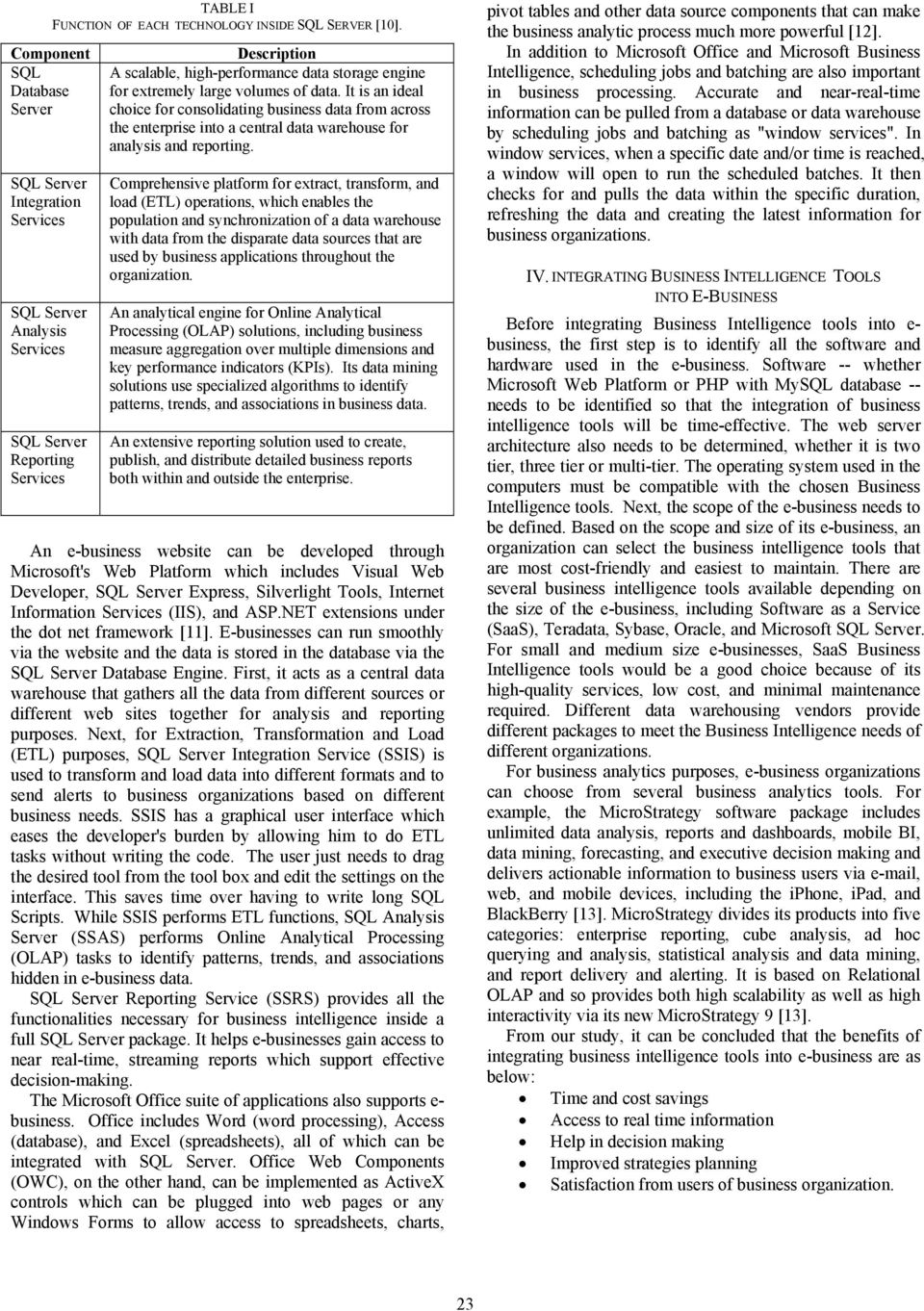
3 Fig. 4 Teradata s Enterprise Data Warehouse[6]. B. Business Analytics Business Analytics, also known as analytical processing, is a broad category of applications and techniques for gathering, storing, analyzing, and providing access to data to help enterprise users make better business and strategic decisions [7]. Business Analytics can be grouped into three categories: information and knowledge discovery; decision support and intelligent systems; and visualization [7]. The information and knowledge discovery group includes Online Analytical Processing (OLAP), ad hoc queries and reports, data mining, text mining, web mining, and search engines. Many types of OLAP can be used in business intelligence, such as Multidimensional OLAP (MOLAP) which summarizes transactions into multidimensional views ahead of time; Relational OLAP (ROLAP), used on data that has a large number of attributes; Web OLAP (WOLAP), accessible through a web browser; and Desktop OLAP, which provides local multidimensional analysis and presentation of data downloaded to client machines from relational or multi-dimensional databases [7]. One common method of creating ad hoc queries is through the use of Structured Query Language (SQL). It is the query that allows a user to request information that is not available in periodic reports. Data mining tools are used in business analytics to extract hidden, predictive information from databases by searching for patterns in large datasets. The most common type of mining used in e-business is web mining. Web mining is the discovery and analysis of interesting and useful information from the Web, through Web-based tools [7]. Web mining can be further subdivided into three categories: web content mining, for mining web page contents and search results; web structure mining, for finding link relationships and Web organization structures; and web usage mining, for general access pattern tracking and customized usage tracking. Shen and Wang [8] described how Business Intelligence uses web mining through five processes: user access paths, association rule discovery, sequential patterns of data, classification rule patterns and clustering rule patterns from the data pool [8]. The second category of Business Analytics is decision support and intelligent systems. This group includes group decision support (GDS), executive-end enterprise support, automated decision support, web analytics, management science and statistical analysis, data mining and predictive analysis, applied artificial intelligence, and business performance management (BPM) [7]. GSS is a combination of hardware and software that strengthens group work for decision making [6]. It supports parallel processing of information and idea generation from multiple participants to speed up the process of decision making. The third category is visualization. This involves techniques such as visual analysis, scorecards, dashboards, and 3D virtual reality. Visualization can be used for interpretation of data and information that includes digital images, graphical user interfaces, graphs, and videos. All three categories of Business Analytics share the same goal: to help top management make better decisions. To do this, top management needs to be able to comprehend vast quantities of data, such as total number of visitors or customer preferences and buying patterns, to perform accurate business prediction and forecasting. C. Business Performance Management A Business Performance Management (BPM) system is a real time system that alerts managers to potential opportunities, impending problems, and threats, and then empowers them to react through models and collaboration [5]. It is used to plan and forecast the business future, identify opportunities and problems, determine priorities and allocate resources accordingly, align top level strategic objectives and bottom level initiatives, and so on. D. User Interface One example of a user interface is a dashboard. A dashboard provides a visual view of corporate performance measures, trends, and exceptions. It presents graphs, charts and other visualization tools in a single screen to give management a better view of crucial information about the business. III. CURRENT BUSINESS INTELLIGENCE TOOLS In this section, we will review one particular business intelligence tool currently used in e-businesses and study its application to the development of e-business. That tool is Microsoft IT Business Intelligence. Based on Dragoljub, Drahica, and Biljana [9], Microsoft Business Intelligence contains two components: Microsoft and the Microsoft Office suite. Some of the business intelligence tools contained in 2008 are Database Engine, Integration, Analysis and Reporting. Table 1 shows the functions of each of these technologies. 22
![enterprise users make better business and strategic decisions [7].](/docs-images/49/17497333/images/page_3.jpg "Business Analytics can be grouped into three categories: information and knowledge discovery; decision support and intelligent systems; and visualization [7].")
4 Component SQL Database Server Integration Analysis Reporting TABLE I FUNCTION OF EACH TECHNOLOGY INSIDE SQL SERVER [10]. Description A scalable, high-performance data storage engine for extremely large volumes of data. It is an ideal choice for consolidating business data from across the enterprise into a central data warehouse for analysis and reporting. Comprehensive platform for extract, transform, and load (ETL) operations, which enables the population and synchronization of a data warehouse with data from the disparate data sources that are used by business applications throughout the organization. An analytical engine for Online Analytical Processing (OLAP) solutions, including business measure aggregation over multiple dimensions and key performance indicators (KPIs). Its data mining solutions use specialized algorithms to identify patterns, trends, and associations in business data. An extensive reporting solution used to create, publish, and distribute detailed business reports both within and outside the enterprise. An e-business website can be developed through Microsoft's Web Platform which includes Visual Web Developer, Express, Silverlight Tools, Internet Information (IIS), and ASP.NET extensions under the dot net framework [11]. E-businesses can run smoothly via the website and the data is stored in the database via the Database Engine. First, it acts as a central data warehouse that gathers all the data from different sources or different web sites together for analysis and reporting purposes. Next, for Extraction, Transformation and Load (ETL) purposes, Integration Service (SSIS) is used to transform and load data into different formats and to send alerts to business organizations based on different business needs. SSIS has a graphical user interface which eases the developer's burden by allowing him to do ETL tasks without writing the code. The user just needs to drag the desired tool from the tool box and edit the settings on the interface. This saves time over having to write long SQL Scripts. While SSIS performs ETL functions, SQL Analysis Server (SSAS) performs Online Analytical Processing (OLAP) tasks to identify patterns, trends, and associations hidden in e-business data. Reporting Service (SSRS) provides all the functionalities necessary for business intelligence inside a full package. It helps e-businesses gain access to near real-time, streaming reports which support effective decision-making. The Microsoft Office suite of applications also supports e- business. Office includes Word (word processing), Access (database), and Excel (spreadsheets), all of which can be integrated with. Office Web Components (OWC), on the other hand, can be implemented as ActiveX controls which can be plugged into web pages or any Windows Forms to allow access to spreadsheets, charts, pivot tables and other data source components that can make the business analytic process much more powerful [12]. In addition to Microsoft Office and Microsoft Business Intelligence, scheduling jobs and batching are also important in business processing. Accurate and near-real-time information can be pulled from a database or data warehouse by scheduling jobs and batching as "window services". In window services, when a specific date and/or time is reached, a window will open to run the scheduled batches. It then checks for and pulls the data within the specific duration, refreshing the data and creating the latest information for business organizations. IV. INTEGRATING BUSINESS INTELLIGENCE TOOLS INTO E-BUSINESS Before integrating Business Intelligence tools into e- business, the first step is to identify all the software and hardware used in the e-business. Software -- whether Microsoft Web Platform or PHP with MySQL database -- needs to be identified so that the integration of business intelligence tools will be time-effective. The web server architecture also needs to be determined, whether it is two tier, three tier or multi-tier. The operating system used in the computers must be compatible with the chosen Business Intelligence tools. Next, the scope of the e-business needs to be defined. Based on the scope and size of its e-business, an organization can select the business intelligence tools that are most cost-friendly and easiest to maintain. There are several business intelligence tools available depending on the size of the e-business, including Software as a Service (SaaS), Teradata, Sybase, Oracle, and Microsoft. For small and medium size e-businesses, SaaS Business Intelligence tools would be a good choice because of its high-quality services, low cost, and minimal maintenance required. Different data warehousing vendors provide different packages to meet the Business Intelligence needs of different organizations. For business analytics purposes, e-business organizations can choose from several business analytics tools. For example, the MicroStrategy software package includes unlimited data analysis, reports and dashboards, mobile BI, data mining, forecasting, and executive decision making and delivers actionable information to business users via , web, and mobile devices, including the iphone, ipad, and BlackBerry [13]. MicroStrategy divides its products into five categories: enterprise reporting, cube analysis, ad hoc querying and analysis, statistical analysis and data mining, and report delivery and alerting. It is based on Relational OLAP and so provides both high scalability as well as high interactivity via its new MicroStrategy 9 [13]. From our study, it can be concluded that the benefits of integrating business intelligence tools into e-business are as below: Time and cost savings Access to real time information Help in decision making Improved strategies planning Satisfaction from users of business organization. 23
5 V. CONCLUSIONS In this paper, we first introduced the concepts of e- business and business intelligence. Then, we discussed the function of business intelligence in e-business and laid out the four components of a Business Intelligence architecture: data warehouse, business analytics, business performance management (BPM), and user interface. We further discussed these components in order to give a better view of the important role played by business intelligence enhancing business process and decision making. We outlined the functionalities of Microsoft Business Intelligence tools to enhance our understanding of what this suite of tools can do to improve e-business performance. Finally, based on the architecture of business intelligence tools, we proposed a method of integrating business intelligence into e-business based on the identification of software, hardware, operating system, scope and type of e-business operation. Given these parameters, top management can choose from multiple business intelligence software packages the one that best suits their organization s size and business patterns. ACKNOWLEDGMENT We would like to thank Universiti Sains Malaysia for supporting this study. REFERENCES [1] International Data Corporation IDC Survey Malaysia. [Online]. Available: type =narrow&geo=asia+pacific+%28regional+research+excluding+ Japan%29%2FMalaysia [2] M. Raisinghani,. Business Intelligence in the Digital Economy. Hershey, PA: The Idea Group, [3] Y. Qiongwei, S. Guangxing, and Li Zhendong, An Empirical Study of Business Intelligence (BI) Application in E business Enterprises: Taking YNYY Pharmaceutical Chain Enterprise as Example, Fourth International Conference on Management of e-commerce and e- Government (ICMeCG) pp , 2010, [4] W. Eckerson, Smart Companies in the 21 st Century: The Secrets of Creating Successful Business Intelligent Solutions. The Data Warehousing Institute, Seattle, WA, pp. 32,,2003 [5] Teradata. [Online]. Available: [6] T. Efraim, J. E. Aronson, L. Ting-Peng, Ramesh Sharda, Decision Support and Business Intelligence System, 8 th Edition [7] Z. Shen, H. Wang, Research on E-Commerce Application Based on Web Mining, International Conference on Intelligent Computing and Cognitive Informatics (ICICCI), pp ,, 2010, [8] D. Krneta, D. Radosav, B. Radulovic, Realization Business Intelligence in Commerce using Microsoft Business Intelligence, International Symposium on Intelligent System and Informatics (SISY), pp.1-6, [9] Business Intelligence [Online]. Available: [10] Microsoft Web Platform. [Online]. Available: [11] Microsoft Office Web Components (OWC). [Online]. Available: 252c-402e-4f72-97a5-e0fd290d4b76&DisplayLang=en [12] MicroStrategy. [Online]. Available: 24

Bussiness Intelligence and Data Warehouse. Tomas Bartos CIS 764, Kansas State University
 Bussiness Intelligence and Data Warehouse Schedule Bussiness Intelligence (BI) BI tools Oracle vs. Microsoft Data warehouse History Tools Oracle vs. Others Discussion Business Intelligence (BI) Products
BUSINESS INTELLIGENCE. Keywords: business intelligence, architecture, concepts, dashboards, ETL, data mining
 BUSINESS INTELLIGENCE Bogdan Mohor Dumitrita 1 Abstract A Business Intelligence (BI)-driven approach can be very effective in implementing business transformation programs within an enterprise framework.
W H I T E P A P E R B u s i n e s s I n t e l l i g e n c e S o lutions from the Microsoft and Teradata Partnership
 W H I T E P A P E R B u s i n e s s I n t e l l i g e n c e S o lutions from the Microsoft and Teradata Partnership Sponsored by: Microsoft and Teradata Dan Vesset October 2008 Brian McDonough Global Headquarters:
Business Analytics and Data Visualization. Decision Support Systems Chattrakul Sombattheera
 Business Analytics and Data Visualization Decision Support Systems Chattrakul Sombattheera Agenda Business Analytics (BA): Overview Online Analytical Processing (OLAP) Reports and Queries Multidimensionality
Business Intelligence, Analytics & Reporting: Glossary of Terms
 Business Intelligence, Analytics & Reporting: Glossary of Terms A B C D E F G H I J K L M N O P Q R S T U V W X Y Z Ad-hoc analytics Ad-hoc analytics is the process by which a user can create a new report
Business Intelligence. A Presentation of the Current Lead Solutions and a Comparative Analysis of the Main Providers
 60 Business Intelligence. A Presentation of the Current Lead Solutions and a Comparative Analysis of the Main Providers Business Intelligence. A Presentation of the Current Lead Solutions and a Comparative
A Knowledge Management Framework Using Business Intelligence Solutions
 www.ijcsi.org 102 A Knowledge Management Framework Using Business Intelligence Solutions Marwa Gadu 1 and Prof. Dr. Nashaat El-Khameesy 2 1 Computer and Information Systems Department, Sadat Academy For
Chapter 5 Business Intelligence: Data Warehousing, Data Acquisition, Data Mining, Business Analytics, and Visualization
 Turban, Aronson, and Liang Decision Support Systems and Intelligent Systems, Seventh Edition Chapter 5 Business Intelligence: Data Warehousing, Data Acquisition, Data Mining, Business Analytics, and Visualization
Integrating SAP and non-sap data for comprehensive Business Intelligence
 WHITE PAPER Integrating SAP and non-sap data for comprehensive Business Intelligence www.barc.de/en Business Application Research Center 2 Integrating SAP and non-sap data Authors Timm Grosser Senior Analyst
14. Data Warehousing & Data Mining
 14. Data Warehousing & Data Mining Data Warehousing Concepts Decision support is key for companies wanting to turn their organizational data into an information asset Data Warehouse "A subject-oriented,
Course 803401 DSS. Business Intelligence: Data Warehousing, Data Acquisition, Data Mining, Business Analytics, and Visualization
 Oman College of Management and Technology Course 803401 DSS Business Intelligence: Data Warehousing, Data Acquisition, Data Mining, Business Analytics, and Visualization CS/MIS Department Information Sharing
Your Technology Partner Offshore and Onsite. Services Portfolio
 Services Portfolio OFFSHORE SOFTWARE DEVELOPMENT SERVICES Product Development for ISVs Custom Application Development for End-clients Application Development Application Maintenance & Support Application
Ramesh Bhashyam Teradata Fellow Teradata Corporation [email protected]
 Challenges of Handling Big Data Ramesh Bhashyam Teradata Fellow Teradata Corporation [email protected] Trend Too much information is a storage issue, certainly, but too much information is also
Data Warehousing and Data Mining in Business Applications
 133 Data Warehousing and Data Mining in Business Applications Eesha Goel CSE Deptt. GZS-PTU Campus, Bathinda. Abstract Information technology is now required in all aspect of our lives that helps in business
Microsoft Services Exceed your business with Microsoft SharePoint Server 2010
 Microsoft Services Exceed your business with Microsoft SharePoint Server 2010 Business Intelligence Suite Alexandre Mendeiros, SQL Server Premier Field Engineer January 2012 Agenda Microsoft Business Intelligence
ORACLE BUSINESS INTELLIGENCE SUITE ENTERPRISE EDITION PLUS
 ORACLE BUSINESS INTELLIGENCE SUITE ENTERPRISE EDITION PLUS PRODUCT FACTS & FEATURES KEY FEATURES Comprehensive, best-of-breed capabilities 100 percent thin client interface Intelligence across multiple
Dashboard Reporting Business Intelligence
 Dashboard Reporting Dashboards are One of 5 Styles of BI Applications Increasing Analytics & User Interactivity Advanced Analysis & Ad Hoc OLAP Analysis Reporting Ad Hoc Analysis Predictive Analysis Data
Data W a Ware r house house and and OLAP II Week 6 1
 Data Warehouse and OLAP II Week 6 1 Team Homework Assignment #8 Using a data warehousing tool and a data set, play four OLAP operations (Roll up (drill up), Drill down (roll down), Slice and dice, Pivot
ORACLE BUSINESS INTELLIGENCE SUITE ENTERPRISE EDITION PLUS
 Oracle Fusion editions of Oracle's Hyperion performance management products are currently available only on Microsoft Windows server platforms. The following is intended to outline our general product
SAP BusinessObjects SOLUTIONS FOR ORACLE ENVIRONMENTS
 SAP BusinessObjects SOLUTIONS FOR ORACLE ENVIRONMENTS BUSINESS INTELLIGENCE FOR ORACLE APPLICATIONS AND TECHNOLOGY SAP Solution Brief SAP BusinessObjects Business Intelligence Solutions 1 SAP BUSINESSOBJECTS
Decision Support and Business Intelligence Systems. Chapter 1: Decision Support Systems and Business Intelligence
 Decision Support and Business Intelligence Systems Chapter 1: Decision Support Systems and Business Intelligence Types of DSS Two major types: Model-oriented DSS Data-oriented DSS Evolution of DSS into
B.Sc (Computer Science) Database Management Systems UNIT-V
 1 B.Sc (Computer Science) Database Management Systems UNIT-V Business Intelligence? Business intelligence is a term used to describe a comprehensive cohesive and integrated set of tools and process used
Chapter 5. Warehousing, Data Acquisition, Data. Visualization
 Decision Support Systems and Intelligent Systems, Seventh Edition Chapter 5 Business Intelligence: Data Warehousing, Data Acquisition, Data Mining, Business Analytics, and Visualization 5-1 Learning Objectives
The Role of the Analyst in Business Analytics. Neil Foshay Schwartz School of Business St Francis Xavier U
 The Role of the Analyst in Business Analytics Neil Foshay Schwartz School of Business St Francis Xavier U Contents Business Analytics What s it all about? Development Process Overview BI Analyst Role Questions
Turnkey Hardware, Software and Cash Flow / Operational Analytics Framework
 Turnkey Hardware, Software and Cash Flow / Operational Analytics Framework With relevant, up to date cash flow and operations optimization reporting at your fingertips, you re positioned to take advantage
Business Intelligence Solutions. Cognos BI 8. by Adis Terzić
 Business Intelligence Solutions Cognos BI 8 by Adis Terzić Fairfax, Virginia August, 2008 Table of Content Table of Content... 2 Introduction... 3 Cognos BI 8 Solutions... 3 Cognos 8 Components... 3 Cognos
IST722 Data Warehousing
 IST722 Data Warehousing Components of the Data Warehouse Michael A. Fudge, Jr. Recall: Inmon s CIF The CIF is a reference architecture Understanding the Diagram The CIF is a reference architecture CIF
Ezgi Dinçerden. Marmara University, Istanbul, Turkey
 Economics World, Mar.-Apr. 2016, Vol. 4, No. 2, 60-65 doi: 10.17265/2328-7144/2016.02.002 D DAVID PUBLISHING The Effects of Business Intelligence on Strategic Management of Enterprises Ezgi Dinçerden Marmara
SIGNIFICANCE OF BUSINESS INTELLIGENCE APPLICATIONS FOR BETTER DECISION MAKING & BUSINESS PERFORMANCE
 SIGNIFICANCE OF BUSINESS INTELLIGENCE APPLICATIONS FOR BETTER DECISION MAKING & BUSINESS PERFORMANCE Dr. Nitin P. Mankar Professor (Director), Jayawantrao Sawant Institute of Management & Research (JSIMR).
ORACLE TAX ANALYTICS. The Solution. Oracle Tax Data Model KEY FEATURES
 ORACLE TAX ANALYTICS KEY FEATURES A set of comprehensive and compatible BI Applications. Advanced insight into tax performance Built on World Class Oracle s Database and BI Technology Design after the
SQL Server 2012 End-to-End Business Intelligence Workshop
 USA Operations 11921 Freedom Drive Two Fountain Square Suite 550 Reston, VA 20190 solidq.com 800.757.6543 Office 206.203.6112 Fax [email protected] SQL Server 2012 End-to-End Business Intelligence Workshop
Implementing Data Models and Reports with Microsoft SQL Server
 Course 20466C: Implementing Data Models and Reports with Microsoft SQL Server Course Details Course Outline Module 1: Introduction to Business Intelligence and Data Modeling As a SQL Server database professional,
QlikView Business Discovery Platform. Algol Consulting Srl
 QlikView Business Discovery Platform Algol Consulting Srl Business Discovery Applications Application vs. Platform Application Designed to help people perform an activity Platform Provides infrastructure
Applied Business Intelligence. Iakovos Motakis, Ph.D. Director, DW & Decision Support Systems Intrasoft SA
 Applied Business Intelligence Iakovos Motakis, Ph.D. Director, DW & Decision Support Systems Intrasoft SA Agenda Business Drivers and Perspectives Technology & Analytical Applications Trends Challenges
BI4Dynamics provides rich business intelligence capabilities to companies of all sizes and industries. From the first day on you can analyse your
 BI4Dynamics provides rich business intelligence capabilities to companies of all sizes and industries. From the first day on you can analyse your data quickly, accurately and make informed decisions. Spending
Management Accountants and IT Professionals providing Better Information = BI = Business Intelligence. Peter Simons peter.simons@cimaglobal.
 Management Accountants and IT Professionals providing Better Information = BI = Business Intelligence Peter Simons [email protected] Agenda Management Accountants? The need for Better Information
Foundations of Business Intelligence: Databases and Information Management
 Chapter 5 Foundations of Business Intelligence: Databases and Information Management 5.1 Copyright 2011 Pearson Education, Inc. Student Learning Objectives How does a relational database organize data,
IAF Business Intelligence Solutions Make the Most of Your Business Intelligence. White Paper November 2002
 IAF Business Intelligence Solutions Make the Most of Your Business Intelligence White Paper INTRODUCTION In recent years, the amount of data in companies has increased dramatically as enterprise resource
Fluency With Information Technology CSE100/IMT100
 Fluency With Information Technology CSE100/IMT100 ),7 Larry Snyder & Mel Oyler, Instructors Ariel Kemp, Isaac Kunen, Gerome Miklau & Sean Squires, Teaching Assistants University of Washington, Autumn 1999
Business Benefits From Microsoft SQL Server Business Intelligence Solutions How Can Business Intelligence Help You? PTR Associates Limited
 Business Benefits From Microsoft SQL Server Business Intelligence Solutions How Can Business Intelligence Help You? www.ptr.co.uk Business Benefits From Microsoft SQL Server Business Intelligence (September
An Architectural Review Of Integrating MicroStrategy With SAP BW
 An Architectural Review Of Integrating MicroStrategy With SAP BW Manish Jindal MicroStrategy Principal HCL Objectives To understand how MicroStrategy integrates with SAP BW Discuss various Design Options
Business Intelligence and Healthcare
 Business Intelligence and Healthcare SUTHAN SIVAPATHAM SENIOR SHAREPOINT ARCHITECT Agenda Who we are What is BI? Microsoft s BI Stack Case Study (Healthcare) Who we are Point Alliance is an award-winning
End to End Microsoft BI with SQL 2008 R2 and SharePoint 2010
 www.etidaho.com (208) 327-0768 End to End Microsoft BI with SQL 2008 R2 and SharePoint 2010 5 Days About This Course This instructor-led course provides students with the knowledge and skills to develop
LITERATURE SURVEY ON DATA WAREHOUSE AND ITS TECHNIQUES
 LITERATURE SURVEY ON DATA WAREHOUSE AND ITS TECHNIQUES MUHAMMAD KHALEEL (0912125) SZABIST KARACHI CAMPUS Abstract. Data warehouse and online analytical processing (OLAP) both are core component for decision
Supply Chain Management Build Connections
 Build Connections Enabling a business in manufacturing Building High-Value Connections with Partners and Suppliers Build Connections Is your supply chain responsive, adaptive, agile, and efficient? How
The Microsoft Business Intelligence 2010 Stack Course 50511A; 5 Days, Instructor-led
 The Microsoft Business Intelligence 2010 Stack Course 50511A; 5 Days, Instructor-led Course Description This instructor-led course provides students with the knowledge and skills to develop Microsoft End-to-
CONCEPTUALIZING BUSINESS INTELLIGENCE ARCHITECTURE MOHAMMAD SHARIAT, Florida A&M University ROSCOE HIGHTOWER, JR., Florida A&M University
 CONCEPTUALIZING BUSINESS INTELLIGENCE ARCHITECTURE MOHAMMAD SHARIAT, Florida A&M University ROSCOE HIGHTOWER, JR., Florida A&M University Given today s business environment, at times a corporate executive
The difference between. BI and CPM. A white paper prepared by Prophix Software
 The difference between BI and CPM A white paper prepared by Prophix Software Overview The term Business Intelligence (BI) is often ambiguous. In popular contexts such as mainstream media, it can simply
SQL Server 2012 Business Intelligence Boot Camp
 SQL Server 2012 Business Intelligence Boot Camp Length: 5 Days Technology: Microsoft SQL Server 2012 Delivery Method: Instructor-led (classroom) About this Course Data warehousing is a solution organizations
Course 103402 MIS. Foundations of Business Intelligence
 Oman College of Management and Technology Course 103402 MIS Topic 5 Foundations of Business Intelligence CS/MIS Department Organizing Data in a Traditional File Environment File organization concepts Database:
University of Gaziantep, Department of Business Administration
 University of Gaziantep, Department of Business Administration The extensive use of information technology enables organizations to collect huge amounts of data about almost every aspect of their businesses.
Deploy. Friction-free self-service BI solutions for everyone Scalable analytics on a modern architecture
 Friction-free self-service BI solutions for everyone Scalable analytics on a modern architecture Apps and data source extensions with APIs Future white label, embed or integrate Power BI Deploy Intelligent
Foundations of Business Intelligence: Databases and Information Management
 Foundations of Business Intelligence: Databases and Information Management Content Problems of managing data resources in a traditional file environment Capabilities and value of a database management
Dell Information Management solutions
 Dell Information Management solutions Uday Tekumalla Solutions Marketing, Information Management 1 10/28/2013 Information Management Solutions My introduction Uday Tekumalla, the ponytail guy Information
CHAPTER 4 Data Warehouse Architecture
 CHAPTER 4 Data Warehouse Architecture 4.1 Data Warehouse Architecture 4.2 Three-tier data warehouse architecture 4.3 Types of OLAP servers: ROLAP versus MOLAP versus HOLAP 4.4 Further development of Data
Chapter 6 - Enhancing Business Intelligence Using Information Systems
 Chapter 6 - Enhancing Business Intelligence Using Information Systems Managers need high-quality and timely information to support decision making Copyright 2014 Pearson Education, Inc. 1 Chapter 6 Learning
Jet Enterprise Frequently Asked Questions Pg. 1 03/18/2011 JEFAQ - 02/13/2013 - Copyright 2013 - Jet Reports International, Inc.
 Pg. 1 03/18/2011 JEFAQ - 02/13/2013 - Copyright 2013 - Jet Reports International, Inc. Regarding Jet Enterprise What are the software requirements for Jet Enterprise? The following components must be installed
Supply chain intelligence: benefits, techniques and future trends
 MEB 2010 8 th International Conference on Management, Enterprise and Benchmarking June 4 5, 2010 Budapest, Hungary Supply chain intelligence: benefits, techniques and future trends Zoltán Bátori Óbuda
DATA MINING AND WAREHOUSING CONCEPTS
 CHAPTER 1 DATA MINING AND WAREHOUSING CONCEPTS 1.1 INTRODUCTION The past couple of decades have seen a dramatic increase in the amount of information or data being stored in electronic format. This accumulation
Spreadsheets and OLAP
 40 Spreadsheets and OLAP Senior Lect. Daniela ENACHESCU PhD, Department of MEIG, Oil & Gas University of Ploiesti e-mail: [email protected] OLAP, the acronym for On Line Analytical Processing,
Banking Industry Performance Management
 A MICROSOFT WHITE PAPER Banking Industry Performance Management Using Business Intelligence to Increase Revenue and Profitability Software for the business. Overview Today, banks operate in a complex,
Using Tableau Software with Hortonworks Data Platform
 Using Tableau Software with Hortonworks Data Platform September 2013 2013 Hortonworks Inc. http:// Modern businesses need to manage vast amounts of data, and in many cases they have accumulated this data
Food & Beverage Industry Brief
 KudzuCreative Content Creation Food & Beverage Industry Brief KudzuCreative kudzucreative.com Content Created for, Microsoft Dynamics AX Gold Partner [email protected] NOT YOUR FATHER S FUNCTIONALITY
Increasing the Business Performances using Business Intelligence
 ANALELE UNIVERSITĂłII EFTIMIE MURGU REŞIłA ANUL XVIII, NR. 3, 2011, ISSN 1453-7397 Antoaneta Butuza, Ileana Hauer, Cornelia Muntean, Adina Popa Increasing the Business Performances using Business Intelligence
Business Intelligence
 Microsoft Dynamics NAV 2009 Business Intelligence Driving insight for more confident results White Paper November 2008 www.microsoft.com/dynamics/nav Table of Contents Overview... 3 What Is Business Intelligence?...
Business Intelligence
 Microsoft Dynamics NAV 2009 Business Intelligence Driving insight for more confident results White Paper November 2008 www.microsoft.com/dynamics/nav Table of Contents Overview... 3 What Is Business Intelligence?...
Technology-Driven Demand and e- Customer Relationship Management e-crm
 E-Banking and Payment System Technology-Driven Demand and e- Customer Relationship Management e-crm Sittikorn Direksoonthorn Assumption University 1/2004 E-Banking and Payment System Quick Win Agenda Data
Chapter 6 8/12/2015. Foundations of Business Intelligence: Databases and Information Management. Problem:
 Foundations of Business Intelligence: Databases and Information Management VIDEO CASES Chapter 6 Case 1a: City of Dubuque Uses Cloud Computing and Sensors to Build a Smarter, Sustainable City Case 1b:
Alexander Nikov. 5. Database Systems and Managing Data Resources. Learning Objectives. RR Donnelley Tries to Master Its Data
 INFO 1500 Introduction to IT Fundamentals 5. Database Systems and Managing Data Resources Learning Objectives 1. Describe how the problems of managing data resources in a traditional file environment are
Comparative Analysis of the Main Business Intelligence Solutions
 148 Informatica Economică vol. 17, no. 2/2013 Comparative Analysis of the Main Business Intelligence Solutions Alexandra RUSANEANU Faculty of Cybernetics, Statistics and Economic Informatics Bucharest
Business Intelligence: Effective Decision Making
 Business Intelligence: Effective Decision Making Bellevue College Linda Rumans IT Instructor, Business Division Bellevue College [email protected] Current Status What do I do??? How do I increase
Turkish Journal of Engineering, Science and Technology
 Turkish Journal of Engineering, Science and Technology 03 (2014) 106-110 Turkish Journal of Engineering, Science and Technology journal homepage: www.tujest.com Integrating Data Warehouse with OLAP Server
Enterprise Resource Planning Analysis of Business Intelligence & Emergence of Mining Objects
 Enterprise Resource Planning Analysis of Business Intelligence & Emergence of Mining Objects Abstract: Build a model to investigate system and discovering relations that connect variables in a database
Chapter 6 FOUNDATIONS OF BUSINESS INTELLIGENCE: DATABASES AND INFORMATION MANAGEMENT Learning Objectives
 Chapter 6 FOUNDATIONS OF BUSINESS INTELLIGENCE: DATABASES AND INFORMATION MANAGEMENT Learning Objectives Describe how the problems of managing data resources in a traditional file environment are solved
9.4 Intelligence. SAS Platform. Overview Second Edition. SAS Documentation
 SAS Platform Overview Second Edition 9.4 Intelligence SAS Documentation The correct bibliographic citation for this manual is as follows: SAS Institute Inc. 2016. SAS 9.4 Intelligence Platform: Overview,
Data Integration Checklist
 The need for data integration tools exists in every company, small to large. Whether it is extracting data that exists in spreadsheets, packaged applications, databases, sensor networks or social media
Extend the value of Microsoft Dynamics ERP with other technology innovations from Microsoft
 Extend the value of Microsoft Dynamics ERP with other technology innovations from Microsoft Combined with these products and technologies, Microsoft Dynamics ERP solutions can help you gain momentum in
Enabling Better Business Intelligence and Information Architecture With SAP Sybase PowerDesigner Software
 SAP Technology Enabling Better Business Intelligence and Information Architecture With SAP Sybase PowerDesigner Software Table of Contents 4 Seeing the Big Picture with a 360-Degree View Gaining Efficiencies
Part 22. Data Warehousing
 Part 22 Data Warehousing The Decision Support System (DSS) Tools to assist decision-making Used at all levels in the organization Sometimes focused on a single area Sometimes focused on a single problem
Emerging Technologies Shaping the Future of Data Warehouses & Business Intelligence
 Emerging Technologies Shaping the Future of Data Warehouses & Business Intelligence Appliances and DW Architectures John O Brien President and Executive Architect Zukeran Technologies 1 TDWI 1 Agenda What
COURSE SYLLABUS. Enterprise Information Systems and Business Intelligence
 MASTER PROGRAMS Autumn Semester 2008/2009 COURSE SYLLABUS Enterprise Information Systems and Business Intelligence Instructor: Malov Andrew, Master of Computer Sciences, Assistant,[email protected] Organization
Architecting for Big Data Analytics and Beyond: A New Framework for Business Intelligence and Data Warehousing
 Architecting for Big Data Analytics and Beyond: A New Framework for Business Intelligence and Data Warehousing Wayne W. Eckerson Director of Research, TechTarget Founder, BI Leadership Forum Business Analytics
QAD Business Intelligence
 QAD Business Intelligence QAD Business Intelligence (QAD BI) unifies data from multiple sources across the enterprise and provides a complete solution that enables key enterprise decision makers to access,
Business Intelligence Solutions for Gaming and Hospitality
 Business Intelligence Solutions for Gaming and Hospitality Prepared by: Mario Perkins Qualex Consulting Services, Inc. Suzanne Fiero SAS Objective Summary 2 Objective Summary The rise in popularity and
Discussion on Airport Business Intelligence System Architecture
 Discussion on Airport Business Intelligence System Architecture WANG Jian-bo FAN Chong-jun FU Hui-gang Business School University of Shanghai for Science and Technology Shanghai 200093, P. R. China Abstract
LEARNING SOLUTIONS website milner.com/learning email [email protected] phone 800 875 5042
 Course 20467A: Designing Business Intelligence Solutions with Microsoft SQL Server 2012 Length: 5 Days Published: December 21, 2012 Language(s): English Audience(s): IT Professionals Overview Level: 300
A business intelligence agenda for midsize organizations: Six strategies for success
 IBM Software Business Analytics IBM Cognos Business Intelligence A business intelligence agenda for midsize organizations: Six strategies for success A business intelligence agenda for midsize organizations:
SAP Manufacturing Intelligence By John Kong 26 June 2015
 SAP Manufacturing Intelligence By John Kong 26 June 2015 Agenda Registration Next Generation of SAP Solution for Manufacturing Tea Break SAP Business Analytics Solutions for Manufacturing - Dashboard Design
BI for the Mid-Size Enterprise: Leveraging SQL Server & SharePoint
 AUGUST 2012 BI for the Mid-Size Enterprise: Leveraging SQL Server & SharePoint Defining Business Intelligence and How it Can Transform Organizations of All Sizes About Perficient s Microsoft Practice Perficient
TRENDS IN DATA WAREHOUSING
 TRENDS IN DATA WAREHOUSING Chapter #3 Imran Khan Agenda Continued Growth in DW DW has become Mainstream Industries using DW Vendor Solution & Products Status of DW market Significant Trends Web Enabled
Introducing Oracle Exalytics In-Memory Machine
 Introducing Oracle Exalytics In-Memory Machine Jon Ainsworth Director of Business Development Oracle EMEA Business Analytics 1 Copyright 2011, Oracle and/or its affiliates. All rights Agenda Topics Oracle
Microsoft Business Intelligence
 Microsoft Business Intelligence P L A T F O R M O V E R V I E W M A R C H 1 8 TH, 2 0 0 9 C H U C K R U S S E L L S E N I O R P A R T N E R C O L L E C T I V E I N T E L L I G E N C E I N C. C R U S S
BUSINESS INTELLIGENCE
 SECOND EDITION BUSINESS INTELLIGENCE A MANAGERIAL APPROACH INTERNATIONAL EDITION Efraim Turban University of Hawaii Ramesh Sharda Oklahoma State University Dursun Deleii Oklahoma State University David